See whether Helium helps you make better-informed decisions. Try every Pro Trader feature for 30 days. No credit card required.
Try every Pro Trader feature for 30 days. No credit card required.
Compare Visual Capitalist source-level patterns, recent coverage, and article evidence. Updated weekly.
Weighted source-level patterns from recent analyzed coverage. Open recent articles below to inspect score-specific evidence and limitations when available.
🗞️ Objective <—> Subjective 👁️ -6
😩 Pessimistic <—> Optimistic 🌞22
😤 Overconfidence14
❌ Low Credibility <—> High Credibility ✅6
🪨 Low Intelligence <—> High Intelligence 🦉6
🚨 Sensational0
📉 Bearish <—> Bullish 📈1
💡 Boring <—> Interesting3
📝 Prescriptive0
😨 Fearful0
💭 Opinion5
🗳 Political0
Oversimplification4
🏛️ Appeal to Authority2
👀 Covering Responses1
🏴 Anti-establishment <—> Pro-establishment 📺0
🧠 Rational <—> Irrational 🤪-3
🤑 Advertising4
🤖 Written by AI0
💔 Low Integrity <—> High Integrity ❤️4
🔍 Truth-seeking <—> Delusion 🌀-2
🦊 Anti-Corporate <—> Pro-Corporate 👔0
🔬 Scientific <—> Superstitious 🔮-2
🎲 Speculation4
🐍 Manipulative2
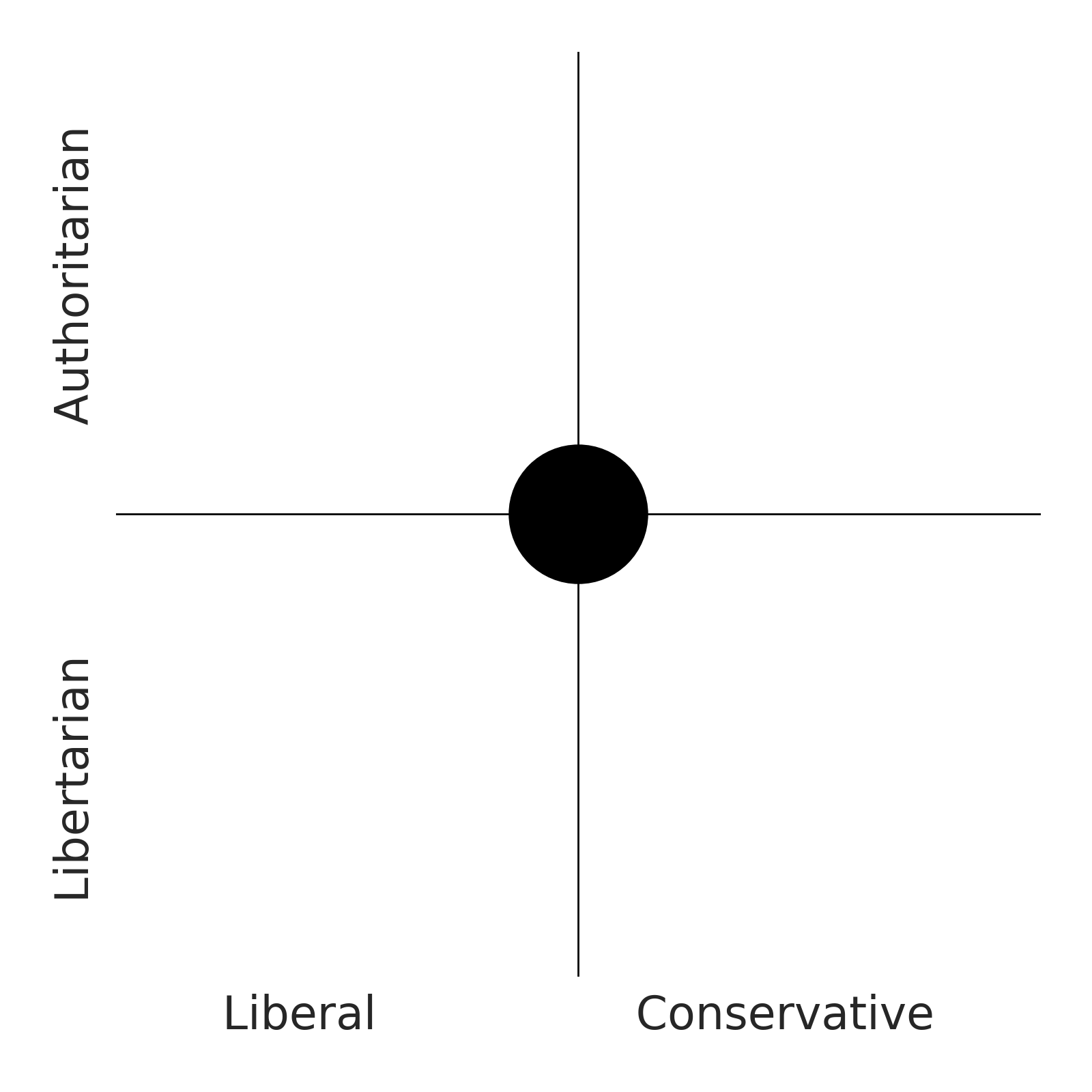

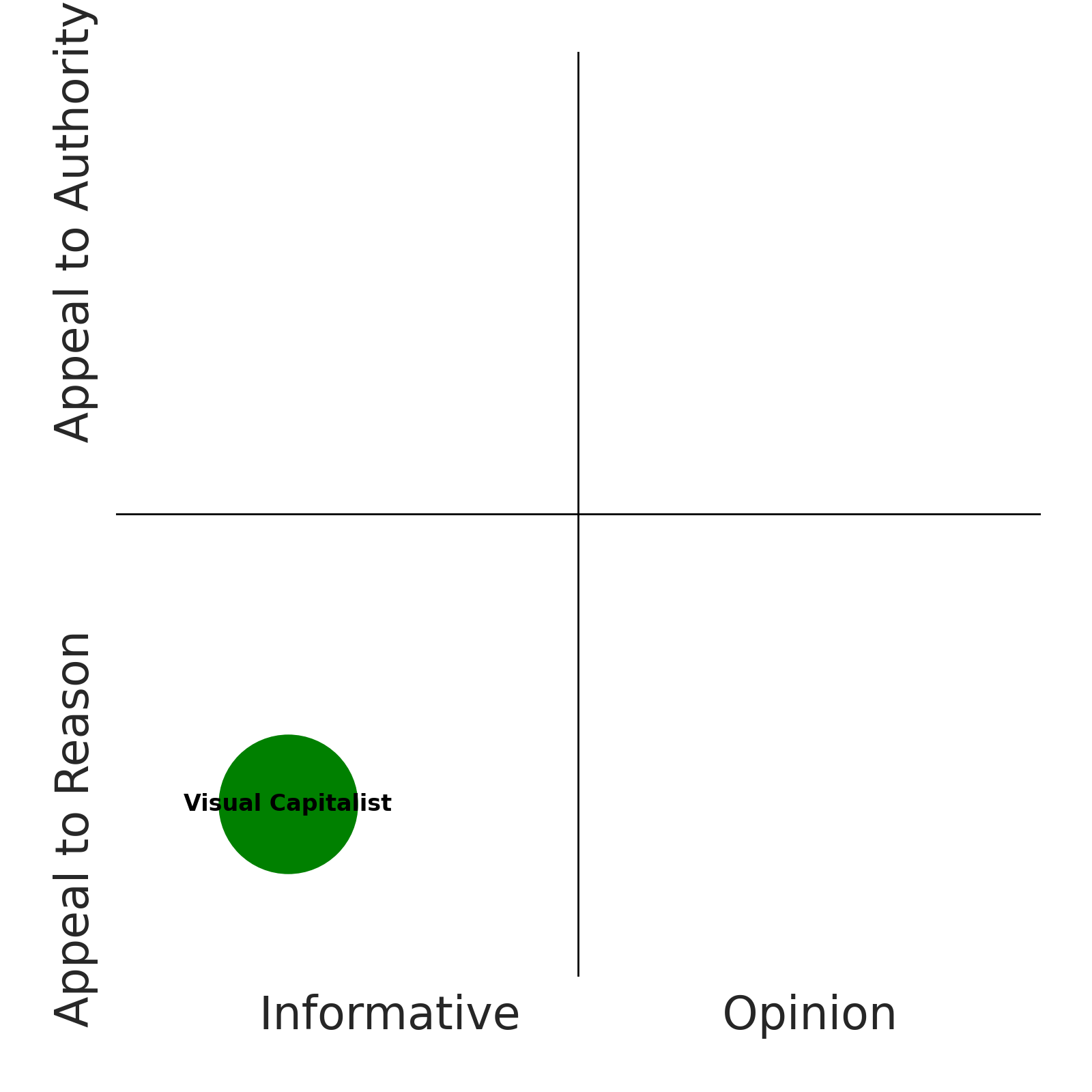
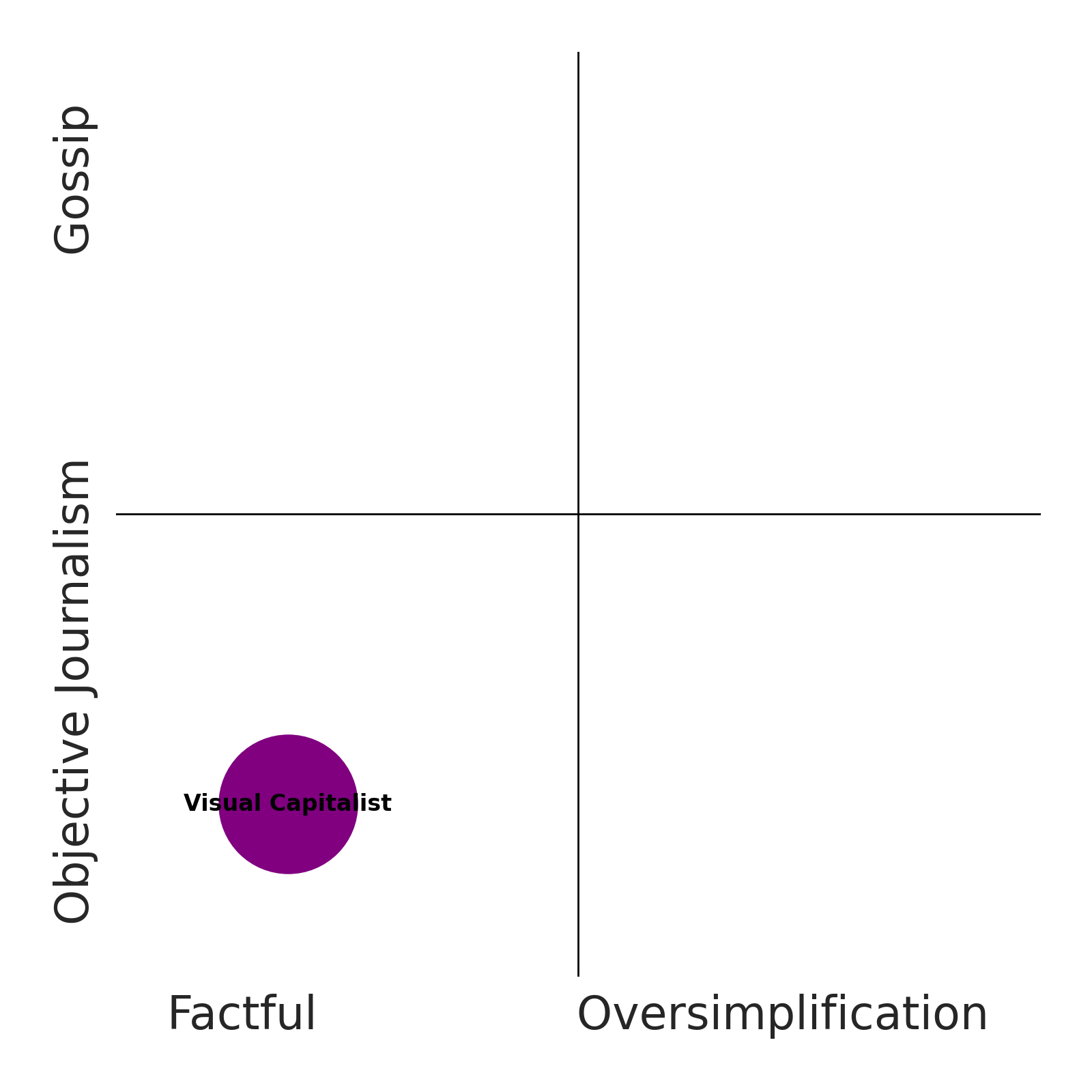
Primarily neutral and data-driven, but relies on an absolute comparison (China vs. rest of world) and centers on 2024 rankings, inviting scrutiny of the underlying data.
A concise, fact-focused blurb asserting that China leads global coal production, with a reference to 2024 rankings.
Knowledge cutoff 2024-06; may reflect training-data biases.
Descriptive but under-specified mapping of Europe’s youth social media use asserts a cross-country gap between France/UK and Italy and relies on absolutist phrasing that risks oversimplification without supporting data.
A concise, factual context describing a Europe-wide mapping of youth social media use and inter-country differences.
Limited context; minimal data; potential bias due to lack of evidence.
Pro-India framing asserts India leads AI adoption globally without supporting data or counterpoints.
Brief, optimistic claim about India's leadership in AI adoption with no cited data or sources.
Limited data; risk overemphasizing India leadership.
Promotional framing ties Atlas Salt to salt's long demand history as a durable commodity and directly invites readers to an Investor Guide.
Automated analysis; not human reviewed. Limitations: Input is a partial excerpt with truncated sentences and surrounding related-headline links; the complete body and any risk disclosures are unavailable. · 6 of 54 available dimensions scored; omitted dimensions are not treated as neutral. · Verified supporting quotes for 6 of 6 scored dimensions.
Claim: The framing is more subjective than objective due to promotional market judgment.
“one of the world’s most durable commodity markets” · exact text match
Why: Describing a market as 'most durable' is an evaluative judgment, not a dispassionate observation.
Claim: The outlook is bullish on salt and Atlas Salt as an investment.
“one of the world’s most durable commodity markets” · exact text match
“Read the Investor Guide to learn more about Atlas Salt’s opportunity” · exact text match
Why: Durability and 'opportunity' language plus an investor-guide prompt signal a positive investment outlook.
Claim: Atlas Salt's prospects are framed optimistically.
“Atlas Salt’s opportunity” · exact text match
“one of the world’s most durable commodity markets” · exact text match
Why: The words 'opportunity' and 'durable' express a positive future outlook.
Claim: Factual commodity history is mixed with evaluative investment promotion.
“positioning the company within one of the world’s most durable commodity markets” · exact text match
“Read the Investor Guide to learn more about Atlas Salt’s opportunity” · exact text match
Why: Evaluative phrasing like 'durable' and 'opportunity' moves beyond neutral factual reporting.
Claim: This content functions as promotional content for Atlas Salt.
“Read the Investor Guide to learn more about Atlas Salt’s opportunity” · exact text match
Why: A direct call to action for an investor guide signals advertorial or marketing framing.
Claim: Atlas Salt is presented in a favorable light as a company in a durable commodity market.
“Labrador, positioning the company within one of the world’s most durable commodity markets” · exact text match
Why: Singling out the company's position and opportunity promotes a corporate interest.
Input is a partial excerpt with truncated sentences and surrounding related-headline links; the complete body and any risk disclosures are unavailable.
A dealer-sponsored infographic frames the 45% gold weight in Goldman Sachs’s 2025 “optimal” World Portfolio as confirmation that gold is now a strategic replacement for bonds, ending with a sales referral.
The 60/40 portfolio is a conventional allocation benchmark mixing 60% equities and 40% bonds; the “World Portfolio” in this story is a backtested, optimized global asset allocation rather than an investable fund.
Automated analysis; not human reviewed. Limitations: Only a short sponsored excerpt and related site links were supplied; the underlying chart and Goldman Sachs methodology were not available for independent verification. · 2 of 54 available dimensions scored; omitted dimensions are not treated as neutral. · Verified supporting quotes for 2 of 2 scored dimensions.
Claim: The piece moves from describing portfolio data to advising investors to view gold as strategic and to engage with the sponsor.
“As a result, gold may be considered a strategic portfolio component, rather than simply a reactionary trade during market stress.” · exact text match
“To learn more about how gold can fit into a modern portfolio, U.S. Money Reserve can help investors explore their options.” · exact text match
Why: It advances a recommended framing for gold and closes with a call to action directed at the sponsor, exceeding neutral description.
Claim: The graphic is explicitly paid sponsorship for U.S. Money Reserve and ends with a direct referral to the sponsor.
“This graphic, sponsored by U.S. Money Reserve, is the first of six in our Gold Versus series” · exact text match
“To learn more about how gold can fit into a modern portfolio, U.S. Money Reserve can help investors explore their options.” · exact text match
Why: The text both labels the content as sponsored by a gold dealer and directs readers to that same sponsor, making the piece advertorial.
Only a short sponsored excerpt and related site links were supplied; the underlying chart and Goldman Sachs methodology were not available for independent verification.
A sponsored mining-emissions ranking frames Atlas Salt's Great Atlantic project as a low-emissions investment opportunity.
Emissions intensity per ton of ore is not a total-emissions measure; it varies with ore grade and energy mix, so comparing commodities and mines by tCO2e per Mt reflects those factors rather than total mine output.
Automated analysis; not human reviewed. Limitations: Only the article's text was provided, not the underlying chart, full methodology, or Investor Guide, so Atlas Salt's emissions estimate and the completeness of the ranking could not be independently verified. · 5 of 54 available dimensions scored; omitted dimensions are not treated as neutral. · Verified supporting quotes for 5 of 5 scored dimensions.
Claim: The report mixes sourced data with subjective evaluation.
“Atlas Salt is on track to become a low-emissions leader within the salt industry with an estimated emissions intensity well below the broader salt mining average.” · exact text match
Counterevidence:
“Rounded median estimates of emissions from NRCan (2022) and production from USGS; ore tonnage estimated using typical Canadian ore grades to calculate tCO2e per Mt of ore, includes only end−use energy−related GHG emissions.” · exact text match
Why: Sourcing and methodology are explicit, but the characterization of Atlas Salt as a 'low-emissions leader' is an evaluative judgement, not a data point.
Claim: The outlook for Atlas Salt is framed positively.
“As the world looks for reliable sources of essential commodities with lower emissions profiles, Atlas Salt has a strong position.” · exact text match
Why: It describes the company's future position as strong and does not mention risks or downsides.
Claim: The article includes unsupported evaluative opinions about Atlas Salt.
“Atlas Salt has a strong position.” · exact text match
Why: This is a value judgement rather than a factual finding from the cited data.
Claim: The feature is sponsored content that promotes Atlas Salt's investment opportunity.
“This graphic, in partnership with Atlas Salt, ranks the GHG emissions intensity of major mined commodities using data from NRCan and the USGS.” · exact text match
“Read the Investor Guide to learn more about Atlas Salt’s low-emissions opportunity.” · exact text match
Why: It is explicitly co-branded with the sponsor and ends with a call to action directing readers to an investor guide for the same company.
Claim: The publisher presents Atlas Salt in consistently favorable, uncritical terms.
“Atlas Salt is on track to become a low-emissions leader within the salt industry with an estimated emissions intensity well below the broader salt mining average.” · exact text match
Why: The sentence asserts a positive corporate standing without qualification or competing evidence.
Only the article's text was provided, not the underlying chart, full methodology, or Investor Guide, so Atlas Salt's emissions estimate and the completeness of the ranking could not be independently verified.
Automated analysis; not human reviewed. Limitations: The article text is a collection of headlines and data snippets, lacking full context to assess deeper publisher framing. · 3 of 54 available dimensions scored; omitted dimensions are not treated as neutral. · Verified supporting quotes for 2 of 3 scored dimensions.
Claim: The article is objective, presenting data and rankings without subjective opinion.
“Canada has nearly 880,000 lakes, more than the rest of the world combined.” · exact text match
Why: The article relies on third-party data sources and avoids overt commentary.
Claim: The article is descriptive, explaining what exists, rather than prescribing actions.
“This visualization from the Pacific Institute redraws major American rivers according to their average discharge, or the volume of water flowing through them.” · exact text match
Why: The language is neutral and informational, with no calls to action or policy recommendations.
Claim: The article demonstrates high credibility by citing authoritative sources.
“The world’s forests cover roughly 4.1 billion hectares, spanning countries and regions across the globe, based on data from the UN Food and Agriculture Organization via Our World in Data.” · not found in supplied text
Why: Attribution to established data providers supports trustworthiness.
The article text is a collection of headlines and data snippets, lacking full context to assess deeper publisher framing.
A sponsored mining-emissions ranking frames Atlas Salt's Great Atlantic project as a low-emissions investment opportunity.
Emissions intensity per ton of ore is not a total-emissions measure; it varies with ore grade and energy mix, so comparing commodities and mines by tCO2e per Mt reflects those factors rather than total mine output.
Automated analysis; not human reviewed. Limitations: Only the article's text was provided, not the underlying chart, full methodology, or Investor Guide, so Atlas Salt's emissions estimate and the completeness of the ranking could not be independently verified. · 5 of 54 available dimensions scored; omitted dimensions are not treated as neutral. · Verified supporting quotes for 5 of 5 scored dimensions.
Claim: The report mixes sourced data with subjective evaluation.
“Atlas Salt is on track to become a low-emissions leader within the salt industry with an estimated emissions intensity well below the broader salt mining average.” · exact text match
Counterevidence:
“Rounded median estimates of emissions from NRCan (2022) and production from USGS; ore tonnage estimated using typical Canadian ore grades to calculate tCO2e per Mt of ore, includes only end−use energy−related GHG emissions.” · exact text match
Why: Sourcing and methodology are explicit, but the characterization of Atlas Salt as a 'low-emissions leader' is an evaluative judgement, not a data point.
Claim: The outlook for Atlas Salt is framed positively.
“As the world looks for reliable sources of essential commodities with lower emissions profiles, Atlas Salt has a strong position.” · exact text match
Why: It describes the company's future position as strong and does not mention risks or downsides.
Claim: The article includes unsupported evaluative opinions about Atlas Salt.
“Atlas Salt has a strong position.” · exact text match
Why: This is a value judgement rather than a factual finding from the cited data.
Claim: The feature is sponsored content that promotes Atlas Salt's investment opportunity.
“This graphic, in partnership with Atlas Salt, ranks the GHG emissions intensity of major mined commodities using data from NRCan and the USGS.” · exact text match
“Read the Investor Guide to learn more about Atlas Salt’s low-emissions opportunity.” · exact text match
Why: It is explicitly co-branded with the sponsor and ends with a call to action directing readers to an investor guide for the same company.
Claim: The publisher presents Atlas Salt in consistently favorable, uncritical terms.
“Atlas Salt is on track to become a low-emissions leader within the salt industry with an estimated emissions intensity well below the broader salt mining average.” · exact text match
Why: The sentence asserts a positive corporate standing without qualification or competing evidence.
Only the article's text was provided, not the underlying chart, full methodology, or Investor Guide, so Atlas Salt's emissions estimate and the completeness of the ranking could not be independently verified.
The text uses promotional framing to promote polar-region futures via research, investment, and innovation in partnership with the Dubai Future Foundation, signaling pro-establishment and pro-innovation bias with limited critical balance.
Promotional framing; limited data; Dubai-centric emphasis.
Content presents Disney and James Cameron as undisputed industry heavyweights with a promotional, establishment-aligned tone and minimal counterpoints.
A ranking-based headline about the highest-grossing films and an assertion that Disney and James Cameron are undisputed leaders in the film industry.
Pro-corporate tilt; data limited.
Presents a future employment ranking as a settled listicle, foregrounding healthcare, renewable energy, and technology with no supporting data or methodological caveats.
Automated analysis; not human reviewed. Limitations: Only a two-sentence headline/snippet was supplied, so bias scores rest on the framing of that excerpt rather than a full article. · 2 of 54 available dimensions scored; omitted dimensions are not treated as neutral. · Verified supporting quotes for 2 of 2 scored dimensions.
Claim: The 2035 jobs ranking is asserted in definitive terms without hedging, sourcing, or expressed uncertainty.
“The fastest-growing jobs in America by 2035 are led by healthcare, renewable energy, and technology occupations.” · exact text match
Why: A long-term employment forecast is worded as an established result, but the supplied text offers no supporting evidence or caveats.
Claim: The substantive content is a forecast of job growth to 2035 rather than a report of observed employment data.
“The fastest-growing jobs in America by 2035 are led by healthcare, renewable energy, and technology occupations.” · exact text match
Why: The only substantive sentence describes a future ranking, with no data, source, or method provided.
Only a two-sentence headline/snippet was supplied, so bias scores rest on the framing of that excerpt rather than a full article.
The framing presents an authoritative ranking of AI-resistant jobs without providing supporting methodology or evidence, appealing to curiosity.
Automated analysis; not human reviewed. Limitations: Very short text limits analysis to headline framing; no substantive body to assess. · 4 of 53 available dimensions scored; omitted dimensions are not treated as neutral. · Verified supporting quotes for 4 of 4 scored dimensions.
Claim: The ranking reduces complex factors of AI job resistance to a single list without acknowledging nuance.
“Ranked: America's Most AI-Resistant Jobs. Discover the U.S. jobs most resistant to AI, ranked by resilience scores—from nurses to software engineers and skilled trades.” · exact text match
Why: The headline presents a definitive list without any qualification or mention of methodology, implying a simplistic ordering.
Claim: The ranking is presented with certainty, without any hedge or indication of uncertainty.
“Ranked: America's Most AI-Resistant Jobs. Discover the U.S. jobs most resistant to AI, ranked by resilience scores—from nurses to software engineers and skilled trades.” · exact text match
Why: The phrase 'Ranked' and 'most resistant' asserts a definitive classification without referencing limitations.
Claim: The article lacks sourcing, methodology, or attribution, reducing its credibility.
“Ranked: America's Most AI-Resistant Jobs. Discover the U.S. jobs most resistant to AI, ranked by resilience scores—from nurses to software engineers and skilled trades.” · exact text match
Why: No sources, no study name, no data; only a promotional headline.
Claim: The resilience scores and AI resistance ranking are speculative forecasts.
“Ranked: America's Most AI-Resistant Jobs. Discover the U.S. jobs most resistant to AI, ranked by resilience scores—from nurses to software engineers and skilled trades.” · exact text match
Why: AI resistance is inherently uncertain and forward-looking; presenting a ranking without evidence or methodology is speculative.
Very short text limits analysis to headline framing; no substantive body to assess.
Casts Amazon's revenue leadership as an 'official,' inevitable-sounding outcome using source-free, definitive language.
A headline and lede for a 'Top 30' business ranking; the ranking's source, currency basis, fiscal-year conventions, and publication date are not disclosed.
Automated analysis; not human reviewed. Limitations: The input is only a two-sentence snippet, so all scalar judgments rest on minimal linguistic evidence; there is no publication date, byline, or source to confirm whether 2026 is a reported year or a projection. · 6 of 54 available dimensions scored; omitted dimensions are not treated as neutral. · Verified supporting quotes for 6 of 6 scored dimensions.
Claim: The headline and lede follow a formulaic listicle template with no distinctive detail, hook, or analysis.
“The World's 30 Largest Companies by Revenue in 2026” · exact text match
“After three decades of growth, Amazon has officially clinched the title” · exact text match
Why: Both sentences are generic and interchangeable with countless other corporate-ranking headlines, offering nothing new or unexpected.
Claim: The adverb 'officially' implies institutional endorsement of the ranking without naming any institution.
“has officially clinched” · exact text match
Why: Invoking an unnamed official authority bolsters the credibility of the claim, though the phrase could be read idiomatically.
Claim: The publisher asserts a revenue ranking as fact using absolute language without providing any data, source, or qualification.
“has officially clinched the title of world's top firm by annual revenue” · exact text match
Why: 'Officially clinched' asserts unqualified certainty, while the supplied text offers no evidence or link to a ranking; the gap between absolute phrasing and absent support is direct.
Claim: The publisher's observable practice offers no sourcing, attribution, or uncertainty markers for a grand factual claim.
“After three decades of growth, Amazon has officially clinched the title of world's top firm by annual revenue.” · exact text match
Why: The claim is presented as settled despite a complete absence of links, names, or dates; that lack of visible sourcing is the basis for the low credibility score.
Claim: The celebratory framing of Amazon's achievement resembles promotional copy about the company.
“After three decades of growth, Amazon has officially clinched the title of world's top firm by annual revenue.” · exact text match
Why: The wording has a congratulatory, press-release-like quality, but two sentences are too little to establish a promotional pattern with confidence.
Claim: The text combines vague superlatives ('officially clinched'), an unsupported broad assertion, and formulaic structure, which together are consistent with AI-assisted listicle generation.
“After three decades of growth, Amazon has officially clinched the title of world's top firm by annual revenue.” · exact text match
Why: Several cues (bland word choice, missing article 'the' before 'world's top firm,' unsupported superlative) point toward model generation, but the sample is only two sentences, so confidence stays low.
The input is only a two-sentence snippet, so all scalar judgments rest on minimal linguistic evidence; there is no publication date, byline, or source to confirm whether 2026 is a reported year or a projection.
A promotional, forward-looking frame presents a jobs ranking as a rosy guide to six-figure opportunities, emphasizing growth and payoff over methodology or risks.
Automated analysis; not human reviewed. Limitations: The supplied text is only a short headline/subhead, so judgments rest on limited framing and no body content. · 3 of 55 available dimensions scored; omitted dimensions are not treated as neutral. · Verified supporting quotes for 3 of 3 scored dimensions.
Claim: The wording frames the job market as offering high pay, strong growth, and emerging opportunities.
“Which high-paying jobs offer six-figure salaries and strong growth prospects?” · exact text match
“See where opportunities are emerging over the next decade.” · exact text match
Why: The language selects favorable attributes and omits risks, trade-offs, or job-market downsides.
Claim: The text uses imperative and value-laden language to promote the ranking rather than report findings.
“See where opportunities are emerging over the next decade.” · exact text match
Why: The imperative call-to-action and emphasis on six-figure salaries and growth prospects market the list to the reader.
Claim: The text makes a forward-looking claim about which jobs will present opportunities over the next decade.
“See where opportunities are emerging over the next decade.” · exact text match
Why: The only concrete promise is future-oriented, pointing to expected job growth without presenting data or uncertainty.
The supplied text is only a short headline/subhead, so judgments rest on limited framing and no body content.
Under-sourced and internally disjointed framing pairs an unrelated wedding-cost headline with a bare G20 trade-dependence statistic.
Automated analysis; not human reviewed. Limitations: The supplied text is only a headline and two sentences; the headline and body may be separate snippets, so the original article's argument cannot be reconstructed. · 1 of 55 available dimensions scored; omitted dimensions are not treated as neutral. · Verified supporting quotes for 1 of 1 scored dimensions.
Claim: The text has low visible credibility because the statistic is unsourced and the headline is unrelated to the body.
“The United States absorbs just 18% of exports for the average G20 country.” · exact text match
“Mapped: The Average Wedding Cost in Every U.S. State.” · exact text match
Why: No source, date, or methodology is provided, and the body text does not support the headline's wedding-cost subject, so there is little internal basis for trust.
The supplied text is only a headline and two sentences; the headline and body may be separate snippets, so the original article's argument cannot be reconstructed.
A data-ranking frame that foregrounds U.S. defense R&D dominance while embedding sourced caveats about comparability and spillovers.
Automated analysis; not human reviewed. Limitations: The supplied text bundles several separate posts; the assessment focuses on the first substantive defense R&D feature and does not score the appended EU or X-follower sections. · 5 of 55 available dimensions scored; omitted dimensions are not treated as neutral. · Verified supporting quotes for 5 of 5 scored dimensions.
Claim: The report is anchored to a named external dataset and explicit quantitative comparisons, not to opinion.
“The data comes from the OECD Economic Outlook, Volume 2026 Issue 1, with figures covering 2024 or the latest available year as of August 2026.” · exact text match
Why: A clear source and year coverage indicate a fact-reporting rather than subjective mode.
Claim: The article presents rankings and comparisons without advocating a policy or action.
“This visualization ranks selected OECD countries by defense research and development (R&D) budget allocations per $1,000 of GDP.” · exact text match
Why: The stated purpose is to rank and visualize, not to direct readers toward a policy conclusion.
Claim: The report's claims are tied to named sources and exact figures with source-level attribution.
“The data comes from the OECD Economic Outlook, Volume 2026 Issue 1, with figures covering 2024 or the latest available year as of August 2026.” · exact text match
“Reflecting this growth, four South Korean companies appear in the SIPRI Top 100 list of global arms producers with the largest arms sales revenues in 2024.” · exact text match
Why: Named institutional data sources, temporal coverage, and specific quantities make the account verifiable.
Claim: The report integrates stated caveats about why defense R&D intensity varies, rather than presenting a one-dimensional conclusion.
“Defense R&D intensity varies considerably among wealthy economies because countries may prioritize procurement, active personnel, operations, or research differently.” · exact text match
Why: The quote shows reasoning about alternative explanations for what the ranked figures mean.
Claim: The publisher adds an honest qualification about the limits of defense R&D spillovers.
“the link between military spending and innovation is not automatic, as secrecy can impede knowledge diffusion, among other factors.” · exact text match
Why: Including a counter-consideration to the headline theme is an observable fairness signal.
The supplied text bundles several separate posts; the assessment focuses on the first substantive defense R&D feature and does not score the appended EU or X-follower sections.
Frames a hospital-brand ranking as a neutral data map, asserting Johns Hopkins as the leader and three unnamed regions as dominant without visible methodology.
Automated analysis; not human reviewed. Limitations: Only a two-sentence headline/dek was available; the ranking's source, methodology, definitions, and map details are absent, so deeper framing cannot be assessed. · 3 of 55 available dimensions scored; omitted dimensions are not treated as neutral. · Verified supporting quotes for 3 of 3 scored dimensions.
Claim: The presentation is better described as objective/data-visual than sensational.
“Mapped: The Top U.S. Hospital Brands in 2026.” · exact text match
“See where U.S. hospital brands cluster in 2026” · exact text match
Why: The wording uses a map format and a neutral command to 'see where' rather than exaggerative or alarmist language; only the mild superlative 'top' and 'dominate' give it a slight promotional edge.
Claim: The report is non-political.
“The Top U.S. Hospital Brands in 2026.” · exact text match
Why: It mentions no political actors, policies, or ideology and is confined to a commercial/health-brand ranking.
Claim: The tone is emotionally neutral.
“See where U.S. hospital brands cluster in 2026” · exact text match
Why: The phrase is instructional and informational; no emotional, fear, or enthusiasm language appears.
Only a two-sentence headline/dek was available; the ranking's source, methodology, definitions, and map details are absent, so deeper framing cannot be assessed.
2026 © Helium Trades
Privacy Policy & Disclosure
* Disclaimer: Nothing on this website constitutes investment advice, performance data or any recommendation that any particular security, portfolio of securities, transaction or investment strategy is suitable for any specific person. Helium Trades is not responsible in any way for the accuracy
of any model predictions or price data. Any mention of a particular security and related prediction data is not a recommendation to buy or sell that security. Investments in securities involve the risk of loss. Past performance is no guarantee of future results. Helium Trades is not responsible for any of your investment decisions,
you should consult a financial expert before engaging in any transaction.
Helium Research Assistant

How can I help you today?
Ask any question about Visual Capitalist bias.


