See whether Helium helps you make better-informed decisions. Try every Pro Trader feature for 30 days. No credit card required.
Try every Pro Trader feature for 30 days. No credit card required.
Compare eng.lsm.lv source-level patterns, recent coverage, and article evidence. Updated weekly.
Weighted source-level patterns from recent analyzed coverage. Open recent articles below to inspect score-specific evidence and limitations when available.
🗞️ Objective <—> Subjective 👁️ -29
💭 Opinion25
🗳 Political22
Oversimplification10
🏛️ Appeal to Authority14
😤 Overconfidence6
🔒 Ideological12
🏴 Anti-establishment <—> Pro-establishment 📺9
❌ Low Credibility <—> High Credibility ✅24
🧠 Rational <—> Irrational 🤪-19
🤑 Advertising9
🤖 Written by AI12
💔 Low Integrity <—> High Integrity ❤️23
🪨 Low Intelligence <—> High Intelligence 🦉14
🔍 Truth-seeking <—> Delusion 🌀-12
🔬 Scientific <—> Superstitious 🔮-8
🎲 Speculation10
🐍 Manipulative12
🧢 Populist <—> Elitist 🎩0
🗽 Libertarian <—> Authoritarian 🚔0
🚨 Sensational0
😩 Pessimistic <—> Optimistic 🌞0
💡 Boring <—> Interesting-4
📝 Prescriptive0
🕊️ Dovish <—> Hawkish 🦁1
😨 Fearful2
📞 Begging the Question0
🗣️ Gossip0
🍼 Immature2
👀 Covering Responses1
😢 Victimization2
🗑️ Spam1
🎭 Virtue Signaling0
🦊 Anti-Corporate <—> Pro-Corporate 👔0
👤 Individualist <—> Collectivist 👥0
💊 Big Pharma2

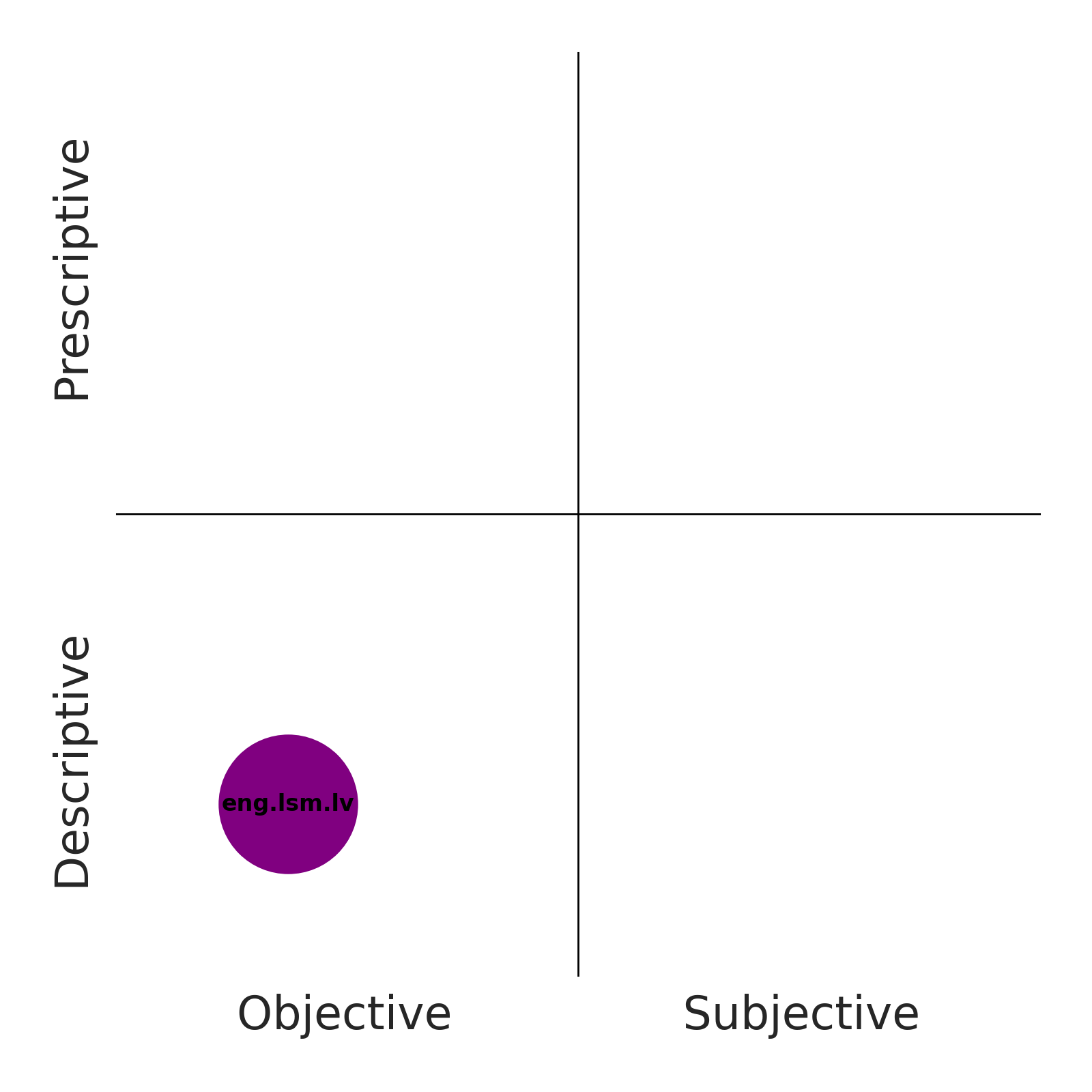
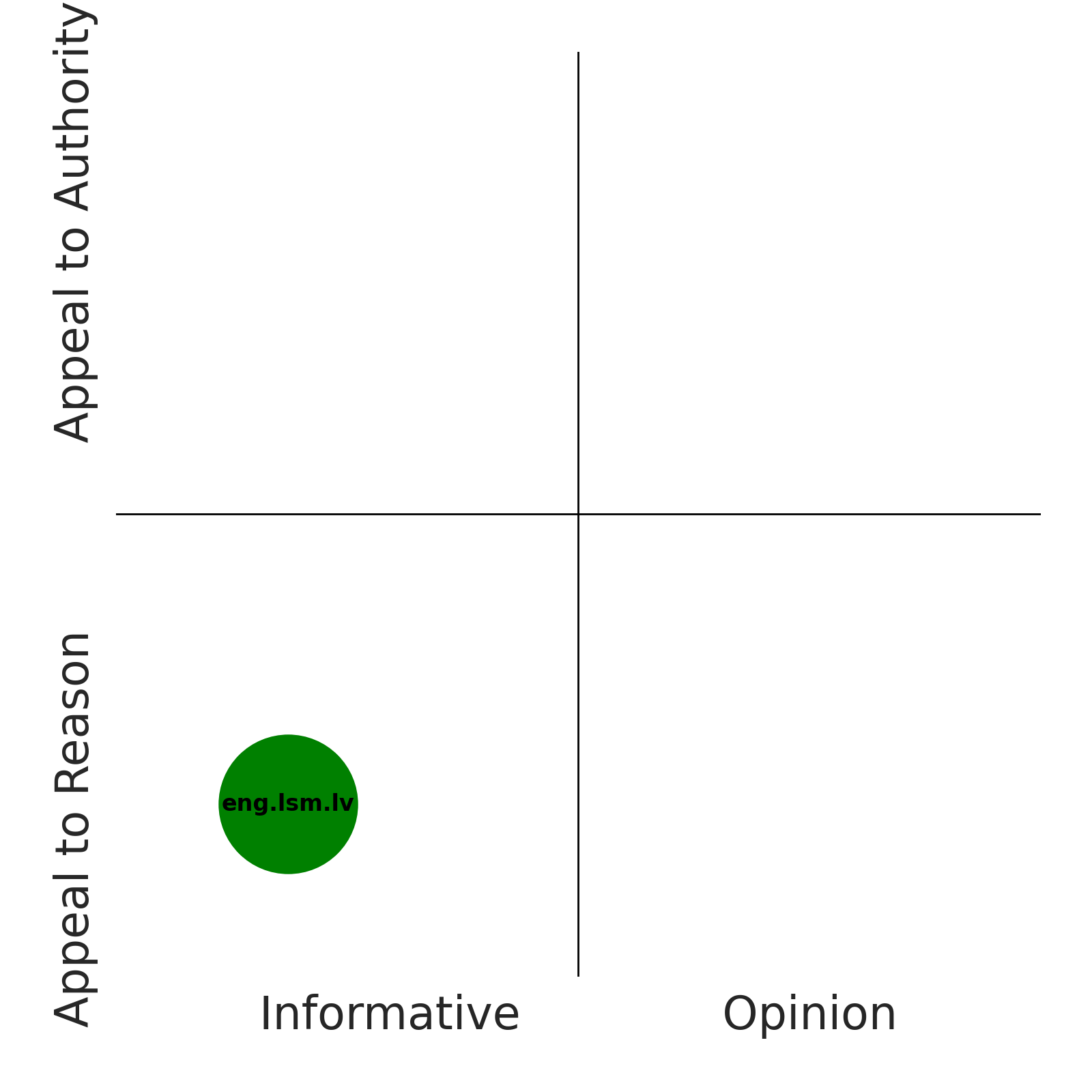
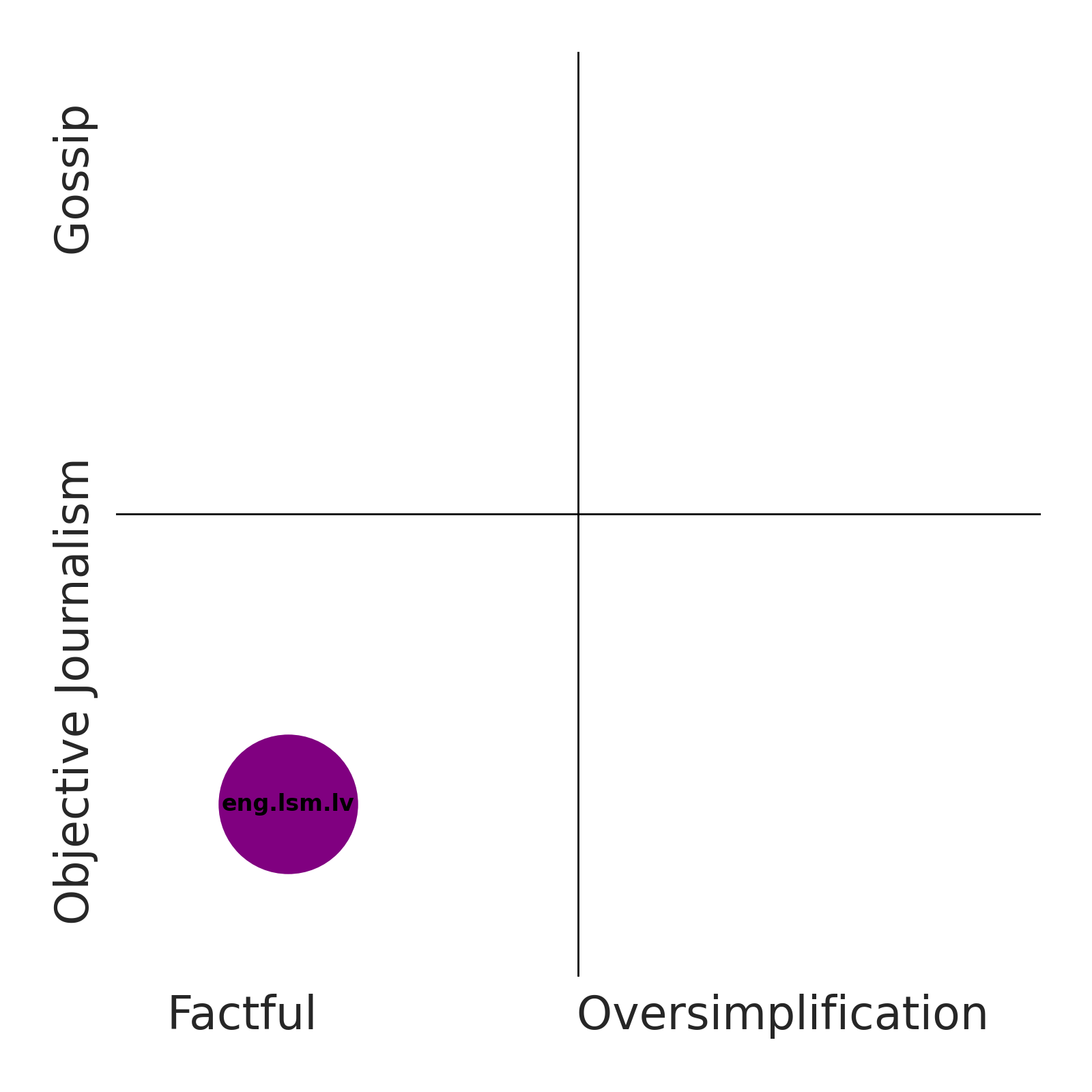
The text frames government inaction as a threat to investment security and demands stronger political resolve from investors' council perspective.
Automated analysis; not human reviewed. · 54 of 55 available dimensions scored; omitted dimensions are not treated as neutral. · Verified supporting quotes for 0 of 54 scored dimensions.
The headline and lead adopt an explicitly evaluative anti-Russia/anti-Belarus framing, labeling them 'aggressor states' and presenting LSM’s broadcast boycott as refusing to aid their 'sporting rehabilitation'.
Automated analysis; not human reviewed. Limitations: The supplied text is only two sentences and contains no named sourcing, date, or full Olympic context, so bias scores are based mainly on the loaded headline and lead. · 9 of 55 available dimensions scored; omitted dimensions are not treated as neutral. · Verified supporting quotes for 9 of 9 scored dimensions.
Claim: The report adopts an evaluative characterization rather than neutral terms for the states involved.
“aggressor states Russia and Belarus” · exact text match
“sporting rehabilitation” · exact text match
Why: The unqualified labels 'aggressor states' and 'sporting rehabilitation' frame the decision subjectively rather than as a neutral broadcast notice.
Claim: The headline frames the decision as a principled refusal to assist a normative wrong.
“LSM will not aid aggressor states' sporting rehabilitation.” · exact text match
Why: The wording moves beyond describing a broadcast schedule to endorsing a norm against aiding 'aggressor states.'
Claim: The headline is evaluative and approving, not merely factual.
“LSM will not aid aggressor states' sporting rehabilitation.” · exact text match
Why: The verb 'aid' and the label 'aggressor states' convey an opinion about the decision.
Claim: The report centers a political classification of Russia and Belarus as aggressors and a broadcaster's policy response.
“aggressor states Russia and Belarus will participate with their flags” · exact text match
Why: The core framing is geopolitical and policy-driven rather than neutral sports coverage.
Claim: The text asserts the 'aggressor states' classification without hedging or attribution.
“aggressor states Russia and Belarus” · exact text match
Why: The unqualified label presents a contested political characterization as settled fact.
Claim: The report uses a fixed friend/enemy geopolitical frame.
“LSM will not aid aggressor states' sporting rehabilitation.” · exact text match
Why: The headline organizes the story around an ideological contrast between an 'aggressor' and a broadcaster refusing to aid it.
Claim: The headline endorses the public broadcaster’s exclusionary decision as principled.
“LSM will not aid aggressor states' sporting rehabilitation.” · exact text match
Why: Presenting the decision as refusing to aid 'aggressor states' aligns with an official public-broadcaster stance rather than questioning it.
Claim: The framing carries negative valence toward Russia and Belarus.
“aggressor states” · exact text match
Why: The word 'aggressor' is a negative evaluative label, giving the report a negative emotional tilt toward the named states.
Claim: The text uses loaded framing and omits context about the athletes or the event.
“aggressor states' sporting rehabilitation” · exact text match
Why: The loaded phrase 'sporting rehabilitation' frames the broadcast decision as resisting a morally suspect effort, while the brief report supplies no alternative context.
The supplied text is only two sentences and contains no named sourcing, date, or full Olympic context, so bias scores are based mainly on the loaded headline and lead.
October 26, 2026 · 0 shares
Automated analysis; not human reviewed. Limitations: The excerpt is very short and relies on one investigative-program attribution; several bias dimensions cannot be assessed reliably. · 11 of 55 available dimensions scored; omitted dimensions are not treated as neutral. · Verified supporting quotes for 11 of 11 scored dimensions.
Claim: The headline uses the evaluative term 'brutality' to frame the alleged conduct.
“De Facto reveals brutality of Belarusian border guard people smugglers.” · exact text match
Why: Evaluative language in the headline signals subjective framing rather than neutral description.
Claim: The headline and assault detail dramatize the reported allegations.
“De Facto reveals brutality of Belarusian border guard people smugglers.” · exact text match
“In case of refusal, physical assaultcan be expected.” · exact text match
Why: Loaded 'brutality' and explicit assault risk heighten sensational tone.
Claim: The excerpt describes alleged events without recommending a policy response.
“migrants on the Belarusian side of the Latvian border are visited by people in uniform” · exact text match
Why: The text reports alleged conduct rather than prescribing action.
Claim: The excerpt emphasizes threatened physical assault.
“In case of refusal, physical assaultcan be expected.” · exact text match
Why: Explicit assault risk creates a fearful framing.
Claim: The report concerns border control and alleged state-border-guard involvement in smuggling.
“Belarusian border guard people smugglers” · exact text match
Why: State-border and migration-smuggling issues are political/security matters.
Claim: The alleged payment, punishment, and assault sequence is presented in a compressed, deterministic way without context.
“If this has not happened, then the debtor is sent to damageLatvian border infrastructure by way of recompense.” · exact text match
Why: The brief causal chain omits context and qualifying detail.
Claim: The core claims rest on the authority of LTV's investigative programme without additional named sources.
“LTV's investigativeprogramme "De facto"revealed on October 25th” · exact text match
Why: Attribution depends on the investigative programme's authority.
Claim: The excerpt centers migrants as victims of extortion and threatened assault.
“migrants on the Belarusian side of the Latvian border are visited by people in uniform” · exact text match
“In case of refusal, physical assaultcan be expected.” · exact text match
Why: The framing focuses on migrants' victimization by uniformed actors.
Claim: The verb 'revealed' presents the investigative programme's findings as established fact without hedging in the supplied excerpt.
“De Facto reveals brutality of Belarusian border guard people smugglers.” · exact text match
Why: Certainty language exceeds what the short attributed excerpt independently supports.
Claim: The excerpt uses negatively charged language about brutality and assault.
“De Facto reveals brutality of Belarusian border guard people smugglers.” · exact text match
“In case of refusal, physical assaultcan be expected.” · exact text match
Why: Negative evaluative and violent imagery produces a negative emotional tone.
Claim: The report names an investigative programme and date but supplies no independent corroboration or direct source attribution beyond that programme.
“LTV's investigativeprogramme "De facto"revealed on October 25th” · exact text match
Why: Named sourcing supports moderate credibility while absence of corroboration limits it.
The excerpt is very short and relies on one investigative-program attribution; several bias dimensions cannot be assessed reliably.
Framing centers on an attributed allegation, using the hedge 'alleged' and the loaded phrase 'come under fire' to signal controversy without independent substantiation.
Saeima is Latvia's parliament; New Unity is a Latvian political party.
Automated analysis; not human reviewed. Limitations: The supplied article is only a brief snippet with a single attributed allegation and no follow-up, response, or substantiation. · 8 of 55 available dimensions scored; omitted dimensions are not treated as neutral. · Verified supporting quotes for 8 of 8 scored dimensions.
Claim: The report is mostly objective but uses the loaded phrase 'come under fire' to characterize the controversy.
“has come under fire” · exact text match
Counterevidence:
“alleged emotional abuse” · exact text match
Why: The idiom adds an evaluative/conflict frame, while the hedge 'alleged' and attribution keep the report largely objective.
Claim: The phrase 'come under fire' gives the brief a mildly sensational conflict tone.
“has come under fire” · exact text match
Why: This idiomatic expression frames the allegation as an attack/controversy beyond neutral reporting.
Claim: The item is descriptive, reporting an allegation without prescribing action or policy.
“has come under fire for alleged emotional abuse of a committee staff member” · exact text match
Why: No recommendation, moral instruction, or policy prescription appears in the supplied text.
Claim: The report includes a mild interpretive judgment in the phrase 'come under fire'.
“has come under fire” · exact text match
Why: The phrase implies criticism and pressure without quoting a source for that characterization.
Claim: The report centers on a political officeholder and party, making politics the dominant frame.
“MP Judins” · exact text match
“Andrejs Judins, Chair of the Saeima Legal Affairs Committee and a member of the “New Unity” party” · exact text match
Why: The subject is identified by parliamentary office and party affiliation, indicating a political news frame.
Claim: The report carries a negative emotional valence because it concerns an abuse allegation against a public official.
“alleged emotional abuse” · exact text match
“has come under fire” · exact text match
Why: The subject matter is inherently negative, though the tone remains largely factual.
Claim: Visible sourcing and hedging support moderate-to-high credibility for this brief.
“Latvian Radio reported on October 14” · exact text match
“alleged emotional abuse” · exact text match
Why: The item names a media source and date and labels the abuse allegation as alleged, though it lacks independent corroboration or response.
Claim: The report shows fair epistemic practice by attributing the allegation and using the hedge 'alleged'.
“alleged emotional abuse” · exact text match
“Latvian Radio reported on October 14” · exact text match
Why: The allegation is explicitly hedged and sourced to Latvian Radio, reducing the risk of asserting unverified misconduct as fact.
The supplied article is only a brief snippet with a single attributed allegation and no follow-up, response, or substantiation.
The report relies on a single official source and presents a striking statistic without explaining why the votes were invalidated or providing context on the postal voting process.
Saeima is Latvia's unicameral parliament; the Central Election Commission (CVK) is Latvia's national election authority.
Automated analysis; not human reviewed. Limitations: The very short text provides no explanation of why the postal votes were invalidated or any comparison base, limiting bias assessment. · 3 of 55 available dimensions scored; omitted dimensions are not treated as neutral. · Verified supporting quotes for 0 of 3 scored dimensions.
The very short text provides no explanation of why the postal votes were invalidated or any comparison base, limiting bias assessment.
October 04, 2026 · 0 shares
Framing reduces a national election to a sarcastic physical description, treating the projected winner's appearance as the defining feature of Latvia's political future.
The Saeima is Latvia's national parliament.
Automated analysis; not human reviewed. Limitations: The supplied text is a single satirical sentence with no polling data, policy detail, or attribution; all classifications depend on interpreting tone and word choice, and the underlying election outcome cannot be independently verified. · 8 of 55 available dimensions scored; omitted dimensions are not treated as neutral. · Verified supporting quotes for 8 of 8 scored dimensions.
Claim: The article substitutes a subjective personal description for neutral election reporting.
“the shape of Latvia's political future for the next four years is now clear: it's tall, bald and named Andris Kulbergs” · exact text match
Why: The sentence editorializes by defining the political future through the winner's physical traits, which is inherently subjective framing.
Claim: The article uses dramatic, loaded language and a flippant hook rather than measured reporting.
“United List handed massive mandate by Latvian voters” · exact text match
“it's tall, bald and named Andris Kulbergs” · exact text match
Why: 'Massive mandate' and the punchline-style delivery sensationalize the election result.
Claim: The text is an opinionated commentary presented as a definitive election summary.
“the shape of Latvia's political future for the next four years is now clear” · exact text match
Why: Declaring what the political future 'is now clear' to be is a subjective editorial judgment, not a factual report.
Claim: The article reduces a complex national election outcome to a single candidate's appearance.
“it's tall, bald and named Andris Kulbergs” · exact text match
Why: Equating the entire political future with physical traits is an extreme simplification.
Claim: The framing relies on juvenile physical humor.
“it's tall, bald and named Andris Kulbergs” · exact text match
Why: Focusing on baldness as a punchline is a schoolyard-level joke rather than substantive political commentary.
Claim: The report provides no sourcing, attribution, or margin of error, and contains a typographical error.
“With 99.9% ofthe votes counted in Latvia's 2026 Saeima election” · exact text match
Why: The absence of sourcing and the typo ('ofthe') reduce visible credibility for a factual election claim.
Claim: The article presents a non-sequitur physical description as the conclusion of an electoral analysis.
“it's tall, bald and named Andris Kulbergs” · exact text match
Why: Describing the shape of a nation's political future as 'tall, bald' is a logically irrelevant substitution, an irrational framing device.
Claim: The article makes a forward-looking projection about the next four years presented as settled fact.
“the shape of Latvia's political future for the next four years is now clear” · exact text match
Why: Even with 99.9% of votes counted, characterizing the entire future as 'clear' is a speculative forecast.
The supplied text is a single satirical sentence with no polling data, policy detail, or attribution; all classifications depend on interpreting tone and word choice, and the underlying election outcome cannot be independently verified.
The headline and lead adopt an explicitly evaluative anti-Russia/anti-Belarus framing, labeling them 'aggressor states' and presenting LSM’s broadcast boycott as refusing to aid their 'sporting rehabilitation'.
Automated analysis; not human reviewed. Limitations: The supplied text is only two sentences and contains no named sourcing, date, or full Olympic context, so bias scores are based mainly on the loaded headline and lead. · 9 of 55 available dimensions scored; omitted dimensions are not treated as neutral. · Verified supporting quotes for 9 of 9 scored dimensions.
Claim: The report adopts an evaluative characterization rather than neutral terms for the states involved.
“aggressor states Russia and Belarus” · exact text match
“sporting rehabilitation” · exact text match
Why: The unqualified labels 'aggressor states' and 'sporting rehabilitation' frame the decision subjectively rather than as a neutral broadcast notice.
Claim: The headline frames the decision as a principled refusal to assist a normative wrong.
“LSM will not aid aggressor states' sporting rehabilitation.” · exact text match
Why: The wording moves beyond describing a broadcast schedule to endorsing a norm against aiding 'aggressor states.'
Claim: The headline is evaluative and approving, not merely factual.
“LSM will not aid aggressor states' sporting rehabilitation.” · exact text match
Why: The verb 'aid' and the label 'aggressor states' convey an opinion about the decision.
Claim: The report centers a political classification of Russia and Belarus as aggressors and a broadcaster's policy response.
“aggressor states Russia and Belarus will participate with their flags” · exact text match
Why: The core framing is geopolitical and policy-driven rather than neutral sports coverage.
Claim: The text asserts the 'aggressor states' classification without hedging or attribution.
“aggressor states Russia and Belarus” · exact text match
Why: The unqualified label presents a contested political characterization as settled fact.
Claim: The report uses a fixed friend/enemy geopolitical frame.
“LSM will not aid aggressor states' sporting rehabilitation.” · exact text match
Why: The headline organizes the story around an ideological contrast between an 'aggressor' and a broadcaster refusing to aid it.
Claim: The headline endorses the public broadcaster’s exclusionary decision as principled.
“LSM will not aid aggressor states' sporting rehabilitation.” · exact text match
Why: Presenting the decision as refusing to aid 'aggressor states' aligns with an official public-broadcaster stance rather than questioning it.
Claim: The framing carries negative valence toward Russia and Belarus.
“aggressor states” · exact text match
Why: The word 'aggressor' is a negative evaluative label, giving the report a negative emotional tilt toward the named states.
Claim: The text uses loaded framing and omits context about the athletes or the event.
“aggressor states' sporting rehabilitation” · exact text match
Why: The loaded phrase 'sporting rehabilitation' frames the broadcast decision as resisting a morally suspect effort, while the brief report supplies no alternative context.
The supplied text is only two sentences and contains no named sourcing, date, or full Olympic context, so bias scores are based mainly on the loaded headline and lead.
Promotional festival announcement celebrates the Baltic focus in glowing, opportunity-framed language rather than neutral coverage.
Automated analysis; not human reviewed. Limitations: The supplied text is only a short promotional announcement, so no evidence is available about sourcing, author identity, or independent editorial verification. · 3 of 55 available dimensions scored; omitted dimensions are not treated as neutral. · Verified supporting quotes for 3 of 3 scored dimensions.
Claim: The publisher frames the festival using evaluative, promotional wording rather than neutral factual reporting.
“special 'Focus on Baltics'” · exact text match
“the latest and the best of Baltic films” · exact text match
Counterevidence:
“Taking place from 6–22 November 2026” · exact text match
Why: The piece mixes concrete event details with value-laden superlatives such as 'special' and 'the latest and the best', making the overall presentation subjective and promotional.
Claim: The announcement presents the festival's likely impact in positive terms, with outcomes stated as assured benefits.
“will bring the latest and the best of Baltic films to international audiences while creating new opportunities for the region’s filmmakers and industry professionals” · exact text match
Why: The text describes positive results as expected consequences of the festival, with no qualification, risk, or countervailing considerations.
Claim: The item reads as promotional material for the festival rather than an independent report.
“special 'Focus on Baltics'” · exact text match
“will bring the latest and the best of Baltic films to international audiences while creating new opportunities” · exact text match
Why: The entire passage is a celebratory festival announcement, using superlatives and opportunity claims without independent analysis or critical perspective.
The supplied text is only a short promotional announcement, so no evidence is available about sourcing, author identity, or independent editorial verification.
Promotional framing praises the Irregular Latvian channel and its new video as enjoyable and useful.
Automated analysis; not human reviewed. Limitations: Only a very brief two-sentence promotional blurb was supplied, so most bias dimensions could not be assessed. · 2 of 55 available dimensions scored; omitted dimensions are not treated as neutral. · Verified supporting quotes for 2 of 2 scored dimensions.
Claim: The text mixes a factual announcement with subjective evaluative judgments.
“always-enjoyable” · exact text match
“very useful indeed” · exact text match
Why: The central statements are adjectives expressing the publisher's enthusiasm rather than neutral, verifiable description.
Claim: The publisher frames the Irregular Latvian channel and its new video with promotional praise rather than neutral description.
“The always-enjoyable Irregular Latvian YouTube channel is back with another video” · exact text match
“this time's it's one that's very useful indeed” · exact text match
Why: Both quoted phrases are unqualified positive endorsements promoting viewer attention to the channel and video.
Only a very brief two-sentence promotional blurb was supplied, so most bias dimensions could not be assessed.
October 04, 2026 · 0 shares
Framing reduces a national election to a sarcastic physical description, treating the projected winner's appearance as the defining feature of Latvia's political future.
The Saeima is Latvia's national parliament.
Automated analysis; not human reviewed. Limitations: The supplied text is a single satirical sentence with no polling data, policy detail, or attribution; all classifications depend on interpreting tone and word choice, and the underlying election outcome cannot be independently verified. · 8 of 55 available dimensions scored; omitted dimensions are not treated as neutral. · Verified supporting quotes for 8 of 8 scored dimensions.
Claim: The article substitutes a subjective personal description for neutral election reporting.
“the shape of Latvia's political future for the next four years is now clear: it's tall, bald and named Andris Kulbergs” · exact text match
Why: The sentence editorializes by defining the political future through the winner's physical traits, which is inherently subjective framing.
Claim: The article uses dramatic, loaded language and a flippant hook rather than measured reporting.
“United List handed massive mandate by Latvian voters” · exact text match
“it's tall, bald and named Andris Kulbergs” · exact text match
Why: 'Massive mandate' and the punchline-style delivery sensationalize the election result.
Claim: The text is an opinionated commentary presented as a definitive election summary.
“the shape of Latvia's political future for the next four years is now clear” · exact text match
Why: Declaring what the political future 'is now clear' to be is a subjective editorial judgment, not a factual report.
Claim: The article reduces a complex national election outcome to a single candidate's appearance.
“it's tall, bald and named Andris Kulbergs” · exact text match
Why: Equating the entire political future with physical traits is an extreme simplification.
Claim: The framing relies on juvenile physical humor.
“it's tall, bald and named Andris Kulbergs” · exact text match
Why: Focusing on baldness as a punchline is a schoolyard-level joke rather than substantive political commentary.
Claim: The report provides no sourcing, attribution, or margin of error, and contains a typographical error.
“With 99.9% ofthe votes counted in Latvia's 2026 Saeima election” · exact text match
Why: The absence of sourcing and the typo ('ofthe') reduce visible credibility for a factual election claim.
Claim: The article presents a non-sequitur physical description as the conclusion of an electoral analysis.
“it's tall, bald and named Andris Kulbergs” · exact text match
Why: Describing the shape of a nation's political future as 'tall, bald' is a logically irrelevant substitution, an irrational framing device.
Claim: The article makes a forward-looking projection about the next four years presented as settled fact.
“the shape of Latvia's political future for the next four years is now clear” · exact text match
Why: Even with 99.9% of votes counted, characterizing the entire future as 'clear' is a speculative forecast.
The supplied text is a single satirical sentence with no polling data, policy detail, or attribution; all classifications depend on interpreting tone and word choice, and the underlying election outcome cannot be independently verified.
Promotional festival announcement celebrates the Baltic focus in glowing, opportunity-framed language rather than neutral coverage.
Automated analysis; not human reviewed. Limitations: The supplied text is only a short promotional announcement, so no evidence is available about sourcing, author identity, or independent editorial verification. · 3 of 55 available dimensions scored; omitted dimensions are not treated as neutral. · Verified supporting quotes for 3 of 3 scored dimensions.
Claim: The publisher frames the festival using evaluative, promotional wording rather than neutral factual reporting.
“special 'Focus on Baltics'” · exact text match
“the latest and the best of Baltic films” · exact text match
Counterevidence:
“Taking place from 6–22 November 2026” · exact text match
Why: The piece mixes concrete event details with value-laden superlatives such as 'special' and 'the latest and the best', making the overall presentation subjective and promotional.
Claim: The announcement presents the festival's likely impact in positive terms, with outcomes stated as assured benefits.
“will bring the latest and the best of Baltic films to international audiences while creating new opportunities for the region’s filmmakers and industry professionals” · exact text match
Why: The text describes positive results as expected consequences of the festival, with no qualification, risk, or countervailing considerations.
Claim: The item reads as promotional material for the festival rather than an independent report.
“special 'Focus on Baltics'” · exact text match
“will bring the latest and the best of Baltic films to international audiences while creating new opportunities” · exact text match
Why: The entire passage is a celebratory festival announcement, using superlatives and opportunity claims without independent analysis or critical perspective.
The supplied text is only a short promotional announcement, so no evidence is available about sourcing, author identity, or independent editorial verification.
Framed as an upbeat sports brief, using subjective praise ('star quality', 'coveted jersey') and a vague 'long and rather complicated journey' instead of match details or sourcing.
Automated analysis; not human reviewed. Limitations: The supplied text is only two sentences, so the analysis is limited to obvious tone and wording; there is no sourcing or detail to assess most dimensions. · 1 of 55 available dimensions scored; omitted dimensions are not treated as neutral. · Verified supporting quotes for 1 of 1 scored dimensions.
Claim: The article's framing is subjective, relying on evaluative and emotional language rather than neutral reporting.
“adds some star quality to Latvian football” · exact text match
“long and rather complicated journey” · exact text match
Why: The text characterizes the player and his path with subjective praise and vague dramatic language, with no match statistics, dates beyond the debut, or attributed sources.
The supplied text is only two sentences, so the analysis is limited to obvious tone and wording; there is no sourcing or detail to assess most dimensions.
The article maintains a neutral and factual tone by reporting strictly on an official funding announcement.
Automated analysis; not human reviewed. · 55 of 55 available dimensions scored; omitted dimensions are not treated as neutral. · Verified supporting quotes for 0 of 55 scored dimensions.
Automated analysis; not human reviewed. Limitations: The supplied text is very short and reads like an official or promotional brief, limiting confidence in framing scores. · 7 of 55 available dimensions scored; omitted dimensions are not treated as neutral. · Verified supporting quotes for 7 of 7 scored dimensions.
Claim: The item is framed around elite defense and technical institutions rather than popular or grassroots perspectives.
“under the leadership of NATO Allied Command Transformation (ACT)” · exact text match
Why: Leadership by NATO command and ministry bodies centers elite institutional actors.
Claim: The core report is stated as factual event logistics rather than personal interpretation.
“took place in Latvia from October 19-30” · exact text match
Counterevidence:
“cutting-edge 5G and satellite communication technologies” · exact text match
Why: Dates and location are presented as neutral factual details; 'cutting-edge' adds mild promotional subjectivity.
Claim: Defense-ministry and armed-forces participation gives the item a political-military framing.
“supported by the Latvian Ministry of Defence and the National Armed Forces” · exact text match
Why: The report concerns a NATO defense experiment involving government defense institutions.
Claim: Legitimacy is conveyed through official NATO and Latvian defense authorities rather than independent assessment.
“under the leadership of NATO Allied Command Transformation (ACT)” · exact text match
Why: The report relies on institutional authority to establish the experiment's significance.
Claim: The report presents the NATO-led experiment through official institutional authorities without independent scrutiny.
“under the leadership of NATO Allied Command Transformation (ACT), supported by the Latvian Ministry of Defence and the National Armed Forces” · exact text match
Why: Institutional endorsement is foregrounded as the validating frame.
Claim: Event details and participants are attributed to named official bodies, though no independent sources are cited.
“under the leadership of NATO Allied Command Transformation (ACT)” · exact text match
Why: Named institutions provide clear attribution, but the short text offers no independent verification.
Claim: Promotional framing highlights LMT Defence and 'cutting-edge' technology.
“with LMT Defence as the technicalintegrator” · exact text match
Counterevidence:
“cutting-edge 5G and satellite communication technologies” · exact text match
Why: Naming the technical integrator alongside 'cutting-edge' language gives an industry-promotional flavor.
The supplied text is very short and reads like an official or promotional brief, limiting confidence in framing scores.
October 28, 2026 · 0 shares
The article maintains a neutral, purely informational stance by presenting the announcement of a government-backed funding competition without framing or commentary.
Automated analysis; not human reviewed. · 12 of 55 available dimensions scored; omitted dimensions are not treated as neutral. · Verified supporting quotes for 0 of 12 scored dimensions.
Consumer-advisory reporting leads with a confident, unhedged forecast of a significant winter tyre price rise in Latvia, attributed to Latvian Radio, without supporting figures or causes in the supplied text.
Automated analysis; not human reviewed. Limitations: The supplied text is only the opening of a longer report; causes, price magnitudes, and the mentioned 'other concerns' are unspecified, so classifications rest on the visible framing of a brief lead rather than the full article. · 13 of 55 available dimensions scored; omitted dimensions are not treated as neutral. · Verified supporting quotes for 13 of 13 scored dimensions.
Claim: The content contains no ideological or left-right framing in either direction.
“Drivers looking to buy a new set of tyres for the coming season should, however, be prepared for a significant price rise and other concerns” · exact text match
Why: The subject is consumer costs and seasonal tyre switching, with no political or ideological language.
Claim: The reporting is factual and attributed, without editorializing.
“Latvian Radio reported on October 13” · exact text match
Why: The central claim is sourced to a named broadcaster with a date; the tone is plain consumer information rather than opinion.
Claim: The language is plain consumer journalism without sensational or emotive escalation.
“Tyres will be expensive in Latvia this winter.” · exact text match
Why: The opening is a blunt factual price claim, free of dramatic or alarmist wording.
Claim: The framing emphasizes a negative consumer-cost outlook with no offsetting positive notes.
“significant price rise and other concerns” · exact text match
Why: The sole forward-looking message warns of higher costs and unspecified problems, giving a mildly negative consumer outlook.
Claim: The content is a routine seasonal consumer price notice with limited broader significance in the supplied text.
“Tyres will be expensive in Latvia this winter.” · exact text match
Why: The topic is a predictable annual consumer matter and the snippet offers no unusual findings or stakes.
Claim: The report includes direct advice to readers on how to approach tyre buying.
“Drivers looking to buy a new set of tyres for the coming season should, however, be prepared” · exact text match
Why: The 'should be prepared' formulation shifts from describing conditions to advising reader behavior.
Claim: The supplied text reports an attributed development rather than offering the publisher's opinion.
“Latvian Radio reported on October 13” · exact text match
Why: The central claim is attributed and dated; the remaining sentences are factual description and standard consumer advice.
Claim: The report is entirely non-political consumer-economic content.
“As the weather turns colder, tyre shops are busier, and drivers are gradually switching to winter tyres.” · exact text match
Why: The topic, actors, and framing contain no political parties, policies, or ideological positions.
Claim: The price-rise assertion is stated with certainty despite no figures, causes, or sourcing detail in the supplied text.
“Tyres will be expensive in Latvia this winter.” · exact text match
Why: A declarative 'will be' forecast without supporting data exceeds what the snippet itself substantiates; attribution to Latvian Radio partially mitigates this.
Claim: The snippet shows basic honest attribution but thin visible sourcing.
“Latvian Radio reported on October 13” · exact text match
Why: The claim is attributed to a named broadcaster with a date, but the supplied text includes no figures, named experts, or corroboration to assess further.
Claim: The reasoning is plain and fallacy-free, providing straightforward seasonal context.
“As the weather turns colder, tyre shops are busier, and drivers are gradually switching to winter tyres.” · exact text match
Why: The text offers simple seasonal context without logical errors or unsupported inferences beyond the attributed forecast.
Claim: The piece leads with a forecast about future winter tyre prices rather than established current facts.
“Tyres will be expensive in Latvia this winter.” · exact text match
Why: The opening asserts a future price outcome, making the report fundamentally forward-looking, though the forecast is attributed to Latvian Radio.
Claim: The snippet is an average, plainly informative consumer report.
“Drivers looking to buy a new set of tyres for the coming season should, however, be prepared for a significant price rise and other concerns, Latvian Radio reported on October 13.” · exact text match
Why: The text delivers basic attributed consumer information with no analytical depth or visible error, consistent with average service journalism.
The supplied text is only the opening of a longer report; causes, price magnitudes, and the mentioned 'other concerns' are unspecified, so classifications rest on the visible framing of a brief lead rather than the full article.
Uses vague, colloquial scandal framing ('in hot water') without naming the deputy, the alleged issue, or any source.
Automated analysis; not human reviewed. Limitations: The supplied text is only a two-sentence brief with no named deputy, alleged conduct, source, or outcome, limiting reliable bias assessment. · 5 of 55 available dimensions scored; omitted dimensions are not treated as neutral. · Verified supporting quotes for 5 of 5 scored dimensions.
Claim: The report characterizes an unspecified event with the colloquial evaluative phrase 'in hot water' rather than a neutral factual description.
“has found himself in hot water on his very first day in the job” · exact text match
Why: The idiom conveys a subjective characterization of trouble without specifying what occurred.
Claim: The headline-style phrasing uses a trouble-on-day-one hook to dramatize an unspecified event.
“New Saeima deputy in trouble on day one” · exact text match
Why: 'In trouble on day one' is a sensational teaser formula, with no concrete details supplied.
Claim: The article asserts an evaluative characterization of trouble without supporting specifics or attribution.
“has found himself in hot water on his very first day in the job” · exact text match
Why: The phrase is an opinion-like judgment about the deputy's situation rather than a detailed factual account.
Claim: The report concerns a member of Latvia's national parliament.
“A newly-elected member of Latvia's parliament, the Saeima” · exact text match
Why: The subject is explicitly political, though the brief does not develop an ideological stance.
Claim: The report gives no name, source, specific allegation, or outcome, leaving the central claim vague and unverifiable as supplied.
“A newly-elected member of Latvia's parliament, the Saeima, has found himself in hot water on his very first day in the job.” · exact text match
Why: Visible attribution and specificity are absent; the entire substantive text is the vague claim itself.
The supplied text is only a two-sentence brief with no named deputy, alleged conduct, source, or outcome, limiting reliable bias assessment.
The report is a brief, neutrally worded local-news account that attributes the closure decision and legal timeline to the district council and Latvian Television.
Automated analysis; not human reviewed. Limitations: The supplied text is a brief news report, limiting assessment of broader framing and sourcing. · 9 of 55 available dimensions scored; omitted dimensions are not treated as neutral. · Verified supporting quotes for 9 of 9 scored dimensions.
Claim: The report presents the gambling closure as a local administrative decision without left-right ideological framing.
“Following the district council’s decision to close two gambling halls” · exact text match
Why: The quoted language is procedural and does not invoke liberal or conservative themes.
Claim: The report neither endorses nor condemns the council’s regulatory closure, describing it neutrally.
“Following the district council’s decision to close two gambling halls” · exact text match
Why: The phrasing is descriptive and does not frame the closure as a liberty threat or as necessary authority.
Claim: The report is predominantly factual and attributed, with no subjective commentary.
“Latvian Television reported on November 4.” · exact text match
Why: Attribution and procedural language keep the account objective.
Claim: The report uses plain, non-sensational language about the closure.
“Gambling venues that have been operating in Smiltene for more than 20 years could disappear from the town by 2031.” · exact text match
Why: It reports a projected outcome in measured terms rather than alarming language.
Claim: The article reports a council regulatory decision, giving it governance-political content.
“Following the district council’s decision to close two gambling halls” · exact text match
Why: The subject is governmental action, but the framing is administrative rather than partisan.
Claim: The report maintains a neutral emotional tone.
“Following the district council’s decision to close two gambling halls” · exact text match
Why: No emotionally charged or evaluative language is present.
Claim: Within its brief scope, the report is credible because it names a source and gives a legal condition.
“Latvian Television reported on November 4.” · exact text match
“provided the gambling operators do not challenge this decision” · exact text match
Why: Attribution and conditional language support credibility, though the text is short.
Claim: The report sets out a factual and conditional legal sequence rather than an irrational argument.
“the law stipulates that they will have to cease operations in five years’ time, provided the gambling operators do not challenge this decision” · exact text match
Why: It states the legal rule and its condition without fallacious reasoning.
Claim: The report shows fair sourcing and preserves uncertainty about legal challenge.
“Latvian Television reported on November 4.” · exact text match
“provided the gambling operators do not challenge this decision” · exact text match
Why: Source attribution and conditional framing are integrity signals.
The supplied text is a brief news report, limiting assessment of broader framing and sourcing.
Presents a single official industrial-output statistic with neutral attribution, no evaluative language, and no sensational framing.
Calendar adjustment accounts for calendar and working-day effects; constant prices remove price changes so the year-on-year change reflects output volume.
Automated analysis; not human reviewed. Limitations: Very short statistical snippet; no byline, full article context, or methodology beyond the named source is provided. · 8 of 55 available dimensions scored; omitted dimensions are not treated as neutral. · Verified supporting quotes for 8 of 8 scored dimensions.
Claim: The report presents an attributed statistical change without subjective characterization.
“Central Statistical Bureau calendar-adjusted data at constant prices, published November 4, show that in September2026 industrial production output increased by 2.6% year on year.” · exact text match
Why: The sole sentence is a factual statistical statement with no subjective adjectives or evaluative framing.
Claim: The report uses no sensational or dramatic language in presenting the industrial-output figure.
“industrial production output increased by 2.6% year on year.” · exact text match
Why: The language is a plain statistical description; no sensational terms appear.
Claim: The report describes a statistical change and offers no prescription or recommendation.
“show that in September2026 industrial production output increased by 2.6% year on year.” · exact text match
Why: It states what the data show; no policy action or normative recommendation is included.
Claim: The content is a technical industrial-output statistic rather than political advocacy.
“industrial production output increased by 2.6% year on year.” · exact text match
Why: No political actors, policies, or ideological framing appear; the item is non-political.
Claim: The report's wording is neutral and unemotional.
“industrial production output increased by 2.6% year on year.” · exact text match
Why: The sentence contains no positive or negative emotional language.
Claim: The sole claim is attributed to an official statistical source with the measurement basis and publication date specified.
“Central Statistical Bureau calendar-adjusted data at constant prices, published November 4” · exact text match
Why: Visible official sourcing and specified methodology support credibility, but no link or report details are supplied in the snippet.
Claim: The report states a statistical comparison without emotive or fallacious reasoning.
“Central Statistical Bureau calendar-adjusted data at constant prices, published November 4, show that in September2026 industrial production output increased by 2.6% year on year.” · exact text match
Why: The content is a sourced data point, not an argument with detectable irrational reasoning.
Claim: The report identifies the statistical agency, data adjustment, price basis, publication date, and comparison period.
“Central Statistical Bureau calendar-adjusted data at constant prices, published November 4, show that in September2026 industrial production output increased by 2.6% year on year.” · exact text match
Why: Transparent attribution and measurement details support a high integrity classification, though the text is very short.
Very short statistical snippet; no byline, full article context, or methodology beyond the named source is provided.
November 04, 2026 · 0 shares
Neutral, attributed political reporting with no evident ideological or sensational framing, though the supplied text is extremely brief.
Automated analysis; not human reviewed. Limitations: The supplied text is very brief and appears truncated, limiting assessment of framing and context. · 7 of 55 available dimensions scored; omitted dimensions are not treated as neutral. · Verified supporting quotes for 7 of 7 scored dimensions.
Claim: The report uses neutral, attributed language with no left-right ideological framing.
“Kulbergs says government proposal will be ready by November 18.” · exact text match
Why: The headline and body present a government-formation timeline without ideological labels or partisan characterization.
Claim: The report is presented objectively, attributing the timeline and determination to Kulbergs.
“Kulbergs says government proposal will be ready by November 18.” · exact text match
“he said in an interview with Latvian Television's” · exact text match
Why: The key claim is explicitly attributed to Kulbergs and a named interview source rather than asserted as the publisher's own judgment.
Claim: The language is matter-of-fact rather than sensational.
“Kulbergs says government proposal will be ready by November 18.” · exact text match
Why: No emotive, dramatic, or alarmist wording appears in the supplied text.
Claim: The text is descriptive, reporting a stated plan and timeline rather than prescribing action.
“remains determined to present his proposal for a government by the national holiday, November 18” · exact text match
Why: It describes Kulbergs's stated intention and deadline without advocating a course of action.
Claim: The content is explicitly political, concerning government formation and a presidential mandate.
“whom the President asked in October to form a government” · exact text match
Why: The report centers on forming a government after a presidential request, a core political process.
Claim: The report carries a neutral emotional tone.
“Kulbergs says government proposal will be ready by November 18.” · exact text match
Why: The wording is factual and unemotional; no positive or negative affect is applied by the publisher.
Claim: The brief has visible attribution to a named politician, party, and interview source.
“Andris Kulbergs (United List), whom the President asked in October to form a government” · exact text match
“he said in an interview with Latvian Television's” · exact text match
Why: Specific names and source attribution are present, though the very short and apparently truncated text limits stronger credibility assessment.
The supplied text is very brief and appears truncated, limiting assessment of framing and context.
Official-source attribution and explicit uncertainty frame the item, with no evaluative or sensational language.
Automated analysis; not human reviewed. Limitations: The supplied text is only two sentences and does not include the additional details it says were released, limiting confidence in bias assessments. · 5 of 55 available dimensions scored; omitted dimensions are not treated as neutral. · Verified supporting quotes for 5 of 5 scored dimensions.
Claim: The report uses attributed, factual language and marks unresolved details rather than offering subjective commentary.
“provided some additional details of two recent drone incursions, though full accounts of what the drones were and where they ended up remain elusive.” · exact text match
Why: The sentence attributes the disclosure to an official body and explicitly states what remains unknown.
Claim: The report avoids sensational or emotive wording about the drone incidents.
“provided some additional details of two recent drone incursions, though full accounts of what the drones were and where they ended up remain elusive.” · exact text match
Why: The wording is neutral and notes uncertainty instead of dramatizing the incidents.
Claim: The report is descriptive, recounting an official disclosure and unresolved facts without recommending action.
“provided some additional details of two recent drone incursions” · exact text match
Why: No policy prescription or advocacy language appears in the text.
Claim: The report attributes information to Latvia's National Armed Forces and explicitly acknowledges unresolved details.
“Latvia'sNational Armed Forces (NBS) provided some additional details” · exact text match
“remain elusive” · exact text match
Why: Visible attribution to an official source and stated uncertainty are credibility signals in the supplied text.
Claim: The report stays within a measured official disclosure and does not draw speculative conclusions.
“provided some additional details of two recent drone incursions, though full accounts of what the drones were and where they ended up remain elusive.” · exact text match
Why: It acknowledges the limits of available information without inferring causes or consequences.
The supplied text is only two sentences and does not include the additional details it says were released, limiting confidence in bias assessments.
November 03, 2026 · 0 shares
Latvia’s UNSC presidency is reported in a brief, neutral announcement with no evaluative, sensational, or partisan framing.
Automated analysis; not human reviewed. Limitations: The supplied text is a very short, unsourced brief, limiting assessment of most bias dimensions. · 2 of 55 available dimensions scored; omitted dimensions are not treated as neutral. · Verified supporting quotes for 2 of 2 scored dimensions.
Claim: The report is framed as a straightforward factual announcement rather than subjective commentary.
“Latvia takes the helmof the United Nations Security Council (UNSC) throughout November, the first time ever that it has had that responsibility.” · exact text match
Why: The sentence states the event and timing factually, without evaluative adjectives or personal interpretation.
Claim: The framing is factual and lacks sensational or emotive language.
“Latvia takes the helmof the United Nations Security Council (UNSC) throughout November, the first time ever that it has had that responsibility.” · exact text match
Why: The wording is plain and informational, with no alarming, dramatic, or hyperbolic terms.
The supplied text is a very short, unsourced brief, limiting assessment of most bias dimensions.
2026 © Helium Trades
Privacy Policy & Disclosure
* Disclaimer: Nothing on this website constitutes investment advice, performance data or any recommendation that any particular security, portfolio of securities, transaction or investment strategy is suitable for any specific person. Helium Trades is not responsible in any way for the accuracy
of any model predictions or price data. Any mention of a particular security and related prediction data is not a recommendation to buy or sell that security. Investments in securities involve the risk of loss. Past performance is no guarantee of future results. Helium Trades is not responsible for any of your investment decisions,
you should consult a financial expert before engaging in any transaction.
Helium Research Assistant

How can I help you today?
Ask any question about eng.lsm.lv bias.


