See whether Helium helps you make better-informed decisions. Try every Pro Trader feature for 30 days. No credit card required.
Try every Pro Trader feature for 30 days. No credit card required.
September 03, 2026 · 0 shares
Repeated promotion of exclusive access and vivid rescue imagery frames the Nepal tunnel story as a dramatic breaking-news event while hedging the trapped-worker count as 'believed.'
Automated analysis; not human reviewed. Limitations: Only a headline and short summary snippet were supplied, not the full article text. · 1 of 54 available dimensions scored; omitted dimensions are not treated as neutral. · Verified supporting quotes for 1 of 1 scored dimensions.
Claim: The report uses promotional and dramatic framing to heighten the rescue story.
“Exclusive access as the search for Nepal's tunnel workers intensifies.” · exact text match
“digging and blasting their way through mud and rock to reach hundreds of workers believed to be trapped inside hydropower tunnels.” · exact text match
Why: The repeated 'exclusive access' hook, vivid rescue detail ('digging and blasting through mud and rock'), and high-stakes 'hundreds ... trapped' estimate push the brief toward sensational presentation rather than plain factual reporting.
Only a headline and short summary snippet were supplied, not the full article text.
September 03, 2026 · 0 shares
The coverage is terse and event-focused, presenting the attempted mutiny and the arsenal display as established facts without attribution or qualifying context.
Automated analysis; not human reviewed. Limitations: The supplied text is a brief, unsourced excerpt with unrelated headline strings, so the assessment rests on a very thin evidentiary base. · 4 of 54 available dimensions scored; omitted dimensions are not treated as neutral. · Verified supporting quotes for 4 of 4 scored dimensions.
Claim: The report is written in an objective, event-focused register with no evaluative or emotional language.
“Niger’s authorities showed off the arsenal seized during fighting to put down a revolt against the government over the weekend.” · exact text match
Why: The sentence describes visible actions and events without praise, blame, or subjective coloring, though it does not name sources.
Claim: The report avoids sensationalist devices such as hyperbole, dramatic imagery, or alarmist wording.
“Niger’s authorities showed off the arsenal seized during fighting to put down a revolt against the government over the weekend.” · exact text match
Why: The wording is plain and restrained, presenting the seizure and clashes without dramatic embellishment.
Claim: The report is purely descriptive and offers no recommendation, judgment, or call to action.
“Clashes at an air base in the capital, Niamey erupted during an attempted mutiny against the military junta that has ruled since staging a coup in 2023.” · exact text match
Why: The text states what happened without prescribing how readers should respond or what should be done.
Claim: The report carries no emotional charge and uses matter-of-fact wording.
“Clashes at an air base in the capital, Niamey erupted during an attempted mutiny against the military junta that has ruled since staging a coup in 2023.” · exact text match
Why: The phrasing is neutral and unembellished, without fear-mongering, outrage, or sympathy.
The supplied text is a brief, unsourced excerpt with unrelated headline strings, so the assessment rests on a very thin evidentiary base.
September 05, 2026 · 0 shares
A heavily attributed, fact-led news brief reports the Viacha explosions without editorial commentary or causal speculation.
Automated analysis; not human reviewed. Limitations: The initial official death estimates are inconsistent (at least 10 versus 10-15 believed), and the article does not provide an independent or reconciled count. · 7 of 54 available dimensions scored; omitted dimensions are not treated as neutral. · Verified supporting quotes for 6 of 7 scored dimensions.
Claim: The report is objective, presenting events through attributed official statements.
“Two explosions at a military facility in the Bolivian city of Viacha have killed at least 10 people and injured dozens of others, authorities said.” · exact text match
Why: The lead sentence states verifiable specifics with attribution and no subjective evaluation.
Claim: The report is factual rather than sensationalized.
“The blasts occurred on Friday in an area used to store pyrotechnic material, about 30km (18 miles) from the administrative capital, La Paz, Bolivia’s Ministry of Defence said.” · exact text match
Why: Casualty and location details are reported flatly, with graphic language attributed to footage or official statements rather than used as editorial tone.
Claim: The report is descriptive, conveying only events and official statements rather than recommending action.
“She said 14 of the wounded were transferred to hospitals in La Paz, including a girl with third-degree burns.” · exact text match
Why: The sentence reports a fact without prescription; even official safety advice is reported as a statement by authorities, not editorial advocacy.
Claim: The article maintains a neutral emotional register.
“An investigation is under way to determine the cause of the explosions, how the pyrotechnic material was stored and whether anyone was responsible, he added.” · exact text match
Why: No emotional judgment is offered; distressing details are reported plainly and attributed to officials.
Claim: Visible sourcing is strong: named officials, institutional spokespeople, and a statement are used.
“Deputy Minister of Defence Ernesto Justiniano Urenda said in a statement.” · exact text match
“Viacha health director Rita Nebraska told a local television station that between 10 and 15 people were believed to have been killed and 62 others were injured.” · exact text match
Why: Specific named officials and institutions are identified, and no anonymous or unsupported assertions drive the report.
Claim: The article is rational and evidence-attentive, avoiding speculation about cause.
“An investigation is under way to determine the cause of the explosions, how the pyrotechnic material was stored and whether anyone was responsible, he added.” · exact text match
Why: Uncertainty is explicit and conclusions are deferred to investigation.
Claim: The report signals honesty by preserving uncertainty and attributing claims.
“She said between 10 and 15 people were believed to have been killed and 62 others were injured.” · not found in supplied text
“The cause of the explosions remains under investigation, police spokesman Roger Roca said.” · not found in supplied text
Why: Conflicting casualty estimates are labeled as believed, and open questions are explicitly acknowledged.
The initial official death estimates are inconsistent (at least 10 versus 10-15 believed), and the article does not provide an independent or reconciled count.
September 05, 2026 · 0 shares
Frames the Sarawak haze emergency as a factual regional crisis, relying on official statements and attributed scientific forecasts without editorial judgment.
Transboundary haze is a recurring dry-season pollution event in Southeast Asia, typically caused by land-clearing and peat fires in Indonesia; it often affects Malaysia, Singapore, Brunei, and the Philippines.
Automated analysis; not human reviewed. Limitations: The supplied text mixes the main report with appended related-story headlines; the analysis treated only the continuous main report as substantive source material. · 5 of 54 available dimensions scored; omitted dimensions are not treated as neutral. · Verified supporting quotes for 5 of 5 scored dimensions.
Claim: The report uses neutral declarative reporting without subjective editorial comment.
“Malaysia has declared a state of emergency in a district in Sarawak state after haze caused by wildfires in neighbouring Indonesia increased air pollution to “hazardous” levels.” · exact text match
“King Sultan Ibrahim “has consented to the declaration of emergency throughout Serian Division, Sarawak, following haze conditions that have reached air pollution levels hazardous to public health and safety”, Prime Minister Anwar Ibrahim’s office said in a statement on Thursday.” · exact text match
Why: The central claim and emergency announcement are presented as sourced factual statements rather than opinion or advocacy.
Claim: The report presents events in a plain, non-sensational manner.
“Under the order, 647 schools in Serian will close from Monday until at least the end of next week, alongside government and private offices, plantations, construction sites and quarries, with only essential services continuing to operate.” · exact text match
“Scientists say temperatures are expected to peak this month, potentially intensifying the fires by bringing hotter and drier conditions across the region.” · exact text match
Why: Specific operational details and attributed forecasts are reported without exaggerated language or dramatic emphasis.
Claim: The report describes decisions and conditions without prescribing policy responses.
“The declaration followed a formal request from the Sarawak Disaster Management Committee after the region’s Air Pollutant Index reached levels warranting consideration of a local emergency.” · exact text match
“Under the order, 647 schools in Serian will close from Monday until at least the end of next week, alongside government and private offices, plantations, construction sites and quarries, with only essential services continuing to operate.” · exact text match
Why: The only urging appears inside a quoted official appeal, not as the publisher's own prescription.
Claim: The report is credible within its supplied text because it relies on attributed official statements and named sources.
“The declaration followed a formal request from the Sarawak Disaster Management Committee after the region’s Air Pollutant Index reached levels warranting consideration of a local emergency.” · exact text match
“Scientists say temperatures are expected to peak this month, potentially intensifying the fires by bringing hotter and drier conditions across the region.” · exact text match
Why: The account includes named institutions, official statements, and attributed forecasts while avoiding unsupported editorializing; external fact-checking is out of scope.
Claim: Reporting is transparent about sources and attribution.
“King Sultan Ibrahim “has consented to the declaration of emergency throughout Serian Division, Sarawak, following haze conditions that have reached air pollution levels hazardous to public health and safety”, Prime Minister Anwar Ibrahim’s office said in a statement on Thursday.” · exact text match
“Sarawak State Disaster Management Committee chairman Douglas Uggah Embas, speaking at a news conference in Kuching, stressed that the emergency applied only to Serian, not the entire state, but urged residents there to take the situation seriously.” · exact text match
Why: Official statements are attributed to named individuals and offices, and no material deception is observable in the supplied text.
The supplied text mixes the main report with appended related-story headlines; the analysis treated only the continuous main report as substantive source material.
September 03, 2026 · 0 shares
A neutral, event-focused brief presents the acquittal as the end of the last prosecution and notes the political fallout without editorial judgment.
Automated analysis; not human reviewed. Limitations: The supplied text is very brief and includes a JSON block of unrelated headlines, so analysis is limited to the headline and three-sentence body. · 5 of 54 available dimensions scored; omitted dimensions are not treated as neutral. · Verified supporting quotes for 5 of 5 scored dimensions.
Claim: The report presents the verdict and plea as plain facts without interpretive or emotive framing.
“Yorgen Fenech pleaded not guilty to masterminding the murder.” · exact text match
Why: The wording is declarative and confined to the plea and outcome, with no subjective commentary.
Claim: The report avoids sensational treatment despite the violent subject matter.
“Her killing sparked protests, forcing Malta’s Prime Minister to step down.” · exact text match
Why: The political aftermath is stated plainly as a consequence, without lurid detail or heightened language.
Claim: The article describes events and does not prescribe action or judgment.
“The last man prosecuted over the 2017 car bomb killing of Maltese investigative journalist Daphne Caruana Galizia has been acquitted.” · exact text match
Why: The sentence is a factual statement of the legal result, with no recommendation or normative directive.
Claim: The text is factful and does not inject expressed opinion.
“The last man prosecuted over the 2017 car bomb killing of Maltese investigative journalist Daphne Caruana Galizia has been acquitted.” · exact text match
Why: The report relays the verdict, plea, and aftermath without opinion markers or evaluative adjectives.
Claim: The report is politically relevant but politically neutral.
“Her killing sparked protests, forcing Malta’s Prime Minister to step down.” · exact text match
Why: It notes a political consequence without endorsing or attacking any political actor or party.
The supplied text is very brief and includes a JSON block of unrelated headlines, so analysis is limited to the headline and three-sentence body.
August 17, 2026 · 0 shares
The article frames the Gaza ceasefire and Trump's roadmap primarily through Palestinian and Hamas-aligned perspectives, using loaded terms like 'genocidal war' and 'occupation' while characterizing Israel as the primary violator, with minimal Israeli viewpoint presented.
The article reports on US efforts to mediate a ceasefire and peace plan in Gaza following a conflict that began in October 2023. The US historically classified Hamas as a terrorist organization and refused direct contact, but the Trump administration has engaged directly. The 'Board of Peace' appears to be a body linked to the US-led peace initiative. A ceasefire was declared in October 2025 but has been violated.
Automated analysis; not human reviewed. Limitations: The article text is provided without publishing context, but the bias analysis is based solely on the supplied text. · 54 of 54 available dimensions scored; omitted dimensions are not treated as neutral. · Verified supporting quotes for 0 of 54 scored dimensions.
The article text is provided without publishing context, but the bias analysis is based solely on the supplied text.
August 13, 2026 · 0 shares
Frames the US-Israel-Iran conflict with a focus on Palestinian civilian suffering, Israeli military actions, and skepticism toward US/Israeli policies, while including an analytical piece that critiques ideological explanations for Iran's behavior.
The US-Israel war on Iran began in early 2026 after a US naval buildup. Israel has conducted military operations in Lebanon, Gaza, and the West Bank. Houthi rebels in Yemen have been attacking Red Sea shipping, drawing US airstrikes. Oil markets have been affected by conflict-related supply constraints.
Automated analysis; not human reviewed. · 6 of 53 available dimensions scored; omitted dimensions are not treated as neutral. · Verified supporting quotes for 5 of 6 scored dimensions.
Claim: The article's selection and emphasis reflect a liberal bias critical of US/Israeli policies and sympathetic to Palestinian causes.
“Israeli forces blow up and burn homes in southern Lebanon” · exact text match
“US strikes in Yemen killed 153 civilians in 2025” · exact text match
“More than half of Gaza’s population lacks access to water: UN” · exact text match
Why: The repeated highlighting of civilian suffering from US/Israeli actions and the absence of similar detailed reporting on Iranian or Houthi civilian harm indicates a liberal editorial slant.
Claim: While most reporting is factual with attribution, the overall selection and inclusion of an opinion piece introduce subjectivity.
“Iran is not anti-imperialist. It is a state calculating survival” · exact text match
“Israeli forces blow up and burn homes in southern Lebanon” · exact text match
Why: The article mixes news items with a clearly labeled opinion/analysis piece, and the selection of stories prioritizes one side of the conflict, creating a subjective editorial stance.
Claim: The article favors diplomatic solutions and condemns military escalation, reflecting a dovish orientation.
“Mediators push US-Iran talks” · exact text match
“UK condemns escalating violence across the West Bank” · exact text match
“Iraq PM says country will not be used as launchpad for attacks on neighbours” · exact text match
Why: The inclusion of diplomatic pushes and condemnation of violence, along with reports on civilian costs, supports a dovish framing.
Claim: The article is highly political, covering the US-Israel-Iran war, Israeli-Palestinian conflict, and related geopolitical tensions.
“Iran war live: US, Tehran exchange opposing claims over Hormuz control” · exact text match
“US senator demands answers on conditions on board USS Abraham Lincoln” · exact text match
“Iran’s FM slams France’s ‘hypocrisy’ on human rights” · exact text match
Why: The entire article is centered on political and military conflicts, making political bias inherent to its subject matter.
Claim: The article emphasizes Palestinian victimization through detailed reports of suffering and lack of basic needs.
“More than 1.3 million people in Gaza have access to less than 6 litres (1.6 gallons) of water per person per day” · not found in supplied text
“Three Palestinian families besieged in their homes by Israeli settlers” · exact text match
“The father of an 11-year-old boy says Israeli forces shot his son in the head and leg” · exact text match
Why: The article repeatedly foregrounds Palestinian hardship and Israeli actions causing harm, with language that evokes empathy for victims.
Claim: The article attributes specific claims to named sources and agencies, supporting moderate credibility.
“the Pentagon’s annual report on civilian casualties. It was obtained by AP” · exact text match
“the UN Office for the Coordination of Humanitarian Affairs (OCHA) reports” · exact text match
“The Washington Post reports, citing US officials” · exact text match
Why: The consistent use of attributed sources and references to official reports enhances credibility, though reliance on Palestinian and Lebanese state media introduces some uncertainty.
September 04, 2026 · 0 shares
White House electoral calculations frame the war as an unpopular, strategically unsettled conflict at risk of escalation.
Automated analysis; not human reviewed. Limitations: Only the supplied text was assessed; the accuracy of cited Reuters/Ipsos and Politico polls, shipping data, and Washington Post/Reuters reports could not be independently verified. · 6 of 54 available dimensions scored; omitted dimensions are not treated as neutral. · Verified supporting quotes for 6 of 6 scored dimensions.
Claim: The reporting emphasizes the unpopularity of the war and the risks of continued escalation, favoring restraint.
“Containing the fighting until November, therefore, may help prevent an already deeply unpopular war from dominating the political agenda.” · exact text match
“Furthermore, The Washington Post reported on Sunday that senior Army, Navy and Air Force leaders have warned Pentagon chief Pete Hegseth in a written assessment that continuing the war at its current pace is unsustainable and risks undermining US military readiness in other parts of the world.” · exact text match
Counterevidence:
“US leaders insist that further military action remains an option.” · exact text match
Why: The article repeatedly describes the war as unpopular and foregrounds warnings that current military operations cannot be sustained, suggesting a dovish frame, though it also reports official insistence that military options remain open.
Claim: The report mixes factual updates with editorial analysis about political strategy and consequences.
“That leaves the coming two months as a particularly tricky period to navigate.” · exact text match
“The fallout from the war has not stopped at the petrol pump.” · exact text match
Why: These are the publisher's own interpretive transitions rather than statements of reported fact, indicating an analytical rather than purely factual register.
Claim: The report frames the war chiefly through the US midterm election and Republican/Democratic competition for Congress.
“The US midterm elections on November 3 could prove a pivotal moment in the war, as senior advisers to President Donald Trump seek to prevent the conflict from returning to all-out war before the polls when Republicans will be defending narrow majorities in both houses of Congress.” · exact text match
Why: The opening and much of the analysis tie US military decisions directly to the electoral calendar and party control of Congress.
Claim: The report attributes claims to specific polls, reports, officials, and named analysts, while flagging evident gaps in official claims.
“However, shipping data does not appear to fully support this claim.” · exact text match
“The Washington Post reported on Sunday that senior Army, Navy and Air Force leaders have warned Pentagon chief Pete Hegseth in a written assessment that continuing the war at its current pace is unsustainable and risks undermining US military readiness in other parts of the world.” · exact text match
Why: It names sources such as Reuters/Ipsos, Politico, the Washington Post, Reuters, and named analysts, and explicitly notes when official claims are not corroborated.
Claim: The report projects possible future scenarios for the war and politics, not just established facts.
“A Republican victory in the midterms could give Trump greater political room for this option, particularly if the administration interprets the result as approval – or at least lack of enough disapproval – for the war despite the economic consequences for voters.” · exact text match
“Parsi warned that an electoral defeat could therefore have the opposite effect to what Tehran might expect.” · exact text match
Why: Multiple conditional 'could' forecasts about post-election decisions and Iranian calculations form a central part of the analysis.
Claim: The publisher uses attribution and uncertainty markers rather than asserting disputed events as established fact.
“One of the US attacks this week is also believed to have hit a civilian home where a wedding was taking place in Kuhestak, southern Iran” · exact text match
“The US claims it is escorting about 30 ships per night through the Strait of Hormuz – and officials claimed some 18 million barrels of oil were transported through on Tuesday this week.” · exact text match
Why: Hedged language ('believed to have hit') and explicit 'claims' attribution separate reporting from unverified assertions.
Only the supplied text was assessed; the accuracy of cited Reuters/Ipsos and Politico polls, shipping data, and Washington Post/Reuters reports could not be independently verified.
September 03, 2026 · 0 shares
Framing places U.S. strikes under an Iranian 'war crime' accusation and foregrounds civilian casualties, while presenting escalation as politically and strategically costly for Washington.
Automated analysis; not human reviewed. Limitations: The excerpt includes a headline block plus the article text but lacks a visible publication date and byline; casualty figures and the 'war crime' characterization originate with Iranian officials and are not independently verified in the text. · 6 of 54 available dimensions scored; omitted dimensions are not treated as neutral. · Verified supporting quotes for 5 of 6 scored dimensions.
Claim: The publisher keeps contested claims attributed to named officials and experts rather than asserting them as its own.
“Iranian officials said at least 18 people were killed in the US strikes.” · exact text match
“according to Mohammad-Reza Zafarghandi, Iran’s health minister.” · exact text match
Why: Attribution markers like 'said' and 'according to' are frequent; the publisher does not assert the war-crime claim as fact.
Claim: The report uses emotionally charged civilian-death and 'war crime' material in the headline and lead.
“Tehran says deadly strikes, including on wedding party, a war crime.” · exact text match
“One of them was a four-year-old who was killed in the strike on the wedding party in Kuhestak in Sirik county.” · exact text match
Why: Detailed civilian victim details and the lead phrase 'war crime' are inherently emotive, despite the mostly neutral body.
Claim: The report emphasizes negative consequences of the war—economic turbulence, casualty numbers, and falling approval—rather than progress or success.
“The six-month war has led to a spike in oil prices, roiled the global economy and posed increasing political problems for Trump’s Republican Party ahead of November midterm elections in the US.” · exact text match
“Only 31 percent of Americans approve of the war, while some 63 percent disapprove, according to a poll by the Reuters news agency and the Ipsos polling firm in August.” · exact text match
Why: The article's own summary sentence highlights economic and electoral damage, and the included poll is selected to show disapproval.
Claim: The lead and expert selection emphasize civilian casualties, Tehran's 'war crime' claim, and U.S. strategic costs.
“Tehran says deadly strikes, including on wedding party, a war crime.” · exact text match
“The US has not succeeded in restoring the maritime environment that existed before the war, and is now expending military resources to deal with a problem the war itself helped create” · exact text match
Why: Although the 'war crime' label is attributed, giving it lead status and adding expert commentary on U.S. strategic difficulty reflects anti-escalation framing.
Claim: The report repeatedly ties the conflict to U.S. electoral politics and public approval rather than presenting only battlefield developments.
“The six-month war has led to a spike in oil prices, roiled the global economy and posed increasing political problems for Trump’s Republican Party ahead of November midterm elections in the US.” · exact text match
“Trump’s approval rating has also fallen from 40 percent to 33 percent since the conflict began, according to Reuters/Ipsos polling.” · exact text match
Why: Electoral frames recur in the article's own voice, not only in quotes.
Claim: The report names officials, experts, and polling sources and distinguishes attributed allegations from reported facts.
“according to a poll by the Reuters news agency and the Ipsos polling firm in August” · exact text match
“Esmaeil Baghaei, the spokesman for Iran’s Ministry of Foreign Affairs, described the Kuhestak attack as a 'war crime' and hit back at US claims that it does not target civilians.” · not found in supplied text
Why: The piece provides named officials, an identified pollster, and direct quotes, though it does not independently verify Iranian casualty figures.
The excerpt includes a headline block plus the article text but lacks a visible publication date and byline; casualty figures and the 'war crime' characterization originate with Iranian officials and are not independently verified in the text.
August 17, 2026 · 0 shares
The article frames the Gaza ceasefire and Trump's roadmap primarily through Palestinian and Hamas-aligned perspectives, using loaded terms like 'genocidal war' and 'occupation' while characterizing Israel as the primary violator, with minimal Israeli viewpoint presented.
The article reports on US efforts to mediate a ceasefire and peace plan in Gaza following a conflict that began in October 2023. The US historically classified Hamas as a terrorist organization and refused direct contact, but the Trump administration has engaged directly. The 'Board of Peace' appears to be a body linked to the US-led peace initiative. A ceasefire was declared in October 2025 but has been violated.
Automated analysis; not human reviewed. Limitations: The article text is provided without publishing context, but the bias analysis is based solely on the supplied text. · 54 of 54 available dimensions scored; omitted dimensions are not treated as neutral. · Verified supporting quotes for 0 of 54 scored dimensions.
The article text is provided without publishing context, but the bias analysis is based solely on the supplied text.
September 05, 2026 · 0 shares
The framing presents Trump's envoy mission as a 'new peace plan' and relays possible terms through attributed, hedged reporting without endorsing or criticizing the proposal.
Automated analysis; not human reviewed. Limitations: The supplied text is a truncated headline-plus-brief excerpt; framing analysis is limited to that short content. · 2 of 54 available dimensions scored; omitted dimensions are not treated as neutral. · Verified supporting quotes for 2 of 2 scored dimensions.
Claim: The report is strongly objective but not entirely neutral in labeling the proposal a 'new peace plan.'
“Kimberly Halkett reports that US President Donald Trump is sending envoys Jared Kushner and Steve Witkoff to Moscow and Kyiv with a proposal aimed at ending the war in Ukraine.” · exact text match
“The plan could include security guarantees for Ukraine and an initial ceasefire.” · exact text match
Counterevidence:
“Trump sends envoys to Russia, Ukraine with new peace plan.” · exact text match
Why: The body attributes the information to a named reporter and uses 'could include' to signal uncertainty, while the headline adds the interpretive label 'new peace plan.'
Claim: The supplied reporting is moderately credible based on named attribution and hedged language.
“Kimberly Halkett reports that US President Donald Trump is sending envoys Jared Kushner and Steve Witkoff to Moscow and Kyiv with a proposal aimed at ending the war in Ukraine.” · exact text match
“The plan could include security guarantees for Ukraine and an initial ceasefire.” · exact text match
Why: It names a reporter, attributes the information, and uses 'could include' rather than presenting the plan's terms as certain; the brief format limits the range of available credibility markers.
The supplied text is a truncated headline-plus-brief excerpt; framing analysis is limited to that short content.
August 24, 2026 · 0 shares
Framing treats the Jeffries-Kushner meeting as a sign of White House political vulnerability and foregrounds Kushner's supposedly corrupt influence, while Republican pushback is reported mostly as a defensive reaction.
These are the U.S. midterm elections in November 2026, during Donald Trump's second term; control of the House is at stake, and the majority party selects the Speaker. Jared Kushner is Trump's son-in-law and an outside adviser without a formal White House title.
Automated analysis; not human reviewed. Limitations: The supplied text is truncated mid-quote and mixed with adjacent headline links, so full context and some exact wording are incomplete. · 6 of 54 available dimensions scored; omitted dimensions are not treated as neutral. · Verified supporting quotes for 6 of 6 scored dimensions.
Claim: The publisher's own framing is more aligned with progressive and anti-Trump criticism than with Republican or conservative defenses.
“wielded disproportionate influence within the administration despite holding no official White House title” · exact text match
“Trump has thus far been able to discount Congress as he either relies on the unchecked force of executive power to implement his priorities or the lobbying of Republicans in the House and Senate, when needed, to fall in line behind his unilateral decisions” · exact text match
Why: These are evaluative assertions in the publisher's own voice, characterizing Kushner as over-influential and Trump as relying on unchecked executive power, which tracks a liberal/anti-Trump perspective.
Claim: The report mixes factual attribution with interpretive and evaluative assertions.
“in a signal that the White House is seeking ways to work with Democrats if they wrestle majority control from Republicans in the midterm elections” · exact text match
“The meeting shows the depth of Republican Party angst over losing their congressional majority” · exact text match
Why: The meeting's meaning is framed through inference and interpretation rather than confirmed fact, alongside attributed reporting.
Claim: The report includes unlabelled editorial commentary and amplifies criticism through selective framing.
“The meeting also raised some eyebrows for those who worried that Jeffries was indulging one of Trump’s most corrupt cronies” · exact text match
“Trump has thus far been able to discount Congress as he either relies on the unchecked force of executive power to implement his priorities or the lobbying of Republicans in the House and Senate, when needed, to fall in line behind his unilateral decisions” · exact text match
Why: The publisher injects commentary about corruption and executive power rather than confining itself to attributed facts.
Claim: The article is strongly organized around partisan power struggles and electoral consequences.
“The reported meeting comes in the final stretch of the contentious November midterm elections in which Democrats may have a chance to win back the House majority” · exact text match
“The meeting shows the depth of Republican Party angst over losing their congressional majority, particularly the House” · exact text match
Why: The central story is a partisan-strategy narrative built on speculation about Democratic gains and Republican anxiety.
Claim: The report shows moderately credible sourcing and attribution, but is reduced by some unlabelled evaluative assertions.
“Little is known about the details of the discussion, which was first reported on Sunday by the New York Times” · exact text match
“Jeffries’ office did not respond to ’s request for comment” · exact text match
Counterevidence:
“wielded disproportionate influence within the administration despite holding no official White House title” · exact text match
Why: It attributes the initial report, acknowledges uncertainty, and notes non-responses, but includes evaluative assertions that undercut full credibility.
Claim: The report offers predictive and interpretive speculation beyond the confirmed facts.
“in a signal that the White House is seeking ways to work with Democrats if they wrestle majority control from Republicans in the midterm elections” · exact text match
“Democrats are expected to use their oversight power to aggressively probe the Trump administration, including allegations of self-enrichment by the president and his family” · exact text match
Why: The meeting's significance and future Democratic oversight are presented as inferences or expectations rather than confirmed outcomes.
The supplied text is truncated mid-quote and mixed with adjacent headline links, so full context and some exact wording are incomplete.
August 26, 2026 · 0 shares
The report centers on Iranian officials' statements about a new Hormuz route and US sanctions, attributing most claims to sources while including US and Qatari responses as context.
Automated analysis; not human reviewed. Limitations: The supplied text is a partial or aggregated extract with a typo and includes related headlines, which may not represent the full original article; no publisher information is available. · 3 of 54 available dimensions scored; omitted dimensions are not treated as neutral. · Verified supporting quotes for 3 of 3 scored dimensions.
Claim: The article maintains an attributed tone but includes unqualified characterizations such as 'US-Israel war on Tehran' and verbs like 'dismissed'.
“before the US-Israel war on Tehran began in February” · exact text match
“He also dismissed a claim by US President Donald Trump” · exact text match
Why: Most statements are attributed, but the unqualified phrase and subjective verbs introduce a mildly subjective framing.
Claim: The article is highly political, focusing exclusively on geopolitical conflict, diplomacy, sanctions, and military threats.
“Iran and Oman, both coastal nations on the strait, have been in on-and-off talks for weeks about controlling traffic through the strategic waterway” · exact text match
“Trump had announced last week the “most crushing economic operation ever” against Iran” · exact text match
Why: The entire article addresses interstate diplomacy, sanctions, and military threats, with no non-political content.
Claim: The report exhibits high credibility through named officials, attributed statements, and a cited maritime watchdog.
“according to a joint statement” · exact text match
“the United Kingdom’s maritime trade watchdog said” · exact text match
Why: Multiple named sources and explicit attribution are present, though some claims are not independently verified.
The supplied text is a partial or aggregated extract with a typo and includes related headlines, which may not represent the full original article; no publisher information is available.
September 03, 2026 · 0 shares
Framing treats independent ship-tracking data as a corrective to official US transit claims while acknowledging that both Washington and Tehran have incentives to inflate their control of the strait.
Automated analysis; not human reviewed. Limitations: The author, publication, and exact publication date are not provided in the supplied text, so relative dates and institutional context cannot be anchored. · 9 of 54 available dimensions scored; omitted dimensions are not treated as neutral. · Verified supporting quotes for 6 of 9 scored dimensions.
Claim: The report distinguishes independently observed transit data from official US claims, presenting a fact-based comparison rather than an opinionated account.
“The latest ship-tracking data paints a different picture than the US claims, with far fewer vessels recorded as transiting the strait.” · exact text match
Why: The framing is built on named tracking firms and explicit numerical comparisons, with attributed official claims separated from independent data.
Claim: The article uses measured, hedged language rather than alarmist or exaggerated presentation.
“The Joint Maritime Information Center (JMIC), which monitors threats to shipping in the region, said in a September 1 advisory that commercial traffic through Hormuz was 'far below baseline', despite a 'modest uptick from recent lows'.” · not found in supplied text
Why: The risk language is explicitly sourced and qualified, and the central point is a data discrepancy rather than a dramatic claim.
Claim: The article is centered on a geopolitical and military confrontation between the US and Iran over control of a strategic waterway.
“The United States and Iran continue to make competing claims about who has greater control of the critical Strait of Hormuz in the Gulf.” · exact text match
Why: The subject matter is inherently political, but the reporting itself is topical rather than partisan in tone.
Claim: The article names specific sources, attributes claims, and cites named data providers for its central numbers.
“Two US officials told CNN that 40 commercial ships carrying some 18 million barrels of oil passed through the strait under US military escort on Tuesday, in what would be a new wartime record.” · exact text match
“According to marine analytics firm Kpler, just six vessels crossed the strait on Wednesday, 11 on Tuesday and five on Monday.” · exact text match
Why: Attribution is consistently present for official claims and independent figures, with named firms and named analysts supporting the analysis.
Claim: The article systematically considers alternative explanations for the data gap, including counting methodology and dark transits.
“She said it's possible the US includes smaller or non-cargo-carrying ships in its total, unlike Lloyd's, which only counts 'cargo-carrying vessels over 10,000 dwt [deadweight tonnage]'.” · not found in supplied text
Why: Rather than concluding immediately that US claims are false, it reports expert explanations for how different counts could arise.
Claim: The article relies on empirical tracking data and named maritime analytics sources rather than speculation.
“According to marine analytics firm Kpler, just six vessels crossed the strait on Wednesday, 11 on Tuesday and five on Monday.” · exact text match
Why: The core comparison is grounded in observable, quantified ship-tracking data.
Claim: The report applies skepticism evenhandedly to both US and Iranian claims.
“More generally, both the US and Iran have an incentive to play up their influence in the strait, the status of which has become a major sticking point in their six-month conflict.” · exact text match
Why: The article openly acknowledges self-interested messaging on both sides instead of framing the discrepancy as one-sided deception.
Claim: The article integrates multiple data sources, official claims, and expert methodological explanations into a nuanced analytical report.
“Hooper also said the US has access to 'satellite, airborne and other sensor coverage plus its own convoy manifests', which enables it to see vessels not immediately picked up by the normal automatic identification system (AIS) tracking system.” · not found in supplied text
Why: It goes beyond simple contradiction by explaining how differing counts could coexist and by noting relevant data limitations.
Claim: The article confronts official assertions with alternative evidence and explicitly reports where figures diverge.
“All these figures are far lower than the US claim that 40 ships transited the strait on Tuesday.” · exact text match
Why: It presents the discrepancy as a finding to be explained, rather than accepting either side's account at face value.
The author, publication, and exact publication date are not provided in the supplied text, so relative dates and institutional context cannot be anchored.
August 13, 2026 · 0 shares
Frames the US-Israel-Iran conflict with a focus on Palestinian civilian suffering, Israeli military actions, and skepticism toward US/Israeli policies, while including an analytical piece that critiques ideological explanations for Iran's behavior.
The US-Israel war on Iran began in early 2026 after a US naval buildup. Israel has conducted military operations in Lebanon, Gaza, and the West Bank. Houthi rebels in Yemen have been attacking Red Sea shipping, drawing US airstrikes. Oil markets have been affected by conflict-related supply constraints.
Automated analysis; not human reviewed. · 6 of 53 available dimensions scored; omitted dimensions are not treated as neutral. · Verified supporting quotes for 5 of 6 scored dimensions.
Claim: The article's selection and emphasis reflect a liberal bias critical of US/Israeli policies and sympathetic to Palestinian causes.
“Israeli forces blow up and burn homes in southern Lebanon” · exact text match
“US strikes in Yemen killed 153 civilians in 2025” · exact text match
“More than half of Gaza’s population lacks access to water: UN” · exact text match
Why: The repeated highlighting of civilian suffering from US/Israeli actions and the absence of similar detailed reporting on Iranian or Houthi civilian harm indicates a liberal editorial slant.
Claim: While most reporting is factual with attribution, the overall selection and inclusion of an opinion piece introduce subjectivity.
“Iran is not anti-imperialist. It is a state calculating survival” · exact text match
“Israeli forces blow up and burn homes in southern Lebanon” · exact text match
Why: The article mixes news items with a clearly labeled opinion/analysis piece, and the selection of stories prioritizes one side of the conflict, creating a subjective editorial stance.
Claim: The article favors diplomatic solutions and condemns military escalation, reflecting a dovish orientation.
“Mediators push US-Iran talks” · exact text match
“UK condemns escalating violence across the West Bank” · exact text match
“Iraq PM says country will not be used as launchpad for attacks on neighbours” · exact text match
Why: The inclusion of diplomatic pushes and condemnation of violence, along with reports on civilian costs, supports a dovish framing.
Claim: The article is highly political, covering the US-Israel-Iran war, Israeli-Palestinian conflict, and related geopolitical tensions.
“Iran war live: US, Tehran exchange opposing claims over Hormuz control” · exact text match
“US senator demands answers on conditions on board USS Abraham Lincoln” · exact text match
“Iran’s FM slams France’s ‘hypocrisy’ on human rights” · exact text match
Why: The entire article is centered on political and military conflicts, making political bias inherent to its subject matter.
Claim: The article emphasizes Palestinian victimization through detailed reports of suffering and lack of basic needs.
“More than 1.3 million people in Gaza have access to less than 6 litres (1.6 gallons) of water per person per day” · not found in supplied text
“Three Palestinian families besieged in their homes by Israeli settlers” · exact text match
“The father of an 11-year-old boy says Israeli forces shot his son in the head and leg” · exact text match
Why: The article repeatedly foregrounds Palestinian hardship and Israeli actions causing harm, with language that evokes empathy for victims.
Claim: The article attributes specific claims to named sources and agencies, supporting moderate credibility.
“the Pentagon’s annual report on civilian casualties. It was obtained by AP” · exact text match
“the UN Office for the Coordination of Humanitarian Affairs (OCHA) reports” · exact text match
“The Washington Post reports, citing US officials” · exact text match
Why: The consistent use of attributed sources and references to official reports enhances credibility, though reliance on Palestinian and Lebanese state media introduces some uncertainty.
August 12, 2026 · 0 shares
Frames Israeli military action in Gaza as a genocidal war, emphasizing civilian casualties and attributing attacks to occupation while giving minimal weight to Israeli security justifications.
Automated analysis; not human reviewed. Limitations: The analysis relies on the article text as provided, which includes multiple other headlines at the end; I assumed those are separate teasers and focused on the main strike report. The 'genocidal war' phrase is attributed to the publisher, but it may be a direct quote from a source; however, the text presents it as the publisher's own sentence, so I treated it as such. · 12 of 53 available dimensions scored; omitted dimensions are not treated as neutral. · Verified supporting quotes for 9 of 12 scored dimensions.
Claim: The publisher uses the label 'genocidal war' to characterize Israeli operations, a highly charged political term that signals strong liberal/anti-Israel framing.
“since Israel launched its genocidal war against Palestinians in Gaza on October 7, 2023” · exact text match
Why: The term 'genocidal war' is a direct, unqualified assertion by the publisher that goes beyond neutral reporting, placing the narrative firmly on the liberal/anti-Israel side.
Claim: The article mixes factual reporting with subjective labels, notably 'genocidal war' and 'occupation', which are value judgments.
“since Israel launched its genocidal war against Palestinians in Gaza on October 7, 2023” · exact text match
“the occupation resumed its aerial bombardment” · exact text match
Why: The publisher's own voice uses subjective characterizations rather than adhering to neutral descriptors.
Claim: The phrase 'genocidal war' is sensationalist, designed to evoke strong emotional response beyond the factual record.
“since Israel launched its genocidal war against Palestinians in Gaza on October 7, 2023” · exact text match
Why: Accusing a state of genocide is a sensational claim that amplifies the story's emotional impact.
Claim: The article not only describes events but prescribes a moral judgment by labeling the conflict a 'genocidal war'.
“since Israel launched its genocidal war against Palestinians in Gaza on October 7, 2023” · exact text match
Why: The term 'genocidal war' is a prescriptive condemnation, not a descriptive term.
Claim: The article emphasizes civilian casualties and criticizes Israeli actions, reflecting a dovish, anti-war stance.
“Israeli attacks have killed more than 1,250 Palestinians in Gaza, most of them civilians, since a US-backed 'ceasefire' took effect” · not found in supplied text
“genocidal war” · exact text match
Why: Highlighting civilian deaths and using loaded anti-war language places the framing against military solutions.
Claim: The publisher states 'genocidal war' as fact, which is a strong opinion rather than a verifiable fact.
“since Israel launched its genocidal war against Palestinians in Gaza on October 7, 2023” · exact text match
Why: This is an opinionated characterization presented without attribution or qualification.
Claim: The article is highly political, taking a clear side in the Israeli-Palestinian conflict and criticizing Israeli and US policies.
“genocidal war” · exact text match
“Israel said it rejected the latest version of US President Donald Trump’s plan to end the war” · not found in supplied text
“US-backed 'ceasefire'” · not found in supplied text
Why: The framing and word choices are overtly political, opposing Israeli policy and the US role.
Claim: Labeling the entire war as 'genocidal' oversimplifies a complex conflict with multiple actors and motivations.
“since Israel launched its genocidal war against Palestinians in Gaza on October 7, 2023” · exact text match
Why: The term reduces the conflict to a single moral status, ignoring nuance such as Hamas's role or Israel's security claims.
Claim: The article consistently frames Palestinians as victims, including the father's account of his son's injury, the widow narrative, and the term 'genocidal war'.
“I found my son thrown on the ground, bleeding from his head” · exact text match
“Widows in Gaza struggle alone under displacement, burdened by loss, insecurity, and daily battles for survival” · exact text match
Why: The publisher selects and emphasizes suffering and helplessness, constructing a victim narrative.
Claim: The article uses emotionally charged language and graphic descriptions to elicit a negative emotional response towards Israel.
“genocidal war” · exact text match
“my son thrown on the ground, bleeding from his head” · exact text match
Why: The combination of the 'genocidal war' label and the father's raw account generates strong negative emotion.
Claim: While the article cites sources (AFP, civil defence, Israeli military), the loaded language and unqualified accusations lower its credibility as an objective news report.
“genocidal war” · exact text match
“Mohamad Saada, whose body was transferred ... to al-Shifa Hospital in Gaza City (attributed)” · not found in supplied text
Why: Attribution of facts is present, but the publisher's own commentary ('genocidal war') contradicts the standard of neutral reporting, reducing overall trustworthiness.
Claim: The publisher sacrifices neutral language for advocacy, reducing perceived fairness and honesty.
“genocidal war” · exact text match
“occupation resumed its aerial bombardment” · exact text match
Why: By adopting partisan labels, the article signals a lack of commitment to balanced reporting, which undermines integrity.
The analysis relies on the article text as provided, which includes multiple other headlines at the end; I assumed those are separate teasers and focused on the main strike report. The 'genocidal war' phrase is attributed to the publisher, but it may be a direct quote from a source; however, the text presents it as the publisher's own sentence, so I treated it as such.
August 24, 2026 · 0 shares
The framing treats 'pogrom' as a settled description of West Bank settler attacks while using morally loaded language such as 'genocidal war' and leaning heavily on expert and institutional authority.
Automated analysis; not human reviewed. Limitations: The article is an advocacy-oriented analysis; I cannot independently verify the cited OCHA, UN, and B’Tselem figures from the text. · 54 of 54 available dimensions scored; omitted dimensions are not treated as neutral. · Verified supporting quotes for 10 of 54 scored dimensions.
Claim: The report's framing aligns with left/progressive positions by depicting Israeli state policy as genocidal and ethnically cleansing.
“Israel launched its genocidal war on Gaza.” · exact text match
“Settlers, frequently supported by the Israeli military, have been attacking Palestinian homes, businesses and farmland across the West Bank.” · exact text match
Why: The unqualified 'genocidal' language and systematic framing of settlers as state-enabled aggressors place the account on the liberal-left side of the Israel-Palestine political spectrum.
Claim: The report mixes documented facts with evaluative labels about the same events, making its presentation substantially subjective.
“Israel launched its genocidal war on Gaza.” · exact text match
“The West Bank attacks increasingly fit the definition of a pogrom, experts said.” · exact text match
Why: The 'genocidal' label is a contested moral-legal conclusion, and the 'pogrom' classification is presented as an expert-backed judgment rather than an established legal finding.
Claim: The report uses emotionally charged, dramatic terminology that amplifies the seriousness of the events.
“Israel launched its genocidal war on Gaza.” · exact text match
“The West Bank attacks increasingly fit the definition of a pogrom, experts said.” · exact text match
Why: 'Genocidal' and 'pogrom' are loaded terms likely to evoke moral outrage, and the headline presents the pogrom label as settled.
Claim: The account is overwhelmingly negative in outlook, documenting escalating displacement with no mitigating or hopeful developments.
“OCHA reported that 107 communities, comprising 5,900 Palestinians, had been completely or partially displaced as a result of settler violence since January 2023.” · exact text match
“It also found that the Israeli military has expelled another 32,000 Palestinians from their homes in the West Bank since January 2025, essentially emptying the Jenin, Tulkarem and Nur Shams refugee camps.” · exact text match
Why: The selected facts and expert quotes all point to worsening conditions and displacement, without a positive counter-example.
Claim: The report is strongly opinionated because its central thesis is a contested classification rather than a neutral summary of events.
“The West Bank attacks increasingly fit the definition of a pogrom, experts said.” · exact text match
“Israel launched its genocidal war on Gaza.” · exact text match
Why: The 'pogrom' claim and the unqualified 'genocidal war' phrase push beyond straight news into advocacy, even though the article includes attributed facts.
Claim: The article is highly political, framing settlement violence as part of a state-driven ethnic-cleansing mechanism.
“Israel launched its genocidal war on Gaza.” · exact text match
“The West Bank attacks increasingly fit the definition of a pogrom, experts said.” · exact text match
Why: The selection and framing place the report squarely within a highly charged political debate and characterize Israeli policy as intentionally displacing Palestinians.
Claim: The argument leans heavily on named officials, experts, and institutional definitions to establish the 'pogrom' label.
“United Nations Special Rapporteur on the Occupied Palestinian Territories Francesca Albanese described these Israeli attacks against Palestinians as 'pogroms against defenceless civilians'.” · not found in supplied text
“Besides UN Special Rapporteur Albanese, who has described Israeli attacks against Palestinians in the West Bank as 'pogroms against defenceless civilians', Israeli officials themselves have described such attacks as 'pogroms'.” · not found in supplied text
Why: The article repeatedly invokes UN officials, Israeli commanders, human-rights groups, dictionaries, and scholars rather than establishing the term's applicability solely through evidence.
Claim: The report emphasizes Palestinian defencelessness and suffering, framing settlers as aggressors and Palestinians mainly as victims.
“pogroms against defenceless civilians” · exact text match
“Settlers, frequently supported by the Israeli military, have been attacking Palestinian homes, businesses and farmland across the West Bank.” · exact text match
Why: The repeated use of 'defenceless civilians' and descriptions of homes, livestock, and water being targeted casts Palestinians primarily as objects of aggression, with little attention to their agency or response.
Claim: The report states contested legal and historical characterizations as certain facts.
“Israel launched its genocidal war on Gaza.” · exact text match
“Why Israeli settler attacks on Palestinians in West Bank are pogroms” · exact text match
Counterevidence:
“It is important to note that unlike legal terms, including 'crimes against humanity' or 'genocide', 'pogrom' has no established legal definition under international law.” · not found in supplied text
Why: Calling the Gaza war 'genocidal' and asserting in the headline that attacks 'are pogroms' makes definitive claims despite the article later noting the term has no legal definition.
Claim: The report is anti-establishment in the sense that it condemns the Israeli state and military as enablers of settler violence.
“Israel is also pushing ahead with plans for the so-called E1 settlement expansion close to Jerusalem, which human rights organisations warn would essentially sever the West Bank in two, further hampering the freedom of movement of Palestinians on either side of it and endangering the possibility of a Palestinian state.” · exact text match
Why: It treats Israeli government settlement expansion as a threat and blames state authorities rather than defending institutional power.
Claim: The emotional valence of the report is strongly negative, driven by words such as 'genocidal,' 'pogrom,' and 'ethnically cleanse.'
“Israel launched its genocidal war on Gaza.” · exact text match
“pogroms against defenceless civilians” · exact text match
Why: These terms carry intense negative affect and are used in the publisher's own narration or as highlighted expert conclusions.
Claim: The report is moderately credible because it attributes many factual claims to named institutions, but its credibility is reduced by unqualified partisan language.
“The UN Office for the Coordination of Humanitarian Affairs (OCHA) recorded more than 1,330 settler-related attacks on Palestinians in the West Bank from January to late July, averaging six a day” · exact text match
“A UN-appointed commission of inquiry has found that the Israeli authorities have repeatedly failed to prevent foreseeable settler attacks and, in some cases, have directly enabled them through army protection and the provision of weapons and funding.” · not found in supplied text
Counterevidence:
“Israel launched its genocidal war on Gaza.” · exact text match
Why: Sourcing and attribution are visible, but the unqualified 'genocidal war' assertion and one-sided framing lower the overall trustworthiness.
The article is an advocacy-oriented analysis; I cannot independently verify the cited OCHA, UN, and B’Tselem figures from the text.
August 22, 2026 · 0 shares
Frames the election result as a progressive 'cannot be bought' victory while uncritically branding Israel's military action 'genocidal war on Gaza' to advance a partisan narrative against pro-Israel donors.
This is a U.S. congressional race in California's 14th district, where the two leading candidates for the special election were Democrats under California's nonpartisan primary rules.
Automated analysis; not human reviewed. Limitations: I am working from a single supplied news article in English and cannot independently verify events or access external context, so my judgments rely solely on the text provided. · 11 of 54 available dimensions scored; omitted dimensions are not treated as neutral. · Verified supporting quotes for 11 of 11 scored dimensions.
Claim: The piece advances a distinctly liberal narrative by describing Israel's actions as 'genocidal war on Gaza' without attribution and by framing Wahab's opponent unfavorably.
“genocidal war on Gaza” · exact text match
Why: The unqualified use of 'genocidal war' to describe Israel's campaign signals a strong liberal/left perspective on the conflict.
Claim: It frames the race in terms of everyday people ('the district') versus out-of-touch moneyed elites ('massive spending').
“cannot be bought” · exact text match
“massive spending” · exact text match
Why: The narrative pits the grassroots candidate against elite-funded opponents, a classic populist frame.
Claim: The use of politically charged, value-laden terms like 'genocidal' in the publisher's own voice shows a subjective frame.
“genocidal war on Gaza” · exact text match
Why: Calling the war 'genocidal war' is a contestable subjective judgment presented as fact.
Claim: Emotionally weighted words like 'deluge' and 'hardline' appear in an otherwise newsy narrative, inflating dramatic tension.
“deluge of attack advertising” · exact text match
Why: The descriptor 'deluge' amplifies the drama of the story beyond straightforward reporting.
Claim: The article consistently criticizes military conflict in Gaza and frames Israel negatively, indicating a dovish orientation.
“genocidal war on Gaza” · exact text match
Why: Describing the conflict as 'genocidal war' clearly signals a dovish/anti-hawkish stance.
Claim: The writing mixes opinion with news by inserting adjectives and characterizations that are not purely factual.
“misleading claims” · exact text match
Why: Calling a specific claim 'misleading' is an editorial judgment rather than a neutral description.
Claim: The entire report is framed around political maneuvering, influence, and party factions.
“hardline campaign” · exact text match
Why: The article is fundamentally about party politics and interest-group influence, using loaded political language.
Claim: It reduces a complex electoral contest to a simple dichotomy of 'people power versus dark money'.
“misleading claims” · exact text match
Why: The story simplifies the race dynamics into a tidy good-vs.-money narrative.
Claim: The selection and framing of facts reflect a strong progressive ideological lens.
“genocidal war on Gaza” · exact text match
Why: The ideological framing is evident in how the conflict is characterized and which voices are prioritized.
Claim: The piece is critical of established pro-Israel political action and fundraising, positioning it as anti-establishment on this issue.
“massive spending” · exact text match
Why: Criticizing 'massive spending' by pro-Israel groups challenges establishment influence in U.S. politics.
Claim: While the piece includes sourced data and quotes, its one-sided framing and use of loaded language reduce its overall credibility.
“genocidal war on Gaza” · exact text match
“misleading claims” · exact text match
Why: Sourcing is present but the editorializing lowers trust in its fairness and reliability.
I am working from a single supplied news article in English and cannot independently verify events or access external context, so my judgments rely solely on the text provided.
August 31, 2026 · 0 shares
The deal is framed around Israeli 'genocide' and 'blatant' annexation, with Greek and Turkish critics given prominence alongside regional threat analysis.
The reported agreement takes place amid a U.S.-Israel-Iran conflict and Israel's Gaza military campaign, both referenced but not detailed in the supplied text.
Automated analysis; not human reviewed. Limitations: The supplied text is truncated after the mention of 'three core systems' and is mixed with related-link teasers, leaving part of the deal's specification incomplete. · 5 of 54 available dimensions scored; omitted dimensions are not treated as neutral. · Verified supporting quotes for 4 of 5 scored dimensions.
Claim: The report uses contested pejorative descriptors of Israel as factual, showing a left-leaning editorial frame.
“following the genocidal war on Gaza and Israel’s increasingly blatant efforts to annex the occupied West Bank” · exact text match
“Tensions between Turkiye and Israel are also rising over Israel’s genocide in Gaza.” · exact text match
Why: The phrases 'genocidal war' and 'blatant efforts' are asserted without attribution, aligning with a left/pro-Palestinian framing.
Claim: The article presents subjective characterizations such as 'genocide' as objective facts rather than attributed claims.
“following the genocidal war on Gaza and Israel’s increasingly blatant efforts to annex the occupied West Bank” · exact text match
“Tensions between Turkiye and Israel are also rising over Israel’s genocide in Gaza.” · exact text match
Why: Both passages embed politically charged labels in declarative news prose without hedging or sourcing.
Claim: Loaded evaluative language is embedded in the news narrative.
“following the genocidal war on Gaza and Israel’s increasingly blatant efforts to annex the occupied West Bank” · exact text match
Why: These phrases express a moral/political judgment as part of the article's own voice.
Claim: The article frames the arms deal as a contentious geopolitical issue involving accusations of proxy status and genocide.
“Opposition figures and intellectuals have loudly criticised Prime Minister Kyriakos Mitsotakis’s strengthening relations with Israel, and have accused Israel of seeking to use their country as a proxy.” · exact text match
Why: Reporting is organized around political controversy and competing accusations, making the piece strongly political in framing.
Claim: The article cites named analysts, institutions, and a poll, though unqualified loaded labels weaken trust.
“According to a statement by the Israeli Ministry of Defence” · exact text match
“A Pew Research Center poll released in June” · not found in supplied text
Why: Visible sourcing and attributed quotes support credibility, while the editorially asserted 'genocide' language reduces it.
The supplied text is truncated after the mention of 'three core systems' and is mixed with related-link teasers, leaving part of the deal's specification incomplete.
August 30, 2026 · 0 shares
Frames the Israeli government's condemnation of weekend settler violence as a calculated public-relations cover for ongoing state-supported settlement expansion and annexation, adopting a strongly critical perspective on Israeli policy.
Automated analysis; not human reviewed. Limitations: No independent verification of the reported events, data, or quotes is possible from the supplied text alone, and the publisher's editorial stance may influence selection of details. · 6 of 54 available dimensions scored; omitted dimensions are not treated as neutral. · Verified supporting quotes for 5 of 6 scored dimensions.
Claim: The article adopts a strongly critical, left-leaning perspective on Israeli policy.
“Despite this historic surge in state-sponsored pogroms and land theft” · exact text match
Why: The repeated use of terms such as 'pogroms' and 'land theft' as the publisher's own characterization reflects a clear political stance.
Claim: The article blends factual reporting with strongly opinionated interpretation.
“By decoupling the violent acts of individual settlers from the state machinery that arms, funds, and protects them, Israel continues to advance its broader strategic goal: the permanent, irreversible annexation of Palestinian land.” · exact text match
Why: The concluding editorializing and repeated loaded terms indicate subjective analysis rather than neutral reporting.
Claim: The article uses emotionally charged language that conveys strong negative sentiment.
“A wave of coordinated Israeli settler attacks swept across the occupied West Bank over the weekend, leaving dozens of Palestinians injured and properties torched.” · exact text match
Why: Words like 'swept', 'torched', 'pogroms', and 'besieged' evoke a strong negative emotional response.
Claim: The article cites official data sources but supplements with heavily opinionated analysis, reducing balanced credibility.
“According to a 2025 European Union report, the Israeli government officially approved the establishment of 54 new settlements in the West Bank in a single year” · exact text match
“OCHA reported that settler violence is on the rise, recording over 1,540 attacks” · not found in supplied text
Why: While specific data is attributed to OCHA, EU, and Peace Now, the overall presentation is one-sided, lacking Israeli official defensive context beyond quoted criticisms.
Claim: The article presents analysts' projections about government motives as significant findings.
“analysts say his statements mask a state-sponsored campaign of massive settlement expansion” · exact text match
Why: The framing attributes unobservable motives to the Israeli government based on analyst opinion, not direct evidence.
Claim: The article uses loaded framing and presents a one-sided selection of expert commentary, omitting countervailing perspectives.
“Few see the prime minister's statement as anything more than a practical response” · verified after text normalization
Why: Loaded terms like 'pogroms' and 'land theft', combined with the assertion of consensus among unnamed analysts, use persuasive techniques beyond straightforward reporting.
No independent verification of the reported events, data, or quotes is possible from the supplied text alone, and the publisher's editorial stance may influence selection of details.
August 24, 2026 · 0 shares
The framing treats 'pogrom' as a settled description of West Bank settler attacks while using morally loaded language such as 'genocidal war' and leaning heavily on expert and institutional authority.
Automated analysis; not human reviewed. Limitations: The article is an advocacy-oriented analysis; I cannot independently verify the cited OCHA, UN, and B’Tselem figures from the text. · 54 of 54 available dimensions scored; omitted dimensions are not treated as neutral. · Verified supporting quotes for 10 of 54 scored dimensions.
Claim: The report's framing aligns with left/progressive positions by depicting Israeli state policy as genocidal and ethnically cleansing.
“Israel launched its genocidal war on Gaza.” · exact text match
“Settlers, frequently supported by the Israeli military, have been attacking Palestinian homes, businesses and farmland across the West Bank.” · exact text match
Why: The unqualified 'genocidal' language and systematic framing of settlers as state-enabled aggressors place the account on the liberal-left side of the Israel-Palestine political spectrum.
Claim: The report mixes documented facts with evaluative labels about the same events, making its presentation substantially subjective.
“Israel launched its genocidal war on Gaza.” · exact text match
“The West Bank attacks increasingly fit the definition of a pogrom, experts said.” · exact text match
Why: The 'genocidal' label is a contested moral-legal conclusion, and the 'pogrom' classification is presented as an expert-backed judgment rather than an established legal finding.
Claim: The report uses emotionally charged, dramatic terminology that amplifies the seriousness of the events.
“Israel launched its genocidal war on Gaza.” · exact text match
“The West Bank attacks increasingly fit the definition of a pogrom, experts said.” · exact text match
Why: 'Genocidal' and 'pogrom' are loaded terms likely to evoke moral outrage, and the headline presents the pogrom label as settled.
Claim: The account is overwhelmingly negative in outlook, documenting escalating displacement with no mitigating or hopeful developments.
“OCHA reported that 107 communities, comprising 5,900 Palestinians, had been completely or partially displaced as a result of settler violence since January 2023.” · exact text match
“It also found that the Israeli military has expelled another 32,000 Palestinians from their homes in the West Bank since January 2025, essentially emptying the Jenin, Tulkarem and Nur Shams refugee camps.” · exact text match
Why: The selected facts and expert quotes all point to worsening conditions and displacement, without a positive counter-example.
Claim: The report is strongly opinionated because its central thesis is a contested classification rather than a neutral summary of events.
“The West Bank attacks increasingly fit the definition of a pogrom, experts said.” · exact text match
“Israel launched its genocidal war on Gaza.” · exact text match
Why: The 'pogrom' claim and the unqualified 'genocidal war' phrase push beyond straight news into advocacy, even though the article includes attributed facts.
Claim: The article is highly political, framing settlement violence as part of a state-driven ethnic-cleansing mechanism.
“Israel launched its genocidal war on Gaza.” · exact text match
“The West Bank attacks increasingly fit the definition of a pogrom, experts said.” · exact text match
Why: The selection and framing place the report squarely within a highly charged political debate and characterize Israeli policy as intentionally displacing Palestinians.
Claim: The argument leans heavily on named officials, experts, and institutional definitions to establish the 'pogrom' label.
“United Nations Special Rapporteur on the Occupied Palestinian Territories Francesca Albanese described these Israeli attacks against Palestinians as 'pogroms against defenceless civilians'.” · not found in supplied text
“Besides UN Special Rapporteur Albanese, who has described Israeli attacks against Palestinians in the West Bank as 'pogroms against defenceless civilians', Israeli officials themselves have described such attacks as 'pogroms'.” · not found in supplied text
Why: The article repeatedly invokes UN officials, Israeli commanders, human-rights groups, dictionaries, and scholars rather than establishing the term's applicability solely through evidence.
Claim: The report emphasizes Palestinian defencelessness and suffering, framing settlers as aggressors and Palestinians mainly as victims.
“pogroms against defenceless civilians” · exact text match
“Settlers, frequently supported by the Israeli military, have been attacking Palestinian homes, businesses and farmland across the West Bank.” · exact text match
Why: The repeated use of 'defenceless civilians' and descriptions of homes, livestock, and water being targeted casts Palestinians primarily as objects of aggression, with little attention to their agency or response.
Claim: The report states contested legal and historical characterizations as certain facts.
“Israel launched its genocidal war on Gaza.” · exact text match
“Why Israeli settler attacks on Palestinians in West Bank are pogroms” · exact text match
Counterevidence:
“It is important to note that unlike legal terms, including 'crimes against humanity' or 'genocide', 'pogrom' has no established legal definition under international law.” · not found in supplied text
Why: Calling the Gaza war 'genocidal' and asserting in the headline that attacks 'are pogroms' makes definitive claims despite the article later noting the term has no legal definition.
Claim: The report is anti-establishment in the sense that it condemns the Israeli state and military as enablers of settler violence.
“Israel is also pushing ahead with plans for the so-called E1 settlement expansion close to Jerusalem, which human rights organisations warn would essentially sever the West Bank in two, further hampering the freedom of movement of Palestinians on either side of it and endangering the possibility of a Palestinian state.” · exact text match
Why: It treats Israeli government settlement expansion as a threat and blames state authorities rather than defending institutional power.
Claim: The emotional valence of the report is strongly negative, driven by words such as 'genocidal,' 'pogrom,' and 'ethnically cleanse.'
“Israel launched its genocidal war on Gaza.” · exact text match
“pogroms against defenceless civilians” · exact text match
Why: These terms carry intense negative affect and are used in the publisher's own narration or as highlighted expert conclusions.
Claim: The report is moderately credible because it attributes many factual claims to named institutions, but its credibility is reduced by unqualified partisan language.
“The UN Office for the Coordination of Humanitarian Affairs (OCHA) recorded more than 1,330 settler-related attacks on Palestinians in the West Bank from January to late July, averaging six a day” · exact text match
“A UN-appointed commission of inquiry has found that the Israeli authorities have repeatedly failed to prevent foreseeable settler attacks and, in some cases, have directly enabled them through army protection and the provision of weapons and funding.” · not found in supplied text
Counterevidence:
“Israel launched its genocidal war on Gaza.” · exact text match
Why: Sourcing and attribution are visible, but the unqualified 'genocidal war' assertion and one-sided framing lower the overall trustworthiness.
The article is an advocacy-oriented analysis; I cannot independently verify the cited OCHA, UN, and B’Tselem figures from the text.
September 03, 2026 · 0 shares
Maduro's detention is framed as an 'abduction' and his immunity defense is foregrounded, while the prosecution's timetable and legal obstacles are still noted.
Automated analysis; not human reviewed. Limitations: The supplied excerpt appends several headline teasers; I treated the main reported story as the substantive article and ignored the appended links. · 3 of 54 available dimensions scored; omitted dimensions are not treated as neutral. · Verified supporting quotes for 3 of 3 scored dimensions.
Claim: The report presents contested labels such as 'abducted' and 'ousted' as unhedged facts rather than attributed characterizations.
“Maduro was abducted and imprisoned on January 3” · exact text match
“Ousted Venezuelan President Nicolas Maduro” · exact text match
Why: Both phrases are value-laden and politically contested, yet they appear in the opening as assertions without attribution or hedging.
Claim: The article is mostly factual but its opening uses opinionated descriptors that color the report.
“Ousted Venezuelan President Nicolas Maduro” · exact text match
“Maduro was abducted and imprisoned on January 3” · exact text match
Why: The descriptors are editorializing in an otherwise neutral procedural news report.
Claim: The report names key actors, cites a Reuters-sourced expert assessment, and notes the prosecutor's office did not respond, giving it visible sourcing.
“Legal experts have told the Reuters news agency that Maduro faces an uphill battle.” · exact text match
“A spokesperson for the Manhattan US Attorney’s office, which brought the charges, did not immediately respond to a request for comment.” · exact text match
Why: Attribution and an acknowledgment of the prosecution's non-response support credibility, though the un-attributed labels in the opening lower it.
The supplied excerpt appends several headline teasers; I treated the main reported story as the substantive article and ignored the appended links.
September 03, 2026 · 0 shares
Framing treats the oil deals as a US-driven exercise of coercion over Venezuela, using “abduction” and amplifying critics’ ransom accusation while noting official denials.
Automated analysis; not human reviewed. Limitations: The supplied text includes related headline snippets after the main report; the analysis treats them as page chrome, but the boundary is not explicitly marked. · 4 of 54 available dimensions scored; omitted dimensions are not treated as neutral. · Verified supporting quotes for 4 of 4 scored dimensions.
Claim: The report's own wording and source selection lean critical of the Trump administration's Venezuela policy.
“following the US’s abduction of former President Nicolas Maduro” · exact text match
“Critics in both the US and Venezuela accuse Trump of holding the country for ransom after abducting Maduro in a raid” · exact text match
Counterevidence:
“But Wright insisted that the US was not “stealing Venezuelan oil”.” · exact text match
Why: Calling Maduro's removal an 'abduction' in the publisher's own voice and foregrounding critics' ransom accusation skews the report leftward on the US political spectrum, despite included official denials.
Claim: The report mixes factual reporting with value-laden descriptive language.
“following the US’s abduction of former President Nicolas Maduro” · exact text match
“Critics in both the US and Venezuela accuse Trump of holding the country for ransom after abducting Maduro in a raid” · exact text match
Why: 'Abduction' and the prominent ransom accusation add a subjective interpretive layer to the event, although much of the article is attributed and data-driven.
Claim: Interpretive and editorializing phrases are embedded in the reporting, moving it beyond a purely factual account.
“following the US’s abduction of former President Nicolas Maduro” · exact text match
“The agreement is a major about-face for the “Chavismo” movement of late socialist firebrand Hugo Chavez, Maduro’s mentor, who nationalised Venezuela’s oil fields two decades ago on an anti-imperialist platform.” · exact text match
Why: The 'abduction' characterization and the 'major about-face' historical framing present interpretive judgments, not just raw facts.
Claim: Key claims are attributed to named officials and the report includes opposing viewpoints, supporting moderate credibility.
“Wright added that the total oil output in Venezuela, which holds the world’s largest proven oil reserves, will reach 2 million barrels per day (bpd) by the end of the decade, up from 1.25 million bpd today.” · exact text match
“Rodriguez has estimated that Venezuela will make $209bn in profit from the deals over 25 years.” · exact text match
Why: Projections and profit figures are attributed to Wright and Rodriguez, and the article prints both the deal's defenders and critics, though some sources are unnamed.
The supplied text includes related headline snippets after the main report; the analysis treats them as page chrome, but the boundary is not explicitly marked.
September 03, 2026 · 0 shares
Factual wire-style reporting sticks to attributed official accounts and withholds speculation.
Automated analysis; not human reviewed. Limitations: The supplied text is a brief attributed wire-style summary, so less explicit bias dimensions have little basis for classification. · 6 of 54 available dimensions scored; omitted dimensions are not treated as neutral. · Verified supporting quotes for 6 of 6 scored dimensions.
Claim: The narrative is factual and avoids subjective interpretation.
“The police have no further details on the motive behind the shooting or the condition of those injured.” · exact text match
Why: The report states the absence of information rather than offering interpretation, a marker of objective reporting.
Claim: The report is restrained and clinical despite a violent event.
“One person died at the scene, Parten said. Four people were taken to hospital, where one later died.” · exact text match
Why: The sentence presents casualties in neutral, procedural language without dramatized descriptors.
Claim: The report describes what happened without prescribing actions or policies.
“He said police responded to a call about a shooting at a downtown Minneapolis apartment building just after 4:30pm local time (22:30 GMT).” · exact text match
Why: The phrasing reports the sequence and timing of events, not a recommendation or judgment.
Claim: The publisher's voice is unemotional and matter-of-fact.
“At least two people have been killed and several more wounded, including three police officers, after a gunman opened fire in the United States city of Minneapolis.” · exact text match
Why: The lead sentence is factual and emotionally neutral, despite the gravity of the event.
Claim: The report relies on named sources and attributed institutional statements.
“Garret Parten, a spokesman for the police, told reporters on Wednesday that the suspect has also died.” · exact text match
Why: Use of a named police spokesman and medical-center attribution supports trustworthiness.
Claim: The report signals honesty by acknowledging what is unknown.
“Parten said it was not immediately clear how the shooter died.” · exact text match
Why: Acknowledging uncertainty about the shooter's death is an internal fairness and honesty signal.
The supplied text is a brief attributed wire-style summary, so less explicit bias dimensions have little basis for classification.
September 05, 2026 · 0 shares
A heavily attributed, fact-led news brief reports the Viacha explosions without editorial commentary or causal speculation.
Automated analysis; not human reviewed. Limitations: The initial official death estimates are inconsistent (at least 10 versus 10-15 believed), and the article does not provide an independent or reconciled count. · 7 of 54 available dimensions scored; omitted dimensions are not treated as neutral. · Verified supporting quotes for 6 of 7 scored dimensions.
Claim: The report is objective, presenting events through attributed official statements.
“Two explosions at a military facility in the Bolivian city of Viacha have killed at least 10 people and injured dozens of others, authorities said.” · exact text match
Why: The lead sentence states verifiable specifics with attribution and no subjective evaluation.
Claim: The report is factual rather than sensationalized.
“The blasts occurred on Friday in an area used to store pyrotechnic material, about 30km (18 miles) from the administrative capital, La Paz, Bolivia’s Ministry of Defence said.” · exact text match
Why: Casualty and location details are reported flatly, with graphic language attributed to footage or official statements rather than used as editorial tone.
Claim: The report is descriptive, conveying only events and official statements rather than recommending action.
“She said 14 of the wounded were transferred to hospitals in La Paz, including a girl with third-degree burns.” · exact text match
Why: The sentence reports a fact without prescription; even official safety advice is reported as a statement by authorities, not editorial advocacy.
Claim: The article maintains a neutral emotional register.
“An investigation is under way to determine the cause of the explosions, how the pyrotechnic material was stored and whether anyone was responsible, he added.” · exact text match
Why: No emotional judgment is offered; distressing details are reported plainly and attributed to officials.
Claim: Visible sourcing is strong: named officials, institutional spokespeople, and a statement are used.
“Deputy Minister of Defence Ernesto Justiniano Urenda said in a statement.” · exact text match
“Viacha health director Rita Nebraska told a local television station that between 10 and 15 people were believed to have been killed and 62 others were injured.” · exact text match
Why: Specific named officials and institutions are identified, and no anonymous or unsupported assertions drive the report.
Claim: The article is rational and evidence-attentive, avoiding speculation about cause.
“An investigation is under way to determine the cause of the explosions, how the pyrotechnic material was stored and whether anyone was responsible, he added.” · exact text match
Why: Uncertainty is explicit and conclusions are deferred to investigation.
Claim: The report signals honesty by preserving uncertainty and attributing claims.
“She said between 10 and 15 people were believed to have been killed and 62 others were injured.” · not found in supplied text
“The cause of the explosions remains under investigation, police spokesman Roger Roca said.” · not found in supplied text
Why: Conflicting casualty estimates are labeled as believed, and open questions are explicitly acknowledged.
The initial official death estimates are inconsistent (at least 10 versus 10-15 believed), and the article does not provide an independent or reconciled count.
September 05, 2026 · 0 shares
Framing places official US-Ecuadorian justifications beside unverified family denials and repeatedly notes verification limits, yielding a cautious, attribution-heavy report.
Automated analysis; not human reviewed. Limitations: The supplied text mixes the main report with related-headline blocks; I treated only the main report as substantive article content. · 3 of 54 available dimensions scored; omitted dimensions are not treated as neutral. · Verified supporting quotes for 3 of 3 scored dimensions.
Claim: The report is markedly objective rather than subjective.
“The time and location of the video have not been independently verified.” · exact text match
“Her account has not been independently verified.” · exact text match
Why: The publisher repeatedly flags unverified details and attributes statements to named sources instead of asserting them as fact.
Claim: Visible sourcing and explicit uncertainty make the report highly credible within its stated evidence.
“Ecuadorian Interior Minister John Reimberg told broadcaster Teleamazonas the vessels were refueling points for speedboats that move drugs north towards Mexico and the United States.” · exact text match
“Her account has not been independently verified.” · exact text match
Why: It names officials and news agencies and separates reported claims from independent verification, showing care about sourcing.
Claim: The report displays internal fairness by giving official and opposing accounts comparable prominence rather than endorsing one side.
“Ecuador has defended a US operation this week that sank three vessels accused of sustaining drug-trafficking operations in the Eastern Pacific.” · exact text match
“Relatives of some crew members accused the US military of acting without evidence and said the men on the boats were fishermen.” · exact text match
Why: Both the government's defense and the relatives' denial are included in the opening frames without explicit endorsement of either.
The supplied text mixes the main report with related-headline blocks; I treated only the main report as substantive article content.
September 04, 2026 · 0 shares
Framing is restrained wire-style reporting: the funding allegation is attributed to an investigative report and hedged with 'appeared to show,' while Farage's denial and the heckling are reported without editorial commentary.
Automated analysis; not human reviewed. Limitations: The substantive text is only a two-sentence excerpt, so the assessment is limited to headline and lead framing. · 4 of 54 available dimensions scored; omitted dimensions are not treated as neutral. · Verified supporting quotes for 4 of 4 scored dimensions.
Claim: The report expresses no ideological stance toward Farage/Reform or its critics.
“Nigel Farage heckled as he denies Reform UK took illegal funding.” · exact text match
“Farage dismissed the findings of an investigative report that appeared to show his party had accepted illegal foreign donations.” · exact text match
Why: The headline and lead pair the accusation with Farage's denial and use a hedge, without endorsing either side or using ideological labels.
Claim: The key allegation is presented with epistemic hedging and attribution rather than as established fact.
“Farage dismissed the findings of an investigative report that appeared to show his party had accepted illegal foreign donations.” · exact text match
Why: The phrase 'appeared to show' signals uncertainty, and 'dismissed' attributes the response to Farage, keeping the publisher's voice separate.
Claim: No prescription, recommendation, or normative judgment is made.
“Reform UK leader Nigel Farage was heckled by protesters on Friday, as he addressed the party’s conference in Birmingham.” · exact text match
Why: The sentence simply records an event; no imperative or evaluative prescription follows.
Claim: Visible attribution and hedging support the report's reliability.
“Farage dismissed the findings of an investigative report that appeared to show his party had accepted illegal foreign donations.” · exact text match
Why: The claim is attributed to a report and its epistemic status is qualified with 'appeared to show,' although the report is not named in the excerpt.
The substantive text is only a two-sentence excerpt, so the assessment is limited to headline and lead framing.
September 04, 2026 · 0 shares
Framing is a dry, agency-led bulletin that treats the federal safety investigation and Tesla's Austin launch as the two salient facts without editorial judgment.
Automated analysis; not human reviewed. Limitations: The supplied text is a two-sentence brief with no details of the investigation's scope, basis, or outcome, so classification is limited to framing and tone. · 8 of 54 available dimensions scored; omitted dimensions are not treated as neutral. · Verified supporting quotes for 8 of 8 scored dimensions.
Claim: The reporting is objective, limiting itself to a regulator's action and a company launch without subjective commentary.
“The US National Highway Traffic Safety Administration has opened up an investigation into whether Tesla’s new self-driving Cybercab meets federal safety standards.” · exact text match
Why: The central sentence attributes the action to the regulator and frames compliance as an open question rather than asserting an opinion.
Claim: The report is unsensational and restrained in tone.
“The company launched the service in Austin, Texas on Thursday.” · exact text match
Why: The launch is stated plainly, with no dramatic or emotional language.
Claim: The text is factual rather than opinionated.
“The US National Highway Traffic Safety Administration has opened up an investigation into whether Tesla’s new self-driving Cybercab meets federal safety standards.” · exact text match
Why: It reports agency action and a launch without evaluating either actor.
Claim: The report is non-political in framing.
“The US National Highway Traffic Safety Administration has opened up an investigation into whether Tesla’s new self-driving Cybercab meets federal safety standards.” · exact text match
Why: No partisan labels, policy positions, or ideological judgments appear; the item is framed as a regulatory and business development.
Claim: The article does not claim certainty beyond the evidence.
“The US National Highway Traffic Safety Administration has opened up an investigation into whether Tesla’s new self-driving Cybercab meets federal safety standards.” · exact text match
Why: Use of 'whether' explicitly leaves the safety determination open.
Claim: The tone is emotionally neutral.
“The US National Highway Traffic Safety Administration has opened up an investigation into whether Tesla’s new self-driving Cybercab meets federal safety standards.” · exact text match
Why: The sentence uses no emotionally charged words and reports the action in a neutral register.
Claim: The visible sourcing, attribution, and uncertainty support high credibility.
“The US National Highway Traffic Safety Administration has opened up an investigation into whether Tesla’s new self-driving Cybercab meets federal safety standards.” · exact text match
Why: It names the specific regulator, states an observable action, and avoids asserting that the vehicle is unsafe.
The supplied text is a two-sentence brief with no details of the investigation's scope, basis, or outcome, so classification is limited to framing and tone.
September 03, 2026 · 0 shares
Framing is neutral and attributed, reporting the episode through official description and hedged suspicion rather than independent assertion.
Automated analysis; not human reviewed. Limitations: Only a brief excerpt with adjacent headlines was supplied; the full article body and sourcing details were unavailable. · 4 of 54 available dimensions scored; omitted dimensions are not treated as neutral. · Verified supporting quotes for 1 of 4 scored dimensions.
Claim: The brief is politically neutral rather than left- or right-leaning.
“US forces boarded and sank a boat in the eastern Pacific saying it was a floating refueling station for drug-traffickers.” · not found in supplied text
“The men aboard are suspected of being part of Ecuador's Los Choneros gang.” · verified after text normalization
Why: No partisan or ideological cues appear; the drug-trafficking description is attributed and the gang link is marked as suspicion.
Claim: The presentation is detached and factual, with no subjective evaluation of the events.
“US forces boarded and sank a boat in the eastern Pacific saying it was a floating refueling station for drug-traffickers.” · not found in supplied text
“The men aboard are suspected of being part of Ecuador's Los Choneros gang.” · verified after text normalization
Why: It reports actions, attributions, and suspicion without evaluative adjectives or emotional language.
Claim: The story is told plainly and without sensational embellishment.
“The boat’s destruction was captured by a US military recording.” · exact text match
Why: The destruction is reported as a plain fact with an evidentiary note, not dramatized with loaded language.
Claim: The brief shows visible attribution and epistemic caution, supporting credible but limited trustworthiness.
“US forces boarded and sank a boat in the eastern Pacific saying it was a floating refueling station for drug-traffickers.” · not found in supplied text
“The men aboard are suspected of being part of Ecuador's Los Choneros gang.” · verified after text normalization
Why: It attributes the central claim to US forces and hedges the gang link as suspicion, but lacks named sources or independent verification.
Only a brief excerpt with adjacent headlines was supplied; the full article body and sourcing details were unavailable.
September 04, 2026 · 0 shares
Framing amplifies critics who portray the arcade games as trivializing serious policy and an administration lacking seriousness, while adding negative economic and wartime context.
Automated analysis; not human reviewed. Limitations: Analysis is based solely on the supplied report; framing was inferred from headline, source selection, and contextualization, without independent verification of external events. · 8 of 54 available dimensions scored; omitted dimensions are not treated as neutral. · Verified supporting quotes for 7 of 8 scored dimensions.
Claim: The report frames the arcade-games backlash as a legitimate criticism and emphasizes negative economic and wartime consequences of Trump policies.
“Critics argue that the administration’s arcade games prioritise entertainment over pressing issues like rising costs and foreign conflicts.” · exact text match
“Trump has faced mounting criticism over the economic toll of the war on Iran and his broader domestic agenda.” · exact text match
Why: The headline and lead adopt the critics’ framing, and the contextualization stresses harms attributed to Trump’s agenda, producing a liberal-leaning emphasis.
Claim: The headline and lead present the backlash through an evaluative question and frame the games as trivializing serious issues.
“Entertainment over policy? White House arcade games ignite backlash.” · exact text match
“Critics argue that the administration’s arcade games prioritise entertainment over pressing issues like rising costs and foreign conflicts.” · exact text match
Why: The framing question and emphasis on the critics’ evaluation create subjectivity despite attribution.
Claim: The article describes the games, the backlash, and context without issuing a prescription or call to action.
“Announced on Thursday, the games include “Build the Wall” where players run to capture little green figures before they reach a border wall.” · not found in supplied text
“The White House, meanwhile, appeared unfazed, posting “CAN’T STOP WINNING” on X alongside a link to the games.” · exact text match
Why: The text is structured as a news report with no direct recommendation or normative demand, so it sits on the descriptive side.
Claim: The report is organized largely around critics’ opinions about the games, though those opinions are attributed.
““Makes me sick. They’ve been playing games with people’s lives for years, now they’ve made a video game of what they’re doing,” Amerika Garcia Grewal, co-director of the Frontera Federation in Eagle Pass, Texas, told AFP news agency.” · exact text match
“Adriana Jasso, programme coordinator for AMIGOS San Diego Community, who works at the border, said the arcade-style games showed a fundamental “lack of seriousness” from the administration.” · exact text match
Why: Attributed opinion dominates the article’s evidence, though it is not presented as the publisher’s own unmarked opinion.
Claim: The article focuses on a White House political controversy, linking the games to criticism of Trump’s domestic agenda and the Iran conflict.
“The White House’s unveiling of five arcade-style games on its website, each believed to be promoting a different policy of United States President Donald Trump’s agenda, has ignited backlash” · exact text match
“Trump has faced mounting criticism over the economic toll of the war on Iran and his broader domestic agenda.” · exact text match
Why: The subject matter and framing are explicitly about partisan political conflict and presidential policy.
Claim: The report attributes claims to named individuals, an agency (AFP), and a specific outlet (Texas Public Radio), and includes an official response.
“told AFP news agency” · exact text match
“according to reporting by Texas Public Radio” · exact text match
“The White House, meanwhile, appeared unfazed, posting “CAN’T STOP WINNING” on X alongside a link to the games.” · exact text match
Why: Visible sourcing and inclusion of the White House response support credibility, though no independent verification is shown.
Claim: The report contextualizes the backlash with attributed economic data and named critics rather than unsupported assertions.
“Trump has faced mounting criticism over the economic toll of the war on Iran and his broader domestic agenda.” · exact text match
“according to reporting by Texas Public Radio” · exact text match
Why: The article cites named sources and an external outlet for data, indicating a reasoned explanatory structure.
Claim: The report includes the administration’s response and attributes criticism to named sources rather than presenting it as the publisher’s own.
“The White House, meanwhile, appeared unfazed, posting “CAN’T STOP WINNING” on X alongside a link to the games.” · exact text match
“told AFP news agency” · exact text match
Why: Including the official reaction and attributing opinions are internal fairness signals.
Analysis is based solely on the supplied report; framing was inferred from headline, source selection, and contextualization, without independent verification of external events.
September 04, 2026 · 0 shares
A prank-website story is balanced with Republican rebuttals but relies on an unhedged assertion about Trump's sliding popularity and 'war on Iran' fallout, giving coverage a mild anti-administration tilt.
Automated analysis; not human reviewed. Limitations: No byline or publication date was supplied; external claims about polling and the Iran conflict could not be verified from the text. · 7 of 54 available dimensions scored; omitted dimensions are not treated as neutral. · Verified supporting quotes for 7 of 7 scored dimensions.
Claim: The publisher's own framing mildly disadvantages the Trump administration by asserting declining popularity amid 'war on Iran' fallout while preserving Republican rebuttals.
“Trump’s popularity slides to new lows amid continued fallout from the war on Iran” · exact text match
Counterevidence:
“The Republican Party quickly denounced the website on social media, pointing visitors instead to GOPConvention.com for the official site.” · exact text match
Why: The negative assertion about Trump is unattributed and paired with a balanced GOP response, yielding a slight left tilt rather than a strong partisan score.
Claim: The report uses attributed facts, documentary evidence, and direct quotes, with only occasional evaluative language.
“According to documentation from the Internet Archive, which captures snapshots of past websites, gopdallas2026.com used to include a background photo displaying the American Airlines Center in Dallas” · exact text match
“Trump’s popularity slides to new lows amid continued fallout from the war on Iran” · exact text match
Why: Most of the report is documentary and attributed, so it falls on the objective side despite one unhedged evaluative assertion.
Claim: The report is descriptive rather than prescriptive; it does not urge readers toward an action or policy conclusion.
“According to documentation from the Internet Archive, which captures snapshots of past websites” · exact text match
“The Republican Party quickly denounced the website on social media” · exact text match
Why: The text is composed of reported events and quotes rather than recommendations or calls to action.
Claim: The report is centered on partisan competition over a prank website and the upcoming midterm elections.
“Democratic lawmakers used the prank to revive discussion of the Epstein Files” · exact text match
“Trump is reportedly slated to speak on both nights, as he tries to rouse enthusiasm for his party ahead of the November midterm elections.” · exact text match
Why: The subject matter is expressly electoral and partisan, so the content scores high on political content.
Claim: The report states a consequential political trend as fact without offering a source or hedge.
“Trump’s popularity slides to new lows amid continued fallout from the war on Iran” · exact text match
Why: No poll, survey, or attribution accompanies this assertion, so its certainty exceeds the supplied support.
Claim: The report is broadly credible because it attributes contested statements, flags uncertainty, and corrects a factual overstatement.
“Trump is reportedly slated to speak on both nights” · exact text match
“Democrats, however, held national midterm party conferences in 1974, 1978 and 1982.” · exact text match
Counterevidence:
“Trump’s popularity slides to new lows amid continued fallout from the war on Iran” · exact text match
Why: Visible sourcing and correction outweigh one unsupported assertion, supporting a positive but not maximal credibility score.
Claim: The reporting shows internal fairness by including the RNC's denial and by fact-checking its spokesperson's historical claim.
“The Republican Party quickly denounced the website on social media, pointing visitors instead to GOPConvention.com for the official site.” · exact text match
“Democrats, however, held national midterm party conferences in 1974, 1978 and 1982.” · exact text match
Why: The publisher gives the criticized party a direct response and independently corrects a false claim, indicating honest handling of evidence.
No byline or publication date was supplied; external claims about polling and the Iran conflict could not be verified from the text.
September 05, 2026 · 0 shares
The framing emphasizes that Pretoria produced an incomplete pause rather than a settled peace, with the TPLF using the period to regroup politically and militarily while civilians continue to bear the costs.
Automated analysis; not human reviewed. Limitations: The supplied article text is partially truncated and includes blank source attributions and unrelated headline teasers at the end, so full sourcing and the exact boundary of the main article are not completely clear. · 9 of 54 available dimensions scored; omitted dimensions are not treated as neutral. · Verified supporting quotes for 8 of 9 scored dimensions.
Claim: The central thesis is an interpretive question, not a strictly factual observation.
“Taken together, the developments raise a question over whether Pretoria became less a completed transition to peace than a period in which the TPLF could regroup and reposition itself while the underlying conflict remained unresolved.” · exact text match
Why: This frames an analytical interpretation of the peace process rather than reporting only verified events.
Claim: The tone is restrained and explicitly rejects the most alarming interpretation.
“The record since 2024 does not prove that Pretoria was deliberately used by the TPLF to buy time.” · exact text match
Why: It includes a disclaimer that tempers speculation about TPLF intent.
Claim: The closing emphasis is on unresolved conflict and risk rather than on the end of the war.
“Pretoria ended the large-scale war. It did not settle the struggle over power, territory and security that lay beneath it.” · exact text match
“The renewed fighting demonstrated that organised armed forces were still capable of mobilising and contesting territory.” · not found in supplied text
Why: The first sentence concedes success, but the overall conclusion stresses a stalled settlement and continued military capacity.
Claim: The report uses evaluative judgment to frame certain developments as more significant.
“More significantly, the period since 2024 has seen the TPLF reposition itself politically and organisationally while retaining military leverage and developing new relationships.” · exact text match
Why: The phrase 'More significantly' signals editorial weighting of selected developments.
Claim: Sourcing and uncertainty are visible, with contested facts attributed rather than resolved.
“The federal government and the TPLF blamed each other for the escalation, while responsibility for initiating the clashes remained disputed.” · exact text match
Why: It states that responsibility is disputed instead of asserting one side's account as fact.
Claim: The analysis relies on conditional language and explicit boundaries of evidence.
“There is no evidence that the TPLF entered the agreement with a predetermined plan to use it as a tactical pause.” · exact text match
“If confirmed, such activity would go beyond the incomplete implementation of the disarmament, demobilisation and reintegration (DDR) process and directly challenge Article 7’s ban on conscription and mobilisation.” · exact text match
Why: It separates unconfirmed reports from their conditional implications and disclaims unsupported motives.
Claim: The report projects possible strategic consequences from reported events.
“Taken together, the developments raise a question over whether Pretoria became less a completed transition to peace than a period in which the TPLF could regroup and reposition itself while the underlying conflict remained unresolved.” · exact text match
“The emerging convergence points to a potentially widening gap between the strategic calculations of political and armed actors and the immediate interests of civilians still dealing with the consequences of war.” · exact text match
Why: Both sentences go beyond documented facts to interpret strategic trajectories and potential consequences.
Claim: The analysis balances criticism of the TPLF's conduct with acknowledgment of federal failures and explicitly disclaims unproved motives.
“There is no evidence that the TPLF entered the agreement with a predetermined plan to use it as a tactical pause.” · exact text match
“The federal government has also failed to deliver on important elements of the post-war settlement.” · exact text match
Why: It shows even-handedness and avoids attributing intent without supporting evidence.
Claim: The text displays conceptual nuance, particularly in distinguishing between organized armed actors and the civilian population.
“The distinction between organised mobilisation and the views of Tigray’s civilian population is important.” · exact text match
“There is no basis for assuming that Tigrayans as a whole support a return to war.” · exact text match
Why: It explicitly rejects collective blame and separates different levels of analysis.
The supplied article text is partially truncated and includes blank source attributions and unrelated headline teasers at the end, so full sourcing and the exact boundary of the main article are not completely clear.
September 03, 2026 · 0 shares
Framing treats independent ship-tracking data as a corrective to official US transit claims while acknowledging that both Washington and Tehran have incentives to inflate their control of the strait.
Automated analysis; not human reviewed. Limitations: The author, publication, and exact publication date are not provided in the supplied text, so relative dates and institutional context cannot be anchored. · 9 of 54 available dimensions scored; omitted dimensions are not treated as neutral. · Verified supporting quotes for 6 of 9 scored dimensions.
Claim: The report distinguishes independently observed transit data from official US claims, presenting a fact-based comparison rather than an opinionated account.
“The latest ship-tracking data paints a different picture than the US claims, with far fewer vessels recorded as transiting the strait.” · exact text match
Why: The framing is built on named tracking firms and explicit numerical comparisons, with attributed official claims separated from independent data.
Claim: The article uses measured, hedged language rather than alarmist or exaggerated presentation.
“The Joint Maritime Information Center (JMIC), which monitors threats to shipping in the region, said in a September 1 advisory that commercial traffic through Hormuz was 'far below baseline', despite a 'modest uptick from recent lows'.” · not found in supplied text
Why: The risk language is explicitly sourced and qualified, and the central point is a data discrepancy rather than a dramatic claim.
Claim: The article is centered on a geopolitical and military confrontation between the US and Iran over control of a strategic waterway.
“The United States and Iran continue to make competing claims about who has greater control of the critical Strait of Hormuz in the Gulf.” · exact text match
Why: The subject matter is inherently political, but the reporting itself is topical rather than partisan in tone.
Claim: The article names specific sources, attributes claims, and cites named data providers for its central numbers.
“Two US officials told CNN that 40 commercial ships carrying some 18 million barrels of oil passed through the strait under US military escort on Tuesday, in what would be a new wartime record.” · exact text match
“According to marine analytics firm Kpler, just six vessels crossed the strait on Wednesday, 11 on Tuesday and five on Monday.” · exact text match
Why: Attribution is consistently present for official claims and independent figures, with named firms and named analysts supporting the analysis.
Claim: The article systematically considers alternative explanations for the data gap, including counting methodology and dark transits.
“She said it's possible the US includes smaller or non-cargo-carrying ships in its total, unlike Lloyd's, which only counts 'cargo-carrying vessels over 10,000 dwt [deadweight tonnage]'.” · not found in supplied text
Why: Rather than concluding immediately that US claims are false, it reports expert explanations for how different counts could arise.
Claim: The article relies on empirical tracking data and named maritime analytics sources rather than speculation.
“According to marine analytics firm Kpler, just six vessels crossed the strait on Wednesday, 11 on Tuesday and five on Monday.” · exact text match
Why: The core comparison is grounded in observable, quantified ship-tracking data.
Claim: The report applies skepticism evenhandedly to both US and Iranian claims.
“More generally, both the US and Iran have an incentive to play up their influence in the strait, the status of which has become a major sticking point in their six-month conflict.” · exact text match
Why: The article openly acknowledges self-interested messaging on both sides instead of framing the discrepancy as one-sided deception.
Claim: The article integrates multiple data sources, official claims, and expert methodological explanations into a nuanced analytical report.
“Hooper also said the US has access to 'satellite, airborne and other sensor coverage plus its own convoy manifests', which enables it to see vessels not immediately picked up by the normal automatic identification system (AIS) tracking system.” · not found in supplied text
Why: It goes beyond simple contradiction by explaining how differing counts could coexist and by noting relevant data limitations.
Claim: The article confronts official assertions with alternative evidence and explicitly reports where figures diverge.
“All these figures are far lower than the US claim that 40 ships transited the strait on Tuesday.” · exact text match
Why: It presents the discrepancy as a finding to be explained, rather than accepting either side's account at face value.
The author, publication, and exact publication date are not provided in the supplied text, so relative dates and institutional context cannot be anchored.
August 12, 2026 · 0 shares
Frames Israeli military action in Gaza as a genocidal war, emphasizing civilian casualties and attributing attacks to occupation while giving minimal weight to Israeli security justifications.
Automated analysis; not human reviewed. Limitations: The analysis relies on the article text as provided, which includes multiple other headlines at the end; I assumed those are separate teasers and focused on the main strike report. The 'genocidal war' phrase is attributed to the publisher, but it may be a direct quote from a source; however, the text presents it as the publisher's own sentence, so I treated it as such. · 12 of 53 available dimensions scored; omitted dimensions are not treated as neutral. · Verified supporting quotes for 9 of 12 scored dimensions.
Claim: The publisher uses the label 'genocidal war' to characterize Israeli operations, a highly charged political term that signals strong liberal/anti-Israel framing.
“since Israel launched its genocidal war against Palestinians in Gaza on October 7, 2023” · exact text match
Why: The term 'genocidal war' is a direct, unqualified assertion by the publisher that goes beyond neutral reporting, placing the narrative firmly on the liberal/anti-Israel side.
Claim: The article mixes factual reporting with subjective labels, notably 'genocidal war' and 'occupation', which are value judgments.
“since Israel launched its genocidal war against Palestinians in Gaza on October 7, 2023” · exact text match
“the occupation resumed its aerial bombardment” · exact text match
Why: The publisher's own voice uses subjective characterizations rather than adhering to neutral descriptors.
Claim: The phrase 'genocidal war' is sensationalist, designed to evoke strong emotional response beyond the factual record.
“since Israel launched its genocidal war against Palestinians in Gaza on October 7, 2023” · exact text match
Why: Accusing a state of genocide is a sensational claim that amplifies the story's emotional impact.
Claim: The article not only describes events but prescribes a moral judgment by labeling the conflict a 'genocidal war'.
“since Israel launched its genocidal war against Palestinians in Gaza on October 7, 2023” · exact text match
Why: The term 'genocidal war' is a prescriptive condemnation, not a descriptive term.
Claim: The article emphasizes civilian casualties and criticizes Israeli actions, reflecting a dovish, anti-war stance.
“Israeli attacks have killed more than 1,250 Palestinians in Gaza, most of them civilians, since a US-backed 'ceasefire' took effect” · not found in supplied text
“genocidal war” · exact text match
Why: Highlighting civilian deaths and using loaded anti-war language places the framing against military solutions.
Claim: The publisher states 'genocidal war' as fact, which is a strong opinion rather than a verifiable fact.
“since Israel launched its genocidal war against Palestinians in Gaza on October 7, 2023” · exact text match
Why: This is an opinionated characterization presented without attribution or qualification.
Claim: The article is highly political, taking a clear side in the Israeli-Palestinian conflict and criticizing Israeli and US policies.
“genocidal war” · exact text match
“Israel said it rejected the latest version of US President Donald Trump’s plan to end the war” · not found in supplied text
“US-backed 'ceasefire'” · not found in supplied text
Why: The framing and word choices are overtly political, opposing Israeli policy and the US role.
Claim: Labeling the entire war as 'genocidal' oversimplifies a complex conflict with multiple actors and motivations.
“since Israel launched its genocidal war against Palestinians in Gaza on October 7, 2023” · exact text match
Why: The term reduces the conflict to a single moral status, ignoring nuance such as Hamas's role or Israel's security claims.
Claim: The article consistently frames Palestinians as victims, including the father's account of his son's injury, the widow narrative, and the term 'genocidal war'.
“I found my son thrown on the ground, bleeding from his head” · exact text match
“Widows in Gaza struggle alone under displacement, burdened by loss, insecurity, and daily battles for survival” · exact text match
Why: The publisher selects and emphasizes suffering and helplessness, constructing a victim narrative.
Claim: The article uses emotionally charged language and graphic descriptions to elicit a negative emotional response towards Israel.
“genocidal war” · exact text match
“my son thrown on the ground, bleeding from his head” · exact text match
Why: The combination of the 'genocidal war' label and the father's raw account generates strong negative emotion.
Claim: While the article cites sources (AFP, civil defence, Israeli military), the loaded language and unqualified accusations lower its credibility as an objective news report.
“genocidal war” · exact text match
“Mohamad Saada, whose body was transferred ... to al-Shifa Hospital in Gaza City (attributed)” · not found in supplied text
Why: Attribution of facts is present, but the publisher's own commentary ('genocidal war') contradicts the standard of neutral reporting, reducing overall trustworthiness.
Claim: The publisher sacrifices neutral language for advocacy, reducing perceived fairness and honesty.
“genocidal war” · exact text match
“occupation resumed its aerial bombardment” · exact text match
Why: By adopting partisan labels, the article signals a lack of commitment to balanced reporting, which undermines integrity.
The analysis relies on the article text as provided, which includes multiple other headlines at the end; I assumed those are separate teasers and focused on the main strike report. The 'genocidal war' phrase is attributed to the publisher, but it may be a direct quote from a source; however, the text presents it as the publisher's own sentence, so I treated it as such.
August 15, 2026 · 0 shares
The framing treats a reported Navy situation as a crisis and uses the loaded verb 'brushed off' to characterize the President's response, so the editorial judgment carries the story's main slant.
Automated analysis; not human reviewed. Limitations: The supplied text is a short lead plus a list of other headlines, so classification rests on very little article body and explicit sourcing. · 3 of 54 available dimensions scored; omitted dimensions are not treated as neutral. · Verified supporting quotes for 3 of 3 scored dimensions.
Claim: The lede characterizes the President's response as dismissive through editorial language rather than through a neutral description or evidence.
“The US President has brushed off reports of dire conditions and a mental health crisis aboard the USS Abraham Lincoln.” · exact text match
Why: 'Brushed off' is an evaluative characterization of the response; it implies disregard without providing the content or context of the response.
Claim: The piece leans on dramatic words 'crisis' and 'dire conditions' even though the supplied text offers no supporting detail.
“The US President has brushed off reports of dire conditions and a mental health crisis aboard the USS Abraham Lincoln.” · exact text match
Why: The emotional weight is carried by the labels 'dire conditions' and 'crisis,' which are presented assertively in a very short report.
Claim: The piece expresses an opinionated judgment about the President's conduct through the phrase 'brushed off.'
“The US President has brushed off reports of dire conditions and a mental health crisis aboard the USS Abraham Lincoln.” · exact text match
Why: 'Brushed off' conveys a negative evaluative interpretation of the President's response rather than a plainly factual description.
The supplied text is a short lead plus a list of other headlines, so classification rests on very little article body and explicit sourcing.
September 04, 2026 · 0 shares
Framing turns Ukraine aid into a transatlantic payment dispute and uses emotive verbs such as 'laments' and 'claw' while leaving the funding mechanics unexamined.
Automated analysis; not human reviewed. Limitations: The supplied text is only a short program teaser, so the analysis relies on word choice and selection rather than detailed sourcing, direct quotes, or concrete aid figures. · 4 of 54 available dimensions scored; omitted dimensions are not treated as neutral. · Verified supporting quotes for 4 of 4 scored dimensions.
Claim: The trailer uses emotionally loaded verbs and dramatic phrases in describing Trump's demand.
“US President Donald Trump laments past financial support for Ukraine's war effort and has vowed to claw the money back.” · exact text match
“With no end in sight to the fighting, can the two sides reach common ground and keep supporting Kyiv?” · exact text match
Why: Terms like 'laments,' 'claw the money back,' and 'no end in sight' add dramatic emphasis, though the piece mostly summarizes attributed positions.
Claim: The report is entirely centered on a high-level political dispute over military aid financing.
“Funding Ukraine’s defence against Russia has been a thorny issue in US-European relations.” · exact text match
Why: The subject matter is US-European relations, Trump's demands, and military support for Ukraine, making the content explicitly political.
Claim: The issue is reduced to a straightforward question of whether Europe will reimburse the US, without examining aid appropriation or repayment feasibility.
“Will Europe pay the US to provide military aid to Ukraine?” · exact text match
“He says Europe should have covered the cost and that the US will be asking for the money back.” · exact text match
Why: The repayment dispute is presented as a simple who-pays matter, omitting legal, budgetary, and burden-sharing context.
Claim: The text is organized around unanswered future questions about European payment and continued support.
“Will Europe pay the US to provide military aid to Ukraine?” · exact text match
“can the two sides reach common ground and keep supporting Kyiv?” · exact text match
Why: The central framing is forward-looking and unresolved, asking about possible future payments and agreements rather than reporting an established outcome.
The supplied text is only a short program teaser, so the analysis relies on word choice and selection rather than detailed sourcing, direct quotes, or concrete aid figures.
September 05, 2026 · 0 shares
A leading question frames Israeli destruction of Gaza's sewage system as the likely driver of a Mediterranean algae bloom crisis, leaning on an unnamed 'Scientists say' attribution and hedged with 'may'.
Automated analysis; not human reviewed. Limitations: Supplied text is only a headline and two-sentence brief; no full article, named scientists, study details, or publication context was available for a more complete framing analysis. · 4 of 54 available dimensions scored; omitted dimensions are not treated as neutral. · Verified supporting quotes for 4 of 4 scored dimensions.
Claim: The report uses an editorialized headline question rather than a purely neutral statement of the scientists' finding.
“Did Israel’s destruction of Gaza worsen its water crisis?” · exact text match
Why: A neutral brief would state the finding directly; the question injects a subjective interpretive frame.
Claim: The headline's question presupposes that Israel destroyed Gaza and that the destruction is causally relevant to a water crisis.
“Did Israel’s destruction of Gaza worsen its water crisis?” · exact text match
Why: 'Israel's destruction' and 'its water crisis' are built into the question as accepted premises rather than established or examined.
Claim: The brief centers on a conflict-related causal claim involving Israeli military action and environmental harm.
“Scientists say Israel’s destruction of Gaza’s sewage system may have worsened the Mediterranean’s algae bloom crisis.” · exact text match
Why: The story is situated in the Israel-Gaza conflict and frames a wartime action's consequence, making it inherently political.
Claim: The causal claim is supported mainly by an anonymous 'Scientists say' reference rather than named researchers, a study, or data.
“Scientists say Israel’s destruction of Gaza’s sewage system may have worsened the Mediterranean’s algae bloom crisis.” · exact text match
Why: Scientists are invoked as an unspecified authority, with no identifying details or methodology, to support a contested causal claim.
Supplied text is only a headline and two-sentence brief; no full article, named scientists, study details, or publication context was available for a more complete framing analysis.
August 13, 2026 · 0 shares
Framing portrays Israeli settlers as aggressors and the Israeli government as complicit, emphasizing Palestinian victimization and relying on UN and rights group authority.
Automated analysis; not human reviewed. Limitations: The article publisher is not explicitly identified; analysis relies solely on the supplied text. · 18 of 53 available dimensions scored; omitted dimensions are not treated as neutral. · Verified supporting quotes for 8 of 18 scored dimensions.
Claim: The article frames Israeli settlers and government actions negatively, aligning with a liberal perspective.
“Israeli settlers have besieged three Palestinian families inside their homes in the occupied West Bank, cutting off water and electricity in a campaign residents described as an attempt to steal their land.” · exact text match
“Violence and land seizures in the occupied West Bank have intensified over the past months, with Jewish settlers emboldened by the right-wing government of Prime Minister Benjamin Netanyahu.” · not found in supplied text
Why: The article consistently uses language that portrays settlers as aggressors and the government as enabling, without counterbalancing Israeli perspectives.
Claim: The article sides with ordinary Palestinian families against powerful settlers and government.
““We are surrounded by settlers, but we are steadfast, God willing. We will not leave our home, no matter what happens.”” · not found in supplied text
Why: Focus on the families' resistance and suffering, but also quotes UN and rights groups which are elite institutions.
Claim: The article presents facts with subjective framing through word choice and attributed claims.
“cutting off water and electricity in a campaign residents described as an attempt to steal their land.” · exact text match
Why: The phrase 'attempt to steal their land' is subjective, even though attributed to residents.
Claim: Language is somewhat sensational but not extreme.
“besiege” · exact text match
“trapped” · exact text match
“cutting off water and power” · not found in supplied text
Why: Word choice evokes urgency and sympathy, but remains within factual reporting.
Claim: The article describes events but implies a prescription for action.
““They should have picked them up in vans and taken them away.”” · exact text match
Why: Quoted criticism of Israeli forces implies that stronger intervention was needed.
Claim: The article is critical of Israeli force and supports protection of Palestinians.
“Israeli settlers have besieged three Palestinian families inside their homes in the occupied West Bank, cutting off water and electricity.” · not found in supplied text
Why: Framing condemns settler aggression and criticizes lack of military action to stop it.
Claim: The article conveys a sense of danger and urgency.
“Trapped residents said Israeli soldiers had failed to disperse the settlers despite intervening earlier in the day.” · exact text match
Why: Describes residents as trapped and soldiers as ineffective, creating a tone of immediate threat.
Claim: The article mixes reporting with opinionated language.
“campaign residents described as an attempt to steal their land.” · exact text match
Why: Attributed opinion is woven into the factual summary.
Claim: The article is highly political, covering a contentious issue with a clear stance.
“Israeli settlers have besieged three Palestinian families inside their homes in the occupied West Bank, cutting off water and electricity.” · not found in supplied text
Why: The topic itself is political, and the framing is overwhelmingly critical of one side.
Claim: The article relies on UN, Breaking the Silence, and Peace Now as authoritative sources.
“According to the Israeli settlement watchdog Peace Now, there are 146 illegal settlements in the West Bank and a further 390 smaller outposts.” · exact text match
Why: Frequent citations of institutional sources lend credibility but may overemphasize one perspective.
Claim: The article focuses heavily on Palestinian suffering and victimization.
““Despite their repeated attacks, which are aimed at displacing us, God willing, we will remain steadfast and stay in our homes, even if we are martyred.”” · not found in supplied text
“Three Palestinian families besieged in their homes by Israeli settlers” · exact text match
Why: Quotes emphasize steadfastness and martyrdom, highlighting victimhood.
Claim: The article adopts a pro-Palestinian, anti-occupation ideological frame.
“Violence and land seizures in the occupied West Bank have intensified over the past months, with Jewish settlers emboldened by the right-wing government of Prime Minister Benjamin Netanyahu.” · not found in supplied text
Why: Describes settlers as emboldened by a right-wing government, implying ideological opposition.
Claim: The article is critical of the Israeli government but relies on UN and rights group authority.
“settlers emboldened by the right-wing government of Prime Minister Benjamin Netanyahu.” · not found in supplied text
Why: Criticizes the government while citing UN and Peace Now as credible sources.
Claim: The article has a negative emotional tone towards settlers and the situation.
“Trapped residents said Israeli soldiers had failed to disperse the settlers despite intervening earlier in the day.” · exact text match
Why: Words like 'trapped' and 'failed' evoke frustration and sympathy.
Claim: The article is credible due to attributed sources and data.
“According to UN figures, Israeli forces and settlers have killed 76 Palestinians, including 18 children, in the occupied territory so far this year.” · exact text match
Why: Uses specific, verifiable data from the UN, and includes multiple attributed sources.
Claim: The article uses loaded language to evoke sympathy.
“besiege” · exact text match
“cutting off water and electricity” · exact text match
Why: Choice of verbs implies deliberate deprivation and entrapment.
Claim: The article uses attributed quotes and multiple sources, but lacks direct settler perspective.
“Security camera footage from the village of Qusra, south of Nablus, on Wednesday shows Israeli settlers surrounding one of the houses.” · exact text match
“The Israeli military said later on Wednesday that it would deploy an additional infantry battalion to the area.” · not found in supplied text
Why: Provides visual evidence and official statements, but no direct quotes from settlers or their perspective.
The article publisher is not explicitly identified; analysis relies solely on the supplied text.
September 05, 2026 · 0 shares
A leading question frames Israeli destruction of Gaza's sewage system as the likely driver of a Mediterranean algae bloom crisis, leaning on an unnamed 'Scientists say' attribution and hedged with 'may'.
Automated analysis; not human reviewed. Limitations: Supplied text is only a headline and two-sentence brief; no full article, named scientists, study details, or publication context was available for a more complete framing analysis. · 4 of 54 available dimensions scored; omitted dimensions are not treated as neutral. · Verified supporting quotes for 4 of 4 scored dimensions.
Claim: The report uses an editorialized headline question rather than a purely neutral statement of the scientists' finding.
“Did Israel’s destruction of Gaza worsen its water crisis?” · exact text match
Why: A neutral brief would state the finding directly; the question injects a subjective interpretive frame.
Claim: The headline's question presupposes that Israel destroyed Gaza and that the destruction is causally relevant to a water crisis.
“Did Israel’s destruction of Gaza worsen its water crisis?” · exact text match
Why: 'Israel's destruction' and 'its water crisis' are built into the question as accepted premises rather than established or examined.
Claim: The brief centers on a conflict-related causal claim involving Israeli military action and environmental harm.
“Scientists say Israel’s destruction of Gaza’s sewage system may have worsened the Mediterranean’s algae bloom crisis.” · exact text match
Why: The story is situated in the Israel-Gaza conflict and frames a wartime action's consequence, making it inherently political.
Claim: The causal claim is supported mainly by an anonymous 'Scientists say' reference rather than named researchers, a study, or data.
“Scientists say Israel’s destruction of Gaza’s sewage system may have worsened the Mediterranean’s algae bloom crisis.” · exact text match
Why: Scientists are invoked as an unspecified authority, with no identifying details or methodology, to support a contested causal claim.
Supplied text is only a headline and two-sentence brief; no full article, named scientists, study details, or publication context was available for a more complete framing analysis.
September 04, 2026 · 0 shares
Framing turns Ukraine aid into a transatlantic payment dispute and uses emotive verbs such as 'laments' and 'claw' while leaving the funding mechanics unexamined.
Automated analysis; not human reviewed. Limitations: The supplied text is only a short program teaser, so the analysis relies on word choice and selection rather than detailed sourcing, direct quotes, or concrete aid figures. · 4 of 54 available dimensions scored; omitted dimensions are not treated as neutral. · Verified supporting quotes for 4 of 4 scored dimensions.
Claim: The trailer uses emotionally loaded verbs and dramatic phrases in describing Trump's demand.
“US President Donald Trump laments past financial support for Ukraine's war effort and has vowed to claw the money back.” · exact text match
“With no end in sight to the fighting, can the two sides reach common ground and keep supporting Kyiv?” · exact text match
Why: Terms like 'laments,' 'claw the money back,' and 'no end in sight' add dramatic emphasis, though the piece mostly summarizes attributed positions.
Claim: The report is entirely centered on a high-level political dispute over military aid financing.
“Funding Ukraine’s defence against Russia has been a thorny issue in US-European relations.” · exact text match
Why: The subject matter is US-European relations, Trump's demands, and military support for Ukraine, making the content explicitly political.
Claim: The issue is reduced to a straightforward question of whether Europe will reimburse the US, without examining aid appropriation or repayment feasibility.
“Will Europe pay the US to provide military aid to Ukraine?” · exact text match
“He says Europe should have covered the cost and that the US will be asking for the money back.” · exact text match
Why: The repayment dispute is presented as a simple who-pays matter, omitting legal, budgetary, and burden-sharing context.
Claim: The text is organized around unanswered future questions about European payment and continued support.
“Will Europe pay the US to provide military aid to Ukraine?” · exact text match
“can the two sides reach common ground and keep supporting Kyiv?” · exact text match
Why: The central framing is forward-looking and unresolved, asking about possible future payments and agreements rather than reporting an established outcome.
The supplied text is only a short program teaser, so the analysis relies on word choice and selection rather than detailed sourcing, direct quotes, or concrete aid figures.
September 04, 2026 · 0 shares
A prank-website story is balanced with Republican rebuttals but relies on an unhedged assertion about Trump's sliding popularity and 'war on Iran' fallout, giving coverage a mild anti-administration tilt.
Automated analysis; not human reviewed. Limitations: No byline or publication date was supplied; external claims about polling and the Iran conflict could not be verified from the text. · 7 of 54 available dimensions scored; omitted dimensions are not treated as neutral. · Verified supporting quotes for 7 of 7 scored dimensions.
Claim: The publisher's own framing mildly disadvantages the Trump administration by asserting declining popularity amid 'war on Iran' fallout while preserving Republican rebuttals.
“Trump’s popularity slides to new lows amid continued fallout from the war on Iran” · exact text match
Counterevidence:
“The Republican Party quickly denounced the website on social media, pointing visitors instead to GOPConvention.com for the official site.” · exact text match
Why: The negative assertion about Trump is unattributed and paired with a balanced GOP response, yielding a slight left tilt rather than a strong partisan score.
Claim: The report uses attributed facts, documentary evidence, and direct quotes, with only occasional evaluative language.
“According to documentation from the Internet Archive, which captures snapshots of past websites, gopdallas2026.com used to include a background photo displaying the American Airlines Center in Dallas” · exact text match
“Trump’s popularity slides to new lows amid continued fallout from the war on Iran” · exact text match
Why: Most of the report is documentary and attributed, so it falls on the objective side despite one unhedged evaluative assertion.
Claim: The report is descriptive rather than prescriptive; it does not urge readers toward an action or policy conclusion.
“According to documentation from the Internet Archive, which captures snapshots of past websites” · exact text match
“The Republican Party quickly denounced the website on social media” · exact text match
Why: The text is composed of reported events and quotes rather than recommendations or calls to action.
Claim: The report is centered on partisan competition over a prank website and the upcoming midterm elections.
“Democratic lawmakers used the prank to revive discussion of the Epstein Files” · exact text match
“Trump is reportedly slated to speak on both nights, as he tries to rouse enthusiasm for his party ahead of the November midterm elections.” · exact text match
Why: The subject matter is expressly electoral and partisan, so the content scores high on political content.
Claim: The report states a consequential political trend as fact without offering a source or hedge.
“Trump’s popularity slides to new lows amid continued fallout from the war on Iran” · exact text match
Why: No poll, survey, or attribution accompanies this assertion, so its certainty exceeds the supplied support.
Claim: The report is broadly credible because it attributes contested statements, flags uncertainty, and corrects a factual overstatement.
“Trump is reportedly slated to speak on both nights” · exact text match
“Democrats, however, held national midterm party conferences in 1974, 1978 and 1982.” · exact text match
Counterevidence:
“Trump’s popularity slides to new lows amid continued fallout from the war on Iran” · exact text match
Why: Visible sourcing and correction outweigh one unsupported assertion, supporting a positive but not maximal credibility score.
Claim: The reporting shows internal fairness by including the RNC's denial and by fact-checking its spokesperson's historical claim.
“The Republican Party quickly denounced the website on social media, pointing visitors instead to GOPConvention.com for the official site.” · exact text match
“Democrats, however, held national midterm party conferences in 1974, 1978 and 1982.” · exact text match
Why: The publisher gives the criticized party a direct response and independently corrects a false claim, indicating honest handling of evidence.
No byline or publication date was supplied; external claims about polling and the Iran conflict could not be verified from the text.
September 05, 2026 · 0 shares
Framing places official US-Ecuadorian justifications beside unverified family denials and repeatedly notes verification limits, yielding a cautious, attribution-heavy report.
Automated analysis; not human reviewed. Limitations: The supplied text mixes the main report with related-headline blocks; I treated only the main report as substantive article content. · 3 of 54 available dimensions scored; omitted dimensions are not treated as neutral. · Verified supporting quotes for 3 of 3 scored dimensions.
Claim: The report is markedly objective rather than subjective.
“The time and location of the video have not been independently verified.” · exact text match
“Her account has not been independently verified.” · exact text match
Why: The publisher repeatedly flags unverified details and attributes statements to named sources instead of asserting them as fact.
Claim: Visible sourcing and explicit uncertainty make the report highly credible within its stated evidence.
“Ecuadorian Interior Minister John Reimberg told broadcaster Teleamazonas the vessels were refueling points for speedboats that move drugs north towards Mexico and the United States.” · exact text match
“Her account has not been independently verified.” · exact text match
Why: It names officials and news agencies and separates reported claims from independent verification, showing care about sourcing.
Claim: The report displays internal fairness by giving official and opposing accounts comparable prominence rather than endorsing one side.
“Ecuador has defended a US operation this week that sank three vessels accused of sustaining drug-trafficking operations in the Eastern Pacific.” · exact text match
“Relatives of some crew members accused the US military of acting without evidence and said the men on the boats were fishermen.” · exact text match
Why: Both the government's defense and the relatives' denial are included in the opening frames without explicit endorsement of either.
The supplied text mixes the main report with related-headline blocks; I treated only the main report as substantive article content.
September 03, 2026 · 0 shares
Factual wire-style reporting sticks to attributed official accounts and withholds speculation.
Automated analysis; not human reviewed. Limitations: The supplied text is a brief attributed wire-style summary, so less explicit bias dimensions have little basis for classification. · 6 of 54 available dimensions scored; omitted dimensions are not treated as neutral. · Verified supporting quotes for 6 of 6 scored dimensions.
Claim: The narrative is factual and avoids subjective interpretation.
“The police have no further details on the motive behind the shooting or the condition of those injured.” · exact text match
Why: The report states the absence of information rather than offering interpretation, a marker of objective reporting.
Claim: The report is restrained and clinical despite a violent event.
“One person died at the scene, Parten said. Four people were taken to hospital, where one later died.” · exact text match
Why: The sentence presents casualties in neutral, procedural language without dramatized descriptors.
Claim: The report describes what happened without prescribing actions or policies.
“He said police responded to a call about a shooting at a downtown Minneapolis apartment building just after 4:30pm local time (22:30 GMT).” · exact text match
Why: The phrasing reports the sequence and timing of events, not a recommendation or judgment.
Claim: The publisher's voice is unemotional and matter-of-fact.
“At least two people have been killed and several more wounded, including three police officers, after a gunman opened fire in the United States city of Minneapolis.” · exact text match
Why: The lead sentence is factual and emotionally neutral, despite the gravity of the event.
Claim: The report relies on named sources and attributed institutional statements.
“Garret Parten, a spokesman for the police, told reporters on Wednesday that the suspect has also died.” · exact text match
Why: Use of a named police spokesman and medical-center attribution supports trustworthiness.
Claim: The report signals honesty by acknowledging what is unknown.
“Parten said it was not immediately clear how the shooter died.” · exact text match
Why: Acknowledging uncertainty about the shooter's death is an internal fairness and honesty signal.
The supplied text is a brief attributed wire-style summary, so less explicit bias dimensions have little basis for classification.
September 05, 2026 · 0 shares
A heavily attributed, fact-led news brief reports the Viacha explosions without editorial commentary or causal speculation.
Automated analysis; not human reviewed. Limitations: The initial official death estimates are inconsistent (at least 10 versus 10-15 believed), and the article does not provide an independent or reconciled count. · 7 of 54 available dimensions scored; omitted dimensions are not treated as neutral. · Verified supporting quotes for 6 of 7 scored dimensions.
Claim: The report is objective, presenting events through attributed official statements.
“Two explosions at a military facility in the Bolivian city of Viacha have killed at least 10 people and injured dozens of others, authorities said.” · exact text match
Why: The lead sentence states verifiable specifics with attribution and no subjective evaluation.
Claim: The report is factual rather than sensationalized.
“The blasts occurred on Friday in an area used to store pyrotechnic material, about 30km (18 miles) from the administrative capital, La Paz, Bolivia’s Ministry of Defence said.” · exact text match
Why: Casualty and location details are reported flatly, with graphic language attributed to footage or official statements rather than used as editorial tone.
Claim: The report is descriptive, conveying only events and official statements rather than recommending action.
“She said 14 of the wounded were transferred to hospitals in La Paz, including a girl with third-degree burns.” · exact text match
Why: The sentence reports a fact without prescription; even official safety advice is reported as a statement by authorities, not editorial advocacy.
Claim: The article maintains a neutral emotional register.
“An investigation is under way to determine the cause of the explosions, how the pyrotechnic material was stored and whether anyone was responsible, he added.” · exact text match
Why: No emotional judgment is offered; distressing details are reported plainly and attributed to officials.
Claim: Visible sourcing is strong: named officials, institutional spokespeople, and a statement are used.
“Deputy Minister of Defence Ernesto Justiniano Urenda said in a statement.” · exact text match
“Viacha health director Rita Nebraska told a local television station that between 10 and 15 people were believed to have been killed and 62 others were injured.” · exact text match
Why: Specific named officials and institutions are identified, and no anonymous or unsupported assertions drive the report.
Claim: The article is rational and evidence-attentive, avoiding speculation about cause.
“An investigation is under way to determine the cause of the explosions, how the pyrotechnic material was stored and whether anyone was responsible, he added.” · exact text match
Why: Uncertainty is explicit and conclusions are deferred to investigation.
Claim: The report signals honesty by preserving uncertainty and attributing claims.
“She said between 10 and 15 people were believed to have been killed and 62 others were injured.” · not found in supplied text
“The cause of the explosions remains under investigation, police spokesman Roger Roca said.” · not found in supplied text
Why: Conflicting casualty estimates are labeled as believed, and open questions are explicitly acknowledged.
The initial official death estimates are inconsistent (at least 10 versus 10-15 believed), and the article does not provide an independent or reconciled count.
September 03, 2026 · 0 shares
A data-driven explainer frames the Panama Canal restrictions as a trade and logistics disruption, foregrounding official statistics and expert forecasts while treating the Hormuz conflict as background.
The Panama Canal depends on rainfall-fed reservoirs, leaving transit capacity sensitive to drought; El Nino tends to reduce rainfall in the region. The 'Hormuz crisis' refers to the conflict that has disrupted oil shipments through the Strait of Hormuz, a major Persian Gulf export chokepoint, pushing some buyers toward Atlantic-basin suppliers.
Automated analysis; not human reviewed. Limitations: The extractor omitted several source names ('research by .', 'told .'), leaving some attribution incomplete; appended headlines were excluded as separate content. · 13 of 54 available dimensions scored; omitted dimensions are not treated as neutral. · Verified supporting quotes for 11 of 13 scored dimensions.
Claim: The story is neutral on the left-right political spectrum and does not engage partisan debates.
“From Thursday, only 34 vessels will be permitted to sail daily through the canal, which has traditionally been able to accommodate up to 40 per day.” · exact text match
Why: The topic is operational trade logistics with no partisan actors, ideology, or left-right contest.
Claim: The story's own narration is impersonal, sourced, and numeric rather than subjective.
“At the end of June, Panama Canal administrator Ricaurte Vasquez Morales said more than 10,000 vessels had transited the canal over the previous nine months, up 5.2 percent from the same period a year earlier.” · not found in supplied text
Why: Key claims are attributed to identified officials and data providers; no first-person or evaluative stance appears in the publisher's voice.
Claim: The reporting is largely objective but adds vivid crisis and competition language for emphasis.
“The rise in cargo needing to be shipped through the canal is already creating a bidding war for transit slots.” · exact text match
Counterevidence:
“From Thursday, only 34 vessels will be permitted to sail daily through the canal, which has traditionally been able to accommodate up to 40 per day.” · exact text match
Why: Most content is neutral data reporting, but terms like 'bidding war' and 'crisis' add dramatic color.
Claim: The story explains what is happening and what experts expect, without recommending action.
“Here’s what we know about the latest measures at the canal, which handles about 5 percent of global maritime trade, according to the Panama Canal Authority (ACP).” · exact text match
Why: It is structured as an explainer and contains no calls to action, policy advice, or moral prescription.
Claim: The publisher's own text is factual, with opinions confined to clearly attributed quotes.
““It’s a slow-burning crisis that will just get worse from a couple of months ago and well into 2027,” said Sand.” · exact text match
Why: Evaluative and forecast-like statements are attributed to named experts rather than asserted by the publisher.
Claim: The story is non-political, focused on logistics and trade rather than partisan conflict.
“The authority has already implemented other water conservation measures, such as lowering the maximum draft – the vessel’s depth in the water – for the largest ships.” · exact text match
Why: No political actors, ideological frames, or policy contests are present.
Claim: The reporting uses hedged and attributed language for uncertain outcomes.
“the impact is likely to play out over the next six to nine months” · exact text match
Why: Future impacts are presented as possibilities or likelihoods, not as certainties.
Claim: The publisher's narration is unemotional and technical.
“From this week, the number of vessels permitted to pass through the canal per day will begin to fall because of low water levels, canal authorities say.” · exact text match
Why: The story's own voice is neutral and procedural; dramatic language appears only inside attributed quotes.
Claim: The story is credible because it names multiple sources, gives precise figures, and attributes key claims.
“One South Korean ship paid a record $5.3m to pass through the canal on September 1, according to Bloomberg News.” · exact text match
“The effect has been particularly pronounced for US crude oil exports, which leapt by 46 percent year-on-year to a record 61.6 million metric tonnes in the second quarter of 2026, according to global trade intelligence firm Kpler.” · not found in supplied text
Why: Sourcing is transparent and specific, including official statements and secondary reporting, which supports trustworthiness on the supplied evidence.
Claim: The story is reasoning-based and connects measurable causes to likely effects.
“The ACP, the body that oversees the waterway, says the new limits are necessary as the country braces for lower water levels due to the El Nino weather phenomenon.” · exact text match
Why: It grounds its causal chain in official data and named analysts rather than appeals to emotion or conspiracy.
Claim: The story includes hedged projections about future costs and disruption.
“Limits on the number of vessels in the canal could create shipping delays and increase freight costs.” · exact text match
Why: The forward-looking impact is framed as a possibility rather than a certainty, but the piece is explicitly built around expected consequences.
Claim: The story consistently discloses its sources and separates attributed statements from the publisher's own narration.
“Container cargo moving from Asia to the US East Coast, as well as LPG exports from the US Gulf to Asia and the western coasts of Central and South America, could be particularly affected, he added.” · exact text match
Why: Numbers and forward-looking claims are attributed to identifiable institutions and officials, with no obvious suppression of contrary details within the supplied text.
Claim: The story synthesizes quantitative data, official statements, and expert forecasts into a coherent causal narrative.
“While average auction prices for transit slots were $55,000 between October last year and February this year, the recent surge in demand has caused those prices to jump three-fold, according to the canal’s authority.” · exact text match
Why: The text integrates multiple data points and named expert interpretations without oversimplifying the supply-chain mechanism.
The extractor omitted several source names ('research by .', 'told .'), leaving some attribution incomplete; appended headlines were excluded as separate content.
September 03, 2026 · 0 shares
Framing treats independent ship-tracking data as a corrective to official US transit claims while acknowledging that both Washington and Tehran have incentives to inflate their control of the strait.
Automated analysis; not human reviewed. Limitations: The author, publication, and exact publication date are not provided in the supplied text, so relative dates and institutional context cannot be anchored. · 9 of 54 available dimensions scored; omitted dimensions are not treated as neutral. · Verified supporting quotes for 6 of 9 scored dimensions.
Claim: The report distinguishes independently observed transit data from official US claims, presenting a fact-based comparison rather than an opinionated account.
“The latest ship-tracking data paints a different picture than the US claims, with far fewer vessels recorded as transiting the strait.” · exact text match
Why: The framing is built on named tracking firms and explicit numerical comparisons, with attributed official claims separated from independent data.
Claim: The article uses measured, hedged language rather than alarmist or exaggerated presentation.
“The Joint Maritime Information Center (JMIC), which monitors threats to shipping in the region, said in a September 1 advisory that commercial traffic through Hormuz was 'far below baseline', despite a 'modest uptick from recent lows'.” · not found in supplied text
Why: The risk language is explicitly sourced and qualified, and the central point is a data discrepancy rather than a dramatic claim.
Claim: The article is centered on a geopolitical and military confrontation between the US and Iran over control of a strategic waterway.
“The United States and Iran continue to make competing claims about who has greater control of the critical Strait of Hormuz in the Gulf.” · exact text match
Why: The subject matter is inherently political, but the reporting itself is topical rather than partisan in tone.
Claim: The article names specific sources, attributes claims, and cites named data providers for its central numbers.
“Two US officials told CNN that 40 commercial ships carrying some 18 million barrels of oil passed through the strait under US military escort on Tuesday, in what would be a new wartime record.” · exact text match
“According to marine analytics firm Kpler, just six vessels crossed the strait on Wednesday, 11 on Tuesday and five on Monday.” · exact text match
Why: Attribution is consistently present for official claims and independent figures, with named firms and named analysts supporting the analysis.
Claim: The article systematically considers alternative explanations for the data gap, including counting methodology and dark transits.
“She said it's possible the US includes smaller or non-cargo-carrying ships in its total, unlike Lloyd's, which only counts 'cargo-carrying vessels over 10,000 dwt [deadweight tonnage]'.” · not found in supplied text
Why: Rather than concluding immediately that US claims are false, it reports expert explanations for how different counts could arise.
Claim: The article relies on empirical tracking data and named maritime analytics sources rather than speculation.
“According to marine analytics firm Kpler, just six vessels crossed the strait on Wednesday, 11 on Tuesday and five on Monday.” · exact text match
Why: The core comparison is grounded in observable, quantified ship-tracking data.
Claim: The report applies skepticism evenhandedly to both US and Iranian claims.
“More generally, both the US and Iran have an incentive to play up their influence in the strait, the status of which has become a major sticking point in their six-month conflict.” · exact text match
Why: The article openly acknowledges self-interested messaging on both sides instead of framing the discrepancy as one-sided deception.
Claim: The article integrates multiple data sources, official claims, and expert methodological explanations into a nuanced analytical report.
“Hooper also said the US has access to 'satellite, airborne and other sensor coverage plus its own convoy manifests', which enables it to see vessels not immediately picked up by the normal automatic identification system (AIS) tracking system.” · not found in supplied text
Why: It goes beyond simple contradiction by explaining how differing counts could coexist and by noting relevant data limitations.
Claim: The article confronts official assertions with alternative evidence and explicitly reports where figures diverge.
“All these figures are far lower than the US claim that 40 ships transited the strait on Tuesday.” · exact text match
Why: It presents the discrepancy as a finding to be explained, rather than accepting either side's account at face value.
The author, publication, and exact publication date are not provided in the supplied text, so relative dates and institutional context cannot be anchored.
September 03, 2026 · 0 shares
The coverage is terse and event-focused, presenting the attempted mutiny and the arsenal display as established facts without attribution or qualifying context.
Automated analysis; not human reviewed. Limitations: The supplied text is a brief, unsourced excerpt with unrelated headline strings, so the assessment rests on a very thin evidentiary base. · 4 of 54 available dimensions scored; omitted dimensions are not treated as neutral. · Verified supporting quotes for 4 of 4 scored dimensions.
Claim: The report is written in an objective, event-focused register with no evaluative or emotional language.
“Niger’s authorities showed off the arsenal seized during fighting to put down a revolt against the government over the weekend.” · exact text match
Why: The sentence describes visible actions and events without praise, blame, or subjective coloring, though it does not name sources.
Claim: The report avoids sensationalist devices such as hyperbole, dramatic imagery, or alarmist wording.
“Niger’s authorities showed off the arsenal seized during fighting to put down a revolt against the government over the weekend.” · exact text match
Why: The wording is plain and restrained, presenting the seizure and clashes without dramatic embellishment.
Claim: The report is purely descriptive and offers no recommendation, judgment, or call to action.
“Clashes at an air base in the capital, Niamey erupted during an attempted mutiny against the military junta that has ruled since staging a coup in 2023.” · exact text match
Why: The text states what happened without prescribing how readers should respond or what should be done.
Claim: The report carries no emotional charge and uses matter-of-fact wording.
“Clashes at an air base in the capital, Niamey erupted during an attempted mutiny against the military junta that has ruled since staging a coup in 2023.” · exact text match
Why: The phrasing is neutral and unembellished, without fear-mongering, outrage, or sympathy.
The supplied text is a brief, unsourced excerpt with unrelated headline strings, so the assessment rests on a very thin evidentiary base.
September 04, 2026 · 0 shares
Tunisia's arrests and judicial actions are framed as an escalating political crackdown that has dismantled democratic safeguards under President Kais Saied.
Tunisia's post-2011 democratic institutions have come under strain since President Kais Saied moved to rule by decree in 2021; critics say courts are being used against political opponents.
Automated analysis; not human reviewed. Limitations: The supplied text is a short brief with some adjacent headlines, and it lacks dateline, legal-case detail, and the publisher's correction practices, so framing judgments rely on limited context. · 5 of 54 available dimensions scored; omitted dimensions are not treated as neutral. · Verified supporting quotes for 5 of 5 scored dimensions.
Claim: The framing treats Tunisia's arrests and convictions as an escalating political crackdown that endangers democratic freedoms.
“Tunisia arrests journalist Mohamed Yousfi amid crackdown on critics” · exact text match
“Rights groups have warned of a widening crackdown on independent voices in Tunisia under Saied, whose rule has dismantled democratic safeguards, enabling authorities to pursue journalists and critics more aggressively.” · exact text match
Counterevidence:
“Tunisia's Minister of Justice Leila Jaffel said the defendants sought to destabilise the country.” · verified after text normalization
Why: The headline and rights-groups characterization set a critical, pro-press-freedom frame; the minister's denial provides official balance but does not erase the critical framing.
Claim: The report portrays state power as overriding individual press freedom and judicial independence.
“Tunisian police have arrested prominent journalist Mohamed Yousfi, a vocal critic of President Kais Saied's rule” · verified after text normalization
“Rights groups have warned of a widening crackdown on independent voices in Tunisia under Saied” · exact text match
Why: The story's selection and wording emphasize government coercion against journalists and opposition figures, giving it an anti-authoritarian, liberty-oriented cast.
Claim: The report is mostly source-based and hedged, but it includes embedded evaluative characterization of Saied's rule.
“According to local journalists, police said that Yousfi, the editor-in-chief of the investigative news website Al-Qatiba, was brought in on Friday for questioning.” · exact text match
“Rights groups have warned of a widening crackdown on independent voices in Tunisia under Saied, whose rule has dismantled democratic safeguards, enabling authorities to pursue journalists and critics more aggressively.” · exact text match
Why: Direct facts are attributed and the piece notes that details are unknown, yet the phrase 'whose rule has dismantled democratic safeguards' is an evaluative insert.
Claim: The report is shaped entirely around political conflict over presidential power, arrests, and judicial actions.
“Tunisia faces criticism as prosecutions of journalists continue under President Kais Saied's rule.” · exact text match
“On Thursday, Tunisia's Court of Cassation upheld a mass trial against 40 figures, including opposition leaders, lawyers and human rights defenders convicted of conspiring to overthrow Saied.” · verified after text normalization
Why: Every substantive fact concerns state power and political opposition, and the framing interprets events through political repression.
Claim: The report relies on named sources, direct quotations, attributed wire reporting, and explicit acknowledgment of unknown details.
“the head of the National Syndicate of Tunisian Journalists told Reuters” · exact text match
“Tunisia's Minister of Justice Leila Jaffel said the defendants sought to destabilise the country.” · verified after text normalization
“The focus of the investigation is unknown.” · exact text match
Why: Visible sourcing includes Reuters, a syndicate head, a minister, and a defense lawyer, and the piece flags an unresolved detail, supporting credibility.
The supplied text is a short brief with some adjacent headlines, and it lacks dateline, legal-case detail, and the publisher's correction practices, so framing judgments rely on limited context.
September 05, 2026 · 0 shares
Framing places official US-Ecuadorian justifications beside unverified family denials and repeatedly notes verification limits, yielding a cautious, attribution-heavy report.
Automated analysis; not human reviewed. Limitations: The supplied text mixes the main report with related-headline blocks; I treated only the main report as substantive article content. · 3 of 54 available dimensions scored; omitted dimensions are not treated as neutral. · Verified supporting quotes for 3 of 3 scored dimensions.
Claim: The report is markedly objective rather than subjective.
“The time and location of the video have not been independently verified.” · exact text match
“Her account has not been independently verified.” · exact text match
Why: The publisher repeatedly flags unverified details and attributes statements to named sources instead of asserting them as fact.
Claim: Visible sourcing and explicit uncertainty make the report highly credible within its stated evidence.
“Ecuadorian Interior Minister John Reimberg told broadcaster Teleamazonas the vessels were refueling points for speedboats that move drugs north towards Mexico and the United States.” · exact text match
“Her account has not been independently verified.” · exact text match
Why: It names officials and news agencies and separates reported claims from independent verification, showing care about sourcing.
Claim: The report displays internal fairness by giving official and opposing accounts comparable prominence rather than endorsing one side.
“Ecuador has defended a US operation this week that sank three vessels accused of sustaining drug-trafficking operations in the Eastern Pacific.” · exact text match
“Relatives of some crew members accused the US military of acting without evidence and said the men on the boats were fishermen.” · exact text match
Why: Both the government's defense and the relatives' denial are included in the opening frames without explicit endorsement of either.
The supplied text mixes the main report with related-headline blocks; I treated only the main report as substantive article content.
August 12, 2026 · 0 shares
Directly reports a statement by the Israeli defence minister, with minimal but factual context.
Automated analysis; not human reviewed. Limitations: Limited content; only a headline and one sentence. · 4 of 53 available dimensions scored; omitted dimensions are not treated as neutral. · Verified supporting quotes for 4 of 4 scored dimensions.
Claim: The article is extremely brief and lacks narrative or analysis.
“Israel vows to keep troops in Lebanon, Gaza and Syria.” · exact text match
“His remarks come almost two months after a deal for Israeli forces to withdraw from southern Lebanon.” · exact text match
Why: The entire content is two sentences; no depth, context, or storytelling.
Claim: The article contains no opinion, only a reported statement and a temporal context.
“Israeli defence minister Israel Katz has said that Israel "will under no circumstances" withdraw its troops from security zones in Lebanon, Gaza and Syria.” · verified after text normalization
“His remarks come almost two months after a deal for Israeli forces to withdraw from southern Lebanon.” · exact text match
Why: Both sentences are factual assertions; no value judgments or editorializing.
Claim: The subject matter is a government policy statement on military deployment.
“Israeli defence minister Israel Katz has said that Israel "will under no circumstances" withdraw its troops from security zones in Lebanon, Gaza and Syria.” · verified after text normalization
Why: The statement directly concerns Israel's military and foreign policy, a core political topic.
Claim: The article attributes the statement to a named official with a direct quote and provides temporal context.
“Israeli defence minister Israel Katz has said that Israel "will under no circumstances" withdraw its troops” · verified after text normalization
“almost two months after a deal for Israeli forces to withdraw from southern Lebanon.” · exact text match
Why: Attribution to a specific minister, direct quotation, and a relevant temporal reference support credibility within the scope of reporting the statement.
Limited content; only a headline and one sentence.
September 05, 2026 · 0 shares
The outcome is conveyed in a concise, neutral factual register, with only mild audience-enticing language in 'high-profile' and 'leaving questions over what happens next.'
Automated analysis; not human reviewed. Limitations: The supplied text is a two-sentence brief with no publisher context, sourcing details, or substantive case background to further verify or contextualize the report. · 3 of 54 available dimensions scored; omitted dimensions are not treated as neutral. · Verified supporting quotes for 3 of 3 scored dimensions.
Claim: The report is fact-led and restrained rather than interpretive or opinionated.
“has ended in a mistrial after jurors failed to reach a unanimous verdict” · exact text match
Counterevidence:
“leaving questions over what happens next” · exact text match
Why: The core statement is a court outcome reported as fact; the only interpretive touches are labeling the case high-profile and noting unresolved next steps.
Claim: The story reports the procedural outcome without dwelling on violent details or dramatic language.
“has ended in a mistrial after jurors failed to reach a unanimous verdict” · exact text match
Counterevidence:
“The high-profile case of Lindsay Clancy, the US mother charged with murdering her three children” · exact text match
Why: The wording is procedural and calm, though the subject matter and 'high-profile' label inherently create dramatic interest.
Claim: The text only describes what happened and offers no instruction, recommendation, or policy stance.
“has ended in a mistrial after jurors failed to reach a unanimous verdict” · exact text match
Why: No call to action, evaluative demand, or prescription appears in the supplied text.
The supplied text is a two-sentence brief with no publisher context, sourcing details, or substantive case background to further verify or contextualize the report.
September 03, 2026 · 0 shares
Repeated promotion of exclusive access and vivid rescue imagery frames the Nepal tunnel story as a dramatic breaking-news event while hedging the trapped-worker count as 'believed.'
Automated analysis; not human reviewed. Limitations: Only a headline and short summary snippet were supplied, not the full article text. · 1 of 54 available dimensions scored; omitted dimensions are not treated as neutral. · Verified supporting quotes for 1 of 1 scored dimensions.
Claim: The report uses promotional and dramatic framing to heighten the rescue story.
“Exclusive access as the search for Nepal's tunnel workers intensifies.” · exact text match
“digging and blasting their way through mud and rock to reach hundreds of workers believed to be trapped inside hydropower tunnels.” · exact text match
Why: The repeated 'exclusive access' hook, vivid rescue detail ('digging and blasting through mud and rock'), and high-stakes 'hundreds ... trapped' estimate push the brief toward sensational presentation rather than plain factual reporting.
Only a headline and short summary snippet were supplied, not the full article text.
September 05, 2026 · 0 shares
The framing presents Trump's envoy mission as a 'new peace plan' and relays possible terms through attributed, hedged reporting without endorsing or criticizing the proposal.
Automated analysis; not human reviewed. Limitations: The supplied text is a truncated headline-plus-brief excerpt; framing analysis is limited to that short content. · 2 of 54 available dimensions scored; omitted dimensions are not treated as neutral. · Verified supporting quotes for 2 of 2 scored dimensions.
Claim: The report is strongly objective but not entirely neutral in labeling the proposal a 'new peace plan.'
“Kimberly Halkett reports that US President Donald Trump is sending envoys Jared Kushner and Steve Witkoff to Moscow and Kyiv with a proposal aimed at ending the war in Ukraine.” · exact text match
“The plan could include security guarantees for Ukraine and an initial ceasefire.” · exact text match
Counterevidence:
“Trump sends envoys to Russia, Ukraine with new peace plan.” · exact text match
Why: The body attributes the information to a named reporter and uses 'could include' to signal uncertainty, while the headline adds the interpretive label 'new peace plan.'
Claim: The supplied reporting is moderately credible based on named attribution and hedged language.
“Kimberly Halkett reports that US President Donald Trump is sending envoys Jared Kushner and Steve Witkoff to Moscow and Kyiv with a proposal aimed at ending the war in Ukraine.” · exact text match
“The plan could include security guarantees for Ukraine and an initial ceasefire.” · exact text match
Why: It names a reporter, attributes the information, and uses 'could include' rather than presenting the plan's terms as certain; the brief format limits the range of available credibility markers.
The supplied text is a truncated headline-plus-brief excerpt; framing analysis is limited to that short content.
September 05, 2026 · 0 shares
The framing emphasizes that Pretoria produced an incomplete pause rather than a settled peace, with the TPLF using the period to regroup politically and militarily while civilians continue to bear the costs.
Automated analysis; not human reviewed. Limitations: The supplied article text is partially truncated and includes blank source attributions and unrelated headline teasers at the end, so full sourcing and the exact boundary of the main article are not completely clear. · 9 of 54 available dimensions scored; omitted dimensions are not treated as neutral. · Verified supporting quotes for 8 of 9 scored dimensions.
Claim: The central thesis is an interpretive question, not a strictly factual observation.
“Taken together, the developments raise a question over whether Pretoria became less a completed transition to peace than a period in which the TPLF could regroup and reposition itself while the underlying conflict remained unresolved.” · exact text match
Why: This frames an analytical interpretation of the peace process rather than reporting only verified events.
Claim: The tone is restrained and explicitly rejects the most alarming interpretation.
“The record since 2024 does not prove that Pretoria was deliberately used by the TPLF to buy time.” · exact text match
Why: It includes a disclaimer that tempers speculation about TPLF intent.
Claim: The closing emphasis is on unresolved conflict and risk rather than on the end of the war.
“Pretoria ended the large-scale war. It did not settle the struggle over power, territory and security that lay beneath it.” · exact text match
“The renewed fighting demonstrated that organised armed forces were still capable of mobilising and contesting territory.” · not found in supplied text
Why: The first sentence concedes success, but the overall conclusion stresses a stalled settlement and continued military capacity.
Claim: The report uses evaluative judgment to frame certain developments as more significant.
“More significantly, the period since 2024 has seen the TPLF reposition itself politically and organisationally while retaining military leverage and developing new relationships.” · exact text match
Why: The phrase 'More significantly' signals editorial weighting of selected developments.
Claim: Sourcing and uncertainty are visible, with contested facts attributed rather than resolved.
“The federal government and the TPLF blamed each other for the escalation, while responsibility for initiating the clashes remained disputed.” · exact text match
Why: It states that responsibility is disputed instead of asserting one side's account as fact.
Claim: The analysis relies on conditional language and explicit boundaries of evidence.
“There is no evidence that the TPLF entered the agreement with a predetermined plan to use it as a tactical pause.” · exact text match
“If confirmed, such activity would go beyond the incomplete implementation of the disarmament, demobilisation and reintegration (DDR) process and directly challenge Article 7’s ban on conscription and mobilisation.” · exact text match
Why: It separates unconfirmed reports from their conditional implications and disclaims unsupported motives.
Claim: The report projects possible strategic consequences from reported events.
“Taken together, the developments raise a question over whether Pretoria became less a completed transition to peace than a period in which the TPLF could regroup and reposition itself while the underlying conflict remained unresolved.” · exact text match
“The emerging convergence points to a potentially widening gap between the strategic calculations of political and armed actors and the immediate interests of civilians still dealing with the consequences of war.” · exact text match
Why: Both sentences go beyond documented facts to interpret strategic trajectories and potential consequences.
Claim: The analysis balances criticism of the TPLF's conduct with acknowledgment of federal failures and explicitly disclaims unproved motives.
“There is no evidence that the TPLF entered the agreement with a predetermined plan to use it as a tactical pause.” · exact text match
“The federal government has also failed to deliver on important elements of the post-war settlement.” · exact text match
Why: It shows even-handedness and avoids attributing intent without supporting evidence.
Claim: The text displays conceptual nuance, particularly in distinguishing between organized armed actors and the civilian population.
“The distinction between organised mobilisation and the views of Tigray’s civilian population is important.” · exact text match
“There is no basis for assuming that Tigrayans as a whole support a return to war.” · exact text match
Why: It explicitly rejects collective blame and separates different levels of analysis.
The supplied article text is partially truncated and includes blank source attributions and unrelated headline teasers at the end, so full sourcing and the exact boundary of the main article are not completely clear.
August 12, 2026 · 0 shares
Frames Israeli military action in Gaza as a genocidal war, emphasizing civilian casualties and attributing attacks to occupation while giving minimal weight to Israeli security justifications.
Automated analysis; not human reviewed. Limitations: The analysis relies on the article text as provided, which includes multiple other headlines at the end; I assumed those are separate teasers and focused on the main strike report. The 'genocidal war' phrase is attributed to the publisher, but it may be a direct quote from a source; however, the text presents it as the publisher's own sentence, so I treated it as such. · 12 of 53 available dimensions scored; omitted dimensions are not treated as neutral. · Verified supporting quotes for 9 of 12 scored dimensions.
Claim: The publisher uses the label 'genocidal war' to characterize Israeli operations, a highly charged political term that signals strong liberal/anti-Israel framing.
“since Israel launched its genocidal war against Palestinians in Gaza on October 7, 2023” · exact text match
Why: The term 'genocidal war' is a direct, unqualified assertion by the publisher that goes beyond neutral reporting, placing the narrative firmly on the liberal/anti-Israel side.
Claim: The article mixes factual reporting with subjective labels, notably 'genocidal war' and 'occupation', which are value judgments.
“since Israel launched its genocidal war against Palestinians in Gaza on October 7, 2023” · exact text match
“the occupation resumed its aerial bombardment” · exact text match
Why: The publisher's own voice uses subjective characterizations rather than adhering to neutral descriptors.
Claim: The phrase 'genocidal war' is sensationalist, designed to evoke strong emotional response beyond the factual record.
“since Israel launched its genocidal war against Palestinians in Gaza on October 7, 2023” · exact text match
Why: Accusing a state of genocide is a sensational claim that amplifies the story's emotional impact.
Claim: The article not only describes events but prescribes a moral judgment by labeling the conflict a 'genocidal war'.
“since Israel launched its genocidal war against Palestinians in Gaza on October 7, 2023” · exact text match
Why: The term 'genocidal war' is a prescriptive condemnation, not a descriptive term.
Claim: The article emphasizes civilian casualties and criticizes Israeli actions, reflecting a dovish, anti-war stance.
“Israeli attacks have killed more than 1,250 Palestinians in Gaza, most of them civilians, since a US-backed 'ceasefire' took effect” · not found in supplied text
“genocidal war” · exact text match
Why: Highlighting civilian deaths and using loaded anti-war language places the framing against military solutions.
Claim: The publisher states 'genocidal war' as fact, which is a strong opinion rather than a verifiable fact.
“since Israel launched its genocidal war against Palestinians in Gaza on October 7, 2023” · exact text match
Why: This is an opinionated characterization presented without attribution or qualification.
Claim: The article is highly political, taking a clear side in the Israeli-Palestinian conflict and criticizing Israeli and US policies.
“genocidal war” · exact text match
“Israel said it rejected the latest version of US President Donald Trump’s plan to end the war” · not found in supplied text
“US-backed 'ceasefire'” · not found in supplied text
Why: The framing and word choices are overtly political, opposing Israeli policy and the US role.
Claim: Labeling the entire war as 'genocidal' oversimplifies a complex conflict with multiple actors and motivations.
“since Israel launched its genocidal war against Palestinians in Gaza on October 7, 2023” · exact text match
Why: The term reduces the conflict to a single moral status, ignoring nuance such as Hamas's role or Israel's security claims.
Claim: The article consistently frames Palestinians as victims, including the father's account of his son's injury, the widow narrative, and the term 'genocidal war'.
“I found my son thrown on the ground, bleeding from his head” · exact text match
“Widows in Gaza struggle alone under displacement, burdened by loss, insecurity, and daily battles for survival” · exact text match
Why: The publisher selects and emphasizes suffering and helplessness, constructing a victim narrative.
Claim: The article uses emotionally charged language and graphic descriptions to elicit a negative emotional response towards Israel.
“genocidal war” · exact text match
“my son thrown on the ground, bleeding from his head” · exact text match
Why: The combination of the 'genocidal war' label and the father's raw account generates strong negative emotion.
Claim: While the article cites sources (AFP, civil defence, Israeli military), the loaded language and unqualified accusations lower its credibility as an objective news report.
“genocidal war” · exact text match
“Mohamad Saada, whose body was transferred ... to al-Shifa Hospital in Gaza City (attributed)” · not found in supplied text
Why: Attribution of facts is present, but the publisher's own commentary ('genocidal war') contradicts the standard of neutral reporting, reducing overall trustworthiness.
Claim: The publisher sacrifices neutral language for advocacy, reducing perceived fairness and honesty.
“genocidal war” · exact text match
“occupation resumed its aerial bombardment” · exact text match
Why: By adopting partisan labels, the article signals a lack of commitment to balanced reporting, which undermines integrity.
The analysis relies on the article text as provided, which includes multiple other headlines at the end; I assumed those are separate teasers and focused on the main strike report. The 'genocidal war' phrase is attributed to the publisher, but it may be a direct quote from a source; however, the text presents it as the publisher's own sentence, so I treated it as such.
August 08, 2026 · 0 shares
Humanitarian framing emphasizing civilian suffering and recovery challenges in Gaza.
Conflict between Israel and Hamas in Gaza since October 2023 has caused widespread destruction and casualties.
Automated analysis; not human reviewed. Limitations: The article content was partially truncated with sidebar items; analysis based on main report. · 10 of 53 available dimensions scored; omitted dimensions are not treated as neutral. · Verified supporting quotes for 10 of 10 scored dimensions.
Claim: Frames civilian casualties without providing military context, implying criticism of Israel.
“left behind by Israeli strikes” · exact text match
Why: The phrase assigns sole responsibility to Israeli strikes without mentioning Hamas or military targets.
Claim: Article attributes statements to officials and uses direct quotes.
“Gaza’s civil defence said in a statement” · exact text match
“according to the ministry’s latest count” · exact text match
Why: Multiple attributions maintain objectivity.
Claim: Article describes events without prescribing action.
“The recovery, which concluded on Saturday, is the latest in a slow, largely manual campaign to retrieve the dead from beneath Gaza’s ruins.” · exact text match
Why: Purely descriptive language.
Claim: Article is highly political as it covers the Gaza conflict.
“Since the ceasefire took hold on October 11 last year, at least 1,254 people have been killed, 4,121 wounded and 804 bodies recovered from rubble” · exact text match
Why: Directly reports on conflict casualties.
Claim: Highlights suffering of victims, particularly women and children.
“Nineteen bodies, most of them women and children, have been recovered” · exact text match
Why: Emphasis on vulnerable victims suggests victimization framing.
Claim: Slight ideological leaning toward Palestinian perspective by omitting Israeli or Hamas context.
“left behind by Israeli strikes” · exact text match
Why: Causal attribution without alternative framing.
Claim: Negative emotional tone due to subject matter.
“slow, largely manual campaign to retrieve the dead” · exact text match
“chronic shortage of the heavy machinery” · exact text match
Why: Words like 'slow', 'manual', 'chronic' evoke hardship.
Claim: Article is credible based on consistent sourcing and specific data.
“according to the ministry’s latest count” · exact text match
Why: Relies on official statistics with attribution.
Claim: Article is logical and source-based.
“Gaza’s Health Ministry says more than 8,000 people remain missing under rubble across the territory.” · exact text match
Why: Claims are attributed to named official sources.
Claim: Article uses direct quotes and sourcing, indicating integrity.
“Mohammed Abu Dan, who oversees recovery efforts, said” · exact text match
“Civil defence officials have repeatedly said” · exact text match
Why: Attribution to named and institutional sources.
The article content was partially truncated with sidebar items; analysis based on main report.
August 13, 2026 · 0 shares
Framing portrays Israeli settlers as aggressors and the Israeli government as complicit, emphasizing Palestinian victimization and relying on UN and rights group authority.
Automated analysis; not human reviewed. Limitations: The article publisher is not explicitly identified; analysis relies solely on the supplied text. · 18 of 53 available dimensions scored; omitted dimensions are not treated as neutral. · Verified supporting quotes for 8 of 18 scored dimensions.
Claim: The article frames Israeli settlers and government actions negatively, aligning with a liberal perspective.
“Israeli settlers have besieged three Palestinian families inside their homes in the occupied West Bank, cutting off water and electricity in a campaign residents described as an attempt to steal their land.” · exact text match
“Violence and land seizures in the occupied West Bank have intensified over the past months, with Jewish settlers emboldened by the right-wing government of Prime Minister Benjamin Netanyahu.” · not found in supplied text
Why: The article consistently uses language that portrays settlers as aggressors and the government as enabling, without counterbalancing Israeli perspectives.
Claim: The article sides with ordinary Palestinian families against powerful settlers and government.
““We are surrounded by settlers, but we are steadfast, God willing. We will not leave our home, no matter what happens.”” · not found in supplied text
Why: Focus on the families' resistance and suffering, but also quotes UN and rights groups which are elite institutions.
Claim: The article presents facts with subjective framing through word choice and attributed claims.
“cutting off water and electricity in a campaign residents described as an attempt to steal their land.” · exact text match
Why: The phrase 'attempt to steal their land' is subjective, even though attributed to residents.
Claim: Language is somewhat sensational but not extreme.
“besiege” · exact text match
“trapped” · exact text match
“cutting off water and power” · not found in supplied text
Why: Word choice evokes urgency and sympathy, but remains within factual reporting.
Claim: The article describes events but implies a prescription for action.
““They should have picked them up in vans and taken them away.”” · exact text match
Why: Quoted criticism of Israeli forces implies that stronger intervention was needed.
Claim: The article is critical of Israeli force and supports protection of Palestinians.
“Israeli settlers have besieged three Palestinian families inside their homes in the occupied West Bank, cutting off water and electricity.” · not found in supplied text
Why: Framing condemns settler aggression and criticizes lack of military action to stop it.
Claim: The article conveys a sense of danger and urgency.
“Trapped residents said Israeli soldiers had failed to disperse the settlers despite intervening earlier in the day.” · exact text match
Why: Describes residents as trapped and soldiers as ineffective, creating a tone of immediate threat.
Claim: The article mixes reporting with opinionated language.
“campaign residents described as an attempt to steal their land.” · exact text match
Why: Attributed opinion is woven into the factual summary.
Claim: The article is highly political, covering a contentious issue with a clear stance.
“Israeli settlers have besieged three Palestinian families inside their homes in the occupied West Bank, cutting off water and electricity.” · not found in supplied text
Why: The topic itself is political, and the framing is overwhelmingly critical of one side.
Claim: The article relies on UN, Breaking the Silence, and Peace Now as authoritative sources.
“According to the Israeli settlement watchdog Peace Now, there are 146 illegal settlements in the West Bank and a further 390 smaller outposts.” · exact text match
Why: Frequent citations of institutional sources lend credibility but may overemphasize one perspective.
Claim: The article focuses heavily on Palestinian suffering and victimization.
““Despite their repeated attacks, which are aimed at displacing us, God willing, we will remain steadfast and stay in our homes, even if we are martyred.”” · not found in supplied text
“Three Palestinian families besieged in their homes by Israeli settlers” · exact text match
Why: Quotes emphasize steadfastness and martyrdom, highlighting victimhood.
Claim: The article adopts a pro-Palestinian, anti-occupation ideological frame.
“Violence and land seizures in the occupied West Bank have intensified over the past months, with Jewish settlers emboldened by the right-wing government of Prime Minister Benjamin Netanyahu.” · not found in supplied text
Why: Describes settlers as emboldened by a right-wing government, implying ideological opposition.
Claim: The article is critical of the Israeli government but relies on UN and rights group authority.
“settlers emboldened by the right-wing government of Prime Minister Benjamin Netanyahu.” · not found in supplied text
Why: Criticizes the government while citing UN and Peace Now as credible sources.
Claim: The article has a negative emotional tone towards settlers and the situation.
“Trapped residents said Israeli soldiers had failed to disperse the settlers despite intervening earlier in the day.” · exact text match
Why: Words like 'trapped' and 'failed' evoke frustration and sympathy.
Claim: The article is credible due to attributed sources and data.
“According to UN figures, Israeli forces and settlers have killed 76 Palestinians, including 18 children, in the occupied territory so far this year.” · exact text match
Why: Uses specific, verifiable data from the UN, and includes multiple attributed sources.
Claim: The article uses loaded language to evoke sympathy.
“besiege” · exact text match
“cutting off water and electricity” · exact text match
Why: Choice of verbs implies deliberate deprivation and entrapment.
Claim: The article uses attributed quotes and multiple sources, but lacks direct settler perspective.
“Security camera footage from the village of Qusra, south of Nablus, on Wednesday shows Israeli settlers surrounding one of the houses.” · exact text match
“The Israeli military said later on Wednesday that it would deploy an additional infantry battalion to the area.” · not found in supplied text
Why: Provides visual evidence and official statements, but no direct quotes from settlers or their perspective.
The article publisher is not explicitly identified; analysis relies solely on the supplied text.
September 03, 2026 · 0 shares
Repeated promotion of exclusive access and vivid rescue imagery frames the Nepal tunnel story as a dramatic breaking-news event while hedging the trapped-worker count as 'believed.'
Automated analysis; not human reviewed. Limitations: Only a headline and short summary snippet were supplied, not the full article text. · 1 of 54 available dimensions scored; omitted dimensions are not treated as neutral. · Verified supporting quotes for 1 of 1 scored dimensions.
Claim: The report uses promotional and dramatic framing to heighten the rescue story.
“Exclusive access as the search for Nepal's tunnel workers intensifies.” · exact text match
“digging and blasting their way through mud and rock to reach hundreds of workers believed to be trapped inside hydropower tunnels.” · exact text match
Why: The repeated 'exclusive access' hook, vivid rescue detail ('digging and blasting through mud and rock'), and high-stakes 'hundreds ... trapped' estimate push the brief toward sensational presentation rather than plain factual reporting.
Only a headline and short summary snippet were supplied, not the full article text.
August 15, 2026 · 0 shares
The framing treats a reported Navy situation as a crisis and uses the loaded verb 'brushed off' to characterize the President's response, so the editorial judgment carries the story's main slant.
Automated analysis; not human reviewed. Limitations: The supplied text is a short lead plus a list of other headlines, so classification rests on very little article body and explicit sourcing. · 3 of 54 available dimensions scored; omitted dimensions are not treated as neutral. · Verified supporting quotes for 3 of 3 scored dimensions.
Claim: The lede characterizes the President's response as dismissive through editorial language rather than through a neutral description or evidence.
“The US President has brushed off reports of dire conditions and a mental health crisis aboard the USS Abraham Lincoln.” · exact text match
Why: 'Brushed off' is an evaluative characterization of the response; it implies disregard without providing the content or context of the response.
Claim: The piece leans on dramatic words 'crisis' and 'dire conditions' even though the supplied text offers no supporting detail.
“The US President has brushed off reports of dire conditions and a mental health crisis aboard the USS Abraham Lincoln.” · exact text match
Why: The emotional weight is carried by the labels 'dire conditions' and 'crisis,' which are presented assertively in a very short report.
Claim: The piece expresses an opinionated judgment about the President's conduct through the phrase 'brushed off.'
“The US President has brushed off reports of dire conditions and a mental health crisis aboard the USS Abraham Lincoln.” · exact text match
Why: 'Brushed off' conveys a negative evaluative interpretation of the President's response rather than a plainly factual description.
The supplied text is a short lead plus a list of other headlines, so classification rests on very little article body and explicit sourcing.
September 03, 2026 · 0 shares
A neutral, event-focused brief presents the acquittal as the end of the last prosecution and notes the political fallout without editorial judgment.
Automated analysis; not human reviewed. Limitations: The supplied text is very brief and includes a JSON block of unrelated headlines, so analysis is limited to the headline and three-sentence body. · 5 of 54 available dimensions scored; omitted dimensions are not treated as neutral. · Verified supporting quotes for 5 of 5 scored dimensions.
Claim: The report presents the verdict and plea as plain facts without interpretive or emotive framing.
“Yorgen Fenech pleaded not guilty to masterminding the murder.” · exact text match
Why: The wording is declarative and confined to the plea and outcome, with no subjective commentary.
Claim: The report avoids sensational treatment despite the violent subject matter.
“Her killing sparked protests, forcing Malta’s Prime Minister to step down.” · exact text match
Why: The political aftermath is stated plainly as a consequence, without lurid detail or heightened language.
Claim: The article describes events and does not prescribe action or judgment.
“The last man prosecuted over the 2017 car bomb killing of Maltese investigative journalist Daphne Caruana Galizia has been acquitted.” · exact text match
Why: The sentence is a factual statement of the legal result, with no recommendation or normative directive.
Claim: The text is factful and does not inject expressed opinion.
“The last man prosecuted over the 2017 car bomb killing of Maltese investigative journalist Daphne Caruana Galizia has been acquitted.” · exact text match
Why: The report relays the verdict, plea, and aftermath without opinion markers or evaluative adjectives.
Claim: The report is politically relevant but politically neutral.
“Her killing sparked protests, forcing Malta’s Prime Minister to step down.” · exact text match
Why: It notes a political consequence without endorsing or attacking any political actor or party.
The supplied text is very brief and includes a JSON block of unrelated headlines, so analysis is limited to the headline and three-sentence body.
September 04, 2026 · 0 shares
Tunisia's arrests and judicial actions are framed as an escalating political crackdown that has dismantled democratic safeguards under President Kais Saied.
Tunisia's post-2011 democratic institutions have come under strain since President Kais Saied moved to rule by decree in 2021; critics say courts are being used against political opponents.
Automated analysis; not human reviewed. Limitations: The supplied text is a short brief with some adjacent headlines, and it lacks dateline, legal-case detail, and the publisher's correction practices, so framing judgments rely on limited context. · 5 of 54 available dimensions scored; omitted dimensions are not treated as neutral. · Verified supporting quotes for 5 of 5 scored dimensions.
Claim: The framing treats Tunisia's arrests and convictions as an escalating political crackdown that endangers democratic freedoms.
“Tunisia arrests journalist Mohamed Yousfi amid crackdown on critics” · exact text match
“Rights groups have warned of a widening crackdown on independent voices in Tunisia under Saied, whose rule has dismantled democratic safeguards, enabling authorities to pursue journalists and critics more aggressively.” · exact text match
Counterevidence:
“Tunisia's Minister of Justice Leila Jaffel said the defendants sought to destabilise the country.” · verified after text normalization
Why: The headline and rights-groups characterization set a critical, pro-press-freedom frame; the minister's denial provides official balance but does not erase the critical framing.
Claim: The report portrays state power as overriding individual press freedom and judicial independence.
“Tunisian police have arrested prominent journalist Mohamed Yousfi, a vocal critic of President Kais Saied's rule” · verified after text normalization
“Rights groups have warned of a widening crackdown on independent voices in Tunisia under Saied” · exact text match
Why: The story's selection and wording emphasize government coercion against journalists and opposition figures, giving it an anti-authoritarian, liberty-oriented cast.
Claim: The report is mostly source-based and hedged, but it includes embedded evaluative characterization of Saied's rule.
“According to local journalists, police said that Yousfi, the editor-in-chief of the investigative news website Al-Qatiba, was brought in on Friday for questioning.” · exact text match
“Rights groups have warned of a widening crackdown on independent voices in Tunisia under Saied, whose rule has dismantled democratic safeguards, enabling authorities to pursue journalists and critics more aggressively.” · exact text match
Why: Direct facts are attributed and the piece notes that details are unknown, yet the phrase 'whose rule has dismantled democratic safeguards' is an evaluative insert.
Claim: The report is shaped entirely around political conflict over presidential power, arrests, and judicial actions.
“Tunisia faces criticism as prosecutions of journalists continue under President Kais Saied's rule.” · exact text match
“On Thursday, Tunisia's Court of Cassation upheld a mass trial against 40 figures, including opposition leaders, lawyers and human rights defenders convicted of conspiring to overthrow Saied.” · verified after text normalization
Why: Every substantive fact concerns state power and political opposition, and the framing interprets events through political repression.
Claim: The report relies on named sources, direct quotations, attributed wire reporting, and explicit acknowledgment of unknown details.
“the head of the National Syndicate of Tunisian Journalists told Reuters” · exact text match
“Tunisia's Minister of Justice Leila Jaffel said the defendants sought to destabilise the country.” · verified after text normalization
“The focus of the investigation is unknown.” · exact text match
Why: Visible sourcing includes Reuters, a syndicate head, a minister, and a defense lawyer, and the piece flags an unresolved detail, supporting credibility.
The supplied text is a short brief with some adjacent headlines, and it lacks dateline, legal-case detail, and the publisher's correction practices, so framing judgments rely on limited context.
August 30, 2026 · 0 shares
Framing emphasizes Trump's FCC threat and administration media actions as coercive retaliation, relying on critical press-freedom commentary without presenting an administration defense.
Automated analysis; not human reviewed. Limitations: The supplied text lacks any response from the FCC or the Trump administration beyond Trump's own posts, so assessments rely on the article's selected context. · 2 of 54 available dimensions scored; omitted dimensions are not treated as neutral. · Verified supporting quotes for 2 of 2 scored dimensions.
Claim: The report's framing portrays Trump's media actions as illegitimate and coercive, a stance conventionally aligned with liberal press-freedom advocacy.
“Trump, who has long had a tumultuous relationship with those US television news networks, has increasingly threatened to use the FCC to target what he says is false news.” · exact text match
“The warning from Trump also comes as his administration has taken the rare step of using the courts to try to pressure journalists into giving up confidential sources for stories that have pointed out wrongdoing.” · exact text match
Why: The article repeatedly uses negative characterizations like 'tumultuous,' 'pressure,' and 'pointed out wrongdoing' and includes no administration response beyond Trump's own statements, supporting a left-leaning framing.
Claim: The reporting is specific, attributes statements, and flags unsupported data, giving it high visible credibility.
“He also posted, without any attribution of where he got the data, a chart showing 98 percent of the candidates he endorsed had won their elections.” · exact text match
“A judge threw out the case against The Wall Street Journal. Trump refiled the case against The New York Times after a judge dismissed the first complaint against the newspaper last year.” · exact text match
Why: The article notes the absence of sourcing for Trump's chart and includes concrete legal outcomes and attributed quotes, demonstrating transparent reporting practices.
The supplied text lacks any response from the FCC or the Trump administration beyond Trump's own posts, so assessments rely on the article's selected context.
August 12, 2026 · 0 shares
Reports on a legal challenge to paid access to presidential social media posts, framing the subscription service as potentially corrupt and unconstitutional while noting the defense.
Automated analysis; not human reviewed. Limitations: The article text is from Al Jazeera, but the publisher is not explicitly stated in the provided text; analysis is based solely on the content. · 4 of 53 available dimensions scored; omitted dimensions are not treated as neutral. · Verified supporting quotes for 1 of 4 scored dimensions.
Claim: The article shows political neutrality by including both sides.
“Lawsuit claims Trump profits unfairly...” · not found in supplied text
“Trump Media said in a statement that presidential communications already flow through 'countless platforms and news outlets, many of which offer subscription APIs'.” · not found in supplied text
Why: The article leads with the lawsuit's allegation but immediately includes the defense, without editorial endorsement.
Claim: The article is highly political in content.
“The lawsuit centres on Truth API, which was announced in July and launched on August 1.” · exact text match
Why: The subject is a federal lawsuit against a sitting president regarding access to government information, inherently political.
Claim: The article attributes all claims to specific sources.
“According to the complaint” · not found in supplied text
“Trump Media said in a statement” · exact text match
“The Intercept editor-in-chief Ben Muessig said” · exact text match
Why: Every key assertion is attributed to a named source, allowing verification.
Claim: The article demonstrates fairness by including the defendant's response.
“Trump Media said in a statement that presidential communications already flow through 'countless platforms and news outlets, many of which offer subscription APIs'.” · not found in supplied text
Why: Including a counterargument from the accused party shows balanced reporting.
The article text is from Al Jazeera, but the publisher is not explicitly stated in the provided text; analysis is based solely on the content.
August 25, 2026 · 0 shares
Automated analysis; not human reviewed. Limitations: The article is an opinion/analysis piece from Al Jazeera with a known editorial stance; I cannot verify external facts. · 5 of 54 available dimensions scored; omitted dimensions are not treated as neutral. · Verified supporting quotes for 4 of 5 scored dimensions.
Claim: The article uses left-leaning terminology and criticizes right-wing Israeli politicians.
“far-right Finance Minister Bezalel Smotrich” · not found in supplied text
“occupied West Bank” · exact text match
Why: The terms 'far-right' and 'occupied' are politically loaded, indicating a left-leaning perspective.
Claim: The article interprets Netanyahu's motives and frames his rhetoric as weaponisation.
“How Israel's Netanyahu weaponises religion in his war rhetoric” · exact text match
“This political rhetoric has manifested concretely on the front lines” · exact text match
Why: The headline and analysis interpret intent rather than merely report.
Claim: The article is an opinion piece with strong evaluative language.
“weaponises religion” · exact text match
“demonise Palestinians” · exact text match
Why: The framing is clearly opinionated.
Claim: The article uses strong negative emotional language to describe Israel's actions.
“genocide, ethnic cleansing, and war crimes are the 'spirit of the nation'” · verified after text normalization
“more than 73,400 Palestinians have been killed” · exact text match
Why: Direct quotes and statistics evoke emotional response.
Claim: The article uses loaded framing and selective presentation to persuade readers.
“the dehumanising language used by Israeli leaders” · exact text match
“Israel accused of using kites as pretext to justify escalating Gaza attacks” · exact text match
Why: The article presents only critical viewpoints and uses emotionally charged terms.
The article is an opinion/analysis piece from Al Jazeera with a known editorial stance; I cannot verify external facts.
September 04, 2026 · 0 shares
White House electoral calculations frame the war as an unpopular, strategically unsettled conflict at risk of escalation.
Automated analysis; not human reviewed. Limitations: Only the supplied text was assessed; the accuracy of cited Reuters/Ipsos and Politico polls, shipping data, and Washington Post/Reuters reports could not be independently verified. · 6 of 54 available dimensions scored; omitted dimensions are not treated as neutral. · Verified supporting quotes for 6 of 6 scored dimensions.
Claim: The reporting emphasizes the unpopularity of the war and the risks of continued escalation, favoring restraint.
“Containing the fighting until November, therefore, may help prevent an already deeply unpopular war from dominating the political agenda.” · exact text match
“Furthermore, The Washington Post reported on Sunday that senior Army, Navy and Air Force leaders have warned Pentagon chief Pete Hegseth in a written assessment that continuing the war at its current pace is unsustainable and risks undermining US military readiness in other parts of the world.” · exact text match
Counterevidence:
“US leaders insist that further military action remains an option.” · exact text match
Why: The article repeatedly describes the war as unpopular and foregrounds warnings that current military operations cannot be sustained, suggesting a dovish frame, though it also reports official insistence that military options remain open.
Claim: The report mixes factual updates with editorial analysis about political strategy and consequences.
“That leaves the coming two months as a particularly tricky period to navigate.” · exact text match
“The fallout from the war has not stopped at the petrol pump.” · exact text match
Why: These are the publisher's own interpretive transitions rather than statements of reported fact, indicating an analytical rather than purely factual register.
Claim: The report frames the war chiefly through the US midterm election and Republican/Democratic competition for Congress.
“The US midterm elections on November 3 could prove a pivotal moment in the war, as senior advisers to President Donald Trump seek to prevent the conflict from returning to all-out war before the polls when Republicans will be defending narrow majorities in both houses of Congress.” · exact text match
Why: The opening and much of the analysis tie US military decisions directly to the electoral calendar and party control of Congress.
Claim: The report attributes claims to specific polls, reports, officials, and named analysts, while flagging evident gaps in official claims.
“However, shipping data does not appear to fully support this claim.” · exact text match
“The Washington Post reported on Sunday that senior Army, Navy and Air Force leaders have warned Pentagon chief Pete Hegseth in a written assessment that continuing the war at its current pace is unsustainable and risks undermining US military readiness in other parts of the world.” · exact text match
Why: It names sources such as Reuters/Ipsos, Politico, the Washington Post, Reuters, and named analysts, and explicitly notes when official claims are not corroborated.
Claim: The report projects possible future scenarios for the war and politics, not just established facts.
“A Republican victory in the midterms could give Trump greater political room for this option, particularly if the administration interprets the result as approval – or at least lack of enough disapproval – for the war despite the economic consequences for voters.” · exact text match
“Parsi warned that an electoral defeat could therefore have the opposite effect to what Tehran might expect.” · exact text match
Why: Multiple conditional 'could' forecasts about post-election decisions and Iranian calculations form a central part of the analysis.
Claim: The publisher uses attribution and uncertainty markers rather than asserting disputed events as established fact.
“One of the US attacks this week is also believed to have hit a civilian home where a wedding was taking place in Kuhestak, southern Iran” · exact text match
“The US claims it is escorting about 30 ships per night through the Strait of Hormuz – and officials claimed some 18 million barrels of oil were transported through on Tuesday this week.” · exact text match
Why: Hedged language ('believed to have hit') and explicit 'claims' attribution separate reporting from unverified assertions.
Only the supplied text was assessed; the accuracy of cited Reuters/Ipsos and Politico polls, shipping data, and Washington Post/Reuters reports could not be independently verified.
August 13, 2026 · 0 shares
Frames the US-Israel-Iran conflict with a focus on Palestinian civilian suffering, Israeli military actions, and skepticism toward US/Israeli policies, while including an analytical piece that critiques ideological explanations for Iran's behavior.
The US-Israel war on Iran began in early 2026 after a US naval buildup. Israel has conducted military operations in Lebanon, Gaza, and the West Bank. Houthi rebels in Yemen have been attacking Red Sea shipping, drawing US airstrikes. Oil markets have been affected by conflict-related supply constraints.
Automated analysis; not human reviewed. · 6 of 53 available dimensions scored; omitted dimensions are not treated as neutral. · Verified supporting quotes for 5 of 6 scored dimensions.
Claim: The article's selection and emphasis reflect a liberal bias critical of US/Israeli policies and sympathetic to Palestinian causes.
“Israeli forces blow up and burn homes in southern Lebanon” · exact text match
“US strikes in Yemen killed 153 civilians in 2025” · exact text match
“More than half of Gaza’s population lacks access to water: UN” · exact text match
Why: The repeated highlighting of civilian suffering from US/Israeli actions and the absence of similar detailed reporting on Iranian or Houthi civilian harm indicates a liberal editorial slant.
Claim: While most reporting is factual with attribution, the overall selection and inclusion of an opinion piece introduce subjectivity.
“Iran is not anti-imperialist. It is a state calculating survival” · exact text match
“Israeli forces blow up and burn homes in southern Lebanon” · exact text match
Why: The article mixes news items with a clearly labeled opinion/analysis piece, and the selection of stories prioritizes one side of the conflict, creating a subjective editorial stance.
Claim: The article favors diplomatic solutions and condemns military escalation, reflecting a dovish orientation.
“Mediators push US-Iran talks” · exact text match
“UK condemns escalating violence across the West Bank” · exact text match
“Iraq PM says country will not be used as launchpad for attacks on neighbours” · exact text match
Why: The inclusion of diplomatic pushes and condemnation of violence, along with reports on civilian costs, supports a dovish framing.
Claim: The article is highly political, covering the US-Israel-Iran war, Israeli-Palestinian conflict, and related geopolitical tensions.
“Iran war live: US, Tehran exchange opposing claims over Hormuz control” · exact text match
“US senator demands answers on conditions on board USS Abraham Lincoln” · exact text match
“Iran’s FM slams France’s ‘hypocrisy’ on human rights” · exact text match
Why: The entire article is centered on political and military conflicts, making political bias inherent to its subject matter.
Claim: The article emphasizes Palestinian victimization through detailed reports of suffering and lack of basic needs.
“More than 1.3 million people in Gaza have access to less than 6 litres (1.6 gallons) of water per person per day” · not found in supplied text
“Three Palestinian families besieged in their homes by Israeli settlers” · exact text match
“The father of an 11-year-old boy says Israeli forces shot his son in the head and leg” · exact text match
Why: The article repeatedly foregrounds Palestinian hardship and Israeli actions causing harm, with language that evokes empathy for victims.
Claim: The article attributes specific claims to named sources and agencies, supporting moderate credibility.
“the Pentagon’s annual report on civilian casualties. It was obtained by AP” · exact text match
“the UN Office for the Coordination of Humanitarian Affairs (OCHA) reports” · exact text match
“The Washington Post reports, citing US officials” · exact text match
Why: The consistent use of attributed sources and references to official reports enhances credibility, though reliance on Palestinian and Lebanese state media introduces some uncertainty.
August 12, 2026 · 0 shares
Frames Israeli military action in Gaza as a genocidal war, emphasizing civilian casualties and attributing attacks to occupation while giving minimal weight to Israeli security justifications.
Automated analysis; not human reviewed. Limitations: The analysis relies on the article text as provided, which includes multiple other headlines at the end; I assumed those are separate teasers and focused on the main strike report. The 'genocidal war' phrase is attributed to the publisher, but it may be a direct quote from a source; however, the text presents it as the publisher's own sentence, so I treated it as such. · 12 of 53 available dimensions scored; omitted dimensions are not treated as neutral. · Verified supporting quotes for 9 of 12 scored dimensions.
Claim: The publisher uses the label 'genocidal war' to characterize Israeli operations, a highly charged political term that signals strong liberal/anti-Israel framing.
“since Israel launched its genocidal war against Palestinians in Gaza on October 7, 2023” · exact text match
Why: The term 'genocidal war' is a direct, unqualified assertion by the publisher that goes beyond neutral reporting, placing the narrative firmly on the liberal/anti-Israel side.
Claim: The article mixes factual reporting with subjective labels, notably 'genocidal war' and 'occupation', which are value judgments.
“since Israel launched its genocidal war against Palestinians in Gaza on October 7, 2023” · exact text match
“the occupation resumed its aerial bombardment” · exact text match
Why: The publisher's own voice uses subjective characterizations rather than adhering to neutral descriptors.
Claim: The phrase 'genocidal war' is sensationalist, designed to evoke strong emotional response beyond the factual record.
“since Israel launched its genocidal war against Palestinians in Gaza on October 7, 2023” · exact text match
Why: Accusing a state of genocide is a sensational claim that amplifies the story's emotional impact.
Claim: The article not only describes events but prescribes a moral judgment by labeling the conflict a 'genocidal war'.
“since Israel launched its genocidal war against Palestinians in Gaza on October 7, 2023” · exact text match
Why: The term 'genocidal war' is a prescriptive condemnation, not a descriptive term.
Claim: The article emphasizes civilian casualties and criticizes Israeli actions, reflecting a dovish, anti-war stance.
“Israeli attacks have killed more than 1,250 Palestinians in Gaza, most of them civilians, since a US-backed 'ceasefire' took effect” · not found in supplied text
“genocidal war” · exact text match
Why: Highlighting civilian deaths and using loaded anti-war language places the framing against military solutions.
Claim: The publisher states 'genocidal war' as fact, which is a strong opinion rather than a verifiable fact.
“since Israel launched its genocidal war against Palestinians in Gaza on October 7, 2023” · exact text match
Why: This is an opinionated characterization presented without attribution or qualification.
Claim: The article is highly political, taking a clear side in the Israeli-Palestinian conflict and criticizing Israeli and US policies.
“genocidal war” · exact text match
“Israel said it rejected the latest version of US President Donald Trump’s plan to end the war” · not found in supplied text
“US-backed 'ceasefire'” · not found in supplied text
Why: The framing and word choices are overtly political, opposing Israeli policy and the US role.
Claim: Labeling the entire war as 'genocidal' oversimplifies a complex conflict with multiple actors and motivations.
“since Israel launched its genocidal war against Palestinians in Gaza on October 7, 2023” · exact text match
Why: The term reduces the conflict to a single moral status, ignoring nuance such as Hamas's role or Israel's security claims.
Claim: The article consistently frames Palestinians as victims, including the father's account of his son's injury, the widow narrative, and the term 'genocidal war'.
“I found my son thrown on the ground, bleeding from his head” · exact text match
“Widows in Gaza struggle alone under displacement, burdened by loss, insecurity, and daily battles for survival” · exact text match
Why: The publisher selects and emphasizes suffering and helplessness, constructing a victim narrative.
Claim: The article uses emotionally charged language and graphic descriptions to elicit a negative emotional response towards Israel.
“genocidal war” · exact text match
“my son thrown on the ground, bleeding from his head” · exact text match
Why: The combination of the 'genocidal war' label and the father's raw account generates strong negative emotion.
Claim: While the article cites sources (AFP, civil defence, Israeli military), the loaded language and unqualified accusations lower its credibility as an objective news report.
“genocidal war” · exact text match
“Mohamad Saada, whose body was transferred ... to al-Shifa Hospital in Gaza City (attributed)” · not found in supplied text
Why: Attribution of facts is present, but the publisher's own commentary ('genocidal war') contradicts the standard of neutral reporting, reducing overall trustworthiness.
Claim: The publisher sacrifices neutral language for advocacy, reducing perceived fairness and honesty.
“genocidal war” · exact text match
“occupation resumed its aerial bombardment” · exact text match
Why: By adopting partisan labels, the article signals a lack of commitment to balanced reporting, which undermines integrity.
The analysis relies on the article text as provided, which includes multiple other headlines at the end; I assumed those are separate teasers and focused on the main strike report. The 'genocidal war' phrase is attributed to the publisher, but it may be a direct quote from a source; however, the text presents it as the publisher's own sentence, so I treated it as such.
August 12, 2026 · 0 shares
Frames Israeli military action in Gaza as a genocidal war, emphasizing civilian casualties and attributing attacks to occupation while giving minimal weight to Israeli security justifications.
Automated analysis; not human reviewed. Limitations: The analysis relies on the article text as provided, which includes multiple other headlines at the end; I assumed those are separate teasers and focused on the main strike report. The 'genocidal war' phrase is attributed to the publisher, but it may be a direct quote from a source; however, the text presents it as the publisher's own sentence, so I treated it as such. · 12 of 53 available dimensions scored; omitted dimensions are not treated as neutral. · Verified supporting quotes for 9 of 12 scored dimensions.
Claim: The publisher uses the label 'genocidal war' to characterize Israeli operations, a highly charged political term that signals strong liberal/anti-Israel framing.
“since Israel launched its genocidal war against Palestinians in Gaza on October 7, 2023” · exact text match
Why: The term 'genocidal war' is a direct, unqualified assertion by the publisher that goes beyond neutral reporting, placing the narrative firmly on the liberal/anti-Israel side.
Claim: The article mixes factual reporting with subjective labels, notably 'genocidal war' and 'occupation', which are value judgments.
“since Israel launched its genocidal war against Palestinians in Gaza on October 7, 2023” · exact text match
“the occupation resumed its aerial bombardment” · exact text match
Why: The publisher's own voice uses subjective characterizations rather than adhering to neutral descriptors.
Claim: The phrase 'genocidal war' is sensationalist, designed to evoke strong emotional response beyond the factual record.
“since Israel launched its genocidal war against Palestinians in Gaza on October 7, 2023” · exact text match
Why: Accusing a state of genocide is a sensational claim that amplifies the story's emotional impact.
Claim: The article not only describes events but prescribes a moral judgment by labeling the conflict a 'genocidal war'.
“since Israel launched its genocidal war against Palestinians in Gaza on October 7, 2023” · exact text match
Why: The term 'genocidal war' is a prescriptive condemnation, not a descriptive term.
Claim: The article emphasizes civilian casualties and criticizes Israeli actions, reflecting a dovish, anti-war stance.
“Israeli attacks have killed more than 1,250 Palestinians in Gaza, most of them civilians, since a US-backed 'ceasefire' took effect” · not found in supplied text
“genocidal war” · exact text match
Why: Highlighting civilian deaths and using loaded anti-war language places the framing against military solutions.
Claim: The publisher states 'genocidal war' as fact, which is a strong opinion rather than a verifiable fact.
“since Israel launched its genocidal war against Palestinians in Gaza on October 7, 2023” · exact text match
Why: This is an opinionated characterization presented without attribution or qualification.
Claim: The article is highly political, taking a clear side in the Israeli-Palestinian conflict and criticizing Israeli and US policies.
“genocidal war” · exact text match
“Israel said it rejected the latest version of US President Donald Trump’s plan to end the war” · not found in supplied text
“US-backed 'ceasefire'” · not found in supplied text
Why: The framing and word choices are overtly political, opposing Israeli policy and the US role.
Claim: Labeling the entire war as 'genocidal' oversimplifies a complex conflict with multiple actors and motivations.
“since Israel launched its genocidal war against Palestinians in Gaza on October 7, 2023” · exact text match
Why: The term reduces the conflict to a single moral status, ignoring nuance such as Hamas's role or Israel's security claims.
Claim: The article consistently frames Palestinians as victims, including the father's account of his son's injury, the widow narrative, and the term 'genocidal war'.
“I found my son thrown on the ground, bleeding from his head” · exact text match
“Widows in Gaza struggle alone under displacement, burdened by loss, insecurity, and daily battles for survival” · exact text match
Why: The publisher selects and emphasizes suffering and helplessness, constructing a victim narrative.
Claim: The article uses emotionally charged language and graphic descriptions to elicit a negative emotional response towards Israel.
“genocidal war” · exact text match
“my son thrown on the ground, bleeding from his head” · exact text match
Why: The combination of the 'genocidal war' label and the father's raw account generates strong negative emotion.
Claim: While the article cites sources (AFP, civil defence, Israeli military), the loaded language and unqualified accusations lower its credibility as an objective news report.
“genocidal war” · exact text match
“Mohamad Saada, whose body was transferred ... to al-Shifa Hospital in Gaza City (attributed)” · not found in supplied text
Why: Attribution of facts is present, but the publisher's own commentary ('genocidal war') contradicts the standard of neutral reporting, reducing overall trustworthiness.
Claim: The publisher sacrifices neutral language for advocacy, reducing perceived fairness and honesty.
“genocidal war” · exact text match
“occupation resumed its aerial bombardment” · exact text match
Why: By adopting partisan labels, the article signals a lack of commitment to balanced reporting, which undermines integrity.
The analysis relies on the article text as provided, which includes multiple other headlines at the end; I assumed those are separate teasers and focused on the main strike report. The 'genocidal war' phrase is attributed to the publisher, but it may be a direct quote from a source; however, the text presents it as the publisher's own sentence, so I treated it as such.
August 26, 2026 · 0 shares
The report centers on Iranian officials' statements about a new Hormuz route and US sanctions, attributing most claims to sources while including US and Qatari responses as context.
Automated analysis; not human reviewed. Limitations: The supplied text is a partial or aggregated extract with a typo and includes related headlines, which may not represent the full original article; no publisher information is available. · 3 of 54 available dimensions scored; omitted dimensions are not treated as neutral. · Verified supporting quotes for 3 of 3 scored dimensions.
Claim: The article maintains an attributed tone but includes unqualified characterizations such as 'US-Israel war on Tehran' and verbs like 'dismissed'.
“before the US-Israel war on Tehran began in February” · exact text match
“He also dismissed a claim by US President Donald Trump” · exact text match
Why: Most statements are attributed, but the unqualified phrase and subjective verbs introduce a mildly subjective framing.
Claim: The article is highly political, focusing exclusively on geopolitical conflict, diplomacy, sanctions, and military threats.
“Iran and Oman, both coastal nations on the strait, have been in on-and-off talks for weeks about controlling traffic through the strategic waterway” · exact text match
“Trump had announced last week the “most crushing economic operation ever” against Iran” · exact text match
Why: The entire article addresses interstate diplomacy, sanctions, and military threats, with no non-political content.
Claim: The report exhibits high credibility through named officials, attributed statements, and a cited maritime watchdog.
“according to a joint statement” · exact text match
“the United Kingdom’s maritime trade watchdog said” · exact text match
Why: Multiple named sources and explicit attribution are present, though some claims are not independently verified.
The supplied text is a partial or aggregated extract with a typo and includes related headlines, which may not represent the full original article; no publisher information is available.
August 15, 2026 · 0 shares
The framing treats a reported Navy situation as a crisis and uses the loaded verb 'brushed off' to characterize the President's response, so the editorial judgment carries the story's main slant.
Automated analysis; not human reviewed. Limitations: The supplied text is a short lead plus a list of other headlines, so classification rests on very little article body and explicit sourcing. · 3 of 54 available dimensions scored; omitted dimensions are not treated as neutral. · Verified supporting quotes for 3 of 3 scored dimensions.
Claim: The lede characterizes the President's response as dismissive through editorial language rather than through a neutral description or evidence.
“The US President has brushed off reports of dire conditions and a mental health crisis aboard the USS Abraham Lincoln.” · exact text match
Why: 'Brushed off' is an evaluative characterization of the response; it implies disregard without providing the content or context of the response.
Claim: The piece leans on dramatic words 'crisis' and 'dire conditions' even though the supplied text offers no supporting detail.
“The US President has brushed off reports of dire conditions and a mental health crisis aboard the USS Abraham Lincoln.” · exact text match
Why: The emotional weight is carried by the labels 'dire conditions' and 'crisis,' which are presented assertively in a very short report.
Claim: The piece expresses an opinionated judgment about the President's conduct through the phrase 'brushed off.'
“The US President has brushed off reports of dire conditions and a mental health crisis aboard the USS Abraham Lincoln.” · exact text match
Why: 'Brushed off' conveys a negative evaluative interpretation of the President's response rather than a plainly factual description.
The supplied text is a short lead plus a list of other headlines, so classification rests on very little article body and explicit sourcing.
August 17, 2026 · 0 shares
The article frames the Gaza ceasefire and Trump's roadmap primarily through Palestinian and Hamas-aligned perspectives, using loaded terms like 'genocidal war' and 'occupation' while characterizing Israel as the primary violator, with minimal Israeli viewpoint presented.
The article reports on US efforts to mediate a ceasefire and peace plan in Gaza following a conflict that began in October 2023. The US historically classified Hamas as a terrorist organization and refused direct contact, but the Trump administration has engaged directly. The 'Board of Peace' appears to be a body linked to the US-led peace initiative. A ceasefire was declared in October 2025 but has been violated.
Automated analysis; not human reviewed. Limitations: The article text is provided without publishing context, but the bias analysis is based solely on the supplied text. · 54 of 54 available dimensions scored; omitted dimensions are not treated as neutral. · Verified supporting quotes for 0 of 54 scored dimensions.
The article text is provided without publishing context, but the bias analysis is based solely on the supplied text.
August 30, 2026 · 0 shares
Framing emphasizes Trump's FCC threat and administration media actions as coercive retaliation, relying on critical press-freedom commentary without presenting an administration defense.
Automated analysis; not human reviewed. Limitations: The supplied text lacks any response from the FCC or the Trump administration beyond Trump's own posts, so assessments rely on the article's selected context. · 2 of 54 available dimensions scored; omitted dimensions are not treated as neutral. · Verified supporting quotes for 2 of 2 scored dimensions.
Claim: The report's framing portrays Trump's media actions as illegitimate and coercive, a stance conventionally aligned with liberal press-freedom advocacy.
“Trump, who has long had a tumultuous relationship with those US television news networks, has increasingly threatened to use the FCC to target what he says is false news.” · exact text match
“The warning from Trump also comes as his administration has taken the rare step of using the courts to try to pressure journalists into giving up confidential sources for stories that have pointed out wrongdoing.” · exact text match
Why: The article repeatedly uses negative characterizations like 'tumultuous,' 'pressure,' and 'pointed out wrongdoing' and includes no administration response beyond Trump's own statements, supporting a left-leaning framing.
Claim: The reporting is specific, attributes statements, and flags unsupported data, giving it high visible credibility.
“He also posted, without any attribution of where he got the data, a chart showing 98 percent of the candidates he endorsed had won their elections.” · exact text match
“A judge threw out the case against The Wall Street Journal. Trump refiled the case against The New York Times after a judge dismissed the first complaint against the newspaper last year.” · exact text match
Why: The article notes the absence of sourcing for Trump's chart and includes concrete legal outcomes and attributed quotes, demonstrating transparent reporting practices.
The supplied text lacks any response from the FCC or the Trump administration beyond Trump's own posts, so assessments rely on the article's selected context.
August 25, 2026 · 0 shares
Automated analysis; not human reviewed. Limitations: The article is an opinion/analysis piece from Al Jazeera with a known editorial stance; I cannot verify external facts. · 5 of 54 available dimensions scored; omitted dimensions are not treated as neutral. · Verified supporting quotes for 4 of 5 scored dimensions.
Claim: The article uses left-leaning terminology and criticizes right-wing Israeli politicians.
“far-right Finance Minister Bezalel Smotrich” · not found in supplied text
“occupied West Bank” · exact text match
Why: The terms 'far-right' and 'occupied' are politically loaded, indicating a left-leaning perspective.
Claim: The article interprets Netanyahu's motives and frames his rhetoric as weaponisation.
“How Israel's Netanyahu weaponises religion in his war rhetoric” · exact text match
“This political rhetoric has manifested concretely on the front lines” · exact text match
Why: The headline and analysis interpret intent rather than merely report.
Claim: The article is an opinion piece with strong evaluative language.
“weaponises religion” · exact text match
“demonise Palestinians” · exact text match
Why: The framing is clearly opinionated.
Claim: The article uses strong negative emotional language to describe Israel's actions.
“genocide, ethnic cleansing, and war crimes are the 'spirit of the nation'” · verified after text normalization
“more than 73,400 Palestinians have been killed” · exact text match
Why: Direct quotes and statistics evoke emotional response.
Claim: The article uses loaded framing and selective presentation to persuade readers.
“the dehumanising language used by Israeli leaders” · exact text match
“Israel accused of using kites as pretext to justify escalating Gaza attacks” · exact text match
Why: The article presents only critical viewpoints and uses emotionally charged terms.
The article is an opinion/analysis piece from Al Jazeera with a known editorial stance; I cannot verify external facts.
September 03, 2026 · 0 shares
Framing places U.S. strikes under an Iranian 'war crime' accusation and foregrounds civilian casualties, while presenting escalation as politically and strategically costly for Washington.
Automated analysis; not human reviewed. Limitations: The excerpt includes a headline block plus the article text but lacks a visible publication date and byline; casualty figures and the 'war crime' characterization originate with Iranian officials and are not independently verified in the text. · 6 of 54 available dimensions scored; omitted dimensions are not treated as neutral. · Verified supporting quotes for 5 of 6 scored dimensions.
Claim: The publisher keeps contested claims attributed to named officials and experts rather than asserting them as its own.
“Iranian officials said at least 18 people were killed in the US strikes.” · exact text match
“according to Mohammad-Reza Zafarghandi, Iran’s health minister.” · exact text match
Why: Attribution markers like 'said' and 'according to' are frequent; the publisher does not assert the war-crime claim as fact.
Claim: The report uses emotionally charged civilian-death and 'war crime' material in the headline and lead.
“Tehran says deadly strikes, including on wedding party, a war crime.” · exact text match
“One of them was a four-year-old who was killed in the strike on the wedding party in Kuhestak in Sirik county.” · exact text match
Why: Detailed civilian victim details and the lead phrase 'war crime' are inherently emotive, despite the mostly neutral body.
Claim: The report emphasizes negative consequences of the war—economic turbulence, casualty numbers, and falling approval—rather than progress or success.
“The six-month war has led to a spike in oil prices, roiled the global economy and posed increasing political problems for Trump’s Republican Party ahead of November midterm elections in the US.” · exact text match
“Only 31 percent of Americans approve of the war, while some 63 percent disapprove, according to a poll by the Reuters news agency and the Ipsos polling firm in August.” · exact text match
Why: The article's own summary sentence highlights economic and electoral damage, and the included poll is selected to show disapproval.
Claim: The lead and expert selection emphasize civilian casualties, Tehran's 'war crime' claim, and U.S. strategic costs.
“Tehran says deadly strikes, including on wedding party, a war crime.” · exact text match
“The US has not succeeded in restoring the maritime environment that existed before the war, and is now expending military resources to deal with a problem the war itself helped create” · exact text match
Why: Although the 'war crime' label is attributed, giving it lead status and adding expert commentary on U.S. strategic difficulty reflects anti-escalation framing.
Claim: The report repeatedly ties the conflict to U.S. electoral politics and public approval rather than presenting only battlefield developments.
“The six-month war has led to a spike in oil prices, roiled the global economy and posed increasing political problems for Trump’s Republican Party ahead of November midterm elections in the US.” · exact text match
“Trump’s approval rating has also fallen from 40 percent to 33 percent since the conflict began, according to Reuters/Ipsos polling.” · exact text match
Why: Electoral frames recur in the article's own voice, not only in quotes.
Claim: The report names officials, experts, and polling sources and distinguishes attributed allegations from reported facts.
“according to a poll by the Reuters news agency and the Ipsos polling firm in August” · exact text match
“Esmaeil Baghaei, the spokesman for Iran’s Ministry of Foreign Affairs, described the Kuhestak attack as a 'war crime' and hit back at US claims that it does not target civilians.” · not found in supplied text
Why: The piece provides named officials, an identified pollster, and direct quotes, though it does not independently verify Iranian casualty figures.
The excerpt includes a headline block plus the article text but lacks a visible publication date and byline; casualty figures and the 'war crime' characterization originate with Iranian officials and are not independently verified in the text.
September 03, 2026 · 0 shares
Framing is neutral and attributed, reporting the episode through official description and hedged suspicion rather than independent assertion.
Automated analysis; not human reviewed. Limitations: Only a brief excerpt with adjacent headlines was supplied; the full article body and sourcing details were unavailable. · 4 of 54 available dimensions scored; omitted dimensions are not treated as neutral. · Verified supporting quotes for 1 of 4 scored dimensions.
Claim: The brief is politically neutral rather than left- or right-leaning.
“US forces boarded and sank a boat in the eastern Pacific saying it was a floating refueling station for drug-traffickers.” · not found in supplied text
“The men aboard are suspected of being part of Ecuador's Los Choneros gang.” · verified after text normalization
Why: No partisan or ideological cues appear; the drug-trafficking description is attributed and the gang link is marked as suspicion.
Claim: The presentation is detached and factual, with no subjective evaluation of the events.
“US forces boarded and sank a boat in the eastern Pacific saying it was a floating refueling station for drug-traffickers.” · not found in supplied text
“The men aboard are suspected of being part of Ecuador's Los Choneros gang.” · verified after text normalization
Why: It reports actions, attributions, and suspicion without evaluative adjectives or emotional language.
Claim: The story is told plainly and without sensational embellishment.
“The boat’s destruction was captured by a US military recording.” · exact text match
Why: The destruction is reported as a plain fact with an evidentiary note, not dramatized with loaded language.
Claim: The brief shows visible attribution and epistemic caution, supporting credible but limited trustworthiness.
“US forces boarded and sank a boat in the eastern Pacific saying it was a floating refueling station for drug-traffickers.” · not found in supplied text
“The men aboard are suspected of being part of Ecuador's Los Choneros gang.” · verified after text normalization
Why: It attributes the central claim to US forces and hedges the gang link as suspicion, but lacks named sources or independent verification.
Only a brief excerpt with adjacent headlines was supplied; the full article body and sourcing details were unavailable.
Automated source summary · Updated September 06, 2026 · Not human reviewed. Check recent article panels for claim-level evidence when available.
Weighted source-level patterns from recent analyzed coverage. Open recent articles below to inspect score-specific evidence and limitations when available.
😩 Pessimistic <—> Optimistic 🌞-15
💡 Boring <—> Interesting11
😨 Fearful12
💭 Opinion25
🗳 Political16
Oversimplification6
🏛️ Appeal to Authority10
👀 Covering Responses12
😢 Victimization12
😤 Overconfidence10
🔒 Ideological12
❌ Low Credibility <—> High Credibility ✅20
💔 Low Integrity <—> High Integrity ❤️14
🪨 Low Intelligence <—> High Intelligence 🦉30
🎭 Virtue Signaling12
🎲 Speculation13
🐍 Manipulative15
🔵 Liberal <—> Conservative 🔴-5
🗽 Libertarian <—> Authoritarian 🚔0
🗞️ Objective <—> Subjective 👁️ -3
🚨 Sensational0
📝 Prescriptive0
🕊️ Dovish <—> Hawkish 🦁0
📞 Begging the Question0
🗣️ Gossip0
🍼 Immature1
🏴 Anti-establishment <—> Pro-establishment 📺2
📏📏 Double Standard0
🧠 Rational <—> Irrational 🤪-5
💣 Terrorism0
✊ Woke5
🔪 Cruel4
🔍 Truth-seeking <—> Delusion 🌀0
🔺 Conspiracy0
🐐 Scapegoating2
🤡 Hypocrisy0
🔬 Scientific <—> Superstitious 🔮-1
👤 Individualist <—> Collectivist 👥1
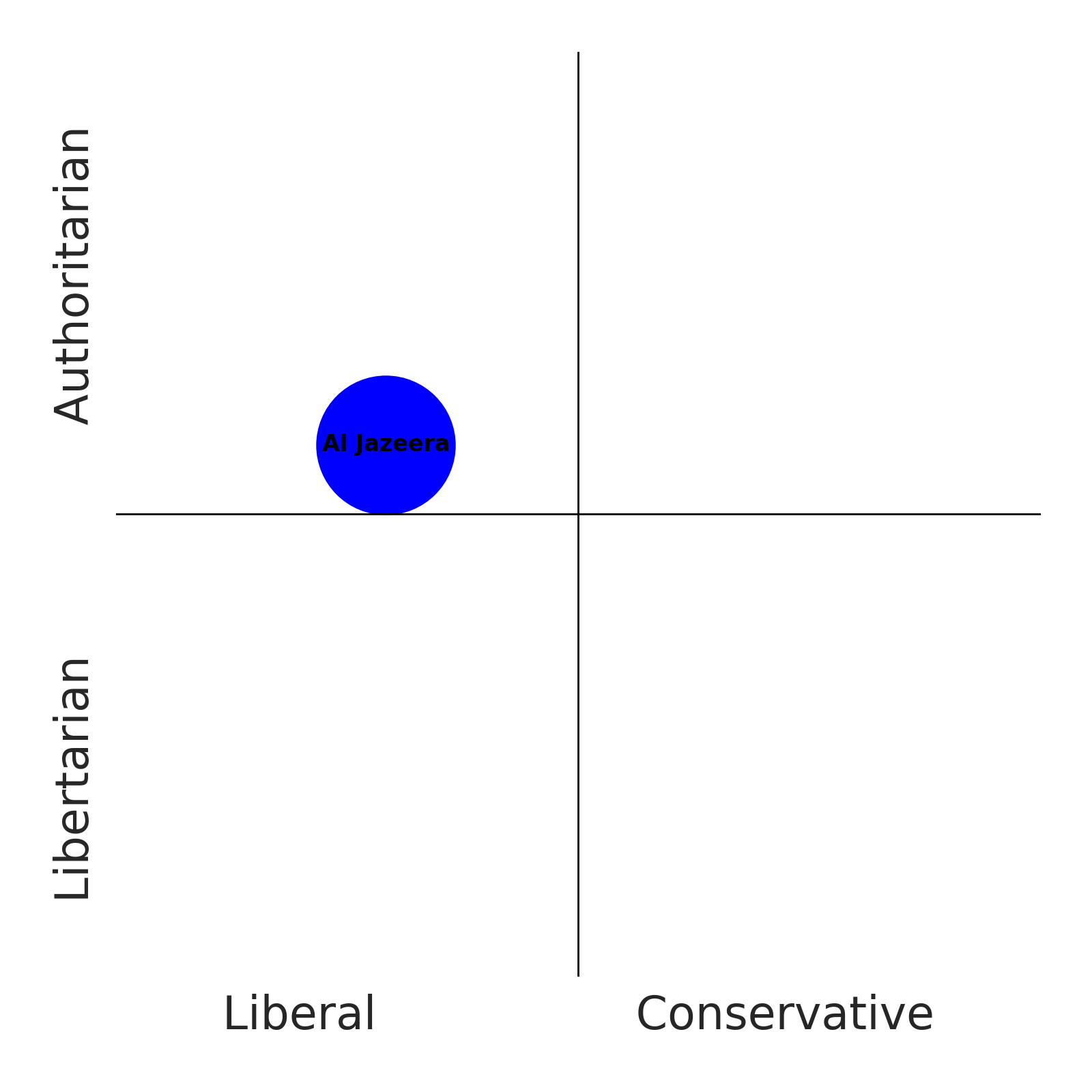
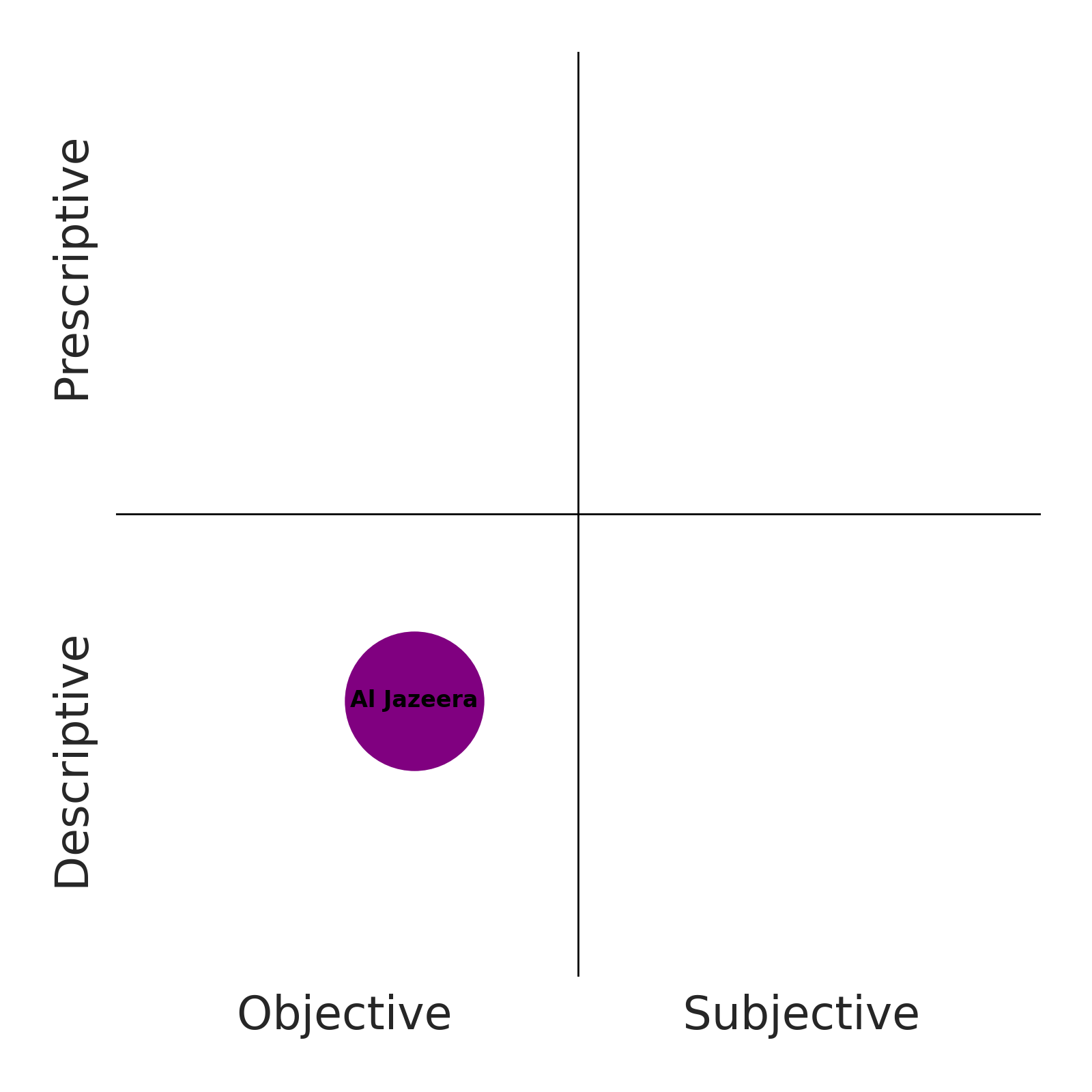
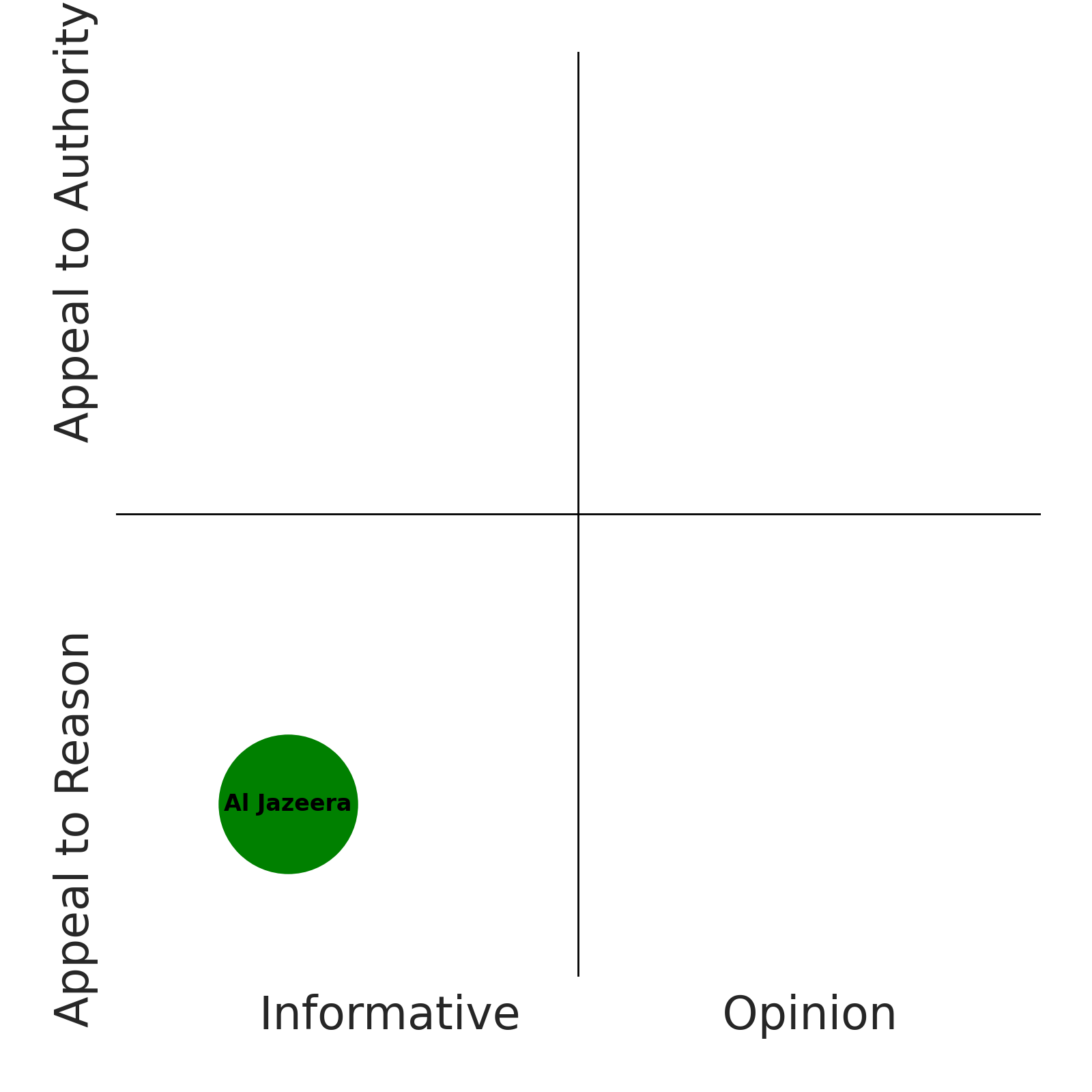
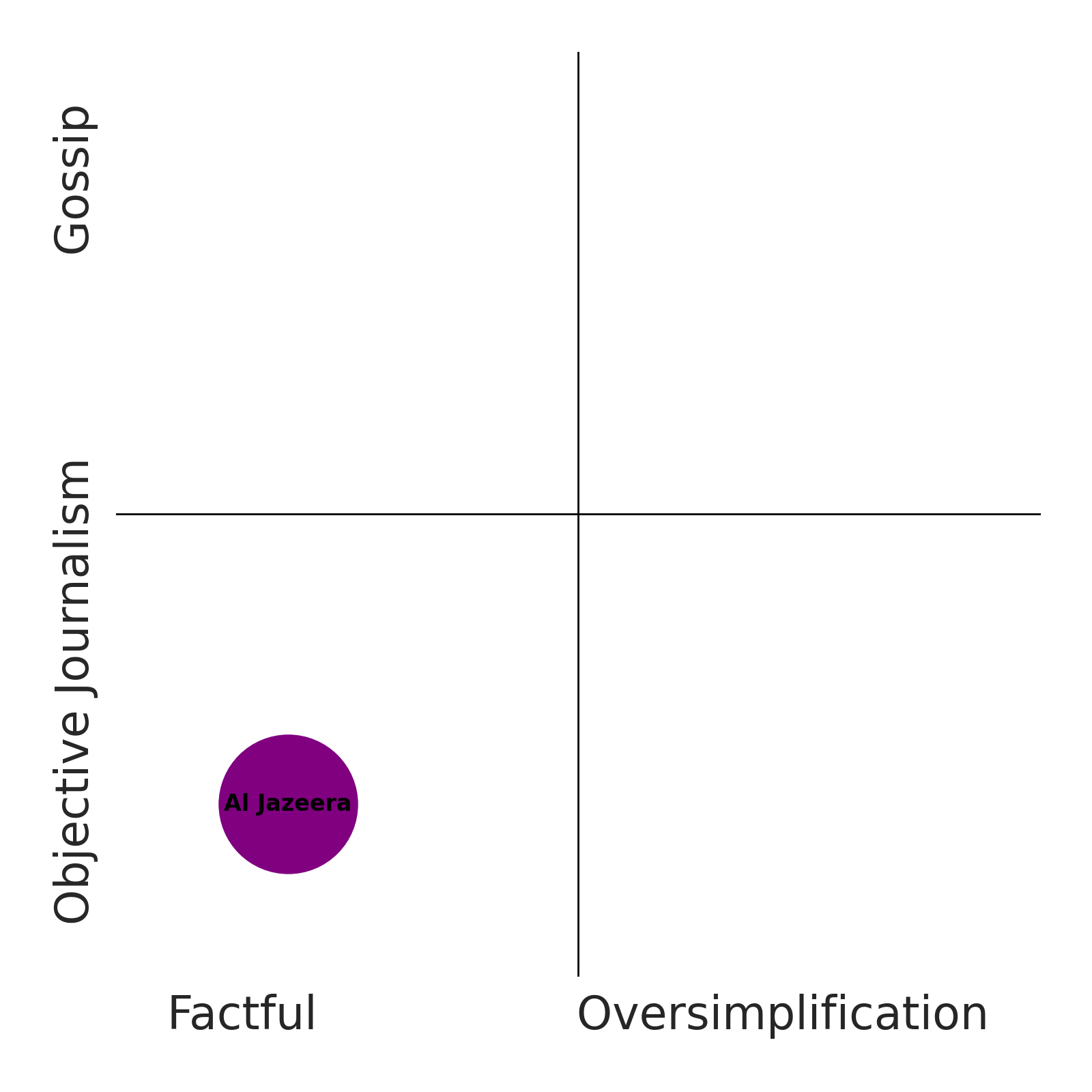
2026 © Helium Trades
Privacy Policy & Disclosure
* Disclaimer: Nothing on this website constitutes investment advice, performance data or any recommendation that any particular security, portfolio of securities, transaction or investment strategy is suitable for any specific person. Helium Trades is not responsible in any way for the accuracy
of any model predictions or price data. Any mention of a particular security and related prediction data is not a recommendation to buy or sell that security. Investments in securities involve the risk of loss. Past performance is no guarantee of future results. Helium Trades is not responsible for any of your investment decisions,
you should consult a financial expert before engaging in any transaction.
Helium Research Assistant

How can I help you today?
Ask any question about Al Jazeera bias.


