See whether Helium helps you make better-informed decisions. Try every Pro Trader feature for 30 days. No credit card required.
Try every Pro Trader feature for 30 days. No credit card required.
A sourced news brief reports Taliban ministry closures of three Shiite-serving institutions but frames the move as an expanding 'targeting' pattern, with no ministry comment included.
Automated analysis; not human reviewed. Limitations: The brief is short and one-sided, relying on anonymous local sources and no Taliban ministry comment, so most bias dimensions cannot be assessed and verification is limited. · 5 of 55 available dimensions scored; omitted dimensions are not treated as neutral. · Verified supporting quotes for 5 of 5 scored dimensions.
Claim: The report is predominantly factual and attributed, but includes an interpretive phrase characterizing the closures as targeting Shiite-linked institutions.
“Local sources told Amu TV that the Taliban’s justice ministry headed by Abdul Hakim Sharaee has closed three more institutions serving the Shiite community in western Kabul” · exact text match
“The sources said the ministry did not provide a clear reason for the closures.” · exact text match
Counterevidence:
“expanding a series of closures targeting Shiite-linked institutions in the capital” · exact text match
Why: Most details are explicitly sourced to local observers, but 'targeting' introduces a motive or pattern interpretation beyond the sourced facts.
Claim: The wording is plain and factual, without emotional or dramatic amplification.
“Local sources told Amu TV that the Taliban’s justice ministry headed by Abdul Hakim Sharaee has closed three more institutions serving the Shiite community in western Kabul” · exact text match
“The sources said the ministry did not provide a clear reason for the closures.” · exact text match
Why: The report relays facts in a neutral register; there are no dramatic adjectives, exclamations, or emotional appeals.
Claim: The report describes an event and offers no recommendation, demand, or policy prescription.
“The sources said the ministry did not provide a clear reason for the closures.” · exact text match
Why: Every sentence conveys reported facts or source statements; no imperatives, advice, or 'should' constructions appear.
Claim: The text is emotionally neutral, expressing neither positive nor negative affect toward the events.
“Local sources told Amu TV that the Taliban’s justice ministry headed by Abdul Hakim Sharaee has closed three more institutions serving the Shiite community in western Kabul” · exact text match
Why: The sentence relays the event in functional language and avoids affect-laden terms.
Claim: The report names the responsible ministry and institutions and attributes key details to local sources, while noting no official reason was provided.
“Local sources told Amu TV that the Taliban’s justice ministry headed by Abdul Hakim Sharaee has closed three more institutions” · exact text match
“The sources said the ministry did not provide a clear reason for the closures.” · exact text match
Why: Specific attribution and named institutions support moderate trustworthiness, but anonymous sourcing and the lack of ministry comment prevent a higher score.
The brief is short and one-sided, relying on anonymous local sources and no Taliban ministry comment, so most bias dimensions cannot be assessed and verification is limited.
The framing is source-driven and non-evaluative, but the selection and wording present the closure of three Shiite-community institutions as an unexplained pattern while attributing the account to local sources.
Automated analysis; not human reviewed. Limitations: The supplied text consists of brief, partly duplicated bulletin items; no original full article or independent verification is available, so conclusions about framing rest on a small sample. · 6 of 55 available dimensions scored; omitted dimensions are not treated as neutral. · Verified supporting quotes for 6 of 6 scored dimensions.
Claim: Reporting is descriptive and source-attributed, with no evaluative language.
“Local sources told Amu TV that the Taliban’s justice ministry has closed three more institutions serving the Shiite community in western Kabul, including a medical clinic, a religious school and a cultural center.” · exact text match
“The sources said the ministry did not provide a clear reason for the closures.” · exact text match
Why: The text attributes the information to local sources and explicitly notes the absence of a stated reason, indicating a non-editorializing, observational approach.
Claim: No sensational or emotional language is used; the affected places are listed plainly.
“According to the sources, the centers include Al-Zahra Clinic, the Tebyan Center and the Resalat religious school.” · exact text match
Why: The concrete enumeration of the institutions and the calm wording show restraint rather than sensationalizing the closures.
Claim: The text states events without prescriptions or calls to action.
“The sources said the ministry did not provide a clear reason for the closures.” · exact text match
Why: It recounts what happened and what was not disclosed, but offers no recommendation, demand, or normative judgment.
Claim: The content is factual and neutral, containing no opinion statements or commentary.
“Local sources told Amu TV that the Taliban’s justice ministry has closed three more institutions serving the Shiite community in western Kabul, including a medical clinic, a religious school and a cultural center.” · exact text match
Why: The sentence reports a sourced claim directly, with no stated viewpoint or advocacy.
Claim: Uses attributed sourcing and acknowledges incomplete information.
“According to the sources, the centers include Al-Zahra Clinic, the Tebyan Center and the Resalat religious school.” · exact text match
“The sources said the ministry did not provide a clear reason for the closures.” · exact text match
Why: Visible sourcing and recognition of missing reasons support verifiability, though the account rests only on local sources and lacks independent confirmation.
Claim: The report shows transparency by attributing information and acknowledging missing details.
“Local sources told Amu TV that the Taliban’s justice ministry has closed three more institutions serving the Shiite community in western Kabul” · exact text match
“The sources said the ministry did not provide a clear reason for the closures.” · exact text match
Why: Attribution to local sources and the explicit acknowledgment that no reason was given signal fairness and honesty within the text.
The supplied text consists of brief, partly duplicated bulletin items; no original full article or independent verification is available, so conclusions about framing rest on a small sample.
The bulletin uses a terse headline-list format with attributed but largely unelaborated claims, producing neutral, low-context framing.
IOM is the International Organization for Migration, which records cross-border population movements.
Automated analysis; not human reviewed. Limitations: The supplied text is a fragmentary bulletin/headline list with incomplete sentences, limiting assessment of context and framing. · 8 of 55 available dimensions scored; omitted dimensions are not treated as neutral. · Verified supporting quotes for 8 of 8 scored dimensions.
Claim: The text attributes claims to sources and avoids evaluative language.
“according to new IOM data” · exact text match
“Pakistan interior minister says” · exact text match
Why: Attribution and neutral wording indicate objective presentation.
Claim: The bulletin uses neutral numerical and event statements without sensational language.
“IOM recorded 99,769 inflows between Sept. 27 and Oct. 10” · exact text match
“Afghanistan hold Bangladesh to draw after Atal’s Maiden Test century” · exact text match
Why: Plain reporting of figures and results indicates low sensationalism.
Claim: The text reports events rather than recommending actions.
“IOM recorded 99,769 inflows between Sept. 27 and Oct. 10” · exact text match
“Taliban authorities suspend BBC FM broadcasts across Afghanistan.” · exact text match
Why: No prescriptions or advocacy appear.
Claim: The bulletin centers on Taliban governance actions and a Pakistani minister's security claim.
“Taliban authorities suspend BBC FM broadcasts across Afghanistan.” · exact text match
“Pakistan interior minister says 80% of militants enter from Afghanistan” · exact text match
Why: These are political and security developments involving governing authorities.
Claim: The bulletin presents an official percentage claim without elaboration or context.
“Pakistan interior minister says 80% of militants enter from Afghanistan” · exact text match
Why: The one-line claim is left unelaborated, simplifying a security assertion.
Claim: The text attributes key claims to IOM and a named official, though context is minimal.
“according to new IOM data” · exact text match
“Pakistan interior minister says” · exact text match
Why: Attribution and neutral presentation support moderate credibility; brevity limits verification.
Claim: The bulletin relies on attributed data and official statements rather than emotive or illogical framing.
“according to new IOM data” · exact text match
“IOM recorded 99,769 inflows between Sept. 27 and Oct. 10” · exact text match
Why: Data attribution and numerical reporting support a rational, non-irrational presentation.
Claim: The bulletin attributes its figures and claims to named sources.
“according to new IOM data” · exact text match
“Pakistan interior minister says” · exact text match
Why: Source attribution supports observable fairness and honesty.
The supplied text is a fragmentary bulletin/headline list with incomplete sentences, limiting assessment of context and framing.
September 29, 2026 · 0 shares
The Kabul closures are framed as a pressure test for Tehran's engagement-first policy toward the Taliban, using attributed sourcing and a restrained but analytical tone.
Automated analysis; not human reviewed. Limitations: The supplied article is a single outlet's report relying on anonymous local sources; I cannot independently confirm the closures or Iran's policy intentions. · 4 of 55 available dimensions scored; omitted dimensions are not treated as neutral. · Verified supporting quotes for 4 of 4 scored dimensions.
Claim: The report is predominantly objective, using attributed sourcing and presenting the Taliban's rebuttal alongside criticism.
“according to local sources who spoke to Amu TV” · exact text match
“The Taliban have rejected similar accusations from opponents and rights groups and say they govern according to Islamic law.” · exact text match
Why: Attribution and balance are strong, but interpretive sentences like the closing question add a subjective analytical layer.
Claim: The report avoids sensational or emotional language and frames the events as diplomatic tension rather than outrage.
“The closures come despite Tehran’s continued political and diplomatic engagement with the Taliban administration.” · exact text match
Why: The closest to sensational framing is 'ties tested', but the body is restrained and analytical.
Claim: The report describes and analyzes developments without prescribing policies or actions.
“For Tehran, the relationship appears to be increasingly shaped by security calculations, regional interests and the reality of Taliban control in Afghanistan.” · exact text match
Why: The passage interprets causes and consequences but does not issue recommendations or imperatives.
Claim: The report is credible in its internal practice, with named officials, direct quotes, and an opposing Taliban response.
“Hossein Mortazavi, deputy head of mission at the Iranian Embassy in Kabul, said at a gathering in late July” · exact text match
“The Taliban have rejected similar accusations from opponents and rights groups and say they govern according to Islamic law.” · exact text match
Why: Visible sourcing and balance support credibility, though some closures rely on anonymous local sources.
The supplied article is a single outlet's report relying on anonymous local sources; I cannot independently confirm the closures or Iran's policy intentions.
October 22, 2026 · 0 shares
Attributed, statistics-heavy reporting relies on UNICEF/UNESCO findings and generally avoids evaluative language.
Automated analysis; not human reviewed. Limitations: The supplied text includes scraped related-headline fragments and duplicate headlines, but the substantive UNICEF/UNESCO report coverage is clear enough for framing analysis. · 6 of 55 available dimensions scored; omitted dimensions are not treated as neutral. · Verified supporting quotes for 6 of 6 scored dimensions.
Claim: The report is presented through attributed statistics and causal factors rather than the publisher’s subjective interpretation.
“according to a new report by UNICEF and UNESCO.” · exact text match
“The report cites reduced household ability to pay for higher education, weaker employment prospects for graduates and financial pressure on private universities as factors affecting participation.” · exact text match
Why: Figures and causes are repeatedly tied to UNICEF/UNESCO or the report, limiting subjective narration.
Claim: Coverage is statistical and attribution-based, with no sensational language or dramatic framing.
“according to a new report by UNICEF and UNESCO.” · exact text match
Why: The article presents enrollment and workforce data via a cited report rather than sensational description.
Claim: The content is centrally about Taliban government policy on education and its political and social consequences.
“Women have been barred from university education since December 2022.” · exact text match
Why: The reported enrollment changes are directly tied to Taliban policy restrictions, making the topic political in substance.
Claim: Sourcing is explicit, uncertainty is flagged, and figures are attributed to UNICEF/UNESCO or the report.
“according to a new report by UNICEF and UNESCO.” · exact text match
“UNICEF and UNESCO caution that limited independent verification of the data makes it difficult to fully assess participation, quality and learning outcomes in Islamic education.” · exact text match
Why: Clear attribution and stated data caveats support high credibility within the supplied text.
Claim: The report acknowledges data limitations and attributes uncertain figures rather than presenting them as certain.
“UNICEF and UNESCO caution that limited independent verification of the data makes it difficult to fully assess participation, quality and learning outcomes in Islamic education.” · exact text match
Why: Explicit caution about verification limits is a visible honesty and fairness signal.
Claim: The reporting synthesizes multi-year enrollment, workforce, curriculum and financing data with causal context.
“The report cites reduced household ability to pay for higher education, weaker employment prospects for graduates and financial pressure on private universities as factors affecting participation.” · exact text match
Why: The article integrates multiple data series and cites several contributing factors rather than treating the decline as monocausal.
The supplied text includes scraped related-headline fragments and duplicate headlines, but the substantive UNICEF/UNESCO report coverage is clear enough for framing analysis.
October 15, 2026 · 0 shares
Framing operates as a strict relay of UNAMA's quarterly human rights report, attributing every documented Taliban abuse and casualty figure to the UN source in flat, non-sensational language while carrying only isolated official justifications.
The Taliban have governed Afghanistan since August 2021 following the collapse of the previous republic; the report's references to the 'former republic' and 'former government' denote that pre-Taliban order.
Automated analysis; not human reviewed. Limitations: No byline or outlet identification is given, the lead is truncated ('The post'), and one annual casualty range contains an apparent internal date error ('Oct. 1, 2025, through Sept. 30, 2026' — a future end date, likely a typo), limiting verification of authorship and that figure. · 14 of 55 available dimensions scored; omitted dimensions are not treated as neutral. · Verified supporting quotes for 14 of 14 scored dimensions.
Claim: Reporting relays UN findings without ideological or partisan framing in either direction.
“In Nangarhar’s Rodat district, Taliban morality police suspended about 100 shops because shopkeepers had failed to attend congregational prayers, according to the report.” · exact text match
Why: Religiously motivated enforcement is reported factually with attribution and no ideological endorsement or condemnation by the publisher.
Claim: State coercion is described neutrally, without endorsement of authoritarian measures or libertarian counter-advocacy.
“The law prohibits demonstrations and sets out circumstances in which police can use force, including weapons and explosives.” · exact text match
Why: Coercive legal provisions are reported as findings with no editorial advocacy in either direction.
Claim: Content is consistently attributed and factual, with no subjective commentary.
“The arrests and detentions were mainly linked to alleged violations of the Taliban authorities’ hijab requirements for women, trimmed beards or “Western” hairstyles for men, failure to attend congregational prayers and playing or listening to music, UNAMA said.” · exact text match
Why: Dense attribution ('UNAMA said') and hedged language ('alleged') demonstrate objective reporting practice.
Claim: Grave incidents are recounted in plain language without dramatization.
“On Sept. 21, UNAMA said a Pakistani airstrike hit a house in Kunar’s Nurgal district, killing three civilians — a woman, a man and a 16-year-old girl — and wounding four others.” · exact text match
Why: A deadly airstrike is stated in flat factual terms with no emotive or alarming wording.
Claim: Specific, unusual documentation adds informational interest.
“In Paktika province, two barbers were detained for a month in August for allegedly trimming beards and giving customers “Western” haircuts.” · exact text match
Why: Granular, unusual detail (barbers jailed over haircuts) makes the report substantively informative beyond a headline.
Claim: The report catalogs documented incidents without recommendations or calls to action.
“The report documents at least three media outlets suspended between July and September.” · exact text match
Why: Neutral cataloging of events with no prescriptive language anywhere in the text.
Claim: Subject matter concerns governance, security forces, and foreign military action, but coverage is non-partisan.
“The Taliban’s General Directorate of Intelligence also arrested a former Afghan National Police member and outspoken critic of Taliban authorities at Kabul International Airport on July 28 as he returned from abroad.” · exact text match
“UNAMA said the reason for his arrest was unknown.” · exact text match
Why: Political actors and incidents are covered descriptively, acknowledging unknowns rather than taking sides.
Claim: All findings rest on a single institutional source cited as the information source, not as an argumentative authority.
“UNAMA said the arrests and closures were reportedly carried out because the institutions were occupying land that Taliban authorities claimed to own.” · exact text match
Why: The publisher attributes rather than independently verifies; reliance on the UN body is mild authority reliance, tempered by hedging ('reportedly').
Claim: Victims of documented abuses appear factually without rhetorical victimhood framing.
“In one case, a 13-year-old girl was detained overnight over compliance with the hijab requirement and released the following day after her father collected her.” · exact text match
Why: The victim case is stated plainly in one sentence without emotive or sympathy-building rhetoric.
Claim: Tone is unemotional throughout despite grave subject matter.
“Two women were prevented from entering a health facility in Parwan province on Aug. 8 because they did not have a mahram, while a woman in Helmand was stopped from entering a market on Aug. 17 for the same reason.” · exact text match
Why: Severe restrictions are stated in flat, dated, factual language without emotive words.
Claim: Credibility is high due to a named source, defined timeframe, stated methodology, and specific dated cases.
“UNAMA says the quarterly update, covering July 1 through Sept. 30, is based on monitoring by UNAMA’s Human Rights Service under its UN Security Council mandate.” · exact text match
Why: Attribution to a mandated UN monitoring body with explicit scope supports verifiability; single-source reliance prevents a higher score.
Claim: Reporting is evidence-based, presenting dated, quantified findings rather than rhetoric.
“UNAMA documented judicial corporal punishment against 28 people — 22 men and six women — during the three-month period.” · exact text match
Why: Precise, quantified documentation of specific practices reflects rational, evidence-driven presentation.
Claim: The report discloses its methodological limits and includes the authorities' stated justification.
“UNAMA’s quarterly report presents incidents documented by its Human Rights Service and does not describe its figures as a comprehensive count of all human rights violations across Afghanistan.” · exact text match
“The ministry said the university had repeatedly violated regulations and failed to take corrective measures despite warnings.” · exact text match
Why: Acknowledging non-comprehensiveness and conveying the Taliban ministry's own explanation signals internal fairness and honesty.
Claim: The report is well-organized and precise, systematically covering multiple categories with dates, figures, and attribution.
“UNAMA recorded 33 civilian casualties — 13 killed and 20 wounded — from cross-border incidents between July and September.” · exact text match
Why: Structured, quantified coverage across arrests, women's rights, media, minority institutions, and casualties reflects high information quality.
No byline or outlet identification is given, the lead is truncated ('The post'), and one annual casualty range contains an apparent internal date error ('Oct. 1, 2025, through Sept. 30, 2026' — a future end date, likely a typo), limiting verification of authorship and that figure.
September 28, 2026 · 0 shares
The coverage is neutral, factual sports reporting that sticks to match outcomes and tournament rules.
Automated analysis; not human reviewed. Limitations: The supplied article text is truncated, so some match details and surrounding context may be missing. · 2 of 55 available dimensions scored; omitted dimensions are not treated as neutral. · Verified supporting quotes for 2 of 2 scored dimensions.
Claim: The report uses neutral, declarative language without subjective evaluation.
“India advanced to the semifinals under tournament rules because of its higher ICC ranking.” · exact text match
“The match was Afghanistan’s third of the competition and its first in the knockout stage.” · exact text match
Why: The text states events and rules directly, with no opinion words or evaluative descriptors.
Claim: The report avoids sensational or dramatic language despite a tournament-ending rainout.
“Afghanistan’s men’s cricket quarterfinal against India at the 2026 Asian Games was abandoned Monday because of rain, ending Afghanistan’s campaign in the tournament.” · exact text match
Why: Wording such as 'abandoned' and 'ending' is factual and restrained, not alarmist or exaggerated.
The supplied article text is truncated, so some match details and surrounding context may be missing.
September 27, 2026 · 0 shares
Framed as a restrained, attribution-heavy news account of Taliban enforcement actions, with international criticism presented through quoted voices.
Automated analysis; not human reviewed. Limitations: The article relies on attributed accounts that cannot be independently verified from the supplied text.
The article relies on attributed accounts that cannot be independently verified from the supplied text.
September 28, 2026 · 0 shares
Framing is source-attributed and restrained, conveying a pattern of Taliban pressure on Shiite institutions through direct quotes while noting the absence of official explanations.
Afghanistan has been under Taliban rule since August 2021; Hazaras and Shiites are a minority community in Afghanistan that has faced discrimination and attacks. Ja'fari jurisprudence is a Shiite school of Islamic law.
Automated analysis; not human reviewed. Limitations: The raw input contains a malformed/duplicated JSON-like block before the readable report; only the readable report portion was used. · 10 of 55 available dimensions scored; omitted dimensions are not treated as neutral. · Verified supporting quotes for 4 of 10 scored dimensions.
Claim: Publisher's framing is source-attributed and avoids direct editorial assertions.
“Local sources told Amu TV that the Taliban’s justice ministry headed by Abdul Hakim Sharaee has closed three more institutions serving the Shiite community in western Kabul, including a medical clinic, a religious school and a cultural center, expanding a series of closures targeting Shiite-linked institutions in the capital.” · exact text match
“The university’s owner, Mohammad Jawad Mohseni, rejected those allegations and said authorities had not produced evidence to substantiate them.” · exact text match
Why: The story rests on attributed reports and quotes; even criticism appears inside quotation marks, so the publisher's own voice remains factual.
Claim: The article reports harsh events in a plain, non-sensational manner.
“One resident of western Kabul, who asked not to be identified because of security concerns, said patients were forced out of Al-Zahra Clinic when Taliban personnel closed the facility.” · exact text match
Why: The most emotive detail is presented as a resident's testimony rather than the outlet's dramatic claim, and the surrounding prose is calm.
Claim: The article describes events and quotes reactions without issuing recommendations or demands.
“The latest closures come after a series of actions involving Shiite religious, educational and community institutions in western Kabul.” · exact text match
“Mohammad Omar Ghorbandi, a university lecturer, questioned the legal basis for actions against the institution.” · exact text match
Why: The only prescriptive-sounding content is a quoted question, while the publisher's own sentences remain descriptive.
Claim: Sourcing is specific: named institutions, dates, officials, and security-protected witnesses are identified.
“Local sources told Amu TV that the Taliban’s justice ministry headed by Abdul Hakim Sharaee has closed three more institutions serving the Shiite community in western Kabul” · exact text match
“One resident of western Kabul, who asked not to be identified because of security concerns, said patients were forced out of Al-Zahra Clinic when Taliban personnel closed the facility.” · exact text match
Why: The article distinguishes local-source reports from separate local reports, names officials and institutions, and notes the lack of official explanation, which supports verifiability and transparency.
Claim: The report gives the accused party's denial and labels contested claims as allegations.
“The university’s owner, Mohammad Jawad Mohseni, rejected those allegations and said authorities had not produced evidence to substantiate them.” · exact text match
“A political analyst accused Taliban authorities of discriminating against Hazaras and Shiites” · not found in supplied text
Why: Denials and attributed accusations are included, so the publisher does not present contested assertions as established fact.
The raw input contains a malformed/duplicated JSON-like block before the readable report; only the readable report portion was used.
A sourced news brief reports Taliban ministry closures of three Shiite-serving institutions but frames the move as an expanding 'targeting' pattern, with no ministry comment included.
Automated analysis; not human reviewed. Limitations: The brief is short and one-sided, relying on anonymous local sources and no Taliban ministry comment, so most bias dimensions cannot be assessed and verification is limited. · 5 of 55 available dimensions scored; omitted dimensions are not treated as neutral. · Verified supporting quotes for 5 of 5 scored dimensions.
Claim: The report is predominantly factual and attributed, but includes an interpretive phrase characterizing the closures as targeting Shiite-linked institutions.
“Local sources told Amu TV that the Taliban’s justice ministry headed by Abdul Hakim Sharaee has closed three more institutions serving the Shiite community in western Kabul” · exact text match
“The sources said the ministry did not provide a clear reason for the closures.” · exact text match
Counterevidence:
“expanding a series of closures targeting Shiite-linked institutions in the capital” · exact text match
Why: Most details are explicitly sourced to local observers, but 'targeting' introduces a motive or pattern interpretation beyond the sourced facts.
Claim: The wording is plain and factual, without emotional or dramatic amplification.
“Local sources told Amu TV that the Taliban’s justice ministry headed by Abdul Hakim Sharaee has closed three more institutions serving the Shiite community in western Kabul” · exact text match
“The sources said the ministry did not provide a clear reason for the closures.” · exact text match
Why: The report relays facts in a neutral register; there are no dramatic adjectives, exclamations, or emotional appeals.
Claim: The report describes an event and offers no recommendation, demand, or policy prescription.
“The sources said the ministry did not provide a clear reason for the closures.” · exact text match
Why: Every sentence conveys reported facts or source statements; no imperatives, advice, or 'should' constructions appear.
Claim: The text is emotionally neutral, expressing neither positive nor negative affect toward the events.
“Local sources told Amu TV that the Taliban’s justice ministry headed by Abdul Hakim Sharaee has closed three more institutions serving the Shiite community in western Kabul” · exact text match
Why: The sentence relays the event in functional language and avoids affect-laden terms.
Claim: The report names the responsible ministry and institutions and attributes key details to local sources, while noting no official reason was provided.
“Local sources told Amu TV that the Taliban’s justice ministry headed by Abdul Hakim Sharaee has closed three more institutions” · exact text match
“The sources said the ministry did not provide a clear reason for the closures.” · exact text match
Why: Specific attribution and named institutions support moderate trustworthiness, but anonymous sourcing and the lack of ministry comment prevent a higher score.
The brief is short and one-sided, relying on anonymous local sources and no Taliban ministry comment, so most bias dimensions cannot be assessed and verification is limited.
October 14, 2026 · 0 shares
Framing is predominantly factual and attribution-heavy, but emphasizes the BBC's audience reach and role in providing 'accurate news' while the Taliban's stated rationale is left without supporting detail.
Automated analysis; not human reviewed. Limitations: The core report is brief and is accompanied by aggregated related headlines and truncated snippets, limiting assessment of broader editorial framing. · 54 of 55 available dimensions scored; omitted dimensions are not treated as neutral. · Verified supporting quotes for 9 of 54 scored dimensions.
Claim: The report is framed through attributed statements rather than the publisher's interpretation.
“The BBC confirmed the suspension in a statement Monday, saying Taliban authorities had halted its transmissions from FM radio sites across Afghanistan.” · exact text match
“Speaking to the Taliban-run national broadcaster, RTA, Khabib Ghufran, spokesman for the Taliban-run Ministry of Information and Culture, said the BBC’s broadcasts in Afghanistan had been suspended following what he described as “repeated violations.”” · exact text match
Why: Both the BBC and Taliban spokesman are directly quoted or attributed, with little subjective narration.
Claim: The language is straightforward and avoids sensational embellishment.
“The broadcaster said it continues to report in Pashto, Dari and English for audiences in Afghanistan through shortwave and medium-wave radio, online platforms and satellite broadcasts.” · exact text match
“It was not immediately clear when the suspension took effect, how long it would remain in place or what conditions Taliban authorities have set for allowing the BBC’s FM broadcasts to resume.” · exact text match
Why: The article reports the suspension and remaining platforms in measured terms without dramatic language.
Claim: The article describes the suspension without prescribing a policy response.
“The BBC confirmed the suspension in a statement Monday, saying Taliban authorities had halted its transmissions from FM radio sites across Afghanistan.” · exact text match
Why: The text reports events and statements rather than advocating action.
Claim: The report concerns a government media restriction and official Taliban action.
“Taliban authorities have suspended the BBC’s FM radio broadcasts across Afghanistan” · exact text match
“spokesman for the Taliban-run Ministry of Information and Culture” · exact text match
Why: The central event is a political-authority decision affecting media broadcasts.
Claim: The tone remains neutral rather than emotionally loaded toward either party.
“The BBC confirmed the suspension in a statement Monday, saying Taliban authorities had halted its transmissions from FM radio sites across Afghanistan.” · exact text match
Why: The core statement is declarative and unemotional, with no positive or negative valence beyond the reported event.
Claim: The report uses named attribution, direct quotes, and flags unknown details.
“Khabib Ghufran, spokesman for the Taliban-run Ministry of Information and Culture, said the BBC’s broadcasts in Afghanistan had been suspended following what he described as “repeated violations.”” · exact text match
“It was not immediately clear when the suspension took effect, how long it would remain in place or what conditions Taliban authorities have set for allowing the BBC’s FM broadcasts to resume.” · exact text match
Why: Visible sourcing and explicit uncertainty support high credibility within the supplied text.
Claim: The report handles official claims with attribution and explicitly notes missing details.
“He did not provide details about the alleged violations.” · exact text match
“It was not immediately clear when the suspension took effect, how long it would remain in place or what conditions Taliban authorities have set for allowing the BBC’s FM broadcasts to resume.” · exact text match
Why: The text avoids filling gaps with speculation and flags what is unknown, indicating rational epistemic practice.
Claim: The report gives fair attribution and acknowledges gaps in the official account.
“He did not provide details about the alleged violations.” · exact text match
“The BBC confirmed the suspension in a statement Monday, saying Taliban authorities had halted its transmissions from FM radio sites across Afghanistan.” · exact text match
Why: It quotes the Taliban claim, notes its lack of detail, and includes BBC confirmation, showing observable fairness.
Claim: The report is concise yet context-aware, including audience reach and remaining platforms.
“The BBC says it reaches 5.4 million people in Afghanistan, representing more than 20% of the country’s adult population.” · exact text match
“It was not immediately clear when the suspension took effect, how long it would remain in place or what conditions Taliban authorities have set for allowing the BBC’s FM broadcasts to resume.” · exact text match
Why: It supplies relevant scale and acknowledges open questions, indicating above-average clarity.
The core report is brief and is accompanied by aggregated related headlines and truncated snippets, limiting assessment of broader editorial framing.
October 14, 2026 · 0 shares
Presents a disputed detention report with neutral attribution and prominently includes the Taliban spokesman’s denial and investigation status, though the text is only a brief episode summary.
Panjshir is an Afghan province and has been a center of anti-Taliban resistance.
Automated analysis; not human reviewed. Limitations: The supplied text is a brief episode summary with related-link headlines, so full-broadcast framing cannot be assessed. · 7 of 55 available dimensions scored; omitted dimensions are not treated as neutral. · Verified supporting quotes for 7 of 7 scored dimensions.
Claim: The report frames the detention claim as attributed reporting rather than the publisher’s own assertion.
“Mawj examines reports that Taliban forces detained 26 people in Panjshir” · exact text match
Why: Explicit attribution to reports makes the framing more objective.
Claim: The wording remains restrained and includes an official denial rather than emotive or alarmist language.
“has denied that the arrests took place but said the incident is under investigation” · exact text match
Why: The procedural denial and investigation statement indicate restrained framing.
Claim: The text describes a disputed incident and planned discussion without recommending action.
“The issue is discussed with Mohammad Asif Sediqi” · exact text match
Why: It describes the episode’s discussion rather than prescribing a policy response.
Claim: The report centers on Taliban governance, security, and official political responses.
“The Taliban governor’s spokesman in Panjshir has denied that the arrests took place but said the incident is under investigation.” · exact text match
“a political and security affairs analyst” · exact text match
Why: Official Taliban statements and security analysts make the subject political.
Claim: The report attributes the disputed claim and includes an official denial.
“Mawj examines reports that Taliban forces detained 26 people in Panjshir” · exact text match
“The Taliban governor’s spokesman in Panjshir has denied that the arrests took place” · exact text match
Why: Clear attribution and inclusion of the denial support credibility.
Claim: The item presents a disputed claim alongside the official denial and an investigation status.
“The Taliban governor’s spokesman in Panjshir has denied that the arrests took place but said the incident is under investigation.” · exact text match
Why: Including the denial and procedural status supports a rational, non-one-sided presentation.
Claim: The item includes the Taliban spokesman’s denial and investigation status rather than only the detention allegation.
“The Taliban governor’s spokesman in Panjshir has denied that the arrests took place but said the incident is under investigation.” · exact text match
Why: Including a direct denial is an internally observable fairness signal.
The supplied text is a brief episode summary with related-link headlines, so full-broadcast framing cannot be assessed.
October 21, 2026 · 0 shares
Framing is factual and source-attributed, using WHO case data and committee warnings to link rising polio cases to restricted house-to-house vaccination without overt editorializing.
Automated analysis; not human reviewed. Limitations: The feed includes truncated and unrelated headline fragments; the substantive polio report remains clear, but case counts are only as current as WHO data through Oct. 18. · 11 of 55 available dimensions scored; omitted dimensions are not treated as neutral. · Verified supporting quotes for 11 of 11 scored dimensions.
Claim: The report presents polio case counts and WHO assessments without left-right ideological framing.
“The WHO data, updated through Oct. 18, show Afghanistan has reported 42 cases in 2026, compared with 21 in 2025.” · exact text match
Why: Factual attribution to WHO rather than partisan framing supports measured neutrality.
Claim: The report does not adopt a populist or elitist stance; it attributes health findings to WHO data and committee assessments.
“according to data from the World Health Organization’s Eastern Mediterranean regional office.” · exact text match
Why: Institutional sourcing is present but not used to advance an elitist or anti-elite argument.
Claim: Framing is predominantly objective, relying on WHO data and attributed committee statements.
“according to data from the World Health Organization’s Eastern Mediterranean regional office.” · exact text match
Why: The central claims are sourced to an external health authority rather than presented as personal judgment.
Claim: The report avoids sensational language and presents the increase in measured numerical terms.
“Afghanistan has recorded 42 cases of wild poliovirus type 1 so far this year, double the number reported in all of 2025” · exact text match
Why: The increase is described through precise case counts rather than alarmist wording.
Claim: The article is primarily descriptive, though it includes WHO's recommendation to resume house-to-house vaccination.
“It urged the Afghanistan polio program to explore a return to house-to-house vaccination across the country.” · exact text match
Why: The prescriptive element is attributed to WHO rather than advanced by the publisher.
Claim: Political relevance is limited to reporting Taliban restrictions on vaccination method.
“Taliban authorities restricted house-to-house polio vaccination in September 2024” · exact text match
Why: The policy actor is identified, but the article remains focused on public-health data.
Claim: Credible sourcing and attribution are visible, with WHO as the primary data source.
“The WHO data, updated through Oct. 18, show Afghanistan has reported 42 cases in 2026, compared with 21 in 2025.” · exact text match
Why: The report cites a named health authority and gives a specific data cutoff.
Claim: The report uses numerical comparisons and attributed expert assessment rather than emotive or illogical reasoning.
“WHO data show Afghanistan recorded six wild poliovirus cases in 2023 and two in 2022.” · exact text match
Why: Year-over-year case comparisons provide a rational, evidence-based structure.
Claim: The report is grounded in epidemiology and vaccination science.
“Vaccination is the primary tool for preventing infection and interrupting transmission.” · exact text match
Why: The article explains polio and prevention through established medical science.
Claim: The article attributes data and warnings to WHO and distinguishes reported data from committee assessments.
“Its Polio Emergency Committee said in August that the absence of house-to-house campaigns had led to lower-quality vaccination coverage” · exact text match
Why: Clear attribution and separation of data from assessment indicate fair, honest reporting signals.
Claim: The report uses comparative data and expert assessment to explain the trend.
“The 2026 tally is seven times the number recorded in 2023 and twice the total for all of 2025.” · exact text match
Why: Quantitative comparison supports an informative rather than simplistic account.
The feed includes truncated and unrelated headline fragments; the substantive polio report remains clear, but case counts are only as current as WHO data through Oct. 18.
October 21, 2026 · 0 shares
Relies heavily on a single UN spokesperson and attributed projections while framing the hunger crisis around affordability and Taliban restrictions on women.
Automated analysis; not human reviewed. Limitations: The supplied text is an aggregated and partly truncated feed with related headline fragments, limiting context and authorship attribution. · 55 of 55 available dimensions scored; omitted dimensions are not treated as neutral. · Verified supporting quotes for 28 of 55 scored dimensions.
Claim: Frames hunger partly through women’s economic participation and Taliban restrictions on women.
“She also called for greater opportunities for women to participate in economic life.” · exact text match
Why: The women’s-rights and social-policy emphasis is modestly liberal-coded, though humanitarian rather than partisan.
Claim: Centers a UN institutional spokesperson as the authoritative voice.
“Olga Cherevko, a spokesperson for the UN Office for the Coordination of Humanitarian Affairs, said” · exact text match
Why: The framing elevates international expert institutions rather than grassroots or populist voices.
Claim: Calls for international humanitarian and development action but does not advocate coercive domestic controls.
“Cherevko called for continued humanitarian assistance alongside longer-term investment” · exact text match
Why: The prescription is interventionist but not clearly authoritarian; support is weak.
Claim: Mixes attributed facts with first-person and advocacy framing.
““I saw first-hand that this crisis is not simply about whether food exists” · exact text match
Why: First-person testimony and calls to act add subjectivity to otherwise attributed reporting.
Claim: Uses attributed reporting and avoids sensational language.
“a UN official said Tuesday” · exact text match
“Citing UNICEF projections, Cherevko said” · exact text match
Why: The crisis is described in measured, source-attributed terms rather than dramatic prose.
Claim: Presents a deteriorating and negative outlook for Afghan food security.
“The outlook is deteriorating” · exact text match
“expected to deteriorate further with the onset of winter” · exact text match
Why: The article emphasizes worsening conditions and projected harm.
Claim: Moves from describing hunger to prescribing aid, investment, and pre-winter action.
“Cherevko called for continued humanitarian assistance alongside longer-term investment” · exact text match
“We must act before winter” · exact text match
Why: The article includes explicit recommendations and calls to action.
Claim: Uses crisis and winter-deadline framing without extreme rage-bait.
“Nearly 16 million people in Afghanistan are facing crisis-level hunger” · exact text match
“We must act before winter” · exact text match
Why: The tone is urgent and alarming, but mostly factual and attributed.
Claim: Includes advocacy recommendations alongside reported findings.
“She also called for greater opportunities for women to participate in economic life.” · exact text match
Why: The article includes prescriptive opinions attributed to the UN official.
Claim: Frames hunger through Taliban social policy and women’s economic participation.
“Taliban restrictions on women and girls could further undermine Afghanistan’s ability to address hunger and malnutrition.” · exact text match
Why: The report explicitly connects humanitarian outcomes to Taliban governance and women’s rights policy.
Claim: Explains the crisis with multiple drivers rather than a single cause.
“years of conflict, economic hardship, drought and other shocks have eroded families’ ability to cope” · exact text match
Why: The article lists several causes, reducing oversimplification.
Claim: Relies on UN and UNICEF authority for key claims and projections.
“Olga Cherevko, a spokesperson for the UN Office for the Coordination of Humanitarian Affairs, said” · exact text match
“Citing UNICEF projections, Cherevko said” · exact text match
Why: The article’s evidence structure depends heavily on institutional authorities.
Claim: Emphasizes Afghan families as suffering victims of compounding shocks.
“families can still go hungry” · exact text match
“families’ ability to cope” · exact text match
Why: The framing centers vulnerable families’ suffering and loss of coping capacity.
Claim: Uses projections but attributes them to UNICEF and IPC rather than presenting them as certain.
“could lose as many as 20,000 female teachers and 5,400 female health workers by 2030” · exact text match
Why: Some certainty in projections, but attribution limits overconfidence.
Claim: Uses a humanitarian-development framework with some rights-based advocacy.
“only sustained, inclusive investment in livelihoods, services and economic opportunity can help people build lives that are less dependent on emergency assistance tomorrow” · exact text match
Why: The framing follows a recognizable aid-and-inclusion ideology, though not strongly partisan.
Claim: Centers UN institutional voice and international assistance agenda.
“Olga Cherevko, a spokesperson for the UN Office for the Coordination of Humanitarian Affairs, said” · exact text match
“Cherevko called for continued humanitarian assistance” · exact text match
Why: The framing is aligned with established international institutions and their policy recommendations.
Claim: Tone is negative and crisis-focused, though factual and attributed.
“Nearly 16 million people in Afghanistan are facing crisis-level hunger” · exact text match
“families can still go hungry” · exact text match
Why: The article’s emotional valence is clearly negative around hunger and vulnerability.
Claim: Attributes data to named UN mechanisms and officials.
“The latest findings from the UN-supported Integrated Food Security Phase Classification, or IPC, show record levels of acute malnutrition” · exact text match
“Citing UNICEF projections, Cherevko said” · exact text match
Why: Visible sourcing and named attribution support credibility.
Claim: Explains hunger through affordability, income, and services rather than emotive assertion alone.
“She said the crisis is not simply driven by the availability of food, but by whether families can afford it, earn an income and access essential services.” · exact text match
Why: The causal framing is analytic and evidence-oriented.
Claim: Uses IPC and UNICEF data rather than supernatural or superstitious claims.
“The latest findings from the UN-supported Integrated Food Security Phase Classification, or IPC, show record levels of acute malnutrition” · exact text match
Why: The evidence base is empirical and institutional.
Claim: Advocates collective international assistance and public services.
“sustained, inclusive investment in livelihoods, services and economic opportunity” · exact text match
“continued humanitarian assistance” · exact text match
Why: The prescribed remedies are collectivist and institution-centered.
Claim: Includes forward-looking projections to winter and 2030 as central evidence.
“around 19 million people are projected to face acute food insecurity” · exact text match
“could lose as many as 20,000 female teachers and 5,400 female health workers by 2030” · exact text match
Why: The article relies substantially on forecasts and projections.
Claim: Uses urgent framing but no obvious deceptive techniques.
“We must act before winter, not after families have exhausted their options” · exact text match
Why: There is urgency and advocacy, but the sourcing is transparent.
Claim: Text reads as compiled human reporting with quotes and feed fragments.
“Cherevko told reporters from Kabul after recent visits to southern and northeastern Afghanistan.” · exact text match
Why: No strong AI-authorship indicators are evident in the supplied text.
Claim: Attributes key claims and projections to identifiable officials and UN mechanisms.
“Cherevko told reporters from Kabul after recent visits to southern and northeastern Afghanistan.” · exact text match
“Citing UNICEF projections, Cherevko said” · exact text match
Why: Visible sourcing and attribution support fair reporting practices.
Claim: Framing is grounded in reported data and attributed projections rather than delusional claims.
“The latest findings from the UN-supported Integrated Food Security Phase Classification, or IPC, show record levels of acute malnutrition” · exact text match
Why: The article is reality-oriented, though projections are uncertain.
Claim: Mentions women’s access and opportunities but does not build a full identity-power framework.
“She also called for greater opportunities for women to participate in economic life.” · exact text match
Why: Identity-related language is present but limited and not strongly prescriptive.
Claim: Includes inclusive-investment and women’s-opportunity language.
“only sustained, inclusive investment in livelihoods, services and economic opportunity can help people build lives” · exact text match
Why: The inclusive-development phrasing is mildly virtue-signaling but also policy-oriented.
The supplied text is an aggregated and partly truncated feed with related headline fragments, limiting context and authorship attribution.
September 29, 2026 · 0 shares
Reporting relays IOM survey statistics with repeated attribution and explicit generalizability caveats, producing a neutral, data-driven framing.
Automated analysis; not human reviewed. Limitations: No independent access to underlying IOM data or survey methodology; only the supplied article text was analyzed. · 7 of 55 available dimensions scored; omitted dimensions are not treated as neutral. · Verified supporting quotes for 7 of 7 scored dimensions.
Claim: The reporting presents attributed survey findings with explicit methodological caveats rather than opinions.
“The report said the survey represents assisted, contactable returnees and should not be generalized to all Afghans who have returned from Iran and Pakistan.” · exact text match
Why: Repeated attribution ('IOM said,' 'According to IOM') and a generalizability caveat signal objective reporting.
Claim: The article uses dry statistical language and does not sensationalize hardship findings.
“54% of surveyed households and individual returnees could not cover their basic needs with their income in the 30 days before the interview.” · exact text match
Why: A severe finding is stated as a flat percentage without emotional or dramatic language.
Claim: The report only describes survey results and offers no recommendations or calls to action.
“IOM also found significant education and skills gaps among returnees.” · exact text match
Why: The content is limited to reporting findings, with no prescriptive policy language.
Claim: No opinionated language or editorial commentary appears; content is limited to attributed data.
“According to IOM, 71% of those who had worked were only partially employed, while just 27% were fully employed and 2% owned a business.” · exact text match
Why: The sentence is an attributed statistic with no evaluative words.
Claim: The article is credible within the supplied text because all statistics are attributed and uncertainty is disclosed.
“IOM said the survey included 1,267 returnee households and 280 individual returnees who had come back to Afghanistan between July and December 2025 after receiving assistance through the agency’s cross-border program.” · exact text match
“The report said the survey represents assisted, contactable returnees and should not be generalized to all Afghans who have returned from Iran and Pakistan.” · exact text match
Why: Specific sourcing, sample details, and a stated non-generalizability caveat support trustworthiness.
Claim: The reporting signals honesty by flagging the survey's limits and consistently attributing findings.
“The report said the survey represents assisted, contactable returnees and should not be generalized to all Afghans who have returned from Iran and Pakistan.” · exact text match
Why: Including a limitation that undercuts broad generalization is an internally observable fairness signal.
Claim: The article includes nuanced detail and explicitly qualifies the scope of the data.
“The report said the survey represents assisted, contactable returnees and should not be generalized to all Afghans who have returned from Iran and Pakistan.” · exact text match
Why: The qualification and the granular breakdowns show analytical care rather than simplification.
No independent access to underlying IOM data or survey methodology; only the supplied article text was analyzed.
October 22, 2026 · 0 shares
Attributed, statistics-heavy reporting relies on UNICEF/UNESCO findings and generally avoids evaluative language.
Automated analysis; not human reviewed. Limitations: The supplied text includes scraped related-headline fragments and duplicate headlines, but the substantive UNICEF/UNESCO report coverage is clear enough for framing analysis. · 6 of 55 available dimensions scored; omitted dimensions are not treated as neutral. · Verified supporting quotes for 6 of 6 scored dimensions.
Claim: The report is presented through attributed statistics and causal factors rather than the publisher’s subjective interpretation.
“according to a new report by UNICEF and UNESCO.” · exact text match
“The report cites reduced household ability to pay for higher education, weaker employment prospects for graduates and financial pressure on private universities as factors affecting participation.” · exact text match
Why: Figures and causes are repeatedly tied to UNICEF/UNESCO or the report, limiting subjective narration.
Claim: Coverage is statistical and attribution-based, with no sensational language or dramatic framing.
“according to a new report by UNICEF and UNESCO.” · exact text match
Why: The article presents enrollment and workforce data via a cited report rather than sensational description.
Claim: The content is centrally about Taliban government policy on education and its political and social consequences.
“Women have been barred from university education since December 2022.” · exact text match
Why: The reported enrollment changes are directly tied to Taliban policy restrictions, making the topic political in substance.
Claim: Sourcing is explicit, uncertainty is flagged, and figures are attributed to UNICEF/UNESCO or the report.
“according to a new report by UNICEF and UNESCO.” · exact text match
“UNICEF and UNESCO caution that limited independent verification of the data makes it difficult to fully assess participation, quality and learning outcomes in Islamic education.” · exact text match
Why: Clear attribution and stated data caveats support high credibility within the supplied text.
Claim: The report acknowledges data limitations and attributes uncertain figures rather than presenting them as certain.
“UNICEF and UNESCO caution that limited independent verification of the data makes it difficult to fully assess participation, quality and learning outcomes in Islamic education.” · exact text match
Why: Explicit caution about verification limits is a visible honesty and fairness signal.
Claim: The reporting synthesizes multi-year enrollment, workforce, curriculum and financing data with causal context.
“The report cites reduced household ability to pay for higher education, weaker employment prospects for graduates and financial pressure on private universities as factors affecting participation.” · exact text match
Why: The article integrates multiple data series and cites several contributing factors rather than treating the decline as monocausal.
The supplied text includes scraped related-headline fragments and duplicate headlines, but the substantive UNICEF/UNESCO report coverage is clear enough for framing analysis.
September 27, 2026 · 0 shares
Framed as a restrained, attribution-heavy news account of Taliban enforcement actions, with international criticism presented through quoted voices.
Automated analysis; not human reviewed. Limitations: The article relies on attributed accounts that cannot be independently verified from the supplied text.
The article relies on attributed accounts that cannot be independently verified from the supplied text.
October 15, 2026 · 0 shares
Framing operates as a strict relay of UNAMA's quarterly human rights report, attributing every documented Taliban abuse and casualty figure to the UN source in flat, non-sensational language while carrying only isolated official justifications.
The Taliban have governed Afghanistan since August 2021 following the collapse of the previous republic; the report's references to the 'former republic' and 'former government' denote that pre-Taliban order.
Automated analysis; not human reviewed. Limitations: No byline or outlet identification is given, the lead is truncated ('The post'), and one annual casualty range contains an apparent internal date error ('Oct. 1, 2025, through Sept. 30, 2026' — a future end date, likely a typo), limiting verification of authorship and that figure. · 14 of 55 available dimensions scored; omitted dimensions are not treated as neutral. · Verified supporting quotes for 14 of 14 scored dimensions.
Claim: Reporting relays UN findings without ideological or partisan framing in either direction.
“In Nangarhar’s Rodat district, Taliban morality police suspended about 100 shops because shopkeepers had failed to attend congregational prayers, according to the report.” · exact text match
Why: Religiously motivated enforcement is reported factually with attribution and no ideological endorsement or condemnation by the publisher.
Claim: State coercion is described neutrally, without endorsement of authoritarian measures or libertarian counter-advocacy.
“The law prohibits demonstrations and sets out circumstances in which police can use force, including weapons and explosives.” · exact text match
Why: Coercive legal provisions are reported as findings with no editorial advocacy in either direction.
Claim: Content is consistently attributed and factual, with no subjective commentary.
“The arrests and detentions were mainly linked to alleged violations of the Taliban authorities’ hijab requirements for women, trimmed beards or “Western” hairstyles for men, failure to attend congregational prayers and playing or listening to music, UNAMA said.” · exact text match
Why: Dense attribution ('UNAMA said') and hedged language ('alleged') demonstrate objective reporting practice.
Claim: Grave incidents are recounted in plain language without dramatization.
“On Sept. 21, UNAMA said a Pakistani airstrike hit a house in Kunar’s Nurgal district, killing three civilians — a woman, a man and a 16-year-old girl — and wounding four others.” · exact text match
Why: A deadly airstrike is stated in flat factual terms with no emotive or alarming wording.
Claim: Specific, unusual documentation adds informational interest.
“In Paktika province, two barbers were detained for a month in August for allegedly trimming beards and giving customers “Western” haircuts.” · exact text match
Why: Granular, unusual detail (barbers jailed over haircuts) makes the report substantively informative beyond a headline.
Claim: The report catalogs documented incidents without recommendations or calls to action.
“The report documents at least three media outlets suspended between July and September.” · exact text match
Why: Neutral cataloging of events with no prescriptive language anywhere in the text.
Claim: Subject matter concerns governance, security forces, and foreign military action, but coverage is non-partisan.
“The Taliban’s General Directorate of Intelligence also arrested a former Afghan National Police member and outspoken critic of Taliban authorities at Kabul International Airport on July 28 as he returned from abroad.” · exact text match
“UNAMA said the reason for his arrest was unknown.” · exact text match
Why: Political actors and incidents are covered descriptively, acknowledging unknowns rather than taking sides.
Claim: All findings rest on a single institutional source cited as the information source, not as an argumentative authority.
“UNAMA said the arrests and closures were reportedly carried out because the institutions were occupying land that Taliban authorities claimed to own.” · exact text match
Why: The publisher attributes rather than independently verifies; reliance on the UN body is mild authority reliance, tempered by hedging ('reportedly').
Claim: Victims of documented abuses appear factually without rhetorical victimhood framing.
“In one case, a 13-year-old girl was detained overnight over compliance with the hijab requirement and released the following day after her father collected her.” · exact text match
Why: The victim case is stated plainly in one sentence without emotive or sympathy-building rhetoric.
Claim: Tone is unemotional throughout despite grave subject matter.
“Two women were prevented from entering a health facility in Parwan province on Aug. 8 because they did not have a mahram, while a woman in Helmand was stopped from entering a market on Aug. 17 for the same reason.” · exact text match
Why: Severe restrictions are stated in flat, dated, factual language without emotive words.
Claim: Credibility is high due to a named source, defined timeframe, stated methodology, and specific dated cases.
“UNAMA says the quarterly update, covering July 1 through Sept. 30, is based on monitoring by UNAMA’s Human Rights Service under its UN Security Council mandate.” · exact text match
Why: Attribution to a mandated UN monitoring body with explicit scope supports verifiability; single-source reliance prevents a higher score.
Claim: Reporting is evidence-based, presenting dated, quantified findings rather than rhetoric.
“UNAMA documented judicial corporal punishment against 28 people — 22 men and six women — during the three-month period.” · exact text match
Why: Precise, quantified documentation of specific practices reflects rational, evidence-driven presentation.
Claim: The report discloses its methodological limits and includes the authorities' stated justification.
“UNAMA’s quarterly report presents incidents documented by its Human Rights Service and does not describe its figures as a comprehensive count of all human rights violations across Afghanistan.” · exact text match
“The ministry said the university had repeatedly violated regulations and failed to take corrective measures despite warnings.” · exact text match
Why: Acknowledging non-comprehensiveness and conveying the Taliban ministry's own explanation signals internal fairness and honesty.
Claim: The report is well-organized and precise, systematically covering multiple categories with dates, figures, and attribution.
“UNAMA recorded 33 civilian casualties — 13 killed and 20 wounded — from cross-border incidents between July and September.” · exact text match
Why: Structured, quantified coverage across arrests, women's rights, media, minority institutions, and casualties reflects high information quality.
No byline or outlet identification is given, the lead is truncated ('The post'), and one annual casualty range contains an apparent internal date error ('Oct. 1, 2025, through Sept. 30, 2026' — a future end date, likely a typo), limiting verification of authorship and that figure.
A sourced news brief reports Taliban ministry closures of three Shiite-serving institutions but frames the move as an expanding 'targeting' pattern, with no ministry comment included.
Automated analysis; not human reviewed. Limitations: The brief is short and one-sided, relying on anonymous local sources and no Taliban ministry comment, so most bias dimensions cannot be assessed and verification is limited. · 5 of 55 available dimensions scored; omitted dimensions are not treated as neutral. · Verified supporting quotes for 5 of 5 scored dimensions.
Claim: The report is predominantly factual and attributed, but includes an interpretive phrase characterizing the closures as targeting Shiite-linked institutions.
“Local sources told Amu TV that the Taliban’s justice ministry headed by Abdul Hakim Sharaee has closed three more institutions serving the Shiite community in western Kabul” · exact text match
“The sources said the ministry did not provide a clear reason for the closures.” · exact text match
Counterevidence:
“expanding a series of closures targeting Shiite-linked institutions in the capital” · exact text match
Why: Most details are explicitly sourced to local observers, but 'targeting' introduces a motive or pattern interpretation beyond the sourced facts.
Claim: The wording is plain and factual, without emotional or dramatic amplification.
“Local sources told Amu TV that the Taliban’s justice ministry headed by Abdul Hakim Sharaee has closed three more institutions serving the Shiite community in western Kabul” · exact text match
“The sources said the ministry did not provide a clear reason for the closures.” · exact text match
Why: The report relays facts in a neutral register; there are no dramatic adjectives, exclamations, or emotional appeals.
Claim: The report describes an event and offers no recommendation, demand, or policy prescription.
“The sources said the ministry did not provide a clear reason for the closures.” · exact text match
Why: Every sentence conveys reported facts or source statements; no imperatives, advice, or 'should' constructions appear.
Claim: The text is emotionally neutral, expressing neither positive nor negative affect toward the events.
“Local sources told Amu TV that the Taliban’s justice ministry headed by Abdul Hakim Sharaee has closed three more institutions serving the Shiite community in western Kabul” · exact text match
Why: The sentence relays the event in functional language and avoids affect-laden terms.
Claim: The report names the responsible ministry and institutions and attributes key details to local sources, while noting no official reason was provided.
“Local sources told Amu TV that the Taliban’s justice ministry headed by Abdul Hakim Sharaee has closed three more institutions” · exact text match
“The sources said the ministry did not provide a clear reason for the closures.” · exact text match
Why: Specific attribution and named institutions support moderate trustworthiness, but anonymous sourcing and the lack of ministry comment prevent a higher score.
The brief is short and one-sided, relying on anonymous local sources and no Taliban ministry comment, so most bias dimensions cannot be assessed and verification is limited.
The publisher frames the news through the lens of international human rights advocacy by the European Union against Taliban policies.
Automated analysis; not human reviewed. · 3 of 55 available dimensions scored; omitted dimensions are not treated as neutral. · Verified supporting quotes for 0 of 3 scored dimensions.
September 28, 2026 · 0 shares
Afghan women’s business efforts and personal recovery are framed sympathetically as determined and resilient, while Taliban enforcement actions are noted without editorializing.
Automated analysis; not human reviewed. Limitations: The supplied article text is truncated and contains multiple ellipses and separate briefs, so some story boundaries and locations are uncertain; I classified conservatively from the available wording. · 5 of 55 available dimensions scored; omitted dimensions are not treated as neutral. · Verified supporting quotes for 0 of 5 scored dimensions.
The supplied article text is truncated and contains multiple ellipses and separate briefs, so some story boundaries and locations are uncertain; I classified conservatively from the available wording.
Snippet-level factual reporting that neutrally recounts the OIC delegation's Kabul talks while pointedly foregrounding the OIC statement's silence on Taliban restrictions on women and girls.
Since retaking power in Afghanistan in August 2021, the Taliban authorities have imposed sweeping restrictions on women and girls, including barring girls from secondary school and university and restricting most women's work and public life.
Automated analysis; not human reviewed. Limitations: The supplied text is a fragmentary scrape with repeated snippets and unrelated teasers (internet access, cricket); the full article body is unavailable, so all assessments rest on a brief, snippet-level report. · 6 of 55 available dimensions scored; omitted dimensions are not treated as neutral. · Verified supporting quotes for 6 of 6 scored dimensions.
Claim: Reporting states verifiable facts in neutral language without editorializing.
“held talks with senior Taliban officials in Kabul on the country’s political, economic and humanitarian situation” · exact text match
Counterevidence:
“but the OIC’s public statement on the visit made no mention of restrictions on women and girls” · exact text match
Why: Plain factual narration supports objectivity; the contrastive 'but' clause adds mild pointed emphasis, warranting only a modest negative score rather than a strong one.
Claim: The rights-omission angle gives a routine diplomatic visit a distinct news hook.
“made no mention of restrictions on women and girls” · exact text match
Why: Beyond standard visit coverage, the flagged omission is the notable element for readers, supporting moderate interest.
Claim: The report purely describes the visit and the statement, offering no recommendations or normative judgments.
“arrived in Kabul on Sunday for talks with Taliban officials” · exact text match
Why: Narrative account of who, where, and why, with no prescriptive language anywhere in the supplied text.
Claim: Subject matter is inherently political (diplomacy with the Taliban, governance, women's rights) though the tone is non-partisan.
“It is the sixth visit by an OIC delegation to Afghanistan since the Taliban returned to power in August 2021” · exact text match
Why: The content concerns Taliban governance and international diplomacy, but the report pushes no partisan line, so the score stays low.
Claim: Specific, checkable details and calm attribution support credibility, within snippet-level depth.
“led by OIC special envoy for Afghanistan Tarig Ali Bakheet” · exact text match
“It is the sixth visit by an OIC delegation to Afghanistan since the Taliban returned to power in August 2021” · exact text match
Why: Named envoy, exact visit count, and dated timeline are falsifiable specifics with no inflammatory language; brevity limits fuller verification.
Claim: The brief efficiently packs core facts — envoy identity, visit count, timeframe, and the statement's omission — into minimal text.
“It is the sixth visit by an OIC delegation to Afghanistan since the Taliban returned to power in August 2021” · exact text match
Why: Concise, information-dense reporting warrants a slightly above-average rating, capped by snippet-level depth.
The supplied text is a fragmentary scrape with repeated snippets and unrelated teasers (internet access, cricket); the full article body is unavailable, so all assessments rest on a brief, snippet-level report.
The publisher frames the news through the lens of international human rights advocacy by the European Union against Taliban policies.
Automated analysis; not human reviewed. · 3 of 55 available dimensions scored; omitted dimensions are not treated as neutral. · Verified supporting quotes for 0 of 3 scored dimensions.
October 15, 2026 · 0 shares
Framing operates as a strict relay of UNAMA's quarterly human rights report, attributing every documented Taliban abuse and casualty figure to the UN source in flat, non-sensational language while carrying only isolated official justifications.
The Taliban have governed Afghanistan since August 2021 following the collapse of the previous republic; the report's references to the 'former republic' and 'former government' denote that pre-Taliban order.
Automated analysis; not human reviewed. Limitations: No byline or outlet identification is given, the lead is truncated ('The post'), and one annual casualty range contains an apparent internal date error ('Oct. 1, 2025, through Sept. 30, 2026' — a future end date, likely a typo), limiting verification of authorship and that figure. · 14 of 55 available dimensions scored; omitted dimensions are not treated as neutral. · Verified supporting quotes for 14 of 14 scored dimensions.
Claim: Reporting relays UN findings without ideological or partisan framing in either direction.
“In Nangarhar’s Rodat district, Taliban morality police suspended about 100 shops because shopkeepers had failed to attend congregational prayers, according to the report.” · exact text match
Why: Religiously motivated enforcement is reported factually with attribution and no ideological endorsement or condemnation by the publisher.
Claim: State coercion is described neutrally, without endorsement of authoritarian measures or libertarian counter-advocacy.
“The law prohibits demonstrations and sets out circumstances in which police can use force, including weapons and explosives.” · exact text match
Why: Coercive legal provisions are reported as findings with no editorial advocacy in either direction.
Claim: Content is consistently attributed and factual, with no subjective commentary.
“The arrests and detentions were mainly linked to alleged violations of the Taliban authorities’ hijab requirements for women, trimmed beards or “Western” hairstyles for men, failure to attend congregational prayers and playing or listening to music, UNAMA said.” · exact text match
Why: Dense attribution ('UNAMA said') and hedged language ('alleged') demonstrate objective reporting practice.
Claim: Grave incidents are recounted in plain language without dramatization.
“On Sept. 21, UNAMA said a Pakistani airstrike hit a house in Kunar’s Nurgal district, killing three civilians — a woman, a man and a 16-year-old girl — and wounding four others.” · exact text match
Why: A deadly airstrike is stated in flat factual terms with no emotive or alarming wording.
Claim: Specific, unusual documentation adds informational interest.
“In Paktika province, two barbers were detained for a month in August for allegedly trimming beards and giving customers “Western” haircuts.” · exact text match
Why: Granular, unusual detail (barbers jailed over haircuts) makes the report substantively informative beyond a headline.
Claim: The report catalogs documented incidents without recommendations or calls to action.
“The report documents at least three media outlets suspended between July and September.” · exact text match
Why: Neutral cataloging of events with no prescriptive language anywhere in the text.
Claim: Subject matter concerns governance, security forces, and foreign military action, but coverage is non-partisan.
“The Taliban’s General Directorate of Intelligence also arrested a former Afghan National Police member and outspoken critic of Taliban authorities at Kabul International Airport on July 28 as he returned from abroad.” · exact text match
“UNAMA said the reason for his arrest was unknown.” · exact text match
Why: Political actors and incidents are covered descriptively, acknowledging unknowns rather than taking sides.
Claim: All findings rest on a single institutional source cited as the information source, not as an argumentative authority.
“UNAMA said the arrests and closures were reportedly carried out because the institutions were occupying land that Taliban authorities claimed to own.” · exact text match
Why: The publisher attributes rather than independently verifies; reliance on the UN body is mild authority reliance, tempered by hedging ('reportedly').
Claim: Victims of documented abuses appear factually without rhetorical victimhood framing.
“In one case, a 13-year-old girl was detained overnight over compliance with the hijab requirement and released the following day after her father collected her.” · exact text match
Why: The victim case is stated plainly in one sentence without emotive or sympathy-building rhetoric.
Claim: Tone is unemotional throughout despite grave subject matter.
“Two women were prevented from entering a health facility in Parwan province on Aug. 8 because they did not have a mahram, while a woman in Helmand was stopped from entering a market on Aug. 17 for the same reason.” · exact text match
Why: Severe restrictions are stated in flat, dated, factual language without emotive words.
Claim: Credibility is high due to a named source, defined timeframe, stated methodology, and specific dated cases.
“UNAMA says the quarterly update, covering July 1 through Sept. 30, is based on monitoring by UNAMA’s Human Rights Service under its UN Security Council mandate.” · exact text match
Why: Attribution to a mandated UN monitoring body with explicit scope supports verifiability; single-source reliance prevents a higher score.
Claim: Reporting is evidence-based, presenting dated, quantified findings rather than rhetoric.
“UNAMA documented judicial corporal punishment against 28 people — 22 men and six women — during the three-month period.” · exact text match
Why: Precise, quantified documentation of specific practices reflects rational, evidence-driven presentation.
Claim: The report discloses its methodological limits and includes the authorities' stated justification.
“UNAMA’s quarterly report presents incidents documented by its Human Rights Service and does not describe its figures as a comprehensive count of all human rights violations across Afghanistan.” · exact text match
“The ministry said the university had repeatedly violated regulations and failed to take corrective measures despite warnings.” · exact text match
Why: Acknowledging non-comprehensiveness and conveying the Taliban ministry's own explanation signals internal fairness and honesty.
Claim: The report is well-organized and precise, systematically covering multiple categories with dates, figures, and attribution.
“UNAMA recorded 33 civilian casualties — 13 killed and 20 wounded — from cross-border incidents between July and September.” · exact text match
Why: Structured, quantified coverage across arrests, women's rights, media, minority institutions, and casualties reflects high information quality.
No byline or outlet identification is given, the lead is truncated ('The post'), and one annual casualty range contains an apparent internal date error ('Oct. 1, 2025, through Sept. 30, 2026' — a future end date, likely a typo), limiting verification of authorship and that figure.
September 28, 2026 · 0 shares
Framing is source-attributed and restrained, conveying a pattern of Taliban pressure on Shiite institutions through direct quotes while noting the absence of official explanations.
Afghanistan has been under Taliban rule since August 2021; Hazaras and Shiites are a minority community in Afghanistan that has faced discrimination and attacks. Ja'fari jurisprudence is a Shiite school of Islamic law.
Automated analysis; not human reviewed. Limitations: The raw input contains a malformed/duplicated JSON-like block before the readable report; only the readable report portion was used. · 10 of 55 available dimensions scored; omitted dimensions are not treated as neutral. · Verified supporting quotes for 4 of 10 scored dimensions.
Claim: Publisher's framing is source-attributed and avoids direct editorial assertions.
“Local sources told Amu TV that the Taliban’s justice ministry headed by Abdul Hakim Sharaee has closed three more institutions serving the Shiite community in western Kabul, including a medical clinic, a religious school and a cultural center, expanding a series of closures targeting Shiite-linked institutions in the capital.” · exact text match
“The university’s owner, Mohammad Jawad Mohseni, rejected those allegations and said authorities had not produced evidence to substantiate them.” · exact text match
Why: The story rests on attributed reports and quotes; even criticism appears inside quotation marks, so the publisher's own voice remains factual.
Claim: The article reports harsh events in a plain, non-sensational manner.
“One resident of western Kabul, who asked not to be identified because of security concerns, said patients were forced out of Al-Zahra Clinic when Taliban personnel closed the facility.” · exact text match
Why: The most emotive detail is presented as a resident's testimony rather than the outlet's dramatic claim, and the surrounding prose is calm.
Claim: The article describes events and quotes reactions without issuing recommendations or demands.
“The latest closures come after a series of actions involving Shiite religious, educational and community institutions in western Kabul.” · exact text match
“Mohammad Omar Ghorbandi, a university lecturer, questioned the legal basis for actions against the institution.” · exact text match
Why: The only prescriptive-sounding content is a quoted question, while the publisher's own sentences remain descriptive.
Claim: Sourcing is specific: named institutions, dates, officials, and security-protected witnesses are identified.
“Local sources told Amu TV that the Taliban’s justice ministry headed by Abdul Hakim Sharaee has closed three more institutions serving the Shiite community in western Kabul” · exact text match
“One resident of western Kabul, who asked not to be identified because of security concerns, said patients were forced out of Al-Zahra Clinic when Taliban personnel closed the facility.” · exact text match
Why: The article distinguishes local-source reports from separate local reports, names officials and institutions, and notes the lack of official explanation, which supports verifiability and transparency.
Claim: The report gives the accused party's denial and labels contested claims as allegations.
“The university’s owner, Mohammad Jawad Mohseni, rejected those allegations and said authorities had not produced evidence to substantiate them.” · exact text match
“A political analyst accused Taliban authorities of discriminating against Hazaras and Shiites” · not found in supplied text
Why: Denials and attributed accusations are included, so the publisher does not present contested assertions as established fact.
The raw input contains a malformed/duplicated JSON-like block before the readable report; only the readable report portion was used.
September 29, 2026 · 0 shares
Reporting relays IOM survey statistics with repeated attribution and explicit generalizability caveats, producing a neutral, data-driven framing.
Automated analysis; not human reviewed. Limitations: No independent access to underlying IOM data or survey methodology; only the supplied article text was analyzed. · 7 of 55 available dimensions scored; omitted dimensions are not treated as neutral. · Verified supporting quotes for 7 of 7 scored dimensions.
Claim: The reporting presents attributed survey findings with explicit methodological caveats rather than opinions.
“The report said the survey represents assisted, contactable returnees and should not be generalized to all Afghans who have returned from Iran and Pakistan.” · exact text match
Why: Repeated attribution ('IOM said,' 'According to IOM') and a generalizability caveat signal objective reporting.
Claim: The article uses dry statistical language and does not sensationalize hardship findings.
“54% of surveyed households and individual returnees could not cover their basic needs with their income in the 30 days before the interview.” · exact text match
Why: A severe finding is stated as a flat percentage without emotional or dramatic language.
Claim: The report only describes survey results and offers no recommendations or calls to action.
“IOM also found significant education and skills gaps among returnees.” · exact text match
Why: The content is limited to reporting findings, with no prescriptive policy language.
Claim: No opinionated language or editorial commentary appears; content is limited to attributed data.
“According to IOM, 71% of those who had worked were only partially employed, while just 27% were fully employed and 2% owned a business.” · exact text match
Why: The sentence is an attributed statistic with no evaluative words.
Claim: The article is credible within the supplied text because all statistics are attributed and uncertainty is disclosed.
“IOM said the survey included 1,267 returnee households and 280 individual returnees who had come back to Afghanistan between July and December 2025 after receiving assistance through the agency’s cross-border program.” · exact text match
“The report said the survey represents assisted, contactable returnees and should not be generalized to all Afghans who have returned from Iran and Pakistan.” · exact text match
Why: Specific sourcing, sample details, and a stated non-generalizability caveat support trustworthiness.
Claim: The reporting signals honesty by flagging the survey's limits and consistently attributing findings.
“The report said the survey represents assisted, contactable returnees and should not be generalized to all Afghans who have returned from Iran and Pakistan.” · exact text match
Why: Including a limitation that undercuts broad generalization is an internally observable fairness signal.
Claim: The article includes nuanced detail and explicitly qualifies the scope of the data.
“The report said the survey represents assisted, contactable returnees and should not be generalized to all Afghans who have returned from Iran and Pakistan.” · exact text match
Why: The qualification and the granular breakdowns show analytical care rather than simplification.
No independent access to underlying IOM data or survey methodology; only the supplied article text was analyzed.
October 22, 2026 · 0 shares
Attributed, statistics-heavy reporting relies on UNICEF/UNESCO findings and generally avoids evaluative language.
Automated analysis; not human reviewed. Limitations: The supplied text includes scraped related-headline fragments and duplicate headlines, but the substantive UNICEF/UNESCO report coverage is clear enough for framing analysis. · 6 of 55 available dimensions scored; omitted dimensions are not treated as neutral. · Verified supporting quotes for 6 of 6 scored dimensions.
Claim: The report is presented through attributed statistics and causal factors rather than the publisher’s subjective interpretation.
“according to a new report by UNICEF and UNESCO.” · exact text match
“The report cites reduced household ability to pay for higher education, weaker employment prospects for graduates and financial pressure on private universities as factors affecting participation.” · exact text match
Why: Figures and causes are repeatedly tied to UNICEF/UNESCO or the report, limiting subjective narration.
Claim: Coverage is statistical and attribution-based, with no sensational language or dramatic framing.
“according to a new report by UNICEF and UNESCO.” · exact text match
Why: The article presents enrollment and workforce data via a cited report rather than sensational description.
Claim: The content is centrally about Taliban government policy on education and its political and social consequences.
“Women have been barred from university education since December 2022.” · exact text match
Why: The reported enrollment changes are directly tied to Taliban policy restrictions, making the topic political in substance.
Claim: Sourcing is explicit, uncertainty is flagged, and figures are attributed to UNICEF/UNESCO or the report.
“according to a new report by UNICEF and UNESCO.” · exact text match
“UNICEF and UNESCO caution that limited independent verification of the data makes it difficult to fully assess participation, quality and learning outcomes in Islamic education.” · exact text match
Why: Clear attribution and stated data caveats support high credibility within the supplied text.
Claim: The report acknowledges data limitations and attributes uncertain figures rather than presenting them as certain.
“UNICEF and UNESCO caution that limited independent verification of the data makes it difficult to fully assess participation, quality and learning outcomes in Islamic education.” · exact text match
Why: Explicit caution about verification limits is a visible honesty and fairness signal.
Claim: The reporting synthesizes multi-year enrollment, workforce, curriculum and financing data with causal context.
“The report cites reduced household ability to pay for higher education, weaker employment prospects for graduates and financial pressure on private universities as factors affecting participation.” · exact text match
Why: The article integrates multiple data series and cites several contributing factors rather than treating the decline as monocausal.
The supplied text includes scraped related-headline fragments and duplicate headlines, but the substantive UNICEF/UNESCO report coverage is clear enough for framing analysis.
October 14, 2026 · 0 shares
Presents a disputed detention report with neutral attribution and prominently includes the Taliban spokesman’s denial and investigation status, though the text is only a brief episode summary.
Panjshir is an Afghan province and has been a center of anti-Taliban resistance.
Automated analysis; not human reviewed. Limitations: The supplied text is a brief episode summary with related-link headlines, so full-broadcast framing cannot be assessed. · 7 of 55 available dimensions scored; omitted dimensions are not treated as neutral. · Verified supporting quotes for 7 of 7 scored dimensions.
Claim: The report frames the detention claim as attributed reporting rather than the publisher’s own assertion.
“Mawj examines reports that Taliban forces detained 26 people in Panjshir” · exact text match
Why: Explicit attribution to reports makes the framing more objective.
Claim: The wording remains restrained and includes an official denial rather than emotive or alarmist language.
“has denied that the arrests took place but said the incident is under investigation” · exact text match
Why: The procedural denial and investigation statement indicate restrained framing.
Claim: The text describes a disputed incident and planned discussion without recommending action.
“The issue is discussed with Mohammad Asif Sediqi” · exact text match
Why: It describes the episode’s discussion rather than prescribing a policy response.
Claim: The report centers on Taliban governance, security, and official political responses.
“The Taliban governor’s spokesman in Panjshir has denied that the arrests took place but said the incident is under investigation.” · exact text match
“a political and security affairs analyst” · exact text match
Why: Official Taliban statements and security analysts make the subject political.
Claim: The report attributes the disputed claim and includes an official denial.
“Mawj examines reports that Taliban forces detained 26 people in Panjshir” · exact text match
“The Taliban governor’s spokesman in Panjshir has denied that the arrests took place” · exact text match
Why: Clear attribution and inclusion of the denial support credibility.
Claim: The item presents a disputed claim alongside the official denial and an investigation status.
“The Taliban governor’s spokesman in Panjshir has denied that the arrests took place but said the incident is under investigation.” · exact text match
Why: Including the denial and procedural status supports a rational, non-one-sided presentation.
Claim: The item includes the Taliban spokesman’s denial and investigation status rather than only the detention allegation.
“The Taliban governor’s spokesman in Panjshir has denied that the arrests took place but said the incident is under investigation.” · exact text match
Why: Including a direct denial is an internally observable fairness signal.
The supplied text is a brief episode summary with related-link headlines, so full-broadcast framing cannot be assessed.
September 28, 2026 · 0 shares
The reporting is attribution-heavy and restrained, foregrounding an official's emotional resignation grievance while explicitly noting the absence of Taliban confirmation.
Badakhshan is a province in northeastern Afghanistan; the Taliban is Afghanistan's de facto governing authority.
Automated analysis; not human reviewed. Limitations: The supplied text has a malformed 'The post' artifact before the main report; I excluded that wrapper and related-link headlines. · 4 of 55 available dimensions scored; omitted dimensions are not treated as neutral. · Verified supporting quotes for 4 of 4 scored dimensions.
Claim: The report keeps the main grievance attributed to Asil and flags official non-confirmation instead of presenting the resignation account as independently verified.
“Asil said he had gone to meet Rahmatullah Najib, the Taliban governor of Badakhshan, to raise problems facing local residents but was not allowed to see him after waiting outside the governor’s office for about three and a half hours.” · exact text match
“It was not immediately clear whether Taliban authorities had accepted Asil’s resignation. Taliban officials have not publicly commented on the matter.” · exact text match
Why: Repeated 'Asil said' attribution and explicit uncertainty show the publisher is reporting claims rather than asserting them as confirmed facts.
Claim: The framing is factual rather than sensational: the emotional 'humiliated' wording is attributed, and the outcome is left unresolved.
“The Taliban district chief for Tagab in Badakhshan province has resigned, saying the provincial governor humiliated him by leaving him waiting for hours without a meeting.” · exact text match
“It was not immediately clear whether Taliban authorities had accepted Asil’s resignation.” · exact text match
Why: The lede attributes the humiliation claim to the resigning official, and the follow-up notes the lack of confirmation, so the story does not inflate the event.
Claim: Visible sourcing and explicit uncertainty support high credibility; the report does not overstate confirmation.
“A copy of the recording has since circulated on social media.” · exact text match
“It was not immediately clear whether Taliban authorities had accepted Asil’s resignation.” · exact text match
Why: The article identifies the medium for the claim, attributes statements, and states unresolved status, so it is transparent about evidentiary limits.
Claim: The report signals fairness by attributing the resignation claim, acknowledging official silence, and including a Taliban-aligned analyst's explanation.
“It was not immediately clear whether Taliban authorities had accepted Asil’s resignation. Taliban officials have not publicly commented on the matter.” · exact text match
“Mohammad Matin Mohammadkhail, a political and military analyst aligned with the Taliban, told Amu TV that officials in the Taliban administration are expected to work within what he described as Islamic law and regulations.” · exact text match
Why: The story does not present the resignation as confirmed and gives context from an aligned analyst, indicating balanced handling of an unverified claim.
The supplied text has a malformed 'The post' artifact before the main report; I excluded that wrapper and related-link headlines.
September 28, 2026 · 0 shares
Framing is source-attributed and restrained, conveying a pattern of Taliban pressure on Shiite institutions through direct quotes while noting the absence of official explanations.
Afghanistan has been under Taliban rule since August 2021; Hazaras and Shiites are a minority community in Afghanistan that has faced discrimination and attacks. Ja'fari jurisprudence is a Shiite school of Islamic law.
Automated analysis; not human reviewed. Limitations: The raw input contains a malformed/duplicated JSON-like block before the readable report; only the readable report portion was used. · 10 of 55 available dimensions scored; omitted dimensions are not treated as neutral. · Verified supporting quotes for 4 of 10 scored dimensions.
Claim: Publisher's framing is source-attributed and avoids direct editorial assertions.
“Local sources told Amu TV that the Taliban’s justice ministry headed by Abdul Hakim Sharaee has closed three more institutions serving the Shiite community in western Kabul, including a medical clinic, a religious school and a cultural center, expanding a series of closures targeting Shiite-linked institutions in the capital.” · exact text match
“The university’s owner, Mohammad Jawad Mohseni, rejected those allegations and said authorities had not produced evidence to substantiate them.” · exact text match
Why: The story rests on attributed reports and quotes; even criticism appears inside quotation marks, so the publisher's own voice remains factual.
Claim: The article reports harsh events in a plain, non-sensational manner.
“One resident of western Kabul, who asked not to be identified because of security concerns, said patients were forced out of Al-Zahra Clinic when Taliban personnel closed the facility.” · exact text match
Why: The most emotive detail is presented as a resident's testimony rather than the outlet's dramatic claim, and the surrounding prose is calm.
Claim: The article describes events and quotes reactions without issuing recommendations or demands.
“The latest closures come after a series of actions involving Shiite religious, educational and community institutions in western Kabul.” · exact text match
“Mohammad Omar Ghorbandi, a university lecturer, questioned the legal basis for actions against the institution.” · exact text match
Why: The only prescriptive-sounding content is a quoted question, while the publisher's own sentences remain descriptive.
Claim: Sourcing is specific: named institutions, dates, officials, and security-protected witnesses are identified.
“Local sources told Amu TV that the Taliban’s justice ministry headed by Abdul Hakim Sharaee has closed three more institutions serving the Shiite community in western Kabul” · exact text match
“One resident of western Kabul, who asked not to be identified because of security concerns, said patients were forced out of Al-Zahra Clinic when Taliban personnel closed the facility.” · exact text match
Why: The article distinguishes local-source reports from separate local reports, names officials and institutions, and notes the lack of official explanation, which supports verifiability and transparency.
Claim: The report gives the accused party's denial and labels contested claims as allegations.
“The university’s owner, Mohammad Jawad Mohseni, rejected those allegations and said authorities had not produced evidence to substantiate them.” · exact text match
“A political analyst accused Taliban authorities of discriminating against Hazaras and Shiites” · not found in supplied text
Why: Denials and attributed accusations are included, so the publisher does not present contested assertions as established fact.
The raw input contains a malformed/duplicated JSON-like block before the readable report; only the readable report portion was used.
A sourced news brief reports Taliban ministry closures of three Shiite-serving institutions but frames the move as an expanding 'targeting' pattern, with no ministry comment included.
Automated analysis; not human reviewed. Limitations: The brief is short and one-sided, relying on anonymous local sources and no Taliban ministry comment, so most bias dimensions cannot be assessed and verification is limited. · 5 of 55 available dimensions scored; omitted dimensions are not treated as neutral. · Verified supporting quotes for 5 of 5 scored dimensions.
Claim: The report is predominantly factual and attributed, but includes an interpretive phrase characterizing the closures as targeting Shiite-linked institutions.
“Local sources told Amu TV that the Taliban’s justice ministry headed by Abdul Hakim Sharaee has closed three more institutions serving the Shiite community in western Kabul” · exact text match
“The sources said the ministry did not provide a clear reason for the closures.” · exact text match
Counterevidence:
“expanding a series of closures targeting Shiite-linked institutions in the capital” · exact text match
Why: Most details are explicitly sourced to local observers, but 'targeting' introduces a motive or pattern interpretation beyond the sourced facts.
Claim: The wording is plain and factual, without emotional or dramatic amplification.
“Local sources told Amu TV that the Taliban’s justice ministry headed by Abdul Hakim Sharaee has closed three more institutions serving the Shiite community in western Kabul” · exact text match
“The sources said the ministry did not provide a clear reason for the closures.” · exact text match
Why: The report relays facts in a neutral register; there are no dramatic adjectives, exclamations, or emotional appeals.
Claim: The report describes an event and offers no recommendation, demand, or policy prescription.
“The sources said the ministry did not provide a clear reason for the closures.” · exact text match
Why: Every sentence conveys reported facts or source statements; no imperatives, advice, or 'should' constructions appear.
Claim: The text is emotionally neutral, expressing neither positive nor negative affect toward the events.
“Local sources told Amu TV that the Taliban’s justice ministry headed by Abdul Hakim Sharaee has closed three more institutions serving the Shiite community in western Kabul” · exact text match
Why: The sentence relays the event in functional language and avoids affect-laden terms.
Claim: The report names the responsible ministry and institutions and attributes key details to local sources, while noting no official reason was provided.
“Local sources told Amu TV that the Taliban’s justice ministry headed by Abdul Hakim Sharaee has closed three more institutions” · exact text match
“The sources said the ministry did not provide a clear reason for the closures.” · exact text match
Why: Specific attribution and named institutions support moderate trustworthiness, but anonymous sourcing and the lack of ministry comment prevent a higher score.
The brief is short and one-sided, relying on anonymous local sources and no Taliban ministry comment, so most bias dimensions cannot be assessed and verification is limited.
Snippet-level factual reporting that neutrally recounts the OIC delegation's Kabul talks while pointedly foregrounding the OIC statement's silence on Taliban restrictions on women and girls.
Since retaking power in Afghanistan in August 2021, the Taliban authorities have imposed sweeping restrictions on women and girls, including barring girls from secondary school and university and restricting most women's work and public life.
Automated analysis; not human reviewed. Limitations: The supplied text is a fragmentary scrape with repeated snippets and unrelated teasers (internet access, cricket); the full article body is unavailable, so all assessments rest on a brief, snippet-level report. · 6 of 55 available dimensions scored; omitted dimensions are not treated as neutral. · Verified supporting quotes for 6 of 6 scored dimensions.
Claim: Reporting states verifiable facts in neutral language without editorializing.
“held talks with senior Taliban officials in Kabul on the country’s political, economic and humanitarian situation” · exact text match
Counterevidence:
“but the OIC’s public statement on the visit made no mention of restrictions on women and girls” · exact text match
Why: Plain factual narration supports objectivity; the contrastive 'but' clause adds mild pointed emphasis, warranting only a modest negative score rather than a strong one.
Claim: The rights-omission angle gives a routine diplomatic visit a distinct news hook.
“made no mention of restrictions on women and girls” · exact text match
Why: Beyond standard visit coverage, the flagged omission is the notable element for readers, supporting moderate interest.
Claim: The report purely describes the visit and the statement, offering no recommendations or normative judgments.
“arrived in Kabul on Sunday for talks with Taliban officials” · exact text match
Why: Narrative account of who, where, and why, with no prescriptive language anywhere in the supplied text.
Claim: Subject matter is inherently political (diplomacy with the Taliban, governance, women's rights) though the tone is non-partisan.
“It is the sixth visit by an OIC delegation to Afghanistan since the Taliban returned to power in August 2021” · exact text match
Why: The content concerns Taliban governance and international diplomacy, but the report pushes no partisan line, so the score stays low.
Claim: Specific, checkable details and calm attribution support credibility, within snippet-level depth.
“led by OIC special envoy for Afghanistan Tarig Ali Bakheet” · exact text match
“It is the sixth visit by an OIC delegation to Afghanistan since the Taliban returned to power in August 2021” · exact text match
Why: Named envoy, exact visit count, and dated timeline are falsifiable specifics with no inflammatory language; brevity limits fuller verification.
Claim: The brief efficiently packs core facts — envoy identity, visit count, timeframe, and the statement's omission — into minimal text.
“It is the sixth visit by an OIC delegation to Afghanistan since the Taliban returned to power in August 2021” · exact text match
Why: Concise, information-dense reporting warrants a slightly above-average rating, capped by snippet-level depth.
The supplied text is a fragmentary scrape with repeated snippets and unrelated teasers (internet access, cricket); the full article body is unavailable, so all assessments rest on a brief, snippet-level report.
September 29, 2026 · 0 shares
The reporting frames Khost's larger pine-nut harvest mainly as a trade-access dilemma, foregrounding closed Pakistan routes and Afghan traders' price disadvantage in China.
Automated analysis; not human reviewed. Limitations: The supplied text includes an RSS-style metadata prefix; analysis is limited to the human-readable report, and claims cannot be independently fact-checked. · 4 of 55 available dimensions scored; omitted dimensions are not treated as neutral. · Verified supporting quotes for 4 of 4 scored dimensions.
Claim: The report uses attributed, hedged sourcing and avoids editorializing.
“Khan said this year’s harvest could reach 120,000 to 130,000 sacks, compared with about 50,000 to 70,000 last year.” · exact text match
“According to Khan, the closure of trade routes between Afghanistan and Pakistan has made exports more difficult, including shipments that would otherwise move toward India.” · exact text match
Why: Key claims are attributed to named sources and hedged with 'could,' keeping the publisher's voice out of the assertions.
Claim: The article reports commodity prices and logistics without sensational language.
“Khan said black pine nuts are currently selling for between 700 and 1,000 afghanis per kilogram, depending on quality.” · exact text match
Why: The tone is restrained and quantitative, with no dramatic adjectives or alarmist framing.
Claim: The framing emphasizes competitive and logistical problems over the larger harvest's benefits.
“But he said the bigger problem is access to markets.” · exact text match
“We cannot compete with them because their products arrive more cheaply while ours become expensive.” · exact text match
Counterevidence:
““Last year’s crop was weak, but this year it is somewhat better,” he said.” · exact text match
Why: The article presents the larger harvest mainly as a 'new dilemma' and highlights price disadvantages.
Claim: The article exhibits strong sourcing and attribution practices.
“Ibrahim, one of the workers involved in processing the crop, told Amu TV that the season gives him a short-term source of income.” · exact text match
“Khan said this year’s harvest could reach 120,000 to 130,000 sacks, compared with about 50,000 to 70,000 last year.” · exact text match
Why: Named interviewees, direct quotes, explicit attribution, and hedged ranges support credibility.
The supplied text includes an RSS-style metadata prefix; analysis is limited to the human-readable report, and claims cannot be independently fact-checked.
September 28, 2026 · 0 shares
The reporting is attribution-heavy and restrained, foregrounding an official's emotional resignation grievance while explicitly noting the absence of Taliban confirmation.
Badakhshan is a province in northeastern Afghanistan; the Taliban is Afghanistan's de facto governing authority.
Automated analysis; not human reviewed. Limitations: The supplied text has a malformed 'The post' artifact before the main report; I excluded that wrapper and related-link headlines. · 4 of 55 available dimensions scored; omitted dimensions are not treated as neutral. · Verified supporting quotes for 4 of 4 scored dimensions.
Claim: The report keeps the main grievance attributed to Asil and flags official non-confirmation instead of presenting the resignation account as independently verified.
“Asil said he had gone to meet Rahmatullah Najib, the Taliban governor of Badakhshan, to raise problems facing local residents but was not allowed to see him after waiting outside the governor’s office for about three and a half hours.” · exact text match
“It was not immediately clear whether Taliban authorities had accepted Asil’s resignation. Taliban officials have not publicly commented on the matter.” · exact text match
Why: Repeated 'Asil said' attribution and explicit uncertainty show the publisher is reporting claims rather than asserting them as confirmed facts.
Claim: The framing is factual rather than sensational: the emotional 'humiliated' wording is attributed, and the outcome is left unresolved.
“The Taliban district chief for Tagab in Badakhshan province has resigned, saying the provincial governor humiliated him by leaving him waiting for hours without a meeting.” · exact text match
“It was not immediately clear whether Taliban authorities had accepted Asil’s resignation.” · exact text match
Why: The lede attributes the humiliation claim to the resigning official, and the follow-up notes the lack of confirmation, so the story does not inflate the event.
Claim: Visible sourcing and explicit uncertainty support high credibility; the report does not overstate confirmation.
“A copy of the recording has since circulated on social media.” · exact text match
“It was not immediately clear whether Taliban authorities had accepted Asil’s resignation.” · exact text match
Why: The article identifies the medium for the claim, attributes statements, and states unresolved status, so it is transparent about evidentiary limits.
Claim: The report signals fairness by attributing the resignation claim, acknowledging official silence, and including a Taliban-aligned analyst's explanation.
“It was not immediately clear whether Taliban authorities had accepted Asil’s resignation. Taliban officials have not publicly commented on the matter.” · exact text match
“Mohammad Matin Mohammadkhail, a political and military analyst aligned with the Taliban, told Amu TV that officials in the Taliban administration are expected to work within what he described as Islamic law and regulations.” · exact text match
Why: The story does not present the resignation as confirmed and gives context from an aligned analyst, indicating balanced handling of an unverified claim.
The supplied text has a malformed 'The post' artifact before the main report; I excluded that wrapper and related-link headlines.
October 14, 2026 · 0 shares
Presents a disputed detention report with neutral attribution and prominently includes the Taliban spokesman’s denial and investigation status, though the text is only a brief episode summary.
Panjshir is an Afghan province and has been a center of anti-Taliban resistance.
Automated analysis; not human reviewed. Limitations: The supplied text is a brief episode summary with related-link headlines, so full-broadcast framing cannot be assessed. · 7 of 55 available dimensions scored; omitted dimensions are not treated as neutral. · Verified supporting quotes for 7 of 7 scored dimensions.
Claim: The report frames the detention claim as attributed reporting rather than the publisher’s own assertion.
“Mawj examines reports that Taliban forces detained 26 people in Panjshir” · exact text match
Why: Explicit attribution to reports makes the framing more objective.
Claim: The wording remains restrained and includes an official denial rather than emotive or alarmist language.
“has denied that the arrests took place but said the incident is under investigation” · exact text match
Why: The procedural denial and investigation statement indicate restrained framing.
Claim: The text describes a disputed incident and planned discussion without recommending action.
“The issue is discussed with Mohammad Asif Sediqi” · exact text match
Why: It describes the episode’s discussion rather than prescribing a policy response.
Claim: The report centers on Taliban governance, security, and official political responses.
“The Taliban governor’s spokesman in Panjshir has denied that the arrests took place but said the incident is under investigation.” · exact text match
“a political and security affairs analyst” · exact text match
Why: Official Taliban statements and security analysts make the subject political.
Claim: The report attributes the disputed claim and includes an official denial.
“Mawj examines reports that Taliban forces detained 26 people in Panjshir” · exact text match
“The Taliban governor’s spokesman in Panjshir has denied that the arrests took place” · exact text match
Why: Clear attribution and inclusion of the denial support credibility.
Claim: The item presents a disputed claim alongside the official denial and an investigation status.
“The Taliban governor’s spokesman in Panjshir has denied that the arrests took place but said the incident is under investigation.” · exact text match
Why: Including the denial and procedural status supports a rational, non-one-sided presentation.
Claim: The item includes the Taliban spokesman’s denial and investigation status rather than only the detention allegation.
“The Taliban governor’s spokesman in Panjshir has denied that the arrests took place but said the incident is under investigation.” · exact text match
Why: Including a direct denial is an internally observable fairness signal.
The supplied text is a brief episode summary with related-link headlines, so full-broadcast framing cannot be assessed.
September 28, 2026 · 0 shares
The coverage is neutral, factual sports reporting that sticks to match outcomes and tournament rules.
Automated analysis; not human reviewed. Limitations: The supplied article text is truncated, so some match details and surrounding context may be missing. · 2 of 55 available dimensions scored; omitted dimensions are not treated as neutral. · Verified supporting quotes for 2 of 2 scored dimensions.
Claim: The report uses neutral, declarative language without subjective evaluation.
“India advanced to the semifinals under tournament rules because of its higher ICC ranking.” · exact text match
“The match was Afghanistan’s third of the competition and its first in the knockout stage.” · exact text match
Why: The text states events and rules directly, with no opinion words or evaluative descriptors.
Claim: The report avoids sensational or dramatic language despite a tournament-ending rainout.
“Afghanistan’s men’s cricket quarterfinal against India at the 2026 Asian Games was abandoned Monday because of rain, ending Afghanistan’s campaign in the tournament.” · exact text match
Why: Wording such as 'abandoned' and 'ending' is factual and restrained, not alarmist or exaggerated.
The supplied article text is truncated, so some match details and surrounding context may be missing.
October 14, 2026 · 0 shares
Coverage is a straight, statistic-led match report that credits both sides and avoids sensational or ideological language.
In Test cricket, a draw is a valid result when the match ends with the chasing side not bowled out.
Automated analysis; not human reviewed. Limitations: The supplied text is a short match report without a byline or named sources; scoring is limited to observable tone, structure, and statistical reporting. · 15 of 55 available dimensions scored; omitted dimensions are not treated as neutral. · Verified supporting quotes for 15 of 15 scored dimensions.
Claim: The report is overwhelmingly factual, relaying scores and match events rather than subjective interpretation.
“Afghanistan finished their second innings on 346-8 after 142 overs” · exact text match
Why: Scoreline-focused reporting supports a strongly objective classification.
Claim: The language is measured and statistical rather than sensational.
“Afghanistan finished their second innings on 346-8 after 142 overs” · exact text match
Why: The core reporting relies on neutral scorecard facts.
Claim: The report describes what happened without prescribing actions or outcomes.
“Afghanistan finished their second innings on 346-8 after 142 overs” · exact text match
Why: The text is confined to descriptive match reporting.
Claim: The report presents match facts rather than evaluative opinion.
“Set 479 to win at Zayed Cricket Stadium, Afghanistan finished their second innings on 346-8 after 142 overs” · exact text match
Why: The passage reports the target and result without argumentative commentary.
Claim: The article is framed entirely as sports coverage with no political framing.
“Afghanistan batted through the final day to secure a draw against Bangladesh in their one-off Test in Abu Dhabi on Tuesday” · exact text match
Why: The opening frames the event solely as a cricket match.
Claim: The report supplies detailed scoring and partnership information rather than flattening the match.
“After Shahidullah Kamal was dismissed for 19, Atal and captain Rahmat Shah put on 82 runs to steady the innings.” · exact text match
Why: Specific partnerships and player scores support a non-oversimplified classification.
Claim: The report states exact match outcomes without asserting beyond the scorecard.
“Afghanistan finished their second innings on 346-8 after 142 overs” · exact text match
Why: Exact scoreline reporting does not exceed the supplied match evidence.
Claim: The tone is neutral and unemotional.
“The draw capped a Test in which Afghanistan produced centuries in both innings.” · exact text match
Why: The phrasing is factual and avoids emotional escalation.
Claim: The report gives factual detail and credit to both teams.
“Bangladesh then strengthened their position with 372-7 declared in their second innings.” · exact text match
“Atal led Afghanistan’s resistance with 111 from 332 balls” · exact text match
Why: Both sides’ key performances are reported, indicating even treatment.
Claim: Precise, internally consistent scorecard details support a credible match report.
“Afghanistan finished their second innings on 346-8 after 142 overs” · exact text match
“Atal led Afghanistan’s resistance with 111 from 332 balls” · exact text match
Why: Specific, consistent statistics and chronology are visible credibility signals.
Claim: The report is grounded in sequential, verifiable match events and statistics rather than fallacious argument.
“Atal and captain Rahmat Shah put on 82 runs to steady the innings.” · exact text match
Why: The narrative explains match progress through concrete scoring events, supporting a rational classification.
Claim: Coverage acknowledges Bangladesh’s commanding position as well as Afghanistan’s resistance.
“Bangladesh then strengthened their position with 372-7 declared in their second innings.” · exact text match
“Afghanistan were bowled out for 240, giving Bangladesh a 106-run first-innings lead” · exact text match
Why: Including materially adverse facts for Afghanistan indicates fair match coverage.
Claim: The report is orderly, statistically detailed, and explains how the draw was achieved.
“After Shahidullah Kamal was dismissed for 19, Atal and captain Rahmat Shah put on 82 runs to steady the innings.” · exact text match
Why: Structured scoring detail and chronological narration indicate above-average article intelligence.
The supplied text is a short match report without a byline or named sources; scoring is limited to observable tone, structure, and statistical reporting.
September 28, 2026 · 0 shares
Plain-spoken human-interest framing presents a charity-run disability care center as a refuge for people whose families can no longer care for them, using residents' own words to illustrate the center's role.
Automated analysis; not human reviewed. Limitations: The supplied excerpt is truncated and lacks the headline, byline, dateline, and opening context, limiting full-framing analysis to the visible text. · 4 of 55 available dimensions scored; omitted dimensions are not treated as neutral. · Verified supporting quotes for 3 of 4 scored dimensions.
Claim: The report maintains an objective register by attributing personal accounts and quantifying the affected population.
“He told Amu TV that he lost the ability to walk about four years ago and moved to the center a year ago because his family could not physically care for him.” · exact text match
“Negar is now among nearly 1,800 people with disabilities receiving care through the Pir-e-Herat Charity and Humanitarian Foundation.” · exact text match
Why: Attribution of the resident's account to Amu TV and the use of a specific, hedged population figure are markers of objective reporting.
Claim: The report describes the situation without prescribing a course of action.
“The center, which relies on public […] one to care for them or come from families unable to meet their daily needs.” · not found in supplied text
Why: The statement characterizes the charity's role factually; no recommendation or imperative appears in the supplied text.
Claim: The report is credible based on named sourcing, attributable quotes, and a specific organizational figure.
“Negar is now among nearly 1,800 people with disabilities receiving care through the Pir-e-Herat Charity and Humanitarian Foundation.” · exact text match
“He told Amu TV that he lost the ability to walk about four years ago and moved to the center a year ago because his family could not physically care for him.” · exact text match
Why: A named charity, a specific population count, and explicit attribution to the resident and outlet provide a visible evidentiary basis.
Claim: The publisher signals fairness by attributing personal testimony and hedging the population count.
“He told Amu TV that he lost the ability to walk about four years ago and moved to the center a year ago because his family could not physically care for him.” · exact text match
“Negar is now among nearly 1,800 people with disabilities receiving care through the Pir-e-Herat Charity and Humanitarian Foundation.” · exact text match
Why: The resident's narrative is clearly attributed to him, and 'nearly 1,800' avoids false precision, indicating care not to overstate.
The supplied excerpt is truncated and lacks the headline, byline, dateline, and opening context, limiting full-framing analysis to the visible text.
September 26, 2026 · 0 shares
The report frames Pakistan's deportations as abrupt and harmful through repeated accounts of lost property and appeals for Taliban-provided aid and legal travel.
The Taliban-run Islamic Emirate is the de facto governing authority in Afghanistan, and Pakistan has carried out major deportation campaigns against Afghan residents; UNHCR has been tracking Afghan returns from Pakistan and Iran.
Automated analysis; not human reviewed. Limitations: Analysis is limited to a short brief made up of returnee testimonies and an agency statistic; no Pakistani government response is included, and the related-headline list at the end was treated as navigation and excluded. · 8 of 55 available dimensions scored; omitted dimensions are not treated as neutral. · Verified supporting quotes for 5 of 8 scored dimensions.
Claim: The writing is factual and attributed, with no unmarked editorial opinion.
“Sanaullah told Amu TV” · exact text match
“More than 700,000 Afghans have returned from Pakistan since the beginning of the year, according to figures cited from the U.N. refugee agency.” · exact text match
Why: Central claims are sourced to named individuals or an agency, and the report does not state its own prescriptive judgment outside quoted appeals.
Claim: The tone is sober and non-sensational, relying on statistics and quoted testimony.
“More than 700,000 Afghans have returned from Pakistan since the beginning of the year, according to figures cited from the U.N. refugee agency.” · exact text match
Why: No hyperbolic or alarmist language is used; the most prominent numerical claim is presented plainly with attribution.
Claim: The overall tone is pessimistic about returnees' prospects after deportation.
“International aid organizations have repeatedly raised concerns about the ability of large numbers of returnees to reintegrate in Afghanistan, where many face shortages of housing, jobs and basic services.” · exact text match
““There are no jobs or livelihoods in Afghanistan.”” · not found in supplied text
Why: Almost every substantive point emphasizes loss, lack of shelter or income, and poor reintegration prospects rather than any mitigating or hopeful context.
Claim: The report's selection and framing center on a politically charged deportation policy and demands directed at the Taliban government.
“Several returnees told Amu TV that Pakistani police treated them poorly during the deportation process and prevented them from retrieving property they had accumulated during years of living in Pakistan.” · exact text match
““We ask the Islamic Emirate to provide passports and visas for us so we can go back, repay money we owe to people and collect what others owe us.”” · exact text match
Why: The story is built around a state deportation policy, alleged police conduct, and appeals to the ruling Taliban/Islamic Emirate, making it substantively political.
Claim: Returnees are repeatedly presented as passive victims of Pakistani authorities and of harsh conditions in Afghanistan.
“Several returnees told Amu TV that Pakistani police treated them poorly during the deportation process and prevented them from retrieving property they had accumulated during years of living in Pakistan.” · exact text match
““Most of us do not have homes. There are no jobs or livelihoods in Afghanistan.”” · not found in supplied text
Why: The report selects multiple accounts of loss and ill-treatment and frames the returnees mainly as people who have lost assets and now need government help.
Claim: The report uses emotionally negative quotations to evoke sympathy and distress.
““Everything we had was left behind. Our cars were left there, and the work we were doing was left behind,” Sanaullah told Amu TV.” · exact text match
““They suddenly arrested us and put us in prison.”” · not found in supplied text
Why: Direct quotations describe sudden arrest, imprisonment with children, and the loss of a lifetime's belongings, creating an emotionally charged narrative.
Claim: The report shows visible sourcing and attribution appropriate for a brief spot-news item.
“Sanaullah told Amu TV” · exact text match
“according to figures cited from the U.N. refugee agency” · exact text match
Why: Direct testimony is attributed to named individuals and the main aggregate statistic is attributed to UNHCR figures, providing a credible evidentiary basis for the short report.
Claim: Attribution is consistently explicit, and returnee claims are not falsely presented as verified facts.
“Several returnees told Amu TV that Pakistani police treated them poorly during the deportation process and prevented them from retrieving property they had accumulated during years of living in Pakistan.” · exact text match
“according to figures cited from the U.N. refugee agency” · exact text match
Why: The report flags reported speech with 'said' and 'told' and attributes statistical data to UNHCR, showing internally observable care about sourcing.
Analysis is limited to a short brief made up of returnee testimonies and an agency statistic; no Pakistani government response is included, and the related-headline list at the end was treated as navigation and excluded.
October 14, 2026 · 0 shares
The report is measured and attributed but frames the deportation issue primarily through Human Rights Watch's humanitarian warnings, with the French security rationale receiving only a brief official quote.
Automated analysis; not human reviewed. Limitations: The supplied text is brief and dominated by HRW claims; it also includes unrelated related-link headlines that were excluded from analysis. · 14 of 55 available dimensions scored; omitted dimensions are not treated as neutral. · Verified supporting quotes for 14 of 14 scored dimensions.
Claim: The report gives HRW's humanitarian objection central prominence while the French security rationale appears only in a brief official quote.
“Human Rights Watch said the discussions could pave the way for forced returns to Afghanistan, where deportees could face persecution, torture or other serious abuses.” · exact text match
Why: This selection leans toward a rights-based, liberal framing of deportation.
Claim: The report elevates an international human-rights NGO's assessment over popular or nationalist deportation concerns.
“Human Rights Watch has urged France to suspend plans to deport Afghans to Afghanistan after French authorities confirmed they had opened a “technical dialogue” with Taliban authorities over the return of Afghan nationals considered security risks.” · exact text match
Why: The framing foregrounds an elite NGO's authority on migration policy.
Claim: The article foregrounds HRW's objection to coercive deportation.
““No country should be forcing refugees to return to Afghanistan so long as the Taliban continues to commit widespread human rights abuses,” Human Rights Watch said.” · exact text match
Why: This selection emphasizes state coercion as the problem, leaning libertarian.
Claim: The report is largely descriptive and attributes claims to named sources.
“The French Foreign Ministry said the talks were intended” · exact text match
“according to Human Rights Watch” · exact text match
Why: Official and advocacy claims are attributed rather than presented as the publisher's own opinion.
Claim: The headline and prose use measured, non-sensational language.
“HRW urges France to halt Afghan deportation plans.” · exact text match
Why: The language is straightforward and avoids emotive or alarmist phrasing.
Claim: The report is mostly descriptive, reporting HRW's prescriptive call rather than issuing its own.
“It called on France to suspend any deportation plans and said cooperation with Taliban authorities on migration should not be used to return people to circumstances in which they could face persecution or other grave abuses.” · exact text match
Why: The prescriptive content is attributed to HRW, while the article itself remains descriptive.
Claim: The report includes graphic risk language about torture and persecution.
“deportees could face persecution, torture or other serious abuses” · exact text match
Why: The language is serious and potentially fear-inducing, though not sensationalized.
Claim: The report relays HRW's advocacy position in a prominent direct quotation.
““No country should be forcing refugees to return to Afghanistan so long as the Taliban continues to commit widespread human rights abuses,” Human Rights Watch said.” · exact text match
Why: The article includes a strong normative statement from an advocacy group.
Claim: The report centers on a government deportation policy and diplomatic contacts with the Taliban.
“The French Foreign Ministry said the talks were intended “to facilitate the removal of Afghan nationals who are illegally on the national territory and who represent a national security risk.”” · exact text match
Why: The subject is an explicitly political and policy dispute.
Claim: The report relies on HRW and ICC findings as central authorities for its risk claims.
“Human Rights Watch said there is evidence that some Afghans forcibly returned to the country have subsequently been detained or tortured by Taliban forces.” · exact text match
“The ICC issued arrest warrants in 2025 for Taliban leader Hibatullah Akhundzada and three other senior officials over alleged persecution on gender and political grounds.” · exact text match
Why: The argument depends heavily on institutional authority rather than independent verification.
Claim: Deportees are framed chiefly as potential victims of Taliban abuse.
“deportees could face persecution, torture or other serious abuses” · exact text match
Why: The report emphasizes the vulnerability and suffering of returnees.
Claim: The report names sources and distinguishes official statements from HRW claims, though it relies heavily on one advocacy source.
“The French Foreign Ministry said the talks were intended” · exact text match
“according to Human Rights Watch” · exact text match
Why: Visible attribution supports credibility, but the sourcing is not fully balanced.
Claim: The report supports its risk claims with cited conditions and proceedings rather than unsupported assertion.
“The organization also cited restrictions imposed on women and girls since the Taliban returned to power in August 2021” · exact text match
Why: The article builds its account from attributed evidence and official statements.
Claim: The report conveys risk through conditional forecasts about post-return treatment.
“could pave the way for forced returns to Afghanistan” · exact text match
“could face persecution” · exact text match
Why: The risk claims are framed as possible future outcomes rather than established facts.
The supplied text is brief and dominated by HRW claims; it also includes unrelated related-link headlines that were excluded from analysis.
October 21, 2026 · 0 shares
The report is largely neutral and attributive, but its reliance on multiple first-name resident anecdotes without official or independent verification gives the framing a subjective, hardship-focused tilt.
Automated analysis; not human reviewed. Limitations: The article is short and relies on resident accounts; no official response or independent road/health-access data is provided, limiting verification. · 7 of 55 available dimensions scored; omitted dimensions are not treated as neutral. · Verified supporting quotes for 7 of 7 scored dimensions.
Claim: The report frames the issue primarily through resident testimony rather than independent road or health-access data.
“Four residents of a remote village in Bamiyan’s Yakawlang district told Amu TV” · exact text match
“Abdullah, a driver from Yakawlang, said transporting patients to the district center can be particularly difficult.” · exact text match
Why: The central claims rest on personal accounts rather than measured or independently verified conditions.
Claim: The language is plain and non-sensational, focusing on reported conditions rather than dramatic imagery.
“poor and, in some areas, impassable roads have made travel increasingly difficult” · exact text match
Why: The phrasing is matter-of-fact and avoids sensational descriptors.
Claim: The report is mainly descriptive, with a call for improved roads attributed to residents rather than advanced by the publisher.
“The residents called for improved road access” · exact text match
“Residents of Pas-Rawya village said vehicles cannot reach some parts of their community” · exact text match
Why: The prescriptive element is quoted and attributed, while the article itself reports conditions.
Claim: Residents are portrayed as isolated and without alternatives in accessing care.
“We are from Yakawlang and we have no choice.” · exact text match
Why: The quote emphasizes helplessness, though it is one resident’s attributed statement.
Claim: The tone is mildly negative, emphasizing hardship and isolation.
“we face many difficulties because of the road” · exact text match
“When someone is sick, it is very difficult.” · exact text match
Why: Repeated hardship language gives the piece a mildly negative emotional cast.
Claim: The report uses direct attribution and multiple resident accounts, though without official response or independent verification.
“Four residents of a remote village in Bamiyan’s Yakawlang district told Amu TV” · exact text match
“Another resident, also named Abdullah, said poor road access can prevent families from reaching health facilities when someone becomes ill.” · exact text match
Why: Attribution is visible, but the absence of official or independent confirmation limits verification.
Claim: The article attributes claims to counted or named residents and avoids presenting them as independently verified facts.
“Four residents of a remote village in Bamiyan’s Yakawlang district told Amu TV” · exact text match
“Another resident, also named Abdullah, said poor road access can prevent families from reaching health facilities when someone becomes ill.” · exact text match
Why: Clear attribution and multiple resident accounts indicate fair, transparent reporting.
The article is short and relies on resident accounts; no official response or independent road/health-access data is provided, limiting verification.
October 21, 2026 · 0 shares
Relies heavily on a single UN spokesperson and attributed projections while framing the hunger crisis around affordability and Taliban restrictions on women.
Automated analysis; not human reviewed. Limitations: The supplied text is an aggregated and partly truncated feed with related headline fragments, limiting context and authorship attribution. · 55 of 55 available dimensions scored; omitted dimensions are not treated as neutral. · Verified supporting quotes for 28 of 55 scored dimensions.
Claim: Frames hunger partly through women’s economic participation and Taliban restrictions on women.
“She also called for greater opportunities for women to participate in economic life.” · exact text match
Why: The women’s-rights and social-policy emphasis is modestly liberal-coded, though humanitarian rather than partisan.
Claim: Centers a UN institutional spokesperson as the authoritative voice.
“Olga Cherevko, a spokesperson for the UN Office for the Coordination of Humanitarian Affairs, said” · exact text match
Why: The framing elevates international expert institutions rather than grassroots or populist voices.
Claim: Calls for international humanitarian and development action but does not advocate coercive domestic controls.
“Cherevko called for continued humanitarian assistance alongside longer-term investment” · exact text match
Why: The prescription is interventionist but not clearly authoritarian; support is weak.
Claim: Mixes attributed facts with first-person and advocacy framing.
““I saw first-hand that this crisis is not simply about whether food exists” · exact text match
Why: First-person testimony and calls to act add subjectivity to otherwise attributed reporting.
Claim: Uses attributed reporting and avoids sensational language.
“a UN official said Tuesday” · exact text match
“Citing UNICEF projections, Cherevko said” · exact text match
Why: The crisis is described in measured, source-attributed terms rather than dramatic prose.
Claim: Presents a deteriorating and negative outlook for Afghan food security.
“The outlook is deteriorating” · exact text match
“expected to deteriorate further with the onset of winter” · exact text match
Why: The article emphasizes worsening conditions and projected harm.
Claim: Moves from describing hunger to prescribing aid, investment, and pre-winter action.
“Cherevko called for continued humanitarian assistance alongside longer-term investment” · exact text match
“We must act before winter” · exact text match
Why: The article includes explicit recommendations and calls to action.
Claim: Uses crisis and winter-deadline framing without extreme rage-bait.
“Nearly 16 million people in Afghanistan are facing crisis-level hunger” · exact text match
“We must act before winter” · exact text match
Why: The tone is urgent and alarming, but mostly factual and attributed.
Claim: Includes advocacy recommendations alongside reported findings.
“She also called for greater opportunities for women to participate in economic life.” · exact text match
Why: The article includes prescriptive opinions attributed to the UN official.
Claim: Frames hunger through Taliban social policy and women’s economic participation.
“Taliban restrictions on women and girls could further undermine Afghanistan’s ability to address hunger and malnutrition.” · exact text match
Why: The report explicitly connects humanitarian outcomes to Taliban governance and women’s rights policy.
Claim: Explains the crisis with multiple drivers rather than a single cause.
“years of conflict, economic hardship, drought and other shocks have eroded families’ ability to cope” · exact text match
Why: The article lists several causes, reducing oversimplification.
Claim: Relies on UN and UNICEF authority for key claims and projections.
“Olga Cherevko, a spokesperson for the UN Office for the Coordination of Humanitarian Affairs, said” · exact text match
“Citing UNICEF projections, Cherevko said” · exact text match
Why: The article’s evidence structure depends heavily on institutional authorities.
Claim: Emphasizes Afghan families as suffering victims of compounding shocks.
“families can still go hungry” · exact text match
“families’ ability to cope” · exact text match
Why: The framing centers vulnerable families’ suffering and loss of coping capacity.
Claim: Uses projections but attributes them to UNICEF and IPC rather than presenting them as certain.
“could lose as many as 20,000 female teachers and 5,400 female health workers by 2030” · exact text match
Why: Some certainty in projections, but attribution limits overconfidence.
Claim: Uses a humanitarian-development framework with some rights-based advocacy.
“only sustained, inclusive investment in livelihoods, services and economic opportunity can help people build lives that are less dependent on emergency assistance tomorrow” · exact text match
Why: The framing follows a recognizable aid-and-inclusion ideology, though not strongly partisan.
Claim: Centers UN institutional voice and international assistance agenda.
“Olga Cherevko, a spokesperson for the UN Office for the Coordination of Humanitarian Affairs, said” · exact text match
“Cherevko called for continued humanitarian assistance” · exact text match
Why: The framing is aligned with established international institutions and their policy recommendations.
Claim: Tone is negative and crisis-focused, though factual and attributed.
“Nearly 16 million people in Afghanistan are facing crisis-level hunger” · exact text match
“families can still go hungry” · exact text match
Why: The article’s emotional valence is clearly negative around hunger and vulnerability.
Claim: Attributes data to named UN mechanisms and officials.
“The latest findings from the UN-supported Integrated Food Security Phase Classification, or IPC, show record levels of acute malnutrition” · exact text match
“Citing UNICEF projections, Cherevko said” · exact text match
Why: Visible sourcing and named attribution support credibility.
Claim: Explains hunger through affordability, income, and services rather than emotive assertion alone.
“She said the crisis is not simply driven by the availability of food, but by whether families can afford it, earn an income and access essential services.” · exact text match
Why: The causal framing is analytic and evidence-oriented.
Claim: Uses IPC and UNICEF data rather than supernatural or superstitious claims.
“The latest findings from the UN-supported Integrated Food Security Phase Classification, or IPC, show record levels of acute malnutrition” · exact text match
Why: The evidence base is empirical and institutional.
Claim: Advocates collective international assistance and public services.
“sustained, inclusive investment in livelihoods, services and economic opportunity” · exact text match
“continued humanitarian assistance” · exact text match
Why: The prescribed remedies are collectivist and institution-centered.
Claim: Includes forward-looking projections to winter and 2030 as central evidence.
“around 19 million people are projected to face acute food insecurity” · exact text match
“could lose as many as 20,000 female teachers and 5,400 female health workers by 2030” · exact text match
Why: The article relies substantially on forecasts and projections.
Claim: Uses urgent framing but no obvious deceptive techniques.
“We must act before winter, not after families have exhausted their options” · exact text match
Why: There is urgency and advocacy, but the sourcing is transparent.
Claim: Text reads as compiled human reporting with quotes and feed fragments.
“Cherevko told reporters from Kabul after recent visits to southern and northeastern Afghanistan.” · exact text match
Why: No strong AI-authorship indicators are evident in the supplied text.
Claim: Attributes key claims and projections to identifiable officials and UN mechanisms.
“Cherevko told reporters from Kabul after recent visits to southern and northeastern Afghanistan.” · exact text match
“Citing UNICEF projections, Cherevko said” · exact text match
Why: Visible sourcing and attribution support fair reporting practices.
Claim: Framing is grounded in reported data and attributed projections rather than delusional claims.
“The latest findings from the UN-supported Integrated Food Security Phase Classification, or IPC, show record levels of acute malnutrition” · exact text match
Why: The article is reality-oriented, though projections are uncertain.
Claim: Mentions women’s access and opportunities but does not build a full identity-power framework.
“She also called for greater opportunities for women to participate in economic life.” · exact text match
Why: Identity-related language is present but limited and not strongly prescriptive.
Claim: Includes inclusive-investment and women’s-opportunity language.
“only sustained, inclusive investment in livelihoods, services and economic opportunity can help people build lives” · exact text match
Why: The inclusive-development phrasing is mildly virtue-signaling but also policy-oriented.
The supplied text is an aggregated and partly truncated feed with related headline fragments, limiting context and authorship attribution.
October 14, 2026 · 0 shares
The report is measured and attributed but frames the deportation issue primarily through Human Rights Watch's humanitarian warnings, with the French security rationale receiving only a brief official quote.
Automated analysis; not human reviewed. Limitations: The supplied text is brief and dominated by HRW claims; it also includes unrelated related-link headlines that were excluded from analysis. · 14 of 55 available dimensions scored; omitted dimensions are not treated as neutral. · Verified supporting quotes for 14 of 14 scored dimensions.
Claim: The report gives HRW's humanitarian objection central prominence while the French security rationale appears only in a brief official quote.
“Human Rights Watch said the discussions could pave the way for forced returns to Afghanistan, where deportees could face persecution, torture or other serious abuses.” · exact text match
Why: This selection leans toward a rights-based, liberal framing of deportation.
Claim: The report elevates an international human-rights NGO's assessment over popular or nationalist deportation concerns.
“Human Rights Watch has urged France to suspend plans to deport Afghans to Afghanistan after French authorities confirmed they had opened a “technical dialogue” with Taliban authorities over the return of Afghan nationals considered security risks.” · exact text match
Why: The framing foregrounds an elite NGO's authority on migration policy.
Claim: The article foregrounds HRW's objection to coercive deportation.
““No country should be forcing refugees to return to Afghanistan so long as the Taliban continues to commit widespread human rights abuses,” Human Rights Watch said.” · exact text match
Why: This selection emphasizes state coercion as the problem, leaning libertarian.
Claim: The report is largely descriptive and attributes claims to named sources.
“The French Foreign Ministry said the talks were intended” · exact text match
“according to Human Rights Watch” · exact text match
Why: Official and advocacy claims are attributed rather than presented as the publisher's own opinion.
Claim: The headline and prose use measured, non-sensational language.
“HRW urges France to halt Afghan deportation plans.” · exact text match
Why: The language is straightforward and avoids emotive or alarmist phrasing.
Claim: The report is mostly descriptive, reporting HRW's prescriptive call rather than issuing its own.
“It called on France to suspend any deportation plans and said cooperation with Taliban authorities on migration should not be used to return people to circumstances in which they could face persecution or other grave abuses.” · exact text match
Why: The prescriptive content is attributed to HRW, while the article itself remains descriptive.
Claim: The report includes graphic risk language about torture and persecution.
“deportees could face persecution, torture or other serious abuses” · exact text match
Why: The language is serious and potentially fear-inducing, though not sensationalized.
Claim: The report relays HRW's advocacy position in a prominent direct quotation.
““No country should be forcing refugees to return to Afghanistan so long as the Taliban continues to commit widespread human rights abuses,” Human Rights Watch said.” · exact text match
Why: The article includes a strong normative statement from an advocacy group.
Claim: The report centers on a government deportation policy and diplomatic contacts with the Taliban.
“The French Foreign Ministry said the talks were intended “to facilitate the removal of Afghan nationals who are illegally on the national territory and who represent a national security risk.”” · exact text match
Why: The subject is an explicitly political and policy dispute.
Claim: The report relies on HRW and ICC findings as central authorities for its risk claims.
“Human Rights Watch said there is evidence that some Afghans forcibly returned to the country have subsequently been detained or tortured by Taliban forces.” · exact text match
“The ICC issued arrest warrants in 2025 for Taliban leader Hibatullah Akhundzada and three other senior officials over alleged persecution on gender and political grounds.” · exact text match
Why: The argument depends heavily on institutional authority rather than independent verification.
Claim: Deportees are framed chiefly as potential victims of Taliban abuse.
“deportees could face persecution, torture or other serious abuses” · exact text match
Why: The report emphasizes the vulnerability and suffering of returnees.
Claim: The report names sources and distinguishes official statements from HRW claims, though it relies heavily on one advocacy source.
“The French Foreign Ministry said the talks were intended” · exact text match
“according to Human Rights Watch” · exact text match
Why: Visible attribution supports credibility, but the sourcing is not fully balanced.
Claim: The report supports its risk claims with cited conditions and proceedings rather than unsupported assertion.
“The organization also cited restrictions imposed on women and girls since the Taliban returned to power in August 2021” · exact text match
Why: The article builds its account from attributed evidence and official statements.
Claim: The report conveys risk through conditional forecasts about post-return treatment.
“could pave the way for forced returns to Afghanistan” · exact text match
“could face persecution” · exact text match
Why: The risk claims are framed as possible future outcomes rather than established facts.
The supplied text is brief and dominated by HRW claims; it also includes unrelated related-link headlines that were excluded from analysis.
October 22, 2026 · 0 shares
Attributed, statistics-heavy reporting relies on UNICEF/UNESCO findings and generally avoids evaluative language.
Automated analysis; not human reviewed. Limitations: The supplied text includes scraped related-headline fragments and duplicate headlines, but the substantive UNICEF/UNESCO report coverage is clear enough for framing analysis. · 6 of 55 available dimensions scored; omitted dimensions are not treated as neutral. · Verified supporting quotes for 6 of 6 scored dimensions.
Claim: The report is presented through attributed statistics and causal factors rather than the publisher’s subjective interpretation.
“according to a new report by UNICEF and UNESCO.” · exact text match
“The report cites reduced household ability to pay for higher education, weaker employment prospects for graduates and financial pressure on private universities as factors affecting participation.” · exact text match
Why: Figures and causes are repeatedly tied to UNICEF/UNESCO or the report, limiting subjective narration.
Claim: Coverage is statistical and attribution-based, with no sensational language or dramatic framing.
“according to a new report by UNICEF and UNESCO.” · exact text match
Why: The article presents enrollment and workforce data via a cited report rather than sensational description.
Claim: The content is centrally about Taliban government policy on education and its political and social consequences.
“Women have been barred from university education since December 2022.” · exact text match
Why: The reported enrollment changes are directly tied to Taliban policy restrictions, making the topic political in substance.
Claim: Sourcing is explicit, uncertainty is flagged, and figures are attributed to UNICEF/UNESCO or the report.
“according to a new report by UNICEF and UNESCO.” · exact text match
“UNICEF and UNESCO caution that limited independent verification of the data makes it difficult to fully assess participation, quality and learning outcomes in Islamic education.” · exact text match
Why: Clear attribution and stated data caveats support high credibility within the supplied text.
Claim: The report acknowledges data limitations and attributes uncertain figures rather than presenting them as certain.
“UNICEF and UNESCO caution that limited independent verification of the data makes it difficult to fully assess participation, quality and learning outcomes in Islamic education.” · exact text match
Why: Explicit caution about verification limits is a visible honesty and fairness signal.
Claim: The reporting synthesizes multi-year enrollment, workforce, curriculum and financing data with causal context.
“The report cites reduced household ability to pay for higher education, weaker employment prospects for graduates and financial pressure on private universities as factors affecting participation.” · exact text match
Why: The article integrates multiple data series and cites several contributing factors rather than treating the decline as monocausal.
The supplied text includes scraped related-headline fragments and duplicate headlines, but the substantive UNICEF/UNESCO report coverage is clear enough for framing analysis.
Automated analysis; not human reviewed. Limitations: The supplied text is only a headline rundown from a broadcast bulletin, so framing judgments rest on a handful of short phrases rather than full articles. · 6 of 55 available dimensions scored; omitted dimensions are not treated as neutral. · Verified supporting quotes for 5 of 6 scored dimensions.
Claim: The selection foregrounds women's and girls' rights restrictions under the Taliban, a human-rights framing, without countervailing perspectives.
“EU calls for unconditional reversal of Taliban restrictions on women, girls” · exact text match
Why: The only substantively framed item is a rights-based critique of Taliban policy, though the headline format limits inference about editorial lean.
Claim: Headlines are stated in flat, declarative form without emotive or sensational language.
“Nangarhar resident walks three hours to reach health center” · exact text match
Why: Even a potentially dramatic human-interest item is rendered as a plain factual statement.
Claim: The bulletin's lead and secondary items are entirely about governmental, diplomatic, and policy matters.
“Iran, Russia agree on need to ease Taliban-Pakistan tensions” · exact text match
Why: The content is dominated by state-level political and diplomatic developments.
Claim: Claims are presented without named sources, attribution detail, or explicit uncertainty markers beyond the EU attribution.
“The European Union has called for the unconditional reversal of Taliban policies restricting the rights of women and girls in Afghanistan, warning that their situation has deteriorated further in 2026.” · exact text match
Why: Broadcaster attribution exists but no sourcing, methodology, or corroboration is visible in the headline-format text.
Claim: The supplied text is a terse headline list with no analysis, sourcing, or explanation.
“Amu TV 6pm News 20 October 2026.” · exact text match
Why: Absence of substantive explanation or context places the material below average informational depth.
The supplied text is only a headline rundown from a broadcast bulletin, so framing judgments rest on a handful of short phrases rather than full articles.
The bulletin uses a terse headline-list format with attributed but largely unelaborated claims, producing neutral, low-context framing.
IOM is the International Organization for Migration, which records cross-border population movements.
Automated analysis; not human reviewed. Limitations: The supplied text is a fragmentary bulletin/headline list with incomplete sentences, limiting assessment of context and framing. · 8 of 55 available dimensions scored; omitted dimensions are not treated as neutral. · Verified supporting quotes for 8 of 8 scored dimensions.
Claim: The text attributes claims to sources and avoids evaluative language.
“according to new IOM data” · exact text match
“Pakistan interior minister says” · exact text match
Why: Attribution and neutral wording indicate objective presentation.
Claim: The bulletin uses neutral numerical and event statements without sensational language.
“IOM recorded 99,769 inflows between Sept. 27 and Oct. 10” · exact text match
“Afghanistan hold Bangladesh to draw after Atal’s Maiden Test century” · exact text match
Why: Plain reporting of figures and results indicates low sensationalism.
Claim: The text reports events rather than recommending actions.
“IOM recorded 99,769 inflows between Sept. 27 and Oct. 10” · exact text match
“Taliban authorities suspend BBC FM broadcasts across Afghanistan.” · exact text match
Why: No prescriptions or advocacy appear.
Claim: The bulletin centers on Taliban governance actions and a Pakistani minister's security claim.
“Taliban authorities suspend BBC FM broadcasts across Afghanistan.” · exact text match
“Pakistan interior minister says 80% of militants enter from Afghanistan” · exact text match
Why: These are political and security developments involving governing authorities.
Claim: The bulletin presents an official percentage claim without elaboration or context.
“Pakistan interior minister says 80% of militants enter from Afghanistan” · exact text match
Why: The one-line claim is left unelaborated, simplifying a security assertion.
Claim: The text attributes key claims to IOM and a named official, though context is minimal.
“according to new IOM data” · exact text match
“Pakistan interior minister says” · exact text match
Why: Attribution and neutral presentation support moderate credibility; brevity limits verification.
Claim: The bulletin relies on attributed data and official statements rather than emotive or illogical framing.
“according to new IOM data” · exact text match
“IOM recorded 99,769 inflows between Sept. 27 and Oct. 10” · exact text match
Why: Data attribution and numerical reporting support a rational, non-irrational presentation.
Claim: The bulletin attributes its figures and claims to named sources.
“according to new IOM data” · exact text match
“Pakistan interior minister says” · exact text match
Why: Source attribution supports observable fairness and honesty.
The supplied text is a fragmentary bulletin/headline list with incomplete sentences, limiting assessment of context and framing.
The publisher frames the news through the lens of international human rights advocacy by the European Union against Taliban policies.
Automated analysis; not human reviewed. · 3 of 55 available dimensions scored; omitted dimensions are not treated as neutral. · Verified supporting quotes for 0 of 3 scored dimensions.
October 22, 2026 · 0 shares
Attributed, statistics-heavy reporting relies on UNICEF/UNESCO findings and generally avoids evaluative language.
Automated analysis; not human reviewed. Limitations: The supplied text includes scraped related-headline fragments and duplicate headlines, but the substantive UNICEF/UNESCO report coverage is clear enough for framing analysis. · 6 of 55 available dimensions scored; omitted dimensions are not treated as neutral. · Verified supporting quotes for 6 of 6 scored dimensions.
Claim: The report is presented through attributed statistics and causal factors rather than the publisher’s subjective interpretation.
“according to a new report by UNICEF and UNESCO.” · exact text match
“The report cites reduced household ability to pay for higher education, weaker employment prospects for graduates and financial pressure on private universities as factors affecting participation.” · exact text match
Why: Figures and causes are repeatedly tied to UNICEF/UNESCO or the report, limiting subjective narration.
Claim: Coverage is statistical and attribution-based, with no sensational language or dramatic framing.
“according to a new report by UNICEF and UNESCO.” · exact text match
Why: The article presents enrollment and workforce data via a cited report rather than sensational description.
Claim: The content is centrally about Taliban government policy on education and its political and social consequences.
“Women have been barred from university education since December 2022.” · exact text match
Why: The reported enrollment changes are directly tied to Taliban policy restrictions, making the topic political in substance.
Claim: Sourcing is explicit, uncertainty is flagged, and figures are attributed to UNICEF/UNESCO or the report.
“according to a new report by UNICEF and UNESCO.” · exact text match
“UNICEF and UNESCO caution that limited independent verification of the data makes it difficult to fully assess participation, quality and learning outcomes in Islamic education.” · exact text match
Why: Clear attribution and stated data caveats support high credibility within the supplied text.
Claim: The report acknowledges data limitations and attributes uncertain figures rather than presenting them as certain.
“UNICEF and UNESCO caution that limited independent verification of the data makes it difficult to fully assess participation, quality and learning outcomes in Islamic education.” · exact text match
Why: Explicit caution about verification limits is a visible honesty and fairness signal.
Claim: The reporting synthesizes multi-year enrollment, workforce, curriculum and financing data with causal context.
“The report cites reduced household ability to pay for higher education, weaker employment prospects for graduates and financial pressure on private universities as factors affecting participation.” · exact text match
Why: The article integrates multiple data series and cites several contributing factors rather than treating the decline as monocausal.
The supplied text includes scraped related-headline fragments and duplicate headlines, but the substantive UNICEF/UNESCO report coverage is clear enough for framing analysis.
September 29, 2026 · 0 shares
Reporting relays IOM survey statistics with repeated attribution and explicit generalizability caveats, producing a neutral, data-driven framing.
Automated analysis; not human reviewed. Limitations: No independent access to underlying IOM data or survey methodology; only the supplied article text was analyzed. · 7 of 55 available dimensions scored; omitted dimensions are not treated as neutral. · Verified supporting quotes for 7 of 7 scored dimensions.
Claim: The reporting presents attributed survey findings with explicit methodological caveats rather than opinions.
“The report said the survey represents assisted, contactable returnees and should not be generalized to all Afghans who have returned from Iran and Pakistan.” · exact text match
Why: Repeated attribution ('IOM said,' 'According to IOM') and a generalizability caveat signal objective reporting.
Claim: The article uses dry statistical language and does not sensationalize hardship findings.
“54% of surveyed households and individual returnees could not cover their basic needs with their income in the 30 days before the interview.” · exact text match
Why: A severe finding is stated as a flat percentage without emotional or dramatic language.
Claim: The report only describes survey results and offers no recommendations or calls to action.
“IOM also found significant education and skills gaps among returnees.” · exact text match
Why: The content is limited to reporting findings, with no prescriptive policy language.
Claim: No opinionated language or editorial commentary appears; content is limited to attributed data.
“According to IOM, 71% of those who had worked were only partially employed, while just 27% were fully employed and 2% owned a business.” · exact text match
Why: The sentence is an attributed statistic with no evaluative words.
Claim: The article is credible within the supplied text because all statistics are attributed and uncertainty is disclosed.
“IOM said the survey included 1,267 returnee households and 280 individual returnees who had come back to Afghanistan between July and December 2025 after receiving assistance through the agency’s cross-border program.” · exact text match
“The report said the survey represents assisted, contactable returnees and should not be generalized to all Afghans who have returned from Iran and Pakistan.” · exact text match
Why: Specific sourcing, sample details, and a stated non-generalizability caveat support trustworthiness.
Claim: The reporting signals honesty by flagging the survey's limits and consistently attributing findings.
“The report said the survey represents assisted, contactable returnees and should not be generalized to all Afghans who have returned from Iran and Pakistan.” · exact text match
Why: Including a limitation that undercuts broad generalization is an internally observable fairness signal.
Claim: The article includes nuanced detail and explicitly qualifies the scope of the data.
“The report said the survey represents assisted, contactable returnees and should not be generalized to all Afghans who have returned from Iran and Pakistan.” · exact text match
Why: The qualification and the granular breakdowns show analytical care rather than simplification.
No independent access to underlying IOM data or survey methodology; only the supplied article text was analyzed.
October 15, 2026 · 0 shares
Framing operates as a strict relay of UNAMA's quarterly human rights report, attributing every documented Taliban abuse and casualty figure to the UN source in flat, non-sensational language while carrying only isolated official justifications.
The Taliban have governed Afghanistan since August 2021 following the collapse of the previous republic; the report's references to the 'former republic' and 'former government' denote that pre-Taliban order.
Automated analysis; not human reviewed. Limitations: No byline or outlet identification is given, the lead is truncated ('The post'), and one annual casualty range contains an apparent internal date error ('Oct. 1, 2025, through Sept. 30, 2026' — a future end date, likely a typo), limiting verification of authorship and that figure. · 14 of 55 available dimensions scored; omitted dimensions are not treated as neutral. · Verified supporting quotes for 14 of 14 scored dimensions.
Claim: Reporting relays UN findings without ideological or partisan framing in either direction.
“In Nangarhar’s Rodat district, Taliban morality police suspended about 100 shops because shopkeepers had failed to attend congregational prayers, according to the report.” · exact text match
Why: Religiously motivated enforcement is reported factually with attribution and no ideological endorsement or condemnation by the publisher.
Claim: State coercion is described neutrally, without endorsement of authoritarian measures or libertarian counter-advocacy.
“The law prohibits demonstrations and sets out circumstances in which police can use force, including weapons and explosives.” · exact text match
Why: Coercive legal provisions are reported as findings with no editorial advocacy in either direction.
Claim: Content is consistently attributed and factual, with no subjective commentary.
“The arrests and detentions were mainly linked to alleged violations of the Taliban authorities’ hijab requirements for women, trimmed beards or “Western” hairstyles for men, failure to attend congregational prayers and playing or listening to music, UNAMA said.” · exact text match
Why: Dense attribution ('UNAMA said') and hedged language ('alleged') demonstrate objective reporting practice.
Claim: Grave incidents are recounted in plain language without dramatization.
“On Sept. 21, UNAMA said a Pakistani airstrike hit a house in Kunar’s Nurgal district, killing three civilians — a woman, a man and a 16-year-old girl — and wounding four others.” · exact text match
Why: A deadly airstrike is stated in flat factual terms with no emotive or alarming wording.
Claim: Specific, unusual documentation adds informational interest.
“In Paktika province, two barbers were detained for a month in August for allegedly trimming beards and giving customers “Western” haircuts.” · exact text match
Why: Granular, unusual detail (barbers jailed over haircuts) makes the report substantively informative beyond a headline.
Claim: The report catalogs documented incidents without recommendations or calls to action.
“The report documents at least three media outlets suspended between July and September.” · exact text match
Why: Neutral cataloging of events with no prescriptive language anywhere in the text.
Claim: Subject matter concerns governance, security forces, and foreign military action, but coverage is non-partisan.
“The Taliban’s General Directorate of Intelligence also arrested a former Afghan National Police member and outspoken critic of Taliban authorities at Kabul International Airport on July 28 as he returned from abroad.” · exact text match
“UNAMA said the reason for his arrest was unknown.” · exact text match
Why: Political actors and incidents are covered descriptively, acknowledging unknowns rather than taking sides.
Claim: All findings rest on a single institutional source cited as the information source, not as an argumentative authority.
“UNAMA said the arrests and closures were reportedly carried out because the institutions were occupying land that Taliban authorities claimed to own.” · exact text match
Why: The publisher attributes rather than independently verifies; reliance on the UN body is mild authority reliance, tempered by hedging ('reportedly').
Claim: Victims of documented abuses appear factually without rhetorical victimhood framing.
“In one case, a 13-year-old girl was detained overnight over compliance with the hijab requirement and released the following day after her father collected her.” · exact text match
Why: The victim case is stated plainly in one sentence without emotive or sympathy-building rhetoric.
Claim: Tone is unemotional throughout despite grave subject matter.
“Two women were prevented from entering a health facility in Parwan province on Aug. 8 because they did not have a mahram, while a woman in Helmand was stopped from entering a market on Aug. 17 for the same reason.” · exact text match
Why: Severe restrictions are stated in flat, dated, factual language without emotive words.
Claim: Credibility is high due to a named source, defined timeframe, stated methodology, and specific dated cases.
“UNAMA says the quarterly update, covering July 1 through Sept. 30, is based on monitoring by UNAMA’s Human Rights Service under its UN Security Council mandate.” · exact text match
Why: Attribution to a mandated UN monitoring body with explicit scope supports verifiability; single-source reliance prevents a higher score.
Claim: Reporting is evidence-based, presenting dated, quantified findings rather than rhetoric.
“UNAMA documented judicial corporal punishment against 28 people — 22 men and six women — during the three-month period.” · exact text match
Why: Precise, quantified documentation of specific practices reflects rational, evidence-driven presentation.
Claim: The report discloses its methodological limits and includes the authorities' stated justification.
“UNAMA’s quarterly report presents incidents documented by its Human Rights Service and does not describe its figures as a comprehensive count of all human rights violations across Afghanistan.” · exact text match
“The ministry said the university had repeatedly violated regulations and failed to take corrective measures despite warnings.” · exact text match
Why: Acknowledging non-comprehensiveness and conveying the Taliban ministry's own explanation signals internal fairness and honesty.
Claim: The report is well-organized and precise, systematically covering multiple categories with dates, figures, and attribution.
“UNAMA recorded 33 civilian casualties — 13 killed and 20 wounded — from cross-border incidents between July and September.” · exact text match
Why: Structured, quantified coverage across arrests, women's rights, media, minority institutions, and casualties reflects high information quality.
No byline or outlet identification is given, the lead is truncated ('The post'), and one annual casualty range contains an apparent internal date error ('Oct. 1, 2025, through Sept. 30, 2026' — a future end date, likely a typo), limiting verification of authorship and that figure.
October 21, 2026 · 0 shares
Relies heavily on a single UN spokesperson and attributed projections while framing the hunger crisis around affordability and Taliban restrictions on women.
Automated analysis; not human reviewed. Limitations: The supplied text is an aggregated and partly truncated feed with related headline fragments, limiting context and authorship attribution. · 55 of 55 available dimensions scored; omitted dimensions are not treated as neutral. · Verified supporting quotes for 28 of 55 scored dimensions.
Claim: Frames hunger partly through women’s economic participation and Taliban restrictions on women.
“She also called for greater opportunities for women to participate in economic life.” · exact text match
Why: The women’s-rights and social-policy emphasis is modestly liberal-coded, though humanitarian rather than partisan.
Claim: Centers a UN institutional spokesperson as the authoritative voice.
“Olga Cherevko, a spokesperson for the UN Office for the Coordination of Humanitarian Affairs, said” · exact text match
Why: The framing elevates international expert institutions rather than grassroots or populist voices.
Claim: Calls for international humanitarian and development action but does not advocate coercive domestic controls.
“Cherevko called for continued humanitarian assistance alongside longer-term investment” · exact text match
Why: The prescription is interventionist but not clearly authoritarian; support is weak.
Claim: Mixes attributed facts with first-person and advocacy framing.
““I saw first-hand that this crisis is not simply about whether food exists” · exact text match
Why: First-person testimony and calls to act add subjectivity to otherwise attributed reporting.
Claim: Uses attributed reporting and avoids sensational language.
“a UN official said Tuesday” · exact text match
“Citing UNICEF projections, Cherevko said” · exact text match
Why: The crisis is described in measured, source-attributed terms rather than dramatic prose.
Claim: Presents a deteriorating and negative outlook for Afghan food security.
“The outlook is deteriorating” · exact text match
“expected to deteriorate further with the onset of winter” · exact text match
Why: The article emphasizes worsening conditions and projected harm.
Claim: Moves from describing hunger to prescribing aid, investment, and pre-winter action.
“Cherevko called for continued humanitarian assistance alongside longer-term investment” · exact text match
“We must act before winter” · exact text match
Why: The article includes explicit recommendations and calls to action.
Claim: Uses crisis and winter-deadline framing without extreme rage-bait.
“Nearly 16 million people in Afghanistan are facing crisis-level hunger” · exact text match
“We must act before winter” · exact text match
Why: The tone is urgent and alarming, but mostly factual and attributed.
Claim: Includes advocacy recommendations alongside reported findings.
“She also called for greater opportunities for women to participate in economic life.” · exact text match
Why: The article includes prescriptive opinions attributed to the UN official.
Claim: Frames hunger through Taliban social policy and women’s economic participation.
“Taliban restrictions on women and girls could further undermine Afghanistan’s ability to address hunger and malnutrition.” · exact text match
Why: The report explicitly connects humanitarian outcomes to Taliban governance and women’s rights policy.
Claim: Explains the crisis with multiple drivers rather than a single cause.
“years of conflict, economic hardship, drought and other shocks have eroded families’ ability to cope” · exact text match
Why: The article lists several causes, reducing oversimplification.
Claim: Relies on UN and UNICEF authority for key claims and projections.
“Olga Cherevko, a spokesperson for the UN Office for the Coordination of Humanitarian Affairs, said” · exact text match
“Citing UNICEF projections, Cherevko said” · exact text match
Why: The article’s evidence structure depends heavily on institutional authorities.
Claim: Emphasizes Afghan families as suffering victims of compounding shocks.
“families can still go hungry” · exact text match
“families’ ability to cope” · exact text match
Why: The framing centers vulnerable families’ suffering and loss of coping capacity.
Claim: Uses projections but attributes them to UNICEF and IPC rather than presenting them as certain.
“could lose as many as 20,000 female teachers and 5,400 female health workers by 2030” · exact text match
Why: Some certainty in projections, but attribution limits overconfidence.
Claim: Uses a humanitarian-development framework with some rights-based advocacy.
“only sustained, inclusive investment in livelihoods, services and economic opportunity can help people build lives that are less dependent on emergency assistance tomorrow” · exact text match
Why: The framing follows a recognizable aid-and-inclusion ideology, though not strongly partisan.
Claim: Centers UN institutional voice and international assistance agenda.
“Olga Cherevko, a spokesperson for the UN Office for the Coordination of Humanitarian Affairs, said” · exact text match
“Cherevko called for continued humanitarian assistance” · exact text match
Why: The framing is aligned with established international institutions and their policy recommendations.
Claim: Tone is negative and crisis-focused, though factual and attributed.
“Nearly 16 million people in Afghanistan are facing crisis-level hunger” · exact text match
“families can still go hungry” · exact text match
Why: The article’s emotional valence is clearly negative around hunger and vulnerability.
Claim: Attributes data to named UN mechanisms and officials.
“The latest findings from the UN-supported Integrated Food Security Phase Classification, or IPC, show record levels of acute malnutrition” · exact text match
“Citing UNICEF projections, Cherevko said” · exact text match
Why: Visible sourcing and named attribution support credibility.
Claim: Explains hunger through affordability, income, and services rather than emotive assertion alone.
“She said the crisis is not simply driven by the availability of food, but by whether families can afford it, earn an income and access essential services.” · exact text match
Why: The causal framing is analytic and evidence-oriented.
Claim: Uses IPC and UNICEF data rather than supernatural or superstitious claims.
“The latest findings from the UN-supported Integrated Food Security Phase Classification, or IPC, show record levels of acute malnutrition” · exact text match
Why: The evidence base is empirical and institutional.
Claim: Advocates collective international assistance and public services.
“sustained, inclusive investment in livelihoods, services and economic opportunity” · exact text match
“continued humanitarian assistance” · exact text match
Why: The prescribed remedies are collectivist and institution-centered.
Claim: Includes forward-looking projections to winter and 2030 as central evidence.
“around 19 million people are projected to face acute food insecurity” · exact text match
“could lose as many as 20,000 female teachers and 5,400 female health workers by 2030” · exact text match
Why: The article relies substantially on forecasts and projections.
Claim: Uses urgent framing but no obvious deceptive techniques.
“We must act before winter, not after families have exhausted their options” · exact text match
Why: There is urgency and advocacy, but the sourcing is transparent.
Claim: Text reads as compiled human reporting with quotes and feed fragments.
“Cherevko told reporters from Kabul after recent visits to southern and northeastern Afghanistan.” · exact text match
Why: No strong AI-authorship indicators are evident in the supplied text.
Claim: Attributes key claims and projections to identifiable officials and UN mechanisms.
“Cherevko told reporters from Kabul after recent visits to southern and northeastern Afghanistan.” · exact text match
“Citing UNICEF projections, Cherevko said” · exact text match
Why: Visible sourcing and attribution support fair reporting practices.
Claim: Framing is grounded in reported data and attributed projections rather than delusional claims.
“The latest findings from the UN-supported Integrated Food Security Phase Classification, or IPC, show record levels of acute malnutrition” · exact text match
Why: The article is reality-oriented, though projections are uncertain.
Claim: Mentions women’s access and opportunities but does not build a full identity-power framework.
“She also called for greater opportunities for women to participate in economic life.” · exact text match
Why: Identity-related language is present but limited and not strongly prescriptive.
Claim: Includes inclusive-investment and women’s-opportunity language.
“only sustained, inclusive investment in livelihoods, services and economic opportunity can help people build lives” · exact text match
Why: The inclusive-development phrasing is mildly virtue-signaling but also policy-oriented.
The supplied text is an aggregated and partly truncated feed with related headline fragments, limiting context and authorship attribution.
October 21, 2026 · 0 shares
The report is largely neutral and attributive, but its reliance on multiple first-name resident anecdotes without official or independent verification gives the framing a subjective, hardship-focused tilt.
Automated analysis; not human reviewed. Limitations: The article is short and relies on resident accounts; no official response or independent road/health-access data is provided, limiting verification. · 7 of 55 available dimensions scored; omitted dimensions are not treated as neutral. · Verified supporting quotes for 7 of 7 scored dimensions.
Claim: The report frames the issue primarily through resident testimony rather than independent road or health-access data.
“Four residents of a remote village in Bamiyan’s Yakawlang district told Amu TV” · exact text match
“Abdullah, a driver from Yakawlang, said transporting patients to the district center can be particularly difficult.” · exact text match
Why: The central claims rest on personal accounts rather than measured or independently verified conditions.
Claim: The language is plain and non-sensational, focusing on reported conditions rather than dramatic imagery.
“poor and, in some areas, impassable roads have made travel increasingly difficult” · exact text match
Why: The phrasing is matter-of-fact and avoids sensational descriptors.
Claim: The report is mainly descriptive, with a call for improved roads attributed to residents rather than advanced by the publisher.
“The residents called for improved road access” · exact text match
“Residents of Pas-Rawya village said vehicles cannot reach some parts of their community” · exact text match
Why: The prescriptive element is quoted and attributed, while the article itself reports conditions.
Claim: Residents are portrayed as isolated and without alternatives in accessing care.
“We are from Yakawlang and we have no choice.” · exact text match
Why: The quote emphasizes helplessness, though it is one resident’s attributed statement.
Claim: The tone is mildly negative, emphasizing hardship and isolation.
“we face many difficulties because of the road” · exact text match
“When someone is sick, it is very difficult.” · exact text match
Why: Repeated hardship language gives the piece a mildly negative emotional cast.
Claim: The report uses direct attribution and multiple resident accounts, though without official response or independent verification.
“Four residents of a remote village in Bamiyan’s Yakawlang district told Amu TV” · exact text match
“Another resident, also named Abdullah, said poor road access can prevent families from reaching health facilities when someone becomes ill.” · exact text match
Why: Attribution is visible, but the absence of official or independent confirmation limits verification.
Claim: The article attributes claims to counted or named residents and avoids presenting them as independently verified facts.
“Four residents of a remote village in Bamiyan’s Yakawlang district told Amu TV” · exact text match
“Another resident, also named Abdullah, said poor road access can prevent families from reaching health facilities when someone becomes ill.” · exact text match
Why: Clear attribution and multiple resident accounts indicate fair, transparent reporting.
The article is short and relies on resident accounts; no official response or independent road/health-access data is provided, limiting verification.
September 26, 2026 · 0 shares
The report frames Pakistan's deportations as abrupt and harmful through repeated accounts of lost property and appeals for Taliban-provided aid and legal travel.
The Taliban-run Islamic Emirate is the de facto governing authority in Afghanistan, and Pakistan has carried out major deportation campaigns against Afghan residents; UNHCR has been tracking Afghan returns from Pakistan and Iran.
Automated analysis; not human reviewed. Limitations: Analysis is limited to a short brief made up of returnee testimonies and an agency statistic; no Pakistani government response is included, and the related-headline list at the end was treated as navigation and excluded. · 8 of 55 available dimensions scored; omitted dimensions are not treated as neutral. · Verified supporting quotes for 5 of 8 scored dimensions.
Claim: The writing is factual and attributed, with no unmarked editorial opinion.
“Sanaullah told Amu TV” · exact text match
“More than 700,000 Afghans have returned from Pakistan since the beginning of the year, according to figures cited from the U.N. refugee agency.” · exact text match
Why: Central claims are sourced to named individuals or an agency, and the report does not state its own prescriptive judgment outside quoted appeals.
Claim: The tone is sober and non-sensational, relying on statistics and quoted testimony.
“More than 700,000 Afghans have returned from Pakistan since the beginning of the year, according to figures cited from the U.N. refugee agency.” · exact text match
Why: No hyperbolic or alarmist language is used; the most prominent numerical claim is presented plainly with attribution.
Claim: The overall tone is pessimistic about returnees' prospects after deportation.
“International aid organizations have repeatedly raised concerns about the ability of large numbers of returnees to reintegrate in Afghanistan, where many face shortages of housing, jobs and basic services.” · exact text match
““There are no jobs or livelihoods in Afghanistan.”” · not found in supplied text
Why: Almost every substantive point emphasizes loss, lack of shelter or income, and poor reintegration prospects rather than any mitigating or hopeful context.
Claim: The report's selection and framing center on a politically charged deportation policy and demands directed at the Taliban government.
“Several returnees told Amu TV that Pakistani police treated them poorly during the deportation process and prevented them from retrieving property they had accumulated during years of living in Pakistan.” · exact text match
““We ask the Islamic Emirate to provide passports and visas for us so we can go back, repay money we owe to people and collect what others owe us.”” · exact text match
Why: The story is built around a state deportation policy, alleged police conduct, and appeals to the ruling Taliban/Islamic Emirate, making it substantively political.
Claim: Returnees are repeatedly presented as passive victims of Pakistani authorities and of harsh conditions in Afghanistan.
“Several returnees told Amu TV that Pakistani police treated them poorly during the deportation process and prevented them from retrieving property they had accumulated during years of living in Pakistan.” · exact text match
““Most of us do not have homes. There are no jobs or livelihoods in Afghanistan.”” · not found in supplied text
Why: The report selects multiple accounts of loss and ill-treatment and frames the returnees mainly as people who have lost assets and now need government help.
Claim: The report uses emotionally negative quotations to evoke sympathy and distress.
““Everything we had was left behind. Our cars were left there, and the work we were doing was left behind,” Sanaullah told Amu TV.” · exact text match
““They suddenly arrested us and put us in prison.”” · not found in supplied text
Why: Direct quotations describe sudden arrest, imprisonment with children, and the loss of a lifetime's belongings, creating an emotionally charged narrative.
Claim: The report shows visible sourcing and attribution appropriate for a brief spot-news item.
“Sanaullah told Amu TV” · exact text match
“according to figures cited from the U.N. refugee agency” · exact text match
Why: Direct testimony is attributed to named individuals and the main aggregate statistic is attributed to UNHCR figures, providing a credible evidentiary basis for the short report.
Claim: Attribution is consistently explicit, and returnee claims are not falsely presented as verified facts.
“Several returnees told Amu TV that Pakistani police treated them poorly during the deportation process and prevented them from retrieving property they had accumulated during years of living in Pakistan.” · exact text match
“according to figures cited from the U.N. refugee agency” · exact text match
Why: The report flags reported speech with 'said' and 'told' and attributes statistical data to UNHCR, showing internally observable care about sourcing.
Analysis is limited to a short brief made up of returnee testimonies and an agency statistic; no Pakistani government response is included, and the related-headline list at the end was treated as navigation and excluded.
September 28, 2026 · 0 shares
The coverage is neutral, factual sports reporting that sticks to match outcomes and tournament rules.
Automated analysis; not human reviewed. Limitations: The supplied article text is truncated, so some match details and surrounding context may be missing. · 2 of 55 available dimensions scored; omitted dimensions are not treated as neutral. · Verified supporting quotes for 2 of 2 scored dimensions.
Claim: The report uses neutral, declarative language without subjective evaluation.
“India advanced to the semifinals under tournament rules because of its higher ICC ranking.” · exact text match
“The match was Afghanistan’s third of the competition and its first in the knockout stage.” · exact text match
Why: The text states events and rules directly, with no opinion words or evaluative descriptors.
Claim: The report avoids sensational or dramatic language despite a tournament-ending rainout.
“Afghanistan’s men’s cricket quarterfinal against India at the 2026 Asian Games was abandoned Monday because of rain, ending Afghanistan’s campaign in the tournament.” · exact text match
Why: Wording such as 'abandoned' and 'ending' is factual and restrained, not alarmist or exaggerated.
The supplied article text is truncated, so some match details and surrounding context may be missing.
Automated source summary · Updated October 25, 2026 · Not human reviewed. Check recent article panels for claim-level evidence when available.
Weighted source-level patterns from recent analyzed coverage. Open recent articles below to inspect score-specific evidence and limitations when available.
🗞️ Objective <—> Subjective 👁️ -24
💡 Boring <—> Interesting12
😨 Fearful10
💭 Opinion35
🗳 Political44
Oversimplification12
🏛️ Appeal to Authority30
😢 Victimization24
😤 Overconfidence6
🔒 Ideological28
🏴 Anti-establishment <—> Pro-establishment 📺9
❌ Low Credibility <—> High Credibility ✅30
🧠 Rational <—> Irrational 🤪-22
🤖 Written by AI18
💔 Low Integrity <—> High Integrity ❤️29
🪨 Low Intelligence <—> High Intelligence 🦉50
✊ Woke10
🎭 Virtue Signaling6
🔍 Truth-seeking <—> Delusion 🌀-22
🔬 Scientific <—> Superstitious 🔮-11
🎲 Speculation12
🐍 Manipulative12
🔵 Liberal <—> Conservative 🔴-2
🧢 Populist <—> Elitist 🎩2
🗽 Libertarian <—> Authoritarian 🚔-3
🚨 Sensational0
📉 Bearish <—> Bullish 📈-3
😩 Pessimistic <—> Optimistic 🌞-5
📝 Prescriptive0
🕊️ Dovish <—> Hawkish 🦁1
📞 Begging the Question0
🍼 Immature3
👀 Covering Responses4
💣 Terrorism2
🤑 Fraud0
🔪 Cruel0
🐐 Scapegoating2
👤 Individualist <—> Collectivist 👥2
💊 Big Pharma2

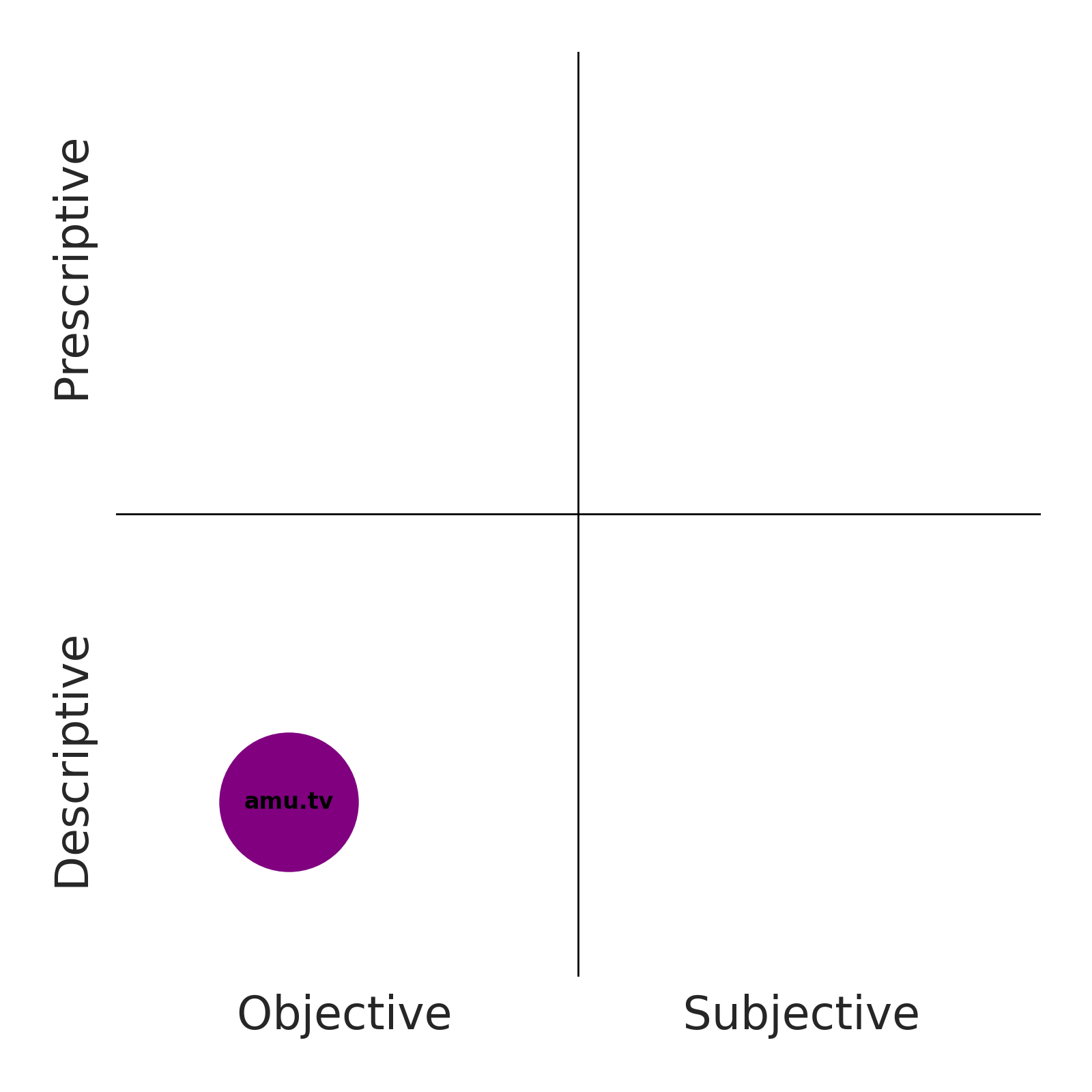
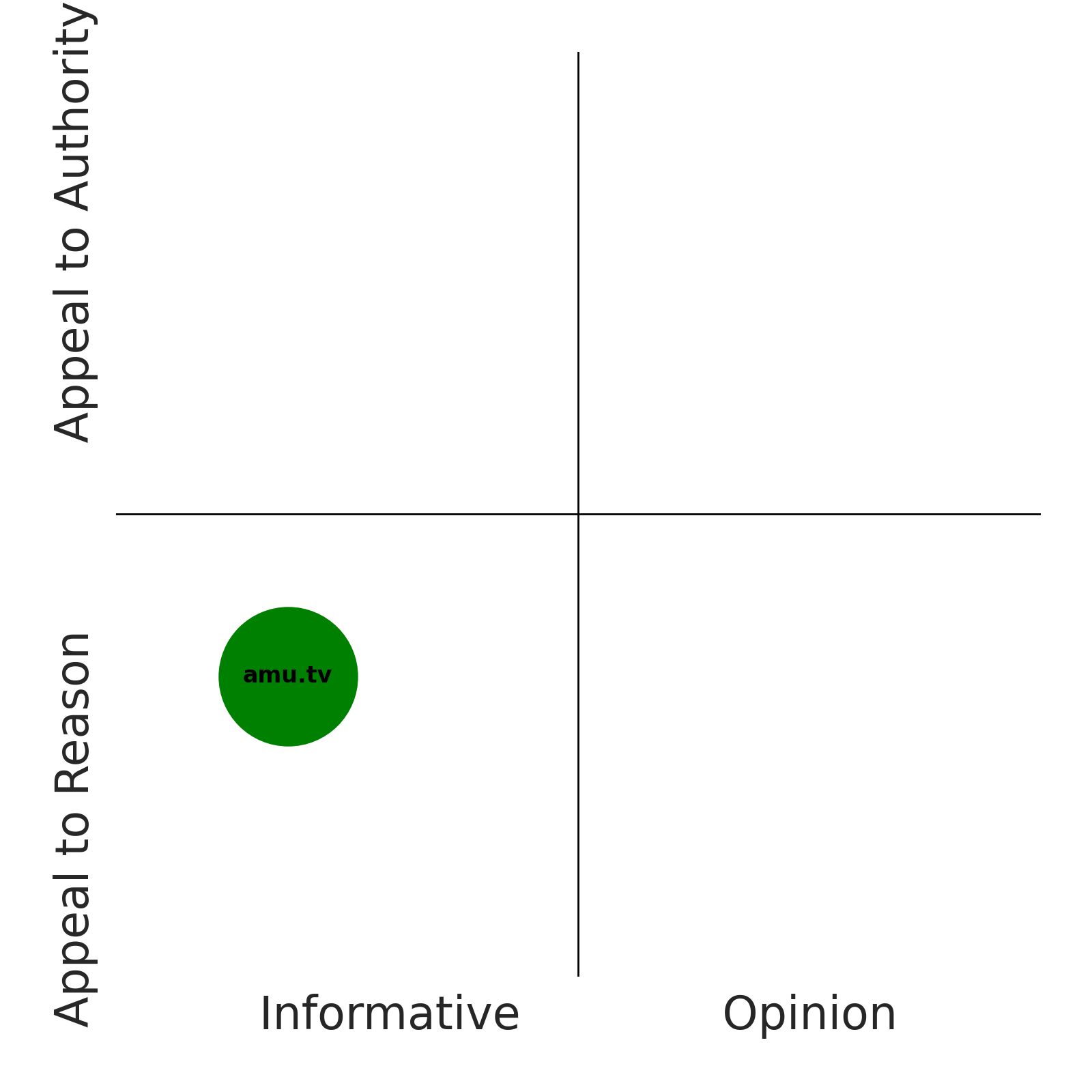
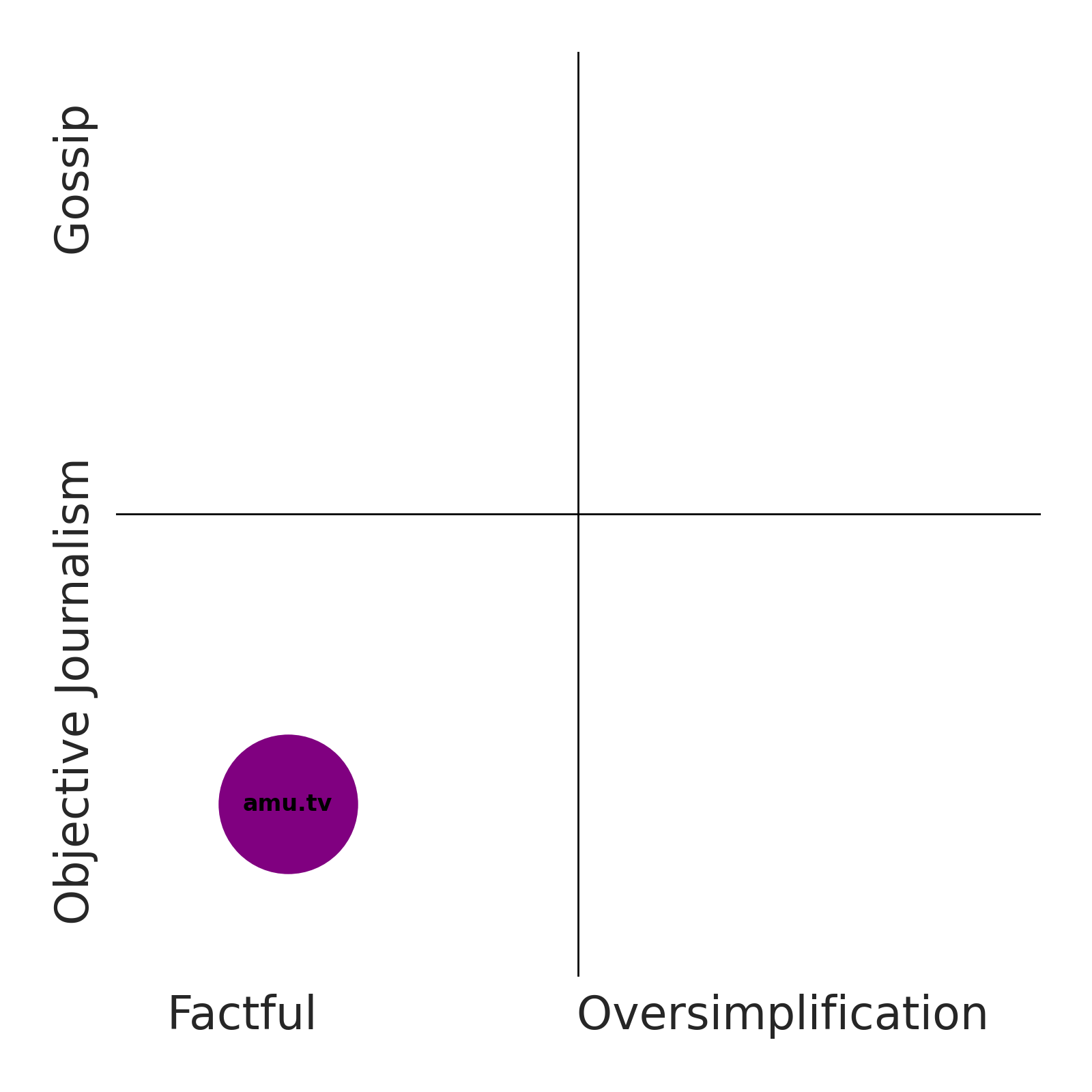
Click points to explore news by date. News sentiment ranges from -10 (very negative) to +10 (very positive) where 0 is neutral.
Straightforward factual sports reporting with no evaluative or ideological framing.
Automated analysis; not human reviewed. Limitations: The supplied article text includes unrelated recommendation/headline fragments after the main match report, which were excluded from analysis. · 4 of 55 available dimensions scored; omitted dimensions are not treated as neutral. · Verified supporting quotes for 4 of 4 scored dimensions.
Claim: The report presents the match result and scorer in factual terms without subjective evaluation.
“Mohammad Fahim Hamas scored a hat trick as Afghanistan beat host Myanmar 4-1 at Thuwunna Stadium in Yangon on Sunday” · exact text match
Why: The quoted sentence reports a concrete outcome and scorer without adjectives or evaluative language.
Claim: Match details are conveyed in plain, non-sensational prose.
“The Afghans led 3-0 at halftime and added a fourth after the break to take three points” · exact text match
Why: The sentence states score progression and points earned without dramatic or sensational wording.
Claim: The text is purely descriptive, listing match outcomes and schedule without recommendations.
“Afghanistan next plays Cambodia on Nov. 11. It will meet Indonesia on Nov. 17 and close group play against the Philippines on Nov. 20.” · exact text match
Why: The quoted schedule is stated as information only, with no prescriptive or advocacy language.
Claim: The report uses straightforward factual comparison and attribution rather than fallacious reasoning.
“The result reversed Afghanistan’s 3-1 loss to Myanmar in Yangon at the start of the previous qualifying campaign.” · exact text match
Why: It compares prior and current results factually; no logical fallacy is evident in the supplied text.
The supplied article text includes unrelated recommendation/headline fragments after the main match report, which were excluded from analysis.
2026 © Helium Trades
Privacy Policy & Disclosure
* Disclaimer: Nothing on this website constitutes investment advice, performance data or any recommendation that any particular security, portfolio of securities, transaction or investment strategy is suitable for any specific person. Helium Trades is not responsible in any way for the accuracy
of any model predictions or price data. Any mention of a particular security and related prediction data is not a recommendation to buy or sell that security. Investments in securities involve the risk of loss. Past performance is no guarantee of future results. Helium Trades is not responsible for any of your investment decisions,
you should consult a financial expert before engaging in any transaction.


