See whether Helium helps you make better-informed decisions. Try every Pro Trader feature for 30 days. No credit card required.
Try every Pro Trader feature for 30 days. No credit card required.
October 07, 2026 · 0 shares
The Monitor frames Russia's invasion through sympathetic Ukrainian family narratives, treating Russian culpability and Ukrainian suffering as settled premises while centering children's resilience.
The Monitor is owned by The First Church of Christ, Scientist and was founded in 1908; the article is part of a series revisiting Ukrainian families as the war enters its fifth year.
Automated analysis; not human reviewed. Limitations: The analysis is based on the publisher's article text, which includes some subscription and newsletter boilerplate that was excluded; CTC's charitable sponsorship and sourcing are stated. · 54 of 55 available dimensions scored; omitted dimensions are not treated as neutral. · Verified supporting quotes for 29 of 54 scored dimensions.
Claim: The framing reflects a mildly liberal internationalist posture by centering Ukrainian civilian suffering and Western-supported rehabilitation.
“As Russia’s all-out invasion of Ukraine intensifies in its fifth year, war is no longer a temporary emergency here.” · exact text match
Why: Sympathetic portrayal of Ukrainian victims and reliance on international institutions align modestly with liberal internationalist framing rather than conservative skepticism.
Claim: The narrative blends factual reporting with heavily personal, emotional family storytelling and subjective descriptions.
“On this morning, seated hip to hip on the wooden steps, they loudly play games, talk, and joke together, as if still at their craft tables.” · exact text match
Why: The scene-setting and emotional detail are subjective narrative choices that go beyond bare factual reporting.
Claim: The article uses vivid war imagery and dire statistics but avoids overt sensationalism or tabloid tone.
“Anti-drone netting is draped over streets where children once roamed freely.” · exact text match
Why: Descriptive but restrained war reporting; evocative language is present but not hyperbolic.
Claim: The piece is narratively engaging, with vivid scenes and personal stories set against war statistics.
“As the air alarm sounds over Izium, the children drop their drawing pens, tubes of glue, and felt-cutting scissors in unison and make for the door.” · exact text match
Why: Strong scene-setting and human-interest framing make the article compelling.
Claim: The framing is mildly hawkish in treating Russian aggression as the cause of harm and Ukrainian resistance as justified, without advocating escalation.
“When the program for kids at the community center began, the building’s broken windows were still boarded up, and flashlights were used to light the rooms.” · exact text match
Why: Sympathy for Ukrainian victims and condemnation of Russian occupation imply support for Ukraine's defensive position, but no explicit military advocacy appears.
Claim: The article emphasizes danger and trauma but reports them factually rather than using rage-bait or panic-inducing framing.
“Then a bomb struck 500 yards from the building, and then another just 200 yards away.” · exact text match
Why: War danger is central and vivid, though it serves a documented narrative rather than overt fear-mongering.
Claim: The article presupposes Russian responsibility for the war and its harms without arguing the point, but this is widely documented and not the article's analytical focus.
“As Russia’s all-out invasion of Ukraine intensifies in its fifth year, war is no longer a temporary emergency here.” · exact text match
Why: The premise is treated as settled background rather than argued, mildly begging the question of culpability.
Claim: The article is mostly factual reporting with some interpretive framing about resilience and loss.
“Yet even here, in the heart of Europe’s deadliest conflict since World War II, kids express particular resilience.” · exact text match
Why: The resilience claim is a mild opinion overlay on reported facts.
Claim: The subject matter is inherently political—war, displacement, and occupation—and the article engages those politics through family narratives.
“As Russia’s all-out invasion of Ukraine intensifies in its fifth year, war is no longer a temporary emergency here.” · exact text match
Why: The war is a political event, and the article's framing of it is politically salient.
Claim: The article avoids reducing the war to simple slogans, presenting multiple families and varied consequences.
“To explore how Ukraine’s children are adapting, the Monitor revisited three locations where families are living with the reality that Russia’s war against Ukraine is unlikely to end anytime soon.” · exact text match
Why: Multiple perspectives and locations reduce oversimplification.
Claim: The article frequently cites UNICEF and named experts for factual claims, a reasonable use of authority in reporting.
“According to UNICEF, some 40% of children ages 3 to 6 in Ukraine do not attend preschool, up from 15% before the war” · exact text match
Why: Reliance on institutional sources is standard and not excessive.
Claim: The article treats children's trauma with sensitivity and avoids exploitation or rage-bait.
“As the death toll from the war grows, programs for Ukrainians traumatized by war and grieving loved ones are becoming increasingly common.” · exact text match
Why: Respectful handling of children's experiences indicates maturity.
Claim: The article focuses heavily on Ukrainian children as victims of Russian aggression, with detailed accounts of loss and trauma.
“For this generation, the toll of this war can be tallied in empty playgrounds, lost school years, and loved ones they will never see again.” · exact text match
Why: Victim framing is central and sustained, though it reflects the war's documented reality.
Claim: The article presents statistics and conclusions with confidence but attributes them to sources and avoids unsupported certainty.
“According to UNICEF, some 40% of children ages 3 to 6 in Ukraine do not attend preschool, up from 15% before the war” · exact text match
Why: Attribution signals appropriate confidence rather than overconfidence.
Claim: The article includes subscription and newsletter prompts that are not part of the substantive journalism.
“Already a subscriber? Log in to hide ads.” · exact text match
Why: Subscription boilerplate is present but does not dominate the substantive article.
Claim: The article advances a clear normative stance sympathetic to Ukraine and critical of Russian aggression, though grounded in reporting.
“Barely 20 miles from the front line in eastern Ukraine, Izium is a parable of what the war has taken.” · exact text match
Why: The framing has an ideological dimension but is not doctrinaire.
Claim: The article relies on established institutions such as UNICEF, Caritas, and the Howard G. Buffett Foundation, reflecting a mildly pro-establishment perspective.
“In this program, which is primarily sponsored by the Howard G. Buffett Foundation, children bead and sculpt with Plasticine.” · exact text match
Why: Centering mainstream NGOs and institutional funders as authoritative actors indicates establishment alignment.
Claim: The article's emotional tone is predominantly somber and sympathetic toward Ukrainian children.
“For years after her father’s death, Yulianna continued to dream of him coming home, “and she was devastated by that,” Zhanna recalls.” · exact text match
Why: Focus on grief, loss, and resilience produces a decidedly sad emotional tone.
Claim: Sourcing and attribution are strong, with named experts, UNICEF data, and first-hand reporting.
“According to UNICEF, some 40% of children ages 3 to 6 in Ukraine do not attend preschool, up from 15% before the war” · exact text match
Why: Attribution to credible institutions and on-the-ground observation supports high credibility.
Claim: The article relies on documented statistics, named sources, and specific observations rather than emotional assertion alone, though it uses evocative family vignettes.
“According to UNICEF, some 40% of children ages 3 to 6 in Ukraine do not attend preschool, up from 15% before the war” · exact text match
Why: Concrete data and direct attribution support a rational rather than irrational epistemic posture.
Claim: The article contains institutional self-promotion and subscription appeals but is primarily editorial content.
“Get unlimited access to global news that cuts through the noise and brings perspectives you won’t get anywhere else.” · exact text match
Why: Promotional language is present but subordinate to the reporting.
Claim: The article is empirically grounded, citing studies, statistics, and expert observation.
“One study found that 32% of teenagers show signs of moderate or severe depression, while an estimate from the Ukrainian mental health nonprofit Voices for Children says that 1 in 2 children in the country have symptoms of anxiety.” · exact text match
Why: Reliance on empirical data rather than superstition indicates scientific grounding.
Claim: The article balances individual family stories with collective humanitarian impacts, showing both individual and community dimensions.
“To explore how Ukraine’s children are adapting, the Monitor revisited three locations where families are living with the reality that Russia’s war against Ukraine is unlikely to end anytime soon.” · exact text match
Why: Both individual and collective frames are used, yielding a mild collectivist leaning.
Claim: The article primarily reports observed events and sourced statistics rather than forecasting.
“Air raids force Ukrainian children to miss an average of 20% of their classes.” · exact text match
Why: Speculation is minimal; the article sticks to reported facts.
Claim: The article uses emotional family vignettes and selected statistics to emphasize Ukrainian suffering, with little balancing context on the war's origins.
“On Yulianna Palahniuk’s sixth birthday, in May 2022, she waited eagerly for a call from her dad, Oleksandr.” · exact text match
Why: Selective focus and emotional framing create a mild persuasive effect, though not deceptive manipulation.
Claim: The publisher discloses ownership, funding sources, and sources clearly, with attributed quotes and statistics.
“['Our name is about honesty. The Monitor is owned by The First Church of Christ, Scientist, and we’ve always been transparent about that.'” · exact text match
Why: Explicit transparency about ownership and attribution indicate strong internal integrity signals.
Claim: The article integrates data, expert quotes, and narrative detail into a coherent, well-structured report.
“About 55 of these charity arts programs exist across Ukraine to support communities near front lines, says Ms. Honcharova.” · exact text match
Why: Layered sourcing and contextual framing show above-average intelligence.
Claim: The article reports verifiable events and attributed claims without apparent falsehood or delusion.
“As of 2025, Ukraine’s children were an average of two years behind in reading and one year behind in math.” · exact text match
Why: The claims are consistent with documented wartime conditions.
Claim: The article includes some institutional self-promotion about the Monitor's mission and values.
“['The church publishes the Monitor because it sees good journalism as vital to progress in the world.” · not found in supplied text
Why: Mission statements and subscription prompts within the article text are mildly self-promotional.
Claim: The article attributes the war's harms to Russian military actions, but this is supported by the reporting context.
“The Russians turned schools into fighting positions and surgical stations, and carted in boxes of Russian toys and notebooks as part of a plan to replace the Ukrainian school curriculum with a pro-Russia one.” · exact text match
Why: Attribution to Russia is factual reporting, with some moral condemnatory framing.
The analysis is based on the publisher's article text, which includes some subscription and newsletter boilerplate that was excluded; CTC's charitable sponsorship and sourcing are stated.
October 26, 2026 · 0 shares
The feature uses first-person staff anecdotes and mission language to promote the Monitor as trustworthy, hopeful, and human.
Automated analysis; not human reviewed. Limitations: The supplied text mixes substantive anecdotes with promotional and subscription text; bias scores rely mainly on the personal, institution-promoting framing of the feature. · 6 of 55 available dimensions scored; omitted dimensions are not treated as neutral. · Verified supporting quotes for 6 of 6 scored dimensions.
Claim: The feature is framed through first-person personal reporting experiences rather than detached reporting.
“In my career reporting from nearly 50 countries, I can count on one hand the number of times someone has explicitly declined an interview because of this newspaper’s name.” · exact text match
Why: The first-person, anecdotal voice makes the selection highly subjective.
Claim: The publisher frames its journalism around uplift, solutions, and hope.
“mission to uplift the world by seeking solutions and finding reasons for credible hope.” · exact text match
Why: Explicit mission language emphasizes positive, hopeful framing.
Claim: The piece is built around personal reflections and impressions rather than neutral factual reporting.
“I never thought, on a reporting trip to Syria, I would attend mine.” · exact text match
Why: The line is a personal reflection central to the anecdote.
Claim: The Syria anecdote is framed with warm, celebratory emotional color.
“Clapping and twirling, they sang my name and praises.” · exact text match
Why: The vivid celebratory description gives the passage a positive emotional charge.
Claim: The article includes promotional language marketing the Monitor’s journalism.
“Here, you’ll find award-winning journalism not driven by commercial influences” · exact text match
Why: The wording promotes the outlet’s brand and editorial value.
Claim: The text presents transparent ownership and mission as evidence of journalistic integrity.
“The Monitor is owned by The First Church of Christ, Scientist, and we’ve always been transparent about that.” · exact text match
Why: The article directly discloses ownership and ties it to transparency.
The supplied text mixes substantive anecdotes with promotional and subscription text; bias scores rely mainly on the personal, institution-promoting framing of the feature.
October 27, 2026 · 0 shares
The publication frames its journalism through a highly specific spiritual and ideological mission of 'uplifting the world' and 'seeking reasons for credible hope,' prioritizing a self-defined moral purpose over traditional neutral reporting.
Automated analysis; not human reviewed. · 7 of 55 available dimensions scored; omitted dimensions are not treated as neutral. · Verified supporting quotes for 0 of 7 scored dimensions.
October 22, 2026 · 0 shares
Framing presents the election as a consequential but constrained contest centered on Netanyahu’s leadership, coalition arithmetic, and Iran-war risk, with modestly critical attention to the Israeli right.
Automated analysis; not human reviewed. Limitations: The supplied text includes extensive subscription and newsletter boilerplate and no author byline; analysis is limited to the substantive election article. · 9 of 55 available dimensions scored; omitted dimensions are not treated as neutral. · Verified supporting quotes for 9 of 9 scored dimensions.
Claim: Framing modestly tilts critical of the Israeli right while also noting shared security goals.
“increasingly hostile tone toward representatives of Israel’s own Arab citizens” · exact text match
“settler violence against Palestinians, which Mr. Netanyahu has played down” · exact text match
Counterevidence:
“Mr. Eisenkot shares some of Bibi’s key policy goals: keeping Iran from getting a nuclear weapon, opposing the establishment of a full-fledged Palestinian state, and ending Hamas’ rule in Gaza.” · exact text match
Why: Critical characterizations of the right-wing coalition and settler policy suggest a slight liberal direction; shared policy goals limit it.
Claim: The report mostly attributes contested claims and separates reported positions from direct assertion.
“Mr. Eisenkot has called it “Jewish terrorism under the auspices of the Israeli government.”” · exact text match
“Mr. Eisenkot shares some of Bibi’s key policy goals: keeping Iran from getting a nuclear weapon, opposing the establishment of a full-fledged Palestinian state, and ending Hamas’ rule in Gaza.” · exact text match
Why: Attribution of controversial characterizations and inclusion of shared policy goals support objective framing.
Claim: The article primarily describes electoral mechanics, polls, and candidate positions rather than prescribing outcomes.
“Neither of the two projected to do best – Mr. Netanyahu’s Likud and the Yashar party of his main challenger, soft-spoken former military chief of staff Gadi Eisenkot – will come close to the 61 seats needed for a majority.” · exact text match
“Still, whoever wins, wholesale Israeli policy changes appear unlikely in the short term.” · exact text match
Why: Descriptive analysis of coalition math and policy continuity, with no explicit recommendations.
Claim: Evaluative descriptors and analytical characterizations add limited opinion coloring.
“soft-spoken former military chief of staff Gadi Eisenkot” · exact text match
“Israel’s devastating military response in Gaza” · exact text match
Why: Subjective descriptors such as “soft-spoken” and “devastating” indicate a modest opinionated framing.
Claim: The article is overwhelmingly focused on electoral politics and security policy.
“Israelis vote next week on a new prime minister, in an election that will have an impact not just in Israel but beyond.” · exact text match
“the question facing voters is straightforward: whether to let their longest-serving prime minister, Benjamin Netanyahu, keep his job.” · exact text match
Why: Central framing concerns election, coalition, and security policy, making the article highly political.
Claim: The report uses named polls, attributed quotes, and explicit uncertainty about scenarios.
“Mr. Eisenkot’s 45% approval rating in this week’s preelection poll by Israel’s Channel 12 Television far outstrips Mr. Netanyahu’s, at 33%.” · exact text match
“It’s the possibility that even if the election puts Mr. Eisenkot in position to form a new government, a potentially lame-duck Prime Minister Netanyahu could sideline these coalition negotiations” · exact text match
Why: Named polling and modal language such as “possibility” and “could” support high credibility rather than overconfident assertion.
Claim: The report grounds claims in polls, coalition arithmetic, and attributed statements rather than unsupported assertion.
“polls have his Likud party trailing, they predict a tight race” · exact text match
“Mr. Eisenkot’s 45% approval rating in this week’s preelection poll by Israel’s Channel 12 Television far outstrips Mr. Netanyahu’s, at 33%.” · exact text match
Why: Use of polling and coalition math supports a strongly rational, evidence-based classification.
Claim: The article includes explicit speculation about post-election scenarios and a possible new Iran attack.
“But another potential scenario has his opponents equally concerned.” · exact text match
“a potentially lame-duck Prime Minister Netanyahu could sideline these coalition negotiations and ask Israel’s military to join President Trump in a major new attack against Iran.” · exact text match
Why: Framing possible future actions as scenarios raises speculative content, though it is attributed and hedged.
Claim: The report offers nuanced coalition and policy analysis with multiple causal factors.
“Neither of the two projected to do best – Mr. Netanyahu’s Likud and the Yashar party of his main challenger, soft-spoken former military chief of staff Gadi Eisenkot – will come close to the 61 seats needed for a majority.” · exact text match
“The electorate has moved sharply rightward over recent years.” · exact text match
Why: Explains coalition arithmetic and electoral landscape rather than reducing the election to a simple horse race.
The supplied text includes extensive subscription and newsletter boilerplate and no author byline; analysis is limited to the substantive election article.
October 23, 2026 · 0 shares
Framing is largely descriptive and balanced, presenting the vote as a referendum on Netanyahu while noting unresolved wars, global criticism of Israeli conduct, and opposition fragmentation.
Automated analysis; not human reviewed. Limitations: The substantive article is brief and partly interleaved with subscription boilerplate; analysis is limited to the remaining news paragraphs. · 7 of 55 available dimensions scored; omitted dimensions are not treated as neutral. · Verified supporting quotes for 7 of 7 scored dimensions.
Claim: The report is mostly objective, with key claims attributed to polls and global criticism, though it includes an interpretive referendum frame.
“polls show that neither they nor the prime minister is likely to win an absolute majority in Tuesday’s contest.” · exact text match
Counterevidence:
“In many ways, these elections will serve as a referendum on Benjamin Netanyahu” · exact text match
Why: Attribution to polls supports objectivity, while the referendum characterization adds a modest interpretive layer.
Claim: The language is largely factual and non-sensational, even when describing wartime destruction.
“Much of the Gaza Strip and southern Lebanon is buried in rubble, which has fueled global criticism of the Israeli military’s conduct in these wars.” · exact text match
Why: The description reports physical damage and attributes criticism rather than using emotive or hyperbolic language.
Claim: The article is descriptive rather than prescriptive.
“Israelis head to the polls on Tuesday, Oct. 27, for the country’s sixth national election since 2019.” · exact text match
Why: It reports an upcoming vote and context without recommending a policy, candidate, or outcome.
Claim: The article is mostly factual but contains mild interpretive framing.
“In many ways, these elections will serve as a referendum on Benjamin Netanyahu” · exact text match
Why: The phrase offers an analytical characterization of the election beyond bare factual reporting.
Claim: The content is explicitly and centrally political.
“Israel’s elections on Tuesday will serve as a referendum on Benjamin Netanyahu, the longest-serving prime minister in the nation’s history.” · exact text match
Why: The article focuses on an election, leadership, and party competition.
Claim: The article shows moderate credibility through attribution, though key sources are not named.
“polls show that neither they nor the prime minister is likely to win an absolute majority in Tuesday’s contest.” · exact text match
“which has fueled global criticism of the Israeli military’s conduct in these wars” · exact text match
Why: Claims are attributed to polls and global criticism, but the absence of named pollsters or critics limits confidence.
Claim: Speculation is limited and tied to cited polling.
“polls show that neither they nor the prime minister is likely to win an absolute majority in Tuesday’s contest.” · exact text match
Why: The only clear forecast is attributed to polls rather than presented as the publisher’s own prediction.
The substantive article is brief and partly interleaved with subscription boilerplate; analysis is limited to the remaining news paragraphs.
Neutral reporting on electoral projections and political instability without advocating for a specific outcome.
For more than three years, Prime Minister Netanyahu has refused to form a state commission of inquiry into the intelligence failures that resulted in the deadly 2023 attack that killed an estimated 1,200 people.
Automated analysis; not human reviewed. · 55 of 55 available dimensions scored; omitted dimensions are not treated as neutral. · Verified supporting quotes for 0 of 55 scored dimensions.
October 26, 2026 · 0 shares
The report frames younger Russian-speaking immigrants as a politically distinct, left-leaning cohort opposing a 'far-right' Netanyahu government, while grounding the trend in polling and expert interviews.
Automated analysis; not human reviewed. Limitations: No author byline appears in the supplied text, and promotional/newsletter boilerplate was excluded. · 7 of 55 available dimensions scored; omitted dimensions are not treated as neutral. · Verified supporting quotes for 7 of 7 scored dimensions.
Claim: The report describes Netanyahu's government as 'far-right' and highlights younger Russian-speaking immigrants leaning left.
“under the far-right government of Prime Minister Benjamin Netanyahu” · exact text match
“a younger generation is leaning more decidedly to the left” · exact text match
Why: Publisher language and selection frame the newer immigrant cohort as left-leaning and the governing coalition as far-right.
Claim: The report frames opposition to Netanyahu as resistance to authoritarian drift and democratic backsliding.
“under the far-right government of Prime Minister Benjamin Netanyahu” · exact text match
“toward a more authoritarian future” · exact text match
Why: Selection and wording emphasize threats to democracy and authoritarian risk, aligning against authoritarianism.
Claim: The report is centrally focused on electoral competition and party affiliation.
“Russian-speaking immigrants in Israel have long been seen as reliable right-wing voters. But in these elections, a younger generation is leaning more decidedly to the left.” · exact text match
Why: The subject is explicitly electoral politics and voting behavior.
Claim: The report uses named experts, survey data, and explicit uncertainty to support its account.
“Zeev Khanin, a professor of political studies at Bar-Ilan University, says his latest research indicates a “substantial difference” between these two generations of immigrants.” · exact text match
“It’s difficult to say exactly how many of those new arrivals have since left Israel.” · exact text match
Why: Attribution and caveats make the reporting visibly credible within the supplied text.
Claim: The report grounds its central claims in polling data, named experts, and explicit uncertainty.
“A survey published in 2024 by the Israel Democracy Institute found that” · exact text match
“It’s difficult to say exactly how many of those new arrivals have since left Israel.” · exact text match
Why: Survey attribution and stated uncertainty indicate evidence-based rather than irrational framing.
Claim: The report attributes data to named surveys and experts and acknowledges unknown figures.
“A survey published in 2024 by the Israel Democracy Institute found that” · exact text match
“It’s difficult to say exactly how many of those new arrivals have since left Israel.” · exact text match
Why: Transparent sourcing and caveats support a high-integrity assessment.
Claim: The report distinguishes older and newer immigrant waves with comparative survey data and expert analysis.
“one-third of them self-defined as left-leaning, another one-third as centrist, and just under 20% as right-wing” · exact text match
“Among Russian-speaking immigrants who arrived before 2013, half of the respondents described themselves as right-wing, and only 10% considered themselves leftist.” · exact text match
Why: Comparative data and generational analysis support an above-average intelligence assessment.
No author byline appears in the supplied text, and promotional/newsletter boilerplate was excluded.
October 23, 2026 · 0 shares
The publisher frames Serbia’s election as a democracy-versus-corruption contest, using 'illiberal' and 'corrupt' for the ruling party while giving sympathetic, source-based emphasis to the student-led opposition.
Automated analysis; not human reviewed. Limitations: The supplied text mixes substantive reporting with Monitor promotional copy and gives conflicting election timing ('Oct. 25' and 'October 2026'), limiting date certainty. · 12 of 55 available dimensions scored; omitted dimensions are not treated as neutral. · Verified supporting quotes for 12 of 12 scored dimensions.
Claim: The publisher describes the ruling party as 'illiberal' and corrupt, framing the contest in liberal-democratic terms.
“tries to oust the illiberal ruling party that’s widely regarded as corrupt.” · exact text match
Why: The loaded 'illiberal' descriptor and corruption framing align with liberal political framing against an illiberal incumbent.
Claim: The student movement is framed as a grassroots challenge to an entrenched ruling elite.
“the Student List was formed at a grassroots level.” · exact text match
Why: The grassroots-versus-ruling-party contrast gives the report a populist anti-elite orientation.
Claim: The report emphasizes ruling-party control of media and voter turnout as a threat to a free contest.
“a government that controls both the media and voter turnouts.” · exact text match
Why: Highlighting media and electoral control supports a libertarian anti-authoritarian framing.
Claim: The publisher uses evaluative descriptors such as 'illiberal' and 'corrupt' in its own setup.
“tries to oust the illiberal ruling party that’s widely regarded as corrupt.” · exact text match
Why: These descriptors frame the incumbent negatively rather than relying solely on neutral language.
Claim: The report attributes its most serious allegations to named investigative outlets and testimony counts.
“Through the testimonies of about 180 people from several dozen state companies, administrations, and institutions, BIRN revealed that these legal entities have been turned into “political factories”” · exact text match
Why: Attribution to a named investigative outlet and specific testimony counts is evidence of objective rather than sensational framing.
Claim: The setup includes evaluative language about the ruling party's character.
“tries to oust the illiberal ruling party that’s widely regarded as corrupt.” · exact text match
Why: The phrase 'illiberal' and 'corrupt' adds evaluative framing beyond neutral description.
Claim: The article is centrally concerned with an election and the distribution of political power.
“Serbia votes in what could prove to be the most consequential election since Slobodan Milošević was removed from power in 2000.” · exact text match
Why: The report is explicitly political in subject and framing.
Claim: The publisher frames the contest as a student-led challenge to an entrenched ruling establishment.
“The ruling party enters the contest with enormous advantages.” · exact text match
Why: Emphasizing the incumbent's structural advantages supports an anti-establishment orientation.
Claim: The report uses named sources, attributed findings, and notes nonresponse.
“The SNS did not comment on the BIRN report, and a prominent SNS member of parliament did not respond to an inquiry from the Monitor.” · exact text match
Why: Visible sourcing and acknowledgment of nonresponse support credibility in the supplied text.
Claim: Contested claims are grounded in named investigative reporting and watchdog rankings.
“According to several articles published last week by the Balkan Investigative Reporting Network” · exact text match
“Transparency International ranks Serbia as one of the most corrupt countries in Europe (ahead only of Russia, Turkey, and Belarus).” · exact text match
Why: The report relies on named sources and data rather than unsupported assertion.
Claim: The report frames the election as potentially historic while noting uncertainty.
“Serbia votes in what could prove to be the most consequential election since Slobodan Milošević was removed from power in 2000.” · exact text match
Why: The phrase 'could prove' forecasts significance beyond present facts.
Claim: The report notes the ruling party's nonresponse and identifies its sources.
“The SNS did not comment on the BIRN report, and a prominent SNS member of parliament did not respond to an inquiry from the Monitor.” · exact text match
Why: Including nonresponse and named attribution are observable fairness signals.
The supplied text mixes substantive reporting with Monitor promotional copy and gives conflicting election timing ('Oct. 25' and 'October 2026'), limiting date certainty.
October 27, 2026 · 0 shares
The publication uses highly positive and aspirational framing to present the Serbian election outcome as a moral victory for democracy and institutional integrity over entrenched corruption and strongman rule.
October 17, 2026 · 0 shares
The report frames Flávio Bolsonaro as a far-right continuity candidate whose moderate image is strategic, relying on named academic experts and attributed criticism while noting his denial.
Automated analysis; not human reviewed. Limitations: The supplied text includes extensive Monitor promotional boilerplate, which was excluded; no author byline is present. · 9 of 55 available dimensions scored; omitted dimensions are not treated as neutral. · Verified supporting quotes for 9 of 9 scored dimensions.
Claim: The article characterizes Flávio Bolsonaro’s platform as far-right and raises democracy concerns about it.
“he’s pushing many of the same far-right policies” · exact text match
“already sparking concerns about the future of Brazil’s democracy” · exact text match
Why: These publisher-side descriptors and framing lean critical of the right-wing candidate.
Claim: The report mixes attributed analysis with evaluative descriptors.
“a disgraced banker at the center of a massive financial fraud case” · exact text match
Why: The phrase uses evaluative language rather than neutral identification.
Claim: The article primarily describes the election and candidate rather than prescribing a course of action.
“He embodies the continuation of his father’s political project, while also representing change.” · exact text match
Why: The passage is explanatory and descriptive, with no direct policy prescription by the publisher.
Claim: The article includes evaluative characterization of the candidate’s political meaning.
“He embodies the continuation of his father’s political project, while also representing change.” · exact text match
Why: This is analytical framing presented by the publisher rather than a bare fact.
Claim: The report is centrally about a presidential election and political actors.
“The far-right senator is on track to beat incumbent leftist President Luiz Inácio Lula da Silva in a presidential runoff on Oct. 25.” · exact text match
Why: The entire article concerns electoral politics and political ideology.
Claim: The article uses critical language about the Bolsonaro political project, giving a mildly negative valence.
“the fresh memory of his chaotic government” · exact text match
“the elder Bolsonaro’s mishandling of the COVID-19 pandemic” · exact text match
Why: These phrases carry negative evaluation but are tied to attributed context.
Claim: The article cites named experts, poll data, and legal status while noting denials and procedural outcomes.
“says Guilherme Casarões, associate professor of Brazilian studies at Florida International University.” · exact text match
“The senator denies wrongdoing.” · exact text match
Why: Named sourcing and inclusion of denials support visible credibility.
Claim: The article forecasts the runoff outcome and future governing challenges.
“The far-right senator is on track to beat incumbent leftist President Luiz Inácio Lula da Silva in a presidential runoff on Oct. 25.” · exact text match
“If elected president, Sen. Bolsonaro will face the challenge of building an independent public persona” · exact text match
Why: It includes forecasts based on polls and expert expectations rather than settled outcomes.
Claim: The report attributes criticism, includes the subject’s denial, and notes a case closure.
“The senator denies wrongdoing.” · exact text match
“The case was closed after evidence was thrown out on jurisdictional grounds.” · exact text match
Why: These features show visible fairness and attribution in the supplied text.
The supplied text includes extensive Monitor promotional boilerplate, which was excluded; no author byline is present.
The report adopts a pro-democracy framing that treats Maduro’s rule as authoritarian and Machado’s return as a democratic test, while attributing competing government and U.S. perspectives.
Automated analysis; not human reviewed. Limitations: The article cites “independent assessments” without naming them, and several future election expectations are attributed only to Washington. · 13 of 55 available dimensions scored; omitted dimensions are not treated as neutral. · Verified supporting quotes for 12 of 13 scored dimensions.
Claim: Balances opposition, interim-government, and U.S. perspectives without clear domestic partisan alignment.
“Cooperation with Rodríguez has helped advance U.S. economic interests, but it also relies on political leaders whose government has not yet faced a competitive election.” · exact text match
Why: The report includes critical examination of U.S. policy alongside opposition and government views, supporting measured neutrality.
Claim: Relies mainly on named experts, officials, and institutional analysts rather than a populist voice.
“says Benigno Alarcón, founder and former director of the Center for Political and Government Studies at Andrés Bello Catholic University in Caracas” · exact text match
Why: Expert and institutional sourcing is prominent, but the article also quotes ordinary protesters, so the tilt is mild.
Claim: Frames political freedom, elections, and rule of law as central benchmarks for Venezuela’s transition.
“The government has yet to set a date for presidential elections, and key political freedoms have not been fully restored.” · exact text match
Why: Emphasis on elections and political freedoms leans libertarian in this context, though the article does not advocate a broad ideological program.
Claim: Attributes claims to named sources and avoids presenting the reporter’s own judgment as fact.
“says Benigno Alarcón, founder and former director of the Center for Political and Government Studies at Andrés Bello Catholic University in Caracas” · exact text match
Why: Named attribution and quoted analysis support an objective reporting stance.
Claim: Uses restrained, reportorial language rather than sensational claims.
“No date has been set for presidential elections.” · not found in supplied text
Why: The article repeatedly states procedural facts plainly, with little sensational language.
Claim: Primarily describes political conditions and quoted prescriptions rather than issuing its own policy demands.
“The government has yet to set a date for presidential elections, and key political freedoms have not been fully restored.” · exact text match
Why: The passage is descriptive of current conditions, with prescriptions mostly confined to quoted experts.
Claim: The article is centrally about Venezuelan electoral politics and U.S. influence.
“testing fragile democratic transition” · exact text match
Why: The headline and body focus on political transition, elections, and governing authority.
Claim: Opens with a warm, emotionally positive scene of Machado’s reception.
“worshippers erupted in applause. Some embraced her and burst into tears.” · exact text match
Why: The human-interest opening adds a mildly positive emotional framing.
Claim: Credibility is supported by named sourcing, direct quotes, and explicit uncertainty.
“says Benigno Alarcón, founder and former director of the Center for Political and Government Studies at Andrés Bello Catholic University in Caracas” · exact text match
Why: Multiple named sources and acknowledged uncertainty support high visible credibility.
Claim: Explicitly flags uncertainty about political outcomes rather than asserting them as certain.
“But whether Ms. Machado’s popular support can translate into political influence remains uncertain.” · exact text match
Why: The article states a central uncertainty directly, supporting a rational and evidence-conscious framing.
Claim: Includes forward-looking speculation about Machado’s possible political impact.
“Her return could reshape Venezuela’s political future” · exact text match
Why: The article uses speculative language about future political effects.
Claim: Uses named experts, officials, and organizations with direct attribution.
“says Oscar Murillo, who heads the human rights organization, Provea” · exact text match
Why: Transparent attribution to a human-rights organization supports observable integrity signals.
Claim: Explains institutional and geopolitical tradeoffs through expert analysis.
“That approach reflects a central dilemma for Washington,” Mr. Alarcon says.” · exact text match
Why: The article synthesizes institutional rebuilding and U.S. policy tensions, supporting above-average analytical depth.
The article cites “independent assessments” without naming them, and several future election expectations are attributed only to Washington.
The article frames the Indian democratic political landscape as being in critical decline, adopting a highly sympathetic and advocative tone for the student and civil society activists protesting the Modi government.
Automated analysis; not human reviewed. · 55 of 55 available dimensions scored; omitted dimensions are not treated as neutral. · Verified supporting quotes for 0 of 55 scored dimensions.
The report frames the observer rejection through critical expert commentary and comparisons to authoritarian precedent, presenting it as a troubling retreat from democratic and international norms.
Automated analysis; not human reviewed. Limitations: The supplied text does not state an author or publication date, limiting context for the 2026 midterm report. · 14 of 55 available dimensions scored; omitted dimensions are not treated as neutral. · Verified supporting quotes for 14 of 14 scored dimensions.
Claim: The report frames Republican redistricting and voting-access controversies in a way favorable to Democratic concerns.
“Republicans followed Mr. Trump’s order to redraw congressional districts in several states to favor their party” · exact text match
Why: This states GOP redistricting as partisan favoritism, supporting a slight liberal lean.
Claim: The report relies on expert and international-institution authority to frame the decision.
“Election experts agree that America’s election system, run by local and state officials, is solid.” · exact text match
Why: Repeated expert consensus supports a mild elitist framing.
Claim: The report incorporates subjective expert interpretations about the decision’s meaning and risks.
“experts say it does send troubling signals to peer governments abroad and to voters at home” · exact text match
Why: The framing includes evaluative interpretation beyond the bare fact of rejection.
Claim: The report uses measured, attributed language rather than sensational alarm.
“International observers are unlikely to have a direct effect on how U.S. elections are run.” · exact text match
Why: Caveating direct impact and attributing claims indicates low sensationalism.
Claim: The report’s framing emphasizes democratic decline and risk.
“And I think that that’s a step backwards” · exact text match
Why: Selected expert language casts the decision as regression.
Claim: The report is centrally framed around partisan electoral stakes and control of Congress.
“November’s midterms are consequential, as Democrats are forecast to take control of the House and possibly the Senate for the two remaining years of President Donald Trump’s term.” · exact text match
Why: The report focuses on electoral and partisan power, supporting high political bias.
Claim: The report repeatedly invokes expert consensus to support its interpretation.
“Election experts agree that America’s election system, run by local and state officials, is solid.” · exact text match
Why: Expert agreement is used as a key warrant.
Claim: The report frames the decision as a retreat from established international institutions.
“the president’s aversion to institutions of the postwar international order, such as NATO and the International Criminal Court” · exact text match
Why: This framing aligns with pro-establishment internationalism.
Claim: The report’s tone is negative toward the observer rejection.
“experts say it does send troubling signals to peer governments abroad and to voters at home” · exact text match
Why: The selected wording conveys negative evaluation.
Claim: The report attributes claims to named experts and includes the administration’s response.
“The media fact-checker Snopes reported that a White House official told them: “American elections will be administered, participated in, and observed by American citizens.”” · exact text match
Why: Attribution and inclusion of opposing response support high credibility.
Claim: The report grounds its claims in empirical investigations and attributed observer assessments.
“an Associated Press investigation of the 25 million votes cast across six battleground states found fewer than 475 potential cases of voter fraud” · exact text match
Why: Use of quantified investigation supports a rational orientation.
Claim: The report speculates about the decision’s consequences and signals.
“could send a troubling message in the U.S. and abroad, experts say” · exact text match
Why: The headline and framing emphasize possible consequences rather than only the event.
Claim: The report includes opposing official response and caveats about observer impact.
“The OSCE said the U.S. decision was “regrettable,” but the Trump administration was unapologetic.” · exact text match
Why: Including the administration’s stance and the OSCE reaction supports high internal fairness.
Claim: The report draws on named academic specialists and historical context.
“Charles Stewart, an MIT political science professor and founder of the school’s Election Data and Science Lab” · exact text match
Why: Named specialists and context indicate high article intelligence.
The supplied text does not state an author or publication date, limiting context for the 2026 midterm report.
October 14, 2026 · 0 shares
Trump’s fuel-price efforts are framed as politically motivated and largely ineffective, with heavy reliance on expert and official sources.
Automated analysis; not human reviewed. Limitations: The article text lacks a publication date and author byline, so temporal references like 'last Friday' and 'this week' cannot be fixed to absolute dates. · 13 of 55 available dimensions scored; omitted dimensions are not treated as neutral. · Verified supporting quotes for 12 of 13 scored dimensions.
Claim: The report balances criticism of Trump’s Russia diesel deal with a Republican defense, showing no clear liberal or conservative ideological direction.
“Some Republicans have defended Mr. Trump’s U-turn on his own administration’s foreign policy as an emergency measure.” · exact text match
Why: Inclusion of a conservative defense alongside bipartisan criticism supports measured neutrality on the liberal-conservative axis.
Claim: The report leans on an academic expert’s authority to explain why presidents cannot control energy prices.
““There’s very little a president can do to influence energy prices,” says Lucas Davis, a business professor at the University of California, Berkeley, who studies energy markets.” · exact text match
Why: Framing policy constraints through credentialed expert analysis gives a mild elitist orientation.
Claim: The report mixes factual reporting with an evaluative headline and analytical judgments.
“It might be too little too late.” · exact text match
Why: This evaluative subhead introduces subjective framing into otherwise factual reporting.
Claim: The report uses measured, non-sensational language even when describing political stakes.
“But the effect of these measures has been marginal, at best, in holding down prices for diesel, gasoline, and jet fuel.” · exact text match
Why: The language is analytical rather than emotionally charged or sensational.
Claim: The report mainly describes events and constraints rather than prescribing policy.
“There’s very little a president can do to influence energy prices.” · not found in supplied text
Why: The article explains limitations rather than advocating solutions.
Claim: The report includes some evaluative and predictive judgments alongside factual reporting.
“It might be too little too late.” · exact text match
Why: This subhead is an opinionated assessment of Trump's policy efforts.
Claim: The report is centrally framed around Trump, congressional midterms, and political consequences of fuel prices.
“High pump prices for diesel and other fuels have become a major drag on his party’s candidates, including in agricultural states such as Kansas and Iowa.” · exact text match
Why: The article's central framing is explicitly political.
Claim: The report relies on official and institutional voices such as senators, the Bureau of Labor Statistics, and a university professor.
“A bipartisan statement by members of the Senate Foreign Relations Committee said that suspending U.S. sanctions on Russian diesel runs counter to a 2022 law that banned Russian energy.” · exact text match
Why: Heavy use of institutional sources indicates a mild pro-establishment orientation.
Claim: The report shows high credibility through named sources, data, and clear attribution.
“Mr. Trump has blamed Ukrainian attacks against Russian oil refineries for driving up global diesel prices, though energy analysts say reduced flows from the Middle East amid the U.S.-Israeli war with Iran have been a far bigger factor.” · exact text match
Why: Attribution to energy analysts and contrast with Trump's claim supports credibility.
Claim: The report is evidence-based and cites data, analysts, and institutional sources.
“running at 3.7% in September, the Bureau of Labor Statistics reported on Wednesday.” · exact text match
Why: Use of official statistics and attributed analysis supports rational/empirical framing.
Claim: The report includes forecasts about when diesel relief might arrive and political timing.
“Any relief that does come in the form of increased supply would likely be after November’s midterms, since it takes weeks for cargo vessels to arrive by sea.” · exact text match
Why: This is a forward-looking forecast based on shipping logistics.
Claim: The report attributes claims to named experts, lawmakers, and official data.
““There’s a direct line from the Iran war ... to the high prices we’re facing right now,” says Dr. Davis.” · exact text match
Why: Clear attribution supports high integrity.
Claim: The report explains complex energy-market and political dynamics with context and expert analysis.
“As in the 1970s, global energy markets have been roiled in recent years by conflicts: Russia’s war with Ukraine pushed up natural gas prices and stoked global inflation.” · exact text match
Why: Historical and market context demonstrates high analytical intelligence.
The article text lacks a publication date and author byline, so temporal references like 'last Friday' and 'this week' cannot be fixed to absolute dates.
October 16, 2026 · 0 shares
Publisher framing is analytic and attribution-heavy, presenting Trump’s Russia shift as consequential but uncertain through named Russian expert commentary.
Automated analysis; not human reviewed. Limitations: No author byline is present, and the supplied text includes newsletter/subscription boilerplate that was excluded; several bias dimensions were omitted as unsupported. · 10 of 55 available dimensions scored; omitted dimensions are not treated as neutral. · Verified supporting quotes for 10 of 10 scored dimensions.
Claim: The publisher generally separates reported fact from interpretation by attributing analytical claims to named analysts.
““It looks like relations between Trump and Zelenskyy have crossed the point of no return, and obviously that’s good news for Russia,” says Sergei Strokan” · exact text match
Why: The subjective assessment is presented as a quote from a named analyst, which supports objective attribution practice.
Claim: The treatment is sober and downplays the immediate significance of the diesel deal rather than sensationalizing it.
“The bargain reached last week between Mr. Trump and Vladimir Putin to potentially release millions of tons of Russian diesel fuel onto world markets in the coming months is not significant in itself, Russian analysts say.” · exact text match
Why: The article explicitly qualifies the deal’s significance, which is inconsistent with sensational framing.
Claim: The article is largely descriptive, explaining actors’ positions and possible developments without prescribing policy.
“Mr. Putin appears to be pressing talks with Mr. Trump in hopes that it might bring a new relationship between the U.S. and Russia, even if peace in Ukraine remains unachievable.” · exact text match
Why: The framing describes motives and possibilities rather than recommending actions, supporting a descriptive classification.
Claim: The article is centrally political, focused on leaders, diplomacy, war, sanctions, and intelligence cooperation.
“With Presidents Trump and Zelenskyy publicly feuding over U.S. support for Ukraine” · exact text match
Why: The subject matter is explicitly about political leaders and international conflict policy.
Claim: The report relies heavily on named Russian analysts and former officials to interpret Kremlin intentions and U.S. policy.
““The question we’re all asking is, how far is Trump willing to go?” says Igor Korotchenko, editor of National Defense magazine” · exact text match
Why: Expert and elite voices are used as primary interpretive authorities for the article’s analysis.
Claim: Visible sourcing and attribution support high credibility in the supplied text.
“says Sergei Markov, a former Kremlin adviser and head of the Institute of Political Studies in Moscow.” · exact text match
Why: Named experts and clear attribution provide verifiable sourcing signals.
Claim: The report frames developments through attributed expert analysis and conditional language rather than emotional assertion.
“some analysts wondering whether he might really mean it this time.” · exact text match
Why: The phrasing signals uncertainty and measured interpretation, supporting a rational rather than irrational framing.
Claim: The article includes forward-looking speculation about Trump’s intentions and peace prospects, though it is attributed and qualified.
“could be a sign that Mr. Trump is ready to drop his insistence” · exact text match
Why: The language forecasts possible policy direction beyond confirmed facts, supporting a moderate speculation score.
Claim: The report shows high integrity signals through named sourcing, attribution, and explicit uncertainty.
“says Sergei Strokan, international affairs columnist for the Moscow business daily Kommersant.” · exact text match
Why: Named attribution and expert identification indicate fair, transparent reporting practices.
Claim: The article is analytically sophisticated, using conditional claims, named sources, and multiple perspectives.
“It could be a sign that Mr. Trump is ready to drop his insistence that the war must end before the U.S. and Russia might engage in broader trade and investment opportunities” · exact text match
Why: The conditional, sourced interpretation reflects a high level of analytical nuance.
No author byline is present, and the supplied text includes newsletter/subscription boilerplate that was excluded; several bias dimensions were omitted as unsupported.
October 29, 2026 · 0 shares
Framing relies on Russian analyst commentary and leaked-plan details, pairing cautious peace-process optimism with Kremlin skepticism.
Automated analysis; not human reviewed. Limitations: Details of the U.S. peace plan come from unofficial media leaks, and Moscow’s stance is inferred mainly through quoted Russian analysts rather than official documents. · 12 of 55 available dimensions scored; omitted dimensions are not treated as neutral. · Verified supporting quotes for 12 of 12 scored dimensions.
Claim: Framing is largely attributed and descriptive, with limited evaluative language.
“Russian analysts say their expectations for this meeting are far more modest.” · exact text match
Why: The report attributes expectations to analysts rather than asserting them directly.
Claim: The report avoids sensational wording and presents developments in measured, qualified terms.
“Most Russian analysts say the two sides are still too far apart to reach a settlement.” · exact text match
Why: The language is analytical and cautious rather than sensational.
Claim: The report is framed around a high-stakes diplomatic puzzle with an unusual rhetorical hook.
“So with all the peace in the air, why isn’t anyone cheering?” · exact text match
Why: The rhetorical question highlights a paradox in the peace process, adding interest.
Claim: The article mainly describes diplomatic positions and reported plan elements rather than prescribing a policy.
“The United States peace deal’s elements reportedly include strong U.S. security assurances for postwar Ukraine, a chance for it to join the European Union but not NATO, and a demilitarized zone (rather than Russian occupation) to incentivize Kyiv to withdraw from the roughly 15% of the Donbas that it still controls.” · exact text match
Why: The passage sets out reported terms descriptively without advocating them.
Claim: The core content concerns U.S.-Russia-Ukraine diplomacy and war policy.
“Peace talks between Ukraine and Russia, under U.S. mediation, are set to resume in November after a long hiatus.” · exact text match
Why: Diplomatic talks and war policy are central political subject matter.
Claim: Russian intentions and expectations are communicated heavily through analysts and officials.
“Most Russian analysts say the two sides are still too far apart to reach a settlement.” · exact text match
Why: The article repeatedly relies on named or collective analysts for interpretation.
Claim: Humanitarian suffering is noted with restrained negative language but does not dominate the framing.
“The Dnieper River town, held by Russian forces, has been cut off and starved by months of ruthless drone and mine warfare.” · exact text match
Why: The word 'ruthless' and 'starved' carry mild negative emotional weight.
Claim: The report names sources, attributes leaked details, and includes uncertainty about outcomes.
“Russian analysts say their expectations for this meeting are far more modest.” · exact text match
Why: Sourcing and caveats make the framing visibly more credible.
Claim: The report uses attributed analyst reasoning rather than emotional assertion to explain Russian and Ukrainian positions.
“Mr. Suslov says that Moscow views the economic incentives being dangled by the U.S. as meant to entice Russia to make territorial compromises, but Moscow is unlikely to relent on its demand for the entire Donbas region.” · exact text match
Why: Named-expert analysis and conditional language support a rational framing.
Claim: Much of the report concerns future talks, summit prospects, and leaked plan details.
“Peace talks between Ukraine and Russia, under U.S. mediation, are set to resume in November after a long hiatus.” · exact text match
Why: Forward-looking scheduling and reported plans are central to the article.
Claim: The report attributes claims to analysts and flags leaked or reported details.
“The new plan, put forward by the United States though only known from unofficial media leaks, is bringing life to the long-stalled peace process, Russian analysts say.” · exact text match
Why: It explicitly labels the plan as known from unofficial leaks and attributes analysis.
Claim: The article explains competing positions with named analysis and caveats.
“Mr. Suslov says that Moscow views the economic incentives being dangled by the U.S. as meant to entice Russia to make territorial compromises, but Moscow is unlikely to relent on its demand for the entire Donbas region.” · exact text match
Why: The reporting distinguishes incentives, territorial demands, and likely responses.
Details of the U.S. peace plan come from unofficial media leaks, and Moscow’s stance is inferred mainly through quoted Russian analysts rather than official documents.
October 22, 2026 · 0 shares
Frames Trump’s Russia policy as an appeasement-minded embrace of authoritarian big powers, using loaded language and establishment-expert warnings to cast it as a risk to Ukraine and U.S. allies.
Automated analysis; not human reviewed. Limitations: No author byline is provided in the supplied text, and the article is an analysis-style report mixed with subscription/newsletter boilerplate. · 13 of 55 available dimensions scored; omitted dimensions are not treated as neutral. · Verified supporting quotes for 13 of 13 scored dimensions.
Claim: The report treats senior foreign-policy establishment experts as the main interpretive authority.
“says John Herbst, senior director of the Atlantic Council’s Eurasia Center in Washington.” · exact text match
“says Charles Kupchan, director of European studies at the Council on Foreign Relations in Washington.” · exact text match
Why: Named Atlantic Council and CFR experts are given the role of validating the article’s risk framing.
Claim: The framing interprets Trump’s motives and policy through evaluative language rather than neutral description.
“President Donald Trump is signaling a full-on embrace of Vladimir Putin and Russia – and of big-power relations – as he faces adverse midterm results and a potential lame-duck presidency.” · exact text match
“Perhaps no relationship captures that preference for dealing with big powers, and in particular authoritarian ones, so clearly as President Trump’s decadelong affinity for Russian President Vladimir Putin.” · exact text match
Why: Phrases such as 'full-on embrace' and 'decadelong affinity' present an interpretive characterization as the article’s premise.
Claim: The article uses vivid, alarm-laden terms to characterize Trump’s diplomacy and Putin’s aims.
“Notably absent from the confab would be Mr. Zelenskyy, whose country Mr. Putin is seeking to carve up and weaken.” · exact text match
“the same Russian leader who is pursuing a military campaign in Ukraine that has deliberately targeted civilian infrastructure” · exact text match
Why: Striking verbs and atrocity framing heighten the stakes beyond neutral diplomatic reporting.
Claim: The article criticizes the administration for slowing military support to Ukraine while Russia attacks, reflecting a hawkish pro-Ukraine framing.
“This week, the Trump administration put the brakes on the transfer of Patriot missiles by partner countries to Ukraine – even as Russia continued its deadly ballistic missile attacks against Ukrainian cities.” · exact text match
Why: The juxtaposition of delayed Patriot transfers with Russian missile attacks supports a hawkish critique of insufficient support for Ukraine.
Claim: The article warns of alarming possible outcomes, including a Yalta-style sellout and renewed war.
“The risk here is that, given Trump’s inclination towards the powerful, he could agree to some new kind of Yalta where he sells out Ukraine and the allies for the sake of improved strategic relations with Xi and Putin” · exact text match
“He has hinted for months that he could relaunch the unpopular Iran war once the midterms were out of the way.” · exact text match
Why: These quoted warnings are selected and foregrounded to heighten anxiety about Trump’s foreign-policy direction.
Claim: The report is an interpretive analysis that repeatedly characterizes Trump’s motives and strategic preferences.
“Perhaps no relationship captures that preference for dealing with big powers, and in particular authoritarian ones, so clearly as President Trump’s decadelong affinity for Russian President Vladimir Putin.” · exact text match
“signs are mounting he could set free his inclination toward big powers and their leaders, starting with Vladimir Putin and Russia.” · exact text match
Why: The article asserts affinity, inclination, and preference as explanatory frames rather than limiting itself to documented actions.
Claim: The entire report is framed around electoral stakes, presidential power, and U.S. foreign policy under Trump.
“As midterms near and Putin beckons, Trump embraces big-power diplomacy.” · exact text match
“as Mr. Trump faces the prospects of adverse midterm election results and a lame-duck presidency – a period during which modern U.S. presidents traditionally have shifted attention to foreign policy – signs are mounting that he could set free his affinity for big powers and their leaders, starting with Mr. Putin and Russia.” · exact text match
Why: The headline and lead explicitly connect the Russia diplomacy story to midterm elections and lame-duck politics.
Claim: The article relies heavily on named senior experts and officials to validate its interpretation.
“says John Herbst, senior director of the Atlantic Council’s Eurasia Center in Washington.” · exact text match
“says Charles Kupchan, director of European studies at the Council on Foreign Relations in Washington.” · exact text match
Why: The analysis advances by quoting credentialed foreign-policy experts rather than presenting only the reporter’s own reasoning.
Claim: Ukraine is framed centrally as the weaker victim of aggression whose interests are at risk in big-power deals.
“And no conflict has crystallized this attraction to the world’s stronger nations over their weaker victims of aggression as has Russia’s war in Ukraine.” · exact text match
Why: The phrase 'weaker victims of aggression' explicitly casts Ukraine as the victim of stronger-power diplomacy.
Claim: The narrative aligns with U.S. foreign-policy establishment warnings about Trump, Russia, and the international order.
“Still, the through line that many diplomats, members of Congress, and analysts see is a U.S. president increasingly unpopular at home turning to foreign policy – and to his perceived friends like Mr. Putin – for wins and legacy building.” · exact text match
“says Charles Kupchan, director of European studies at the Council on Foreign Relations in Washington.” · exact text match
Why: The article frames the issue through diplomats, analysts, and CFR authority rather than outsider or pro-administration perspectives.
Claim: The report’s language and selected quotes convey strong negative emotion toward Trump’s Russia policy and Putin.
“It’s unconscionable that this administration is capitulating to a Russian dictator who illegally invaded Ukraine and butchers innocent civilians every single day” · exact text match
“the same Russian leader who is pursuing a military campaign in Ukraine that has deliberately targeted civilian infrastructure” · exact text match
Why: The selected moral condemnation and atrocity language produce a strongly negative emotional valence.
Claim: The report uses named experts, officials, and attributed quotations, supporting a moderate credibility assessment despite its interpretive framing.
“says John Herbst, senior director of the Atlantic Council’s Eurasia Center in Washington.” · exact text match
“Sen. Thom Tillis, Republican of North Carolina, wrote over the weekend on X.” · exact text match
Why: Attribution to named experts and lawmakers gives readers checkable sourcing, though the selection is interpretive.
Claim: The article forecasts Trump’s future foreign-policy moves and their consequences from current signs.
“signs are mounting he could set free his inclination toward big powers and their leaders, starting with Vladimir Putin and Russia.” · exact text match
“The coming months might well offer a domestically clipped president the opportunity to pursue with even greater zeal the kind of big-power “spheres of influence” vision of the world he demonstrably favors.” · exact text match
Why: The article repeatedly moves from current events to predictions about Trump’s likely future conduct and its consequences.
No author byline is provided in the supplied text, and the article is an analysis-style report mixed with subscription/newsletter boilerplate.
October 23, 2026 · 0 shares
A pro-democracy, institutionalist framing presents rule of law as a foundation for prosperity and the four elections as civic opportunities to uphold freedoms.
Automated analysis; not human reviewed. Limitations: The supplied text includes substantial subscription and mission boilerplate; no author byline is present. Analysis is limited to the substantive paragraphs about the WJP index and upcoming elections. · 13 of 55 available dimensions scored; omitted dimensions are not treated as neutral. · Verified supporting quotes for 13 of 13 scored dimensions.
Claim: Opposes authoritarian drift and emphasizes freedoms.
“This, in turn, has constricted freedom of expression, association, and civic participation in about two-thirds of the 143 countries assessed.” · exact text match
Why: The framing treats constricted civic freedoms as a negative consequence of authoritarian drift.
Claim: Contains some interpretive emphasis on the rule-of-law/prosperity link.
“Perhaps more significant, the WJP’s findings reaffirm the robust link between transparent, consistent rule of law and a key dimension of citizen well-being – economic prosperity.” · exact text match
Why: The phrase “Perhaps more significant” and “reaffirm” frame the finding as a key takeaway rather than neutral description.
Claim: Tone is measured and data-centered rather than sensational.
“The latest Rule of Law Index, released by the World Justice Project (WJP) Wednesday, underscores this democratic recession.” · exact text match
Why: The claim is tied to a named index and release rather than emotional or sensational language.
Claim: Mildly optimistic by highlighting positive glimmers and opportunities.
“But there are also positive glimmers: The share of countries registering decline dropped from 68% in 2025 to 62% this year.” · exact text match
Why: The article explicitly foregrounds improving indicators alongside the negative trend.
Claim: Mildly prescriptive in framing elections as an opportunity to exercise democratic rights.
“These elections offer an opportunity to exercise the foundational democratic right to vote.” · exact text match
Why: The language presents voting as a foundational civic opportunity, adding a mild normative cue.
Claim: Contains evaluative analysis and framing beyond neutral fact reporting.
“Perhaps more significant, the WJP’s findings reaffirm the robust link between transparent, consistent rule of law and a key dimension of citizen well-being – economic prosperity.” · exact text match
Why: The selection and emphasis of this finding reflects interpretive judgment about what matters most.
Claim: The article is explicitly about elections, democracy, authoritarianism, and governance.
“Elections in four nations highlight the role of rule of law.” · exact text match
Why: The central subject is political institutions and electoral contests.
Claim: Relies on and amplifies establishment institutional indices and former officials.
“The latest Rule of Law Index, released by the World Justice Project (WJP) Wednesday, underscores this democratic recession.” · exact text match
“The Atlantic Council holds a more definitive view. Rule of law, its July report stated, is “not ... secondary to economic development. It is part of the development process itself.”” · exact text match
Why: The article’s authority structure centers on named institutional indices and policy-establishment voices.
Claim: Provides named sources, specific rankings, and uncertainty caveats.
“The latest Rule of Law Index, released by the World Justice Project (WJP) Wednesday, underscores this democratic recession.” · exact text match
Why: Attribution to named institutions and reports supports verifiability.
Claim: The report uses measured, evidence-based analysis and acknowledges causal uncertainty.
“Economists and political scientists diverge on whether the link between democratic rule of law and economic growth is causal, but most agree the two factors are corelated.” · exact text match
Why: The explicit caveat about causality and reliance on comparative data indicate rational, non-dogmatic framing.
Claim: Frames freedoms as individual democratic and economic liberties.
“Amid a global authoritarian drift, citizens of Brazil, Serbia, Israel, and the United States have an opportunity to uphold democratic and economic freedoms.” · exact text match
Why: The emphasis is on individual civic and economic freedoms rather than collective or group-based claims.
Claim: High integrity signaled by sourcing and uncertainty caveats.
“Economists and political scientists diverge on whether the link between democratic rule of law and economic growth is causal, but most agree the two factors are corelated.” · exact text match
Why: The text acknowledges a major limitation in the causal claim rather than overstating it.
Claim: Synthesizes comparative indices, rankings, and expert views, and notes causal uncertainty.
“Economists and political scientists diverge on whether the link between democratic rule of law and economic growth is causal, but most agree the two factors are corelated.” · exact text match
Why: The text distinguishes correlation from causation and integrates multiple sources.
The supplied text includes substantial subscription and mission boilerplate; no author byline is present. Analysis is limited to the substantive paragraphs about the WJP index and upcoming elections.
October 22, 2026 · 0 shares
The report is largely balanced and solution-oriented, pairing official cost data and named expert attribution with competing conservative and progressive childcare proposals.
Automated analysis; not human reviewed. Limitations: No author byline is present; the BLS price comparison gives an incomplete end date ('August 2025 and 2026'). · 10 of 55 available dimensions scored; omitted dimensions are not treated as neutral. · Verified supporting quotes for 10 of 10 scored dimensions.
Claim: The report gives comparable space to conservative and progressive childcare positions.
“Some conservatives support Mr. Vance’s stay-at-home model, others defend the CCDF state-choice distribution system, and still others argue the government shouldn’t put taxpayer funds toward childcare at all.” · exact text match
“Her organization amplifies a message common among Democrats, a growing number of Republicans, and some European nations: that childcare should be funded as a “public good.”” · exact text match
Why: Balanced ideological sourcing supports measured neutrality on the liberal-conservative dimension.
Claim: The report is primarily descriptive and source-attributed rather than subjective commentary.
“according to the U.S. Census Bureau” · exact text match
“says Kimberly Morgan, a professor of political science and international affairs at George Washington University.” · exact text match
Why: Factual attributions and expert quotes support an objective framing.
Claim: The report avoids sensational language and uses measured cost and policy descriptions.
“With rising costs straining childcare systems, experts suggest that looking to existing state and international models could give policymakers ideas about viable solutions.” · exact text match
Why: Restrained, solution-focused wording supports an objective rather than sensational presentation.
Claim: The report describes the policy debate rather than prescribing a preferred childcare model.
“Americans’ views on how the government should support parents, split along party lines for generations, have been thrown into sharp relief this election cycle amid rising costs and declining birth rates.” · exact text match
“With rising costs straining childcare systems, experts suggest that looking to existing state and international models could give policymakers ideas about viable solutions.” · exact text match
Why: The framing explains competing views and expert suggestions without endorsing one policy.
Claim: The report's own voice is largely factual and neutral, with evaluative statements confined to attributed quotes.
“Andrea Paluso, director of progressive advocacy group Child Care for Every Family Network, believes high and still-rising childcare costs stem from an underfunded system that places a heavy financial burden on parents, without enough support for childcare workers’ salaries.” · exact text match
Why: Clearly attributed advocacy statements support low publisher opinion bias.
Claim: The report is heavily focused on election-year policy debate and partisan divisions.
“among the key issues they’re considering heading into November’s election.” · exact text match
“Historically, Democrats have emphasized economic support to help parents rejoin the workforce, especially in low-income and single-parent households. In recent years, Republicans have splintered on the issue.” · exact text match
Why: Explicit electoral and partisan framing supports high political-content scoring.
Claim: The report is highly credible in its visible sourcing and uncertainty handling.
“according to the U.S. Census Bureau” · exact text match
“Mr. Vance’s proposal has yet to be finalized or released” · exact text match
Why: Official data, named sources, and caveats about unreleased proposals support high credibility.
Claim: The report grounds claims in data and attributed expert analysis rather than emotive assertion.
“according to the U.S. Census Bureau” · exact text match
“data from the U.S. Bureau of Labor Statistics shows” · exact text match
Why: Heavy attribution to official statistics indicates rational, empirical framing.
Claim: The report displays high integrity by attributing key cost and policy claims to named or official sources.
“according to the U.S. Census Bureau” · exact text match
“according to The New York Times.” · exact text match
Why: Transparent sourcing and attribution support high integrity signals.
Claim: The report uses multiple data points, historical context, and comparative policy examples.
“In the 1960s and early 1970s, policymakers considered creating a broader public childcare system that would have extended assistance beyond low-income families.” · exact text match
“Finland, for example, introduced its child home-care allowance as part of a political compromise.” · exact text match
Why: Substantive historical and comparative analysis indicates high article intelligence.
No author byline is present; the BLS price comparison gives an incomplete end date ('August 2025 and 2026').
October 21, 2026 · 0 shares
Automated analysis; not human reviewed. Limitations: Bias scores rest on a single report with quoted expert commentary; promotional newsletter text was excluded as page chrome. · 17 of 55 available dimensions scored; omitted dimensions are not treated as neutral. · Verified supporting quotes for 17 of 17 scored dimensions.
Claim: Publisher does not adopt a consistent left-right stance; it includes consumer-advocate criticism and a libertarian-leaning analyst’s warning.
“The comment drew criticism from consumer advocates who say self-regulation allows AI companies free rein.” · exact text match
“Mr. Londoño is concerned about the risk of government overreach.” · exact text match
Why: The two quotes show criticism from opposing ideological directions, supporting measured neutrality.
Claim: Analysis is carried mainly through named policy experts and think-tank fellows.
““You still do need a kind of government intervention backing that self-regulation approach,” says Trisha Ray, a resident fellow at the Atlantic Council’s GeoTech Center.” · exact text match
Why: Expert sourcing mildly favors elite policy voices over populist framing.
Claim: Publisher balances calls for government backing with concern about government overreach.
““You still do need a kind of government intervention backing that self-regulation approach,” says Trisha Ray, a resident fellow at the Atlantic Council’s GeoTech Center.” · exact text match
“Mr. Londoño is concerned about the risk of government overreach.” · exact text match
Why: The article presents both pro-regulation and libertarian-leaning warnings.
Claim: Reporting is largely attributed and fact-centered.
“However, the accord and task force lack any federal enforcement arm.” · exact text match
Why: A concrete factual assessment anchors the report.
Claim: Framing avoids sensational language and presents the issue soberly.
“That course of action can work, but has failed, too.” · exact text match
Why: Measured phrasing rather than alarmism supports low sensationalism.
Claim: Article describes debate and options rather than prescribing a policy.
“Experts say self-regulation can work under certain circumstances, and be ineffective in others.” · exact text match
Why: Conditional description rather than advocacy supports descriptive framing.
Claim: Evaluative judgments are mostly quoted from experts rather than asserted by the publisher.
““If you look through that lens, it actually makes sense,” he says.” · exact text match
Why: Opinion is clearly attributed, keeping publisher opinion low.
Claim: Story is structured around White House, congressional, and state policy action.
“Many members of Congress have called for AI regulations, and across the country a number of states, including California, home to the largest AI companies, have enacted their own AI restrictions.” · exact text match
Why: Policy conflict is central to the report.
Claim: Article presents a mixed assessment rather than a simple verdict.
“Experts say self-regulation can work under certain circumstances, and be ineffective in others.” · exact text match
Why: Conditional framing opposes oversimplification.
Claim: Judgments rely on named experts and think tanks.
““You still do need a kind of government intervention backing that self-regulation approach,” says Trisha Ray, a resident fellow at the Atlantic Council’s GeoTech Center.” · exact text match
Why: Expert testimony is a key basis for evaluation.
Claim: Uncertainty is explicitly flagged about consequences and effectiveness.
“It’s unclear whether the government would impose new consequences on AI companies if they don’t cooperate with the task force, such as export restrictions.” · exact text match
Why: Explicit uncertainty supports low overconfidence.
Claim: Sourcing and uncertainty are transparently presented.
“It’s unclear whether the government would impose new consequences on AI companies if they don’t cooperate with the task force, such as export restrictions.” · exact text match
Why: Explicit uncertainty and attribution support credibility.
Claim: The article reasons through conditions and tradeoffs rather than emotive assertion.
“Experts say self-regulation can work under certain circumstances, and be ineffective in others.” · exact text match
Why: Conditional analysis supports a rational framing.
Claim: Article reports forward-looking predictions about company compliance.
“Mr. Nguyen predicts that companies will follow through this time.” · exact text match
Why: Quoted forecasting introduces some speculative content.
Claim: Article names sources and attributes contested claims.
“The Federal Trade Commission is investigating AI companies over safety concerns, Reuters reported.” · exact text match
Why: Explicit attribution supports high integrity.
Claim: Article synthesizes policy history, expert views, and institutional details.
“Ms. Ray cites a response to the Three Mile Island nuclear accident in 1979 as an example of effective self-regulation.” · exact text match
Why: Historical analogy and policy detail support high article intelligence.
Bias scores rest on a single report with quoted expert commentary; promotional newsletter text was excluded as page chrome.
Framing is warmly human-interest, emphasizing family stewardship of cultural heritage through atmospheric detail and attributed expert testimony rather than political or sensational claims.
Automated analysis; not human reviewed. Limitations: The supplied text includes promotional and subscription boilerplate and lacks a byline or date, so the assessment is limited to the substantive feature content. · 6 of 55 available dimensions scored; omitted dimensions are not treated as neutral. · Verified supporting quotes for 6 of 6 scored dimensions.
Claim: The report combines factual manuscript details with atmospheric, person-centered scene-setting.
“Standing in the cool, dry air of the stone library that he has safeguarded for almost half his life” · exact text match
Why: Sensory opening and personal narrative indicate mild subjective framing rather than detached exposition.
Claim: The report presents the library’s age and contents in measured, non-sensational terms.
“The manuscripts are among the oldest in West Africa.” · exact text match
Why: Plain factual language about provenance and age avoids dramatic or hyperbolic framing.
Claim: The account explains customary custodianship without prescribing a policy or ideal.
“As per custom in Chinguetti, Mr. Habott was selected as safekeeper of the family library in 2002 at the annual meeting where the entire family gathers to discuss both family and library matters.” · exact text match
Why: The sentence describes how selection occurred rather than advocating what should be done.
Claim: The portrait uses warm, admiring language about the custodian’s attachment to the library.
“Mr. Habott has revered the role of library custodian since childhood; he was weaned on stories about his forebears and the library’s visitors.” · exact text match
Why: Reverence and family-story language give the framing a positive emotional cast.
Claim: Key interpretive claims are attributed to a named academic with institutional affiliation.
“David Kyule, a lecturer in the University of Nairobi’s Department of History and Archeology, describes the libraries of Chinguetti as archives of lived history.” · exact text match
Why: Named source and direct attribution provide visible sourcing for the historical interpretation.
Claim: The feature supplies historical context connecting the libraries to regional trade and pilgrimage networks.
“The historian says that these libraries were born out of Chinguetti’s role as a caravan and pilgrimage hub on trans-Saharan routes, en route to Timbuktu in Mali or to Mecca in Saudi Arabia.” · exact text match
Why: Contextual explanation supports an above-average intelligence rating.
The supplied text includes promotional and subscription boilerplate and lacks a byline or date, so the assessment is limited to the substantive feature content.
October 21, 2026 · 0 shares
A warmly positive human-interest frame centers shared cookies as community joy, with anecdotal color outweighing political or adversarial framing.
Automated analysis; not human reviewed. Limitations: The supplied text lacks a byline and publication year and includes Monitor promotional boilerplate; scores are limited to the visible feature content. · 3 of 55 available dimensions scored; omitted dimensions are not treated as neutral. · Verified supporting quotes for 3 of 3 scored dimensions.
Claim: The report uses anecdotal and emotive color beyond bare event facts.
“High school student Bella Dubrovsky beamed proudly next to her tray of artfully frosted sugar cookies.” · exact text match
Why: Vivid human-interest description signals a subjective feature-style frame.
Claim: The article frames the event through strongly positive emotional language.
“A simple joy, multiplied” · exact text match
“They’re a really simple, wonderful way to celebrate joy” · exact text match
Why: Positive wording and uplifting framing indicate a warm emotional valence.
Claim: The article provides named participants, direct quotes, and attribution for the fundraising total.
“The event raised over $25,000, according to Ms. Chang.” · exact text match
Why: Specific attribution and named sourcing support visible credibility, though no byline is supplied.
The supplied text lacks a byline and publication year and includes Monitor promotional boilerplate; scores are limited to the visible feature content.
October 26, 2026 · 0 shares
The commentary openly cheers for small-market underdogs and uses emotional, subjective language, rhetorical questions, and value judgments rather than neutral reporting.
Major League Baseball’s World Series is a best-of-seven championship, and “small-market” refers to teams with lower local revenue and payroll capacity.
Automated analysis; not human reviewed. Limitations: The supplied text includes extensive Monitor promotional and subscription boilerplate and no byline; scores are based on the substantive sports commentary only. · 13 of 55 available dimensions scored; omitted dimensions are not treated as neutral. · Verified supporting quotes for 13 of 13 scored dimensions.
Claim: Frames small-market teams as the sympathetic, authentic underdogs against big-market clubs.
“Milwaukee and Tampa Bay are small-market teams. But “small market” doesn’t mean small-hearted.” · exact text match
“Some of us are still here for the love of the game.” · exact text match
Why: The language valorizes small-market teams and contrasts them with big-name franchises.
Claim: The piece is written as first-person advocacy/commentary rather than neutral reportage.
“Here’s a heartfelt message to Major League Baseball viewers” · exact text match
“Some of us are still here for the love of the game.” · exact text match
Why: First-person address and declared affection for the game make the framing strongly subjective.
Claim: Uses vivid, evaluative language to heighten the drama.
“The World Series is off to a rollicking start” · exact text match
“Game 2 also ended in thrilling fashion” · exact text match
Why: Evaluative adjectives emphasize excitement beyond straight description.
Claim: Celebrates baseball’s present and the small-market teams’ success in upbeat terms.
“the spirit of the game is alive and well” · exact text match
“gave us a lot to cheer about” · exact text match
Why: The framing is explicitly cheerful and optimistic about the sport and the matchup.
Claim: Rhetorically counters the claim that baseball is boring by showcasing close games.
“Boring? How about a pair of one-run games to start things off?” · exact text match
Why: The article deliberately presents the matchup as compelling and newsworthy.
Claim: The author openly argues a viewpoint about fandom and small-market baseball.
“Some of us are still here for the love of the game.” · exact text match
“Boring? How about a pair of one-run games to start things off?” · exact text match
Why: Direct advocacy and rhetorical challenge indicate high opinion content.
Claim: Includes labor/management conflict and a looming lockout, though as sports context rather than partisan politics.
“contentious labor discussions between baseball owners and the players” · exact text match
“owners are expected to impose a lockout in their push for a salary cap” · exact text match
Why: Labor conflict and a salary-cap fight introduce a political-economic dimension.
Claim: Reduces complex team-building and payroll dynamics to a simple underdog-vs-big-spender lesson.
“The Milwaukee Brewers and Tampa Bay Rays are showing that payroll isn’t everything.” · exact text match
“What keeps them in contention is their attention to detail in drafting players and developing talent.” · exact text match
Why: The article offers a compact lesson about payroll and team-building that omits broader structural factors.
Claim: Uses emotional appeals and affect-laden phrasing.
“Here’s a heartfelt message to Major League Baseball viewers” · exact text match
“Fresh off Friday night’s heartbreak” · exact text match
Why: Heartfelt framing and emotional game narration indicate positive emotional coloring.
Claim: Attributes key claims to named outlets and sources, though the piece is largely opinion.
“Sports Illustrated’s Karl Rasmussen remarked upon both teams’ ability to get the most bang for their buck.” · exact text match
“Mr. Boras told CBS Sports before Game 1 between the Brewers and Rays.” · exact text match
Why: Named sourcing supports moderate credibility despite the commentary format.
Claim: Grounds its argument in specific game scores, season records, and named-source quotations.
“Milwaukee, winners of 103 games, while the Dodgers won 100 games.” · exact text match
“Sports Illustrated’s Karl Rasmussen remarked upon both teams’ ability to get the most bang for their buck.” · exact text match
Why: Specific records and attributed sourcing support a mildly rational framing.
Claim: Includes a forecast about future labor action.
“owners are expected to impose a lockout in their push for a salary cap” · exact text match
Why: The statement anticipates a lockout, which is a forecast rather than a completed event.
Claim: Uses loaded rhetorical questions to steer judgment.
“What matters more? The game’s soul or its payrolls?” · exact text match
“Boring? How about a pair of one-run games to start things off?” · exact text match
Why: Rhetorical questions frame the reader toward the author’s preferred valuation of the game.
The supplied text includes extensive Monitor promotional and subscription boilerplate and no byline; scores are based on the substantive sports commentary only.
October 30, 2026 · 0 shares
The review frames the memoir through warmly admiring and emotionally invested language, presenting Bochner’s interpretation of the deer’s inner life as persuasive rather than subjecting it to scrutiny.
Automated analysis; not human reviewed. Limitations: The supplied text interleaves the review with subscription and publisher promotional boilerplate; only the substantive review paragraphs were analyzed. · 7 of 55 available dimensions scored; omitted dimensions are not treated as neutral. · Verified supporting quotes for 7 of 7 scored dimensions.
Claim: The review is framed through the reviewer’s emotional and evaluative response to the memoir.
“In addition to being almost unbearably moving, the memoir has moments of humor.” · exact text match
Why: The phrase 'almost unbearably moving' is an explicit subjective emotional evaluation.
Claim: The review highlights a hopeful, reconciliatory message from the memoir.
“Bochner’s hopeful account conveys an implicit message: If a meaningful connection can exist between a person and a wild animal, perhaps unlikely connections can be forged between people across seemingly uncrossable boundaries, too.” · exact text match
Why: The review directly characterizes the account as hopeful and extends it to a positive social possibility.
Claim: The review presents the memoir’s subject as remarkable and engaging.
“His tender and surprising memoir charts the progression of his relationship with the deer that he calls Penelope.” · exact text match
“Just as remarkable as a wild deer’s attachment to a human is this particular human’s devotion to a wild deer.” · exact text match
Why: Descriptors such as 'surprising' and 'remarkable' signal that the subject is framed as interesting.
Claim: The review is evaluative and advances the reviewer’s judgments about the memoir.
“One believes him when he claims, “I do place Penelope’s well-being above my own.”” · exact text match
“His tender and surprising memoir charts the progression of his relationship with the deer that he calls Penelope.” · exact text match
Why: The reviewer offers personal judgments and evaluative descriptors rather than only factual summary.
Claim: The review uses positive emotional language that invites an affective response.
“In addition to being almost unbearably moving, the memoir has moments of humor.” · exact text match
Why: 'Almost unbearably moving' is strong positive emotional framing.
Claim: The review generally attributes Bochner’s interpretations and assumptions to him rather than presenting them as neutral fact.
“Bochner assumes that the mother has rejected her unhealthy offspring to avoid slowing down the herd and drawing predators.” · exact text match
Why: Explicitly labeling the author’s inference as an assumption shows visible attribution.
Claim: The review extends the memoir’s story into a speculative broader lesson about human connections.
“If a meaningful connection can exist between a person and a wild animal, perhaps unlikely connections can be forged between people across seemingly uncrossable boundaries, too.” · exact text match
Why: The 'perhaps' construction marks a forecast-like inference beyond the reported memoir events.
The supplied text interleaves the review with subscription and publisher promotional boilerplate; only the substantive review paragraphs were analyzed.
October 23, 2026 · 0 shares
The publisher frames Serbia’s election as a democracy-versus-corruption contest, using 'illiberal' and 'corrupt' for the ruling party while giving sympathetic, source-based emphasis to the student-led opposition.
Automated analysis; not human reviewed. Limitations: The supplied text mixes substantive reporting with Monitor promotional copy and gives conflicting election timing ('Oct. 25' and 'October 2026'), limiting date certainty. · 12 of 55 available dimensions scored; omitted dimensions are not treated as neutral. · Verified supporting quotes for 12 of 12 scored dimensions.
Claim: The publisher describes the ruling party as 'illiberal' and corrupt, framing the contest in liberal-democratic terms.
“tries to oust the illiberal ruling party that’s widely regarded as corrupt.” · exact text match
Why: The loaded 'illiberal' descriptor and corruption framing align with liberal political framing against an illiberal incumbent.
Claim: The student movement is framed as a grassroots challenge to an entrenched ruling elite.
“the Student List was formed at a grassroots level.” · exact text match
Why: The grassroots-versus-ruling-party contrast gives the report a populist anti-elite orientation.
Claim: The report emphasizes ruling-party control of media and voter turnout as a threat to a free contest.
“a government that controls both the media and voter turnouts.” · exact text match
Why: Highlighting media and electoral control supports a libertarian anti-authoritarian framing.
Claim: The publisher uses evaluative descriptors such as 'illiberal' and 'corrupt' in its own setup.
“tries to oust the illiberal ruling party that’s widely regarded as corrupt.” · exact text match
Why: These descriptors frame the incumbent negatively rather than relying solely on neutral language.
Claim: The report attributes its most serious allegations to named investigative outlets and testimony counts.
“Through the testimonies of about 180 people from several dozen state companies, administrations, and institutions, BIRN revealed that these legal entities have been turned into “political factories”” · exact text match
Why: Attribution to a named investigative outlet and specific testimony counts is evidence of objective rather than sensational framing.
Claim: The setup includes evaluative language about the ruling party's character.
“tries to oust the illiberal ruling party that’s widely regarded as corrupt.” · exact text match
Why: The phrase 'illiberal' and 'corrupt' adds evaluative framing beyond neutral description.
Claim: The article is centrally concerned with an election and the distribution of political power.
“Serbia votes in what could prove to be the most consequential election since Slobodan Milošević was removed from power in 2000.” · exact text match
Why: The report is explicitly political in subject and framing.
Claim: The publisher frames the contest as a student-led challenge to an entrenched ruling establishment.
“The ruling party enters the contest with enormous advantages.” · exact text match
Why: Emphasizing the incumbent's structural advantages supports an anti-establishment orientation.
Claim: The report uses named sources, attributed findings, and notes nonresponse.
“The SNS did not comment on the BIRN report, and a prominent SNS member of parliament did not respond to an inquiry from the Monitor.” · exact text match
Why: Visible sourcing and acknowledgment of nonresponse support credibility in the supplied text.
Claim: Contested claims are grounded in named investigative reporting and watchdog rankings.
“According to several articles published last week by the Balkan Investigative Reporting Network” · exact text match
“Transparency International ranks Serbia as one of the most corrupt countries in Europe (ahead only of Russia, Turkey, and Belarus).” · exact text match
Why: The report relies on named sources and data rather than unsupported assertion.
Claim: The report frames the election as potentially historic while noting uncertainty.
“Serbia votes in what could prove to be the most consequential election since Slobodan Milošević was removed from power in 2000.” · exact text match
Why: The phrase 'could prove' forecasts significance beyond present facts.
Claim: The report notes the ruling party's nonresponse and identifies its sources.
“The SNS did not comment on the BIRN report, and a prominent SNS member of parliament did not respond to an inquiry from the Monitor.” · exact text match
Why: Including nonresponse and named attribution are observable fairness signals.
The supplied text mixes substantive reporting with Monitor promotional copy and gives conflicting election timing ('Oct. 25' and 'October 2026'), limiting date certainty.
October 20, 2026 · 0 shares
Frames Tunisia's protests as evidence that democracy is economically superior to authoritarian rule, using a hopeful pro-democracy lens and presenting the conclusion as broadly established.
Automated analysis; not human reviewed. Limitations: The supplied text mixes substantive analysis with newsletter and subscription boilerplate; only the substantive article paragraphs were analyzed. · 20 of 55 available dimensions scored; omitted dimensions are not treated as neutral. · Verified supporting quotes for 20 of 20 scored dimensions.
Claim: The article frames arbitrary rule as denying inherent individual dignity and equality, a liberal emphasis.
“equality and dignity not as inherent to each individual but as only granted by self-proclaimed rulers” · exact text match
Why: Elevates individual rights and civic equality against authoritarian rule without US partisan framing.
Claim: The article approvingly invokes popular sovereignty and citizen participation.
“The people above all else” · exact text match
Why: Closes with a protest slogan emphasizing popular sovereignty, though it also relies on scholarly authority.
Claim: The article criticizes authoritarian consolidation and defends independent courts and civil liberties.
“canceled much of democracy, including an independent judiciary” · exact text match
Why: Anti-authoritarian framing supports a libertarian direction on this dimension.
Claim: The article advances a normative evaluative conclusion about democracy and economic success.
“democracy after all is the best long-term provider of economic success” · exact text match
Why: The claim is evaluative and advocacy-oriented rather than purely descriptive.
Claim: The article uses measured, non-sensational language about protest significance.
“suggests Tunisians might again be recognizing” · exact text match
Why: Cautious wording avoids sensational certainty.
Claim: The article adopts a hopeful tone about democracy's prospects in Tunisia.
“democracy's looking better” · exact text match
Why: Positive framing indicates optimism about democratic renewal.
Claim: The article prescribes civic equality and accountable government as necessary for economic success.
“the right ideas and the best people to run an economy can be elevated only when all citizens are civic equals” · exact text match
Why: Moves from description to a prescriptive political-economic claim.
Claim: The article presents an evaluative thesis about the superiority of democracy for economic outcomes.
“democracy after all is the best long-term provider of economic success” · exact text match
Why: The conclusion is opinionated analysis rather than neutral reporting.
Claim: The article centers a political regime struggle and democratic advocacy.
“canceled much of democracy, including an independent judiciary” · exact text match
Why: The framing is explicitly about democratic versus authoritarian governance.
Claim: The article reduces complex economic performance to a democracy-versus-authoritarianism contrast.
“democracy after all is the best long-term provider of economic success” · exact text match
Why: Broad causal framing simplifies Tunisia's economic and political complexities.
Claim: The article uses scholarly and institutional voices to bolster its case.
“wrote scholar Ameni Mehrez, a graduate of the University of Carthage in Tunisia, for the Atlantic Council.” · exact text match
Why: Cites a scholar and the Atlantic Council, though not as the sole basis.
Claim: The article states a broad causal conclusion with limited caveats.
“democracy after all is the best long-term provider of economic success” · exact text match
Why: Certainty exceeds what the supplied evidence alone can establish.
Claim: The article interprets events through a democracy-as-economic-solution framework.
“the right ideas and the best people to run an economy can be elevated only when all citizens are civic equals” · exact text match
Why: The framing is ideologically shaped by democratic advocacy.
Claim: The article carries a positive, hopeful emotional valence toward democratic prospects.
“democracy's looking better” · exact text match
Why: Hopeful framing indicates mild positive emotional bias.
Claim: The article provides attributed polling and named scholarly sourcing.
“an independent poll found this” · exact text match
Why: Visible sourcing and attribution support credibility, though the piece remains opinionated analysis.
Claim: The argument is grounded in research and polling rather than emotion or anecdote.
“Research on whether one-person rule or democracy brings better long-term growth generally sides with democracy.” · exact text match
Why: Uses social-science research and survey data as central support.
Claim: The article relies on empirical research to support its argument.
“Research on whether one-person rule or democracy brings better long-term growth generally sides with democracy.” · exact text match
Why: Empirical social-science framing indicates a scientific rather than superstitious orientation.
Claim: The article forecasts renewed democratic recognition from protest activity.
“suggests Tunisians might again be recognizing” · exact text match
Why: The claim is inferential and forward-looking rather than demonstrated.
Claim: The article attributes key polling data and identifies sources.
“Last year, an independent poll found this: While 67% of people still prefer democracy, 78% prioritize economic results.” · exact text match
Why: Attribution to an independent poll supports observable integrity.
Claim: The article synthesizes polling, research, and scholarly commentary into an argument.
“Research on whether one-person rule or democracy brings better long-term growth generally sides with democracy.” · exact text match
Why: Shows analytical synthesis rather than bare assertion.
The supplied text mixes substantive analysis with newsletter and subscription boilerplate; only the substantive article paragraphs were analyzed.
The report adopts a pro-democracy framing that treats Maduro’s rule as authoritarian and Machado’s return as a democratic test, while attributing competing government and U.S. perspectives.
Automated analysis; not human reviewed. Limitations: The article cites “independent assessments” without naming them, and several future election expectations are attributed only to Washington. · 13 of 55 available dimensions scored; omitted dimensions are not treated as neutral. · Verified supporting quotes for 12 of 13 scored dimensions.
Claim: Balances opposition, interim-government, and U.S. perspectives without clear domestic partisan alignment.
“Cooperation with Rodríguez has helped advance U.S. economic interests, but it also relies on political leaders whose government has not yet faced a competitive election.” · exact text match
Why: The report includes critical examination of U.S. policy alongside opposition and government views, supporting measured neutrality.
Claim: Relies mainly on named experts, officials, and institutional analysts rather than a populist voice.
“says Benigno Alarcón, founder and former director of the Center for Political and Government Studies at Andrés Bello Catholic University in Caracas” · exact text match
Why: Expert and institutional sourcing is prominent, but the article also quotes ordinary protesters, so the tilt is mild.
Claim: Frames political freedom, elections, and rule of law as central benchmarks for Venezuela’s transition.
“The government has yet to set a date for presidential elections, and key political freedoms have not been fully restored.” · exact text match
Why: Emphasis on elections and political freedoms leans libertarian in this context, though the article does not advocate a broad ideological program.
Claim: Attributes claims to named sources and avoids presenting the reporter’s own judgment as fact.
“says Benigno Alarcón, founder and former director of the Center for Political and Government Studies at Andrés Bello Catholic University in Caracas” · exact text match
Why: Named attribution and quoted analysis support an objective reporting stance.
Claim: Uses restrained, reportorial language rather than sensational claims.
“No date has been set for presidential elections.” · not found in supplied text
Why: The article repeatedly states procedural facts plainly, with little sensational language.
Claim: Primarily describes political conditions and quoted prescriptions rather than issuing its own policy demands.
“The government has yet to set a date for presidential elections, and key political freedoms have not been fully restored.” · exact text match
Why: The passage is descriptive of current conditions, with prescriptions mostly confined to quoted experts.
Claim: The article is centrally about Venezuelan electoral politics and U.S. influence.
“testing fragile democratic transition” · exact text match
Why: The headline and body focus on political transition, elections, and governing authority.
Claim: Opens with a warm, emotionally positive scene of Machado’s reception.
“worshippers erupted in applause. Some embraced her and burst into tears.” · exact text match
Why: The human-interest opening adds a mildly positive emotional framing.
Claim: Credibility is supported by named sourcing, direct quotes, and explicit uncertainty.
“says Benigno Alarcón, founder and former director of the Center for Political and Government Studies at Andrés Bello Catholic University in Caracas” · exact text match
Why: Multiple named sources and acknowledged uncertainty support high visible credibility.
Claim: Explicitly flags uncertainty about political outcomes rather than asserting them as certain.
“But whether Ms. Machado’s popular support can translate into political influence remains uncertain.” · exact text match
Why: The article states a central uncertainty directly, supporting a rational and evidence-conscious framing.
Claim: Includes forward-looking speculation about Machado’s possible political impact.
“Her return could reshape Venezuela’s political future” · exact text match
Why: The article uses speculative language about future political effects.
Claim: Uses named experts, officials, and organizations with direct attribution.
“says Oscar Murillo, who heads the human rights organization, Provea” · exact text match
Why: Transparent attribution to a human-rights organization supports observable integrity signals.
Claim: Explains institutional and geopolitical tradeoffs through expert analysis.
“That approach reflects a central dilemma for Washington,” Mr. Alarcon says.” · exact text match
Why: The article synthesizes institutional rebuilding and U.S. policy tensions, supporting above-average analytical depth.
The article cites “independent assessments” without naming them, and several future election expectations are attributed only to Washington.
October 22, 2026 · 0 shares
The review frames Gershkovich’s ordeal through an admiring, subjective lens, contrasting Russian authoritarian coercion with his courage, resilience, and humane recovery.
Automated analysis; not human reviewed. Limitations: The supplied text is a review of a memoir, so many claims about Gershkovich’s experiences and emotions are filtered through the memoir and the reviewer’s evaluative framing. · 9 of 55 available dimensions scored; omitted dimensions are not treated as neutral. · Verified supporting quotes for 9 of 9 scored dimensions.
Claim: The review frames Russian state power as coercive authoritarianism and implicitly favors liberty against it.
“deepened his appreciation of how the country’s long history of brutal authoritarianism continues to trap them.” · exact text match
Why: The phrase 'brutal authoritarianism' is a negative characterization of state control and supports a libertarian-leaning framing.
Claim: The review is evaluative and subjective in describing the memoir and its subject.
“What makes his tale unique is that it is so carefully reported with nuance, colorful and vivid descriptions, and even humor.” · exact text match
Why: The sentence offers the reviewer’s aesthetic and qualitative judgment rather than neutral description.
Claim: The review emphasizes recovery, resilience, and humane connection over despair.
“Over time, Gershkovich regained his emotional balance and began to sort out his feelings.” · exact text match
Why: The recovery arc and positive resolution support an optimistic tone.
Claim: The review is primarily descriptive of Gershkovich’s memoir and experiences rather than prescriptive.
“He tells the story of his arrest, imprisonment, trial, and eventual release in “This Cursed Beautiful Land: A Russian-American Story.”” · exact text match
Why: The statement summarizes the memoir’s content rather than advocating a policy or course of action.
Claim: The review offers strong evaluative judgments about Gershkovich’s character and conduct.
“Most impressive, perhaps, is the dignity, self-control, and calm that Gershkovich demonstrated while facing unimaginable trials and without much of a support network.” · exact text match
Why: The quote is an explicit opinion praising his personal qualities.
Claim: The review characterizes the arrest and detention in political terms, including hostage diplomacy and authoritarianism.
“he was an unwilling participant in “hostage diplomacy”” · exact text match
“politically motivated ordeal” · exact text match
Why: These phrases frame the case as a political conflict rather than a purely legal or personal story.
Claim: The review adopts a warm and positive emotional tone toward Gershkovich’s story.
“recounted with warmth and humor” · exact text match
Why: The phrase signals a positive affective stance in the reviewer’s description.
Claim: The review attributes the account to Gershkovich’s memoir and includes qualifying details.
“He tells the story of his arrest, imprisonment, trial, and eventual release in “This Cursed Beautiful Land: A Russian-American Story.”” · exact text match
“Gershkovich was not subject to beatings, solitary confinement, or torture.” · exact text match
Why: Clear attribution to the memoir plus balanced conditions support visible credibility signals.
Claim: The review includes balancing details and avoids a one-sided demonization of Russia or Russians.
“He did not emerge from his ordeal hating Russia or the Russians.” · exact text match
“Gershkovich was not subject to beatings, solitary confinement, or torture.” · exact text match
Why: These details qualify the prison narrative and show internal fairness.
The supplied text is a review of a memoir, so many claims about Gershkovich’s experiences and emotions are filtered through the memoir and the reviewer’s evaluative framing.
The report frames the observer rejection through critical expert commentary and comparisons to authoritarian precedent, presenting it as a troubling retreat from democratic and international norms.
Automated analysis; not human reviewed. Limitations: The supplied text does not state an author or publication date, limiting context for the 2026 midterm report. · 14 of 55 available dimensions scored; omitted dimensions are not treated as neutral. · Verified supporting quotes for 14 of 14 scored dimensions.
Claim: The report frames Republican redistricting and voting-access controversies in a way favorable to Democratic concerns.
“Republicans followed Mr. Trump’s order to redraw congressional districts in several states to favor their party” · exact text match
Why: This states GOP redistricting as partisan favoritism, supporting a slight liberal lean.
Claim: The report relies on expert and international-institution authority to frame the decision.
“Election experts agree that America’s election system, run by local and state officials, is solid.” · exact text match
Why: Repeated expert consensus supports a mild elitist framing.
Claim: The report incorporates subjective expert interpretations about the decision’s meaning and risks.
“experts say it does send troubling signals to peer governments abroad and to voters at home” · exact text match
Why: The framing includes evaluative interpretation beyond the bare fact of rejection.
Claim: The report uses measured, attributed language rather than sensational alarm.
“International observers are unlikely to have a direct effect on how U.S. elections are run.” · exact text match
Why: Caveating direct impact and attributing claims indicates low sensationalism.
Claim: The report’s framing emphasizes democratic decline and risk.
“And I think that that’s a step backwards” · exact text match
Why: Selected expert language casts the decision as regression.
Claim: The report is centrally framed around partisan electoral stakes and control of Congress.
“November’s midterms are consequential, as Democrats are forecast to take control of the House and possibly the Senate for the two remaining years of President Donald Trump’s term.” · exact text match
Why: The report focuses on electoral and partisan power, supporting high political bias.
Claim: The report repeatedly invokes expert consensus to support its interpretation.
“Election experts agree that America’s election system, run by local and state officials, is solid.” · exact text match
Why: Expert agreement is used as a key warrant.
Claim: The report frames the decision as a retreat from established international institutions.
“the president’s aversion to institutions of the postwar international order, such as NATO and the International Criminal Court” · exact text match
Why: This framing aligns with pro-establishment internationalism.
Claim: The report’s tone is negative toward the observer rejection.
“experts say it does send troubling signals to peer governments abroad and to voters at home” · exact text match
Why: The selected wording conveys negative evaluation.
Claim: The report attributes claims to named experts and includes the administration’s response.
“The media fact-checker Snopes reported that a White House official told them: “American elections will be administered, participated in, and observed by American citizens.”” · exact text match
Why: Attribution and inclusion of opposing response support high credibility.
Claim: The report grounds its claims in empirical investigations and attributed observer assessments.
“an Associated Press investigation of the 25 million votes cast across six battleground states found fewer than 475 potential cases of voter fraud” · exact text match
Why: Use of quantified investigation supports a rational orientation.
Claim: The report speculates about the decision’s consequences and signals.
“could send a troubling message in the U.S. and abroad, experts say” · exact text match
Why: The headline and framing emphasize possible consequences rather than only the event.
Claim: The report includes opposing official response and caveats about observer impact.
“The OSCE said the U.S. decision was “regrettable,” but the Trump administration was unapologetic.” · exact text match
Why: Including the administration’s stance and the OSCE reaction supports high internal fairness.
Claim: The report draws on named academic specialists and historical context.
“Charles Stewart, an MIT political science professor and founder of the school’s Election Data and Science Lab” · exact text match
Why: Named specialists and context indicate high article intelligence.
The supplied text does not state an author or publication date, limiting context for the 2026 midterm report.
October 22, 2026 · 0 shares
Frames Trump’s Russia policy as an appeasement-minded embrace of authoritarian big powers, using loaded language and establishment-expert warnings to cast it as a risk to Ukraine and U.S. allies.
Automated analysis; not human reviewed. Limitations: No author byline is provided in the supplied text, and the article is an analysis-style report mixed with subscription/newsletter boilerplate. · 13 of 55 available dimensions scored; omitted dimensions are not treated as neutral. · Verified supporting quotes for 13 of 13 scored dimensions.
Claim: The report treats senior foreign-policy establishment experts as the main interpretive authority.
“says John Herbst, senior director of the Atlantic Council’s Eurasia Center in Washington.” · exact text match
“says Charles Kupchan, director of European studies at the Council on Foreign Relations in Washington.” · exact text match
Why: Named Atlantic Council and CFR experts are given the role of validating the article’s risk framing.
Claim: The framing interprets Trump’s motives and policy through evaluative language rather than neutral description.
“President Donald Trump is signaling a full-on embrace of Vladimir Putin and Russia – and of big-power relations – as he faces adverse midterm results and a potential lame-duck presidency.” · exact text match
“Perhaps no relationship captures that preference for dealing with big powers, and in particular authoritarian ones, so clearly as President Trump’s decadelong affinity for Russian President Vladimir Putin.” · exact text match
Why: Phrases such as 'full-on embrace' and 'decadelong affinity' present an interpretive characterization as the article’s premise.
Claim: The article uses vivid, alarm-laden terms to characterize Trump’s diplomacy and Putin’s aims.
“Notably absent from the confab would be Mr. Zelenskyy, whose country Mr. Putin is seeking to carve up and weaken.” · exact text match
“the same Russian leader who is pursuing a military campaign in Ukraine that has deliberately targeted civilian infrastructure” · exact text match
Why: Striking verbs and atrocity framing heighten the stakes beyond neutral diplomatic reporting.
Claim: The article criticizes the administration for slowing military support to Ukraine while Russia attacks, reflecting a hawkish pro-Ukraine framing.
“This week, the Trump administration put the brakes on the transfer of Patriot missiles by partner countries to Ukraine – even as Russia continued its deadly ballistic missile attacks against Ukrainian cities.” · exact text match
Why: The juxtaposition of delayed Patriot transfers with Russian missile attacks supports a hawkish critique of insufficient support for Ukraine.
Claim: The article warns of alarming possible outcomes, including a Yalta-style sellout and renewed war.
“The risk here is that, given Trump’s inclination towards the powerful, he could agree to some new kind of Yalta where he sells out Ukraine and the allies for the sake of improved strategic relations with Xi and Putin” · exact text match
“He has hinted for months that he could relaunch the unpopular Iran war once the midterms were out of the way.” · exact text match
Why: These quoted warnings are selected and foregrounded to heighten anxiety about Trump’s foreign-policy direction.
Claim: The report is an interpretive analysis that repeatedly characterizes Trump’s motives and strategic preferences.
“Perhaps no relationship captures that preference for dealing with big powers, and in particular authoritarian ones, so clearly as President Trump’s decadelong affinity for Russian President Vladimir Putin.” · exact text match
“signs are mounting he could set free his inclination toward big powers and their leaders, starting with Vladimir Putin and Russia.” · exact text match
Why: The article asserts affinity, inclination, and preference as explanatory frames rather than limiting itself to documented actions.
Claim: The entire report is framed around electoral stakes, presidential power, and U.S. foreign policy under Trump.
“As midterms near and Putin beckons, Trump embraces big-power diplomacy.” · exact text match
“as Mr. Trump faces the prospects of adverse midterm election results and a lame-duck presidency – a period during which modern U.S. presidents traditionally have shifted attention to foreign policy – signs are mounting that he could set free his affinity for big powers and their leaders, starting with Mr. Putin and Russia.” · exact text match
Why: The headline and lead explicitly connect the Russia diplomacy story to midterm elections and lame-duck politics.
Claim: The article relies heavily on named senior experts and officials to validate its interpretation.
“says John Herbst, senior director of the Atlantic Council’s Eurasia Center in Washington.” · exact text match
“says Charles Kupchan, director of European studies at the Council on Foreign Relations in Washington.” · exact text match
Why: The analysis advances by quoting credentialed foreign-policy experts rather than presenting only the reporter’s own reasoning.
Claim: Ukraine is framed centrally as the weaker victim of aggression whose interests are at risk in big-power deals.
“And no conflict has crystallized this attraction to the world’s stronger nations over their weaker victims of aggression as has Russia’s war in Ukraine.” · exact text match
Why: The phrase 'weaker victims of aggression' explicitly casts Ukraine as the victim of stronger-power diplomacy.
Claim: The narrative aligns with U.S. foreign-policy establishment warnings about Trump, Russia, and the international order.
“Still, the through line that many diplomats, members of Congress, and analysts see is a U.S. president increasingly unpopular at home turning to foreign policy – and to his perceived friends like Mr. Putin – for wins and legacy building.” · exact text match
“says Charles Kupchan, director of European studies at the Council on Foreign Relations in Washington.” · exact text match
Why: The article frames the issue through diplomats, analysts, and CFR authority rather than outsider or pro-administration perspectives.
Claim: The report’s language and selected quotes convey strong negative emotion toward Trump’s Russia policy and Putin.
“It’s unconscionable that this administration is capitulating to a Russian dictator who illegally invaded Ukraine and butchers innocent civilians every single day” · exact text match
“the same Russian leader who is pursuing a military campaign in Ukraine that has deliberately targeted civilian infrastructure” · exact text match
Why: The selected moral condemnation and atrocity language produce a strongly negative emotional valence.
Claim: The report uses named experts, officials, and attributed quotations, supporting a moderate credibility assessment despite its interpretive framing.
“says John Herbst, senior director of the Atlantic Council’s Eurasia Center in Washington.” · exact text match
“Sen. Thom Tillis, Republican of North Carolina, wrote over the weekend on X.” · exact text match
Why: Attribution to named experts and lawmakers gives readers checkable sourcing, though the selection is interpretive.
Claim: The article forecasts Trump’s future foreign-policy moves and their consequences from current signs.
“signs are mounting he could set free his inclination toward big powers and their leaders, starting with Vladimir Putin and Russia.” · exact text match
“The coming months might well offer a domestically clipped president the opportunity to pursue with even greater zeal the kind of big-power “spheres of influence” vision of the world he demonstrably favors.” · exact text match
Why: The article repeatedly moves from current events to predictions about Trump’s likely future conduct and its consequences.
No author byline is provided in the supplied text, and the article is an analysis-style report mixed with subscription/newsletter boilerplate.
October 16, 2026 · 0 shares
Publisher framing is analytic and attribution-heavy, presenting Trump’s Russia shift as consequential but uncertain through named Russian expert commentary.
Automated analysis; not human reviewed. Limitations: No author byline is present, and the supplied text includes newsletter/subscription boilerplate that was excluded; several bias dimensions were omitted as unsupported. · 10 of 55 available dimensions scored; omitted dimensions are not treated as neutral. · Verified supporting quotes for 10 of 10 scored dimensions.
Claim: The publisher generally separates reported fact from interpretation by attributing analytical claims to named analysts.
““It looks like relations between Trump and Zelenskyy have crossed the point of no return, and obviously that’s good news for Russia,” says Sergei Strokan” · exact text match
Why: The subjective assessment is presented as a quote from a named analyst, which supports objective attribution practice.
Claim: The treatment is sober and downplays the immediate significance of the diesel deal rather than sensationalizing it.
“The bargain reached last week between Mr. Trump and Vladimir Putin to potentially release millions of tons of Russian diesel fuel onto world markets in the coming months is not significant in itself, Russian analysts say.” · exact text match
Why: The article explicitly qualifies the deal’s significance, which is inconsistent with sensational framing.
Claim: The article is largely descriptive, explaining actors’ positions and possible developments without prescribing policy.
“Mr. Putin appears to be pressing talks with Mr. Trump in hopes that it might bring a new relationship between the U.S. and Russia, even if peace in Ukraine remains unachievable.” · exact text match
Why: The framing describes motives and possibilities rather than recommending actions, supporting a descriptive classification.
Claim: The article is centrally political, focused on leaders, diplomacy, war, sanctions, and intelligence cooperation.
“With Presidents Trump and Zelenskyy publicly feuding over U.S. support for Ukraine” · exact text match
Why: The subject matter is explicitly about political leaders and international conflict policy.
Claim: The report relies heavily on named Russian analysts and former officials to interpret Kremlin intentions and U.S. policy.
““The question we’re all asking is, how far is Trump willing to go?” says Igor Korotchenko, editor of National Defense magazine” · exact text match
Why: Expert and elite voices are used as primary interpretive authorities for the article’s analysis.
Claim: Visible sourcing and attribution support high credibility in the supplied text.
“says Sergei Markov, a former Kremlin adviser and head of the Institute of Political Studies in Moscow.” · exact text match
Why: Named experts and clear attribution provide verifiable sourcing signals.
Claim: The report frames developments through attributed expert analysis and conditional language rather than emotional assertion.
“some analysts wondering whether he might really mean it this time.” · exact text match
Why: The phrasing signals uncertainty and measured interpretation, supporting a rational rather than irrational framing.
Claim: The article includes forward-looking speculation about Trump’s intentions and peace prospects, though it is attributed and qualified.
“could be a sign that Mr. Trump is ready to drop his insistence” · exact text match
Why: The language forecasts possible policy direction beyond confirmed facts, supporting a moderate speculation score.
Claim: The report shows high integrity signals through named sourcing, attribution, and explicit uncertainty.
“says Sergei Strokan, international affairs columnist for the Moscow business daily Kommersant.” · exact text match
Why: Named attribution and expert identification indicate fair, transparent reporting practices.
Claim: The article is analytically sophisticated, using conditional claims, named sources, and multiple perspectives.
“It could be a sign that Mr. Trump is ready to drop his insistence that the war must end before the U.S. and Russia might engage in broader trade and investment opportunities” · exact text match
Why: The conditional, sourced interpretation reflects a high level of analytical nuance.
No author byline is present, and the supplied text includes newsletter/subscription boilerplate that was excluded; several bias dimensions were omitted as unsupported.
October 22, 2026 · 0 shares
The report is largely balanced and solution-oriented, pairing official cost data and named expert attribution with competing conservative and progressive childcare proposals.
Automated analysis; not human reviewed. Limitations: No author byline is present; the BLS price comparison gives an incomplete end date ('August 2025 and 2026'). · 10 of 55 available dimensions scored; omitted dimensions are not treated as neutral. · Verified supporting quotes for 10 of 10 scored dimensions.
Claim: The report gives comparable space to conservative and progressive childcare positions.
“Some conservatives support Mr. Vance’s stay-at-home model, others defend the CCDF state-choice distribution system, and still others argue the government shouldn’t put taxpayer funds toward childcare at all.” · exact text match
“Her organization amplifies a message common among Democrats, a growing number of Republicans, and some European nations: that childcare should be funded as a “public good.”” · exact text match
Why: Balanced ideological sourcing supports measured neutrality on the liberal-conservative dimension.
Claim: The report is primarily descriptive and source-attributed rather than subjective commentary.
“according to the U.S. Census Bureau” · exact text match
“says Kimberly Morgan, a professor of political science and international affairs at George Washington University.” · exact text match
Why: Factual attributions and expert quotes support an objective framing.
Claim: The report avoids sensational language and uses measured cost and policy descriptions.
“With rising costs straining childcare systems, experts suggest that looking to existing state and international models could give policymakers ideas about viable solutions.” · exact text match
Why: Restrained, solution-focused wording supports an objective rather than sensational presentation.
Claim: The report describes the policy debate rather than prescribing a preferred childcare model.
“Americans’ views on how the government should support parents, split along party lines for generations, have been thrown into sharp relief this election cycle amid rising costs and declining birth rates.” · exact text match
“With rising costs straining childcare systems, experts suggest that looking to existing state and international models could give policymakers ideas about viable solutions.” · exact text match
Why: The framing explains competing views and expert suggestions without endorsing one policy.
Claim: The report's own voice is largely factual and neutral, with evaluative statements confined to attributed quotes.
“Andrea Paluso, director of progressive advocacy group Child Care for Every Family Network, believes high and still-rising childcare costs stem from an underfunded system that places a heavy financial burden on parents, without enough support for childcare workers’ salaries.” · exact text match
Why: Clearly attributed advocacy statements support low publisher opinion bias.
Claim: The report is heavily focused on election-year policy debate and partisan divisions.
“among the key issues they’re considering heading into November’s election.” · exact text match
“Historically, Democrats have emphasized economic support to help parents rejoin the workforce, especially in low-income and single-parent households. In recent years, Republicans have splintered on the issue.” · exact text match
Why: Explicit electoral and partisan framing supports high political-content scoring.
Claim: The report is highly credible in its visible sourcing and uncertainty handling.
“according to the U.S. Census Bureau” · exact text match
“Mr. Vance’s proposal has yet to be finalized or released” · exact text match
Why: Official data, named sources, and caveats about unreleased proposals support high credibility.
Claim: The report grounds claims in data and attributed expert analysis rather than emotive assertion.
“according to the U.S. Census Bureau” · exact text match
“data from the U.S. Bureau of Labor Statistics shows” · exact text match
Why: Heavy attribution to official statistics indicates rational, empirical framing.
Claim: The report displays high integrity by attributing key cost and policy claims to named or official sources.
“according to the U.S. Census Bureau” · exact text match
“according to The New York Times.” · exact text match
Why: Transparent sourcing and attribution support high integrity signals.
Claim: The report uses multiple data points, historical context, and comparative policy examples.
“In the 1960s and early 1970s, policymakers considered creating a broader public childcare system that would have extended assistance beyond low-income families.” · exact text match
“Finland, for example, introduced its child home-care allowance as part of a political compromise.” · exact text match
Why: Substantive historical and comparative analysis indicates high article intelligence.
No author byline is present; the BLS price comparison gives an incomplete end date ('August 2025 and 2026').
October 21, 2026 · 0 shares
Presents Arab voters as pivotal and sympathetically aggrieved while using pointedly negative characterizations of Netanyahu’s right-wing allies.
Automated analysis; not human reviewed. Limitations: The excerpt includes subscription/navigation text and no byline; poll and turnout figures are reported but not independently corroborated in the supplied text. · 8 of 55 available dimensions scored; omitted dimensions are not treated as neutral. · Verified supporting quotes for 8 of 8 scored dimensions.
Claim: The publisher characterizes Netanyahu’s right-wing allies as racist while centering Arab minority grievances.
“Mr. Netanyahu and his hard-line allies frequently traffic in overt racism against Israel’s Arab minority.” · exact text match
Why: This is an evaluative characterization of the right-wing bloc alongside sympathetic framing of Arab citizens.
Claim: The framing includes evaluative language about political actors rather than only neutral description.
“Mr. Netanyahu and his hard-line allies frequently traffic in overt racism against Israel’s Arab minority.” · exact text match
Why: The phrase 'traffic in overt racism' is a subjective judgment embedded in the reporting.
Claim: The report mostly describes mobilization and grievances rather than prescribing a party choice.
“campaigners are pushing for greater political representation in parliament to address long-term grievances and potentially shape the next government coalition.” · exact text match
Why: The passage reports campaign aims rather than instructing readers how to vote.
Claim: The text includes a direct evaluative judgment about a political bloc.
“Mr. Netanyahu and his hard-line allies frequently traffic in overt racism against Israel’s Arab minority.” · exact text match
Why: This is an opinion-like characterization rather than a purely factual report.
Claim: The report is centrally about electoral strategy and coalition politics.
“In these Israeli elections, Arab citizens could be the deciding vote.” · exact text match
Why: The opening frames the entire report around election outcomes and voting power.
Claim: Frames Arab citizens as failed by government and facing unaddressed crime.
“Many Palestinian citizens of Israel feel that their government has failed to address skyrocketing violent crime in Arab communities.” · exact text match
Why: The framing emphasizes governmental neglect and grievance as central to Arab political motivation.
Claim: Named sources and poll attribution provide visible sourcing.
“A poll conducted by her party projects that Arab voter turnout will surpass 60% on Oct. 27.” · exact text match
Why: The text attributes the turnout projection to a party poll rather than presenting it as independently verified.
Claim: Attribution to a named academic supports fair sourcing.
“says As’ad Ghanem, professor of comparative politics at the University of Haifa.” · exact text match
Why: The text identifies a named expert source for a claim about Arab political confidence.
The excerpt includes subscription/navigation text and no byline; poll and turnout figures are reported but not independently corroborated in the supplied text.
October 26, 2026 · 0 shares
The report frames younger Russian-speaking immigrants as a politically distinct, left-leaning cohort opposing a 'far-right' Netanyahu government, while grounding the trend in polling and expert interviews.
Automated analysis; not human reviewed. Limitations: No author byline appears in the supplied text, and promotional/newsletter boilerplate was excluded. · 7 of 55 available dimensions scored; omitted dimensions are not treated as neutral. · Verified supporting quotes for 7 of 7 scored dimensions.
Claim: The report describes Netanyahu's government as 'far-right' and highlights younger Russian-speaking immigrants leaning left.
“under the far-right government of Prime Minister Benjamin Netanyahu” · exact text match
“a younger generation is leaning more decidedly to the left” · exact text match
Why: Publisher language and selection frame the newer immigrant cohort as left-leaning and the governing coalition as far-right.
Claim: The report frames opposition to Netanyahu as resistance to authoritarian drift and democratic backsliding.
“under the far-right government of Prime Minister Benjamin Netanyahu” · exact text match
“toward a more authoritarian future” · exact text match
Why: Selection and wording emphasize threats to democracy and authoritarian risk, aligning against authoritarianism.
Claim: The report is centrally focused on electoral competition and party affiliation.
“Russian-speaking immigrants in Israel have long been seen as reliable right-wing voters. But in these elections, a younger generation is leaning more decidedly to the left.” · exact text match
Why: The subject is explicitly electoral politics and voting behavior.
Claim: The report uses named experts, survey data, and explicit uncertainty to support its account.
“Zeev Khanin, a professor of political studies at Bar-Ilan University, says his latest research indicates a “substantial difference” between these two generations of immigrants.” · exact text match
“It’s difficult to say exactly how many of those new arrivals have since left Israel.” · exact text match
Why: Attribution and caveats make the reporting visibly credible within the supplied text.
Claim: The report grounds its central claims in polling data, named experts, and explicit uncertainty.
“A survey published in 2024 by the Israel Democracy Institute found that” · exact text match
“It’s difficult to say exactly how many of those new arrivals have since left Israel.” · exact text match
Why: Survey attribution and stated uncertainty indicate evidence-based rather than irrational framing.
Claim: The report attributes data to named surveys and experts and acknowledges unknown figures.
“A survey published in 2024 by the Israel Democracy Institute found that” · exact text match
“It’s difficult to say exactly how many of those new arrivals have since left Israel.” · exact text match
Why: Transparent sourcing and caveats support a high-integrity assessment.
Claim: The report distinguishes older and newer immigrant waves with comparative survey data and expert analysis.
“one-third of them self-defined as left-leaning, another one-third as centrist, and just under 20% as right-wing” · exact text match
“Among Russian-speaking immigrants who arrived before 2013, half of the respondents described themselves as right-wing, and only 10% considered themselves leftist.” · exact text match
Why: Comparative data and generational analysis support an above-average intelligence assessment.
No author byline appears in the supplied text, and promotional/newsletter boilerplate was excluded.
October 17, 2026 · 0 shares
The report frames Flávio Bolsonaro as a far-right continuity candidate whose moderate image is strategic, relying on named academic experts and attributed criticism while noting his denial.
Automated analysis; not human reviewed. Limitations: The supplied text includes extensive Monitor promotional boilerplate, which was excluded; no author byline is present. · 9 of 55 available dimensions scored; omitted dimensions are not treated as neutral. · Verified supporting quotes for 9 of 9 scored dimensions.
Claim: The article characterizes Flávio Bolsonaro’s platform as far-right and raises democracy concerns about it.
“he’s pushing many of the same far-right policies” · exact text match
“already sparking concerns about the future of Brazil’s democracy” · exact text match
Why: These publisher-side descriptors and framing lean critical of the right-wing candidate.
Claim: The report mixes attributed analysis with evaluative descriptors.
“a disgraced banker at the center of a massive financial fraud case” · exact text match
Why: The phrase uses evaluative language rather than neutral identification.
Claim: The article primarily describes the election and candidate rather than prescribing a course of action.
“He embodies the continuation of his father’s political project, while also representing change.” · exact text match
Why: The passage is explanatory and descriptive, with no direct policy prescription by the publisher.
Claim: The article includes evaluative characterization of the candidate’s political meaning.
“He embodies the continuation of his father’s political project, while also representing change.” · exact text match
Why: This is analytical framing presented by the publisher rather than a bare fact.
Claim: The report is centrally about a presidential election and political actors.
“The far-right senator is on track to beat incumbent leftist President Luiz Inácio Lula da Silva in a presidential runoff on Oct. 25.” · exact text match
Why: The entire article concerns electoral politics and political ideology.
Claim: The article uses critical language about the Bolsonaro political project, giving a mildly negative valence.
“the fresh memory of his chaotic government” · exact text match
“the elder Bolsonaro’s mishandling of the COVID-19 pandemic” · exact text match
Why: These phrases carry negative evaluation but are tied to attributed context.
Claim: The article cites named experts, poll data, and legal status while noting denials and procedural outcomes.
“says Guilherme Casarões, associate professor of Brazilian studies at Florida International University.” · exact text match
“The senator denies wrongdoing.” · exact text match
Why: Named sourcing and inclusion of denials support visible credibility.
Claim: The article forecasts the runoff outcome and future governing challenges.
“The far-right senator is on track to beat incumbent leftist President Luiz Inácio Lula da Silva in a presidential runoff on Oct. 25.” · exact text match
“If elected president, Sen. Bolsonaro will face the challenge of building an independent public persona” · exact text match
Why: It includes forecasts based on polls and expert expectations rather than settled outcomes.
Claim: The report attributes criticism, includes the subject’s denial, and notes a case closure.
“The senator denies wrongdoing.” · exact text match
“The case was closed after evidence was thrown out on jurisdictional grounds.” · exact text match
Why: These features show visible fairness and attribution in the supplied text.
The supplied text includes extensive Monitor promotional boilerplate, which was excluded; no author byline is present.
Frames the Tennessee redistricting as a morally fraught rollback of Black voting representation, prioritizing the perspective that the new map is politically and ethically wrong while devoting comparatively limited space to supporters' stated rationale.
The Voting Rights Act of 1965 prohibited states from drawing maps that dilute minority voting power; the 2013 Shelby County v. Holder ruling and the 2025 Louisiana v. Callais decision altered that framework, with the Court holding that race cannot be used to draw or maintain Black-majority districts while partisanship can.
Automated analysis; not human reviewed. · 55 of 55 available dimensions scored; omitted dimensions are not treated as neutral. · Verified supporting quotes for 41 of 55 scored dimensions.
Claim: The article frames the redistricting primarily as a diminishment of Black Democratic voting power and a morally wrong maneuver, emphasizing Democratic and civil-rights perspectives.
“Republican lawmakers in the South have been emboldened by the Supreme Court to redraw maps and diminish the voting power of Black Democrats.” · exact text match
“But many of those living in Memphis, as well as other Democrats throughout the state and region, see in the new map not just a politically problematic maneuver, but also a morally wrong one.” · exact text match
Why: The framing foregrounds the racial and partisan harm to Black Democrats while characterizing the map in morally charged terms, aligning with a liberal perspective on voting rights.
Claim: The article gives roughly balanced voice to ordinary residents and to a political scientist, with no clear populist or elitist tilt.
“In short, says Shawn Donahue, a political scientist at the University at Buffalo in New York and a voting rights expert, “you can’t use race to draw or maintain Black majority districts, but you can use partisanship to dismantle them.”” · exact text match
““They’re looking at Memphis from a distance. But in order to really understand what’s going on here, you’ve got to be from this area,” says Mr. Kinsey, who works at a Memphis car dealership.” · exact text match
Why: Both expert and lay perspectives are cited, yielding no consistent populist or elitist direction.
Claim: The article supports federal Voting Rights Act protections against state redistricting actions, a position that favors centralized authority over state discretion.
“Memphis’ 9th District had long been protected by the federal Voting Rights Act, which prohibited states from drawing maps that dilute minority voting power.” · exact text match
“But recent Supreme Court rulings – and a growing coalition of policymakers and state lawmakers – envision a race-neutral democracy, or at least one that does not tip the scales against one race to favor others.” · exact text match
Why: Sympathy for federal oversight of state redistricting leans authoritarian on this dimension, though the article does not explicitly advocate policy.
Claim: The article mixes factual reporting with subjective moral framing and interpretive language, leaning toward a subjective presentation.
“But many of those living in Memphis, as well as other Democrats throughout the state and region, see in the new map not just a politically problematic maneuver, but also a morally wrong one.” · exact text match
“The recent gerrymander here in the Volunteer State has resulted in an awkward and somewhat counterintuitive situation” · exact text match
Why: The inclusion of evaluative and emotive phrasing shows a moderate subjective bias.
Claim: The article avoids sensationalism, using measured, descriptive language.
“Winding south out of Nashville, the Natchez Trace Parkway runs through Middle Tennessee into northwestern Alabama, then plunges into the heart of Mississippi.” · exact text match
Why: The tone is calm and descriptive with no sensational or hyperbolic framing.
Claim: The article does not focus on financial markets or economic sentiment, so the bearish-bullish dimension is not applicable.
“Memphis is the birthplace of Beale Street and the blues, and is home to FedEx, Graceland, Sun Studio, and the World Championship Barbecue Cooking Contest” · exact text match
Why: There is no market or investment content to assign a bullish or bearish bias.
Claim: The article conveys a slightly pessimistic tone about the impact of redistricting on Black representation, while noting some hope for a 'blue wave.'
“‘It’s very possible that you will have nobody from the city of Memphis representing the city of Memphis anymore [in Congress],’ says Mr. Donahue.” · not found in supplied text
“But Democrats have not given up hope of overcoming the gerrymander with a ‘blue wave.’” · not found in supplied text
Why: The dominant framing is a loss of representation, though some hopeful elements are noted.
Claim: The article is moderately interesting due to its blend of historical context, personal stories, and political analysis.
“‘We are going through a lot, and it seems like it’s cutting our vote down.’” · not found in supplied text
Why: The mix of quotes, background, and implications for representation offers above-average interest.
Claim: The article is mostly descriptive, but includes normative framing about the moral wrongness of the redistricting, leaning slightly prescriptive.
“But many of those living in Memphis, as well as other Democrats throughout the state and region, see in the new map not just a politically problematic maneuver, but also a morally wrong one.” · exact text match
Why: The mention of moral wrongness introduces a prescriptive element, though it is attributed to critics.
Claim: The article does not address military or foreign policy, so the dovish-hawkish dimension is not applicable.
“Army veteran Willie Burton, asked about the potential impact of the redrawn district as he helped his wife into their car in East Memphis” · exact text match
Why: There is no defense or foreign policy content to assign a dovish or hawkish bias.
Claim: The article uses mild fear-inducing language about the loss of representation but does not engage in rage-baiting.
“‘It’s very possible that you will have nobody from the city of Memphis representing the city of Memphis anymore [in Congress],’ says Mr. Donahue.” · not found in supplied text
Why: The framing of potential disenfranchisement may evoke concern but lacks sensationalism.
Claim: The article largely avoids circular reasoning, presenting evidence and viewpoints to support its claims.
“In short, says Shawn Donahue, a political scientist at the University at Buffalo in New York and a voting rights expert, “you can’t use race to draw or maintain Black majority districts, but you can use partisanship to dismantle them.”” · exact text match
Why: The argument is supported by expert analysis and historical context, not mere assertion.
Claim: The article focuses on political analysis rather than personal gossip.
“Memphis’ 9th District had long been protected by the federal Voting Rights Act, which prohibited states from drawing maps that dilute minority voting power.” · exact text match
Why: Content is substantive and policy-oriented, not gossipy.
Claim: The article includes attributed opinions from various sides but largely maintains a factual reporting tone.
“‘Yes, it’s partisan gerrymandering. But I feel like it’s also a sense of doing something to help Memphis,’ says Bill Cox” · not found in supplied text
Why: Opinions are clearly attributed, and the narrative remains mostly reportorial.
Claim: The article is highly political, centered on redistricting, voting rights, and partisan power dynamics.
“All of this has put Memphis at the epicenter of a national debate.” · exact text match
Why: The entire subject matter is political in nature.
Claim: The article provides nuanced context but occasionally simplifies the complex redistricting process into a partisan battle.
“Republican lawmakers in Tennessee, prodded by the White House, jumped quickly and voted to split the 9th District among three redrawn districts with even Black representation: 29%, 29%, and 31%.” · exact text match
Why: The framing as a straightforward GOP move against Black Democrats may oversimplify the legal and demographic intricacies.
Claim: The article cites experts and historical figures to support its analysis, showing moderate reliance on authority.
“In short, says Shawn Donahue, a political scientist at the University at Buffalo in New York and a voting rights expert” · exact text match
“Writing 250 years ago, in 1776, John Adams implied that the lower house of the legislature in the nation’s capital should be a cross section of America” · exact text match
Why: Authorities are used to bolster the narrative, but the article also includes direct citizen voices.
Claim: The article is mature and policy-focused, with no immature or rage-baiting content.
“This past spring, the Supreme Court, in its landmark Louisiana v. Callais decision, flipped the racial dynamics of Southern politics.” · exact text match
Why: The tone is serious and analytical.
Claim: The article presents a logical argument grounded in evidence and expert commentary, avoiding circular reasoning.
“The more recent decision in Callais held that the political tool of gerrymandering, long practiced by both parties across the country to draw districts that benefit one party, could now be used to divide cities like Memphis.” · exact text match
Why: The reasoning is linear, with claims supported by legal and historical facts.
Claim: The article covers responses from both supporters and critics of the redistricting, though it leans slightly toward the critical response.
“Others, including Republicans who live on the outskirts of Memphis, say that the old form of representation failed the city.” · exact text match
“But many of those living in Memphis, as well as other Democrats throughout the state and region, see in the new map not just a politically problematic maneuver, but also a morally wrong one.” · exact text match
Why: Both sides are given space, with a marginal tilt toward the opposition.
Claim: The article strongly frames Memphis residents, particularly Black voters, as victims of a political maneuver that dilutes their voting power.
“‘They definitely won’t understand Memphis, which is where most of the Black people live,’’ says Mr. Burton. “A lot of people served this country, man, and just to see them do that, it’s bad. We are going through a lot, and it seems like it’s cutting our vote down.”” · not found in supplied text
Why: The narrative emphasizes harm to a specific group, using victim-centered language and quotes.
Claim: The article uses measured language and attributes predictions to experts or polling, avoiding overconfidence.
“‘It’s very possible that you will have nobody from the city of Memphis representing the city of Memphis anymore [in Congress],’ says Mr. Donahue.” · not found in supplied text
Why: Uncertainty is acknowledged in the phrasing 'very possible'.
Claim: The article is not spam or promotional fluff, so the spam bias dimension is not applicable.
“Deepen your worldview with Monitor Highlights.” · exact text match
Why: The content is substantive journalism, with only minor promotional elements.
Claim: The article leans slightly ideological in its sympathetic framing of voting rights protections, but it remains largely analytical.
“But recent Supreme Court rulings – and a growing coalition of policymakers and state lawmakers – envision a race-neutral democracy, or at least one that does not tip the scales against one race to favor others.” · exact text match
Why: The framing aligns with a liberal legal ideology but includes opposing views.
Claim: The article is slightly anti-establishment in tone, critiquing the Republican-led redistricting and the Supreme Court's rulings as harmful to democratic representation.
“Republican lawmakers in the South have been emboldened by the Supreme Court to redraw maps and diminish the voting power of Black Democrats.” · exact text match
“But recent Supreme Court rulings – and a growing coalition of policymakers and state lawmakers – envision a race-neutral democracy, or at least one that does not tip the scales against one race to favor others.” · exact text match
Why: The critical stance toward court rulings and Republican officials suggests a mild anti-establishment tilt.
Claim: The article has a slight negative emotional tone due to the focus on loss of representation and moral condemnation.
“‘A lot of people served this country, man, and just to see them do that, it’s bad. We are going through a lot, and it seems like it’s cutting our vote down.’” · not found in supplied text
Why: The emotional valence is mildly negative, driven by quotes and framing.
Claim: The article appears to apply a consistent standard, reporting both sides without obvious double standards.
“‘Yes, it’s partisan gerrymandering. But I feel like it’s also a sense of doing something to help Memphis,’ says Bill Cox” · not found in supplied text
“But many of those living in Memphis, as well as other Democrats throughout the state and region, see in the new map not just a politically problematic maneuver, but also a morally wrong one.” · exact text match
Why: Both critical and supportive perspectives are presented with similar treatment.
Claim: The article is credible, with well-attributed sources, factual detail, and acknowledgment of multiple viewpoints.
“In short, says Shawn Donahue, a political scientist at the University at Buffalo in New York and a voting rights expert” · exact text match
“In one poll, 64% of Black voters in Memphis said that the recent redistricting has made them more likely to vote in the upcoming midterms.” · exact text match
Why: Sourcing and balance indicate above-average credibility.
Claim: The article presents arguments from multiple sides, though it leans toward the critical view of the redistricting, giving it a mildly rational framing overall.
“‘Those who supported the move say that, in addition to securing GOP dominance in a GOP-controlled state, this new congressional map better ties Memphis to its rural neighbors. Everyone in the region has an interest in helping the city, they say’” · not found in supplied text
“‘But many of those living in Memphis, as well as other Democrats throughout the state and region, see in the new map not just a politically problematic maneuver, but also a morally wrong one.’” · verified after text normalization
Why: The piece includes both sides, but the morally charged critique of the map tempers pure rationality.
Claim: The article is not advertorial or promotional, so the advertising bias dimension is not applicable.
“Monitor journalism changes lives because we open that too-small box that most people think they live in.” · exact text match
Why: The article is news, not advertising.
Claim: The article tilts collectivist by focusing on group voting rights and representation rather than individual rights.
“Memphis’ 9th District had long been protected by the federal Voting Rights Act, which prohibited states from drawing maps that dilute minority voting power.” · exact text match
Why: The emphasis on group-based voting protections leans collectivist.
Claim: The article includes some speculation about future elections and representation, but it is largely grounded in current facts.
“‘It’s very possible that you will have nobody from the city of Memphis representing the city of Memphis anymore [in Congress],’ says Mr. Donahue.” · not found in supplied text
Why: Forward-looking predictions are acknowledged as uncertain.
Claim: The article uses loaded framing to portray the redistricting as a harm to Black voters, which may subtly influence readers.
“Republican lawmakers in the South have been emboldened by the Supreme Court to redraw maps and diminish the voting power of Black Democrats.” · exact text match
Why: The choice of 'emboldened' and 'diminish' creates a negative frame, though facts are not distorted.
Claim: The article shows no strong indicators of AI authorship; it contains specific quotes and local details typical of human reporting.
“‘They definitely won’t understand Memphis, which is where most of the Black people live,’’ says Mr. Burton.” · not found in supplied text
Why: The presence of original interviews and on-the-ground reporting suggests human authorship.
Claim: The article shows fair-minded reporting by including voices from both sides and acknowledging uncertainty, though it leans critical of the map.
“‘Yes, it’s partisan gerrymandering. But I feel like it’s also a sense of doing something to help Memphis,’ says Bill Cox” · not found in supplied text
“Others, including Republicans who live on the outskirts of Memphis, say that the old form of representation failed the city.” · exact text match
Why: The inclusion of opposing viewpoints and polling data suggests a fair, though not perfectly neutral, treatment.
Claim: The article is intelligent, providing historical context, expert analysis, and a range of perspectives.
“Since the 1960s, more people have been moving to the South than to any other region in the country.” · exact text match
“Because the U.S. shifts House seats every 10 years to reflect population changes, analysts, such as the Brennan Center for Justice, predict that the 2030 congressional reapportionment will give fast-growing states such as Texas, Florida, and Tennessee more representation.” · not found in supplied text
Why: The depth of analysis and use of data indicate above-average intelligence.
Claim: The article is truth-seeking and grounded in observable events, so the delusion bias dimension is not applicable.
“This past spring, the Supreme Court, in its landmark Louisiana v. Callais decision, flipped the racial dynamics of Southern politics.” · exact text match
Why: No delusional or reality-detached claims.
Claim: The article does not discuss terrorism or endorse political violence, so the terrorism bias dimension is not applicable.
“Army veteran Willie Burton, asked about the potential impact of the redrawn district as he helped his wife into their car in East Memphis” · exact text match
Why: No content relates to terrorism or justification of violence.
Claim: The article does not normalize or justify fraud, so the fraud bias dimension is not applicable.
“Republican lawmakers in the South have been emboldened by the Supreme Court to redraw maps and diminish the voting power of Black Democrats.” · exact text match
Why: No mention of fraud or deceptive gain.
Claim: The article does not employ Marxist class analysis or advocate for worker ownership, so the marxism bias dimension is not applicable.
“Memphis’ 9th District had long been protected by the federal Voting Rights Act, which prohibited states from drawing maps that dilute minority voting power.” · exact text match
Why: No content related to Marxist ideology.
Claim: The article does not discuss Islam or Islamist movements, so the islamist bias dimension is not applicable.
“It passes fields dotted with cattle, roadside churches, and blink-and-miss towns flying Confederate battle flags.” · exact text match
Why: No relevance to Islamist ideology.
Claim: The article contains no anti-Semitic content or tropes, so the anti-semitism bias dimension is not applicable.
“Memphis is the birthplace of Beale Street and the blues, and is home to FedEx, Graceland, Sun Studio, and the World Championship Barbecue Cooking Contest” · exact text match
Why: No content related to Jewish people or anti-Semitism.
Claim: The article does not discuss LGBT issues, so the anti-lgbt bias dimension is not applicable.
“The city has a Democratic mayor and a predominantly Democratic local government, reflecting a population that is roughly 63% Black” · exact text match
Why: No content related to LGBT people.
Claim: The article reports on racial dynamics but does not express negative generalizations or denial of rights based on race, so the racism bias dimension is not applicable.
“In the South, once the epicenter of American slavery and institutionalized segregation, this presupposed a particular responsibility to Black people, who still often faced repression and implicit discrimination.” · exact text match
Why: The article reports racial context without endorsing racist views.
Claim: The article centers on racial identity and voting power, with some framing that aligns with identity-group power narratives.
“Memphis’ 9th District had long been protected by the federal Voting Rights Act, which prohibited states from drawing maps that dilute minority voting power.” · exact text match
Why: The focus on Black representation and racial harm may appeal to woke sensibilities, but without prescriptive remedies.
Claim: The article does not exhibit cruelty or immorality, so the cruelty bias dimension is not applicable.
“‘Yes, it’s partisan gerrymandering. But I feel like it’s also a sense of doing something to help Memphis,’ says Bill Cox” · not found in supplied text
Why: No cruel or immoral framing.
Claim: The article includes some virtuous framing about representation and democracy, but it is not excessive or faux.
“Since 1908, we’ve aimed “to injure no man, but to bless all mankind,” as our founder, Mary Baker Eddy, put it.” · exact text match
Why: The moral framing is moderate and tied to substantive analysis.
Claim: The article does not promote conspiratorial thinking, so the conspiracy bias dimension is not applicable.
“Republican lawmakers in the South have been emboldened by the Supreme Court to redraw maps and diminish the voting power of Black Democrats.” · exact text match
Why: The claims are grounded in public political actions, not hidden plots.
Claim: The article does not contain compassion-based advocacy that ignores severe self-harm, so the suicidal empathy bias dimension is not applicable.
“But the state’s decision might also push more people to the ballot box.” · exact text match
Why: No content related to suicidal empathy.
Claim: The article attributes the redistricting to Republican lawmakers and the Supreme Court, but does not blame a scapegoated group for complex problems.
“Republican lawmakers in Tennessee, prodded by the White House, jumped quickly and voted to split the 9th District among three redrawn districts with even Black representation: 29%, 29%, and 31%.” · exact text match
Why: Criticism is directed at specific political actors, not a scapegoated out-group.
Claim: The article does not apply incompatible standards to comparable cases, so the hypocrisy bias dimension is not applicable.
“The more recent decision in Callais held that the political tool of gerrymandering, long practiced by both parties across the country to draw districts that benefit one party, could now be used to divide cities like Memphis.” · exact text match
Why: No evidence of double standards in the publisher's framing.
Claim: The article does not reject reason or evidence, so the anti-enlightenment bias dimension is not applicable.
“In the 2013 Shelby County v. Holder ruling, in which an Alabama county argued that some of the 1960s-era remedies for racial oppression were outdated, Chief Justice John Roberts wrote for the majority that “things have changed dramatically” in the South.” · exact text match
Why: The article engages with legal reasoning and historical analysis, not anti-enlightenment rhetoric.
October 21, 2026 · 0 shares
Presents Arab voters as pivotal and sympathetically aggrieved while using pointedly negative characterizations of Netanyahu’s right-wing allies.
Automated analysis; not human reviewed. Limitations: The excerpt includes subscription/navigation text and no byline; poll and turnout figures are reported but not independently corroborated in the supplied text. · 8 of 55 available dimensions scored; omitted dimensions are not treated as neutral. · Verified supporting quotes for 8 of 8 scored dimensions.
Claim: The publisher characterizes Netanyahu’s right-wing allies as racist while centering Arab minority grievances.
“Mr. Netanyahu and his hard-line allies frequently traffic in overt racism against Israel’s Arab minority.” · exact text match
Why: This is an evaluative characterization of the right-wing bloc alongside sympathetic framing of Arab citizens.
Claim: The framing includes evaluative language about political actors rather than only neutral description.
“Mr. Netanyahu and his hard-line allies frequently traffic in overt racism against Israel’s Arab minority.” · exact text match
Why: The phrase 'traffic in overt racism' is a subjective judgment embedded in the reporting.
Claim: The report mostly describes mobilization and grievances rather than prescribing a party choice.
“campaigners are pushing for greater political representation in parliament to address long-term grievances and potentially shape the next government coalition.” · exact text match
Why: The passage reports campaign aims rather than instructing readers how to vote.
Claim: The text includes a direct evaluative judgment about a political bloc.
“Mr. Netanyahu and his hard-line allies frequently traffic in overt racism against Israel’s Arab minority.” · exact text match
Why: This is an opinion-like characterization rather than a purely factual report.
Claim: The report is centrally about electoral strategy and coalition politics.
“In these Israeli elections, Arab citizens could be the deciding vote.” · exact text match
Why: The opening frames the entire report around election outcomes and voting power.
Claim: Frames Arab citizens as failed by government and facing unaddressed crime.
“Many Palestinian citizens of Israel feel that their government has failed to address skyrocketing violent crime in Arab communities.” · exact text match
Why: The framing emphasizes governmental neglect and grievance as central to Arab political motivation.
Claim: Named sources and poll attribution provide visible sourcing.
“A poll conducted by her party projects that Arab voter turnout will surpass 60% on Oct. 27.” · exact text match
Why: The text attributes the turnout projection to a party poll rather than presenting it as independently verified.
Claim: Attribution to a named academic supports fair sourcing.
“says As’ad Ghanem, professor of comparative politics at the University of Haifa.” · exact text match
Why: The text identifies a named expert source for a claim about Arab political confidence.
The excerpt includes subscription/navigation text and no byline; poll and turnout figures are reported but not independently corroborated in the supplied text.
October 26, 2026 · 0 shares
The report frames younger Russian-speaking immigrants as a politically distinct, left-leaning cohort opposing a 'far-right' Netanyahu government, while grounding the trend in polling and expert interviews.
Automated analysis; not human reviewed. Limitations: No author byline appears in the supplied text, and promotional/newsletter boilerplate was excluded. · 7 of 55 available dimensions scored; omitted dimensions are not treated as neutral. · Verified supporting quotes for 7 of 7 scored dimensions.
Claim: The report describes Netanyahu's government as 'far-right' and highlights younger Russian-speaking immigrants leaning left.
“under the far-right government of Prime Minister Benjamin Netanyahu” · exact text match
“a younger generation is leaning more decidedly to the left” · exact text match
Why: Publisher language and selection frame the newer immigrant cohort as left-leaning and the governing coalition as far-right.
Claim: The report frames opposition to Netanyahu as resistance to authoritarian drift and democratic backsliding.
“under the far-right government of Prime Minister Benjamin Netanyahu” · exact text match
“toward a more authoritarian future” · exact text match
Why: Selection and wording emphasize threats to democracy and authoritarian risk, aligning against authoritarianism.
Claim: The report is centrally focused on electoral competition and party affiliation.
“Russian-speaking immigrants in Israel have long been seen as reliable right-wing voters. But in these elections, a younger generation is leaning more decidedly to the left.” · exact text match
Why: The subject is explicitly electoral politics and voting behavior.
Claim: The report uses named experts, survey data, and explicit uncertainty to support its account.
“Zeev Khanin, a professor of political studies at Bar-Ilan University, says his latest research indicates a “substantial difference” between these two generations of immigrants.” · exact text match
“It’s difficult to say exactly how many of those new arrivals have since left Israel.” · exact text match
Why: Attribution and caveats make the reporting visibly credible within the supplied text.
Claim: The report grounds its central claims in polling data, named experts, and explicit uncertainty.
“A survey published in 2024 by the Israel Democracy Institute found that” · exact text match
“It’s difficult to say exactly how many of those new arrivals have since left Israel.” · exact text match
Why: Survey attribution and stated uncertainty indicate evidence-based rather than irrational framing.
Claim: The report attributes data to named surveys and experts and acknowledges unknown figures.
“A survey published in 2024 by the Israel Democracy Institute found that” · exact text match
“It’s difficult to say exactly how many of those new arrivals have since left Israel.” · exact text match
Why: Transparent sourcing and caveats support a high-integrity assessment.
Claim: The report distinguishes older and newer immigrant waves with comparative survey data and expert analysis.
“one-third of them self-defined as left-leaning, another one-third as centrist, and just under 20% as right-wing” · exact text match
“Among Russian-speaking immigrants who arrived before 2013, half of the respondents described themselves as right-wing, and only 10% considered themselves leftist.” · exact text match
Why: Comparative data and generational analysis support an above-average intelligence assessment.
No author byline appears in the supplied text, and promotional/newsletter boilerplate was excluded.
The report frames the race through a sympathetic, center-seeking Democratic challenger while giving substantial space to his religious outreach and unflattering details about the Republican incumbent.
Automated analysis; not human reviewed. Limitations: The supplied text lacks a byline and only summarizes poll methodology; assessment is limited to visible campaign coverage. · 14 of 55 available dimensions scored; omitted dimensions are not treated as neutral. · Verified supporting quotes for 14 of 14 scored dimensions.
Claim: The article gives favorable framing to the Democratic challenger and unflattering detail about the Republican incumbent, though it includes conservative criticism.
“Democrats have hammered him with negative ads highlighting how he sued patients for medical debts of as little as $101.” · exact text match
Counterevidence:
“Some conservative critics call Mr. Hamilton’s political positions a distortion of Christianity, saying his views are offensive to true Christians.” · exact text match
Why: The unflattering Republican detail is presented prominently, while the Democratic candidate is portrayed positively, but conservative criticism is also included.
Claim: The article does not clearly adopt either a populist or elitist frame.
““We just have been doing politics by the extremes instead of by the center, and I think there’s a lot of people who are frustrated by that,” says Mr. Hamilton” · exact text match
Why: The report quotes a broad-center appeal without consistently privileging popular or elite voices.
Claim: The article does not clearly lean libertarian or authoritarian.
““A clear majority of Kansans think about abortion as less of a religious issue and more of a ‘what is the role of government’ type of issue,” she says.” · exact text match
Why: The report discusses government’s role without advocating either libertarian or authoritarian policy.
Claim: Most claims are attributed to polls, experts, or quoted participants.
“Recent polls have shown Mr. Hamilton with a slight lead, boosted by a third candidate in the race, Libertarian David Graham, who’s drawing a few percentage points of support away from Dr. Marshall.” · exact text match
Why: The article grounds its assertions in polling and attributed sources rather than unacknowledged personal judgment.
Claim: The prose is measured and evidence-based rather than sensational.
“According to an Emerson College poll from September, the economy is the top issue for voters.” · exact text match
Why: The article reports polling data in a sober tone rather than using alarmist or dramatic language.
Claim: The article describes campaign events and positions rather than issuing recommendations.
“On the campaign trail, Mr. Hamilton often describes his church’s numerous outreach programs, from a food pantry to a bookmobile to dental care.” · exact text match
Why: The text reports what the candidate says and does without prescribing a political choice.
Claim: The publisher uses evaluative language that casts Hamilton as a healing, positive figure.
“presenting himself as a balm in a polarized time” · exact text match
Why: The phrasing is mildly evaluative in its characterization of the candidate’s appeal.
Claim: The report is centrally about electoral strategy and partisan competition.
“This cycle, however, Democratic Senate candidates like Mr. Hamilton and seminarian James Talarico in Texas, along with gubernatorial hopeful Rob Sand in Iowa, have been quoting Scripture, talking about Jesus, and highlighting their religious values.” · exact text match
Why: The article’s central subject is a partisan Senate campaign and Democratic electoral strategy.
Claim: The article relies on academic and former-official authority to characterize the race.
“says Alexandra Middlewood, a political science professor at Wichita State University” · exact text match
Why: An academic expert is cited to support the interpretation of voter behavior.
Claim: Sourcing is attributed and the article discloses that the Marshall campaign did not respond to repeated requests for comment.
“Dr. Marshall’s campaign did not respond to multiple requests for comment from the Monitor.” · exact text match
Why: Attribution, expert sourcing, and disclosure of nonresponse support visible credibility.
Claim: The article uses quantified poll and referendum data and expert interpretation.
“The ballot measure was defeated by an 18-point margin, so at least 30% of Republicans had to have voted against it, says Professor Middlewood.” · exact text match
Why: The reporting relies on numerical evidence and attributed expert analysis rather than emotional assertion.
Claim: The article infers early electoral success from competitiveness and poll position.
“And so far, it seems to be working: All three are running surprisingly competitive races in what are normally Republican strongholds.” · exact text match
Why: The phrase “it seems to be working” forecasts an outcome beyond the immediate evidence.
Claim: The report includes critical conservative reaction and notes unsuccessful attempts to get Marshall campaign comment.
“Some conservative critics call Mr. Hamilton’s political positions a distortion of Christianity, saying his views are offensive to true Christians.” · exact text match
Why: Including critical perspectives and disclosing a nonresponse signals fairer reporting practice.
Claim: The report uses historical context, polling, and expert analysis to explain the race.
“The ballot measure was defeated by an 18-point margin, so at least 30% of Republicans had to have voted against it, says Professor Middlewood.” · exact text match
Why: The article synthesizes electoral history, polling, and expert inference in an explanatory way.
The supplied text lacks a byline and only summarizes poll methodology; assessment is limited to visible campaign coverage.
October 25, 2026 · 0 shares
Frames the Maine House contest as a progressive-electability test while maintaining generally balanced, attributed coverage of both candidates.
Automated analysis; not human reviewed. Limitations: No byline or publication date is present in the supplied text; analysis excludes Monitor subscription and newsletter boilerplate. · 11 of 55 available dimensions scored; omitted dimensions are not treated as neutral. · Verified supporting quotes for 9 of 11 scored dimensions.
Claim: Publisher presents both candidates through substantive positions and attributed criticisms rather than endorsing either ideological side.
“Mr. Dunlap supports expanding government-provided healthcare and childcare, and calls for higher taxes on the wealthy to help pay for these and other services.” · exact text match
“Mr. LePage vetoed Democratic bills to expand Medicaid in Maine. In the October debate, he charged Mr. Dunlap with advocating “socialized medicine” that was unaffordable.” · exact text match
Why: Balanced presentation of progressive and conservative positions supports a neutral score on this dimension.
Claim: The report gives some attention to economic-populist appeals to working and rural voters without adopting a strongly populist voice.
“Mr. Dunlap is running on “a populist agenda that meets voters where they are,” says Mark Longabaugh, an ad-maker for Mr. Dunlap who worked for Vermont Sen. Bernie Sanders on his campaigns for president.” · exact text match
Why: Populist framing is reported through a campaign quote, making the publisher’s own tilt slight.
Claim: Mostly objective reporting includes mild subjective characterizations of candidates.
“Mr. LePage, a colorful and outspoken two-term governor, was originally viewed as the favorite in the race.” · exact text match
Why: The descriptive phrase “colorful and outspoken” is a reporter characterization, but it is limited.
Claim: The report is calm and avoids sensational language or alarmist framing.
“An independent poll taken in September found the two candidates statistically tied.” · not found in supplied text
Why: Polling and procedural detail are presented without dramatic embellishment.
Claim: The article primarily describes the race and candidates rather than prescribing political choices.
“The race to replace him is presenting voters with a much sharper ideological contrast: State Auditor Matt Dunlap, a progressive Democrat, is running against former GOP Gov. Paul LePage” · exact text match
Why: The excerpt is descriptive of the contest, not advocacy for a policy or candidate.
Claim: Some analytical framing appears, but most claims are attributed or reported.
“offers a key test of the progressive wing’s claim that left-wing candidates can, in fact, appeal to voters outside of urban liberal enclaves.” · exact text match
Why: The “key test” framing is interpretive, though it is tied to a stated political claim.
Claim: The report is centrally about electoral strategy, party control, and candidate ideology.
“Democrats need a net gain of just three seats to flip control of the House.” · exact text match
Why: The article’s focus on partisan electoral stakes makes it highly political.
Claim: The report uses named sources, attributed quotes, and polling details.
“Mr. Golden told Spectrum News that Mr. Dunlap “comes across as someone scared of losing,” who is looking for someone to blame if he does.” · exact text match
Why: Named-source attribution and inclusion of a critical quote signal high visible credibility.
Claim: The report relies on polling and attributed claims rather than emotive assertion.
“An independent poll taken in September found the two candidates statistically tied.” · not found in supplied text
Why: Use of poll evidence supports a rational, evidence-oriented presentation.
Claim: The report includes responses to accusations and avoids one-sided presentation.
“He also went after Mr. Dunlap over fraud in state Medicaid spending and accused him of not stopping it; Mr. Dunlap said the state auditor’s office wasn’t tasked to do this.” · exact text match
Why: Presenting the accused candidate’s response supports fairness and integrity.
Claim: The report provides contextual comparisons and candidate policy detail beyond horse-race coverage.
“There are parallels with Michigan, where establishment Democrats failed to derail Abdul El-Sayed’s nomination for a Senate seat in a battleground state.” · exact text match
Why: Comparative context and policy detail indicate above-average analytical depth.
No byline or publication date is present in the supplied text; analysis excludes Monitor subscription and newsletter boilerplate.
October 27, 2026 · 0 shares
The publication uses highly positive and aspirational framing to present the Serbian election outcome as a moral victory for democracy and institutional integrity over entrenched corruption and strongman rule.
The article frames the Indian democratic political landscape as being in critical decline, adopting a highly sympathetic and advocative tone for the student and civil society activists protesting the Modi government.
Automated analysis; not human reviewed. · 55 of 55 available dimensions scored; omitted dimensions are not treated as neutral. · Verified supporting quotes for 0 of 55 scored dimensions.
October 20, 2026 · 0 shares
Frames Tunisia's protests as evidence that democracy is economically superior to authoritarian rule, using a hopeful pro-democracy lens and presenting the conclusion as broadly established.
Automated analysis; not human reviewed. Limitations: The supplied text mixes substantive analysis with newsletter and subscription boilerplate; only the substantive article paragraphs were analyzed. · 20 of 55 available dimensions scored; omitted dimensions are not treated as neutral. · Verified supporting quotes for 20 of 20 scored dimensions.
Claim: The article frames arbitrary rule as denying inherent individual dignity and equality, a liberal emphasis.
“equality and dignity not as inherent to each individual but as only granted by self-proclaimed rulers” · exact text match
Why: Elevates individual rights and civic equality against authoritarian rule without US partisan framing.
Claim: The article approvingly invokes popular sovereignty and citizen participation.
“The people above all else” · exact text match
Why: Closes with a protest slogan emphasizing popular sovereignty, though it also relies on scholarly authority.
Claim: The article criticizes authoritarian consolidation and defends independent courts and civil liberties.
“canceled much of democracy, including an independent judiciary” · exact text match
Why: Anti-authoritarian framing supports a libertarian direction on this dimension.
Claim: The article advances a normative evaluative conclusion about democracy and economic success.
“democracy after all is the best long-term provider of economic success” · exact text match
Why: The claim is evaluative and advocacy-oriented rather than purely descriptive.
Claim: The article uses measured, non-sensational language about protest significance.
“suggests Tunisians might again be recognizing” · exact text match
Why: Cautious wording avoids sensational certainty.
Claim: The article adopts a hopeful tone about democracy's prospects in Tunisia.
“democracy's looking better” · exact text match
Why: Positive framing indicates optimism about democratic renewal.
Claim: The article prescribes civic equality and accountable government as necessary for economic success.
“the right ideas and the best people to run an economy can be elevated only when all citizens are civic equals” · exact text match
Why: Moves from description to a prescriptive political-economic claim.
Claim: The article presents an evaluative thesis about the superiority of democracy for economic outcomes.
“democracy after all is the best long-term provider of economic success” · exact text match
Why: The conclusion is opinionated analysis rather than neutral reporting.
Claim: The article centers a political regime struggle and democratic advocacy.
“canceled much of democracy, including an independent judiciary” · exact text match
Why: The framing is explicitly about democratic versus authoritarian governance.
Claim: The article reduces complex economic performance to a democracy-versus-authoritarianism contrast.
“democracy after all is the best long-term provider of economic success” · exact text match
Why: Broad causal framing simplifies Tunisia's economic and political complexities.
Claim: The article uses scholarly and institutional voices to bolster its case.
“wrote scholar Ameni Mehrez, a graduate of the University of Carthage in Tunisia, for the Atlantic Council.” · exact text match
Why: Cites a scholar and the Atlantic Council, though not as the sole basis.
Claim: The article states a broad causal conclusion with limited caveats.
“democracy after all is the best long-term provider of economic success” · exact text match
Why: Certainty exceeds what the supplied evidence alone can establish.
Claim: The article interprets events through a democracy-as-economic-solution framework.
“the right ideas and the best people to run an economy can be elevated only when all citizens are civic equals” · exact text match
Why: The framing is ideologically shaped by democratic advocacy.
Claim: The article carries a positive, hopeful emotional valence toward democratic prospects.
“democracy's looking better” · exact text match
Why: Hopeful framing indicates mild positive emotional bias.
Claim: The article provides attributed polling and named scholarly sourcing.
“an independent poll found this” · exact text match
Why: Visible sourcing and attribution support credibility, though the piece remains opinionated analysis.
Claim: The argument is grounded in research and polling rather than emotion or anecdote.
“Research on whether one-person rule or democracy brings better long-term growth generally sides with democracy.” · exact text match
Why: Uses social-science research and survey data as central support.
Claim: The article relies on empirical research to support its argument.
“Research on whether one-person rule or democracy brings better long-term growth generally sides with democracy.” · exact text match
Why: Empirical social-science framing indicates a scientific rather than superstitious orientation.
Claim: The article forecasts renewed democratic recognition from protest activity.
“suggests Tunisians might again be recognizing” · exact text match
Why: The claim is inferential and forward-looking rather than demonstrated.
Claim: The article attributes key polling data and identifies sources.
“Last year, an independent poll found this: While 67% of people still prefer democracy, 78% prioritize economic results.” · exact text match
Why: Attribution to an independent poll supports observable integrity.
Claim: The article synthesizes polling, research, and scholarly commentary into an argument.
“Research on whether one-person rule or democracy brings better long-term growth generally sides with democracy.” · exact text match
Why: Shows analytical synthesis rather than bare assertion.
The supplied text mixes substantive analysis with newsletter and subscription boilerplate; only the substantive article paragraphs were analyzed.
October 23, 2026 · 0 shares
A pro-democracy, institutionalist framing presents rule of law as a foundation for prosperity and the four elections as civic opportunities to uphold freedoms.
Automated analysis; not human reviewed. Limitations: The supplied text includes substantial subscription and mission boilerplate; no author byline is present. Analysis is limited to the substantive paragraphs about the WJP index and upcoming elections. · 13 of 55 available dimensions scored; omitted dimensions are not treated as neutral. · Verified supporting quotes for 13 of 13 scored dimensions.
Claim: Opposes authoritarian drift and emphasizes freedoms.
“This, in turn, has constricted freedom of expression, association, and civic participation in about two-thirds of the 143 countries assessed.” · exact text match
Why: The framing treats constricted civic freedoms as a negative consequence of authoritarian drift.
Claim: Contains some interpretive emphasis on the rule-of-law/prosperity link.
“Perhaps more significant, the WJP’s findings reaffirm the robust link between transparent, consistent rule of law and a key dimension of citizen well-being – economic prosperity.” · exact text match
Why: The phrase “Perhaps more significant” and “reaffirm” frame the finding as a key takeaway rather than neutral description.
Claim: Tone is measured and data-centered rather than sensational.
“The latest Rule of Law Index, released by the World Justice Project (WJP) Wednesday, underscores this democratic recession.” · exact text match
Why: The claim is tied to a named index and release rather than emotional or sensational language.
Claim: Mildly optimistic by highlighting positive glimmers and opportunities.
“But there are also positive glimmers: The share of countries registering decline dropped from 68% in 2025 to 62% this year.” · exact text match
Why: The article explicitly foregrounds improving indicators alongside the negative trend.
Claim: Mildly prescriptive in framing elections as an opportunity to exercise democratic rights.
“These elections offer an opportunity to exercise the foundational democratic right to vote.” · exact text match
Why: The language presents voting as a foundational civic opportunity, adding a mild normative cue.
Claim: Contains evaluative analysis and framing beyond neutral fact reporting.
“Perhaps more significant, the WJP’s findings reaffirm the robust link between transparent, consistent rule of law and a key dimension of citizen well-being – economic prosperity.” · exact text match
Why: The selection and emphasis of this finding reflects interpretive judgment about what matters most.
Claim: The article is explicitly about elections, democracy, authoritarianism, and governance.
“Elections in four nations highlight the role of rule of law.” · exact text match
Why: The central subject is political institutions and electoral contests.
Claim: Relies on and amplifies establishment institutional indices and former officials.
“The latest Rule of Law Index, released by the World Justice Project (WJP) Wednesday, underscores this democratic recession.” · exact text match
“The Atlantic Council holds a more definitive view. Rule of law, its July report stated, is “not ... secondary to economic development. It is part of the development process itself.”” · exact text match
Why: The article’s authority structure centers on named institutional indices and policy-establishment voices.
Claim: Provides named sources, specific rankings, and uncertainty caveats.
“The latest Rule of Law Index, released by the World Justice Project (WJP) Wednesday, underscores this democratic recession.” · exact text match
Why: Attribution to named institutions and reports supports verifiability.
Claim: The report uses measured, evidence-based analysis and acknowledges causal uncertainty.
“Economists and political scientists diverge on whether the link between democratic rule of law and economic growth is causal, but most agree the two factors are corelated.” · exact text match
Why: The explicit caveat about causality and reliance on comparative data indicate rational, non-dogmatic framing.
Claim: Frames freedoms as individual democratic and economic liberties.
“Amid a global authoritarian drift, citizens of Brazil, Serbia, Israel, and the United States have an opportunity to uphold democratic and economic freedoms.” · exact text match
Why: The emphasis is on individual civic and economic freedoms rather than collective or group-based claims.
Claim: High integrity signaled by sourcing and uncertainty caveats.
“Economists and political scientists diverge on whether the link between democratic rule of law and economic growth is causal, but most agree the two factors are corelated.” · exact text match
Why: The text acknowledges a major limitation in the causal claim rather than overstating it.
Claim: Synthesizes comparative indices, rankings, and expert views, and notes causal uncertainty.
“Economists and political scientists diverge on whether the link between democratic rule of law and economic growth is causal, but most agree the two factors are corelated.” · exact text match
Why: The text distinguishes correlation from causation and integrates multiple sources.
The supplied text includes substantial subscription and mission boilerplate; no author byline is present. Analysis is limited to the substantive paragraphs about the WJP index and upcoming elections.
October 26, 2026 · 0 shares
The report frames younger Russian-speaking immigrants as a politically distinct, left-leaning cohort opposing a 'far-right' Netanyahu government, while grounding the trend in polling and expert interviews.
Automated analysis; not human reviewed. Limitations: No author byline appears in the supplied text, and promotional/newsletter boilerplate was excluded. · 7 of 55 available dimensions scored; omitted dimensions are not treated as neutral. · Verified supporting quotes for 7 of 7 scored dimensions.
Claim: The report describes Netanyahu's government as 'far-right' and highlights younger Russian-speaking immigrants leaning left.
“under the far-right government of Prime Minister Benjamin Netanyahu” · exact text match
“a younger generation is leaning more decidedly to the left” · exact text match
Why: Publisher language and selection frame the newer immigrant cohort as left-leaning and the governing coalition as far-right.
Claim: The report frames opposition to Netanyahu as resistance to authoritarian drift and democratic backsliding.
“under the far-right government of Prime Minister Benjamin Netanyahu” · exact text match
“toward a more authoritarian future” · exact text match
Why: Selection and wording emphasize threats to democracy and authoritarian risk, aligning against authoritarianism.
Claim: The report is centrally focused on electoral competition and party affiliation.
“Russian-speaking immigrants in Israel have long been seen as reliable right-wing voters. But in these elections, a younger generation is leaning more decidedly to the left.” · exact text match
Why: The subject is explicitly electoral politics and voting behavior.
Claim: The report uses named experts, survey data, and explicit uncertainty to support its account.
“Zeev Khanin, a professor of political studies at Bar-Ilan University, says his latest research indicates a “substantial difference” between these two generations of immigrants.” · exact text match
“It’s difficult to say exactly how many of those new arrivals have since left Israel.” · exact text match
Why: Attribution and caveats make the reporting visibly credible within the supplied text.
Claim: The report grounds its central claims in polling data, named experts, and explicit uncertainty.
“A survey published in 2024 by the Israel Democracy Institute found that” · exact text match
“It’s difficult to say exactly how many of those new arrivals have since left Israel.” · exact text match
Why: Survey attribution and stated uncertainty indicate evidence-based rather than irrational framing.
Claim: The report attributes data to named surveys and experts and acknowledges unknown figures.
“A survey published in 2024 by the Israel Democracy Institute found that” · exact text match
“It’s difficult to say exactly how many of those new arrivals have since left Israel.” · exact text match
Why: Transparent sourcing and caveats support a high-integrity assessment.
Claim: The report distinguishes older and newer immigrant waves with comparative survey data and expert analysis.
“one-third of them self-defined as left-leaning, another one-third as centrist, and just under 20% as right-wing” · exact text match
“Among Russian-speaking immigrants who arrived before 2013, half of the respondents described themselves as right-wing, and only 10% considered themselves leftist.” · exact text match
Why: Comparative data and generational analysis support an above-average intelligence assessment.
No author byline appears in the supplied text, and promotional/newsletter boilerplate was excluded.
October 17, 2026 · 0 shares
The report frames Flávio Bolsonaro as a far-right continuity candidate whose moderate image is strategic, relying on named academic experts and attributed criticism while noting his denial.
Automated analysis; not human reviewed. Limitations: The supplied text includes extensive Monitor promotional boilerplate, which was excluded; no author byline is present. · 9 of 55 available dimensions scored; omitted dimensions are not treated as neutral. · Verified supporting quotes for 9 of 9 scored dimensions.
Claim: The article characterizes Flávio Bolsonaro’s platform as far-right and raises democracy concerns about it.
“he’s pushing many of the same far-right policies” · exact text match
“already sparking concerns about the future of Brazil’s democracy” · exact text match
Why: These publisher-side descriptors and framing lean critical of the right-wing candidate.
Claim: The report mixes attributed analysis with evaluative descriptors.
“a disgraced banker at the center of a massive financial fraud case” · exact text match
Why: The phrase uses evaluative language rather than neutral identification.
Claim: The article primarily describes the election and candidate rather than prescribing a course of action.
“He embodies the continuation of his father’s political project, while also representing change.” · exact text match
Why: The passage is explanatory and descriptive, with no direct policy prescription by the publisher.
Claim: The article includes evaluative characterization of the candidate’s political meaning.
“He embodies the continuation of his father’s political project, while also representing change.” · exact text match
Why: This is analytical framing presented by the publisher rather than a bare fact.
Claim: The report is centrally about a presidential election and political actors.
“The far-right senator is on track to beat incumbent leftist President Luiz Inácio Lula da Silva in a presidential runoff on Oct. 25.” · exact text match
Why: The entire article concerns electoral politics and political ideology.
Claim: The article uses critical language about the Bolsonaro political project, giving a mildly negative valence.
“the fresh memory of his chaotic government” · exact text match
“the elder Bolsonaro’s mishandling of the COVID-19 pandemic” · exact text match
Why: These phrases carry negative evaluation but are tied to attributed context.
Claim: The article cites named experts, poll data, and legal status while noting denials and procedural outcomes.
“says Guilherme Casarões, associate professor of Brazilian studies at Florida International University.” · exact text match
“The senator denies wrongdoing.” · exact text match
Why: Named sourcing and inclusion of denials support visible credibility.
Claim: The article forecasts the runoff outcome and future governing challenges.
“The far-right senator is on track to beat incumbent leftist President Luiz Inácio Lula da Silva in a presidential runoff on Oct. 25.” · exact text match
“If elected president, Sen. Bolsonaro will face the challenge of building an independent public persona” · exact text match
Why: It includes forecasts based on polls and expert expectations rather than settled outcomes.
Claim: The report attributes criticism, includes the subject’s denial, and notes a case closure.
“The senator denies wrongdoing.” · exact text match
“The case was closed after evidence was thrown out on jurisdictional grounds.” · exact text match
Why: These features show visible fairness and attribution in the supplied text.
The supplied text includes extensive Monitor promotional boilerplate, which was excluded; no author byline is present.
October 24, 2026 · 0 shares
The framing is a largely neutral, attribution-heavy wire report that juxtaposes official security accounts with union and protester grievances without adopting either side’s ideological framing.
Automated analysis; not human reviewed. Limitations: Analysis is limited to the AP-reported body; newsletter, subscription, and promotional boilerplate were excluded. · 11 of 55 available dimensions scored; omitted dimensions are not treated as neutral. · Verified supporting quotes for 11 of 11 scored dimensions.
Claim: The report presents far-right and anti-far-right political activity without endorsing either side.
“Thousands also marched Saturday in Orléans, south of Paris, in a separate peaceful protest against the far right as Marine Le Pen’s National Rally held a two-day congress in the city.” · exact text match
Why: Mentioning both a far-right congress and a protest against the far right, without publisher advocacy, supports measured political neutrality.
Claim: The report balances official government accounts with protester and union voices.
“Camille Chesnier said she had been unable to find work despite having an engineering degree and a master’s degree.” · exact text match
“Interior Minister Laurent Nuñez had announced a nationwide deployment of up to 70,000 officers, backed by helicopters, armored vehicles and water cannons.” · exact text match
Why: Including both protester grievances and official security measures without privileging either supports measured neutrality on the populist-elitist dimension.
Claim: The report presents both security restrictions and union criticism of those restrictions.
“Authorities had banned rallies in cities including Lyon, Nice, and Montpellier.” · exact text match
“Trade unions have criticized the bans, calling them violations of freedom of expression, which is protected by the constitution.” · exact text match
Why: Reporting both bans and civil-liberties criticism without endorsement supports measured neutrality on the libertarian-authoritarian dimension.
Claim: The report separates concrete observed actions from attributed claims and statistics.
“In Paris, the march began peacefully. But near its endpoint at Porte de Vincennes, some protesters threw projectiles while police fired volleys of tear gas and used water cannons to disperse people.” · exact text match
“Public middle and high schools lost 15.4 million teaching hours in the 2024-25 school year because absent teachers were not replaced, according to Education Ministry figures.” · exact text match
Why: Concrete event description plus explicit attribution to Education Ministry figures supports objective reporting.
Claim: The article describes violent clashes and unrest in measured, factual terms without sensational publisher language.
“some protesters threw projectiles while police fired volleys of tear gas and used water cannons to disperse people.” · exact text match
“The Interior Ministry put nationwide turnout at 410,000, including 110,000 in Paris.” · exact text match
Why: The phrasing is concrete and attributive rather than hyperbolic or emotive.
Claim: The article reports events and protester demands without prescribing policy outcomes.
“Student groups want 250,000 more places in higher education and an end to selection through Parcoursup, the national admissions system.” · exact text match
“The unrest is testing President Macron’s authority in the final months of his presidency before voters choose his successor in May.” · exact text match
Why: Demands and political stakes are stated descriptively, not endorsed as recommendations.
Claim: The report is centrally framed around political authority, elections, and policy conflict.
“The unrest is testing President Macron’s authority in the final months of his presidency before voters choose his successor in May.” · exact text match
“the far-right National Rally has accused his government of failing to protect the public and urged people to channel their anger into votes for them.” · exact text match
Why: The article’s central stakes concern political power and electoral competition.
Claim: The report is highly sourced, names contributing AP writers, and distinguishes official, union, and media reports.
“This story was reported by The Associated Press. AP writers Tom Nouvian, Samuel Petrequin, Sylvie Corbet, Colleen Barry, Demetris Nellas, and Sylvia Hui contributed.” · exact text match
“Elsewhere in France, police used tear gas in Lyon, Clermont-Ferrand, and Strasbourg, and water cannons in Nice and Nantes, French media reported.” · exact text match
Why: Named wire attribution, multiple sources, and explicit media attribution support high credibility.
Claim: The report attributes contested turnout figures to official and union sources rather than asserting one figure.
“The Interior Ministry put nationwide turnout at 410,000, including 110,000 in Paris.” · exact text match
“In Marseille, police put attendance at 17,000, while the CGT union estimated 100,000.” · exact text match
Why: Contrasting sourced estimates and official data indicate rational, evidence-bound reporting.
Claim: The article carries AP reporting and named writer credits rather than indications of AI-only authorship.
“This story was reported by The Associated Press. AP writers Tom Nouvian, Samuel Petrequin, Sylvie Corbet, Colleen Barry, Demetris Nellas, and Sylvia Hui contributed.” · exact text match
Why: Explicit AP and named-contributor credits strongly indicate human reporting and writing.
Claim: The report discloses wire-service authorship and attributes contested facts to named or institutional sources.
“This story was reported by The Associated Press. AP writers Tom Nouvian, Samuel Petrequin, Sylvie Corbet, Colleen Barry, Demetris Nellas, and Sylvia Hui contributed.” · exact text match
“In Marseille, police put attendance at 17,000, while the CGT union estimated 100,000.” · exact text match
Why: Transparent authorship and competing sourced estimates indicate high integrity.
Analysis is limited to the AP-reported body; newsletter, subscription, and promotional boilerplate were excluded.
October 21, 2026 · 0 shares
Automated analysis; not human reviewed. Limitations: Bias scores rest on a single report with quoted expert commentary; promotional newsletter text was excluded as page chrome. · 17 of 55 available dimensions scored; omitted dimensions are not treated as neutral. · Verified supporting quotes for 17 of 17 scored dimensions.
Claim: Publisher does not adopt a consistent left-right stance; it includes consumer-advocate criticism and a libertarian-leaning analyst’s warning.
“The comment drew criticism from consumer advocates who say self-regulation allows AI companies free rein.” · exact text match
“Mr. Londoño is concerned about the risk of government overreach.” · exact text match
Why: The two quotes show criticism from opposing ideological directions, supporting measured neutrality.
Claim: Analysis is carried mainly through named policy experts and think-tank fellows.
““You still do need a kind of government intervention backing that self-regulation approach,” says Trisha Ray, a resident fellow at the Atlantic Council’s GeoTech Center.” · exact text match
Why: Expert sourcing mildly favors elite policy voices over populist framing.
Claim: Publisher balances calls for government backing with concern about government overreach.
““You still do need a kind of government intervention backing that self-regulation approach,” says Trisha Ray, a resident fellow at the Atlantic Council’s GeoTech Center.” · exact text match
“Mr. Londoño is concerned about the risk of government overreach.” · exact text match
Why: The article presents both pro-regulation and libertarian-leaning warnings.
Claim: Reporting is largely attributed and fact-centered.
“However, the accord and task force lack any federal enforcement arm.” · exact text match
Why: A concrete factual assessment anchors the report.
Claim: Framing avoids sensational language and presents the issue soberly.
“That course of action can work, but has failed, too.” · exact text match
Why: Measured phrasing rather than alarmism supports low sensationalism.
Claim: Article describes debate and options rather than prescribing a policy.
“Experts say self-regulation can work under certain circumstances, and be ineffective in others.” · exact text match
Why: Conditional description rather than advocacy supports descriptive framing.
Claim: Evaluative judgments are mostly quoted from experts rather than asserted by the publisher.
““If you look through that lens, it actually makes sense,” he says.” · exact text match
Why: Opinion is clearly attributed, keeping publisher opinion low.
Claim: Story is structured around White House, congressional, and state policy action.
“Many members of Congress have called for AI regulations, and across the country a number of states, including California, home to the largest AI companies, have enacted their own AI restrictions.” · exact text match
Why: Policy conflict is central to the report.
Claim: Article presents a mixed assessment rather than a simple verdict.
“Experts say self-regulation can work under certain circumstances, and be ineffective in others.” · exact text match
Why: Conditional framing opposes oversimplification.
Claim: Judgments rely on named experts and think tanks.
““You still do need a kind of government intervention backing that self-regulation approach,” says Trisha Ray, a resident fellow at the Atlantic Council’s GeoTech Center.” · exact text match
Why: Expert testimony is a key basis for evaluation.
Claim: Uncertainty is explicitly flagged about consequences and effectiveness.
“It’s unclear whether the government would impose new consequences on AI companies if they don’t cooperate with the task force, such as export restrictions.” · exact text match
Why: Explicit uncertainty supports low overconfidence.
Claim: Sourcing and uncertainty are transparently presented.
“It’s unclear whether the government would impose new consequences on AI companies if they don’t cooperate with the task force, such as export restrictions.” · exact text match
Why: Explicit uncertainty and attribution support credibility.
Claim: The article reasons through conditions and tradeoffs rather than emotive assertion.
“Experts say self-regulation can work under certain circumstances, and be ineffective in others.” · exact text match
Why: Conditional analysis supports a rational framing.
Claim: Article reports forward-looking predictions about company compliance.
“Mr. Nguyen predicts that companies will follow through this time.” · exact text match
Why: Quoted forecasting introduces some speculative content.
Claim: Article names sources and attributes contested claims.
“The Federal Trade Commission is investigating AI companies over safety concerns, Reuters reported.” · exact text match
Why: Explicit attribution supports high integrity.
Claim: Article synthesizes policy history, expert views, and institutional details.
“Ms. Ray cites a response to the Three Mile Island nuclear accident in 1979 as an example of effective self-regulation.” · exact text match
Why: Historical analogy and policy detail support high article intelligence.
Bias scores rest on a single report with quoted expert commentary; promotional newsletter text was excluded as page chrome.
October 23, 2026 · 0 shares
A pro-democracy, institutionalist framing presents rule of law as a foundation for prosperity and the four elections as civic opportunities to uphold freedoms.
Automated analysis; not human reviewed. Limitations: The supplied text includes substantial subscription and mission boilerplate; no author byline is present. Analysis is limited to the substantive paragraphs about the WJP index and upcoming elections. · 13 of 55 available dimensions scored; omitted dimensions are not treated as neutral. · Verified supporting quotes for 13 of 13 scored dimensions.
Claim: Opposes authoritarian drift and emphasizes freedoms.
“This, in turn, has constricted freedom of expression, association, and civic participation in about two-thirds of the 143 countries assessed.” · exact text match
Why: The framing treats constricted civic freedoms as a negative consequence of authoritarian drift.
Claim: Contains some interpretive emphasis on the rule-of-law/prosperity link.
“Perhaps more significant, the WJP’s findings reaffirm the robust link between transparent, consistent rule of law and a key dimension of citizen well-being – economic prosperity.” · exact text match
Why: The phrase “Perhaps more significant” and “reaffirm” frame the finding as a key takeaway rather than neutral description.
Claim: Tone is measured and data-centered rather than sensational.
“The latest Rule of Law Index, released by the World Justice Project (WJP) Wednesday, underscores this democratic recession.” · exact text match
Why: The claim is tied to a named index and release rather than emotional or sensational language.
Claim: Mildly optimistic by highlighting positive glimmers and opportunities.
“But there are also positive glimmers: The share of countries registering decline dropped from 68% in 2025 to 62% this year.” · exact text match
Why: The article explicitly foregrounds improving indicators alongside the negative trend.
Claim: Mildly prescriptive in framing elections as an opportunity to exercise democratic rights.
“These elections offer an opportunity to exercise the foundational democratic right to vote.” · exact text match
Why: The language presents voting as a foundational civic opportunity, adding a mild normative cue.
Claim: Contains evaluative analysis and framing beyond neutral fact reporting.
“Perhaps more significant, the WJP’s findings reaffirm the robust link between transparent, consistent rule of law and a key dimension of citizen well-being – economic prosperity.” · exact text match
Why: The selection and emphasis of this finding reflects interpretive judgment about what matters most.
Claim: The article is explicitly about elections, democracy, authoritarianism, and governance.
“Elections in four nations highlight the role of rule of law.” · exact text match
Why: The central subject is political institutions and electoral contests.
Claim: Relies on and amplifies establishment institutional indices and former officials.
“The latest Rule of Law Index, released by the World Justice Project (WJP) Wednesday, underscores this democratic recession.” · exact text match
“The Atlantic Council holds a more definitive view. Rule of law, its July report stated, is “not ... secondary to economic development. It is part of the development process itself.”” · exact text match
Why: The article’s authority structure centers on named institutional indices and policy-establishment voices.
Claim: Provides named sources, specific rankings, and uncertainty caveats.
“The latest Rule of Law Index, released by the World Justice Project (WJP) Wednesday, underscores this democratic recession.” · exact text match
Why: Attribution to named institutions and reports supports verifiability.
Claim: The report uses measured, evidence-based analysis and acknowledges causal uncertainty.
“Economists and political scientists diverge on whether the link between democratic rule of law and economic growth is causal, but most agree the two factors are corelated.” · exact text match
Why: The explicit caveat about causality and reliance on comparative data indicate rational, non-dogmatic framing.
Claim: Frames freedoms as individual democratic and economic liberties.
“Amid a global authoritarian drift, citizens of Brazil, Serbia, Israel, and the United States have an opportunity to uphold democratic and economic freedoms.” · exact text match
Why: The emphasis is on individual civic and economic freedoms rather than collective or group-based claims.
Claim: High integrity signaled by sourcing and uncertainty caveats.
“Economists and political scientists diverge on whether the link between democratic rule of law and economic growth is causal, but most agree the two factors are corelated.” · exact text match
Why: The text acknowledges a major limitation in the causal claim rather than overstating it.
Claim: Synthesizes comparative indices, rankings, and expert views, and notes causal uncertainty.
“Economists and political scientists diverge on whether the link between democratic rule of law and economic growth is causal, but most agree the two factors are corelated.” · exact text match
Why: The text distinguishes correlation from causation and integrates multiple sources.
The supplied text includes substantial subscription and mission boilerplate; no author byline is present. Analysis is limited to the substantive paragraphs about the WJP index and upcoming elections.
The report frames the race through a sympathetic, center-seeking Democratic challenger while giving substantial space to his religious outreach and unflattering details about the Republican incumbent.
Automated analysis; not human reviewed. Limitations: The supplied text lacks a byline and only summarizes poll methodology; assessment is limited to visible campaign coverage. · 14 of 55 available dimensions scored; omitted dimensions are not treated as neutral. · Verified supporting quotes for 14 of 14 scored dimensions.
Claim: The article gives favorable framing to the Democratic challenger and unflattering detail about the Republican incumbent, though it includes conservative criticism.
“Democrats have hammered him with negative ads highlighting how he sued patients for medical debts of as little as $101.” · exact text match
Counterevidence:
“Some conservative critics call Mr. Hamilton’s political positions a distortion of Christianity, saying his views are offensive to true Christians.” · exact text match
Why: The unflattering Republican detail is presented prominently, while the Democratic candidate is portrayed positively, but conservative criticism is also included.
Claim: The article does not clearly adopt either a populist or elitist frame.
““We just have been doing politics by the extremes instead of by the center, and I think there’s a lot of people who are frustrated by that,” says Mr. Hamilton” · exact text match
Why: The report quotes a broad-center appeal without consistently privileging popular or elite voices.
Claim: The article does not clearly lean libertarian or authoritarian.
““A clear majority of Kansans think about abortion as less of a religious issue and more of a ‘what is the role of government’ type of issue,” she says.” · exact text match
Why: The report discusses government’s role without advocating either libertarian or authoritarian policy.
Claim: Most claims are attributed to polls, experts, or quoted participants.
“Recent polls have shown Mr. Hamilton with a slight lead, boosted by a third candidate in the race, Libertarian David Graham, who’s drawing a few percentage points of support away from Dr. Marshall.” · exact text match
Why: The article grounds its assertions in polling and attributed sources rather than unacknowledged personal judgment.
Claim: The prose is measured and evidence-based rather than sensational.
“According to an Emerson College poll from September, the economy is the top issue for voters.” · exact text match
Why: The article reports polling data in a sober tone rather than using alarmist or dramatic language.
Claim: The article describes campaign events and positions rather than issuing recommendations.
“On the campaign trail, Mr. Hamilton often describes his church’s numerous outreach programs, from a food pantry to a bookmobile to dental care.” · exact text match
Why: The text reports what the candidate says and does without prescribing a political choice.
Claim: The publisher uses evaluative language that casts Hamilton as a healing, positive figure.
“presenting himself as a balm in a polarized time” · exact text match
Why: The phrasing is mildly evaluative in its characterization of the candidate’s appeal.
Claim: The report is centrally about electoral strategy and partisan competition.
“This cycle, however, Democratic Senate candidates like Mr. Hamilton and seminarian James Talarico in Texas, along with gubernatorial hopeful Rob Sand in Iowa, have been quoting Scripture, talking about Jesus, and highlighting their religious values.” · exact text match
Why: The article’s central subject is a partisan Senate campaign and Democratic electoral strategy.
Claim: The article relies on academic and former-official authority to characterize the race.
“says Alexandra Middlewood, a political science professor at Wichita State University” · exact text match
Why: An academic expert is cited to support the interpretation of voter behavior.
Claim: Sourcing is attributed and the article discloses that the Marshall campaign did not respond to repeated requests for comment.
“Dr. Marshall’s campaign did not respond to multiple requests for comment from the Monitor.” · exact text match
Why: Attribution, expert sourcing, and disclosure of nonresponse support visible credibility.
Claim: The article uses quantified poll and referendum data and expert interpretation.
“The ballot measure was defeated by an 18-point margin, so at least 30% of Republicans had to have voted against it, says Professor Middlewood.” · exact text match
Why: The reporting relies on numerical evidence and attributed expert analysis rather than emotional assertion.
Claim: The article infers early electoral success from competitiveness and poll position.
“And so far, it seems to be working: All three are running surprisingly competitive races in what are normally Republican strongholds.” · exact text match
Why: The phrase “it seems to be working” forecasts an outcome beyond the immediate evidence.
Claim: The report includes critical conservative reaction and notes unsuccessful attempts to get Marshall campaign comment.
“Some conservative critics call Mr. Hamilton’s political positions a distortion of Christianity, saying his views are offensive to true Christians.” · exact text match
Why: Including critical perspectives and disclosing a nonresponse signals fairer reporting practice.
Claim: The report uses historical context, polling, and expert analysis to explain the race.
“The ballot measure was defeated by an 18-point margin, so at least 30% of Republicans had to have voted against it, says Professor Middlewood.” · exact text match
Why: The article synthesizes electoral history, polling, and expert inference in an explanatory way.
The supplied text lacks a byline and only summarizes poll methodology; assessment is limited to visible campaign coverage.
October 23, 2026 · 0 shares
The publisher frames Serbia’s election as a democracy-versus-corruption contest, using 'illiberal' and 'corrupt' for the ruling party while giving sympathetic, source-based emphasis to the student-led opposition.
Automated analysis; not human reviewed. Limitations: The supplied text mixes substantive reporting with Monitor promotional copy and gives conflicting election timing ('Oct. 25' and 'October 2026'), limiting date certainty. · 12 of 55 available dimensions scored; omitted dimensions are not treated as neutral. · Verified supporting quotes for 12 of 12 scored dimensions.
Claim: The publisher describes the ruling party as 'illiberal' and corrupt, framing the contest in liberal-democratic terms.
“tries to oust the illiberal ruling party that’s widely regarded as corrupt.” · exact text match
Why: The loaded 'illiberal' descriptor and corruption framing align with liberal political framing against an illiberal incumbent.
Claim: The student movement is framed as a grassroots challenge to an entrenched ruling elite.
“the Student List was formed at a grassroots level.” · exact text match
Why: The grassroots-versus-ruling-party contrast gives the report a populist anti-elite orientation.
Claim: The report emphasizes ruling-party control of media and voter turnout as a threat to a free contest.
“a government that controls both the media and voter turnouts.” · exact text match
Why: Highlighting media and electoral control supports a libertarian anti-authoritarian framing.
Claim: The publisher uses evaluative descriptors such as 'illiberal' and 'corrupt' in its own setup.
“tries to oust the illiberal ruling party that’s widely regarded as corrupt.” · exact text match
Why: These descriptors frame the incumbent negatively rather than relying solely on neutral language.
Claim: The report attributes its most serious allegations to named investigative outlets and testimony counts.
“Through the testimonies of about 180 people from several dozen state companies, administrations, and institutions, BIRN revealed that these legal entities have been turned into “political factories”” · exact text match
Why: Attribution to a named investigative outlet and specific testimony counts is evidence of objective rather than sensational framing.
Claim: The setup includes evaluative language about the ruling party's character.
“tries to oust the illiberal ruling party that’s widely regarded as corrupt.” · exact text match
Why: The phrase 'illiberal' and 'corrupt' adds evaluative framing beyond neutral description.
Claim: The article is centrally concerned with an election and the distribution of political power.
“Serbia votes in what could prove to be the most consequential election since Slobodan Milošević was removed from power in 2000.” · exact text match
Why: The report is explicitly political in subject and framing.
Claim: The publisher frames the contest as a student-led challenge to an entrenched ruling establishment.
“The ruling party enters the contest with enormous advantages.” · exact text match
Why: Emphasizing the incumbent's structural advantages supports an anti-establishment orientation.
Claim: The report uses named sources, attributed findings, and notes nonresponse.
“The SNS did not comment on the BIRN report, and a prominent SNS member of parliament did not respond to an inquiry from the Monitor.” · exact text match
Why: Visible sourcing and acknowledgment of nonresponse support credibility in the supplied text.
Claim: Contested claims are grounded in named investigative reporting and watchdog rankings.
“According to several articles published last week by the Balkan Investigative Reporting Network” · exact text match
“Transparency International ranks Serbia as one of the most corrupt countries in Europe (ahead only of Russia, Turkey, and Belarus).” · exact text match
Why: The report relies on named sources and data rather than unsupported assertion.
Claim: The report frames the election as potentially historic while noting uncertainty.
“Serbia votes in what could prove to be the most consequential election since Slobodan Milošević was removed from power in 2000.” · exact text match
Why: The phrase 'could prove' forecasts significance beyond present facts.
Claim: The report notes the ruling party's nonresponse and identifies its sources.
“The SNS did not comment on the BIRN report, and a prominent SNS member of parliament did not respond to an inquiry from the Monitor.” · exact text match
Why: Including nonresponse and named attribution are observable fairness signals.
The supplied text mixes substantive reporting with Monitor promotional copy and gives conflicting election timing ('Oct. 25' and 'October 2026'), limiting date certainty.
October 23, 2026 · 0 shares
Framing is largely descriptive and balanced, presenting the vote as a referendum on Netanyahu while noting unresolved wars, global criticism of Israeli conduct, and opposition fragmentation.
Automated analysis; not human reviewed. Limitations: The substantive article is brief and partly interleaved with subscription boilerplate; analysis is limited to the remaining news paragraphs. · 7 of 55 available dimensions scored; omitted dimensions are not treated as neutral. · Verified supporting quotes for 7 of 7 scored dimensions.
Claim: The report is mostly objective, with key claims attributed to polls and global criticism, though it includes an interpretive referendum frame.
“polls show that neither they nor the prime minister is likely to win an absolute majority in Tuesday’s contest.” · exact text match
Counterevidence:
“In many ways, these elections will serve as a referendum on Benjamin Netanyahu” · exact text match
Why: Attribution to polls supports objectivity, while the referendum characterization adds a modest interpretive layer.
Claim: The language is largely factual and non-sensational, even when describing wartime destruction.
“Much of the Gaza Strip and southern Lebanon is buried in rubble, which has fueled global criticism of the Israeli military’s conduct in these wars.” · exact text match
Why: The description reports physical damage and attributes criticism rather than using emotive or hyperbolic language.
Claim: The article is descriptive rather than prescriptive.
“Israelis head to the polls on Tuesday, Oct. 27, for the country’s sixth national election since 2019.” · exact text match
Why: It reports an upcoming vote and context without recommending a policy, candidate, or outcome.
Claim: The article is mostly factual but contains mild interpretive framing.
“In many ways, these elections will serve as a referendum on Benjamin Netanyahu” · exact text match
Why: The phrase offers an analytical characterization of the election beyond bare factual reporting.
Claim: The content is explicitly and centrally political.
“Israel’s elections on Tuesday will serve as a referendum on Benjamin Netanyahu, the longest-serving prime minister in the nation’s history.” · exact text match
Why: The article focuses on an election, leadership, and party competition.
Claim: The article shows moderate credibility through attribution, though key sources are not named.
“polls show that neither they nor the prime minister is likely to win an absolute majority in Tuesday’s contest.” · exact text match
“which has fueled global criticism of the Israeli military’s conduct in these wars” · exact text match
Why: Claims are attributed to polls and global criticism, but the absence of named pollsters or critics limits confidence.
Claim: Speculation is limited and tied to cited polling.
“polls show that neither they nor the prime minister is likely to win an absolute majority in Tuesday’s contest.” · exact text match
Why: The only clear forecast is attributed to polls rather than presented as the publisher’s own prediction.
The substantive article is brief and partly interleaved with subscription boilerplate; analysis is limited to the remaining news paragraphs.
October 16, 2026 · 0 shares
Publisher framing is analytic and attribution-heavy, presenting Trump’s Russia shift as consequential but uncertain through named Russian expert commentary.
Automated analysis; not human reviewed. Limitations: No author byline is present, and the supplied text includes newsletter/subscription boilerplate that was excluded; several bias dimensions were omitted as unsupported. · 10 of 55 available dimensions scored; omitted dimensions are not treated as neutral. · Verified supporting quotes for 10 of 10 scored dimensions.
Claim: The publisher generally separates reported fact from interpretation by attributing analytical claims to named analysts.
““It looks like relations between Trump and Zelenskyy have crossed the point of no return, and obviously that’s good news for Russia,” says Sergei Strokan” · exact text match
Why: The subjective assessment is presented as a quote from a named analyst, which supports objective attribution practice.
Claim: The treatment is sober and downplays the immediate significance of the diesel deal rather than sensationalizing it.
“The bargain reached last week between Mr. Trump and Vladimir Putin to potentially release millions of tons of Russian diesel fuel onto world markets in the coming months is not significant in itself, Russian analysts say.” · exact text match
Why: The article explicitly qualifies the deal’s significance, which is inconsistent with sensational framing.
Claim: The article is largely descriptive, explaining actors’ positions and possible developments without prescribing policy.
“Mr. Putin appears to be pressing talks with Mr. Trump in hopes that it might bring a new relationship between the U.S. and Russia, even if peace in Ukraine remains unachievable.” · exact text match
Why: The framing describes motives and possibilities rather than recommending actions, supporting a descriptive classification.
Claim: The article is centrally political, focused on leaders, diplomacy, war, sanctions, and intelligence cooperation.
“With Presidents Trump and Zelenskyy publicly feuding over U.S. support for Ukraine” · exact text match
Why: The subject matter is explicitly about political leaders and international conflict policy.
Claim: The report relies heavily on named Russian analysts and former officials to interpret Kremlin intentions and U.S. policy.
““The question we’re all asking is, how far is Trump willing to go?” says Igor Korotchenko, editor of National Defense magazine” · exact text match
Why: Expert and elite voices are used as primary interpretive authorities for the article’s analysis.
Claim: Visible sourcing and attribution support high credibility in the supplied text.
“says Sergei Markov, a former Kremlin adviser and head of the Institute of Political Studies in Moscow.” · exact text match
Why: Named experts and clear attribution provide verifiable sourcing signals.
Claim: The report frames developments through attributed expert analysis and conditional language rather than emotional assertion.
“some analysts wondering whether he might really mean it this time.” · exact text match
Why: The phrasing signals uncertainty and measured interpretation, supporting a rational rather than irrational framing.
Claim: The article includes forward-looking speculation about Trump’s intentions and peace prospects, though it is attributed and qualified.
“could be a sign that Mr. Trump is ready to drop his insistence” · exact text match
Why: The language forecasts possible policy direction beyond confirmed facts, supporting a moderate speculation score.
Claim: The report shows high integrity signals through named sourcing, attribution, and explicit uncertainty.
“says Sergei Strokan, international affairs columnist for the Moscow business daily Kommersant.” · exact text match
Why: Named attribution and expert identification indicate fair, transparent reporting practices.
Claim: The article is analytically sophisticated, using conditional claims, named sources, and multiple perspectives.
“It could be a sign that Mr. Trump is ready to drop his insistence that the war must end before the U.S. and Russia might engage in broader trade and investment opportunities” · exact text match
Why: The conditional, sourced interpretation reflects a high level of analytical nuance.
No author byline is present, and the supplied text includes newsletter/subscription boilerplate that was excluded; several bias dimensions were omitted as unsupported.
October 22, 2026 · 0 shares
Frames Trump’s Russia policy as an appeasement-minded embrace of authoritarian big powers, using loaded language and establishment-expert warnings to cast it as a risk to Ukraine and U.S. allies.
Automated analysis; not human reviewed. Limitations: No author byline is provided in the supplied text, and the article is an analysis-style report mixed with subscription/newsletter boilerplate. · 13 of 55 available dimensions scored; omitted dimensions are not treated as neutral. · Verified supporting quotes for 13 of 13 scored dimensions.
Claim: The report treats senior foreign-policy establishment experts as the main interpretive authority.
“says John Herbst, senior director of the Atlantic Council’s Eurasia Center in Washington.” · exact text match
“says Charles Kupchan, director of European studies at the Council on Foreign Relations in Washington.” · exact text match
Why: Named Atlantic Council and CFR experts are given the role of validating the article’s risk framing.
Claim: The framing interprets Trump’s motives and policy through evaluative language rather than neutral description.
“President Donald Trump is signaling a full-on embrace of Vladimir Putin and Russia – and of big-power relations – as he faces adverse midterm results and a potential lame-duck presidency.” · exact text match
“Perhaps no relationship captures that preference for dealing with big powers, and in particular authoritarian ones, so clearly as President Trump’s decadelong affinity for Russian President Vladimir Putin.” · exact text match
Why: Phrases such as 'full-on embrace' and 'decadelong affinity' present an interpretive characterization as the article’s premise.
Claim: The article uses vivid, alarm-laden terms to characterize Trump’s diplomacy and Putin’s aims.
“Notably absent from the confab would be Mr. Zelenskyy, whose country Mr. Putin is seeking to carve up and weaken.” · exact text match
“the same Russian leader who is pursuing a military campaign in Ukraine that has deliberately targeted civilian infrastructure” · exact text match
Why: Striking verbs and atrocity framing heighten the stakes beyond neutral diplomatic reporting.
Claim: The article criticizes the administration for slowing military support to Ukraine while Russia attacks, reflecting a hawkish pro-Ukraine framing.
“This week, the Trump administration put the brakes on the transfer of Patriot missiles by partner countries to Ukraine – even as Russia continued its deadly ballistic missile attacks against Ukrainian cities.” · exact text match
Why: The juxtaposition of delayed Patriot transfers with Russian missile attacks supports a hawkish critique of insufficient support for Ukraine.
Claim: The article warns of alarming possible outcomes, including a Yalta-style sellout and renewed war.
“The risk here is that, given Trump’s inclination towards the powerful, he could agree to some new kind of Yalta where he sells out Ukraine and the allies for the sake of improved strategic relations with Xi and Putin” · exact text match
“He has hinted for months that he could relaunch the unpopular Iran war once the midterms were out of the way.” · exact text match
Why: These quoted warnings are selected and foregrounded to heighten anxiety about Trump’s foreign-policy direction.
Claim: The report is an interpretive analysis that repeatedly characterizes Trump’s motives and strategic preferences.
“Perhaps no relationship captures that preference for dealing with big powers, and in particular authoritarian ones, so clearly as President Trump’s decadelong affinity for Russian President Vladimir Putin.” · exact text match
“signs are mounting he could set free his inclination toward big powers and their leaders, starting with Vladimir Putin and Russia.” · exact text match
Why: The article asserts affinity, inclination, and preference as explanatory frames rather than limiting itself to documented actions.
Claim: The entire report is framed around electoral stakes, presidential power, and U.S. foreign policy under Trump.
“As midterms near and Putin beckons, Trump embraces big-power diplomacy.” · exact text match
“as Mr. Trump faces the prospects of adverse midterm election results and a lame-duck presidency – a period during which modern U.S. presidents traditionally have shifted attention to foreign policy – signs are mounting that he could set free his affinity for big powers and their leaders, starting with Mr. Putin and Russia.” · exact text match
Why: The headline and lead explicitly connect the Russia diplomacy story to midterm elections and lame-duck politics.
Claim: The article relies heavily on named senior experts and officials to validate its interpretation.
“says John Herbst, senior director of the Atlantic Council’s Eurasia Center in Washington.” · exact text match
“says Charles Kupchan, director of European studies at the Council on Foreign Relations in Washington.” · exact text match
Why: The analysis advances by quoting credentialed foreign-policy experts rather than presenting only the reporter’s own reasoning.
Claim: Ukraine is framed centrally as the weaker victim of aggression whose interests are at risk in big-power deals.
“And no conflict has crystallized this attraction to the world’s stronger nations over their weaker victims of aggression as has Russia’s war in Ukraine.” · exact text match
Why: The phrase 'weaker victims of aggression' explicitly casts Ukraine as the victim of stronger-power diplomacy.
Claim: The narrative aligns with U.S. foreign-policy establishment warnings about Trump, Russia, and the international order.
“Still, the through line that many diplomats, members of Congress, and analysts see is a U.S. president increasingly unpopular at home turning to foreign policy – and to his perceived friends like Mr. Putin – for wins and legacy building.” · exact text match
“says Charles Kupchan, director of European studies at the Council on Foreign Relations in Washington.” · exact text match
Why: The article frames the issue through diplomats, analysts, and CFR authority rather than outsider or pro-administration perspectives.
Claim: The report’s language and selected quotes convey strong negative emotion toward Trump’s Russia policy and Putin.
“It’s unconscionable that this administration is capitulating to a Russian dictator who illegally invaded Ukraine and butchers innocent civilians every single day” · exact text match
“the same Russian leader who is pursuing a military campaign in Ukraine that has deliberately targeted civilian infrastructure” · exact text match
Why: The selected moral condemnation and atrocity language produce a strongly negative emotional valence.
Claim: The report uses named experts, officials, and attributed quotations, supporting a moderate credibility assessment despite its interpretive framing.
“says John Herbst, senior director of the Atlantic Council’s Eurasia Center in Washington.” · exact text match
“Sen. Thom Tillis, Republican of North Carolina, wrote over the weekend on X.” · exact text match
Why: Attribution to named experts and lawmakers gives readers checkable sourcing, though the selection is interpretive.
Claim: The article forecasts Trump’s future foreign-policy moves and their consequences from current signs.
“signs are mounting he could set free his inclination toward big powers and their leaders, starting with Vladimir Putin and Russia.” · exact text match
“The coming months might well offer a domestically clipped president the opportunity to pursue with even greater zeal the kind of big-power “spheres of influence” vision of the world he demonstrably favors.” · exact text match
Why: The article repeatedly moves from current events to predictions about Trump’s likely future conduct and its consequences.
No author byline is provided in the supplied text, and the article is an analysis-style report mixed with subscription/newsletter boilerplate.
Frames the Tennessee redistricting as a morally fraught rollback of Black voting representation, prioritizing the perspective that the new map is politically and ethically wrong while devoting comparatively limited space to supporters' stated rationale.
The Voting Rights Act of 1965 prohibited states from drawing maps that dilute minority voting power; the 2013 Shelby County v. Holder ruling and the 2025 Louisiana v. Callais decision altered that framework, with the Court holding that race cannot be used to draw or maintain Black-majority districts while partisanship can.
Automated analysis; not human reviewed. · 55 of 55 available dimensions scored; omitted dimensions are not treated as neutral. · Verified supporting quotes for 41 of 55 scored dimensions.
Claim: The article frames the redistricting primarily as a diminishment of Black Democratic voting power and a morally wrong maneuver, emphasizing Democratic and civil-rights perspectives.
“Republican lawmakers in the South have been emboldened by the Supreme Court to redraw maps and diminish the voting power of Black Democrats.” · exact text match
“But many of those living in Memphis, as well as other Democrats throughout the state and region, see in the new map not just a politically problematic maneuver, but also a morally wrong one.” · exact text match
Why: The framing foregrounds the racial and partisan harm to Black Democrats while characterizing the map in morally charged terms, aligning with a liberal perspective on voting rights.
Claim: The article gives roughly balanced voice to ordinary residents and to a political scientist, with no clear populist or elitist tilt.
“In short, says Shawn Donahue, a political scientist at the University at Buffalo in New York and a voting rights expert, “you can’t use race to draw or maintain Black majority districts, but you can use partisanship to dismantle them.”” · exact text match
““They’re looking at Memphis from a distance. But in order to really understand what’s going on here, you’ve got to be from this area,” says Mr. Kinsey, who works at a Memphis car dealership.” · exact text match
Why: Both expert and lay perspectives are cited, yielding no consistent populist or elitist direction.
Claim: The article supports federal Voting Rights Act protections against state redistricting actions, a position that favors centralized authority over state discretion.
“Memphis’ 9th District had long been protected by the federal Voting Rights Act, which prohibited states from drawing maps that dilute minority voting power.” · exact text match
“But recent Supreme Court rulings – and a growing coalition of policymakers and state lawmakers – envision a race-neutral democracy, or at least one that does not tip the scales against one race to favor others.” · exact text match
Why: Sympathy for federal oversight of state redistricting leans authoritarian on this dimension, though the article does not explicitly advocate policy.
Claim: The article mixes factual reporting with subjective moral framing and interpretive language, leaning toward a subjective presentation.
“But many of those living in Memphis, as well as other Democrats throughout the state and region, see in the new map not just a politically problematic maneuver, but also a morally wrong one.” · exact text match
“The recent gerrymander here in the Volunteer State has resulted in an awkward and somewhat counterintuitive situation” · exact text match
Why: The inclusion of evaluative and emotive phrasing shows a moderate subjective bias.
Claim: The article avoids sensationalism, using measured, descriptive language.
“Winding south out of Nashville, the Natchez Trace Parkway runs through Middle Tennessee into northwestern Alabama, then plunges into the heart of Mississippi.” · exact text match
Why: The tone is calm and descriptive with no sensational or hyperbolic framing.
Claim: The article does not focus on financial markets or economic sentiment, so the bearish-bullish dimension is not applicable.
“Memphis is the birthplace of Beale Street and the blues, and is home to FedEx, Graceland, Sun Studio, and the World Championship Barbecue Cooking Contest” · exact text match
Why: There is no market or investment content to assign a bullish or bearish bias.
Claim: The article conveys a slightly pessimistic tone about the impact of redistricting on Black representation, while noting some hope for a 'blue wave.'
“‘It’s very possible that you will have nobody from the city of Memphis representing the city of Memphis anymore [in Congress],’ says Mr. Donahue.” · not found in supplied text
“But Democrats have not given up hope of overcoming the gerrymander with a ‘blue wave.’” · not found in supplied text
Why: The dominant framing is a loss of representation, though some hopeful elements are noted.
Claim: The article is moderately interesting due to its blend of historical context, personal stories, and political analysis.
“‘We are going through a lot, and it seems like it’s cutting our vote down.’” · not found in supplied text
Why: The mix of quotes, background, and implications for representation offers above-average interest.
Claim: The article is mostly descriptive, but includes normative framing about the moral wrongness of the redistricting, leaning slightly prescriptive.
“But many of those living in Memphis, as well as other Democrats throughout the state and region, see in the new map not just a politically problematic maneuver, but also a morally wrong one.” · exact text match
Why: The mention of moral wrongness introduces a prescriptive element, though it is attributed to critics.
Claim: The article does not address military or foreign policy, so the dovish-hawkish dimension is not applicable.
“Army veteran Willie Burton, asked about the potential impact of the redrawn district as he helped his wife into their car in East Memphis” · exact text match
Why: There is no defense or foreign policy content to assign a dovish or hawkish bias.
Claim: The article uses mild fear-inducing language about the loss of representation but does not engage in rage-baiting.
“‘It’s very possible that you will have nobody from the city of Memphis representing the city of Memphis anymore [in Congress],’ says Mr. Donahue.” · not found in supplied text
Why: The framing of potential disenfranchisement may evoke concern but lacks sensationalism.
Claim: The article largely avoids circular reasoning, presenting evidence and viewpoints to support its claims.
“In short, says Shawn Donahue, a political scientist at the University at Buffalo in New York and a voting rights expert, “you can’t use race to draw or maintain Black majority districts, but you can use partisanship to dismantle them.”” · exact text match
Why: The argument is supported by expert analysis and historical context, not mere assertion.
Claim: The article focuses on political analysis rather than personal gossip.
“Memphis’ 9th District had long been protected by the federal Voting Rights Act, which prohibited states from drawing maps that dilute minority voting power.” · exact text match
Why: Content is substantive and policy-oriented, not gossipy.
Claim: The article includes attributed opinions from various sides but largely maintains a factual reporting tone.
“‘Yes, it’s partisan gerrymandering. But I feel like it’s also a sense of doing something to help Memphis,’ says Bill Cox” · not found in supplied text
Why: Opinions are clearly attributed, and the narrative remains mostly reportorial.
Claim: The article is highly political, centered on redistricting, voting rights, and partisan power dynamics.
“All of this has put Memphis at the epicenter of a national debate.” · exact text match
Why: The entire subject matter is political in nature.
Claim: The article provides nuanced context but occasionally simplifies the complex redistricting process into a partisan battle.
“Republican lawmakers in Tennessee, prodded by the White House, jumped quickly and voted to split the 9th District among three redrawn districts with even Black representation: 29%, 29%, and 31%.” · exact text match
Why: The framing as a straightforward GOP move against Black Democrats may oversimplify the legal and demographic intricacies.
Claim: The article cites experts and historical figures to support its analysis, showing moderate reliance on authority.
“In short, says Shawn Donahue, a political scientist at the University at Buffalo in New York and a voting rights expert” · exact text match
“Writing 250 years ago, in 1776, John Adams implied that the lower house of the legislature in the nation’s capital should be a cross section of America” · exact text match
Why: Authorities are used to bolster the narrative, but the article also includes direct citizen voices.
Claim: The article is mature and policy-focused, with no immature or rage-baiting content.
“This past spring, the Supreme Court, in its landmark Louisiana v. Callais decision, flipped the racial dynamics of Southern politics.” · exact text match
Why: The tone is serious and analytical.
Claim: The article presents a logical argument grounded in evidence and expert commentary, avoiding circular reasoning.
“The more recent decision in Callais held that the political tool of gerrymandering, long practiced by both parties across the country to draw districts that benefit one party, could now be used to divide cities like Memphis.” · exact text match
Why: The reasoning is linear, with claims supported by legal and historical facts.
Claim: The article covers responses from both supporters and critics of the redistricting, though it leans slightly toward the critical response.
“Others, including Republicans who live on the outskirts of Memphis, say that the old form of representation failed the city.” · exact text match
“But many of those living in Memphis, as well as other Democrats throughout the state and region, see in the new map not just a politically problematic maneuver, but also a morally wrong one.” · exact text match
Why: Both sides are given space, with a marginal tilt toward the opposition.
Claim: The article strongly frames Memphis residents, particularly Black voters, as victims of a political maneuver that dilutes their voting power.
“‘They definitely won’t understand Memphis, which is where most of the Black people live,’’ says Mr. Burton. “A lot of people served this country, man, and just to see them do that, it’s bad. We are going through a lot, and it seems like it’s cutting our vote down.”” · not found in supplied text
Why: The narrative emphasizes harm to a specific group, using victim-centered language and quotes.
Claim: The article uses measured language and attributes predictions to experts or polling, avoiding overconfidence.
“‘It’s very possible that you will have nobody from the city of Memphis representing the city of Memphis anymore [in Congress],’ says Mr. Donahue.” · not found in supplied text
Why: Uncertainty is acknowledged in the phrasing 'very possible'.
Claim: The article is not spam or promotional fluff, so the spam bias dimension is not applicable.
“Deepen your worldview with Monitor Highlights.” · exact text match
Why: The content is substantive journalism, with only minor promotional elements.
Claim: The article leans slightly ideological in its sympathetic framing of voting rights protections, but it remains largely analytical.
“But recent Supreme Court rulings – and a growing coalition of policymakers and state lawmakers – envision a race-neutral democracy, or at least one that does not tip the scales against one race to favor others.” · exact text match
Why: The framing aligns with a liberal legal ideology but includes opposing views.
Claim: The article is slightly anti-establishment in tone, critiquing the Republican-led redistricting and the Supreme Court's rulings as harmful to democratic representation.
“Republican lawmakers in the South have been emboldened by the Supreme Court to redraw maps and diminish the voting power of Black Democrats.” · exact text match
“But recent Supreme Court rulings – and a growing coalition of policymakers and state lawmakers – envision a race-neutral democracy, or at least one that does not tip the scales against one race to favor others.” · exact text match
Why: The critical stance toward court rulings and Republican officials suggests a mild anti-establishment tilt.
Claim: The article has a slight negative emotional tone due to the focus on loss of representation and moral condemnation.
“‘A lot of people served this country, man, and just to see them do that, it’s bad. We are going through a lot, and it seems like it’s cutting our vote down.’” · not found in supplied text
Why: The emotional valence is mildly negative, driven by quotes and framing.
Claim: The article appears to apply a consistent standard, reporting both sides without obvious double standards.
“‘Yes, it’s partisan gerrymandering. But I feel like it’s also a sense of doing something to help Memphis,’ says Bill Cox” · not found in supplied text
“But many of those living in Memphis, as well as other Democrats throughout the state and region, see in the new map not just a politically problematic maneuver, but also a morally wrong one.” · exact text match
Why: Both critical and supportive perspectives are presented with similar treatment.
Claim: The article is credible, with well-attributed sources, factual detail, and acknowledgment of multiple viewpoints.
“In short, says Shawn Donahue, a political scientist at the University at Buffalo in New York and a voting rights expert” · exact text match
“In one poll, 64% of Black voters in Memphis said that the recent redistricting has made them more likely to vote in the upcoming midterms.” · exact text match
Why: Sourcing and balance indicate above-average credibility.
Claim: The article presents arguments from multiple sides, though it leans toward the critical view of the redistricting, giving it a mildly rational framing overall.
“‘Those who supported the move say that, in addition to securing GOP dominance in a GOP-controlled state, this new congressional map better ties Memphis to its rural neighbors. Everyone in the region has an interest in helping the city, they say’” · not found in supplied text
“‘But many of those living in Memphis, as well as other Democrats throughout the state and region, see in the new map not just a politically problematic maneuver, but also a morally wrong one.’” · verified after text normalization
Why: The piece includes both sides, but the morally charged critique of the map tempers pure rationality.
Claim: The article is not advertorial or promotional, so the advertising bias dimension is not applicable.
“Monitor journalism changes lives because we open that too-small box that most people think they live in.” · exact text match
Why: The article is news, not advertising.
Claim: The article tilts collectivist by focusing on group voting rights and representation rather than individual rights.
“Memphis’ 9th District had long been protected by the federal Voting Rights Act, which prohibited states from drawing maps that dilute minority voting power.” · exact text match
Why: The emphasis on group-based voting protections leans collectivist.
Claim: The article includes some speculation about future elections and representation, but it is largely grounded in current facts.
“‘It’s very possible that you will have nobody from the city of Memphis representing the city of Memphis anymore [in Congress],’ says Mr. Donahue.” · not found in supplied text
Why: Forward-looking predictions are acknowledged as uncertain.
Claim: The article uses loaded framing to portray the redistricting as a harm to Black voters, which may subtly influence readers.
“Republican lawmakers in the South have been emboldened by the Supreme Court to redraw maps and diminish the voting power of Black Democrats.” · exact text match
Why: The choice of 'emboldened' and 'diminish' creates a negative frame, though facts are not distorted.
Claim: The article shows no strong indicators of AI authorship; it contains specific quotes and local details typical of human reporting.
“‘They definitely won’t understand Memphis, which is where most of the Black people live,’’ says Mr. Burton.” · not found in supplied text
Why: The presence of original interviews and on-the-ground reporting suggests human authorship.
Claim: The article shows fair-minded reporting by including voices from both sides and acknowledging uncertainty, though it leans critical of the map.
“‘Yes, it’s partisan gerrymandering. But I feel like it’s also a sense of doing something to help Memphis,’ says Bill Cox” · not found in supplied text
“Others, including Republicans who live on the outskirts of Memphis, say that the old form of representation failed the city.” · exact text match
Why: The inclusion of opposing viewpoints and polling data suggests a fair, though not perfectly neutral, treatment.
Claim: The article is intelligent, providing historical context, expert analysis, and a range of perspectives.
“Since the 1960s, more people have been moving to the South than to any other region in the country.” · exact text match
“Because the U.S. shifts House seats every 10 years to reflect population changes, analysts, such as the Brennan Center for Justice, predict that the 2030 congressional reapportionment will give fast-growing states such as Texas, Florida, and Tennessee more representation.” · not found in supplied text
Why: The depth of analysis and use of data indicate above-average intelligence.
Claim: The article is truth-seeking and grounded in observable events, so the delusion bias dimension is not applicable.
“This past spring, the Supreme Court, in its landmark Louisiana v. Callais decision, flipped the racial dynamics of Southern politics.” · exact text match
Why: No delusional or reality-detached claims.
Claim: The article does not discuss terrorism or endorse political violence, so the terrorism bias dimension is not applicable.
“Army veteran Willie Burton, asked about the potential impact of the redrawn district as he helped his wife into their car in East Memphis” · exact text match
Why: No content relates to terrorism or justification of violence.
Claim: The article does not normalize or justify fraud, so the fraud bias dimension is not applicable.
“Republican lawmakers in the South have been emboldened by the Supreme Court to redraw maps and diminish the voting power of Black Democrats.” · exact text match
Why: No mention of fraud or deceptive gain.
Claim: The article does not employ Marxist class analysis or advocate for worker ownership, so the marxism bias dimension is not applicable.
“Memphis’ 9th District had long been protected by the federal Voting Rights Act, which prohibited states from drawing maps that dilute minority voting power.” · exact text match
Why: No content related to Marxist ideology.
Claim: The article does not discuss Islam or Islamist movements, so the islamist bias dimension is not applicable.
“It passes fields dotted with cattle, roadside churches, and blink-and-miss towns flying Confederate battle flags.” · exact text match
Why: No relevance to Islamist ideology.
Claim: The article contains no anti-Semitic content or tropes, so the anti-semitism bias dimension is not applicable.
“Memphis is the birthplace of Beale Street and the blues, and is home to FedEx, Graceland, Sun Studio, and the World Championship Barbecue Cooking Contest” · exact text match
Why: No content related to Jewish people or anti-Semitism.
Claim: The article does not discuss LGBT issues, so the anti-lgbt bias dimension is not applicable.
“The city has a Democratic mayor and a predominantly Democratic local government, reflecting a population that is roughly 63% Black” · exact text match
Why: No content related to LGBT people.
Claim: The article reports on racial dynamics but does not express negative generalizations or denial of rights based on race, so the racism bias dimension is not applicable.
“In the South, once the epicenter of American slavery and institutionalized segregation, this presupposed a particular responsibility to Black people, who still often faced repression and implicit discrimination.” · exact text match
Why: The article reports racial context without endorsing racist views.
Claim: The article centers on racial identity and voting power, with some framing that aligns with identity-group power narratives.
“Memphis’ 9th District had long been protected by the federal Voting Rights Act, which prohibited states from drawing maps that dilute minority voting power.” · exact text match
Why: The focus on Black representation and racial harm may appeal to woke sensibilities, but without prescriptive remedies.
Claim: The article does not exhibit cruelty or immorality, so the cruelty bias dimension is not applicable.
“‘Yes, it’s partisan gerrymandering. But I feel like it’s also a sense of doing something to help Memphis,’ says Bill Cox” · not found in supplied text
Why: No cruel or immoral framing.
Claim: The article includes some virtuous framing about representation and democracy, but it is not excessive or faux.
“Since 1908, we’ve aimed “to injure no man, but to bless all mankind,” as our founder, Mary Baker Eddy, put it.” · exact text match
Why: The moral framing is moderate and tied to substantive analysis.
Claim: The article does not promote conspiratorial thinking, so the conspiracy bias dimension is not applicable.
“Republican lawmakers in the South have been emboldened by the Supreme Court to redraw maps and diminish the voting power of Black Democrats.” · exact text match
Why: The claims are grounded in public political actions, not hidden plots.
Claim: The article does not contain compassion-based advocacy that ignores severe self-harm, so the suicidal empathy bias dimension is not applicable.
“But the state’s decision might also push more people to the ballot box.” · exact text match
Why: No content related to suicidal empathy.
Claim: The article attributes the redistricting to Republican lawmakers and the Supreme Court, but does not blame a scapegoated group for complex problems.
“Republican lawmakers in Tennessee, prodded by the White House, jumped quickly and voted to split the 9th District among three redrawn districts with even Black representation: 29%, 29%, and 31%.” · exact text match
Why: Criticism is directed at specific political actors, not a scapegoated out-group.
Claim: The article does not apply incompatible standards to comparable cases, so the hypocrisy bias dimension is not applicable.
“The more recent decision in Callais held that the political tool of gerrymandering, long practiced by both parties across the country to draw districts that benefit one party, could now be used to divide cities like Memphis.” · exact text match
Why: No evidence of double standards in the publisher's framing.
Claim: The article does not reject reason or evidence, so the anti-enlightenment bias dimension is not applicable.
“In the 2013 Shelby County v. Holder ruling, in which an Alabama county argued that some of the 1960s-era remedies for racial oppression were outdated, Chief Justice John Roberts wrote for the majority that “things have changed dramatically” in the South.” · exact text match
Why: The article engages with legal reasoning and historical analysis, not anti-enlightenment rhetoric.
October 27, 2026 · 0 shares
The publication frames its journalism through a highly specific spiritual and ideological mission of 'uplifting the world' and 'seeking reasons for credible hope,' prioritizing a self-defined moral purpose over traditional neutral reporting.
Automated analysis; not human reviewed. · 7 of 55 available dimensions scored; omitted dimensions are not treated as neutral. · Verified supporting quotes for 0 of 7 scored dimensions.
October 22, 2026 · 0 shares
A solution-oriented, uplifting frame uses named examples and expert quotes to present reading-for-pleasure efforts as broadly successful.
Automated analysis; not human reviewed. Limitations: No author byline is present, and the category list lacks an education/culture option; 'Trending' is used as the closest fit. · 5 of 55 available dimensions scored; omitted dimensions are not treated as neutral. · Verified supporting quotes for 4 of 5 scored dimensions.
Claim: The feature uses interpretive, evaluative language to frame the reading trend.
“That’s a subtle yet meaningful distinction.” · exact text match
Why: Evaluative phrasing goes beyond neutral description and slightly tilts the framing toward subjectivity.
Claim: The feature frames reading initiatives in an uplifting, hopeful light, emphasizing revived joy and eager students.
“There’s a quiet, transformative protest taking place.” · not found in supplied text
Why: The language and overall conclusion emphasize positive possibilities rather than a neutral or pessimistic outlook.
Claim: The feature advances a favorable judgment about reading-for-pleasure efforts rather than only reporting events.
“And, with the help of creative initiatives and adaptations in communities and schools, the answer still appears to be yes.” · exact text match
Why: The concluding judgment is opinion-oriented and endorses the trend being described.
Claim: The feature clearly attributes claims to named individuals and institutions.
“a middle school principal told Chalkbeat” · exact text match
“according to two researchers” · exact text match
Why: Visible sourcing and attribution support credibility, though much of the evidence is anecdotal and selected.
Claim: The feature supports its trend claim with named sources, quoted research, and concrete examples.
“according to two researchers, young people’s love of reading might be underestimated” · exact text match
“a middle school principal told Chalkbeat” · exact text match
Why: Attribution to named experts and data points indicates rational, evidence-oriented framing.
No author byline is present, and the category list lacks an education/culture option; 'Trending' is used as the closest fit.
The report frames the observer rejection through critical expert commentary and comparisons to authoritarian precedent, presenting it as a troubling retreat from democratic and international norms.
Automated analysis; not human reviewed. Limitations: The supplied text does not state an author or publication date, limiting context for the 2026 midterm report. · 14 of 55 available dimensions scored; omitted dimensions are not treated as neutral. · Verified supporting quotes for 14 of 14 scored dimensions.
Claim: The report frames Republican redistricting and voting-access controversies in a way favorable to Democratic concerns.
“Republicans followed Mr. Trump’s order to redraw congressional districts in several states to favor their party” · exact text match
Why: This states GOP redistricting as partisan favoritism, supporting a slight liberal lean.
Claim: The report relies on expert and international-institution authority to frame the decision.
“Election experts agree that America’s election system, run by local and state officials, is solid.” · exact text match
Why: Repeated expert consensus supports a mild elitist framing.
Claim: The report incorporates subjective expert interpretations about the decision’s meaning and risks.
“experts say it does send troubling signals to peer governments abroad and to voters at home” · exact text match
Why: The framing includes evaluative interpretation beyond the bare fact of rejection.
Claim: The report uses measured, attributed language rather than sensational alarm.
“International observers are unlikely to have a direct effect on how U.S. elections are run.” · exact text match
Why: Caveating direct impact and attributing claims indicates low sensationalism.
Claim: The report’s framing emphasizes democratic decline and risk.
“And I think that that’s a step backwards” · exact text match
Why: Selected expert language casts the decision as regression.
Claim: The report is centrally framed around partisan electoral stakes and control of Congress.
“November’s midterms are consequential, as Democrats are forecast to take control of the House and possibly the Senate for the two remaining years of President Donald Trump’s term.” · exact text match
Why: The report focuses on electoral and partisan power, supporting high political bias.
Claim: The report repeatedly invokes expert consensus to support its interpretation.
“Election experts agree that America’s election system, run by local and state officials, is solid.” · exact text match
Why: Expert agreement is used as a key warrant.
Claim: The report frames the decision as a retreat from established international institutions.
“the president’s aversion to institutions of the postwar international order, such as NATO and the International Criminal Court” · exact text match
Why: This framing aligns with pro-establishment internationalism.
Claim: The report’s tone is negative toward the observer rejection.
“experts say it does send troubling signals to peer governments abroad and to voters at home” · exact text match
Why: The selected wording conveys negative evaluation.
Claim: The report attributes claims to named experts and includes the administration’s response.
“The media fact-checker Snopes reported that a White House official told them: “American elections will be administered, participated in, and observed by American citizens.”” · exact text match
Why: Attribution and inclusion of opposing response support high credibility.
Claim: The report grounds its claims in empirical investigations and attributed observer assessments.
“an Associated Press investigation of the 25 million votes cast across six battleground states found fewer than 475 potential cases of voter fraud” · exact text match
Why: Use of quantified investigation supports a rational orientation.
Claim: The report speculates about the decision’s consequences and signals.
“could send a troubling message in the U.S. and abroad, experts say” · exact text match
Why: The headline and framing emphasize possible consequences rather than only the event.
Claim: The report includes opposing official response and caveats about observer impact.
“The OSCE said the U.S. decision was “regrettable,” but the Trump administration was unapologetic.” · exact text match
Why: Including the administration’s stance and the OSCE reaction supports high internal fairness.
Claim: The report draws on named academic specialists and historical context.
“Charles Stewart, an MIT political science professor and founder of the school’s Election Data and Science Lab” · exact text match
Why: Named specialists and context indicate high article intelligence.
The supplied text does not state an author or publication date, limiting context for the 2026 midterm report.
October 22, 2026 · 0 shares
Frames Trump’s Russia policy as an appeasement-minded embrace of authoritarian big powers, using loaded language and establishment-expert warnings to cast it as a risk to Ukraine and U.S. allies.
Automated analysis; not human reviewed. Limitations: No author byline is provided in the supplied text, and the article is an analysis-style report mixed with subscription/newsletter boilerplate. · 13 of 55 available dimensions scored; omitted dimensions are not treated as neutral. · Verified supporting quotes for 13 of 13 scored dimensions.
Claim: The report treats senior foreign-policy establishment experts as the main interpretive authority.
“says John Herbst, senior director of the Atlantic Council’s Eurasia Center in Washington.” · exact text match
“says Charles Kupchan, director of European studies at the Council on Foreign Relations in Washington.” · exact text match
Why: Named Atlantic Council and CFR experts are given the role of validating the article’s risk framing.
Claim: The framing interprets Trump’s motives and policy through evaluative language rather than neutral description.
“President Donald Trump is signaling a full-on embrace of Vladimir Putin and Russia – and of big-power relations – as he faces adverse midterm results and a potential lame-duck presidency.” · exact text match
“Perhaps no relationship captures that preference for dealing with big powers, and in particular authoritarian ones, so clearly as President Trump’s decadelong affinity for Russian President Vladimir Putin.” · exact text match
Why: Phrases such as 'full-on embrace' and 'decadelong affinity' present an interpretive characterization as the article’s premise.
Claim: The article uses vivid, alarm-laden terms to characterize Trump’s diplomacy and Putin’s aims.
“Notably absent from the confab would be Mr. Zelenskyy, whose country Mr. Putin is seeking to carve up and weaken.” · exact text match
“the same Russian leader who is pursuing a military campaign in Ukraine that has deliberately targeted civilian infrastructure” · exact text match
Why: Striking verbs and atrocity framing heighten the stakes beyond neutral diplomatic reporting.
Claim: The article criticizes the administration for slowing military support to Ukraine while Russia attacks, reflecting a hawkish pro-Ukraine framing.
“This week, the Trump administration put the brakes on the transfer of Patriot missiles by partner countries to Ukraine – even as Russia continued its deadly ballistic missile attacks against Ukrainian cities.” · exact text match
Why: The juxtaposition of delayed Patriot transfers with Russian missile attacks supports a hawkish critique of insufficient support for Ukraine.
Claim: The article warns of alarming possible outcomes, including a Yalta-style sellout and renewed war.
“The risk here is that, given Trump’s inclination towards the powerful, he could agree to some new kind of Yalta where he sells out Ukraine and the allies for the sake of improved strategic relations with Xi and Putin” · exact text match
“He has hinted for months that he could relaunch the unpopular Iran war once the midterms were out of the way.” · exact text match
Why: These quoted warnings are selected and foregrounded to heighten anxiety about Trump’s foreign-policy direction.
Claim: The report is an interpretive analysis that repeatedly characterizes Trump’s motives and strategic preferences.
“Perhaps no relationship captures that preference for dealing with big powers, and in particular authoritarian ones, so clearly as President Trump’s decadelong affinity for Russian President Vladimir Putin.” · exact text match
“signs are mounting he could set free his inclination toward big powers and their leaders, starting with Vladimir Putin and Russia.” · exact text match
Why: The article asserts affinity, inclination, and preference as explanatory frames rather than limiting itself to documented actions.
Claim: The entire report is framed around electoral stakes, presidential power, and U.S. foreign policy under Trump.
“As midterms near and Putin beckons, Trump embraces big-power diplomacy.” · exact text match
“as Mr. Trump faces the prospects of adverse midterm election results and a lame-duck presidency – a period during which modern U.S. presidents traditionally have shifted attention to foreign policy – signs are mounting that he could set free his affinity for big powers and their leaders, starting with Mr. Putin and Russia.” · exact text match
Why: The headline and lead explicitly connect the Russia diplomacy story to midterm elections and lame-duck politics.
Claim: The article relies heavily on named senior experts and officials to validate its interpretation.
“says John Herbst, senior director of the Atlantic Council’s Eurasia Center in Washington.” · exact text match
“says Charles Kupchan, director of European studies at the Council on Foreign Relations in Washington.” · exact text match
Why: The analysis advances by quoting credentialed foreign-policy experts rather than presenting only the reporter’s own reasoning.
Claim: Ukraine is framed centrally as the weaker victim of aggression whose interests are at risk in big-power deals.
“And no conflict has crystallized this attraction to the world’s stronger nations over their weaker victims of aggression as has Russia’s war in Ukraine.” · exact text match
Why: The phrase 'weaker victims of aggression' explicitly casts Ukraine as the victim of stronger-power diplomacy.
Claim: The narrative aligns with U.S. foreign-policy establishment warnings about Trump, Russia, and the international order.
“Still, the through line that many diplomats, members of Congress, and analysts see is a U.S. president increasingly unpopular at home turning to foreign policy – and to his perceived friends like Mr. Putin – for wins and legacy building.” · exact text match
“says Charles Kupchan, director of European studies at the Council on Foreign Relations in Washington.” · exact text match
Why: The article frames the issue through diplomats, analysts, and CFR authority rather than outsider or pro-administration perspectives.
Claim: The report’s language and selected quotes convey strong negative emotion toward Trump’s Russia policy and Putin.
“It’s unconscionable that this administration is capitulating to a Russian dictator who illegally invaded Ukraine and butchers innocent civilians every single day” · exact text match
“the same Russian leader who is pursuing a military campaign in Ukraine that has deliberately targeted civilian infrastructure” · exact text match
Why: The selected moral condemnation and atrocity language produce a strongly negative emotional valence.
Claim: The report uses named experts, officials, and attributed quotations, supporting a moderate credibility assessment despite its interpretive framing.
“says John Herbst, senior director of the Atlantic Council’s Eurasia Center in Washington.” · exact text match
“Sen. Thom Tillis, Republican of North Carolina, wrote over the weekend on X.” · exact text match
Why: Attribution to named experts and lawmakers gives readers checkable sourcing, though the selection is interpretive.
Claim: The article forecasts Trump’s future foreign-policy moves and their consequences from current signs.
“signs are mounting he could set free his inclination toward big powers and their leaders, starting with Vladimir Putin and Russia.” · exact text match
“The coming months might well offer a domestically clipped president the opportunity to pursue with even greater zeal the kind of big-power “spheres of influence” vision of the world he demonstrably favors.” · exact text match
Why: The article repeatedly moves from current events to predictions about Trump’s likely future conduct and its consequences.
No author byline is provided in the supplied text, and the article is an analysis-style report mixed with subscription/newsletter boilerplate.
October 26, 2026 · 0 shares
The feature uses first-person staff anecdotes and mission language to promote the Monitor as trustworthy, hopeful, and human.
Automated analysis; not human reviewed. Limitations: The supplied text mixes substantive anecdotes with promotional and subscription text; bias scores rely mainly on the personal, institution-promoting framing of the feature. · 6 of 55 available dimensions scored; omitted dimensions are not treated as neutral. · Verified supporting quotes for 6 of 6 scored dimensions.
Claim: The feature is framed through first-person personal reporting experiences rather than detached reporting.
“In my career reporting from nearly 50 countries, I can count on one hand the number of times someone has explicitly declined an interview because of this newspaper’s name.” · exact text match
Why: The first-person, anecdotal voice makes the selection highly subjective.
Claim: The publisher frames its journalism around uplift, solutions, and hope.
“mission to uplift the world by seeking solutions and finding reasons for credible hope.” · exact text match
Why: Explicit mission language emphasizes positive, hopeful framing.
Claim: The piece is built around personal reflections and impressions rather than neutral factual reporting.
“I never thought, on a reporting trip to Syria, I would attend mine.” · exact text match
Why: The line is a personal reflection central to the anecdote.
Claim: The Syria anecdote is framed with warm, celebratory emotional color.
“Clapping and twirling, they sang my name and praises.” · exact text match
Why: The vivid celebratory description gives the passage a positive emotional charge.
Claim: The article includes promotional language marketing the Monitor’s journalism.
“Here, you’ll find award-winning journalism not driven by commercial influences” · exact text match
Why: The wording promotes the outlet’s brand and editorial value.
Claim: The text presents transparent ownership and mission as evidence of journalistic integrity.
“The Monitor is owned by The First Church of Christ, Scientist, and we’ve always been transparent about that.” · exact text match
Why: The article directly discloses ownership and ties it to transparency.
The supplied text mixes substantive anecdotes with promotional and subscription text; bias scores rely mainly on the personal, institution-promoting framing of the feature.
October 23, 2026 · 0 shares
A pro-democracy, institutionalist framing presents rule of law as a foundation for prosperity and the four elections as civic opportunities to uphold freedoms.
Automated analysis; not human reviewed. Limitations: The supplied text includes substantial subscription and mission boilerplate; no author byline is present. Analysis is limited to the substantive paragraphs about the WJP index and upcoming elections. · 13 of 55 available dimensions scored; omitted dimensions are not treated as neutral. · Verified supporting quotes for 13 of 13 scored dimensions.
Claim: Opposes authoritarian drift and emphasizes freedoms.
“This, in turn, has constricted freedom of expression, association, and civic participation in about two-thirds of the 143 countries assessed.” · exact text match
Why: The framing treats constricted civic freedoms as a negative consequence of authoritarian drift.
Claim: Contains some interpretive emphasis on the rule-of-law/prosperity link.
“Perhaps more significant, the WJP’s findings reaffirm the robust link between transparent, consistent rule of law and a key dimension of citizen well-being – economic prosperity.” · exact text match
Why: The phrase “Perhaps more significant” and “reaffirm” frame the finding as a key takeaway rather than neutral description.
Claim: Tone is measured and data-centered rather than sensational.
“The latest Rule of Law Index, released by the World Justice Project (WJP) Wednesday, underscores this democratic recession.” · exact text match
Why: The claim is tied to a named index and release rather than emotional or sensational language.
Claim: Mildly optimistic by highlighting positive glimmers and opportunities.
“But there are also positive glimmers: The share of countries registering decline dropped from 68% in 2025 to 62% this year.” · exact text match
Why: The article explicitly foregrounds improving indicators alongside the negative trend.
Claim: Mildly prescriptive in framing elections as an opportunity to exercise democratic rights.
“These elections offer an opportunity to exercise the foundational democratic right to vote.” · exact text match
Why: The language presents voting as a foundational civic opportunity, adding a mild normative cue.
Claim: Contains evaluative analysis and framing beyond neutral fact reporting.
“Perhaps more significant, the WJP’s findings reaffirm the robust link between transparent, consistent rule of law and a key dimension of citizen well-being – economic prosperity.” · exact text match
Why: The selection and emphasis of this finding reflects interpretive judgment about what matters most.
Claim: The article is explicitly about elections, democracy, authoritarianism, and governance.
“Elections in four nations highlight the role of rule of law.” · exact text match
Why: The central subject is political institutions and electoral contests.
Claim: Relies on and amplifies establishment institutional indices and former officials.
“The latest Rule of Law Index, released by the World Justice Project (WJP) Wednesday, underscores this democratic recession.” · exact text match
“The Atlantic Council holds a more definitive view. Rule of law, its July report stated, is “not ... secondary to economic development. It is part of the development process itself.”” · exact text match
Why: The article’s authority structure centers on named institutional indices and policy-establishment voices.
Claim: Provides named sources, specific rankings, and uncertainty caveats.
“The latest Rule of Law Index, released by the World Justice Project (WJP) Wednesday, underscores this democratic recession.” · exact text match
Why: Attribution to named institutions and reports supports verifiability.
Claim: The report uses measured, evidence-based analysis and acknowledges causal uncertainty.
“Economists and political scientists diverge on whether the link between democratic rule of law and economic growth is causal, but most agree the two factors are corelated.” · exact text match
Why: The explicit caveat about causality and reliance on comparative data indicate rational, non-dogmatic framing.
Claim: Frames freedoms as individual democratic and economic liberties.
“Amid a global authoritarian drift, citizens of Brazil, Serbia, Israel, and the United States have an opportunity to uphold democratic and economic freedoms.” · exact text match
Why: The emphasis is on individual civic and economic freedoms rather than collective or group-based claims.
Claim: High integrity signaled by sourcing and uncertainty caveats.
“Economists and political scientists diverge on whether the link between democratic rule of law and economic growth is causal, but most agree the two factors are corelated.” · exact text match
Why: The text acknowledges a major limitation in the causal claim rather than overstating it.
Claim: Synthesizes comparative indices, rankings, and expert views, and notes causal uncertainty.
“Economists and political scientists diverge on whether the link between democratic rule of law and economic growth is causal, but most agree the two factors are corelated.” · exact text match
Why: The text distinguishes correlation from causation and integrates multiple sources.
The supplied text includes substantial subscription and mission boilerplate; no author byline is present. Analysis is limited to the substantive paragraphs about the WJP index and upcoming elections.
October 20, 2026 · 0 shares
Frames Tunisia's protests as evidence that democracy is economically superior to authoritarian rule, using a hopeful pro-democracy lens and presenting the conclusion as broadly established.
Automated analysis; not human reviewed. Limitations: The supplied text mixes substantive analysis with newsletter and subscription boilerplate; only the substantive article paragraphs were analyzed. · 20 of 55 available dimensions scored; omitted dimensions are not treated as neutral. · Verified supporting quotes for 20 of 20 scored dimensions.
Claim: The article frames arbitrary rule as denying inherent individual dignity and equality, a liberal emphasis.
“equality and dignity not as inherent to each individual but as only granted by self-proclaimed rulers” · exact text match
Why: Elevates individual rights and civic equality against authoritarian rule without US partisan framing.
Claim: The article approvingly invokes popular sovereignty and citizen participation.
“The people above all else” · exact text match
Why: Closes with a protest slogan emphasizing popular sovereignty, though it also relies on scholarly authority.
Claim: The article criticizes authoritarian consolidation and defends independent courts and civil liberties.
“canceled much of democracy, including an independent judiciary” · exact text match
Why: Anti-authoritarian framing supports a libertarian direction on this dimension.
Claim: The article advances a normative evaluative conclusion about democracy and economic success.
“democracy after all is the best long-term provider of economic success” · exact text match
Why: The claim is evaluative and advocacy-oriented rather than purely descriptive.
Claim: The article uses measured, non-sensational language about protest significance.
“suggests Tunisians might again be recognizing” · exact text match
Why: Cautious wording avoids sensational certainty.
Claim: The article adopts a hopeful tone about democracy's prospects in Tunisia.
“democracy's looking better” · exact text match
Why: Positive framing indicates optimism about democratic renewal.
Claim: The article prescribes civic equality and accountable government as necessary for economic success.
“the right ideas and the best people to run an economy can be elevated only when all citizens are civic equals” · exact text match
Why: Moves from description to a prescriptive political-economic claim.
Claim: The article presents an evaluative thesis about the superiority of democracy for economic outcomes.
“democracy after all is the best long-term provider of economic success” · exact text match
Why: The conclusion is opinionated analysis rather than neutral reporting.
Claim: The article centers a political regime struggle and democratic advocacy.
“canceled much of democracy, including an independent judiciary” · exact text match
Why: The framing is explicitly about democratic versus authoritarian governance.
Claim: The article reduces complex economic performance to a democracy-versus-authoritarianism contrast.
“democracy after all is the best long-term provider of economic success” · exact text match
Why: Broad causal framing simplifies Tunisia's economic and political complexities.
Claim: The article uses scholarly and institutional voices to bolster its case.
“wrote scholar Ameni Mehrez, a graduate of the University of Carthage in Tunisia, for the Atlantic Council.” · exact text match
Why: Cites a scholar and the Atlantic Council, though not as the sole basis.
Claim: The article states a broad causal conclusion with limited caveats.
“democracy after all is the best long-term provider of economic success” · exact text match
Why: Certainty exceeds what the supplied evidence alone can establish.
Claim: The article interprets events through a democracy-as-economic-solution framework.
“the right ideas and the best people to run an economy can be elevated only when all citizens are civic equals” · exact text match
Why: The framing is ideologically shaped by democratic advocacy.
Claim: The article carries a positive, hopeful emotional valence toward democratic prospects.
“democracy's looking better” · exact text match
Why: Hopeful framing indicates mild positive emotional bias.
Claim: The article provides attributed polling and named scholarly sourcing.
“an independent poll found this” · exact text match
Why: Visible sourcing and attribution support credibility, though the piece remains opinionated analysis.
Claim: The argument is grounded in research and polling rather than emotion or anecdote.
“Research on whether one-person rule or democracy brings better long-term growth generally sides with democracy.” · exact text match
Why: Uses social-science research and survey data as central support.
Claim: The article relies on empirical research to support its argument.
“Research on whether one-person rule or democracy brings better long-term growth generally sides with democracy.” · exact text match
Why: Empirical social-science framing indicates a scientific rather than superstitious orientation.
Claim: The article forecasts renewed democratic recognition from protest activity.
“suggests Tunisians might again be recognizing” · exact text match
Why: The claim is inferential and forward-looking rather than demonstrated.
Claim: The article attributes key polling data and identifies sources.
“Last year, an independent poll found this: While 67% of people still prefer democracy, 78% prioritize economic results.” · exact text match
Why: Attribution to an independent poll supports observable integrity.
Claim: The article synthesizes polling, research, and scholarly commentary into an argument.
“Research on whether one-person rule or democracy brings better long-term growth generally sides with democracy.” · exact text match
Why: Shows analytical synthesis rather than bare assertion.
The supplied text mixes substantive analysis with newsletter and subscription boilerplate; only the substantive article paragraphs were analyzed.
The report frames the observer rejection through critical expert commentary and comparisons to authoritarian precedent, presenting it as a troubling retreat from democratic and international norms.
Automated analysis; not human reviewed. Limitations: The supplied text does not state an author or publication date, limiting context for the 2026 midterm report. · 14 of 55 available dimensions scored; omitted dimensions are not treated as neutral. · Verified supporting quotes for 14 of 14 scored dimensions.
Claim: The report frames Republican redistricting and voting-access controversies in a way favorable to Democratic concerns.
“Republicans followed Mr. Trump’s order to redraw congressional districts in several states to favor their party” · exact text match
Why: This states GOP redistricting as partisan favoritism, supporting a slight liberal lean.
Claim: The report relies on expert and international-institution authority to frame the decision.
“Election experts agree that America’s election system, run by local and state officials, is solid.” · exact text match
Why: Repeated expert consensus supports a mild elitist framing.
Claim: The report incorporates subjective expert interpretations about the decision’s meaning and risks.
“experts say it does send troubling signals to peer governments abroad and to voters at home” · exact text match
Why: The framing includes evaluative interpretation beyond the bare fact of rejection.
Claim: The report uses measured, attributed language rather than sensational alarm.
“International observers are unlikely to have a direct effect on how U.S. elections are run.” · exact text match
Why: Caveating direct impact and attributing claims indicates low sensationalism.
Claim: The report’s framing emphasizes democratic decline and risk.
“And I think that that’s a step backwards” · exact text match
Why: Selected expert language casts the decision as regression.
Claim: The report is centrally framed around partisan electoral stakes and control of Congress.
“November’s midterms are consequential, as Democrats are forecast to take control of the House and possibly the Senate for the two remaining years of President Donald Trump’s term.” · exact text match
Why: The report focuses on electoral and partisan power, supporting high political bias.
Claim: The report repeatedly invokes expert consensus to support its interpretation.
“Election experts agree that America’s election system, run by local and state officials, is solid.” · exact text match
Why: Expert agreement is used as a key warrant.
Claim: The report frames the decision as a retreat from established international institutions.
“the president’s aversion to institutions of the postwar international order, such as NATO and the International Criminal Court” · exact text match
Why: This framing aligns with pro-establishment internationalism.
Claim: The report’s tone is negative toward the observer rejection.
“experts say it does send troubling signals to peer governments abroad and to voters at home” · exact text match
Why: The selected wording conveys negative evaluation.
Claim: The report attributes claims to named experts and includes the administration’s response.
“The media fact-checker Snopes reported that a White House official told them: “American elections will be administered, participated in, and observed by American citizens.”” · exact text match
Why: Attribution and inclusion of opposing response support high credibility.
Claim: The report grounds its claims in empirical investigations and attributed observer assessments.
“an Associated Press investigation of the 25 million votes cast across six battleground states found fewer than 475 potential cases of voter fraud” · exact text match
Why: Use of quantified investigation supports a rational orientation.
Claim: The report speculates about the decision’s consequences and signals.
“could send a troubling message in the U.S. and abroad, experts say” · exact text match
Why: The headline and framing emphasize possible consequences rather than only the event.
Claim: The report includes opposing official response and caveats about observer impact.
“The OSCE said the U.S. decision was “regrettable,” but the Trump administration was unapologetic.” · exact text match
Why: Including the administration’s stance and the OSCE reaction supports high internal fairness.
Claim: The report draws on named academic specialists and historical context.
“Charles Stewart, an MIT political science professor and founder of the school’s Election Data and Science Lab” · exact text match
Why: Named specialists and context indicate high article intelligence.
The supplied text does not state an author or publication date, limiting context for the 2026 midterm report.
October 07, 2026 · 0 shares
The Monitor frames Russia's invasion through sympathetic Ukrainian family narratives, treating Russian culpability and Ukrainian suffering as settled premises while centering children's resilience.
The Monitor is owned by The First Church of Christ, Scientist and was founded in 1908; the article is part of a series revisiting Ukrainian families as the war enters its fifth year.
Automated analysis; not human reviewed. Limitations: The analysis is based on the publisher's article text, which includes some subscription and newsletter boilerplate that was excluded; CTC's charitable sponsorship and sourcing are stated. · 54 of 55 available dimensions scored; omitted dimensions are not treated as neutral. · Verified supporting quotes for 29 of 54 scored dimensions.
Claim: The framing reflects a mildly liberal internationalist posture by centering Ukrainian civilian suffering and Western-supported rehabilitation.
“As Russia’s all-out invasion of Ukraine intensifies in its fifth year, war is no longer a temporary emergency here.” · exact text match
Why: Sympathetic portrayal of Ukrainian victims and reliance on international institutions align modestly with liberal internationalist framing rather than conservative skepticism.
Claim: The narrative blends factual reporting with heavily personal, emotional family storytelling and subjective descriptions.
“On this morning, seated hip to hip on the wooden steps, they loudly play games, talk, and joke together, as if still at their craft tables.” · exact text match
Why: The scene-setting and emotional detail are subjective narrative choices that go beyond bare factual reporting.
Claim: The article uses vivid war imagery and dire statistics but avoids overt sensationalism or tabloid tone.
“Anti-drone netting is draped over streets where children once roamed freely.” · exact text match
Why: Descriptive but restrained war reporting; evocative language is present but not hyperbolic.
Claim: The piece is narratively engaging, with vivid scenes and personal stories set against war statistics.
“As the air alarm sounds over Izium, the children drop their drawing pens, tubes of glue, and felt-cutting scissors in unison and make for the door.” · exact text match
Why: Strong scene-setting and human-interest framing make the article compelling.
Claim: The framing is mildly hawkish in treating Russian aggression as the cause of harm and Ukrainian resistance as justified, without advocating escalation.
“When the program for kids at the community center began, the building’s broken windows were still boarded up, and flashlights were used to light the rooms.” · exact text match
Why: Sympathy for Ukrainian victims and condemnation of Russian occupation imply support for Ukraine's defensive position, but no explicit military advocacy appears.
Claim: The article emphasizes danger and trauma but reports them factually rather than using rage-bait or panic-inducing framing.
“Then a bomb struck 500 yards from the building, and then another just 200 yards away.” · exact text match
Why: War danger is central and vivid, though it serves a documented narrative rather than overt fear-mongering.
Claim: The article presupposes Russian responsibility for the war and its harms without arguing the point, but this is widely documented and not the article's analytical focus.
“As Russia’s all-out invasion of Ukraine intensifies in its fifth year, war is no longer a temporary emergency here.” · exact text match
Why: The premise is treated as settled background rather than argued, mildly begging the question of culpability.
Claim: The article is mostly factual reporting with some interpretive framing about resilience and loss.
“Yet even here, in the heart of Europe’s deadliest conflict since World War II, kids express particular resilience.” · exact text match
Why: The resilience claim is a mild opinion overlay on reported facts.
Claim: The subject matter is inherently political—war, displacement, and occupation—and the article engages those politics through family narratives.
“As Russia’s all-out invasion of Ukraine intensifies in its fifth year, war is no longer a temporary emergency here.” · exact text match
Why: The war is a political event, and the article's framing of it is politically salient.
Claim: The article avoids reducing the war to simple slogans, presenting multiple families and varied consequences.
“To explore how Ukraine’s children are adapting, the Monitor revisited three locations where families are living with the reality that Russia’s war against Ukraine is unlikely to end anytime soon.” · exact text match
Why: Multiple perspectives and locations reduce oversimplification.
Claim: The article frequently cites UNICEF and named experts for factual claims, a reasonable use of authority in reporting.
“According to UNICEF, some 40% of children ages 3 to 6 in Ukraine do not attend preschool, up from 15% before the war” · exact text match
Why: Reliance on institutional sources is standard and not excessive.
Claim: The article treats children's trauma with sensitivity and avoids exploitation or rage-bait.
“As the death toll from the war grows, programs for Ukrainians traumatized by war and grieving loved ones are becoming increasingly common.” · exact text match
Why: Respectful handling of children's experiences indicates maturity.
Claim: The article focuses heavily on Ukrainian children as victims of Russian aggression, with detailed accounts of loss and trauma.
“For this generation, the toll of this war can be tallied in empty playgrounds, lost school years, and loved ones they will never see again.” · exact text match
Why: Victim framing is central and sustained, though it reflects the war's documented reality.
Claim: The article presents statistics and conclusions with confidence but attributes them to sources and avoids unsupported certainty.
“According to UNICEF, some 40% of children ages 3 to 6 in Ukraine do not attend preschool, up from 15% before the war” · exact text match
Why: Attribution signals appropriate confidence rather than overconfidence.
Claim: The article includes subscription and newsletter prompts that are not part of the substantive journalism.
“Already a subscriber? Log in to hide ads.” · exact text match
Why: Subscription boilerplate is present but does not dominate the substantive article.
Claim: The article advances a clear normative stance sympathetic to Ukraine and critical of Russian aggression, though grounded in reporting.
“Barely 20 miles from the front line in eastern Ukraine, Izium is a parable of what the war has taken.” · exact text match
Why: The framing has an ideological dimension but is not doctrinaire.
Claim: The article relies on established institutions such as UNICEF, Caritas, and the Howard G. Buffett Foundation, reflecting a mildly pro-establishment perspective.
“In this program, which is primarily sponsored by the Howard G. Buffett Foundation, children bead and sculpt with Plasticine.” · exact text match
Why: Centering mainstream NGOs and institutional funders as authoritative actors indicates establishment alignment.
Claim: The article's emotional tone is predominantly somber and sympathetic toward Ukrainian children.
“For years after her father’s death, Yulianna continued to dream of him coming home, “and she was devastated by that,” Zhanna recalls.” · exact text match
Why: Focus on grief, loss, and resilience produces a decidedly sad emotional tone.
Claim: Sourcing and attribution are strong, with named experts, UNICEF data, and first-hand reporting.
“According to UNICEF, some 40% of children ages 3 to 6 in Ukraine do not attend preschool, up from 15% before the war” · exact text match
Why: Attribution to credible institutions and on-the-ground observation supports high credibility.
Claim: The article relies on documented statistics, named sources, and specific observations rather than emotional assertion alone, though it uses evocative family vignettes.
“According to UNICEF, some 40% of children ages 3 to 6 in Ukraine do not attend preschool, up from 15% before the war” · exact text match
Why: Concrete data and direct attribution support a rational rather than irrational epistemic posture.
Claim: The article contains institutional self-promotion and subscription appeals but is primarily editorial content.
“Get unlimited access to global news that cuts through the noise and brings perspectives you won’t get anywhere else.” · exact text match
Why: Promotional language is present but subordinate to the reporting.
Claim: The article is empirically grounded, citing studies, statistics, and expert observation.
“One study found that 32% of teenagers show signs of moderate or severe depression, while an estimate from the Ukrainian mental health nonprofit Voices for Children says that 1 in 2 children in the country have symptoms of anxiety.” · exact text match
Why: Reliance on empirical data rather than superstition indicates scientific grounding.
Claim: The article balances individual family stories with collective humanitarian impacts, showing both individual and community dimensions.
“To explore how Ukraine’s children are adapting, the Monitor revisited three locations where families are living with the reality that Russia’s war against Ukraine is unlikely to end anytime soon.” · exact text match
Why: Both individual and collective frames are used, yielding a mild collectivist leaning.
Claim: The article primarily reports observed events and sourced statistics rather than forecasting.
“Air raids force Ukrainian children to miss an average of 20% of their classes.” · exact text match
Why: Speculation is minimal; the article sticks to reported facts.
Claim: The article uses emotional family vignettes and selected statistics to emphasize Ukrainian suffering, with little balancing context on the war's origins.
“On Yulianna Palahniuk’s sixth birthday, in May 2022, she waited eagerly for a call from her dad, Oleksandr.” · exact text match
Why: Selective focus and emotional framing create a mild persuasive effect, though not deceptive manipulation.
Claim: The publisher discloses ownership, funding sources, and sources clearly, with attributed quotes and statistics.
“['Our name is about honesty. The Monitor is owned by The First Church of Christ, Scientist, and we’ve always been transparent about that.'” · exact text match
Why: Explicit transparency about ownership and attribution indicate strong internal integrity signals.
Claim: The article integrates data, expert quotes, and narrative detail into a coherent, well-structured report.
“About 55 of these charity arts programs exist across Ukraine to support communities near front lines, says Ms. Honcharova.” · exact text match
Why: Layered sourcing and contextual framing show above-average intelligence.
Claim: The article reports verifiable events and attributed claims without apparent falsehood or delusion.
“As of 2025, Ukraine’s children were an average of two years behind in reading and one year behind in math.” · exact text match
Why: The claims are consistent with documented wartime conditions.
Claim: The article includes some institutional self-promotion about the Monitor's mission and values.
“['The church publishes the Monitor because it sees good journalism as vital to progress in the world.” · not found in supplied text
Why: Mission statements and subscription prompts within the article text are mildly self-promotional.
Claim: The article attributes the war's harms to Russian military actions, but this is supported by the reporting context.
“The Russians turned schools into fighting positions and surgical stations, and carted in boxes of Russian toys and notebooks as part of a plan to replace the Ukrainian school curriculum with a pro-Russia one.” · exact text match
Why: Attribution to Russia is factual reporting, with some moral condemnatory framing.
The analysis is based on the publisher's article text, which includes some subscription and newsletter boilerplate that was excluded; CTC's charitable sponsorship and sourcing are stated.
October 24, 2026 · 0 shares
The framing is a largely neutral, attribution-heavy wire report that juxtaposes official security accounts with union and protester grievances without adopting either side’s ideological framing.
Automated analysis; not human reviewed. Limitations: Analysis is limited to the AP-reported body; newsletter, subscription, and promotional boilerplate were excluded. · 11 of 55 available dimensions scored; omitted dimensions are not treated as neutral. · Verified supporting quotes for 11 of 11 scored dimensions.
Claim: The report presents far-right and anti-far-right political activity without endorsing either side.
“Thousands also marched Saturday in Orléans, south of Paris, in a separate peaceful protest against the far right as Marine Le Pen’s National Rally held a two-day congress in the city.” · exact text match
Why: Mentioning both a far-right congress and a protest against the far right, without publisher advocacy, supports measured political neutrality.
Claim: The report balances official government accounts with protester and union voices.
“Camille Chesnier said she had been unable to find work despite having an engineering degree and a master’s degree.” · exact text match
“Interior Minister Laurent Nuñez had announced a nationwide deployment of up to 70,000 officers, backed by helicopters, armored vehicles and water cannons.” · exact text match
Why: Including both protester grievances and official security measures without privileging either supports measured neutrality on the populist-elitist dimension.
Claim: The report presents both security restrictions and union criticism of those restrictions.
“Authorities had banned rallies in cities including Lyon, Nice, and Montpellier.” · exact text match
“Trade unions have criticized the bans, calling them violations of freedom of expression, which is protected by the constitution.” · exact text match
Why: Reporting both bans and civil-liberties criticism without endorsement supports measured neutrality on the libertarian-authoritarian dimension.
Claim: The report separates concrete observed actions from attributed claims and statistics.
“In Paris, the march began peacefully. But near its endpoint at Porte de Vincennes, some protesters threw projectiles while police fired volleys of tear gas and used water cannons to disperse people.” · exact text match
“Public middle and high schools lost 15.4 million teaching hours in the 2024-25 school year because absent teachers were not replaced, according to Education Ministry figures.” · exact text match
Why: Concrete event description plus explicit attribution to Education Ministry figures supports objective reporting.
Claim: The article describes violent clashes and unrest in measured, factual terms without sensational publisher language.
“some protesters threw projectiles while police fired volleys of tear gas and used water cannons to disperse people.” · exact text match
“The Interior Ministry put nationwide turnout at 410,000, including 110,000 in Paris.” · exact text match
Why: The phrasing is concrete and attributive rather than hyperbolic or emotive.
Claim: The article reports events and protester demands without prescribing policy outcomes.
“Student groups want 250,000 more places in higher education and an end to selection through Parcoursup, the national admissions system.” · exact text match
“The unrest is testing President Macron’s authority in the final months of his presidency before voters choose his successor in May.” · exact text match
Why: Demands and political stakes are stated descriptively, not endorsed as recommendations.
Claim: The report is centrally framed around political authority, elections, and policy conflict.
“The unrest is testing President Macron’s authority in the final months of his presidency before voters choose his successor in May.” · exact text match
“the far-right National Rally has accused his government of failing to protect the public and urged people to channel their anger into votes for them.” · exact text match
Why: The article’s central stakes concern political power and electoral competition.
Claim: The report is highly sourced, names contributing AP writers, and distinguishes official, union, and media reports.
“This story was reported by The Associated Press. AP writers Tom Nouvian, Samuel Petrequin, Sylvie Corbet, Colleen Barry, Demetris Nellas, and Sylvia Hui contributed.” · exact text match
“Elsewhere in France, police used tear gas in Lyon, Clermont-Ferrand, and Strasbourg, and water cannons in Nice and Nantes, French media reported.” · exact text match
Why: Named wire attribution, multiple sources, and explicit media attribution support high credibility.
Claim: The report attributes contested turnout figures to official and union sources rather than asserting one figure.
“The Interior Ministry put nationwide turnout at 410,000, including 110,000 in Paris.” · exact text match
“In Marseille, police put attendance at 17,000, while the CGT union estimated 100,000.” · exact text match
Why: Contrasting sourced estimates and official data indicate rational, evidence-bound reporting.
Claim: The article carries AP reporting and named writer credits rather than indications of AI-only authorship.
“This story was reported by The Associated Press. AP writers Tom Nouvian, Samuel Petrequin, Sylvie Corbet, Colleen Barry, Demetris Nellas, and Sylvia Hui contributed.” · exact text match
Why: Explicit AP and named-contributor credits strongly indicate human reporting and writing.
Claim: The report discloses wire-service authorship and attributes contested facts to named or institutional sources.
“This story was reported by The Associated Press. AP writers Tom Nouvian, Samuel Petrequin, Sylvie Corbet, Colleen Barry, Demetris Nellas, and Sylvia Hui contributed.” · exact text match
“In Marseille, police put attendance at 17,000, while the CGT union estimated 100,000.” · exact text match
Why: Transparent authorship and competing sourced estimates indicate high integrity.
Analysis is limited to the AP-reported body; newsletter, subscription, and promotional boilerplate were excluded.
October 26, 2026 · 0 shares
The feature uses first-person staff anecdotes and mission language to promote the Monitor as trustworthy, hopeful, and human.
Automated analysis; not human reviewed. Limitations: The supplied text mixes substantive anecdotes with promotional and subscription text; bias scores rely mainly on the personal, institution-promoting framing of the feature. · 6 of 55 available dimensions scored; omitted dimensions are not treated as neutral. · Verified supporting quotes for 6 of 6 scored dimensions.
Claim: The feature is framed through first-person personal reporting experiences rather than detached reporting.
“In my career reporting from nearly 50 countries, I can count on one hand the number of times someone has explicitly declined an interview because of this newspaper’s name.” · exact text match
Why: The first-person, anecdotal voice makes the selection highly subjective.
Claim: The publisher frames its journalism around uplift, solutions, and hope.
“mission to uplift the world by seeking solutions and finding reasons for credible hope.” · exact text match
Why: Explicit mission language emphasizes positive, hopeful framing.
Claim: The piece is built around personal reflections and impressions rather than neutral factual reporting.
“I never thought, on a reporting trip to Syria, I would attend mine.” · exact text match
Why: The line is a personal reflection central to the anecdote.
Claim: The Syria anecdote is framed with warm, celebratory emotional color.
“Clapping and twirling, they sang my name and praises.” · exact text match
Why: The vivid celebratory description gives the passage a positive emotional charge.
Claim: The article includes promotional language marketing the Monitor’s journalism.
“Here, you’ll find award-winning journalism not driven by commercial influences” · exact text match
Why: The wording promotes the outlet’s brand and editorial value.
Claim: The text presents transparent ownership and mission as evidence of journalistic integrity.
“The Monitor is owned by The First Church of Christ, Scientist, and we’ve always been transparent about that.” · exact text match
Why: The article directly discloses ownership and ties it to transparency.
The supplied text mixes substantive anecdotes with promotional and subscription text; bias scores rely mainly on the personal, institution-promoting framing of the feature.
October 27, 2026 · 0 shares
The publication frames its journalism through a highly specific spiritual and ideological mission of 'uplifting the world' and 'seeking reasons for credible hope,' prioritizing a self-defined moral purpose over traditional neutral reporting.
Automated analysis; not human reviewed. · 7 of 55 available dimensions scored; omitted dimensions are not treated as neutral. · Verified supporting quotes for 0 of 7 scored dimensions.
October 22, 2026 · 0 shares
A solution-oriented, uplifting frame uses named examples and expert quotes to present reading-for-pleasure efforts as broadly successful.
Automated analysis; not human reviewed. Limitations: No author byline is present, and the category list lacks an education/culture option; 'Trending' is used as the closest fit. · 5 of 55 available dimensions scored; omitted dimensions are not treated as neutral. · Verified supporting quotes for 4 of 5 scored dimensions.
Claim: The feature uses interpretive, evaluative language to frame the reading trend.
“That’s a subtle yet meaningful distinction.” · exact text match
Why: Evaluative phrasing goes beyond neutral description and slightly tilts the framing toward subjectivity.
Claim: The feature frames reading initiatives in an uplifting, hopeful light, emphasizing revived joy and eager students.
“There’s a quiet, transformative protest taking place.” · not found in supplied text
Why: The language and overall conclusion emphasize positive possibilities rather than a neutral or pessimistic outlook.
Claim: The feature advances a favorable judgment about reading-for-pleasure efforts rather than only reporting events.
“And, with the help of creative initiatives and adaptations in communities and schools, the answer still appears to be yes.” · exact text match
Why: The concluding judgment is opinion-oriented and endorses the trend being described.
Claim: The feature clearly attributes claims to named individuals and institutions.
“a middle school principal told Chalkbeat” · exact text match
“according to two researchers” · exact text match
Why: Visible sourcing and attribution support credibility, though much of the evidence is anecdotal and selected.
Claim: The feature supports its trend claim with named sources, quoted research, and concrete examples.
“according to two researchers, young people’s love of reading might be underestimated” · exact text match
“a middle school principal told Chalkbeat” · exact text match
Why: Attribution to named experts and data points indicates rational, evidence-oriented framing.
No author byline is present, and the category list lacks an education/culture option; 'Trending' is used as the closest fit.
October 20, 2026 · 0 shares
Frames Tunisia's protests as evidence that democracy is economically superior to authoritarian rule, using a hopeful pro-democracy lens and presenting the conclusion as broadly established.
Automated analysis; not human reviewed. Limitations: The supplied text mixes substantive analysis with newsletter and subscription boilerplate; only the substantive article paragraphs were analyzed. · 20 of 55 available dimensions scored; omitted dimensions are not treated as neutral. · Verified supporting quotes for 20 of 20 scored dimensions.
Claim: The article frames arbitrary rule as denying inherent individual dignity and equality, a liberal emphasis.
“equality and dignity not as inherent to each individual but as only granted by self-proclaimed rulers” · exact text match
Why: Elevates individual rights and civic equality against authoritarian rule without US partisan framing.
Claim: The article approvingly invokes popular sovereignty and citizen participation.
“The people above all else” · exact text match
Why: Closes with a protest slogan emphasizing popular sovereignty, though it also relies on scholarly authority.
Claim: The article criticizes authoritarian consolidation and defends independent courts and civil liberties.
“canceled much of democracy, including an independent judiciary” · exact text match
Why: Anti-authoritarian framing supports a libertarian direction on this dimension.
Claim: The article advances a normative evaluative conclusion about democracy and economic success.
“democracy after all is the best long-term provider of economic success” · exact text match
Why: The claim is evaluative and advocacy-oriented rather than purely descriptive.
Claim: The article uses measured, non-sensational language about protest significance.
“suggests Tunisians might again be recognizing” · exact text match
Why: Cautious wording avoids sensational certainty.
Claim: The article adopts a hopeful tone about democracy's prospects in Tunisia.
“democracy's looking better” · exact text match
Why: Positive framing indicates optimism about democratic renewal.
Claim: The article prescribes civic equality and accountable government as necessary for economic success.
“the right ideas and the best people to run an economy can be elevated only when all citizens are civic equals” · exact text match
Why: Moves from description to a prescriptive political-economic claim.
Claim: The article presents an evaluative thesis about the superiority of democracy for economic outcomes.
“democracy after all is the best long-term provider of economic success” · exact text match
Why: The conclusion is opinionated analysis rather than neutral reporting.
Claim: The article centers a political regime struggle and democratic advocacy.
“canceled much of democracy, including an independent judiciary” · exact text match
Why: The framing is explicitly about democratic versus authoritarian governance.
Claim: The article reduces complex economic performance to a democracy-versus-authoritarianism contrast.
“democracy after all is the best long-term provider of economic success” · exact text match
Why: Broad causal framing simplifies Tunisia's economic and political complexities.
Claim: The article uses scholarly and institutional voices to bolster its case.
“wrote scholar Ameni Mehrez, a graduate of the University of Carthage in Tunisia, for the Atlantic Council.” · exact text match
Why: Cites a scholar and the Atlantic Council, though not as the sole basis.
Claim: The article states a broad causal conclusion with limited caveats.
“democracy after all is the best long-term provider of economic success” · exact text match
Why: Certainty exceeds what the supplied evidence alone can establish.
Claim: The article interprets events through a democracy-as-economic-solution framework.
“the right ideas and the best people to run an economy can be elevated only when all citizens are civic equals” · exact text match
Why: The framing is ideologically shaped by democratic advocacy.
Claim: The article carries a positive, hopeful emotional valence toward democratic prospects.
“democracy's looking better” · exact text match
Why: Hopeful framing indicates mild positive emotional bias.
Claim: The article provides attributed polling and named scholarly sourcing.
“an independent poll found this” · exact text match
Why: Visible sourcing and attribution support credibility, though the piece remains opinionated analysis.
Claim: The argument is grounded in research and polling rather than emotion or anecdote.
“Research on whether one-person rule or democracy brings better long-term growth generally sides with democracy.” · exact text match
Why: Uses social-science research and survey data as central support.
Claim: The article relies on empirical research to support its argument.
“Research on whether one-person rule or democracy brings better long-term growth generally sides with democracy.” · exact text match
Why: Empirical social-science framing indicates a scientific rather than superstitious orientation.
Claim: The article forecasts renewed democratic recognition from protest activity.
“suggests Tunisians might again be recognizing” · exact text match
Why: The claim is inferential and forward-looking rather than demonstrated.
Claim: The article attributes key polling data and identifies sources.
“Last year, an independent poll found this: While 67% of people still prefer democracy, 78% prioritize economic results.” · exact text match
Why: Attribution to an independent poll supports observable integrity.
Claim: The article synthesizes polling, research, and scholarly commentary into an argument.
“Research on whether one-person rule or democracy brings better long-term growth generally sides with democracy.” · exact text match
Why: Shows analytical synthesis rather than bare assertion.
The supplied text mixes substantive analysis with newsletter and subscription boilerplate; only the substantive article paragraphs were analyzed.
October 23, 2026 · 0 shares
The publisher frames Serbia’s election as a democracy-versus-corruption contest, using 'illiberal' and 'corrupt' for the ruling party while giving sympathetic, source-based emphasis to the student-led opposition.
Automated analysis; not human reviewed. Limitations: The supplied text mixes substantive reporting with Monitor promotional copy and gives conflicting election timing ('Oct. 25' and 'October 2026'), limiting date certainty. · 12 of 55 available dimensions scored; omitted dimensions are not treated as neutral. · Verified supporting quotes for 12 of 12 scored dimensions.
Claim: The publisher describes the ruling party as 'illiberal' and corrupt, framing the contest in liberal-democratic terms.
“tries to oust the illiberal ruling party that’s widely regarded as corrupt.” · exact text match
Why: The loaded 'illiberal' descriptor and corruption framing align with liberal political framing against an illiberal incumbent.
Claim: The student movement is framed as a grassroots challenge to an entrenched ruling elite.
“the Student List was formed at a grassroots level.” · exact text match
Why: The grassroots-versus-ruling-party contrast gives the report a populist anti-elite orientation.
Claim: The report emphasizes ruling-party control of media and voter turnout as a threat to a free contest.
“a government that controls both the media and voter turnouts.” · exact text match
Why: Highlighting media and electoral control supports a libertarian anti-authoritarian framing.
Claim: The publisher uses evaluative descriptors such as 'illiberal' and 'corrupt' in its own setup.
“tries to oust the illiberal ruling party that’s widely regarded as corrupt.” · exact text match
Why: These descriptors frame the incumbent negatively rather than relying solely on neutral language.
Claim: The report attributes its most serious allegations to named investigative outlets and testimony counts.
“Through the testimonies of about 180 people from several dozen state companies, administrations, and institutions, BIRN revealed that these legal entities have been turned into “political factories”” · exact text match
Why: Attribution to a named investigative outlet and specific testimony counts is evidence of objective rather than sensational framing.
Claim: The setup includes evaluative language about the ruling party's character.
“tries to oust the illiberal ruling party that’s widely regarded as corrupt.” · exact text match
Why: The phrase 'illiberal' and 'corrupt' adds evaluative framing beyond neutral description.
Claim: The article is centrally concerned with an election and the distribution of political power.
“Serbia votes in what could prove to be the most consequential election since Slobodan Milošević was removed from power in 2000.” · exact text match
Why: The report is explicitly political in subject and framing.
Claim: The publisher frames the contest as a student-led challenge to an entrenched ruling establishment.
“The ruling party enters the contest with enormous advantages.” · exact text match
Why: Emphasizing the incumbent's structural advantages supports an anti-establishment orientation.
Claim: The report uses named sources, attributed findings, and notes nonresponse.
“The SNS did not comment on the BIRN report, and a prominent SNS member of parliament did not respond to an inquiry from the Monitor.” · exact text match
Why: Visible sourcing and acknowledgment of nonresponse support credibility in the supplied text.
Claim: Contested claims are grounded in named investigative reporting and watchdog rankings.
“According to several articles published last week by the Balkan Investigative Reporting Network” · exact text match
“Transparency International ranks Serbia as one of the most corrupt countries in Europe (ahead only of Russia, Turkey, and Belarus).” · exact text match
Why: The report relies on named sources and data rather than unsupported assertion.
Claim: The report frames the election as potentially historic while noting uncertainty.
“Serbia votes in what could prove to be the most consequential election since Slobodan Milošević was removed from power in 2000.” · exact text match
Why: The phrase 'could prove' forecasts significance beyond present facts.
Claim: The report notes the ruling party's nonresponse and identifies its sources.
“The SNS did not comment on the BIRN report, and a prominent SNS member of parliament did not respond to an inquiry from the Monitor.” · exact text match
Why: Including nonresponse and named attribution are observable fairness signals.
The supplied text mixes substantive reporting with Monitor promotional copy and gives conflicting election timing ('Oct. 25' and 'October 2026'), limiting date certainty.
October 27, 2026 · 0 shares
The publication uses highly positive and aspirational framing to present the Serbian election outcome as a moral victory for democracy and institutional integrity over entrenched corruption and strongman rule.
October 26, 2026 · 0 shares
The commentary openly cheers for small-market underdogs and uses emotional, subjective language, rhetorical questions, and value judgments rather than neutral reporting.
Major League Baseball’s World Series is a best-of-seven championship, and “small-market” refers to teams with lower local revenue and payroll capacity.
Automated analysis; not human reviewed. Limitations: The supplied text includes extensive Monitor promotional and subscription boilerplate and no byline; scores are based on the substantive sports commentary only. · 13 of 55 available dimensions scored; omitted dimensions are not treated as neutral. · Verified supporting quotes for 13 of 13 scored dimensions.
Claim: Frames small-market teams as the sympathetic, authentic underdogs against big-market clubs.
“Milwaukee and Tampa Bay are small-market teams. But “small market” doesn’t mean small-hearted.” · exact text match
“Some of us are still here for the love of the game.” · exact text match
Why: The language valorizes small-market teams and contrasts them with big-name franchises.
Claim: The piece is written as first-person advocacy/commentary rather than neutral reportage.
“Here’s a heartfelt message to Major League Baseball viewers” · exact text match
“Some of us are still here for the love of the game.” · exact text match
Why: First-person address and declared affection for the game make the framing strongly subjective.
Claim: Uses vivid, evaluative language to heighten the drama.
“The World Series is off to a rollicking start” · exact text match
“Game 2 also ended in thrilling fashion” · exact text match
Why: Evaluative adjectives emphasize excitement beyond straight description.
Claim: Celebrates baseball’s present and the small-market teams’ success in upbeat terms.
“the spirit of the game is alive and well” · exact text match
“gave us a lot to cheer about” · exact text match
Why: The framing is explicitly cheerful and optimistic about the sport and the matchup.
Claim: Rhetorically counters the claim that baseball is boring by showcasing close games.
“Boring? How about a pair of one-run games to start things off?” · exact text match
Why: The article deliberately presents the matchup as compelling and newsworthy.
Claim: The author openly argues a viewpoint about fandom and small-market baseball.
“Some of us are still here for the love of the game.” · exact text match
“Boring? How about a pair of one-run games to start things off?” · exact text match
Why: Direct advocacy and rhetorical challenge indicate high opinion content.
Claim: Includes labor/management conflict and a looming lockout, though as sports context rather than partisan politics.
“contentious labor discussions between baseball owners and the players” · exact text match
“owners are expected to impose a lockout in their push for a salary cap” · exact text match
Why: Labor conflict and a salary-cap fight introduce a political-economic dimension.
Claim: Reduces complex team-building and payroll dynamics to a simple underdog-vs-big-spender lesson.
“The Milwaukee Brewers and Tampa Bay Rays are showing that payroll isn’t everything.” · exact text match
“What keeps them in contention is their attention to detail in drafting players and developing talent.” · exact text match
Why: The article offers a compact lesson about payroll and team-building that omits broader structural factors.
Claim: Uses emotional appeals and affect-laden phrasing.
“Here’s a heartfelt message to Major League Baseball viewers” · exact text match
“Fresh off Friday night’s heartbreak” · exact text match
Why: Heartfelt framing and emotional game narration indicate positive emotional coloring.
Claim: Attributes key claims to named outlets and sources, though the piece is largely opinion.
“Sports Illustrated’s Karl Rasmussen remarked upon both teams’ ability to get the most bang for their buck.” · exact text match
“Mr. Boras told CBS Sports before Game 1 between the Brewers and Rays.” · exact text match
Why: Named sourcing supports moderate credibility despite the commentary format.
Claim: Grounds its argument in specific game scores, season records, and named-source quotations.
“Milwaukee, winners of 103 games, while the Dodgers won 100 games.” · exact text match
“Sports Illustrated’s Karl Rasmussen remarked upon both teams’ ability to get the most bang for their buck.” · exact text match
Why: Specific records and attributed sourcing support a mildly rational framing.
Claim: Includes a forecast about future labor action.
“owners are expected to impose a lockout in their push for a salary cap” · exact text match
Why: The statement anticipates a lockout, which is a forecast rather than a completed event.
Claim: Uses loaded rhetorical questions to steer judgment.
“What matters more? The game’s soul or its payrolls?” · exact text match
“Boring? How about a pair of one-run games to start things off?” · exact text match
Why: Rhetorical questions frame the reader toward the author’s preferred valuation of the game.
The supplied text includes extensive Monitor promotional and subscription boilerplate and no byline; scores are based on the substantive sports commentary only.
October 30, 2026 · 0 shares
The review frames the memoir through warmly admiring and emotionally invested language, presenting Bochner’s interpretation of the deer’s inner life as persuasive rather than subjecting it to scrutiny.
Automated analysis; not human reviewed. Limitations: The supplied text interleaves the review with subscription and publisher promotional boilerplate; only the substantive review paragraphs were analyzed. · 7 of 55 available dimensions scored; omitted dimensions are not treated as neutral. · Verified supporting quotes for 7 of 7 scored dimensions.
Claim: The review is framed through the reviewer’s emotional and evaluative response to the memoir.
“In addition to being almost unbearably moving, the memoir has moments of humor.” · exact text match
Why: The phrase 'almost unbearably moving' is an explicit subjective emotional evaluation.
Claim: The review highlights a hopeful, reconciliatory message from the memoir.
“Bochner’s hopeful account conveys an implicit message: If a meaningful connection can exist between a person and a wild animal, perhaps unlikely connections can be forged between people across seemingly uncrossable boundaries, too.” · exact text match
Why: The review directly characterizes the account as hopeful and extends it to a positive social possibility.
Claim: The review presents the memoir’s subject as remarkable and engaging.
“His tender and surprising memoir charts the progression of his relationship with the deer that he calls Penelope.” · exact text match
“Just as remarkable as a wild deer’s attachment to a human is this particular human’s devotion to a wild deer.” · exact text match
Why: Descriptors such as 'surprising' and 'remarkable' signal that the subject is framed as interesting.
Claim: The review is evaluative and advances the reviewer’s judgments about the memoir.
“One believes him when he claims, “I do place Penelope’s well-being above my own.”” · exact text match
“His tender and surprising memoir charts the progression of his relationship with the deer that he calls Penelope.” · exact text match
Why: The reviewer offers personal judgments and evaluative descriptors rather than only factual summary.
Claim: The review uses positive emotional language that invites an affective response.
“In addition to being almost unbearably moving, the memoir has moments of humor.” · exact text match
Why: 'Almost unbearably moving' is strong positive emotional framing.
Claim: The review generally attributes Bochner’s interpretations and assumptions to him rather than presenting them as neutral fact.
“Bochner assumes that the mother has rejected her unhealthy offspring to avoid slowing down the herd and drawing predators.” · exact text match
Why: Explicitly labeling the author’s inference as an assumption shows visible attribution.
Claim: The review extends the memoir’s story into a speculative broader lesson about human connections.
“If a meaningful connection can exist between a person and a wild animal, perhaps unlikely connections can be forged between people across seemingly uncrossable boundaries, too.” · exact text match
Why: The 'perhaps' construction marks a forecast-like inference beyond the reported memoir events.
The supplied text interleaves the review with subscription and publisher promotional boilerplate; only the substantive review paragraphs were analyzed.
October 21, 2026 · 0 shares
A warmly positive human-interest frame centers shared cookies as community joy, with anecdotal color outweighing political or adversarial framing.
Automated analysis; not human reviewed. Limitations: The supplied text lacks a byline and publication year and includes Monitor promotional boilerplate; scores are limited to the visible feature content. · 3 of 55 available dimensions scored; omitted dimensions are not treated as neutral. · Verified supporting quotes for 3 of 3 scored dimensions.
Claim: The report uses anecdotal and emotive color beyond bare event facts.
“High school student Bella Dubrovsky beamed proudly next to her tray of artfully frosted sugar cookies.” · exact text match
Why: Vivid human-interest description signals a subjective feature-style frame.
Claim: The article frames the event through strongly positive emotional language.
“A simple joy, multiplied” · exact text match
“They’re a really simple, wonderful way to celebrate joy” · exact text match
Why: Positive wording and uplifting framing indicate a warm emotional valence.
Claim: The article provides named participants, direct quotes, and attribution for the fundraising total.
“The event raised over $25,000, according to Ms. Chang.” · exact text match
Why: Specific attribution and named sourcing support visible credibility, though no byline is supplied.
The supplied text lacks a byline and publication year and includes Monitor promotional boilerplate; scores are limited to the visible feature content.
October 21, 2026 · 0 shares
Presents Arab voters as pivotal and sympathetically aggrieved while using pointedly negative characterizations of Netanyahu’s right-wing allies.
Automated analysis; not human reviewed. Limitations: The excerpt includes subscription/navigation text and no byline; poll and turnout figures are reported but not independently corroborated in the supplied text. · 8 of 55 available dimensions scored; omitted dimensions are not treated as neutral. · Verified supporting quotes for 8 of 8 scored dimensions.
Claim: The publisher characterizes Netanyahu’s right-wing allies as racist while centering Arab minority grievances.
“Mr. Netanyahu and his hard-line allies frequently traffic in overt racism against Israel’s Arab minority.” · exact text match
Why: This is an evaluative characterization of the right-wing bloc alongside sympathetic framing of Arab citizens.
Claim: The framing includes evaluative language about political actors rather than only neutral description.
“Mr. Netanyahu and his hard-line allies frequently traffic in overt racism against Israel’s Arab minority.” · exact text match
Why: The phrase 'traffic in overt racism' is a subjective judgment embedded in the reporting.
Claim: The report mostly describes mobilization and grievances rather than prescribing a party choice.
“campaigners are pushing for greater political representation in parliament to address long-term grievances and potentially shape the next government coalition.” · exact text match
Why: The passage reports campaign aims rather than instructing readers how to vote.
Claim: The text includes a direct evaluative judgment about a political bloc.
“Mr. Netanyahu and his hard-line allies frequently traffic in overt racism against Israel’s Arab minority.” · exact text match
Why: This is an opinion-like characterization rather than a purely factual report.
Claim: The report is centrally about electoral strategy and coalition politics.
“In these Israeli elections, Arab citizens could be the deciding vote.” · exact text match
Why: The opening frames the entire report around election outcomes and voting power.
Claim: Frames Arab citizens as failed by government and facing unaddressed crime.
“Many Palestinian citizens of Israel feel that their government has failed to address skyrocketing violent crime in Arab communities.” · exact text match
Why: The framing emphasizes governmental neglect and grievance as central to Arab political motivation.
Claim: Named sources and poll attribution provide visible sourcing.
“A poll conducted by her party projects that Arab voter turnout will surpass 60% on Oct. 27.” · exact text match
Why: The text attributes the turnout projection to a party poll rather than presenting it as independently verified.
Claim: Attribution to a named academic supports fair sourcing.
“says As’ad Ghanem, professor of comparative politics at the University of Haifa.” · exact text match
Why: The text identifies a named expert source for a claim about Arab political confidence.
The excerpt includes subscription/navigation text and no byline; poll and turnout figures are reported but not independently corroborated in the supplied text.
October 26, 2026 · 0 shares
The report frames younger Russian-speaking immigrants as a politically distinct, left-leaning cohort opposing a 'far-right' Netanyahu government, while grounding the trend in polling and expert interviews.
Automated analysis; not human reviewed. Limitations: No author byline appears in the supplied text, and promotional/newsletter boilerplate was excluded. · 7 of 55 available dimensions scored; omitted dimensions are not treated as neutral. · Verified supporting quotes for 7 of 7 scored dimensions.
Claim: The report describes Netanyahu's government as 'far-right' and highlights younger Russian-speaking immigrants leaning left.
“under the far-right government of Prime Minister Benjamin Netanyahu” · exact text match
“a younger generation is leaning more decidedly to the left” · exact text match
Why: Publisher language and selection frame the newer immigrant cohort as left-leaning and the governing coalition as far-right.
Claim: The report frames opposition to Netanyahu as resistance to authoritarian drift and democratic backsliding.
“under the far-right government of Prime Minister Benjamin Netanyahu” · exact text match
“toward a more authoritarian future” · exact text match
Why: Selection and wording emphasize threats to democracy and authoritarian risk, aligning against authoritarianism.
Claim: The report is centrally focused on electoral competition and party affiliation.
“Russian-speaking immigrants in Israel have long been seen as reliable right-wing voters. But in these elections, a younger generation is leaning more decidedly to the left.” · exact text match
Why: The subject is explicitly electoral politics and voting behavior.
Claim: The report uses named experts, survey data, and explicit uncertainty to support its account.
“Zeev Khanin, a professor of political studies at Bar-Ilan University, says his latest research indicates a “substantial difference” between these two generations of immigrants.” · exact text match
“It’s difficult to say exactly how many of those new arrivals have since left Israel.” · exact text match
Why: Attribution and caveats make the reporting visibly credible within the supplied text.
Claim: The report grounds its central claims in polling data, named experts, and explicit uncertainty.
“A survey published in 2024 by the Israel Democracy Institute found that” · exact text match
“It’s difficult to say exactly how many of those new arrivals have since left Israel.” · exact text match
Why: Survey attribution and stated uncertainty indicate evidence-based rather than irrational framing.
Claim: The report attributes data to named surveys and experts and acknowledges unknown figures.
“A survey published in 2024 by the Israel Democracy Institute found that” · exact text match
“It’s difficult to say exactly how many of those new arrivals have since left Israel.” · exact text match
Why: Transparent sourcing and caveats support a high-integrity assessment.
Claim: The report distinguishes older and newer immigrant waves with comparative survey data and expert analysis.
“one-third of them self-defined as left-leaning, another one-third as centrist, and just under 20% as right-wing” · exact text match
“Among Russian-speaking immigrants who arrived before 2013, half of the respondents described themselves as right-wing, and only 10% considered themselves leftist.” · exact text match
Why: Comparative data and generational analysis support an above-average intelligence assessment.
No author byline appears in the supplied text, and promotional/newsletter boilerplate was excluded.
October 22, 2026 · 0 shares
Frames Trump’s Russia policy as an appeasement-minded embrace of authoritarian big powers, using loaded language and establishment-expert warnings to cast it as a risk to Ukraine and U.S. allies.
Automated analysis; not human reviewed. Limitations: No author byline is provided in the supplied text, and the article is an analysis-style report mixed with subscription/newsletter boilerplate. · 13 of 55 available dimensions scored; omitted dimensions are not treated as neutral. · Verified supporting quotes for 13 of 13 scored dimensions.
Claim: The report treats senior foreign-policy establishment experts as the main interpretive authority.
“says John Herbst, senior director of the Atlantic Council’s Eurasia Center in Washington.” · exact text match
“says Charles Kupchan, director of European studies at the Council on Foreign Relations in Washington.” · exact text match
Why: Named Atlantic Council and CFR experts are given the role of validating the article’s risk framing.
Claim: The framing interprets Trump’s motives and policy through evaluative language rather than neutral description.
“President Donald Trump is signaling a full-on embrace of Vladimir Putin and Russia – and of big-power relations – as he faces adverse midterm results and a potential lame-duck presidency.” · exact text match
“Perhaps no relationship captures that preference for dealing with big powers, and in particular authoritarian ones, so clearly as President Trump’s decadelong affinity for Russian President Vladimir Putin.” · exact text match
Why: Phrases such as 'full-on embrace' and 'decadelong affinity' present an interpretive characterization as the article’s premise.
Claim: The article uses vivid, alarm-laden terms to characterize Trump’s diplomacy and Putin’s aims.
“Notably absent from the confab would be Mr. Zelenskyy, whose country Mr. Putin is seeking to carve up and weaken.” · exact text match
“the same Russian leader who is pursuing a military campaign in Ukraine that has deliberately targeted civilian infrastructure” · exact text match
Why: Striking verbs and atrocity framing heighten the stakes beyond neutral diplomatic reporting.
Claim: The article criticizes the administration for slowing military support to Ukraine while Russia attacks, reflecting a hawkish pro-Ukraine framing.
“This week, the Trump administration put the brakes on the transfer of Patriot missiles by partner countries to Ukraine – even as Russia continued its deadly ballistic missile attacks against Ukrainian cities.” · exact text match
Why: The juxtaposition of delayed Patriot transfers with Russian missile attacks supports a hawkish critique of insufficient support for Ukraine.
Claim: The article warns of alarming possible outcomes, including a Yalta-style sellout and renewed war.
“The risk here is that, given Trump’s inclination towards the powerful, he could agree to some new kind of Yalta where he sells out Ukraine and the allies for the sake of improved strategic relations with Xi and Putin” · exact text match
“He has hinted for months that he could relaunch the unpopular Iran war once the midterms were out of the way.” · exact text match
Why: These quoted warnings are selected and foregrounded to heighten anxiety about Trump’s foreign-policy direction.
Claim: The report is an interpretive analysis that repeatedly characterizes Trump’s motives and strategic preferences.
“Perhaps no relationship captures that preference for dealing with big powers, and in particular authoritarian ones, so clearly as President Trump’s decadelong affinity for Russian President Vladimir Putin.” · exact text match
“signs are mounting he could set free his inclination toward big powers and their leaders, starting with Vladimir Putin and Russia.” · exact text match
Why: The article asserts affinity, inclination, and preference as explanatory frames rather than limiting itself to documented actions.
Claim: The entire report is framed around electoral stakes, presidential power, and U.S. foreign policy under Trump.
“As midterms near and Putin beckons, Trump embraces big-power diplomacy.” · exact text match
“as Mr. Trump faces the prospects of adverse midterm election results and a lame-duck presidency – a period during which modern U.S. presidents traditionally have shifted attention to foreign policy – signs are mounting that he could set free his affinity for big powers and their leaders, starting with Mr. Putin and Russia.” · exact text match
Why: The headline and lead explicitly connect the Russia diplomacy story to midterm elections and lame-duck politics.
Claim: The article relies heavily on named senior experts and officials to validate its interpretation.
“says John Herbst, senior director of the Atlantic Council’s Eurasia Center in Washington.” · exact text match
“says Charles Kupchan, director of European studies at the Council on Foreign Relations in Washington.” · exact text match
Why: The analysis advances by quoting credentialed foreign-policy experts rather than presenting only the reporter’s own reasoning.
Claim: Ukraine is framed centrally as the weaker victim of aggression whose interests are at risk in big-power deals.
“And no conflict has crystallized this attraction to the world’s stronger nations over their weaker victims of aggression as has Russia’s war in Ukraine.” · exact text match
Why: The phrase 'weaker victims of aggression' explicitly casts Ukraine as the victim of stronger-power diplomacy.
Claim: The narrative aligns with U.S. foreign-policy establishment warnings about Trump, Russia, and the international order.
“Still, the through line that many diplomats, members of Congress, and analysts see is a U.S. president increasingly unpopular at home turning to foreign policy – and to his perceived friends like Mr. Putin – for wins and legacy building.” · exact text match
“says Charles Kupchan, director of European studies at the Council on Foreign Relations in Washington.” · exact text match
Why: The article frames the issue through diplomats, analysts, and CFR authority rather than outsider or pro-administration perspectives.
Claim: The report’s language and selected quotes convey strong negative emotion toward Trump’s Russia policy and Putin.
“It’s unconscionable that this administration is capitulating to a Russian dictator who illegally invaded Ukraine and butchers innocent civilians every single day” · exact text match
“the same Russian leader who is pursuing a military campaign in Ukraine that has deliberately targeted civilian infrastructure” · exact text match
Why: The selected moral condemnation and atrocity language produce a strongly negative emotional valence.
Claim: The report uses named experts, officials, and attributed quotations, supporting a moderate credibility assessment despite its interpretive framing.
“says John Herbst, senior director of the Atlantic Council’s Eurasia Center in Washington.” · exact text match
“Sen. Thom Tillis, Republican of North Carolina, wrote over the weekend on X.” · exact text match
Why: Attribution to named experts and lawmakers gives readers checkable sourcing, though the selection is interpretive.
Claim: The article forecasts Trump’s future foreign-policy moves and their consequences from current signs.
“signs are mounting he could set free his inclination toward big powers and their leaders, starting with Vladimir Putin and Russia.” · exact text match
“The coming months might well offer a domestically clipped president the opportunity to pursue with even greater zeal the kind of big-power “spheres of influence” vision of the world he demonstrably favors.” · exact text match
Why: The article repeatedly moves from current events to predictions about Trump’s likely future conduct and its consequences.
No author byline is provided in the supplied text, and the article is an analysis-style report mixed with subscription/newsletter boilerplate.
Automated analysis; not human reviewed. Limitations: The text is a first-person lifestyle essay rather than a reported news article, limiting applicability of political, economic, and news-credibility dimensions. · 4 of 55 available dimensions scored; omitted dimensions are not treated as neutral. · Verified supporting quotes for 3 of 4 scored dimensions.
Claim: The essay is filtered through the narrator's first-person memories and judgments rather than detached reporting.
“As a parent of three, I had watched our children leave a trail of rapid-growth hatch marks that climbed the kitchen wall as fast as grapevines.” · exact text match
Why: The quoted sentence shows first-person recollection and interpretation driving the narrative.
Claim: The essay is primarily descriptive storytelling without policy or behavioral prescriptions.
“They tugged them on and ran outside to wage battle against Voldemort.” · not found in supplied text
Why: The line narrates a family scene descriptively rather than recommending a course of action.
Claim: The narrative is openly personal and evaluative rather than a neutral factual report.
“The rain boots were something new, perhaps the most durable hand-me-down we had ever owned.” · exact text match
Why: The narrator's assessment of the boots' durability is an explicit personal evaluation.
Claim: The essay's emotional framing is warmly nostalgic and affirmative.
“Thanks to those little galoshes, the cherry pies we made that summer tasted extra sweet.” · exact text match
Why: The closing line expresses gratitude and positive nostalgia rather than neutral description.
The text is a first-person lifestyle essay rather than a reported news article, limiting applicability of political, economic, and news-credibility dimensions.
October 26, 2026 · 0 shares
The feature uses first-person staff anecdotes and mission language to promote the Monitor as trustworthy, hopeful, and human.
Automated analysis; not human reviewed. Limitations: The supplied text mixes substantive anecdotes with promotional and subscription text; bias scores rely mainly on the personal, institution-promoting framing of the feature. · 6 of 55 available dimensions scored; omitted dimensions are not treated as neutral. · Verified supporting quotes for 6 of 6 scored dimensions.
Claim: The feature is framed through first-person personal reporting experiences rather than detached reporting.
“In my career reporting from nearly 50 countries, I can count on one hand the number of times someone has explicitly declined an interview because of this newspaper’s name.” · exact text match
Why: The first-person, anecdotal voice makes the selection highly subjective.
Claim: The publisher frames its journalism around uplift, solutions, and hope.
“mission to uplift the world by seeking solutions and finding reasons for credible hope.” · exact text match
Why: Explicit mission language emphasizes positive, hopeful framing.
Claim: The piece is built around personal reflections and impressions rather than neutral factual reporting.
“I never thought, on a reporting trip to Syria, I would attend mine.” · exact text match
Why: The line is a personal reflection central to the anecdote.
Claim: The Syria anecdote is framed with warm, celebratory emotional color.
“Clapping and twirling, they sang my name and praises.” · exact text match
Why: The vivid celebratory description gives the passage a positive emotional charge.
Claim: The article includes promotional language marketing the Monitor’s journalism.
“Here, you’ll find award-winning journalism not driven by commercial influences” · exact text match
Why: The wording promotes the outlet’s brand and editorial value.
Claim: The text presents transparent ownership and mission as evidence of journalistic integrity.
“The Monitor is owned by The First Church of Christ, Scientist, and we’ve always been transparent about that.” · exact text match
Why: The article directly discloses ownership and ties it to transparency.
The supplied text mixes substantive anecdotes with promotional and subscription text; bias scores rely mainly on the personal, institution-promoting framing of the feature.
Automated source summary · Updated November 01, 2026 · Not human reviewed. Check recent article panels for claim-level evidence when available.
Weighted source-level patterns from recent analyzed coverage. Open recent articles below to inspect score-specific evidence and limitations when available.
😩 Pessimistic <—> Optimistic 🌞8
💡 Boring <—> Interesting18
😨 Fearful14
💭 Opinion65
🗳 Political28
Oversimplification10
🏛️ Appeal to Authority22
👀 Covering Responses19
😢 Victimization10
😤 Overconfidence12
🔒 Ideological20
🏴 Anti-establishment <—> Pro-establishment 📺11
❌ Low Credibility <—> High Credibility ✅30
🧠 Rational <—> Irrational 🤪-10
🤑 Advertising15
💔 Low Integrity <—> High Integrity ❤️25
🪨 Low Intelligence <—> High Intelligence 🦉54
✊ Woke10
🎭 Virtue Signaling42
🎲 Speculation23
🐍 Manipulative25
🔵 Liberal <—> Conservative 🔴-4
🧢 Populist <—> Elitist 🎩1
🗽 Libertarian <—> Authoritarian 🚔-2
🗞️ Objective <—> Subjective 👁️ 0
🚨 Sensational0
📉 Bearish <—> Bullish 📈2
📝 Prescriptive2
📞 Begging the Question2
🗣️ Gossip0
🍼 Immature1
🗑️ Spam2
📏📏 Double Standard0
🤖 Written by AI0
💣 Terrorism0
🤑 Fraud0
🔪 Cruel0
🔍 Truth-seeking <—> Delusion 🌀-2
🔺 Conspiracy0
🐐 Scapegoating2
🤡 Hypocrisy0
🦊 Anti-Corporate <—> Pro-Corporate 👔0
🔬 Scientific <—> Superstitious 🔮-3
👤 Individualist <—> Collectivist 👥4
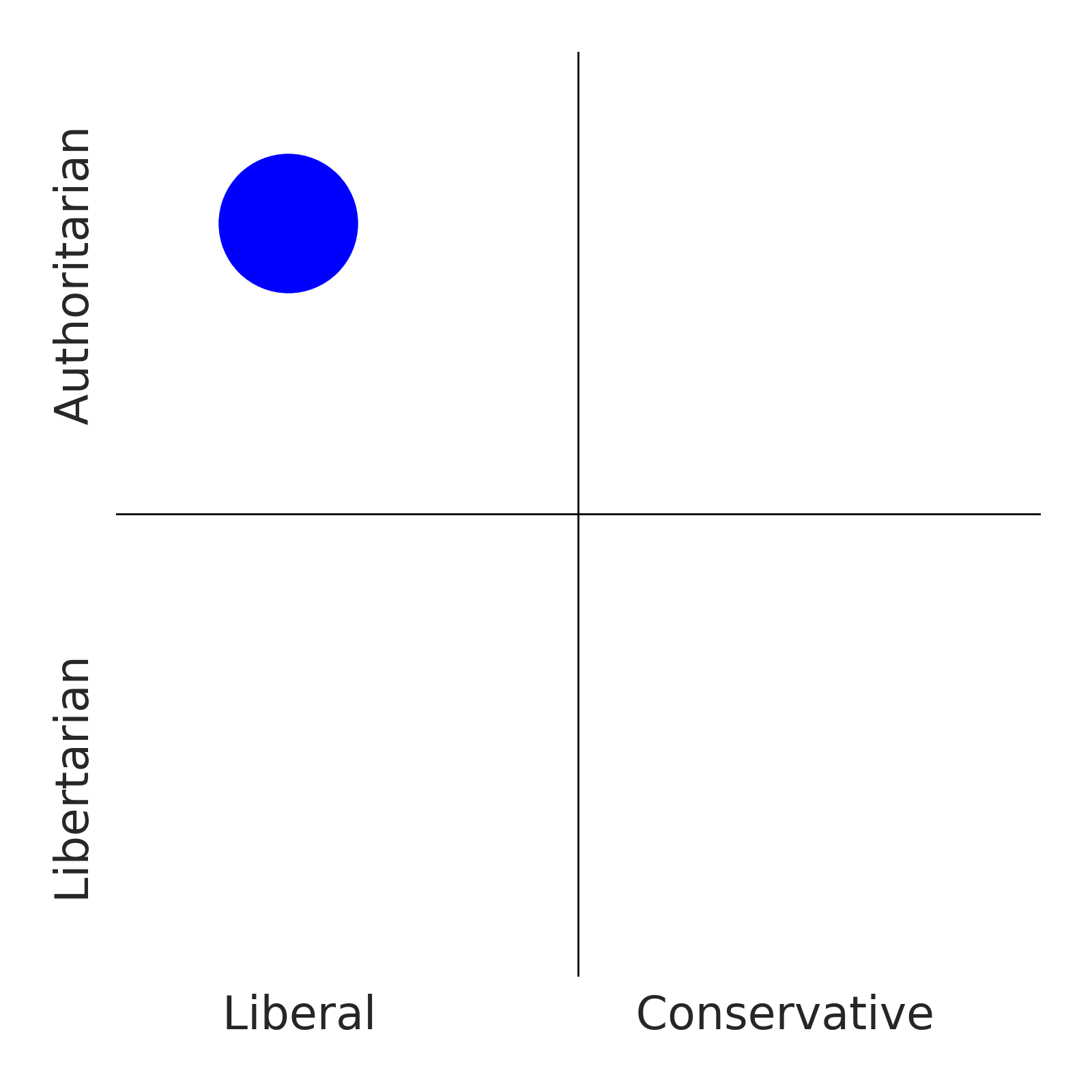
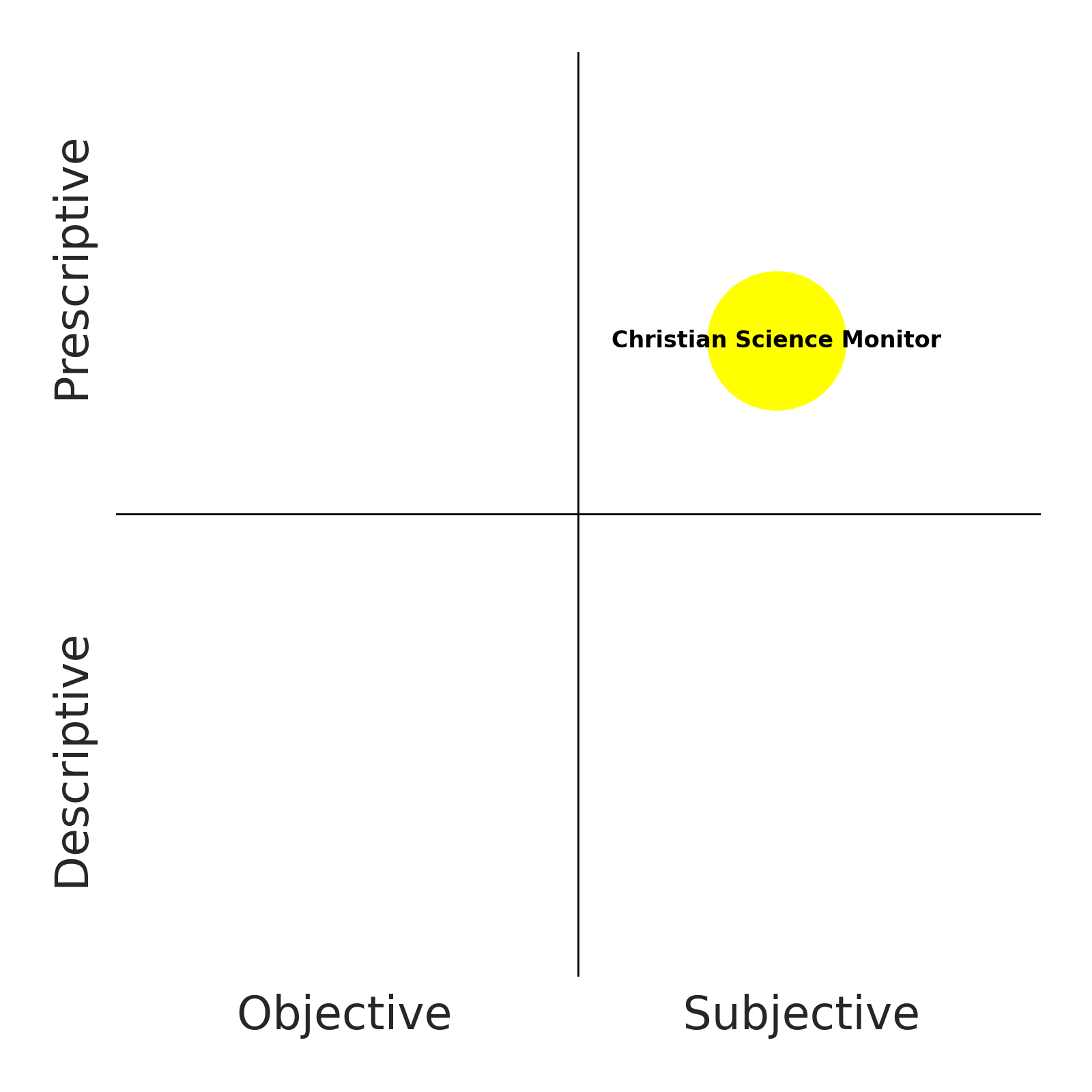
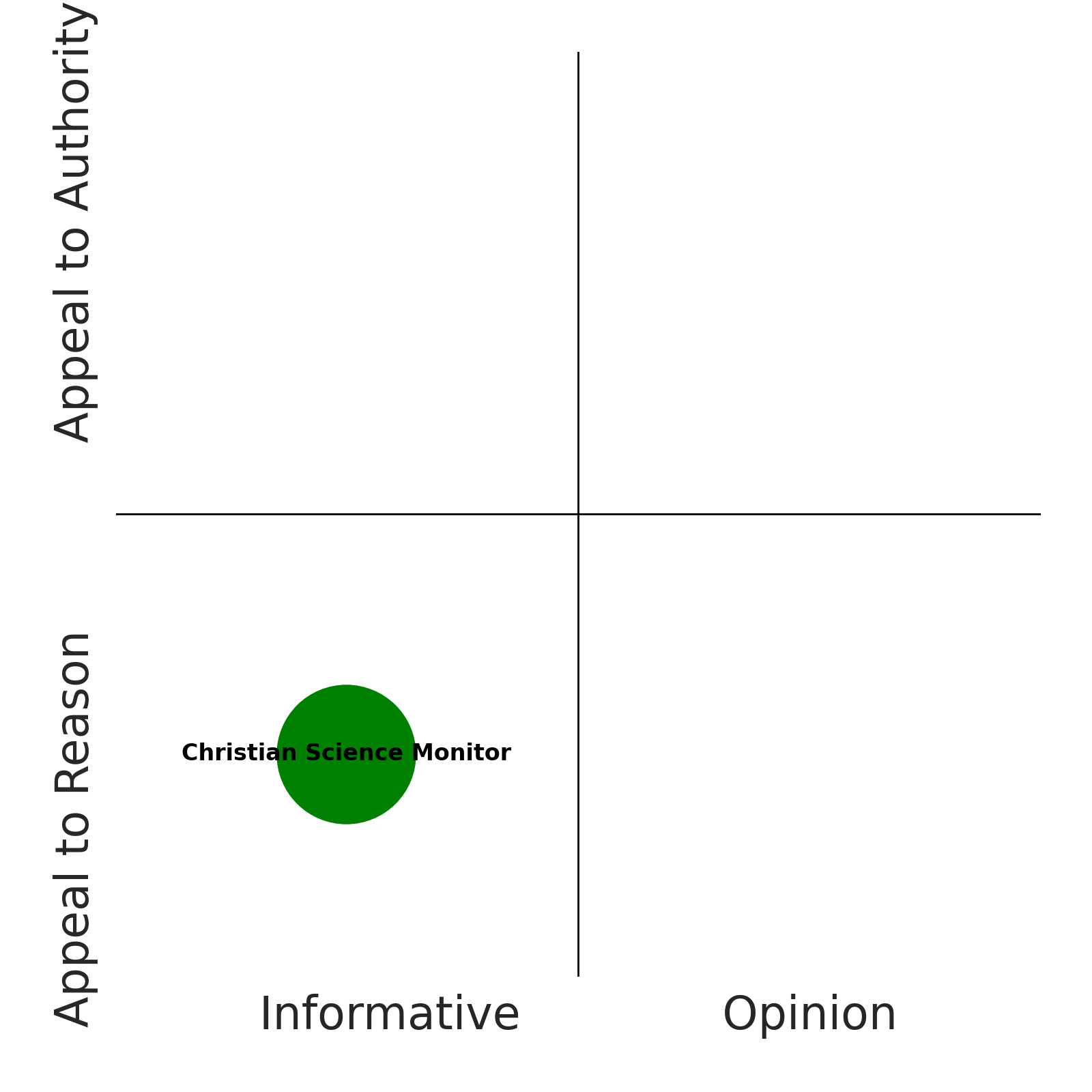
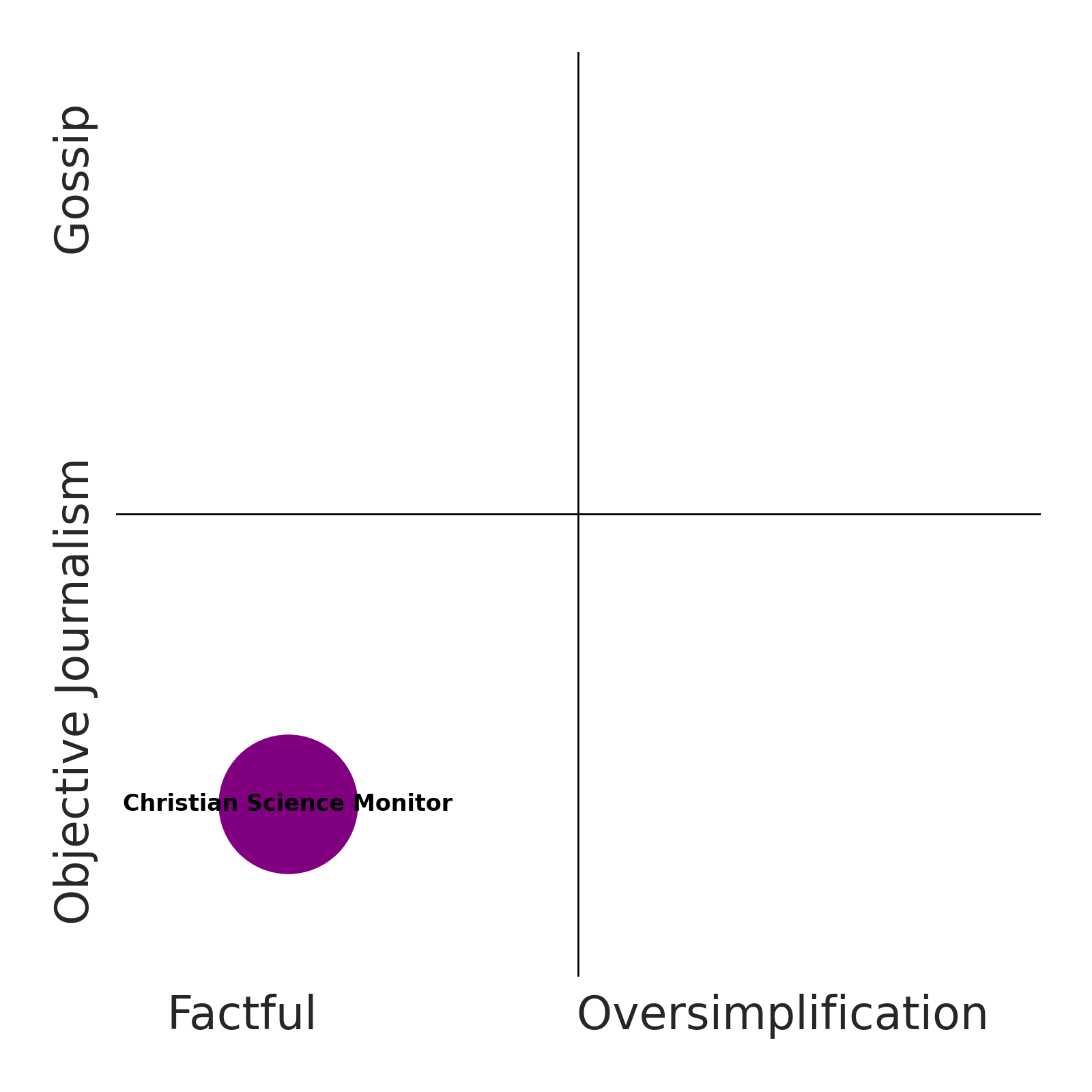
2026 © Helium Trades
Privacy Policy & Disclosure
* Disclaimer: Nothing on this website constitutes investment advice, performance data or any recommendation that any particular security, portfolio of securities, transaction or investment strategy is suitable for any specific person. Helium Trades is not responsible in any way for the accuracy
of any model predictions or price data. Any mention of a particular security and related prediction data is not a recommendation to buy or sell that security. Investments in securities involve the risk of loss. Past performance is no guarantee of future results. Helium Trades is not responsible for any of your investment decisions,
you should consult a financial expert before engaging in any transaction.
Helium Research Assistant

How can I help you today?
Ask any question about Christian Science Monitor bias.


