See whether Helium helps you make better-informed decisions. Try every Pro Trader feature for 30 days. No credit card required.
Try every Pro Trader feature for 30 days. No credit card required.
October 05, 2026 · 0 shares
A strongly opinionated, anti-corporate editorial uses emotive rhetorical questions to frame aviation authorities and manufacturers as repeat failures who treat passengers as guinea pigs.
Automated analysis; not human reviewed. Limitations: The supplied text is a single signed opinion column; underlying events could not be independently verified from the text alone. · 16 of 55 available dimensions scored; omitted dimensions are not treated as neutral. · Verified supporting quotes for 13 of 16 scored dimensions.
Claim: The article pits ordinary fliers and a heroic pilot against corporate and regulatory elites.
“Are fliers guinea pigs for aviation authorities?” · exact text match
“hate mongering, which is now afflicting the educated elite.” · exact text match
Why: It casts fliers as victims of authorities and blames the 'educated elite' for hate mongering, a populist framing.
Claim: The piece is openly presented as personal opinion and uses rhetorical, value-laden questions rather than neutral reporting.
“The views expressed are personal” · exact text match
“Are fliers guinea pigs for aviation authorities?” · exact text match
Why: The author labels it personal opinion and repeatedly poses emotive rhetorical questions, signaling subjectivity.
Claim: The writing uses alarmist, dramatic phrasing that heightens emotional response.
“For how long will we keep flying on a wing and a prayer?” · exact text match
“Are fliers guinea pigs for aviation authorities?” · exact text match
Why: These phrasings are dramatic and fear-oriented rather than measured.
Claim: The article portrays aviation safety as persistently failing with little reason for confidence.
“Every system or protocol fails to anticipate a possible breach.” · exact text match
“We mistake the calm between two tragedies as operational efficiency and peak professionalism.” · exact text match
Why: It states systemic failure and dismisses periods without crashes as false comfort.
Claim: The piece moves beyond description to demand new rules and global action.
“It’s clear that new, effective norms for fliers and pilots can’t be ignored any longer.” · exact text match
“We will also need to have a serious global discourse on hate mongering” · exact text match
Why: It explicitly prescribes norms and a global discourse.
Claim: The language is designed to make readers fear flying and distrust safety oversight.
“For how long will we keep flying on a wing and a prayer?” · exact text match
“Are fliers guinea pigs for aviation authorities?” · exact text match
Why: Rhetorical questions imply imminent, unaddressed danger.
Claim: The text is strongly opinionated, with personal judgments and advocacy throughout.
“The views expressed are personal” · exact text match
“Weren’t you left asking where did the protocols put in place after the 2015 incident vanish?” · exact text match
Why: The byline label and rhetorical advocacy make it clearly an opinion piece.
Claim: Complex investigations are reduced to a blanket claim about corporate behavior.
“Every multinational company from Boeing to Union Carbide has the same tendency.” · exact text match
Why: It generalizes across all multinationals from a single comparison, oversimplifying causation.
Claim: Passengers are framed as helpless victims of authorities' negligence.
“Are fliers guinea pigs for aviation authorities?” · exact text match
Why: The guinea pig metaphor depicts passengers as experimental subjects of a negligent system.
Claim: The article makes broad factual assertions without supporting evidence.
“Boeing conducts its own investigations and most often doesn’t find any fault in their product.” · not found in supplied text
Why: This is a sweeping, quantified claim ('most often') with no source or data.
Claim: It is critical of established aviation authorities, multinational manufacturers, and regulators.
“aviation authorities are beset by outdated thinking in the age of modern communications” · exact text match
“Every multinational company from Boeing to Union Carbide has the same tendency.” · exact text match
Why: It frames authorities and corporations as part of a failed establishment.
Claim: The tone carries a strong negative emotional charge.
“Are fliers guinea pigs for aviation authorities?” · exact text match
“terrible tragedy” · exact text match
Why: These phrases evoke anger and fear rather than neutral analysis.
Claim: Credibility is limited by broad unsourced generalizations and partially attributed allegations.
“Boeing conducts its own investigations and most often doesn’t find any fault in their product.” · not found in supplied text
“However, a US daily has claimed that the attacker’s name is Hamam Al-Hammami” · not found in supplied text
Why: Some claims are attributed, but core generalizations and warnings lack cited evidence.
Claim: The article is sharply anti-corporate, particularly toward Boeing.
“Every multinational company from Boeing to Union Carbide has the same tendency.” · exact text match
“Boeing conducted its own investigations and gave the plane a clean chit.” · exact text match
Why: It portrays multinationals as self-serving and treats Boeing's finding as suspect.
Claim: It speculates about the attacker's possible motives and connections.
“Whether he’s associated with a terror outfit isn’t clear either.” · exact text match
“Is it a coincidence that Germanwings pilot Lubitz was also able to hide his depression...” · not found in supplied text
Why: It raises unconfirmed possibilities and invites inference from coincidence.
Claim: Loaded rhetorical questions steer the reader toward the author's conclusion.
“Are fliers guinea pigs for aviation authorities?” · exact text match
“Weren’t you left asking where did the protocols put in place after the 2015 incident vanish?” · exact text match
Why: These are leading questions that presuppose negligence and guilt.
The supplied text is a single signed opinion column; underlying events could not be independently verified from the text alone.
September 29, 2026 · 0 shares
A consumer-protection advocate presents IRDAI’s proposed insurance-sales overhaul as a long-overdue vindication and casts expected industry lobbying as the main threat to reform.
Automated analysis; not human reviewed. Limitations: I analyzed only the supplied opinion text; its statistics and characterizations were not independently verifiable, and the author's disclosed IRDAI advisory role may affect perspective. · 11 of 55 available dimensions scored; omitted dimensions are not treated as neutral. · Verified supporting quotes for 11 of 11 scored dimensions.
Claim: Frames the insurance-reform fight as ordinary policyholders versus an entrenched industry and its lobbyists.
“the distress of the policyholders, who have been cheated for so long and on whose premium rupee the whole industry parties, seems to have been forgotten.” · exact text match
“profits are built on the tears and curses of policyholders” · exact text match
Why: The contrast between forgotten policyholders and a partying industry is a people-vs-power framing.
Claim: Endorses government-imposed cost and commission caps and a hard state response to industry threats.
“IRDAI proposes to reintroduce commission caps.” · exact text match
“The government can tell the industry that there is enough money to backstop any firm failure, but the firm or its group companies should forget about operating in India’s financial services sector after that.” · exact text match
Why: The argument favors state control of insurance pricing and distribution over market freedom.
Claim: Subjective personal reactions and moral judgments dominate the text.
“The views expressed are personal” · exact text match
“All I have attempted to do over the years is to ask the insurance regulator and industry that the cheating of consumers should stop.” · exact text match
Why: Explicitly labeled personal views, with first-person advocacy.
Claim: Emotionally charged and hyperbolically negative language is used for industry conduct.
“the industry has gone wild with distributor payouts” · exact text match
“profits are built on the tears and curses of policyholders” · exact text match
Why: 'gone wild' and 'tears and curses' are dramatic, emotive characterizations.
Claim: Optimistic about the reform itself despite concern about lobbying.
“If implemented, this will be the beginning of deep reform in India’s insurance sector, while keeping the consumer in mind.” · exact text match
Why: Presents the consultation paper as a reform breakthrough, offset by warnings about lobbying.
Claim: Mostly prescriptive about what regulators and government should do.
“Anything longer than a six-month glide path is a green signal for the industry to keep costs high.” · exact text match
“The government can tell the industry that there is enough money to backstop any firm failure, but the firm or its group companies should forget about operating in India’s financial services sector after that.” · exact text match
Why: Directs the regulator and government to specific actions and outcomes.
Claim: The text is an explicit opinion piece, not neutral news reporting.
“The views expressed are personal” · exact text match
“All I have attempted to do over the years is to ask the insurance regulator and industry that the cheating of consumers should stop.” · exact text match
Why: The piece is first-person advocacy and expressly labels its views as personal.
Claim: The piece centers on regulatory politics, lobbying, and government strategy.
“Lobbying against the proposed moves has begun.” · exact text match
“The ultimate trump card will be used: the argument that this will put policyholders at risk, thanks to the changes making business unsustainable.” · exact text match
Why: Focuses on lobbying and predicted industry pressure on the government.
Claim: Portrays policyholders primarily as long-term victims of industry cheating.
“the distress of the policyholders, who have been cheated for so long and on whose premium rupee the whole industry parties, seems to have been forgotten.” · exact text match
Why: The narrative emphasizes consumer victimhood and industry exploitation.
Claim: Uses strongly negative emotional language about insurers and sympathetic language about policyholders.
“the distress of the policyholders, who have been cheated for so long and on whose premium rupee the whole industry parties, seems to have been forgotten.” · exact text match
“profits are built on the tears and curses of policyholders” · exact text match
Why: Words like 'distress,' 'cheated,' 'tears,' and 'curses' give the piece a negative emotional charge.
Claim: Adopts an anti-insurance-industry stance.
“the industry has gone wild with distributor payouts” · exact text match
“profits are built on the tears and curses of policyholders” · exact text match
Why: Characterizes insurers as profiteering at the expense of policyholders.
I analyzed only the supplied opinion text; its statistics and characterizations were not independently verifiable, and the author's disclosed IRDAI advisory role may affect perspective.
September 26, 2026 · 0 shares
Framed as strategic-realist analysis, it downplays summit pomp as pageantry, stresses unresolved structural rivalry between Washington and Beijing, and prescribes Indian self-reliance.
The Thucydides trap is the idea that a rising power's challenge to an established power often leads to war; the Quad is the US-India-Japan-Australia strategic grouping.
Automated analysis; not human reviewed. Limitations: The supplied text is an opinion column with an Indian strategic perspective, so closed-door conversations and future-summit expectations are unverifiable from the text. · 12 of 55 available dimensions scored; omitted dimensions are not treated as neutral. · Verified supporting quotes for 9 of 12 scored dimensions.
Claim: The piece openly presents personal interpretation and normative judgment rather than neutral reporting.
“The views expressed are personal” · exact text match
“For India, the ledger tilts toward loss.” · exact text match
Why: An explicit personal-views label plus evaluative language makes the subjective stance observable.
Claim: The tone is sober and analytical, avoiding dramatic or alarmist language.
“For all their sound and colour, summits do not often yield practical results.” · exact text match
Why: The opening generalization undercuts spectacle rather than amplifying it.
Claim: The overall assessment leans pessimistic about resolving US-China differences.
“The trust deficit and structural issues between them —Taiwan, technology, trade, critical minerals, AI, and Iran—will not go away.” · not found in supplied text
Counterevidence:
“we should not discount the value of the face-to-face meetings between the two presidents.” · exact text match
Why: The dominant conclusion emphasizes durable friction, though the piece also credits face-to-face diplomacy.
Claim: The piece moves from analysis to explicit policy advice for India.
“The sensible response for New Delhi is to stop waiting for Washington’s favour and to build leverage of its own.” · not found in supplied text
Why: It directly prescribes a course of action for Indian policy.
Claim: The piece favors diplomacy and summit contact over confrontation.
“we should not discount the value of the face-to-face meetings between the two presidents.” · exact text match
Why: It argues that even inconclusive summitry has value and proposes negotiated leverage rather than escalation.
Claim: The piece is explicitly an opinion column with the author's evaluative conclusions.
“The views expressed are personal” · exact text match
“For India, the ledger tilts toward loss.” · exact text match
Why: The author labels the views as personal and delivers subjective conclusions.
Claim: The analysis is centered on political-strategic motives and electoral timing.
“Trump wants this at least till the November midterm elections in the US.” · not found in supplied text
Why: It interprets summit behavior through domestic and geopolitical political incentives.
Claim: The piece supports claims with attributed quotes and hedged inferences.
“Trump is likely to have asked Xi to talk to the Iranians” · exact text match
“What the US posture was on Thursday is not yet known.” · exact text match
Why: Hedged language and explicit unknowns strengthen visible sourcing and epistemic caution.
Claim: The piece reaches a measured, evidence-linked conclusion rather than an emotional or dogmatic one.
“The Washington summit has managed the rivalry, it has not resolved it.” · exact text match
Why: The conclusion follows from listed unresolved structural issues, showing reasoned synthesis.
Claim: The piece engages in moderate speculation about private talks and future meetings.
“Trump is likely to have asked Xi to talk to the Iranians” · exact text match
“we are likely to see yet another in November at the Asia Pacific Economic Cooperation (Apec) summit in Shenzhen, China.” · exact text match
Why: It uses likelihood phrasing for unobserved conversations and anticipated events.
Claim: The piece discloses uncertainty and labels its own content as personal opinion.
“What the US posture was on Thursday is not yet known.” · exact text match
“The views expressed are personal” · exact text match
Why: It flags unknowns and avoids presenting speculation as established fact.
Claim: The piece shows nuanced synthesis of multiple strategic dimensions.
“The Washington summit has managed the rivalry, it has not resolved it.” · exact text match
Why: The one-line conclusion integrates trade, security, and diplomatic theater into a coherent assessment.
The supplied text is an opinion column with an Indian strategic perspective, so closed-door conversations and future-summit expectations are unverifiable from the text.
October 08, 2026 · 0 shares
The article adopts a technocratic, pro-establishment framing that presents data-driven 'Government 4.0' governance as the key to electoral success and national progress, with no dissenting or critical voices.
India is described as the world's largest democracy; the author is president of IFMR and co-founder of Krea University, stating the views are personal. The column is the first in a series.
Automated analysis; not human reviewed. Limitations: The article is an opinion column with no external sourcing or counterarguments, so bias dimension scoring is based solely on the author's framing and evidence provided within the text. · 54 of 55 available dimensions scored; omitted dimensions are not treated as neutral. · Verified supporting quotes for 22 of 54 scored dimensions.
Claim: The article frames governance solutions around institutional capacity building led by experts and state governments rather than direct populist mobilization.
“The answer lies in building independent development and governance institutes that will work alongside state governments, academia, and think tanks to build capacity for Government 4.0.” · exact text match
Why: The proposed remedy relies on elite institutional capacity and expert-led data systems rather than grassroots or populist mechanisms.
Claim: The article avoids sensational language and presents claims in a calm, analytic tone.
“They are optimistic and not afraid to seek change. They are discerning enough to hold the government accountable for performance, dealing out electoral outcomes as carrots or sticks.” · exact text match
Why: The prose is measured and explanatory, lacking emotional or sensational escalation.
Claim: The article expresses strong optimism about India's governance trajectory and young voters.
“India remains one of the most authentic democracies in the world” · exact text match
“They are optimistic and not afraid to seek change.” · exact text match
Why: Repeated assertions of optimism and progress support an optimistic framing.
Claim: The article is heavily prescriptive, advocating specific institutional investments and governance reforms.
“We need to build on this further, and create institutional capacity that can leverage data-driven, research-led, evidence-based, and AI-enabled governance to deliver measurable outcomes.” · exact text match
“Building State capacity for Government 4.0 is a critical success factor for effective governance today — one that we would do well to invest in.” · exact text match
Why: The piece repeatedly recommends actions and investments, indicating a prescriptive rather than purely descriptive stance.
Claim: The article is an opinion column presenting the author's views rather than neutral reporting.
“The views expressed are personal” · exact text match
Why: Explicit self-identification as personal views makes opinion bias clear.
Claim: The article is centered on political governance, elections, and state capacity, making it highly political.
“Good governance can earn good electoral outcomes.” · exact text match
Why: The core subject is political processes and governance strategy.
Claim: The article offers a somewhat simplified causal link between data-driven governance and electoral success.
“good governance is good politics” · exact text match
Why: The mantra-like conclusion reduces complex electoral dynamics to a single formula.
Claim: The article leans on examples of chief ministers and state-led initiatives as authoritative models.
“The chief minister’s regular and rigorous review meetings are telecast live for citizens to watch, setting a benchmark for transparent governance.” · exact text match
Why: The argument gains weight by citing specific high-level government practices as benchmarks.
Claim: The article's core claim that good governance leads to good politics is asserted rather than demonstrated, with the mantra serving as both premise and conclusion.
“good governance is good politics” · exact text match
Why: The conclusion is stated as a self-evident mantra, weakly supported by the article's own evidence.
Claim: The article uses confident, unhedged language about future governance outcomes.
“That is the mantra that can get us to Government 4.0.” · exact text match
Why: Assertions of what 'can get us' there are stated with high certainty despite forecasting uncertainty.
Claim: The article promotes a technocratic developmentalist ideology as the solution to governance challenges.
“This is Government 4.0.” · exact text match
Why: The framing elevates a specific technocratic vision into an ideological program.
Claim: The article is strongly pro-establishment, framing government institutions and leaders positively and advocating for state capacity expansion.
“Our states are led by governments hungry for long-term growth and driven to deliver it.” · exact text match
“This is the shared responsibility of our elected leaders, government officers, and citizens.” · exact text match
Why: The framing consistently supports existing government structures and calls for strengthening them.
Claim: The overall emotional tone is positive and hopeful regarding India's democratic and governance future.
“They are optimistic and not afraid to seek change.” · exact text match
Why: The article's emotional register is upbeat and forward-looking.
Claim: The article offers some concrete examples but lacks sourcing, data citations, or counterarguments, limiting its credibility as an evidence-based piece.
“In our work connecting research with policy, we often come across interesting pilots.” · exact text match
Why: The author references personal experience without external verification or cited data, which moderates credibility.
Claim: The article mostly uses logical, evidence-oriented reasoning about governance and voter behavior.
“Technology has super-charged our ability to collect data and use rigorous research methods to arrive at new evidence to inform policy design and implementation.” · exact text match
Why: The argument is structured around data, research methods, and measurable outcomes, indicating generally rational framing.
Claim: The article is strongly oriented toward data, research, and evidence-based methods.
“rigorous research methods to arrive at new evidence to inform policy design and implementation” · exact text match
Why: Emphasis on empirical methods and AI-enabled governance indicates a scientific orientation.
Claim: The article forecasts future governance developments and electoral behavior with limited present evidence.
“will not be the same five years from now” · exact text match
Why: There are forward-looking claims that rely on projection rather than established fact.
Claim: The article uses a mantra-style slogan to frame its conclusion.
“That is the mantra that can get us to Government 4.0.” · exact text match
Why: Sloganeering can be a mild framing device, but it is not clearly manipulative.
Claim: The article appears human-written based on personal references and authored attribution.
“Kapil Viswanathan is president, IFMR, and co-founder, Krea University.” · exact text match
Why: Named author with specific institutional affiliations and anecdotal references suggest human authorship.
Claim: The article presents itself as fair and transparent by noting the views are personal and acknowledging historical factors beyond governance.
“The views expressed are personal” · exact text match
“other factors have historically affected electoral outcomes and influenced the incentives of leaders.” · exact text match
Why: Disclosure of personal views and acknowledgment of complexity suggest moderate integrity signals.
Claim: The article demonstrates above-average intelligence through structured argument and specific policy examples.
“Andhra Pradesh has created a dedicated website to track 651 key performance indicators (KPIs) across government departments.” · exact text match
Why: Use of concrete data and institutional analysis indicates intelligent exposition.
Claim: The article signals virtue by praising transparency, youth optimism, and accountability without critical scrutiny.
“They are discerning enough to hold the government accountable for performance” · exact text match
“setting a benchmark for transparent governance” · exact text match
Why: Positive value-laden descriptions of voters and governance practices suggest some virtue signaling.
The article is an opinion column with no external sourcing or counterarguments, so bias dimension scoring is based solely on the author's framing and evidence provided within the text.
October 14, 2026 · 0 shares
A sitting union minister's op-ed celebrates the ruling government's welfare schemes through curated success stories and official statistics, framing a decade of policy as a national transformation from welfare to empowerment.
Viksit Bharat refers to the government's goal of developed-nation status by 2047, the centenary of India's independence; 'Viksit' and 'Sashakt' are Hindi for developed and empowered.
Automated analysis; not human reviewed. Limitations: The text is a minister's opinion column captured with scrape artifacts (empty list items and a dangling ' of it.' fragment), so the outlet's own framing is invisible and the official statistics cannot be independently verified from the text alone. · 23 of 55 available dimensions scored; omitted dimensions are not treated as neutral. · Verified supporting quotes for 23 of 23 scored dimensions.
Claim: The framing centers conservative-nationalist symbols and ruling-party ideology.
“Pandit Deendayal Upadhyaya called the idea antyodaya, the rise of the last person” · exact text match
“The land north of the ocean and south of the snowy mountains is called Bhārata” · exact text match
Why: Invoking the Jan Sangh ideologue and a Sanskrit civilizational verse within praise of the Modi government signals a right-of-center nationalist frame.
Claim: Ordinary citizens and the 'last person' are valorized against a paternalistic old elite.
“For decades, the poor were treated as recipients of doles, handed relief without choice or voice” · exact text match
Why: The prior development establishment is cast as having denied the poor agency, a people-versus-old-elite populist framing.
Claim: The text is a personally attributed opinion column advocating one side, not neutral reporting.
“The views expressed are personal” · exact text match
Why: Explicit personal-views disclosure plus pervasive evaluative praise make the framing subjective.
Claim: The economic narrative is strongly bullish.
“the economy has more than tripled since 2013-14” · exact text match
“the IMF still counts India as the fastest-growing major economy” · exact text match
Why: Growth is framed as unprecedented and accelerating toward a 'quantum leap,' a decisively bullish stance.
Claim: The outlook is strongly optimistic with no noted risks.
“India’s defining moment is now. This is the period in the history of India when the country is going to take a quantum leap.” · exact text match
Why: The author endorses a future of assured national ascendance; no downside, risk, or failure is acknowledged anywhere.
Claim: Concrete human-interest anecdotes make the advocacy engaging.
“She sold seven of them to build a toilet at home.” · exact text match
Why: Vivid personal stories (a centenarian goat-seller, a vegetable seller's credit ladder) lift the policy praise above dry recitation.
Claim: The column prescribes a national mission and citizen duties toward 2047.
“He has called the years to 2047 “Kartavya Kaal”, an age of duty.” · exact text match
Why: Beyond describing outcomes, citizens are assigned goals and duties, with 'Viksit Bharat' given as their 'single compass'.
Claim: The conclusion is reinforced by defining success in the framework's own terms.
“That is nation building in the truest sense.” · exact text match
Why: Welfare-to-empowerment-to-participation is presupposed as the true measure of nation-building rather than independently argued.
Claim: The content is explicitly opinion and advocacy rather than factual reporting.
“The views expressed are personal” · exact text match
Why: A named partisan author delivers sustained evaluative praise and political argument throughout.
Claim: The piece is thoroughly political, built around a sitting prime minister and ruling-party slogans.
“He added sabka prayas to sabka saath, sabka vikas, sabka vishwas” · exact text match
Why: Party slogans, repeated leader praise, and the seat-reservation law frame the entire argument politically.
Claim: Complex development outcomes are compressed into a single ladder narrative credited to the schemes.
“Together, they form a ladder: from security to capability, from capability to opportunity, from opportunity to self-reliance, and, finally, to participation.” · exact text match
Why: A uniform stepwise model is imposed on diverse socioeconomic changes with no confounders, caveats, or alternative mechanisms.
Claim: Authority figures and institutions are invoked to legitimize the argument.
“Daron Acemoglu and James Robinson, who won the 2024 Nobel prize in economics, showed that nations prosper when their institutions are inclusive.” · exact text match
Why: The Nobel credential is foregrounded to validate the inclusive-institutions analogy, alongside WHO, IMF, and national-icon citations.
Claim: Several sweeping claims assert certainty beyond the supplied evidence.
“The scale has no parallel in any democracy.” · exact text match
“₹50 lakh crore has gone straight into beneficiaries’ accounts” · exact text match
Why: Unqualified superlatives and aggregate totals are stated as settled fact without methodology, margin, or uncertainty.
Claim: A single governing ideology supplies the explanatory frame for all claimed outcomes.
“The resolve for a Viksit Bharat will be fulfilled only when development reaches the last person.” · exact text match
Why: The antyodaya/Viksit Bharat doctrine interprets every development figure, with no alternative worldview entertained.
Claim: The column is strongly pro-establishment, celebrating the incumbent government and prime minister.
“PM Modi has turned this philosophy into a method of government.” · exact text match
Why: The state and its leader are portrayed as uniquely effective and historically unparalleled.
Claim: The tone is consistently uplifting and inspirational.
“Swachh Bharat restored something no budget line can measure: dignity.” · exact text match
Why: Warm celebratory language about dignity, respect, and dreams dominates, with no negative valence.
Claim: Sourcing is visible but exclusively official and one-sided, limiting independent verifiability.
“NITI Aayog estimates that nearly 250 million Indians left multidimensional poverty in the decade to 2022-23” · exact text match
Why: Major figures rest on government or government-commissioned sources with no independent or critical checks, within a partisan advocacy context.
Claim: The argument leans on cited statistics and an explicit causal framework rather than pure rhetoric.
“NITI Aayog estimates that nearly 250 million Indians left multidimensional poverty in the decade to 2022-23” · exact text match
Why: Key claims are tied to named sources and a stepwise capability logic, indicating mildly rational presentation despite selectivity.
Claim: The column functions as promotional messaging for government programs the author helps run.
“RuPay Card is locally built but globally compatible.” · exact text match
Why: Slogan-like promotional claims about schemes, from the minister overseeing communications, read as advertorial.
Claim: Nation-building is framed as a collective national project.
“inclusive by design and collective by necessity” · exact text match
Why: The 1.4-billion collective and 'sabka prayas' framing tilt the piece collectivist despite individual-empowerment language.
Claim: Curated success anecdotes and total omission of counter-evidence shape a one-sided narrative.
“Four women, from the Andamans to the hills of Meghalaya, from a village in Chhattisgarh to a market in Manali, none lacking in aspiration” · exact text match
Why: Hand-picked exemplars substitute for systematic evidence, and no failure, criticism, or limitation of any scheme is acknowledged.
Claim: The column presents only government-favorable claims without any critical or contrary perspective.
“The scale has no parallel in any democracy.” · exact text match
Counterevidence:
“NITI Aayog estimates that nearly 250 million Indians left multidimensional poverty in the decade to 2022-23” · exact text match
Why: Sweeping superlatives over curated success stories weaken fairness signals, partly offset by transparent authorship and consistent source attribution.
Claim: The column is skillfully constructed, combining narrative, data, and social-science theory.
“Sherry Arnstein’s ladder of citizen participation rises from tokenism, where citizens are merely informed, to partnership, where they share power.” · exact text match
Why: Integration of participation theory, Nobel-cited research, and layered anecdotes shows above-average rhetorical craft.
The text is a minister's opinion column captured with scrape artifacts (empty list items and a dangling ' of it.' fragment), so the outlet's own framing is invisible and the official statistics cannot be independently verified from the text alone.
September 28, 2026 · 0 shares
Frames rape as systemic male and patriarchal violence and argues that the burden of prevention should shift from women to men, while treating official responses as inadequate.
The National Crime Records Bureau (NCRB) is India’s official agency for crime statistics; 'BJP' refers to the Bharatiya Janata Party. The December 2012 Delhi gangrape case is commonly known as the Nirbhaya case.
Automated analysis; not human reviewed. Limitations: The supplied text is excerpted with ellipses and bracketed summaries, so some connecting argument and quote context are missing; analysis is limited to visible text. · 8 of 55 available dimensions scored; omitted dimensions are not treated as neutral. · Verified supporting quotes for 8 of 8 scored dimensions.
Claim: The article advances a progressive feminist position critical of patriarchal and conservative social structures.
“Dismantling rape culture cannot be a piecemeal project. It cannot happen within the boundaries of patriarchy where women remain subordinate to fathers, husbands and sons and face backlash for challenging traditional roles by claiming space.” · exact text match
“These are boundaries supported by the patriarchal State.” · exact text match
Why: The framing treats traditional gender roles and state-supported patriarchy as root causes of rape, a standard progressive-feminist argument.
Claim: The text is a subjective opinion piece rather than an objective news report.
“It’s time to stop asking women to shrink their lives, their ambitions, their selves.” · exact text match
“Let women live.” · exact text match
Why: The article uses normative commands and persuasive rhetoric to advance a viewpoint.
Claim: The article has a pessimistic tone about current progress on sexual violence.
“Yet another gangrape in Delhi reminds us of the work that is yet to be done—and undone.” · exact text match
“violence against women, including sexual assault, remains a battle we keep circling back to.” · exact text match
Why: The framing emphasises that despite past progress, the same problem persists and remains unresolved.
Claim: The article is strongly prescriptive, telling readers what should be done.
“Let colleges require men to stay at home and take online classes.” · exact text match
“Let their presence in streets, parks and any public space be banned after sundown.” · exact text match
Why: The author explicitly prescribes a reversed restriction policy for men, making the piece a call to action.
Claim: The article evokes fear about women’s safety in public spaces.
“Every walk to the bus-stop, every visit to the park or market becomes a negotiation: Is there a safer route?” · exact text match
“Did you remember to share your location when getting into an Uber?” · exact text match
Why: The text uses anxious, fear-based questions to illustrate the constant threat women face.
Claim: The article explicitly engages with party politics and political figures.
“In several BJP-ruled states, anti-conversion laws make interfaith marriage virtually impossible.” · exact text match
“Prime Minister Narendra Modi talks of nari shakti and women-led development.” · exact text match
Why: The article ties the issue of sexual violence to party rule and political rhetoric.
Claim: The article is critical of the state and ruling-party policies.
“These are boundaries supported by the patriarchal State.” · exact text match
“In several BJP-ruled states, anti-conversion laws make interfaith marriage virtually impossible.” · exact text match
Why: The article criticises state policy and the governing party rather than simply reporting events.
Claim: The article uses emotionally charged, negative language.
“Yet another gangrape in Delhi reminds us of the work that is yet to be done—and undone.” · exact text match
“Delhi’s disgraceful title of rape capital of India remains intact” · exact text match
“gloats” · exact text match
Why: Words such as 'disgraceful' and 'gloats' carry strong negative emotional weight, matching the piece’s outrage.
The supplied text is excerpted with ellipses and bracketed summaries, so some connecting argument and quote context are missing; analysis is limited to visible text.
October 09, 2026 · 0 shares
The article frames India's land-title problem as a capital-constraint issue, favoring market-based property-rights reform and private due-diligence solutions over bureaucratic measures.
India operates a presumptive titling system where the State registers deeds rather than titles, meaning registration does not certify that the seller owned the property. Conclusive titling would make the State guarantee the register.
Automated analysis; not human reviewed. Limitations: The article is an opinion column, so its prescriptive pro-market framing may overstate the ease of implementing conclusive titling. · 55 of 55 available dimensions scored; omitted dimensions are not treated as neutral. · Verified supporting quotes for 10 of 55 scored dimensions.
Claim: The article leans slightly conservative by favoring private-sector land consolidation and market-based property reform.
“Much useful work on untangling titles is being done by private firms that buy and consolidate land.” · exact text match
Why: The framing elevates private enterprise as a solution to a public institutional failure, a conservative policy preference.
Claim: The article mostly reports verifiable data but includes subjective evaluative language.
“But anyone who has tried to purchase land knows that the ground reality is rather different.” · exact text match
Why: The phrase 'ground reality is rather different' mixes observation with subjective judgment.
Claim: The article contains explicitly labeled opinion and recommendations.
“Few investments could unlock capital and free enterprise in the country the way cleaning up land titles could.” · exact text match
Why: The final paragraph expresses the author's own prescription rather than neutral reporting.
Claim: The topic is policy-adjacent but the article avoids partisan politics.
“Rajasthan passed an urban titling law in 2016, and NITI Aayog circulated a model law in 2020, butfew states have moved on implementation.” · exact text match
Why: It discusses government policy without taking a partisan stance.
Claim: The article is generally credible, using named sources and acknowledging implementation difficulties.
“Done poorly, conclusive titling can create more problems than it solves.” · exact text match
Why: Acknowledging risks of the proposed solution increases credibility.
Claim: The article relies on documented data and logical economic reasoning rather than emotion or anecdote.
“A buyer still must trace the title back at least 30 years, obtain an encumbrance certificate covering the same period” · exact text match
Why: The reasoning proceeds from evidence and established economic theory rather than emotional appeals.
Claim: The article is modestly pro-corporate, highlighting private firms as effective problem-solvers.
“Bengaluru-based Agrocorp, which buys and develops farmland, says it has transacted more than 1,200 acres without a single case of litigation.” · exact text match
Why: The example presents a private company positively but without overt advocacy.
Claim: The prose shows some fluency but also human-style policy commentary and personal attribution.
“Ramanan Laxminarayan is president, One Health Trust. The views expressed are personal” · exact text match
Why: Byline and column style suggest human authorship; low AI-indicator confidence.
Claim: The article cites sources and data transparently.
“A 2016 survey of more than 9,000 litigants by the research group DAKSH found” · exact text match
Why: Attribution to specific research groups and government data indicates fair reporting.
Claim: The article demonstrates high analytical intelligence with data-driven arguments.
“The cost of litigation of all kinds is estimated at about half a percent of GDP each year.” · exact text match
Why: Quantitative economic framing and clear causal reasoning support high intelligence.
The article is an opinion column, so its prescriptive pro-market framing may overstate the ease of implementing conclusive titling.
October 05, 2026 · 0 shares
The authors frame digitalisation of power distribution as an operational necessity that India’s next public reform tranche should fund, using renewable-capacity gains to support a pro-reform case.
India's electricity distribution companies (discoms) are largely state-owned utilities; AT&C losses measure inefficiency, theft, and unpaid bills. RDSS is the central government's Revamped Distribution Sector Scheme.
Automated analysis; not human reviewed. Limitations: Only the supplied article text was analyzed; no publication metadata or independent fact-checking was available. · 8 of 55 available dimensions scored; omitted dimensions are not treated as neutral. · Verified supporting quotes for 8 of 8 scored dimensions.
Claim: The text blends data with subjective normative judgments.
“This is precisely where digitalisation becomes an operational necessity, to help utilities see their own network clearly enough to plan ahead of failure, rather than respond after it.” · exact text match
Why: The claim of operational necessity is a subjective judgment presented in an otherwise data-heavy argument.
Claim: The article is cautiously optimistic about India's energy transition and the payoff from digitalisation.
“India has demonstrated that it can build renewable capacity at scale. But capacity added upstream only translates into reliable, affordable power if the utilities carrying it can integrate and manage it.” · exact text match
Counterevidence:
“The harder, less settled task lies downstream: ensuring that generation, and increasingly, variable renewable output, actually reaches consumers as a reliable and affordable supply.” · exact text match
Why: It celebrates demonstrated capacity and frames the remaining problem as solvable, while acknowledging difficulty.
Claim: The piece is predominantly prescriptive, telling what the government and utilities should do.
“The next tranche should make the digital layer a condition: Each utility maps its network, publishes feeder-level loss and reliability data, and is funded against verified savings.” · exact text match
Why: Repeated 'should' instructions and a proposed condition for funding make the framing prescriptive.
Claim: The piece is an opinion/advocacy essay with a personal-views disclaimer.
“This is precisely where digitalisation becomes an operational necessity, to help utilities see their own network clearly enough to plan ahead of failure, rather than respond after it.” · exact text match
“The views expressed are personal” · exact text match
Why: Normative language and the explicit personal-views disclaimer mark the content as opinion.
Claim: The authors make a policy prescription on government funding and utility regulation.
“The next tranche should make the digital layer a condition: Each utility maps its network, publishes feeder-level loss and reliability data, and is funded against verified savings.” · exact text match
Why: The call for a specific government funding condition is a political-policy position, not neutral reporting.
Claim: The piece credits government schemes and asks for another tranche of public reform funding.
“These gains reflect Revamped Distribution Sector Scheme (RDSS)-sanctioned infrastructure work, including new and upgraded substations, distribution transformers, and feeder segregation, among others, alongside financial discipline such as timely subsidy payments and regular tariff orders.” · exact text match
“India has already committed over ₹3 lakh crore to distribution reform.” · verified after text normalization
Why: It praises a government programme and proposes expanding it, indicating a pro-establishment orientation.
Claim: The piece is moderately credible because it supplies concrete figures and named entities, though without external citations.
“national AT&C losses fell from 21.91% in FY21 to 15.04% in FY25” · exact text match
“With close to four million assets such as substations, feeders, transformers, and poles digitalised, the system now processes around 120 million records a day.” · exact text match
Why: Specific numbers and entities support credibility, but most claims are asserted without sourcing in the text.
Claim: The analysis is logical and evidence-driven, based on operational variables and quantifiable progress.
“The capacity-addition challenge, however demanding, is at least a known one. It responds fairly predictably to capital, land availability, and regulatory clearance, and India has by now built considerable institutional muscle in solving for exactly these variables.” · exact text match
Why: It reasons from stated variables and metrics rather than from emotional appeals.
Only the supplied article text was analyzed; no publication metadata or independent fact-checking was available.
September 29, 2026 · 0 shares
The framing is prescriptive and technocratic, treating renewable curtailment as a policy failure that better data, cost-allocation rules, market pricing, and grid investment can solve.
India's renewable buildout is tied to a national commitment to reach 500 GW of non-fossil electricity capacity by 2030; grid and transmission infrastructure has lagged behind generation additions, which is why temporary connection arrangements that receive first priority for curtailment exist.
Automated analysis; not human reviewed. Limitations: Analysis relies on a single commentary whose underlying statistics and cited reports could not be independently verified; applying Western political-axis labels to Indian energy-policy discourse also involves translation risk. · 19 of 55 available dimensions scored; omitted dimensions are not treated as neutral. · Verified supporting quotes for 15 of 19 scored dimensions.
Claim: The commentary leans mildly liberal by treating accelerating renewable expansion as an unambiguous success that the state should protect with new rules.
“India's renewable buildout is one of the clearest energy transition successes — solar alone has gone from 2.8GW in 2014 to over 160GW.” · verified after text normalization
“India, therefore, needs rules that make the costs of curtailment clear before investment decisions are made and project finance disbursed.” · exact text match
Why: Pro-renewable advocacy with calls for state rules and financial relief is liberal-coded, though concurrent praise for market pricing and criticism of price controls mix the signal.
Claim: The argument is technocratic, building its case on expert institutions, rating agencies, and academic research rather than popular interests.
“Yale economist Nicholas Ryan found each rupee invested in transmission returned 1.85 rupees in northern India and 2.74 rupees in southern India.” · exact text match
“According to credit rating agency ICRA, 37% of renewable capacity at affected substations operates through temporary access and can face curtailment of 30-50% during solar hours.” · exact text match
Why: Reform proposals are justified via economists, think tanks, and credit agencies, with no appeal to voters, consumers, or mass sentiment.
Claim: The commentary is mildly regulatory, demanding government rules and regulator-administered cost allocation rather than market-only solutions.
“India, therefore, needs rules that make the costs of curtailment clear before investment decisions are made and project finance disbursed.” · exact text match
“regulators should clarify how the cost of curtailment is to be absorbed between industry and the government.” · exact text match
Why: Solutions center on mandated disclosure, regulator-determined responsibility, and rules, indicating a governance-led rather than laissez-faire posture.
Claim: Framing is subjective, advancing explicit normative judgments within a signed commentary.
“Power from renewables should not be curtailed.” · exact text match
“India, therefore, needs rules that make the costs of curtailment clear before investment decisions are made and project finance disbursed.” · exact text match
Counterevidence:
“According to credit rating agency ICRA, 37% of renewable capacity at affected substations operates through temporary access and can face curtailment of 30-50% during solar hours.” · exact text match
Why: Normative claims ('should not', 'needs rules') drive the piece, though it anchors them in attributed data, making it evidence-informed opinion rather than pure assertion.
Claim: The body is sober and data-dense, but the subtitle injects a sensational, teleological frame.
“So why is India seeking to 'switch off the sun'?” · not found in supplied text
Counterevidence:
“not unambiguously bad; it can even be economical during brief periods of excess supply or congestion” · exact text match
Why: The rhetorical subtitle implies deliberate intent behind a technical grid-management practice, while the substantive analysis is measured and quantified rather than dramatized.
Claim: Mildly bearish on the financial outlook for renewable investment under current curtailment rules.
“Persistent curtailment results in foregone developer revenue and can weaken investment.” · not found in supplied text
“increasing worries about their ability to service debt” · exact text match
Why: Emphasis on revenue losses, debt-servicing anxiety, and undefined financial risk skews the financial outlook negative despite praise for past capacity growth.
Claim: The commentary is interesting because it pairs specific, non-obvious figures with named international case studies.
“Between April and June 2026, India curtailed 8,133 GW-hours of solar, over 10% of its potential output for that quarter.” · exact text match
“Yale economist Nicholas Ryan found each rupee invested in transmission returned 1.85 rupees in northern India and 2.74 rupees in southern India.” · exact text match
Why: Quantified stakes and concrete comparative examples give the topic specificity and analytic purchase beyond generic commentary.
Claim: Overwhelmingly prescriptive: the core of the commentary is a set of mandated policy reforms.
“India, therefore, needs rules that make the costs of curtailment clear before investment decisions are made and project finance disbursed. Three reforms can help.” · exact text match
“First, India should record curtailment by cause, location, and time of day.” · exact text match
Why: The structure is built around 'three reforms' and imperative wording ('should', 'needs'), making prescription the dominant mode.
Claim: Highly opinionated, with explicit value judgments and recommendations dominating the narrative.
“Power from renewables should not be curtailed.” · exact text match
“Three reforms can help.” · exact text match
Why: The piece makes normative statements and prescribes policy, characteristic of commentary rather than straight news.
Claim: Policy-political: the subject matter is government regulation, state lending, and regulatory design, though not partisan.
“The government is reportedly considering low-cost loans for such producers.” · exact text match
“regulators should clarify how the cost of curtailment is to be absorbed between industry and the government.” · exact text match
Why: Content centers on state decisions and regulatory responsibilities, placing it in the policy/political domain without party alignment.
Claim: Mild simplification via a three-part reform formula and a catchy 'switch off the sun' frame, though nuance is retained.
“Three reforms can help.” · exact text match
“So why is India seeking to 'switch off the sun'?” · not found in supplied text
Counterevidence:
“Australia's market differs from India's, but the example shows that system operators can disclose why and where renewable output is being curtailed.” · verified after text normalization
Why: A solutionist structure and rhetorical frame compress a complex grid-governance issue, but the analysis explicitly acknowledges cross-country differences and the legitimacy of some curtailment.
Claim: Relies substantially on named experts, rating agencies, and think tanks to establish the argument.
“According to credit rating agency ICRA, 37% of renewable capacity at affected substations operates through temporary access and can face curtailment of 30-50% during solar hours.” · exact text match
“Yale economist Nicholas Ryan found each rupee invested in transmission returned 1.85 rupees in northern India and 2.74 rupees in southern India.” · exact text match
Why: Key empirical claims are outsourced to institutional authorities rather than demonstrated with primary data, a visible reliance on authority.
Claim: A renewable-transition-plus-market-reform worldview is assumed rather than argued, constraining the range of considered options.
“India's renewable buildout is one of the clearest energy transition successes — solar alone has gone from 2.8GW in 2014 to over 160GW.” · verified after text normalization
“Better connections will become more valuable as surplus power generated in one part of India covers shortfalls in another.” · exact text match
Why: The desirability of rapid renewable expansion and market-based coordination is presupposed; alternatives such as slowing buildout or accepting curtailment as a market signal are only gestured at.
Claim: Pro-establishment in orientation, working within mainstream expert and policy consensus to improve the existing framework.
“The Institute for Energy Economics and Financial Analysis, similarly, has called for market coupling and more flexible contracts” · exact text match
“Public-sector banks and financial institutions have deployed about ₹5.08 lakh crore in renewables” · verified after text normalization
Why: Criticism of government rules is constructive and anchored to institutional players and think-tank proposals, reinforcing rather than challenging the prevailing policy framework.
Claim: Credible on its face: named sources, attributed figures, and explicit uncertainty qualifiers.
“According to credit rating agency ICRA, 37% of renewable capacity at affected substations operates through temporary access and can face curtailment of 30-50% during solar hours.” · exact text match
“The government is reportedly considering low-cost loans for such producers.” · exact text match
Why: Quantitative claims are attributed to identifiable institutions and uncertain items are flagged with 'reportedly' and 'estimate', supporting the trustworthiness of the presentation.
Claim: Reasoning is chiefly balanced and qualification-aware, conceding the opposing view before arguing against persistent curtailment.
“not unambiguously bad; it can even be economical during brief periods of excess supply or congestion” · exact text match
“Persistent curtailment results in foregone developer revenue and can weaken investment.” · not found in supplied text
Why: The piece explicitly acknowledges that curtailment is sometimes efficient, then weighs countervailing harms—a rational evidence-weighing structure despite a rhetorical headline.
Claim: Includes forward-looking estimates and conditional forecasts attributed to third parties.
“It estimates that 3-4 gigawatts of two-hour storage at major pooling stations could absorb most curtailment caused by transmission constraints.” · exact text match
“The country's renewables association estimates that battery storage mitigated curtailment in 2025 by roughly 2 terawatt-hours.” · verified after text normalization
Why: Projected storage impacts and claimed mitigation outcomes rest on attributed estimates rather than observed final data.
Claim: High internal integrity: claims are attributed, uncertainty is flagged, and the opinionated nature of the commentary is disclosed.
“The government is reportedly considering low-cost loans for such producers.” · exact text match
“The views expressed are personal” · exact text match
Why: Hedging words ('reportedly', 'estimate', 'experts argue') and an explicit personal-opinion label signal transparency about evidence limits.
Claim: The analysis is structurally sophisticated, weighing trade-offs and using comparative evidence.
“Growing renewables curtailment is not unique to India, and not unambiguously bad; it can even be economical during brief periods of excess supply or congestion.” · exact text match
“Australia's market differs from India's, but the example shows that system operators can disclose why and where renewable output is being curtailed.” · verified after text normalization
Why: It acknowledges counterarguments and the limits of cross-country analogy while structuring a multi-part argument with quantified support.
Analysis relies on a single commentary whose underlying statistics and cited reports could not be independently verified; applying Western political-axis labels to Indian energy-policy discourse also involves translation risk.
October 21, 2026 · 0 shares
Frames a major infrastructure grant primarily through the lens of systemic administrative failures and necessary governance reform.
Automated analysis; not human reviewed. · 12 of 55 available dimensions scored; omitted dimensions are not treated as neutral. · Verified supporting quotes for 0 of 12 scored dimensions.
October 21, 2026 · 0 shares
Advocacy for large-scale, technologically driven, state-coordinated national development in the agricultural sector.
Automated analysis; not human reviewed. · 54 of 55 available dimensions scored; omitted dimensions are not treated as neutral. · Verified supporting quotes for 0 of 54 scored dimensions.
October 22, 2026 · 0 shares
Frames the UN secretary-general selection as a P5-imposed humiliation of Latin America and women, then prescribes a UNGA takeover of the process.
Automated analysis; not human reviewed. Limitations: Opinion column with explicit author advocacy; the two vetoing P-5 members are not identified, and the excerpt may omit other candidate details. · 15 of 55 available dimensions scored; omitted dimensions are not treated as neutral. · Verified supporting quotes for 15 of 15 scored dimensions.
Claim: The column mildly leans liberal through its emphasis on gender representation and criticism of great-power blockage.
“The UN has never had a woman secretary-general, and this time, the nomination of women candidates was expressly encouraged.” · exact text match
Why: The gender-representation emphasis and criticism of the vetoed women candidates suggest a mild liberal framing, though the topic is not clearly partisan.
Claim: Publisher favors expanding UNGA control over the P5-dominated Security Council.
“moving selection of the secretary-general from the influence of the P-5-dominated UNSC to the control of the globally representative UNGA.” · exact text match
Why: The wording contrasts a globally representative body with a small elite body and advocates the former, supporting an anti-elite/populist score.
Claim: The column is heavily subjective, using evaluative language about humiliation and disruption.
“This has not only stymied the UN system but also humiliated Latin America and all women across the world.” · exact text match
Why: The quote is a strong evaluative judgment rather than a neutral report, supporting a high subjective score.
Claim: The framing uses dramatic, personalized language about two capitals disrupting the race.
“two men in two capitals decided to disrupt what could otherwise have been a smooth ascension” · exact text match
Why: The personalized and dramatic phrasing supports a sensational framing score above neutral.
Claim: The column is strongly prescriptive, urging a specific reform of the selection process.
“The present deadlock should trigger a strong call for reforming the UN process and system” · exact text match
Why: The quote directly recommends action, supporting a high prescriptive score.
Claim: The column is highly opinionated, advancing a clear reform agenda.
“The present deadlock should trigger a strong call for reforming the UN process and system” · exact text match
Why: The explicit call to action is opinionated advocacy rather than neutral reporting.
Claim: The selection dispute is framed in political-institutional terms with a reform prescription.
“UNGA can adopt a resolution with a simple majority, and, irrespective of how the P-5 vote, request the nomination of more than one candidate for the post.” · exact text match
Why: The proposal concerns institutional power and political procedure, supporting a high political-bias score.
Claim: The column frames Latin America and women as collectively humiliated by the vetoes.
“humiliated Latin America and all women across the world” · exact text match
Why: The collective-victim framing supports a moderate victimization score.
Claim: The publisher frames the P5/UNSC procedure as an entrenched establishment dysfunction needing reform.
“exposing P5 dominance” · exact text match
Why: Criticism of P5 dominance and calls to shift power to the UNGA support an anti-establishment framing.
Claim: The column uses strongly negative emotional language toward the vetoes and P5 actors.
“humiliated Latin America and all women across the world” · exact text match
Why: The language of humiliation conveys a clearly negative emotional valence.
Claim: Credible procedural detail and explicit uncertainty coexist with advocacy and unnamed-vetoer speculation.
“Technically, we don’t know which two of the P-5 derailed both women’s candidatures” · exact text match
Why: The acknowledgment of uncertainty and detailed process description support moderate credibility despite opinion framing.
Claim: The analysis mostly uses procedural and historical reasoning but includes a speculative inference about unidentified vetoers.
“Technically, we don’t know which two of the P-5 derailed both women’s candidatures” · exact text match
Why: The explicit acknowledgment of uncertainty supports a rational overall classification, though loaded speculation elsewhere tempers it.
Claim: The column speculates about the identity of the vetoing states despite acknowledging secrecy.
“it is easy to guess who” · exact text match
Why: The quote explicitly invites inference about undisclosed actors, supporting a speculative score.
Claim: The column acknowledges uncertainty and labels the views as personal, supporting moderate integrity.
“The views expressed are personal” · exact text match
Why: Explicitly identifying the piece as personal opinion and acknowledging missing vetoer identities are fairness signals.
Claim: The column uses historical and procedural detail, including Resolution 11 analysis, to support its argument.
“The language of Resolution 11 clearly recommends applying this to the “first appointment”.” · exact text match
Why: The legal-historical analysis supports an above-average intelligence score.
Opinion column with explicit author advocacy; the two vetoing P-5 members are not identified, and the excerpt may omit other candidate details.
September 26, 2026 · 0 shares
Framed as strategic-realist analysis, it downplays summit pomp as pageantry, stresses unresolved structural rivalry between Washington and Beijing, and prescribes Indian self-reliance.
The Thucydides trap is the idea that a rising power's challenge to an established power often leads to war; the Quad is the US-India-Japan-Australia strategic grouping.
Automated analysis; not human reviewed. Limitations: The supplied text is an opinion column with an Indian strategic perspective, so closed-door conversations and future-summit expectations are unverifiable from the text. · 12 of 55 available dimensions scored; omitted dimensions are not treated as neutral. · Verified supporting quotes for 9 of 12 scored dimensions.
Claim: The piece openly presents personal interpretation and normative judgment rather than neutral reporting.
“The views expressed are personal” · exact text match
“For India, the ledger tilts toward loss.” · exact text match
Why: An explicit personal-views label plus evaluative language makes the subjective stance observable.
Claim: The tone is sober and analytical, avoiding dramatic or alarmist language.
“For all their sound and colour, summits do not often yield practical results.” · exact text match
Why: The opening generalization undercuts spectacle rather than amplifying it.
Claim: The overall assessment leans pessimistic about resolving US-China differences.
“The trust deficit and structural issues between them —Taiwan, technology, trade, critical minerals, AI, and Iran—will not go away.” · not found in supplied text
Counterevidence:
“we should not discount the value of the face-to-face meetings between the two presidents.” · exact text match
Why: The dominant conclusion emphasizes durable friction, though the piece also credits face-to-face diplomacy.
Claim: The piece moves from analysis to explicit policy advice for India.
“The sensible response for New Delhi is to stop waiting for Washington’s favour and to build leverage of its own.” · not found in supplied text
Why: It directly prescribes a course of action for Indian policy.
Claim: The piece favors diplomacy and summit contact over confrontation.
“we should not discount the value of the face-to-face meetings between the two presidents.” · exact text match
Why: It argues that even inconclusive summitry has value and proposes negotiated leverage rather than escalation.
Claim: The piece is explicitly an opinion column with the author's evaluative conclusions.
“The views expressed are personal” · exact text match
“For India, the ledger tilts toward loss.” · exact text match
Why: The author labels the views as personal and delivers subjective conclusions.
Claim: The analysis is centered on political-strategic motives and electoral timing.
“Trump wants this at least till the November midterm elections in the US.” · not found in supplied text
Why: It interprets summit behavior through domestic and geopolitical political incentives.
Claim: The piece supports claims with attributed quotes and hedged inferences.
“Trump is likely to have asked Xi to talk to the Iranians” · exact text match
“What the US posture was on Thursday is not yet known.” · exact text match
Why: Hedged language and explicit unknowns strengthen visible sourcing and epistemic caution.
Claim: The piece reaches a measured, evidence-linked conclusion rather than an emotional or dogmatic one.
“The Washington summit has managed the rivalry, it has not resolved it.” · exact text match
Why: The conclusion follows from listed unresolved structural issues, showing reasoned synthesis.
Claim: The piece engages in moderate speculation about private talks and future meetings.
“Trump is likely to have asked Xi to talk to the Iranians” · exact text match
“we are likely to see yet another in November at the Asia Pacific Economic Cooperation (Apec) summit in Shenzhen, China.” · exact text match
Why: It uses likelihood phrasing for unobserved conversations and anticipated events.
Claim: The piece discloses uncertainty and labels its own content as personal opinion.
“What the US posture was on Thursday is not yet known.” · exact text match
“The views expressed are personal” · exact text match
Why: It flags unknowns and avoids presenting speculation as established fact.
Claim: The piece shows nuanced synthesis of multiple strategic dimensions.
“The Washington summit has managed the rivalry, it has not resolved it.” · exact text match
Why: The one-line conclusion integrates trade, security, and diplomatic theater into a coherent assessment.
The supplied text is an opinion column with an Indian strategic perspective, so closed-door conversations and future-summit expectations are unverifiable from the text.
October 08, 2026 · 0 shares
The article adopts an adversarial, strategic framing that treats US trade and sanctions actions as coercive 'transgressions' and urges India to weaponize asymmetric leverage against US commercial and defence interests.
Trump 2.0 refers to the second Trump administration; the article cites recent friction including the killing of Indian seafarers and AI access disputes alongside tariff fluctuations. The authors write for the Takshashila Institution and state their views are personal.
Automated analysis; not human reviewed. Limitations: Bias scores for foreign-policy dimensions rest on limited evidence in a single opinion piece; the partisan lean and some trait estimates are low-magnitude and could vary with broader outlet context not supplied. · 55 of 55 available dimensions scored; omitted dimensions are not treated as neutral. · Verified supporting quotes for 47 of 55 scored dimensions.
Claim: The framing is mildly non-conservative, treating a Republican administration's trade and sanctions posture as 'maximalist and mercantilist' coercion.
“the Trump administration’s maximalist and mercantilist orientation” · exact text match
Why: Negative framing of a Republican administration's trade policy leans slightly against a conservative alignment.
Claim: The article presents author-selected policy prescriptions framed as options, tilting toward subjectivity.
“We suggest some options here for New Delhi’s consideration.” · exact text match
Why: Direct recommendation of preferred measures indicates a subjective, advice-oriented stance.
Claim: The piece explicitly recommends actions for India, making it strongly prescriptive rather than descriptive.
“India should not wait for a future moment when it is more powerful to exercise leverage over the US” · exact text match
Why: Direct normative recommendation of policy action indicates prescription.
Claim: The recommended posture is assertive strategic leverage rather than accommodation, leaning hawkish.
“India should not wait for a future moment when it is more powerful to exercise leverage over the US” · exact text match
Why: Advocacy of coercive leverage over accommodation leans hawkish.
Claim: The article uses security-threat and coercion language that raises some alarm.
“marked by the killing of Indian seafarers, AI access woes, ebbs and flows in tariff impositions” · exact text match
Why: Threat-laden context words raise mild fear framing without rage-baiting.
Claim: The article is authored opinion with avowedly personal views and prescriptive arguments.
“The views expressed are personal” · exact text match
Why: Self-labeled personal opinion writing is strongly opinionated rather than neutral reporting.
Claim: The subject is state-to-state leverage and coercive diplomacy, placing it firmly in the political domain.
“India should not wait for a future moment when it is more powerful to exercise leverage over the US” · exact text match
Why: The core topic is geopolitical strategy and state leverage.
Claim: The article acknowledges complexity and costs but also uses a simplified 2x2 framework.
“This not to argue that any of the Indian measures against the US will not carry consequences for India.” · exact text match
Why: Acknowledgment of complexity tempers oversimplification, though the matrix simplifies.
Claim: The article cites Schelling and CRS, a moderate reliance on authorities.
“Drawing from the work of Thomas Schelling” · exact text match
Why: Institutional and scholarly citations show some appeal to authority, within normal analytical practice.
Claim: Tone is measured and analytic, not rage-baiting.
“The views expressed are personal” · exact text match
Why: Analytic register contradicts immature framing.
Claim: The argument moves from defined premises to specific options rather than circular claims.
“we define leverage “as the ability of a State to absorb a high cost and yet be willing to impose costs and cause pain to others.”” · exact text match
Why: Explicit premise definition supports logical rather than circular reasoning.
Claim: The article cites India's MEA statement and considers multiple options, showing some coverage of response.
“India’s external affairs ministry has already set the tone for New Delhi’s response to the latest tariff salvo” · exact text match
Why: Including official response coverage reduces covering-the-response bias.
Claim: The article frames India as repeatedly wronged by the US, mildly emphasizing victim status.
“India faced yet another transgression at the hands of the US” · exact text match
Why: Repeated 'transgression' framing mildly emphasizes victimization.
Claim: Some predictions about US lobbying responses are stated with moderate confidence beyond available evidence.
“would likely activate the lobbying efforts of US defence contractors” · exact text match
Why: Hedged ('likely') predictions limit overconfidence, with mild residual uncertainty.
Claim: No advertising or spam content appears.
“The views expressed are personal” · exact text match
Why: Substantive essay, not spam.
Claim: The argument is organized around a realist strategic-leverage framework rather than open-ended free thinking.
“If asymmetry of vulnerability and political salience are plotted in a 2x2 matrix, India should act in areas where high asymmetry intersects with high salience.” · exact text match
Why: Commitment to a specific strategic framework indicates moderate ideological structuring.
Claim: The article is mildly anti-establishment in urging India to confront rather than accommodate US pressure.
“While a mushrooming India-US relationship spanning investment and tech domains has been in New Delhi’s interest, constraints need not define India’s response when subjected to coercion.” · exact text match
Why: Challenging the accommodating status quo leans anti-establishment.
Claim: The emotional tone is somewhat negative, driven by 'transgressions' and difficult times.
“Difficult times call for difficult measures.” · exact text match
Why: Negative framing of the situation leans the emotional valence downward.
Claim: The article frames US tariffs as 'transgressions' while proposing India weaponize market-regulation and procurement levers, a potentially asymmetric standard.
“Last month, India faced yet another transgression at the hands of the US.” · exact text match
Why: Labeling only US coercion as transgression while endorsing Indian coercive levers suggests a possible double standard, though framed as response.
Claim: The article cites specific sources (CRS, named officials) and a defined framework, supporting moderate credibility.
“a recent Congressional Research Service document pegging the number at $25 billion for the last two decades” · exact text match
Why: Attribution to a named institutional source with a concrete figure supports credibility.
Claim: The analysis is structured with explicit definitions and a two-by-two decision matrix, indicating relatively rational, systematic reasoning.
“we define leverage “as the ability of a State to absorb a high cost and yet be willing to impose costs and cause pain to others.”” · exact text match
Why: The article presentsa defined analytical framework rather than emotive or incoherent reasoning.
Claim: No promotional or marketing intent appears.
“India should not wait for a future moment when it is more powerful to exercise leverage over the US” · exact text match
Why: Policy analysis, not advertorial.
Claim: The article proposes targeting US companies' mergers and market presence, a mildly anti-corporate posture.
“India can establish an equivalent of China’s State Administration for Market Regulation (SAMR) to target mergers and acquisitions that involve US companies with market presence in India.” · exact text match
Why: Advocacy of regulatory targeting of corporations leans slightly anti-corporate.
Claim: The article argues from documented evidence and structured reasoning with no superstition, leaning empirical.
“Drawing from the work of Thomas Schelling, we define leverage” · exact text match
Why: Evidence-and-theory-driven argument supports a scientific rather than superstitious orientation.
Claim: The focus is on state-level strategic interests rather than individual or collective domestic welfare, mildly statist.
“India should not wait for a future moment when it is more powerful to exercise leverage over the US” · exact text match
Why: State-interest framing is mildly collectivist in orientation, though not economically collectivist.
Claim: Many proposed measures are forward-looking scenarios about how the US might react, making the piece speculative.
“Even a public announcement, short of awarding a contract, of New Delhi finding alternative suppliers for big-ticket defence purchases would likely activate the lobbying efforts of US defence contractors” · exact text match
Why: Counterfactual predictions about lobbying responses are speculative forecasts.
Claim: The article omits discussion of India's own trade barriers while framing US actions as transgressions.
“yet another transgression at the hands of the US” · exact text match
Why: One-sided selection mildly suggests manipulative framing, at low confidence.
Claim: The essay has human-style authorial voice, named personal views, and domain-specific institutional references, suggesting human authorship.
“The views expressed are personal” · exact text match
Why: Personal attribution and idiosyncratic policy detail lean against AI generation, at low confidence.
Claim: The authors acknowledge costs to India from their proposals, showing some internal honesty.
“This not to argue that any of the Indian measures against the US will not carry consequences for India.” · exact text match
Why: Acknowledging downside costs of one's own recommendations supports integrity.
Claim: The piece applies a Named theorist's framework and a structured matrix to generate specific policy options, indicating above-average analytical intelligence.
“Drawing from the work of Thomas Schelling, we define leverage” · exact text match
Why: Theory-grounded structured argumentation indicates higher article intelligence.
Claim: The analysis stays grounded in concrete, verifiable facts and named institutions rather than unfounded claims.
“a recent Congressional Research Service document pegging the number at $25 billion for the last two decades” · exact text match
Why: Reliance on documented figures supports a truth-seeking rather than delusional posture.
Claim: No endorsement of intentional civilian violence is present.
“the killing of Indian seafarers” · exact text match
Why: Reporting a killing is not endorsement of terrorism.
Claim: No normalization of fraud or deceptive gain appears.
“They would carry a cost, but they would still convey New Delhi’s red lines.” · exact text match
Why: No fraud framing present.
Claim: No class-conflict or worker-ownership analysis appears.
“India can establish an equivalent of China’s State Administration for Market Regulation (SAMR)” · exact text match
Why: Strategic statecraft, not Marxist analysis.
Claim: No Islamist governance advocacy appears.
“the Trump administration’s maximalist and mercantilist orientation” · exact text match
Why: No Islamist content present.
Claim: No anti-Jewish framing appears.
“India should not wait for a future moment when it is more powerful to exercise leverage over the US” · exact text match
Why: No anti-Semitic content present.
Claim: No anti-LGBT framing appears.
“The views expressed are personal” · exact text match
Why: No LGBT-related content present.
Claim: No racial generalization or dehumanization appears.
“constraints need not define India’s response when subjected to coercion” · exact text match
Why: No racist framing present.
Claim: No identity-power framing appears.
“India should not wait for a future moment when it is more powerful to exercise leverage over the US” · exact text match
Why: No woke content present.
Claim: The article disclaims desiring harm and acknowledges costs, without cruelty.
“This not to argue that any of the Indian measures against the US will not carry consequences for India.” · exact text match
Why: Acknowledged consequences weigh against cruelty.
Claim: No faux virtue signaling appears.
“These options are not rigid; rather, they allow for flexibility and reversibility” · exact text match
Why: Policy options are analytic, not virtue signaling.
Claim: No conspiratorial thinking appears.
“Every country, irrespective of its size, economy, or military might, holds some leverage.” · exact text match
Why: Strategic analysis, not conspiracy theorizing.
Claim: No compassion-based self-harm tradeoff framing is present.
“all of them are bad options” · exact text match
Why: The piece acknowledges costs, contravening suicidal-empathy framing.
Claim: The article attributes friction primarily to US actions, mildly scapegoating Washington.
“yet another transgression at the hands of the US” · exact text match
Why: Framing US as the transgressor suggests mild scapegoating.
Claim: No clear incompatible-standard claim is made by the publisher.
“all of them are bad options” · exact text match
Why: The article avoids overt contradictory standards.
Claim: The article uses reasoned, empirical analysis rather than rejecting universal reason.
“Drawing from the work of Thomas Schelling, we define leverage” · exact text match
Why: Rationalist framework contradicts anti-enlightenment bias.
Bias scores for foreign-policy dimensions rest on limited evidence in a single opinion piece; the partisan lean and some trait estimates are low-magnitude and could vary with broader outlet context not supplied.
October 09, 2026 · 0 shares
The op-ed adopts an openly prescriptive, pro-India advocacy stance, urging New Delhi to invest in peacemaking to enhance national power and stature.
The op-ed evaluates India's foreign policy shift from past reluctance toward international peacemaking amid great power rivalries, contrasting it with US and Chinese peacemaking efforts.
Automated analysis; not human reviewed. Limitations: The article is an op-ed by an academic dean; its prescriptive framing is expected opinion content rather than neutral reporting, which limits applicability of some neutrality dimensions. · 54 of 55 available dimensions scored; omitted dimensions are not treated as neutral. · Verified supporting quotes for 21 of 54 scored dimensions.
Claim: The article adopts a mildly conservative-realist framing by emphasizing power, national interest, and hard-nosed realism in foreign policy.
“Major powers always project themselves as problem-solvers and solution-providers in order to accumulate soft power, gain acceptance as responsible players, and compete with rivals in multiple corners of the world.” · exact text match
“sustained political will in New Delhi to invest in peacemaking in the conflict-torn parts of the world with the clear-eyed purpose of enhancing India's power and stature” · verified after text normalization
Why: Realist emphasis on power accumulation and national interest aligns more with conservative realism than liberal internationalism.
Claim: The article is somewhat elitist, advocating mediation capacity drawn from elite professional pools while addressing a policy audience.
“Special peace envoys, representatives, and negotiating teams from India can be drawn from a wider pool of parliamentarians, lawyers, judges, academicians, and domain experts, alongside career diplomats.” · exact text match
Why: The proposed mediator pool and expert-policy register lean elite-technocratic rather than populist.
Claim: The piece is subjective, offering the author's evaluative judgments on India's role and options.
“The time for India to shed hesitations and step up to the plate as a peacemaker is now.” · exact text match
Why: Direct advocacy in the author's voice marks the text as opinion rather than objective reporting.
Claim: The article is mildly bullish on India's growing international role.
“India is steadily rising as an independent power centre, with strategic autonomy of its own” · not found in supplied text
Why: Positive expectations about India's power trajectory indicate a bullish framing on its prospects.
Claim: The article is mildly optimistic about India's prospects as a peacemaker.
“The time for India to shed hesitations and step up to the plate as a peacemaker is now.” · exact text match
Why: Forward-looking confidence in India's capacity suggests optimism.
Claim: The article is strongly prescriptive, urging India to invest in peacemaking.
“The time for India to shed hesitations and step up to the plate as a peacemaker is now.” · exact text match
Why: Explicit calls to action and prioritized policy recommendations make the text prescriptive.
Claim: The article leans dovish, promoting diplomacy, mediation, and peaceful settlement over military means.
“By adopting a pro-peace, pro-cooperation, and pro-rules-based-order stance, India has carved out a distinct identity for itself as a bridgebuilder” · exact text match
Why: Advocacy for peacemaking and mediation positions the piece on the dovish side.
Claim: The article is heavily opinionated, advancing the author's foreign-policy argument.
“The time for India to shed hesitations and step up to the plate as a peacemaker is now.” · exact text match
Why: The text is an explicit op-ed with normative claims and recommendations.
Claim: The subject matter is almost entirely political, concerning diplomacy and great-power competition.
“Major powers always project themselves as problem-solvers and solution-providers in order to accumulate soft power” · exact text match
Why: Foreign policy, geopolitics, and national stature are inherently political topics.
Claim: The article grounds part of its argument in statements by high officials such as Jaishankar.
“External affairs minister S Jaishankar's statement that India has gone "beyond advocacy"” · verified after text normalization
Why: Citing the foreign minister lends authority-based support to the claim of India's expanded role.
Claim: The article asserts some claims with more certainty than the supplied evidence establishes, particularly about motives and outcomes.
“China's own aggressive expansionist and militaristic behaviour in Asia suggests that its global peacemaking spree is mere window-dressing.” · verified after text normalization
Why: Strong characterizations of other states' intent exceed what the text substantiates.
Claim: The article is moderately ideological, consistently applying a realist-power lens to international relations.
“Major powers always project themselves as problem-solvers and solution-providers in order to accumulate soft power” · exact text match
Why: A recurring realist framework shapes the analysis throughout.
Claim: The article is mildly pro-establishment, endorsing India's official foreign policy and its G20/BRICS summitry.
“External affairs minister S Jaishankar's statement that India has gone "beyond advocacy" to bring about a ceasefire between Russia and Ukraine” · verified after text normalization
Why: Aligning with and praising the government's stated foreign-policy achievements indicates an establishment-friendly stance.
Claim: The tone is mildly positive about India's potential role.
“The recent instances of departure augur well for a rising power.” · exact text match
Why: Positive evaluative language about India's trajectory conveys a mildly upbeat sentiment.
Claim: The article applies somewhat different standards to India's peacemaking versus that of the US and China, criticizing the latter more harshly.
“China's own aggressive expansionist and militaristic behaviour in Asia suggests that its global peacemaking spree is mere window-dressing.” · verified after text normalization
Why: Harsher characterization of rivals' motives compared with India's inferred credibility suggests a mild double standard.
Claim: Credibility is moderate: the piece attributes statements and names its author's affiliation but is openly opinionated with limited independent sourcing.
“External affairs minister S Jaishankar's statement that India has gone "beyond advocacy"” · verified after text normalization
“Sreeram Chaulia is dean, Jindal School of International Affairs.” · exact text match
Why: Attribution is present, but opinion framing and sparse sourcing limit verifiable neutrality.
Claim: The argument is largely rational and strategic in tone, weighing motives and outcomes.
“Although these motives are not altruistic or humanistic, being seen to be doing good helps sustain a big power's leadership or hegemony and burnishes its image.” · verified after text normalization
Why: The analysis proceeds from interest-based strategic reasoning rather than emotional or irrational appeals.
Claim: The article is slightly collectivist in focusing on national stature and state-level interests rather than individual liberty.
“invest in peacemaking ... with the clear-eyed purpose of enhancing India's power and stature” · not found in supplied text
Why: State-centric framing of national power leans mildly collectivist.
Claim: The article includes forward-looking speculation about India's future role and gains.
“sustained political will in New Delhi to invest in peacemaking ... should be prioritised for diplomatic interventions to yield long-term gains” · not found in supplied text
Why: Forecasts of future benefits and roles introduce a speculative element.
Claim: The article uses some mildly loaded framing favorable to its central argument.
“The time for India to shed hesitations and step up to the plate as a peacemaker is now.” · exact text match
Why: Rhetorically urgent language nudges the reader toward the author's conclusion.
Claim: The text shows some features loosely suggestive of polished generated prose, but evidence is weak.
“Major powers always project themselves as problem-solvers and solution-providers in order to accumulate soft power” · exact text match
Why: Smooth generalizing prose is only weak evidence; no strong independent AI indicators are evident.
Claim: The article shows moderate integrity by acknowledging the less altruistic nature of great-power peacemaking and noting disputed claims.
“Although these motives are not altruistic or humanistic, being seen to be doing good helps sustain a big power's leadership or hegemony and burnishes its image.” · verified after text normalization
“factcheckers obviously dispute it” · exact text match
Why: Acknowledging power motives and flagging disputed claims signals fair-minded internal honesty.
Claim: The article is largely truth-seeking, presenting arguments openly and acknowledging contrary evidence on some claims.
“factcheckers obviously dispute it” · exact text match
Why: Noting disputed claims and being explicit about power motives indicates truth-oriented rather than delusional framing.
Claim: The article contains some mild pro-India virtue signaling through praise of its bridge-builder identity.
“India has carved out a distinct identity for itself as a bridgebuilder between the geopolitical antipodes of East and West, North and South” · exact text match
Why: Celebratory framing of India's moral-diplomatic identity leans toward signaling, though it is tied to policy argument.
The article is an op-ed by an academic dean; its prescriptive framing is expected opinion content rather than neutral reporting, which limits applicability of some neutrality dimensions.
October 14, 2026 · 0 shares
A credentialed ex-diplomat's geopolitical op-ed frames Ethiopia's renewed conflict through global Red Sea stakes and realigning regional powers, blending attributed facts with prescriptive settlement advocacy.
Automated analysis; not human reviewed. Limitations: Key factual claims (e.g., the May 2026 TPLF reassertion, the Alamein consultations, the seven-group alliance) rest on a single expert opinion column without independent sourcing, and the implied 2026 dating cannot be verified from the supplied text. · 20 of 55 available dimensions scored; omitted dimensions are not treated as neutral. · Verified supporting quotes for 20 of 20 scored dimensions.
Claim: The analysis examines the conflict structurally without partisan liberal or conservative ideological framing.
“At its heart is the unresolved tension between Ethiopia’s federal structure, based substantially on ethnic and regional identities, and Abiy’s effort to create a stronger, centralised national order.” · exact text match
Why: Two-sided structural framing of government and regional grievances with no ideological vocabulary supports measured neutrality.
Claim: The analysis adopts an elite, institution-centered diplomatic perspective with no popular or grassroots voice.
“The problem is regional organisations can mediate only when their members have sufficient political convergence; the Horn today is characterised by precisely the opposite.” · exact text match
Why: Peace is framed entirely through heads of government, armed-group leadership, and institutional mediation, an establishment-diplomatic vantage.
Claim: The analysis weighs centralisation against regional-federal grievances without endorsing coercive central authority or regional autonomy.
“After the war, Abiy’s attempt to dismantle regional special forces and strengthen federal authority alienated sections of the Amharas, fanning a separate insurgency in the province.” · exact text match
“Ethiopia now needs a political settlement that addresses the federal question, disputed territories, regional security forces, displaced populations and the relationship between the centre and Ethiopia’s constituent regions.” · exact text match
Why: Both the centralising push and its alienating consequences are described factually, and the prescription balances centre and regions.
Claim: The op-ed blends attributed facts with the author's prescriptive and evaluative judgments.
“Ethiopia now needs a political settlement that addresses the federal question, disputed territories, regional security forces, displaced populations and the relationship between the centre and Ethiopia’s constituent regions.” · exact text match
Counterevidence:
“a wider conflict here can potentially disrupt global commerce further” · exact text match
Why: Prescriptive 'needs' language injects subjective judgment, while hedged forecasts keep much of the analysis measured.
Claim: Stakes-raising framing is present but hedged and mild rather than dramatic.
“New conflict in Ethiopia can become a global problem.” · exact text match
Why: The lead elevates global stakes yet qualifies with 'can', indicating only a mild sensational lean.
Claim: The framing emphasizes widening conflict, shifting battle lines, and blocked mediation.
“the Horn today is characterised by precisely the opposite” · exact text match
Counterevidence:
“Ethiopia now needs a political settlement that addresses the federal question, disputed territories, regional security forces, displaced populations and the relationship between the centre and Ethiopia’s constituent regions.” · exact text match
Why: It stresses the absence of the political convergence needed for mediation, while the closing prescription implies a workable path, moderating the pessimism.
Claim: The analysis reports a specific, consequential development: a seven-group alliance of former battlefield rivals.
“seven armed groups, including the TPLF and the Amhara Fano National Movement, have announced the Ethiopian Peoples’ Forces Alliance for Survival” · exact text match
Why: Novel, concrete geopolitical developments with layered regional context make the piece substantive and engaging.
Claim: The piece advances explicit prescriptions for Ethiopia and its neighbours on top of its description.
“Ethiopia now needs a political settlement that addresses the federal question, disputed territories, regional security forces, displaced populations and the relationship between the centre and Ethiopia’s constituent regions.” · exact text match
“the country’s neighbours must resist turning Ethiopian divisions into another arena for regional competition.” · exact text match
Why: Direct 'needs' and 'must' prescriptions place the analysis well toward the prescriptive end.
Claim: The analysis advocates negotiation, restraint, and a political settlement rather than escalation or force.
“Ethiopia now needs a political settlement that addresses the federal question, disputed territories, regional security forces, displaced populations and the relationship between the centre and Ethiopia’s constituent regions.” · exact text match
Why: Prescribing settlement and treating AU/IGAD restraint diplomacy as the reference path signals a diplomacy-first lean.
Claim: The framing links the conflict to global commerce disruption and radicalisation risk in hedged terms.
“a wider conflict here can potentially disrupt global commerce further” · exact text match
“the threat of deepening radicalisation can’t be completely eliminated” · exact text match
Why: Threat stakes are raised but with explicit hedges ('can potentially', 'can’t be completely eliminated'), indicating mild rather than rage-baiting fear framing.
Claim: The piece is an explicitly opinionated analysis layering evaluative judgments over reported facts.
“What makes the situation particularly dangerous is that the old battle lines have shifted, and regional alignments around Ethiopia have been redrawn.” · exact text match
Why: Evaluative characterizations ('particularly dangerous') and prescriptions mark clear but not extreme opinion content.
Claim: The subject and framing are fundamentally political: governments, armed groups, alliances, and diplomacy.
“seeking to remove Abiy’s government” · exact text match
Why: The analysis centers state power, insurgency, and interstate alignment throughout.
Claim: The analysis treats AU-brokered frameworks and institutional mediation as the legitimate path to peace.
“The Pretoria Agreement, signed under the African Union (AU)’s auspices, provided a framework for ceasefire after the two-year civil war” · exact text match
“The Intergovernmental Authority on Development (IGAD) has called for immediate return to the Pretoria framework, while urging neighbouring States not to contribute to escalation.” · exact text match
Why: Anchoring peace in AU auspices and AU/IGAD mediation reflects a mild institution-friendly, establishment lean.
Claim: The tone is concerned but restrained, with analytic language dominating emotive language.
“What makes the situation particularly dangerous is that the old battle lines have shifted” · exact text match
Counterevidence:
“Gulf States’ rivalry may also play a role.” · exact text match
Why: Mildly alarmed evaluative phrasing sits within otherwise measured, hedged analysis.
Claim: Mutual accusations are attributed, forecasts hedged, and authorship with opinion status disclosed, though facts rest on a single expert voice.
“Ethiopia, on the other hand, has accused Eritrea of supporting armed groups, including Fano.” · exact text match
“The views expressed are personal” · exact text match
Why: Attribution and disclosure support above-average visible credibility for a single-author opinion column without named sources.
Claim: The analysis builds stepwise causal explanations grounded in concrete diplomatic events.
“The relationship deteriorated after Eritrea was excluded from the Pretoria settlement and as Abiy increasingly asserted Ethiopia’s interest in obtaining access to the Red Sea.” · exact text match
Why: Sequential, evidence-linked causal reasoning indicates a rational analytical mode.
Claim: The piece adds hedged forecasts about conflict interaction and commerce disruption.
“the conflict in the two countries could increasingly interact rather than remain separate.” · exact text match
“a wider conflict here can potentially disrupt global commerce further” · exact text match
Why: Multiple 'could/can potentially' forecasts create a speculative layer that remains explicitly qualified.
Claim: The text shows human op-ed authorship markers and no strong AI-typical features.
“Gurjit Singh is an author and a former Indian ambassador to the African Union. The views expressed are personal” · exact text match
Why: An explicit personal-views disclaimer with a credentialed byline, plus idiosyncratic dated specifics, are human editorial practices with no AI-pattern indicators.
Claim: Contested claims are attributed to specific actors and the author's opinion status is disclosed.
“Addis Ababa accused it of violating the peace agreement.” · exact text match
“The views expressed are personal” · exact text match
Why: Attribution of mutual accusations and explicit disclosure of personal views are visible fairness and honesty signals.
Claim: The analysis integrates domestic alliance shifts, regional realignments, and institutional constraints into a coherent strategic picture.
“The problem is regional organisations can mediate only when their members have sufficient political convergence; the Horn today is characterised by precisely the opposite.” · exact text match
Why: Multi-layer causal synthesis with concrete actors, dates, and mechanisms reflects above-average analytical intelligence.
Key factual claims (e.g., the May 2026 TPLF reassertion, the Alamein consultations, the seven-group alliance) rest on a single expert opinion column without independent sourcing, and the implied 2026 dating cannot be verified from the supplied text.
October 04, 2026 · 0 shares
Geopolitical analysis that frames Europe's situation as an urgent strategic crisis and uses that frame to argue India should hedge by preparing for a post-Putin Russia.
Automated analysis; not human reviewed. Limitations: The supplied text is a single signed opinion essay with a personal-views disclaimer, so publisher-level framing cannot be separated from the author's analysis; no outlet or publication date is available. · 13 of 55 available dimensions scored; omitted dimensions are not treated as neutral. · Verified supporting quotes for 10 of 13 scored dimensions.
Claim: The piece presents analysis and recommendations as opinion rather than neutral reporting.
“The views expressed are personal” · exact text match
Why: The author explicitly labels the piece as personal opinion.
Claim: The article uses dramatic, alarmist language to frame escalation scenarios.
“The unthinkable scenario of a Putin-minus Russia can suddenly come true if this war escalates.” · not found in supplied text
Why: 'Unthinkable' and 'suddenly come true' elevate the scenario into sensational language.
Claim: The overall outlook is cautious and downbeat, emphasizing risks and potential chaos.
“The last thing India wants is to be caught off-guard by a rushed passing of the guard, or a chaotic power struggle in Moscow.” · exact text match
Why: The framing of a chaotic post-Putin scenario as something to be avoided indicates a pessimistic or risk-averse outlook.
Claim: The article moves beyond analysis to prescribe Indian policy choices.
“Finally, India must plan for Russia after Putin.” · exact text match
Why: 'Must plan' is a direct prescriptive recommendation.
Claim: The article treats European military strengthening and offensive-defensive NATO posture as acceptable and even necessary.
“The Polish foreign minister Radosław Sikorski’s statement that NATO will respond both defensively and offensively if attacked by Russia was full of intent.” · exact text match
Why: The approving phrase 'full of intent' suggests support for a firm, military-backed posture.
Claim: The article uses anxiety-inducing language to describe Europe's current situation.
“The spectre of simultaneous political fracture within Europe and heightened Russian hybrid warfare is what makes this moment truly perilous.” · not found in supplied text
Why: 'Spectre' and 'truly perilous' evoke fear and urgency rather than neutral description.
Claim: The article is heavily opinionated, offering judgments rather than only reported facts.
“India is sensibly invested in Europe and will ratify the Free Trade Agreement (FTA) with the EU soon.” · exact text match
Why: 'Sensibly' is an explicit value judgment, and the future claim is presented as conviction.
Claim: The article is saturated with geopolitical and state-level political analysis.
“The timing of such escalation fears is driven by developments within Russia, and inside Europe against the backdrop of a tectonic shift in Transatlantic relations since the Iran war.” · exact text match
Why: The sentence frames current events entirely in terms of state power and alliance politics.
Claim: The article is favorable to mainstream Western/EU institutions and their geopolitical role.
“Over the last 18 months, Brussels has demonstrated that it has enough mettle to support Kyiv on its own and will not let Washington and Moscow decide the terms of war.” · exact text match
Why: It credits Brussels with resolve and capacity, a broadly pro-establishment framing.
Claim: The article names officials and institutions for its key claims and uses hedged phrasing.
“Thomas Ahrenkiel, head of the Danish Defence Intelligence Service, recently warned about the 'low but growing risk' of Russia deploying military forces inside bordering NATO countries with the aim of dividing the alliance.” · not found in supplied text
Why: Named-source attribution and a quoted probability judgment enhance visible evidentiary grounding.
Claim: The analysis is measured and weighs opposing conditions rather than adopting an alarmist or irrational stance.
“This does not mean that Russia is exhausted enough to halt this war, but it is also not strong enough to withstand the current attrition rates.” · exact text match
Why: It explicitly balances two qualified assessments, indicating deliberative reasoning.
Claim: The article engages in conditional forecasting and speculative scenario-building.
“In France, the National Rally (RN) is expected to come to power in 2027.” · exact text match
Why: 'Expected' presents a political forecast as a future likelihood, and other passages outline hypothetical scenarios.
Claim: The piece shows internal honesty by attributing claims and hedging uncertain assertions.
“John Ratcliffe, chief of the Central Intelligence Agency (CIA) was in Moscow to allegedly warn Russia against any escalatory intent against the Baltic States.” · exact text match
Why: The use of 'allegedly' signals that an asserted purpose is not independently confirmed.
The supplied text is a single signed opinion essay with a personal-views disclaimer, so publisher-level framing cannot be separated from the author's analysis; no outlet or publication date is available.
September 27, 2026 · 0 shares
A prescriptive feminist advocacy piece frames technology-facilitated gender-based violence as a systemic failure and calls for criminalization, institutional training, and male-focused prevention.
Automated analysis; not human reviewed. Limitations: The supplied text is an opinion/advocacy column; no independent verification of NCRB or YP Foundation data is possible from the text. · 10 of 55 available dimensions scored; omitted dimensions are not treated as neutral. · Verified supporting quotes for 10 of 10 scored dimensions.
Claim: The piece applies a progressive feminist lens, treating male control of women's digital lives as a structural problem and endorsing state remedies.
“Women often lack autonomy over their digital spaces. Men cite protecting reputations and maintaining social respectability to justify monitoring and limiting women’s online visibility.” · exact text match
“Real change needs awareness against victim-blaming, targeted at men and boys who are invariably the offenders in such crimes.” · exact text match
Why: The framing emphasizes gender power imbalance and male perpetration, and the proposed solutions are progressive institutional reforms.
Claim: The piece favors expanded criminal law, mandatory training, rapid takedown, and institutional response over individual or market solutions.
“Cyber abuse needs to be explicitly criminalised with substantial penalties when the victims are minors.” · exact text match
“Law officers should be better equipped to deal with such crimes and trained on gender sensitivity.” · exact text match
Why: The recommended remedies require stronger state authority and legal coercion.
Claim: The piece is an opinion/advocacy column that prescribes what should be done rather than neutrally reporting.
“Cyber abuse needs to be explicitly criminalised with substantial penalties when the victims are minors.” · exact text match
“Real change needs awareness against victim-blaming, targeted at men and boys who are invariably the offenders in such crimes.” · exact text match
Why: Normative language and direct advocacy mark it as subjective.
Claim: The piece is heavily prescriptive, listing required legal, police, school, and helpline reforms.
“Cyber abuse needs to be explicitly criminalised with substantial penalties when the victims are minors. Offensive content should be rapidly taken down.” · exact text match
Why: The latter half consists of 'needs' and 'should' directives for multiple institutions.
Claim: The piece advances a specific viewpoint and urges action rather than presenting balanced alternatives.
“Real change needs awareness against victim-blaming, targeted at men and boys who are invariably the offenders in such crimes.” · exact text match
Why: It uses prescriptive, opinionated language throughout.
Claim: The piece addresses gender violence as a policy issue and calls for legal and criminal-justice change.
“Cyber abuse needs to be explicitly criminalised with substantial penalties when the victims are minors.” · exact text match
Why: Criminalization and state training are political-policy proposals.
Claim: The piece reduces a complex problem to a single offender category and a simple prevention target.
“targeted at men and boys who are invariably the offenders in such crimes” · exact text match
“Inculcating responsible digital practices among them will go a long way in reducing the crime.” · exact text match
Why: 'Invariably' and 'will go a long way' overstate certainty and simplicity.
Claim: The piece names sources, cites a survey, and quotes a named practitioner, giving visible sourcing.
“According to the National Crime Records Bureau (NCRB), there has been a rise incyber-crimes against women.” · exact text match
“Prabhleen Tuteja, executive director, YPF, says, “Safety cannot mean asking young people to shrink themselves online.” · exact text match
Why: Visible attribution supports credibility, but the opinion format and overbroad claims temper it.
Claim: The piece integrates survey evidence, a case example, a practitioner quote, and systemic analysis.
“In Rajasthan, the YP Foundation documented young people’s (both men and women) perceptions, interpretations, and lived experiences of TF-GBV across social, cultural, and digital contexts through a survey.” · exact text match
“System stakeholders are not very consistent in recognising abuse as a pattern of control.” · exact text match
Why: It shows analytic structure and nuance, though it also contains overgeneralizations.
Claim: The piece uses identity-group framing and prescribes gender-sensitivity training and male-focused behavioral change.
“Women often lack autonomy over their digital spaces. Men cite protecting reputations and maintaining social respectability to justify monitoring and limiting women’s online visibility.” · exact text match
“targeted at men and boys who are invariably the offenders in such crimes” · exact text match
Why: It frames the issue through gender identity and power, with prescriptive institutional remedies.
The supplied text is an opinion/advocacy column; no independent verification of NCRB or YP Foundation data is possible from the text.
September 28, 2026 · 0 shares
Frames rape as systemic male and patriarchal violence and argues that the burden of prevention should shift from women to men, while treating official responses as inadequate.
The National Crime Records Bureau (NCRB) is India’s official agency for crime statistics; 'BJP' refers to the Bharatiya Janata Party. The December 2012 Delhi gangrape case is commonly known as the Nirbhaya case.
Automated analysis; not human reviewed. Limitations: The supplied text is excerpted with ellipses and bracketed summaries, so some connecting argument and quote context are missing; analysis is limited to visible text. · 8 of 55 available dimensions scored; omitted dimensions are not treated as neutral. · Verified supporting quotes for 8 of 8 scored dimensions.
Claim: The article advances a progressive feminist position critical of patriarchal and conservative social structures.
“Dismantling rape culture cannot be a piecemeal project. It cannot happen within the boundaries of patriarchy where women remain subordinate to fathers, husbands and sons and face backlash for challenging traditional roles by claiming space.” · exact text match
“These are boundaries supported by the patriarchal State.” · exact text match
Why: The framing treats traditional gender roles and state-supported patriarchy as root causes of rape, a standard progressive-feminist argument.
Claim: The text is a subjective opinion piece rather than an objective news report.
“It’s time to stop asking women to shrink their lives, their ambitions, their selves.” · exact text match
“Let women live.” · exact text match
Why: The article uses normative commands and persuasive rhetoric to advance a viewpoint.
Claim: The article has a pessimistic tone about current progress on sexual violence.
“Yet another gangrape in Delhi reminds us of the work that is yet to be done—and undone.” · exact text match
“violence against women, including sexual assault, remains a battle we keep circling back to.” · exact text match
Why: The framing emphasises that despite past progress, the same problem persists and remains unresolved.
Claim: The article is strongly prescriptive, telling readers what should be done.
“Let colleges require men to stay at home and take online classes.” · exact text match
“Let their presence in streets, parks and any public space be banned after sundown.” · exact text match
Why: The author explicitly prescribes a reversed restriction policy for men, making the piece a call to action.
Claim: The article evokes fear about women’s safety in public spaces.
“Every walk to the bus-stop, every visit to the park or market becomes a negotiation: Is there a safer route?” · exact text match
“Did you remember to share your location when getting into an Uber?” · exact text match
Why: The text uses anxious, fear-based questions to illustrate the constant threat women face.
Claim: The article explicitly engages with party politics and political figures.
“In several BJP-ruled states, anti-conversion laws make interfaith marriage virtually impossible.” · exact text match
“Prime Minister Narendra Modi talks of nari shakti and women-led development.” · exact text match
Why: The article ties the issue of sexual violence to party rule and political rhetoric.
Claim: The article is critical of the state and ruling-party policies.
“These are boundaries supported by the patriarchal State.” · exact text match
“In several BJP-ruled states, anti-conversion laws make interfaith marriage virtually impossible.” · exact text match
Why: The article criticises state policy and the governing party rather than simply reporting events.
Claim: The article uses emotionally charged, negative language.
“Yet another gangrape in Delhi reminds us of the work that is yet to be done—and undone.” · exact text match
“Delhi’s disgraceful title of rape capital of India remains intact” · exact text match
“gloats” · exact text match
Why: Words such as 'disgraceful' and 'gloats' carry strong negative emotional weight, matching the piece’s outrage.
The supplied text is excerpted with ellipses and bracketed summaries, so some connecting argument and quote context are missing; analysis is limited to visible text.
Framing strongly endorses the women's protest movement, treats official safety restrictions as unfairly confining women, and argues that infrastructure failures and the right to public space are the core issues.
Automated analysis; not human reviewed. Limitations: The supplied text is truncated and repeats a passage, so full context, publication date, and official responses are unavailable. · 10 of 55 available dimensions scored; omitted dimensions are not treated as neutral. · Verified supporting quotes for 8 of 10 scored dimensions.
Claim: The framing advances a progressive feminist position favoring women's equal access to public space over restrictive state measures.
“The right to walk freely in parks or on the street. The right to use public transport without the daily stress of constant vigilance.” · exact text match
Why: The sentence frames safety as a matter of women's equal rights and mobility, a hallmark of liberal/progressive gender politics.
Claim: The framing centers grassroots women's protest and collective action rather than institutional authority.
“Hundreds of women came out on the street, demanding not just safety but also the right to public space.” · exact text match
Why: Mass participation and street action are presented as the legitimate voice of ordinary women, giving the piece a mildly populist orientation.
Claim: The framing is critical of state restrictions and surveillance, favoring individual freedom to use public space.
“Entry to public parks, announced the Delhi Development Authority, would be restricted after sunset. The restrictions on students carried an old message—lock women up for their own safety—and only seemed to infuriate them more.” · not found in supplied text
Why: The article presents restrictions on movement as an unjust imposition and endorses resistance to them, indicating libertarian-leaning framing.
Claim: The text blends reported facts with interpretive and value-laden judgments.
“The restrictions on students carried an old message—lock women up for their own safety—and only seemed to infuriate them more.” · exact text match
Why: This is an interpretive judgment about official intent rather than a neutral factual statement.
Claim: The framing conveys optimism that women's collective occupation of public space will make those spaces safer.
““The more women occupy and normalise being in public spaces, the safer they become for all,” said one of the organisers.” · exact text match
Why: The article selects and presents this assertion as a forward-looking reason for protest.
Claim: The article is strongly prescriptive, arguing what women need and what the problem is rather than just describing events.
“What women need are safe spaces to gather and meet; to be counted and know they matter at all times and not just when a big incident or crime takes place.” · not found in supplied text
Why: The 'What women need' construction prescribes solutions and priorities.
Claim: The text is heavily opinionated, with explicit argumentative judgments rather than neutral reporting.
“The problem it is clear is the lack of safety features, for anyone, but more so for women. The problem isn’t women’s presence.” · exact text match
Why: The author directly states a conclusion and frames the issue as a problem definition.
Claim: The article frames the protest as a fundamental political demand for the right to the city.
“Now the message was not just about protesting rape, but something more fundamental: the right to the city.” · exact text match
Why: It situates the protests within a broader rights-based political claim.
Claim: The framing is critical of state and institutional responses, portraying them as part of the problem.
“Police took pictures of the women anyway and nobody knows why or in which database these photographs will end up.” · exact text match
Why: The sentence portrays police conduct as opaque and unwarranted, an anti-establishment stance.
Claim: The article's argument is anchored in empirical audit data and named sources rather than purely emotional appeals.
“Just 16 of the 736 DDA parks in Delhi have CCTVs that work; 190 of these parks are classified as “high risk” and 520 have been flagged for additional lighting.” · exact text match
Why: It supports its central point about infrastructure with a quantified audit, indicating a rational/evidence-based approach.
The supplied text is truncated and repeats a passage, so full context, publication date, and official responses are unavailable.
September 27, 2026 · 0 shares
An editorial framing women's safety as a national-security imperative condemns institutional indifference and urges re-prioritizing women's safety.
Automated analysis; not human reviewed. Limitations: Only the supplied editorial text was analyzed; independent verification of the Delhi incidents, police statements, and statistics was not possible. · 14 of 55 available dimensions scored; omitted dimensions are not treated as neutral. · Verified supporting quotes for 14 of 14 scored dimensions.
Claim: The essay's framing is progressive, treating women's safety as a constitutional equality obligation of the state.
“This is a policy gap that ought not to exist in the first place, as it flouts India’s constitutional principle of equality.” · exact text match
“the State’s abject failure in protecting half of its citizens.” · exact text match
Why: It evaluates policy through gender-equality and state-responsibility norms, positions associated with liberal/progressive politics.
Claim: The essay is anti-elitist, criticizing VIP-centred security and inaction by women at the top.
“police personnel who only routinely become conspicuous in the service of VIPs and their movements” · exact text match
“women at the high table, ministerial or executive, satisfy themselves with the status quo and do precious little to conceptualise a security code” · exact text match
Why: It contrasts privileged security treatment with ordinary citizens' lack of protection, a populist rather than elite-aligned framing.
Claim: The piece is predominantly normative and rhetorical, arguing for a policy reorientation rather than neutrally reporting events.
“This is a policy gap that ought not to exist in the first place” · exact text match
“It should be a matter of pride for everyone that both these events, bringing together heads of government and industry from various countries, concluded smoothly with no security hiccups.” · exact text match
Why: Uses evaluative language and advocacy throughout.
Claim: Emotional, dramatic language heightens the account beyond a dispassionate summary.
“the situation is nothing short of a nightmare” · exact text match
“the sense of foreboding, of impending doom, the moment a woman finds herself at the receiving end of gender-based violence.” · exact text match
Why: Terms like 'nightmare' and 'impending doom' are sensationalizing.
Claim: The essay is pessimistic about current conditions, depicting pervasive danger and fatigue.
“If half the population is forever calculating risks to person and property, how can we imagine that any national vision will manifest on the ground?” · exact text match
“A sense of fatigue and ennui can be observed engulfing those who care to treat and be treated as equals.” · exact text match
Counterevidence:
“It is only a matter of fixing the attitudinal biases that create hierarchies of acceptable breaches in the national security armour that India seeks to build for all its citizens.” · exact text match
Why: Overall negative assessment of the present despite a concluding note of possible fixes.
Claim: The piece is explicitly prescriptive, telling the state what should be done.
“This is a policy gap that ought not to exist in the first place” · exact text match
“Let’s reframe national security first.” · exact text match
Why: Uses 'ought' and an imperative 'Let's'.
Claim: The essay invokes fear and dread to underscore urgency.
“the sense of foreboding, of impending doom, the moment a woman finds herself at the receiving end of gender-based violence.” · exact text match
Why: Describing 'impending doom' is a fear-based appeal.
Claim: The text is an opinion essay advancing the author's normative viewpoint rather than reporting facts.
“A bigger case needs to be made for acknowledging the sense of foreboding, of impending doom” · exact text match
“Let’s reframe national security first.” · exact text match
Why: Advocacy language and explicit calls for reframing are strongly opinionated.
Claim: The essay is heavily political, addressing government policy, national security, and constitutional equality.
“the state and Union governments put all their heft behind the arrangements” · exact text match
“This is a policy gap that ought not to exist in the first place, as it flouts India’s constitutional principle of equality.” · exact text match
Why: The central subject is state responsibility and national policy.
Claim: The essay reduces a complex policy problem to a reframing and attitudinal fix.
“It is only a matter of fixing the attitudinal biases that create hierarchies of acceptable breaches in the national security armour” · exact text match
“Let’s reframe national security first.” · exact text match
Why: Presents a conceptual shift as if it were the primary solution.
Claim: The essay asserts consequences and solutions with more certainty than its supplied evidence supports.
“If half the population is forever calculating risks to person and property, how can we imagine that any national vision will manifest on the ground?” · exact text match
“It is only a matter of fixing the attitudinal biases that create hierarchies of acceptable breaches in the national security armour” · exact text match
Why: Uses a sweeping conditional and a definitive 'only a matter of fixing' without supporting data.
Claim: The essay is anti-establishment, accusing governmental and institutional actors of indifference.
“an institutionally indifferent stance on women’s safety” · exact text match
“the State’s abject failure in protecting half of its citizens.” · exact text match
Why: Directly criticizes state and VIP-centered security.
Claim: The article is emotionally negative, using fear and despair to describe the situation.
“the situation is nothing short of a nightmare” · exact text match
“the sense of foreboding, of impending doom, the moment a woman finds herself at the receiving end of gender-based violence.” · exact text match
Why: Negative emotional descriptors dominate the argument.
Claim: The essay favors collective state solutions and national-level framing over individual remedies.
“how can we imagine that any national vision will manifest on the ground?” · exact text match
“a security code that applies equally to all citizens” · exact text match
Why: Emphasizes national, societal, and collective responsibility.
Only the supplied editorial text was analyzed; independent verification of the Delhi incidents, police statements, and statistics was not possible.
September 30, 2026 · 0 shares
A searing editorial that frames IIT student suicides as a systemic institutional failure, accusing IITs of caste-blindness, defensive investigations, and a punitive 'toughness' culture that treats student deaths as evidence of meritocratic weeding-out.
The Indian Institutes of Technology (IITs) are India's most prestigious engineering institutions; recurring student suicides there have become a flashpoint in national debates about academic pressure, institutional accountability, and caste discrimination.
Automated analysis; not human reviewed. Limitations: The supplied article text is truncated mid-sentence, so the analysis is based only on the visible fragment; the complete editorial, its byline, and any additional evidence are unavailable. · 18 of 55 available dimensions scored; omitted dimensions are not treated as neutral. · Verified supporting quotes for 18 of 18 scored dimensions.
Claim: The article adopts a progressive position favoring caste-based affirmative action and rejecting the IITs' meritocratic 'toughness' defense.
“Despite constitutional provisions of caste-based affirmative action, none of the IITs seem to honour it in principle.” · exact text match
“An educational institution is not a Spartan bootcamp, and a student death or dropout is not an acceptable metric of excellence or the lack thereof.” · exact text match
Why: The article endorses affirmative action and portrays the institution's meritocratic framing as a justification for preventable deaths.
Claim: The article criticizes institutional authority and its investigative processes.
“a 12-member committee with no external members was hurriedly constituted to look into Darshan Solanki’s suicide in 2023” · exact text match
“It is not clear how the committee so quickly determined the two were not correlated.” · exact text match
Why: Challenging the authority and credibility of the internal committee reflects a skeptical stance toward institutional power.
Claim: The piece is an opinion editorial that mixes reported facts with subjective moral judgments.
“The loss of a student’s life at one of India’s premier campuses is a national shame.” · exact text match
“Surely an average of one suicide roughly every five weeks is unacceptable.” · exact text match
Why: The language expresses moral outrage and normative evaluation, characteristic of subjective commentary.
Claim: The article is pessimistic about the IIT system's willingness to reform.
“This has not been the case.” · exact text match
“A fundamental reason is that many within the IIT system do not believe there is a structural flaw that needs fixing.” · exact text match
Why: The framing suggests that despite calls for change, the institution remains in denial.
Claim: The article addresses a highly salient public issue with pointed critique.
“The loss of a student’s life at one of India’s premier campuses is a national shame.” · exact text match
Why: The subject of student suicides at elite institutions combined with caste politics makes for a compelling read.
Claim: The article is strongly prescriptive, arguing what IITs must do.
“it is only natural to expect that the IITs urgently rethink pedagogy and institutional culture.” · exact text match
Why: The article prescribes institutional reform rather than merely describing the situation.
Claim: The article is heavily opinionated, with normative claims throughout.
“The loss of a student’s life at one of India’s premier campuses is a national shame.” · exact text match
“By that logic, student deaths become proof of weak students being weeded out and evidence that the ones who survive are really the cream.” · exact text match
Why: The text is dominated by value judgments and rhetorical framing rather than dispassionate reporting.
Claim: The article engages directly with caste politics and institutional governance.
“Despite constitutional provisions of caste-based affirmative action, none of the IITs seem to honour it in principle.” · exact text match
“it amplifies the trust deficit when an institution with overwhelmingly general category faculty and administrative core has to investigate charges of casteism in the suicide of a Dalit student.” · exact text match
Why: Caste-based affirmative action and Dalit rights are politically charged issues in India.
Claim: The article frames Dalit students and grieving families as victims of an uncaring institution.
“it amplifies the trust deficit when an institution with overwhelmingly general category faculty and administrative core has to investigate charges of casteism in the suicide of a Dalit student.” · exact text match
Why: The framing emphasizes systemic victimization of Dalit students within a general-category-dominated institution.
Claim: The article applies a consistent structural-inequality lens throughout.
“A fundamental reason is that many within the IIT system do not believe there is a structural flaw that needs fixing.” · exact text match
“By that logic, student deaths become proof of weak students being weeded out and evidence that the ones who survive are really the cream.” · exact text match
Why: The argument consistently attributes student deaths to structural flaws rather than individual circumstances.
Claim: The article is strongly anti-establishment, criticizing the IIT administrative and faculty core.
“many within the IIT system do not believe there is a structural flaw that needs fixing” · exact text match
“This pivots even well-meaning administrators to focus away from justice and instead be attentive to ensuring institutional procedures do not get exposed.” · exact text match
Why: The article portrays the IIT establishment as self-protective and resistant to structural change.
Claim: The article carries a distinctly negative emotional charge.
“The loss of a student’s life at one of India’s premier campuses is a national shame.” · exact text match
“Surely an average of one suicide roughly every five weeks is unacceptable.” · exact text match
Why: The language conveys grief, outrage, and moral condemnation.
Claim: The article cites specific verifiable facts but frames them within a strong editorial viewpoint.
“All IITs have combinedly reported at least 11 student suicides or unnatural deaths.” · exact text match
“a 12-member committee with no external members was hurriedly constituted to look into Darshan Solanki’s suicide in 2023” · exact text match
Why: It references concrete incidents and institutional details while clearly interpreting them through an argumentative lens.
Claim: The article emphasizes collective institutional responsibility over individual student resilience.
“By that logic, student deaths become proof of weak students being weeded out and evidence that the ones who survive are really the cream.” · exact text match
“An educational institution is not a Spartan bootcamp, and a student death or dropout is not an acceptable metric of excellence or the lack thereof.” · exact text match
Why: The article rejects individual-level explanations in favor of structural/institutional causation.
Claim: The article speculates about institutional motives without direct evidence.
“This pivots even well-meaning administrators to focus away from justice and instead be attentive to ensuring institutional procedures do not get exposed.” · exact text match
Why: The claim about administrators' focus is an inference about motives and behavior.
Claim: The article uses loaded framing and emotional language that conveys moral judgment.
“The loss of a student’s life at one of India’s premier campuses is a national shame.” · exact text match
Why: The phrase 'national shame' constitutes loaded framing that conveys moral judgment.
Claim: The article demonstrates a coherent, well-structured argument with specific references.
“At IIT-B itself, a 12-member committee with no external members was hurriedly constituted to look into Darshan Solanki’s suicide in 2023.” · exact text match
Why: It engages with institutional specifics and constructs a logical chain of critique.
Claim: The article uses caste-identity group framing and prescribes institutional remedies.
“Despite constitutional provisions of caste-based affirmative action, none of the IITs seem to honour it in principle.” · exact text match
Why: It applies identity-group power analysis to the institutional setting and calls for structural remedies.
The supplied article text is truncated mid-sentence, so the analysis is based only on the visible fragment; the complete editorial, its byline, and any additional evidence are unavailable.
October 04, 2026 · 0 shares
An admiring opinion essay frames Gandhi's cultural rootedness as the source of his universalism and as a model for India's global age.
October 2 is the anniversary of Mahatma Gandhi's birth; he led India's nonviolent independence movement and was assassinated in 1948. This is an opinion essay published around that date.
Automated analysis; not human reviewed. Limitations: The supplied text is a partial excerpt with possible omitted passages, which could affect interpretation of the essay's full argument. · 11 of 55 available dimensions scored; omitted dimensions are not treated as neutral. · Verified supporting quotes for 11 of 11 scored dimensions.
Claim: The essay takes a high-culture, intellectual register and celebrates Gandhi's elite cultural competence.
“His effortless ability to belong to his own milieu, so different from the upper classes of Indians of the times” · exact text match
Why: The essay distinguishes Gandhi's authentic elite belonging from the mimicry of upper-class Indians, an elitist framing of cultural authenticity.
Claim: The essay is explicitly presented as the author's personal interpretation.
“To my mind, this is one of the less appreciated reasons for his extraordinary historical stature.” · exact text match
Why: First-person framing and evaluative language signal subjective opinion.
Claim: The essay strikes a broadly admiring and hopeful tone toward Gandhi's legacy.
“His remarkable legacy lives on” · exact text match
Why: Positive evaluative language about Gandhi's enduring relevance.
Claim: The piece offers unusual anecdotes and a distinctive cultural argument.
“On another occasion, Gandhi responded to the urgent summons of Mountbatten in his own inimitable way.” · exact text match
Why: The Mountbatten anecdotes are memorable and illustrative.
Claim: The essay ends with a prescriptive demand about what India must do.
“An India, which does not want to be a nation of only mimic people, must answer this truthfully.” · exact text match
Why: The word 'must' issues a normative directive.
Claim: The piece is a strongly worded opinion essay making value judgments about Gandhi and Indian identity.
“To my mind, this is one of the less appreciated reasons for his extraordinary historical stature.” · exact text match
Why: The entire piece argues a thesis rather than reporting news.
Claim: The argument leans heavily on Gandhi's moral and historical authority.
“One of Gandhi’s great contribution was to pose the question” · exact text match
Why: Gandhi's example and authority carry the argument.
Claim: The essay asserts causal claims about Gandhi's psychology and abilities with more certainty than the evidence supports.
“His effortless ability to belong to his own milieu, so different from the upper classes of Indians of the times — who were at best poor copies of the British — enabled him to meet the British on terms of cultural equality.” · exact text match
Why: The causal link between Gandhi's belonging and his diplomatic equality is asserted, not argued.
Claim: The tone is reverent and admiring toward Gandhi.
“He stood firmly somewhere, and because he knew where he stood, he could look outward” · exact text match
Why: Elevated, inspirational framing of Gandhi's character.
Claim: The essay names sources and attributes quotes, supporting its credibility as an opinion piece.
“Charles Smith, who was Mountbatten’s butler in India, recalls what happened when Gandhi came one afternoon for tea at the Viceroy’s Palace.” · exact text match
Why: Specific named source and attributed recollection lend verifiability.
Claim: The essay demonstrates substantial learning and intellectual range through its references.
“He could correspond with Leo Tolstoy, John Ruskin, and Henry David Thoreau without feeling compelled to be defensive or hostile.” · exact text match
Why: The range of cross-cultural references indicates a sophisticated and well-read argument.
The supplied text is a partial excerpt with possible omitted passages, which could affect interpretation of the essay's full argument.
October 08, 2026 · 0 shares
The article frames the Supreme Court's SIR ruling as a self-inflicted legal problem, presenting the ECI's alleged unilateral decisions and mass voter exclusions in strongly critical, institution-skeptical terms.
The Supreme Court in 1995 held in Lal Babu Hussein v. ERO that inclusion on electoral rolls carries a presumption of validity and removal requires notice and hearing. In TN Seshan v. Union of India, the Court rejected the idea that the CEC stood above other Election Commissioners. In 2023, the Court upheld the Bihar SIR exercise with a narrow reading of Lal Babu Hussein.
Automated analysis; not human reviewed. · 55 of 55 available dimensions scored; omitted dimensions are not treated as neutral. · Verified supporting quotes for 6 of 55 scored dimensions.
Claim: The article adopts a liberal-leaning critical stance toward the SIR exercise and the CEC's alleged unilateral actions.
“It would also mean that the SIR exercise was contaminated.” · exact text match
Why: The framing emphasizes voter disenfranchisement concerns and skepticism toward a government-backed electoral roll revision, aligning with liberal priorities.
Claim: The article contains significant subjective interpretation and evaluative language.
“And then came the Indian Express expose, setting the cat among the pigeons.” · exact text match
Why: The use of colloquial, evaluative phrasing and interpretive conclusions indicates a subjective rather than purely objective approach.
Claim: The article is heavily opinionated, presenting a critical viewpoint on the SIR and CEC actions.
“It is a serious charge.” · exact text match
Why: The article makes explicit evaluative judgments and predictions about legal consequences.
Claim: The subject matter is inherently political, focusing on electoral law, the Election Commission, and judicial review.
“Can the State dislodge an existing voter, and can the CEC unilaterally exercise the ECI’s powers?” · exact text match
Why: The central questions and narrative concern political governance and electoral integrity.
Claim: The article maintains credibility through citation of specific cases, dates, statistical figures, and attributed sources.
“Of the 3.82 million appeals filed, barely 2% have been disposed of; 91% of those resulted in restoration.” · exact text match
Why: Detailed, verifiable data and legal references support a high credibility score.
Claim: The article uses logical legal argumentation and precedent analysis to critique the SIR process.
“There is a peculiar burden that a court acquires when it narrows its own precedents.” · exact text match
Why: The piece systematically connects legal precedents to current events, demonstrating rational analysis.
September 30, 2026 · 0 shares
Framing presents the TMC's crisis as a farcical poly-crisis rooted in institutional opacity and Bengal's coercive political culture, prescribing court-made clarity for party-split rules while condemning strong-arm politics by the TMC and the new ruling dispensation alike.
The piece presupposes India's Tenth Schedule anti-defection law and the recent Maharashtra faction fights in which the Election Commission awarded the Shiv Sena and NCP names and symbols to the factions that joined the government; it also refers to a recent West Bengal assembly election won by a new, unnamed chief minister who pledged not to admit defectors.
Automated analysis; not human reviewed. Limitations: The piece's factual scenario (a recent Bengal assembly election won by a new chief minister who barred defectors, mass TMC defections, and 'Chief Justice of India Surya Kant') cannot be verified against my training data; I analyzed the supplied text on its own terms without external fact-checking. · 20 of 55 available dimensions scored; omitted dimensions are not treated as neutral. · Verified supporting quotes for 20 of 20 scored dimensions.
Claim: The framing is moderately liberal, sympathizing with Opposition parties hit by rebellions and criticizing ruling-party discretionary power, while also faulting the TMC.
“not to mention that it structurally disadvantages Opposition parties fighting internal rebellions” · exact text match
“far too much discretionary power has been handed to speakers or chairpersons of Houses, who are ultimately political functionaries” · exact text match
Counterevidence:
“The party now crying victim was accused of large-scale violence in local body polls to intimidate Opposition candidates into withdrawing” · exact text match
Why: Criticism of concentrated political power and sympathy for Opposition parties are liberal-standard positions, though the even-handed attack on the TMC keeps the score moderate.
Claim: The analysis is elitist in mode, conducted through legal-institutional expertise rather than popular framing.
“Under paragraph 15 of the Election Symbols (Reservation and Allotment) Order, 1968, the Election Commission of India(ECI) applies a triple test” · exact text match
Counterevidence:
“But the instrument of their political demise must be popular will.” · exact text match
Why: Its apparatus is expert legal discourse, but its stated normative anchor is popular will, which tempers the elitist orientation.
Claim: The framing is mildly liberty-oriented, condemning state arm-twisting of the Opposition and unaccountable official discretion.
“the casual deployment of every lever of government to arm-twist the Opposition have seeped into the state’s political fabric” · exact text match
Counterevidence:
“The court must consider framing such guidelines at the earliest.” · exact text match
Why: The piece condemns governmental coercion and discretionary power, yet it asks courts to impose new guidelines, so the libertarian lean is modest.
Claim: The text is openly subjective opinion writing, with evaluative judgments of the crisis and its actors.
“the TMC’s poly-crisis is farcical on a whole new level” · exact text match
“History is depressingly repeating itself in Bengal.” · exact text match
Why: Value-laden characterizations and an editorial conclusion are unmistakable marks of opinionated subjectivity.
Claim: The tone is mildly sensational, using dramatic language within an otherwise analytical structure.
“The existential crisis in the Trinamool Congress (TMC) — till recently the third-largest Opposition force in Parliament — is at once familiar and unprecedented” · exact text match
Counterevidence:
“There are two related but independent questions here: one about the law and the position of institutions in an electoral democracy, the other about the toxic political economy of Bengal.” · exact text match
Why: Dramatic labels like 'existential crisis' and 'farcical' add emotional charge, but the piece mainly proceeds by sober legal-political argument.
Claim: The emotional-cognitive orientation is pessimistic about institutional reform and Bengal's political trajectory.
“History is depressingly repeating itself in Bengal.” · exact text match
“Unfortunately, reasonable political consensus is elusive.” · exact text match
Why: The conclusion explicitly frames the present as a depressing recurrence of past abuses and calls consensus elusive.
Claim: The piece is interesting because of its bizarre, specific defection details and the unresolved legal paradoxes it surfaces.
“A majority of its Lok Sabha members overnight joined a nondescript party that didn’t net even 1,000 votes in the only election it ever fought — only for one lawmaker to claim that this little-known outfit was merely a pitstop on the way to the Bharatiya Janata Party (BJP).” · exact text match
Why: The unusual factual pattern and the sharpened institutional contradictions give the analysis notable interest.
Claim: The piece is strongly prescriptive, directing courts to act and defining how parties should legitimately die.
“The court must consider framing such guidelines at the earliest.” · exact text match
“Parties are meant to be born and die on electoral battlefields. A Sena without a Thackeray, an NCP without Sharad Pawar, or a TMC without Mamata Banerjee are legitimate eventualities. But the instrument of their political demise must be popular will.” · exact text match
Why: It issues directives to the Supreme Court and normative prescriptions about political legitimacy rather than merely describing events.
Claim: The text is strongly opinionated editorial commentary.
“History is depressingly repeating itself in Bengal.” · exact text match
“the TMC’s poly-crisis is farcical on a whole new level” · exact text match
Why: Unqualified evaluative conclusions permeate the piece.
Claim: The content is intensely political, devoted to party competition, defections, elections, and state power.
“The existential crisis in the Trinamool Congress (TMC) — till recently the third-largest Opposition force in Parliament — is at once familiar and unprecedented” · exact text match
“A new, popular chief minister appears determined to stamp out a bitter rival.” · exact text match
Why: Its subject matter and framing are exclusively about partisan power struggles.
Claim: The piece partially leans on judicial and expert authority to ground its claims.
“The Supreme Court’s landmark 2023 Shiv Sena decision complicated matters further when it junked the first test” · exact text match
“Legal experts have noted that inherent tensions between the symbols order and the Tenth Schedule remain unresolved.” · exact text match
Why: It invokes the Supreme Court and unnamed legal experts, but it also reasons independently against institutional outcomes, so reliance on authority is moderate.
Claim: The piece applies a consistent institutionalist, pro-internal-democracy, anti-defection worldview across otherwise varied events.
“every party believes it will grab power soon, and so stands to benefit from chaos and opacity. This is why many parties continue to be run as personal fiefs, with effete internal democracy and rubber-stamp constitutions.” · exact text match
Why: Diverse developments in Bengal and Maharashtra are unified under a single explanatory framework of perverse incentives and weak party democracy.
Claim: The piece is mildly anti-establishment, condemning political functionaries and party oligarchy on both sides.
“far too much discretionary power has been handed to speakers or chairpersons of Houses, who are ultimately political functionaries” · exact text match
“many parties continue to be run as personal fiefs, with effete internal democracy and rubber-stamp constitutions” · exact text match
Counterevidence:
“The court must consider framing such guidelines at the earliest.” · exact text match
Why: It attacks institutional power-holders and party bosses, though its appeal to the Supreme Court for remedies tempers the anti-establishment orientation.
Claim: The emotional register is moderately negative, conveying dismay at political decay.
“History is depressingly repeating itself in Bengal.” · exact text match
Why: The adverb 'depressingly' and the grim conclusion set a clearly negative emotional tone.
Claim: The piece shows moderate-to-good credibility markers: specific statutory citations, named cases and judges, and attributed expert views.
“Under paragraph 15 of the Election Symbols (Reservation and Allotment) Order, 1968” · exact text match
“Legal experts have noted that inherent tensions between the symbols order and the Tenth Schedule remain unresolved.” · exact text match
Why: Verifiable legal references and explicit attribution anchor the analysis, though several factual assertions about events are unsourced.
Claim: The piece is notably rational, separating distinct questions and reasoning from explicit legal tensions.
“There are two related but independent questions here: one about the law and the position of institutions in an electoral democracy, the other about the toxic political economy of Bengal.” · exact text match
“With no clear sequence or priority between the two processes, chaos is inevitable.” · exact text match
Why: The argument is structured around analytically distinct questions and draws conclusions from stated institutional contradictions.
Claim: The piece engages in limited, clearly-flagged hypothetical reasoning about legal scenarios.
“What if one faction wins at ECI and is then disqualified? Can disqualification petitions even stand once a rebel faction is adjudicated the real party?” · exact text match
Why: The hypotheticals are explicit questions, not asserted forecasts, so speculation is present but restrained.
Claim: Internal fairness signals are positive: the piece attributes expert views, flags pending legal questions, and criticizes both the TMC and the new government.
“Legal experts have noted that inherent tensions between the symbols order and the Tenth Schedule remain unresolved.” · exact text match
“The party now crying victim was accused of large-scale violence in local body polls to intimidate Opposition candidates into withdrawing” · exact text match
Why: Attribution to legal experts and inclusion of allegations against the TMC while criticizing the ruling side indicate balanced, honest handling.
Claim: The analysis is highly intelligent, surfacing non-obvious legal contradictions and incentive structures.
“What if one faction wins at ECI and is then disqualified? Can disqualification petitions even stand once a rebel faction is adjudicated the real party?” · exact text match
“As with the Tenth Schedule — which has instrumentalised perverse incentives for defection rather than checked them — every party believes it will grab power soon, and so stands to benefit from chaos and opacity.” · exact text match
Why: It identifies subtle institutional paradoxes and generalizes from them to systemic incentives.
Claim: The piece is truth-seeking, confronting inconvenient facts about the TMC and unresolved contradictions rather than avoiding them.
“The party now crying victim was accused of large-scale violence in local body polls to intimidate Opposition candidates into withdrawing” · exact text match
“With no clear sequence or priority between the two processes, chaos is inevitable.” · exact text match
Why: It includes facts damaging to the party it otherwise treats sympathetically and refuses to smooth over legal incoherence.
The piece's factual scenario (a recent Bengal assembly election won by a new chief minister who barred defectors, mass TMC defections, and 'Chief Justice of India Surya Kant') cannot be verified against my training data; I analyzed the supplied text on its own terms without external fact-checking.
October 22, 2026 · 0 shares
The column frames current protest policing as a hypocritical betrayal by former student activists, using a past-versus-present contrast and sympathetic language for demonstrators.
India’s Emergency was a 1975–77 period of suspended civil liberties under Indira Gandhi; the JP movement was a mass anti-Emergency resistance movement.
Automated analysis; not human reviewed. Limitations: The article is an explicitly opinionated column; bias scores reflect its argumentative framing rather than neutral news reporting, and Indian political categories are mapped onto generic axes. · 15 of 55 available dimensions scored; omitted dimensions are not treated as neutral. · Verified supporting quotes for 15 of 15 scored dimensions.
Claim: The column adopts a pro-civil-liberties stance against state restrictions on protest.
“They simply exercised their democratic right to dissent and protest.” · exact text match
Why: Defending dissent rights against state action supports a liberal classification on this axis.
Claim: The column sides with ordinary citizens against current leaders.
“Citizens demanding answers now struggle to exercise the same right.” · exact text match
Why: The framing contrasts citizens’ demands with leaders’ conduct, supporting a populist direction.
Claim: The column opposes police and state restrictions on protest.
“They simply exercised their democratic right to dissent and protest.” · exact text match
Why: Treating protest as a democratic right against state restriction supports a libertarian score.
Claim: The column is written as subjective commentary rather than neutral reportage.
“It is curious how the right to protest looks different from opposite sides of a barricade.” · exact text match
Why: The sentence is interpretive commentary, supporting a subjective classification.
Claim: The column uses stark description of alleged police violence.
“Reports and visuals of protesters being beaten, dragged and subjected to sexual assault by police have surfaced.” · exact text match
Why: Vivid violence language raises the sensational dimension, though it is attributed to reports.
Claim: The column explicitly prescribes how leaders should behave.
“Yesterday's student leaders must not curb dissent today.” · exact text match
Why: The imperative “must not” makes the framing prescriptive.
Claim: The column is highly opinionated.
“Evidently, the best protest is the one that never happens.” · exact text match
Why: The sarcastic judgment is explicit opinion rather than neutral description.
Claim: The column is centrally political, addressing electoral accountability and protest rights.
“Citizens should be able to trust the process that elects their government.” · exact text match
Why: The framing centers on democratic electoral legitimacy, supporting high political bias.
Claim: The column emphasizes protesters as victims of state force.
“Reports and visuals of protesters being beaten, dragged and subjected to sexual assault by police have surfaced.” · exact text match
Why: Foregrounding protester victimization supports this dimension.
Claim: The column states a rhetorical conclusion with evident certainty.
“Evidently, the best protest is the one that never happens.” · exact text match
Why: The word “Evidently” marks a confident inference, though it is rhetorical.
Claim: The column criticizes current establishment leaders for abandoning past protest norms.
“yesterday’s rebels have become today’s leaders, and those who once knew the value of a street full of dissenting students now seem far less persuaded by it.” · exact text match
Why: The criticism of leaders’ changed posture supports an anti-establishment score.
Claim: The column closes with a negatively charged appeal to memory and conscience.
“It should not be so difficult to remember.” · exact text match
Why: The reproachful closing line carries negative emotional framing.
Claim: The column offers attribution to reports and visuals but not named sources for the police-violence claims.
“Reports and visuals of protesters being beaten, dragged and subjected to sexual assault by police have surfaced.” · exact text match
Why: Attribution is present but vague, limiting verifiability in the supplied text.
Claim: The column speculates about how today’s protest mechanisms may be officially framed.
“the mechanisms of protest through which today’s leaders came of age may today be framed as disruptions to public order.” · exact text match
Why: The “may today be framed” formulation is explicitly speculative.
Claim: The column uses loaded sarcasm to frame the government’s protest policy.
“Evidently, the best protest is the one that never happens.” · exact text match
Why: The ironic formulation is a loaded rhetorical technique rather than neutral description.
The article is an explicitly opinionated column; bias scores reflect its argumentative framing rather than neutral news reporting, and Indian political categories are mapped onto generic axes.
October 10, 2026 · 0 shares
A first-person opinion column frames gig work through a sympathetic cab-driver anecdote and prescribes regulatory guardrails for platforms.
Automated analysis; not human reviewed. Limitations: Opinion column based largely on one cab driver's anecdote; no platform or government response is included. · 16 of 55 available dimensions scored; omitted dimensions are not treated as neutral. · Verified supporting quotes for 16 of 16 scored dimensions.
Claim: The column leans liberal by advocating regulatory guardrails and platform obligations for gig workers.
“guardrails for the estimated 2.5 crore workers expected to take up such work by 2030 have become important” · exact text match
Why: Pro-labor regulation and platform accountability are conventionally liberal policy preferences.
Claim: The column adopts a populist stance by siding with cab drivers against platform companies.
“The company takes the subscription and washes its hands off.” · exact text match
Why: It frames an ordinary worker as let down by a corporate platform, a populist alignment.
Claim: The column leans mildly authoritarian/regulatory by calling for guardrails on gig platforms.
“guardrails for the estimated 2.5 crore workers expected to take up such work by 2030 have become important” · exact text match
Why: Advocacy for regulatory obligations over platform autonomy indicates a regulatory rather than libertarian posture.
Claim: The column is strongly subjective, built around first-person experience and personal opinion.
“Recently, I booked a cab at night via an app, from Dwarka to Connaught Place.” · exact text match
Why: First-person narrative and personal commentary make it subjective rather than neutral reportage.
Claim: The column is prescriptive in calling for platforms to change how they treat gig workers.
“Platforms need to consider the actual work-hours spent, net earnings, and threats faced” · exact text match
Why: It explicitly states what platforms should do.
Claim: The column is explicitly opinionated rather than straight news.
“The views expressed are personal” · exact text match
Why: The article itself labels the views as personal.
Claim: The column is politically salient, focusing on labour codes and regulatory treatment of gig workers.
“Of the four new Labour Codes operationalised in 2026, only the Code on Social Security applies to gig workers.” · exact text match
Why: Discussion of labour law and platform regulation is a political-policy matter.
Claim: The column emphasizes gig workers as victims of platform practices and passenger violence.
“there are several perils for cabbies, including threats to life and limb” · exact text match
Why: It foregrounds dangers and exploitation faced by workers.
Claim: The column asserts the need for guardrails with little expressed uncertainty.
“guardrails for the estimated 2.5 crore workers expected to take up such work by 2030 have become important” · exact text match
Why: The wording presents the policy need as established rather than contested.
Claim: The column's emotional valence is negative toward platform companies.
“The company takes the subscription and washes its hands off.” · exact text match
Why: The quoted framing casts the company as indifferent and irresponsible.
Claim: The column has moderate credibility, using named sources and specific policy details while remaining opinion.
“25-year-old Suraj Singh, who was murdered in Gurugram by criminals posing as commuters.” · exact text match
Why: It cites specific cases and laws, though as a personal opinion column without platform response.
Claim: The column is more rational than irrational, combining anecdote with policy citations.
“Of the four new Labour Codes operationalised in 2026, only the Code on Social Security applies to gig workers.” · exact text match
Why: It uses concrete legal and policy detail rather than purely emotional assertion.
Claim: The column is anti-corporate in its treatment of ride-hailing platforms.
“The company takes the subscription and washes its hands off.” · exact text match
Why: It criticizes platform companies for taking fees while disclaiming responsibility.
Claim: The column leans collectivist by seeking protections for gig workers as a class.
“guardrails for the estimated 2.5 crore workers expected to take up such work by 2030 have become important” · exact text match
Why: It frames workers as a group needing collective regulatory protection.
Claim: The column includes a forward-looking estimate about future gig-worker numbers.
“expected to take up such work by 2030” · exact text match
Why: The 2030 projection is a forecast rather than a present fact.
Claim: The column is reasonably intelligent in connecting anecdote with labour-code policy.
“The Occupational Safety, Health and Working Conditions (OSH) Code leaves them, applying only to workers of a designated establishment and “employed” in the conventional sense.” · exact text match
Why: It uses specific regulatory detail to support its argument.
Opinion column based largely on one cab driver's anecdote; no platform or government response is included.
October 13, 2026 · 0 shares
A lyrical, openly personal elegy that romanticizes Meena Kumari's suffering and converts the restored film's revival into a sweeping moral indictment of contemporary Indian society.
Automated analysis; not human reviewed. Limitations: The festival's calendar year is never stated; 'fifty-four years' after the 1972 release implies 2026 only by inference, and the scraped text contains empty-string artifacts, limiting date precision. · 15 of 55 available dimensions scored; omitted dimensions are not treated as neutral. · Verified supporting quotes for 15 of 15 scored dimensions.
Claim: The text is an openly personal, evaluative essay rather than neutral reportage.
“Pakeezah is a cry, a pleading, a protest, and a prayer — for a better and just world.” · exact text match
“The views expressed are personal” · exact text match
Why: First-person aesthetic-moral judgment plus an explicit personal-views label mark the writing as subjective opinion, not objective reporting.
Claim: The essay's social outlook is declinist despite a tentative hopeful ending.
“Our culture is being replaced by something coarser.” · exact text match
“Our air is toxic and our rivers are dying” · exact text match
Why: Sweeping decline claims dominate the closing, outweighing the conditional 'might, just might' hope of renewal.
Claim: The elegy's literary style and cultural subject make it engaging.
“between the innocence of those early days and the loneliness of her later years; between a stifled childhood and her final agony; there hangs a life.” · exact text match
Why: Sustained evocative prose elevates a festival note into a memorable cultural essay.
Claim: The essay moves from describing the film to prescribing political and social renewal.
“Our politics needs a new imagination.” · exact text match
“It might take years — even decades — to reimagine our world and to rebuild it in the image of the highest possible.” · exact text match
Why: It closes with recommendations for how society and politics should change rather than merely describing.
Claim: Substantive claims are the author's interpretations and value judgments rather than sourced facts.
“Cinematically, Pakeezah is an achievement of the highest order.” · exact text match
“The views expressed are personal” · exact text match
Why: The signed column advances aesthetic and moral verdicts with no external sourcing.
Claim: A film-premiere piece pivots into political and social commentary.
“Our politics needs a new imagination.” · exact text match
“whom society has always strung out along the margins of power and privilege.” · exact text match
Why: Explicit politics and power-structure critique appear, though the core subject is cinema.
Claim: Complex social conditions are collapsed into single sweeping verdicts.
“It reveals a lot about the society we have built that denies hope to so many” · exact text match
Why: A death and an entire culture are explained through one unsupported societal generalization.
Claim: Meena Kumari is framed as deprived by family and society, with her death laid at the world's feet.
“she was deprived of the very things she had worked so hard for” · exact text match
“Her death was not Meena’s loss. It was ours.” · exact text match
Why: The framing assigns her suffering and death to external societal failure rather than presenting neutral biography.
Claim: Broad cultural claims are asserted as certain fact without evidence.
“Our culture is being replaced by something coarser.” · exact text match
Why: The declinist assertion is stated flatly with no supporting evidence in the text.
Claim: The essay voices mild anti-establishment critique of power, privilege, and elite enclaves.
“whom society has always strung out along the margins of power and privilege.” · exact text match
“we continue to exist in our bubbles, in our gated colonies and high-rise apartments” · exact text match
Why: It portrays the established social order as complicit in marginalization and insulated from suffering.
Claim: Checkable details are stated plainly and opinion is clearly labeled, but claims are unsourced.
“The views expressed are personal” · exact text match
“A restored version of the 1972 classic, Pakeezah will be screened at the Festival Lumiere at Lyon, France, which began on October 10 and will conclude on October 18.” · exact text match
Why: Transparent labeling and concrete, verifiable festival details support modest trust despite unsourced assertions.
Claim: The essay speculates about the actress's inner life and the film's future reception.
“One can only imagine the pain that she must have borne that made the pursuit of death sweeter than life itself.” · exact text match
“Will there be admirers and suitors of Pakeezah in today’s India?” · exact text match
Why: Unverifiable psychological and future-facing claims are offered imaginatively without support.
Claim: The text shows a distinct human authorial voice with no AI-pattern indicators.
“Shivendra Singh is a writer from Lucknow. The views expressed are personal” · exact text match
“Pakeezah is a cry, a pleading, a protest, and a prayer — for a better and just world.” · exact text match
Why: A named author, personal-column labeling, and idiosyncratic metaphoric prose indicate human authorship.
Claim: The column is transparent about being personal opinion and shows no visible misrepresentation.
“The views expressed are personal” · exact text match
Why: Explicit opinion labeling and the absence of disguised advocacy function as honesty signals.
Claim: The writing shows literary craft and cultural literacy, though loose argumentation.
“Pakeezah — a blood-soaked swan song — continues to breathe and shine, like an ember.” · exact text match
Why: Controlled metaphor and structural callbacks demonstrate skill despite unsupported generalizations.
The festival's calendar year is never stated; 'fifty-four years' after the 1972 release implies 2026 only by inference, and the scraped text contains empty-string artifacts, limiting date precision.
October 04, 2026 · 0 shares
The framing treats English's irregularities as amusing curiosities, using personal anecdote and wordplay rather than systematic analysis.
Automated analysis; not human reviewed. Limitations: The supplied text lacks publication context and includes what appears to be a promotional blurb at the end, so classification relies on the visible essay and may be incomplete. · 4 of 55 available dimensions scored; omitted dimensions are not treated as neutral. · Verified supporting quotes for 2 of 4 scored dimensions.
Claim: The piece is framed as a personal, subjective essay rather than an objective report.
“A friend of mine, Kris Srinivasan, a former foreign secretary who went on to become deputy secretary general of the Commonwealth, once sent me an email I want to share with you.” · exact text match
“The views expressed are personal.” · not found in supplied text
Why: The text uses first-person anecdote, evaluative language, and an explicit disclaimer that the views are personal.
Claim: The article presents opinionated, evaluative commentary on language rather than neutral reporting.
“But it’s also great fun.” · exact text match
“The views expressed are personal.” · not found in supplied text
Why: The piece is a personal essay that repeatedly makes subjective judgments and explicitly labels the views personal.
Claim: The article uses a positive, playful emotional tone.
“But it’s also great fun.” · exact text match
“But the marvel of it all is the word “up”.” · exact text match
Why: Words such as 'fun' and 'marvel' signal positive affect throughout.
Claim: The piece names a specific dictionary and a named source, providing visible sourcing for its language claims.
“A friend of mine, Kris Srinivasan, a former foreign secretary who went on to become deputy secretary general of the Commonwealth, once sent me an email I want to share with you.” · exact text match
“I checked the Shorter Oxford. It takes up a full page, appearing as six separate words with altogether 55 different meanings.” · exact text match
Why: Attribution to a named person and a named dictionary supports some credibility, though the piece remains an opinion essay.
The supplied text lacks publication context and includes what appears to be a promotional blurb at the end, so classification relies on the visible essay and may be incomplete.
October 04, 2026 · 0 shares
An admiring opinion essay frames Gandhi's cultural rootedness as the source of his universalism and as a model for India's global age.
October 2 is the anniversary of Mahatma Gandhi's birth; he led India's nonviolent independence movement and was assassinated in 1948. This is an opinion essay published around that date.
Automated analysis; not human reviewed. Limitations: The supplied text is a partial excerpt with possible omitted passages, which could affect interpretation of the essay's full argument. · 11 of 55 available dimensions scored; omitted dimensions are not treated as neutral. · Verified supporting quotes for 11 of 11 scored dimensions.
Claim: The essay takes a high-culture, intellectual register and celebrates Gandhi's elite cultural competence.
“His effortless ability to belong to his own milieu, so different from the upper classes of Indians of the times” · exact text match
Why: The essay distinguishes Gandhi's authentic elite belonging from the mimicry of upper-class Indians, an elitist framing of cultural authenticity.
Claim: The essay is explicitly presented as the author's personal interpretation.
“To my mind, this is one of the less appreciated reasons for his extraordinary historical stature.” · exact text match
Why: First-person framing and evaluative language signal subjective opinion.
Claim: The essay strikes a broadly admiring and hopeful tone toward Gandhi's legacy.
“His remarkable legacy lives on” · exact text match
Why: Positive evaluative language about Gandhi's enduring relevance.
Claim: The piece offers unusual anecdotes and a distinctive cultural argument.
“On another occasion, Gandhi responded to the urgent summons of Mountbatten in his own inimitable way.” · exact text match
Why: The Mountbatten anecdotes are memorable and illustrative.
Claim: The essay ends with a prescriptive demand about what India must do.
“An India, which does not want to be a nation of only mimic people, must answer this truthfully.” · exact text match
Why: The word 'must' issues a normative directive.
Claim: The piece is a strongly worded opinion essay making value judgments about Gandhi and Indian identity.
“To my mind, this is one of the less appreciated reasons for his extraordinary historical stature.” · exact text match
Why: The entire piece argues a thesis rather than reporting news.
Claim: The argument leans heavily on Gandhi's moral and historical authority.
“One of Gandhi’s great contribution was to pose the question” · exact text match
Why: Gandhi's example and authority carry the argument.
Claim: The essay asserts causal claims about Gandhi's psychology and abilities with more certainty than the evidence supports.
“His effortless ability to belong to his own milieu, so different from the upper classes of Indians of the times — who were at best poor copies of the British — enabled him to meet the British on terms of cultural equality.” · exact text match
Why: The causal link between Gandhi's belonging and his diplomatic equality is asserted, not argued.
Claim: The tone is reverent and admiring toward Gandhi.
“He stood firmly somewhere, and because he knew where he stood, he could look outward” · exact text match
Why: Elevated, inspirational framing of Gandhi's character.
Claim: The essay names sources and attributes quotes, supporting its credibility as an opinion piece.
“Charles Smith, who was Mountbatten’s butler in India, recalls what happened when Gandhi came one afternoon for tea at the Viceroy’s Palace.” · exact text match
Why: Specific named source and attributed recollection lend verifiability.
Claim: The essay demonstrates substantial learning and intellectual range through its references.
“He could correspond with Leo Tolstoy, John Ruskin, and Henry David Thoreau without feeling compelled to be defensive or hostile.” · exact text match
Why: The range of cross-cultural references indicates a sophisticated and well-read argument.
The supplied text is a partial excerpt with possible omitted passages, which could affect interpretation of the essay's full argument.
October 14, 2026 · 0 shares
A sitting union minister's op-ed celebrates the ruling government's welfare schemes through curated success stories and official statistics, framing a decade of policy as a national transformation from welfare to empowerment.
Viksit Bharat refers to the government's goal of developed-nation status by 2047, the centenary of India's independence; 'Viksit' and 'Sashakt' are Hindi for developed and empowered.
Automated analysis; not human reviewed. Limitations: The text is a minister's opinion column captured with scrape artifacts (empty list items and a dangling ' of it.' fragment), so the outlet's own framing is invisible and the official statistics cannot be independently verified from the text alone. · 23 of 55 available dimensions scored; omitted dimensions are not treated as neutral. · Verified supporting quotes for 23 of 23 scored dimensions.
Claim: The framing centers conservative-nationalist symbols and ruling-party ideology.
“Pandit Deendayal Upadhyaya called the idea antyodaya, the rise of the last person” · exact text match
“The land north of the ocean and south of the snowy mountains is called Bhārata” · exact text match
Why: Invoking the Jan Sangh ideologue and a Sanskrit civilizational verse within praise of the Modi government signals a right-of-center nationalist frame.
Claim: Ordinary citizens and the 'last person' are valorized against a paternalistic old elite.
“For decades, the poor were treated as recipients of doles, handed relief without choice or voice” · exact text match
Why: The prior development establishment is cast as having denied the poor agency, a people-versus-old-elite populist framing.
Claim: The text is a personally attributed opinion column advocating one side, not neutral reporting.
“The views expressed are personal” · exact text match
Why: Explicit personal-views disclosure plus pervasive evaluative praise make the framing subjective.
Claim: The economic narrative is strongly bullish.
“the economy has more than tripled since 2013-14” · exact text match
“the IMF still counts India as the fastest-growing major economy” · exact text match
Why: Growth is framed as unprecedented and accelerating toward a 'quantum leap,' a decisively bullish stance.
Claim: The outlook is strongly optimistic with no noted risks.
“India’s defining moment is now. This is the period in the history of India when the country is going to take a quantum leap.” · exact text match
Why: The author endorses a future of assured national ascendance; no downside, risk, or failure is acknowledged anywhere.
Claim: Concrete human-interest anecdotes make the advocacy engaging.
“She sold seven of them to build a toilet at home.” · exact text match
Why: Vivid personal stories (a centenarian goat-seller, a vegetable seller's credit ladder) lift the policy praise above dry recitation.
Claim: The column prescribes a national mission and citizen duties toward 2047.
“He has called the years to 2047 “Kartavya Kaal”, an age of duty.” · exact text match
Why: Beyond describing outcomes, citizens are assigned goals and duties, with 'Viksit Bharat' given as their 'single compass'.
Claim: The conclusion is reinforced by defining success in the framework's own terms.
“That is nation building in the truest sense.” · exact text match
Why: Welfare-to-empowerment-to-participation is presupposed as the true measure of nation-building rather than independently argued.
Claim: The content is explicitly opinion and advocacy rather than factual reporting.
“The views expressed are personal” · exact text match
Why: A named partisan author delivers sustained evaluative praise and political argument throughout.
Claim: The piece is thoroughly political, built around a sitting prime minister and ruling-party slogans.
“He added sabka prayas to sabka saath, sabka vikas, sabka vishwas” · exact text match
Why: Party slogans, repeated leader praise, and the seat-reservation law frame the entire argument politically.
Claim: Complex development outcomes are compressed into a single ladder narrative credited to the schemes.
“Together, they form a ladder: from security to capability, from capability to opportunity, from opportunity to self-reliance, and, finally, to participation.” · exact text match
Why: A uniform stepwise model is imposed on diverse socioeconomic changes with no confounders, caveats, or alternative mechanisms.
Claim: Authority figures and institutions are invoked to legitimize the argument.
“Daron Acemoglu and James Robinson, who won the 2024 Nobel prize in economics, showed that nations prosper when their institutions are inclusive.” · exact text match
Why: The Nobel credential is foregrounded to validate the inclusive-institutions analogy, alongside WHO, IMF, and national-icon citations.
Claim: Several sweeping claims assert certainty beyond the supplied evidence.
“The scale has no parallel in any democracy.” · exact text match
“₹50 lakh crore has gone straight into beneficiaries’ accounts” · exact text match
Why: Unqualified superlatives and aggregate totals are stated as settled fact without methodology, margin, or uncertainty.
Claim: A single governing ideology supplies the explanatory frame for all claimed outcomes.
“The resolve for a Viksit Bharat will be fulfilled only when development reaches the last person.” · exact text match
Why: The antyodaya/Viksit Bharat doctrine interprets every development figure, with no alternative worldview entertained.
Claim: The column is strongly pro-establishment, celebrating the incumbent government and prime minister.
“PM Modi has turned this philosophy into a method of government.” · exact text match
Why: The state and its leader are portrayed as uniquely effective and historically unparalleled.
Claim: The tone is consistently uplifting and inspirational.
“Swachh Bharat restored something no budget line can measure: dignity.” · exact text match
Why: Warm celebratory language about dignity, respect, and dreams dominates, with no negative valence.
Claim: Sourcing is visible but exclusively official and one-sided, limiting independent verifiability.
“NITI Aayog estimates that nearly 250 million Indians left multidimensional poverty in the decade to 2022-23” · exact text match
Why: Major figures rest on government or government-commissioned sources with no independent or critical checks, within a partisan advocacy context.
Claim: The argument leans on cited statistics and an explicit causal framework rather than pure rhetoric.
“NITI Aayog estimates that nearly 250 million Indians left multidimensional poverty in the decade to 2022-23” · exact text match
Why: Key claims are tied to named sources and a stepwise capability logic, indicating mildly rational presentation despite selectivity.
Claim: The column functions as promotional messaging for government programs the author helps run.
“RuPay Card is locally built but globally compatible.” · exact text match
Why: Slogan-like promotional claims about schemes, from the minister overseeing communications, read as advertorial.
Claim: Nation-building is framed as a collective national project.
“inclusive by design and collective by necessity” · exact text match
Why: The 1.4-billion collective and 'sabka prayas' framing tilt the piece collectivist despite individual-empowerment language.
Claim: Curated success anecdotes and total omission of counter-evidence shape a one-sided narrative.
“Four women, from the Andamans to the hills of Meghalaya, from a village in Chhattisgarh to a market in Manali, none lacking in aspiration” · exact text match
Why: Hand-picked exemplars substitute for systematic evidence, and no failure, criticism, or limitation of any scheme is acknowledged.
Claim: The column presents only government-favorable claims without any critical or contrary perspective.
“The scale has no parallel in any democracy.” · exact text match
Counterevidence:
“NITI Aayog estimates that nearly 250 million Indians left multidimensional poverty in the decade to 2022-23” · exact text match
Why: Sweeping superlatives over curated success stories weaken fairness signals, partly offset by transparent authorship and consistent source attribution.
Claim: The column is skillfully constructed, combining narrative, data, and social-science theory.
“Sherry Arnstein’s ladder of citizen participation rises from tokenism, where citizens are merely informed, to partnership, where they share power.” · exact text match
Why: Integration of participation theory, Nobel-cited research, and layered anecdotes shows above-average rhetorical craft.
The text is a minister's opinion column captured with scrape artifacts (empty list items and a dangling ' of it.' fragment), so the outlet's own framing is invisible and the official statistics cannot be independently verified from the text alone.
October 09, 2026 · 0 shares
The piece is an unabashedly promotional, first-person governing-party testimonial that frames PM Modi's 25 years as a seamless template for Delhi's administration, with no critical scrutiny or opposing viewpoint.
Rekha Gupta is the chief minister of Delhi, and the piece is written as a personal first-person column.
Automated analysis; not human reviewed. Limitations: The text is a single-source, first-person political testimonial with no independent verification or opposing view, so bias scores reflect framing rather than contested factual accuracy. · 55 of 55 available dimensions scored; omitted dimensions are not treated as neutral. · Verified supporting quotes for 21 of 55 scored dimensions.
Claim: The piece adopts a strongly conservative, incumbent-aligned posture by celebrating Modi's governance and BJP-linked schemes without critique.
“PM Modi’s 25 years of public life give us a governance philosophy shaped by delivery, scale, innovation, and long-term thinking.” · exact text match
Why: Unqualified praise of Modi's governance from a governing-party chief minister signals a right-leaning, pro-BJP frame.
Claim: The framing leans populist by emphasizing last-mile delivery and the economically weak while avoiding elite or technocratic critiques.
“Antyodaya, or ensuring that the benefits of development reach those at the last mile” · exact text match
Why: Explicit 'last mile' and 'economically weak' emphasis is a populist register, though it is moderated by heavy institutional-scheme detail.
Claim: The piece is predominantly subjective, framed as personal lessons and impressions rather than neutral reporting.
“For me, this is one of the most important lessons for Delhi’s governance” · exact text match
Why: First-person evaluative framing ('For me') signals a subjective, advocacy register.
Claim: The language is promotional and elevated but not sensational or alarmist.
“There are moments in public life that mark the beginning of a political journey” · exact text match
Why: Elevated, campaign-style rhetoric is present without sensational scare tactics.
Claim: The piece projects sustained optimism about Modi's legacy and Delhi's future.
“it will have helped lead it” · exact text match
Why: Forward-looking triumphalism about Delhi leading India's development supports a strongly optimistic score.
Claim: The article is silent on defense or foreign policy, so it has no hawks-vs-doves posture.
“India is moving towards an economy defined by technology, innovation, advanced manufacturing, AI, and entrepreneurship.” · exact text match
Why: No national-security content appears, so the dimension is neutral by absence.
Claim: The article is heavily opinionated, structured as a personal testimonial and policy advocacy rather than reporting.
“This is what PM Modi’s 25-year journey teaches us: seva (service) for the needs of today and sankalp (resolution) for the possibilities of tomorrow.” · exact text match
Why: The core rhetorical device is a normative lesson drawn from a leader's career, not factual reporting.
Claim: The article is thoroughly political, centered on a national leader's tenure and governing-party schemes.
“When Narendra Modi took oath as Gujarat chief minister (CM)” · exact text match
Why: Every substantive element is political or governmental.
Claim: The argument repeatedly grounds its prescriptions in Modi's authority and example rather than independent evidence.
“In Modi's 25 years, lessons for building Viksit Delhi” · exact text match
Why: The organizing premise is that a leader's tenure yields binding lessons, an authority-based appeal.
Claim: The piece asserts certain future success from contested policy claims without hedging.
“PM Modi’s 25 years of public life give us a governance philosophy shaped by delivery, scale, innovation, and long-term thinking.” · exact text match
Why: Certain, sweeping claims about a leader's governance philosophy exceed the supplied evidentiary support.
Claim: The article is highly ideological, organizing governance around a leader-centered developmentalist creed.
“the journey from seva to sankalp is not separate from the journey towards Viksit Bharat” · exact text match
Why: A ritualized, movement-style framing of governance indicates strong ideological packaging.
Claim: The article is strongly pro-establishment, aligning with the ruling central and Delhi governments.
“PM Modi’s emphasis on transforming the quality of school education through the PM SHRI framework has given us a powerful national template” · exact text match
Why: Endorsing incumbent leaders and their schemes without any critical counterpoint is a pro-establishment posture.
Claim: The tone is markedly positive and aspirational toward Modi and Delhi's future.
“more capable, more inclusive, more innovative and more future-ready” · exact text match
Why: Sustained uplift language supports a strongly positive emotional valence.
Claim: Sourcing is limited to the author's own governing-party claims with no independent verification or opposing view.
“Rekha Gupta is chief minister, Delhi. The views expressed are personal” · exact text match
Why: Self-identified personal views from an interested incumbent, without external corroboration, supports neutral-to-low credibility.
Claim: The piece reads as promotional content for the Modi government and Delhi administration's schemes.
“Delhi is giving the national emphasis on women-led development its own expression through the Delhi Lakshmi Yojana” · exact text match
Why: Enumerating government schemes in affirmatively promotional terms resembles advertorial communication.
Claim: The framing is moderately collectivist, emphasizing state schemes as the vehicle for citizen welfare.
“Antyodaya, or ensuring that the benefits of development reach those at the last mile” · exact text match
Why: Collective uplift through state programmes dominates, though individual empowerment rhetoric also appears.
Claim: The piece makes forward-looking claims about the future with limited present evidence.
“Today’s decisions will be judged by the India they help create in 2047” · exact text match
Why: Long-horizon forecasting about 2047 outcomes is speculative framing.
Claim: The piece uses elevated metaphor and one-sided selection of schemes to persuade without presenting counterarguments.
“Seva asks, “What does the citizen need today?” Sankalp asks, “What kind of Delhi must we build so that the next generation has greater opportunity than the present one?”” · exact text match
Why: Loaded framing and omission of costs or failures are observable persuasive techniques.
Claim: The text shows smooth, formulaic, list-like construction consistent with editorial drafting.
“This is what PM Modi’s 25-year journey teaches us: seva (service) for the needs of today and sankalp (resolution) for the possibilities of tomorrow.” · exact text match
Why: Repetitive rhetorical symmetry and scheme enumeration are weak AI indicators but also common in political columns.
Claim: The article transparently discloses the author's official position and that views are personal.
“Rekha Gupta is chief minister, Delhi. The views expressed are personal” · exact text match
Why: Explicit role and opinion disclosure is an observable honesty signal, though the content itself is one-sided.
Claim: The piece signals virtue through repeated moralized framing of welfare and service without acknowledging trade-offs.
“Jahan Jhuggi Wahan Makaan that connects housing with dignity and a complete neighbourhood ecosystem” · exact text match
Why: Dignity-and-service language used purely affirmatively functions as virtue signaling.
The text is a single-source, first-person political testimonial with no independent verification or opposing view, so bias scores reflect framing rather than contested factual accuracy.
September 26, 2026 · 0 shares
A high-ranking state official's personal column praises the government-led TB elimination campaign as a triumphant success, blending WHO statistics with inspirational resolve language inside an explicitly opinionated frame.
Automated analysis; not human reviewed. Limitations: Single-source opinion essay; no independent verification was possible for the reported screening total or the WHO statistics. · 7 of 55 available dimensions scored; omitted dimensions are not treated as neutral. · Verified supporting quotes for 7 of 7 scored dimensions.
Claim: The piece is a first-person, evaluative opinion column rather than neutral reporting.
“The views expressed are personal” · exact text match
“I see in Bihar, and across the country.” · exact text match
Why: First-person evaluative statements and an explicit personal-views disclaimer mark the content as subjective.
Claim: The essay frames India's TB campaign as succeeding and nearing elimination.
“India was no longer a country defined by its TB burden, but one confidently charting its path out of it.” · exact text match
“Science is moving in our favour.” · exact text match
Counterevidence:
“Bihar’s incidence remains well above the national average.” · exact text match
Why: Confidence language dominates, though the piece acknowledges a remaining gap.
Claim: The essay prescribes collective action and assigns duties to media and society.
“Together, we must build an environment of empathy and support rather than discrimination.” · exact text match
“The media has an equally vital part to play: Sustained, informed coverage can ease stigma and encourage people to seek care.” · exact text match
Why: Uses 'must' and 'has ... part to play' to direct behavior.
Claim: The piece advances strong personal judgments about the success of Bihar's TB campaign.
“In India's fight against TB, Bihar remains a champion.” · exact text match
“The views expressed are personal” · exact text match
Why: Champion language and the explicit opinion disclaimer show the piece is opinion, not neutral factual reporting.
Claim: The piece celebrates the prime minister and the government-led campaign as the source of progress.
“When Prime Minister Narendra Modi, addressed the Delhi End TB Summit in 2018 and made TB a personal political commitment, it signalled something that India was no longer a country defined by its TB burden, but one confidently charting its path out of it.” · exact text match
“Every ministry whose mandate touches the conditions that make people vulnerable to TB is being drawn into this effort.” · exact text match
Why: Praises a national political leader and the all-of-government approach without critical scrutiny.
Claim: The essay uses positively charged emotional language to praise the effort.
“In India's fight against TB, Bihar remains a champion.” · exact text match
“resolve, I see in Bihar, and across the country.” · exact text match
Why: Words like 'champion' and 'resolve' add emotional positivity to the programmatic content.
Claim: The essay cites authoritative sources but offers no independent verification for key program claims.
“According to the World Health Organization, India recorded a 21% reduction in TB incidence since 2015, nearly double the global rate of decline, alongside a 25% fall in mortality due to TB.” · exact text match
“Against a target of screening 10 million people for TB by August 14, I was informed, that we have screened nearly double that number.” · exact text match
Why: Clear attribution to WHO bolsters credibility; the unverified 'I was informed' screening claim and promotional framing lower it.
Single-source opinion essay; no independent verification was possible for the reported screening total or the WHO statistics.
October 20, 2026 · 0 shares
A technocratic, prescriptive policy argument frames energy security through geopolitical competition and industrial strategy, with measured data-rich advocacy for domestic clean-energy capacity.
Automated analysis; not human reviewed. Limitations: The supplied text is an authored opinion essay with unsourced statistics, limiting external verification of factual claims. · 14 of 55 available dimensions scored; omitted dimensions are not treated as neutral. · Verified supporting quotes for 14 of 14 scored dimensions.
Claim: The argument relies on technocratic state planning and expert-managed infrastructure.
“Answering that requires planning transmission ahead of generation and modernising and digitalising distribution networks that, in many states, are still under real financial strain.” · exact text match
Why: This frames solutions as technical planning tasks rather than populist appeals.
Claim: The essay advances evaluative judgments about the sensible policy path.
“The sensible path is to build strong domestic value chains where feasible and to lock in dependable, diversified international partnerships where they are not.” · exact text match
Why: 'Sensible path' is an evaluative, opinion-laden judgment.
Claim: The prose is measured and data-oriented rather than sensational.
“India’s electricity demand is projected to grow at about 6.4% a year through 2030, among the fastest rates anywhere, adding more than 570 TWh of annual consumption.” · exact text match
Why: The passage uses quantitative projections and restrained language.
Claim: The essay is cautiously optimistic about India’s clean-energy capacity.
“India has already shown that it can deploy clean energy at enormous scale.” · exact text match
Why: The quote credits demonstrated progress and supports a hopeful outlook.
Claim: The essay is strongly prescriptive, listing policy actions India must take.
“India must develop midstream mineral processing capabilities, secure access to mineral resources through strategic partnerships with resource-rich countries, build strategic stockpiles while simultaneously developing domestic exploration and recycling.” · exact text match
Why: The quote is an explicit set of policy prescriptions.
Claim: The essay is highly opinionated in its policy recommendations.
“The sensible path is to build strong domestic value chains where feasible and to lock in dependable, diversified international partnerships where they are not.” · exact text match
Why: The language evaluates and recommends rather than merely reporting.
Claim: The essay frames energy policy through geopolitical competition and state strategy.
“Over the past few years, the US has increasingly weaponised energy and trade, while China has leveraged its dominance over critical minerals, electric vehicle components and manufacturing exports to exercise strategic influence over global supply chains.” · exact text match
Why: The quote centers US-China strategic rivalry and state power.
Claim: The essay endorses an existing government policy framework for nuclear participation.
“The recently enacted SHANTI Act provides a framework for wider private participation in the nuclear sector.” · exact text match
Why: It treats enacted state policy as a constructive basis for action.
Claim: The analysis uses explicit risk-tradeoff reasoning rather than emotional or irrational claims.
“Escaping one chokepoint only to create another would simply substitute one strategic vulnerability for another.” · exact text match
Why: The quote presents a cost-risk logic for diversification.
Claim: The essay favors a larger corporate/private-sector role in clean energy.
“Companies must increasingly lead in R&D, technology adoption, manufacturing scale and global market development.” · exact text match
Why: The quote assigns leadership to companies in industrial strategy.
Claim: The essay favors empirical technology portfolios over superstition or single-technology faith.
“No single technology holds the answer to India’s future energy security. We must develop a portfolio of technologies to meet this challenge.” · exact text match
Why: The quote advocates diversified technological problem-solving.
Claim: The essay includes forward-looking technology forecasts.
“Small modular reactors (SMRs) could eventually supply captive industrial power, not just the grid.” · exact text match
Why: The quote projects a possible future role for SMRs.
Claim: The essay acknowledges tradeoffs and limits to self-sufficiency.
“That does not mean chasing self-sufficiency in everything, as some imports will remain necessary and pretending otherwise would be expensive if not impractical.” · exact text match
Why: This caveat signals internal honesty and fairness in argument.
Claim: The essay exhibits sophisticated strategic reasoning.
“Escaping one chokepoint only to create another would simply substitute one strategic vulnerability for another.” · exact text match
Why: The quote captures a non-obvious systemic tradeoff.
The supplied text is an authored opinion essay with unsourced statistics, limiting external verification of factual claims.
October 08, 2026 · 0 shares
The article frames the Supreme Court's SIR ruling as a self-inflicted legal problem, presenting the ECI's alleged unilateral decisions and mass voter exclusions in strongly critical, institution-skeptical terms.
The Supreme Court in 1995 held in Lal Babu Hussein v. ERO that inclusion on electoral rolls carries a presumption of validity and removal requires notice and hearing. In TN Seshan v. Union of India, the Court rejected the idea that the CEC stood above other Election Commissioners. In 2023, the Court upheld the Bihar SIR exercise with a narrow reading of Lal Babu Hussein.
Automated analysis; not human reviewed. · 55 of 55 available dimensions scored; omitted dimensions are not treated as neutral. · Verified supporting quotes for 6 of 55 scored dimensions.
Claim: The article adopts a liberal-leaning critical stance toward the SIR exercise and the CEC's alleged unilateral actions.
“It would also mean that the SIR exercise was contaminated.” · exact text match
Why: The framing emphasizes voter disenfranchisement concerns and skepticism toward a government-backed electoral roll revision, aligning with liberal priorities.
Claim: The article contains significant subjective interpretation and evaluative language.
“And then came the Indian Express expose, setting the cat among the pigeons.” · exact text match
Why: The use of colloquial, evaluative phrasing and interpretive conclusions indicates a subjective rather than purely objective approach.
Claim: The article is heavily opinionated, presenting a critical viewpoint on the SIR and CEC actions.
“It is a serious charge.” · exact text match
Why: The article makes explicit evaluative judgments and predictions about legal consequences.
Claim: The subject matter is inherently political, focusing on electoral law, the Election Commission, and judicial review.
“Can the State dislodge an existing voter, and can the CEC unilaterally exercise the ECI’s powers?” · exact text match
Why: The central questions and narrative concern political governance and electoral integrity.
Claim: The article maintains credibility through citation of specific cases, dates, statistical figures, and attributed sources.
“Of the 3.82 million appeals filed, barely 2% have been disposed of; 91% of those resulted in restoration.” · exact text match
Why: Detailed, verifiable data and legal references support a high credibility score.
Claim: The article uses logical legal argumentation and precedent analysis to critique the SIR process.
“There is a peculiar burden that a court acquires when it narrows its own precedents.” · exact text match
Why: The piece systematically connects legal precedents to current events, demonstrating rational analysis.
September 30, 2026 · 0 shares
A searing editorial that frames IIT student suicides as a systemic institutional failure, accusing IITs of caste-blindness, defensive investigations, and a punitive 'toughness' culture that treats student deaths as evidence of meritocratic weeding-out.
The Indian Institutes of Technology (IITs) are India's most prestigious engineering institutions; recurring student suicides there have become a flashpoint in national debates about academic pressure, institutional accountability, and caste discrimination.
Automated analysis; not human reviewed. Limitations: The supplied article text is truncated mid-sentence, so the analysis is based only on the visible fragment; the complete editorial, its byline, and any additional evidence are unavailable. · 18 of 55 available dimensions scored; omitted dimensions are not treated as neutral. · Verified supporting quotes for 18 of 18 scored dimensions.
Claim: The article adopts a progressive position favoring caste-based affirmative action and rejecting the IITs' meritocratic 'toughness' defense.
“Despite constitutional provisions of caste-based affirmative action, none of the IITs seem to honour it in principle.” · exact text match
“An educational institution is not a Spartan bootcamp, and a student death or dropout is not an acceptable metric of excellence or the lack thereof.” · exact text match
Why: The article endorses affirmative action and portrays the institution's meritocratic framing as a justification for preventable deaths.
Claim: The article criticizes institutional authority and its investigative processes.
“a 12-member committee with no external members was hurriedly constituted to look into Darshan Solanki’s suicide in 2023” · exact text match
“It is not clear how the committee so quickly determined the two were not correlated.” · exact text match
Why: Challenging the authority and credibility of the internal committee reflects a skeptical stance toward institutional power.
Claim: The piece is an opinion editorial that mixes reported facts with subjective moral judgments.
“The loss of a student’s life at one of India’s premier campuses is a national shame.” · exact text match
“Surely an average of one suicide roughly every five weeks is unacceptable.” · exact text match
Why: The language expresses moral outrage and normative evaluation, characteristic of subjective commentary.
Claim: The article is pessimistic about the IIT system's willingness to reform.
“This has not been the case.” · exact text match
“A fundamental reason is that many within the IIT system do not believe there is a structural flaw that needs fixing.” · exact text match
Why: The framing suggests that despite calls for change, the institution remains in denial.
Claim: The article addresses a highly salient public issue with pointed critique.
“The loss of a student’s life at one of India’s premier campuses is a national shame.” · exact text match
Why: The subject of student suicides at elite institutions combined with caste politics makes for a compelling read.
Claim: The article is strongly prescriptive, arguing what IITs must do.
“it is only natural to expect that the IITs urgently rethink pedagogy and institutional culture.” · exact text match
Why: The article prescribes institutional reform rather than merely describing the situation.
Claim: The article is heavily opinionated, with normative claims throughout.
“The loss of a student’s life at one of India’s premier campuses is a national shame.” · exact text match
“By that logic, student deaths become proof of weak students being weeded out and evidence that the ones who survive are really the cream.” · exact text match
Why: The text is dominated by value judgments and rhetorical framing rather than dispassionate reporting.
Claim: The article engages directly with caste politics and institutional governance.
“Despite constitutional provisions of caste-based affirmative action, none of the IITs seem to honour it in principle.” · exact text match
“it amplifies the trust deficit when an institution with overwhelmingly general category faculty and administrative core has to investigate charges of casteism in the suicide of a Dalit student.” · exact text match
Why: Caste-based affirmative action and Dalit rights are politically charged issues in India.
Claim: The article frames Dalit students and grieving families as victims of an uncaring institution.
“it amplifies the trust deficit when an institution with overwhelmingly general category faculty and administrative core has to investigate charges of casteism in the suicide of a Dalit student.” · exact text match
Why: The framing emphasizes systemic victimization of Dalit students within a general-category-dominated institution.
Claim: The article applies a consistent structural-inequality lens throughout.
“A fundamental reason is that many within the IIT system do not believe there is a structural flaw that needs fixing.” · exact text match
“By that logic, student deaths become proof of weak students being weeded out and evidence that the ones who survive are really the cream.” · exact text match
Why: The argument consistently attributes student deaths to structural flaws rather than individual circumstances.
Claim: The article is strongly anti-establishment, criticizing the IIT administrative and faculty core.
“many within the IIT system do not believe there is a structural flaw that needs fixing” · exact text match
“This pivots even well-meaning administrators to focus away from justice and instead be attentive to ensuring institutional procedures do not get exposed.” · exact text match
Why: The article portrays the IIT establishment as self-protective and resistant to structural change.
Claim: The article carries a distinctly negative emotional charge.
“The loss of a student’s life at one of India’s premier campuses is a national shame.” · exact text match
“Surely an average of one suicide roughly every five weeks is unacceptable.” · exact text match
Why: The language conveys grief, outrage, and moral condemnation.
Claim: The article cites specific verifiable facts but frames them within a strong editorial viewpoint.
“All IITs have combinedly reported at least 11 student suicides or unnatural deaths.” · exact text match
“a 12-member committee with no external members was hurriedly constituted to look into Darshan Solanki’s suicide in 2023” · exact text match
Why: It references concrete incidents and institutional details while clearly interpreting them through an argumentative lens.
Claim: The article emphasizes collective institutional responsibility over individual student resilience.
“By that logic, student deaths become proof of weak students being weeded out and evidence that the ones who survive are really the cream.” · exact text match
“An educational institution is not a Spartan bootcamp, and a student death or dropout is not an acceptable metric of excellence or the lack thereof.” · exact text match
Why: The article rejects individual-level explanations in favor of structural/institutional causation.
Claim: The article speculates about institutional motives without direct evidence.
“This pivots even well-meaning administrators to focus away from justice and instead be attentive to ensuring institutional procedures do not get exposed.” · exact text match
Why: The claim about administrators' focus is an inference about motives and behavior.
Claim: The article uses loaded framing and emotional language that conveys moral judgment.
“The loss of a student’s life at one of India’s premier campuses is a national shame.” · exact text match
Why: The phrase 'national shame' constitutes loaded framing that conveys moral judgment.
Claim: The article demonstrates a coherent, well-structured argument with specific references.
“At IIT-B itself, a 12-member committee with no external members was hurriedly constituted to look into Darshan Solanki’s suicide in 2023.” · exact text match
Why: It engages with institutional specifics and constructs a logical chain of critique.
Claim: The article uses caste-identity group framing and prescribes institutional remedies.
“Despite constitutional provisions of caste-based affirmative action, none of the IITs seem to honour it in principle.” · exact text match
Why: It applies identity-group power analysis to the institutional setting and calls for structural remedies.
The supplied article text is truncated mid-sentence, so the analysis is based only on the visible fragment; the complete editorial, its byline, and any additional evidence are unavailable.
October 22, 2026 · 0 shares
The column frames current protest policing as a hypocritical betrayal by former student activists, using a past-versus-present contrast and sympathetic language for demonstrators.
India’s Emergency was a 1975–77 period of suspended civil liberties under Indira Gandhi; the JP movement was a mass anti-Emergency resistance movement.
Automated analysis; not human reviewed. Limitations: The article is an explicitly opinionated column; bias scores reflect its argumentative framing rather than neutral news reporting, and Indian political categories are mapped onto generic axes. · 15 of 55 available dimensions scored; omitted dimensions are not treated as neutral. · Verified supporting quotes for 15 of 15 scored dimensions.
Claim: The column adopts a pro-civil-liberties stance against state restrictions on protest.
“They simply exercised their democratic right to dissent and protest.” · exact text match
Why: Defending dissent rights against state action supports a liberal classification on this axis.
Claim: The column sides with ordinary citizens against current leaders.
“Citizens demanding answers now struggle to exercise the same right.” · exact text match
Why: The framing contrasts citizens’ demands with leaders’ conduct, supporting a populist direction.
Claim: The column opposes police and state restrictions on protest.
“They simply exercised their democratic right to dissent and protest.” · exact text match
Why: Treating protest as a democratic right against state restriction supports a libertarian score.
Claim: The column is written as subjective commentary rather than neutral reportage.
“It is curious how the right to protest looks different from opposite sides of a barricade.” · exact text match
Why: The sentence is interpretive commentary, supporting a subjective classification.
Claim: The column uses stark description of alleged police violence.
“Reports and visuals of protesters being beaten, dragged and subjected to sexual assault by police have surfaced.” · exact text match
Why: Vivid violence language raises the sensational dimension, though it is attributed to reports.
Claim: The column explicitly prescribes how leaders should behave.
“Yesterday's student leaders must not curb dissent today.” · exact text match
Why: The imperative “must not” makes the framing prescriptive.
Claim: The column is highly opinionated.
“Evidently, the best protest is the one that never happens.” · exact text match
Why: The sarcastic judgment is explicit opinion rather than neutral description.
Claim: The column is centrally political, addressing electoral accountability and protest rights.
“Citizens should be able to trust the process that elects their government.” · exact text match
Why: The framing centers on democratic electoral legitimacy, supporting high political bias.
Claim: The column emphasizes protesters as victims of state force.
“Reports and visuals of protesters being beaten, dragged and subjected to sexual assault by police have surfaced.” · exact text match
Why: Foregrounding protester victimization supports this dimension.
Claim: The column states a rhetorical conclusion with evident certainty.
“Evidently, the best protest is the one that never happens.” · exact text match
Why: The word “Evidently” marks a confident inference, though it is rhetorical.
Claim: The column criticizes current establishment leaders for abandoning past protest norms.
“yesterday’s rebels have become today’s leaders, and those who once knew the value of a street full of dissenting students now seem far less persuaded by it.” · exact text match
Why: The criticism of leaders’ changed posture supports an anti-establishment score.
Claim: The column closes with a negatively charged appeal to memory and conscience.
“It should not be so difficult to remember.” · exact text match
Why: The reproachful closing line carries negative emotional framing.
Claim: The column offers attribution to reports and visuals but not named sources for the police-violence claims.
“Reports and visuals of protesters being beaten, dragged and subjected to sexual assault by police have surfaced.” · exact text match
Why: Attribution is present but vague, limiting verifiability in the supplied text.
Claim: The column speculates about how today’s protest mechanisms may be officially framed.
“the mechanisms of protest through which today’s leaders came of age may today be framed as disruptions to public order.” · exact text match
Why: The “may today be framed” formulation is explicitly speculative.
Claim: The column uses loaded sarcasm to frame the government’s protest policy.
“Evidently, the best protest is the one that never happens.” · exact text match
Why: The ironic formulation is a loaded rhetorical technique rather than neutral description.
The article is an explicitly opinionated column; bias scores reflect its argumentative framing rather than neutral news reporting, and Indian political categories are mapped onto generic axes.
September 29, 2026 · 0 shares
The framing is prescriptive and technocratic, treating renewable curtailment as a policy failure that better data, cost-allocation rules, market pricing, and grid investment can solve.
India's renewable buildout is tied to a national commitment to reach 500 GW of non-fossil electricity capacity by 2030; grid and transmission infrastructure has lagged behind generation additions, which is why temporary connection arrangements that receive first priority for curtailment exist.
Automated analysis; not human reviewed. Limitations: Analysis relies on a single commentary whose underlying statistics and cited reports could not be independently verified; applying Western political-axis labels to Indian energy-policy discourse also involves translation risk. · 19 of 55 available dimensions scored; omitted dimensions are not treated as neutral. · Verified supporting quotes for 15 of 19 scored dimensions.
Claim: The commentary leans mildly liberal by treating accelerating renewable expansion as an unambiguous success that the state should protect with new rules.
“India's renewable buildout is one of the clearest energy transition successes — solar alone has gone from 2.8GW in 2014 to over 160GW.” · verified after text normalization
“India, therefore, needs rules that make the costs of curtailment clear before investment decisions are made and project finance disbursed.” · exact text match
Why: Pro-renewable advocacy with calls for state rules and financial relief is liberal-coded, though concurrent praise for market pricing and criticism of price controls mix the signal.
Claim: The argument is technocratic, building its case on expert institutions, rating agencies, and academic research rather than popular interests.
“Yale economist Nicholas Ryan found each rupee invested in transmission returned 1.85 rupees in northern India and 2.74 rupees in southern India.” · exact text match
“According to credit rating agency ICRA, 37% of renewable capacity at affected substations operates through temporary access and can face curtailment of 30-50% during solar hours.” · exact text match
Why: Reform proposals are justified via economists, think tanks, and credit agencies, with no appeal to voters, consumers, or mass sentiment.
Claim: The commentary is mildly regulatory, demanding government rules and regulator-administered cost allocation rather than market-only solutions.
“India, therefore, needs rules that make the costs of curtailment clear before investment decisions are made and project finance disbursed.” · exact text match
“regulators should clarify how the cost of curtailment is to be absorbed between industry and the government.” · exact text match
Why: Solutions center on mandated disclosure, regulator-determined responsibility, and rules, indicating a governance-led rather than laissez-faire posture.
Claim: Framing is subjective, advancing explicit normative judgments within a signed commentary.
“Power from renewables should not be curtailed.” · exact text match
“India, therefore, needs rules that make the costs of curtailment clear before investment decisions are made and project finance disbursed.” · exact text match
Counterevidence:
“According to credit rating agency ICRA, 37% of renewable capacity at affected substations operates through temporary access and can face curtailment of 30-50% during solar hours.” · exact text match
Why: Normative claims ('should not', 'needs rules') drive the piece, though it anchors them in attributed data, making it evidence-informed opinion rather than pure assertion.
Claim: The body is sober and data-dense, but the subtitle injects a sensational, teleological frame.
“So why is India seeking to 'switch off the sun'?” · not found in supplied text
Counterevidence:
“not unambiguously bad; it can even be economical during brief periods of excess supply or congestion” · exact text match
Why: The rhetorical subtitle implies deliberate intent behind a technical grid-management practice, while the substantive analysis is measured and quantified rather than dramatized.
Claim: Mildly bearish on the financial outlook for renewable investment under current curtailment rules.
“Persistent curtailment results in foregone developer revenue and can weaken investment.” · not found in supplied text
“increasing worries about their ability to service debt” · exact text match
Why: Emphasis on revenue losses, debt-servicing anxiety, and undefined financial risk skews the financial outlook negative despite praise for past capacity growth.
Claim: The commentary is interesting because it pairs specific, non-obvious figures with named international case studies.
“Between April and June 2026, India curtailed 8,133 GW-hours of solar, over 10% of its potential output for that quarter.” · exact text match
“Yale economist Nicholas Ryan found each rupee invested in transmission returned 1.85 rupees in northern India and 2.74 rupees in southern India.” · exact text match
Why: Quantified stakes and concrete comparative examples give the topic specificity and analytic purchase beyond generic commentary.
Claim: Overwhelmingly prescriptive: the core of the commentary is a set of mandated policy reforms.
“India, therefore, needs rules that make the costs of curtailment clear before investment decisions are made and project finance disbursed. Three reforms can help.” · exact text match
“First, India should record curtailment by cause, location, and time of day.” · exact text match
Why: The structure is built around 'three reforms' and imperative wording ('should', 'needs'), making prescription the dominant mode.
Claim: Highly opinionated, with explicit value judgments and recommendations dominating the narrative.
“Power from renewables should not be curtailed.” · exact text match
“Three reforms can help.” · exact text match
Why: The piece makes normative statements and prescribes policy, characteristic of commentary rather than straight news.
Claim: Policy-political: the subject matter is government regulation, state lending, and regulatory design, though not partisan.
“The government is reportedly considering low-cost loans for such producers.” · exact text match
“regulators should clarify how the cost of curtailment is to be absorbed between industry and the government.” · exact text match
Why: Content centers on state decisions and regulatory responsibilities, placing it in the policy/political domain without party alignment.
Claim: Mild simplification via a three-part reform formula and a catchy 'switch off the sun' frame, though nuance is retained.
“Three reforms can help.” · exact text match
“So why is India seeking to 'switch off the sun'?” · not found in supplied text
Counterevidence:
“Australia's market differs from India's, but the example shows that system operators can disclose why and where renewable output is being curtailed.” · verified after text normalization
Why: A solutionist structure and rhetorical frame compress a complex grid-governance issue, but the analysis explicitly acknowledges cross-country differences and the legitimacy of some curtailment.
Claim: Relies substantially on named experts, rating agencies, and think tanks to establish the argument.
“According to credit rating agency ICRA, 37% of renewable capacity at affected substations operates through temporary access and can face curtailment of 30-50% during solar hours.” · exact text match
“Yale economist Nicholas Ryan found each rupee invested in transmission returned 1.85 rupees in northern India and 2.74 rupees in southern India.” · exact text match
Why: Key empirical claims are outsourced to institutional authorities rather than demonstrated with primary data, a visible reliance on authority.
Claim: A renewable-transition-plus-market-reform worldview is assumed rather than argued, constraining the range of considered options.
“India's renewable buildout is one of the clearest energy transition successes — solar alone has gone from 2.8GW in 2014 to over 160GW.” · verified after text normalization
“Better connections will become more valuable as surplus power generated in one part of India covers shortfalls in another.” · exact text match
Why: The desirability of rapid renewable expansion and market-based coordination is presupposed; alternatives such as slowing buildout or accepting curtailment as a market signal are only gestured at.
Claim: Pro-establishment in orientation, working within mainstream expert and policy consensus to improve the existing framework.
“The Institute for Energy Economics and Financial Analysis, similarly, has called for market coupling and more flexible contracts” · exact text match
“Public-sector banks and financial institutions have deployed about ₹5.08 lakh crore in renewables” · verified after text normalization
Why: Criticism of government rules is constructive and anchored to institutional players and think-tank proposals, reinforcing rather than challenging the prevailing policy framework.
Claim: Credible on its face: named sources, attributed figures, and explicit uncertainty qualifiers.
“According to credit rating agency ICRA, 37% of renewable capacity at affected substations operates through temporary access and can face curtailment of 30-50% during solar hours.” · exact text match
“The government is reportedly considering low-cost loans for such producers.” · exact text match
Why: Quantitative claims are attributed to identifiable institutions and uncertain items are flagged with 'reportedly' and 'estimate', supporting the trustworthiness of the presentation.
Claim: Reasoning is chiefly balanced and qualification-aware, conceding the opposing view before arguing against persistent curtailment.
“not unambiguously bad; it can even be economical during brief periods of excess supply or congestion” · exact text match
“Persistent curtailment results in foregone developer revenue and can weaken investment.” · not found in supplied text
Why: The piece explicitly acknowledges that curtailment is sometimes efficient, then weighs countervailing harms—a rational evidence-weighing structure despite a rhetorical headline.
Claim: Includes forward-looking estimates and conditional forecasts attributed to third parties.
“It estimates that 3-4 gigawatts of two-hour storage at major pooling stations could absorb most curtailment caused by transmission constraints.” · exact text match
“The country's renewables association estimates that battery storage mitigated curtailment in 2025 by roughly 2 terawatt-hours.” · verified after text normalization
Why: Projected storage impacts and claimed mitigation outcomes rest on attributed estimates rather than observed final data.
Claim: High internal integrity: claims are attributed, uncertainty is flagged, and the opinionated nature of the commentary is disclosed.
“The government is reportedly considering low-cost loans for such producers.” · exact text match
“The views expressed are personal” · exact text match
Why: Hedging words ('reportedly', 'estimate', 'experts argue') and an explicit personal-opinion label signal transparency about evidence limits.
Claim: The analysis is structurally sophisticated, weighing trade-offs and using comparative evidence.
“Growing renewables curtailment is not unique to India, and not unambiguously bad; it can even be economical during brief periods of excess supply or congestion.” · exact text match
“Australia's market differs from India's, but the example shows that system operators can disclose why and where renewable output is being curtailed.” · verified after text normalization
Why: It acknowledges counterarguments and the limits of cross-country analogy while structuring a multi-part argument with quantified support.
Analysis relies on a single commentary whose underlying statistics and cited reports could not be independently verified; applying Western political-axis labels to Indian energy-policy discourse also involves translation risk.
October 09, 2026 · 0 shares
The article frames India's land-title problem as a capital-constraint issue, favoring market-based property-rights reform and private due-diligence solutions over bureaucratic measures.
India operates a presumptive titling system where the State registers deeds rather than titles, meaning registration does not certify that the seller owned the property. Conclusive titling would make the State guarantee the register.
Automated analysis; not human reviewed. Limitations: The article is an opinion column, so its prescriptive pro-market framing may overstate the ease of implementing conclusive titling. · 55 of 55 available dimensions scored; omitted dimensions are not treated as neutral. · Verified supporting quotes for 10 of 55 scored dimensions.
Claim: The article leans slightly conservative by favoring private-sector land consolidation and market-based property reform.
“Much useful work on untangling titles is being done by private firms that buy and consolidate land.” · exact text match
Why: The framing elevates private enterprise as a solution to a public institutional failure, a conservative policy preference.
Claim: The article mostly reports verifiable data but includes subjective evaluative language.
“But anyone who has tried to purchase land knows that the ground reality is rather different.” · exact text match
Why: The phrase 'ground reality is rather different' mixes observation with subjective judgment.
Claim: The article contains explicitly labeled opinion and recommendations.
“Few investments could unlock capital and free enterprise in the country the way cleaning up land titles could.” · exact text match
Why: The final paragraph expresses the author's own prescription rather than neutral reporting.
Claim: The topic is policy-adjacent but the article avoids partisan politics.
“Rajasthan passed an urban titling law in 2016, and NITI Aayog circulated a model law in 2020, butfew states have moved on implementation.” · exact text match
Why: It discusses government policy without taking a partisan stance.
Claim: The article is generally credible, using named sources and acknowledging implementation difficulties.
“Done poorly, conclusive titling can create more problems than it solves.” · exact text match
Why: Acknowledging risks of the proposed solution increases credibility.
Claim: The article relies on documented data and logical economic reasoning rather than emotion or anecdote.
“A buyer still must trace the title back at least 30 years, obtain an encumbrance certificate covering the same period” · exact text match
Why: The reasoning proceeds from evidence and established economic theory rather than emotional appeals.
Claim: The article is modestly pro-corporate, highlighting private firms as effective problem-solvers.
“Bengaluru-based Agrocorp, which buys and develops farmland, says it has transacted more than 1,200 acres without a single case of litigation.” · exact text match
Why: The example presents a private company positively but without overt advocacy.
Claim: The prose shows some fluency but also human-style policy commentary and personal attribution.
“Ramanan Laxminarayan is president, One Health Trust. The views expressed are personal” · exact text match
Why: Byline and column style suggest human authorship; low AI-indicator confidence.
Claim: The article cites sources and data transparently.
“A 2016 survey of more than 9,000 litigants by the research group DAKSH found” · exact text match
Why: Attribution to specific research groups and government data indicates fair reporting.
Claim: The article demonstrates high analytical intelligence with data-driven arguments.
“The cost of litigation of all kinds is estimated at about half a percent of GDP each year.” · exact text match
Why: Quantitative economic framing and clear causal reasoning support high intelligence.
The article is an opinion column, so its prescriptive pro-market framing may overstate the ease of implementing conclusive titling.
October 08, 2026 · 0 shares
The article adopts a technocratic, pro-establishment framing that presents data-driven 'Government 4.0' governance as the key to electoral success and national progress, with no dissenting or critical voices.
India is described as the world's largest democracy; the author is president of IFMR and co-founder of Krea University, stating the views are personal. The column is the first in a series.
Automated analysis; not human reviewed. Limitations: The article is an opinion column with no external sourcing or counterarguments, so bias dimension scoring is based solely on the author's framing and evidence provided within the text. · 54 of 55 available dimensions scored; omitted dimensions are not treated as neutral. · Verified supporting quotes for 22 of 54 scored dimensions.
Claim: The article frames governance solutions around institutional capacity building led by experts and state governments rather than direct populist mobilization.
“The answer lies in building independent development and governance institutes that will work alongside state governments, academia, and think tanks to build capacity for Government 4.0.” · exact text match
Why: The proposed remedy relies on elite institutional capacity and expert-led data systems rather than grassroots or populist mechanisms.
Claim: The article avoids sensational language and presents claims in a calm, analytic tone.
“They are optimistic and not afraid to seek change. They are discerning enough to hold the government accountable for performance, dealing out electoral outcomes as carrots or sticks.” · exact text match
Why: The prose is measured and explanatory, lacking emotional or sensational escalation.
Claim: The article expresses strong optimism about India's governance trajectory and young voters.
“India remains one of the most authentic democracies in the world” · exact text match
“They are optimistic and not afraid to seek change.” · exact text match
Why: Repeated assertions of optimism and progress support an optimistic framing.
Claim: The article is heavily prescriptive, advocating specific institutional investments and governance reforms.
“We need to build on this further, and create institutional capacity that can leverage data-driven, research-led, evidence-based, and AI-enabled governance to deliver measurable outcomes.” · exact text match
“Building State capacity for Government 4.0 is a critical success factor for effective governance today — one that we would do well to invest in.” · exact text match
Why: The piece repeatedly recommends actions and investments, indicating a prescriptive rather than purely descriptive stance.
Claim: The article is an opinion column presenting the author's views rather than neutral reporting.
“The views expressed are personal” · exact text match
Why: Explicit self-identification as personal views makes opinion bias clear.
Claim: The article is centered on political governance, elections, and state capacity, making it highly political.
“Good governance can earn good electoral outcomes.” · exact text match
Why: The core subject is political processes and governance strategy.
Claim: The article offers a somewhat simplified causal link between data-driven governance and electoral success.
“good governance is good politics” · exact text match
Why: The mantra-like conclusion reduces complex electoral dynamics to a single formula.
Claim: The article leans on examples of chief ministers and state-led initiatives as authoritative models.
“The chief minister’s regular and rigorous review meetings are telecast live for citizens to watch, setting a benchmark for transparent governance.” · exact text match
Why: The argument gains weight by citing specific high-level government practices as benchmarks.
Claim: The article's core claim that good governance leads to good politics is asserted rather than demonstrated, with the mantra serving as both premise and conclusion.
“good governance is good politics” · exact text match
Why: The conclusion is stated as a self-evident mantra, weakly supported by the article's own evidence.
Claim: The article uses confident, unhedged language about future governance outcomes.
“That is the mantra that can get us to Government 4.0.” · exact text match
Why: Assertions of what 'can get us' there are stated with high certainty despite forecasting uncertainty.
Claim: The article promotes a technocratic developmentalist ideology as the solution to governance challenges.
“This is Government 4.0.” · exact text match
Why: The framing elevates a specific technocratic vision into an ideological program.
Claim: The article is strongly pro-establishment, framing government institutions and leaders positively and advocating for state capacity expansion.
“Our states are led by governments hungry for long-term growth and driven to deliver it.” · exact text match
“This is the shared responsibility of our elected leaders, government officers, and citizens.” · exact text match
Why: The framing consistently supports existing government structures and calls for strengthening them.
Claim: The overall emotional tone is positive and hopeful regarding India's democratic and governance future.
“They are optimistic and not afraid to seek change.” · exact text match
Why: The article's emotional register is upbeat and forward-looking.
Claim: The article offers some concrete examples but lacks sourcing, data citations, or counterarguments, limiting its credibility as an evidence-based piece.
“In our work connecting research with policy, we often come across interesting pilots.” · exact text match
Why: The author references personal experience without external verification or cited data, which moderates credibility.
Claim: The article mostly uses logical, evidence-oriented reasoning about governance and voter behavior.
“Technology has super-charged our ability to collect data and use rigorous research methods to arrive at new evidence to inform policy design and implementation.” · exact text match
Why: The argument is structured around data, research methods, and measurable outcomes, indicating generally rational framing.
Claim: The article is strongly oriented toward data, research, and evidence-based methods.
“rigorous research methods to arrive at new evidence to inform policy design and implementation” · exact text match
Why: Emphasis on empirical methods and AI-enabled governance indicates a scientific orientation.
Claim: The article forecasts future governance developments and electoral behavior with limited present evidence.
“will not be the same five years from now” · exact text match
Why: There are forward-looking claims that rely on projection rather than established fact.
Claim: The article uses a mantra-style slogan to frame its conclusion.
“That is the mantra that can get us to Government 4.0.” · exact text match
Why: Sloganeering can be a mild framing device, but it is not clearly manipulative.
Claim: The article appears human-written based on personal references and authored attribution.
“Kapil Viswanathan is president, IFMR, and co-founder, Krea University.” · exact text match
Why: Named author with specific institutional affiliations and anecdotal references suggest human authorship.
Claim: The article presents itself as fair and transparent by noting the views are personal and acknowledging historical factors beyond governance.
“The views expressed are personal” · exact text match
“other factors have historically affected electoral outcomes and influenced the incentives of leaders.” · exact text match
Why: Disclosure of personal views and acknowledgment of complexity suggest moderate integrity signals.
Claim: The article demonstrates above-average intelligence through structured argument and specific policy examples.
“Andhra Pradesh has created a dedicated website to track 651 key performance indicators (KPIs) across government departments.” · exact text match
Why: Use of concrete data and institutional analysis indicates intelligent exposition.
Claim: The article signals virtue by praising transparency, youth optimism, and accountability without critical scrutiny.
“They are discerning enough to hold the government accountable for performance” · exact text match
“setting a benchmark for transparent governance” · exact text match
Why: Positive value-laden descriptions of voters and governance practices suggest some virtue signaling.
The article is an opinion column with no external sourcing or counterarguments, so bias dimension scoring is based solely on the author's framing and evidence provided within the text.
October 05, 2026 · 0 shares
The authors frame digitalisation of power distribution as an operational necessity that India’s next public reform tranche should fund, using renewable-capacity gains to support a pro-reform case.
India's electricity distribution companies (discoms) are largely state-owned utilities; AT&C losses measure inefficiency, theft, and unpaid bills. RDSS is the central government's Revamped Distribution Sector Scheme.
Automated analysis; not human reviewed. Limitations: Only the supplied article text was analyzed; no publication metadata or independent fact-checking was available. · 8 of 55 available dimensions scored; omitted dimensions are not treated as neutral. · Verified supporting quotes for 8 of 8 scored dimensions.
Claim: The text blends data with subjective normative judgments.
“This is precisely where digitalisation becomes an operational necessity, to help utilities see their own network clearly enough to plan ahead of failure, rather than respond after it.” · exact text match
Why: The claim of operational necessity is a subjective judgment presented in an otherwise data-heavy argument.
Claim: The article is cautiously optimistic about India's energy transition and the payoff from digitalisation.
“India has demonstrated that it can build renewable capacity at scale. But capacity added upstream only translates into reliable, affordable power if the utilities carrying it can integrate and manage it.” · exact text match
Counterevidence:
“The harder, less settled task lies downstream: ensuring that generation, and increasingly, variable renewable output, actually reaches consumers as a reliable and affordable supply.” · exact text match
Why: It celebrates demonstrated capacity and frames the remaining problem as solvable, while acknowledging difficulty.
Claim: The piece is predominantly prescriptive, telling what the government and utilities should do.
“The next tranche should make the digital layer a condition: Each utility maps its network, publishes feeder-level loss and reliability data, and is funded against verified savings.” · exact text match
Why: Repeated 'should' instructions and a proposed condition for funding make the framing prescriptive.
Claim: The piece is an opinion/advocacy essay with a personal-views disclaimer.
“This is precisely where digitalisation becomes an operational necessity, to help utilities see their own network clearly enough to plan ahead of failure, rather than respond after it.” · exact text match
“The views expressed are personal” · exact text match
Why: Normative language and the explicit personal-views disclaimer mark the content as opinion.
Claim: The authors make a policy prescription on government funding and utility regulation.
“The next tranche should make the digital layer a condition: Each utility maps its network, publishes feeder-level loss and reliability data, and is funded against verified savings.” · exact text match
Why: The call for a specific government funding condition is a political-policy position, not neutral reporting.
Claim: The piece credits government schemes and asks for another tranche of public reform funding.
“These gains reflect Revamped Distribution Sector Scheme (RDSS)-sanctioned infrastructure work, including new and upgraded substations, distribution transformers, and feeder segregation, among others, alongside financial discipline such as timely subsidy payments and regular tariff orders.” · exact text match
“India has already committed over ₹3 lakh crore to distribution reform.” · verified after text normalization
Why: It praises a government programme and proposes expanding it, indicating a pro-establishment orientation.
Claim: The piece is moderately credible because it supplies concrete figures and named entities, though without external citations.
“national AT&C losses fell from 21.91% in FY21 to 15.04% in FY25” · exact text match
“With close to four million assets such as substations, feeders, transformers, and poles digitalised, the system now processes around 120 million records a day.” · exact text match
Why: Specific numbers and entities support credibility, but most claims are asserted without sourcing in the text.
Claim: The analysis is logical and evidence-driven, based on operational variables and quantifiable progress.
“The capacity-addition challenge, however demanding, is at least a known one. It responds fairly predictably to capital, land availability, and regulatory clearance, and India has by now built considerable institutional muscle in solving for exactly these variables.” · exact text match
Why: It reasons from stated variables and metrics rather than from emotional appeals.
Only the supplied article text was analyzed; no publication metadata or independent fact-checking was available.
September 28, 2026 · 0 shares
A realist strategic analysis frames India's position as eroding because great-power consensus is shrinking the space for balancing, and advises New Delhi to build its own strength.
India has historically sought strategic autonomy by avoiding formal alliances and trying to balance among major powers. This analysis applies that framework to recent U.S., Russian, and Chinese diplomacy and its consequences for India.
Automated analysis; not human reviewed. Limitations: The supplied text is a partial excerpt with ellipses; the analysis is limited to visible fragments. · 5 of 55 available dimensions scored; omitted dimensions are not treated as neutral. · Verified supporting quotes for 5 of 5 scored dimensions.
Claim: The piece uses prescriptive and evaluative language to frame India's strategic situation.
“Exploiting global contradictions is the right instinct” · exact text match
“this is not an encouraging sign” · exact text match
Why: These phrases present a subjective judgment about what India should do and how to interpret events, rather than neutral reporting.
Claim: The piece frames India's position as weakening and reliant on hope.
“this is not an encouraging sign” · exact text match
“New Delhi can only hope that the present great power consensus proves short-lived.” · exact text match
Why: The first quote evaluates India's situation negatively; the second presents the only favorable outcome as a hope rather than a plausible expectation.
Claim: The piece states categorical strategic judgments as its own advice.
“There is no great power to turn to — one that is trustworthy and useful at the same time.” · exact text match
“Exploiting global contradictions is the right instinct” · exact text match
Why: These are direct policy judgments and advice, not neutral presentation of facts or attributed views.
Claim: The piece uses logical cause-and-effect reasoning about shifting great-power alignments.
“When the great powers are at odds, a lesser State has room to swing, hedge, and balance — i.e., exploit. When they begin dealing with one another directly, or their contradictions diminish, or both, that room shrinks.” · exact text match
Why: The passage sets out a coherent conditional logic that connects great-power alignment to a middle state's available options, indicating a reasoned analytic approach.
Claim: The piece relies on a hypothetical scenario and future hope to support its argument.
“If Putin turns up in Miami, Europe is bound to lose sleep.” · exact text match
“New Delhi can only hope that the present great power consensus proves short-lived.” · exact text match
Why: The first is a conditional forecast, and the second frames the central desired outcome as uncertain hope rather than an established development.
The supplied text is a partial excerpt with ellipses; the analysis is limited to visible fragments.
October 08, 2026 · 0 shares
The article adopts an adversarial, strategic framing that treats US trade and sanctions actions as coercive 'transgressions' and urges India to weaponize asymmetric leverage against US commercial and defence interests.
Trump 2.0 refers to the second Trump administration; the article cites recent friction including the killing of Indian seafarers and AI access disputes alongside tariff fluctuations. The authors write for the Takshashila Institution and state their views are personal.
Automated analysis; not human reviewed. Limitations: Bias scores for foreign-policy dimensions rest on limited evidence in a single opinion piece; the partisan lean and some trait estimates are low-magnitude and could vary with broader outlet context not supplied. · 55 of 55 available dimensions scored; omitted dimensions are not treated as neutral. · Verified supporting quotes for 47 of 55 scored dimensions.
Claim: The framing is mildly non-conservative, treating a Republican administration's trade and sanctions posture as 'maximalist and mercantilist' coercion.
“the Trump administration’s maximalist and mercantilist orientation” · exact text match
Why: Negative framing of a Republican administration's trade policy leans slightly against a conservative alignment.
Claim: The article presents author-selected policy prescriptions framed as options, tilting toward subjectivity.
“We suggest some options here for New Delhi’s consideration.” · exact text match
Why: Direct recommendation of preferred measures indicates a subjective, advice-oriented stance.
Claim: The piece explicitly recommends actions for India, making it strongly prescriptive rather than descriptive.
“India should not wait for a future moment when it is more powerful to exercise leverage over the US” · exact text match
Why: Direct normative recommendation of policy action indicates prescription.
Claim: The recommended posture is assertive strategic leverage rather than accommodation, leaning hawkish.
“India should not wait for a future moment when it is more powerful to exercise leverage over the US” · exact text match
Why: Advocacy of coercive leverage over accommodation leans hawkish.
Claim: The article uses security-threat and coercion language that raises some alarm.
“marked by the killing of Indian seafarers, AI access woes, ebbs and flows in tariff impositions” · exact text match
Why: Threat-laden context words raise mild fear framing without rage-baiting.
Claim: The article is authored opinion with avowedly personal views and prescriptive arguments.
“The views expressed are personal” · exact text match
Why: Self-labeled personal opinion writing is strongly opinionated rather than neutral reporting.
Claim: The subject is state-to-state leverage and coercive diplomacy, placing it firmly in the political domain.
“India should not wait for a future moment when it is more powerful to exercise leverage over the US” · exact text match
Why: The core topic is geopolitical strategy and state leverage.
Claim: The article acknowledges complexity and costs but also uses a simplified 2x2 framework.
“This not to argue that any of the Indian measures against the US will not carry consequences for India.” · exact text match
Why: Acknowledgment of complexity tempers oversimplification, though the matrix simplifies.
Claim: The article cites Schelling and CRS, a moderate reliance on authorities.
“Drawing from the work of Thomas Schelling” · exact text match
Why: Institutional and scholarly citations show some appeal to authority, within normal analytical practice.
Claim: Tone is measured and analytic, not rage-baiting.
“The views expressed are personal” · exact text match
Why: Analytic register contradicts immature framing.
Claim: The argument moves from defined premises to specific options rather than circular claims.
“we define leverage “as the ability of a State to absorb a high cost and yet be willing to impose costs and cause pain to others.”” · exact text match
Why: Explicit premise definition supports logical rather than circular reasoning.
Claim: The article cites India's MEA statement and considers multiple options, showing some coverage of response.
“India’s external affairs ministry has already set the tone for New Delhi’s response to the latest tariff salvo” · exact text match
Why: Including official response coverage reduces covering-the-response bias.
Claim: The article frames India as repeatedly wronged by the US, mildly emphasizing victim status.
“India faced yet another transgression at the hands of the US” · exact text match
Why: Repeated 'transgression' framing mildly emphasizes victimization.
Claim: Some predictions about US lobbying responses are stated with moderate confidence beyond available evidence.
“would likely activate the lobbying efforts of US defence contractors” · exact text match
Why: Hedged ('likely') predictions limit overconfidence, with mild residual uncertainty.
Claim: No advertising or spam content appears.
“The views expressed are personal” · exact text match
Why: Substantive essay, not spam.
Claim: The argument is organized around a realist strategic-leverage framework rather than open-ended free thinking.
“If asymmetry of vulnerability and political salience are plotted in a 2x2 matrix, India should act in areas where high asymmetry intersects with high salience.” · exact text match
Why: Commitment to a specific strategic framework indicates moderate ideological structuring.
Claim: The article is mildly anti-establishment in urging India to confront rather than accommodate US pressure.
“While a mushrooming India-US relationship spanning investment and tech domains has been in New Delhi’s interest, constraints need not define India’s response when subjected to coercion.” · exact text match
Why: Challenging the accommodating status quo leans anti-establishment.
Claim: The emotional tone is somewhat negative, driven by 'transgressions' and difficult times.
“Difficult times call for difficult measures.” · exact text match
Why: Negative framing of the situation leans the emotional valence downward.
Claim: The article frames US tariffs as 'transgressions' while proposing India weaponize market-regulation and procurement levers, a potentially asymmetric standard.
“Last month, India faced yet another transgression at the hands of the US.” · exact text match
Why: Labeling only US coercion as transgression while endorsing Indian coercive levers suggests a possible double standard, though framed as response.
Claim: The article cites specific sources (CRS, named officials) and a defined framework, supporting moderate credibility.
“a recent Congressional Research Service document pegging the number at $25 billion for the last two decades” · exact text match
Why: Attribution to a named institutional source with a concrete figure supports credibility.
Claim: The analysis is structured with explicit definitions and a two-by-two decision matrix, indicating relatively rational, systematic reasoning.
“we define leverage “as the ability of a State to absorb a high cost and yet be willing to impose costs and cause pain to others.”” · exact text match
Why: The article presentsa defined analytical framework rather than emotive or incoherent reasoning.
Claim: No promotional or marketing intent appears.
“India should not wait for a future moment when it is more powerful to exercise leverage over the US” · exact text match
Why: Policy analysis, not advertorial.
Claim: The article proposes targeting US companies' mergers and market presence, a mildly anti-corporate posture.
“India can establish an equivalent of China’s State Administration for Market Regulation (SAMR) to target mergers and acquisitions that involve US companies with market presence in India.” · exact text match
Why: Advocacy of regulatory targeting of corporations leans slightly anti-corporate.
Claim: The article argues from documented evidence and structured reasoning with no superstition, leaning empirical.
“Drawing from the work of Thomas Schelling, we define leverage” · exact text match
Why: Evidence-and-theory-driven argument supports a scientific rather than superstitious orientation.
Claim: The focus is on state-level strategic interests rather than individual or collective domestic welfare, mildly statist.
“India should not wait for a future moment when it is more powerful to exercise leverage over the US” · exact text match
Why: State-interest framing is mildly collectivist in orientation, though not economically collectivist.
Claim: Many proposed measures are forward-looking scenarios about how the US might react, making the piece speculative.
“Even a public announcement, short of awarding a contract, of New Delhi finding alternative suppliers for big-ticket defence purchases would likely activate the lobbying efforts of US defence contractors” · exact text match
Why: Counterfactual predictions about lobbying responses are speculative forecasts.
Claim: The article omits discussion of India's own trade barriers while framing US actions as transgressions.
“yet another transgression at the hands of the US” · exact text match
Why: One-sided selection mildly suggests manipulative framing, at low confidence.
Claim: The essay has human-style authorial voice, named personal views, and domain-specific institutional references, suggesting human authorship.
“The views expressed are personal” · exact text match
Why: Personal attribution and idiosyncratic policy detail lean against AI generation, at low confidence.
Claim: The authors acknowledge costs to India from their proposals, showing some internal honesty.
“This not to argue that any of the Indian measures against the US will not carry consequences for India.” · exact text match
Why: Acknowledging downside costs of one's own recommendations supports integrity.
Claim: The piece applies a Named theorist's framework and a structured matrix to generate specific policy options, indicating above-average analytical intelligence.
“Drawing from the work of Thomas Schelling, we define leverage” · exact text match
Why: Theory-grounded structured argumentation indicates higher article intelligence.
Claim: The analysis stays grounded in concrete, verifiable facts and named institutions rather than unfounded claims.
“a recent Congressional Research Service document pegging the number at $25 billion for the last two decades” · exact text match
Why: Reliance on documented figures supports a truth-seeking rather than delusional posture.
Claim: No endorsement of intentional civilian violence is present.
“the killing of Indian seafarers” · exact text match
Why: Reporting a killing is not endorsement of terrorism.
Claim: No normalization of fraud or deceptive gain appears.
“They would carry a cost, but they would still convey New Delhi’s red lines.” · exact text match
Why: No fraud framing present.
Claim: No class-conflict or worker-ownership analysis appears.
“India can establish an equivalent of China’s State Administration for Market Regulation (SAMR)” · exact text match
Why: Strategic statecraft, not Marxist analysis.
Claim: No Islamist governance advocacy appears.
“the Trump administration’s maximalist and mercantilist orientation” · exact text match
Why: No Islamist content present.
Claim: No anti-Jewish framing appears.
“India should not wait for a future moment when it is more powerful to exercise leverage over the US” · exact text match
Why: No anti-Semitic content present.
Claim: No anti-LGBT framing appears.
“The views expressed are personal” · exact text match
Why: No LGBT-related content present.
Claim: No racial generalization or dehumanization appears.
“constraints need not define India’s response when subjected to coercion” · exact text match
Why: No racist framing present.
Claim: No identity-power framing appears.
“India should not wait for a future moment when it is more powerful to exercise leverage over the US” · exact text match
Why: No woke content present.
Claim: The article disclaims desiring harm and acknowledges costs, without cruelty.
“This not to argue that any of the Indian measures against the US will not carry consequences for India.” · exact text match
Why: Acknowledged consequences weigh against cruelty.
Claim: No faux virtue signaling appears.
“These options are not rigid; rather, they allow for flexibility and reversibility” · exact text match
Why: Policy options are analytic, not virtue signaling.
Claim: No conspiratorial thinking appears.
“Every country, irrespective of its size, economy, or military might, holds some leverage.” · exact text match
Why: Strategic analysis, not conspiracy theorizing.
Claim: No compassion-based self-harm tradeoff framing is present.
“all of them are bad options” · exact text match
Why: The piece acknowledges costs, contravening suicidal-empathy framing.
Claim: The article attributes friction primarily to US actions, mildly scapegoating Washington.
“yet another transgression at the hands of the US” · exact text match
Why: Framing US as the transgressor suggests mild scapegoating.
Claim: No clear incompatible-standard claim is made by the publisher.
“all of them are bad options” · exact text match
Why: The article avoids overt contradictory standards.
Claim: The article uses reasoned, empirical analysis rather than rejecting universal reason.
“Drawing from the work of Thomas Schelling, we define leverage” · exact text match
Why: Rationalist framework contradicts anti-enlightenment bias.
Bias scores for foreign-policy dimensions rest on limited evidence in a single opinion piece; the partisan lean and some trait estimates are low-magnitude and could vary with broader outlet context not supplied.
October 20, 2026 · 0 shares
A technocratic, prescriptive policy argument frames energy security through geopolitical competition and industrial strategy, with measured data-rich advocacy for domestic clean-energy capacity.
Automated analysis; not human reviewed. Limitations: The supplied text is an authored opinion essay with unsourced statistics, limiting external verification of factual claims. · 14 of 55 available dimensions scored; omitted dimensions are not treated as neutral. · Verified supporting quotes for 14 of 14 scored dimensions.
Claim: The argument relies on technocratic state planning and expert-managed infrastructure.
“Answering that requires planning transmission ahead of generation and modernising and digitalising distribution networks that, in many states, are still under real financial strain.” · exact text match
Why: This frames solutions as technical planning tasks rather than populist appeals.
Claim: The essay advances evaluative judgments about the sensible policy path.
“The sensible path is to build strong domestic value chains where feasible and to lock in dependable, diversified international partnerships where they are not.” · exact text match
Why: 'Sensible path' is an evaluative, opinion-laden judgment.
Claim: The prose is measured and data-oriented rather than sensational.
“India’s electricity demand is projected to grow at about 6.4% a year through 2030, among the fastest rates anywhere, adding more than 570 TWh of annual consumption.” · exact text match
Why: The passage uses quantitative projections and restrained language.
Claim: The essay is cautiously optimistic about India’s clean-energy capacity.
“India has already shown that it can deploy clean energy at enormous scale.” · exact text match
Why: The quote credits demonstrated progress and supports a hopeful outlook.
Claim: The essay is strongly prescriptive, listing policy actions India must take.
“India must develop midstream mineral processing capabilities, secure access to mineral resources through strategic partnerships with resource-rich countries, build strategic stockpiles while simultaneously developing domestic exploration and recycling.” · exact text match
Why: The quote is an explicit set of policy prescriptions.
Claim: The essay is highly opinionated in its policy recommendations.
“The sensible path is to build strong domestic value chains where feasible and to lock in dependable, diversified international partnerships where they are not.” · exact text match
Why: The language evaluates and recommends rather than merely reporting.
Claim: The essay frames energy policy through geopolitical competition and state strategy.
“Over the past few years, the US has increasingly weaponised energy and trade, while China has leveraged its dominance over critical minerals, electric vehicle components and manufacturing exports to exercise strategic influence over global supply chains.” · exact text match
Why: The quote centers US-China strategic rivalry and state power.
Claim: The essay endorses an existing government policy framework for nuclear participation.
“The recently enacted SHANTI Act provides a framework for wider private participation in the nuclear sector.” · exact text match
Why: It treats enacted state policy as a constructive basis for action.
Claim: The analysis uses explicit risk-tradeoff reasoning rather than emotional or irrational claims.
“Escaping one chokepoint only to create another would simply substitute one strategic vulnerability for another.” · exact text match
Why: The quote presents a cost-risk logic for diversification.
Claim: The essay favors a larger corporate/private-sector role in clean energy.
“Companies must increasingly lead in R&D, technology adoption, manufacturing scale and global market development.” · exact text match
Why: The quote assigns leadership to companies in industrial strategy.
Claim: The essay favors empirical technology portfolios over superstition or single-technology faith.
“No single technology holds the answer to India’s future energy security. We must develop a portfolio of technologies to meet this challenge.” · exact text match
Why: The quote advocates diversified technological problem-solving.
Claim: The essay includes forward-looking technology forecasts.
“Small modular reactors (SMRs) could eventually supply captive industrial power, not just the grid.” · exact text match
Why: The quote projects a possible future role for SMRs.
Claim: The essay acknowledges tradeoffs and limits to self-sufficiency.
“That does not mean chasing self-sufficiency in everything, as some imports will remain necessary and pretending otherwise would be expensive if not impractical.” · exact text match
Why: This caveat signals internal honesty and fairness in argument.
Claim: The essay exhibits sophisticated strategic reasoning.
“Escaping one chokepoint only to create another would simply substitute one strategic vulnerability for another.” · exact text match
Why: The quote captures a non-obvious systemic tradeoff.
The supplied text is an authored opinion essay with unsourced statistics, limiting external verification of factual claims.
October 22, 2026 · 0 shares
Advocates for a multilateral, consensus-based global framework for lethal autonomous weapons while emphasizing India's strategic importance and self-restraint in setting international norms.
The article contextualizes the current debate around Lethal Autonomous Weapon Systems (LAWS) by referencing historical examples of technological disruption in warfare, such as aerial bombardment and the atomic weapon.
Automated analysis; not human reviewed. · 55 of 55 available dimensions scored; omitted dimensions are not treated as neutral. · Verified supporting quotes for 0 of 55 scored dimensions.
September 28, 2026 · 0 shares
Frames rape as systemic male and patriarchal violence and argues that the burden of prevention should shift from women to men, while treating official responses as inadequate.
The National Crime Records Bureau (NCRB) is India’s official agency for crime statistics; 'BJP' refers to the Bharatiya Janata Party. The December 2012 Delhi gangrape case is commonly known as the Nirbhaya case.
Automated analysis; not human reviewed. Limitations: The supplied text is excerpted with ellipses and bracketed summaries, so some connecting argument and quote context are missing; analysis is limited to visible text. · 8 of 55 available dimensions scored; omitted dimensions are not treated as neutral. · Verified supporting quotes for 8 of 8 scored dimensions.
Claim: The article advances a progressive feminist position critical of patriarchal and conservative social structures.
“Dismantling rape culture cannot be a piecemeal project. It cannot happen within the boundaries of patriarchy where women remain subordinate to fathers, husbands and sons and face backlash for challenging traditional roles by claiming space.” · exact text match
“These are boundaries supported by the patriarchal State.” · exact text match
Why: The framing treats traditional gender roles and state-supported patriarchy as root causes of rape, a standard progressive-feminist argument.
Claim: The text is a subjective opinion piece rather than an objective news report.
“It’s time to stop asking women to shrink their lives, their ambitions, their selves.” · exact text match
“Let women live.” · exact text match
Why: The article uses normative commands and persuasive rhetoric to advance a viewpoint.
Claim: The article has a pessimistic tone about current progress on sexual violence.
“Yet another gangrape in Delhi reminds us of the work that is yet to be done—and undone.” · exact text match
“violence against women, including sexual assault, remains a battle we keep circling back to.” · exact text match
Why: The framing emphasises that despite past progress, the same problem persists and remains unresolved.
Claim: The article is strongly prescriptive, telling readers what should be done.
“Let colleges require men to stay at home and take online classes.” · exact text match
“Let their presence in streets, parks and any public space be banned after sundown.” · exact text match
Why: The author explicitly prescribes a reversed restriction policy for men, making the piece a call to action.
Claim: The article evokes fear about women’s safety in public spaces.
“Every walk to the bus-stop, every visit to the park or market becomes a negotiation: Is there a safer route?” · exact text match
“Did you remember to share your location when getting into an Uber?” · exact text match
Why: The text uses anxious, fear-based questions to illustrate the constant threat women face.
Claim: The article explicitly engages with party politics and political figures.
“In several BJP-ruled states, anti-conversion laws make interfaith marriage virtually impossible.” · exact text match
“Prime Minister Narendra Modi talks of nari shakti and women-led development.” · exact text match
Why: The article ties the issue of sexual violence to party rule and political rhetoric.
Claim: The article is critical of the state and ruling-party policies.
“These are boundaries supported by the patriarchal State.” · exact text match
“In several BJP-ruled states, anti-conversion laws make interfaith marriage virtually impossible.” · exact text match
Why: The article criticises state policy and the governing party rather than simply reporting events.
Claim: The article uses emotionally charged, negative language.
“Yet another gangrape in Delhi reminds us of the work that is yet to be done—and undone.” · exact text match
“Delhi’s disgraceful title of rape capital of India remains intact” · exact text match
“gloats” · exact text match
Why: Words such as 'disgraceful' and 'gloats' carry strong negative emotional weight, matching the piece’s outrage.
The supplied text is excerpted with ellipses and bracketed summaries, so some connecting argument and quote context are missing; analysis is limited to visible text.
October 04, 2026 · 0 shares
Frames gender-based violence as a product of patriarchal gender roles and male entitlement, arguing that prevention requires engaging men and boys in changing masculine norms.
Automated analysis; not human reviewed. Limitations: The supplied text appears truncated at the end (the bio line is concatenated with closing text), so the column's conclusion may be missing. · 1 of 55 available dimensions scored; omitted dimensions are not treated as neutral. · Verified supporting quotes for 1 of 1 scored dimensions.
Claim: The column includes vivid fieldwork details and emotionally resonant quotes.
“Some have seen their fathers hit their mothers. Others worry that if their sisters get too much freedom they will become equal to them.” · exact text match
Why: Concrete, humanizing details from a boys' workshop make the column engaging beyond abstract argument.
The supplied text appears truncated at the end (the bio line is concatenated with closing text), so the column's conclusion may be missing.
September 27, 2026 · 0 shares
A prescriptive feminist advocacy piece frames technology-facilitated gender-based violence as a systemic failure and calls for criminalization, institutional training, and male-focused prevention.
Automated analysis; not human reviewed. Limitations: The supplied text is an opinion/advocacy column; no independent verification of NCRB or YP Foundation data is possible from the text. · 10 of 55 available dimensions scored; omitted dimensions are not treated as neutral. · Verified supporting quotes for 10 of 10 scored dimensions.
Claim: The piece applies a progressive feminist lens, treating male control of women's digital lives as a structural problem and endorsing state remedies.
“Women often lack autonomy over their digital spaces. Men cite protecting reputations and maintaining social respectability to justify monitoring and limiting women’s online visibility.” · exact text match
“Real change needs awareness against victim-blaming, targeted at men and boys who are invariably the offenders in such crimes.” · exact text match
Why: The framing emphasizes gender power imbalance and male perpetration, and the proposed solutions are progressive institutional reforms.
Claim: The piece favors expanded criminal law, mandatory training, rapid takedown, and institutional response over individual or market solutions.
“Cyber abuse needs to be explicitly criminalised with substantial penalties when the victims are minors.” · exact text match
“Law officers should be better equipped to deal with such crimes and trained on gender sensitivity.” · exact text match
Why: The recommended remedies require stronger state authority and legal coercion.
Claim: The piece is an opinion/advocacy column that prescribes what should be done rather than neutrally reporting.
“Cyber abuse needs to be explicitly criminalised with substantial penalties when the victims are minors.” · exact text match
“Real change needs awareness against victim-blaming, targeted at men and boys who are invariably the offenders in such crimes.” · exact text match
Why: Normative language and direct advocacy mark it as subjective.
Claim: The piece is heavily prescriptive, listing required legal, police, school, and helpline reforms.
“Cyber abuse needs to be explicitly criminalised with substantial penalties when the victims are minors. Offensive content should be rapidly taken down.” · exact text match
Why: The latter half consists of 'needs' and 'should' directives for multiple institutions.
Claim: The piece advances a specific viewpoint and urges action rather than presenting balanced alternatives.
“Real change needs awareness against victim-blaming, targeted at men and boys who are invariably the offenders in such crimes.” · exact text match
Why: It uses prescriptive, opinionated language throughout.
Claim: The piece addresses gender violence as a policy issue and calls for legal and criminal-justice change.
“Cyber abuse needs to be explicitly criminalised with substantial penalties when the victims are minors.” · exact text match
Why: Criminalization and state training are political-policy proposals.
Claim: The piece reduces a complex problem to a single offender category and a simple prevention target.
“targeted at men and boys who are invariably the offenders in such crimes” · exact text match
“Inculcating responsible digital practices among them will go a long way in reducing the crime.” · exact text match
Why: 'Invariably' and 'will go a long way' overstate certainty and simplicity.
Claim: The piece names sources, cites a survey, and quotes a named practitioner, giving visible sourcing.
“According to the National Crime Records Bureau (NCRB), there has been a rise incyber-crimes against women.” · exact text match
“Prabhleen Tuteja, executive director, YPF, says, “Safety cannot mean asking young people to shrink themselves online.” · exact text match
Why: Visible attribution supports credibility, but the opinion format and overbroad claims temper it.
Claim: The piece integrates survey evidence, a case example, a practitioner quote, and systemic analysis.
“In Rajasthan, the YP Foundation documented young people’s (both men and women) perceptions, interpretations, and lived experiences of TF-GBV across social, cultural, and digital contexts through a survey.” · exact text match
“System stakeholders are not very consistent in recognising abuse as a pattern of control.” · exact text match
Why: It shows analytic structure and nuance, though it also contains overgeneralizations.
Claim: The piece uses identity-group framing and prescribes gender-sensitivity training and male-focused behavioral change.
“Women often lack autonomy over their digital spaces. Men cite protecting reputations and maintaining social respectability to justify monitoring and limiting women’s online visibility.” · exact text match
“targeted at men and boys who are invariably the offenders in such crimes” · exact text match
Why: It frames the issue through gender identity and power, with prescriptive institutional remedies.
The supplied text is an opinion/advocacy column; no independent verification of NCRB or YP Foundation data is possible from the text.
September 27, 2026 · 0 shares
A subjective review treats Tavleen Singh's dystopian novel as an urgent warning that religious-nationalist populism threatens India's liberal democracy.
Automated analysis; not human reviewed. Limitations: The supplied text is a subjective book review; all statements about the novel's plot and political message are filtered through the reviewer's praise and cannot be independently verified from this source. · 11 of 55 available dimensions scored; omitted dimensions are not treated as neutral. · Verified supporting quotes for 8 of 11 scored dimensions.
Claim: The review favors secularism, individual rights, and free enterprise against religious-nationalist rule.
“He believes in economic liberalism, free enterprise, secularism not Hindutva, and individual rights and freedom.” · exact text match
Why: The approved political platform is explicitly liberal-secular on the spectrum presented.
Claim: The review praises individual rights, free speech, and free association, and treats an autocratic ruler as the threat.
“Free speech, a free press, free association of people are just thoughts and concepts.” · exact text match
“He believes in economic liberalism, free enterprise, secularism not Hindutva, and individual rights and freedom.” · exact text match
Why: The dystopia is defined by the suppression of civil liberties and the hero's aim is individual rights and freedom.
Claim: The review is overtly personal and evaluative.
“The truth is, it is.” · exact text match
“The views expressed are personal.” · not found in supplied text
Why: First-person judgments and explicit disclosure of personal views mark this as subjective criticism.
Claim: The review emphasizes the bleakness of the fictional world and suggests it may reflect the present.
“It’s grim and undemocratic. It’s depressing but feels authentic.” · exact text match
“Is this really the future? Or is this, in fact, the present?” · exact text match
Why: The descriptive language is negative and the closing question implies pessimism about the current trajectory.
Claim: The review frames the novel as a warning rather than a purely descriptive assessment.
“A caution about letting religion trump politics.” · exact text match
Why: The opening phrase explicitly instructs the reader to treat the theme as a caution.
Claim: The piece is a highly opinionated book review.
“But I didn’t think it would happen in the case of the book I am writing about today.” · exact text match
“The truth is, it is.” · exact text match
Why: The reviewer's personal reactions and judgments dominate the text.
Claim: The review's subject is a political novel and it explicitly discusses regime type and ideology.
“A caution about letting religion trump politics.” · exact text match
“secularism not Hindutva, and individual rights and freedom.” · exact text match
Why: The framing and content are centered on political power, ideology, and democracy.
Claim: The review explicitly aligns the novel's protagonist's ideology with the author's and presents it favorably.
“He believes in economic liberalism, free enterprise, secularism not Hindutva, and individual rights and freedom.” · exact text match
“Incidentally, these also happen to be Tavleen Singh’s core beliefs.” · exact text match
Why: The reviewer endorses a specific ideological program as the desirable alternative to the fictional autocracy.
Claim: The piece is a clearly attributed opinion review with specific quotations from the book's preface.
“As the preface indicates” · exact text match
“The views expressed are personal.” · not found in supplied text
Why: Visible sourcing and disclosure of opinion support credibility as an opinion piece, though it is not neutral reporting.
Claim: The review advances individual rights and free enterprise as the desired alternative to the autocratic collective.
“He believes in economic liberalism, free enterprise, secularism not Hindutva, and individual rights and freedom.” · exact text match
Why: The endorsed program is individualist in emphasis, favoring rights and free markets over collectivist or religious-nationalist control.
Claim: The review is transparent about its source and personal viewpoint.
“As the preface indicates” · exact text match
“The views expressed are personal.” · not found in supplied text
Why: It attributes plot details to the book's preface and explicitly labels the views personal rather than presenting them as neutral news.
The supplied text is a subjective book review; all statements about the novel's plot and political message are filtered through the reviewer's praise and cannot be independently verified from this source.
October 22, 2026 · 0 shares
The column frames current protest policing as a hypocritical betrayal by former student activists, using a past-versus-present contrast and sympathetic language for demonstrators.
India’s Emergency was a 1975–77 period of suspended civil liberties under Indira Gandhi; the JP movement was a mass anti-Emergency resistance movement.
Automated analysis; not human reviewed. Limitations: The article is an explicitly opinionated column; bias scores reflect its argumentative framing rather than neutral news reporting, and Indian political categories are mapped onto generic axes. · 15 of 55 available dimensions scored; omitted dimensions are not treated as neutral. · Verified supporting quotes for 15 of 15 scored dimensions.
Claim: The column adopts a pro-civil-liberties stance against state restrictions on protest.
“They simply exercised their democratic right to dissent and protest.” · exact text match
Why: Defending dissent rights against state action supports a liberal classification on this axis.
Claim: The column sides with ordinary citizens against current leaders.
“Citizens demanding answers now struggle to exercise the same right.” · exact text match
Why: The framing contrasts citizens’ demands with leaders’ conduct, supporting a populist direction.
Claim: The column opposes police and state restrictions on protest.
“They simply exercised their democratic right to dissent and protest.” · exact text match
Why: Treating protest as a democratic right against state restriction supports a libertarian score.
Claim: The column is written as subjective commentary rather than neutral reportage.
“It is curious how the right to protest looks different from opposite sides of a barricade.” · exact text match
Why: The sentence is interpretive commentary, supporting a subjective classification.
Claim: The column uses stark description of alleged police violence.
“Reports and visuals of protesters being beaten, dragged and subjected to sexual assault by police have surfaced.” · exact text match
Why: Vivid violence language raises the sensational dimension, though it is attributed to reports.
Claim: The column explicitly prescribes how leaders should behave.
“Yesterday's student leaders must not curb dissent today.” · exact text match
Why: The imperative “must not” makes the framing prescriptive.
Claim: The column is highly opinionated.
“Evidently, the best protest is the one that never happens.” · exact text match
Why: The sarcastic judgment is explicit opinion rather than neutral description.
Claim: The column is centrally political, addressing electoral accountability and protest rights.
“Citizens should be able to trust the process that elects their government.” · exact text match
Why: The framing centers on democratic electoral legitimacy, supporting high political bias.
Claim: The column emphasizes protesters as victims of state force.
“Reports and visuals of protesters being beaten, dragged and subjected to sexual assault by police have surfaced.” · exact text match
Why: Foregrounding protester victimization supports this dimension.
Claim: The column states a rhetorical conclusion with evident certainty.
“Evidently, the best protest is the one that never happens.” · exact text match
Why: The word “Evidently” marks a confident inference, though it is rhetorical.
Claim: The column criticizes current establishment leaders for abandoning past protest norms.
“yesterday’s rebels have become today’s leaders, and those who once knew the value of a street full of dissenting students now seem far less persuaded by it.” · exact text match
Why: The criticism of leaders’ changed posture supports an anti-establishment score.
Claim: The column closes with a negatively charged appeal to memory and conscience.
“It should not be so difficult to remember.” · exact text match
Why: The reproachful closing line carries negative emotional framing.
Claim: The column offers attribution to reports and visuals but not named sources for the police-violence claims.
“Reports and visuals of protesters being beaten, dragged and subjected to sexual assault by police have surfaced.” · exact text match
Why: Attribution is present but vague, limiting verifiability in the supplied text.
Claim: The column speculates about how today’s protest mechanisms may be officially framed.
“the mechanisms of protest through which today’s leaders came of age may today be framed as disruptions to public order.” · exact text match
Why: The “may today be framed” formulation is explicitly speculative.
Claim: The column uses loaded sarcasm to frame the government’s protest policy.
“Evidently, the best protest is the one that never happens.” · exact text match
Why: The ironic formulation is a loaded rhetorical technique rather than neutral description.
The article is an explicitly opinionated column; bias scores reflect its argumentative framing rather than neutral news reporting, and Indian political categories are mapped onto generic axes.
October 10, 2026 · 0 shares
The column frames the AfD’s electoral rise as a far-Right threat to Germany’s openness and to Indian students and skilled workers, using a worried, policy-analytic lens.
Automated analysis; not human reviewed. Limitations: The text is an author-attributed opinion column with a personal-views disclaimer, so framing scores reflect the author's analysis rather than straight news reporting. · 13 of 55 available dimensions scored; omitted dimensions are not treated as neutral. · Verified supporting quotes for 13 of 13 scored dimensions.
Claim: The column adopts a liberal-critical stance toward the AfD, framing its rise around opposition to non-white immigration and citizenship revocation.
“a party that opposes non-white immigration and, under certain circumstances, even seeks to revoke the citizenship of naturalised citizens” · exact text match
Why: Critical framing of far-right immigration and citizenship policies aligns with a liberal perspective.
Claim: The column mixes reported facts with the author’s personal predictive and evaluative framing.
“The views expressed are personal” · exact text match
“could construct a political pitfall” · exact text match
Why: A personal disclaimer and speculative evaluative language indicate subjective analysis.
Claim: The column tilts toward a pessimistic view of the AfD’s implications for Indian migration and India-Germany relations.
“That would, of course, be a double-whammy for India” · exact text match
“could construct a political pitfall” · exact text match
Why: Negative consequence framing supports a mildly pessimistic tone.
Claim: The text is explicitly an opinion column with evaluative predictions and personal views.
“The views expressed are personal” · exact text match
“could construct a political pitfall” · exact text match
Why: A personal disclaimer and evaluative forecasting make it substantially opinionated.
Claim: The column is centrally political, focusing on party elections, governance, immigration policy, and diplomatic implications.
“Rarely have state elections in Germany, such as those held in September in Saxony-Anhalt, Mecklenburg-Western Pomerania, and Berlin, generated such an international response.” · exact text match
“Should the AfD, as current polls suggest, become the largest party in the next federal election as well, the question would arise” · exact text match
Why: Sustained focus on electoral politics and policy makes political bias very high.
Claim: The column foregrounds Indians as potential victims of AfD-linked discrimination and tightened residency rights.
“those primarily affected at first would be Indians who have not yet been naturalised” · exact text match
“report experiencing discrimination at least once a month” · exact text match
Why: Focus on group vulnerability to hostile policies and discrimination supports moderate victimization framing.
Claim: The column advances a coherent anti-AfD, pro-immigrant openness perspective rather than a neutral survey of positions.
“For India, the rise of the AfD directly addresses whether Germany will remain open and reliable as a place for education and career opportunities for its well-educated young population.” · exact text match
Why: Normative concern for open migration and a reliable Germany reflects an ideological frame.
Claim: The tone is mildly negative and concerned about AfD consequences rather than neutral or positive.
“That would, of course, be a double-whammy for India” · exact text match
“could construct a political pitfall” · exact text match
Why: Negative consequence language indicates a negative emotional valence.
Claim: The column is generally credible because it cites official estimates, named institutions, and acknowledges uncertainty.
“According to estimates by the Institute for Employment Research (IAB), nearly two out of five people of Indian origin already hold German citizenship.” · exact text match
“Only the general trend is documented” · exact text match
Why: Sourcing and uncertainty acknowledgment support high credibility.
Claim: The column relies on quantitative data, legal distinctions, and acknowledged evidence gaps rather than emotional assertion alone.
“According to estimates by the Institute for Employment Research (IAB), nearly two out of five people of Indian origin already hold German citizenship.” · exact text match
“Only the general trend is documented” · exact text match
Why: Sourced estimates and explicit evidence limits support a rational, evidence-based framing.
Claim: The column makes substantial forward-looking projections about AfD gains and policy consequences.
“If the trend continues, the AfD could make significant gains there as well” · exact text match
“could construct a political pitfall” · exact text match
Why: Multiple conditional forecasts indicate moderate-to-high speculation.
Claim: The column shows high integrity by citing named data sources, distinguishing legal constraints, and noting missing evidence.
“Only the general trend is documented” · exact text match
“According to estimates by the Institute for Employment Research (IAB)” · exact text match
Why: Explicit sourcing and acknowledgment of evidence limits indicate honest epistemic practice.
Claim: The column is analytically sophisticated, using demographic statistics, legal distinctions, and comparative diplomatic context.
“It cannot implement this because naturalisation law is federal law.” · exact text match
“The number of Indian nationals in Germany rose from 86,000 (in 2015) to around 280,000 in early 2025.” · exact text match
Why: Detailed factual and legal analysis supports high article intelligence.
The text is an author-attributed opinion column with a personal-views disclaimer, so framing scores reflect the author's analysis rather than straight news reporting.
October 08, 2026 · 0 shares
The article frames the Supreme Court's SIR ruling as a self-inflicted legal problem, presenting the ECI's alleged unilateral decisions and mass voter exclusions in strongly critical, institution-skeptical terms.
The Supreme Court in 1995 held in Lal Babu Hussein v. ERO that inclusion on electoral rolls carries a presumption of validity and removal requires notice and hearing. In TN Seshan v. Union of India, the Court rejected the idea that the CEC stood above other Election Commissioners. In 2023, the Court upheld the Bihar SIR exercise with a narrow reading of Lal Babu Hussein.
Automated analysis; not human reviewed. · 55 of 55 available dimensions scored; omitted dimensions are not treated as neutral. · Verified supporting quotes for 6 of 55 scored dimensions.
Claim: The article adopts a liberal-leaning critical stance toward the SIR exercise and the CEC's alleged unilateral actions.
“It would also mean that the SIR exercise was contaminated.” · exact text match
Why: The framing emphasizes voter disenfranchisement concerns and skepticism toward a government-backed electoral roll revision, aligning with liberal priorities.
Claim: The article contains significant subjective interpretation and evaluative language.
“And then came the Indian Express expose, setting the cat among the pigeons.” · exact text match
Why: The use of colloquial, evaluative phrasing and interpretive conclusions indicates a subjective rather than purely objective approach.
Claim: The article is heavily opinionated, presenting a critical viewpoint on the SIR and CEC actions.
“It is a serious charge.” · exact text match
Why: The article makes explicit evaluative judgments and predictions about legal consequences.
Claim: The subject matter is inherently political, focusing on electoral law, the Election Commission, and judicial review.
“Can the State dislodge an existing voter, and can the CEC unilaterally exercise the ECI’s powers?” · exact text match
Why: The central questions and narrative concern political governance and electoral integrity.
Claim: The article maintains credibility through citation of specific cases, dates, statistical figures, and attributed sources.
“Of the 3.82 million appeals filed, barely 2% have been disposed of; 91% of those resulted in restoration.” · exact text match
Why: Detailed, verifiable data and legal references support a high credibility score.
Claim: The article uses logical legal argumentation and precedent analysis to critique the SIR process.
“There is a peculiar burden that a court acquires when it narrows its own precedents.” · exact text match
Why: The piece systematically connects legal precedents to current events, demonstrating rational analysis.
October 09, 2026 · 0 shares
The article frames India's land-title problem as a capital-constraint issue, favoring market-based property-rights reform and private due-diligence solutions over bureaucratic measures.
India operates a presumptive titling system where the State registers deeds rather than titles, meaning registration does not certify that the seller owned the property. Conclusive titling would make the State guarantee the register.
Automated analysis; not human reviewed. Limitations: The article is an opinion column, so its prescriptive pro-market framing may overstate the ease of implementing conclusive titling. · 55 of 55 available dimensions scored; omitted dimensions are not treated as neutral. · Verified supporting quotes for 10 of 55 scored dimensions.
Claim: The article leans slightly conservative by favoring private-sector land consolidation and market-based property reform.
“Much useful work on untangling titles is being done by private firms that buy and consolidate land.” · exact text match
Why: The framing elevates private enterprise as a solution to a public institutional failure, a conservative policy preference.
Claim: The article mostly reports verifiable data but includes subjective evaluative language.
“But anyone who has tried to purchase land knows that the ground reality is rather different.” · exact text match
Why: The phrase 'ground reality is rather different' mixes observation with subjective judgment.
Claim: The article contains explicitly labeled opinion and recommendations.
“Few investments could unlock capital and free enterprise in the country the way cleaning up land titles could.” · exact text match
Why: The final paragraph expresses the author's own prescription rather than neutral reporting.
Claim: The topic is policy-adjacent but the article avoids partisan politics.
“Rajasthan passed an urban titling law in 2016, and NITI Aayog circulated a model law in 2020, butfew states have moved on implementation.” · exact text match
Why: It discusses government policy without taking a partisan stance.
Claim: The article is generally credible, using named sources and acknowledging implementation difficulties.
“Done poorly, conclusive titling can create more problems than it solves.” · exact text match
Why: Acknowledging risks of the proposed solution increases credibility.
Claim: The article relies on documented data and logical economic reasoning rather than emotion or anecdote.
“A buyer still must trace the title back at least 30 years, obtain an encumbrance certificate covering the same period” · exact text match
Why: The reasoning proceeds from evidence and established economic theory rather than emotional appeals.
Claim: The article is modestly pro-corporate, highlighting private firms as effective problem-solvers.
“Bengaluru-based Agrocorp, which buys and develops farmland, says it has transacted more than 1,200 acres without a single case of litigation.” · exact text match
Why: The example presents a private company positively but without overt advocacy.
Claim: The prose shows some fluency but also human-style policy commentary and personal attribution.
“Ramanan Laxminarayan is president, One Health Trust. The views expressed are personal” · exact text match
Why: Byline and column style suggest human authorship; low AI-indicator confidence.
Claim: The article cites sources and data transparently.
“A 2016 survey of more than 9,000 litigants by the research group DAKSH found” · exact text match
Why: Attribution to specific research groups and government data indicates fair reporting.
Claim: The article demonstrates high analytical intelligence with data-driven arguments.
“The cost of litigation of all kinds is estimated at about half a percent of GDP each year.” · exact text match
Why: Quantitative economic framing and clear causal reasoning support high intelligence.
The article is an opinion column, so its prescriptive pro-market framing may overstate the ease of implementing conclusive titling.
September 29, 2026 · 0 shares
The framing is prescriptive and technocratic, treating renewable curtailment as a policy failure that better data, cost-allocation rules, market pricing, and grid investment can solve.
India's renewable buildout is tied to a national commitment to reach 500 GW of non-fossil electricity capacity by 2030; grid and transmission infrastructure has lagged behind generation additions, which is why temporary connection arrangements that receive first priority for curtailment exist.
Automated analysis; not human reviewed. Limitations: Analysis relies on a single commentary whose underlying statistics and cited reports could not be independently verified; applying Western political-axis labels to Indian energy-policy discourse also involves translation risk. · 19 of 55 available dimensions scored; omitted dimensions are not treated as neutral. · Verified supporting quotes for 15 of 19 scored dimensions.
Claim: The commentary leans mildly liberal by treating accelerating renewable expansion as an unambiguous success that the state should protect with new rules.
“India's renewable buildout is one of the clearest energy transition successes — solar alone has gone from 2.8GW in 2014 to over 160GW.” · verified after text normalization
“India, therefore, needs rules that make the costs of curtailment clear before investment decisions are made and project finance disbursed.” · exact text match
Why: Pro-renewable advocacy with calls for state rules and financial relief is liberal-coded, though concurrent praise for market pricing and criticism of price controls mix the signal.
Claim: The argument is technocratic, building its case on expert institutions, rating agencies, and academic research rather than popular interests.
“Yale economist Nicholas Ryan found each rupee invested in transmission returned 1.85 rupees in northern India and 2.74 rupees in southern India.” · exact text match
“According to credit rating agency ICRA, 37% of renewable capacity at affected substations operates through temporary access and can face curtailment of 30-50% during solar hours.” · exact text match
Why: Reform proposals are justified via economists, think tanks, and credit agencies, with no appeal to voters, consumers, or mass sentiment.
Claim: The commentary is mildly regulatory, demanding government rules and regulator-administered cost allocation rather than market-only solutions.
“India, therefore, needs rules that make the costs of curtailment clear before investment decisions are made and project finance disbursed.” · exact text match
“regulators should clarify how the cost of curtailment is to be absorbed between industry and the government.” · exact text match
Why: Solutions center on mandated disclosure, regulator-determined responsibility, and rules, indicating a governance-led rather than laissez-faire posture.
Claim: Framing is subjective, advancing explicit normative judgments within a signed commentary.
“Power from renewables should not be curtailed.” · exact text match
“India, therefore, needs rules that make the costs of curtailment clear before investment decisions are made and project finance disbursed.” · exact text match
Counterevidence:
“According to credit rating agency ICRA, 37% of renewable capacity at affected substations operates through temporary access and can face curtailment of 30-50% during solar hours.” · exact text match
Why: Normative claims ('should not', 'needs rules') drive the piece, though it anchors them in attributed data, making it evidence-informed opinion rather than pure assertion.
Claim: The body is sober and data-dense, but the subtitle injects a sensational, teleological frame.
“So why is India seeking to 'switch off the sun'?” · not found in supplied text
Counterevidence:
“not unambiguously bad; it can even be economical during brief periods of excess supply or congestion” · exact text match
Why: The rhetorical subtitle implies deliberate intent behind a technical grid-management practice, while the substantive analysis is measured and quantified rather than dramatized.
Claim: Mildly bearish on the financial outlook for renewable investment under current curtailment rules.
“Persistent curtailment results in foregone developer revenue and can weaken investment.” · not found in supplied text
“increasing worries about their ability to service debt” · exact text match
Why: Emphasis on revenue losses, debt-servicing anxiety, and undefined financial risk skews the financial outlook negative despite praise for past capacity growth.
Claim: The commentary is interesting because it pairs specific, non-obvious figures with named international case studies.
“Between April and June 2026, India curtailed 8,133 GW-hours of solar, over 10% of its potential output for that quarter.” · exact text match
“Yale economist Nicholas Ryan found each rupee invested in transmission returned 1.85 rupees in northern India and 2.74 rupees in southern India.” · exact text match
Why: Quantified stakes and concrete comparative examples give the topic specificity and analytic purchase beyond generic commentary.
Claim: Overwhelmingly prescriptive: the core of the commentary is a set of mandated policy reforms.
“India, therefore, needs rules that make the costs of curtailment clear before investment decisions are made and project finance disbursed. Three reforms can help.” · exact text match
“First, India should record curtailment by cause, location, and time of day.” · exact text match
Why: The structure is built around 'three reforms' and imperative wording ('should', 'needs'), making prescription the dominant mode.
Claim: Highly opinionated, with explicit value judgments and recommendations dominating the narrative.
“Power from renewables should not be curtailed.” · exact text match
“Three reforms can help.” · exact text match
Why: The piece makes normative statements and prescribes policy, characteristic of commentary rather than straight news.
Claim: Policy-political: the subject matter is government regulation, state lending, and regulatory design, though not partisan.
“The government is reportedly considering low-cost loans for such producers.” · exact text match
“regulators should clarify how the cost of curtailment is to be absorbed between industry and the government.” · exact text match
Why: Content centers on state decisions and regulatory responsibilities, placing it in the policy/political domain without party alignment.
Claim: Mild simplification via a three-part reform formula and a catchy 'switch off the sun' frame, though nuance is retained.
“Three reforms can help.” · exact text match
“So why is India seeking to 'switch off the sun'?” · not found in supplied text
Counterevidence:
“Australia's market differs from India's, but the example shows that system operators can disclose why and where renewable output is being curtailed.” · verified after text normalization
Why: A solutionist structure and rhetorical frame compress a complex grid-governance issue, but the analysis explicitly acknowledges cross-country differences and the legitimacy of some curtailment.
Claim: Relies substantially on named experts, rating agencies, and think tanks to establish the argument.
“According to credit rating agency ICRA, 37% of renewable capacity at affected substations operates through temporary access and can face curtailment of 30-50% during solar hours.” · exact text match
“Yale economist Nicholas Ryan found each rupee invested in transmission returned 1.85 rupees in northern India and 2.74 rupees in southern India.” · exact text match
Why: Key empirical claims are outsourced to institutional authorities rather than demonstrated with primary data, a visible reliance on authority.
Claim: A renewable-transition-plus-market-reform worldview is assumed rather than argued, constraining the range of considered options.
“India's renewable buildout is one of the clearest energy transition successes — solar alone has gone from 2.8GW in 2014 to over 160GW.” · verified after text normalization
“Better connections will become more valuable as surplus power generated in one part of India covers shortfalls in another.” · exact text match
Why: The desirability of rapid renewable expansion and market-based coordination is presupposed; alternatives such as slowing buildout or accepting curtailment as a market signal are only gestured at.
Claim: Pro-establishment in orientation, working within mainstream expert and policy consensus to improve the existing framework.
“The Institute for Energy Economics and Financial Analysis, similarly, has called for market coupling and more flexible contracts” · exact text match
“Public-sector banks and financial institutions have deployed about ₹5.08 lakh crore in renewables” · verified after text normalization
Why: Criticism of government rules is constructive and anchored to institutional players and think-tank proposals, reinforcing rather than challenging the prevailing policy framework.
Claim: Credible on its face: named sources, attributed figures, and explicit uncertainty qualifiers.
“According to credit rating agency ICRA, 37% of renewable capacity at affected substations operates through temporary access and can face curtailment of 30-50% during solar hours.” · exact text match
“The government is reportedly considering low-cost loans for such producers.” · exact text match
Why: Quantitative claims are attributed to identifiable institutions and uncertain items are flagged with 'reportedly' and 'estimate', supporting the trustworthiness of the presentation.
Claim: Reasoning is chiefly balanced and qualification-aware, conceding the opposing view before arguing against persistent curtailment.
“not unambiguously bad; it can even be economical during brief periods of excess supply or congestion” · exact text match
“Persistent curtailment results in foregone developer revenue and can weaken investment.” · not found in supplied text
Why: The piece explicitly acknowledges that curtailment is sometimes efficient, then weighs countervailing harms—a rational evidence-weighing structure despite a rhetorical headline.
Claim: Includes forward-looking estimates and conditional forecasts attributed to third parties.
“It estimates that 3-4 gigawatts of two-hour storage at major pooling stations could absorb most curtailment caused by transmission constraints.” · exact text match
“The country's renewables association estimates that battery storage mitigated curtailment in 2025 by roughly 2 terawatt-hours.” · verified after text normalization
Why: Projected storage impacts and claimed mitigation outcomes rest on attributed estimates rather than observed final data.
Claim: High internal integrity: claims are attributed, uncertainty is flagged, and the opinionated nature of the commentary is disclosed.
“The government is reportedly considering low-cost loans for such producers.” · exact text match
“The views expressed are personal” · exact text match
Why: Hedging words ('reportedly', 'estimate', 'experts argue') and an explicit personal-opinion label signal transparency about evidence limits.
Claim: The analysis is structurally sophisticated, weighing trade-offs and using comparative evidence.
“Growing renewables curtailment is not unique to India, and not unambiguously bad; it can even be economical during brief periods of excess supply or congestion.” · exact text match
“Australia's market differs from India's, but the example shows that system operators can disclose why and where renewable output is being curtailed.” · verified after text normalization
Why: It acknowledges counterarguments and the limits of cross-country analogy while structuring a multi-part argument with quantified support.
Analysis relies on a single commentary whose underlying statistics and cited reports could not be independently verified; applying Western political-axis labels to Indian energy-policy discourse also involves translation risk.
October 21, 2026 · 0 shares
First-person, prescriptive opinion framing built on a single unverified secondhand anecdote, which headlines a design caution while explicitly granting the named product no wrongdoing.
India has built digital public infrastructure, including a financial account aggregator framework, on consent-based data access, and has a data protection law whose enforcement the columnist describes as dependent on institutions.
Automated analysis; not human reviewed. Limitations: The central evidence is a single unverified secondhand anecdote about a product the columnist did not test himself and did not contact for comment; several dimensions are scored on a short opinion column with limited sourcing. · 21 of 55 available dimensions scored; omitted dimensions are not treated as neutral. · Verified supporting quotes for 18 of 21 scored dimensions.
Claim: The argument is framed around protecting ordinary users' ability to tell safe from unsafe tools, with practical advice for non-experts.
“For the rest of us, it is simpler.” · exact text match
Why: Addressing 'the rest of us' with protective advice mildly tilts toward a popular rather than insider framing.
Claim: The columnist's proposed remedy centres on individuals controlling access to their own data through consent.
“people should control access to their own data, with consent built directly into the software architecture” · exact text match
Why: Consent-and-control framing is liberty-oriented, though it is paired with regulatory channels that partly offset it.
Claim: The piece is written as personal reflection and opinion rather than detached reporting.
“He has been thinking about that link ever since, and so have I.” · exact text match
Why: First-person emotional reflection is a subjective register.
Claim: The near-term outlook is guarded, warning of harm from unvetted assistants while discounting superintelligence risk.
“In the next few years, most of us will not be harmed by a superintelligence. We will be harmed, or helped, by an assistant we cannot properly vet.” · exact text match
Why: Emphasis on prospective harm tilts slightly pessimistic, though 'or helped' keeps it qualified.
Claim: The article moves from description to explicit policy and behaviour recommendations.
“I would suggest three rules.” · exact text match
Why: Direct advocacy of rules is prescriptive.
Claim: The framing leans on fraud anxiety and unverifiable links as a warning device.
“We have spent years teaching people that this exact sequence — a familiar sender, personal details and a link — is the signature of fraud.” · exact text match
Why: Scam-pattern warnings raise apprehension, though no rage-bait or alarmist language appears.
Claim: The core thesis is the author's own argumentative position.
“My point is that it does not matter.” · exact text match
Why: Stated personal thesis asserted over counter-considerations is opinion.
Claim: Policy and regulatory questions are invoked, though without partisan framing.
“Our data protection law adds a further safeguard, though a law is only as good as its institutional enforcement.” · exact text match
Why: Governance and regulation content gives it a mild political dimension.
Claim: A sweeping absolute is asserted about what users can perceive on screen.
“Nothing on the screen tells you which one you are dealing with.” · exact text match
Why: The categorical 'Nothing' exceeds what an anecdote can establish.
Claim: The columnist endorses India's official digital infrastructure and legal framework as a model.
“India is unusually well-placed to lead on this.” · exact text match
Why: Praise for state-built institutions and laws indicates a pro-establishment orientation.
Claim: Tone is wary and cautionary rather than neutral.
“Our task is to get harder to fool.” · exact text match
Why: Admonitory closing register is mildly negative in valence.
Claim: Sources are attributed as personal observation with limits acknowledged, and the product is not accused.
“I am not suggesting Instinct has done anything wrong.” · exact text match
Why: Visible hedging and attribution support credibility, offset by reliance on one unverified anecdote.
Claim: Claims are hedged and alternatives acknowledged rather than asserted absolutely.
“Perhaps from accounts and permissions the user had granted, perhaps from data already scattered across the digital economy.” · exact text match
Why: Explicit hedging about how the data was obtained shows reasoned, non-dogmatic argument.
Claim: Data control is assigned to the individual rather than to a collective or state.
“people should control access to their own data, with consent built directly into the software architecture” · exact text match
Why: Individual consent and control is an individualist framing.
Claim: The argument projects future harms and behaviours rather than reporting established facts.
“In the next few years, most of us will not be harmed by a superintelligence.” · exact text match
Why: Forward-looking forecast is speculative.
Claim: The columnist volunteers the possibility that the product is legitimate and disclaims accusing it.
“Instinct is a legitimate, invite-only product, not a scam.” · exact text match
Why: Conceding inconvenient facts and stating 'the views expressed are personal' signals fair-dealing presentation.
Claim: The piece reframes the debate around verifiable trust rather than model capability.
“The scarce resource in the AI age is not intelligence. It is verifiable trust.” · exact text match
Why: A deliberate conceptual reframing indicates above-average analytical content.
Claim: The columnist grounds claims in what could be verified and flags uncertainty.
“From what my friend and I have been able to establish, Instinct is a legitimate, invite-only product, not a scam.” · exact text match
Why: Explicitly limiting claims to what was established points toward truth-seeking rather than delusion.
The central evidence is a single unverified secondhand anecdote about a product the columnist did not test himself and did not contact for comment; several dimensions are scored on a short opinion column with limited sourcing.
October 10, 2026 · 0 shares
A first-person opinion column frames gig work through a sympathetic cab-driver anecdote and prescribes regulatory guardrails for platforms.
Automated analysis; not human reviewed. Limitations: Opinion column based largely on one cab driver's anecdote; no platform or government response is included. · 16 of 55 available dimensions scored; omitted dimensions are not treated as neutral. · Verified supporting quotes for 16 of 16 scored dimensions.
Claim: The column leans liberal by advocating regulatory guardrails and platform obligations for gig workers.
“guardrails for the estimated 2.5 crore workers expected to take up such work by 2030 have become important” · exact text match
Why: Pro-labor regulation and platform accountability are conventionally liberal policy preferences.
Claim: The column adopts a populist stance by siding with cab drivers against platform companies.
“The company takes the subscription and washes its hands off.” · exact text match
Why: It frames an ordinary worker as let down by a corporate platform, a populist alignment.
Claim: The column leans mildly authoritarian/regulatory by calling for guardrails on gig platforms.
“guardrails for the estimated 2.5 crore workers expected to take up such work by 2030 have become important” · exact text match
Why: Advocacy for regulatory obligations over platform autonomy indicates a regulatory rather than libertarian posture.
Claim: The column is strongly subjective, built around first-person experience and personal opinion.
“Recently, I booked a cab at night via an app, from Dwarka to Connaught Place.” · exact text match
Why: First-person narrative and personal commentary make it subjective rather than neutral reportage.
Claim: The column is prescriptive in calling for platforms to change how they treat gig workers.
“Platforms need to consider the actual work-hours spent, net earnings, and threats faced” · exact text match
Why: It explicitly states what platforms should do.
Claim: The column is explicitly opinionated rather than straight news.
“The views expressed are personal” · exact text match
Why: The article itself labels the views as personal.
Claim: The column is politically salient, focusing on labour codes and regulatory treatment of gig workers.
“Of the four new Labour Codes operationalised in 2026, only the Code on Social Security applies to gig workers.” · exact text match
Why: Discussion of labour law and platform regulation is a political-policy matter.
Claim: The column emphasizes gig workers as victims of platform practices and passenger violence.
“there are several perils for cabbies, including threats to life and limb” · exact text match
Why: It foregrounds dangers and exploitation faced by workers.
Claim: The column asserts the need for guardrails with little expressed uncertainty.
“guardrails for the estimated 2.5 crore workers expected to take up such work by 2030 have become important” · exact text match
Why: The wording presents the policy need as established rather than contested.
Claim: The column's emotional valence is negative toward platform companies.
“The company takes the subscription and washes its hands off.” · exact text match
Why: The quoted framing casts the company as indifferent and irresponsible.
Claim: The column has moderate credibility, using named sources and specific policy details while remaining opinion.
“25-year-old Suraj Singh, who was murdered in Gurugram by criminals posing as commuters.” · exact text match
Why: It cites specific cases and laws, though as a personal opinion column without platform response.
Claim: The column is more rational than irrational, combining anecdote with policy citations.
“Of the four new Labour Codes operationalised in 2026, only the Code on Social Security applies to gig workers.” · exact text match
Why: It uses concrete legal and policy detail rather than purely emotional assertion.
Claim: The column is anti-corporate in its treatment of ride-hailing platforms.
“The company takes the subscription and washes its hands off.” · exact text match
Why: It criticizes platform companies for taking fees while disclaiming responsibility.
Claim: The column leans collectivist by seeking protections for gig workers as a class.
“guardrails for the estimated 2.5 crore workers expected to take up such work by 2030 have become important” · exact text match
Why: It frames workers as a group needing collective regulatory protection.
Claim: The column includes a forward-looking estimate about future gig-worker numbers.
“expected to take up such work by 2030” · exact text match
Why: The 2030 projection is a forecast rather than a present fact.
Claim: The column is reasonably intelligent in connecting anecdote with labour-code policy.
“The Occupational Safety, Health and Working Conditions (OSH) Code leaves them, applying only to workers of a designated establishment and “employed” in the conventional sense.” · exact text match
Why: It uses specific regulatory detail to support its argument.
Opinion column based largely on one cab driver's anecdote; no platform or government response is included.
September 26, 2026 · 0 shares
A high-ranking state official's personal column praises the government-led TB elimination campaign as a triumphant success, blending WHO statistics with inspirational resolve language inside an explicitly opinionated frame.
Automated analysis; not human reviewed. Limitations: Single-source opinion essay; no independent verification was possible for the reported screening total or the WHO statistics. · 7 of 55 available dimensions scored; omitted dimensions are not treated as neutral. · Verified supporting quotes for 7 of 7 scored dimensions.
Claim: The piece is a first-person, evaluative opinion column rather than neutral reporting.
“The views expressed are personal” · exact text match
“I see in Bihar, and across the country.” · exact text match
Why: First-person evaluative statements and an explicit personal-views disclaimer mark the content as subjective.
Claim: The essay frames India's TB campaign as succeeding and nearing elimination.
“India was no longer a country defined by its TB burden, but one confidently charting its path out of it.” · exact text match
“Science is moving in our favour.” · exact text match
Counterevidence:
“Bihar’s incidence remains well above the national average.” · exact text match
Why: Confidence language dominates, though the piece acknowledges a remaining gap.
Claim: The essay prescribes collective action and assigns duties to media and society.
“Together, we must build an environment of empathy and support rather than discrimination.” · exact text match
“The media has an equally vital part to play: Sustained, informed coverage can ease stigma and encourage people to seek care.” · exact text match
Why: Uses 'must' and 'has ... part to play' to direct behavior.
Claim: The piece advances strong personal judgments about the success of Bihar's TB campaign.
“In India's fight against TB, Bihar remains a champion.” · exact text match
“The views expressed are personal” · exact text match
Why: Champion language and the explicit opinion disclaimer show the piece is opinion, not neutral factual reporting.
Claim: The piece celebrates the prime minister and the government-led campaign as the source of progress.
“When Prime Minister Narendra Modi, addressed the Delhi End TB Summit in 2018 and made TB a personal political commitment, it signalled something that India was no longer a country defined by its TB burden, but one confidently charting its path out of it.” · exact text match
“Every ministry whose mandate touches the conditions that make people vulnerable to TB is being drawn into this effort.” · exact text match
Why: Praises a national political leader and the all-of-government approach without critical scrutiny.
Claim: The essay uses positively charged emotional language to praise the effort.
“In India's fight against TB, Bihar remains a champion.” · exact text match
“resolve, I see in Bihar, and across the country.” · exact text match
Why: Words like 'champion' and 'resolve' add emotional positivity to the programmatic content.
Claim: The essay cites authoritative sources but offers no independent verification for key program claims.
“According to the World Health Organization, India recorded a 21% reduction in TB incidence since 2015, nearly double the global rate of decline, alongside a 25% fall in mortality due to TB.” · exact text match
“Against a target of screening 10 million people for TB by August 14, I was informed, that we have screened nearly double that number.” · exact text match
Why: Clear attribution to WHO bolsters credibility; the unverified 'I was informed' screening claim and promotional framing lower it.
Single-source opinion essay; no independent verification was possible for the reported screening total or the WHO statistics.
October 09, 2026 · 0 shares
The piece is an unabashedly promotional, first-person governing-party testimonial that frames PM Modi's 25 years as a seamless template for Delhi's administration, with no critical scrutiny or opposing viewpoint.
Rekha Gupta is the chief minister of Delhi, and the piece is written as a personal first-person column.
Automated analysis; not human reviewed. Limitations: The text is a single-source, first-person political testimonial with no independent verification or opposing view, so bias scores reflect framing rather than contested factual accuracy. · 55 of 55 available dimensions scored; omitted dimensions are not treated as neutral. · Verified supporting quotes for 21 of 55 scored dimensions.
Claim: The piece adopts a strongly conservative, incumbent-aligned posture by celebrating Modi's governance and BJP-linked schemes without critique.
“PM Modi’s 25 years of public life give us a governance philosophy shaped by delivery, scale, innovation, and long-term thinking.” · exact text match
Why: Unqualified praise of Modi's governance from a governing-party chief minister signals a right-leaning, pro-BJP frame.
Claim: The framing leans populist by emphasizing last-mile delivery and the economically weak while avoiding elite or technocratic critiques.
“Antyodaya, or ensuring that the benefits of development reach those at the last mile” · exact text match
Why: Explicit 'last mile' and 'economically weak' emphasis is a populist register, though it is moderated by heavy institutional-scheme detail.
Claim: The piece is predominantly subjective, framed as personal lessons and impressions rather than neutral reporting.
“For me, this is one of the most important lessons for Delhi’s governance” · exact text match
Why: First-person evaluative framing ('For me') signals a subjective, advocacy register.
Claim: The language is promotional and elevated but not sensational or alarmist.
“There are moments in public life that mark the beginning of a political journey” · exact text match
Why: Elevated, campaign-style rhetoric is present without sensational scare tactics.
Claim: The piece projects sustained optimism about Modi's legacy and Delhi's future.
“it will have helped lead it” · exact text match
Why: Forward-looking triumphalism about Delhi leading India's development supports a strongly optimistic score.
Claim: The article is silent on defense or foreign policy, so it has no hawks-vs-doves posture.
“India is moving towards an economy defined by technology, innovation, advanced manufacturing, AI, and entrepreneurship.” · exact text match
Why: No national-security content appears, so the dimension is neutral by absence.
Claim: The article is heavily opinionated, structured as a personal testimonial and policy advocacy rather than reporting.
“This is what PM Modi’s 25-year journey teaches us: seva (service) for the needs of today and sankalp (resolution) for the possibilities of tomorrow.” · exact text match
Why: The core rhetorical device is a normative lesson drawn from a leader's career, not factual reporting.
Claim: The article is thoroughly political, centered on a national leader's tenure and governing-party schemes.
“When Narendra Modi took oath as Gujarat chief minister (CM)” · exact text match
Why: Every substantive element is political or governmental.
Claim: The argument repeatedly grounds its prescriptions in Modi's authority and example rather than independent evidence.
“In Modi's 25 years, lessons for building Viksit Delhi” · exact text match
Why: The organizing premise is that a leader's tenure yields binding lessons, an authority-based appeal.
Claim: The piece asserts certain future success from contested policy claims without hedging.
“PM Modi’s 25 years of public life give us a governance philosophy shaped by delivery, scale, innovation, and long-term thinking.” · exact text match
Why: Certain, sweeping claims about a leader's governance philosophy exceed the supplied evidentiary support.
Claim: The article is highly ideological, organizing governance around a leader-centered developmentalist creed.
“the journey from seva to sankalp is not separate from the journey towards Viksit Bharat” · exact text match
Why: A ritualized, movement-style framing of governance indicates strong ideological packaging.
Claim: The article is strongly pro-establishment, aligning with the ruling central and Delhi governments.
“PM Modi’s emphasis on transforming the quality of school education through the PM SHRI framework has given us a powerful national template” · exact text match
Why: Endorsing incumbent leaders and their schemes without any critical counterpoint is a pro-establishment posture.
Claim: The tone is markedly positive and aspirational toward Modi and Delhi's future.
“more capable, more inclusive, more innovative and more future-ready” · exact text match
Why: Sustained uplift language supports a strongly positive emotional valence.
Claim: Sourcing is limited to the author's own governing-party claims with no independent verification or opposing view.
“Rekha Gupta is chief minister, Delhi. The views expressed are personal” · exact text match
Why: Self-identified personal views from an interested incumbent, without external corroboration, supports neutral-to-low credibility.
Claim: The piece reads as promotional content for the Modi government and Delhi administration's schemes.
“Delhi is giving the national emphasis on women-led development its own expression through the Delhi Lakshmi Yojana” · exact text match
Why: Enumerating government schemes in affirmatively promotional terms resembles advertorial communication.
Claim: The framing is moderately collectivist, emphasizing state schemes as the vehicle for citizen welfare.
“Antyodaya, or ensuring that the benefits of development reach those at the last mile” · exact text match
Why: Collective uplift through state programmes dominates, though individual empowerment rhetoric also appears.
Claim: The piece makes forward-looking claims about the future with limited present evidence.
“Today’s decisions will be judged by the India they help create in 2047” · exact text match
Why: Long-horizon forecasting about 2047 outcomes is speculative framing.
Claim: The piece uses elevated metaphor and one-sided selection of schemes to persuade without presenting counterarguments.
“Seva asks, “What does the citizen need today?” Sankalp asks, “What kind of Delhi must we build so that the next generation has greater opportunity than the present one?”” · exact text match
Why: Loaded framing and omission of costs or failures are observable persuasive techniques.
Claim: The text shows smooth, formulaic, list-like construction consistent with editorial drafting.
“This is what PM Modi’s 25-year journey teaches us: seva (service) for the needs of today and sankalp (resolution) for the possibilities of tomorrow.” · exact text match
Why: Repetitive rhetorical symmetry and scheme enumeration are weak AI indicators but also common in political columns.
Claim: The article transparently discloses the author's official position and that views are personal.
“Rekha Gupta is chief minister, Delhi. The views expressed are personal” · exact text match
Why: Explicit role and opinion disclosure is an observable honesty signal, though the content itself is one-sided.
Claim: The piece signals virtue through repeated moralized framing of welfare and service without acknowledging trade-offs.
“Jahan Jhuggi Wahan Makaan that connects housing with dignity and a complete neighbourhood ecosystem” · exact text match
Why: Dignity-and-service language used purely affirmatively functions as virtue signaling.
The text is a single-source, first-person political testimonial with no independent verification or opposing view, so bias scores reflect framing rather than contested factual accuracy.
October 14, 2026 · 0 shares
A sitting union minister's op-ed celebrates the ruling government's welfare schemes through curated success stories and official statistics, framing a decade of policy as a national transformation from welfare to empowerment.
Viksit Bharat refers to the government's goal of developed-nation status by 2047, the centenary of India's independence; 'Viksit' and 'Sashakt' are Hindi for developed and empowered.
Automated analysis; not human reviewed. Limitations: The text is a minister's opinion column captured with scrape artifacts (empty list items and a dangling ' of it.' fragment), so the outlet's own framing is invisible and the official statistics cannot be independently verified from the text alone. · 23 of 55 available dimensions scored; omitted dimensions are not treated as neutral. · Verified supporting quotes for 23 of 23 scored dimensions.
Claim: The framing centers conservative-nationalist symbols and ruling-party ideology.
“Pandit Deendayal Upadhyaya called the idea antyodaya, the rise of the last person” · exact text match
“The land north of the ocean and south of the snowy mountains is called Bhārata” · exact text match
Why: Invoking the Jan Sangh ideologue and a Sanskrit civilizational verse within praise of the Modi government signals a right-of-center nationalist frame.
Claim: Ordinary citizens and the 'last person' are valorized against a paternalistic old elite.
“For decades, the poor were treated as recipients of doles, handed relief without choice or voice” · exact text match
Why: The prior development establishment is cast as having denied the poor agency, a people-versus-old-elite populist framing.
Claim: The text is a personally attributed opinion column advocating one side, not neutral reporting.
“The views expressed are personal” · exact text match
Why: Explicit personal-views disclosure plus pervasive evaluative praise make the framing subjective.
Claim: The economic narrative is strongly bullish.
“the economy has more than tripled since 2013-14” · exact text match
“the IMF still counts India as the fastest-growing major economy” · exact text match
Why: Growth is framed as unprecedented and accelerating toward a 'quantum leap,' a decisively bullish stance.
Claim: The outlook is strongly optimistic with no noted risks.
“India’s defining moment is now. This is the period in the history of India when the country is going to take a quantum leap.” · exact text match
Why: The author endorses a future of assured national ascendance; no downside, risk, or failure is acknowledged anywhere.
Claim: Concrete human-interest anecdotes make the advocacy engaging.
“She sold seven of them to build a toilet at home.” · exact text match
Why: Vivid personal stories (a centenarian goat-seller, a vegetable seller's credit ladder) lift the policy praise above dry recitation.
Claim: The column prescribes a national mission and citizen duties toward 2047.
“He has called the years to 2047 “Kartavya Kaal”, an age of duty.” · exact text match
Why: Beyond describing outcomes, citizens are assigned goals and duties, with 'Viksit Bharat' given as their 'single compass'.
Claim: The conclusion is reinforced by defining success in the framework's own terms.
“That is nation building in the truest sense.” · exact text match
Why: Welfare-to-empowerment-to-participation is presupposed as the true measure of nation-building rather than independently argued.
Claim: The content is explicitly opinion and advocacy rather than factual reporting.
“The views expressed are personal” · exact text match
Why: A named partisan author delivers sustained evaluative praise and political argument throughout.
Claim: The piece is thoroughly political, built around a sitting prime minister and ruling-party slogans.
“He added sabka prayas to sabka saath, sabka vikas, sabka vishwas” · exact text match
Why: Party slogans, repeated leader praise, and the seat-reservation law frame the entire argument politically.
Claim: Complex development outcomes are compressed into a single ladder narrative credited to the schemes.
“Together, they form a ladder: from security to capability, from capability to opportunity, from opportunity to self-reliance, and, finally, to participation.” · exact text match
Why: A uniform stepwise model is imposed on diverse socioeconomic changes with no confounders, caveats, or alternative mechanisms.
Claim: Authority figures and institutions are invoked to legitimize the argument.
“Daron Acemoglu and James Robinson, who won the 2024 Nobel prize in economics, showed that nations prosper when their institutions are inclusive.” · exact text match
Why: The Nobel credential is foregrounded to validate the inclusive-institutions analogy, alongside WHO, IMF, and national-icon citations.
Claim: Several sweeping claims assert certainty beyond the supplied evidence.
“The scale has no parallel in any democracy.” · exact text match
“₹50 lakh crore has gone straight into beneficiaries’ accounts” · exact text match
Why: Unqualified superlatives and aggregate totals are stated as settled fact without methodology, margin, or uncertainty.
Claim: A single governing ideology supplies the explanatory frame for all claimed outcomes.
“The resolve for a Viksit Bharat will be fulfilled only when development reaches the last person.” · exact text match
Why: The antyodaya/Viksit Bharat doctrine interprets every development figure, with no alternative worldview entertained.
Claim: The column is strongly pro-establishment, celebrating the incumbent government and prime minister.
“PM Modi has turned this philosophy into a method of government.” · exact text match
Why: The state and its leader are portrayed as uniquely effective and historically unparalleled.
Claim: The tone is consistently uplifting and inspirational.
“Swachh Bharat restored something no budget line can measure: dignity.” · exact text match
Why: Warm celebratory language about dignity, respect, and dreams dominates, with no negative valence.
Claim: Sourcing is visible but exclusively official and one-sided, limiting independent verifiability.
“NITI Aayog estimates that nearly 250 million Indians left multidimensional poverty in the decade to 2022-23” · exact text match
Why: Major figures rest on government or government-commissioned sources with no independent or critical checks, within a partisan advocacy context.
Claim: The argument leans on cited statistics and an explicit causal framework rather than pure rhetoric.
“NITI Aayog estimates that nearly 250 million Indians left multidimensional poverty in the decade to 2022-23” · exact text match
Why: Key claims are tied to named sources and a stepwise capability logic, indicating mildly rational presentation despite selectivity.
Claim: The column functions as promotional messaging for government programs the author helps run.
“RuPay Card is locally built but globally compatible.” · exact text match
Why: Slogan-like promotional claims about schemes, from the minister overseeing communications, read as advertorial.
Claim: Nation-building is framed as a collective national project.
“inclusive by design and collective by necessity” · exact text match
Why: The 1.4-billion collective and 'sabka prayas' framing tilt the piece collectivist despite individual-empowerment language.
Claim: Curated success anecdotes and total omission of counter-evidence shape a one-sided narrative.
“Four women, from the Andamans to the hills of Meghalaya, from a village in Chhattisgarh to a market in Manali, none lacking in aspiration” · exact text match
Why: Hand-picked exemplars substitute for systematic evidence, and no failure, criticism, or limitation of any scheme is acknowledged.
Claim: The column presents only government-favorable claims without any critical or contrary perspective.
“The scale has no parallel in any democracy.” · exact text match
Counterevidence:
“NITI Aayog estimates that nearly 250 million Indians left multidimensional poverty in the decade to 2022-23” · exact text match
Why: Sweeping superlatives over curated success stories weaken fairness signals, partly offset by transparent authorship and consistent source attribution.
Claim: The column is skillfully constructed, combining narrative, data, and social-science theory.
“Sherry Arnstein’s ladder of citizen participation rises from tokenism, where citizens are merely informed, to partnership, where they share power.” · exact text match
Why: Integration of participation theory, Nobel-cited research, and layered anecdotes shows above-average rhetorical craft.
The text is a minister's opinion column captured with scrape artifacts (empty list items and a dangling ' of it.' fragment), so the outlet's own framing is invisible and the official statistics cannot be independently verified from the text alone.
September 28, 2026 · 0 shares
A nostalgic and morally dichotomous framing contrasts an idealized Cold War-era solidarity with present-day global neglect and frames contemporary ideological change as a choice between Gandhi and Godse.
Familiarity with the Cold War, the Non-Aligned Movement, the PLO's historical standing, and Nathuram Godse's assassination of Mahatma Gandhi is needed to follow the references.
Automated analysis; not human reviewed. Limitations: The supplied text is truncated with ellipses and lacks publisher metadata, so full argumentative context and framing cues are unavailable. · 8 of 55 available dimensions scored; omitted dimensions are not treated as neutral. · Verified supporting quotes for 8 of 8 scored dimensions.
Claim: The text's framing favors equality, fraternity, and criticism of labor exploitation, placing it left of center, while disclaiming anti-capitalism.
“Whatever labour laws prevailed in these countries were set aside and humans were turned into productivity machines.” · exact text match
“It’s because equality and fraternity were the only balms that could have healed the wounds left by two World Wars.” · exact text match
Counterevidence:
“I am not against capitalism.” · exact text match
Why: The quoted sentence criticizes deregulated labor as dehumanizing, a left-coded concern, but the author explicitly distances from anti-capitalism.
Claim: The author centers personal observation and moral appeal rather than neutral reporting.
“Another trend I have witnessed over the last many years is Nathuram Godse’s viral fiction trumping Gandhi’s appeal.” · exact text match
“I would like to ask those participating in strengthening this trend whether they would like to bring up their child to become a Gandhi or a Godse.” · exact text match
Why: First-person witnessing and a direct rhetorical question address the reader's values rather than presenting verifiable facts.
Claim: The text expresses a negative assessment of current global concern for poor countries.
“The world today doesn’t seem concerned about the poor countries and their citizens.” · exact text match
Why: The statement laments current indifference, giving the overall framing a pessimistic tone.
Claim: The text urges a moral choice rather than merely describing events.
“I would like to ask those participating in strengthening this trend whether they would like to bring up their child to become a Gandhi or a Godse.” · exact text match
Why: The rhetorical question instructs the audience to prefer Gandhi's path and reject Godse's, making the text prescriptive.
Claim: The text is explicitly opinion-based, using personal judgment and normative claims.
“I am not against capitalism.” · exact text match
“Another trend I have witnessed over the last many years is Nathuram Godse’s viral fiction trumping Gandhi’s appeal.” · exact text match
Why: The author asserts personal views and uses evaluative language, characteristic of opinion writing.
Claim: The text engages political themes and takes sides in debates over colonialism, Cold War, and political figures.
“There was a time when Palestine Liberation Organisation’s (PLO) head Yasser Arafat was the most popular leader in the Muslim world.” · exact text match
“Whatever labour laws prevailed in these countries were set aside and humans were turned into productivity machines.” · exact text match
Why: References to the PLO, Cold War, colonial powers, and labor exploitation place the text within political controversy.
Claim: The text makes broad generalizations about global neglect and labor exploitation without qualification.
“The world today doesn’t seem concerned about the poor countries and their citizens.” · exact text match
“Whatever labour laws prevailed in these countries were set aside and humans were turned into productivity machines.” · exact text match
Why: Sweeping claims about all poor countries and all labor laws omit counterexamples and nuance.
Claim: The text uses a loaded binary question and emotive phrasing to frame the issue as a stark moral choice.
“whether they would like to bring up their child to become a Gandhi or a Godse.” · exact text match
Why: The question reduces complex political/moral positions to two figures, one of whom is universally negative, creating a false dichotomy.
The supplied text is truncated with ellipses and lacks publisher metadata, so full argumentative context and framing cues are unavailable.
October 05, 2026 · 0 shares
A strongly opinionated, anti-corporate editorial uses emotive rhetorical questions to frame aviation authorities and manufacturers as repeat failures who treat passengers as guinea pigs.
Automated analysis; not human reviewed. Limitations: The supplied text is a single signed opinion column; underlying events could not be independently verified from the text alone. · 16 of 55 available dimensions scored; omitted dimensions are not treated as neutral. · Verified supporting quotes for 13 of 16 scored dimensions.
Claim: The article pits ordinary fliers and a heroic pilot against corporate and regulatory elites.
“Are fliers guinea pigs for aviation authorities?” · exact text match
“hate mongering, which is now afflicting the educated elite.” · exact text match
Why: It casts fliers as victims of authorities and blames the 'educated elite' for hate mongering, a populist framing.
Claim: The piece is openly presented as personal opinion and uses rhetorical, value-laden questions rather than neutral reporting.
“The views expressed are personal” · exact text match
“Are fliers guinea pigs for aviation authorities?” · exact text match
Why: The author labels it personal opinion and repeatedly poses emotive rhetorical questions, signaling subjectivity.
Claim: The writing uses alarmist, dramatic phrasing that heightens emotional response.
“For how long will we keep flying on a wing and a prayer?” · exact text match
“Are fliers guinea pigs for aviation authorities?” · exact text match
Why: These phrasings are dramatic and fear-oriented rather than measured.
Claim: The article portrays aviation safety as persistently failing with little reason for confidence.
“Every system or protocol fails to anticipate a possible breach.” · exact text match
“We mistake the calm between two tragedies as operational efficiency and peak professionalism.” · exact text match
Why: It states systemic failure and dismisses periods without crashes as false comfort.
Claim: The piece moves beyond description to demand new rules and global action.
“It’s clear that new, effective norms for fliers and pilots can’t be ignored any longer.” · exact text match
“We will also need to have a serious global discourse on hate mongering” · exact text match
Why: It explicitly prescribes norms and a global discourse.
Claim: The language is designed to make readers fear flying and distrust safety oversight.
“For how long will we keep flying on a wing and a prayer?” · exact text match
“Are fliers guinea pigs for aviation authorities?” · exact text match
Why: Rhetorical questions imply imminent, unaddressed danger.
Claim: The text is strongly opinionated, with personal judgments and advocacy throughout.
“The views expressed are personal” · exact text match
“Weren’t you left asking where did the protocols put in place after the 2015 incident vanish?” · exact text match
Why: The byline label and rhetorical advocacy make it clearly an opinion piece.
Claim: Complex investigations are reduced to a blanket claim about corporate behavior.
“Every multinational company from Boeing to Union Carbide has the same tendency.” · exact text match
Why: It generalizes across all multinationals from a single comparison, oversimplifying causation.
Claim: Passengers are framed as helpless victims of authorities' negligence.
“Are fliers guinea pigs for aviation authorities?” · exact text match
Why: The guinea pig metaphor depicts passengers as experimental subjects of a negligent system.
Claim: The article makes broad factual assertions without supporting evidence.
“Boeing conducts its own investigations and most often doesn’t find any fault in their product.” · not found in supplied text
Why: This is a sweeping, quantified claim ('most often') with no source or data.
Claim: It is critical of established aviation authorities, multinational manufacturers, and regulators.
“aviation authorities are beset by outdated thinking in the age of modern communications” · exact text match
“Every multinational company from Boeing to Union Carbide has the same tendency.” · exact text match
Why: It frames authorities and corporations as part of a failed establishment.
Claim: The tone carries a strong negative emotional charge.
“Are fliers guinea pigs for aviation authorities?” · exact text match
“terrible tragedy” · exact text match
Why: These phrases evoke anger and fear rather than neutral analysis.
Claim: Credibility is limited by broad unsourced generalizations and partially attributed allegations.
“Boeing conducts its own investigations and most often doesn’t find any fault in their product.” · not found in supplied text
“However, a US daily has claimed that the attacker’s name is Hamam Al-Hammami” · not found in supplied text
Why: Some claims are attributed, but core generalizations and warnings lack cited evidence.
Claim: The article is sharply anti-corporate, particularly toward Boeing.
“Every multinational company from Boeing to Union Carbide has the same tendency.” · exact text match
“Boeing conducted its own investigations and gave the plane a clean chit.” · exact text match
Why: It portrays multinationals as self-serving and treats Boeing's finding as suspect.
Claim: It speculates about the attacker's possible motives and connections.
“Whether he’s associated with a terror outfit isn’t clear either.” · exact text match
“Is it a coincidence that Germanwings pilot Lubitz was also able to hide his depression...” · not found in supplied text
Why: It raises unconfirmed possibilities and invites inference from coincidence.
Claim: Loaded rhetorical questions steer the reader toward the author's conclusion.
“Are fliers guinea pigs for aviation authorities?” · exact text match
“Weren’t you left asking where did the protocols put in place after the 2015 incident vanish?” · exact text match
Why: These are leading questions that presuppose negligence and guilt.
The supplied text is a single signed opinion column; underlying events could not be independently verified from the text alone.
September 28, 2026 · 0 shares
Frames rape as systemic male and patriarchal violence and argues that the burden of prevention should shift from women to men, while treating official responses as inadequate.
The National Crime Records Bureau (NCRB) is India’s official agency for crime statistics; 'BJP' refers to the Bharatiya Janata Party. The December 2012 Delhi gangrape case is commonly known as the Nirbhaya case.
Automated analysis; not human reviewed. Limitations: The supplied text is excerpted with ellipses and bracketed summaries, so some connecting argument and quote context are missing; analysis is limited to visible text. · 8 of 55 available dimensions scored; omitted dimensions are not treated as neutral. · Verified supporting quotes for 8 of 8 scored dimensions.
Claim: The article advances a progressive feminist position critical of patriarchal and conservative social structures.
“Dismantling rape culture cannot be a piecemeal project. It cannot happen within the boundaries of patriarchy where women remain subordinate to fathers, husbands and sons and face backlash for challenging traditional roles by claiming space.” · exact text match
“These are boundaries supported by the patriarchal State.” · exact text match
Why: The framing treats traditional gender roles and state-supported patriarchy as root causes of rape, a standard progressive-feminist argument.
Claim: The text is a subjective opinion piece rather than an objective news report.
“It’s time to stop asking women to shrink their lives, their ambitions, their selves.” · exact text match
“Let women live.” · exact text match
Why: The article uses normative commands and persuasive rhetoric to advance a viewpoint.
Claim: The article has a pessimistic tone about current progress on sexual violence.
“Yet another gangrape in Delhi reminds us of the work that is yet to be done—and undone.” · exact text match
“violence against women, including sexual assault, remains a battle we keep circling back to.” · exact text match
Why: The framing emphasises that despite past progress, the same problem persists and remains unresolved.
Claim: The article is strongly prescriptive, telling readers what should be done.
“Let colleges require men to stay at home and take online classes.” · exact text match
“Let their presence in streets, parks and any public space be banned after sundown.” · exact text match
Why: The author explicitly prescribes a reversed restriction policy for men, making the piece a call to action.
Claim: The article evokes fear about women’s safety in public spaces.
“Every walk to the bus-stop, every visit to the park or market becomes a negotiation: Is there a safer route?” · exact text match
“Did you remember to share your location when getting into an Uber?” · exact text match
Why: The text uses anxious, fear-based questions to illustrate the constant threat women face.
Claim: The article explicitly engages with party politics and political figures.
“In several BJP-ruled states, anti-conversion laws make interfaith marriage virtually impossible.” · exact text match
“Prime Minister Narendra Modi talks of nari shakti and women-led development.” · exact text match
Why: The article ties the issue of sexual violence to party rule and political rhetoric.
Claim: The article is critical of the state and ruling-party policies.
“These are boundaries supported by the patriarchal State.” · exact text match
“In several BJP-ruled states, anti-conversion laws make interfaith marriage virtually impossible.” · exact text match
Why: The article criticises state policy and the governing party rather than simply reporting events.
Claim: The article uses emotionally charged, negative language.
“Yet another gangrape in Delhi reminds us of the work that is yet to be done—and undone.” · exact text match
“Delhi’s disgraceful title of rape capital of India remains intact” · exact text match
“gloats” · exact text match
Why: Words such as 'disgraceful' and 'gloats' carry strong negative emotional weight, matching the piece’s outrage.
The supplied text is excerpted with ellipses and bracketed summaries, so some connecting argument and quote context are missing; analysis is limited to visible text.
September 28, 2026 · 0 shares
A realist strategic analysis frames India's position as eroding because great-power consensus is shrinking the space for balancing, and advises New Delhi to build its own strength.
India has historically sought strategic autonomy by avoiding formal alliances and trying to balance among major powers. This analysis applies that framework to recent U.S., Russian, and Chinese diplomacy and its consequences for India.
Automated analysis; not human reviewed. Limitations: The supplied text is a partial excerpt with ellipses; the analysis is limited to visible fragments. · 5 of 55 available dimensions scored; omitted dimensions are not treated as neutral. · Verified supporting quotes for 5 of 5 scored dimensions.
Claim: The piece uses prescriptive and evaluative language to frame India's strategic situation.
“Exploiting global contradictions is the right instinct” · exact text match
“this is not an encouraging sign” · exact text match
Why: These phrases present a subjective judgment about what India should do and how to interpret events, rather than neutral reporting.
Claim: The piece frames India's position as weakening and reliant on hope.
“this is not an encouraging sign” · exact text match
“New Delhi can only hope that the present great power consensus proves short-lived.” · exact text match
Why: The first quote evaluates India's situation negatively; the second presents the only favorable outcome as a hope rather than a plausible expectation.
Claim: The piece states categorical strategic judgments as its own advice.
“There is no great power to turn to — one that is trustworthy and useful at the same time.” · exact text match
“Exploiting global contradictions is the right instinct” · exact text match
Why: These are direct policy judgments and advice, not neutral presentation of facts or attributed views.
Claim: The piece uses logical cause-and-effect reasoning about shifting great-power alignments.
“When the great powers are at odds, a lesser State has room to swing, hedge, and balance — i.e., exploit. When they begin dealing with one another directly, or their contradictions diminish, or both, that room shrinks.” · exact text match
Why: The passage sets out a coherent conditional logic that connects great-power alignment to a middle state's available options, indicating a reasoned analytic approach.
Claim: The piece relies on a hypothetical scenario and future hope to support its argument.
“If Putin turns up in Miami, Europe is bound to lose sleep.” · exact text match
“New Delhi can only hope that the present great power consensus proves short-lived.” · exact text match
Why: The first is a conditional forecast, and the second frames the central desired outcome as uncertain hope rather than an established development.
The supplied text is a partial excerpt with ellipses; the analysis is limited to visible fragments.
October 08, 2026 · 0 shares
The article adopts an adversarial, strategic framing that treats US trade and sanctions actions as coercive 'transgressions' and urges India to weaponize asymmetric leverage against US commercial and defence interests.
Trump 2.0 refers to the second Trump administration; the article cites recent friction including the killing of Indian seafarers and AI access disputes alongside tariff fluctuations. The authors write for the Takshashila Institution and state their views are personal.
Automated analysis; not human reviewed. Limitations: Bias scores for foreign-policy dimensions rest on limited evidence in a single opinion piece; the partisan lean and some trait estimates are low-magnitude and could vary with broader outlet context not supplied. · 55 of 55 available dimensions scored; omitted dimensions are not treated as neutral. · Verified supporting quotes for 47 of 55 scored dimensions.
Claim: The framing is mildly non-conservative, treating a Republican administration's trade and sanctions posture as 'maximalist and mercantilist' coercion.
“the Trump administration’s maximalist and mercantilist orientation” · exact text match
Why: Negative framing of a Republican administration's trade policy leans slightly against a conservative alignment.
Claim: The article presents author-selected policy prescriptions framed as options, tilting toward subjectivity.
“We suggest some options here for New Delhi’s consideration.” · exact text match
Why: Direct recommendation of preferred measures indicates a subjective, advice-oriented stance.
Claim: The piece explicitly recommends actions for India, making it strongly prescriptive rather than descriptive.
“India should not wait for a future moment when it is more powerful to exercise leverage over the US” · exact text match
Why: Direct normative recommendation of policy action indicates prescription.
Claim: The recommended posture is assertive strategic leverage rather than accommodation, leaning hawkish.
“India should not wait for a future moment when it is more powerful to exercise leverage over the US” · exact text match
Why: Advocacy of coercive leverage over accommodation leans hawkish.
Claim: The article uses security-threat and coercion language that raises some alarm.
“marked by the killing of Indian seafarers, AI access woes, ebbs and flows in tariff impositions” · exact text match
Why: Threat-laden context words raise mild fear framing without rage-baiting.
Claim: The article is authored opinion with avowedly personal views and prescriptive arguments.
“The views expressed are personal” · exact text match
Why: Self-labeled personal opinion writing is strongly opinionated rather than neutral reporting.
Claim: The subject is state-to-state leverage and coercive diplomacy, placing it firmly in the political domain.
“India should not wait for a future moment when it is more powerful to exercise leverage over the US” · exact text match
Why: The core topic is geopolitical strategy and state leverage.
Claim: The article acknowledges complexity and costs but also uses a simplified 2x2 framework.
“This not to argue that any of the Indian measures against the US will not carry consequences for India.” · exact text match
Why: Acknowledgment of complexity tempers oversimplification, though the matrix simplifies.
Claim: The article cites Schelling and CRS, a moderate reliance on authorities.
“Drawing from the work of Thomas Schelling” · exact text match
Why: Institutional and scholarly citations show some appeal to authority, within normal analytical practice.
Claim: Tone is measured and analytic, not rage-baiting.
“The views expressed are personal” · exact text match
Why: Analytic register contradicts immature framing.
Claim: The argument moves from defined premises to specific options rather than circular claims.
“we define leverage “as the ability of a State to absorb a high cost and yet be willing to impose costs and cause pain to others.”” · exact text match
Why: Explicit premise definition supports logical rather than circular reasoning.
Claim: The article cites India's MEA statement and considers multiple options, showing some coverage of response.
“India’s external affairs ministry has already set the tone for New Delhi’s response to the latest tariff salvo” · exact text match
Why: Including official response coverage reduces covering-the-response bias.
Claim: The article frames India as repeatedly wronged by the US, mildly emphasizing victim status.
“India faced yet another transgression at the hands of the US” · exact text match
Why: Repeated 'transgression' framing mildly emphasizes victimization.
Claim: Some predictions about US lobbying responses are stated with moderate confidence beyond available evidence.
“would likely activate the lobbying efforts of US defence contractors” · exact text match
Why: Hedged ('likely') predictions limit overconfidence, with mild residual uncertainty.
Claim: No advertising or spam content appears.
“The views expressed are personal” · exact text match
Why: Substantive essay, not spam.
Claim: The argument is organized around a realist strategic-leverage framework rather than open-ended free thinking.
“If asymmetry of vulnerability and political salience are plotted in a 2x2 matrix, India should act in areas where high asymmetry intersects with high salience.” · exact text match
Why: Commitment to a specific strategic framework indicates moderate ideological structuring.
Claim: The article is mildly anti-establishment in urging India to confront rather than accommodate US pressure.
“While a mushrooming India-US relationship spanning investment and tech domains has been in New Delhi’s interest, constraints need not define India’s response when subjected to coercion.” · exact text match
Why: Challenging the accommodating status quo leans anti-establishment.
Claim: The emotional tone is somewhat negative, driven by 'transgressions' and difficult times.
“Difficult times call for difficult measures.” · exact text match
Why: Negative framing of the situation leans the emotional valence downward.
Claim: The article frames US tariffs as 'transgressions' while proposing India weaponize market-regulation and procurement levers, a potentially asymmetric standard.
“Last month, India faced yet another transgression at the hands of the US.” · exact text match
Why: Labeling only US coercion as transgression while endorsing Indian coercive levers suggests a possible double standard, though framed as response.
Claim: The article cites specific sources (CRS, named officials) and a defined framework, supporting moderate credibility.
“a recent Congressional Research Service document pegging the number at $25 billion for the last two decades” · exact text match
Why: Attribution to a named institutional source with a concrete figure supports credibility.
Claim: The analysis is structured with explicit definitions and a two-by-two decision matrix, indicating relatively rational, systematic reasoning.
“we define leverage “as the ability of a State to absorb a high cost and yet be willing to impose costs and cause pain to others.”” · exact text match
Why: The article presentsa defined analytical framework rather than emotive or incoherent reasoning.
Claim: No promotional or marketing intent appears.
“India should not wait for a future moment when it is more powerful to exercise leverage over the US” · exact text match
Why: Policy analysis, not advertorial.
Claim: The article proposes targeting US companies' mergers and market presence, a mildly anti-corporate posture.
“India can establish an equivalent of China’s State Administration for Market Regulation (SAMR) to target mergers and acquisitions that involve US companies with market presence in India.” · exact text match
Why: Advocacy of regulatory targeting of corporations leans slightly anti-corporate.
Claim: The article argues from documented evidence and structured reasoning with no superstition, leaning empirical.
“Drawing from the work of Thomas Schelling, we define leverage” · exact text match
Why: Evidence-and-theory-driven argument supports a scientific rather than superstitious orientation.
Claim: The focus is on state-level strategic interests rather than individual or collective domestic welfare, mildly statist.
“India should not wait for a future moment when it is more powerful to exercise leverage over the US” · exact text match
Why: State-interest framing is mildly collectivist in orientation, though not economically collectivist.
Claim: Many proposed measures are forward-looking scenarios about how the US might react, making the piece speculative.
“Even a public announcement, short of awarding a contract, of New Delhi finding alternative suppliers for big-ticket defence purchases would likely activate the lobbying efforts of US defence contractors” · exact text match
Why: Counterfactual predictions about lobbying responses are speculative forecasts.
Claim: The article omits discussion of India's own trade barriers while framing US actions as transgressions.
“yet another transgression at the hands of the US” · exact text match
Why: One-sided selection mildly suggests manipulative framing, at low confidence.
Claim: The essay has human-style authorial voice, named personal views, and domain-specific institutional references, suggesting human authorship.
“The views expressed are personal” · exact text match
Why: Personal attribution and idiosyncratic policy detail lean against AI generation, at low confidence.
Claim: The authors acknowledge costs to India from their proposals, showing some internal honesty.
“This not to argue that any of the Indian measures against the US will not carry consequences for India.” · exact text match
Why: Acknowledging downside costs of one's own recommendations supports integrity.
Claim: The piece applies a Named theorist's framework and a structured matrix to generate specific policy options, indicating above-average analytical intelligence.
“Drawing from the work of Thomas Schelling, we define leverage” · exact text match
Why: Theory-grounded structured argumentation indicates higher article intelligence.
Claim: The analysis stays grounded in concrete, verifiable facts and named institutions rather than unfounded claims.
“a recent Congressional Research Service document pegging the number at $25 billion for the last two decades” · exact text match
Why: Reliance on documented figures supports a truth-seeking rather than delusional posture.
Claim: No endorsement of intentional civilian violence is present.
“the killing of Indian seafarers” · exact text match
Why: Reporting a killing is not endorsement of terrorism.
Claim: No normalization of fraud or deceptive gain appears.
“They would carry a cost, but they would still convey New Delhi’s red lines.” · exact text match
Why: No fraud framing present.
Claim: No class-conflict or worker-ownership analysis appears.
“India can establish an equivalent of China’s State Administration for Market Regulation (SAMR)” · exact text match
Why: Strategic statecraft, not Marxist analysis.
Claim: No Islamist governance advocacy appears.
“the Trump administration’s maximalist and mercantilist orientation” · exact text match
Why: No Islamist content present.
Claim: No anti-Jewish framing appears.
“India should not wait for a future moment when it is more powerful to exercise leverage over the US” · exact text match
Why: No anti-Semitic content present.
Claim: No anti-LGBT framing appears.
“The views expressed are personal” · exact text match
Why: No LGBT-related content present.
Claim: No racial generalization or dehumanization appears.
“constraints need not define India’s response when subjected to coercion” · exact text match
Why: No racist framing present.
Claim: No identity-power framing appears.
“India should not wait for a future moment when it is more powerful to exercise leverage over the US” · exact text match
Why: No woke content present.
Claim: The article disclaims desiring harm and acknowledges costs, without cruelty.
“This not to argue that any of the Indian measures against the US will not carry consequences for India.” · exact text match
Why: Acknowledged consequences weigh against cruelty.
Claim: No faux virtue signaling appears.
“These options are not rigid; rather, they allow for flexibility and reversibility” · exact text match
Why: Policy options are analytic, not virtue signaling.
Claim: No conspiratorial thinking appears.
“Every country, irrespective of its size, economy, or military might, holds some leverage.” · exact text match
Why: Strategic analysis, not conspiracy theorizing.
Claim: No compassion-based self-harm tradeoff framing is present.
“all of them are bad options” · exact text match
Why: The piece acknowledges costs, contravening suicidal-empathy framing.
Claim: The article attributes friction primarily to US actions, mildly scapegoating Washington.
“yet another transgression at the hands of the US” · exact text match
Why: Framing US as the transgressor suggests mild scapegoating.
Claim: No clear incompatible-standard claim is made by the publisher.
“all of them are bad options” · exact text match
Why: The article avoids overt contradictory standards.
Claim: The article uses reasoned, empirical analysis rather than rejecting universal reason.
“Drawing from the work of Thomas Schelling, we define leverage” · exact text match
Why: Rationalist framework contradicts anti-enlightenment bias.
Bias scores for foreign-policy dimensions rest on limited evidence in a single opinion piece; the partisan lean and some trait estimates are low-magnitude and could vary with broader outlet context not supplied.
October 22, 2026 · 0 shares
Advocates for a multilateral, consensus-based global framework for lethal autonomous weapons while emphasizing India's strategic importance and self-restraint in setting international norms.
The article contextualizes the current debate around Lethal Autonomous Weapon Systems (LAWS) by referencing historical examples of technological disruption in warfare, such as aerial bombardment and the atomic weapon.
Automated analysis; not human reviewed. · 55 of 55 available dimensions scored; omitted dimensions are not treated as neutral. · Verified supporting quotes for 0 of 55 scored dimensions.
October 22, 2026 · 0 shares
Frames the UN secretary-general selection as a P5-imposed humiliation of Latin America and women, then prescribes a UNGA takeover of the process.
Automated analysis; not human reviewed. Limitations: Opinion column with explicit author advocacy; the two vetoing P-5 members are not identified, and the excerpt may omit other candidate details. · 15 of 55 available dimensions scored; omitted dimensions are not treated as neutral. · Verified supporting quotes for 15 of 15 scored dimensions.
Claim: The column mildly leans liberal through its emphasis on gender representation and criticism of great-power blockage.
“The UN has never had a woman secretary-general, and this time, the nomination of women candidates was expressly encouraged.” · exact text match
Why: The gender-representation emphasis and criticism of the vetoed women candidates suggest a mild liberal framing, though the topic is not clearly partisan.
Claim: Publisher favors expanding UNGA control over the P5-dominated Security Council.
“moving selection of the secretary-general from the influence of the P-5-dominated UNSC to the control of the globally representative UNGA.” · exact text match
Why: The wording contrasts a globally representative body with a small elite body and advocates the former, supporting an anti-elite/populist score.
Claim: The column is heavily subjective, using evaluative language about humiliation and disruption.
“This has not only stymied the UN system but also humiliated Latin America and all women across the world.” · exact text match
Why: The quote is a strong evaluative judgment rather than a neutral report, supporting a high subjective score.
Claim: The framing uses dramatic, personalized language about two capitals disrupting the race.
“two men in two capitals decided to disrupt what could otherwise have been a smooth ascension” · exact text match
Why: The personalized and dramatic phrasing supports a sensational framing score above neutral.
Claim: The column is strongly prescriptive, urging a specific reform of the selection process.
“The present deadlock should trigger a strong call for reforming the UN process and system” · exact text match
Why: The quote directly recommends action, supporting a high prescriptive score.
Claim: The column is highly opinionated, advancing a clear reform agenda.
“The present deadlock should trigger a strong call for reforming the UN process and system” · exact text match
Why: The explicit call to action is opinionated advocacy rather than neutral reporting.
Claim: The selection dispute is framed in political-institutional terms with a reform prescription.
“UNGA can adopt a resolution with a simple majority, and, irrespective of how the P-5 vote, request the nomination of more than one candidate for the post.” · exact text match
Why: The proposal concerns institutional power and political procedure, supporting a high political-bias score.
Claim: The column frames Latin America and women as collectively humiliated by the vetoes.
“humiliated Latin America and all women across the world” · exact text match
Why: The collective-victim framing supports a moderate victimization score.
Claim: The publisher frames the P5/UNSC procedure as an entrenched establishment dysfunction needing reform.
“exposing P5 dominance” · exact text match
Why: Criticism of P5 dominance and calls to shift power to the UNGA support an anti-establishment framing.
Claim: The column uses strongly negative emotional language toward the vetoes and P5 actors.
“humiliated Latin America and all women across the world” · exact text match
Why: The language of humiliation conveys a clearly negative emotional valence.
Claim: Credible procedural detail and explicit uncertainty coexist with advocacy and unnamed-vetoer speculation.
“Technically, we don’t know which two of the P-5 derailed both women’s candidatures” · exact text match
Why: The acknowledgment of uncertainty and detailed process description support moderate credibility despite opinion framing.
Claim: The analysis mostly uses procedural and historical reasoning but includes a speculative inference about unidentified vetoers.
“Technically, we don’t know which two of the P-5 derailed both women’s candidatures” · exact text match
Why: The explicit acknowledgment of uncertainty supports a rational overall classification, though loaded speculation elsewhere tempers it.
Claim: The column speculates about the identity of the vetoing states despite acknowledging secrecy.
“it is easy to guess who” · exact text match
Why: The quote explicitly invites inference about undisclosed actors, supporting a speculative score.
Claim: The column acknowledges uncertainty and labels the views as personal, supporting moderate integrity.
“The views expressed are personal” · exact text match
Why: Explicitly identifying the piece as personal opinion and acknowledging missing vetoer identities are fairness signals.
Claim: The column uses historical and procedural detail, including Resolution 11 analysis, to support its argument.
“The language of Resolution 11 clearly recommends applying this to the “first appointment”.” · exact text match
Why: The legal-historical analysis supports an above-average intelligence score.
Opinion column with explicit author advocacy; the two vetoing P-5 members are not identified, and the excerpt may omit other candidate details.
October 08, 2026 · 0 shares
The article frames the Supreme Court's SIR ruling as a self-inflicted legal problem, presenting the ECI's alleged unilateral decisions and mass voter exclusions in strongly critical, institution-skeptical terms.
The Supreme Court in 1995 held in Lal Babu Hussein v. ERO that inclusion on electoral rolls carries a presumption of validity and removal requires notice and hearing. In TN Seshan v. Union of India, the Court rejected the idea that the CEC stood above other Election Commissioners. In 2023, the Court upheld the Bihar SIR exercise with a narrow reading of Lal Babu Hussein.
Automated analysis; not human reviewed. · 55 of 55 available dimensions scored; omitted dimensions are not treated as neutral. · Verified supporting quotes for 6 of 55 scored dimensions.
Claim: The article adopts a liberal-leaning critical stance toward the SIR exercise and the CEC's alleged unilateral actions.
“It would also mean that the SIR exercise was contaminated.” · exact text match
Why: The framing emphasizes voter disenfranchisement concerns and skepticism toward a government-backed electoral roll revision, aligning with liberal priorities.
Claim: The article contains significant subjective interpretation and evaluative language.
“And then came the Indian Express expose, setting the cat among the pigeons.” · exact text match
Why: The use of colloquial, evaluative phrasing and interpretive conclusions indicates a subjective rather than purely objective approach.
Claim: The article is heavily opinionated, presenting a critical viewpoint on the SIR and CEC actions.
“It is a serious charge.” · exact text match
Why: The article makes explicit evaluative judgments and predictions about legal consequences.
Claim: The subject matter is inherently political, focusing on electoral law, the Election Commission, and judicial review.
“Can the State dislodge an existing voter, and can the CEC unilaterally exercise the ECI’s powers?” · exact text match
Why: The central questions and narrative concern political governance and electoral integrity.
Claim: The article maintains credibility through citation of specific cases, dates, statistical figures, and attributed sources.
“Of the 3.82 million appeals filed, barely 2% have been disposed of; 91% of those resulted in restoration.” · exact text match
Why: Detailed, verifiable data and legal references support a high credibility score.
Claim: The article uses logical legal argumentation and precedent analysis to critique the SIR process.
“There is a peculiar burden that a court acquires when it narrows its own precedents.” · exact text match
Why: The piece systematically connects legal precedents to current events, demonstrating rational analysis.
October 21, 2026 · 0 shares
Frames a major infrastructure grant primarily through the lens of systemic administrative failures and necessary governance reform.
Automated analysis; not human reviewed. · 12 of 55 available dimensions scored; omitted dimensions are not treated as neutral. · Verified supporting quotes for 0 of 12 scored dimensions.
October 09, 2026 · 0 shares
The article frames India's land-title problem as a capital-constraint issue, favoring market-based property-rights reform and private due-diligence solutions over bureaucratic measures.
India operates a presumptive titling system where the State registers deeds rather than titles, meaning registration does not certify that the seller owned the property. Conclusive titling would make the State guarantee the register.
Automated analysis; not human reviewed. Limitations: The article is an opinion column, so its prescriptive pro-market framing may overstate the ease of implementing conclusive titling. · 55 of 55 available dimensions scored; omitted dimensions are not treated as neutral. · Verified supporting quotes for 10 of 55 scored dimensions.
Claim: The article leans slightly conservative by favoring private-sector land consolidation and market-based property reform.
“Much useful work on untangling titles is being done by private firms that buy and consolidate land.” · exact text match
Why: The framing elevates private enterprise as a solution to a public institutional failure, a conservative policy preference.
Claim: The article mostly reports verifiable data but includes subjective evaluative language.
“But anyone who has tried to purchase land knows that the ground reality is rather different.” · exact text match
Why: The phrase 'ground reality is rather different' mixes observation with subjective judgment.
Claim: The article contains explicitly labeled opinion and recommendations.
“Few investments could unlock capital and free enterprise in the country the way cleaning up land titles could.” · exact text match
Why: The final paragraph expresses the author's own prescription rather than neutral reporting.
Claim: The topic is policy-adjacent but the article avoids partisan politics.
“Rajasthan passed an urban titling law in 2016, and NITI Aayog circulated a model law in 2020, butfew states have moved on implementation.” · exact text match
Why: It discusses government policy without taking a partisan stance.
Claim: The article is generally credible, using named sources and acknowledging implementation difficulties.
“Done poorly, conclusive titling can create more problems than it solves.” · exact text match
Why: Acknowledging risks of the proposed solution increases credibility.
Claim: The article relies on documented data and logical economic reasoning rather than emotion or anecdote.
“A buyer still must trace the title back at least 30 years, obtain an encumbrance certificate covering the same period” · exact text match
Why: The reasoning proceeds from evidence and established economic theory rather than emotional appeals.
Claim: The article is modestly pro-corporate, highlighting private firms as effective problem-solvers.
“Bengaluru-based Agrocorp, which buys and develops farmland, says it has transacted more than 1,200 acres without a single case of litigation.” · exact text match
Why: The example presents a private company positively but without overt advocacy.
Claim: The prose shows some fluency but also human-style policy commentary and personal attribution.
“Ramanan Laxminarayan is president, One Health Trust. The views expressed are personal” · exact text match
Why: Byline and column style suggest human authorship; low AI-indicator confidence.
Claim: The article cites sources and data transparently.
“A 2016 survey of more than 9,000 litigants by the research group DAKSH found” · exact text match
Why: Attribution to specific research groups and government data indicates fair reporting.
Claim: The article demonstrates high analytical intelligence with data-driven arguments.
“The cost of litigation of all kinds is estimated at about half a percent of GDP each year.” · exact text match
Why: Quantitative economic framing and clear causal reasoning support high intelligence.
The article is an opinion column, so its prescriptive pro-market framing may overstate the ease of implementing conclusive titling.
September 27, 2026 · 0 shares
A prescriptive feminist advocacy piece frames technology-facilitated gender-based violence as a systemic failure and calls for criminalization, institutional training, and male-focused prevention.
Automated analysis; not human reviewed. Limitations: The supplied text is an opinion/advocacy column; no independent verification of NCRB or YP Foundation data is possible from the text. · 10 of 55 available dimensions scored; omitted dimensions are not treated as neutral. · Verified supporting quotes for 10 of 10 scored dimensions.
Claim: The piece applies a progressive feminist lens, treating male control of women's digital lives as a structural problem and endorsing state remedies.
“Women often lack autonomy over their digital spaces. Men cite protecting reputations and maintaining social respectability to justify monitoring and limiting women’s online visibility.” · exact text match
“Real change needs awareness against victim-blaming, targeted at men and boys who are invariably the offenders in such crimes.” · exact text match
Why: The framing emphasizes gender power imbalance and male perpetration, and the proposed solutions are progressive institutional reforms.
Claim: The piece favors expanded criminal law, mandatory training, rapid takedown, and institutional response over individual or market solutions.
“Cyber abuse needs to be explicitly criminalised with substantial penalties when the victims are minors.” · exact text match
“Law officers should be better equipped to deal with such crimes and trained on gender sensitivity.” · exact text match
Why: The recommended remedies require stronger state authority and legal coercion.
Claim: The piece is an opinion/advocacy column that prescribes what should be done rather than neutrally reporting.
“Cyber abuse needs to be explicitly criminalised with substantial penalties when the victims are minors.” · exact text match
“Real change needs awareness against victim-blaming, targeted at men and boys who are invariably the offenders in such crimes.” · exact text match
Why: Normative language and direct advocacy mark it as subjective.
Claim: The piece is heavily prescriptive, listing required legal, police, school, and helpline reforms.
“Cyber abuse needs to be explicitly criminalised with substantial penalties when the victims are minors. Offensive content should be rapidly taken down.” · exact text match
Why: The latter half consists of 'needs' and 'should' directives for multiple institutions.
Claim: The piece advances a specific viewpoint and urges action rather than presenting balanced alternatives.
“Real change needs awareness against victim-blaming, targeted at men and boys who are invariably the offenders in such crimes.” · exact text match
Why: It uses prescriptive, opinionated language throughout.
Claim: The piece addresses gender violence as a policy issue and calls for legal and criminal-justice change.
“Cyber abuse needs to be explicitly criminalised with substantial penalties when the victims are minors.” · exact text match
Why: Criminalization and state training are political-policy proposals.
Claim: The piece reduces a complex problem to a single offender category and a simple prevention target.
“targeted at men and boys who are invariably the offenders in such crimes” · exact text match
“Inculcating responsible digital practices among them will go a long way in reducing the crime.” · exact text match
Why: 'Invariably' and 'will go a long way' overstate certainty and simplicity.
Claim: The piece names sources, cites a survey, and quotes a named practitioner, giving visible sourcing.
“According to the National Crime Records Bureau (NCRB), there has been a rise incyber-crimes against women.” · exact text match
“Prabhleen Tuteja, executive director, YPF, says, “Safety cannot mean asking young people to shrink themselves online.” · exact text match
Why: Visible attribution supports credibility, but the opinion format and overbroad claims temper it.
Claim: The piece integrates survey evidence, a case example, a practitioner quote, and systemic analysis.
“In Rajasthan, the YP Foundation documented young people’s (both men and women) perceptions, interpretations, and lived experiences of TF-GBV across social, cultural, and digital contexts through a survey.” · exact text match
“System stakeholders are not very consistent in recognising abuse as a pattern of control.” · exact text match
Why: It shows analytic structure and nuance, though it also contains overgeneralizations.
Claim: The piece uses identity-group framing and prescribes gender-sensitivity training and male-focused behavioral change.
“Women often lack autonomy over their digital spaces. Men cite protecting reputations and maintaining social respectability to justify monitoring and limiting women’s online visibility.” · exact text match
“targeted at men and boys who are invariably the offenders in such crimes” · exact text match
Why: It frames the issue through gender identity and power, with prescriptive institutional remedies.
The supplied text is an opinion/advocacy column; no independent verification of NCRB or YP Foundation data is possible from the text.
September 27, 2026 · 0 shares
A subjective review treats Tavleen Singh's dystopian novel as an urgent warning that religious-nationalist populism threatens India's liberal democracy.
Automated analysis; not human reviewed. Limitations: The supplied text is a subjective book review; all statements about the novel's plot and political message are filtered through the reviewer's praise and cannot be independently verified from this source. · 11 of 55 available dimensions scored; omitted dimensions are not treated as neutral. · Verified supporting quotes for 8 of 11 scored dimensions.
Claim: The review favors secularism, individual rights, and free enterprise against religious-nationalist rule.
“He believes in economic liberalism, free enterprise, secularism not Hindutva, and individual rights and freedom.” · exact text match
Why: The approved political platform is explicitly liberal-secular on the spectrum presented.
Claim: The review praises individual rights, free speech, and free association, and treats an autocratic ruler as the threat.
“Free speech, a free press, free association of people are just thoughts and concepts.” · exact text match
“He believes in economic liberalism, free enterprise, secularism not Hindutva, and individual rights and freedom.” · exact text match
Why: The dystopia is defined by the suppression of civil liberties and the hero's aim is individual rights and freedom.
Claim: The review is overtly personal and evaluative.
“The truth is, it is.” · exact text match
“The views expressed are personal.” · not found in supplied text
Why: First-person judgments and explicit disclosure of personal views mark this as subjective criticism.
Claim: The review emphasizes the bleakness of the fictional world and suggests it may reflect the present.
“It’s grim and undemocratic. It’s depressing but feels authentic.” · exact text match
“Is this really the future? Or is this, in fact, the present?” · exact text match
Why: The descriptive language is negative and the closing question implies pessimism about the current trajectory.
Claim: The review frames the novel as a warning rather than a purely descriptive assessment.
“A caution about letting religion trump politics.” · exact text match
Why: The opening phrase explicitly instructs the reader to treat the theme as a caution.
Claim: The piece is a highly opinionated book review.
“But I didn’t think it would happen in the case of the book I am writing about today.” · exact text match
“The truth is, it is.” · exact text match
Why: The reviewer's personal reactions and judgments dominate the text.
Claim: The review's subject is a political novel and it explicitly discusses regime type and ideology.
“A caution about letting religion trump politics.” · exact text match
“secularism not Hindutva, and individual rights and freedom.” · exact text match
Why: The framing and content are centered on political power, ideology, and democracy.
Claim: The review explicitly aligns the novel's protagonist's ideology with the author's and presents it favorably.
“He believes in economic liberalism, free enterprise, secularism not Hindutva, and individual rights and freedom.” · exact text match
“Incidentally, these also happen to be Tavleen Singh’s core beliefs.” · exact text match
Why: The reviewer endorses a specific ideological program as the desirable alternative to the fictional autocracy.
Claim: The piece is a clearly attributed opinion review with specific quotations from the book's preface.
“As the preface indicates” · exact text match
“The views expressed are personal.” · not found in supplied text
Why: Visible sourcing and disclosure of opinion support credibility as an opinion piece, though it is not neutral reporting.
Claim: The review advances individual rights and free enterprise as the desired alternative to the autocratic collective.
“He believes in economic liberalism, free enterprise, secularism not Hindutva, and individual rights and freedom.” · exact text match
Why: The endorsed program is individualist in emphasis, favoring rights and free markets over collectivist or religious-nationalist control.
Claim: The review is transparent about its source and personal viewpoint.
“As the preface indicates” · exact text match
“The views expressed are personal.” · not found in supplied text
Why: It attributes plot details to the book's preface and explicitly labels the views personal rather than presenting them as neutral news.
The supplied text is a subjective book review; all statements about the novel's plot and political message are filtered through the reviewer's praise and cannot be independently verified from this source.
Framing strongly endorses the women's protest movement, treats official safety restrictions as unfairly confining women, and argues that infrastructure failures and the right to public space are the core issues.
Automated analysis; not human reviewed. Limitations: The supplied text is truncated and repeats a passage, so full context, publication date, and official responses are unavailable. · 10 of 55 available dimensions scored; omitted dimensions are not treated as neutral. · Verified supporting quotes for 8 of 10 scored dimensions.
Claim: The framing advances a progressive feminist position favoring women's equal access to public space over restrictive state measures.
“The right to walk freely in parks or on the street. The right to use public transport without the daily stress of constant vigilance.” · exact text match
Why: The sentence frames safety as a matter of women's equal rights and mobility, a hallmark of liberal/progressive gender politics.
Claim: The framing centers grassroots women's protest and collective action rather than institutional authority.
“Hundreds of women came out on the street, demanding not just safety but also the right to public space.” · exact text match
Why: Mass participation and street action are presented as the legitimate voice of ordinary women, giving the piece a mildly populist orientation.
Claim: The framing is critical of state restrictions and surveillance, favoring individual freedom to use public space.
“Entry to public parks, announced the Delhi Development Authority, would be restricted after sunset. The restrictions on students carried an old message—lock women up for their own safety—and only seemed to infuriate them more.” · not found in supplied text
Why: The article presents restrictions on movement as an unjust imposition and endorses resistance to them, indicating libertarian-leaning framing.
Claim: The text blends reported facts with interpretive and value-laden judgments.
“The restrictions on students carried an old message—lock women up for their own safety—and only seemed to infuriate them more.” · exact text match
Why: This is an interpretive judgment about official intent rather than a neutral factual statement.
Claim: The framing conveys optimism that women's collective occupation of public space will make those spaces safer.
““The more women occupy and normalise being in public spaces, the safer they become for all,” said one of the organisers.” · exact text match
Why: The article selects and presents this assertion as a forward-looking reason for protest.
Claim: The article is strongly prescriptive, arguing what women need and what the problem is rather than just describing events.
“What women need are safe spaces to gather and meet; to be counted and know they matter at all times and not just when a big incident or crime takes place.” · not found in supplied text
Why: The 'What women need' construction prescribes solutions and priorities.
Claim: The text is heavily opinionated, with explicit argumentative judgments rather than neutral reporting.
“The problem it is clear is the lack of safety features, for anyone, but more so for women. The problem isn’t women’s presence.” · exact text match
Why: The author directly states a conclusion and frames the issue as a problem definition.
Claim: The article frames the protest as a fundamental political demand for the right to the city.
“Now the message was not just about protesting rape, but something more fundamental: the right to the city.” · exact text match
Why: It situates the protests within a broader rights-based political claim.
Claim: The framing is critical of state and institutional responses, portraying them as part of the problem.
“Police took pictures of the women anyway and nobody knows why or in which database these photographs will end up.” · exact text match
Why: The sentence portrays police conduct as opaque and unwarranted, an anti-establishment stance.
Claim: The article's argument is anchored in empirical audit data and named sources rather than purely emotional appeals.
“Just 16 of the 736 DDA parks in Delhi have CCTVs that work; 190 of these parks are classified as “high risk” and 520 have been flagged for additional lighting.” · exact text match
Why: It supports its central point about infrastructure with a quantified audit, indicating a rational/evidence-based approach.
The supplied text is truncated and repeats a passage, so full context, publication date, and official responses are unavailable.
October 22, 2026 · 0 shares
The column frames current protest policing as a hypocritical betrayal by former student activists, using a past-versus-present contrast and sympathetic language for demonstrators.
India’s Emergency was a 1975–77 period of suspended civil liberties under Indira Gandhi; the JP movement was a mass anti-Emergency resistance movement.
Automated analysis; not human reviewed. Limitations: The article is an explicitly opinionated column; bias scores reflect its argumentative framing rather than neutral news reporting, and Indian political categories are mapped onto generic axes. · 15 of 55 available dimensions scored; omitted dimensions are not treated as neutral. · Verified supporting quotes for 15 of 15 scored dimensions.
Claim: The column adopts a pro-civil-liberties stance against state restrictions on protest.
“They simply exercised their democratic right to dissent and protest.” · exact text match
Why: Defending dissent rights against state action supports a liberal classification on this axis.
Claim: The column sides with ordinary citizens against current leaders.
“Citizens demanding answers now struggle to exercise the same right.” · exact text match
Why: The framing contrasts citizens’ demands with leaders’ conduct, supporting a populist direction.
Claim: The column opposes police and state restrictions on protest.
“They simply exercised their democratic right to dissent and protest.” · exact text match
Why: Treating protest as a democratic right against state restriction supports a libertarian score.
Claim: The column is written as subjective commentary rather than neutral reportage.
“It is curious how the right to protest looks different from opposite sides of a barricade.” · exact text match
Why: The sentence is interpretive commentary, supporting a subjective classification.
Claim: The column uses stark description of alleged police violence.
“Reports and visuals of protesters being beaten, dragged and subjected to sexual assault by police have surfaced.” · exact text match
Why: Vivid violence language raises the sensational dimension, though it is attributed to reports.
Claim: The column explicitly prescribes how leaders should behave.
“Yesterday's student leaders must not curb dissent today.” · exact text match
Why: The imperative “must not” makes the framing prescriptive.
Claim: The column is highly opinionated.
“Evidently, the best protest is the one that never happens.” · exact text match
Why: The sarcastic judgment is explicit opinion rather than neutral description.
Claim: The column is centrally political, addressing electoral accountability and protest rights.
“Citizens should be able to trust the process that elects their government.” · exact text match
Why: The framing centers on democratic electoral legitimacy, supporting high political bias.
Claim: The column emphasizes protesters as victims of state force.
“Reports and visuals of protesters being beaten, dragged and subjected to sexual assault by police have surfaced.” · exact text match
Why: Foregrounding protester victimization supports this dimension.
Claim: The column states a rhetorical conclusion with evident certainty.
“Evidently, the best protest is the one that never happens.” · exact text match
Why: The word “Evidently” marks a confident inference, though it is rhetorical.
Claim: The column criticizes current establishment leaders for abandoning past protest norms.
“yesterday’s rebels have become today’s leaders, and those who once knew the value of a street full of dissenting students now seem far less persuaded by it.” · exact text match
Why: The criticism of leaders’ changed posture supports an anti-establishment score.
Claim: The column closes with a negatively charged appeal to memory and conscience.
“It should not be so difficult to remember.” · exact text match
Why: The reproachful closing line carries negative emotional framing.
Claim: The column offers attribution to reports and visuals but not named sources for the police-violence claims.
“Reports and visuals of protesters being beaten, dragged and subjected to sexual assault by police have surfaced.” · exact text match
Why: Attribution is present but vague, limiting verifiability in the supplied text.
Claim: The column speculates about how today’s protest mechanisms may be officially framed.
“the mechanisms of protest through which today’s leaders came of age may today be framed as disruptions to public order.” · exact text match
Why: The “may today be framed” formulation is explicitly speculative.
Claim: The column uses loaded sarcasm to frame the government’s protest policy.
“Evidently, the best protest is the one that never happens.” · exact text match
Why: The ironic formulation is a loaded rhetorical technique rather than neutral description.
The article is an explicitly opinionated column; bias scores reflect its argumentative framing rather than neutral news reporting, and Indian political categories are mapped onto generic axes.
September 28, 2026 · 0 shares
Frames rape as systemic male and patriarchal violence and argues that the burden of prevention should shift from women to men, while treating official responses as inadequate.
The National Crime Records Bureau (NCRB) is India’s official agency for crime statistics; 'BJP' refers to the Bharatiya Janata Party. The December 2012 Delhi gangrape case is commonly known as the Nirbhaya case.
Automated analysis; not human reviewed. Limitations: The supplied text is excerpted with ellipses and bracketed summaries, so some connecting argument and quote context are missing; analysis is limited to visible text. · 8 of 55 available dimensions scored; omitted dimensions are not treated as neutral. · Verified supporting quotes for 8 of 8 scored dimensions.
Claim: The article advances a progressive feminist position critical of patriarchal and conservative social structures.
“Dismantling rape culture cannot be a piecemeal project. It cannot happen within the boundaries of patriarchy where women remain subordinate to fathers, husbands and sons and face backlash for challenging traditional roles by claiming space.” · exact text match
“These are boundaries supported by the patriarchal State.” · exact text match
Why: The framing treats traditional gender roles and state-supported patriarchy as root causes of rape, a standard progressive-feminist argument.
Claim: The text is a subjective opinion piece rather than an objective news report.
“It’s time to stop asking women to shrink their lives, their ambitions, their selves.” · exact text match
“Let women live.” · exact text match
Why: The article uses normative commands and persuasive rhetoric to advance a viewpoint.
Claim: The article has a pessimistic tone about current progress on sexual violence.
“Yet another gangrape in Delhi reminds us of the work that is yet to be done—and undone.” · exact text match
“violence against women, including sexual assault, remains a battle we keep circling back to.” · exact text match
Why: The framing emphasises that despite past progress, the same problem persists and remains unresolved.
Claim: The article is strongly prescriptive, telling readers what should be done.
“Let colleges require men to stay at home and take online classes.” · exact text match
“Let their presence in streets, parks and any public space be banned after sundown.” · exact text match
Why: The author explicitly prescribes a reversed restriction policy for men, making the piece a call to action.
Claim: The article evokes fear about women’s safety in public spaces.
“Every walk to the bus-stop, every visit to the park or market becomes a negotiation: Is there a safer route?” · exact text match
“Did you remember to share your location when getting into an Uber?” · exact text match
Why: The text uses anxious, fear-based questions to illustrate the constant threat women face.
Claim: The article explicitly engages with party politics and political figures.
“In several BJP-ruled states, anti-conversion laws make interfaith marriage virtually impossible.” · exact text match
“Prime Minister Narendra Modi talks of nari shakti and women-led development.” · exact text match
Why: The article ties the issue of sexual violence to party rule and political rhetoric.
Claim: The article is critical of the state and ruling-party policies.
“These are boundaries supported by the patriarchal State.” · exact text match
“In several BJP-ruled states, anti-conversion laws make interfaith marriage virtually impossible.” · exact text match
Why: The article criticises state policy and the governing party rather than simply reporting events.
Claim: The article uses emotionally charged, negative language.
“Yet another gangrape in Delhi reminds us of the work that is yet to be done—and undone.” · exact text match
“Delhi’s disgraceful title of rape capital of India remains intact” · exact text match
“gloats” · exact text match
Why: Words such as 'disgraceful' and 'gloats' carry strong negative emotional weight, matching the piece’s outrage.
The supplied text is excerpted with ellipses and bracketed summaries, so some connecting argument and quote context are missing; analysis is limited to visible text.
September 29, 2026 · 0 shares
A consumer-protection advocate presents IRDAI’s proposed insurance-sales overhaul as a long-overdue vindication and casts expected industry lobbying as the main threat to reform.
Automated analysis; not human reviewed. Limitations: I analyzed only the supplied opinion text; its statistics and characterizations were not independently verifiable, and the author's disclosed IRDAI advisory role may affect perspective. · 11 of 55 available dimensions scored; omitted dimensions are not treated as neutral. · Verified supporting quotes for 11 of 11 scored dimensions.
Claim: Frames the insurance-reform fight as ordinary policyholders versus an entrenched industry and its lobbyists.
“the distress of the policyholders, who have been cheated for so long and on whose premium rupee the whole industry parties, seems to have been forgotten.” · exact text match
“profits are built on the tears and curses of policyholders” · exact text match
Why: The contrast between forgotten policyholders and a partying industry is a people-vs-power framing.
Claim: Endorses government-imposed cost and commission caps and a hard state response to industry threats.
“IRDAI proposes to reintroduce commission caps.” · exact text match
“The government can tell the industry that there is enough money to backstop any firm failure, but the firm or its group companies should forget about operating in India’s financial services sector after that.” · exact text match
Why: The argument favors state control of insurance pricing and distribution over market freedom.
Claim: Subjective personal reactions and moral judgments dominate the text.
“The views expressed are personal” · exact text match
“All I have attempted to do over the years is to ask the insurance regulator and industry that the cheating of consumers should stop.” · exact text match
Why: Explicitly labeled personal views, with first-person advocacy.
Claim: Emotionally charged and hyperbolically negative language is used for industry conduct.
“the industry has gone wild with distributor payouts” · exact text match
“profits are built on the tears and curses of policyholders” · exact text match
Why: 'gone wild' and 'tears and curses' are dramatic, emotive characterizations.
Claim: Optimistic about the reform itself despite concern about lobbying.
“If implemented, this will be the beginning of deep reform in India’s insurance sector, while keeping the consumer in mind.” · exact text match
Why: Presents the consultation paper as a reform breakthrough, offset by warnings about lobbying.
Claim: Mostly prescriptive about what regulators and government should do.
“Anything longer than a six-month glide path is a green signal for the industry to keep costs high.” · exact text match
“The government can tell the industry that there is enough money to backstop any firm failure, but the firm or its group companies should forget about operating in India’s financial services sector after that.” · exact text match
Why: Directs the regulator and government to specific actions and outcomes.
Claim: The text is an explicit opinion piece, not neutral news reporting.
“The views expressed are personal” · exact text match
“All I have attempted to do over the years is to ask the insurance regulator and industry that the cheating of consumers should stop.” · exact text match
Why: The piece is first-person advocacy and expressly labels its views as personal.
Claim: The piece centers on regulatory politics, lobbying, and government strategy.
“Lobbying against the proposed moves has begun.” · exact text match
“The ultimate trump card will be used: the argument that this will put policyholders at risk, thanks to the changes making business unsustainable.” · exact text match
Why: Focuses on lobbying and predicted industry pressure on the government.
Claim: Portrays policyholders primarily as long-term victims of industry cheating.
“the distress of the policyholders, who have been cheated for so long and on whose premium rupee the whole industry parties, seems to have been forgotten.” · exact text match
Why: The narrative emphasizes consumer victimhood and industry exploitation.
Claim: Uses strongly negative emotional language about insurers and sympathetic language about policyholders.
“the distress of the policyholders, who have been cheated for so long and on whose premium rupee the whole industry parties, seems to have been forgotten.” · exact text match
“profits are built on the tears and curses of policyholders” · exact text match
Why: Words like 'distress,' 'cheated,' 'tears,' and 'curses' give the piece a negative emotional charge.
Claim: Adopts an anti-insurance-industry stance.
“the industry has gone wild with distributor payouts” · exact text match
“profits are built on the tears and curses of policyholders” · exact text match
Why: Characterizes insurers as profiteering at the expense of policyholders.
I analyzed only the supplied opinion text; its statistics and characterizations were not independently verifiable, and the author's disclosed IRDAI advisory role may affect perspective.
September 30, 2026 · 0 shares
Framing presents the TMC's crisis as a farcical poly-crisis rooted in institutional opacity and Bengal's coercive political culture, prescribing court-made clarity for party-split rules while condemning strong-arm politics by the TMC and the new ruling dispensation alike.
The piece presupposes India's Tenth Schedule anti-defection law and the recent Maharashtra faction fights in which the Election Commission awarded the Shiv Sena and NCP names and symbols to the factions that joined the government; it also refers to a recent West Bengal assembly election won by a new, unnamed chief minister who pledged not to admit defectors.
Automated analysis; not human reviewed. Limitations: The piece's factual scenario (a recent Bengal assembly election won by a new chief minister who barred defectors, mass TMC defections, and 'Chief Justice of India Surya Kant') cannot be verified against my training data; I analyzed the supplied text on its own terms without external fact-checking. · 20 of 55 available dimensions scored; omitted dimensions are not treated as neutral. · Verified supporting quotes for 20 of 20 scored dimensions.
Claim: The framing is moderately liberal, sympathizing with Opposition parties hit by rebellions and criticizing ruling-party discretionary power, while also faulting the TMC.
“not to mention that it structurally disadvantages Opposition parties fighting internal rebellions” · exact text match
“far too much discretionary power has been handed to speakers or chairpersons of Houses, who are ultimately political functionaries” · exact text match
Counterevidence:
“The party now crying victim was accused of large-scale violence in local body polls to intimidate Opposition candidates into withdrawing” · exact text match
Why: Criticism of concentrated political power and sympathy for Opposition parties are liberal-standard positions, though the even-handed attack on the TMC keeps the score moderate.
Claim: The analysis is elitist in mode, conducted through legal-institutional expertise rather than popular framing.
“Under paragraph 15 of the Election Symbols (Reservation and Allotment) Order, 1968, the Election Commission of India(ECI) applies a triple test” · exact text match
Counterevidence:
“But the instrument of their political demise must be popular will.” · exact text match
Why: Its apparatus is expert legal discourse, but its stated normative anchor is popular will, which tempers the elitist orientation.
Claim: The framing is mildly liberty-oriented, condemning state arm-twisting of the Opposition and unaccountable official discretion.
“the casual deployment of every lever of government to arm-twist the Opposition have seeped into the state’s political fabric” · exact text match
Counterevidence:
“The court must consider framing such guidelines at the earliest.” · exact text match
Why: The piece condemns governmental coercion and discretionary power, yet it asks courts to impose new guidelines, so the libertarian lean is modest.
Claim: The text is openly subjective opinion writing, with evaluative judgments of the crisis and its actors.
“the TMC’s poly-crisis is farcical on a whole new level” · exact text match
“History is depressingly repeating itself in Bengal.” · exact text match
Why: Value-laden characterizations and an editorial conclusion are unmistakable marks of opinionated subjectivity.
Claim: The tone is mildly sensational, using dramatic language within an otherwise analytical structure.
“The existential crisis in the Trinamool Congress (TMC) — till recently the third-largest Opposition force in Parliament — is at once familiar and unprecedented” · exact text match
Counterevidence:
“There are two related but independent questions here: one about the law and the position of institutions in an electoral democracy, the other about the toxic political economy of Bengal.” · exact text match
Why: Dramatic labels like 'existential crisis' and 'farcical' add emotional charge, but the piece mainly proceeds by sober legal-political argument.
Claim: The emotional-cognitive orientation is pessimistic about institutional reform and Bengal's political trajectory.
“History is depressingly repeating itself in Bengal.” · exact text match
“Unfortunately, reasonable political consensus is elusive.” · exact text match
Why: The conclusion explicitly frames the present as a depressing recurrence of past abuses and calls consensus elusive.
Claim: The piece is interesting because of its bizarre, specific defection details and the unresolved legal paradoxes it surfaces.
“A majority of its Lok Sabha members overnight joined a nondescript party that didn’t net even 1,000 votes in the only election it ever fought — only for one lawmaker to claim that this little-known outfit was merely a pitstop on the way to the Bharatiya Janata Party (BJP).” · exact text match
Why: The unusual factual pattern and the sharpened institutional contradictions give the analysis notable interest.
Claim: The piece is strongly prescriptive, directing courts to act and defining how parties should legitimately die.
“The court must consider framing such guidelines at the earliest.” · exact text match
“Parties are meant to be born and die on electoral battlefields. A Sena without a Thackeray, an NCP without Sharad Pawar, or a TMC without Mamata Banerjee are legitimate eventualities. But the instrument of their political demise must be popular will.” · exact text match
Why: It issues directives to the Supreme Court and normative prescriptions about political legitimacy rather than merely describing events.
Claim: The text is strongly opinionated editorial commentary.
“History is depressingly repeating itself in Bengal.” · exact text match
“the TMC’s poly-crisis is farcical on a whole new level” · exact text match
Why: Unqualified evaluative conclusions permeate the piece.
Claim: The content is intensely political, devoted to party competition, defections, elections, and state power.
“The existential crisis in the Trinamool Congress (TMC) — till recently the third-largest Opposition force in Parliament — is at once familiar and unprecedented” · exact text match
“A new, popular chief minister appears determined to stamp out a bitter rival.” · exact text match
Why: Its subject matter and framing are exclusively about partisan power struggles.
Claim: The piece partially leans on judicial and expert authority to ground its claims.
“The Supreme Court’s landmark 2023 Shiv Sena decision complicated matters further when it junked the first test” · exact text match
“Legal experts have noted that inherent tensions between the symbols order and the Tenth Schedule remain unresolved.” · exact text match
Why: It invokes the Supreme Court and unnamed legal experts, but it also reasons independently against institutional outcomes, so reliance on authority is moderate.
Claim: The piece applies a consistent institutionalist, pro-internal-democracy, anti-defection worldview across otherwise varied events.
“every party believes it will grab power soon, and so stands to benefit from chaos and opacity. This is why many parties continue to be run as personal fiefs, with effete internal democracy and rubber-stamp constitutions.” · exact text match
Why: Diverse developments in Bengal and Maharashtra are unified under a single explanatory framework of perverse incentives and weak party democracy.
Claim: The piece is mildly anti-establishment, condemning political functionaries and party oligarchy on both sides.
“far too much discretionary power has been handed to speakers or chairpersons of Houses, who are ultimately political functionaries” · exact text match
“many parties continue to be run as personal fiefs, with effete internal democracy and rubber-stamp constitutions” · exact text match
Counterevidence:
“The court must consider framing such guidelines at the earliest.” · exact text match
Why: It attacks institutional power-holders and party bosses, though its appeal to the Supreme Court for remedies tempers the anti-establishment orientation.
Claim: The emotional register is moderately negative, conveying dismay at political decay.
“History is depressingly repeating itself in Bengal.” · exact text match
Why: The adverb 'depressingly' and the grim conclusion set a clearly negative emotional tone.
Claim: The piece shows moderate-to-good credibility markers: specific statutory citations, named cases and judges, and attributed expert views.
“Under paragraph 15 of the Election Symbols (Reservation and Allotment) Order, 1968” · exact text match
“Legal experts have noted that inherent tensions between the symbols order and the Tenth Schedule remain unresolved.” · exact text match
Why: Verifiable legal references and explicit attribution anchor the analysis, though several factual assertions about events are unsourced.
Claim: The piece is notably rational, separating distinct questions and reasoning from explicit legal tensions.
“There are two related but independent questions here: one about the law and the position of institutions in an electoral democracy, the other about the toxic political economy of Bengal.” · exact text match
“With no clear sequence or priority between the two processes, chaos is inevitable.” · exact text match
Why: The argument is structured around analytically distinct questions and draws conclusions from stated institutional contradictions.
Claim: The piece engages in limited, clearly-flagged hypothetical reasoning about legal scenarios.
“What if one faction wins at ECI and is then disqualified? Can disqualification petitions even stand once a rebel faction is adjudicated the real party?” · exact text match
Why: The hypotheticals are explicit questions, not asserted forecasts, so speculation is present but restrained.
Claim: Internal fairness signals are positive: the piece attributes expert views, flags pending legal questions, and criticizes both the TMC and the new government.
“Legal experts have noted that inherent tensions between the symbols order and the Tenth Schedule remain unresolved.” · exact text match
“The party now crying victim was accused of large-scale violence in local body polls to intimidate Opposition candidates into withdrawing” · exact text match
Why: Attribution to legal experts and inclusion of allegations against the TMC while criticizing the ruling side indicate balanced, honest handling.
Claim: The analysis is highly intelligent, surfacing non-obvious legal contradictions and incentive structures.
“What if one faction wins at ECI and is then disqualified? Can disqualification petitions even stand once a rebel faction is adjudicated the real party?” · exact text match
“As with the Tenth Schedule — which has instrumentalised perverse incentives for defection rather than checked them — every party believes it will grab power soon, and so stands to benefit from chaos and opacity.” · exact text match
Why: It identifies subtle institutional paradoxes and generalizes from them to systemic incentives.
Claim: The piece is truth-seeking, confronting inconvenient facts about the TMC and unresolved contradictions rather than avoiding them.
“The party now crying victim was accused of large-scale violence in local body polls to intimidate Opposition candidates into withdrawing” · exact text match
“With no clear sequence or priority between the two processes, chaos is inevitable.” · exact text match
Why: It includes facts damaging to the party it otherwise treats sympathetically and refuses to smooth over legal incoherence.
The piece's factual scenario (a recent Bengal assembly election won by a new chief minister who barred defectors, mass TMC defections, and 'Chief Justice of India Surya Kant') cannot be verified against my training data; I analyzed the supplied text on its own terms without external fact-checking.
October 22, 2026 · 0 shares
Frames the UN secretary-general selection as a P5-imposed humiliation of Latin America and women, then prescribes a UNGA takeover of the process.
Automated analysis; not human reviewed. Limitations: Opinion column with explicit author advocacy; the two vetoing P-5 members are not identified, and the excerpt may omit other candidate details. · 15 of 55 available dimensions scored; omitted dimensions are not treated as neutral. · Verified supporting quotes for 15 of 15 scored dimensions.
Claim: The column mildly leans liberal through its emphasis on gender representation and criticism of great-power blockage.
“The UN has never had a woman secretary-general, and this time, the nomination of women candidates was expressly encouraged.” · exact text match
Why: The gender-representation emphasis and criticism of the vetoed women candidates suggest a mild liberal framing, though the topic is not clearly partisan.
Claim: Publisher favors expanding UNGA control over the P5-dominated Security Council.
“moving selection of the secretary-general from the influence of the P-5-dominated UNSC to the control of the globally representative UNGA.” · exact text match
Why: The wording contrasts a globally representative body with a small elite body and advocates the former, supporting an anti-elite/populist score.
Claim: The column is heavily subjective, using evaluative language about humiliation and disruption.
“This has not only stymied the UN system but also humiliated Latin America and all women across the world.” · exact text match
Why: The quote is a strong evaluative judgment rather than a neutral report, supporting a high subjective score.
Claim: The framing uses dramatic, personalized language about two capitals disrupting the race.
“two men in two capitals decided to disrupt what could otherwise have been a smooth ascension” · exact text match
Why: The personalized and dramatic phrasing supports a sensational framing score above neutral.
Claim: The column is strongly prescriptive, urging a specific reform of the selection process.
“The present deadlock should trigger a strong call for reforming the UN process and system” · exact text match
Why: The quote directly recommends action, supporting a high prescriptive score.
Claim: The column is highly opinionated, advancing a clear reform agenda.
“The present deadlock should trigger a strong call for reforming the UN process and system” · exact text match
Why: The explicit call to action is opinionated advocacy rather than neutral reporting.
Claim: The selection dispute is framed in political-institutional terms with a reform prescription.
“UNGA can adopt a resolution with a simple majority, and, irrespective of how the P-5 vote, request the nomination of more than one candidate for the post.” · exact text match
Why: The proposal concerns institutional power and political procedure, supporting a high political-bias score.
Claim: The column frames Latin America and women as collectively humiliated by the vetoes.
“humiliated Latin America and all women across the world” · exact text match
Why: The collective-victim framing supports a moderate victimization score.
Claim: The publisher frames the P5/UNSC procedure as an entrenched establishment dysfunction needing reform.
“exposing P5 dominance” · exact text match
Why: Criticism of P5 dominance and calls to shift power to the UNGA support an anti-establishment framing.
Claim: The column uses strongly negative emotional language toward the vetoes and P5 actors.
“humiliated Latin America and all women across the world” · exact text match
Why: The language of humiliation conveys a clearly negative emotional valence.
Claim: Credible procedural detail and explicit uncertainty coexist with advocacy and unnamed-vetoer speculation.
“Technically, we don’t know which two of the P-5 derailed both women’s candidatures” · exact text match
Why: The acknowledgment of uncertainty and detailed process description support moderate credibility despite opinion framing.
Claim: The analysis mostly uses procedural and historical reasoning but includes a speculative inference about unidentified vetoers.
“Technically, we don’t know which two of the P-5 derailed both women’s candidatures” · exact text match
Why: The explicit acknowledgment of uncertainty supports a rational overall classification, though loaded speculation elsewhere tempers it.
Claim: The column speculates about the identity of the vetoing states despite acknowledging secrecy.
“it is easy to guess who” · exact text match
Why: The quote explicitly invites inference about undisclosed actors, supporting a speculative score.
Claim: The column acknowledges uncertainty and labels the views as personal, supporting moderate integrity.
“The views expressed are personal” · exact text match
Why: Explicitly identifying the piece as personal opinion and acknowledging missing vetoer identities are fairness signals.
Claim: The column uses historical and procedural detail, including Resolution 11 analysis, to support its argument.
“The language of Resolution 11 clearly recommends applying this to the “first appointment”.” · exact text match
Why: The legal-historical analysis supports an above-average intelligence score.
Opinion column with explicit author advocacy; the two vetoing P-5 members are not identified, and the excerpt may omit other candidate details.
October 05, 2026 · 0 shares
A strongly opinionated, anti-corporate editorial uses emotive rhetorical questions to frame aviation authorities and manufacturers as repeat failures who treat passengers as guinea pigs.
Automated analysis; not human reviewed. Limitations: The supplied text is a single signed opinion column; underlying events could not be independently verified from the text alone. · 16 of 55 available dimensions scored; omitted dimensions are not treated as neutral. · Verified supporting quotes for 13 of 16 scored dimensions.
Claim: The article pits ordinary fliers and a heroic pilot against corporate and regulatory elites.
“Are fliers guinea pigs for aviation authorities?” · exact text match
“hate mongering, which is now afflicting the educated elite.” · exact text match
Why: It casts fliers as victims of authorities and blames the 'educated elite' for hate mongering, a populist framing.
Claim: The piece is openly presented as personal opinion and uses rhetorical, value-laden questions rather than neutral reporting.
“The views expressed are personal” · exact text match
“Are fliers guinea pigs for aviation authorities?” · exact text match
Why: The author labels it personal opinion and repeatedly poses emotive rhetorical questions, signaling subjectivity.
Claim: The writing uses alarmist, dramatic phrasing that heightens emotional response.
“For how long will we keep flying on a wing and a prayer?” · exact text match
“Are fliers guinea pigs for aviation authorities?” · exact text match
Why: These phrasings are dramatic and fear-oriented rather than measured.
Claim: The article portrays aviation safety as persistently failing with little reason for confidence.
“Every system or protocol fails to anticipate a possible breach.” · exact text match
“We mistake the calm between two tragedies as operational efficiency and peak professionalism.” · exact text match
Why: It states systemic failure and dismisses periods without crashes as false comfort.
Claim: The piece moves beyond description to demand new rules and global action.
“It’s clear that new, effective norms for fliers and pilots can’t be ignored any longer.” · exact text match
“We will also need to have a serious global discourse on hate mongering” · exact text match
Why: It explicitly prescribes norms and a global discourse.
Claim: The language is designed to make readers fear flying and distrust safety oversight.
“For how long will we keep flying on a wing and a prayer?” · exact text match
“Are fliers guinea pigs for aviation authorities?” · exact text match
Why: Rhetorical questions imply imminent, unaddressed danger.
Claim: The text is strongly opinionated, with personal judgments and advocacy throughout.
“The views expressed are personal” · exact text match
“Weren’t you left asking where did the protocols put in place after the 2015 incident vanish?” · exact text match
Why: The byline label and rhetorical advocacy make it clearly an opinion piece.
Claim: Complex investigations are reduced to a blanket claim about corporate behavior.
“Every multinational company from Boeing to Union Carbide has the same tendency.” · exact text match
Why: It generalizes across all multinationals from a single comparison, oversimplifying causation.
Claim: Passengers are framed as helpless victims of authorities' negligence.
“Are fliers guinea pigs for aviation authorities?” · exact text match
Why: The guinea pig metaphor depicts passengers as experimental subjects of a negligent system.
Claim: The article makes broad factual assertions without supporting evidence.
“Boeing conducts its own investigations and most often doesn’t find any fault in their product.” · not found in supplied text
Why: This is a sweeping, quantified claim ('most often') with no source or data.
Claim: It is critical of established aviation authorities, multinational manufacturers, and regulators.
“aviation authorities are beset by outdated thinking in the age of modern communications” · exact text match
“Every multinational company from Boeing to Union Carbide has the same tendency.” · exact text match
Why: It frames authorities and corporations as part of a failed establishment.
Claim: The tone carries a strong negative emotional charge.
“Are fliers guinea pigs for aviation authorities?” · exact text match
“terrible tragedy” · exact text match
Why: These phrases evoke anger and fear rather than neutral analysis.
Claim: Credibility is limited by broad unsourced generalizations and partially attributed allegations.
“Boeing conducts its own investigations and most often doesn’t find any fault in their product.” · not found in supplied text
“However, a US daily has claimed that the attacker’s name is Hamam Al-Hammami” · not found in supplied text
Why: Some claims are attributed, but core generalizations and warnings lack cited evidence.
Claim: The article is sharply anti-corporate, particularly toward Boeing.
“Every multinational company from Boeing to Union Carbide has the same tendency.” · exact text match
“Boeing conducted its own investigations and gave the plane a clean chit.” · exact text match
Why: It portrays multinationals as self-serving and treats Boeing's finding as suspect.
Claim: It speculates about the attacker's possible motives and connections.
“Whether he’s associated with a terror outfit isn’t clear either.” · exact text match
“Is it a coincidence that Germanwings pilot Lubitz was also able to hide his depression...” · not found in supplied text
Why: It raises unconfirmed possibilities and invites inference from coincidence.
Claim: Loaded rhetorical questions steer the reader toward the author's conclusion.
“Are fliers guinea pigs for aviation authorities?” · exact text match
“Weren’t you left asking where did the protocols put in place after the 2015 incident vanish?” · exact text match
Why: These are leading questions that presuppose negligence and guilt.
The supplied text is a single signed opinion column; underlying events could not be independently verified from the text alone.
September 28, 2026 · 0 shares
A nostalgic and morally dichotomous framing contrasts an idealized Cold War-era solidarity with present-day global neglect and frames contemporary ideological change as a choice between Gandhi and Godse.
Familiarity with the Cold War, the Non-Aligned Movement, the PLO's historical standing, and Nathuram Godse's assassination of Mahatma Gandhi is needed to follow the references.
Automated analysis; not human reviewed. Limitations: The supplied text is truncated with ellipses and lacks publisher metadata, so full argumentative context and framing cues are unavailable. · 8 of 55 available dimensions scored; omitted dimensions are not treated as neutral. · Verified supporting quotes for 8 of 8 scored dimensions.
Claim: The text's framing favors equality, fraternity, and criticism of labor exploitation, placing it left of center, while disclaiming anti-capitalism.
“Whatever labour laws prevailed in these countries were set aside and humans were turned into productivity machines.” · exact text match
“It’s because equality and fraternity were the only balms that could have healed the wounds left by two World Wars.” · exact text match
Counterevidence:
“I am not against capitalism.” · exact text match
Why: The quoted sentence criticizes deregulated labor as dehumanizing, a left-coded concern, but the author explicitly distances from anti-capitalism.
Claim: The author centers personal observation and moral appeal rather than neutral reporting.
“Another trend I have witnessed over the last many years is Nathuram Godse’s viral fiction trumping Gandhi’s appeal.” · exact text match
“I would like to ask those participating in strengthening this trend whether they would like to bring up their child to become a Gandhi or a Godse.” · exact text match
Why: First-person witnessing and a direct rhetorical question address the reader's values rather than presenting verifiable facts.
Claim: The text expresses a negative assessment of current global concern for poor countries.
“The world today doesn’t seem concerned about the poor countries and their citizens.” · exact text match
Why: The statement laments current indifference, giving the overall framing a pessimistic tone.
Claim: The text urges a moral choice rather than merely describing events.
“I would like to ask those participating in strengthening this trend whether they would like to bring up their child to become a Gandhi or a Godse.” · exact text match
Why: The rhetorical question instructs the audience to prefer Gandhi's path and reject Godse's, making the text prescriptive.
Claim: The text is explicitly opinion-based, using personal judgment and normative claims.
“I am not against capitalism.” · exact text match
“Another trend I have witnessed over the last many years is Nathuram Godse’s viral fiction trumping Gandhi’s appeal.” · exact text match
Why: The author asserts personal views and uses evaluative language, characteristic of opinion writing.
Claim: The text engages political themes and takes sides in debates over colonialism, Cold War, and political figures.
“There was a time when Palestine Liberation Organisation’s (PLO) head Yasser Arafat was the most popular leader in the Muslim world.” · exact text match
“Whatever labour laws prevailed in these countries were set aside and humans were turned into productivity machines.” · exact text match
Why: References to the PLO, Cold War, colonial powers, and labor exploitation place the text within political controversy.
Claim: The text makes broad generalizations about global neglect and labor exploitation without qualification.
“The world today doesn’t seem concerned about the poor countries and their citizens.” · exact text match
“Whatever labour laws prevailed in these countries were set aside and humans were turned into productivity machines.” · exact text match
Why: Sweeping claims about all poor countries and all labor laws omit counterexamples and nuance.
Claim: The text uses a loaded binary question and emotive phrasing to frame the issue as a stark moral choice.
“whether they would like to bring up their child to become a Gandhi or a Godse.” · exact text match
Why: The question reduces complex political/moral positions to two figures, one of whom is universally negative, creating a false dichotomy.
The supplied text is truncated with ellipses and lacks publisher metadata, so full argumentative context and framing cues are unavailable.
October 21, 2026 · 0 shares
First-person, prescriptive opinion framing built on a single unverified secondhand anecdote, which headlines a design caution while explicitly granting the named product no wrongdoing.
India has built digital public infrastructure, including a financial account aggregator framework, on consent-based data access, and has a data protection law whose enforcement the columnist describes as dependent on institutions.
Automated analysis; not human reviewed. Limitations: The central evidence is a single unverified secondhand anecdote about a product the columnist did not test himself and did not contact for comment; several dimensions are scored on a short opinion column with limited sourcing. · 21 of 55 available dimensions scored; omitted dimensions are not treated as neutral. · Verified supporting quotes for 18 of 21 scored dimensions.
Claim: The argument is framed around protecting ordinary users' ability to tell safe from unsafe tools, with practical advice for non-experts.
“For the rest of us, it is simpler.” · exact text match
Why: Addressing 'the rest of us' with protective advice mildly tilts toward a popular rather than insider framing.
Claim: The columnist's proposed remedy centres on individuals controlling access to their own data through consent.
“people should control access to their own data, with consent built directly into the software architecture” · exact text match
Why: Consent-and-control framing is liberty-oriented, though it is paired with regulatory channels that partly offset it.
Claim: The piece is written as personal reflection and opinion rather than detached reporting.
“He has been thinking about that link ever since, and so have I.” · exact text match
Why: First-person emotional reflection is a subjective register.
Claim: The near-term outlook is guarded, warning of harm from unvetted assistants while discounting superintelligence risk.
“In the next few years, most of us will not be harmed by a superintelligence. We will be harmed, or helped, by an assistant we cannot properly vet.” · exact text match
Why: Emphasis on prospective harm tilts slightly pessimistic, though 'or helped' keeps it qualified.
Claim: The article moves from description to explicit policy and behaviour recommendations.
“I would suggest three rules.” · exact text match
Why: Direct advocacy of rules is prescriptive.
Claim: The framing leans on fraud anxiety and unverifiable links as a warning device.
“We have spent years teaching people that this exact sequence — a familiar sender, personal details and a link — is the signature of fraud.” · exact text match
Why: Scam-pattern warnings raise apprehension, though no rage-bait or alarmist language appears.
Claim: The core thesis is the author's own argumentative position.
“My point is that it does not matter.” · exact text match
Why: Stated personal thesis asserted over counter-considerations is opinion.
Claim: Policy and regulatory questions are invoked, though without partisan framing.
“Our data protection law adds a further safeguard, though a law is only as good as its institutional enforcement.” · exact text match
Why: Governance and regulation content gives it a mild political dimension.
Claim: A sweeping absolute is asserted about what users can perceive on screen.
“Nothing on the screen tells you which one you are dealing with.” · exact text match
Why: The categorical 'Nothing' exceeds what an anecdote can establish.
Claim: The columnist endorses India's official digital infrastructure and legal framework as a model.
“India is unusually well-placed to lead on this.” · exact text match
Why: Praise for state-built institutions and laws indicates a pro-establishment orientation.
Claim: Tone is wary and cautionary rather than neutral.
“Our task is to get harder to fool.” · exact text match
Why: Admonitory closing register is mildly negative in valence.
Claim: Sources are attributed as personal observation with limits acknowledged, and the product is not accused.
“I am not suggesting Instinct has done anything wrong.” · exact text match
Why: Visible hedging and attribution support credibility, offset by reliance on one unverified anecdote.
Claim: Claims are hedged and alternatives acknowledged rather than asserted absolutely.
“Perhaps from accounts and permissions the user had granted, perhaps from data already scattered across the digital economy.” · exact text match
Why: Explicit hedging about how the data was obtained shows reasoned, non-dogmatic argument.
Claim: Data control is assigned to the individual rather than to a collective or state.
“people should control access to their own data, with consent built directly into the software architecture” · exact text match
Why: Individual consent and control is an individualist framing.
Claim: The argument projects future harms and behaviours rather than reporting established facts.
“In the next few years, most of us will not be harmed by a superintelligence.” · exact text match
Why: Forward-looking forecast is speculative.
Claim: The columnist volunteers the possibility that the product is legitimate and disclaims accusing it.
“Instinct is a legitimate, invite-only product, not a scam.” · exact text match
Why: Conceding inconvenient facts and stating 'the views expressed are personal' signals fair-dealing presentation.
Claim: The piece reframes the debate around verifiable trust rather than model capability.
“The scarce resource in the AI age is not intelligence. It is verifiable trust.” · exact text match
Why: A deliberate conceptual reframing indicates above-average analytical content.
Claim: The columnist grounds claims in what could be verified and flags uncertainty.
“From what my friend and I have been able to establish, Instinct is a legitimate, invite-only product, not a scam.” · exact text match
Why: Explicitly limiting claims to what was established points toward truth-seeking rather than delusion.
The central evidence is a single unverified secondhand anecdote about a product the columnist did not test himself and did not contact for comment; several dimensions are scored on a short opinion column with limited sourcing.
September 27, 2026 · 0 shares
A prescriptive feminist advocacy piece frames technology-facilitated gender-based violence as a systemic failure and calls for criminalization, institutional training, and male-focused prevention.
Automated analysis; not human reviewed. Limitations: The supplied text is an opinion/advocacy column; no independent verification of NCRB or YP Foundation data is possible from the text. · 10 of 55 available dimensions scored; omitted dimensions are not treated as neutral. · Verified supporting quotes for 10 of 10 scored dimensions.
Claim: The piece applies a progressive feminist lens, treating male control of women's digital lives as a structural problem and endorsing state remedies.
“Women often lack autonomy over their digital spaces. Men cite protecting reputations and maintaining social respectability to justify monitoring and limiting women’s online visibility.” · exact text match
“Real change needs awareness against victim-blaming, targeted at men and boys who are invariably the offenders in such crimes.” · exact text match
Why: The framing emphasizes gender power imbalance and male perpetration, and the proposed solutions are progressive institutional reforms.
Claim: The piece favors expanded criminal law, mandatory training, rapid takedown, and institutional response over individual or market solutions.
“Cyber abuse needs to be explicitly criminalised with substantial penalties when the victims are minors.” · exact text match
“Law officers should be better equipped to deal with such crimes and trained on gender sensitivity.” · exact text match
Why: The recommended remedies require stronger state authority and legal coercion.
Claim: The piece is an opinion/advocacy column that prescribes what should be done rather than neutrally reporting.
“Cyber abuse needs to be explicitly criminalised with substantial penalties when the victims are minors.” · exact text match
“Real change needs awareness against victim-blaming, targeted at men and boys who are invariably the offenders in such crimes.” · exact text match
Why: Normative language and direct advocacy mark it as subjective.
Claim: The piece is heavily prescriptive, listing required legal, police, school, and helpline reforms.
“Cyber abuse needs to be explicitly criminalised with substantial penalties when the victims are minors. Offensive content should be rapidly taken down.” · exact text match
Why: The latter half consists of 'needs' and 'should' directives for multiple institutions.
Claim: The piece advances a specific viewpoint and urges action rather than presenting balanced alternatives.
“Real change needs awareness against victim-blaming, targeted at men and boys who are invariably the offenders in such crimes.” · exact text match
Why: It uses prescriptive, opinionated language throughout.
Claim: The piece addresses gender violence as a policy issue and calls for legal and criminal-justice change.
“Cyber abuse needs to be explicitly criminalised with substantial penalties when the victims are minors.” · exact text match
Why: Criminalization and state training are political-policy proposals.
Claim: The piece reduces a complex problem to a single offender category and a simple prevention target.
“targeted at men and boys who are invariably the offenders in such crimes” · exact text match
“Inculcating responsible digital practices among them will go a long way in reducing the crime.” · exact text match
Why: 'Invariably' and 'will go a long way' overstate certainty and simplicity.
Claim: The piece names sources, cites a survey, and quotes a named practitioner, giving visible sourcing.
“According to the National Crime Records Bureau (NCRB), there has been a rise incyber-crimes against women.” · exact text match
“Prabhleen Tuteja, executive director, YPF, says, “Safety cannot mean asking young people to shrink themselves online.” · exact text match
Why: Visible attribution supports credibility, but the opinion format and overbroad claims temper it.
Claim: The piece integrates survey evidence, a case example, a practitioner quote, and systemic analysis.
“In Rajasthan, the YP Foundation documented young people’s (both men and women) perceptions, interpretations, and lived experiences of TF-GBV across social, cultural, and digital contexts through a survey.” · exact text match
“System stakeholders are not very consistent in recognising abuse as a pattern of control.” · exact text match
Why: It shows analytic structure and nuance, though it also contains overgeneralizations.
Claim: The piece uses identity-group framing and prescribes gender-sensitivity training and male-focused behavioral change.
“Women often lack autonomy over their digital spaces. Men cite protecting reputations and maintaining social respectability to justify monitoring and limiting women’s online visibility.” · exact text match
“targeted at men and boys who are invariably the offenders in such crimes” · exact text match
Why: It frames the issue through gender identity and power, with prescriptive institutional remedies.
The supplied text is an opinion/advocacy column; no independent verification of NCRB or YP Foundation data is possible from the text.
September 27, 2026 · 0 shares
A prescriptive feminist advocacy piece frames technology-facilitated gender-based violence as a systemic failure and calls for criminalization, institutional training, and male-focused prevention.
Automated analysis; not human reviewed. Limitations: The supplied text is an opinion/advocacy column; no independent verification of NCRB or YP Foundation data is possible from the text. · 10 of 55 available dimensions scored; omitted dimensions are not treated as neutral. · Verified supporting quotes for 10 of 10 scored dimensions.
Claim: The piece applies a progressive feminist lens, treating male control of women's digital lives as a structural problem and endorsing state remedies.
“Women often lack autonomy over their digital spaces. Men cite protecting reputations and maintaining social respectability to justify monitoring and limiting women’s online visibility.” · exact text match
“Real change needs awareness against victim-blaming, targeted at men and boys who are invariably the offenders in such crimes.” · exact text match
Why: The framing emphasizes gender power imbalance and male perpetration, and the proposed solutions are progressive institutional reforms.
Claim: The piece favors expanded criminal law, mandatory training, rapid takedown, and institutional response over individual or market solutions.
“Cyber abuse needs to be explicitly criminalised with substantial penalties when the victims are minors.” · exact text match
“Law officers should be better equipped to deal with such crimes and trained on gender sensitivity.” · exact text match
Why: The recommended remedies require stronger state authority and legal coercion.
Claim: The piece is an opinion/advocacy column that prescribes what should be done rather than neutrally reporting.
“Cyber abuse needs to be explicitly criminalised with substantial penalties when the victims are minors.” · exact text match
“Real change needs awareness against victim-blaming, targeted at men and boys who are invariably the offenders in such crimes.” · exact text match
Why: Normative language and direct advocacy mark it as subjective.
Claim: The piece is heavily prescriptive, listing required legal, police, school, and helpline reforms.
“Cyber abuse needs to be explicitly criminalised with substantial penalties when the victims are minors. Offensive content should be rapidly taken down.” · exact text match
Why: The latter half consists of 'needs' and 'should' directives for multiple institutions.
Claim: The piece advances a specific viewpoint and urges action rather than presenting balanced alternatives.
“Real change needs awareness against victim-blaming, targeted at men and boys who are invariably the offenders in such crimes.” · exact text match
Why: It uses prescriptive, opinionated language throughout.
Claim: The piece addresses gender violence as a policy issue and calls for legal and criminal-justice change.
“Cyber abuse needs to be explicitly criminalised with substantial penalties when the victims are minors.” · exact text match
Why: Criminalization and state training are political-policy proposals.
Claim: The piece reduces a complex problem to a single offender category and a simple prevention target.
“targeted at men and boys who are invariably the offenders in such crimes” · exact text match
“Inculcating responsible digital practices among them will go a long way in reducing the crime.” · exact text match
Why: 'Invariably' and 'will go a long way' overstate certainty and simplicity.
Claim: The piece names sources, cites a survey, and quotes a named practitioner, giving visible sourcing.
“According to the National Crime Records Bureau (NCRB), there has been a rise incyber-crimes against women.” · exact text match
“Prabhleen Tuteja, executive director, YPF, says, “Safety cannot mean asking young people to shrink themselves online.” · exact text match
Why: Visible attribution supports credibility, but the opinion format and overbroad claims temper it.
Claim: The piece integrates survey evidence, a case example, a practitioner quote, and systemic analysis.
“In Rajasthan, the YP Foundation documented young people’s (both men and women) perceptions, interpretations, and lived experiences of TF-GBV across social, cultural, and digital contexts through a survey.” · exact text match
“System stakeholders are not very consistent in recognising abuse as a pattern of control.” · exact text match
Why: It shows analytic structure and nuance, though it also contains overgeneralizations.
Claim: The piece uses identity-group framing and prescribes gender-sensitivity training and male-focused behavioral change.
“Women often lack autonomy over their digital spaces. Men cite protecting reputations and maintaining social respectability to justify monitoring and limiting women’s online visibility.” · exact text match
“targeted at men and boys who are invariably the offenders in such crimes” · exact text match
Why: It frames the issue through gender identity and power, with prescriptive institutional remedies.
The supplied text is an opinion/advocacy column; no independent verification of NCRB or YP Foundation data is possible from the text.
September 29, 2026 · 0 shares
A consumer-protection advocate presents IRDAI’s proposed insurance-sales overhaul as a long-overdue vindication and casts expected industry lobbying as the main threat to reform.
Automated analysis; not human reviewed. Limitations: I analyzed only the supplied opinion text; its statistics and characterizations were not independently verifiable, and the author's disclosed IRDAI advisory role may affect perspective. · 11 of 55 available dimensions scored; omitted dimensions are not treated as neutral. · Verified supporting quotes for 11 of 11 scored dimensions.
Claim: Frames the insurance-reform fight as ordinary policyholders versus an entrenched industry and its lobbyists.
“the distress of the policyholders, who have been cheated for so long and on whose premium rupee the whole industry parties, seems to have been forgotten.” · exact text match
“profits are built on the tears and curses of policyholders” · exact text match
Why: The contrast between forgotten policyholders and a partying industry is a people-vs-power framing.
Claim: Endorses government-imposed cost and commission caps and a hard state response to industry threats.
“IRDAI proposes to reintroduce commission caps.” · exact text match
“The government can tell the industry that there is enough money to backstop any firm failure, but the firm or its group companies should forget about operating in India’s financial services sector after that.” · exact text match
Why: The argument favors state control of insurance pricing and distribution over market freedom.
Claim: Subjective personal reactions and moral judgments dominate the text.
“The views expressed are personal” · exact text match
“All I have attempted to do over the years is to ask the insurance regulator and industry that the cheating of consumers should stop.” · exact text match
Why: Explicitly labeled personal views, with first-person advocacy.
Claim: Emotionally charged and hyperbolically negative language is used for industry conduct.
“the industry has gone wild with distributor payouts” · exact text match
“profits are built on the tears and curses of policyholders” · exact text match
Why: 'gone wild' and 'tears and curses' are dramatic, emotive characterizations.
Claim: Optimistic about the reform itself despite concern about lobbying.
“If implemented, this will be the beginning of deep reform in India’s insurance sector, while keeping the consumer in mind.” · exact text match
Why: Presents the consultation paper as a reform breakthrough, offset by warnings about lobbying.
Claim: Mostly prescriptive about what regulators and government should do.
“Anything longer than a six-month glide path is a green signal for the industry to keep costs high.” · exact text match
“The government can tell the industry that there is enough money to backstop any firm failure, but the firm or its group companies should forget about operating in India’s financial services sector after that.” · exact text match
Why: Directs the regulator and government to specific actions and outcomes.
Claim: The text is an explicit opinion piece, not neutral news reporting.
“The views expressed are personal” · exact text match
“All I have attempted to do over the years is to ask the insurance regulator and industry that the cheating of consumers should stop.” · exact text match
Why: The piece is first-person advocacy and expressly labels its views as personal.
Claim: The piece centers on regulatory politics, lobbying, and government strategy.
“Lobbying against the proposed moves has begun.” · exact text match
“The ultimate trump card will be used: the argument that this will put policyholders at risk, thanks to the changes making business unsustainable.” · exact text match
Why: Focuses on lobbying and predicted industry pressure on the government.
Claim: Portrays policyholders primarily as long-term victims of industry cheating.
“the distress of the policyholders, who have been cheated for so long and on whose premium rupee the whole industry parties, seems to have been forgotten.” · exact text match
Why: The narrative emphasizes consumer victimhood and industry exploitation.
Claim: Uses strongly negative emotional language about insurers and sympathetic language about policyholders.
“the distress of the policyholders, who have been cheated for so long and on whose premium rupee the whole industry parties, seems to have been forgotten.” · exact text match
“profits are built on the tears and curses of policyholders” · exact text match
Why: Words like 'distress,' 'cheated,' 'tears,' and 'curses' give the piece a negative emotional charge.
Claim: Adopts an anti-insurance-industry stance.
“the industry has gone wild with distributor payouts” · exact text match
“profits are built on the tears and curses of policyholders” · exact text match
Why: Characterizes insurers as profiteering at the expense of policyholders.
I analyzed only the supplied opinion text; its statistics and characterizations were not independently verifiable, and the author's disclosed IRDAI advisory role may affect perspective.
September 29, 2026 · 0 shares
The framing is prescriptive and technocratic, treating renewable curtailment as a policy failure that better data, cost-allocation rules, market pricing, and grid investment can solve.
India's renewable buildout is tied to a national commitment to reach 500 GW of non-fossil electricity capacity by 2030; grid and transmission infrastructure has lagged behind generation additions, which is why temporary connection arrangements that receive first priority for curtailment exist.
Automated analysis; not human reviewed. Limitations: Analysis relies on a single commentary whose underlying statistics and cited reports could not be independently verified; applying Western political-axis labels to Indian energy-policy discourse also involves translation risk. · 19 of 55 available dimensions scored; omitted dimensions are not treated as neutral. · Verified supporting quotes for 15 of 19 scored dimensions.
Claim: The commentary leans mildly liberal by treating accelerating renewable expansion as an unambiguous success that the state should protect with new rules.
“India's renewable buildout is one of the clearest energy transition successes — solar alone has gone from 2.8GW in 2014 to over 160GW.” · verified after text normalization
“India, therefore, needs rules that make the costs of curtailment clear before investment decisions are made and project finance disbursed.” · exact text match
Why: Pro-renewable advocacy with calls for state rules and financial relief is liberal-coded, though concurrent praise for market pricing and criticism of price controls mix the signal.
Claim: The argument is technocratic, building its case on expert institutions, rating agencies, and academic research rather than popular interests.
“Yale economist Nicholas Ryan found each rupee invested in transmission returned 1.85 rupees in northern India and 2.74 rupees in southern India.” · exact text match
“According to credit rating agency ICRA, 37% of renewable capacity at affected substations operates through temporary access and can face curtailment of 30-50% during solar hours.” · exact text match
Why: Reform proposals are justified via economists, think tanks, and credit agencies, with no appeal to voters, consumers, or mass sentiment.
Claim: The commentary is mildly regulatory, demanding government rules and regulator-administered cost allocation rather than market-only solutions.
“India, therefore, needs rules that make the costs of curtailment clear before investment decisions are made and project finance disbursed.” · exact text match
“regulators should clarify how the cost of curtailment is to be absorbed between industry and the government.” · exact text match
Why: Solutions center on mandated disclosure, regulator-determined responsibility, and rules, indicating a governance-led rather than laissez-faire posture.
Claim: Framing is subjective, advancing explicit normative judgments within a signed commentary.
“Power from renewables should not be curtailed.” · exact text match
“India, therefore, needs rules that make the costs of curtailment clear before investment decisions are made and project finance disbursed.” · exact text match
Counterevidence:
“According to credit rating agency ICRA, 37% of renewable capacity at affected substations operates through temporary access and can face curtailment of 30-50% during solar hours.” · exact text match
Why: Normative claims ('should not', 'needs rules') drive the piece, though it anchors them in attributed data, making it evidence-informed opinion rather than pure assertion.
Claim: The body is sober and data-dense, but the subtitle injects a sensational, teleological frame.
“So why is India seeking to 'switch off the sun'?” · not found in supplied text
Counterevidence:
“not unambiguously bad; it can even be economical during brief periods of excess supply or congestion” · exact text match
Why: The rhetorical subtitle implies deliberate intent behind a technical grid-management practice, while the substantive analysis is measured and quantified rather than dramatized.
Claim: Mildly bearish on the financial outlook for renewable investment under current curtailment rules.
“Persistent curtailment results in foregone developer revenue and can weaken investment.” · not found in supplied text
“increasing worries about their ability to service debt” · exact text match
Why: Emphasis on revenue losses, debt-servicing anxiety, and undefined financial risk skews the financial outlook negative despite praise for past capacity growth.
Claim: The commentary is interesting because it pairs specific, non-obvious figures with named international case studies.
“Between April and June 2026, India curtailed 8,133 GW-hours of solar, over 10% of its potential output for that quarter.” · exact text match
“Yale economist Nicholas Ryan found each rupee invested in transmission returned 1.85 rupees in northern India and 2.74 rupees in southern India.” · exact text match
Why: Quantified stakes and concrete comparative examples give the topic specificity and analytic purchase beyond generic commentary.
Claim: Overwhelmingly prescriptive: the core of the commentary is a set of mandated policy reforms.
“India, therefore, needs rules that make the costs of curtailment clear before investment decisions are made and project finance disbursed. Three reforms can help.” · exact text match
“First, India should record curtailment by cause, location, and time of day.” · exact text match
Why: The structure is built around 'three reforms' and imperative wording ('should', 'needs'), making prescription the dominant mode.
Claim: Highly opinionated, with explicit value judgments and recommendations dominating the narrative.
“Power from renewables should not be curtailed.” · exact text match
“Three reforms can help.” · exact text match
Why: The piece makes normative statements and prescribes policy, characteristic of commentary rather than straight news.
Claim: Policy-political: the subject matter is government regulation, state lending, and regulatory design, though not partisan.
“The government is reportedly considering low-cost loans for such producers.” · exact text match
“regulators should clarify how the cost of curtailment is to be absorbed between industry and the government.” · exact text match
Why: Content centers on state decisions and regulatory responsibilities, placing it in the policy/political domain without party alignment.
Claim: Mild simplification via a three-part reform formula and a catchy 'switch off the sun' frame, though nuance is retained.
“Three reforms can help.” · exact text match
“So why is India seeking to 'switch off the sun'?” · not found in supplied text
Counterevidence:
“Australia's market differs from India's, but the example shows that system operators can disclose why and where renewable output is being curtailed.” · verified after text normalization
Why: A solutionist structure and rhetorical frame compress a complex grid-governance issue, but the analysis explicitly acknowledges cross-country differences and the legitimacy of some curtailment.
Claim: Relies substantially on named experts, rating agencies, and think tanks to establish the argument.
“According to credit rating agency ICRA, 37% of renewable capacity at affected substations operates through temporary access and can face curtailment of 30-50% during solar hours.” · exact text match
“Yale economist Nicholas Ryan found each rupee invested in transmission returned 1.85 rupees in northern India and 2.74 rupees in southern India.” · exact text match
Why: Key empirical claims are outsourced to institutional authorities rather than demonstrated with primary data, a visible reliance on authority.
Claim: A renewable-transition-plus-market-reform worldview is assumed rather than argued, constraining the range of considered options.
“India's renewable buildout is one of the clearest energy transition successes — solar alone has gone from 2.8GW in 2014 to over 160GW.” · verified after text normalization
“Better connections will become more valuable as surplus power generated in one part of India covers shortfalls in another.” · exact text match
Why: The desirability of rapid renewable expansion and market-based coordination is presupposed; alternatives such as slowing buildout or accepting curtailment as a market signal are only gestured at.
Claim: Pro-establishment in orientation, working within mainstream expert and policy consensus to improve the existing framework.
“The Institute for Energy Economics and Financial Analysis, similarly, has called for market coupling and more flexible contracts” · exact text match
“Public-sector banks and financial institutions have deployed about ₹5.08 lakh crore in renewables” · verified after text normalization
Why: Criticism of government rules is constructive and anchored to institutional players and think-tank proposals, reinforcing rather than challenging the prevailing policy framework.
Claim: Credible on its face: named sources, attributed figures, and explicit uncertainty qualifiers.
“According to credit rating agency ICRA, 37% of renewable capacity at affected substations operates through temporary access and can face curtailment of 30-50% during solar hours.” · exact text match
“The government is reportedly considering low-cost loans for such producers.” · exact text match
Why: Quantitative claims are attributed to identifiable institutions and uncertain items are flagged with 'reportedly' and 'estimate', supporting the trustworthiness of the presentation.
Claim: Reasoning is chiefly balanced and qualification-aware, conceding the opposing view before arguing against persistent curtailment.
“not unambiguously bad; it can even be economical during brief periods of excess supply or congestion” · exact text match
“Persistent curtailment results in foregone developer revenue and can weaken investment.” · not found in supplied text
Why: The piece explicitly acknowledges that curtailment is sometimes efficient, then weighs countervailing harms—a rational evidence-weighing structure despite a rhetorical headline.
Claim: Includes forward-looking estimates and conditional forecasts attributed to third parties.
“It estimates that 3-4 gigawatts of two-hour storage at major pooling stations could absorb most curtailment caused by transmission constraints.” · exact text match
“The country's renewables association estimates that battery storage mitigated curtailment in 2025 by roughly 2 terawatt-hours.” · verified after text normalization
Why: Projected storage impacts and claimed mitigation outcomes rest on attributed estimates rather than observed final data.
Claim: High internal integrity: claims are attributed, uncertainty is flagged, and the opinionated nature of the commentary is disclosed.
“The government is reportedly considering low-cost loans for such producers.” · exact text match
“The views expressed are personal” · exact text match
Why: Hedging words ('reportedly', 'estimate', 'experts argue') and an explicit personal-opinion label signal transparency about evidence limits.
Claim: The analysis is structurally sophisticated, weighing trade-offs and using comparative evidence.
“Growing renewables curtailment is not unique to India, and not unambiguously bad; it can even be economical during brief periods of excess supply or congestion.” · exact text match
“Australia's market differs from India's, but the example shows that system operators can disclose why and where renewable output is being curtailed.” · verified after text normalization
Why: It acknowledges counterarguments and the limits of cross-country analogy while structuring a multi-part argument with quantified support.
Analysis relies on a single commentary whose underlying statistics and cited reports could not be independently verified; applying Western political-axis labels to Indian energy-policy discourse also involves translation risk.
October 13, 2026 · 0 shares
A lyrical, openly personal elegy that romanticizes Meena Kumari's suffering and converts the restored film's revival into a sweeping moral indictment of contemporary Indian society.
Automated analysis; not human reviewed. Limitations: The festival's calendar year is never stated; 'fifty-four years' after the 1972 release implies 2026 only by inference, and the scraped text contains empty-string artifacts, limiting date precision. · 15 of 55 available dimensions scored; omitted dimensions are not treated as neutral. · Verified supporting quotes for 15 of 15 scored dimensions.
Claim: The text is an openly personal, evaluative essay rather than neutral reportage.
“Pakeezah is a cry, a pleading, a protest, and a prayer — for a better and just world.” · exact text match
“The views expressed are personal” · exact text match
Why: First-person aesthetic-moral judgment plus an explicit personal-views label mark the writing as subjective opinion, not objective reporting.
Claim: The essay's social outlook is declinist despite a tentative hopeful ending.
“Our culture is being replaced by something coarser.” · exact text match
“Our air is toxic and our rivers are dying” · exact text match
Why: Sweeping decline claims dominate the closing, outweighing the conditional 'might, just might' hope of renewal.
Claim: The elegy's literary style and cultural subject make it engaging.
“between the innocence of those early days and the loneliness of her later years; between a stifled childhood and her final agony; there hangs a life.” · exact text match
Why: Sustained evocative prose elevates a festival note into a memorable cultural essay.
Claim: The essay moves from describing the film to prescribing political and social renewal.
“Our politics needs a new imagination.” · exact text match
“It might take years — even decades — to reimagine our world and to rebuild it in the image of the highest possible.” · exact text match
Why: It closes with recommendations for how society and politics should change rather than merely describing.
Claim: Substantive claims are the author's interpretations and value judgments rather than sourced facts.
“Cinematically, Pakeezah is an achievement of the highest order.” · exact text match
“The views expressed are personal” · exact text match
Why: The signed column advances aesthetic and moral verdicts with no external sourcing.
Claim: A film-premiere piece pivots into political and social commentary.
“Our politics needs a new imagination.” · exact text match
“whom society has always strung out along the margins of power and privilege.” · exact text match
Why: Explicit politics and power-structure critique appear, though the core subject is cinema.
Claim: Complex social conditions are collapsed into single sweeping verdicts.
“It reveals a lot about the society we have built that denies hope to so many” · exact text match
Why: A death and an entire culture are explained through one unsupported societal generalization.
Claim: Meena Kumari is framed as deprived by family and society, with her death laid at the world's feet.
“she was deprived of the very things she had worked so hard for” · exact text match
“Her death was not Meena’s loss. It was ours.” · exact text match
Why: The framing assigns her suffering and death to external societal failure rather than presenting neutral biography.
Claim: Broad cultural claims are asserted as certain fact without evidence.
“Our culture is being replaced by something coarser.” · exact text match
Why: The declinist assertion is stated flatly with no supporting evidence in the text.
Claim: The essay voices mild anti-establishment critique of power, privilege, and elite enclaves.
“whom society has always strung out along the margins of power and privilege.” · exact text match
“we continue to exist in our bubbles, in our gated colonies and high-rise apartments” · exact text match
Why: It portrays the established social order as complicit in marginalization and insulated from suffering.
Claim: Checkable details are stated plainly and opinion is clearly labeled, but claims are unsourced.
“The views expressed are personal” · exact text match
“A restored version of the 1972 classic, Pakeezah will be screened at the Festival Lumiere at Lyon, France, which began on October 10 and will conclude on October 18.” · exact text match
Why: Transparent labeling and concrete, verifiable festival details support modest trust despite unsourced assertions.
Claim: The essay speculates about the actress's inner life and the film's future reception.
“One can only imagine the pain that she must have borne that made the pursuit of death sweeter than life itself.” · exact text match
“Will there be admirers and suitors of Pakeezah in today’s India?” · exact text match
Why: Unverifiable psychological and future-facing claims are offered imaginatively without support.
Claim: The text shows a distinct human authorial voice with no AI-pattern indicators.
“Shivendra Singh is a writer from Lucknow. The views expressed are personal” · exact text match
“Pakeezah is a cry, a pleading, a protest, and a prayer — for a better and just world.” · exact text match
Why: A named author, personal-column labeling, and idiosyncratic metaphoric prose indicate human authorship.
Claim: The column is transparent about being personal opinion and shows no visible misrepresentation.
“The views expressed are personal” · exact text match
Why: Explicit opinion labeling and the absence of disguised advocacy function as honesty signals.
Claim: The writing shows literary craft and cultural literacy, though loose argumentation.
“Pakeezah — a blood-soaked swan song — continues to breathe and shine, like an ember.” · exact text match
Why: Controlled metaphor and structural callbacks demonstrate skill despite unsupported generalizations.
The festival's calendar year is never stated; 'fifty-four years' after the 1972 release implies 2026 only by inference, and the scraped text contains empty-string artifacts, limiting date precision.
October 04, 2026 · 0 shares
The framing treats English's irregularities as amusing curiosities, using personal anecdote and wordplay rather than systematic analysis.
Automated analysis; not human reviewed. Limitations: The supplied text lacks publication context and includes what appears to be a promotional blurb at the end, so classification relies on the visible essay and may be incomplete. · 4 of 55 available dimensions scored; omitted dimensions are not treated as neutral. · Verified supporting quotes for 2 of 4 scored dimensions.
Claim: The piece is framed as a personal, subjective essay rather than an objective report.
“A friend of mine, Kris Srinivasan, a former foreign secretary who went on to become deputy secretary general of the Commonwealth, once sent me an email I want to share with you.” · exact text match
“The views expressed are personal.” · not found in supplied text
Why: The text uses first-person anecdote, evaluative language, and an explicit disclaimer that the views are personal.
Claim: The article presents opinionated, evaluative commentary on language rather than neutral reporting.
“But it’s also great fun.” · exact text match
“The views expressed are personal.” · not found in supplied text
Why: The piece is a personal essay that repeatedly makes subjective judgments and explicitly labels the views personal.
Claim: The article uses a positive, playful emotional tone.
“But it’s also great fun.” · exact text match
“But the marvel of it all is the word “up”.” · exact text match
Why: Words such as 'fun' and 'marvel' signal positive affect throughout.
Claim: The piece names a specific dictionary and a named source, providing visible sourcing for its language claims.
“A friend of mine, Kris Srinivasan, a former foreign secretary who went on to become deputy secretary general of the Commonwealth, once sent me an email I want to share with you.” · exact text match
“I checked the Shorter Oxford. It takes up a full page, appearing as six separate words with altogether 55 different meanings.” · exact text match
Why: Attribution to a named person and a named dictionary supports some credibility, though the piece remains an opinion essay.
The supplied text lacks publication context and includes what appears to be a promotional blurb at the end, so classification relies on the visible essay and may be incomplete.
October 10, 2026 · 0 shares
A first-person opinion column frames gig work through a sympathetic cab-driver anecdote and prescribes regulatory guardrails for platforms.
Automated analysis; not human reviewed. Limitations: Opinion column based largely on one cab driver's anecdote; no platform or government response is included. · 16 of 55 available dimensions scored; omitted dimensions are not treated as neutral. · Verified supporting quotes for 16 of 16 scored dimensions.
Claim: The column leans liberal by advocating regulatory guardrails and platform obligations for gig workers.
“guardrails for the estimated 2.5 crore workers expected to take up such work by 2030 have become important” · exact text match
Why: Pro-labor regulation and platform accountability are conventionally liberal policy preferences.
Claim: The column adopts a populist stance by siding with cab drivers against platform companies.
“The company takes the subscription and washes its hands off.” · exact text match
Why: It frames an ordinary worker as let down by a corporate platform, a populist alignment.
Claim: The column leans mildly authoritarian/regulatory by calling for guardrails on gig platforms.
“guardrails for the estimated 2.5 crore workers expected to take up such work by 2030 have become important” · exact text match
Why: Advocacy for regulatory obligations over platform autonomy indicates a regulatory rather than libertarian posture.
Claim: The column is strongly subjective, built around first-person experience and personal opinion.
“Recently, I booked a cab at night via an app, from Dwarka to Connaught Place.” · exact text match
Why: First-person narrative and personal commentary make it subjective rather than neutral reportage.
Claim: The column is prescriptive in calling for platforms to change how they treat gig workers.
“Platforms need to consider the actual work-hours spent, net earnings, and threats faced” · exact text match
Why: It explicitly states what platforms should do.
Claim: The column is explicitly opinionated rather than straight news.
“The views expressed are personal” · exact text match
Why: The article itself labels the views as personal.
Claim: The column is politically salient, focusing on labour codes and regulatory treatment of gig workers.
“Of the four new Labour Codes operationalised in 2026, only the Code on Social Security applies to gig workers.” · exact text match
Why: Discussion of labour law and platform regulation is a political-policy matter.
Claim: The column emphasizes gig workers as victims of platform practices and passenger violence.
“there are several perils for cabbies, including threats to life and limb” · exact text match
Why: It foregrounds dangers and exploitation faced by workers.
Claim: The column asserts the need for guardrails with little expressed uncertainty.
“guardrails for the estimated 2.5 crore workers expected to take up such work by 2030 have become important” · exact text match
Why: The wording presents the policy need as established rather than contested.
Claim: The column's emotional valence is negative toward platform companies.
“The company takes the subscription and washes its hands off.” · exact text match
Why: The quoted framing casts the company as indifferent and irresponsible.
Claim: The column has moderate credibility, using named sources and specific policy details while remaining opinion.
“25-year-old Suraj Singh, who was murdered in Gurugram by criminals posing as commuters.” · exact text match
Why: It cites specific cases and laws, though as a personal opinion column without platform response.
Claim: The column is more rational than irrational, combining anecdote with policy citations.
“Of the four new Labour Codes operationalised in 2026, only the Code on Social Security applies to gig workers.” · exact text match
Why: It uses concrete legal and policy detail rather than purely emotional assertion.
Claim: The column is anti-corporate in its treatment of ride-hailing platforms.
“The company takes the subscription and washes its hands off.” · exact text match
Why: It criticizes platform companies for taking fees while disclaiming responsibility.
Claim: The column leans collectivist by seeking protections for gig workers as a class.
“guardrails for the estimated 2.5 crore workers expected to take up such work by 2030 have become important” · exact text match
Why: It frames workers as a group needing collective regulatory protection.
Claim: The column includes a forward-looking estimate about future gig-worker numbers.
“expected to take up such work by 2030” · exact text match
Why: The 2030 projection is a forecast rather than a present fact.
Claim: The column is reasonably intelligent in connecting anecdote with labour-code policy.
“The Occupational Safety, Health and Working Conditions (OSH) Code leaves them, applying only to workers of a designated establishment and “employed” in the conventional sense.” · exact text match
Why: It uses specific regulatory detail to support its argument.
Opinion column based largely on one cab driver's anecdote; no platform or government response is included.
October 21, 2026 · 0 shares
First-person, prescriptive opinion framing built on a single unverified secondhand anecdote, which headlines a design caution while explicitly granting the named product no wrongdoing.
India has built digital public infrastructure, including a financial account aggregator framework, on consent-based data access, and has a data protection law whose enforcement the columnist describes as dependent on institutions.
Automated analysis; not human reviewed. Limitations: The central evidence is a single unverified secondhand anecdote about a product the columnist did not test himself and did not contact for comment; several dimensions are scored on a short opinion column with limited sourcing. · 21 of 55 available dimensions scored; omitted dimensions are not treated as neutral. · Verified supporting quotes for 18 of 21 scored dimensions.
Claim: The argument is framed around protecting ordinary users' ability to tell safe from unsafe tools, with practical advice for non-experts.
“For the rest of us, it is simpler.” · exact text match
Why: Addressing 'the rest of us' with protective advice mildly tilts toward a popular rather than insider framing.
Claim: The columnist's proposed remedy centres on individuals controlling access to their own data through consent.
“people should control access to their own data, with consent built directly into the software architecture” · exact text match
Why: Consent-and-control framing is liberty-oriented, though it is paired with regulatory channels that partly offset it.
Claim: The piece is written as personal reflection and opinion rather than detached reporting.
“He has been thinking about that link ever since, and so have I.” · exact text match
Why: First-person emotional reflection is a subjective register.
Claim: The near-term outlook is guarded, warning of harm from unvetted assistants while discounting superintelligence risk.
“In the next few years, most of us will not be harmed by a superintelligence. We will be harmed, or helped, by an assistant we cannot properly vet.” · exact text match
Why: Emphasis on prospective harm tilts slightly pessimistic, though 'or helped' keeps it qualified.
Claim: The article moves from description to explicit policy and behaviour recommendations.
“I would suggest three rules.” · exact text match
Why: Direct advocacy of rules is prescriptive.
Claim: The framing leans on fraud anxiety and unverifiable links as a warning device.
“We have spent years teaching people that this exact sequence — a familiar sender, personal details and a link — is the signature of fraud.” · exact text match
Why: Scam-pattern warnings raise apprehension, though no rage-bait or alarmist language appears.
Claim: The core thesis is the author's own argumentative position.
“My point is that it does not matter.” · exact text match
Why: Stated personal thesis asserted over counter-considerations is opinion.
Claim: Policy and regulatory questions are invoked, though without partisan framing.
“Our data protection law adds a further safeguard, though a law is only as good as its institutional enforcement.” · exact text match
Why: Governance and regulation content gives it a mild political dimension.
Claim: A sweeping absolute is asserted about what users can perceive on screen.
“Nothing on the screen tells you which one you are dealing with.” · exact text match
Why: The categorical 'Nothing' exceeds what an anecdote can establish.
Claim: The columnist endorses India's official digital infrastructure and legal framework as a model.
“India is unusually well-placed to lead on this.” · exact text match
Why: Praise for state-built institutions and laws indicates a pro-establishment orientation.
Claim: Tone is wary and cautionary rather than neutral.
“Our task is to get harder to fool.” · exact text match
Why: Admonitory closing register is mildly negative in valence.
Claim: Sources are attributed as personal observation with limits acknowledged, and the product is not accused.
“I am not suggesting Instinct has done anything wrong.” · exact text match
Why: Visible hedging and attribution support credibility, offset by reliance on one unverified anecdote.
Claim: Claims are hedged and alternatives acknowledged rather than asserted absolutely.
“Perhaps from accounts and permissions the user had granted, perhaps from data already scattered across the digital economy.” · exact text match
Why: Explicit hedging about how the data was obtained shows reasoned, non-dogmatic argument.
Claim: Data control is assigned to the individual rather than to a collective or state.
“people should control access to their own data, with consent built directly into the software architecture” · exact text match
Why: Individual consent and control is an individualist framing.
Claim: The argument projects future harms and behaviours rather than reporting established facts.
“In the next few years, most of us will not be harmed by a superintelligence.” · exact text match
Why: Forward-looking forecast is speculative.
Claim: The columnist volunteers the possibility that the product is legitimate and disclaims accusing it.
“Instinct is a legitimate, invite-only product, not a scam.” · exact text match
Why: Conceding inconvenient facts and stating 'the views expressed are personal' signals fair-dealing presentation.
Claim: The piece reframes the debate around verifiable trust rather than model capability.
“The scarce resource in the AI age is not intelligence. It is verifiable trust.” · exact text match
Why: A deliberate conceptual reframing indicates above-average analytical content.
Claim: The columnist grounds claims in what could be verified and flags uncertainty.
“From what my friend and I have been able to establish, Instinct is a legitimate, invite-only product, not a scam.” · exact text match
Why: Explicitly limiting claims to what was established points toward truth-seeking rather than delusion.
The central evidence is a single unverified secondhand anecdote about a product the columnist did not test himself and did not contact for comment; several dimensions are scored on a short opinion column with limited sourcing.
October 09, 2026 · 0 shares
The piece is an unabashedly promotional, first-person governing-party testimonial that frames PM Modi's 25 years as a seamless template for Delhi's administration, with no critical scrutiny or opposing viewpoint.
Rekha Gupta is the chief minister of Delhi, and the piece is written as a personal first-person column.
Automated analysis; not human reviewed. Limitations: The text is a single-source, first-person political testimonial with no independent verification or opposing view, so bias scores reflect framing rather than contested factual accuracy. · 55 of 55 available dimensions scored; omitted dimensions are not treated as neutral. · Verified supporting quotes for 21 of 55 scored dimensions.
Claim: The piece adopts a strongly conservative, incumbent-aligned posture by celebrating Modi's governance and BJP-linked schemes without critique.
“PM Modi’s 25 years of public life give us a governance philosophy shaped by delivery, scale, innovation, and long-term thinking.” · exact text match
Why: Unqualified praise of Modi's governance from a governing-party chief minister signals a right-leaning, pro-BJP frame.
Claim: The framing leans populist by emphasizing last-mile delivery and the economically weak while avoiding elite or technocratic critiques.
“Antyodaya, or ensuring that the benefits of development reach those at the last mile” · exact text match
Why: Explicit 'last mile' and 'economically weak' emphasis is a populist register, though it is moderated by heavy institutional-scheme detail.
Claim: The piece is predominantly subjective, framed as personal lessons and impressions rather than neutral reporting.
“For me, this is one of the most important lessons for Delhi’s governance” · exact text match
Why: First-person evaluative framing ('For me') signals a subjective, advocacy register.
Claim: The language is promotional and elevated but not sensational or alarmist.
“There are moments in public life that mark the beginning of a political journey” · exact text match
Why: Elevated, campaign-style rhetoric is present without sensational scare tactics.
Claim: The piece projects sustained optimism about Modi's legacy and Delhi's future.
“it will have helped lead it” · exact text match
Why: Forward-looking triumphalism about Delhi leading India's development supports a strongly optimistic score.
Claim: The article is silent on defense or foreign policy, so it has no hawks-vs-doves posture.
“India is moving towards an economy defined by technology, innovation, advanced manufacturing, AI, and entrepreneurship.” · exact text match
Why: No national-security content appears, so the dimension is neutral by absence.
Claim: The article is heavily opinionated, structured as a personal testimonial and policy advocacy rather than reporting.
“This is what PM Modi’s 25-year journey teaches us: seva (service) for the needs of today and sankalp (resolution) for the possibilities of tomorrow.” · exact text match
Why: The core rhetorical device is a normative lesson drawn from a leader's career, not factual reporting.
Claim: The article is thoroughly political, centered on a national leader's tenure and governing-party schemes.
“When Narendra Modi took oath as Gujarat chief minister (CM)” · exact text match
Why: Every substantive element is political or governmental.
Claim: The argument repeatedly grounds its prescriptions in Modi's authority and example rather than independent evidence.
“In Modi's 25 years, lessons for building Viksit Delhi” · exact text match
Why: The organizing premise is that a leader's tenure yields binding lessons, an authority-based appeal.
Claim: The piece asserts certain future success from contested policy claims without hedging.
“PM Modi’s 25 years of public life give us a governance philosophy shaped by delivery, scale, innovation, and long-term thinking.” · exact text match
Why: Certain, sweeping claims about a leader's governance philosophy exceed the supplied evidentiary support.
Claim: The article is highly ideological, organizing governance around a leader-centered developmentalist creed.
“the journey from seva to sankalp is not separate from the journey towards Viksit Bharat” · exact text match
Why: A ritualized, movement-style framing of governance indicates strong ideological packaging.
Claim: The article is strongly pro-establishment, aligning with the ruling central and Delhi governments.
“PM Modi’s emphasis on transforming the quality of school education through the PM SHRI framework has given us a powerful national template” · exact text match
Why: Endorsing incumbent leaders and their schemes without any critical counterpoint is a pro-establishment posture.
Claim: The tone is markedly positive and aspirational toward Modi and Delhi's future.
“more capable, more inclusive, more innovative and more future-ready” · exact text match
Why: Sustained uplift language supports a strongly positive emotional valence.
Claim: Sourcing is limited to the author's own governing-party claims with no independent verification or opposing view.
“Rekha Gupta is chief minister, Delhi. The views expressed are personal” · exact text match
Why: Self-identified personal views from an interested incumbent, without external corroboration, supports neutral-to-low credibility.
Claim: The piece reads as promotional content for the Modi government and Delhi administration's schemes.
“Delhi is giving the national emphasis on women-led development its own expression through the Delhi Lakshmi Yojana” · exact text match
Why: Enumerating government schemes in affirmatively promotional terms resembles advertorial communication.
Claim: The framing is moderately collectivist, emphasizing state schemes as the vehicle for citizen welfare.
“Antyodaya, or ensuring that the benefits of development reach those at the last mile” · exact text match
Why: Collective uplift through state programmes dominates, though individual empowerment rhetoric also appears.
Claim: The piece makes forward-looking claims about the future with limited present evidence.
“Today’s decisions will be judged by the India they help create in 2047” · exact text match
Why: Long-horizon forecasting about 2047 outcomes is speculative framing.
Claim: The piece uses elevated metaphor and one-sided selection of schemes to persuade without presenting counterarguments.
“Seva asks, “What does the citizen need today?” Sankalp asks, “What kind of Delhi must we build so that the next generation has greater opportunity than the present one?”” · exact text match
Why: Loaded framing and omission of costs or failures are observable persuasive techniques.
Claim: The text shows smooth, formulaic, list-like construction consistent with editorial drafting.
“This is what PM Modi’s 25-year journey teaches us: seva (service) for the needs of today and sankalp (resolution) for the possibilities of tomorrow.” · exact text match
Why: Repetitive rhetorical symmetry and scheme enumeration are weak AI indicators but also common in political columns.
Claim: The article transparently discloses the author's official position and that views are personal.
“Rekha Gupta is chief minister, Delhi. The views expressed are personal” · exact text match
Why: Explicit role and opinion disclosure is an observable honesty signal, though the content itself is one-sided.
Claim: The piece signals virtue through repeated moralized framing of welfare and service without acknowledging trade-offs.
“Jahan Jhuggi Wahan Makaan that connects housing with dignity and a complete neighbourhood ecosystem” · exact text match
Why: Dignity-and-service language used purely affirmatively functions as virtue signaling.
The text is a single-source, first-person political testimonial with no independent verification or opposing view, so bias scores reflect framing rather than contested factual accuracy.
October 05, 2026 · 0 shares
A diplomatic opinion column frames India-Canada educational cooperation as an imperative and natural alignment, using optimistic, authority-laden advocacy.
Automated analysis; not human reviewed. Limitations: The supplied text is a single advocacy column by a government official; no independent news reporting, external sources, or alternative viewpoints are available for verification. · 11 of 55 available dimensions scored; omitted dimensions are not treated as neutral. · Verified supporting quotes for 9 of 11 scored dimensions.
Claim: The piece centers elite higher-education institutions and research excellence.
“Canadian universities consistently rank among the world’s best and have produced breakthroughs that have transformed lives around the globe.” · exact text match
“University of Toronto and McGill University, among others, have produced dozens of Nobel Prize winners.” · exact text match
Why: Its model of human capital development is anchored in elite universities and world-class research rather than grassroots or popular initiatives.
Claim: The piece advances subjective judgments presented as strategic assessments.
“This is where Canada can make a meaningful contribution.” · exact text match
“India and Canada have a unique opportunity to do both.” · exact text match
Why: Phrases like 'meaningful contribution' and 'unique opportunity' express subjective valuation rather than neutral description.
Claim: The piece adopts a strongly positive, forward-looking tone about collaboration.
“Few countries are better positioned to influence that future than India.” · exact text match
“Together, these create a strong foundation for partnership.” · exact text match
Why: The framing emphasizes opportunity and alignment without discussing risks or drawbacks.
Claim: The column prescribes actions and asserts what countries must do.
“India must create tens of millions of additional higher education opportunities over the coming decades” · exact text match
“Canada-India educational cooperation should continue to emphasise institutional partnerships” · exact text match
Why: Mandatory and advisory language directs policy choices.
Claim: The piece is a personal advocacy column rather than neutral reporting.
“The views expressed are personal” · exact text match
“Canada and India are uniquely positioned to meet this challenge together.” · exact text match
Why: The article openly labels its views as personal and argues for a specific policy direction.
Claim: The argument leans heavily on institutional prestige and expert reputation.
“According to the QS World University Rankings 2026, four Canadian universities are in the global top 100 and 17 in the top 500.” · exact text match
“The University of Toronto has been home to the pioneering work of Geoffrey Hinton, often called the “godfather of AI”.” · exact text match
Why: The piece uses rankings and a widely cited honorific to bolster credibility.
Claim: The piece makes assertive predictions with limited supporting evidence.
“The countries that thrive in the 21st century will be those that invest in human capital and build lasting networks of knowledge and innovation.” · not found in supplied text
“opportunities for collaboration with Canada are growing rapidly.” · exact text match
Why: It states future outcomes and growth as certainties.
Claim: The column is pro-establishment, endorsing government strategies and institutional partnerships.
“India’s Viksit Bharat 2047 vision and Canada’s Indo-Pacific Strategy are naturally aligned.” · exact text match
“During the visit of Canadian university presidents and vice presidents earlier this year, 13 memorandums of understanding were signed with Indian institutions.” · exact text match
Why: It praises official national strategies and institutional agreements as the path to progress.
Claim: The piece provides named authorship and some data points, but little external sourcing or caveats.
“According to the QS World University Rankings 2026” · exact text match
“The views expressed are personal” · exact text match
Why: Sourcing is limited to a ranking citation and the author's personal identification; the transparency of the opinion label supports moderate credibility.
Claim: The piece contains promotional language on behalf of Canadian universities and collaboration.
“Mila-Québec’s Artificial Intelligence Institute boasts the largest concentration of deep learning researchers globally.” · exact text match
“Canadian universities consistently rank among the world’s best and have produced breakthroughs that have transformed lives around the globe.” · exact text match
Why: The positive emphasis on Canadian institution strengths functions as boosterism for a partnership.
Claim: The article makes speculative forecasts about future outcomes.
“The countries that thrive in the 21st century will be those that invest in human capital and build lasting networks of knowledge and innovation.” · not found in supplied text
“opportunities for collaboration with Canada are growing rapidly.” · exact text match
Why: It asserts an ongoing trend and future opportunity without providing metrics or sources.
The supplied text is a single advocacy column by a government official; no independent news reporting, external sources, or alternative viewpoints are available for verification.
September 28, 2026 · 0 shares
A nostalgic and morally dichotomous framing contrasts an idealized Cold War-era solidarity with present-day global neglect and frames contemporary ideological change as a choice between Gandhi and Godse.
Familiarity with the Cold War, the Non-Aligned Movement, the PLO's historical standing, and Nathuram Godse's assassination of Mahatma Gandhi is needed to follow the references.
Automated analysis; not human reviewed. Limitations: The supplied text is truncated with ellipses and lacks publisher metadata, so full argumentative context and framing cues are unavailable. · 8 of 55 available dimensions scored; omitted dimensions are not treated as neutral. · Verified supporting quotes for 8 of 8 scored dimensions.
Claim: The text's framing favors equality, fraternity, and criticism of labor exploitation, placing it left of center, while disclaiming anti-capitalism.
“Whatever labour laws prevailed in these countries were set aside and humans were turned into productivity machines.” · exact text match
“It’s because equality and fraternity were the only balms that could have healed the wounds left by two World Wars.” · exact text match
Counterevidence:
“I am not against capitalism.” · exact text match
Why: The quoted sentence criticizes deregulated labor as dehumanizing, a left-coded concern, but the author explicitly distances from anti-capitalism.
Claim: The author centers personal observation and moral appeal rather than neutral reporting.
“Another trend I have witnessed over the last many years is Nathuram Godse’s viral fiction trumping Gandhi’s appeal.” · exact text match
“I would like to ask those participating in strengthening this trend whether they would like to bring up their child to become a Gandhi or a Godse.” · exact text match
Why: First-person witnessing and a direct rhetorical question address the reader's values rather than presenting verifiable facts.
Claim: The text expresses a negative assessment of current global concern for poor countries.
“The world today doesn’t seem concerned about the poor countries and their citizens.” · exact text match
Why: The statement laments current indifference, giving the overall framing a pessimistic tone.
Claim: The text urges a moral choice rather than merely describing events.
“I would like to ask those participating in strengthening this trend whether they would like to bring up their child to become a Gandhi or a Godse.” · exact text match
Why: The rhetorical question instructs the audience to prefer Gandhi's path and reject Godse's, making the text prescriptive.
Claim: The text is explicitly opinion-based, using personal judgment and normative claims.
“I am not against capitalism.” · exact text match
“Another trend I have witnessed over the last many years is Nathuram Godse’s viral fiction trumping Gandhi’s appeal.” · exact text match
Why: The author asserts personal views and uses evaluative language, characteristic of opinion writing.
Claim: The text engages political themes and takes sides in debates over colonialism, Cold War, and political figures.
“There was a time when Palestine Liberation Organisation’s (PLO) head Yasser Arafat was the most popular leader in the Muslim world.” · exact text match
“Whatever labour laws prevailed in these countries were set aside and humans were turned into productivity machines.” · exact text match
Why: References to the PLO, Cold War, colonial powers, and labor exploitation place the text within political controversy.
Claim: The text makes broad generalizations about global neglect and labor exploitation without qualification.
“The world today doesn’t seem concerned about the poor countries and their citizens.” · exact text match
“Whatever labour laws prevailed in these countries were set aside and humans were turned into productivity machines.” · exact text match
Why: Sweeping claims about all poor countries and all labor laws omit counterexamples and nuance.
Claim: The text uses a loaded binary question and emotive phrasing to frame the issue as a stark moral choice.
“whether they would like to bring up their child to become a Gandhi or a Godse.” · exact text match
Why: The question reduces complex political/moral positions to two figures, one of whom is universally negative, creating a false dichotomy.
The supplied text is truncated with ellipses and lacks publisher metadata, so full argumentative context and framing cues are unavailable.
October 05, 2026 · 0 shares
A strongly opinionated, anti-corporate editorial uses emotive rhetorical questions to frame aviation authorities and manufacturers as repeat failures who treat passengers as guinea pigs.
Automated analysis; not human reviewed. Limitations: The supplied text is a single signed opinion column; underlying events could not be independently verified from the text alone. · 16 of 55 available dimensions scored; omitted dimensions are not treated as neutral. · Verified supporting quotes for 13 of 16 scored dimensions.
Claim: The article pits ordinary fliers and a heroic pilot against corporate and regulatory elites.
“Are fliers guinea pigs for aviation authorities?” · exact text match
“hate mongering, which is now afflicting the educated elite.” · exact text match
Why: It casts fliers as victims of authorities and blames the 'educated elite' for hate mongering, a populist framing.
Claim: The piece is openly presented as personal opinion and uses rhetorical, value-laden questions rather than neutral reporting.
“The views expressed are personal” · exact text match
“Are fliers guinea pigs for aviation authorities?” · exact text match
Why: The author labels it personal opinion and repeatedly poses emotive rhetorical questions, signaling subjectivity.
Claim: The writing uses alarmist, dramatic phrasing that heightens emotional response.
“For how long will we keep flying on a wing and a prayer?” · exact text match
“Are fliers guinea pigs for aviation authorities?” · exact text match
Why: These phrasings are dramatic and fear-oriented rather than measured.
Claim: The article portrays aviation safety as persistently failing with little reason for confidence.
“Every system or protocol fails to anticipate a possible breach.” · exact text match
“We mistake the calm between two tragedies as operational efficiency and peak professionalism.” · exact text match
Why: It states systemic failure and dismisses periods without crashes as false comfort.
Claim: The piece moves beyond description to demand new rules and global action.
“It’s clear that new, effective norms for fliers and pilots can’t be ignored any longer.” · exact text match
“We will also need to have a serious global discourse on hate mongering” · exact text match
Why: It explicitly prescribes norms and a global discourse.
Claim: The language is designed to make readers fear flying and distrust safety oversight.
“For how long will we keep flying on a wing and a prayer?” · exact text match
“Are fliers guinea pigs for aviation authorities?” · exact text match
Why: Rhetorical questions imply imminent, unaddressed danger.
Claim: The text is strongly opinionated, with personal judgments and advocacy throughout.
“The views expressed are personal” · exact text match
“Weren’t you left asking where did the protocols put in place after the 2015 incident vanish?” · exact text match
Why: The byline label and rhetorical advocacy make it clearly an opinion piece.
Claim: Complex investigations are reduced to a blanket claim about corporate behavior.
“Every multinational company from Boeing to Union Carbide has the same tendency.” · exact text match
Why: It generalizes across all multinationals from a single comparison, oversimplifying causation.
Claim: Passengers are framed as helpless victims of authorities' negligence.
“Are fliers guinea pigs for aviation authorities?” · exact text match
Why: The guinea pig metaphor depicts passengers as experimental subjects of a negligent system.
Claim: The article makes broad factual assertions without supporting evidence.
“Boeing conducts its own investigations and most often doesn’t find any fault in their product.” · not found in supplied text
Why: This is a sweeping, quantified claim ('most often') with no source or data.
Claim: It is critical of established aviation authorities, multinational manufacturers, and regulators.
“aviation authorities are beset by outdated thinking in the age of modern communications” · exact text match
“Every multinational company from Boeing to Union Carbide has the same tendency.” · exact text match
Why: It frames authorities and corporations as part of a failed establishment.
Claim: The tone carries a strong negative emotional charge.
“Are fliers guinea pigs for aviation authorities?” · exact text match
“terrible tragedy” · exact text match
Why: These phrases evoke anger and fear rather than neutral analysis.
Claim: Credibility is limited by broad unsourced generalizations and partially attributed allegations.
“Boeing conducts its own investigations and most often doesn’t find any fault in their product.” · not found in supplied text
“However, a US daily has claimed that the attacker’s name is Hamam Al-Hammami” · not found in supplied text
Why: Some claims are attributed, but core generalizations and warnings lack cited evidence.
Claim: The article is sharply anti-corporate, particularly toward Boeing.
“Every multinational company from Boeing to Union Carbide has the same tendency.” · exact text match
“Boeing conducted its own investigations and gave the plane a clean chit.” · exact text match
Why: It portrays multinationals as self-serving and treats Boeing's finding as suspect.
Claim: It speculates about the attacker's possible motives and connections.
“Whether he’s associated with a terror outfit isn’t clear either.” · exact text match
“Is it a coincidence that Germanwings pilot Lubitz was also able to hide his depression...” · not found in supplied text
Why: It raises unconfirmed possibilities and invites inference from coincidence.
Claim: Loaded rhetorical questions steer the reader toward the author's conclusion.
“Are fliers guinea pigs for aviation authorities?” · exact text match
“Weren’t you left asking where did the protocols put in place after the 2015 incident vanish?” · exact text match
Why: These are leading questions that presuppose negligence and guilt.
The supplied text is a single signed opinion column; underlying events could not be independently verified from the text alone.
October 22, 2026 · 0 shares
Frames the UN secretary-general selection as a P5-imposed humiliation of Latin America and women, then prescribes a UNGA takeover of the process.
Automated analysis; not human reviewed. Limitations: Opinion column with explicit author advocacy; the two vetoing P-5 members are not identified, and the excerpt may omit other candidate details. · 15 of 55 available dimensions scored; omitted dimensions are not treated as neutral. · Verified supporting quotes for 15 of 15 scored dimensions.
Claim: The column mildly leans liberal through its emphasis on gender representation and criticism of great-power blockage.
“The UN has never had a woman secretary-general, and this time, the nomination of women candidates was expressly encouraged.” · exact text match
Why: The gender-representation emphasis and criticism of the vetoed women candidates suggest a mild liberal framing, though the topic is not clearly partisan.
Claim: Publisher favors expanding UNGA control over the P5-dominated Security Council.
“moving selection of the secretary-general from the influence of the P-5-dominated UNSC to the control of the globally representative UNGA.” · exact text match
Why: The wording contrasts a globally representative body with a small elite body and advocates the former, supporting an anti-elite/populist score.
Claim: The column is heavily subjective, using evaluative language about humiliation and disruption.
“This has not only stymied the UN system but also humiliated Latin America and all women across the world.” · exact text match
Why: The quote is a strong evaluative judgment rather than a neutral report, supporting a high subjective score.
Claim: The framing uses dramatic, personalized language about two capitals disrupting the race.
“two men in two capitals decided to disrupt what could otherwise have been a smooth ascension” · exact text match
Why: The personalized and dramatic phrasing supports a sensational framing score above neutral.
Claim: The column is strongly prescriptive, urging a specific reform of the selection process.
“The present deadlock should trigger a strong call for reforming the UN process and system” · exact text match
Why: The quote directly recommends action, supporting a high prescriptive score.
Claim: The column is highly opinionated, advancing a clear reform agenda.
“The present deadlock should trigger a strong call for reforming the UN process and system” · exact text match
Why: The explicit call to action is opinionated advocacy rather than neutral reporting.
Claim: The selection dispute is framed in political-institutional terms with a reform prescription.
“UNGA can adopt a resolution with a simple majority, and, irrespective of how the P-5 vote, request the nomination of more than one candidate for the post.” · exact text match
Why: The proposal concerns institutional power and political procedure, supporting a high political-bias score.
Claim: The column frames Latin America and women as collectively humiliated by the vetoes.
“humiliated Latin America and all women across the world” · exact text match
Why: The collective-victim framing supports a moderate victimization score.
Claim: The publisher frames the P5/UNSC procedure as an entrenched establishment dysfunction needing reform.
“exposing P5 dominance” · exact text match
Why: Criticism of P5 dominance and calls to shift power to the UNGA support an anti-establishment framing.
Claim: The column uses strongly negative emotional language toward the vetoes and P5 actors.
“humiliated Latin America and all women across the world” · exact text match
Why: The language of humiliation conveys a clearly negative emotional valence.
Claim: Credible procedural detail and explicit uncertainty coexist with advocacy and unnamed-vetoer speculation.
“Technically, we don’t know which two of the P-5 derailed both women’s candidatures” · exact text match
Why: The acknowledgment of uncertainty and detailed process description support moderate credibility despite opinion framing.
Claim: The analysis mostly uses procedural and historical reasoning but includes a speculative inference about unidentified vetoers.
“Technically, we don’t know which two of the P-5 derailed both women’s candidatures” · exact text match
Why: The explicit acknowledgment of uncertainty supports a rational overall classification, though loaded speculation elsewhere tempers it.
Claim: The column speculates about the identity of the vetoing states despite acknowledging secrecy.
“it is easy to guess who” · exact text match
Why: The quote explicitly invites inference about undisclosed actors, supporting a speculative score.
Claim: The column acknowledges uncertainty and labels the views as personal, supporting moderate integrity.
“The views expressed are personal” · exact text match
Why: Explicitly identifying the piece as personal opinion and acknowledging missing vetoer identities are fairness signals.
Claim: The column uses historical and procedural detail, including Resolution 11 analysis, to support its argument.
“The language of Resolution 11 clearly recommends applying this to the “first appointment”.” · exact text match
Why: The legal-historical analysis supports an above-average intelligence score.
Opinion column with explicit author advocacy; the two vetoing P-5 members are not identified, and the excerpt may omit other candidate details.
Automated source summary · Updated October 25, 2026 · Not human reviewed. Check recent article panels for claim-level evidence when available.
Weighted source-level patterns from recent analyzed coverage. Open recent articles below to inspect score-specific evidence and limitations when available.
🔵 Liberal <—> Conservative 🔴-10
🗞️ Objective <—> Subjective 👁️ 26
💡 Boring <—> Interesting22
📝 Prescriptive60
😨 Fearful18
📞 Begging the Question10
💭 Opinion100
🗳 Political62
Oversimplification36
🏛️ Appeal to Authority32
🔄 Circular Reasoning6
👀 Covering Responses7
😢 Victimization22
😤 Overconfidence36
🔒 Ideological88
🏴 Anti-establishment <—> Pro-establishment 📺6
📏📏 Double Standard8
❌ Low Credibility <—> High Credibility ✅24
🧠 Rational <—> Irrational 🤪-20
🤑 Advertising13
🤖 Written by AI12
💔 Low Integrity <—> High Integrity ❤️26
🪨 Low Intelligence <—> High Intelligence 🦉64
✊ Woke20
🎭 Virtue Signaling48
🔍 Truth-seeking <—> Delusion 🌀-18
🤡 Hypocrisy6
🔬 Scientific <—> Superstitious 🔮-15
🎲 Speculation38
🐍 Manipulative67
🧢 Populist <—> Elitist 🎩-4
🗽 Libertarian <—> Authoritarian 🚔-3
🚨 Sensational0
📉 Bearish <—> Bullish 📈4
😩 Pessimistic <—> Optimistic 🌞3
🕊️ Dovish <—> Hawkish 🦁-2
🗣️ Gossip2
🍼 Immature2
🗑️ Spam1
🤑 Fraud0
🔪 Cruel0
🔺 Conspiracy5
🐐 Scapegoating4
⛓️ Anti-enlightenment0
🦊 Anti-Corporate <—> Pro-Corporate 👔-4
👤 Individualist <—> Collectivist 👥3

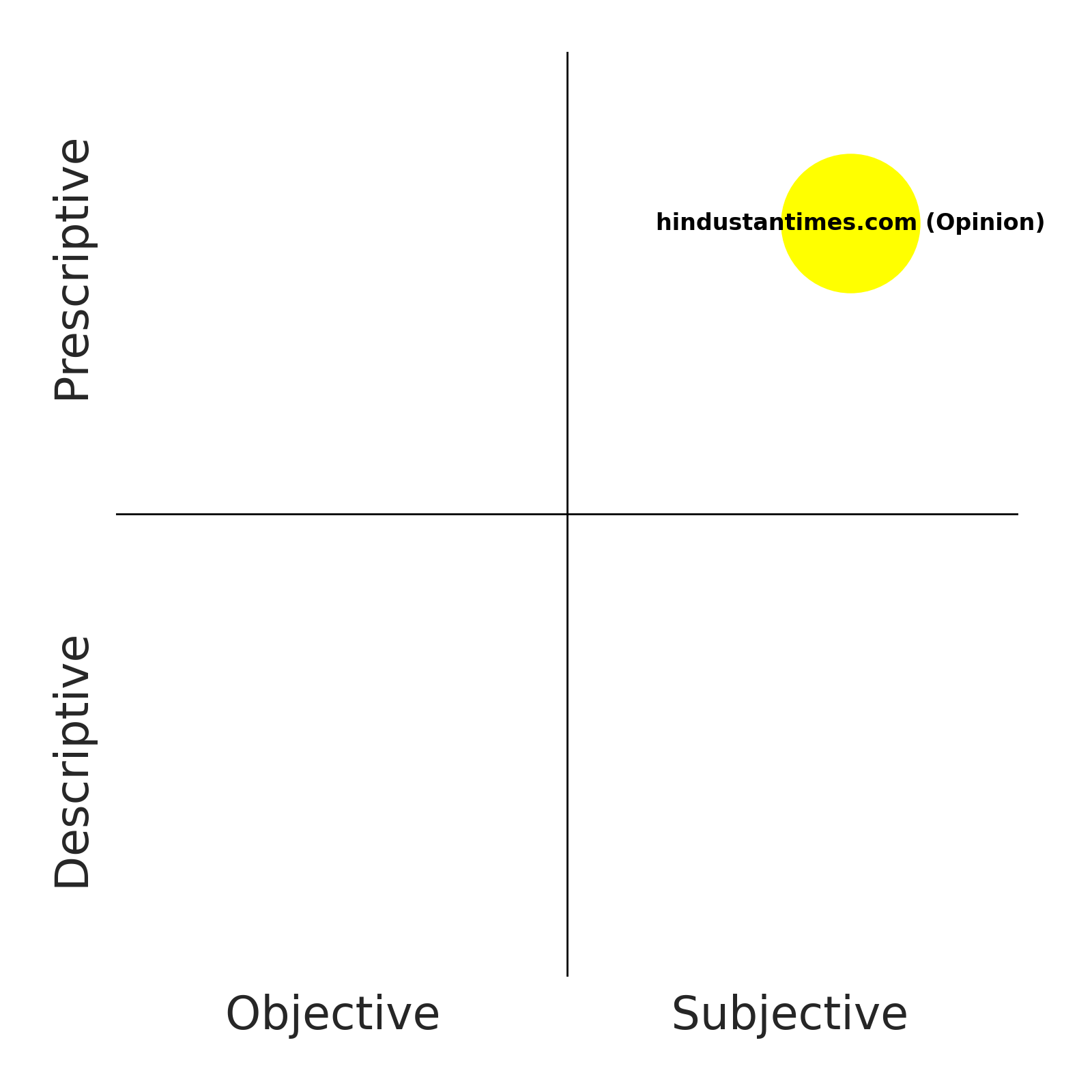
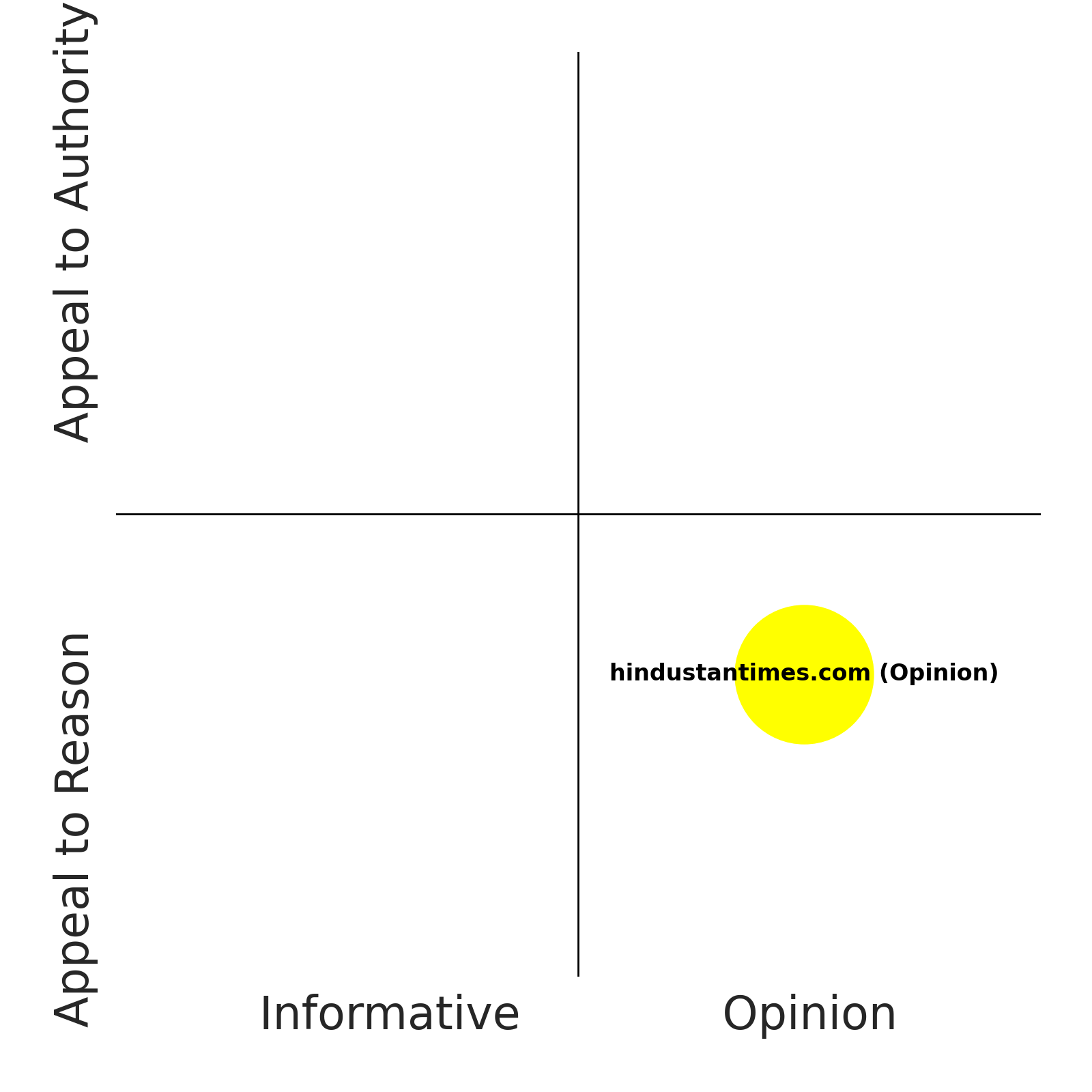
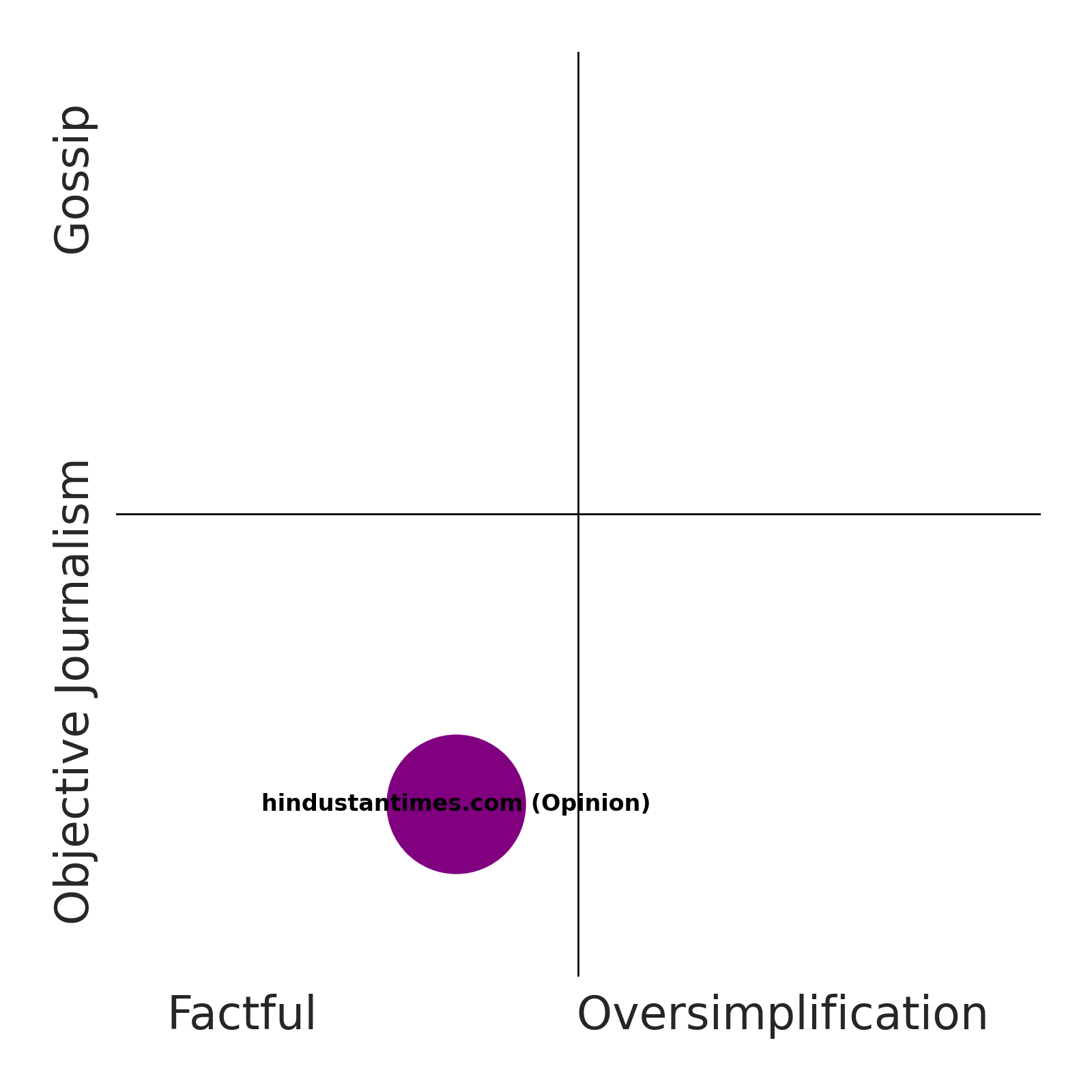
Click points to explore news by date. News sentiment ranges from -10 (very negative) to +10 (very positive) where 0 is neutral.
2026 © Helium Trades
Privacy Policy & Disclosure
* Disclaimer: Nothing on this website constitutes investment advice, performance data or any recommendation that any particular security, portfolio of securities, transaction or investment strategy is suitable for any specific person. Helium Trades is not responsible in any way for the accuracy
of any model predictions or price data. Any mention of a particular security and related prediction data is not a recommendation to buy or sell that security. Investments in securities involve the risk of loss. Past performance is no guarantee of future results. Helium Trades is not responsible for any of your investment decisions,
you should consult a financial expert before engaging in any transaction.
Helium Research Assistant

How can I help you today?
Ask any question about hindustantimes.com (Opinion) bias.


