See whether Helium helps you make better-informed decisions. Try every Pro Trader feature for 30 days. No credit card required.
Try every Pro Trader feature for 30 days. No credit card required.
October 22, 2026 · 0 shares
The piece is a polemical, first-person advocacy column that frames Western coverage of 'settler violence' as a 'malevolently distorted canard' while foregrounding Arab attacks, using loaded language and an explicitly pro-Israel, hawkish interpretive frame.
The article discusses recurring autumn confrontations around the West Bank olive harvest and competing claims about 'settler violence' during a period that includes the Israeli general election on Oct. 27 and heightened tensions over Iran, Gaza and Lebanon.
Automated analysis; not human reviewed. Limitations: The supplied text is an opinion column with duplicated blocks and some truncated passages, and unnamed editorial voice; factual claims about incidents are largely unverified within the text. · 30 of 55 available dimensions scored; omitted dimensions are not treated as neutral. · Verified supporting quotes for 28 of 30 scored dimensions.
Claim: The column adopts a hawkish pro-Israel framing and disparages left-leaning critics and 'far-left activists'.
“Lander is Jewish, but he is no friend of Israel.” · exact text match
“some 200 Arabs and far-left activists had confronted approximately 40 Israeli youths” · exact text match
Why: Aligns with right-leaning foreign policy framing and hostility toward left-wing actors.
Claim: The column positions ordinary settlers against Western media and political elites.
“Such radically skewed reporting has turned half a million overwhelmingly upstanding and besieged Jews into enemies of humanity” · exact text match
Why: Populist grievance against media elites, though the author defends state institutions too.
Claim: Endorses state security enforcement and IDF restrictions on movement/assembly.
“The security establishment views the arrival of dozens of activists as an act intended solely to provoke, which undermines the harvesting process.” · exact text match
Why: Defers to security authority over civil activity.
Claim: The piece is openly first-person opinion with evaluative judgments.
““Settler violence” is a malevolently distorted canard.” · exact text match
Why: Explicit evaluative framing rather than neutral reporting.
Claim: Charged, dramatic language throughout.
“The war against the Jews in Judea and Samaria.” · exact text match
Why: Melodramatic framing of a localized conflict.
Claim: Forecasts looming catastrophe and blame.
“the Jews of Israel would be blamed for their own destruction” · exact text match
Why: Pessimistic projection about future violence and blame.
Claim: Prescribes what media, politicians and Israel ought to do.
“But there can be no justification for Western media and politicians failing to acknowledge this Arab terrorist war being waged against Jewish residents in Judea and Samaria.” · exact text match
Why: Explicit normative recommendation.
Claim: Frames the situation as a war requiring security responses.
“They also fear that a third and even more terrible intifada is being plotted by the Arabs of Judea and Samaria” · exact text match
Why: Hawkish security framing.
Claim: Emphasizes threats, terrorism and impending violence.
“Two attacks with Molotov cocktails were reported, and one with pipe bombs.” · exact text match
Why: Accumulation of attack details to heighten alarm.
Claim: Assumes bad faith by activists as the premise of the argument.
“If anyone thinks this group wasn't there to foment trouble for the Israelis, I've got a bridge to sell you.” · verified after text normalization
Why: Concludes motive without demonstrating it.
Claim: The article is essentially an opinion column.
“These claims are lies designed to demonize and delegitimize the Jewish state in the eyes of the world.” · exact text match
Why: Direct assertion of the author's judgment.
Claim: Centers on political conflict, elections and policy advocacy.
“Fleur Hassan-Nahoum, who is standing for the People of Israel party in the Israeli general election on Oct. 27” · exact text match
Why: Framed around political actors and contest.
Claim: Reduces a complex conflict dynamic to media versus victim narrative.
“No one denies there’s a problem, but it’s very small.” · exact text match
Why: Minimizes one side's violence to a single quantitative claim.
Claim: Relies on official and organizational statements for key claims.
“Naomi Linder Kahn, director of the international division at the Judea and Samaria monitoring group Regavim, says some foreign-funded groups use the olive harvest to provoke confrontations.” · exact text match
Why: Cites aligned advocacy group as authority.
Claim: Uses mocking colloquialism toward critics.
“I’ve got a bridge to sell you” · exact text match
Why: Sarcastic jibe rather than argument; mild.
Claim: Asserts motive and misconduct with certainty on limited evidence.
“Yet Western media outlets have chosen not to report the doubts raised about these alleged “settler attacks” on Arabs and others, while also omitting to report the filmed attack by Arabs.” · exact text match
Why: Claims intentional omission without direct evidence of editorial intent.
Claim: Filters events through a fixed ideological lens.
“These claims are lies designed to demonize and delegitimize the Jewish state in the eyes of the world.” · exact text match
Why: Interpretive framework applied uniformly to opposing claims.
Claim: Defends Israeli state institutions broadly while criticizing aspects of official messaging.
“Israel’s president, Isaac Herzog, apologized to Levine.” · exact text match
Why: Mostly sympathetic to Israeli establishment, with some criticism; weak signal.
Claim: Sustained negative emotional charge toward media and critics.
“malevolently distorted canard” · exact text match
Why: Strongly negative evaluative tone.
Claim: Demands strict scrutiny of claims about settlers but accepts unverified accounts of Arab attacks.
“Even if the claims by Levine and the diplomats are true, the reporting of this “settler violence” issue is malevolently skewed.” · exact text match
Why: Concedes possible truth yet still treats coverage as illegitimate.
Claim: Credibility is limited by heavy opinion framing, scanty sourcing for key claims, and one-sided selection.
“At the time of writing, no Western outlet has reported this attack.” · exact text match
Why: Assertion without supporting verification and a strongly advocacy tone.
Claim: Heavy use of inflamed rhetoric and ad hominem over measured analysis.
“If anyone thinks this group wasn't there to foment trouble for the Israelis, I've got a bridge to sell you.” · verified after text normalization
Why: Dismissive wisecrack substitutes for argument.
Claim: Offers speculative explanations for Israeli conduct.
“There are various possible reasons for this. First, the degree of truth in the “settler violence” claims puts them on the back foot.” · exact text match
Why: Explicitly conjectural list of motives.
Claim: Uses loaded framing and selective emphasis to steer interpretation.
“Yet Western media outlets have chosen not to report the doubts raised about these alleged “settler attacks” on Arabs and others, while also omitting to report the filmed attack by Arabs.” · exact text match
Why: Frames omissions as intentional while presenting one-sided selection.
Claim: Concedes a genuine problem on the Jewish side, showing partial internal fairness.
“There is indeed a problem of Jewish attacks on Arabs that have not been stopped; they are disgraceful, and the Israelis need to shut them down.” · exact text match
Why: Acknowledges countervailing facts, though briefly.
Claim: Implies coordinated malevolent intent in media coverage.
“the reporting of this “settler violence” issue is malevolently skewed” · exact text match
Why: Suggests deliberate malice rather than error.
Claim: Assigns blame for hostility toward Israel to Western media and politicians.
“Such radically skewed reporting has turned half a million overwhelmingly upstanding and besieged Jews into enemies of humanity” · exact text match
Why: Attributes adverse perception to a blamed group.
Claim: Applies asymmetric scrutiny, accepting claims helpful to its thesis while demanding proof of others.
“As for the Europeans, Israeli TV’s Channel 14 reported claims from local Jewish residents that the diplomats had staged or faked the incident.” · exact text match
Why: Unverified single-source claim accepted while rival accounts are dismissed as skewed.
The supplied text is an opinion column with duplicated blocks and some truncated passages, and unnamed editorial voice; factual claims about incidents are largely unverified within the text.
October 08, 2026 · 0 shares
The op-ed adopts an emotionally charged, accusatory stance that frames the subject as lacking humanity and treats anti-Zionism as blatant antisemitism while prioritizing Israeli mourning over Palestinian casualties.
Automated analysis; not human reviewed. · 55 of 55 available dimensions scored; omitted dimensions are not treated as neutral. · Verified supporting quotes for 33 of 55 scored dimensions.
Claim: The article is strongly conservative in its pro-Israel, anti-left framing.
“your anti-Zionism is blatant antisemitism” · exact text match
Why: The op-ed uses a core conservative framing that treats anti-Zionism as antisemitism and attacks a left-leaning official.
Claim: The article is highly subjective and personal.
“I write about something much deeper—your lack of humanity” · exact text match
Why: The author centers personal judgment and emotion over neutral reporting.
Claim: The article uses sensational, graphic language.
“you would have seen Hamas terrorists sawing off an Israeli soldier’s head” · exact text match
Why: Vivid gore and repetition are used for emotional impact.
Claim: The article is deeply pessimistic and mournful.
“Today I not only rend my garment in mourning for those 1,200 innocent souls” · exact text match
Why: The framing is dominated by grief, anger, and despair.
Claim: The article is emotionally engaging but repetitive.
“And you could not even give us this one day to mourn?” · not found in supplied text
Why: The refrain is gripping initially but becomes repetitive.
Claim: The article is strongly prescriptive, telling the subject how he should have behaved.
“Oct. 7 is a time to mourn the Israeli victims, a time to say plainly that nothing justifies terror.” · exact text match
Why: The piece dictates proper mourning and speech.
Claim: The article is strongly hawkish and pro-Israel.
“nothing justifies terror. Full stop.” · exact text match
Why: It takes an uncompromising pro-Israel security stance.
Claim: The article uses fear and rage-baiting through graphic atrocity descriptions.
“a terrorist bludgeoning an already slain Israeli civilian with a hoe over and over” · exact text match
Why: Graphic violence is deployed to provoke fear and anger.
Claim: The article assumes its central premise that anti-Zionism is antisemitism without argument.
“your anti-Zionism is blatant antisemitism” · exact text match
Why: The core equation is asserted rather than demonstrated.
Claim: The article focuses on a personal political dispute rather than policy substance.
“You were personally invited to attend this viewing... but you declined.” · not found in supplied text
Why: It centers on a personal gesture of attendance and a city official's conduct.
Claim: The article is almost entirely opinion and invective.
“I am crying out against your lack of humanity, your lack of decency and your failure to be a mensch.” · exact text match
Why: The piece is an open letter of moral condemnation, not reportage.
Claim: The article is intensely political, centered on a political figure and the Israeli-Palestinian conflict.
“the leader of our city, who offered empty words of comfort—words dwarfed by your accusations against Israel” · exact text match
Why: It attacks a political officeholder over political statements.
Claim: The article reduces complex geopolitics to a simple moral binary.
“Oct. 7 is a time to mourn the Israeli victims, a time to say plainly that nothing justifies terror.” · exact text match
Why: It frames the issue as mourning versus justifying terror, omitting nuance.
Claim: The article appeals to religious and official authority.
“Ecclesiastes teaches that there is a time for everything.” · exact text match
Why: It invokes scripture and an official invitation as warrants.
Claim: The repetitious taunt 'you could not even give us this one day' is rhetorically immature.
“And you could not even give us this one day.” · exact text match
Why: The refrain reads as a childish scolding.
Claim: The article's argument that the official lacks humanity rests on the official's own alleged statements and refusal to attend.
“you spent far more time falsely accusing Israel of genocide than grieving the Israeli dead” · exact text match
Why: The conclusion is embedded in the premise of what proper mourning requires.
Claim: The article preemptively dismisses the official's statement as empty and false.
“you spent far more time falsely accusing Israel of genocide” · exact text match
Why: It characterizes the subject's position before critiquing it.
Claim: The article centers Israeli victimhood and Jewish mourning.
“Today I not only rend my garment in mourning for those 1,200 innocent souls” · exact text match
Why: The entire frame is collective victimhood and grief.
Claim: The article asserts certainty about the subject's motives and character.
“your lack of humanity” · exact text match
Why: It claims definitive knowledge of the subject's inner qualities.
Claim: The article ends with a promotional tagline for the news agency.
“Jerusalem News Syndicate (JNS) is the fastest-growing news agency covering Israel and the Jewish world.” · exact text match
Why: A promotional line appears at the end.
Claim: The article is ideologically driven by a hardline pro-Israel stance.
“nothing justifies terror. Full stop.” · exact text match
Why: It advances a rigid ideological position.
Claim: The article is somewhat anti-establishment in attacking a city leader, but aligns with pro-Israel establishment views.
“the leader of our city, who offered empty words of comfort” · exact text match
Why: It criticizes a local official while reinforcing a mainstream pro-Israel position.
Claim: The article is intensely negative in emotion.
“I am crying out against your lack of humanity” · exact text match
Why: The dominant tone is anger and grief.
Claim: The article applies a strict mourning standard to the official while not acknowledging Palestinian suffering.
“you spent far more time falsely accusing Israel of genocide than grieving the Israeli dead” · exact text match
Why: It demands mourning for one side only.
Claim: The article has low credibility as it is an unsourced emotional polemic.
“much of it filmed by the terrorists themselves” · exact text match
Why: It relies on an unverifiable viewing and personal invective.
Claim: The article relies on emotional, accusatory reasoning rather than measured analysis.
“And you could not even give us this one day to mourn?” · not found in supplied text
Why: The repetitive emotional refrain substitutes for evidence-based argument.
Claim: The article includes a self-promotional note about the publisher.
“Jerusalem News Syndicate (JNS) is the fastest-growing news agency covering Israel and the Jewish world.” · exact text match
Why: It promotes the syndicate at the close.
Claim: The article speculates about what the official would have felt or seen.
“Had you attended, you would have seen” · exact text match
Why: It imagines the subject's hypothetical reactions.
Claim: The article uses emotional repetition and graphic imagery to manipulate readers.
“And you could not even give us this one day to mourn?” · not found in supplied text
Why: It repeatedly invokes guilt through a refrain.
Claim: The article shows some integrity by naming its source and quoting the survivor/terrorist footage, but leans heavily on accusation.
“much of it filmed by the terrorists themselves” · exact text match
Why: Attribution exists but the piece is primarily a polemic.
Claim: The article is rhetorically skilled but intellectually limited by its polemical format.
“I write about something much deeper—your lack of humanity.” · exact text match
Why: It prioritizes emotional impact over analysis.
Claim: The article shows some rigid certainty that may border on delusion.
“nothing justifies terror. Full stop.” · exact text match
Why: It presents an absolutist moral claim as beyond question.
Claim: The article portrays Gazans as celebrating murder, which could be read as collective vilification.
“hundreds of Gazan civilians shouting for joy at their capture” · exact text match
Why: The portrayal risks group generalization but focuses on specific individuals.
Claim: The article's attack on the official's character is harsh and personal.
“your lack of humanity, your lack of decency and your failure to be a mensch” · exact text match
Why: It uses severe personal condemnation.
Claim: The article signals the author's superior moral stance through mourning.
“I not only rend my garment in mourning” · exact text match
Why: It performs piety and moral clarity.
Claim: The article singles out one official as blameworthy for failing collective mourning.
“you could not even give us this one day to mourn” · exact text match
Why: It makes the subject the symbolic target of communal grief.
Claim: The article accuses the official of hypocrisy in mourning while criticizing Israel.
“you offered empty words of comfort—words dwarfed by your accusations against Israel” · not found in supplied text
Why: It alleges inconsistent mourning and accusation.
Claim: The article subordinates reasoned debate to religious and emotional imperatives.
“Ecclesiastes teaches that there is a time for everything.” · exact text match
Why: It leans on scripture and emotion over argument.
October 22, 2026 · 0 shares
The publisher frames Israel’s election as a democratic contest besieged by extremist threats, using first-person state-aligned warnings, graphic atrocity language and a stark democracy-versus-extremism binary while giving minimal space to opposing perspectives.
Automated analysis; not human reviewed. Limitations: The supplied text is duplicated and one segment is truncated mid-sentence ('A lasting fu'), but substantive content remains; no individual author is identified. · 20 of 55 available dimensions scored; omitted dimensions are not treated as neutral. · Verified supporting quotes for 20 of 20 scored dimensions.
Claim: The text frames Israel's election chiefly through a national-security and anti-terrorism lens, aligning with a hawkish conservative posture.
“Israel will not allow these forces to dictate the choices of its citizens. Anyone who attempts to threaten or attack the democratic process will face very serious consequences.” · exact text match
Why: The emphasis on deterrence and severe consequences for security threats supports a right-leaning/hawkish classification, though the article is not explicitly partisan.
Claim: The text combines appeals to the Israeli people with a state-aligned institutional voice.
“That decision belongs to the Israeli people.” · exact text match
“Israel’s response must be clear: Our democratic process will continue, and our citizens will make their choices freely.” · exact text match
Why: The people-centered language is paired with establishment/state framing, yielding a slight elitist rather than strongly populist score.
Claim: The text endorses strong state action and warnings of serious consequences against perceived threats to the election.
“Israel will not allow these forces to dictate the choices of its citizens. Anyone who attempts to threaten or attack the democratic process will face very serious consequences.” · exact text match
Why: The state-security framing and promise of consequences indicate a mild authoritarian rather than libertarian orientation.
Claim: The text is an overt first-person advocacy statement rather than a detached news report.
“So, as Israelis prepare to exercise their right to vote, we must issue a direct warning to Iran, Hezbollah and other radical elements in our region.” · exact text match
Why: The first-person plural prescriptive voice and direct warning show subjective, opinionated framing.
Claim: The text uses vivid, emotionally charged atrocity language and threat imagery.
“Families were slaughtered in their homes.” · exact text match
“Hamas terrorists murdered 1,200 people, injured thousands and abducted 251 men, women, children, babies and elderly people into Gaza.” · exact text match
Why: Graphic descriptions and loaded labels heighten sensational impact beyond neutral reporting.
Claim: Despite warnings, the text ultimately frames Israel's democratic institutions as resilient and capable of withstanding pressure.
“Elections are not a sign that we are free of political divisions or security threats. They demonstrate that even under extraordinary pressure, democratic institutions remain standing.” · exact text match
Why: The explicit claim that institutions remain standing supports a mildly optimistic overall framing.
Claim: The text moves from describing threats to issuing direct prescriptions for Israel and the international community.
“Our message to the international community is just as clear: Defending democracy requires more than praising it in speeches. It requires confronting those who threaten it, refusing to normalize terrorism and demanding accountability from leaders who deny their people the right to choose.” · exact text match
Why: The repeated 'must' and 'requires' language makes the piece strongly prescriptive.
Claim: The text adopts a hawkish posture toward Iran, Hezbollah, Hamas and other regional actors.
“Hezbollah continues to threaten Lebanon and Israel. The Houthis disrupt international shipping in the Red Sea. Iran supports extremist forces across the region.” · exact text match
“Israel will continue to defend its citizens, protect its democracy and pursue peace with those willing to build it.” · exact text match
Why: The framing emphasizes military threats and confrontation rather than diplomacy or restraint.
Claim: The text relies heavily on fear-inducing warnings about violence, intimidation and extremist plots.
“It is a test of whether democracy can thrive in a region where extremist movements seek to impose their will through violence, intimidation and fear.” · exact text match
“Families were slaughtered in their homes.” · exact text match
Why: Repeated threat language and graphic atrocity descriptions are designed to evoke fear and urgency.
Claim: The text is explicitly opinionated, advancing a clear advocacy position rather than limiting itself to factual reporting.
“This election is an important test for Israel.” · exact text match
“The choice facing the region is stark.” · exact text match
Why: Evaluative judgments and advocacy statements dominate the framing.
Claim: The text is centrally political, focused on elections, governance, security policy and regional alliances.
“More than 7 million Israelis are preparing to cast their ballots in national elections in a process that reflects one of Israel’s greatest strengths: its democracy.” · exact text match
“The coming Israeli elections must be understood in this broader context.” · exact text match
Why: The entire piece is about electoral politics and security governance.
Claim: The text presents regional policy as a stark binary between confronting radicalization and allowing extremists to dictate life.
“The choice facing the region is stark. We can confront radicalization, strengthen democratic institutions and build partnerships that create a better future. Or we can allow extremists to dictate the terms of our lives.” · exact text match
Why: The either/or formulation reduces complex regional dynamics to a simplified moral choice.
Claim: The text emphasizes Israeli victimhood and targeting by extremist violence.
“Civilians who believed in peace and coexistence were targeted simply because they were Israeli.” · exact text match
Why: The framing centers Israelis as targeted victims of ideological violence, which supports a victimization bias score.
Claim: The text asserts certainty about the Palestinian Authority's motives and other contested claims without supplying direct evidence.
“Even though the P.A. tries to blame the delay on Israel, the real reason is clear: It is afraid that Hamas could win again.” · exact text match
Why: The phrase 'the real reason is clear' states a contested motive as settled fact.
Claim: The text interprets regional events through a fixed democracy-versus-extremism ideological framework.
“These are not isolated problems. They are connected manifestations of an ideology that rejects peaceful coexistence and seeks to replace stability with intimidation.” · exact text match
Why: The explicit ideological framing organizes diverse actors into a single extremist-ideology threat narrative.
Claim: The text defends Israeli state institutions and regional agreements aligned with official establishment positions.
“Israel’s response must be clear: Our democratic process will continue, and our citizens will make their choices freely.” · exact text match
“The Abraham Accords have shown that cooperation between Israel and regional partners, including the United Arab Emirates, Bahrain and Morocco, is possible.” · exact text match
Why: The endorsement of state continuity and the Abraham Accords reflects a pro-establishment orientation.
Claim: The text's emotional valence is strongly negative toward Hamas and other regional threats, though positive toward Israel's democracy.
“Families were slaughtered in their homes.” · exact text match
“You will not decide Israel’s future.” · exact text match
Why: The violent imagery and direct confrontation create a predominantly negative emotional charge.
Claim: The text uses emotional and loaded rhetoric within an otherwise structured argument.
“Families were slaughtered in their homes.” · exact text match
Why: Graphic emotional appeals mildly undercut a purely rational framing, but the overall argument remains coherent.
Claim: The text forecasts possible election-period attacks and disinformation without concrete evidence in the supplied excerpt.
“Israel is aware of the reports that these extremists may seek to exploit the election period through provocative military activity, cyberattacks or disinformation campaigns.” · exact text match
Why: The language of possibility and vague reports makes the warning speculative.
Claim: The text uses loaded either/or framing and selective threat emphasis to steer judgment.
“The choice facing the region is stark. We can confront radicalization, strengthen democratic institutions and build partnerships that create a better future. Or we can allow extremists to dictate the terms of our lives.” · exact text match
Why: The stark binary and emotionally weighted alternatives are observable framing techniques, though not necessarily intentional deception.
The supplied text is duplicated and one segment is truncated mid-sentence ('A lasting fu'), but substantive content remains; no individual author is identified.
October 05, 2026 · 0 shares
A pro-Israel commentary frames mainstream media as biased against Israel and indulgent toward Iran, accusing outlets of omitting Iran's crackdown while repeating genocide allegations against Israel.
The events referenced are the 81st UN General Assembly session (Sept. 22-26), with Iranian President Pezeshkian and Israeli PM Netanyahu addressing the assembly, and the January 2025 Iranian protest crackdown that followed the Iran-U.S./Israel war.
Automated analysis; not human reviewed. Limitations: I cannot independently verify casualty figures, membership requirements, or the quoted media reports; the analysis is based only on the article's assertions. · 55 of 55 available dimensions scored; omitted dimensions are not treated as neutral. · Verified supporting quotes for 14 of 55 scored dimensions.
Claim: The article aligns with a conservative/pro-Israel outlook by treating Israel as America's partner and demanding tougher coverage of Iran.
“They put on kid gloves with a U.S. enemy and wear brass knuckles against America’s closest partner in the Middle East.” · exact text match
“In contrast, journalists treated truly atrocious leaders, such as the Islamic Republic of Iran President Masoud Pezeshkian, as respectable peacemakers.” · exact text match
Why: The framing explicitly labels Iran an enemy and Israel America's closest partner, positions associated with conservative foreign-policy alignment.
Claim: The piece is a subjective opinion column using evaluative language and rhetorical contrasts rather than neutral reporting.
“Journalists have moved on from massacre in Iran, but insist on relitigating Gaza war.” · exact text match
“In reality, they put on kid gloves with a U.S. enemy and wear brass knuckles against America’s closest partner in the Middle East.” · exact text match
Why: Statements assert motive and moral judgment, which are subjective rather than neutral.
Claim: The article is pessimistic about mainstream media conduct.
“Journalists have moved on from massacre in Iran, but insist on relitigating Gaza war.” · exact text match
“They have never given much attention to the plight of the Iranian people, but routinely withhold facts and obscure nuances about warfare to indict Israel, a year after the ceasefire in Gaza.” · exact text match
Why: It portrays media behavior as consistently biased and declining.
Claim: The article prescribes how journalists should have covered Iran and Israel.
“Brennan’s failure to challenge Pezeshkian is even more appalling in light of her 2024 interview with Netanyahu, in which she challenged nearly every one of the Israeli prime minister’s answers.” · exact text match
“They have never given much attention to the plight of the Iranian people, but routinely withhold facts and obscure nuances about warfare to indict Israel, a year after the ceasefire in Gaza.” · exact text match
Why: It repeatedly says what coverage omitted and what interviewers should have done.
Claim: The article is hawkish in tone toward Iran and supportive of the U.S.-Israel alliance.
“They put on kid gloves with a U.S. enemy and wear brass knuckles against America’s closest partner in the Middle East” · exact text match
“In contrast, journalists treated truly atrocious leaders, such as the Islamic Republic of Iran President Masoud Pezeshkian, as respectable peacemakers.” · exact text match
Why: It emphasizes the threat and brutality of the Iranian regime and frames media softness toward it as a problem.
Claim: The text is overwhelmingly opinionated commentary, not factual reporting.
“Journalists boast about being objective narrators of facts. In reality, they put on kid gloves with a U.S. enemy and wear brass knuckles against America’s closest partner in the Middle East.” · exact text match
Why: The final paragraph is an explicit editorial judgment.
Claim: The article's subject is political conflict and media treatment of national leaders.
“The United Nations convened its 81st session of its General Assembly last month, with heads of government speaking between Sept. 22 and Sept. 26.” · exact text match
“In contrast, journalists treated truly atrocious leaders, such as the Islamic Republic of Iran President Masoud Pezeshkian, as respectable peacemakers.” · exact text match
Why: It centers on international politics and partisan assessments of coverage.
Claim: The piece reduces complex newsroom behavior to a single double-standard caricature.
“They put on kid gloves with a U.S. enemy and wear brass knuckles against America’s closest partner in the Middle East.” · exact text match
“The disparity of treatment that the Times, CBS and the BBC extended to Netanyahu and Pezeshkian exemplifies the mood in the mainstream media.” · exact text match
Why: It generalizes from selected examples to an entire 'mood in the mainstream media.'
Claim: The article states contested figures and institutional details as settled facts.
“roughly a third of them were militants” · exact text match
“the only presumed qualification to join the organization—the International Association of Genocide Scholars—is paying a $125 membership fee and that it doesn’t require any scholarly work for members.” · exact text match
Why: No sourcing is given for these decisive assertions, yet they are presented as unproblematic.
Claim: The piece consistently applies a pro-Israel/anti-Iran frame and dismisses contrary coverage as biased.
“In contrast, journalists treated truly atrocious leaders, such as the Islamic Republic of Iran President Masoud Pezeshkian, as respectable peacemakers.” · exact text match
“The disparity of treatment that the Times, CBS and the BBC extended to Netanyahu and Pezeshkian exemplifies the mood in the mainstream media.” · exact text match
Why: The framing treats a particular geopolitical worldview as self-evident and judges reporting against it.
Claim: The language is emotionally negative, using metaphors of violence and moral condemnation.
“They put on kid gloves with a U.S. enemy and wear brass knuckles against America’s closest partner in the Middle East.” · exact text match
“Brennan’s failure to challenge Pezeshkian is even more appalling in light of her 2024 interview with Netanyahu, in which she challenged nearly every one of the Israeli prime minister’s answers.” · exact text match
Why: Words like 'brass knuckles' and 'appalling' convey strong negative affect.
Claim: The article has low apparent credibility because it mixes named sources with anonymous 'leaked reports' and unsupported assertions.
“Human Rights Activists News Agency, an Iranian diaspora organization, has confirmed 7,015 identified fatalities killed by the regime, while leaked reports count the number up to 36,500.” · exact text match
“U.S. President Donald Trump suggested the number goes as high as 54,000.” · exact text match
Why: The visible sourcing is uneven, relying on vague 'leaked reports' and a politician's suggestion alongside one named group.
Claim: The article uses selective presentation and loaded framing to steer the reader's conclusions.
“The report failed to mention that the only presumed qualification to join the organization—the International Association of Genocide Scholars—is paying a $125 membership fee and that it doesn’t require any scholarly work for members.” · exact text match
“omitting that roughly a third of them were militants” · exact text match
Why: It presents an unverified membership-fee claim and an unqualified 'roughly a third' assertion as decisive rebuttals.
Claim: The article uses selective omission and unsupported assertions while accusing others of the same.
“omitting that roughly a third of them were militants” · exact text match
“the only presumed qualification to join the organization—the International Association of Genocide Scholars—is paying a $125 membership fee and that it doesn’t require any scholarly work for members.” · exact text match
Why: The article presents contested claims as settled facts and dismisses sources on the basis of an unverified membership-fee assertion.
I cannot independently verify casualty figures, membership requirements, or the quoted media reports; the analysis is based only on the article's assertions.
October 22, 2026 · 0 shares
Polemical, one-sided opinion framing that treats a rival outlet's selective omissions as intentional anti-Israel malpractice while itself omitting Palestinian civilian context and generalizing about the Arab world.
The column responds to Western news coverage of Israeli settler-related violence in the West Bank during a period of heightened Israeli-Palestinian clashes and a broader U.S.-Israel escalation involving Iran.
Automated analysis; not human reviewed. Limitations: The supplied text contains duplicated paragraphs and truncation artifacts from scraping, and no byline is present. · 30 of 55 available dimensions scored; omitted dimensions are not treated as neutral. · Verified supporting quotes for 28 of 30 scored dimensions.
Claim: The column defends Israeli security framing and attacks mainstream media as anti-Israel, a conservative-coded alignment.
“The newspaper’s many articles bashing Israel stand in contrast to its blatant disregard of actual transgressors” · exact text match
Why: Explicit defense of Israel against alleged media bias is a recognizable conservative-coded stance.
Claim: The column positions itself against a major mainstream outlet's editorial judgment.
“—and most mainstream outlets—reflect intentional malpractice” · exact text match
Why: Attacking mainstream media authority is mildly anti-establishment, though the author defends state security framing.
Claim: The column frames Palestinian deaths primarily through security-force and counterterrorism legitimacy.
“Palestinians have been killed while allegedly accelerating vehicles toward troops or military vehicles” · exact text match
Why: Deference to security-force responses over civil-liberty concerns tilts mildly authoritarian.
Claim: The piece is openly an opinion polemic rather than a descriptive report.
“reflect intentional malpractice” · exact text match
Why: Asserting intent and malpractice is evaluative, not neutral description.
Claim: Language is heightened and accusatory.
“the extent of factual distortion is such that it is impossible to know what to believe” · exact text match
Why: Totalizing language about distortion is sensational in register.
Claim: The column's outlook on press conduct is decidedly negative.
“the Post’s coverage shapes our society in journalistically warped ways” · exact text match
Why: Pessimistic characterization of media influence on society.
Claim: The column ends with an explicit demand for changed coverage.
“And it needs to stop.” · exact text match
Why: Direct prescription about what a news outlet should do.
Claim: The column adopts a security-first framing of West Bank violence.
“in targeted operations against terror operatives” · exact text match
Why: Legitimizing counterterror operations reflects a hawkish frame.
Claim: The column warns of societal harm from media coverage.
“the Post’s coverage shapes our society in journalistically warped ways” · exact text match
Why: Alarmist framing of media influence, though not acute fear-baiting.
Claim: The text is an argumentative opinion column rather than a factual report.
“reflect intentional malpractice” · exact text match
Why: Evaluative assertions about motive dominate the piece.
Claim: The subject matter is a political dispute over media coverage and the Israeli-Palestinian conflict.
“The disproportionate attacks on Israel through selectively chosen anti-Israel pieces in prominent spots at the Post” · exact text match
Why: The core content is political advocacy.
Claim: The column reduces the dispute to binary motives.
“Is the cause of it a “soft bigotry of low expectations” for the Arab world or simply bias against Israel?” · exact text match
Why: A two-option framing of complex editorial behavior oversimplifies.
Claim: The column relies on Israeli military accounts to characterize incidents.
“Israeli accounts characterize many of these clashes as responses to attacks” · exact text match
Why: Mild reliance on official accounts as the framing anchor.
Claim: The prose uses derisive, taunting questions about the rival outlet.
“How can its reporters and editors blind themselves to the daily acts of inhumanity” · exact text match
Why: Rhetorical needling rather than reasoned critique.
Claim: The column treats an assumption of bias as proof of further bias.
“if the paper is distorting some of it, then who’s to say they aren’t distorting all of it?” · exact text match
Why: Inference from alleged partial distortion to global unreliability is circular in structure.
Claim: Israel is cast as the unfairly targeted party in coverage.
“casts Israelis as the sole aggressors” · exact text match
Why: Framing centers Israel as wronged by media portrayal.
Claim: The column asserts certainty about intent behind coverage.
“reflect intentional malpractice” · exact text match
Why: Certainty about motive exceeds the evidence supplied.
Claim: The column reads as advocacy from a fixed ideological frame.
“reflect intentional malpractice” · exact text match
Why: Consistent ideological lens applied to media criticism.
Claim: The column attacks a prominent establishment newsroom's editorial practices.
“This is a classic Washington Post omission that casts Israelis as the sole aggressors.” · exact text match
Why: Direct challenge to a major establishment outlet's conduct.
Claim: Tone is strongly negative toward the targeted outlet and its coverage.
“it is impossible to know what to believe” · exact text match
Why: Pervasive negative evaluative language.
Claim: The column faults the Post for a double standard while applying its own selective comparisons.
“The newspaper’s many articles bashing Israel stand in contrast to its blatant disregard of actual transgressors” · exact text match
Why: The symmetry complaint is itself framed asymmetrically.
Claim: Sourcing is largely assertion and rhetorical question, with one named article and date.
“The reason appears to be that it marks the start of the broader U.S.-Israel escalation involving Iran.” · exact text match
Why: Speculative motive claims are presented without documentary support.
Claim: The argument leans on rhetorical questions and sweeping inference rather than evidence.
“if the paper is distorting some of it, then who’s to say they aren’t distorting all of it?” · exact text match
Why: Generalizing from partial distortion to total unreliability is an emotive rather than reasoned step.
Claim: The column speculates about why a date was chosen and what motivated it.
“Why choose that seemingly arbitrary date?” · exact text match
Why: Motive attribution without stated evidence.
Claim: Loaded framing and a forced dichotomy are used to characterize the rival outlet.
“Is the cause of it a “soft bigotry of low expectations” for the Arab world or simply bias against Israel?” · exact text match
Why: False-dichotomy framing shapes reader inference.
Claim: The column itself withholds context it demands of others, e.g., casting doubt on an entire outlet from partial errors.
“if the paper is distorting some of it, then who’s to say they aren’t distorting all of it?” · exact text match
Why: Demanding context while generalizing from partial distortion signals uneven evidentiary standards.
Claim: The column makes broad negative characterizations about Palestinians as a people.
“a people such as the Palestinians might be both weak and wrong” · exact text match
Why: Collective characterization of a national group; context is political argument rather than dehumanization.
Claim: The column assigns broad social harm to one outlet's coverage.
“the Post’s coverage shapes our society in journalistically warped ways” · exact text match
Why: Blaming a single newsroom for societal distortion.
The supplied text contains duplicated paragraphs and truncation artifacts from scraping, and no byline is present.
October 27, 2026 · 0 shares
Frames Israel’s election as a 3,000-year-old Jewish democratic ritual besieged by existential enemies, using security-threat imagery and sympathetic establishment framing.
Israel’s election is occurring amid the ongoing war triggered by the Oct. 7, 2023 Hamas-led attack and regional tensions involving Iran, Hamas, and Hezbollah.
Automated analysis; not human reviewed. Limitations: The article is an opinion-style analysis with loaded metaphors; no byline or publication date is supplied, so authorship and temporal context cannot be verified. · 17 of 55 available dimensions scored; omitted dimensions are not treated as neutral. · Verified supporting quotes for 16 of 17 scored dimensions.
Claim: Uses right-leaning Israeli security vocabulary and hawkish strategic framing.
“In a country plagued by terrorism, the threat could come from Judea and Samaria.” · exact text match
“The siege is real, and whoever governs Israel after today will face the same enemies and the same strategic reality.” · exact text match
Why: The term “Judea and Samaria” and the siege framing align with conservative Israeli security discourse.
Claim: Presents the election through subjective ritual and metaphor rather than neutral description.
“Elections as a democratic Jewish ritual.” · exact text match
Why: The opening metaphor frames the event evaluatively rather than descriptively.
Claim: Uses dramatic threat imagery to heighten the stakes of Election Day.
“A situation balanced on a knife’s edge could provoke an attack against Israel precisely on Election Day.” · exact text match
Why: The knife’s-edge metaphor is sensational rather than measured.
Claim: Moves from description to prescriptive claims about future Israeli governance.
“Any Israeli government will be forced to seek peace through the deradicalization of the enemy, after defeating it.” · exact text match
Why: The sentence prescribes a strategic course rather than merely reporting events.
Claim: Adopts a hawkish framing of Israel’s strategic situation.
“The siege is real, and whoever governs Israel after today will face the same enemies and the same strategic reality.” · exact text match
Why: The language presents sustained conflict and enemies as unavoidable.
Claim: Emphasizes threats and potential Election Day attack.
“Hamas and Hezbollah growl from afar.” · exact text match
“Election Day, with the eyes of the international media fixed on Israel, presents an attractive opportunity for Israel’s enemies to seize the headlines.” · exact text match
Why: The framing heightens fear of violence and enemy exploitation.
Claim: Offers an evaluative interpretation rather than a straight news account.
“Elections as a democratic Jewish ritual.” · exact text match
Why: The ritual framing is interpretive and opinion-like.
Claim: Centers the report on electoral politics and governing power.
“Israel votes today, reaffirming a 3,000-year-old civilization’s commitment to democracy in the heart of the Middle East.” · exact text match
Why: The article is explicitly about an election and political legitimacy.
Claim: Reduces the election to a security-versus-enemy frame.
“For now, danger, terrorism and war remain paramount.” · exact text match
Why: The summary compresses complex electoral concerns into a security frame.
Claim: Frames Israel as surrounded by threats.
“even as their country remains surrounded by threats and torn by profound internal disagreements.” · exact text match
Why: The phrasing emphasizes external threat and internal strain.
Claim: Asserts future strategic certainty beyond the supplied evidence.
“The siege is real, and whoever governs Israel after today will face the same enemies and the same strategic reality.” · exact text match
Why: The claim states a fixed future reality with little qualification.
Claim: Integrates a Zionist civilizational narrative with electoral analysis.
“They bring to the altar of democracy a 3,000-year-old culture in the heart of the Middle East, where democracy remains exceedingly rare.” · exact text match
Why: The language fuses national-religious identity with democratic practice.
Claim: Emphasizes collective national and Jewish framing over individual choice.
“The Jewish people as a whole—7,331,981 eligible voters—do not simply cast their ballots today.” · exact text match
Why: Voters are framed as a collective people rather than as discrete individuals.
Claim: Speculates about a possible Election Day attack.
“A situation balanced on a knife’s edge could provoke an attack against Israel precisely on Election Day.” · exact text match
Why: The sentence forecasts a possible event without firm evidence.
Claim: Uses loaded threat metaphors and frames critics as also playing politics.
“Hamas and Hezbollah growl from afar.” · exact text match
“Yet they, too, are playing politics with Israelis’ understandable desire to emerge from the long and bitter defensive war the country has been forced to wage since Oct. 7.” · exact text match
Why: Loaded metaphors and asymmetric criticism can steer interpretation.
Claim: Attributes a contested report and notes the lack of confirmation.
“Neither Netanyahu nor Zamir has confirmed that there was any confrontation between them.” · exact text match
Why: Explicitly flagging unconfirmed claims is a fairness signal.
The article is an opinion-style analysis with loaded metaphors; no byline or publication date is supplied, so authorship and temporal context cannot be verified.
October 29, 2026 · 0 shares
The framing is one-sidedly pro-Netanyahu, repeatedly presenting Eisenkot’s paths as uniformly bad and Netanyahu’s as uniformly good while treating contested electoral scenarios as settled.
Automated analysis; not human reviewed. Limitations: The supplied text is a partisan opinion/analysis with duplicated and truncated passages, limiting verification of seat projections and investigation claims. · 12 of 55 available dimensions scored; omitted dimensions are not treated as neutral. · Verified supporting quotes for 12 of 12 scored dimensions.
Claim: The article favorably frames Netanyahu’s right-religious bloc and treats its options as uniformly good.
“Netanyahu’s options, by contrast, are all good.” · exact text match
Why: Favorable treatment of the Likud-led right-religious incumbent bloc supports a conservative-direction classification.
Claim: The central claim is an evaluative judgment rather than a neutral report.
“Eisenkot’s options are all bad, while Netanyahu’s remain good.” · verified after text normalization
Why: The headline and thesis are explicitly subjective assessments of political prospects.
Claim: The text advises what Eisenkot should do politically.
“The smartest play for Eisenkot would be the one he has ruled out: offering Netanyahu his party in a unity coalition.” · exact text match
Why: Calling a course of action the “smartest play” is prescriptive political advice.
Claim: The article is heavily opinionated in its political judgments.
“In every scenario, Eisenkot loses. Netanyahu’s options, by contrast, are all good.” · exact text match
Why: Sweeping evaluative conclusions are stated as opinion rather than neutral description.
Claim: The text is wholly focused on partisan coalition politics.
“Israeli Prime Minister Benjamin Netanyahu’s bloc stands at 53 seats, the Change bloc led by Gadi Eisenkot is at 48, and the Arab parties are at 19.” · exact text match
Why: The article’s substance is electoral and coalition politics.
Claim: The article reduces complex coalition outcomes to a binary where one side always loses and the other always wins.
“In every scenario, Eisenkot loses. Netanyahu’s options, by contrast, are all good.” · exact text match
Why: The “every scenario” formulation oversimplifies uncertain coalition dynamics.
Claim: The article asserts certainty about future electoral outcomes beyond the supplied evidence.
“The remaining ballots will adjust the margins. They will not reverse it.” · exact text match
Why: The prediction is stated with certainty despite partial results and unresolved variables.
Claim: The analysis is organized around a strong pro-Netanyahu interpretive frame.
“Netanyahu’s options, by contrast, are all good.” · exact text match
Why: Repeatedly casting one camp’s options as uniformly good indicates an ideological interpretive lens.
Claim: The article favors the sitting prime minister and incumbent establishment position.
“He remains the sitting prime minister with more workable paths than his rival.” · exact text match
Why: Framing the incumbent as advantaged and more capable of governing reflects pro-establishment framing.
Claim: The article applies sharply asymmetric standards to comparable deadlock positions.
“Eisenkot’s options are all bad, while Netanyahu’s remain good.” · verified after text normalization
Why: The same no-majority arithmetic is evaluated as fatal for one side and advantageous for the other.
Claim: The article relies on forecasts about future elections and coalition behavior.
“new elections, which will likely favor his bloc.” · exact text match
Why: The argument depends on speculative predictions about a future election outcome.
Claim: The article uses loaded framing and a stark win/lose dichotomy.
“When one side chooses how to win, and the other can only choose how to lose, that is the definition of power.” · exact text match
Why: The loaded dichotomy frames the political contest in manipulative terms rather than neutral analysis.
The supplied text is a partisan opinion/analysis with duplicated and truncated passages, limiting verification of seat projections and investigation claims.
October 23, 2026 · 0 shares
A hawkish regime-change frame casts diplomacy with Iran as likely appeasement and the Islamic Republic as an irredeemable terrorist architecture.
Automated analysis; not human reviewed. Limitations: The text states the killing of Supreme Leader Ali Khamenei and a U.S.-Israeli military campaign as premises without independent sourcing, limiting verification. · 15 of 55 available dimensions scored; omitted dimensions are not treated as neutral. · Verified supporting quotes for 15 of 15 scored dimensions.
Claim: The article adopts a Trump-aligned hawkish conservative framing of the Iran conflict.
“Trump’s historic opportunity is not simply to claim another military victory or secure another diplomatic agreement.” · exact text match
Why: The quote promotes Trump and military success as the basis for a historical legacy, consistent with conservative hawkish framing.
Claim: The article endorses an interventionist/regime-change approach to Iran rather than restraint.
“If a legitimate political transition in Iran brings an end to the regime’s machinery of repression and state-sponsored terrorism, the consequences could reshape the security architecture of the Middle East.” · exact text match
Why: Advocacy for political transition and reshaping regional security through external pressure indicates an interventionist orientation.
Claim: The analysis is strongly subjective and opinion-driven rather than neutral reporting.
“Hopefully, he recognizes that before the opportunity disappears.” · exact text match
Why: Direct exhortation and evaluative language signal subjective opinion.
Claim: The article uses dramatic, high-stakes language about Iran and U.S. policy.
“The killing of Supreme Leader Ali Khamenei, the elimination of other senior regime figures and the degradation of military capabilities shattered the image of an untouchable ruling establishment.” · exact text match
Why: Dramatic verbs and sweeping claims create a sensational framing.
Claim: The article is predominantly prescriptive, urging a particular U.S. policy course.
“Trump still possesses an opportunity to transform a moment of military superiority into an enduring historical legacy.” · exact text match
Why: It explicitly recommends what Trump should do and how success should be measured.
Claim: The article adopts a strongly hawkish posture toward Iran.
“If the Islamic Republic survives with its coercive institutions substantially intact, then today’s military and intelligence achievements may become the opening chapter of another confrontation.” · exact text match
Why: It treats military and intelligence pressure as central and warns against diplomatic outcomes that leave the regime intact.
Claim: The article uses fear and appeasement analogies to frame diplomacy as dangerous.
“History offers an uncomfortable analogy: Neville Chamberlain believed that the Munich Agreement could secure peace with Adolf Hitler.” · exact text match
Why: The Munich analogy invokes existential threat and betrayal to heighten fear about negotiation.
Claim: The article is highly opinionated, with normative conclusions about Iran and Trump.
“With regime change in Iran and the end of the Islamic Republic’s machinery of terrorism, Trump’s name could remain permanently inscribed in history.” · exact text match
Why: The statement is an evaluative, advocacy-oriented judgment rather than a neutral factual report.
Claim: The article is centrally political, focused on U.S. foreign policy and Iran's regime.
“Can Washington translate military success into a durable outcome, or will Tehran survive by exploiting political hesitation?” · exact text match
Why: The core question is explicitly about political-military strategy and regime survival.
Claim: The article presents the policy choice as a stark binary between durable victory and Iranian survival.
“If the Islamic Republic survives with its coercive institutions substantially intact, then today’s military and intelligence achievements may become the opening chapter of another confrontation.” · exact text match
Why: It reduces complex outcomes to survival of the Islamic Republic versus strategic success.
Claim: The article asserts strong conclusions about what diplomacy cannot achieve with limited hedging.
“A diplomatic agreement that leaves this architecture untouched cannot, by itself, eliminate the security challenges the regime generates.” · exact text match
Why: The categorical 'cannot' goes beyond the evidence offered in the text.
Claim: The article interprets the conflict through a rigid ideological opposition between the Islamic Republic and a desired political order.
“With regime change in Iran and the end of the Islamic Republic’s machinery of terrorism, Trump’s name could remain permanently inscribed in history.” · exact text match
Why: The framing treats regime change as the necessary resolution and uses totalizing ideological language.
Claim: Credibility is weakened by a major factual claim stated without attribution and by heavy advocacy.
“The killing of Supreme Leader Ali Khamenei, the elimination of other senior regime figures and the degradation of military capabilities shattered the image of an untouchable ruling establishment.” · exact text match
Why: A consequential claim is presented baldly, while the text otherwise mixes attribution with advocacy and no sourcing is visible.
Claim: The article makes extensive forecasts about Iran's survival and future regional security.
“If the Islamic Republic survives with its coercive institutions substantially intact, then today’s military and intelligence achievements may become the opening chapter of another confrontation.” · exact text match
Why: The conditional future scenario is speculative forecasting rather than reported fact.
Claim: The article uses loaded historical analogy and interpretive framing to steer judgment.
“What appears in Washington as a search for peace could be interpreted in Tehran as an opportunity to survive.” · exact text match
Why: The contrast frames negotiation as naive and adversarial, an observable persuasive technique.
The text states the killing of Supreme Leader Ali Khamenei and a U.S.-Israeli military campaign as premises without independent sourcing, limiting verification.
October 16, 2026 · 0 shares
Frames Iran’s post-Islamic Republic future through a pro-democracy, pro-Israel lens and speculative geopolitical analysis that casts China and Russia as beneficiaries of the current regime.
Automated analysis; not human reviewed. Limitations: The supplied text contains duplicated passages and a mid-sentence break, and provides no byline; assessment is limited to the visible op-ed-style analysis. · 8 of 55 available dimensions scored; omitted dimensions are not treated as neutral. · Verified supporting quotes for 8 of 8 scored dimensions.
Claim: The analysis uses evaluative language and an interested, opinionated perspective rather than a detached reportorial voice.
“This is precisely what makes the position of Crown Prince Reza Pahlavi so interesting.” · exact text match
Why: The explicit phrase 'so interesting' is a publisher evaluation, supporting a subjectively framed score.
Claim: The publisher's own voice is evaluative and interpretive, presenting a preferred significance for Crown Prince Reza Pahlavi.
“This is precisely what makes the position of Crown Prince Reza Pahlavi so interesting.” · exact text match
“perhaps the most difficult struggle will have only just begun” · exact text match
Why: Both quoted phrases are evaluative commentary rather than neutral factual reporting, supporting a high opinion score.
Claim: The article centers on regime change, sovereignty, and geopolitical alignment.
“The fall of the Islamic Republic could bring an end to a struggle the Iranian people have waged for decades.” · exact text match
“The question, therefore, is not only whether Israel, the United States and the Gulf states want a free Iran, but also how they will respond when Iran once again develops regional ambitions of its own.” · exact text match
Why: These passages make political power and international alignment the core subject, supporting a very high political score.
Claim: The framing favors a secular-democratic and pro-Israel outcome for Iran.
“A free Iran could restore diplomatic relations with Israel and even eventually become an important economic and strategic partner.” · exact text match
“He has repeatedly advocated a secular and democratic Iran, normalization of relations with Israel and, ultimately, the Iranian people’s freedom to choose their future form of government.” · exact text match
Why: Repeated favorable emphasis on secular democracy and Israel normalization indicates a clear ideological preference.
Claim: The article shows some attribution and conditional framing, but its broader geopolitical claims rely on unnamed analysis and broad assertions.
“around 90% by some estimates” · exact text match
“They may choose close cooperation with the West and an explicitly pro-Israel foreign policy.” · exact text match
Why: An estimate qualifier and conditional language offer visible caution, but the lack of named sources limits overall credibility.
Claim: The article is built around conjectural forecasts about a future post-Islamic Republic Iran.
“a new struggle may begin” · exact text match
“They may choose close cooperation with the West and an explicitly pro-Israel foreign policy.” · exact text match
Why: The forecast language about future struggles and choices is pervasive, supporting a very high speculation score.
Claim: The text signals epistemic caution through estimate qualifiers and alternative scenarios.
“around 90% by some estimates” · exact text match
“They may choose close cooperation with the West and an explicitly pro-Israel foreign policy. But they may just as well choose a strongly nationalist Iran that maintains good relations with multiple power blocs and refuses to become dependent on any foreign power again.” · exact text match
Why: Qualifying a figure as an estimate and presenting contrasting possible outcomes supports above-neutral integrity.
Claim: The piece uses comparative geopolitical reasoning to distinguish the interests of China, Russia, and Israel.
“An Iran that regains unrestricted access to European and Asian markets, attracts foreign investment and decides for itself where to sell its energy would be considerably less dependent on China.” · exact text match
“For Israel, the situation is fundamentally different.” · exact text match
Why: The article explains interests and consequences rather than only asserting conclusions, supporting an above-average intelligence score.
The supplied text contains duplicated passages and a mid-sentence break, and provides no byline; assessment is limited to the visible op-ed-style analysis.
Alarmist, hawkish pro-Israel framing presents another war as imminent and treats reported Iranian preparations as near-certain.
Automated analysis; not human reviewed. Limitations: The supplied text is duplicated and includes future-dated/uncertain claims, so scores reflect only the visible publisher framing. · 20 of 55 available dimensions scored; omitted dimensions are not treated as neutral. · Verified supporting quotes for 20 of 20 scored dimensions.
Claim: The framing aligns with a hawkish, pro-Israel conservative foreign-policy posture.
“The Jewish state has no other choice but to be prepared.” · exact text match
“The question is whether the United States, under U.S. President Donald Trump, has the resolve to engage in another, and perhaps even deadlier round, and whether that will occur before or after the November midterms.” · exact text match
Why: The closing prescription for Israeli military readiness and the emphasis on U.S. resolve for another military round lean conservative in U.S. foreign-policy terms.
Claim: The article treats military resolve and preparation as the necessary response to Iran.
“The question is whether the United States, under U.S. President Donald Trump, has the resolve to engage in another, and perhaps even deadlier round, and whether that will occur before or after the November midterms.” · exact text match
Why: Emphasis on military resolve and another round of strikes leans toward security-authority framing.
Claim: The report is primarily an evaluative, opinion-driven analysis rather than a neutral news account.
“War is coming.” · exact text match
“The Jewish state has no other choice but to be prepared.” · exact text match
Why: The declarative war forecast and prescriptive conclusion are subjective judgments.
Claim: The wording is alarmist and dramatizes the prospect of war.
“War is coming.” · exact text match
“The ceasefire did not end the war with Iran. It just hit the “pause” button.” · exact text match
Why: The apocalyptic opening and 'pause button' metaphor sensationalize the conflict.
Claim: The article's dominant outlook is pessimistic and foreboding.
“War is coming.” · exact text match
“Beneath the affability on the streets, most Israelis have been walking around with the genuine fear that a fresh round of attacks might break out.” · exact text match
Why: It forecasts renewed war and emphasizes Israeli fear.
Claim: The analysis moves from description to an explicit prescription for Israeli readiness.
“The Jewish state has no other choice but to be prepared.” · exact text match
Why: The closing sentence directly prescribes a course of action.
Claim: The article adopts a strongly hawkish posture toward Iran and Hezbollah.
“The question is whether the United States, under U.S. President Donald Trump, has the resolve to engage in another, and perhaps even deadlier round, and whether that will occur before or after the November midterms.” · exact text match
“Hezbollah is not simply a military terrorist group loosely associated with Iran. It is the forward division of the Islamic Republic, and Tehran is making every effort to use it again.” · exact text match
Why: It frames another military round as a question of resolve and describes Iran/Hezbollah as an active military threat.
Claim: The piece uses fear-oriented, war-imminent framing.
“War is coming.” · exact text match
“Beneath the affability on the streets, most Israelis have been walking around with the genuine fear that a fresh round of attacks might break out.” · exact text match
Why: Imminent-war assertion and foregrounded fear are strong fear/rage-baiting signals.
Claim: The text is highly opinionated and interpretive.
“War is coming.” · exact text match
“The Jewish state has no other choice but to be prepared.” · exact text match
Why: Both the opening forecast and the closing recommendation are evaluative judgments.
Claim: The article is centrally political and geopolitical.
“The question is whether the United States, under U.S. President Donald Trump, has the resolve to engage in another, and perhaps even deadlier round, and whether that will occur before or after the November midterms.” · exact text match
Why: It centers on U.S. presidential resolve, midterm timing, Iran, Israel, and Hezbollah.
Claim: The article simplifies a complex ceasefire into a mere pause before inevitable war.
“The ceasefire did not end the war with Iran. It just hit the “pause” button.” · exact text match
Why: The metaphor reduces complex diplomatic and security dynamics to an on/off war switch.
Claim: The prose asserts high certainty about future war timing and intentions.
“War is coming.” · exact text match
“The timeline is fairly certain.” · exact text match
Why: Flat predictions and a 'fairly certain' timeline exceed the supplied evidence, which elsewhere notes uncertainty.
Claim: The article frames the conflict through a fixed pro-Israel, anti-Iran ideological lens.
“Hezbollah is not simply a military terrorist group loosely associated with Iran. It is the forward division of the Islamic Republic, and Tehran is making every effort to use it again.” · exact text match
Why: The proxy relationship is characterized in totalizing, ideologically charged terms rather than neutral description.
Claim: The article adopts a security-establishment perspective on Iran and Israel.
“Many analysts now see the IRGC as Iran’s real center of power.” · exact text match
Why: It relies on analysts and official security structures while advocating a state-security response.
Claim: The article's emotional valence is strongly negative and fear-laden.
“Beneath the affability on the streets, most Israelis have been walking around with the genuine fear that a fresh round of attacks might break out.” · exact text match
“And civilians are afraid to go out into the street.” · exact text match
Why: It repeatedly emphasizes fear and civilian dread.
Claim: The article shows some sourcing but is weakened by alarmist, unqualified claims.
“Two diplomatic sources said as much to The Jerusalem Post, and one told Axios.” · exact text match
Counterevidence:
“War is coming.” · exact text match
Why: Attribution to named outlets supports credibility, while the unqualified war forecast limits trustworthiness.
Claim: The piece mixes sourced analysis with an unqualified, alarmist war forecast.
“War is coming.” · exact text match
Why: Opening with a flat war prediction despite later conditional language signals a modest departure from calibrated reasoning.
Claim: The article is heavily speculative about future attacks and war timing.
“We estimate that an American attack is a matter of time.” · exact text match
“The question is whether the United States, under U.S. President Donald Trump, has the resolve to engage in another, and perhaps even deadlier round, and whether that will occur before or after the November midterms.” · exact text match
Why: Central claims forecast future military action and timing rather than report completed events.
Claim: The article uses loaded fear framing and asserted certainty to steer interpretation.
“War is coming.” · exact text match
“The timeline is fairly certain.” · exact text match
Why: An unqualified war headline and certainty claim are observable framing devices that heighten alarm.
Claim: The article displays substantial geopolitical and institutional detail.
“Established under Article 176 of the constitution, the Supreme National Security Council (SNSC) is the formal chamber for questions of defense, national security and foreign policy.” · exact text match
Why: It explains constitutional and command structures with specific institutional detail.
The supplied text is duplicated and includes future-dated/uncertain claims, so scores reflect only the visible publisher framing.
October 29, 2026 · 0 shares
Advocacy op-ed framing antisemitism as a systemic threat and prescribing government remedies, supported largely by anecdotal incidents and personal history.
Automated analysis; not human reviewed. Limitations: Opinion article with duplicated/truncated paragraphs and a promotional footer; the author is not named, and several incident descriptions are attributed only as “reportedly” or allegations. · 16 of 55 available dimensions scored; omitted dimensions are not treated as neutral. · Verified supporting quotes for 16 of 16 scored dimensions.
Claim: The piece is presented as personal advocacy rather than a detached report.
“For me, what is playing out in Ireland is deeply personal.” · exact text match
Why: First-person evaluative framing dominates the text.
Claim: The article moves from description to explicit policy prescriptions.
“It also means appointing a standalone public envoy with the expertise, authority and resources necessary to understand the specific manifestations of antisemitism and lead a coordinated government response.” · exact text match
Why: The text directly prescribes institutional remedies.
Claim: The article emphasizes fear and vulnerability to mobilize concern.
“Irish Jews have become “afraid to say they are Jewish.”” · exact text match
Why: Fear of identifying publicly is a prominent framing device.
Claim: The text advances the author's judgments and recommendations as the main content.
“The irony of antisemitism striking an event designed to address it was painful.” · exact text match
Why: Evaluative commentary is central rather than incidental.
Claim: The article is centrally about government responses to antisemitism and official accountability.
“no serving government minister has publicly condemned the actions of the hotel.” · exact text match
Why: Official action and political responsibility are the article’s focus.
Claim: Complex policy and social conditions are compressed into a two-path crossroads.
“One path leads to growing isolation, discrimination and fear.” · exact text match
Why: The binary framing simplifies the policy situation.
Claim: The Jewish community is framed as vulnerable and targeted, needing extraordinary precautions.
“Jews now need to take extraordinary precautions to gather together.” · exact text match
Why: The framing centers vulnerability and threat to the community.
Claim: The argument is organized around a moral-political cause and prescribed institutional response.
“The goal cannot simply be to protect Jewish communities from attacks. It must be to ensure they can participate fully and confidently in Irish society, without having to justify who they are.” · exact text match
Why: The piece advances a cause-oriented normative program.
Claim: The article works through and appeals to established governmental and international institutions.
“Irish Prime Minister Micheál Martin met with Katharina von Schnurbein, the European Commission’s Coordinator on Combating Antisemitism and Fostering Jewish Life, and Jewish community representatives from several countries.” · exact text match
Why: Institutional meetings and officials are presented as central to progress.
Claim: The tone is predominantly concerned and fearful about Jewish safety, though it ends with hope.
“One path leads to growing isolation, discrimination and fear.” · exact text match
Why: Negative emotional language about fear and isolation recurs.
Claim: Credibility is moderate: claims are attributed but rely on anecdote and advocacy.
“reportedly after questioning whether the event had connections to the Israeli military.” · exact text match
Why: Attribution qualifiers appear, but the evidence base is largely anecdotal.
Claim: The remedy is framed as a coordinated collective institutional effort.
“It requires government, law enforcement, educators, civil society and the private sector to act together.” · exact text match
Why: The proposed solution emphasizes collective institutional action.
Claim: The piece forecasts consequences of policy choices beyond the reported events.
“Otherwise, Ireland will continue on the road it is currently on: responding to one controversy after another while leaving its Jewish community vulnerable to further discrimination.” · exact text match
Why: The text predicts future outcomes from current policy choices.
Claim: Loaded binary framing and a pattern claim shape interpretation beyond the reported incidents.
“One path leads to growing isolation, discrimination and fear.” · exact text match
Why: The crossroads framing presents a stark choice that frames the issue emotionally.
Claim: The text includes attribution qualifiers and acknowledges a limit on government responsibility.
“The Irish government may not bear responsibility for a private business’s decisions, but it does have a responsibility to respond decisively when credible concerns about discrimination arise.” · exact text match
Why: Acknowledging a counterpoint supports observable fairness.
Claim: The piece distinguishes incident response from underlying conditions and offers structured recommendations.
“Which path Ireland takes will depend not only on how it responds to antisemitic incidents, but on whether it confronts the conditions that allow them to happen.” · exact text match
Why: The argument separates immediate incidents from structural conditions.
Opinion article with duplicated/truncated paragraphs and a promotional footer; the author is not named, and several incident descriptions are attributed only as “reportedly” or allegations.
October 23, 2026 · 0 shares
Framing is alarmed and highly opinionated, using graphic, loaded language to cast French riots and far-left/Islamist politics as existential threats to French Jews.
Automated analysis; not human reviewed. Limitations: The supplied text contains duplicated extraction fragments and no byline; the analysis is limited to the substantive article content and cannot externally verify its factual claims. · 16 of 55 available dimensions scored; omitted dimensions are not treated as neutral. · Verified supporting quotes for 16 of 16 scored dimensions.
Claim: The publisher frames French politics through a conservative-coded security lens that is hostile to the far left and Islamist forces.
“the Islamist-aligned, extreme left against the far right” · exact text match
“the antisemitic, far-left La France Insoumise (“France Rising”)” · exact text match
Why: These descriptions label the left/Islamist side as threatening and antisemitic, aligning with conservative framing while not explicitly endorsing all right-wing policies.
Claim: The publisher favors stable centrist governance and treats populism as inherently dangerous.
“Jewish communities generally flourish under stable, moderate and centrist governments, while extremism and populism invariably spell trouble.” · exact text match
Why: The explicit preference for centrist stability over populism supports a mildly elitist rather than populist orientation.
Claim: The publisher uses strongly subjective, evaluative language to frame the events.
“the most appalling ordeal” · exact text match
“the type of inhuman savagery” · exact text match
Why: These are evaluative judgments rather than neutral descriptions, indicating high subjectivity.
Claim: The publisher uses sensational and graphic language to heighten the impact of the reported violence.
“bestial in nature” · exact text match
“brutally raped” · exact text match
Why: Graphic, emotionally charged descriptors make the framing highly sensational.
Claim: The publisher frames the future of French Jews in dire, pessimistic terms.
“alarmingly prescient” · exact text match
“great existential dilemma—should we stay or should we go?—remains very much alive.” · exact text match
Why: The warning of prescient danger and existential dilemma supports a strongly pessimistic outlook.
Claim: The publisher amplifies fear by linking current unrest to existential threats and brutal antisemitic violence.
“alarmingly prescient” · exact text match
“the type of inhuman savagery” · exact text match
Why: The combination of imminent danger and graphic violence is fear-amplifying.
Claim: The article is highly opinionated, presenting evaluative conclusions as matters of importance and certainty.
“The riots are without doubt bad news for the 450,000 Jews in France” · exact text match
“it is important to understand that the violence French Jews have faced for the past quarter of a century goes far beyond rioting.” · exact text match
Why: Assertions of certainty and importance signal an opinion-led rather than strictly factual report.
Claim: The article is centrally political, framing antisemitic violence around French electoral conflict and ideological actors.
“the Islamist-aligned, extreme left against the far right” · exact text match
“as France heads toward a presidential vote” · exact text match
Why: The focus on electoral stakes and ideological labels makes the framing strongly political.
Claim: The publisher frames French Jews primarily as an endangered victim community facing an existential choice.
“The riots are without doubt bad news for the 450,000 Jews in France” · exact text match
“great existential dilemma—should we stay or should we go?—remains very much alive.” · exact text match
Why: The emphasis on danger and stay-or-go dilemma supports a victimization-centered frame, though it is tied to reported attacks.
Claim: The publisher states broad causal and predictive conclusions with more certainty than the supplied evidence supports.
“The riots are without doubt bad news for the 450,000 Jews in France” · exact text match
“extremism and populism invariably spell trouble.” · exact text match
Why: Phrases such as 'without doubt' and 'invariably' assert certainty beyond the article's evidence.
Claim: The publisher organizes the account around a strong anti-Islamist and anti-far-left ideological frame.
“the antisemitic, far-left La France Insoumise (“France Rising”)” · exact text match
“the Islamist-aligned, extreme left” · exact text match
Why: These labels impose a clear ideological threat narrative on the events.
Claim: The publisher's framing is strongly negative and emotionally charged.
“the most appalling ordeal” · exact text match
“brutally raped” · exact text match
Why: The graphic and evaluative language conveys strong negative emotion.
Claim: The publisher labels the far-left and Islamist-aligned side as antisemitic while presenting Le Pen's RN as preferable for many Jews without comparable scrutiny.
“a Le Pen presidency would be an outcome preferable to a triumph for Jean-Luc Mélenchon, the leader of the antisemitic, far-left La France Insoumise (“France Rising”)” · exact text match
Why: The asymmetric labeling of Mélenchon as antisemitic while treating Le Pen as preferable suggests a double standard, though the statement is partly attributed to many French Jews.
Claim: The article relies on sweeping historical generalizations and emotive certainty that exceed the evidence presented.
“throughout history, social unrest, whether in France or outside, has dovetailed with antisemitic incitement” · exact text match
“extremism and populism invariably spell trouble” · exact text match
Why: Universal claims presented without qualification support a mildly irrational/overgeneralized framing.
Claim: The publisher speculates about future political consequences and violence beyond confirmed events.
“it is reasonable to expect that such violence will be more consequential politically” · exact text match
“may turn out to have been alarmingly prescient.” · exact text match
Why: These are explicit forecasts and conditional predictions, supporting a speculative frame.
Claim: The publisher uses loaded labels and emotive framing to steer interpretation of a complex political situation.
“the Islamist-aligned, extreme left against the far right” · exact text match
“Three Islamist delinquent thugs burst in.” · exact text match
Why: Loaded group labels and dehumanizing descriptors are observable framing techniques that simplify and steer judgment.
The supplied text contains duplicated extraction fragments and no byline; the analysis is limited to the substantive article content and cannot externally verify its factual claims.
October 19, 2026 · 0 shares
The column advances a strongly pro-Israel, anti-Islamist, and anti-European-establishment argument through hyperbolic, morally charged causal claims that link Palestinian solidarity rhetoric to violence and antisemitism.
Oct. 7, 2023 refers to the Hamas-led attack on Israel that triggered the Gaza war; “Globalize the intifada” is a protest slogan tied to the Israeli-Palestinian conflict.
Automated analysis; not human reviewed. Limitations: The supplied text is a brief, unsigned opinion column with broad causal claims and no cited sources, which limits verification of contested assertions. · 20 of 55 available dimensions scored; omitted dimensions are not treated as neutral. · Verified supporting quotes for 20 of 20 scored dimensions.
Claim: The column frames Palestinian solidarity and European criticism of Israel as threats to Western democracy and culture, aligning with a conservative pro-Israel position.
“The violence sweeping European streets is the bitter fruit of three years of legitimizing Hamas, demonizing Israel and turning the Palestinian cause into a substitute for Western conscience.” · exact text match
Why: The quote explicitly ties the Palestinian cause to a civilizational threat, a strong conservative/pro-Israel framing.
Claim: The column is explicitly evaluative and opinion-driven rather than neutral reporting.
“Europe is burning amid contempt for democracy and for the cause of a country fighting tooth and nail against murderous authoritarian regimes that persecute women and homosexuals” · exact text match
Why: The language is loaded and judgmental, not neutral description.
Claim: The column uses dramatic, alarmist imagery to heighten the perceived stakes.
“Europe is burning amid contempt for democracy” · exact text match
Why: The metaphor 'Europe is burning' is sensational and alarmist.
Claim: The column presents the trajectory of European politics and public safety as dire and deteriorating.
“The smashing, the burning and the ripping up of paving stones are symptoms of a new front that is tearing at the European Union itself.” · exact text match
Why: The image of a new front tearing at the EU conveys a pessimistic outlook.
Claim: The column defends Israel’s military campaign and frames its adversaries as murderous regimes, indicating a hawkish orientation.
“Europe’s leaders have helped bring this about through their contemptuous attitude toward Israel’s defensive war, through sanctions and condemnations” · exact text match
Why: Calling the war 'defensive' and criticizing sanctions/condemnations supports a hawkish security framing.
Claim: The column uses alarming language about violence, antisemitism, and civilizational threat to provoke fear.
“First they came for others. Then they came for the Jews. And eventually, they came for everyone else.” · exact text match
Why: The escalating Niemöller-style warning is designed to evoke fear of broader persecution.
Claim: The column asserts that a Palestinian state would be a euphemism for eliminating Israel, assuming a contested conclusion to discredit European policy.
“an impossible Palestinian state that, as French President Emmanuel Macron knows perfectly well, has increasingly become a euphemism for the elimination of Israel.” · exact text match
Why: The elimination claim is presented as known fact rather than argued.
Claim: The text is an opinion column built around evaluative judgments rather than straight reporting.
“The world is paying a high price for the masses who denied or minimized the Oct. 7 massacre” · exact text match
Why: The sentence is a moral-political judgment about 'the masses,' not neutral news.
Claim: The column is centrally concerned with political conflict, ideology, and policy toward Israel and Europe.
“turning the Palestinian cause into a substitute for Western conscience” · exact text match
Why: The framing is explicitly about political identity and international conflict.
Claim: The column reduces complex European unrest to a single causal story about legitimizing Hamas and anti-Israel ideology.
“The violence sweeping European streets is the bitter fruit of three years of legitimizing Hamas, demonizing Israel and turning the Palestinian cause into a substitute for Western conscience.” · exact text match
Why: It attributes broad street violence to one ideological cause without exploring other factors.
Claim: The column frames Jews and Western society as targets of a broad persecution, extending historical victimization into the present.
“First they came for others. Then they came for the Jews. And eventually, they came for everyone else.” · exact text match
Why: The Niemöller reference constructs an escalating victimization narrative.
Claim: The column states contested causal and civilizational claims with high certainty.
“The message is unmistakable: These struggles have merged into a single front.” · exact text match
Why: The phrase 'unmistakable' asserts certainty beyond the supplied evidence.
Claim: The column interprets events through a fixed pro-Israel, anti-Islamist ideological frame.
“the imperative of conquest that Islamism does not conceal as one of its goals.” · exact text match
Why: The claim imposes a broad ideological explanation on European unrest.
Claim: The column criticizes European political leaders for enabling the situation, indicating an anti-establishment stance toward European institutions.
“Europe’s leaders have helped bring this about through their contemptuous attitude toward Israel’s defensive war, through sanctions and condemnations” · exact text match
Why: It directly blames governing elites for the outcome.
Claim: The column is intensely negative and emotionally charged toward its subjects.
“the mindless roar of “From the river to the sea.”” · exact text match
Why: The phrase 'mindless roar' is emotionally negative and contemptuous.
Claim: The column treats European criticism of Israel’s war as illegitimate while emphasizing Hamas atrocities, applying a strongly asymmetric standard.
“Europe’s leaders have helped bring this about through their contemptuous attitude toward Israel’s defensive war” · exact text match
“while the atrocities committed against children and young women on Oct. 7 were filmed by the Hamas terrorists themselves.” · exact text match
Why: The two quotes juxtapose condemnation of Israel’s critics with emphasis on Hamas atrocities, showing asymmetric framing.
Claim: The column offers broad causal claims and dramatic assertions without visible sourcing, reducing evidentiary credibility.
“Europe is burning amid contempt for democracy” · exact text match
Why: The hyperbolic, unsourced claim weakens the text's evidentiary reliability.
Claim: The column makes sweeping causal and civilizational assertions with little qualification, giving the argument a strongly ideological rather than strictly empirical cast.
“The message is unmistakable: These struggles have merged into a single front.” · exact text match
Why: The phrase asserts a unified causal front as unmistakable without hedging, indicating overconfident/ideological reasoning.
Claim: The column forecasts civilizational consequences and motives from limited evidence.
“the trajectory leads directly to the mindless roar of “From the river to the sea.”” · exact text match
Why: The 'trajectory leads directly' formulation is a speculative causal forecast.
Claim: The column uses loaded causal framing that equates Palestinian solidarity with antisemitic violence and Western decline.
“turned hatred of Israel into hatred of Western democracy and culture itself.” · exact text match
Why: The loaded equivalence is an observable framing technique that steers interpretation.
The supplied text is a brief, unsigned opinion column with broad causal claims and no cited sources, which limits verification of contested assertions.
October 22, 2026 · 0 shares
Advocacy framing casts scrutiny of El-Sayed as a defense against antisemitic and Islamist infiltration, using alarmist civilizational warnings about red-green alliances and immigration.
El-Sayed is a Michigan Democrat and physician running for U.S. Senate; the column responds to a viral town-hall exchange about whether he would condemn the Muslim Brotherhood.
Automated analysis; not human reviewed. Limitations: Opinion column; several factual claims about El-Sayed's associations and media behavior are attributed but not independently verified in the supplied text. · 25 of 55 available dimensions scored; omitted dimensions are not treated as neutral. · Verified supporting quotes for 23 of 25 scored dimensions.
Claim: The publisher frames leftist-Islamist alliances as a toxic force threatening Western societies.
“toxic influence of the red-green alliance of leftists and Islamists” · exact text match
Why: This is a strongly conservative framing of left-wing and Islamist political cooperation.
Claim: The column channels anti-media and anti-Democratic-establishment populist sentiment.
“liberal media has picked it up” · exact text match
Why: The critique targets liberal media and party elites, though the author is also an editor-in-chief.
Claim: The publisher treats restrictive immigration enforcement as desirable and warns against open borders.
“should a future administration reverse President Donald Trump’s shutdown of the illegal immigration” · exact text match
Why: The framing favors state enforcement and restriction over libertarian openness.
Claim: The column uses strongly evaluative language rather than neutral description.
“That despicable effort succeeded when he won his party’s nomination.” · exact text match
Why: The phrase is an explicit subjective judgment about the candidate's victory.
Claim: The column uses sensational imagery about migrants and Jews.
“hordes of migrants intimidating Jews and waving Palestinian flags” · exact text match
Why: 'Hordes' and the vivid threat image are sensational rather than measured.
Claim: The column forecasts catastrophe and decline.
“the potential for catastrophe will be there” · exact text match
Why: The forecast is strongly pessimistic about future immigration and political trends.
Claim: The column explicitly prescribes scrutiny by opponents and media.
“it would be irresponsible for both his opponents and the media not to bring that up.” · exact text match
Why: This is a clear prescriptive judgment about what political actors should do.
Claim: The column adopts a hawkish stance toward Hamas and Islamist terrorism.
“tacit supporter of the genocidal war launched by Hamas” · exact text match
Why: The language frames the candidate as aligned with a violent adversary in stark security terms.
Claim: The column uses fear-inducing imagery about migrants threatening Jews.
“hordes of migrants intimidating Jews and waving Palestinian flags” · exact text match
Why: The image is designed to evoke threat and alarm.
Claim: The column assumes the radical Islamist characterization is established.
“The fact that he does have personal connections to a radical Islamist group” · exact text match
Why: The conclusion depends on a characterization that is asserted rather than demonstrated in the text.
Claim: The column is dominated by explicit evaluative opinion.
“That despicable effort succeeded” · exact text match
Why: The language is openly judgmental rather than fact-reporting.
Claim: The column is highly political and partisan in framing.
“hijacking the Democratic Party” · exact text match
Why: The claim directly frames a factional struggle within a political party.
Claim: The column reduces complex political coalitions to a single red-green alliance.
“red-green alliance of leftists and Islamists” · exact text match
Why: The label compresses diverse actors into a simplified threat bloc.
Claim: The column frames Jews as unsafe and targeted.
“Jews in both countries no longer feel safe.” · exact text match
Why: The framing centers group victimization as a political warning.
Claim: The column asserts certainty about future consequences.
“it’s obvious where this will eventually lead” · exact text match
Why: 'Obvious' claims certainty beyond the evidence supplied.
Claim: The column is structured around a strong ideological threat narrative.
“toxic influence of the red-green alliance of leftists and Islamists” · exact text match
Why: The language organizes the argument around ideological enemies and civilizational danger.
Claim: The column conveys strong negative emotion toward the candidate and his allies.
“That despicable effort succeeded” · exact text match
Why: 'Despicable' is an intensely negative emotional judgment.
Claim: The column mixes named events with unhedged, highly contested characterizations.
“CAIR, which masquerades as a civil-rights group” · not found in supplied text
Why: The presentation reduces credibility by asserting a contested description as fact.
Claim: The column relies on alarmist civilizational generalizations about colonial-origin populations.
“former colonial peoples who are colonizing the native land of others” · exact text match
Why: This sweeping framing substitutes a dramatic narrative for qualified analysis.
Claim: The column forecasts American consequences from European events.
“where America is headed if Islamism becomes normalized” · exact text match
Why: This is an explicit speculative forecast about future national developments.
Claim: The column presents a stark either-or choice between scrutiny and pretending.
“The alternative is to pretend, as many on the left are now doing” · exact text match
Why: The false-dichotomy framing pressures readers toward one conclusion.
Claim: The column presents a contested characterization of a civil-rights organization as established fact.
“CAIR, which masquerades as a civil-rights group” · not found in supplied text
Why: This is a loaded, unhedged characterization rather than a neutral attribution.
Claim: The column uses dehumanizing language about migrants.
“hordes of migrants” · exact text match
Why: 'Hordes' is a harsh, dehumanizing descriptor.
Claim: The column repeatedly invokes a coordinated leftist-Islamist alliance.
“red-green alliance of leftists and Islamists” · exact text match
Why: The recurring alliance frame implies coordinated subversion with limited direct proof.
Claim: The column attributes broad civilizational conflict to a Muslim minority.
“a significant Muslim minority—estimated at 10% of the total—at war with French and Western civilization.” · exact text match
Why: This assigns collective threat and blame to a religious minority.
Opinion column; several factual claims about El-Sayed's associations and media behavior are attributed but not independently verified in the supplied text.
A first-person polemic frames the Oct. 7 attack as a jihadist slave raid and calls for unifying affected peoples against one Islamist movement.
Oct. 7 refers to the Hamas-led attack from Gaza into Israel on Oct. 7, 2023.
Automated analysis; not human reviewed. Limitations: No byline was supplied; the analysis is based on an unsigned opinion essay, so bias scores reflect the essay's explicit advocacy rather than neutral news reporting. · 18 of 55 available dimensions scored; omitted dimensions are not treated as neutral. · Verified supporting quotes for 10 of 18 scored dimensions.
Claim: The essay frames the conflict in civilizational and cultural-war terms, attacking liberal contextual explanations and white-guilt rituals.
“The 'context' for Oct. 7 is not Judea, Samaria or Gaza. It is 14 centuries of jihadist conquests...” · not found in supplied text
“In the 1990s, I learned that the great human-rights organizations knew that Arabs owned black Africans as slaves in Sudan and chose not to make a fuss because the perpetrators were not the white Western villains their constituents want to shame in self-purification rituals that relieve them of their white guilt.” · exact text match
Why: The essay explicitly rejects liberal 'context' and criticizes liberal guilt rituals, aligning with conservative cultural-war framing.
Claim: The essay positions human-rights institutions and campus elites as an establishment that ignores victimized peoples.
“U.N. Women took nearly two months to condemn the sexual violence against Israeli women.” · exact text match
“the human-rights establishment will not come when you are tortured, killed or enslaved.” · exact text match
Why: It sharply criticizes institutional elites while championing underrepresented victim communities.
Claim: The piece is a first-person advocacy essay with explicit moral judgments and a call to action.
“That is why Dr. Walid Phares and I founded the International Freedom Coalition: to bring the peoples under jihadist assault together into one alliance...” · not found in supplied text
“Victims of jihadism no longer need to stand alone.” · exact text match
Why: Personal involvement and advocacy dominate the text rather than neutral reporting.
Claim: The piece uses graphic atrocity details and emotionally charged descriptions of violence.
“They came at dawn. They went house to house through the kibbutzim of Be’eri, Kfar Aza and Nir Oz, raping, shooting and killing entire families.” · exact text match
“They raped and sexually tortured women and girls, even some young men.” · exact text match
Why: Lacerating graphic detail functions to provoke an emotional response.
Claim: Though dark, the essay concludes with a hopeful call for solidarity and resistance.
“Victims of jihadism no longer need to stand alone.” · exact text match
“No nation has done more to show that jihad can be resisted.” · exact text match
Why: The closing message is affirmative and forward-looking.
Claim: The essay is primarily prescriptive, evaluating strategy and calling for coalition-building.
“That is why Dr. Walid Phares and I founded the International Freedom Coalition: to bring the peoples under jihadist assault together into one alliance...” · not found in supplied text
“This is a strategic error.” · exact text match
Why: The text judges strategy and recommends collective action rather than merely describing events.
Claim: The essay frames armed resistance to jihad as necessary and praises Israel's strength.
“No nation has done more to show that jihad can be resisted.” · exact text match
“Israel treats Oct. 7 as its own war—a battle over its borders, fought and explained alone.” · exact text match
Why: It valorizes forceful resistance and warns of a unified jihadist threat.
Claim: The essay emphasizes a vast, ongoing jihadist threat to many peoples.
“Taken together, their targets are not a minority at all: They represent hundreds of millions of people.” · exact text match
“They came at dawn. They went house to house through the kibbutzim of Be’eri, Kfar Aza and Nir Oz, raping, shooting and killing entire families.” · exact text match
Why: The scale and graphic nature of the threat descriptions are alarm-raising.
Claim: The piece is overwhelmingly opinionated, using first-person judgment and exhortation.
“Some call Oct. 7 'Israel’s 9/11.' That’s only half-right.” · not found in supplied text
“This is a strategic error.” · exact text match
Why: These are evaluative assertions, not neutral reporting.
Claim: The essay is a political intervention aimed at coalition-building and policy advocacy.
“That is why Dr. Walid Phares and I founded the International Freedom Coalition: to bring the peoples under jihadist assault together into one alliance...” · not found in supplied text
“presented with one voice before Congress, the U.S. State Department, the European Union, the International Court of Justice, the public and the press.” · exact text match
Why: It seeks political action and frames the conflict in geopolitical and civilizational terms.
Claim: The essay collapses many distinct conflicts into a single 'jihadist' war.
“These are not separate wars, but multiple fronts of one.” · exact text match
“The same doctrine drives the jihadist militias in Nigeria, al-Shabaab in Somalia, the jihadists who massacred Druze and Alawites in Syria, the Islamic Revolutionary Guard Corps and Basij murderers who wiped out tens of thousands of innocent Iranian protesters in two days, and the Hamas terrorist organization in Gaza.” · exact text match
Why: It treats diverse groups and local conflicts as one movement, reducing complexity.
Claim: The writer states broad historical and ideological conclusions as certainties.
“The 'context' for Oct. 7 is not Judea, Samaria or Gaza. It is 14 centuries of jihadist conquests...” · not found in supplied text
“Both Hamas and the National Islamic Front regime in Sudan, which carried out the slave raids, are both branches of the Muslim Brotherhood.” · exact text match
Why: Definitive assertions about history and movement identity go beyond the evidence supplied.
Claim: The essay applies a unified ideological lens in which named conflicts are all driven by one jihadist ideology.
“The 'context' for Oct. 7 is not Judea, Samaria or Gaza. It is 14 centuries of jihadist conquests...” · not found in supplied text
“These are not separate wars, but multiple fronts of one.” · exact text match
Why: The text uses a consistent ideological system to interpret disparate events.
Claim: The dominant emotional register is negative outrage and horror.
“They raped and sexually tortured women and girls, even some young men.” · exact text match
“One raider called his parents from a murdered woman’s phone to boast that he had killed 10 Jews with his own hands.” · exact text match
Why: The content is affectively charged and negative.
Claim: The piece contains specific figures and attributions but is openly one-sided.
“I traveled to Sudan to witness Christian Solidarity International free 2,952 black Africans from slavery.” · exact text match
“Strikes attributed to Israel hit weapons convoys on Sudanese soil in 2009 and a munitions factory in Khartoum in 2012.” · exact text match
Why: It offers concrete data and flags attributed strikes, but the polemical framing reduces confidence.
Claim: The piece uses loaded labels and an either/or framing of context and motive.
“The enemies of the Jews called Oct. 7 a desperate act of 'resistance,' but it was a classic jihad raid—an act as old as the conquests throughout Egypt, Persia, India and North Africa.” · not found in supplied text
“The 'context' for Oct. 7 is not Judea, Samaria or Gaza. It is 14 centuries of jihadist conquests...” · not found in supplied text
Why: Loaded labels and an either/or presentation of motive/context are observable framing techniques.
Claim: The text is transparently opinionated but flags attributed and reported material.
“Strikes attributed to Israel hit weapons convoys on Sudanese soil in 2009 and a munitions factory in Khartoum in 2012.” · exact text match
“Noa Argamani reported that they used her as a domestic slave.” · exact text match
Why: It distinguishes attributed and reported claims, though the overall rhetoric is one-sided.
Claim: The essay marshals specific historical examples, dates, and an argumentative structure.
“Strikes attributed to Israel hit weapons convoys on Sudanese soil in 2009 and a munitions factory in Khartoum in 2012.” · exact text match
“In Europe, only Spain, in recapturing Andalucia, accomplished that.” · exact text match
Why: Concrete detail and historical reasoning indicate a substantive, though partisan, argument.
No byline was supplied; the analysis is based on an unsigned opinion essay, so bias scores reflect the essay's explicit advocacy rather than neutral news reporting.
October 23, 2026 · 0 shares
The framing is advocacy-driven, using victims’ emotive testimony and loaded characterizations of El-Sayed’s denials to demand a detailed public condemnation of jihadist groups.
Automated analysis; not human reviewed. Limitations: No byline is present, and the article gives no response from El-Sayed to the coalition’s specific questions; scores reflect the supplied advocacy text. · 14 of 55 available dimensions scored; omitted dimensions are not treated as neutral. · Verified supporting quotes for 14 of 14 scored dimensions.
Claim: The publisher selects a source criticizing the international left and frames the Democratic candidate as evasive on jihad, yielding a conservative-leaning presentation.
“the international left has never once marched for us” · exact text match
Why: The chosen quote advances a right-coded critique of left indifference to persecuted Christians.
Claim: The text is an advocacy argument that explicitly recommends a course of action.
“There is a better approach to evaluating his sympathies; one that actually matters to those whom the Muslim Brotherhood’s allies are killing and enslaving right now.” · exact text match
Why: The sentence asserts an evaluative method and moral priority rather than neutrally reporting facts.
Claim: The article uses emotive, loaded language and graphic victim testimony to dramatize the stakes.
“That’s the verbal equivalent of a shrug.” · exact text match
“Hamas raped, tortured and murdered my people simply for being Jewish, in their own homes.” · exact text match
Why: The combination of dismissive characterization and graphic violence heightens the emotional impact.
Claim: The publisher prescribes a detailed public condemnation as the required response.
“He just needs to tell Michigan, in detail, what he thinks of the jihadists who are murdering and enslaving so many innocents across the Middle East and Africa.” · exact text match
Why: The text moves beyond description to state what the candidate must do.
Claim: The article adopts a hawkish demand for an unflinching denunciation of global jihad.
“He needs to end his silence on the global jihad.” · exact text match
Why: The demand frames the candidate’s stance through a security-oriented, confrontational lens.
Claim: The article emphasizes enslavement, massacre, rape, torture, and murder by jihadist groups.
“Jihadist militias armed by Khartoum enslaved and massacred my people in Sudan and Darfur for decades.” · exact text match
“Hamas raped, tortured and murdered my people simply for being Jewish, in their own homes.” · exact text match
Why: The selected testimony foregrounds extreme violence and victimization to heighten fear and urgency.
Claim: The publisher interjects evaluative characterizations of El-Sayed’s answers.
“That’s the verbal equivalent of a shrug.” · exact text match
Why: This is a subjective judgment about the candidate’s response rather than a neutral description.
Claim: The article centers on a U.S. Senate campaign and demands a candidate take a public stance.
“Dr. Abdul El-Sayed, the Democratic candidate for a Michigan Senate seat” · exact text match
“He needs to end his silence on the global jihad.” · exact text match
Why: The text is explicitly about electoral politics and political positioning.
Claim: The article treats a complex set of foreign-policy and association questions as settled by a single expected condemnation.
“A Senate candidate who answers both Oct. 7 and the Muslim Brotherhood question with a shrug has already told us what we need to know.” · exact text match
Why: The sentence reduces the dispute to an evasive shrug as sufficient proof of the candidate’s stance.
Claim: The argument relies on named coalition representatives and a scholar to press its demand.
“Our vice president, the Middle East scholar Dr. Walid Phares, said” · exact text match
“We at the International Coalition for Freedom have gathered victims of jihad across the Middle East and Africa.” · exact text match
Why: The text invokes organizational standing and scholarly testimony as grounding for its conclusion.
Claim: The article foregrounds victim suffering as the central basis for its political demand.
“Hamas raped, tortured and murdered my people simply for being Jewish, in their own homes.” · exact text match
“Jihadist militias armed by Khartoum enslaved and massacred my people in Sudan and Darfur for decades.” · exact text match
Why: Victim testimony is not merely reported but used to structure the article’s appeal.
Claim: The publisher asserts certainty that El-Sayed’s evasive answers reveal enough to judge him.
“A Senate candidate who answers both Oct. 7 and the Muslim Brotherhood question with a shrug has already told us what we need to know.” · exact text match
Why: The phrase “has already told us what we need to know” expresses certainty beyond the supplied evidence.
Claim: The article organizes its judgment around a fixed anti-jihadist ideological lens.
“If El-Sayed has no sympathy for the Brotherhood or the jihadist movements it has fostered across the Middle East and Africa, then he should make a full, detailed condemnation” · exact text match
Why: The conditional frames the candidate’s legitimacy through a predetermined ideological test.
Claim: The publisher uses loaded summary characterizations and a binary test to pressure the candidate.
“That’s the verbal equivalent of a shrug.” · exact text match
“A Senate candidate who answers both Oct. 7 and the Muslim Brotherhood question with a shrug has already told us what we need to know.” · exact text match
Why: Repeated dismissive framing narrows the acceptable response to a detailed denunciation.
No byline is present, and the article gives no response from El-Sayed to the coalition’s specific questions; scores reflect the supplied advocacy text.
October 22, 2026 · 0 shares
Advocacy framing casts scrutiny of El-Sayed as a defense against antisemitic and Islamist infiltration, using alarmist civilizational warnings about red-green alliances and immigration.
El-Sayed is a Michigan Democrat and physician running for U.S. Senate; the column responds to a viral town-hall exchange about whether he would condemn the Muslim Brotherhood.
Automated analysis; not human reviewed. Limitations: Opinion column; several factual claims about El-Sayed's associations and media behavior are attributed but not independently verified in the supplied text. · 25 of 55 available dimensions scored; omitted dimensions are not treated as neutral. · Verified supporting quotes for 23 of 25 scored dimensions.
Claim: The publisher frames leftist-Islamist alliances as a toxic force threatening Western societies.
“toxic influence of the red-green alliance of leftists and Islamists” · exact text match
Why: This is a strongly conservative framing of left-wing and Islamist political cooperation.
Claim: The column channels anti-media and anti-Democratic-establishment populist sentiment.
“liberal media has picked it up” · exact text match
Why: The critique targets liberal media and party elites, though the author is also an editor-in-chief.
Claim: The publisher treats restrictive immigration enforcement as desirable and warns against open borders.
“should a future administration reverse President Donald Trump’s shutdown of the illegal immigration” · exact text match
Why: The framing favors state enforcement and restriction over libertarian openness.
Claim: The column uses strongly evaluative language rather than neutral description.
“That despicable effort succeeded when he won his party’s nomination.” · exact text match
Why: The phrase is an explicit subjective judgment about the candidate's victory.
Claim: The column uses sensational imagery about migrants and Jews.
“hordes of migrants intimidating Jews and waving Palestinian flags” · exact text match
Why: 'Hordes' and the vivid threat image are sensational rather than measured.
Claim: The column forecasts catastrophe and decline.
“the potential for catastrophe will be there” · exact text match
Why: The forecast is strongly pessimistic about future immigration and political trends.
Claim: The column explicitly prescribes scrutiny by opponents and media.
“it would be irresponsible for both his opponents and the media not to bring that up.” · exact text match
Why: This is a clear prescriptive judgment about what political actors should do.
Claim: The column adopts a hawkish stance toward Hamas and Islamist terrorism.
“tacit supporter of the genocidal war launched by Hamas” · exact text match
Why: The language frames the candidate as aligned with a violent adversary in stark security terms.
Claim: The column uses fear-inducing imagery about migrants threatening Jews.
“hordes of migrants intimidating Jews and waving Palestinian flags” · exact text match
Why: The image is designed to evoke threat and alarm.
Claim: The column assumes the radical Islamist characterization is established.
“The fact that he does have personal connections to a radical Islamist group” · exact text match
Why: The conclusion depends on a characterization that is asserted rather than demonstrated in the text.
Claim: The column is dominated by explicit evaluative opinion.
“That despicable effort succeeded” · exact text match
Why: The language is openly judgmental rather than fact-reporting.
Claim: The column is highly political and partisan in framing.
“hijacking the Democratic Party” · exact text match
Why: The claim directly frames a factional struggle within a political party.
Claim: The column reduces complex political coalitions to a single red-green alliance.
“red-green alliance of leftists and Islamists” · exact text match
Why: The label compresses diverse actors into a simplified threat bloc.
Claim: The column frames Jews as unsafe and targeted.
“Jews in both countries no longer feel safe.” · exact text match
Why: The framing centers group victimization as a political warning.
Claim: The column asserts certainty about future consequences.
“it’s obvious where this will eventually lead” · exact text match
Why: 'Obvious' claims certainty beyond the evidence supplied.
Claim: The column is structured around a strong ideological threat narrative.
“toxic influence of the red-green alliance of leftists and Islamists” · exact text match
Why: The language organizes the argument around ideological enemies and civilizational danger.
Claim: The column conveys strong negative emotion toward the candidate and his allies.
“That despicable effort succeeded” · exact text match
Why: 'Despicable' is an intensely negative emotional judgment.
Claim: The column mixes named events with unhedged, highly contested characterizations.
“CAIR, which masquerades as a civil-rights group” · not found in supplied text
Why: The presentation reduces credibility by asserting a contested description as fact.
Claim: The column relies on alarmist civilizational generalizations about colonial-origin populations.
“former colonial peoples who are colonizing the native land of others” · exact text match
Why: This sweeping framing substitutes a dramatic narrative for qualified analysis.
Claim: The column forecasts American consequences from European events.
“where America is headed if Islamism becomes normalized” · exact text match
Why: This is an explicit speculative forecast about future national developments.
Claim: The column presents a stark either-or choice between scrutiny and pretending.
“The alternative is to pretend, as many on the left are now doing” · exact text match
Why: The false-dichotomy framing pressures readers toward one conclusion.
Claim: The column presents a contested characterization of a civil-rights organization as established fact.
“CAIR, which masquerades as a civil-rights group” · not found in supplied text
Why: This is a loaded, unhedged characterization rather than a neutral attribution.
Claim: The column uses dehumanizing language about migrants.
“hordes of migrants” · exact text match
Why: 'Hordes' is a harsh, dehumanizing descriptor.
Claim: The column repeatedly invokes a coordinated leftist-Islamist alliance.
“red-green alliance of leftists and Islamists” · exact text match
Why: The recurring alliance frame implies coordinated subversion with limited direct proof.
Claim: The column attributes broad civilizational conflict to a Muslim minority.
“a significant Muslim minority—estimated at 10% of the total—at war with French and Western civilization.” · exact text match
Why: This assigns collective threat and blame to a religious minority.
Opinion column; several factual claims about El-Sayed's associations and media behavior are attributed but not independently verified in the supplied text.
October 22, 2026 · 0 shares
Framing casts contemporary progressive culture as hysterical and coercive while treating a conservative-leaning gay perspective as the reasonable alternative.
Automated analysis; not human reviewed. Limitations: The supplied text is an opinion column with duplicated scraped passages and no author byline; the analysis treats it as commentary rather than a neutral news report. · 15 of 55 available dimensions scored; omitted dimensions are not treated as neutral. · Verified supporting quotes for 15 of 15 scored dimensions.
Claim: The essay frames a drift toward conservatism as a rational response to the contemporary left.
“Graham, like me, is a politically minded centrist who has found himself drifting toward conservatism, not necessarily because our fundamental values have changed, but because the contemporary left has become almost unbearable.” · exact text match
Why: It explicitly endorses a conservative shift while condemning the left as unbearable.
Claim: The essay emphasizes individual autonomy against prescriptive progressive expectations.
“We do not need a wealthy woman in their 60s explaining to us how terrified we should be. And we certainly don’t need her permission to disagree.” · exact text match
Why: It rejects being told how to feel and whether one may disagree, a libertarian emphasis.
Claim: The commentary is explicitly personal and opinion-driven.
“It was grotesque, provocative, and, in my opinion, a comedic miscalculation of extraordinary proportions.” · exact text match
Why: The first-person opinion label and evaluative language make the framing subjective.
Claim: The commentary leans on dramatic and sensational imagery and language.
“In 2017, Kathy posed with a bloody replica of Donald Trump’s severed head.” · exact text match
Why: The focus on a bloody severed-head image is a sensational framing choice.
Claim: The essay prescribes how gay men should interpret politics and victimhood.
“What drives me crazy is the insistence that gay men must interpret every political development through the same framework of victimhood that defined an earlier generation.” · exact text match
Why: It directly rejects a required interpretive framework for gay men.
Claim: The commentary uses alarmist language about cultural and political decline.
“two grown gay men, starting over, trying to figure out where we belonged in a world that increasingly seemed to have lost its mind.” · exact text match
Why: The 'lost its mind' framing is alarmist and emotionally provocative.
Claim: The piece is heavily opinionated rather than neutral reporting.
“What drives me crazy is the insistence that gay men must interpret every political development through the same framework of victimhood that defined an earlier generation.” · exact text match
Why: First-person outrage and evaluative judgment dominate the prose.
Claim: The commentary is centrally political and evaluates left, conservative, and policy identities.
“Whether the subject is Trump, ICE, immigration enforcement or American foreign policy, the outrage has become almost indistinguishable from the performance.” · exact text match
Why: It explicitly engages political subjects and partisan framing.
Claim: The essay reduces the contemporary left to a monolithic set of hysterical demands.
“The distortions, the privilege, the hysteria, the moral panic, the endless demands that we affirm things we know not to be true.” · exact text match
Why: A broad list of negative traits is applied to the left without qualification.
Claim: The essay asserts broad conclusions about Florida and gay life with little hedging.
“Florida is not some dystopian homophobic nightmare where ordinary citizens are preparing to report their gay neighbors to the authorities.” · exact text match
Why: The sweeping denial is stated as settled rather than as a limited observation.
Claim: The commentary is organized around a clear anti-left ideological lens.
“Graham, like me, is a politically minded centrist who has found himself drifting toward conservatism, not necessarily because our fundamental values have changed, but because the contemporary left has become almost unbearable.” · exact text match
Why: The narrative defines political identity through opposition to the contemporary left.
Claim: The prose carries a strongly negative emotional charge toward the left and progressive culture.
“At a certain point, the mountain of bulls**t becomes impossible to climb.” · exact text match
Why: Profane, exasperated language conveys strong negative emotion.
Claim: The essay uses hyperbolic, emotional characterization of the left rather than measured analysis.
“At a certain point, the mountain of bulls**t becomes impossible to climb.” · exact text match
Why: Profane hyperbole supports an irrational framing.
Claim: The essay prizes individual autonomy over collective ideological expectations.
“We do not need a wealthy woman in their 60s explaining to us how terrified we should be. And we certainly don’t need her permission to disagree.” · exact text match
Why: It rejects imposed group expectations and asserts personal permission to disagree.
Claim: The essay speculates about Griffin’s motives and the nature of her comeback.
“Unfortunately, her comeback seems to have become increasingly inseparable from her political grievances.” · exact text match
Why: The hedged 'seems' and interpretive claim about her comeback are speculative.
The supplied text is an opinion column with duplicated scraped passages and no author byline; the analysis treats it as commentary rather than a neutral news report.
October 08, 2026 · 0 shares
The article adopts an alarmist, ideologically charged conservative framing that presents immigration and left-wing politics as an existential threat to Western civilization and Jewish communities.
The article references historical events including Jeremy Corbyn's leadership of the UK Labour Party and his 2019 election defeat, Keir Starmer's subsequent leadership and 2024 election victory, the 2015 migrant crisis, and the Oct. 7, 2023 Hamas attack on Israel.
Automated analysis; not human reviewed. · 55 of 55 available dimensions scored; omitted dimensions are not treated as neutral. · Verified supporting quotes for 13 of 55 scored dimensions.
Claim: The article adopts a strongly conservative framing by portraying Democrats as hijacked by radical left-wing and Islamist elements and warning of civilizational decline.
“the Democratic Party appears to be in the process of being hijacked by its left-wing intersectional base” · exact text match
“the same thing is already on its way to happening across the pond” · exact text match
Why: The framing consistently aligns with conservative critiques of the Democratic Party and immigration, using alarmist language about left-wing radicalization.
Claim: The article uses highly sensational and alarmist language to describe political and social developments.
“setting France aflame” · exact text match
“the same thing is already on its way to happening across the pond” · exact text match
“riots sweeping across the cities and suburbs of France” · exact text match
Why: The choice of dramatic, fear-inducing phrases with high emotional valence supports a sensational classification.
Claim: The article presents a deeply pessimistic outlook on the future of Western societies.
“replicate Europe's catastrophic decline” · exact text match
“the crackup of liberal American politics” · exact text match
“the writing is on the wall” · not found in supplied text
Why: The pervasive tone of impending doom and irreversible decline indicates strong pessimism.
Claim: The article employs fear-inducing rhetoric about riots, antisemitism, and civilizational collapse.
“catastrophic decline” · exact text match
“setting France aflame” · exact text match
“besieged by hate” · exact text match
Why: The language consistently evokes danger, chaos, and existential threat, designed to alarm the reader.
Claim: The article is heavily opinionated, blending factual claims with strong subjective judgments.
“viciously anti-Israel socialist faction” · exact text match
“in a Democratic Party that has fully embraced the toxic left-wing ideologies” · exact text match
Why: Loaded adjectives and explicit value judgments are frequent, rather than detached reporting.
Claim: The article is intensely political, focused on partisan electoral dynamics and ideological conflicts.
“Democrats' bargain with the left will replicate Europe's catastrophic decline” · exact text match
“Democrats, as well as Republicans, are, even now, ready to face up to what this means” · exact text match
Why: The entire text is framed around political party strategies and ideological battles, with no non-political content.
Claim: The article expresses high certainty about complex political forecasts and causal relationships despite limited evidence.
“the same thing is already on its way to happening across the pond” · exact text match
“It’s not a coincidence that the mayors of the largest cities in both the United Kingdom and the United States—Mamdani and London’s Sadiq Khan—are not only left-wing radicals and Muslims, but both commemorated the Oct. 7 anniversary this week by condemning Israel.” · exact text match
Why: Assertions are presented as inevitable outcomes and causal links are stated without qualification or acknowledgment of uncertainty.
Claim: The article is driven by a strong conservative ideological lens, interpreting events through a fixed partisan framework.
“Democrats' bargain with the left will replicate Europe's catastrophic decline” · exact text match
“the Democratic Party appears to be in the process of being hijacked by its left-wing intersectional base” · exact text match
Why: Every major claim is filtered through a preexisting conservative narrative about left-wing and Islamist threats.
Claim: The article's tone is overwhelmingly negative, using charged language to evoke anger and fear.
“catastrophic decline” · exact text match
“toxic left-wing ideologies” · exact text match
“viciously anti-Israel socialist faction” · exact text match
Why: The predominant emotion conveyed is strong negativity toward the subjects discussed.
Claim: The article applies different standards to left-wing and right-wing actors, excusing or praising right-wing figures while harshly condemning left-wing ones.
“Marine Le Pen, head of the right-wing, anti-immigrant National Rally Party which, though founded by her antisemitic father, is more friendly to Israel and determined to oppose the antisemitic left and its Islamist allies than any of its competitors.” · exact text match
Why: Le Pen's party is given a pass for its antisemitic origins while left-wing parties are condemned for antisemitism, indicating a double standard.
Claim: The article relies heavily on opinion, questionable claims, and lacks balanced sourcing, diminishing its credibility.
“the current British Labour government—now under the leadership of the more left-wing Prime Minister Andy Burnham after he recently replaced the ineffectual, but relatively moderate, Keir Starmer” · exact text match
Why: The false claim about Andy Burnham being Prime Minister indicates factual unreliability, and the piece offers no opposing viewpoints or expert sources beyond ideological allies.
Claim: The article is highly speculative, predicting future political outcomes based on contested analogies.
“what happens in London and Paris could be replicated in New York and Washington” · exact text match
“the same thing is already on its way to happening across the pond” · exact text match
Why: The central thesis is a forecast about the United States, not a report of current facts, and it is presented with unwarranted certainty.
Claim: The article uses loaded framing and selective facts to advance a one-sided narrative, omitting counterarguments or nuance.
“liberal media coverage of the riots has attempted to explain the problem as merely an argument about funding for education led by students, you don’t have to have a degree from the Sorbonne to look at the images coming out of this turmoil to see that this is a dispute being driven by that same red-green alliance” · exact text match
Why: Dismissal of alternative explanations and reliance on emotive imagery to assert a contested interpretation indicate manipulative framing.
Claim: The article links immigration from Muslim countries to social conflict and political radicalization, using generalizations that may stigmatize a religious/ethnic group.
“massive Muslim immigration have been a top issue for French society for decades” · exact text match
“The rioters appear to be mostly younger males whose origins can be traced to the Middle East and North Africa” · exact text match
Why: The repeated association of Muslim immigrants with riots and extremism, combined with the characterization of demographic shifts as a threat, constitutes a negative group generalization.
Claim: The article suggests a coordinated red-green alliance of Marxists and Islamists is deliberately undermining Western societies.
“a red-green alliance of Marxists and Islamists who are hostile to the United States and the foundational beliefs of Western civilization” · exact text match
“the same red-green alliance that is shifting political reality elsewhere” · not found in supplied text
Why: The framing implies a hidden or coordinated effort to subvert nations, a hallmark of conspiratorial thinking.
Claim: The article scapegoats immigrants, left-wing parties, and Islamists for complex social and political problems.
“The explanation for what’s happening can be found in the way hard-core Marxists and leftists have joined forces with Islamists among the large population of immigrants from Muslim countries” · exact text match
“the same red-green alliance that is shifting political reality elsewhere” · not found in supplied text
Why: A single group coalition is blamed for a wide range of crises, from riots to antisemitism, oversimplifying causation.
A reflective, human-interest essay that frames the Oct. 7 anniversary through collective Israeli trauma and urges a shift from survival-mode functioning toward post-traumatic growth and solidarity.
Oct. 7 refers to the 2023 Hamas-led attack on Israel that triggered the Israel-Hamas war; the essay is published three years afterward.
Automated analysis; not human reviewed. Limitations: The supplied text is an opinion essay without byline or detailed sourcing for the cited survey, so bias ratings rely on framing and tone rather than independently verifiable facts. · 5 of 55 available dimensions scored; omitted dimensions are not treated as neutral. · Verified supporting quotes for 4 of 5 scored dimensions.
Claim: The essay is framed as a first-person reflection rather than neutral reporting.
“I notice it in small moments.” · exact text match
“Maybe healing is not a return to who we were before Oct. 7.” · exact text match
Why: Use of first-person observation and tentative personal conclusions marks the content as subjective.
Claim: The piece ends on a hopeful note about post-traumatic growth and a future return to ordinary life.
“We are going forward, toward a life in which an airplane is just an airplane, a motorcycle just a motorcycle, and silence no longer something to fear.” · exact text match
Counterevidence:
“Some losses cannot be redeemed. Many would give back all their insights to have their loved one beside them again.” · exact text match
Why: The dominant forward-looking, hopeful framing outweighs acknowledged grief.
Claim: The essay instructs readers on what healing should and should not be.
“Healing cannot mean erasing these years” · exact text match
“Maybe healing is not a return to who we were before Oct. 7. Maybe it is a choice about what to carry forward and what we are ready to put down.” · exact text match
Why: Normative statements about the proper meaning of healing are prescriptive.
Claim: The article is an opinion-driven essay built around the author's beliefs about trauma and healing.
“Maybe healing is not a return to who we were before Oct. 7.” · exact text match
Why: Tentative, value-laden assertions about healing dominate the text.
Claim: The essay emphasizes mutual aid and collective solidarity over individual self-reliance.
“We also learned how deeply we need each other. Strangers opened their homes.” · not found in supplied text
Why: It celebrates interdependence and collective support as central lessons of the period.
The supplied text is an opinion essay without byline or detailed sourcing for the cited survey, so bias ratings rely on framing and tone rather than independently verifiable facts.
October 25, 2026 · 0 shares
Israeli technology acquisitions are framed as a broadly positive strategic and economic success story, with promotional superlatives and major-corporate validation and only brief acknowledgment of ownership and earnings moving abroad.
Automated analysis; not human reviewed. Limitations: The supplied text has no named author or direct source attributions, limiting verification of its broad economic claims. · 19 of 55 available dimensions scored; omitted dimensions are not treated as neutral. · Verified supporting quotes for 19 of 19 scored dimensions.
Claim: The framing privileges major technology firms and investors as the key drivers of economic success.
“For major technology firms, acquiring proven Israeli technology is often faster, less risky and more effective than building it internally.” · exact text match
Why: The sentence centers large corporate acquirers rather than workers or the broader public as the relevant economic actors.
Claim: The report is evaluative and promotional rather than neutral, using adjectives such as 'remarkable' to frame the acquisition wave.
“Over the past five years, Israel’s technology sector has undergone a remarkable transformation.” · exact text match
Why: The quoted wording is an evaluative characterization, not a neutral factual description.
Claim: The article is strongly bullish on Israeli technology and acquisition-led growth.
“The acquisition wave is not simply changing who owns Israeli technology. It is reshaping where the country’s next phase of economic growth is likely to emerge.” · exact text match
Why: The framing projects continued expansion and positive economic direction from the acquisition wave.
Claim: The outlook is optimistic about Israel's innovation capacity and future.
“The Jewish state has proven it can repeatedly create technologies the world considers indispensable.” · exact text match
Why: The sentence presents a confident, positive assessment of Israel's technological capacity.
Claim: The article is mostly descriptive but closes with a mild prescriptive call to ensure future domestic prosperity.
“The next challenge is ensuring that as those technologies reshape industries around the world, they also help shape a more prosperous future at home.” · exact text match
Why: The quoted line moves from description into a prescriptive challenge about future policy or outcomes.
Claim: The article advances a clear success narrative rather than a neutral report.
“The real story is not the acquisitions themselves. It’s what they reveal about the direction of Israel’s economy and the industries that are likely to drive its next phase of growth.” · exact text match
Why: The sentence asserts an interpretive narrative about what the developments 'really' mean.
Claim: It attributes a complex acquisition wave to a tidy set of strengths without examining alternative explanations in depth.
“The growing wave of acquisitions is not occurring by accident.” · exact text match
Why: The statement sets up a simplified causal explanation for a complex economic phenomenon.
Claim: Major acquirers are presented as self-evident validation of Israeli technology.
“The list of acquirers speaks for itself.” · exact text match
Why: The article treats the prestige of major acquirers as sufficient proof of significance without detailed evidence.
Claim: The article states strong conclusions beyond the supplied evidence.
“The past five years have demonstrated that beyond doubt.” · exact text match
Why: The phrase 'beyond doubt' expresses certainty stronger than the article's evidence and sourcing support.
Claim: The framing is ideological in treating venture capital, corporate acquisition, and national tech prowess as the path to economic success.
“Israel’s combination of engineering talent, military technology expertise, entrepreneurial culture and mature venture-capital networks has created a unique environment where companies can identify emerging needs and transform them into globally scalable businesses.” · exact text match
Why: The sentence embeds a market- and technology-led model of national economic success as an assumed good.
Claim: The article is pro-establishment in celebrating major global corporations as beneficial partners.
“Google, Palo Alto Networks, Microsoft, Nvidia, ServiceNow and Amazon have repeatedly looked to Israel for technologies that strengthen their positions in cybersecurity, cloud computing, enterprise software and artificial intelligence.” · exact text match
Why: Major established technology firms are presented as validating and strengthening the Israeli ecosystem.
Claim: The tone is positive and celebratory toward Israeli technological success.
“Long known as the “Startup Nation,” Israel has increasingly become the source of some of the world’s most sought-after technology assets.” · exact text match
Why: The quoted language is admiring and celebratory rather than emotionally neutral.
Claim: Visible sourcing is limited, with key claims attributed only to unnamed 'supporters' and 'others.'
“Supporters argue that AI is a transformational technology comparable to the internet or cloud computing, justifying today’s extraordinary investment levels. Others caution that it remains unclear which companies will ultimately capture the greatest share of long-term value.” · exact text match
Why: The text provides no named sources or data for central claims, lowering visible sourcing credibility.
Claim: The feature reads as promotional of Israel’s technology ecosystem and investment appeal.
“Israel has secured a meaningful position in the emerging AI economy, and global technology companies are paying close attention.” · exact text match
Why: The claim promotes Israel's position and attractiveness to investors in a promotional register.
Claim: The article is strongly pro-corporate, presenting major technology acquisitions as efficient and economically beneficial.
“For major technology firms, acquiring proven Israeli technology is often faster, less risky and more effective than building it internally.” · exact text match
Why: The quoted line directly endorses corporate acquisition as a superior strategy.
Claim: The narrative emphasizes entrepreneurial individuals and private investors as the key mechanism of growth.
“Founders become investors. Early employees become founders.” · exact text match
Why: The sentence highlights individual entrepreneurship and private capital recycling rather than collective or state-led development.
Claim: The article forecasts Israel's next growth phase around AI with limited concrete evidence.
“If cybersecurity defined the last generation of Israeli technology success stories, then artificial intelligence may define the next.” · exact text match
Why: The sentence is explicitly forward-looking and speculative about the next phase of the economy.
Claim: Loaded, self-evident validation and one-sided promotional framing are used as persuasive techniques.
“The list of acquirers speaks for itself.” · exact text match
Why: The phrase discourages scrutiny by presenting the conclusion as obvious and requiring no further evidence.
Claim: The article is coherent and economically literate but relies on broad generalizations.
“A succession of multibillion-dollar acquisitions across cybersecurity, fintech, enterprise software, insurance technology and artificial intelligence has elevated Israeli innovation from an entrepreneurial success story into a critical component of the global economy.” · exact text match
Why: The sentence shows coherent economic framing but also makes a broad, sweeping claim without specific supporting data.
The supplied text has no named author or direct source attributions, limiting verification of its broad economic claims.
October 19, 2026 · 0 shares
Adopts a measured but anxious state-capacity frame, treating public-order breakdown as a warning for French Jews while explicitly distinguishing evidence of antisemitic targeting from unrelated criminal intrusion.
Automated analysis; not human reviewed. Limitations: No byline is provided, and the text is opinion-style analysis from a syndicated Jewish news agency, so author-level framing cannot be isolated from publisher framing. · 17 of 55 available dimensions scored; omitted dimensions are not treated as neutral. · Verified supporting quotes for 17 of 17 scored dimensions.
Claim: The text advances an interpretive thesis about state capacity and Jewish insecurity beyond reported events.
“The deeper question is whether the French state can protect Jews when public order breaks down.” · exact text match
“For Jewish communities, the gap between the state’s intentions and its capacity to act can be decisive.” · exact text match
Why: Analytical judgments about what matters and why make the framing substantially subjective.
Claim: The account is restrained, qualifying the Paris incident and avoiding alarmist language about it.
“A congregation representative described it as an apparent attempted theft and saw no connection to the unrest.” · exact text match
“Whether the violence was coordinated or simply imitated across cities remains unclear.” · exact text match
Why: Attribution and explicit uncertainty show an objective rather than sensational presentation.
Claim: The outlook emphasizes declining confidence and future insecurity for French Jews.
“a minority that already feels increasingly unwelcome sees each new outbreak as another warning about the future.” · exact text match
Why: The framing forecasts erosion of security and confidence, supporting a pessimistic tilt.
Claim: The analysis moves from describing unrest to prescribing what Jewish families need from the state.
“Jewish families need to see the law enforced consistently, even during intense social unrest.” · exact text match
“France can still restore that confidence, though statements of solidarity will not suffice.” · exact text match
Why: Normative recommendations are explicit, making the piece prescriptive as well as descriptive.
Claim: The text invokes anxiety about future safety for French Jews but in a measured, analytical register.
“a minority that already feels increasingly unwelcome sees each new outbreak as another warning about the future.” · exact text match
Why: Fear and warning are central to the framing, though not escalated into rage-baiting.
Claim: The article is an interpretive opinion piece about what the unrest means for French Jewry and state protection.
“The deeper question is whether the French state can protect Jews when public order breaks down.” · exact text match
“The future of French Jewry will not be determined by antisemitic incidents or the ferocity of anti-Jewish rhetoric alone.” · exact text match
Why: These are evaluative forecasts and judgments, not merely factual reporting.
Claim: The text frames the issue around public order, law enforcement, and state protection of a minority.
“Jewish families need to see the law enforced consistently, even during intense social unrest.” · exact text match
“The unrest in France over the weekend should alarm French Jews—not because they were singled out but because the Republic itself came under assault.” · exact text match
Why: State capacity, law enforcement, and minority protection are explicitly political themes.
Claim: The text acknowledges limits to its historical comparison and uncertainty about coordination.
“The experience of Moroccan Jewry offers a useful illustration, though not a direct parallel.” · exact text match
“Whether the violence was coordinated or simply imitated across cities remains unclear.” · exact text match
Why: Caveats and qualifications reduce oversimplification.
Claim: The framing centers Jewish fear and vulnerability in the face of possible state failure.
“France’s Jews have a new fear: Can the state still protect them?” · exact text match
“a minority that already feels increasingly unwelcome sees each new outbreak as another warning about the future.” · exact text match
Why: Vulnerability and fear are salient, though handled with restraint and caveats.
Claim: The analysis frequently marks uncertainty rather than asserting a complete explanation.
“Whether the violence was coordinated or simply imitated across cities remains unclear.” · exact text match
“A congregation representative described it as an apparent attempted theft and saw no connection to the unrest.” · exact text match
Why: Explicit doubt and attributed, provisional language indicate low overconfidence.
Claim: The argument centers state capacity and confidence in the Republic as the foundation of minority security.
“It rests on a state capable of maintaining order—and on confidence that it can do so.” · exact text match
“Jewish families need to see the law enforced consistently, even during intense social unrest.” · exact text match
Why: The framing relies on state institutions and law enforcement as the key protective actor.
Claim: The text carries a negative emotional tone of anxiety and insecurity about the Jewish future in France.
“a minority that already feels increasingly unwelcome sees each new outbreak as another warning about the future.” · exact text match
Why: The language of warning and unwelcomeness conveys negative affect.
Claim: The account uses attribution, caveats, and uncertainty about motive and coordination.
“A congregation representative described it as an apparent attempted theft and saw no connection to the unrest.” · exact text match
“Whether the violence was coordinated or simply imitated across cities remains unclear.” · exact text match
Why: Visible sourcing and explicit uncertainty support high credibility within the supplied text.
Claim: The analysis marks unresolved questions and avoids equating every intrusion into Jewish premises with an antisemitic attack.
“Whether the violence was coordinated or simply imitated across cities remains unclear.” · exact text match
“not every intrusion into Jewish premises is an antisemitic attack” · exact text match
Why: Explicit uncertainty and qualification indicate rational, evidence-bound framing.
Claim: The article forecasts future Jewish communal decisions and state capacity beyond present reported events.
“Departure can begin years before anyone actually leaves.” · exact text match
“The future of French Jewry will not be determined by antisemitic incidents or the ferocity of anti-Jewish rhetoric alone.” · exact text match
Why: These are forward-looking claims about future behavior and confidence.
Claim: The text fairly distinguishes the Paris property intrusion from antisemitic violence and attributes the assessment to a congregation representative.
“A congregation representative described it as an apparent attempted theft and saw no connection to the unrest.” · exact text match
“But not every intrusion into Jewish premises is an antisemitic attack, and Saturday’s violence was not directed primarily at Jews.” · exact text match
Why: Careful qualification and attribution show high internal fairness and honesty.
Claim: The piece is analytically coherent, using distinctions, caveats, and a bounded historical comparison.
“The experience of Moroccan Jewry offers a useful illustration, though not a direct parallel.” · exact text match
“But not every intrusion into Jewish premises is an antisemitic attack, and Saturday’s violence was not directed primarily at Jews.” · exact text match
Why: These distinctions and qualifications show above-average analytical care.
No byline is provided, and the text is opinion-style analysis from a syndicated Jewish news agency, so author-level framing cannot be isolated from publisher framing.
Alarmist, hawkish pro-Israel framing presents another war as imminent and treats reported Iranian preparations as near-certain.
Automated analysis; not human reviewed. Limitations: The supplied text is duplicated and includes future-dated/uncertain claims, so scores reflect only the visible publisher framing. · 20 of 55 available dimensions scored; omitted dimensions are not treated as neutral. · Verified supporting quotes for 20 of 20 scored dimensions.
Claim: The framing aligns with a hawkish, pro-Israel conservative foreign-policy posture.
“The Jewish state has no other choice but to be prepared.” · exact text match
“The question is whether the United States, under U.S. President Donald Trump, has the resolve to engage in another, and perhaps even deadlier round, and whether that will occur before or after the November midterms.” · exact text match
Why: The closing prescription for Israeli military readiness and the emphasis on U.S. resolve for another military round lean conservative in U.S. foreign-policy terms.
Claim: The article treats military resolve and preparation as the necessary response to Iran.
“The question is whether the United States, under U.S. President Donald Trump, has the resolve to engage in another, and perhaps even deadlier round, and whether that will occur before or after the November midterms.” · exact text match
Why: Emphasis on military resolve and another round of strikes leans toward security-authority framing.
Claim: The report is primarily an evaluative, opinion-driven analysis rather than a neutral news account.
“War is coming.” · exact text match
“The Jewish state has no other choice but to be prepared.” · exact text match
Why: The declarative war forecast and prescriptive conclusion are subjective judgments.
Claim: The wording is alarmist and dramatizes the prospect of war.
“War is coming.” · exact text match
“The ceasefire did not end the war with Iran. It just hit the “pause” button.” · exact text match
Why: The apocalyptic opening and 'pause button' metaphor sensationalize the conflict.
Claim: The article's dominant outlook is pessimistic and foreboding.
“War is coming.” · exact text match
“Beneath the affability on the streets, most Israelis have been walking around with the genuine fear that a fresh round of attacks might break out.” · exact text match
Why: It forecasts renewed war and emphasizes Israeli fear.
Claim: The analysis moves from description to an explicit prescription for Israeli readiness.
“The Jewish state has no other choice but to be prepared.” · exact text match
Why: The closing sentence directly prescribes a course of action.
Claim: The article adopts a strongly hawkish posture toward Iran and Hezbollah.
“The question is whether the United States, under U.S. President Donald Trump, has the resolve to engage in another, and perhaps even deadlier round, and whether that will occur before or after the November midterms.” · exact text match
“Hezbollah is not simply a military terrorist group loosely associated with Iran. It is the forward division of the Islamic Republic, and Tehran is making every effort to use it again.” · exact text match
Why: It frames another military round as a question of resolve and describes Iran/Hezbollah as an active military threat.
Claim: The piece uses fear-oriented, war-imminent framing.
“War is coming.” · exact text match
“Beneath the affability on the streets, most Israelis have been walking around with the genuine fear that a fresh round of attacks might break out.” · exact text match
Why: Imminent-war assertion and foregrounded fear are strong fear/rage-baiting signals.
Claim: The text is highly opinionated and interpretive.
“War is coming.” · exact text match
“The Jewish state has no other choice but to be prepared.” · exact text match
Why: Both the opening forecast and the closing recommendation are evaluative judgments.
Claim: The article is centrally political and geopolitical.
“The question is whether the United States, under U.S. President Donald Trump, has the resolve to engage in another, and perhaps even deadlier round, and whether that will occur before or after the November midterms.” · exact text match
Why: It centers on U.S. presidential resolve, midterm timing, Iran, Israel, and Hezbollah.
Claim: The article simplifies a complex ceasefire into a mere pause before inevitable war.
“The ceasefire did not end the war with Iran. It just hit the “pause” button.” · exact text match
Why: The metaphor reduces complex diplomatic and security dynamics to an on/off war switch.
Claim: The prose asserts high certainty about future war timing and intentions.
“War is coming.” · exact text match
“The timeline is fairly certain.” · exact text match
Why: Flat predictions and a 'fairly certain' timeline exceed the supplied evidence, which elsewhere notes uncertainty.
Claim: The article frames the conflict through a fixed pro-Israel, anti-Iran ideological lens.
“Hezbollah is not simply a military terrorist group loosely associated with Iran. It is the forward division of the Islamic Republic, and Tehran is making every effort to use it again.” · exact text match
Why: The proxy relationship is characterized in totalizing, ideologically charged terms rather than neutral description.
Claim: The article adopts a security-establishment perspective on Iran and Israel.
“Many analysts now see the IRGC as Iran’s real center of power.” · exact text match
Why: It relies on analysts and official security structures while advocating a state-security response.
Claim: The article's emotional valence is strongly negative and fear-laden.
“Beneath the affability on the streets, most Israelis have been walking around with the genuine fear that a fresh round of attacks might break out.” · exact text match
“And civilians are afraid to go out into the street.” · exact text match
Why: It repeatedly emphasizes fear and civilian dread.
Claim: The article shows some sourcing but is weakened by alarmist, unqualified claims.
“Two diplomatic sources said as much to The Jerusalem Post, and one told Axios.” · exact text match
Counterevidence:
“War is coming.” · exact text match
Why: Attribution to named outlets supports credibility, while the unqualified war forecast limits trustworthiness.
Claim: The piece mixes sourced analysis with an unqualified, alarmist war forecast.
“War is coming.” · exact text match
Why: Opening with a flat war prediction despite later conditional language signals a modest departure from calibrated reasoning.
Claim: The article is heavily speculative about future attacks and war timing.
“We estimate that an American attack is a matter of time.” · exact text match
“The question is whether the United States, under U.S. President Donald Trump, has the resolve to engage in another, and perhaps even deadlier round, and whether that will occur before or after the November midterms.” · exact text match
Why: Central claims forecast future military action and timing rather than report completed events.
Claim: The article uses loaded fear framing and asserted certainty to steer interpretation.
“War is coming.” · exact text match
“The timeline is fairly certain.” · exact text match
Why: An unqualified war headline and certainty claim are observable framing devices that heighten alarm.
Claim: The article displays substantial geopolitical and institutional detail.
“Established under Article 176 of the constitution, the Supreme National Security Council (SNSC) is the formal chamber for questions of defense, national security and foreign policy.” · exact text match
Why: It explains constitutional and command structures with specific institutional detail.
The supplied text is duplicated and includes future-dated/uncertain claims, so scores reflect only the visible publisher framing.
October 19, 2026 · 0 shares
The column advances a strongly pro-Israel, anti-Islamist, and anti-European-establishment argument through hyperbolic, morally charged causal claims that link Palestinian solidarity rhetoric to violence and antisemitism.
Oct. 7, 2023 refers to the Hamas-led attack on Israel that triggered the Gaza war; “Globalize the intifada” is a protest slogan tied to the Israeli-Palestinian conflict.
Automated analysis; not human reviewed. Limitations: The supplied text is a brief, unsigned opinion column with broad causal claims and no cited sources, which limits verification of contested assertions. · 20 of 55 available dimensions scored; omitted dimensions are not treated as neutral. · Verified supporting quotes for 20 of 20 scored dimensions.
Claim: The column frames Palestinian solidarity and European criticism of Israel as threats to Western democracy and culture, aligning with a conservative pro-Israel position.
“The violence sweeping European streets is the bitter fruit of three years of legitimizing Hamas, demonizing Israel and turning the Palestinian cause into a substitute for Western conscience.” · exact text match
Why: The quote explicitly ties the Palestinian cause to a civilizational threat, a strong conservative/pro-Israel framing.
Claim: The column is explicitly evaluative and opinion-driven rather than neutral reporting.
“Europe is burning amid contempt for democracy and for the cause of a country fighting tooth and nail against murderous authoritarian regimes that persecute women and homosexuals” · exact text match
Why: The language is loaded and judgmental, not neutral description.
Claim: The column uses dramatic, alarmist imagery to heighten the perceived stakes.
“Europe is burning amid contempt for democracy” · exact text match
Why: The metaphor 'Europe is burning' is sensational and alarmist.
Claim: The column presents the trajectory of European politics and public safety as dire and deteriorating.
“The smashing, the burning and the ripping up of paving stones are symptoms of a new front that is tearing at the European Union itself.” · exact text match
Why: The image of a new front tearing at the EU conveys a pessimistic outlook.
Claim: The column defends Israel’s military campaign and frames its adversaries as murderous regimes, indicating a hawkish orientation.
“Europe’s leaders have helped bring this about through their contemptuous attitude toward Israel’s defensive war, through sanctions and condemnations” · exact text match
Why: Calling the war 'defensive' and criticizing sanctions/condemnations supports a hawkish security framing.
Claim: The column uses alarming language about violence, antisemitism, and civilizational threat to provoke fear.
“First they came for others. Then they came for the Jews. And eventually, they came for everyone else.” · exact text match
Why: The escalating Niemöller-style warning is designed to evoke fear of broader persecution.
Claim: The column asserts that a Palestinian state would be a euphemism for eliminating Israel, assuming a contested conclusion to discredit European policy.
“an impossible Palestinian state that, as French President Emmanuel Macron knows perfectly well, has increasingly become a euphemism for the elimination of Israel.” · exact text match
Why: The elimination claim is presented as known fact rather than argued.
Claim: The text is an opinion column built around evaluative judgments rather than straight reporting.
“The world is paying a high price for the masses who denied or minimized the Oct. 7 massacre” · exact text match
Why: The sentence is a moral-political judgment about 'the masses,' not neutral news.
Claim: The column is centrally concerned with political conflict, ideology, and policy toward Israel and Europe.
“turning the Palestinian cause into a substitute for Western conscience” · exact text match
Why: The framing is explicitly about political identity and international conflict.
Claim: The column reduces complex European unrest to a single causal story about legitimizing Hamas and anti-Israel ideology.
“The violence sweeping European streets is the bitter fruit of three years of legitimizing Hamas, demonizing Israel and turning the Palestinian cause into a substitute for Western conscience.” · exact text match
Why: It attributes broad street violence to one ideological cause without exploring other factors.
Claim: The column frames Jews and Western society as targets of a broad persecution, extending historical victimization into the present.
“First they came for others. Then they came for the Jews. And eventually, they came for everyone else.” · exact text match
Why: The Niemöller reference constructs an escalating victimization narrative.
Claim: The column states contested causal and civilizational claims with high certainty.
“The message is unmistakable: These struggles have merged into a single front.” · exact text match
Why: The phrase 'unmistakable' asserts certainty beyond the supplied evidence.
Claim: The column interprets events through a fixed pro-Israel, anti-Islamist ideological frame.
“the imperative of conquest that Islamism does not conceal as one of its goals.” · exact text match
Why: The claim imposes a broad ideological explanation on European unrest.
Claim: The column criticizes European political leaders for enabling the situation, indicating an anti-establishment stance toward European institutions.
“Europe’s leaders have helped bring this about through their contemptuous attitude toward Israel’s defensive war, through sanctions and condemnations” · exact text match
Why: It directly blames governing elites for the outcome.
Claim: The column is intensely negative and emotionally charged toward its subjects.
“the mindless roar of “From the river to the sea.”” · exact text match
Why: The phrase 'mindless roar' is emotionally negative and contemptuous.
Claim: The column treats European criticism of Israel’s war as illegitimate while emphasizing Hamas atrocities, applying a strongly asymmetric standard.
“Europe’s leaders have helped bring this about through their contemptuous attitude toward Israel’s defensive war” · exact text match
“while the atrocities committed against children and young women on Oct. 7 were filmed by the Hamas terrorists themselves.” · exact text match
Why: The two quotes juxtapose condemnation of Israel’s critics with emphasis on Hamas atrocities, showing asymmetric framing.
Claim: The column offers broad causal claims and dramatic assertions without visible sourcing, reducing evidentiary credibility.
“Europe is burning amid contempt for democracy” · exact text match
Why: The hyperbolic, unsourced claim weakens the text's evidentiary reliability.
Claim: The column makes sweeping causal and civilizational assertions with little qualification, giving the argument a strongly ideological rather than strictly empirical cast.
“The message is unmistakable: These struggles have merged into a single front.” · exact text match
Why: The phrase asserts a unified causal front as unmistakable without hedging, indicating overconfident/ideological reasoning.
Claim: The column forecasts civilizational consequences and motives from limited evidence.
“the trajectory leads directly to the mindless roar of “From the river to the sea.”” · exact text match
Why: The 'trajectory leads directly' formulation is a speculative causal forecast.
Claim: The column uses loaded causal framing that equates Palestinian solidarity with antisemitic violence and Western decline.
“turned hatred of Israel into hatred of Western democracy and culture itself.” · exact text match
Why: The loaded equivalence is an observable framing technique that steers interpretation.
The supplied text is a brief, unsigned opinion column with broad causal claims and no cited sources, which limits verification of contested assertions.
October 23, 2026 · 0 shares
Framing is alarmed and highly opinionated, using graphic, loaded language to cast French riots and far-left/Islamist politics as existential threats to French Jews.
Automated analysis; not human reviewed. Limitations: The supplied text contains duplicated extraction fragments and no byline; the analysis is limited to the substantive article content and cannot externally verify its factual claims. · 16 of 55 available dimensions scored; omitted dimensions are not treated as neutral. · Verified supporting quotes for 16 of 16 scored dimensions.
Claim: The publisher frames French politics through a conservative-coded security lens that is hostile to the far left and Islamist forces.
“the Islamist-aligned, extreme left against the far right” · exact text match
“the antisemitic, far-left La France Insoumise (“France Rising”)” · exact text match
Why: These descriptions label the left/Islamist side as threatening and antisemitic, aligning with conservative framing while not explicitly endorsing all right-wing policies.
Claim: The publisher favors stable centrist governance and treats populism as inherently dangerous.
“Jewish communities generally flourish under stable, moderate and centrist governments, while extremism and populism invariably spell trouble.” · exact text match
Why: The explicit preference for centrist stability over populism supports a mildly elitist rather than populist orientation.
Claim: The publisher uses strongly subjective, evaluative language to frame the events.
“the most appalling ordeal” · exact text match
“the type of inhuman savagery” · exact text match
Why: These are evaluative judgments rather than neutral descriptions, indicating high subjectivity.
Claim: The publisher uses sensational and graphic language to heighten the impact of the reported violence.
“bestial in nature” · exact text match
“brutally raped” · exact text match
Why: Graphic, emotionally charged descriptors make the framing highly sensational.
Claim: The publisher frames the future of French Jews in dire, pessimistic terms.
“alarmingly prescient” · exact text match
“great existential dilemma—should we stay or should we go?—remains very much alive.” · exact text match
Why: The warning of prescient danger and existential dilemma supports a strongly pessimistic outlook.
Claim: The publisher amplifies fear by linking current unrest to existential threats and brutal antisemitic violence.
“alarmingly prescient” · exact text match
“the type of inhuman savagery” · exact text match
Why: The combination of imminent danger and graphic violence is fear-amplifying.
Claim: The article is highly opinionated, presenting evaluative conclusions as matters of importance and certainty.
“The riots are without doubt bad news for the 450,000 Jews in France” · exact text match
“it is important to understand that the violence French Jews have faced for the past quarter of a century goes far beyond rioting.” · exact text match
Why: Assertions of certainty and importance signal an opinion-led rather than strictly factual report.
Claim: The article is centrally political, framing antisemitic violence around French electoral conflict and ideological actors.
“the Islamist-aligned, extreme left against the far right” · exact text match
“as France heads toward a presidential vote” · exact text match
Why: The focus on electoral stakes and ideological labels makes the framing strongly political.
Claim: The publisher frames French Jews primarily as an endangered victim community facing an existential choice.
“The riots are without doubt bad news for the 450,000 Jews in France” · exact text match
“great existential dilemma—should we stay or should we go?—remains very much alive.” · exact text match
Why: The emphasis on danger and stay-or-go dilemma supports a victimization-centered frame, though it is tied to reported attacks.
Claim: The publisher states broad causal and predictive conclusions with more certainty than the supplied evidence supports.
“The riots are without doubt bad news for the 450,000 Jews in France” · exact text match
“extremism and populism invariably spell trouble.” · exact text match
Why: Phrases such as 'without doubt' and 'invariably' assert certainty beyond the article's evidence.
Claim: The publisher organizes the account around a strong anti-Islamist and anti-far-left ideological frame.
“the antisemitic, far-left La France Insoumise (“France Rising”)” · exact text match
“the Islamist-aligned, extreme left” · exact text match
Why: These labels impose a clear ideological threat narrative on the events.
Claim: The publisher's framing is strongly negative and emotionally charged.
“the most appalling ordeal” · exact text match
“brutally raped” · exact text match
Why: The graphic and evaluative language conveys strong negative emotion.
Claim: The publisher labels the far-left and Islamist-aligned side as antisemitic while presenting Le Pen's RN as preferable for many Jews without comparable scrutiny.
“a Le Pen presidency would be an outcome preferable to a triumph for Jean-Luc Mélenchon, the leader of the antisemitic, far-left La France Insoumise (“France Rising”)” · exact text match
Why: The asymmetric labeling of Mélenchon as antisemitic while treating Le Pen as preferable suggests a double standard, though the statement is partly attributed to many French Jews.
Claim: The article relies on sweeping historical generalizations and emotive certainty that exceed the evidence presented.
“throughout history, social unrest, whether in France or outside, has dovetailed with antisemitic incitement” · exact text match
“extremism and populism invariably spell trouble” · exact text match
Why: Universal claims presented without qualification support a mildly irrational/overgeneralized framing.
Claim: The publisher speculates about future political consequences and violence beyond confirmed events.
“it is reasonable to expect that such violence will be more consequential politically” · exact text match
“may turn out to have been alarmingly prescient.” · exact text match
Why: These are explicit forecasts and conditional predictions, supporting a speculative frame.
Claim: The publisher uses loaded labels and emotive framing to steer interpretation of a complex political situation.
“the Islamist-aligned, extreme left against the far right” · exact text match
“Three Islamist delinquent thugs burst in.” · exact text match
Why: Loaded group labels and dehumanizing descriptors are observable framing techniques that simplify and steer judgment.
The supplied text contains duplicated extraction fragments and no byline; the analysis is limited to the substantive article content and cannot externally verify its factual claims.
The article adopts an unambiguously pro-Israel, Islam-critical polemical framing, using emotive and loaded labels such as 'fifth columnists', 'sadism', and 'Islamic fanatics', and treats anti-Zionism as intrinsically antisemitic.
The article discusses Western political reactions to Israel around the third anniversary of the October 7 attacks, and debates over whether anti-Zionism should be distinguished from antisemitism.
Automated analysis; not human reviewed. Limitations: The article is a polemical opinion piece with strong attributions to a single book and no opposing viewpoints; bias scores reflect the framing rather than factual accuracy. · 55 of 55 available dimensions scored; omitted dimensions are not treated as neutral. · Verified supporting quotes for 40 of 55 scored dimensions.
Claim: The article frames progressive and left-wing actors as uniquely dangerous and antisemitic, aligning with a strongly conservative viewpoint.
“the thinking that has now infected the entire progressive world” · exact text match
Why: The quoted phrase attributes a contagious, corrupting ideology specifically to the 'progressive world', a hallmark of conservative framing.
Claim: The article is heavily subjective, presenting the author's opinions and moral judgments as fact.
“Anti-Zionism is an attack on Judaism itself.” · exact text match
Why: This is a categorical normative claim expressed without hedging or attribution, indicating high subjectivity.
Claim: The article uses sensational, inflammatory language throughout.
“Desecrating such a memorial day of grief and trauma by goading the Jews over their own victimization involves a degree of sadism, a hallmark of Islamic fanatics.” · exact text match
Why: The sentence uses 'desecrating', 'goading', 'sadism', and 'Islamic fanatics'—highly sensational terms.
Claim: The article presents a bleak, alarmist assessment of the situation for Jews and the West.
“We are living through an unprecedented cultural emergency for Jews and for the West in which they live.” · exact text match
Why: Describing an 'unprecedented cultural emergency' reflects a strongly pessimistic outlook.
Claim: The article is strongly prescriptive, calling for action against anti-Zionist Jews.
“it’s suicidally reckless to turn a blind eye to those Jews who, in their abysmal ignorance and pathological confusion or worse over their Jewish identity, are assisting them in their infernal aim.” · exact text match
Why: The text urges readers not to 'turn a blind eye', a clear prescriptive directive.
Claim: The article adopts a hawkish stance, justifying Israeli military action as self-defense against genocide.
“accusing Israel of genocide for defending itself against genocide” · exact text match
Why: Framing Israel's actions as 'defending itself against genocide' endorses a hawkish security perspective.
Claim: The article uses fear-inducing language about existential threats to Jews.
“We are living through an unprecedented cultural emergency for Jews and for the West in which they live.” · exact text match
Why: The phrase 'unprecedented cultural emergency' is designed to evoke fear and alarm.
Claim: The article assumes its conclusion—that anti-Zionism is antisemitism—without proving it, resting on assertion.
“Anti-Zionism is an attack on Judaism itself.” · exact text match
Why: This categorical assertion is presented as self-evident rather than argued, a form of begging the question.
Claim: The article is entirely opinion-driven, with no pretense of neutrality.
“Mamdani and Polanski are easy to denounce because their extremism is so outrageous.” · exact text match
Why: The author directly characterizes the subjects as 'outrageous' extremists, a clear expression of opinion.
Claim: The article is fundamentally political, addressing partisan actors and ideological conflicts.
“the thinking that has now infected the entire progressive world” · exact text match
Why: The subject matter is explicitly about political ideology and actors.
Claim: The article reduces complex geopolitical and identity issues to a binary of good vs. evil.
“The only genocidal attacks and war crimes in the Middle East were committed by Mamdani’s soulmates in Hamas and Iran.” · exact text match
Why: This absolute claim eliminates nuance, simplifying a complex conflict into a single-sided assertion.
Claim: The article leans on the authority of Benjamin Kerstein and his book to support its claims.
“writes Kerstein” · exact text match
Why: Repeated citations to Kerstein's book function as an appeal to his authority, though the article also offers its own arguments.
Claim: The article uses insulting and inflammatory labels, reflecting an immature polemical style.
“Jewish fifth columnists” · exact text match
Why: 'Fifth columnists' is a loaded, accusatory term characteristic of inflammatory polemic rather than mature analysis.
Claim: The article assumes anti-Zionism is antisemitic and then uses that assumption to condemn anti-Zionists.
“Anti-Zionism is an attack on Judaism itself.” · exact text match
Why: The conclusion that anti-Zionism is an attack on Judaism is asserted without independent proof, circularly supporting the condemnation of anti-Zionists.
Claim: The article frames Jews and Israel as victims of bigotry and existential threats.
“We are living through an unprecedented cultural emergency for Jews and for the West in which they live.” · exact text match
Why: The language of 'cultural emergency' and victimization by antisemitism supports a victimization framing.
Claim: The article expresses absolute certainty on contested political and legal matters.
“The only genocidal attacks and war crimes in the Middle East were committed by Mamdani’s soulmates in Hamas and Iran.” · exact text match
Why: The word 'only' asserts certainty beyond what evidence could support on such a contested issue.
Claim: The article is strongly ideological, advancing a Zionist particularist worldview.
“Anti-Zionism is an attack on Judaism itself.” · exact text match
Why: The categorical equation of anti-Zionism with an attack on Judaism is a strong ideological position.
Claim: The article is critical of mainstream progressive and media establishments while defending a Zionist establishment perspective.
“the danger is that this serves to obscure the appalling nature of what passes for mainstream thought” · exact text match
Why: The article attacks 'mainstream thought' as appalling, indicating an anti-establishment (progressive establishment) stance from a conservative Zionist viewpoint.
Claim: The article is emotionally charged with strong negative affect toward its subjects.
“diabolical examples of bigotry” · exact text match
Why: 'Diabolical' conveys strong negative emotion, indicating high negative emotional bias.
Claim: The article holds anti-Zionist Jews to a different standard than Zionist Jews.
“He’s the second senior Jewish politician in Britain to single out Israel for defamatory lies and justify it as somehow true to Jewish ethics.” · exact text match
Why: Criticizing Jewish politicians for criticizing Israel while praising Jewish Zionists applies a double standard based on political stance.
Claim: The article cites a book and specific individuals, but its strong polemical tone and lack of opposing views reduce credibility.
“A new book by journalist Benjamin Kerstein, Jews of Privilege: Elites, Anti-Zionists and Our Secret Civil War, lifts the lid on the enormous damage being done” · exact text match
Why: Reliance on a single book and emotive language without balanced sourcing suggests limited credibility.
Claim: The article employs emotive and loaded language while making sweeping generalizations, indicating irrational rather than measured analysis.
“some diabolical examples of bigotry” · exact text match
Why: 'Diabolical' is an emotive, moralistic term rather than a neutral descriptor, suggesting irrational polemic.
Claim: The article relies on historical, political, and theological arguments rather than empirical science.
“Judaism holds that the Jewish people were given a divine mission to establish a particular society in “Zion,” the land of Israel.” · exact text match
Why: The appeal to divine mission is a theological, not scientific, claim, but the article does not present itself as scientific.
Claim: The article champions Jewish particularism and collective destiny over universalist individualism.
“the most particularist set of principles on earth” · exact text match
Why: The praise of 'particularist' principles over universalism indicates a collectivist rather than individualist orientation.
Claim: The article speculates about motives and future threats without evidence.
“pushed to the forefront as a conscious strategy” · exact text match
Why: The claim of a 'conscious strategy' is speculative, lacking direct evidence.
Claim: The article uses loaded language and selective facts to persuade.
“a degree of sadism, a hallmark of Islamic fanatics” · exact text match
Why: Using 'sadism' and 'Islamic fanatics' to describe political opponents is a manipulative rhetorical technique.
Claim: The text shows no strong indicators of AI authorship and appears to be human-written polemic.
“Jerusalem News Syndicate (JNS) is the fastest-growing news agency covering Israel and the Jewish world.” · exact text match
Why: The idiosyncratic, opinionated voice and specific cultural references suggest human authorship, though low confidence.
Claim: The article makes sweeping accusations without offering opposing views or acknowledging counterarguments, lowering its internal fairness signal.
“the endorsement of a tiny minority of American Jews who are pushed to the forefront as a conscious strategy” · exact text match
Why: Presenting a contentious claim as fact without attribution to evidence or opposing views suggests lower integrity.
Claim: The article demonstrates moderate intelligence through coherent argumentation and references, despite its polemical tone.
“Kerstein’s account is all the more powerful because he himself originally shared these anti-Zionist views.” · exact text match
Why: The article constructs a structured argument with historical and biographical references, indicating some intellectual content.
Claim: The article engages in strong ideological framing that may border on delusional certainty.
“The only genocidal attacks and war crimes in the Middle East were committed by Mamdani’s soulmates in Hamas and Iran.” · exact text match
Why: The absolute certainty of this claim, contradicted by widespread international reports, suggests delusional overconfidence.
Claim: The article condemns terrorism and does not endorse it, but associates political opponents with terrorist groups.
“the party has made itself an accessory to Hamas” · exact text match
Why: The article explicitly condemns Hamas and terrorism, but the phrase 'accessory to Hamas' links a political party to terrorism—this is not endorsement but strong condemnation.
Claim: The article is strongly opposed to antisemitism, though it may conflate anti-Zionism with antisemitism.
“Today’s tsunami of antisemitism relies to an enormous extent” · exact text match
Why: The article explicitly condemns antisemitism, so this field is largely absent; however, its conflation of anti-Zionism with antisemitism could be seen as minimizing legitimate criticism.
Claim: The article makes sweeping negative generalizations about Muslims and Palestinians.
“a degree of sadism, a hallmark of Islamic fanatics” · exact text match
Why: Characterizing sadism as a 'hallmark of Islamic fanatics' generalizes negatively about a religious group.
Claim: The article opposes woke identity politics and frames progressive ideology as a threat.
“the thinking that has now infected the entire progressive world” · exact text match
Why: The article explicitly attacks 'progressive' ideology, characteristic of anti-woke framing.
Claim: The article expresses harsh, unsympathetic judgments about individuals and groups.
“their abysmal ignorance and pathological confusion or worse over their Jewish identity” · exact text match
Why: Describing people as having 'abysmal ignorance' and 'pathological confusion' reflects a cruel, dismissive attitude.
Claim: The article engages in moral grandstanding against anti-Zionists.
“Kerstein has performed a vital service in holding such people to account.” · exact text match
Why: The praise of Kerstein's 'vital service' and condemnation of others functions as virtue signaling for a Zionist audience.
Claim: The article suggests a conscious strategy by a minority to undermine Jewish interests.
“pushed to the forefront as a conscious strategy” · exact text match
Why: Describing a 'conscious strategy' by a group to advance antisemitism echoes conspiratorial framing.
Claim: The article scapegoats a 'tiny minority' of American Jews for antisemitism.
“Today’s tsunami of antisemitism relies to an enormous extent, he writes, on the endorsement of a tiny minority of American Jews” · exact text match
Why: Blaming a small group of Jews for widespread antisemitism is a form of scapegoating, even if attributed to Kerstein.
Claim: The article applies a double standard by condemning anti-Zionist Jews while defending Zionist particularism.
“Not only are both men Jews, but they have drawn upon other anti-Zionist Jews and extreme left-wing Israelis to bolster these appalling falsehoods.” · exact text match
Why: The article condemns Jews who criticize Israel while defending Jews who support Israel, applying different standards based on political alignment.
Claim: The article rejects universalist ethics in favor of particularist Jewish nationalism, potentially opposing Enlightenment universalism.
“This inevitably privileges the values and interests of non-Jews over those of the Jews.” · exact text match
Why: The article criticizes universalism as privileging non-Jews, aligning with a particularist rather than universalist Enlightenment stance.
The article is a polemical opinion piece with strong attributions to a single book and no opposing viewpoints; bias scores reflect the framing rather than factual accuracy.
October 06, 2026 · 0 shares
A pro-Israel commentary frames Irish opposition to Israel as singular, hatred-driven antisemitism and dismisses the genocide charge as false.
These events follow the 7 October 2023 Hamas-led attack on Israel, Israel's subsequent military campaign in Gaza, South Africa's genocide case at the International Court of Justice, and Ireland's formal recognition of a Palestinian state.
Automated analysis; not human reviewed. Limitations: The supplied text is a single opinion/commentary piece without an author byline, publication date, or external corroborating material, so bias scores reflect only that text. · 12 of 55 available dimensions scored; omitted dimensions are not treated as neutral. · Verified supporting quotes for 12 of 12 scored dimensions.
Claim: The commentary takes a right-of-center stance by blaming progressivism and praising right-of-center parties' Israel policy.
“In more recent times, decreased religiosity and the rise of progressivism have completely erased any remaining sympathy the Irish once had for the Zionist struggle.” · exact text match
“Across the continent, right-of-center parties are positively inclined toward Israel.” · exact text match
Why: The article explicitly associates conservative/right-of-center politics with pro-Israel attitudes and treats progressivism as erasing sympathy for Israel.
Claim: The report is steeped in subjective value judgments rather than neutral description.
“In one of the ugliest displays of disrespect, the Irish football team, its managers and coaches lowered their heads as the Israeli national anthem was played.” · exact text match
Why: The phrase 'ugliest displays of disrespect' is an evaluative judgment of the players' actions.
Claim: The article uses extreme and graphic language to dramatize the conflict.
“In one of the ugliest displays of disrespect, the Irish football team, its managers and coaches lowered their heads as the Israeli national anthem was played.” · exact text match
“It’s clear that Ireland’s hatred of Israel has continued to metastasize into raw and ugly antisemitism.” · exact text match
Why: Words like 'ugliest,' 'metastasize,' and 'raw and ugly' heighten emotional drama beyond the underlying facts.
Claim: The article endorses Israel's military campaign as defensive and legitimate.
“Israel’s defensive war in Gaza was in response to the unprovoked Hamas and Palestinian Islamic Jihad massacre of 1,200 Israelis, most of them civilians.” · exact text match
“Its actions in Gaza are aimed strictly at Hamas and Palestinian Islamic Jihad terrorists.” · exact text match
Why: By calling the war 'defensive' and its targets 'strictly' terrorists, the article supports continued military action.
Claim: The piece states its own conclusion that Irish 'hatred' is antisemitism.
“It’s clear that Ireland’s hatred of Israel has continued to metastasize into raw and ugly antisemitism.” · exact text match
Why: This is an unhedged opinion assertion, not a factual report.
Claim: The piece is primarily about interstate politics and politicized sport, not just sportsmanship.
“Politics overshadows sportsmanship, part of a singular history of hatred in one part of the continent.” · exact text match
Why: The opening explicitly frames the event as political and national.
Claim: Complex policy and legal disputes are reduced to a single false charge and national hatred.
“Central to Ireland’s loathing of Israel is its false charge of “genocide” against the Jewish state.” · exact text match
Why: The article collapses the conflict into one motive without weighing alternative explanations.
Claim: Contested assertions about Israel's intent and casualty figures are stated as certain.
“Israel clearly has no genocidal intent.” · exact text match
“Obviously, the high casualty count was a deliberate ploy to ensure that antisemites such as the Irish would be triggered to cry genocide.” · exact text match
Why: Words like 'clearly' and 'obviously' assert certainty for conclusions that remain contested.
Claim: The piece advances a systematic ideological account of Jewish indigeneity and Irish/Soviet anti-colonialism.
“Influenced by Soviet propaganda, the terrorist IRA adopted the false claim that Zionism is a form of Western colonialism. In fact, Jews, not Arabs, are the indigenous population of the Land of Israel, while the Arabs are descendants of imperial conquerors and colonists.” · exact text match
Why: This is a broad ideological counter-narrative rather than a neutral historical statement.
Claim: The tone is negatively charged toward Ireland and uncritical of Israel.
“It’s clear that Ireland’s hatred of Israel has continued to metastasize into raw and ugly antisemitism.” · exact text match
Why: The imagery of metastasizing hatred gives the piece a strongly negative emotional valence.
Claim: Visible sourcing is limited and core claims are presented as settled, lowering credibility.
“Israel clearly has no genocidal intent.” · exact text match
Why: The article names some sources but asserts central contested claims without corroboration or uncertainty.
Claim: The article uses loaded framing to convert a disputed casualty count into a deliberate antisemitic ploy.
“Obviously, the high casualty count was a deliberate ploy to ensure that antisemites such as the Irish would be triggered to cry genocide.” · exact text match
Why: The use of 'obviously' and 'deliberate ploy' presents an interpretive claim as settled fact.
The supplied text is a single opinion/commentary piece without an author byline, publication date, or external corroborating material, so bias scores reflect only that text.
October 22, 2026 · 0 shares
Polemical, one-sided opinion framing that treats a rival outlet's selective omissions as intentional anti-Israel malpractice while itself omitting Palestinian civilian context and generalizing about the Arab world.
The column responds to Western news coverage of Israeli settler-related violence in the West Bank during a period of heightened Israeli-Palestinian clashes and a broader U.S.-Israel escalation involving Iran.
Automated analysis; not human reviewed. Limitations: The supplied text contains duplicated paragraphs and truncation artifacts from scraping, and no byline is present. · 30 of 55 available dimensions scored; omitted dimensions are not treated as neutral. · Verified supporting quotes for 28 of 30 scored dimensions.
Claim: The column defends Israeli security framing and attacks mainstream media as anti-Israel, a conservative-coded alignment.
“The newspaper’s many articles bashing Israel stand in contrast to its blatant disregard of actual transgressors” · exact text match
Why: Explicit defense of Israel against alleged media bias is a recognizable conservative-coded stance.
Claim: The column positions itself against a major mainstream outlet's editorial judgment.
“—and most mainstream outlets—reflect intentional malpractice” · exact text match
Why: Attacking mainstream media authority is mildly anti-establishment, though the author defends state security framing.
Claim: The column frames Palestinian deaths primarily through security-force and counterterrorism legitimacy.
“Palestinians have been killed while allegedly accelerating vehicles toward troops or military vehicles” · exact text match
Why: Deference to security-force responses over civil-liberty concerns tilts mildly authoritarian.
Claim: The piece is openly an opinion polemic rather than a descriptive report.
“reflect intentional malpractice” · exact text match
Why: Asserting intent and malpractice is evaluative, not neutral description.
Claim: Language is heightened and accusatory.
“the extent of factual distortion is such that it is impossible to know what to believe” · exact text match
Why: Totalizing language about distortion is sensational in register.
Claim: The column's outlook on press conduct is decidedly negative.
“the Post’s coverage shapes our society in journalistically warped ways” · exact text match
Why: Pessimistic characterization of media influence on society.
Claim: The column ends with an explicit demand for changed coverage.
“And it needs to stop.” · exact text match
Why: Direct prescription about what a news outlet should do.
Claim: The column adopts a security-first framing of West Bank violence.
“in targeted operations against terror operatives” · exact text match
Why: Legitimizing counterterror operations reflects a hawkish frame.
Claim: The column warns of societal harm from media coverage.
“the Post’s coverage shapes our society in journalistically warped ways” · exact text match
Why: Alarmist framing of media influence, though not acute fear-baiting.
Claim: The text is an argumentative opinion column rather than a factual report.
“reflect intentional malpractice” · exact text match
Why: Evaluative assertions about motive dominate the piece.
Claim: The subject matter is a political dispute over media coverage and the Israeli-Palestinian conflict.
“The disproportionate attacks on Israel through selectively chosen anti-Israel pieces in prominent spots at the Post” · exact text match
Why: The core content is political advocacy.
Claim: The column reduces the dispute to binary motives.
“Is the cause of it a “soft bigotry of low expectations” for the Arab world or simply bias against Israel?” · exact text match
Why: A two-option framing of complex editorial behavior oversimplifies.
Claim: The column relies on Israeli military accounts to characterize incidents.
“Israeli accounts characterize many of these clashes as responses to attacks” · exact text match
Why: Mild reliance on official accounts as the framing anchor.
Claim: The prose uses derisive, taunting questions about the rival outlet.
“How can its reporters and editors blind themselves to the daily acts of inhumanity” · exact text match
Why: Rhetorical needling rather than reasoned critique.
Claim: The column treats an assumption of bias as proof of further bias.
“if the paper is distorting some of it, then who’s to say they aren’t distorting all of it?” · exact text match
Why: Inference from alleged partial distortion to global unreliability is circular in structure.
Claim: Israel is cast as the unfairly targeted party in coverage.
“casts Israelis as the sole aggressors” · exact text match
Why: Framing centers Israel as wronged by media portrayal.
Claim: The column asserts certainty about intent behind coverage.
“reflect intentional malpractice” · exact text match
Why: Certainty about motive exceeds the evidence supplied.
Claim: The column reads as advocacy from a fixed ideological frame.
“reflect intentional malpractice” · exact text match
Why: Consistent ideological lens applied to media criticism.
Claim: The column attacks a prominent establishment newsroom's editorial practices.
“This is a classic Washington Post omission that casts Israelis as the sole aggressors.” · exact text match
Why: Direct challenge to a major establishment outlet's conduct.
Claim: Tone is strongly negative toward the targeted outlet and its coverage.
“it is impossible to know what to believe” · exact text match
Why: Pervasive negative evaluative language.
Claim: The column faults the Post for a double standard while applying its own selective comparisons.
“The newspaper’s many articles bashing Israel stand in contrast to its blatant disregard of actual transgressors” · exact text match
Why: The symmetry complaint is itself framed asymmetrically.
Claim: Sourcing is largely assertion and rhetorical question, with one named article and date.
“The reason appears to be that it marks the start of the broader U.S.-Israel escalation involving Iran.” · exact text match
Why: Speculative motive claims are presented without documentary support.
Claim: The argument leans on rhetorical questions and sweeping inference rather than evidence.
“if the paper is distorting some of it, then who’s to say they aren’t distorting all of it?” · exact text match
Why: Generalizing from partial distortion to total unreliability is an emotive rather than reasoned step.
Claim: The column speculates about why a date was chosen and what motivated it.
“Why choose that seemingly arbitrary date?” · exact text match
Why: Motive attribution without stated evidence.
Claim: Loaded framing and a forced dichotomy are used to characterize the rival outlet.
“Is the cause of it a “soft bigotry of low expectations” for the Arab world or simply bias against Israel?” · exact text match
Why: False-dichotomy framing shapes reader inference.
Claim: The column itself withholds context it demands of others, e.g., casting doubt on an entire outlet from partial errors.
“if the paper is distorting some of it, then who’s to say they aren’t distorting all of it?” · exact text match
Why: Demanding context while generalizing from partial distortion signals uneven evidentiary standards.
Claim: The column makes broad negative characterizations about Palestinians as a people.
“a people such as the Palestinians might be both weak and wrong” · exact text match
Why: Collective characterization of a national group; context is political argument rather than dehumanization.
Claim: The column assigns broad social harm to one outlet's coverage.
“the Post’s coverage shapes our society in journalistically warped ways” · exact text match
Why: Blaming a single newsroom for societal distortion.
The supplied text contains duplicated paragraphs and truncation artifacts from scraping, and no byline is present.
October 22, 2026 · 0 shares
Automated analysis; not human reviewed. Limitations: The supplied text is an opinion column reprinted from FLAME with duplicated paragraph blocks and no named author, limiting attribution and balance checks. · 32 of 55 available dimensions scored; omitted dimensions are not treated as neutral. · Verified supporting quotes for 29 of 32 scored dimensions.
Claim: The column adopts a strongly conservative, pro-Israel framing and praises Trump's foreign policy record.
“Unlike Pillay, at least Trump has actually contributed to world peace via the Abraham Accords.” · exact text match
Why: Endorsement of a Republican president's record and hostile framing of UN human-rights institutions signal conservative orientation.
Claim: The column attacks international expert and prize-giving elites on behalf of a national cause.
“It would seem that not only is slandering Israel increasingly popular, it can also earn you one of the world’s formerly most distinguished awards.” · exact text match
Why: Derides the Nobel Committee and UN as a detached, self-serving elite, a populist register.
Claim: The column favors national sovereignty against international legal institutions.
“Trump has also sanctioned the ICC, which he and his officials appropriately described as “corrupt and fatally politicized,”” · exact text match
Why: Approval of sanctions on an international court reflects skepticism of supranational authority.
Claim: The piece is openly evaluative rather than a neutral report.
“Hardly an inspiring choice for the peace prize.” · exact text match
Why: Direct value judgments dominate the text.
Claim: Headline and language are inflammatory and sensational.
“Nobel Peace Prize goes to the world's most slanderous UN antisemite.” · exact text match
Why: Pejorative superlatives and charged labels characterize the framing.
Claim: The framing is deeply pessimistic about international institutions and the prize's standing.
“Navi Pillay has done nothing to promote peace. Yet disgracefully, the Nobel Committee gave her the Peace Prize for doing just that.” · exact text match
Why: The tone treats institutional decline as accomplished fact.
Claim: The column prescribes disqualification and judgment rather than merely describing events.
“Three issues should have disqualified Pillay from the Peace Prize:” · exact text match
Why: Explicit normative recommendation about who should receive an award.
Claim: The piece aligns with a hawkish, security-focused posture and defends Israeli military conduct claims.
“She chaired the COI that published a report accusing Israel of genocide in Gaza, without proving intent as required by international law.” · exact text match
Why: Contesting genocide findings and defending state action indicate hawkish framing.
Claim: Uses alarmist, grievance-laden language about Israel's delegitimization.
“was an added stab in the back” · exact text match
Why: Betrayal imagery heightens alarm and outrage.
Claim: Concludes Pillay is antisemitic while resting on contested characterizations of her legal findings.
“Pillay’s career includes a well-documented history of anti-Israel and antisemitic bias” · exact text match
Why: Asserts the conclusion about bias as documented fact without demonstrating intent.
Claim: The text is an explicit opinion column.
“makes a mockery of the award” · exact text match
Why: Evaluative commentary throughout rather than reported fact.
Claim: The content is entirely about political and legal disputes.
“fuels the global campaign to delegitimize the Jewish state” · exact text match
Why: Centered on geopolitics, international law and state legitimacy.
Claim: Complex legal findings are reduced to simple bad-faith motives.
“She simply twisted international law to support her Israel-bashing agenda” · exact text match
Why: Collapses legal disagreement into a single motive.
Claim: Relies on authorities such as Israel's Foreign Ministry and UN Watch to validate conclusions.
“as Israel’s Foreign Ministry appropriately describes it” · exact text match
Why: Deferential citation of aligned authorities.
Claim: Tabloid-style name-calling appears in the headline and body.
“Israel-hater Navi Pillay” · exact text match
Why: Derisive epithets substitute for substantive characterization.
Claim: The claim of antisemitism and the evidence of it partly restate each other.
“Defending and enabling antisemitism. For example, in 2010, UN Watch wrote a letter to her” · exact text match
Why: Section premise is asserted then illustrated with a rejected request rather than shown intent.
Claim: Frames Israel and Jews as targets of a global delegitimization campaign.
“only fuels the global campaign to delegitimize the Jewish state” · exact text match
Why: Persecution framing is central to the argument.
Claim: Strong certainty about contested claims and about another person's knowledge and intent.
“She has accused Israel of apartheid, which she knows is an outrageous lie.” · exact text match
Why: Asserts what Pillay privately 'knows' without evidence.
Claim: The analysis is driven by a fixed ideological lens applied uniformly.
“Three issues should have disqualified Pillay from the Peace Prize:” · exact text match
Why: Structured checklist advancing a predetermined conclusion.
Claim: The column is hostile toward UN bodies, the Nobel Committee and the ICC.
“to be fair, the United Nations already had a shameful reputation” · exact text match
Why: Sustained attacks on major international establishments.
Claim: Uniformly negative emotional register toward its subject.
““the biggest lie of the 21st century”” · exact text match
Why: Strong hostility pervades the prose.
Claim: Credibility is limited by one-sidedness and unverified assertions despite some citations.
“Thus, though not yet proven, Pillay may herself be guilty of complicity in genocide.” · exact text match
Why: Self-acknowledged unproven allegations appear alongside documented material without rebuttal.
Claim: Emotionally charged rhetoric coexists with structured, sourced argumentation.
“She simply twisted international law to support her Israel-bashing agenda” · exact text match
Why: Loaded characterizations reduce rational tone, though the piece does cite dates, studies and documents.
Claim: Champions a nation-state and individual-democracy framing over collective international governance.
“the region’s only democracy” · exact text match
Why: Contrasts democratic state with collective UN machinery.
Claim: Includes forecasts and conjecture about motives and consequences.
“only fuels the global campaign to delegitimize the Jewish state” · exact text match
Why: Causal predictions about downstream effects are asserted without support.
Claim: Uses loaded framing, omission of any defense of Pillay, and emotive timing claims.
“The Nobel Committee’s decision to announce the award in the midst of memorials to Oct. 7 massacre victims was an added stab in the back.” · exact text match
Why: Asymmetric presentation and insinuation of intent shape reader inference.
Claim: Some sourcing is provided, but evidence is selected and presented one-sidedly.
“a 2011 UN Watch study of her first two years as U.N. High Commissioner for Human Rights found” · exact text match
Why: Citations exist, but no opposing view or Pillay response is included, tempering integrity.
Claim: Suggests unproven complicity in rights abuses and hints at coordinated bias.
“Thus, though not yet proven, Pillay may herself be guilty of complicity in genocide.” · exact text match
Why: Speculative imputation of grave wrongdoing is floated despite acknowledged lack of proof.
Claim: Assigns broad institutional dysfunction to a single individual's conduct.
“Her attempt to distort the definition of genocide to suit her anti-Israel agenda severely sullied the reputation of the UNHRC” · exact text match
Why: Places institutional disrepute on one person, a mild scapegoating move.
The supplied text is an opinion column reprinted from FLAME with duplicated paragraph blocks and no named author, limiting attribution and balance checks.
October 29, 2026 · 0 shares
The framing is one-sidedly pro-Netanyahu, repeatedly presenting Eisenkot’s paths as uniformly bad and Netanyahu’s as uniformly good while treating contested electoral scenarios as settled.
Automated analysis; not human reviewed. Limitations: The supplied text is a partisan opinion/analysis with duplicated and truncated passages, limiting verification of seat projections and investigation claims. · 12 of 55 available dimensions scored; omitted dimensions are not treated as neutral. · Verified supporting quotes for 12 of 12 scored dimensions.
Claim: The article favorably frames Netanyahu’s right-religious bloc and treats its options as uniformly good.
“Netanyahu’s options, by contrast, are all good.” · exact text match
Why: Favorable treatment of the Likud-led right-religious incumbent bloc supports a conservative-direction classification.
Claim: The central claim is an evaluative judgment rather than a neutral report.
“Eisenkot’s options are all bad, while Netanyahu’s remain good.” · verified after text normalization
Why: The headline and thesis are explicitly subjective assessments of political prospects.
Claim: The text advises what Eisenkot should do politically.
“The smartest play for Eisenkot would be the one he has ruled out: offering Netanyahu his party in a unity coalition.” · exact text match
Why: Calling a course of action the “smartest play” is prescriptive political advice.
Claim: The article is heavily opinionated in its political judgments.
“In every scenario, Eisenkot loses. Netanyahu’s options, by contrast, are all good.” · exact text match
Why: Sweeping evaluative conclusions are stated as opinion rather than neutral description.
Claim: The text is wholly focused on partisan coalition politics.
“Israeli Prime Minister Benjamin Netanyahu’s bloc stands at 53 seats, the Change bloc led by Gadi Eisenkot is at 48, and the Arab parties are at 19.” · exact text match
Why: The article’s substance is electoral and coalition politics.
Claim: The article reduces complex coalition outcomes to a binary where one side always loses and the other always wins.
“In every scenario, Eisenkot loses. Netanyahu’s options, by contrast, are all good.” · exact text match
Why: The “every scenario” formulation oversimplifies uncertain coalition dynamics.
Claim: The article asserts certainty about future electoral outcomes beyond the supplied evidence.
“The remaining ballots will adjust the margins. They will not reverse it.” · exact text match
Why: The prediction is stated with certainty despite partial results and unresolved variables.
Claim: The analysis is organized around a strong pro-Netanyahu interpretive frame.
“Netanyahu’s options, by contrast, are all good.” · exact text match
Why: Repeatedly casting one camp’s options as uniformly good indicates an ideological interpretive lens.
Claim: The article favors the sitting prime minister and incumbent establishment position.
“He remains the sitting prime minister with more workable paths than his rival.” · exact text match
Why: Framing the incumbent as advantaged and more capable of governing reflects pro-establishment framing.
Claim: The article applies sharply asymmetric standards to comparable deadlock positions.
“Eisenkot’s options are all bad, while Netanyahu’s remain good.” · verified after text normalization
Why: The same no-majority arithmetic is evaluated as fatal for one side and advantageous for the other.
Claim: The article relies on forecasts about future elections and coalition behavior.
“new elections, which will likely favor his bloc.” · exact text match
Why: The argument depends on speculative predictions about a future election outcome.
Claim: The article uses loaded framing and a stark win/lose dichotomy.
“When one side chooses how to win, and the other can only choose how to lose, that is the definition of power.” · exact text match
Why: The loaded dichotomy frames the political contest in manipulative terms rather than neutral analysis.
The supplied text is a partisan opinion/analysis with duplicated and truncated passages, limiting verification of seat projections and investigation claims.
October 23, 2026 · 0 shares
The framing is advocacy-driven, using victims’ emotive testimony and loaded characterizations of El-Sayed’s denials to demand a detailed public condemnation of jihadist groups.
Automated analysis; not human reviewed. Limitations: No byline is present, and the article gives no response from El-Sayed to the coalition’s specific questions; scores reflect the supplied advocacy text. · 14 of 55 available dimensions scored; omitted dimensions are not treated as neutral. · Verified supporting quotes for 14 of 14 scored dimensions.
Claim: The publisher selects a source criticizing the international left and frames the Democratic candidate as evasive on jihad, yielding a conservative-leaning presentation.
“the international left has never once marched for us” · exact text match
Why: The chosen quote advances a right-coded critique of left indifference to persecuted Christians.
Claim: The text is an advocacy argument that explicitly recommends a course of action.
“There is a better approach to evaluating his sympathies; one that actually matters to those whom the Muslim Brotherhood’s allies are killing and enslaving right now.” · exact text match
Why: The sentence asserts an evaluative method and moral priority rather than neutrally reporting facts.
Claim: The article uses emotive, loaded language and graphic victim testimony to dramatize the stakes.
“That’s the verbal equivalent of a shrug.” · exact text match
“Hamas raped, tortured and murdered my people simply for being Jewish, in their own homes.” · exact text match
Why: The combination of dismissive characterization and graphic violence heightens the emotional impact.
Claim: The publisher prescribes a detailed public condemnation as the required response.
“He just needs to tell Michigan, in detail, what he thinks of the jihadists who are murdering and enslaving so many innocents across the Middle East and Africa.” · exact text match
Why: The text moves beyond description to state what the candidate must do.
Claim: The article adopts a hawkish demand for an unflinching denunciation of global jihad.
“He needs to end his silence on the global jihad.” · exact text match
Why: The demand frames the candidate’s stance through a security-oriented, confrontational lens.
Claim: The article emphasizes enslavement, massacre, rape, torture, and murder by jihadist groups.
“Jihadist militias armed by Khartoum enslaved and massacred my people in Sudan and Darfur for decades.” · exact text match
“Hamas raped, tortured and murdered my people simply for being Jewish, in their own homes.” · exact text match
Why: The selected testimony foregrounds extreme violence and victimization to heighten fear and urgency.
Claim: The publisher interjects evaluative characterizations of El-Sayed’s answers.
“That’s the verbal equivalent of a shrug.” · exact text match
Why: This is a subjective judgment about the candidate’s response rather than a neutral description.
Claim: The article centers on a U.S. Senate campaign and demands a candidate take a public stance.
“Dr. Abdul El-Sayed, the Democratic candidate for a Michigan Senate seat” · exact text match
“He needs to end his silence on the global jihad.” · exact text match
Why: The text is explicitly about electoral politics and political positioning.
Claim: The article treats a complex set of foreign-policy and association questions as settled by a single expected condemnation.
“A Senate candidate who answers both Oct. 7 and the Muslim Brotherhood question with a shrug has already told us what we need to know.” · exact text match
Why: The sentence reduces the dispute to an evasive shrug as sufficient proof of the candidate’s stance.
Claim: The argument relies on named coalition representatives and a scholar to press its demand.
“Our vice president, the Middle East scholar Dr. Walid Phares, said” · exact text match
“We at the International Coalition for Freedom have gathered victims of jihad across the Middle East and Africa.” · exact text match
Why: The text invokes organizational standing and scholarly testimony as grounding for its conclusion.
Claim: The article foregrounds victim suffering as the central basis for its political demand.
“Hamas raped, tortured and murdered my people simply for being Jewish, in their own homes.” · exact text match
“Jihadist militias armed by Khartoum enslaved and massacred my people in Sudan and Darfur for decades.” · exact text match
Why: Victim testimony is not merely reported but used to structure the article’s appeal.
Claim: The publisher asserts certainty that El-Sayed’s evasive answers reveal enough to judge him.
“A Senate candidate who answers both Oct. 7 and the Muslim Brotherhood question with a shrug has already told us what we need to know.” · exact text match
Why: The phrase “has already told us what we need to know” expresses certainty beyond the supplied evidence.
Claim: The article organizes its judgment around a fixed anti-jihadist ideological lens.
“If El-Sayed has no sympathy for the Brotherhood or the jihadist movements it has fostered across the Middle East and Africa, then he should make a full, detailed condemnation” · exact text match
Why: The conditional frames the candidate’s legitimacy through a predetermined ideological test.
Claim: The publisher uses loaded summary characterizations and a binary test to pressure the candidate.
“That’s the verbal equivalent of a shrug.” · exact text match
“A Senate candidate who answers both Oct. 7 and the Muslim Brotherhood question with a shrug has already told us what we need to know.” · exact text match
Why: Repeated dismissive framing narrows the acceptable response to a detailed denunciation.
No byline is present, and the article gives no response from El-Sayed to the coalition’s specific questions; scores reflect the supplied advocacy text.
October 22, 2026 · 0 shares
Advocacy framing casts scrutiny of El-Sayed as a defense against antisemitic and Islamist infiltration, using alarmist civilizational warnings about red-green alliances and immigration.
El-Sayed is a Michigan Democrat and physician running for U.S. Senate; the column responds to a viral town-hall exchange about whether he would condemn the Muslim Brotherhood.
Automated analysis; not human reviewed. Limitations: Opinion column; several factual claims about El-Sayed's associations and media behavior are attributed but not independently verified in the supplied text. · 25 of 55 available dimensions scored; omitted dimensions are not treated as neutral. · Verified supporting quotes for 23 of 25 scored dimensions.
Claim: The publisher frames leftist-Islamist alliances as a toxic force threatening Western societies.
“toxic influence of the red-green alliance of leftists and Islamists” · exact text match
Why: This is a strongly conservative framing of left-wing and Islamist political cooperation.
Claim: The column channels anti-media and anti-Democratic-establishment populist sentiment.
“liberal media has picked it up” · exact text match
Why: The critique targets liberal media and party elites, though the author is also an editor-in-chief.
Claim: The publisher treats restrictive immigration enforcement as desirable and warns against open borders.
“should a future administration reverse President Donald Trump’s shutdown of the illegal immigration” · exact text match
Why: The framing favors state enforcement and restriction over libertarian openness.
Claim: The column uses strongly evaluative language rather than neutral description.
“That despicable effort succeeded when he won his party’s nomination.” · exact text match
Why: The phrase is an explicit subjective judgment about the candidate's victory.
Claim: The column uses sensational imagery about migrants and Jews.
“hordes of migrants intimidating Jews and waving Palestinian flags” · exact text match
Why: 'Hordes' and the vivid threat image are sensational rather than measured.
Claim: The column forecasts catastrophe and decline.
“the potential for catastrophe will be there” · exact text match
Why: The forecast is strongly pessimistic about future immigration and political trends.
Claim: The column explicitly prescribes scrutiny by opponents and media.
“it would be irresponsible for both his opponents and the media not to bring that up.” · exact text match
Why: This is a clear prescriptive judgment about what political actors should do.
Claim: The column adopts a hawkish stance toward Hamas and Islamist terrorism.
“tacit supporter of the genocidal war launched by Hamas” · exact text match
Why: The language frames the candidate as aligned with a violent adversary in stark security terms.
Claim: The column uses fear-inducing imagery about migrants threatening Jews.
“hordes of migrants intimidating Jews and waving Palestinian flags” · exact text match
Why: The image is designed to evoke threat and alarm.
Claim: The column assumes the radical Islamist characterization is established.
“The fact that he does have personal connections to a radical Islamist group” · exact text match
Why: The conclusion depends on a characterization that is asserted rather than demonstrated in the text.
Claim: The column is dominated by explicit evaluative opinion.
“That despicable effort succeeded” · exact text match
Why: The language is openly judgmental rather than fact-reporting.
Claim: The column is highly political and partisan in framing.
“hijacking the Democratic Party” · exact text match
Why: The claim directly frames a factional struggle within a political party.
Claim: The column reduces complex political coalitions to a single red-green alliance.
“red-green alliance of leftists and Islamists” · exact text match
Why: The label compresses diverse actors into a simplified threat bloc.
Claim: The column frames Jews as unsafe and targeted.
“Jews in both countries no longer feel safe.” · exact text match
Why: The framing centers group victimization as a political warning.
Claim: The column asserts certainty about future consequences.
“it’s obvious where this will eventually lead” · exact text match
Why: 'Obvious' claims certainty beyond the evidence supplied.
Claim: The column is structured around a strong ideological threat narrative.
“toxic influence of the red-green alliance of leftists and Islamists” · exact text match
Why: The language organizes the argument around ideological enemies and civilizational danger.
Claim: The column conveys strong negative emotion toward the candidate and his allies.
“That despicable effort succeeded” · exact text match
Why: 'Despicable' is an intensely negative emotional judgment.
Claim: The column mixes named events with unhedged, highly contested characterizations.
“CAIR, which masquerades as a civil-rights group” · not found in supplied text
Why: The presentation reduces credibility by asserting a contested description as fact.
Claim: The column relies on alarmist civilizational generalizations about colonial-origin populations.
“former colonial peoples who are colonizing the native land of others” · exact text match
Why: This sweeping framing substitutes a dramatic narrative for qualified analysis.
Claim: The column forecasts American consequences from European events.
“where America is headed if Islamism becomes normalized” · exact text match
Why: This is an explicit speculative forecast about future national developments.
Claim: The column presents a stark either-or choice between scrutiny and pretending.
“The alternative is to pretend, as many on the left are now doing” · exact text match
Why: The false-dichotomy framing pressures readers toward one conclusion.
Claim: The column presents a contested characterization of a civil-rights organization as established fact.
“CAIR, which masquerades as a civil-rights group” · not found in supplied text
Why: This is a loaded, unhedged characterization rather than a neutral attribution.
Claim: The column uses dehumanizing language about migrants.
“hordes of migrants” · exact text match
Why: 'Hordes' is a harsh, dehumanizing descriptor.
Claim: The column repeatedly invokes a coordinated leftist-Islamist alliance.
“red-green alliance of leftists and Islamists” · exact text match
Why: The recurring alliance frame implies coordinated subversion with limited direct proof.
Claim: The column attributes broad civilizational conflict to a Muslim minority.
“a significant Muslim minority—estimated at 10% of the total—at war with French and Western civilization.” · exact text match
Why: This assigns collective threat and blame to a religious minority.
Opinion column; several factual claims about El-Sayed's associations and media behavior are attributed but not independently verified in the supplied text.
The article adopts an unambiguously pro-Israel, Islam-critical polemical framing, using emotive and loaded labels such as 'fifth columnists', 'sadism', and 'Islamic fanatics', and treats anti-Zionism as intrinsically antisemitic.
The article discusses Western political reactions to Israel around the third anniversary of the October 7 attacks, and debates over whether anti-Zionism should be distinguished from antisemitism.
Automated analysis; not human reviewed. Limitations: The article is a polemical opinion piece with strong attributions to a single book and no opposing viewpoints; bias scores reflect the framing rather than factual accuracy. · 55 of 55 available dimensions scored; omitted dimensions are not treated as neutral. · Verified supporting quotes for 40 of 55 scored dimensions.
Claim: The article frames progressive and left-wing actors as uniquely dangerous and antisemitic, aligning with a strongly conservative viewpoint.
“the thinking that has now infected the entire progressive world” · exact text match
Why: The quoted phrase attributes a contagious, corrupting ideology specifically to the 'progressive world', a hallmark of conservative framing.
Claim: The article is heavily subjective, presenting the author's opinions and moral judgments as fact.
“Anti-Zionism is an attack on Judaism itself.” · exact text match
Why: This is a categorical normative claim expressed without hedging or attribution, indicating high subjectivity.
Claim: The article uses sensational, inflammatory language throughout.
“Desecrating such a memorial day of grief and trauma by goading the Jews over their own victimization involves a degree of sadism, a hallmark of Islamic fanatics.” · exact text match
Why: The sentence uses 'desecrating', 'goading', 'sadism', and 'Islamic fanatics'—highly sensational terms.
Claim: The article presents a bleak, alarmist assessment of the situation for Jews and the West.
“We are living through an unprecedented cultural emergency for Jews and for the West in which they live.” · exact text match
Why: Describing an 'unprecedented cultural emergency' reflects a strongly pessimistic outlook.
Claim: The article is strongly prescriptive, calling for action against anti-Zionist Jews.
“it’s suicidally reckless to turn a blind eye to those Jews who, in their abysmal ignorance and pathological confusion or worse over their Jewish identity, are assisting them in their infernal aim.” · exact text match
Why: The text urges readers not to 'turn a blind eye', a clear prescriptive directive.
Claim: The article adopts a hawkish stance, justifying Israeli military action as self-defense against genocide.
“accusing Israel of genocide for defending itself against genocide” · exact text match
Why: Framing Israel's actions as 'defending itself against genocide' endorses a hawkish security perspective.
Claim: The article uses fear-inducing language about existential threats to Jews.
“We are living through an unprecedented cultural emergency for Jews and for the West in which they live.” · exact text match
Why: The phrase 'unprecedented cultural emergency' is designed to evoke fear and alarm.
Claim: The article assumes its conclusion—that anti-Zionism is antisemitism—without proving it, resting on assertion.
“Anti-Zionism is an attack on Judaism itself.” · exact text match
Why: This categorical assertion is presented as self-evident rather than argued, a form of begging the question.
Claim: The article is entirely opinion-driven, with no pretense of neutrality.
“Mamdani and Polanski are easy to denounce because their extremism is so outrageous.” · exact text match
Why: The author directly characterizes the subjects as 'outrageous' extremists, a clear expression of opinion.
Claim: The article is fundamentally political, addressing partisan actors and ideological conflicts.
“the thinking that has now infected the entire progressive world” · exact text match
Why: The subject matter is explicitly about political ideology and actors.
Claim: The article reduces complex geopolitical and identity issues to a binary of good vs. evil.
“The only genocidal attacks and war crimes in the Middle East were committed by Mamdani’s soulmates in Hamas and Iran.” · exact text match
Why: This absolute claim eliminates nuance, simplifying a complex conflict into a single-sided assertion.
Claim: The article leans on the authority of Benjamin Kerstein and his book to support its claims.
“writes Kerstein” · exact text match
Why: Repeated citations to Kerstein's book function as an appeal to his authority, though the article also offers its own arguments.
Claim: The article uses insulting and inflammatory labels, reflecting an immature polemical style.
“Jewish fifth columnists” · exact text match
Why: 'Fifth columnists' is a loaded, accusatory term characteristic of inflammatory polemic rather than mature analysis.
Claim: The article assumes anti-Zionism is antisemitic and then uses that assumption to condemn anti-Zionists.
“Anti-Zionism is an attack on Judaism itself.” · exact text match
Why: The conclusion that anti-Zionism is an attack on Judaism is asserted without independent proof, circularly supporting the condemnation of anti-Zionists.
Claim: The article frames Jews and Israel as victims of bigotry and existential threats.
“We are living through an unprecedented cultural emergency for Jews and for the West in which they live.” · exact text match
Why: The language of 'cultural emergency' and victimization by antisemitism supports a victimization framing.
Claim: The article expresses absolute certainty on contested political and legal matters.
“The only genocidal attacks and war crimes in the Middle East were committed by Mamdani’s soulmates in Hamas and Iran.” · exact text match
Why: The word 'only' asserts certainty beyond what evidence could support on such a contested issue.
Claim: The article is strongly ideological, advancing a Zionist particularist worldview.
“Anti-Zionism is an attack on Judaism itself.” · exact text match
Why: The categorical equation of anti-Zionism with an attack on Judaism is a strong ideological position.
Claim: The article is critical of mainstream progressive and media establishments while defending a Zionist establishment perspective.
“the danger is that this serves to obscure the appalling nature of what passes for mainstream thought” · exact text match
Why: The article attacks 'mainstream thought' as appalling, indicating an anti-establishment (progressive establishment) stance from a conservative Zionist viewpoint.
Claim: The article is emotionally charged with strong negative affect toward its subjects.
“diabolical examples of bigotry” · exact text match
Why: 'Diabolical' conveys strong negative emotion, indicating high negative emotional bias.
Claim: The article holds anti-Zionist Jews to a different standard than Zionist Jews.
“He’s the second senior Jewish politician in Britain to single out Israel for defamatory lies and justify it as somehow true to Jewish ethics.” · exact text match
Why: Criticizing Jewish politicians for criticizing Israel while praising Jewish Zionists applies a double standard based on political stance.
Claim: The article cites a book and specific individuals, but its strong polemical tone and lack of opposing views reduce credibility.
“A new book by journalist Benjamin Kerstein, Jews of Privilege: Elites, Anti-Zionists and Our Secret Civil War, lifts the lid on the enormous damage being done” · exact text match
Why: Reliance on a single book and emotive language without balanced sourcing suggests limited credibility.
Claim: The article employs emotive and loaded language while making sweeping generalizations, indicating irrational rather than measured analysis.
“some diabolical examples of bigotry” · exact text match
Why: 'Diabolical' is an emotive, moralistic term rather than a neutral descriptor, suggesting irrational polemic.
Claim: The article relies on historical, political, and theological arguments rather than empirical science.
“Judaism holds that the Jewish people were given a divine mission to establish a particular society in “Zion,” the land of Israel.” · exact text match
Why: The appeal to divine mission is a theological, not scientific, claim, but the article does not present itself as scientific.
Claim: The article champions Jewish particularism and collective destiny over universalist individualism.
“the most particularist set of principles on earth” · exact text match
Why: The praise of 'particularist' principles over universalism indicates a collectivist rather than individualist orientation.
Claim: The article speculates about motives and future threats without evidence.
“pushed to the forefront as a conscious strategy” · exact text match
Why: The claim of a 'conscious strategy' is speculative, lacking direct evidence.
Claim: The article uses loaded language and selective facts to persuade.
“a degree of sadism, a hallmark of Islamic fanatics” · exact text match
Why: Using 'sadism' and 'Islamic fanatics' to describe political opponents is a manipulative rhetorical technique.
Claim: The text shows no strong indicators of AI authorship and appears to be human-written polemic.
“Jerusalem News Syndicate (JNS) is the fastest-growing news agency covering Israel and the Jewish world.” · exact text match
Why: The idiosyncratic, opinionated voice and specific cultural references suggest human authorship, though low confidence.
Claim: The article makes sweeping accusations without offering opposing views or acknowledging counterarguments, lowering its internal fairness signal.
“the endorsement of a tiny minority of American Jews who are pushed to the forefront as a conscious strategy” · exact text match
Why: Presenting a contentious claim as fact without attribution to evidence or opposing views suggests lower integrity.
Claim: The article demonstrates moderate intelligence through coherent argumentation and references, despite its polemical tone.
“Kerstein’s account is all the more powerful because he himself originally shared these anti-Zionist views.” · exact text match
Why: The article constructs a structured argument with historical and biographical references, indicating some intellectual content.
Claim: The article engages in strong ideological framing that may border on delusional certainty.
“The only genocidal attacks and war crimes in the Middle East were committed by Mamdani’s soulmates in Hamas and Iran.” · exact text match
Why: The absolute certainty of this claim, contradicted by widespread international reports, suggests delusional overconfidence.
Claim: The article condemns terrorism and does not endorse it, but associates political opponents with terrorist groups.
“the party has made itself an accessory to Hamas” · exact text match
Why: The article explicitly condemns Hamas and terrorism, but the phrase 'accessory to Hamas' links a political party to terrorism—this is not endorsement but strong condemnation.
Claim: The article is strongly opposed to antisemitism, though it may conflate anti-Zionism with antisemitism.
“Today’s tsunami of antisemitism relies to an enormous extent” · exact text match
Why: The article explicitly condemns antisemitism, so this field is largely absent; however, its conflation of anti-Zionism with antisemitism could be seen as minimizing legitimate criticism.
Claim: The article makes sweeping negative generalizations about Muslims and Palestinians.
“a degree of sadism, a hallmark of Islamic fanatics” · exact text match
Why: Characterizing sadism as a 'hallmark of Islamic fanatics' generalizes negatively about a religious group.
Claim: The article opposes woke identity politics and frames progressive ideology as a threat.
“the thinking that has now infected the entire progressive world” · exact text match
Why: The article explicitly attacks 'progressive' ideology, characteristic of anti-woke framing.
Claim: The article expresses harsh, unsympathetic judgments about individuals and groups.
“their abysmal ignorance and pathological confusion or worse over their Jewish identity” · exact text match
Why: Describing people as having 'abysmal ignorance' and 'pathological confusion' reflects a cruel, dismissive attitude.
Claim: The article engages in moral grandstanding against anti-Zionists.
“Kerstein has performed a vital service in holding such people to account.” · exact text match
Why: The praise of Kerstein's 'vital service' and condemnation of others functions as virtue signaling for a Zionist audience.
Claim: The article suggests a conscious strategy by a minority to undermine Jewish interests.
“pushed to the forefront as a conscious strategy” · exact text match
Why: Describing a 'conscious strategy' by a group to advance antisemitism echoes conspiratorial framing.
Claim: The article scapegoats a 'tiny minority' of American Jews for antisemitism.
“Today’s tsunami of antisemitism relies to an enormous extent, he writes, on the endorsement of a tiny minority of American Jews” · exact text match
Why: Blaming a small group of Jews for widespread antisemitism is a form of scapegoating, even if attributed to Kerstein.
Claim: The article applies a double standard by condemning anti-Zionist Jews while defending Zionist particularism.
“Not only are both men Jews, but they have drawn upon other anti-Zionist Jews and extreme left-wing Israelis to bolster these appalling falsehoods.” · exact text match
Why: The article condemns Jews who criticize Israel while defending Jews who support Israel, applying different standards based on political alignment.
Claim: The article rejects universalist ethics in favor of particularist Jewish nationalism, potentially opposing Enlightenment universalism.
“This inevitably privileges the values and interests of non-Jews over those of the Jews.” · exact text match
Why: The article criticizes universalism as privileging non-Jews, aligning with a particularist rather than universalist Enlightenment stance.
The article is a polemical opinion piece with strong attributions to a single book and no opposing viewpoints; bias scores reflect the framing rather than factual accuracy.
October 22, 2026 · 0 shares
The piece is a polemical, first-person advocacy column that frames Western coverage of 'settler violence' as a 'malevolently distorted canard' while foregrounding Arab attacks, using loaded language and an explicitly pro-Israel, hawkish interpretive frame.
The article discusses recurring autumn confrontations around the West Bank olive harvest and competing claims about 'settler violence' during a period that includes the Israeli general election on Oct. 27 and heightened tensions over Iran, Gaza and Lebanon.
Automated analysis; not human reviewed. Limitations: The supplied text is an opinion column with duplicated blocks and some truncated passages, and unnamed editorial voice; factual claims about incidents are largely unverified within the text. · 30 of 55 available dimensions scored; omitted dimensions are not treated as neutral. · Verified supporting quotes for 28 of 30 scored dimensions.
Claim: The column adopts a hawkish pro-Israel framing and disparages left-leaning critics and 'far-left activists'.
“Lander is Jewish, but he is no friend of Israel.” · exact text match
“some 200 Arabs and far-left activists had confronted approximately 40 Israeli youths” · exact text match
Why: Aligns with right-leaning foreign policy framing and hostility toward left-wing actors.
Claim: The column positions ordinary settlers against Western media and political elites.
“Such radically skewed reporting has turned half a million overwhelmingly upstanding and besieged Jews into enemies of humanity” · exact text match
Why: Populist grievance against media elites, though the author defends state institutions too.
Claim: Endorses state security enforcement and IDF restrictions on movement/assembly.
“The security establishment views the arrival of dozens of activists as an act intended solely to provoke, which undermines the harvesting process.” · exact text match
Why: Defers to security authority over civil activity.
Claim: The piece is openly first-person opinion with evaluative judgments.
““Settler violence” is a malevolently distorted canard.” · exact text match
Why: Explicit evaluative framing rather than neutral reporting.
Claim: Charged, dramatic language throughout.
“The war against the Jews in Judea and Samaria.” · exact text match
Why: Melodramatic framing of a localized conflict.
Claim: Forecasts looming catastrophe and blame.
“the Jews of Israel would be blamed for their own destruction” · exact text match
Why: Pessimistic projection about future violence and blame.
Claim: Prescribes what media, politicians and Israel ought to do.
“But there can be no justification for Western media and politicians failing to acknowledge this Arab terrorist war being waged against Jewish residents in Judea and Samaria.” · exact text match
Why: Explicit normative recommendation.
Claim: Frames the situation as a war requiring security responses.
“They also fear that a third and even more terrible intifada is being plotted by the Arabs of Judea and Samaria” · exact text match
Why: Hawkish security framing.
Claim: Emphasizes threats, terrorism and impending violence.
“Two attacks with Molotov cocktails were reported, and one with pipe bombs.” · exact text match
Why: Accumulation of attack details to heighten alarm.
Claim: Assumes bad faith by activists as the premise of the argument.
“If anyone thinks this group wasn't there to foment trouble for the Israelis, I've got a bridge to sell you.” · verified after text normalization
Why: Concludes motive without demonstrating it.
Claim: The article is essentially an opinion column.
“These claims are lies designed to demonize and delegitimize the Jewish state in the eyes of the world.” · exact text match
Why: Direct assertion of the author's judgment.
Claim: Centers on political conflict, elections and policy advocacy.
“Fleur Hassan-Nahoum, who is standing for the People of Israel party in the Israeli general election on Oct. 27” · exact text match
Why: Framed around political actors and contest.
Claim: Reduces a complex conflict dynamic to media versus victim narrative.
“No one denies there’s a problem, but it’s very small.” · exact text match
Why: Minimizes one side's violence to a single quantitative claim.
Claim: Relies on official and organizational statements for key claims.
“Naomi Linder Kahn, director of the international division at the Judea and Samaria monitoring group Regavim, says some foreign-funded groups use the olive harvest to provoke confrontations.” · exact text match
Why: Cites aligned advocacy group as authority.
Claim: Uses mocking colloquialism toward critics.
“I’ve got a bridge to sell you” · exact text match
Why: Sarcastic jibe rather than argument; mild.
Claim: Asserts motive and misconduct with certainty on limited evidence.
“Yet Western media outlets have chosen not to report the doubts raised about these alleged “settler attacks” on Arabs and others, while also omitting to report the filmed attack by Arabs.” · exact text match
Why: Claims intentional omission without direct evidence of editorial intent.
Claim: Filters events through a fixed ideological lens.
“These claims are lies designed to demonize and delegitimize the Jewish state in the eyes of the world.” · exact text match
Why: Interpretive framework applied uniformly to opposing claims.
Claim: Defends Israeli state institutions broadly while criticizing aspects of official messaging.
“Israel’s president, Isaac Herzog, apologized to Levine.” · exact text match
Why: Mostly sympathetic to Israeli establishment, with some criticism; weak signal.
Claim: Sustained negative emotional charge toward media and critics.
“malevolently distorted canard” · exact text match
Why: Strongly negative evaluative tone.
Claim: Demands strict scrutiny of claims about settlers but accepts unverified accounts of Arab attacks.
“Even if the claims by Levine and the diplomats are true, the reporting of this “settler violence” issue is malevolently skewed.” · exact text match
Why: Concedes possible truth yet still treats coverage as illegitimate.
Claim: Credibility is limited by heavy opinion framing, scanty sourcing for key claims, and one-sided selection.
“At the time of writing, no Western outlet has reported this attack.” · exact text match
Why: Assertion without supporting verification and a strongly advocacy tone.
Claim: Heavy use of inflamed rhetoric and ad hominem over measured analysis.
“If anyone thinks this group wasn't there to foment trouble for the Israelis, I've got a bridge to sell you.” · verified after text normalization
Why: Dismissive wisecrack substitutes for argument.
Claim: Offers speculative explanations for Israeli conduct.
“There are various possible reasons for this. First, the degree of truth in the “settler violence” claims puts them on the back foot.” · exact text match
Why: Explicitly conjectural list of motives.
Claim: Uses loaded framing and selective emphasis to steer interpretation.
“Yet Western media outlets have chosen not to report the doubts raised about these alleged “settler attacks” on Arabs and others, while also omitting to report the filmed attack by Arabs.” · exact text match
Why: Frames omissions as intentional while presenting one-sided selection.
Claim: Concedes a genuine problem on the Jewish side, showing partial internal fairness.
“There is indeed a problem of Jewish attacks on Arabs that have not been stopped; they are disgraceful, and the Israelis need to shut them down.” · exact text match
Why: Acknowledges countervailing facts, though briefly.
Claim: Implies coordinated malevolent intent in media coverage.
“the reporting of this “settler violence” issue is malevolently skewed” · exact text match
Why: Suggests deliberate malice rather than error.
Claim: Assigns blame for hostility toward Israel to Western media and politicians.
“Such radically skewed reporting has turned half a million overwhelmingly upstanding and besieged Jews into enemies of humanity” · exact text match
Why: Attributes adverse perception to a blamed group.
Claim: Applies asymmetric scrutiny, accepting claims helpful to its thesis while demanding proof of others.
“As for the Europeans, Israeli TV’s Channel 14 reported claims from local Jewish residents that the diplomats had staged or faked the incident.” · exact text match
Why: Unverified single-source claim accepted while rival accounts are dismissed as skewed.
The supplied text is an opinion column with duplicated blocks and some truncated passages, and unnamed editorial voice; factual claims about incidents are largely unverified within the text.
October 06, 2026 · 0 shares
A pro-Israel commentary frames Irish opposition to Israel as singular, hatred-driven antisemitism and dismisses the genocide charge as false.
These events follow the 7 October 2023 Hamas-led attack on Israel, Israel's subsequent military campaign in Gaza, South Africa's genocide case at the International Court of Justice, and Ireland's formal recognition of a Palestinian state.
Automated analysis; not human reviewed. Limitations: The supplied text is a single opinion/commentary piece without an author byline, publication date, or external corroborating material, so bias scores reflect only that text. · 12 of 55 available dimensions scored; omitted dimensions are not treated as neutral. · Verified supporting quotes for 12 of 12 scored dimensions.
Claim: The commentary takes a right-of-center stance by blaming progressivism and praising right-of-center parties' Israel policy.
“In more recent times, decreased religiosity and the rise of progressivism have completely erased any remaining sympathy the Irish once had for the Zionist struggle.” · exact text match
“Across the continent, right-of-center parties are positively inclined toward Israel.” · exact text match
Why: The article explicitly associates conservative/right-of-center politics with pro-Israel attitudes and treats progressivism as erasing sympathy for Israel.
Claim: The report is steeped in subjective value judgments rather than neutral description.
“In one of the ugliest displays of disrespect, the Irish football team, its managers and coaches lowered their heads as the Israeli national anthem was played.” · exact text match
Why: The phrase 'ugliest displays of disrespect' is an evaluative judgment of the players' actions.
Claim: The article uses extreme and graphic language to dramatize the conflict.
“In one of the ugliest displays of disrespect, the Irish football team, its managers and coaches lowered their heads as the Israeli national anthem was played.” · exact text match
“It’s clear that Ireland’s hatred of Israel has continued to metastasize into raw and ugly antisemitism.” · exact text match
Why: Words like 'ugliest,' 'metastasize,' and 'raw and ugly' heighten emotional drama beyond the underlying facts.
Claim: The article endorses Israel's military campaign as defensive and legitimate.
“Israel’s defensive war in Gaza was in response to the unprovoked Hamas and Palestinian Islamic Jihad massacre of 1,200 Israelis, most of them civilians.” · exact text match
“Its actions in Gaza are aimed strictly at Hamas and Palestinian Islamic Jihad terrorists.” · exact text match
Why: By calling the war 'defensive' and its targets 'strictly' terrorists, the article supports continued military action.
Claim: The piece states its own conclusion that Irish 'hatred' is antisemitism.
“It’s clear that Ireland’s hatred of Israel has continued to metastasize into raw and ugly antisemitism.” · exact text match
Why: This is an unhedged opinion assertion, not a factual report.
Claim: The piece is primarily about interstate politics and politicized sport, not just sportsmanship.
“Politics overshadows sportsmanship, part of a singular history of hatred in one part of the continent.” · exact text match
Why: The opening explicitly frames the event as political and national.
Claim: Complex policy and legal disputes are reduced to a single false charge and national hatred.
“Central to Ireland’s loathing of Israel is its false charge of “genocide” against the Jewish state.” · exact text match
Why: The article collapses the conflict into one motive without weighing alternative explanations.
Claim: Contested assertions about Israel's intent and casualty figures are stated as certain.
“Israel clearly has no genocidal intent.” · exact text match
“Obviously, the high casualty count was a deliberate ploy to ensure that antisemites such as the Irish would be triggered to cry genocide.” · exact text match
Why: Words like 'clearly' and 'obviously' assert certainty for conclusions that remain contested.
Claim: The piece advances a systematic ideological account of Jewish indigeneity and Irish/Soviet anti-colonialism.
“Influenced by Soviet propaganda, the terrorist IRA adopted the false claim that Zionism is a form of Western colonialism. In fact, Jews, not Arabs, are the indigenous population of the Land of Israel, while the Arabs are descendants of imperial conquerors and colonists.” · exact text match
Why: This is a broad ideological counter-narrative rather than a neutral historical statement.
Claim: The tone is negatively charged toward Ireland and uncritical of Israel.
“It’s clear that Ireland’s hatred of Israel has continued to metastasize into raw and ugly antisemitism.” · exact text match
Why: The imagery of metastasizing hatred gives the piece a strongly negative emotional valence.
Claim: Visible sourcing is limited and core claims are presented as settled, lowering credibility.
“Israel clearly has no genocidal intent.” · exact text match
Why: The article names some sources but asserts central contested claims without corroboration or uncertainty.
Claim: The article uses loaded framing to convert a disputed casualty count into a deliberate antisemitic ploy.
“Obviously, the high casualty count was a deliberate ploy to ensure that antisemites such as the Irish would be triggered to cry genocide.” · exact text match
Why: The use of 'obviously' and 'deliberate ploy' presents an interpretive claim as settled fact.
The supplied text is a single opinion/commentary piece without an author byline, publication date, or external corroborating material, so bias scores reflect only that text.
October 29, 2026 · 0 shares
The framing is one-sidedly pro-Netanyahu, repeatedly presenting Eisenkot’s paths as uniformly bad and Netanyahu’s as uniformly good while treating contested electoral scenarios as settled.
Automated analysis; not human reviewed. Limitations: The supplied text is a partisan opinion/analysis with duplicated and truncated passages, limiting verification of seat projections and investigation claims. · 12 of 55 available dimensions scored; omitted dimensions are not treated as neutral. · Verified supporting quotes for 12 of 12 scored dimensions.
Claim: The article favorably frames Netanyahu’s right-religious bloc and treats its options as uniformly good.
“Netanyahu’s options, by contrast, are all good.” · exact text match
Why: Favorable treatment of the Likud-led right-religious incumbent bloc supports a conservative-direction classification.
Claim: The central claim is an evaluative judgment rather than a neutral report.
“Eisenkot’s options are all bad, while Netanyahu’s remain good.” · verified after text normalization
Why: The headline and thesis are explicitly subjective assessments of political prospects.
Claim: The text advises what Eisenkot should do politically.
“The smartest play for Eisenkot would be the one he has ruled out: offering Netanyahu his party in a unity coalition.” · exact text match
Why: Calling a course of action the “smartest play” is prescriptive political advice.
Claim: The article is heavily opinionated in its political judgments.
“In every scenario, Eisenkot loses. Netanyahu’s options, by contrast, are all good.” · exact text match
Why: Sweeping evaluative conclusions are stated as opinion rather than neutral description.
Claim: The text is wholly focused on partisan coalition politics.
“Israeli Prime Minister Benjamin Netanyahu’s bloc stands at 53 seats, the Change bloc led by Gadi Eisenkot is at 48, and the Arab parties are at 19.” · exact text match
Why: The article’s substance is electoral and coalition politics.
Claim: The article reduces complex coalition outcomes to a binary where one side always loses and the other always wins.
“In every scenario, Eisenkot loses. Netanyahu’s options, by contrast, are all good.” · exact text match
Why: The “every scenario” formulation oversimplifies uncertain coalition dynamics.
Claim: The article asserts certainty about future electoral outcomes beyond the supplied evidence.
“The remaining ballots will adjust the margins. They will not reverse it.” · exact text match
Why: The prediction is stated with certainty despite partial results and unresolved variables.
Claim: The analysis is organized around a strong pro-Netanyahu interpretive frame.
“Netanyahu’s options, by contrast, are all good.” · exact text match
Why: Repeatedly casting one camp’s options as uniformly good indicates an ideological interpretive lens.
Claim: The article favors the sitting prime minister and incumbent establishment position.
“He remains the sitting prime minister with more workable paths than his rival.” · exact text match
Why: Framing the incumbent as advantaged and more capable of governing reflects pro-establishment framing.
Claim: The article applies sharply asymmetric standards to comparable deadlock positions.
“Eisenkot’s options are all bad, while Netanyahu’s remain good.” · verified after text normalization
Why: The same no-majority arithmetic is evaluated as fatal for one side and advantageous for the other.
Claim: The article relies on forecasts about future elections and coalition behavior.
“new elections, which will likely favor his bloc.” · exact text match
Why: The argument depends on speculative predictions about a future election outcome.
Claim: The article uses loaded framing and a stark win/lose dichotomy.
“When one side chooses how to win, and the other can only choose how to lose, that is the definition of power.” · exact text match
Why: The loaded dichotomy frames the political contest in manipulative terms rather than neutral analysis.
The supplied text is a partisan opinion/analysis with duplicated and truncated passages, limiting verification of seat projections and investigation claims.
October 19, 2026 · 0 shares
Adopts a measured but anxious state-capacity frame, treating public-order breakdown as a warning for French Jews while explicitly distinguishing evidence of antisemitic targeting from unrelated criminal intrusion.
Automated analysis; not human reviewed. Limitations: No byline is provided, and the text is opinion-style analysis from a syndicated Jewish news agency, so author-level framing cannot be isolated from publisher framing. · 17 of 55 available dimensions scored; omitted dimensions are not treated as neutral. · Verified supporting quotes for 17 of 17 scored dimensions.
Claim: The text advances an interpretive thesis about state capacity and Jewish insecurity beyond reported events.
“The deeper question is whether the French state can protect Jews when public order breaks down.” · exact text match
“For Jewish communities, the gap between the state’s intentions and its capacity to act can be decisive.” · exact text match
Why: Analytical judgments about what matters and why make the framing substantially subjective.
Claim: The account is restrained, qualifying the Paris incident and avoiding alarmist language about it.
“A congregation representative described it as an apparent attempted theft and saw no connection to the unrest.” · exact text match
“Whether the violence was coordinated or simply imitated across cities remains unclear.” · exact text match
Why: Attribution and explicit uncertainty show an objective rather than sensational presentation.
Claim: The outlook emphasizes declining confidence and future insecurity for French Jews.
“a minority that already feels increasingly unwelcome sees each new outbreak as another warning about the future.” · exact text match
Why: The framing forecasts erosion of security and confidence, supporting a pessimistic tilt.
Claim: The analysis moves from describing unrest to prescribing what Jewish families need from the state.
“Jewish families need to see the law enforced consistently, even during intense social unrest.” · exact text match
“France can still restore that confidence, though statements of solidarity will not suffice.” · exact text match
Why: Normative recommendations are explicit, making the piece prescriptive as well as descriptive.
Claim: The text invokes anxiety about future safety for French Jews but in a measured, analytical register.
“a minority that already feels increasingly unwelcome sees each new outbreak as another warning about the future.” · exact text match
Why: Fear and warning are central to the framing, though not escalated into rage-baiting.
Claim: The article is an interpretive opinion piece about what the unrest means for French Jewry and state protection.
“The deeper question is whether the French state can protect Jews when public order breaks down.” · exact text match
“The future of French Jewry will not be determined by antisemitic incidents or the ferocity of anti-Jewish rhetoric alone.” · exact text match
Why: These are evaluative forecasts and judgments, not merely factual reporting.
Claim: The text frames the issue around public order, law enforcement, and state protection of a minority.
“Jewish families need to see the law enforced consistently, even during intense social unrest.” · exact text match
“The unrest in France over the weekend should alarm French Jews—not because they were singled out but because the Republic itself came under assault.” · exact text match
Why: State capacity, law enforcement, and minority protection are explicitly political themes.
Claim: The text acknowledges limits to its historical comparison and uncertainty about coordination.
“The experience of Moroccan Jewry offers a useful illustration, though not a direct parallel.” · exact text match
“Whether the violence was coordinated or simply imitated across cities remains unclear.” · exact text match
Why: Caveats and qualifications reduce oversimplification.
Claim: The framing centers Jewish fear and vulnerability in the face of possible state failure.
“France’s Jews have a new fear: Can the state still protect them?” · exact text match
“a minority that already feels increasingly unwelcome sees each new outbreak as another warning about the future.” · exact text match
Why: Vulnerability and fear are salient, though handled with restraint and caveats.
Claim: The analysis frequently marks uncertainty rather than asserting a complete explanation.
“Whether the violence was coordinated or simply imitated across cities remains unclear.” · exact text match
“A congregation representative described it as an apparent attempted theft and saw no connection to the unrest.” · exact text match
Why: Explicit doubt and attributed, provisional language indicate low overconfidence.
Claim: The argument centers state capacity and confidence in the Republic as the foundation of minority security.
“It rests on a state capable of maintaining order—and on confidence that it can do so.” · exact text match
“Jewish families need to see the law enforced consistently, even during intense social unrest.” · exact text match
Why: The framing relies on state institutions and law enforcement as the key protective actor.
Claim: The text carries a negative emotional tone of anxiety and insecurity about the Jewish future in France.
“a minority that already feels increasingly unwelcome sees each new outbreak as another warning about the future.” · exact text match
Why: The language of warning and unwelcomeness conveys negative affect.
Claim: The account uses attribution, caveats, and uncertainty about motive and coordination.
“A congregation representative described it as an apparent attempted theft and saw no connection to the unrest.” · exact text match
“Whether the violence was coordinated or simply imitated across cities remains unclear.” · exact text match
Why: Visible sourcing and explicit uncertainty support high credibility within the supplied text.
Claim: The analysis marks unresolved questions and avoids equating every intrusion into Jewish premises with an antisemitic attack.
“Whether the violence was coordinated or simply imitated across cities remains unclear.” · exact text match
“not every intrusion into Jewish premises is an antisemitic attack” · exact text match
Why: Explicit uncertainty and qualification indicate rational, evidence-bound framing.
Claim: The article forecasts future Jewish communal decisions and state capacity beyond present reported events.
“Departure can begin years before anyone actually leaves.” · exact text match
“The future of French Jewry will not be determined by antisemitic incidents or the ferocity of anti-Jewish rhetoric alone.” · exact text match
Why: These are forward-looking claims about future behavior and confidence.
Claim: The text fairly distinguishes the Paris property intrusion from antisemitic violence and attributes the assessment to a congregation representative.
“A congregation representative described it as an apparent attempted theft and saw no connection to the unrest.” · exact text match
“But not every intrusion into Jewish premises is an antisemitic attack, and Saturday’s violence was not directed primarily at Jews.” · exact text match
Why: Careful qualification and attribution show high internal fairness and honesty.
Claim: The piece is analytically coherent, using distinctions, caveats, and a bounded historical comparison.
“The experience of Moroccan Jewry offers a useful illustration, though not a direct parallel.” · exact text match
“But not every intrusion into Jewish premises is an antisemitic attack, and Saturday’s violence was not directed primarily at Jews.” · exact text match
Why: These distinctions and qualifications show above-average analytical care.
No byline is provided, and the text is opinion-style analysis from a syndicated Jewish news agency, so author-level framing cannot be isolated from publisher framing.
October 30, 2026 · 0 shares
Opinionated pro-Israel analytical framing that prescribes continuity in the Greece-Cyprus-Israel partnership while labeling its own forecasts as inferences rather than confirmed deliberations.
Israel's election left no bloc with a governing majority, while Greece and Cyprus have built a multi-year trilateral framework with Israel covering defense, energy and infrastructure that predates and extends beyond any single Israeli government.
Automated analysis; not human reviewed. · 23 of 55 available dimensions scored; omitted dimensions are not treated as neutral. · Verified supporting quotes for 22 of 23 scored dimensions.
Claim: The framing is sympathetic to Israel as a strategic asset and to Western-aligned security cooperation.
“The Jewish state is not merely a problem for others to manage. It is a partner offering capabilities its neighbors want.” · exact text match
Why: Pro-Israel, security-oriented framing aligns with conservative-leaning foreign policy cues, though the piece is analytical rather than partisan.
Claim: The article privileges governing capacity and institutional statecraft over popular or partisan preferences.
“governing capacity matters more than partisan preference” · exact text match
Why: Elevating technocratic capacity above electoral/partisan choice leans mildly elitist.
Claim: Slight emphasis on security cooperation and state-directed strategic coordination.
“closer security cooperation and protection of maritime routes and critical infrastructure” · exact text match
Why: Focus on state security coordination leans mildly toward authority, but no coercive domestic prescriptions appear.
Claim: The article offers evaluative judgments and lessons rather than pure description.
“The lesson for Israel’s critics is uncomfortable” · exact text match
Why: Normative commentary and evaluative framing mark a subjective analytical stance.
Claim: Tone is measured and avoids sensationalism, using institutional detail rather than emotional escalation.
“Such arrangements create relationships between institutions, not simply photographs of politicians shaking hands.” · exact text match
Why: Sober, policy-focused prose with restrained rhetoric.
Claim: The overall outlook on the partnership is cautiously positive.
“the evidence supports a durable strategic direction, not a relationship awaiting permission to exist from the next coalition” · exact text match
Why: Concludes that strategic continuity is likely, a mildly optimistic assessment.
Claim: The piece offers a distinctive angle on a foreign-policy relationship rather than routine election coverage.
“Familiarity has value. It is not the foundation of the relationship.” · exact text match
Why: Analytical reframing of a familiar story adds moderate interest.
Claim: The article issues explicit policy recommendations to governments.
“Israel’s next government should therefore make early engagement with Athens and Nicosia a priority.” · exact text match
Why: Direct 'should' prescriptions make the framing prescriptive.
Claim: Defense and security cooperation is treated favorably as a core benefit of the partnership.
“A trilateral military work plan for 2026 added joint exercises, training, working groups and strategic dialogue.” · exact text match
Why: Favorable framing of military cooperation leans mildly hawkish without advocating conflict.
Claim: The piece is openly analytical and argumentative rather than a straight news report.
“The reasonable inference is that both governments’ immediate priority will be continuity of implementation” · exact text match
Why: Author-driven inferences and prescriptions indicate an opinion-oriented piece.
Claim: The subject matter is squarely electoral and diplomatic politics.
“The composition of Israel’s next governing coalition is unresolved.” · exact text match
Why: Content centers on elections, coalitions, and interstate political strategy.
Claim: Arguments rest partly on official statements and institutional documents rather than independent verification.
“Greek Prime Minister Kyriakos Mitsotakis had already made that explicit on Oct. 9” · exact text match
Why: Reliance on official quotes and published assessments provides support mainly by authority.
Claim: Certainty is generally calibrated, with major claims marked as readings of public commitments.
“That is a reading of their public commitments” · exact text match
Why: Explicit hedging keeps confidence within the supplied evidence.
Claim: The article advocates continuity of existing state-to-state institutional arrangements.
“It should reaffirm existing commitments, identify which projects can realistically advance and protect working-level cooperation from coalition turbulence.” · exact text match
Why: Endorsement of incumbent institutional frameworks and continuity indicates pro-establishment orientation.
Claim: Tone is mildly favorable toward the partnership rather than neutral or negative.
“Cooperation grounded in reciprocal interests is more durable than either ideological enthusiasm or a shared dislike of a third country.” · exact text match
Why: Approving language about the relationship indicates slight positive affect.
Claim: Claims are attributed to named officials, news outlets, and dated documents with acknowledged uncertainty.
“Reuters had reported in mid-October that the project applied to restart the work after months of delay amid the Greek-Turkish maritime dispute” · exact text match
Why: Consistent sourcing and hedging support moderate-to-high credibility.
Claim: The piece explicitly distinguishes inference from knowledge and frames arguments in interest-based reasoning.
“That is a reading of their public commitments, not a claim to know confidential post-election deliberations.” · exact text match
Why: Explicit epistemic hedging and interest-based logic indicate rational argumentation.
Claim: Reliance on documented technical and project details rather than speculation about intangible factors.
“But an ambition is not an operating cable.” · exact text match
Why: Empirical, infrastructure-grounded reasoning leans mildly scientific.
Claim: Emphasis falls on state-level collective strategic interests rather than individual autonomy.
“It is whether its next government will have the authority, cohesion and attention to move shared priorities forward.” · exact text match
Why: State-and-alliance framing leans mildly collectivist in the interstate sense.
Claim: The article forecasts coalition priorities and partnership continuity beyond confirmed facts.
“The reasonable inference is that both governments’ immediate priority will be continuity of implementation” · exact text match
Why: Forward-looking inference about future government behavior is speculative by nature.
Claim: Minimal manipulative technique; the author flags uncertainty and alternative scenarios.
“These scenarios differ politically, but their strategic lesson is similar” · exact text match
Why: Even-handed scenario framing without deceptive urgency or false dichotomies.
Claim: The article discloses the limits of its claims and avoids asserting unverified deliberations.
“But the partnership is not irreversible, and no serious analysis should pretend otherwise.” · not found in supplied text
Why: Acknowledging counter-scenarios and evidentiary limits signals fair, honest handling.
Claim: The analysis is structured, comparative, and attentive to mechanisms and counterarguments.
“Coalition composition could affect priorities, budgets and diplomatic tone without overturning the partnership itself.” · exact text match
Why: Nuanced scenario analysis indicates above-average analytical sophistication.
October 25, 2026 · 0 shares
A prescriptive pro-Israel security framing urges centralized national planning and proactive public diplomacy to prevent foreseeable crises.
Automated analysis; not human reviewed. Limitations: The text is a prescriptive opinion/analysis with no byline, so bias scores reflect its argumentative framing rather than neutral news reporting. · 17 of 55 available dimensions scored; omitted dimensions are not treated as neutral. · Verified supporting quotes for 17 of 17 scored dimensions.
Claim: The article uses right-leaning Israeli framing by invoking “Judea and Samaria” and casting Obama’s criticism as an attack on Jewish rootedness.
“former President Barack Obama’s remarks in Belfast that Jews “took land off people” prompted Netanyahu’s defense of Jewish rootedness in our homeland.” · exact text match
Why: Selects a former U.S. president's criticism and frames it through a pro-Netanyahu, Jewish-nationalist lens.
Claim: The article favors technocratic national coordination, budgets, and accountable leadership.
“A country’s responsibilities are far greater, but it also needs clear priorities, budgets, deadlines and accountable leadership.” · exact text match
Why: Prescribes centralized planning and professional management rather than populist mobilization.
Claim: The article calls for expanded state coordination, screening, and intelligence sharing.
“For aviation: tested crew screening and intelligence sharing.” · exact text match
Why: Advocates state security measures and centralized preparedness rather than limiting state action.
Claim: The argument is advanced through subjective prescription rather than detached description.
“We need to translate that resilience into effective national action: ensuring our story is told and heard, defending our rights, anticipating threats and pursuing opportunities.” · exact text match
Why: Uses first-person normative language to prescribe national action.
Claim: The article is overwhelmingly prescriptive, listing what Israel 'needs' and should do.
“Israel, too, needs a strategy, especially for where it intends to be in 2048.” · exact text match
Why: Directly prescribes a national strategy rather than reporting events.
Claim: The article places national security preparedness and anticipating military catastrophe at the center.
“Military catastrophe and reputational damage are profoundly different. But the obligation to anticipate extends across national life.” · exact text match
Why: Frames security anticipation as a central national obligation, tilting toward hawkish preparedness.
Claim: The article uses catastrophe language to urge preemptive action.
“The warnings must become assessments. The assessments must become plans. And those plans must become effective action before the next catastrophe.” · exact text match
Why: Emphasizes the danger of a future catastrophe to motivate preparedness.
Claim: The text is an opinionated argument with direct first-person prescriptions.
“We must not be caught with our pants down again.” · exact text match
Why: Opens with a blunt normative judgment and sustains an advocacy tone.
Claim: The article is centrally about Israeli national security, public diplomacy, and state strategy.
“We need to translate that resilience into effective national action: ensuring our story is told and heard, defending our rights, anticipating threats and pursuing opportunities.” · exact text match
Why: The subject and prescriptions are explicitly political and national-security focused.
Claim: The article frames Israel as facing sustained attacks on its legitimacy after Oct. 7.
“From the protests that began on Oct. 8 to the media campaigns, diplomatic pressure and efforts to isolate Israel, the attacks on our legitimacy have continued.” · exact text match
Why: Presents external criticism and pressure as an ongoing assault on legitimacy.
Claim: The article applies a consistent pro-Israel security and public-diplomacy lens to disparate events.
“Israel’s extraordinary resilience needs a national plan for a clear strategy, effective communication and action before the next crisis.” · exact text match
Why: Organizes facts around a fixed national-strategy ideology.
Claim: The article critiques failures but ultimately seeks stronger state coordination and accountability.
“An accountable coordinating body needs the authority to bring this together, monitor implementation and challenge delays.” · exact text match
Why: Advocates empowered state institutions rather than anti-establishment dismantling.
Claim: The framing is negative and alarmist about threats and failures.
“Oct. 7 unleashed a tornado of global hatred whose effects still leave us reeling.” · exact text match
Why: Uses strongly negative emotional language to characterize the aftermath.
Claim: The article attributes specific claims to named sources such as BBC Verify and the IDF.
“BBC Verify reported identifying 254 incidents the IDF said it was examining, for which the BBC found no public outcome.” · exact text match
Why: Uses named-source attribution and specific figures, supporting credibility.
Claim: The article emphasizes collective national action over individual initiative.
“We need to translate that resilience into effective national action: ensuring our story is told and heard, defending our rights, anticipating threats and pursuing opportunities.” · exact text match
Why: Uses collective 'we' and national action framing.
Claim: The article acknowledges evidentiary limits and calls for investigation rather than assuming guilt.
“An unpublished outcome does not establish that no investigation occurred.” · exact text match
Why: Explicitly cautions against overreading missing public outcomes, showing internal fairness.
Claim: The article integrates security, communications, risk assessment, and institutional accountability into a coherent framework.
“AI can help detect patterns. Human intelligence, local knowledge and diplomatic reporting provide context.” · exact text match
Why: Shows analytic synthesis rather than simplistic assertion.
The text is a prescriptive opinion/analysis with no byline, so bias scores reflect its argumentative framing rather than neutral news reporting.
October 22, 2026 · 0 shares
Polemical, one-sided opinion framing that treats a rival outlet's selective omissions as intentional anti-Israel malpractice while itself omitting Palestinian civilian context and generalizing about the Arab world.
The column responds to Western news coverage of Israeli settler-related violence in the West Bank during a period of heightened Israeli-Palestinian clashes and a broader U.S.-Israel escalation involving Iran.
Automated analysis; not human reviewed. Limitations: The supplied text contains duplicated paragraphs and truncation artifacts from scraping, and no byline is present. · 30 of 55 available dimensions scored; omitted dimensions are not treated as neutral. · Verified supporting quotes for 28 of 30 scored dimensions.
Claim: The column defends Israeli security framing and attacks mainstream media as anti-Israel, a conservative-coded alignment.
“The newspaper’s many articles bashing Israel stand in contrast to its blatant disregard of actual transgressors” · exact text match
Why: Explicit defense of Israel against alleged media bias is a recognizable conservative-coded stance.
Claim: The column positions itself against a major mainstream outlet's editorial judgment.
“—and most mainstream outlets—reflect intentional malpractice” · exact text match
Why: Attacking mainstream media authority is mildly anti-establishment, though the author defends state security framing.
Claim: The column frames Palestinian deaths primarily through security-force and counterterrorism legitimacy.
“Palestinians have been killed while allegedly accelerating vehicles toward troops or military vehicles” · exact text match
Why: Deference to security-force responses over civil-liberty concerns tilts mildly authoritarian.
Claim: The piece is openly an opinion polemic rather than a descriptive report.
“reflect intentional malpractice” · exact text match
Why: Asserting intent and malpractice is evaluative, not neutral description.
Claim: Language is heightened and accusatory.
“the extent of factual distortion is such that it is impossible to know what to believe” · exact text match
Why: Totalizing language about distortion is sensational in register.
Claim: The column's outlook on press conduct is decidedly negative.
“the Post’s coverage shapes our society in journalistically warped ways” · exact text match
Why: Pessimistic characterization of media influence on society.
Claim: The column ends with an explicit demand for changed coverage.
“And it needs to stop.” · exact text match
Why: Direct prescription about what a news outlet should do.
Claim: The column adopts a security-first framing of West Bank violence.
“in targeted operations against terror operatives” · exact text match
Why: Legitimizing counterterror operations reflects a hawkish frame.
Claim: The column warns of societal harm from media coverage.
“the Post’s coverage shapes our society in journalistically warped ways” · exact text match
Why: Alarmist framing of media influence, though not acute fear-baiting.
Claim: The text is an argumentative opinion column rather than a factual report.
“reflect intentional malpractice” · exact text match
Why: Evaluative assertions about motive dominate the piece.
Claim: The subject matter is a political dispute over media coverage and the Israeli-Palestinian conflict.
“The disproportionate attacks on Israel through selectively chosen anti-Israel pieces in prominent spots at the Post” · exact text match
Why: The core content is political advocacy.
Claim: The column reduces the dispute to binary motives.
“Is the cause of it a “soft bigotry of low expectations” for the Arab world or simply bias against Israel?” · exact text match
Why: A two-option framing of complex editorial behavior oversimplifies.
Claim: The column relies on Israeli military accounts to characterize incidents.
“Israeli accounts characterize many of these clashes as responses to attacks” · exact text match
Why: Mild reliance on official accounts as the framing anchor.
Claim: The prose uses derisive, taunting questions about the rival outlet.
“How can its reporters and editors blind themselves to the daily acts of inhumanity” · exact text match
Why: Rhetorical needling rather than reasoned critique.
Claim: The column treats an assumption of bias as proof of further bias.
“if the paper is distorting some of it, then who’s to say they aren’t distorting all of it?” · exact text match
Why: Inference from alleged partial distortion to global unreliability is circular in structure.
Claim: Israel is cast as the unfairly targeted party in coverage.
“casts Israelis as the sole aggressors” · exact text match
Why: Framing centers Israel as wronged by media portrayal.
Claim: The column asserts certainty about intent behind coverage.
“reflect intentional malpractice” · exact text match
Why: Certainty about motive exceeds the evidence supplied.
Claim: The column reads as advocacy from a fixed ideological frame.
“reflect intentional malpractice” · exact text match
Why: Consistent ideological lens applied to media criticism.
Claim: The column attacks a prominent establishment newsroom's editorial practices.
“This is a classic Washington Post omission that casts Israelis as the sole aggressors.” · exact text match
Why: Direct challenge to a major establishment outlet's conduct.
Claim: Tone is strongly negative toward the targeted outlet and its coverage.
“it is impossible to know what to believe” · exact text match
Why: Pervasive negative evaluative language.
Claim: The column faults the Post for a double standard while applying its own selective comparisons.
“The newspaper’s many articles bashing Israel stand in contrast to its blatant disregard of actual transgressors” · exact text match
Why: The symmetry complaint is itself framed asymmetrically.
Claim: Sourcing is largely assertion and rhetorical question, with one named article and date.
“The reason appears to be that it marks the start of the broader U.S.-Israel escalation involving Iran.” · exact text match
Why: Speculative motive claims are presented without documentary support.
Claim: The argument leans on rhetorical questions and sweeping inference rather than evidence.
“if the paper is distorting some of it, then who’s to say they aren’t distorting all of it?” · exact text match
Why: Generalizing from partial distortion to total unreliability is an emotive rather than reasoned step.
Claim: The column speculates about why a date was chosen and what motivated it.
“Why choose that seemingly arbitrary date?” · exact text match
Why: Motive attribution without stated evidence.
Claim: Loaded framing and a forced dichotomy are used to characterize the rival outlet.
“Is the cause of it a “soft bigotry of low expectations” for the Arab world or simply bias against Israel?” · exact text match
Why: False-dichotomy framing shapes reader inference.
Claim: The column itself withholds context it demands of others, e.g., casting doubt on an entire outlet from partial errors.
“if the paper is distorting some of it, then who’s to say they aren’t distorting all of it?” · exact text match
Why: Demanding context while generalizing from partial distortion signals uneven evidentiary standards.
Claim: The column makes broad negative characterizations about Palestinians as a people.
“a people such as the Palestinians might be both weak and wrong” · exact text match
Why: Collective characterization of a national group; context is political argument rather than dehumanization.
Claim: The column assigns broad social harm to one outlet's coverage.
“the Post’s coverage shapes our society in journalistically warped ways” · exact text match
Why: Blaming a single newsroom for societal distortion.
The supplied text contains duplicated paragraphs and truncation artifacts from scraping, and no byline is present.
October 22, 2026 · 0 shares
Advocacy framing casts scrutiny of El-Sayed as a defense against antisemitic and Islamist infiltration, using alarmist civilizational warnings about red-green alliances and immigration.
El-Sayed is a Michigan Democrat and physician running for U.S. Senate; the column responds to a viral town-hall exchange about whether he would condemn the Muslim Brotherhood.
Automated analysis; not human reviewed. Limitations: Opinion column; several factual claims about El-Sayed's associations and media behavior are attributed but not independently verified in the supplied text. · 25 of 55 available dimensions scored; omitted dimensions are not treated as neutral. · Verified supporting quotes for 23 of 25 scored dimensions.
Claim: The publisher frames leftist-Islamist alliances as a toxic force threatening Western societies.
“toxic influence of the red-green alliance of leftists and Islamists” · exact text match
Why: This is a strongly conservative framing of left-wing and Islamist political cooperation.
Claim: The column channels anti-media and anti-Democratic-establishment populist sentiment.
“liberal media has picked it up” · exact text match
Why: The critique targets liberal media and party elites, though the author is also an editor-in-chief.
Claim: The publisher treats restrictive immigration enforcement as desirable and warns against open borders.
“should a future administration reverse President Donald Trump’s shutdown of the illegal immigration” · exact text match
Why: The framing favors state enforcement and restriction over libertarian openness.
Claim: The column uses strongly evaluative language rather than neutral description.
“That despicable effort succeeded when he won his party’s nomination.” · exact text match
Why: The phrase is an explicit subjective judgment about the candidate's victory.
Claim: The column uses sensational imagery about migrants and Jews.
“hordes of migrants intimidating Jews and waving Palestinian flags” · exact text match
Why: 'Hordes' and the vivid threat image are sensational rather than measured.
Claim: The column forecasts catastrophe and decline.
“the potential for catastrophe will be there” · exact text match
Why: The forecast is strongly pessimistic about future immigration and political trends.
Claim: The column explicitly prescribes scrutiny by opponents and media.
“it would be irresponsible for both his opponents and the media not to bring that up.” · exact text match
Why: This is a clear prescriptive judgment about what political actors should do.
Claim: The column adopts a hawkish stance toward Hamas and Islamist terrorism.
“tacit supporter of the genocidal war launched by Hamas” · exact text match
Why: The language frames the candidate as aligned with a violent adversary in stark security terms.
Claim: The column uses fear-inducing imagery about migrants threatening Jews.
“hordes of migrants intimidating Jews and waving Palestinian flags” · exact text match
Why: The image is designed to evoke threat and alarm.
Claim: The column assumes the radical Islamist characterization is established.
“The fact that he does have personal connections to a radical Islamist group” · exact text match
Why: The conclusion depends on a characterization that is asserted rather than demonstrated in the text.
Claim: The column is dominated by explicit evaluative opinion.
“That despicable effort succeeded” · exact text match
Why: The language is openly judgmental rather than fact-reporting.
Claim: The column is highly political and partisan in framing.
“hijacking the Democratic Party” · exact text match
Why: The claim directly frames a factional struggle within a political party.
Claim: The column reduces complex political coalitions to a single red-green alliance.
“red-green alliance of leftists and Islamists” · exact text match
Why: The label compresses diverse actors into a simplified threat bloc.
Claim: The column frames Jews as unsafe and targeted.
“Jews in both countries no longer feel safe.” · exact text match
Why: The framing centers group victimization as a political warning.
Claim: The column asserts certainty about future consequences.
“it’s obvious where this will eventually lead” · exact text match
Why: 'Obvious' claims certainty beyond the evidence supplied.
Claim: The column is structured around a strong ideological threat narrative.
“toxic influence of the red-green alliance of leftists and Islamists” · exact text match
Why: The language organizes the argument around ideological enemies and civilizational danger.
Claim: The column conveys strong negative emotion toward the candidate and his allies.
“That despicable effort succeeded” · exact text match
Why: 'Despicable' is an intensely negative emotional judgment.
Claim: The column mixes named events with unhedged, highly contested characterizations.
“CAIR, which masquerades as a civil-rights group” · not found in supplied text
Why: The presentation reduces credibility by asserting a contested description as fact.
Claim: The column relies on alarmist civilizational generalizations about colonial-origin populations.
“former colonial peoples who are colonizing the native land of others” · exact text match
Why: This sweeping framing substitutes a dramatic narrative for qualified analysis.
Claim: The column forecasts American consequences from European events.
“where America is headed if Islamism becomes normalized” · exact text match
Why: This is an explicit speculative forecast about future national developments.
Claim: The column presents a stark either-or choice between scrutiny and pretending.
“The alternative is to pretend, as many on the left are now doing” · exact text match
Why: The false-dichotomy framing pressures readers toward one conclusion.
Claim: The column presents a contested characterization of a civil-rights organization as established fact.
“CAIR, which masquerades as a civil-rights group” · not found in supplied text
Why: This is a loaded, unhedged characterization rather than a neutral attribution.
Claim: The column uses dehumanizing language about migrants.
“hordes of migrants” · exact text match
Why: 'Hordes' is a harsh, dehumanizing descriptor.
Claim: The column repeatedly invokes a coordinated leftist-Islamist alliance.
“red-green alliance of leftists and Islamists” · exact text match
Why: The recurring alliance frame implies coordinated subversion with limited direct proof.
Claim: The column attributes broad civilizational conflict to a Muslim minority.
“a significant Muslim minority—estimated at 10% of the total—at war with French and Western civilization.” · exact text match
Why: This assigns collective threat and blame to a religious minority.
Opinion column; several factual claims about El-Sayed's associations and media behavior are attributed but not independently verified in the supplied text.
October 08, 2026 · 0 shares
Automated analysis; not human reviewed. Limitations: No author byline is provided; the piece is an opinion/analysis article with unattributed intelligence claims and speculative scenarios, limiting verification. · 23 of 55 available dimensions scored; omitted dimensions are not treated as neutral. · Verified supporting quotes for 21 of 23 scored dimensions.
Claim: The article adopts a conservative foreign-policy framing, demonizing Iran's Islamic regime and aligning with Israel and U.S. security postures.
“a civilization with 7,700 years of history would be seized and occupied by a mafia of Shiite mullahs” · exact text match
Why: The loaded anti-regime language and 'axis of evil' framing match conservative/neoconservative foreign-policy discourse.
Claim: The article centers elite intelligence and strategic assessments rather than grassroots or populist voices.
“The American and Israeli military and intelligence communities have also concluded that the regime has nothing left in its arsenal beyond the terrorism card and the nuclear-bomb claim.” · exact text match
Why: The argument is anchored in intelligence-community conclusions and statecraft, indicating an elite perspective.
Claim: The article frames the situation through military confrontation and coercive state action.
“nobody knows what Trump’s final move will be before he pulls the trigger” · exact text match
Why: The emphasis on military strikes and confrontation reflects a hawkish, authoritarian-leaning security frame.
Claim: The article is heavily evaluative and uses subjective, loaded adjectives.
“Even national newspapers shamelessly discuss the possible use of chemical, biological and nuclear weapons.” · exact text match
Why: 'Shamelessly' is an editorial judgment, not neutral reporting.
Claim: The article uses dramatic, alarmist metaphors to describe the Iranian regime.
“The regime is drowning and has reached a dead end.” · not found in supplied text
Why: The metaphor is sensational and heightens threat perception.
Claim: The article emphasizes deterioration and looming conflict, producing a pessimistic tone.
“Iran faces intensifying economic isolation, encirclement and maximum pressure, while conditions inside the country have descended into growing chaos and disorder.” · exact text match
Why: The cumulative negative description of Iran's condition indicates a pessimistic framing.
Claim: The article presents high-stakes speculative scenarios that are inherently engaging.
“The danger today is that Washington may once again misread the signs; only this time, a regime approaching collapse may try to save itself by starting another war.” · exact text match
Why: The speculative collapse-and-war scenario is dramatic and attention-grabbing.
Claim: The article adopts a hawkish posture toward Iran, focusing on military confrontation and preemptive threats.
“Israel appears determined to confront the axis of evil and dismantle the regime’s three-layered ring of fire around Israel—terrorism, missiles and drones, along with possible nuclear weapons.” · exact text match
Why: The language of confronting and dismantling the Iranian threat is characteristic of hawkish framing.
Claim: The article uses existential war threats to provoke fear.
“Its military and security officials repeatedly issue warnings and apocalyptic threats against U.S. President Donald Trump, while signaling an interest in strategic surprise and a preemptive strike.” · exact text match
Why: The repeated warnings of war and 'apocalyptic' threats create an alarmist, fear-inducing frame.
Claim: The article is explicitly evaluative and predictive rather than neutral reporting.
“But conventional rationality should not be expected from a regime of this nature.” · exact text match
Why: The sentence is a subjective judgment about the regime's nature, typical of opinion writing.
Claim: The article is entirely focused on geopolitical and regime-change politics.
“The danger today is that Washington may once again misread the signs; only this time, a regime approaching collapse may try to save itself by starting another war.” · exact text match
Why: The central question concerns war and regime survival, making the piece highly political.
Claim: The article reduces Iran's complex political system to a military-junta narrative.
“the country is increasingly governed by what amounts to a military junta.” · exact text match
Why: The phrase 'what amounts to' simplifies and labels the governance structure without detailing its complexity.
Claim: The article relies on intelligence agencies as authoritative sources for its claims.
“Mossad has concluded that the Islamic Republic intends to provoke further tensions as a way out of its current desperation.” · exact text match
Why: The assertion rests on Mossad's conclusion rather than independently verifiable evidence.
Claim: The article asserts intelligence conclusions with certainty and little attribution.
“The American and Israeli military and intelligence communities have also concluded that the regime has nothing left in its arsenal beyond the terrorism card and the nuclear-bomb claim.” · exact text match
Why: The definitive claim about intelligence conclusions is presented without named sources or caveats.
Claim: The article explains and frames events through a rigid ideological lens.
“Tehran continues to bully its adversaries because anti-Americanism and anti-Israelism are fundamental pillars of its Khomeinist ideology.” · exact text match
Why: The article reduces policy to ideological motives, characteristic of ideological framing.
Claim: The article aligns with U.S. and Israeli military/intelligence establishment perspectives.
“With the support of America’s military and intelligence community and in close coordination with Israel, he has recognized that the Iranian regime is desperately begging for a deal to escape its predicament.” · exact text match
Why: The article frames policy through official U.S.-Israeli security institutions and their conclusions.
Claim: The article's emotional tone is strongly negative toward the Iranian regime.
“The regime is drowning and has reached a dead end.” · not found in supplied text
Why: The metaphor conveys a harshly negative emotional evaluation.
Claim: The article relies on vague, unsourced intelligence claims and presents speculation as fact, reducing credibility.
“The American and Israeli military and intelligence communities have also concluded that the regime has nothing left in its arsenal beyond the terrorism card and the nuclear-bomb claim.” · exact text match
Counterevidence:
“Yet the scenarios for another military confrontation remain unclear.” · exact text match
Why: The lack of named sources and attribution for a sweeping intelligence conclusion weakens verifiability, though some uncertainty is acknowledged.
Claim: The article frames Iran's regime as inherently irrational, dismissing conventional cost-benefit logic.
“But conventional rationality should not be expected from a regime of this nature.” · exact text match
Why: The explicit dismissal of rationality for the regime supports an irrational characterization.
Claim: The article is built on forecasts and hypothetical scenarios rather than confirmed events.
“The danger today is that Washington may once again misread the signs; only this time, a regime approaching collapse may try to save itself by starting another war.” · exact text match
Why: The core claim is a speculative prediction about a future war.
Claim: The article uses emotionally charged labels and sweeping claims to shape perception.
“a civilization with 7,700 years of history would be seized and occupied by a mafia of Shiite mullahs” · exact text match
Why: The 'mafia' label is a loaded characterization intended to provoke a negative response.
Claim: The article demonstrates above-average historical and strategic contextualization.
“Forty-eight years ago, around this time, then-CIA Director Stansfield Turner met with senior official Parviz Sabeti—a respected Iranian patriot trusted by the late Shah—of the SAVAK intelligence agency.” · exact text match
Why: The detailed historical reference shows analytical depth, though the piece remains speculative.
Claim: The article advances a coordinated, hidden-plan narrative about the Iranian regime.
“The regime is planning and executing a coordinated, multidimensional attack against the United States, hoping that escalating tensions, fueling conflict and manufacturing crises might offer an escape route while raising the political and strategic costs for Trump.” · exact text match
Why: The claim of a coordinated multidimensional attack suggests conspiratorial thinking about Iran's intentions.
No author byline is provided; the piece is an opinion/analysis article with unattributed intelligence claims and speculative scenarios, limiting verification.
Alarmist, hawkish pro-Israel framing presents another war as imminent and treats reported Iranian preparations as near-certain.
Automated analysis; not human reviewed. Limitations: The supplied text is duplicated and includes future-dated/uncertain claims, so scores reflect only the visible publisher framing. · 20 of 55 available dimensions scored; omitted dimensions are not treated as neutral. · Verified supporting quotes for 20 of 20 scored dimensions.
Claim: The framing aligns with a hawkish, pro-Israel conservative foreign-policy posture.
“The Jewish state has no other choice but to be prepared.” · exact text match
“The question is whether the United States, under U.S. President Donald Trump, has the resolve to engage in another, and perhaps even deadlier round, and whether that will occur before or after the November midterms.” · exact text match
Why: The closing prescription for Israeli military readiness and the emphasis on U.S. resolve for another military round lean conservative in U.S. foreign-policy terms.
Claim: The article treats military resolve and preparation as the necessary response to Iran.
“The question is whether the United States, under U.S. President Donald Trump, has the resolve to engage in another, and perhaps even deadlier round, and whether that will occur before or after the November midterms.” · exact text match
Why: Emphasis on military resolve and another round of strikes leans toward security-authority framing.
Claim: The report is primarily an evaluative, opinion-driven analysis rather than a neutral news account.
“War is coming.” · exact text match
“The Jewish state has no other choice but to be prepared.” · exact text match
Why: The declarative war forecast and prescriptive conclusion are subjective judgments.
Claim: The wording is alarmist and dramatizes the prospect of war.
“War is coming.” · exact text match
“The ceasefire did not end the war with Iran. It just hit the “pause” button.” · exact text match
Why: The apocalyptic opening and 'pause button' metaphor sensationalize the conflict.
Claim: The article's dominant outlook is pessimistic and foreboding.
“War is coming.” · exact text match
“Beneath the affability on the streets, most Israelis have been walking around with the genuine fear that a fresh round of attacks might break out.” · exact text match
Why: It forecasts renewed war and emphasizes Israeli fear.
Claim: The analysis moves from description to an explicit prescription for Israeli readiness.
“The Jewish state has no other choice but to be prepared.” · exact text match
Why: The closing sentence directly prescribes a course of action.
Claim: The article adopts a strongly hawkish posture toward Iran and Hezbollah.
“The question is whether the United States, under U.S. President Donald Trump, has the resolve to engage in another, and perhaps even deadlier round, and whether that will occur before or after the November midterms.” · exact text match
“Hezbollah is not simply a military terrorist group loosely associated with Iran. It is the forward division of the Islamic Republic, and Tehran is making every effort to use it again.” · exact text match
Why: It frames another military round as a question of resolve and describes Iran/Hezbollah as an active military threat.
Claim: The piece uses fear-oriented, war-imminent framing.
“War is coming.” · exact text match
“Beneath the affability on the streets, most Israelis have been walking around with the genuine fear that a fresh round of attacks might break out.” · exact text match
Why: Imminent-war assertion and foregrounded fear are strong fear/rage-baiting signals.
Claim: The text is highly opinionated and interpretive.
“War is coming.” · exact text match
“The Jewish state has no other choice but to be prepared.” · exact text match
Why: Both the opening forecast and the closing recommendation are evaluative judgments.
Claim: The article is centrally political and geopolitical.
“The question is whether the United States, under U.S. President Donald Trump, has the resolve to engage in another, and perhaps even deadlier round, and whether that will occur before or after the November midterms.” · exact text match
Why: It centers on U.S. presidential resolve, midterm timing, Iran, Israel, and Hezbollah.
Claim: The article simplifies a complex ceasefire into a mere pause before inevitable war.
“The ceasefire did not end the war with Iran. It just hit the “pause” button.” · exact text match
Why: The metaphor reduces complex diplomatic and security dynamics to an on/off war switch.
Claim: The prose asserts high certainty about future war timing and intentions.
“War is coming.” · exact text match
“The timeline is fairly certain.” · exact text match
Why: Flat predictions and a 'fairly certain' timeline exceed the supplied evidence, which elsewhere notes uncertainty.
Claim: The article frames the conflict through a fixed pro-Israel, anti-Iran ideological lens.
“Hezbollah is not simply a military terrorist group loosely associated with Iran. It is the forward division of the Islamic Republic, and Tehran is making every effort to use it again.” · exact text match
Why: The proxy relationship is characterized in totalizing, ideologically charged terms rather than neutral description.
Claim: The article adopts a security-establishment perspective on Iran and Israel.
“Many analysts now see the IRGC as Iran’s real center of power.” · exact text match
Why: It relies on analysts and official security structures while advocating a state-security response.
Claim: The article's emotional valence is strongly negative and fear-laden.
“Beneath the affability on the streets, most Israelis have been walking around with the genuine fear that a fresh round of attacks might break out.” · exact text match
“And civilians are afraid to go out into the street.” · exact text match
Why: It repeatedly emphasizes fear and civilian dread.
Claim: The article shows some sourcing but is weakened by alarmist, unqualified claims.
“Two diplomatic sources said as much to The Jerusalem Post, and one told Axios.” · exact text match
Counterevidence:
“War is coming.” · exact text match
Why: Attribution to named outlets supports credibility, while the unqualified war forecast limits trustworthiness.
Claim: The piece mixes sourced analysis with an unqualified, alarmist war forecast.
“War is coming.” · exact text match
Why: Opening with a flat war prediction despite later conditional language signals a modest departure from calibrated reasoning.
Claim: The article is heavily speculative about future attacks and war timing.
“We estimate that an American attack is a matter of time.” · exact text match
“The question is whether the United States, under U.S. President Donald Trump, has the resolve to engage in another, and perhaps even deadlier round, and whether that will occur before or after the November midterms.” · exact text match
Why: Central claims forecast future military action and timing rather than report completed events.
Claim: The article uses loaded fear framing and asserted certainty to steer interpretation.
“War is coming.” · exact text match
“The timeline is fairly certain.” · exact text match
Why: An unqualified war headline and certainty claim are observable framing devices that heighten alarm.
Claim: The article displays substantial geopolitical and institutional detail.
“Established under Article 176 of the constitution, the Supreme National Security Council (SNSC) is the formal chamber for questions of defense, national security and foreign policy.” · exact text match
Why: It explains constitutional and command structures with specific institutional detail.
The supplied text is duplicated and includes future-dated/uncertain claims, so scores reflect only the visible publisher framing.
October 29, 2026 · 0 shares
The column’s hawkish, insult-laden framing treats diplomacy with Iran as grotesque and doomed while presenting speculation as confident judgment.
Automated analysis; not human reviewed. Limitations: The supplied text is an opinion column with personal anecdotes and unverified claims, so framing scores reflect editorial style rather than neutral news reporting. · 55 of 55 available dimensions scored; omitted dimensions are not treated as neutral. · Verified supporting quotes for 32 of 55 scored dimensions.
Claim: The article frames Iran policy through a right-leaning hawkish lens.
“an Islamic criminal and veteran terrorist of the Mansouroun group” · exact text match
“Wars must first be won and then followed by negotiations” · exact text match
Why: Loaded terrorist labeling and advocacy of military victory before diplomacy indicate conservative hawkish framing.
Claim: The article endorses military escalation and treats diplomacy as subordinate to victory.
“Wars must first be won and then followed by negotiations” · exact text match
Why: Prescribing military victory before negotiation is an authoritarian-hawkish stance.
Claim: The article uses intensely subjective condemnation rather than neutral description.
“shameful, nauseating and hollow diplomatic initiative” · exact text match
Why: Strong evaluative adjectives signal subjective framing.
Claim: Language is highly sensational and inflammatory.
“shameful, nauseating and hollow diplomatic initiative” · exact text match
Why: The phrasing is designed to provoke strong emotional reaction rather than report neutrally.
Claim: The article is pessimistic about diplomacy with Iran.
“dead, fruitless, protracted and deceitful negotiations” · exact text match
Why: The description forecasts failure and futility.
Claim: The article contains notable insider anecdotes and claims.
“Throughout my friendly relationship with Langley, I maintained that if regime change was the objective, understanding Tehran’s layers of power was indispensable.” · exact text match
Why: Personal intelligence-community detail adds narrative interest.
Claim: The article moves from description to explicit prescriptions about war and diplomacy.
“Wars must first be won and then followed by negotiations, not fought without objectives or plans.” · exact text match
Why: The sentence directly prescribes policy rather than describing events.
Claim: The article is strongly hawkish toward Iran.
“Wars must first be won and then followed by negotiations” · exact text match
Why: Advocacy of military victory before diplomacy is strongly hawkish.
Claim: The article uses fear-based warnings about Iran acquiring a nuclear bomb.
“One day, Vance will surely wake at 8 a.m. to discover that the Shi’ite mullahs have built their atomic bomb.” · exact text match
Why: The prediction is framed as an alarming future threat.
Claim: The article presupposes that writing to Rezaei cannot accomplish anything.
“What can a letter to a terrorist accomplish? What credibility can it confer?” · exact text match
Why: The question treats futility as already established.
Claim: The article includes insider gossip about meetings, photos, and personal ties.
“Photos were exchanged, including one of my 2003 meeting and conversation with Rezaei following the American invasion of Iraq.” · exact text match
Why: Personal anecdote and photo exchange details are gossip-style framing.
Claim: The article is overwhelmingly opinionated.
“It is irresponsible and immoral to portray contact with a terrorist and criminal as “an effort to provide humanitarian assistance.”” · exact text match
Why: The statement is an explicit moral judgment, not neutral reporting.
Claim: The article is centrally about U.S. political actors and Iran policy.
“Vance bears part of the responsibility, continuing to contact regime hardliners in pursuit of dead, fruitless, protracted and deceitful negotiations.” · exact text match
Why: The framing centers on political responsibility and policy conflict.
Claim: The article presents the Iranian regime as monolithic with no moderates.
“the Islamic Caliphate of the Shi’ite Mullahs is fundamentally one entity, without hardliners or moderates.” · exact text match
Why: It collapses factional complexity into a single entity.
Claim: The article leans on the author's claimed CIA/Langley relationships as authority.
“Throughout my friendly relationship with Langley, I maintained that if regime change was the objective, understanding Tehran’s layers of power was indispensable.” · exact text match
Why: The personal intelligence-community connection is used to bolster credibility.
Claim: The article uses insulting and mocking language.
“cowardly rogue” · exact text match
Why: The epithet is derisive rather than analytical.
Claim: The article argues from its own terrorist label to conclude diplomacy is futile.
“What can a letter to a terrorist accomplish? What credibility can it confer?” · exact text match
Why: The conclusion depends on the pejorative premise rather than independent evidence.
Claim: The article frames Iranians as victims of the regime.
“Some 90 million people—subjected to oppression, repression, executions and tyranny—cry out for freedom.” · exact text match
Why: The population is depicted collectively as suffering under tyranny.
Claim: The article makes confident predictions beyond supplied evidence.
“One day, Vance will surely wake at 8 a.m. to discover that the Shi’ite mullahs have built their atomic bomb.” · exact text match
Why: The certainty of the forecast exceeds the support given.
Claim: The article is driven by a rigid ideological opposition to the Iranian regime.
“the Islamic Caliphate of the Shi’ite Mullahs is fundamentally one entity, without hardliners or moderates.” · exact text match
Why: The fixed framing leaves little room for nuance or rival interpretation.
Claim: The article is broadly aligned with security-establishment views while criticizing the current White House approach.
“Throughout my friendly relationship with Langley, I maintained that if regime change was the objective, understanding Tehran’s layers of power was indispensable.” · exact text match
Why: The author invokes CIA relationships approvingly while attacking administration diplomacy.
Claim: Emotional tone is strongly negative toward the diplomacy and Iranian regime.
“shameful, nauseating and hollow diplomatic initiative” · exact text match
Why: The adjectives convey strong negative emotion.
Claim: The article relies on rhetorical questions and unsupported assertions rather than evidence-based reasoning.
“What can a letter to a terrorist accomplish? What credibility can it confer?” · exact text match
Why: The rhetorical challenge presupposes futility without evidence.
Claim: The article speculates about the letter's contents and future events.
“judging by his mindset, one may surmise that the message referred to a new negotiating framework” · exact text match
“One day, Vance will surely wake at 8 a.m. to discover that the Shi’ite mullahs have built their atomic bomb.” · exact text match
Why: Both quotes are forward-looking or inferential rather than documented facts.
Claim: The article uses loaded framing and false dichotomy to steer judgment.
“This is not diplomacy. It is merely a game of words.” · exact text match
Why: The either/or formulation dismisses alternatives without argument.
Claim: The text has some stylistic oddities but also personal anecdote and idiosyncratic phrasing typical of human authorship.
“Photos were exchanged, including one of my 2003 meeting and conversation with Rezaei following the American invasion of Iraq.” · exact text match
Why: Personal narrative weighs against AI authorship, though the prose is unusual.
Claim: The article mixes reported facts with unverified personal anecdotes and speculative claims.
“judging by his mindset, one may surmise that the message referred to a new negotiating framework” · exact text match
Why: Open speculation presented alongside factual reporting lowers observable integrity.
Claim: The article mixes sophisticated references with conspiratorial and unsupported assertions.
“although he does not actually exist (neither Mossad nor the CIA wishes to expose or publicize the matter).” · exact text match
Why: The claim lowers the overall analytical quality despite knowledgeable references.
Claim: The article makes a hidden-reality claim about Mojtaba Khamenei.
“although he does not actually exist (neither Mossad nor the CIA wishes to expose or publicize the matter).” · exact text match
Why: The assertion posits concealed truth against apparent public reality.
Claim: The article adopts a harsh, punitive posture toward Iranian leaders and diplomacy.
“Wars must first be won and then followed by negotiations” · exact text match
Why: The prescription prioritizes military force over negotiation.
Claim: The article asserts hidden or conspiratorial claims about Iranian figures and intelligence agencies.
“although he does not actually exist (neither Mossad nor the CIA wishes to expose or publicize the matter).” · exact text match
Why: The claim implies concealed knowledge by intelligence agencies.
Claim: The article assigns broad blame to Iranian leaders for regional and domestic ills.
“the current regime is fundamentally the enemy of Iran and Iranians” · exact text match
Why: The regime is framed as the root enemy of the population.
The supplied text is an opinion column with personal anecdotes and unverified claims, so framing scores reflect editorial style rather than neutral news reporting.
Strongly opinionated pro-Israel advocacy frames anti-Zionism as the primary cause of Palestinian suffering and treats recognition of a Jewish state as the only viable path, using loaded certainty and sweeping causal claims.
BDS denotes the Boycott, Divestment and Sanctions movement; the article is set against the Israeli-Palestinian conflict after the Oct. 7, 2023 Hamas attack and references historical statehood offers, the Oslo Accords, and Palestinian employment in Israel.
Automated analysis; not human reviewed. Limitations: The supplied text is an opinion article with duplicated passages and no byline, so authorship and original formatting cannot be independently verified. · 13 of 55 available dimensions scored; omitted dimensions are not treated as neutral. · Verified supporting quotes for 13 of 13 scored dimensions.
Claim: The article uses a conservative-coded critique of Palestinian victim narratives and emphasizes agency and deradicalization.
“Those narratives reduce Palestinians to helpless victims of external powers rather than individuals and families with agency.” · exact text match
Why: The quoted passage rejects external-victim framing and stresses individual agency, a framing more commonly aligned with conservative critiques in this context.
Claim: The article contrasts ordinary Palestinians with self-interested elites and Western leaders.
“Palestinian elites will not suffer the consequences of promoting anti-Zionism, but their people will.” · exact text match
Why: The quoted lines use an elite-versus-people contrast, supporting a mildly populist framing.
Claim: The article is an evaluative argument that characterizes anti-Zionism as catastrophic rather than a neutral report.
“It is easy to overlook the fact that anti-Zionism has been an utter catastrophe for ordinary Palestinians.” · exact text match
Why: The sentence is an explicit evaluative judgment, supporting a strongly subjective framing.
Claim: Loaded superlatives and dramatic language amplify the argument beyond neutral description.
“anti-Zionism has been an utter catastrophe for ordinary Palestinians” · exact text match
Why: The phrase 'utter catastrophe' is dramatic and value-laden, supporting a somewhat sensational presentation.
Claim: The article prescribes a specific political path as the only viable option.
“The only viable path to long-term self-determination is a political process that recognizes the legitimacy and permanence of a Jewish state.” · exact text match
Why: The statement explicitly prescribes what must be done, not merely describes events.
Claim: A contested premise is labeled self-evident, assuming the conclusion that recognition of a Jewish state is necessary for peace.
“This self-evident truth ought to have galvanized all attempts at creating an equitable peace agreement between the two sides.” · exact text match
Why: Calling the premise 'self-evident' bypasses argument for a contested political claim.
Claim: The article is predominantly opinion and advocacy, with evaluative conclusions about anti-Zionism.
“Clearly, anti-Zionism, whether violent or not, has become an assault on the livelihoods of Palestinians in the region.” · exact text match
Why: The 'clearly' conclusion is an editorial judgment rather than a neutral report.
Claim: The content is centrally political, addressing statehood, sovereignty, and anti-Zionist movements.
“The only viable path to long-term self-determination is a political process that recognizes the legitimacy and permanence of a Jewish state.” · exact text match
Why: The passage focuses on self-determination and state legitimacy, core political questions.
Claim: The article attributes Palestinian economic suffering to anti-Zionism, compressing a multi-causal conflict into a single ideological cause.
“Clearly, anti-Zionism, whether violent or not, has become an assault on the livelihoods of Palestinians in the region.” · exact text match
Why: The causal claim follows detailed employment data but reduces the post-Oct. 7 economic crisis to anti-Zionism.
Claim: The article uses certainty markers for contested political conclusions.
“This self-evident truth ought to have galvanized all attempts at creating an equitable peace agreement between the two sides.” · exact text match
“Clearly, anti-Zionism, whether violent or not, has become an assault on the livelihoods of Palestinians in the region.” · exact text match
Why: 'Self-evident' and 'clearly' assert certainty beyond a neutral assessment of contested political claims.
Claim: The article advances a coherent ideological thesis that anti-Zionism is the primary obstacle to Palestinian welfare and statehood.
“The only viable path to long-term self-determination is a political process that recognizes the legitimacy and permanence of a Jewish state.” · exact text match
Why: The statement presents a fixed ideological frame for evaluating the conflict.
Claim: The tone toward anti-Zionism is strongly negative, using catastrophe and assault language.
“anti-Zionism has been an utter catastrophe for ordinary Palestinians” · exact text match
Why: The negative evaluative language supports a strongly negative emotional valence.
Claim: The article emphasizes individual and family agency over external victimhood.
“Those narratives reduce Palestinians to helpless victims of external powers rather than individuals and families with agency.” · exact text match
Why: The quoted contrast explicitly values individual agency, supporting a pro-individualist score.
The supplied text is an opinion article with duplicated passages and no byline, so authorship and original formatting cannot be independently verified.
October 19, 2026 · 0 shares
A strongly opinionated, hawkish pro-Netanyahu argument frames Palestinian and Iranian hostility as the decisive cause of Israeli electoral outcomes.
Automated analysis; not human reviewed. Limitations: Opinion column with strong advocacy; scores reflect observable publisher framing rather than independent fact-checking. · 18 of 55 available dimensions scored; omitted dimensions are not treated as neutral. · Verified supporting quotes for 18 of 18 scored dimensions.
Claim: The article frames Israeli and U.S. politics from a strongly conservative, pro-Netanyahu, anti-Democratic stance.
“the disastrous path to the Oslo Accords” · exact text match
“President Barack Obama and his foreign-policy advisers despised Netanyahu and rooted openly for his defeat in 2013 and 2015” · exact text match
Why: Loaded condemnation of Oslo and hostile characterization of Obama/Democratic efforts align with right-leaning conservative framing.
Claim: The article endorses a hawkish, security-first approach and opposes territorial concessions.
“suicidal concessions to the Palestinians” · exact text match
“Netanyahu’s opposition to a Palestinian state” · exact text match
Why: Support for hard security policies and rejection of land-for-peace concessions indicate authoritarian-leaning hawkish framing.
Claim: The text is explicitly opinionated and evaluative rather than neutral reporting.
“he never succumbed to that sort of magical thinking about peace” · exact text match
“It’s as simple as this.” · exact text match
Why: Evaluative judgments and rhetorical framing dominate the presentation.
Claim: Sensational and charged language heightens the article’s framing.
“blood-soaked murderer” · exact text match
“genocide of the Jews” · exact text match
Why: Emotionally charged terms intensify the presentation beyond neutral description.
Claim: The article moves from description into prescriptive conclusions about what must be acknowledged.
“it’s important to acknowledge that a foreign entity other than the United States has played a far greater role” · exact text match
“cannot be broken by American pressure or persuasion” · exact text match
Why: The text explicitly urges conclusions and limits on future policy.
Claim: The article is strongly hawkish on Israeli security and on Hamas and Iran.
“war for the destruction of Israel and genocide of the Jews” · exact text match
“finishing the war against Hamas and Iran” · exact text match
Why: The framing prioritizes military threat and security confrontation over dovish diplomacy.
Claim: The article uses existential threat and violence imagery to frame the stakes.
“genocide of the Jews” · exact text match
“terrorist war of attrition” · exact text match
Why: Catastrophic and violent language amplifies fear-oriented framing.
Claim: The article is an extended opinion argument with evaluative conclusions.
“It’s as simple as this.” · exact text match
“nothing is going to change on that issue for the foreseeable future” · exact text match
Why: The text asserts evaluative conclusions and forecasts rather than neutral reporting.
Claim: The article is centrally about electoral politics, U.S.-Israel relations, and political blame.
“Israel’s foes have more influence on its elections than its friends” · exact text match
Why: The entire selection is framed around political competition and influence.
Claim: The article reduces complex electoral outcomes to Palestinian and Iranian influence.
“It’s as simple as this.” · exact text match
“the Palestinians have always had a decisive say in Israeli politics” · exact text match
Why: The causal explanation is presented as straightforward and singular.
Claim: The article frames Israelis and Jews as targets of an enduring genocidal threat.
“war for the destruction of Israel and genocide of the Jews” · exact text match
Why: Existential victimhood is central to the security framing.
Claim: The article asserts strong causal and future claims with little hedging.
“nothing is going to change on that issue for the foreseeable future” · exact text match
“He has always been different from his opponents” · exact text match
Why: Certainty exceeds what the supplied argumentative text substantiates.
Claim: The article advances a coherent right-leaning Zionist and security ideology.
“magical thinking about peace” · exact text match
“suicidal concessions to the Palestinians” · exact text match
Why: The vocabulary and causal frame consistently reflect an ideological lens.
Claim: The article praises free-market economic transformation under Netanyahu.
“prosperous, free-market First World financial system” · exact text match
Why: The positive free-market framing aligns with pro-corporate/pro-market bias.
Claim: The article forecasts future political outcomes and effects of Trump’s endorsement.
“nothing is going to change on that issue for the foreseeable future” · exact text match
Why: The text makes forward-looking political predictions.
Claim: The article uses loaded labels and one-sided causal framing.
“blood-soaked murderer” · exact text match
“suicidal concessions” · exact text match
Why: Charged terminology and asymmetric framing are observable persuasive techniques.
Claim: The article makes broad negative generalizations about Palestinians as a group.
“as long as the Palestinians conceive of their national identity as inextricably tied to a century-old war against Zionism” · exact text match
“enduring hatred by Palestinians and Islamists in the Arab and Muslim worlds” · exact text match
Why: Collective claims about Palestinians’ national identity and hatred support a moderate group-generalization classification.
Claim: The article attributes Netanyahu’s electoral success and stalled peace to Palestinian and Iranian actions.
“the Palestinians have always had a decisive say in Israeli politics” · exact text match
“enduring hatred by Palestinians and Islamists in the Arab and Muslim worlds” · exact text match
Why: Out-group hostility is made the decisive explanatory cause for Israeli political outcomes.
Opinion column with strong advocacy; scores reflect observable publisher framing rather than independent fact-checking.
October 22, 2026 · 0 shares
Advocacy framing casts scrutiny of El-Sayed as a defense against antisemitic and Islamist infiltration, using alarmist civilizational warnings about red-green alliances and immigration.
El-Sayed is a Michigan Democrat and physician running for U.S. Senate; the column responds to a viral town-hall exchange about whether he would condemn the Muslim Brotherhood.
Automated analysis; not human reviewed. Limitations: Opinion column; several factual claims about El-Sayed's associations and media behavior are attributed but not independently verified in the supplied text. · 25 of 55 available dimensions scored; omitted dimensions are not treated as neutral. · Verified supporting quotes for 23 of 25 scored dimensions.
Claim: The publisher frames leftist-Islamist alliances as a toxic force threatening Western societies.
“toxic influence of the red-green alliance of leftists and Islamists” · exact text match
Why: This is a strongly conservative framing of left-wing and Islamist political cooperation.
Claim: The column channels anti-media and anti-Democratic-establishment populist sentiment.
“liberal media has picked it up” · exact text match
Why: The critique targets liberal media and party elites, though the author is also an editor-in-chief.
Claim: The publisher treats restrictive immigration enforcement as desirable and warns against open borders.
“should a future administration reverse President Donald Trump’s shutdown of the illegal immigration” · exact text match
Why: The framing favors state enforcement and restriction over libertarian openness.
Claim: The column uses strongly evaluative language rather than neutral description.
“That despicable effort succeeded when he won his party’s nomination.” · exact text match
Why: The phrase is an explicit subjective judgment about the candidate's victory.
Claim: The column uses sensational imagery about migrants and Jews.
“hordes of migrants intimidating Jews and waving Palestinian flags” · exact text match
Why: 'Hordes' and the vivid threat image are sensational rather than measured.
Claim: The column forecasts catastrophe and decline.
“the potential for catastrophe will be there” · exact text match
Why: The forecast is strongly pessimistic about future immigration and political trends.
Claim: The column explicitly prescribes scrutiny by opponents and media.
“it would be irresponsible for both his opponents and the media not to bring that up.” · exact text match
Why: This is a clear prescriptive judgment about what political actors should do.
Claim: The column adopts a hawkish stance toward Hamas and Islamist terrorism.
“tacit supporter of the genocidal war launched by Hamas” · exact text match
Why: The language frames the candidate as aligned with a violent adversary in stark security terms.
Claim: The column uses fear-inducing imagery about migrants threatening Jews.
“hordes of migrants intimidating Jews and waving Palestinian flags” · exact text match
Why: The image is designed to evoke threat and alarm.
Claim: The column assumes the radical Islamist characterization is established.
“The fact that he does have personal connections to a radical Islamist group” · exact text match
Why: The conclusion depends on a characterization that is asserted rather than demonstrated in the text.
Claim: The column is dominated by explicit evaluative opinion.
“That despicable effort succeeded” · exact text match
Why: The language is openly judgmental rather than fact-reporting.
Claim: The column is highly political and partisan in framing.
“hijacking the Democratic Party” · exact text match
Why: The claim directly frames a factional struggle within a political party.
Claim: The column reduces complex political coalitions to a single red-green alliance.
“red-green alliance of leftists and Islamists” · exact text match
Why: The label compresses diverse actors into a simplified threat bloc.
Claim: The column frames Jews as unsafe and targeted.
“Jews in both countries no longer feel safe.” · exact text match
Why: The framing centers group victimization as a political warning.
Claim: The column asserts certainty about future consequences.
“it’s obvious where this will eventually lead” · exact text match
Why: 'Obvious' claims certainty beyond the evidence supplied.
Claim: The column is structured around a strong ideological threat narrative.
“toxic influence of the red-green alliance of leftists and Islamists” · exact text match
Why: The language organizes the argument around ideological enemies and civilizational danger.
Claim: The column conveys strong negative emotion toward the candidate and his allies.
“That despicable effort succeeded” · exact text match
Why: 'Despicable' is an intensely negative emotional judgment.
Claim: The column mixes named events with unhedged, highly contested characterizations.
“CAIR, which masquerades as a civil-rights group” · not found in supplied text
Why: The presentation reduces credibility by asserting a contested description as fact.
Claim: The column relies on alarmist civilizational generalizations about colonial-origin populations.
“former colonial peoples who are colonizing the native land of others” · exact text match
Why: This sweeping framing substitutes a dramatic narrative for qualified analysis.
Claim: The column forecasts American consequences from European events.
“where America is headed if Islamism becomes normalized” · exact text match
Why: This is an explicit speculative forecast about future national developments.
Claim: The column presents a stark either-or choice between scrutiny and pretending.
“The alternative is to pretend, as many on the left are now doing” · exact text match
Why: The false-dichotomy framing pressures readers toward one conclusion.
Claim: The column presents a contested characterization of a civil-rights organization as established fact.
“CAIR, which masquerades as a civil-rights group” · not found in supplied text
Why: This is a loaded, unhedged characterization rather than a neutral attribution.
Claim: The column uses dehumanizing language about migrants.
“hordes of migrants” · exact text match
Why: 'Hordes' is a harsh, dehumanizing descriptor.
Claim: The column repeatedly invokes a coordinated leftist-Islamist alliance.
“red-green alliance of leftists and Islamists” · exact text match
Why: The recurring alliance frame implies coordinated subversion with limited direct proof.
Claim: The column attributes broad civilizational conflict to a Muslim minority.
“a significant Muslim minority—estimated at 10% of the total—at war with French and Western civilization.” · exact text match
Why: This assigns collective threat and blame to a religious minority.
Opinion column; several factual claims about El-Sayed's associations and media behavior are attributed but not independently verified in the supplied text.
October 27, 2026 · 0 shares
Frames Israel’s election as a 3,000-year-old Jewish democratic ritual besieged by existential enemies, using security-threat imagery and sympathetic establishment framing.
Israel’s election is occurring amid the ongoing war triggered by the Oct. 7, 2023 Hamas-led attack and regional tensions involving Iran, Hamas, and Hezbollah.
Automated analysis; not human reviewed. Limitations: The article is an opinion-style analysis with loaded metaphors; no byline or publication date is supplied, so authorship and temporal context cannot be verified. · 17 of 55 available dimensions scored; omitted dimensions are not treated as neutral. · Verified supporting quotes for 16 of 17 scored dimensions.
Claim: Uses right-leaning Israeli security vocabulary and hawkish strategic framing.
“In a country plagued by terrorism, the threat could come from Judea and Samaria.” · exact text match
“The siege is real, and whoever governs Israel after today will face the same enemies and the same strategic reality.” · exact text match
Why: The term “Judea and Samaria” and the siege framing align with conservative Israeli security discourse.
Claim: Presents the election through subjective ritual and metaphor rather than neutral description.
“Elections as a democratic Jewish ritual.” · exact text match
Why: The opening metaphor frames the event evaluatively rather than descriptively.
Claim: Uses dramatic threat imagery to heighten the stakes of Election Day.
“A situation balanced on a knife’s edge could provoke an attack against Israel precisely on Election Day.” · exact text match
Why: The knife’s-edge metaphor is sensational rather than measured.
Claim: Moves from description to prescriptive claims about future Israeli governance.
“Any Israeli government will be forced to seek peace through the deradicalization of the enemy, after defeating it.” · exact text match
Why: The sentence prescribes a strategic course rather than merely reporting events.
Claim: Adopts a hawkish framing of Israel’s strategic situation.
“The siege is real, and whoever governs Israel after today will face the same enemies and the same strategic reality.” · exact text match
Why: The language presents sustained conflict and enemies as unavoidable.
Claim: Emphasizes threats and potential Election Day attack.
“Hamas and Hezbollah growl from afar.” · exact text match
“Election Day, with the eyes of the international media fixed on Israel, presents an attractive opportunity for Israel’s enemies to seize the headlines.” · exact text match
Why: The framing heightens fear of violence and enemy exploitation.
Claim: Offers an evaluative interpretation rather than a straight news account.
“Elections as a democratic Jewish ritual.” · exact text match
Why: The ritual framing is interpretive and opinion-like.
Claim: Centers the report on electoral politics and governing power.
“Israel votes today, reaffirming a 3,000-year-old civilization’s commitment to democracy in the heart of the Middle East.” · exact text match
Why: The article is explicitly about an election and political legitimacy.
Claim: Reduces the election to a security-versus-enemy frame.
“For now, danger, terrorism and war remain paramount.” · exact text match
Why: The summary compresses complex electoral concerns into a security frame.
Claim: Frames Israel as surrounded by threats.
“even as their country remains surrounded by threats and torn by profound internal disagreements.” · exact text match
Why: The phrasing emphasizes external threat and internal strain.
Claim: Asserts future strategic certainty beyond the supplied evidence.
“The siege is real, and whoever governs Israel after today will face the same enemies and the same strategic reality.” · exact text match
Why: The claim states a fixed future reality with little qualification.
Claim: Integrates a Zionist civilizational narrative with electoral analysis.
“They bring to the altar of democracy a 3,000-year-old culture in the heart of the Middle East, where democracy remains exceedingly rare.” · exact text match
Why: The language fuses national-religious identity with democratic practice.
Claim: Emphasizes collective national and Jewish framing over individual choice.
“The Jewish people as a whole—7,331,981 eligible voters—do not simply cast their ballots today.” · exact text match
Why: Voters are framed as a collective people rather than as discrete individuals.
Claim: Speculates about a possible Election Day attack.
“A situation balanced on a knife’s edge could provoke an attack against Israel precisely on Election Day.” · exact text match
Why: The sentence forecasts a possible event without firm evidence.
Claim: Uses loaded threat metaphors and frames critics as also playing politics.
“Hamas and Hezbollah growl from afar.” · exact text match
“Yet they, too, are playing politics with Israelis’ understandable desire to emerge from the long and bitter defensive war the country has been forced to wage since Oct. 7.” · exact text match
Why: Loaded metaphors and asymmetric criticism can steer interpretation.
Claim: Attributes a contested report and notes the lack of confirmation.
“Neither Netanyahu nor Zamir has confirmed that there was any confrontation between them.” · exact text match
Why: Explicitly flagging unconfirmed claims is a fairness signal.
The article is an opinion-style analysis with loaded metaphors; no byline or publication date is supplied, so authorship and temporal context cannot be verified.
October 28, 2026 · 0 shares
The piece frames opposition to governing with Arab anti-Zionist parties as a rational necessity for national security rather than as a reflection of prejudice or racism.
Automated analysis; not human reviewed. · 54 of 55 available dimensions scored; omitted dimensions are not treated as neutral. · Verified supporting quotes for 0 of 54 scored dimensions.
October 08, 2026 · 0 shares
The op-ed adopts an emotionally charged, accusatory stance that frames the subject as lacking humanity and treats anti-Zionism as blatant antisemitism while prioritizing Israeli mourning over Palestinian casualties.
Automated analysis; not human reviewed. · 55 of 55 available dimensions scored; omitted dimensions are not treated as neutral. · Verified supporting quotes for 33 of 55 scored dimensions.
Claim: The article is strongly conservative in its pro-Israel, anti-left framing.
“your anti-Zionism is blatant antisemitism” · exact text match
Why: The op-ed uses a core conservative framing that treats anti-Zionism as antisemitism and attacks a left-leaning official.
Claim: The article is highly subjective and personal.
“I write about something much deeper—your lack of humanity” · exact text match
Why: The author centers personal judgment and emotion over neutral reporting.
Claim: The article uses sensational, graphic language.
“you would have seen Hamas terrorists sawing off an Israeli soldier’s head” · exact text match
Why: Vivid gore and repetition are used for emotional impact.
Claim: The article is deeply pessimistic and mournful.
“Today I not only rend my garment in mourning for those 1,200 innocent souls” · exact text match
Why: The framing is dominated by grief, anger, and despair.
Claim: The article is emotionally engaging but repetitive.
“And you could not even give us this one day to mourn?” · not found in supplied text
Why: The refrain is gripping initially but becomes repetitive.
Claim: The article is strongly prescriptive, telling the subject how he should have behaved.
“Oct. 7 is a time to mourn the Israeli victims, a time to say plainly that nothing justifies terror.” · exact text match
Why: The piece dictates proper mourning and speech.
Claim: The article is strongly hawkish and pro-Israel.
“nothing justifies terror. Full stop.” · exact text match
Why: It takes an uncompromising pro-Israel security stance.
Claim: The article uses fear and rage-baiting through graphic atrocity descriptions.
“a terrorist bludgeoning an already slain Israeli civilian with a hoe over and over” · exact text match
Why: Graphic violence is deployed to provoke fear and anger.
Claim: The article assumes its central premise that anti-Zionism is antisemitism without argument.
“your anti-Zionism is blatant antisemitism” · exact text match
Why: The core equation is asserted rather than demonstrated.
Claim: The article focuses on a personal political dispute rather than policy substance.
“You were personally invited to attend this viewing... but you declined.” · not found in supplied text
Why: It centers on a personal gesture of attendance and a city official's conduct.
Claim: The article is almost entirely opinion and invective.
“I am crying out against your lack of humanity, your lack of decency and your failure to be a mensch.” · exact text match
Why: The piece is an open letter of moral condemnation, not reportage.
Claim: The article is intensely political, centered on a political figure and the Israeli-Palestinian conflict.
“the leader of our city, who offered empty words of comfort—words dwarfed by your accusations against Israel” · exact text match
Why: It attacks a political officeholder over political statements.
Claim: The article reduces complex geopolitics to a simple moral binary.
“Oct. 7 is a time to mourn the Israeli victims, a time to say plainly that nothing justifies terror.” · exact text match
Why: It frames the issue as mourning versus justifying terror, omitting nuance.
Claim: The article appeals to religious and official authority.
“Ecclesiastes teaches that there is a time for everything.” · exact text match
Why: It invokes scripture and an official invitation as warrants.
Claim: The repetitious taunt 'you could not even give us this one day' is rhetorically immature.
“And you could not even give us this one day.” · exact text match
Why: The refrain reads as a childish scolding.
Claim: The article's argument that the official lacks humanity rests on the official's own alleged statements and refusal to attend.
“you spent far more time falsely accusing Israel of genocide than grieving the Israeli dead” · exact text match
Why: The conclusion is embedded in the premise of what proper mourning requires.
Claim: The article preemptively dismisses the official's statement as empty and false.
“you spent far more time falsely accusing Israel of genocide” · exact text match
Why: It characterizes the subject's position before critiquing it.
Claim: The article centers Israeli victimhood and Jewish mourning.
“Today I not only rend my garment in mourning for those 1,200 innocent souls” · exact text match
Why: The entire frame is collective victimhood and grief.
Claim: The article asserts certainty about the subject's motives and character.
“your lack of humanity” · exact text match
Why: It claims definitive knowledge of the subject's inner qualities.
Claim: The article ends with a promotional tagline for the news agency.
“Jerusalem News Syndicate (JNS) is the fastest-growing news agency covering Israel and the Jewish world.” · exact text match
Why: A promotional line appears at the end.
Claim: The article is ideologically driven by a hardline pro-Israel stance.
“nothing justifies terror. Full stop.” · exact text match
Why: It advances a rigid ideological position.
Claim: The article is somewhat anti-establishment in attacking a city leader, but aligns with pro-Israel establishment views.
“the leader of our city, who offered empty words of comfort” · exact text match
Why: It criticizes a local official while reinforcing a mainstream pro-Israel position.
Claim: The article is intensely negative in emotion.
“I am crying out against your lack of humanity” · exact text match
Why: The dominant tone is anger and grief.
Claim: The article applies a strict mourning standard to the official while not acknowledging Palestinian suffering.
“you spent far more time falsely accusing Israel of genocide than grieving the Israeli dead” · exact text match
Why: It demands mourning for one side only.
Claim: The article has low credibility as it is an unsourced emotional polemic.
“much of it filmed by the terrorists themselves” · exact text match
Why: It relies on an unverifiable viewing and personal invective.
Claim: The article relies on emotional, accusatory reasoning rather than measured analysis.
“And you could not even give us this one day to mourn?” · not found in supplied text
Why: The repetitive emotional refrain substitutes for evidence-based argument.
Claim: The article includes a self-promotional note about the publisher.
“Jerusalem News Syndicate (JNS) is the fastest-growing news agency covering Israel and the Jewish world.” · exact text match
Why: It promotes the syndicate at the close.
Claim: The article speculates about what the official would have felt or seen.
“Had you attended, you would have seen” · exact text match
Why: It imagines the subject's hypothetical reactions.
Claim: The article uses emotional repetition and graphic imagery to manipulate readers.
“And you could not even give us this one day to mourn?” · not found in supplied text
Why: It repeatedly invokes guilt through a refrain.
Claim: The article shows some integrity by naming its source and quoting the survivor/terrorist footage, but leans heavily on accusation.
“much of it filmed by the terrorists themselves” · exact text match
Why: Attribution exists but the piece is primarily a polemic.
Claim: The article is rhetorically skilled but intellectually limited by its polemical format.
“I write about something much deeper—your lack of humanity.” · exact text match
Why: It prioritizes emotional impact over analysis.
Claim: The article shows some rigid certainty that may border on delusion.
“nothing justifies terror. Full stop.” · exact text match
Why: It presents an absolutist moral claim as beyond question.
Claim: The article portrays Gazans as celebrating murder, which could be read as collective vilification.
“hundreds of Gazan civilians shouting for joy at their capture” · exact text match
Why: The portrayal risks group generalization but focuses on specific individuals.
Claim: The article's attack on the official's character is harsh and personal.
“your lack of humanity, your lack of decency and your failure to be a mensch” · exact text match
Why: It uses severe personal condemnation.
Claim: The article signals the author's superior moral stance through mourning.
“I not only rend my garment in mourning” · exact text match
Why: It performs piety and moral clarity.
Claim: The article singles out one official as blameworthy for failing collective mourning.
“you could not even give us this one day to mourn” · exact text match
Why: It makes the subject the symbolic target of communal grief.
Claim: The article accuses the official of hypocrisy in mourning while criticizing Israel.
“you offered empty words of comfort—words dwarfed by your accusations against Israel” · not found in supplied text
Why: It alleges inconsistent mourning and accusation.
Claim: The article subordinates reasoned debate to religious and emotional imperatives.
“Ecclesiastes teaches that there is a time for everything.” · exact text match
Why: It leans on scripture and emotion over argument.
A first-person polemic frames the Oct. 7 attack as a jihadist slave raid and calls for unifying affected peoples against one Islamist movement.
Oct. 7 refers to the Hamas-led attack from Gaza into Israel on Oct. 7, 2023.
Automated analysis; not human reviewed. Limitations: No byline was supplied; the analysis is based on an unsigned opinion essay, so bias scores reflect the essay's explicit advocacy rather than neutral news reporting. · 18 of 55 available dimensions scored; omitted dimensions are not treated as neutral. · Verified supporting quotes for 10 of 18 scored dimensions.
Claim: The essay frames the conflict in civilizational and cultural-war terms, attacking liberal contextual explanations and white-guilt rituals.
“The 'context' for Oct. 7 is not Judea, Samaria or Gaza. It is 14 centuries of jihadist conquests...” · not found in supplied text
“In the 1990s, I learned that the great human-rights organizations knew that Arabs owned black Africans as slaves in Sudan and chose not to make a fuss because the perpetrators were not the white Western villains their constituents want to shame in self-purification rituals that relieve them of their white guilt.” · exact text match
Why: The essay explicitly rejects liberal 'context' and criticizes liberal guilt rituals, aligning with conservative cultural-war framing.
Claim: The essay positions human-rights institutions and campus elites as an establishment that ignores victimized peoples.
“U.N. Women took nearly two months to condemn the sexual violence against Israeli women.” · exact text match
“the human-rights establishment will not come when you are tortured, killed or enslaved.” · exact text match
Why: It sharply criticizes institutional elites while championing underrepresented victim communities.
Claim: The piece is a first-person advocacy essay with explicit moral judgments and a call to action.
“That is why Dr. Walid Phares and I founded the International Freedom Coalition: to bring the peoples under jihadist assault together into one alliance...” · not found in supplied text
“Victims of jihadism no longer need to stand alone.” · exact text match
Why: Personal involvement and advocacy dominate the text rather than neutral reporting.
Claim: The piece uses graphic atrocity details and emotionally charged descriptions of violence.
“They came at dawn. They went house to house through the kibbutzim of Be’eri, Kfar Aza and Nir Oz, raping, shooting and killing entire families.” · exact text match
“They raped and sexually tortured women and girls, even some young men.” · exact text match
Why: Lacerating graphic detail functions to provoke an emotional response.
Claim: Though dark, the essay concludes with a hopeful call for solidarity and resistance.
“Victims of jihadism no longer need to stand alone.” · exact text match
“No nation has done more to show that jihad can be resisted.” · exact text match
Why: The closing message is affirmative and forward-looking.
Claim: The essay is primarily prescriptive, evaluating strategy and calling for coalition-building.
“That is why Dr. Walid Phares and I founded the International Freedom Coalition: to bring the peoples under jihadist assault together into one alliance...” · not found in supplied text
“This is a strategic error.” · exact text match
Why: The text judges strategy and recommends collective action rather than merely describing events.
Claim: The essay frames armed resistance to jihad as necessary and praises Israel's strength.
“No nation has done more to show that jihad can be resisted.” · exact text match
“Israel treats Oct. 7 as its own war—a battle over its borders, fought and explained alone.” · exact text match
Why: It valorizes forceful resistance and warns of a unified jihadist threat.
Claim: The essay emphasizes a vast, ongoing jihadist threat to many peoples.
“Taken together, their targets are not a minority at all: They represent hundreds of millions of people.” · exact text match
“They came at dawn. They went house to house through the kibbutzim of Be’eri, Kfar Aza and Nir Oz, raping, shooting and killing entire families.” · exact text match
Why: The scale and graphic nature of the threat descriptions are alarm-raising.
Claim: The piece is overwhelmingly opinionated, using first-person judgment and exhortation.
“Some call Oct. 7 'Israel’s 9/11.' That’s only half-right.” · not found in supplied text
“This is a strategic error.” · exact text match
Why: These are evaluative assertions, not neutral reporting.
Claim: The essay is a political intervention aimed at coalition-building and policy advocacy.
“That is why Dr. Walid Phares and I founded the International Freedom Coalition: to bring the peoples under jihadist assault together into one alliance...” · not found in supplied text
“presented with one voice before Congress, the U.S. State Department, the European Union, the International Court of Justice, the public and the press.” · exact text match
Why: It seeks political action and frames the conflict in geopolitical and civilizational terms.
Claim: The essay collapses many distinct conflicts into a single 'jihadist' war.
“These are not separate wars, but multiple fronts of one.” · exact text match
“The same doctrine drives the jihadist militias in Nigeria, al-Shabaab in Somalia, the jihadists who massacred Druze and Alawites in Syria, the Islamic Revolutionary Guard Corps and Basij murderers who wiped out tens of thousands of innocent Iranian protesters in two days, and the Hamas terrorist organization in Gaza.” · exact text match
Why: It treats diverse groups and local conflicts as one movement, reducing complexity.
Claim: The writer states broad historical and ideological conclusions as certainties.
“The 'context' for Oct. 7 is not Judea, Samaria or Gaza. It is 14 centuries of jihadist conquests...” · not found in supplied text
“Both Hamas and the National Islamic Front regime in Sudan, which carried out the slave raids, are both branches of the Muslim Brotherhood.” · exact text match
Why: Definitive assertions about history and movement identity go beyond the evidence supplied.
Claim: The essay applies a unified ideological lens in which named conflicts are all driven by one jihadist ideology.
“The 'context' for Oct. 7 is not Judea, Samaria or Gaza. It is 14 centuries of jihadist conquests...” · not found in supplied text
“These are not separate wars, but multiple fronts of one.” · exact text match
Why: The text uses a consistent ideological system to interpret disparate events.
Claim: The dominant emotional register is negative outrage and horror.
“They raped and sexually tortured women and girls, even some young men.” · exact text match
“One raider called his parents from a murdered woman’s phone to boast that he had killed 10 Jews with his own hands.” · exact text match
Why: The content is affectively charged and negative.
Claim: The piece contains specific figures and attributions but is openly one-sided.
“I traveled to Sudan to witness Christian Solidarity International free 2,952 black Africans from slavery.” · exact text match
“Strikes attributed to Israel hit weapons convoys on Sudanese soil in 2009 and a munitions factory in Khartoum in 2012.” · exact text match
Why: It offers concrete data and flags attributed strikes, but the polemical framing reduces confidence.
Claim: The piece uses loaded labels and an either/or framing of context and motive.
“The enemies of the Jews called Oct. 7 a desperate act of 'resistance,' but it was a classic jihad raid—an act as old as the conquests throughout Egypt, Persia, India and North Africa.” · not found in supplied text
“The 'context' for Oct. 7 is not Judea, Samaria or Gaza. It is 14 centuries of jihadist conquests...” · not found in supplied text
Why: Loaded labels and an either/or presentation of motive/context are observable framing techniques.
Claim: The text is transparently opinionated but flags attributed and reported material.
“Strikes attributed to Israel hit weapons convoys on Sudanese soil in 2009 and a munitions factory in Khartoum in 2012.” · exact text match
“Noa Argamani reported that they used her as a domestic slave.” · exact text match
Why: It distinguishes attributed and reported claims, though the overall rhetoric is one-sided.
Claim: The essay marshals specific historical examples, dates, and an argumentative structure.
“Strikes attributed to Israel hit weapons convoys on Sudanese soil in 2009 and a munitions factory in Khartoum in 2012.” · exact text match
“In Europe, only Spain, in recapturing Andalucia, accomplished that.” · exact text match
Why: Concrete detail and historical reasoning indicate a substantive, though partisan, argument.
No byline was supplied; the analysis is based on an unsigned opinion essay, so bias scores reflect the essay's explicit advocacy rather than neutral news reporting.
October 08, 2026 · 0 shares
The article frames Palestinian and jihadist actors as categorically unwilling to compromise and treats Western diplomatic calls for a two-state solution as a dangerous illusion, adopting an explicitly prescriptive and one-sided pro-Israel stance.
The article references the third anniversary of the Oct. 7 massacre, the Oct. 7, 2023 Hamas attack on Israel, and prior Israeli offers of a two-state solution.
Automated analysis; not human reviewed. Limitations: The supplied text is a syndicated opinion column from JNS whose author claims personal involvement in the antisemitism commission, so framing is necessarily partisan and first-person. · 55 of 55 available dimensions scored; omitted dimensions are not treated as neutral. · Verified supporting quotes for 11 of 55 scored dimensions.
Claim: The article adopts a strongly conservative, hawkish pro-Israel framing.
“Jihad does not seek a compromise with Israel. It seeks victory over it.” · exact text match
Why: The article's central thesis and vocabulary align with conservative, hawkish positions on Israel and jihad.
Claim: The article is highly subjective, framed as a personal address and argument.
“Giorgia, I remember well the powerful testimony you gave, when you were Italy’s minister for youth, before the parliamentary commission on antisemitism that I founded.” · exact text match
Why: The direct address and personal recollection place the piece in first-person argumentative register.
Claim: The text is heavily prescriptive.
“Jihad does not seek a compromise with Israel. It seeks victory over it.” · exact text match
Why: The author asserts what should be understood and done rather than merely describing events.
Claim: The article takes a hawkish stance against compromise with jihadist actors.
“The mistake made by many Western leaders—and, before Oct. 7, by many in Israel as well—is their inability to accept this fundamental difference.” · exact text match
Why: The author presents negotiation and compromise as a strategic error, aligning with a hawkish posture.
Claim: The article is largely opinion and prescription rather than neutral reporting.
“The spiral of violence must be stopped” · exact text match
Why: The author directly addresses Meloni and prescribes a policy stance.
Claim: The article asserts categorical claims about jihad with little hedging.
“Jihad does not seek a compromise with Israel. It seeks victory over it.” · exact text match
Why: The absolute formulation leaves no room for the diversity of Islamist or Palestinian political views.
Claim: The article is ideologically driven rather than free-thinking and pluralistic.
“The concept of compromise, Harold Rhode writes in his new book, is alien to the jihadist worldview.” · exact text match
Why: The argument rests on a single ideological framework about jihad and Western compromise.
Claim: The article carries a negative, alarmed emotional tone.
“Faced with an antisemitic and anti-Western alliance, the answer cannot be another attempt to impose Western ideas of compromise on those who regard compromise as defeat.” · exact text match
Why: Diction such as 'danger' and 'antisemitic and anti-Western alliance' conveys alarm.
Claim: The article treats Israeli settlers sympathetically while assigning collective responsibility to Palestinians.
“The “settlers,” meanwhile, have become a convenient means of placing some 600,000 Israeli citizens living in Area C under indictment because of the actions of perhaps a couple of hundred violent extremists” · exact text match
Why: Collective blame is rejected for Israeli settlers but applied to Palestinian society in the surrounding argument.
Claim: The article shows limited sourcing and high certainty on contested geopolitical claims.
“Rhode, a student of Bernard Lewis and a former adviser on Islamic affairs to the U.S. Department of Defense, argues that jihad seeks to subjugate and Islamize non-Muslim societies” · exact text match
Why: Most assertions are unattributed or rely on a single book and author's own commission involvement.
Claim: The article uses loaded framing and a false dichotomy between compromise and defeat.
“The mistake made by many Western leaders—and, before Oct. 7, by many in Israel as well—is their inability to accept this fundamental difference.” · exact text match
Why: The rhetorical construction narrows acceptable positions to accepting the author's framework or perpetuating harm.
Claim: The article signals moral clarity about antisemitism and jihad while criticizing Western compromise.
“The answer cannot be another attempt to impose Western ideas of compromise on those who regard compromise as defeat.” · not found in supplied text
Why: The closing lines perform moral clarity rather than substantively argue alternatives.
The supplied text is a syndicated opinion column from JNS whose author claims personal involvement in the antisemitism commission, so framing is necessarily partisan and first-person.
October 08, 2026 · 0 shares
The article adopts an alarmist, ideologically charged conservative framing that presents immigration and left-wing politics as an existential threat to Western civilization and Jewish communities.
The article references historical events including Jeremy Corbyn's leadership of the UK Labour Party and his 2019 election defeat, Keir Starmer's subsequent leadership and 2024 election victory, the 2015 migrant crisis, and the Oct. 7, 2023 Hamas attack on Israel.
Automated analysis; not human reviewed. · 55 of 55 available dimensions scored; omitted dimensions are not treated as neutral. · Verified supporting quotes for 13 of 55 scored dimensions.
Claim: The article adopts a strongly conservative framing by portraying Democrats as hijacked by radical left-wing and Islamist elements and warning of civilizational decline.
“the Democratic Party appears to be in the process of being hijacked by its left-wing intersectional base” · exact text match
“the same thing is already on its way to happening across the pond” · exact text match
Why: The framing consistently aligns with conservative critiques of the Democratic Party and immigration, using alarmist language about left-wing radicalization.
Claim: The article uses highly sensational and alarmist language to describe political and social developments.
“setting France aflame” · exact text match
“the same thing is already on its way to happening across the pond” · exact text match
“riots sweeping across the cities and suburbs of France” · exact text match
Why: The choice of dramatic, fear-inducing phrases with high emotional valence supports a sensational classification.
Claim: The article presents a deeply pessimistic outlook on the future of Western societies.
“replicate Europe's catastrophic decline” · exact text match
“the crackup of liberal American politics” · exact text match
“the writing is on the wall” · not found in supplied text
Why: The pervasive tone of impending doom and irreversible decline indicates strong pessimism.
Claim: The article employs fear-inducing rhetoric about riots, antisemitism, and civilizational collapse.
“catastrophic decline” · exact text match
“setting France aflame” · exact text match
“besieged by hate” · exact text match
Why: The language consistently evokes danger, chaos, and existential threat, designed to alarm the reader.
Claim: The article is heavily opinionated, blending factual claims with strong subjective judgments.
“viciously anti-Israel socialist faction” · exact text match
“in a Democratic Party that has fully embraced the toxic left-wing ideologies” · exact text match
Why: Loaded adjectives and explicit value judgments are frequent, rather than detached reporting.
Claim: The article is intensely political, focused on partisan electoral dynamics and ideological conflicts.
“Democrats' bargain with the left will replicate Europe's catastrophic decline” · exact text match
“Democrats, as well as Republicans, are, even now, ready to face up to what this means” · exact text match
Why: The entire text is framed around political party strategies and ideological battles, with no non-political content.
Claim: The article expresses high certainty about complex political forecasts and causal relationships despite limited evidence.
“the same thing is already on its way to happening across the pond” · exact text match
“It’s not a coincidence that the mayors of the largest cities in both the United Kingdom and the United States—Mamdani and London’s Sadiq Khan—are not only left-wing radicals and Muslims, but both commemorated the Oct. 7 anniversary this week by condemning Israel.” · exact text match
Why: Assertions are presented as inevitable outcomes and causal links are stated without qualification or acknowledgment of uncertainty.
Claim: The article is driven by a strong conservative ideological lens, interpreting events through a fixed partisan framework.
“Democrats' bargain with the left will replicate Europe's catastrophic decline” · exact text match
“the Democratic Party appears to be in the process of being hijacked by its left-wing intersectional base” · exact text match
Why: Every major claim is filtered through a preexisting conservative narrative about left-wing and Islamist threats.
Claim: The article's tone is overwhelmingly negative, using charged language to evoke anger and fear.
“catastrophic decline” · exact text match
“toxic left-wing ideologies” · exact text match
“viciously anti-Israel socialist faction” · exact text match
Why: The predominant emotion conveyed is strong negativity toward the subjects discussed.
Claim: The article applies different standards to left-wing and right-wing actors, excusing or praising right-wing figures while harshly condemning left-wing ones.
“Marine Le Pen, head of the right-wing, anti-immigrant National Rally Party which, though founded by her antisemitic father, is more friendly to Israel and determined to oppose the antisemitic left and its Islamist allies than any of its competitors.” · exact text match
Why: Le Pen's party is given a pass for its antisemitic origins while left-wing parties are condemned for antisemitism, indicating a double standard.
Claim: The article relies heavily on opinion, questionable claims, and lacks balanced sourcing, diminishing its credibility.
“the current British Labour government—now under the leadership of the more left-wing Prime Minister Andy Burnham after he recently replaced the ineffectual, but relatively moderate, Keir Starmer” · exact text match
Why: The false claim about Andy Burnham being Prime Minister indicates factual unreliability, and the piece offers no opposing viewpoints or expert sources beyond ideological allies.
Claim: The article is highly speculative, predicting future political outcomes based on contested analogies.
“what happens in London and Paris could be replicated in New York and Washington” · exact text match
“the same thing is already on its way to happening across the pond” · exact text match
Why: The central thesis is a forecast about the United States, not a report of current facts, and it is presented with unwarranted certainty.
Claim: The article uses loaded framing and selective facts to advance a one-sided narrative, omitting counterarguments or nuance.
“liberal media coverage of the riots has attempted to explain the problem as merely an argument about funding for education led by students, you don’t have to have a degree from the Sorbonne to look at the images coming out of this turmoil to see that this is a dispute being driven by that same red-green alliance” · exact text match
Why: Dismissal of alternative explanations and reliance on emotive imagery to assert a contested interpretation indicate manipulative framing.
Claim: The article links immigration from Muslim countries to social conflict and political radicalization, using generalizations that may stigmatize a religious/ethnic group.
“massive Muslim immigration have been a top issue for French society for decades” · exact text match
“The rioters appear to be mostly younger males whose origins can be traced to the Middle East and North Africa” · exact text match
Why: The repeated association of Muslim immigrants with riots and extremism, combined with the characterization of demographic shifts as a threat, constitutes a negative group generalization.
Claim: The article suggests a coordinated red-green alliance of Marxists and Islamists is deliberately undermining Western societies.
“a red-green alliance of Marxists and Islamists who are hostile to the United States and the foundational beliefs of Western civilization” · exact text match
“the same red-green alliance that is shifting political reality elsewhere” · not found in supplied text
Why: The framing implies a hidden or coordinated effort to subvert nations, a hallmark of conspiratorial thinking.
Claim: The article scapegoats immigrants, left-wing parties, and Islamists for complex social and political problems.
“The explanation for what’s happening can be found in the way hard-core Marxists and leftists have joined forces with Islamists among the large population of immigrants from Muslim countries” · exact text match
“the same red-green alliance that is shifting political reality elsewhere” · not found in supplied text
Why: A single group coalition is blamed for a wide range of crises, from riots to antisemitism, oversimplifying causation.
A value-laden, prescriptive opinion essay frames Western strength through an Athens-Jerusalem moral synthesis and explicitly endorses Jewish humanism as foundational to liberal democracy.
Automated analysis; not human reviewed. Limitations: The supplied text is an opinion essay with duplicated and truncated passages and no author byline, limiting attribution and verification. · 14 of 55 available dimensions scored; omitted dimensions are not treated as neutral. · Verified supporting quotes for 14 of 14 scored dimensions.
Claim: The essay emphasizes individual liberty and limits on power.
“This principle places limits on power” · exact text match
“freedom of thought and conscience and the protection of the vulnerable are not obstacles to Western strength.” · exact text match
Why: The text elevates individual conscience and constraints on power, though it also endorses security and war when necessary.
Claim: The essay advances a normative thesis rather than reporting a development.
“The answer is not to choose between Athens and Jerusalem.” · exact text match
Why: The statement is an evaluative prescription about what the West should value, not a neutral report.
Claim: The essay prescribes a course for the West.
“The West needs both” · exact text match
Why: The language directly recommends a normative synthesis rather than merely describing events.
Claim: The essay combines security hawkishness with humanistic restraint.
“including through war when necessary” · exact text match
“Security matters, but so does the humanity that gives security its purpose.” · exact text match
Why: It accepts war as sometimes necessary while insisting on moral limits and civilian humanity.
Claim: The essay evaluates Rubio’s position as correct.
“Rubio is right that democracies need strength to defend themselves.” · exact text match
Why: The author explicitly endorses a political official’s stance, signaling opinionated framing.
Claim: The essay centers on civilizational and democratic politics.
“Western civilization, in the sense of liberal democracy, does not stand on Greek ambition alone.” · exact text match
Why: The core argument concerns the foundations and defense of liberal democracy and Western civilization.
Claim: The essay reduces Western civilization to an Athens-Jerusalem synthesis.
“The West needs both” · exact text match
Why: The argument organizes a complex civilizational history into a broad two-tradition framework.
Claim: The essay leans on Rubio and founding documents as moral authorities.
“Rubio is right that democracies need strength to defend themselves.” · exact text match
Why: The argument gains force by endorsing a high official’s statement and invoking founding texts.
Claim: The essay states its normative synthesis as a settled need.
“The West needs both” · exact text match
Why: The phrasing asserts the conclusion with certainty rather than as a tentative interpretation.
Claim: The essay advances a broad civilizational ideology.
“Western civilization, in the sense of liberal democracy, does not stand on Greek ambition alone.” · exact text match
Why: The text frames politics through a grand civilizational narrative rather than discrete evidence.
Claim: The essay favorably invokes a U.S. official and national founding institutions.
“Rubio is right that democracies need strength to defend themselves.” · exact text match
Why: Positive treatment of a secretary of state and founding national documents leans toward establishment framing.
Claim: The essay acknowledges national shortfalls but remains an unsourced opinion essay.
“Israel, like America, has often fallen short of its founding promises.” · exact text match
Why: The concession improves fairness, but the text is still normative commentary without citations or a named author.
Claim: The essay emphasizes individual dignity and liberty.
“individual liberty should reinforce, not undermine, each other.” · exact text match
Why: The argument repeatedly stresses individual worth, conscience, and liberty.
Claim: The essay acknowledges gaps between founding ideals and practice.
“While these ideals have never been fully realized” · exact text match
Why: The author concedes historical shortfalls rather than presenting founding promises as fully achieved.
The supplied text is an opinion essay with duplicated and truncated passages and no author byline, limiting attribution and verification.
Strongly opinionated conservative civilizational framing treats Judaism as the West's foundational source and casts Western decline as a confrontation with predatory Islamism.
Automated analysis; not human reviewed. Limitations: The text is an opinion column with no byline or publication date, so scores reflect its argumentative framing rather than neutral reporting. · 22 of 55 available dimensions scored; omitted dimensions are not treated as neutral. · Verified supporting quotes for 22 of 22 scored dimensions.
Claim: The article's framing aligns with conservative civilizational politics by warning that eroded Western identity has invited conquest by predatory Islamism.
“Having eroded its core values and historic identity, it has opened the way to conquest by predatory Islamism.” · exact text match
Why: Conservative framing of Western decline and external threat.
Claim: The article emphasizes limits on government power rooted in the Hebrew Bible.
“the Hebrew Bible held that no power could be absolute.” · exact text match
Why: Values limited government, though other passages support Western assertiveness.
Claim: The piece is explicitly first-person opinion, invoking the author's own book and judgments.
“As I wrote in my book The Builder’s Stone: How Jews and Christians Built the West and Why Only They Can Save It” · exact text match
Why: Self-referential authorial thesis marks subjective commentary.
Claim: The article uses charged language such as 'predatory Islamism' and 'insanity' to frame threats.
“Having eroded its core values and historic identity, it has opened the way to conquest by predatory Islamism.” · exact text match
“The insanity of the West’s reaction” · exact text match
Why: Loaded threat and outrage language raises sensationalism.
Claim: The article endorses a pessimistic diagnosis of Western civilizational decline.
“It’s the first time a senior politician has addressed the burning issue of the age—that the West is in deep civilizational trouble.” · exact text match
Why: Endorses deep civilizational trouble, supporting a negative score.
Claim: The article presents its argument as addressing a first-order civilizational issue.
“It’s the first time a senior politician has addressed the burning issue of the age—that the West is in deep civilizational trouble.” · exact text match
Why: High-stakes framing supports high interest.
Claim: The article prescribes a future speech and action rather than merely describing events.
“Now he needs to make an even more magnificent speech about the central role of Judaism in creating the greatness of the West and the Christianity on which it stands.” · exact text match
Why: Direct normative recommendation.
Claim: The article frames military weakness and lost sovereignty as inviting enemy encroachment.
“allowing its militaries to wither and decay and the ensuing vacuum to be filled by its enemies.” · exact text match
Why: Hawkish emphasis on military strength against enemies.
Claim: The article uses existential threat language about Islamist conquest and Western decline.
“Having eroded its core values and historic identity, it has opened the way to conquest by predatory Islamism.” · exact text match
Why: Fear-inducing threat framing.
Claim: The article offers blunt evaluative judgments rather than neutral reporting.
“But that’s wrong.” · exact text match
Why: Direct assertion of the author's judgment.
Claim: The article centers political leadership, sovereignty, national identity, and foreign threats.
“Marco Rubio, the U.S. secretary of state, has rightly drawn much praise for the speech he made last week in Athens.” · exact text match
Why: Overtly political subject matter and evaluation.
Claim: The article reduces complex civilizational origins to a sweeping claim about who invented history.
“But it was the Jews who invented history.” · exact text match
Why: Sweeping, monocausal formulation.
Claim: The article supports its thesis by invoking canonical thinkers and texts.
“In Leviathan, Thomas Hobbes wrote approvingly that the authority of Moses was grounded in the consent of the people and their promise to obey the law” · exact text match
Why: Uses named historical authority as support.
Claim: The article frames Israel and Jewish people as facing a global onslaught.
“the current global onslaught on Israel and the Jewish people” · exact text match
Why: Collective victim-threat framing.
Claim: The article asserts knowledge of Rubio's awareness with certainty.
“Rubio knows all this.” · exact text match
Why: Unqualified claim about another person's knowledge.
Claim: The article advances an explicit civilizational thesis about Judaism as the West's foundation.
“Judaism, not ancient Greece, is foundational to the moral greatness of the West.” · exact text match
Why: Clear ideological thesis drives the piece.
Claim: The article praises a senior U.S. official's speech as rightly received.
“Marco Rubio, the U.S. secretary of state, has rightly drawn much praise for the speech he made last week in Athens.” · exact text match
Why: Favorable stance toward a senior establishment figure.
Claim: The article names sources and quotes historical documents, though it remains an opinion column.
“In The Wall Street Journal, William Galston wrote that the speech reflected the thinking of Rubio’s principal speechwriter, Nate Hochman.” · exact text match
Why: Attribution to named sources supports moderate credibility.
Claim: The article praises voluntary individual self-discipline and equal individual accountability.
“the Mosaic laws weren’t enforced by despotic authority but were adopted voluntarily through individual self-discipline. This gave the world the concept of equal individual accountability.” · exact text match
Why: Individualist framing of moral and legal order.
Claim: The article speculates about Rubio's possible strategic motive for omitting Judaism.
“More significant may have been a strategic impulse to butter up the Greeks” · exact text match
Why: Explicit conjecture about motive.
Claim: The article uses loaded causal framing to present Western identity erosion as opening conquest by predatory Islamism.
“Having eroded its core values and historic identity, it has opened the way to conquest by predatory Islamism.” · exact text match
Why: Loaded framing and one-sided causal claim are observable persuasive techniques.
Claim: The article constructs a detailed historical argument citing legal and political thinkers.
“The key constitutional thinker, John Selden, undertook lengthy investigations into ancient Israelite and rabbinic legal history, and gave Hebrew biblical precepts the place of honor in his blueprint for an ideal of governance.” · exact text match
Why: Detailed historical citation indicates above-average article intelligence.
The text is an opinion column with no byline or publication date, so scores reflect its argumentative framing rather than neutral reporting.
October 22, 2026 · 0 shares
Advocacy framing casts scrutiny of El-Sayed as a defense against antisemitic and Islamist infiltration, using alarmist civilizational warnings about red-green alliances and immigration.
El-Sayed is a Michigan Democrat and physician running for U.S. Senate; the column responds to a viral town-hall exchange about whether he would condemn the Muslim Brotherhood.
Automated analysis; not human reviewed. Limitations: Opinion column; several factual claims about El-Sayed's associations and media behavior are attributed but not independently verified in the supplied text. · 25 of 55 available dimensions scored; omitted dimensions are not treated as neutral. · Verified supporting quotes for 23 of 25 scored dimensions.
Claim: The publisher frames leftist-Islamist alliances as a toxic force threatening Western societies.
“toxic influence of the red-green alliance of leftists and Islamists” · exact text match
Why: This is a strongly conservative framing of left-wing and Islamist political cooperation.
Claim: The column channels anti-media and anti-Democratic-establishment populist sentiment.
“liberal media has picked it up” · exact text match
Why: The critique targets liberal media and party elites, though the author is also an editor-in-chief.
Claim: The publisher treats restrictive immigration enforcement as desirable and warns against open borders.
“should a future administration reverse President Donald Trump’s shutdown of the illegal immigration” · exact text match
Why: The framing favors state enforcement and restriction over libertarian openness.
Claim: The column uses strongly evaluative language rather than neutral description.
“That despicable effort succeeded when he won his party’s nomination.” · exact text match
Why: The phrase is an explicit subjective judgment about the candidate's victory.
Claim: The column uses sensational imagery about migrants and Jews.
“hordes of migrants intimidating Jews and waving Palestinian flags” · exact text match
Why: 'Hordes' and the vivid threat image are sensational rather than measured.
Claim: The column forecasts catastrophe and decline.
“the potential for catastrophe will be there” · exact text match
Why: The forecast is strongly pessimistic about future immigration and political trends.
Claim: The column explicitly prescribes scrutiny by opponents and media.
“it would be irresponsible for both his opponents and the media not to bring that up.” · exact text match
Why: This is a clear prescriptive judgment about what political actors should do.
Claim: The column adopts a hawkish stance toward Hamas and Islamist terrorism.
“tacit supporter of the genocidal war launched by Hamas” · exact text match
Why: The language frames the candidate as aligned with a violent adversary in stark security terms.
Claim: The column uses fear-inducing imagery about migrants threatening Jews.
“hordes of migrants intimidating Jews and waving Palestinian flags” · exact text match
Why: The image is designed to evoke threat and alarm.
Claim: The column assumes the radical Islamist characterization is established.
“The fact that he does have personal connections to a radical Islamist group” · exact text match
Why: The conclusion depends on a characterization that is asserted rather than demonstrated in the text.
Claim: The column is dominated by explicit evaluative opinion.
“That despicable effort succeeded” · exact text match
Why: The language is openly judgmental rather than fact-reporting.
Claim: The column is highly political and partisan in framing.
“hijacking the Democratic Party” · exact text match
Why: The claim directly frames a factional struggle within a political party.
Claim: The column reduces complex political coalitions to a single red-green alliance.
“red-green alliance of leftists and Islamists” · exact text match
Why: The label compresses diverse actors into a simplified threat bloc.
Claim: The column frames Jews as unsafe and targeted.
“Jews in both countries no longer feel safe.” · exact text match
Why: The framing centers group victimization as a political warning.
Claim: The column asserts certainty about future consequences.
“it’s obvious where this will eventually lead” · exact text match
Why: 'Obvious' claims certainty beyond the evidence supplied.
Claim: The column is structured around a strong ideological threat narrative.
“toxic influence of the red-green alliance of leftists and Islamists” · exact text match
Why: The language organizes the argument around ideological enemies and civilizational danger.
Claim: The column conveys strong negative emotion toward the candidate and his allies.
“That despicable effort succeeded” · exact text match
Why: 'Despicable' is an intensely negative emotional judgment.
Claim: The column mixes named events with unhedged, highly contested characterizations.
“CAIR, which masquerades as a civil-rights group” · not found in supplied text
Why: The presentation reduces credibility by asserting a contested description as fact.
Claim: The column relies on alarmist civilizational generalizations about colonial-origin populations.
“former colonial peoples who are colonizing the native land of others” · exact text match
Why: This sweeping framing substitutes a dramatic narrative for qualified analysis.
Claim: The column forecasts American consequences from European events.
“where America is headed if Islamism becomes normalized” · exact text match
Why: This is an explicit speculative forecast about future national developments.
Claim: The column presents a stark either-or choice between scrutiny and pretending.
“The alternative is to pretend, as many on the left are now doing” · exact text match
Why: The false-dichotomy framing pressures readers toward one conclusion.
Claim: The column presents a contested characterization of a civil-rights organization as established fact.
“CAIR, which masquerades as a civil-rights group” · not found in supplied text
Why: This is a loaded, unhedged characterization rather than a neutral attribution.
Claim: The column uses dehumanizing language about migrants.
“hordes of migrants” · exact text match
Why: 'Hordes' is a harsh, dehumanizing descriptor.
Claim: The column repeatedly invokes a coordinated leftist-Islamist alliance.
“red-green alliance of leftists and Islamists” · exact text match
Why: The recurring alliance frame implies coordinated subversion with limited direct proof.
Claim: The column attributes broad civilizational conflict to a Muslim minority.
“a significant Muslim minority—estimated at 10% of the total—at war with French and Western civilization.” · exact text match
Why: This assigns collective threat and blame to a religious minority.
Opinion column; several factual claims about El-Sayed's associations and media behavior are attributed but not independently verified in the supplied text.
October 22, 2026 · 0 shares
The piece is a polemical, first-person advocacy column that frames Western coverage of 'settler violence' as a 'malevolently distorted canard' while foregrounding Arab attacks, using loaded language and an explicitly pro-Israel, hawkish interpretive frame.
The article discusses recurring autumn confrontations around the West Bank olive harvest and competing claims about 'settler violence' during a period that includes the Israeli general election on Oct. 27 and heightened tensions over Iran, Gaza and Lebanon.
Automated analysis; not human reviewed. Limitations: The supplied text is an opinion column with duplicated blocks and some truncated passages, and unnamed editorial voice; factual claims about incidents are largely unverified within the text. · 30 of 55 available dimensions scored; omitted dimensions are not treated as neutral. · Verified supporting quotes for 28 of 30 scored dimensions.
Claim: The column adopts a hawkish pro-Israel framing and disparages left-leaning critics and 'far-left activists'.
“Lander is Jewish, but he is no friend of Israel.” · exact text match
“some 200 Arabs and far-left activists had confronted approximately 40 Israeli youths” · exact text match
Why: Aligns with right-leaning foreign policy framing and hostility toward left-wing actors.
Claim: The column positions ordinary settlers against Western media and political elites.
“Such radically skewed reporting has turned half a million overwhelmingly upstanding and besieged Jews into enemies of humanity” · exact text match
Why: Populist grievance against media elites, though the author defends state institutions too.
Claim: Endorses state security enforcement and IDF restrictions on movement/assembly.
“The security establishment views the arrival of dozens of activists as an act intended solely to provoke, which undermines the harvesting process.” · exact text match
Why: Defers to security authority over civil activity.
Claim: The piece is openly first-person opinion with evaluative judgments.
““Settler violence” is a malevolently distorted canard.” · exact text match
Why: Explicit evaluative framing rather than neutral reporting.
Claim: Charged, dramatic language throughout.
“The war against the Jews in Judea and Samaria.” · exact text match
Why: Melodramatic framing of a localized conflict.
Claim: Forecasts looming catastrophe and blame.
“the Jews of Israel would be blamed for their own destruction” · exact text match
Why: Pessimistic projection about future violence and blame.
Claim: Prescribes what media, politicians and Israel ought to do.
“But there can be no justification for Western media and politicians failing to acknowledge this Arab terrorist war being waged against Jewish residents in Judea and Samaria.” · exact text match
Why: Explicit normative recommendation.
Claim: Frames the situation as a war requiring security responses.
“They also fear that a third and even more terrible intifada is being plotted by the Arabs of Judea and Samaria” · exact text match
Why: Hawkish security framing.
Claim: Emphasizes threats, terrorism and impending violence.
“Two attacks with Molotov cocktails were reported, and one with pipe bombs.” · exact text match
Why: Accumulation of attack details to heighten alarm.
Claim: Assumes bad faith by activists as the premise of the argument.
“If anyone thinks this group wasn't there to foment trouble for the Israelis, I've got a bridge to sell you.” · verified after text normalization
Why: Concludes motive without demonstrating it.
Claim: The article is essentially an opinion column.
“These claims are lies designed to demonize and delegitimize the Jewish state in the eyes of the world.” · exact text match
Why: Direct assertion of the author's judgment.
Claim: Centers on political conflict, elections and policy advocacy.
“Fleur Hassan-Nahoum, who is standing for the People of Israel party in the Israeli general election on Oct. 27” · exact text match
Why: Framed around political actors and contest.
Claim: Reduces a complex conflict dynamic to media versus victim narrative.
“No one denies there’s a problem, but it’s very small.” · exact text match
Why: Minimizes one side's violence to a single quantitative claim.
Claim: Relies on official and organizational statements for key claims.
“Naomi Linder Kahn, director of the international division at the Judea and Samaria monitoring group Regavim, says some foreign-funded groups use the olive harvest to provoke confrontations.” · exact text match
Why: Cites aligned advocacy group as authority.
Claim: Uses mocking colloquialism toward critics.
“I’ve got a bridge to sell you” · exact text match
Why: Sarcastic jibe rather than argument; mild.
Claim: Asserts motive and misconduct with certainty on limited evidence.
“Yet Western media outlets have chosen not to report the doubts raised about these alleged “settler attacks” on Arabs and others, while also omitting to report the filmed attack by Arabs.” · exact text match
Why: Claims intentional omission without direct evidence of editorial intent.
Claim: Filters events through a fixed ideological lens.
“These claims are lies designed to demonize and delegitimize the Jewish state in the eyes of the world.” · exact text match
Why: Interpretive framework applied uniformly to opposing claims.
Claim: Defends Israeli state institutions broadly while criticizing aspects of official messaging.
“Israel’s president, Isaac Herzog, apologized to Levine.” · exact text match
Why: Mostly sympathetic to Israeli establishment, with some criticism; weak signal.
Claim: Sustained negative emotional charge toward media and critics.
“malevolently distorted canard” · exact text match
Why: Strongly negative evaluative tone.
Claim: Demands strict scrutiny of claims about settlers but accepts unverified accounts of Arab attacks.
“Even if the claims by Levine and the diplomats are true, the reporting of this “settler violence” issue is malevolently skewed.” · exact text match
Why: Concedes possible truth yet still treats coverage as illegitimate.
Claim: Credibility is limited by heavy opinion framing, scanty sourcing for key claims, and one-sided selection.
“At the time of writing, no Western outlet has reported this attack.” · exact text match
Why: Assertion without supporting verification and a strongly advocacy tone.
Claim: Heavy use of inflamed rhetoric and ad hominem over measured analysis.
“If anyone thinks this group wasn't there to foment trouble for the Israelis, I've got a bridge to sell you.” · verified after text normalization
Why: Dismissive wisecrack substitutes for argument.
Claim: Offers speculative explanations for Israeli conduct.
“There are various possible reasons for this. First, the degree of truth in the “settler violence” claims puts them on the back foot.” · exact text match
Why: Explicitly conjectural list of motives.
Claim: Uses loaded framing and selective emphasis to steer interpretation.
“Yet Western media outlets have chosen not to report the doubts raised about these alleged “settler attacks” on Arabs and others, while also omitting to report the filmed attack by Arabs.” · exact text match
Why: Frames omissions as intentional while presenting one-sided selection.
Claim: Concedes a genuine problem on the Jewish side, showing partial internal fairness.
“There is indeed a problem of Jewish attacks on Arabs that have not been stopped; they are disgraceful, and the Israelis need to shut them down.” · exact text match
Why: Acknowledges countervailing facts, though briefly.
Claim: Implies coordinated malevolent intent in media coverage.
“the reporting of this “settler violence” issue is malevolently skewed” · exact text match
Why: Suggests deliberate malice rather than error.
Claim: Assigns blame for hostility toward Israel to Western media and politicians.
“Such radically skewed reporting has turned half a million overwhelmingly upstanding and besieged Jews into enemies of humanity” · exact text match
Why: Attributes adverse perception to a blamed group.
Claim: Applies asymmetric scrutiny, accepting claims helpful to its thesis while demanding proof of others.
“As for the Europeans, Israeli TV’s Channel 14 reported claims from local Jewish residents that the diplomats had staged or faked the incident.” · exact text match
Why: Unverified single-source claim accepted while rival accounts are dismissed as skewed.
The supplied text is an opinion column with duplicated blocks and some truncated passages, and unnamed editorial voice; factual claims about incidents are largely unverified within the text.
October 08, 2026 · 0 shares
The op-ed adopts an emotionally charged, accusatory stance that frames the subject as lacking humanity and treats anti-Zionism as blatant antisemitism while prioritizing Israeli mourning over Palestinian casualties.
Automated analysis; not human reviewed. · 55 of 55 available dimensions scored; omitted dimensions are not treated as neutral. · Verified supporting quotes for 33 of 55 scored dimensions.
Claim: The article is strongly conservative in its pro-Israel, anti-left framing.
“your anti-Zionism is blatant antisemitism” · exact text match
Why: The op-ed uses a core conservative framing that treats anti-Zionism as antisemitism and attacks a left-leaning official.
Claim: The article is highly subjective and personal.
“I write about something much deeper—your lack of humanity” · exact text match
Why: The author centers personal judgment and emotion over neutral reporting.
Claim: The article uses sensational, graphic language.
“you would have seen Hamas terrorists sawing off an Israeli soldier’s head” · exact text match
Why: Vivid gore and repetition are used for emotional impact.
Claim: The article is deeply pessimistic and mournful.
“Today I not only rend my garment in mourning for those 1,200 innocent souls” · exact text match
Why: The framing is dominated by grief, anger, and despair.
Claim: The article is emotionally engaging but repetitive.
“And you could not even give us this one day to mourn?” · not found in supplied text
Why: The refrain is gripping initially but becomes repetitive.
Claim: The article is strongly prescriptive, telling the subject how he should have behaved.
“Oct. 7 is a time to mourn the Israeli victims, a time to say plainly that nothing justifies terror.” · exact text match
Why: The piece dictates proper mourning and speech.
Claim: The article is strongly hawkish and pro-Israel.
“nothing justifies terror. Full stop.” · exact text match
Why: It takes an uncompromising pro-Israel security stance.
Claim: The article uses fear and rage-baiting through graphic atrocity descriptions.
“a terrorist bludgeoning an already slain Israeli civilian with a hoe over and over” · exact text match
Why: Graphic violence is deployed to provoke fear and anger.
Claim: The article assumes its central premise that anti-Zionism is antisemitism without argument.
“your anti-Zionism is blatant antisemitism” · exact text match
Why: The core equation is asserted rather than demonstrated.
Claim: The article focuses on a personal political dispute rather than policy substance.
“You were personally invited to attend this viewing... but you declined.” · not found in supplied text
Why: It centers on a personal gesture of attendance and a city official's conduct.
Claim: The article is almost entirely opinion and invective.
“I am crying out against your lack of humanity, your lack of decency and your failure to be a mensch.” · exact text match
Why: The piece is an open letter of moral condemnation, not reportage.
Claim: The article is intensely political, centered on a political figure and the Israeli-Palestinian conflict.
“the leader of our city, who offered empty words of comfort—words dwarfed by your accusations against Israel” · exact text match
Why: It attacks a political officeholder over political statements.
Claim: The article reduces complex geopolitics to a simple moral binary.
“Oct. 7 is a time to mourn the Israeli victims, a time to say plainly that nothing justifies terror.” · exact text match
Why: It frames the issue as mourning versus justifying terror, omitting nuance.
Claim: The article appeals to religious and official authority.
“Ecclesiastes teaches that there is a time for everything.” · exact text match
Why: It invokes scripture and an official invitation as warrants.
Claim: The repetitious taunt 'you could not even give us this one day' is rhetorically immature.
“And you could not even give us this one day.” · exact text match
Why: The refrain reads as a childish scolding.
Claim: The article's argument that the official lacks humanity rests on the official's own alleged statements and refusal to attend.
“you spent far more time falsely accusing Israel of genocide than grieving the Israeli dead” · exact text match
Why: The conclusion is embedded in the premise of what proper mourning requires.
Claim: The article preemptively dismisses the official's statement as empty and false.
“you spent far more time falsely accusing Israel of genocide” · exact text match
Why: It characterizes the subject's position before critiquing it.
Claim: The article centers Israeli victimhood and Jewish mourning.
“Today I not only rend my garment in mourning for those 1,200 innocent souls” · exact text match
Why: The entire frame is collective victimhood and grief.
Claim: The article asserts certainty about the subject's motives and character.
“your lack of humanity” · exact text match
Why: It claims definitive knowledge of the subject's inner qualities.
Claim: The article ends with a promotional tagline for the news agency.
“Jerusalem News Syndicate (JNS) is the fastest-growing news agency covering Israel and the Jewish world.” · exact text match
Why: A promotional line appears at the end.
Claim: The article is ideologically driven by a hardline pro-Israel stance.
“nothing justifies terror. Full stop.” · exact text match
Why: It advances a rigid ideological position.
Claim: The article is somewhat anti-establishment in attacking a city leader, but aligns with pro-Israel establishment views.
“the leader of our city, who offered empty words of comfort” · exact text match
Why: It criticizes a local official while reinforcing a mainstream pro-Israel position.
Claim: The article is intensely negative in emotion.
“I am crying out against your lack of humanity” · exact text match
Why: The dominant tone is anger and grief.
Claim: The article applies a strict mourning standard to the official while not acknowledging Palestinian suffering.
“you spent far more time falsely accusing Israel of genocide than grieving the Israeli dead” · exact text match
Why: It demands mourning for one side only.
Claim: The article has low credibility as it is an unsourced emotional polemic.
“much of it filmed by the terrorists themselves” · exact text match
Why: It relies on an unverifiable viewing and personal invective.
Claim: The article relies on emotional, accusatory reasoning rather than measured analysis.
“And you could not even give us this one day to mourn?” · not found in supplied text
Why: The repetitive emotional refrain substitutes for evidence-based argument.
Claim: The article includes a self-promotional note about the publisher.
“Jerusalem News Syndicate (JNS) is the fastest-growing news agency covering Israel and the Jewish world.” · exact text match
Why: It promotes the syndicate at the close.
Claim: The article speculates about what the official would have felt or seen.
“Had you attended, you would have seen” · exact text match
Why: It imagines the subject's hypothetical reactions.
Claim: The article uses emotional repetition and graphic imagery to manipulate readers.
“And you could not even give us this one day to mourn?” · not found in supplied text
Why: It repeatedly invokes guilt through a refrain.
Claim: The article shows some integrity by naming its source and quoting the survivor/terrorist footage, but leans heavily on accusation.
“much of it filmed by the terrorists themselves” · exact text match
Why: Attribution exists but the piece is primarily a polemic.
Claim: The article is rhetorically skilled but intellectually limited by its polemical format.
“I write about something much deeper—your lack of humanity.” · exact text match
Why: It prioritizes emotional impact over analysis.
Claim: The article shows some rigid certainty that may border on delusion.
“nothing justifies terror. Full stop.” · exact text match
Why: It presents an absolutist moral claim as beyond question.
Claim: The article portrays Gazans as celebrating murder, which could be read as collective vilification.
“hundreds of Gazan civilians shouting for joy at their capture” · exact text match
Why: The portrayal risks group generalization but focuses on specific individuals.
Claim: The article's attack on the official's character is harsh and personal.
“your lack of humanity, your lack of decency and your failure to be a mensch” · exact text match
Why: It uses severe personal condemnation.
Claim: The article signals the author's superior moral stance through mourning.
“I not only rend my garment in mourning” · exact text match
Why: It performs piety and moral clarity.
Claim: The article singles out one official as blameworthy for failing collective mourning.
“you could not even give us this one day to mourn” · exact text match
Why: It makes the subject the symbolic target of communal grief.
Claim: The article accuses the official of hypocrisy in mourning while criticizing Israel.
“you offered empty words of comfort—words dwarfed by your accusations against Israel” · not found in supplied text
Why: It alleges inconsistent mourning and accusation.
Claim: The article subordinates reasoned debate to religious and emotional imperatives.
“Ecclesiastes teaches that there is a time for everything.” · exact text match
Why: It leans on scripture and emotion over argument.
October 07, 2026 · 0 shares
The article is an opinion column that glorifies a Jewish underground fighter and frames Israeli military sacrifice as heroic while dismissing Palestinian claims as a fabricated 'Big Lie'.
Automated analysis; not human reviewed. Limitations: The strong opinionated and ideological framing makes it difficult to separate factual claims from the author's glorification of the subject; no external sources are provided within the text. · 55 of 55 available dimensions scored; omitted dimensions are not treated as neutral. · Verified supporting quotes for 28 of 55 scored dimensions.
Claim: The article is strongly conservative, glorifying a right-wing Zionist underground fighter and dismissing Palestinian narratives as a 'Big Lie' while criticizing the British as colonial oppressors.
“The Arabs have fabricated a new narrative, based on the Big Lie, claiming they are fighting the Jews who “colonized” their country—even though the Arabs have never actually had a country called “Palestine.”” · exact text match
Why: The claim is a hallmark of right-wing Israeli nationalism, rejecting Palestinian national claims and endorsing pre-state Jewish militancy.
Claim: The article has a populist orientation, praising grassroots heroic sacrifice and criticizing a sitting prime minister for allegedly failing to act on intelligence.
“Bibi did nothing” · exact text match
“I am humbled by their sacrifices and long for others like them. Well, every member of the IDF is like them.” · exact text match
Why: It elevates common soldiers and historical fighters while attacking a political elite, fitting a populist frame.
Claim: The article leans authoritarian by endorsing underground violence and capital punishment for enemies without legal process.
“Any British soldier in this land is our enemy, and there is only one sentence that can be given him—death.”” · exact text match
Why: It presents summary execution of enemy soldiers as legitimate, a clear authoritarian posture.
Claim: The article is highly subjective, written as a first-person reflection laden with emotional language and personal memories.
“I am humbled by their sacrifices and long for others like them.” · exact text match
Why: The entire piece is driven by the author's personal viewpoint and emotional responses, not objective reporting.
Claim: The prose uses sensational and dramatic language to evoke strong emotional reactions.
“Geula’s example is also chilling and outrageous.” · not found in supplied text
Why: Words like 'chilling' and 'outrageous' frame the subject sensationally rather than neutrally.
Claim: The article is more prescriptive than descriptive, urging contemporary Israelis to emulate Geula Cohen's sacrificial heroism.
“Israel needs heroes and has always had them in abundance. We still do.” · exact text match
Why: It explicitly calls for a return to heroic sacrifice as a national necessity.
Claim: The article is hawkish, celebrating violent resistance and military sacrifice while dismissing diplomacy or compromise.
“Geula noted that the United Nations offered the Jews a very narrow strip of their own homeland, one without Hebron, Jerusalem, Judea or Samaria. Why should Lechi rejoice at this pitiful concession? So, she didn’t.” · exact text match
Why: It endorses rejecting territorial compromise and praises armed struggle.
Claim: The article uses fear-tinged language about existential threats and alleged intelligence failures before October 7.
“It warned of the coming attack. The politician “allegedly showed it to Bibi, who did nothing. Bibi did nothing.”” · exact text match
Why: It raises fears of an attack that could have been prevented, amplifying threat perception.
Claim: The article is overwhelmingly opinionated, consisting of personal reflections and judgments rather than factual reporting.
“Once, I was “chosen” by one of Israel’s heroes, none other than Geula Cohen, who took me on a tour of Judea and Samaria way back in 1980.” · exact text match
Why: The entire text is a personal essay with strong evaluative assertions.
Claim: The article is heavily political, focused on Israeli nationalism, historical militancy, and current security policy.
“The other day, an extreme anti-Netanyahu Israeli told me that a leading politician had received an 11-page military intelligence report many weeks, perhaps months, before Oct. 7. It warned of the coming attack.” · exact text match
Why: It engages directly with political figures, security failures, and national ideology.
Claim: The article oversimplifies complex historical and political conflicts into a simple narrative of heroic Jews versus murderous enemies.
“The British tortured, jailed and hanged members of the underground, even exiling them to Africa.” · exact text match
Why: It reduces the British Mandate period and Arab-Jewish conflict to binary moral categories.
Claim: The article appeals to Geula Cohen and Ben-Gurion as authoritative moral exemplars.
“Ben-Gurion viewed Lechi, and perhaps also the Etzel, as having voluntarily embraced the biblical Yitzhak’s sacrifice” · exact text match
Why: It invokes revered historical figures to validate its viewpoint.
Claim: The article expresses certainty about historical interpretations and current allegations without hedging.
“Bibi did nothing. Bibi did nothing.” · not found in supplied text
Why: Repetition and lack of qualification suggest overconfidence in an unverified allegation.
Claim: The article is strongly ideological, promoting a Zionist-nationalist narrative with little nuance.
“Israel needs heroes and has always had them in abundance. We still do.” · exact text match
Why: It advocates a specific ideological vision of heroic sacrifice and ethnonational claim.
Claim: The article is somewhat anti-establishment, criticizing a sitting prime minister and praising underground fighters against the ruling British authority.
“Bibi did nothing” · exact text match
“It would not have stopped Geula or Begin; it probably would not have stopped Ben-Gurion or Golda Meir.” · exact text match
Why: It contrasts heroic outsiders with current leadership failures, though it also glorifies mainstream Israeli heroes.
Claim: The article is emotionally positive toward its subject, expressing admiration and longing.
“I am humbled by their sacrifices and long for others like them.” · exact text match
Why: It conveys strong positive emotion about sacrifice and heroism.
Claim: The article applies a double standard by excusing Jewish underground violence while condemning Palestinian violence as terrorism.
“Yes, I know some might think this sounds just like a Palestinian terrorist, but Geula was opposed to real colonial oppression.” · exact text match
Why: It explicitly acknowledges the similarity but excuses it based on the perpetrator's identity.
Claim: The article has low credibility as it presents unverified allegations and one-sided historical claims without sourcing or balance.
“The other day, an extreme anti-Netanyahu Israeli told me that a leading politician had received an 11-page military intelligence report” · exact text match
Why: It relies on anonymous secondhand information and emotional rhetoric rather than factual verification.
Claim: The article relies heavily on emotional identification and heroic narrative over dispassionate reasoning, with appeals to sacrifice and revenge.
“The Jewish underground exacted “measure for measure.” After they, too, tortured a British soldier to death, that practice among the British stopped” · exact text match
Why: The framing celebrates violent reciprocity and subjective heroism rather than offering rational analysis.
Claim: The article speculates about what historical figures would have done and about an alleged intelligence warning without evidence.
“It would not have stopped Geula or Begin; it probably would not have stopped Ben-Gurion or Golda Meir.” · exact text match
Why: It engages in counterfactual speculation and unverified claims.
Claim: The article uses loaded language and omission of context to manipulate readers into a heroic view of Lechi.
“The Jewish underground exacted “measure for measure.” After they, too, tortured a British soldier to death, that practice among the British stopped” · exact text match
Why: It frames torture as a pragmatic success, omitting moral condemnation.
Claim: The text exhibits human-like personal memories and idiosyncratic phrasing, with no strong AI indicators.
“Once, I was “chosen” by one of Israel’s heroes, none other than Geula Cohen, who took me on a tour of Judea and Samaria way back in 1980.” · exact text match
Why: Personal anecdote and inconsistent punctuation suggest human authorship.
Claim: The article displays low integrity by presenting one-sided historical claims and unverified allegations without context or balancing perspectives.
“Once, I was “chosen” by one of Israel’s heroes, none other than Geula Cohen” · exact text match
Why: Hero-worship and absence of critical scrutiny of the subject's violent acts suggest a lack of even-handed integrity.
Claim: The article justifies and glorifies pre-state Jewish underground violence, including targeting British soldiers for death.
“Any British soldier in this land is our enemy, and there is only one sentence that can be given him—death.”” · exact text match
Why: It presents deliberate killing of enemy soldiers as honorable resistance, sanitizing violence against civilians or military targets.
Claim: The article shows no Marxist class analysis or advocacy for worker ownership; it is nationalist.
Why: No relevant content.
Claim: The article does not advocate for Islamist governance; it criticizes Muslims as historical aggressors.
Why: No endorsement of Islamism.
Claim: The article contains no anti-Jewish generalizations or conspiracy claims; it is philosemitic and focuses on Jewish heroism.
Why: No text supports this bias.
Claim: No mention of LGBT issues.
Why: No relevant content.
Claim: The article contains negative generalizations about Arabs, framing them as fabricators of a 'Big Lie'.
“The Arabs have fabricated a new narrative, based on the Big Lie, claiming they are fighting the Jews who “colonized” their country” · exact text match
Why: It attributes collective deception to Arabs, a negative group generalization.
Claim: The article endorses cruel retaliation, such as torturing a British soldier to death, without condemnation.
“The Jewish underground exacted “measure for measure.” After they, too, tortured a British soldier to death, that practice among the British stopped” · exact text match
Why: It treats torture as a justified measure, displaying a cruel moral stance.
Claim: The article engages in virtue signaling by praising heroic sacrifice and framing the author as humbled by it.
“I am humbled by their sacrifices and long for others like them.” · exact text match
Why: It displays moral grandstanding about heroism and sacrifice.
Claim: The article promotes a conspiracy theory that Netanyahu received an intelligence warning and deliberately did nothing, a claim presented without verification.
“It warned of the coming attack. The politician “allegedly showed it to Bibi, who did nothing. Bibi did nothing.”” · exact text match
Why: This is a conspiratorial allegation of deliberate inaction by a leader, presented secondhand but endorsed.
Claim: The article blames the British as a 'heartless colonial power' and shifts blame for October 7 onto Netanyahu's inaction.
“The Brits had had enough. They would evacuate.” · exact text match
Why: It scapegoats external actors for historical and current problems.
Claim: The article acknowledges that Cohen's statements sound like a Palestinian terrorist while excusing them as legitimate anti-colonial resistance, a double standard.
“Yes, I know some might think this sounds just like a Palestinian terrorist, but Geula was opposed to real colonial oppression.” · exact text match
Why: It applies different moral standards to similar violent tactics based on national identity.
Claim: The article slightly leans against Enlightenment universalism by endorsing ethnonationalist claims and violence over universal rights.
“The Jews sought asylum in the one place on earth that was their inheritance.” · not found in supplied text
Why: It prioritizes particularist claims to land over universalist principles, but not explicitly anti-reason.
The strong opinionated and ideological framing makes it difficult to separate factual claims from the author's glorification of the subject; no external sources are provided within the text.
October 08, 2026 · 0 shares
The article adopts an alarmist, ideologically charged conservative framing that presents immigration and left-wing politics as an existential threat to Western civilization and Jewish communities.
The article references historical events including Jeremy Corbyn's leadership of the UK Labour Party and his 2019 election defeat, Keir Starmer's subsequent leadership and 2024 election victory, the 2015 migrant crisis, and the Oct. 7, 2023 Hamas attack on Israel.
Automated analysis; not human reviewed. · 55 of 55 available dimensions scored; omitted dimensions are not treated as neutral. · Verified supporting quotes for 13 of 55 scored dimensions.
Claim: The article adopts a strongly conservative framing by portraying Democrats as hijacked by radical left-wing and Islamist elements and warning of civilizational decline.
“the Democratic Party appears to be in the process of being hijacked by its left-wing intersectional base” · exact text match
“the same thing is already on its way to happening across the pond” · exact text match
Why: The framing consistently aligns with conservative critiques of the Democratic Party and immigration, using alarmist language about left-wing radicalization.
Claim: The article uses highly sensational and alarmist language to describe political and social developments.
“setting France aflame” · exact text match
“the same thing is already on its way to happening across the pond” · exact text match
“riots sweeping across the cities and suburbs of France” · exact text match
Why: The choice of dramatic, fear-inducing phrases with high emotional valence supports a sensational classification.
Claim: The article presents a deeply pessimistic outlook on the future of Western societies.
“replicate Europe's catastrophic decline” · exact text match
“the crackup of liberal American politics” · exact text match
“the writing is on the wall” · not found in supplied text
Why: The pervasive tone of impending doom and irreversible decline indicates strong pessimism.
Claim: The article employs fear-inducing rhetoric about riots, antisemitism, and civilizational collapse.
“catastrophic decline” · exact text match
“setting France aflame” · exact text match
“besieged by hate” · exact text match
Why: The language consistently evokes danger, chaos, and existential threat, designed to alarm the reader.
Claim: The article is heavily opinionated, blending factual claims with strong subjective judgments.
“viciously anti-Israel socialist faction” · exact text match
“in a Democratic Party that has fully embraced the toxic left-wing ideologies” · exact text match
Why: Loaded adjectives and explicit value judgments are frequent, rather than detached reporting.
Claim: The article is intensely political, focused on partisan electoral dynamics and ideological conflicts.
“Democrats' bargain with the left will replicate Europe's catastrophic decline” · exact text match
“Democrats, as well as Republicans, are, even now, ready to face up to what this means” · exact text match
Why: The entire text is framed around political party strategies and ideological battles, with no non-political content.
Claim: The article expresses high certainty about complex political forecasts and causal relationships despite limited evidence.
“the same thing is already on its way to happening across the pond” · exact text match
“It’s not a coincidence that the mayors of the largest cities in both the United Kingdom and the United States—Mamdani and London’s Sadiq Khan—are not only left-wing radicals and Muslims, but both commemorated the Oct. 7 anniversary this week by condemning Israel.” · exact text match
Why: Assertions are presented as inevitable outcomes and causal links are stated without qualification or acknowledgment of uncertainty.
Claim: The article is driven by a strong conservative ideological lens, interpreting events through a fixed partisan framework.
“Democrats' bargain with the left will replicate Europe's catastrophic decline” · exact text match
“the Democratic Party appears to be in the process of being hijacked by its left-wing intersectional base” · exact text match
Why: Every major claim is filtered through a preexisting conservative narrative about left-wing and Islamist threats.
Claim: The article's tone is overwhelmingly negative, using charged language to evoke anger and fear.
“catastrophic decline” · exact text match
“toxic left-wing ideologies” · exact text match
“viciously anti-Israel socialist faction” · exact text match
Why: The predominant emotion conveyed is strong negativity toward the subjects discussed.
Claim: The article applies different standards to left-wing and right-wing actors, excusing or praising right-wing figures while harshly condemning left-wing ones.
“Marine Le Pen, head of the right-wing, anti-immigrant National Rally Party which, though founded by her antisemitic father, is more friendly to Israel and determined to oppose the antisemitic left and its Islamist allies than any of its competitors.” · exact text match
Why: Le Pen's party is given a pass for its antisemitic origins while left-wing parties are condemned for antisemitism, indicating a double standard.
Claim: The article relies heavily on opinion, questionable claims, and lacks balanced sourcing, diminishing its credibility.
“the current British Labour government—now under the leadership of the more left-wing Prime Minister Andy Burnham after he recently replaced the ineffectual, but relatively moderate, Keir Starmer” · exact text match
Why: The false claim about Andy Burnham being Prime Minister indicates factual unreliability, and the piece offers no opposing viewpoints or expert sources beyond ideological allies.
Claim: The article is highly speculative, predicting future political outcomes based on contested analogies.
“what happens in London and Paris could be replicated in New York and Washington” · exact text match
“the same thing is already on its way to happening across the pond” · exact text match
Why: The central thesis is a forecast about the United States, not a report of current facts, and it is presented with unwarranted certainty.
Claim: The article uses loaded framing and selective facts to advance a one-sided narrative, omitting counterarguments or nuance.
“liberal media coverage of the riots has attempted to explain the problem as merely an argument about funding for education led by students, you don’t have to have a degree from the Sorbonne to look at the images coming out of this turmoil to see that this is a dispute being driven by that same red-green alliance” · exact text match
Why: Dismissal of alternative explanations and reliance on emotive imagery to assert a contested interpretation indicate manipulative framing.
Claim: The article links immigration from Muslim countries to social conflict and political radicalization, using generalizations that may stigmatize a religious/ethnic group.
“massive Muslim immigration have been a top issue for French society for decades” · exact text match
“The rioters appear to be mostly younger males whose origins can be traced to the Middle East and North Africa” · exact text match
Why: The repeated association of Muslim immigrants with riots and extremism, combined with the characterization of demographic shifts as a threat, constitutes a negative group generalization.
Claim: The article suggests a coordinated red-green alliance of Marxists and Islamists is deliberately undermining Western societies.
“a red-green alliance of Marxists and Islamists who are hostile to the United States and the foundational beliefs of Western civilization” · exact text match
“the same red-green alliance that is shifting political reality elsewhere” · not found in supplied text
Why: The framing implies a hidden or coordinated effort to subvert nations, a hallmark of conspiratorial thinking.
Claim: The article scapegoats immigrants, left-wing parties, and Islamists for complex social and political problems.
“The explanation for what’s happening can be found in the way hard-core Marxists and leftists have joined forces with Islamists among the large population of immigrants from Muslim countries” · exact text match
“the same red-green alliance that is shifting political reality elsewhere” · not found in supplied text
Why: A single group coalition is blamed for a wide range of crises, from riots to antisemitism, oversimplifying causation.
Alarmist, hawkish pro-Israel framing presents another war as imminent and treats reported Iranian preparations as near-certain.
Automated analysis; not human reviewed. Limitations: The supplied text is duplicated and includes future-dated/uncertain claims, so scores reflect only the visible publisher framing. · 20 of 55 available dimensions scored; omitted dimensions are not treated as neutral. · Verified supporting quotes for 20 of 20 scored dimensions.
Claim: The framing aligns with a hawkish, pro-Israel conservative foreign-policy posture.
“The Jewish state has no other choice but to be prepared.” · exact text match
“The question is whether the United States, under U.S. President Donald Trump, has the resolve to engage in another, and perhaps even deadlier round, and whether that will occur before or after the November midterms.” · exact text match
Why: The closing prescription for Israeli military readiness and the emphasis on U.S. resolve for another military round lean conservative in U.S. foreign-policy terms.
Claim: The article treats military resolve and preparation as the necessary response to Iran.
“The question is whether the United States, under U.S. President Donald Trump, has the resolve to engage in another, and perhaps even deadlier round, and whether that will occur before or after the November midterms.” · exact text match
Why: Emphasis on military resolve and another round of strikes leans toward security-authority framing.
Claim: The report is primarily an evaluative, opinion-driven analysis rather than a neutral news account.
“War is coming.” · exact text match
“The Jewish state has no other choice but to be prepared.” · exact text match
Why: The declarative war forecast and prescriptive conclusion are subjective judgments.
Claim: The wording is alarmist and dramatizes the prospect of war.
“War is coming.” · exact text match
“The ceasefire did not end the war with Iran. It just hit the “pause” button.” · exact text match
Why: The apocalyptic opening and 'pause button' metaphor sensationalize the conflict.
Claim: The article's dominant outlook is pessimistic and foreboding.
“War is coming.” · exact text match
“Beneath the affability on the streets, most Israelis have been walking around with the genuine fear that a fresh round of attacks might break out.” · exact text match
Why: It forecasts renewed war and emphasizes Israeli fear.
Claim: The analysis moves from description to an explicit prescription for Israeli readiness.
“The Jewish state has no other choice but to be prepared.” · exact text match
Why: The closing sentence directly prescribes a course of action.
Claim: The article adopts a strongly hawkish posture toward Iran and Hezbollah.
“The question is whether the United States, under U.S. President Donald Trump, has the resolve to engage in another, and perhaps even deadlier round, and whether that will occur before or after the November midterms.” · exact text match
“Hezbollah is not simply a military terrorist group loosely associated with Iran. It is the forward division of the Islamic Republic, and Tehran is making every effort to use it again.” · exact text match
Why: It frames another military round as a question of resolve and describes Iran/Hezbollah as an active military threat.
Claim: The piece uses fear-oriented, war-imminent framing.
“War is coming.” · exact text match
“Beneath the affability on the streets, most Israelis have been walking around with the genuine fear that a fresh round of attacks might break out.” · exact text match
Why: Imminent-war assertion and foregrounded fear are strong fear/rage-baiting signals.
Claim: The text is highly opinionated and interpretive.
“War is coming.” · exact text match
“The Jewish state has no other choice but to be prepared.” · exact text match
Why: Both the opening forecast and the closing recommendation are evaluative judgments.
Claim: The article is centrally political and geopolitical.
“The question is whether the United States, under U.S. President Donald Trump, has the resolve to engage in another, and perhaps even deadlier round, and whether that will occur before or after the November midterms.” · exact text match
Why: It centers on U.S. presidential resolve, midterm timing, Iran, Israel, and Hezbollah.
Claim: The article simplifies a complex ceasefire into a mere pause before inevitable war.
“The ceasefire did not end the war with Iran. It just hit the “pause” button.” · exact text match
Why: The metaphor reduces complex diplomatic and security dynamics to an on/off war switch.
Claim: The prose asserts high certainty about future war timing and intentions.
“War is coming.” · exact text match
“The timeline is fairly certain.” · exact text match
Why: Flat predictions and a 'fairly certain' timeline exceed the supplied evidence, which elsewhere notes uncertainty.
Claim: The article frames the conflict through a fixed pro-Israel, anti-Iran ideological lens.
“Hezbollah is not simply a military terrorist group loosely associated with Iran. It is the forward division of the Islamic Republic, and Tehran is making every effort to use it again.” · exact text match
Why: The proxy relationship is characterized in totalizing, ideologically charged terms rather than neutral description.
Claim: The article adopts a security-establishment perspective on Iran and Israel.
“Many analysts now see the IRGC as Iran’s real center of power.” · exact text match
Why: It relies on analysts and official security structures while advocating a state-security response.
Claim: The article's emotional valence is strongly negative and fear-laden.
“Beneath the affability on the streets, most Israelis have been walking around with the genuine fear that a fresh round of attacks might break out.” · exact text match
“And civilians are afraid to go out into the street.” · exact text match
Why: It repeatedly emphasizes fear and civilian dread.
Claim: The article shows some sourcing but is weakened by alarmist, unqualified claims.
“Two diplomatic sources said as much to The Jerusalem Post, and one told Axios.” · exact text match
Counterevidence:
“War is coming.” · exact text match
Why: Attribution to named outlets supports credibility, while the unqualified war forecast limits trustworthiness.
Claim: The piece mixes sourced analysis with an unqualified, alarmist war forecast.
“War is coming.” · exact text match
Why: Opening with a flat war prediction despite later conditional language signals a modest departure from calibrated reasoning.
Claim: The article is heavily speculative about future attacks and war timing.
“We estimate that an American attack is a matter of time.” · exact text match
“The question is whether the United States, under U.S. President Donald Trump, has the resolve to engage in another, and perhaps even deadlier round, and whether that will occur before or after the November midterms.” · exact text match
Why: Central claims forecast future military action and timing rather than report completed events.
Claim: The article uses loaded fear framing and asserted certainty to steer interpretation.
“War is coming.” · exact text match
“The timeline is fairly certain.” · exact text match
Why: An unqualified war headline and certainty claim are observable framing devices that heighten alarm.
Claim: The article displays substantial geopolitical and institutional detail.
“Established under Article 176 of the constitution, the Supreme National Security Council (SNSC) is the formal chamber for questions of defense, national security and foreign policy.” · exact text match
Why: It explains constitutional and command structures with specific institutional detail.
The supplied text is duplicated and includes future-dated/uncertain claims, so scores reflect only the visible publisher framing.
October 29, 2026 · 0 shares
The framing is one-sidedly pro-Netanyahu, repeatedly presenting Eisenkot’s paths as uniformly bad and Netanyahu’s as uniformly good while treating contested electoral scenarios as settled.
Automated analysis; not human reviewed. Limitations: The supplied text is a partisan opinion/analysis with duplicated and truncated passages, limiting verification of seat projections and investigation claims. · 12 of 55 available dimensions scored; omitted dimensions are not treated as neutral. · Verified supporting quotes for 12 of 12 scored dimensions.
Claim: The article favorably frames Netanyahu’s right-religious bloc and treats its options as uniformly good.
“Netanyahu’s options, by contrast, are all good.” · exact text match
Why: Favorable treatment of the Likud-led right-religious incumbent bloc supports a conservative-direction classification.
Claim: The central claim is an evaluative judgment rather than a neutral report.
“Eisenkot’s options are all bad, while Netanyahu’s remain good.” · verified after text normalization
Why: The headline and thesis are explicitly subjective assessments of political prospects.
Claim: The text advises what Eisenkot should do politically.
“The smartest play for Eisenkot would be the one he has ruled out: offering Netanyahu his party in a unity coalition.” · exact text match
Why: Calling a course of action the “smartest play” is prescriptive political advice.
Claim: The article is heavily opinionated in its political judgments.
“In every scenario, Eisenkot loses. Netanyahu’s options, by contrast, are all good.” · exact text match
Why: Sweeping evaluative conclusions are stated as opinion rather than neutral description.
Claim: The text is wholly focused on partisan coalition politics.
“Israeli Prime Minister Benjamin Netanyahu’s bloc stands at 53 seats, the Change bloc led by Gadi Eisenkot is at 48, and the Arab parties are at 19.” · exact text match
Why: The article’s substance is electoral and coalition politics.
Claim: The article reduces complex coalition outcomes to a binary where one side always loses and the other always wins.
“In every scenario, Eisenkot loses. Netanyahu’s options, by contrast, are all good.” · exact text match
Why: The “every scenario” formulation oversimplifies uncertain coalition dynamics.
Claim: The article asserts certainty about future electoral outcomes beyond the supplied evidence.
“The remaining ballots will adjust the margins. They will not reverse it.” · exact text match
Why: The prediction is stated with certainty despite partial results and unresolved variables.
Claim: The analysis is organized around a strong pro-Netanyahu interpretive frame.
“Netanyahu’s options, by contrast, are all good.” · exact text match
Why: Repeatedly casting one camp’s options as uniformly good indicates an ideological interpretive lens.
Claim: The article favors the sitting prime minister and incumbent establishment position.
“He remains the sitting prime minister with more workable paths than his rival.” · exact text match
Why: Framing the incumbent as advantaged and more capable of governing reflects pro-establishment framing.
Claim: The article applies sharply asymmetric standards to comparable deadlock positions.
“Eisenkot’s options are all bad, while Netanyahu’s remain good.” · verified after text normalization
Why: The same no-majority arithmetic is evaluated as fatal for one side and advantageous for the other.
Claim: The article relies on forecasts about future elections and coalition behavior.
“new elections, which will likely favor his bloc.” · exact text match
Why: The argument depends on speculative predictions about a future election outcome.
Claim: The article uses loaded framing and a stark win/lose dichotomy.
“When one side chooses how to win, and the other can only choose how to lose, that is the definition of power.” · exact text match
Why: The loaded dichotomy frames the political contest in manipulative terms rather than neutral analysis.
The supplied text is a partisan opinion/analysis with duplicated and truncated passages, limiting verification of seat projections and investigation claims.
October 22, 2026 · 0 shares
Framing casts contemporary progressive culture as hysterical and coercive while treating a conservative-leaning gay perspective as the reasonable alternative.
Automated analysis; not human reviewed. Limitations: The supplied text is an opinion column with duplicated scraped passages and no author byline; the analysis treats it as commentary rather than a neutral news report. · 15 of 55 available dimensions scored; omitted dimensions are not treated as neutral. · Verified supporting quotes for 15 of 15 scored dimensions.
Claim: The essay frames a drift toward conservatism as a rational response to the contemporary left.
“Graham, like me, is a politically minded centrist who has found himself drifting toward conservatism, not necessarily because our fundamental values have changed, but because the contemporary left has become almost unbearable.” · exact text match
Why: It explicitly endorses a conservative shift while condemning the left as unbearable.
Claim: The essay emphasizes individual autonomy against prescriptive progressive expectations.
“We do not need a wealthy woman in their 60s explaining to us how terrified we should be. And we certainly don’t need her permission to disagree.” · exact text match
Why: It rejects being told how to feel and whether one may disagree, a libertarian emphasis.
Claim: The commentary is explicitly personal and opinion-driven.
“It was grotesque, provocative, and, in my opinion, a comedic miscalculation of extraordinary proportions.” · exact text match
Why: The first-person opinion label and evaluative language make the framing subjective.
Claim: The commentary leans on dramatic and sensational imagery and language.
“In 2017, Kathy posed with a bloody replica of Donald Trump’s severed head.” · exact text match
Why: The focus on a bloody severed-head image is a sensational framing choice.
Claim: The essay prescribes how gay men should interpret politics and victimhood.
“What drives me crazy is the insistence that gay men must interpret every political development through the same framework of victimhood that defined an earlier generation.” · exact text match
Why: It directly rejects a required interpretive framework for gay men.
Claim: The commentary uses alarmist language about cultural and political decline.
“two grown gay men, starting over, trying to figure out where we belonged in a world that increasingly seemed to have lost its mind.” · exact text match
Why: The 'lost its mind' framing is alarmist and emotionally provocative.
Claim: The piece is heavily opinionated rather than neutral reporting.
“What drives me crazy is the insistence that gay men must interpret every political development through the same framework of victimhood that defined an earlier generation.” · exact text match
Why: First-person outrage and evaluative judgment dominate the prose.
Claim: The commentary is centrally political and evaluates left, conservative, and policy identities.
“Whether the subject is Trump, ICE, immigration enforcement or American foreign policy, the outrage has become almost indistinguishable from the performance.” · exact text match
Why: It explicitly engages political subjects and partisan framing.
Claim: The essay reduces the contemporary left to a monolithic set of hysterical demands.
“The distortions, the privilege, the hysteria, the moral panic, the endless demands that we affirm things we know not to be true.” · exact text match
Why: A broad list of negative traits is applied to the left without qualification.
Claim: The essay asserts broad conclusions about Florida and gay life with little hedging.
“Florida is not some dystopian homophobic nightmare where ordinary citizens are preparing to report their gay neighbors to the authorities.” · exact text match
Why: The sweeping denial is stated as settled rather than as a limited observation.
Claim: The commentary is organized around a clear anti-left ideological lens.
“Graham, like me, is a politically minded centrist who has found himself drifting toward conservatism, not necessarily because our fundamental values have changed, but because the contemporary left has become almost unbearable.” · exact text match
Why: The narrative defines political identity through opposition to the contemporary left.
Claim: The prose carries a strongly negative emotional charge toward the left and progressive culture.
“At a certain point, the mountain of bulls**t becomes impossible to climb.” · exact text match
Why: Profane, exasperated language conveys strong negative emotion.
Claim: The essay uses hyperbolic, emotional characterization of the left rather than measured analysis.
“At a certain point, the mountain of bulls**t becomes impossible to climb.” · exact text match
Why: Profane hyperbole supports an irrational framing.
Claim: The essay prizes individual autonomy over collective ideological expectations.
“We do not need a wealthy woman in their 60s explaining to us how terrified we should be. And we certainly don’t need her permission to disagree.” · exact text match
Why: It rejects imposed group expectations and asserts personal permission to disagree.
Claim: The essay speculates about Griffin’s motives and the nature of her comeback.
“Unfortunately, her comeback seems to have become increasingly inseparable from her political grievances.” · exact text match
Why: The hedged 'seems' and interpretive claim about her comeback are speculative.
The supplied text is an opinion column with duplicated scraped passages and no author byline; the analysis treats it as commentary rather than a neutral news report.
A reflective, human-interest essay that frames the Oct. 7 anniversary through collective Israeli trauma and urges a shift from survival-mode functioning toward post-traumatic growth and solidarity.
Oct. 7 refers to the 2023 Hamas-led attack on Israel that triggered the Israel-Hamas war; the essay is published three years afterward.
Automated analysis; not human reviewed. Limitations: The supplied text is an opinion essay without byline or detailed sourcing for the cited survey, so bias ratings rely on framing and tone rather than independently verifiable facts. · 5 of 55 available dimensions scored; omitted dimensions are not treated as neutral. · Verified supporting quotes for 4 of 5 scored dimensions.
Claim: The essay is framed as a first-person reflection rather than neutral reporting.
“I notice it in small moments.” · exact text match
“Maybe healing is not a return to who we were before Oct. 7.” · exact text match
Why: Use of first-person observation and tentative personal conclusions marks the content as subjective.
Claim: The piece ends on a hopeful note about post-traumatic growth and a future return to ordinary life.
“We are going forward, toward a life in which an airplane is just an airplane, a motorcycle just a motorcycle, and silence no longer something to fear.” · exact text match
Counterevidence:
“Some losses cannot be redeemed. Many would give back all their insights to have their loved one beside them again.” · exact text match
Why: The dominant forward-looking, hopeful framing outweighs acknowledged grief.
Claim: The essay instructs readers on what healing should and should not be.
“Healing cannot mean erasing these years” · exact text match
“Maybe healing is not a return to who we were before Oct. 7. Maybe it is a choice about what to carry forward and what we are ready to put down.” · exact text match
Why: Normative statements about the proper meaning of healing are prescriptive.
Claim: The article is an opinion-driven essay built around the author's beliefs about trauma and healing.
“Maybe healing is not a return to who we were before Oct. 7.” · exact text match
Why: Tentative, value-laden assertions about healing dominate the text.
Claim: The essay emphasizes mutual aid and collective solidarity over individual self-reliance.
“We also learned how deeply we need each other. Strangers opened their homes.” · not found in supplied text
Why: It celebrates interdependence and collective support as central lessons of the period.
The supplied text is an opinion essay without byline or detailed sourcing for the cited survey, so bias ratings rely on framing and tone rather than independently verifiable facts.
October 22, 2026 · 0 shares
The publisher frames Israel’s election as a democratic contest besieged by extremist threats, using first-person state-aligned warnings, graphic atrocity language and a stark democracy-versus-extremism binary while giving minimal space to opposing perspectives.
Automated analysis; not human reviewed. Limitations: The supplied text is duplicated and one segment is truncated mid-sentence ('A lasting fu'), but substantive content remains; no individual author is identified. · 20 of 55 available dimensions scored; omitted dimensions are not treated as neutral. · Verified supporting quotes for 20 of 20 scored dimensions.
Claim: The text frames Israel's election chiefly through a national-security and anti-terrorism lens, aligning with a hawkish conservative posture.
“Israel will not allow these forces to dictate the choices of its citizens. Anyone who attempts to threaten or attack the democratic process will face very serious consequences.” · exact text match
Why: The emphasis on deterrence and severe consequences for security threats supports a right-leaning/hawkish classification, though the article is not explicitly partisan.
Claim: The text combines appeals to the Israeli people with a state-aligned institutional voice.
“That decision belongs to the Israeli people.” · exact text match
“Israel’s response must be clear: Our democratic process will continue, and our citizens will make their choices freely.” · exact text match
Why: The people-centered language is paired with establishment/state framing, yielding a slight elitist rather than strongly populist score.
Claim: The text endorses strong state action and warnings of serious consequences against perceived threats to the election.
“Israel will not allow these forces to dictate the choices of its citizens. Anyone who attempts to threaten or attack the democratic process will face very serious consequences.” · exact text match
Why: The state-security framing and promise of consequences indicate a mild authoritarian rather than libertarian orientation.
Claim: The text is an overt first-person advocacy statement rather than a detached news report.
“So, as Israelis prepare to exercise their right to vote, we must issue a direct warning to Iran, Hezbollah and other radical elements in our region.” · exact text match
Why: The first-person plural prescriptive voice and direct warning show subjective, opinionated framing.
Claim: The text uses vivid, emotionally charged atrocity language and threat imagery.
“Families were slaughtered in their homes.” · exact text match
“Hamas terrorists murdered 1,200 people, injured thousands and abducted 251 men, women, children, babies and elderly people into Gaza.” · exact text match
Why: Graphic descriptions and loaded labels heighten sensational impact beyond neutral reporting.
Claim: Despite warnings, the text ultimately frames Israel's democratic institutions as resilient and capable of withstanding pressure.
“Elections are not a sign that we are free of political divisions or security threats. They demonstrate that even under extraordinary pressure, democratic institutions remain standing.” · exact text match
Why: The explicit claim that institutions remain standing supports a mildly optimistic overall framing.
Claim: The text moves from describing threats to issuing direct prescriptions for Israel and the international community.
“Our message to the international community is just as clear: Defending democracy requires more than praising it in speeches. It requires confronting those who threaten it, refusing to normalize terrorism and demanding accountability from leaders who deny their people the right to choose.” · exact text match
Why: The repeated 'must' and 'requires' language makes the piece strongly prescriptive.
Claim: The text adopts a hawkish posture toward Iran, Hezbollah, Hamas and other regional actors.
“Hezbollah continues to threaten Lebanon and Israel. The Houthis disrupt international shipping in the Red Sea. Iran supports extremist forces across the region.” · exact text match
“Israel will continue to defend its citizens, protect its democracy and pursue peace with those willing to build it.” · exact text match
Why: The framing emphasizes military threats and confrontation rather than diplomacy or restraint.
Claim: The text relies heavily on fear-inducing warnings about violence, intimidation and extremist plots.
“It is a test of whether democracy can thrive in a region where extremist movements seek to impose their will through violence, intimidation and fear.” · exact text match
“Families were slaughtered in their homes.” · exact text match
Why: Repeated threat language and graphic atrocity descriptions are designed to evoke fear and urgency.
Claim: The text is explicitly opinionated, advancing a clear advocacy position rather than limiting itself to factual reporting.
“This election is an important test for Israel.” · exact text match
“The choice facing the region is stark.” · exact text match
Why: Evaluative judgments and advocacy statements dominate the framing.
Claim: The text is centrally political, focused on elections, governance, security policy and regional alliances.
“More than 7 million Israelis are preparing to cast their ballots in national elections in a process that reflects one of Israel’s greatest strengths: its democracy.” · exact text match
“The coming Israeli elections must be understood in this broader context.” · exact text match
Why: The entire piece is about electoral politics and security governance.
Claim: The text presents regional policy as a stark binary between confronting radicalization and allowing extremists to dictate life.
“The choice facing the region is stark. We can confront radicalization, strengthen democratic institutions and build partnerships that create a better future. Or we can allow extremists to dictate the terms of our lives.” · exact text match
Why: The either/or formulation reduces complex regional dynamics to a simplified moral choice.
Claim: The text emphasizes Israeli victimhood and targeting by extremist violence.
“Civilians who believed in peace and coexistence were targeted simply because they were Israeli.” · exact text match
Why: The framing centers Israelis as targeted victims of ideological violence, which supports a victimization bias score.
Claim: The text asserts certainty about the Palestinian Authority's motives and other contested claims without supplying direct evidence.
“Even though the P.A. tries to blame the delay on Israel, the real reason is clear: It is afraid that Hamas could win again.” · exact text match
Why: The phrase 'the real reason is clear' states a contested motive as settled fact.
Claim: The text interprets regional events through a fixed democracy-versus-extremism ideological framework.
“These are not isolated problems. They are connected manifestations of an ideology that rejects peaceful coexistence and seeks to replace stability with intimidation.” · exact text match
Why: The explicit ideological framing organizes diverse actors into a single extremist-ideology threat narrative.
Claim: The text defends Israeli state institutions and regional agreements aligned with official establishment positions.
“Israel’s response must be clear: Our democratic process will continue, and our citizens will make their choices freely.” · exact text match
“The Abraham Accords have shown that cooperation between Israel and regional partners, including the United Arab Emirates, Bahrain and Morocco, is possible.” · exact text match
Why: The endorsement of state continuity and the Abraham Accords reflects a pro-establishment orientation.
Claim: The text's emotional valence is strongly negative toward Hamas and other regional threats, though positive toward Israel's democracy.
“Families were slaughtered in their homes.” · exact text match
“You will not decide Israel’s future.” · exact text match
Why: The violent imagery and direct confrontation create a predominantly negative emotional charge.
Claim: The text uses emotional and loaded rhetoric within an otherwise structured argument.
“Families were slaughtered in their homes.” · exact text match
Why: Graphic emotional appeals mildly undercut a purely rational framing, but the overall argument remains coherent.
Claim: The text forecasts possible election-period attacks and disinformation without concrete evidence in the supplied excerpt.
“Israel is aware of the reports that these extremists may seek to exploit the election period through provocative military activity, cyberattacks or disinformation campaigns.” · exact text match
Why: The language of possibility and vague reports makes the warning speculative.
Claim: The text uses loaded either/or framing and selective threat emphasis to steer judgment.
“The choice facing the region is stark. We can confront radicalization, strengthen democratic institutions and build partnerships that create a better future. Or we can allow extremists to dictate the terms of our lives.” · exact text match
Why: The stark binary and emotionally weighted alternatives are observable framing techniques, though not necessarily intentional deception.
The supplied text is duplicated and one segment is truncated mid-sentence ('A lasting fu'), but substantive content remains; no individual author is identified.
October 22, 2026 · 0 shares
Polemical, one-sided opinion framing that treats a rival outlet's selective omissions as intentional anti-Israel malpractice while itself omitting Palestinian civilian context and generalizing about the Arab world.
The column responds to Western news coverage of Israeli settler-related violence in the West Bank during a period of heightened Israeli-Palestinian clashes and a broader U.S.-Israel escalation involving Iran.
Automated analysis; not human reviewed. Limitations: The supplied text contains duplicated paragraphs and truncation artifacts from scraping, and no byline is present. · 30 of 55 available dimensions scored; omitted dimensions are not treated as neutral. · Verified supporting quotes for 28 of 30 scored dimensions.
Claim: The column defends Israeli security framing and attacks mainstream media as anti-Israel, a conservative-coded alignment.
“The newspaper’s many articles bashing Israel stand in contrast to its blatant disregard of actual transgressors” · exact text match
Why: Explicit defense of Israel against alleged media bias is a recognizable conservative-coded stance.
Claim: The column positions itself against a major mainstream outlet's editorial judgment.
“—and most mainstream outlets—reflect intentional malpractice” · exact text match
Why: Attacking mainstream media authority is mildly anti-establishment, though the author defends state security framing.
Claim: The column frames Palestinian deaths primarily through security-force and counterterrorism legitimacy.
“Palestinians have been killed while allegedly accelerating vehicles toward troops or military vehicles” · exact text match
Why: Deference to security-force responses over civil-liberty concerns tilts mildly authoritarian.
Claim: The piece is openly an opinion polemic rather than a descriptive report.
“reflect intentional malpractice” · exact text match
Why: Asserting intent and malpractice is evaluative, not neutral description.
Claim: Language is heightened and accusatory.
“the extent of factual distortion is such that it is impossible to know what to believe” · exact text match
Why: Totalizing language about distortion is sensational in register.
Claim: The column's outlook on press conduct is decidedly negative.
“the Post’s coverage shapes our society in journalistically warped ways” · exact text match
Why: Pessimistic characterization of media influence on society.
Claim: The column ends with an explicit demand for changed coverage.
“And it needs to stop.” · exact text match
Why: Direct prescription about what a news outlet should do.
Claim: The column adopts a security-first framing of West Bank violence.
“in targeted operations against terror operatives” · exact text match
Why: Legitimizing counterterror operations reflects a hawkish frame.
Claim: The column warns of societal harm from media coverage.
“the Post’s coverage shapes our society in journalistically warped ways” · exact text match
Why: Alarmist framing of media influence, though not acute fear-baiting.
Claim: The text is an argumentative opinion column rather than a factual report.
“reflect intentional malpractice” · exact text match
Why: Evaluative assertions about motive dominate the piece.
Claim: The subject matter is a political dispute over media coverage and the Israeli-Palestinian conflict.
“The disproportionate attacks on Israel through selectively chosen anti-Israel pieces in prominent spots at the Post” · exact text match
Why: The core content is political advocacy.
Claim: The column reduces the dispute to binary motives.
“Is the cause of it a “soft bigotry of low expectations” for the Arab world or simply bias against Israel?” · exact text match
Why: A two-option framing of complex editorial behavior oversimplifies.
Claim: The column relies on Israeli military accounts to characterize incidents.
“Israeli accounts characterize many of these clashes as responses to attacks” · exact text match
Why: Mild reliance on official accounts as the framing anchor.
Claim: The prose uses derisive, taunting questions about the rival outlet.
“How can its reporters and editors blind themselves to the daily acts of inhumanity” · exact text match
Why: Rhetorical needling rather than reasoned critique.
Claim: The column treats an assumption of bias as proof of further bias.
“if the paper is distorting some of it, then who’s to say they aren’t distorting all of it?” · exact text match
Why: Inference from alleged partial distortion to global unreliability is circular in structure.
Claim: Israel is cast as the unfairly targeted party in coverage.
“casts Israelis as the sole aggressors” · exact text match
Why: Framing centers Israel as wronged by media portrayal.
Claim: The column asserts certainty about intent behind coverage.
“reflect intentional malpractice” · exact text match
Why: Certainty about motive exceeds the evidence supplied.
Claim: The column reads as advocacy from a fixed ideological frame.
“reflect intentional malpractice” · exact text match
Why: Consistent ideological lens applied to media criticism.
Claim: The column attacks a prominent establishment newsroom's editorial practices.
“This is a classic Washington Post omission that casts Israelis as the sole aggressors.” · exact text match
Why: Direct challenge to a major establishment outlet's conduct.
Claim: Tone is strongly negative toward the targeted outlet and its coverage.
“it is impossible to know what to believe” · exact text match
Why: Pervasive negative evaluative language.
Claim: The column faults the Post for a double standard while applying its own selective comparisons.
“The newspaper’s many articles bashing Israel stand in contrast to its blatant disregard of actual transgressors” · exact text match
Why: The symmetry complaint is itself framed asymmetrically.
Claim: Sourcing is largely assertion and rhetorical question, with one named article and date.
“The reason appears to be that it marks the start of the broader U.S.-Israel escalation involving Iran.” · exact text match
Why: Speculative motive claims are presented without documentary support.
Claim: The argument leans on rhetorical questions and sweeping inference rather than evidence.
“if the paper is distorting some of it, then who’s to say they aren’t distorting all of it?” · exact text match
Why: Generalizing from partial distortion to total unreliability is an emotive rather than reasoned step.
Claim: The column speculates about why a date was chosen and what motivated it.
“Why choose that seemingly arbitrary date?” · exact text match
Why: Motive attribution without stated evidence.
Claim: Loaded framing and a forced dichotomy are used to characterize the rival outlet.
“Is the cause of it a “soft bigotry of low expectations” for the Arab world or simply bias against Israel?” · exact text match
Why: False-dichotomy framing shapes reader inference.
Claim: The column itself withholds context it demands of others, e.g., casting doubt on an entire outlet from partial errors.
“if the paper is distorting some of it, then who’s to say they aren’t distorting all of it?” · exact text match
Why: Demanding context while generalizing from partial distortion signals uneven evidentiary standards.
Claim: The column makes broad negative characterizations about Palestinians as a people.
“a people such as the Palestinians might be both weak and wrong” · exact text match
Why: Collective characterization of a national group; context is political argument rather than dehumanization.
Claim: The column assigns broad social harm to one outlet's coverage.
“the Post’s coverage shapes our society in journalistically warped ways” · exact text match
Why: Blaming a single newsroom for societal distortion.
The supplied text contains duplicated paragraphs and truncation artifacts from scraping, and no byline is present.
October 22, 2026 · 0 shares
Automated analysis; not human reviewed. Limitations: The supplied text is an opinion column reprinted from FLAME with duplicated paragraph blocks and no named author, limiting attribution and balance checks. · 32 of 55 available dimensions scored; omitted dimensions are not treated as neutral. · Verified supporting quotes for 29 of 32 scored dimensions.
Claim: The column adopts a strongly conservative, pro-Israel framing and praises Trump's foreign policy record.
“Unlike Pillay, at least Trump has actually contributed to world peace via the Abraham Accords.” · exact text match
Why: Endorsement of a Republican president's record and hostile framing of UN human-rights institutions signal conservative orientation.
Claim: The column attacks international expert and prize-giving elites on behalf of a national cause.
“It would seem that not only is slandering Israel increasingly popular, it can also earn you one of the world’s formerly most distinguished awards.” · exact text match
Why: Derides the Nobel Committee and UN as a detached, self-serving elite, a populist register.
Claim: The column favors national sovereignty against international legal institutions.
“Trump has also sanctioned the ICC, which he and his officials appropriately described as “corrupt and fatally politicized,”” · exact text match
Why: Approval of sanctions on an international court reflects skepticism of supranational authority.
Claim: The piece is openly evaluative rather than a neutral report.
“Hardly an inspiring choice for the peace prize.” · exact text match
Why: Direct value judgments dominate the text.
Claim: Headline and language are inflammatory and sensational.
“Nobel Peace Prize goes to the world's most slanderous UN antisemite.” · exact text match
Why: Pejorative superlatives and charged labels characterize the framing.
Claim: The framing is deeply pessimistic about international institutions and the prize's standing.
“Navi Pillay has done nothing to promote peace. Yet disgracefully, the Nobel Committee gave her the Peace Prize for doing just that.” · exact text match
Why: The tone treats institutional decline as accomplished fact.
Claim: The column prescribes disqualification and judgment rather than merely describing events.
“Three issues should have disqualified Pillay from the Peace Prize:” · exact text match
Why: Explicit normative recommendation about who should receive an award.
Claim: The piece aligns with a hawkish, security-focused posture and defends Israeli military conduct claims.
“She chaired the COI that published a report accusing Israel of genocide in Gaza, without proving intent as required by international law.” · exact text match
Why: Contesting genocide findings and defending state action indicate hawkish framing.
Claim: Uses alarmist, grievance-laden language about Israel's delegitimization.
“was an added stab in the back” · exact text match
Why: Betrayal imagery heightens alarm and outrage.
Claim: Concludes Pillay is antisemitic while resting on contested characterizations of her legal findings.
“Pillay’s career includes a well-documented history of anti-Israel and antisemitic bias” · exact text match
Why: Asserts the conclusion about bias as documented fact without demonstrating intent.
Claim: The text is an explicit opinion column.
“makes a mockery of the award” · exact text match
Why: Evaluative commentary throughout rather than reported fact.
Claim: The content is entirely about political and legal disputes.
“fuels the global campaign to delegitimize the Jewish state” · exact text match
Why: Centered on geopolitics, international law and state legitimacy.
Claim: Complex legal findings are reduced to simple bad-faith motives.
“She simply twisted international law to support her Israel-bashing agenda” · exact text match
Why: Collapses legal disagreement into a single motive.
Claim: Relies on authorities such as Israel's Foreign Ministry and UN Watch to validate conclusions.
“as Israel’s Foreign Ministry appropriately describes it” · exact text match
Why: Deferential citation of aligned authorities.
Claim: Tabloid-style name-calling appears in the headline and body.
“Israel-hater Navi Pillay” · exact text match
Why: Derisive epithets substitute for substantive characterization.
Claim: The claim of antisemitism and the evidence of it partly restate each other.
“Defending and enabling antisemitism. For example, in 2010, UN Watch wrote a letter to her” · exact text match
Why: Section premise is asserted then illustrated with a rejected request rather than shown intent.
Claim: Frames Israel and Jews as targets of a global delegitimization campaign.
“only fuels the global campaign to delegitimize the Jewish state” · exact text match
Why: Persecution framing is central to the argument.
Claim: Strong certainty about contested claims and about another person's knowledge and intent.
“She has accused Israel of apartheid, which she knows is an outrageous lie.” · exact text match
Why: Asserts what Pillay privately 'knows' without evidence.
Claim: The analysis is driven by a fixed ideological lens applied uniformly.
“Three issues should have disqualified Pillay from the Peace Prize:” · exact text match
Why: Structured checklist advancing a predetermined conclusion.
Claim: The column is hostile toward UN bodies, the Nobel Committee and the ICC.
“to be fair, the United Nations already had a shameful reputation” · exact text match
Why: Sustained attacks on major international establishments.
Claim: Uniformly negative emotional register toward its subject.
““the biggest lie of the 21st century”” · exact text match
Why: Strong hostility pervades the prose.
Claim: Credibility is limited by one-sidedness and unverified assertions despite some citations.
“Thus, though not yet proven, Pillay may herself be guilty of complicity in genocide.” · exact text match
Why: Self-acknowledged unproven allegations appear alongside documented material without rebuttal.
Claim: Emotionally charged rhetoric coexists with structured, sourced argumentation.
“She simply twisted international law to support her Israel-bashing agenda” · exact text match
Why: Loaded characterizations reduce rational tone, though the piece does cite dates, studies and documents.
Claim: Champions a nation-state and individual-democracy framing over collective international governance.
“the region’s only democracy” · exact text match
Why: Contrasts democratic state with collective UN machinery.
Claim: Includes forecasts and conjecture about motives and consequences.
“only fuels the global campaign to delegitimize the Jewish state” · exact text match
Why: Causal predictions about downstream effects are asserted without support.
Claim: Uses loaded framing, omission of any defense of Pillay, and emotive timing claims.
“The Nobel Committee’s decision to announce the award in the midst of memorials to Oct. 7 massacre victims was an added stab in the back.” · exact text match
Why: Asymmetric presentation and insinuation of intent shape reader inference.
Claim: Some sourcing is provided, but evidence is selected and presented one-sidedly.
“a 2011 UN Watch study of her first two years as U.N. High Commissioner for Human Rights found” · exact text match
Why: Citations exist, but no opposing view or Pillay response is included, tempering integrity.
Claim: Suggests unproven complicity in rights abuses and hints at coordinated bias.
“Thus, though not yet proven, Pillay may herself be guilty of complicity in genocide.” · exact text match
Why: Speculative imputation of grave wrongdoing is floated despite acknowledged lack of proof.
Claim: Assigns broad institutional dysfunction to a single individual's conduct.
“Her attempt to distort the definition of genocide to suit her anti-Israel agenda severely sullied the reputation of the UNHRC” · exact text match
Why: Places institutional disrepute on one person, a mild scapegoating move.
The supplied text is an opinion column reprinted from FLAME with duplicated paragraph blocks and no named author, limiting attribution and balance checks.
Automated source summary · Updated November 01, 2026 · Not human reviewed. Check recent article panels for claim-level evidence when available.
Weighted source-level patterns from recent analyzed coverage. Open recent articles below to inspect score-specific evidence and limitations when available.
🔵 Liberal <—> Conservative 🔴25
🧢 Populist <—> Elitist 🎩7
🗽 Libertarian <—> Authoritarian 🚔9
🗞️ Objective <—> Subjective 👁️ 31
🚨 Sensational100
😩 Pessimistic <—> Optimistic 🌞-6
💡 Boring <—> Interesting25
📝 Prescriptive66
🕊️ Dovish <—> Hawkish 🦁26
😨 Fearful48
📞 Begging the Question26
🗣️ Gossip6
💭 Opinion100
🗳 Political74
Oversimplification50
🏛️ Appeal to Authority34
🍼 Immature22
🔄 Circular Reasoning14
👀 Covering Responses26
😢 Victimization40
😤 Overconfidence56
🔒 Ideological100
🏴 Anti-establishment <—> Pro-establishment 📺10
📏📏 Double Standard48
❌ Low Credibility <—> High Credibility ✅8
🧠 Rational <—> Irrational 🤪6
💔 Low Integrity <—> High Integrity ❤️6
🪨 Low Intelligence <—> High Intelligence 🦉40
💣 Terrorism10
👺 Marxism6
⛓️ Islamist6
🚫✡️ Anti-semitism12
⚠️🌍 Racism30
✊ Woke30
🔪 Cruel18
🎭 Virtue Signaling72
🔍 Truth-seeking <—> Delusion 🌀10
🔺 Conspiracy50
🐐 Scapegoating30
🤡 Hypocrisy18
👤 Individualist <—> Collectivist 👥10
🎲 Speculation46
🐍 Manipulative100
📉 Bearish <—> Bullish 📈1
🤑 Advertising4
🤖 Written by AI0
⛓️ Anti-enlightenment4
🦊 Anti-Corporate <—> Pro-Corporate 👔1
🔬 Scientific <—> Superstitious 🔮1
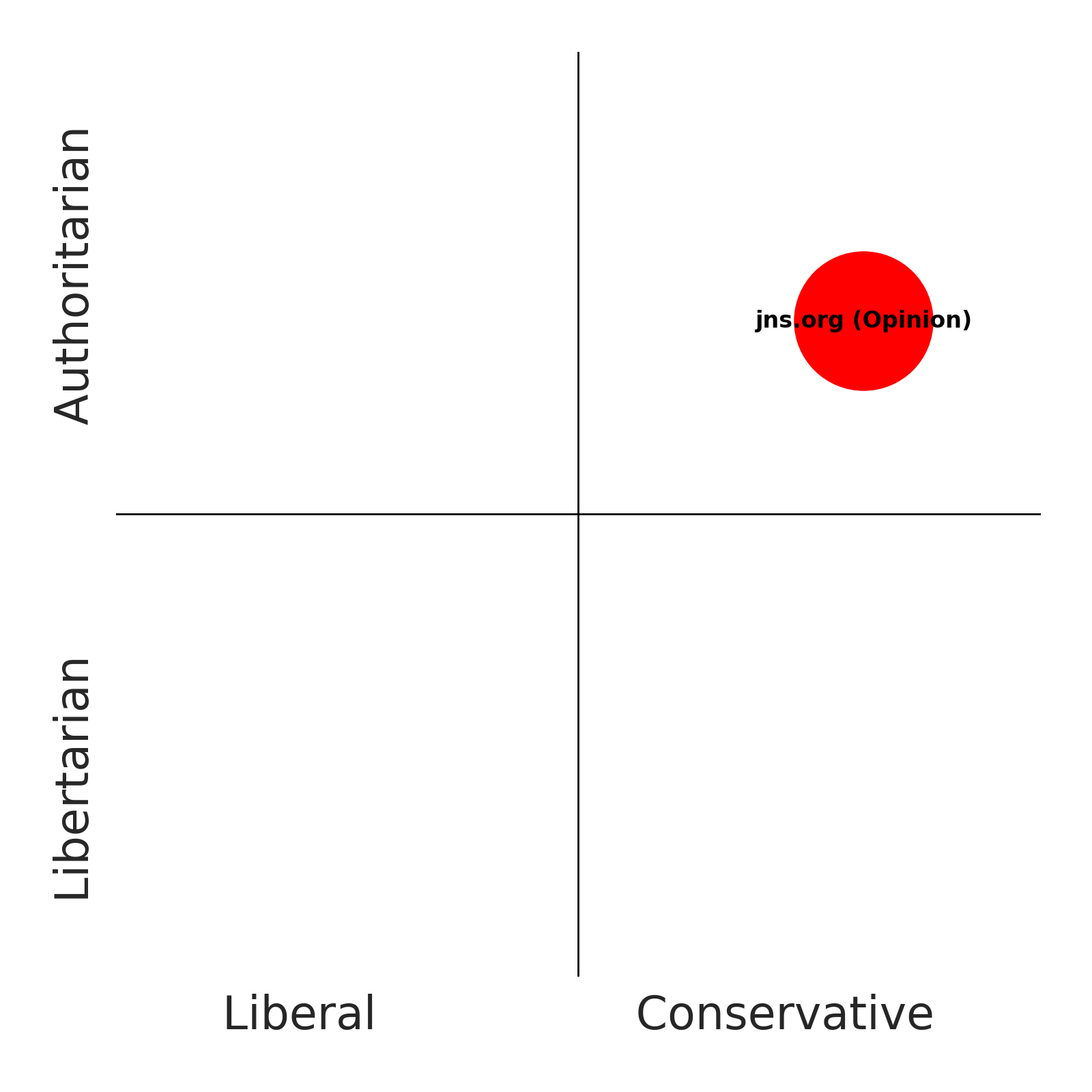
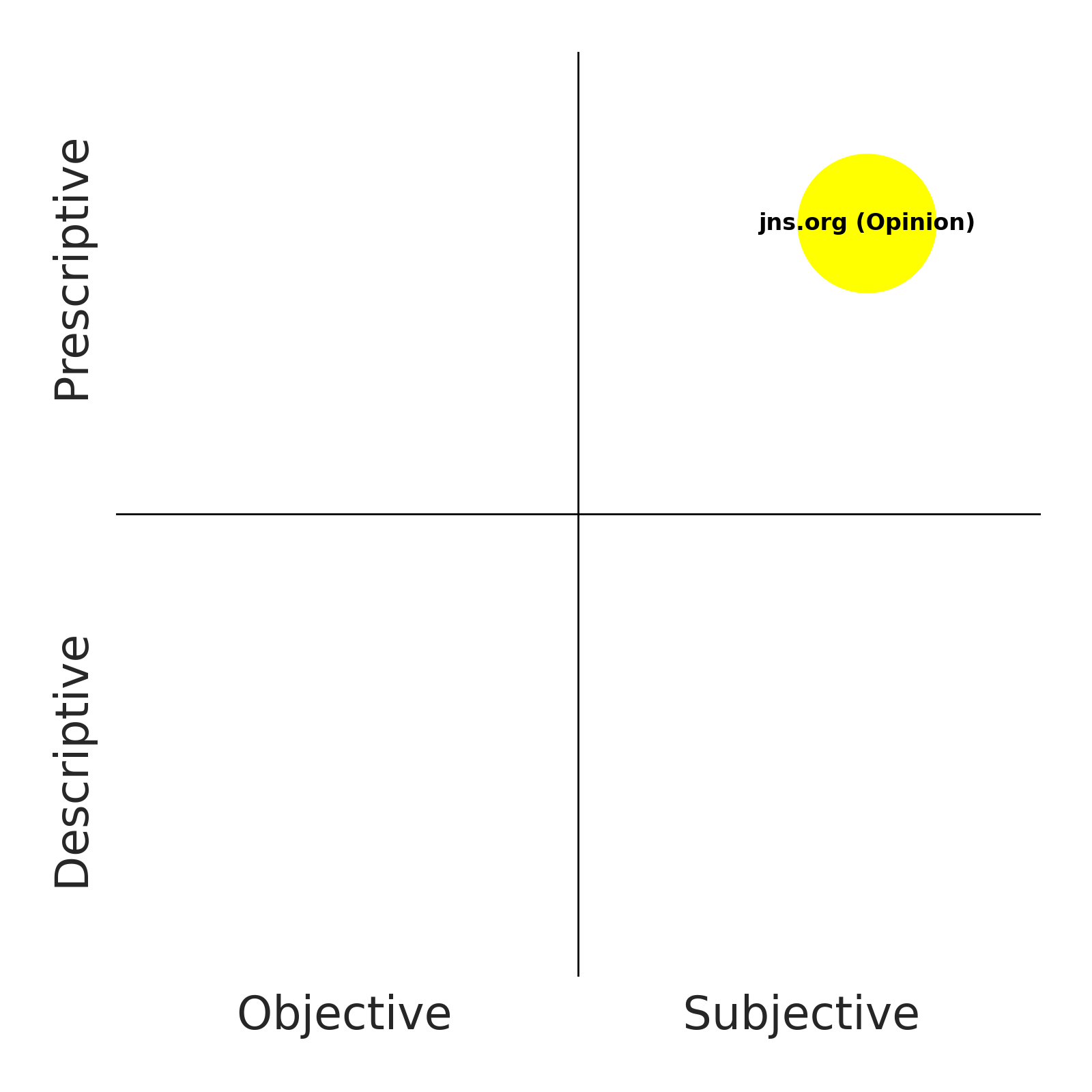
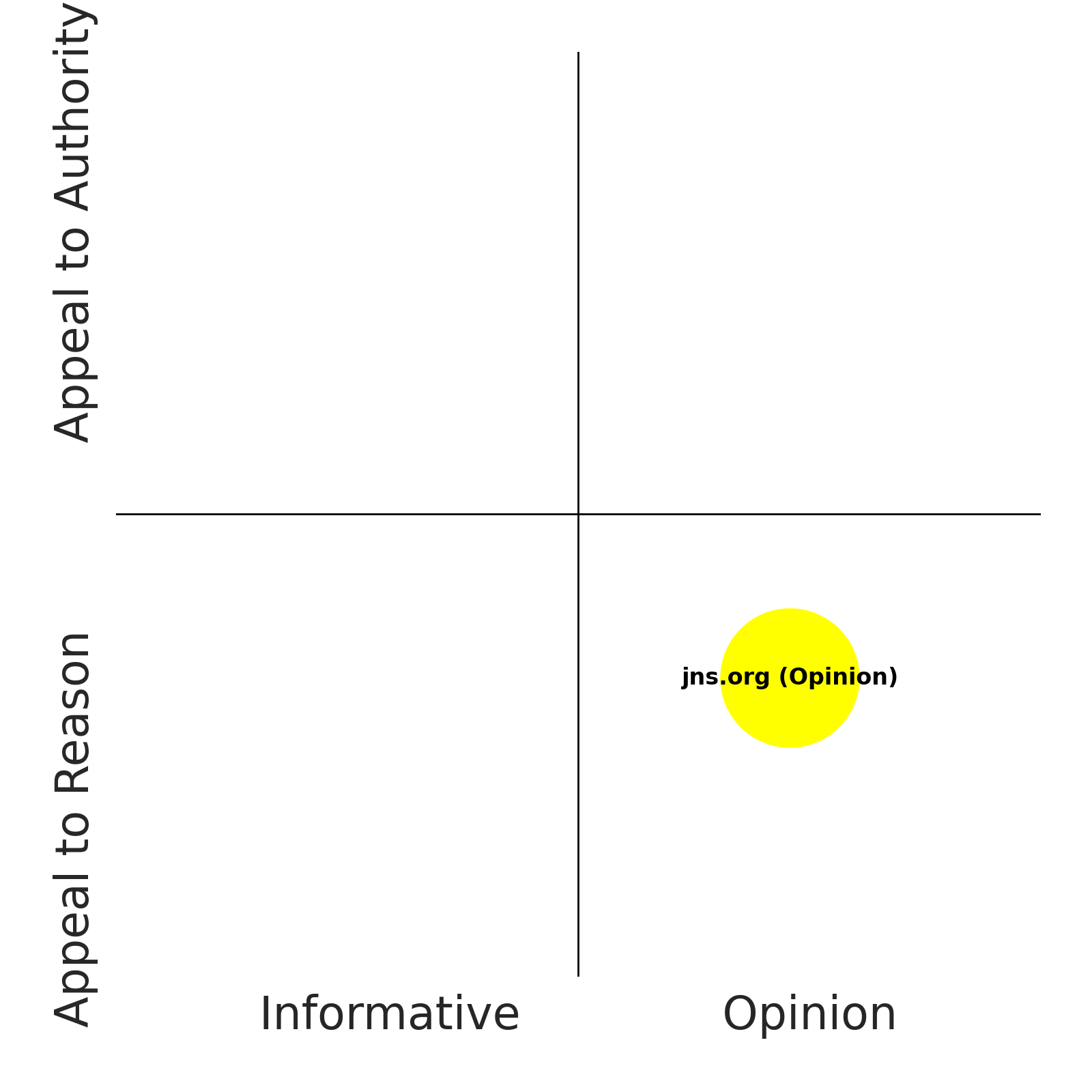
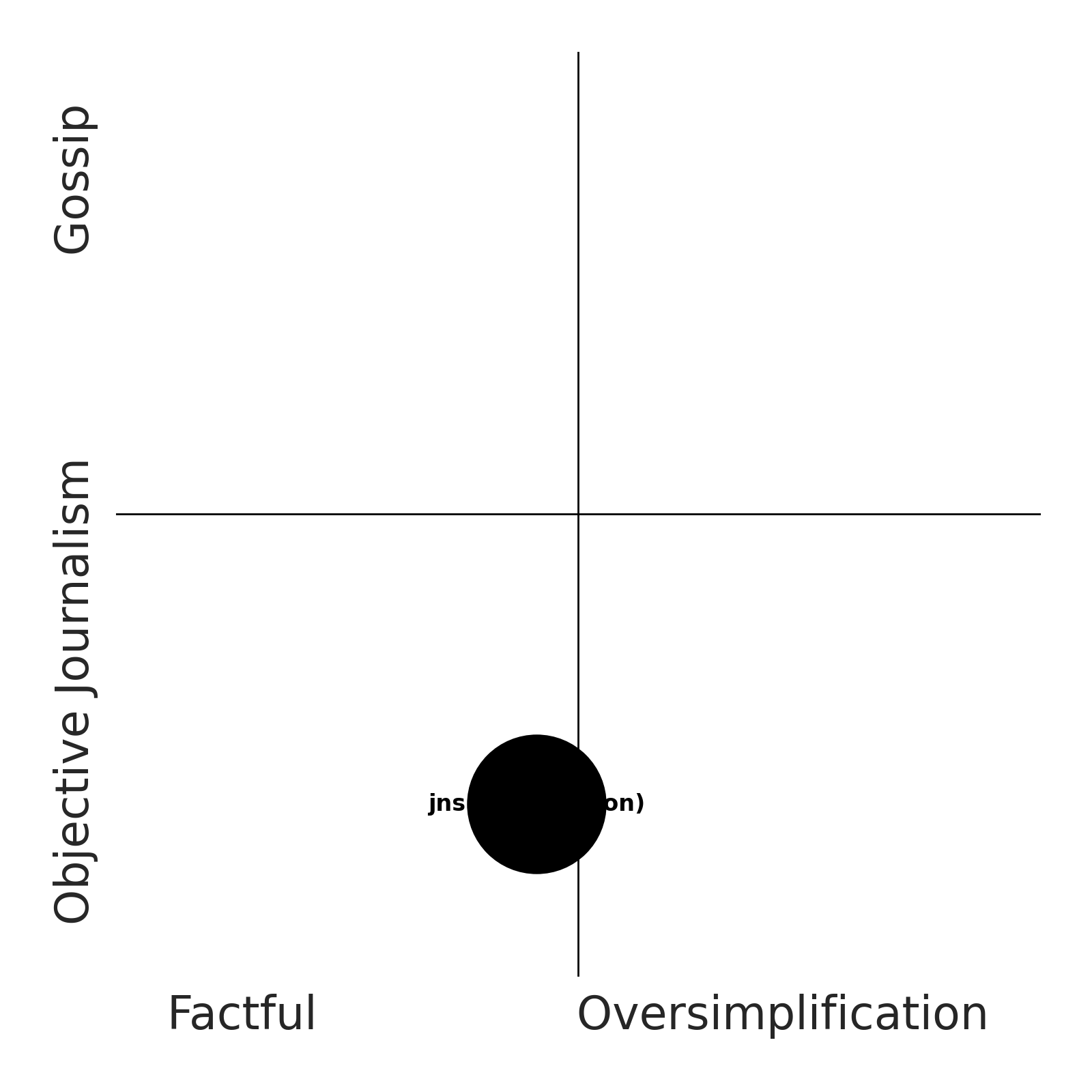
2026 © Helium Trades
Privacy Policy & Disclosure
* Disclaimer: Nothing on this website constitutes investment advice, performance data or any recommendation that any particular security, portfolio of securities, transaction or investment strategy is suitable for any specific person. Helium Trades is not responsible in any way for the accuracy
of any model predictions or price data. Any mention of a particular security and related prediction data is not a recommendation to buy or sell that security. Investments in securities involve the risk of loss. Past performance is no guarantee of future results. Helium Trades is not responsible for any of your investment decisions,
you should consult a financial expert before engaging in any transaction.
Helium Research Assistant

How can I help you today?
Ask any question about jns.org (Opinion) bias.