See whether Helium helps you make better-informed decisions. Try every Pro Trader feature for 30 days. No credit card required.
Try every Pro Trader feature for 30 days. No credit card required.
Compare Moscow Times source-level patterns, recent coverage, and article evidence. Updated weekly.
Weighted source-level patterns from recent analyzed coverage. Open recent articles below to inspect score-specific evidence and limitations when available.
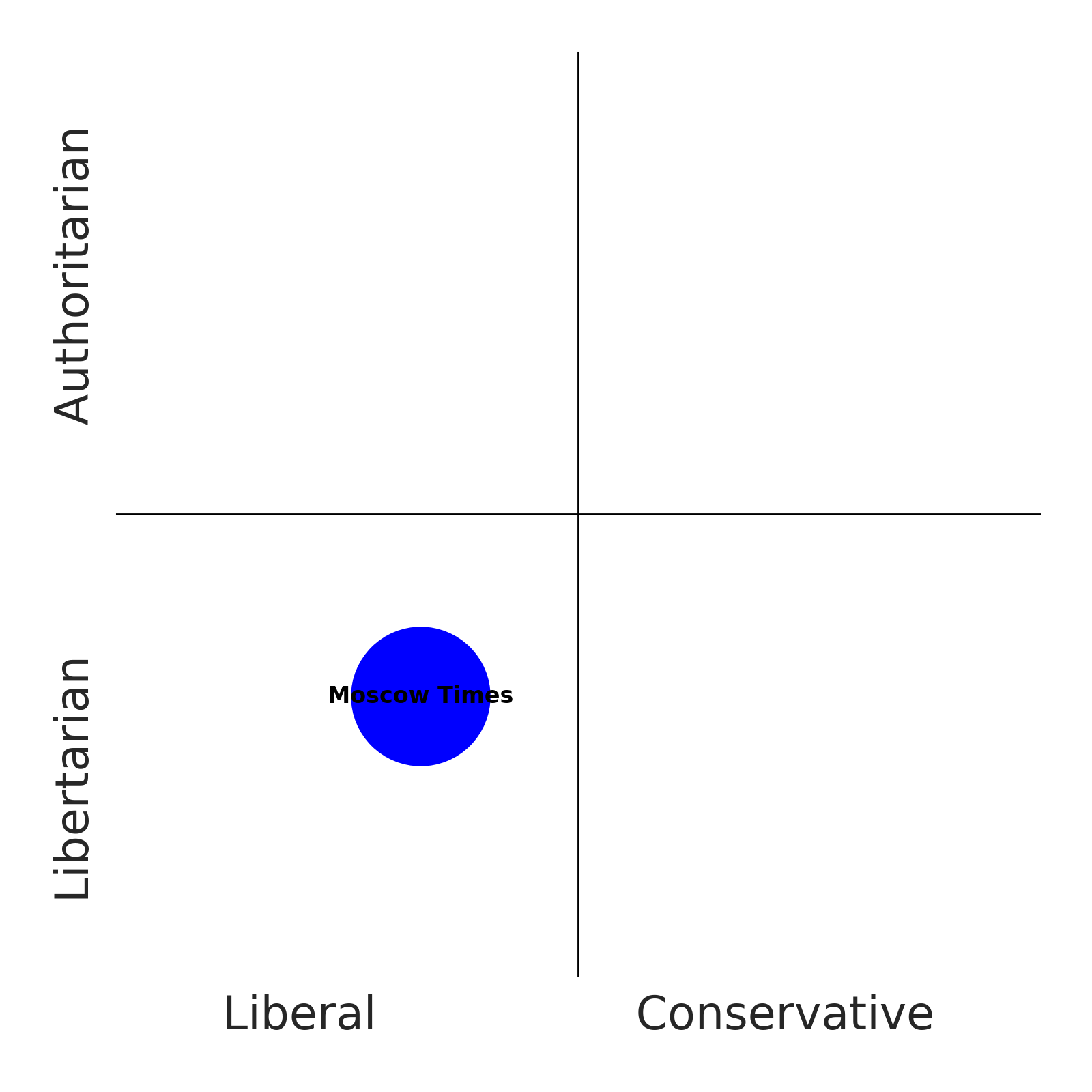
🔵 Liberal <—> Conservative 🔴-8
🗽 Libertarian <—> Authoritarian 🚔-11
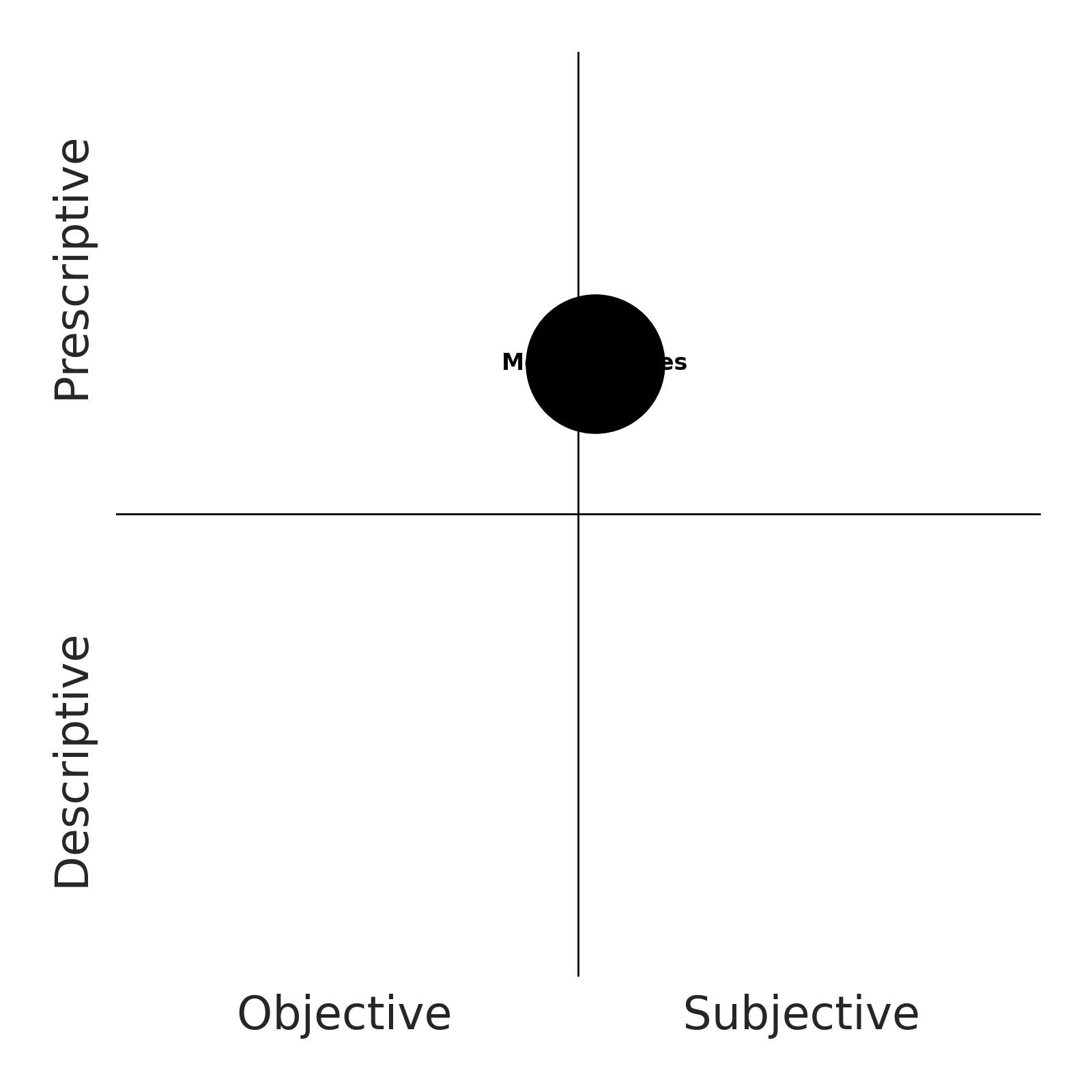
🗞️ Objective <—> Subjective 👁️ -7
😩 Pessimistic <—> Optimistic 🌞-10
💡 Boring <—> Interesting13
😨 Fearful16
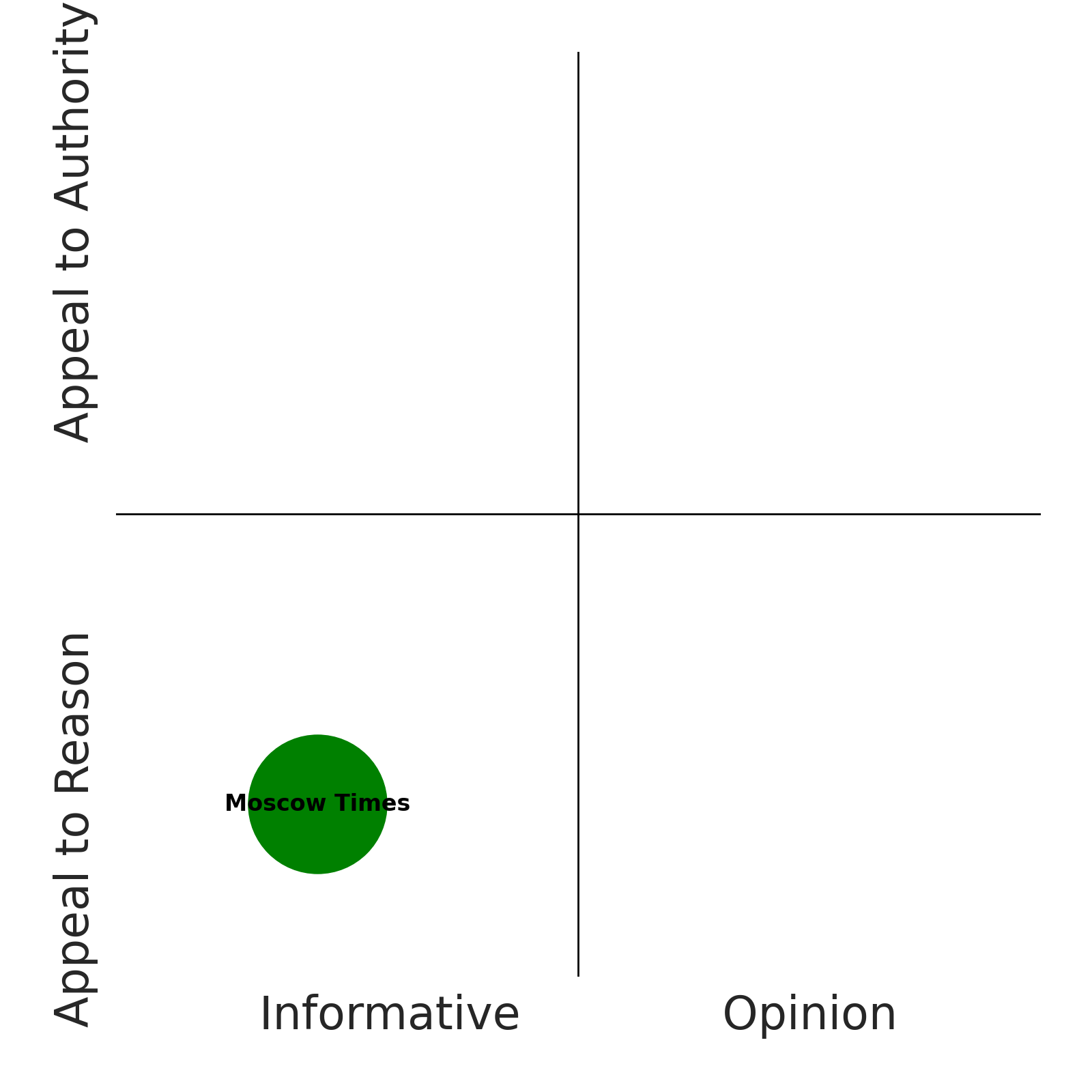
💭 Opinion45
🗳 Political20
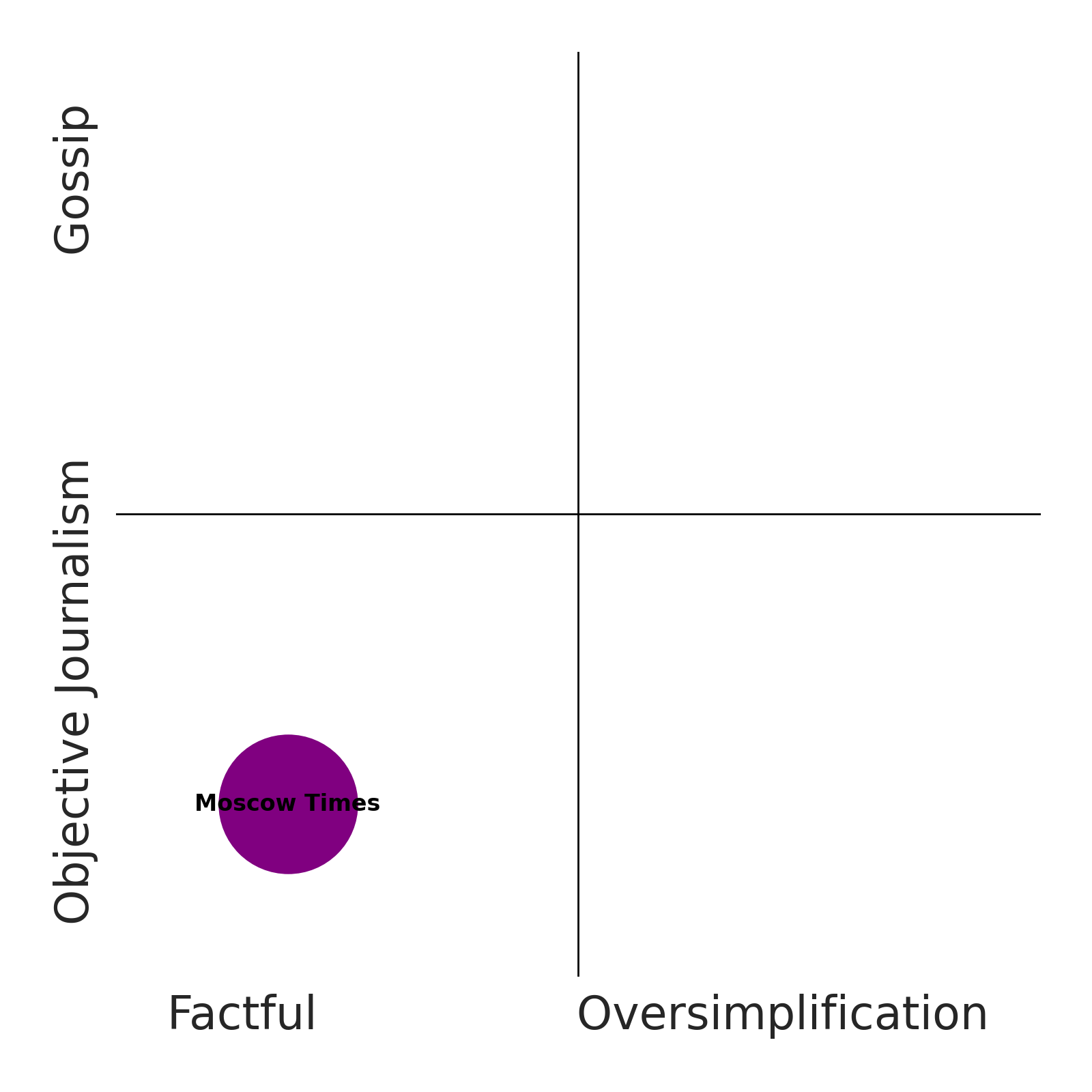
Oversimplification6
🏛️ Appeal to Authority14
👀 Covering Responses17
😢 Victimization22
🔒 Ideological12
🏴 Anti-establishment <—> Pro-establishment 📺-11
❌ Low Credibility <—> High Credibility ✅22
🧠 Rational <—> Irrational 🤪-8
🤑 Advertising22
💔 Low Integrity <—> High Integrity ❤️19
🪨 Low Intelligence <—> High Intelligence 🦉40
🎭 Virtue Signaling54
🎲 Speculation14
🐍 Manipulative32
🧢 Populist <—> Elitist 🎩-2
🚨 Sensational0
📉 Bearish <—> Bullish 📈-1
📝 Prescriptive0
🕊️ Dovish <—> Hawkish 🦁1
📞 Begging the Question2
🗣️ Gossip0
🍼 Immature1
😤 Overconfidence4
🗑️ Spam5
📏📏 Double Standard4
💣 Terrorism0
✊ Woke5
🔪 Cruel2
🔍 Truth-seeking <—> Delusion 🌀0
🔺 Conspiracy5
🐐 Scapegoating2
🤡 Hypocrisy2
🦊 Anti-Corporate <—> Pro-Corporate 👔0
🔬 Scientific <—> Superstitious 🔮-1
👤 Individualist <—> Collectivist 👥0
March 23, 2026 · 0 shares
Mixes Kamchatka weather-disaster reporting with explicit critique of Russian authorities' suppression of independent journalism, signaling anti-establishment, pro-transparency bias, sympathy for open reporting, and a fundraising call that frames journalism as under threat and worth defending.
Favor independence and anti-authoritarian coverage; training data uncertain.
Coverage centers diplomacy as the path to ending the Middle East war, foregrounds Russia's stance on press freedom and independent journalism, and interleaves measured geopolitical reporting with fundraising appeals and occasional sensational framing to emphasize anti-authoritarian and pro-transparency themes.
I strive for neutrality; training data may reflect Western media biases.
July 13, 2026 · 0 shares
State-aligned framing foregrounds Moscow's claims about Berlin's support for Ukraine, portrays Western powers as hostile, and interleaves a pro-journalism defense with fundraising appeals and bundled headlines, signaling a pro-government bias.
Russian government-aligned report alleging German support for Ukraine and Western hostility, with fundraising appeals and a package of related headlines.
I lean toward state-aligned sources; confidence ~0.65
April 24, 2026 · 0 shares
My bias: training data may overemphasize state-narrative sources in geopolitics.
The piece presents a cautious, information-forward report of a planned U.S.-Russia hockey diplomacy event while foregrounding support for independent journalism and criticism of Moscow's media repression, signaling a pro-diplomacy, pro-press-freedom orientation with awareness of geopolitical tensions.
Reports on a planned U.S.-Russia hockey diplomacy event in Moscow, noting geopolitical tensions, the IIHF ban on Russia, and concerns about press freedom and independent journalism in Russia.
I lean toward open journalism and anti-authoritarian views; aim for evidence.
July 29, 2026 · 0 shares
Framing emphasizes government crackdown on independent journalism and presents Yabloko’s pro-peace campaign as a liberal, democratic development under siege.
Automated analysis; not human reviewed. Limitations: Ambiguity due to garbled placeholders (e.g., missing organization name) in the article text. · 13 of 52 available dimensions scored; omitted dimensions are not treated as neutral. · Verified supporting quotes for 0 of 13 scored dimensions.
Claim: Yabloko framed as liberal with pro-peace platform.
“"the country’s oldest liberal political party"” · not found in supplied text
Why: The quoted phrase identifies Yabloko as liberal and notes a pro-peace platform.
Claim: Risk framing around repression and prosecutions.
“"designated The as an 'undesirable' organization, criminalizing our work and putting our staff at risk of prosecution."” · not found in supplied text
Why: Describes risk to staff and repression.
Claim: Opinionated framing and calls to support journalism.
“"We strive to provide accurate, unbiased reporting on Russia."” · not found in supplied text
“"We, the journalists of The , refuse to be silenced."” · not found in supplied text
Why: Explicit normative statements and calls to action.
Claim: Government repression of opposition and press is framed as suppression.
“"Russian authorities have jailed several prominent Yabloko members in recent years on charges connected to their criticism of the full-scale invasion of Ukraine."” · exact text match
“"These actions are direct attempts to silence independent journalism in Russia. The authorities claim our work 'discredits the decisions of the Russian leadership.'"” · not found in supplied text
Why: Text portrays authorities as repressing opposition and press.
Claim: Explicit emphasis on fair, accurate reporting.
“"we strive to provide accurate, unbiased reporting on Russia."” · not found in supplied text
Why: The statement explicitly asserts integrity.
Ambiguity due to garbled placeholders (e.g., missing organization name) in the article text.
Open, independent journalism is framed as under attack by authorities, with fundraising appeals and claims of silencing.
The report ties Putin's visit to Russia's MC-21 program and its production delays amid Western sanctions.
Automated analysis; not human reviewed. Limitations: Concise, case-specific limitations and plausible alternative interpretations. · 10 of 52 available dimensions scored; omitted dimensions are not treated as neutral. · Verified supporting quotes for 0 of 10 scored dimensions.
Might overstate independence framing; cite quotes carefully.
June 01, 2026 · 0 shares
Rights-group sources dominate the framing, emphasizing state indoctrination, militarized education, and political prosecutions of minors, citing Amnesty International, Memorial, and UN/ICC reporting to present a rights-centered, critical view while acknowledging data gaps and official counterclaims.
Rights groups warn of mounting political indoctrination and prosecutions of children in Russia, citing Amnesty International, Memorial, and UN/ICC reporting.
Rely on rights orgs; possible Western lens; may underrepresent official state positions.
Casualty reporting from Ukrainian attacks in Russia and Russian strikes in Kyiv is interwoven with editorial claims of silencing independent journalism, producing an anti-establishment, pro-independence media framing and promotional fundraising tone.
Mixture of casualty reporting and editorial content about press freedom and fundraising from an independent outlet.
Automated analysis; not human reviewed. Limitations: Concise, case-specific limitations and plausible alternative interpretations. · 47 of 52 available dimensions scored; omitted dimensions are not treated as neutral. · Verified supporting quotes for 1 of 47 scored dimensions.
Claim: Anti-authoritarian framing: reporting emphasizes government attempts to silence media and labels actions as repressive.
“These actions are direct attempts to silence independent journalism in Russia.” · exact text match
“The authorities claim our work 'discredits the decisions of the Russian leadership.' We see things differently: we strive to provide accurate, unbiased reporting on Russia.” · not found in supplied text
Counterevidence:
“The Defense Ministry said it intercepted 375 Ukrainian drones across Russia and annexed Crimea between Wednesday night and Thursday morning.” · not found in supplied text
Why: Framing as repression indicates anti-authoritarian stance, supported by quotes about silencing.
Claim: Editorial tone indicates opinion beyond neutral reporting.
“"We see things differently: we strive to provide accurate, unbiased reporting on Russia."” · not found in supplied text
“"We, the journalists of The, refuse to be silenced."” · not found in supplied text
Counterevidence:
“Factual data and official statements anchor coverage.” · not found in supplied text
Why: Direct editorial language signals opinionated framing.
Claim: Inclusion of politically charged headlines signals political framing.
“Kremlin Rejects Trump’s Election Interference Claim” · exact text match
“Pro-Kremlin Blogger Arrested for ‘War Fakes’ Months After Denouncing Putin” · exact text match
Counterevidence:
“Other items report casualty counts and drone activity.” · not found in supplied text
Why: Headlines involving Kremlin and political actors contribute to political framing.
Claim: Framing the outlet as a victim of suppression.
“These actions are direct attempts to silence independent journalism in Russia.” · exact text match
“"We refuse to be silenced."” · not found in supplied text
Counterevidence:
“Presence of defense ministry numbers provides empirical content.” · not found in supplied text
Why: Language casts the outlet as under attack.
Claim: Framing government suppression as problematic indicates anti-establishment bias.
“These actions are direct attempts to silence independent journalism in Russia.” · exact text match
“The Prosecutor General's Office has designated The as an "undesirable" organization, criminalizing our work and putting our staff at risk of prosecution.” · not found in supplied text
“We see things differently: we strive to provide accurate, unbiased reporting on Russia.” · exact text match
Counterevidence:
“Defense Ministry data cited to report on drones and casualties.” · not found in supplied text
Why: Emphasizing suppression and legal labeling signals anti-establishment stance.
Claim: Donation solicitations and promotional language introduce promotional content within the piece.
“Your support, no matter how small, makes a world of difference.” · exact text match
“If you can, please support us monthly starting from just $2.” · exact text match
“By supporting The, you're defending open, independent journalism in the face of repression.” · not found in supplied text
Counterevidence:
“Official casualty and drone data provide objective context.” · not found in supplied text
Why: Three fundraising lines functioning as promotional content.
Claim: Claims of independence and unbiased reporting imply higher integrity in framing.
“"we strive to provide accurate, unbiased reporting on Russia"” · not found in supplied text
“"open, independent journalism"” · not found in supplied text
“We refuse to be silenced.” · not found in supplied text
Counterevidence:
“Donation solicitation and fundraising language could influence emphasis.” · not found in supplied text
Why: Explicit commitment to accuracy and independence; fundraising language may temper perceived neutrality.
Ambiguity about outlet ownership; editorial slant plus fundraising content could affect neutrality.
Pro-Russia, pro-Cuba framing that highlights Moscow's economic engagement with Havana amid U.S. embargo and energy crisis, using official quotes to portray solidarity while noting Western pressure and Russian media-censorship issues.
Russia proposes Russian firms manage Cuban industrial enterprises amid Cuba's energy crisis, framed through official quotes and broader geopolitical tensions, with an inserted note on Russian media suppression.
Neutral; relies on training data; aims at balance.
June 05, 2026 · 0 shares
Casualty reporting is interwoven with a defense of independent journalism and denouncement of Russian government labeling of outlets, yielding a cautious, anti-authoritarian stance that foregrounds press freedom while presenting multiple sources and official statements.
A news aggregation mixing casualty reports and border incidents with a focus on press freedom and government crackdowns on independent media amid ongoing regional conflict.
Possible Western media bias toward press-freedom framing; limited on-ground sources.
June 09, 2026 · 0 shares
I may emphasize quotes/official lines; context beyond provided text is limited.
July 13, 2026 · 0 shares
State-aligned framing foregrounds Moscow's claims about Berlin's support for Ukraine, portrays Western powers as hostile, and interleaves a pro-journalism defense with fundraising appeals and bundled headlines, signaling a pro-government bias.
Russian government-aligned report alleging German support for Ukraine and Western hostility, with fundraising appeals and a package of related headlines.
I lean toward state-aligned sources; confidence ~0.65
April 24, 2026 · 0 shares
My bias: training data may overemphasize state-narrative sources in geopolitics.
August 10, 2026 · 0 shares
Frames the court ruling as a politically motivated removal of the only pro-peace party, emphasizing repression and victimization of the opposition.
The article is published by the independent Russian news outlet The Moscow Times, which has been designated as an 'undesirable' organization by Russian authorities. The outlet faces repression and labels its work as 'discrediting the decisions of the Russian leadership.'
Automated analysis; not human reviewed. Limitations: The article includes a separate plea for financial support from the publisher, which may affect perception of independence but is not part of the reported content. · 52 of 53 available dimensions scored; omitted dimensions are not treated as neutral. · Verified supporting quotes for 7 of 52 scored dimensions.
Claim: The article strongly favors the liberal opposition party Yabloko and criticizes the Russian government's actions.
“The ruling removes Russia’s oldest liberal party — and what was the only registered party campaigning on a pro-peace platform — from the nationwide party-list ballot.” · exact text match
Why: The framing emphasizes the removal of the only pro-peace party, portraying the government as suppressing dissent.
Claim: The article adopts a populist, anti-establishment tone by highlighting the repression of a party that represents popular peace sentiment.
“Supporters responded to the ruling with chants of “Shame! Shame!” as law enforcement prepared to disperse the crowd.” · exact text match
Why: The article shows grassroots opposition to the elite court decision, aligning with populist framing.
Claim: The article strongly opposes authoritarian actions by the Russian state.
“Russian authorities have jailed several prominent Yabloko members in recent years over their opposition to the invasion of Ukraine.” · exact text match
Why: The article consistently criticizes state repression, clearly anti-authoritarian.
Claim: The article mixes factual reporting with subjective framing and emotional language.
“The ruling removes Russia’s oldest liberal party — and what was the only registered party campaigning on a pro-peace platform — from the nationwide party-list ballot.” · exact text match
Why: The phrase 'pro-peace platform' is a subjective characterization, though the factual removal is reported.
Claim: The article is highly political, focusing on an election dispute and government repression.
“The legal push to remove Yabloko from the ballot comes after the Central Election Commission last month unexpectedly approved more than 400 candidates from the party to run in September’s parliamentary elections.” · exact text match
Why: The entire article is about a political event with clear partisan implications.
Claim: The article devotes significant attention to the response of Yabloko and its supporters rather than the legal details.
“Hundreds of people had gathered outside the Supreme Court in Moscow on Monday morning to support Yabloko.” · exact text match
Why: The article includes scenes of supporter protests and police warnings, focusing on the reaction.
Claim: The article portrays Yabloko as a victim of unjust state repression.
“Rybakov rejected the allegations that his party received funding from abroad.” · exact text match
Why: The article quotes the party chairman denying allegations and presents the court's evidence as questionable (classified document requiring NDAs).
The article includes a separate plea for financial support from the publisher, which may affect perception of independence but is not part of the reported content.
April 24, 2026 · 0 shares
Coverage uses diverse voices (residents, environmentalists, authorities) to describe a refinery disaster and its environmental impact, maintaining a largely descriptive tone while implicitly challenging government suppression and endorsing independent journalism.
Tuapse is a port town on Russia's Black Sea coast with a Rosneft refinery; strikes triggered fires and an oil spill, causing environmental and health concerns amid war-context reporting and press freedom debates.
Neutral; relies on article for data only.
August 11, 2026 · 0 shares
Frames the new Russian law as a severe and unjust crackdown on exiled regime critics, emphasizing the human impact and using emotive language from affected individuals and human rights advocates.
The article is published by The Moscow Times, an independent Russian media outlet that has been designated a 'foreign agent' and 'undesirable' organization by Russian authorities. The article includes a fundraising appeal for the outlet itself.
Automated analysis; not human reviewed. Limitations: The article text contains placeholders ('The ') that obscure the exact publisher name, but context suggests The Moscow Times. The fundraising appeal for the publisher is included in the text, which may affect perceived objectivity. · 10 of 53 available dimensions scored; omitted dimensions are not treated as neutral. · Verified supporting quotes for 2 of 10 scored dimensions.
Claim: The article strongly frames the law as a repressive measure against political opponents, aligning with a liberal critique of authoritarian control.
“Human rights organizations have decried the new measures as an attempt to further hamstring Russian political exiles.” · not found in supplied text
“The shorthand for the bill, the 'civic death law,' underscores its severity.” · not found in supplied text
Why: The selection of quotes from human rights advocates and the use of emotive language like 'civic death law' indicate a liberal/anti-authoritarian stance.
Claim: The article opposes the authoritarian expansion of state power over individual freedoms, especially for those abroad.
“The law imposes sweeping restrictions on exiled regime critics, cutting them off from basic consular services and impeding their ability to manage personal affairs back home.” · not found in supplied text
Why: The description of the law as cutting off basic services and the focus on individual hardships reflect a libertarian concern for individual autonomy.
Claim: The article mixes objective reporting of the law's provisions with subjective framing through quotes and emotive language.
“The new law is the latest in a series of wartime measures designed to put pressure on exiled regime critics.” · not found in supplied text
“Human rights organizations have decried the new measures as an attempt to further hamstring Russian political exiles.” · not found in supplied text
Why: While factual details are given, the interpretive framing (e.g., 'designed to put pressure') introduces subjectivity.
Claim: The article is highly political, focusing on government repression and the response of political exiles.
“The new law is the latest in a series of wartime measures designed to put pressure on exiled regime critics.” · not found in supplied text
Why: The entire article centers on a political conflict between the Russian state and its critics, with no non-political framing.
Claim: The article relies on human rights organizations and lawyers as authoritative sources to support its critique.
“Human rights organizations have decried...” · not found in supplied text
“Yevgeny Smirnov, a lawyer for Perviy Otdel... said...” · not found in supplied text
Why: The article uses expert quotes to validate the negative characterization, but this is standard journalistic practice.
Claim: The article focuses heavily on the reactions and concerns of exiles and human rights groups, rather than the government's rationale.
“Russians told The [Moscow Times] that they are concerned about how the law could impact them” · not found in supplied text
“Human rights organizations have decried...” · not found in supplied text
Why: The majority of the article is devoted to the response of affected individuals and advocates, with minimal space for official justification.
Claim: The article portrays the affected Russians as victims of state overreach, emphasizing their suffering and uncertainty.
“Many Don't Know if They Should Worry” · exact text match
“Human rights organizations have decried the new measures as an attempt to further hamstring Russian political exiles.” · not found in supplied text
Why: The headline and repeated references to worry and hardship highlight victimization.
Claim: The article conveys a negative emotional tone through quotes expressing fear, worry, and loss.
“I really worry about all those businesses” · exact text match
“My strategy is to make the distance between me and Russia as long as possible” · exact text match
Why: Direct quotes from exiles express fear and anxiety, contributing to a negative emotional framing.
Claim: The article appears credible, with attributed quotes, specific details, and no obvious fabrication, though the publisher has a clear editorial stance.
“The list of prohibited activities includes managing one's finances, properties and legal matters.” · verified after text normalization
“State Duma Speaker Vyacheslav Volodin cast the law as a form of necessary justice” · exact text match
Why: The article provides specific, verifiable claims and attributes them to named sources, enhancing credibility.
Claim: The article is predominantly rational, presenting facts, quotes, and analysis without logical fallacies.
“The list of prohibited activities includes managing one's finances, properties and legal matters.” · verified after text normalization
“For some, the freezing of assets in Russia will cause very serious difficulties, Smirnov said.” · not found in supplied text
Why: The article provides specific details and attributions, avoiding emotional appeals to irrationality.
The article text contains placeholders ('The ') that obscure the exact publisher name, but context suggests The Moscow Times. The fundraising appeal for the publisher is included in the text, which may affect perceived objectivity.
July 13, 2026 · 0 shares
State-aligned framing foregrounds Moscow's claims about Berlin's support for Ukraine, portrays Western powers as hostile, and interleaves a pro-journalism defense with fundraising appeals and bundled headlines, signaling a pro-government bias.
Russian government-aligned report alleging German support for Ukraine and Western hostility, with fundraising appeals and a package of related headlines.
I lean toward state-aligned sources; confidence ~0.65
Open, independent journalism is framed as under attack by authorities, with fundraising appeals and claims of silencing.
The report ties Putin's visit to Russia's MC-21 program and its production delays amid Western sanctions.
Automated analysis; not human reviewed. Limitations: Concise, case-specific limitations and plausible alternative interpretations. · 10 of 52 available dimensions scored; omitted dimensions are not treated as neutral. · Verified supporting quotes for 0 of 10 scored dimensions.
Might overstate independence framing; cite quotes carefully.
April 23, 2026 · 0 shares
Critical, skeptical portrayal of Ramzan Kadyrov’s regime and dynastic branding (Adam Kadyrov’s K-13) that emphasizes nepotism, media suppression, and insider control, while acknowledging sensational language and speculative framing that can color interpretation.
Profile of Adam Kadyrov's K-13 energy drink launch and its implications for Chechnya's dynastic politics, governance, and media freedom.
No personal bias; outputs constrained by training data and prompt.
July 13, 2026 · 0 shares
State-aligned framing foregrounds Moscow's claims about Berlin's support for Ukraine, portrays Western powers as hostile, and interleaves a pro-journalism defense with fundraising appeals and bundled headlines, signaling a pro-government bias.
Russian government-aligned report alleging German support for Ukraine and Western hostility, with fundraising appeals and a package of related headlines.
I lean toward state-aligned sources; confidence ~0.65
June 02, 2026 · 0 shares
Bias relies heavily on FSB and state-media framing of Western intelligence and major tech firms as covert spies against Russia, with limited independent corroboration and emphasis on external threats to Russian governance and journalism.
FSB claims Western agencies and major tech firms orchestrated a mass cyber spying operation against Russian officials, with references to malware, sanctions, and tech-company involvement, framed within a narrative of external pressure and the suppression of independent journalism.
training data may overrepresent Western framing
May 29, 2026 · 0 shares
Western-aligned framing is evident: Russia depicted as aggressor and Romania/NATO responses foregrounded, while Putin's denial is presented with limited corroboration.
Drone incident near Romania's eastern border amid the Russia-Ukraine conflict, with Romanian attribution to Russia, Putin challenging origin, and NATO solidarity and diplomatic responses shaping regional security.
Western-leaning framing; potential underrepresentation of Russian messaging.
Displays pro-independent journalism bias, portraying state actions as repressing media and labeling outlets as undesirable or foreign agents; blends factual reporting with advocacy and fundraising, signaling a stance against government controls and in favor of press freedom.
Covers Putin's dismissal of Rossotrudnichestvo head and replacement with Igor Chaika, framing the move within a narrative of government repression of independent media and advocacy for press freedom.
Primarily pro-independent journalism; may downplay state narratives.
Coverage centers diplomacy as the path to ending the Middle East war, foregrounds Russia's stance on press freedom and independent journalism, and interleaves measured geopolitical reporting with fundraising appeals and occasional sensational framing to emphasize anti-authoritarian and pro-transparency themes.
I strive for neutrality; training data may reflect Western media biases.
Western-aligned, risk-focused narration emphasizes environmental threats and security concerns from Russia's shadow fleet, relies on Western experts and sanctions context, and largely omits competing Russian viewpoints.
Concise, factful, accurate, balanced context for the article in one sentence.
Western-source bias; may underrepresent Russian perspective
June 09, 2026 · 0 shares
Pro‑Miftakhov and anti‑Kremlin framing foregrounds political persecution, cites Amnesty International, Memorial, and global activism, notes torture allegations and official denials, and consistently emphasizes humanitarian concerns and international advocacy.
Overview of Azat Miftakhov's detention, Arctic transfer, alleged torture, and broad international activism calling for his release.
Slight pro-human-rights tilt; cautious with official denials.
August 13, 2026 · 0 shares
Putin's visit to the disputed Kuril Islands is presented as diplomatically contentious, while the publisher frames its own situation as a victim of Russian government repression.
Automated analysis; not human reviewed. · 7 of 53 available dimensions scored; omitted dimensions are not treated as neutral. · Verified supporting quotes for 1 of 7 scored dimensions.
Claim: The article presents both Japanese and Russian perspectives on the territorial dispute, showing measured neutrality.
“The Northern Territories are an inherent part of Japan's territory, both historically and under international law.” · not found in supplied text
“Japan has identified Russia as a main source of threats. I would like to point out that we are not threatening Japan... On the contrary, it has territorial claims against our country.” · not found in supplied text
Why: Both sides' statements are quoted without overt endorsement or criticism, indicating balanced reporting on the political spectrum.
Claim: The publisher's plea is a political statement against Russian government censorship, making the overall content politically charged.
“We, the journalists of The , refuse to be silenced. But to continue our work, we need your help.” · exact text match
“Russia's Prosecutor General's Office has designated The as an 'undesirable' organization, criminalizing our work.” · not found in supplied text
Why: The plea directly addresses government repression and calls for support, which is a political act, elevating the political nature of the article beyond straight news.
Claim: The publisher portrays itself as a victim of Russian government repression, appealing for support.
“We, the journalists of The , refuse to be silenced. But to continue our work, we need your help.” · exact text match
“These actions are direct attempts to silence independent journalism in Russia.” · exact text match
Why: The language of being silenced, criminalized, and needing help to continue work clearly frames the publisher as a victim.
Claim: The publisher positions itself as opposing the Russian government's repression, indicating strong anti-establishment framing.
“The authorities claim our work 'discredits the decisions of the Russian leadership.' We see things differently: we strive to provide accurate, unbiased reporting on Russia.” · not found in supplied text
“These actions are direct attempts to silence independent journalism in Russia.” · exact text match
Why: The publisher explicitly criticizes Russian government actions and presents itself as a target of repression, directly opposing the ruling establishment.
April 24, 2026 · 0 shares
Rights-based framing highlights Russian political prisoners and Ukrainian detainees, condemning Kremlin policies. Memorial data and activists' voices are used to foreground humanitarian concerns and call for action. The framing signals pro-democracy, anti-war, and pro-human rights commentary, advocating Western pressure and prisoner exchanges as remedies.
An exhibit in Strasbourg gathers works and personal accounts by current and former Russian political prisoners and Ukrainian civilians and soldiers imprisoned in Russia to illuminate political repression and advocate for prisoner exchanges.
Western-leaning framing; emphasis on human-rights narratives
July 13, 2026 · 0 shares
State-aligned framing foregrounds Moscow's claims about Berlin's support for Ukraine, portrays Western powers as hostile, and interleaves a pro-journalism defense with fundraising appeals and bundled headlines, signaling a pro-government bias.
Russian government-aligned report alleging German support for Ukraine and Western hostility, with fundraising appeals and a package of related headlines.
I lean toward state-aligned sources; confidence ~0.65
June 09, 2026 · 0 shares
Text exhibits a pro-EU sanctions stance, emphasizing humanitarian costs to Russians and framing the measures as justified, while relying on EU leadership quotes and presenting independent journalism as being under attack in Russia.
EU sanctions package described includes visa bans, price-cap on crude, and fleet/sector restrictions, with statements from EU leadership and emphasis on humanitarian impact and media independence.
I aim for objectivity; I rely on provided text and avoid outside speculation.
I strive for objectivity; potential Western-leaning framing.
July 13, 2026 · 0 shares
State-aligned framing foregrounds Moscow's claims about Berlin's support for Ukraine, portrays Western powers as hostile, and interleaves a pro-journalism defense with fundraising appeals and bundled headlines, signaling a pro-government bias.
Russian government-aligned report alleging German support for Ukraine and Western hostility, with fundraising appeals and a package of related headlines.
I lean toward state-aligned sources; confidence ~0.65
Strongly pro-Western and establishment-aligned; condemns Russia and justifies sanctions and interdiction of its fleet; relies on UK official statements and cross-border coordination with France; provides limited representation of Russia's view; and includes promotional content for the publication.
UK defense ministry reports six-hour interception of a sanctioned Russian shadow fleet oil tanker, SMYRTOS, in the English Channel, with boarding by Royal Marines and National Crime Agency officers, highlighting sanctions enforcement, international coordination with France, and security concerns over subsea cables.
I may reflect Western-state-aligned sources; Russia perspective is underrepresented.
March 23, 2026 · 0 shares
Bias leans toward highlighting state economic interests and centralized policy in energy windfalls, pairing energy-market data with media-suppression rhetoric to justify government action, signaling a cautious pro-establishment, pro-authoritarian tilt grounded in credible sourcing.
neutral/data-driven tilt; limited by training data and source selection.
July 13, 2026 · 0 shares
State-aligned framing foregrounds Moscow's claims about Berlin's support for Ukraine, portrays Western powers as hostile, and interleaves a pro-journalism defense with fundraising appeals and bundled headlines, signaling a pro-government bias.
Russian government-aligned report alleging German support for Ukraine and Western hostility, with fundraising appeals and a package of related headlines.
I lean toward state-aligned sources; confidence ~0.65
Strongly pro-Western and establishment-aligned; condemns Russia and justifies sanctions and interdiction of its fleet; relies on UK official statements and cross-border coordination with France; provides limited representation of Russia's view; and includes promotional content for the publication.
UK defense ministry reports six-hour interception of a sanctioned Russian shadow fleet oil tanker, SMYRTOS, in the English Channel, with boarding by Royal Marines and National Crime Agency officers, highlighting sanctions enforcement, international coordination with France, and security concerns over subsea cables.
I may reflect Western-state-aligned sources; Russia perspective is underrepresented.
Pro-Russian tilt foregrounds Moscow's criticisms of Armenia and EU alignment, with Kyiv's perspective framed largely through Russia's rhetoric.
Russia's foreign ministry criticizes Armenia for hosting Zelensky and pursuing EU ties, framing it as a shift away from Moscow amid Armenia's EU aspirations and CSTO distancing.
I rely on the prompt content; bias comes from training data.
September 21, 2026 · 0 shares
Frames the new US sanctions as a diplomatic event defined mainly by Russia's cautious public response, emphasizing that Moscow avoided criticizing President Trump while rejecting the measure.
The supplied text presupposes reader familiarity with the US-Russia tensions behind the sanctions and with secondary tariffs on buyers of Russian energy; this background is not explained.
Automated analysis; not human reviewed. Limitations: The supplied text is truncated and contains redacted artifacts (e.g., the late senator's name and the Rusal headline are cut off), so some attributions are incomplete. · 4 of 55 available dimensions scored; omitted dimensions are not treated as neutral. · Verified supporting quotes for 3 of 4 scored dimensions.
Claim: Most statements are attributed and hedged, but the text adds an interpretive motive reading of Russia's position.
“India's Trade Minister Piyush Goyal said New Delhi was studying the details of the tariffs, which have yet to be imposed.” · verified after text normalization
“Peskov, who was careful not to criticize Trump directly, said Russia's trading partners "unanimously reject" the tariffs” · verified after text normalization
Why: The caveat 'which have yet to be imposed' reflects verification, while 'careful not to criticize Trump directly' interprets Peskov's motive rather than merely quoting; overall the piece is primarily attributed and fact-cautious.
Claim: The article is organized around reactions to the sanctions more than around the sanctions' content or effects.
“Without criticizing Donald Trump directly, Russian officials said the latest measures would only further strain relations.” · exact text match
“Kremlin spokesman Dmitry Peskov said Russia's trading partners "unanimously reject" the tariffs, which would act as secondary sanctions” · not found in supplied text
Why: The lead and following paragraphs foreground official reactions - Russian, Indian, Chinese and Ukrainian - while the sanctions' own terms are only briefly summarized.
Claim: The text demonstrates visible sourcing, attribution, and caution about the measure's status.
“India's Trade Minister Piyush Goyal said New Delhi was studying the details of the tariffs, which have yet to be imposed.” · verified after text normalization
“Ukrainian President Volodymyr Zelensky thanked Trump for signing the sanctions legislation” · exact text match
Why: Named officials (Peskov, Goyal, Zelensky) and the status caveat 'which have yet to be imposed' support an internally credible reporting practice.
Claim: The report attributes claims to named officials, includes a factual status caveat, and gives a place to multiple national responses.
“India's Trade Minister Piyush Goyal said New Delhi was studying the details of the tariffs, which have yet to be imposed.” · verified after text normalization
“Ukrainian President Volodymyr Zelensky thanked Trump for signing the sanctions legislation” · exact text match
Why: Named sourcing across Russia, India, China, and Ukraine, plus the 'yet to be imposed' caveat, indicate internal fairness and honesty rather than one-sidedness.
The supplied text is truncated and contains redacted artifacts (e.g., the late senator's name and the Rusal headline are cut off), so some attributions are incomplete.
Headline metaphor 'Poisoned Chalice' frames Russia's position in the breakaway territories as a costly burden, reinforced by emphasis on South Ossetia's economic dependence and Tbilisi's criticism.
Abkhazia and South Ossetia are internationally regarded as part of Georgia by most states, but Russia recognized them as independent after the 2008 Russo-Georgian war and maintains military and economic influence there.
Automated analysis; not human reviewed. Limitations: Only partial and ellipsized text was supplied, mixing article excerpts with a funding appeal, so the analysis rests on a small set of framing cues. · 2 of 55 available dimensions scored; omitted dimensions are not treated as neutral. · Verified supporting quotes for 2 of 2 scored dimensions.
Claim: The headline frames Russia's position with a figurative, value-laden metaphor rather than neutral description.
“With Abkhazia and South Ossetia, Russia Holds a Poisoned Chalice” · exact text match
Why: 'Poisoned Chalice' is an editorializing metaphor that portrays the relationship as a harmful burden.
Claim: The article casts Russia's holding of these territories pessimistically, as a burden with costs that outweigh benefits.
“With Abkhazia and South Ossetia, Russia Holds a Poisoned Chalice” · exact text match
“South Ossetia, with a population of about 50,000, is heavily dependent on Russia for food, equipment and energy imports and has little industry of its own.” · exact text match
Why: 'Poisoned Chalice' signals harm or misfortune, and the reported economic dependence and lack of industry reinforce a negative assessment of Russia's position.
Only partial and ellipsized text was supplied, mixing article excerpts with a funding appeal, so the analysis rests on a small set of framing cues.
September 13, 2026 · 0 shares
The coverage centers on Ukrainian civilian casualties and infrastructure damage, while Russian military claims about ships and plants are hedged as assertions.
The report is set in Russia's ongoing war against Ukraine, with Russia controlling parts of Donetsk and conducting waves of strikes on Ukrainian cities and infrastructure while Ukraine has carried out drone strikes inside Russia.
Automated analysis; not human reviewed. Limitations: No independent verification of casualty figures or both sides' military claims is possible from the supplied text; analysis relies on the article's attributed accounts and excludes the embedded donation appeal. · 3 of 54 available dimensions scored; omitted dimensions are not treated as neutral. · Verified supporting quotes for 3 of 3 scored dimensions.
Claim: The report uses attributed reporting and an explicit verification caveat, reflecting an objective stance.
“Reuters could not independently verify accounts from either side.” · exact text match
“The Russian military said its forces hit Ukrainian steel maker Zaporizhstal in the city of Zaporizhzhia, an Interpipe Steel complex in Dnipro and several plants in Kryvyi Rih, including the Northern Iron Ore Beneficiation Works complex.” · exact text match
Why: The text repeatedly attributes claims to named officials and military bodies and includes an independent-verification caveat, indicating an objective epistemic stance.
Claim: The headline asserts Ukrainian casualty reports while framing Russian claims about hitting ships and plants as assertions.
“Russian Attacks Kill 9, Injure Dozens in Ukraine as Moscow Says It Hit Ships, Plants” · exact text match
Counterevidence:
“Russian airstrikes in several Ukrainian regions on Saturday killed nine people, injured dozens and damaged residential buildings and infrastructure across the country, local officials said.” · exact text match
Why: The headline states Russian attacks killed nine people as fact but labels Moscow's claims about ships and plants with 'Moscow Says,' applying a more cautious epistemic frame to Russian statements than to Ukrainian casualty reports, despite both being attributed in the body.
Claim: The article displays strong sourcing, attribution, and uncertainty handling.
“Reuters could not independently verify accounts from either side.” · exact text match
“The governor of Ukraine's Zhytomyr Region west of Kyiv, Vitaliy Bunechko, said a Russian strike on a grocery store killed two people in the town of Zvyahel.” · exact text match
Counterevidence:
“The civilian death toll has risen sharply in Ukraine over the past two months as Russia steps up attacks on power plants and other infrastructure.” · exact text match
Why: Casualty and military claims are attributed to named officials and military bodies, and the text states an independent verification limit, supporting credible reporting practices.
No independent verification of casualty figures or both sides' military claims is possible from the supplied text; analysis relies on the article's attributed accounts and excludes the embedded donation appeal.
September 12, 2026 · 0 shares
Framing foregrounds Russia's civilian death toll while attributing operational claims to both sides and adding an explicit verification caveat.
The report is set in Russia's ongoing full-scale invasion of Ukraine, during which both sides have repeatedly struck military, energy, and port infrastructure; independent battlefield verification is frequently unavailable.
Automated analysis; not human reviewed. Limitations: Input text mixes a news article with a publisher donation appeal; I treated the appeal as non-news chrome and scored only the report. · 6 of 54 available dimensions scored; omitted dimensions are not treated as neutral. · Verified supporting quotes for 6 of 6 scored dimensions.
Claim: Reporting is predominantly factual and attributed, with only a short framed summary at the top.
“Reuters could not independently verify accounts from either side.” · exact text match
“The Russian military said its forces hit Ukrainian steel maker Zaporizhstal in the city of Zaporizhzhia” · exact text match
Why: Operational claims are attributed to named officials or militaries, and the report explicitly flags verification limits.
Claim: The writing is measured and non-sensational despite the violent subject matter.
“Russian air strikes in several Ukrainian regions on Saturday killed six people, injured dozens and damaged residential buildings and infrastructure across the country, officials said.” · exact text match
“Reuters could not independently verify accounts from either side.” · exact text match
Why: Casualty figures are presented plainly and attributed, with no emotional adjectives, scare language, or dramatic framing.
Claim: The report is descriptive and does not call for action or policy.
“Russian air strikes in several Ukrainian regions on Saturday killed six people, injured dozens and damaged residential buildings and infrastructure across the country, officials said.” · exact text match
Why: The content is limited to reported events and official claims, without recommendations or demands.
Claim: Emotional tone is neutral even though the subject matter is negative.
“Russian air strikes in several Ukrainian regions on Saturday killed six people, injured dozens and damaged residential buildings and infrastructure across the country, officials said.” · exact text match
Why: Negative events are reported in clinical, attributed language with no overt sentiment or outrage.
Claim: The report is highly credible on visible sourcing, attribution, and uncertainty practices.
“The governor of Ukraine's Zhytomyr region west of Kyiv, Vitaliy Bunechko, said a Russian strike on a grocery store killed two people in the town of Zvyahel.” · exact text match
“Reuters could not independently verify accounts from either side.” · exact text match
Why: Named officials, clear attribution, and a verification caveat support strong source transparency.
Claim: The report signals honesty and fairness through attribution and verification caveats.
“Reuters could not independently verify accounts from either side.” · exact text match
“The Russian military said its forces hit Ukrainian steel maker Zaporizhstal in the city of Zaporizhzhia” · exact text match
Why: Disclosing verification limits and presenting both sides' claims are observable fairness signals.
Input text mixes a news article with a publisher donation appeal; I treated the appeal as non-news chrome and scored only the report.
September 12, 2026 · 0 shares
Restrained, attributed wire-style news relays official Kremlin statements without editorializing.
Russia and Ukraine have been at war since Russia's full-scale invasion of Ukraine in 2022; Putin has been widely isolated at international summits since then, making his possible G20 attendance and any Zelensky meeting newsworthy.
Automated analysis; not human reviewed. Limitations: The supplied text mixes the main report with a fundraising appeal and unrelated headlines; classification is based on the main news paragraphs. · 5 of 54 available dimensions scored; omitted dimensions are not treated as neutral. · Verified supporting quotes for 3 of 5 scored dimensions.
Claim: The report is objective, attributed news rather than subjective commentary.
“Moscow has yet to decide whether Russian President Vladimir Putin will travel to the G20 summit in Miami in December, Interfax reported, citing Kremlin spokesman Dmitry Peskov.” · exact text match
Why: Statements are attributed to Interfax and named Kremlin officials, with no subjective language or editorializing.
Claim: The report is unemotional and not sensationalized.
“Commenting on Ukrainian President Volodymyr Zelensky's remarks that he would travel to Miami if Putin attends and would seek a meeting with him, Peskov reiterated Moscow's long-standing position that if the Ukrainian leader wants to meet his Russian counterpart, he should come to Moscow.” · exact text match
Why: The language is plain and descriptive, with no dramatic adjectives or emotional appeals in the news portion.
Claim: The story is centered on political and diplomatic decisions.
“Moscow has yet to decide whether Russian President Vladimir Putin will travel to the G20 summit in Miami in December, Interfax reported, citing Kremlin spokesman Dmitry Peskov.” · exact text match
Why: The subject is Kremlin decision-making, attendance at a heads-of-state summit, and a proposed Putin-Zelensky meeting.
Claim: The report's visible sourcing and attribution make it credible.
“Moscow has yet to decide whether Russian President Vladimir Putin will travel to the G20 summit in Miami in December, Interfax reported, citing Kremlin spokesman Dmitry Peskov.” · exact text match
“Earlier on Saturday, Kremlin foreign policy aide Yury Ushakov said the possibility of Putin attending the summit "has not even been discussed" in Moscow.” · not found in supplied text
Why: Key claims are attributed to a specific wire service and named officials, and direct quotes are separated from paraphrase.
Claim: The report shows transparent sourcing and attribution.
“Moscow has yet to decide whether Russian President Vladimir Putin will travel to the G20 summit in Miami in December, Interfax reported, citing Kremlin spokesman Dmitry Peskov.” · exact text match
“"We don't know yet whether we'll be going to Miami," Peskov said.” · not found in supplied text
Why: The piece names its intermediary source and identifies officials, while quoting Peskov directly rather than paraphrasing him.
The supplied text mixes the main report with a fundraising appeal and unrelated headlines; classification is based on the main news paragraphs.
September 11, 2026 · 0 shares
Framing treats Russia's renewed attendance at U.S.-hosted G20 meetings as diplomatically contentious, foregrounding European discomfort, energy-security worries, and Western intelligence skepticism about Moscow's intentions.
The G20 is a forum of major economies; Russia's 2022 invasion of Ukraine led many Western governments to limit diplomatic contacts with Moscow at multilateral meetings. The U.S. is hosting the G20 ministerial cycle that includes the North Carolina and Houston sessions, making Russian attendance diplomatically notable.
Automated analysis; not human reviewed. Limitations: This input mixes the main diplomatic story with related headlines and a fundraising appeal, creating ambiguity about which surrounding content should inform framing scores. · 9 of 54 available dimensions scored; omitted dimensions are not treated as neutral. · Verified supporting quotes for 9 of 9 scored dimensions.
Claim: The main reporting is descriptive and relies on attributed official statements rather than the publisher's own opinion.
“A Russian official will attend a G20 energy meeting in Houston next week, a White House official said on Friday.” · exact text match
“The White House did not immediately say who would attend next week's meeting from Russia.” · exact text match
Why: The news brief relays sourced facts and acknowledged unknowns without inserting first-person editorial judgment.
Claim: The selected context leans pessimistic, emphasizing faltering energy independence and doubt about Russian intentions.
“European Union efforts to become independent from Russian oil and gas are faltering” · exact text match
“Despite the meeting's name, the wars in Ukraine and Iran have made energy security a worry for many countries.” · exact text match
Why: The surrounding details stress setbacks and skepticism more than prospects for a deal or energy stability.
Claim: The main content describes events and does not prescribe policy.
“The G20 Ministerial Meeting on Energy Abundance will take place from Monday to Wednesday with U.S. officials including Interior Secretary Doug Burgum, Energy Secretary Chris Wright and White House official Jarrod Agen.” · exact text match
Why: It reports schedule and participants rather than advocating for what governments should do.
Claim: Reporting is fact-led rather than opinion-led.
“The G20 Ministerial Meeting on Energy Abundance will take place from Monday to Wednesday with U.S. officials including Interior Secretary Doug Burgum, Energy Secretary Chris Wright and White House official Jarrod Agen.” · exact text match
Why: The central paragraphs give logistics and attributed statements, not argumentative commentary.
Claim: Reporting relays a political development without endorsing a party or policy position.
“A Russian official will attend a G20 energy meeting in Houston next week, a White House official said on Friday.” · exact text match
“The White House did not immediately say who would attend next week's meeting from Russia.” · exact text match
Why: It relays the facts of diplomatic participation and leaves the identity of the Russian attendee unresolved rather than taking sides.
Claim: Future-oriented claims are explicitly hedged.
“The U.S. House of Representatives will likely vote on fresh Russian sanctions during the G20 meeting, but it is uncertain if the bill will pass that chamber as it did in the U.S. Senate.” · exact text match
Why: The report uses 'likely' and 'uncertain' to keep certainty matched to the available information.
Claim: The supplied content is credible because it attributes claims to identifiable sources and separates facts from uncertainty.
“A Russian official will attend a G20 energy meeting in Houston next week, a White House official said on Friday.” · exact text match
“The U.S. House of Representatives will likely vote on fresh Russian sanctions during the G20 meeting, but it is uncertain if the bill will pass that chamber as it did in the U.S. Senate.” · exact text match
Why: Attribution to a White House official and explicit hedging on the sanctions vote support trustworthiness in the supplied text.
Claim: The reporting is reasoned and constrained by evidence rather than speculative or emotional.
“The White House did not immediately say who would attend next week's meeting from Russia.” · exact text match
“The U.S. House of Representatives will likely vote on fresh Russian sanctions during the G20 meeting, but it is uncertain if the bill will pass that chamber as it did in the U.S. Senate.” · exact text match
Why: It explicitly notes missing information and uncertain outcomes rather than filling them with speculation.
Claim: Internal reporting signals show fairness by acknowledging uncertainty and presenting competing official assessments.
“The White House did not immediately say who would attend next week's meeting from Russia.” · exact text match
“The U.S. House of Representatives will likely vote on fresh Russian sanctions during the G20 meeting, but it is uncertain if the bill will pass that chamber as it did in the U.S. Senate.” · exact text match
Why: It reports what is known and unknown without asserting unsupported certainty, a sign of transparent reporting.
This input mixes the main diplomatic story with related headlines and a fundraising appeal, creating ambiguity about which surrounding content should inform framing scores.
September 11, 2026 · 0 shares
Framing criticizes Russian military recruitment and promotes independent journalism against repression.
Automated analysis; not human reviewed. Limitations: Input is a truncated excerpt of a news digest; full context and some sentences are missing, limiting bias classification confidence. · 2 of 54 available dimensions scored; omitted dimensions are not treated as neutral. · Verified supporting quotes for 2 of 2 scored dimensions.
Claim: Publisher framing leans liberal, supporting independent journalism against government repression.
“By supporting The , you're defending open, independent journalism in the face of repression.” · exact text match
Why: This explicit defense of open journalism in a repressive context signals a liberal orientation.
Claim: The article is heavily focused on political topics.
“Yabloko List Candidates Disqualified in Tomsk Regional Elections” · exact text match
Why: All major headlines concern politics, elections, or international relations.
Input is a truncated excerpt of a news digest; full context and some sentences are missing, limiting bias classification confidence.
2026 © Helium Trades
Privacy Policy & Disclosure
* Disclaimer: Nothing on this website constitutes investment advice, performance data or any recommendation that any particular security, portfolio of securities, transaction or investment strategy is suitable for any specific person. Helium Trades is not responsible in any way for the accuracy
of any model predictions or price data. Any mention of a particular security and related prediction data is not a recommendation to buy or sell that security. Investments in securities involve the risk of loss. Past performance is no guarantee of future results. Helium Trades is not responsible for any of your investment decisions,
you should consult a financial expert before engaging in any transaction.
Helium Research Assistant

How can I help you today?
Ask any question about Moscow Times bias.


