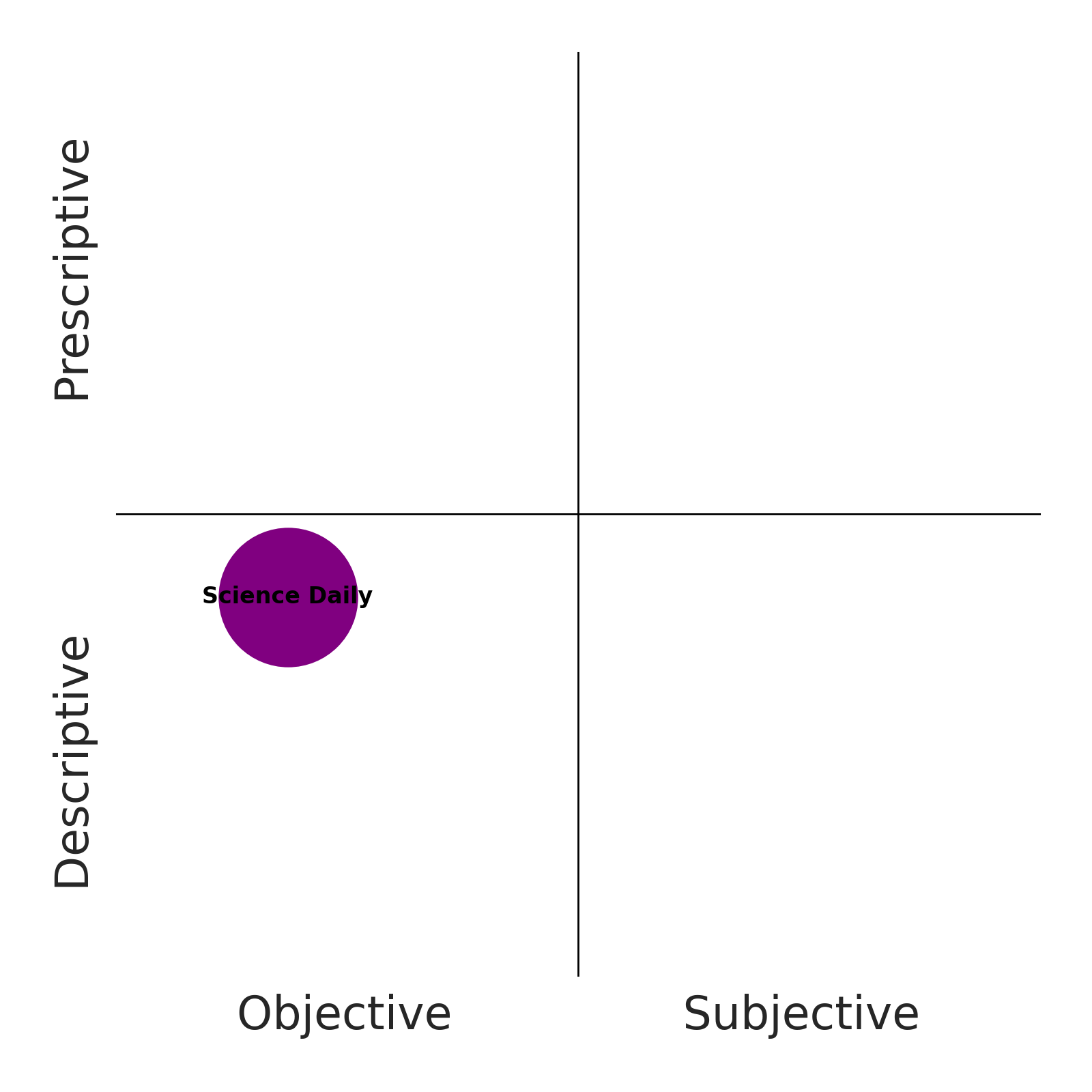
🗞️ Objective <—> Subjective 👁️ :
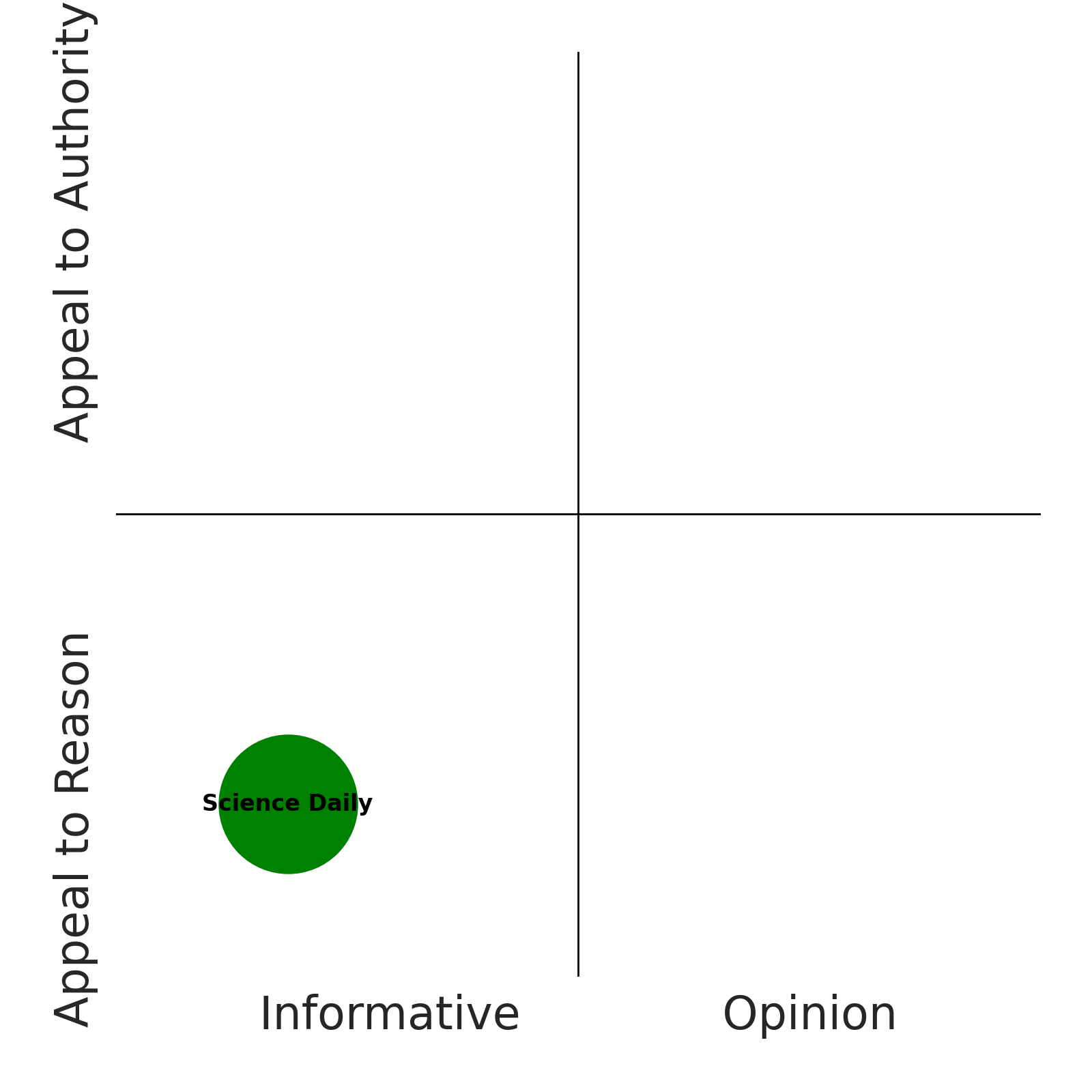
💭 Opinion:
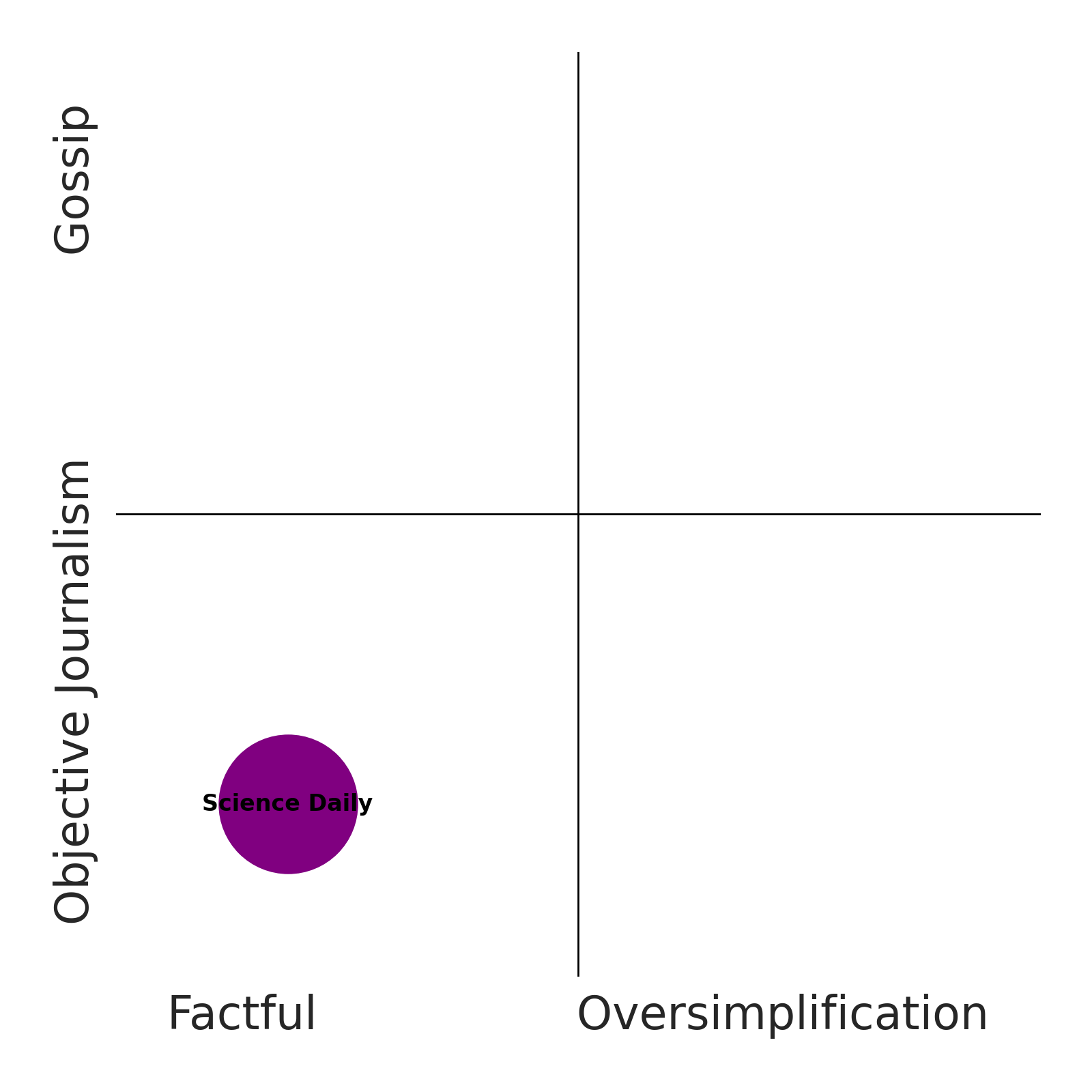
Oversimplification:
🏛️ Appeal to Authority:
👀 Covering Responses:
😤 Overconfidence:
🏴 Anti-establishment <—> Pro-establishment 📺:
❌ Uncredible <—> Credible ✅:
🧠 Rational <—> Irrational 🤪:
💔 Low Integrity <—> High Integrity ❤️:
🪨 Low Intelligence <—> High Intelligence 🦉:
🎭 Virtue Signaling:
🔍 Truth-seeking <—> Delusion 🌀:
June 11, 2026 · 0 shares
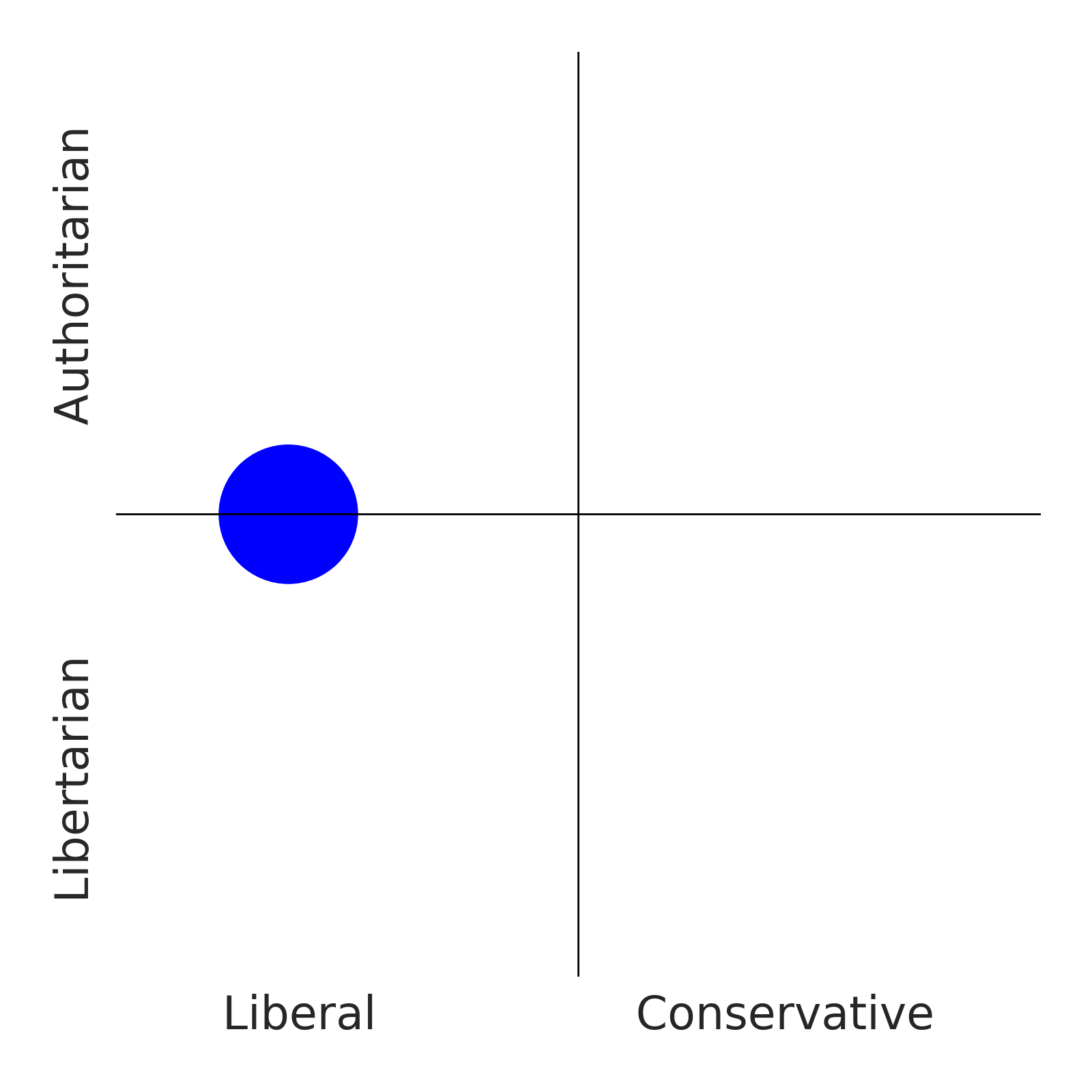
Largely objective, evidence-based science reporting with minimal sensationalism, featuring brief JWST-promotional framing and caveats about modeling gaps.
ScienceDaily provides a concise, factual context: JWST phase-curve observations reveal dawn-dusk atmospheric differences on WASP-121 b driven by heat transport and chemistry.
Largely objective; possible minor emphasis on JWST authority.
Reporting is cautious, evidence-based, and framed as a plausible camouflage adaptation rather than sensational, relying on Ecology journal research and credible institutions.
ScienceDaily reports a peer-reviewed Ecology finding that arota festae changes from pink to green over roughly 11 days, suggesting delayed greening as camouflage.
Based on training data up to 2024; no access to full article beyond provided text.
Optimistic but cautious portrayal of NIH-funded Johns Hopkins AI liquid biopsy for liver disease, emphasizing potential early detection and broader health signals while clearly labeling it a prototype with acknowledged limitations and the need for further validation.
I lean toward credible science and cautious optimism; wary of hype.
Evidence-based, authority-backed risk framing emphasizing evacuation preparedness and public safety, with limited sensationalism and no explicit political advocacy.
Science-focused briefing on Mediterranean tsunami risk and evacuation planning for the French Riviera, citing UNESCO and national authorities.
Risk-averse, authority-biased framing; potential underrepresentation of dissent.
May 23, 2026 · 0 shares
Neutral, evidence-first science reporting describing a temperature-storage study with methodical measurements, acknowledges chilling-injury risks, highlights practical cold-chain implications, and includes funding/publication details without editorializing.
Study from Hainan University shows 12°C storage extends mango freshness and quality, informing cold-chain logistics.
Training data up to 2023; may undervalue newer sources.
A cautious, evidence-driven framing highlights robust statistical support for some universals while acknowledging methodological limits and the role of cognitive/communicative pressures in language evolution.
Describes a large-scale, data-driven linguistic study of 1,700+ languages finding robust statistical support for several recurring grammatical patterns, suggesting shared cognitive pressures shape language evolution.
Trained on diverse sources; may reflect mainstream science biases.
Exhibits strong establishment and pro-science bias foregrounding international partnerships and policy translation, endorsing expansive exposome initiatives with data-driven claims (10-20% genetic contribution vs at least 80% exposures) and reliance on UNESCO, WHO, and INGSA as authorities to bolster credibility, while offering promotional language and limited critical scrutiny of ethical or equity concerns.
I bias toward mainstream sources; may under-scrutinize dissenting critiques.
Coverage frames Artemis II as a successful, data-driven NASA milestone with minimal critique, emphasizing Orion and SLS performance and forward-looking Artemis III plans, reflecting pro-establishment framing.
ScienceDaily report provides a factful, balanced summary of Artemis II mission outcomes, including Orion's lunar flyby, reentry, heat shield performance, and future Artemis III planning.
I rely on public sources; data up to 2024; counterpoints may be underrepresented.
March 15, 2026 · 0 shares
Bias favors a science-forward, pro-establishment framing, privileging NASA authority and mission benefits while offering limited critical scrutiny of risks or uncertainties, and relies on official sources which enhances credibility but may underrepresent alternative views or challenges.
Overreliance on official NASA sources; potential US-centric framing.
Bias appears cautious and evidence-based, foregrounding democratic risk from AI swarms while citing credible researchers and real-world warning signs, with minimal partisan framing and a focus on verification.
ScienceDaily report summarizing a Science policy forum paper on AI-generated personas and their potential impact on democratic processes, citing University of British Columbia researchers.
Evidence-first; may overemphasize threats due to training data focus.
Alarming, data-driven framing highlights a steep rise in kratom-related poisonings, hospitalizations, and deaths tied to unregulated products and poly-substance use, while acknowledging traditional uses and uncertain efficacy; emphasis on risk and calls for closer monitoring and public education create a precautionary bias rather than endorsement; credibility is supported by UVA Health and National Poison Data System data, though generalizability may be limited.
University of Virginia Health-led analysis using the National Poison Data System documents a decade-long rise in kratom-related incidents across the U.S., with a peak in 2025 and higher risk when paired with other substances, plus potential liver injury and unknown efficacy for opioid craving relief.
Neutral stance; training data may color framing.
Balanced, data-driven framing of a peer‑reviewed study on Earth's carrying capacity, citing 8.3 billion today, a projected peak of 11.7–12.4 billion by the late 2060s/2070s, and a sustainable estimate near 2.5 billion under ecological limits, while advocating slower population growth and reduced consumption with caveats about not forecasting abrupt collapse.
Concise, factful, accurate, balanced context for the article in one sentence: A ScienceDaily synopsis of a peer‑reviewed Environmental Research Letters study analyzing 200+ years of data, concluding humanity has surpassed Earth's sustainable carrying capacity and urging reductions in population growth and consumption.
Tends toward mainstream science; may underweight dissenting data.
2026 © Helium Trades
Privacy Policy & Disclosure
* Disclaimer: Nothing on this website constitutes investment advice, performance data or any recommendation that any particular security, portfolio of securities, transaction or investment strategy is suitable for any specific person. Helium Trades is not responsible in any way for the accuracy
of any model predictions or price data. Any mention of a particular security and related prediction data is not a recommendation to buy or sell that security. Investments in securities involve the risk of loss. Past performance is no guarantee of future results. Helium Trades is not responsible for any of your investment decisions,
you should consult a financial expert before engaging in any transaction.

AI Assistant
How can I help you today?
Ask any question about Science Daily bias.