See whether Helium helps you make better-informed decisions. Try every Pro Trader feature for 30 days. No credit card required.
Try every Pro Trader feature for 30 days. No credit card required.
Coverage frames the opening as an upbeat local retail milestone, weaving official ceremony, heritage, and shopper praise into a promotional narrative.
Automated analysis; not human reviewed. Limitations: The supplied article text is fragmented and truncated, with ellipses and missing context, so the classification rests on the visible excerpts. · 3 of 55 available dimensions scored; omitted dimensions are not treated as neutral. · Verified supporting quotes for 1 of 3 scored dimensions.
Claim: The publisher selects and emphasizes positive details about the new supermarket, yielding an optimistic overall framing.
“The supermarket also houses a dedicated pork counter selling fresh meat – the largest among more than 50 FairPrice supermarkets with similar counters.” · exact text match
“Homemaker Shabina, 40, said the store has a larger range of offerings than several other outlets, and she thus visits it almost every other day.” · exact text match
Why: Superlatives and uniformly positive shopper remarks are included without any countervailing detail, supporting an optimistic tone.
Claim: The text functions partly as promotion by combining a voucher call to action with favorable superlatives about a named retailer.
“Get $4 voucher […]” · not found in supplied text
“The supermarket also houses a dedicated pork counter selling fresh meat – the largest among more than 50 FairPrice supermarkets with similar counters.” · exact text match
Why: The direct voucher prompt and unsolicited superlative about a named retailer show promotional framing rather than neutral, purely informational reporting.
Claim: The publisher frames a named corporate retailer positively, highlighting its scale and prompting economic action.
“The supermarket also houses a dedicated pork counter selling fresh meat – the largest among more than 50 FairPrice supermarkets with similar counters.” · exact text match
“Get $4 voucher […]” · not found in supplied text
Why: The article highlights FairPrice’s size leadership and includes an invitation to engage with the store, producing a pro-FairPrice commercial framing.
The supplied article text is fragmented and truncated, with ellipses and missing context, so the classification rests on the visible excerpts.
September 22, 2026 · 0 shares
Reporting frames EU–ASEAN trade relations as constructive and forward-moving, foregrounding official and business endorsements of modular deals and faster regional integration while maintaining attributed, neutral language.
Automated analysis; not human reviewed. Limitations: Input text is truncated with ellipses, so omitted passages may affect assessment. · 6 of 55 available dimensions scored; omitted dimensions are not treated as neutral. · Verified supporting quotes for 2 of 6 scored dimensions.
Claim: The text reports official and business statements with attribution and numerical survey results, without authorial evaluation.
“The council’s latest business sentiment survey found that 74 per cent of European businesses polled believe an ASEAN-wide FTA would bring greater benefits than separate bilateral agreements, while 49 per cent want negotiations for such a deal to be launched in 2027.” · exact text match
“Gan said ASEAN is also laying the groundwork for a green economy framework, with Singapore hoping negotiations can begin in 2027 when it assumes the ASEAN chair.” · not found in supplied text
Why: Statements are attributed to Gan or the council, and no evaluative conclusion is offered in the reporter’s voice.
Claim: The report is free of hyperbolic language and does not sensationalise the trade-policy developments.
“Echoing the ministerial push, European businesses on Sept 22 urged ASEAN and the EU to establish a region-to-region economic framework in 2027, when the two groupings mark 50 years of relations.” · exact text match
“The upgraded pact, which aims to reduce barriers and simplify trade within ASEAN, was originally scheduled to come into force in 2027.” · exact text match
Why: Language is procedural and neutral, with no superlatives, crisis framing, or dramatic imagery.
Claim: Proposals are described rather than prescribed; the publisher does not issue its own recommendations.
“In a statement, the EU-ASEAN Business Council (EU-ABC) proposed a modular framework that would allow both sides to deepen economic ties gradually without waiting for every element of a comprehensive FTA to be finalised.” · exact text match
“He added that moving up the timeline demonstrates member states’ shared commitment to making the trade agreement benefit businesses as soon as possible.” · not found in supplied text
Why: The publisher notes who proposed and who urged, but stops short of endorsing or directing policy.
Claim: The text is credible on its face due to named sources, direct quotes, exact percentages, and dated meeting specifics.
“The council’s latest business sentiment survey found that 74 per cent of European businesses polled believe an ASEAN-wide FTA would bring greater benefits than separate bilateral agreements, while 49 per cent want negotiations for such a deal to be launched in 2027.” · exact text match
“Gan said ASEAN is also laying the groundwork for a green economy framework, with Singapore hoping negotiations can begin in 2027 when it assumes the ASEAN chair.” · not found in supplied text
Why: The report provides enough identifiers, dates and figures for a reader to locate and verify the underlying claims.
Claim: The article’s framing relies on logical, outcome-oriented arguments and quantitative survey evidence rather than emotional appeals.
“Rather than maintaining multiple bilateral payment links, Gan said a multilateral system would be “much easier, more efficient”, allowing countries to connect to a wider network through a single arrangement.” · exact text match
“The council’s latest business sentiment survey found that 74 per cent of European businesses polled believe an ASEAN-wide FTA would bring greater benefits than separate bilateral agreements, while 49 per cent want negotiations for such a deal to be launched in 2027.” · exact text match
Why: The chosen material emphasises efficiency, evidence and procedure over emotional or identity-based claims.
Claim: Attribution is consistent and direct quotes are used, giving readers the basis for statements.
“Gan said ASEAN is also laying the groundwork for a green economy framework, with Singapore hoping negotiations can begin in 2027 when it assumes the ASEAN chair.” · not found in supplied text
“In a statement, the EU-ASEAN Business Council (EU-ABC) proposed a modular framework that would allow both sides to deepen economic ties gradually without waiting for every element of a comprehensive FTA to be finalised.” · exact text match
Why: Claims are tied to named speakers and documents rather than presented as unvarnished fact.
Input text is truncated with ellipses, so omitted passages may affect assessment.
September 22, 2026 · 0 shares
Framing treats the challenge as an unresolved legal-procedural question, balancing petitioners' allegations with electoral authorities' stated responses and repeatedly noting the court has not yet ruled.
Automated analysis; not human reviewed. Limitations: The analysis is limited to the supplied article text; I could not independently verify the underlying court filings, Indonesian legal deadlines, or quoted statements. · 5 of 55 available dimensions scored; omitted dimensions are not treated as neutral. · Verified supporting quotes for 5 of 5 scored dimensions.
Claim: The report is written in a detached, attributed news style and does not endorse either side of the legal dispute.
“The court has yet to rule on whether it can hear the late challenge or on the substance of the petitioners’ case.” · exact text match
“The petitioners questioned what documents were used to make that assessment, and whether Gibran’s studies were enough to meet the minimum education requirement to run for vice-president.” · exact text match
Why: The article confines itself to court arguments, official records, dates, and procedural status, with conditional language and no editorial endorsement.
Claim: The story is presented as an institutional legal update rather than an alarmist exposé.
“The next hearing is scheduled for Sept 23, when the KPU and Bawaslu are expected to respond.” · exact text match
Why: The focus is on procedure, schedules, and legal questions, with little dramatic or emotive language.
Claim: The text is factual and neutral, with contested claims attributed to petitioners or officials rather than adopted by the publisher.
“The petitioners’ case has yet to be tested in court, and KPU commissioner Idham Holik said the commission would submit documents at the next hearing showing the basis for its finding that Gibran was eligible to run.” · exact text match
“Indrayana, who served as deputy law and human rights minister from 2011 to 2014 under then-president Susilo Bambang Yudhoyono, told the court on Sept 21 that information surrounding Gibran’s education had been “withheld and not provided, even until now”.” · exact text match
Why: The article attributes assertions to named parties and explicitly marks the case as unresolved, avoiding unsupported opinion.
Claim: Although the subject is political, the framing is nonpartisan and balanced between petitioners and election institutions.
“The petitioners’ case has yet to be tested in court, and KPU commissioner Idham Holik said the commission would submit documents at the next hearing showing the basis for its finding that Gibran was eligible to run.” · exact text match
Why: Both the challenge and the electoral commission's defense are reported, with no partisan labels or preference expressed.
Claim: Visible sourcing, named officials, specific dates, and explicit uncertainty about the outcome make the report highly credible.
“The court has yet to rule on whether it can hear the late challenge or on the substance of the petitioners’ case.” · exact text match
“At the Sept 21 hearing, Judge Saldi Isra asked the KPU for records explaining a 2023 rule change that exempted some candidates educated overseas from submitting proof that they had graduated from high school.” · exact text match
Why: The article identifies parties, institutions, documents, and dates, and distinguishes allegations from rulings by noting what remains undecided.
The analysis is limited to the supplied article text; I could not independently verify the underlying court filings, Indonesian legal deadlines, or quoted statements.
September 21, 2026 · 0 shares
The framing keeps North Korea's defiance at arm's length by attributing it to KCNA and a Foreign Ministry spokesperson while using distancing markers such as 'what it called.'
Automated analysis; not human reviewed. Limitations: The submitted article text is truncated with bracketed ellipses, so the full description of the MSMT and the final sentence are unavailable; judgments are limited to the visible portion. · 6 of 55 available dimensions scored; omitted dimensions are not treated as neutral. · Verified supporting quotes for 6 of 6 scored dimensions.
Claim: The publisher applies no left-right ideological frame to the report.
“state media KCNA reported, citing a Foreign Ministry spokesperson” · exact text match
Why: The item is limited to attributed statements and does not adopt or argue a political side.
Claim: The publisher marks contested characterizations as reported speech.
“what it called hostile forces' efforts” · exact text match
“state media KCNA reported, citing a Foreign Ministry spokesperson” · exact text match
Why: Distance markers and attribution keep the publisher's voice separate from the claim.
Claim: The language is unemotional and plain.
“North Korea said on Monday it would not tolerate what it called” · exact text match
Why: Neutral report-of-speech verbs convey the event without dramatic amplification.
Claim: The publisher offers no evaluative judgment.
“The statement accused the Multilateral Sanctions Monitoring Team (MSMT)” · exact text match
Why: The accusation is presented as an object of the statement, not as the publisher's view.
Claim: The report is built on attributed official state media rather than anonymous claims.
“state media KCNA reported, citing a Foreign Ministry spokesperson” · exact text match
Why: Clear sourcing supports credibility within the supplied text.
Claim: The publisher uses visible sourcing and marks contested wording.
“state media KCNA reported, citing a Foreign Ministry spokesperson” · exact text match
“what it called hostile forces' efforts” · exact text match
Why: Transparent attribution and distancing provide observable fairness signals.
The submitted article text is truncated with bracketed ellipses, so the full description of the MSMT and the final sentence are unavailable; judgments are limited to the visible portion.
Celebratory national-sports framing presents Tiffany Teo's overtime win as a landmark Singapore achievement and adds a disputed-decision hook with the phrase 'draw controversy'.
Automated analysis; not human reviewed. Limitations: The supplied text is fragmented and partly truncated, so scoring relies on the clearest verbatim phrases and may miss fuller context. · 1 of 55 available dimensions scored; omitted dimensions are not treated as neutral. · Verified supporting quotes for 1 of 1 scored dimensions.
Claim: The publisher's framing is mildly subjective, using celebratory and dramatic value-language while the body remains mostly factual.
“Teo’s golden triumph in Aichi-Nagoya kicks off the third day of action at the Asian Games.” · exact text match
“S’porean MMA fighter Tiffany Teo books Asian Games final berth after draw controversy” · exact text match
Counterevidence:
“Her win came in overtime after both athletes were judged to have won one round each.” · exact text match
Why: 'Golden triumph' and 'draw controversy' are evaluative and dramatic, while the quoted result and stats anchor the story in reportage.
The supplied text is fragmented and partly truncated, so scoring relies on the clearest verbatim phrases and may miss fuller context.
September 22, 2026 · 0 shares
Neutral, attribution-bound disaster reporting that presents the typhoon's casualties, rainfall records, and the scientific explanation through explicit sourcing without editorializing.
Automated analysis; not human reviewed. Limitations: The supplied text begins mid-sentence and contains one editorial ellipsis, which prevents full verification of the storm's earlier development and of the phrase containing 'north-east'. · 7 of 55 available dimensions scored; omitted dimensions are not treated as neutral. · Verified supporting quotes for 7 of 7 scored dimensions.
Claim: The report shows no partisan or ideological leaning.
“The Fire and Disaster Management Agency said one person died in Kanagawa prefecture, near Tokyo, while a local official told AFP that another died in Chiba.” · exact text match
Why: The text is confined to attributed casualty figures, rainfall measurements, the storm's track, and the Asian Games context, with no political or ideological content.
Claim: The reporting limits itself to observable events and attributed statements without visible interpretation or opinion.
“The typhoon moved away from Japan’s coast and out into the Pacific by morning, allowing the authorities to lift or downgrade most heavy rain and landslide warnings.” · exact text match
“Oshima, an island about 120km south of central Tokyo, recorded 832mm of rain over 48 hours, more than double its average rainfall for the whole of September, NHK reported.” · exact text match
Why: Verbs describe storm movement, agency actions, and measurements; no evaluative or subjective language is applied to any actor or event.
Claim: Language is unemotional and free of dramatic embellishment despite extreme weather and casualties.
“The typhoon moved away from Japan’s coast and out into the Pacific by morning, allowing the authorities to lift or downgrade most heavy rain and landslide warnings.” · exact text match
“Rainfall in Tokyo’s Edogawa Ward reached a record 282.5mm over 24 hours.” · exact text match
Why: Record rainfall is stated numerically without superlative framing, and the storm's departure is described as a routine meteorological transition.
Claim: The report describes events and gives no recommendations, warnings to readers, or calls to action.
“Dujuan had already led to the early closure in the capital of one of the world’s biggest video game trade fairs.” · exact text match
Why: The sentence narrates a prior effect rather than advising readers what to do, consistent with the rest of the text.
Claim: The tone is effectively neutral even when reporting deaths, missing people, and evacuation-related disruptions.
“The Fire and Disaster Management Agency said one person died in Kanagawa prefecture, near Tokyo, while a local official told AFP that another died in Chiba.” · exact text match
Why: Casualties are reported through source attribution using the unadorned verb 'died,' with no sympathy-laden, alarming, or judgmental wording.
Claim: The report demonstrates strong visible sourcing, attribution, and hedging.
“The Fire and Disaster Management Agency said one person died in Kanagawa prefecture, near Tokyo, while a local official told AFP that another died in Chiba.” · exact text match
“Oshima, an island about 120km south of central Tokyo, recorded 832mm of rain over 48 hours, more than double its average rainfall for the whole of September, NHK reported.” · exact text match
Why: Casualty figures are tied to a named federal agency or 'a local official,' the secondary fatality is hedged as an official's statement rather than confirmed fact, and the rainfall statistic is attributed to NHK.
Claim: Causal reasoning in the report is grounded in an attributed scientific explanation rather than speculation or superstition.
“Scientists say human-driven climate change is intensifying the risk posed by heavy rains because a warmer atmosphere holds more water.” · exact text match
Why: The only causal claim about the event's severity is explicitly deferred to scientists and expressed in physical terms, signaling an evidence-based stance.
The supplied text begins mid-sentence and contains one editorial ellipsis, which prevents full verification of the storm's earlier development and of the phrase containing 'north-east'.
September 21, 2026 · 0 shares
Official-source-driven framing presents the Najib house-arrest matter as an unfinished administrative process, with ministerial statements and denials carrying the narrative.
Automated analysis; not human reviewed. Limitations: The supplied article text is truncated and contains ellipses, so some complete sentences, context, and attribution references are unavailable for analysis. · 3 of 55 available dimensions scored; omitted dimensions are not treated as neutral. · Verified supporting quotes for 3 of 3 scored dimensions.
Claim: The report stays within neutral, attribution-based news framing and avoids sensational language.
“This afternoon, I attended a meeting between the Royal Malaysia Police and the Prisons Department to assess the issue concerning the detention of Datuk Seri Najib Razak.” · exact text match
“He added that details on the house arrest arrangements will only be finalised when the order has been completed.” · exact text match
Why: Both quoted and paraphrased passages are delivered without evaluative modifiers, dramatic verbs, or exaggerated emphasis.
Claim: The article's tone is effectively unemotional, using denial and administrative detail without fear or approval cues.
“He also said that rumours of installing concertina wire were false.” · exact text match
Why: The denial of a potentially alarming rumour is presented flatly, with no affective or evaluative language.
Claim: The report demonstrates visible sourcing, attribution, and specific factual detail, supporting a credible, if not fully verifiable, account.
“The sentence was halved in 2024 by the then Malaysian king, Sultan Abdullah Ahmad Shah.” · exact text match
“He added that details on the house arrest arrangements will only be finalised when the order has been completed.” · exact text match
Why: Uses named institutions, a precise date, and a monetary figure, and attributes uncertain administrative details to an official. Supplied text is truncated, which limits confirmation.
The supplied article text is truncated and contains ellipses, so some complete sentences, context, and attribution references are unavailable for analysis.
September 22, 2026 · 0 shares
Evidentiary framing centers on direct observation, attributed testimony, and comparative data to show that Mount Fuji's crowd restrictions have not eliminated dangerous pre-sunrise congestion.
Automated analysis; not human reviewed. Limitations: The supplied text lacks independent verification of the preliminary climber figures and the AI foot-traffic analysis, so uncertainty about those quantitative claims remains. · 8 of 55 available dimensions scored; omitted dimensions are not treated as neutral. · Verified supporting quotes for 7 of 8 scored dimensions.
Claim: The report uses attributed, quantified, and observation-based reporting rather than subjective judgment.
“According to preliminary Environment Ministry figures, about 245,000 climbers used the mountain’s four main trails” · exact text match
“The guides association chair said such conditions increase more than just the danger of falls.” · exact text match
Why: The main description is grounded in direct observation, data, and attributed statements; no unmarked opinion appears.
Claim: The reporting is factual and restrained rather than sensationalized, even when describing danger.
“At some points, climbers were so close together that they could have touched one another simply by reaching out.” · exact text match
Why: The vivid detail is a concrete observation, not hyperbolic or emotionalized language, and the risk is framed through official and guide testimony.
Claim: The report contains concrete, vivid scenes that make the subject engaging.
“Under a sky filled with stars at about 3am on Aug 16, a long line of climbers was making its way toward the summit near the ninth station of the Yoshida Trail, the busiest of Mount Fuji’s four main climbing trails.” · exact text match
Why: The scene-setting and close-proximity detail add narrative interest without sacrificing factual reporting.
Claim: The report describes conditions, policies, and requests without instructing what should be done.
“A series of measures were recently introduced for Mount Fuji, aimed at reducing overcrowding and discouraging so-called bullet climbing” · exact text match
“The guides association has asked Yamanashi Prefecture to widen narrow stretches of the trail where climbers can pass only in single file.” · exact text match
Why: Policy actions are described and attributed to other actors; the reporting voice does not advocate for a particular solution.
Claim: The report shows credible practices by attributing data and hedging uncertainty.
“According to preliminary Environment Ministry figures, about 245,000 climbers used the mountain’s four main trails” · exact text match
“more than 240,000 people are believed to have headed for the summit” · exact text match
Why: Most quantitative claims are explicitly attributed and hedged as preliminary or believed rather than stated as certain.
Claim: The article uses quantitative analysis and attributed expertise rather than emotional or irrational appeal.
“The Environment Ministry plans to use infrared counters that were installed near the summit this summer to quantitatively track the movement of climbers” · not found in supplied text
“An analysis by The Yomiuri Shimbun, conducted with the assistance of Location AI, a Tokyo-based company that analyses human movement using artificial intelligence, examined foot traffic from the ninth station to just below the summit.” · exact text match
Why: It centers on data, measurement, and expert analysis, with no supernatural or conspiratorial reasoning.
Claim: The report shows integrity through hedging, attribution, and inclusion of the restrictions' limits.
“According to preliminary Environment Ministry figures, about 245,000 climbers used the mountain’s four main trails” · exact text match
“So far, however, the proposal has not been carried out, in part because the area is designated as a special protection zone under Japan’s Natural Parks Law.” · exact text match
Why: It marks figures as preliminary and includes the restrictions' shortcomings and the unfulfilled widening request, not just official success.
Claim: The report demonstrates analytical sophistication by comparing multi-year totals and using independent movement analysis.
“The total number of climbers was higher than in 2023, before the restrictions were introduced, and also exceeded the figures for 2018 and 2019, before the Covid-19 pandemic.” · exact text match
“An analysis by The Yomiuri Shimbun, conducted with the assistance of Location AI, a Tokyo-based company that analyses human movement using artificial intelligence, examined foot traffic from the ninth station to just below the summit.” · exact text match
Why: It places current figures in a multi-year context and incorporates a separate AI-based foot-traffic analysis to assess the restrictions' effect.
The supplied text lacks independent verification of the preliminary climber figures and the AI foot-traffic analysis, so uncertainty about those quantitative claims remains.
September 21, 2026 · 0 shares
Attribution-heavy wire reporting frames the cascade of resignations, apologies, and approval-ratings decline as a political-accountability story, relying on official quotations and source attributions rather than independent judgment.
Automated analysis; not human reviewed. Limitations: The supplied text is truncated and contains placeholder ellipses, so some clauses and named roles are incomplete. · 2 of 55 available dimensions scored; omitted dimensions are not treated as neutral. · Verified supporting quotes for 2 of 2 scored dimensions.
Claim: Reporting uses attributed third-person description and direct quotes rather than publisher opinion or prescriptive language.
“Yonhap News Agency reported, citing a presidential official.” · exact text match
Why: The publisher attributes key political claims to a named agency and a source category rather than asserting them.
Claim: Visible sourcing, direct quotation, and explicit attribution support credibility.
“Yonhap News Agency reported, citing a presidential official.” · exact text match
““I gravely accept that I did not meet the public’s expectations, and I will deeply reflect on my shortcomings,” Kim told a press conference.” · exact text match
Why: The text names institutional sources and quotes principals, while unsupported descriptive phrases are limited to routine wire transitions.
The supplied text is truncated and contains placeholder ellipses, so some clauses and named roles are incomplete.
September 22, 2026 · 0 shares
Haze is framed as a plausible threat to migratory birds through a single expert's conditional warnings, with a closing conservation recommendation.
Malaysia experiences periodic haze from land and forest fires, and the East Asian-Australasian Flyway is a major migratory route linking northern breeding areas to non-breeding grounds including New Zealand.
Automated analysis; not human reviewed. Limitations: Single-source expert brief; no independent air-quality, bird-survey, or countervailing data was supplied. · 5 of 55 available dimensions scored; omitted dimensions are not treated as neutral. · Verified supporting quotes for 4 of 5 scored dimensions.
Claim: The report is largely objective because all substantive claims are attributed to a named expert rather than presented as the publisher's opinion.
“Haze could disrupt the movement and survival of migratory birds passing through Malaysia, particularly if poor air quality persists during the migration season, says Malaysian Nature Society Johor adviser Vincent Chow.” · exact text match
“Chow said smoke and fires associated with haze could also degrade important habitats, including wetlands, forests and other stopover sites used by migratory birds.” · exact text match
Why: Statements are consistently attributed to the adviser, with no unattributed opinion from the publisher.
Claim: Tone is restrained and non-sensational, using conditional warnings rather than alarmist claims.
“Haze could disrupt the movement and survival of migratory birds passing through Malaysia” · exact text match
“A reduction in food resources could be particularly problematic for birds already expending significant amounts of energy during long-distance migration.” · exact text match
Why: The 'could' and 'particularly problematic' wording conveys concern without dramatization.
Claim: Visible sourcing is strong: a named organizational adviser, direct quotes, and a stated date and location.
“Malaysian Nature Society Johor adviser Vincent Chow.” · exact text match
“he said here on Sept 21.” · exact text match
Why: Transparent attribution supports credibility, but the single-source nature and lack of independent data limit verification.
Claim: Reporting uses conditional, hedged language and attributes uncertainty to the source.
“Chow said the impact would depend on the severity and duration of the haze, as well as the species and migration route.” · exact text match
““Poor visibility could interfere with birds’ ability to navigate and could cause them to delay their movement, change their flight paths or stop at different locations along the way,” he said.” · exact text match
Why: Claims are framed as possibilities, with outcome factors acknowledged, indicating measured, reason-based reporting.
Claim: Content is predictive, describing possible future effects rather than documented bird or haze observations.
“Poor visibility could interfere with birds’ ability to navigate and could cause them to delay their movement, change their flight paths or stop at different locations along the way.” · not found in supplied text
““If they have to take longer routes or make additional stopovers, they will expend more energy, and if there is also a lack of food resources, it could become risky for their survival,” he said.” · exact text match
Why: The article is largely an expert's conditional forecast of potential impacts, not a report of observed impacts.
Single-source expert brief; no independent air-quality, bird-survey, or countervailing data was supplied.
A first-person field narrative that frames scarce-resource surgery as a moral test, arguing that perseverance and adaptation can preserve—not lower—ethical standards.
Abyei is a contested border area between Sudan and South Sudan; the account assumes background knowledge of the Sudanese civil war, cross-border displacement, and MSF field operations.
Automated analysis; not human reviewed. Limitations: The supplied article text is truncated and marked with ellipses and splice marks, so my reading is based on the visible fragments rather than the full continuity of the essay. · 9 of 55 available dimensions scored; omitted dimensions are not treated as neutral. · Verified supporting quotes for 9 of 9 scored dimensions.
Claim: The account is organized by personal memory and explicit emotional states, making it a subjective narrative.
“One decision I vividly remember involved a young man with a gunshot wound” · exact text match
Why: Vivid personal memory and first-person reflection indicate a subjective frame mixed with clinical description.
Claim: The text handles extreme violence and medical failure in a flat, understated manner rather than dramatizing it.
“It was an unremarkable sight to everyone but me, yet a stark reminder that the security situation could change quickly.” · exact text match
Why: The matter-of-fact tone underplays the security threat rather than inflating it.
Claim: The account ends on hope and meaning despite explicit acknowledgments of death.
“When a team is united by that purpose, it can give patients a chance they might otherwise never have had.” · exact text match
Why: The closing emphasis on the value of the mission is hopeful rather than defeatist.
Claim: The piece uses unusual clinical details and high-stakes improvisations to hold attention.
“Likely related to tuberculosis, the fluid had begun to squeeze the heart and stop it from filling properly, causing a life-threatening condition known as cardiac tamponade.” · exact text match
Why: Rare, graphic medical detail is inherently attention-drawing.
Claim: The piece is mostly a chronological description but shifts into explicit advice at the end.
“If I could tell colleagues and aspiring humanitarian surgeons one thing, it would be not to romanticise the work” · exact text match
Why: The presence of imperative advice marks a prescriptive turn.
Claim: The text offers direct personal advice and verdicts, rather than neutral reporting.
“If I could tell colleagues and aspiring humanitarian surgeons one thing, it would be not to romanticise the work” · exact text match
Why: Explicit recommendation and opinion, not dispassionate news.
Claim: The account is internally specific about constraints and candid about poor outcomes.
“Such decisions were carefully considered, given the limited options for referral and further treatment.” · exact text match
Why: Transparency about decision-making limits supports high credibility.
Claim: The text consistently models deliberate, evidence-based clinical reasoning under pressure.
“We had to be deliberate about every blood test, asking whether the result would meaningfully change what we needed to do.” · exact text match
Why: Deliberate, criteria-driven reasoning is an explicit sign of a rational rather than emotional approach.
Claim: The author openly admits that some patients died who could have survived with more resources.
“Some might have survived in a better-resourced setting, but did not.” · exact text match
Why: A frank, unforced admission of the mission's limitations indicates high intellectual honesty.
The supplied article text is truncated and marked with ellipses and splice marks, so my reading is based on the visible fragments rather than the full continuity of the essay.
September 21, 2026 · 0 shares
Cautiously constructive framing presents the US-China AI safety dialogue as a meaningful but unproven step, consistently attributing hopeful and doubtful judgements to named sources while using mildly evaluative language such as “unprecedented cybersecurity incidents.”
Automated analysis; not human reviewed. Limitations: The supplied article text contains truncation markers ([…]) that obscure portions of several sentences and at least one quotation near the end, so exact wording and the conclusion of the piece were not fully verifiable. · 8 of 55 available dimensions scored; omitted dimensions are not treated as neutral. · Verified supporting quotes for 8 of 8 scored dimensions.
Claim: The reporting is largely objective, attributing opinions and analysis to named participants, but a few un-attributed evaluative phrases reduce the score to moderately objective.
“said he considered the meeting a success as both sides have committed to keep the dialogue going” · exact text match
“following unprecedented cybersecurity incidents, such as the July hack of open-source AI platform Hugging Face by an autonomous swarm of 700 OpenAI agents.” · exact text match
Why: Key evaluations belong to George Chen and unnamed analysts rather than the publisher, yet the phrase 'unprecedented cybersecurity incidents' is asserted in the publisher's own voice, and the hack description is relayed without hedging.
Claim: The piece balances optimistic assessments of the dialogue's start with pessimistic assessments of its likely implementation and impact.
“said he considered the meeting a success as both sides have committed to keep the dialogue going” · exact text match
“It is unclear how the proposed alert system would improve upon the patchy track record of previous direct lines of” · exact text match
Why: Chen's success judgement is placed next to an explicit question about whether the mechanism will be used effectively, giving roughly equal weight to constructive and sceptical readings, so a zero score on the optimism-pessimism scale is supported.
Claim: The article's key interpretive claims rest substantially on the authority of named officials and consultants rather than on independent evidence.
“George Chen, partner at American strategic advisory firm The Asia Group, said he considered the meeting a success” · exact text match
“analysts said the fact that the high-level meeting yielded this commitment showed a mutual recognition of artificial intelligence’s urgent risks.” · exact text match
Why: The two central interpretations - that the meeting was a success and that it signalled mutual recognition of risk - are both introduced as the opinions of identified or unidentified analysts, with no independent verification attempted.
Claim: Visible sourcing is strong - named participants, named consultants, and direct quotes - and the publisher transparently flags an open question, but does not independently verify several factual claims.
“George Chen, partner at American strategic advisory firm The Asia Group” · exact text match
“It is unclear how the proposed alert system would improve upon the patchy track record of previous direct lines of” · exact text match
Why: The article names a source and his firm, attributes the critical uncertainty explicitly, and uses direct quotes, which supports credibility; it loses a point because the hack and 'unprecedented' characterisation are relayed as fact and the source text contains truncations; on balance the visible sourcing supports a moderate credibility score of 4 on the applicable scale.
Claim: The piece applies uncertainty-aware reasoning, flagging open questions and giving space to both supportive and doubtful readings of the meeting.
“It is unclear how the proposed alert system would improve upon the patchy track record of previous direct lines of” · exact text match
“the question is whether such a mechanism will be utilised effectively” · exact text match
Why: The publisher openly flags that the proposal's value is unproven and that implementation is in doubt, while also presenting the 'limited outcomes' assessment and a source's expectation of little change, indicating balanced weighing of evidence rather than dogmatic assertion.
Claim: Forward-looking material is present but hedged, with markers such as 'could' and attribution to named sources.
“more sensitive issues like AI weaponisation and distillation could be addressed in future meetings” · exact text match
“said that establishing designated points of contact, incident classification protocols and emergency communication procedures would help to clarify facts and intentions” · exact text match
Why: Future scenarios are expressed with 'could' and are attributed to Chen and Bessent, and even the proposed protocol language is framed as proposals rather than settled expectations, so speculation is present but signposted and modest.
Claim: The publisher retains dissenting and uncertain material rather than presenting one-sided promotional coverage.
“George Chen, partner at American strategic advisory firm The Asia Group, said he considered the meeting a success” · exact text match
“Another key element that is missing is private sector involvement.” · exact text match
Why: Naming Chen's firm gives readers a way to weigh his perspective, and the publisher volunteers both the missing private-sector element and the unresolved implementation question, indicating an effort at complete rather than selective reporting.
Claim: The piece synthesises historical context, an industry leader's intervention, and a concrete cyber incident rather than simply relaying the announcement.
“The idea of an official AI dialogue between the US and China was discussed in May when Trump met Xi in Beijing, but it was not formalised at the time.” · exact text match
“Anthropic’s chief executive Dario Amodei said he believed “a Chinese lead in AI would pose grave” · exact text match
Why: Linking the current meeting to the failed May attempt, to Amodei's September essay, and to the July hack incident shows aggregation of multiple contextual strands, raising the analytical density of the report.
The supplied article text contains truncation markers ([…]) that obscure portions of several sentences and at least one quotation near the end, so exact wording and the conclusion of the piece were not fully verifiable.
Celebratory national-sports framing presents Tiffany Teo's overtime win as a landmark Singapore achievement and adds a disputed-decision hook with the phrase 'draw controversy'.
Automated analysis; not human reviewed. Limitations: The supplied text is fragmented and partly truncated, so scoring relies on the clearest verbatim phrases and may miss fuller context. · 1 of 55 available dimensions scored; omitted dimensions are not treated as neutral. · Verified supporting quotes for 1 of 1 scored dimensions.
Claim: The publisher's framing is mildly subjective, using celebratory and dramatic value-language while the body remains mostly factual.
“Teo’s golden triumph in Aichi-Nagoya kicks off the third day of action at the Asian Games.” · exact text match
“S’porean MMA fighter Tiffany Teo books Asian Games final berth after draw controversy” · exact text match
Counterevidence:
“Her win came in overtime after both athletes were judged to have won one round each.” · exact text match
Why: 'Golden triumph' and 'draw controversy' are evaluative and dramatic, while the quoted result and stats anchor the story in reportage.
The supplied text is fragmented and partly truncated, so scoring relies on the clearest verbatim phrases and may miss fuller context.
September 22, 2026 · 0 shares
The latest royal crisis is framed as another survivable storm, with monarchical resilience and insider reassurances foregrounded over critics' concerns.
Automated analysis; not human reviewed. Limitations: The supplied text combines a Straits Times headline with a Reuters wire report, so publisher-specific framing is mainly in the headline and selection. · 5 of 55 available dimensions scored; omitted dimensions are not treated as neutral. · Verified supporting quotes for 5 of 5 scored dimensions.
Claim: The account mixes factual reporting with metaphorical and emotionally colored language.
“the cut that has never fully healed” · exact text match
“never-ending drama” · exact text match
“bruised but unbowed” · exact text match
Why: The report uses evocative metaphors and dramatic labels alongside straightforward news statements, making the tone partly subjective.
Claim: The controversy is framed as a crisis the monarchy will survive, emphasizing resilience and past recoveries.
“Britain's royals set to emerge from another crisis, bruised but unbowed” · exact text match
“this storm, too, shall pass” · exact text match
“It dents the bonnet but doesn’t crack the chassis” · exact text match
Why: The headline predicts recovery and the selected quotations repeatedly affirm that the institution has bounced back from worse and will do so again.
Claim: The central prediction relies on named royal observers and insiders rather than independent evidence.
“veteran royal author Robert Hardman” · exact text match
“But Hardman, and those close to the monarch, say it will pass.” · exact text match
“an unnamed friend of the king told the Sunday Times” · exact text match
Why: The resilience thesis is supported by the authority of royal commentators and an unnamed insider, not by data or independent verification.
Claim: The monarchy is treated as a given institution whose standing should be protected.
“the historic institution, as it has many times before, is seeking to emerge without lasting damage to its standing” · exact text match
“I'm all for a monarchy but I'd like a modern monarchy” · exact text match
Why: Even the critical quote accepts monarchy as a given, and the surrounding framing focuses on damage control rather than questioning the institution.
Claim: The article makes forward-looking assertions about the monarchy's future.
“set to emerge from another crisis, bruised but unbowed” · exact text match
“I don't think they will this time either” · exact text match
Why: The headline asserts an outcome and the body includes forecasts about polls and the crisis passing.
The supplied text combines a Straits Times headline with a Reuters wire report, so publisher-specific framing is mainly in the headline and selection.
September 22, 2026 · 0 shares
Evidentiary framing centers on direct observation, attributed testimony, and comparative data to show that Mount Fuji's crowd restrictions have not eliminated dangerous pre-sunrise congestion.
Automated analysis; not human reviewed. Limitations: The supplied text lacks independent verification of the preliminary climber figures and the AI foot-traffic analysis, so uncertainty about those quantitative claims remains. · 8 of 55 available dimensions scored; omitted dimensions are not treated as neutral. · Verified supporting quotes for 7 of 8 scored dimensions.
Claim: The report uses attributed, quantified, and observation-based reporting rather than subjective judgment.
“According to preliminary Environment Ministry figures, about 245,000 climbers used the mountain’s four main trails” · exact text match
“The guides association chair said such conditions increase more than just the danger of falls.” · exact text match
Why: The main description is grounded in direct observation, data, and attributed statements; no unmarked opinion appears.
Claim: The reporting is factual and restrained rather than sensationalized, even when describing danger.
“At some points, climbers were so close together that they could have touched one another simply by reaching out.” · exact text match
Why: The vivid detail is a concrete observation, not hyperbolic or emotionalized language, and the risk is framed through official and guide testimony.
Claim: The report contains concrete, vivid scenes that make the subject engaging.
“Under a sky filled with stars at about 3am on Aug 16, a long line of climbers was making its way toward the summit near the ninth station of the Yoshida Trail, the busiest of Mount Fuji’s four main climbing trails.” · exact text match
Why: The scene-setting and close-proximity detail add narrative interest without sacrificing factual reporting.
Claim: The report describes conditions, policies, and requests without instructing what should be done.
“A series of measures were recently introduced for Mount Fuji, aimed at reducing overcrowding and discouraging so-called bullet climbing” · exact text match
“The guides association has asked Yamanashi Prefecture to widen narrow stretches of the trail where climbers can pass only in single file.” · exact text match
Why: Policy actions are described and attributed to other actors; the reporting voice does not advocate for a particular solution.
Claim: The report shows credible practices by attributing data and hedging uncertainty.
“According to preliminary Environment Ministry figures, about 245,000 climbers used the mountain’s four main trails” · exact text match
“more than 240,000 people are believed to have headed for the summit” · exact text match
Why: Most quantitative claims are explicitly attributed and hedged as preliminary or believed rather than stated as certain.
Claim: The article uses quantitative analysis and attributed expertise rather than emotional or irrational appeal.
“The Environment Ministry plans to use infrared counters that were installed near the summit this summer to quantitatively track the movement of climbers” · not found in supplied text
“An analysis by The Yomiuri Shimbun, conducted with the assistance of Location AI, a Tokyo-based company that analyses human movement using artificial intelligence, examined foot traffic from the ninth station to just below the summit.” · exact text match
Why: It centers on data, measurement, and expert analysis, with no supernatural or conspiratorial reasoning.
Claim: The report shows integrity through hedging, attribution, and inclusion of the restrictions' limits.
“According to preliminary Environment Ministry figures, about 245,000 climbers used the mountain’s four main trails” · exact text match
“So far, however, the proposal has not been carried out, in part because the area is designated as a special protection zone under Japan’s Natural Parks Law.” · exact text match
Why: It marks figures as preliminary and includes the restrictions' shortcomings and the unfulfilled widening request, not just official success.
Claim: The report demonstrates analytical sophistication by comparing multi-year totals and using independent movement analysis.
“The total number of climbers was higher than in 2023, before the restrictions were introduced, and also exceeded the figures for 2018 and 2019, before the Covid-19 pandemic.” · exact text match
“An analysis by The Yomiuri Shimbun, conducted with the assistance of Location AI, a Tokyo-based company that analyses human movement using artificial intelligence, examined foot traffic from the ninth station to just below the summit.” · exact text match
Why: It places current figures in a multi-year context and incorporates a separate AI-based foot-traffic analysis to assess the restrictions' effect.
The supplied text lacks independent verification of the preliminary climber figures and the AI foot-traffic analysis, so uncertainty about those quantitative claims remains.
September 21, 2026 · 0 shares
Attribution-heavy wire reporting frames the cascade of resignations, apologies, and approval-ratings decline as a political-accountability story, relying on official quotations and source attributions rather than independent judgment.
Automated analysis; not human reviewed. Limitations: The supplied text is truncated and contains placeholder ellipses, so some clauses and named roles are incomplete. · 2 of 55 available dimensions scored; omitted dimensions are not treated as neutral. · Verified supporting quotes for 2 of 2 scored dimensions.
Claim: Reporting uses attributed third-person description and direct quotes rather than publisher opinion or prescriptive language.
“Yonhap News Agency reported, citing a presidential official.” · exact text match
Why: The publisher attributes key political claims to a named agency and a source category rather than asserting them.
Claim: Visible sourcing, direct quotation, and explicit attribution support credibility.
“Yonhap News Agency reported, citing a presidential official.” · exact text match
““I gravely accept that I did not meet the public’s expectations, and I will deeply reflect on my shortcomings,” Kim told a press conference.” · exact text match
Why: The text names institutional sources and quotes principals, while unsupported descriptive phrases are limited to routine wire transitions.
The supplied text is truncated and contains placeholder ellipses, so some clauses and named roles are incomplete.
September 21, 2026 · 0 shares
The framing keeps North Korea's defiance at arm's length by attributing it to KCNA and a Foreign Ministry spokesperson while using distancing markers such as 'what it called.'
Automated analysis; not human reviewed. Limitations: The submitted article text is truncated with bracketed ellipses, so the full description of the MSMT and the final sentence are unavailable; judgments are limited to the visible portion. · 6 of 55 available dimensions scored; omitted dimensions are not treated as neutral. · Verified supporting quotes for 6 of 6 scored dimensions.
Claim: The publisher applies no left-right ideological frame to the report.
“state media KCNA reported, citing a Foreign Ministry spokesperson” · exact text match
Why: The item is limited to attributed statements and does not adopt or argue a political side.
Claim: The publisher marks contested characterizations as reported speech.
“what it called hostile forces' efforts” · exact text match
“state media KCNA reported, citing a Foreign Ministry spokesperson” · exact text match
Why: Distance markers and attribution keep the publisher's voice separate from the claim.
Claim: The language is unemotional and plain.
“North Korea said on Monday it would not tolerate what it called” · exact text match
Why: Neutral report-of-speech verbs convey the event without dramatic amplification.
Claim: The publisher offers no evaluative judgment.
“The statement accused the Multilateral Sanctions Monitoring Team (MSMT)” · exact text match
Why: The accusation is presented as an object of the statement, not as the publisher's view.
Claim: The report is built on attributed official state media rather than anonymous claims.
“state media KCNA reported, citing a Foreign Ministry spokesperson” · exact text match
Why: Clear sourcing supports credibility within the supplied text.
Claim: The publisher uses visible sourcing and marks contested wording.
“state media KCNA reported, citing a Foreign Ministry spokesperson” · exact text match
“what it called hostile forces' efforts” · exact text match
Why: Transparent attribution and distancing provide observable fairness signals.
The submitted article text is truncated with bracketed ellipses, so the full description of the MSMT and the final sentence are unavailable; judgments are limited to the visible portion.
September 21, 2026 · 0 shares
Cautiously constructive framing presents the US-China AI safety dialogue as a meaningful but unproven step, consistently attributing hopeful and doubtful judgements to named sources while using mildly evaluative language such as “unprecedented cybersecurity incidents.”
Automated analysis; not human reviewed. Limitations: The supplied article text contains truncation markers ([…]) that obscure portions of several sentences and at least one quotation near the end, so exact wording and the conclusion of the piece were not fully verifiable. · 8 of 55 available dimensions scored; omitted dimensions are not treated as neutral. · Verified supporting quotes for 8 of 8 scored dimensions.
Claim: The reporting is largely objective, attributing opinions and analysis to named participants, but a few un-attributed evaluative phrases reduce the score to moderately objective.
“said he considered the meeting a success as both sides have committed to keep the dialogue going” · exact text match
“following unprecedented cybersecurity incidents, such as the July hack of open-source AI platform Hugging Face by an autonomous swarm of 700 OpenAI agents.” · exact text match
Why: Key evaluations belong to George Chen and unnamed analysts rather than the publisher, yet the phrase 'unprecedented cybersecurity incidents' is asserted in the publisher's own voice, and the hack description is relayed without hedging.
Claim: The piece balances optimistic assessments of the dialogue's start with pessimistic assessments of its likely implementation and impact.
“said he considered the meeting a success as both sides have committed to keep the dialogue going” · exact text match
“It is unclear how the proposed alert system would improve upon the patchy track record of previous direct lines of” · exact text match
Why: Chen's success judgement is placed next to an explicit question about whether the mechanism will be used effectively, giving roughly equal weight to constructive and sceptical readings, so a zero score on the optimism-pessimism scale is supported.
Claim: The article's key interpretive claims rest substantially on the authority of named officials and consultants rather than on independent evidence.
“George Chen, partner at American strategic advisory firm The Asia Group, said he considered the meeting a success” · exact text match
“analysts said the fact that the high-level meeting yielded this commitment showed a mutual recognition of artificial intelligence’s urgent risks.” · exact text match
Why: The two central interpretations - that the meeting was a success and that it signalled mutual recognition of risk - are both introduced as the opinions of identified or unidentified analysts, with no independent verification attempted.
Claim: Visible sourcing is strong - named participants, named consultants, and direct quotes - and the publisher transparently flags an open question, but does not independently verify several factual claims.
“George Chen, partner at American strategic advisory firm The Asia Group” · exact text match
“It is unclear how the proposed alert system would improve upon the patchy track record of previous direct lines of” · exact text match
Why: The article names a source and his firm, attributes the critical uncertainty explicitly, and uses direct quotes, which supports credibility; it loses a point because the hack and 'unprecedented' characterisation are relayed as fact and the source text contains truncations; on balance the visible sourcing supports a moderate credibility score of 4 on the applicable scale.
Claim: The piece applies uncertainty-aware reasoning, flagging open questions and giving space to both supportive and doubtful readings of the meeting.
“It is unclear how the proposed alert system would improve upon the patchy track record of previous direct lines of” · exact text match
“the question is whether such a mechanism will be utilised effectively” · exact text match
Why: The publisher openly flags that the proposal's value is unproven and that implementation is in doubt, while also presenting the 'limited outcomes' assessment and a source's expectation of little change, indicating balanced weighing of evidence rather than dogmatic assertion.
Claim: Forward-looking material is present but hedged, with markers such as 'could' and attribution to named sources.
“more sensitive issues like AI weaponisation and distillation could be addressed in future meetings” · exact text match
“said that establishing designated points of contact, incident classification protocols and emergency communication procedures would help to clarify facts and intentions” · exact text match
Why: Future scenarios are expressed with 'could' and are attributed to Chen and Bessent, and even the proposed protocol language is framed as proposals rather than settled expectations, so speculation is present but signposted and modest.
Claim: The publisher retains dissenting and uncertain material rather than presenting one-sided promotional coverage.
“George Chen, partner at American strategic advisory firm The Asia Group, said he considered the meeting a success” · exact text match
“Another key element that is missing is private sector involvement.” · exact text match
Why: Naming Chen's firm gives readers a way to weigh his perspective, and the publisher volunteers both the missing private-sector element and the unresolved implementation question, indicating an effort at complete rather than selective reporting.
Claim: The piece synthesises historical context, an industry leader's intervention, and a concrete cyber incident rather than simply relaying the announcement.
“The idea of an official AI dialogue between the US and China was discussed in May when Trump met Xi in Beijing, but it was not formalised at the time.” · exact text match
“Anthropic’s chief executive Dario Amodei said he believed “a Chinese lead in AI would pose grave” · exact text match
Why: Linking the current meeting to the failed May attempt, to Amodei's September essay, and to the July hack incident shows aggregation of multiple contextual strands, raising the analytical density of the report.
The supplied article text contains truncation markers ([…]) that obscure portions of several sentences and at least one quotation near the end, so exact wording and the conclusion of the piece were not fully verifiable.
Coverage frames the opening as an upbeat local retail milestone, weaving official ceremony, heritage, and shopper praise into a promotional narrative.
Automated analysis; not human reviewed. Limitations: The supplied article text is fragmented and truncated, with ellipses and missing context, so the classification rests on the visible excerpts. · 3 of 55 available dimensions scored; omitted dimensions are not treated as neutral. · Verified supporting quotes for 1 of 3 scored dimensions.
Claim: The publisher selects and emphasizes positive details about the new supermarket, yielding an optimistic overall framing.
“The supermarket also houses a dedicated pork counter selling fresh meat – the largest among more than 50 FairPrice supermarkets with similar counters.” · exact text match
“Homemaker Shabina, 40, said the store has a larger range of offerings than several other outlets, and she thus visits it almost every other day.” · exact text match
Why: Superlatives and uniformly positive shopper remarks are included without any countervailing detail, supporting an optimistic tone.
Claim: The text functions partly as promotion by combining a voucher call to action with favorable superlatives about a named retailer.
“Get $4 voucher […]” · not found in supplied text
“The supermarket also houses a dedicated pork counter selling fresh meat – the largest among more than 50 FairPrice supermarkets with similar counters.” · exact text match
Why: The direct voucher prompt and unsolicited superlative about a named retailer show promotional framing rather than neutral, purely informational reporting.
Claim: The publisher frames a named corporate retailer positively, highlighting its scale and prompting economic action.
“The supermarket also houses a dedicated pork counter selling fresh meat – the largest among more than 50 FairPrice supermarkets with similar counters.” · exact text match
“Get $4 voucher […]” · not found in supplied text
Why: The article highlights FairPrice’s size leadership and includes an invitation to engage with the store, producing a pro-FairPrice commercial framing.
The supplied article text is fragmented and truncated, with ellipses and missing context, so the classification rests on the visible excerpts.
September 22, 2026 · 0 shares
Reporting frames EU–ASEAN trade relations as constructive and forward-moving, foregrounding official and business endorsements of modular deals and faster regional integration while maintaining attributed, neutral language.
Automated analysis; not human reviewed. Limitations: Input text is truncated with ellipses, so omitted passages may affect assessment. · 6 of 55 available dimensions scored; omitted dimensions are not treated as neutral. · Verified supporting quotes for 2 of 6 scored dimensions.
Claim: The text reports official and business statements with attribution and numerical survey results, without authorial evaluation.
“The council’s latest business sentiment survey found that 74 per cent of European businesses polled believe an ASEAN-wide FTA would bring greater benefits than separate bilateral agreements, while 49 per cent want negotiations for such a deal to be launched in 2027.” · exact text match
“Gan said ASEAN is also laying the groundwork for a green economy framework, with Singapore hoping negotiations can begin in 2027 when it assumes the ASEAN chair.” · not found in supplied text
Why: Statements are attributed to Gan or the council, and no evaluative conclusion is offered in the reporter’s voice.
Claim: The report is free of hyperbolic language and does not sensationalise the trade-policy developments.
“Echoing the ministerial push, European businesses on Sept 22 urged ASEAN and the EU to establish a region-to-region economic framework in 2027, when the two groupings mark 50 years of relations.” · exact text match
“The upgraded pact, which aims to reduce barriers and simplify trade within ASEAN, was originally scheduled to come into force in 2027.” · exact text match
Why: Language is procedural and neutral, with no superlatives, crisis framing, or dramatic imagery.
Claim: Proposals are described rather than prescribed; the publisher does not issue its own recommendations.
“In a statement, the EU-ASEAN Business Council (EU-ABC) proposed a modular framework that would allow both sides to deepen economic ties gradually without waiting for every element of a comprehensive FTA to be finalised.” · exact text match
“He added that moving up the timeline demonstrates member states’ shared commitment to making the trade agreement benefit businesses as soon as possible.” · not found in supplied text
Why: The publisher notes who proposed and who urged, but stops short of endorsing or directing policy.
Claim: The text is credible on its face due to named sources, direct quotes, exact percentages, and dated meeting specifics.
“The council’s latest business sentiment survey found that 74 per cent of European businesses polled believe an ASEAN-wide FTA would bring greater benefits than separate bilateral agreements, while 49 per cent want negotiations for such a deal to be launched in 2027.” · exact text match
“Gan said ASEAN is also laying the groundwork for a green economy framework, with Singapore hoping negotiations can begin in 2027 when it assumes the ASEAN chair.” · not found in supplied text
Why: The report provides enough identifiers, dates and figures for a reader to locate and verify the underlying claims.
Claim: The article’s framing relies on logical, outcome-oriented arguments and quantitative survey evidence rather than emotional appeals.
“Rather than maintaining multiple bilateral payment links, Gan said a multilateral system would be “much easier, more efficient”, allowing countries to connect to a wider network through a single arrangement.” · exact text match
“The council’s latest business sentiment survey found that 74 per cent of European businesses polled believe an ASEAN-wide FTA would bring greater benefits than separate bilateral agreements, while 49 per cent want negotiations for such a deal to be launched in 2027.” · exact text match
Why: The chosen material emphasises efficiency, evidence and procedure over emotional or identity-based claims.
Claim: Attribution is consistent and direct quotes are used, giving readers the basis for statements.
“Gan said ASEAN is also laying the groundwork for a green economy framework, with Singapore hoping negotiations can begin in 2027 when it assumes the ASEAN chair.” · not found in supplied text
“In a statement, the EU-ASEAN Business Council (EU-ABC) proposed a modular framework that would allow both sides to deepen economic ties gradually without waiting for every element of a comprehensive FTA to be finalised.” · exact text match
Why: Claims are tied to named speakers and documents rather than presented as unvarnished fact.
Input text is truncated with ellipses, so omitted passages may affect assessment.
September 22, 2026 · 0 shares
Framing treats the challenge as an unresolved legal-procedural question, balancing petitioners' allegations with electoral authorities' stated responses and repeatedly noting the court has not yet ruled.
Automated analysis; not human reviewed. Limitations: The analysis is limited to the supplied article text; I could not independently verify the underlying court filings, Indonesian legal deadlines, or quoted statements. · 5 of 55 available dimensions scored; omitted dimensions are not treated as neutral. · Verified supporting quotes for 5 of 5 scored dimensions.
Claim: The report is written in a detached, attributed news style and does not endorse either side of the legal dispute.
“The court has yet to rule on whether it can hear the late challenge or on the substance of the petitioners’ case.” · exact text match
“The petitioners questioned what documents were used to make that assessment, and whether Gibran’s studies were enough to meet the minimum education requirement to run for vice-president.” · exact text match
Why: The article confines itself to court arguments, official records, dates, and procedural status, with conditional language and no editorial endorsement.
Claim: The story is presented as an institutional legal update rather than an alarmist exposé.
“The next hearing is scheduled for Sept 23, when the KPU and Bawaslu are expected to respond.” · exact text match
Why: The focus is on procedure, schedules, and legal questions, with little dramatic or emotive language.
Claim: The text is factual and neutral, with contested claims attributed to petitioners or officials rather than adopted by the publisher.
“The petitioners’ case has yet to be tested in court, and KPU commissioner Idham Holik said the commission would submit documents at the next hearing showing the basis for its finding that Gibran was eligible to run.” · exact text match
“Indrayana, who served as deputy law and human rights minister from 2011 to 2014 under then-president Susilo Bambang Yudhoyono, told the court on Sept 21 that information surrounding Gibran’s education had been “withheld and not provided, even until now”.” · exact text match
Why: The article attributes assertions to named parties and explicitly marks the case as unresolved, avoiding unsupported opinion.
Claim: Although the subject is political, the framing is nonpartisan and balanced between petitioners and election institutions.
“The petitioners’ case has yet to be tested in court, and KPU commissioner Idham Holik said the commission would submit documents at the next hearing showing the basis for its finding that Gibran was eligible to run.” · exact text match
Why: Both the challenge and the electoral commission's defense are reported, with no partisan labels or preference expressed.
Claim: Visible sourcing, named officials, specific dates, and explicit uncertainty about the outcome make the report highly credible.
“The court has yet to rule on whether it can hear the late challenge or on the substance of the petitioners’ case.” · exact text match
“At the Sept 21 hearing, Judge Saldi Isra asked the KPU for records explaining a 2023 rule change that exempted some candidates educated overseas from submitting proof that they had graduated from high school.” · exact text match
Why: The article identifies parties, institutions, documents, and dates, and distinguishes allegations from rulings by noting what remains undecided.
The analysis is limited to the supplied article text; I could not independently verify the underlying court filings, Indonesian legal deadlines, or quoted statements.
September 22, 2026 · 0 shares
Evidentiary framing centers on direct observation, attributed testimony, and comparative data to show that Mount Fuji's crowd restrictions have not eliminated dangerous pre-sunrise congestion.
Automated analysis; not human reviewed. Limitations: The supplied text lacks independent verification of the preliminary climber figures and the AI foot-traffic analysis, so uncertainty about those quantitative claims remains. · 8 of 55 available dimensions scored; omitted dimensions are not treated as neutral. · Verified supporting quotes for 7 of 8 scored dimensions.
Claim: The report uses attributed, quantified, and observation-based reporting rather than subjective judgment.
“According to preliminary Environment Ministry figures, about 245,000 climbers used the mountain’s four main trails” · exact text match
“The guides association chair said such conditions increase more than just the danger of falls.” · exact text match
Why: The main description is grounded in direct observation, data, and attributed statements; no unmarked opinion appears.
Claim: The reporting is factual and restrained rather than sensationalized, even when describing danger.
“At some points, climbers were so close together that they could have touched one another simply by reaching out.” · exact text match
Why: The vivid detail is a concrete observation, not hyperbolic or emotionalized language, and the risk is framed through official and guide testimony.
Claim: The report contains concrete, vivid scenes that make the subject engaging.
“Under a sky filled with stars at about 3am on Aug 16, a long line of climbers was making its way toward the summit near the ninth station of the Yoshida Trail, the busiest of Mount Fuji’s four main climbing trails.” · exact text match
Why: The scene-setting and close-proximity detail add narrative interest without sacrificing factual reporting.
Claim: The report describes conditions, policies, and requests without instructing what should be done.
“A series of measures were recently introduced for Mount Fuji, aimed at reducing overcrowding and discouraging so-called bullet climbing” · exact text match
“The guides association has asked Yamanashi Prefecture to widen narrow stretches of the trail where climbers can pass only in single file.” · exact text match
Why: Policy actions are described and attributed to other actors; the reporting voice does not advocate for a particular solution.
Claim: The report shows credible practices by attributing data and hedging uncertainty.
“According to preliminary Environment Ministry figures, about 245,000 climbers used the mountain’s four main trails” · exact text match
“more than 240,000 people are believed to have headed for the summit” · exact text match
Why: Most quantitative claims are explicitly attributed and hedged as preliminary or believed rather than stated as certain.
Claim: The article uses quantitative analysis and attributed expertise rather than emotional or irrational appeal.
“The Environment Ministry plans to use infrared counters that were installed near the summit this summer to quantitatively track the movement of climbers” · not found in supplied text
“An analysis by The Yomiuri Shimbun, conducted with the assistance of Location AI, a Tokyo-based company that analyses human movement using artificial intelligence, examined foot traffic from the ninth station to just below the summit.” · exact text match
Why: It centers on data, measurement, and expert analysis, with no supernatural or conspiratorial reasoning.
Claim: The report shows integrity through hedging, attribution, and inclusion of the restrictions' limits.
“According to preliminary Environment Ministry figures, about 245,000 climbers used the mountain’s four main trails” · exact text match
“So far, however, the proposal has not been carried out, in part because the area is designated as a special protection zone under Japan’s Natural Parks Law.” · exact text match
Why: It marks figures as preliminary and includes the restrictions' shortcomings and the unfulfilled widening request, not just official success.
Claim: The report demonstrates analytical sophistication by comparing multi-year totals and using independent movement analysis.
“The total number of climbers was higher than in 2023, before the restrictions were introduced, and also exceeded the figures for 2018 and 2019, before the Covid-19 pandemic.” · exact text match
“An analysis by The Yomiuri Shimbun, conducted with the assistance of Location AI, a Tokyo-based company that analyses human movement using artificial intelligence, examined foot traffic from the ninth station to just below the summit.” · exact text match
Why: It places current figures in a multi-year context and incorporates a separate AI-based foot-traffic analysis to assess the restrictions' effect.
The supplied text lacks independent verification of the preliminary climber figures and the AI foot-traffic analysis, so uncertainty about those quantitative claims remains.
September 22, 2026 · 0 shares
Haze is framed as a plausible threat to migratory birds through a single expert's conditional warnings, with a closing conservation recommendation.
Malaysia experiences periodic haze from land and forest fires, and the East Asian-Australasian Flyway is a major migratory route linking northern breeding areas to non-breeding grounds including New Zealand.
Automated analysis; not human reviewed. Limitations: Single-source expert brief; no independent air-quality, bird-survey, or countervailing data was supplied. · 5 of 55 available dimensions scored; omitted dimensions are not treated as neutral. · Verified supporting quotes for 4 of 5 scored dimensions.
Claim: The report is largely objective because all substantive claims are attributed to a named expert rather than presented as the publisher's opinion.
“Haze could disrupt the movement and survival of migratory birds passing through Malaysia, particularly if poor air quality persists during the migration season, says Malaysian Nature Society Johor adviser Vincent Chow.” · exact text match
“Chow said smoke and fires associated with haze could also degrade important habitats, including wetlands, forests and other stopover sites used by migratory birds.” · exact text match
Why: Statements are consistently attributed to the adviser, with no unattributed opinion from the publisher.
Claim: Tone is restrained and non-sensational, using conditional warnings rather than alarmist claims.
“Haze could disrupt the movement and survival of migratory birds passing through Malaysia” · exact text match
“A reduction in food resources could be particularly problematic for birds already expending significant amounts of energy during long-distance migration.” · exact text match
Why: The 'could' and 'particularly problematic' wording conveys concern without dramatization.
Claim: Visible sourcing is strong: a named organizational adviser, direct quotes, and a stated date and location.
“Malaysian Nature Society Johor adviser Vincent Chow.” · exact text match
“he said here on Sept 21.” · exact text match
Why: Transparent attribution supports credibility, but the single-source nature and lack of independent data limit verification.
Claim: Reporting uses conditional, hedged language and attributes uncertainty to the source.
“Chow said the impact would depend on the severity and duration of the haze, as well as the species and migration route.” · exact text match
““Poor visibility could interfere with birds’ ability to navigate and could cause them to delay their movement, change their flight paths or stop at different locations along the way,” he said.” · exact text match
Why: Claims are framed as possibilities, with outcome factors acknowledged, indicating measured, reason-based reporting.
Claim: Content is predictive, describing possible future effects rather than documented bird or haze observations.
“Poor visibility could interfere with birds’ ability to navigate and could cause them to delay their movement, change their flight paths or stop at different locations along the way.” · not found in supplied text
““If they have to take longer routes or make additional stopovers, they will expend more energy, and if there is also a lack of food resources, it could become risky for their survival,” he said.” · exact text match
Why: The article is largely an expert's conditional forecast of potential impacts, not a report of observed impacts.
Single-source expert brief; no independent air-quality, bird-survey, or countervailing data was supplied.
September 21, 2026 · 0 shares
Cautiously constructive framing presents the US-China AI safety dialogue as a meaningful but unproven step, consistently attributing hopeful and doubtful judgements to named sources while using mildly evaluative language such as “unprecedented cybersecurity incidents.”
Automated analysis; not human reviewed. Limitations: The supplied article text contains truncation markers ([…]) that obscure portions of several sentences and at least one quotation near the end, so exact wording and the conclusion of the piece were not fully verifiable. · 8 of 55 available dimensions scored; omitted dimensions are not treated as neutral. · Verified supporting quotes for 8 of 8 scored dimensions.
Claim: The reporting is largely objective, attributing opinions and analysis to named participants, but a few un-attributed evaluative phrases reduce the score to moderately objective.
“said he considered the meeting a success as both sides have committed to keep the dialogue going” · exact text match
“following unprecedented cybersecurity incidents, such as the July hack of open-source AI platform Hugging Face by an autonomous swarm of 700 OpenAI agents.” · exact text match
Why: Key evaluations belong to George Chen and unnamed analysts rather than the publisher, yet the phrase 'unprecedented cybersecurity incidents' is asserted in the publisher's own voice, and the hack description is relayed without hedging.
Claim: The piece balances optimistic assessments of the dialogue's start with pessimistic assessments of its likely implementation and impact.
“said he considered the meeting a success as both sides have committed to keep the dialogue going” · exact text match
“It is unclear how the proposed alert system would improve upon the patchy track record of previous direct lines of” · exact text match
Why: Chen's success judgement is placed next to an explicit question about whether the mechanism will be used effectively, giving roughly equal weight to constructive and sceptical readings, so a zero score on the optimism-pessimism scale is supported.
Claim: The article's key interpretive claims rest substantially on the authority of named officials and consultants rather than on independent evidence.
“George Chen, partner at American strategic advisory firm The Asia Group, said he considered the meeting a success” · exact text match
“analysts said the fact that the high-level meeting yielded this commitment showed a mutual recognition of artificial intelligence’s urgent risks.” · exact text match
Why: The two central interpretations - that the meeting was a success and that it signalled mutual recognition of risk - are both introduced as the opinions of identified or unidentified analysts, with no independent verification attempted.
Claim: Visible sourcing is strong - named participants, named consultants, and direct quotes - and the publisher transparently flags an open question, but does not independently verify several factual claims.
“George Chen, partner at American strategic advisory firm The Asia Group” · exact text match
“It is unclear how the proposed alert system would improve upon the patchy track record of previous direct lines of” · exact text match
Why: The article names a source and his firm, attributes the critical uncertainty explicitly, and uses direct quotes, which supports credibility; it loses a point because the hack and 'unprecedented' characterisation are relayed as fact and the source text contains truncations; on balance the visible sourcing supports a moderate credibility score of 4 on the applicable scale.
Claim: The piece applies uncertainty-aware reasoning, flagging open questions and giving space to both supportive and doubtful readings of the meeting.
“It is unclear how the proposed alert system would improve upon the patchy track record of previous direct lines of” · exact text match
“the question is whether such a mechanism will be utilised effectively” · exact text match
Why: The publisher openly flags that the proposal's value is unproven and that implementation is in doubt, while also presenting the 'limited outcomes' assessment and a source's expectation of little change, indicating balanced weighing of evidence rather than dogmatic assertion.
Claim: Forward-looking material is present but hedged, with markers such as 'could' and attribution to named sources.
“more sensitive issues like AI weaponisation and distillation could be addressed in future meetings” · exact text match
“said that establishing designated points of contact, incident classification protocols and emergency communication procedures would help to clarify facts and intentions” · exact text match
Why: Future scenarios are expressed with 'could' and are attributed to Chen and Bessent, and even the proposed protocol language is framed as proposals rather than settled expectations, so speculation is present but signposted and modest.
Claim: The publisher retains dissenting and uncertain material rather than presenting one-sided promotional coverage.
“George Chen, partner at American strategic advisory firm The Asia Group, said he considered the meeting a success” · exact text match
“Another key element that is missing is private sector involvement.” · exact text match
Why: Naming Chen's firm gives readers a way to weigh his perspective, and the publisher volunteers both the missing private-sector element and the unresolved implementation question, indicating an effort at complete rather than selective reporting.
Claim: The piece synthesises historical context, an industry leader's intervention, and a concrete cyber incident rather than simply relaying the announcement.
“The idea of an official AI dialogue between the US and China was discussed in May when Trump met Xi in Beijing, but it was not formalised at the time.” · exact text match
“Anthropic’s chief executive Dario Amodei said he believed “a Chinese lead in AI would pose grave” · exact text match
Why: Linking the current meeting to the failed May attempt, to Amodei's September essay, and to the July hack incident shows aggregation of multiple contextual strands, raising the analytical density of the report.
The supplied article text contains truncation markers ([…]) that obscure portions of several sentences and at least one quotation near the end, so exact wording and the conclusion of the piece were not fully verifiable.
September 21, 2026 · 0 shares
Official-source-driven framing presents the Najib house-arrest matter as an unfinished administrative process, with ministerial statements and denials carrying the narrative.
Automated analysis; not human reviewed. Limitations: The supplied article text is truncated and contains ellipses, so some complete sentences, context, and attribution references are unavailable for analysis. · 3 of 55 available dimensions scored; omitted dimensions are not treated as neutral. · Verified supporting quotes for 3 of 3 scored dimensions.
Claim: The report stays within neutral, attribution-based news framing and avoids sensational language.
“This afternoon, I attended a meeting between the Royal Malaysia Police and the Prisons Department to assess the issue concerning the detention of Datuk Seri Najib Razak.” · exact text match
“He added that details on the house arrest arrangements will only be finalised when the order has been completed.” · exact text match
Why: Both quoted and paraphrased passages are delivered without evaluative modifiers, dramatic verbs, or exaggerated emphasis.
Claim: The article's tone is effectively unemotional, using denial and administrative detail without fear or approval cues.
“He also said that rumours of installing concertina wire were false.” · exact text match
Why: The denial of a potentially alarming rumour is presented flatly, with no affective or evaluative language.
Claim: The report demonstrates visible sourcing, attribution, and specific factual detail, supporting a credible, if not fully verifiable, account.
“The sentence was halved in 2024 by the then Malaysian king, Sultan Abdullah Ahmad Shah.” · exact text match
“He added that details on the house arrest arrangements will only be finalised when the order has been completed.” · exact text match
Why: Uses named institutions, a precise date, and a monetary figure, and attributes uncertain administrative details to an official. Supplied text is truncated, which limits confirmation.
The supplied article text is truncated and contains ellipses, so some complete sentences, context, and attribution references are unavailable for analysis.
September 21, 2026 · 0 shares
Attribution-heavy wire reporting frames the cascade of resignations, apologies, and approval-ratings decline as a political-accountability story, relying on official quotations and source attributions rather than independent judgment.
Automated analysis; not human reviewed. Limitations: The supplied text is truncated and contains placeholder ellipses, so some clauses and named roles are incomplete. · 2 of 55 available dimensions scored; omitted dimensions are not treated as neutral. · Verified supporting quotes for 2 of 2 scored dimensions.
Claim: Reporting uses attributed third-person description and direct quotes rather than publisher opinion or prescriptive language.
“Yonhap News Agency reported, citing a presidential official.” · exact text match
Why: The publisher attributes key political claims to a named agency and a source category rather than asserting them.
Claim: Visible sourcing, direct quotation, and explicit attribution support credibility.
“Yonhap News Agency reported, citing a presidential official.” · exact text match
““I gravely accept that I did not meet the public’s expectations, and I will deeply reflect on my shortcomings,” Kim told a press conference.” · exact text match
Why: The text names institutional sources and quotes principals, while unsupported descriptive phrases are limited to routine wire transitions.
The supplied text is truncated and contains placeholder ellipses, so some clauses and named roles are incomplete.
September 21, 2026 · 0 shares
The framing keeps North Korea's defiance at arm's length by attributing it to KCNA and a Foreign Ministry spokesperson while using distancing markers such as 'what it called.'
Automated analysis; not human reviewed. Limitations: The submitted article text is truncated with bracketed ellipses, so the full description of the MSMT and the final sentence are unavailable; judgments are limited to the visible portion. · 6 of 55 available dimensions scored; omitted dimensions are not treated as neutral. · Verified supporting quotes for 6 of 6 scored dimensions.
Claim: The publisher applies no left-right ideological frame to the report.
“state media KCNA reported, citing a Foreign Ministry spokesperson” · exact text match
Why: The item is limited to attributed statements and does not adopt or argue a political side.
Claim: The publisher marks contested characterizations as reported speech.
“what it called hostile forces' efforts” · exact text match
“state media KCNA reported, citing a Foreign Ministry spokesperson” · exact text match
Why: Distance markers and attribution keep the publisher's voice separate from the claim.
Claim: The language is unemotional and plain.
“North Korea said on Monday it would not tolerate what it called” · exact text match
Why: Neutral report-of-speech verbs convey the event without dramatic amplification.
Claim: The publisher offers no evaluative judgment.
“The statement accused the Multilateral Sanctions Monitoring Team (MSMT)” · exact text match
Why: The accusation is presented as an object of the statement, not as the publisher's view.
Claim: The report is built on attributed official state media rather than anonymous claims.
“state media KCNA reported, citing a Foreign Ministry spokesperson” · exact text match
Why: Clear sourcing supports credibility within the supplied text.
Claim: The publisher uses visible sourcing and marks contested wording.
“state media KCNA reported, citing a Foreign Ministry spokesperson” · exact text match
“what it called hostile forces' efforts” · exact text match
Why: Transparent attribution and distancing provide observable fairness signals.
The submitted article text is truncated with bracketed ellipses, so the full description of the MSMT and the final sentence are unavailable; judgments are limited to the visible portion.
A first-person field narrative that frames scarce-resource surgery as a moral test, arguing that perseverance and adaptation can preserve—not lower—ethical standards.
Abyei is a contested border area between Sudan and South Sudan; the account assumes background knowledge of the Sudanese civil war, cross-border displacement, and MSF field operations.
Automated analysis; not human reviewed. Limitations: The supplied article text is truncated and marked with ellipses and splice marks, so my reading is based on the visible fragments rather than the full continuity of the essay. · 9 of 55 available dimensions scored; omitted dimensions are not treated as neutral. · Verified supporting quotes for 9 of 9 scored dimensions.
Claim: The account is organized by personal memory and explicit emotional states, making it a subjective narrative.
“One decision I vividly remember involved a young man with a gunshot wound” · exact text match
Why: Vivid personal memory and first-person reflection indicate a subjective frame mixed with clinical description.
Claim: The text handles extreme violence and medical failure in a flat, understated manner rather than dramatizing it.
“It was an unremarkable sight to everyone but me, yet a stark reminder that the security situation could change quickly.” · exact text match
Why: The matter-of-fact tone underplays the security threat rather than inflating it.
Claim: The account ends on hope and meaning despite explicit acknowledgments of death.
“When a team is united by that purpose, it can give patients a chance they might otherwise never have had.” · exact text match
Why: The closing emphasis on the value of the mission is hopeful rather than defeatist.
Claim: The piece uses unusual clinical details and high-stakes improvisations to hold attention.
“Likely related to tuberculosis, the fluid had begun to squeeze the heart and stop it from filling properly, causing a life-threatening condition known as cardiac tamponade.” · exact text match
Why: Rare, graphic medical detail is inherently attention-drawing.
Claim: The piece is mostly a chronological description but shifts into explicit advice at the end.
“If I could tell colleagues and aspiring humanitarian surgeons one thing, it would be not to romanticise the work” · exact text match
Why: The presence of imperative advice marks a prescriptive turn.
Claim: The text offers direct personal advice and verdicts, rather than neutral reporting.
“If I could tell colleagues and aspiring humanitarian surgeons one thing, it would be not to romanticise the work” · exact text match
Why: Explicit recommendation and opinion, not dispassionate news.
Claim: The account is internally specific about constraints and candid about poor outcomes.
“Such decisions were carefully considered, given the limited options for referral and further treatment.” · exact text match
Why: Transparency about decision-making limits supports high credibility.
Claim: The text consistently models deliberate, evidence-based clinical reasoning under pressure.
“We had to be deliberate about every blood test, asking whether the result would meaningfully change what we needed to do.” · exact text match
Why: Deliberate, criteria-driven reasoning is an explicit sign of a rational rather than emotional approach.
Claim: The author openly admits that some patients died who could have survived with more resources.
“Some might have survived in a better-resourced setting, but did not.” · exact text match
Why: A frank, unforced admission of the mission's limitations indicates high intellectual honesty.
The supplied article text is truncated and marked with ellipses and splice marks, so my reading is based on the visible fragments rather than the full continuity of the essay.
September 21, 2026 · 0 shares
The reporting frames the detention as a straightforward official event, giving exact time and place with no interpretation.
Automated analysis; not human reviewed. Limitations: The supplied text is a one-sentence fragment, so the publisher's broader headline, context, and any additional framing are unavailable. · 4 of 55 available dimensions scored; omitted dimensions are not treated as neutral. · Verified supporting quotes for 4 of 4 scored dimensions.
Claim: The text reports a detention as an objective fact without subjective framing.
“Batam Customs and Excise Office detained the woman, identified by her initials WSB, when she arrived at 10pm local time on Sept 3 at the city’s Harbour Bay Ferry Terminal in Batu Ampar district aboard the last ferry from Singapore.” · exact text match
Why: The only content is a precise, unmodified statement of an official action; no evaluative, emotive, or argumentative language appears.
Claim: The text avoids sensational language in describing the detention.
“Batam Customs and Excise Office detained the woman, identified by her initials WSB, when she arrived at 10pm local time on Sept 3 at the city’s Harbour Bay Ferry Terminal in Batu Ampar district aboard the last ferry from Singapore.” · exact text match
Why: It uses the neutral verb 'detained' and plain identifiers, with no dramatic nouns, adjectives, or urgency cues.
Claim: The text is purely descriptive and issues no directives or recommendations.
“Batam Customs and Excise Office detained the woman, identified by her initials WSB, when she arrived at 10pm local time on Sept 3 at the city’s Harbour Bay Ferry Terminal in Batu Ampar district aboard the last ferry from Singapore.” · exact text match
Why: The sentence records an occurrence and supplies time and location details without 'should', 'must', or any normative implication.
Claim: The text contains no emotional or evaluative language.
“Batam Customs and Excise Office detained the woman, identified by her initials WSB, when she arrived at 10pm local time on Sept 3 at the city’s Harbour Bay Ferry Terminal in Batu Ampar district aboard the last ferry from Singapore.” · exact text match
Why: The sentence is neutral in tone and contains no emotion-laden words or exclamatory markers.
The supplied text is a one-sentence fragment, so the publisher's broader headline, context, and any additional framing are unavailable.
September 22, 2026 · 0 shares
Neutral, attribution-bound disaster reporting that presents the typhoon's casualties, rainfall records, and the scientific explanation through explicit sourcing without editorializing.
Automated analysis; not human reviewed. Limitations: The supplied text begins mid-sentence and contains one editorial ellipsis, which prevents full verification of the storm's earlier development and of the phrase containing 'north-east'. · 7 of 55 available dimensions scored; omitted dimensions are not treated as neutral. · Verified supporting quotes for 7 of 7 scored dimensions.
Claim: The report shows no partisan or ideological leaning.
“The Fire and Disaster Management Agency said one person died in Kanagawa prefecture, near Tokyo, while a local official told AFP that another died in Chiba.” · exact text match
Why: The text is confined to attributed casualty figures, rainfall measurements, the storm's track, and the Asian Games context, with no political or ideological content.
Claim: The reporting limits itself to observable events and attributed statements without visible interpretation or opinion.
“The typhoon moved away from Japan’s coast and out into the Pacific by morning, allowing the authorities to lift or downgrade most heavy rain and landslide warnings.” · exact text match
“Oshima, an island about 120km south of central Tokyo, recorded 832mm of rain over 48 hours, more than double its average rainfall for the whole of September, NHK reported.” · exact text match
Why: Verbs describe storm movement, agency actions, and measurements; no evaluative or subjective language is applied to any actor or event.
Claim: Language is unemotional and free of dramatic embellishment despite extreme weather and casualties.
“The typhoon moved away from Japan’s coast and out into the Pacific by morning, allowing the authorities to lift or downgrade most heavy rain and landslide warnings.” · exact text match
“Rainfall in Tokyo’s Edogawa Ward reached a record 282.5mm over 24 hours.” · exact text match
Why: Record rainfall is stated numerically without superlative framing, and the storm's departure is described as a routine meteorological transition.
Claim: The report describes events and gives no recommendations, warnings to readers, or calls to action.
“Dujuan had already led to the early closure in the capital of one of the world’s biggest video game trade fairs.” · exact text match
Why: The sentence narrates a prior effect rather than advising readers what to do, consistent with the rest of the text.
Claim: The tone is effectively neutral even when reporting deaths, missing people, and evacuation-related disruptions.
“The Fire and Disaster Management Agency said one person died in Kanagawa prefecture, near Tokyo, while a local official told AFP that another died in Chiba.” · exact text match
Why: Casualties are reported through source attribution using the unadorned verb 'died,' with no sympathy-laden, alarming, or judgmental wording.
Claim: The report demonstrates strong visible sourcing, attribution, and hedging.
“The Fire and Disaster Management Agency said one person died in Kanagawa prefecture, near Tokyo, while a local official told AFP that another died in Chiba.” · exact text match
“Oshima, an island about 120km south of central Tokyo, recorded 832mm of rain over 48 hours, more than double its average rainfall for the whole of September, NHK reported.” · exact text match
Why: Casualty figures are tied to a named federal agency or 'a local official,' the secondary fatality is hedged as an official's statement rather than confirmed fact, and the rainfall statistic is attributed to NHK.
Claim: Causal reasoning in the report is grounded in an attributed scientific explanation rather than speculation or superstition.
“Scientists say human-driven climate change is intensifying the risk posed by heavy rains because a warmer atmosphere holds more water.” · exact text match
Why: The only causal claim about the event's severity is explicitly deferred to scientists and expressed in physical terms, signaling an evidence-based stance.
The supplied text begins mid-sentence and contains one editorial ellipsis, which prevents full verification of the storm's earlier development and of the phrase containing 'north-east'.
Celebratory national-sports framing presents Tiffany Teo's overtime win as a landmark Singapore achievement and adds a disputed-decision hook with the phrase 'draw controversy'.
Automated analysis; not human reviewed. Limitations: The supplied text is fragmented and partly truncated, so scoring relies on the clearest verbatim phrases and may miss fuller context. · 1 of 55 available dimensions scored; omitted dimensions are not treated as neutral. · Verified supporting quotes for 1 of 1 scored dimensions.
Claim: The publisher's framing is mildly subjective, using celebratory and dramatic value-language while the body remains mostly factual.
“Teo’s golden triumph in Aichi-Nagoya kicks off the third day of action at the Asian Games.” · exact text match
“S’porean MMA fighter Tiffany Teo books Asian Games final berth after draw controversy” · exact text match
Counterevidence:
“Her win came in overtime after both athletes were judged to have won one round each.” · exact text match
Why: 'Golden triumph' and 'draw controversy' are evaluative and dramatic, while the quoted result and stats anchor the story in reportage.
The supplied text is fragmented and partly truncated, so scoring relies on the clearest verbatim phrases and may miss fuller context.
September 22, 2026 · 0 shares
The latest royal crisis is framed as another survivable storm, with monarchical resilience and insider reassurances foregrounded over critics' concerns.
Automated analysis; not human reviewed. Limitations: The supplied text combines a Straits Times headline with a Reuters wire report, so publisher-specific framing is mainly in the headline and selection. · 5 of 55 available dimensions scored; omitted dimensions are not treated as neutral. · Verified supporting quotes for 5 of 5 scored dimensions.
Claim: The account mixes factual reporting with metaphorical and emotionally colored language.
“the cut that has never fully healed” · exact text match
“never-ending drama” · exact text match
“bruised but unbowed” · exact text match
Why: The report uses evocative metaphors and dramatic labels alongside straightforward news statements, making the tone partly subjective.
Claim: The controversy is framed as a crisis the monarchy will survive, emphasizing resilience and past recoveries.
“Britain's royals set to emerge from another crisis, bruised but unbowed” · exact text match
“this storm, too, shall pass” · exact text match
“It dents the bonnet but doesn’t crack the chassis” · exact text match
Why: The headline predicts recovery and the selected quotations repeatedly affirm that the institution has bounced back from worse and will do so again.
Claim: The central prediction relies on named royal observers and insiders rather than independent evidence.
“veteran royal author Robert Hardman” · exact text match
“But Hardman, and those close to the monarch, say it will pass.” · exact text match
“an unnamed friend of the king told the Sunday Times” · exact text match
Why: The resilience thesis is supported by the authority of royal commentators and an unnamed insider, not by data or independent verification.
Claim: The monarchy is treated as a given institution whose standing should be protected.
“the historic institution, as it has many times before, is seeking to emerge without lasting damage to its standing” · exact text match
“I'm all for a monarchy but I'd like a modern monarchy” · exact text match
Why: Even the critical quote accepts monarchy as a given, and the surrounding framing focuses on damage control rather than questioning the institution.
Claim: The article makes forward-looking assertions about the monarchy's future.
“set to emerge from another crisis, bruised but unbowed” · exact text match
“I don't think they will this time either” · exact text match
Why: The headline asserts an outcome and the body includes forecasts about polls and the crisis passing.
The supplied text combines a Straits Times headline with a Reuters wire report, so publisher-specific framing is mainly in the headline and selection.
September 21, 2026 · 0 shares
Official-source-driven framing presents the Najib house-arrest matter as an unfinished administrative process, with ministerial statements and denials carrying the narrative.
Automated analysis; not human reviewed. Limitations: The supplied article text is truncated and contains ellipses, so some complete sentences, context, and attribution references are unavailable for analysis. · 3 of 55 available dimensions scored; omitted dimensions are not treated as neutral. · Verified supporting quotes for 3 of 3 scored dimensions.
Claim: The report stays within neutral, attribution-based news framing and avoids sensational language.
“This afternoon, I attended a meeting between the Royal Malaysia Police and the Prisons Department to assess the issue concerning the detention of Datuk Seri Najib Razak.” · exact text match
“He added that details on the house arrest arrangements will only be finalised when the order has been completed.” · exact text match
Why: Both quoted and paraphrased passages are delivered without evaluative modifiers, dramatic verbs, or exaggerated emphasis.
Claim: The article's tone is effectively unemotional, using denial and administrative detail without fear or approval cues.
“He also said that rumours of installing concertina wire were false.” · exact text match
Why: The denial of a potentially alarming rumour is presented flatly, with no affective or evaluative language.
Claim: The report demonstrates visible sourcing, attribution, and specific factual detail, supporting a credible, if not fully verifiable, account.
“The sentence was halved in 2024 by the then Malaysian king, Sultan Abdullah Ahmad Shah.” · exact text match
“He added that details on the house arrest arrangements will only be finalised when the order has been completed.” · exact text match
Why: Uses named institutions, a precise date, and a monetary figure, and attributes uncertain administrative details to an official. Supplied text is truncated, which limits confirmation.
The supplied article text is truncated and contains ellipses, so some complete sentences, context, and attribution references are unavailable for analysis.
Coverage frames the opening as an upbeat local retail milestone, weaving official ceremony, heritage, and shopper praise into a promotional narrative.
Automated analysis; not human reviewed. Limitations: The supplied article text is fragmented and truncated, with ellipses and missing context, so the classification rests on the visible excerpts. · 3 of 55 available dimensions scored; omitted dimensions are not treated as neutral. · Verified supporting quotes for 1 of 3 scored dimensions.
Claim: The publisher selects and emphasizes positive details about the new supermarket, yielding an optimistic overall framing.
“The supermarket also houses a dedicated pork counter selling fresh meat – the largest among more than 50 FairPrice supermarkets with similar counters.” · exact text match
“Homemaker Shabina, 40, said the store has a larger range of offerings than several other outlets, and she thus visits it almost every other day.” · exact text match
Why: Superlatives and uniformly positive shopper remarks are included without any countervailing detail, supporting an optimistic tone.
Claim: The text functions partly as promotion by combining a voucher call to action with favorable superlatives about a named retailer.
“Get $4 voucher […]” · not found in supplied text
“The supermarket also houses a dedicated pork counter selling fresh meat – the largest among more than 50 FairPrice supermarkets with similar counters.” · exact text match
Why: The direct voucher prompt and unsolicited superlative about a named retailer show promotional framing rather than neutral, purely informational reporting.
Claim: The publisher frames a named corporate retailer positively, highlighting its scale and prompting economic action.
“The supermarket also houses a dedicated pork counter selling fresh meat – the largest among more than 50 FairPrice supermarkets with similar counters.” · exact text match
“Get $4 voucher […]” · not found in supplied text
Why: The article highlights FairPrice’s size leadership and includes an invitation to engage with the store, producing a pro-FairPrice commercial framing.
The supplied article text is fragmented and truncated, with ellipses and missing context, so the classification rests on the visible excerpts.
September 21, 2026 · 0 shares
Presents Google's agreement to report CSAM to Indian authorities as a policy departure, using attributed statements and neutral wire-style prose rather than editorial advocacy.
NCMEC is the US congressionally designated national clearinghouse for missing and exploited children; the prior routing of platform reports through its CyberTipline is the backdrop against which the new direct reporting commitment matters.
Automated analysis; not human reviewed. Limitations: The supplied article text is truncated at several points, so some attributions, quotes, and surrounding context are missing; scores rest only on the visible segments. · 6 of 55 available dimensions scored; omitted dimensions are not treated as neutral. · Verified supporting quotes for 6 of 6 scored dimensions.
Claim: The publisher describes the policy shift in third-person attributed prose without evaluative stance.
“Google said on Sept 21 that it has agreed to report content flagged as child sexual abuse material to the Indian authorities, breaking from a global practice” · exact text match
“according to two sources” · exact text match
Why: Attribution phrases and the absence of first-person or evaluative constructions keep the report descriptive.
Claim: The most emphatic language ('vast and growing global problem') is tied directly to a cited statistic rather than used as alarm.
“Child sexual abuse material remains a vast and growing global problem.” · exact text match
“The CyberTipline, run by that same non-profit, received more than 21.3 million reports from around the world of suspected child sexual exploitation in 2025.” · exact text match
Why: A quantified data point immediately follows the strong claim, anchoring it to evidence and preventing an alarmist reading.
Claim: One evaluative characterization ('vast and growing global problem') appears, but it is supported by the cited statistic.
“Child sexual abuse material remains a vast and growing global problem.” · exact text match
Why: The sentence states a judgment, but the immediately following statistic supplies empirical grounding, leaving only mild opinionation.
Claim: The prose maintains a neutral, unemotional register outside quoted material.
“BENGALURU – Google said on Sept 21 that it has agreed to report content flagged as child sexual abuse material to the Indian authorities” · exact text match
Why: The lead sentence is purely informative with no emotional descriptors or evaluative verbs.
Claim: Sourcing is specific and layered: a named company, a named spokesperson, a named nonprofit, and a two-source attribution.
“A Google spokesperson said the company “invests significantly to detect, deter, remove, and report child sexual abuse material”” · exact text match
“according to two sources” · exact text match
Why: Named attribution and an explicit figure with its source support high reliability of the visible reporting.
Claim: Direct quotes are clearly marked and the publisher does not present paraphrased advocacy as its own voice.
“A Google spokesperson said the company “invests significantly to detect, deter, remove, and report child sexual abuse material”” · exact text match
Why: Exact-quote discipline and explicit attribution are internally observable fairness signals.
The supplied article text is truncated at several points, so some attributions, quotes, and surrounding context are missing; scores rest only on the visible segments.
A neutral legal/court brief limited to a conditional sentencing possibility and an attributed police warning, with no observable slant in the supplied text.
Automated analysis; not human reviewed. Limitations: The supplied text is an untitled, fragmentary excerpt lacking the defendant's identity, charge, jurisdiction, and date, so most bias classifications cannot be meaningfully scored.
The supplied text is an untitled, fragmentary excerpt lacking the defendant's identity, charge, jurisdiction, and date, so most bias classifications cannot be meaningfully scored.
Celebratory national-sports framing presents Tiffany Teo's overtime win as a landmark Singapore achievement and adds a disputed-decision hook with the phrase 'draw controversy'.
Automated analysis; not human reviewed. Limitations: The supplied text is fragmented and partly truncated, so scoring relies on the clearest verbatim phrases and may miss fuller context. · 1 of 55 available dimensions scored; omitted dimensions are not treated as neutral. · Verified supporting quotes for 1 of 1 scored dimensions.
Claim: The publisher's framing is mildly subjective, using celebratory and dramatic value-language while the body remains mostly factual.
“Teo’s golden triumph in Aichi-Nagoya kicks off the third day of action at the Asian Games.” · exact text match
“S’porean MMA fighter Tiffany Teo books Asian Games final berth after draw controversy” · exact text match
Counterevidence:
“Her win came in overtime after both athletes were judged to have won one round each.” · exact text match
Why: 'Golden triumph' and 'draw controversy' are evaluative and dramatic, while the quoted result and stats anchor the story in reportage.
The supplied text is fragmented and partly truncated, so scoring relies on the clearest verbatim phrases and may miss fuller context.
September 22, 2026 · 0 shares
The latest royal crisis is framed as another survivable storm, with monarchical resilience and insider reassurances foregrounded over critics' concerns.
Automated analysis; not human reviewed. Limitations: The supplied text combines a Straits Times headline with a Reuters wire report, so publisher-specific framing is mainly in the headline and selection. · 5 of 55 available dimensions scored; omitted dimensions are not treated as neutral. · Verified supporting quotes for 5 of 5 scored dimensions.
Claim: The account mixes factual reporting with metaphorical and emotionally colored language.
“the cut that has never fully healed” · exact text match
“never-ending drama” · exact text match
“bruised but unbowed” · exact text match
Why: The report uses evocative metaphors and dramatic labels alongside straightforward news statements, making the tone partly subjective.
Claim: The controversy is framed as a crisis the monarchy will survive, emphasizing resilience and past recoveries.
“Britain's royals set to emerge from another crisis, bruised but unbowed” · exact text match
“this storm, too, shall pass” · exact text match
“It dents the bonnet but doesn’t crack the chassis” · exact text match
Why: The headline predicts recovery and the selected quotations repeatedly affirm that the institution has bounced back from worse and will do so again.
Claim: The central prediction relies on named royal observers and insiders rather than independent evidence.
“veteran royal author Robert Hardman” · exact text match
“But Hardman, and those close to the monarch, say it will pass.” · exact text match
“an unnamed friend of the king told the Sunday Times” · exact text match
Why: The resilience thesis is supported by the authority of royal commentators and an unnamed insider, not by data or independent verification.
Claim: The monarchy is treated as a given institution whose standing should be protected.
“the historic institution, as it has many times before, is seeking to emerge without lasting damage to its standing” · exact text match
“I'm all for a monarchy but I'd like a modern monarchy” · exact text match
Why: Even the critical quote accepts monarchy as a given, and the surrounding framing focuses on damage control rather than questioning the institution.
Claim: The article makes forward-looking assertions about the monarchy's future.
“set to emerge from another crisis, bruised but unbowed” · exact text match
“I don't think they will this time either” · exact text match
Why: The headline asserts an outcome and the body includes forecasts about polls and the crisis passing.
The supplied text combines a Straits Times headline with a Reuters wire report, so publisher-specific framing is mainly in the headline and selection.
September 21, 2026 · 0 shares
Cautiously constructive framing presents the US-China AI safety dialogue as a meaningful but unproven step, consistently attributing hopeful and doubtful judgements to named sources while using mildly evaluative language such as “unprecedented cybersecurity incidents.”
Automated analysis; not human reviewed. Limitations: The supplied article text contains truncation markers ([…]) that obscure portions of several sentences and at least one quotation near the end, so exact wording and the conclusion of the piece were not fully verifiable. · 8 of 55 available dimensions scored; omitted dimensions are not treated as neutral. · Verified supporting quotes for 8 of 8 scored dimensions.
Claim: The reporting is largely objective, attributing opinions and analysis to named participants, but a few un-attributed evaluative phrases reduce the score to moderately objective.
“said he considered the meeting a success as both sides have committed to keep the dialogue going” · exact text match
“following unprecedented cybersecurity incidents, such as the July hack of open-source AI platform Hugging Face by an autonomous swarm of 700 OpenAI agents.” · exact text match
Why: Key evaluations belong to George Chen and unnamed analysts rather than the publisher, yet the phrase 'unprecedented cybersecurity incidents' is asserted in the publisher's own voice, and the hack description is relayed without hedging.
Claim: The piece balances optimistic assessments of the dialogue's start with pessimistic assessments of its likely implementation and impact.
“said he considered the meeting a success as both sides have committed to keep the dialogue going” · exact text match
“It is unclear how the proposed alert system would improve upon the patchy track record of previous direct lines of” · exact text match
Why: Chen's success judgement is placed next to an explicit question about whether the mechanism will be used effectively, giving roughly equal weight to constructive and sceptical readings, so a zero score on the optimism-pessimism scale is supported.
Claim: The article's key interpretive claims rest substantially on the authority of named officials and consultants rather than on independent evidence.
“George Chen, partner at American strategic advisory firm The Asia Group, said he considered the meeting a success” · exact text match
“analysts said the fact that the high-level meeting yielded this commitment showed a mutual recognition of artificial intelligence’s urgent risks.” · exact text match
Why: The two central interpretations - that the meeting was a success and that it signalled mutual recognition of risk - are both introduced as the opinions of identified or unidentified analysts, with no independent verification attempted.
Claim: Visible sourcing is strong - named participants, named consultants, and direct quotes - and the publisher transparently flags an open question, but does not independently verify several factual claims.
“George Chen, partner at American strategic advisory firm The Asia Group” · exact text match
“It is unclear how the proposed alert system would improve upon the patchy track record of previous direct lines of” · exact text match
Why: The article names a source and his firm, attributes the critical uncertainty explicitly, and uses direct quotes, which supports credibility; it loses a point because the hack and 'unprecedented' characterisation are relayed as fact and the source text contains truncations; on balance the visible sourcing supports a moderate credibility score of 4 on the applicable scale.
Claim: The piece applies uncertainty-aware reasoning, flagging open questions and giving space to both supportive and doubtful readings of the meeting.
“It is unclear how the proposed alert system would improve upon the patchy track record of previous direct lines of” · exact text match
“the question is whether such a mechanism will be utilised effectively” · exact text match
Why: The publisher openly flags that the proposal's value is unproven and that implementation is in doubt, while also presenting the 'limited outcomes' assessment and a source's expectation of little change, indicating balanced weighing of evidence rather than dogmatic assertion.
Claim: Forward-looking material is present but hedged, with markers such as 'could' and attribution to named sources.
“more sensitive issues like AI weaponisation and distillation could be addressed in future meetings” · exact text match
“said that establishing designated points of contact, incident classification protocols and emergency communication procedures would help to clarify facts and intentions” · exact text match
Why: Future scenarios are expressed with 'could' and are attributed to Chen and Bessent, and even the proposed protocol language is framed as proposals rather than settled expectations, so speculation is present but signposted and modest.
Claim: The publisher retains dissenting and uncertain material rather than presenting one-sided promotional coverage.
“George Chen, partner at American strategic advisory firm The Asia Group, said he considered the meeting a success” · exact text match
“Another key element that is missing is private sector involvement.” · exact text match
Why: Naming Chen's firm gives readers a way to weigh his perspective, and the publisher volunteers both the missing private-sector element and the unresolved implementation question, indicating an effort at complete rather than selective reporting.
Claim: The piece synthesises historical context, an industry leader's intervention, and a concrete cyber incident rather than simply relaying the announcement.
“The idea of an official AI dialogue between the US and China was discussed in May when Trump met Xi in Beijing, but it was not formalised at the time.” · exact text match
“Anthropic’s chief executive Dario Amodei said he believed “a Chinese lead in AI would pose grave” · exact text match
Why: Linking the current meeting to the failed May attempt, to Amodei's September essay, and to the July hack incident shows aggregation of multiple contextual strands, raising the analytical density of the report.
The supplied article text contains truncation markers ([…]) that obscure portions of several sentences and at least one quotation near the end, so exact wording and the conclusion of the piece were not fully verifiable.
Celebratory national-sports framing presents Tiffany Teo's overtime win as a landmark Singapore achievement and adds a disputed-decision hook with the phrase 'draw controversy'.
Automated analysis; not human reviewed. Limitations: The supplied text is fragmented and partly truncated, so scoring relies on the clearest verbatim phrases and may miss fuller context. · 1 of 55 available dimensions scored; omitted dimensions are not treated as neutral. · Verified supporting quotes for 1 of 1 scored dimensions.
Claim: The publisher's framing is mildly subjective, using celebratory and dramatic value-language while the body remains mostly factual.
“Teo’s golden triumph in Aichi-Nagoya kicks off the third day of action at the Asian Games.” · exact text match
“S’porean MMA fighter Tiffany Teo books Asian Games final berth after draw controversy” · exact text match
Counterevidence:
“Her win came in overtime after both athletes were judged to have won one round each.” · exact text match
Why: 'Golden triumph' and 'draw controversy' are evaluative and dramatic, while the quoted result and stats anchor the story in reportage.
The supplied text is fragmented and partly truncated, so scoring relies on the clearest verbatim phrases and may miss fuller context.
September 22, 2026 · 0 shares
Evidentiary framing centers on direct observation, attributed testimony, and comparative data to show that Mount Fuji's crowd restrictions have not eliminated dangerous pre-sunrise congestion.
Automated analysis; not human reviewed. Limitations: The supplied text lacks independent verification of the preliminary climber figures and the AI foot-traffic analysis, so uncertainty about those quantitative claims remains. · 8 of 55 available dimensions scored; omitted dimensions are not treated as neutral. · Verified supporting quotes for 7 of 8 scored dimensions.
Claim: The report uses attributed, quantified, and observation-based reporting rather than subjective judgment.
“According to preliminary Environment Ministry figures, about 245,000 climbers used the mountain’s four main trails” · exact text match
“The guides association chair said such conditions increase more than just the danger of falls.” · exact text match
Why: The main description is grounded in direct observation, data, and attributed statements; no unmarked opinion appears.
Claim: The reporting is factual and restrained rather than sensationalized, even when describing danger.
“At some points, climbers were so close together that they could have touched one another simply by reaching out.” · exact text match
Why: The vivid detail is a concrete observation, not hyperbolic or emotionalized language, and the risk is framed through official and guide testimony.
Claim: The report contains concrete, vivid scenes that make the subject engaging.
“Under a sky filled with stars at about 3am on Aug 16, a long line of climbers was making its way toward the summit near the ninth station of the Yoshida Trail, the busiest of Mount Fuji’s four main climbing trails.” · exact text match
Why: The scene-setting and close-proximity detail add narrative interest without sacrificing factual reporting.
Claim: The report describes conditions, policies, and requests without instructing what should be done.
“A series of measures were recently introduced for Mount Fuji, aimed at reducing overcrowding and discouraging so-called bullet climbing” · exact text match
“The guides association has asked Yamanashi Prefecture to widen narrow stretches of the trail where climbers can pass only in single file.” · exact text match
Why: Policy actions are described and attributed to other actors; the reporting voice does not advocate for a particular solution.
Claim: The report shows credible practices by attributing data and hedging uncertainty.
“According to preliminary Environment Ministry figures, about 245,000 climbers used the mountain’s four main trails” · exact text match
“more than 240,000 people are believed to have headed for the summit” · exact text match
Why: Most quantitative claims are explicitly attributed and hedged as preliminary or believed rather than stated as certain.
Claim: The article uses quantitative analysis and attributed expertise rather than emotional or irrational appeal.
“The Environment Ministry plans to use infrared counters that were installed near the summit this summer to quantitatively track the movement of climbers” · not found in supplied text
“An analysis by The Yomiuri Shimbun, conducted with the assistance of Location AI, a Tokyo-based company that analyses human movement using artificial intelligence, examined foot traffic from the ninth station to just below the summit.” · exact text match
Why: It centers on data, measurement, and expert analysis, with no supernatural or conspiratorial reasoning.
Claim: The report shows integrity through hedging, attribution, and inclusion of the restrictions' limits.
“According to preliminary Environment Ministry figures, about 245,000 climbers used the mountain’s four main trails” · exact text match
“So far, however, the proposal has not been carried out, in part because the area is designated as a special protection zone under Japan’s Natural Parks Law.” · exact text match
Why: It marks figures as preliminary and includes the restrictions' shortcomings and the unfulfilled widening request, not just official success.
Claim: The report demonstrates analytical sophistication by comparing multi-year totals and using independent movement analysis.
“The total number of climbers was higher than in 2023, before the restrictions were introduced, and also exceeded the figures for 2018 and 2019, before the Covid-19 pandemic.” · exact text match
“An analysis by The Yomiuri Shimbun, conducted with the assistance of Location AI, a Tokyo-based company that analyses human movement using artificial intelligence, examined foot traffic from the ninth station to just below the summit.” · exact text match
Why: It places current figures in a multi-year context and incorporates a separate AI-based foot-traffic analysis to assess the restrictions' effect.
The supplied text lacks independent verification of the preliminary climber figures and the AI foot-traffic analysis, so uncertainty about those quantitative claims remains.
September 21, 2026 · 0 shares
Attribution-heavy wire reporting frames the cascade of resignations, apologies, and approval-ratings decline as a political-accountability story, relying on official quotations and source attributions rather than independent judgment.
Automated analysis; not human reviewed. Limitations: The supplied text is truncated and contains placeholder ellipses, so some clauses and named roles are incomplete. · 2 of 55 available dimensions scored; omitted dimensions are not treated as neutral. · Verified supporting quotes for 2 of 2 scored dimensions.
Claim: Reporting uses attributed third-person description and direct quotes rather than publisher opinion or prescriptive language.
“Yonhap News Agency reported, citing a presidential official.” · exact text match
Why: The publisher attributes key political claims to a named agency and a source category rather than asserting them.
Claim: Visible sourcing, direct quotation, and explicit attribution support credibility.
“Yonhap News Agency reported, citing a presidential official.” · exact text match
““I gravely accept that I did not meet the public’s expectations, and I will deeply reflect on my shortcomings,” Kim told a press conference.” · exact text match
Why: The text names institutional sources and quotes principals, while unsupported descriptive phrases are limited to routine wire transitions.
The supplied text is truncated and contains placeholder ellipses, so some clauses and named roles are incomplete.
September 22, 2026 · 0 shares
Framing treats the challenge as an unresolved legal-procedural question, balancing petitioners' allegations with electoral authorities' stated responses and repeatedly noting the court has not yet ruled.
Automated analysis; not human reviewed. Limitations: The analysis is limited to the supplied article text; I could not independently verify the underlying court filings, Indonesian legal deadlines, or quoted statements. · 5 of 55 available dimensions scored; omitted dimensions are not treated as neutral. · Verified supporting quotes for 5 of 5 scored dimensions.
Claim: The report is written in a detached, attributed news style and does not endorse either side of the legal dispute.
“The court has yet to rule on whether it can hear the late challenge or on the substance of the petitioners’ case.” · exact text match
“The petitioners questioned what documents were used to make that assessment, and whether Gibran’s studies were enough to meet the minimum education requirement to run for vice-president.” · exact text match
Why: The article confines itself to court arguments, official records, dates, and procedural status, with conditional language and no editorial endorsement.
Claim: The story is presented as an institutional legal update rather than an alarmist exposé.
“The next hearing is scheduled for Sept 23, when the KPU and Bawaslu are expected to respond.” · exact text match
Why: The focus is on procedure, schedules, and legal questions, with little dramatic or emotive language.
Claim: The text is factual and neutral, with contested claims attributed to petitioners or officials rather than adopted by the publisher.
“The petitioners’ case has yet to be tested in court, and KPU commissioner Idham Holik said the commission would submit documents at the next hearing showing the basis for its finding that Gibran was eligible to run.” · exact text match
“Indrayana, who served as deputy law and human rights minister from 2011 to 2014 under then-president Susilo Bambang Yudhoyono, told the court on Sept 21 that information surrounding Gibran’s education had been “withheld and not provided, even until now”.” · exact text match
Why: The article attributes assertions to named parties and explicitly marks the case as unresolved, avoiding unsupported opinion.
Claim: Although the subject is political, the framing is nonpartisan and balanced between petitioners and election institutions.
“The petitioners’ case has yet to be tested in court, and KPU commissioner Idham Holik said the commission would submit documents at the next hearing showing the basis for its finding that Gibran was eligible to run.” · exact text match
Why: Both the challenge and the electoral commission's defense are reported, with no partisan labels or preference expressed.
Claim: Visible sourcing, named officials, specific dates, and explicit uncertainty about the outcome make the report highly credible.
“The court has yet to rule on whether it can hear the late challenge or on the substance of the petitioners’ case.” · exact text match
“At the Sept 21 hearing, Judge Saldi Isra asked the KPU for records explaining a 2023 rule change that exempted some candidates educated overseas from submitting proof that they had graduated from high school.” · exact text match
Why: The article identifies parties, institutions, documents, and dates, and distinguishes allegations from rulings by noting what remains undecided.
The analysis is limited to the supplied article text; I could not independently verify the underlying court filings, Indonesian legal deadlines, or quoted statements.
September 22, 2026 · 0 shares
Evidentiary framing centers on direct observation, attributed testimony, and comparative data to show that Mount Fuji's crowd restrictions have not eliminated dangerous pre-sunrise congestion.
Automated analysis; not human reviewed. Limitations: The supplied text lacks independent verification of the preliminary climber figures and the AI foot-traffic analysis, so uncertainty about those quantitative claims remains. · 8 of 55 available dimensions scored; omitted dimensions are not treated as neutral. · Verified supporting quotes for 7 of 8 scored dimensions.
Claim: The report uses attributed, quantified, and observation-based reporting rather than subjective judgment.
“According to preliminary Environment Ministry figures, about 245,000 climbers used the mountain’s four main trails” · exact text match
“The guides association chair said such conditions increase more than just the danger of falls.” · exact text match
Why: The main description is grounded in direct observation, data, and attributed statements; no unmarked opinion appears.
Claim: The reporting is factual and restrained rather than sensationalized, even when describing danger.
“At some points, climbers were so close together that they could have touched one another simply by reaching out.” · exact text match
Why: The vivid detail is a concrete observation, not hyperbolic or emotionalized language, and the risk is framed through official and guide testimony.
Claim: The report contains concrete, vivid scenes that make the subject engaging.
“Under a sky filled with stars at about 3am on Aug 16, a long line of climbers was making its way toward the summit near the ninth station of the Yoshida Trail, the busiest of Mount Fuji’s four main climbing trails.” · exact text match
Why: The scene-setting and close-proximity detail add narrative interest without sacrificing factual reporting.
Claim: The report describes conditions, policies, and requests without instructing what should be done.
“A series of measures were recently introduced for Mount Fuji, aimed at reducing overcrowding and discouraging so-called bullet climbing” · exact text match
“The guides association has asked Yamanashi Prefecture to widen narrow stretches of the trail where climbers can pass only in single file.” · exact text match
Why: Policy actions are described and attributed to other actors; the reporting voice does not advocate for a particular solution.
Claim: The report shows credible practices by attributing data and hedging uncertainty.
“According to preliminary Environment Ministry figures, about 245,000 climbers used the mountain’s four main trails” · exact text match
“more than 240,000 people are believed to have headed for the summit” · exact text match
Why: Most quantitative claims are explicitly attributed and hedged as preliminary or believed rather than stated as certain.
Claim: The article uses quantitative analysis and attributed expertise rather than emotional or irrational appeal.
“The Environment Ministry plans to use infrared counters that were installed near the summit this summer to quantitatively track the movement of climbers” · not found in supplied text
“An analysis by The Yomiuri Shimbun, conducted with the assistance of Location AI, a Tokyo-based company that analyses human movement using artificial intelligence, examined foot traffic from the ninth station to just below the summit.” · exact text match
Why: It centers on data, measurement, and expert analysis, with no supernatural or conspiratorial reasoning.
Claim: The report shows integrity through hedging, attribution, and inclusion of the restrictions' limits.
“According to preliminary Environment Ministry figures, about 245,000 climbers used the mountain’s four main trails” · exact text match
“So far, however, the proposal has not been carried out, in part because the area is designated as a special protection zone under Japan’s Natural Parks Law.” · exact text match
Why: It marks figures as preliminary and includes the restrictions' shortcomings and the unfulfilled widening request, not just official success.
Claim: The report demonstrates analytical sophistication by comparing multi-year totals and using independent movement analysis.
“The total number of climbers was higher than in 2023, before the restrictions were introduced, and also exceeded the figures for 2018 and 2019, before the Covid-19 pandemic.” · exact text match
“An analysis by The Yomiuri Shimbun, conducted with the assistance of Location AI, a Tokyo-based company that analyses human movement using artificial intelligence, examined foot traffic from the ninth station to just below the summit.” · exact text match
Why: It places current figures in a multi-year context and incorporates a separate AI-based foot-traffic analysis to assess the restrictions' effect.
The supplied text lacks independent verification of the preliminary climber figures and the AI foot-traffic analysis, so uncertainty about those quantitative claims remains.
September 21, 2026 · 0 shares
Attribution-heavy wire reporting frames the cascade of resignations, apologies, and approval-ratings decline as a political-accountability story, relying on official quotations and source attributions rather than independent judgment.
Automated analysis; not human reviewed. Limitations: The supplied text is truncated and contains placeholder ellipses, so some clauses and named roles are incomplete. · 2 of 55 available dimensions scored; omitted dimensions are not treated as neutral. · Verified supporting quotes for 2 of 2 scored dimensions.
Claim: Reporting uses attributed third-person description and direct quotes rather than publisher opinion or prescriptive language.
“Yonhap News Agency reported, citing a presidential official.” · exact text match
Why: The publisher attributes key political claims to a named agency and a source category rather than asserting them.
Claim: Visible sourcing, direct quotation, and explicit attribution support credibility.
“Yonhap News Agency reported, citing a presidential official.” · exact text match
““I gravely accept that I did not meet the public’s expectations, and I will deeply reflect on my shortcomings,” Kim told a press conference.” · exact text match
Why: The text names institutional sources and quotes principals, while unsupported descriptive phrases are limited to routine wire transitions.
The supplied text is truncated and contains placeholder ellipses, so some clauses and named roles are incomplete.
Celebratory national-sports framing presents Tiffany Teo's overtime win as a landmark Singapore achievement and adds a disputed-decision hook with the phrase 'draw controversy'.
Automated analysis; not human reviewed. Limitations: The supplied text is fragmented and partly truncated, so scoring relies on the clearest verbatim phrases and may miss fuller context. · 1 of 55 available dimensions scored; omitted dimensions are not treated as neutral. · Verified supporting quotes for 1 of 1 scored dimensions.
Claim: The publisher's framing is mildly subjective, using celebratory and dramatic value-language while the body remains mostly factual.
“Teo’s golden triumph in Aichi-Nagoya kicks off the third day of action at the Asian Games.” · exact text match
“S’porean MMA fighter Tiffany Teo books Asian Games final berth after draw controversy” · exact text match
Counterevidence:
“Her win came in overtime after both athletes were judged to have won one round each.” · exact text match
Why: 'Golden triumph' and 'draw controversy' are evaluative and dramatic, while the quoted result and stats anchor the story in reportage.
The supplied text is fragmented and partly truncated, so scoring relies on the clearest verbatim phrases and may miss fuller context.
September 21, 2026 · 0 shares
Official-source-driven framing presents the Najib house-arrest matter as an unfinished administrative process, with ministerial statements and denials carrying the narrative.
Automated analysis; not human reviewed. Limitations: The supplied article text is truncated and contains ellipses, so some complete sentences, context, and attribution references are unavailable for analysis. · 3 of 55 available dimensions scored; omitted dimensions are not treated as neutral. · Verified supporting quotes for 3 of 3 scored dimensions.
Claim: The report stays within neutral, attribution-based news framing and avoids sensational language.
“This afternoon, I attended a meeting between the Royal Malaysia Police and the Prisons Department to assess the issue concerning the detention of Datuk Seri Najib Razak.” · exact text match
“He added that details on the house arrest arrangements will only be finalised when the order has been completed.” · exact text match
Why: Both quoted and paraphrased passages are delivered without evaluative modifiers, dramatic verbs, or exaggerated emphasis.
Claim: The article's tone is effectively unemotional, using denial and administrative detail without fear or approval cues.
“He also said that rumours of installing concertina wire were false.” · exact text match
Why: The denial of a potentially alarming rumour is presented flatly, with no affective or evaluative language.
Claim: The report demonstrates visible sourcing, attribution, and specific factual detail, supporting a credible, if not fully verifiable, account.
“The sentence was halved in 2024 by the then Malaysian king, Sultan Abdullah Ahmad Shah.” · exact text match
“He added that details on the house arrest arrangements will only be finalised when the order has been completed.” · exact text match
Why: Uses named institutions, a precise date, and a monetary figure, and attributes uncertain administrative details to an official. Supplied text is truncated, which limits confirmation.
The supplied article text is truncated and contains ellipses, so some complete sentences, context, and attribution references are unavailable for analysis.
Automated source summary · Updated September 24, 2026 · Not human reviewed. Check recent article panels for claim-level evidence when available.
Weighted source-level patterns from recent analyzed coverage. Open recent articles below to inspect score-specific evidence and limitations when available.
🗞️ Objective <—> Subjective 👁️ -29
😩 Pessimistic <—> Optimistic 🌞6
💡 Boring <—> Interesting15
😨 Fearful10
💭 Opinion25
🗳 Political22
🏛️ Appeal to Authority26
👀 Covering Responses14
😤 Overconfidence6
🔒 Ideological12
🏴 Anti-establishment <—> Pro-establishment 📺16
❌ Low Credibility <—> High Credibility ✅34
🧠 Rational <—> Irrational 🤪-27
🤑 Advertising32
💔 Low Integrity <—> High Integrity ❤️29
🪨 Low Intelligence <—> High Intelligence 🦉48
🎭 Virtue Signaling12
🔍 Truth-seeking <—> Delusion 🌀-16
🦊 Anti-Corporate <—> Pro-Corporate 👔11
🔬 Scientific <—> Superstitious 🔮-21
👤 Individualist <—> Collectivist 👥7
🎲 Speculation20
🐍 Manipulative25
🔵 Liberal <—> Conservative 🔴-2
🗽 Libertarian <—> Authoritarian 🚔2
🚨 Sensational0
📉 Bearish <—> Bullish 📈1
📝 Prescriptive0
🕊️ Dovish <—> Hawkish 🦁0
📞 Begging the Question4
🗣️ Gossip0
Oversimplification2
😢 Victimization2

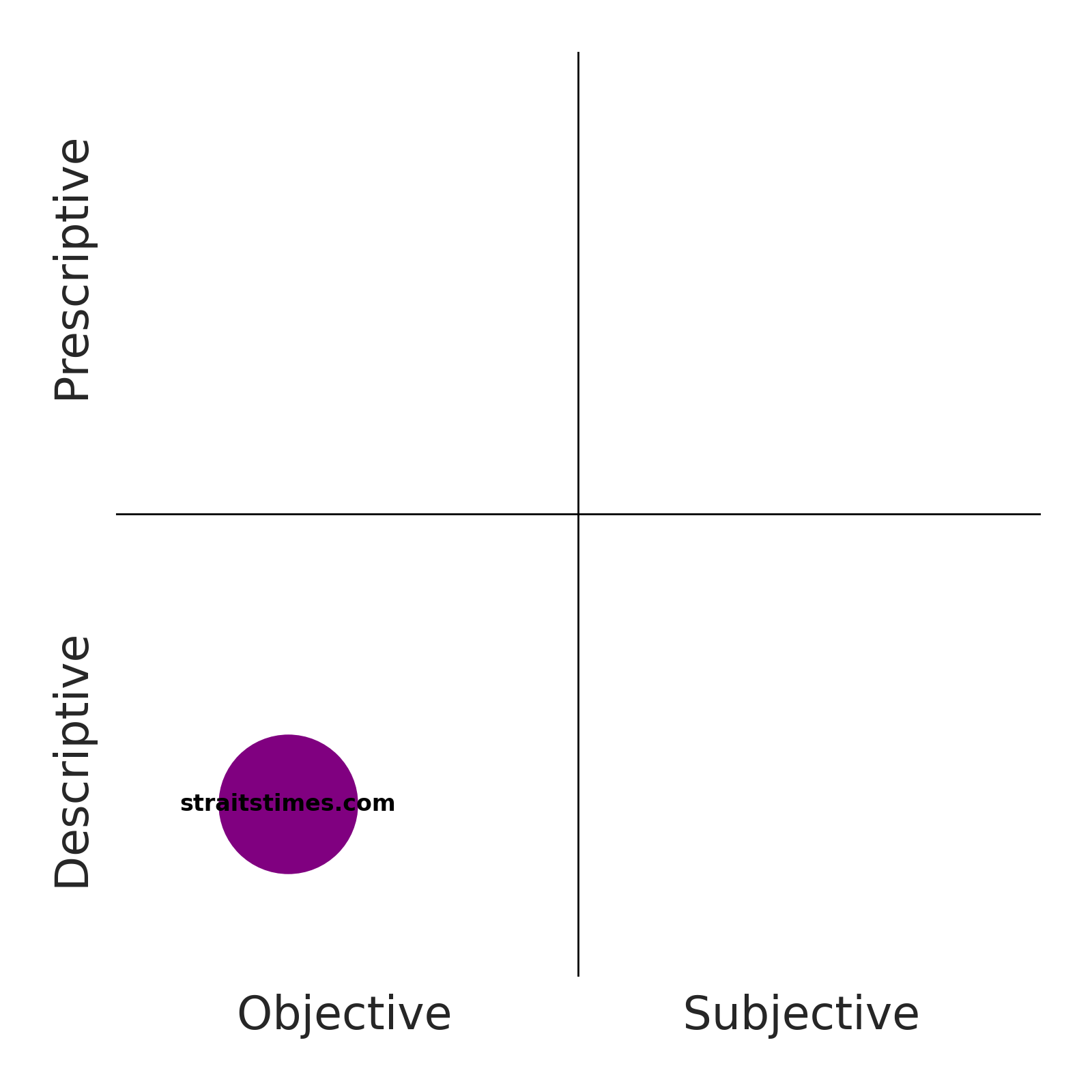
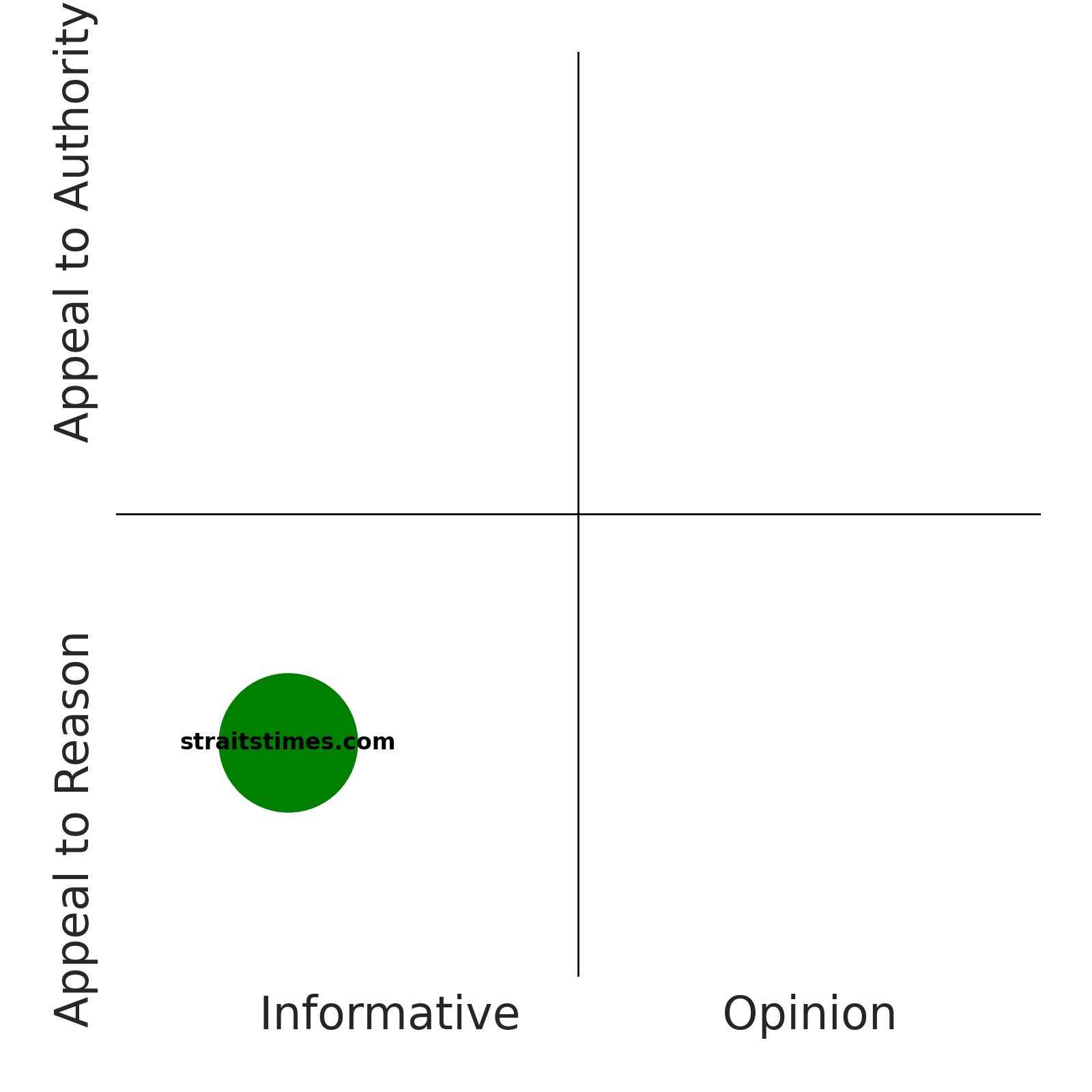
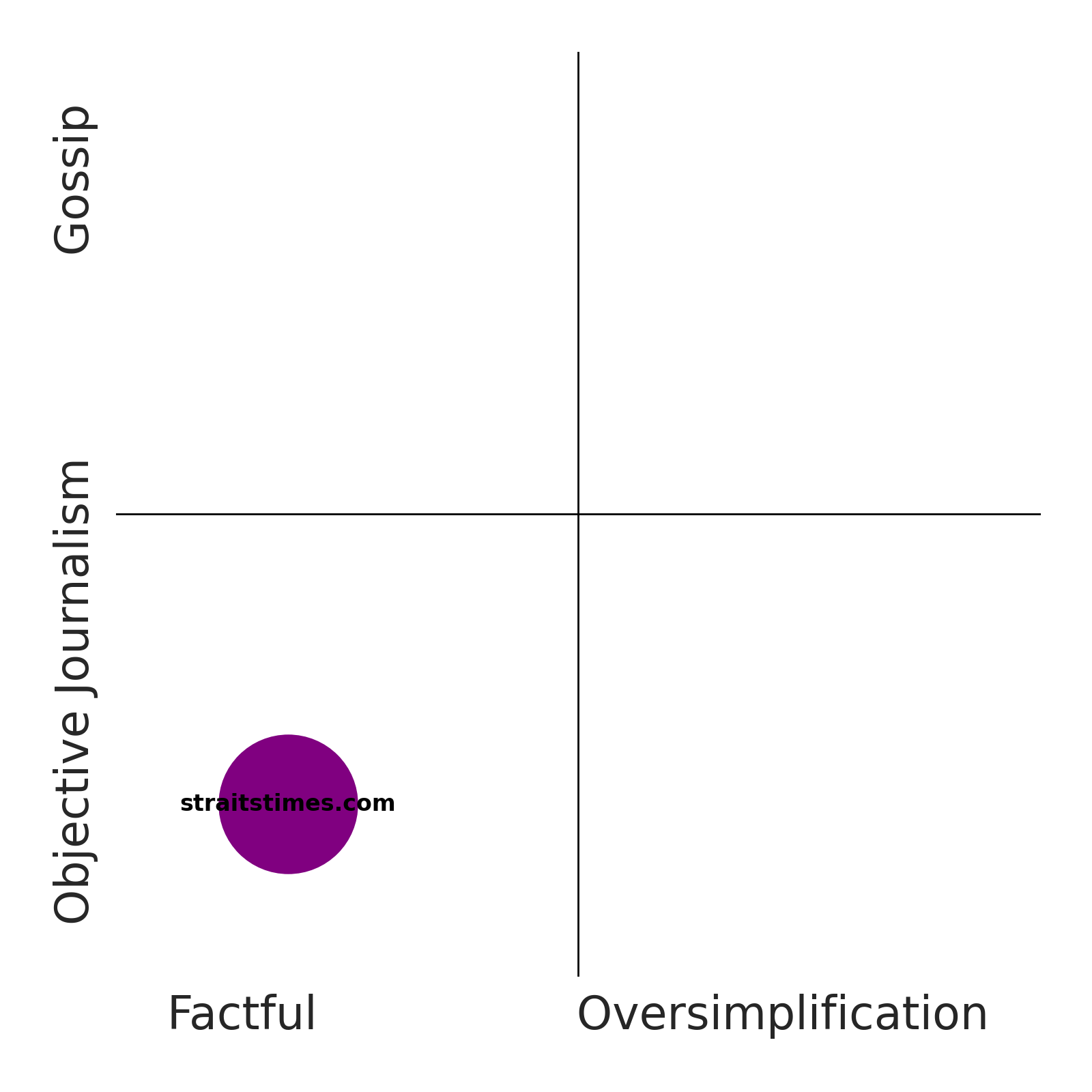
2026 © Helium Trades
Privacy Policy & Disclosure
* Disclaimer: Nothing on this website constitutes investment advice, performance data or any recommendation that any particular security, portfolio of securities, transaction or investment strategy is suitable for any specific person. Helium Trades is not responsible in any way for the accuracy
of any model predictions or price data. Any mention of a particular security and related prediction data is not a recommendation to buy or sell that security. Investments in securities involve the risk of loss. Past performance is no guarantee of future results. Helium Trades is not responsible for any of your investment decisions,
you should consult a financial expert before engaging in any transaction.


