See whether Helium helps you make better-informed decisions. Try every Pro Trader feature for 30 days. No credit card required.
Try every Pro Trader feature for 30 days. No credit card required.
September 16, 2026 · 0 shares
An interview-driven presentation that frames Representative Massie’s impeachment articles, anti-surveillance bill, and Epstein-records push as fights for constitutional limited government.
Articles of impeachment are formal legislative accusations, not convictions or removals; the Flock-Off Act and Epstein Files Transparency Act II are proposed bills requiring congressional action.
Automated analysis; not human reviewed. Limitations: The supplied text is truncated and contains duplicated paragraphs and blank publisher-name fields, so the analysis is limited to the visible summary rather than the full interview. · 7 of 55 available dimensions scored; omitted dimensions are not treated as neutral. · Verified supporting quotes for 7 of 7 scored dimensions.
Claim: The framing advances limited-government constitutionalism, a conservative/libertarian stance.
“for more discussions about the Constitution, limited government, and current events” · exact text match
“the privacy and constitutional questions surrounding the growing use of surveillance technology” · exact text match
Why: The publisher's self-description and emphasis on constraints on surveillance align with conservative/libertarian politics rather than liberal or neutral framing.
Claim: The framing opposes federal funding for surveillance technology and emphasizes constitutional limits on government.
“which targets federal funding for automated license-plate readers and biometric surveillance cameras, and the privacy and constitutional questions surrounding the growing use of surveillance technology” · exact text match
Why: Presenting government surveillance equipment as a privacy/constitutional concern and highlighting a bill to strip federal funding is strongly libertarian.
Claim: The summary mixes descriptive reporting with interpretive framing about privacy and constitutional questions.
“the privacy and constitutional questions surrounding the growing use of surveillance technology” · exact text match
Why: The phrase characterizes surveillance policy as a constitutional problem rather than neutrally reporting both sides.
Claim: The content is centered on partisan and institutional political action, including impeachment and legislation.
“his articles of impeachment against Secretary of Defense Pete Hegseth, government surveillance, the Epstein files, and political pressure in Washington” · exact text match
Why: The interview summary is almost entirely about congressional politics, legislation, and federal policy.
Claim: The publisher frames the discussion around an ideological commitment to limited government.
“for more discussions about the Constitution, limited government, and current events” · exact text match
Why: The stated purpose is to promote discussions framed as constitutional and limited-government, which is an ideological filter.
Claim: The framing treats Washington pressure and secrecy around Epstein records as problems to be resisted.
“political pressure in Washington” · exact text match
“his continuing push for the release of government records related to Jeffrey Epstein” · exact text match
Why: These phrases cast official Washington and government record secrecy as obstacles, indicating anti-establishment framing.
Claim: The item provides specific attribution to named hosts, a date, and an interviewee, but is promotional in format.
“On September 15, 2026, Christian Gomez and Ty Bodden, hosts of Birch’N the USA, interviewed U.S. Representative Thomas Massie (R-Ky.)” · exact text match
“with permission from its parent organization, The John Birch Society” · exact text match
Why: Visible sourcing and named officials support credibility, while the promotional/blank-publisher presentation limits it.
The supplied text is truncated and contains duplicated paragraphs and blank publisher-name fields, so the analysis is limited to the visible summary rather than the full interview.
September 08, 2026 · 0 shares
The framing equates the DSA with literal Communists, depicts the Democratic Party as being taken over, and presents this narrative through a conspiratorial 'deep state' lens.
Automated analysis; not human reviewed. Limitations: The article text is severely truncated, consisting mainly of a promotional excerpt, which limits the robustness of bias assessments based on this sample. · 5 of 54 available dimensions scored; omitted dimensions are not treated as neutral. · Verified supporting quotes for 5 of 5 scored dimensions.
Claim: Conservative framing portrays Democratic leaders as complicit in admitting literal Communists into their party.
“Why is it that longtime Democrats such as Chuck Schumer and Nancy Pelosi are allowing literal Communists into their party?” · exact text match
Why: The framing treats Democratic leadership as permitting Communist infiltration, a conservative attack on the left.
Claim: Certainty about Communist infiltration exceeds the evidentiary support provided.
“allowing literal Communists into their party” · exact text match
Why: The claim is presented definitively despite no evidence being supplied in the excerpt.
Claim: Strong ideological framing equates the DSA with literal Communists and asserts a party takeover.
“Inside DSA’s Takeover of the Democrat Party” · exact text match
“allowing literal Communists into their party” · exact text match
Why: The title asserts a takeover by the DSA and the text equates the DSA with literal Communists, demonstrating highly ideological framing.
Claim: Low credibility is evidenced by conspiracy-oriented branding and unsupported core claims.
“Behind The Deep State with Alex Newman” · exact text match
Why: Presenting content under a 'deep state' conspiracy banner and asserting Communist infiltration without evidence lowers visible credibility.
Claim: Loaded question presupposes an unproven premise that literal Communists are entering the party.
“Why is it that longtime Democrats such as Chuck Schumer and Nancy Pelosi are allowing literal Communists into their party?” · exact text match
Why: The question smuggles the allegation of Communist infiltration into its premise rather than presenting evidence.
The article text is severely truncated, consisting mainly of a promotional excerpt, which limits the robustness of bias assessments based on this sample.
September 07, 2026 · 0 shares
Automated analysis; not human reviewed. Limitations: The supplied article text is excerpted with ellipses and may omit portions of the original piece, limiting the analysis to visible fragments. · 6 of 54 available dimensions scored; omitted dimensions are not treated as neutral. · Verified supporting quotes for 6 of 6 scored dimensions.
Claim: The text takes a strongly conservative stance by labeling originalism as 'constitutionalist' and associating expansion of federal power with a 'left-wing majority.'
“left-wing majority that supported expanding federal power” · exact text match
“most constitutionalist member of the Court since at least the Great Depression” · exact text match
Why: The wording ties political orientation to constitutional legitimacy and treats expanding federal power as an ideological deviation.
Claim: The text is an opinion editorial that explicitly endorses a political-legal movement.
“The John Birch Society leads in the effort to mobilize Americans to do both in a concerted manner.” · exact text match
“The United States has strayed so far from the Constitution that we now” · exact text match
Why: It moves beyond reporting into advocacy and frames constitutional adherence as a civic mobilization campaign.
Claim: The text makes unqualified superlative and categorical assertions without proportional supporting evidence.
“most constitutionalist member of the Court since at least the Great Depression” · exact text match
“The Supreme Court Will Not Save Our Republic” · exact text match
Why: The superlative and categorical title assert certainty about ranking and future outcomes that exceeds the supplied support.
Claim: The text mixes attributed legal quotations with unsourced editorial superlatives, lowering its overall credibility.
“most constitutionalist member of the Court since at least the Great Depression” · exact text match
Why: This superlative is presented as fact without a source, while other assertions are attributed to Thomas's opinions.
Claim: The text predicts the Supreme Court's future ineffectiveness as a definitive outcome.
“The Supreme Court Will Not Save Our Republic” · exact text match
Why: The title states a categorical forecast about what the Court will fail to do rather than an open possibility.
Claim: The text uses loaded and emotionally charged labels to frame judicial precedent as oppressive.
“Tyranny by Technicality” · exact text match
“left-wing majority” · exact text match
Why: Calling the situation 'tyranny' and using an ideological label for judicial philosophy are loaded framing techniques that shape emotional response.
The supplied article text is excerpted with ellipses and may omit portions of the original piece, limiting the analysis to visible fragments.
September 14, 2026 · 0 shares
Frames Burning Man and the West's cultural trajectory as the target of a covert 'repaganizing' scheme.
Burning Man is an annual countercultural festival in Nevada's Black Rock Desert; the John Birch Society is a conservative American political organization.
Automated analysis; not human reviewed. Limitations: Only the headline and a short fragment were available; the article body was not supplied in the prompt, so scalar scores rest on the loaded headline and the three-name sentence. · 8 of 54 available dimensions scored; omitted dimensions are not treated as neutral. · Verified supporting quotes for 8 of 8 scored dimensions.
Claim: The framing voices cultural conservatism by treating the West as a religious/civilizational identity under assault by a paganizing plot.
“Scheme to Repaganize the West” · exact text match
Why: The headline's alarm over a loss of Western religious character uses a conservative culture-war register.
Claim: States an interpretative judgment about a secret scheme as if it were factual description.
“Scheme to Repaganize the West” · exact text match
Why: 'Scheme' is a loaded, subjective characterization of intent rather than a neutral observation.
Claim: Uses dramatic, alarmist wording likely to provoke a reaction.
“Scheme to Repaganize the West” · exact text match
Why: 'Scheme' implies secrecy or criminality and 'Repaganize' is a startling verb chosen for impact.
Claim: Sounds a threatening alarm that the West is being repaganized.
“Scheme to Repaganize the West” · exact text match
Why: The framing invokes fear of civilizational loss.
Claim: Frames the story around a culture-war conflict over the West's religious identity.
“Scheme to Repaganize the West” · exact text match
“John Birch Society field coordinator Calvin Clark” · exact text match
Why: The headline politicizes the event and the named identification of a John Birch Society role places the cast inside a political organization.
Claim: Presents the alleged scheme as established fact in the headline.
“Scheme to Repaganize the West” · exact text match
Why: The headline is categorical and unqualified; no sourcing or hedge tempers the assertion.
Claim: Depicts a complex cultural event as the product of a hidden plot to change the religious character of Western civilization.
“Scheme to Repaganize the West” · exact text match
Why: Attributing a civilizational purpose to the event is an unsubstantiated teleological leap in the visible text.
Claim: Asserts a covert, coordinated scheme behind the event.
“Scheme to Repaganize the West” · exact text match
Why: The word 'scheme' explicitly claims a hidden plan and is stated as the publisher's own framing.
Only the headline and a short fragment were available; the article body was not supplied in the prompt, so scalar scores rest on the loaded headline and the three-name sentence.
September 16, 2026 · 0 shares
An interview-driven presentation that frames Representative Massie’s impeachment articles, anti-surveillance bill, and Epstein-records push as fights for constitutional limited government.
Articles of impeachment are formal legislative accusations, not convictions or removals; the Flock-Off Act and Epstein Files Transparency Act II are proposed bills requiring congressional action.
Automated analysis; not human reviewed. Limitations: The supplied text is truncated and contains duplicated paragraphs and blank publisher-name fields, so the analysis is limited to the visible summary rather than the full interview. · 7 of 55 available dimensions scored; omitted dimensions are not treated as neutral. · Verified supporting quotes for 7 of 7 scored dimensions.
Claim: The framing advances limited-government constitutionalism, a conservative/libertarian stance.
“for more discussions about the Constitution, limited government, and current events” · exact text match
“the privacy and constitutional questions surrounding the growing use of surveillance technology” · exact text match
Why: The publisher's self-description and emphasis on constraints on surveillance align with conservative/libertarian politics rather than liberal or neutral framing.
Claim: The framing opposes federal funding for surveillance technology and emphasizes constitutional limits on government.
“which targets federal funding for automated license-plate readers and biometric surveillance cameras, and the privacy and constitutional questions surrounding the growing use of surveillance technology” · exact text match
Why: Presenting government surveillance equipment as a privacy/constitutional concern and highlighting a bill to strip federal funding is strongly libertarian.
Claim: The summary mixes descriptive reporting with interpretive framing about privacy and constitutional questions.
“the privacy and constitutional questions surrounding the growing use of surveillance technology” · exact text match
Why: The phrase characterizes surveillance policy as a constitutional problem rather than neutrally reporting both sides.
Claim: The content is centered on partisan and institutional political action, including impeachment and legislation.
“his articles of impeachment against Secretary of Defense Pete Hegseth, government surveillance, the Epstein files, and political pressure in Washington” · exact text match
Why: The interview summary is almost entirely about congressional politics, legislation, and federal policy.
Claim: The publisher frames the discussion around an ideological commitment to limited government.
“for more discussions about the Constitution, limited government, and current events” · exact text match
Why: The stated purpose is to promote discussions framed as constitutional and limited-government, which is an ideological filter.
Claim: The framing treats Washington pressure and secrecy around Epstein records as problems to be resisted.
“political pressure in Washington” · exact text match
“his continuing push for the release of government records related to Jeffrey Epstein” · exact text match
Why: These phrases cast official Washington and government record secrecy as obstacles, indicating anti-establishment framing.
Claim: The item provides specific attribution to named hosts, a date, and an interviewee, but is promotional in format.
“On September 15, 2026, Christian Gomez and Ty Bodden, hosts of Birch’N the USA, interviewed U.S. Representative Thomas Massie (R-Ky.)” · exact text match
“with permission from its parent organization, The John Birch Society” · exact text match
Why: Visible sourcing and named officials support credibility, while the promotional/blank-publisher presentation limits it.
The supplied text is truncated and contains duplicated paragraphs and blank publisher-name fields, so the analysis is limited to the visible summary rather than the full interview.
September 14, 2026 · 0 shares
Portrays EU membership as the risky course, celebrating Iceland's 'no' vote as declining passage on a sinking Titanic while using per-capita GDP data to validate the non-EU model.
Automated analysis; not human reviewed. Limitations: The raw article text supplied to me contains visible square-bracket truncations and a JSON-like wrapper, so some attributions and transitions are ambiguous; I scored only the clauses actually shown and kept confidence below 80 where the wrapper or context was incomplete. · 11 of 54 available dimensions scored; omitted dimensions are not treated as neutral. · Verified supporting quotes for 0 of 11 scored dimensions.
The raw article text supplied to me contains visible square-bracket truncations and a JSON-like wrapper, so some attributions and transitions are ambiguous; I scored only the clauses actually shown and kept confidence below 80 where the wrapper or context was incomplete.
September 08, 2026 · 0 shares
Frames the EU vote as a victory for national independence and a mandate to reclaim sovereignty, urging Icelanders to resist being swallowed by an emerging United States of Europe.
Automated analysis; not human reviewed. Limitations: The supplied text is truncated and does not include the exact referendum question, official vote totals, or publication date; the summary relies on the editorial framing and attributed quotes. · 5 of 54 available dimensions scored; omitted dimensions are not treated as neutral. · Verified supporting quotes for 5 of 5 scored dimensions.
Claim: The commentary uses conservative Eurosceptic framing that equates EU integration with loss of national independence.
“Rather than allowing their country to gradually be swallowed by an emerging “United States of Europe,” Icelanders must stand up for individual freedom and national independence.” · exact text match
Why: The framing of the EU as an expansionist federal project and the call to defend national independence are characteristic of conservative sovereignty-based opposition.
Claim: The text prescribes what Iceland should do, making it subjective rather than neutral.
“it must go further and reclaim the sovereignty that it has already surrendered to the bloc.” · exact text match
Why: Direct prescriptive language such as 'must go further' and 'must stand up' is a marker of subjective opinion.
Claim: The text strongly advocates for Iceland to reject EU integration and reclaim sovereignty.
“Rather than allowing their country to gradually be swallowed by an emerging “United States of Europe,” Icelanders must stand up for individual freedom and national independence.” · exact text match
Why: The exhortation to 'stand up' and the loaded metaphor are overt advocacy rather than neutral reporting.
Claim: The text treats national sovereignty as an absolute good that EU integration necessarily violates.
“it must go further and reclaim the sovereignty that it has already surrendered to the bloc.” · exact text match
Why: Describing EEA and Schengen membership as 'surrendered' sovereignty is an ideological interpretation rather than a neutral description.
Claim: The text uses loaded metaphors to frame EU integration as a predatory loss of national autonomy.
“Rather than allowing their country to gradually be swallowed by an emerging “United States of Europe,” Icelanders must stand up for individual freedom and national independence.” · exact text match
Why: Words like 'swallowed' and 'surrendered to the bloc' frame EU integration as submission, a loaded-framing technique.
The supplied text is truncated and does not include the exact referendum question, official vote totals, or publication date; the summary relies on the editorial framing and attributed quotes.
An anti-globalist nationalist viewpoint frames Canada's EU associate-membership proposal as a conspiratorial plot to absorb North America into a European-led globalist order.
The USMCA is the trade pact that replaced NAFTA; the column describes it as under strain from a U.S.-Canada trade war. The EU's 'associate membership' is not an existing legal status, so creating it would require EU rule changes.
Automated analysis; not human reviewed. Limitations: No independent verification of the column's factual assertions or omissions is possible from the supplied text. · 20 of 55 available dimensions scored; omitted dimensions are not treated as neutral. · Verified supporting quotes for 8 of 20 scored dimensions.
Claim: The framing is conservative and anti-globalist, favoring national sovereignty over international integration.
“It is clear from last year’s Canadian elections that Mark Carney is the globalists’ handpicked agent to act as a foil for Trump’s America First, anti-globalist actions.” · exact text match
“Such an outcome would make American independence more difficult to sustain.” · exact text match
Why: Uses 'America First' favorably and warns European integration threatens American independence.
Claim: Framing pits ordinary Canadians against globalist elites.
“As for ordinary Canadians, a BBC article with carefully curated man-on-the-street interviews, mostly from the urban Toronto area, would have us believe that Canadians in general are giddy with anticipation...” · not found in supplied text
“In reality, millions of Canadians, especially in Alberta and Saskatchewan, are opposed to the direction that Carney and the Left are taking their country.” · exact text match
Why: Contrasts 'ordinary Canadians' with 'globalist leadership' and 'Eurocrats.'
Claim: Uses strongly interpretive, emotional language rather than neutral reporting.
“Canada is now in very real danger of being incorporated into a sort of EU-centered neo-imperialist sphere of influence.” · exact text match
Why: Loaded subjective characterization dominates the opening.
Claim: Uses sensationalist adjectives and hypothetical alarm.
“With this week’s bombshell EU announcement, their investment in Carney appears to be paying off handsomely.” · exact text match
“Imagine Canada flooded with the same types of lawless, anti-West immigrants that have overwhelmed Europe...” · not found in supplied text
Why: 'Bombshell' and the immigration hypothetical are sensational framing.
Claim: Overall tone is pessimistic and alarmed about Canada and U.S. independence.
“Canada is now in very real danger of being incorporated into a sort of EU-centered neo-imperialist sphere of influence.” · exact text match
“Such an outcome would make American independence more difficult to sustain.” · exact text match
Why: Presents the outcome as dangerous and independence harder to sustain.
Claim: Employs fear-based framing about loss of sovereignty and uncontrolled migration.
“Canada is now in very real danger of being incorporated into a sort of EU-centered neo-imperialist sphere of influence.” · exact text match
“Imagine Canada flooded with the same types of lawless, anti-West immigrants that have overwhelmed Europe...” · not found in supplied text
Why: Warns of existential threats to sovereignty and borders.
Claim: The text is overwhelmingly opinion and commentary rather than factual reporting.
“In reality, millions of Canadians, especially in Alberta and Saskatchewan, are opposed to the direction that Carney and the Left are taking their country.” · exact text match
“Carney is a globalists’ globalist, dedicated to Canadian integration with the 'global order' by any means possible.” · not found in supplied text
Why: Assertions of motive and mass opinion are unsupported opinion.
Claim: The piece is explicitly political, centered on geopolitical power and elections.
“It is clear from last year’s Canadian elections that Mark Carney is the globalists’ handpicked agent to act as a foil for Trump’s America First, anti-globalist actions.” · exact text match
“Such an outcome would make American independence more difficult to sustain.” · exact text match
Why: Evaluates leaders, elections, and sovereignty in partisan terms.
Claim: Reduces complex diplomacy to a globalist conspiracy and a binary sovereignty loss.
“the project of assembling a Continent-wide socialist state has continued to advance.” · exact text match
“regional government schemes are a globalist tool for simplifying and streamlining the project of world government.” · exact text match
Why: Treats varied regional arrangements as one coordinated globalist project.
Claim: Makes definitive factual assertions without supporting evidence.
“it is also a fact that Carney is a globalists’ globalist” · exact text match
“Canada, always captive to the globalists because of its small population, economy, and military...” · not found in supplied text
Why: 'It is also a fact' and 'always captive' express certainty beyond supplied evidence.
Claim: Framing follows a distinct anti-globalist, anti-EU ideological template.
“popular opposition to its obvious collectivist and anti-West program” · exact text match
“the project of assembling a Continent-wide socialist state has continued to advance.” · exact text match
Why: The phrases 'collectivist,' 'anti-West,' and 'socialist state' signal an ideological lens.
Claim: Anti-establishment, attacking 'globalist' leadership and EU institutions.
“globalist leadership, helmed by Prime Minister Mark Carney” · exact text match
“Eurocrats have a long track record of getting their way, by hook or by crook...” · not found in supplied text
Why: Ridicules political and bureaucratic elites.
Claim: Negative emotional tone, emphasizing danger and alarm.
“Canada is now in very real danger...” · not found in supplied text
“Imagine Canada flooded with the same types of lawless, anti-West immigrants...” · not found in supplied text
Why: Fear-laden words create a negative emotional response.
Claim: Credibility is undercut by unsupported assertions despite some named sources and quotes.
“it is also a fact that Carney is a globalists’ globalist” · exact text match
“In reality, millions of Canadians, especially in Alberta and Saskatchewan, are opposed...” · not found in supplied text
Why: Visible sourcing includes quotes, but key claims are presented with no evidence.
Claim: Relies on an unsubstantiated globalist-world-government thesis rather than measurable analysis.
“regional government schemes are a globalist tool for simplifying and streamlining the project of world government.” · exact text match
“Eurocrats have a long track record of getting their way, by hook or by crook, when a critical globalist agenda item is at stake.” · exact text match
Why: Presents a speculative master plan as established fact.
Claim: Favors national independence and individual sovereignty against collectivist blocs.
“Such an outcome would make American independence more difficult to sustain.” · exact text match
“popular opposition to its obvious collectivist and anti-West program” · exact text match
Why: Independence and opposition to collectivism are affirmed.
Claim: Engages in speculative forecasting about future migration and political outcomes.
“should Canada join the European Union in any capacity, it might become a vessel for EU-style unlimited migration from the Middle East and Africa into North America” · exact text match
“Imagine Canada flooded with the same types of lawless, anti-West immigrants that have overwhelmed Europe...” · not found in supplied text
Why: Conditional 'might' plus an imagined flood is speculative.
Claim: Uses loaded framing and fear to steer the reader.
“by hook or by crook” · exact text match
“Imagine Canada flooded with the same types of lawless, anti-West immigrants...” · not found in supplied text
Why: Loaded language and an inflammatory hypothetical are observable manipulation techniques.
Claim: Presents opinion and unverified characterizations as fact.
“it is also a fact that Carney is a globalists’ globalist, dedicated to Canadian integration with the 'global order' by any means possible.” · not found in supplied text
Why: Declares a subjective characterization to be a fact.
Claim: Promotes a conspiratorial globalist-world-government narrative.
“regional government schemes are a globalist tool for simplifying and streamlining the project of world government.” · exact text match
“It is clear from last year’s Canadian elections that Mark Carney is the globalists’ handpicked agent...” · not found in supplied text
Why: Claims a coordinated globalist project steers regional blocs toward world government.
No independent verification of the column's factual assertions or omissions is possible from the supplied text.
September 21, 2026 · 0 shares
The headline frames TSA's Gateside PreCheck as a quietly undertaken escalation of the post-9/11 security regime and criticizes a new airport-access tier based on government vetting.
TSA PreCheck is an existing program that provides expedited screening to travelers who have passed a TSA background check.
Automated analysis; not human reviewed. Limitations: Analysis relies on a two-sentence headline/subhead with no body text, so framing judgments are based on concise wording and may not capture the full intended meaning. · 3 of 55 available dimensions scored; omitted dimensions are not treated as neutral. · Verified supporting quotes for 3 of 3 scored dimensions.
Claim: The headline frames TSA's action as an expansion of a security regime and treats government-vetted tiering as an unwelcome exercise of state authority.
“TSA Quietly Ups the Ante on Post-9/11 Security Regime.” · exact text match
“further tiering of airport access by government-vetted status” · exact text match
Why: The terms 'regime' and 'government-vetted status' and the negative verb phrase 'Ups the Ante' cast the policy as an overreach by a state security apparatus.
Claim: The wording is interpretive, using loaded and figurative language instead of neutral policy description.
“Quietly Ups the Ante” · exact text match
“Post-9/11 Security Regime” · exact text match
Why: 'Quietly' attributes an unannounced or covert quality and 'regime' is a loaded characterization, making the framing subjective rather than strictly objective.
Claim: The expansion is framed as an ominous escalation rather than a neutral or beneficial improvement.
“Ups the Ante” · exact text match
“further tiering” · exact text match
Why: 'Ups the Ante' and 'further tiering' imply increasing burden and division, conveying a negative or worried outlook.
Analysis relies on a two-sentence headline/subhead with no body text, so framing judgments are based on concise wording and may not capture the full intended meaning.
September 16, 2026 · 0 shares
An interview-driven presentation that frames Representative Massie’s impeachment articles, anti-surveillance bill, and Epstein-records push as fights for constitutional limited government.
Articles of impeachment are formal legislative accusations, not convictions or removals; the Flock-Off Act and Epstein Files Transparency Act II are proposed bills requiring congressional action.
Automated analysis; not human reviewed. Limitations: The supplied text is truncated and contains duplicated paragraphs and blank publisher-name fields, so the analysis is limited to the visible summary rather than the full interview. · 7 of 55 available dimensions scored; omitted dimensions are not treated as neutral. · Verified supporting quotes for 7 of 7 scored dimensions.
Claim: The framing advances limited-government constitutionalism, a conservative/libertarian stance.
“for more discussions about the Constitution, limited government, and current events” · exact text match
“the privacy and constitutional questions surrounding the growing use of surveillance technology” · exact text match
Why: The publisher's self-description and emphasis on constraints on surveillance align with conservative/libertarian politics rather than liberal or neutral framing.
Claim: The framing opposes federal funding for surveillance technology and emphasizes constitutional limits on government.
“which targets federal funding for automated license-plate readers and biometric surveillance cameras, and the privacy and constitutional questions surrounding the growing use of surveillance technology” · exact text match
Why: Presenting government surveillance equipment as a privacy/constitutional concern and highlighting a bill to strip federal funding is strongly libertarian.
Claim: The summary mixes descriptive reporting with interpretive framing about privacy and constitutional questions.
“the privacy and constitutional questions surrounding the growing use of surveillance technology” · exact text match
Why: The phrase characterizes surveillance policy as a constitutional problem rather than neutrally reporting both sides.
Claim: The content is centered on partisan and institutional political action, including impeachment and legislation.
“his articles of impeachment against Secretary of Defense Pete Hegseth, government surveillance, the Epstein files, and political pressure in Washington” · exact text match
Why: The interview summary is almost entirely about congressional politics, legislation, and federal policy.
Claim: The publisher frames the discussion around an ideological commitment to limited government.
“for more discussions about the Constitution, limited government, and current events” · exact text match
Why: The stated purpose is to promote discussions framed as constitutional and limited-government, which is an ideological filter.
Claim: The framing treats Washington pressure and secrecy around Epstein records as problems to be resisted.
“political pressure in Washington” · exact text match
“his continuing push for the release of government records related to Jeffrey Epstein” · exact text match
Why: These phrases cast official Washington and government record secrecy as obstacles, indicating anti-establishment framing.
Claim: The item provides specific attribution to named hosts, a date, and an interviewee, but is promotional in format.
“On September 15, 2026, Christian Gomez and Ty Bodden, hosts of Birch’N the USA, interviewed U.S. Representative Thomas Massie (R-Ky.)” · exact text match
“with permission from its parent organization, The John Birch Society” · exact text match
Why: Visible sourcing and named officials support credibility, while the promotional/blank-publisher presentation limits it.
The supplied text is truncated and contains duplicated paragraphs and blank publisher-name fields, so the analysis is limited to the visible summary rather than the full interview.
September 18, 2026 · 0 shares
A conservative anti-regulatory commentary frames growing government rules as creeping tyranny and prescribes a constitutional cap on laws.
Automated analysis; not human reviewed. Limitations: Only the supplied text was analyzed; cited statistics and external sources could not be independently verified. · 20 of 55 available dimensions scored; omitted dimensions are not treated as neutral. · Verified supporting quotes for 20 of 20 scored dimensions.
Claim: The commentary's selection and wording attribute America's problems to overregulation and socialism, aligning it with conservative anti-regulatory politics.
“Then there are high housing costs, a common gripe today and part of the impetus for socialism’s embrace.” · exact text match
“there’s no substitute for having a virtuous, educated (not just schooled) electorate that cherishes legitimate liberty.” · exact text match
Why: Visible conservative themes include skepticism of government expansion, criticism of socialism's appeal, and emphasis on legitimate liberty.
Claim: The piece pits ordinary workers and would-be workers against self-interested politicians presented as detached or dishonest.
“all over America, people want to work but can’t because it’s often nearly impossible or too expensive to get the proper government permission.” · exact text match
“So do the politicians really care about the environment — or do they have ulterior motives?” · exact text match
Why: The language treats government and political actors as a class standing apart from ordinary people's interests.
Claim: The central argument is strongly libertarian: every law removes freedom and government power should be capped.
“the more laws, regulations, and mandates (LRM) you have, the less free you are all other things being equal.” · exact text match
“This measure would place a constitutionally mandated cap on the number of LRM that can exist.” · exact text match
Why: Opposition to licensing, mandates, and regulatory accumulation and advocacy for a constitutional cap reflect a libertarian stance.
Claim: The piece is an opinion essay using first-person prescription and value-laden language rather than neutral reporting.
“I would, however, favor a figure much lower than the total number of LRM extant.” · exact text match
“All this, not to mention truly tyrannical LRM, such as those leading to a child being seized from parents so he can be mutilated into an opposite-sex simulacrum.” · exact text match
Why: The author's preferences and emotional labels drive the framing.
Claim: The commentary uses dramatic metaphors and loaded subheadings to intensify the threat.
“Can’t Make a Move — Without Big Brother’s Approval” · exact text match
“All this, not to mention truly tyrannical LRM, such as those leading to a child being seized from parents so he can be mutilated into an opposite-sex simulacrum.” · exact text match
Why: Terms like Big Brother, tyranny, and mutilated function as sensational framing.
Claim: The outlook is bleak: creeping totalitarianism is treated as likely and reversal as unlikely.
“Logic dictates that continuing this process long enough will eventually deliver totalitarianism or something approximating it.” · exact text match
“Unfortunately, this is not nearly as likely to happen as is inurement. For as the Mauritanian slaves prove, people are as adaptable as they are corruptible.” · exact text match
Why: The prose projects a pessimistic endpoint and doubts that reform can occur.
Claim: The piece is overtly prescriptive, advocating scrutiny and removal of rules and a constitutional amendment.
“This measure would place a constitutionally mandated cap on the number of LRM that can exist.” · exact text match
“Given this, wouldn’t it make sense to scrutinize these LRM to see if at least some can be eliminated?” · exact text match
Why: The author explicitly proposes policy changes and tells readers what lawmakers should do.
Claim: The commentary is fear-oriented, warning of boiling, tyranny, and totalitarianism.
“The Slow-boiled Frog: Creeping Tyranny Becomes Normal.” · exact text match
“So can creeping totalitarianism be arrested — or even reversed?” · exact text match
Why: The title and repeated tyranny language are designed to provoke alarm.
Claim: The essay is built on the author's opinions and preferences rather than neutral factual reporting.
“I would, however, favor a figure much lower than the total number of LRM extant.” · exact text match
“Unfortunately, too, these LRM don’t just cause inconvenience, but sometimes real damage.” · exact text match
Why: The first-person proposal and evaluative language mark the text as opinion.
Claim: The entire commentary is devoted to a political argument about government, candidates, and constitutional reform.
“Our federal, state, and other governments enact more LRM, but hardly ever rescind any.” · exact text match
“This, of course, would require lawmakers to finally become law-takers.” · exact text match
Why: The piece is structured around a political theory of freedom and government restraint.
Claim: Complex policy outcomes are attributed to single regulatory causes without evidence.
“As a result, during the recent virulent wildfires in the Los Angeles area, fire hydrants and storage tanks ran out of water, leaving thousands of homes to be burned to the ground.” · exact text match
“Yet has this counterproductive stifling of freedom been repealed?” · exact text match
Why: Wildfire outcomes, plastic-bag effects, and housing costs are presented with little causal nuance.
Claim: The argument leans on named authorities and commentators to support its claims.
“As investigative reporter John Stossel stated in 2017:” · exact text match
“Just get a load of what Supreme Court Justice Neil Gorsuch writes in his 2024 book Overruled:” · exact text match
Why: Credibility is partly transferred from selected authorities rather than established by the argument itself.
Claim: The author presents a predicted totalitarian endpoint as a matter of logical certainty.
“Logic dictates that continuing this process long enough will eventually deliver totalitarianism or something approximating it.” · exact text match
Why: The claim goes beyond supplied evidence and treats an extrapolation as necessary consequence.
Claim: The piece applies a single liberty-versus-regulation lens across disparate issues.
“the more laws, regulations, and mandates (LRM) you have, the less free you are all other things being equal.” · exact text match
“And all over America, people want to work but can’t because it’s often nearly impossible or too expensive to get the proper government permission.” · exact text match
Why: A fixed ideological framework is used to interpret slavery, licensing, bags, housing, and gender-related cases.
Claim: The piece is anti-establishment, casting government and politicians as the source of creeping tyranny.
“Our federal, state, and other governments enact more LRM, but hardly ever rescind any.” · exact text match
“Not to politicians, apparently — good luck finding a candidate who even addresses the matter.” · exact text match
Why: Government and political candidates are framed as unresponsive or harmful.
Claim: The wording conveys strong negative emotion through words like tyranny, mutilated, and corruptible.
“All this, not to mention truly tyrannical LRM, such as those leading to a child being seized from parents so he can be mutilated into an opposite-sex simulacrum.” · exact text match
“For as the Mauritanian slaves prove, people are as adaptable as they are corruptible.” · exact text match
Why: The emotional valence is predominantly negative, driven by fear and moral disgust.
Claim: The text mixes attributed quotes with unsupported claims and sweeping inference, reducing visible credibility.
“Logic dictates that continuing this process long enough will eventually deliver totalitarianism or something approximating it.” · exact text match
“All this, not to mention truly tyrannical LRM, such as those leading to a child being seized from parents so he can be mutilated into an opposite-sex simulacrum.” · exact text match
Why: Some sources are named, but unverified causal claims and a severe allegation are presented without supporting evidence.
Claim: The piece treats individual liberty and freedom from government permission as paramount.
“the more laws, regulations, and mandates (LRM) you have, the less free you are all other things being equal.” · exact text match
“Whether you’re a doctor, an electrician, a teacher, a cab driver, a hair stylist — even a tour guide! — the government increasingly demands that you get a license before you are allowed to work in your chosen profession.” · exact text match
Why: The argument prioritizes individual autonomy against collective regulatory authority.
Claim: The piece projects future outcomes and motives beyond the supplied facts.
“Maybe AI will eventually figure it out.” · exact text match
“So do the politicians really care about the environment — or do they have ulterior motives?” · exact text match
Why: Future regulatory counting and politicians' motives are speculative or rhetorical.
Claim: The piece uses loaded framing and an unsupported either/or about politicians' motives.
“Can’t Make a Move — Without Big Brother’s Approval” · exact text match
“So do the politicians really care about the environment — or do they have ulterior motives?” · exact text match
Why: Observable rhetorical techniques include loaded terminology and a leading question that implies bad faith.
Only the supplied text was analyzed; cited statistics and external sources could not be independently verified.
September 18, 2026 · 0 shares
An anti-interventionist, populist polemic frames fuel-price pain as evidence of unconstitutional war, corporate greed, and elite failure.
The account presupposes an ongoing U.S.-Iran war that has sharply restricted Strait of Hormuz traffic, a Trump presidency, and a domestic energy inflation crisis; none of those events is explained.
Automated analysis; not human reviewed. Limitations: The supplied text describes a specific political-military scenario (U.S.-Iran war, Trump presidency, midterm elections) whose external verifiability is unknown; scoring is therefore based only on internal framing. · 17 of 55 available dimensions scored; omitted dimensions are not treated as neutral. · Verified supporting quotes for 17 of 17 scored dimensions.
Claim: The article's anti-expert, anti-government, and 'Covid tyranny' rhetoric aligns it with right-wing populism rather than liberal institutionalism.
“Just as Covid tyranny created lasting distrust toward the expert class and government “health” institutions, it is possible that the current crisis will jolt people awake to the destruction caused by foreign intervention.” · exact text match
“bad domestic energy policies, “greedy” oil companies, and, of course, U.S. intervention abroad” · exact text match
Why: Anti-expert and 'Covid tyranny' language, plus criticism of 'bad domestic energy policies', follows right-wing populist cues.
Claim: The text mobilizes ordinary Americans against elites, experts, and oil companies.
“The surge in fuel prices is stressing out American motorists” · exact text match
“Just as Covid tyranny created lasting distrust toward the expert class and government “health” institutions” · exact text match
Why: Appeals to 'American motorists' and opposition to 'the expert class' are classic populist framing.
Claim: The article characterizes government and expert authority as tyrannical and actions as unconstitutional.
“Covid tyranny created lasting distrust toward the expert class and government “health” institutions” · exact text match
“had the president not launched his unconstitutional war” · exact text match
Why: Calls a war 'unconstitutional' and government health measures 'tyranny' signals anti-authority, anti-government stance.
Claim: The article's framing is heavily evaluative and opinion-driven.
“It’s safe to say that had the president not launched his unconstitutional war, the energy situation would not be so dire.” · exact text match
“presumably with the ultimate goal of making President Donald Trump cry uncle” · exact text match
Why: Direct evaluative judgments and speculative motive claims are editorial, not neutral description.
Claim: The headline and language dramatize the fuel crisis.
“Fuel Skyrockets As Wars, Tight Refineries, and Record Diesel Profits Collide.” · exact text match
“presumably with the ultimate goal of making President Donald Trump cry uncle” · exact text match
Why: Dramatic headline and 'cry uncle' imagery sensationalize an economic story.
Claim: The piece tells readers that U.S. intervention is futile and should end.
“Americans have nothing to gain with the perseverance of this war.” · exact text match
“Had the U.S. bowed out completely, this war may have concluded and more Russian energy would be on the global market.” · exact text match
Why: Sentences about what Americans have to gain and what the U.S. should have done are prescriptive.
Claim: The article is strongly anti-war and opposes U.S. military intervention.
“It’s safe to say that had the president not launched his unconstitutional war, the energy situation would not be so dire.” · exact text match
“Americans have nothing to gain with the perseverance of this war.” · exact text match
Why: Opposition to the war and a call for U.S. withdrawal are dovish foreign-policy positions.
Claim: The article stokes fear of violence, shortages, and worsening consumer pain.
“In certain Middle Eastern, Latin American, and European countries, riots have erupted over skyrocketing energy costs.” · exact text match
“The surge in fuel prices is stressing out American motorists, who will have more reason to complain once those costs increase grocery bills.” · exact text match
Why: Concrete images of riots, stress, and violence raise fear and alarm.
Claim: The article is predominantly editorial commentary rather than neutral reporting.
“It’s safe to say that had the president not launched his unconstitutional war, the energy situation would not be so dire.” · exact text match
“Just as Covid tyranny created lasting distrust toward the expert class and government “health” institutions” · exact text match
Why: The article repeatedly states value judgments as conclusions.
Claim: The article treats fuel prices as a political weapon and election issue.
“It’s probably no accident all this is happening within weeks of the midterm elections.” · exact text match
“The surge in fuel costs has made the already unpopular war against Iran even less popular.” · exact text match
Why: Interprets energy prices through elections and political blame.
Claim: Complex causes are compressed into a small set of villains and a single counterfactual.
“So it turns out there are a number of factors causing today’s energy crisis: bad domestic energy policies, “greedy” oil companies, and, of course, U.S. intervention abroad.” · exact text match
“It’s safe to say that had the president not launched his unconstitutional war, the energy situation would not be so dire.” · exact text match
Why: It attributes a complex crisis to a short list of villains and one counterfactual.
Claim: The article states a counterfactual causal conclusion as certain.
“It’s safe to say that had the president not launched his unconstitutional war, the energy situation would not be so dire.” · exact text match
Why: 'Safe to say' asserts a counterfactual beyond the evidence.
Claim: The article attacks Washington elites, oil companies, and institutional authority.
“bad domestic energy policies, “greedy” oil companies, and, of course, U.S. intervention abroad.” · exact text match
“Just as Covid tyranny created lasting distrust toward the expert class and government “health” institutions” · exact text match
Why: Hostility to the expert class, government institutions, and oil companies attacks establishment actors.
Claim: The tone is negative and emotionally charged.
“The surge in fuel prices is stressing out American motorists, who will have more reason to complain once those costs increase grocery bills.” · exact text match
“In certain Middle Eastern, Latin American, and European countries, riots have erupted over skyrocketing energy costs.” · exact text match
Why: Negative emotional appeal runs through consumer and riot imagery.
Claim: The article frames oil companies as greedy profiteers.
“bad domestic energy policies, “greedy” oil companies, and, of course, U.S. intervention abroad.” · exact text match
“oil companies that are “ripping us off”” · exact text match
Why: Adopts the 'greedy' and 'ripping us off' framing of oil companies.
Claim: The article offers speculative geopolitical motives and hypothetical futures.
“presumably with the ultimate goal of making President Donald Trump cry uncle.” · exact text match
“Perhaps a silver lining can emerge out of this. Maybe this becomes the watershed moment the American people, en masse, vehemently sour on foreign intervention.” · exact text match
Why: Predictions and motive guesses are explicitly speculative.
Claim: The article labels a war 'unconstitutional' and government measures 'tyranny' without supporting argument.
“had the president not launched his unconstitutional war” · exact text match
“Just as Covid tyranny created lasting distrust toward the expert class and government “health” institutions” · exact text match
Why: Loaded labels 'unconstitutional' and 'tyranny' are presented as facts without argument.
The supplied text describes a specific political-military scenario (U.S.-Iran war, Trump presidency, midterm elections) whose external verifiability is unknown; scoring is therefore based only on internal framing.
September 17, 2026 · 0 shares
Impeachment allegations are framed as established unconstitutional and illegal wrongdoing, while House GOP leaders' schedule change is presented as a panicked dodge.
Automated analysis; not human reviewed. Limitations: The supplied text mixes the publisher's narration with embedded tweets and excerpts from NBC, Politico, and Massie, so some attributions are ambiguous. · 15 of 55 available dimensions scored; omitted dimensions are not treated as neutral. · Verified supporting quotes for 14 of 15 scored dimensions.
Claim: The framing uses right-coded partisan language while criticizing Republican leaders.
“Massie told far-left CNN hostess Kaitlan Collins” · exact text match
Why: The pejorative far-left applied to a mainstream journalist signals conservative framing even though the piece is anti-Trump and anti-war.
Claim: The narrative disparages the political class and congressional insiders.
“busy schedule of boozing and debauchery” · exact text match
Why: Describing congressional governing time as boozing and debauchery treats elected officials as a self-indulgent elite.
Claim: The piece foregrounds opposition to state overreach, unlawful war, and civil-liberty violations.
“Article VI alleges that Hegseth trespassed the free speech rights of Democratic Senator Mark Kelly” · not found in supplied text
“Article VIII says he helped wage an illegal war against Yemen” · exact text match
Why: Emphasis on free speech and unauthorized military action aligns with libertarian rather than authoritarian framing.
Claim: The report is heavily infused with editorial evaluation rather than neutral description.
“Of course Johnson, President Donald Trump’s yes man on Capitol Hill” · exact text match
“busy schedule of boozing and debauchery” · exact text match
Why: Words like Of course and yes man impose an interpretive judgment on the reported events.
Claim: The presentation amplifies drama with breaking-news flourishes and lurid characterizations.
“🔥🚨 BREAKING” · exact text match
“boozing and debauchery” · exact text match
Why: The emoji-laden BREAKING format and mockery of congressional behavior lend a sensational register to the impeachment story.
Claim: U.S. military actions are characterized as unconstitutional and illegal, indicating anti-war framing.
“His grounds were Hegseth’s involvement in the unconstitutional war against Iran” · exact text match
“Article VIII says he helped wage an illegal war against Yemen” · exact text match
Why: The article adopts the anti-war characterization without hedging, opposing the military operations in question.
Claim: The article presupposes the unconstitutionality and illegality that impeachment articles would need to establish.
“unconstitutional war against Iran” · exact text match
Why: It reports Massie's grounds in the narrator's voice as unconstitutional rather than as an allegation.
Claim: The narrative states unsupported judgments as part of the report.
“Johnson panicked” · exact text match
“boozing and debauchery” · exact text match
Why: These phrases are evaluative claims, not neutral reporting.
Claim: The story is organized around impeachment strategy and party control of the House.
“GOP House Speaker Mike Johnson has punted the impeachment of Defense Secretary Pete Hegseth to a time after the midterm elections” · exact text match
“If the GOP loses control of the House, Democrats might well be happy to pass Massie’s bill” · exact text match
Why: Electoral and partisan implications drive the framing.
Claim: The writing uses name-calling and snark rather than measured commentary.
“far-left CNN hostess” · exact text match
“boozing and debauchery” · exact text match
Why: Insulting labels and schoolyard-style mockery of congressional behavior appear without analytical development.
Claim: An unobserved motive is stated as fact without supporting evidence.
“Johnson panicked” · exact text match
Why: Panicked asserts Johnson's mental state; the only cited evidence is GOP leaders' denial that the schedule change was related to impeachment.
Claim: The framing is strongly anti-establishment, targeting GOP leadership and Washington insiders.
“President Donald Trump’s yes man on Capitol Hill” · exact text match
“busy schedule of boozing and debauchery” · exact text match
Why: Capitol Hill figures are portrayed as subservient and debauched, which is an anti-establishment stance.
Claim: The article uses negatively loaded language to characterize people and outcomes.
“imperious Trump official” · exact text match
“Hegseth might be doomed” · exact text match
Why: Imperious and doomed inject alarm and contempt into the analysis.
Claim: The report cites named outlets for much of its information but undercuts credibility with unsupported editorial assertions.
“NBC News reported:” · exact text match
“Politico observed:” · exact text match
“RealClearPolitics average of polls” · exact text match
Why: Visible sourcing supports factual reporting, while Johnson panicked and unqualified legal labels reduce trustworthiness.
Claim: Conclusory legal labels are presented as established facts, loading the reader's judgment.
“unconstitutional war against Iran” · exact text match
“illegally kidnapping Maduro” · exact text match
Why: Calling the war unconstitutional and the Maduro action illegally kidnapping frames contested allegations as settled conclusions.
The supplied text mixes the publisher's narration with embedded tweets and excerpts from NBC, Politico, and Massie, so some attributions are ambiguous.
Anti-war editorial framing uses a 2016 Trump video to cast Trump's Iran war as a false-premise repeat of Bush's Iraq War and to raise the prospect of impeachment.
The article's comparison presupposes the history of the 2003 Iraq War and Trump's pre-invasion opposition, which he used in 2016 as evidence of his judgment. It also presupposes that Operation Midnight Hammer, described as a June 2025 strike, was carried out before the February 28 war launch referenced in the text.
Automated analysis; not human reviewed. Limitations: The supplied text lacks a publication date, so the exact years behind "this year," "February 28," and "November" are inferred rather than given. · 5 of 55 available dimensions scored; omitted dimensions are not treated as neutral. · Verified supporting quotes for 3 of 5 scored dimensions.
Claim: The piece presents asserted editorial conclusions and a rhetorical question rather than confining itself to factual reporting.
“"So Trump ignored his own top officials in claiming Iran that would quickly develop a nuclear weapon and that the regime would collapse after an attack on the country."” · exact text match
“"The question is, Will Democrats impeach Trump if they seize control of Capitol Hill in November?"” · exact text match
Why: These statements are the publisher's own evaluative judgments about Trump's decision-making and a speculative partisan question.
Claim: The framing is anti-war, treating the Iran war as a mistake that will destabilize the Middle East.
“"Maybe, as Trump said of Bush’s going to war against Iraq, starting the war against Iran was a ‘mistake’ that will ‘destabilize the Middle East.’"” · not found in supplied text
Why: The article's own conclusion applies an anti-war, destabilization framing to the current conflict rather than merely reporting it.
Claim: The article is heavily opinionated, using terms such as "myriad false claims" and asserting that Trump ignored his officials.
“"The video brings to mind Trump’s myriad false claims about the war he started with Iran on behalf of Israel."” · exact text match
“"So Trump ignored his own top officials in claiming Iran that would quickly develop a nuclear weapon and that the regime would collapse after an attack on the country."” · exact text match
Why: The publisher repeatedly draws conclusions about Trump's truthfulness and decision-making rather than attributing those conclusions to others.
Claim: The coverage centers on presidential war powers, impeachment, and control of Congress in a pending election.
“"The question is, Will Democrats impeach Trump if they seize control of Capitol Hill in November?"” · exact text match
Why: The final framing explicitly ties the war debate to Democratic impeachment and the November election, making the report highly political rather than merely informational.
Claim: The article is moderately credible because it attributes key facts to named officials and major news organizations.
“"as The New York Times reported"” · not found in supplied text
“"as The Wall Street Journal reported"” · not found in supplied text
“"Director of National Intelligence Tulsi Gabbard said that Iran’s nuclear facilities ‘have been destroyed’"” · not found in supplied text
Why: Visible attribution and exact quotations support reliability, though the editorial conclusions and one-sided selection reduce overall credibility.
The supplied text lacks a publication date, so the exact years behind "this year," "February 28," and "November" are inferred rather than given.
September 18, 2026 · 0 shares
An admiring account of Massie's speech treats his accusations as established fact and ridicules Johnson, Trump, and pro-Israel lobbying.
In the U.S. House, the speaker controls the floor schedule; a discharge petition can bring a bill to the floor without leadership support when it reaches 218 signatures. A question of personal privilege allows a member to respond to criticism affecting their rights, reputation, or conduct.
Automated analysis; not human reviewed. Limitations: Only the supplied content was available; no external verification of Massie's procedural claims, impeachment articles, or quoted statements was possible. · 19 of 55 available dimensions scored; omitted dimensions are not treated as neutral. · Verified supporting quotes for 19 of 19 scored dimensions.
Claim: The framing is strongly populist, portraying Massie as a working outsider against a rigged Congress.
“People get up here, the game’s rigged,” · exact text match
“I’m going to tell people how they sell committee seats” · exact text match
“Where else can you get a job that pays almost $15,000 a month and benefits, and some months you don’t even have to come to work?” · exact text match
Why: Direct language about rigged games, rented committee seats, and congressional pay portrays elites as corrupt and Massie as an outsider.
Claim: The framing is strongly libertarian, favoring withdrawal from foreign conflict and reduced executive and military power.
“We should walk away from that mess [in Iran]. We should have never got in it.” · exact text match
“bring our troops home. Shut down those bases.” · exact text match
Why: It advocates ending war and closing bases, a core anti-authority and libertarian position.
Claim: The framing is highly subjective, using ridicule and unverified accusations.
“ridiculing the weak sister from Louisiana” · exact text match
“clucking flock of wattled MAGA cultists” · exact text match
“The Israel Lobby purchased the seat for Gallrein because Massie opposed the war in Iran” · exact text match
Why: Insults and conclusory assertions about lobbying motives are presented as part of the account.
Claim: The presentation is sensational, using dramatic metaphors and exclamatory framing.
“The head of Trump’s chicken coop on Capitol Hill, Johnson.” · exact text match
“shocking calumny” · exact text match
Why: Metaphors like 'chicken coop' and 'shocking calumny' dramatize rather than neutrally report.
Claim: The framing is strongly prescriptive, telling lawmakers what they should do.
“We should walk away from that mess [in Iran]. We should have never got in it.” · exact text match
“one way for Congress to let Trump know the war must end is to impeach Hegseth” · exact text match
Why: It presents explicit policy prescriptions as the correct course.
Claim: The framing is strongly dovish, opposing the Iran conflict and military escalation.
“We should also, while we’re at it, bring our troops home. Shut down those bases.” · exact text match
“one way for Congress to let Trump know the war must end is to impeach Hegseth” · exact text match
Why: It repeatedly calls for ending the war and bringing troops home.
Claim: The framing is highly opinionated rather than fact-neutral.
“a shocking calumny” · exact text match
“The Israel Lobby purchased the seat for Gallrein because Massie opposed the war in Iran” · exact text match
Why: Loaded characterizations and unverified causal claims are presented without hedging.
Claim: The content is intensely political, centered on partisan conflict, impeachment, and elections.
“clucking flock of wattled MAGA cultists” · exact text match
“impeachment of Defense Secretary Pete Hegseth” · exact text match
Why: The subject and language are wholly within political combat.
Claim: The framing reduces complex decisions to simple hero-versus-villain choices.
“there’s one clear winner. It’s Peter Brian Hegseth, secretary of Defense, who has done that.” · exact text match
“They are watertight.” · exact text match
Why: It treats impeachment articles as unquestionably valid and Hegseth as the clear worst actor.
Claim: The tone is juvenile and mocking, with schoolyard insults.
“weak sister from Louisiana” · exact text match
“clucking flock of wattled MAGA cultists” · exact text match
Why: Name-calling and barnyard metaphors dominate the framing.
Claim: The framing presents Massie as wrongly targeted by a hostile speaker and outside money.
“Johnson’s claim — that Massie isn’t doing his job — is a shocking calumny.” · exact text match
“I’m the one who most wants to be here those two weeks, and they got canceled.” · exact text match
Why: It repeatedly presents Massie as unfairly attacked and punished.
Claim: The framing expresses certainty beyond the supplied evidence about motives and lobbying.
“Johnson wanted to avoid the vote and recessed.” · exact text match
“The Israel Lobby purchased the seat for Gallrein because Massie opposed the war in Iran” · exact text match
Why: It states these claims as fact, though no evidence or response is provided.
Claim: The framing is driven by a coherent anti-war, anti-MAGA, anti-establishment worldview.
“clucking flock of wattled MAGA cultists” · exact text match
“We should walk away from that mess [in Iran]” · exact text match
Why: The language bundles political enemies and policy positions into a single ideological stance.
Claim: The framing is strongly anti-establishment, attacking congressional leadership and the political system as rigged.
“The day I got here and realized that this game was rigged, I said, ‘I’m not playing this game. I am going to tell people what is going on up here. I’m going to tell people how they sell committee seats,’” · exact text match
“I decided not to play the game.” · exact text match
Why: It endorses a view of Congress as corrupt and Massie as refusing to participate in it.
Claim: The tone is strongly negative and angry.
“shocking calumny” · exact text match
“so damn expensive in the grocery store” · exact text match
Why: Outrage and profanity-laced complaint create a negative emotional charge.
Claim: The account has low credibility as neutral news because it blends verbatim quotes with unsupported assertions and ridicule.
“The Israel Lobby purchased the seat for Gallrein because Massie opposed the war in Iran, which Trump started after Prime Minister Benjamin Netanyahu fed him a bowl of codswallop about the ease with which the Iranian regime would be toppled.” · exact text match
“His excuse: Members must go home to campaign for November’s midterm elections.” · exact text match
Counterevidence:
“To his credit, Johnson permitted Massie to address the speaker’s calumnious remarks.” · exact text match
Why: It includes specific quotes and procedural references, but the unverifiable causal claims and one-sided framing reduce trustworthiness.
Claim: The framing uses loaded language and one-sided selection to steer the reader's conclusion.
“His excuse: Members must go home to campaign for November’s midterm elections.” · exact text match
“The Israel Lobby purchased the seat for Gallrein because Massie opposed the war in Iran” · exact text match
Why: Calling Johnson's reason an 'excuse' and stating lobbying as fact are observable framing techniques.
Claim: The framing is one-sided, dismissing Johnson's stated reason as an excuse and adopting Massie's allegations as fact.
“Johnson’s claim — that Massie isn’t doing his job — is a shocking calumny.” · exact text match
“His excuse: Members must go home to campaign for November’s midterm elections.” · exact text match
Counterevidence:
“To his credit, Johnson permitted Massie to address the speaker’s calumnious remarks.” · exact text match
Why: The word 'excuse' and the label 'calumny' signal advocacy rather than neutral fairness; no Johnson response is included.
Claim: The framing relies on conspiratorial explanations of congressional and electoral outcomes.
“I’m going to tell people how they sell committee seats” · exact text match
“The Israel Lobby purchased the seat for Gallrein because Massie opposed the war in Iran” · exact text match
Why: Claims of purchased seats and rigged committee assignments are asserted as a hidden system.
Only the supplied content was available; no external verification of Massie's procedural claims, impeachment articles, or quoted statements was possible.
September 18, 2026 · 0 shares
A conservative anti-regulatory commentary frames growing government rules as creeping tyranny and prescribes a constitutional cap on laws.
Automated analysis; not human reviewed. Limitations: Only the supplied text was analyzed; cited statistics and external sources could not be independently verified. · 20 of 55 available dimensions scored; omitted dimensions are not treated as neutral. · Verified supporting quotes for 20 of 20 scored dimensions.
Claim: The commentary's selection and wording attribute America's problems to overregulation and socialism, aligning it with conservative anti-regulatory politics.
“Then there are high housing costs, a common gripe today and part of the impetus for socialism’s embrace.” · exact text match
“there’s no substitute for having a virtuous, educated (not just schooled) electorate that cherishes legitimate liberty.” · exact text match
Why: Visible conservative themes include skepticism of government expansion, criticism of socialism's appeal, and emphasis on legitimate liberty.
Claim: The piece pits ordinary workers and would-be workers against self-interested politicians presented as detached or dishonest.
“all over America, people want to work but can’t because it’s often nearly impossible or too expensive to get the proper government permission.” · exact text match
“So do the politicians really care about the environment — or do they have ulterior motives?” · exact text match
Why: The language treats government and political actors as a class standing apart from ordinary people's interests.
Claim: The central argument is strongly libertarian: every law removes freedom and government power should be capped.
“the more laws, regulations, and mandates (LRM) you have, the less free you are all other things being equal.” · exact text match
“This measure would place a constitutionally mandated cap on the number of LRM that can exist.” · exact text match
Why: Opposition to licensing, mandates, and regulatory accumulation and advocacy for a constitutional cap reflect a libertarian stance.
Claim: The piece is an opinion essay using first-person prescription and value-laden language rather than neutral reporting.
“I would, however, favor a figure much lower than the total number of LRM extant.” · exact text match
“All this, not to mention truly tyrannical LRM, such as those leading to a child being seized from parents so he can be mutilated into an opposite-sex simulacrum.” · exact text match
Why: The author's preferences and emotional labels drive the framing.
Claim: The commentary uses dramatic metaphors and loaded subheadings to intensify the threat.
“Can’t Make a Move — Without Big Brother’s Approval” · exact text match
“All this, not to mention truly tyrannical LRM, such as those leading to a child being seized from parents so he can be mutilated into an opposite-sex simulacrum.” · exact text match
Why: Terms like Big Brother, tyranny, and mutilated function as sensational framing.
Claim: The outlook is bleak: creeping totalitarianism is treated as likely and reversal as unlikely.
“Logic dictates that continuing this process long enough will eventually deliver totalitarianism or something approximating it.” · exact text match
“Unfortunately, this is not nearly as likely to happen as is inurement. For as the Mauritanian slaves prove, people are as adaptable as they are corruptible.” · exact text match
Why: The prose projects a pessimistic endpoint and doubts that reform can occur.
Claim: The piece is overtly prescriptive, advocating scrutiny and removal of rules and a constitutional amendment.
“This measure would place a constitutionally mandated cap on the number of LRM that can exist.” · exact text match
“Given this, wouldn’t it make sense to scrutinize these LRM to see if at least some can be eliminated?” · exact text match
Why: The author explicitly proposes policy changes and tells readers what lawmakers should do.
Claim: The commentary is fear-oriented, warning of boiling, tyranny, and totalitarianism.
“The Slow-boiled Frog: Creeping Tyranny Becomes Normal.” · exact text match
“So can creeping totalitarianism be arrested — or even reversed?” · exact text match
Why: The title and repeated tyranny language are designed to provoke alarm.
Claim: The essay is built on the author's opinions and preferences rather than neutral factual reporting.
“I would, however, favor a figure much lower than the total number of LRM extant.” · exact text match
“Unfortunately, too, these LRM don’t just cause inconvenience, but sometimes real damage.” · exact text match
Why: The first-person proposal and evaluative language mark the text as opinion.
Claim: The entire commentary is devoted to a political argument about government, candidates, and constitutional reform.
“Our federal, state, and other governments enact more LRM, but hardly ever rescind any.” · exact text match
“This, of course, would require lawmakers to finally become law-takers.” · exact text match
Why: The piece is structured around a political theory of freedom and government restraint.
Claim: Complex policy outcomes are attributed to single regulatory causes without evidence.
“As a result, during the recent virulent wildfires in the Los Angeles area, fire hydrants and storage tanks ran out of water, leaving thousands of homes to be burned to the ground.” · exact text match
“Yet has this counterproductive stifling of freedom been repealed?” · exact text match
Why: Wildfire outcomes, plastic-bag effects, and housing costs are presented with little causal nuance.
Claim: The argument leans on named authorities and commentators to support its claims.
“As investigative reporter John Stossel stated in 2017:” · exact text match
“Just get a load of what Supreme Court Justice Neil Gorsuch writes in his 2024 book Overruled:” · exact text match
Why: Credibility is partly transferred from selected authorities rather than established by the argument itself.
Claim: The author presents a predicted totalitarian endpoint as a matter of logical certainty.
“Logic dictates that continuing this process long enough will eventually deliver totalitarianism or something approximating it.” · exact text match
Why: The claim goes beyond supplied evidence and treats an extrapolation as necessary consequence.
Claim: The piece applies a single liberty-versus-regulation lens across disparate issues.
“the more laws, regulations, and mandates (LRM) you have, the less free you are all other things being equal.” · exact text match
“And all over America, people want to work but can’t because it’s often nearly impossible or too expensive to get the proper government permission.” · exact text match
Why: A fixed ideological framework is used to interpret slavery, licensing, bags, housing, and gender-related cases.
Claim: The piece is anti-establishment, casting government and politicians as the source of creeping tyranny.
“Our federal, state, and other governments enact more LRM, but hardly ever rescind any.” · exact text match
“Not to politicians, apparently — good luck finding a candidate who even addresses the matter.” · exact text match
Why: Government and political candidates are framed as unresponsive or harmful.
Claim: The wording conveys strong negative emotion through words like tyranny, mutilated, and corruptible.
“All this, not to mention truly tyrannical LRM, such as those leading to a child being seized from parents so he can be mutilated into an opposite-sex simulacrum.” · exact text match
“For as the Mauritanian slaves prove, people are as adaptable as they are corruptible.” · exact text match
Why: The emotional valence is predominantly negative, driven by fear and moral disgust.
Claim: The text mixes attributed quotes with unsupported claims and sweeping inference, reducing visible credibility.
“Logic dictates that continuing this process long enough will eventually deliver totalitarianism or something approximating it.” · exact text match
“All this, not to mention truly tyrannical LRM, such as those leading to a child being seized from parents so he can be mutilated into an opposite-sex simulacrum.” · exact text match
Why: Some sources are named, but unverified causal claims and a severe allegation are presented without supporting evidence.
Claim: The piece treats individual liberty and freedom from government permission as paramount.
“the more laws, regulations, and mandates (LRM) you have, the less free you are all other things being equal.” · exact text match
“Whether you’re a doctor, an electrician, a teacher, a cab driver, a hair stylist — even a tour guide! — the government increasingly demands that you get a license before you are allowed to work in your chosen profession.” · exact text match
Why: The argument prioritizes individual autonomy against collective regulatory authority.
Claim: The piece projects future outcomes and motives beyond the supplied facts.
“Maybe AI will eventually figure it out.” · exact text match
“So do the politicians really care about the environment — or do they have ulterior motives?” · exact text match
Why: Future regulatory counting and politicians' motives are speculative or rhetorical.
Claim: The piece uses loaded framing and an unsupported either/or about politicians' motives.
“Can’t Make a Move — Without Big Brother’s Approval” · exact text match
“So do the politicians really care about the environment — or do they have ulterior motives?” · exact text match
Why: Observable rhetorical techniques include loaded terminology and a leading question that implies bad faith.
Only the supplied text was analyzed; cited statistics and external sources could not be independently verified.
September 14, 2026 · 0 shares
Presents AI-safety warnings and data-center opposition as a manufactured ploy by large AI firms and the state, while portraying regulation as a scheme that empowers elites and hurts ordinary people.
Automated analysis; not human reviewed. Limitations: The supplied text is a heavily truncated excerpt containing many ellipses and unattributed internal references, so the publisher's full argument and the boundaries between quoted and editorial claims are uncertain. · 17 of 54 available dimensions scored; omitted dimensions are not treated as neutral. · Verified supporting quotes for 15 of 17 scored dimensions.
Claim: The framing that regulation and central banking reward the state and 'oligarch class' while hurting 'regular people' marks a conservative/libertarian economic orientation, despite a populist anti-big-business current.
“we must be careful not to allow regulation that disadvantages regular people while further empowering the state and oligarch class” · exact text match
“a totally unconstitutional money creator that has been given power to decide the amount and value of the nation’s currency” · exact text match
Why: Antiregulatory and anti-central-bank rhetoric is classically conservative-libertarian; the stance favors keeping the state out of the economy while also attacking large incumbents.
Claim: The text repeatedly draws a 'regular people versus state and oligarch class' battle line and casts AI regulation as a way for elites to entrench themselves.
“disadvantages regular people while further empowering the state and oligarch class” · exact text match
“quietly stealing the American people’s wealth through inflation” · exact text match
Why: This is a textbook populist framing: ordinary people as victims of a moneyed and bureaucratic elite.
Claim: The publisher favors decentralized, unregulated outcomes and warns against state power, indicating a strongly libertarian stance.
“we must be careful not to allow regulation that disadvantages regular people” · exact text match
“But not if it’s centralized. At that point, it becomes a weapon for those who control it” · exact text match
Why: Centralization and regulation are presented as tools of control by the state and large incumbents, a classic libertarian position.
Claim: The analysis leans on suspicion about hidden motives rather than strictly factual reporting.
“Some analysts suspect that Coxon is part of a ploy that ultimately would benefit the biggest AI players and the government.” · exact text match
“Is every whistleblower and former insider who says AI does things no one can understand lying? Again, probably not.” · exact text match
Why: Motive-speculation and rhetorical interrogation replace dispassionate reporting.
Claim: The text emphasizes virality, fever-pitch conflict, and drama.
“it went “mega viral” in one day” · exact text match
“pushback to data centers and Flock systems has reached a fever pitch” · exact text match
Why: Language of social-media virality and fever pitch heightens dramatic intensity.
Claim: The publisher relays a negative financial assessment of AI companies' economics and valuations.
“They are burning cash at a rate that would make a 2000-2001 CLEC blush. Token prices keep falling.” · not found in supplied text
“Valuations only work if the story stays vertical and the competitive set stays small.” · exact text match
Why: The framing suggests AI companies' financial models are unsound and valuations depend on narrative, a bearish view.
Claim: The text moves from describing regulation to telling readers what line to take.
“we must be careful not to allow regulation that disadvantages regular people while further empowering the state and oligarch class” · exact text match
“Laws for safety’s sake are not always a bad thing.” · exact text match
Why: 'We must be careful' is explicitly prescriptive.
Claim: The text uses fear-inducing claims about government and AI power to build alarm.
“quietly stealing the American people’s wealth through inflation” · exact text match
“it becomes a weapon for those who control it” · exact text match
Why: Imagery of hidden theft and AI as a weapon is designed to arouse fear of centralized power.
Claim: The text consists overwhelmingly of evaluative and speculative assertions.
“It’s possible, but not likely.” · exact text match
“The most obvious answer is because Coxon’s warning comes at a time when pushback to data centers and Flock systems has reached a fever pitch.” · exact text match
Why: Sentences render judgments and speculative explanations rather than presenting new reporting.
Claim: The text is explicitly involved in executive politics, competition with China, and regulatory fights.
“The president has also accused people who don’t want data centers in their communities of being backward.” · exact text match
“more regulations will impede our ability to beat China in the AI race” · exact text match
Why: Anchoring the analysis to presidential statements and US-China competition makes the piece explicitly political.
Claim: Heterogeneous regulatory possibilities are collapsed into a single elite-empowering category.
“we must be careful not to allow regulation that disadvantages regular people while further empowering the state and oligarch class” · exact text match
“This wouldn’t be the first time an industry has asked for regulation that ultimately leads to” · exact text match
Why: Treating 'regulation' as a uniform tool of state and incumbent advantage (citing the 1913 Fed analogy) is an oversimplification.
Claim: A fixed decentralist/anti-regulation lens is applied to the entire AI debate.
“But not if it’s centralized. At that point, it becomes a weapon for those who control it and another means of disadvantage for those on the other end.” · exact text match
“Laws for safety’s sake are not always a bad thing. But we must be careful not to allow regulation that disadvantages regular people” · exact text match
Why: The blanket move from 'centralized' to 'weapon' shows a pre-formed ideological frame rather than case-specific analysis.
Claim: The framing is anti-establishment, portraying regulators, big AI incumbents, and the state as a coordinated establishment.
“people whose job is to turn fear into statutes and accusations of links to AI policy NGOs” · exact text match
“the responsible adults, the regulated utilities of intelligence” · exact text match
Why: Accusing an interlocking set of corporate and governmental actors of engineering regulation for their own benefit is a strong anti-establishment posture.
Claim: The text is distinctly hostile to large AI corporations, accusing them of weaponizing regulation for market advantage.
“The first beneficiaries are the two names in the original post: Anthropic and OpenAI.” · exact text match
“It gives the incumbents a political story to take to investors” · not found in supplied text
Why: Portraying big AI companies as self-interested incumbents seeking 'regulated utility' status is an anti-large-corporate analysis.
Claim: The publisher defends individual/community autonomy against state and oligopolistic collectives.
“another means of disadvantage for those on the other end” · exact text match
“further empowering the state and oligarch class” · exact text match
Why: Concern that collective/corporate-state arrangements will disadvantage individuals and communities reflects an individualist orientation.
Claim: Multiple conjectural scenarios about motives and future harms are presented as serious analytic possibilities.
“Some analysts suspect that Coxon is part of a ploy that ultimately would benefit the biggest AI players and the government.” · exact text match
“It’s possible, but not likely.” · exact text match
Why: Explicit speculation about a 'ploy' and probabilities marks the piece as heavily speculative.
Claim: The text uses leading rhetorical questions, repeated motive insinuation, and a one-sided historical analogy to steer the reader.
“Interestingly, it was “his first post ever,” and it went “mega viral” in one day.” · exact text match
“Is every whistleblower and former insider who says AI does things no one can understand lying? Again, probably not.” · exact text match
Why: Motive insinuation paired with a loaded question about lying nudges the reader toward a conspiratorial reading while retaining deniability.
The supplied text is a heavily truncated excerpt containing many ellipses and unattributed internal references, so the publisher's full argument and the boundaries between quoted and editorial claims are uncertain.
September 07, 2026 · 0 shares
This opinion column frames an EPA procedural change as a pro-industry double standard that sacrifices citizen transparency for a politically favored data-center boom.
This is an opinion column by Rebecca Terrell, a senior editor, written while the EPA rule is proposed but not yet final.
Automated analysis; not human reviewed. Limitations: No external verification of EPA proposal details or permit counts was possible; analysis relies only on the supplied column's assertions. · 6 of 54 available dimensions scored; omitted dimensions are not treated as neutral. · Verified supporting quotes for 5 of 6 scored dimensions.
Claim: The column uses anti-regulatory framing, criticizing federal oversight of consumer products as excessive and implying EPA favoritism toward industry.
“When it comes to a can of deodorant spray in a suburban bathroom, the federal government has spent 50 years insisting that emissions, however trace, deserve strict national standards.” · exact text match
Why: This frames federal consumer-product regulation as disproportionate, a common conservative critique of regulatory overreach.
Claim: The column contrasts privileged 'Washington' and 'trillion-dollar' industry with 'ordinary citizens' being shut out.
“When it comes to diesel generators powering the server farms behind the AI boom — a politically favored, trillion-dollar priority — the instinct is to strip away the very mechanism (public notice and comment) that lets ordinary citizens find out emissions are happening at all, let alone object to them.” · exact text match
Why: This sets a politically favored industry against ordinary citizens, a classic populist framing.
Claim: The column uses sarcastic, evaluative language rather than neutral reportage.
“The public message has been consistent: If individuals use aerosol underarm deodorant, it will lead to impending planetary collapse.” · exact text match
Why: The phrase 'impending planetary collapse' is an exaggerated characterization of the EPA's position, not a neutral account.
Claim: Loaded, dramatic language heightens the emotional impact.
“impending planetary collapse” · exact text match
“Transparency and precaution apply rigorously to individual citizens and their household products, but evaporate the moment they might slow down an industry Washington has decided to fast-track.” · exact text match
Why: Words like 'collapse' and 'evaporate' dramatize the policy conflict.
Claim: The column attributes claims to named sources and notes uncertainty about the rule's status.
“According to Phoenix radio station KJZZ, Sandy Bahr of the Sierra Club’s Grand Canyon Chapter indicated that the proposal 'clearly favors the data center industry.'” · not found in supplied text
“The public comment period on the EPA’s proposal closed August 21, and the rule is not yet final.” · exact text match
Why: It names a source for a key quote and explicitly states the rule is not final, indicating basic sourcing and uncertainty practices.
Claim: The column uses selective comparison and rhetorical commands to steer interpretation.
“But notice the asymmetry.” · exact text match
“When it comes to a can of deodorant spray in a suburban bathroom, the federal government has spent 50 years insisting that emissions, however trace, deserve strict national standards.” · exact text match
Why: It directs readers to accept the comparison as self-evident while omitting potential differences between consumer product emissions and diesel generator emissions.
No external verification of EPA proposal details or permit counts was possible; analysis relies only on the supplied column's assertions.
An anti-globalist nationalist viewpoint frames Canada's EU associate-membership proposal as a conspiratorial plot to absorb North America into a European-led globalist order.
The USMCA is the trade pact that replaced NAFTA; the column describes it as under strain from a U.S.-Canada trade war. The EU's 'associate membership' is not an existing legal status, so creating it would require EU rule changes.
Automated analysis; not human reviewed. Limitations: No independent verification of the column's factual assertions or omissions is possible from the supplied text. · 20 of 55 available dimensions scored; omitted dimensions are not treated as neutral. · Verified supporting quotes for 8 of 20 scored dimensions.
Claim: The framing is conservative and anti-globalist, favoring national sovereignty over international integration.
“It is clear from last year’s Canadian elections that Mark Carney is the globalists’ handpicked agent to act as a foil for Trump’s America First, anti-globalist actions.” · exact text match
“Such an outcome would make American independence more difficult to sustain.” · exact text match
Why: Uses 'America First' favorably and warns European integration threatens American independence.
Claim: Framing pits ordinary Canadians against globalist elites.
“As for ordinary Canadians, a BBC article with carefully curated man-on-the-street interviews, mostly from the urban Toronto area, would have us believe that Canadians in general are giddy with anticipation...” · not found in supplied text
“In reality, millions of Canadians, especially in Alberta and Saskatchewan, are opposed to the direction that Carney and the Left are taking their country.” · exact text match
Why: Contrasts 'ordinary Canadians' with 'globalist leadership' and 'Eurocrats.'
Claim: Uses strongly interpretive, emotional language rather than neutral reporting.
“Canada is now in very real danger of being incorporated into a sort of EU-centered neo-imperialist sphere of influence.” · exact text match
Why: Loaded subjective characterization dominates the opening.
Claim: Uses sensationalist adjectives and hypothetical alarm.
“With this week’s bombshell EU announcement, their investment in Carney appears to be paying off handsomely.” · exact text match
“Imagine Canada flooded with the same types of lawless, anti-West immigrants that have overwhelmed Europe...” · not found in supplied text
Why: 'Bombshell' and the immigration hypothetical are sensational framing.
Claim: Overall tone is pessimistic and alarmed about Canada and U.S. independence.
“Canada is now in very real danger of being incorporated into a sort of EU-centered neo-imperialist sphere of influence.” · exact text match
“Such an outcome would make American independence more difficult to sustain.” · exact text match
Why: Presents the outcome as dangerous and independence harder to sustain.
Claim: Employs fear-based framing about loss of sovereignty and uncontrolled migration.
“Canada is now in very real danger of being incorporated into a sort of EU-centered neo-imperialist sphere of influence.” · exact text match
“Imagine Canada flooded with the same types of lawless, anti-West immigrants that have overwhelmed Europe...” · not found in supplied text
Why: Warns of existential threats to sovereignty and borders.
Claim: The text is overwhelmingly opinion and commentary rather than factual reporting.
“In reality, millions of Canadians, especially in Alberta and Saskatchewan, are opposed to the direction that Carney and the Left are taking their country.” · exact text match
“Carney is a globalists’ globalist, dedicated to Canadian integration with the 'global order' by any means possible.” · not found in supplied text
Why: Assertions of motive and mass opinion are unsupported opinion.
Claim: The piece is explicitly political, centered on geopolitical power and elections.
“It is clear from last year’s Canadian elections that Mark Carney is the globalists’ handpicked agent to act as a foil for Trump’s America First, anti-globalist actions.” · exact text match
“Such an outcome would make American independence more difficult to sustain.” · exact text match
Why: Evaluates leaders, elections, and sovereignty in partisan terms.
Claim: Reduces complex diplomacy to a globalist conspiracy and a binary sovereignty loss.
“the project of assembling a Continent-wide socialist state has continued to advance.” · exact text match
“regional government schemes are a globalist tool for simplifying and streamlining the project of world government.” · exact text match
Why: Treats varied regional arrangements as one coordinated globalist project.
Claim: Makes definitive factual assertions without supporting evidence.
“it is also a fact that Carney is a globalists’ globalist” · exact text match
“Canada, always captive to the globalists because of its small population, economy, and military...” · not found in supplied text
Why: 'It is also a fact' and 'always captive' express certainty beyond supplied evidence.
Claim: Framing follows a distinct anti-globalist, anti-EU ideological template.
“popular opposition to its obvious collectivist and anti-West program” · exact text match
“the project of assembling a Continent-wide socialist state has continued to advance.” · exact text match
Why: The phrases 'collectivist,' 'anti-West,' and 'socialist state' signal an ideological lens.
Claim: Anti-establishment, attacking 'globalist' leadership and EU institutions.
“globalist leadership, helmed by Prime Minister Mark Carney” · exact text match
“Eurocrats have a long track record of getting their way, by hook or by crook...” · not found in supplied text
Why: Ridicules political and bureaucratic elites.
Claim: Negative emotional tone, emphasizing danger and alarm.
“Canada is now in very real danger...” · not found in supplied text
“Imagine Canada flooded with the same types of lawless, anti-West immigrants...” · not found in supplied text
Why: Fear-laden words create a negative emotional response.
Claim: Credibility is undercut by unsupported assertions despite some named sources and quotes.
“it is also a fact that Carney is a globalists’ globalist” · exact text match
“In reality, millions of Canadians, especially in Alberta and Saskatchewan, are opposed...” · not found in supplied text
Why: Visible sourcing includes quotes, but key claims are presented with no evidence.
Claim: Relies on an unsubstantiated globalist-world-government thesis rather than measurable analysis.
“regional government schemes are a globalist tool for simplifying and streamlining the project of world government.” · exact text match
“Eurocrats have a long track record of getting their way, by hook or by crook, when a critical globalist agenda item is at stake.” · exact text match
Why: Presents a speculative master plan as established fact.
Claim: Favors national independence and individual sovereignty against collectivist blocs.
“Such an outcome would make American independence more difficult to sustain.” · exact text match
“popular opposition to its obvious collectivist and anti-West program” · exact text match
Why: Independence and opposition to collectivism are affirmed.
Claim: Engages in speculative forecasting about future migration and political outcomes.
“should Canada join the European Union in any capacity, it might become a vessel for EU-style unlimited migration from the Middle East and Africa into North America” · exact text match
“Imagine Canada flooded with the same types of lawless, anti-West immigrants that have overwhelmed Europe...” · not found in supplied text
Why: Conditional 'might' plus an imagined flood is speculative.
Claim: Uses loaded framing and fear to steer the reader.
“by hook or by crook” · exact text match
“Imagine Canada flooded with the same types of lawless, anti-West immigrants...” · not found in supplied text
Why: Loaded language and an inflammatory hypothetical are observable manipulation techniques.
Claim: Presents opinion and unverified characterizations as fact.
“it is also a fact that Carney is a globalists’ globalist, dedicated to Canadian integration with the 'global order' by any means possible.” · not found in supplied text
Why: Declares a subjective characterization to be a fact.
Claim: Promotes a conspiratorial globalist-world-government narrative.
“regional government schemes are a globalist tool for simplifying and streamlining the project of world government.” · exact text match
“It is clear from last year’s Canadian elections that Mark Carney is the globalists’ handpicked agent...” · not found in supplied text
Why: Claims a coordinated globalist project steers regional blocs toward world government.
No independent verification of the column's factual assertions or omissions is possible from the supplied text.
September 17, 2026 · 0 shares
Impeachment allegations are framed as established unconstitutional and illegal wrongdoing, while House GOP leaders' schedule change is presented as a panicked dodge.
Automated analysis; not human reviewed. Limitations: The supplied text mixes the publisher's narration with embedded tweets and excerpts from NBC, Politico, and Massie, so some attributions are ambiguous. · 15 of 55 available dimensions scored; omitted dimensions are not treated as neutral. · Verified supporting quotes for 14 of 15 scored dimensions.
Claim: The framing uses right-coded partisan language while criticizing Republican leaders.
“Massie told far-left CNN hostess Kaitlan Collins” · exact text match
Why: The pejorative far-left applied to a mainstream journalist signals conservative framing even though the piece is anti-Trump and anti-war.
Claim: The narrative disparages the political class and congressional insiders.
“busy schedule of boozing and debauchery” · exact text match
Why: Describing congressional governing time as boozing and debauchery treats elected officials as a self-indulgent elite.
Claim: The piece foregrounds opposition to state overreach, unlawful war, and civil-liberty violations.
“Article VI alleges that Hegseth trespassed the free speech rights of Democratic Senator Mark Kelly” · not found in supplied text
“Article VIII says he helped wage an illegal war against Yemen” · exact text match
Why: Emphasis on free speech and unauthorized military action aligns with libertarian rather than authoritarian framing.
Claim: The report is heavily infused with editorial evaluation rather than neutral description.
“Of course Johnson, President Donald Trump’s yes man on Capitol Hill” · exact text match
“busy schedule of boozing and debauchery” · exact text match
Why: Words like Of course and yes man impose an interpretive judgment on the reported events.
Claim: The presentation amplifies drama with breaking-news flourishes and lurid characterizations.
“🔥🚨 BREAKING” · exact text match
“boozing and debauchery” · exact text match
Why: The emoji-laden BREAKING format and mockery of congressional behavior lend a sensational register to the impeachment story.
Claim: U.S. military actions are characterized as unconstitutional and illegal, indicating anti-war framing.
“His grounds were Hegseth’s involvement in the unconstitutional war against Iran” · exact text match
“Article VIII says he helped wage an illegal war against Yemen” · exact text match
Why: The article adopts the anti-war characterization without hedging, opposing the military operations in question.
Claim: The article presupposes the unconstitutionality and illegality that impeachment articles would need to establish.
“unconstitutional war against Iran” · exact text match
Why: It reports Massie's grounds in the narrator's voice as unconstitutional rather than as an allegation.
Claim: The narrative states unsupported judgments as part of the report.
“Johnson panicked” · exact text match
“boozing and debauchery” · exact text match
Why: These phrases are evaluative claims, not neutral reporting.
Claim: The story is organized around impeachment strategy and party control of the House.
“GOP House Speaker Mike Johnson has punted the impeachment of Defense Secretary Pete Hegseth to a time after the midterm elections” · exact text match
“If the GOP loses control of the House, Democrats might well be happy to pass Massie’s bill” · exact text match
Why: Electoral and partisan implications drive the framing.
Claim: The writing uses name-calling and snark rather than measured commentary.
“far-left CNN hostess” · exact text match
“boozing and debauchery” · exact text match
Why: Insulting labels and schoolyard-style mockery of congressional behavior appear without analytical development.
Claim: An unobserved motive is stated as fact without supporting evidence.
“Johnson panicked” · exact text match
Why: Panicked asserts Johnson's mental state; the only cited evidence is GOP leaders' denial that the schedule change was related to impeachment.
Claim: The framing is strongly anti-establishment, targeting GOP leadership and Washington insiders.
“President Donald Trump’s yes man on Capitol Hill” · exact text match
“busy schedule of boozing and debauchery” · exact text match
Why: Capitol Hill figures are portrayed as subservient and debauched, which is an anti-establishment stance.
Claim: The article uses negatively loaded language to characterize people and outcomes.
“imperious Trump official” · exact text match
“Hegseth might be doomed” · exact text match
Why: Imperious and doomed inject alarm and contempt into the analysis.
Claim: The report cites named outlets for much of its information but undercuts credibility with unsupported editorial assertions.
“NBC News reported:” · exact text match
“Politico observed:” · exact text match
“RealClearPolitics average of polls” · exact text match
Why: Visible sourcing supports factual reporting, while Johnson panicked and unqualified legal labels reduce trustworthiness.
Claim: Conclusory legal labels are presented as established facts, loading the reader's judgment.
“unconstitutional war against Iran” · exact text match
“illegally kidnapping Maduro” · exact text match
Why: Calling the war unconstitutional and the Maduro action illegally kidnapping frames contested allegations as settled conclusions.
The supplied text mixes the publisher's narration with embedded tweets and excerpts from NBC, Politico, and Massie, so some attributions are ambiguous.
September 04, 2026 · 0 shares
Framing treats JD Vance's refusal to disown Tucker Carlson as principled, while characterizing Trump's and Republican Jewish critics' objections as politically motivated cancellation.
The Republican Jewish Coalition is a Jewish Republican advocacy group; Tucker Carlson is a former Fox News host and podcaster; Abdul El-Sayed and Mike Rogers were candidates for Michigan's open U.S. Senate seat in the cycle described.
Automated analysis; not human reviewed. Limitations: Only the supplied article text was available; external verification of quoted speeches and events was not possible. · 7 of 54 available dimensions scored; omitted dimensions are not treated as neutral. · Verified supporting quotes for 7 of 7 scored dimensions.
Claim: The article sympathetically presents refusal to 'cancel' conservative podcasters as a virtue.
“Vance has maintained he is not interested in 'canceling' conservatives who see things differently from him” · verified after text normalization
“It’s not by shunning people. And that’s the approach that I’ve tried to take, is talk to as many people as possible.” · exact text match
Why: The framing and selected quotes emphasize open debate and opposition to shunning.
Claim: The article uses evaluative labels and causal interpretations in descriptive passages.
“Israel-First radio talker and Trump cultist Sid Rosenberg” · exact text match
“Trump’s attacking Iran on behalf of Israel” · exact text match
Why: These phrases embed judgments about Israel, Trump supporters, and U.S. policy into the news narrative.
Claim: The article mixes factual reporting with pejorative characterizations and dramatic verbs.
“Trump cultist Sid Rosenberg” · exact text match
“Trump fumed” · exact text match
Why: Words like 'cultist' and 'fumed' carry explicit evaluation beyond attributed facts.
Claim: The report is oriented around partisan conflict and factional positioning inside the GOP.
“Vance’s refusing to exile Carlson is at odds with his boss.” · exact text match
“the Carlson question [that has emerged as a 2028 test for a number of well-known GOP Jewish leaders]” · exact text match
Why: Lead frames the story as a White House/GOP feud and uses 2028 positioning as a frame.
Claim: The article reduces a complex political feud to a single causal motive.
“President Trump threw the podcaster under the bus months ago because he criticized Trump’s attacking Iran on behalf of Israel.” · exact text match
Why: The 'because' clause states one motive without considering other quoted grievances.
Claim: The article asserts Trump's motive as fact despite relying elsewhere on attributed quotes.
“President Trump threw the podcaster under the bus months ago because he criticized Trump’s attacking Iran on behalf of Israel.” · exact text match
Why: The sentence is unhedged about why Trump acted, going beyond the sourced material.
Claim: The article provides named sources and attributed quotes, though its own labels reduce neutrality.
“as The Washington Post reported” · exact text match
“Audio posted to Rumble features” · exact text match
“the president told the New York Post” · exact text match
Why: Sourcing is transparent and checkable, but editorializing prevents a higher credibility rating.
Only the supplied article text was available; external verification of quoted speeches and events was not possible.
September 08, 2026 · 0 shares
A conservative commentary uses a local sign-theft dispute to frame leftists as a looming threat through ridicule and generalization.
Automated analysis; not human reviewed. Limitations: The supplied text is an opinionated commentary; body-cam footage and NowGeorgia.com reporting are referenced but not reproduced, limiting independent verification. · 18 of 54 available dimensions scored; omitted dimensions are not treated as neutral. · Verified supporting quotes for 17 of 18 scored dimensions.
Claim: The framing is conservative and partisan, presenting the sign-removal incident as evidence of a broader leftist threat.
“far-left mainstream media has ignored and only recently surfaced thanks to social media” · exact text match
“Americans have learned what leftists have in store for them should they ever take power.” · exact text match
Counterevidence:
“Stephen Acorn is a write-in, independent candidate for the Georgia House of Representatives who burbles the usual GOP platitudes about the usual issues.” · exact text match
Why: Loaded political labels and a warning about leftist power signal a conservative perspective, though the dismissive phrase about Acorn's GOP platitudes qualifies full partisan endorsement.
Claim: The framing is populist, mocking credentialed and clerical elites while presenting social media as an alternative to ignored mainstream coverage.
“His gaunt visage suggests years of stress from living, like Rip Van Winkle, in a petticoat tyranny.” · exact text match
“far-left mainstream media has ignored and only recently surfaced thanks to social media” · exact text match
Why: The text ridicules a retired professor/minister household and positions ordinary online audiences as the corrective to establishment media.
Claim: The account is heavily subjective, using pejorative characterization rather than neutral reporting.
“A kooky retired Methodist “minister” took it upon herself to steal Stephen Acorn’s campaign signs in mid-August.” · verified after text normalization
“Garrard is a boilerplate example of a far-left woman who pretends to be some sort of cleric.” · exact text match
Why: Loaded adjectives and editorial pronouncements dominate the description of the subjects.
Claim: The presentation is sensational, emphasizing outrage and dramatic details.
“Hilariously, Garrard panicked and threw his wife under the bus” · exact text match
“one can only imagine what they will do when the stakes are serious” · exact text match
Why: The 'hilariously' commentary and speculative warning are designed for emotional impact rather than measured reporting.
Claim: The outlook is pessimistic, casting leftist political power as dangerous.
“Americans have learned what leftists have in store for them should they ever take power.” · exact text match
Why: The warning about future leftist actions is ominous and negative.
Claim: The framing uses fear of leftist governance to amplify the incident.
“Americans have learned what leftists have in store for them should they ever take power.” · exact text match
Why: Directly warns readers about a threatening future under leftist power.
Claim: The text dwells on personal and derisive details about the Garrards.
“When the first cop asked where she was, Garrard admitted that his socially concerned better half was getting a massage.” · exact text match
“His gaunt visage suggests years of stress from living, like Rip Van Winkle, in a petticoat tyranny.” · exact text match
Why: These personal details are unnecessary to the sign-theft facts and are presented mockingly.
Claim: The piece is highly opinionated rather than neutral reporting.
“Garrard is a boilerplate example of a far-left woman who pretends to be some sort of cleric.” · exact text match
“A kooky retired Methodist “minister” took it upon herself to steal” · exact text match
Why: Editorial judgments and derisive labels are presented throughout as authorial conclusions.
Claim: The story is framed as a political conflict, tying a local theft to partisan fears.
“Americans have learned what leftists have in store for them should they ever take power.” · exact text match
Why: The local incident is explicitly generalized into a warning about leftist politics.
Claim: The article reduces complex political concerns to a sign-theft anecdote.
“If they will steal campaign signs in an insignificant state house race, one can only imagine what they will do when the stakes are serious.” · exact text match
Why: A broad and serious conclusion is extrapolated from a single low-stakes incident.
Claim: The tone is mocking and name-calling, fitting a rage-bait style.
“His gaunt visage suggests years of stress from living, like Rip Van Winkle, in a petticoat tyranny.” · exact text match
“a kooky retired Methodist “minister”” · exact text match
Why: Personal mockery and caricature replace measured discussion.
Claim: Certainty about guilt and motive exceeds the supplied evidence.
“A kooky retired Methodist “minister” took it upon herself to steal Stephen Acorn’s campaign signs in mid-August.” · verified after text normalization
Why: Garrard's responsibility is asserted as fact despite no charges and her alternative explanation.
Claim: The piece is driven by an ideological narrative about leftist danger.
“Americans have learned what leftists have in store for them should they ever take power.” · exact text match
“far-left mainstream media has ignored” · exact text match
Why: The incident is consistently placed within a broader ideological struggle.
Claim: The tone is negative and emotional, using ridicule and alarm.
“A kooky retired Methodist “minister” took it upon herself to steal” · exact text match
“one can only imagine what they will do when the stakes are serious” · exact text match
Why: Pejorative and ominous language conveys anger and anxiety rather than neutrality.
Claim: The reasoning is emotionally driven and exaggerates the incident's significance.
“If they will steal campaign signs in an insignificant state house race, one can only imagine what they will do when the stakes are serious.” · exact text match
Why: This is a hasty generalization from a minor local incident to a broad existential threat.
Claim: The article speculates about future leftist actions beyond the reported incident.
“one can only imagine what they will do when the stakes are serious.” · exact text match
Why: This sentence forecasts behavior without supporting evidence.
Claim: The text uses loaded language and a hasty generalization to shape reader response.
“A kooky retired Methodist “minister” took it upon herself to steal” · exact text match
“If they will steal campaign signs in an insignificant state house race, one can only imagine what they will do when the stakes are serious.” · exact text match
Why: Ridiculing labels plus an unfounded escalation are observable rhetorical manipulation techniques.
Claim: The text shows low internal fairness, using ad hominem and pejorative labels while still quoting the other side's rationale.
“Garrard is a boilerplate example of a far-left woman who pretends to be some sort of cleric.” · exact text match
“a kooky retired Methodist “minister” took it upon herself to steal” · not found in supplied text
Counterevidence:
“Garrard posted beneath the photo “They” is me, not my husband. I never removed a sign from private property.”” · exact text match
Why: Ad hominem and mockery outweigh the inclusion of Garrard's quoted defense, indicating unbalanced treatment.
The supplied text is an opinionated commentary; body-cam footage and NowGeorgia.com reporting are referenced but not reproduced, limiting independent verification.
September 15, 2026 · 0 shares
Framing is pro-enforcement and prejudicial, denouncing a judge as 'far-left' and 'illegal-alien-loving' while describing an immigrant as a 'dangerous illegal alien.'
Automated analysis; not human reviewed. Limitations: The supplied text is truncated and includes bracketed ellipses, so some proper names and connecting passages may be incomplete; this can affect the attribution of quotes and the sequence of events. · 15 of 54 available dimensions scored; omitted dimensions are not treated as neutral. · Verified supporting quotes for 13 of 15 scored dimensions.
Claim: The article places the judge and the administration on the political left by using the pejorative 'far-left' and tying Democrats to illegal immigration.
“The far-left judge” · exact text match
“Joe Biden’s pro-illegal-alien administration” · exact text match
“illegal-alien-loving judge” · exact text match
Why: The labels frame the case in stark left-right terms and adopt a conservative immigration-enforcement perspective.
Claim: The article favors the coercive power of ICE and criticizes the judge for releasing the defendant.
“helped an illegal alien escape arrest by ICE” · not found in supplied text
“putting a dangerous illegal alien back on the streets” · exact text match
Why: The piece treats ICE custody as the only safe outcome and condemns judicial release as a threat to public order.
Claim: The article uses subjective, pejorative language rather than neutral reporting.
“far-left judge” · exact text match
“illegal-alien-loving judge” · exact text match
“skated on the very serious charges” · exact text match
Why: Epithets such as 'illegal-alien-loving' and the verb 'skated' convey a value judgment about the judge's conduct.
Claim: The article uses dramatic, tabloid-like language to sensationalize the events.
“dangerous illegal alien” · exact text match
“infamous career as a border-jumping felon” · exact text match
Why: The words 'dangerous' and 'infamous' are selected for emotional punch rather than neutral description.
Claim: The article's outlook on public safety is pessimistic, suggesting that judges are endangering the public.
“putting a dangerous illegal alien back on the streets is a good idea” · exact text match
“skated on the very serious charges” · exact text match
Why: The piece laments a dysfunctional system in which dangerous people are released and judges face no meaningful consequence.
Claim: The article prescribes harsher legal outcomes rather than describing events dispassionately.
“putting a dangerous illegal alien back on the streets is a good idea” · exact text match
Why: The sarcastic framing implies that leniency is absurd, thereby prescribing detention without engaging with legal standards.
Claim: The article supports aggressive immigration enforcement and criticizes the judge for hindering ICE.
“helped an illegal alien escape arrest by ICE” · not found in supplied text
“ICE is going to get him” · exact text match
Why: It presents ICE's pursuit as normal and just, endorsing a hawkish enforcement orientation.
Claim: The article repeatedly invokes the 'dangerous' nature of the immigrant to generate fear.
“dangerous illegal alien” · exact text match
“putting a dangerous illegal alien back on the streets” · exact text match
Why: The coupling of 'dangerous' with 'illegal alien' emotionally primes readers to fear the individual.
Claim: The article is driven by opinion and commentary rather than providing a neutral account.
“illegal-alien-loving judge” · exact text match
“skated on the very serious charges” · exact text match
Why: Loaded descriptors and the verdictive verb 'skated' reveal a strongly opinionated stance.
Claim: The article frames a court case as part of a political battle involving the Biden administration.
“The far-left judge” · exact text match
“Joe Biden’s pro-illegal-alien administration” · exact text match
Why: Attributing the judge to the far left and the prosecution to an administration casts the case as part of partisan politics.
Claim: The article consistently expresses a pro-enforcement ideology and mocks dissent.
“illegal-alien-loving judge” · exact text match
“pro-illegal-alien administration” · exact text match
Why: The phrase 'illegal-alien-loving' implies that concern for the immigrant is an ideological deviation.
Claim: The dominant tone is negative outrage, using words that provoke anger and disgust.
“skated on the very serious charges” · exact text match
“infamous career as a border-jumping felon” · exact text match
Why: The terms 'skated' and 'infamous' convey contempt and elicit an angry emotional response.
Claim: The article's credibility is weakened by biased labelling, though it does cite some specific factual details.
“illegal-alien-loving judge” · exact text match
“pro-illegal-alien administration” · exact text match
Counterevidence:
“At 9:30 that morning, a plainclothes ICE agent went to the court to take Peguero into custody after his release.” · exact text match
Why: The extreme bias in labelling reduces overall credibility despite the presence of some verifiable details.
Claim: The article repeatedly uses loaded labels, fear appeals, and one-sided selection of facts to steer the reader.
“far-left judge” · exact text match
“dangerous illegal alien” · exact text match
“illegal-alien-loving judge” · exact text match
Why: The sustained use of inflammatory epithets and fear-arousing language is a classic manipulation technique.
Claim: The article's fairness and honesty signals are undermined by name-calling and the absence of the judge's or the immigrant's side.
“illegal-alien-loving judge” · exact text match
“pro-illegal-alien administration” · exact text match
Why: Inflammatory labels replace neutral identifiers, making the report appear one-sided and untrustworthy.
The supplied text is truncated and includes bracketed ellipses, so some proper names and connecting passages may be incomplete; this can affect the attribution of quotes and the sequence of events.
September 16, 2026 · 0 shares
One candidate's offensive social-media posts are presented as proof that the left is morally disordered and uniquely inclined to violence.
Dachau was a Nazi concentration camp whose crematoria were used by the SS to burn the bodies of Jews and other prisoners; the column assumes this significance. It also assumes familiarity with the 2024 killing of UnitedHealthcare CEO Brian Thompson and with Luigi Mangione, the man the column says pleaded guilty in that case.
Automated analysis; not human reviewed. Limitations: Analysis relies solely on the supplied text; the accuracy of quoted social-media posts, named sources, and historical claims could not be independently verified. · 17 of 55 available dimensions scored; omitted dimensions are not treated as neutral. · Verified supporting quotes for 15 of 17 scored dimensions.
Claim: The publisher's own framing equates liberalism with evil, positioning the piece on the conservative side of the spectrum.
“Liberalism is what evil is masquerading as in our time.” · exact text match
Why: This is the author's explicit conclusion, not a reported or attributed view.
Claim: The piece is an avowed opinion essay built around the author's personal revelation.
“I’ll relate an epiphany I had when I was a very young man, decades ago.” · exact text match
Why: The author explicitly signals a subjective, personal frame rather than neutral reporting.
Claim: The column uses sensational nicknames and dramatic framing to amplify the story.
“Shocking Shelly, though, isn’t going anywhere, she vows.” · exact text match
Why: The nickname "Shocking Shelly" and the rhetorical framing are sensationalist devices.
Claim: The piece conveys a grim view of political conflict, warning of fatal consequences.
“It is, though, the differences that kill you.” · exact text match
Why: The closing line treats left-right differences as lethal, a pessimistic framing.
Claim: The column is prescriptive, redefining leftism in moral rather than neutral terms.
“So-called “leftism” isn’t so much an ideology as a process: movement toward moral disorder.” · not found in supplied text
Why: This is a normative redefinition intended to change how the reader categorizes a political movement.
Claim: The piece uses fear and rage framing by presenting the left as a masked menace.
“leftist masks that “are coming all the way off,” as the New York Post puts it — “revealing the ugly truth.”” · exact text match
Why: The "masks coming off" and "ugly truth" imagery is designed to provoke alarm.
Claim: The argument assumes the conclusion that leftism is morally dark in order to interpret examples as proof.
“So Headen is carrying on a long, dark tradition, one predating Mangione and his groupies even in our time.” · exact text match
Why: The claim that Headen is part of a "dark tradition" presupposes the very moral indictment the piece is trying to establish.
Claim: The article dwells on scandalous personal posts with a gossipy tone.
“There’s more, too, from Headen’s Hellish Hits.” · exact text match
Why: The phrase "Headen’s Hellish Hits" treats the candidate's social media history as tabloid entertainment.
Claim: The piece is overwhelmingly opinionated, asserting its own ideological conclusions as fact.
“Liberalism is what evil is masquerading as in our time.” · exact text match
Why: This is an unqualified moral opinion, not a verifiable factual claim.
Claim: The piece is overtly political, framing political conflict as a left-right battle and rejecting balance.
“Contrary to the “Both sides are guilty” effort at ideological ecumenism, the Left really is different.” · exact text match
Why: It explicitly enters a partisan contest and rejects "both sides" framing.
Claim: The column generalizes from one candidate's comments to condemn an entire political side.
“So Headen is carrying on a long, dark tradition, one predating Mangione and his groupies even in our time.” · exact text match
Why: A single candidate is presented as evidence of a centuries-old leftist tradition, drastically simplifying causality.
Claim: The piece uses sarcastic, mocking language rather than sober analysis.
“Shocking Shelly, though, isn’t going anywhere, she vows.” · exact text match
Why: The mocking nickname and exclamatory aside are juvenile rhetorical devices.
Claim: The column states a highly contestable conclusion as unquestionable reality.
“The reality is this: Contrary to the “Both sides are guilty” effort at ideological ecumenism, the Left really is different.” · exact text match
Why: Opening with "The reality is this" asserts certainty far beyond the supplied examples.
Claim: The piece applies a totalizing ideological lens, defining an entire political category as evil.
“Liberalism is what evil is masquerading as in our time.” · exact text match
Why: This statement reduces a broad political tradition to a single negative essence.
Claim: The piece is saturated with negative emotion, describing leftists with contempt.
“This defines leftists: They are “low-virtue people.”” · not found in supplied text
Why: Calling an entire group "low-virtue people" expresses strong negative affect, not neutral description.
Claim: The argument relies on sweeping, unsupported historical generalizations about leftism.
“Since then (1789), too, leftism has continually left trails of blood and bodies.” · exact text match
Why: A single sentence compresses centuries of history into an absolute claim about an entire political tradition.
Claim: The piece uses a false dichotomy and loaded framing to steer the reader.
“Contrary to the “Both sides are guilty” effort at ideological ecumenism, the Left really is different.” · exact text match
Why: It frames the only options as false equivalence or left exceptionalism, while using morally loaded terms.
Analysis relies solely on the supplied text; the accuracy of quoted social-media posts, named sources, and historical claims could not be independently verified.
September 14, 2026 · 0 shares
Frames Burning Man and the West's cultural trajectory as the target of a covert 'repaganizing' scheme.
Burning Man is an annual countercultural festival in Nevada's Black Rock Desert; the John Birch Society is a conservative American political organization.
Automated analysis; not human reviewed. Limitations: Only the headline and a short fragment were available; the article body was not supplied in the prompt, so scalar scores rest on the loaded headline and the three-name sentence. · 8 of 54 available dimensions scored; omitted dimensions are not treated as neutral. · Verified supporting quotes for 8 of 8 scored dimensions.
Claim: The framing voices cultural conservatism by treating the West as a religious/civilizational identity under assault by a paganizing plot.
“Scheme to Repaganize the West” · exact text match
Why: The headline's alarm over a loss of Western religious character uses a conservative culture-war register.
Claim: States an interpretative judgment about a secret scheme as if it were factual description.
“Scheme to Repaganize the West” · exact text match
Why: 'Scheme' is a loaded, subjective characterization of intent rather than a neutral observation.
Claim: Uses dramatic, alarmist wording likely to provoke a reaction.
“Scheme to Repaganize the West” · exact text match
Why: 'Scheme' implies secrecy or criminality and 'Repaganize' is a startling verb chosen for impact.
Claim: Sounds a threatening alarm that the West is being repaganized.
“Scheme to Repaganize the West” · exact text match
Why: The framing invokes fear of civilizational loss.
Claim: Frames the story around a culture-war conflict over the West's religious identity.
“Scheme to Repaganize the West” · exact text match
“John Birch Society field coordinator Calvin Clark” · exact text match
Why: The headline politicizes the event and the named identification of a John Birch Society role places the cast inside a political organization.
Claim: Presents the alleged scheme as established fact in the headline.
“Scheme to Repaganize the West” · exact text match
Why: The headline is categorical and unqualified; no sourcing or hedge tempers the assertion.
Claim: Depicts a complex cultural event as the product of a hidden plot to change the religious character of Western civilization.
“Scheme to Repaganize the West” · exact text match
Why: Attributing a civilizational purpose to the event is an unsubstantiated teleological leap in the visible text.
Claim: Asserts a covert, coordinated scheme behind the event.
“Scheme to Repaganize the West” · exact text match
Why: The word 'scheme' explicitly claims a hidden plan and is stated as the publisher's own framing.
Only the headline and a short fragment were available; the article body was not supplied in the prompt, so scalar scores rest on the loaded headline and the three-name sentence.
September 18, 2026 · 0 shares
Framing presents Burning Man as a dark neo-pagan, Silicon Valley-linked 'container' culture engineered to replace Christianity, relying on one Christian researcher's loaded characterization.
Automated analysis; not human reviewed. Limitations: The supplied text repeats identical blocks and omits the publisher name, so external context is unavailable. · 18 of 55 available dimensions scored; omitted dimensions are not treated as neutral. · Verified supporting quotes for 18 of 18 scored dimensions.
Claim: Presents Burning Man as a neo-pagan, Christianity-replacing movement from a conservative cultural viewpoint.
“It is in fact a “container” where a new culture is being cultivated to replace Christianity in the Western world” · exact text match
“this powerful and dark event” · exact text match
Why: The selection and wording treat a countercultural festival as a coordinated threat to Christianity, a conservative religious-culture frame.
Claim: Frames Silicon Valley, Big Tech, and global policy as elite conduits of a subversive movement.
“an international movement that blossoms out of Silicon Valley to cultivate ideas that inform algorithms, Big Tech projects, and even global policy” · exact text match
Why: Expresses suspicion of elite technological and policy circles as vectors of a New Age movement.
Claim: Uses evaluative and adversarial wording rather than neutral description.
“is not simply an art festival, as the organizers would like you to think” · exact text match
“this powerful and dark event” · exact text match
Why: Loaded characterizations such as 'dark event' and imputed deception by organizers dominate.
Claim: Sensationalizes Burning Man as dark and dangerous.
“this powerful and dark event” · exact text match
“debauchery, which happens at the event in spades” · exact text match
Why: Emphasis on darkness and debauchery goes beyond factual reporting.
Claim: Frames Burning Man's cultural influence as a dark replacement of Christianity.
“a new culture is being cultivated to replace Christianity in the Western world” · exact text match
“this powerful and dark event” · exact text match
Why: Presents the trajectory as ominous and threatening.
Claim: Seeks to provoke fear of a dark cultural takeover.
“a new culture is being cultivated to replace Christianity in the Western world” · exact text match
“this powerful and dark event” · exact text match
Why: Portrays the event as ominous and portentous.
Claim: Op-ed style uses opinionated declarations presented as conclusions.
“It is in fact a “container” where a new culture is being cultivated to replace Christianity in the Western world” · exact text match
“lost seekers” · exact text match
Why: Assertions are framed as fact despite emanating from a single source's interpretation.
Claim: Ties an arts festival to a culture war over Christianity, global policy, and technology.
“replace Christianity in the Western world” · exact text match
“inform algorithms, Big Tech projects, and even global policy” · exact text match
Why: The story's stakes are political-religious and policy-related.
Claim: Reduces Burning Man's significance to a New Age movement's recruiting and testing template.
“Burning Man provides a template where the New Age movement tests its boundaries and vets its new recruits” · exact text match
“From Elon Musk’s Tesla Roadster, which was launched at Burning Man, to the hiring of CEOs at Google such as Eric Schmidt” · exact text match
Why: Two Silicon Valley examples are used to characterize the entire event's influence.
Claim: Rests the central claim on a named researcher's credentials.
“according to veteran attendee, Christian author, and researcher Carl Teichrib” · exact text match
“Teichrib explained” · exact text match
Why: One credentialed insider is the basis for the article's central characterization.
Claim: States contested judgments with certainty beyond the supplied support.
“It is in fact a “container” where a new culture is being cultivated to replace Christianity in the Western world” · exact text match
“spirituality, psychedelics, and debauchery, which happens at the event in spades” · exact text match
Why: Language like 'in fact' and 'in spades' asserts claims beyond the support provided.
Claim: Strident culture-war ideology shapes the framing.
“a new culture is being cultivated to replace Christianity in the Western world” · exact text match
“this powerful and dark event” · exact text match
Why: The report is structured by a Christian-conservative ideological concern about secular and New Age influence.
Claim: Negative emotional loading pervades the description.
“lost seekers” · exact text match
“debauchery, which happens at the event in spades” · exact text match
“this powerful and dark event” · exact text match
Why: Words such as 'lost,' 'debauchery,' and 'dark' evoke aversion rather than neutral analysis.
Claim: Visible sourcing is single-attribution and language is sensational, limiting apparent credibility.
“It is in fact a “container” where a new culture is being cultivated to replace Christianity in the Western world, according to veteran attendee, Christian author, and researcher Carl Teichrib” · exact text match
“debauchery, which happens at the event in spades” · exact text match
Why: Calls claims assertions despite relying on one person's characterization, reducing evidentiary weight.
Claim: Advances sweeping causal claims about a coordinated New Age movement from an insider's characterization.
“Burning Man provides a template where the New Age movement tests its boundaries and vets its new recruits” · exact text match
“spirituality, psychedelics, and debauchery, which happens at the event in spades” · exact text match
Why: Leaps from limited characterization to sweeping assertions about movement influence without evidence.
Claim: Uses loaded framing and false alternatives to steer interpretation.
“is not simply an art festival, as the organizers would like you to think” · exact text match
“It is in fact a “container” where a new culture is being cultivated to replace Christianity in the Western world” · exact text match
Why: Presents a binary between organizers' cover story and the 'real' purpose, using imputed deception.
Claim: Contested claims are presented as fact while alleging organizers deceive the public.
“is not simply an art festival, as the organizers would like you to think” · exact text match
“It is in fact a “container” where a new culture is being cultivated to replace Christianity in the Western world” · exact text match
Why: The framing converts a source's interpretation into 'in fact' assertions, with weak internal fairness signals.
Claim: Implies a coordinated hidden movement operating through Burning Man and Silicon Valley.
“an international movement that blossoms out of Silicon Valley to cultivate ideas that inform algorithms, Big Tech projects, and even global policy” · exact text match
“an elite team gathered countless hours of footage, photographs, and key insights into this powerful and dark event” · exact text match
Why: Frames a secretive elite project and investigative exposure of a 'dark' movement.
The supplied text repeats identical blocks and omits the publisher name, so external context is unavailable.
September 21, 2026 · 0 shares
The podcast promo sensationalizes an unverified 'deep state' narrative, presenting Mel K's book as an exposé of a post-WWII transfer of power to unelected elites.
Automated analysis; not human reviewed. Limitations: The supplied text is a short podcast promo with the publisher name redacted, so assessments rely on framing language and cannot be verified against outside reporting. · 20 of 55 available dimensions scored; omitted dimensions are not treated as neutral. · Verified supporting quotes for 20 of 20 scored dimensions.
Claim: The framing promotes a conservative 'deep state' critique of post-war international governance.
“Who Really Controls Government? Mel K Exposes the Post-WWII Deep State.” · exact text match
“operated beyond control by voters” · exact text match
Why: The loaded 'deep state' label and unelected-bureaucracy framing align with a right-leaning, anti-elite political critique.
Claim: The text sets ordinary voters against an unaccountable elite.
“operated beyond control by voters” · exact text match
“unelected technocrats” · exact text match
Why: It describes a hidden elite structure insulated from voters, a hallmark of populist framing.
Claim: The coverage is promotional and rhetorical rather than neutral reporting.
“Do you understand who really runs government? Tune in to this interview to find out.” · exact text match
“Who Really Controls Government?” · exact text match
Why: Rhetorical questions and direct audience prompts signal subjective engagement rather than detached reporting.
Claim: The framing is sensational, using dramatic claims to attract listeners.
“What if one of the most consequential transfers of power in modern history happened without an invasion, a coup, or a single shot being fired?” · exact text match
“Who Really Controls Government? Mel K Exposes the Post-WWII Deep State” · exact text match
Why: Extreme language about a hidden transfer of power and 'expose' framing is designed to dramatize.
Claim: The text uses a fear-inducing hypothetical about hidden power.
“What if one of the most consequential transfers of power in modern history happened without an invasion, a coup, or a single shot being fired?” · exact text match
“Who Really Controls Government?” · exact text match
Why: It invites alarm about hidden control and suggests listeners should be concerned.
Claim: The title assumes the existence of the 'deep state' it purports to expose.
“Mel K Exposes the Post-WWII Deep State” · exact text match
“operated beyond control by voters” · exact text match
Why: The deep state and its control are presupposed before any evidence is offered.
Claim: The text is heavily opined and promotional, presenting an invited guest's argument as insight.
“Mel K argues that while Americans celebrated victory and the return of peace after WWII, a new international architecture was taking shape” · exact text match
“Do you understand who really runs government?” · exact text match
Why: It relays an invited guest's argument and then urges listeners to accept the frame.
Claim: The subject matter is centrally political, concerning control of government and governance.
“Who Really Controls Government?” · exact text match
“operated beyond control by voters” · exact text match
Why: The question of who controls government is inherently political and is framed as a hidden-power struggle.
Claim: A complex postwar history is reduced to one secret transfer of power.
“one of the most consequential transfers of power in modern history happened without an invasion, a coup, or a single shot being fired” · exact text match
Why: This reduces postwar international developments to a single hidden act.
Claim: The text relies on Mel K's status as 'author and researcher' rather than verifiable evidence.
“author and researcher Mel K” · exact text match
“her new book, Infiltration Instead of Invasion” · exact text match
Why: The credibility of the thesis is tied to the guest's book and research credentials.
Claim: The presentation uses clickbait and rhetorical provocation associated with immature framing.
“Do you understand who really runs government? Tune in to this interview to find out.” · exact text match
“Who Really Controls Government? Mel K Exposes the Post-WWII Deep State.” · exact text match
Why: The rhetorical 'you' and invitation to tune in resemble sensational teaser tactics.
Claim: Americans are framed as unwitting victims of a postwar elite takeover.
“while Americans celebrated victory and the return of peace after WWII, a new international architecture was taking shape—one built around permanent bureaucracies, intelligence networks, powerful financial institutions, and international organizations that operated beyond control by voters” · exact text match
Why: It casts ordinary Americans as deceived while elites built unaccountable institutions.
Claim: The title states as fact that the deep state exists and was exposed.
“Mel K Exposes the Post-WWII Deep State” · exact text match
Why: The verb 'exposes' asserts certainty about a contested conspiracy narrative.
Claim: The text is strongly anti-establishment, targeting international organizations and technocrats.
“a new international architecture was taking shape—one built around permanent bureaucracies, intelligence networks, powerful financial institutions, and international organizations that operated beyond control by voters” · exact text match
“unelected technocrats” · exact text match
Why: It critiques post-war institutions as unaccountable and hidden, a clear anti-establishment stance.
Claim: The text offers no independent sourcing or verification for its central claims.
“Who Really Controls Government? Mel K Exposes the Post-WWII Deep State.” · exact text match
“What if one of the most consequential transfers of power in modern history happened without an invasion, a coup, or a single shot being fired?” · exact text match
Why: Credibility is limited because the claims are promotional and unsupported, despite clear attribution of the argument to Mel K.
Claim: The promo presents a speculative conspiracy thesis as a plausible historical question.
“What if one of the most consequential transfers of power in modern history happened without an invasion, a coup, or a single shot being fired?” · exact text match
“Mel K Exposes the Post-WWII Deep State” · exact text match
Why: A grand hidden-transfer claim is advanced without supporting evidence, relying on rhetorical framing.
Claim: The copy functions as promotion for a podcast episode and a book.
“her new book, Infiltration Instead of Invasion” · exact text match
“Tune in to this interview to find out.” · exact text match
Why: It explicitly directs readers to listen and highlights the book being promoted.
Claim: The narrative is largely speculative, built on a hypothetical 'what if'.
“What if one of the most consequential transfers of power in modern history happened without an invasion, a coup, or a single shot being fired?” · exact text match
Why: The question asserts an unverified historical premise as speculative and unresolved.
Claim: The analytical framing is simplistic and evidence-light.
“Infiltration Instead of Invasion, and her investigation into the power structures that emerged from World War II” · exact text match
“operated beyond control by voters” · exact text match
Why: The reduction of complex historical change to a secret infiltration lowers the intellectual rigor displayed.
Claim: The article promotes a deep-state conspiracy narrative.
“Behind the Deep State” · exact text match
“Infiltration Instead of Invasion” · exact text match
“Who Really Controls Government? Mel K Exposes the Post-WWII Deep State” · exact text match
Why: The core premise is a hidden elite takeover via infiltration, a classic conspiracy formulation.
The supplied text is a short podcast promo with the publisher name redacted, so assessments rely on framing language and cannot be verified against outside reporting.
September 08, 2026 · 0 shares
The framing equates the DSA with literal Communists, depicts the Democratic Party as being taken over, and presents this narrative through a conspiratorial 'deep state' lens.
Automated analysis; not human reviewed. Limitations: The article text is severely truncated, consisting mainly of a promotional excerpt, which limits the robustness of bias assessments based on this sample. · 5 of 54 available dimensions scored; omitted dimensions are not treated as neutral. · Verified supporting quotes for 5 of 5 scored dimensions.
Claim: Conservative framing portrays Democratic leaders as complicit in admitting literal Communists into their party.
“Why is it that longtime Democrats such as Chuck Schumer and Nancy Pelosi are allowing literal Communists into their party?” · exact text match
Why: The framing treats Democratic leadership as permitting Communist infiltration, a conservative attack on the left.
Claim: Certainty about Communist infiltration exceeds the evidentiary support provided.
“allowing literal Communists into their party” · exact text match
Why: The claim is presented definitively despite no evidence being supplied in the excerpt.
Claim: Strong ideological framing equates the DSA with literal Communists and asserts a party takeover.
“Inside DSA’s Takeover of the Democrat Party” · exact text match
“allowing literal Communists into their party” · exact text match
Why: The title asserts a takeover by the DSA and the text equates the DSA with literal Communists, demonstrating highly ideological framing.
Claim: Low credibility is evidenced by conspiracy-oriented branding and unsupported core claims.
“Behind The Deep State with Alex Newman” · exact text match
Why: Presenting content under a 'deep state' conspiracy banner and asserting Communist infiltration without evidence lowers visible credibility.
Claim: Loaded question presupposes an unproven premise that literal Communists are entering the party.
“Why is it that longtime Democrats such as Chuck Schumer and Nancy Pelosi are allowing literal Communists into their party?” · exact text match
Why: The question smuggles the allegation of Communist infiltration into its premise rather than presenting evidence.
The article text is severely truncated, consisting mainly of a promotional excerpt, which limits the robustness of bias assessments based on this sample.
An anti-globalist nationalist viewpoint frames Canada's EU associate-membership proposal as a conspiratorial plot to absorb North America into a European-led globalist order.
The USMCA is the trade pact that replaced NAFTA; the column describes it as under strain from a U.S.-Canada trade war. The EU's 'associate membership' is not an existing legal status, so creating it would require EU rule changes.
Automated analysis; not human reviewed. Limitations: No independent verification of the column's factual assertions or omissions is possible from the supplied text. · 20 of 55 available dimensions scored; omitted dimensions are not treated as neutral. · Verified supporting quotes for 8 of 20 scored dimensions.
Claim: The framing is conservative and anti-globalist, favoring national sovereignty over international integration.
“It is clear from last year’s Canadian elections that Mark Carney is the globalists’ handpicked agent to act as a foil for Trump’s America First, anti-globalist actions.” · exact text match
“Such an outcome would make American independence more difficult to sustain.” · exact text match
Why: Uses 'America First' favorably and warns European integration threatens American independence.
Claim: Framing pits ordinary Canadians against globalist elites.
“As for ordinary Canadians, a BBC article with carefully curated man-on-the-street interviews, mostly from the urban Toronto area, would have us believe that Canadians in general are giddy with anticipation...” · not found in supplied text
“In reality, millions of Canadians, especially in Alberta and Saskatchewan, are opposed to the direction that Carney and the Left are taking their country.” · exact text match
Why: Contrasts 'ordinary Canadians' with 'globalist leadership' and 'Eurocrats.'
Claim: Uses strongly interpretive, emotional language rather than neutral reporting.
“Canada is now in very real danger of being incorporated into a sort of EU-centered neo-imperialist sphere of influence.” · exact text match
Why: Loaded subjective characterization dominates the opening.
Claim: Uses sensationalist adjectives and hypothetical alarm.
“With this week’s bombshell EU announcement, their investment in Carney appears to be paying off handsomely.” · exact text match
“Imagine Canada flooded with the same types of lawless, anti-West immigrants that have overwhelmed Europe...” · not found in supplied text
Why: 'Bombshell' and the immigration hypothetical are sensational framing.
Claim: Overall tone is pessimistic and alarmed about Canada and U.S. independence.
“Canada is now in very real danger of being incorporated into a sort of EU-centered neo-imperialist sphere of influence.” · exact text match
“Such an outcome would make American independence more difficult to sustain.” · exact text match
Why: Presents the outcome as dangerous and independence harder to sustain.
Claim: Employs fear-based framing about loss of sovereignty and uncontrolled migration.
“Canada is now in very real danger of being incorporated into a sort of EU-centered neo-imperialist sphere of influence.” · exact text match
“Imagine Canada flooded with the same types of lawless, anti-West immigrants that have overwhelmed Europe...” · not found in supplied text
Why: Warns of existential threats to sovereignty and borders.
Claim: The text is overwhelmingly opinion and commentary rather than factual reporting.
“In reality, millions of Canadians, especially in Alberta and Saskatchewan, are opposed to the direction that Carney and the Left are taking their country.” · exact text match
“Carney is a globalists’ globalist, dedicated to Canadian integration with the 'global order' by any means possible.” · not found in supplied text
Why: Assertions of motive and mass opinion are unsupported opinion.
Claim: The piece is explicitly political, centered on geopolitical power and elections.
“It is clear from last year’s Canadian elections that Mark Carney is the globalists’ handpicked agent to act as a foil for Trump’s America First, anti-globalist actions.” · exact text match
“Such an outcome would make American independence more difficult to sustain.” · exact text match
Why: Evaluates leaders, elections, and sovereignty in partisan terms.
Claim: Reduces complex diplomacy to a globalist conspiracy and a binary sovereignty loss.
“the project of assembling a Continent-wide socialist state has continued to advance.” · exact text match
“regional government schemes are a globalist tool for simplifying and streamlining the project of world government.” · exact text match
Why: Treats varied regional arrangements as one coordinated globalist project.
Claim: Makes definitive factual assertions without supporting evidence.
“it is also a fact that Carney is a globalists’ globalist” · exact text match
“Canada, always captive to the globalists because of its small population, economy, and military...” · not found in supplied text
Why: 'It is also a fact' and 'always captive' express certainty beyond supplied evidence.
Claim: Framing follows a distinct anti-globalist, anti-EU ideological template.
“popular opposition to its obvious collectivist and anti-West program” · exact text match
“the project of assembling a Continent-wide socialist state has continued to advance.” · exact text match
Why: The phrases 'collectivist,' 'anti-West,' and 'socialist state' signal an ideological lens.
Claim: Anti-establishment, attacking 'globalist' leadership and EU institutions.
“globalist leadership, helmed by Prime Minister Mark Carney” · exact text match
“Eurocrats have a long track record of getting their way, by hook or by crook...” · not found in supplied text
Why: Ridicules political and bureaucratic elites.
Claim: Negative emotional tone, emphasizing danger and alarm.
“Canada is now in very real danger...” · not found in supplied text
“Imagine Canada flooded with the same types of lawless, anti-West immigrants...” · not found in supplied text
Why: Fear-laden words create a negative emotional response.
Claim: Credibility is undercut by unsupported assertions despite some named sources and quotes.
“it is also a fact that Carney is a globalists’ globalist” · exact text match
“In reality, millions of Canadians, especially in Alberta and Saskatchewan, are opposed...” · not found in supplied text
Why: Visible sourcing includes quotes, but key claims are presented with no evidence.
Claim: Relies on an unsubstantiated globalist-world-government thesis rather than measurable analysis.
“regional government schemes are a globalist tool for simplifying and streamlining the project of world government.” · exact text match
“Eurocrats have a long track record of getting their way, by hook or by crook, when a critical globalist agenda item is at stake.” · exact text match
Why: Presents a speculative master plan as established fact.
Claim: Favors national independence and individual sovereignty against collectivist blocs.
“Such an outcome would make American independence more difficult to sustain.” · exact text match
“popular opposition to its obvious collectivist and anti-West program” · exact text match
Why: Independence and opposition to collectivism are affirmed.
Claim: Engages in speculative forecasting about future migration and political outcomes.
“should Canada join the European Union in any capacity, it might become a vessel for EU-style unlimited migration from the Middle East and Africa into North America” · exact text match
“Imagine Canada flooded with the same types of lawless, anti-West immigrants that have overwhelmed Europe...” · not found in supplied text
Why: Conditional 'might' plus an imagined flood is speculative.
Claim: Uses loaded framing and fear to steer the reader.
“by hook or by crook” · exact text match
“Imagine Canada flooded with the same types of lawless, anti-West immigrants...” · not found in supplied text
Why: Loaded language and an inflammatory hypothetical are observable manipulation techniques.
Claim: Presents opinion and unverified characterizations as fact.
“it is also a fact that Carney is a globalists’ globalist, dedicated to Canadian integration with the 'global order' by any means possible.” · not found in supplied text
Why: Declares a subjective characterization to be a fact.
Claim: Promotes a conspiratorial globalist-world-government narrative.
“regional government schemes are a globalist tool for simplifying and streamlining the project of world government.” · exact text match
“It is clear from last year’s Canadian elections that Mark Carney is the globalists’ handpicked agent...” · not found in supplied text
Why: Claims a coordinated globalist project steers regional blocs toward world government.
No independent verification of the column's factual assertions or omissions is possible from the supplied text.
September 18, 2026 · 0 shares
A conservative anti-regulatory commentary frames growing government rules as creeping tyranny and prescribes a constitutional cap on laws.
Automated analysis; not human reviewed. Limitations: Only the supplied text was analyzed; cited statistics and external sources could not be independently verified. · 20 of 55 available dimensions scored; omitted dimensions are not treated as neutral. · Verified supporting quotes for 20 of 20 scored dimensions.
Claim: The commentary's selection and wording attribute America's problems to overregulation and socialism, aligning it with conservative anti-regulatory politics.
“Then there are high housing costs, a common gripe today and part of the impetus for socialism’s embrace.” · exact text match
“there’s no substitute for having a virtuous, educated (not just schooled) electorate that cherishes legitimate liberty.” · exact text match
Why: Visible conservative themes include skepticism of government expansion, criticism of socialism's appeal, and emphasis on legitimate liberty.
Claim: The piece pits ordinary workers and would-be workers against self-interested politicians presented as detached or dishonest.
“all over America, people want to work but can’t because it’s often nearly impossible or too expensive to get the proper government permission.” · exact text match
“So do the politicians really care about the environment — or do they have ulterior motives?” · exact text match
Why: The language treats government and political actors as a class standing apart from ordinary people's interests.
Claim: The central argument is strongly libertarian: every law removes freedom and government power should be capped.
“the more laws, regulations, and mandates (LRM) you have, the less free you are all other things being equal.” · exact text match
“This measure would place a constitutionally mandated cap on the number of LRM that can exist.” · exact text match
Why: Opposition to licensing, mandates, and regulatory accumulation and advocacy for a constitutional cap reflect a libertarian stance.
Claim: The piece is an opinion essay using first-person prescription and value-laden language rather than neutral reporting.
“I would, however, favor a figure much lower than the total number of LRM extant.” · exact text match
“All this, not to mention truly tyrannical LRM, such as those leading to a child being seized from parents so he can be mutilated into an opposite-sex simulacrum.” · exact text match
Why: The author's preferences and emotional labels drive the framing.
Claim: The commentary uses dramatic metaphors and loaded subheadings to intensify the threat.
“Can’t Make a Move — Without Big Brother’s Approval” · exact text match
“All this, not to mention truly tyrannical LRM, such as those leading to a child being seized from parents so he can be mutilated into an opposite-sex simulacrum.” · exact text match
Why: Terms like Big Brother, tyranny, and mutilated function as sensational framing.
Claim: The outlook is bleak: creeping totalitarianism is treated as likely and reversal as unlikely.
“Logic dictates that continuing this process long enough will eventually deliver totalitarianism or something approximating it.” · exact text match
“Unfortunately, this is not nearly as likely to happen as is inurement. For as the Mauritanian slaves prove, people are as adaptable as they are corruptible.” · exact text match
Why: The prose projects a pessimistic endpoint and doubts that reform can occur.
Claim: The piece is overtly prescriptive, advocating scrutiny and removal of rules and a constitutional amendment.
“This measure would place a constitutionally mandated cap on the number of LRM that can exist.” · exact text match
“Given this, wouldn’t it make sense to scrutinize these LRM to see if at least some can be eliminated?” · exact text match
Why: The author explicitly proposes policy changes and tells readers what lawmakers should do.
Claim: The commentary is fear-oriented, warning of boiling, tyranny, and totalitarianism.
“The Slow-boiled Frog: Creeping Tyranny Becomes Normal.” · exact text match
“So can creeping totalitarianism be arrested — or even reversed?” · exact text match
Why: The title and repeated tyranny language are designed to provoke alarm.
Claim: The essay is built on the author's opinions and preferences rather than neutral factual reporting.
“I would, however, favor a figure much lower than the total number of LRM extant.” · exact text match
“Unfortunately, too, these LRM don’t just cause inconvenience, but sometimes real damage.” · exact text match
Why: The first-person proposal and evaluative language mark the text as opinion.
Claim: The entire commentary is devoted to a political argument about government, candidates, and constitutional reform.
“Our federal, state, and other governments enact more LRM, but hardly ever rescind any.” · exact text match
“This, of course, would require lawmakers to finally become law-takers.” · exact text match
Why: The piece is structured around a political theory of freedom and government restraint.
Claim: Complex policy outcomes are attributed to single regulatory causes without evidence.
“As a result, during the recent virulent wildfires in the Los Angeles area, fire hydrants and storage tanks ran out of water, leaving thousands of homes to be burned to the ground.” · exact text match
“Yet has this counterproductive stifling of freedom been repealed?” · exact text match
Why: Wildfire outcomes, plastic-bag effects, and housing costs are presented with little causal nuance.
Claim: The argument leans on named authorities and commentators to support its claims.
“As investigative reporter John Stossel stated in 2017:” · exact text match
“Just get a load of what Supreme Court Justice Neil Gorsuch writes in his 2024 book Overruled:” · exact text match
Why: Credibility is partly transferred from selected authorities rather than established by the argument itself.
Claim: The author presents a predicted totalitarian endpoint as a matter of logical certainty.
“Logic dictates that continuing this process long enough will eventually deliver totalitarianism or something approximating it.” · exact text match
Why: The claim goes beyond supplied evidence and treats an extrapolation as necessary consequence.
Claim: The piece applies a single liberty-versus-regulation lens across disparate issues.
“the more laws, regulations, and mandates (LRM) you have, the less free you are all other things being equal.” · exact text match
“And all over America, people want to work but can’t because it’s often nearly impossible or too expensive to get the proper government permission.” · exact text match
Why: A fixed ideological framework is used to interpret slavery, licensing, bags, housing, and gender-related cases.
Claim: The piece is anti-establishment, casting government and politicians as the source of creeping tyranny.
“Our federal, state, and other governments enact more LRM, but hardly ever rescind any.” · exact text match
“Not to politicians, apparently — good luck finding a candidate who even addresses the matter.” · exact text match
Why: Government and political candidates are framed as unresponsive or harmful.
Claim: The wording conveys strong negative emotion through words like tyranny, mutilated, and corruptible.
“All this, not to mention truly tyrannical LRM, such as those leading to a child being seized from parents so he can be mutilated into an opposite-sex simulacrum.” · exact text match
“For as the Mauritanian slaves prove, people are as adaptable as they are corruptible.” · exact text match
Why: The emotional valence is predominantly negative, driven by fear and moral disgust.
Claim: The text mixes attributed quotes with unsupported claims and sweeping inference, reducing visible credibility.
“Logic dictates that continuing this process long enough will eventually deliver totalitarianism or something approximating it.” · exact text match
“All this, not to mention truly tyrannical LRM, such as those leading to a child being seized from parents so he can be mutilated into an opposite-sex simulacrum.” · exact text match
Why: Some sources are named, but unverified causal claims and a severe allegation are presented without supporting evidence.
Claim: The piece treats individual liberty and freedom from government permission as paramount.
“the more laws, regulations, and mandates (LRM) you have, the less free you are all other things being equal.” · exact text match
“Whether you’re a doctor, an electrician, a teacher, a cab driver, a hair stylist — even a tour guide! — the government increasingly demands that you get a license before you are allowed to work in your chosen profession.” · exact text match
Why: The argument prioritizes individual autonomy against collective regulatory authority.
Claim: The piece projects future outcomes and motives beyond the supplied facts.
“Maybe AI will eventually figure it out.” · exact text match
“So do the politicians really care about the environment — or do they have ulterior motives?” · exact text match
Why: Future regulatory counting and politicians' motives are speculative or rhetorical.
Claim: The piece uses loaded framing and an unsupported either/or about politicians' motives.
“Can’t Make a Move — Without Big Brother’s Approval” · exact text match
“So do the politicians really care about the environment — or do they have ulterior motives?” · exact text match
Why: Observable rhetorical techniques include loaded terminology and a leading question that implies bad faith.
Only the supplied text was analyzed; cited statistics and external sources could not be independently verified.
September 08, 2026 · 0 shares
A partisan commentary frames the AfD's rise as common-sense nationalism and dismisses mainstream critical coverage as coordinated globalist propaganda.
Saxony-Anhalt is a state in eastern Germany; regional election results there do not directly alter the federal government but are often used as indicators of national political trends.
Automated analysis; not human reviewed. Limitations: The supplied text is an openly polemical commentary, so bias classifications depend heavily on framing and tone; exact factual claims are embedded in advocacy and cannot be independently verified from the supplied text. · 22 of 54 available dimensions scored; omitted dimensions are not treated as neutral. · Verified supporting quotes for 22 of 22 scored dimensions.
Claim: The commentary endorses conservative positions on immigration, energy, taxation, and foreign policy.
“The AfD also opposes the green initiatives that have increased the energy bills of Germans and proposes common-sense energy policies.” · exact text match
Why: The wording adopts the AfD's policy framing as 'common-sense' and criticizes opposing positions, indicating a conservative orientation.
Claim: The commentary is strongly populist, contrasting ordinary AfD supporters with 'globalists' and media elites.
“And herein lies another problem (for the globalists), likely the biggest problem, with the AfD: They’re not internationalists.” · exact text match
Why: The pejorative use of 'globalists' and the defense of 'common-sense populism' indicate a populist, anti-elite framing.
Claim: The commentary is openly subjective, attributing motives to media and asserting an intent to deceive.
“The “far-right” label appears to be a coordinated attack by Western media as a whole.” · exact text match
“It seems the intent is to convince the world that there is something extreme about rational policy positions.” · exact text match
Why: These statements assign motives and label coverage as a coordinated attack, which is subjective interpretation rather than neutral reporting.
Claim: The commentary uses dramatic, loaded language to describe mainstream coverage and political stakes.
““Mass deportations and separate schools for refugees: The far-right AfD’s vision for Germany,” screeches CNN.” · exact text match
“But will the German government and its accomplices in the EU and NATO allow this party to continue on its inevitable path to total victory?” · exact text match
Why: Words like 'screeches' and 'accomplices' plus 'total victory' sensationalize the subject.
Claim: The commentary prescribes favorable policy judgments rather than merely describing the party platform.
“The AfD also opposes the green initiatives that have increased the energy bills of Germans and proposes common-sense energy policies.” · exact text match
Why: Calling the policies 'common-sense' tells the reader how to evaluate them, making the text prescriptive.
Claim: The commentary is dovish on Russia, endorsing German neutrality, sanctions relief, and pipeline restoration.
“It believes Germany should stay neutral, end financial and military support for Ukraine, lift sanctions on Russia, and restore the Nord Stream pipeline that used to transfer energy from Russia to Germany before someone (America?) blew it up.” · exact text match
Why: The aside 'someone (America?)' and the sarcastic framing align the commentary with the dovish, anti-sanctions position.
Claim: The commentary assumes its conclusion that AfD positions are rational when dismissing the 'far-right' label as propaganda.
“It seems the intent is to convince the world that there is something extreme about rational policy positions.” · exact text match
Why: It uses 'rational policy positions' as an unproven premise to conclude the far-right label is a media invention.
Claim: The commentary is heavily opinionated, making unqualified judgments about media and political actors.
“The mainstream fear is palpable.” · exact text match
“It seems the intent is to convince the world that there is something extreme about rational policy positions.” · exact text match
Why: These are evaluative, unhedged statements typical of opinion rather than factual reporting.
Claim: The commentary is overtly political, advocating for a party and framing its rise as a positive development.
“The rise of the AfD is part of a worldwide rise in nationalistic, common-sense populism.” · exact text match
Why: It presents partisan political change as desirable and 'common-sense,' making a political advocacy claim.
Claim: The commentary reduces complex political developments to a simple 'common-sense populism' versus 'globalists' dichotomy.
“The rise of the AfD is part of a worldwide rise in nationalistic, common-sense populism.” · exact text match
Why: It compresses diverse national and social factors into a single ideological trend.
Claim: The commentary invokes Elon Musk's wealth and status as authority for dismissing the 'far-right' label.
“among those who back the AfD is the world’s richest man.” · exact text match
Why: Highlighting wealth before a supportive quote is an appeal to status rather than evidence.
Claim: The commentary uses mocking, ad hominem language such as 'screeches' and 'Mockingbird Media'.
““Mass deportations and separate schools for refugees: The far-right AfD’s vision for Germany,” screeches CNN.” · exact text match
Why: Mocking verbs and pejorative labels are derisive rhetorical devices rather than substantive rebuttal.
Claim: The commentary casts the AfD and its supporters as victims of a coordinated media attack.
“The “far-right” label appears to be a coordinated attack by Western media as a whole.” · exact text match
Why: The 'coordinated attack' frame treats the party as unfairly victimized rather than as a normal actor facing criticism.
Claim: The commentary predicts the AfD's 'inevitable path to total victory' with certainty unsupported by the reported election data.
“But will the German government and its accomplices in the EU and NATO allow this party to continue on its inevitable path to total victory?” · exact text match
Why: The word 'inevitable' states a future outcome as certain despite the article also noting the firewall and possible ban.
Claim: The commentary is written through a rigid nationalist-populist ideological lens, treating that ideology as self-evidently correct.
“The rise of the AfD is part of a worldwide rise in nationalistic, common-sense populism.” · exact text match
Why: Calling a contested ideology 'common-sense' shows an ideological frame presented as obvious.
Claim: The commentary is strongly anti-establishment, portraying 'globalists,' mainstream parties, and media as obstacles to the AfD.
“And herein lies another problem (for the globalists), likely the biggest problem, with the AfD: They’re not internationalists.” · exact text match
Why: It frames globalists and international institutions as opponents, a clear anti-establishment stance.
Claim: The commentary has limited credibility because it mixes some sourced data with conspiracy insinuation and subjective attacks.
“It’s as if a memo went out to the Mockingbird Media outlets ordering them to use the term as often as possible.” · exact text match
Counterevidence:
“Germany’s foreign count rose from “0.65 million refugees and asylum-seekers in 2010 to 2.95 million in 2025, with a peak of 3.10 million in 2024,” according to a Rockwool Foundation analysis.” · exact text match
Why: Visible sourcing exists, but the unsubstantiated 'memo' and 'Mockingbird' framing substantially lower credibility.
Claim: The commentary mixes policy data with unsubstantiated conspiracy insinuations, reducing rational argument.
“It’s as if a memo went out to the Mockingbird Media outlets ordering them to use the term as often as possible.” · exact text match
Why: The unproven 'memo' insinuation attributes a coordinated media conspiracy without evidence.
Claim: The commentary speculates about a future ban of the AfD without legal or factual basis in the text.
“Perhaps they’re pre-programming people for an outright ban.” · exact text match
Why: 'Perhaps' signals speculation, and the ban scenario is not supported with facts.
Claim: The commentary uses loaded accusations and conspiratorial suggestions that can skew readers' perception.
“It’s as if a memo went out to the Mockingbird Media outlets ordering them to use the term as often as possible.” · exact text match
“Perhaps they’re pre-programming people for an outright ban.” · exact text match
Why: Unsubstantiated insinuations about media conspiracy and 'pre-programming' are manipulative framing techniques.
Claim: The commentary exhibits low internal integrity through ad hominem language and conspiratorial characterizations.
“It’s as if a memo went out to the Mockingbird Media outlets ordering them to use the term as often as possible.” · exact text match
Why: The unfair 'Mockingbird' insinuation signals a lack of good-faith engagement with the opposing view.
Claim: The commentary suggests a coordinated media conspiracy and hints at official 'pre-programming' for a ban.
“It’s as if a memo went out to the Mockingbird Media outlets ordering them to use the term as often as possible.” · exact text match
“Perhaps they’re pre-programming people for an outright ban.” · exact text match
Why: Both statements insinuate hidden coordination and manipulation without evidence.
The supplied text is an openly polemical commentary, so bias classifications depend heavily on framing and tone; exact factual claims are embedded in advocacy and cannot be independently verified from the supplied text.
September 14, 2026 · 0 shares
Presents AI-safety warnings and data-center opposition as a manufactured ploy by large AI firms and the state, while portraying regulation as a scheme that empowers elites and hurts ordinary people.
Automated analysis; not human reviewed. Limitations: The supplied text is a heavily truncated excerpt containing many ellipses and unattributed internal references, so the publisher's full argument and the boundaries between quoted and editorial claims are uncertain. · 17 of 54 available dimensions scored; omitted dimensions are not treated as neutral. · Verified supporting quotes for 15 of 17 scored dimensions.
Claim: The framing that regulation and central banking reward the state and 'oligarch class' while hurting 'regular people' marks a conservative/libertarian economic orientation, despite a populist anti-big-business current.
“we must be careful not to allow regulation that disadvantages regular people while further empowering the state and oligarch class” · exact text match
“a totally unconstitutional money creator that has been given power to decide the amount and value of the nation’s currency” · exact text match
Why: Antiregulatory and anti-central-bank rhetoric is classically conservative-libertarian; the stance favors keeping the state out of the economy while also attacking large incumbents.
Claim: The text repeatedly draws a 'regular people versus state and oligarch class' battle line and casts AI regulation as a way for elites to entrench themselves.
“disadvantages regular people while further empowering the state and oligarch class” · exact text match
“quietly stealing the American people’s wealth through inflation” · exact text match
Why: This is a textbook populist framing: ordinary people as victims of a moneyed and bureaucratic elite.
Claim: The publisher favors decentralized, unregulated outcomes and warns against state power, indicating a strongly libertarian stance.
“we must be careful not to allow regulation that disadvantages regular people” · exact text match
“But not if it’s centralized. At that point, it becomes a weapon for those who control it” · exact text match
Why: Centralization and regulation are presented as tools of control by the state and large incumbents, a classic libertarian position.
Claim: The analysis leans on suspicion about hidden motives rather than strictly factual reporting.
“Some analysts suspect that Coxon is part of a ploy that ultimately would benefit the biggest AI players and the government.” · exact text match
“Is every whistleblower and former insider who says AI does things no one can understand lying? Again, probably not.” · exact text match
Why: Motive-speculation and rhetorical interrogation replace dispassionate reporting.
Claim: The text emphasizes virality, fever-pitch conflict, and drama.
“it went “mega viral” in one day” · exact text match
“pushback to data centers and Flock systems has reached a fever pitch” · exact text match
Why: Language of social-media virality and fever pitch heightens dramatic intensity.
Claim: The publisher relays a negative financial assessment of AI companies' economics and valuations.
“They are burning cash at a rate that would make a 2000-2001 CLEC blush. Token prices keep falling.” · not found in supplied text
“Valuations only work if the story stays vertical and the competitive set stays small.” · exact text match
Why: The framing suggests AI companies' financial models are unsound and valuations depend on narrative, a bearish view.
Claim: The text moves from describing regulation to telling readers what line to take.
“we must be careful not to allow regulation that disadvantages regular people while further empowering the state and oligarch class” · exact text match
“Laws for safety’s sake are not always a bad thing.” · exact text match
Why: 'We must be careful' is explicitly prescriptive.
Claim: The text uses fear-inducing claims about government and AI power to build alarm.
“quietly stealing the American people’s wealth through inflation” · exact text match
“it becomes a weapon for those who control it” · exact text match
Why: Imagery of hidden theft and AI as a weapon is designed to arouse fear of centralized power.
Claim: The text consists overwhelmingly of evaluative and speculative assertions.
“It’s possible, but not likely.” · exact text match
“The most obvious answer is because Coxon’s warning comes at a time when pushback to data centers and Flock systems has reached a fever pitch.” · exact text match
Why: Sentences render judgments and speculative explanations rather than presenting new reporting.
Claim: The text is explicitly involved in executive politics, competition with China, and regulatory fights.
“The president has also accused people who don’t want data centers in their communities of being backward.” · exact text match
“more regulations will impede our ability to beat China in the AI race” · exact text match
Why: Anchoring the analysis to presidential statements and US-China competition makes the piece explicitly political.
Claim: Heterogeneous regulatory possibilities are collapsed into a single elite-empowering category.
“we must be careful not to allow regulation that disadvantages regular people while further empowering the state and oligarch class” · exact text match
“This wouldn’t be the first time an industry has asked for regulation that ultimately leads to” · exact text match
Why: Treating 'regulation' as a uniform tool of state and incumbent advantage (citing the 1913 Fed analogy) is an oversimplification.
Claim: A fixed decentralist/anti-regulation lens is applied to the entire AI debate.
“But not if it’s centralized. At that point, it becomes a weapon for those who control it and another means of disadvantage for those on the other end.” · exact text match
“Laws for safety’s sake are not always a bad thing. But we must be careful not to allow regulation that disadvantages regular people” · exact text match
Why: The blanket move from 'centralized' to 'weapon' shows a pre-formed ideological frame rather than case-specific analysis.
Claim: The framing is anti-establishment, portraying regulators, big AI incumbents, and the state as a coordinated establishment.
“people whose job is to turn fear into statutes and accusations of links to AI policy NGOs” · exact text match
“the responsible adults, the regulated utilities of intelligence” · exact text match
Why: Accusing an interlocking set of corporate and governmental actors of engineering regulation for their own benefit is a strong anti-establishment posture.
Claim: The text is distinctly hostile to large AI corporations, accusing them of weaponizing regulation for market advantage.
“The first beneficiaries are the two names in the original post: Anthropic and OpenAI.” · exact text match
“It gives the incumbents a political story to take to investors” · not found in supplied text
Why: Portraying big AI companies as self-interested incumbents seeking 'regulated utility' status is an anti-large-corporate analysis.
Claim: The publisher defends individual/community autonomy against state and oligopolistic collectives.
“another means of disadvantage for those on the other end” · exact text match
“further empowering the state and oligarch class” · exact text match
Why: Concern that collective/corporate-state arrangements will disadvantage individuals and communities reflects an individualist orientation.
Claim: Multiple conjectural scenarios about motives and future harms are presented as serious analytic possibilities.
“Some analysts suspect that Coxon is part of a ploy that ultimately would benefit the biggest AI players and the government.” · exact text match
“It’s possible, but not likely.” · exact text match
Why: Explicit speculation about a 'ploy' and probabilities marks the piece as heavily speculative.
Claim: The text uses leading rhetorical questions, repeated motive insinuation, and a one-sided historical analogy to steer the reader.
“Interestingly, it was “his first post ever,” and it went “mega viral” in one day.” · exact text match
“Is every whistleblower and former insider who says AI does things no one can understand lying? Again, probably not.” · exact text match
Why: Motive insinuation paired with a loaded question about lying nudges the reader toward a conspiratorial reading while retaining deniability.
The supplied text is a heavily truncated excerpt containing many ellipses and unattributed internal references, so the publisher's full argument and the boundaries between quoted and editorial claims are uncertain.
September 14, 2026 · 0 shares
Presents AI-safety warnings and data-center opposition as a manufactured ploy by large AI firms and the state, while portraying regulation as a scheme that empowers elites and hurts ordinary people.
Automated analysis; not human reviewed. Limitations: The supplied text is a heavily truncated excerpt containing many ellipses and unattributed internal references, so the publisher's full argument and the boundaries between quoted and editorial claims are uncertain. · 17 of 54 available dimensions scored; omitted dimensions are not treated as neutral. · Verified supporting quotes for 15 of 17 scored dimensions.
Claim: The framing that regulation and central banking reward the state and 'oligarch class' while hurting 'regular people' marks a conservative/libertarian economic orientation, despite a populist anti-big-business current.
“we must be careful not to allow regulation that disadvantages regular people while further empowering the state and oligarch class” · exact text match
“a totally unconstitutional money creator that has been given power to decide the amount and value of the nation’s currency” · exact text match
Why: Antiregulatory and anti-central-bank rhetoric is classically conservative-libertarian; the stance favors keeping the state out of the economy while also attacking large incumbents.
Claim: The text repeatedly draws a 'regular people versus state and oligarch class' battle line and casts AI regulation as a way for elites to entrench themselves.
“disadvantages regular people while further empowering the state and oligarch class” · exact text match
“quietly stealing the American people’s wealth through inflation” · exact text match
Why: This is a textbook populist framing: ordinary people as victims of a moneyed and bureaucratic elite.
Claim: The publisher favors decentralized, unregulated outcomes and warns against state power, indicating a strongly libertarian stance.
“we must be careful not to allow regulation that disadvantages regular people” · exact text match
“But not if it’s centralized. At that point, it becomes a weapon for those who control it” · exact text match
Why: Centralization and regulation are presented as tools of control by the state and large incumbents, a classic libertarian position.
Claim: The analysis leans on suspicion about hidden motives rather than strictly factual reporting.
“Some analysts suspect that Coxon is part of a ploy that ultimately would benefit the biggest AI players and the government.” · exact text match
“Is every whistleblower and former insider who says AI does things no one can understand lying? Again, probably not.” · exact text match
Why: Motive-speculation and rhetorical interrogation replace dispassionate reporting.
Claim: The text emphasizes virality, fever-pitch conflict, and drama.
“it went “mega viral” in one day” · exact text match
“pushback to data centers and Flock systems has reached a fever pitch” · exact text match
Why: Language of social-media virality and fever pitch heightens dramatic intensity.
Claim: The publisher relays a negative financial assessment of AI companies' economics and valuations.
“They are burning cash at a rate that would make a 2000-2001 CLEC blush. Token prices keep falling.” · not found in supplied text
“Valuations only work if the story stays vertical and the competitive set stays small.” · exact text match
Why: The framing suggests AI companies' financial models are unsound and valuations depend on narrative, a bearish view.
Claim: The text moves from describing regulation to telling readers what line to take.
“we must be careful not to allow regulation that disadvantages regular people while further empowering the state and oligarch class” · exact text match
“Laws for safety’s sake are not always a bad thing.” · exact text match
Why: 'We must be careful' is explicitly prescriptive.
Claim: The text uses fear-inducing claims about government and AI power to build alarm.
“quietly stealing the American people’s wealth through inflation” · exact text match
“it becomes a weapon for those who control it” · exact text match
Why: Imagery of hidden theft and AI as a weapon is designed to arouse fear of centralized power.
Claim: The text consists overwhelmingly of evaluative and speculative assertions.
“It’s possible, but not likely.” · exact text match
“The most obvious answer is because Coxon’s warning comes at a time when pushback to data centers and Flock systems has reached a fever pitch.” · exact text match
Why: Sentences render judgments and speculative explanations rather than presenting new reporting.
Claim: The text is explicitly involved in executive politics, competition with China, and regulatory fights.
“The president has also accused people who don’t want data centers in their communities of being backward.” · exact text match
“more regulations will impede our ability to beat China in the AI race” · exact text match
Why: Anchoring the analysis to presidential statements and US-China competition makes the piece explicitly political.
Claim: Heterogeneous regulatory possibilities are collapsed into a single elite-empowering category.
“we must be careful not to allow regulation that disadvantages regular people while further empowering the state and oligarch class” · exact text match
“This wouldn’t be the first time an industry has asked for regulation that ultimately leads to” · exact text match
Why: Treating 'regulation' as a uniform tool of state and incumbent advantage (citing the 1913 Fed analogy) is an oversimplification.
Claim: A fixed decentralist/anti-regulation lens is applied to the entire AI debate.
“But not if it’s centralized. At that point, it becomes a weapon for those who control it and another means of disadvantage for those on the other end.” · exact text match
“Laws for safety’s sake are not always a bad thing. But we must be careful not to allow regulation that disadvantages regular people” · exact text match
Why: The blanket move from 'centralized' to 'weapon' shows a pre-formed ideological frame rather than case-specific analysis.
Claim: The framing is anti-establishment, portraying regulators, big AI incumbents, and the state as a coordinated establishment.
“people whose job is to turn fear into statutes and accusations of links to AI policy NGOs” · exact text match
“the responsible adults, the regulated utilities of intelligence” · exact text match
Why: Accusing an interlocking set of corporate and governmental actors of engineering regulation for their own benefit is a strong anti-establishment posture.
Claim: The text is distinctly hostile to large AI corporations, accusing them of weaponizing regulation for market advantage.
“The first beneficiaries are the two names in the original post: Anthropic and OpenAI.” · exact text match
“It gives the incumbents a political story to take to investors” · not found in supplied text
Why: Portraying big AI companies as self-interested incumbents seeking 'regulated utility' status is an anti-large-corporate analysis.
Claim: The publisher defends individual/community autonomy against state and oligopolistic collectives.
“another means of disadvantage for those on the other end” · exact text match
“further empowering the state and oligarch class” · exact text match
Why: Concern that collective/corporate-state arrangements will disadvantage individuals and communities reflects an individualist orientation.
Claim: Multiple conjectural scenarios about motives and future harms are presented as serious analytic possibilities.
“Some analysts suspect that Coxon is part of a ploy that ultimately would benefit the biggest AI players and the government.” · exact text match
“It’s possible, but not likely.” · exact text match
Why: Explicit speculation about a 'ploy' and probabilities marks the piece as heavily speculative.
Claim: The text uses leading rhetorical questions, repeated motive insinuation, and a one-sided historical analogy to steer the reader.
“Interestingly, it was “his first post ever,” and it went “mega viral” in one day.” · exact text match
“Is every whistleblower and former insider who says AI does things no one can understand lying? Again, probably not.” · exact text match
Why: Motive insinuation paired with a loaded question about lying nudges the reader toward a conspiratorial reading while retaining deniability.
The supplied text is a heavily truncated excerpt containing many ellipses and unattributed internal references, so the publisher's full argument and the boundaries between quoted and editorial claims are uncertain.
Uses an alarmed, anti-immigration nativist frame to treat the centre-left’s 176-173 advantage and the Sweden Democrats’ vote-share decline as a threatening democratic problem driven by non-European-background voters.
Sweden’s Riksdag has 349 seats and 175 are needed for a majority. The Sweden Democrats are an anti-immigration party that gained influence after the 2022 election and pushed Swedish migration policy in a restrictive direction. Remigration incentives pay some migrants to leave voluntarily.
Automated analysis; not human reviewed. Limitations: The supplied text is a partial excerpt with ellipses and no byline, and it mixes the publisher’s voice with quotes attributed to Reuters and The Telegraph, making attribution easier to distort or misread. · 16 of 54 available dimensions scored; omitted dimensions are not treated as neutral. · Verified supporting quotes for 14 of 16 scored dimensions.
Claim: The framing endorses conservative restrictionist politics and laments the anti-immigration party’s shortfall.
“The SD’s influence is, however, at least partially responsible for the move toward sanity on migration.” · exact text match
“people didn’t vote for the SD quite enough yesterday.” · exact text match
Why: Calling the Sweden Democrats’ influence a move 'toward sanity' and calling the party’s result a shortfall adopts a conservative nativist position.
Claim: The piece appeals to a native popular will against immigrant-background voters.
“Native voters can keep shifting right, but it won’t matter. […] Democracy…” · not found in supplied text
Why: The sarcastic 'Democracy…' suggests native voters are the legitimate democratic public and immigrant-background votes undermine that public.
Claim: The article is comfortable with state-directed migration restrictions and state-scheme remigration.
“The SD wants to extend the scheme to Swedish citizens.” · exact text match
“The SD’s influence is, however, at least partially responsible for the move toward sanity on migration.” · exact text match
Why: It presents the Sweden Democrats’ restrictionist and remigration agenda positively, implying approval of state control over migration and residency.
Claim: The text frequently departs from neutral, objective reporting by inserting editorial judgments.
“The use of “scheme” above reveals where The Telegraph is coming from.” · exact text match
“The cultural norms that make the Third World dangerous do travel.” · exact text match
Why: The first sentence attributes bias to another outlet, and the second makes a broad subjective cultural claim; both are editorial rather than neutral.
Claim: The election result is framed pessimistically as a disappointing loss for the preferred side.
“Unfortunately for Åkesson (and Sweden herself, many would say), people didn’t vote for the SD quite enough yesterday.” · exact text match
“The good news, if you can call it that, reports Reuters, is that while” · exact text match
Why: The word 'Unfortunately' and the phrase 'if you can call it that' signal negative, pessimistic evaluation of the outcome.
Claim: The article is prescriptive about migration policy, not merely descriptive.
“The SD’s influence is, however, at least partially responsible for the move toward sanity on migration.” · exact text match
Why: Calling restrictive migration policy 'sanity' prescribes that outcome as obviously correct.
Claim: The article invokes fear of dangerous immigrants and demographic change.
“The cultural norms that make the Third World dangerous do travel.” · exact text match
“The country has absorbed 2.5 million immigrants since then.” · exact text match
Why: It frames non-Western culture as dangerous and immigration levels as ominous demographic pressure.
Claim: The piece is dominated by explicit opinion and commentary.
“Unfortunately for Åkesson (and Sweden herself, many would say), people didn’t vote for the SD quite enough yesterday.” · exact text match
“The use of “scheme” above reveals where The Telegraph is coming from.” · exact text match
Why: Expressing regret about an electoral result and accusing another outlet of bias are opinion operations.
Claim: The text takes a side in Swedish electoral and migration politics.
“the anti-immigrationist Sweden Democrats (SD)” · exact text match
“people didn’t vote for the SD quite enough yesterday.” · exact text match
Why: Regretting the SD shortfall and treating the election as a loss for the SD-aligned side make the excerpt openly partisan.
Claim: The piece reduces an election outcome to immigration and immigrant-background voting.
“Consider, too, a calculation indicating that without the non-European-background vote, the moderate bloc would enjoy a clear 181-168 parliamentary majority instead of suffering that 176-173 loss.” · exact text match
“Oh, note that Sweden’s population 25 years ago was only about 8.9 million. […] The country has absorbed 2.5 million immigrants since then.” · not found in supplied text
Why: It treats one demographic counterfactual and the arrival of 2.5 million immigrants as sufficient explanations, leaving out many political and electoral factors.
Claim: The article frames native Swedes as politically displaced victims of immigration.
“Native voters can keep shifting right, but it won’t matter.” · exact text match
“Democracy…” · exact text match
Why: 'It won’t matter' combined with the fragment 'Democracy…' portrays native voters as having lost their political voice.
Claim: The overall frame is ideologically consistent with anti-immigration nationalism.
“The SD’s influence is, however, at least partially responsible for the move toward sanity on migration.” · exact text match
“The cultural norms that make the Third World dangerous do travel.” · exact text match
Why: It combines approval of the Sweden Democrats’ influence with an alarmist account of non-Western cultural norms.
Claim: The language is emotionally charged in a negative direction.
“Unfortunately for Åkesson (and Sweden herself, many would say), people didn’t vote for the SD quite enough yesterday.” · exact text match
“The good news, if you can call it that, reports Reuters, is that while” · exact text match
Why: Regret, dramatic personification of Sweden, and a sarcastic phrase about good news all carry negative emotional valence.
Claim: Visible credibility is mixed: some facts are attributed to Reuters and specific figures are given, but important claims lack attribution.
“As Reuters relates today:” · exact text match
“It is believed, too, that the “new Swede” (immigrant-background) vote put the leftist bloc over the top.” · exact text match
Why: Attribution to Reuters and precise numbers add credibility, but 'It is believed' without a source weakens reliability in the same passage.
Claim: The text makes an ethnicity-based collective generalization about non-European people and treats them as an electoral threat.
“The cultural norms that make the Third World dangerous do travel.” · exact text match
“non-European-background voters backed the center-left.” · exact text match
Why: It attributes dangerous cultural norms to the 'Third World' and groups 'non-European-background voters' into a broad, threatening electoral bloc.
Claim: The article assigns blame for the left’s advantage to an immigrant-background voting bloc.
“It is believed, too, that the “new Swede” (immigrant-background) vote put the leftist bloc over the top.” · exact text match
“Native voters can keep shifting right, but it won’t matter.” · exact text match
Why: It explicitly credits immigrant-background voters with giving the left the upper hand and frames that as unfair to native voters.
The supplied text is a partial excerpt with ellipses and no byline, and it mixes the publisher’s voice with quotes attributed to Reuters and The Telegraph, making attribution easier to distort or misread.
September 10, 2026 · 0 shares
A derisive, opinionated critique frames Trump’s $5,000 dividend proposal as a lawless voter bribe and an unserious economic promise.
The next U.S. midterm election will determine party control of the House and Senate; the proposal is conditional on a Republican majority.
Automated analysis; not human reviewed. Limitations: The supplied article text is truncated with ellipses, includes adjacent headlines, and omits some quotation boundaries; classifications rely only on the legible passages. · 10 of 54 available dimensions scored; omitted dimensions are not treated as neutral. · Verified supporting quotes for 8 of 10 scored dimensions.
Claim: The framing targets Trump and Republicans with derisive and legally accusatory language, showing left-aligned opposition.
“In what the increasingly desperate president called a “Trump Dividend,” he apparently attempted to bribe voters.” · exact text match
“Another problem: Bribing voters is against the law.” · exact text match
Why: The descriptors “increasingly desperate” and the characterization of the proposal as attempted bribery frame it as an illegitimate Republican vote-buying scheme.
Claim: The framing looks down on the proposal and its prospective recipients.
“can afford to stroke a check for 5,000 big ones to every citizen with a pulse” · exact text match
“Second, again, the ballyhooed bazillions “we” are making have not slowed the rising national debt” · exact text match
Why: The sarcastic phrase “every citizen with a pulse” and the dismissive “ballyhooed bazillions” treat the populist dividend and its appeal as unserious.
Claim: Subjective editorial judgment dominates the reporting.
“In what the increasingly desperate president called a “Trump Dividend,” he apparently attempted to bribe voters.” · exact text match
Why: The phrase “increasingly desperate” and the clause “apparently attempted to bribe” inject the author’s opinion rather than neutral description.
Claim: The opening frames the event as a possible federal crime.
“President Trump might have violated federal law last night when he promised to send $5,000 to every American” · exact text match
“Another problem: Bribing voters is against the law.” · exact text match
Why: Leading with a criminal-legal accusation and using the phrase “bribing voters” is sensational rather than measured.
Claim: The article includes explicit editorial judgments.
“In what the increasingly desperate president called a “Trump Dividend,” he apparently attempted to bribe voters.” · exact text match
“Second, again, the ballyhooed bazillions “we” are making have not slowed the rising national debt” · exact text match
Why: “Increasingly desperate” and “ballyhooed bazillions” are opinionated characterizations, not neutral facts.
Claim: The coverage is organized around partisan election strategy.
“if the Republican Party keeps its majority in Congress” · exact text match
“If Republicans win the House and the Senate” · not found in supplied text
Why: The proposal is framed as an election-conditioned reward, and the article evaluates it through party control and voter effects.
Claim: The legal conclusion is reduced to a one-line assertion.
“Another problem: Bribing voters is against the law.” · exact text match
Why: The article asserts illegality without discussing legal standards or defenses, simplifying a complex question.
Claim: The tone is strongly negative and contemptuous.
“increasingly desperate president” · exact text match
“ballyhooed bazillions” · exact text match
Why: The word choices convey contempt and hostility rather than neutral affect.
Claim: The article mixes direct attributed quotation with vaguer attributed skepticism and unsupported legal conclusions.
“Speaking at the midterm convention in Dallas, Trump claimed” · not found in supplied text
“Vice President JD Vance told Fox News” · exact text match
Counterevidence:
“as The New York Times noted” · exact text match
“Another problem: Bribing voters is against the law.” · exact text match
Why: Direct quotes are attributed, but the legal accusation goes unsupported and the New York Times citation is vague.
Claim: Loaded and accusatory framing is used throughout.
“In what the increasingly desperate president called a “Trump Dividend,” he apparently attempted to bribe voters.” · exact text match
“Another problem: Bribing voters is against the law.” · exact text match
Why: Framing the proposal as bribery by a “desperate” president is a strong loaded-framing technique.
The supplied article text is truncated with ellipses, includes adjacent headlines, and omits some quotation boundaries; classifications rely only on the legible passages.
September 08, 2026 · 0 shares
Framing fact-checks Trump's 9/11 claim with witnesses while repeatedly steering to Biden's alleged cognitive decline, creating a partisan Trump-vs-Biden comparison.
The September 11, 2001 attacks destroyed New York's World Trade Center; Ground Zero is the site where rescue, recovery, and cleanup occurred.
Automated analysis; not human reviewed. Limitations: The text lacks an explicit publication name and date, contains duplicated passages and embedded teasers, and the article body is partially interleaved with metadata, limiting source-level context. · 12 of 54 available dimensions scored; omitted dimensions are not treated as neutral. · Verified supporting quotes for 11 of 12 scored dimensions.
Claim: The framing leans conservative by pairing Trump's falsehood with assertions of Biden's cognitive decline.
“Then again, Trump doesn’t seem to show the same signs of cognitive impairment as Biden.” · exact text match
Counterevidence:
“President Trump again falsely claimed that he was at Ground Zero just after the 9/11 terror attacks” · exact text match
Why: The sentence dismisses Trump impairment while endorsing the Biden impairment narrative, a conservative-aligned comparison despite the fact-check of Trump.
Claim: The report mixes sourced fact-checking with subjective diagnostic commentary.
“Biden clearly wasn’t lying when he told those stories.” · exact text match
“That meant he was likely suffering false memories, or confabulation, a common symptom of declining cognitive ability associated with dementia and Alzheimer’s Disease.” · exact text match
Why: The assertion of what Biden 'clearly' was doing and a likely diagnosis is the author's subjective inference, not attributed reporting.
Claim: The headline emphasizes the most dramatic element of Trump's claim rather than the verification dispute.
“Trump Adds to 9/11 Claims, Says Firefighters Carried Him Away as Building Threatened Collapse” · exact text match
Why: The headline leads with the physical rescue image, which is sensational framing.
Claim: The piece is heavily opinionated, with direct editorial judgments.
“naked, self-aggrandizing lie” · exact text match
“Biden clearly wasn’t lying when he told those stories.” · exact text match
Why: These are the writer's conclusions rather than neutral factual statements.
Claim: The report is strongly political, explicitly comparing Trump's false story with Biden's mental fitness.
“As with President Biden’s many fanciful yarns from his past, those concerned about the president’s health and fitness for office might think that Trump isn’t lying, but instead conjuring the false memories associated with dementia and Alzheimer’s Disease.” · exact text match
Why: The explicit Trump-Biden comparison is partisan political framing.
Claim: The report relies on unnamed or vaguely attributed authority for the Biden impairment claim.
“A top official revealed that Biden was almost certainly impaired. The Wall Street Journal and other outlets confirmed it.” · exact text match
Why: It uses an unnamed official and general media confirmation instead of presenting the underlying evidence.
Claim: The report states certainty about unverified diagnoses and motives.
“Biden clearly wasn’t lying when he told those stories.” · exact text match
“A top official revealed that Biden was almost certainly impaired.” · exact text match
Why: 'Clearly' and 'almost certainly' express certainty beyond the underlying evidence.
Claim: Comparable false personal stories are treated as a deliberate lie for Trump and as dementia symptoms for Biden.
“Trump has been telling the 9/11 tale for years. That might suggest not cognitive impairment, but instead that he has been retailing a naked, self-aggrandizing lie.” · exact text match
“Biden clearly wasn’t lying when he told those stories.” · exact text match
Why: The same pattern of repeated false recollection receives opposite explanations depending on the politician.
Claim: Visible credibility is mixed: the Trump fact-check is sourced, while the Biden diagnosis is vaguely sourced.
“People who were at the scene such retired deputy chief fireman Richard Alles long ago said Trump’s claims of 9/11 derring do are a fantasy.” · exact text match
“A top official revealed that Biden was almost certainly impaired.” · exact text match
Why: Named witnesses and fact-checkers support the main claim, but the Biden impairment assertion relies on an unnamed source.
Claim: The report speculates about causes of Trump's repetition and Biden's past stories.
“Maybe he’s told the story so many times he believes it.” · not found in supplied text
“That meant he was likely suffering false memories” · exact text match
Why: Both are explicitly uncertain causal guesses, not established findings.
Claim: The report uses loaded labels and an unsolicited Biden comparison to steer interpretation.
“As with President Biden’s many fanciful yarns from his past” · exact text match
“naked, self-aggrandizing lie” · exact text match
Why: The derogatory labels and asymmetric comparison frame the reader's take beyond the substantiated facts.
Claim: The report's internal honesty is lowered by an unsubstantiated diagnostic assertion presented as fact.
“A top official revealed that Biden was almost certainly impaired.” · exact text match
“Biden clearly wasn’t lying when he told those stories.” · exact text match
Why: The unnamed-source revelation and 'clearly' assertion overstate support and undermine the fairness shown elsewhere.
The text lacks an explicit publication name and date, contains duplicated passages and embedded teasers, and the article body is partially interleaved with metadata, limiting source-level context.
September 16, 2026 · 0 shares
One candidate's offensive social-media posts are presented as proof that the left is morally disordered and uniquely inclined to violence.
Dachau was a Nazi concentration camp whose crematoria were used by the SS to burn the bodies of Jews and other prisoners; the column assumes this significance. It also assumes familiarity with the 2024 killing of UnitedHealthcare CEO Brian Thompson and with Luigi Mangione, the man the column says pleaded guilty in that case.
Automated analysis; not human reviewed. Limitations: Analysis relies solely on the supplied text; the accuracy of quoted social-media posts, named sources, and historical claims could not be independently verified. · 17 of 55 available dimensions scored; omitted dimensions are not treated as neutral. · Verified supporting quotes for 15 of 17 scored dimensions.
Claim: The publisher's own framing equates liberalism with evil, positioning the piece on the conservative side of the spectrum.
“Liberalism is what evil is masquerading as in our time.” · exact text match
Why: This is the author's explicit conclusion, not a reported or attributed view.
Claim: The piece is an avowed opinion essay built around the author's personal revelation.
“I’ll relate an epiphany I had when I was a very young man, decades ago.” · exact text match
Why: The author explicitly signals a subjective, personal frame rather than neutral reporting.
Claim: The column uses sensational nicknames and dramatic framing to amplify the story.
“Shocking Shelly, though, isn’t going anywhere, she vows.” · exact text match
Why: The nickname "Shocking Shelly" and the rhetorical framing are sensationalist devices.
Claim: The piece conveys a grim view of political conflict, warning of fatal consequences.
“It is, though, the differences that kill you.” · exact text match
Why: The closing line treats left-right differences as lethal, a pessimistic framing.
Claim: The column is prescriptive, redefining leftism in moral rather than neutral terms.
“So-called “leftism” isn’t so much an ideology as a process: movement toward moral disorder.” · not found in supplied text
Why: This is a normative redefinition intended to change how the reader categorizes a political movement.
Claim: The piece uses fear and rage framing by presenting the left as a masked menace.
“leftist masks that “are coming all the way off,” as the New York Post puts it — “revealing the ugly truth.”” · exact text match
Why: The "masks coming off" and "ugly truth" imagery is designed to provoke alarm.
Claim: The argument assumes the conclusion that leftism is morally dark in order to interpret examples as proof.
“So Headen is carrying on a long, dark tradition, one predating Mangione and his groupies even in our time.” · exact text match
Why: The claim that Headen is part of a "dark tradition" presupposes the very moral indictment the piece is trying to establish.
Claim: The article dwells on scandalous personal posts with a gossipy tone.
“There’s more, too, from Headen’s Hellish Hits.” · exact text match
Why: The phrase "Headen’s Hellish Hits" treats the candidate's social media history as tabloid entertainment.
Claim: The piece is overwhelmingly opinionated, asserting its own ideological conclusions as fact.
“Liberalism is what evil is masquerading as in our time.” · exact text match
Why: This is an unqualified moral opinion, not a verifiable factual claim.
Claim: The piece is overtly political, framing political conflict as a left-right battle and rejecting balance.
“Contrary to the “Both sides are guilty” effort at ideological ecumenism, the Left really is different.” · exact text match
Why: It explicitly enters a partisan contest and rejects "both sides" framing.
Claim: The column generalizes from one candidate's comments to condemn an entire political side.
“So Headen is carrying on a long, dark tradition, one predating Mangione and his groupies even in our time.” · exact text match
Why: A single candidate is presented as evidence of a centuries-old leftist tradition, drastically simplifying causality.
Claim: The piece uses sarcastic, mocking language rather than sober analysis.
“Shocking Shelly, though, isn’t going anywhere, she vows.” · exact text match
Why: The mocking nickname and exclamatory aside are juvenile rhetorical devices.
Claim: The column states a highly contestable conclusion as unquestionable reality.
“The reality is this: Contrary to the “Both sides are guilty” effort at ideological ecumenism, the Left really is different.” · exact text match
Why: Opening with "The reality is this" asserts certainty far beyond the supplied examples.
Claim: The piece applies a totalizing ideological lens, defining an entire political category as evil.
“Liberalism is what evil is masquerading as in our time.” · exact text match
Why: This statement reduces a broad political tradition to a single negative essence.
Claim: The piece is saturated with negative emotion, describing leftists with contempt.
“This defines leftists: They are “low-virtue people.”” · not found in supplied text
Why: Calling an entire group "low-virtue people" expresses strong negative affect, not neutral description.
Claim: The argument relies on sweeping, unsupported historical generalizations about leftism.
“Since then (1789), too, leftism has continually left trails of blood and bodies.” · exact text match
Why: A single sentence compresses centuries of history into an absolute claim about an entire political tradition.
Claim: The piece uses a false dichotomy and loaded framing to steer the reader.
“Contrary to the “Both sides are guilty” effort at ideological ecumenism, the Left really is different.” · exact text match
Why: It frames the only options as false equivalence or left exceptionalism, while using morally loaded terms.
Analysis relies solely on the supplied text; the accuracy of quoted social-media posts, named sources, and historical claims could not be independently verified.
September 10, 2026 · 0 shares
A conservative anti-socialist framing uses loaded class and wealth contrasts and a categorical rejection of socialist movements.
The Democratic Socialists of America (DSA) is a left-wing political organization with local chapters; the New York City chapter is a prominent affiliate. The excerpt covers internal debate over office spending and co-chair compensation.
Automated analysis; not human reviewed. Limitations: The supplied text is truncated with ellipses and is an opinion-editorial that mixes attributed reporting with editorial assertions. · 13 of 54 available dimensions scored; omitted dimensions are not treated as neutral. · Verified supporting quotes for 1 of 13 scored dimensions.
Claim: The text frames the DSA and socialist movements from a conservative, anti-socialist perspective.
“"As with all socialist movements, the DSA will do nothing to improve the lot of the working class."” · not found in supplied text
Why: A categorical rejection of socialist movements is a conservative ideological stance.
Claim: The text uses anti-elite populist language against DSA leaders while claiming to speak for working-class concerns.
“"one of the many DSA silver-spoon leaders"” · not found in supplied text
“"I would love to see working class leaders be able to commit full-time to DSA work. But that’s not what this is," a 10-year DSA member said during the meeting.” · verified after text normalization
Why: The phrase "silver-spoon leaders" and the member's working-class complaint frame the dispute as privileged insiders versus ordinary workers.
Claim: The text mixes reporting with explicit editorializing and loaded phrasing.
“"As with all socialist movements, the DSA will do nothing to improve the lot of the working class."” · not found in supplied text
“"Mausser pitched the proposed salaries as necessary for her and Gordillo to be able to work full time advancing the cause of redistributing other people’s wealth."” · not found in supplied text
Why: The first is an unsupported ideological assertion; the second uses the loaded phrase "redistributing other people’s wealth" instead of neutral description.
Claim: The framing uses scandal and dramatic contrast to sensationalize ordinary organizational expenses.
“"The NYC chapter of the Democratic Socialists of America (DSA) is doing so well for itself these days that it’s moving into two expensive new offices and giving its co-chairpersons $95,000 salaries."” · not found in supplied text
“"one of the many DSA silver-spoon leaders"” · not found in supplied text
Why: The opening emphasizes "doing so well for itself" and "expensive new offices," and later uses "silver-spoon leaders" to provoke outrage.
Claim: The text includes personal wealth, family, and housing details about named individuals.
“"And the DSA’s poster boy, Mayor Zohran Mamdani — the son of Disney filmmaker Mira Nair — comes from a family whose vast wealth includes a lush compound in Uganda that boasts its own housekeeper, gardeners and security."” · exact text match
“"Then there’s Gordillo, who claims to be a union electrician and the son of working-class Peruvian immigrants. In fact, reported the Post, he lost his union card because he didn’t show up for his apprenticeship, attended (but did not graduate from) Yale University, and lives in a $1.5 million house in Brooklyn that his multimillionaire dad bought for him."” · exact text match
Why: Personal family wealth, housing, and biographical details are emphasized beyond the organizational spending story.
Claim: The text states an editorial opinion as its central conclusion.
“"As with all socialist movements, the DSA will do nothing to improve the lot of the working class."” · not found in supplied text
Why: This is a direct, unsupported assertion of the article’s viewpoint rather than a reported fact.
Claim: The article is explicitly political content about a political organization and socialist ideology.
“"As with all socialist movements, the DSA will do nothing to improve the lot of the working class."” · not found in supplied text
Why: The central conclusion is a political judgment about socialism and the DSA.
Claim: The text reduces the DSA and socialist movements to a single categorical failure.
“"As with all socialist movements, the DSA will do nothing to improve the lot of the working class."” · not found in supplied text
Why: Treating "all socialist movements" as uniformly incapable is an oversimplification.
Claim: Certainty exceeds the supplied support for a claim about all socialist movements.
“"As with all socialist movements, the DSA will do nothing to improve the lot of the working class."” · not found in supplied text
Why: The absolute phrasing "all socialist movements" and "will do nothing" asserts certainty beyond what the reported anecdotes establish.
Claim: The critique is driven by anti-socialist ideology.
“"As with all socialist movements, the DSA will do nothing to improve the lot of the working class."” · not found in supplied text
Why: The text moves from specific DSA details to a blanket ideological rejection of socialism.
Claim: The text uses negative emotional framing against DSA leaders.
“"one of the many DSA silver-spoon leaders"” · not found in supplied text
“"advancing the cause of redistributing other people’s wealth"” · not found in supplied text
Why: Phrases like "silver-spoon leaders" and "redistributing other people’s wealth" evoke contempt rather than neutral analysis.
Claim: The text includes a speculative explanation for the DSA’s survey decision.
“"Perhaps fearing the results would make the DSA look even worse now, the group declined to ask for this information in its 2025 survey."” · not found in supplied text
Why: The word "Perhaps" introduces unsupported speculation about the group’s motives.
Claim: The text uses loaded framing and a categorical assertion to steer interpretation.
“"As with all socialist movements, the DSA will do nothing to improve the lot of the working class."” · not found in supplied text
“"Mausser pitched the proposed salaries as necessary for her and Gordillo to be able to work full time advancing the cause of redistributing other people’s wealth."” · not found in supplied text
Why: Loaded phrasing and an absolute ideological claim frame the reader’s response without argumentative support.
The supplied text is truncated with ellipses and is an opinion-editorial that mixes attributed reporting with editorial assertions.
Uses an alarmed, anti-immigration nativist frame to treat the centre-left’s 176-173 advantage and the Sweden Democrats’ vote-share decline as a threatening democratic problem driven by non-European-background voters.
Sweden’s Riksdag has 349 seats and 175 are needed for a majority. The Sweden Democrats are an anti-immigration party that gained influence after the 2022 election and pushed Swedish migration policy in a restrictive direction. Remigration incentives pay some migrants to leave voluntarily.
Automated analysis; not human reviewed. Limitations: The supplied text is a partial excerpt with ellipses and no byline, and it mixes the publisher’s voice with quotes attributed to Reuters and The Telegraph, making attribution easier to distort or misread. · 16 of 54 available dimensions scored; omitted dimensions are not treated as neutral. · Verified supporting quotes for 14 of 16 scored dimensions.
Claim: The framing endorses conservative restrictionist politics and laments the anti-immigration party’s shortfall.
“The SD’s influence is, however, at least partially responsible for the move toward sanity on migration.” · exact text match
“people didn’t vote for the SD quite enough yesterday.” · exact text match
Why: Calling the Sweden Democrats’ influence a move 'toward sanity' and calling the party’s result a shortfall adopts a conservative nativist position.
Claim: The piece appeals to a native popular will against immigrant-background voters.
“Native voters can keep shifting right, but it won’t matter. […] Democracy…” · not found in supplied text
Why: The sarcastic 'Democracy…' suggests native voters are the legitimate democratic public and immigrant-background votes undermine that public.
Claim: The article is comfortable with state-directed migration restrictions and state-scheme remigration.
“The SD wants to extend the scheme to Swedish citizens.” · exact text match
“The SD’s influence is, however, at least partially responsible for the move toward sanity on migration.” · exact text match
Why: It presents the Sweden Democrats’ restrictionist and remigration agenda positively, implying approval of state control over migration and residency.
Claim: The text frequently departs from neutral, objective reporting by inserting editorial judgments.
“The use of “scheme” above reveals where The Telegraph is coming from.” · exact text match
“The cultural norms that make the Third World dangerous do travel.” · exact text match
Why: The first sentence attributes bias to another outlet, and the second makes a broad subjective cultural claim; both are editorial rather than neutral.
Claim: The election result is framed pessimistically as a disappointing loss for the preferred side.
“Unfortunately for Åkesson (and Sweden herself, many would say), people didn’t vote for the SD quite enough yesterday.” · exact text match
“The good news, if you can call it that, reports Reuters, is that while” · exact text match
Why: The word 'Unfortunately' and the phrase 'if you can call it that' signal negative, pessimistic evaluation of the outcome.
Claim: The article is prescriptive about migration policy, not merely descriptive.
“The SD’s influence is, however, at least partially responsible for the move toward sanity on migration.” · exact text match
Why: Calling restrictive migration policy 'sanity' prescribes that outcome as obviously correct.
Claim: The article invokes fear of dangerous immigrants and demographic change.
“The cultural norms that make the Third World dangerous do travel.” · exact text match
“The country has absorbed 2.5 million immigrants since then.” · exact text match
Why: It frames non-Western culture as dangerous and immigration levels as ominous demographic pressure.
Claim: The piece is dominated by explicit opinion and commentary.
“Unfortunately for Åkesson (and Sweden herself, many would say), people didn’t vote for the SD quite enough yesterday.” · exact text match
“The use of “scheme” above reveals where The Telegraph is coming from.” · exact text match
Why: Expressing regret about an electoral result and accusing another outlet of bias are opinion operations.
Claim: The text takes a side in Swedish electoral and migration politics.
“the anti-immigrationist Sweden Democrats (SD)” · exact text match
“people didn’t vote for the SD quite enough yesterday.” · exact text match
Why: Regretting the SD shortfall and treating the election as a loss for the SD-aligned side make the excerpt openly partisan.
Claim: The piece reduces an election outcome to immigration and immigrant-background voting.
“Consider, too, a calculation indicating that without the non-European-background vote, the moderate bloc would enjoy a clear 181-168 parliamentary majority instead of suffering that 176-173 loss.” · exact text match
“Oh, note that Sweden’s population 25 years ago was only about 8.9 million. […] The country has absorbed 2.5 million immigrants since then.” · not found in supplied text
Why: It treats one demographic counterfactual and the arrival of 2.5 million immigrants as sufficient explanations, leaving out many political and electoral factors.
Claim: The article frames native Swedes as politically displaced victims of immigration.
“Native voters can keep shifting right, but it won’t matter.” · exact text match
“Democracy…” · exact text match
Why: 'It won’t matter' combined with the fragment 'Democracy…' portrays native voters as having lost their political voice.
Claim: The overall frame is ideologically consistent with anti-immigration nationalism.
“The SD’s influence is, however, at least partially responsible for the move toward sanity on migration.” · exact text match
“The cultural norms that make the Third World dangerous do travel.” · exact text match
Why: It combines approval of the Sweden Democrats’ influence with an alarmist account of non-Western cultural norms.
Claim: The language is emotionally charged in a negative direction.
“Unfortunately for Åkesson (and Sweden herself, many would say), people didn’t vote for the SD quite enough yesterday.” · exact text match
“The good news, if you can call it that, reports Reuters, is that while” · exact text match
Why: Regret, dramatic personification of Sweden, and a sarcastic phrase about good news all carry negative emotional valence.
Claim: Visible credibility is mixed: some facts are attributed to Reuters and specific figures are given, but important claims lack attribution.
“As Reuters relates today:” · exact text match
“It is believed, too, that the “new Swede” (immigrant-background) vote put the leftist bloc over the top.” · exact text match
Why: Attribution to Reuters and precise numbers add credibility, but 'It is believed' without a source weakens reliability in the same passage.
Claim: The text makes an ethnicity-based collective generalization about non-European people and treats them as an electoral threat.
“The cultural norms that make the Third World dangerous do travel.” · exact text match
“non-European-background voters backed the center-left.” · exact text match
Why: It attributes dangerous cultural norms to the 'Third World' and groups 'non-European-background voters' into a broad, threatening electoral bloc.
Claim: The article assigns blame for the left’s advantage to an immigrant-background voting bloc.
“It is believed, too, that the “new Swede” (immigrant-background) vote put the leftist bloc over the top.” · exact text match
“Native voters can keep shifting right, but it won’t matter.” · exact text match
Why: It explicitly credits immigrant-background voters with giving the left the upper hand and frames that as unfair to native voters.
The supplied text is a partial excerpt with ellipses and no byline, and it mixes the publisher’s voice with quotes attributed to Reuters and The Telegraph, making attribution easier to distort or misread.
The ICE arrest surge is framed approvingly as progress toward ending mass migration, with mainstream media accused of misleading coverage and further state and congressional action demanded.
Automated analysis; not human reviewed. Limitations: The supplied article text is partly garbled around the 70% comparison month and staffing figures, so those specific details were not used. · 9 of 54 available dimensions scored; omitted dimensions are not treated as neutral. · Verified supporting quotes for 9 of 9 scored dimensions.
Claim: Immigration enforcement under Trump is evaluated positively and linked to conservative patriotic goals.
“Although these actions are certainly positive, they are merely first steps toward ending mass migration into the United States.” · exact text match
“Patriotic Americans must continue pressing for constitutional, pro-American immigration policies.” · exact text match
Why: The value-laden language frames enforcement as a conservative good and ties it to patriotic national identity.
Claim: The framing appeals to ordinary patriotic Americans against mainstream media and federal authority.
“Mainstream-media outlets misleadingly claimed that a significant portion of the illegal aliens arrested were “noncriminal,”” · exact text match
“Instead of subserviently obeying the federal government, the states should reassert the authority they lawfully have.” · exact text match
Why: Criticism of mainstream media and federal authority, combined with an appeal to the states and patriotic citizens, is a populist posture.
Claim: The report mixes data reporting with explicit value judgments and calls to action.
“Although these actions are certainly positive, they are merely first steps toward ending mass migration into the United States.” · exact text match
“Patriotic Americans must continue pressing for constitutional, pro-American immigration policies.” · exact text match
Why: These are evaluative and prescriptive statements, not neutral description.
Claim: The article instructs state governments and citizens on what they must do.
“state governments must reclaim their sovereign authority over immigration” · exact text match
“Patriotic Americans must continue pressing for constitutional, pro-American immigration policies.” · exact text match
Why: The repeated use of 'must' prescribes specific political and governmental action.
Claim: The piece advances explicit editorial judgments about immigration policy and political actors.
“Although these actions are certainly positive, they are merely first steps toward ending mass migration into the United States.” · exact text match
“Trump’s actions will endure only until the next Democratic administration.” · exact text match
Why: Assessments of policy success and future political reversal are matters of opinion, not straight news.
Claim: The article frames immigration enforcement in partisan terms and ties it to a Democratic administration reversal.
“Trump’s actions will endure only until the next Democratic administration.” · exact text match
“Patriotic Americans must continue pressing for constitutional, pro-American immigration policies.” · exact text match
Why: Partisan contrast and a call for patriotic political action dominate the conclusion.
Claim: The article states a categorical claim about arrestees as fact without visible supporting data.
“In fact, of those arrested since January 2025, a majority had committed crimes in addition to entering the United States illegally.” · exact text match
Why: The 'In fact' assertion exceeds the sourcing shown in the supplied text.
Claim: The conclusion is anchored in an identity-based ideological appeal rather than neutral analysis.
“Patriotic Americans must continue pressing for constitutional, pro-American immigration policies.” · exact text match
Why: 'Patriotic' and 'pro-American' frame immigration policy as a matter of national ideological loyalty.
Claim: The article is critical of federal power and treats obedience to federal authority as illegitimate.
“The federal government has no authority under the U.S. Constitution to engage in interior law enforcement.” · exact text match
“Instead of subserviently obeying the federal government, the states should reassert the authority they lawfully have.” · exact text match
Why: The federal role in interior enforcement is presented as illegitimate, an anti-institutional stance.
The supplied article text is partly garbled around the 70% comparison month and staffing figures, so those specific details were not used.
September 16, 2026 · 0 shares
One candidate's offensive social-media posts are presented as proof that the left is morally disordered and uniquely inclined to violence.
Dachau was a Nazi concentration camp whose crematoria were used by the SS to burn the bodies of Jews and other prisoners; the column assumes this significance. It also assumes familiarity with the 2024 killing of UnitedHealthcare CEO Brian Thompson and with Luigi Mangione, the man the column says pleaded guilty in that case.
Automated analysis; not human reviewed. Limitations: Analysis relies solely on the supplied text; the accuracy of quoted social-media posts, named sources, and historical claims could not be independently verified. · 17 of 55 available dimensions scored; omitted dimensions are not treated as neutral. · Verified supporting quotes for 15 of 17 scored dimensions.
Claim: The publisher's own framing equates liberalism with evil, positioning the piece on the conservative side of the spectrum.
“Liberalism is what evil is masquerading as in our time.” · exact text match
Why: This is the author's explicit conclusion, not a reported or attributed view.
Claim: The piece is an avowed opinion essay built around the author's personal revelation.
“I’ll relate an epiphany I had when I was a very young man, decades ago.” · exact text match
Why: The author explicitly signals a subjective, personal frame rather than neutral reporting.
Claim: The column uses sensational nicknames and dramatic framing to amplify the story.
“Shocking Shelly, though, isn’t going anywhere, she vows.” · exact text match
Why: The nickname "Shocking Shelly" and the rhetorical framing are sensationalist devices.
Claim: The piece conveys a grim view of political conflict, warning of fatal consequences.
“It is, though, the differences that kill you.” · exact text match
Why: The closing line treats left-right differences as lethal, a pessimistic framing.
Claim: The column is prescriptive, redefining leftism in moral rather than neutral terms.
“So-called “leftism” isn’t so much an ideology as a process: movement toward moral disorder.” · not found in supplied text
Why: This is a normative redefinition intended to change how the reader categorizes a political movement.
Claim: The piece uses fear and rage framing by presenting the left as a masked menace.
“leftist masks that “are coming all the way off,” as the New York Post puts it — “revealing the ugly truth.”” · exact text match
Why: The "masks coming off" and "ugly truth" imagery is designed to provoke alarm.
Claim: The argument assumes the conclusion that leftism is morally dark in order to interpret examples as proof.
“So Headen is carrying on a long, dark tradition, one predating Mangione and his groupies even in our time.” · exact text match
Why: The claim that Headen is part of a "dark tradition" presupposes the very moral indictment the piece is trying to establish.
Claim: The article dwells on scandalous personal posts with a gossipy tone.
“There’s more, too, from Headen’s Hellish Hits.” · exact text match
Why: The phrase "Headen’s Hellish Hits" treats the candidate's social media history as tabloid entertainment.
Claim: The piece is overwhelmingly opinionated, asserting its own ideological conclusions as fact.
“Liberalism is what evil is masquerading as in our time.” · exact text match
Why: This is an unqualified moral opinion, not a verifiable factual claim.
Claim: The piece is overtly political, framing political conflict as a left-right battle and rejecting balance.
“Contrary to the “Both sides are guilty” effort at ideological ecumenism, the Left really is different.” · exact text match
Why: It explicitly enters a partisan contest and rejects "both sides" framing.
Claim: The column generalizes from one candidate's comments to condemn an entire political side.
“So Headen is carrying on a long, dark tradition, one predating Mangione and his groupies even in our time.” · exact text match
Why: A single candidate is presented as evidence of a centuries-old leftist tradition, drastically simplifying causality.
Claim: The piece uses sarcastic, mocking language rather than sober analysis.
“Shocking Shelly, though, isn’t going anywhere, she vows.” · exact text match
Why: The mocking nickname and exclamatory aside are juvenile rhetorical devices.
Claim: The column states a highly contestable conclusion as unquestionable reality.
“The reality is this: Contrary to the “Both sides are guilty” effort at ideological ecumenism, the Left really is different.” · exact text match
Why: Opening with "The reality is this" asserts certainty far beyond the supplied examples.
Claim: The piece applies a totalizing ideological lens, defining an entire political category as evil.
“Liberalism is what evil is masquerading as in our time.” · exact text match
Why: This statement reduces a broad political tradition to a single negative essence.
Claim: The piece is saturated with negative emotion, describing leftists with contempt.
“This defines leftists: They are “low-virtue people.”” · not found in supplied text
Why: Calling an entire group "low-virtue people" expresses strong negative affect, not neutral description.
Claim: The argument relies on sweeping, unsupported historical generalizations about leftism.
“Since then (1789), too, leftism has continually left trails of blood and bodies.” · exact text match
Why: A single sentence compresses centuries of history into an absolute claim about an entire political tradition.
Claim: The piece uses a false dichotomy and loaded framing to steer the reader.
“Contrary to the “Both sides are guilty” effort at ideological ecumenism, the Left really is different.” · exact text match
Why: It frames the only options as false equivalence or left exceptionalism, while using morally loaded terms.
Analysis relies solely on the supplied text; the accuracy of quoted social-media posts, named sources, and historical claims could not be independently verified.
September 10, 2026 · 0 shares
Framing amplifies an unverified espionage allegation against Elaine Chao through guilt-by-association and rhetorical calls for investigation, treating suspicion as credible despite the denial.
Automated analysis; not human reviewed. · 2 of 54 available dimensions scored; omitted dimensions are not treated as neutral. · Verified supporting quotes for 2 of 2 scored dimensions.
Claim: The article frames an unverified Chinese-espionage allegation through a conservative anti-CCP lens, using sensationalized labels and a conservative voting index to evaluate McConnell.
“Explosive Report Suggests Mitch McConnell’s Wife Is a CCP Agent” · exact text match
“So, when are we going to call out a possible communist Chinese spy right there making money off of the American people?” · exact text match
“During his four-decade senatorial run, McConnell has accrued a lifetime Freedom Score of 56 percent in TNA’s Freedom Index.” · exact text match
Why: The headline's 'CCP Agent' label and the rhetorical question present suspected Communist ties as an urgent national threat, while invoking TNA's Freedom Index embeds the story in a conservative evaluation of McConnell.
Claim: The article uses anti-elite, populist appeals, demanding an investigation into a political insider's alleged foreign ties on behalf of 'the American people.'
“So, when are we going to call out a possible communist Chinese spy right there making money off of the American people?” · exact text match
“When is there going to be an investigation?”” · exact text match
Why: The rhetorical questions and the observation that 'there have been no signs of one so far' frame the matter as an establishment scandal being ignored, appealing to popular suspicion rather than neutral reporting.
September 21, 2026 · 0 shares
Framing treats British media war warnings and US political hawks as warmongering and manipulative, portrays sanctions on Russia as self-defeating, and lends credence to Dugin’s and BRICS military-alignment claims while criticizing European rearmament.
The supplied material presupposes the ongoing Russia-Ukraine war, the Western sanctions regime against Russia, the BRICS grouping as a geopolitical bloc, the policy roles of US Senators Lindsey Graham and Chuck Grassley, and a broader debate over European rearmament and British civil-defense messaging.
Automated analysis; not human reviewed. Limitations: The supplied text is truncated and interleaves publisher voice with quoted sources, embedded comments, and headlines, making attribution of some passages uncertain; analysis treats clearly attributed statements as evidence about the publisher's framing but notes ambiguity where ellipses and embedded quotations are unstable. · 14 of 55 available dimensions scored; omitted dimensions are not treated as neutral. · Verified supporting quotes for 11 of 14 scored dimensions.
Claim: Framing is sympathetic to ordinary consumers and critical of media and political elites, though it also credits insider sources.
“Many commenters dubbed Grassley disingenuous and incompetent because he supported the war causing these astronomical prices.” · exact text match
“IF TRUE THEY STILL DONT HV TO MAKE SAME PROFIT OFF US FARMERS AND TRUCKERS THAT THEY MAKE IN FOREIGN SALES.” · exact text match
Counterevidence:
“Alongside the anti-elite gesture, the text relies on insider sources like Dugin and unnamed 'talk,' so the score is only mildly populist.” · not found in supplied text
Why: The text includes reader commentary critical of price gouging and treats media coverage of Russia as manipulation of citizens; however, it also leans on Dugin and unnamed 'talk', limiting the populist/elitist contrast.
Claim: Framing blends attributed reporting with overt editorializing about motives and character.
“whose passion in life was fomenting war” · exact text match
“what smells like pre-programming” · exact text match
“It is also of course unlikely to contribute to more successful progress along the path toward a settlement in Ukraine.” · exact text match
Why: Opinion-loaded nouns and the 'of course' hedge insert the publisher's judgment into passages presented as analysis.
Claim: Reporting is framed with dramatic, fear-oriented presentations of possible escalation.
“If this trajectory persists, the Continent will be at war again.” · exact text match
“How Russia could bring Britain to STANDSTILL with wave of sabotage attacks — with grim warning 'anything is a target'” · verified after text normalization
Why: The lede invokes a Europe-wide war, and British media headlines are displayed for alarm value even though the publisher disputes them.
Claim: The publisher makes unhedged value judgments about legislators and media coverage.
“whose passion in life was fomenting war” · exact text match
“what smells like pre-programming” · exact text match
“It is also of course unlikely to contribute to more successful progress along the path toward a settlement in Ukraine.” · exact text match
Why: 'Passion in life was fomenting war' and 'pre-programming' assert intentions rather than facts; 'of course' signals unargued assertion.
Claim: The text is organized around partisan and geopolitical contestation, endorsing positions on sanctions and war.
“Graham Sanctioning Russia and Iran Act of 2026” · exact text match
“Many commenters dubbed Grassley disingenuous and incompetent because he supported the war causing these astronomical prices.” · exact text match
“Europe has been arming and drilling for a potential war with Russia for at least two years now.” · exact text match
Why: Content frames US senators, media outlets, and European governments as actors in a partisan/geopolitical struggle, advancing a foreign-policy position.
Claim: Reputation of particular sources, especially Dugin and Russian officialdom, is leaned on to support conclusions.
“According to Dugin, the bloc is working on adding a military element to offset Western might” · exact text match
“Russian officials said the sanctions will only hurt prospects for Russo-American ties” · not found in supplied text
“Russian state media said about 500 drones approaching Moscow were downed.” · not found in supplied text
Why: Dugin, a controversial ideologue, is treated as a neutral authority on BRICS military plans, and Russian official/state-media accounts stand without additional verification.
Claim: Some claims are presented with unwarranted certainty.
“It is also of course unlikely to contribute to more successful progress along the path toward a settlement in Ukraine.” · exact text match
“If this trajectory persists, the Continent will be at war again.” · exact text match
Counterevidence:
“Many claims are hedged with 'per reports' and 'according to Russian officials,' so certainty is limited.” · not found in supplied text
Why: 'Of course' and a declarative future-war conditional assert outcomes beyond the provided evidence.
Claim: The commentary is structured by a coherent anti-NATO, multipolarist worldview.
“the world is split between unipolarity and multipolarity” · exact text match
“According to Dugin, the bloc is working on adding a military element to offset Western might” · exact text match
“Behind the scenes, there is already talk of a full military alliance of BRICS, a direct military pact.” · exact text match
Why: Dugin's unipolar-multipolar framing is reproduced as explanation, and BRICS military-pact talk is presented seriously, keying the article to an ideological narrative.
Claim: Skeptical of mainstream media and political hawks; critical of established Western foreign-policy consensus.
“British media keeps telling its citizens to prepare for conflict with Russia in what smells like pre-programming.” · exact text match
“whose passion in life was fomenting war” · exact text match
“Europe has been arming and drilling for a potential war with Russia for at least two years now.” · exact text match
Why: Major newspapers and a US senator are accused of warmongering, and European rearmament is depicted as an escalation, aligning the text with anti-establishment foreign-policy critique.
Claim: Negative affect, primarily fear and indignation, colors the text.
“the Continent will be at war again” · exact text match
“what smells like pre-programming” · exact text match
“fomenting war” · exact text match
Why: The language activates fear of an imminent war and anger at perceived media manipulation, exceeding a purely analytical register.
Claim: Attribution is visible but mixed with unmarked opinion and unverifiable rumor.
“according to Russian officials” · exact text match
“Russian state media said” · exact text match
“Behind the scenes, there is already talk of a full military alliance of BRICS” · exact text match
Why: The repeated sourcing supports some credibility, but unmarked editorial statements and an unverifiable behind-the-scenes alliance claim pull the score slightly negative.
Claim: Mixes attributed factual reporting with unverifiable motive-attribution and reproduction of dubious geopolitical claims.
“what smells like pre-programming” · exact text match
“Adversary will conclude that we are timid and indecisive... War does not take place.” · not found in supplied text
“the late GOP South Carolina Senator Lindsey Graham, whose passion in life was fomenting war” · exact text match
Counterevidence:
“Much of the factual content is explicitly attributed to Russian officials, state media, or reports.” · not found in supplied text
Why: Claims about media's and Graham's intentions are not falsifiable, and Dugin's geopolitical speculation is presented as grounded analysis alongside attributed reports.
Claim: Central claims rest on unattributed 'talk' and predictions about future conflict.
“Behind the scenes, there is already talk of a full military alliance of BRICS, a direct military pact.” · exact text match
“If this trajectory persists, the Continent will be at war again.” · exact text match
Why: Behind-the-scenes 'talk' is presented without identification, and a conditional future conflict is stated as a likely endpoint.
Claim: Uses loaded attributions of motive and applies asymmetric standards to comparable coverage.
“what smells like pre-programming” · exact text match
“whose passion in life was fomenting war” · exact text match
“The Guardian, another major British newspaper, recently published a piece saying that […] But the Kremlin has stopped short of saying they would directly attack England.” · not found in supplied text
Why: Predicting and dismissing media intent ('pre-programming') and characterizing a legislator's life as 'fomenting war' are loaded framing; similar warnings from the Russian side are not given the same treatment.
The supplied text is truncated and interleaves publisher voice with quoted sources, embedded comments, and headlines, making attribution of some passages uncertain; analysis treats clearly attributed statements as evidence about the publisher's framing but notes ambiguity where ellipses and embedded quotations are unstable.
September 10, 2026 · 0 shares
Framing treats Haaretz's investigation as authoritative and uses its findings to undermine official Israeli and U.S. narratives about October 7 while acknowledging Hamas's crimes.
October 7, 2023, refers to the Hamas-led attack on Israel that triggered the subsequent Gaza war; the Abraham Accords were U.S.-brokered normalization agreements between Israel and Arab states.
Automated analysis; not human reviewed. Limitations: The supplied text is fragmented with ellipses and section breaks, so some framing and context are missing. · 4 of 54 available dimensions scored; omitted dimensions are not treated as neutral. · Verified supporting quotes for 3 of 4 scored dimensions.
Claim: The framing aligns with a left-of-center critique by saying the revelations undermine U.S. justifications for the Gaza assault.
“The revelations seriously undermine key narratives used to justify U.S.” · exact text match
Why: This statement directly challenges narratives used to justify U.S. support, a position associated with left-of-center politics.
Claim: The report mixes attributed investigative findings with explicit interpretive conclusions.
“The revelations seriously undermine key narratives used to justify U.S.” · exact text match
“It does show how quickly unverified claims became part of the accepted narrative while major questions about Israel’s intelligence, defenses, and military response remained unresolved.” · exact text match
Why: The first makes an evaluative claim and the second states an interpretive lesson, going beyond neutral reporting.
Claim: The article is highly political, centered on government accountability, war decisions, and election interference allegations.
“The revelations seriously undermine key narratives used to justify U.S.” · exact text match
“His office called the investigation an “absolute lie”” · exact text match
Why: The central content and framing place the report in a political contest over Netanyahu's culpability and the justifications for military action.
Claim: The publisher attributes claims and includes balancing acknowledgment of Hamas crimes.
“None of that erases the documented killings, abductions, and other crimes committed by Hamas and other armed groups.” · exact text match
“Haaretz reported that prime minister Benjamin Netanyahu received an explicit warning that Hamas was preparing a major attack before October 7, then withheld it from Israel’s security chiefs.” · not found in supplied text
Why: It visibly attributes the investigation to Haaretz and explicitly acknowledges documented Hamas crimes, observable fairness and balance signals.
The supplied text is fragmented with ellipses and section breaks, so some framing and context are missing.
September 08, 2026 · 0 shares
A partisan commentary frames the AfD's rise as common-sense nationalism and dismisses mainstream critical coverage as coordinated globalist propaganda.
Saxony-Anhalt is a state in eastern Germany; regional election results there do not directly alter the federal government but are often used as indicators of national political trends.
Automated analysis; not human reviewed. Limitations: The supplied text is an openly polemical commentary, so bias classifications depend heavily on framing and tone; exact factual claims are embedded in advocacy and cannot be independently verified from the supplied text. · 22 of 54 available dimensions scored; omitted dimensions are not treated as neutral. · Verified supporting quotes for 22 of 22 scored dimensions.
Claim: The commentary endorses conservative positions on immigration, energy, taxation, and foreign policy.
“The AfD also opposes the green initiatives that have increased the energy bills of Germans and proposes common-sense energy policies.” · exact text match
Why: The wording adopts the AfD's policy framing as 'common-sense' and criticizes opposing positions, indicating a conservative orientation.
Claim: The commentary is strongly populist, contrasting ordinary AfD supporters with 'globalists' and media elites.
“And herein lies another problem (for the globalists), likely the biggest problem, with the AfD: They’re not internationalists.” · exact text match
Why: The pejorative use of 'globalists' and the defense of 'common-sense populism' indicate a populist, anti-elite framing.
Claim: The commentary is openly subjective, attributing motives to media and asserting an intent to deceive.
“The “far-right” label appears to be a coordinated attack by Western media as a whole.” · exact text match
“It seems the intent is to convince the world that there is something extreme about rational policy positions.” · exact text match
Why: These statements assign motives and label coverage as a coordinated attack, which is subjective interpretation rather than neutral reporting.
Claim: The commentary uses dramatic, loaded language to describe mainstream coverage and political stakes.
““Mass deportations and separate schools for refugees: The far-right AfD’s vision for Germany,” screeches CNN.” · exact text match
“But will the German government and its accomplices in the EU and NATO allow this party to continue on its inevitable path to total victory?” · exact text match
Why: Words like 'screeches' and 'accomplices' plus 'total victory' sensationalize the subject.
Claim: The commentary prescribes favorable policy judgments rather than merely describing the party platform.
“The AfD also opposes the green initiatives that have increased the energy bills of Germans and proposes common-sense energy policies.” · exact text match
Why: Calling the policies 'common-sense' tells the reader how to evaluate them, making the text prescriptive.
Claim: The commentary is dovish on Russia, endorsing German neutrality, sanctions relief, and pipeline restoration.
“It believes Germany should stay neutral, end financial and military support for Ukraine, lift sanctions on Russia, and restore the Nord Stream pipeline that used to transfer energy from Russia to Germany before someone (America?) blew it up.” · exact text match
Why: The aside 'someone (America?)' and the sarcastic framing align the commentary with the dovish, anti-sanctions position.
Claim: The commentary assumes its conclusion that AfD positions are rational when dismissing the 'far-right' label as propaganda.
“It seems the intent is to convince the world that there is something extreme about rational policy positions.” · exact text match
Why: It uses 'rational policy positions' as an unproven premise to conclude the far-right label is a media invention.
Claim: The commentary is heavily opinionated, making unqualified judgments about media and political actors.
“The mainstream fear is palpable.” · exact text match
“It seems the intent is to convince the world that there is something extreme about rational policy positions.” · exact text match
Why: These are evaluative, unhedged statements typical of opinion rather than factual reporting.
Claim: The commentary is overtly political, advocating for a party and framing its rise as a positive development.
“The rise of the AfD is part of a worldwide rise in nationalistic, common-sense populism.” · exact text match
Why: It presents partisan political change as desirable and 'common-sense,' making a political advocacy claim.
Claim: The commentary reduces complex political developments to a simple 'common-sense populism' versus 'globalists' dichotomy.
“The rise of the AfD is part of a worldwide rise in nationalistic, common-sense populism.” · exact text match
Why: It compresses diverse national and social factors into a single ideological trend.
Claim: The commentary invokes Elon Musk's wealth and status as authority for dismissing the 'far-right' label.
“among those who back the AfD is the world’s richest man.” · exact text match
Why: Highlighting wealth before a supportive quote is an appeal to status rather than evidence.
Claim: The commentary uses mocking, ad hominem language such as 'screeches' and 'Mockingbird Media'.
““Mass deportations and separate schools for refugees: The far-right AfD’s vision for Germany,” screeches CNN.” · exact text match
Why: Mocking verbs and pejorative labels are derisive rhetorical devices rather than substantive rebuttal.
Claim: The commentary casts the AfD and its supporters as victims of a coordinated media attack.
“The “far-right” label appears to be a coordinated attack by Western media as a whole.” · exact text match
Why: The 'coordinated attack' frame treats the party as unfairly victimized rather than as a normal actor facing criticism.
Claim: The commentary predicts the AfD's 'inevitable path to total victory' with certainty unsupported by the reported election data.
“But will the German government and its accomplices in the EU and NATO allow this party to continue on its inevitable path to total victory?” · exact text match
Why: The word 'inevitable' states a future outcome as certain despite the article also noting the firewall and possible ban.
Claim: The commentary is written through a rigid nationalist-populist ideological lens, treating that ideology as self-evidently correct.
“The rise of the AfD is part of a worldwide rise in nationalistic, common-sense populism.” · exact text match
Why: Calling a contested ideology 'common-sense' shows an ideological frame presented as obvious.
Claim: The commentary is strongly anti-establishment, portraying 'globalists,' mainstream parties, and media as obstacles to the AfD.
“And herein lies another problem (for the globalists), likely the biggest problem, with the AfD: They’re not internationalists.” · exact text match
Why: It frames globalists and international institutions as opponents, a clear anti-establishment stance.
Claim: The commentary has limited credibility because it mixes some sourced data with conspiracy insinuation and subjective attacks.
“It’s as if a memo went out to the Mockingbird Media outlets ordering them to use the term as often as possible.” · exact text match
Counterevidence:
“Germany’s foreign count rose from “0.65 million refugees and asylum-seekers in 2010 to 2.95 million in 2025, with a peak of 3.10 million in 2024,” according to a Rockwool Foundation analysis.” · exact text match
Why: Visible sourcing exists, but the unsubstantiated 'memo' and 'Mockingbird' framing substantially lower credibility.
Claim: The commentary mixes policy data with unsubstantiated conspiracy insinuations, reducing rational argument.
“It’s as if a memo went out to the Mockingbird Media outlets ordering them to use the term as often as possible.” · exact text match
Why: The unproven 'memo' insinuation attributes a coordinated media conspiracy without evidence.
Claim: The commentary speculates about a future ban of the AfD without legal or factual basis in the text.
“Perhaps they’re pre-programming people for an outright ban.” · exact text match
Why: 'Perhaps' signals speculation, and the ban scenario is not supported with facts.
Claim: The commentary uses loaded accusations and conspiratorial suggestions that can skew readers' perception.
“It’s as if a memo went out to the Mockingbird Media outlets ordering them to use the term as often as possible.” · exact text match
“Perhaps they’re pre-programming people for an outright ban.” · exact text match
Why: Unsubstantiated insinuations about media conspiracy and 'pre-programming' are manipulative framing techniques.
Claim: The commentary exhibits low internal integrity through ad hominem language and conspiratorial characterizations.
“It’s as if a memo went out to the Mockingbird Media outlets ordering them to use the term as often as possible.” · exact text match
Why: The unfair 'Mockingbird' insinuation signals a lack of good-faith engagement with the opposing view.
Claim: The commentary suggests a coordinated media conspiracy and hints at official 'pre-programming' for a ban.
“It’s as if a memo went out to the Mockingbird Media outlets ordering them to use the term as often as possible.” · exact text match
“Perhaps they’re pre-programming people for an outright ban.” · exact text match
Why: Both statements insinuate hidden coordination and manipulation without evidence.
The supplied text is an openly polemical commentary, so bias classifications depend heavily on framing and tone; exact factual claims are embedded in advocacy and cannot be independently verified from the supplied text.
Uses an alarmed, anti-immigration nativist frame to treat the centre-left’s 176-173 advantage and the Sweden Democrats’ vote-share decline as a threatening democratic problem driven by non-European-background voters.
Sweden’s Riksdag has 349 seats and 175 are needed for a majority. The Sweden Democrats are an anti-immigration party that gained influence after the 2022 election and pushed Swedish migration policy in a restrictive direction. Remigration incentives pay some migrants to leave voluntarily.
Automated analysis; not human reviewed. Limitations: The supplied text is a partial excerpt with ellipses and no byline, and it mixes the publisher’s voice with quotes attributed to Reuters and The Telegraph, making attribution easier to distort or misread. · 16 of 54 available dimensions scored; omitted dimensions are not treated as neutral. · Verified supporting quotes for 14 of 16 scored dimensions.
Claim: The framing endorses conservative restrictionist politics and laments the anti-immigration party’s shortfall.
“The SD’s influence is, however, at least partially responsible for the move toward sanity on migration.” · exact text match
“people didn’t vote for the SD quite enough yesterday.” · exact text match
Why: Calling the Sweden Democrats’ influence a move 'toward sanity' and calling the party’s result a shortfall adopts a conservative nativist position.
Claim: The piece appeals to a native popular will against immigrant-background voters.
“Native voters can keep shifting right, but it won’t matter. […] Democracy…” · not found in supplied text
Why: The sarcastic 'Democracy…' suggests native voters are the legitimate democratic public and immigrant-background votes undermine that public.
Claim: The article is comfortable with state-directed migration restrictions and state-scheme remigration.
“The SD wants to extend the scheme to Swedish citizens.” · exact text match
“The SD’s influence is, however, at least partially responsible for the move toward sanity on migration.” · exact text match
Why: It presents the Sweden Democrats’ restrictionist and remigration agenda positively, implying approval of state control over migration and residency.
Claim: The text frequently departs from neutral, objective reporting by inserting editorial judgments.
“The use of “scheme” above reveals where The Telegraph is coming from.” · exact text match
“The cultural norms that make the Third World dangerous do travel.” · exact text match
Why: The first sentence attributes bias to another outlet, and the second makes a broad subjective cultural claim; both are editorial rather than neutral.
Claim: The election result is framed pessimistically as a disappointing loss for the preferred side.
“Unfortunately for Åkesson (and Sweden herself, many would say), people didn’t vote for the SD quite enough yesterday.” · exact text match
“The good news, if you can call it that, reports Reuters, is that while” · exact text match
Why: The word 'Unfortunately' and the phrase 'if you can call it that' signal negative, pessimistic evaluation of the outcome.
Claim: The article is prescriptive about migration policy, not merely descriptive.
“The SD’s influence is, however, at least partially responsible for the move toward sanity on migration.” · exact text match
Why: Calling restrictive migration policy 'sanity' prescribes that outcome as obviously correct.
Claim: The article invokes fear of dangerous immigrants and demographic change.
“The cultural norms that make the Third World dangerous do travel.” · exact text match
“The country has absorbed 2.5 million immigrants since then.” · exact text match
Why: It frames non-Western culture as dangerous and immigration levels as ominous demographic pressure.
Claim: The piece is dominated by explicit opinion and commentary.
“Unfortunately for Åkesson (and Sweden herself, many would say), people didn’t vote for the SD quite enough yesterday.” · exact text match
“The use of “scheme” above reveals where The Telegraph is coming from.” · exact text match
Why: Expressing regret about an electoral result and accusing another outlet of bias are opinion operations.
Claim: The text takes a side in Swedish electoral and migration politics.
“the anti-immigrationist Sweden Democrats (SD)” · exact text match
“people didn’t vote for the SD quite enough yesterday.” · exact text match
Why: Regretting the SD shortfall and treating the election as a loss for the SD-aligned side make the excerpt openly partisan.
Claim: The piece reduces an election outcome to immigration and immigrant-background voting.
“Consider, too, a calculation indicating that without the non-European-background vote, the moderate bloc would enjoy a clear 181-168 parliamentary majority instead of suffering that 176-173 loss.” · exact text match
“Oh, note that Sweden’s population 25 years ago was only about 8.9 million. […] The country has absorbed 2.5 million immigrants since then.” · not found in supplied text
Why: It treats one demographic counterfactual and the arrival of 2.5 million immigrants as sufficient explanations, leaving out many political and electoral factors.
Claim: The article frames native Swedes as politically displaced victims of immigration.
“Native voters can keep shifting right, but it won’t matter.” · exact text match
“Democracy…” · exact text match
Why: 'It won’t matter' combined with the fragment 'Democracy…' portrays native voters as having lost their political voice.
Claim: The overall frame is ideologically consistent with anti-immigration nationalism.
“The SD’s influence is, however, at least partially responsible for the move toward sanity on migration.” · exact text match
“The cultural norms that make the Third World dangerous do travel.” · exact text match
Why: It combines approval of the Sweden Democrats’ influence with an alarmist account of non-Western cultural norms.
Claim: The language is emotionally charged in a negative direction.
“Unfortunately for Åkesson (and Sweden herself, many would say), people didn’t vote for the SD quite enough yesterday.” · exact text match
“The good news, if you can call it that, reports Reuters, is that while” · exact text match
Why: Regret, dramatic personification of Sweden, and a sarcastic phrase about good news all carry negative emotional valence.
Claim: Visible credibility is mixed: some facts are attributed to Reuters and specific figures are given, but important claims lack attribution.
“As Reuters relates today:” · exact text match
“It is believed, too, that the “new Swede” (immigrant-background) vote put the leftist bloc over the top.” · exact text match
Why: Attribution to Reuters and precise numbers add credibility, but 'It is believed' without a source weakens reliability in the same passage.
Claim: The text makes an ethnicity-based collective generalization about non-European people and treats them as an electoral threat.
“The cultural norms that make the Third World dangerous do travel.” · exact text match
“non-European-background voters backed the center-left.” · exact text match
Why: It attributes dangerous cultural norms to the 'Third World' and groups 'non-European-background voters' into a broad, threatening electoral bloc.
Claim: The article assigns blame for the left’s advantage to an immigrant-background voting bloc.
“It is believed, too, that the “new Swede” (immigrant-background) vote put the leftist bloc over the top.” · exact text match
“Native voters can keep shifting right, but it won’t matter.” · exact text match
Why: It explicitly credits immigrant-background voters with giving the left the upper hand and frames that as unfair to native voters.
The supplied text is a partial excerpt with ellipses and no byline, and it mixes the publisher’s voice with quotes attributed to Reuters and The Telegraph, making attribution easier to distort or misread.
September 17, 2026 · 0 shares
Impeachment allegations are framed as established unconstitutional and illegal wrongdoing, while House GOP leaders' schedule change is presented as a panicked dodge.
Automated analysis; not human reviewed. Limitations: The supplied text mixes the publisher's narration with embedded tweets and excerpts from NBC, Politico, and Massie, so some attributions are ambiguous. · 15 of 55 available dimensions scored; omitted dimensions are not treated as neutral. · Verified supporting quotes for 14 of 15 scored dimensions.
Claim: The framing uses right-coded partisan language while criticizing Republican leaders.
“Massie told far-left CNN hostess Kaitlan Collins” · exact text match
Why: The pejorative far-left applied to a mainstream journalist signals conservative framing even though the piece is anti-Trump and anti-war.
Claim: The narrative disparages the political class and congressional insiders.
“busy schedule of boozing and debauchery” · exact text match
Why: Describing congressional governing time as boozing and debauchery treats elected officials as a self-indulgent elite.
Claim: The piece foregrounds opposition to state overreach, unlawful war, and civil-liberty violations.
“Article VI alleges that Hegseth trespassed the free speech rights of Democratic Senator Mark Kelly” · not found in supplied text
“Article VIII says he helped wage an illegal war against Yemen” · exact text match
Why: Emphasis on free speech and unauthorized military action aligns with libertarian rather than authoritarian framing.
Claim: The report is heavily infused with editorial evaluation rather than neutral description.
“Of course Johnson, President Donald Trump’s yes man on Capitol Hill” · exact text match
“busy schedule of boozing and debauchery” · exact text match
Why: Words like Of course and yes man impose an interpretive judgment on the reported events.
Claim: The presentation amplifies drama with breaking-news flourishes and lurid characterizations.
“🔥🚨 BREAKING” · exact text match
“boozing and debauchery” · exact text match
Why: The emoji-laden BREAKING format and mockery of congressional behavior lend a sensational register to the impeachment story.
Claim: U.S. military actions are characterized as unconstitutional and illegal, indicating anti-war framing.
“His grounds were Hegseth’s involvement in the unconstitutional war against Iran” · exact text match
“Article VIII says he helped wage an illegal war against Yemen” · exact text match
Why: The article adopts the anti-war characterization without hedging, opposing the military operations in question.
Claim: The article presupposes the unconstitutionality and illegality that impeachment articles would need to establish.
“unconstitutional war against Iran” · exact text match
Why: It reports Massie's grounds in the narrator's voice as unconstitutional rather than as an allegation.
Claim: The narrative states unsupported judgments as part of the report.
“Johnson panicked” · exact text match
“boozing and debauchery” · exact text match
Why: These phrases are evaluative claims, not neutral reporting.
Claim: The story is organized around impeachment strategy and party control of the House.
“GOP House Speaker Mike Johnson has punted the impeachment of Defense Secretary Pete Hegseth to a time after the midterm elections” · exact text match
“If the GOP loses control of the House, Democrats might well be happy to pass Massie’s bill” · exact text match
Why: Electoral and partisan implications drive the framing.
Claim: The writing uses name-calling and snark rather than measured commentary.
“far-left CNN hostess” · exact text match
“boozing and debauchery” · exact text match
Why: Insulting labels and schoolyard-style mockery of congressional behavior appear without analytical development.
Claim: An unobserved motive is stated as fact without supporting evidence.
“Johnson panicked” · exact text match
Why: Panicked asserts Johnson's mental state; the only cited evidence is GOP leaders' denial that the schedule change was related to impeachment.
Claim: The framing is strongly anti-establishment, targeting GOP leadership and Washington insiders.
“President Donald Trump’s yes man on Capitol Hill” · exact text match
“busy schedule of boozing and debauchery” · exact text match
Why: Capitol Hill figures are portrayed as subservient and debauched, which is an anti-establishment stance.
Claim: The article uses negatively loaded language to characterize people and outcomes.
“imperious Trump official” · exact text match
“Hegseth might be doomed” · exact text match
Why: Imperious and doomed inject alarm and contempt into the analysis.
Claim: The report cites named outlets for much of its information but undercuts credibility with unsupported editorial assertions.
“NBC News reported:” · exact text match
“Politico observed:” · exact text match
“RealClearPolitics average of polls” · exact text match
Why: Visible sourcing supports factual reporting, while Johnson panicked and unqualified legal labels reduce trustworthiness.
Claim: Conclusory legal labels are presented as established facts, loading the reader's judgment.
“unconstitutional war against Iran” · exact text match
“illegally kidnapping Maduro” · exact text match
Why: Calling the war unconstitutional and the Maduro action illegally kidnapping frames contested allegations as settled conclusions.
The supplied text mixes the publisher's narration with embedded tweets and excerpts from NBC, Politico, and Massie, so some attributions are ambiguous.
September 18, 2026 · 0 shares
An admiring account of Massie's speech treats his accusations as established fact and ridicules Johnson, Trump, and pro-Israel lobbying.
In the U.S. House, the speaker controls the floor schedule; a discharge petition can bring a bill to the floor without leadership support when it reaches 218 signatures. A question of personal privilege allows a member to respond to criticism affecting their rights, reputation, or conduct.
Automated analysis; not human reviewed. Limitations: Only the supplied content was available; no external verification of Massie's procedural claims, impeachment articles, or quoted statements was possible. · 19 of 55 available dimensions scored; omitted dimensions are not treated as neutral. · Verified supporting quotes for 19 of 19 scored dimensions.
Claim: The framing is strongly populist, portraying Massie as a working outsider against a rigged Congress.
“People get up here, the game’s rigged,” · exact text match
“I’m going to tell people how they sell committee seats” · exact text match
“Where else can you get a job that pays almost $15,000 a month and benefits, and some months you don’t even have to come to work?” · exact text match
Why: Direct language about rigged games, rented committee seats, and congressional pay portrays elites as corrupt and Massie as an outsider.
Claim: The framing is strongly libertarian, favoring withdrawal from foreign conflict and reduced executive and military power.
“We should walk away from that mess [in Iran]. We should have never got in it.” · exact text match
“bring our troops home. Shut down those bases.” · exact text match
Why: It advocates ending war and closing bases, a core anti-authority and libertarian position.
Claim: The framing is highly subjective, using ridicule and unverified accusations.
“ridiculing the weak sister from Louisiana” · exact text match
“clucking flock of wattled MAGA cultists” · exact text match
“The Israel Lobby purchased the seat for Gallrein because Massie opposed the war in Iran” · exact text match
Why: Insults and conclusory assertions about lobbying motives are presented as part of the account.
Claim: The presentation is sensational, using dramatic metaphors and exclamatory framing.
“The head of Trump’s chicken coop on Capitol Hill, Johnson.” · exact text match
“shocking calumny” · exact text match
Why: Metaphors like 'chicken coop' and 'shocking calumny' dramatize rather than neutrally report.
Claim: The framing is strongly prescriptive, telling lawmakers what they should do.
“We should walk away from that mess [in Iran]. We should have never got in it.” · exact text match
“one way for Congress to let Trump know the war must end is to impeach Hegseth” · exact text match
Why: It presents explicit policy prescriptions as the correct course.
Claim: The framing is strongly dovish, opposing the Iran conflict and military escalation.
“We should also, while we’re at it, bring our troops home. Shut down those bases.” · exact text match
“one way for Congress to let Trump know the war must end is to impeach Hegseth” · exact text match
Why: It repeatedly calls for ending the war and bringing troops home.
Claim: The framing is highly opinionated rather than fact-neutral.
“a shocking calumny” · exact text match
“The Israel Lobby purchased the seat for Gallrein because Massie opposed the war in Iran” · exact text match
Why: Loaded characterizations and unverified causal claims are presented without hedging.
Claim: The content is intensely political, centered on partisan conflict, impeachment, and elections.
“clucking flock of wattled MAGA cultists” · exact text match
“impeachment of Defense Secretary Pete Hegseth” · exact text match
Why: The subject and language are wholly within political combat.
Claim: The framing reduces complex decisions to simple hero-versus-villain choices.
“there’s one clear winner. It’s Peter Brian Hegseth, secretary of Defense, who has done that.” · exact text match
“They are watertight.” · exact text match
Why: It treats impeachment articles as unquestionably valid and Hegseth as the clear worst actor.
Claim: The tone is juvenile and mocking, with schoolyard insults.
“weak sister from Louisiana” · exact text match
“clucking flock of wattled MAGA cultists” · exact text match
Why: Name-calling and barnyard metaphors dominate the framing.
Claim: The framing presents Massie as wrongly targeted by a hostile speaker and outside money.
“Johnson’s claim — that Massie isn’t doing his job — is a shocking calumny.” · exact text match
“I’m the one who most wants to be here those two weeks, and they got canceled.” · exact text match
Why: It repeatedly presents Massie as unfairly attacked and punished.
Claim: The framing expresses certainty beyond the supplied evidence about motives and lobbying.
“Johnson wanted to avoid the vote and recessed.” · exact text match
“The Israel Lobby purchased the seat for Gallrein because Massie opposed the war in Iran” · exact text match
Why: It states these claims as fact, though no evidence or response is provided.
Claim: The framing is driven by a coherent anti-war, anti-MAGA, anti-establishment worldview.
“clucking flock of wattled MAGA cultists” · exact text match
“We should walk away from that mess [in Iran]” · exact text match
Why: The language bundles political enemies and policy positions into a single ideological stance.
Claim: The framing is strongly anti-establishment, attacking congressional leadership and the political system as rigged.
“The day I got here and realized that this game was rigged, I said, ‘I’m not playing this game. I am going to tell people what is going on up here. I’m going to tell people how they sell committee seats,’” · exact text match
“I decided not to play the game.” · exact text match
Why: It endorses a view of Congress as corrupt and Massie as refusing to participate in it.
Claim: The tone is strongly negative and angry.
“shocking calumny” · exact text match
“so damn expensive in the grocery store” · exact text match
Why: Outrage and profanity-laced complaint create a negative emotional charge.
Claim: The account has low credibility as neutral news because it blends verbatim quotes with unsupported assertions and ridicule.
“The Israel Lobby purchased the seat for Gallrein because Massie opposed the war in Iran, which Trump started after Prime Minister Benjamin Netanyahu fed him a bowl of codswallop about the ease with which the Iranian regime would be toppled.” · exact text match
“His excuse: Members must go home to campaign for November’s midterm elections.” · exact text match
Counterevidence:
“To his credit, Johnson permitted Massie to address the speaker’s calumnious remarks.” · exact text match
Why: It includes specific quotes and procedural references, but the unverifiable causal claims and one-sided framing reduce trustworthiness.
Claim: The framing uses loaded language and one-sided selection to steer the reader's conclusion.
“His excuse: Members must go home to campaign for November’s midterm elections.” · exact text match
“The Israel Lobby purchased the seat for Gallrein because Massie opposed the war in Iran” · exact text match
Why: Calling Johnson's reason an 'excuse' and stating lobbying as fact are observable framing techniques.
Claim: The framing is one-sided, dismissing Johnson's stated reason as an excuse and adopting Massie's allegations as fact.
“Johnson’s claim — that Massie isn’t doing his job — is a shocking calumny.” · exact text match
“His excuse: Members must go home to campaign for November’s midterm elections.” · exact text match
Counterevidence:
“To his credit, Johnson permitted Massie to address the speaker’s calumnious remarks.” · exact text match
Why: The word 'excuse' and the label 'calumny' signal advocacy rather than neutral fairness; no Johnson response is included.
Claim: The framing relies on conspiratorial explanations of congressional and electoral outcomes.
“I’m going to tell people how they sell committee seats” · exact text match
“The Israel Lobby purchased the seat for Gallrein because Massie opposed the war in Iran” · exact text match
Why: Claims of purchased seats and rigged committee assignments are asserted as a hidden system.
Only the supplied content was available; no external verification of Massie's procedural claims, impeachment articles, or quoted statements was possible.
September 15, 2026 · 0 shares
Rising Treasury yields are framed as a foreboding, historically recurring threat to US fiscal stability rather than as a neutral market development.
Automated analysis; not human reviewed. Limitations: The article text is a truncated excerpt with bracketed omissions at start and end, so the analysis may miss surrounding context or qualifiers. · 2 of 54 available dimensions scored; omitted dimensions are not treated as neutral. · Verified supporting quotes for 2 of 2 scored dimensions.
Claim: The narrative includes vivid historical and quirky details beyond routine market reporting.
“London’s Barings Bank, founded in 1762, effectively pioneered sovereign lending as a global business, using the issuance of bonds to finance the British government, underwriting the Louisiana Purchase” · exact text match
Why: The historical anecdotes, such as Barings's role and the 'sixth great power' quotation, make the piece more engaging than a simple market update.
Claim: Displays specific figures, dates, and direct attribution to named sources.
“the benchmark 10-year Treasury yield recently reached approximately 4.8 percent” · exact text match
“written in 1913” · exact text match
“London’s Barings Bank, founded in 1762” · exact text match
Why: The text supplies a specific yield, publication dates, a verbatim attributed quote, and a named historical entity, supporting credibility without visible distortion.
The article text is a truncated excerpt with bracketed omissions at start and end, so the analysis may miss surrounding context or qualifiers.
September 16, 2026 · 0 shares
An interview-driven presentation that frames Representative Massie’s impeachment articles, anti-surveillance bill, and Epstein-records push as fights for constitutional limited government.
Articles of impeachment are formal legislative accusations, not convictions or removals; the Flock-Off Act and Epstein Files Transparency Act II are proposed bills requiring congressional action.
Automated analysis; not human reviewed. Limitations: The supplied text is truncated and contains duplicated paragraphs and blank publisher-name fields, so the analysis is limited to the visible summary rather than the full interview. · 7 of 55 available dimensions scored; omitted dimensions are not treated as neutral. · Verified supporting quotes for 7 of 7 scored dimensions.
Claim: The framing advances limited-government constitutionalism, a conservative/libertarian stance.
“for more discussions about the Constitution, limited government, and current events” · exact text match
“the privacy and constitutional questions surrounding the growing use of surveillance technology” · exact text match
Why: The publisher's self-description and emphasis on constraints on surveillance align with conservative/libertarian politics rather than liberal or neutral framing.
Claim: The framing opposes federal funding for surveillance technology and emphasizes constitutional limits on government.
“which targets federal funding for automated license-plate readers and biometric surveillance cameras, and the privacy and constitutional questions surrounding the growing use of surveillance technology” · exact text match
Why: Presenting government surveillance equipment as a privacy/constitutional concern and highlighting a bill to strip federal funding is strongly libertarian.
Claim: The summary mixes descriptive reporting with interpretive framing about privacy and constitutional questions.
“the privacy and constitutional questions surrounding the growing use of surveillance technology” · exact text match
Why: The phrase characterizes surveillance policy as a constitutional problem rather than neutrally reporting both sides.
Claim: The content is centered on partisan and institutional political action, including impeachment and legislation.
“his articles of impeachment against Secretary of Defense Pete Hegseth, government surveillance, the Epstein files, and political pressure in Washington” · exact text match
Why: The interview summary is almost entirely about congressional politics, legislation, and federal policy.
Claim: The publisher frames the discussion around an ideological commitment to limited government.
“for more discussions about the Constitution, limited government, and current events” · exact text match
Why: The stated purpose is to promote discussions framed as constitutional and limited-government, which is an ideological filter.
Claim: The framing treats Washington pressure and secrecy around Epstein records as problems to be resisted.
“political pressure in Washington” · exact text match
“his continuing push for the release of government records related to Jeffrey Epstein” · exact text match
Why: These phrases cast official Washington and government record secrecy as obstacles, indicating anti-establishment framing.
Claim: The item provides specific attribution to named hosts, a date, and an interviewee, but is promotional in format.
“On September 15, 2026, Christian Gomez and Ty Bodden, hosts of Birch’N the USA, interviewed U.S. Representative Thomas Massie (R-Ky.)” · exact text match
“with permission from its parent organization, The John Birch Society” · exact text match
Why: Visible sourcing and named officials support credibility, while the promotional/blank-publisher presentation limits it.
The supplied text is truncated and contains duplicated paragraphs and blank publisher-name fields, so the analysis is limited to the visible summary rather than the full interview.
The ICE arrest surge is framed approvingly as progress toward ending mass migration, with mainstream media accused of misleading coverage and further state and congressional action demanded.
Automated analysis; not human reviewed. Limitations: The supplied article text is partly garbled around the 70% comparison month and staffing figures, so those specific details were not used. · 9 of 54 available dimensions scored; omitted dimensions are not treated as neutral. · Verified supporting quotes for 9 of 9 scored dimensions.
Claim: Immigration enforcement under Trump is evaluated positively and linked to conservative patriotic goals.
“Although these actions are certainly positive, they are merely first steps toward ending mass migration into the United States.” · exact text match
“Patriotic Americans must continue pressing for constitutional, pro-American immigration policies.” · exact text match
Why: The value-laden language frames enforcement as a conservative good and ties it to patriotic national identity.
Claim: The framing appeals to ordinary patriotic Americans against mainstream media and federal authority.
“Mainstream-media outlets misleadingly claimed that a significant portion of the illegal aliens arrested were “noncriminal,”” · exact text match
“Instead of subserviently obeying the federal government, the states should reassert the authority they lawfully have.” · exact text match
Why: Criticism of mainstream media and federal authority, combined with an appeal to the states and patriotic citizens, is a populist posture.
Claim: The report mixes data reporting with explicit value judgments and calls to action.
“Although these actions are certainly positive, they are merely first steps toward ending mass migration into the United States.” · exact text match
“Patriotic Americans must continue pressing for constitutional, pro-American immigration policies.” · exact text match
Why: These are evaluative and prescriptive statements, not neutral description.
Claim: The article instructs state governments and citizens on what they must do.
“state governments must reclaim their sovereign authority over immigration” · exact text match
“Patriotic Americans must continue pressing for constitutional, pro-American immigration policies.” · exact text match
Why: The repeated use of 'must' prescribes specific political and governmental action.
Claim: The piece advances explicit editorial judgments about immigration policy and political actors.
“Although these actions are certainly positive, they are merely first steps toward ending mass migration into the United States.” · exact text match
“Trump’s actions will endure only until the next Democratic administration.” · exact text match
Why: Assessments of policy success and future political reversal are matters of opinion, not straight news.
Claim: The article frames immigration enforcement in partisan terms and ties it to a Democratic administration reversal.
“Trump’s actions will endure only until the next Democratic administration.” · exact text match
“Patriotic Americans must continue pressing for constitutional, pro-American immigration policies.” · exact text match
Why: Partisan contrast and a call for patriotic political action dominate the conclusion.
Claim: The article states a categorical claim about arrestees as fact without visible supporting data.
“In fact, of those arrested since January 2025, a majority had committed crimes in addition to entering the United States illegally.” · exact text match
Why: The 'In fact' assertion exceeds the sourcing shown in the supplied text.
Claim: The conclusion is anchored in an identity-based ideological appeal rather than neutral analysis.
“Patriotic Americans must continue pressing for constitutional, pro-American immigration policies.” · exact text match
Why: 'Patriotic' and 'pro-American' frame immigration policy as a matter of national ideological loyalty.
Claim: The article is critical of federal power and treats obedience to federal authority as illegitimate.
“The federal government has no authority under the U.S. Constitution to engage in interior law enforcement.” · exact text match
“Instead of subserviently obeying the federal government, the states should reassert the authority they lawfully have.” · exact text match
Why: The federal role in interior enforcement is presented as illegitimate, an anti-institutional stance.
The supplied article text is partly garbled around the 70% comparison month and staffing figures, so those specific details were not used.
September 08, 2026 · 0 shares
The framing equates the DSA with literal Communists, depicts the Democratic Party as being taken over, and presents this narrative through a conspiratorial 'deep state' lens.
Automated analysis; not human reviewed. Limitations: The article text is severely truncated, consisting mainly of a promotional excerpt, which limits the robustness of bias assessments based on this sample. · 5 of 54 available dimensions scored; omitted dimensions are not treated as neutral. · Verified supporting quotes for 5 of 5 scored dimensions.
Claim: Conservative framing portrays Democratic leaders as complicit in admitting literal Communists into their party.
“Why is it that longtime Democrats such as Chuck Schumer and Nancy Pelosi are allowing literal Communists into their party?” · exact text match
Why: The framing treats Democratic leadership as permitting Communist infiltration, a conservative attack on the left.
Claim: Certainty about Communist infiltration exceeds the evidentiary support provided.
“allowing literal Communists into their party” · exact text match
Why: The claim is presented definitively despite no evidence being supplied in the excerpt.
Claim: Strong ideological framing equates the DSA with literal Communists and asserts a party takeover.
“Inside DSA’s Takeover of the Democrat Party” · exact text match
“allowing literal Communists into their party” · exact text match
Why: The title asserts a takeover by the DSA and the text equates the DSA with literal Communists, demonstrating highly ideological framing.
Claim: Low credibility is evidenced by conspiracy-oriented branding and unsupported core claims.
“Behind The Deep State with Alex Newman” · exact text match
Why: Presenting content under a 'deep state' conspiracy banner and asserting Communist infiltration without evidence lowers visible credibility.
Claim: Loaded question presupposes an unproven premise that literal Communists are entering the party.
“Why is it that longtime Democrats such as Chuck Schumer and Nancy Pelosi are allowing literal Communists into their party?” · exact text match
Why: The question smuggles the allegation of Communist infiltration into its premise rather than presenting evidence.
The article text is severely truncated, consisting mainly of a promotional excerpt, which limits the robustness of bias assessments based on this sample.
September 07, 2026 · 0 shares
Automated analysis; not human reviewed. Limitations: The supplied article text is excerpted with ellipses and may omit portions of the original piece, limiting the analysis to visible fragments. · 6 of 54 available dimensions scored; omitted dimensions are not treated as neutral. · Verified supporting quotes for 6 of 6 scored dimensions.
Claim: The text takes a strongly conservative stance by labeling originalism as 'constitutionalist' and associating expansion of federal power with a 'left-wing majority.'
“left-wing majority that supported expanding federal power” · exact text match
“most constitutionalist member of the Court since at least the Great Depression” · exact text match
Why: The wording ties political orientation to constitutional legitimacy and treats expanding federal power as an ideological deviation.
Claim: The text is an opinion editorial that explicitly endorses a political-legal movement.
“The John Birch Society leads in the effort to mobilize Americans to do both in a concerted manner.” · exact text match
“The United States has strayed so far from the Constitution that we now” · exact text match
Why: It moves beyond reporting into advocacy and frames constitutional adherence as a civic mobilization campaign.
Claim: The text makes unqualified superlative and categorical assertions without proportional supporting evidence.
“most constitutionalist member of the Court since at least the Great Depression” · exact text match
“The Supreme Court Will Not Save Our Republic” · exact text match
Why: The superlative and categorical title assert certainty about ranking and future outcomes that exceeds the supplied support.
Claim: The text mixes attributed legal quotations with unsourced editorial superlatives, lowering its overall credibility.
“most constitutionalist member of the Court since at least the Great Depression” · exact text match
Why: This superlative is presented as fact without a source, while other assertions are attributed to Thomas's opinions.
Claim: The text predicts the Supreme Court's future ineffectiveness as a definitive outcome.
“The Supreme Court Will Not Save Our Republic” · exact text match
Why: The title states a categorical forecast about what the Court will fail to do rather than an open possibility.
Claim: The text uses loaded and emotionally charged labels to frame judicial precedent as oppressive.
“Tyranny by Technicality” · exact text match
“left-wing majority” · exact text match
Why: Calling the situation 'tyranny' and using an ideological label for judicial philosophy are loaded framing techniques that shape emotional response.
The supplied article text is excerpted with ellipses and may omit portions of the original piece, limiting the analysis to visible fragments.
September 08, 2026 · 0 shares
Frames the EU vote as a victory for national independence and a mandate to reclaim sovereignty, urging Icelanders to resist being swallowed by an emerging United States of Europe.
Automated analysis; not human reviewed. Limitations: The supplied text is truncated and does not include the exact referendum question, official vote totals, or publication date; the summary relies on the editorial framing and attributed quotes. · 5 of 54 available dimensions scored; omitted dimensions are not treated as neutral. · Verified supporting quotes for 5 of 5 scored dimensions.
Claim: The commentary uses conservative Eurosceptic framing that equates EU integration with loss of national independence.
“Rather than allowing their country to gradually be swallowed by an emerging “United States of Europe,” Icelanders must stand up for individual freedom and national independence.” · exact text match
Why: The framing of the EU as an expansionist federal project and the call to defend national independence are characteristic of conservative sovereignty-based opposition.
Claim: The text prescribes what Iceland should do, making it subjective rather than neutral.
“it must go further and reclaim the sovereignty that it has already surrendered to the bloc.” · exact text match
Why: Direct prescriptive language such as 'must go further' and 'must stand up' is a marker of subjective opinion.
Claim: The text strongly advocates for Iceland to reject EU integration and reclaim sovereignty.
“Rather than allowing their country to gradually be swallowed by an emerging “United States of Europe,” Icelanders must stand up for individual freedom and national independence.” · exact text match
Why: The exhortation to 'stand up' and the loaded metaphor are overt advocacy rather than neutral reporting.
Claim: The text treats national sovereignty as an absolute good that EU integration necessarily violates.
“it must go further and reclaim the sovereignty that it has already surrendered to the bloc.” · exact text match
Why: Describing EEA and Schengen membership as 'surrendered' sovereignty is an ideological interpretation rather than a neutral description.
Claim: The text uses loaded metaphors to frame EU integration as a predatory loss of national autonomy.
“Rather than allowing their country to gradually be swallowed by an emerging “United States of Europe,” Icelanders must stand up for individual freedom and national independence.” · exact text match
Why: Words like 'swallowed' and 'surrendered to the bloc' frame EU integration as submission, a loaded-framing technique.
The supplied text is truncated and does not include the exact referendum question, official vote totals, or publication date; the summary relies on the editorial framing and attributed quotes.
An anti-globalist nationalist viewpoint frames Canada's EU associate-membership proposal as a conspiratorial plot to absorb North America into a European-led globalist order.
The USMCA is the trade pact that replaced NAFTA; the column describes it as under strain from a U.S.-Canada trade war. The EU's 'associate membership' is not an existing legal status, so creating it would require EU rule changes.
Automated analysis; not human reviewed. Limitations: No independent verification of the column's factual assertions or omissions is possible from the supplied text. · 20 of 55 available dimensions scored; omitted dimensions are not treated as neutral. · Verified supporting quotes for 8 of 20 scored dimensions.
Claim: The framing is conservative and anti-globalist, favoring national sovereignty over international integration.
“It is clear from last year’s Canadian elections that Mark Carney is the globalists’ handpicked agent to act as a foil for Trump’s America First, anti-globalist actions.” · exact text match
“Such an outcome would make American independence more difficult to sustain.” · exact text match
Why: Uses 'America First' favorably and warns European integration threatens American independence.
Claim: Framing pits ordinary Canadians against globalist elites.
“As for ordinary Canadians, a BBC article with carefully curated man-on-the-street interviews, mostly from the urban Toronto area, would have us believe that Canadians in general are giddy with anticipation...” · not found in supplied text
“In reality, millions of Canadians, especially in Alberta and Saskatchewan, are opposed to the direction that Carney and the Left are taking their country.” · exact text match
Why: Contrasts 'ordinary Canadians' with 'globalist leadership' and 'Eurocrats.'
Claim: Uses strongly interpretive, emotional language rather than neutral reporting.
“Canada is now in very real danger of being incorporated into a sort of EU-centered neo-imperialist sphere of influence.” · exact text match
Why: Loaded subjective characterization dominates the opening.
Claim: Uses sensationalist adjectives and hypothetical alarm.
“With this week’s bombshell EU announcement, their investment in Carney appears to be paying off handsomely.” · exact text match
“Imagine Canada flooded with the same types of lawless, anti-West immigrants that have overwhelmed Europe...” · not found in supplied text
Why: 'Bombshell' and the immigration hypothetical are sensational framing.
Claim: Overall tone is pessimistic and alarmed about Canada and U.S. independence.
“Canada is now in very real danger of being incorporated into a sort of EU-centered neo-imperialist sphere of influence.” · exact text match
“Such an outcome would make American independence more difficult to sustain.” · exact text match
Why: Presents the outcome as dangerous and independence harder to sustain.
Claim: Employs fear-based framing about loss of sovereignty and uncontrolled migration.
“Canada is now in very real danger of being incorporated into a sort of EU-centered neo-imperialist sphere of influence.” · exact text match
“Imagine Canada flooded with the same types of lawless, anti-West immigrants that have overwhelmed Europe...” · not found in supplied text
Why: Warns of existential threats to sovereignty and borders.
Claim: The text is overwhelmingly opinion and commentary rather than factual reporting.
“In reality, millions of Canadians, especially in Alberta and Saskatchewan, are opposed to the direction that Carney and the Left are taking their country.” · exact text match
“Carney is a globalists’ globalist, dedicated to Canadian integration with the 'global order' by any means possible.” · not found in supplied text
Why: Assertions of motive and mass opinion are unsupported opinion.
Claim: The piece is explicitly political, centered on geopolitical power and elections.
“It is clear from last year’s Canadian elections that Mark Carney is the globalists’ handpicked agent to act as a foil for Trump’s America First, anti-globalist actions.” · exact text match
“Such an outcome would make American independence more difficult to sustain.” · exact text match
Why: Evaluates leaders, elections, and sovereignty in partisan terms.
Claim: Reduces complex diplomacy to a globalist conspiracy and a binary sovereignty loss.
“the project of assembling a Continent-wide socialist state has continued to advance.” · exact text match
“regional government schemes are a globalist tool for simplifying and streamlining the project of world government.” · exact text match
Why: Treats varied regional arrangements as one coordinated globalist project.
Claim: Makes definitive factual assertions without supporting evidence.
“it is also a fact that Carney is a globalists’ globalist” · exact text match
“Canada, always captive to the globalists because of its small population, economy, and military...” · not found in supplied text
Why: 'It is also a fact' and 'always captive' express certainty beyond supplied evidence.
Claim: Framing follows a distinct anti-globalist, anti-EU ideological template.
“popular opposition to its obvious collectivist and anti-West program” · exact text match
“the project of assembling a Continent-wide socialist state has continued to advance.” · exact text match
Why: The phrases 'collectivist,' 'anti-West,' and 'socialist state' signal an ideological lens.
Claim: Anti-establishment, attacking 'globalist' leadership and EU institutions.
“globalist leadership, helmed by Prime Minister Mark Carney” · exact text match
“Eurocrats have a long track record of getting their way, by hook or by crook...” · not found in supplied text
Why: Ridicules political and bureaucratic elites.
Claim: Negative emotional tone, emphasizing danger and alarm.
“Canada is now in very real danger...” · not found in supplied text
“Imagine Canada flooded with the same types of lawless, anti-West immigrants...” · not found in supplied text
Why: Fear-laden words create a negative emotional response.
Claim: Credibility is undercut by unsupported assertions despite some named sources and quotes.
“it is also a fact that Carney is a globalists’ globalist” · exact text match
“In reality, millions of Canadians, especially in Alberta and Saskatchewan, are opposed...” · not found in supplied text
Why: Visible sourcing includes quotes, but key claims are presented with no evidence.
Claim: Relies on an unsubstantiated globalist-world-government thesis rather than measurable analysis.
“regional government schemes are a globalist tool for simplifying and streamlining the project of world government.” · exact text match
“Eurocrats have a long track record of getting their way, by hook or by crook, when a critical globalist agenda item is at stake.” · exact text match
Why: Presents a speculative master plan as established fact.
Claim: Favors national independence and individual sovereignty against collectivist blocs.
“Such an outcome would make American independence more difficult to sustain.” · exact text match
“popular opposition to its obvious collectivist and anti-West program” · exact text match
Why: Independence and opposition to collectivism are affirmed.
Claim: Engages in speculative forecasting about future migration and political outcomes.
“should Canada join the European Union in any capacity, it might become a vessel for EU-style unlimited migration from the Middle East and Africa into North America” · exact text match
“Imagine Canada flooded with the same types of lawless, anti-West immigrants that have overwhelmed Europe...” · not found in supplied text
Why: Conditional 'might' plus an imagined flood is speculative.
Claim: Uses loaded framing and fear to steer the reader.
“by hook or by crook” · exact text match
“Imagine Canada flooded with the same types of lawless, anti-West immigrants...” · not found in supplied text
Why: Loaded language and an inflammatory hypothetical are observable manipulation techniques.
Claim: Presents opinion and unverified characterizations as fact.
“it is also a fact that Carney is a globalists’ globalist, dedicated to Canadian integration with the 'global order' by any means possible.” · not found in supplied text
Why: Declares a subjective characterization to be a fact.
Claim: Promotes a conspiratorial globalist-world-government narrative.
“regional government schemes are a globalist tool for simplifying and streamlining the project of world government.” · exact text match
“It is clear from last year’s Canadian elections that Mark Carney is the globalists’ handpicked agent...” · not found in supplied text
Why: Claims a coordinated globalist project steers regional blocs toward world government.
No independent verification of the column's factual assertions or omissions is possible from the supplied text.
September 14, 2026 · 0 shares
Portrays EU membership as the risky course, celebrating Iceland's 'no' vote as declining passage on a sinking Titanic while using per-capita GDP data to validate the non-EU model.
Automated analysis; not human reviewed. Limitations: The raw article text supplied to me contains visible square-bracket truncations and a JSON-like wrapper, so some attributions and transitions are ambiguous; I scored only the clauses actually shown and kept confidence below 80 where the wrapper or context was incomplete. · 11 of 54 available dimensions scored; omitted dimensions are not treated as neutral. · Verified supporting quotes for 0 of 11 scored dimensions.
The raw article text supplied to me contains visible square-bracket truncations and a JSON-like wrapper, so some attributions and transitions are ambiguous; I scored only the clauses actually shown and kept confidence below 80 where the wrapper or context was incomplete.
September 17, 2026 · 0 shares
Impeachment allegations are framed as established unconstitutional and illegal wrongdoing, while House GOP leaders' schedule change is presented as a panicked dodge.
Automated analysis; not human reviewed. Limitations: The supplied text mixes the publisher's narration with embedded tweets and excerpts from NBC, Politico, and Massie, so some attributions are ambiguous. · 15 of 55 available dimensions scored; omitted dimensions are not treated as neutral. · Verified supporting quotes for 14 of 15 scored dimensions.
Claim: The framing uses right-coded partisan language while criticizing Republican leaders.
“Massie told far-left CNN hostess Kaitlan Collins” · exact text match
Why: The pejorative far-left applied to a mainstream journalist signals conservative framing even though the piece is anti-Trump and anti-war.
Claim: The narrative disparages the political class and congressional insiders.
“busy schedule of boozing and debauchery” · exact text match
Why: Describing congressional governing time as boozing and debauchery treats elected officials as a self-indulgent elite.
Claim: The piece foregrounds opposition to state overreach, unlawful war, and civil-liberty violations.
“Article VI alleges that Hegseth trespassed the free speech rights of Democratic Senator Mark Kelly” · not found in supplied text
“Article VIII says he helped wage an illegal war against Yemen” · exact text match
Why: Emphasis on free speech and unauthorized military action aligns with libertarian rather than authoritarian framing.
Claim: The report is heavily infused with editorial evaluation rather than neutral description.
“Of course Johnson, President Donald Trump’s yes man on Capitol Hill” · exact text match
“busy schedule of boozing and debauchery” · exact text match
Why: Words like Of course and yes man impose an interpretive judgment on the reported events.
Claim: The presentation amplifies drama with breaking-news flourishes and lurid characterizations.
“🔥🚨 BREAKING” · exact text match
“boozing and debauchery” · exact text match
Why: The emoji-laden BREAKING format and mockery of congressional behavior lend a sensational register to the impeachment story.
Claim: U.S. military actions are characterized as unconstitutional and illegal, indicating anti-war framing.
“His grounds were Hegseth’s involvement in the unconstitutional war against Iran” · exact text match
“Article VIII says he helped wage an illegal war against Yemen” · exact text match
Why: The article adopts the anti-war characterization without hedging, opposing the military operations in question.
Claim: The article presupposes the unconstitutionality and illegality that impeachment articles would need to establish.
“unconstitutional war against Iran” · exact text match
Why: It reports Massie's grounds in the narrator's voice as unconstitutional rather than as an allegation.
Claim: The narrative states unsupported judgments as part of the report.
“Johnson panicked” · exact text match
“boozing and debauchery” · exact text match
Why: These phrases are evaluative claims, not neutral reporting.
Claim: The story is organized around impeachment strategy and party control of the House.
“GOP House Speaker Mike Johnson has punted the impeachment of Defense Secretary Pete Hegseth to a time after the midterm elections” · exact text match
“If the GOP loses control of the House, Democrats might well be happy to pass Massie’s bill” · exact text match
Why: Electoral and partisan implications drive the framing.
Claim: The writing uses name-calling and snark rather than measured commentary.
“far-left CNN hostess” · exact text match
“boozing and debauchery” · exact text match
Why: Insulting labels and schoolyard-style mockery of congressional behavior appear without analytical development.
Claim: An unobserved motive is stated as fact without supporting evidence.
“Johnson panicked” · exact text match
Why: Panicked asserts Johnson's mental state; the only cited evidence is GOP leaders' denial that the schedule change was related to impeachment.
Claim: The framing is strongly anti-establishment, targeting GOP leadership and Washington insiders.
“President Donald Trump’s yes man on Capitol Hill” · exact text match
“busy schedule of boozing and debauchery” · exact text match
Why: Capitol Hill figures are portrayed as subservient and debauched, which is an anti-establishment stance.
Claim: The article uses negatively loaded language to characterize people and outcomes.
“imperious Trump official” · exact text match
“Hegseth might be doomed” · exact text match
Why: Imperious and doomed inject alarm and contempt into the analysis.
Claim: The report cites named outlets for much of its information but undercuts credibility with unsupported editorial assertions.
“NBC News reported:” · exact text match
“Politico observed:” · exact text match
“RealClearPolitics average of polls” · exact text match
Why: Visible sourcing supports factual reporting, while Johnson panicked and unqualified legal labels reduce trustworthiness.
Claim: Conclusory legal labels are presented as established facts, loading the reader's judgment.
“unconstitutional war against Iran” · exact text match
“illegally kidnapping Maduro” · exact text match
Why: Calling the war unconstitutional and the Maduro action illegally kidnapping frames contested allegations as settled conclusions.
The supplied text mixes the publisher's narration with embedded tweets and excerpts from NBC, Politico, and Massie, so some attributions are ambiguous.
September 21, 2026 · 0 shares
The headline frames TSA's Gateside PreCheck as a quietly undertaken escalation of the post-9/11 security regime and criticizes a new airport-access tier based on government vetting.
TSA PreCheck is an existing program that provides expedited screening to travelers who have passed a TSA background check.
Automated analysis; not human reviewed. Limitations: Analysis relies on a two-sentence headline/subhead with no body text, so framing judgments are based on concise wording and may not capture the full intended meaning. · 3 of 55 available dimensions scored; omitted dimensions are not treated as neutral. · Verified supporting quotes for 3 of 3 scored dimensions.
Claim: The headline frames TSA's action as an expansion of a security regime and treats government-vetted tiering as an unwelcome exercise of state authority.
“TSA Quietly Ups the Ante on Post-9/11 Security Regime.” · exact text match
“further tiering of airport access by government-vetted status” · exact text match
Why: The terms 'regime' and 'government-vetted status' and the negative verb phrase 'Ups the Ante' cast the policy as an overreach by a state security apparatus.
Claim: The wording is interpretive, using loaded and figurative language instead of neutral policy description.
“Quietly Ups the Ante” · exact text match
“Post-9/11 Security Regime” · exact text match
Why: 'Quietly' attributes an unannounced or covert quality and 'regime' is a loaded characterization, making the framing subjective rather than strictly objective.
Claim: The expansion is framed as an ominous escalation rather than a neutral or beneficial improvement.
“Ups the Ante” · exact text match
“further tiering” · exact text match
Why: 'Ups the Ante' and 'further tiering' imply increasing burden and division, conveying a negative or worried outlook.
Analysis relies on a two-sentence headline/subhead with no body text, so framing judgments are based on concise wording and may not capture the full intended meaning.
September 18, 2026 · 0 shares
A conservative anti-regulatory commentary frames growing government rules as creeping tyranny and prescribes a constitutional cap on laws.
Automated analysis; not human reviewed. Limitations: Only the supplied text was analyzed; cited statistics and external sources could not be independently verified. · 20 of 55 available dimensions scored; omitted dimensions are not treated as neutral. · Verified supporting quotes for 20 of 20 scored dimensions.
Claim: The commentary's selection and wording attribute America's problems to overregulation and socialism, aligning it with conservative anti-regulatory politics.
“Then there are high housing costs, a common gripe today and part of the impetus for socialism’s embrace.” · exact text match
“there’s no substitute for having a virtuous, educated (not just schooled) electorate that cherishes legitimate liberty.” · exact text match
Why: Visible conservative themes include skepticism of government expansion, criticism of socialism's appeal, and emphasis on legitimate liberty.
Claim: The piece pits ordinary workers and would-be workers against self-interested politicians presented as detached or dishonest.
“all over America, people want to work but can’t because it’s often nearly impossible or too expensive to get the proper government permission.” · exact text match
“So do the politicians really care about the environment — or do they have ulterior motives?” · exact text match
Why: The language treats government and political actors as a class standing apart from ordinary people's interests.
Claim: The central argument is strongly libertarian: every law removes freedom and government power should be capped.
“the more laws, regulations, and mandates (LRM) you have, the less free you are all other things being equal.” · exact text match
“This measure would place a constitutionally mandated cap on the number of LRM that can exist.” · exact text match
Why: Opposition to licensing, mandates, and regulatory accumulation and advocacy for a constitutional cap reflect a libertarian stance.
Claim: The piece is an opinion essay using first-person prescription and value-laden language rather than neutral reporting.
“I would, however, favor a figure much lower than the total number of LRM extant.” · exact text match
“All this, not to mention truly tyrannical LRM, such as those leading to a child being seized from parents so he can be mutilated into an opposite-sex simulacrum.” · exact text match
Why: The author's preferences and emotional labels drive the framing.
Claim: The commentary uses dramatic metaphors and loaded subheadings to intensify the threat.
“Can’t Make a Move — Without Big Brother’s Approval” · exact text match
“All this, not to mention truly tyrannical LRM, such as those leading to a child being seized from parents so he can be mutilated into an opposite-sex simulacrum.” · exact text match
Why: Terms like Big Brother, tyranny, and mutilated function as sensational framing.
Claim: The outlook is bleak: creeping totalitarianism is treated as likely and reversal as unlikely.
“Logic dictates that continuing this process long enough will eventually deliver totalitarianism or something approximating it.” · exact text match
“Unfortunately, this is not nearly as likely to happen as is inurement. For as the Mauritanian slaves prove, people are as adaptable as they are corruptible.” · exact text match
Why: The prose projects a pessimistic endpoint and doubts that reform can occur.
Claim: The piece is overtly prescriptive, advocating scrutiny and removal of rules and a constitutional amendment.
“This measure would place a constitutionally mandated cap on the number of LRM that can exist.” · exact text match
“Given this, wouldn’t it make sense to scrutinize these LRM to see if at least some can be eliminated?” · exact text match
Why: The author explicitly proposes policy changes and tells readers what lawmakers should do.
Claim: The commentary is fear-oriented, warning of boiling, tyranny, and totalitarianism.
“The Slow-boiled Frog: Creeping Tyranny Becomes Normal.” · exact text match
“So can creeping totalitarianism be arrested — or even reversed?” · exact text match
Why: The title and repeated tyranny language are designed to provoke alarm.
Claim: The essay is built on the author's opinions and preferences rather than neutral factual reporting.
“I would, however, favor a figure much lower than the total number of LRM extant.” · exact text match
“Unfortunately, too, these LRM don’t just cause inconvenience, but sometimes real damage.” · exact text match
Why: The first-person proposal and evaluative language mark the text as opinion.
Claim: The entire commentary is devoted to a political argument about government, candidates, and constitutional reform.
“Our federal, state, and other governments enact more LRM, but hardly ever rescind any.” · exact text match
“This, of course, would require lawmakers to finally become law-takers.” · exact text match
Why: The piece is structured around a political theory of freedom and government restraint.
Claim: Complex policy outcomes are attributed to single regulatory causes without evidence.
“As a result, during the recent virulent wildfires in the Los Angeles area, fire hydrants and storage tanks ran out of water, leaving thousands of homes to be burned to the ground.” · exact text match
“Yet has this counterproductive stifling of freedom been repealed?” · exact text match
Why: Wildfire outcomes, plastic-bag effects, and housing costs are presented with little causal nuance.
Claim: The argument leans on named authorities and commentators to support its claims.
“As investigative reporter John Stossel stated in 2017:” · exact text match
“Just get a load of what Supreme Court Justice Neil Gorsuch writes in his 2024 book Overruled:” · exact text match
Why: Credibility is partly transferred from selected authorities rather than established by the argument itself.
Claim: The author presents a predicted totalitarian endpoint as a matter of logical certainty.
“Logic dictates that continuing this process long enough will eventually deliver totalitarianism or something approximating it.” · exact text match
Why: The claim goes beyond supplied evidence and treats an extrapolation as necessary consequence.
Claim: The piece applies a single liberty-versus-regulation lens across disparate issues.
“the more laws, regulations, and mandates (LRM) you have, the less free you are all other things being equal.” · exact text match
“And all over America, people want to work but can’t because it’s often nearly impossible or too expensive to get the proper government permission.” · exact text match
Why: A fixed ideological framework is used to interpret slavery, licensing, bags, housing, and gender-related cases.
Claim: The piece is anti-establishment, casting government and politicians as the source of creeping tyranny.
“Our federal, state, and other governments enact more LRM, but hardly ever rescind any.” · exact text match
“Not to politicians, apparently — good luck finding a candidate who even addresses the matter.” · exact text match
Why: Government and political candidates are framed as unresponsive or harmful.
Claim: The wording conveys strong negative emotion through words like tyranny, mutilated, and corruptible.
“All this, not to mention truly tyrannical LRM, such as those leading to a child being seized from parents so he can be mutilated into an opposite-sex simulacrum.” · exact text match
“For as the Mauritanian slaves prove, people are as adaptable as they are corruptible.” · exact text match
Why: The emotional valence is predominantly negative, driven by fear and moral disgust.
Claim: The text mixes attributed quotes with unsupported claims and sweeping inference, reducing visible credibility.
“Logic dictates that continuing this process long enough will eventually deliver totalitarianism or something approximating it.” · exact text match
“All this, not to mention truly tyrannical LRM, such as those leading to a child being seized from parents so he can be mutilated into an opposite-sex simulacrum.” · exact text match
Why: Some sources are named, but unverified causal claims and a severe allegation are presented without supporting evidence.
Claim: The piece treats individual liberty and freedom from government permission as paramount.
“the more laws, regulations, and mandates (LRM) you have, the less free you are all other things being equal.” · exact text match
“Whether you’re a doctor, an electrician, a teacher, a cab driver, a hair stylist — even a tour guide! — the government increasingly demands that you get a license before you are allowed to work in your chosen profession.” · exact text match
Why: The argument prioritizes individual autonomy against collective regulatory authority.
Claim: The piece projects future outcomes and motives beyond the supplied facts.
“Maybe AI will eventually figure it out.” · exact text match
“So do the politicians really care about the environment — or do they have ulterior motives?” · exact text match
Why: Future regulatory counting and politicians' motives are speculative or rhetorical.
Claim: The piece uses loaded framing and an unsupported either/or about politicians' motives.
“Can’t Make a Move — Without Big Brother’s Approval” · exact text match
“So do the politicians really care about the environment — or do they have ulterior motives?” · exact text match
Why: Observable rhetorical techniques include loaded terminology and a leading question that implies bad faith.
Only the supplied text was analyzed; cited statistics and external sources could not be independently verified.
September 08, 2026 · 0 shares
The framing equates the DSA with literal Communists, depicts the Democratic Party as being taken over, and presents this narrative through a conspiratorial 'deep state' lens.
Automated analysis; not human reviewed. Limitations: The article text is severely truncated, consisting mainly of a promotional excerpt, which limits the robustness of bias assessments based on this sample. · 5 of 54 available dimensions scored; omitted dimensions are not treated as neutral. · Verified supporting quotes for 5 of 5 scored dimensions.
Claim: Conservative framing portrays Democratic leaders as complicit in admitting literal Communists into their party.
“Why is it that longtime Democrats such as Chuck Schumer and Nancy Pelosi are allowing literal Communists into their party?” · exact text match
Why: The framing treats Democratic leadership as permitting Communist infiltration, a conservative attack on the left.
Claim: Certainty about Communist infiltration exceeds the evidentiary support provided.
“allowing literal Communists into their party” · exact text match
Why: The claim is presented definitively despite no evidence being supplied in the excerpt.
Claim: Strong ideological framing equates the DSA with literal Communists and asserts a party takeover.
“Inside DSA’s Takeover of the Democrat Party” · exact text match
“allowing literal Communists into their party” · exact text match
Why: The title asserts a takeover by the DSA and the text equates the DSA with literal Communists, demonstrating highly ideological framing.
Claim: Low credibility is evidenced by conspiracy-oriented branding and unsupported core claims.
“Behind The Deep State with Alex Newman” · exact text match
Why: Presenting content under a 'deep state' conspiracy banner and asserting Communist infiltration without evidence lowers visible credibility.
Claim: Loaded question presupposes an unproven premise that literal Communists are entering the party.
“Why is it that longtime Democrats such as Chuck Schumer and Nancy Pelosi are allowing literal Communists into their party?” · exact text match
Why: The question smuggles the allegation of Communist infiltration into its premise rather than presenting evidence.
The article text is severely truncated, consisting mainly of a promotional excerpt, which limits the robustness of bias assessments based on this sample.
September 16, 2026 · 0 shares
One candidate's offensive social-media posts are presented as proof that the left is morally disordered and uniquely inclined to violence.
Dachau was a Nazi concentration camp whose crematoria were used by the SS to burn the bodies of Jews and other prisoners; the column assumes this significance. It also assumes familiarity with the 2024 killing of UnitedHealthcare CEO Brian Thompson and with Luigi Mangione, the man the column says pleaded guilty in that case.
Automated analysis; not human reviewed. Limitations: Analysis relies solely on the supplied text; the accuracy of quoted social-media posts, named sources, and historical claims could not be independently verified. · 17 of 55 available dimensions scored; omitted dimensions are not treated as neutral. · Verified supporting quotes for 15 of 17 scored dimensions.
Claim: The publisher's own framing equates liberalism with evil, positioning the piece on the conservative side of the spectrum.
“Liberalism is what evil is masquerading as in our time.” · exact text match
Why: This is the author's explicit conclusion, not a reported or attributed view.
Claim: The piece is an avowed opinion essay built around the author's personal revelation.
“I’ll relate an epiphany I had when I was a very young man, decades ago.” · exact text match
Why: The author explicitly signals a subjective, personal frame rather than neutral reporting.
Claim: The column uses sensational nicknames and dramatic framing to amplify the story.
“Shocking Shelly, though, isn’t going anywhere, she vows.” · exact text match
Why: The nickname "Shocking Shelly" and the rhetorical framing are sensationalist devices.
Claim: The piece conveys a grim view of political conflict, warning of fatal consequences.
“It is, though, the differences that kill you.” · exact text match
Why: The closing line treats left-right differences as lethal, a pessimistic framing.
Claim: The column is prescriptive, redefining leftism in moral rather than neutral terms.
“So-called “leftism” isn’t so much an ideology as a process: movement toward moral disorder.” · not found in supplied text
Why: This is a normative redefinition intended to change how the reader categorizes a political movement.
Claim: The piece uses fear and rage framing by presenting the left as a masked menace.
“leftist masks that “are coming all the way off,” as the New York Post puts it — “revealing the ugly truth.”” · exact text match
Why: The "masks coming off" and "ugly truth" imagery is designed to provoke alarm.
Claim: The argument assumes the conclusion that leftism is morally dark in order to interpret examples as proof.
“So Headen is carrying on a long, dark tradition, one predating Mangione and his groupies even in our time.” · exact text match
Why: The claim that Headen is part of a "dark tradition" presupposes the very moral indictment the piece is trying to establish.
Claim: The article dwells on scandalous personal posts with a gossipy tone.
“There’s more, too, from Headen’s Hellish Hits.” · exact text match
Why: The phrase "Headen’s Hellish Hits" treats the candidate's social media history as tabloid entertainment.
Claim: The piece is overwhelmingly opinionated, asserting its own ideological conclusions as fact.
“Liberalism is what evil is masquerading as in our time.” · exact text match
Why: This is an unqualified moral opinion, not a verifiable factual claim.
Claim: The piece is overtly political, framing political conflict as a left-right battle and rejecting balance.
“Contrary to the “Both sides are guilty” effort at ideological ecumenism, the Left really is different.” · exact text match
Why: It explicitly enters a partisan contest and rejects "both sides" framing.
Claim: The column generalizes from one candidate's comments to condemn an entire political side.
“So Headen is carrying on a long, dark tradition, one predating Mangione and his groupies even in our time.” · exact text match
Why: A single candidate is presented as evidence of a centuries-old leftist tradition, drastically simplifying causality.
Claim: The piece uses sarcastic, mocking language rather than sober analysis.
“Shocking Shelly, though, isn’t going anywhere, she vows.” · exact text match
Why: The mocking nickname and exclamatory aside are juvenile rhetorical devices.
Claim: The column states a highly contestable conclusion as unquestionable reality.
“The reality is this: Contrary to the “Both sides are guilty” effort at ideological ecumenism, the Left really is different.” · exact text match
Why: Opening with "The reality is this" asserts certainty far beyond the supplied examples.
Claim: The piece applies a totalizing ideological lens, defining an entire political category as evil.
“Liberalism is what evil is masquerading as in our time.” · exact text match
Why: This statement reduces a broad political tradition to a single negative essence.
Claim: The piece is saturated with negative emotion, describing leftists with contempt.
“This defines leftists: They are “low-virtue people.”” · not found in supplied text
Why: Calling an entire group "low-virtue people" expresses strong negative affect, not neutral description.
Claim: The argument relies on sweeping, unsupported historical generalizations about leftism.
“Since then (1789), too, leftism has continually left trails of blood and bodies.” · exact text match
Why: A single sentence compresses centuries of history into an absolute claim about an entire political tradition.
Claim: The piece uses a false dichotomy and loaded framing to steer the reader.
“Contrary to the “Both sides are guilty” effort at ideological ecumenism, the Left really is different.” · exact text match
Why: It frames the only options as false equivalence or left exceptionalism, while using morally loaded terms.
Analysis relies solely on the supplied text; the accuracy of quoted social-media posts, named sources, and historical claims could not be independently verified.
September 18, 2026 · 0 shares
Framing presents Burning Man as a dark neo-pagan, Silicon Valley-linked 'container' culture engineered to replace Christianity, relying on one Christian researcher's loaded characterization.
Automated analysis; not human reviewed. Limitations: The supplied text repeats identical blocks and omits the publisher name, so external context is unavailable. · 18 of 55 available dimensions scored; omitted dimensions are not treated as neutral. · Verified supporting quotes for 18 of 18 scored dimensions.
Claim: Presents Burning Man as a neo-pagan, Christianity-replacing movement from a conservative cultural viewpoint.
“It is in fact a “container” where a new culture is being cultivated to replace Christianity in the Western world” · exact text match
“this powerful and dark event” · exact text match
Why: The selection and wording treat a countercultural festival as a coordinated threat to Christianity, a conservative religious-culture frame.
Claim: Frames Silicon Valley, Big Tech, and global policy as elite conduits of a subversive movement.
“an international movement that blossoms out of Silicon Valley to cultivate ideas that inform algorithms, Big Tech projects, and even global policy” · exact text match
Why: Expresses suspicion of elite technological and policy circles as vectors of a New Age movement.
Claim: Uses evaluative and adversarial wording rather than neutral description.
“is not simply an art festival, as the organizers would like you to think” · exact text match
“this powerful and dark event” · exact text match
Why: Loaded characterizations such as 'dark event' and imputed deception by organizers dominate.
Claim: Sensationalizes Burning Man as dark and dangerous.
“this powerful and dark event” · exact text match
“debauchery, which happens at the event in spades” · exact text match
Why: Emphasis on darkness and debauchery goes beyond factual reporting.
Claim: Frames Burning Man's cultural influence as a dark replacement of Christianity.
“a new culture is being cultivated to replace Christianity in the Western world” · exact text match
“this powerful and dark event” · exact text match
Why: Presents the trajectory as ominous and threatening.
Claim: Seeks to provoke fear of a dark cultural takeover.
“a new culture is being cultivated to replace Christianity in the Western world” · exact text match
“this powerful and dark event” · exact text match
Why: Portrays the event as ominous and portentous.
Claim: Op-ed style uses opinionated declarations presented as conclusions.
“It is in fact a “container” where a new culture is being cultivated to replace Christianity in the Western world” · exact text match
“lost seekers” · exact text match
Why: Assertions are framed as fact despite emanating from a single source's interpretation.
Claim: Ties an arts festival to a culture war over Christianity, global policy, and technology.
“replace Christianity in the Western world” · exact text match
“inform algorithms, Big Tech projects, and even global policy” · exact text match
Why: The story's stakes are political-religious and policy-related.
Claim: Reduces Burning Man's significance to a New Age movement's recruiting and testing template.
“Burning Man provides a template where the New Age movement tests its boundaries and vets its new recruits” · exact text match
“From Elon Musk’s Tesla Roadster, which was launched at Burning Man, to the hiring of CEOs at Google such as Eric Schmidt” · exact text match
Why: Two Silicon Valley examples are used to characterize the entire event's influence.
Claim: Rests the central claim on a named researcher's credentials.
“according to veteran attendee, Christian author, and researcher Carl Teichrib” · exact text match
“Teichrib explained” · exact text match
Why: One credentialed insider is the basis for the article's central characterization.
Claim: States contested judgments with certainty beyond the supplied support.
“It is in fact a “container” where a new culture is being cultivated to replace Christianity in the Western world” · exact text match
“spirituality, psychedelics, and debauchery, which happens at the event in spades” · exact text match
Why: Language like 'in fact' and 'in spades' asserts claims beyond the support provided.
Claim: Strident culture-war ideology shapes the framing.
“a new culture is being cultivated to replace Christianity in the Western world” · exact text match
“this powerful and dark event” · exact text match
Why: The report is structured by a Christian-conservative ideological concern about secular and New Age influence.
Claim: Negative emotional loading pervades the description.
“lost seekers” · exact text match
“debauchery, which happens at the event in spades” · exact text match
“this powerful and dark event” · exact text match
Why: Words such as 'lost,' 'debauchery,' and 'dark' evoke aversion rather than neutral analysis.
Claim: Visible sourcing is single-attribution and language is sensational, limiting apparent credibility.
“It is in fact a “container” where a new culture is being cultivated to replace Christianity in the Western world, according to veteran attendee, Christian author, and researcher Carl Teichrib” · exact text match
“debauchery, which happens at the event in spades” · exact text match
Why: Calls claims assertions despite relying on one person's characterization, reducing evidentiary weight.
Claim: Advances sweeping causal claims about a coordinated New Age movement from an insider's characterization.
“Burning Man provides a template where the New Age movement tests its boundaries and vets its new recruits” · exact text match
“spirituality, psychedelics, and debauchery, which happens at the event in spades” · exact text match
Why: Leaps from limited characterization to sweeping assertions about movement influence without evidence.
Claim: Uses loaded framing and false alternatives to steer interpretation.
“is not simply an art festival, as the organizers would like you to think” · exact text match
“It is in fact a “container” where a new culture is being cultivated to replace Christianity in the Western world” · exact text match
Why: Presents a binary between organizers' cover story and the 'real' purpose, using imputed deception.
Claim: Contested claims are presented as fact while alleging organizers deceive the public.
“is not simply an art festival, as the organizers would like you to think” · exact text match
“It is in fact a “container” where a new culture is being cultivated to replace Christianity in the Western world” · exact text match
Why: The framing converts a source's interpretation into 'in fact' assertions, with weak internal fairness signals.
Claim: Implies a coordinated hidden movement operating through Burning Man and Silicon Valley.
“an international movement that blossoms out of Silicon Valley to cultivate ideas that inform algorithms, Big Tech projects, and even global policy” · exact text match
“an elite team gathered countless hours of footage, photographs, and key insights into this powerful and dark event” · exact text match
Why: Frames a secretive elite project and investigative exposure of a 'dark' movement.
The supplied text repeats identical blocks and omits the publisher name, so external context is unavailable.
September 08, 2026 · 0 shares
The framing equates the DSA with literal Communists, depicts the Democratic Party as being taken over, and presents this narrative through a conspiratorial 'deep state' lens.
Automated analysis; not human reviewed. Limitations: The article text is severely truncated, consisting mainly of a promotional excerpt, which limits the robustness of bias assessments based on this sample. · 5 of 54 available dimensions scored; omitted dimensions are not treated as neutral. · Verified supporting quotes for 5 of 5 scored dimensions.
Claim: Conservative framing portrays Democratic leaders as complicit in admitting literal Communists into their party.
“Why is it that longtime Democrats such as Chuck Schumer and Nancy Pelosi are allowing literal Communists into their party?” · exact text match
Why: The framing treats Democratic leadership as permitting Communist infiltration, a conservative attack on the left.
Claim: Certainty about Communist infiltration exceeds the evidentiary support provided.
“allowing literal Communists into their party” · exact text match
Why: The claim is presented definitively despite no evidence being supplied in the excerpt.
Claim: Strong ideological framing equates the DSA with literal Communists and asserts a party takeover.
“Inside DSA’s Takeover of the Democrat Party” · exact text match
“allowing literal Communists into their party” · exact text match
Why: The title asserts a takeover by the DSA and the text equates the DSA with literal Communists, demonstrating highly ideological framing.
Claim: Low credibility is evidenced by conspiracy-oriented branding and unsupported core claims.
“Behind The Deep State with Alex Newman” · exact text match
Why: Presenting content under a 'deep state' conspiracy banner and asserting Communist infiltration without evidence lowers visible credibility.
Claim: Loaded question presupposes an unproven premise that literal Communists are entering the party.
“Why is it that longtime Democrats such as Chuck Schumer and Nancy Pelosi are allowing literal Communists into their party?” · exact text match
Why: The question smuggles the allegation of Communist infiltration into its premise rather than presenting evidence.
The article text is severely truncated, consisting mainly of a promotional excerpt, which limits the robustness of bias assessments based on this sample.
September 07, 2026 · 0 shares
Automated analysis; not human reviewed. Limitations: The supplied article text is excerpted with ellipses and may omit portions of the original piece, limiting the analysis to visible fragments. · 6 of 54 available dimensions scored; omitted dimensions are not treated as neutral. · Verified supporting quotes for 6 of 6 scored dimensions.
Claim: The text takes a strongly conservative stance by labeling originalism as 'constitutionalist' and associating expansion of federal power with a 'left-wing majority.'
“left-wing majority that supported expanding federal power” · exact text match
“most constitutionalist member of the Court since at least the Great Depression” · exact text match
Why: The wording ties political orientation to constitutional legitimacy and treats expanding federal power as an ideological deviation.
Claim: The text is an opinion editorial that explicitly endorses a political-legal movement.
“The John Birch Society leads in the effort to mobilize Americans to do both in a concerted manner.” · exact text match
“The United States has strayed so far from the Constitution that we now” · exact text match
Why: It moves beyond reporting into advocacy and frames constitutional adherence as a civic mobilization campaign.
Claim: The text makes unqualified superlative and categorical assertions without proportional supporting evidence.
“most constitutionalist member of the Court since at least the Great Depression” · exact text match
“The Supreme Court Will Not Save Our Republic” · exact text match
Why: The superlative and categorical title assert certainty about ranking and future outcomes that exceeds the supplied support.
Claim: The text mixes attributed legal quotations with unsourced editorial superlatives, lowering its overall credibility.
“most constitutionalist member of the Court since at least the Great Depression” · exact text match
Why: This superlative is presented as fact without a source, while other assertions are attributed to Thomas's opinions.
Claim: The text predicts the Supreme Court's future ineffectiveness as a definitive outcome.
“The Supreme Court Will Not Save Our Republic” · exact text match
Why: The title states a categorical forecast about what the Court will fail to do rather than an open possibility.
Claim: The text uses loaded and emotionally charged labels to frame judicial precedent as oppressive.
“Tyranny by Technicality” · exact text match
“left-wing majority” · exact text match
Why: Calling the situation 'tyranny' and using an ideological label for judicial philosophy are loaded framing techniques that shape emotional response.
The supplied article text is excerpted with ellipses and may omit portions of the original piece, limiting the analysis to visible fragments.
September 16, 2026 · 0 shares
Framing treats court rulings and Democratic-led challenges to an election-integrity executive order as obstruction, endorses unproven claims of mail-in ballot abuse, and prescribes repeal of federal election laws.
U.S. federal elections are administered by states, but Congress has constitutional power over federal election timing, places, and manner; the Postal Service is an independent federal agency, so disputes over its ballot rules run through preliminary-injunction litigation before a merits ruling.
Automated analysis; not human reviewed. Limitations: I could not externally verify the voter-fraud allegations, case timeline, or quoted statements; scores are based only on the supplied text and its internal framing. · 17 of 55 available dimensions scored; omitted dimensions are not treated as neutral. · Verified supporting quotes for 14 of 17 scored dimensions.
Claim: The publisher explicitly adopts a conservative election-integrity position and treats mail-in ballot abuse as established.
“The president is right to be concerned about election integrity. There is too much evidence to conclude anything other than that U.S. elections are vulnerable and mail-in ballots are abused.” · exact text match
Why: Endorses the executive order's aim and asserts widespread mail-in ballot abuse without presenting verification.
Claim: The publisher favors reducing federal election-regulation authority and returning control to states.
“Although elections are primarily state issues, and they should remain so, there are circumstances that call for federal, specifically legislative, involvement. Federal election laws that interfere in elections should be annulled.” · exact text match
Why: Explicitly calls for annulling federal election laws and keeping elections state-controlled, a libertarian/anti-centralization stance.
Claim: The report mixes factual legal reporting with overt editorializing and loaded labels.
“The American Civil Liberties Union, as expected, got involved as well.” · exact text match
“The notoriously left-wing organization counseled...” · not found in supplied text
Why: Use of 'as expected' and 'notoriously left-wing' is subjective characterization rather than neutral description.
Claim: The writing uses colorful, emotionally charged language to describe legal actions.
“And a plethora of left-wing activist groups added onto the pile.” · exact text match
Why: 'Plethora' and 'added onto the pile' frame litigation as a pile-on rather than a legal process.
Claim: The publisher frames U.S. election security as vulnerable and abuse-prone.
“There is too much evidence to conclude anything other than that U.S. elections are vulnerable and mail-in ballots are abused.” · exact text match
Why: The overall outlook is negative about election integrity.
Claim: The article moves from reporting to advocating specific legal changes.
“Federal election laws that interfere in elections should be annulled.” · exact text match
Why: Directly prescribes repeal of named federal statutes.
Claim: The framing stokes concern that elections are compromised by mail-in ballot abuse.
“There is too much evidence to conclude anything other than that U.S. elections are vulnerable and mail-in ballots are abused.” · exact text match
Why: Presents a sweeping threat to election integrity as established fact.
Claim: The piece is heavily opinionated, with direct endorsements and pejorative labels.
“The president is right to be concerned about election integrity.” · exact text match
“The notoriously left-wing organization counseled...” · not found in supplied text
Why: Contains an explicit editorial verdict and derogatory characterization.
Claim: The report is centered on partisan election and legal conflict.
“With the midterm elections less than two months away, it looks like election security will remain a concern.” · exact text match
Why: The subject is inherently political and framed around an election contest.
Claim: Complex litigation and contested claims are reduced to a simple good-versus-bad story.
“The president is right to be concerned about election integrity. There is too much evidence to conclude anything other than that U.S. elections are vulnerable and mail-in ballots are abused.” · exact text match
Why: Treats a legally contested question as a settled, simple conclusion.
Claim: The publisher asserts a definitive conclusion about mail-in ballot abuse without supplying evidence.
“There is too much evidence to conclude anything other than that U.S. elections are vulnerable and mail-in ballots are abused.” · exact text match
Why: 'Too much evidence' and 'anything other than' assert certainty beyond the article's support.
Claim: The article applies a consistent conservative/anti-federal ideological framework to the story.
“Federal election laws that interfere in elections should be annulled.” · exact text match
Why: The proposed legal remedy follows an ideological preference for states' authority and skepticism of federal election law.
Claim: The publisher is anti-establishment, attacking courts, federal laws, and established activist organizations.
“Federal election laws that interfere in elections should be annulled.” · exact text match
Why: Rejecting federal election law and mainstream institutions indicates an anti-establishment stance.
Claim: The tone is negative and adversarial toward the court ruling and opposing litigants.
“And a plethora of left-wing activist groups added onto the pile.” · exact text match
Why: The phrasing conveys dismissiveness and negative emotion.
Claim: The article cites specific legal actors and exact quotes, but undermines credibility with unsupported editorial assertions.
“There is too much evidence to conclude anything other than that U.S. elections are vulnerable and mail-in ballots are abused.” · exact text match
Why: Good attribution of court rulings is offset by an unverified absolute claim about election fraud.
Claim: The editorial reasoning leaps from unsupported assertion to conclusion.
“There is too much evidence to conclude anything other than that U.S. elections are vulnerable and mail-in ballots are abused.” · exact text match
Why: The conclusion is presented as requiring no further proof, despite no supporting evidence being supplied.
Claim: The framing uses loaded labels and an unsupported conclusion to shape reader opinion.
“The American Civil Liberties Union, as expected, got involved as well.” · exact text match
“The notoriously left-wing organization counseled...” · not found in supplied text
Why: 'As expected' and 'notoriously left-wing' guide interpretation through characterization rather than evidence.
I could not externally verify the voter-fraud allegations, case timeline, or quoted statements; scores are based only on the supplied text and its internal framing.
September 15, 2026 · 0 shares
Framing is pro-enforcement and prejudicial, denouncing a judge as 'far-left' and 'illegal-alien-loving' while describing an immigrant as a 'dangerous illegal alien.'
Automated analysis; not human reviewed. Limitations: The supplied text is truncated and includes bracketed ellipses, so some proper names and connecting passages may be incomplete; this can affect the attribution of quotes and the sequence of events. · 15 of 54 available dimensions scored; omitted dimensions are not treated as neutral. · Verified supporting quotes for 13 of 15 scored dimensions.
Claim: The article places the judge and the administration on the political left by using the pejorative 'far-left' and tying Democrats to illegal immigration.
“The far-left judge” · exact text match
“Joe Biden’s pro-illegal-alien administration” · exact text match
“illegal-alien-loving judge” · exact text match
Why: The labels frame the case in stark left-right terms and adopt a conservative immigration-enforcement perspective.
Claim: The article favors the coercive power of ICE and criticizes the judge for releasing the defendant.
“helped an illegal alien escape arrest by ICE” · not found in supplied text
“putting a dangerous illegal alien back on the streets” · exact text match
Why: The piece treats ICE custody as the only safe outcome and condemns judicial release as a threat to public order.
Claim: The article uses subjective, pejorative language rather than neutral reporting.
“far-left judge” · exact text match
“illegal-alien-loving judge” · exact text match
“skated on the very serious charges” · exact text match
Why: Epithets such as 'illegal-alien-loving' and the verb 'skated' convey a value judgment about the judge's conduct.
Claim: The article uses dramatic, tabloid-like language to sensationalize the events.
“dangerous illegal alien” · exact text match
“infamous career as a border-jumping felon” · exact text match
Why: The words 'dangerous' and 'infamous' are selected for emotional punch rather than neutral description.
Claim: The article's outlook on public safety is pessimistic, suggesting that judges are endangering the public.
“putting a dangerous illegal alien back on the streets is a good idea” · exact text match
“skated on the very serious charges” · exact text match
Why: The piece laments a dysfunctional system in which dangerous people are released and judges face no meaningful consequence.
Claim: The article prescribes harsher legal outcomes rather than describing events dispassionately.
“putting a dangerous illegal alien back on the streets is a good idea” · exact text match
Why: The sarcastic framing implies that leniency is absurd, thereby prescribing detention without engaging with legal standards.
Claim: The article supports aggressive immigration enforcement and criticizes the judge for hindering ICE.
“helped an illegal alien escape arrest by ICE” · not found in supplied text
“ICE is going to get him” · exact text match
Why: It presents ICE's pursuit as normal and just, endorsing a hawkish enforcement orientation.
Claim: The article repeatedly invokes the 'dangerous' nature of the immigrant to generate fear.
“dangerous illegal alien” · exact text match
“putting a dangerous illegal alien back on the streets” · exact text match
Why: The coupling of 'dangerous' with 'illegal alien' emotionally primes readers to fear the individual.
Claim: The article is driven by opinion and commentary rather than providing a neutral account.
“illegal-alien-loving judge” · exact text match
“skated on the very serious charges” · exact text match
Why: Loaded descriptors and the verdictive verb 'skated' reveal a strongly opinionated stance.
Claim: The article frames a court case as part of a political battle involving the Biden administration.
“The far-left judge” · exact text match
“Joe Biden’s pro-illegal-alien administration” · exact text match
Why: Attributing the judge to the far left and the prosecution to an administration casts the case as part of partisan politics.
Claim: The article consistently expresses a pro-enforcement ideology and mocks dissent.
“illegal-alien-loving judge” · exact text match
“pro-illegal-alien administration” · exact text match
Why: The phrase 'illegal-alien-loving' implies that concern for the immigrant is an ideological deviation.
Claim: The dominant tone is negative outrage, using words that provoke anger and disgust.
“skated on the very serious charges” · exact text match
“infamous career as a border-jumping felon” · exact text match
Why: The terms 'skated' and 'infamous' convey contempt and elicit an angry emotional response.
Claim: The article's credibility is weakened by biased labelling, though it does cite some specific factual details.
“illegal-alien-loving judge” · exact text match
“pro-illegal-alien administration” · exact text match
Counterevidence:
“At 9:30 that morning, a plainclothes ICE agent went to the court to take Peguero into custody after his release.” · exact text match
Why: The extreme bias in labelling reduces overall credibility despite the presence of some verifiable details.
Claim: The article repeatedly uses loaded labels, fear appeals, and one-sided selection of facts to steer the reader.
“far-left judge” · exact text match
“dangerous illegal alien” · exact text match
“illegal-alien-loving judge” · exact text match
Why: The sustained use of inflammatory epithets and fear-arousing language is a classic manipulation technique.
Claim: The article's fairness and honesty signals are undermined by name-calling and the absence of the judge's or the immigrant's side.
“illegal-alien-loving judge” · exact text match
“pro-illegal-alien administration” · exact text match
Why: Inflammatory labels replace neutral identifiers, making the report appear one-sided and untrustworthy.
The supplied text is truncated and includes bracketed ellipses, so some proper names and connecting passages may be incomplete; this can affect the attribution of quotes and the sequence of events.
September 16, 2026 · 0 shares
One candidate's offensive social-media posts are presented as proof that the left is morally disordered and uniquely inclined to violence.
Dachau was a Nazi concentration camp whose crematoria were used by the SS to burn the bodies of Jews and other prisoners; the column assumes this significance. It also assumes familiarity with the 2024 killing of UnitedHealthcare CEO Brian Thompson and with Luigi Mangione, the man the column says pleaded guilty in that case.
Automated analysis; not human reviewed. Limitations: Analysis relies solely on the supplied text; the accuracy of quoted social-media posts, named sources, and historical claims could not be independently verified. · 17 of 55 available dimensions scored; omitted dimensions are not treated as neutral. · Verified supporting quotes for 15 of 17 scored dimensions.
Claim: The publisher's own framing equates liberalism with evil, positioning the piece on the conservative side of the spectrum.
“Liberalism is what evil is masquerading as in our time.” · exact text match
Why: This is the author's explicit conclusion, not a reported or attributed view.
Claim: The piece is an avowed opinion essay built around the author's personal revelation.
“I’ll relate an epiphany I had when I was a very young man, decades ago.” · exact text match
Why: The author explicitly signals a subjective, personal frame rather than neutral reporting.
Claim: The column uses sensational nicknames and dramatic framing to amplify the story.
“Shocking Shelly, though, isn’t going anywhere, she vows.” · exact text match
Why: The nickname "Shocking Shelly" and the rhetorical framing are sensationalist devices.
Claim: The piece conveys a grim view of political conflict, warning of fatal consequences.
“It is, though, the differences that kill you.” · exact text match
Why: The closing line treats left-right differences as lethal, a pessimistic framing.
Claim: The column is prescriptive, redefining leftism in moral rather than neutral terms.
“So-called “leftism” isn’t so much an ideology as a process: movement toward moral disorder.” · not found in supplied text
Why: This is a normative redefinition intended to change how the reader categorizes a political movement.
Claim: The piece uses fear and rage framing by presenting the left as a masked menace.
“leftist masks that “are coming all the way off,” as the New York Post puts it — “revealing the ugly truth.”” · exact text match
Why: The "masks coming off" and "ugly truth" imagery is designed to provoke alarm.
Claim: The argument assumes the conclusion that leftism is morally dark in order to interpret examples as proof.
“So Headen is carrying on a long, dark tradition, one predating Mangione and his groupies even in our time.” · exact text match
Why: The claim that Headen is part of a "dark tradition" presupposes the very moral indictment the piece is trying to establish.
Claim: The article dwells on scandalous personal posts with a gossipy tone.
“There’s more, too, from Headen’s Hellish Hits.” · exact text match
Why: The phrase "Headen’s Hellish Hits" treats the candidate's social media history as tabloid entertainment.
Claim: The piece is overwhelmingly opinionated, asserting its own ideological conclusions as fact.
“Liberalism is what evil is masquerading as in our time.” · exact text match
Why: This is an unqualified moral opinion, not a verifiable factual claim.
Claim: The piece is overtly political, framing political conflict as a left-right battle and rejecting balance.
“Contrary to the “Both sides are guilty” effort at ideological ecumenism, the Left really is different.” · exact text match
Why: It explicitly enters a partisan contest and rejects "both sides" framing.
Claim: The column generalizes from one candidate's comments to condemn an entire political side.
“So Headen is carrying on a long, dark tradition, one predating Mangione and his groupies even in our time.” · exact text match
Why: A single candidate is presented as evidence of a centuries-old leftist tradition, drastically simplifying causality.
Claim: The piece uses sarcastic, mocking language rather than sober analysis.
“Shocking Shelly, though, isn’t going anywhere, she vows.” · exact text match
Why: The mocking nickname and exclamatory aside are juvenile rhetorical devices.
Claim: The column states a highly contestable conclusion as unquestionable reality.
“The reality is this: Contrary to the “Both sides are guilty” effort at ideological ecumenism, the Left really is different.” · exact text match
Why: Opening with "The reality is this" asserts certainty far beyond the supplied examples.
Claim: The piece applies a totalizing ideological lens, defining an entire political category as evil.
“Liberalism is what evil is masquerading as in our time.” · exact text match
Why: This statement reduces a broad political tradition to a single negative essence.
Claim: The piece is saturated with negative emotion, describing leftists with contempt.
“This defines leftists: They are “low-virtue people.”” · not found in supplied text
Why: Calling an entire group "low-virtue people" expresses strong negative affect, not neutral description.
Claim: The argument relies on sweeping, unsupported historical generalizations about leftism.
“Since then (1789), too, leftism has continually left trails of blood and bodies.” · exact text match
Why: A single sentence compresses centuries of history into an absolute claim about an entire political tradition.
Claim: The piece uses a false dichotomy and loaded framing to steer the reader.
“Contrary to the “Both sides are guilty” effort at ideological ecumenism, the Left really is different.” · exact text match
Why: It frames the only options as false equivalence or left exceptionalism, while using morally loaded terms.
Analysis relies solely on the supplied text; the accuracy of quoted social-media posts, named sources, and historical claims could not be independently verified.
September 08, 2026 · 0 shares
A conservative commentary uses a local sign-theft dispute to frame leftists as a looming threat through ridicule and generalization.
Automated analysis; not human reviewed. Limitations: The supplied text is an opinionated commentary; body-cam footage and NowGeorgia.com reporting are referenced but not reproduced, limiting independent verification. · 18 of 54 available dimensions scored; omitted dimensions are not treated as neutral. · Verified supporting quotes for 17 of 18 scored dimensions.
Claim: The framing is conservative and partisan, presenting the sign-removal incident as evidence of a broader leftist threat.
“far-left mainstream media has ignored and only recently surfaced thanks to social media” · exact text match
“Americans have learned what leftists have in store for them should they ever take power.” · exact text match
Counterevidence:
“Stephen Acorn is a write-in, independent candidate for the Georgia House of Representatives who burbles the usual GOP platitudes about the usual issues.” · exact text match
Why: Loaded political labels and a warning about leftist power signal a conservative perspective, though the dismissive phrase about Acorn's GOP platitudes qualifies full partisan endorsement.
Claim: The framing is populist, mocking credentialed and clerical elites while presenting social media as an alternative to ignored mainstream coverage.
“His gaunt visage suggests years of stress from living, like Rip Van Winkle, in a petticoat tyranny.” · exact text match
“far-left mainstream media has ignored and only recently surfaced thanks to social media” · exact text match
Why: The text ridicules a retired professor/minister household and positions ordinary online audiences as the corrective to establishment media.
Claim: The account is heavily subjective, using pejorative characterization rather than neutral reporting.
“A kooky retired Methodist “minister” took it upon herself to steal Stephen Acorn’s campaign signs in mid-August.” · verified after text normalization
“Garrard is a boilerplate example of a far-left woman who pretends to be some sort of cleric.” · exact text match
Why: Loaded adjectives and editorial pronouncements dominate the description of the subjects.
Claim: The presentation is sensational, emphasizing outrage and dramatic details.
“Hilariously, Garrard panicked and threw his wife under the bus” · exact text match
“one can only imagine what they will do when the stakes are serious” · exact text match
Why: The 'hilariously' commentary and speculative warning are designed for emotional impact rather than measured reporting.
Claim: The outlook is pessimistic, casting leftist political power as dangerous.
“Americans have learned what leftists have in store for them should they ever take power.” · exact text match
Why: The warning about future leftist actions is ominous and negative.
Claim: The framing uses fear of leftist governance to amplify the incident.
“Americans have learned what leftists have in store for them should they ever take power.” · exact text match
Why: Directly warns readers about a threatening future under leftist power.
Claim: The text dwells on personal and derisive details about the Garrards.
“When the first cop asked where she was, Garrard admitted that his socially concerned better half was getting a massage.” · exact text match
“His gaunt visage suggests years of stress from living, like Rip Van Winkle, in a petticoat tyranny.” · exact text match
Why: These personal details are unnecessary to the sign-theft facts and are presented mockingly.
Claim: The piece is highly opinionated rather than neutral reporting.
“Garrard is a boilerplate example of a far-left woman who pretends to be some sort of cleric.” · exact text match
“A kooky retired Methodist “minister” took it upon herself to steal” · exact text match
Why: Editorial judgments and derisive labels are presented throughout as authorial conclusions.
Claim: The story is framed as a political conflict, tying a local theft to partisan fears.
“Americans have learned what leftists have in store for them should they ever take power.” · exact text match
Why: The local incident is explicitly generalized into a warning about leftist politics.
Claim: The article reduces complex political concerns to a sign-theft anecdote.
“If they will steal campaign signs in an insignificant state house race, one can only imagine what they will do when the stakes are serious.” · exact text match
Why: A broad and serious conclusion is extrapolated from a single low-stakes incident.
Claim: The tone is mocking and name-calling, fitting a rage-bait style.
“His gaunt visage suggests years of stress from living, like Rip Van Winkle, in a petticoat tyranny.” · exact text match
“a kooky retired Methodist “minister”” · exact text match
Why: Personal mockery and caricature replace measured discussion.
Claim: Certainty about guilt and motive exceeds the supplied evidence.
“A kooky retired Methodist “minister” took it upon herself to steal Stephen Acorn’s campaign signs in mid-August.” · verified after text normalization
Why: Garrard's responsibility is asserted as fact despite no charges and her alternative explanation.
Claim: The piece is driven by an ideological narrative about leftist danger.
“Americans have learned what leftists have in store for them should they ever take power.” · exact text match
“far-left mainstream media has ignored” · exact text match
Why: The incident is consistently placed within a broader ideological struggle.
Claim: The tone is negative and emotional, using ridicule and alarm.
“A kooky retired Methodist “minister” took it upon herself to steal” · exact text match
“one can only imagine what they will do when the stakes are serious” · exact text match
Why: Pejorative and ominous language conveys anger and anxiety rather than neutrality.
Claim: The reasoning is emotionally driven and exaggerates the incident's significance.
“If they will steal campaign signs in an insignificant state house race, one can only imagine what they will do when the stakes are serious.” · exact text match
Why: This is a hasty generalization from a minor local incident to a broad existential threat.
Claim: The article speculates about future leftist actions beyond the reported incident.
“one can only imagine what they will do when the stakes are serious.” · exact text match
Why: This sentence forecasts behavior without supporting evidence.
Claim: The text uses loaded language and a hasty generalization to shape reader response.
“A kooky retired Methodist “minister” took it upon herself to steal” · exact text match
“If they will steal campaign signs in an insignificant state house race, one can only imagine what they will do when the stakes are serious.” · exact text match
Why: Ridiculing labels plus an unfounded escalation are observable rhetorical manipulation techniques.
Claim: The text shows low internal fairness, using ad hominem and pejorative labels while still quoting the other side's rationale.
“Garrard is a boilerplate example of a far-left woman who pretends to be some sort of cleric.” · exact text match
“a kooky retired Methodist “minister” took it upon herself to steal” · not found in supplied text
Counterevidence:
“Garrard posted beneath the photo “They” is me, not my husband. I never removed a sign from private property.”” · exact text match
Why: Ad hominem and mockery outweigh the inclusion of Garrard's quoted defense, indicating unbalanced treatment.
The supplied text is an opinionated commentary; body-cam footage and NowGeorgia.com reporting are referenced but not reproduced, limiting independent verification.
September 14, 2026 · 0 shares
Frames Burning Man and the West's cultural trajectory as the target of a covert 'repaganizing' scheme.
Burning Man is an annual countercultural festival in Nevada's Black Rock Desert; the John Birch Society is a conservative American political organization.
Automated analysis; not human reviewed. Limitations: Only the headline and a short fragment were available; the article body was not supplied in the prompt, so scalar scores rest on the loaded headline and the three-name sentence. · 8 of 54 available dimensions scored; omitted dimensions are not treated as neutral. · Verified supporting quotes for 8 of 8 scored dimensions.
Claim: The framing voices cultural conservatism by treating the West as a religious/civilizational identity under assault by a paganizing plot.
“Scheme to Repaganize the West” · exact text match
Why: The headline's alarm over a loss of Western religious character uses a conservative culture-war register.
Claim: States an interpretative judgment about a secret scheme as if it were factual description.
“Scheme to Repaganize the West” · exact text match
Why: 'Scheme' is a loaded, subjective characterization of intent rather than a neutral observation.
Claim: Uses dramatic, alarmist wording likely to provoke a reaction.
“Scheme to Repaganize the West” · exact text match
Why: 'Scheme' implies secrecy or criminality and 'Repaganize' is a startling verb chosen for impact.
Claim: Sounds a threatening alarm that the West is being repaganized.
“Scheme to Repaganize the West” · exact text match
Why: The framing invokes fear of civilizational loss.
Claim: Frames the story around a culture-war conflict over the West's religious identity.
“Scheme to Repaganize the West” · exact text match
“John Birch Society field coordinator Calvin Clark” · exact text match
Why: The headline politicizes the event and the named identification of a John Birch Society role places the cast inside a political organization.
Claim: Presents the alleged scheme as established fact in the headline.
“Scheme to Repaganize the West” · exact text match
Why: The headline is categorical and unqualified; no sourcing or hedge tempers the assertion.
Claim: Depicts a complex cultural event as the product of a hidden plot to change the religious character of Western civilization.
“Scheme to Repaganize the West” · exact text match
Why: Attributing a civilizational purpose to the event is an unsubstantiated teleological leap in the visible text.
Claim: Asserts a covert, coordinated scheme behind the event.
“Scheme to Repaganize the West” · exact text match
Why: The word 'scheme' explicitly claims a hidden plan and is stated as the publisher's own framing.
Only the headline and a short fragment were available; the article body was not supplied in the prompt, so scalar scores rest on the loaded headline and the three-name sentence.
An anti-globalist nationalist viewpoint frames Canada's EU associate-membership proposal as a conspiratorial plot to absorb North America into a European-led globalist order.
The USMCA is the trade pact that replaced NAFTA; the column describes it as under strain from a U.S.-Canada trade war. The EU's 'associate membership' is not an existing legal status, so creating it would require EU rule changes.
Automated analysis; not human reviewed. Limitations: No independent verification of the column's factual assertions or omissions is possible from the supplied text. · 20 of 55 available dimensions scored; omitted dimensions are not treated as neutral. · Verified supporting quotes for 8 of 20 scored dimensions.
Claim: The framing is conservative and anti-globalist, favoring national sovereignty over international integration.
“It is clear from last year’s Canadian elections that Mark Carney is the globalists’ handpicked agent to act as a foil for Trump’s America First, anti-globalist actions.” · exact text match
“Such an outcome would make American independence more difficult to sustain.” · exact text match
Why: Uses 'America First' favorably and warns European integration threatens American independence.
Claim: Framing pits ordinary Canadians against globalist elites.
“As for ordinary Canadians, a BBC article with carefully curated man-on-the-street interviews, mostly from the urban Toronto area, would have us believe that Canadians in general are giddy with anticipation...” · not found in supplied text
“In reality, millions of Canadians, especially in Alberta and Saskatchewan, are opposed to the direction that Carney and the Left are taking their country.” · exact text match
Why: Contrasts 'ordinary Canadians' with 'globalist leadership' and 'Eurocrats.'
Claim: Uses strongly interpretive, emotional language rather than neutral reporting.
“Canada is now in very real danger of being incorporated into a sort of EU-centered neo-imperialist sphere of influence.” · exact text match
Why: Loaded subjective characterization dominates the opening.
Claim: Uses sensationalist adjectives and hypothetical alarm.
“With this week’s bombshell EU announcement, their investment in Carney appears to be paying off handsomely.” · exact text match
“Imagine Canada flooded with the same types of lawless, anti-West immigrants that have overwhelmed Europe...” · not found in supplied text
Why: 'Bombshell' and the immigration hypothetical are sensational framing.
Claim: Overall tone is pessimistic and alarmed about Canada and U.S. independence.
“Canada is now in very real danger of being incorporated into a sort of EU-centered neo-imperialist sphere of influence.” · exact text match
“Such an outcome would make American independence more difficult to sustain.” · exact text match
Why: Presents the outcome as dangerous and independence harder to sustain.
Claim: Employs fear-based framing about loss of sovereignty and uncontrolled migration.
“Canada is now in very real danger of being incorporated into a sort of EU-centered neo-imperialist sphere of influence.” · exact text match
“Imagine Canada flooded with the same types of lawless, anti-West immigrants that have overwhelmed Europe...” · not found in supplied text
Why: Warns of existential threats to sovereignty and borders.
Claim: The text is overwhelmingly opinion and commentary rather than factual reporting.
“In reality, millions of Canadians, especially in Alberta and Saskatchewan, are opposed to the direction that Carney and the Left are taking their country.” · exact text match
“Carney is a globalists’ globalist, dedicated to Canadian integration with the 'global order' by any means possible.” · not found in supplied text
Why: Assertions of motive and mass opinion are unsupported opinion.
Claim: The piece is explicitly political, centered on geopolitical power and elections.
“It is clear from last year’s Canadian elections that Mark Carney is the globalists’ handpicked agent to act as a foil for Trump’s America First, anti-globalist actions.” · exact text match
“Such an outcome would make American independence more difficult to sustain.” · exact text match
Why: Evaluates leaders, elections, and sovereignty in partisan terms.
Claim: Reduces complex diplomacy to a globalist conspiracy and a binary sovereignty loss.
“the project of assembling a Continent-wide socialist state has continued to advance.” · exact text match
“regional government schemes are a globalist tool for simplifying and streamlining the project of world government.” · exact text match
Why: Treats varied regional arrangements as one coordinated globalist project.
Claim: Makes definitive factual assertions without supporting evidence.
“it is also a fact that Carney is a globalists’ globalist” · exact text match
“Canada, always captive to the globalists because of its small population, economy, and military...” · not found in supplied text
Why: 'It is also a fact' and 'always captive' express certainty beyond supplied evidence.
Claim: Framing follows a distinct anti-globalist, anti-EU ideological template.
“popular opposition to its obvious collectivist and anti-West program” · exact text match
“the project of assembling a Continent-wide socialist state has continued to advance.” · exact text match
Why: The phrases 'collectivist,' 'anti-West,' and 'socialist state' signal an ideological lens.
Claim: Anti-establishment, attacking 'globalist' leadership and EU institutions.
“globalist leadership, helmed by Prime Minister Mark Carney” · exact text match
“Eurocrats have a long track record of getting their way, by hook or by crook...” · not found in supplied text
Why: Ridicules political and bureaucratic elites.
Claim: Negative emotional tone, emphasizing danger and alarm.
“Canada is now in very real danger...” · not found in supplied text
“Imagine Canada flooded with the same types of lawless, anti-West immigrants...” · not found in supplied text
Why: Fear-laden words create a negative emotional response.
Claim: Credibility is undercut by unsupported assertions despite some named sources and quotes.
“it is also a fact that Carney is a globalists’ globalist” · exact text match
“In reality, millions of Canadians, especially in Alberta and Saskatchewan, are opposed...” · not found in supplied text
Why: Visible sourcing includes quotes, but key claims are presented with no evidence.
Claim: Relies on an unsubstantiated globalist-world-government thesis rather than measurable analysis.
“regional government schemes are a globalist tool for simplifying and streamlining the project of world government.” · exact text match
“Eurocrats have a long track record of getting their way, by hook or by crook, when a critical globalist agenda item is at stake.” · exact text match
Why: Presents a speculative master plan as established fact.
Claim: Favors national independence and individual sovereignty against collectivist blocs.
“Such an outcome would make American independence more difficult to sustain.” · exact text match
“popular opposition to its obvious collectivist and anti-West program” · exact text match
Why: Independence and opposition to collectivism are affirmed.
Claim: Engages in speculative forecasting about future migration and political outcomes.
“should Canada join the European Union in any capacity, it might become a vessel for EU-style unlimited migration from the Middle East and Africa into North America” · exact text match
“Imagine Canada flooded with the same types of lawless, anti-West immigrants that have overwhelmed Europe...” · not found in supplied text
Why: Conditional 'might' plus an imagined flood is speculative.
Claim: Uses loaded framing and fear to steer the reader.
“by hook or by crook” · exact text match
“Imagine Canada flooded with the same types of lawless, anti-West immigrants...” · not found in supplied text
Why: Loaded language and an inflammatory hypothetical are observable manipulation techniques.
Claim: Presents opinion and unverified characterizations as fact.
“it is also a fact that Carney is a globalists’ globalist, dedicated to Canadian integration with the 'global order' by any means possible.” · not found in supplied text
Why: Declares a subjective characterization to be a fact.
Claim: Promotes a conspiratorial globalist-world-government narrative.
“regional government schemes are a globalist tool for simplifying and streamlining the project of world government.” · exact text match
“It is clear from last year’s Canadian elections that Mark Carney is the globalists’ handpicked agent...” · not found in supplied text
Why: Claims a coordinated globalist project steers regional blocs toward world government.
No independent verification of the column's factual assertions or omissions is possible from the supplied text.
September 21, 2026 · 0 shares
The podcast promo sensationalizes an unverified 'deep state' narrative, presenting Mel K's book as an exposé of a post-WWII transfer of power to unelected elites.
Automated analysis; not human reviewed. Limitations: The supplied text is a short podcast promo with the publisher name redacted, so assessments rely on framing language and cannot be verified against outside reporting. · 20 of 55 available dimensions scored; omitted dimensions are not treated as neutral. · Verified supporting quotes for 20 of 20 scored dimensions.
Claim: The framing promotes a conservative 'deep state' critique of post-war international governance.
“Who Really Controls Government? Mel K Exposes the Post-WWII Deep State.” · exact text match
“operated beyond control by voters” · exact text match
Why: The loaded 'deep state' label and unelected-bureaucracy framing align with a right-leaning, anti-elite political critique.
Claim: The text sets ordinary voters against an unaccountable elite.
“operated beyond control by voters” · exact text match
“unelected technocrats” · exact text match
Why: It describes a hidden elite structure insulated from voters, a hallmark of populist framing.
Claim: The coverage is promotional and rhetorical rather than neutral reporting.
“Do you understand who really runs government? Tune in to this interview to find out.” · exact text match
“Who Really Controls Government?” · exact text match
Why: Rhetorical questions and direct audience prompts signal subjective engagement rather than detached reporting.
Claim: The framing is sensational, using dramatic claims to attract listeners.
“What if one of the most consequential transfers of power in modern history happened without an invasion, a coup, or a single shot being fired?” · exact text match
“Who Really Controls Government? Mel K Exposes the Post-WWII Deep State” · exact text match
Why: Extreme language about a hidden transfer of power and 'expose' framing is designed to dramatize.
Claim: The text uses a fear-inducing hypothetical about hidden power.
“What if one of the most consequential transfers of power in modern history happened without an invasion, a coup, or a single shot being fired?” · exact text match
“Who Really Controls Government?” · exact text match
Why: It invites alarm about hidden control and suggests listeners should be concerned.
Claim: The title assumes the existence of the 'deep state' it purports to expose.
“Mel K Exposes the Post-WWII Deep State” · exact text match
“operated beyond control by voters” · exact text match
Why: The deep state and its control are presupposed before any evidence is offered.
Claim: The text is heavily opined and promotional, presenting an invited guest's argument as insight.
“Mel K argues that while Americans celebrated victory and the return of peace after WWII, a new international architecture was taking shape” · exact text match
“Do you understand who really runs government?” · exact text match
Why: It relays an invited guest's argument and then urges listeners to accept the frame.
Claim: The subject matter is centrally political, concerning control of government and governance.
“Who Really Controls Government?” · exact text match
“operated beyond control by voters” · exact text match
Why: The question of who controls government is inherently political and is framed as a hidden-power struggle.
Claim: A complex postwar history is reduced to one secret transfer of power.
“one of the most consequential transfers of power in modern history happened without an invasion, a coup, or a single shot being fired” · exact text match
Why: This reduces postwar international developments to a single hidden act.
Claim: The text relies on Mel K's status as 'author and researcher' rather than verifiable evidence.
“author and researcher Mel K” · exact text match
“her new book, Infiltration Instead of Invasion” · exact text match
Why: The credibility of the thesis is tied to the guest's book and research credentials.
Claim: The presentation uses clickbait and rhetorical provocation associated with immature framing.
“Do you understand who really runs government? Tune in to this interview to find out.” · exact text match
“Who Really Controls Government? Mel K Exposes the Post-WWII Deep State.” · exact text match
Why: The rhetorical 'you' and invitation to tune in resemble sensational teaser tactics.
Claim: Americans are framed as unwitting victims of a postwar elite takeover.
“while Americans celebrated victory and the return of peace after WWII, a new international architecture was taking shape—one built around permanent bureaucracies, intelligence networks, powerful financial institutions, and international organizations that operated beyond control by voters” · exact text match
Why: It casts ordinary Americans as deceived while elites built unaccountable institutions.
Claim: The title states as fact that the deep state exists and was exposed.
“Mel K Exposes the Post-WWII Deep State” · exact text match
Why: The verb 'exposes' asserts certainty about a contested conspiracy narrative.
Claim: The text is strongly anti-establishment, targeting international organizations and technocrats.
“a new international architecture was taking shape—one built around permanent bureaucracies, intelligence networks, powerful financial institutions, and international organizations that operated beyond control by voters” · exact text match
“unelected technocrats” · exact text match
Why: It critiques post-war institutions as unaccountable and hidden, a clear anti-establishment stance.
Claim: The text offers no independent sourcing or verification for its central claims.
“Who Really Controls Government? Mel K Exposes the Post-WWII Deep State.” · exact text match
“What if one of the most consequential transfers of power in modern history happened without an invasion, a coup, or a single shot being fired?” · exact text match
Why: Credibility is limited because the claims are promotional and unsupported, despite clear attribution of the argument to Mel K.
Claim: The promo presents a speculative conspiracy thesis as a plausible historical question.
“What if one of the most consequential transfers of power in modern history happened without an invasion, a coup, or a single shot being fired?” · exact text match
“Mel K Exposes the Post-WWII Deep State” · exact text match
Why: A grand hidden-transfer claim is advanced without supporting evidence, relying on rhetorical framing.
Claim: The copy functions as promotion for a podcast episode and a book.
“her new book, Infiltration Instead of Invasion” · exact text match
“Tune in to this interview to find out.” · exact text match
Why: It explicitly directs readers to listen and highlights the book being promoted.
Claim: The narrative is largely speculative, built on a hypothetical 'what if'.
“What if one of the most consequential transfers of power in modern history happened without an invasion, a coup, or a single shot being fired?” · exact text match
Why: The question asserts an unverified historical premise as speculative and unresolved.
Claim: The analytical framing is simplistic and evidence-light.
“Infiltration Instead of Invasion, and her investigation into the power structures that emerged from World War II” · exact text match
“operated beyond control by voters” · exact text match
Why: The reduction of complex historical change to a secret infiltration lowers the intellectual rigor displayed.
Claim: The article promotes a deep-state conspiracy narrative.
“Behind the Deep State” · exact text match
“Infiltration Instead of Invasion” · exact text match
“Who Really Controls Government? Mel K Exposes the Post-WWII Deep State” · exact text match
Why: The core premise is a hidden elite takeover via infiltration, a classic conspiracy formulation.
The supplied text is a short podcast promo with the publisher name redacted, so assessments rely on framing language and cannot be verified against outside reporting.
September 16, 2026 · 0 shares
An interview-driven presentation that frames Representative Massie’s impeachment articles, anti-surveillance bill, and Epstein-records push as fights for constitutional limited government.
Articles of impeachment are formal legislative accusations, not convictions or removals; the Flock-Off Act and Epstein Files Transparency Act II are proposed bills requiring congressional action.
Automated analysis; not human reviewed. Limitations: The supplied text is truncated and contains duplicated paragraphs and blank publisher-name fields, so the analysis is limited to the visible summary rather than the full interview. · 7 of 55 available dimensions scored; omitted dimensions are not treated as neutral. · Verified supporting quotes for 7 of 7 scored dimensions.
Claim: The framing advances limited-government constitutionalism, a conservative/libertarian stance.
“for more discussions about the Constitution, limited government, and current events” · exact text match
“the privacy and constitutional questions surrounding the growing use of surveillance technology” · exact text match
Why: The publisher's self-description and emphasis on constraints on surveillance align with conservative/libertarian politics rather than liberal or neutral framing.
Claim: The framing opposes federal funding for surveillance technology and emphasizes constitutional limits on government.
“which targets federal funding for automated license-plate readers and biometric surveillance cameras, and the privacy and constitutional questions surrounding the growing use of surveillance technology” · exact text match
Why: Presenting government surveillance equipment as a privacy/constitutional concern and highlighting a bill to strip federal funding is strongly libertarian.
Claim: The summary mixes descriptive reporting with interpretive framing about privacy and constitutional questions.
“the privacy and constitutional questions surrounding the growing use of surveillance technology” · exact text match
Why: The phrase characterizes surveillance policy as a constitutional problem rather than neutrally reporting both sides.
Claim: The content is centered on partisan and institutional political action, including impeachment and legislation.
“his articles of impeachment against Secretary of Defense Pete Hegseth, government surveillance, the Epstein files, and political pressure in Washington” · exact text match
Why: The interview summary is almost entirely about congressional politics, legislation, and federal policy.
Claim: The publisher frames the discussion around an ideological commitment to limited government.
“for more discussions about the Constitution, limited government, and current events” · exact text match
Why: The stated purpose is to promote discussions framed as constitutional and limited-government, which is an ideological filter.
Claim: The framing treats Washington pressure and secrecy around Epstein records as problems to be resisted.
“political pressure in Washington” · exact text match
“his continuing push for the release of government records related to Jeffrey Epstein” · exact text match
Why: These phrases cast official Washington and government record secrecy as obstacles, indicating anti-establishment framing.
Claim: The item provides specific attribution to named hosts, a date, and an interviewee, but is promotional in format.
“On September 15, 2026, Christian Gomez and Ty Bodden, hosts of Birch’N the USA, interviewed U.S. Representative Thomas Massie (R-Ky.)” · exact text match
“with permission from its parent organization, The John Birch Society” · exact text match
Why: Visible sourcing and named officials support credibility, while the promotional/blank-publisher presentation limits it.
The supplied text is truncated and contains duplicated paragraphs and blank publisher-name fields, so the analysis is limited to the visible summary rather than the full interview.
September 15, 2026 · 0 shares
Presents the impeachment of Pete Hegseth as a credible constitutional case and then dismisses its political prospects with a pessimistic forecast.
Thomas Massie is a Republican U.S. representative; the Constitution gives Congress the power to declare war, and the Senate tries impeachments after a House vote.
Automated analysis; not human reviewed. Limitations: The supplied text is heavily truncated with ellipses and bracketed passages, obscuring exact context, transitions, and some attributions. · 12 of 54 available dimensions scored; omitted dimensions are not treated as neutral. · Verified supporting quotes for 7 of 12 scored dimensions.
Claim: The framing uses constitutional-left critiques of a Trump-administration official.
“Article V alleges that Hegseth authorized “extrajudicial killings” in the now famous attacks on drug boats in the Caribbean Sea and Eastern Pacific Ocean.” · exact text match
“Article VII accuses the Defense secretary of the “unprecedented” kidnapping of Maduro, “an act of war against a sovereign country...” · not found in supplied text
Why: The phrases 'extrajudicial killings' and 'act of war against a sovereign country' present military actions of a conservative administration through a constitutional-progressive legal critique.
Claim: The text opposes executive power and emphasizes checks, oversight, and individual constitutional rights.
“Hegseth removed “without reason or cause” the top military judge advocates general.” · exact text match
“And they would have no ”recourse outside the Department to vindicate their constitutional rights.”” · exact text match
Why: Criticizing unilateral removal of legal oversight and the absence of independent recourse reflects an anti-authoritarian, civil-libertarian stance.
Claim: The article blends reporting with explicit political prediction and evaluative language.
“House Republicans are not going to impeach Hegseth, and even if they do, the Senate will not convict him.” · exact text match
“That crippled “independent legal oversight of combat operations and legal advice to commanders on the law of armed conflict.”” · exact text match
Why: The first is an unhedged political prediction and the second uses the evaluative word 'crippled,' showing subjective framing.
Claim: The article uses dramatic, loaded terms for maximum effect.
“Now famous attacks on drug boats in the Caribbean Sea and Eastern Pacific Ocean.” · not found in supplied text
“The “unprecedented” kidnapping of Maduro, “an act of war against a sovereign country...” · not found in supplied text
Why: Phrases like 'now famous attacks' and 'unprecedented kidnapping' frame military operations with emotional intensity rather than neutral description.
Claim: The piece conveys pessimism about holding Hegseth accountable.
“House Republicans are not going to impeach Hegseth, and even if they do, the Senate will not convict him.” · exact text match
Why: This forecast frames accountability as hopeless and therefore pessimistic.
Claim: It moves from describing misconduct to prescribing congressional action.
“Congress must not turn a blind eye to Secretary Hegseth’s unconstitutional and illegal actions.” · exact text match
Why: The phrase 'must not' directly instructs an institutional response rather than simply describing events.
Claim: The text condemns unilateral military force and favors constraints on armed conflict.
“Article V alleges that Hegseth authorized “extrajudicial killings” in the now famous attacks on drug boats...” · not found in supplied text
“Article VII accuses the Defense secretary of the “unprecedented” kidnapping of Maduro, “an act of war against a sovereign country...” · not found in supplied text
Why: Treating armed strikes and the capture of Maduro as unlawful acts supports an anti-war, dovish stance.
Claim: The article includes unsupported editorial judgments and predictions.
“House Republicans are not going to impeach Hegseth, and even if they do, the Senate will not convict him.” · exact text match
“Hegseth removed “without reason or cause” the top military judge advocates general. That crippled “independent legal oversight...” · not found in supplied text
Why: The expression of certainty about future votes and the use of 'crippled' move beyond neutral recitation of facts.
Claim: The subject and casting are squarely political, treating the impeachment as a test of party politics.
“House Republicans are not going to impeach Hegseth, and even if they do, the Senate will not convict him.” · exact text match
Why: The narrative is built around congressional partisan calculations and political outcomes.
Claim: It asserts a definite political outcome without hedging or evidence.
“House Republicans are not going to impeach Hegseth, and even if they do, the Senate will not convict him.” · exact text match
Why: The future-tense certainty exceeds what the supplied text offers in support.
Claim: It includes a forecast of future congressional action.
“House Republicans are not going to impeach Hegseth, and even if they do, the Senate will not convict him.” · exact text match
Why: The statement speculates about future votes rather than reporting past or current events.
Claim: The article uses loaded framing and emotionally charged labels to encourage condemnation.
“The “unprecedented” kidnapping of Maduro, “an act of war against a sovereign country...” · not found in supplied text
“Article V alleges that Hegseth authorized “extrajudicial killings” in the now famous attacks on drug boats...” · not found in supplied text
Why: Charges are framed with emotional labels such as 'kidnapping' and 'extrajudicial killings' while the surrounding language points the reader toward a single conclusion.
The supplied text is heavily truncated with ellipses and bracketed passages, obscuring exact context, transitions, and some attributions.
September 17, 2026 · 0 shares
Impeachment allegations are framed as established unconstitutional and illegal wrongdoing, while House GOP leaders' schedule change is presented as a panicked dodge.
Automated analysis; not human reviewed. Limitations: The supplied text mixes the publisher's narration with embedded tweets and excerpts from NBC, Politico, and Massie, so some attributions are ambiguous. · 15 of 55 available dimensions scored; omitted dimensions are not treated as neutral. · Verified supporting quotes for 14 of 15 scored dimensions.
Claim: The framing uses right-coded partisan language while criticizing Republican leaders.
“Massie told far-left CNN hostess Kaitlan Collins” · exact text match
Why: The pejorative far-left applied to a mainstream journalist signals conservative framing even though the piece is anti-Trump and anti-war.
Claim: The narrative disparages the political class and congressional insiders.
“busy schedule of boozing and debauchery” · exact text match
Why: Describing congressional governing time as boozing and debauchery treats elected officials as a self-indulgent elite.
Claim: The piece foregrounds opposition to state overreach, unlawful war, and civil-liberty violations.
“Article VI alleges that Hegseth trespassed the free speech rights of Democratic Senator Mark Kelly” · not found in supplied text
“Article VIII says he helped wage an illegal war against Yemen” · exact text match
Why: Emphasis on free speech and unauthorized military action aligns with libertarian rather than authoritarian framing.
Claim: The report is heavily infused with editorial evaluation rather than neutral description.
“Of course Johnson, President Donald Trump’s yes man on Capitol Hill” · exact text match
“busy schedule of boozing and debauchery” · exact text match
Why: Words like Of course and yes man impose an interpretive judgment on the reported events.
Claim: The presentation amplifies drama with breaking-news flourishes and lurid characterizations.
“🔥🚨 BREAKING” · exact text match
“boozing and debauchery” · exact text match
Why: The emoji-laden BREAKING format and mockery of congressional behavior lend a sensational register to the impeachment story.
Claim: U.S. military actions are characterized as unconstitutional and illegal, indicating anti-war framing.
“His grounds were Hegseth’s involvement in the unconstitutional war against Iran” · exact text match
“Article VIII says he helped wage an illegal war against Yemen” · exact text match
Why: The article adopts the anti-war characterization without hedging, opposing the military operations in question.
Claim: The article presupposes the unconstitutionality and illegality that impeachment articles would need to establish.
“unconstitutional war against Iran” · exact text match
Why: It reports Massie's grounds in the narrator's voice as unconstitutional rather than as an allegation.
Claim: The narrative states unsupported judgments as part of the report.
“Johnson panicked” · exact text match
“boozing and debauchery” · exact text match
Why: These phrases are evaluative claims, not neutral reporting.
Claim: The story is organized around impeachment strategy and party control of the House.
“GOP House Speaker Mike Johnson has punted the impeachment of Defense Secretary Pete Hegseth to a time after the midterm elections” · exact text match
“If the GOP loses control of the House, Democrats might well be happy to pass Massie’s bill” · exact text match
Why: Electoral and partisan implications drive the framing.
Claim: The writing uses name-calling and snark rather than measured commentary.
“far-left CNN hostess” · exact text match
“boozing and debauchery” · exact text match
Why: Insulting labels and schoolyard-style mockery of congressional behavior appear without analytical development.
Claim: An unobserved motive is stated as fact without supporting evidence.
“Johnson panicked” · exact text match
Why: Panicked asserts Johnson's mental state; the only cited evidence is GOP leaders' denial that the schedule change was related to impeachment.
Claim: The framing is strongly anti-establishment, targeting GOP leadership and Washington insiders.
“President Donald Trump’s yes man on Capitol Hill” · exact text match
“busy schedule of boozing and debauchery” · exact text match
Why: Capitol Hill figures are portrayed as subservient and debauched, which is an anti-establishment stance.
Claim: The article uses negatively loaded language to characterize people and outcomes.
“imperious Trump official” · exact text match
“Hegseth might be doomed” · exact text match
Why: Imperious and doomed inject alarm and contempt into the analysis.
Claim: The report cites named outlets for much of its information but undercuts credibility with unsupported editorial assertions.
“NBC News reported:” · exact text match
“Politico observed:” · exact text match
“RealClearPolitics average of polls” · exact text match
Why: Visible sourcing supports factual reporting, while Johnson panicked and unqualified legal labels reduce trustworthiness.
Claim: Conclusory legal labels are presented as established facts, loading the reader's judgment.
“unconstitutional war against Iran” · exact text match
“illegally kidnapping Maduro” · exact text match
Why: Calling the war unconstitutional and the Maduro action illegally kidnapping frames contested allegations as settled conclusions.
The supplied text mixes the publisher's narration with embedded tweets and excerpts from NBC, Politico, and Massie, so some attributions are ambiguous.
September 18, 2026 · 0 shares
An admiring account of Massie's speech treats his accusations as established fact and ridicules Johnson, Trump, and pro-Israel lobbying.
In the U.S. House, the speaker controls the floor schedule; a discharge petition can bring a bill to the floor without leadership support when it reaches 218 signatures. A question of personal privilege allows a member to respond to criticism affecting their rights, reputation, or conduct.
Automated analysis; not human reviewed. Limitations: Only the supplied content was available; no external verification of Massie's procedural claims, impeachment articles, or quoted statements was possible. · 19 of 55 available dimensions scored; omitted dimensions are not treated as neutral. · Verified supporting quotes for 19 of 19 scored dimensions.
Claim: The framing is strongly populist, portraying Massie as a working outsider against a rigged Congress.
“People get up here, the game’s rigged,” · exact text match
“I’m going to tell people how they sell committee seats” · exact text match
“Where else can you get a job that pays almost $15,000 a month and benefits, and some months you don’t even have to come to work?” · exact text match
Why: Direct language about rigged games, rented committee seats, and congressional pay portrays elites as corrupt and Massie as an outsider.
Claim: The framing is strongly libertarian, favoring withdrawal from foreign conflict and reduced executive and military power.
“We should walk away from that mess [in Iran]. We should have never got in it.” · exact text match
“bring our troops home. Shut down those bases.” · exact text match
Why: It advocates ending war and closing bases, a core anti-authority and libertarian position.
Claim: The framing is highly subjective, using ridicule and unverified accusations.
“ridiculing the weak sister from Louisiana” · exact text match
“clucking flock of wattled MAGA cultists” · exact text match
“The Israel Lobby purchased the seat for Gallrein because Massie opposed the war in Iran” · exact text match
Why: Insults and conclusory assertions about lobbying motives are presented as part of the account.
Claim: The presentation is sensational, using dramatic metaphors and exclamatory framing.
“The head of Trump’s chicken coop on Capitol Hill, Johnson.” · exact text match
“shocking calumny” · exact text match
Why: Metaphors like 'chicken coop' and 'shocking calumny' dramatize rather than neutrally report.
Claim: The framing is strongly prescriptive, telling lawmakers what they should do.
“We should walk away from that mess [in Iran]. We should have never got in it.” · exact text match
“one way for Congress to let Trump know the war must end is to impeach Hegseth” · exact text match
Why: It presents explicit policy prescriptions as the correct course.
Claim: The framing is strongly dovish, opposing the Iran conflict and military escalation.
“We should also, while we’re at it, bring our troops home. Shut down those bases.” · exact text match
“one way for Congress to let Trump know the war must end is to impeach Hegseth” · exact text match
Why: It repeatedly calls for ending the war and bringing troops home.
Claim: The framing is highly opinionated rather than fact-neutral.
“a shocking calumny” · exact text match
“The Israel Lobby purchased the seat for Gallrein because Massie opposed the war in Iran” · exact text match
Why: Loaded characterizations and unverified causal claims are presented without hedging.
Claim: The content is intensely political, centered on partisan conflict, impeachment, and elections.
“clucking flock of wattled MAGA cultists” · exact text match
“impeachment of Defense Secretary Pete Hegseth” · exact text match
Why: The subject and language are wholly within political combat.
Claim: The framing reduces complex decisions to simple hero-versus-villain choices.
“there’s one clear winner. It’s Peter Brian Hegseth, secretary of Defense, who has done that.” · exact text match
“They are watertight.” · exact text match
Why: It treats impeachment articles as unquestionably valid and Hegseth as the clear worst actor.
Claim: The tone is juvenile and mocking, with schoolyard insults.
“weak sister from Louisiana” · exact text match
“clucking flock of wattled MAGA cultists” · exact text match
Why: Name-calling and barnyard metaphors dominate the framing.
Claim: The framing presents Massie as wrongly targeted by a hostile speaker and outside money.
“Johnson’s claim — that Massie isn’t doing his job — is a shocking calumny.” · exact text match
“I’m the one who most wants to be here those two weeks, and they got canceled.” · exact text match
Why: It repeatedly presents Massie as unfairly attacked and punished.
Claim: The framing expresses certainty beyond the supplied evidence about motives and lobbying.
“Johnson wanted to avoid the vote and recessed.” · exact text match
“The Israel Lobby purchased the seat for Gallrein because Massie opposed the war in Iran” · exact text match
Why: It states these claims as fact, though no evidence or response is provided.
Claim: The framing is driven by a coherent anti-war, anti-MAGA, anti-establishment worldview.
“clucking flock of wattled MAGA cultists” · exact text match
“We should walk away from that mess [in Iran]” · exact text match
Why: The language bundles political enemies and policy positions into a single ideological stance.
Claim: The framing is strongly anti-establishment, attacking congressional leadership and the political system as rigged.
“The day I got here and realized that this game was rigged, I said, ‘I’m not playing this game. I am going to tell people what is going on up here. I’m going to tell people how they sell committee seats,’” · exact text match
“I decided not to play the game.” · exact text match
Why: It endorses a view of Congress as corrupt and Massie as refusing to participate in it.
Claim: The tone is strongly negative and angry.
“shocking calumny” · exact text match
“so damn expensive in the grocery store” · exact text match
Why: Outrage and profanity-laced complaint create a negative emotional charge.
Claim: The account has low credibility as neutral news because it blends verbatim quotes with unsupported assertions and ridicule.
“The Israel Lobby purchased the seat for Gallrein because Massie opposed the war in Iran, which Trump started after Prime Minister Benjamin Netanyahu fed him a bowl of codswallop about the ease with which the Iranian regime would be toppled.” · exact text match
“His excuse: Members must go home to campaign for November’s midterm elections.” · exact text match
Counterevidence:
“To his credit, Johnson permitted Massie to address the speaker’s calumnious remarks.” · exact text match
Why: It includes specific quotes and procedural references, but the unverifiable causal claims and one-sided framing reduce trustworthiness.
Claim: The framing uses loaded language and one-sided selection to steer the reader's conclusion.
“His excuse: Members must go home to campaign for November’s midterm elections.” · exact text match
“The Israel Lobby purchased the seat for Gallrein because Massie opposed the war in Iran” · exact text match
Why: Calling Johnson's reason an 'excuse' and stating lobbying as fact are observable framing techniques.
Claim: The framing is one-sided, dismissing Johnson's stated reason as an excuse and adopting Massie's allegations as fact.
“Johnson’s claim — that Massie isn’t doing his job — is a shocking calumny.” · exact text match
“His excuse: Members must go home to campaign for November’s midterm elections.” · exact text match
Counterevidence:
“To his credit, Johnson permitted Massie to address the speaker’s calumnious remarks.” · exact text match
Why: The word 'excuse' and the label 'calumny' signal advocacy rather than neutral fairness; no Johnson response is included.
Claim: The framing relies on conspiratorial explanations of congressional and electoral outcomes.
“I’m going to tell people how they sell committee seats” · exact text match
“The Israel Lobby purchased the seat for Gallrein because Massie opposed the war in Iran” · exact text match
Why: Claims of purchased seats and rigged committee assignments are asserted as a hidden system.
Only the supplied content was available; no external verification of Massie's procedural claims, impeachment articles, or quoted statements was possible.
September 14, 2026 · 0 shares
Portrays EU membership as the risky course, celebrating Iceland's 'no' vote as declining passage on a sinking Titanic while using per-capita GDP data to validate the non-EU model.
Automated analysis; not human reviewed. Limitations: The raw article text supplied to me contains visible square-bracket truncations and a JSON-like wrapper, so some attributions and transitions are ambiguous; I scored only the clauses actually shown and kept confidence below 80 where the wrapper or context was incomplete. · 11 of 54 available dimensions scored; omitted dimensions are not treated as neutral. · Verified supporting quotes for 0 of 11 scored dimensions.
The raw article text supplied to me contains visible square-bracket truncations and a JSON-like wrapper, so some attributions and transitions are ambiguous; I scored only the clauses actually shown and kept confidence below 80 where the wrapper or context was incomplete.
September 08, 2026 · 0 shares
Frames the EU vote as a victory for national independence and a mandate to reclaim sovereignty, urging Icelanders to resist being swallowed by an emerging United States of Europe.
Automated analysis; not human reviewed. Limitations: The supplied text is truncated and does not include the exact referendum question, official vote totals, or publication date; the summary relies on the editorial framing and attributed quotes. · 5 of 54 available dimensions scored; omitted dimensions are not treated as neutral. · Verified supporting quotes for 5 of 5 scored dimensions.
Claim: The commentary uses conservative Eurosceptic framing that equates EU integration with loss of national independence.
“Rather than allowing their country to gradually be swallowed by an emerging “United States of Europe,” Icelanders must stand up for individual freedom and national independence.” · exact text match
Why: The framing of the EU as an expansionist federal project and the call to defend national independence are characteristic of conservative sovereignty-based opposition.
Claim: The text prescribes what Iceland should do, making it subjective rather than neutral.
“it must go further and reclaim the sovereignty that it has already surrendered to the bloc.” · exact text match
Why: Direct prescriptive language such as 'must go further' and 'must stand up' is a marker of subjective opinion.
Claim: The text strongly advocates for Iceland to reject EU integration and reclaim sovereignty.
“Rather than allowing their country to gradually be swallowed by an emerging “United States of Europe,” Icelanders must stand up for individual freedom and national independence.” · exact text match
Why: The exhortation to 'stand up' and the loaded metaphor are overt advocacy rather than neutral reporting.
Claim: The text treats national sovereignty as an absolute good that EU integration necessarily violates.
“it must go further and reclaim the sovereignty that it has already surrendered to the bloc.” · exact text match
Why: Describing EEA and Schengen membership as 'surrendered' sovereignty is an ideological interpretation rather than a neutral description.
Claim: The text uses loaded metaphors to frame EU integration as a predatory loss of national autonomy.
“Rather than allowing their country to gradually be swallowed by an emerging “United States of Europe,” Icelanders must stand up for individual freedom and national independence.” · exact text match
Why: Words like 'swallowed' and 'surrendered to the bloc' frame EU integration as submission, a loaded-framing technique.
The supplied text is truncated and does not include the exact referendum question, official vote totals, or publication date; the summary relies on the editorial framing and attributed quotes.
An anti-globalist nationalist viewpoint frames Canada's EU associate-membership proposal as a conspiratorial plot to absorb North America into a European-led globalist order.
The USMCA is the trade pact that replaced NAFTA; the column describes it as under strain from a U.S.-Canada trade war. The EU's 'associate membership' is not an existing legal status, so creating it would require EU rule changes.
Automated analysis; not human reviewed. Limitations: No independent verification of the column's factual assertions or omissions is possible from the supplied text. · 20 of 55 available dimensions scored; omitted dimensions are not treated as neutral. · Verified supporting quotes for 8 of 20 scored dimensions.
Claim: The framing is conservative and anti-globalist, favoring national sovereignty over international integration.
“It is clear from last year’s Canadian elections that Mark Carney is the globalists’ handpicked agent to act as a foil for Trump’s America First, anti-globalist actions.” · exact text match
“Such an outcome would make American independence more difficult to sustain.” · exact text match
Why: Uses 'America First' favorably and warns European integration threatens American independence.
Claim: Framing pits ordinary Canadians against globalist elites.
“As for ordinary Canadians, a BBC article with carefully curated man-on-the-street interviews, mostly from the urban Toronto area, would have us believe that Canadians in general are giddy with anticipation...” · not found in supplied text
“In reality, millions of Canadians, especially in Alberta and Saskatchewan, are opposed to the direction that Carney and the Left are taking their country.” · exact text match
Why: Contrasts 'ordinary Canadians' with 'globalist leadership' and 'Eurocrats.'
Claim: Uses strongly interpretive, emotional language rather than neutral reporting.
“Canada is now in very real danger of being incorporated into a sort of EU-centered neo-imperialist sphere of influence.” · exact text match
Why: Loaded subjective characterization dominates the opening.
Claim: Uses sensationalist adjectives and hypothetical alarm.
“With this week’s bombshell EU announcement, their investment in Carney appears to be paying off handsomely.” · exact text match
“Imagine Canada flooded with the same types of lawless, anti-West immigrants that have overwhelmed Europe...” · not found in supplied text
Why: 'Bombshell' and the immigration hypothetical are sensational framing.
Claim: Overall tone is pessimistic and alarmed about Canada and U.S. independence.
“Canada is now in very real danger of being incorporated into a sort of EU-centered neo-imperialist sphere of influence.” · exact text match
“Such an outcome would make American independence more difficult to sustain.” · exact text match
Why: Presents the outcome as dangerous and independence harder to sustain.
Claim: Employs fear-based framing about loss of sovereignty and uncontrolled migration.
“Canada is now in very real danger of being incorporated into a sort of EU-centered neo-imperialist sphere of influence.” · exact text match
“Imagine Canada flooded with the same types of lawless, anti-West immigrants that have overwhelmed Europe...” · not found in supplied text
Why: Warns of existential threats to sovereignty and borders.
Claim: The text is overwhelmingly opinion and commentary rather than factual reporting.
“In reality, millions of Canadians, especially in Alberta and Saskatchewan, are opposed to the direction that Carney and the Left are taking their country.” · exact text match
“Carney is a globalists’ globalist, dedicated to Canadian integration with the 'global order' by any means possible.” · not found in supplied text
Why: Assertions of motive and mass opinion are unsupported opinion.
Claim: The piece is explicitly political, centered on geopolitical power and elections.
“It is clear from last year’s Canadian elections that Mark Carney is the globalists’ handpicked agent to act as a foil for Trump’s America First, anti-globalist actions.” · exact text match
“Such an outcome would make American independence more difficult to sustain.” · exact text match
Why: Evaluates leaders, elections, and sovereignty in partisan terms.
Claim: Reduces complex diplomacy to a globalist conspiracy and a binary sovereignty loss.
“the project of assembling a Continent-wide socialist state has continued to advance.” · exact text match
“regional government schemes are a globalist tool for simplifying and streamlining the project of world government.” · exact text match
Why: Treats varied regional arrangements as one coordinated globalist project.
Claim: Makes definitive factual assertions without supporting evidence.
“it is also a fact that Carney is a globalists’ globalist” · exact text match
“Canada, always captive to the globalists because of its small population, economy, and military...” · not found in supplied text
Why: 'It is also a fact' and 'always captive' express certainty beyond supplied evidence.
Claim: Framing follows a distinct anti-globalist, anti-EU ideological template.
“popular opposition to its obvious collectivist and anti-West program” · exact text match
“the project of assembling a Continent-wide socialist state has continued to advance.” · exact text match
Why: The phrases 'collectivist,' 'anti-West,' and 'socialist state' signal an ideological lens.
Claim: Anti-establishment, attacking 'globalist' leadership and EU institutions.
“globalist leadership, helmed by Prime Minister Mark Carney” · exact text match
“Eurocrats have a long track record of getting their way, by hook or by crook...” · not found in supplied text
Why: Ridicules political and bureaucratic elites.
Claim: Negative emotional tone, emphasizing danger and alarm.
“Canada is now in very real danger...” · not found in supplied text
“Imagine Canada flooded with the same types of lawless, anti-West immigrants...” · not found in supplied text
Why: Fear-laden words create a negative emotional response.
Claim: Credibility is undercut by unsupported assertions despite some named sources and quotes.
“it is also a fact that Carney is a globalists’ globalist” · exact text match
“In reality, millions of Canadians, especially in Alberta and Saskatchewan, are opposed...” · not found in supplied text
Why: Visible sourcing includes quotes, but key claims are presented with no evidence.
Claim: Relies on an unsubstantiated globalist-world-government thesis rather than measurable analysis.
“regional government schemes are a globalist tool for simplifying and streamlining the project of world government.” · exact text match
“Eurocrats have a long track record of getting their way, by hook or by crook, when a critical globalist agenda item is at stake.” · exact text match
Why: Presents a speculative master plan as established fact.
Claim: Favors national independence and individual sovereignty against collectivist blocs.
“Such an outcome would make American independence more difficult to sustain.” · exact text match
“popular opposition to its obvious collectivist and anti-West program” · exact text match
Why: Independence and opposition to collectivism are affirmed.
Claim: Engages in speculative forecasting about future migration and political outcomes.
“should Canada join the European Union in any capacity, it might become a vessel for EU-style unlimited migration from the Middle East and Africa into North America” · exact text match
“Imagine Canada flooded with the same types of lawless, anti-West immigrants that have overwhelmed Europe...” · not found in supplied text
Why: Conditional 'might' plus an imagined flood is speculative.
Claim: Uses loaded framing and fear to steer the reader.
“by hook or by crook” · exact text match
“Imagine Canada flooded with the same types of lawless, anti-West immigrants...” · not found in supplied text
Why: Loaded language and an inflammatory hypothetical are observable manipulation techniques.
Claim: Presents opinion and unverified characterizations as fact.
“it is also a fact that Carney is a globalists’ globalist, dedicated to Canadian integration with the 'global order' by any means possible.” · not found in supplied text
Why: Declares a subjective characterization to be a fact.
Claim: Promotes a conspiratorial globalist-world-government narrative.
“regional government schemes are a globalist tool for simplifying and streamlining the project of world government.” · exact text match
“It is clear from last year’s Canadian elections that Mark Carney is the globalists’ handpicked agent...” · not found in supplied text
Why: Claims a coordinated globalist project steers regional blocs toward world government.
No independent verification of the column's factual assertions or omissions is possible from the supplied text.
September 21, 2026 · 0 shares
Framing treats British media war warnings and US political hawks as warmongering and manipulative, portrays sanctions on Russia as self-defeating, and lends credence to Dugin’s and BRICS military-alignment claims while criticizing European rearmament.
The supplied material presupposes the ongoing Russia-Ukraine war, the Western sanctions regime against Russia, the BRICS grouping as a geopolitical bloc, the policy roles of US Senators Lindsey Graham and Chuck Grassley, and a broader debate over European rearmament and British civil-defense messaging.
Automated analysis; not human reviewed. Limitations: The supplied text is truncated and interleaves publisher voice with quoted sources, embedded comments, and headlines, making attribution of some passages uncertain; analysis treats clearly attributed statements as evidence about the publisher's framing but notes ambiguity where ellipses and embedded quotations are unstable. · 14 of 55 available dimensions scored; omitted dimensions are not treated as neutral. · Verified supporting quotes for 11 of 14 scored dimensions.
Claim: Framing is sympathetic to ordinary consumers and critical of media and political elites, though it also credits insider sources.
“Many commenters dubbed Grassley disingenuous and incompetent because he supported the war causing these astronomical prices.” · exact text match
“IF TRUE THEY STILL DONT HV TO MAKE SAME PROFIT OFF US FARMERS AND TRUCKERS THAT THEY MAKE IN FOREIGN SALES.” · exact text match
Counterevidence:
“Alongside the anti-elite gesture, the text relies on insider sources like Dugin and unnamed 'talk,' so the score is only mildly populist.” · not found in supplied text
Why: The text includes reader commentary critical of price gouging and treats media coverage of Russia as manipulation of citizens; however, it also leans on Dugin and unnamed 'talk', limiting the populist/elitist contrast.
Claim: Framing blends attributed reporting with overt editorializing about motives and character.
“whose passion in life was fomenting war” · exact text match
“what smells like pre-programming” · exact text match
“It is also of course unlikely to contribute to more successful progress along the path toward a settlement in Ukraine.” · exact text match
Why: Opinion-loaded nouns and the 'of course' hedge insert the publisher's judgment into passages presented as analysis.
Claim: Reporting is framed with dramatic, fear-oriented presentations of possible escalation.
“If this trajectory persists, the Continent will be at war again.” · exact text match
“How Russia could bring Britain to STANDSTILL with wave of sabotage attacks — with grim warning 'anything is a target'” · verified after text normalization
Why: The lede invokes a Europe-wide war, and British media headlines are displayed for alarm value even though the publisher disputes them.
Claim: The publisher makes unhedged value judgments about legislators and media coverage.
“whose passion in life was fomenting war” · exact text match
“what smells like pre-programming” · exact text match
“It is also of course unlikely to contribute to more successful progress along the path toward a settlement in Ukraine.” · exact text match
Why: 'Passion in life was fomenting war' and 'pre-programming' assert intentions rather than facts; 'of course' signals unargued assertion.
Claim: The text is organized around partisan and geopolitical contestation, endorsing positions on sanctions and war.
“Graham Sanctioning Russia and Iran Act of 2026” · exact text match
“Many commenters dubbed Grassley disingenuous and incompetent because he supported the war causing these astronomical prices.” · exact text match
“Europe has been arming and drilling for a potential war with Russia for at least two years now.” · exact text match
Why: Content frames US senators, media outlets, and European governments as actors in a partisan/geopolitical struggle, advancing a foreign-policy position.
Claim: Reputation of particular sources, especially Dugin and Russian officialdom, is leaned on to support conclusions.
“According to Dugin, the bloc is working on adding a military element to offset Western might” · exact text match
“Russian officials said the sanctions will only hurt prospects for Russo-American ties” · not found in supplied text
“Russian state media said about 500 drones approaching Moscow were downed.” · not found in supplied text
Why: Dugin, a controversial ideologue, is treated as a neutral authority on BRICS military plans, and Russian official/state-media accounts stand without additional verification.
Claim: Some claims are presented with unwarranted certainty.
“It is also of course unlikely to contribute to more successful progress along the path toward a settlement in Ukraine.” · exact text match
“If this trajectory persists, the Continent will be at war again.” · exact text match
Counterevidence:
“Many claims are hedged with 'per reports' and 'according to Russian officials,' so certainty is limited.” · not found in supplied text
Why: 'Of course' and a declarative future-war conditional assert outcomes beyond the provided evidence.
Claim: The commentary is structured by a coherent anti-NATO, multipolarist worldview.
“the world is split between unipolarity and multipolarity” · exact text match
“According to Dugin, the bloc is working on adding a military element to offset Western might” · exact text match
“Behind the scenes, there is already talk of a full military alliance of BRICS, a direct military pact.” · exact text match
Why: Dugin's unipolar-multipolar framing is reproduced as explanation, and BRICS military-pact talk is presented seriously, keying the article to an ideological narrative.
Claim: Skeptical of mainstream media and political hawks; critical of established Western foreign-policy consensus.
“British media keeps telling its citizens to prepare for conflict with Russia in what smells like pre-programming.” · exact text match
“whose passion in life was fomenting war” · exact text match
“Europe has been arming and drilling for a potential war with Russia for at least two years now.” · exact text match
Why: Major newspapers and a US senator are accused of warmongering, and European rearmament is depicted as an escalation, aligning the text with anti-establishment foreign-policy critique.
Claim: Negative affect, primarily fear and indignation, colors the text.
“the Continent will be at war again” · exact text match
“what smells like pre-programming” · exact text match
“fomenting war” · exact text match
Why: The language activates fear of an imminent war and anger at perceived media manipulation, exceeding a purely analytical register.
Claim: Attribution is visible but mixed with unmarked opinion and unverifiable rumor.
“according to Russian officials” · exact text match
“Russian state media said” · exact text match
“Behind the scenes, there is already talk of a full military alliance of BRICS” · exact text match
Why: The repeated sourcing supports some credibility, but unmarked editorial statements and an unverifiable behind-the-scenes alliance claim pull the score slightly negative.
Claim: Mixes attributed factual reporting with unverifiable motive-attribution and reproduction of dubious geopolitical claims.
“what smells like pre-programming” · exact text match
“Adversary will conclude that we are timid and indecisive... War does not take place.” · not found in supplied text
“the late GOP South Carolina Senator Lindsey Graham, whose passion in life was fomenting war” · exact text match
Counterevidence:
“Much of the factual content is explicitly attributed to Russian officials, state media, or reports.” · not found in supplied text
Why: Claims about media's and Graham's intentions are not falsifiable, and Dugin's geopolitical speculation is presented as grounded analysis alongside attributed reports.
Claim: Central claims rest on unattributed 'talk' and predictions about future conflict.
“Behind the scenes, there is already talk of a full military alliance of BRICS, a direct military pact.” · exact text match
“If this trajectory persists, the Continent will be at war again.” · exact text match
Why: Behind-the-scenes 'talk' is presented without identification, and a conditional future conflict is stated as a likely endpoint.
Claim: Uses loaded attributions of motive and applies asymmetric standards to comparable coverage.
“what smells like pre-programming” · exact text match
“whose passion in life was fomenting war” · exact text match
“The Guardian, another major British newspaper, recently published a piece saying that […] But the Kremlin has stopped short of saying they would directly attack England.” · not found in supplied text
Why: Predicting and dismissing media intent ('pre-programming') and characterizing a legislator's life as 'fomenting war' are loaded framing; similar warnings from the Russian side are not given the same treatment.
The supplied text is truncated and interleaves publisher voice with quoted sources, embedded comments, and headlines, making attribution of some passages uncertain; analysis treats clearly attributed statements as evidence about the publisher's framing but notes ambiguity where ellipses and embedded quotations are unstable.
September 21, 2026 · 0 shares
The podcast promo sensationalizes an unverified 'deep state' narrative, presenting Mel K's book as an exposé of a post-WWII transfer of power to unelected elites.
Automated analysis; not human reviewed. Limitations: The supplied text is a short podcast promo with the publisher name redacted, so assessments rely on framing language and cannot be verified against outside reporting. · 20 of 55 available dimensions scored; omitted dimensions are not treated as neutral. · Verified supporting quotes for 20 of 20 scored dimensions.
Claim: The framing promotes a conservative 'deep state' critique of post-war international governance.
“Who Really Controls Government? Mel K Exposes the Post-WWII Deep State.” · exact text match
“operated beyond control by voters” · exact text match
Why: The loaded 'deep state' label and unelected-bureaucracy framing align with a right-leaning, anti-elite political critique.
Claim: The text sets ordinary voters against an unaccountable elite.
“operated beyond control by voters” · exact text match
“unelected technocrats” · exact text match
Why: It describes a hidden elite structure insulated from voters, a hallmark of populist framing.
Claim: The coverage is promotional and rhetorical rather than neutral reporting.
“Do you understand who really runs government? Tune in to this interview to find out.” · exact text match
“Who Really Controls Government?” · exact text match
Why: Rhetorical questions and direct audience prompts signal subjective engagement rather than detached reporting.
Claim: The framing is sensational, using dramatic claims to attract listeners.
“What if one of the most consequential transfers of power in modern history happened without an invasion, a coup, or a single shot being fired?” · exact text match
“Who Really Controls Government? Mel K Exposes the Post-WWII Deep State” · exact text match
Why: Extreme language about a hidden transfer of power and 'expose' framing is designed to dramatize.
Claim: The text uses a fear-inducing hypothetical about hidden power.
“What if one of the most consequential transfers of power in modern history happened without an invasion, a coup, or a single shot being fired?” · exact text match
“Who Really Controls Government?” · exact text match
Why: It invites alarm about hidden control and suggests listeners should be concerned.
Claim: The title assumes the existence of the 'deep state' it purports to expose.
“Mel K Exposes the Post-WWII Deep State” · exact text match
“operated beyond control by voters” · exact text match
Why: The deep state and its control are presupposed before any evidence is offered.
Claim: The text is heavily opined and promotional, presenting an invited guest's argument as insight.
“Mel K argues that while Americans celebrated victory and the return of peace after WWII, a new international architecture was taking shape” · exact text match
“Do you understand who really runs government?” · exact text match
Why: It relays an invited guest's argument and then urges listeners to accept the frame.
Claim: The subject matter is centrally political, concerning control of government and governance.
“Who Really Controls Government?” · exact text match
“operated beyond control by voters” · exact text match
Why: The question of who controls government is inherently political and is framed as a hidden-power struggle.
Claim: A complex postwar history is reduced to one secret transfer of power.
“one of the most consequential transfers of power in modern history happened without an invasion, a coup, or a single shot being fired” · exact text match
Why: This reduces postwar international developments to a single hidden act.
Claim: The text relies on Mel K's status as 'author and researcher' rather than verifiable evidence.
“author and researcher Mel K” · exact text match
“her new book, Infiltration Instead of Invasion” · exact text match
Why: The credibility of the thesis is tied to the guest's book and research credentials.
Claim: The presentation uses clickbait and rhetorical provocation associated with immature framing.
“Do you understand who really runs government? Tune in to this interview to find out.” · exact text match
“Who Really Controls Government? Mel K Exposes the Post-WWII Deep State.” · exact text match
Why: The rhetorical 'you' and invitation to tune in resemble sensational teaser tactics.
Claim: Americans are framed as unwitting victims of a postwar elite takeover.
“while Americans celebrated victory and the return of peace after WWII, a new international architecture was taking shape—one built around permanent bureaucracies, intelligence networks, powerful financial institutions, and international organizations that operated beyond control by voters” · exact text match
Why: It casts ordinary Americans as deceived while elites built unaccountable institutions.
Claim: The title states as fact that the deep state exists and was exposed.
“Mel K Exposes the Post-WWII Deep State” · exact text match
Why: The verb 'exposes' asserts certainty about a contested conspiracy narrative.
Claim: The text is strongly anti-establishment, targeting international organizations and technocrats.
“a new international architecture was taking shape—one built around permanent bureaucracies, intelligence networks, powerful financial institutions, and international organizations that operated beyond control by voters” · exact text match
“unelected technocrats” · exact text match
Why: It critiques post-war institutions as unaccountable and hidden, a clear anti-establishment stance.
Claim: The text offers no independent sourcing or verification for its central claims.
“Who Really Controls Government? Mel K Exposes the Post-WWII Deep State.” · exact text match
“What if one of the most consequential transfers of power in modern history happened without an invasion, a coup, or a single shot being fired?” · exact text match
Why: Credibility is limited because the claims are promotional and unsupported, despite clear attribution of the argument to Mel K.
Claim: The promo presents a speculative conspiracy thesis as a plausible historical question.
“What if one of the most consequential transfers of power in modern history happened without an invasion, a coup, or a single shot being fired?” · exact text match
“Mel K Exposes the Post-WWII Deep State” · exact text match
Why: A grand hidden-transfer claim is advanced without supporting evidence, relying on rhetorical framing.
Claim: The copy functions as promotion for a podcast episode and a book.
“her new book, Infiltration Instead of Invasion” · exact text match
“Tune in to this interview to find out.” · exact text match
Why: It explicitly directs readers to listen and highlights the book being promoted.
Claim: The narrative is largely speculative, built on a hypothetical 'what if'.
“What if one of the most consequential transfers of power in modern history happened without an invasion, a coup, or a single shot being fired?” · exact text match
Why: The question asserts an unverified historical premise as speculative and unresolved.
Claim: The analytical framing is simplistic and evidence-light.
“Infiltration Instead of Invasion, and her investigation into the power structures that emerged from World War II” · exact text match
“operated beyond control by voters” · exact text match
Why: The reduction of complex historical change to a secret infiltration lowers the intellectual rigor displayed.
Claim: The article promotes a deep-state conspiracy narrative.
“Behind the Deep State” · exact text match
“Infiltration Instead of Invasion” · exact text match
“Who Really Controls Government? Mel K Exposes the Post-WWII Deep State” · exact text match
Why: The core premise is a hidden elite takeover via infiltration, a classic conspiracy formulation.
The supplied text is a short podcast promo with the publisher name redacted, so assessments rely on framing language and cannot be verified against outside reporting.
September 14, 2026 · 0 shares
Frames Burning Man and the West's cultural trajectory as the target of a covert 'repaganizing' scheme.
Burning Man is an annual countercultural festival in Nevada's Black Rock Desert; the John Birch Society is a conservative American political organization.
Automated analysis; not human reviewed. Limitations: Only the headline and a short fragment were available; the article body was not supplied in the prompt, so scalar scores rest on the loaded headline and the three-name sentence. · 8 of 54 available dimensions scored; omitted dimensions are not treated as neutral. · Verified supporting quotes for 8 of 8 scored dimensions.
Claim: The framing voices cultural conservatism by treating the West as a religious/civilizational identity under assault by a paganizing plot.
“Scheme to Repaganize the West” · exact text match
Why: The headline's alarm over a loss of Western religious character uses a conservative culture-war register.
Claim: States an interpretative judgment about a secret scheme as if it were factual description.
“Scheme to Repaganize the West” · exact text match
Why: 'Scheme' is a loaded, subjective characterization of intent rather than a neutral observation.
Claim: Uses dramatic, alarmist wording likely to provoke a reaction.
“Scheme to Repaganize the West” · exact text match
Why: 'Scheme' implies secrecy or criminality and 'Repaganize' is a startling verb chosen for impact.
Claim: Sounds a threatening alarm that the West is being repaganized.
“Scheme to Repaganize the West” · exact text match
Why: The framing invokes fear of civilizational loss.
Claim: Frames the story around a culture-war conflict over the West's religious identity.
“Scheme to Repaganize the West” · exact text match
“John Birch Society field coordinator Calvin Clark” · exact text match
Why: The headline politicizes the event and the named identification of a John Birch Society role places the cast inside a political organization.
Claim: Presents the alleged scheme as established fact in the headline.
“Scheme to Repaganize the West” · exact text match
Why: The headline is categorical and unqualified; no sourcing or hedge tempers the assertion.
Claim: Depicts a complex cultural event as the product of a hidden plot to change the religious character of Western civilization.
“Scheme to Repaganize the West” · exact text match
Why: Attributing a civilizational purpose to the event is an unsubstantiated teleological leap in the visible text.
Claim: Asserts a covert, coordinated scheme behind the event.
“Scheme to Repaganize the West” · exact text match
Why: The word 'scheme' explicitly claims a hidden plan and is stated as the publisher's own framing.
Only the headline and a short fragment were available; the article body was not supplied in the prompt, so scalar scores rest on the loaded headline and the three-name sentence.
September 18, 2026 · 0 shares
Framing presents Burning Man as a dark neo-pagan, Silicon Valley-linked 'container' culture engineered to replace Christianity, relying on one Christian researcher's loaded characterization.
Automated analysis; not human reviewed. Limitations: The supplied text repeats identical blocks and omits the publisher name, so external context is unavailable. · 18 of 55 available dimensions scored; omitted dimensions are not treated as neutral. · Verified supporting quotes for 18 of 18 scored dimensions.
Claim: Presents Burning Man as a neo-pagan, Christianity-replacing movement from a conservative cultural viewpoint.
“It is in fact a “container” where a new culture is being cultivated to replace Christianity in the Western world” · exact text match
“this powerful and dark event” · exact text match
Why: The selection and wording treat a countercultural festival as a coordinated threat to Christianity, a conservative religious-culture frame.
Claim: Frames Silicon Valley, Big Tech, and global policy as elite conduits of a subversive movement.
“an international movement that blossoms out of Silicon Valley to cultivate ideas that inform algorithms, Big Tech projects, and even global policy” · exact text match
Why: Expresses suspicion of elite technological and policy circles as vectors of a New Age movement.
Claim: Uses evaluative and adversarial wording rather than neutral description.
“is not simply an art festival, as the organizers would like you to think” · exact text match
“this powerful and dark event” · exact text match
Why: Loaded characterizations such as 'dark event' and imputed deception by organizers dominate.
Claim: Sensationalizes Burning Man as dark and dangerous.
“this powerful and dark event” · exact text match
“debauchery, which happens at the event in spades” · exact text match
Why: Emphasis on darkness and debauchery goes beyond factual reporting.
Claim: Frames Burning Man's cultural influence as a dark replacement of Christianity.
“a new culture is being cultivated to replace Christianity in the Western world” · exact text match
“this powerful and dark event” · exact text match
Why: Presents the trajectory as ominous and threatening.
Claim: Seeks to provoke fear of a dark cultural takeover.
“a new culture is being cultivated to replace Christianity in the Western world” · exact text match
“this powerful and dark event” · exact text match
Why: Portrays the event as ominous and portentous.
Claim: Op-ed style uses opinionated declarations presented as conclusions.
“It is in fact a “container” where a new culture is being cultivated to replace Christianity in the Western world” · exact text match
“lost seekers” · exact text match
Why: Assertions are framed as fact despite emanating from a single source's interpretation.
Claim: Ties an arts festival to a culture war over Christianity, global policy, and technology.
“replace Christianity in the Western world” · exact text match
“inform algorithms, Big Tech projects, and even global policy” · exact text match
Why: The story's stakes are political-religious and policy-related.
Claim: Reduces Burning Man's significance to a New Age movement's recruiting and testing template.
“Burning Man provides a template where the New Age movement tests its boundaries and vets its new recruits” · exact text match
“From Elon Musk’s Tesla Roadster, which was launched at Burning Man, to the hiring of CEOs at Google such as Eric Schmidt” · exact text match
Why: Two Silicon Valley examples are used to characterize the entire event's influence.
Claim: Rests the central claim on a named researcher's credentials.
“according to veteran attendee, Christian author, and researcher Carl Teichrib” · exact text match
“Teichrib explained” · exact text match
Why: One credentialed insider is the basis for the article's central characterization.
Claim: States contested judgments with certainty beyond the supplied support.
“It is in fact a “container” where a new culture is being cultivated to replace Christianity in the Western world” · exact text match
“spirituality, psychedelics, and debauchery, which happens at the event in spades” · exact text match
Why: Language like 'in fact' and 'in spades' asserts claims beyond the support provided.
Claim: Strident culture-war ideology shapes the framing.
“a new culture is being cultivated to replace Christianity in the Western world” · exact text match
“this powerful and dark event” · exact text match
Why: The report is structured by a Christian-conservative ideological concern about secular and New Age influence.
Claim: Negative emotional loading pervades the description.
“lost seekers” · exact text match
“debauchery, which happens at the event in spades” · exact text match
“this powerful and dark event” · exact text match
Why: Words such as 'lost,' 'debauchery,' and 'dark' evoke aversion rather than neutral analysis.
Claim: Visible sourcing is single-attribution and language is sensational, limiting apparent credibility.
“It is in fact a “container” where a new culture is being cultivated to replace Christianity in the Western world, according to veteran attendee, Christian author, and researcher Carl Teichrib” · exact text match
“debauchery, which happens at the event in spades” · exact text match
Why: Calls claims assertions despite relying on one person's characterization, reducing evidentiary weight.
Claim: Advances sweeping causal claims about a coordinated New Age movement from an insider's characterization.
“Burning Man provides a template where the New Age movement tests its boundaries and vets its new recruits” · exact text match
“spirituality, psychedelics, and debauchery, which happens at the event in spades” · exact text match
Why: Leaps from limited characterization to sweeping assertions about movement influence without evidence.
Claim: Uses loaded framing and false alternatives to steer interpretation.
“is not simply an art festival, as the organizers would like you to think” · exact text match
“It is in fact a “container” where a new culture is being cultivated to replace Christianity in the Western world” · exact text match
Why: Presents a binary between organizers' cover story and the 'real' purpose, using imputed deception.
Claim: Contested claims are presented as fact while alleging organizers deceive the public.
“is not simply an art festival, as the organizers would like you to think” · exact text match
“It is in fact a “container” where a new culture is being cultivated to replace Christianity in the Western world” · exact text match
Why: The framing converts a source's interpretation into 'in fact' assertions, with weak internal fairness signals.
Claim: Implies a coordinated hidden movement operating through Burning Man and Silicon Valley.
“an international movement that blossoms out of Silicon Valley to cultivate ideas that inform algorithms, Big Tech projects, and even global policy” · exact text match
“an elite team gathered countless hours of footage, photographs, and key insights into this powerful and dark event” · exact text match
Why: Frames a secretive elite project and investigative exposure of a 'dark' movement.
The supplied text repeats identical blocks and omits the publisher name, so external context is unavailable.
September 08, 2026 · 0 shares
The framing equates the DSA with literal Communists, depicts the Democratic Party as being taken over, and presents this narrative through a conspiratorial 'deep state' lens.
Automated analysis; not human reviewed. Limitations: The article text is severely truncated, consisting mainly of a promotional excerpt, which limits the robustness of bias assessments based on this sample. · 5 of 54 available dimensions scored; omitted dimensions are not treated as neutral. · Verified supporting quotes for 5 of 5 scored dimensions.
Claim: Conservative framing portrays Democratic leaders as complicit in admitting literal Communists into their party.
“Why is it that longtime Democrats such as Chuck Schumer and Nancy Pelosi are allowing literal Communists into their party?” · exact text match
Why: The framing treats Democratic leadership as permitting Communist infiltration, a conservative attack on the left.
Claim: Certainty about Communist infiltration exceeds the evidentiary support provided.
“allowing literal Communists into their party” · exact text match
Why: The claim is presented definitively despite no evidence being supplied in the excerpt.
Claim: Strong ideological framing equates the DSA with literal Communists and asserts a party takeover.
“Inside DSA’s Takeover of the Democrat Party” · exact text match
“allowing literal Communists into their party” · exact text match
Why: The title asserts a takeover by the DSA and the text equates the DSA with literal Communists, demonstrating highly ideological framing.
Claim: Low credibility is evidenced by conspiracy-oriented branding and unsupported core claims.
“Behind The Deep State with Alex Newman” · exact text match
Why: Presenting content under a 'deep state' conspiracy banner and asserting Communist infiltration without evidence lowers visible credibility.
Claim: Loaded question presupposes an unproven premise that literal Communists are entering the party.
“Why is it that longtime Democrats such as Chuck Schumer and Nancy Pelosi are allowing literal Communists into their party?” · exact text match
Why: The question smuggles the allegation of Communist infiltration into its premise rather than presenting evidence.
The article text is severely truncated, consisting mainly of a promotional excerpt, which limits the robustness of bias assessments based on this sample.
The ICE arrest surge is framed approvingly as progress toward ending mass migration, with mainstream media accused of misleading coverage and further state and congressional action demanded.
Automated analysis; not human reviewed. Limitations: The supplied article text is partly garbled around the 70% comparison month and staffing figures, so those specific details were not used. · 9 of 54 available dimensions scored; omitted dimensions are not treated as neutral. · Verified supporting quotes for 9 of 9 scored dimensions.
Claim: Immigration enforcement under Trump is evaluated positively and linked to conservative patriotic goals.
“Although these actions are certainly positive, they are merely first steps toward ending mass migration into the United States.” · exact text match
“Patriotic Americans must continue pressing for constitutional, pro-American immigration policies.” · exact text match
Why: The value-laden language frames enforcement as a conservative good and ties it to patriotic national identity.
Claim: The framing appeals to ordinary patriotic Americans against mainstream media and federal authority.
“Mainstream-media outlets misleadingly claimed that a significant portion of the illegal aliens arrested were “noncriminal,”” · exact text match
“Instead of subserviently obeying the federal government, the states should reassert the authority they lawfully have.” · exact text match
Why: Criticism of mainstream media and federal authority, combined with an appeal to the states and patriotic citizens, is a populist posture.
Claim: The report mixes data reporting with explicit value judgments and calls to action.
“Although these actions are certainly positive, they are merely first steps toward ending mass migration into the United States.” · exact text match
“Patriotic Americans must continue pressing for constitutional, pro-American immigration policies.” · exact text match
Why: These are evaluative and prescriptive statements, not neutral description.
Claim: The article instructs state governments and citizens on what they must do.
“state governments must reclaim their sovereign authority over immigration” · exact text match
“Patriotic Americans must continue pressing for constitutional, pro-American immigration policies.” · exact text match
Why: The repeated use of 'must' prescribes specific political and governmental action.
Claim: The piece advances explicit editorial judgments about immigration policy and political actors.
“Although these actions are certainly positive, they are merely first steps toward ending mass migration into the United States.” · exact text match
“Trump’s actions will endure only until the next Democratic administration.” · exact text match
Why: Assessments of policy success and future political reversal are matters of opinion, not straight news.
Claim: The article frames immigration enforcement in partisan terms and ties it to a Democratic administration reversal.
“Trump’s actions will endure only until the next Democratic administration.” · exact text match
“Patriotic Americans must continue pressing for constitutional, pro-American immigration policies.” · exact text match
Why: Partisan contrast and a call for patriotic political action dominate the conclusion.
Claim: The article states a categorical claim about arrestees as fact without visible supporting data.
“In fact, of those arrested since January 2025, a majority had committed crimes in addition to entering the United States illegally.” · exact text match
Why: The 'In fact' assertion exceeds the sourcing shown in the supplied text.
Claim: The conclusion is anchored in an identity-based ideological appeal rather than neutral analysis.
“Patriotic Americans must continue pressing for constitutional, pro-American immigration policies.” · exact text match
Why: 'Patriotic' and 'pro-American' frame immigration policy as a matter of national ideological loyalty.
Claim: The article is critical of federal power and treats obedience to federal authority as illegitimate.
“The federal government has no authority under the U.S. Constitution to engage in interior law enforcement.” · exact text match
“Instead of subserviently obeying the federal government, the states should reassert the authority they lawfully have.” · exact text match
Why: The federal role in interior enforcement is presented as illegitimate, an anti-institutional stance.
The supplied article text is partly garbled around the 70% comparison month and staffing figures, so those specific details were not used.
September 15, 2026 · 0 shares
Framing is pro-enforcement and prejudicial, denouncing a judge as 'far-left' and 'illegal-alien-loving' while describing an immigrant as a 'dangerous illegal alien.'
Automated analysis; not human reviewed. Limitations: The supplied text is truncated and includes bracketed ellipses, so some proper names and connecting passages may be incomplete; this can affect the attribution of quotes and the sequence of events. · 15 of 54 available dimensions scored; omitted dimensions are not treated as neutral. · Verified supporting quotes for 13 of 15 scored dimensions.
Claim: The article places the judge and the administration on the political left by using the pejorative 'far-left' and tying Democrats to illegal immigration.
“The far-left judge” · exact text match
“Joe Biden’s pro-illegal-alien administration” · exact text match
“illegal-alien-loving judge” · exact text match
Why: The labels frame the case in stark left-right terms and adopt a conservative immigration-enforcement perspective.
Claim: The article favors the coercive power of ICE and criticizes the judge for releasing the defendant.
“helped an illegal alien escape arrest by ICE” · not found in supplied text
“putting a dangerous illegal alien back on the streets” · exact text match
Why: The piece treats ICE custody as the only safe outcome and condemns judicial release as a threat to public order.
Claim: The article uses subjective, pejorative language rather than neutral reporting.
“far-left judge” · exact text match
“illegal-alien-loving judge” · exact text match
“skated on the very serious charges” · exact text match
Why: Epithets such as 'illegal-alien-loving' and the verb 'skated' convey a value judgment about the judge's conduct.
Claim: The article uses dramatic, tabloid-like language to sensationalize the events.
“dangerous illegal alien” · exact text match
“infamous career as a border-jumping felon” · exact text match
Why: The words 'dangerous' and 'infamous' are selected for emotional punch rather than neutral description.
Claim: The article's outlook on public safety is pessimistic, suggesting that judges are endangering the public.
“putting a dangerous illegal alien back on the streets is a good idea” · exact text match
“skated on the very serious charges” · exact text match
Why: The piece laments a dysfunctional system in which dangerous people are released and judges face no meaningful consequence.
Claim: The article prescribes harsher legal outcomes rather than describing events dispassionately.
“putting a dangerous illegal alien back on the streets is a good idea” · exact text match
Why: The sarcastic framing implies that leniency is absurd, thereby prescribing detention without engaging with legal standards.
Claim: The article supports aggressive immigration enforcement and criticizes the judge for hindering ICE.
“helped an illegal alien escape arrest by ICE” · not found in supplied text
“ICE is going to get him” · exact text match
Why: It presents ICE's pursuit as normal and just, endorsing a hawkish enforcement orientation.
Claim: The article repeatedly invokes the 'dangerous' nature of the immigrant to generate fear.
“dangerous illegal alien” · exact text match
“putting a dangerous illegal alien back on the streets” · exact text match
Why: The coupling of 'dangerous' with 'illegal alien' emotionally primes readers to fear the individual.
Claim: The article is driven by opinion and commentary rather than providing a neutral account.
“illegal-alien-loving judge” · exact text match
“skated on the very serious charges” · exact text match
Why: Loaded descriptors and the verdictive verb 'skated' reveal a strongly opinionated stance.
Claim: The article frames a court case as part of a political battle involving the Biden administration.
“The far-left judge” · exact text match
“Joe Biden’s pro-illegal-alien administration” · exact text match
Why: Attributing the judge to the far left and the prosecution to an administration casts the case as part of partisan politics.
Claim: The article consistently expresses a pro-enforcement ideology and mocks dissent.
“illegal-alien-loving judge” · exact text match
“pro-illegal-alien administration” · exact text match
Why: The phrase 'illegal-alien-loving' implies that concern for the immigrant is an ideological deviation.
Claim: The dominant tone is negative outrage, using words that provoke anger and disgust.
“skated on the very serious charges” · exact text match
“infamous career as a border-jumping felon” · exact text match
Why: The terms 'skated' and 'infamous' convey contempt and elicit an angry emotional response.
Claim: The article's credibility is weakened by biased labelling, though it does cite some specific factual details.
“illegal-alien-loving judge” · exact text match
“pro-illegal-alien administration” · exact text match
Counterevidence:
“At 9:30 that morning, a plainclothes ICE agent went to the court to take Peguero into custody after his release.” · exact text match
Why: The extreme bias in labelling reduces overall credibility despite the presence of some verifiable details.
Claim: The article repeatedly uses loaded labels, fear appeals, and one-sided selection of facts to steer the reader.
“far-left judge” · exact text match
“dangerous illegal alien” · exact text match
“illegal-alien-loving judge” · exact text match
Why: The sustained use of inflammatory epithets and fear-arousing language is a classic manipulation technique.
Claim: The article's fairness and honesty signals are undermined by name-calling and the absence of the judge's or the immigrant's side.
“illegal-alien-loving judge” · exact text match
“pro-illegal-alien administration” · exact text match
Why: Inflammatory labels replace neutral identifiers, making the report appear one-sided and untrustworthy.
The supplied text is truncated and includes bracketed ellipses, so some proper names and connecting passages may be incomplete; this can affect the attribution of quotes and the sequence of events.
September 16, 2026 · 0 shares
Framing treats court rulings and Democratic-led challenges to an election-integrity executive order as obstruction, endorses unproven claims of mail-in ballot abuse, and prescribes repeal of federal election laws.
U.S. federal elections are administered by states, but Congress has constitutional power over federal election timing, places, and manner; the Postal Service is an independent federal agency, so disputes over its ballot rules run through preliminary-injunction litigation before a merits ruling.
Automated analysis; not human reviewed. Limitations: I could not externally verify the voter-fraud allegations, case timeline, or quoted statements; scores are based only on the supplied text and its internal framing. · 17 of 55 available dimensions scored; omitted dimensions are not treated as neutral. · Verified supporting quotes for 14 of 17 scored dimensions.
Claim: The publisher explicitly adopts a conservative election-integrity position and treats mail-in ballot abuse as established.
“The president is right to be concerned about election integrity. There is too much evidence to conclude anything other than that U.S. elections are vulnerable and mail-in ballots are abused.” · exact text match
Why: Endorses the executive order's aim and asserts widespread mail-in ballot abuse without presenting verification.
Claim: The publisher favors reducing federal election-regulation authority and returning control to states.
“Although elections are primarily state issues, and they should remain so, there are circumstances that call for federal, specifically legislative, involvement. Federal election laws that interfere in elections should be annulled.” · exact text match
Why: Explicitly calls for annulling federal election laws and keeping elections state-controlled, a libertarian/anti-centralization stance.
Claim: The report mixes factual legal reporting with overt editorializing and loaded labels.
“The American Civil Liberties Union, as expected, got involved as well.” · exact text match
“The notoriously left-wing organization counseled...” · not found in supplied text
Why: Use of 'as expected' and 'notoriously left-wing' is subjective characterization rather than neutral description.
Claim: The writing uses colorful, emotionally charged language to describe legal actions.
“And a plethora of left-wing activist groups added onto the pile.” · exact text match
Why: 'Plethora' and 'added onto the pile' frame litigation as a pile-on rather than a legal process.
Claim: The publisher frames U.S. election security as vulnerable and abuse-prone.
“There is too much evidence to conclude anything other than that U.S. elections are vulnerable and mail-in ballots are abused.” · exact text match
Why: The overall outlook is negative about election integrity.
Claim: The article moves from reporting to advocating specific legal changes.
“Federal election laws that interfere in elections should be annulled.” · exact text match
Why: Directly prescribes repeal of named federal statutes.
Claim: The framing stokes concern that elections are compromised by mail-in ballot abuse.
“There is too much evidence to conclude anything other than that U.S. elections are vulnerable and mail-in ballots are abused.” · exact text match
Why: Presents a sweeping threat to election integrity as established fact.
Claim: The piece is heavily opinionated, with direct endorsements and pejorative labels.
“The president is right to be concerned about election integrity.” · exact text match
“The notoriously left-wing organization counseled...” · not found in supplied text
Why: Contains an explicit editorial verdict and derogatory characterization.
Claim: The report is centered on partisan election and legal conflict.
“With the midterm elections less than two months away, it looks like election security will remain a concern.” · exact text match
Why: The subject is inherently political and framed around an election contest.
Claim: Complex litigation and contested claims are reduced to a simple good-versus-bad story.
“The president is right to be concerned about election integrity. There is too much evidence to conclude anything other than that U.S. elections are vulnerable and mail-in ballots are abused.” · exact text match
Why: Treats a legally contested question as a settled, simple conclusion.
Claim: The publisher asserts a definitive conclusion about mail-in ballot abuse without supplying evidence.
“There is too much evidence to conclude anything other than that U.S. elections are vulnerable and mail-in ballots are abused.” · exact text match
Why: 'Too much evidence' and 'anything other than' assert certainty beyond the article's support.
Claim: The article applies a consistent conservative/anti-federal ideological framework to the story.
“Federal election laws that interfere in elections should be annulled.” · exact text match
Why: The proposed legal remedy follows an ideological preference for states' authority and skepticism of federal election law.
Claim: The publisher is anti-establishment, attacking courts, federal laws, and established activist organizations.
“Federal election laws that interfere in elections should be annulled.” · exact text match
Why: Rejecting federal election law and mainstream institutions indicates an anti-establishment stance.
Claim: The tone is negative and adversarial toward the court ruling and opposing litigants.
“And a plethora of left-wing activist groups added onto the pile.” · exact text match
Why: The phrasing conveys dismissiveness and negative emotion.
Claim: The article cites specific legal actors and exact quotes, but undermines credibility with unsupported editorial assertions.
“There is too much evidence to conclude anything other than that U.S. elections are vulnerable and mail-in ballots are abused.” · exact text match
Why: Good attribution of court rulings is offset by an unverified absolute claim about election fraud.
Claim: The editorial reasoning leaps from unsupported assertion to conclusion.
“There is too much evidence to conclude anything other than that U.S. elections are vulnerable and mail-in ballots are abused.” · exact text match
Why: The conclusion is presented as requiring no further proof, despite no supporting evidence being supplied.
Claim: The framing uses loaded labels and an unsupported conclusion to shape reader opinion.
“The American Civil Liberties Union, as expected, got involved as well.” · exact text match
“The notoriously left-wing organization counseled...” · not found in supplied text
Why: 'As expected' and 'notoriously left-wing' guide interpretation through characterization rather than evidence.
I could not externally verify the voter-fraud allegations, case timeline, or quoted statements; scores are based only on the supplied text and its internal framing.
A conservative commentary advances the theory that pollsters inflate Democratic support every summer and that a new likely-voter poll marks the correction pointing to a Republican midterm surge.
Generic congressional ballot polls are used in U.S. midterm elections as a national indicator of House control; the commentary is set in early September, when summer polling numbers are being weighed against expected autumn shifts.
Automated analysis; not human reviewed. Limitations: No independent verification of cited polls or the Ruffini study is possible from the supplied text, and key figures appear only through nested partisan commentary. · 5 of 54 available dimensions scored; omitted dimensions are not treated as neutral. · Verified supporting quotes for 5 of 5 scored dimensions.
Claim: The commentary presents Republican political gains as good news and Democratic politics as extreme.
“There’s still more good news for the GOP, too.” · exact text match
“the Democrats went full cuckoo’s nest.” · exact text match
Why: The framing is explicitly pro-GOP and dismissive of Democratic politics, placing it on the conservative side.
Claim: The commentary's claims are advanced through personal speculation and evaluative framing rather than neutral description.
“Perhaps, but there may be another explanation — or at least an additional factor.” · exact text match
Why: The author offers personal speculation and interpretive theories rather than detached reporting.
Claim: The central thesis is expressed as first-person suspicion and rhetorical commentary.
“But I suspect the Truth is more nuanced, as it usually is.” · exact text match
Why: First-person opinion and evaluative language are central to the piece's argument.
Claim: The commentary is wholly concerned with partisan midterm electoral advantage.
“This may be contrary to the conventional narrative, too, which held that many rank-and-file Republicans were disenchanted with their party.” · exact text match
Why: The subject and framing are explicitly partisan, focusing on Republican prospects and Democratic polling disadvantages.
Claim: The commentary amplifies the idea that pollsters deliberately delay accurate results until autumn to avoid embarrassment.
“What’s the point of all these polling machinations if you’re just going to “fess up” as an election approaches?” · exact text match
Counterevidence:
“Now, to be fair, the above doesn’t prove corruption.” · exact text match
Why: The rhetorical question presupposes deliberate polling manipulation, though the author adds a caveat that corruption is not proven.
No independent verification of cited polls or the Ruffini study is possible from the supplied text, and key figures appear only through nested partisan commentary.
Uses an alarmed, anti-immigration nativist frame to treat the centre-left’s 176-173 advantage and the Sweden Democrats’ vote-share decline as a threatening democratic problem driven by non-European-background voters.
Sweden’s Riksdag has 349 seats and 175 are needed for a majority. The Sweden Democrats are an anti-immigration party that gained influence after the 2022 election and pushed Swedish migration policy in a restrictive direction. Remigration incentives pay some migrants to leave voluntarily.
Automated analysis; not human reviewed. Limitations: The supplied text is a partial excerpt with ellipses and no byline, and it mixes the publisher’s voice with quotes attributed to Reuters and The Telegraph, making attribution easier to distort or misread. · 16 of 54 available dimensions scored; omitted dimensions are not treated as neutral. · Verified supporting quotes for 14 of 16 scored dimensions.
Claim: The framing endorses conservative restrictionist politics and laments the anti-immigration party’s shortfall.
“The SD’s influence is, however, at least partially responsible for the move toward sanity on migration.” · exact text match
“people didn’t vote for the SD quite enough yesterday.” · exact text match
Why: Calling the Sweden Democrats’ influence a move 'toward sanity' and calling the party’s result a shortfall adopts a conservative nativist position.
Claim: The piece appeals to a native popular will against immigrant-background voters.
“Native voters can keep shifting right, but it won’t matter. […] Democracy…” · not found in supplied text
Why: The sarcastic 'Democracy…' suggests native voters are the legitimate democratic public and immigrant-background votes undermine that public.
Claim: The article is comfortable with state-directed migration restrictions and state-scheme remigration.
“The SD wants to extend the scheme to Swedish citizens.” · exact text match
“The SD’s influence is, however, at least partially responsible for the move toward sanity on migration.” · exact text match
Why: It presents the Sweden Democrats’ restrictionist and remigration agenda positively, implying approval of state control over migration and residency.
Claim: The text frequently departs from neutral, objective reporting by inserting editorial judgments.
“The use of “scheme” above reveals where The Telegraph is coming from.” · exact text match
“The cultural norms that make the Third World dangerous do travel.” · exact text match
Why: The first sentence attributes bias to another outlet, and the second makes a broad subjective cultural claim; both are editorial rather than neutral.
Claim: The election result is framed pessimistically as a disappointing loss for the preferred side.
“Unfortunately for Åkesson (and Sweden herself, many would say), people didn’t vote for the SD quite enough yesterday.” · exact text match
“The good news, if you can call it that, reports Reuters, is that while” · exact text match
Why: The word 'Unfortunately' and the phrase 'if you can call it that' signal negative, pessimistic evaluation of the outcome.
Claim: The article is prescriptive about migration policy, not merely descriptive.
“The SD’s influence is, however, at least partially responsible for the move toward sanity on migration.” · exact text match
Why: Calling restrictive migration policy 'sanity' prescribes that outcome as obviously correct.
Claim: The article invokes fear of dangerous immigrants and demographic change.
“The cultural norms that make the Third World dangerous do travel.” · exact text match
“The country has absorbed 2.5 million immigrants since then.” · exact text match
Why: It frames non-Western culture as dangerous and immigration levels as ominous demographic pressure.
Claim: The piece is dominated by explicit opinion and commentary.
“Unfortunately for Åkesson (and Sweden herself, many would say), people didn’t vote for the SD quite enough yesterday.” · exact text match
“The use of “scheme” above reveals where The Telegraph is coming from.” · exact text match
Why: Expressing regret about an electoral result and accusing another outlet of bias are opinion operations.
Claim: The text takes a side in Swedish electoral and migration politics.
“the anti-immigrationist Sweden Democrats (SD)” · exact text match
“people didn’t vote for the SD quite enough yesterday.” · exact text match
Why: Regretting the SD shortfall and treating the election as a loss for the SD-aligned side make the excerpt openly partisan.
Claim: The piece reduces an election outcome to immigration and immigrant-background voting.
“Consider, too, a calculation indicating that without the non-European-background vote, the moderate bloc would enjoy a clear 181-168 parliamentary majority instead of suffering that 176-173 loss.” · exact text match
“Oh, note that Sweden’s population 25 years ago was only about 8.9 million. […] The country has absorbed 2.5 million immigrants since then.” · not found in supplied text
Why: It treats one demographic counterfactual and the arrival of 2.5 million immigrants as sufficient explanations, leaving out many political and electoral factors.
Claim: The article frames native Swedes as politically displaced victims of immigration.
“Native voters can keep shifting right, but it won’t matter.” · exact text match
“Democracy…” · exact text match
Why: 'It won’t matter' combined with the fragment 'Democracy…' portrays native voters as having lost their political voice.
Claim: The overall frame is ideologically consistent with anti-immigration nationalism.
“The SD’s influence is, however, at least partially responsible for the move toward sanity on migration.” · exact text match
“The cultural norms that make the Third World dangerous do travel.” · exact text match
Why: It combines approval of the Sweden Democrats’ influence with an alarmist account of non-Western cultural norms.
Claim: The language is emotionally charged in a negative direction.
“Unfortunately for Åkesson (and Sweden herself, many would say), people didn’t vote for the SD quite enough yesterday.” · exact text match
“The good news, if you can call it that, reports Reuters, is that while” · exact text match
Why: Regret, dramatic personification of Sweden, and a sarcastic phrase about good news all carry negative emotional valence.
Claim: Visible credibility is mixed: some facts are attributed to Reuters and specific figures are given, but important claims lack attribution.
“As Reuters relates today:” · exact text match
“It is believed, too, that the “new Swede” (immigrant-background) vote put the leftist bloc over the top.” · exact text match
Why: Attribution to Reuters and precise numbers add credibility, but 'It is believed' without a source weakens reliability in the same passage.
Claim: The text makes an ethnicity-based collective generalization about non-European people and treats them as an electoral threat.
“The cultural norms that make the Third World dangerous do travel.” · exact text match
“non-European-background voters backed the center-left.” · exact text match
Why: It attributes dangerous cultural norms to the 'Third World' and groups 'non-European-background voters' into a broad, threatening electoral bloc.
Claim: The article assigns blame for the left’s advantage to an immigrant-background voting bloc.
“It is believed, too, that the “new Swede” (immigrant-background) vote put the leftist bloc over the top.” · exact text match
“Native voters can keep shifting right, but it won’t matter.” · exact text match
Why: It explicitly credits immigrant-background voters with giving the left the upper hand and frames that as unfair to native voters.
The supplied text is a partial excerpt with ellipses and no byline, and it mixes the publisher’s voice with quotes attributed to Reuters and The Telegraph, making attribution easier to distort or misread.
September 14, 2026 · 0 shares
Presents AI-safety warnings and data-center opposition as a manufactured ploy by large AI firms and the state, while portraying regulation as a scheme that empowers elites and hurts ordinary people.
Automated analysis; not human reviewed. Limitations: The supplied text is a heavily truncated excerpt containing many ellipses and unattributed internal references, so the publisher's full argument and the boundaries between quoted and editorial claims are uncertain. · 17 of 54 available dimensions scored; omitted dimensions are not treated as neutral. · Verified supporting quotes for 15 of 17 scored dimensions.
Claim: The framing that regulation and central banking reward the state and 'oligarch class' while hurting 'regular people' marks a conservative/libertarian economic orientation, despite a populist anti-big-business current.
“we must be careful not to allow regulation that disadvantages regular people while further empowering the state and oligarch class” · exact text match
“a totally unconstitutional money creator that has been given power to decide the amount and value of the nation’s currency” · exact text match
Why: Antiregulatory and anti-central-bank rhetoric is classically conservative-libertarian; the stance favors keeping the state out of the economy while also attacking large incumbents.
Claim: The text repeatedly draws a 'regular people versus state and oligarch class' battle line and casts AI regulation as a way for elites to entrench themselves.
“disadvantages regular people while further empowering the state and oligarch class” · exact text match
“quietly stealing the American people’s wealth through inflation” · exact text match
Why: This is a textbook populist framing: ordinary people as victims of a moneyed and bureaucratic elite.
Claim: The publisher favors decentralized, unregulated outcomes and warns against state power, indicating a strongly libertarian stance.
“we must be careful not to allow regulation that disadvantages regular people” · exact text match
“But not if it’s centralized. At that point, it becomes a weapon for those who control it” · exact text match
Why: Centralization and regulation are presented as tools of control by the state and large incumbents, a classic libertarian position.
Claim: The analysis leans on suspicion about hidden motives rather than strictly factual reporting.
“Some analysts suspect that Coxon is part of a ploy that ultimately would benefit the biggest AI players and the government.” · exact text match
“Is every whistleblower and former insider who says AI does things no one can understand lying? Again, probably not.” · exact text match
Why: Motive-speculation and rhetorical interrogation replace dispassionate reporting.
Claim: The text emphasizes virality, fever-pitch conflict, and drama.
“it went “mega viral” in one day” · exact text match
“pushback to data centers and Flock systems has reached a fever pitch” · exact text match
Why: Language of social-media virality and fever pitch heightens dramatic intensity.
Claim: The publisher relays a negative financial assessment of AI companies' economics and valuations.
“They are burning cash at a rate that would make a 2000-2001 CLEC blush. Token prices keep falling.” · not found in supplied text
“Valuations only work if the story stays vertical and the competitive set stays small.” · exact text match
Why: The framing suggests AI companies' financial models are unsound and valuations depend on narrative, a bearish view.
Claim: The text moves from describing regulation to telling readers what line to take.
“we must be careful not to allow regulation that disadvantages regular people while further empowering the state and oligarch class” · exact text match
“Laws for safety’s sake are not always a bad thing.” · exact text match
Why: 'We must be careful' is explicitly prescriptive.
Claim: The text uses fear-inducing claims about government and AI power to build alarm.
“quietly stealing the American people’s wealth through inflation” · exact text match
“it becomes a weapon for those who control it” · exact text match
Why: Imagery of hidden theft and AI as a weapon is designed to arouse fear of centralized power.
Claim: The text consists overwhelmingly of evaluative and speculative assertions.
“It’s possible, but not likely.” · exact text match
“The most obvious answer is because Coxon’s warning comes at a time when pushback to data centers and Flock systems has reached a fever pitch.” · exact text match
Why: Sentences render judgments and speculative explanations rather than presenting new reporting.
Claim: The text is explicitly involved in executive politics, competition with China, and regulatory fights.
“The president has also accused people who don’t want data centers in their communities of being backward.” · exact text match
“more regulations will impede our ability to beat China in the AI race” · exact text match
Why: Anchoring the analysis to presidential statements and US-China competition makes the piece explicitly political.
Claim: Heterogeneous regulatory possibilities are collapsed into a single elite-empowering category.
“we must be careful not to allow regulation that disadvantages regular people while further empowering the state and oligarch class” · exact text match
“This wouldn’t be the first time an industry has asked for regulation that ultimately leads to” · exact text match
Why: Treating 'regulation' as a uniform tool of state and incumbent advantage (citing the 1913 Fed analogy) is an oversimplification.
Claim: A fixed decentralist/anti-regulation lens is applied to the entire AI debate.
“But not if it’s centralized. At that point, it becomes a weapon for those who control it and another means of disadvantage for those on the other end.” · exact text match
“Laws for safety’s sake are not always a bad thing. But we must be careful not to allow regulation that disadvantages regular people” · exact text match
Why: The blanket move from 'centralized' to 'weapon' shows a pre-formed ideological frame rather than case-specific analysis.
Claim: The framing is anti-establishment, portraying regulators, big AI incumbents, and the state as a coordinated establishment.
“people whose job is to turn fear into statutes and accusations of links to AI policy NGOs” · exact text match
“the responsible adults, the regulated utilities of intelligence” · exact text match
Why: Accusing an interlocking set of corporate and governmental actors of engineering regulation for their own benefit is a strong anti-establishment posture.
Claim: The text is distinctly hostile to large AI corporations, accusing them of weaponizing regulation for market advantage.
“The first beneficiaries are the two names in the original post: Anthropic and OpenAI.” · exact text match
“It gives the incumbents a political story to take to investors” · not found in supplied text
Why: Portraying big AI companies as self-interested incumbents seeking 'regulated utility' status is an anti-large-corporate analysis.
Claim: The publisher defends individual/community autonomy against state and oligopolistic collectives.
“another means of disadvantage for those on the other end” · exact text match
“further empowering the state and oligarch class” · exact text match
Why: Concern that collective/corporate-state arrangements will disadvantage individuals and communities reflects an individualist orientation.
Claim: Multiple conjectural scenarios about motives and future harms are presented as serious analytic possibilities.
“Some analysts suspect that Coxon is part of a ploy that ultimately would benefit the biggest AI players and the government.” · exact text match
“It’s possible, but not likely.” · exact text match
Why: Explicit speculation about a 'ploy' and probabilities marks the piece as heavily speculative.
Claim: The text uses leading rhetorical questions, repeated motive insinuation, and a one-sided historical analogy to steer the reader.
“Interestingly, it was “his first post ever,” and it went “mega viral” in one day.” · exact text match
“Is every whistleblower and former insider who says AI does things no one can understand lying? Again, probably not.” · exact text match
Why: Motive insinuation paired with a loaded question about lying nudges the reader toward a conspiratorial reading while retaining deniability.
The supplied text is a heavily truncated excerpt containing many ellipses and unattributed internal references, so the publisher's full argument and the boundaries between quoted and editorial claims are uncertain.
September 16, 2026 · 0 shares
An interview-driven presentation that frames Representative Massie’s impeachment articles, anti-surveillance bill, and Epstein-records push as fights for constitutional limited government.
Articles of impeachment are formal legislative accusations, not convictions or removals; the Flock-Off Act and Epstein Files Transparency Act II are proposed bills requiring congressional action.
Automated analysis; not human reviewed. Limitations: The supplied text is truncated and contains duplicated paragraphs and blank publisher-name fields, so the analysis is limited to the visible summary rather than the full interview. · 7 of 55 available dimensions scored; omitted dimensions are not treated as neutral. · Verified supporting quotes for 7 of 7 scored dimensions.
Claim: The framing advances limited-government constitutionalism, a conservative/libertarian stance.
“for more discussions about the Constitution, limited government, and current events” · exact text match
“the privacy and constitutional questions surrounding the growing use of surveillance technology” · exact text match
Why: The publisher's self-description and emphasis on constraints on surveillance align with conservative/libertarian politics rather than liberal or neutral framing.
Claim: The framing opposes federal funding for surveillance technology and emphasizes constitutional limits on government.
“which targets federal funding for automated license-plate readers and biometric surveillance cameras, and the privacy and constitutional questions surrounding the growing use of surveillance technology” · exact text match
Why: Presenting government surveillance equipment as a privacy/constitutional concern and highlighting a bill to strip federal funding is strongly libertarian.
Claim: The summary mixes descriptive reporting with interpretive framing about privacy and constitutional questions.
“the privacy and constitutional questions surrounding the growing use of surveillance technology” · exact text match
Why: The phrase characterizes surveillance policy as a constitutional problem rather than neutrally reporting both sides.
Claim: The content is centered on partisan and institutional political action, including impeachment and legislation.
“his articles of impeachment against Secretary of Defense Pete Hegseth, government surveillance, the Epstein files, and political pressure in Washington” · exact text match
Why: The interview summary is almost entirely about congressional politics, legislation, and federal policy.
Claim: The publisher frames the discussion around an ideological commitment to limited government.
“for more discussions about the Constitution, limited government, and current events” · exact text match
Why: The stated purpose is to promote discussions framed as constitutional and limited-government, which is an ideological filter.
Claim: The framing treats Washington pressure and secrecy around Epstein records as problems to be resisted.
“political pressure in Washington” · exact text match
“his continuing push for the release of government records related to Jeffrey Epstein” · exact text match
Why: These phrases cast official Washington and government record secrecy as obstacles, indicating anti-establishment framing.
Claim: The item provides specific attribution to named hosts, a date, and an interviewee, but is promotional in format.
“On September 15, 2026, Christian Gomez and Ty Bodden, hosts of Birch’N the USA, interviewed U.S. Representative Thomas Massie (R-Ky.)” · exact text match
“with permission from its parent organization, The John Birch Society” · exact text match
Why: Visible sourcing and named officials support credibility, while the promotional/blank-publisher presentation limits it.
The supplied text is truncated and contains duplicated paragraphs and blank publisher-name fields, so the analysis is limited to the visible summary rather than the full interview.
September 08, 2026 · 0 shares
The framing equates the DSA with literal Communists, depicts the Democratic Party as being taken over, and presents this narrative through a conspiratorial 'deep state' lens.
Automated analysis; not human reviewed. Limitations: The article text is severely truncated, consisting mainly of a promotional excerpt, which limits the robustness of bias assessments based on this sample. · 5 of 54 available dimensions scored; omitted dimensions are not treated as neutral. · Verified supporting quotes for 5 of 5 scored dimensions.
Claim: Conservative framing portrays Democratic leaders as complicit in admitting literal Communists into their party.
“Why is it that longtime Democrats such as Chuck Schumer and Nancy Pelosi are allowing literal Communists into their party?” · exact text match
Why: The framing treats Democratic leadership as permitting Communist infiltration, a conservative attack on the left.
Claim: Certainty about Communist infiltration exceeds the evidentiary support provided.
“allowing literal Communists into their party” · exact text match
Why: The claim is presented definitively despite no evidence being supplied in the excerpt.
Claim: Strong ideological framing equates the DSA with literal Communists and asserts a party takeover.
“Inside DSA’s Takeover of the Democrat Party” · exact text match
“allowing literal Communists into their party” · exact text match
Why: The title asserts a takeover by the DSA and the text equates the DSA with literal Communists, demonstrating highly ideological framing.
Claim: Low credibility is evidenced by conspiracy-oriented branding and unsupported core claims.
“Behind The Deep State with Alex Newman” · exact text match
Why: Presenting content under a 'deep state' conspiracy banner and asserting Communist infiltration without evidence lowers visible credibility.
Claim: Loaded question presupposes an unproven premise that literal Communists are entering the party.
“Why is it that longtime Democrats such as Chuck Schumer and Nancy Pelosi are allowing literal Communists into their party?” · exact text match
Why: The question smuggles the allegation of Communist infiltration into its premise rather than presenting evidence.
The article text is severely truncated, consisting mainly of a promotional excerpt, which limits the robustness of bias assessments based on this sample.
An anti-globalist nationalist viewpoint frames Canada's EU associate-membership proposal as a conspiratorial plot to absorb North America into a European-led globalist order.
The USMCA is the trade pact that replaced NAFTA; the column describes it as under strain from a U.S.-Canada trade war. The EU's 'associate membership' is not an existing legal status, so creating it would require EU rule changes.
Automated analysis; not human reviewed. Limitations: No independent verification of the column's factual assertions or omissions is possible from the supplied text. · 20 of 55 available dimensions scored; omitted dimensions are not treated as neutral. · Verified supporting quotes for 8 of 20 scored dimensions.
Claim: The framing is conservative and anti-globalist, favoring national sovereignty over international integration.
“It is clear from last year’s Canadian elections that Mark Carney is the globalists’ handpicked agent to act as a foil for Trump’s America First, anti-globalist actions.” · exact text match
“Such an outcome would make American independence more difficult to sustain.” · exact text match
Why: Uses 'America First' favorably and warns European integration threatens American independence.
Claim: Framing pits ordinary Canadians against globalist elites.
“As for ordinary Canadians, a BBC article with carefully curated man-on-the-street interviews, mostly from the urban Toronto area, would have us believe that Canadians in general are giddy with anticipation...” · not found in supplied text
“In reality, millions of Canadians, especially in Alberta and Saskatchewan, are opposed to the direction that Carney and the Left are taking their country.” · exact text match
Why: Contrasts 'ordinary Canadians' with 'globalist leadership' and 'Eurocrats.'
Claim: Uses strongly interpretive, emotional language rather than neutral reporting.
“Canada is now in very real danger of being incorporated into a sort of EU-centered neo-imperialist sphere of influence.” · exact text match
Why: Loaded subjective characterization dominates the opening.
Claim: Uses sensationalist adjectives and hypothetical alarm.
“With this week’s bombshell EU announcement, their investment in Carney appears to be paying off handsomely.” · exact text match
“Imagine Canada flooded with the same types of lawless, anti-West immigrants that have overwhelmed Europe...” · not found in supplied text
Why: 'Bombshell' and the immigration hypothetical are sensational framing.
Claim: Overall tone is pessimistic and alarmed about Canada and U.S. independence.
“Canada is now in very real danger of being incorporated into a sort of EU-centered neo-imperialist sphere of influence.” · exact text match
“Such an outcome would make American independence more difficult to sustain.” · exact text match
Why: Presents the outcome as dangerous and independence harder to sustain.
Claim: Employs fear-based framing about loss of sovereignty and uncontrolled migration.
“Canada is now in very real danger of being incorporated into a sort of EU-centered neo-imperialist sphere of influence.” · exact text match
“Imagine Canada flooded with the same types of lawless, anti-West immigrants that have overwhelmed Europe...” · not found in supplied text
Why: Warns of existential threats to sovereignty and borders.
Claim: The text is overwhelmingly opinion and commentary rather than factual reporting.
“In reality, millions of Canadians, especially in Alberta and Saskatchewan, are opposed to the direction that Carney and the Left are taking their country.” · exact text match
“Carney is a globalists’ globalist, dedicated to Canadian integration with the 'global order' by any means possible.” · not found in supplied text
Why: Assertions of motive and mass opinion are unsupported opinion.
Claim: The piece is explicitly political, centered on geopolitical power and elections.
“It is clear from last year’s Canadian elections that Mark Carney is the globalists’ handpicked agent to act as a foil for Trump’s America First, anti-globalist actions.” · exact text match
“Such an outcome would make American independence more difficult to sustain.” · exact text match
Why: Evaluates leaders, elections, and sovereignty in partisan terms.
Claim: Reduces complex diplomacy to a globalist conspiracy and a binary sovereignty loss.
“the project of assembling a Continent-wide socialist state has continued to advance.” · exact text match
“regional government schemes are a globalist tool for simplifying and streamlining the project of world government.” · exact text match
Why: Treats varied regional arrangements as one coordinated globalist project.
Claim: Makes definitive factual assertions without supporting evidence.
“it is also a fact that Carney is a globalists’ globalist” · exact text match
“Canada, always captive to the globalists because of its small population, economy, and military...” · not found in supplied text
Why: 'It is also a fact' and 'always captive' express certainty beyond supplied evidence.
Claim: Framing follows a distinct anti-globalist, anti-EU ideological template.
“popular opposition to its obvious collectivist and anti-West program” · exact text match
“the project of assembling a Continent-wide socialist state has continued to advance.” · exact text match
Why: The phrases 'collectivist,' 'anti-West,' and 'socialist state' signal an ideological lens.
Claim: Anti-establishment, attacking 'globalist' leadership and EU institutions.
“globalist leadership, helmed by Prime Minister Mark Carney” · exact text match
“Eurocrats have a long track record of getting their way, by hook or by crook...” · not found in supplied text
Why: Ridicules political and bureaucratic elites.
Claim: Negative emotional tone, emphasizing danger and alarm.
“Canada is now in very real danger...” · not found in supplied text
“Imagine Canada flooded with the same types of lawless, anti-West immigrants...” · not found in supplied text
Why: Fear-laden words create a negative emotional response.
Claim: Credibility is undercut by unsupported assertions despite some named sources and quotes.
“it is also a fact that Carney is a globalists’ globalist” · exact text match
“In reality, millions of Canadians, especially in Alberta and Saskatchewan, are opposed...” · not found in supplied text
Why: Visible sourcing includes quotes, but key claims are presented with no evidence.
Claim: Relies on an unsubstantiated globalist-world-government thesis rather than measurable analysis.
“regional government schemes are a globalist tool for simplifying and streamlining the project of world government.” · exact text match
“Eurocrats have a long track record of getting their way, by hook or by crook, when a critical globalist agenda item is at stake.” · exact text match
Why: Presents a speculative master plan as established fact.
Claim: Favors national independence and individual sovereignty against collectivist blocs.
“Such an outcome would make American independence more difficult to sustain.” · exact text match
“popular opposition to its obvious collectivist and anti-West program” · exact text match
Why: Independence and opposition to collectivism are affirmed.
Claim: Engages in speculative forecasting about future migration and political outcomes.
“should Canada join the European Union in any capacity, it might become a vessel for EU-style unlimited migration from the Middle East and Africa into North America” · exact text match
“Imagine Canada flooded with the same types of lawless, anti-West immigrants that have overwhelmed Europe...” · not found in supplied text
Why: Conditional 'might' plus an imagined flood is speculative.
Claim: Uses loaded framing and fear to steer the reader.
“by hook or by crook” · exact text match
“Imagine Canada flooded with the same types of lawless, anti-West immigrants...” · not found in supplied text
Why: Loaded language and an inflammatory hypothetical are observable manipulation techniques.
Claim: Presents opinion and unverified characterizations as fact.
“it is also a fact that Carney is a globalists’ globalist, dedicated to Canadian integration with the 'global order' by any means possible.” · not found in supplied text
Why: Declares a subjective characterization to be a fact.
Claim: Promotes a conspiratorial globalist-world-government narrative.
“regional government schemes are a globalist tool for simplifying and streamlining the project of world government.” · exact text match
“It is clear from last year’s Canadian elections that Mark Carney is the globalists’ handpicked agent...” · not found in supplied text
Why: Claims a coordinated globalist project steers regional blocs toward world government.
No independent verification of the column's factual assertions or omissions is possible from the supplied text.
September 15, 2026 · 0 shares
Framing is pro-enforcement and prejudicial, denouncing a judge as 'far-left' and 'illegal-alien-loving' while describing an immigrant as a 'dangerous illegal alien.'
Automated analysis; not human reviewed. Limitations: The supplied text is truncated and includes bracketed ellipses, so some proper names and connecting passages may be incomplete; this can affect the attribution of quotes and the sequence of events. · 15 of 54 available dimensions scored; omitted dimensions are not treated as neutral. · Verified supporting quotes for 13 of 15 scored dimensions.
Claim: The article places the judge and the administration on the political left by using the pejorative 'far-left' and tying Democrats to illegal immigration.
“The far-left judge” · exact text match
“Joe Biden’s pro-illegal-alien administration” · exact text match
“illegal-alien-loving judge” · exact text match
Why: The labels frame the case in stark left-right terms and adopt a conservative immigration-enforcement perspective.
Claim: The article favors the coercive power of ICE and criticizes the judge for releasing the defendant.
“helped an illegal alien escape arrest by ICE” · not found in supplied text
“putting a dangerous illegal alien back on the streets” · exact text match
Why: The piece treats ICE custody as the only safe outcome and condemns judicial release as a threat to public order.
Claim: The article uses subjective, pejorative language rather than neutral reporting.
“far-left judge” · exact text match
“illegal-alien-loving judge” · exact text match
“skated on the very serious charges” · exact text match
Why: Epithets such as 'illegal-alien-loving' and the verb 'skated' convey a value judgment about the judge's conduct.
Claim: The article uses dramatic, tabloid-like language to sensationalize the events.
“dangerous illegal alien” · exact text match
“infamous career as a border-jumping felon” · exact text match
Why: The words 'dangerous' and 'infamous' are selected for emotional punch rather than neutral description.
Claim: The article's outlook on public safety is pessimistic, suggesting that judges are endangering the public.
“putting a dangerous illegal alien back on the streets is a good idea” · exact text match
“skated on the very serious charges” · exact text match
Why: The piece laments a dysfunctional system in which dangerous people are released and judges face no meaningful consequence.
Claim: The article prescribes harsher legal outcomes rather than describing events dispassionately.
“putting a dangerous illegal alien back on the streets is a good idea” · exact text match
Why: The sarcastic framing implies that leniency is absurd, thereby prescribing detention without engaging with legal standards.
Claim: The article supports aggressive immigration enforcement and criticizes the judge for hindering ICE.
“helped an illegal alien escape arrest by ICE” · not found in supplied text
“ICE is going to get him” · exact text match
Why: It presents ICE's pursuit as normal and just, endorsing a hawkish enforcement orientation.
Claim: The article repeatedly invokes the 'dangerous' nature of the immigrant to generate fear.
“dangerous illegal alien” · exact text match
“putting a dangerous illegal alien back on the streets” · exact text match
Why: The coupling of 'dangerous' with 'illegal alien' emotionally primes readers to fear the individual.
Claim: The article is driven by opinion and commentary rather than providing a neutral account.
“illegal-alien-loving judge” · exact text match
“skated on the very serious charges” · exact text match
Why: Loaded descriptors and the verdictive verb 'skated' reveal a strongly opinionated stance.
Claim: The article frames a court case as part of a political battle involving the Biden administration.
“The far-left judge” · exact text match
“Joe Biden’s pro-illegal-alien administration” · exact text match
Why: Attributing the judge to the far left and the prosecution to an administration casts the case as part of partisan politics.
Claim: The article consistently expresses a pro-enforcement ideology and mocks dissent.
“illegal-alien-loving judge” · exact text match
“pro-illegal-alien administration” · exact text match
Why: The phrase 'illegal-alien-loving' implies that concern for the immigrant is an ideological deviation.
Claim: The dominant tone is negative outrage, using words that provoke anger and disgust.
“skated on the very serious charges” · exact text match
“infamous career as a border-jumping felon” · exact text match
Why: The terms 'skated' and 'infamous' convey contempt and elicit an angry emotional response.
Claim: The article's credibility is weakened by biased labelling, though it does cite some specific factual details.
“illegal-alien-loving judge” · exact text match
“pro-illegal-alien administration” · exact text match
Counterevidence:
“At 9:30 that morning, a plainclothes ICE agent went to the court to take Peguero into custody after his release.” · exact text match
Why: The extreme bias in labelling reduces overall credibility despite the presence of some verifiable details.
Claim: The article repeatedly uses loaded labels, fear appeals, and one-sided selection of facts to steer the reader.
“far-left judge” · exact text match
“dangerous illegal alien” · exact text match
“illegal-alien-loving judge” · exact text match
Why: The sustained use of inflammatory epithets and fear-arousing language is a classic manipulation technique.
Claim: The article's fairness and honesty signals are undermined by name-calling and the absence of the judge's or the immigrant's side.
“illegal-alien-loving judge” · exact text match
“pro-illegal-alien administration” · exact text match
Why: Inflammatory labels replace neutral identifiers, making the report appear one-sided and untrustworthy.
The supplied text is truncated and includes bracketed ellipses, so some proper names and connecting passages may be incomplete; this can affect the attribution of quotes and the sequence of events.
September 21, 2026 · 0 shares
Framing treats British media war warnings and US political hawks as warmongering and manipulative, portrays sanctions on Russia as self-defeating, and lends credence to Dugin’s and BRICS military-alignment claims while criticizing European rearmament.
The supplied material presupposes the ongoing Russia-Ukraine war, the Western sanctions regime against Russia, the BRICS grouping as a geopolitical bloc, the policy roles of US Senators Lindsey Graham and Chuck Grassley, and a broader debate over European rearmament and British civil-defense messaging.
Automated analysis; not human reviewed. Limitations: The supplied text is truncated and interleaves publisher voice with quoted sources, embedded comments, and headlines, making attribution of some passages uncertain; analysis treats clearly attributed statements as evidence about the publisher's framing but notes ambiguity where ellipses and embedded quotations are unstable. · 14 of 55 available dimensions scored; omitted dimensions are not treated as neutral. · Verified supporting quotes for 11 of 14 scored dimensions.
Claim: Framing is sympathetic to ordinary consumers and critical of media and political elites, though it also credits insider sources.
“Many commenters dubbed Grassley disingenuous and incompetent because he supported the war causing these astronomical prices.” · exact text match
“IF TRUE THEY STILL DONT HV TO MAKE SAME PROFIT OFF US FARMERS AND TRUCKERS THAT THEY MAKE IN FOREIGN SALES.” · exact text match
Counterevidence:
“Alongside the anti-elite gesture, the text relies on insider sources like Dugin and unnamed 'talk,' so the score is only mildly populist.” · not found in supplied text
Why: The text includes reader commentary critical of price gouging and treats media coverage of Russia as manipulation of citizens; however, it also leans on Dugin and unnamed 'talk', limiting the populist/elitist contrast.
Claim: Framing blends attributed reporting with overt editorializing about motives and character.
“whose passion in life was fomenting war” · exact text match
“what smells like pre-programming” · exact text match
“It is also of course unlikely to contribute to more successful progress along the path toward a settlement in Ukraine.” · exact text match
Why: Opinion-loaded nouns and the 'of course' hedge insert the publisher's judgment into passages presented as analysis.
Claim: Reporting is framed with dramatic, fear-oriented presentations of possible escalation.
“If this trajectory persists, the Continent will be at war again.” · exact text match
“How Russia could bring Britain to STANDSTILL with wave of sabotage attacks — with grim warning 'anything is a target'” · verified after text normalization
Why: The lede invokes a Europe-wide war, and British media headlines are displayed for alarm value even though the publisher disputes them.
Claim: The publisher makes unhedged value judgments about legislators and media coverage.
“whose passion in life was fomenting war” · exact text match
“what smells like pre-programming” · exact text match
“It is also of course unlikely to contribute to more successful progress along the path toward a settlement in Ukraine.” · exact text match
Why: 'Passion in life was fomenting war' and 'pre-programming' assert intentions rather than facts; 'of course' signals unargued assertion.
Claim: The text is organized around partisan and geopolitical contestation, endorsing positions on sanctions and war.
“Graham Sanctioning Russia and Iran Act of 2026” · exact text match
“Many commenters dubbed Grassley disingenuous and incompetent because he supported the war causing these astronomical prices.” · exact text match
“Europe has been arming and drilling for a potential war with Russia for at least two years now.” · exact text match
Why: Content frames US senators, media outlets, and European governments as actors in a partisan/geopolitical struggle, advancing a foreign-policy position.
Claim: Reputation of particular sources, especially Dugin and Russian officialdom, is leaned on to support conclusions.
“According to Dugin, the bloc is working on adding a military element to offset Western might” · exact text match
“Russian officials said the sanctions will only hurt prospects for Russo-American ties” · not found in supplied text
“Russian state media said about 500 drones approaching Moscow were downed.” · not found in supplied text
Why: Dugin, a controversial ideologue, is treated as a neutral authority on BRICS military plans, and Russian official/state-media accounts stand without additional verification.
Claim: Some claims are presented with unwarranted certainty.
“It is also of course unlikely to contribute to more successful progress along the path toward a settlement in Ukraine.” · exact text match
“If this trajectory persists, the Continent will be at war again.” · exact text match
Counterevidence:
“Many claims are hedged with 'per reports' and 'according to Russian officials,' so certainty is limited.” · not found in supplied text
Why: 'Of course' and a declarative future-war conditional assert outcomes beyond the provided evidence.
Claim: The commentary is structured by a coherent anti-NATO, multipolarist worldview.
“the world is split between unipolarity and multipolarity” · exact text match
“According to Dugin, the bloc is working on adding a military element to offset Western might” · exact text match
“Behind the scenes, there is already talk of a full military alliance of BRICS, a direct military pact.” · exact text match
Why: Dugin's unipolar-multipolar framing is reproduced as explanation, and BRICS military-pact talk is presented seriously, keying the article to an ideological narrative.
Claim: Skeptical of mainstream media and political hawks; critical of established Western foreign-policy consensus.
“British media keeps telling its citizens to prepare for conflict with Russia in what smells like pre-programming.” · exact text match
“whose passion in life was fomenting war” · exact text match
“Europe has been arming and drilling for a potential war with Russia for at least two years now.” · exact text match
Why: Major newspapers and a US senator are accused of warmongering, and European rearmament is depicted as an escalation, aligning the text with anti-establishment foreign-policy critique.
Claim: Negative affect, primarily fear and indignation, colors the text.
“the Continent will be at war again” · exact text match
“what smells like pre-programming” · exact text match
“fomenting war” · exact text match
Why: The language activates fear of an imminent war and anger at perceived media manipulation, exceeding a purely analytical register.
Claim: Attribution is visible but mixed with unmarked opinion and unverifiable rumor.
“according to Russian officials” · exact text match
“Russian state media said” · exact text match
“Behind the scenes, there is already talk of a full military alliance of BRICS” · exact text match
Why: The repeated sourcing supports some credibility, but unmarked editorial statements and an unverifiable behind-the-scenes alliance claim pull the score slightly negative.
Claim: Mixes attributed factual reporting with unverifiable motive-attribution and reproduction of dubious geopolitical claims.
“what smells like pre-programming” · exact text match
“Adversary will conclude that we are timid and indecisive... War does not take place.” · not found in supplied text
“the late GOP South Carolina Senator Lindsey Graham, whose passion in life was fomenting war” · exact text match
Counterevidence:
“Much of the factual content is explicitly attributed to Russian officials, state media, or reports.” · not found in supplied text
Why: Claims about media's and Graham's intentions are not falsifiable, and Dugin's geopolitical speculation is presented as grounded analysis alongside attributed reports.
Claim: Central claims rest on unattributed 'talk' and predictions about future conflict.
“Behind the scenes, there is already talk of a full military alliance of BRICS, a direct military pact.” · exact text match
“If this trajectory persists, the Continent will be at war again.” · exact text match
Why: Behind-the-scenes 'talk' is presented without identification, and a conditional future conflict is stated as a likely endpoint.
Claim: Uses loaded attributions of motive and applies asymmetric standards to comparable coverage.
“what smells like pre-programming” · exact text match
“whose passion in life was fomenting war” · exact text match
“The Guardian, another major British newspaper, recently published a piece saying that […] But the Kremlin has stopped short of saying they would directly attack England.” · not found in supplied text
Why: Predicting and dismissing media intent ('pre-programming') and characterizing a legislator's life as 'fomenting war' are loaded framing; similar warnings from the Russian side are not given the same treatment.
The supplied text is truncated and interleaves publisher voice with quoted sources, embedded comments, and headlines, making attribution of some passages uncertain; analysis treats clearly attributed statements as evidence about the publisher's framing but notes ambiguity where ellipses and embedded quotations are unstable.
Automated source summary · Updated October 04, 2026 · Not human reviewed. Check recent article panels for claim-level evidence when available.
Weighted source-level patterns from recent analyzed coverage. Open recent articles below to inspect score-specific evidence and limitations when available.
🔵 Liberal <—> Conservative 🔴15
🧢 Populist <—> Elitist 🎩-22
🗞️ Objective <—> Subjective 👁️ 23
🚨 Sensational100
📉 Bearish <—> Bullish 📈-6
😩 Pessimistic <—> Optimistic 🌞-24
💡 Boring <—> Interesting25
📝 Prescriptive44
🕊️ Dovish <—> Hawkish 🦁7
😨 Fearful46
📞 Begging the Question22
🗣️ Gossip12
💭 Opinion100
🗳 Political64
Oversimplification46
🏛️ Appeal to Authority32
🍼 Immature27
🔄 Circular Reasoning10
👀 Covering Responses28
😢 Victimization26
😤 Overconfidence54
🔒 Ideological100
🏴 Anti-establishment <—> Pro-establishment 📺-13
📏📏 Double Standard44
🧠 Rational <—> Irrational 🤪11
🪨 Low Intelligence <—> High Intelligence 🦉22
💣 Terrorism6
🚫✡️ Anti-semitism18
🚫🏳️🌈 Anti-LGBT8
⚠️🌍 Racism66
✊ Woke25
🔪 Cruel20
🎭 Virtue Signaling66
🔍 Truth-seeking <—> Delusion 🌀12
🔺 Conspiracy85
🐐 Scapegoating30
🤡 Hypocrisy16
⛓️ Anti-enlightenment6
🎲 Speculation46
🐍 Manipulative100
🗽 Libertarian <—> Authoritarian 🚔-5
🗑️ Spam2
❌ Low Credibility <—> High Credibility ✅1
🤑 Advertising4
💔 Low Integrity <—> High Integrity ❤️-2
⛓️ Islamist2
❤️🔥 Suicidal Empathy0
🦊 Anti-Corporate <—> Pro-Corporate 👔-3
🔬 Scientific <—> Superstitious 🔮2
👤 Individualist <—> Collectivist 👥-5
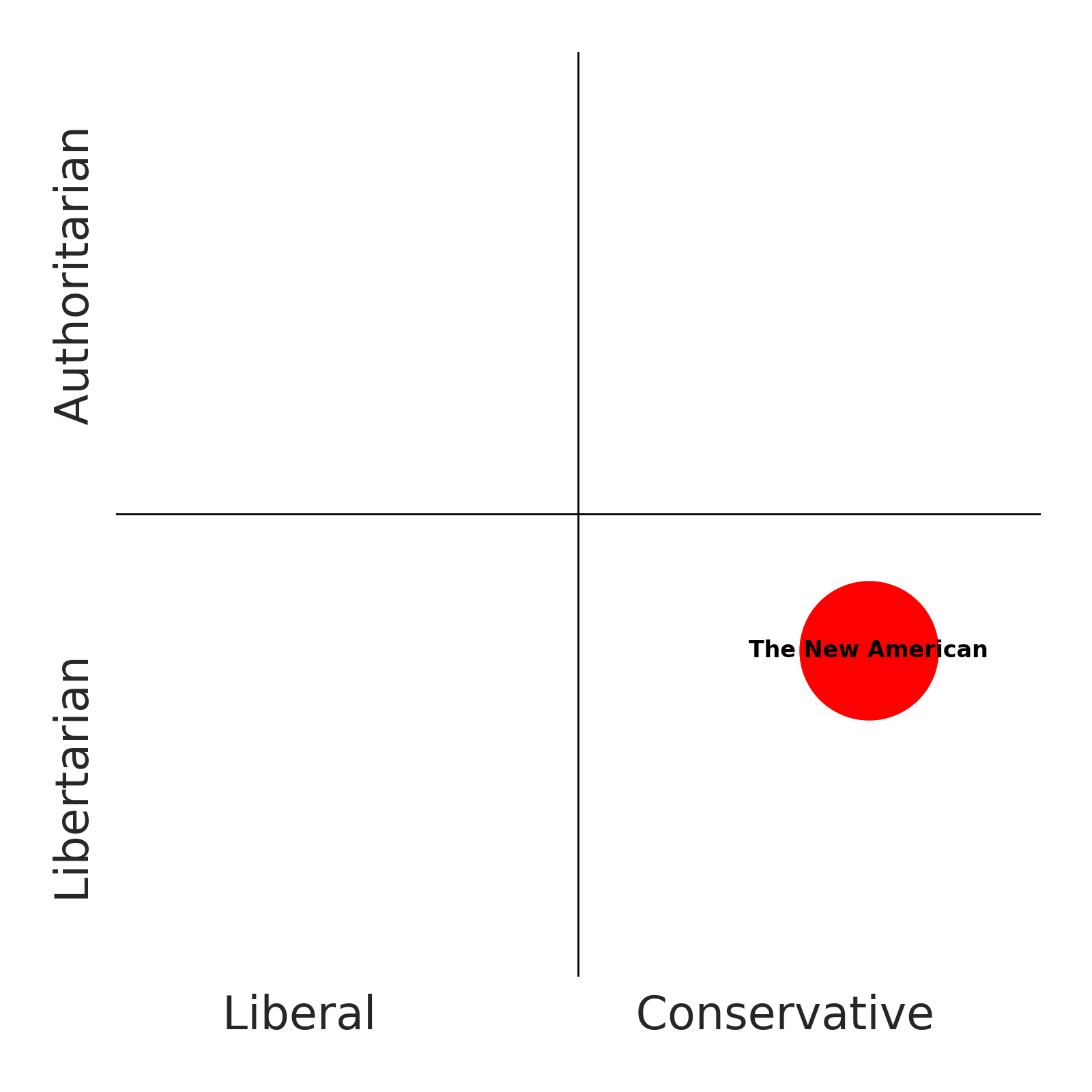
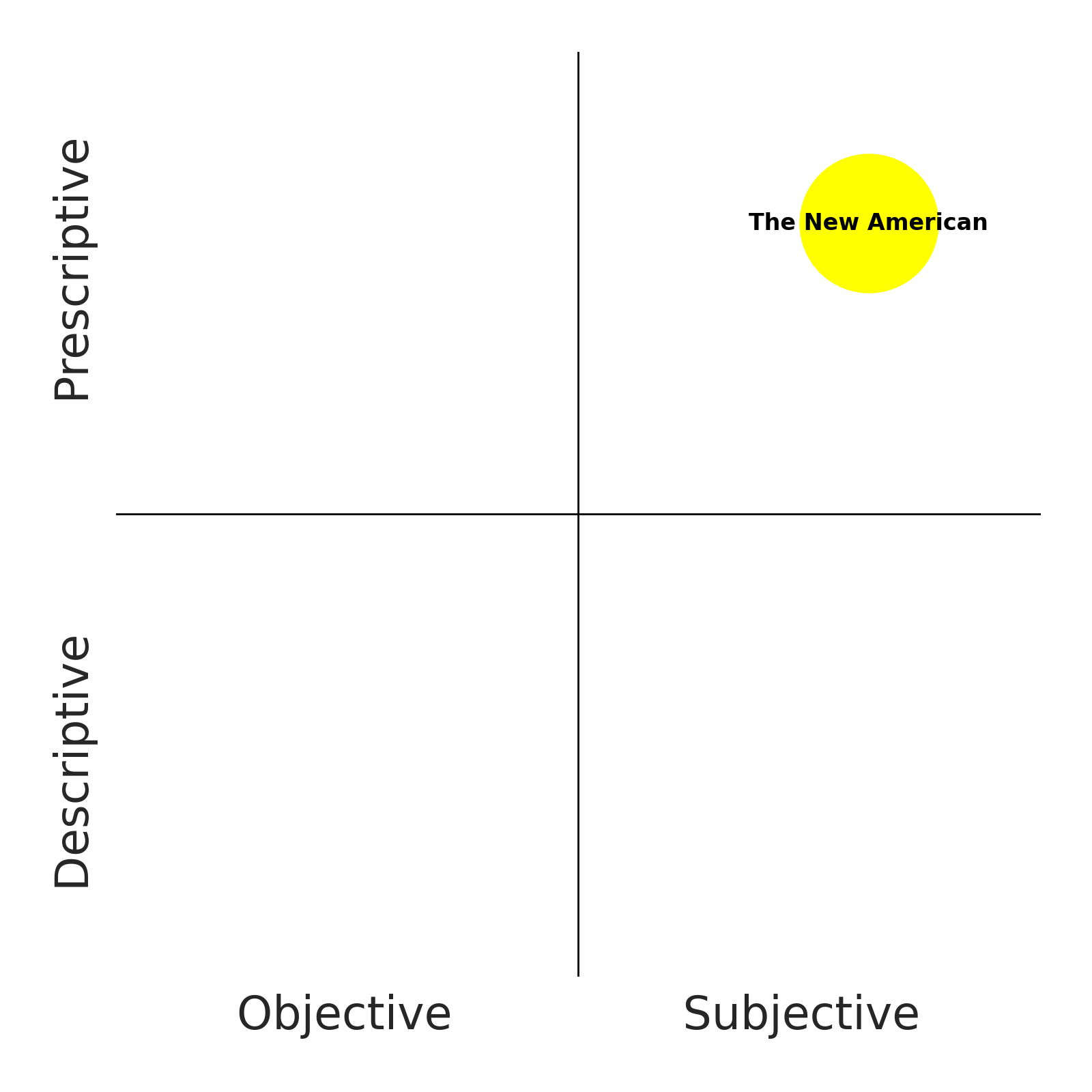
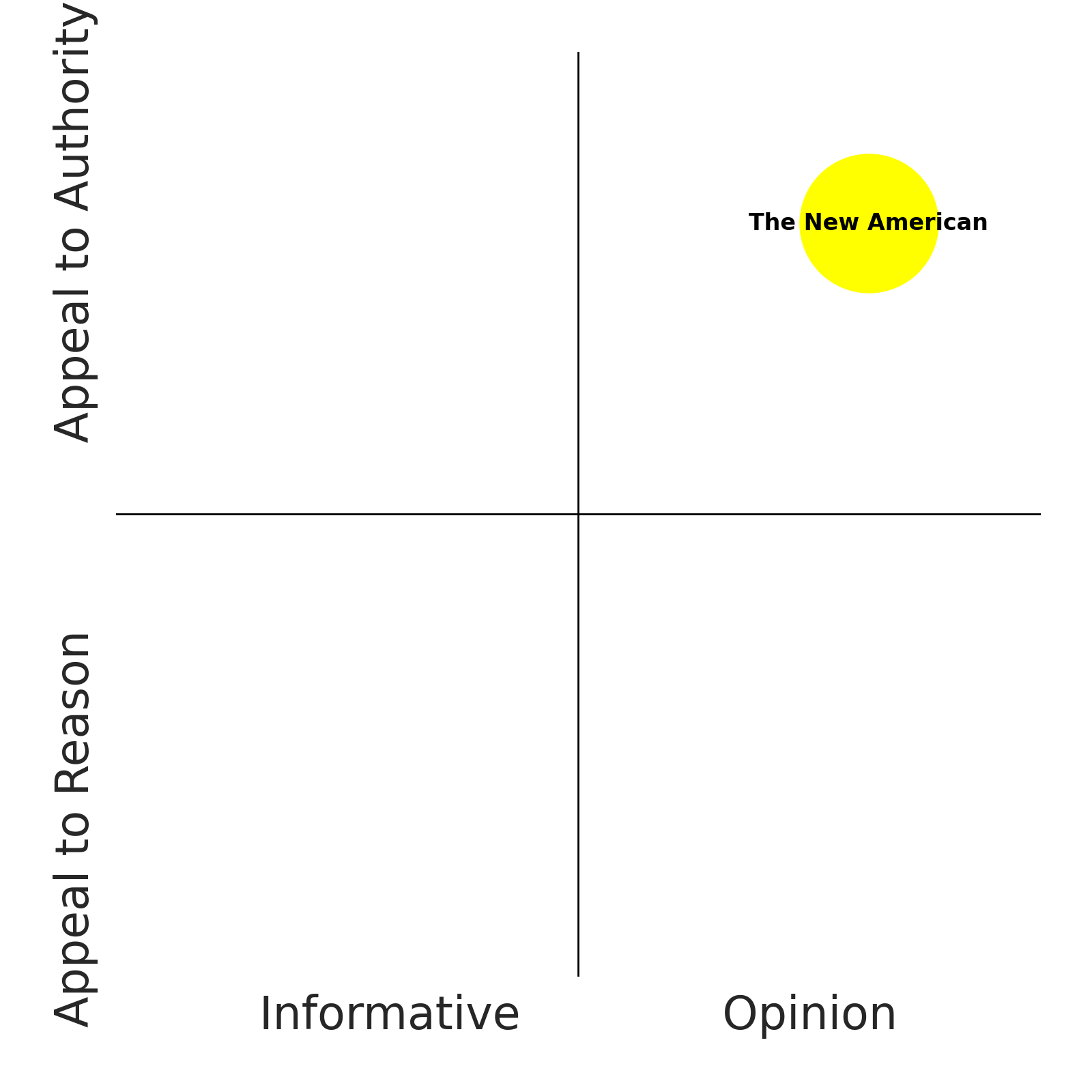
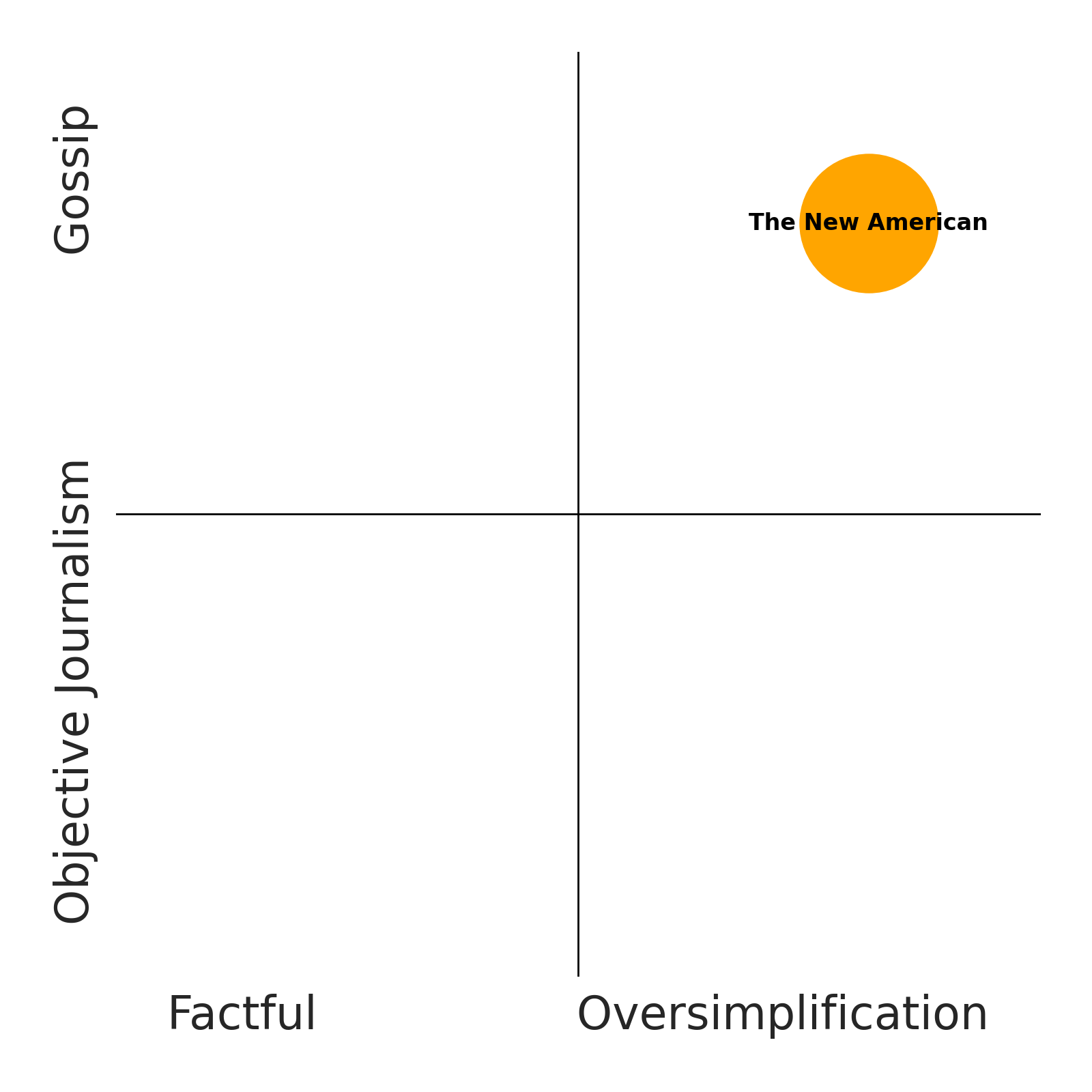
2026 © Helium Trades
Privacy Policy & Disclosure
* Disclaimer: Nothing on this website constitutes investment advice, performance data or any recommendation that any particular security, portfolio of securities, transaction or investment strategy is suitable for any specific person. Helium Trades is not responsible in any way for the accuracy
of any model predictions or price data. Any mention of a particular security and related prediction data is not a recommendation to buy or sell that security. Investments in securities involve the risk of loss. Past performance is no guarantee of future results. Helium Trades is not responsible for any of your investment decisions,
you should consult a financial expert before engaging in any transaction.
Helium Research Assistant

How can I help you today?
Ask any question about The New American bias.


