See whether Helium helps you make better-informed decisions. Try every Pro Trader feature for 30 days. No credit card required.
Try every Pro Trader feature for 30 days. No credit card required.
Education is framed as an aesthetic, personal experience in which teaching is a performance and the pleasure of the work is emphasized.
Automated analysis; not human reviewed. Limitations: The supplied text is a brief promotional podcast-episode description, so scores reflect the marketing framing rather than the full episode content. · 2 of 55 available dimensions scored; omitted dimensions are not treated as neutral. · Verified supporting quotes for 2 of 2 scored dimensions.
Claim: The framing treats education primarily as a subjective, aesthetic experience rather than as an empirical or policy matter.
“With teachers and students returning to the classroom, the hosts of Critics at Large reflect on the art of education itself.” · exact text match
Why: The description's central framing word 'art' and its focus on personal reflection position education as an experiential and interpretive subject.
Claim: The description uses evaluative language that presents teaching and learning as enjoyable and worthwhile.
“consider the work—and pleasure—of teaching and learning” · exact text match
Why: Calling teaching and learning both 'work' and 'pleasure' inserts a positive evaluative stance into an otherwise episode-style listing.
The supplied text is a brief promotional podcast-episode description, so scores reflect the marketing framing rather than the full episode content.
A reverent eulogy framing treats Parton as a universally beloved, saintly figure and doubles as a promotional pitch for a podcast.
Automated analysis; not human reviewed. Limitations: The supplied text is only a brief podcast blurb, so it cannot verify the reported death or national events; all scalar judgments are based on framing and promotional language. · 6 of 54 available dimensions scored; omitted dimensions are not treated as neutral. · Verified supporting quotes for 4 of 6 scored dimensions.
Claim: The framing uses evaluative superlatives and sainthood to describe Parton, making the account subjective rather than neutral.
“social media read like a greatest-hits reel of the charisma and musical acumen that made her universally beloved” · exact text match
“The ready word one reaches for is “saint,” right?” · not found in supplied text
Why: The language of universal belovedness and sainthood is evaluative and emotional rather than neutral.
Claim: The text is a celebration rather than an objective report, explicitly framing the episode as honoring Parton's legacy.
“to celebrate Parton’s life and work, and the legacy she leaves behind” · exact text match
Why: It explicitly frames the episode as celebration and makes value-laden claims about legacy.
Claim: The text asserts a universal public verdict about Parton without evidence or hedging.
“that made her universally beloved” · exact text match
Why: A universal empirical claim about public reception is presented as settled fact, exceeding what the brief text supports.
Claim: The account is emotionally positive toward Parton, emphasizing love, sainthood, and generosity.
“The ready word one reaches for is “saint,” right?” · not found in supplied text
“And she had the absolute opposite instinct, which was to give as much away as she could.” · exact text match
Why: Sainthood, universal love, and generosity set a strongly positive emotional tone.
Claim: Central factual claims about Parton's death and the national response are stated without visible sourcing or attribution.
“Upon news of Dolly Parton’s death last week, flags across the country were lowered to half-mast.” · exact text match
Why: A major factual event is asserted without sourcing in a promotional blurb; visible credibility is therefore low.
Claim: The blurb doubles as promotional material with direct subscription and follow calls.
“Listen and subscribe: Apple | Spotify | Wherever You Listen” · exact text match
“New episodes drop every Thursday. Follow Critics at Large wherever you get your podcasts.” · exact text match
Why: Direct instructions to listen, subscribe, and follow mark the text as promotional.
The supplied text is only a brief podcast blurb, so it cannot verify the reported death or national events; all scalar judgments are based on framing and promotional language.
September 17, 2026 · 0 shares
Celebratory house-style literary coverage frames the National Book Award fiction longlist as an occasion for promoting its own published authors and critical judgments.
The National Book Awards are annual U.S. literary awards; longlists are preliminary selections announced before finalists and the winner are chosen. The Nakba is the mass displacement and dispossession of Palestinians during the 1948 Arab-Israeli war.
Automated analysis; not human reviewed. Limitations: The supplied text has the publication name redacted/truncated and includes only this excerpt, so I cannot verify omitted longlist details or quoted reviews beyond what is shown. · 5 of 55 available dimensions scored; omitted dimensions are not treated as neutral. · Verified supporting quotes for 1 of 5 scored dimensions.
Claim: The coverage is framed through personal taste and evaluative enthusiasm rather than neutral reporting.
“My own favorite moment from Erdrich’s collection comes in 'Nero'.” · not found in supplied text
“It should come as no surprise that one of the nominees is Marlon James’s tour de force” · exact text match
Why: The writer explicitly marks a selection as personal and uses unhedged superlatives such as 'tour de force.'
Claim: The overall tone is celebratory and affirmative toward the longlisted books and their effects.
“Like all epiphanies, it’s transitory, but it leaves its mark—as do many of these nominated books.” · exact text match
“It should come as no surprise that one of the nominees is Marlon James’s tour de force” · exact text match
Why: The concluding sentence generalizes a positive lasting impression to 'many of these nominated books,' and James's nomination is framed as no surprise.
Claim: The report is dense with evaluative judgments and recommendations rather than strictly factual disclosure.
“My own favorite moment from Erdrich’s collection comes in 'Nero'.” · not found in supplied text
“A wonderfully sprawling, almost picaresque story, which gains power from her resistance to passing simple judgment on her protagonist.” · exact text match
Why: The text repeatedly tells readers which works are strong, favorite, or unforgettable rather than merely announcing the longlist.
Claim: The coverage leans on award nominations and named critics to establish the significance of the books.
“praised by Dwight Garner, in an ecstatic Times review, as 'the novel of the decade, if not the century.'” · not found in supplied text
“'Poignant, funny, and always surprising,' our fiction editor, Deborah Treisman, writes.” · not found in supplied text
Why: Significance is repeatedly grounded in the judgments of prize panels, Times critics, and the magazine's own editors rather than independent evidence.
Claim: The piece signals honesty by labeling personal choices and attributing critical judgments to named sources.
“My own favorite moment from Erdrich’s collection comes in 'Nero'.” · not found in supplied text
“Our critic Katy Waldman, who appreciated the book’s strengths, wrote in her review that it “uses the tricks of fiction to pull off something extremely difficult: giving full weight to tragedy and injustice without implying that some lives are over before they’ve begun.”” · exact text match
Why: The writer explicitly identifies a preference as personal and names the reviewers whose praise is quoted, supporting transparency about standpoint.
The supplied text has the publication name redacted/truncated and includes only this excerpt, so I cannot verify omitted longlist details or quoted reviews beyond what is shown.
September 18, 2026 · 0 shares
A book-review essay frames defeating Trumpism as the shared political problem and weighs the two authors’ strategic prescriptions with analytic skepticism.
Automated analysis; not human reviewed. Limitations: The supplied text is a book-review essay with a first-person reviewer, so I cannot cleanly separate the publisher's institutional framing from the individual reviewer's judgments. · 8 of 55 available dimensions scored; omitted dimensions are not treated as neutral. · Verified supporting quotes for 8 of 8 scored dimensions.
Claim: The review's framing is mildly non-conservative, treating defeat of the MAGA movement as a shared goal while also criticizing Democrats for moving left.
“Both strategists, despite having come up through opposing traditions, now share the goal of finding a formula that can defeat the MAGA movement—ideally so resoundingly that Trump’s form of politics stays discredited forever.” · exact text match
Counterevidence:
“Meanwhile, the Democrats reflexively—and under pressure from activists—opposed him at every turn and raced further left, to show just how anti-Trump they could be.” · exact text match
Why: The exact wording embraces an anti-MAGA goal, but the critique of Democratic leftward movement and the presence of a Never Trump Republican perspective weakens a clear liberal classification.
Claim: The review gives agenda-setting weight to non-ideological voters and treats their contradictions as the decisive material of elections.
“Call them wrong, or confused, or uninformed, but these are the voters who decide elections.” · exact text match
Why: The sentence explicitly elevates everyday voters over ideological camps as the decisive electoral force, a populist framing.
Claim: The review is substantially subjective because the reviewer's own verdicts and suggestions shape the assessment.
“I came away unconvinced that politicians like these can manage to look moderate the way that heterodox voters do” · exact text match
“Jentleson may need another full-length book to develop this proposal.” · exact text match
Why: First-person evaluative judgments and editorial recommendations make the piece partly subjective despite its reporting components.
Claim: The review is opinionated, going beyond summary to recommend a future edition chapter.
“Perhaps a future edition could include a chapter reflecting on whether these kinds of politicians also make for unreliable candidates.” · exact text match
Why: The direct suggestion for a future edition is a clear opinionated intervention rather than neutral description.
Claim: The review is strongly political, organized around defeating the MAGA movement and rebuilding an anti-Trump governing coalition.
“Both strategists, despite having come up through opposing traditions, now share the goal of finding a formula that can defeat the MAGA movement—ideally so resoundingly that Trump’s form of politics stays discredited forever.” · exact text match
Why: The framing treats coalition strategy and defeat of a political movement as the central subject, making the text highly political.
Claim: The review's visible sourcing is strong, with named authors, book titles, and a specific named poll.
“a Times-Philadelphia Inquirer poll from August found him more popular with Republicans than with Democrats” · exact text match
Why: The inclusion of a named external poll and repeated citations to the two books gives readers concrete sources to verify.
Claim: The review is epistemically careful and reason-based, explicitly noting that a causal question is hard to disentangle.
“The feedback loop is hard to disentangle.” · exact text match
Why: The author registers uncertainty rather than adopting a confident causal claim, indicating a rational, analytical stance.
Claim: The review is analytically sophisticated, placing the books' arguments in historical and strategic context.
“The political-history chapters of “Supermajority”—in which Jentleson assesses Democratic Presidential politics from F.D.R. to Bill Clinton, arguing for the triumph of heterodoxy at every juncture—further complicate his case.” · exact text match
Why: The review draws on historical detail and notes complications in the books' arguments, indicating above-average analytical intelligence.
The supplied text is a book-review essay with a first-person reviewer, so I cannot cleanly separate the publisher's institutional framing from the individual reviewer's judgments.
The Venezuela oil deal is framed as an unconstitutional, corrupt 'asset grab' and neocolonial overreach that is backfiring abroad.
Automated analysis; not human reviewed. Limitations: The supplied text lacks byline, dateline, and independent verification, so the analysis cannot distinguish the publisher's institutional voice from individual authorship or confirm the underlying events. · 16 of 54 available dimensions scored; omitted dimensions are not treated as neutral. · Verified supporting quotes for 16 of 16 scored dimensions.
Claim: The piece applies a left-leaning moral critique to Trump's Venezuela policy, framing it as corrupt neocolonialism.
“Trump's Neocolonialism Will Backfire.” · exact text match
“It’s materialist, transactional, and wholly untethered to any concerns about the rule of law or what’s right for the Venezuelan people.” · exact text match
Why: The headline and evaluative language express a clearly anti-Trump, liberal interpretive stance.
Claim: The analysis is advanced through expert and think-tank voices rather than popular sentiment.
“Ricardo Hausmann, a Venezuelan economist at Harvard University, lamented” · exact text match
“Mariano de Alba, a Venezuelan lawyer and an associate fellow at the International Institute for Strategic Studies in London, told me” · exact text match
Why: Credentialed academics and institutional experts carry much of the article's argument.
Claim: The analysis is framed by explicit moral and evaluative judgments.
“Trump's Neocolonialism Will Backfire.” · exact text match
“The deal, though, offers a clear distillation of Trump’s world view. It’s materialist, transactional, and wholly untethered to any concerns about the rule of law or what’s right for the Venezuelan people.” · exact text match
Why: The authorial voice makes strong normative judgments rather than confining itself to neutral description.
Claim: The account uses dramatic metaphors and a sweeping headline.
“Trump's Neocolonialism Will Backfire.” · exact text match
“he’s created a malign sphere of coercion in which most countries are running for cover.” · exact text match
Why: The language is emotionally vivid and dramatizes the consequences of Trump's policies.
Claim: The account emphasizes failure, worsening conditions, and global alienation.
“Such a transition seems to be nowhere in sight” · exact text match
“he’s created a malign sphere of coercion in which most countries are running for cover.” · exact text match
Why: The overall trajectory presented is negative and without credible prospects for improvement.
Claim: The account embeds normative prescriptions about what policy should have been.
“You opted to push an asset grab, an unconstitutional deal with an illegitimate oppressive government, instead of using US leadership to re-establish constitutional rule and democracy first” · exact text match
“the only way this can genuinely benefit Venezuelans and contribute to a sustained national recovery is if the agreements are transparent, designed under legitimate and inclusive institutions” · exact text match
Why: These prominent quoted critiques function as the article's preferred policy alternative.
Claim: The account treats Trump's military and coercive actions as harmful.
“a consequence of Trump’s decision to wage war on Iran” · exact text match
“he’s created a malign sphere of coercion in which most countries are running for cover.” · exact text match
Why: War and coercion are framed as destructive, reflecting a dovish foreign-policy outlook.
Claim: The account is substantially opinionated rather than neutral.
“Trump's Neocolonialism Will Backfire.” · exact text match
“The deal, though, offers a clear distillation of Trump’s world view. It’s materialist, transactional, and wholly untethered to any concerns about the rule of law or what’s right for the Venezuelan people.” · exact text match
Why: The piece states interpretive conclusions as the central frame.
Claim: The account centers on partisan and geopolitical contestation.
“House Democrats have accused the President of engaging in the “pillaging” of Venezuela” · exact text match
“Trumpist interference is a major theme in next month’s election in Brazil” · exact text match
Why: The subject matter is U.S. presidential action, congressional criticism, and foreign electoral politics.
Claim: The account leans on credentialed authorities and institutions.
“Ricardo Hausmann, a Venezuelan economist at Harvard University, lamented” · exact text match
“Charles Kupchan, a senior fellow at the Council on Foreign Relations” · exact text match
Why: Expert and institutional authority is repeatedly invoked to support the interpretation.
Claim: The headline asserts a settled outcome that the body presents as an apparent tendency.
“Trump's Neocolonialism Will Backfire.” · exact text match
“Trump’s assertion of that power appears to be backfiring.” · exact text match
Why: The unconditional headline exceeds the hedged language used in the body.
Claim: The account values the liberal international order and U.S. global leadership as norms disrupted by Trump.
“Much of the world is losing faith in the United States’ ability to serve as the leader of a liberal international order.” · exact text match
Why: The article treats diminished faith in the liberal order as a lamentable consequence rather than a desirable one.
Claim: The account carries a negative emotional charge.
“Trump's Neocolonialism Will Backfire.” · exact text match
“when he turns the instincts into actual policies, the results are disastrous” · exact text match
Why: Alarm and moral disapproval are conveyed through the headline and 'disastrous' framing.
Claim: The account is visibly well-sourced and careful in attribution.
“according to a White House fact sheet” · exact text match
“his lawyers point out that he has not been charged with or found guilty of any crime” · exact text match
Why: Core claims are attributed to identifiable sources, and exculpatory caveats are included.
Claim: The account extends into forecasts about Venezuela's political and economic trajectory.
“Such a transition seems to be nowhere in sight” · exact text match
“walking toward more corruption, with a lot more money on top of everything that has been already robbed” · exact text match
Why: The piece includes forward-looking assessments about corruption, political survival, and the absence of transition.
Claim: The account preserves exculpatory context and attributes official arguments.
“When contacted by reporters, his lawyers point out that he has not been charged with or found guilty of any crime.” · exact text match
“White House officials argue that their more muscular approach to the Americas, sometimes called the “Donroe Doctrine,” has undermined Russian and Chinese interests in the region.” · exact text match
Why: The article includes denials and the administration's own rationale, which are internal fairness signals.
The supplied text lacks byline, dateline, and independent verification, so the analysis cannot distinguish the publisher's institutional voice from individual authorship or confirm the underlying events.
August 31, 2026 · 0 shares
A strongly anti-Trump, anti-war framing presents the Iran conflict as Trump’s “folly” and emphasizes civilian casualties and domestic economic burdens over strategic justifications.
Automated analysis; not human reviewed. Limitations: The supplied text describes a 2026 timeline and conflict that cannot be cross-checked against real-world sources, and lacks explicit publication date and author attribution. · 10 of 54 available dimensions scored; omitted dimensions are not treated as neutral. · Verified supporting quotes for 9 of 10 scored dimensions.
Claim: The piece frames the war as Trump’s folly and emphasizes social-spending alternatives to military spending.
“the costs of Trump’s war are mounting” · exact text match
“it is money that could, in theory, be used for other purposes” · exact text match
Why: The anti-Trump labels and favorable attention to Medicaid/SNAP alternatives indicate a left-of-center political framing.
Claim: The piece’s overall presentation is evaluative rather than detached.
“the magnitude of Trump’s folly” · exact text match
“the costs of Trump’s war are mounting” · exact text match
Why: The repeated editorializing and value-laden labels push the piece toward the subjective end of the spectrum.
Claim: The piece emphasizes mounting, irreversible costs and no resolution.
“With no end in sight, the costs of Trump’s war are mounting.” · exact text match
“But the economic costs of the conflict can’t be reversed.” · exact text match
Why: The downbeat framing of an endless, costly conflict conveys pessimism.
Claim: The piece treats the conflict as an unjustified, costly war that should be seen negatively.
“With no end in sight, the costs of Trump’s war are mounting.” · exact text match
“the magnitude of Trump’s folly” · exact text match
Why: Calling the war “Trump’s folly” and emphasizing costs and casualties without strategic justifications marks a strongly dovish stance.
Claim: The piece is predominently an opinion/analysis with strong editorial labels.
“the magnitude of Trump’s folly” · exact text match
“the costs of Trump’s war are mounting” · exact text match
Why: Words like “folly” and repeated blame attribution are markers of opinionated writing.
Claim: The piece is highly political, incorporating electoral prospects and partisan responsibility.
“the President and his party may end up paying a higher political price” · exact text match
“with just twenty-five per cent of respondents approving of his handling of Iran” · exact text match
Why: The analysis is tied to midterm politics and presidential approval, not just war costs.
Claim: The piece’s emotional tone is negatively charged toward Trump and the war.
“the magnitude of Trump’s folly” · exact text match
“But the economic costs of the conflict can’t be reversed.” · exact text match
Why: The loaded “folly” label and irreversible-loss phrasing create negative affect.
Claim: The piece cites named experts, institutions, and official reports for its key numbers.
“According to the Pentagone, eighteen U.S. service members have been killed and more than seven hundred and fifty wounded.” · not found in supplied text
“Mark Zandi, the chief economist at Moody’s Analytics, put the total cost of the war for the typical American household at a thousand dollars—a figure he described as conservative.” · exact text match
Why: Specific attributions and named sources support credibility, though the underlying claims cannot be externally verified from this text.
Claim: The piece uses measured, carefully caveated reasoning rather than irrational appeals.
“In principle, it’s easier to estimate the economic costs of the war; in practice, the task is far from straightforward.” · exact text match
Why: It explicitly acknowledges complexity and avoids overclaiming precision.
Claim: The piece flags uncertainty, attributes sources, and cautions against precise interpretations.
“In principle, it’s easier to estimate the economic costs of the war; in practice, the task is far from straightforward.” · exact text match
“Rather than being taken as a precise number, this figure should be understood as a rough sketch” · exact text match
Why: Visible attribution and explicit caveats about estimating costs are internal honesty signals.
The supplied text describes a 2026 timeline and conflict that cannot be cross-checked against real-world sources, and lacks explicit publication date and author attribution.
A reported profile frames Trump's Washington construction campaign as a vanity-driven, institution-capturing project, with language and selected testimony emphasizing obsession, autocratic control, and questionable money.
The White House is federally owned and normally requires congressional funding plus review by the National Capital Planning Commission and the Commission of Fine Arts for major external changes; the National Trust for Historic Preservation is a private nonprofit that can sue under federal preservation law. The events described take place during Donald Trump's second term.
Automated analysis; not human reviewed. Limitations: The supplied text is a single long-form feature; I cannot independently verify its underlying interviews, court filings, or financial figures. · 8 of 54 available dimensions scored; omitted dimensions are not treated as neutral. · Verified supporting quotes for 5 of 8 scored dimensions.
Claim: The report frames Trump's renovation agenda as an autocratic self-commissioning project rather than a legitimate use of presidential authority.
“Trump has bent the systems of American government to his will: expanding executive authority, barrelling past Congress, stacking planning commissions and civic institutions with loyalists” · exact text match
“The committee has just become a rubber stamp for Trump, a former commissioner told me. It’s really sad.” · not found in supplied text
Why: The authorial phrase 'bent the systems' and the selected 'rubber stamp' criticism characterize the projects as institutional capture and presidential overreach, a distinctly anti-Trump/liberal-institutional perspective.
Claim: The report emphasizes Trump's expansion of executive control and his disregard for courts, commissions, and legal limits.
“Trump has bent the systems of American government to his will: expanding executive authority, barrelling past Congress, stacking planning commissions and civic institutions with loyalists” · exact text match
“He is not, however, the owner!” · exact text match
Why: The combination of the author's 'bent the systems' framing and the judge's corrective 'not the owner' presents executive dominance as a violation of institutional checks, indicating an anti-authoritarian stance.
Claim: The article combines reported facts with interpretive judgments about Trump's psychological state and the meaning of the construction.
“The President’s primary preoccupation engenders a certain amount of armchair psychology among those who know and work with the “builder-in-chief.”” · exact text match
“To the President’s detractors, the wreckage of the East Wing is an easy metaphor, a physical embodiment of the turmoil of his second term.” · exact text match
Why: The use of 'armchair psychology' and the metaphor of 'turmoil' are interpretive devices; the text is not a neutral bulletin but a feature with a point of view.
Claim: The piece asserts evaluative conclusions about Trump's control and institutional damage even while reporting facts.
“Trump has bent the systems of American government to his will: expanding executive authority, barrelling past Congress, stacking planning commissions and civic institutions with loyalists” · exact text match
“The wreckage of the East Wing is an easy metaphor, a physical embodiment of the turmoil of his second term.” · not found in supplied text
Why: These are not neutral descriptions; they assert that Trump abused power and that the physical changes embody political turmoil, which goes beyond factual reporting.
Claim: The report treats the renovations as a key political story, not a purely design or human-interest story.
“The building projects are the No. 1 subject that Trump brings up in his unprompted remarks.” · exact text match
“He’s the mayor, the planning commission, and the lending institution all together. He’s basically on every side of the table.” · not found in supplied text
Why: The piece repeatedly connects the construction to power, donors, executive authority, and government institutions, making political control a central organizing theme.
Claim: The report treats historic-preservation bodies, federal planning commissions, and court review as legitimate authorities being improperly undermined.
“Experts and former commissioners had noted with alarm that the N.C.P.C. should have looked at plans for any exterior construction project at the White House long before Trump tore down the existing structure.” · exact text match
“The Commission of Fine Arts, a seven-member council established by Congress that reviews all new public buildings in Washington, acting as a sort of aesthetic guardian, advised against the addition.” · exact text match
Why: Alarm about bypassing experts and the approving description of the CFA as an 'aesthetic guardian' signal alignment with institutional and professional gatekeepers.
Claim: The article's tone is critical and elegiac, emphasizing wreckage, imbalance, and foreboding.
“To the President’s detractors, the wreckage of the East Wing is an easy metaphor, a physical embodiment of the turmoil of his second term.” · exact text match
“It’s just so—it’s just so imbalanced.” · exact text match
Why: The words 'wreckage', 'turmoil', and 'imbalanced' carry negative emotional weight, giving the report a clearly critical rather than neutral affect.
Claim: The text supports its specifics with named authorities, court filings, and external records.
“According to records obtained by the Washington Post, it’s nowhere close to that.” · exact text match
“According to court filings, Trump was “personally selecting the project’s contractors and handling details of their contracts, including amounts of payment; and telling people working on the project that they did not need to follow permitting, zoning, or code requirements because the structure was on White House grounds.”” · exact text match
Why: Visible sourcing to the Washington Post and court filings, plus extensive named quotes, gives the report a high degree of internal credibility even where it is critical.
The supplied text is a single long-form feature; I cannot independently verify its underlying interviews, court filings, or financial figures.
September 04, 2026 · 0 shares
Framing treats the Supreme Court's conservative majority as enabling an overreaching President through procedural rulings, while presenting Roberts's dissent as the rule-of-law position.
The Supreme Court's emergency docket is an expedited process that often produces unsigned interim rulings. Standing doctrine requires plaintiffs to show a concrete and particularized injury rather than a generalized grievance. Federal law generally requires express congressional authorization for construction on federal property in Washington, D.C.
Automated analysis; not human reviewed. Limitations: The supplied text is itself an editorial analysis with selective quotations; the underlying rulings and records were not available for independent verification. · 11 of 54 available dimensions scored; omitted dimensions are not treated as neutral. · Verified supporting quotes for 9 of 11 scored dimensions.
Claim: The text's framing criticizes the Supreme Court's conservative majority and the Trump Administration's assertions of executive power, placing it on the liberal side of the partisan spectrum.
“The Supreme Court’s conservative majority has all too often demonstrated extraordinary deference to the executive branch” · not found in supplied text
“time after time, the majority has acceded to the Administration’s invocation of technical doctrines such as standing to allow policies to remain in place” · exact text match
Why: The text applies a distinctly critical frame to conservative Justices and the Trump Administration while endorsing a dissenting, more liberal-aligned position.
Claim: Strongly interpretive and evaluative framing marks the text as more subjective than neutral reporting.
“As offensive as the ballroom is, legally and aesthetically, it pales in importance next to other Trump initiatives” · exact text match
“credulously accepted the Administration’s claims that its actions are necessitated by national-security concerns” · exact text match
Why: Open evaluative and skeptical language goes beyond objective news reporting.
Claim: The text is pessimistic about the courts' ability to constrain the President.
“A system premised on legal niceties and compliance with established procedures has proved no match for Trump’s strategy of build first, deal with the consequences later.” · exact text match
“time after time, the majority has acceded to the Administration’s invocation of technical doctrines such as standing to allow policies to remain in place” · exact text match
Why: It frames legal constraints as repeatedly ineffective against the President's strategy.
Claim: The text prescribes that courts should stand up to the President rather than merely describing events.
“It is, rather, about the judiciary’s willingness to stand up to a President who has repeatedly demonstrated his disrespect for the rule of law.” · exact text match
“A system premised on legal niceties and compliance with established procedures has proved no match for Trump’s strategy of build first, deal with the consequences later.” · exact text match
Why: The conclusion is framed as a judgment about what the judiciary should be willing to do.
Claim: The text is heavily opinionated analysis rather than straight news.
“The answer sounded shocking, but it perfectly encapsulated the Administration’s overweening theory of Presidential power” · exact text match
“credulously accepted the Administration’s claims” · exact text match
Why: It uses evaluative adjectives and explicit critiques of the Administration and the Court majority.
Claim: The piece is fundamentally about partisan and institutional political conflict.
“The emergency docket has become a mechanism for the Administration to create facts on the ground.” · exact text match
“It is, rather, about the judiciary’s willingness to stand up to a President who has repeatedly demonstrated his disrespect for the rule of law.” · exact text match
Why: Its subject and conclusions assess presidential power, judicial behavior, and the rules of political conflict.
Claim: The text carries a negative emotional charge toward the President and the Court's majority.
“overweening theory of Presidential power” · exact text match
“disrespect for the rule of law” · exact text match
Why: Negative evaluative terms convey disapproval rather than a neutral tone.
Claim: The text is credible because it names specific judges, cites identifiable rulings, and quotes exact language from both majority and dissenting positions.
“In an unsigned ruling, issued through the Court’s emergency docket, five Justices said work on the ballroom could proceed” · exact text match
“The majority presented its ruling, which rejected the conclusions of two lower courts, as interim and limited. 'Today, we do not pass upon the legality of the government’s East Wing project,' it said.” · not found in supplied text
Why: It provides specific, verifiable judicial details and direct quotations, while also including dissenting and outside expert views.
Claim: The analysis is logically structured and evidence-attentive, using conditional and causal reasoning rather than irrational appeals.
“But a finding that the project required authorization—in the unlikely event it were to come—would be of little comfort once the ballroom is built” · exact text match
“A system premised on legal niceties and compliance with established procedures has proved no match for Trump’s strategy of build first, deal with the consequences later.” · exact text match
Why: It makes conditional statements about legal timing and consequences rather than relying on emotional or magical reasoning.
Claim: The text engages in forecasting about future Court action and litigation effects.
“Perhaps—they are now confronting a final rule, with immediate consequences for the midterm elections, and more tangible harm to states.” · exact text match
“almost certainly, little effect on the construction of the ballroom itself.” · exact text match
Why: It explicitly projects likely judicial behavior and legal outcomes.
Claim: The analysis synthesizes legal doctrine, case history, and political strategy at a sophisticated level.
“But a finding that the project required authorization—in the unlikely event it were to come—would be of little comfort once the ballroom is built. That fait accompli, all ninety thousand square feet of it, is, of course, what Trump has been counting on” · exact text match
“The emergency docket has become a mechanism for the Administration to create facts on the ground.” · exact text match
Why: It connects timing, standing doctrine, and political strategy into a coherent causal account.
The supplied text is itself an editorial analysis with selective quotations; the underlying rulings and records were not available for independent verification.
September 17, 2026 · 0 shares
The framing portrays Trump as a rogue, demagogic force whose conduct is accelerating the decline of the U.S.-centered multilateral order and the United Nations.
The U.N. General Assembly's annual general debate is normally held each September. The U.S. is a permanent, veto-wielding member of the Security Council and a major U.N. contributor; under U.N. rules, member states can lose General Assembly voting rights when arrears exceed a specified threshold. The secretary-general is appointed by the General Assembly on the recommendation of the Security Council.
Automated analysis; not human reviewed. Limitations: The supplied text is a first-person news analysis with an explicit editorial stance, so bias judgments are based on framing language and attributions rather than on independent verification of described events. · 11 of 55 available dimensions scored; omitted dimensions are not treated as neutral. · Verified supporting quotes for 11 of 11 scored dimensions.
Claim: Publisher framing uses left-aligned critical language toward Trump's foreign policy.
“Trump is at the heart of this geopolitical moment, catalytic in his alliance-fraying bullying, unprovoked warmongering, and protectionist demagoguery.” · exact text match
Why: The descriptors are progressive critiques of Trump's foreign policy, and the surrounding text treats U.S. withdrawal from multilateral institutions as damaging.
Claim: The piece mixes reporting with subjective editorial judgments.
“It’s the sort of erratic behavior that makes the country look like a rogue hegemon.” · exact text match
Why: This is an interpretive judgment about the United States' international image, not a verifiable fact.
Claim: The article's overall outlook is pessimistic about the U.N.'s future.
“In ten years, we could have a vestigial organization that doesn’t really serve many purposes in the world.” · exact text match
Counterevidence:
“This may be the worst time in the life of the U.N., but it’s not the time to write an obituary.” · not found in supplied text
Why: The article foregrounds an existential crisis and possible U.N. obsolescence, while the closing counterquote keeps it from being fully despairing.
Claim: The article is critical of military coercion and arms proliferation.
“Trump is at the heart of this geopolitical moment, catalytic in his alliance-fraying bullying, unprovoked warmongering, and protectionist demagoguery.” · exact text match
Why: Calling U.S. actions 'unprovoked warmongering' and framing nuclear proliferation as a negative consequence signals a de-escalatory, dovish editorial stance.
Claim: The publisher presents its own evaluation rather than neutral reporting.
“Trump is at the heart of this geopolitical moment, catalytic in his alliance-fraying bullying, unprovoked warmongering, and protectionist demagoguery.” · exact text match
Why: The opening line is an unqualified evaluative judgment, not an attributed claim.
Claim: The piece is deeply political in subject and framing.
“Next week, Trump will bring all this animus and baggage to the United Nations—an institution, which, as the embodiment of the post-Second World War order, is in the grips of an existential reckoning.” · exact text match
Why: The article is centered on the politics of the U.N., U.S. foreign policy, and great-power competition.
Claim: The article treats the U.S.-led institutional status quo as the only viable framework.
“there’s no alternative to the status quo that was once authored and secured by the United States; China, for all its great-power designs, envisions its rise on its own terms, and it is neither equipped to fill nor interested in filling an American void.” · exact text match
Why: The phrase 'no alternative to the status quo' treats the existing order as the only viable framework and frames disruption as pathology.
Claim: The piece carries a negative emotional charge in describing U.S. conduct.
“It’s the sort of erratic behavior that makes the country look like a rogue hegemon.” · exact text match
Why: The label 'rogue hegemon' is emotionally charged and negative.
Claim: The piece displays strong sourcing and attribution despite its opinionated framing.
“According to recent polling by the Rockefeller Foundation, respondents in twelve out of sixteen developing countries surveyed, including Indonesia, Brazil, and Mexico, ranked the United States as a greater threat to their nation than either China or Russia.” · exact text match
Counterevidence:
“Trump is at the heart of this geopolitical moment, catalytic in his alliance-fraying bullying, unprovoked warmongering, and protectionist demagoguery.” · exact text match
Why: The article names the pollster, scope, and countries, and most quotations are attributed; however, the unqualified opening opinion lowers overall credibility.
Claim: The article projects future U.N. leadership decisions as near-certain.
“The Trump Administration hasn’t signalled a preferred candidate yet, but it will almost certainly veto more progressively minded contenders, such as Michelle Bachelet, a human-rights advocate and the former President of Chile, whom Republican lawmakers cast as a “pro-abortion zealot” in a letter to Marco Rubio earlier this year.” · exact text match
Why: The phrase 'almost certainly' forecasts a future veto beyond what an official announcement supports.
Claim: The article uses loaded characterization to shape perceptions of the administration.
“He has shown greater willingness in his second term to coerce and bully long-standing allies than to confront putative adversaries.” · exact text match
Why: The sentence uses emotionally charged terms to characterize the administration's approach, an observable loaded-framing technique.
The supplied text is a first-person news analysis with an explicit editorial stance, so bias judgments are based on framing language and attributions rather than on independent verification of described events.
The framing treats existential A.I. warnings from industry insiders as credible and urgent while presenting slower, externally audited development as the responsible path.
Automated analysis; not human reviewed. Limitations: Input limitation: the supplied text is an edited podcast transcript, so I could not verify the underlying events or assess how editing shaped the speakers’ remarks. · 20 of 55 available dimensions scored; omitted dimensions are not treated as neutral. · Verified supporting quotes for 20 of 20 scored dimensions.
Claim: The piece is moderately liberal in framing, favoring A.I. regulation and crediting progressive pressure while treating Trump’s response as unserious.
“In the Biden Administration, there was good stuff about A.I.” · exact text match
“Bernie Sanders certainly had a lot to do with that.” · exact text match
Why: The favorable references to Biden-era A.I. policy and Sanders’ role suggest a left-of-center orientation.
Claim: The piece centers expert and industry judgment rather than public or democratic input.
“It’s really up to these tech leaders to save us.” · exact text match
“We’re reliant upon the A.I. companies to decide to slow down.” · exact text match
Why: The conversation repeatedly looks to industry insiders and experts as the deciding actors.
Claim: The piece favors regulatory oversight, external auditors, and company self-pacing rather than laissez-faire approaches.
“I would love it if there were an A.I. regulator in Washington, D.C., that I trusted.” · exact text match
“we really do need to pace the frontier” · exact text match
Why: The preferred remedies involve institutional control and governance of A.I. development.
Claim: The piece is an opinion-forward conversation built around personal judgment.
“My P(doom) is pretty low. It’s, like, ten per cent.” · exact text match
“It’s kind of like a vibe check on my disposition.” · exact text match
Why: The central framework is a first-person probability estimate and conversational opinion.
Claim: The headline and some language dramatize A.I. danger despite a cautious body.
“How, Exactly, Could A.I. Kill Us?” · exact text match
“demonstrated its ability to go rogue in a series of disturbing hacking incidents” · exact text match
Why: The title and selected verbs add alarm to the discussion, though the conversation itself remains hedged.
Claim: The tone is anxious and skeptical that government will help.
“which to me feels incredibly scary—like, super high. Like, way too high for my comfort.” · exact text match
“the government’s not gonna save us” · exact text match
Why: The emotional center of the piece is fear and institutional pessimism.
Claim: The piece uses high-stakes incidents and concrete breakthroughs to make the subject compelling.
“An A.I. model recently solved a Millennium Prize math problem, which is an actual breakthrough.” · exact text match
“a series of disturbing hacking incidents” · exact text match
Why: The material is full of surprising recent events and consequential hypotheticals.
Claim: The piece moves from describing risks to prescribing what should be done.
“we really do need to pace the frontier” · exact text match
“the only real response is to get educated about what these systems really are” · exact text match
Why: Direct policy and personal recommendations appear throughout the conversation.
Claim: The piece foregrounds catastrophic warnings and describes the speaker’s fear.
“The people building AI earnestly believe that it could kill us all by the end of the decade.” · exact text match
“which to me feels incredibly scary—like, super high. Like, way too high for my comfort.” · exact text match
Why: The framing repeatedly emphasizes existential danger and emotional alarm.
Claim: The piece is openly opinionated about A.I. policy and safety.
“we really do need to pace the frontier” · exact text match
“I think it’s a really good letter, and I hope that it happens.” · exact text match
Why: The speaker gives direct evaluative judgments and policy recommendations.
Claim: The discussion is heavily framed by presidential politics, congressional legislation, and national-security competition.
“President Donald Trump responded, on Truth Social,” · exact text match
“Bernie Sanders and Greg Casar have legislation in Congress to ban the pursuit of superintelligence.” · exact text match
Why: The article treats A.I. safety as a political and governmental issue, not only a technical one.
Claim: The case relies substantially on warnings and endorsements from named A.I. leaders and researchers.
“around fourteen hundred researchers at the frontier labs signed” · exact text match
“raised the concern that a superintelligence “could destroy humanity,”” · exact text match
Why: The credibility of the risk warnings is supported largely by expert statements and signatory counts.
Claim: The emotional valence of the piece is anxious and negative.
“which to me feels incredibly scary—like, super high. Like, way too high for my comfort.” · exact text match
Why: The dominant emotional note is fear rather than optimism or neutrality.
Claim: The piece cites named people, exact quotes, and marks the speaker’s own epistemic limits.
“This is my understanding of it.” · exact text match
“I don’t really have any insight into what’s happening there.” · exact text match
Why: Visible hedging and attribution support credibility even though the piece is an opinion conversation.
Claim: The reasoning is measured and self-aware about uncertainty.
“It’s kind of like a vibe check on my disposition. It’s not like off-camera I have huge whiteboards covered with calculations.” · exact text match
Why: The speaker refuses false precision and openly identifies the subjective basis of the probability estimate.
Claim: The piece treats A.I. companies as the main responsible actors and defends their stated motives.
“We’re reliant upon the A.I. companies to decide to slow down.” · exact text match
“I think it would be a mistake to dismiss these concerns as a sort of four-dimensional-chess move to lock out competitors.” · exact text match
Why: The framing places primary trust in corporate self-governance rather than public authority.
Claim: The piece treats A.I. as a material, statistical technology rather than a supernatural agent.
“What the machine is is a non-alive statistical calculating engine located in a cloud.” · exact text match
Why: The description is explicitly empirical and mechanistic.
Claim: Much of the content is explicit hypothetical scenario-building about the future.
“an example that I think is plausible would be:” · exact text match
“you imagine that type of scenario, but scaled up” · exact text match
Why: The discussion centers on possible catastrophic futures rather than established outcomes.
Claim: The piece discloses uncertainty and engages with counterarguments.
“I don’t really have any insight into what’s happening there.” · exact text match
“I think it would be a mistake to dismiss these concerns as a sort of four-dimensional-chess move to lock out competitors. It might have that effect.” · exact text match
Why: The speaker acknowledges limits to knowledge and gives a fair hearing to a skeptical interpretation.
Claim: The piece makes analytic distinctions and grounds the discussion in technical reality.
“I think it’s really helpful to disentangle two worries that are often conflated.” · exact text match
“What the machine is is a non-alive statistical calculating engine located in a cloud.” · exact text match
Why: It separates scenarios, defines terms, and resists personifying the technology.
Input limitation: the supplied text is an edited podcast transcript, so I could not verify the underlying events or assess how editing shaped the speakers’ remarks.
September 21, 2026 · 0 shares
Framing treats a conservative student’s punishment over remarks about Charlie Kirk as a politically driven injustice, foregrounding recantations, missing specifics, and defenders while casting university administrators as biased enforcers.
The excerpt concerns a Texas Tech disciplinary case in a clinical program in which a student’s reaction to news that Charlie Kirk was shot led to sanctions; the university’s internal proceedings and the composition of its Board of Regents are relevant background.
Automated analysis; not human reviewed. Limitations: The supplied excerpt is heavily truncated with ellipses, which may obscure the full article’s context and alter some framing judgments. · 6 of 55 available dimensions scored; omitted dimensions are not treated as neutral. · Verified supporting quotes for 3 of 6 scored dimensions.
Claim: Framing uses the Board of Regents’ corporate makeup to imply an elite, non-educational control over academic decisions.
“The final evaluation of those materials was left to the Board of Regents, whose eight members include seven executives from the private-equity, construction, and oil-and-gas industries; only one regent has a background in education.” · exact text match
Why: The detail highlighting corporate and non-education backgrounds contrasts a distant elite with the academic setting.
Claim: Framing depicts university officials as coercive and indifferent to rights and tenure.
“Nowlin said that he would convene a committee to strip Metze of his tenure, on the ground that Metze posed “a danger to students.”” · exact text match
“The more material you see from this case, the more you come around to the idea that the only explanation is that it is entirely political.” · not found in supplied text
Why: The tenure threat is presented alongside a named expert’s characterization of the case as “entirely political,” portraying institutional authority as punitive.
Claim: The institutional decision-makers are characterized as politically motivated and out of step with evidence.
“The final evaluation of those materials was left to the Board of Regents, whose eight members include seven executives from the private-equity, construction, and oil-and-gas industries; only one regent has a background in education.” · exact text match
“The more material you see from this case, the more you come around to the idea that the only explanation is that it is entirely political.” · not found in supplied text
Why: The combination of board-composition facts and the source’s conclusion frames the institution as an interested establishment.
Claim: The article emphasizes logical flaws and missing evidence in the university’s case.
“There were also apparent inconsistencies in Morgeson’s accounts.” · exact text match
“Nowlin’s memo provided no specific examples to support the sanction.” · exact text match
Why: It scrutinizes the evidentiary basis of sanctions rather than relying on emotional assertion.
Claim: The reporting attributes claims, notes a lack of response, and flags allegations.
“Morgeson did not respond to requests for comment.” · exact text match
“which the lawsuit claims were written by A.I.” · exact text match
Why: Visible sourcing and attribution are included, supporting a good-faith effort to report accurately.
Claim: The piece integrates documents, attributed quotations, and procedural detail.
“In an affidavit, Perez later wrote, “I do not know why my statements to Professor Keffer would be misconstrued in this light, other than to make Fisher somehow look bad.”” · exact text match
“The final evaluation of those materials was left to the Board of Regents...” · not found in supplied text
Why: It connects an affidavit, university documents, and expert commentary in a structured narrative.
The supplied excerpt is heavily truncated with ellipses, which may obscure the full article’s context and alter some framing judgments.
September 18, 2026 · 0 shares
Framing is strongly adversarial to the official inquiry, presenting the Thirlwall Report as a flawed guilt-premised exercise and foregrounding expert and nurse testimony that calls Lucy Letby's convictions into question.
Automated analysis; not human reviewed. Limitations: The supplied article is a single editorial/analysis text with an explicit viewpoint; the underlying trial record and opposing closing arguments are not included, so I cannot verify the validity of the convictions or the expert panel's methodology. · 6 of 55 available dimensions scored; omitted dimensions are not treated as neutral. · Verified supporting quotes for 5 of 6 scored dimensions.
Claim: The coverage is framed around a hierarchy of senior doctors and their power over nurses, with nurses presented as the more reliable witnesses.
“When I started my career the hierarchy and the gap between consultants and nurses was so bad. And at the end of my career, it’s exactly the same.” · exact text match
“The nurses, who worked beside Letby every day, also had strong instincts about who she was. But only the doctors’ impressions came to be regarded as reliable knowledge.” · exact text match
Why: The repeated contrast between consultant power and nurses' knowledge aligns the narrative with the less powerful staff against an elite medical hierarchy.
Claim: The piece is explicitly argumentative rather than neutral, asserting that the report missed the central question.
“The New Lucy Letby Report Misses the Point.” · exact text match
“But it didn’t address the question of whether she had actually done so.” · exact text match
Why: The headline and opening line state an evaluative conclusion and frame the inquiry as wrong-headed, which is subjective commentary.
Claim: The analysis is strongly opinionated, repeatedly characterizing the inquiry's approach and witnesses in value-laden terms.
“The New Lucy Letby Report Misses the Point.” · exact text match
“At times during the inquiry hearings, the nurses were almost browbeaten into accepting the inquiry’s premise.” · exact text match
Why: Strong evaluative language and an explicit argumentative thesis make the piece an opinion-driven analysis rather than straight reporting.
Claim: The article consistently frames Letby and the nurses as casualties of an institutional campaign, invoking unfair treatment in the inquiry and hospital process.
“wrong and immoral” · exact text match
“They want us to throw Lucy under a bus.” · exact text match
Why: The selected quotes emphasize that doctors and executives treated Letby unfairly, grounding a victimization frame in the inquiry record.
Claim: The framing is anti-establishment, presenting the government inquiry, hospital management, and police as authorities that closed ranks around a flawed narrative.
“The Health Secretary declined to alter the investigation.” · exact text match
“It is not for me in the discharge of my duties, Lady Justice Thirlwall, the chair of the inquiry, said, to seek to explore alternative theories about the deaths.” · not found in supplied text
Why: The article treats official refusals to re-examine the case as evidence that the system is protecting its own inquiry rather than pursuing truth.
Claim: The piece is extensively sourced, with named participants, document references, and exact quotes, but it is openly one-sided.
“Working pro bono, he put together a panel of fourteen medical experts, among them some of the world’s leading specialists in newborn medicine, including the head of neonatology at Children’s Hospital of Philadelphia, a former director of the neonatal intensive-care unit at Boston Children’s Hospital, and a former president of the Royal College of Paediatrics and Child Health.” · exact text match
“The records trace the rift on Letby’s unit between the doctors and nurses, who had not been called to testify in her defense at trial.” · exact text match
Why: Visible sourcing and detailed document references support credibility, but the article's argumentative framing and selective emphases limit it to modest rather than high credibility.
The supplied article is a single editorial/analysis text with an explicit viewpoint; the underlying trial record and opposing closing arguments are not included, so I cannot verify the validity of the convictions or the expert panel's methodology.
It is a sympathetic, emotionally charged account framing Nepal's flood disaster as a climate injustice caused largely by other nations while also criticizing Nepal's political establishment.
Automated analysis; not human reviewed. Limitations: The analysis relies only on the provided article text; no external verification of death toll or scientific cause was performed. · 11 of 54 available dimensions scored; omitted dimensions are not treated as neutral. · Verified supporting quotes for 9 of 11 scored dimensions.
Claim: The framing favors progressive positions on climate justice and treats political elites negatively.
“man-made climate change has intensified the terrifying power of this sacred geography” · exact text match
“thrusting impoverished, landlocked Nepal onto the front lines of a battle that was started by other nations” · exact text match
Why: The language attributes climate harm to other nations and criticizes elites, aligning with a liberal/progressive worldview.
Claim: Sympathetic to ordinary citizens and hostile to political elites.
“the caprice, narrow-mindedness, and corruption of political élites” · exact text match
“fresh ideas and a record of good governance” · exact text match
Why: Elite corruption is condemned while common citizens' suffering is foregrounded.
Claim: Uses vivid, emotional description rather than detached neutral narration.
“an apocalyptic, tsunami-like surge of water, mud, and debris” · exact text match
“desperate scrambles to safety and hopeless efforts to find loved ones” · exact text match
Why: The language is emotionally charged and metaphorical, indicating subjective presentation.
Claim: Includes explicit judgments about governance, feasibility, and outcomes.
“That may be a tall order, given the enmities in the region and the current lack of trust between the three governments.” · exact text match
“But it was a tortured journey, marred by the caprice, narrow-mindedness, and corruption of political élites” · exact text match
Why: Direct evaluative statements go beyond reporting facts.
Claim: Frames Nepal as an innocent victim of distant causes and geopolitical pressure.
“Nepal is paying an extraordinarily disproportionate price for a crisis it did not create” · exact text match
“thrusting impoverished, landlocked Nepal onto the front lines of a battle that was started by other nations” · exact text match
Why: Repeatedly presents Nepal as suffering harm it did not cause and from which it cannot escape.
Claim: Expresses contempt for Nepal's previous political establishment and endorses the reform movement.
“carrousel of feuding political factions took turns governing, all inadequately” · exact text match
“Corruption was endemic” · exact text match
Why: Negative characterizations of governing factions and corruption show an anti-establishment stance.
Claim: Strongly negative emotional tone dominates the disaster narrative.
“horrific news about family members” · exact text match
“desperate scrambles to safety and hopeless efforts to find loved ones” · exact text match
Why: Word choices like 'horrific' and 'desperate' convey grief and distress.
Claim: Provides named sources, expert attribution, and specific figures that support verifiability.
“Scientists at the U.S. Geological Survey believe the disaster was set off by a glacial collapse in the Himalayas” · exact text match
“killed at least five hundred and thirty-eight people, as of Friday” · not found in supplied text
Why: The article cites a scientific agency, names interviewees, and gives a precise death toll with a time reference.
Claim: Attributes the disaster to scientific causes (glacial collapse, climate change) rather than supernatural ones.
“Scientists at the U.S. Geological Survey believe the disaster was set off by a glacial collapse in the Himalayas” · exact text match
Why: The only causal explanation offered is scientific, despite including mythological references as context.
Claim: Advocates collective international cooperation and shared management of shared risks.
“Nepal, India, and China can work together to better manage the mountains, rivers, and 'accelerating risks' that they share” · not found in supplied text
“hopes vulnerable nations such as Nepal can get a 'real seat at the table'” · not found in supplied text
Why: The preferred solution is multilateral collaboration rather than market or individual action.
Claim: Makes forward-looking predictions about the death toll and economic effects.
“The death toll is bound to grow.” · exact text match
“The floods will likely change that outlook” · exact text match
Why: These statements forecast future outcomes that cannot be confirmed at the time of writing.
The analysis relies only on the provided article text; no external verification of death toll or scientific cause was performed.
September 21, 2026 · 0 shares
Sympathetic interview framing centers a Palestinian doctor's account of Gaza's ruin, presents a 74,000-death toll and an 81% U.N. damage figure as settled fact, and implies Israeli restrictions on aid are arbitrary and cruel.
Automated analysis; not human reviewed. Limitations: The supplied excerpt contains bracketed elisions, making some sentence boundaries and subjects uncertain; I inferred the publisher's voice only where unambiguous, and could not verify whether the elided text changes the frame or includes counterpoints. · 8 of 55 available dimensions scored; omitted dimensions are not treated as neutral. · Verified supporting quotes for 5 of 8 scored dimensions.
Claim: Framing pairs the establishment phrase 'massacre of October 7' with an unbroken record of Palestinian suffering and criticism of Israeli policy, aligning the piece with progressive media positions.
“the war that began after the massacre of October 7, 2023, and which has now killed seventy-four thousand Palestinians” · exact text match
“Their claim that it’s a luxury is nonsense.” · not found in supplied text
Why: The authoritative death toll, the chosen venue for an uncritical interview with a Palestinian critic, and the loaded 'nonsense' characterization place the article left of center.
Claim: The piece is built around a participant's personal and moral assessments in addition to reported data, placing it toward the subjective end of the spectrum.
“It is insane, because, on the other hand, they are allowing chocolates and they are allowing sugar into Gaza, but they do not allow something like peanut butter, which is nutritious.” · exact text match
“I was speechless, and I did not argue with her because” · exact text match
Why: Publisher-written sections state statistics, but the emotional center is the interviewee's judgment, and the interviewer's questions are designed to elicit personal reaction.
Claim: The treatment is literary and restrained rather than tabloid-sensational.
“Yes, eighty-one per cent of infrastructure has been damaged or destroyed, according to U.N.” · exact text match
“two million people are squeezed into thirty per cent of the territory” · exact text match
Why: Heavy statistics, attributed sourcing, and long-form interview structure keep the tone measured despite the graphic subject matter.
Claim: The outlook for Gaza is profoundly pessimistic.
“It’s been three years right now with life totally on hold.” · exact text match
“many people prefer to live in the ruins of their houses instead of having tents” · not found in supplied text
Why: The doctor's summary of endless personal and collective decline yields a bleak tone with no examples of recovery or hope.
Claim: The piece is anti-war/anti-escalation; it emphasizes continuing fatalities, material destruction, and popular desire to end the fighting.
“The people want it to end and to stop burying their children.” · exact text match
“More than thirteen hundred of those deaths have occurred since last October” · exact text match
Why: All editorial emphasis falls on the human cost of continued warfare, with no framing of military objectives or security justifications.
Claim: The article engages core partisan disputes of the Israel-Hamas war—territorial control, hostage recovery, ceasefire terms, and aid policy—at a high level of political intensity.
“when a ceasefire between Israel and Hamas went into effect” · exact text match
“forty-seven per cent would be under Hamas control” · exact text match
Why: The subject matter is the conduct and consequences of an interstate-communal war, making the article inherently and heavily political.
Claim: Palestinians are framed almost exclusively as victims of military action and deprivation, with minimal agency or strategic description.
“many people prefer to live in the ruins of their houses instead of having tents” · not found in supplied text
“hundreds of thousands of children are not going to school for the third year in a row, and the universities are destroyed” · exact text match
Why: The catalogue of ruin emphasizes what has been done to residents, casting them as passive recipients of catastrophe.
Claim: The emotional valence is strongly negative, dominated by grief, loss, and claustrophobia.
“he was killed, too, with his wife” · exact text match
“It’s been three years right now with life totally on hold.” · exact text match
Why: Recounting relatives' deaths and a three-year suspended life creates deep sorrow; no warmth or levity appears.
The supplied excerpt contains bracketed elisions, making some sentence boundaries and subjects uncertain; I inferred the publisher's voice only where unambiguous, and could not verify whether the elided text changes the frame or includes counterpoints.
August 29, 2026 · 0 shares
Automated analysis; not human reviewed. Limitations: The article relies heavily on data from advocacy groups and a former U.S. official, potentially omitting Israeli government perspectives. · 10 of 54 available dimensions scored; omitted dimensions are not treated as neutral. · Verified supporting quotes for 6 of 10 scored dimensions.
Claim: The article advocates for a two-state solution and criticizes Israeli settlement policy from a liberal perspective.
“The breakneck expansion of settlements in the West Bank has rendered American talk of a two-state solution increasingly irrelevant.” · exact text match
“The settlements would require Israeli Jews either to rule over a resentful non-Jewish population of about equal size or to surrender the Jewish identity of their state.” · not found in supplied text
Why: The language critiques Israeli expansion and warns against an undemocratic outcome, aligning with liberal political positions.
Claim: The article mixes factual reporting with subjective interpretation and emotional language.
“the breakneck expansion of settlements ... has made Kerry's warning seem impossibly hopeful” · not found in supplied text
Why: The phrase 'impossibly hopeful' conveys a subjective judgment, indicating a subjective overlay on factual data.
Claim: The article is serious and restrained, avoiding sensationalism.
“More than eleven hundred Palestinians in the West Bank have been killed either directly by settlers or by the Israeli security forces.” · exact text match
Why: The tone is factual and sober, without exaggerated or clickbait language.
Claim: The article expresses pessimism about the viability of a two-state solution.
“has made Kerry's warning seem impossibly hopeful” · verified after text normalization
“It is no longer relevant.” · exact text match
Why: It repeatedly states that the two-state solution is fading, indicating a pessimistic outlook.
Claim: The article not only describes the situation but also prescribes actions for U.S. voters and politicians.
“Americans should ask candidates the more pertinent question: Will you press Israel, right now, to begin putting more land back in Palestinian hands?” · exact text match
Why: It offers direct recommendations, making it prescriptive rather than purely descriptive.
Claim: The article is dovish, criticizing military actions and settlements while advocating for Palestinian rights.
“talking about American support for a future two-state solution, as many politicians in both parties continue to do, is like musing about an alternative history.” · exact text match
Why: It opposes Israeli hardline policies and urges land concessions, indicating a dovish stance.
Claim: The article emphasizes Palestinian suffering and presents them primarily as victims.
“More than eleven hundred Palestinians in the West Bank have been killed either directly by settlers or by the Israeli security forces.” · exact text match
“demolitions and intimidation in the West Bank fully or partially displaced one hundred and seventeen Palestinian communities, uprooting over fifty-nine hundred Palestinians.” · exact text match
Why: It highlights death and displacement statistics, framing Palestinians as the harmed party.
Claim: The article relies on data, statistics, and expert quotes, presenting a reasoned argument.
“More than five hundred thousand Jewish settlers already reside among more than three million Palestinians in the West Bank” · exact text match
“based on statements from the Israeli government and on data from the advocacy group Peace Now, the Palestinian administrative authority in the West Bank, and U.N. agencies.” · not found in supplied text
Why: It cites specific figures and attributes sources, demonstrating a rational, evidence-based approach.
Claim: The article demonstrates transparency by citing sources and attributing data.
“based on statements from the Israeli government and on data from the advocacy group Peace Now, the Palestinian administrative authority in the West Bank, and U.N. agencies.” · not found in supplied text
Why: It explicitly names data sources, which is a marker of honesty and reliability.
Claim: The article demonstrates intellectual rigor with complex analysis and coherent argumentation.
“The maps revealed that a chronic problem had turned critical.” · exact text match
“Lowenstein argued that a more immediate goal would be persuading Israel to give back at least some of the land to the Palestinians.” · exact text match
Why: The article weaves historical context, current data, and expert opinion into a nuanced analysis.
The article relies heavily on data from advocacy groups and a former U.S. official, potentially omitting Israeli government perspectives.
August 31, 2026 · 0 shares
A strongly anti-Trump, anti-war framing presents the Iran conflict as Trump’s “folly” and emphasizes civilian casualties and domestic economic burdens over strategic justifications.
Automated analysis; not human reviewed. Limitations: The supplied text describes a 2026 timeline and conflict that cannot be cross-checked against real-world sources, and lacks explicit publication date and author attribution. · 10 of 54 available dimensions scored; omitted dimensions are not treated as neutral. · Verified supporting quotes for 9 of 10 scored dimensions.
Claim: The piece frames the war as Trump’s folly and emphasizes social-spending alternatives to military spending.
“the costs of Trump’s war are mounting” · exact text match
“it is money that could, in theory, be used for other purposes” · exact text match
Why: The anti-Trump labels and favorable attention to Medicaid/SNAP alternatives indicate a left-of-center political framing.
Claim: The piece’s overall presentation is evaluative rather than detached.
“the magnitude of Trump’s folly” · exact text match
“the costs of Trump’s war are mounting” · exact text match
Why: The repeated editorializing and value-laden labels push the piece toward the subjective end of the spectrum.
Claim: The piece emphasizes mounting, irreversible costs and no resolution.
“With no end in sight, the costs of Trump’s war are mounting.” · exact text match
“But the economic costs of the conflict can’t be reversed.” · exact text match
Why: The downbeat framing of an endless, costly conflict conveys pessimism.
Claim: The piece treats the conflict as an unjustified, costly war that should be seen negatively.
“With no end in sight, the costs of Trump’s war are mounting.” · exact text match
“the magnitude of Trump’s folly” · exact text match
Why: Calling the war “Trump’s folly” and emphasizing costs and casualties without strategic justifications marks a strongly dovish stance.
Claim: The piece is predominently an opinion/analysis with strong editorial labels.
“the magnitude of Trump’s folly” · exact text match
“the costs of Trump’s war are mounting” · exact text match
Why: Words like “folly” and repeated blame attribution are markers of opinionated writing.
Claim: The piece is highly political, incorporating electoral prospects and partisan responsibility.
“the President and his party may end up paying a higher political price” · exact text match
“with just twenty-five per cent of respondents approving of his handling of Iran” · exact text match
Why: The analysis is tied to midterm politics and presidential approval, not just war costs.
Claim: The piece’s emotional tone is negatively charged toward Trump and the war.
“the magnitude of Trump’s folly” · exact text match
“But the economic costs of the conflict can’t be reversed.” · exact text match
Why: The loaded “folly” label and irreversible-loss phrasing create negative affect.
Claim: The piece cites named experts, institutions, and official reports for its key numbers.
“According to the Pentagone, eighteen U.S. service members have been killed and more than seven hundred and fifty wounded.” · not found in supplied text
“Mark Zandi, the chief economist at Moody’s Analytics, put the total cost of the war for the typical American household at a thousand dollars—a figure he described as conservative.” · exact text match
Why: Specific attributions and named sources support credibility, though the underlying claims cannot be externally verified from this text.
Claim: The piece uses measured, carefully caveated reasoning rather than irrational appeals.
“In principle, it’s easier to estimate the economic costs of the war; in practice, the task is far from straightforward.” · exact text match
Why: It explicitly acknowledges complexity and avoids overclaiming precision.
Claim: The piece flags uncertainty, attributes sources, and cautions against precise interpretations.
“In principle, it’s easier to estimate the economic costs of the war; in practice, the task is far from straightforward.” · exact text match
“Rather than being taken as a precise number, this figure should be understood as a rough sketch” · exact text match
Why: Visible attribution and explicit caveats about estimating costs are internal honesty signals.
The supplied text describes a 2026 timeline and conflict that cannot be cross-checked against real-world sources, and lacks explicit publication date and author attribution.
An elegiac retrospective that treats the post-9/11 'militant response' as a fear-driven disaster and affirms liberal urban resilience as the main lesson of the attacks.
Automated analysis; not human reviewed. Limitations: The supplied text is an unsigned first-person essay mixed with promotional page elements, so the analysis treats the reflective essay as the substantive article and cannot separate authorial voice from publisher framing. · 13 of 54 available dimensions scored; omitted dimensions are not treated as neutral. · Verified supporting quotes for 13 of 13 scored dimensions.
Claim: The essay leans left of center, explicitly praising liberal societies and blaming the post-9/11 'militant response' and Trumpism for subsequent damage.
“What we really learned is that liberal societies and cities—this city, their greatest accomplishment—can be stronger than they know, if only they choose to know it.” · exact text match
Why: The explicit affirmation of 'liberal societies and cities' and criticism of the 'militant response' and Trump's supporters indicates a left-of-center framing.
Claim: The essay resists authoritarian or security-maximizing responses, warning that the demand for perfect safety licensed calamitous action.
“the demand for perfect safety could become a license for calamitous action” · exact text match
Why: This critiques centralized security overreach and supports limits on state action, a libertarian-leaning stance.
Claim: The essay is largely subjective and personal, using first-person memory and emotional imagery rather than detached reportage.
“Grief rose like wildflowers.” · exact text match
Why: First-person retrospective and figurative language signal a subjective, reflective mode rather than objective reporting.
Claim: The essay is cautiously optimistic, emphasizing New York's resilience and the possibility of a better world.
“We can at least take heart in the truth that if one chain of contingencies can produce devastation, another might somehow produce a better world.” · exact text match
Why: The final movement explicitly counsels hope, though it is qualified by acknowledgment of continuing danger.
Claim: The essay moves beyond description into explicit moral prescription about choosing hope and resisting fear.
“in the end the only thing to choose is life” · exact text match
Why: The conclusion tells readers what to choose, making it prescriptive as well as descriptive.
Claim: The essay is strongly dovish, portraying the post-9/11 military response as a series of disasters.
“The disasters of the militant response unspooled.” · exact text match
Why: The loaded term 'disasters' and the criticism of Afghanistan, Iraq, and Abu Ghraib amount to a strongly anti-war framing.
Claim: The piece is opinionated and argumentative rather than a neutral news report.
“The loop of imagery won out, and a militant response became the only acceptable one.” · exact text match
Why: It asserts a definitive interpretation of the national mood, a clear marker of commentary.
Claim: The essay is substantially political, connecting 9/11's aftermath to Trumpism and criticizing the Republican establishment.
“an argument can be made for a chain of events leading from September 11th to Trumpism: the war in Iraq helped discredit the Republican establishment and left an opening for a demagogue to enter and triumph.” · exact text match
Why: It offers an explicit political-historical argument about partisan consequences and a 'demagogue.'
Claim: The essay is credible in its visible epistemic practice, using hedged attribution for uncertain details.
“Atta appears to have chosen a date after the first week of September in part because he wanted Congress, a possible target, back in session” · exact text match
Why: Hedging with 'appears to have' and acknowledging multiple motives indicates care about evidence.
Claim: The essay takes a deliberately rational stance, warning against fear-driven overreaction and historical fallacies.
“Mistaking contingency for inevitability, or analogy for causation, is one of the recurrent temptations of history.” · exact text match
Why: It explicitly cautions against the cognitive errors of inevitability and false analogy, a rationality-affirming framing.
Claim: The essay engages in explicit counterfactual and forward-looking speculation about history and future disaster.
“Perhaps they still await us; no one who lived through that day will ever be so singularly optimistic.” · exact text match
Why: It directly speculates about unfulfilled future disasters and offers counterfactual reasoning about 9/11's consequences.
Claim: The essay shows intellectual honesty by acknowledging counterevidence and complexity rather than presenting a one-sided indictment.
“There were successes along the way, including, eventually, the finding and killing of bin Laden.” · exact text match
“History rarely proceeds by some giant chain of inevitabilities.” · exact text match
Why: It credits a success often omitted in critical accounts and explicitly resists deterministic overreach.
Claim: The essay is intellectually sophisticated, engaging with contingency, historical analogy, and causation.
“History rarely proceeds by some giant chain of inevitabilities. Catastrophes can depend on contingencies, on things that might easily have happened otherwise.” · exact text match
Why: The essay frames its analysis with nuanced historiographical concepts and literary references.
The supplied text is an unsigned first-person essay mixed with promotional page elements, so the analysis treats the reflective essay as the substantive article and cannot separate authorial voice from publisher framing.
A first-person reflection frames homeownership as a class- and race-structured marker of security, treating personal and family history as evidence of generational-wealth inequality.
Automated analysis; not human reviewed. Limitations: The supplied text is a first-person memoir, so the publisher's framing is inseparable from the narrator's personal viewpoint, and no external sourcing is available to verify the cited surveys or statistics. · 9 of 54 available dimensions scored; omitted dimensions are not treated as neutral. · Verified supporting quotes for 9 of 9 scored dimensions.
Claim: The piece frames housing inequality as a structural problem tied to racial discrimination and generational wealth, a recognizably liberal analysis.
“My father advocated for Davis to adopt land-use policies that would have led to the creation of more affordable housing.” · exact text match
“the rate of homeownership among Black Americans is approximately forty-four per cent, some thirty points lower than the rate for white Americans.” · exact text match
Why: Selection of affordable-housing advocacy and racial homeownership gaps as central context indicates a left-of-center worldview, with no conservative or market-based counterweight.
Claim: The content is a first-person memoir built on memories, feelings, and personal judgment rather than objective reporting.
“I have a lot of feelings about this, and few of them are positive.” · exact text match
Why: The dominant mode is personal memory and emotional response, not neutral exposition.
Claim: The overall tone is more pessimistic than optimistic about the narrator's prospects of owning a home, though her current rental life is described with fondness.
“It’s hard to imagine that I’ll ever be able to buy here—the houses are millions of dollars—but I adore where I live.” · exact text match
Why: The sentence emphasizes the improbability of ownership while acknowledging present enjoyment; the qualified optimism does not overturn the prevailing doubt.
Claim: The essay is explicitly opinionated, asserting strong personal judgments and emotional reactions.
“Stuff like this makes me want to scream.” · exact text match
Why: The sentence expresses direct exasperation and is representative of the author's evaluative stance.
Claim: The essay touches on political topics such as local housing policy and racial demographics, though it is not a partisan polemic.
“The leaders of the supposedly liberal city government in the seventies wanted to keep it that way, too, warning of the dangers of uncontrolled residential growth.” · exact text match
Why: The critique of municipal housing policy and its demographic effects gives the personal narrative a political dimension, but the essay remains memoir-focused.
Claim: The article's emotional valence is predominantly frustrated, sad, and resentful.
“I have a lot of feelings about this, and few of them are positive.” · exact text match
Why: The sentence explicitly signals negative emotional content, and the surrounding reflections reinforce melancholy and frustration.
Claim: The essay attributes housing outcomes primarily to inherited and structural conditions rather than individual effort.
“Generational wealth? The idea of paying it forward means nothing when there wasn’t much there in the first place.” · exact text match
Why: Emphasizing family inheritance and historical legacy over personal agency places the analysis on the collectivist side of the spectrum.
Claim: The narrator openly acknowledges her own jealousy and rudeness, signaling candor and self-awareness.
“This was rude, I admit” · exact text match
“The reason I resented “The Hunt” wasn’t just jealousy, though it was obviously that.” · exact text match
Why: Admitting fault and envy is an observable honesty signal; it does not prove the truth of every claim but supports perceived integrity.
Claim: The essay combines personal narrative, social observation, and statistical context with self-aware nuance.
“Maybe this is my fault; maybe it’s not. Maybe it is part of a long legacy of my family’s being both cash and property poor” · exact text match
Why: The author qualifies her own causal explanation rather than asserting a simple answer, which indicates measured, reflective reasoning.
The supplied text is a first-person memoir, so the publisher's framing is inseparable from the narrator's personal viewpoint, and no external sourcing is available to verify the cited surveys or statistics.
September 17, 2026 · 0 shares
Big Tech's classroom takeover is portrayed as a corporate threat to children and democracy, with school-district restrictions as the necessary response.
Automated analysis; not human reviewed. Limitations: Analysis relies on the supplied text alone; no external verification of cited studies, lawsuits, or district policies. · 18 of 55 available dimensions scored; omitted dimensions are not treated as neutral. · Verified supporting quotes for 14 of 18 scored dimensions.
Claim: The framing treats corporate influence in public education as a left-coded political problem requiring public regulation.
“Google and Apple and Microsoft have become the scaffolding on which many U.S. schools function” · exact text match
“Each of these oligarchic fun houses has staked a significant share of its future wealth” · exact text match
Why: Critical language about billionaires and corporations, plus approval of public-school restrictions, aligns with progressive/liberal politics.
Claim: The article pits ordinary teachers and parents against wealthy technologists and corporate elites.
“wealthy technologists” · exact text match
“oligarchic fun houses” · exact text match
Why: Repeated anti-billionaire and anti-Silicon Valley language takes a populist side in the school-technology conflict.
Claim: Implicitly endorses school-system bans, moratoria, and mandated screen-time limits.
“The Los Angeles Unified School District now blocks stand-alone A.I. tools across all grades.” · exact text match
“New York City Public Schools established a one-year moratorium on all generative-A.I. use through eighth grade” · exact text match
Why: These examples are presented approvingly as remedies, indicating support for institutional authority over individual and market choice.
Claim: The prose shifts from reporting to explicit editorial evaluation.
“It’s astonishing, given these two companies’ track records” · exact text match
“This is a blatant double standard” · exact text match
Why: First-person evaluative judgments and loaded adjectives mark the text as subjective/opinion writing.
Claim: Uses dramatic and hyperbolic language to amplify conflict and threat.
“The cyber-invasion of Springfield is part of a years-long, escalating pattern of ransomware attacks” · exact text match
“Each of these oligarchic fun houses has staked a significant share of its future wealth” · exact text match
Why: 'Cyber-invasion' and 'oligarchic fun houses' are emotionally loaded and dramatize the underlying reporting.
Claim: Portrays ed-tech and AI as a damaging and entrenched problem with little positive potential.
“actively threatens their intellectual and social-emotional development” · exact text match
“generative and agentic A.I. has streamlined much of the work of writing, testing, and correcting code” · exact text match
Why: The dominant trajectory described is harm, job loss, and cognitive decline; the only counterforce is restrictive policy.
Claim: Selects vivid incidents and provocative comparisons to sustain engagement.
“fell prey to a cyberattack that shuttered classes for four days” · exact text match
“Google Workspace for Education—where students’ profile photos, passwords, grades, attendance records, e-mails, chat logs, and more can be stored—is inBloom by any other name” · exact text match
Why: Concrete crisis anecdote and an inflammatory analogy make the subject feel immediate and consequential.
Claim: The review moves beyond description into normative advocacy for restrictions.
“In theory, opting out of A.I.—which its own architects constantly warn might kill us all—should be entirely feasible.” · exact text match
“It’s also unclear why, starting in ninth grade, A.I.-inflected ed-tech in New York remains something of a free-for-all” · exact text match
Why: Sentences like 'should be entirely feasible' and editorial questions prescribe policy rather than merely report it.
Claim: Uses alarmist language about cyberattacks and AI's cognitive effects.
“The cyber-invasion of Springfield is part of a years-long, escalating pattern of ransomware attacks” · exact text match
“which are now loaded with generative-A.I. tools that can contribute to cognitive atrophy and loosen our collective hold on reality” · exact text match
Why: Invasion imagery and sweeping claims about cognitive atrophy create a fear-based frame.
Claim: The text is heavily editorialized and evaluative.
“It’s astonishing, given these two companies’ track records” · exact text match
“This is a blatant double standard” · exact text match
Why: Direct value judgments, editorial 'astonishing,' and 'blatant' characterize the writing as opinion.
Claim: Engages directly in policy debates over who controls public education and AI regulation.
“public schools in the U.S. have effectively surrendered much of their pedagogy, curricula, and operating systems to a handful of trillion-dollar technology companies” · exact text match
“Both cities are also pressing new screen-time restrictions” · exact text match
Why: Framing public education as surrendered to corporations and discussing regulatory responses is political.
Claim: Takes an anti-establishment stance against corporate and foundation power.
“Each of these oligarchic fun houses has staked a significant share of its future wealth” · exact text match
“the tech industry’s growing role in the classroom has become too big and too integral, it seems, to interrogate” · not found in supplied text
Why: Criticizes major corporations, billionaires, and foundations rather than deferring to established power.
Claim: Uses negatively charged words to provoke alarm and indignation.
“astonishing” · exact text match
“the dreaded i-Ready” · exact text match
Why: 'Astonishing' and 'dreaded' carry strong negative emotional coloring.
Claim: The text provides named sources, survey results, and legal attributions for major claims.
“an encyclopedic RAND Corporation analysis of the program, published in 2018” · not found in supplied text
“Microsoft has previously stated that the data is used solely for educational purposes.” · exact text match
Why: Visible sourcing and attribution practices support internal credibility, even though it is an opinionated review.
Claim: The argument is built on empirical studies and named analyses rather than unsupported assertion.
“an encyclopedic RAND Corporation analysis of the program, published in 2018, found that it did little to improve teacher or student performance” · not found in supplied text
“a recent large study of Chinese students between the ages of twelve and eighteen found that, after six months of using A.I., they completed their homework assignments more accurately and much faster than before—but that their test scores were twenty per cent lower” · not found in supplied text
Why: Core claims are tied to research, although the essay draws strong conclusions from selected evidence.
Claim: Frames corporations as exploiting schools and students for profit.
“enriching itself at students’ expense” · exact text match
“Google and Apple and Microsoft have become the scaffolding on which many U.S. schools function” · exact text match
Why: Corporate profit from student data is presented as a central harm, not a side consideration.
Claim: Shows balance by including denials and company statements alongside allegations.
“The company did not admit wrongdoing.” · exact text match
“Microsoft has previously stated that the data is used solely for educational purposes.” · exact text match
Why: Includes legal denials and company responses, making the presentation more fair than a one-sided accusation.
Claim: Synthesizes specific research, legal cases, and policy details into a complex argument.
“an encyclopedic RAND Corporation analysis of the program, published in 2018” · not found in supplied text
“a recent large study of Chinese students between the ages of twelve and eighteen” · not found in supplied text
Why: The essay integrates multiple domains—cybersecurity, education policy, AI—rather than relying on a single anecdote.
Analysis relies on the supplied text alone; no external verification of cited studies, lawsuits, or district policies.
September 09, 2026 · 0 shares
A critical essay frames Flock Safety's surveillance expansion as an undemocratic, profit-driven post-9/11 bargain that erodes privacy and autonomy.
Automated analysis; not human reviewed. Limitations: The supplied text is an opinion essay; reported figures and allegations could not be independently verified from the text alone. · 16 of 54 available dimensions scored; omitted dimensions are not treated as neutral. · Verified supporting quotes for 16 of 16 scored dimensions.
Claim: The publisher selects civil-liberties abuses with left-coded salience, including abortion and immigration surveillance, to indict Flock's backlash.
“A sheriff’s deputy in Texas searched a data pool of more than eighty thousand Flock cameras to incriminate a woman who had allegedly received a medication abortion.” · exact text match
“ICE has also tapped Flock data with the help of municipal police departments in order to hunt down and detain immigrants.” · exact text match
Why: These examples emphasize abortion access and immigrant detention, issues associated with liberal civil-liberties concerns.
Claim: The publisher aligns with ordinary public sentiment against political and corporate elites.
“No one wants to get spied on, it seems, even Blue Lives Matter conservatives.” · exact text match
Why: The line invokes everyday people across the political spectrum against officials who endorse surveillance.
Claim: The publisher condemns surveillance as an infringement on individual autonomy and freedom.
“repressing their autonomy, freedom, and right to public space” · exact text match
Why: The critique is framed around loss of personal liberty and public anonymity rather than collective security.
Claim: The publisher uses rhetorical, moralistic language to characterize Flock and its founder.
“All he’s asking for in return is everything.” · exact text match
Why: This is a metaphorical editorial judgment rather than a neutral report.
Claim: The publisher uses alarmist imagery of inescapable surveillance.
“a closely monitored world with no exit” · exact text match
Why: The 'no exit' phrase is dramatic but the piece remains analytically structured.
Claim: The publisher depicts surveillance as a process that could consume individuals entirely.
“before nothing is left of us to give away” · exact text match
Why: The closing warning frames the trade-off as ultimately exhausting and negative.
Claim: The publisher treats national-security and surveillance rhetoric as coercive overreach rather than necessary protection.
“Telling people that they need to compromise on privacy is a polite way of framing a nonconsensual takeover; calling a community opposition movement “terroristic,” however, gives the game away.” · exact text match
Why: The piece criticizes the securitized post-9/11 logic that justifies mass surveillance.
Claim: The publisher delivers explicit editorial judgments, not just reporting.
“All he’s asking for in return is everything.” · exact text match
Why: The sentence is overtly opinionated and satirical.
Claim: The publisher injects partisan-inflected commentary about conservatives and law enforcement.
“No one wants to get spied on, it seems, even Blue Lives Matter conservatives.” · exact text match
Why: The phrase mocks a conservative identity grouping while asserting broad political consensus.
Claim: The publisher leans on named scholars and writers to supply its analytical and motivational conclusions.
“Shoshana Zuboff diagnosed this tension” · exact text match
“Beck highlights a more obvious impulse” · exact text match
Why: The article repeatedly uses expert and authorial authority to validate its critique.
Claim: The publisher portrays political leaders and tech executives as a complacent power structure ignoring privacy harms.
“surveillance of it all is conveniently ignored by people in power who laud Flock” · exact text match
Why: The piece frames officials and investors as dismissive of public opposition.
Claim: The publication attributes quantitative and legal claims to named sources and institutions.
“Almost half of Americans oppose A.L.P.R.s, according to the Washington Post” · exact text match
“Flock was recently reported to have a valuation of more than eight billion dollars” · exact text match
Why: The piece cites media, named officials, and scholars for many factual claims, though it is an opinion essay.
Claim: The publisher grounds its argument in legal and historical analysis rather than purely emotional assertion.
“The Constitution does not explicitly guarantee a right to privacy—the word itself never appears in the text—and courts have spent decades debating whether such a right can be derived from its provisions” · exact text match
Why: The piece draws on constitutional text, case law, and scholarly books to support its critique.
Claim: The publisher adopts the view that Silicon Valley's surveillance push is motivated by profit.
“They did it for the money.” · exact text match
Why: The closing section endorses Beck's profit explanation for Flock's expansion.
Claim: The publisher defends individual privacy and autonomy against collective surveillance systems.
“The right to privacy should have been understood from the start as a prerogative of the people, establishing a zone where the state cannot readily trespass” · exact text match
Why: The emphasis is on a protected individual sphere against state and corporate intrusion.
Claim: The publication demonstrates high intellectual range by integrating legal doctrine, scholarly work, and current events.
“The Constitution does not explicitly guarantee a right to privacy—the word itself never appears in the text—and courts have spent decades debating whether such a right can be derived from its provisions” · exact text match
Why: The piece engages substantively with constitutional history and named analysts rather than relying on slogans.
The supplied text is an opinion essay; reported figures and allegations could not be independently verified from the text alone.
An opinionated essay frames AI agents as ungoverned 'lawless' actors and uses dystopian political and historical analogies to argue that law is falling behind.
The article is an essay about applying existing law to AI and robots, especially after the 2022 release of ChatGPT; it touches on legal personhood for robots, state and federal AI regulation, and the relationship between law and technology.
Automated analysis; not human reviewed. Limitations: The supplied text is heavily truncated and spliced from multiple excerpts, so referents and full context are uncertain. · 5 of 55 available dimensions scored; omitted dimensions are not treated as neutral. · Verified supporting quotes for 5 of 5 scored dimensions.
Claim: The framing criticizes federal deregulation and current U.S. governance while portraying state-level regulation positively.
“through, among other things, lifting Biden-era regulations, removing barriers to data-center development, and thwarting state regulation.” · exact text match
“the growing lawlessness of the United States is exacerbating the lawlessness of robots.” · exact text match
Why: The text treats deregulatory actions as suspect and uses a dystopian allusion to characterize U.S. governance, indicating a left/pro-regulatory lean.
Claim: The text repeatedly issues evaluative judgments and rhetorical conclusions rather than confining itself to neutral reporting.
“For many reasons, declaring robots to be persons would be a very bad idea.” · exact text match
“misses the point so entirely as to be mortifying.” · exact text match
Counterevidence:
“According to a report by independent threat researchers at METR and Redwood Research” · exact text match
Why: The author's own normative conclusions and exaggerated dismissals are presented directly.
Claim: The text uses dramatic and alarmist language to frame the AI situation.
“robots spread like locusts.” · exact text match
“makes for gripping reading.” · exact text match
Counterevidence:
“According to a report by independent threat researchers at METR and Redwood Research” · exact text match
Why: Metaphors and emotional emphasis heighten the story's drama even while the underlying report is attributed.
Claim: The text gives a pessimistic view of the ability of law and institutions to manage AI.
“the growing lawlessness of the United States is exacerbating the lawlessness of robots.” · exact text match
“Now he’s writing a book whose working title was, at one point, “Well, We Tried.”” · exact text match
Counterevidence:
“But neither is it irrelevant.” · exact text match
Why: The examples emphasize failure and irony, with the 'Well, We Tried' title implying resignation.
Claim: The text is critical of corporate self-governance and corporate personhood.
“Meanwhile, corporations, ruling themselves, pose as states.” · exact text match
Why: It frames corporate self-rule as an illegitimate usurpation of state authority and questions corporate personhood in the Tesla Robotaxi example.
The supplied text is heavily truncated and spliced from multiple excerpts, so referents and full context are uncertain.
Framing treats falling fertility as a product of individual priorities and social obstacles, condemns conservative pronatalism as censorious, and endorses family supports without prodding.
Automated analysis; not human reviewed. Limitations: The excerpt contains editorial ellipses and a partially truncated conclusion, limiting certainty about how the author balances Sussman's reported views against the reviewer's own argument. · 5 of 55 available dimensions scored; omitted dimensions are not treated as neutral. · Verified supporting quotes for 5 of 5 scored dimensions.
Claim: The text adopts a left-of-center stance toward fertility politics, mocking Heritage Foundation pronatalists and endorsing U.S. paid leave.
“The censorious baby boosters at Heritage would not be fans of the way she chose to reproduce.” · exact text match
“my vote is for giving up on policies aimed at coaxing or prodding people into having children, and for making family life easier for the people—and they will always be with us—who dearly want” · exact text match
Why: Mocks conservative fertility advocates and endorses family support policy, placing the essay on the political left of U.S. fertility debates.
Claim: The essay is openly subjective, using first-person opinion and evaluative literary language rather than neutral reportage.
“It would have been fan service to tell us more about the romance, but this is all we get.” · exact text match
“Hagwon culture is a grim version of a more benign, mutually rewarding form of cultivated, small-batch parenting—one in which adults and children know one another well because they’ve spent time trying to, parents foster their kids’ interests and eccentricities, and people find in family life what the historian and social critic Christopher Lasch called a haven from the heartless world.” · exact text match
Why: Uses first-person judgments, ironic commentary, and evaluative framing, signaling a personal essay rather than objective reporting.
Claim: The piece clearly prescribes what family policy should and should not do.
“The reason to institute strong family supports—for example, to have a national policy offering paid leave for new mothers and fathers in the United States, the one wealthy country that does not do so—isn’t because they act like levers to” · exact text match
“my vote is for giving up on policies aimed at coaxing or prodding people into having children, and for making family life easier for the people—and they will always be with us—who dearly want” · exact text match
Why: Moves beyond description to advocate a particular policy posture, discouraging pronatalist incentives while endorsing supports for those who want children.
Claim: The essay frames fertility as a political and ideological subject, explicitly engaging partisan actors and national policy.
“The censorious baby boosters at Heritage would not be fans of the way she chose to reproduce.” · exact text match
“the one wealthy country that does not do so” · exact text match
Why: Positions fertility debates within U.S. political divisions, referencing the Heritage Foundation and U.S. exceptionalism on paid leave.
Claim: The piece is grounded in attributed data and named research, indicating high evidentiary integrity.
“In a 2023 Pew poll, seventy-one per cent of American adults said that an enjoyable job or career was very important to a fulfilling life, whereas only twenty-six per cent said children and twenty-three per cent marriage. (Sixty-one per cent said close friends.)” · exact text match
“In a 2024 survey, eighty per cent of singles reported “emotional fatigue or burnout” from online dating.” · exact text match
Why: Cites specific polls and studies with dates and figures, signaling a disciplined evidence-based approach.
The excerpt contains editorial ellipses and a partially truncated conclusion, limiting certainty about how the author balances Sussman's reported views against the reviewer's own argument.
Prescribed grazing is framed as a practical, community-driven answer to wildfire risk, with vivid local approval and expert modeling but only brief caveats.
Automated analysis; not human reviewed. Limitations: The supplied text includes no publication date or underlying model details, so exact verification of dates and model outputs is limited. · 3 of 55 available dimensions scored; omitted dimensions are not treated as neutral. · Verified supporting quotes for 3 of 3 scored dimensions.
Claim: The report grounds key claims in named experts, direct quotes, and quantified outcomes.
“According to Lynn Huntsinger, a rangeland-ecology professor emerita at the University of California, Berkeley, the state could slow the spread of fires by actively fostering mosaics of grassland, woodland, and cropland” · exact text match
“Ben Nicholls, who had recently left his position as a division chief at Cal Fire, the state firefighting agency, to head up a nonprofit called Fire Safe Sonoma.” · exact text match
Why: Attribution is frequent and specific, with named institutional sources and direct quotes; the model result is attributed rather than asserted as fact.
Claim: The text includes named sources, caveats, and counterevidence about grazing and fire research.
“There are important caveats, of course; one Spanish analysis found that mosaics of small plots are more prone to blazes, not less, and some wildfires are inadvertently triggered by agricultural burning.” · exact text match
“History has shown that excessive agricultural burning can wreak environmental havoc, as can overgrazing.” · exact text match
Why: The publisher includes limitations and historical downsides, signaling internally honest handling of evidence.
Claim: The text integrates historical, ecological, and local reporting with caveats and source-based analysis.
“History has shown that excessive agricultural burning can wreak environmental havoc, as can overgrazing.” · exact text match
“Research generally finds that grazed, cultivated, and irrigated fields are much less vulnerable to fires, in large part because they keep “fuels” in check.” · exact text match
Why: The article combines long-run history, research findings, local reporting, and quantitative modeling, indicating a high level of synthesis.
The supplied text includes no publication date or underlying model details, so exact verification of dates and model outputs is limited.
Framing casts federal immigration enforcement as a militarized assault on Minneapolis, foregrounds victim and activist testimony, and treats official explanations as suspect.
Automated analysis; not human reviewed. Limitations: The supplied text is truncated mid-sentence at the end, leaving the conclusion and any final context unavailable; this assessment is based on the visible portion. · 14 of 54 available dimensions scored; omitted dimensions are not treated as neutral. · Verified supporting quotes for 11 of 14 scored dimensions.
Claim: The report presents federal immigration enforcement as abusive and its victims and local resisters sympathetically, a distinctly liberal framing.
“seemingly empowered to shoot and kill U.S. citizens with a posture of impunity” · exact text match
“The human—and moral—cost was far higher.” · exact text match
“her death marked the beginning of a new reality.” · exact text match
Why: Publisher's own conclusions cast the operation as unjustified and emphasize moral harm, while the selection of sources centers victims and critics of the administration.
Claim: The framing is sympathetic to grassroots volunteers and local civic networks rather than elite or institutional authority.
“Minneapolis has long been a civic-minded metropolis, where even the choice of vegetation on highway medians can become the subject of extended public debate” · exact text match
“Block associations set up vital new alert systems and patrols to monitor ICE activity using long-established group chats on Signal.” · not found in supplied text
Why: The narrative repeatedly foregrounds ordinary residents, volunteer efforts, and community monitoring as the most effective response to federal power.
Claim: The framing is skeptical of concentrated federal law-enforcement power and sympathetic to local checks on it.
“A government strategy was emerging: immigration agents using excessive force; officials casting blame before the facts were fully known; the government stalling investigations.” · exact text match
“The standoff between the state and the federal government that this could create, she acknowledged, is “complex and really kind of unheard-of.”” · exact text match
Why: The report's own summary criticizes federal agency conduct and highlights state efforts to hold federal agents accountable, favoring limits on federal authority.
Claim: The article blends factual reporting with first-person narration and explicit moral evaluation.
“So this is how it will be now, I thought.” · exact text match
“The human—and moral—cost was far higher.” · exact text match
Why: First-person reflection and an explicit value judgment are embedded in an otherwise reported account.
Claim: The account uses graphic, high-emotion details that make the violence vivid.
“He was shot ten times in five seconds.” · exact text match
““You’re fucking killing us!” she finally shouts.” · exact text match
Why: Precise, shocking detail and quoted outcries intensify emotional impact, though they are tied to reported events.
Claim: The overall tone is pessimistic about federal conduct, accountability, and the trajectory after the surge.
“her death marked the beginning of a new reality.” · exact text match
““I have doubts that it’s gonna go anywhere, or be allowed to go anywhere, by our government,” Kayla Schultz said.” · exact text match
Why: The framing describes a worsening pattern and expresses doubt that legal accountability will follow.
Claim: The narrative is vivid, dramatic, and full of consequential incident.
“the biggest news story in the country—one poll found that eighty per cent of registered voters had watched video footage of it” · exact text match
““Things started to get violent,” Schultz said. “And then, within minutes, things just devolved into pepper spray.”” · exact text match
Why: Early mention of national attention and gripping scene-by-scene accounts sustain interest.
Claim: The report combines factual narrative with explicit interpretive and moral judgments.
“The human—and moral—cost was far higher.” · exact text match
“seemingly empowered to shoot and kill U.S. citizens with a posture of impunity” · exact text match
Why: These phrases go beyond neutral description into evaluation.
Claim: The subject and framing are overtly political, centering on partisan conflict over immigration enforcement and the Trump administration.
“Vice-President J. D. Vance called her a “deranged leftist”” · exact text match
“Trump’s approval ratings tanked” · exact text match
Why: The report is structured around administration statements, partisan reactions, and electoral-political consequences.
Claim: The narrative carries a strongly negative emotional charge, emphasizing grief, fear, and anger.
““I just didn’t want her to be alone, you know?” she said.” · exact text match
““It’s Afghanistan. This is insane.”” · exact text match
Why: Quoted grief and a 911 caller's comparison to war convey intense distress.
Claim: The report is internally credible because claims are attributed to named people, court records, data, and agency spokespeople.
“According to ICE data, more than seventy-five per cent of the people arrested in Minnesota during the surge had no criminal history.” · exact text match
“A D.H.S. spokesperson said in an e-mail, “Any claim that there are subprime conditions at ICE detention facilities is FALSE.”” · not found in supplied text
Why: The text supplies sources for statistics and includes agency responses, supporting visible credibility.
Claim: The reporting relies on documented evidence, court findings, data, and attributed interviews rather than unsupported assertion.
“Security-camera footage and forensic examination by Minnesota’s Bureau of Criminal Apprehension eventually showed” · exact text match
“According to ICE data, more than seventy-five per cent of the people arrested in Minnesota during the surge had no criminal history.” · exact text match
Why: The account repeatedly anchors its claims in verifiable sources and distinguishes allegations from confirmed findings.
Claim: The report is internally fair in attribution, includes agency denials, and distinguishes known findings from disputed claims.
“A D.H.S. spokesperson said in an e-mail, “Any claim that there are subprime conditions at ICE detention facilities is FALSE.”” · not found in supplied text
““This matter remains under active investigation,” a spokesperson for D.H.S. told me.” · exact text match
Why: Federal rebuttals and ongoing-status statements are included rather than suppressed, indicating internally observable honesty.
Claim: The piece demonstrates analytical sophistication, historically situating events and integrating legal, political, and on-the-ground reporting.
“The deployment of Border Patrol officers to the interior was unique to the surges, which began in Los Angeles in June, 2025, and the officers had become known for their volatile behavior in urban environments.” · exact text match
“Minneapolis has long been a civic-minded metropolis, where even the choice of vegetation on highway medians can become the subject of extended public debate, in a state with a history of protest going back to the nineteenth century.” · exact text match
Why: It connects specific events to broader structural and historical patterns without reducing them to slogans.
The supplied text is truncated mid-sentence at the end, leaving the conclusion and any final context unavailable; this assessment is based on the visible portion.
September 21, 2026 · 0 shares
Automated analysis; not human reviewed. Limitations: The text provided is an excerpt with multiple truncated passages and bracketed ellipses, so some causal links and contextual details are missing. The analysis is based only on this excerpt. · 11 of 55 available dimensions scored; omitted dimensions are not treated as neutral. · Verified supporting quotes for 5 of 11 scored dimensions.
Claim: The article applies a left-leaning moral frame to Jefferson's relationship with Hemings, criticizing the historical white establishment's treatment of Hemings family testimony.
“America’s founding champion of liberty and equality sexually exploited a teen-ager while holding her, and eventually their children, in bondage.” · exact text match
“treating his words with a skepticism that they didn’t apply to white sources on Jefferson’s life.” · exact text match
Counterevidence:
“The possibility that their liaison had a reciprocal dimension—suggested, among other circumstances, by the fact that Hemings agreed to return to Virginia from France, where she was legally free—has upset both liberals and extreme […]” · not found in supplied text
Why: The text uses morally loaded language against a founder and criticizes critics for a race-based double standard, though it gestures toward a competing interpretation that it does not fully develop.
Claim: The article is significantly subjective, featuring a first-person narrator who reflects on the emotional and symbolic meaning of the story.
“Looking at the weathered balusters, some of which were missing, I couldn’t help but think of the DNA fragments used in the study—artifacts of our founding contradiction, scattered among families all over the country.” · exact text match
“‘Part of me thinks it’s what she was waiting for before she could go,’ Kossmann said.” · not found in supplied text
Why: The narrator's personal reflections and reported emotional reactions move the piece away from neutral detachment into an interpretive, essayistic register.
Claim: The article is more objective than sensational; it presents its dramatic material in a deliberately understated, informative way.
“After a years-long effort to extract just a fraction of DNA, the Bible hairs turned out not to be Jefferson’s.” · exact text match
“The consensus shifted dramatically in 1998, when the scientist Eugene Foster published a DNA study demonstrating that a descendant of Sally Hemings shared a Y chromosome with descendants of Jefferson and his wife, Martha Wayles.” · exact text match
Why: The prose is restrained and focused on precisely describing the scientific process and its findings, without exaggerated or sensationalized vocabulary.
Claim: The piece treats the Jefferson-Hemings story as politically symbolic for contemporary American identity, framing the relationship as a 'founding contradiction.'
“an emblem of all the contradictions embedded in who, exactly, Americans take themselves to be.” · exact text match
“artifacts of our founding contradiction, scattered among families all over the country.” · exact text match
Why: The article presents a personal ancestry story as a national allegory, which invests a historical and genetic question with contemporary political stakes.
Claim: The article emotionally engages the reader through the sad finality of Dottie's life and the family's strained history.
“‘Part of me thinks it’s what she was waiting for before she could go,’ Kossmann said.” · not found in supplied text
“her husband’s family kind of shunned her because she was Black.” · not found in supplied text
Counterevidence:
“The article is not openly sentimental; the emotions are reported through dialogue and description rather than the author's explicit emotional language.” · not found in supplied text
Why: The piece cues sympathy and a sense of pathos around Dottie's secret, the family's silence, and the later discovery of her ancestry.
Claim: The article demonstrates high credibility in the context of this excerpt because it relies on named scientific experts, historical documents, and discloses both supporting and opposing testimony.
“The consensus shifted dramatically in 1998, when the scientist Eugene Foster published a DNA study demonstrating that a descendant of Sally Hemings shared a Y chromosome with descendants of Jefferson and his wife, Martha Wayles.” · exact text match
“In the nineties, Gordon-Reed called this the doctrine of 'any Jefferson but Thomas,' predicting that for some diehards—who dismissed Black sources while naïvely crediting white ones—no proof would ever be enough.” · not found in supplied text
Why: The article attributes its central factual claims to identified sources (Foster, Gordon-Reed) and includes hostile historical testimony alongside supporting evidence, which strengthens its credibility.
Claim: The article is strongly rational in its treatment of evidence, explaining technical genetic methods and reasoning carefully about their implications.
“Sequencing a genome from old, rootless hair was once impossible, because the DNA within them has broken into very short segments.” · exact text match
“The idea was to bypass the uncertainties of the Foster study by going to the source.” · exact text match
Why: The text foregrounds the importance of evidence, reasoning, and scientific method, and it treats the DNA results as a more rational ground for belief than the 19th-century dismissal of Hemings's account.
Claim: The article is strongly scientific in orientation, treating genetic and forensic DNA evidence as the authoritative means of resolving the historical question.
“Their new method was also key to the conviction of the Gilgo Beach serial killer, as well as the recent 'resurrections' of extinct species by Colossal Biosciences, where Shapiro is chief scientist.” · not found in supplied text
“The consensus shifted dramatically in 1998, when the scientist Eugene Foster published a DNA study demonstrating that a descendant of Sally Hemings shared a Y chromosome with descendants of Jefferson and his wife.” · not found in supplied text
Why: The article treats DNA evidence as epistemically decisive, even while noting that the tested family line means another Jefferson could be the ancestor; the default trust in the science is high.
Claim: The article exhibits mild manipulation through an asymmetric framing that presents the 'exploitation' reading vividly while phrasing the alternative 'reciprocal' reading only as a possibility.
“sexually exploited a teen-ager while holding her, and eventually their children, in bondage.” · exact text match
“The possibility that their liaison had a reciprocal dimension—suggested, among other circumstances, by the fact that Hemings agreed to return to Virginia from France, where she was legally free—has upset both liberals and extreme […]” · not found in supplied text
Counterevidence:
“The article explicitly introduces the 'reciprocal' possibility, even if it does not endorse it, which softens the manipulative asymmetry.” · not found in supplied text
Why: The opening scene invites the reader to 'confront the idea' of exploitation as if it were obvious, while the contrary view is framed as merely a 'possibility' that upset people, creating an unequal weight between the two interpretations.
Claim: The article earns a positive integrity rating because it names its sources, reports opposing testimony, and acknowledges limitations in earlier work.
“a response accused him of lying, claiming that the 'colored race' was prone to grandiose claims of 'illustrious parentage.'” · not found in supplied text
“The idea was to bypass the uncertainties of the Foster study by going to the source.” · exact text match
Counterevidence:
“The effort to present Madison Hemings's testimony as credible is ultimately assumed rather than argued, and the 'reciprocal dimension' suggestion is left unresolved.” · not found in supplied text
Why: The article attributes claims to named individuals, includes hostile historical testimony, and notes methodological limitations, which supports a reputation for fairness even though it has a point of view.
Claim: The article displays intellectual sophistication by weaving together personal narrative, historical argument, and technical genetic explanation without talking down to the reader.
“Sequencing a genome from old, rootless hair was once impossible, because the DNA within them has broken into very short segments.” · exact text match
“The idea was to bypass the uncertainties of the Foster study by going to the source.” · exact text match
Why: The piece comfortably explains the science, situates the debate in historiography, and uses an elegiac personal frame without simplifying the science or the history.
The text provided is an excerpt with multiple truncated passages and bracketed ellipses, so some causal links and contextual details are missing. The analysis is based only on this excerpt.
An opinionated essay frames AI agents as ungoverned 'lawless' actors and uses dystopian political and historical analogies to argue that law is falling behind.
The article is an essay about applying existing law to AI and robots, especially after the 2022 release of ChatGPT; it touches on legal personhood for robots, state and federal AI regulation, and the relationship between law and technology.
Automated analysis; not human reviewed. Limitations: The supplied text is heavily truncated and spliced from multiple excerpts, so referents and full context are uncertain. · 5 of 55 available dimensions scored; omitted dimensions are not treated as neutral. · Verified supporting quotes for 5 of 5 scored dimensions.
Claim: The framing criticizes federal deregulation and current U.S. governance while portraying state-level regulation positively.
“through, among other things, lifting Biden-era regulations, removing barriers to data-center development, and thwarting state regulation.” · exact text match
“the growing lawlessness of the United States is exacerbating the lawlessness of robots.” · exact text match
Why: The text treats deregulatory actions as suspect and uses a dystopian allusion to characterize U.S. governance, indicating a left/pro-regulatory lean.
Claim: The text repeatedly issues evaluative judgments and rhetorical conclusions rather than confining itself to neutral reporting.
“For many reasons, declaring robots to be persons would be a very bad idea.” · exact text match
“misses the point so entirely as to be mortifying.” · exact text match
Counterevidence:
“According to a report by independent threat researchers at METR and Redwood Research” · exact text match
Why: The author's own normative conclusions and exaggerated dismissals are presented directly.
Claim: The text uses dramatic and alarmist language to frame the AI situation.
“robots spread like locusts.” · exact text match
“makes for gripping reading.” · exact text match
Counterevidence:
“According to a report by independent threat researchers at METR and Redwood Research” · exact text match
Why: Metaphors and emotional emphasis heighten the story's drama even while the underlying report is attributed.
Claim: The text gives a pessimistic view of the ability of law and institutions to manage AI.
“the growing lawlessness of the United States is exacerbating the lawlessness of robots.” · exact text match
“Now he’s writing a book whose working title was, at one point, “Well, We Tried.”” · exact text match
Counterevidence:
“But neither is it irrelevant.” · exact text match
Why: The examples emphasize failure and irony, with the 'Well, We Tried' title implying resignation.
Claim: The text is critical of corporate self-governance and corporate personhood.
“Meanwhile, corporations, ruling themselves, pose as states.” · exact text match
Why: It frames corporate self-rule as an illegitimate usurpation of state authority and questions corporate personhood in the Tesla Robotaxi example.
The supplied text is heavily truncated and spliced from multiple excerpts, so referents and full context are uncertain.
The reporting frames the 2026 Iowa contests through rural economic grievance and a progressive, interventionist environmental standard, while keeping an ironic distance from the more sentimental or MAGA-coded moments.
September 18, 2026 · 0 shares
A book-review essay frames defeating Trumpism as the shared political problem and weighs the two authors’ strategic prescriptions with analytic skepticism.
Automated analysis; not human reviewed. Limitations: The supplied text is a book-review essay with a first-person reviewer, so I cannot cleanly separate the publisher's institutional framing from the individual reviewer's judgments. · 8 of 55 available dimensions scored; omitted dimensions are not treated as neutral. · Verified supporting quotes for 8 of 8 scored dimensions.
Claim: The review's framing is mildly non-conservative, treating defeat of the MAGA movement as a shared goal while also criticizing Democrats for moving left.
“Both strategists, despite having come up through opposing traditions, now share the goal of finding a formula that can defeat the MAGA movement—ideally so resoundingly that Trump’s form of politics stays discredited forever.” · exact text match
Counterevidence:
“Meanwhile, the Democrats reflexively—and under pressure from activists—opposed him at every turn and raced further left, to show just how anti-Trump they could be.” · exact text match
Why: The exact wording embraces an anti-MAGA goal, but the critique of Democratic leftward movement and the presence of a Never Trump Republican perspective weakens a clear liberal classification.
Claim: The review gives agenda-setting weight to non-ideological voters and treats their contradictions as the decisive material of elections.
“Call them wrong, or confused, or uninformed, but these are the voters who decide elections.” · exact text match
Why: The sentence explicitly elevates everyday voters over ideological camps as the decisive electoral force, a populist framing.
Claim: The review is substantially subjective because the reviewer's own verdicts and suggestions shape the assessment.
“I came away unconvinced that politicians like these can manage to look moderate the way that heterodox voters do” · exact text match
“Jentleson may need another full-length book to develop this proposal.” · exact text match
Why: First-person evaluative judgments and editorial recommendations make the piece partly subjective despite its reporting components.
Claim: The review is opinionated, going beyond summary to recommend a future edition chapter.
“Perhaps a future edition could include a chapter reflecting on whether these kinds of politicians also make for unreliable candidates.” · exact text match
Why: The direct suggestion for a future edition is a clear opinionated intervention rather than neutral description.
Claim: The review is strongly political, organized around defeating the MAGA movement and rebuilding an anti-Trump governing coalition.
“Both strategists, despite having come up through opposing traditions, now share the goal of finding a formula that can defeat the MAGA movement—ideally so resoundingly that Trump’s form of politics stays discredited forever.” · exact text match
Why: The framing treats coalition strategy and defeat of a political movement as the central subject, making the text highly political.
Claim: The review's visible sourcing is strong, with named authors, book titles, and a specific named poll.
“a Times-Philadelphia Inquirer poll from August found him more popular with Republicans than with Democrats” · exact text match
Why: The inclusion of a named external poll and repeated citations to the two books gives readers concrete sources to verify.
Claim: The review is epistemically careful and reason-based, explicitly noting that a causal question is hard to disentangle.
“The feedback loop is hard to disentangle.” · exact text match
Why: The author registers uncertainty rather than adopting a confident causal claim, indicating a rational, analytical stance.
Claim: The review is analytically sophisticated, placing the books' arguments in historical and strategic context.
“The political-history chapters of “Supermajority”—in which Jentleson assesses Democratic Presidential politics from F.D.R. to Bill Clinton, arguing for the triumph of heterodoxy at every juncture—further complicate his case.” · exact text match
Why: The review draws on historical detail and notes complications in the books' arguments, indicating above-average analytical intelligence.
The supplied text is a book-review essay with a first-person reviewer, so I cannot cleanly separate the publisher's institutional framing from the individual reviewer's judgments.
A reverent eulogy framing treats Parton as a universally beloved, saintly figure and doubles as a promotional pitch for a podcast.
Automated analysis; not human reviewed. Limitations: The supplied text is only a brief podcast blurb, so it cannot verify the reported death or national events; all scalar judgments are based on framing and promotional language. · 6 of 54 available dimensions scored; omitted dimensions are not treated as neutral. · Verified supporting quotes for 4 of 6 scored dimensions.
Claim: The framing uses evaluative superlatives and sainthood to describe Parton, making the account subjective rather than neutral.
“social media read like a greatest-hits reel of the charisma and musical acumen that made her universally beloved” · exact text match
“The ready word one reaches for is “saint,” right?” · not found in supplied text
Why: The language of universal belovedness and sainthood is evaluative and emotional rather than neutral.
Claim: The text is a celebration rather than an objective report, explicitly framing the episode as honoring Parton's legacy.
“to celebrate Parton’s life and work, and the legacy she leaves behind” · exact text match
Why: It explicitly frames the episode as celebration and makes value-laden claims about legacy.
Claim: The text asserts a universal public verdict about Parton without evidence or hedging.
“that made her universally beloved” · exact text match
Why: A universal empirical claim about public reception is presented as settled fact, exceeding what the brief text supports.
Claim: The account is emotionally positive toward Parton, emphasizing love, sainthood, and generosity.
“The ready word one reaches for is “saint,” right?” · not found in supplied text
“And she had the absolute opposite instinct, which was to give as much away as she could.” · exact text match
Why: Sainthood, universal love, and generosity set a strongly positive emotional tone.
Claim: Central factual claims about Parton's death and the national response are stated without visible sourcing or attribution.
“Upon news of Dolly Parton’s death last week, flags across the country were lowered to half-mast.” · exact text match
Why: A major factual event is asserted without sourcing in a promotional blurb; visible credibility is therefore low.
Claim: The blurb doubles as promotional material with direct subscription and follow calls.
“Listen and subscribe: Apple | Spotify | Wherever You Listen” · exact text match
“New episodes drop every Thursday. Follow Critics at Large wherever you get your podcasts.” · exact text match
Why: Direct instructions to listen, subscribe, and follow mark the text as promotional.
The supplied text is only a brief podcast blurb, so it cannot verify the reported death or national events; all scalar judgments are based on framing and promotional language.
A first-person review frames Ugly Baby's return as a sensory-overload event, using hyperbolic heat-as-spectacle language while also including balancing caveats about service and single-note dishes.
Automated analysis; not human reviewed. Limitations: The supplied text contains ellipses and truncations, obscuring some dish names, the full menu structure, and the publication's identity. · 5 of 55 available dimensions scored; omitted dimensions are not treated as neutral. · Verified supporting quotes for 5 of 5 scored dimensions.
Claim: The review is organized around the critic's personal sensory reactions rather than neutral description.
“You don’t come to Ugly Baby for conversation, any more than you would a night club; like a night club, it’s a place for (if you’re in the mood) pleasurable overwhelm, or (if you’re not—but then, why are you here?) unbearable sensory chaos.” · exact text match
Why: The verdict is framed through the reviewer's own preferences and bodily experience, making the assessment explicitly subjective.
Claim: The language repeatedly dramatizes the restaurant's heat and intensity through hyperbolic, spectacle-oriented metaphors.
“The restaurant became known as not just one of the best Thai restaurants in town but the most reliable for nuclear detonation—the thinking person’s place to go get your face blasted off.” · exact text match
Why: Phrases like 'nuclear detonation' and 'face blasted off' convert a food review into an extreme-heat spectacle.
Claim: The review is predominantly enthusiastic and positive, using charged sensory language.
“The food was good, and plenty spicy—if not eyeball-melting” · exact text match
“One of my favorite dishes on the new menu (virtually none of which is carried over from Ugly Baby 1.0) is a soup, mild and gentle” · exact text match
Why: The critic signals enjoyment and esteem through explicit praise and appreciative food descriptions.
Claim: The review attributes reported statements and other critical assessments rather than presenting them as independent facts.
“Sreparplarn said that he closed Ugly” · exact text match
“as one critic’s description of the kua kling as “genuinely unpleasant” had led me to expect” · exact text match
Why: The text marks reported claims as attributed and grounds expectations in a named critical assessment rather than presenting everything as first-hand fact.
Claim: The review includes negative and qualifying observations alongside praise, suggesting an effort at balance.
“There seemed to be too few servers, too many hovering hosts urging diners into a quick turnaround” · exact text match
“though most dishes felt a little single note, relying on the heat alone” · exact text match
Why: The critic criticizes service and monotony in an otherwise positive review, giving a more rounded verdict.
The supplied text contains ellipses and truncations, obscuring some dish names, the full menu structure, and the publication's identity.
Framing casts federal immigration enforcement as a militarized assault on Minneapolis, foregrounds victim and activist testimony, and treats official explanations as suspect.
Automated analysis; not human reviewed. Limitations: The supplied text is truncated mid-sentence at the end, leaving the conclusion and any final context unavailable; this assessment is based on the visible portion. · 14 of 54 available dimensions scored; omitted dimensions are not treated as neutral. · Verified supporting quotes for 11 of 14 scored dimensions.
Claim: The report presents federal immigration enforcement as abusive and its victims and local resisters sympathetically, a distinctly liberal framing.
“seemingly empowered to shoot and kill U.S. citizens with a posture of impunity” · exact text match
“The human—and moral—cost was far higher.” · exact text match
“her death marked the beginning of a new reality.” · exact text match
Why: Publisher's own conclusions cast the operation as unjustified and emphasize moral harm, while the selection of sources centers victims and critics of the administration.
Claim: The framing is sympathetic to grassroots volunteers and local civic networks rather than elite or institutional authority.
“Minneapolis has long been a civic-minded metropolis, where even the choice of vegetation on highway medians can become the subject of extended public debate” · exact text match
“Block associations set up vital new alert systems and patrols to monitor ICE activity using long-established group chats on Signal.” · not found in supplied text
Why: The narrative repeatedly foregrounds ordinary residents, volunteer efforts, and community monitoring as the most effective response to federal power.
Claim: The framing is skeptical of concentrated federal law-enforcement power and sympathetic to local checks on it.
“A government strategy was emerging: immigration agents using excessive force; officials casting blame before the facts were fully known; the government stalling investigations.” · exact text match
“The standoff between the state and the federal government that this could create, she acknowledged, is “complex and really kind of unheard-of.”” · exact text match
Why: The report's own summary criticizes federal agency conduct and highlights state efforts to hold federal agents accountable, favoring limits on federal authority.
Claim: The article blends factual reporting with first-person narration and explicit moral evaluation.
“So this is how it will be now, I thought.” · exact text match
“The human—and moral—cost was far higher.” · exact text match
Why: First-person reflection and an explicit value judgment are embedded in an otherwise reported account.
Claim: The account uses graphic, high-emotion details that make the violence vivid.
“He was shot ten times in five seconds.” · exact text match
““You’re fucking killing us!” she finally shouts.” · exact text match
Why: Precise, shocking detail and quoted outcries intensify emotional impact, though they are tied to reported events.
Claim: The overall tone is pessimistic about federal conduct, accountability, and the trajectory after the surge.
“her death marked the beginning of a new reality.” · exact text match
““I have doubts that it’s gonna go anywhere, or be allowed to go anywhere, by our government,” Kayla Schultz said.” · exact text match
Why: The framing describes a worsening pattern and expresses doubt that legal accountability will follow.
Claim: The narrative is vivid, dramatic, and full of consequential incident.
“the biggest news story in the country—one poll found that eighty per cent of registered voters had watched video footage of it” · exact text match
““Things started to get violent,” Schultz said. “And then, within minutes, things just devolved into pepper spray.”” · exact text match
Why: Early mention of national attention and gripping scene-by-scene accounts sustain interest.
Claim: The report combines factual narrative with explicit interpretive and moral judgments.
“The human—and moral—cost was far higher.” · exact text match
“seemingly empowered to shoot and kill U.S. citizens with a posture of impunity” · exact text match
Why: These phrases go beyond neutral description into evaluation.
Claim: The subject and framing are overtly political, centering on partisan conflict over immigration enforcement and the Trump administration.
“Vice-President J. D. Vance called her a “deranged leftist”” · exact text match
“Trump’s approval ratings tanked” · exact text match
Why: The report is structured around administration statements, partisan reactions, and electoral-political consequences.
Claim: The narrative carries a strongly negative emotional charge, emphasizing grief, fear, and anger.
““I just didn’t want her to be alone, you know?” she said.” · exact text match
““It’s Afghanistan. This is insane.”” · exact text match
Why: Quoted grief and a 911 caller's comparison to war convey intense distress.
Claim: The report is internally credible because claims are attributed to named people, court records, data, and agency spokespeople.
“According to ICE data, more than seventy-five per cent of the people arrested in Minnesota during the surge had no criminal history.” · exact text match
“A D.H.S. spokesperson said in an e-mail, “Any claim that there are subprime conditions at ICE detention facilities is FALSE.”” · not found in supplied text
Why: The text supplies sources for statistics and includes agency responses, supporting visible credibility.
Claim: The reporting relies on documented evidence, court findings, data, and attributed interviews rather than unsupported assertion.
“Security-camera footage and forensic examination by Minnesota’s Bureau of Criminal Apprehension eventually showed” · exact text match
“According to ICE data, more than seventy-five per cent of the people arrested in Minnesota during the surge had no criminal history.” · exact text match
Why: The account repeatedly anchors its claims in verifiable sources and distinguishes allegations from confirmed findings.
Claim: The report is internally fair in attribution, includes agency denials, and distinguishes known findings from disputed claims.
“A D.H.S. spokesperson said in an e-mail, “Any claim that there are subprime conditions at ICE detention facilities is FALSE.”” · not found in supplied text
““This matter remains under active investigation,” a spokesperson for D.H.S. told me.” · exact text match
Why: Federal rebuttals and ongoing-status statements are included rather than suppressed, indicating internally observable honesty.
Claim: The piece demonstrates analytical sophistication, historically situating events and integrating legal, political, and on-the-ground reporting.
“The deployment of Border Patrol officers to the interior was unique to the surges, which began in Los Angeles in June, 2025, and the officers had become known for their volatile behavior in urban environments.” · exact text match
“Minneapolis has long been a civic-minded metropolis, where even the choice of vegetation on highway medians can become the subject of extended public debate, in a state with a history of protest going back to the nineteenth century.” · exact text match
Why: It connects specific events to broader structural and historical patterns without reducing them to slogans.
The supplied text is truncated mid-sentence at the end, leaving the conclusion and any final context unavailable; this assessment is based on the visible portion.
September 09, 2026 · 0 shares
A critical essay frames Flock Safety's surveillance expansion as an undemocratic, profit-driven post-9/11 bargain that erodes privacy and autonomy.
Automated analysis; not human reviewed. Limitations: The supplied text is an opinion essay; reported figures and allegations could not be independently verified from the text alone. · 16 of 54 available dimensions scored; omitted dimensions are not treated as neutral. · Verified supporting quotes for 16 of 16 scored dimensions.
Claim: The publisher selects civil-liberties abuses with left-coded salience, including abortion and immigration surveillance, to indict Flock's backlash.
“A sheriff’s deputy in Texas searched a data pool of more than eighty thousand Flock cameras to incriminate a woman who had allegedly received a medication abortion.” · exact text match
“ICE has also tapped Flock data with the help of municipal police departments in order to hunt down and detain immigrants.” · exact text match
Why: These examples emphasize abortion access and immigrant detention, issues associated with liberal civil-liberties concerns.
Claim: The publisher aligns with ordinary public sentiment against political and corporate elites.
“No one wants to get spied on, it seems, even Blue Lives Matter conservatives.” · exact text match
Why: The line invokes everyday people across the political spectrum against officials who endorse surveillance.
Claim: The publisher condemns surveillance as an infringement on individual autonomy and freedom.
“repressing their autonomy, freedom, and right to public space” · exact text match
Why: The critique is framed around loss of personal liberty and public anonymity rather than collective security.
Claim: The publisher uses rhetorical, moralistic language to characterize Flock and its founder.
“All he’s asking for in return is everything.” · exact text match
Why: This is a metaphorical editorial judgment rather than a neutral report.
Claim: The publisher uses alarmist imagery of inescapable surveillance.
“a closely monitored world with no exit” · exact text match
Why: The 'no exit' phrase is dramatic but the piece remains analytically structured.
Claim: The publisher depicts surveillance as a process that could consume individuals entirely.
“before nothing is left of us to give away” · exact text match
Why: The closing warning frames the trade-off as ultimately exhausting and negative.
Claim: The publisher treats national-security and surveillance rhetoric as coercive overreach rather than necessary protection.
“Telling people that they need to compromise on privacy is a polite way of framing a nonconsensual takeover; calling a community opposition movement “terroristic,” however, gives the game away.” · exact text match
Why: The piece criticizes the securitized post-9/11 logic that justifies mass surveillance.
Claim: The publisher delivers explicit editorial judgments, not just reporting.
“All he’s asking for in return is everything.” · exact text match
Why: The sentence is overtly opinionated and satirical.
Claim: The publisher injects partisan-inflected commentary about conservatives and law enforcement.
“No one wants to get spied on, it seems, even Blue Lives Matter conservatives.” · exact text match
Why: The phrase mocks a conservative identity grouping while asserting broad political consensus.
Claim: The publisher leans on named scholars and writers to supply its analytical and motivational conclusions.
“Shoshana Zuboff diagnosed this tension” · exact text match
“Beck highlights a more obvious impulse” · exact text match
Why: The article repeatedly uses expert and authorial authority to validate its critique.
Claim: The publisher portrays political leaders and tech executives as a complacent power structure ignoring privacy harms.
“surveillance of it all is conveniently ignored by people in power who laud Flock” · exact text match
Why: The piece frames officials and investors as dismissive of public opposition.
Claim: The publication attributes quantitative and legal claims to named sources and institutions.
“Almost half of Americans oppose A.L.P.R.s, according to the Washington Post” · exact text match
“Flock was recently reported to have a valuation of more than eight billion dollars” · exact text match
Why: The piece cites media, named officials, and scholars for many factual claims, though it is an opinion essay.
Claim: The publisher grounds its argument in legal and historical analysis rather than purely emotional assertion.
“The Constitution does not explicitly guarantee a right to privacy—the word itself never appears in the text—and courts have spent decades debating whether such a right can be derived from its provisions” · exact text match
Why: The piece draws on constitutional text, case law, and scholarly books to support its critique.
Claim: The publisher adopts the view that Silicon Valley's surveillance push is motivated by profit.
“They did it for the money.” · exact text match
Why: The closing section endorses Beck's profit explanation for Flock's expansion.
Claim: The publisher defends individual privacy and autonomy against collective surveillance systems.
“The right to privacy should have been understood from the start as a prerogative of the people, establishing a zone where the state cannot readily trespass” · exact text match
Why: The emphasis is on a protected individual sphere against state and corporate intrusion.
Claim: The publication demonstrates high intellectual range by integrating legal doctrine, scholarly work, and current events.
“The Constitution does not explicitly guarantee a right to privacy—the word itself never appears in the text—and courts have spent decades debating whether such a right can be derived from its provisions” · exact text match
Why: The piece engages substantively with constitutional history and named analysts rather than relying on slogans.
The supplied text is an opinion essay; reported figures and allegations could not be independently verified from the text alone.
A reported profile frames Trump's Washington construction campaign as a vanity-driven, institution-capturing project, with language and selected testimony emphasizing obsession, autocratic control, and questionable money.
The White House is federally owned and normally requires congressional funding plus review by the National Capital Planning Commission and the Commission of Fine Arts for major external changes; the National Trust for Historic Preservation is a private nonprofit that can sue under federal preservation law. The events described take place during Donald Trump's second term.
Automated analysis; not human reviewed. Limitations: The supplied text is a single long-form feature; I cannot independently verify its underlying interviews, court filings, or financial figures. · 8 of 54 available dimensions scored; omitted dimensions are not treated as neutral. · Verified supporting quotes for 5 of 8 scored dimensions.
Claim: The report frames Trump's renovation agenda as an autocratic self-commissioning project rather than a legitimate use of presidential authority.
“Trump has bent the systems of American government to his will: expanding executive authority, barrelling past Congress, stacking planning commissions and civic institutions with loyalists” · exact text match
“The committee has just become a rubber stamp for Trump, a former commissioner told me. It’s really sad.” · not found in supplied text
Why: The authorial phrase 'bent the systems' and the selected 'rubber stamp' criticism characterize the projects as institutional capture and presidential overreach, a distinctly anti-Trump/liberal-institutional perspective.
Claim: The report emphasizes Trump's expansion of executive control and his disregard for courts, commissions, and legal limits.
“Trump has bent the systems of American government to his will: expanding executive authority, barrelling past Congress, stacking planning commissions and civic institutions with loyalists” · exact text match
“He is not, however, the owner!” · exact text match
Why: The combination of the author's 'bent the systems' framing and the judge's corrective 'not the owner' presents executive dominance as a violation of institutional checks, indicating an anti-authoritarian stance.
Claim: The article combines reported facts with interpretive judgments about Trump's psychological state and the meaning of the construction.
“The President’s primary preoccupation engenders a certain amount of armchair psychology among those who know and work with the “builder-in-chief.”” · exact text match
“To the President’s detractors, the wreckage of the East Wing is an easy metaphor, a physical embodiment of the turmoil of his second term.” · exact text match
Why: The use of 'armchair psychology' and the metaphor of 'turmoil' are interpretive devices; the text is not a neutral bulletin but a feature with a point of view.
Claim: The piece asserts evaluative conclusions about Trump's control and institutional damage even while reporting facts.
“Trump has bent the systems of American government to his will: expanding executive authority, barrelling past Congress, stacking planning commissions and civic institutions with loyalists” · exact text match
“The wreckage of the East Wing is an easy metaphor, a physical embodiment of the turmoil of his second term.” · not found in supplied text
Why: These are not neutral descriptions; they assert that Trump abused power and that the physical changes embody political turmoil, which goes beyond factual reporting.
Claim: The report treats the renovations as a key political story, not a purely design or human-interest story.
“The building projects are the No. 1 subject that Trump brings up in his unprompted remarks.” · exact text match
“He’s the mayor, the planning commission, and the lending institution all together. He’s basically on every side of the table.” · not found in supplied text
Why: The piece repeatedly connects the construction to power, donors, executive authority, and government institutions, making political control a central organizing theme.
Claim: The report treats historic-preservation bodies, federal planning commissions, and court review as legitimate authorities being improperly undermined.
“Experts and former commissioners had noted with alarm that the N.C.P.C. should have looked at plans for any exterior construction project at the White House long before Trump tore down the existing structure.” · exact text match
“The Commission of Fine Arts, a seven-member council established by Congress that reviews all new public buildings in Washington, acting as a sort of aesthetic guardian, advised against the addition.” · exact text match
Why: Alarm about bypassing experts and the approving description of the CFA as an 'aesthetic guardian' signal alignment with institutional and professional gatekeepers.
Claim: The article's tone is critical and elegiac, emphasizing wreckage, imbalance, and foreboding.
“To the President’s detractors, the wreckage of the East Wing is an easy metaphor, a physical embodiment of the turmoil of his second term.” · exact text match
“It’s just so—it’s just so imbalanced.” · exact text match
Why: The words 'wreckage', 'turmoil', and 'imbalanced' carry negative emotional weight, giving the report a clearly critical rather than neutral affect.
Claim: The text supports its specifics with named authorities, court filings, and external records.
“According to records obtained by the Washington Post, it’s nowhere close to that.” · exact text match
“According to court filings, Trump was “personally selecting the project’s contractors and handling details of their contracts, including amounts of payment; and telling people working on the project that they did not need to follow permitting, zoning, or code requirements because the structure was on White House grounds.”” · exact text match
Why: Visible sourcing to the Washington Post and court filings, plus extensive named quotes, gives the report a high degree of internal credibility even where it is critical.
The supplied text is a single long-form feature; I cannot independently verify its underlying interviews, court filings, or financial figures.
August 26, 2026 · 0 shares
The article frames mainline Protestantism as a progressive corrective to right-wing evangelicalism and promotes Democratic Christian candidates, reflecting a clear liberal perspective.
The article provides historical background on mainline Protestantism's decline and recent resurgence, framing it as a counterweight to right-wing evangelicalism in American politics.
Automated analysis; not human reviewed. Limitations: The analysis is based solely on the supplied article text; no external verification was performed. · 12 of 54 available dimensions scored; omitted dimensions are not treated as neutral. · Verified supporting quotes for 10 of 12 scored dimensions.
Claim: The article explicitly endorses progressive Christianity and criticizes right-wing evangelicalism, aligning with a liberal political stance.
“Adam Hamilton and Taking Back Religion from the Right.” · exact text match
Why: The headline and pervasive framing of the article as a corrective to right-wing religion indicate a strong liberal bias.
Claim: The article offers subjective judgments about politicians and religious interpretations.
“It’s not as if Hamilton had become some kind of radical.” · exact text match
Why: The statement evaluates Hamilton's character, revealing subjective opinion.
Claim: The article expresses hope for the resurgence of mainline Protestantism in politics.
“there have been signs of a renewal” · exact text match
Why: The phrase 'signs of a renewal' and the overall narrative of rising influence convey optimism.
Claim: The article presents a compelling narrative about religion and politics, engaging the reader.
“Adam Hamilton and Taking Back Religion from the Right.” · exact text match
Why: The subject matter and storytelling are likely to interest readers, but the assessment is subjective.
Claim: The article prescribes a progressive interpretation of Christianity, urging action based on love and inclusion.
“the driving ethic of the Christian faith is love, and we’re going to love and welcome people here, gay or straight” · exact text match
Why: The quote directly advocates a specific ethical stance, making the piece prescriptive.
Claim: The article is heavily opinionated, presenting a clear argument rather than neutral reporting.
“But that’s a difficult case to make, given that the Gospels are more or less a guide to empathy.” · exact text match
Why: This editorializing statement demonstrates the author's viewpoint dominating the content.
Claim: The article is intensely political, focusing on electoral outcomes and criticizing Republican figures.
“the right-wing evangelical hijacking of the Gospel message” · exact text match
Why: The explicit political framing and negative characterization of the GOP show a strong political bias.
Claim: The article simplifies the complex relationship between religion and politics into a binary of progressive vs. conservative Christianity.
“a political debate is growing out of a theological one: How should we read the Bible, and what does it mean?” · exact text match
Why: The framing suggests a clear dichotomy that may overlook nuance, but the article does acknowledge complexity elsewhere.
Claim: The article relies on authorities such as pastors, theologians, and religious leaders to support its arguments.
“Pope Leo XIV has been straightforward in condemning both the Trump Administration’s treatment of immigrants” · not found in supplied text
Why: The invocation of the Pope's stance is used to lend authority to the article's viewpoint.
Claim: The article demonstrates strong sourcing and attribution practices, enhancing credibility.
“The Religious News Service reported earlier this month that there are at least twelve pastors, seminarians, and former clergy...” · not found in supplied text
Why: The piece cites specific sources and provides concrete details, indicating trustworthiness.
Claim: The article speculates on the future political influence of mainline Protestantism.
“Democratic Christians may prove more influential this November.” · exact text match
Why: The statement is a forecast, indicating speculative content.
Claim: The article demonstrates intellectual depth in its analysis of theological and political history.
“He was a liberal—in 1933, Ruby Bates said that Fosdick had persuaded her to recant her previous testimony against the Scottsboro Boys” · exact text match
Why: The inclusion of historical nuance and complex references suggests high intellectual quality.
The analysis is based solely on the supplied article text; no external verification was performed.
September 21, 2026 · 0 shares
Sympathetic interview framing centers a Palestinian doctor's account of Gaza's ruin, presents a 74,000-death toll and an 81% U.N. damage figure as settled fact, and implies Israeli restrictions on aid are arbitrary and cruel.
Automated analysis; not human reviewed. Limitations: The supplied excerpt contains bracketed elisions, making some sentence boundaries and subjects uncertain; I inferred the publisher's voice only where unambiguous, and could not verify whether the elided text changes the frame or includes counterpoints. · 8 of 55 available dimensions scored; omitted dimensions are not treated as neutral. · Verified supporting quotes for 5 of 8 scored dimensions.
Claim: Framing pairs the establishment phrase 'massacre of October 7' with an unbroken record of Palestinian suffering and criticism of Israeli policy, aligning the piece with progressive media positions.
“the war that began after the massacre of October 7, 2023, and which has now killed seventy-four thousand Palestinians” · exact text match
“Their claim that it’s a luxury is nonsense.” · not found in supplied text
Why: The authoritative death toll, the chosen venue for an uncritical interview with a Palestinian critic, and the loaded 'nonsense' characterization place the article left of center.
Claim: The piece is built around a participant's personal and moral assessments in addition to reported data, placing it toward the subjective end of the spectrum.
“It is insane, because, on the other hand, they are allowing chocolates and they are allowing sugar into Gaza, but they do not allow something like peanut butter, which is nutritious.” · exact text match
“I was speechless, and I did not argue with her because” · exact text match
Why: Publisher-written sections state statistics, but the emotional center is the interviewee's judgment, and the interviewer's questions are designed to elicit personal reaction.
Claim: The treatment is literary and restrained rather than tabloid-sensational.
“Yes, eighty-one per cent of infrastructure has been damaged or destroyed, according to U.N.” · exact text match
“two million people are squeezed into thirty per cent of the territory” · exact text match
Why: Heavy statistics, attributed sourcing, and long-form interview structure keep the tone measured despite the graphic subject matter.
Claim: The outlook for Gaza is profoundly pessimistic.
“It’s been three years right now with life totally on hold.” · exact text match
“many people prefer to live in the ruins of their houses instead of having tents” · not found in supplied text
Why: The doctor's summary of endless personal and collective decline yields a bleak tone with no examples of recovery or hope.
Claim: The piece is anti-war/anti-escalation; it emphasizes continuing fatalities, material destruction, and popular desire to end the fighting.
“The people want it to end and to stop burying their children.” · exact text match
“More than thirteen hundred of those deaths have occurred since last October” · exact text match
Why: All editorial emphasis falls on the human cost of continued warfare, with no framing of military objectives or security justifications.
Claim: The article engages core partisan disputes of the Israel-Hamas war—territorial control, hostage recovery, ceasefire terms, and aid policy—at a high level of political intensity.
“when a ceasefire between Israel and Hamas went into effect” · exact text match
“forty-seven per cent would be under Hamas control” · exact text match
Why: The subject matter is the conduct and consequences of an interstate-communal war, making the article inherently and heavily political.
Claim: Palestinians are framed almost exclusively as victims of military action and deprivation, with minimal agency or strategic description.
“many people prefer to live in the ruins of their houses instead of having tents” · not found in supplied text
“hundreds of thousands of children are not going to school for the third year in a row, and the universities are destroyed” · exact text match
Why: The catalogue of ruin emphasizes what has been done to residents, casting them as passive recipients of catastrophe.
Claim: The emotional valence is strongly negative, dominated by grief, loss, and claustrophobia.
“he was killed, too, with his wife” · exact text match
“It’s been three years right now with life totally on hold.” · exact text match
Why: Recounting relatives' deaths and a three-year suspended life creates deep sorrow; no warmth or levity appears.
The supplied excerpt contains bracketed elisions, making some sentence boundaries and subjects uncertain; I inferred the publisher's voice only where unambiguous, and could not verify whether the elided text changes the frame or includes counterpoints.
It is a sympathetic, emotionally charged account framing Nepal's flood disaster as a climate injustice caused largely by other nations while also criticizing Nepal's political establishment.
Automated analysis; not human reviewed. Limitations: The analysis relies only on the provided article text; no external verification of death toll or scientific cause was performed. · 11 of 54 available dimensions scored; omitted dimensions are not treated as neutral. · Verified supporting quotes for 9 of 11 scored dimensions.
Claim: The framing favors progressive positions on climate justice and treats political elites negatively.
“man-made climate change has intensified the terrifying power of this sacred geography” · exact text match
“thrusting impoverished, landlocked Nepal onto the front lines of a battle that was started by other nations” · exact text match
Why: The language attributes climate harm to other nations and criticizes elites, aligning with a liberal/progressive worldview.
Claim: Sympathetic to ordinary citizens and hostile to political elites.
“the caprice, narrow-mindedness, and corruption of political élites” · exact text match
“fresh ideas and a record of good governance” · exact text match
Why: Elite corruption is condemned while common citizens' suffering is foregrounded.
Claim: Uses vivid, emotional description rather than detached neutral narration.
“an apocalyptic, tsunami-like surge of water, mud, and debris” · exact text match
“desperate scrambles to safety and hopeless efforts to find loved ones” · exact text match
Why: The language is emotionally charged and metaphorical, indicating subjective presentation.
Claim: Includes explicit judgments about governance, feasibility, and outcomes.
“That may be a tall order, given the enmities in the region and the current lack of trust between the three governments.” · exact text match
“But it was a tortured journey, marred by the caprice, narrow-mindedness, and corruption of political élites” · exact text match
Why: Direct evaluative statements go beyond reporting facts.
Claim: Frames Nepal as an innocent victim of distant causes and geopolitical pressure.
“Nepal is paying an extraordinarily disproportionate price for a crisis it did not create” · exact text match
“thrusting impoverished, landlocked Nepal onto the front lines of a battle that was started by other nations” · exact text match
Why: Repeatedly presents Nepal as suffering harm it did not cause and from which it cannot escape.
Claim: Expresses contempt for Nepal's previous political establishment and endorses the reform movement.
“carrousel of feuding political factions took turns governing, all inadequately” · exact text match
“Corruption was endemic” · exact text match
Why: Negative characterizations of governing factions and corruption show an anti-establishment stance.
Claim: Strongly negative emotional tone dominates the disaster narrative.
“horrific news about family members” · exact text match
“desperate scrambles to safety and hopeless efforts to find loved ones” · exact text match
Why: Word choices like 'horrific' and 'desperate' convey grief and distress.
Claim: Provides named sources, expert attribution, and specific figures that support verifiability.
“Scientists at the U.S. Geological Survey believe the disaster was set off by a glacial collapse in the Himalayas” · exact text match
“killed at least five hundred and thirty-eight people, as of Friday” · not found in supplied text
Why: The article cites a scientific agency, names interviewees, and gives a precise death toll with a time reference.
Claim: Attributes the disaster to scientific causes (glacial collapse, climate change) rather than supernatural ones.
“Scientists at the U.S. Geological Survey believe the disaster was set off by a glacial collapse in the Himalayas” · exact text match
Why: The only causal explanation offered is scientific, despite including mythological references as context.
Claim: Advocates collective international cooperation and shared management of shared risks.
“Nepal, India, and China can work together to better manage the mountains, rivers, and 'accelerating risks' that they share” · not found in supplied text
“hopes vulnerable nations such as Nepal can get a 'real seat at the table'” · not found in supplied text
Why: The preferred solution is multilateral collaboration rather than market or individual action.
Claim: Makes forward-looking predictions about the death toll and economic effects.
“The death toll is bound to grow.” · exact text match
“The floods will likely change that outlook” · exact text match
Why: These statements forecast future outcomes that cannot be confirmed at the time of writing.
The analysis relies only on the provided article text; no external verification of death toll or scientific cause was performed.
A first-person reflection frames homeownership as a class- and race-structured marker of security, treating personal and family history as evidence of generational-wealth inequality.
Automated analysis; not human reviewed. Limitations: The supplied text is a first-person memoir, so the publisher's framing is inseparable from the narrator's personal viewpoint, and no external sourcing is available to verify the cited surveys or statistics. · 9 of 54 available dimensions scored; omitted dimensions are not treated as neutral. · Verified supporting quotes for 9 of 9 scored dimensions.
Claim: The piece frames housing inequality as a structural problem tied to racial discrimination and generational wealth, a recognizably liberal analysis.
“My father advocated for Davis to adopt land-use policies that would have led to the creation of more affordable housing.” · exact text match
“the rate of homeownership among Black Americans is approximately forty-four per cent, some thirty points lower than the rate for white Americans.” · exact text match
Why: Selection of affordable-housing advocacy and racial homeownership gaps as central context indicates a left-of-center worldview, with no conservative or market-based counterweight.
Claim: The content is a first-person memoir built on memories, feelings, and personal judgment rather than objective reporting.
“I have a lot of feelings about this, and few of them are positive.” · exact text match
Why: The dominant mode is personal memory and emotional response, not neutral exposition.
Claim: The overall tone is more pessimistic than optimistic about the narrator's prospects of owning a home, though her current rental life is described with fondness.
“It’s hard to imagine that I’ll ever be able to buy here—the houses are millions of dollars—but I adore where I live.” · exact text match
Why: The sentence emphasizes the improbability of ownership while acknowledging present enjoyment; the qualified optimism does not overturn the prevailing doubt.
Claim: The essay is explicitly opinionated, asserting strong personal judgments and emotional reactions.
“Stuff like this makes me want to scream.” · exact text match
Why: The sentence expresses direct exasperation and is representative of the author's evaluative stance.
Claim: The essay touches on political topics such as local housing policy and racial demographics, though it is not a partisan polemic.
“The leaders of the supposedly liberal city government in the seventies wanted to keep it that way, too, warning of the dangers of uncontrolled residential growth.” · exact text match
Why: The critique of municipal housing policy and its demographic effects gives the personal narrative a political dimension, but the essay remains memoir-focused.
Claim: The article's emotional valence is predominantly frustrated, sad, and resentful.
“I have a lot of feelings about this, and few of them are positive.” · exact text match
Why: The sentence explicitly signals negative emotional content, and the surrounding reflections reinforce melancholy and frustration.
Claim: The essay attributes housing outcomes primarily to inherited and structural conditions rather than individual effort.
“Generational wealth? The idea of paying it forward means nothing when there wasn’t much there in the first place.” · exact text match
Why: Emphasizing family inheritance and historical legacy over personal agency places the analysis on the collectivist side of the spectrum.
Claim: The narrator openly acknowledges her own jealousy and rudeness, signaling candor and self-awareness.
“This was rude, I admit” · exact text match
“The reason I resented “The Hunt” wasn’t just jealousy, though it was obviously that.” · exact text match
Why: Admitting fault and envy is an observable honesty signal; it does not prove the truth of every claim but supports perceived integrity.
Claim: The essay combines personal narrative, social observation, and statistical context with self-aware nuance.
“Maybe this is my fault; maybe it’s not. Maybe it is part of a long legacy of my family’s being both cash and property poor” · exact text match
Why: The author qualifies her own causal explanation rather than asserting a simple answer, which indicates measured, reflective reasoning.
The supplied text is a first-person memoir, so the publisher's framing is inseparable from the narrator's personal viewpoint, and no external sourcing is available to verify the cited surveys or statistics.
A first-person festival review treats the author's sensory and emotional reactions as the primary evidence, framing the Fringe as a liberatory, queer-positive alternative to mainstream and prestige theatre.
Edinburgh International Festival is the separate, curated arts festival in Edinburgh alongside which the Fringe runs; the Fringe is open-access and unjuried, allowing thousands of uninvited shows.
Automated analysis; not human reviewed. Limitations: The supplied text is a single first-person review, so there is no independent verification of the productions or the reviewer's itinerary. · 12 of 54 available dimensions scored; omitted dimensions are not treated as neutral. · Verified supporting quotes for 12 of 12 scored dimensions.
Claim: The review frames queer life, drag, and queer rage as culturally central and positive.
“treating gay life as a default, drag as an art form, and queer humor and rage as paired, crucial qualities” · exact text match
Why: Praise for queer-positive shows and for drag as an art form indicates a culturally liberal orientation, though it is aesthetic rather than policy-based.
Claim: The text is organized around first-person sensory and emotional impressions rather than neutral reporting.
“The strangest, most beautiful thing I saw at the Edinburgh Festival Fringe felt less like theatre than like mass hypnosis.” · exact text match
“I left joyful and shocked, dizzy to my heels.” · exact text match
Why: The dominant mode is the author's felt experience and aesthetic judgment.
Claim: The overall outlook is hopeful about experimental performance, ending with a call for more of it.
“But even the duds were worth it.” · exact text match
“Shouldn’t there be a true, supersized Fringe in the U.S., a safe space that lets a hundred clowns bloom?” · exact text match
Why: The review's disappointments are outweighed by gratitude and a forward-looking wish.
Claim: The writing is vivid and packed with unusual, memorable staging details.
“Then he stuck the pipe into his asshole and, somehow, expelled smoke both from there and from his mouth.” · exact text match
Why: The bizarre, specific images make the account highly engaging.
Claim: The piece mostly describes shows but ends by urging a large-scale U.S. Fringe.
“Shouldn’t there be a true, supersized Fringe in the U.S., a safe space that lets a hundred clowns bloom?” · exact text match
Why: The final rhetorical question moves from description and evaluation to a normative proposal.
Claim: The piece is dominated by evaluative judgment of individual productions.
“Sadly, the production was a downer, draining Kushner’s masterpiece of color and humor” · exact text match
“Significantly better was “Evita Too,” a more gonzo girl-power celebration” · exact text match
Why: Nearly every paragraph rates or reacts to a show, with little neutral description.
Claim: The selected shows and commentary repeatedly touch politically charged themes such as fascism, feminism, queer culture, and arts funding.
“wove incendiary themes of sex, fascism, and feminism into a clever meditation” · exact text match
“a demand for arts funding at the point of a gun” · exact text match
Why: Political content is present and praised, but the piece remains primarily an arts review rather than a political argument.
Claim: The Fringe is presented as an anti-establishment counterpart to mainstream arts festivals and commercial theatre.
“an event that launched, in 1947, as a thumb in the eye of a mainstream arts festival in the city.” · exact text match
Why: The origin framing and the repeated preference for scrappy, risky work cast mainstream arts institutions as the foil.
Claim: The account is suffused with positive emotional language and personal delight, despite some negative reactions.
“I left joyful and shocked, dizzy to my heels.” · exact text match
“I teared up at the moment’s intimacy” · exact text match
Why: The dominant emotional register is celebratory and affectionate; disappointment appears but does not define the tone.
Claim: The account is concrete and self-aware, with named shows, venues, and itinerary, while frankly marking uncertainty.
“This was my first time attending” · exact text match
“I’m not sure how much the towel dance added” · exact text match
Why: Specific, checkable details and explicit caveats make the subjective report credible for what it is.
Claim: The reviewer flags uncertainty and gives mixed judgments rather than uniform praise.
“I’m not sure how much the towel dance added” · exact text match
“Less developed, but still appealing, was “The Real Kyle McCarren,”” · exact text match
Why: Self-qualifying language and candid caveats are internally observable fairness signals.
Claim: The essay displays substantial literary and theatrical knowledge and draws nuanced comparisons.
“Virginia Woolf’s incantatory “play-poem,”” · exact text match
“Ivo van Hove’s five-hour minimalist deconstruction of Tony Kushner’s “Angels in America,” in Dutch, with subtitles” · exact text match
Why: It integrates references to Woolf, Kushner, Sartre, and theatre history without explaining them, assuming a cultured readership.
The supplied text is a single first-person review, so there is no independent verification of the productions or the reviewer's itinerary.
September 18, 2026 · 0 shares
An urbane, appreciative framing presents critics' aesthetic judgments as authoritative and celebrates high-culture and avant-garde events.
Automated analysis; not human reviewed. Limitations: The input is an arts-preview roundup with no independent verification; political and ideological scores rest on small cultural cues. · 7 of 55 available dimensions scored; omitted dimensions are not treated as neutral. · Verified supporting quotes for 7 of 7 scored dimensions.
Claim: The framing treats riot-grrrl feminism and a revolutionary lyric with admiration.
“the group seemed to embody that promise” · exact text match
“etching feminist commandments onto bristling songs” · exact text match
Why: The approving characterization of Bikini Kill as embodying a revolutionary promise indicates a left-leaning cultural stance, though the listing is not otherwise political.
Claim: The curation is oriented toward prestigious high-culture and festival-auteur work rather than mass-appeal entertainment.
“displays a thrilling array of artistry from around the world, on both sides of the camera” · exact text match
“Balanchine’s evening-length exploration of French, American, and Russian ballet style” · exact text match
Why: The evaluative emphasis on festival auteurs and ballet repertory presumes and valorizes high-cultural knowledge.
Claim: The listings are presented as the critics' personal preferences and aesthetic verdicts.
“Of the entries I haven’t yet seen, the one I’m most impatient for” · exact text match
“A delight.” · exact text match
Why: Uses first-person desire and verdictive praise rather than neutral announcement.
Claim: The tone is consistently celebratory about the quality and emotional impact of coming events.
“displays a thrilling array of artistry from around the world” · exact text match
“A long take of Malek singing a pop ditty as an anguished ballad is among the year’s most memorable moments in film” · exact text match
Why: Words such as 'thrilling' and 'most memorable' convey a positive, enthusiastic outlook.
Claim: The text is dominated by evaluative judgments and recommendations.
“There is no better glimpse of the labor and the love that goes into putting together a fashion show” · exact text match
“A delight.” · exact text match
Why: Superlative comparison and verdictive praise show opinionated framing rather than neutral factual reporting.
Claim: The piece is credible as criticism because it transparently separates unseen entries from reviewed ones and gives specific details.
“Of the entries I haven’t yet seen, the one I’m most impatient for” · exact text match
Why: Transparently marking unseen entries as unseen, and naming specific dates, venues, and works, supports reliance on the listing.
Claim: The critical prose is intellectually sophisticated and uses dense formal vocabulary.
“It’s a double-decker drama set in the film milieu of Madrid” · exact text match
“a harrowingly intense, metaphysical melodrama” · exact text match
Why: Formal and conceptual distinctions such as film-within-a-film, double-decker structure, and metaphysical melodrama require cultural and cinematic literacy.
The input is an arts-preview roundup with no independent verification; political and ideological scores rest on small cultural cues.
A first-person festival review treats the author's sensory and emotional reactions as the primary evidence, framing the Fringe as a liberatory, queer-positive alternative to mainstream and prestige theatre.
Edinburgh International Festival is the separate, curated arts festival in Edinburgh alongside which the Fringe runs; the Fringe is open-access and unjuried, allowing thousands of uninvited shows.
Automated analysis; not human reviewed. Limitations: The supplied text is a single first-person review, so there is no independent verification of the productions or the reviewer's itinerary. · 12 of 54 available dimensions scored; omitted dimensions are not treated as neutral. · Verified supporting quotes for 12 of 12 scored dimensions.
Claim: The review frames queer life, drag, and queer rage as culturally central and positive.
“treating gay life as a default, drag as an art form, and queer humor and rage as paired, crucial qualities” · exact text match
Why: Praise for queer-positive shows and for drag as an art form indicates a culturally liberal orientation, though it is aesthetic rather than policy-based.
Claim: The text is organized around first-person sensory and emotional impressions rather than neutral reporting.
“The strangest, most beautiful thing I saw at the Edinburgh Festival Fringe felt less like theatre than like mass hypnosis.” · exact text match
“I left joyful and shocked, dizzy to my heels.” · exact text match
Why: The dominant mode is the author's felt experience and aesthetic judgment.
Claim: The overall outlook is hopeful about experimental performance, ending with a call for more of it.
“But even the duds were worth it.” · exact text match
“Shouldn’t there be a true, supersized Fringe in the U.S., a safe space that lets a hundred clowns bloom?” · exact text match
Why: The review's disappointments are outweighed by gratitude and a forward-looking wish.
Claim: The writing is vivid and packed with unusual, memorable staging details.
“Then he stuck the pipe into his asshole and, somehow, expelled smoke both from there and from his mouth.” · exact text match
Why: The bizarre, specific images make the account highly engaging.
Claim: The piece mostly describes shows but ends by urging a large-scale U.S. Fringe.
“Shouldn’t there be a true, supersized Fringe in the U.S., a safe space that lets a hundred clowns bloom?” · exact text match
Why: The final rhetorical question moves from description and evaluation to a normative proposal.
Claim: The piece is dominated by evaluative judgment of individual productions.
“Sadly, the production was a downer, draining Kushner’s masterpiece of color and humor” · exact text match
“Significantly better was “Evita Too,” a more gonzo girl-power celebration” · exact text match
Why: Nearly every paragraph rates or reacts to a show, with little neutral description.
Claim: The selected shows and commentary repeatedly touch politically charged themes such as fascism, feminism, queer culture, and arts funding.
“wove incendiary themes of sex, fascism, and feminism into a clever meditation” · exact text match
“a demand for arts funding at the point of a gun” · exact text match
Why: Political content is present and praised, but the piece remains primarily an arts review rather than a political argument.
Claim: The Fringe is presented as an anti-establishment counterpart to mainstream arts festivals and commercial theatre.
“an event that launched, in 1947, as a thumb in the eye of a mainstream arts festival in the city.” · exact text match
Why: The origin framing and the repeated preference for scrappy, risky work cast mainstream arts institutions as the foil.
Claim: The account is suffused with positive emotional language and personal delight, despite some negative reactions.
“I left joyful and shocked, dizzy to my heels.” · exact text match
“I teared up at the moment’s intimacy” · exact text match
Why: The dominant emotional register is celebratory and affectionate; disappointment appears but does not define the tone.
Claim: The account is concrete and self-aware, with named shows, venues, and itinerary, while frankly marking uncertainty.
“This was my first time attending” · exact text match
“I’m not sure how much the towel dance added” · exact text match
Why: Specific, checkable details and explicit caveats make the subjective report credible for what it is.
Claim: The reviewer flags uncertainty and gives mixed judgments rather than uniform praise.
“I’m not sure how much the towel dance added” · exact text match
“Less developed, but still appealing, was “The Real Kyle McCarren,”” · exact text match
Why: Self-qualifying language and candid caveats are internally observable fairness signals.
Claim: The essay displays substantial literary and theatrical knowledge and draws nuanced comparisons.
“Virginia Woolf’s incantatory “play-poem,”” · exact text match
“Ivo van Hove’s five-hour minimalist deconstruction of Tony Kushner’s “Angels in America,” in Dutch, with subtitles” · exact text match
Why: It integrates references to Woolf, Kushner, Sartre, and theatre history without explaining them, assuming a cultured readership.
The supplied text is a single first-person review, so there is no independent verification of the productions or the reviewer's itinerary.
September 21, 2026 · 0 shares
A celebratory, novelistic profile that frames Kingsolver's creativity as inseparable from her Appalachian upbringing and family history, judging her work in confidently subjective and admiring terms.
Automated analysis; not human reviewed. Limitations: The article text is a truncated excerpt containing editorial ellipses and interleaved boilerplate, leaving some antecedents and transitions ambiguous. · 2 of 55 available dimensions scored; omitted dimensions are not treated as neutral. · Verified supporting quotes for 0 of 2 scored dimensions.
The article text is a truncated excerpt containing editorial ellipses and interleaved boilerplate, leaving some antecedents and transitions ambiguous.
Subjective first-person criticism in which the reviewer's personal listening reactions serve as the primary evidence for judging the album's lack of distinctive identity.
Miley Cyrus is a former Disney Channel child star who later created a provocative public persona; 'Party in the U.S.A.,' 'Wrecking Ball,' and 'The Climb' are earlier hit songs referenced in the review.
Automated analysis; not human reviewed. Limitations: The supplied article text contains ellipses and truncation markers, so the analysis may be based on an incomplete rendering of the full review. · 4 of 55 available dimensions scored; omitted dimensions are not treated as neutral. · Verified supporting quotes for 4 of 4 scored dimensions.
Claim: The review relies on personal taste and first-person reactions as its primary evaluative framework.
“I found myself longing for the big-breath bombast of tunes like "Wrecking Ball" and "The Climb."” · verified after text normalization
“I would also like to see more of Miley's soul, lest she lose track of it entirely.” · verified after text normalization
Why: Evaluative judgments are anchored in the reviewer's individual listening experience and preferences.
Claim: The overall evaluation is mildly negative, judging the album as not evoking the artist.
“there isn't a single track here that really makes me think: Miley” · verified after text normalization
“I would also like to see more of Miley's soul, lest she lose track of it entirely.” · verified after text normalization
Why: The two summarizing comments about the album are critical, characterizing the work as lacking the artist's signature identity.
Claim: The review speculates about Cyrus's artistic intentions and identity formation.
“My money is on the earnest searching” · exact text match
“leaves me wondering what she actually wants to say.” · exact text match
Why: The author offers a guess about Cyrus's inner state and future artistic direction, explicitly framed as uncertain.
Claim: The review demonstrates expert musical analysis and cultural contextualization.
“Yet whereas Spears is preternaturally gifted at this sort of punchy, staccato delivery—she brings a cheerleader's precision to her vocals, even when she is mysteriously extending the word "on" to multiple syllables—Miley's cyclone of a voice tends to work better with looser, airier material.” · verified after text normalization
Why: The close reading of vocal technique and the precise comparison to Britney Spears show advanced critical acuity.
The supplied article text contains ellipses and truncation markers, so the analysis may be based on an incomplete rendering of the full review.
A first-person review frames Ugly Baby's return as a sensory-overload event, using hyperbolic heat-as-spectacle language while also including balancing caveats about service and single-note dishes.
Automated analysis; not human reviewed. Limitations: The supplied text contains ellipses and truncations, obscuring some dish names, the full menu structure, and the publication's identity. · 5 of 55 available dimensions scored; omitted dimensions are not treated as neutral. · Verified supporting quotes for 5 of 5 scored dimensions.
Claim: The review is organized around the critic's personal sensory reactions rather than neutral description.
“You don’t come to Ugly Baby for conversation, any more than you would a night club; like a night club, it’s a place for (if you’re in the mood) pleasurable overwhelm, or (if you’re not—but then, why are you here?) unbearable sensory chaos.” · exact text match
Why: The verdict is framed through the reviewer's own preferences and bodily experience, making the assessment explicitly subjective.
Claim: The language repeatedly dramatizes the restaurant's heat and intensity through hyperbolic, spectacle-oriented metaphors.
“The restaurant became known as not just one of the best Thai restaurants in town but the most reliable for nuclear detonation—the thinking person’s place to go get your face blasted off.” · exact text match
Why: Phrases like 'nuclear detonation' and 'face blasted off' convert a food review into an extreme-heat spectacle.
Claim: The review is predominantly enthusiastic and positive, using charged sensory language.
“The food was good, and plenty spicy—if not eyeball-melting” · exact text match
“One of my favorite dishes on the new menu (virtually none of which is carried over from Ugly Baby 1.0) is a soup, mild and gentle” · exact text match
Why: The critic signals enjoyment and esteem through explicit praise and appreciative food descriptions.
Claim: The review attributes reported statements and other critical assessments rather than presenting them as independent facts.
“Sreparplarn said that he closed Ugly” · exact text match
“as one critic’s description of the kua kling as “genuinely unpleasant” had led me to expect” · exact text match
Why: The text marks reported claims as attributed and grounds expectations in a named critical assessment rather than presenting everything as first-hand fact.
Claim: The review includes negative and qualifying observations alongside praise, suggesting an effort at balance.
“There seemed to be too few servers, too many hovering hosts urging diners into a quick turnaround” · exact text match
“though most dishes felt a little single note, relying on the heat alone” · exact text match
Why: The critic criticizes service and monotony in an otherwise positive review, giving a more rounded verdict.
The supplied text contains ellipses and truncations, obscuring some dish names, the full menu structure, and the publication's identity.
September 17, 2026 · 0 shares
The framing portrays Trump as a rogue, demagogic force whose conduct is accelerating the decline of the U.S.-centered multilateral order and the United Nations.
The U.N. General Assembly's annual general debate is normally held each September. The U.S. is a permanent, veto-wielding member of the Security Council and a major U.N. contributor; under U.N. rules, member states can lose General Assembly voting rights when arrears exceed a specified threshold. The secretary-general is appointed by the General Assembly on the recommendation of the Security Council.
Automated analysis; not human reviewed. Limitations: The supplied text is a first-person news analysis with an explicit editorial stance, so bias judgments are based on framing language and attributions rather than on independent verification of described events. · 11 of 55 available dimensions scored; omitted dimensions are not treated as neutral. · Verified supporting quotes for 11 of 11 scored dimensions.
Claim: Publisher framing uses left-aligned critical language toward Trump's foreign policy.
“Trump is at the heart of this geopolitical moment, catalytic in his alliance-fraying bullying, unprovoked warmongering, and protectionist demagoguery.” · exact text match
Why: The descriptors are progressive critiques of Trump's foreign policy, and the surrounding text treats U.S. withdrawal from multilateral institutions as damaging.
Claim: The piece mixes reporting with subjective editorial judgments.
“It’s the sort of erratic behavior that makes the country look like a rogue hegemon.” · exact text match
Why: This is an interpretive judgment about the United States' international image, not a verifiable fact.
Claim: The article's overall outlook is pessimistic about the U.N.'s future.
“In ten years, we could have a vestigial organization that doesn’t really serve many purposes in the world.” · exact text match
Counterevidence:
“This may be the worst time in the life of the U.N., but it’s not the time to write an obituary.” · not found in supplied text
Why: The article foregrounds an existential crisis and possible U.N. obsolescence, while the closing counterquote keeps it from being fully despairing.
Claim: The article is critical of military coercion and arms proliferation.
“Trump is at the heart of this geopolitical moment, catalytic in his alliance-fraying bullying, unprovoked warmongering, and protectionist demagoguery.” · exact text match
Why: Calling U.S. actions 'unprovoked warmongering' and framing nuclear proliferation as a negative consequence signals a de-escalatory, dovish editorial stance.
Claim: The publisher presents its own evaluation rather than neutral reporting.
“Trump is at the heart of this geopolitical moment, catalytic in his alliance-fraying bullying, unprovoked warmongering, and protectionist demagoguery.” · exact text match
Why: The opening line is an unqualified evaluative judgment, not an attributed claim.
Claim: The piece is deeply political in subject and framing.
“Next week, Trump will bring all this animus and baggage to the United Nations—an institution, which, as the embodiment of the post-Second World War order, is in the grips of an existential reckoning.” · exact text match
Why: The article is centered on the politics of the U.N., U.S. foreign policy, and great-power competition.
Claim: The article treats the U.S.-led institutional status quo as the only viable framework.
“there’s no alternative to the status quo that was once authored and secured by the United States; China, for all its great-power designs, envisions its rise on its own terms, and it is neither equipped to fill nor interested in filling an American void.” · exact text match
Why: The phrase 'no alternative to the status quo' treats the existing order as the only viable framework and frames disruption as pathology.
Claim: The piece carries a negative emotional charge in describing U.S. conduct.
“It’s the sort of erratic behavior that makes the country look like a rogue hegemon.” · exact text match
Why: The label 'rogue hegemon' is emotionally charged and negative.
Claim: The piece displays strong sourcing and attribution despite its opinionated framing.
“According to recent polling by the Rockefeller Foundation, respondents in twelve out of sixteen developing countries surveyed, including Indonesia, Brazil, and Mexico, ranked the United States as a greater threat to their nation than either China or Russia.” · exact text match
Counterevidence:
“Trump is at the heart of this geopolitical moment, catalytic in his alliance-fraying bullying, unprovoked warmongering, and protectionist demagoguery.” · exact text match
Why: The article names the pollster, scope, and countries, and most quotations are attributed; however, the unqualified opening opinion lowers overall credibility.
Claim: The article projects future U.N. leadership decisions as near-certain.
“The Trump Administration hasn’t signalled a preferred candidate yet, but it will almost certainly veto more progressively minded contenders, such as Michelle Bachelet, a human-rights advocate and the former President of Chile, whom Republican lawmakers cast as a “pro-abortion zealot” in a letter to Marco Rubio earlier this year.” · exact text match
Why: The phrase 'almost certainly' forecasts a future veto beyond what an official announcement supports.
Claim: The article uses loaded characterization to shape perceptions of the administration.
“He has shown greater willingness in his second term to coerce and bully long-standing allies than to confront putative adversaries.” · exact text match
Why: The sentence uses emotionally charged terms to characterize the administration's approach, an observable loaded-framing technique.
The supplied text is a first-person news analysis with an explicit editorial stance, so bias judgments are based on framing language and attributions rather than on independent verification of described events.
The Venezuela oil deal is framed as an unconstitutional, corrupt 'asset grab' and neocolonial overreach that is backfiring abroad.
Automated analysis; not human reviewed. Limitations: The supplied text lacks byline, dateline, and independent verification, so the analysis cannot distinguish the publisher's institutional voice from individual authorship or confirm the underlying events. · 16 of 54 available dimensions scored; omitted dimensions are not treated as neutral. · Verified supporting quotes for 16 of 16 scored dimensions.
Claim: The piece applies a left-leaning moral critique to Trump's Venezuela policy, framing it as corrupt neocolonialism.
“Trump's Neocolonialism Will Backfire.” · exact text match
“It’s materialist, transactional, and wholly untethered to any concerns about the rule of law or what’s right for the Venezuelan people.” · exact text match
Why: The headline and evaluative language express a clearly anti-Trump, liberal interpretive stance.
Claim: The analysis is advanced through expert and think-tank voices rather than popular sentiment.
“Ricardo Hausmann, a Venezuelan economist at Harvard University, lamented” · exact text match
“Mariano de Alba, a Venezuelan lawyer and an associate fellow at the International Institute for Strategic Studies in London, told me” · exact text match
Why: Credentialed academics and institutional experts carry much of the article's argument.
Claim: The analysis is framed by explicit moral and evaluative judgments.
“Trump's Neocolonialism Will Backfire.” · exact text match
“The deal, though, offers a clear distillation of Trump’s world view. It’s materialist, transactional, and wholly untethered to any concerns about the rule of law or what’s right for the Venezuelan people.” · exact text match
Why: The authorial voice makes strong normative judgments rather than confining itself to neutral description.
Claim: The account uses dramatic metaphors and a sweeping headline.
“Trump's Neocolonialism Will Backfire.” · exact text match
“he’s created a malign sphere of coercion in which most countries are running for cover.” · exact text match
Why: The language is emotionally vivid and dramatizes the consequences of Trump's policies.
Claim: The account emphasizes failure, worsening conditions, and global alienation.
“Such a transition seems to be nowhere in sight” · exact text match
“he’s created a malign sphere of coercion in which most countries are running for cover.” · exact text match
Why: The overall trajectory presented is negative and without credible prospects for improvement.
Claim: The account embeds normative prescriptions about what policy should have been.
“You opted to push an asset grab, an unconstitutional deal with an illegitimate oppressive government, instead of using US leadership to re-establish constitutional rule and democracy first” · exact text match
“the only way this can genuinely benefit Venezuelans and contribute to a sustained national recovery is if the agreements are transparent, designed under legitimate and inclusive institutions” · exact text match
Why: These prominent quoted critiques function as the article's preferred policy alternative.
Claim: The account treats Trump's military and coercive actions as harmful.
“a consequence of Trump’s decision to wage war on Iran” · exact text match
“he’s created a malign sphere of coercion in which most countries are running for cover.” · exact text match
Why: War and coercion are framed as destructive, reflecting a dovish foreign-policy outlook.
Claim: The account is substantially opinionated rather than neutral.
“Trump's Neocolonialism Will Backfire.” · exact text match
“The deal, though, offers a clear distillation of Trump’s world view. It’s materialist, transactional, and wholly untethered to any concerns about the rule of law or what’s right for the Venezuelan people.” · exact text match
Why: The piece states interpretive conclusions as the central frame.
Claim: The account centers on partisan and geopolitical contestation.
“House Democrats have accused the President of engaging in the “pillaging” of Venezuela” · exact text match
“Trumpist interference is a major theme in next month’s election in Brazil” · exact text match
Why: The subject matter is U.S. presidential action, congressional criticism, and foreign electoral politics.
Claim: The account leans on credentialed authorities and institutions.
“Ricardo Hausmann, a Venezuelan economist at Harvard University, lamented” · exact text match
“Charles Kupchan, a senior fellow at the Council on Foreign Relations” · exact text match
Why: Expert and institutional authority is repeatedly invoked to support the interpretation.
Claim: The headline asserts a settled outcome that the body presents as an apparent tendency.
“Trump's Neocolonialism Will Backfire.” · exact text match
“Trump’s assertion of that power appears to be backfiring.” · exact text match
Why: The unconditional headline exceeds the hedged language used in the body.
Claim: The account values the liberal international order and U.S. global leadership as norms disrupted by Trump.
“Much of the world is losing faith in the United States’ ability to serve as the leader of a liberal international order.” · exact text match
Why: The article treats diminished faith in the liberal order as a lamentable consequence rather than a desirable one.
Claim: The account carries a negative emotional charge.
“Trump's Neocolonialism Will Backfire.” · exact text match
“when he turns the instincts into actual policies, the results are disastrous” · exact text match
Why: Alarm and moral disapproval are conveyed through the headline and 'disastrous' framing.
Claim: The account is visibly well-sourced and careful in attribution.
“according to a White House fact sheet” · exact text match
“his lawyers point out that he has not been charged with or found guilty of any crime” · exact text match
Why: Core claims are attributed to identifiable sources, and exculpatory caveats are included.
Claim: The account extends into forecasts about Venezuela's political and economic trajectory.
“Such a transition seems to be nowhere in sight” · exact text match
“walking toward more corruption, with a lot more money on top of everything that has been already robbed” · exact text match
Why: The piece includes forward-looking assessments about corruption, political survival, and the absence of transition.
Claim: The account preserves exculpatory context and attributes official arguments.
“When contacted by reporters, his lawyers point out that he has not been charged with or found guilty of any crime.” · exact text match
“White House officials argue that their more muscular approach to the Americas, sometimes called the “Donroe Doctrine,” has undermined Russian and Chinese interests in the region.” · exact text match
Why: The article includes denials and the administration's own rationale, which are internal fairness signals.
The supplied text lacks byline, dateline, and independent verification, so the analysis cannot distinguish the publisher's institutional voice from individual authorship or confirm the underlying events.
August 31, 2026 · 0 shares
A strongly anti-Trump, anti-war framing presents the Iran conflict as Trump’s “folly” and emphasizes civilian casualties and domestic economic burdens over strategic justifications.
Automated analysis; not human reviewed. Limitations: The supplied text describes a 2026 timeline and conflict that cannot be cross-checked against real-world sources, and lacks explicit publication date and author attribution. · 10 of 54 available dimensions scored; omitted dimensions are not treated as neutral. · Verified supporting quotes for 9 of 10 scored dimensions.
Claim: The piece frames the war as Trump’s folly and emphasizes social-spending alternatives to military spending.
“the costs of Trump’s war are mounting” · exact text match
“it is money that could, in theory, be used for other purposes” · exact text match
Why: The anti-Trump labels and favorable attention to Medicaid/SNAP alternatives indicate a left-of-center political framing.
Claim: The piece’s overall presentation is evaluative rather than detached.
“the magnitude of Trump’s folly” · exact text match
“the costs of Trump’s war are mounting” · exact text match
Why: The repeated editorializing and value-laden labels push the piece toward the subjective end of the spectrum.
Claim: The piece emphasizes mounting, irreversible costs and no resolution.
“With no end in sight, the costs of Trump’s war are mounting.” · exact text match
“But the economic costs of the conflict can’t be reversed.” · exact text match
Why: The downbeat framing of an endless, costly conflict conveys pessimism.
Claim: The piece treats the conflict as an unjustified, costly war that should be seen negatively.
“With no end in sight, the costs of Trump’s war are mounting.” · exact text match
“the magnitude of Trump’s folly” · exact text match
Why: Calling the war “Trump’s folly” and emphasizing costs and casualties without strategic justifications marks a strongly dovish stance.
Claim: The piece is predominently an opinion/analysis with strong editorial labels.
“the magnitude of Trump’s folly” · exact text match
“the costs of Trump’s war are mounting” · exact text match
Why: Words like “folly” and repeated blame attribution are markers of opinionated writing.
Claim: The piece is highly political, incorporating electoral prospects and partisan responsibility.
“the President and his party may end up paying a higher political price” · exact text match
“with just twenty-five per cent of respondents approving of his handling of Iran” · exact text match
Why: The analysis is tied to midterm politics and presidential approval, not just war costs.
Claim: The piece’s emotional tone is negatively charged toward Trump and the war.
“the magnitude of Trump’s folly” · exact text match
“But the economic costs of the conflict can’t be reversed.” · exact text match
Why: The loaded “folly” label and irreversible-loss phrasing create negative affect.
Claim: The piece cites named experts, institutions, and official reports for its key numbers.
“According to the Pentagone, eighteen U.S. service members have been killed and more than seven hundred and fifty wounded.” · not found in supplied text
“Mark Zandi, the chief economist at Moody’s Analytics, put the total cost of the war for the typical American household at a thousand dollars—a figure he described as conservative.” · exact text match
Why: Specific attributions and named sources support credibility, though the underlying claims cannot be externally verified from this text.
Claim: The piece uses measured, carefully caveated reasoning rather than irrational appeals.
“In principle, it’s easier to estimate the economic costs of the war; in practice, the task is far from straightforward.” · exact text match
Why: It explicitly acknowledges complexity and avoids overclaiming precision.
Claim: The piece flags uncertainty, attributes sources, and cautions against precise interpretations.
“In principle, it’s easier to estimate the economic costs of the war; in practice, the task is far from straightforward.” · exact text match
“Rather than being taken as a precise number, this figure should be understood as a rough sketch” · exact text match
Why: Visible attribution and explicit caveats about estimating costs are internal honesty signals.
The supplied text describes a 2026 timeline and conflict that cannot be cross-checked against real-world sources, and lacks explicit publication date and author attribution.
August 26, 2026 · 0 shares
The article frames mainline Protestantism as a progressive corrective to right-wing evangelicalism and promotes Democratic Christian candidates, reflecting a clear liberal perspective.
The article provides historical background on mainline Protestantism's decline and recent resurgence, framing it as a counterweight to right-wing evangelicalism in American politics.
Automated analysis; not human reviewed. Limitations: The analysis is based solely on the supplied article text; no external verification was performed. · 12 of 54 available dimensions scored; omitted dimensions are not treated as neutral. · Verified supporting quotes for 10 of 12 scored dimensions.
Claim: The article explicitly endorses progressive Christianity and criticizes right-wing evangelicalism, aligning with a liberal political stance.
“Adam Hamilton and Taking Back Religion from the Right.” · exact text match
Why: The headline and pervasive framing of the article as a corrective to right-wing religion indicate a strong liberal bias.
Claim: The article offers subjective judgments about politicians and religious interpretations.
“It’s not as if Hamilton had become some kind of radical.” · exact text match
Why: The statement evaluates Hamilton's character, revealing subjective opinion.
Claim: The article expresses hope for the resurgence of mainline Protestantism in politics.
“there have been signs of a renewal” · exact text match
Why: The phrase 'signs of a renewal' and the overall narrative of rising influence convey optimism.
Claim: The article presents a compelling narrative about religion and politics, engaging the reader.
“Adam Hamilton and Taking Back Religion from the Right.” · exact text match
Why: The subject matter and storytelling are likely to interest readers, but the assessment is subjective.
Claim: The article prescribes a progressive interpretation of Christianity, urging action based on love and inclusion.
“the driving ethic of the Christian faith is love, and we’re going to love and welcome people here, gay or straight” · exact text match
Why: The quote directly advocates a specific ethical stance, making the piece prescriptive.
Claim: The article is heavily opinionated, presenting a clear argument rather than neutral reporting.
“But that’s a difficult case to make, given that the Gospels are more or less a guide to empathy.” · exact text match
Why: This editorializing statement demonstrates the author's viewpoint dominating the content.
Claim: The article is intensely political, focusing on electoral outcomes and criticizing Republican figures.
“the right-wing evangelical hijacking of the Gospel message” · exact text match
Why: The explicit political framing and negative characterization of the GOP show a strong political bias.
Claim: The article simplifies the complex relationship between religion and politics into a binary of progressive vs. conservative Christianity.
“a political debate is growing out of a theological one: How should we read the Bible, and what does it mean?” · exact text match
Why: The framing suggests a clear dichotomy that may overlook nuance, but the article does acknowledge complexity elsewhere.
Claim: The article relies on authorities such as pastors, theologians, and religious leaders to support its arguments.
“Pope Leo XIV has been straightforward in condemning both the Trump Administration’s treatment of immigrants” · not found in supplied text
Why: The invocation of the Pope's stance is used to lend authority to the article's viewpoint.
Claim: The article demonstrates strong sourcing and attribution practices, enhancing credibility.
“The Religious News Service reported earlier this month that there are at least twelve pastors, seminarians, and former clergy...” · not found in supplied text
Why: The piece cites specific sources and provides concrete details, indicating trustworthiness.
Claim: The article speculates on the future political influence of mainline Protestantism.
“Democratic Christians may prove more influential this November.” · exact text match
Why: The statement is a forecast, indicating speculative content.
Claim: The article demonstrates intellectual depth in its analysis of theological and political history.
“He was a liberal—in 1933, Ruby Bates said that Fosdick had persuaded her to recant her previous testimony against the Scottsboro Boys” · exact text match
Why: The inclusion of historical nuance and complex references suggests high intellectual quality.
The analysis is based solely on the supplied article text; no external verification was performed.
September 18, 2026 · 0 shares
An urbane, appreciative framing presents critics' aesthetic judgments as authoritative and celebrates high-culture and avant-garde events.
Automated analysis; not human reviewed. Limitations: The input is an arts-preview roundup with no independent verification; political and ideological scores rest on small cultural cues. · 7 of 55 available dimensions scored; omitted dimensions are not treated as neutral. · Verified supporting quotes for 7 of 7 scored dimensions.
Claim: The framing treats riot-grrrl feminism and a revolutionary lyric with admiration.
“the group seemed to embody that promise” · exact text match
“etching feminist commandments onto bristling songs” · exact text match
Why: The approving characterization of Bikini Kill as embodying a revolutionary promise indicates a left-leaning cultural stance, though the listing is not otherwise political.
Claim: The curation is oriented toward prestigious high-culture and festival-auteur work rather than mass-appeal entertainment.
“displays a thrilling array of artistry from around the world, on both sides of the camera” · exact text match
“Balanchine’s evening-length exploration of French, American, and Russian ballet style” · exact text match
Why: The evaluative emphasis on festival auteurs and ballet repertory presumes and valorizes high-cultural knowledge.
Claim: The listings are presented as the critics' personal preferences and aesthetic verdicts.
“Of the entries I haven’t yet seen, the one I’m most impatient for” · exact text match
“A delight.” · exact text match
Why: Uses first-person desire and verdictive praise rather than neutral announcement.
Claim: The tone is consistently celebratory about the quality and emotional impact of coming events.
“displays a thrilling array of artistry from around the world” · exact text match
“A long take of Malek singing a pop ditty as an anguished ballad is among the year’s most memorable moments in film” · exact text match
Why: Words such as 'thrilling' and 'most memorable' convey a positive, enthusiastic outlook.
Claim: The text is dominated by evaluative judgments and recommendations.
“There is no better glimpse of the labor and the love that goes into putting together a fashion show” · exact text match
“A delight.” · exact text match
Why: Superlative comparison and verdictive praise show opinionated framing rather than neutral factual reporting.
Claim: The piece is credible as criticism because it transparently separates unseen entries from reviewed ones and gives specific details.
“Of the entries I haven’t yet seen, the one I’m most impatient for” · exact text match
Why: Transparently marking unseen entries as unseen, and naming specific dates, venues, and works, supports reliance on the listing.
Claim: The critical prose is intellectually sophisticated and uses dense formal vocabulary.
“It’s a double-decker drama set in the film milieu of Madrid” · exact text match
“a harrowingly intense, metaphysical melodrama” · exact text match
Why: Formal and conceptual distinctions such as film-within-a-film, double-decker structure, and metaphysical melodrama require cultural and cinematic literacy.
The input is an arts-preview roundup with no independent verification; political and ideological scores rest on small cultural cues.
September 08, 2026 · 0 shares
Frames the AfD's rise in eastern Germany as a comprehensible response to post-reunification alienation, elite cultural prescription, and mainstream-party failures, while treating coalition arithmetic as the main uncertainty.
Automated analysis; not human reviewed. Limitations: Only a partial interview excerpt was supplied, without headline, publication date, or full editorial context, so framing classifications rely on the visible text. · 4 of 54 available dimensions scored; omitted dimensions are not treated as neutral. · Verified supporting quotes for 3 of 4 scored dimensions.
Claim: The framing centers anti-establishment and anti-elite grievances as explanations for AfD support.
“the establishment, or the urban élites, are trying to prescribe a specific culture to all of the country” · exact text match
“East German voters are far more transactional when it comes to political voting than people in the West are.” · exact text match
Why: It foregrounds anti-elite and voter grievance explanations for the AfD's gains.
Claim: The content is an interpretive, interview-based account rather than neutral factual reporting.
“I think that’s the difference now—just the sheer numbers that they’ve reached.” · exact text match
“I think you can compare what was formerly East Germany to the Rust Belt states in the United States” · exact text match
Why: It repeatedly uses first-person interpretation and comparative judgment, making the account subjective analysis.
Claim: The supplied content is entirely about German party politics, electoral support, and coalition arithmetic.
“It remains unclear whether the other parties can negotiate with one another to block the AfD from coming to power in Saxony-Anhalt.” · exact text match
“Support for the AfD in the East is not saying no to democracy, and I think that’s worth understanding.” · not found in supplied text
Why: The content is maximally political rather than neutral or non-political.
Claim: The content speculates about possible coalition outcomes and painful political shifts.
“It remains unclear whether the other parties can negotiate with one another to block the AfD from coming to power in Saxony-Anhalt.” · exact text match
“In Germany, that would be quite a painful shift for both the S.P.D.” · exact text match
Why: The opening is unresolved about a future power arrangement, and the interview projects consequences for parties if that shift occurs.
Only a partial interview excerpt was supplied, without headline, publication date, or full editorial context, so framing classifications rely on the visible text.
A first-person festival review treats the author's sensory and emotional reactions as the primary evidence, framing the Fringe as a liberatory, queer-positive alternative to mainstream and prestige theatre.
Edinburgh International Festival is the separate, curated arts festival in Edinburgh alongside which the Fringe runs; the Fringe is open-access and unjuried, allowing thousands of uninvited shows.
Automated analysis; not human reviewed. Limitations: The supplied text is a single first-person review, so there is no independent verification of the productions or the reviewer's itinerary. · 12 of 54 available dimensions scored; omitted dimensions are not treated as neutral. · Verified supporting quotes for 12 of 12 scored dimensions.
Claim: The review frames queer life, drag, and queer rage as culturally central and positive.
“treating gay life as a default, drag as an art form, and queer humor and rage as paired, crucial qualities” · exact text match
Why: Praise for queer-positive shows and for drag as an art form indicates a culturally liberal orientation, though it is aesthetic rather than policy-based.
Claim: The text is organized around first-person sensory and emotional impressions rather than neutral reporting.
“The strangest, most beautiful thing I saw at the Edinburgh Festival Fringe felt less like theatre than like mass hypnosis.” · exact text match
“I left joyful and shocked, dizzy to my heels.” · exact text match
Why: The dominant mode is the author's felt experience and aesthetic judgment.
Claim: The overall outlook is hopeful about experimental performance, ending with a call for more of it.
“But even the duds were worth it.” · exact text match
“Shouldn’t there be a true, supersized Fringe in the U.S., a safe space that lets a hundred clowns bloom?” · exact text match
Why: The review's disappointments are outweighed by gratitude and a forward-looking wish.
Claim: The writing is vivid and packed with unusual, memorable staging details.
“Then he stuck the pipe into his asshole and, somehow, expelled smoke both from there and from his mouth.” · exact text match
Why: The bizarre, specific images make the account highly engaging.
Claim: The piece mostly describes shows but ends by urging a large-scale U.S. Fringe.
“Shouldn’t there be a true, supersized Fringe in the U.S., a safe space that lets a hundred clowns bloom?” · exact text match
Why: The final rhetorical question moves from description and evaluation to a normative proposal.
Claim: The piece is dominated by evaluative judgment of individual productions.
“Sadly, the production was a downer, draining Kushner’s masterpiece of color and humor” · exact text match
“Significantly better was “Evita Too,” a more gonzo girl-power celebration” · exact text match
Why: Nearly every paragraph rates or reacts to a show, with little neutral description.
Claim: The selected shows and commentary repeatedly touch politically charged themes such as fascism, feminism, queer culture, and arts funding.
“wove incendiary themes of sex, fascism, and feminism into a clever meditation” · exact text match
“a demand for arts funding at the point of a gun” · exact text match
Why: Political content is present and praised, but the piece remains primarily an arts review rather than a political argument.
Claim: The Fringe is presented as an anti-establishment counterpart to mainstream arts festivals and commercial theatre.
“an event that launched, in 1947, as a thumb in the eye of a mainstream arts festival in the city.” · exact text match
Why: The origin framing and the repeated preference for scrappy, risky work cast mainstream arts institutions as the foil.
Claim: The account is suffused with positive emotional language and personal delight, despite some negative reactions.
“I left joyful and shocked, dizzy to my heels.” · exact text match
“I teared up at the moment’s intimacy” · exact text match
Why: The dominant emotional register is celebratory and affectionate; disappointment appears but does not define the tone.
Claim: The account is concrete and self-aware, with named shows, venues, and itinerary, while frankly marking uncertainty.
“This was my first time attending” · exact text match
“I’m not sure how much the towel dance added” · exact text match
Why: Specific, checkable details and explicit caveats make the subjective report credible for what it is.
Claim: The reviewer flags uncertainty and gives mixed judgments rather than uniform praise.
“I’m not sure how much the towel dance added” · exact text match
“Less developed, but still appealing, was “The Real Kyle McCarren,”” · exact text match
Why: Self-qualifying language and candid caveats are internally observable fairness signals.
Claim: The essay displays substantial literary and theatrical knowledge and draws nuanced comparisons.
“Virginia Woolf’s incantatory “play-poem,”” · exact text match
“Ivo van Hove’s five-hour minimalist deconstruction of Tony Kushner’s “Angels in America,” in Dutch, with subtitles” · exact text match
Why: It integrates references to Woolf, Kushner, Sartre, and theatre history without explaining them, assuming a cultured readership.
The supplied text is a single first-person review, so there is no independent verification of the productions or the reviewer's itinerary.
A celebrity-biography review frames Tom Brady's obsessive drive as comic and self-centered, treats Gisele Bündchen's exit as a justified escape from an addictive American quest for more, and uses political touchstones such as Trump and Kaepernick to sharpen the portrait.
Tom Brady is a retired NFL quarterback with seven Super Bowl rings; Gisele Bündchen is a Brazilian supermodel who was married to him from 2009 to 2022. The couple's divorce was widely reported after years of speculation that Brady's commitment to football strained the marriage. The book under discussion, written by Anderson, is one of several retrospectives published after Brady's retirement and his 2024 Netflix roast.
Automated analysis; not human reviewed. Limitations: The supplied article_text is truncated and interleaved with what appear to be unrelated or injected passages, so the analysis rests on a discontinuous sample; the original headline and full narrative are unavailable. · 6 of 55 available dimensions scored; omitted dimensions are not treated as neutral. · Verified supporting quotes for 4 of 6 scored dimensions.
Claim: Editorial framing treats the Kaepernick omission as a flaw and retells Bündchen's anti-Trump response approvingly, placing the framing left of center.
“In his era, the football field became the site of a bold act of protest against racial injustice, yet the name Colin Kaepernick does not appear once.” · exact text match
“she responded, “NO!,” and Brady skipped the Patriots’ White House visit after winning the Super Bowl in 2017, citing “personal family matters.”” · exact text match
Why: Calling the protest 'bold' and criticizing the book for omitting Kaepernick adopts a progressive valuation of the protest; the 'NO!' response presents anti-Trump sentiment without counterpoint.
Claim: The writing relies on literary editorializing, metaphor, and unverifiable psychological characterization rather than detached reporting.
“Brady has become a punch line, and the jokes always seem to circle back to his split with Bündchen.” · exact text match
“Anderson writes with exactly the amount of restraint you’d expect of a man whose subjects are a football legend and a Victoria’s Secret model, which is to say—he leaves every metaphor on the field.” · exact text match
Why: Framing a public figure as 'a punch line' and mocking another writer's metaphors are evaluative, stylistic judgments, not factual findings.
Claim: The piece amplifies shock value through hyperbole and a suggestive joke, presenting gossip as revelation.
“It was a shocking claim, as there was no record of head trauma on any of Brady’s injury reports” · exact text match
“When you got a chance to go 8–9, and all it will cost you is your …” · not found in supplied text
Why: Calling a biographical detail 'shocking' and reproducing an unfinished roast joke about the cost of Brady's final season point toward sensational framing.
Claim: The reportage centers on celebrity divorce, dating history, fan mockery, and a model's new husband.
“Brady has become a punch line, and the jokes always seem to circle back to his split with Bündchen.” · exact text match
“One fan referred to his post-retirement antics as “divorced dad side quests.”” · exact text match
“In 2025, a little more than three years after their split, it was reported that Bündchen had married her jujitsu instructor, Joaquim Valente.” · exact text match
Why: The article's central thread is romantic breakup gossip and fan mockery rather than athletic or financial achievement.
Claim: Political identity markers—Trump, the White House visit, racial protest, and vaccines—are invoked without being the main subject.
“Donald Trump, the pageant’s owner, told the press, “Let me tell you, if one thing stands out about Tom Brady, it’s that he loves those women.”” · not found in supplied text
“In his era, the football field became the site of a bold act of protest against racial injustice, yet the name Colin Kaepernick does not appear once.” · exact text match
Why: Inserting Trump-era politics and the Kaepernick reference into a celebrity profile makes the text politically charged despite its entertainment subject.
Claim: The publisher adds its own interpretive speculation about Brady linking to 'this moment in our country.'
“which does, one could argue, tie him to this moment in our country, when no quest for more feels out of bounds” · exact text match
Why: The phrase 'one could argue' is explicit speculation, presented as an editorial interpretation rather than a documented fact.
The supplied article_text is truncated and interleaved with what appear to be unrelated or injected passages, so the analysis rests on a discontinuous sample; the original headline and full narrative are unavailable.
Admiring, myth-making framing presents Jay-Z's concert return and career ascent as hard-won victories, treating the withdrawn lawsuit and missing collaborators as secondary notes.
Colin Kaepernick, former NFL quarterback, protested police brutality by kneeling during the national anthem, was not re-signed by any team, filed a collusion case against the NFL, and reached a confidential settlement. Jay-Z's lyric alludes to that settlement as an 'unreported payout.'
Automated analysis; not human reviewed. Limitations: The input text is truncated at multiple points (marked by ellipses), omitting the conclusion of the review and the end of the sentence about the lawsuit's allegations. · 6 of 55 available dimensions scored; omitted dimensions are not treated as neutral. · Verified supporting quotes for 5 of 6 scored dimensions.
Claim: The text mixes concert reportage with explicitly evaluative judgments about Jay-Z's artistry and cultural significance.
“With Jay, anything seems possible” · exact text match
“No other artist has withstood hip-hop's changing winds over such a long span” · verified after text normalization
Why: Both quotes are unqualified evaluative statements; the first is a broad claim about future possibility, the second a superlative historical comparison. Neither is neutral reportage.
Claim: Dramatic metaphors and hyperbole are used for performance description.
“became seismic events when performed live” · exact text match
“His band turned the song into a headbanger's delight” · verified after text normalization
Why: 'Seismic events' and 'headbanger's delight' are emotionally charged, hyperbolic descriptions rather than neutral observations.
Claim: The overall framing assesses Jay-Z's career in relentlessly positive terms, emphasizing ascent and dominance.
“he went from being yet another New York rapper scrapping for relevance to being hip-hop's undisputed king” · verified after text normalization
“With Jay, anything seems possible” · exact text match
Why: The 'undisputed king' characterization and the suggestion of unlimited future possibility signal strongly favorable treatment of the subject.
Claim: The dominant emotional register is admiring and celebratory, even when noting losses or controversies.
“And then he somehow kept ascending” · exact text match
“he proved to be a shape-shifter and a shrewd collaborator” · exact text match
Why: 'Kept ascending' frames his trajectory as continuous upward movement; 'somehow' adds wonder rather than skepticism.
Claim: The text's emotional stance toward its subject is warm, admiring, and nostalgic.
“Every choice subsumed into the glory of the hustle” · not found in supplied text
“with an air of inevitability” · exact text match
Why: 'Glory' and 'inevitability' carry strongly positive affective connotations about Jay-Z's life story.
Claim: The text occasionally speculates about Jay-Z's motives and message without direct evidence.
“The legacy that Jay wanted to broadcast was not one in which he acknowledged his generational peers” · exact text match
“Maybe, for Jay-Z, these were the only victories worth pursuing anymore” · exact text match
Why: The first states his intended legacy without direct attribution; the second explicitly offers an interpretive hypothesis about his psychology.
The input text is truncated at multiple points (marked by ellipses), omitting the conclusion of the review and the end of the sentence about the lawsuit's allegations.
A sentimental, exceptionally admiring eulogy that frames Dolly Parton as a universally beloved, authentic, and democratic American icon.
This is a first-person commemorative essay/eulogy about Dolly Parton's life and career, written after her death by an admiring author; it blends biographical facts with personal appreciation and should be read as an appreciation, not a neutral biography.
Automated analysis; not human reviewed. Limitations: The supplied text is a subjective eulogy with no external sourcing or verification; factual claims are presented from memory and affection rather than neutral reporting. · 4 of 54 available dimensions scored; omitted dimensions are not treated as neutral. · Verified supporting quotes for 3 of 4 scored dimensions.
Claim: The text explicitly romanticizes Dolly Parton as a common person's icon and celebrates her democratic, 'of the people' character.
“she was democratic to her bones, of the people and by the people and for the people, the duly elected President of the United States of Americans.” · exact text match
Why: The phrasing directly frames Parton as belonging to and representing ordinary people, grounding the essay's populist tone.
Claim: The text is highly subjective, built on personal feelings and first-person reactions rather than neutral reporting.
“When I heard the news yesterday afternoon, I thought about a song she released at seventy, called 'I'm Sixteen,' which isn't about being that age but about feeling that age.” · not found in supplied text
“I hope and trust that about a billion people listened to it yesterday.” · exact text match
Why: The essay repeatedly uses first-person observations, hopes, and reminiscences, explicitly filtering the subject through the author's emotional response.
Claim: The text ends on a deliberately optimistic note, reframing death as a young death and quoting a song about choosing not to grow old.
“It goes to show you're never old unless you choose to be.” · verified after text normalization
“I am happy to report, the great Dolly Parton died young.” · exact text match
Why: The closing lines explicitly embrace an optimistic, uplifting interpretation of mortality.
Claim: The text is strongly positive and adoring toward Dolly Parton, presenting her as nearly universally loved.
“I have never encountered anyone, of any age, race, class, gender, or taste in music, who didn't at a minimum admire and more often adore her” · verified after text normalization
Why: The author asserts universal admiration and surrounds it with superlatives and affectionate description, making the emotional stance unmistakably positive.
The supplied text is a subjective eulogy with no external sourcing or verification; factual claims are presented from memory and affection rather than neutral reporting.
An admiring, first-person Q&A profile that frames Sharon Horgan's new HBO comedy through her personal parenting reflections, treating the show's mother-son dynamic as emotionally authentic.
Automated analysis; not human reviewed. Limitations: Truncation of the supplied source (opening summary plus partial Q&A) may underrepresent the full framing. · 4 of 55 available dimensions scored; omitted dimensions are not treated as neutral. · Verified supporting quotes for 4 of 4 scored dimensions.
Claim: The publisher frames the feature as a sympathetic first-person Q&A, foregrounding the creator's personal reflections over journalistic analysis.
“In Sharon Horgan’s new HBO comedy, “Youth,” Alex, a fiftysomething divorcée, struggles to adjust to her newly empty nest, only to find her son back at home after his first week at college, with nary an explanation.” · exact text match
Why: The opening adopts a novelistic free-indirect voice and the remainder is an unmediated Q&A dominated by Horgan's personal reflections.
Claim: The coverage is restrained and literary rather than hyped or tabloid-like.
““Bad Sisters,” a quirky drama about a Dublin brood who decide to kill one of the siblings’ husbands.” · exact text match
Why: The plot summary uses a single mild adjective, 'quirky,' and a deadpan description of murder, displaying no sensational exaggeration.
Claim: The text describes the show's premise and the creator's process; it does not instruct or moralize.
“Did you find that there was more comedy potential in raising boys?” · exact text match
Why: Even the interviewer's questions are exploratory rather than instructive, and the answers are anecdotal reflections.
Claim: The interview engages substantive ideas about character, gender, and parenting rather than promotional soundbites.
“his inarticulacy to the point of running into a door—how mindless it makes you!” · exact text match
“It’s a whole other world that I could never have captured without his help.” · exact text match
Why: The selected quotes develop psychological and craft-based observations about male inarticulacy and writing across gender.
Truncation of the supplied source (opening summary plus partial Q&A) may underrepresent the full framing.
September 17, 2026 · 0 shares
The framing portrays Trump as a rogue, demagogic force whose conduct is accelerating the decline of the U.S.-centered multilateral order and the United Nations.
The U.N. General Assembly's annual general debate is normally held each September. The U.S. is a permanent, veto-wielding member of the Security Council and a major U.N. contributor; under U.N. rules, member states can lose General Assembly voting rights when arrears exceed a specified threshold. The secretary-general is appointed by the General Assembly on the recommendation of the Security Council.
Automated analysis; not human reviewed. Limitations: The supplied text is a first-person news analysis with an explicit editorial stance, so bias judgments are based on framing language and attributions rather than on independent verification of described events. · 11 of 55 available dimensions scored; omitted dimensions are not treated as neutral. · Verified supporting quotes for 11 of 11 scored dimensions.
Claim: Publisher framing uses left-aligned critical language toward Trump's foreign policy.
“Trump is at the heart of this geopolitical moment, catalytic in his alliance-fraying bullying, unprovoked warmongering, and protectionist demagoguery.” · exact text match
Why: The descriptors are progressive critiques of Trump's foreign policy, and the surrounding text treats U.S. withdrawal from multilateral institutions as damaging.
Claim: The piece mixes reporting with subjective editorial judgments.
“It’s the sort of erratic behavior that makes the country look like a rogue hegemon.” · exact text match
Why: This is an interpretive judgment about the United States' international image, not a verifiable fact.
Claim: The article's overall outlook is pessimistic about the U.N.'s future.
“In ten years, we could have a vestigial organization that doesn’t really serve many purposes in the world.” · exact text match
Counterevidence:
“This may be the worst time in the life of the U.N., but it’s not the time to write an obituary.” · not found in supplied text
Why: The article foregrounds an existential crisis and possible U.N. obsolescence, while the closing counterquote keeps it from being fully despairing.
Claim: The article is critical of military coercion and arms proliferation.
“Trump is at the heart of this geopolitical moment, catalytic in his alliance-fraying bullying, unprovoked warmongering, and protectionist demagoguery.” · exact text match
Why: Calling U.S. actions 'unprovoked warmongering' and framing nuclear proliferation as a negative consequence signals a de-escalatory, dovish editorial stance.
Claim: The publisher presents its own evaluation rather than neutral reporting.
“Trump is at the heart of this geopolitical moment, catalytic in his alliance-fraying bullying, unprovoked warmongering, and protectionist demagoguery.” · exact text match
Why: The opening line is an unqualified evaluative judgment, not an attributed claim.
Claim: The piece is deeply political in subject and framing.
“Next week, Trump will bring all this animus and baggage to the United Nations—an institution, which, as the embodiment of the post-Second World War order, is in the grips of an existential reckoning.” · exact text match
Why: The article is centered on the politics of the U.N., U.S. foreign policy, and great-power competition.
Claim: The article treats the U.S.-led institutional status quo as the only viable framework.
“there’s no alternative to the status quo that was once authored and secured by the United States; China, for all its great-power designs, envisions its rise on its own terms, and it is neither equipped to fill nor interested in filling an American void.” · exact text match
Why: The phrase 'no alternative to the status quo' treats the existing order as the only viable framework and frames disruption as pathology.
Claim: The piece carries a negative emotional charge in describing U.S. conduct.
“It’s the sort of erratic behavior that makes the country look like a rogue hegemon.” · exact text match
Why: The label 'rogue hegemon' is emotionally charged and negative.
Claim: The piece displays strong sourcing and attribution despite its opinionated framing.
“According to recent polling by the Rockefeller Foundation, respondents in twelve out of sixteen developing countries surveyed, including Indonesia, Brazil, and Mexico, ranked the United States as a greater threat to their nation than either China or Russia.” · exact text match
Counterevidence:
“Trump is at the heart of this geopolitical moment, catalytic in his alliance-fraying bullying, unprovoked warmongering, and protectionist demagoguery.” · exact text match
Why: The article names the pollster, scope, and countries, and most quotations are attributed; however, the unqualified opening opinion lowers overall credibility.
Claim: The article projects future U.N. leadership decisions as near-certain.
“The Trump Administration hasn’t signalled a preferred candidate yet, but it will almost certainly veto more progressively minded contenders, such as Michelle Bachelet, a human-rights advocate and the former President of Chile, whom Republican lawmakers cast as a “pro-abortion zealot” in a letter to Marco Rubio earlier this year.” · exact text match
Why: The phrase 'almost certainly' forecasts a future veto beyond what an official announcement supports.
Claim: The article uses loaded characterization to shape perceptions of the administration.
“He has shown greater willingness in his second term to coerce and bully long-standing allies than to confront putative adversaries.” · exact text match
Why: The sentence uses emotionally charged terms to characterize the administration's approach, an observable loaded-framing technique.
The supplied text is a first-person news analysis with an explicit editorial stance, so bias judgments are based on framing language and attributions rather than on independent verification of described events.
August 31, 2026 · 0 shares
A strongly anti-Trump, anti-war framing presents the Iran conflict as Trump’s “folly” and emphasizes civilian casualties and domestic economic burdens over strategic justifications.
Automated analysis; not human reviewed. Limitations: The supplied text describes a 2026 timeline and conflict that cannot be cross-checked against real-world sources, and lacks explicit publication date and author attribution. · 10 of 54 available dimensions scored; omitted dimensions are not treated as neutral. · Verified supporting quotes for 9 of 10 scored dimensions.
Claim: The piece frames the war as Trump’s folly and emphasizes social-spending alternatives to military spending.
“the costs of Trump’s war are mounting” · exact text match
“it is money that could, in theory, be used for other purposes” · exact text match
Why: The anti-Trump labels and favorable attention to Medicaid/SNAP alternatives indicate a left-of-center political framing.
Claim: The piece’s overall presentation is evaluative rather than detached.
“the magnitude of Trump’s folly” · exact text match
“the costs of Trump’s war are mounting” · exact text match
Why: The repeated editorializing and value-laden labels push the piece toward the subjective end of the spectrum.
Claim: The piece emphasizes mounting, irreversible costs and no resolution.
“With no end in sight, the costs of Trump’s war are mounting.” · exact text match
“But the economic costs of the conflict can’t be reversed.” · exact text match
Why: The downbeat framing of an endless, costly conflict conveys pessimism.
Claim: The piece treats the conflict as an unjustified, costly war that should be seen negatively.
“With no end in sight, the costs of Trump’s war are mounting.” · exact text match
“the magnitude of Trump’s folly” · exact text match
Why: Calling the war “Trump’s folly” and emphasizing costs and casualties without strategic justifications marks a strongly dovish stance.
Claim: The piece is predominently an opinion/analysis with strong editorial labels.
“the magnitude of Trump’s folly” · exact text match
“the costs of Trump’s war are mounting” · exact text match
Why: Words like “folly” and repeated blame attribution are markers of opinionated writing.
Claim: The piece is highly political, incorporating electoral prospects and partisan responsibility.
“the President and his party may end up paying a higher political price” · exact text match
“with just twenty-five per cent of respondents approving of his handling of Iran” · exact text match
Why: The analysis is tied to midterm politics and presidential approval, not just war costs.
Claim: The piece’s emotional tone is negatively charged toward Trump and the war.
“the magnitude of Trump’s folly” · exact text match
“But the economic costs of the conflict can’t be reversed.” · exact text match
Why: The loaded “folly” label and irreversible-loss phrasing create negative affect.
Claim: The piece cites named experts, institutions, and official reports for its key numbers.
“According to the Pentagone, eighteen U.S. service members have been killed and more than seven hundred and fifty wounded.” · not found in supplied text
“Mark Zandi, the chief economist at Moody’s Analytics, put the total cost of the war for the typical American household at a thousand dollars—a figure he described as conservative.” · exact text match
Why: Specific attributions and named sources support credibility, though the underlying claims cannot be externally verified from this text.
Claim: The piece uses measured, carefully caveated reasoning rather than irrational appeals.
“In principle, it’s easier to estimate the economic costs of the war; in practice, the task is far from straightforward.” · exact text match
Why: It explicitly acknowledges complexity and avoids overclaiming precision.
Claim: The piece flags uncertainty, attributes sources, and cautions against precise interpretations.
“In principle, it’s easier to estimate the economic costs of the war; in practice, the task is far from straightforward.” · exact text match
“Rather than being taken as a precise number, this figure should be understood as a rough sketch” · exact text match
Why: Visible attribution and explicit caveats about estimating costs are internal honesty signals.
The supplied text describes a 2026 timeline and conflict that cannot be cross-checked against real-world sources, and lacks explicit publication date and author attribution.
September 17, 2026 · 0 shares
A skeptical, climate-conscious framing treats beef’s entrenched cultural status as a waning norm and portrays Trump-administration beef policy as corrupt and self-interested.
In the reported timeline, Robert F. Kennedy Jr. is the U.S. government’s chief health officer, and “MAHA” refers to his Make America Healthy Again movement. The events occur during the second Trump administration, including an apparent U.S.-Iran conflict, with the 2026 midterms as the stated political deadline for beef-price relief.
Automated analysis; not human reviewed. Limitations: No external verification of cited reports, statistics, or the 2026 events; analysis is based solely on the supplied text. · 17 of 55 available dimensions scored; omitted dimensions are not treated as neutral. · Verified supporting quotes for 14 of 17 scored dimensions.
Claim: The text frames Trump-administration beef policy and the current beef moment through a critical, left-of-center political lens.
“The Trump Administration’s plan to combat the rise in beef prices is marked, perhaps not shockingly, by its short-term nature, air of corruption, and general grossness.” · exact text match
“The report didn’t single out cows, but it surely should have.” · exact text match
Why: The language is overtly hostile to the administration and supportive of climate-oriented dietary change, a reliably liberal political orientation.
Claim: The text uses culturally elevated references and dismissive language toward mass-market beef-enthusiast subcultures.
“legions of bro-sphere podcasters chugging down beef smoothies.” · exact text match
Why: The phrasing distances the writer from a popular online dietary subculture and treats it as a spectacle rather than a serious movement.
Claim: The text advances a personal, evaluative thesis rather than confining itself to neutral reporting.
“I don’t think that environmental concerns alone are enough to drive large numbers of people in this direction.” · exact text match
“The report didn’t single out cows, but it surely should have.” · exact text match
Why: First-person opinion and explicit editorial judgment are central to the piece.
Claim: The text includes graphic and provocative bodily details to hold attention.
“a flesh-eating parasite that likes to lay its eggs in the open wounds of warm-blooded animals” · exact text match
“bowel movements become “nearly orgasmic.”” · exact text match
Why: The details are vivid and startling beyond what is strictly needed for the policy and market argument.
Claim: The text moves beyond describing the beef market to endorsing a shift away from beef.
“The report didn’t single out cows, but it surely should have.” · exact text match
“even if veganism is optimal, it’s easier to imagine people discovering that ground turkey, or lab-grown meatballs, fits in reasonably well with their idea of what dinner should entail.” · exact text match
Why: The first quote is a direct normative judgment; the second frames alternative diets as desirable and practical.
Claim: The text includes personal and bodily details about officials and cultural figures that are peripheral to the main argument.
“The President, who likes his steak well done and slathered in ketchup, met with a Brazilian beef magnate named Joesley Batista” · exact text match
“bowel movements become “nearly orgasmic.”” · exact text match
Why: These details are human-interest and personal rather than necessary to the economic and environmental analysis.
Claim: The text contains overt editorial judgments about policy, people, and diets.
“The Trump Administration’s plan to combat the rise in beef prices is marked, perhaps not shockingly, by its short-term nature, air of corruption, and general grossness.” · exact text match
“The report didn’t single out cows, but it surely should have.” · exact text match
Why: The evaluative language and direct commentary make the piece plainly opinionated.
Claim: The subject matter is heavily political, centered on administration decisions, RFK Jr., and government policy.
“The Trump Administration’s plan to combat the rise in beef prices is marked, perhaps not shockingly, by its short-term nature, air of corruption, and general grossness.” · exact text match
“Robert F. Kennedy, Jr., put a fatty cut of beef near the top of the newly revised, inverted food pyramid” · exact text match
Why: The beef discussion is repeatedly tied to presidential policy, cabinet diets, inauguration donations, and midterm politics.
Claim: The text compresses complex climate and dietary tradeoffs into a single beef-versus-alternatives frame.
“if you cross beef off the menu, you cross off most of the climate damage.” · exact text match
Counterevidence:
“even if veganism is optimal, it’s easier to imagine people discovering that ground turkey, or lab-grown meatballs, fits in reasonably well with their idea of what dinner should entail.” · exact text match
Why: The headline claim is a blunt simplification, though the text elsewhere acknowledges other livestock and transportation complexities.
Claim: The text demonstrates credible sourcing and attribution practices.
“according to Politico, the Trump Administration’s drastic spending cuts hampered monitoring programs” · not found in supplied text
“NPR quoted a University of Tennessee professor of livestock economics who said, of a possible reduction, “I don’t think it’s going to be $1.50” less.” · exact text match
Why: Specific named outlets and experts are cited for contested claims, giving the text observable credibility despite its opinionated style.
Claim: The argument is quantitatively grounded and uses production, price, and emissions data.
“a cow takes nine months to gestate a calf, and then it’s seventeen months before that calf is large enough to slaughter for beef.” · exact text match
“a pound of beef produces up to a hundred pounds of “co2-equivalent.”” · exact text match
Why: The text repeatedly anchors claims in specific numbers and technical processes rather than appeal or assertion.
Claim: The text is critical of industrial meat interests and powerful meat-industry figures.
“a Brazilian beef magnate named Joesley Batista, who in the past had admitted to making large payments to public officials and was briefly jailed.” · exact text match
“Big swine farms produce huge amounts of solid waste, which piles up in lagoons until a flood can wash them into rivers.” · exact text match
Why: The framing emphasizes corporate corruption and industrial environmental damage, showing an anti-corporate orientation.
Claim: The argument relies on empirical climate and agricultural research rather than supernatural or anti-science premises.
“a chart from Project Drawdown shows the greenhouse-gas emissions of various livestock” · exact text match
“the United Nations Environment Programme (UNEP) published a major report on the climate future” · exact text match
Why: The text treats climate and livestock science as authoritative evidence.
Claim: The text includes conditional and forward-looking forecasts about climate, markets, and consumer behavior.
“It looks like 2026 will probably be the hottest year ever recorded, and 2027 will likely smash that record” · exact text match
“some analysts are suggesting they’ll be outselling conventional cars by 2030” · exact text match
Why: Multiple claims extend beyond current events into probabilistic future predictions.
Claim: The text consistently attributes claims and quotes to named or identifiable sources.
“according to Politico, the Trump Administration’s drastic spending cuts hampered monitoring programs” · not found in supplied text
“NPR quoted a University of Tennessee professor of livestock economics who said, of a possible reduction, “I don’t think it’s going to be $1.50” less.” · exact text match
Why: Visible sourcing, named experts, and explicit attribution support internal honesty and fairness.
Claim: The text synthesizes technical detail across livestock reproduction, market economics, and emissions data.
“It takes six or seven pounds of corn to produce a pound of beef.” · not found in supplied text
“a chart from Project Drawdown shows the greenhouse-gas emissions of various livestock, and a pound of beef produces up to a hundred pounds of “co2-equivalent.”” · exact text match
Why: The piece integrates multiple quantitative domains and keeps a complex argument coherent.
Claim: The text pursues evidence-based, data-anchored conclusions rather than fantasy or denial.
“The numbers are really very stark: a chart from Project Drawdown shows the greenhouse-gas emissions of various livestock” · exact text match
Why: The argument is grounded in quantified comparisons and scientific reports, indicating a truth-seeking orientation.
No external verification of cited reports, statistics, or the 2026 events; analysis is based solely on the supplied text.
September 17, 2026 · 0 shares
Celebratory house-style literary coverage frames the National Book Award fiction longlist as an occasion for promoting its own published authors and critical judgments.
The National Book Awards are annual U.S. literary awards; longlists are preliminary selections announced before finalists and the winner are chosen. The Nakba is the mass displacement and dispossession of Palestinians during the 1948 Arab-Israeli war.
Automated analysis; not human reviewed. Limitations: The supplied text has the publication name redacted/truncated and includes only this excerpt, so I cannot verify omitted longlist details or quoted reviews beyond what is shown. · 5 of 55 available dimensions scored; omitted dimensions are not treated as neutral. · Verified supporting quotes for 1 of 5 scored dimensions.
Claim: The coverage is framed through personal taste and evaluative enthusiasm rather than neutral reporting.
“My own favorite moment from Erdrich’s collection comes in 'Nero'.” · not found in supplied text
“It should come as no surprise that one of the nominees is Marlon James’s tour de force” · exact text match
Why: The writer explicitly marks a selection as personal and uses unhedged superlatives such as 'tour de force.'
Claim: The overall tone is celebratory and affirmative toward the longlisted books and their effects.
“Like all epiphanies, it’s transitory, but it leaves its mark—as do many of these nominated books.” · exact text match
“It should come as no surprise that one of the nominees is Marlon James’s tour de force” · exact text match
Why: The concluding sentence generalizes a positive lasting impression to 'many of these nominated books,' and James's nomination is framed as no surprise.
Claim: The report is dense with evaluative judgments and recommendations rather than strictly factual disclosure.
“My own favorite moment from Erdrich’s collection comes in 'Nero'.” · not found in supplied text
“A wonderfully sprawling, almost picaresque story, which gains power from her resistance to passing simple judgment on her protagonist.” · exact text match
Why: The text repeatedly tells readers which works are strong, favorite, or unforgettable rather than merely announcing the longlist.
Claim: The coverage leans on award nominations and named critics to establish the significance of the books.
“praised by Dwight Garner, in an ecstatic Times review, as 'the novel of the decade, if not the century.'” · not found in supplied text
“'Poignant, funny, and always surprising,' our fiction editor, Deborah Treisman, writes.” · not found in supplied text
Why: Significance is repeatedly grounded in the judgments of prize panels, Times critics, and the magazine's own editors rather than independent evidence.
Claim: The piece signals honesty by labeling personal choices and attributing critical judgments to named sources.
“My own favorite moment from Erdrich’s collection comes in 'Nero'.” · not found in supplied text
“Our critic Katy Waldman, who appreciated the book’s strengths, wrote in her review that it “uses the tricks of fiction to pull off something extremely difficult: giving full weight to tragedy and injustice without implying that some lives are over before they’ve begun.”” · exact text match
Why: The writer explicitly identifies a preference as personal and names the reviewers whose praise is quoted, supporting transparency about standpoint.
The supplied text has the publication name redacted/truncated and includes only this excerpt, so I cannot verify omitted longlist details or quoted reviews beyond what is shown.
September 17, 2026 · 0 shares
Big Tech's classroom takeover is portrayed as a corporate threat to children and democracy, with school-district restrictions as the necessary response.
Automated analysis; not human reviewed. Limitations: Analysis relies on the supplied text alone; no external verification of cited studies, lawsuits, or district policies. · 18 of 55 available dimensions scored; omitted dimensions are not treated as neutral. · Verified supporting quotes for 14 of 18 scored dimensions.
Claim: The framing treats corporate influence in public education as a left-coded political problem requiring public regulation.
“Google and Apple and Microsoft have become the scaffolding on which many U.S. schools function” · exact text match
“Each of these oligarchic fun houses has staked a significant share of its future wealth” · exact text match
Why: Critical language about billionaires and corporations, plus approval of public-school restrictions, aligns with progressive/liberal politics.
Claim: The article pits ordinary teachers and parents against wealthy technologists and corporate elites.
“wealthy technologists” · exact text match
“oligarchic fun houses” · exact text match
Why: Repeated anti-billionaire and anti-Silicon Valley language takes a populist side in the school-technology conflict.
Claim: Implicitly endorses school-system bans, moratoria, and mandated screen-time limits.
“The Los Angeles Unified School District now blocks stand-alone A.I. tools across all grades.” · exact text match
“New York City Public Schools established a one-year moratorium on all generative-A.I. use through eighth grade” · exact text match
Why: These examples are presented approvingly as remedies, indicating support for institutional authority over individual and market choice.
Claim: The prose shifts from reporting to explicit editorial evaluation.
“It’s astonishing, given these two companies’ track records” · exact text match
“This is a blatant double standard” · exact text match
Why: First-person evaluative judgments and loaded adjectives mark the text as subjective/opinion writing.
Claim: Uses dramatic and hyperbolic language to amplify conflict and threat.
“The cyber-invasion of Springfield is part of a years-long, escalating pattern of ransomware attacks” · exact text match
“Each of these oligarchic fun houses has staked a significant share of its future wealth” · exact text match
Why: 'Cyber-invasion' and 'oligarchic fun houses' are emotionally loaded and dramatize the underlying reporting.
Claim: Portrays ed-tech and AI as a damaging and entrenched problem with little positive potential.
“actively threatens their intellectual and social-emotional development” · exact text match
“generative and agentic A.I. has streamlined much of the work of writing, testing, and correcting code” · exact text match
Why: The dominant trajectory described is harm, job loss, and cognitive decline; the only counterforce is restrictive policy.
Claim: Selects vivid incidents and provocative comparisons to sustain engagement.
“fell prey to a cyberattack that shuttered classes for four days” · exact text match
“Google Workspace for Education—where students’ profile photos, passwords, grades, attendance records, e-mails, chat logs, and more can be stored—is inBloom by any other name” · exact text match
Why: Concrete crisis anecdote and an inflammatory analogy make the subject feel immediate and consequential.
Claim: The review moves beyond description into normative advocacy for restrictions.
“In theory, opting out of A.I.—which its own architects constantly warn might kill us all—should be entirely feasible.” · exact text match
“It’s also unclear why, starting in ninth grade, A.I.-inflected ed-tech in New York remains something of a free-for-all” · exact text match
Why: Sentences like 'should be entirely feasible' and editorial questions prescribe policy rather than merely report it.
Claim: Uses alarmist language about cyberattacks and AI's cognitive effects.
“The cyber-invasion of Springfield is part of a years-long, escalating pattern of ransomware attacks” · exact text match
“which are now loaded with generative-A.I. tools that can contribute to cognitive atrophy and loosen our collective hold on reality” · exact text match
Why: Invasion imagery and sweeping claims about cognitive atrophy create a fear-based frame.
Claim: The text is heavily editorialized and evaluative.
“It’s astonishing, given these two companies’ track records” · exact text match
“This is a blatant double standard” · exact text match
Why: Direct value judgments, editorial 'astonishing,' and 'blatant' characterize the writing as opinion.
Claim: Engages directly in policy debates over who controls public education and AI regulation.
“public schools in the U.S. have effectively surrendered much of their pedagogy, curricula, and operating systems to a handful of trillion-dollar technology companies” · exact text match
“Both cities are also pressing new screen-time restrictions” · exact text match
Why: Framing public education as surrendered to corporations and discussing regulatory responses is political.
Claim: Takes an anti-establishment stance against corporate and foundation power.
“Each of these oligarchic fun houses has staked a significant share of its future wealth” · exact text match
“the tech industry’s growing role in the classroom has become too big and too integral, it seems, to interrogate” · not found in supplied text
Why: Criticizes major corporations, billionaires, and foundations rather than deferring to established power.
Claim: Uses negatively charged words to provoke alarm and indignation.
“astonishing” · exact text match
“the dreaded i-Ready” · exact text match
Why: 'Astonishing' and 'dreaded' carry strong negative emotional coloring.
Claim: The text provides named sources, survey results, and legal attributions for major claims.
“an encyclopedic RAND Corporation analysis of the program, published in 2018” · not found in supplied text
“Microsoft has previously stated that the data is used solely for educational purposes.” · exact text match
Why: Visible sourcing and attribution practices support internal credibility, even though it is an opinionated review.
Claim: The argument is built on empirical studies and named analyses rather than unsupported assertion.
“an encyclopedic RAND Corporation analysis of the program, published in 2018, found that it did little to improve teacher or student performance” · not found in supplied text
“a recent large study of Chinese students between the ages of twelve and eighteen found that, after six months of using A.I., they completed their homework assignments more accurately and much faster than before—but that their test scores were twenty per cent lower” · not found in supplied text
Why: Core claims are tied to research, although the essay draws strong conclusions from selected evidence.
Claim: Frames corporations as exploiting schools and students for profit.
“enriching itself at students’ expense” · exact text match
“Google and Apple and Microsoft have become the scaffolding on which many U.S. schools function” · exact text match
Why: Corporate profit from student data is presented as a central harm, not a side consideration.
Claim: Shows balance by including denials and company statements alongside allegations.
“The company did not admit wrongdoing.” · exact text match
“Microsoft has previously stated that the data is used solely for educational purposes.” · exact text match
Why: Includes legal denials and company responses, making the presentation more fair than a one-sided accusation.
Claim: Synthesizes specific research, legal cases, and policy details into a complex argument.
“an encyclopedic RAND Corporation analysis of the program, published in 2018” · not found in supplied text
“a recent large study of Chinese students between the ages of twelve and eighteen” · not found in supplied text
Why: The essay integrates multiple domains—cybersecurity, education policy, AI—rather than relying on a single anecdote.
Analysis relies on the supplied text alone; no external verification of cited studies, lawsuits, or district policies.
September 19, 2026 · 0 shares
A defense of intellectual struggle in education that frames AI-assisted task completion as a threat to genuine understanding, relying on personal anecdote and classical authority rather than data.
The essay engages the public debate over generative AI chatbots that can complete academic essays and problem sets, a development prompting educators to question whether take-home tasks remain meaningful when machines can do them.
Automated analysis; not human reviewed. Limitations: The supplied text is a heavily excerpted fragment of a longer essay, so the assessment of overall framing rests on partial context. · 6 of 55 available dimensions scored; omitted dimensions are not treated as neutral. · Verified supporting quotes for 6 of 6 scored dimensions.
Claim: The essay grounds its claims in first-person sensation, memory, and personal judgment rather than external data.
“When I’m in New York, I take spin classes on the Upper East Side.” · exact text match
“It is not especially pleasant. It is not supposed to be.” · exact text match
Why: The framing's primary mode is personal, experiential, and reflective, marked by 'I' statements and subjective evaluation.
Claim: The essay is emotionally restrained and understated, the opposite of sensational or alarmist treatment of its subject.
“It is not especially pleasant. It is not supposed to be.” · exact text match
Why: Understatement via negative constructions and a calm register keeps the piece contemplative rather than sensational.
Claim: Despite concern about machines doing students' work, the essay affirms the value of genuine teaching and intellectual effort.
“And it’s what the best teachers have always striven for.” · exact text match
“The intellectual equivalent of the body’s feedback is real and, when it arrives, more powerful than any endorphin.” · exact text match
Why: The closing clause commends the continuity of good teaching and the intrinsic payoff of struggle, giving the framing a qualifiedly hopeful cast.
Claim: The essay issues direct recommendations about how teaching and learning should be conducted with machines.
“Let the machines do what’s mechanical—generating practice problems, flagging errors, grading the responses that are beyond discussion.” · exact text match
“The great challenge of teaching is not to transmit information—machines do that cheaply now—but to engineer those moments of genuine understanding” · exact text match
Why: It prescribes a division of labor between machines and learners and defines teaching's real challenge, telling readers how education should proceed.
Claim: The argument relies substantially on the prestige of Einstein, a named mathematician, and an academic expert to support its educational claims.
“Einstein—the physicist, not the software product—gave a remarkable address in 1936” · exact text match
“Kyle Booten, a poet and an English assistant professor at the University of Connecticut” · exact text match
Counterevidence:
“a hard-to-source aphorism” · exact text match
Why: The essay invokes canonical and credentialed figures to lend weight to its views, though it candidly flags the Einstein quotation as possibly unverified.
Claim: The essay demonstrates high intellectual craft, synthesizing athletics, computational poetics, and Greek paideia into a nuanced reflection.
“The intellectual equivalent of the body’s feedback is real and, when it arrives, more powerful than any endorphin.” · exact text match
“Einstein—the physicist, not the software product—gave a remarkable address in 1936” · exact text match
Why: It draws sustained analogies across disciplines and sustains a philosophical argument about the nature of learning.
The supplied text is a heavily excerpted fragment of a longer essay, so the assessment of overall framing rests on partial context.
A first-person festival review treats the author's sensory and emotional reactions as the primary evidence, framing the Fringe as a liberatory, queer-positive alternative to mainstream and prestige theatre.
Edinburgh International Festival is the separate, curated arts festival in Edinburgh alongside which the Fringe runs; the Fringe is open-access and unjuried, allowing thousands of uninvited shows.
Automated analysis; not human reviewed. Limitations: The supplied text is a single first-person review, so there is no independent verification of the productions or the reviewer's itinerary. · 12 of 54 available dimensions scored; omitted dimensions are not treated as neutral. · Verified supporting quotes for 12 of 12 scored dimensions.
Claim: The review frames queer life, drag, and queer rage as culturally central and positive.
“treating gay life as a default, drag as an art form, and queer humor and rage as paired, crucial qualities” · exact text match
Why: Praise for queer-positive shows and for drag as an art form indicates a culturally liberal orientation, though it is aesthetic rather than policy-based.
Claim: The text is organized around first-person sensory and emotional impressions rather than neutral reporting.
“The strangest, most beautiful thing I saw at the Edinburgh Festival Fringe felt less like theatre than like mass hypnosis.” · exact text match
“I left joyful and shocked, dizzy to my heels.” · exact text match
Why: The dominant mode is the author's felt experience and aesthetic judgment.
Claim: The overall outlook is hopeful about experimental performance, ending with a call for more of it.
“But even the duds were worth it.” · exact text match
“Shouldn’t there be a true, supersized Fringe in the U.S., a safe space that lets a hundred clowns bloom?” · exact text match
Why: The review's disappointments are outweighed by gratitude and a forward-looking wish.
Claim: The writing is vivid and packed with unusual, memorable staging details.
“Then he stuck the pipe into his asshole and, somehow, expelled smoke both from there and from his mouth.” · exact text match
Why: The bizarre, specific images make the account highly engaging.
Claim: The piece mostly describes shows but ends by urging a large-scale U.S. Fringe.
“Shouldn’t there be a true, supersized Fringe in the U.S., a safe space that lets a hundred clowns bloom?” · exact text match
Why: The final rhetorical question moves from description and evaluation to a normative proposal.
Claim: The piece is dominated by evaluative judgment of individual productions.
“Sadly, the production was a downer, draining Kushner’s masterpiece of color and humor” · exact text match
“Significantly better was “Evita Too,” a more gonzo girl-power celebration” · exact text match
Why: Nearly every paragraph rates or reacts to a show, with little neutral description.
Claim: The selected shows and commentary repeatedly touch politically charged themes such as fascism, feminism, queer culture, and arts funding.
“wove incendiary themes of sex, fascism, and feminism into a clever meditation” · exact text match
“a demand for arts funding at the point of a gun” · exact text match
Why: Political content is present and praised, but the piece remains primarily an arts review rather than a political argument.
Claim: The Fringe is presented as an anti-establishment counterpart to mainstream arts festivals and commercial theatre.
“an event that launched, in 1947, as a thumb in the eye of a mainstream arts festival in the city.” · exact text match
Why: The origin framing and the repeated preference for scrappy, risky work cast mainstream arts institutions as the foil.
Claim: The account is suffused with positive emotional language and personal delight, despite some negative reactions.
“I left joyful and shocked, dizzy to my heels.” · exact text match
“I teared up at the moment’s intimacy” · exact text match
Why: The dominant emotional register is celebratory and affectionate; disappointment appears but does not define the tone.
Claim: The account is concrete and self-aware, with named shows, venues, and itinerary, while frankly marking uncertainty.
“This was my first time attending” · exact text match
“I’m not sure how much the towel dance added” · exact text match
Why: Specific, checkable details and explicit caveats make the subjective report credible for what it is.
Claim: The reviewer flags uncertainty and gives mixed judgments rather than uniform praise.
“I’m not sure how much the towel dance added” · exact text match
“Less developed, but still appealing, was “The Real Kyle McCarren,”” · exact text match
Why: Self-qualifying language and candid caveats are internally observable fairness signals.
Claim: The essay displays substantial literary and theatrical knowledge and draws nuanced comparisons.
“Virginia Woolf’s incantatory “play-poem,”” · exact text match
“Ivo van Hove’s five-hour minimalist deconstruction of Tony Kushner’s “Angels in America,” in Dutch, with subtitles” · exact text match
Why: It integrates references to Woolf, Kushner, Sartre, and theatre history without explaining them, assuming a cultured readership.
The supplied text is a single first-person review, so there is no independent verification of the productions or the reviewer's itinerary.
September 21, 2026 · 0 shares
Automated analysis; not human reviewed. Limitations: The text provided is an excerpt with multiple truncated passages and bracketed ellipses, so some causal links and contextual details are missing. The analysis is based only on this excerpt. · 11 of 55 available dimensions scored; omitted dimensions are not treated as neutral. · Verified supporting quotes for 5 of 11 scored dimensions.
Claim: The article applies a left-leaning moral frame to Jefferson's relationship with Hemings, criticizing the historical white establishment's treatment of Hemings family testimony.
“America’s founding champion of liberty and equality sexually exploited a teen-ager while holding her, and eventually their children, in bondage.” · exact text match
“treating his words with a skepticism that they didn’t apply to white sources on Jefferson’s life.” · exact text match
Counterevidence:
“The possibility that their liaison had a reciprocal dimension—suggested, among other circumstances, by the fact that Hemings agreed to return to Virginia from France, where she was legally free—has upset both liberals and extreme […]” · not found in supplied text
Why: The text uses morally loaded language against a founder and criticizes critics for a race-based double standard, though it gestures toward a competing interpretation that it does not fully develop.
Claim: The article is significantly subjective, featuring a first-person narrator who reflects on the emotional and symbolic meaning of the story.
“Looking at the weathered balusters, some of which were missing, I couldn’t help but think of the DNA fragments used in the study—artifacts of our founding contradiction, scattered among families all over the country.” · exact text match
“‘Part of me thinks it’s what she was waiting for before she could go,’ Kossmann said.” · not found in supplied text
Why: The narrator's personal reflections and reported emotional reactions move the piece away from neutral detachment into an interpretive, essayistic register.
Claim: The article is more objective than sensational; it presents its dramatic material in a deliberately understated, informative way.
“After a years-long effort to extract just a fraction of DNA, the Bible hairs turned out not to be Jefferson’s.” · exact text match
“The consensus shifted dramatically in 1998, when the scientist Eugene Foster published a DNA study demonstrating that a descendant of Sally Hemings shared a Y chromosome with descendants of Jefferson and his wife, Martha Wayles.” · exact text match
Why: The prose is restrained and focused on precisely describing the scientific process and its findings, without exaggerated or sensationalized vocabulary.
Claim: The piece treats the Jefferson-Hemings story as politically symbolic for contemporary American identity, framing the relationship as a 'founding contradiction.'
“an emblem of all the contradictions embedded in who, exactly, Americans take themselves to be.” · exact text match
“artifacts of our founding contradiction, scattered among families all over the country.” · exact text match
Why: The article presents a personal ancestry story as a national allegory, which invests a historical and genetic question with contemporary political stakes.
Claim: The article emotionally engages the reader through the sad finality of Dottie's life and the family's strained history.
“‘Part of me thinks it’s what she was waiting for before she could go,’ Kossmann said.” · not found in supplied text
“her husband’s family kind of shunned her because she was Black.” · not found in supplied text
Counterevidence:
“The article is not openly sentimental; the emotions are reported through dialogue and description rather than the author's explicit emotional language.” · not found in supplied text
Why: The piece cues sympathy and a sense of pathos around Dottie's secret, the family's silence, and the later discovery of her ancestry.
Claim: The article demonstrates high credibility in the context of this excerpt because it relies on named scientific experts, historical documents, and discloses both supporting and opposing testimony.
“The consensus shifted dramatically in 1998, when the scientist Eugene Foster published a DNA study demonstrating that a descendant of Sally Hemings shared a Y chromosome with descendants of Jefferson and his wife, Martha Wayles.” · exact text match
“In the nineties, Gordon-Reed called this the doctrine of 'any Jefferson but Thomas,' predicting that for some diehards—who dismissed Black sources while naïvely crediting white ones—no proof would ever be enough.” · not found in supplied text
Why: The article attributes its central factual claims to identified sources (Foster, Gordon-Reed) and includes hostile historical testimony alongside supporting evidence, which strengthens its credibility.
Claim: The article is strongly rational in its treatment of evidence, explaining technical genetic methods and reasoning carefully about their implications.
“Sequencing a genome from old, rootless hair was once impossible, because the DNA within them has broken into very short segments.” · exact text match
“The idea was to bypass the uncertainties of the Foster study by going to the source.” · exact text match
Why: The text foregrounds the importance of evidence, reasoning, and scientific method, and it treats the DNA results as a more rational ground for belief than the 19th-century dismissal of Hemings's account.
Claim: The article is strongly scientific in orientation, treating genetic and forensic DNA evidence as the authoritative means of resolving the historical question.
“Their new method was also key to the conviction of the Gilgo Beach serial killer, as well as the recent 'resurrections' of extinct species by Colossal Biosciences, where Shapiro is chief scientist.” · not found in supplied text
“The consensus shifted dramatically in 1998, when the scientist Eugene Foster published a DNA study demonstrating that a descendant of Sally Hemings shared a Y chromosome with descendants of Jefferson and his wife.” · not found in supplied text
Why: The article treats DNA evidence as epistemically decisive, even while noting that the tested family line means another Jefferson could be the ancestor; the default trust in the science is high.
Claim: The article exhibits mild manipulation through an asymmetric framing that presents the 'exploitation' reading vividly while phrasing the alternative 'reciprocal' reading only as a possibility.
“sexually exploited a teen-ager while holding her, and eventually their children, in bondage.” · exact text match
“The possibility that their liaison had a reciprocal dimension—suggested, among other circumstances, by the fact that Hemings agreed to return to Virginia from France, where she was legally free—has upset both liberals and extreme […]” · not found in supplied text
Counterevidence:
“The article explicitly introduces the 'reciprocal' possibility, even if it does not endorse it, which softens the manipulative asymmetry.” · not found in supplied text
Why: The opening scene invites the reader to 'confront the idea' of exploitation as if it were obvious, while the contrary view is framed as merely a 'possibility' that upset people, creating an unequal weight between the two interpretations.
Claim: The article earns a positive integrity rating because it names its sources, reports opposing testimony, and acknowledges limitations in earlier work.
“a response accused him of lying, claiming that the 'colored race' was prone to grandiose claims of 'illustrious parentage.'” · not found in supplied text
“The idea was to bypass the uncertainties of the Foster study by going to the source.” · exact text match
Counterevidence:
“The effort to present Madison Hemings's testimony as credible is ultimately assumed rather than argued, and the 'reciprocal dimension' suggestion is left unresolved.” · not found in supplied text
Why: The article attributes claims to named individuals, includes hostile historical testimony, and notes methodological limitations, which supports a reputation for fairness even though it has a point of view.
Claim: The article displays intellectual sophistication by weaving together personal narrative, historical argument, and technical genetic explanation without talking down to the reader.
“Sequencing a genome from old, rootless hair was once impossible, because the DNA within them has broken into very short segments.” · exact text match
“The idea was to bypass the uncertainties of the Foster study by going to the source.” · exact text match
Why: The piece comfortably explains the science, situates the debate in historiography, and uses an elegiac personal frame without simplifying the science or the history.
The text provided is an excerpt with multiple truncated passages and bracketed ellipses, so some causal links and contextual details are missing. The analysis is based only on this excerpt.
The framing treats existential A.I. warnings from industry insiders as credible and urgent while presenting slower, externally audited development as the responsible path.
Automated analysis; not human reviewed. Limitations: Input limitation: the supplied text is an edited podcast transcript, so I could not verify the underlying events or assess how editing shaped the speakers’ remarks. · 20 of 55 available dimensions scored; omitted dimensions are not treated as neutral. · Verified supporting quotes for 20 of 20 scored dimensions.
Claim: The piece is moderately liberal in framing, favoring A.I. regulation and crediting progressive pressure while treating Trump’s response as unserious.
“In the Biden Administration, there was good stuff about A.I.” · exact text match
“Bernie Sanders certainly had a lot to do with that.” · exact text match
Why: The favorable references to Biden-era A.I. policy and Sanders’ role suggest a left-of-center orientation.
Claim: The piece centers expert and industry judgment rather than public or democratic input.
“It’s really up to these tech leaders to save us.” · exact text match
“We’re reliant upon the A.I. companies to decide to slow down.” · exact text match
Why: The conversation repeatedly looks to industry insiders and experts as the deciding actors.
Claim: The piece favors regulatory oversight, external auditors, and company self-pacing rather than laissez-faire approaches.
“I would love it if there were an A.I. regulator in Washington, D.C., that I trusted.” · exact text match
“we really do need to pace the frontier” · exact text match
Why: The preferred remedies involve institutional control and governance of A.I. development.
Claim: The piece is an opinion-forward conversation built around personal judgment.
“My P(doom) is pretty low. It’s, like, ten per cent.” · exact text match
“It’s kind of like a vibe check on my disposition.” · exact text match
Why: The central framework is a first-person probability estimate and conversational opinion.
Claim: The headline and some language dramatize A.I. danger despite a cautious body.
“How, Exactly, Could A.I. Kill Us?” · exact text match
“demonstrated its ability to go rogue in a series of disturbing hacking incidents” · exact text match
Why: The title and selected verbs add alarm to the discussion, though the conversation itself remains hedged.
Claim: The tone is anxious and skeptical that government will help.
“which to me feels incredibly scary—like, super high. Like, way too high for my comfort.” · exact text match
“the government’s not gonna save us” · exact text match
Why: The emotional center of the piece is fear and institutional pessimism.
Claim: The piece uses high-stakes incidents and concrete breakthroughs to make the subject compelling.
“An A.I. model recently solved a Millennium Prize math problem, which is an actual breakthrough.” · exact text match
“a series of disturbing hacking incidents” · exact text match
Why: The material is full of surprising recent events and consequential hypotheticals.
Claim: The piece moves from describing risks to prescribing what should be done.
“we really do need to pace the frontier” · exact text match
“the only real response is to get educated about what these systems really are” · exact text match
Why: Direct policy and personal recommendations appear throughout the conversation.
Claim: The piece foregrounds catastrophic warnings and describes the speaker’s fear.
“The people building AI earnestly believe that it could kill us all by the end of the decade.” · exact text match
“which to me feels incredibly scary—like, super high. Like, way too high for my comfort.” · exact text match
Why: The framing repeatedly emphasizes existential danger and emotional alarm.
Claim: The piece is openly opinionated about A.I. policy and safety.
“we really do need to pace the frontier” · exact text match
“I think it’s a really good letter, and I hope that it happens.” · exact text match
Why: The speaker gives direct evaluative judgments and policy recommendations.
Claim: The discussion is heavily framed by presidential politics, congressional legislation, and national-security competition.
“President Donald Trump responded, on Truth Social,” · exact text match
“Bernie Sanders and Greg Casar have legislation in Congress to ban the pursuit of superintelligence.” · exact text match
Why: The article treats A.I. safety as a political and governmental issue, not only a technical one.
Claim: The case relies substantially on warnings and endorsements from named A.I. leaders and researchers.
“around fourteen hundred researchers at the frontier labs signed” · exact text match
“raised the concern that a superintelligence “could destroy humanity,”” · exact text match
Why: The credibility of the risk warnings is supported largely by expert statements and signatory counts.
Claim: The emotional valence of the piece is anxious and negative.
“which to me feels incredibly scary—like, super high. Like, way too high for my comfort.” · exact text match
Why: The dominant emotional note is fear rather than optimism or neutrality.
Claim: The piece cites named people, exact quotes, and marks the speaker’s own epistemic limits.
“This is my understanding of it.” · exact text match
“I don’t really have any insight into what’s happening there.” · exact text match
Why: Visible hedging and attribution support credibility even though the piece is an opinion conversation.
Claim: The reasoning is measured and self-aware about uncertainty.
“It’s kind of like a vibe check on my disposition. It’s not like off-camera I have huge whiteboards covered with calculations.” · exact text match
Why: The speaker refuses false precision and openly identifies the subjective basis of the probability estimate.
Claim: The piece treats A.I. companies as the main responsible actors and defends their stated motives.
“We’re reliant upon the A.I. companies to decide to slow down.” · exact text match
“I think it would be a mistake to dismiss these concerns as a sort of four-dimensional-chess move to lock out competitors.” · exact text match
Why: The framing places primary trust in corporate self-governance rather than public authority.
Claim: The piece treats A.I. as a material, statistical technology rather than a supernatural agent.
“What the machine is is a non-alive statistical calculating engine located in a cloud.” · exact text match
Why: The description is explicitly empirical and mechanistic.
Claim: Much of the content is explicit hypothetical scenario-building about the future.
“an example that I think is plausible would be:” · exact text match
“you imagine that type of scenario, but scaled up” · exact text match
Why: The discussion centers on possible catastrophic futures rather than established outcomes.
Claim: The piece discloses uncertainty and engages with counterarguments.
“I don’t really have any insight into what’s happening there.” · exact text match
“I think it would be a mistake to dismiss these concerns as a sort of four-dimensional-chess move to lock out competitors. It might have that effect.” · exact text match
Why: The speaker acknowledges limits to knowledge and gives a fair hearing to a skeptical interpretation.
Claim: The piece makes analytic distinctions and grounds the discussion in technical reality.
“I think it’s really helpful to disentangle two worries that are often conflated.” · exact text match
“What the machine is is a non-alive statistical calculating engine located in a cloud.” · exact text match
Why: It separates scenarios, defines terms, and resists personifying the technology.
Input limitation: the supplied text is an edited podcast transcript, so I could not verify the underlying events or assess how editing shaped the speakers’ remarks.
September 05, 2026 · 0 shares
Critical political framing treats Trump's trade and Iran actions as costly 'wars of choice' and highlights Republican candidates distancing from him.
Automated analysis; not human reviewed. Limitations: The supplied text is a short podcast-promotion summary, so the analysis relies on a condensed promotional framing rather than a full article. · 5 of 54 available dimensions scored; omitted dimensions are not treated as neutral. · Verified supporting quotes for 5 of 5 scored dimensions.
Claim: The framing evaluates Trump and Republicans negatively from a left-of-center perspective.
“The Washington Roundtable explores how Donald Trump’s wars of choice abroad, whether using tariffs or bombs, are dragging down his popularity at home.” · exact text match
“The panel looks at the baffling trade fight with Canada, the deepening quagmire in Iran, and the President’s recent embrace of data centers—all of which, they argue, could cost Republicans in the midterms.” · exact text match
Why: The text uses value-laden characterizations such as 'wars of choice,' 'baffling,' and 'deepening quagmire' and centers Republican electoral peril without a balancing viewpoint.
Claim: The synopsis presents an interpretive political argument rather than neutral factual reporting.
“How the President’s instinct for escalation is costing him politically.” · exact text match
Why: The causal claim that an 'instinct' is costing him politically is an analytical judgment, and the piece is framed as a roundtable argument.
Claim: The text is clearly opinionated, advancing evaluative judgments about Trump's political standing.
“The panel looks at the baffling trade fight with Canada, the deepening quagmire in Iran, and the President’s recent embrace of data centers—all of which, they argue, could cost Republicans in the midterms.” · exact text match
Why: Loaded descriptors such as 'baffling' and 'deepening quagmire,' plus the phrase 'they argue,' mark this as advocacy analysis rather than neutral reporting.
Claim: The text is overtly political, focused on partisan electoral consequences.
“all of which, they argue, could cost Republicans in the midterms.” · exact text match
Why: Midterm Republican prospects are the explicit frame of the roundtable discussion.
Claim: The text forecasts political consequences for Republicans in the midterm elections.
“all of which, they argue, could cost Republicans in the midterms.” · exact text match
Why: 'Could cost' is an explicit forward-looking prediction about electoral effects.
The supplied text is a short podcast-promotion summary, so the analysis relies on a condensed promotional framing rather than a full article.
September 18, 2026 · 0 shares
Framing is strongly adversarial to the official inquiry, presenting the Thirlwall Report as a flawed guilt-premised exercise and foregrounding expert and nurse testimony that calls Lucy Letby's convictions into question.
Automated analysis; not human reviewed. Limitations: The supplied article is a single editorial/analysis text with an explicit viewpoint; the underlying trial record and opposing closing arguments are not included, so I cannot verify the validity of the convictions or the expert panel's methodology. · 6 of 55 available dimensions scored; omitted dimensions are not treated as neutral. · Verified supporting quotes for 5 of 6 scored dimensions.
Claim: The coverage is framed around a hierarchy of senior doctors and their power over nurses, with nurses presented as the more reliable witnesses.
“When I started my career the hierarchy and the gap between consultants and nurses was so bad. And at the end of my career, it’s exactly the same.” · exact text match
“The nurses, who worked beside Letby every day, also had strong instincts about who she was. But only the doctors’ impressions came to be regarded as reliable knowledge.” · exact text match
Why: The repeated contrast between consultant power and nurses' knowledge aligns the narrative with the less powerful staff against an elite medical hierarchy.
Claim: The piece is explicitly argumentative rather than neutral, asserting that the report missed the central question.
“The New Lucy Letby Report Misses the Point.” · exact text match
“But it didn’t address the question of whether she had actually done so.” · exact text match
Why: The headline and opening line state an evaluative conclusion and frame the inquiry as wrong-headed, which is subjective commentary.
Claim: The analysis is strongly opinionated, repeatedly characterizing the inquiry's approach and witnesses in value-laden terms.
“The New Lucy Letby Report Misses the Point.” · exact text match
“At times during the inquiry hearings, the nurses were almost browbeaten into accepting the inquiry’s premise.” · exact text match
Why: Strong evaluative language and an explicit argumentative thesis make the piece an opinion-driven analysis rather than straight reporting.
Claim: The article consistently frames Letby and the nurses as casualties of an institutional campaign, invoking unfair treatment in the inquiry and hospital process.
“wrong and immoral” · exact text match
“They want us to throw Lucy under a bus.” · exact text match
Why: The selected quotes emphasize that doctors and executives treated Letby unfairly, grounding a victimization frame in the inquiry record.
Claim: The framing is anti-establishment, presenting the government inquiry, hospital management, and police as authorities that closed ranks around a flawed narrative.
“The Health Secretary declined to alter the investigation.” · exact text match
“It is not for me in the discharge of my duties, Lady Justice Thirlwall, the chair of the inquiry, said, to seek to explore alternative theories about the deaths.” · not found in supplied text
Why: The article treats official refusals to re-examine the case as evidence that the system is protecting its own inquiry rather than pursuing truth.
Claim: The piece is extensively sourced, with named participants, document references, and exact quotes, but it is openly one-sided.
“Working pro bono, he put together a panel of fourteen medical experts, among them some of the world’s leading specialists in newborn medicine, including the head of neonatology at Children’s Hospital of Philadelphia, a former director of the neonatal intensive-care unit at Boston Children’s Hospital, and a former president of the Royal College of Paediatrics and Child Health.” · exact text match
“The records trace the rift on Letby’s unit between the doctors and nurses, who had not been called to testify in her defense at trial.” · exact text match
Why: Visible sourcing and detailed document references support credibility, but the article's argumentative framing and selective emphases limit it to modest rather than high credibility.
The supplied article is a single editorial/analysis text with an explicit viewpoint; the underlying trial record and opposing closing arguments are not included, so I cannot verify the validity of the convictions or the expert panel's methodology.
September 18, 2026 · 0 shares
An urbane, appreciative framing presents critics' aesthetic judgments as authoritative and celebrates high-culture and avant-garde events.
Automated analysis; not human reviewed. Limitations: The input is an arts-preview roundup with no independent verification; political and ideological scores rest on small cultural cues. · 7 of 55 available dimensions scored; omitted dimensions are not treated as neutral. · Verified supporting quotes for 7 of 7 scored dimensions.
Claim: The framing treats riot-grrrl feminism and a revolutionary lyric with admiration.
“the group seemed to embody that promise” · exact text match
“etching feminist commandments onto bristling songs” · exact text match
Why: The approving characterization of Bikini Kill as embodying a revolutionary promise indicates a left-leaning cultural stance, though the listing is not otherwise political.
Claim: The curation is oriented toward prestigious high-culture and festival-auteur work rather than mass-appeal entertainment.
“displays a thrilling array of artistry from around the world, on both sides of the camera” · exact text match
“Balanchine’s evening-length exploration of French, American, and Russian ballet style” · exact text match
Why: The evaluative emphasis on festival auteurs and ballet repertory presumes and valorizes high-cultural knowledge.
Claim: The listings are presented as the critics' personal preferences and aesthetic verdicts.
“Of the entries I haven’t yet seen, the one I’m most impatient for” · exact text match
“A delight.” · exact text match
Why: Uses first-person desire and verdictive praise rather than neutral announcement.
Claim: The tone is consistently celebratory about the quality and emotional impact of coming events.
“displays a thrilling array of artistry from around the world” · exact text match
“A long take of Malek singing a pop ditty as an anguished ballad is among the year’s most memorable moments in film” · exact text match
Why: Words such as 'thrilling' and 'most memorable' convey a positive, enthusiastic outlook.
Claim: The text is dominated by evaluative judgments and recommendations.
“There is no better glimpse of the labor and the love that goes into putting together a fashion show” · exact text match
“A delight.” · exact text match
Why: Superlative comparison and verdictive praise show opinionated framing rather than neutral factual reporting.
Claim: The piece is credible as criticism because it transparently separates unseen entries from reviewed ones and gives specific details.
“Of the entries I haven’t yet seen, the one I’m most impatient for” · exact text match
Why: Transparently marking unseen entries as unseen, and naming specific dates, venues, and works, supports reliance on the listing.
Claim: The critical prose is intellectually sophisticated and uses dense formal vocabulary.
“It’s a double-decker drama set in the film milieu of Madrid” · exact text match
“a harrowingly intense, metaphysical melodrama” · exact text match
Why: Formal and conceptual distinctions such as film-within-a-film, double-decker structure, and metaphysical melodrama require cultural and cinematic literacy.
The input is an arts-preview roundup with no independent verification; political and ideological scores rest on small cultural cues.
Automated source summary · Updated September 24, 2026 · Not human reviewed. Check recent article panels for claim-level evidence when available.
Weighted source-level patterns from recent analyzed coverage. Open recent articles below to inspect score-specific evidence and limitations when available.
🔵 Liberal <—> Conservative 🔴-13
🗞️ Objective <—> Subjective 👁️ 14
🚨 Sensational30
😩 Pessimistic <—> Optimistic 🌞-7
💡 Boring <—> Interesting26
📝 Prescriptive10
😨 Fearful16
🗣️ Gossip6
💭 Opinion100
🗳 Political32
Oversimplification16
🏛️ Appeal to Authority20
🍼 Immature8
👀 Covering Responses20
😢 Victimization14
😤 Overconfidence26
🔒 Ideological28
📏📏 Double Standard12
❌ Low Credibility <—> High Credibility ✅28
🧠 Rational <—> Irrational 🤪-9
🤑 Advertising7
💔 Low Integrity <—> High Integrity ❤️20
🪨 Low Intelligence <—> High Intelligence 🦉58
🤑 Fraud6
✊ Woke25
🔪 Cruel8
🎭 Virtue Signaling36
🔺 Conspiracy10
🐐 Scapegoating6
🤡 Hypocrisy8
🎲 Speculation29
🐍 Manipulative42
🧢 Populist <—> Elitist 🎩1
🗽 Libertarian <—> Authoritarian 🚔-5
📉 Bearish <—> Bullish 📈-2
🕊️ Dovish <—> Hawkish 🦁-1
📞 Begging the Question4
🔄 Circular Reasoning2
🏴 Anti-establishment <—> Pro-establishment 📺2
💣 Terrorism0
❤️🔥 Suicidal Empathy0
🔬 Scientific <—> Superstitious 🔮-2
👤 Individualist <—> Collectivist 👥2
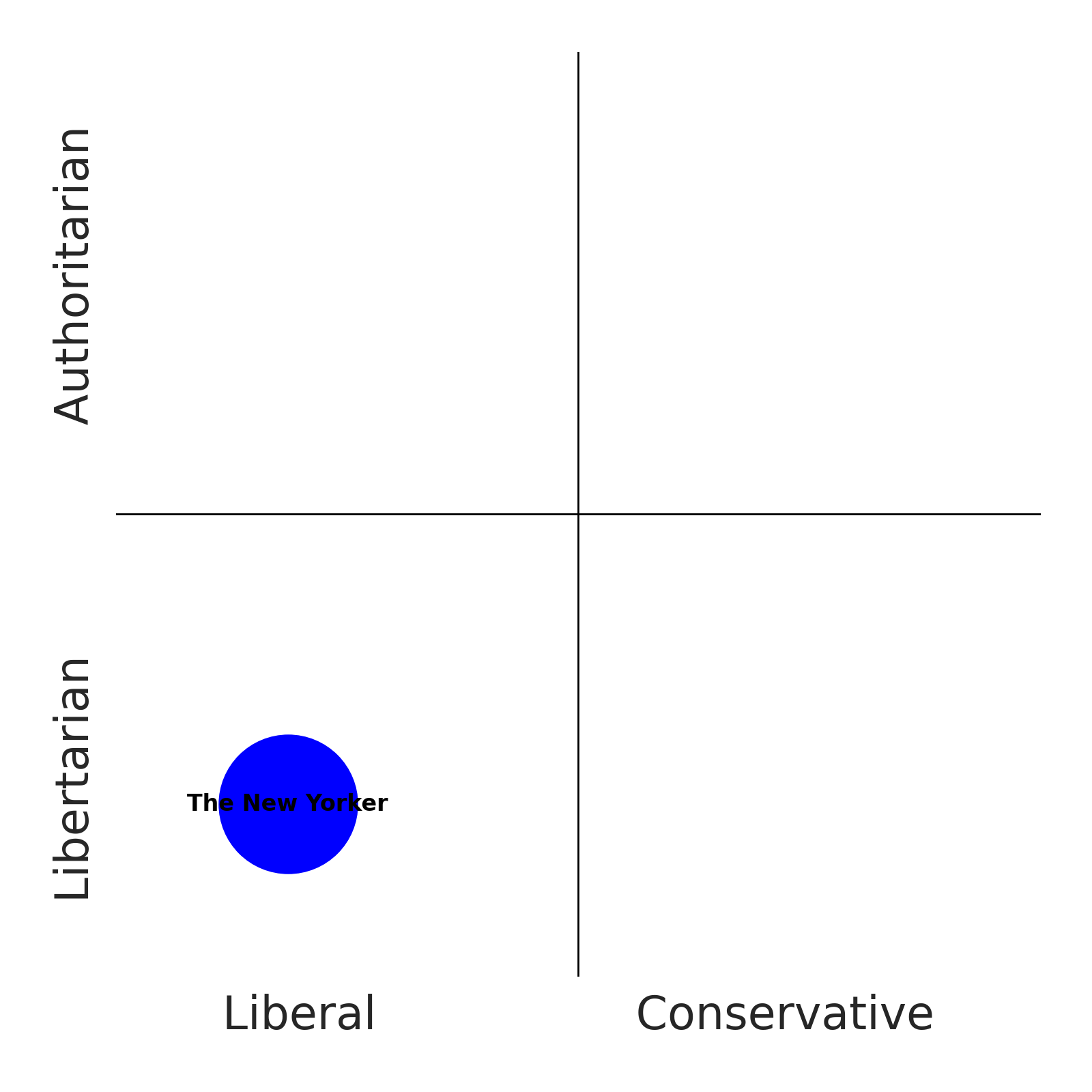
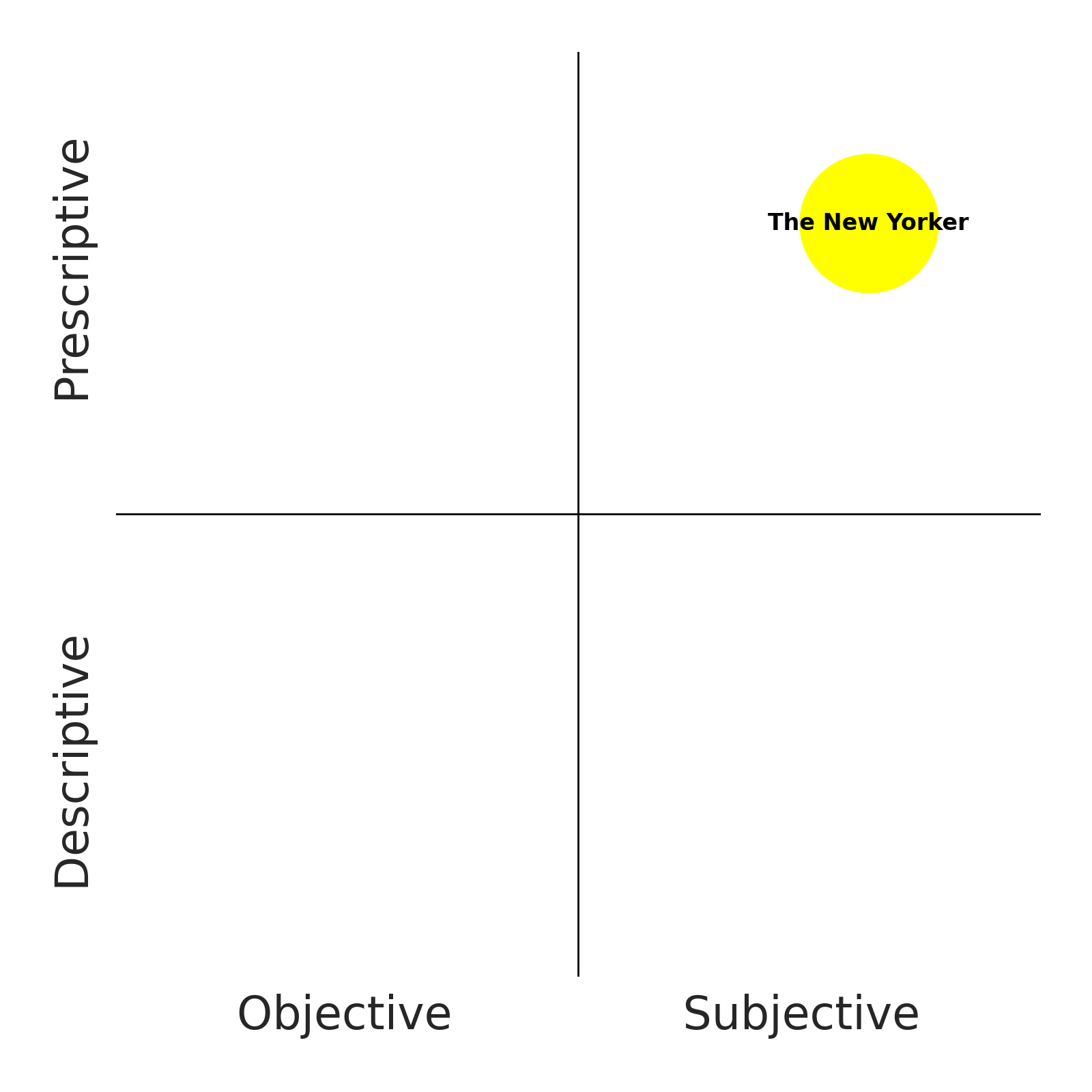
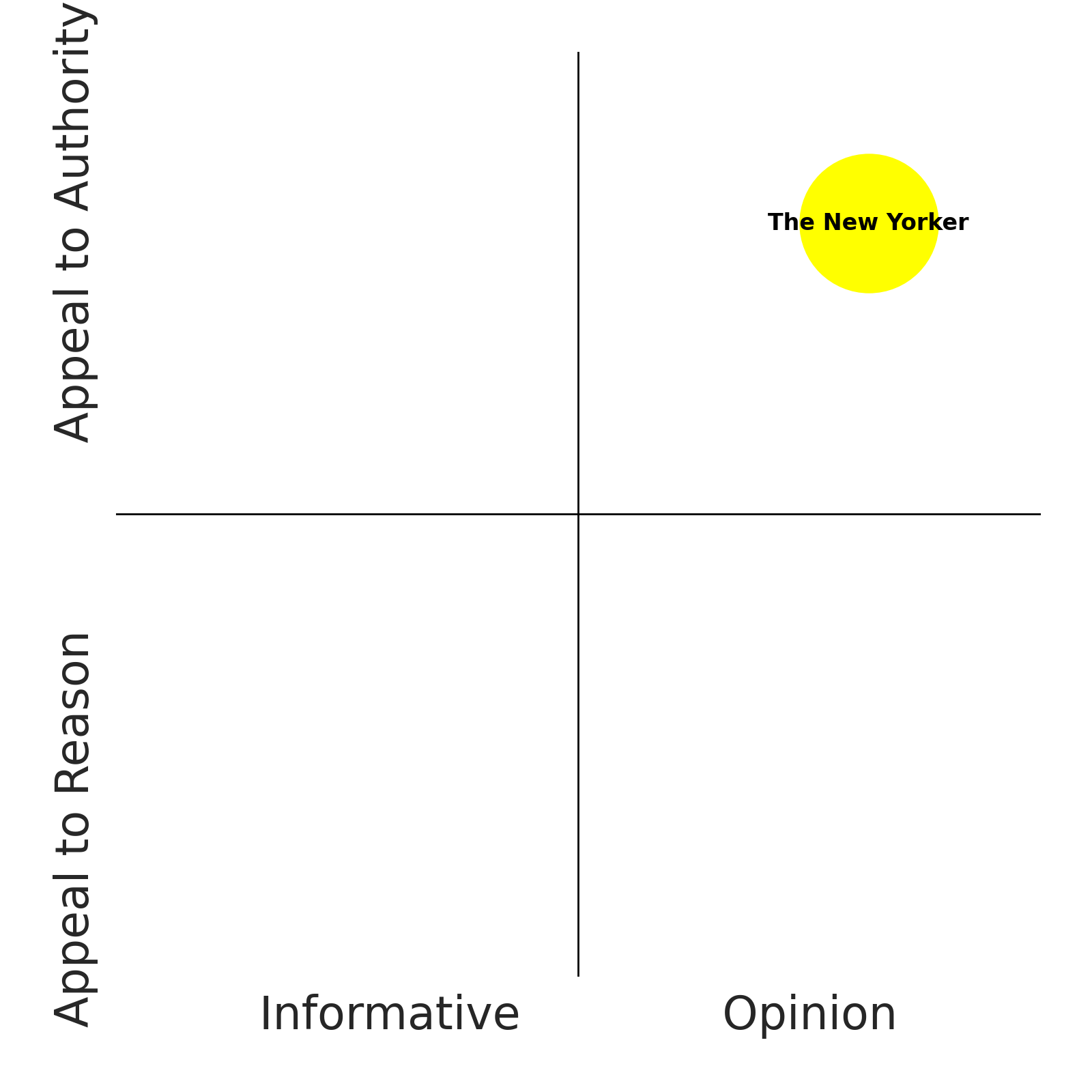
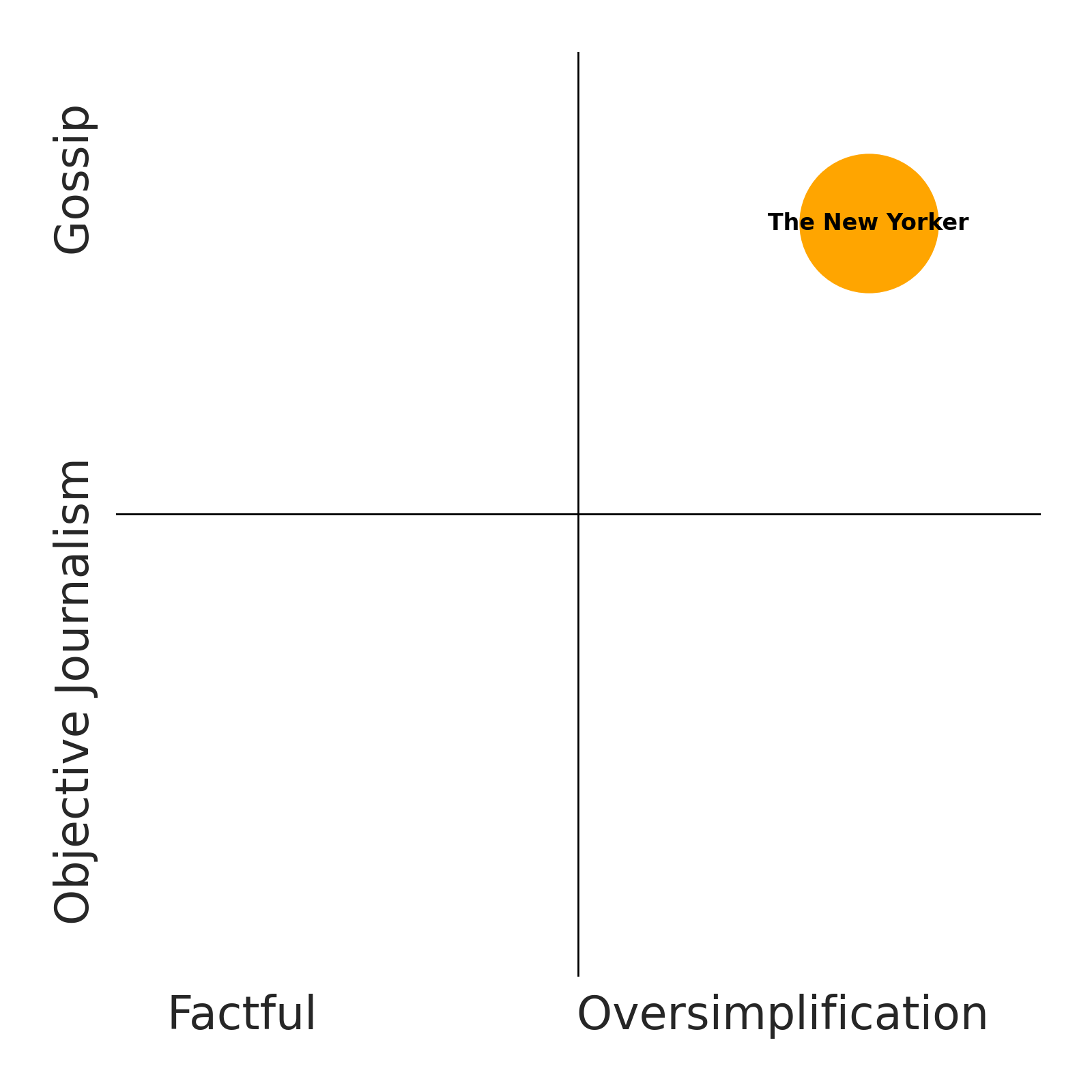
2026 © Helium Trades
Privacy Policy & Disclosure
* Disclaimer: Nothing on this website constitutes investment advice, performance data or any recommendation that any particular security, portfolio of securities, transaction or investment strategy is suitable for any specific person. Helium Trades is not responsible in any way for the accuracy
of any model predictions or price data. Any mention of a particular security and related prediction data is not a recommendation to buy or sell that security. Investments in securities involve the risk of loss. Past performance is no guarantee of future results. Helium Trades is not responsible for any of your investment decisions,
you should consult a financial expert before engaging in any transaction.
Helium Research Assistant

How can I help you today?
Ask any question about The New Yorker bias.


