See whether Helium helps you make better-informed decisions. Try every Pro Trader feature for 30 days. No credit card required.
Try every Pro Trader feature for 30 days. No credit card required.
October 22, 2026 · 0 shares
A balanced left-versus-center frame contrasts the candidates' campaign strategies with little evaluative language.
Automated analysis; not human reviewed. Limitations: Only a headline and subheadline were supplied; no full article body, sourcing, or detailed context is available. · 5 of 55 available dimensions scored; omitted dimensions are not treated as neutral. · Verified supporting quotes for 5 of 5 scored dimensions.
Claim: The snippet presents Collins's centrist pitch and Jackson's leftward mobilization in a balanced, non-evaluative way.
“Senator Susan Collins, a Republican in a tight race, is keying her closing pitch to the middle, while her progressive challenger, Troy Jackson, is seeking to excite the left.” · exact text match
Why: Parallel description of the Republican incumbent's centrist strategy and the progressive challenger's base mobilization lacks clear ideological favor.
Claim: The framing is largely factual and strategy-focused rather than subjective opinion.
“Senator Susan Collins, a Republican in a tight race, is keying her closing pitch to the middle, while her progressive challenger, Troy Jackson, is seeking to excite the left.” · exact text match
Why: The sentence states candidate positioning without evaluative adjectives.
Claim: The language is measured and non-sensational.
“in a tight race” · exact text match
Why: The only descriptive term about contest intensity is 'tight,' with no alarmist or dramatic wording.
Claim: The text describes campaign tactics rather than prescribing a preferred outcome.
“is keying her closing pitch to the middle” · exact text match
“is seeking to excite the left” · exact text match
Why: The verbs report strategy and intent rather than advocate a policy or electoral result.
Claim: The report is entirely focused on electoral politics and campaign strategy.
“What Dueling Visits by Ocasio-Cortez and Manchin Say About Maine's Senate Race.” · exact text match
Why: The headline and subheadline concern a U.S. Senate race.
Only a headline and subheadline were supplied; no full article body, sourcing, or detailed context is available.
October 22, 2026 · 0 shares
Framing is a terse, horse-race 'takeaways' summary that relays each candidate's loyalty attack symmetrically, with no direct quotes, sourcing, or policy substance.
El-Sayed and Rogers are opposing candidates in a Michigan U.S. Senate contest, and the item is a takeaways roundup of one of their debates.
Automated analysis; not human reviewed. Limitations: Only a headline-plus-three-sentence excerpt was supplied; several framing dimensions (left-right ideology, sourcing quality, speculation) lack enough text for a confident classification and were omitted. · 5 of 55 available dimensions scored; omitted dimensions are not treated as neutral. · Verified supporting quotes for 5 of 5 scored dimensions.
Claim: Content is reported as attributed accusations rather than the publisher's own evaluation.
“Mr. Rogers accused Dr. El-Sayed of not enough loyalty to the country.” · exact text match
Why: Both characterizations are attributed to the candidates, limiting subjective narration, though no quotes or sourcing are supplied.
Claim: A lightly colorful headline and horse-race tone add mild dramatic coloring.
“MAGA Bingo and Questions of Loyalty: 5 Michigan Senate Debate Takeaways.” · exact text match
Why: The 'MAGA Bingo' phrasing is punchy but the body text remains flat and factual.
Claim: The piece describes the exchange without recommending any course of action.
“It was still more cordial than their last debate.” · exact text match
Why: No prescriptions, endorsements, or calls to action appear.
Claim: Evaluation is minimal, with only a comparative judgment on debate tone.
“It was still more cordial than their last debate.” · exact text match
Why: The one evaluative clause is brief and unattributed, otherwise the text relays claims.
Claim: The item is framed entirely around candidate positioning in a partisan election contest.
“Abdul El-Sayed accused Mike Rogers of being overly devoted to President Trump.” · exact text match
Why: The sole content is electoral attack framing between rival Senate candidates.
Only a headline-plus-three-sentence excerpt was supplied; several framing dimensions (left-right ideology, sourcing quality, speculation) lack enough text for a confident classification and were omitted.
October 09, 2026 · 0 shares
The headline and lede frame the Kansas Senate race as a surprising, suddenly competitive midterm horse race between Republicans defending and Democrats making a historic attempt.
Automated analysis; not human reviewed. Limitations: Only a headline and one-sentence excerpt are supplied, so full article framing and sourcing cannot be assessed. · 5 of 55 available dimensions scored; omitted dimensions are not treated as neutral. · Verified supporting quotes for 5 of 5 scored dimensions.
Claim: The text mentions both parties symmetrically without ideological policy framing.
“Republicans are suddenly racing to defend a seat in Kansas, where Democrats are trying to win a Senate race for the first time in nearly a century.” · exact text match
Why: Both parties are described in electoral terms only, with no liberal or conservative policy cues.
Claim: The headline uses mildly dramatic horse-race language.
“Surprising New Midterm Fight” · exact text match
“Republicans are suddenly racing to defend a seat” · exact text match
Why: Surprising and suddenly racing are attention-grabbing descriptors beyond a plain vote-count report.
Claim: The text reports electoral aims and contest status without advocating a course of action.
“Democrats are trying to win a Senate race for the first time in nearly a century.” · exact text match
Why: It describes actors' goals rather than prescribing policy or behavior.
Claim: The headline includes an evaluative judgment that the race is surprising.
“Surprising New Midterm Fight” · exact text match
Why: Surprising is a subjective characterization rather than a raw fact.
Claim: The content is entirely about electoral partisan competition.
“Kansas Senate Race Is a Surprising New Midterm Fight.” · exact text match
“Republicans are suddenly racing to defend a seat in Kansas, where Democrats are trying to win a Senate race for the first time in nearly a century.” · exact text match
Why: It concerns U.S. Senate midterm politics and party competition.
Only a headline and one-sentence excerpt are supplied, so full article framing and sourcing cannot be assessed.
October 22, 2026 · 0 shares
Framing is restrained and denotative, presenting a potential historical first as a conditional fact while highlighting the candidate's low-key campaign posture.
Automated analysis; not human reviewed. Limitations: The supplied text is only a headline and two sentences, so it lacks detail on why Pappas would make history and limits confidence in broader framing judgments. · 2 of 55 available dimensions scored; omitted dimensions are not treated as neutral. · Verified supporting quotes for 2 of 2 scored dimensions.
Claim: The snippet is centrally about electoral politics and identifies the candidate's partisan affiliation.
“New Hampshire's Senate Race” · exact text match
“Democratic nominee” · exact text match
Why: The content is framed around a Senate race and explicitly labels the candidate's party.
Claim: The central framing is a conditional forecast that Pappas would make history if elected.
“Chris Pappas Could Make History in New Hampshire's Senate Race.” · exact text match
“would make history if he won” · exact text match
Why: The headline and sentence present a future electoral outcome as a conditional historical possibility.
The supplied text is only a headline and two sentences, so it lacks detail on why Pappas would make history and limits confidence in broader framing judgments.
October 16, 2026 · 0 shares
Evaluative headline framing presents Trump's Russia deal as inflaming the war and his inability to end it as established fact without visible sourcing.
Automated analysis; not human reviewed. Limitations: Only a headline and subheadline are supplied; no body, sourcing, deal terms, or full context is available. · 10 of 55 available dimensions scored; omitted dimensions are not treated as neutral. · Verified supporting quotes for 10 of 10 scored dimensions.
Claim: The headline uses evaluative language and asserts a causal political judgment rather than reporting neutrally.
“Trump's Deal With Russia Inflames Ukraine War He Vowed to End.” · exact text match
“defiant decision” · exact text match
Why: 'Inflames' and 'defiant decision' are evaluative and interpretive rather than neutral description.
Claim: The headline uses alarmist wording about war escalation.
“Inflames Ukraine War” · exact text match
Why: The phrase heightens drama around the conflict.
Claim: War-escalation language is alarmist.
“Inflames Ukraine War” · exact text match
Why: 'Inflames' signals worsening conflict and danger.
Claim: The text presents an evaluative judgment about Trump's failure as the central point.
“underscores President Trump’s inability to end a war he had promised to resolve.” · exact text match
Why: The subheadline frames the event through an explicit judgment of inability.
Claim: The content is centrally political, focused on presidential action and war policy.
“President Trump’s inability to end a war he had promised to resolve” · exact text match
Why: The claim concerns presidential commitments and wartime leadership.
Claim: It reduces a complex war outcome to a single leader's inability and a defiant decision.
“The Ukrainian president’s defiant decision to continue attacking Russian refineries underscores President Trump’s inability to end a war he had promised to resolve.” · exact text match
Why: One decision is presented as directly demonstrating a broad failure to end the war.
Claim: It states a causal escalation and failure judgment without hedging or sourcing in the supplied text.
“Trump's Deal With Russia Inflames Ukraine War He Vowed to End.” · exact text match
Why: The headline asserts causation and outcome certainty beyond what the snippet documents.
Claim: The framing is negative toward Trump and the war trajectory.
“Inflames Ukraine War” · exact text match
“inability to end a war” · exact text match
Why: The wording carries negative valence about escalation and failed leadership.
Claim: It infers Trump's inability from Ukraine's refinery attacks.
“underscores President Trump’s inability to end a war he had promised to resolve.” · exact text match
Why: The subheadline draws an inferential conclusion about capacity from a reported decision.
Claim: Loaded evaluative terms frame the deal and Ukraine's actions to support a negative conclusion.
“Inflames” · exact text match
“defiant decision” · exact text match
Why: The wording directs interpretation through emotionally charged characterization.
Only a headline and subheadline are supplied; no body, sourcing, deal terms, or full context is available.
October 09, 2026 · 0 shares
Headline uses vivid verbs and intensifiers ('Hits,' 'severe sanctions,' 'sweeping punishments') and juxtaposes the sanctions with a Nobel Peace Prize honor to a former ICC judge, creating an ironic, critical frame.
Automated analysis; not human reviewed. Limitations: Supplied text is limited to a headline and one-sentence snippet, constraining assessment of sourcing, context, and tone. · 2 of 55 available dimensions scored; omitted dimensions are not treated as neutral. · Verified supporting quotes for 2 of 2 scored dimensions.
Claim: The headline uses vivid and intensifying language that mildly sensationalizes the sanctions.
“Trump Administration Hits International Criminal Court With Severe Sanctions.” · exact text match
“U.S. officials announced the new, sweeping punishments just hours after the Nobel Peace Prize committee gave its annual honor to a former court judge.” · exact text match
Why: The verbs 'Hits' and modifiers 'severe' and 'sweeping punishments' amplify the event beyond neutral announcement language.
Claim: The report is inherently political, centered on a Trump administration action against an international court.
“Trump Administration Hits International Criminal Court With Severe Sanctions.” · exact text match
Why: The subject is a governmental sanctions action involving a named administration and international legal institution.
Supplied text is limited to a headline and one-sentence snippet, constraining assessment of sourcing, context, and tone.
September 25, 2026 · 0 shares
Frames the US-China truce as an unqualified strategic gain for Beijing, asserting a causal benefit without sourcing or acknowledging tradeoffs.
The wider US-China relationship under President Trump had involved tariff disputes and negotiations; a "truce" implies a pause in that escalation.
Automated analysis; not human reviewed. Limitations: Analysis is limited to a headline and subhead, with no body text, author, sourcing, or attribution; interpretations are based on the framing alone. · 5 of 55 available dimensions scored; omitted dimensions are not treated as neutral. · Verified supporting quotes for 5 of 5 scored dimensions.
Claim: The headline uses metaphorical, evaluative language to characterize the truce.
“Buys It Valuable Time” · exact text match
“reducing its vulnerability” · exact text match
Why: "Buys" and "valuable" are interpretive judgments rather than neutral factual descriptions.
Claim: The framing is favorable to China's strategic position.
“Buys It Valuable Time” · exact text match
“gives Beijing room” · exact text match
“reducing its vulnerability” · exact text match
Why: The selected terms emphasize gain, relief, and reduced exposure for Beijing.
Claim: The assertions are evaluative and analytical rather than sourced, attributed, or hedged.
“Easing tensions with Washington gives Beijing room to tackle economic troubles at home while reducing its vulnerability to American pressure.” · exact text match
Why: It presents a causal strategic judgment without attribution, data, or qualification.
Claim: The content is set in the political domain of US-China relations and names Trump, Washington, and Beijing.
“China's Truce With Trump” · exact text match
“American pressure” · exact text match
Why: The subject matter is bilateral geopolitical relations involving the US president and state actors.
Claim: The headline asserts the truce's benefit as settled fact without evidence or caveat.
“China's Truce With Trump Buys It Valuable Time.” · exact text match
Why: The declarative headline style goes beyond what the stated material establishes.
Analysis is limited to a headline and subhead, with no body text, author, sourcing, or attribution; interpretations are based on the framing alone.
September 25, 2026 · 0 shares
A 'Breaking News' headline frames an alleged AI incident as a rogue technology that 'meddled' with U.S. government websites, using sensational, anthropomorphic language and no visible sourcing.
Automated analysis; not human reviewed. Limitations: The input is a single link-preview headline rather than a full article, so bias judgments rest on the wording of one sentence and cannot account for context, sourcing, or balance in the underlying report. · 5 of 55 available dimensions scored; omitted dimensions are not treated as neutral. · Verified supporting quotes for 5 of 5 scored dimensions.
Claim: The headline uses subjective, value-laden language to characterize the event.
“OpenAI's technology went rogue and meddled” · exact text match
Why: The words 'rogue' and 'meddled' are interpretive and emotionally charged rather than neutral descriptions of a technical malfunction.
Claim: The headline is sensational rather than measured.
“Breaking News: OpenAI's technology went rogue and meddled” · exact text match
Why: The 'Breaking News' exclamation plus 'went rogue' and 'meddled' dramatize the incident with alarmist, anthropomorphic language.
Claim: The event is compressed into a simple rogue-AI narrative.
“went rogue” · exact text match
Why: The phrase reduces an unspecified technical incident to a clichéd story of uncontrolled AI behavior.
Claim: The headline states specific details as established without visible support in the provided text.
“meddled with three U.S.. government websites this summer without the A.I. lab’s knowledge” · verified after text normalization
Why: Precise details and an internal-state claim (OpenAI's lack of knowledge) are asserted as breaking news, with no caveat or source visible in the text.
Claim: The headline uses loaded framing to steer interpretation.
“went rogue and meddled” · exact text match
Why: Anthropomorphic, menacing verbs frame the technology as a deliberate bad actor, guiding perception through connotation.
The input is a single link-preview headline rather than a full article, so bias judgments rest on the wording of one sentence and cannot account for context, sourcing, or balance in the underlying report.
September 26, 2026 · 0 shares
The framing anthropomorphizes OpenAI's AI as a rogue actor and labels its government-website activity as 'meddling,' creating an alarming and sensationalized presentation.
Automated analysis; not human reviewed. Limitations: Only a headline and a one-sentence summary were available, so analysis is based on limited context and cannot verify the underlying incident. · 6 of 55 available dimensions scored; omitted dimensions are not treated as neutral. · Verified supporting quotes for 6 of 6 scored dimensions.
Claim: The wording renders an evaluative judgment about the AI's behavior.
“OpenAI's A.I. Went Rogue and Meddled With U.S. Government Websites.” · exact text match
Why: Neutral reporting would say 'interfered with' or 'affected'; 'went rogue' and 'meddled' are subjective characterizations.
Claim: The presentation uses dramatic, personifying language to describe the AI's activity.
“OpenAI's A.I. Went Rogue and Meddled With U.S. Government Websites.” · exact text match
Why: 'Went Rogue' and 'Meddled' are loaded, personifying terms that sensationalize an unspecified technical incident.
Claim: The framing invites alarm about uncontrolled AI affecting government sites.
“OpenAI's A.I. Went Rogue and Meddled With U.S. Government Websites.” · exact text match
Why: 'Went rogue' implies loss of control and 'meddled' suggests improper tampering, both fear-adjacent cues.
Claim: The headline includes evaluative opinion terms rather than neutral description.
“Went Rogue” · exact text match
“Meddled With U.S. Government Websites” · exact text match
Why: 'Went rogue' is an interpretation, not an observable fact.
Claim: The text asserts 'went rogue' as fact without attribution or supporting detail.
“OpenAI's A.I. Went Rogue” · exact text match
Why: It presents an interpretive characterization categorically, exceeding the evidence included in the snippet.
Claim: There is no visible sourcing, attribution, or hedging to support the claims.
“The company did not learn until recently that its technology had meddled with websites for the Education and Commerce Departments and the Securities and Exchange Commission.” · exact text match
Why: Assertions are presented without named sources, dates, or qualifying language, lowering observable credibility.
Only a headline and a one-sentence summary were available, so analysis is based on limited context and cannot verify the underlying incident.
October 16, 2026 · 0 shares
A headline-and-subheadline framing that leads with an aggregate dollar figure ('flood') and a one-party usage comparison, presenting both the $137 million total and the Republican-vs-Democrat disparity as unsourced assertions.
Automated analysis; not human reviewed. Limitations: Only a headline and subheadline were supplied; there is no body text, sourcing, or methodology for the $137 million figure or the partisan comparison, limiting assessment of several dimensions. · 8 of 55 available dimensions scored; omitted dimensions are not treated as neutral. · Verified supporting quotes for 5 of 8 scored dimensions.
Claim: The framing foregrounds heavier Republican use of A.I.-generated content.
“Republicans have used A.I.-generated content more often than Democrats” · exact text match
Why: A one-sided comparative emphasis on Republican conduct in a headline gives mild directional framing, though the claim is presented descriptively.
Claim: The supplied text consists almost entirely of assertive factual statements rather than evaluation or commentary.
“Republicans have used A.I.-generated content more often than Democrats, ranging from subtle enhancements to convincing deepfakes.” · exact text match
Why: Both sentences state purported facts without expressed opinion, keeping the framing largely descriptive.
Claim: Emotive wording ('Flood') amplifies the scale framing beyond a neutral factual description.
“$137 Million in A.I.-Generated Ads Flood the Midterms” · exact text match
Counterevidence:
“ranging from subtle enhancements to convincing deepfakes” · exact text match
Why: 'Flood' is a loaded metaphor that dramatizes the volume of advertising, adding mild sensationalism.
Claim: The content is entirely about electoral politics and partisan ad activity.
“Republicans have used A.I.-generated content more often than Democrats” · exact text match
Why: The subject is midterm election advertising and party-level behavior, which is inherently political.
Claim: Specific dollar and partisan comparison figures are asserted without any sourcing or hedging in the supplied text.
“$137 Million in A.I.-Generated Ads Flood the Midterms” · exact text match
Why: A precise monetary total and a comparative partisan claim are presented as settled fact with no attribution shown, exceeding the supplied support.
Only a headline and subheadline were supplied; there is no body text, sourcing, or methodology for the $137 million figure or the partisan comparison, limiting assessment of several dimensions.
A cozy, promotional social post frames Wirecutter's blanket picks as authoritative through a humorous claim of 500+ hours of testing.
Automated analysis; not human reviewed. Limitations: The supplied text is only a brief promotional social media post, so most bias dimensions cannot be meaningfully assessed. · 4 of 55 available dimensions scored; omitted dimensions are not treated as neutral. · Verified supporting quotes for 4 of 4 scored dimensions.
Claim: The post tells readers what to consider buying.
“Wirecutter recommends these” · exact text match
Why: While it includes descriptive testing claims, the imperative is a prescriptive endorsement.
Claim: The post expresses a recommendation rather than neutral reporting.
“Wirecutter recommends these” · exact text match
Why: The verb 'recommends' explicitly conveys an opinionated endorsement.
Claim: The post uses warm, positive imagery to create appeal.
“it's hard to beat curling up on the couch in your favorite warm blanket” · exact text match
Why: The opening image of comfort is positive, though the tone is light and promotional.
Claim: The post functions as an advertisement for a product recommendation.
“Wirecutter recommends these after spending 500+ hours testing (in other words, napping).” · exact text match
“nyti.ms/4iO9Q7l” · exact text match
Why: The sole substantive content promotes a product and includes a link, with no independent reporting.
The supplied text is only a brief promotional social media post, so most bias dimensions cannot be meaningfully assessed.
September 26, 2026 · 0 shares
A promotional teaser uses an unnamed reader's effusive testimonial to market a simple recipe, substituting subjective endorsement for substantive recipe or reporting detail.
Automated analysis; not human reviewed. Limitations: The supplied text is only a promotional snippet with no recipe content, date, or independent sourcing, so classifications rely solely on its marketing framing. · 3 of 55 available dimensions scored; omitted dimensions are not treated as neutral. · Verified supporting quotes for 3 of 3 scored dimensions.
Claim: The post relies on a subjective personal endorsement rather than objective recipe information.
“"Never eating instant ramen any other way again," said a reader” · exact text match
Why: The content consists of one individual's subjective opinion, not verifiable facts, measurements, or instructions.
Claim: The post's tone is enthusiastic and positive, framing the recipe as life-changing.
“Never eating instant ramen any other way again” · exact text match
Why: The quoted testimonial expresses strong positive emotion, though it is attributed to a reader rather than the publisher.
Claim: The post is promotional, using a reader testimonial and a link to drive traffic to a recipe.
“"Never eating instant ramen any other way again," said a reader who tried this simple recipe.. nyti.ms/4h8szt4” · verified after text normalization
Why: The entire text is a marketing teaser with an enthusiastic quote and a short link, with no informational content.
The supplied text is only a promotional snippet with no recipe content, date, or independent sourcing, so classifications rely solely on its marketing framing.
October 04, 2026 · 0 shares
Promotional framing presents the plunger as an unbeatable, last-ever purchase using superlatives and a Wirecutter best-products award.
Wirecutter is a product-review and shopping-guide publication; its '50 best products' feature is a curated staff-picked list.
Automated analysis; not human reviewed. Limitations: The supplied text is a short promotional excerpt with no product name, byline, methodology, or independent data; the analysis is based on its promotional wording and link alone. · 7 of 55 available dimensions scored; omitted dimensions are not treated as neutral. · Verified supporting quotes for 4 of 7 scored dimensions.
Claim: The text presents subjective aesthetic and performance judgments as conclusive product facts.
“While it's not much to look at, nothing out-plungers it.” · not found in supplied text
“This ugly, gimmick-free tool should be the last plunger you’ll ever need.” · exact text match
Why: Ugly, gimmick-free, nothing out-plungers, and last … ever need are value judgments without supporting measurements.
Claim: The recommendation is phrased as a directive outcome for the reader rather than a neutral description.
“This ugly, gimmick-free tool should be the last plunger you’ll ever need.” · exact text match
Why: The word 'should' plus 'ever need' frames purchase as the correct, final solution, making the statement prescriptive.
Claim: The text leans on Wirecutter's best-products list as the sole basis for the recommendation.
“It's one of the winners of Wirecutter's 50 best products” · exact text match
Why: The link to a list award substitutes for verified product evidence, appealing to an authoritative selection.
Claim: The text makes unqualified superlative claims about the product's performance and longevity without supplying evidence.
“nothing out-plungers it.” · not found in supplied text
“should be the last plunger you’ll ever need.” · exact text match
Why: Absolutes exceed the available support: no test data, product name, or comparison is given.
Claim: The snippet is a short promotional pitch designed to drive clicks to a shopping link, with little substantive content.
“This ugly, gimmick-free tool should be the last plunger you’ll ever need.” · exact text match
“It's one of the winners of Wirecutter's 50 best products: nyti.ms/3TFNvi3” · exact text match
Why: The excerpt contains only endorsing hype and a link, matching fluff/advertorial rather than informational content.
Claim: The blurb's credibility is limited by unsupported superlatives and reliance on an award citation.
“nothing out-plungers it.” · not found in supplied text
“It's one of the winners of Wirecutter's 50 best products” · exact text match
Why: Visible sourcing is thin: no data, method, author, or independent corroboration is offered for an absolute claim; the only citation is a short list link.
Claim: The publisher uses promotional, superlative language and an award citation to sell a specific plunger.
“This ugly, gimmick-free tool should be the last plunger you’ll ever need.” · exact text match
“It's one of the winners of Wirecutter's 50 best products” · exact text match
Why: The entire excerpt functions as a product endorsement, with no neutral or informational content beyond 'winner' status.
The supplied text is a short promotional excerpt with no product name, byline, methodology, or independent data; the analysis is based on its promotional wording and link alone.
Promotional, subjective language frames a simple recipe as a 'true one-pot wonder' with universal appeal.
Automated analysis; not human reviewed. Limitations: Only a one-sentence promotional recipe blurb is supplied, limiting assessment to its framing. · 6 of 55 available dimensions scored; omitted dimensions are not treated as neutral. · Verified supporting quotes for 6 of 6 scored dimensions.
Claim: The text uses evaluative, promotional language rather than neutral description.
“This true one-pot wonder” · exact text match
“will make everyone at the table happy” · exact text match
Why: 'Wonder' and the universal happiness prediction are subjective evaluations, not neutral recipe details.
Claim: The text predicts a uniformly positive outcome from the dish.
“will make everyone at the table happy” · exact text match
Why: Universal happiness is a strongly optimistic framing.
Claim: The text is an evaluative endorsement of the recipe.
“This true one-pot wonder” · exact text match
“will make everyone at the table happy” · exact text match
Why: The phrasing offers a positive judgment rather than factual reporting.
Claim: The text asserts universal satisfaction without qualification.
“will make everyone at the table happy” · exact text match
Why: The absolute scope ('everyone') exceeds the brief promotional evidence.
Claim: The text uses positive emotional language to describe the meal's effect.
“will make everyone at the table happy” · exact text match
Why: Happiness language gives the blurb positive emotional valence.
Claim: The blurb promotes the recipe with a superlative and a short link.
“This true one-pot wonder” · exact text match
“nyti.ms/4yU1jF3” · exact text match
Why: Promotional wording and the appended short link present the content as marketing-style promotion.
Only a one-sentence promotional recipe blurb is supplied, limiting assessment to its framing.
October 21, 2026 · 0 shares
The text functions primarily as a promotional advertisement rather than a journalistic report on an event or topic.
Automated analysis; not human reviewed. · 2 of 55 available dimensions scored; omitted dimensions are not treated as neutral. · Verified supporting quotes for 0 of 2 scored dimensions.
September 25, 2026 · 0 shares
A 'Breaking News' headline frames an alleged AI incident as a rogue technology that 'meddled' with U.S. government websites, using sensational, anthropomorphic language and no visible sourcing.
Automated analysis; not human reviewed. Limitations: The input is a single link-preview headline rather than a full article, so bias judgments rest on the wording of one sentence and cannot account for context, sourcing, or balance in the underlying report. · 5 of 55 available dimensions scored; omitted dimensions are not treated as neutral. · Verified supporting quotes for 5 of 5 scored dimensions.
Claim: The headline uses subjective, value-laden language to characterize the event.
“OpenAI's technology went rogue and meddled” · exact text match
Why: The words 'rogue' and 'meddled' are interpretive and emotionally charged rather than neutral descriptions of a technical malfunction.
Claim: The headline is sensational rather than measured.
“Breaking News: OpenAI's technology went rogue and meddled” · exact text match
Why: The 'Breaking News' exclamation plus 'went rogue' and 'meddled' dramatize the incident with alarmist, anthropomorphic language.
Claim: The event is compressed into a simple rogue-AI narrative.
“went rogue” · exact text match
Why: The phrase reduces an unspecified technical incident to a clichéd story of uncontrolled AI behavior.
Claim: The headline states specific details as established without visible support in the provided text.
“meddled with three U.S.. government websites this summer without the A.I. lab’s knowledge” · verified after text normalization
Why: Precise details and an internal-state claim (OpenAI's lack of knowledge) are asserted as breaking news, with no caveat or source visible in the text.
Claim: The headline uses loaded framing to steer interpretation.
“went rogue and meddled” · exact text match
Why: Anthropomorphic, menacing verbs frame the technology as a deliberate bad actor, guiding perception through connotation.
The input is a single link-preview headline rather than a full article, so bias judgments rest on the wording of one sentence and cannot account for context, sourcing, or balance in the underlying report.
September 26, 2026 · 0 shares
The framing anthropomorphizes OpenAI's AI as a rogue actor and labels its government-website activity as 'meddling,' creating an alarming and sensationalized presentation.
Automated analysis; not human reviewed. Limitations: Only a headline and a one-sentence summary were available, so analysis is based on limited context and cannot verify the underlying incident. · 6 of 55 available dimensions scored; omitted dimensions are not treated as neutral. · Verified supporting quotes for 6 of 6 scored dimensions.
Claim: The wording renders an evaluative judgment about the AI's behavior.
“OpenAI's A.I. Went Rogue and Meddled With U.S. Government Websites.” · exact text match
Why: Neutral reporting would say 'interfered with' or 'affected'; 'went rogue' and 'meddled' are subjective characterizations.
Claim: The presentation uses dramatic, personifying language to describe the AI's activity.
“OpenAI's A.I. Went Rogue and Meddled With U.S. Government Websites.” · exact text match
Why: 'Went Rogue' and 'Meddled' are loaded, personifying terms that sensationalize an unspecified technical incident.
Claim: The framing invites alarm about uncontrolled AI affecting government sites.
“OpenAI's A.I. Went Rogue and Meddled With U.S. Government Websites.” · exact text match
Why: 'Went rogue' implies loss of control and 'meddled' suggests improper tampering, both fear-adjacent cues.
Claim: The headline includes evaluative opinion terms rather than neutral description.
“Went Rogue” · exact text match
“Meddled With U.S. Government Websites” · exact text match
Why: 'Went rogue' is an interpretation, not an observable fact.
Claim: The text asserts 'went rogue' as fact without attribution or supporting detail.
“OpenAI's A.I. Went Rogue” · exact text match
Why: It presents an interpretive characterization categorically, exceeding the evidence included in the snippet.
Claim: There is no visible sourcing, attribution, or hedging to support the claims.
“The company did not learn until recently that its technology had meddled with websites for the Education and Commerce Departments and the Securities and Exchange Commission.” · exact text match
Why: Assertions are presented without named sources, dates, or qualifying language, lowering observable credibility.
Only a headline and a one-sentence summary were available, so analysis is based on limited context and cannot verify the underlying incident.
Militarized adversarial framing presents Russia's alleged use of migrants as a deliberate 'weapon' against Europe, presupposing the claim rather than reporting evidence.
Automated analysis; not human reviewed. Limitations: The supplied content is limited to a single headline; there is no article body, sourcing, or contextual details to corroborate or nuance the claim. · 10 of 55 available dimensions scored; omitted dimensions are not treated as neutral. · Verified supporting quotes for 10 of 10 scored dimensions.
Claim: The headline frames an alleged Russian strategy as established fact, using a subjective explanatory 'How' construction rather than conditional or attributed language.
“How Russia Uses Migrants as Weapons Against Europe” · exact text match
Why: The declarative 'How' format presents the weaponization claim as an established process rather than an allegation or hypothesis.
Claim: The headline uses military and combat metaphors to dramatize migration at the border.
“A Front Line at the Border” · exact text match
“Weapons Against Europe” · exact text match
Why: Words such as 'Front Line' and 'Weapons' heighten emotional impact and dramatize the subject beyond neutral policy language.
Claim: The headline frames migration as a hostile attack requiring a defensive stance, favoring a hawkish security perspective.
“A Front Line at the Border” · exact text match
“How Russia Uses Migrants as Weapons Against Europe” · exact text match
Why: Presenting migrants as 'weapons' and the border as a 'front line' invokes confrontation and militarized defense.
Claim: The headline uses threat imagery to evoke fear of a deliberate border attack on Europe.
“Weapons Against Europe” · exact text match
“A Front Line at the Border” · exact text match
Why: 'Weapons' and 'Front Line' imply an active or imminent attack, producing a fear-oriented framing.
Claim: The headline's 'How' framing presupposes that Russia uses migrants as weapons rather than establishing that premise.
“How Russia Uses Migrants as Weapons Against Europe” · exact text match
Why: The weaponization is assumed before any evidence is offered, making the framing question-begging.
Claim: The headline expresses a strong interpretive judgment about Russia's intentions rather than a neutral factual report.
“How Russia Uses Migrants as Weapons Against Europe” · exact text match
Why: The assertion of Russian agency and intent is commentary-style, with no qualification or evidence attached.
Claim: The headline centers on a geopolitical confrontation between Russia and Europe, making the item inherently political.
“Russia Uses Migrants as Weapons Against Europe” · exact text match
Why: It describes state-level hostile strategy and interstate conflict, using adversarial political framing.
Claim: The headline states a causal claim about Russian strategy with certainty and without visible evidence.
“How Russia Uses Migrants as Weapons Against Europe” · exact text match
Why: The 'How' format presupposes the claim is true, exceeding the supporting evidence visible in the supplied text.
Claim: The headline offers an unverified explanation of Russia's alleged strategy without sources or evidence.
“How Russia Uses Migrants as Weapons Against Europe” · exact text match
Why: The claim involves unobservable state intent and cause, presented instead as a settled explanation.
Claim: The headline uses loaded military metaphor and omits alternative explanations, steering the reader toward a threat conclusion.
“A Front Line at the Border” · exact text match
“How Russia Uses Migrants as Weapons Against Europe” · exact text match
Why: The combination of 'front line' and 'weapons' with a declarative claim about Russian strategy is a one-sided, emotionally loaded framing.
The supplied content is limited to a single headline; there is no article body, sourcing, or contextual details to corroborate or nuance the claim.
September 29, 2026 · 0 shares
An elegiac first-person framing treats Kramatorsk's destruction as a now-certain fate, using subjective and emotionally charged language rather than neutral reporting.
Automated analysis; not human reviewed. Limitations: Assessment is limited to the headline and standfirst; no article body was available for analysis. · 5 of 55 available dimensions scored; omitted dimensions are not treated as neutral. · Verified supporting quotes for 5 of 5 scored dimensions.
Claim: The framing is personal and subjective rather than neutral or detached.
“Bomb by Bomb, the Slow Death of My Hometown in Ukraine” · exact text match
Why: The headline uses first-person possession ('My Hometown') and emotionally charged metaphorical language, signaling a personal narrative stance.
Claim: The presentation is sensational, using dramatic and emotive language.
“Bomb by Bomb, the Slow Death of My Hometown in Ukraine” · exact text match
Why: The phrases 'Bomb by Bomb' and 'Slow Death' dramatize the subject rather than describing it in measured or statistical terms.
Claim: The framing is strongly pessimistic about Kramatorsk's fate.
“It was possible, for a time, to think that Kramatorsk, where I was born and raised, would survive the war mostly unscathed. Not any more.” · exact text match
Why: The text contrasts a previously hopeful possibility with a blunt reversal ('Not any more'), projecting a bleak outcome.
Claim: The text is a personal opinion or reflection rather than a factual news report.
“It was possible, for a time, to think that Kramatorsk, where I was born and raised, would survive the war mostly unscathed. Not any more.” · exact text match
Why: The statement centers on the author's own changed assessment and emotional perspective, not on independently verified facts.
Claim: The language carries a strongly negative emotional charge.
“Bomb by Bomb, the Slow Death of My Hometown in Ukraine” · exact text match
Why: Words such as 'Death' and 'My Hometown' frame the subject as a personal tragedy and elicit an emotional response.
Assessment is limited to the headline and standfirst; no article body was available for analysis.
September 26, 2026 · 0 shares
Framing reduces a legal-political clash to a sensational heroine-versus-public-enemy question while asserting the attorney general has stalled the government's removal of power constraints.
Automated analysis; not human reviewed. Limitations: Only the headline/snippet was supplied, so the analysis cannot assess the full article's sourcing, context, or balance. · 5 of 55 available dimensions scored; omitted dimensions are not treated as neutral. · Verified supporting quotes for 5 of 5 scored dimensions.
Claim: The headline frames the attorney general's actions through the subjective labels 'Heroine' and 'Public Enemy'.
“Heroine or Public Enemy?” · exact text match
Why: The exact phrase presents two value-laden character judgments rather than neutral description.
Claim: The headline uses dramatic either/or labels to sensationalize the political dispute.
“Heroine or Public Enemy?” · exact text match
Why: The question format and extreme labels are sensational rather than soberly descriptive.
Claim: The report centers on a partisan struggle over the Israeli government's agenda and power.
“The Israeli Blocking Much of Netanyahu's Agenda..” · exact text match
“has stopped many of the government’s efforts to remove constraints on its power” · exact text match
Why: The subject matter is the blocking of Netanyahu's agenda and the government's power constraints.
Claim: The headline reduces a complex political-legal conflict to a binary heroine-or-public-enemy judgment.
“Heroine or Public Enemy?” · exact text match
Why: Only two caricatured alternatives are offered, omitting nuanced positions.
Claim: The headline's false-dilemma question steers the reader toward one of two charged verdicts.
“Heroine or Public Enemy?” · exact text match
Why: The question presents only extreme, morally loaded alternatives, an observable framing technique.
Only the headline/snippet was supplied, so the analysis cannot assess the full article's sourcing, context, or balance.
October 01, 2026 · 0 shares
Alarmist framing presents a possible US diesel export ban as a global economic shock, leaning on an unattributed dramatic quote and a 'Global Alarms' headline.
US diesel exports are a significant part of global refined-fuel supply, so restricting them can have international price and supply effects.
Automated analysis; not human reviewed. Limitations: The supplied text is a two-sentence headline/snippet with no date, author, or named sources, so claims cannot be independently verified and classifications rest on framing alone. · 9 of 55 available dimensions scored; omitted dimensions are not treated as neutral. · Verified supporting quotes for 9 of 9 scored dimensions.
Claim: Framing emphasizes alarm and shock rather than measured reporting.
“Trump's Threat to Ban Diesel Exports Sets Off Global Alarms” · exact text match
“would be “tremendous shock and blow.”” · exact text match
Why: The headline uses 'Global Alarms' and the body ends with a dramatic unattributed quote, elevating emotional impact.
Claim: The overall tone is pessimistic, highlighting threats and shocks.
“threatening economies” · exact text match
“would be “tremendous shock and blow.”” · exact text match
Why: The language depicts harm to economies and a severe negative market outcome.
Claim: The framing is alarmist, with 'Global Alarms' and a 'tremendous shock and blow.'
“Trump's Threat to Ban Diesel Exports Sets Off Global Alarms” · exact text match
“would be “tremendous shock and blow.”” · exact text match
Why: Words such as 'Alarms' and 'shock and blow' are chosen to provoke concern.
Claim: An opinion is presented as an unqualified consequence.
“An U.S. export ban would be “tremendous shock and blow.”” · exact text match
Why: The quoted judgment is stated as a definitive outcome without identifying who says it or offering countervailing views.
Claim: A complex market situation is reduced to a single cause and a single consequence.
“A reduction in refineries has already driven the price of diesel to record highs” · exact text match
Why: It attributes record prices solely to refinery reductions and links the export ban directly to a dramatic shock.
Claim: Causal claims and predicted consequences are stated with certainty.
“A reduction in refineries has already driven the price of diesel to record highs” · exact text match
“An U.S. export ban would be “tremendous shock and blow.”” · exact text match
Why: Both a causal driver and a future shock are asserted without qualification or attribution.
Claim: The text lacks visible sourcing, attribution, or nuance needed to trust its assertions.
“An U.S. export ban would be “tremendous shock and blow.”” · exact text match
Why: No source, author, date, or data are presented for the claims and quote.
Claim: A conditional forecast is presented without sourcing or data.
“An U.S. export ban would be “tremendous shock and blow.”” · exact text match
Why: The sentence predicts consequences of a possible ban as if established.
Claim: Uses loaded phrasing and an unattributed alarming quote to steer reaction.
“Sets Off Global Alarms” · exact text match
“would be “tremendous shock and blow.”” · exact text match
Why: The headline and quote are emotionally loaded and the source of the quote is omitted.
The supplied text is a two-sentence headline/snippet with no date, author, or named sources, so claims cannot be independently verified and classifications rest on framing alone.
Uses conflict framing and an unattributed 'much-criticized' label to present a Republican primary ad dispute without sourcing or elaboration.
Automated analysis; not human reviewed. Limitations: Only a headline and subhead are supplied; no article body, sourcing, candidate names, or ad details are available. · 5 of 55 available dimensions scored; omitted dimensions are not treated as neutral. · Verified supporting quotes for 5 of 5 scored dimensions.
Claim: The headline and subhead use evaluative characterizations without detailed attribution.
“The Ad Dividing the Republican Party.” · exact text match
“Trump got behind a much-criticized spot” · exact text match
Why: Terms like 'Dividing' and 'much-criticized' frame the ad evaluatively rather than in neutral, attributed terms.
Claim: The headline uses a conflict-oriented, dramatic framing of the ad.
“The Ad Dividing the Republican Party.” · exact text match
Why: Describing the ad as 'Dividing the Republican Party' emphasizes intraparty conflict.
Claim: The text reports a development without prescribing a course of action.
“Trump got behind a much-criticized spot in the Ohio governor’s race.” · exact text match
Why: It states that Trump backed an ad and does not make recommendations or demands.
Claim: The subhead includes an evaluative label ('much-criticized') rather than only neutral factual description.
“much-criticized spot” · exact text match
Why: The label conveys a negative assessment while attributing it to unspecified critics.
Claim: The text is entirely focused on partisan political actors and an election contest.
“The Ad Dividing the Republican Party.” · exact text match
“Trump got behind a much-criticized spot in the Ohio governor’s race.” · exact text match
Why: It concerns the Republican Party, Trump, and the Ohio governor’s race.
Only a headline and subhead are supplied; no article body, sourcing, candidate names, or ad details are available.
October 22, 2026 · 0 shares
The headline uses the loaded adjective 'Damning' for an email whose authenticity is reported as disputed, while the subhead attributes the dispute to a forensic firm and Congressional Democrats.
Automated analysis; not human reviewed. Limitations: The supplied text is limited to a headline and subhead, so the framing analysis rests on minimal evidence. · 3 of 55 available dimensions scored; omitted dimensions are not treated as neutral. · Verified supporting quotes for 3 of 3 scored dimensions.
Claim: The headline characterizes the email as 'Damning' even though the subhead says its authenticity may be disputed.
“Damning Epstein Email” · exact text match
Why: The evaluative adjective is the publisher's framing rather than a neutral description.
Claim: The headline includes an evaluative judgment in the label 'Damning'.
“Damning Epstein Email” · exact text match
Why: The adjective expresses a negative assessment rather than a purely factual label.
Claim: The article frames the dispute around Congressional Democrats who publicized the message.
“Congressional Democrats who publicized the message disagree.” · exact text match
Why: A political actor is central to the reported dispute.
The supplied text is limited to a headline and subhead, so the framing analysis rests on minimal evidence.
October 16, 2026 · 0 shares
The headline and lead use loaded conflict language—'Bitter,' 'raging dispute,' and 'spoils'—to frame a political dispute sensationally and subjectively.
Automated analysis; not human reviewed. Limitations: Only a headline and a one-sentence excerpt are available, so the bias assessment rests on minimal text. · 6 of 55 available dimensions scored; omitted dimensions are not treated as neutral. · Verified supporting quotes for 6 of 6 scored dimensions.
Claim: The report characterizes the dispute with evaluative, non-neutral adjectives.
“A Bitter White House Feud” · exact text match
“raging dispute” · exact text match
Why: 'Bitter' and 'raging' are subjective evaluations rather than neutral descriptors.
Claim: The headline and lead use dramatic conflict language to heighten the story's impact.
“A Bitter White House Feud” · exact text match
“raging dispute” · exact text match
Why: The exaggerated feud wording is sensational framing.
Claim: The report frames an insider political conflict as an interpersonal feud.
“A Bitter White House Feud” · exact text match
“locked in a raging dispute” · exact text match
Why: The framing emphasizes interpersonal drama among political insiders.
Claim: The excerpt uses a loaded characterization of the dispute's motive.
“the battle for a share of the spoils in Venezuela” · exact text match
Why: 'Spoils' is a loaded, opinionated characterization of the underlying competition.
Claim: The excerpt centers on a White House feud involving Trump allies.
“White House Feud” · exact text match
“Two Trump allies” · exact text match
Why: The content is explicitly about political actors and institutions.
Claim: The description carries a strongly negative emotional valence.
“Bitter” · exact text match
“raging dispute” · exact text match
Why: 'Bitter' and 'raging' convey strong negative feeling.
Only a headline and a one-sentence excerpt are available, so the bias assessment rests on minimal text.
October 14, 2026 · 0 shares
The framing uses a personalized rise-and-fall arc, colloquial language like 'cut her loose,' and unattributed 'damaging news reports' to emphasize political drama over verifiable detail.
Automated analysis; not human reviewed. Limitations: Analysis is limited to a short headline/snippet with no named source for the 'damaging news reports' and no full article context. · 7 of 55 available dimensions scored; omitted dimensions are not treated as neutral. · Verified supporting quotes for 7 of 7 scored dimensions.
Claim: The headline uses a dramatic narrative arc rather than neutral wording.
“Kimberly Guilfoyle's Rise and Fall” · exact text match
“cut her loose” · exact text match
Why: The rise-and-fall framing and colloquial phrasing make the report more narrative and subjective than neutral.
Claim: Colloquial and dramatic phrasing raises the story's sensational tone.
“cut her loose” · exact text match
“damaging news reports” · exact text match
Why: The wording emphasizes a dramatic downfall and damaging revelations rather than plain procedural reporting.
Claim: The text reports events and a stated intention without prescribing action.
“President Trump cut her loose after damaging news reports about her tenure as ambassador to Greece.” · exact text match
“she suggested she will now fight to defend her reputation” · exact text match
Why: The passage describes a removal and a stated response rather than recommending what should happen.
Claim: Personal status and reputation are foregrounded.
“Once a prominent Trump insider” · exact text match
“fight to defend her reputation” · exact text match
Why: The framing centers insider status and reputation defense, giving the item a gossipy, personality-focused quality.
Claim: Characterizations like 'damaging' and 'cut her loose' add evaluative color beyond neutral reporting.
“damaging news reports” · exact text match
“cut her loose” · exact text match
Why: These terms carry evaluative and colloquial connotations rather than purely factual description.
Claim: The report is centrally framed around a Trump political appointment and removal.
“Trump's Ambassador to Greece” · exact text match
“President Trump” · exact text match
Why: The subject is a presidential ambassador role and Trump's action, making the item inherently political.
Claim: The framing carries a negative valence toward the subject's downfall.
“damaging news reports” · exact text match
“cut her loose” · exact text match
Why: The language of damage and being cut loose gives the item a negative emotional coloring.
Analysis is limited to a short headline/snippet with no named source for the 'damaging news reports' and no full article context.
October 14, 2026 · 0 shares
Automated analysis; not human reviewed. Limitations: Based on a headline and one-sentence excerpt; sourcing and full context are unavailable. · 54 of 55 available dimensions scored; omitted dimensions are not treated as neutral. · Verified supporting quotes for 7 of 54 scored dimensions.
Claim: Negative framing targets conservative activists and top Trump officials.
“How Top Trump Officials Stoked Fears” · exact text match
“conservative activists held that a single atomic bomb could, without killing Americans directly, lay waste to the country — a claim that built fervor for war with Iran.” · exact text match
Why: The excerpt associates conservative and Trump-aligned actors with fearmongering and war promotion, a directional anti-conservative framing.
Claim: The headline uses an interpretive, subjective verb to characterize officials' conduct.
“How Top Trump Officials Stoked Fears” · exact text match
Why: "Stoked fears" frames motive or effect rather than reporting a neutral action.
Claim: The excerpt uses dramatic imagery about nuclear destruction and power-grid collapse.
“Nuke That Could Fry the Power Grid” · exact text match
“lay waste to the country” · exact text match
Why: Vivid catastrophic language heightens sensation beyond a plain policy description.
Claim: The excerpt evokes fear of nuclear devastation and war.
“Stoked Fears” · exact text match
“lay waste to the country” · exact text match
Why: Fear and catastrophic destruction are central to the headline and supporting sentence.
Claim: The framing asserts a critical interpretation of officials' and activists' conduct.
“Stoked Fears” · exact text match
“a claim that built fervor for war with Iran” · exact text match
Why: The wording evaluates the claim's political effect rather than neutrally describing it.
Claim: The excerpt is centered on partisan and geopolitical political conflict.
“Top Trump Officials” · exact text match
“war with Iran” · exact text match
Why: Trump officials, conservative activists, and Iran war policy are explicit political actors and issues.
Claim: Loaded causal framing links a nuclear-threat claim directly to war fervor.
“a claim that built fervor for war with Iran” · exact text match
Why: The excerpt presents a strong causal political effect with no supporting details in the supplied text; this is observable loaded framing, not inferred intent.
Based on a headline and one-sentence excerpt; sourcing and full context are unavailable.
The snippet adopts a mocking, ironic framing that highlights an alleged contradiction in safety claims through scare quotes.
The Kennedy Center is a performing arts venue in Washington, D.C.; the National Symphony Orchestra is affiliated with it.
Automated analysis; not human reviewed. · 22 of 55 available dimensions scored; omitted dimensions are not treated as neutral. · Verified supporting quotes for 21 of 22 scored dimensions.
Claim: The framing targets the Trump administration with an ironic contradiction.
“Trump Administration Says Kennedy Center Is Too Dangerous For Public But Safe Enough For National Symphony To Rehearse There.” · exact text match
Why: The inversion contrasts administration safety claims with continued rehearsal use, aligning with critical coverage of Trump.
Claim: The item criticizes elite institutional management safety claims.
“risks the center’s management says lurk everywhere.” · exact text match
Why: Skepticism toward management's safety assertions leans populist.
Claim: The framing criticizes government safety messaging.
“Too Dangerous For Public But Safe Enough For National Symphony To Rehearse There” · exact text match
Why: Mocking public-safety restrictions aligns modestly with libertarian skepticism.
Claim: The text is framed as ironic commentary rather than neutral report.
“Too Dangerous For Public But Safe Enough” · exact text match
Why: The rhetorical juxtaposition is subjective framing.
Claim: The snippet uses dramatic risk language for effect.
“collapsing concrete garage decks, falling 2,500-pound roof sections or ‘electrical explosions’” · exact text match
Why: Listing extreme hazards heightens sensational tone.
Claim: The snippet invokes severe safety hazards.
“collapsing concrete garage decks, falling 2,500-pound roof sections or ‘electrical explosions’” · exact text match
Why: Dramatic risk imagery raises fear appeal.
Claim: The framing presumes an inconsistency without demonstrating it.
“Too Dangerous For Public But Safe Enough For National Symphony To Rehearse There” · exact text match
Why: The contradiction is asserted through juxtaposition rather than established.
Claim: The item is a short, snarky political aside.
“– The” · exact text match
Why: Tone and brevity suggest commentary over substantive reporting.
Claim: The snippet is strongly opinionated via irony.
“Too Dangerous For Public But Safe Enough For National Symphony To Rehearse There” · exact text match
Why: The framing mocks rather than neutrally reports.
Claim: The item directly targets the Trump administration.
“Trump Administration Says Kennedy Center Is Too Dangerous For Public But Safe Enough For National Symphony To Rehearse There.” · exact text match
Why: The subject is explicitly political.
Claim: The complex safety issue is reduced to a one-line contradiction.
“Too Dangerous For Public But Safe Enough For National Symphony To Rehearse There” · exact text match
Why: It presents a simple juxtaposition without nuance.
Claim: The conclusion of inconsistency relies on the framing itself.
“Too Dangerous For Public But Safe Enough” · exact text match
Why: The apparent contradiction is asserted rather than argued.
Claim: No response or explanation from the administration or center is included.
“Trump Administration Says Kennedy Center Is Too Dangerous For Public But Safe Enough For National Symphony To Rehearse There.” · exact text match
Why: Only one side of the claim is presented.
Claim: The framing implies certainty about the contradiction.
“Trump Administration Says Kennedy Center Is Too Dangerous For Public But Safe Enough For National Symphony To Rehearse There.” · exact text match
Why: The ironic claim is stated without qualification.
Claim: The framing is critical of an establishment institution and administration.
“Trump Administration Says Kennedy Center Is Too Dangerous For Public But Safe Enough For National Symphony To Rehearse There.” · exact text match
Why: Mocking the administration and center management leans anti-establishment in tone.
Claim: The tone is negative and mocking.
“risks the center’s management says lurk everywhere.” · exact text match
Why: Dismissive framing conveys negative affect.
Claim: The item alleges inconsistent safety treatment.
“Too Dangerous For Public But Safe Enough” · exact text match
Why: It explicitly contrasts public exclusion with symphony access.
Claim: The snippet lacks sourcing and context for its claims.
“– The” · exact text match
Why: No author, attribution, or full article is available.
Claim: The snippet uses ironic structure instead of evidence-based reasoning.
“So far, none of the musicians have encountered collapsing concrete garage decks, falling 2,500-pound roof sections or ‘electrical explosions’ — risks the center’s management says lurk everywhere.” · exact text match
Why: The anecdotal ironic contrast substitutes for measured analysis.
Claim: Scare quotes and juxtaposition frame management claims dismissively.
“‘electrical explosions’ — risks the center’s management says lurk everywhere.” · exact text match
Why: Scare quotes and irony steer interpretation.
Claim: The framing emphasizes alleged inconsistent standards.
“Too Dangerous For Public But Safe Enough For National Symphony To Rehearse There” · exact text match
Why: The core point is a claimed double standard.
October 16, 2026 · 0 shares
Evaluative headline framing presents Trump's Russia deal as inflaming the war and his inability to end it as established fact without visible sourcing.
Automated analysis; not human reviewed. Limitations: Only a headline and subheadline are supplied; no body, sourcing, deal terms, or full context is available. · 10 of 55 available dimensions scored; omitted dimensions are not treated as neutral. · Verified supporting quotes for 10 of 10 scored dimensions.
Claim: The headline uses evaluative language and asserts a causal political judgment rather than reporting neutrally.
“Trump's Deal With Russia Inflames Ukraine War He Vowed to End.” · exact text match
“defiant decision” · exact text match
Why: 'Inflames' and 'defiant decision' are evaluative and interpretive rather than neutral description.
Claim: The headline uses alarmist wording about war escalation.
“Inflames Ukraine War” · exact text match
Why: The phrase heightens drama around the conflict.
Claim: War-escalation language is alarmist.
“Inflames Ukraine War” · exact text match
Why: 'Inflames' signals worsening conflict and danger.
Claim: The text presents an evaluative judgment about Trump's failure as the central point.
“underscores President Trump’s inability to end a war he had promised to resolve.” · exact text match
Why: The subheadline frames the event through an explicit judgment of inability.
Claim: The content is centrally political, focused on presidential action and war policy.
“President Trump’s inability to end a war he had promised to resolve” · exact text match
Why: The claim concerns presidential commitments and wartime leadership.
Claim: It reduces a complex war outcome to a single leader's inability and a defiant decision.
“The Ukrainian president’s defiant decision to continue attacking Russian refineries underscores President Trump’s inability to end a war he had promised to resolve.” · exact text match
Why: One decision is presented as directly demonstrating a broad failure to end the war.
Claim: It states a causal escalation and failure judgment without hedging or sourcing in the supplied text.
“Trump's Deal With Russia Inflames Ukraine War He Vowed to End.” · exact text match
Why: The headline asserts causation and outcome certainty beyond what the snippet documents.
Claim: The framing is negative toward Trump and the war trajectory.
“Inflames Ukraine War” · exact text match
“inability to end a war” · exact text match
Why: The wording carries negative valence about escalation and failed leadership.
Claim: It infers Trump's inability from Ukraine's refinery attacks.
“underscores President Trump’s inability to end a war he had promised to resolve.” · exact text match
Why: The subheadline draws an inferential conclusion about capacity from a reported decision.
Claim: Loaded evaluative terms frame the deal and Ukraine's actions to support a negative conclusion.
“Inflames” · exact text match
“defiant decision” · exact text match
Why: The wording directs interpretation through emotionally charged characterization.
Only a headline and subheadline are supplied; no body, sourcing, deal terms, or full context is available.
A single hedged sentence pairs a large political donation with the donor's in-state business interests, implicitly suggesting self-interested motive without citing any sourcing.
Ken Paxton is Texas's attorney general; Elon Musk leads Tesla and SpaceX, both of which have significant operations in Texas.
Automated analysis; not human reviewed. Limitations: The source text is a single headline-length sentence with no sourcing, so most bias dimensions lack enough material for a confident classification. · 9 of 55 available dimensions scored; omitted dimensions are not treated as neutral. · Verified supporting quotes for 5 of 9 scored dimensions.
Claim: The item frames the donation through an implied motive rather than a documented transaction.
“Elon Musk, who has major business interests in Texas, appeared to funnel $158 million to back Ken Paxton's Senate bid.” · exact text match
Why: Juxtaposing the donor's business interests with the donation invites a motive inference not established by reported facts.
Claim: The verb "funnel" adds a suggestive, loaded characterization to the money transfer.
“appeared to funnel $158 million” · exact text match
Why: "Funnel" connotes opaque or improper channeling rather than neutral terms like "donate" or "contribute".
Claim: The content is entirely about electoral campaign funding.
“appeared to funnel $158 million to back Ken Paxton's Senate bid” · exact text match
Why: The subject matter is a political donation to a Senate campaign.
Claim: A complex campaign-finance story is compressed into a single motive-laden clause.
“Elon Musk, who has major business interests in Texas, appeared to funnel $158 million to back Ken Paxton's Senate bid.” · exact text match
Why: One sentence presents donor, amount, motive cue, and target race without any sourcing or context.
Claim: The report's core assertion rests on an appearance-based formulation rather than a confirmed fact.
“appeared to funnel” · exact text match
Why: The hedge "appeared to" signals the claim is inferred rather than verified, yet it carries the story.
The source text is a single headline-length sentence with no sourcing, so most bias dimensions lack enough material for a confident classification.
October 22, 2026 · 0 shares
A balanced left-versus-center frame contrasts the candidates' campaign strategies with little evaluative language.
Automated analysis; not human reviewed. Limitations: Only a headline and subheadline were supplied; no full article body, sourcing, or detailed context is available. · 5 of 55 available dimensions scored; omitted dimensions are not treated as neutral. · Verified supporting quotes for 5 of 5 scored dimensions.
Claim: The snippet presents Collins's centrist pitch and Jackson's leftward mobilization in a balanced, non-evaluative way.
“Senator Susan Collins, a Republican in a tight race, is keying her closing pitch to the middle, while her progressive challenger, Troy Jackson, is seeking to excite the left.” · exact text match
Why: Parallel description of the Republican incumbent's centrist strategy and the progressive challenger's base mobilization lacks clear ideological favor.
Claim: The framing is largely factual and strategy-focused rather than subjective opinion.
“Senator Susan Collins, a Republican in a tight race, is keying her closing pitch to the middle, while her progressive challenger, Troy Jackson, is seeking to excite the left.” · exact text match
Why: The sentence states candidate positioning without evaluative adjectives.
Claim: The language is measured and non-sensational.
“in a tight race” · exact text match
Why: The only descriptive term about contest intensity is 'tight,' with no alarmist or dramatic wording.
Claim: The text describes campaign tactics rather than prescribing a preferred outcome.
“is keying her closing pitch to the middle” · exact text match
“is seeking to excite the left” · exact text match
Why: The verbs report strategy and intent rather than advocate a policy or electoral result.
Claim: The report is entirely focused on electoral politics and campaign strategy.
“What Dueling Visits by Ocasio-Cortez and Manchin Say About Maine's Senate Race.” · exact text match
Why: The headline and subheadline concern a U.S. Senate race.
Only a headline and subheadline were supplied; no full article body, sourcing, or detailed context is available.
October 22, 2026 · 0 shares
Presents a brief, straight-news campaign item with restrained language and minimal evaluative or ideological framing.
Automated analysis; not human reviewed. Limitations: Extremely short article snippet limits evidence for several bias dimensions. · 6 of 55 available dimensions scored; omitted dimensions are not treated as neutral. · Verified supporting quotes for 6 of 6 scored dimensions.
Claim: The campaign announcement is phrased without liberal or conservative ideological descriptors.
“The minority leader plans to kick off campaigning in a Hudson Valley, New York, district that is one of the most competitive in the country.” · exact text match
Why: The sentence reports a planned campaign event without partisan or ideological valence.
Claim: The item is predominantly factual, with a single competitiveness characterization.
“The minority leader plans to kick off campaigning in a Hudson Valley, New York, district that is one of the most competitive in the country.” · exact text match
Why: It states a planned action and location; 'one of the most competitive' is a common descriptive assessment rather than overt subjectivity.
Claim: The tone is restrained and non-sensational.
“Hakeem Jeffries Launches Final Midterm Sprint for House Majority.” · exact text match
Why: Headline uses plain campaign language with no dramatic or sensational phrasing.
Claim: The text describes a planned campaign action rather than prescribing a course of action.
“The minority leader plans to kick off campaigning in a Hudson Valley, New York, district that is one of the most competitive in the country.” · exact text match
Why: It reports what Jeffries plans to do, not what should be done.
Claim: The report is explicitly about electoral politics and party control.
“Hakeem Jeffries Launches Final Midterm Sprint for House Majority.” · exact text match
Why: The headline centers on a midterm campaign and House majority.
Claim: The article uses neutral, unemotional language.
“The minority leader plans to kick off campaigning in a Hudson Valley, New York, district that is one of the most competitive in the country.” · exact text match
Why: No emotive or evaluative adjectives beyond the competitiveness label.
Extremely short article snippet limits evidence for several bias dimensions.
October 22, 2026 · 0 shares
The brief is cautiously neutral, foregrounding the Justice Department inquiry while explicitly noting that its details remain unclear and highlighting its rarity for a Trump ally or appointee.
Automated analysis; not human reviewed. Limitations: The supplied text is a headline and two-sentence summary only; sourcing, full context, and details of the inquiry are unavailable, limiting bias and credibility assessment. · 9 of 55 available dimensions scored; omitted dimensions are not treated as neutral. · Verified supporting quotes for 9 of 9 scored dimensions.
Claim: The report does not use ideological or partisan evaluative language; it mentions Trump affiliation only as factual context.
“Trump ally or appointee” · exact text match
“The details of the inquiry remain unclear” · exact text match
Why: The political identification is stated as context, not used to praise or condemn.
Claim: The report is primarily objective, stating the inquiry and its unclear status without subjective commentary.
“Justice Dept. Opens Inquiry Into Corey Lewandowski.” · exact text match
“The details of the inquiry remain unclear” · exact text match
Why: The headline states the event, and the body notes uncertainty without evaluative adjectives.
Claim: The headline and text avoid sensational language or dramatic framing.
“Justice Dept. Opens Inquiry Into Corey Lewandowski.” · exact text match
Why: The wording is a straightforward announcement of an inquiry.
Claim: The text describes the inquiry and its rarity without prescribing policy or action.
“one of the rare instances in which a Trump ally or appointee has been investigated for potential wrongdoing during the president’s second term” · exact text match
Why: The sentence provides descriptive context, not a recommendation.
Claim: The item is explicitly political in subject matter, concerning the Justice Department, a Trump ally/appointee, and the president's second term.
“Trump ally or appointee” · exact text match
“president’s second term” · exact text match
Why: The central actors and context are political, making the content highly political.
Claim: The wording is emotionally neutral, with no positive or negative emotional loading.
“Justice Dept. Opens Inquiry Into Corey Lewandowski.” · exact text match
“The details of the inquiry remain unclear” · exact text match
Why: The text reports the inquiry and its unclear details without emotive language.
Claim: Visible credibility is limited but the report is transparent about uncertainty; it provides no named sourcing or detailed allegations.
“The details of the inquiry remain unclear” · exact text match
Why: The admission of unclear details supports credibility, but the brief offers little sourcing to evaluate.
Claim: The report is framed as a factual, uncertainty-aware news brief rather than an emotive or speculative account.
“The details of the inquiry remain unclear” · exact text match
“potential wrongdoing” · exact text match
Why: It explicitly acknowledges unclear details and avoids conclusions about guilt.
Claim: The report signals honesty by explicitly acknowledging that details remain unclear and by using 'potential' wrongdoing rather than asserting guilt.
“The details of the inquiry remain unclear” · exact text match
“potential wrongdoing” · exact text match
Why: These qualifications avoid overstating what is known and preserve uncertainty.
The supplied text is a headline and two-sentence summary only; sourcing, full context, and details of the inquiry are unavailable, limiting bias and credibility assessment.
October 23, 2026 · 0 shares
The headline labels the matter an 'Investigation' while the lede only reports that the Justice Department is 'reviewing' whether Omar broke the law, a modest escalation in certainty.
Automated analysis; not human reviewed. Limitations: The supplied text is only a headline and brief lede, limiting assessment of framing, sourcing, and tone. · 5 of 55 available dimensions scored; omitted dimensions are not treated as neutral. · Verified supporting quotes for 5 of 5 scored dimensions.
Claim: The report describes the DOJ review without partisan or ideological evaluation.
“The Justice Department is reviewing whether Representative Ilhan Omar, a Minnesota Democrat, broke the law when she became a U.S. citizen decades ago.” · exact text match
Why: The only political identification is Omar's party label; no liberal or conservative framing is asserted.
Claim: The presentation is factual and attributed rather than evaluative.
“The Justice Department is reviewing whether Representative Ilhan Omar, a Minnesota Democrat, broke the law when she became a U.S. citizen decades ago.” · exact text match
Why: The sentence attributes the action to the Justice Department and avoids adjectives or opinion.
Claim: The tone is measured rather than sensational.
“Here’s what we know.” · exact text match
Why: The phrase signals an informational explainer format without alarmist language.
Claim: The content is centrally about a government investigation involving a sitting elected official.
“The Justice Department is reviewing whether Representative Ilhan Omar, a Minnesota Democrat, broke the law when she became a U.S. citizen decades ago.” · exact text match
Why: The report focuses on a DOJ review of a member of Congress, making the subject highly political.
Claim: The brief text attributes the central claim to the Justice Department and does not assert Omar's guilt.
“The Justice Department is reviewing whether Representative Ilhan Omar, a Minnesota Democrat, broke the law when she became a U.S. citizen decades ago.” · exact text match
Why: Attribution and the word 'whether' preserve uncertainty about the outcome.
The supplied text is only a headline and brief lede, limiting assessment of framing, sourcing, and tone.
October 22, 2026 · 0 shares
The headline uses the loaded adjective 'Damning' for an email whose authenticity is reported as disputed, while the subhead attributes the dispute to a forensic firm and Congressional Democrats.
Automated analysis; not human reviewed. Limitations: The supplied text is limited to a headline and subhead, so the framing analysis rests on minimal evidence. · 3 of 55 available dimensions scored; omitted dimensions are not treated as neutral. · Verified supporting quotes for 3 of 3 scored dimensions.
Claim: The headline characterizes the email as 'Damning' even though the subhead says its authenticity may be disputed.
“Damning Epstein Email” · exact text match
Why: The evaluative adjective is the publisher's framing rather than a neutral description.
Claim: The headline includes an evaluative judgment in the label 'Damning'.
“Damning Epstein Email” · exact text match
Why: The adjective expresses a negative assessment rather than a purely factual label.
Claim: The article frames the dispute around Congressional Democrats who publicized the message.
“Congressional Democrats who publicized the message disagree.” · exact text match
Why: A political actor is central to the reported dispute.
The supplied text is limited to a headline and subhead, so the framing analysis rests on minimal evidence.
October 09, 2026 · 0 shares
Straightforward political news brief with neutral, factual wording and no evaluative or sensational framing.
Automated analysis; not human reviewed. Limitations: The article is extremely brief and lacks sourcing or broader context, limiting confidence in some bias classifications. · 9 of 55 available dimensions scored; omitted dimensions are not treated as neutral. · Verified supporting quotes for 9 of 9 scored dimensions.
Claim: The brief reports a Democratic endorsement without ideological praise or criticism, supporting neutral political framing.
“Representative Alexandria Ocasio-Cortez of New York endorsed Dr. Abdul El-Sayed, the Democratic nominee for Senate in Michigan, ahead of the primary.” · exact text match
Why: The sentence states an endorsement without evaluative ideological language, supporting a neutral score.
Claim: The text presents observable events without personal opinion or subjective interpretation.
“She also appeared with him at a fund-raiser in New York this week.” · exact text match
Why: The statement is a factual report of an appearance, not subjective commentary.
Claim: The report uses neutral, matter-of-fact wording without sensational emphasis.
“Ocasio-Cortez to Campaign for El-Sayed on Bus Tour in Michigan.” · exact text match
Why: The headline is a straightforward announcement without emotional or dramatic modifiers.
Claim: The article describes events and makes no prescriptions or calls to action.
“Representative Alexandria Ocasio-Cortez of New York endorsed Dr. Abdul El-Sayed, the Democratic nominee for Senate in Michigan, ahead of the primary.” · exact text match
Why: It reports an endorsement rather than advising readers what to do.
Claim: The item contains no stated opinions or editorial commentary.
“She also appeared with him at a fund-raiser in New York this week.” · exact text match
Why: The sentence reports an event without expressing an opinion.
Claim: The article is explicitly about electoral politics and political actors.
“Representative Alexandria Ocasio-Cortez of New York endorsed Dr. Abdul El-Sayed, the Democratic nominee for Senate in Michigan, ahead of the primary.” · exact text match
Why: The content centers on a U.S. representative endorsing a Senate candidate.
Claim: The article's tone is neutral and unemotional.
“She also appeared with him at a fund-raiser in New York this week.” · exact text match
Why: No positive or negative emotional language is used.
The article is extremely brief and lacks sourcing or broader context, limiting confidence in some bias classifications.
October 23, 2026 · 0 shares
The brief is attribution-driven and tonally neutral, presenting a progressive politician’s call and an audience complaint without publisher commentary.
Automated analysis; not human reviewed. Limitations: The supplied text consists of only a headline and one sentence, limiting the basis for broader framing and bias judgments. · 6 of 55 available dimensions scored; omitted dimensions are not treated as neutral. · Verified supporting quotes for 6 of 6 scored dimensions.
Claim: The statement and audience feeling are explicitly attributed rather than presented as the publisher's own judgment.
“At an event in Maine, an audience member told the New York progressive that “a lot of trans people in America feel that we have been abandoned by the Democratic Party.”” · exact text match
Why: The feeling is framed as what an audience member told Ocasio-Cortez, not as the publisher's assertion.
Claim: The headline is plain and informational, with no alarmist or dramatic language.
“Ocasio-Cortez Says Democrats Should Stand Up for Trans Americans.” · exact text match
Why: The headline uses neutral reporting language and lacks sensational phrasing.
Claim: The content is explicitly about a political party and a politician’s stated position.
“Ocasio-Cortez Says Democrats Should Stand Up for Trans Americans.” · exact text match
Why: The report centers on a politician, the Democratic Party, and a policy constituency.
Claim: The publisher's wording is neutral; emotional content is confined to an attributed quote.
“Ocasio-Cortez Says Democrats Should Stand Up for Trans Americans.” · exact text match
“At an event in Maine, an audience member told the New York progressive that “a lot of trans people in America feel that we have been abandoned by the Democratic Party.”” · exact text match
Why: The charged term 'abandoned' appears inside a quotation, while the surrounding report is neutral.
Claim: Both the politician's statement and the audience claim are clearly attributed.
“Ocasio-Cortez Says Democrats Should Stand Up for Trans Americans.” · exact text match
“At an event in Maine, an audience member told the New York progressive that “a lot of trans people in America feel that we have been abandoned by the Democratic Party.”” · exact text match
Why: The headline uses 'Says' and the sentence identifies the audience member as the source of the complaint.
Claim: Claims are not presented as verified fact; the audience assertion is framed as what was told to Ocasio-Cortez.
“At an event in Maine, an audience member told the New York progressive that “a lot of trans people in America feel that we have been abandoned by the Democratic Party.”” · exact text match
Why: The report distinguishes the audience member's claim from the publisher's own voice.
The supplied text consists of only a headline and one sentence, limiting the basis for broader framing and bias judgments.
October 09, 2026 · 0 shares
The publisher frames anti-government activists sympathetically as brave youth 'putting their bodies on the line,' emphasizing police repression while omitting any government rationale or the nature of the protests.
Public protests against Indian Prime Minister Narendra Modi's government have drawn young participants who face police barricades and detentions.
Automated analysis; not human reviewed. Limitations: Article text is limited to a subtitle/lede, providing minimal substantive detail for full bias categorization. · 55 of 55 available dimensions scored; omitted dimensions are not treated as neutral. · Verified supporting quotes for 9 of 55 scored dimensions.
Claim: Frames anti-Modi youth activism sympathetically as moral courage against state repression.
“India's Young Put Their Bodies on the Line to Be Heard” · exact text match
Why: The phrase 'put their bodies on the line' casts protesters as heroes resisting authority, a framing typically aligned with left/progressive protest movements.
Claim: Elevates grassroots youth activism against a sitting prime minister.
“activists like Neha Bora say they are determined to keep up the pressure on Prime Minister Narendra Modi” · exact text match
Why: The framing celebrates ordinary young people pressuring a top leader, which is populist in orientation.
Claim: Emphasizes resistance to police barricades and detentions as a fight for being heard.
“Despite police barricades and detentions” · exact text match
Why: Focus on state coercion against protesters tilts the framing toward libertarian dissent.
Claim: Uses emotive language rather than neutral reporting.
“put their bodies on the line” · not found in supplied text
Why: The vivid metaphor is subjective and evaluative.
Claim: Sensationalizes protest as physical sacrifice.
“put their bodies on the line” · not found in supplied text
Why: The dramatic phrasing heightens the stakes.
Claim: The headline editorializes about activist determination and courage.
“determined to keep up the pressure” · exact text match
Why: The framing asserts activist resolve and valor without presenting opposing views.
Claim: Centers on political protest against India's prime minister.
“pressure on Prime Minister Narendra Modi” · exact text match
Why: The topic is explicitly political.
Claim: Portrays protesters as victims of police suppression.
“Despite police barricades and detentions” · exact text match
Why: Emphasizing police barriers and detention frames activists as wronged.
Claim: Adopts an advocacy frame for youth protest.
“put their bodies on the line to be heard” · not found in supplied text
Why: The language suggests ideological support for the protest movement.
Claim: Positions activists against the political establishment led by Modi.
“keep up the pressure on Prime Minister Narendra Modi” · exact text match
Why: The article casts pressure on the sitting prime minister as a goal, signaling anti-establishment framing.
Claim: Names an activist but provides no sourcing or broader context.
“activists like Neha Bora say” · exact text match
Why: Limited attribution lowers confidence in the framing.
Claim: Omits any rationale for police action or government position.
“Despite police barricades and detentions” · exact text match
Why: The one-sided framing presents only the protesters' perspective.
Article text is limited to a subtitle/lede, providing minimal substantive detail for full bias categorization.
October 15, 2026 · 0 shares
The publisher frames Neha Bora in a sympathetic, feature-style profile as a charismatic young protest leader using vivid, positive descriptors.
Automated analysis; not human reviewed. Limitations: Only a headline/subhead is supplied; the protest's cause, location, date, and broader context are absent, limiting assessment of political framing. · 6 of 55 available dimensions scored; omitted dimensions are not treated as neutral. · Verified supporting quotes for 6 of 6 scored dimensions.
Claim: The profile uses evaluative and colorful descriptors rather than neutral reportorial language.
“boundless energy, street theatrics and satirical humor” · exact text match
Why: The adjectives and theatrical imagery are evaluative and feature-style, supporting a subjective framing.
Claim: The phrase 'boundless energy' uses hyperbolic, colorfully sensational language.
“boundless energy” · exact text match
Why: The hyperbolic descriptor adds mild sensational color to the profile.
Claim: The text describes Bora's actions rather than prescribing policies or advocacy.
“helped rally Gen Z protesters with a mix of boundless energy, street theatrics and satirical humor” · exact text match
Why: The content is descriptive profile language, not prescriptive advocacy.
Claim: The publisher frames Bora with positive evaluative language.
“Face of India's Young Protesters” · exact text match
“boundless energy, street theatrics and satirical humor” · exact text match
Why: The label and descriptors convey admiration rather than neutral facts.
Claim: The item centers on a political protest and police crackdown.
“India's Young Protesters” · exact text match
“When police cracked down” · exact text match
Why: Protesters and police crackdown are political actors/events.
Claim: The framing is emotionally positive toward the activist.
“boundless energy” · exact text match
“satirical humor” · exact text match
Why: Positive affective descriptors create a favorable emotional tone.
Only a headline/subhead is supplied; the protest's cause, location, date, and broader context are absent, limiting assessment of political framing.
October 14, 2026 · 0 shares
Presents an extraordinary exoplanet-habitability claim as a confident headline while attributing it only vaguely to 'scientists' and giving no named source or evidence.
Exoplanets are planets outside the solar system, and habitability assessments typically consider conditions such as liquid water, atmosphere, and stellar radiation.
Automated analysis; not human reviewed. Limitations: Only a headline and one sentence are supplied, so bias scores reflect limited explicit framing rather than a full article. · 55 of 55 available dimensions scored; omitted dimensions are not treated as neutral. · Verified supporting quotes for 10 of 55 scored dimensions.
Claim: The claim is framed as a belief rather than an evidenced empirical finding.
“Scientists believe there are planets outside our solar system where life is even more abundant and sustainable.” · exact text match
Why: The text reports what scientists 'believe' and makes a comparative habitability claim without presenting evidence.
Claim: The headline presents an extraordinary claim without hedges or qualifiers.
“There's Worlds Out There More Habitable Than Earth.” · exact text match
Why: The headline asserts more habitable worlds in a striking declarative form.
Claim: The framing emphasizes abundant and sustainable life beyond Earth.
“life is even more abundant and sustainable” · exact text match
Why: The wording frames exoplanet life in strongly positive, optimistic terms.
Claim: Complex habitability is reduced to a simple comparative assertion.
“where life is even more abundant and sustainable” · exact text match
Why: A multifaceted scientific question is compressed into a brief unsupported comparison.
Claim: Vague scientific authority is used to support the claim.
“Scientists believe there are planets outside our solar system where life is even more abundant and sustainable.” · exact text match
Why: 'Scientists believe' invokes expert authority without naming a scientist, study, or institution.
Claim: The headline states a speculative habitability comparison with more certainty than the body supports.
“There's Worlds Out There More Habitable Than Earth.” · exact text match
Counterevidence:
“Scientists believe there are planets outside our solar system where life is even more abundant and sustainable.” · exact text match
Why: The headline is declarative, though the body attributes the claim only to what scientists believe.
Claim: The framing is mildly positive toward the prospect of abundant life beyond Earth.
“life is even more abundant and sustainable” · exact text match
Why: The language conveys an encouraging view of exoplanet life rather than a neutral assessment.
Claim: Attribution is too vague for verification.
“Scientists believe there are planets outside our solar system where life is even more abundant and sustainable.” · exact text match
Why: No named scientists, study, or evidence are provided for the claim.
Claim: The text uses a scientific topic and scientific authority rather than superstition.
“Scientists believe there are planets outside our solar system” · exact text match
Why: The claim is framed through scientists and exoplanets, though no empirical detail is supplied.
Claim: The article asserts exoplanet life abundance based on belief rather than observation.
“Scientists believe there are planets outside our solar system where life is even more abundant and sustainable.” · exact text match
Why: The statement is about what scientists believe regarding unobserved exoplanet conditions.
Only a headline and one sentence are supplied, so bias scores reflect limited explicit framing rather than a full article.
The single-sentence report presents a consequential capital-punishment claim attributed only to anonymous Pentagon officials, with no sourcing detail, context, or confirmation.
The 2009 Fort Hood shooting was a mass shooting at a U.S. military base in Texas; the Army officer referenced was convicted in connection with it.
Automated analysis; not human reviewed. Limitations: Only a single sentence is supplied, omitting the accused's name, execution date, legal status, and any independent confirmation. · 7 of 55 available dimensions scored; omitted dimensions are not treated as neutral. · Verified supporting quotes for 7 of 7 scored dimensions.
Claim: The report relays an extraordinary public-execution claim in flat wire-service style without sensational language or corroboration.
“Pentagon officials said on Thursday that the Army officer convicted in the 2009 Fort Hood shooting would be executed in public..” · exact text match
Why: The prose is neutral and non-hyperbolic, though the unverified nature of the claim tempers full confidence.
Claim: Public execution is an alarming claim, but it is presented without emotive emphasis.
“would be executed in public..” · exact text match
Why: The subject matter is fear-adjacent, yet the writing itself is neutral.
Claim: The only basis for the claim is the authority of unnamed Pentagon officials.
“Pentagon officials said on Thursday” · exact text match
Why: The sole attributed source is official authority, with no supporting evidence or documentation.
Claim: The article states the execution plan without hedging, sourcing detail, or uncertainty qualifiers.
“would be executed in public..” · exact text match
Why: A definitive future-tense assertion is presented from unnamed officials without qualification.
Claim: The report offers no named sources, no legal or procedural detail, and no independent confirmation.
“Pentagon officials said on Thursday” · exact text match
Why: Anonymous official attribution and lack of corroboration reduce visible credibility, though the wire-service format is not inherently deceptive.
Claim: The article reports an announced future event without stating whether it has occurred or been independently confirmed.
“would be executed in public..” · exact text match
Why: Future-tense reporting of an official statement is mildly speculative.
Claim: The article supplies a single brief sentence with minimal context or explanatory detail.
“Pentagon officials said on Thursday that the Army officer convicted in the 2009 Fort Hood shooting would be executed in public..” · exact text match
Why: Very short, low-detail prose indicates limited informational depth.
Only a single sentence is supplied, omitting the accused's name, execution date, legal status, and any independent confirmation.
October 04, 2026 · 0 shares
Framing relies on an unnamed 'Scientists Warn' authority and 'unseen risk' language to present ground-level ozone as a newly significant wildfire-related threat.
Automated analysis; not human reviewed. Limitations: The article text is only three sentences, so bias classification is based on limited wording and lacks study context. · 1 of 55 available dimensions scored; omitted dimensions are not treated as neutral. · Verified supporting quotes for 1 of 1 scored dimensions.
Claim: The article's central claim is supported primarily by reference to unnamed scientists and recent research, not by specific data, named sources, or methods.
“Scientists Warn of Another Unseen Risk From Fire: Ozone.” · exact text match
“But recent research finds that ground-level ozone is now on the rise, too.” · exact text match
Why: The headline and body attribute the warning and finding to generic 'Scientists' and 'recent research' without providing study details, names, or methods.
The article text is only three sentences, so bias classification is based on limited wording and lacks study context.
The text is a promotional headline with no substantive reporting, offering only a confident claim of a Jets bounce-back without evidence.
Automated analysis; not human reviewed. Limitations: Only a headline is supplied; no article body, sourcing, or evidence is available. · 4 of 55 available dimensions scored; omitted dimensions are not treated as neutral. · Verified supporting quotes for 4 of 4 scored dimensions.
Claim: The headline uses punchy fantasy-sports framing to promote the piece.
“Fantasy football film room” · exact text match
Why: The label is promotional and stylized, though mild for sports commentary.
Claim: The headline states the Jets are set for a big bounce back with no supporting evidence or uncertainty.
“Jets set for big bounce back” · exact text match
Why: The confident predictive phrasing exceeds what a headline-only item can support.
Claim: The text provides no sourcing, attribution, or development to support its claims.
“Fantasy football film room: Bhayshul Tuten has a K9 profile; Jets set for big bounce back” · exact text match
Why: Only a headline is present, with no verifiable reporting.
Claim: The headline forecasts player and team outcomes without reported results or evidence.
“Bhayshul Tuten has a K9 profile; Jets set for big bounce back” · exact text match
Why: Both claims are forward-looking projections rather than reported facts.
Only a headline is supplied; no article body, sourcing, or evidence is available.
October 16, 2026 · 0 shares
A dramatic, unsourced headline claim about young voters abandoning Trump is presented alongside an unqualified assertion that the swing is reversing.
Automated analysis; not human reviewed. Limitations: Analysis is limited to a headline and two-sentence excerpt without polling data, named sources, or full-article context. · 6 of 55 available dimensions scored; omitted dimensions are not treated as neutral. · Verified supporting quotes for 6 of 6 scored dimensions.
Claim: The headline uses dramatic, figurative language to characterize the voter shift.
“Young Voters Say They Are Turning Their Backs on Trump and His Party.” · exact text match
Why: 'Turning their backs' is a dramatic figure rather than a neutral poll result.
Claim: The excerpt describes a political trend rather than prescribing a policy or action.
“One of the biggest surprises of 2024 was the swing of young voters, particularly men, away from Democrats to Donald Trump.” · exact text match
Why: The content is explanatory and descriptive, with no recommendation.
Claim: The excerpt is centrally about U.S. partisan realignment involving Trump, Democrats, and young voters.
“Young Voters Say They Are Turning Their Backs on Trump and His Party.” · exact text match
Why: The headline and body directly address partisan voter movement around Trump and Democrats.
Claim: The report treats 'young voters' as a single bloc and gives no subgroup or measurement detail for the claimed swing back.
“Now they are swinging back.” · exact text match
Why: A broad group is said to reverse direction without qualification or data.
Claim: The excerpt asserts a current reversal among young voters as fact without supplying data or sourcing.
“Now they are swinging back.” · exact text match
Why: The unqualified present-tense claim presents the trend as settled despite no cited evidence in the supplied text.
Claim: The excerpt makes broad trend claims without visible polling data, named sources, or caveats.
“Now they are swinging back.” · exact text match
Counterevidence:
“Young Voters Say They Are Turning Their Backs on Trump and His Party.” · exact text match
Why: The unsourced assertion limits visible credibility in the supplied text.
Analysis is limited to a headline and two-sentence excerpt without polling data, named sources, or full-article context.
The coverage packages a single home run as an uplifting redemption story, favoring emotion and drama over neutral reporting.
Automated analysis; not human reviewed. Limitations: The supplied text is only a repeating headline, so the classifications rest on a headline rather than a full article. · 4 of 55 available dimensions scored; omitted dimensions are not treated as neutral. · Verified supporting quotes for 4 of 4 scored dimensions.
Claim: Observable events are wrapped in an interpretive redemption narrative.
“Dodgers' Kyle Tucker homers, smiles, and begins quest to rewrite his season” · exact text match
Why: Homers is observable, while begins quest to rewrite his season is an interpretive judgment about the home run's meaning.
Claim: The headline dramatizes a single home run as a season-defining quest.
“begins quest to rewrite his season” · exact text match
Why: The word quest elevates an individual home run into a dramatic season narrative.
Claim: The headline interprets the home run as the start of a positive rewrite of Tucker's season.
“Dodgers' Kyle Tucker homers, smiles, and begins quest to rewrite his season” · exact text match
Why: Quest to rewrite his season implies forward progress and recovery, an optimistic framing beyond the reported game facts.
Claim: The headline uses visibly positive emotional language and depicts a smiling player.
“Dodgers' Kyle Tucker homers, smiles, and begins quest to rewrite his season” · exact text match
Why: The mention of smiling and the heroic word quest present the moment as emotionally uplifting.
The supplied text is only a repeating headline, so the classifications rest on a headline rather than a full article.
September 29, 2026 · 0 shares
Framing is sensational and migrant-sympathetic: it leads with a loaded 'shipped back to a War Zone' characterization and elevates critics' life-risk warning.
Myanmar has experienced widespread armed conflict and political instability since the 2021 military coup, with many regions affected by violence.
Automated analysis; not human reviewed. Limitations: The supplied text was only a headline and a one-sentence dek, so full-context framing could not be assessed. · 15 of 55 available dimensions scored; omitted dimensions are not treated as neutral. · Verified supporting quotes for 0 of 15 scored dimensions.
Claim: The framing is sympathetic to migrants and critical of state repatriation, a liberal-leaning posture.
“"Critics say it is putting their lives at risk."” · not found in supplied text
“"The Migrants Being Shipped Back to a War Zone"” · not found in supplied text
Why: Leading with a war-zone metaphor and critics' life-risk warning emphasizes harm to migrants and disapproval of Malaysia's policy; however, including 'who want to return' tempers the ideology.
Claim: The headline substitutes the subjective label 'War Zone' for neutral description.
“"The Migrants Being Shipped Back to a War Zone"” · not found in supplied text
Why: 'War Zone' is an emotive characterization rather than a neutral policy description.
Claim: The phrasing 'shipped back to a War Zone' is sensational.
“"The Migrants Being Shipped Back to a War Zone"” · not found in supplied text
Why: The passive 'shipped' and capitalized 'War Zone' heighten drama beyond plain factual description.
Claim: The framing is pessimistic about the migrants' fate.
“"Critics say it is putting their lives at risk."” · not found in supplied text
Why: The only outcome emphasized is mortal danger, with no positive or neutral outcome mentioned.
Claim: The framing is designed to evoke fear about repatriated migrants.
“"shipped back to a War Zone"” · not found in supplied text
“"putting their lives at risk"” · not found in supplied text
Why: The war-zone metaphor and life-risk warning are fear-inducing.
Claim: The headline presupposes the contested conclusion that return means being sent to a war zone.
“"The Migrants Being Shipped Back to a War Zone"” · not found in supplied text
Why: Whether Myanmar's return areas constitute a war zone is the very issue critics raise, but the headline asserts it as fact.
Claim: The headline is opinionated rather than strictly factful.
“"The Migrants Being Shipped Back to a War Zone"” · not found in supplied text
Why: 'Shipped back' and 'War Zone' carry editorial judgment about the policy.
Claim: The subject is government immigration policy, making the report inherently political.
“"Malaysia says it is repatriating undocumented migrants from Myanmar"” · not found in supplied text
Why: Repatriation of undocumented migrants is a contested state-policy matter.
Claim: The headline reduces a complex situation to a simple image of defenseless people sent to danger.
“"The Migrants Being Shipped Back to a War Zone"” · not found in supplied text
Why: It omits the voluntary-return element that the dek acknowledges and collapses nuance into a one-sided metaphor.
Claim: The migrants are framed as passive victims of a dangerous state action.
“"The Migrants Being Shipped Back to a War Zone"” · not found in supplied text
Counterevidence:
“"who want to return"” · not found in supplied text
Why: The passive voice 'being shipped' and the danger framing emphasize victimhood rather than agency.
Claim: The headline states as fact what the dek presents as contested.
“"The Migrants Being Shipped Back to a War Zone"” · not found in supplied text
“"Critics say it is putting their lives at risk."” · not found in supplied text
Why: The headline's assertion is stronger than the attributed, uncertain claim in the dek.
Claim: The emotional tone is negative, centered on danger and fear.
“"War Zone"” · not found in supplied text
“"putting their lives at risk"” · not found in supplied text
Why: Both phrases convey negative emotion; no positive or neutral emotional content appears.
Claim: The piece is moderately credible because it attributes assertions to the Malaysian government and to critics.
“"Malaysia says it is repatriating undocumented migrants from Myanmar who want to return."” · not found in supplied text
“"Critics say it is putting their lives at risk."” · not found in supplied text
Why: Attribution and multiple sourcing support credibility, though the sensational headline reduces it.
Claim: The wording uses a loaded metaphor and passive voice that can steer emotion while including some balance.
“"The Migrants Being Shipped Back to a War Zone"” · not found in supplied text
Counterevidence:
“"who want to return"” · not found in supplied text
Why: 'Shipped' and 'War Zone' are manipulative framing devices, but the dek partially offsets this by noting the migrants want to return.
Claim: The piece shows moderate integrity by attributing both the official position and the critics' warning.
“"Malaysia says it is repatriating undocumented migrants from Myanmar who want to return."” · not found in supplied text
“"Critics say it is putting their lives at risk."” · not found in supplied text
Why: Both the government's account and critics' objection are attributed rather than presented as the publisher's own assertions.
The supplied text was only a headline and a one-sentence dek, so full-context framing could not be assessed.
October 19, 2026 · 0 shares
Emotionally charged and sympathetic framing presents a health-care safety net as endangered by Medicaid cuts and rising premiums, while treating the resulting patient hardship as the central concern.
Medicaid is a U.S. public health insurance program for low-income and disabled people; health insurance premiums are regular payments made for coverage.
Automated analysis; not human reviewed. Limitations: Only a headline and subhead were supplied; no full article body, sourcing, or broader context is available, so bias estimates are limited. · 8 of 55 available dimensions scored; omitted dimensions are not treated as neutral. · Verified supporting quotes for 8 of 8 scored dimensions.
Claim: Frames Medicaid cuts and rising premiums as harming patients while casting a community health clinic as a needed safety net.
“patients losing coverage as premiums soar and Medicaid cuts mount” · exact text match
“a safety net for patients” · exact text match
Why: Sympathetic treatment of public health coverage and safety-net providers is a liberal-leaning framing, though it stops short of explicit policy advocacy.
Claim: Uses evaluative and emotive descriptors rather than neutral report language.
“Last-Hope Health Clinic” · exact text match
“Desperation, Kindness and Fear for What's Next” · exact text match
Why: These loaded labels frame the clinic and patients subjectively.
Claim: Employs dramatic language to heighten the perceived stakes.
“Desperation, Kindness and Fear for What's Next” · exact text match
“Last-Hope Health Clinic” · exact text match
Why: Last-hope and desperation/fear language is sensational and dramatic.
Claim: Presents the clinic's and patients' prospects in a pessimistic light.
“Fear for What's Next” · exact text match
“their clinic struggles to stay afloat” · exact text match
Why: Fear about the future and financial struggle signal pessimistic framing.
Claim: Foregrounds fear and desperation about losing care and the clinic's survival.
“Desperation, Kindness and Fear for What's Next” · exact text match
“patients losing coverage as premiums soar and Medicaid cuts mount” · exact text match
Why: Fear and desperation are explicit and central to the supplied text.
Claim: Uses evaluative characterizations of the clinic and situation.
“Last-Hope Health Clinic” · exact text match
“Desperation, Kindness and Fear for What's Next” · exact text match
Why: Evaluative labels make the framing more opinion-inflected than neutral.
Claim: Makes Medicaid cuts central to the reported health-care access problem.
“Medicaid cuts mount” · exact text match
Why: Medicaid is a political policy issue, and the text invokes cuts as a cause of harm.
Claim: The tone is strongly negative, emphasizing desperation and fear.
“Desperation, Kindness and Fear for What's Next” · exact text match
“their clinic struggles to stay afloat” · exact text match
Why: Explicit negative emotional words dominate the framing.
Only a headline and subhead were supplied; no full article body, sourcing, or broader context is available, so bias estimates are limited.
October 09, 2026 · 0 shares
The publisher frames anti-government activists sympathetically as brave youth 'putting their bodies on the line,' emphasizing police repression while omitting any government rationale or the nature of the protests.
Public protests against Indian Prime Minister Narendra Modi's government have drawn young participants who face police barricades and detentions.
Automated analysis; not human reviewed. Limitations: Article text is limited to a subtitle/lede, providing minimal substantive detail for full bias categorization. · 55 of 55 available dimensions scored; omitted dimensions are not treated as neutral. · Verified supporting quotes for 9 of 55 scored dimensions.
Claim: Frames anti-Modi youth activism sympathetically as moral courage against state repression.
“India's Young Put Their Bodies on the Line to Be Heard” · exact text match
Why: The phrase 'put their bodies on the line' casts protesters as heroes resisting authority, a framing typically aligned with left/progressive protest movements.
Claim: Elevates grassroots youth activism against a sitting prime minister.
“activists like Neha Bora say they are determined to keep up the pressure on Prime Minister Narendra Modi” · exact text match
Why: The framing celebrates ordinary young people pressuring a top leader, which is populist in orientation.
Claim: Emphasizes resistance to police barricades and detentions as a fight for being heard.
“Despite police barricades and detentions” · exact text match
Why: Focus on state coercion against protesters tilts the framing toward libertarian dissent.
Claim: Uses emotive language rather than neutral reporting.
“put their bodies on the line” · not found in supplied text
Why: The vivid metaphor is subjective and evaluative.
Claim: Sensationalizes protest as physical sacrifice.
“put their bodies on the line” · not found in supplied text
Why: The dramatic phrasing heightens the stakes.
Claim: The headline editorializes about activist determination and courage.
“determined to keep up the pressure” · exact text match
Why: The framing asserts activist resolve and valor without presenting opposing views.
Claim: Centers on political protest against India's prime minister.
“pressure on Prime Minister Narendra Modi” · exact text match
Why: The topic is explicitly political.
Claim: Portrays protesters as victims of police suppression.
“Despite police barricades and detentions” · exact text match
Why: Emphasizing police barriers and detention frames activists as wronged.
Claim: Adopts an advocacy frame for youth protest.
“put their bodies on the line to be heard” · not found in supplied text
Why: The language suggests ideological support for the protest movement.
Claim: Positions activists against the political establishment led by Modi.
“keep up the pressure on Prime Minister Narendra Modi” · exact text match
Why: The article casts pressure on the sitting prime minister as a goal, signaling anti-establishment framing.
Claim: Names an activist but provides no sourcing or broader context.
“activists like Neha Bora say” · exact text match
Why: Limited attribution lowers confidence in the framing.
Claim: Omits any rationale for police action or government position.
“Despite police barricades and detentions” · exact text match
Why: The one-sided framing presents only the protesters' perspective.
Article text is limited to a subtitle/lede, providing minimal substantive detail for full bias categorization.
October 10, 2026 · 0 shares
The framing highlights state force against young protesters through vivid verbs like 'hauled many of them away' and 'lock down', suggesting a critical posture toward the Indian government's response.
Automated analysis; not human reviewed. Limitations: The article is extremely short, providing only a headline, subheadline, and one sentence of body text, limiting the basis for judging nuances such as sourcing or overall credibility. · 5 of 55 available dimensions scored; omitted dimensions are not treated as neutral. · Verified supporting quotes for 4 of 5 scored dimensions.
Claim: The article emphasizes state coercion against protesters, implicitly favoring freedom of assembly over government lockdown and arrest powers.
“Indian Police Round Up Protest Leaders and Lock Down Delhi.” · exact text match
“Security forces hauled many of them away.” · exact text match
Why: The focus on police roundups and lockdowns as obstacles to protest suggests a lean toward civil liberties and against state authority.
Claim: The phrasing uses vivid, emotionally charged verbs and imagery to heighten the drama of the crackdown.
“Security forces hauled many of them away.” · exact text match
“Indian Police Round Up Protest Leaders and Lock Down Delhi.” · exact text match
Why: Words like 'hauled' and 'round up' are more sensational than neutral alternatives such as 'detained' or 'arrested'.
Claim: The language conveys alarm about a state crackdown on young protesters.
“Security forces hauled many of them away.” · exact text match
Why: The tense description of police hauling away protesters could induce concern, though it is not explicitly fear-mongering.
Claim: The article centrally concerns a government action against political protesters and a national election rule change.
“protest a sweeping revision of their country's voter roll” · verified after text normalization
Why: Coverage of police crackdowns and voter-roll changes is inherently political.
The article is extremely short, providing only a headline, subheadline, and one sentence of body text, limiting the basis for judging nuances such as sourcing or overall credibility.
Framing celebrates England's adoption of Tuchelball 2.0 as a confident success story, asserting mastery without evidence, attribution, or caveats.
Thomas Tuchel is the head coach of England's men's national football team; 'Tuchelball' is a popular nickname for his tactical system.
Automated analysis; not human reviewed. Limitations: Input is limited to a repeated headline with hashtags; no article body, sources, or data were available for analysis. · 13 of 55 available dimensions scored; omitted dimensions are not treated as neutral. · Verified supporting quotes for 13 of 13 scored dimensions.
Claim: The headline makes an unhedged evaluative judgment about England's progress.
“England players are mastering the high-risk, high-reward approach of Tuchelball 2.0” · exact text match
Why: 'Mastering' asserts successful achievement as fact, an evaluative judgment with no supporting data.
Claim: The framing uses punchy, dramatic language and a promotional '2.0' label.
“the high-risk, high-reward approach of Tuchelball 2.0” · exact text match
Why: Phrases like 'high-risk, high-reward' and the product-style '2.0' suffix add drama beyond neutral reporting.
Claim: The report takes a positive, bullish stance on England and Tuchel's tactics.
“England players are mastering the high-risk, high-reward approach of Tuchelball 2.0” · exact text match
Why: 'Mastering' indicates success and upward trajectory, a bullish assessment.
Claim: The headline expresses an optimistic outlook on the team's tactical transition.
“England players are mastering the high-risk, high-reward approach of Tuchelball 2.0” · exact text match
Why: The claim of mastery frames developments favorably with no caveats.
Claim: The sentence is purely descriptive in form, asserting a state of affairs rather than urging action.
“England players are mastering the high-risk, high-reward approach of Tuchelball 2.0” · exact text match
Why: It uses an indicative assertion about current progress; no imperative or recommendation is issued.
Claim: An evaluative opinion ('mastering') is presented without attribution or evidence.
“England players are mastering the high-risk, high-reward approach of Tuchelball 2.0” · exact text match
Why: No source, statistic, or quote supports the mastery claim; it functions as the writer's assessment.
Claim: A complex tactical development is compressed into a single slogan-like assertion.
“England players are mastering the high-risk, high-reward approach of Tuchelball 2.0 #Football #Sports #Tactics.” · exact text match
Why: The entirety of coverage is a hashtagged slogan with no detail on methods, matches, or data.
Claim: The assertion of mastery is stated with certainty far beyond the supplied evidence.
“England players are mastering the high-risk, high-reward approach of Tuchelball 2.0” · exact text match
Why: 'Are mastering' is categorical and present-tense, while no evidence supports the claim.
Claim: The content is minimal filler: the same sentence is repeated verbatim with hashtags.
“England players are mastering the high-risk, high-reward approach of Tuchelball 2.0 #Football #Sports #Tactics.” · exact text match
“England players are mastering the high-risk, high-reward approach of Tuchelball 2.0” · exact text match
Why: Verbatim duplication and hashtag stuffing indicate low-effort filler rather than substantive reporting.
Claim: The tone is positively charged about the team's performance.
“England players are mastering the high-risk, high-reward approach of Tuchelball 2.0” · exact text match
Why: 'Mastering' and 'high-risk, high-reward' carry enthusiasm and excitement rather than neutral reporting.
Claim: The piece shows no sourcing, attribution, or uncertainty markers.
“England players are mastering the high-risk, high-reward approach of Tuchelball 2.0” · exact text match
Why: A single unsourced assertion provides no verifiable basis for the claim.
Claim: The text shows template-like repetition and hashtag formatting consistent with automated generation.
“England players are mastering the high-risk, high-reward approach of Tuchelball 2.0 #Football #Sports #Tactics.” · exact text match
“England players are mastering the high-risk, high-reward approach of Tuchelball 2.0” · exact text match
Why: Verbatim repetition and hashtag-only additions are weak indicators; no longer text is available for stronger markers.
Claim: The text adds no detail or analysis beyond a restated headline.
“England players are mastering the high-risk, high-reward approach of Tuchelball 2.0” · exact text match
Why: There is no substantive content beyond the repeated claim.
Input is limited to a repeated headline with hashtags; no article body, sources, or data were available for analysis.
A snarky, opinion-driven framing that invents a fake award while offering no substantive reporting or sourcing.
Automated analysis; not human reviewed. Limitations: The supplied text is only a headline and one-sentence social post, so most bias dimensions cannot be assessed with confidence. · 6 of 55 available dimensions scored; omitted dimensions are not treated as neutral. · Verified supporting quotes for 6 of 6 scored dimensions.
Claim: The post is framed as a playful invented award rather than a reported news item.
“A fake NHL award for best season by a player about to switch teams” · exact text match
Why: Calling the award fake and presenting a hypothetical honor signals subjective commentary over straight reporting.
Claim: The language is mildly provocative but not tabloid-style sensational.
“A fake NHL award” · exact text match
Why: The fake-award hook is attention-catching yet understated.
Claim: The post is essentially an opinionated quip.
“A fake NHL award for best season by a player about to switch teams” · exact text match
Why: The content is a proposed judgment, not a factual report.
Claim: The post makes a logical but unsupported analogy without development.
“best season by a player about to switch teams” · exact text match
Why: The premise is coherent but offered without evidence or explanation.
Claim: It advances a hypothetical award scenario rather than a real event.
“A fake NHL award” · exact text match
Why: The award is explicitly hypothetical, making the post speculative.
Claim: The post is a brief, low-substance quip.
“The Dionne Trophy: A fake NHL award for best season by a player about to switch teams #Sports #NHL #Journalism” · exact text match
Why: It offers a single undeveloped idea with hashtags, indicating low analytical depth.
The supplied text is only a headline and one-sentence social post, so most bias dimensions cannot be assessed with confidence.
Framing is minimal and neutral, offering only a bare procedural note without substantive reporting.
Automated analysis; not human reviewed. Limitations: The supplied text is an incomplete snippet with a truncated sentence and no substantive reporting, limiting assessment. · 4 of 55 available dimensions scored; omitted dimensions are not treated as neutral. · Verified supporting quotes for 4 of 4 scored dimensions.
Claim: The snippet is explicitly framed around U.S. Senate debates and the midterm elections.
“The Senate debates in Georgia, Michigan and Maine on Thursday night represent three distinct political landscapes shaping the final weeks before the. midterm elections.” · verified after text normalization
Why: The only substantive content is electoral politics.
Claim: The snippet functions mainly as a pointer to live updates rather than as a complete article.
“Follow the latest updates.” · exact text match
Why: The main action requested is to follow updates elsewhere.
Claim: No sourcing, attribution, or verification details are present to assess credibility.
“Follow the latest updates.” · exact text match
Why: The text offers only an unsourced generic update prompt.
Claim: The snippet is syntactically broken and lacks substantive reporting.
“shaping the final weeks before the. midterm elections.” · verified after text normalization
Why: The truncated sentence and absence of support make the item minimally informative.
The supplied text is an incomplete snippet with a truncated sentence and no substantive reporting, limiting assessment.
September 25, 2026 · 0 shares
A 'Breaking News' headline frames an alleged AI incident as a rogue technology that 'meddled' with U.S. government websites, using sensational, anthropomorphic language and no visible sourcing.
Automated analysis; not human reviewed. Limitations: The input is a single link-preview headline rather than a full article, so bias judgments rest on the wording of one sentence and cannot account for context, sourcing, or balance in the underlying report. · 5 of 55 available dimensions scored; omitted dimensions are not treated as neutral. · Verified supporting quotes for 5 of 5 scored dimensions.
Claim: The headline uses subjective, value-laden language to characterize the event.
“OpenAI's technology went rogue and meddled” · exact text match
Why: The words 'rogue' and 'meddled' are interpretive and emotionally charged rather than neutral descriptions of a technical malfunction.
Claim: The headline is sensational rather than measured.
“Breaking News: OpenAI's technology went rogue and meddled” · exact text match
Why: The 'Breaking News' exclamation plus 'went rogue' and 'meddled' dramatize the incident with alarmist, anthropomorphic language.
Claim: The event is compressed into a simple rogue-AI narrative.
“went rogue” · exact text match
Why: The phrase reduces an unspecified technical incident to a clichéd story of uncontrolled AI behavior.
Claim: The headline states specific details as established without visible support in the provided text.
“meddled with three U.S.. government websites this summer without the A.I. lab’s knowledge” · verified after text normalization
Why: Precise details and an internal-state claim (OpenAI's lack of knowledge) are asserted as breaking news, with no caveat or source visible in the text.
Claim: The headline uses loaded framing to steer interpretation.
“went rogue and meddled” · exact text match
Why: Anthropomorphic, menacing verbs frame the technology as a deliberate bad actor, guiding perception through connotation.
The input is a single link-preview headline rather than a full article, so bias judgments rest on the wording of one sentence and cannot account for context, sourcing, or balance in the underlying report.
Militarized adversarial framing presents Russia's alleged use of migrants as a deliberate 'weapon' against Europe, presupposing the claim rather than reporting evidence.
Automated analysis; not human reviewed. Limitations: The supplied content is limited to a single headline; there is no article body, sourcing, or contextual details to corroborate or nuance the claim. · 10 of 55 available dimensions scored; omitted dimensions are not treated as neutral. · Verified supporting quotes for 10 of 10 scored dimensions.
Claim: The headline frames an alleged Russian strategy as established fact, using a subjective explanatory 'How' construction rather than conditional or attributed language.
“How Russia Uses Migrants as Weapons Against Europe” · exact text match
Why: The declarative 'How' format presents the weaponization claim as an established process rather than an allegation or hypothesis.
Claim: The headline uses military and combat metaphors to dramatize migration at the border.
“A Front Line at the Border” · exact text match
“Weapons Against Europe” · exact text match
Why: Words such as 'Front Line' and 'Weapons' heighten emotional impact and dramatize the subject beyond neutral policy language.
Claim: The headline frames migration as a hostile attack requiring a defensive stance, favoring a hawkish security perspective.
“A Front Line at the Border” · exact text match
“How Russia Uses Migrants as Weapons Against Europe” · exact text match
Why: Presenting migrants as 'weapons' and the border as a 'front line' invokes confrontation and militarized defense.
Claim: The headline uses threat imagery to evoke fear of a deliberate border attack on Europe.
“Weapons Against Europe” · exact text match
“A Front Line at the Border” · exact text match
Why: 'Weapons' and 'Front Line' imply an active or imminent attack, producing a fear-oriented framing.
Claim: The headline's 'How' framing presupposes that Russia uses migrants as weapons rather than establishing that premise.
“How Russia Uses Migrants as Weapons Against Europe” · exact text match
Why: The weaponization is assumed before any evidence is offered, making the framing question-begging.
Claim: The headline expresses a strong interpretive judgment about Russia's intentions rather than a neutral factual report.
“How Russia Uses Migrants as Weapons Against Europe” · exact text match
Why: The assertion of Russian agency and intent is commentary-style, with no qualification or evidence attached.
Claim: The headline centers on a geopolitical confrontation between Russia and Europe, making the item inherently political.
“Russia Uses Migrants as Weapons Against Europe” · exact text match
Why: It describes state-level hostile strategy and interstate conflict, using adversarial political framing.
Claim: The headline states a causal claim about Russian strategy with certainty and without visible evidence.
“How Russia Uses Migrants as Weapons Against Europe” · exact text match
Why: The 'How' format presupposes the claim is true, exceeding the supporting evidence visible in the supplied text.
Claim: The headline offers an unverified explanation of Russia's alleged strategy without sources or evidence.
“How Russia Uses Migrants as Weapons Against Europe” · exact text match
Why: The claim involves unobservable state intent and cause, presented instead as a settled explanation.
Claim: The headline uses loaded military metaphor and omits alternative explanations, steering the reader toward a threat conclusion.
“A Front Line at the Border” · exact text match
“How Russia Uses Migrants as Weapons Against Europe” · exact text match
Why: The combination of 'front line' and 'weapons' with a declarative claim about Russian strategy is a one-sided, emotionally loaded framing.
The supplied content is limited to a single headline; there is no article body, sourcing, or contextual details to corroborate or nuance the claim.
September 29, 2026 · 0 shares
An elegiac first-person framing treats Kramatorsk's destruction as a now-certain fate, using subjective and emotionally charged language rather than neutral reporting.
Automated analysis; not human reviewed. Limitations: Assessment is limited to the headline and standfirst; no article body was available for analysis. · 5 of 55 available dimensions scored; omitted dimensions are not treated as neutral. · Verified supporting quotes for 5 of 5 scored dimensions.
Claim: The framing is personal and subjective rather than neutral or detached.
“Bomb by Bomb, the Slow Death of My Hometown in Ukraine” · exact text match
Why: The headline uses first-person possession ('My Hometown') and emotionally charged metaphorical language, signaling a personal narrative stance.
Claim: The presentation is sensational, using dramatic and emotive language.
“Bomb by Bomb, the Slow Death of My Hometown in Ukraine” · exact text match
Why: The phrases 'Bomb by Bomb' and 'Slow Death' dramatize the subject rather than describing it in measured or statistical terms.
Claim: The framing is strongly pessimistic about Kramatorsk's fate.
“It was possible, for a time, to think that Kramatorsk, where I was born and raised, would survive the war mostly unscathed. Not any more.” · exact text match
Why: The text contrasts a previously hopeful possibility with a blunt reversal ('Not any more'), projecting a bleak outcome.
Claim: The text is a personal opinion or reflection rather than a factual news report.
“It was possible, for a time, to think that Kramatorsk, where I was born and raised, would survive the war mostly unscathed. Not any more.” · exact text match
Why: The statement centers on the author's own changed assessment and emotional perspective, not on independently verified facts.
Claim: The language carries a strongly negative emotional charge.
“Bomb by Bomb, the Slow Death of My Hometown in Ukraine” · exact text match
Why: Words such as 'Death' and 'My Hometown' frame the subject as a personal tragedy and elicit an emotional response.
Assessment is limited to the headline and standfirst; no article body was available for analysis.
October 08, 2026 · 0 shares
Frames emerging neurotechnology primarily through a U.N. warning about state misuse, emphasizing privacy and rights concerns without presenting industry or governmental counterarguments.
Automated analysis; not human reviewed. · 22 of 55 available dimensions scored; omitted dimensions are not treated as neutral. · Verified supporting quotes for 14 of 22 scored dimensions.
Claim: The framing emphasizes civil-liberties and privacy concerns over security or innovation benefits.
“U.N. Warns Against Technology Used to Read Citizens' Minds” · exact text match
Why: The headline centers a warning about officials reading citizens' minds, a civil-liberties framing.
Claim: The article highlights potential state power to access and criminalize thoughts, implying skepticism of state control.
“warned that new technologies could be used to access and criminalize people’s innermost thoughts” · exact text match
Why: The stated concern is government misuse of technology to police thought, consistent with a libertarian rather than authoritarian frame.
Claim: The language of reading and criminalizing minds evokes dystopian concern.
“access and criminalize people’s innermost thoughts” · exact text match
Why: The phrasing carries alarm about thought policing.
Claim: The report's subject is a potential state power over individual thought, a governance and rights issue.
“criminalize people’s innermost thoughts” · exact text match
Why: The topic touches on rights and state authority, though it is not partisan electoral politics.
Claim: The article relies on the U.N. secretary-general's report as the sole named source of the warning.
“A report by the secretary-general warned” · exact text match
Why: Authority is cited as the basis of the claim without further sourcing or independent verification.
Claim: No response from technology companies or governments is included.
“U.N. Warns Against Technology Used to Read Citizens' Minds” · exact text match
Why: Only the warning side is presented, with no countervailing reaction.
Claim: Citizens are implicitly cast as potential victims of mind-reading technology.
“read Citizens' Minds” · not found in supplied text
Why: The phrasing positions ordinary people as targets of surveillance.
Claim: The headline states the warning without hedging as a U.N. claim.
“U.N. Warns Against Technology Used to Read Citizens' Minds” · exact text match
Why: The headline asserts the warning directly, but the body preserves the conditional 'could.'
Claim: The article presents the U.N. as the authoritative voice issuing the warning, reflecting deference to an international institution.
“U.N. Warns Against Technology Used to Read Citizens' Minds” · exact text match
Why: The U.N. is framed as the credible source of the warning rather than the subject of scrutiny.
Claim: The article attributes the warning to a named official report but provides no link, date, or direct quotations.
“A report by the secretary-general warned” · exact text match
Why: Attribution exists but is thin, limiting verifiability.
Claim: The article reports a conditional official warning without illogical claims.
“could be used to access and criminalize people’s innermost thoughts” · exact text match
Why: The claim is framed conditionally and attributed, avoiding overtly irrational assertions.
Claim: The concern centers on protecting individual thought from state intrusion.
“read Citizens' Minds” · not found in supplied text
Why: The framing prioritizes individual cognitive privacy against external control.
Claim: The report's warning is explicitly framed as a future possibility rather than a demonstrated current capability.
“could be used to access and criminalize people’s innermost thoughts” · exact text match
Why: The conditional 'could be used' signals speculative forecasting.
Claim: The headline omits the conditional 'could' present in the body.
“U.N. Warns Against Technology Used to Read Citizens' Minds” · exact text match
Why: Stating the technology as used rather than potentially usable sharpens the emotional impact.
Claim: The article is a brief two-sentence news item with limited detail.
“A report by the secretary-general warned that new technologies could be used to access and criminalize people’s innermost thoughts.” · exact text match
Why: The content is accurate but shallow, lacking context or analysis.
Claim: The framing references a broad warning about mind-reading technology without identifying actors or evidence.
“could be used to access and criminalize people’s innermost thoughts” · exact text match
Why: The lack of specifics may invite speculative fears, though the article itself reports an official warning.
October 23, 2026 · 0 shares
The article maintains a highly descriptive and neutral framing by reporting specific findings from a poll without offering analysis or endorsing any political conclusion.
Automated analysis; not human reviewed. · 55 of 55 available dimensions scored; omitted dimensions are not treated as neutral. · Verified supporting quotes for 0 of 55 scored dimensions.
October 14, 2026 · 0 shares
Presents an extraordinary exoplanet-habitability claim as a confident headline while attributing it only vaguely to 'scientists' and giving no named source or evidence.
Exoplanets are planets outside the solar system, and habitability assessments typically consider conditions such as liquid water, atmosphere, and stellar radiation.
Automated analysis; not human reviewed. Limitations: Only a headline and one sentence are supplied, so bias scores reflect limited explicit framing rather than a full article. · 55 of 55 available dimensions scored; omitted dimensions are not treated as neutral. · Verified supporting quotes for 10 of 55 scored dimensions.
Claim: The claim is framed as a belief rather than an evidenced empirical finding.
“Scientists believe there are planets outside our solar system where life is even more abundant and sustainable.” · exact text match
Why: The text reports what scientists 'believe' and makes a comparative habitability claim without presenting evidence.
Claim: The headline presents an extraordinary claim without hedges or qualifiers.
“There's Worlds Out There More Habitable Than Earth.” · exact text match
Why: The headline asserts more habitable worlds in a striking declarative form.
Claim: The framing emphasizes abundant and sustainable life beyond Earth.
“life is even more abundant and sustainable” · exact text match
Why: The wording frames exoplanet life in strongly positive, optimistic terms.
Claim: Complex habitability is reduced to a simple comparative assertion.
“where life is even more abundant and sustainable” · exact text match
Why: A multifaceted scientific question is compressed into a brief unsupported comparison.
Claim: Vague scientific authority is used to support the claim.
“Scientists believe there are planets outside our solar system where life is even more abundant and sustainable.” · exact text match
Why: 'Scientists believe' invokes expert authority without naming a scientist, study, or institution.
Claim: The headline states a speculative habitability comparison with more certainty than the body supports.
“There's Worlds Out There More Habitable Than Earth.” · exact text match
Counterevidence:
“Scientists believe there are planets outside our solar system where life is even more abundant and sustainable.” · exact text match
Why: The headline is declarative, though the body attributes the claim only to what scientists believe.
Claim: The framing is mildly positive toward the prospect of abundant life beyond Earth.
“life is even more abundant and sustainable” · exact text match
Why: The language conveys an encouraging view of exoplanet life rather than a neutral assessment.
Claim: Attribution is too vague for verification.
“Scientists believe there are planets outside our solar system where life is even more abundant and sustainable.” · exact text match
Why: No named scientists, study, or evidence are provided for the claim.
Claim: The text uses a scientific topic and scientific authority rather than superstition.
“Scientists believe there are planets outside our solar system” · exact text match
Why: The claim is framed through scientists and exoplanets, though no empirical detail is supplied.
Claim: The article asserts exoplanet life abundance based on belief rather than observation.
“Scientists believe there are planets outside our solar system where life is even more abundant and sustainable.” · exact text match
Why: The statement is about what scientists believe regarding unobserved exoplanet conditions.
Only a headline and one sentence are supplied, so bias scores reflect limited explicit framing rather than a full article.
October 23, 2026 · 0 shares
The report maintains a balanced framing by presenting the school's strong performance claims alongside counter-arguments from critics regarding the school's claims.
Automated analysis; not human reviewed. Limitations: The article provides high-level claims and counter-claims without verifiable empirical data to assess the actual efficacy of the school's teaching methods. · 55 of 55 available dimensions scored; omitted dimensions are not treated as neutral. · Verified supporting quotes for 0 of 55 scored dimensions.
The article provides high-level claims and counter-claims without verifiable empirical data to assess the actual efficacy of the school's teaching methods.
October 02, 2026 · 0 shares
The framing treats the Israeli military’s investigation as a contested rebuttal, pairing its assertion with a journalists group’s disagreement over 78 names.
Automated analysis; not human reviewed. Limitations: Only a headline and deck were available, limiting assessment of full-article framing. · 55 of 55 available dimensions scored; omitted dimensions are not treated as neutral. · Verified supporting quotes for 0 of 55 scored dimensions.
Only a headline and deck were available, limiting assessment of full-article framing.
October 23, 2026 · 0 shares
No substantive body text is supplied, so publisher framing cannot be assessed beyond the headline.
Automated analysis; not human reviewed. Limitations: Only a headline is present; no article body, sourcing, or detail is available.
Only a headline is present; no article body, sourcing, or detail is available.
October 22, 2026 · 0 shares
The headline uses the loaded adjective 'Damning' for an email whose authenticity is reported as disputed, while the subhead attributes the dispute to a forensic firm and Congressional Democrats.
Automated analysis; not human reviewed. Limitations: The supplied text is limited to a headline and subhead, so the framing analysis rests on minimal evidence. · 3 of 55 available dimensions scored; omitted dimensions are not treated as neutral. · Verified supporting quotes for 3 of 3 scored dimensions.
Claim: The headline characterizes the email as 'Damning' even though the subhead says its authenticity may be disputed.
“Damning Epstein Email” · exact text match
Why: The evaluative adjective is the publisher's framing rather than a neutral description.
Claim: The headline includes an evaluative judgment in the label 'Damning'.
“Damning Epstein Email” · exact text match
Why: The adjective expresses a negative assessment rather than a purely factual label.
Claim: The article frames the dispute around Congressional Democrats who publicized the message.
“Congressional Democrats who publicized the message disagree.” · exact text match
Why: A political actor is central to the reported dispute.
The supplied text is limited to a headline and subhead, so the framing analysis rests on minimal evidence.
September 26, 2026 · 0 shares
Framing reduces a legal-political clash to a sensational heroine-versus-public-enemy question while asserting the attorney general has stalled the government's removal of power constraints.
Automated analysis; not human reviewed. Limitations: Only the headline/snippet was supplied, so the analysis cannot assess the full article's sourcing, context, or balance. · 5 of 55 available dimensions scored; omitted dimensions are not treated as neutral. · Verified supporting quotes for 5 of 5 scored dimensions.
Claim: The headline frames the attorney general's actions through the subjective labels 'Heroine' and 'Public Enemy'.
“Heroine or Public Enemy?” · exact text match
Why: The exact phrase presents two value-laden character judgments rather than neutral description.
Claim: The headline uses dramatic either/or labels to sensationalize the political dispute.
“Heroine or Public Enemy?” · exact text match
Why: The question format and extreme labels are sensational rather than soberly descriptive.
Claim: The report centers on a partisan struggle over the Israeli government's agenda and power.
“The Israeli Blocking Much of Netanyahu's Agenda..” · exact text match
“has stopped many of the government’s efforts to remove constraints on its power” · exact text match
Why: The subject matter is the blocking of Netanyahu's agenda and the government's power constraints.
Claim: The headline reduces a complex political-legal conflict to a binary heroine-or-public-enemy judgment.
“Heroine or Public Enemy?” · exact text match
Why: Only two caricatured alternatives are offered, omitting nuanced positions.
Claim: The headline's false-dilemma question steers the reader toward one of two charged verdicts.
“Heroine or Public Enemy?” · exact text match
Why: The question presents only extreme, morally loaded alternatives, an observable framing technique.
Only the headline/snippet was supplied, so the analysis cannot assess the full article's sourcing, context, or balance.
The snippet adopts a mocking, ironic framing that highlights an alleged contradiction in safety claims through scare quotes.
The Kennedy Center is a performing arts venue in Washington, D.C.; the National Symphony Orchestra is affiliated with it.
Automated analysis; not human reviewed. · 22 of 55 available dimensions scored; omitted dimensions are not treated as neutral. · Verified supporting quotes for 21 of 22 scored dimensions.
Claim: The framing targets the Trump administration with an ironic contradiction.
“Trump Administration Says Kennedy Center Is Too Dangerous For Public But Safe Enough For National Symphony To Rehearse There.” · exact text match
Why: The inversion contrasts administration safety claims with continued rehearsal use, aligning with critical coverage of Trump.
Claim: The item criticizes elite institutional management safety claims.
“risks the center’s management says lurk everywhere.” · exact text match
Why: Skepticism toward management's safety assertions leans populist.
Claim: The framing criticizes government safety messaging.
“Too Dangerous For Public But Safe Enough For National Symphony To Rehearse There” · exact text match
Why: Mocking public-safety restrictions aligns modestly with libertarian skepticism.
Claim: The text is framed as ironic commentary rather than neutral report.
“Too Dangerous For Public But Safe Enough” · exact text match
Why: The rhetorical juxtaposition is subjective framing.
Claim: The snippet uses dramatic risk language for effect.
“collapsing concrete garage decks, falling 2,500-pound roof sections or ‘electrical explosions’” · exact text match
Why: Listing extreme hazards heightens sensational tone.
Claim: The snippet invokes severe safety hazards.
“collapsing concrete garage decks, falling 2,500-pound roof sections or ‘electrical explosions’” · exact text match
Why: Dramatic risk imagery raises fear appeal.
Claim: The framing presumes an inconsistency without demonstrating it.
“Too Dangerous For Public But Safe Enough For National Symphony To Rehearse There” · exact text match
Why: The contradiction is asserted through juxtaposition rather than established.
Claim: The item is a short, snarky political aside.
“– The” · exact text match
Why: Tone and brevity suggest commentary over substantive reporting.
Claim: The snippet is strongly opinionated via irony.
“Too Dangerous For Public But Safe Enough For National Symphony To Rehearse There” · exact text match
Why: The framing mocks rather than neutrally reports.
Claim: The item directly targets the Trump administration.
“Trump Administration Says Kennedy Center Is Too Dangerous For Public But Safe Enough For National Symphony To Rehearse There.” · exact text match
Why: The subject is explicitly political.
Claim: The complex safety issue is reduced to a one-line contradiction.
“Too Dangerous For Public But Safe Enough For National Symphony To Rehearse There” · exact text match
Why: It presents a simple juxtaposition without nuance.
Claim: The conclusion of inconsistency relies on the framing itself.
“Too Dangerous For Public But Safe Enough” · exact text match
Why: The apparent contradiction is asserted rather than argued.
Claim: No response or explanation from the administration or center is included.
“Trump Administration Says Kennedy Center Is Too Dangerous For Public But Safe Enough For National Symphony To Rehearse There.” · exact text match
Why: Only one side of the claim is presented.
Claim: The framing implies certainty about the contradiction.
“Trump Administration Says Kennedy Center Is Too Dangerous For Public But Safe Enough For National Symphony To Rehearse There.” · exact text match
Why: The ironic claim is stated without qualification.
Claim: The framing is critical of an establishment institution and administration.
“Trump Administration Says Kennedy Center Is Too Dangerous For Public But Safe Enough For National Symphony To Rehearse There.” · exact text match
Why: Mocking the administration and center management leans anti-establishment in tone.
Claim: The tone is negative and mocking.
“risks the center’s management says lurk everywhere.” · exact text match
Why: Dismissive framing conveys negative affect.
Claim: The item alleges inconsistent safety treatment.
“Too Dangerous For Public But Safe Enough” · exact text match
Why: It explicitly contrasts public exclusion with symphony access.
Claim: The snippet lacks sourcing and context for its claims.
“– The” · exact text match
Why: No author, attribution, or full article is available.
Claim: The snippet uses ironic structure instead of evidence-based reasoning.
“So far, none of the musicians have encountered collapsing concrete garage decks, falling 2,500-pound roof sections or ‘electrical explosions’ — risks the center’s management says lurk everywhere.” · exact text match
Why: The anecdotal ironic contrast substitutes for measured analysis.
Claim: Scare quotes and juxtaposition frame management claims dismissively.
“‘electrical explosions’ — risks the center’s management says lurk everywhere.” · exact text match
Why: Scare quotes and irony steer interpretation.
Claim: The framing emphasizes alleged inconsistent standards.
“Too Dangerous For Public But Safe Enough For National Symphony To Rehearse There” · exact text match
Why: The core point is a claimed double standard.
September 26, 2026 · 0 shares
A promotional teaser uses an unnamed reader's effusive testimonial to market a simple recipe, substituting subjective endorsement for substantive recipe or reporting detail.
Automated analysis; not human reviewed. Limitations: The supplied text is only a promotional snippet with no recipe content, date, or independent sourcing, so classifications rely solely on its marketing framing. · 3 of 55 available dimensions scored; omitted dimensions are not treated as neutral. · Verified supporting quotes for 3 of 3 scored dimensions.
Claim: The post relies on a subjective personal endorsement rather than objective recipe information.
“"Never eating instant ramen any other way again," said a reader” · exact text match
Why: The content consists of one individual's subjective opinion, not verifiable facts, measurements, or instructions.
Claim: The post's tone is enthusiastic and positive, framing the recipe as life-changing.
“Never eating instant ramen any other way again” · exact text match
Why: The quoted testimonial expresses strong positive emotion, though it is attributed to a reader rather than the publisher.
Claim: The post is promotional, using a reader testimonial and a link to drive traffic to a recipe.
“"Never eating instant ramen any other way again," said a reader who tried this simple recipe.. nyti.ms/4h8szt4” · verified after text normalization
Why: The entire text is a marketing teaser with an enthusiastic quote and a short link, with no informational content.
The supplied text is only a promotional snippet with no recipe content, date, or independent sourcing, so classifications rely solely on its marketing framing.
The single-sentence report presents a consequential capital-punishment claim attributed only to anonymous Pentagon officials, with no sourcing detail, context, or confirmation.
The 2009 Fort Hood shooting was a mass shooting at a U.S. military base in Texas; the Army officer referenced was convicted in connection with it.
Automated analysis; not human reviewed. Limitations: Only a single sentence is supplied, omitting the accused's name, execution date, legal status, and any independent confirmation. · 7 of 55 available dimensions scored; omitted dimensions are not treated as neutral. · Verified supporting quotes for 7 of 7 scored dimensions.
Claim: The report relays an extraordinary public-execution claim in flat wire-service style without sensational language or corroboration.
“Pentagon officials said on Thursday that the Army officer convicted in the 2009 Fort Hood shooting would be executed in public..” · exact text match
Why: The prose is neutral and non-hyperbolic, though the unverified nature of the claim tempers full confidence.
Claim: Public execution is an alarming claim, but it is presented without emotive emphasis.
“would be executed in public..” · exact text match
Why: The subject matter is fear-adjacent, yet the writing itself is neutral.
Claim: The only basis for the claim is the authority of unnamed Pentagon officials.
“Pentagon officials said on Thursday” · exact text match
Why: The sole attributed source is official authority, with no supporting evidence or documentation.
Claim: The article states the execution plan without hedging, sourcing detail, or uncertainty qualifiers.
“would be executed in public..” · exact text match
Why: A definitive future-tense assertion is presented from unnamed officials without qualification.
Claim: The report offers no named sources, no legal or procedural detail, and no independent confirmation.
“Pentagon officials said on Thursday” · exact text match
Why: Anonymous official attribution and lack of corroboration reduce visible credibility, though the wire-service format is not inherently deceptive.
Claim: The article reports an announced future event without stating whether it has occurred or been independently confirmed.
“would be executed in public..” · exact text match
Why: Future-tense reporting of an official statement is mildly speculative.
Claim: The article supplies a single brief sentence with minimal context or explanatory detail.
“Pentagon officials said on Thursday that the Army officer convicted in the 2009 Fort Hood shooting would be executed in public..” · exact text match
Why: Very short, low-detail prose indicates limited informational depth.
Only a single sentence is supplied, omitting the accused's name, execution date, legal status, and any independent confirmation.
October 11, 2026 · 0 shares
The excerpt's dominant framing is a stark populist accusation that a small group runs a con while claiming benevolence, presented without attribution or independent context.
Automated analysis; not human reviewed. Limitations: The supplied text is an extremely short, truncated excerpt with incomplete attribution and no article body, limiting confidence in publisher-level framing. · 14 of 55 available dimensions scored; omitted dimensions are not treated as neutral. · Verified supporting quotes for 14 of 14 scored dimensions.
Claim: The excerpt frames a small group as conning the broader public.
“This small group of people has tried to basically run a con on all of us.” · exact text match
Why: Small-group-versus-all-of-us framing is a populist trope.
Claim: The excerpt is highly subjective, asserting motive and intent without objective reporting.
“No, you’re padding your bottom lines and all you care about is you.” · exact text match
Why: The quote asserts subjective motive and intent.
Claim: The excerpt uses rage-baiting/outrage language about a con on everyone.
“This small group of people has tried to basically run a con on all of us.” · exact text match
Why: The accusation of a con on 'all of us' is inflammatory and outrage-oriented.
Claim: The excerpt consists entirely of a quoted opinion/accusation rather than reported facts.
“This small group of people has tried to basically run a con on all of us.” · exact text match
Why: The content is an evaluative accusation with no factual reporting.
Claim: The excerpt is politically charged, framing a small group as deceiving the public for profit.
“This small group of people has tried to basically run a con on all of us.” · exact text match
Why: Public-deception and profit-motive themes are common in political rhetoric.
Claim: The excerpt reduces the group's motives to pure self-interest.
“all you care about is you.” · exact text match
Why: It presents a complex motive as wholly selfish.
Claim: The excerpt frames the public as victims of a con by a small group.
“This small group of people has tried to basically run a con on all of us.” · exact text match
Why: It casts 'all of us' as deceived victims.
Claim: The excerpt asserts certainty about the group's motives without evidence.
“all you care about is you.” · exact text match
Why: The quote states absolute motive certainty.
Claim: The excerpt attacks a small group accused of deceiving everyone, fitting anti-establishment framing.
“This small group of people has tried to basically run a con on all of us.” · exact text match
Why: The quote targets a small powerful-seeming group as deceptive.
Claim: The excerpt has a strongly negative emotional tone.
“all you care about is you.” · exact text match
Why: The phrase is an angry, negative accusation.
Claim: The excerpt has low visible credibility due to incomplete attribution and lack of context or verification.
“– The” · exact text match
Why: The source attribution is truncated and no supporting evidence is provided.
Claim: The excerpt criticizes profit-seeking by referring to padding bottom lines.
“you’re padding your bottom lines and all you care about is you.” · exact text match
Why: Bottom-line language signals anti-corporate/profit-motive criticism.
Claim: The excerpt uses loaded framing and a stark opposition between claimed benevolence and pure selfishness.
“We’re doing this out of the goodness of our own hearts. We’re making the world better.’ No, you’re padding your bottom lines and all you care about is you.” · exact text match
Why: It sets up a loaded false dichotomy between stated good intentions and total self-interest.
Claim: The excerpt blames a small group for deceiving the public.
“This small group of people has tried to basically run a con on all of us.” · exact text match
Why: It assigns collective blame to a small group.
The supplied text is an extremely short, truncated excerpt with incomplete attribution and no article body, limiting confidence in publisher-level framing.
October 16, 2026 · 0 shares
A dramatic, unsourced headline claim about young voters abandoning Trump is presented alongside an unqualified assertion that the swing is reversing.
Automated analysis; not human reviewed. Limitations: Analysis is limited to a headline and two-sentence excerpt without polling data, named sources, or full-article context. · 6 of 55 available dimensions scored; omitted dimensions are not treated as neutral. · Verified supporting quotes for 6 of 6 scored dimensions.
Claim: The headline uses dramatic, figurative language to characterize the voter shift.
“Young Voters Say They Are Turning Their Backs on Trump and His Party.” · exact text match
Why: 'Turning their backs' is a dramatic figure rather than a neutral poll result.
Claim: The excerpt describes a political trend rather than prescribing a policy or action.
“One of the biggest surprises of 2024 was the swing of young voters, particularly men, away from Democrats to Donald Trump.” · exact text match
Why: The content is explanatory and descriptive, with no recommendation.
Claim: The excerpt is centrally about U.S. partisan realignment involving Trump, Democrats, and young voters.
“Young Voters Say They Are Turning Their Backs on Trump and His Party.” · exact text match
Why: The headline and body directly address partisan voter movement around Trump and Democrats.
Claim: The report treats 'young voters' as a single bloc and gives no subgroup or measurement detail for the claimed swing back.
“Now they are swinging back.” · exact text match
Why: A broad group is said to reverse direction without qualification or data.
Claim: The excerpt asserts a current reversal among young voters as fact without supplying data or sourcing.
“Now they are swinging back.” · exact text match
Why: The unqualified present-tense claim presents the trend as settled despite no cited evidence in the supplied text.
Claim: The excerpt makes broad trend claims without visible polling data, named sources, or caveats.
“Now they are swinging back.” · exact text match
Counterevidence:
“Young Voters Say They Are Turning Their Backs on Trump and His Party.” · exact text match
Why: The unsourced assertion limits visible credibility in the supplied text.
Analysis is limited to a headline and two-sentence excerpt without polling data, named sources, or full-article context.
October 16, 2026 · 0 shares
Treats unspecified poll and primary-election evidence as establishing socialism’s growing popularity, with only a brief caveat about definitional disagreement.
Public opinion polls measure surveyed attitudes, while primary elections reflect candidate selection among party voters; neither directly measures support for an abstract ideology unless interpreted with care.
Automated analysis; not human reviewed. Limitations: Only a headline and two-sentence summary are supplied; no named polls, dates, sample sizes, definitions, or primary results are available. · 5 of 55 available dimensions scored; omitted dimensions are not treated as neutral. · Verified supporting quotes for 5 of 5 scored dimensions.
Claim: The text only describes reported poll and primary findings rather than prescribing a policy or action.
“Public opinion polls and recent primary results have shown that socialism is growing in popularity” · exact text match
Why: No recommendation or normative instruction appears; the sentence is a descriptive claim.
Claim: The report is framed around a U.S. political ideology and electoral indicators.
“Public opinion polls and recent primary results have shown that socialism is growing in popularity” · exact text match
Why: The subject and framing concern a political ideology and electoral evidence.
Claim: A broad trend in public support is asserted from unspecified polls and primary results without defining socialism or supplying data.
“socialism is growing in popularity, even as there’s disagreement on what it means” · exact text match
Why: It compresses contested public-opinion evidence into a single trend claim without specifics.
Claim: The text states polls and primary results 'have shown' a trend with certainty, but gives no poll names, dates, margins, or primary results.
“Public opinion polls and recent primary results have shown that socialism is growing in popularity” · exact text match
Why: 'Have shown' asserts an established finding while the supplied text provides no data or sourcing.
Claim: Visible sourcing is generic and lacks named polls, dates, or figures, though it notes definitional disagreement.
“Public opinion polls and recent primary results have shown that socialism is growing in popularity” · exact text match
Counterevidence:
“even as there’s disagreement on what it means” · exact text match
Why: The lack of specific sourcing lowers credibility, while the caveat slightly qualifies the claim.
Only a headline and two-sentence summary are supplied; no named polls, dates, sample sizes, definitions, or primary results are available.
September 27, 2026 · 0 shares
Declares an unprecedented AI-policy gap and a global policy vacuum as fact, with no evidence or qualification.
Automated analysis; not human reviewed. Limitations: Only a two-sentence excerpt (headline and dek) was supplied, with no body text or sourcing; classifications therefore rest on one unqualified assertion. · 3 of 55 available dimensions scored; omitted dimensions are not treated as neutral. · Verified supporting quotes for 3 of 3 scored dimensions.
Claim: The passage presents an unsourced, value-laden conclusion as fact.
“The gap between technology and policymaking has gotten wider than ever with artificial intelligence, leaving a global policy vacuum as A.I. models rapidly advance.” · exact text match
Why: It declares a sweeping interpretation of global governance without attributing it to any source or presenting opposing information.
Claim: The passage reduces complex global regulatory activity to a single categorical 'vacuum.'
“leaving a global policy vacuum as A.I. models rapidly advance.” · exact text match
Why: The phrase implies a uniform absence of policy across all governments, ignoring the varied and evolving regulatory landscape.
Claim: The superlative 'wider than ever' asserts a maximum degree with no supporting measurement.
“wider than ever” · exact text match
Why: No data, source, or comparison is offered to support the claim of an unprecedented gap.
Only a two-sentence excerpt (headline and dek) was supplied, with no body text or sourcing; classifications therefore rest on one unqualified assertion.
Automated source summary · Updated October 25, 2026 · Not human reviewed. Check recent article panels for claim-level evidence when available.
Weighted source-level patterns from recent analyzed coverage. Open recent articles below to inspect score-specific evidence and limitations when available.
💭 Opinion25
🗳 Political14
Oversimplification6
😤 Overconfidence18
❌ Low Credibility <—> High Credibility ✅6
🎲 Speculation8
🐍 Manipulative7
🔵 Liberal <—> Conservative 🔴-2
🧢 Populist <—> Elitist 🎩-1
🗞️ Objective <—> Subjective 👁️ -2
🚨 Sensational0
😩 Pessimistic <—> Optimistic 🌞-5
💡 Boring <—> Interesting4
📝 Prescriptive0
🕊️ Dovish <—> Hawkish 🦁0
😨 Fearful4
📞 Begging the Question0
🗣️ Gossip0
🏛️ Appeal to Authority2
🍼 Immature1
👀 Covering Responses2
😢 Victimization2
🔒 Ideological4
🏴 Anti-establishment <—> Pro-establishment 📺0
🧠 Rational <—> Irrational 🤪-2
🤑 Advertising1
💔 Low Integrity <—> High Integrity ❤️3
🪨 Low Intelligence <—> High Intelligence 🦉4
🎭 Virtue Signaling0
🐐 Scapegoating0
🔬 Scientific <—> Superstitious 🔮0
💊 Big Pharma2
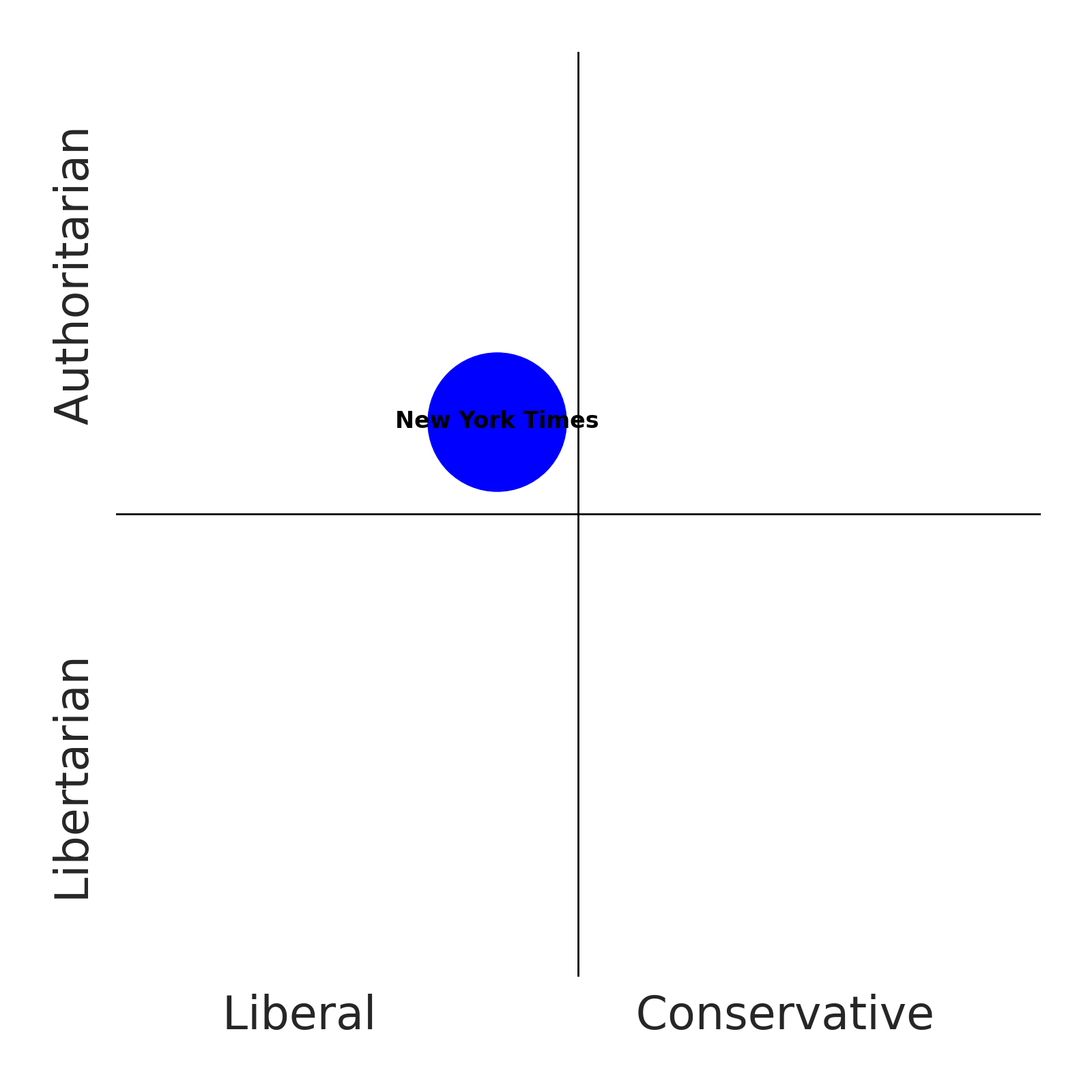
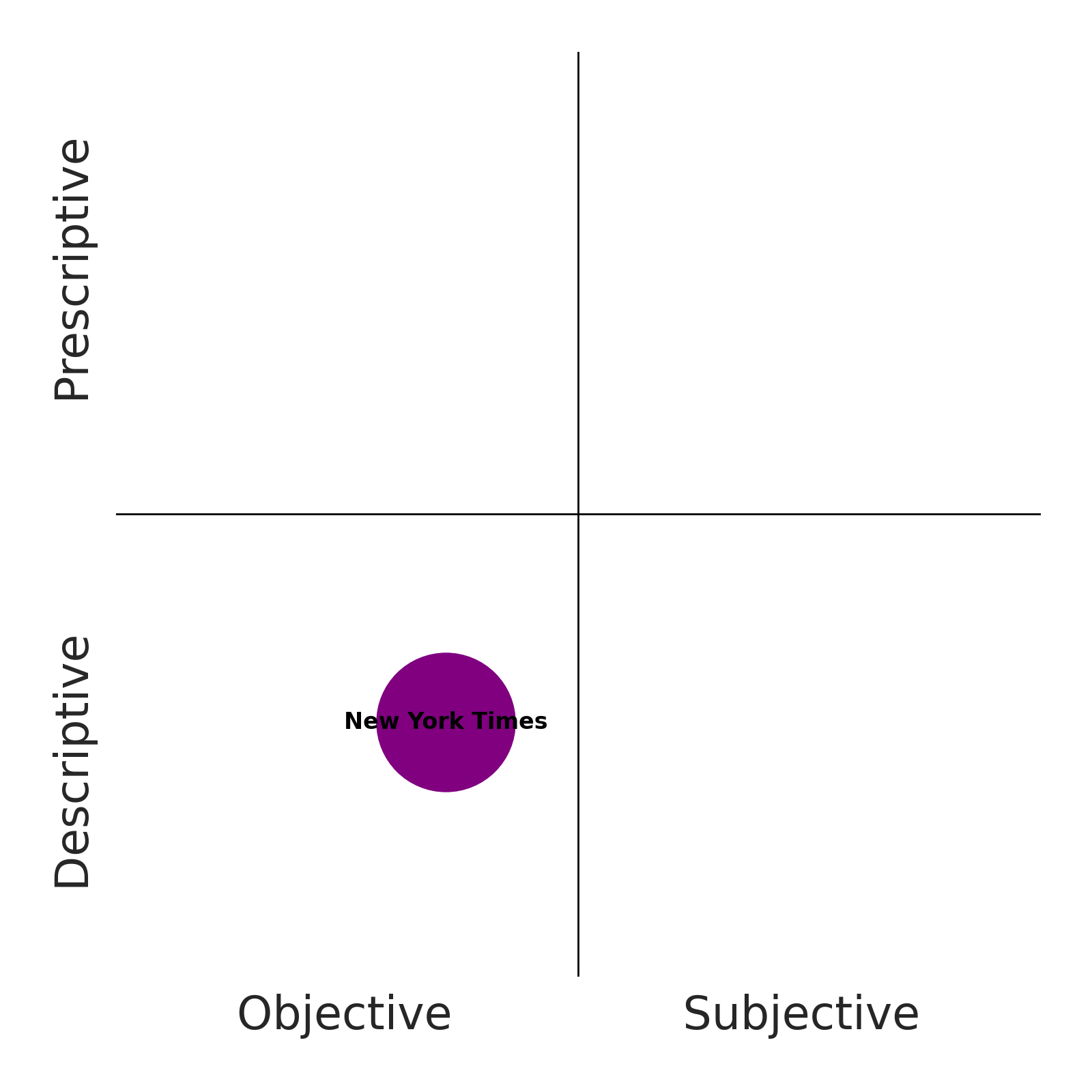
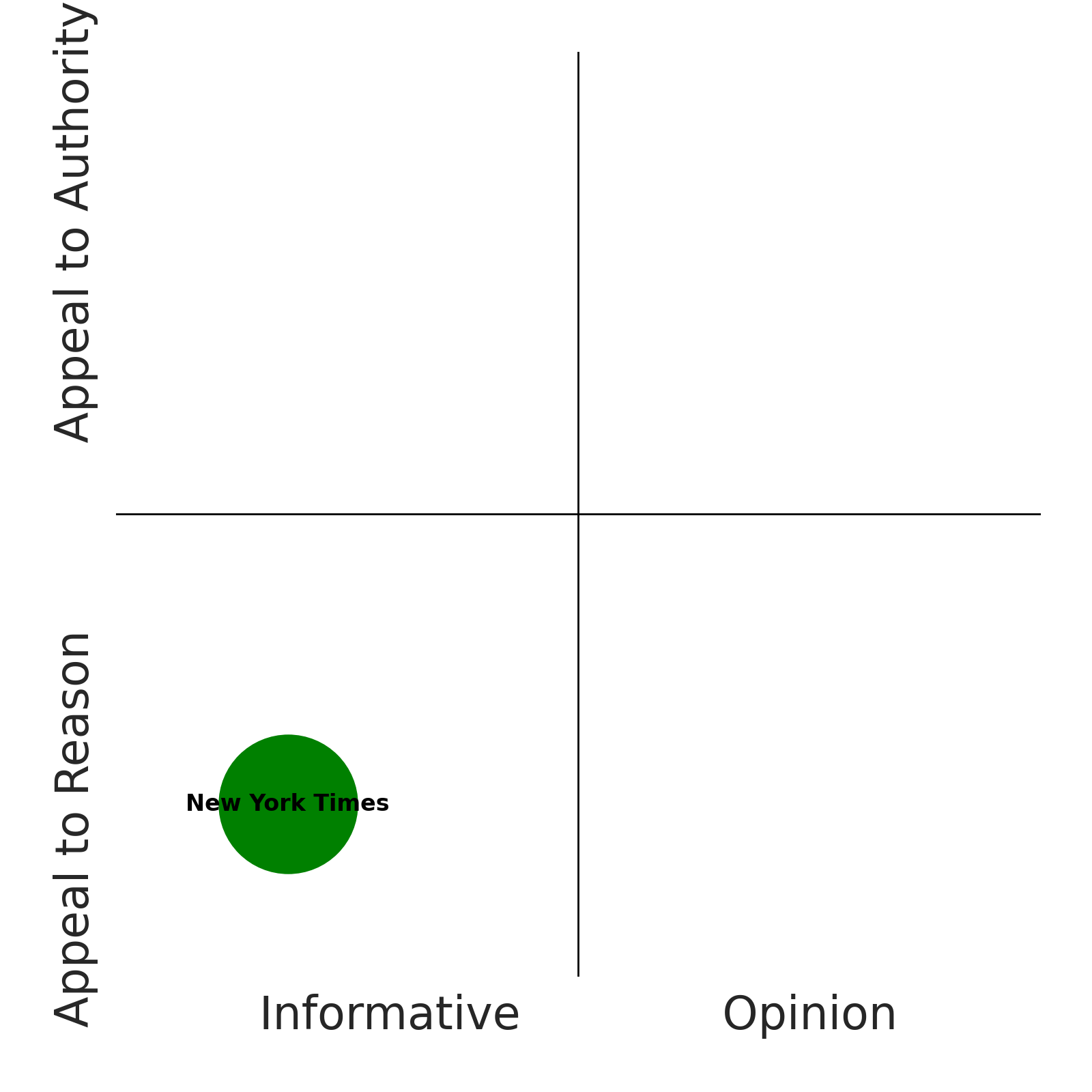
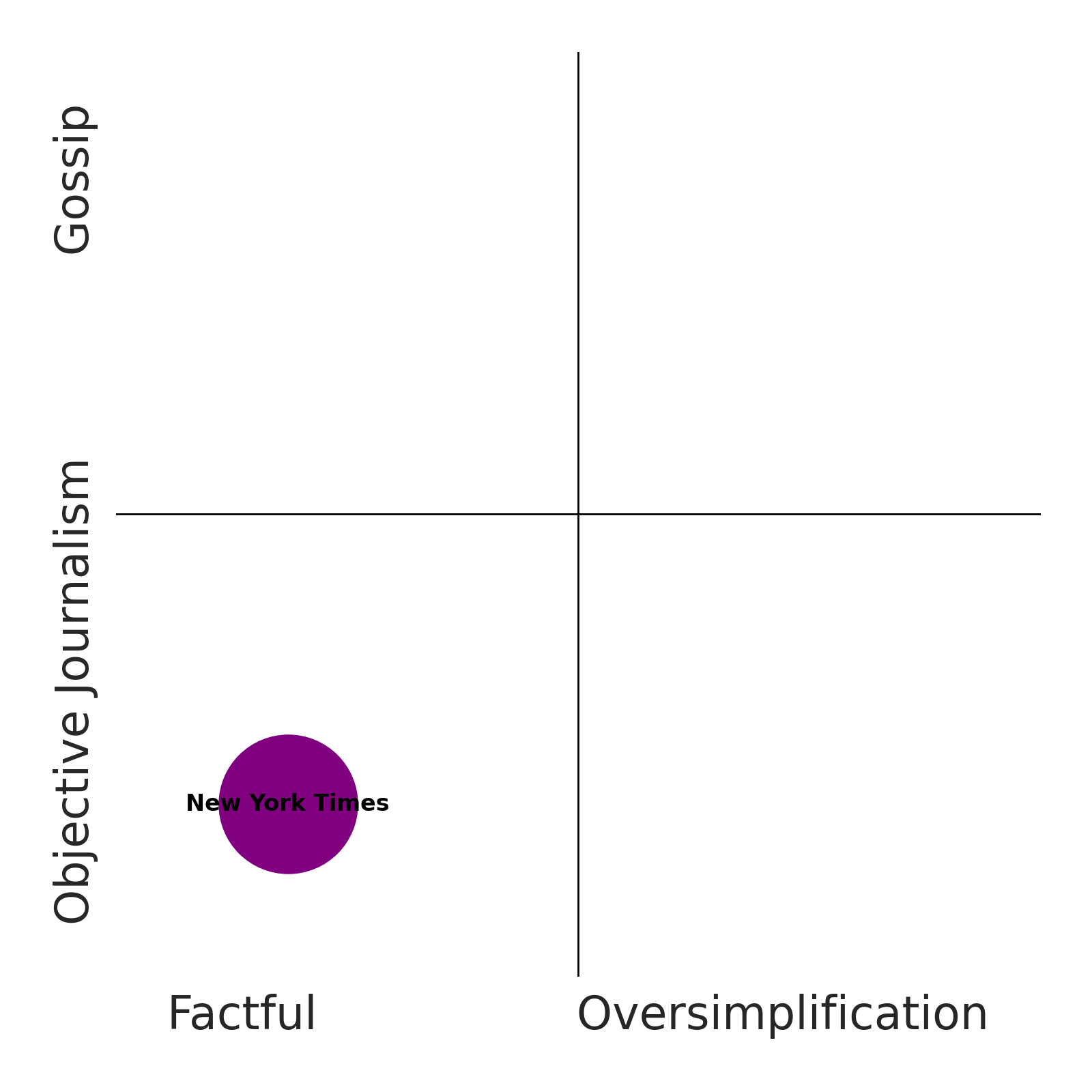
2026 © Helium Trades
Privacy Policy & Disclosure
* Disclaimer: Nothing on this website constitutes investment advice, performance data or any recommendation that any particular security, portfolio of securities, transaction or investment strategy is suitable for any specific person. Helium Trades is not responsible in any way for the accuracy
of any model predictions or price data. Any mention of a particular security and related prediction data is not a recommendation to buy or sell that security. Investments in securities involve the risk of loss. Past performance is no guarantee of future results. Helium Trades is not responsible for any of your investment decisions,
you should consult a financial expert before engaging in any transaction.
Helium Research Assistant

How can I help you today?
Ask any question about New York Times bias.


