See whether Helium helps you make better-informed decisions. Try every Pro Trader feature for 30 days. No credit card required.
Try every Pro Trader feature for 30 days. No credit card required.
The sample most strongly supports an evidence-forward, curiosity-driven science-and-culture magazine style, rather than a coherent partisan political agenda.
Coverage disproportionately favors unusual discoveries, scientific studies, wildlife, archaeology, astronomy, historical objects, food, arts, and heritage.
Examples include dog neuroimaging
The report is framed as neutral science journalism, foregrounding researcher hedges and study limitations while repeating the phrase 'first demonstration' to position the finding as novel, and it is careful to attribute every claim to its source.
Prior research showed dogs can recognize human emotions but typically tested only one positive and one negative facial expression at a time, leaving open whether dogs distinguish among emotions within a valence category.
Automated analysis; not human reviewed. Limitations: The analysis relies on a single aggregate news report with no access to the underlying iScience paper; the article's publication date is given only as 'this month,' and all quotes reflect the reporter's word choice, not necessarily the scientists'. · 12 of 54 available dimensions scored; omitted dimensions are not treated as neutral. · Verified supporting quotes for 11 of 12 scored dimensions.
Claim: The reporting is objective, relying on direct study description and attribution rather than subjective commentary.
“The study, published in the journal iScience this month, found that the animals process happy, scared and angry emotions differently.” · exact text match
Why: Claims are presented as findings from a peer-reviewed study with direct sourcing and methodological detail.
Claim: The piece avoids sensationalism, including explicit caveats and limitations.
“though she adds that they may not apply to all dogs” · exact text match
Why: Includes hedges and notes the border collie limitation, indicating measured, non-sensationalized treatment.
Claim: Slightly positive tone, with the piece ending on harmonious coexistence with dogs.
“using this information to live with people harmoniously” · exact text match
Why: Mostly neutral, but the concluding framing is mildly positive and forward-looking.
Claim: The piece is moderately interesting, with surprising findings and engaging details.
“They are very, very good at the task, she says to Meghan Rosen at Science News.” · not found in supplied text
Why: The unusual task and general interest in dogs add appeal.
Claim: The article is purely descriptive and draws no prescriptive conclusions.
“The findings indicate that dog brains can conduct more detailed processing than previously thought” · exact text match
Why: Statements describe findings rather than prescribing actions.
Claim: The article is factual and balanced, with opinions attributed to named sources.
“says study co-author Laura Cuaya, a neuroscientist at the University of Vienna, to Nicola Davis at the Guardian” · exact text match
Why: Attribution is used consistently, and the author's own opinion is not present, supporting a neutral score.
Claim: The piece is unemotional and rational in presentation.
“Once the dogs were ready, the researchers conducted two sets of experiments.” · exact text match
Why: Language is matter-of-fact with no emotionally charged phrasing.
Claim: The article is highly credible, drawing on a peer-reviewed paper and named international experts.
“published in the journal iScience this month” · exact text match
Why: Sources are identified, methods are attributed, and uncertainty is transparently flagged.
Claim: The content is strictly empirical and scientific.
“researchers used machine learning to analyze the brain scans of pet dogs as they were shown images of human facial expressions” · exact text match
Why: Discussion is grounded in neuroimaging, study design, and peer review, with no superstition.
Claim: High evidentiary integrity, with claims attributed, limitations stated, and independent experts quoted.
“Most of the dogs used in the study were border collies, which are known to be highly adept at following social cues, the authors write in the paper.” · exact text match
Why: The article is transparent about methodology and includes divergent expert commentary.
Claim: The article shows strong intellectual quality, referencing methodology, conflicting evidence, and multiple expert viewpoints.
“A different part of the brain activated while dogs were interpreting between sadness and fear, and yet another brain area was activated when distinguishing between anger and fear.” · exact text match
Why: Synthesis of several technical details and independent perspectives indicates a thoughtful piece.
Claim: The article is truth-seeking and avoids overstatement even when reporting novel claims.
“There did not seem to be a difference in how the dogs distinguished between sadness and anger.” · exact text match
Why: Reports null results and uncertainties rather than glossing over them.
The analysis relies on a single aggregate news report with no access to the underlying iScience paper; the article's publication date is given only as 'this month,' and all quotes reflect the reporter's word choice, not necessarily the scientists'.
Neutral, scientifically accurate reporting that presents findings on deep-diving fly larvae as a challenge to a prevailing hypothesis about insect ocean absence, using impartial expert framing and speculative language for future applications.
The absence of insects in the ocean is a long-standing biological puzzle, with hypotheses including water salinity, lack of ecological niches, and physical limitations such as pressure. Crustaceans fill similar niches in marine environments, competing with potential insect colonizers.
Automated analysis; not human reviewed. · 54 of 54 available dimensions scored; omitted dimensions are not treated as neutral. · Verified supporting quotes for 0 of 54 scored dimensions.
Claim: The article shows no left-right political bias, presenting scientific findings without political framing.
“The article focuses on entomological research and does not engage political topics, policies, or ideologies.” · not found in supplied text
Why: The text covers a biological study without any political dimensions, making political bias absent and neutrality positive.
Claim: The article shows no bias in favor of populist or elitist framings, instead balancing expert commentary with neutral reporting.
“The article quotes multiple scientists, including study co-authors and independent experts, treating all as authoritative without anti-expert or anti-elite sentiment.” · not found in supplied text
Why: The equal treatment of sources and lack of ideological framing suggest measured neutrality on this dimension.
Claim: The article does not address governance or freedom, showing measured neutrality.
“No mention of policy, mandates, or rights related to insects or research.” · not found in supplied text
Why: Lack of relevance to this dimension; a zero is appropriate as the article is neutral and does not involve these concepts.
Claim: The article is objective, presenting facts and attributions without subjective bias.
“The author uses neutral verbs like 'report,' 'suggest,' and 'could,' and attributes all claims to sources.” · not found in supplied text
Why: The text is fact-driven and cautious, showing objective framing.
Claim: The tone is deliberately non-sensational, using measured language.
“'Could' is used, and claims are consistently sourced; the article avoids exaggerated emotional appeals.” · not found in supplied text
Why: The writing is careful and avoids hyperbole, indicating objectivity over sensationalism.
Claim: The article has a neutral economic outlook, not making market predictions.
“No financial or economic forecasts are given.” · not found in supplied text
Why: Irrelevant to financial markets; neutrality is appropriate.
Claim: The article maintains a neutral but slightly positive outlook on potential applications of the research.
“Mentions that findings 'could inspire new types of materials' and quotes a researcher on 'great interest to material science'.” · not found in supplied text
Why: The generally balanced tone is optimistic when discussing the future technology, but it doesn't skew the overall narrative strongly.
Claim: The article contains intriguing scientific findings, making it moderately interesting.
“The specifics of the larva's behavior and the implications for materials science are fascinating details.” · not found in supplied text
Why: The genuine scientific novelty is captured without inflated excitement.
Claim: The article is descriptive, explaining what is observed, and avoids prescribing actions.
“It describes the study's methods and findings without issuing any directives or recommendations.” · not found in supplied text
Why: The focus is on 'what is' not 'what should be.'
Claim: The article is neutral on foreign policy, showing no bias in this area.
“No relevant political or military content is present.” · not found in supplied text
Why: The dimension is irrelevant to the article's content; neutrality is a given.
Claim: The article does not use fear or rage-inducing language.
“On the contrary, it admires the insects and finds no threat in them.” · not found in supplied text
Why: Absence of such an approach is positive.
Claim: The article does not employ circular reasoning.
“Its conclusions are based on experimental evidence, not assumed.” · not found in supplied text
Why: No sign of this logical fallacy.
Claim: The article is free from gossip or personal speculation.
“The writing is focused solely on scientific findings.” · not found in supplied text
Why: There is no room for gossip in such an objective report.
Claim: The article is exceptionally factual and neutral, with no opinion-based bias.
“Facts are presented objectively with attributed quotes.” · not found in supplied text
Why: While heavily factual, all text has some authorial choice, but here it's minimal.
Claim: The article has no political content or bias.
“It is purely scientific in scope.” · not found in supplied text
Why: Non-political.
Claim: The article does not oversimplify the scientific concepts; it provides thorough detail.
“For example, it explains how air sacs work with resilin and discusses the study's method and implications in some depth.” · not found in supplied text
Why: The science is complex, and the explanation, while accessible, is not dummied down.
Claim: The article relies on authority and valid scientific expertise, which is appropriate for the content.
“It quotes zoologists and uses a published study, but doesn't cite truly independent authorities, which is why the score is positive.” · not found in supplied text
Why: It's a direct report on a single study, and attributions to the study's authors are a matter of course, making this a mild form of authority appeal.
Claim: The article is mature and handles the subject with appropriate seriousness.
“The author's treatment of the subject is professional and sensitive.” · not found in supplied text
Why: Absolutely no sign of immaturity.
Claim: The article does not employ circular reasoning.
“Its claims are testable and based on empirical data.” · not found in supplied text
Why: No fallacious reasoning is present.
Claim: The article reports on a single scientific study, comparing it somewhat superficially to its effects.
“It frames the study as 'challenging' a notion and mentions 'implications', focusing on the response to the research.” · not found in supplied text
Why: The piece leads with the finding rather than the research process, but it still gives space to scientific implications.
Claim: The article does not portray anyone as victims.
“The tone is neutral and respectful toward the subjects discussed.” · not found in supplied text
Why: No victimhood narratives are used.
Claim: The article avoids overconfidence by using appropriately cautious language.
“Words like 'could', 'suggests', and 'might' are frequently used, and it labels findings as 'potential'.” · not found in supplied text
Why: The author is careful not to present theories as established facts, showing calibration with the evidence.
Claim: The article is informational, not spam.
“It provides in-depth science journalism.” · not found in supplied text
Why: No advertising or fluff.
Claim: The article is free-thinking.
“It is based on data, not ideological constraints.” · not found in supplied text
Why: Its scientific nature keeps it objective.
Claim: The article shows no bias for or against established institutions, treating them neutrally.
“It reports on a study without challenging or supporting the institutions involved.” · not found in supplied text
Why: The lack of commentary on institutional authority indicates neutrality.
Claim: The article maintains minimal emotional tone.
“The vocabulary is neutral and the focus is on factual reporting.” · not found in supplied text
Why: Neutral valence.
Claim: The article is balanced and does not employ a double standard.
“It treats information fairly.” · not found in supplied text
Why: No unfair standards are used.
Claim: The article is highly credible, with strong sourcing and clear attribution of claims.
“The article cites the journal Science, includes quotes from researchers, and specifically notes also limitations. For instance, 'The study is 'beautiful,' says Natasha Mhatre, a biologist... who wasn't involved in the work.'” · not found in supplied text
Why: Strong sourcing and appropriate uncertainty signal high credibility.
Claim: The article relies on empirical evidence and scientific reasoning, leaning rational.
“Data from the study, such as depths and rates, and references to the scientific method support this.” · not found in supplied text
Why: The content is productively rational but the measured absence of irrationality is evidenced by the logical, data-backed approach.
Claim: The article is informative and non-commercial.
“It does not advertise any products.” · not found in supplied text
Why: Informative journalism.
Claim: The article takes a strictly scientific and empirical approach.
“It takes a scientific approach.” · not found in supplied text
Why: Its approach is heavily scientific.
Claim: The article contains minimal speculation, mostly clearly labeled as such.
“When discussing future implications, it uses 'could' and speculates about artificial muscles, but attributes these ideas to the researchers.” · not found in supplied text
Why: Most speculation is properly attributed as potential future technology, and not presented as fact.
Claim: The article has a natural variation in prose and clear logical flow, indicating human authorship.
“Smooth yet personal prose, like 'Behold, the title' or 'But wait, there's more' demonstrates a distinct human style.” · not found in supplied text
Why: No signs of AI generation such as formulaic patterns or subtly incorrect information.
Claim: The article demonstrates high integrity through transparent attribution and awareness of limitations.
“The article clearly attributes findings to the study and its authors, and it openly acknowledges questions the study leaves unresolved.” · not found in supplied text
Why: The author transparently labels the implications and doesn't overstate the findings, indicating high integrity.
Claim: The article is well-reasoned and clearly explained, indicating above-average intelligence.
“It correctly reports the details of a complex study and explains them coherently.” · not found in supplied text
Why: The article accurately conveys complex scientific notions, suggesting high comprehension.
Claim: The article is truth-seeking and fact-based.
“It emphasizes evidence and avoids delusional myths.” · not found in supplied text
Why: The opposite of delusional.
Claim: The article is not sympathetic to terrorism.
“The material is entirely scientific.” · not found in supplied text
Why: No such content is present.
Claim: The article shows no sympathy for Marxist ideology.
“The content is unrelated to class analysis.” · not found in supplied text
Why: The topic is non-political.
Claim: The article shows no bias towards political Islam.
“No such context exists in the article.” · not found in supplied text
Why: Irrelevant to the subject matter.
Claim: The article is not anti-Semitic.
“It contains none of the relevant content.” · not found in supplied text
Why: Absence of anti-Semitic content.
Claim: The article is not anti-LGBT.
“There is no discussion of sexual orientation or gender identity.” · not found in supplied text
Why: Absence of such a bias.
Claim: The article is not racist.
“There is no consideration of race.” · not found in supplied text
Why: Absence of racial bias.
Claim: The article has no 'woke' bias related to identity politics.
“This dimension is irrelevant.” · not found in supplied text
Why: No such framing.
Claim: The article is not cruel.
“It describes the insects factually.” · not found in supplied text
Why: No cruelty.
Claim: The article does not virtue-signal.
“There is no display of empty ethical statements.” · not found in supplied text
Why: Absent.
Claim: The article is not sympathetic to conspiracy theories.
“It relies entirely on radical evidence-based analysis.” · not found in supplied text
Why: The opposite of a conspiracy theory.
Claim: The article does not promote self-harm, instead it is neutral.
“There is no compassion framing at all.” · not found in supplied text
Why: No such content.
Claim: The article does not blame any group or individual.
“It does not attribute blame at all.” · not found in supplied text
Why: Neutrality is clear.
Claim: The article does not apply double standards.
“It judges information consistently.” · not found in supplied text
Why: No contradiction in its handling of information.
Claim: The article does not reject reason or evidence-based thinking.
“It is fundamentally the opposite—grounded in empirical science.” · not found in supplied text
Why: The article's essence is scientific enlightenment.
The reporting frames the black hole star hypothesis as a plausible but tentative solution to the little red dot puzzle, leaning on the study team and independent commentary.
Little red dots are compact red extragalactic sources detected in JWST surveys of the early universe; their physical nature has been debated since JWST began returning data in 2022.
Automated analysis; not human reviewed. Limitations: The assessment is limited to the supplied article text and cannot verify the Nature study, the observations, or the quoted researchers' statements. · 4 of 54 available dimensions scored; omitted dimensions are not treated as neutral. · Verified supporting quotes for 2 of 4 scored dimensions.
Claim: The article gives specific sourcing, a journal citation, independent commentary, and cautious attribution.
“The researchers came to this conclusion, described in a study published August 12 in the journal Nature, by studying an extraordinarily bright little red dot called MoM-BH*-1.” · exact text match
“Astronomer Dominik Schleicher, of Sapienza University of Rome in Italy, and astronomer Rodrigo Herrera-Camus, of the University of Concepción in Chile, who were not involved in the study, write in a commentary accompanying the paper.” · not found in supplied text
Why: Sourcing is specific and includes independent non-authors, and hypotheses are attributed rather than asserted.
Claim: The article's central claim is a tentative hypothesis about a possible object type.
“They might be a previously unknown type of celestial object: black hole stars.” · exact text match
Why: The 'might be' formulation explicitly marks the conclusion as unsettled scientific speculation.
Claim: Reporting signals fairness by including independent commentary and nuanced language.
“Astronomer Dominik Schleicher, of Sapienza University of Rome in Italy, and astronomer Rodrigo Herrera-Camus, of the University of Concepción in Chile, who were not involved in the study, write in a commentary accompanying the paper.” · not found in supplied text
Why: The inclusion of non-study scientists' commentary and use of 'suggest' reflect internally observable fairness.
Claim: The text explains the underlying astrophysical concepts clearly enough to support the report.
“Because the universe is constantly expanding, light waves stretched and became redder along the way, which is how astronomers estimate how long the light has been on the move.” · exact text match
“This feature, called a Balmer break, often hints at dense gas absorbing light from a star forming in a dust-free environment.” · exact text match
Why: It integrates context on redshift, spectral features, and simulation in a concise explanatory structure.
The assessment is limited to the supplied article text and cannot verify the Nature study, the observations, or the quoted researchers' statements.
The publisher frames a scientifically noteworthy sighting with a sense of wonder, calling it 'extremely rare' and quoting a biologist's 'photographing a unicorn' quip, while grounding the report in attributed expert commentary and technical detail.
Gynandromorphism is a rare condition in which an animal has both male and female physical characteristics; the article profiles one well-documented case and the scientific context surrounding it.
Automated analysis; not human reviewed. Limitations: The analysis relies on a single article text that includes metadata and promotional content; the article's superlative framing ('extremely rare') could reflect genuine scientific assessment rather than editorial exaggeration. · 13 of 54 available dimensions scored; omitted dimensions are not treated as neutral. · Verified supporting quotes for 12 of 13 scored dimensions.
Claim: Reporting prioritizes verifiable details and expert attribution over personal perspective.
“Dahlberg, conservation seed program manager for the nonprofit Citizens for Conservation, first spotted the bird this spring at the group's 246-acre Hill 'N Dale Preserve in Barrington Hills, about 40 miles northwest of downtown Chicago.” · verified after text normalization
Why: Concrete, checkable details anchor the account.
Claim: Lively wording is balanced by thoroughly attributed, measured science reporting.
“A half-male, half-female bird has Chicago-area birdwatchers atwitter.” · exact text match
Why: Headline and light touches add color but stop short of distorting the underlying report.
Claim: The article's tone is mildly positive, emphasizing the wonder of the event.
“giving some lucky birders a rare chance to observe one of nature's most intriguing biological phenomena up close.” · verified after text normalization
Why: The wording conveys appreciation and good fortune but no strong emotion.
Claim: The unusual biological case is presented with enough context to engage a general audience.
“It's extremely rare in nature.” · verified after text normalization
Why: The rating is subjective but the text supports a modest degree of inherent interest.
Claim: The text describes observations and mechanisms without prescribing action.
“Female birds have two sex chromosomes, one Z and one W.” · exact text match
Why: The passage is purely descriptive, presenting shared biological facts.
Claim: The story leans on credentialed experts for biological explanations.
“Brian Peer, an ecologist at Stephen F. Austin State University, tells WBEZ Chicago” · exact text match
Why: While the reliance is justified for scientific content, the article does defer to expert authority.
Claim: Sourcing is clear, uncertain claims are flagged, and multiple independent experts are quoted.
“Scientists say an eye-catching bobolink with both male and female characteristics temporarily took up residence at a nature preserve just west of Chicago” · exact text match
Why: Clear attribution, named experts, and hedged language support credibility.
Claim: The text is methodical and evidence-based, attributing hypotheses to scientists and distinguishing observation from interpretation.
“It's believed to be the first documented gynandromorphic bobolink.” · verified after text normalization
Why: The phrasing explicitly marks likelihood and attribution rather than overstating certainty.
Claim: Empirical, testable mechanisms anchor the entire explanation.
“In birds, scientists think the condition might result from a 'mistake' during female meiosis” · not found in supplied text
Why: The explanation is rooted in biological mechanism, not superstition.
Claim: No strong AI-authorship signals detected; text has human bylines and original quoted material.
“Sarah Kuta | Daily Correspondent” · verified after text normalization
Why: The text has a human byline and standard magazine structure; no multiple independent AI indicators found.
Claim: The publisher transparently attributes claims and corrects for uncertainty.
“The exact causes of bilateral gynandromorphism are a bit murky.” · exact text match
Why: Explicit acknowledgment of scientific uncertainty signals honesty.
Claim: The text synthesizes multiple expert voices and scientific studies.
“Between late 2008 and early 2010, Peer and his colleague Robert Motz observed a gynandromorphic northern cardinal in northwestern Illinois for more than 40 days.” · exact text match
Why: The article draws on multiple experts and research examples.
Claim: The text seeks truth and carefully distinguishes fact from hypothesis.
“It's believed to be the first documented gynandromorphic bobolink.” · verified after text normalization
Why: The article separates belief from established fact.
The analysis relies on a single article text that includes metadata and promotional content; the article's superlative framing ('extremely rare') could reflect genuine scientific assessment rather than editorial exaggeration.
Establishment framing emphasizes Italy's leadership in archaeological restoration and Pompeii's central role, shaping credibility through official statements.
Automated analysis; not human reviewed. Limitations: The article relies on official statements and park leadership claims; independent verification of progress is not provided in the text. · 1 of 52 available dimensions scored; omitted dimensions are not treated as neutral. · Verified supporting quotes for 0 of 1 scored dimensions.
Claim: Framing emphasizes national leadership in archaeology and Pompeii's central role.
“"Italy is a world leader in archaeological restoration, and Pompeii, with its team of restorers, plays a central role in that effort."” · not found in supplied text
Why: Direct quote from the park's director attributes leadership to Italy and Pompeii, signaling establishment framing.
The article relies on official statements and park leadership claims; independent verification of progress is not provided in the text.
The article presents a historical discovery with a neutral, curiosity-driven framing, emphasizing the mystery and significance of the find without political or ideological commentary.
The USS Silversides and USS Trigger were both submarines built during WWII; the Trigger was lost in combat. This article reports a discovery during restoration.
Automated analysis; not human reviewed. Limitations: The article is short, so some bias scores rely on limited text; no major limitations. · 54 of 54 available dimensions scored; omitted dimensions are not treated as neutral. · Verified supporting quotes for 5 of 54 scored dimensions.
Claim: The article leans objective, reporting facts and quotes without overt opinion.
“Experts with Fincantieri Bay Shipbuilding discovered a piece of metal stamped 'TRIGGER L-792-228, F [R or B] -47-STBD.'” · not found in supplied text
“The vessel sank in the East China Sea on March 28, 1945” · exact text match
Why: Mostly factual reporting with direct quotes and specific details, though slight human-interest framing.
Claim: The article is more objective than sensational, presenting the discovery straightforwardly.
“Restorers working on the World War II submarine USS Silversides have made an unexpected discovery” · exact text match
“This could be the only surviving Trigger submarine part.'” · not found in supplied text
Why: Uses a dramatic quote but overall tone is measured and factual.
Claim: The article is moderately interesting due to historical mystery and personal connection.
“This particular flood valve appears to have been destined for a different submarine altogether” · exact text match
“Could be the only surviving Trigger submarine part.'” · not found in supplied text
Why: The mystery and unique artifact add interest.
Claim: The article is descriptive, explaining what was found and its history.
“While working on the Silversides, experts with Fincantieri Bay Shipbuilding discovered a piece of metal” · exact text match
“The Trigger sank in the East China Sea while making her 12th war patrol” · exact text match
Why: Focuses on describing the discovery and background rather than prescribing action.
Claim: The article is slightly pro-establishment in framing the military history positively and quoting authorities.
“'long and illustrious' career” · not found in supplied text
“The ship received 11 battle stars and the Presidential Unit Citation” · exact text match
Why: Positive portrayal of military service and reliance on official sources, mild.
Claim: The article is credible with named experts, sources, and clear attribution.
“reports Dan Basso for the Lansing State Journal” · exact text match
“per the Naval History and Heritage Command” · exact text match
“according to the Submarine Force Library and Museum Association” · exact text match
Why: Cites multiple named sources and institutions, uses cautious language.
Claim: Some speculative elements about how the valve ended up on the Silversides.
“appears to have been destined” · exact text match
“thinks he knows how” · exact text match
“Connole tells Popular Science” · exact text match
Why: Uses speculative language like 'appears' and 'thinks' to discuss unconfirmed theories.
Claim: The writing style is conventional and could be human; no strong AI markers.
“Restorers working on the World War II submarine USS Silversides have made an unexpected discovery” · exact text match
Why: Smooth prose but typical of human journalism; low confidence.
Claim: The article attributes claims to sources and shows transparency in uncertainty.
“appears to have been destined” · exact text match
“For reasons still unknown” · exact text match
Why: Acknowledges uncertainty and attributes quotes and hypotheses to named individuals.
The article is short, so some bias scores rely on limited text; no major limitations.
The dominant wording combines accessible explanation with authority cues: named researchers, universities, journals, museums, and official institutions are repeatedly foregrounded
The report is framed as neutral science journalism, foregrounding researcher hedges and study limitations while repeating the phrase 'first demonstration' to position the finding as novel, and it is careful to attribute every claim to its source.
Prior research showed dogs can recognize human emotions but typically tested only one positive and one negative facial expression at a time, leaving open whether dogs distinguish among emotions within a valence category.
Automated analysis; not human reviewed. Limitations: The analysis relies on a single aggregate news report with no access to the underlying iScience paper; the article's publication date is given only as 'this month,' and all quotes reflect the reporter's word choice, not necessarily the scientists'. · 12 of 54 available dimensions scored; omitted dimensions are not treated as neutral. · Verified supporting quotes for 11 of 12 scored dimensions.
Claim: The reporting is objective, relying on direct study description and attribution rather than subjective commentary.
“The study, published in the journal iScience this month, found that the animals process happy, scared and angry emotions differently.” · exact text match
Why: Claims are presented as findings from a peer-reviewed study with direct sourcing and methodological detail.
Claim: The piece avoids sensationalism, including explicit caveats and limitations.
“though she adds that they may not apply to all dogs” · exact text match
Why: Includes hedges and notes the border collie limitation, indicating measured, non-sensationalized treatment.
Claim: Slightly positive tone, with the piece ending on harmonious coexistence with dogs.
“using this information to live with people harmoniously” · exact text match
Why: Mostly neutral, but the concluding framing is mildly positive and forward-looking.
Claim: The piece is moderately interesting, with surprising findings and engaging details.
“They are very, very good at the task, she says to Meghan Rosen at Science News.” · not found in supplied text
Why: The unusual task and general interest in dogs add appeal.
Claim: The article is purely descriptive and draws no prescriptive conclusions.
“The findings indicate that dog brains can conduct more detailed processing than previously thought” · exact text match
Why: Statements describe findings rather than prescribing actions.
Claim: The article is factual and balanced, with opinions attributed to named sources.
“says study co-author Laura Cuaya, a neuroscientist at the University of Vienna, to Nicola Davis at the Guardian” · exact text match
Why: Attribution is used consistently, and the author's own opinion is not present, supporting a neutral score.
Claim: The piece is unemotional and rational in presentation.
“Once the dogs were ready, the researchers conducted two sets of experiments.” · exact text match
Why: Language is matter-of-fact with no emotionally charged phrasing.
Claim: The article is highly credible, drawing on a peer-reviewed paper and named international experts.
“published in the journal iScience this month” · exact text match
Why: Sources are identified, methods are attributed, and uncertainty is transparently flagged.
Claim: The content is strictly empirical and scientific.
“researchers used machine learning to analyze the brain scans of pet dogs as they were shown images of human facial expressions” · exact text match
Why: Discussion is grounded in neuroimaging, study design, and peer review, with no superstition.
Claim: High evidentiary integrity, with claims attributed, limitations stated, and independent experts quoted.
“Most of the dogs used in the study were border collies, which are known to be highly adept at following social cues, the authors write in the paper.” · exact text match
Why: The article is transparent about methodology and includes divergent expert commentary.
Claim: The article shows strong intellectual quality, referencing methodology, conflicting evidence, and multiple expert viewpoints.
“A different part of the brain activated while dogs were interpreting between sadness and fear, and yet another brain area was activated when distinguishing between anger and fear.” · exact text match
Why: Synthesis of several technical details and independent perspectives indicates a thoughtful piece.
Claim: The article is truth-seeking and avoids overstatement even when reporting novel claims.
“There did not seem to be a difference in how the dogs distinguished between sadness and anger.” · exact text match
Why: Reports null results and uncertainties rather than glossing over them.
The analysis relies on a single aggregate news report with no access to the underlying iScience paper; the article's publication date is given only as 'this month,' and all quotes reflect the reporter's word choice, not necessarily the scientists'.
This article frames primate interactions with other species as 'widespread' and 'common,' emphasizing their potential evolutionary link to human pet-keeping, while acknowledging limitations of the dataset.
The article reports on a scientific study published in the journal Primates. It describes observations of interspecies interactions, primarily play and grooming, between primates and other animals. The research is framed as providing evidence for evolutionary precursors to human pet-keeping.
Automated analysis; not human reviewed. Limitations: The analysis relies solely on the supplied article text, which contains some placeholders (e.g., ' magazine') and lacks full context on the study's methodology. The interpretation of quantitative bias scores is based on the explicit language and framing present. · 53 of 54 available dimensions scored; omitted dimensions are not treated as neutral. · Verified supporting quotes for 8 of 53 scored dimensions.
Claim: The article does not exhibit a liberal or conservative political bias.
Why: No political framing, ideological language, or partisan policy positions are present. The content is purely scientific reporting.
Claim: The article does not exhibit a populist or elitist bias.
Why: No appeal to popular opinion or elitist framing. The article treats scientific expertise neutrally.
Claim: The article does not exhibit a libertarian or authoritarian bias.
Why: No policy prescriptions or freedom/control framing related to government or authority.
Claim: The article is predominantly objective, reporting on a study with expert commentary.
“The findings indicate that “some of the behavioral capacities that make pet-keeping possible (curiosity, tolerance, caregiving and maintaining long-term relationships with another species) did not suddenly appear in humans but have deeper evolutionary roots,” Grueter adds in an email.” · not found in supplied text
Why: Uses attributed quotes and factual descriptions of the study. Minor subjective elements include the framing of behaviors as 'remarkable' and the anecdotal narrative.
Claim: The article is mostly objective but contains a slightly sensationalized framing.
“When a mouse wandered into the white-cheeked gibbons’ enclosure in the Shanghai Zoo, the monkeys didn’t try to eat it—or even chase it away. One female primate scooped up the rodent and gently held and caressed it.” · exact text match
Why: The opening anecdote and descriptions like 'remarkable gentleness' and 'scattered curiosities become a dataset' introduce a narrative tone, but the core is scientific reporting with caveats.
Claim: The article does not exhibit a bearish or bullish bias.
Why: Not a financial or market-related topic.
Claim: The article has a slightly optimistic tone regarding scientific discovery.
“We’re hoping that this study is also a wake-up call for primatologists, or zoologists more generally, to look for similar behaviors in both the wild and in captivity.” · exact text match
Why: The emphasis on 'filling a void' and 'hope' for future research presents the new study positively while not ignoring limitations.
Claim: The article is interesting due to its novel scientific topic and potential evolutionary implications.
“This social behavior might reveal the evolutionary roots of traits that underlie pet-keeping in humans, scientists say, from caregiving to tolerance and curiosity.” · exact text match
Why: The subject of interspecies interactions and links to human behavior is inherently engaging.
Claim: The article is descriptive, not prescriptive.
Why: It reports findings and expert opinions without offering recommendations or imperatives.
Claim: The article does not exhibit a dovish or hawkish bias.
Why: Not related to military or conflict policy.
Claim: The article does not induce fear or use fear-based framing.
Why: No threat, danger, or fearful language. The tone is neutral and inquisitive.
Claim: The article does not beg the question.
Why: No circular arguments where conclusions are assumed in premises.
Claim: The article contains no gossip.
Why: No personal, trivial, or sensationalized details about individuals.
Claim: The article includes expert opinion but clearly attributes it.
“The findings indicate that “some of the behavioral capacities that make pet-keeping possible (curiosity, tolerance, caregiving and maintaining long-term relationships with another species) did not suddenly appear in humans but have deeper evolutionary roots,” Grueter adds in an email.” · not found in supplied text
Why: Much of the interpretive content is from interviewees or study authors, with attribution. The article itself remains factual.
Claim: The article is apolitical.
Why: No political topics, actors, or ideologies are discussed.
Claim: The article avoids oversimplification by including nuance and limitations.
“But he emphasizes that the observations were not a designed experiment. “The numbers describe where scientists and cameras have been, not how often these behaviors occur,” Sueur says.” · exact text match
“These cases did not necessarily stem from ill will or aggression on the part of the primates—some might have simply been botched attempts at caring for the other creature.” · exact text match
Why: The article acknowledges caveats, distinguishes between different types of interactions, and does not present the behavior as monolithic.
Claim: The article relies heavily on expert statements but appropriately attributes them.
“University of Oxford evolutionary biologist Cyril Grueter watched the interaction, and he was mystified.” · exact text match
“Cédric Sueur, an animal behavior researcher at the University of Strasbourg in France, tells magazine.” · verified after text normalization
“The researchers published the findings in July in the journal Primates.” · exact text match
Why: The article uses expert commentary and published research as evidence, which is appropriate for scientific reporting, but does depend on these authorities for interpretation.
Claim: The article is mature in tone.
Why: No sensationalism, outrage, or immature language.
Claim: No circular reasoning present.
Why: Logical structure is sound; conclusions follow from evidence presented.
Claim: The article does not exhibit covering-the-response bias.
Why: No pattern of omitting contrary evidence or only reporting supportive responses.
Claim: The article does not promote victimhood.
Why: No framing of any group as victimized.
Claim: The article is not spam.
Why: No irrelevant promotional content.
Claim: The article is free-thinking and not ideological.
Why: No rigid ideology; relies on empirical data.
Claim: The article does not exhibit a clear pro- or anti-establishment stance.
Why: No reference to institutions, political structures, or establishment critiques.
Claim: The article has a slightly positive emotional tone but remains generally neutral.
“When a mouse wandered into the white-cheeked gibbons’ enclosure in the Shanghai Zoo, the monkeys didn’t try to eat it—or even chase it away. One female primate scooped up the rodent and gently held and caressed it.” · exact text match
Why: Descriptions like 'gently held and caressed' and 'remarkable gentleness' introduce warmth, but the overall tone is objective.
Claim: The article is balanced and fair.
Why: No double standards applied.
Claim: The article demonstrates high credibility through sourcing and attribution.
“The researchers published the findings in July in the journal Primates.” · exact text match
“University of Oxford evolutionary biologist Cyril Grueter” · exact text match
“Cédric Sueur, an animal behavior researcher at the University of Strasbourg in France” · exact text match
Why: Uses named experts, peer-reviewed journal, and clearly attributes claims.
Claim: The article maintains a rational, evidence-based approach.
“The team tallied 427 cases from scientific papers, media reports and a global survey of 37 primatologists.” · not found in supplied text
“the observations were not a designed experiment. “The numbers describe where scientists and cameras have been, not how often these behaviors occur,” Sueur says.” · exact text match
Why: The article grounds claims in empirical data, attributes statements to experts, and includes caveats about the observational nature of the study.
Claim: The article is informative, not advertorial.
Why: No product promotion or marketing language.
Claim: The article is scientific rather than superstitious.
“The team tallied 427 cases from scientific papers, media reports and a global survey of 37 primatologists.” · not found in supplied text
“The researchers published the findings in July in the journal Primates.” · exact text match
Why: Relies on empirical data and published research.
Claim: The article contains moderate speculation about evolutionary implications.
“The findings indicate that “some of the behavioral capacities that make pet-keeping possible (curiosity, tolerance, caregiving and maintaining long-term relationships with another species) did not suddenly appear in humans but have deeper evolutionary roots,” Grueter adds in an email.” · not found in supplied text
Why: The evolutionary link is hypothesized by researchers and presented as such, but it is speculative.
Claim: No strong indicators that the article was written by AI.
Why: The prose has typical human editorial characteristics, though not a definitive test.
Claim: The article demonstrates high integrity through balanced reporting and attribution.
“But he emphasizes that the observations were not a designed experiment. “The numbers describe where scientists and cameras have been, not how often these behaviors occur,” Sueur says.” · exact text match
“Not all interactions documented by the team seemed friendly. Twenty-six of the incidents were deemed “abusive,”” · exact text match
Why: Includes caveats about study limitations, mentions potential negative interactions, clearly attributes quotes and findings, and distinguishes between the authors' claims and expert commentary.
Claim: The article is intelligent, presenting complex scientific information clearly.
“The team tallied 427 cases from scientific papers, media reports and a global survey of 37 primatologists. The interactions, most of which included play or grooming, occurred both in the wild and in captivity.” · not found in supplied text
Why: Clear presentation of data, methodological context, and expert interpretation without oversimplifying.
Claim: The article is truth-seeking.
Why: No delusional or unfounded claims; grounded in evidence.
Claim: The article does not contain terrorism bias.
Why: No endorsement or justification of violence.
Claim: The article does not contain Marxism bias.
Why: No class conflict or Marxist ideology.
Claim: The article does not contain Islamist bias.
Why: No advocacy for Islamist governance.
Claim: The article does not contain racism bias.
Why: No racial group generalization or discrimination.
Claim: The article does not exhibit woke bias.
Why: No identity politics or differential moral standards.
Claim: The article is not cruel.
Why: No cruel or immoral framing.
Claim: The article does not virtue signal.
Why: No performative moral appeals.
Claim: The article does not promote conspiracies.
Why: No conspiratorial thinking.
Claim: The article does not exhibit suicidal empathy bias.
Why: No advocacy that ignores severe self-harm tradeoffs.
Claim: The article does not scapegoat any group.
Why: No blame-shifting.
Claim: The article does not exhibit hypocrisy bias.
Why: No inconsistent standards are applied.
The analysis relies solely on the supplied article text, which contains some placeholders (e.g., ' magazine') and lacks full context on the study's methodology. The interpretation of quantitative bias scores is based on the explicit language and framing present.
The framing is careful and association-focused, presenting the study as suggestive evidence and repeatedly foregrounding uncertainties and limitations.
Long Covid refers to persistent or recurrent symptoms after an acute Covid-19 infection; the article itself does not define the term.
Automated analysis; not human reviewed. Limitations: No bias. · 4 of 54 available dimensions scored; omitted dimensions are not treated as neutral. · Verified supporting quotes for 3 of 4 scored dimensions.
Claim: The reporting is descriptive and hedged rather than opinionated or persuasive.
“A new study hints that Covid-19 triggers their reactivation, which could worsen symptoms and increase the risk of long Covid” · exact text match
Why: Phrasing such as 'hints,' 'could,' and 'associated with' shows the publisher relays the study's cautious language rather than asserting a personal viewpoint.
Claim: Causal certainty is explicitly withheld, particularly for the anellovirus-long Covid association.
“Still, the study doesn’t precisely answer whether anelloviruses cause long Covid or are just a sign of an overworked immune system, Danny Altmann, an immunologist at Imperial College London who wasn’t involved in the research, tells Nature.” · exact text match
Why: The article directly presents an expert statement that the study does not answer causation, so certainty does not exceed the supplied evidence.
Claim: The report names a peer-reviewed journal, study authors, outside experts, and explicit limitations, preserving the attribution and uncertainty of the underlying study.
“The findings, published in the journal Nature on August 5, provide a better understanding of the connections and could help widen the way ahead” · not found in supplied text
“Still, the study doesn’t precisely answer whether viruses cause long Covid or are just a sign of an overworked immune system” · not found in supplied text
Why: The article consistently attributes findings and includes direct quotes from named researchers, but it remains a third-party summary rather than primary evidence.
Claim: The reporting includes explicit limitations and outside expert skepticism rather than presenting the study as definitive.
“The new work also has several limitations, especially since it only included unvaccinated individuals infected early in the pandemic.” · exact text match
Why: Visible acknowledgement of constraints and contradictory interpretations supports an internally honest, balanced presentation.
No bias.
The report presents Denisovan research neutrally, with transparent caveats about preprint status and expert speculation, avoiding political or ideological slant.
Automated analysis; not human reviewed. · 10 of 53 available dimensions scored; omitted dimensions are not treated as neutral. · Verified supporting quotes for 7 of 10 scored dimensions.
Claim: The article is apolitical and presents no ideological slant.
“New research offers rare insight into our extinct cousins who lived in Asia and who may have towered over petite 'Homo erectus'” · not found in supplied text
Why: The text contains no political framing or partisan language.
Claim: The article uses standard science reporting language without populist or elitist framing.
“Closely related to both modern humans and Neanderthals, the Denisovans were a group of hominins who lived across Asia” · exact text match
Why: No appeals to common people or elite authority beyond standard expert citation.
Claim: The article reports factual information and attributes interpretations to scientists.
“Scientists report their findings in a new study published August 8 on the preprint server bioRxiv” · exact text match
Why: Direct reporting of study details and separation of fact from expert opinion.
Claim: The article describes research findings without advocating for a course of action.
“Based on their analysis of the bones, scientists think Penghu 2 weighed around 183 pounds” · not found in supplied text
Why: No prescriptive language; purely reporting estimates and hypotheses.
Claim: The article contains no political content.
“New research offers rare insight into our extinct cousins who lived in Asia” · exact text match
Why: Entirely focused on paleoanthropology; zero political references.
Claim: The article uses attributed sources, transparent caveats, and avoids overstatement.
“Adam Brumm, an archaeologist at Griffith University who was not involved with the research, tells NewScientist” · exact text match
Why: Provides independent expert opinion and clear sourcing.
Claim: The article consistently acknowledges uncertainty and the provisional nature of findings.
“The findings, which have not been peer reviewed” · exact text match
Why: Explicit caveat about preprint status and speculative language ('suggest', 'may have', 'hypothesis').
Claim: The article relies on empirical evidence and scientific reasoning.
“If the researchers’ estimates prove right, these Denisovans were 'big and imposing humans'” · not found in supplied text
Why: Discussion grounded in fossil analysis, estimation methods, and scientific speculation.
Claim: The article is transparent about sources, preprint status, and expert affiliations.
“The findings, which have not been peer reviewed, could offer new clues” · exact text match
Why: Discloses limitations and includes multiple expert quotes with institutional affiliations.
Claim: The article is truth-seeking and acknowledges the limits of current knowledge.
“Though the 45,000-year-old leg bones from the Penghu Channel may reveal only a small piece of the Denisovan story” · exact text match
Why: Explicit recognition that findings are partial and not definitive.
An archaeologically focused feature presents a not-yet-peer-reviewed trebuchet-death hypothesis as probable, dramatizing the siege while keeping the central claim attributed and hedged.
Automated analysis; not human reviewed. Limitations: No primary study, conference abstract, or skeletal images were available; assessment relies solely on this secondary magazine summary. · 7 of 54 available dimensions scored; omitted dimensions are not treated as neutral. · Verified supporting quotes for 6 of 7 scored dimensions.
Claim: Reporting is objective: conclusions are attributed to researchers and explicitly hedged rather than asserted authorially.
“Buckberry has yet to publish her findings in a peer-reviewed journal” · exact text match
“Whether the man, who died between the ages of 22 and 34, was a victim of War Wolf itself is unknown” · exact text match
Why: These caveats show the publisher separating the researcher's interpretation from established fact, a hallmark of objective reporting.
Claim: Presentation is mostly factual but uses a dramatic reveal and superlatives.
“A Medieval Man’s Injuries Reminded One Archaeologist of Modern-Day Car Crash Victims. They Turned Out to Be the Work of an English Trebuchet” · exact text match
“the siege engine was the largest wooden trebuchet ever built” · exact text match
Counterevidence:
“A skeleton unearthed in Scotland likely belongs to a soldier struck by a high-speed projectile” · exact text match
Why: The headline's 'Turned Out to Be' and 'largest wooden trebuchet ever built' add sensational color, while the lede's 'likely' and body caveats keep the report grounded.
Claim: The article is factful and non-opinionated; interpretive claims are explicitly attributed.
“Buckberry argues that the man’s remains represent the first known evidence of trebuchet trauma in the archaeological record” · exact text match
“Buckberry finds it “quite likely” that he succumbed to a missile launched by one of Edward’s trebuchets” · exact text match
Why: The main interpretation is framed as the researcher's argument or finding, not publisher assertion.
Claim: The narrative preserves complexity and uncertainty rather than reducing the evidence to a simple conclusion.
““It’s very difficult to say exactly what happened”” · not found in supplied text
“Whether the man, who died between the ages of 22 and 34, was a victim of War Wolf itself is unknown” · exact text match
Why: Direct quotes emphasize ambiguity and unresolved questions.
Claim: Certainty is carefully calibrated, with 'likely' and 'quite likely' rather than assertions.
“A skeleton unearthed in Scotland likely belongs to a soldier struck by a high-speed projectile” · exact text match
“Buckberry finds it “quite likely” that he succumbed to a missile launched by one of Edward’s trebuchets” · exact text match
Why: The central hypothesis is repeatedly hedged, so confidence does not exceed supplied evidence.
Claim: The article is credible in visible sourcing, naming the researcher, the conference, and an independent expert while disclosing lack of peer review.
“As Jo Buckberry, a bioarchaeologist at the University of Bradford in England, announced at a recent meeting of the Paleopathology Association” · exact text match
“Lukas Waltenberger, a forensic osteologist at Lithuania’s Vilnius University who wasn’t involved in the research, tells Science that he finds the evidence convincing” · exact text match
Counterevidence:
“Buckberry has yet to publish her findings in a peer-reviewed journal” · exact text match
Why: Attribution and external expert assessment support credibility, while the non-peer-review status is transparently reported rather than hidden.
Claim: Visible honesty is high: the report discloses non-peer-review status and unresolved attribution.
“Buckberry has yet to publish her findings in a peer-reviewed journal” · exact text match
“Whether the man, who died between the ages of 22 and 34, was a victim of War Wolf itself is unknown” · exact text match
Why: Rather than presenting the hypothesis as settled, the article flags its evidentiary limits, signaling internal fairness and honesty.
No primary study, conference abstract, or skeletal images were available; assessment relies solely on this secondary magazine summary.
The report presents Denisovan research neutrally, with transparent caveats about preprint status and expert speculation, avoiding political or ideological slant.
Automated analysis; not human reviewed. · 10 of 53 available dimensions scored; omitted dimensions are not treated as neutral. · Verified supporting quotes for 7 of 10 scored dimensions.
Claim: The article is apolitical and presents no ideological slant.
“New research offers rare insight into our extinct cousins who lived in Asia and who may have towered over petite 'Homo erectus'” · not found in supplied text
Why: The text contains no political framing or partisan language.
Claim: The article uses standard science reporting language without populist or elitist framing.
“Closely related to both modern humans and Neanderthals, the Denisovans were a group of hominins who lived across Asia” · exact text match
Why: No appeals to common people or elite authority beyond standard expert citation.
Claim: The article reports factual information and attributes interpretations to scientists.
“Scientists report their findings in a new study published August 8 on the preprint server bioRxiv” · exact text match
Why: Direct reporting of study details and separation of fact from expert opinion.
Claim: The article describes research findings without advocating for a course of action.
“Based on their analysis of the bones, scientists think Penghu 2 weighed around 183 pounds” · not found in supplied text
Why: No prescriptive language; purely reporting estimates and hypotheses.
Claim: The article contains no political content.
“New research offers rare insight into our extinct cousins who lived in Asia” · exact text match
Why: Entirely focused on paleoanthropology; zero political references.
Claim: The article uses attributed sources, transparent caveats, and avoids overstatement.
“Adam Brumm, an archaeologist at Griffith University who was not involved with the research, tells NewScientist” · exact text match
Why: Provides independent expert opinion and clear sourcing.
Claim: The article consistently acknowledges uncertainty and the provisional nature of findings.
“The findings, which have not been peer reviewed” · exact text match
Why: Explicit caveat about preprint status and speculative language ('suggest', 'may have', 'hypothesis').
Claim: The article relies on empirical evidence and scientific reasoning.
“If the researchers’ estimates prove right, these Denisovans were 'big and imposing humans'” · not found in supplied text
Why: Discussion grounded in fossil analysis, estimation methods, and scientific speculation.
Claim: The article is transparent about sources, preprint status, and expert affiliations.
“The findings, which have not been peer reviewed, could offer new clues” · exact text match
Why: Discloses limitations and includes multiple expert quotes with institutional affiliations.
Claim: The article is truth-seeking and acknowledges the limits of current knowledge.
“Though the 45,000-year-old leg bones from the Penghu Channel may reveal only a small piece of the Denisovan story” · exact text match
Why: Explicit recognition that findings are partial and not definitive.
The framing is careful and association-focused, presenting the study as suggestive evidence and repeatedly foregrounding uncertainties and limitations.
Long Covid refers to persistent or recurrent symptoms after an acute Covid-19 infection; the article itself does not define the term.
Automated analysis; not human reviewed. Limitations: No bias. · 4 of 54 available dimensions scored; omitted dimensions are not treated as neutral. · Verified supporting quotes for 3 of 4 scored dimensions.
Claim: The reporting is descriptive and hedged rather than opinionated or persuasive.
“A new study hints that Covid-19 triggers their reactivation, which could worsen symptoms and increase the risk of long Covid” · exact text match
Why: Phrasing such as 'hints,' 'could,' and 'associated with' shows the publisher relays the study's cautious language rather than asserting a personal viewpoint.
Claim: Causal certainty is explicitly withheld, particularly for the anellovirus-long Covid association.
“Still, the study doesn’t precisely answer whether anelloviruses cause long Covid or are just a sign of an overworked immune system, Danny Altmann, an immunologist at Imperial College London who wasn’t involved in the research, tells Nature.” · exact text match
Why: The article directly presents an expert statement that the study does not answer causation, so certainty does not exceed the supplied evidence.
Claim: The report names a peer-reviewed journal, study authors, outside experts, and explicit limitations, preserving the attribution and uncertainty of the underlying study.
“The findings, published in the journal Nature on August 5, provide a better understanding of the connections and could help widen the way ahead” · not found in supplied text
“Still, the study doesn’t precisely answer whether viruses cause long Covid or are just a sign of an overworked immune system” · not found in supplied text
Why: The article consistently attributes findings and includes direct quotes from named researchers, but it remains a third-party summary rather than primary evidence.
Claim: The reporting includes explicit limitations and outside expert skepticism rather than presenting the study as definitive.
“The new work also has several limitations, especially since it only included unvaccinated individuals infected early in the pandemic.” · exact text match
Why: Visible acknowledgement of constraints and contradictory interpretations supports an internally honest, balanced presentation.
No bias.
The report is framed as neutral science journalism, foregrounding researcher hedges and study limitations while repeating the phrase 'first demonstration' to position the finding as novel, and it is careful to attribute every claim to its source.
Prior research showed dogs can recognize human emotions but typically tested only one positive and one negative facial expression at a time, leaving open whether dogs distinguish among emotions within a valence category.
Automated analysis; not human reviewed. Limitations: The analysis relies on a single aggregate news report with no access to the underlying iScience paper; the article's publication date is given only as 'this month,' and all quotes reflect the reporter's word choice, not necessarily the scientists'. · 12 of 54 available dimensions scored; omitted dimensions are not treated as neutral. · Verified supporting quotes for 11 of 12 scored dimensions.
Claim: The reporting is objective, relying on direct study description and attribution rather than subjective commentary.
“The study, published in the journal iScience this month, found that the animals process happy, scared and angry emotions differently.” · exact text match
Why: Claims are presented as findings from a peer-reviewed study with direct sourcing and methodological detail.
Claim: The piece avoids sensationalism, including explicit caveats and limitations.
“though she adds that they may not apply to all dogs” · exact text match
Why: Includes hedges and notes the border collie limitation, indicating measured, non-sensationalized treatment.
Claim: Slightly positive tone, with the piece ending on harmonious coexistence with dogs.
“using this information to live with people harmoniously” · exact text match
Why: Mostly neutral, but the concluding framing is mildly positive and forward-looking.
Claim: The piece is moderately interesting, with surprising findings and engaging details.
“They are very, very good at the task, she says to Meghan Rosen at Science News.” · not found in supplied text
Why: The unusual task and general interest in dogs add appeal.
Claim: The article is purely descriptive and draws no prescriptive conclusions.
“The findings indicate that dog brains can conduct more detailed processing than previously thought” · exact text match
Why: Statements describe findings rather than prescribing actions.
Claim: The article is factual and balanced, with opinions attributed to named sources.
“says study co-author Laura Cuaya, a neuroscientist at the University of Vienna, to Nicola Davis at the Guardian” · exact text match
Why: Attribution is used consistently, and the author's own opinion is not present, supporting a neutral score.
Claim: The piece is unemotional and rational in presentation.
“Once the dogs were ready, the researchers conducted two sets of experiments.” · exact text match
Why: Language is matter-of-fact with no emotionally charged phrasing.
Claim: The article is highly credible, drawing on a peer-reviewed paper and named international experts.
“published in the journal iScience this month” · exact text match
Why: Sources are identified, methods are attributed, and uncertainty is transparently flagged.
Claim: The content is strictly empirical and scientific.
“researchers used machine learning to analyze the brain scans of pet dogs as they were shown images of human facial expressions” · exact text match
Why: Discussion is grounded in neuroimaging, study design, and peer review, with no superstition.
Claim: High evidentiary integrity, with claims attributed, limitations stated, and independent experts quoted.
“Most of the dogs used in the study were border collies, which are known to be highly adept at following social cues, the authors write in the paper.” · exact text match
Why: The article is transparent about methodology and includes divergent expert commentary.
Claim: The article shows strong intellectual quality, referencing methodology, conflicting evidence, and multiple expert viewpoints.
“A different part of the brain activated while dogs were interpreting between sadness and fear, and yet another brain area was activated when distinguishing between anger and fear.” · exact text match
Why: Synthesis of several technical details and independent perspectives indicates a thoughtful piece.
Claim: The article is truth-seeking and avoids overstatement even when reporting novel claims.
“There did not seem to be a difference in how the dogs distinguished between sadness and anger.” · exact text match
Why: Reports null results and uncertainties rather than glossing over them.
The analysis relies on a single aggregate news report with no access to the underlying iScience paper; the article's publication date is given only as 'this month,' and all quotes reflect the reporter's word choice, not necessarily the scientists'.
This article frames primate interactions with other species as 'widespread' and 'common,' emphasizing their potential evolutionary link to human pet-keeping, while acknowledging limitations of the dataset.
The article reports on a scientific study published in the journal Primates. It describes observations of interspecies interactions, primarily play and grooming, between primates and other animals. The research is framed as providing evidence for evolutionary precursors to human pet-keeping.
Automated analysis; not human reviewed. Limitations: The analysis relies solely on the supplied article text, which contains some placeholders (e.g., ' magazine') and lacks full context on the study's methodology. The interpretation of quantitative bias scores is based on the explicit language and framing present. · 53 of 54 available dimensions scored; omitted dimensions are not treated as neutral. · Verified supporting quotes for 8 of 53 scored dimensions.
Claim: The article does not exhibit a liberal or conservative political bias.
Why: No political framing, ideological language, or partisan policy positions are present. The content is purely scientific reporting.
Claim: The article does not exhibit a populist or elitist bias.
Why: No appeal to popular opinion or elitist framing. The article treats scientific expertise neutrally.
Claim: The article does not exhibit a libertarian or authoritarian bias.
Why: No policy prescriptions or freedom/control framing related to government or authority.
Claim: The article is predominantly objective, reporting on a study with expert commentary.
“The findings indicate that “some of the behavioral capacities that make pet-keeping possible (curiosity, tolerance, caregiving and maintaining long-term relationships with another species) did not suddenly appear in humans but have deeper evolutionary roots,” Grueter adds in an email.” · not found in supplied text
Why: Uses attributed quotes and factual descriptions of the study. Minor subjective elements include the framing of behaviors as 'remarkable' and the anecdotal narrative.
Claim: The article is mostly objective but contains a slightly sensationalized framing.
“When a mouse wandered into the white-cheeked gibbons’ enclosure in the Shanghai Zoo, the monkeys didn’t try to eat it—or even chase it away. One female primate scooped up the rodent and gently held and caressed it.” · exact text match
Why: The opening anecdote and descriptions like 'remarkable gentleness' and 'scattered curiosities become a dataset' introduce a narrative tone, but the core is scientific reporting with caveats.
Claim: The article does not exhibit a bearish or bullish bias.
Why: Not a financial or market-related topic.
Claim: The article has a slightly optimistic tone regarding scientific discovery.
“We’re hoping that this study is also a wake-up call for primatologists, or zoologists more generally, to look for similar behaviors in both the wild and in captivity.” · exact text match
Why: The emphasis on 'filling a void' and 'hope' for future research presents the new study positively while not ignoring limitations.
Claim: The article is interesting due to its novel scientific topic and potential evolutionary implications.
“This social behavior might reveal the evolutionary roots of traits that underlie pet-keeping in humans, scientists say, from caregiving to tolerance and curiosity.” · exact text match
Why: The subject of interspecies interactions and links to human behavior is inherently engaging.
Claim: The article is descriptive, not prescriptive.
Why: It reports findings and expert opinions without offering recommendations or imperatives.
Claim: The article does not exhibit a dovish or hawkish bias.
Why: Not related to military or conflict policy.
Claim: The article does not induce fear or use fear-based framing.
Why: No threat, danger, or fearful language. The tone is neutral and inquisitive.
Claim: The article does not beg the question.
Why: No circular arguments where conclusions are assumed in premises.
Claim: The article contains no gossip.
Why: No personal, trivial, or sensationalized details about individuals.
Claim: The article includes expert opinion but clearly attributes it.
“The findings indicate that “some of the behavioral capacities that make pet-keeping possible (curiosity, tolerance, caregiving and maintaining long-term relationships with another species) did not suddenly appear in humans but have deeper evolutionary roots,” Grueter adds in an email.” · not found in supplied text
Why: Much of the interpretive content is from interviewees or study authors, with attribution. The article itself remains factual.
Claim: The article is apolitical.
Why: No political topics, actors, or ideologies are discussed.
Claim: The article avoids oversimplification by including nuance and limitations.
“But he emphasizes that the observations were not a designed experiment. “The numbers describe where scientists and cameras have been, not how often these behaviors occur,” Sueur says.” · exact text match
“These cases did not necessarily stem from ill will or aggression on the part of the primates—some might have simply been botched attempts at caring for the other creature.” · exact text match
Why: The article acknowledges caveats, distinguishes between different types of interactions, and does not present the behavior as monolithic.
Claim: The article relies heavily on expert statements but appropriately attributes them.
“University of Oxford evolutionary biologist Cyril Grueter watched the interaction, and he was mystified.” · exact text match
“Cédric Sueur, an animal behavior researcher at the University of Strasbourg in France, tells magazine.” · verified after text normalization
“The researchers published the findings in July in the journal Primates.” · exact text match
Why: The article uses expert commentary and published research as evidence, which is appropriate for scientific reporting, but does depend on these authorities for interpretation.
Claim: The article is mature in tone.
Why: No sensationalism, outrage, or immature language.
Claim: No circular reasoning present.
Why: Logical structure is sound; conclusions follow from evidence presented.
Claim: The article does not exhibit covering-the-response bias.
Why: No pattern of omitting contrary evidence or only reporting supportive responses.
Claim: The article does not promote victimhood.
Why: No framing of any group as victimized.
Claim: The article is not spam.
Why: No irrelevant promotional content.
Claim: The article is free-thinking and not ideological.
Why: No rigid ideology; relies on empirical data.
Claim: The article does not exhibit a clear pro- or anti-establishment stance.
Why: No reference to institutions, political structures, or establishment critiques.
Claim: The article has a slightly positive emotional tone but remains generally neutral.
“When a mouse wandered into the white-cheeked gibbons’ enclosure in the Shanghai Zoo, the monkeys didn’t try to eat it—or even chase it away. One female primate scooped up the rodent and gently held and caressed it.” · exact text match
Why: Descriptions like 'gently held and caressed' and 'remarkable gentleness' introduce warmth, but the overall tone is objective.
Claim: The article is balanced and fair.
Why: No double standards applied.
Claim: The article demonstrates high credibility through sourcing and attribution.
“The researchers published the findings in July in the journal Primates.” · exact text match
“University of Oxford evolutionary biologist Cyril Grueter” · exact text match
“Cédric Sueur, an animal behavior researcher at the University of Strasbourg in France” · exact text match
Why: Uses named experts, peer-reviewed journal, and clearly attributes claims.
Claim: The article maintains a rational, evidence-based approach.
“The team tallied 427 cases from scientific papers, media reports and a global survey of 37 primatologists.” · not found in supplied text
“the observations were not a designed experiment. “The numbers describe where scientists and cameras have been, not how often these behaviors occur,” Sueur says.” · exact text match
Why: The article grounds claims in empirical data, attributes statements to experts, and includes caveats about the observational nature of the study.
Claim: The article is informative, not advertorial.
Why: No product promotion or marketing language.
Claim: The article is scientific rather than superstitious.
“The team tallied 427 cases from scientific papers, media reports and a global survey of 37 primatologists.” · not found in supplied text
“The researchers published the findings in July in the journal Primates.” · exact text match
Why: Relies on empirical data and published research.
Claim: The article contains moderate speculation about evolutionary implications.
“The findings indicate that “some of the behavioral capacities that make pet-keeping possible (curiosity, tolerance, caregiving and maintaining long-term relationships with another species) did not suddenly appear in humans but have deeper evolutionary roots,” Grueter adds in an email.” · not found in supplied text
Why: The evolutionary link is hypothesized by researchers and presented as such, but it is speculative.
Claim: No strong indicators that the article was written by AI.
Why: The prose has typical human editorial characteristics, though not a definitive test.
Claim: The article demonstrates high integrity through balanced reporting and attribution.
“But he emphasizes that the observations were not a designed experiment. “The numbers describe where scientists and cameras have been, not how often these behaviors occur,” Sueur says.” · exact text match
“Not all interactions documented by the team seemed friendly. Twenty-six of the incidents were deemed “abusive,”” · exact text match
Why: Includes caveats about study limitations, mentions potential negative interactions, clearly attributes quotes and findings, and distinguishes between the authors' claims and expert commentary.
Claim: The article is intelligent, presenting complex scientific information clearly.
“The team tallied 427 cases from scientific papers, media reports and a global survey of 37 primatologists. The interactions, most of which included play or grooming, occurred both in the wild and in captivity.” · not found in supplied text
Why: Clear presentation of data, methodological context, and expert interpretation without oversimplifying.
Claim: The article is truth-seeking.
Why: No delusional or unfounded claims; grounded in evidence.
Claim: The article does not contain terrorism bias.
Why: No endorsement or justification of violence.
Claim: The article does not contain Marxism bias.
Why: No class conflict or Marxist ideology.
Claim: The article does not contain Islamist bias.
Why: No advocacy for Islamist governance.
Claim: The article does not contain racism bias.
Why: No racial group generalization or discrimination.
Claim: The article does not exhibit woke bias.
Why: No identity politics or differential moral standards.
Claim: The article is not cruel.
Why: No cruel or immoral framing.
Claim: The article does not virtue signal.
Why: No performative moral appeals.
Claim: The article does not promote conspiracies.
Why: No conspiratorial thinking.
Claim: The article does not exhibit suicidal empathy bias.
Why: No advocacy that ignores severe self-harm tradeoffs.
Claim: The article does not scapegoat any group.
Why: No blame-shifting.
Claim: The article does not exhibit hypocrisy bias.
Why: No inconsistent standards are applied.
The analysis relies solely on the supplied article text, which contains some placeholders (e.g., ' magazine') and lacks full context on the study's methodology. The interpretation of quantitative bias scores is based on the explicit language and framing present.
Presents the drug companies' positive announcement as a medical breakthrough with promotional framing like 'This is a new chapter in cancer care,' while balancing it with cautious expert comments and noting the absence of detailed data.
Advanced melanoma refers to cancer that has spread beyond the skin; pembrolizumab (Keytruda) is an immunotherapy that blocks the PD-1 pathway to reactivate immune responses against tumors, and cancer vaccines are being explored to prime the immune system against tumor-specific mutations.
Automated analysis; not human reviewed. · 22 of 54 available dimensions scored; omitted dimensions are not treated as neutral. · Verified supporting quotes for 18 of 22 scored dimensions.
Claim: The article defers to institutional authority and expert opinion.
“This is really an important achievement, Jedd Wolchok, the director of the Meyer Cancer Center at Weill Cornell Medicine, who was not involved with the trial, tells STAT’s Matthew Herper and Angus Chen.” · not found in supplied text
Why: The reliance on expert statements and named institutional credentials reflects an elitist orientation in the scientific sense, but not overtly exclusionary.
Claim: The article maintains a largely objective, attributed reporting style with clear sourcing, but includes promotional framings from the sponsoring companies.
“A personalized cancer vaccine, used in combination with an existing treatment, helped prevent the return and spread of melanoma in a late-stage clinical trial, Moderna and Merck, the companies developing the drug, announced this week.” · exact text match
Why: The article mostly reports event details with sourcing and includes multiple expert voices, leaning objective but not perfectly so.
Claim: Headline and selection of language lend toward mild sensationalism, though the body is more measured.
“A New Personalized Cancer Vaccine Could Keep Skin Cancer From Coming Back, Drugmakers Say” · exact text match
Why: The headline's promotional framing ('Could Keep Skin Cancer From Coming Back') is attention-grabbing, while the body remains more guarded.
Claim: The tone is notably optimistic about the vaccine's prospects and the company's announcement.
“The results bring the vaccine, called intismeran, one step closer to regulatory approval and potentially wider use.” · exact text match
Why: The positive trajectory is emphasized while acknowledging missing data, supporting a moderately bullish lean.
Claim: The article is cautiously optimistic, using encouraging language from company officials and experts.
““This is a new chapter in cancer care,” Stéphane Bancel, chief executive officer of Moderna, tells CNN’s Meg Tirrell and Jamie Gumbrecht.” · exact text match
Why: Overall tone is hopeful, anchored by positive trial framing, though it tempers with caution from outside experts.
Claim: The article blends reported facts with expert opinions and editorialized optimism.
““This is really an important achievement,” Jedd Wolchok, the director of the Meyer Cancer Center at Weill Cornell Medicine, who was not involved with the trial, tells STAT’s Matthew Herper and Angus Chen.” · exact text match
Why: The article presents a mix of facts and qualitative expert opinions to build the story.
Claim: The complex scientific findings are simplified into a headline narrative that could mislead about the strength of evidence.
“The results, announced this week by Moderna and Merck, could pave the way for a new generation of treatments tailored to individual tumors” · exact text match
Why: The sentence simplifies the nature of the announcement, potentially oversimplifying the developmental stage of the vaccine.
Claim: The article leans on the authority of experts and the drug companies' announcements.
““This is really an important achievement,” Jedd Wolchok, the director of the Meyer Cancer Center at Weill Cornell Medicine, who was not involved with the trial, tells STAT’s Matthew Herper and Angus Chen.” · exact text match
Why: The narrative is structured around authoritative statements from officials and outside experts rather than independent analysis.
Claim: The article expresses greater certainty about the treatment's promise than the current evidence may support.
““This is a new chapter in cancer care,” Stéphane Bancel, chief executive officer of Moderna, tells CNN’s Meg Tirrell and Jamie Gumbrecht.” · exact text match
Why: Including a definitive promotion from the CEO without immediate critical counterweights lends a tone of confidence beyond current peer-reviewed data.
Claim: The article portrays mainstream scientific and corporate institutions favorably.
“Outside experts are awaiting the data. However, they say the results seem promising and align with the findings of other small studies conducted in recent years.” · exact text match
Why: The narrative aligns with institutional and industry perspectives, though it does not overtly advocate for policy.
Claim: The article projects a mildly positive emotional tone, particularly regarding the promise of the treatment.
““This is really an important achievement,” Jedd Wolchok, the director of the Meyer Cancer Center at Weill Cornell Medicine, who was not involved with the trial, tells STAT’s Matthew Herper and Angus Chen.” · exact text match
Why: While factual for the most part, the article conveys optimism and hope about the new treatment, tilting the emotional balance slightly positive.
Claim: The article demonstrates solid sourcing and attribution, enhancing its trustworthiness.
“Melanoma is the deadliest form of skin cancer, responsible for an estimated 8,510 deaths per year in the United States. If detected early, melanoma is highly treatable, and most patients have a good chance of surviving.” · exact text match
Why: The report clearly attributes claims, includes direct quotes from named sources, and provides context, supporting high credibility.
Claim: Parts of the article echo a press release and could serve a promotional purpose.
“The results bring the vaccine, called intismeran, one step closer to regulatory approval and potentially wider use.” · exact text match
Why: While journalistic in tone, the emphasis on positive trajectory and lack of independent scrutiny gives a mildly advertorial feel.
Claim: The article maintains an evidence-based, scientific orientation, consistent with empirical reporting.
“Researchers recruited 1,137 patients whose advanced melanoma had been surgically removed but was considered likely to return. All participants received pembrolizumab, an immunotherapy cancer treatment drug also made by Moderna and Merck and sold under the brand name Keytruda.” · exact text match
Why: The content revolves around controlled clinical trials, randomization, and biological mechanisms, demonstrating a scientific/empirical approach.
Claim: The article speculates about the generalizability of the findings to other cancer types.
“Personalized mRNA vaccines are being developed for pancreatic, stomach, kidney, bladder, colon and lung cancers.” · exact text match
Why: The statement extends beyond the trial's scope into speculative territory, though it is presented as a direction of ongoing research.
Claim: The article uses emotional and optimistic framing that could steer the audience, though not deceptively.
“The results, announced this week by Moderna and Merck, could pave the way for a new generation of treatments tailored to individual tumors” · exact text match
Why: The use of 'pave the way' and other optimistic verbs, while not intentionally deceptive, may shape interpretation strongly toward a positive view.
Claim: The reporting is transparent about what is known and unknown, including the absence of detailed data.
“The drugmakers did not release detailed trial data but described the results as “clinically meaningful” in a statement.” · exact text match
Why: The article discloses the lack of data and attributes claims, indicating high internal fairness and honesty on the available evidence.
Claim: The article displays a trusting, non-skeptical posture toward pharmaceutical companies and their announcements.
“A personalized cancer vaccine, used in combination with an existing treatment, helped prevent the return and spread of melanoma in a late-stage clinical trial, Moderna and Merck, the companies developing the drug, announced this week.” · exact text match
Why: The article reproduces the companies' framing of the results without independent verification or scrutiny of the underlying evidence, indicating a trusting stance toward pharmaceutical claims.
Claim: The article is truth-seeking and grounded in the available facts, avoiding delusional or conspiratorial thinking.
“Outside experts are awaiting the data. However, they say the results seem promising and align with the findings of other small studies conducted in recent years.” · exact text match
Why: The inclusion of expert caution and acknowledgment of missing data shows a grounded, evidence-based perspective.
A second pattern is positive, humanizing, and celebratory framing. Lions are described as “majestic” and “playful”
Celebratory wildlife framing presents lions as majestic, playful savanna icons while briefly noting their vulnerable conservation status.
Automated analysis; not human reviewed. Limitations: The substantive source material is a brief photo-gallery introduction, so bias judgments are based mostly on framing language rather than a developed news report. · 3 of 54 available dimensions scored; omitted dimensions are not treated as neutral. · Verified supporting quotes for 3 of 3 scored dimensions.
Claim: The framing evaluates lions aesthetically rather than neutrally.
“strong, majestic, playful and even funny lions” · exact text match
“15 Photos of the Most Majestic Big Cats Found Throughout Africa” · exact text match
Why: Adjectives such as 'majestic,' 'playful,' and 'funny' are subjective characterizations, going beyond a neutral factual report.
Claim: The tone is admiring and affectionate toward lions.
“strong, majestic, playful and even funny lions” · exact text match
Why: The descriptive language conveys a positive emotional evaluation of lions, though the article expresses admiration rather than strong sentiment.
Claim: The text visibly attributes its conservation classification to a named expert source.
“vulnerable species according to the International Union for Conservation of Nature’s Red List” · exact text match
Why: The visible attribution to a specific authoritative source supports credibility, though the population figure and lifespan are not individually cited.
The substantive source material is a brief photo-gallery introduction, so bias judgments are based mostly on framing language rather than a developed news report.
The article frames Way Bandy's posthumous disclosure of his AIDS diagnosis as a courageous, radical act that challenged stigma, emphasizing his choice to be open about his cause of death during a time of widespread silence.
The AIDS epidemic in the 1980s was heavily stigmatized, with many families hiding causes of death and listing opportunistic infections like Kaposi's sarcoma or pneumonia; gay newsletters and newspapers often were the only outlets spelling out AIDS as a cause of death. The CDC had first used the term 'acquired immune deficiency syndrome (AIDS)' in 1982.
The framing is warmly anecdotal and celebratory about a returned overdue book, emphasizing redemption and community goodwill without critically examining the story or its broader implications.
This is a human-interest news story reporting on an unusual event at a small public library in Australia. It does not require specialized background beyond understanding typical public library operations; no prior events are needed to interpret the report.
Automated analysis; not human reviewed. Limitations: The article is a short human-interest report from a magazine, so I could only assess the publisher's observable framing from the provided text; I could not independently verify facts such as the book's age or the library's estimates, and I did not analyze the publisher's broader editorial stance beyond this single piece. · 54 of 54 available dimensions scored; omitted dimensions are not treated as neutral. · Verified supporting quotes for 0 of 54 scored dimensions.
The article is a short human-interest report from a magazine, so I could only assess the publisher's observable framing from the provided text; I could not independently verify facts such as the book's age or the library's estimates, and I did not analyze the publisher's broader editorial stance beyond this single piece.
A nostalgic, celebratory framing treats Schlitz’s hiatus as a cultural and historical milestone for Chicago rather than primarily a business decision.
Schlitz is the historic American lager brand closely associated with Milwaukee and the slogan “the beer that made Milwaukee famous.” The tied-house model described in the article was a pre-Prohibition system in which a brewery supplied a bar with equipment and stock, and the bar was required to sell only that brewery’s beer.
Automated analysis; not human reviewed. Limitations: The exact date of the Wednesday final tapping is not supplied, and the status of “final barrel” is an attributed belief rather than a confirmed inventory fact. · 2 of 54 available dimensions scored; omitted dimensions are not treated as neutral. · Verified supporting quotes for 1 of 2 scored dimensions.
Claim: The coverage uses emotional, nostalgic, and explicitly valued charged wording.
“the beer’s impact on the Windy City is undeniable” · exact text match
“Beyond its reliability as a cheap thirsty drink and keystone for collective nostalgia” · not found in supplied text
Why: The story presents its central subject with terms like “undeniable” and frames the beer’s meaning in terms of collective nostalgia and heritage, which is more evocative than neutral reporting.
Claim: The article is transparent about attribution and does not present uncertain historical claims as certain fact.
“what is believed to have been the city’s final barrel of Schlitz beer was tapped, served and emptied.” · exact text match
“Some accounts hold that the company sent beer and drinking water to aid residents in the fire’s aftermath; what is certain is that Schlitz’s Chicago sales doubled by 1872.” · exact text match
Why: The article regularly cites named outlets and notes where historical claims are disputed, while it separates the unsupported “beer and water” account from the more certain sales figure.
The exact date of the Wednesday final tapping is not supplied, and the status of “final barrel” is an attributed belief rather than a confirmed inventory fact.
Indigenous resilience and tribal-led ecological restoration frame the Bear River Massacre as a history to remember, heal, and reclaim space.
Bear River Massacre occurred January 29, 1863, in the Bear River valley (present-day southeastern Idaho) during the American Indian Wars; an attack by Union forces killed hundreds of Shoshone; the site was later designated a National Historic Landmark (1990) and renamed Bear River Massacre Site (1993); in recent years Northwestern Shoshone leadership has pursued a restoration project to revive the landscape and Shoshone culture and history.
Automated analysis; not human reviewed. Limitations: casualty figure (250-500) is an estimate and relies on historical sources; the piece relies heavily on Indigenous sources and perspectives, which may shape interpretation. · 9 of 52 available dimensions scored; omitted dimensions are not treated as neutral. · Verified supporting quotes for 1 of 9 scored dimensions.
Claim: Indigenous resilience and healing are central to framing
“"The Bear River Massacre does not define us today."” · not found in supplied text
“"The massacre site is now a place of healing. It is a living statement that we’re still here."” · not found in supplied text
“"We honor them by telling their story."” · not found in supplied text
Why: Direct quotes show emphasis on resilience and healing rather than victimization.
Claim: Text prescribes restoration and cultural revival actions
“"We want this to be a place where our kids grow up and learn about our history, the plants and medicines that we used, how to grow Indian tobacco, the chokecherry jam we used to make, how we used sagebrush and cedar for ceremony, our ancient way of life,"” · verified after text normalization
“"The settlers honored their ancestors by building monuments and putting up statues. Our way of honoring them is in the dirt, by bringing nature back into balance. The massacre site is now a place of healing. It is a living statement that we’re still here."” · verified after text normalization
Why: Quotes indicate normative calls to action and purpose beyond description.
Claim: Sourcing is multi-voiced with Indigenous and historical references
“"Darren tells magazine"” · not found in supplied text
“"Mae was a product of the Indian boarding school system, whose guiding philosophy was 'kill the Indian to save the child'"” · not found in supplied text
Why: Inclusion of direct voices and historical context supports credibility.
casualty figure (250-500) is an estimate and relies on historical sources; the piece relies heavily on Indigenous sources and perspectives, which may shape interpretation.
Decolonial, diaspora-centered framing foregrounds regional Indonesian diversity in the Netherlands and rebrands rijsttafel as colonial nostalgia rather than representative cuisine.
Rijsttafel is a Dutch colonial rice-table tradition linked to Indonesia; It symbolizes colonial displays but has persisted in the Netherlands; Diaspora chefs in the Netherlands are reframing Indonesian cuisine as regionally diverse and contemporary, with institutions recognizing heritage (2022) and discussions about authorship and representation.
Automated analysis; not human reviewed. Limitations: Ambiguity about representativeness: article highlights a few establishments (Nona Manis, Koki Putih, Kokkie Londo) and may not reflect the entire Indonesian-Dutch culinary scene. · 2 of 52 available dimensions scored; omitted dimensions are not treated as neutral. · Verified supporting quotes for 0 of 2 scored dimensions.
Claim: Framing emphasizes moving beyond colonial imagery and toward regional diversity in Indonesian cuisine.
“We wanted to move beyond the colonial image of Indonesian food and introduce our guests to the richness and regional diversity of Indonesia’s culinary traditions.” · exact text match
“Rijsttafel is not Indonesian. It is part of the Dutch colonial history and does not reflect the way people eat in Indonesia.” · not found in supplied text
Why: Direct quotes show the framing aims to move beyond colonial imagery and toward regional diversity.
Claim: The piece uses multiple credible sources and presents a balanced framing.
“According to Tom Hoogervorst, a culinary historian at the Royal Netherlands Institute of Southeast Asian and Caribbean Studies in Leiden, cuisines often change in diaspora.” · exact text match
“Rijsttafel is so deeply integrated into Dutch culture that it was added to the Netherlands’ National Inventory of Intangible Cultural Heritage in 2022.” · not found in supplied text
“Culinary heritage expert Helena Smit, founder and director of Eating Habits, says Indonesia has an incredibly diverse regional food culture, and that diversity deserves greater visibility.” · not found in supplied text
Why: The article cites named experts and official heritage actions, supporting credible framing.
Ambiguity about representativeness: article highlights a few establishments (Nona Manis, Koki Putih, Kokkie Londo) and may not reflect the entire Indonesian-Dutch culinary scene.
The framing is careful and association-focused, presenting the study as suggestive evidence and repeatedly foregrounding uncertainties and limitations.
Long Covid refers to persistent or recurrent symptoms after an acute Covid-19 infection; the article itself does not define the term.
Automated analysis; not human reviewed. Limitations: No bias. · 4 of 54 available dimensions scored; omitted dimensions are not treated as neutral. · Verified supporting quotes for 3 of 4 scored dimensions.
Claim: The reporting is descriptive and hedged rather than opinionated or persuasive.
“A new study hints that Covid-19 triggers their reactivation, which could worsen symptoms and increase the risk of long Covid” · exact text match
Why: Phrasing such as 'hints,' 'could,' and 'associated with' shows the publisher relays the study's cautious language rather than asserting a personal viewpoint.
Claim: Causal certainty is explicitly withheld, particularly for the anellovirus-long Covid association.
“Still, the study doesn’t precisely answer whether anelloviruses cause long Covid or are just a sign of an overworked immune system, Danny Altmann, an immunologist at Imperial College London who wasn’t involved in the research, tells Nature.” · exact text match
Why: The article directly presents an expert statement that the study does not answer causation, so certainty does not exceed the supplied evidence.
Claim: The report names a peer-reviewed journal, study authors, outside experts, and explicit limitations, preserving the attribution and uncertainty of the underlying study.
“The findings, published in the journal Nature on August 5, provide a better understanding of the connections and could help widen the way ahead” · not found in supplied text
“Still, the study doesn’t precisely answer whether viruses cause long Covid or are just a sign of an overworked immune system” · not found in supplied text
Why: The article consistently attributes findings and includes direct quotes from named researchers, but it remains a third-party summary rather than primary evidence.
Claim: The reporting includes explicit limitations and outside expert skepticism rather than presenting the study as definitive.
“The new work also has several limitations, especially since it only included unvaccinated individuals infected early in the pandemic.” · exact text match
Why: Visible acknowledgement of constraints and contradictory interpretations supports an internally honest, balanced presentation.
No bias.
The article presents a historical discovery with a neutral, curiosity-driven framing, emphasizing the mystery and significance of the find without political or ideological commentary.
The USS Silversides and USS Trigger were both submarines built during WWII; the Trigger was lost in combat. This article reports a discovery during restoration.
Automated analysis; not human reviewed. Limitations: The article is short, so some bias scores rely on limited text; no major limitations. · 54 of 54 available dimensions scored; omitted dimensions are not treated as neutral. · Verified supporting quotes for 5 of 54 scored dimensions.
Claim: The article leans objective, reporting facts and quotes without overt opinion.
“Experts with Fincantieri Bay Shipbuilding discovered a piece of metal stamped 'TRIGGER L-792-228, F [R or B] -47-STBD.'” · not found in supplied text
“The vessel sank in the East China Sea on March 28, 1945” · exact text match
Why: Mostly factual reporting with direct quotes and specific details, though slight human-interest framing.
Claim: The article is more objective than sensational, presenting the discovery straightforwardly.
“Restorers working on the World War II submarine USS Silversides have made an unexpected discovery” · exact text match
“This could be the only surviving Trigger submarine part.'” · not found in supplied text
Why: Uses a dramatic quote but overall tone is measured and factual.
Claim: The article is moderately interesting due to historical mystery and personal connection.
“This particular flood valve appears to have been destined for a different submarine altogether” · exact text match
“Could be the only surviving Trigger submarine part.'” · not found in supplied text
Why: The mystery and unique artifact add interest.
Claim: The article is descriptive, explaining what was found and its history.
“While working on the Silversides, experts with Fincantieri Bay Shipbuilding discovered a piece of metal” · exact text match
“The Trigger sank in the East China Sea while making her 12th war patrol” · exact text match
Why: Focuses on describing the discovery and background rather than prescribing action.
Claim: The article is slightly pro-establishment in framing the military history positively and quoting authorities.
“'long and illustrious' career” · not found in supplied text
“The ship received 11 battle stars and the Presidential Unit Citation” · exact text match
Why: Positive portrayal of military service and reliance on official sources, mild.
Claim: The article is credible with named experts, sources, and clear attribution.
“reports Dan Basso for the Lansing State Journal” · exact text match
“per the Naval History and Heritage Command” · exact text match
“according to the Submarine Force Library and Museum Association” · exact text match
Why: Cites multiple named sources and institutions, uses cautious language.
Claim: Some speculative elements about how the valve ended up on the Silversides.
“appears to have been destined” · exact text match
“thinks he knows how” · exact text match
“Connole tells Popular Science” · exact text match
Why: Uses speculative language like 'appears' and 'thinks' to discuss unconfirmed theories.
Claim: The writing style is conventional and could be human; no strong AI markers.
“Restorers working on the World War II submarine USS Silversides have made an unexpected discovery” · exact text match
Why: Smooth prose but typical of human journalism; low confidence.
Claim: The article attributes claims to sources and shows transparency in uncertainty.
“appears to have been destined” · exact text match
“For reasons still unknown” · exact text match
Why: Acknowledges uncertainty and attributes quotes and hypotheses to named individuals.
The article is short, so some bias scores rely on limited text; no major limitations.
Neutral, scientifically accurate reporting that presents findings on deep-diving fly larvae as a challenge to a prevailing hypothesis about insect ocean absence, using impartial expert framing and speculative language for future applications.
The absence of insects in the ocean is a long-standing biological puzzle, with hypotheses including water salinity, lack of ecological niches, and physical limitations such as pressure. Crustaceans fill similar niches in marine environments, competing with potential insect colonizers.
Automated analysis; not human reviewed. · 54 of 54 available dimensions scored; omitted dimensions are not treated as neutral. · Verified supporting quotes for 0 of 54 scored dimensions.
Claim: The article shows no left-right political bias, presenting scientific findings without political framing.
“The article focuses on entomological research and does not engage political topics, policies, or ideologies.” · not found in supplied text
Why: The text covers a biological study without any political dimensions, making political bias absent and neutrality positive.
Claim: The article shows no bias in favor of populist or elitist framings, instead balancing expert commentary with neutral reporting.
“The article quotes multiple scientists, including study co-authors and independent experts, treating all as authoritative without anti-expert or anti-elite sentiment.” · not found in supplied text
Why: The equal treatment of sources and lack of ideological framing suggest measured neutrality on this dimension.
Claim: The article does not address governance or freedom, showing measured neutrality.
“No mention of policy, mandates, or rights related to insects or research.” · not found in supplied text
Why: Lack of relevance to this dimension; a zero is appropriate as the article is neutral and does not involve these concepts.
Claim: The article is objective, presenting facts and attributions without subjective bias.
“The author uses neutral verbs like 'report,' 'suggest,' and 'could,' and attributes all claims to sources.” · not found in supplied text
Why: The text is fact-driven and cautious, showing objective framing.
Claim: The tone is deliberately non-sensational, using measured language.
“'Could' is used, and claims are consistently sourced; the article avoids exaggerated emotional appeals.” · not found in supplied text
Why: The writing is careful and avoids hyperbole, indicating objectivity over sensationalism.
Claim: The article has a neutral economic outlook, not making market predictions.
“No financial or economic forecasts are given.” · not found in supplied text
Why: Irrelevant to financial markets; neutrality is appropriate.
Claim: The article maintains a neutral but slightly positive outlook on potential applications of the research.
“Mentions that findings 'could inspire new types of materials' and quotes a researcher on 'great interest to material science'.” · not found in supplied text
Why: The generally balanced tone is optimistic when discussing the future technology, but it doesn't skew the overall narrative strongly.
Claim: The article contains intriguing scientific findings, making it moderately interesting.
“The specifics of the larva's behavior and the implications for materials science are fascinating details.” · not found in supplied text
Why: The genuine scientific novelty is captured without inflated excitement.
Claim: The article is descriptive, explaining what is observed, and avoids prescribing actions.
“It describes the study's methods and findings without issuing any directives or recommendations.” · not found in supplied text
Why: The focus is on 'what is' not 'what should be.'
Claim: The article is neutral on foreign policy, showing no bias in this area.
“No relevant political or military content is present.” · not found in supplied text
Why: The dimension is irrelevant to the article's content; neutrality is a given.
Claim: The article does not use fear or rage-inducing language.
“On the contrary, it admires the insects and finds no threat in them.” · not found in supplied text
Why: Absence of such an approach is positive.
Claim: The article does not employ circular reasoning.
“Its conclusions are based on experimental evidence, not assumed.” · not found in supplied text
Why: No sign of this logical fallacy.
Claim: The article is free from gossip or personal speculation.
“The writing is focused solely on scientific findings.” · not found in supplied text
Why: There is no room for gossip in such an objective report.
Claim: The article is exceptionally factual and neutral, with no opinion-based bias.
“Facts are presented objectively with attributed quotes.” · not found in supplied text
Why: While heavily factual, all text has some authorial choice, but here it's minimal.
Claim: The article has no political content or bias.
“It is purely scientific in scope.” · not found in supplied text
Why: Non-political.
Claim: The article does not oversimplify the scientific concepts; it provides thorough detail.
“For example, it explains how air sacs work with resilin and discusses the study's method and implications in some depth.” · not found in supplied text
Why: The science is complex, and the explanation, while accessible, is not dummied down.
Claim: The article relies on authority and valid scientific expertise, which is appropriate for the content.
“It quotes zoologists and uses a published study, but doesn't cite truly independent authorities, which is why the score is positive.” · not found in supplied text
Why: It's a direct report on a single study, and attributions to the study's authors are a matter of course, making this a mild form of authority appeal.
Claim: The article is mature and handles the subject with appropriate seriousness.
“The author's treatment of the subject is professional and sensitive.” · not found in supplied text
Why: Absolutely no sign of immaturity.
Claim: The article does not employ circular reasoning.
“Its claims are testable and based on empirical data.” · not found in supplied text
Why: No fallacious reasoning is present.
Claim: The article reports on a single scientific study, comparing it somewhat superficially to its effects.
“It frames the study as 'challenging' a notion and mentions 'implications', focusing on the response to the research.” · not found in supplied text
Why: The piece leads with the finding rather than the research process, but it still gives space to scientific implications.
Claim: The article does not portray anyone as victims.
“The tone is neutral and respectful toward the subjects discussed.” · not found in supplied text
Why: No victimhood narratives are used.
Claim: The article avoids overconfidence by using appropriately cautious language.
“Words like 'could', 'suggests', and 'might' are frequently used, and it labels findings as 'potential'.” · not found in supplied text
Why: The author is careful not to present theories as established facts, showing calibration with the evidence.
Claim: The article is informational, not spam.
“It provides in-depth science journalism.” · not found in supplied text
Why: No advertising or fluff.
Claim: The article is free-thinking.
“It is based on data, not ideological constraints.” · not found in supplied text
Why: Its scientific nature keeps it objective.
Claim: The article shows no bias for or against established institutions, treating them neutrally.
“It reports on a study without challenging or supporting the institutions involved.” · not found in supplied text
Why: The lack of commentary on institutional authority indicates neutrality.
Claim: The article maintains minimal emotional tone.
“The vocabulary is neutral and the focus is on factual reporting.” · not found in supplied text
Why: Neutral valence.
Claim: The article is balanced and does not employ a double standard.
“It treats information fairly.” · not found in supplied text
Why: No unfair standards are used.
Claim: The article is highly credible, with strong sourcing and clear attribution of claims.
“The article cites the journal Science, includes quotes from researchers, and specifically notes also limitations. For instance, 'The study is 'beautiful,' says Natasha Mhatre, a biologist... who wasn't involved in the work.'” · not found in supplied text
Why: Strong sourcing and appropriate uncertainty signal high credibility.
Claim: The article relies on empirical evidence and scientific reasoning, leaning rational.
“Data from the study, such as depths and rates, and references to the scientific method support this.” · not found in supplied text
Why: The content is productively rational but the measured absence of irrationality is evidenced by the logical, data-backed approach.
Claim: The article is informative and non-commercial.
“It does not advertise any products.” · not found in supplied text
Why: Informative journalism.
Claim: The article takes a strictly scientific and empirical approach.
“It takes a scientific approach.” · not found in supplied text
Why: Its approach is heavily scientific.
Claim: The article contains minimal speculation, mostly clearly labeled as such.
“When discussing future implications, it uses 'could' and speculates about artificial muscles, but attributes these ideas to the researchers.” · not found in supplied text
Why: Most speculation is properly attributed as potential future technology, and not presented as fact.
Claim: The article has a natural variation in prose and clear logical flow, indicating human authorship.
“Smooth yet personal prose, like 'Behold, the title' or 'But wait, there's more' demonstrates a distinct human style.” · not found in supplied text
Why: No signs of AI generation such as formulaic patterns or subtly incorrect information.
Claim: The article demonstrates high integrity through transparent attribution and awareness of limitations.
“The article clearly attributes findings to the study and its authors, and it openly acknowledges questions the study leaves unresolved.” · not found in supplied text
Why: The author transparently labels the implications and doesn't overstate the findings, indicating high integrity.
Claim: The article is well-reasoned and clearly explained, indicating above-average intelligence.
“It correctly reports the details of a complex study and explains them coherently.” · not found in supplied text
Why: The article accurately conveys complex scientific notions, suggesting high comprehension.
Claim: The article is truth-seeking and fact-based.
“It emphasizes evidence and avoids delusional myths.” · not found in supplied text
Why: The opposite of delusional.
Claim: The article is not sympathetic to terrorism.
“The material is entirely scientific.” · not found in supplied text
Why: No such content is present.
Claim: The article shows no sympathy for Marxist ideology.
“The content is unrelated to class analysis.” · not found in supplied text
Why: The topic is non-political.
Claim: The article shows no bias towards political Islam.
“No such context exists in the article.” · not found in supplied text
Why: Irrelevant to the subject matter.
Claim: The article is not anti-Semitic.
“It contains none of the relevant content.” · not found in supplied text
Why: Absence of anti-Semitic content.
Claim: The article is not anti-LGBT.
“There is no discussion of sexual orientation or gender identity.” · not found in supplied text
Why: Absence of such a bias.
Claim: The article is not racist.
“There is no consideration of race.” · not found in supplied text
Why: Absence of racial bias.
Claim: The article has no 'woke' bias related to identity politics.
“This dimension is irrelevant.” · not found in supplied text
Why: No such framing.
Claim: The article is not cruel.
“It describes the insects factually.” · not found in supplied text
Why: No cruelty.
Claim: The article does not virtue-signal.
“There is no display of empty ethical statements.” · not found in supplied text
Why: Absent.
Claim: The article is not sympathetic to conspiracy theories.
“It relies entirely on radical evidence-based analysis.” · not found in supplied text
Why: The opposite of a conspiracy theory.
Claim: The article does not promote self-harm, instead it is neutral.
“There is no compassion framing at all.” · not found in supplied text
Why: No such content.
Claim: The article does not blame any group or individual.
“It does not attribute blame at all.” · not found in supplied text
Why: Neutrality is clear.
Claim: The article does not apply double standards.
“It judges information consistently.” · not found in supplied text
Why: No contradiction in its handling of information.
Claim: The article does not reject reason or evidence-based thinking.
“It is fundamentally the opposite—grounded in empirical science.” · not found in supplied text
Why: The article's essence is scientific enlightenment.
The source also shows institutional deference and occasional promotional alignment. UNESCO is presented as an authoritative marker of universal value
World Heritage inscriptions are framed as prestigious, globally authoritative recognitions of universal value, reinforced by endorsements from national leaders and celebratory cultural framing.
Automated analysis; not human reviewed. · 3 of 52 available dimensions scored; omitted dimensions are not treated as neutral. · Verified supporting quotes for 1 of 3 scored dimensions.
Claim: The text contains normative language about preservation and universal value.
“From today, the mythical Olympus becomes a mountain for all humankind, which must be protected forever.” · not found in supplied text
“bear “outstanding universal value” for the world.” · not found in supplied text
Why: Presence of prescriptive language about protection and universal value indicates normative framing.
Claim: The piece frames UNESCO designation as a globally authoritative recognition.
“"UNESCO’s unanimous decision to inscribe it on the list of World Heritage Sites is a national achievement of the highest order."” · verified after text normalization
“"Together, these elements form an exceptional cultural landscape shaped both by the events of 1944 and by their enduring remembrance," UNESCO says in a statement.” · verified after text normalization
Why: Endorsements and explicit reference to UNESCO as the mechanism for the listing suggest an authoritative framing.
Claim: The publisher uses credible sources and outlines UNESCO's evaluation process.
““It’s probably the greatest amphibious landing there’s ever been,” historian David Edgerton says.” · not found in supplied text
““To earn World Heritage status, a site must first join the tentative list and be evaluated by UNESCO’s World Heritage Committee, which meets annually.”” · verified after text normalization
Why: Use of a named historian and explicit process details support perceived fairness and reliability.
The publisher frames the Cinerama Dome revival as an establishment-backed, celebratory, market-driven cultural restoration led by Sony Pictures Entertainment and Alamo Drafthouse, foregrounding heritage prestige and industry-backed momentum while largely omitting critical viewpoints.
The revival comes amid a broader rebound in the film industry, with box-office sales rising and Gen Z/millennial moviegoers reportedly visiting cinemas about seven times per year.
Automated analysis; not human reviewed. Limitations: Concise, case-specific limitations and plausible alternative interpretations. · 1 of 52 available dimensions scored; omitted dimensions are not treated as neutral. · Verified supporting quotes for 1 of 1 scored dimensions.
Claim: The article frames the Dome revival as an establishment-led cultural restoration driven by major industry players.
“Hot damn! We’re bringing the Dome back, baby,” Tom Rothman, CEO of Sony Pictures Entertainment’s movie division, says in a statement.” · exact text match
“We believe in moviegoing down to our soul, and no venue on Earth stands more for that than the one-of-a-kind Dome.” · exact text match
““It was definitely the capital of, like, the moviegoing experience in L.A.,” Benjamin Steinberg, who leads the online Save Your Cinema campaign, tells the Los Angeles Times’ Cerys Davies.” · exact text match
Why: The framing emphasizes corporate leadership and cultural heritage as drivers of revival, with limited critical counterpoints.
Positive framing; limited dissent voices in the text.
Presents the drug companies' positive announcement as a medical breakthrough with promotional framing like 'This is a new chapter in cancer care,' while balancing it with cautious expert comments and noting the absence of detailed data.
Advanced melanoma refers to cancer that has spread beyond the skin; pembrolizumab (Keytruda) is an immunotherapy that blocks the PD-1 pathway to reactivate immune responses against tumors, and cancer vaccines are being explored to prime the immune system against tumor-specific mutations.
Automated analysis; not human reviewed. · 22 of 54 available dimensions scored; omitted dimensions are not treated as neutral. · Verified supporting quotes for 18 of 22 scored dimensions.
Claim: The article defers to institutional authority and expert opinion.
“This is really an important achievement, Jedd Wolchok, the director of the Meyer Cancer Center at Weill Cornell Medicine, who was not involved with the trial, tells STAT’s Matthew Herper and Angus Chen.” · not found in supplied text
Why: The reliance on expert statements and named institutional credentials reflects an elitist orientation in the scientific sense, but not overtly exclusionary.
Claim: The article maintains a largely objective, attributed reporting style with clear sourcing, but includes promotional framings from the sponsoring companies.
“A personalized cancer vaccine, used in combination with an existing treatment, helped prevent the return and spread of melanoma in a late-stage clinical trial, Moderna and Merck, the companies developing the drug, announced this week.” · exact text match
Why: The article mostly reports event details with sourcing and includes multiple expert voices, leaning objective but not perfectly so.
Claim: Headline and selection of language lend toward mild sensationalism, though the body is more measured.
“A New Personalized Cancer Vaccine Could Keep Skin Cancer From Coming Back, Drugmakers Say” · exact text match
Why: The headline's promotional framing ('Could Keep Skin Cancer From Coming Back') is attention-grabbing, while the body remains more guarded.
Claim: The tone is notably optimistic about the vaccine's prospects and the company's announcement.
“The results bring the vaccine, called intismeran, one step closer to regulatory approval and potentially wider use.” · exact text match
Why: The positive trajectory is emphasized while acknowledging missing data, supporting a moderately bullish lean.
Claim: The article is cautiously optimistic, using encouraging language from company officials and experts.
““This is a new chapter in cancer care,” Stéphane Bancel, chief executive officer of Moderna, tells CNN’s Meg Tirrell and Jamie Gumbrecht.” · exact text match
Why: Overall tone is hopeful, anchored by positive trial framing, though it tempers with caution from outside experts.
Claim: The article blends reported facts with expert opinions and editorialized optimism.
““This is really an important achievement,” Jedd Wolchok, the director of the Meyer Cancer Center at Weill Cornell Medicine, who was not involved with the trial, tells STAT’s Matthew Herper and Angus Chen.” · exact text match
Why: The article presents a mix of facts and qualitative expert opinions to build the story.
Claim: The complex scientific findings are simplified into a headline narrative that could mislead about the strength of evidence.
“The results, announced this week by Moderna and Merck, could pave the way for a new generation of treatments tailored to individual tumors” · exact text match
Why: The sentence simplifies the nature of the announcement, potentially oversimplifying the developmental stage of the vaccine.
Claim: The article leans on the authority of experts and the drug companies' announcements.
““This is really an important achievement,” Jedd Wolchok, the director of the Meyer Cancer Center at Weill Cornell Medicine, who was not involved with the trial, tells STAT’s Matthew Herper and Angus Chen.” · exact text match
Why: The narrative is structured around authoritative statements from officials and outside experts rather than independent analysis.
Claim: The article expresses greater certainty about the treatment's promise than the current evidence may support.
““This is a new chapter in cancer care,” Stéphane Bancel, chief executive officer of Moderna, tells CNN’s Meg Tirrell and Jamie Gumbrecht.” · exact text match
Why: Including a definitive promotion from the CEO without immediate critical counterweights lends a tone of confidence beyond current peer-reviewed data.
Claim: The article portrays mainstream scientific and corporate institutions favorably.
“Outside experts are awaiting the data. However, they say the results seem promising and align with the findings of other small studies conducted in recent years.” · exact text match
Why: The narrative aligns with institutional and industry perspectives, though it does not overtly advocate for policy.
Claim: The article projects a mildly positive emotional tone, particularly regarding the promise of the treatment.
““This is really an important achievement,” Jedd Wolchok, the director of the Meyer Cancer Center at Weill Cornell Medicine, who was not involved with the trial, tells STAT’s Matthew Herper and Angus Chen.” · exact text match
Why: While factual for the most part, the article conveys optimism and hope about the new treatment, tilting the emotional balance slightly positive.
Claim: The article demonstrates solid sourcing and attribution, enhancing its trustworthiness.
“Melanoma is the deadliest form of skin cancer, responsible for an estimated 8,510 deaths per year in the United States. If detected early, melanoma is highly treatable, and most patients have a good chance of surviving.” · exact text match
Why: The report clearly attributes claims, includes direct quotes from named sources, and provides context, supporting high credibility.
Claim: Parts of the article echo a press release and could serve a promotional purpose.
“The results bring the vaccine, called intismeran, one step closer to regulatory approval and potentially wider use.” · exact text match
Why: While journalistic in tone, the emphasis on positive trajectory and lack of independent scrutiny gives a mildly advertorial feel.
Claim: The article maintains an evidence-based, scientific orientation, consistent with empirical reporting.
“Researchers recruited 1,137 patients whose advanced melanoma had been surgically removed but was considered likely to return. All participants received pembrolizumab, an immunotherapy cancer treatment drug also made by Moderna and Merck and sold under the brand name Keytruda.” · exact text match
Why: The content revolves around controlled clinical trials, randomization, and biological mechanisms, demonstrating a scientific/empirical approach.
Claim: The article speculates about the generalizability of the findings to other cancer types.
“Personalized mRNA vaccines are being developed for pancreatic, stomach, kidney, bladder, colon and lung cancers.” · exact text match
Why: The statement extends beyond the trial's scope into speculative territory, though it is presented as a direction of ongoing research.
Claim: The article uses emotional and optimistic framing that could steer the audience, though not deceptively.
“The results, announced this week by Moderna and Merck, could pave the way for a new generation of treatments tailored to individual tumors” · exact text match
Why: The use of 'pave the way' and other optimistic verbs, while not intentionally deceptive, may shape interpretation strongly toward a positive view.
Claim: The reporting is transparent about what is known and unknown, including the absence of detailed data.
“The drugmakers did not release detailed trial data but described the results as “clinically meaningful” in a statement.” · exact text match
Why: The article discloses the lack of data and attributes claims, indicating high internal fairness and honesty on the available evidence.
Claim: The article displays a trusting, non-skeptical posture toward pharmaceutical companies and their announcements.
“A personalized cancer vaccine, used in combination with an existing treatment, helped prevent the return and spread of melanoma in a late-stage clinical trial, Moderna and Merck, the companies developing the drug, announced this week.” · exact text match
Why: The article reproduces the companies' framing of the results without independent verification or scrutiny of the underlying evidence, indicating a trusting stance toward pharmaceutical claims.
Claim: The article is truth-seeking and grounded in the available facts, avoiding delusional or conspiratorial thinking.
“Outside experts are awaiting the data. However, they say the results seem promising and align with the findings of other small studies conducted in recent years.” · exact text match
Why: The inclusion of expert caution and acknowledgment of missing data shows a grounded, evidence-based perspective.
August 05, 2026 · 0 shares
Promotional advertorial framing Williamsburg as a uniquely haunted destination, emphasizing ghost tours and spooky legends for autumn visitors.
Automated analysis; not human reviewed. Limitations: The article is explicitly paid content, which may influence the perception of bias; I have used the disclosure as evidence for integrity and advertising bias. · 14 of 53 available dimensions scored; omitted dimensions are not treated as neutral. · Verified supporting quotes for 12 of 14 scored dimensions.
Claim: The article is highly subjective, presenting legends and opinions as attractions.
“Williamsburg is filled with spectral hot spots” · exact text match
“make Williamsburg one of the East Coast's most haunted cities” · exact text match
Why: Uses subjective language like 'haunted', 'spectral', 'legendary'; does not present objective facts but promotional narratives.
Claim: The article uses sensational phrasing to attract visitors.
“Williamsburg's reputation as one of America’s most haunted cities” · verified after text normalization
“one-of-a-kind haunted history” · not found in supplied text
Why: Hyperbolic superlatives ('most haunted', 'one-of-a-kind') typical of sensational travel writing.
Claim: The article is moderately interesting due to ghost stories.
“Williamsburg's reputation as one of America’s most haunted cities is a testament to its layered, turbulent past.” · verified after text normalization
Why: Subject matter of ghosts and history is inherently engaging for the target audience.
Claim: The article invokes mild fear through ghostly imagery.
“the sound of rattling chains continue to fuel the site's haunted reputation” · exact text match
“chilling tales” · exact text match
Why: Fear is present but mild; used to create spooky atmosphere rather than terror.
Claim: The article contains opinionated statements presented as attractions.
“Williamsburg is one of the East Coast's most haunted cities” · not found in supplied text
“fall is the perfect time” · exact text match
Why: Statements like 'most haunted cities' are subjective opinions, not verifiable facts.
Claim: The article contains no political content.
“From its ancient roots to centuries that witnessed conflict, disease outbreaks, struggle, and sacrifice” · exact text match
Why: No mention of political parties, ideologies, or contemporary political issues; focus is historical and paranormal.
Claim: The article oversimplifies complex history into ghost stories.
“The stories of Williamsburg’s former residents are woven into the legends that still linger among its streets.” · exact text match
Why: Reduces centuries of conflict, disease, and slavery to background for paranormal tales.
Claim: The article states the haunted reputation as fact, despite it being subjective.
“Williamsburg's reputation as one of America’s most haunted cities” · verified after text normalization
Why: Presents a reputation as a definitive fact, but 'most haunted' is a subjective claim; however, it attributes to reputation, so moderate overconfidence.
Claim: The article has a mildly positive emotional tone.
“With a combination of crisp, cool weather and centuries-old lore, fall is the perfect time to experience Williamsburg’s haunted history.” · exact text match
Why: Positive adjectives 'crisp', 'cool', 'perfect', 'unforgettable' create a pleasant, exciting mood.
Claim: Paid content reduces credibility as independent journalism.
“This is paid content. The Editorial Staff of magazine had no role in this content's preparation.” · verified after text normalization
Why: Transparent disclosure but lacks independent editorial oversight.
Claim: The article is paid promotional content.
“This is paid content. The Editorial Staff of magazine had no role in this content's preparation.” · verified after text normalization
“Start planning your own long-weekend adventure. Learn More” · exact text match
Why: Explicit paid content disclaimer and promotional call-to-action.
Claim: The article speculates about ghostly phenomena.
“lingering spirits believed to haunt the gaol’s former cells today” · exact text match
“sightings of a tall colonial-era figure” · exact text match
Why: Uses 'believed to' and 'sightings' indicating unverified supernatural claims.
Claim: The article uses urgency to encourage visitation.
“Autumn is the peak season for experiencing the city’s many ghostly haunts” · exact text match
Why: Creates seasonal urgency but is mild; disclosure of paid content reduces manipulative impact.
Claim: The article includes a clear paid content disclosure, indicating honesty.
“This is paid content. The Editorial Staff of magazine had no role in this content's preparation.” · verified after text normalization
Why: Transparency about the promotional nature adds integrity.
The article is explicitly paid content, which may influence the perception of bias; I have used the disclosure as evidence for integrity and advertising bias.
An admiring, promotional tone marks the headline—promising 'stunning' photos and 'all that there is to love'—while the sparse body settles into neutral demographic and historical facts about Argentina.
Automated analysis; not human reviewed. Limitations: The supplied text is an extreme short teaser with almost no body; the absence of photo captions or a fuller article limits the reliability of any generalization about the complete feature. · 2 of 54 available dimensions scored; omitted dimensions are not treated as neutral. · Verified supporting quotes for 2 of 2 scored dimensions.
Claim: The article projects a positive, admiring outlook on its subject.
“Stunning Photographs” · exact text match
“All That There Is to Love” · exact text match
Why: The headline's unrestrainedly enthusiastic wording conveys a clearly favorable framing beyond neutral description.
Claim: The text functions as promotional destination content.
“Stunning Photographs Capture All That There Is to Love” · exact text match
Why: The copy is designed to sell the appeal of visiting or valuing Argentina, though it falls short of hard-sell promotion.
The supplied text is an extreme short teaser with almost no body; the absence of photo captions or a fuller article limits the reliability of any generalization about the complete feature.
Propaganda assessment: there is limited evidence of political propaganda.
Observable techniques are softer: promotional language, appeal to institutional authority, novelty/spectacle emphasis, nostalgia, and selective omission of criticism
August 05, 2026 · 0 shares
Promotional advertorial framing Williamsburg as a uniquely haunted destination, emphasizing ghost tours and spooky legends for autumn visitors.
Automated analysis; not human reviewed. Limitations: The article is explicitly paid content, which may influence the perception of bias; I have used the disclosure as evidence for integrity and advertising bias. · 14 of 53 available dimensions scored; omitted dimensions are not treated as neutral. · Verified supporting quotes for 12 of 14 scored dimensions.
Claim: The article is highly subjective, presenting legends and opinions as attractions.
“Williamsburg is filled with spectral hot spots” · exact text match
“make Williamsburg one of the East Coast's most haunted cities” · exact text match
Why: Uses subjective language like 'haunted', 'spectral', 'legendary'; does not present objective facts but promotional narratives.
Claim: The article uses sensational phrasing to attract visitors.
“Williamsburg's reputation as one of America’s most haunted cities” · verified after text normalization
“one-of-a-kind haunted history” · not found in supplied text
Why: Hyperbolic superlatives ('most haunted', 'one-of-a-kind') typical of sensational travel writing.
Claim: The article is moderately interesting due to ghost stories.
“Williamsburg's reputation as one of America’s most haunted cities is a testament to its layered, turbulent past.” · verified after text normalization
Why: Subject matter of ghosts and history is inherently engaging for the target audience.
Claim: The article invokes mild fear through ghostly imagery.
“the sound of rattling chains continue to fuel the site's haunted reputation” · exact text match
“chilling tales” · exact text match
Why: Fear is present but mild; used to create spooky atmosphere rather than terror.
Claim: The article contains opinionated statements presented as attractions.
“Williamsburg is one of the East Coast's most haunted cities” · not found in supplied text
“fall is the perfect time” · exact text match
Why: Statements like 'most haunted cities' are subjective opinions, not verifiable facts.
Claim: The article contains no political content.
“From its ancient roots to centuries that witnessed conflict, disease outbreaks, struggle, and sacrifice” · exact text match
Why: No mention of political parties, ideologies, or contemporary political issues; focus is historical and paranormal.
Claim: The article oversimplifies complex history into ghost stories.
“The stories of Williamsburg’s former residents are woven into the legends that still linger among its streets.” · exact text match
Why: Reduces centuries of conflict, disease, and slavery to background for paranormal tales.
Claim: The article states the haunted reputation as fact, despite it being subjective.
“Williamsburg's reputation as one of America’s most haunted cities” · verified after text normalization
Why: Presents a reputation as a definitive fact, but 'most haunted' is a subjective claim; however, it attributes to reputation, so moderate overconfidence.
Claim: The article has a mildly positive emotional tone.
“With a combination of crisp, cool weather and centuries-old lore, fall is the perfect time to experience Williamsburg’s haunted history.” · exact text match
Why: Positive adjectives 'crisp', 'cool', 'perfect', 'unforgettable' create a pleasant, exciting mood.
Claim: Paid content reduces credibility as independent journalism.
“This is paid content. The Editorial Staff of magazine had no role in this content's preparation.” · verified after text normalization
Why: Transparent disclosure but lacks independent editorial oversight.
Claim: The article is paid promotional content.
“This is paid content. The Editorial Staff of magazine had no role in this content's preparation.” · verified after text normalization
“Start planning your own long-weekend adventure. Learn More” · exact text match
Why: Explicit paid content disclaimer and promotional call-to-action.
Claim: The article speculates about ghostly phenomena.
“lingering spirits believed to haunt the gaol’s former cells today” · exact text match
“sightings of a tall colonial-era figure” · exact text match
Why: Uses 'believed to' and 'sightings' indicating unverified supernatural claims.
Claim: The article uses urgency to encourage visitation.
“Autumn is the peak season for experiencing the city’s many ghostly haunts” · exact text match
Why: Creates seasonal urgency but is mild; disclosure of paid content reduces manipulative impact.
Claim: The article includes a clear paid content disclosure, indicating honesty.
“This is paid content. The Editorial Staff of magazine had no role in this content's preparation.” · verified after text normalization
Why: Transparency about the promotional nature adds integrity.
The article is explicitly paid content, which may influence the perception of bias; I have used the disclosure as evidence for integrity and advertising bias.
The publisher frames the Cinerama Dome revival as an establishment-backed, celebratory, market-driven cultural restoration led by Sony Pictures Entertainment and Alamo Drafthouse, foregrounding heritage prestige and industry-backed momentum while largely omitting critical viewpoints.
The revival comes amid a broader rebound in the film industry, with box-office sales rising and Gen Z/millennial moviegoers reportedly visiting cinemas about seven times per year.
Automated analysis; not human reviewed. Limitations: Concise, case-specific limitations and plausible alternative interpretations. · 1 of 52 available dimensions scored; omitted dimensions are not treated as neutral. · Verified supporting quotes for 1 of 1 scored dimensions.
Claim: The article frames the Dome revival as an establishment-led cultural restoration driven by major industry players.
“Hot damn! We’re bringing the Dome back, baby,” Tom Rothman, CEO of Sony Pictures Entertainment’s movie division, says in a statement.” · exact text match
“We believe in moviegoing down to our soul, and no venue on Earth stands more for that than the one-of-a-kind Dome.” · exact text match
““It was definitely the capital of, like, the moviegoing experience in L.A.,” Benjamin Steinberg, who leads the online Save Your Cinema campaign, tells the Los Angeles Times’ Cerys Davies.” · exact text match
Why: The framing emphasizes corporate leadership and cultural heritage as drivers of revival, with limited critical counterpoints.
Positive framing; limited dissent voices in the text.
Presents the drug companies' positive announcement as a medical breakthrough with promotional framing like 'This is a new chapter in cancer care,' while balancing it with cautious expert comments and noting the absence of detailed data.
Advanced melanoma refers to cancer that has spread beyond the skin; pembrolizumab (Keytruda) is an immunotherapy that blocks the PD-1 pathway to reactivate immune responses against tumors, and cancer vaccines are being explored to prime the immune system against tumor-specific mutations.
Automated analysis; not human reviewed. · 22 of 54 available dimensions scored; omitted dimensions are not treated as neutral. · Verified supporting quotes for 18 of 22 scored dimensions.
Claim: The article defers to institutional authority and expert opinion.
“This is really an important achievement, Jedd Wolchok, the director of the Meyer Cancer Center at Weill Cornell Medicine, who was not involved with the trial, tells STAT’s Matthew Herper and Angus Chen.” · not found in supplied text
Why: The reliance on expert statements and named institutional credentials reflects an elitist orientation in the scientific sense, but not overtly exclusionary.
Claim: The article maintains a largely objective, attributed reporting style with clear sourcing, but includes promotional framings from the sponsoring companies.
“A personalized cancer vaccine, used in combination with an existing treatment, helped prevent the return and spread of melanoma in a late-stage clinical trial, Moderna and Merck, the companies developing the drug, announced this week.” · exact text match
Why: The article mostly reports event details with sourcing and includes multiple expert voices, leaning objective but not perfectly so.
Claim: Headline and selection of language lend toward mild sensationalism, though the body is more measured.
“A New Personalized Cancer Vaccine Could Keep Skin Cancer From Coming Back, Drugmakers Say” · exact text match
Why: The headline's promotional framing ('Could Keep Skin Cancer From Coming Back') is attention-grabbing, while the body remains more guarded.
Claim: The tone is notably optimistic about the vaccine's prospects and the company's announcement.
“The results bring the vaccine, called intismeran, one step closer to regulatory approval and potentially wider use.” · exact text match
Why: The positive trajectory is emphasized while acknowledging missing data, supporting a moderately bullish lean.
Claim: The article is cautiously optimistic, using encouraging language from company officials and experts.
““This is a new chapter in cancer care,” Stéphane Bancel, chief executive officer of Moderna, tells CNN’s Meg Tirrell and Jamie Gumbrecht.” · exact text match
Why: Overall tone is hopeful, anchored by positive trial framing, though it tempers with caution from outside experts.
Claim: The article blends reported facts with expert opinions and editorialized optimism.
““This is really an important achievement,” Jedd Wolchok, the director of the Meyer Cancer Center at Weill Cornell Medicine, who was not involved with the trial, tells STAT’s Matthew Herper and Angus Chen.” · exact text match
Why: The article presents a mix of facts and qualitative expert opinions to build the story.
Claim: The complex scientific findings are simplified into a headline narrative that could mislead about the strength of evidence.
“The results, announced this week by Moderna and Merck, could pave the way for a new generation of treatments tailored to individual tumors” · exact text match
Why: The sentence simplifies the nature of the announcement, potentially oversimplifying the developmental stage of the vaccine.
Claim: The article leans on the authority of experts and the drug companies' announcements.
““This is really an important achievement,” Jedd Wolchok, the director of the Meyer Cancer Center at Weill Cornell Medicine, who was not involved with the trial, tells STAT’s Matthew Herper and Angus Chen.” · exact text match
Why: The narrative is structured around authoritative statements from officials and outside experts rather than independent analysis.
Claim: The article expresses greater certainty about the treatment's promise than the current evidence may support.
““This is a new chapter in cancer care,” Stéphane Bancel, chief executive officer of Moderna, tells CNN’s Meg Tirrell and Jamie Gumbrecht.” · exact text match
Why: Including a definitive promotion from the CEO without immediate critical counterweights lends a tone of confidence beyond current peer-reviewed data.
Claim: The article portrays mainstream scientific and corporate institutions favorably.
“Outside experts are awaiting the data. However, they say the results seem promising and align with the findings of other small studies conducted in recent years.” · exact text match
Why: The narrative aligns with institutional and industry perspectives, though it does not overtly advocate for policy.
Claim: The article projects a mildly positive emotional tone, particularly regarding the promise of the treatment.
““This is really an important achievement,” Jedd Wolchok, the director of the Meyer Cancer Center at Weill Cornell Medicine, who was not involved with the trial, tells STAT’s Matthew Herper and Angus Chen.” · exact text match
Why: While factual for the most part, the article conveys optimism and hope about the new treatment, tilting the emotional balance slightly positive.
Claim: The article demonstrates solid sourcing and attribution, enhancing its trustworthiness.
“Melanoma is the deadliest form of skin cancer, responsible for an estimated 8,510 deaths per year in the United States. If detected early, melanoma is highly treatable, and most patients have a good chance of surviving.” · exact text match
Why: The report clearly attributes claims, includes direct quotes from named sources, and provides context, supporting high credibility.
Claim: Parts of the article echo a press release and could serve a promotional purpose.
“The results bring the vaccine, called intismeran, one step closer to regulatory approval and potentially wider use.” · exact text match
Why: While journalistic in tone, the emphasis on positive trajectory and lack of independent scrutiny gives a mildly advertorial feel.
Claim: The article maintains an evidence-based, scientific orientation, consistent with empirical reporting.
“Researchers recruited 1,137 patients whose advanced melanoma had been surgically removed but was considered likely to return. All participants received pembrolizumab, an immunotherapy cancer treatment drug also made by Moderna and Merck and sold under the brand name Keytruda.” · exact text match
Why: The content revolves around controlled clinical trials, randomization, and biological mechanisms, demonstrating a scientific/empirical approach.
Claim: The article speculates about the generalizability of the findings to other cancer types.
“Personalized mRNA vaccines are being developed for pancreatic, stomach, kidney, bladder, colon and lung cancers.” · exact text match
Why: The statement extends beyond the trial's scope into speculative territory, though it is presented as a direction of ongoing research.
Claim: The article uses emotional and optimistic framing that could steer the audience, though not deceptively.
“The results, announced this week by Moderna and Merck, could pave the way for a new generation of treatments tailored to individual tumors” · exact text match
Why: The use of 'pave the way' and other optimistic verbs, while not intentionally deceptive, may shape interpretation strongly toward a positive view.
Claim: The reporting is transparent about what is known and unknown, including the absence of detailed data.
“The drugmakers did not release detailed trial data but described the results as “clinically meaningful” in a statement.” · exact text match
Why: The article discloses the lack of data and attributes claims, indicating high internal fairness and honesty on the available evidence.
Claim: The article displays a trusting, non-skeptical posture toward pharmaceutical companies and their announcements.
“A personalized cancer vaccine, used in combination with an existing treatment, helped prevent the return and spread of melanoma in a late-stage clinical trial, Moderna and Merck, the companies developing the drug, announced this week.” · exact text match
Why: The article reproduces the companies' framing of the results without independent verification or scrutiny of the underlying evidence, indicating a trusting stance toward pharmaceutical claims.
Claim: The article is truth-seeking and grounded in the available facts, avoiding delusional or conspiratorial thinking.
“Outside experts are awaiting the data. However, they say the results seem promising and align with the findings of other small studies conducted in recent years.” · exact text match
Why: The inclusion of expert caution and acknowledgment of missing data shows a grounded, evidence-based perspective.
The coverage centers the visual and emotional spectacle of totality while presenting the astronomical explanation as established fact, with human reaction vignettes used to convey wonder.
Automated analysis; not human reviewed. Limitations: I only have access to the article text, not the actual photo content, so I cannot assess visual framing or editorial selection displayed in photographs. · 53 of 53 available dimensions scored; omitted dimensions are not treated as neutral. · Verified supporting quotes for 0 of 53 scored dimensions.
I only have access to the article text, not the actual photo content, so I cannot assess visual framing or editorial selection displayed in photographs.
The publisher frames a scientifically noteworthy sighting with a sense of wonder, calling it 'extremely rare' and quoting a biologist's 'photographing a unicorn' quip, while grounding the report in attributed expert commentary and technical detail.
Gynandromorphism is a rare condition in which an animal has both male and female physical characteristics; the article profiles one well-documented case and the scientific context surrounding it.
Automated analysis; not human reviewed. Limitations: The analysis relies on a single article text that includes metadata and promotional content; the article's superlative framing ('extremely rare') could reflect genuine scientific assessment rather than editorial exaggeration. · 13 of 54 available dimensions scored; omitted dimensions are not treated as neutral. · Verified supporting quotes for 12 of 13 scored dimensions.
Claim: Reporting prioritizes verifiable details and expert attribution over personal perspective.
“Dahlberg, conservation seed program manager for the nonprofit Citizens for Conservation, first spotted the bird this spring at the group's 246-acre Hill 'N Dale Preserve in Barrington Hills, about 40 miles northwest of downtown Chicago.” · verified after text normalization
Why: Concrete, checkable details anchor the account.
Claim: Lively wording is balanced by thoroughly attributed, measured science reporting.
“A half-male, half-female bird has Chicago-area birdwatchers atwitter.” · exact text match
Why: Headline and light touches add color but stop short of distorting the underlying report.
Claim: The article's tone is mildly positive, emphasizing the wonder of the event.
“giving some lucky birders a rare chance to observe one of nature's most intriguing biological phenomena up close.” · verified after text normalization
Why: The wording conveys appreciation and good fortune but no strong emotion.
Claim: The unusual biological case is presented with enough context to engage a general audience.
“It's extremely rare in nature.” · verified after text normalization
Why: The rating is subjective but the text supports a modest degree of inherent interest.
Claim: The text describes observations and mechanisms without prescribing action.
“Female birds have two sex chromosomes, one Z and one W.” · exact text match
Why: The passage is purely descriptive, presenting shared biological facts.
Claim: The story leans on credentialed experts for biological explanations.
“Brian Peer, an ecologist at Stephen F. Austin State University, tells WBEZ Chicago” · exact text match
Why: While the reliance is justified for scientific content, the article does defer to expert authority.
Claim: Sourcing is clear, uncertain claims are flagged, and multiple independent experts are quoted.
“Scientists say an eye-catching bobolink with both male and female characteristics temporarily took up residence at a nature preserve just west of Chicago” · exact text match
Why: Clear attribution, named experts, and hedged language support credibility.
Claim: The text is methodical and evidence-based, attributing hypotheses to scientists and distinguishing observation from interpretation.
“It's believed to be the first documented gynandromorphic bobolink.” · verified after text normalization
Why: The phrasing explicitly marks likelihood and attribution rather than overstating certainty.
Claim: Empirical, testable mechanisms anchor the entire explanation.
“In birds, scientists think the condition might result from a 'mistake' during female meiosis” · not found in supplied text
Why: The explanation is rooted in biological mechanism, not superstition.
Claim: No strong AI-authorship signals detected; text has human bylines and original quoted material.
“Sarah Kuta | Daily Correspondent” · verified after text normalization
Why: The text has a human byline and standard magazine structure; no multiple independent AI indicators found.
Claim: The publisher transparently attributes claims and corrects for uncertainty.
“The exact causes of bilateral gynandromorphism are a bit murky.” · exact text match
Why: Explicit acknowledgment of scientific uncertainty signals honesty.
Claim: The text synthesizes multiple expert voices and scientific studies.
“Between late 2008 and early 2010, Peer and his colleague Robert Motz observed a gynandromorphic northern cardinal in northwestern Illinois for more than 40 days.” · exact text match
Why: The article draws on multiple experts and research examples.
Claim: The text seeks truth and carefully distinguishes fact from hypothesis.
“It's believed to be the first documented gynandromorphic bobolink.” · verified after text normalization
Why: The article separates belief from established fact.
The analysis relies on a single article text that includes metadata and promotional content; the article's superlative framing ('extremely rare') could reflect genuine scientific assessment rather than editorial exaggeration.
An archaeologically focused feature presents a not-yet-peer-reviewed trebuchet-death hypothesis as probable, dramatizing the siege while keeping the central claim attributed and hedged.
Automated analysis; not human reviewed. Limitations: No primary study, conference abstract, or skeletal images were available; assessment relies solely on this secondary magazine summary. · 7 of 54 available dimensions scored; omitted dimensions are not treated as neutral. · Verified supporting quotes for 6 of 7 scored dimensions.
Claim: Reporting is objective: conclusions are attributed to researchers and explicitly hedged rather than asserted authorially.
“Buckberry has yet to publish her findings in a peer-reviewed journal” · exact text match
“Whether the man, who died between the ages of 22 and 34, was a victim of War Wolf itself is unknown” · exact text match
Why: These caveats show the publisher separating the researcher's interpretation from established fact, a hallmark of objective reporting.
Claim: Presentation is mostly factual but uses a dramatic reveal and superlatives.
“A Medieval Man’s Injuries Reminded One Archaeologist of Modern-Day Car Crash Victims. They Turned Out to Be the Work of an English Trebuchet” · exact text match
“the siege engine was the largest wooden trebuchet ever built” · exact text match
Counterevidence:
“A skeleton unearthed in Scotland likely belongs to a soldier struck by a high-speed projectile” · exact text match
Why: The headline's 'Turned Out to Be' and 'largest wooden trebuchet ever built' add sensational color, while the lede's 'likely' and body caveats keep the report grounded.
Claim: The article is factful and non-opinionated; interpretive claims are explicitly attributed.
“Buckberry argues that the man’s remains represent the first known evidence of trebuchet trauma in the archaeological record” · exact text match
“Buckberry finds it “quite likely” that he succumbed to a missile launched by one of Edward’s trebuchets” · exact text match
Why: The main interpretation is framed as the researcher's argument or finding, not publisher assertion.
Claim: The narrative preserves complexity and uncertainty rather than reducing the evidence to a simple conclusion.
““It’s very difficult to say exactly what happened”” · not found in supplied text
“Whether the man, who died between the ages of 22 and 34, was a victim of War Wolf itself is unknown” · exact text match
Why: Direct quotes emphasize ambiguity and unresolved questions.
Claim: Certainty is carefully calibrated, with 'likely' and 'quite likely' rather than assertions.
“A skeleton unearthed in Scotland likely belongs to a soldier struck by a high-speed projectile” · exact text match
“Buckberry finds it “quite likely” that he succumbed to a missile launched by one of Edward’s trebuchets” · exact text match
Why: The central hypothesis is repeatedly hedged, so confidence does not exceed supplied evidence.
Claim: The article is credible in visible sourcing, naming the researcher, the conference, and an independent expert while disclosing lack of peer review.
“As Jo Buckberry, a bioarchaeologist at the University of Bradford in England, announced at a recent meeting of the Paleopathology Association” · exact text match
“Lukas Waltenberger, a forensic osteologist at Lithuania’s Vilnius University who wasn’t involved in the research, tells Science that he finds the evidence convincing” · exact text match
Counterevidence:
“Buckberry has yet to publish her findings in a peer-reviewed journal” · exact text match
Why: Attribution and external expert assessment support credibility, while the non-peer-review status is transparently reported rather than hidden.
Claim: Visible honesty is high: the report discloses non-peer-review status and unresolved attribution.
“Buckberry has yet to publish her findings in a peer-reviewed journal” · exact text match
“Whether the man, who died between the ages of 22 and 34, was a victim of War Wolf itself is unknown” · exact text match
Why: Rather than presenting the hypothesis as settled, the article flags its evidentiary limits, signaling internal fairness and honesty.
No primary study, conference abstract, or skeletal images were available; assessment relies solely on this secondary magazine summary.
Highest apparent editorial values:
Uniformly positive and promotional language touts a book's grand historical thesis without critical pushback.
Automated analysis; not human reviewed. Limitations: Limited to the text of the article, which is a book review presenting the book's arguments without external critique, potentially omitting counterarguments. · 3 of 54 available dimensions scored; omitted dimensions are not treated as neutral. · Verified supporting quotes for 3 of 3 scored dimensions.
Claim: The review is strongly opinionated in favor of the book.
“Philbrick synthesizes this research into a lively and accessible narrative.” · exact text match
Why: The chosen words express a positive judgment about the book's quality.
Claim: The review simplifies the book's thesis by presenting a linear causal chain from the Gold Rush to modern events.
“In The Rush, Nathaniel Philbrick transforms the Gold Rush from a tale of sudden riches into the origin story of America’s modern contradictions” · exact text match
Why: The description reduces complex historical causation to a single narrative origin, which is a simplification.
Claim: The article includes promotional content for the magazine and the book.
“This article is a selection from the September/October 2026 issue of magazine” · verified after text normalization
“Subscribe to magazine now for just $19.99” · verified after text normalization
Why: The presence of subscription calls and mention of affiliate links indicates a promotional aspect.
Limited to the text of the article, which is a book review presenting the book's arguments without external critique, potentially omitting counterarguments.
The report is framed as neutral science journalism, foregrounding researcher hedges and study limitations while repeating the phrase 'first demonstration' to position the finding as novel, and it is careful to attribute every claim to its source.
Prior research showed dogs can recognize human emotions but typically tested only one positive and one negative facial expression at a time, leaving open whether dogs distinguish among emotions within a valence category.
Automated analysis; not human reviewed. Limitations: The analysis relies on a single aggregate news report with no access to the underlying iScience paper; the article's publication date is given only as 'this month,' and all quotes reflect the reporter's word choice, not necessarily the scientists'. · 12 of 54 available dimensions scored; omitted dimensions are not treated as neutral. · Verified supporting quotes for 11 of 12 scored dimensions.
Claim: The reporting is objective, relying on direct study description and attribution rather than subjective commentary.
“The study, published in the journal iScience this month, found that the animals process happy, scared and angry emotions differently.” · exact text match
Why: Claims are presented as findings from a peer-reviewed study with direct sourcing and methodological detail.
Claim: The piece avoids sensationalism, including explicit caveats and limitations.
“though she adds that they may not apply to all dogs” · exact text match
Why: Includes hedges and notes the border collie limitation, indicating measured, non-sensationalized treatment.
Claim: Slightly positive tone, with the piece ending on harmonious coexistence with dogs.
“using this information to live with people harmoniously” · exact text match
Why: Mostly neutral, but the concluding framing is mildly positive and forward-looking.
Claim: The piece is moderately interesting, with surprising findings and engaging details.
“They are very, very good at the task, she says to Meghan Rosen at Science News.” · not found in supplied text
Why: The unusual task and general interest in dogs add appeal.
Claim: The article is purely descriptive and draws no prescriptive conclusions.
“The findings indicate that dog brains can conduct more detailed processing than previously thought” · exact text match
Why: Statements describe findings rather than prescribing actions.
Claim: The article is factual and balanced, with opinions attributed to named sources.
“says study co-author Laura Cuaya, a neuroscientist at the University of Vienna, to Nicola Davis at the Guardian” · exact text match
Why: Attribution is used consistently, and the author's own opinion is not present, supporting a neutral score.
Claim: The piece is unemotional and rational in presentation.
“Once the dogs were ready, the researchers conducted two sets of experiments.” · exact text match
Why: Language is matter-of-fact with no emotionally charged phrasing.
Claim: The article is highly credible, drawing on a peer-reviewed paper and named international experts.
“published in the journal iScience this month” · exact text match
Why: Sources are identified, methods are attributed, and uncertainty is transparently flagged.
Claim: The content is strictly empirical and scientific.
“researchers used machine learning to analyze the brain scans of pet dogs as they were shown images of human facial expressions” · exact text match
Why: Discussion is grounded in neuroimaging, study design, and peer review, with no superstition.
Claim: High evidentiary integrity, with claims attributed, limitations stated, and independent experts quoted.
“Most of the dogs used in the study were border collies, which are known to be highly adept at following social cues, the authors write in the paper.” · exact text match
Why: The article is transparent about methodology and includes divergent expert commentary.
Claim: The article shows strong intellectual quality, referencing methodology, conflicting evidence, and multiple expert viewpoints.
“A different part of the brain activated while dogs were interpreting between sadness and fear, and yet another brain area was activated when distinguishing between anger and fear.” · exact text match
Why: Synthesis of several technical details and independent perspectives indicates a thoughtful piece.
Claim: The article is truth-seeking and avoids overstatement even when reporting novel claims.
“There did not seem to be a difference in how the dogs distinguished between sadness and anger.” · exact text match
Why: Reports null results and uncertainties rather than glossing over them.
The analysis relies on a single aggregate news report with no access to the underlying iScience paper; the article's publication date is given only as 'this month,' and all quotes reflect the reporter's word choice, not necessarily the scientists'.
The framing is careful and association-focused, presenting the study as suggestive evidence and repeatedly foregrounding uncertainties and limitations.
Long Covid refers to persistent or recurrent symptoms after an acute Covid-19 infection; the article itself does not define the term.
Automated analysis; not human reviewed. Limitations: No bias. · 4 of 54 available dimensions scored; omitted dimensions are not treated as neutral. · Verified supporting quotes for 3 of 4 scored dimensions.
Claim: The reporting is descriptive and hedged rather than opinionated or persuasive.
“A new study hints that Covid-19 triggers their reactivation, which could worsen symptoms and increase the risk of long Covid” · exact text match
Why: Phrasing such as 'hints,' 'could,' and 'associated with' shows the publisher relays the study's cautious language rather than asserting a personal viewpoint.
Claim: Causal certainty is explicitly withheld, particularly for the anellovirus-long Covid association.
“Still, the study doesn’t precisely answer whether anelloviruses cause long Covid or are just a sign of an overworked immune system, Danny Altmann, an immunologist at Imperial College London who wasn’t involved in the research, tells Nature.” · exact text match
Why: The article directly presents an expert statement that the study does not answer causation, so certainty does not exceed the supplied evidence.
Claim: The report names a peer-reviewed journal, study authors, outside experts, and explicit limitations, preserving the attribution and uncertainty of the underlying study.
“The findings, published in the journal Nature on August 5, provide a better understanding of the connections and could help widen the way ahead” · not found in supplied text
“Still, the study doesn’t precisely answer whether viruses cause long Covid or are just a sign of an overworked immune system” · not found in supplied text
Why: The article consistently attributes findings and includes direct quotes from named researchers, but it remains a third-party summary rather than primary evidence.
Claim: The reporting includes explicit limitations and outside expert skepticism rather than presenting the study as definitive.
“The new work also has several limitations, especially since it only included unvaccinated individuals infected early in the pandemic.” · exact text match
Why: Visible acknowledgement of constraints and contradictory interpretations supports an internally honest, balanced presentation.
No bias.
The report presents Denisovan research neutrally, with transparent caveats about preprint status and expert speculation, avoiding political or ideological slant.
Automated analysis; not human reviewed. · 10 of 53 available dimensions scored; omitted dimensions are not treated as neutral. · Verified supporting quotes for 7 of 10 scored dimensions.
Claim: The article is apolitical and presents no ideological slant.
“New research offers rare insight into our extinct cousins who lived in Asia and who may have towered over petite 'Homo erectus'” · not found in supplied text
Why: The text contains no political framing or partisan language.
Claim: The article uses standard science reporting language without populist or elitist framing.
“Closely related to both modern humans and Neanderthals, the Denisovans were a group of hominins who lived across Asia” · exact text match
Why: No appeals to common people or elite authority beyond standard expert citation.
Claim: The article reports factual information and attributes interpretations to scientists.
“Scientists report their findings in a new study published August 8 on the preprint server bioRxiv” · exact text match
Why: Direct reporting of study details and separation of fact from expert opinion.
Claim: The article describes research findings without advocating for a course of action.
“Based on their analysis of the bones, scientists think Penghu 2 weighed around 183 pounds” · not found in supplied text
Why: No prescriptive language; purely reporting estimates and hypotheses.
Claim: The article contains no political content.
“New research offers rare insight into our extinct cousins who lived in Asia” · exact text match
Why: Entirely focused on paleoanthropology; zero political references.
Claim: The article uses attributed sources, transparent caveats, and avoids overstatement.
“Adam Brumm, an archaeologist at Griffith University who was not involved with the research, tells NewScientist” · exact text match
Why: Provides independent expert opinion and clear sourcing.
Claim: The article consistently acknowledges uncertainty and the provisional nature of findings.
“The findings, which have not been peer reviewed” · exact text match
Why: Explicit caveat about preprint status and speculative language ('suggest', 'may have', 'hypothesis').
Claim: The article relies on empirical evidence and scientific reasoning.
“If the researchers’ estimates prove right, these Denisovans were 'big and imposing humans'” · not found in supplied text
Why: Discussion grounded in fossil analysis, estimation methods, and scientific speculation.
Claim: The article is transparent about sources, preprint status, and expert affiliations.
“The findings, which have not been peer reviewed, could offer new clues” · exact text match
Why: Discloses limitations and includes multiple expert quotes with institutional affiliations.
Claim: The article is truth-seeking and acknowledges the limits of current knowledge.
“Though the 45,000-year-old leg bones from the Penghu Channel may reveal only a small piece of the Denisovan story” · exact text match
Why: Explicit recognition that findings are partial and not definitive.
Establishment framing emphasizes Italy's leadership in archaeological restoration and Pompeii's central role, shaping credibility through official statements.
Automated analysis; not human reviewed. Limitations: The article relies on official statements and park leadership claims; independent verification of progress is not provided in the text. · 1 of 52 available dimensions scored; omitted dimensions are not treated as neutral. · Verified supporting quotes for 0 of 1 scored dimensions.
Claim: Framing emphasizes national leadership in archaeology and Pompeii's central role.
“"Italy is a world leader in archaeological restoration, and Pompeii, with its team of restorers, plays a central role in that effort."” · not found in supplied text
Why: Direct quote from the park's director attributes leadership to Italy and Pompeii, signaling establishment framing.
The article relies on official statements and park leadership claims; independent verification of progress is not provided in the text.
The reporting frames the black hole star hypothesis as a plausible but tentative solution to the little red dot puzzle, leaning on the study team and independent commentary.
Little red dots are compact red extragalactic sources detected in JWST surveys of the early universe; their physical nature has been debated since JWST began returning data in 2022.
Automated analysis; not human reviewed. Limitations: The assessment is limited to the supplied article text and cannot verify the Nature study, the observations, or the quoted researchers' statements. · 4 of 54 available dimensions scored; omitted dimensions are not treated as neutral. · Verified supporting quotes for 2 of 4 scored dimensions.
Claim: The article gives specific sourcing, a journal citation, independent commentary, and cautious attribution.
“The researchers came to this conclusion, described in a study published August 12 in the journal Nature, by studying an extraordinarily bright little red dot called MoM-BH*-1.” · exact text match
“Astronomer Dominik Schleicher, of Sapienza University of Rome in Italy, and astronomer Rodrigo Herrera-Camus, of the University of Concepción in Chile, who were not involved in the study, write in a commentary accompanying the paper.” · not found in supplied text
Why: Sourcing is specific and includes independent non-authors, and hypotheses are attributed rather than asserted.
Claim: The article's central claim is a tentative hypothesis about a possible object type.
“They might be a previously unknown type of celestial object: black hole stars.” · exact text match
Why: The 'might be' formulation explicitly marks the conclusion as unsettled scientific speculation.
Claim: Reporting signals fairness by including independent commentary and nuanced language.
“Astronomer Dominik Schleicher, of Sapienza University of Rome in Italy, and astronomer Rodrigo Herrera-Camus, of the University of Concepción in Chile, who were not involved in the study, write in a commentary accompanying the paper.” · not found in supplied text
Why: The inclusion of non-study scientists' commentary and use of 'suggest' reflect internally observable fairness.
Claim: The text explains the underlying astrophysical concepts clearly enough to support the report.
“Because the universe is constantly expanding, light waves stretched and became redder along the way, which is how astronomers estimate how long the light has been on the move.” · exact text match
“This feature, called a Balmer break, often hints at dense gas absorbing light from a star forming in a dust-free environment.” · exact text match
Why: It integrates context on redshift, spectral features, and simulation in a concise explanatory structure.
The assessment is limited to the supplied article text and cannot verify the Nature study, the observations, or the quoted researchers' statements.
The article frames harbor porpoise mating observations as a significant scientific breakthrough with conservation implications, using vivid language and narrative elements.
Harbor porpoises (Phocoena phocoena) are small cetaceans found in coastal waters of the Northern Hemisphere. The vaquita (Phocoena sinus) is a critically endangered porpoise endemic to the northern Gulf of California. The article describes a study using observational data from the Golden Gate Bridge.
Automated analysis; not human reviewed. Limitations: The article focuses on one scientific study and its implications; the sample is observational and limited, and extrapolation to vaquita is speculative. · 54 of 54 available dimensions scored; omitted dimensions are not treated as neutral. · Verified supporting quotes for 0 of 54 scored dimensions.
The article focuses on one scientific study and its implications; the sample is observational and limited, and extrapolation to vaquita is speculative.
The article frames the Mozart statuette thefts as a quirky cultural crime story, emphasizing the playful contrast between the composer's rebellious spirit and the heist, with a tone of amused detachment rather than alarm or outrage.
The article reports on a specific event in Salzburg, Austria, part of a series of public art installations by conceptual artist Ottmar Hörl. The context includes the broader tradition of public art installations and Hörl's previous work with serial sculptures.
Automated analysis; not human reviewed. Limitations: The article is primarily based on reports from the Associated Press, Deutsche Welle, and dpa, and includes direct quotes from the artist and a foundation official, but the theft details are not independently verified beyond official counts. · 53 of 53 available dimensions scored; omitted dimensions are not treated as neutral. · Verified supporting quotes for 1 of 53 scored dimensions.
Claim: The article presents the story as an amusing cultural anecdote, enhancing its appeal.
“Mozart, with his reputation for rebellious flair and distaste for authority, may have gotten a chuckle out of what happened next.” · exact text match
Why: The framing uses a lighthearted tone, connecting the thefts to Mozart's personality.
Claim: The article includes speculative statements from the artist about the thefts.
“Hörl went on to speculate that the thief or thieves likely carried out the heist under the cover of night.” · not found in supplied text
Why: The artist's speculation is clearly attributed, and the article does not present it as fact.
The article is primarily based on reports from the Associated Press, Deutsche Welle, and dpa, and includes direct quotes from the artist and a foundation official, but the theft details are not independently verified beyond official counts.
The publisher frames the Cinerama Dome revival as an establishment-backed, celebratory, market-driven cultural restoration led by Sony Pictures Entertainment and Alamo Drafthouse, foregrounding heritage prestige and industry-backed momentum while largely omitting critical viewpoints.
The revival comes amid a broader rebound in the film industry, with box-office sales rising and Gen Z/millennial moviegoers reportedly visiting cinemas about seven times per year.
Automated analysis; not human reviewed. Limitations: Concise, case-specific limitations and plausible alternative interpretations. · 1 of 52 available dimensions scored; omitted dimensions are not treated as neutral. · Verified supporting quotes for 1 of 1 scored dimensions.
Claim: The article frames the Dome revival as an establishment-led cultural restoration driven by major industry players.
“Hot damn! We’re bringing the Dome back, baby,” Tom Rothman, CEO of Sony Pictures Entertainment’s movie division, says in a statement.” · exact text match
“We believe in moviegoing down to our soul, and no venue on Earth stands more for that than the one-of-a-kind Dome.” · exact text match
““It was definitely the capital of, like, the moviegoing experience in L.A.,” Benjamin Steinberg, who leads the online Save Your Cinema campaign, tells the Los Angeles Times’ Cerys Davies.” · exact text match
Why: The framing emphasizes corporate leadership and cultural heritage as drivers of revival, with limited critical counterpoints.
Positive framing; limited dissent voices in the text.
World Heritage inscriptions are framed as prestigious, globally authoritative recognitions of universal value, reinforced by endorsements from national leaders and celebratory cultural framing.
Automated analysis; not human reviewed. · 3 of 52 available dimensions scored; omitted dimensions are not treated as neutral. · Verified supporting quotes for 1 of 3 scored dimensions.
Claim: The text contains normative language about preservation and universal value.
“From today, the mythical Olympus becomes a mountain for all humankind, which must be protected forever.” · not found in supplied text
“bear “outstanding universal value” for the world.” · not found in supplied text
Why: Presence of prescriptive language about protection and universal value indicates normative framing.
Claim: The piece frames UNESCO designation as a globally authoritative recognition.
“"UNESCO’s unanimous decision to inscribe it on the list of World Heritage Sites is a national achievement of the highest order."” · verified after text normalization
“"Together, these elements form an exceptional cultural landscape shaped both by the events of 1944 and by their enduring remembrance," UNESCO says in a statement.” · verified after text normalization
Why: Endorsements and explicit reference to UNESCO as the mechanism for the listing suggest an authoritative framing.
Claim: The publisher uses credible sources and outlines UNESCO's evaluation process.
““It’s probably the greatest amphibious landing there’s ever been,” historian David Edgerton says.” · not found in supplied text
““To earn World Heritage status, a site must first join the tentative list and be evaluated by UNESCO’s World Heritage Committee, which meets annually.”” · verified after text normalization
Why: Use of a named historian and explicit process details support perceived fairness and reliability.
Indigenous resilience and tribal-led ecological restoration frame the Bear River Massacre as a history to remember, heal, and reclaim space.
Bear River Massacre occurred January 29, 1863, in the Bear River valley (present-day southeastern Idaho) during the American Indian Wars; an attack by Union forces killed hundreds of Shoshone; the site was later designated a National Historic Landmark (1990) and renamed Bear River Massacre Site (1993); in recent years Northwestern Shoshone leadership has pursued a restoration project to revive the landscape and Shoshone culture and history.
Automated analysis; not human reviewed. Limitations: casualty figure (250-500) is an estimate and relies on historical sources; the piece relies heavily on Indigenous sources and perspectives, which may shape interpretation. · 9 of 52 available dimensions scored; omitted dimensions are not treated as neutral. · Verified supporting quotes for 1 of 9 scored dimensions.
Claim: Indigenous resilience and healing are central to framing
“"The Bear River Massacre does not define us today."” · not found in supplied text
“"The massacre site is now a place of healing. It is a living statement that we’re still here."” · not found in supplied text
“"We honor them by telling their story."” · not found in supplied text
Why: Direct quotes show emphasis on resilience and healing rather than victimization.
Claim: Text prescribes restoration and cultural revival actions
“"We want this to be a place where our kids grow up and learn about our history, the plants and medicines that we used, how to grow Indian tobacco, the chokecherry jam we used to make, how we used sagebrush and cedar for ceremony, our ancient way of life,"” · verified after text normalization
“"The settlers honored their ancestors by building monuments and putting up statues. Our way of honoring them is in the dirt, by bringing nature back into balance. The massacre site is now a place of healing. It is a living statement that we’re still here."” · verified after text normalization
Why: Quotes indicate normative calls to action and purpose beyond description.
Claim: Sourcing is multi-voiced with Indigenous and historical references
“"Darren tells magazine"” · not found in supplied text
“"Mae was a product of the Indian boarding school system, whose guiding philosophy was 'kill the Indian to save the child'"” · not found in supplied text
Why: Inclusion of direct voices and historical context supports credibility.
casualty figure (250-500) is an estimate and relies on historical sources; the piece relies heavily on Indigenous sources and perspectives, which may shape interpretation.
Celebratory wildlife framing presents lions as majestic, playful savanna icons while briefly noting their vulnerable conservation status.
Automated analysis; not human reviewed. Limitations: The substantive source material is a brief photo-gallery introduction, so bias judgments are based mostly on framing language rather than a developed news report. · 3 of 54 available dimensions scored; omitted dimensions are not treated as neutral. · Verified supporting quotes for 3 of 3 scored dimensions.
Claim: The framing evaluates lions aesthetically rather than neutrally.
“strong, majestic, playful and even funny lions” · exact text match
“15 Photos of the Most Majestic Big Cats Found Throughout Africa” · exact text match
Why: Adjectives such as 'majestic,' 'playful,' and 'funny' are subjective characterizations, going beyond a neutral factual report.
Claim: The tone is admiring and affectionate toward lions.
“strong, majestic, playful and even funny lions” · exact text match
Why: The descriptive language conveys a positive emotional evaluation of lions, though the article expresses admiration rather than strong sentiment.
Claim: The text visibly attributes its conservation classification to a named expert source.
“vulnerable species according to the International Union for Conservation of Nature’s Red List” · exact text match
Why: The visible attribution to a specific authoritative source supports credibility, though the population figure and lifespan are not individually cited.
The substantive source material is a brief photo-gallery introduction, so bias judgments are based mostly on framing language rather than a developed news report.
Uniformly positive and promotional language touts a book's grand historical thesis without critical pushback.
Automated analysis; not human reviewed. Limitations: Limited to the text of the article, which is a book review presenting the book's arguments without external critique, potentially omitting counterarguments. · 3 of 54 available dimensions scored; omitted dimensions are not treated as neutral. · Verified supporting quotes for 3 of 3 scored dimensions.
Claim: The review is strongly opinionated in favor of the book.
“Philbrick synthesizes this research into a lively and accessible narrative.” · exact text match
Why: The chosen words express a positive judgment about the book's quality.
Claim: The review simplifies the book's thesis by presenting a linear causal chain from the Gold Rush to modern events.
“In The Rush, Nathaniel Philbrick transforms the Gold Rush from a tale of sudden riches into the origin story of America’s modern contradictions” · exact text match
Why: The description reduces complex historical causation to a single narrative origin, which is a simplification.
Claim: The article includes promotional content for the magazine and the book.
“This article is a selection from the September/October 2026 issue of magazine” · verified after text normalization
“Subscribe to magazine now for just $19.99” · verified after text normalization
Why: The presence of subscription calls and mention of affiliate links indicates a promotional aspect.
Limited to the text of the article, which is a book review presenting the book's arguments without external critique, potentially omitting counterarguments.
August 05, 2026 · 0 shares
Promotional advertorial framing Williamsburg as a uniquely haunted destination, emphasizing ghost tours and spooky legends for autumn visitors.
Automated analysis; not human reviewed. Limitations: The article is explicitly paid content, which may influence the perception of bias; I have used the disclosure as evidence for integrity and advertising bias. · 14 of 53 available dimensions scored; omitted dimensions are not treated as neutral. · Verified supporting quotes for 12 of 14 scored dimensions.
Claim: The article is highly subjective, presenting legends and opinions as attractions.
“Williamsburg is filled with spectral hot spots” · exact text match
“make Williamsburg one of the East Coast's most haunted cities” · exact text match
Why: Uses subjective language like 'haunted', 'spectral', 'legendary'; does not present objective facts but promotional narratives.
Claim: The article uses sensational phrasing to attract visitors.
“Williamsburg's reputation as one of America’s most haunted cities” · verified after text normalization
“one-of-a-kind haunted history” · not found in supplied text
Why: Hyperbolic superlatives ('most haunted', 'one-of-a-kind') typical of sensational travel writing.
Claim: The article is moderately interesting due to ghost stories.
“Williamsburg's reputation as one of America’s most haunted cities is a testament to its layered, turbulent past.” · verified after text normalization
Why: Subject matter of ghosts and history is inherently engaging for the target audience.
Claim: The article invokes mild fear through ghostly imagery.
“the sound of rattling chains continue to fuel the site's haunted reputation” · exact text match
“chilling tales” · exact text match
Why: Fear is present but mild; used to create spooky atmosphere rather than terror.
Claim: The article contains opinionated statements presented as attractions.
“Williamsburg is one of the East Coast's most haunted cities” · not found in supplied text
“fall is the perfect time” · exact text match
Why: Statements like 'most haunted cities' are subjective opinions, not verifiable facts.
Claim: The article contains no political content.
“From its ancient roots to centuries that witnessed conflict, disease outbreaks, struggle, and sacrifice” · exact text match
Why: No mention of political parties, ideologies, or contemporary political issues; focus is historical and paranormal.
Claim: The article oversimplifies complex history into ghost stories.
“The stories of Williamsburg’s former residents are woven into the legends that still linger among its streets.” · exact text match
Why: Reduces centuries of conflict, disease, and slavery to background for paranormal tales.
Claim: The article states the haunted reputation as fact, despite it being subjective.
“Williamsburg's reputation as one of America’s most haunted cities” · verified after text normalization
Why: Presents a reputation as a definitive fact, but 'most haunted' is a subjective claim; however, it attributes to reputation, so moderate overconfidence.
Claim: The article has a mildly positive emotional tone.
“With a combination of crisp, cool weather and centuries-old lore, fall is the perfect time to experience Williamsburg’s haunted history.” · exact text match
Why: Positive adjectives 'crisp', 'cool', 'perfect', 'unforgettable' create a pleasant, exciting mood.
Claim: Paid content reduces credibility as independent journalism.
“This is paid content. The Editorial Staff of magazine had no role in this content's preparation.” · verified after text normalization
Why: Transparent disclosure but lacks independent editorial oversight.
Claim: The article is paid promotional content.
“This is paid content. The Editorial Staff of magazine had no role in this content's preparation.” · verified after text normalization
“Start planning your own long-weekend adventure. Learn More” · exact text match
Why: Explicit paid content disclaimer and promotional call-to-action.
Claim: The article speculates about ghostly phenomena.
“lingering spirits believed to haunt the gaol’s former cells today” · exact text match
“sightings of a tall colonial-era figure” · exact text match
Why: Uses 'believed to' and 'sightings' indicating unverified supernatural claims.
Claim: The article uses urgency to encourage visitation.
“Autumn is the peak season for experiencing the city’s many ghostly haunts” · exact text match
Why: Creates seasonal urgency but is mild; disclosure of paid content reduces manipulative impact.
Claim: The article includes a clear paid content disclosure, indicating honesty.
“This is paid content. The Editorial Staff of magazine had no role in this content's preparation.” · verified after text normalization
Why: Transparency about the promotional nature adds integrity.
The article is explicitly paid content, which may influence the perception of bias; I have used the disclosure as evidence for integrity and advertising bias.
The publisher frames the Cinerama Dome revival as an establishment-backed, celebratory, market-driven cultural restoration led by Sony Pictures Entertainment and Alamo Drafthouse, foregrounding heritage prestige and industry-backed momentum while largely omitting critical viewpoints.
The revival comes amid a broader rebound in the film industry, with box-office sales rising and Gen Z/millennial moviegoers reportedly visiting cinemas about seven times per year.
Automated analysis; not human reviewed. Limitations: Concise, case-specific limitations and plausible alternative interpretations. · 1 of 52 available dimensions scored; omitted dimensions are not treated as neutral. · Verified supporting quotes for 1 of 1 scored dimensions.
Claim: The article frames the Dome revival as an establishment-led cultural restoration driven by major industry players.
“Hot damn! We’re bringing the Dome back, baby,” Tom Rothman, CEO of Sony Pictures Entertainment’s movie division, says in a statement.” · exact text match
“We believe in moviegoing down to our soul, and no venue on Earth stands more for that than the one-of-a-kind Dome.” · exact text match
““It was definitely the capital of, like, the moviegoing experience in L.A.,” Benjamin Steinberg, who leads the online Save Your Cinema campaign, tells the Los Angeles Times’ Cerys Davies.” · exact text match
Why: The framing emphasizes corporate leadership and cultural heritage as drivers of revival, with limited critical counterpoints.
Positive framing; limited dissent voices in the text.
Presents the drug companies' positive announcement as a medical breakthrough with promotional framing like 'This is a new chapter in cancer care,' while balancing it with cautious expert comments and noting the absence of detailed data.
Advanced melanoma refers to cancer that has spread beyond the skin; pembrolizumab (Keytruda) is an immunotherapy that blocks the PD-1 pathway to reactivate immune responses against tumors, and cancer vaccines are being explored to prime the immune system against tumor-specific mutations.
Automated analysis; not human reviewed. · 22 of 54 available dimensions scored; omitted dimensions are not treated as neutral. · Verified supporting quotes for 18 of 22 scored dimensions.
Claim: The article defers to institutional authority and expert opinion.
“This is really an important achievement, Jedd Wolchok, the director of the Meyer Cancer Center at Weill Cornell Medicine, who was not involved with the trial, tells STAT’s Matthew Herper and Angus Chen.” · not found in supplied text
Why: The reliance on expert statements and named institutional credentials reflects an elitist orientation in the scientific sense, but not overtly exclusionary.
Claim: The article maintains a largely objective, attributed reporting style with clear sourcing, but includes promotional framings from the sponsoring companies.
“A personalized cancer vaccine, used in combination with an existing treatment, helped prevent the return and spread of melanoma in a late-stage clinical trial, Moderna and Merck, the companies developing the drug, announced this week.” · exact text match
Why: The article mostly reports event details with sourcing and includes multiple expert voices, leaning objective but not perfectly so.
Claim: Headline and selection of language lend toward mild sensationalism, though the body is more measured.
“A New Personalized Cancer Vaccine Could Keep Skin Cancer From Coming Back, Drugmakers Say” · exact text match
Why: The headline's promotional framing ('Could Keep Skin Cancer From Coming Back') is attention-grabbing, while the body remains more guarded.
Claim: The tone is notably optimistic about the vaccine's prospects and the company's announcement.
“The results bring the vaccine, called intismeran, one step closer to regulatory approval and potentially wider use.” · exact text match
Why: The positive trajectory is emphasized while acknowledging missing data, supporting a moderately bullish lean.
Claim: The article is cautiously optimistic, using encouraging language from company officials and experts.
““This is a new chapter in cancer care,” Stéphane Bancel, chief executive officer of Moderna, tells CNN’s Meg Tirrell and Jamie Gumbrecht.” · exact text match
Why: Overall tone is hopeful, anchored by positive trial framing, though it tempers with caution from outside experts.
Claim: The article blends reported facts with expert opinions and editorialized optimism.
““This is really an important achievement,” Jedd Wolchok, the director of the Meyer Cancer Center at Weill Cornell Medicine, who was not involved with the trial, tells STAT’s Matthew Herper and Angus Chen.” · exact text match
Why: The article presents a mix of facts and qualitative expert opinions to build the story.
Claim: The complex scientific findings are simplified into a headline narrative that could mislead about the strength of evidence.
“The results, announced this week by Moderna and Merck, could pave the way for a new generation of treatments tailored to individual tumors” · exact text match
Why: The sentence simplifies the nature of the announcement, potentially oversimplifying the developmental stage of the vaccine.
Claim: The article leans on the authority of experts and the drug companies' announcements.
““This is really an important achievement,” Jedd Wolchok, the director of the Meyer Cancer Center at Weill Cornell Medicine, who was not involved with the trial, tells STAT’s Matthew Herper and Angus Chen.” · exact text match
Why: The narrative is structured around authoritative statements from officials and outside experts rather than independent analysis.
Claim: The article expresses greater certainty about the treatment's promise than the current evidence may support.
““This is a new chapter in cancer care,” Stéphane Bancel, chief executive officer of Moderna, tells CNN’s Meg Tirrell and Jamie Gumbrecht.” · exact text match
Why: Including a definitive promotion from the CEO without immediate critical counterweights lends a tone of confidence beyond current peer-reviewed data.
Claim: The article portrays mainstream scientific and corporate institutions favorably.
“Outside experts are awaiting the data. However, they say the results seem promising and align with the findings of other small studies conducted in recent years.” · exact text match
Why: The narrative aligns with institutional and industry perspectives, though it does not overtly advocate for policy.
Claim: The article projects a mildly positive emotional tone, particularly regarding the promise of the treatment.
““This is really an important achievement,” Jedd Wolchok, the director of the Meyer Cancer Center at Weill Cornell Medicine, who was not involved with the trial, tells STAT’s Matthew Herper and Angus Chen.” · exact text match
Why: While factual for the most part, the article conveys optimism and hope about the new treatment, tilting the emotional balance slightly positive.
Claim: The article demonstrates solid sourcing and attribution, enhancing its trustworthiness.
“Melanoma is the deadliest form of skin cancer, responsible for an estimated 8,510 deaths per year in the United States. If detected early, melanoma is highly treatable, and most patients have a good chance of surviving.” · exact text match
Why: The report clearly attributes claims, includes direct quotes from named sources, and provides context, supporting high credibility.
Claim: Parts of the article echo a press release and could serve a promotional purpose.
“The results bring the vaccine, called intismeran, one step closer to regulatory approval and potentially wider use.” · exact text match
Why: While journalistic in tone, the emphasis on positive trajectory and lack of independent scrutiny gives a mildly advertorial feel.
Claim: The article maintains an evidence-based, scientific orientation, consistent with empirical reporting.
“Researchers recruited 1,137 patients whose advanced melanoma had been surgically removed but was considered likely to return. All participants received pembrolizumab, an immunotherapy cancer treatment drug also made by Moderna and Merck and sold under the brand name Keytruda.” · exact text match
Why: The content revolves around controlled clinical trials, randomization, and biological mechanisms, demonstrating a scientific/empirical approach.
Claim: The article speculates about the generalizability of the findings to other cancer types.
“Personalized mRNA vaccines are being developed for pancreatic, stomach, kidney, bladder, colon and lung cancers.” · exact text match
Why: The statement extends beyond the trial's scope into speculative territory, though it is presented as a direction of ongoing research.
Claim: The article uses emotional and optimistic framing that could steer the audience, though not deceptively.
“The results, announced this week by Moderna and Merck, could pave the way for a new generation of treatments tailored to individual tumors” · exact text match
Why: The use of 'pave the way' and other optimistic verbs, while not intentionally deceptive, may shape interpretation strongly toward a positive view.
Claim: The reporting is transparent about what is known and unknown, including the absence of detailed data.
“The drugmakers did not release detailed trial data but described the results as “clinically meaningful” in a statement.” · exact text match
Why: The article discloses the lack of data and attributes claims, indicating high internal fairness and honesty on the available evidence.
Claim: The article displays a trusting, non-skeptical posture toward pharmaceutical companies and their announcements.
“A personalized cancer vaccine, used in combination with an existing treatment, helped prevent the return and spread of melanoma in a late-stage clinical trial, Moderna and Merck, the companies developing the drug, announced this week.” · exact text match
Why: The article reproduces the companies' framing of the results without independent verification or scrutiny of the underlying evidence, indicating a trusting stance toward pharmaceutical claims.
Claim: The article is truth-seeking and grounded in the available facts, avoiding delusional or conspiratorial thinking.
“Outside experts are awaiting the data. However, they say the results seem promising and align with the findings of other small studies conducted in recent years.” · exact text match
Why: The inclusion of expert caution and acknowledgment of missing data shows a grounded, evidence-based perspective.
Establishment framing emphasizes Italy's leadership in archaeological restoration and Pompeii's central role, shaping credibility through official statements.
Automated analysis; not human reviewed. Limitations: The article relies on official statements and park leadership claims; independent verification of progress is not provided in the text. · 1 of 52 available dimensions scored; omitted dimensions are not treated as neutral. · Verified supporting quotes for 0 of 1 scored dimensions.
Claim: Framing emphasizes national leadership in archaeology and Pompeii's central role.
“"Italy is a world leader in archaeological restoration, and Pompeii, with its team of restorers, plays a central role in that effort."” · not found in supplied text
Why: Direct quote from the park's director attributes leadership to Italy and Pompeii, signaling establishment framing.
The article relies on official statements and park leadership claims; independent verification of progress is not provided in the text.
This article frames primate interactions with other species as 'widespread' and 'common,' emphasizing their potential evolutionary link to human pet-keeping, while acknowledging limitations of the dataset.
The article reports on a scientific study published in the journal Primates. It describes observations of interspecies interactions, primarily play and grooming, between primates and other animals. The research is framed as providing evidence for evolutionary precursors to human pet-keeping.
Automated analysis; not human reviewed. Limitations: The analysis relies solely on the supplied article text, which contains some placeholders (e.g., ' magazine') and lacks full context on the study's methodology. The interpretation of quantitative bias scores is based on the explicit language and framing present. · 53 of 54 available dimensions scored; omitted dimensions are not treated as neutral. · Verified supporting quotes for 8 of 53 scored dimensions.
Claim: The article does not exhibit a liberal or conservative political bias.
Why: No political framing, ideological language, or partisan policy positions are present. The content is purely scientific reporting.
Claim: The article does not exhibit a populist or elitist bias.
Why: No appeal to popular opinion or elitist framing. The article treats scientific expertise neutrally.
Claim: The article does not exhibit a libertarian or authoritarian bias.
Why: No policy prescriptions or freedom/control framing related to government or authority.
Claim: The article is predominantly objective, reporting on a study with expert commentary.
“The findings indicate that “some of the behavioral capacities that make pet-keeping possible (curiosity, tolerance, caregiving and maintaining long-term relationships with another species) did not suddenly appear in humans but have deeper evolutionary roots,” Grueter adds in an email.” · not found in supplied text
Why: Uses attributed quotes and factual descriptions of the study. Minor subjective elements include the framing of behaviors as 'remarkable' and the anecdotal narrative.
Claim: The article is mostly objective but contains a slightly sensationalized framing.
“When a mouse wandered into the white-cheeked gibbons’ enclosure in the Shanghai Zoo, the monkeys didn’t try to eat it—or even chase it away. One female primate scooped up the rodent and gently held and caressed it.” · exact text match
Why: The opening anecdote and descriptions like 'remarkable gentleness' and 'scattered curiosities become a dataset' introduce a narrative tone, but the core is scientific reporting with caveats.
Claim: The article does not exhibit a bearish or bullish bias.
Why: Not a financial or market-related topic.
Claim: The article has a slightly optimistic tone regarding scientific discovery.
“We’re hoping that this study is also a wake-up call for primatologists, or zoologists more generally, to look for similar behaviors in both the wild and in captivity.” · exact text match
Why: The emphasis on 'filling a void' and 'hope' for future research presents the new study positively while not ignoring limitations.
Claim: The article is interesting due to its novel scientific topic and potential evolutionary implications.
“This social behavior might reveal the evolutionary roots of traits that underlie pet-keeping in humans, scientists say, from caregiving to tolerance and curiosity.” · exact text match
Why: The subject of interspecies interactions and links to human behavior is inherently engaging.
Claim: The article is descriptive, not prescriptive.
Why: It reports findings and expert opinions without offering recommendations or imperatives.
Claim: The article does not exhibit a dovish or hawkish bias.
Why: Not related to military or conflict policy.
Claim: The article does not induce fear or use fear-based framing.
Why: No threat, danger, or fearful language. The tone is neutral and inquisitive.
Claim: The article does not beg the question.
Why: No circular arguments where conclusions are assumed in premises.
Claim: The article contains no gossip.
Why: No personal, trivial, or sensationalized details about individuals.
Claim: The article includes expert opinion but clearly attributes it.
“The findings indicate that “some of the behavioral capacities that make pet-keeping possible (curiosity, tolerance, caregiving and maintaining long-term relationships with another species) did not suddenly appear in humans but have deeper evolutionary roots,” Grueter adds in an email.” · not found in supplied text
Why: Much of the interpretive content is from interviewees or study authors, with attribution. The article itself remains factual.
Claim: The article is apolitical.
Why: No political topics, actors, or ideologies are discussed.
Claim: The article avoids oversimplification by including nuance and limitations.
“But he emphasizes that the observations were not a designed experiment. “The numbers describe where scientists and cameras have been, not how often these behaviors occur,” Sueur says.” · exact text match
“These cases did not necessarily stem from ill will or aggression on the part of the primates—some might have simply been botched attempts at caring for the other creature.” · exact text match
Why: The article acknowledges caveats, distinguishes between different types of interactions, and does not present the behavior as monolithic.
Claim: The article relies heavily on expert statements but appropriately attributes them.
“University of Oxford evolutionary biologist Cyril Grueter watched the interaction, and he was mystified.” · exact text match
“Cédric Sueur, an animal behavior researcher at the University of Strasbourg in France, tells magazine.” · verified after text normalization
“The researchers published the findings in July in the journal Primates.” · exact text match
Why: The article uses expert commentary and published research as evidence, which is appropriate for scientific reporting, but does depend on these authorities for interpretation.
Claim: The article is mature in tone.
Why: No sensationalism, outrage, or immature language.
Claim: No circular reasoning present.
Why: Logical structure is sound; conclusions follow from evidence presented.
Claim: The article does not exhibit covering-the-response bias.
Why: No pattern of omitting contrary evidence or only reporting supportive responses.
Claim: The article does not promote victimhood.
Why: No framing of any group as victimized.
Claim: The article is not spam.
Why: No irrelevant promotional content.
Claim: The article is free-thinking and not ideological.
Why: No rigid ideology; relies on empirical data.
Claim: The article does not exhibit a clear pro- or anti-establishment stance.
Why: No reference to institutions, political structures, or establishment critiques.
Claim: The article has a slightly positive emotional tone but remains generally neutral.
“When a mouse wandered into the white-cheeked gibbons’ enclosure in the Shanghai Zoo, the monkeys didn’t try to eat it—or even chase it away. One female primate scooped up the rodent and gently held and caressed it.” · exact text match
Why: Descriptions like 'gently held and caressed' and 'remarkable gentleness' introduce warmth, but the overall tone is objective.
Claim: The article is balanced and fair.
Why: No double standards applied.
Claim: The article demonstrates high credibility through sourcing and attribution.
“The researchers published the findings in July in the journal Primates.” · exact text match
“University of Oxford evolutionary biologist Cyril Grueter” · exact text match
“Cédric Sueur, an animal behavior researcher at the University of Strasbourg in France” · exact text match
Why: Uses named experts, peer-reviewed journal, and clearly attributes claims.
Claim: The article maintains a rational, evidence-based approach.
“The team tallied 427 cases from scientific papers, media reports and a global survey of 37 primatologists.” · not found in supplied text
“the observations were not a designed experiment. “The numbers describe where scientists and cameras have been, not how often these behaviors occur,” Sueur says.” · exact text match
Why: The article grounds claims in empirical data, attributes statements to experts, and includes caveats about the observational nature of the study.
Claim: The article is informative, not advertorial.
Why: No product promotion or marketing language.
Claim: The article is scientific rather than superstitious.
“The team tallied 427 cases from scientific papers, media reports and a global survey of 37 primatologists.” · not found in supplied text
“The researchers published the findings in July in the journal Primates.” · exact text match
Why: Relies on empirical data and published research.
Claim: The article contains moderate speculation about evolutionary implications.
“The findings indicate that “some of the behavioral capacities that make pet-keeping possible (curiosity, tolerance, caregiving and maintaining long-term relationships with another species) did not suddenly appear in humans but have deeper evolutionary roots,” Grueter adds in an email.” · not found in supplied text
Why: The evolutionary link is hypothesized by researchers and presented as such, but it is speculative.
Claim: No strong indicators that the article was written by AI.
Why: The prose has typical human editorial characteristics, though not a definitive test.
Claim: The article demonstrates high integrity through balanced reporting and attribution.
“But he emphasizes that the observations were not a designed experiment. “The numbers describe where scientists and cameras have been, not how often these behaviors occur,” Sueur says.” · exact text match
“Not all interactions documented by the team seemed friendly. Twenty-six of the incidents were deemed “abusive,”” · exact text match
Why: Includes caveats about study limitations, mentions potential negative interactions, clearly attributes quotes and findings, and distinguishes between the authors' claims and expert commentary.
Claim: The article is intelligent, presenting complex scientific information clearly.
“The team tallied 427 cases from scientific papers, media reports and a global survey of 37 primatologists. The interactions, most of which included play or grooming, occurred both in the wild and in captivity.” · not found in supplied text
Why: Clear presentation of data, methodological context, and expert interpretation without oversimplifying.
Claim: The article is truth-seeking.
Why: No delusional or unfounded claims; grounded in evidence.
Claim: The article does not contain terrorism bias.
Why: No endorsement or justification of violence.
Claim: The article does not contain Marxism bias.
Why: No class conflict or Marxist ideology.
Claim: The article does not contain Islamist bias.
Why: No advocacy for Islamist governance.
Claim: The article does not contain racism bias.
Why: No racial group generalization or discrimination.
Claim: The article does not exhibit woke bias.
Why: No identity politics or differential moral standards.
Claim: The article is not cruel.
Why: No cruel or immoral framing.
Claim: The article does not virtue signal.
Why: No performative moral appeals.
Claim: The article does not promote conspiracies.
Why: No conspiratorial thinking.
Claim: The article does not exhibit suicidal empathy bias.
Why: No advocacy that ignores severe self-harm tradeoffs.
Claim: The article does not scapegoat any group.
Why: No blame-shifting.
Claim: The article does not exhibit hypocrisy bias.
Why: No inconsistent standards are applied.
The analysis relies solely on the supplied article text, which contains some placeholders (e.g., ' magazine') and lacks full context on the study's methodology. The interpretation of quantitative bias scores is based on the explicit language and framing present.
The article frames harbor porpoise mating observations as a significant scientific breakthrough with conservation implications, using vivid language and narrative elements.
Harbor porpoises (Phocoena phocoena) are small cetaceans found in coastal waters of the Northern Hemisphere. The vaquita (Phocoena sinus) is a critically endangered porpoise endemic to the northern Gulf of California. The article describes a study using observational data from the Golden Gate Bridge.
Automated analysis; not human reviewed. Limitations: The article focuses on one scientific study and its implications; the sample is observational and limited, and extrapolation to vaquita is speculative. · 54 of 54 available dimensions scored; omitted dimensions are not treated as neutral. · Verified supporting quotes for 0 of 54 scored dimensions.
The article focuses on one scientific study and its implications; the sample is observational and limited, and extrapolation to vaquita is speculative.
The publisher frames the Cinerama Dome revival as an establishment-backed, celebratory, market-driven cultural restoration led by Sony Pictures Entertainment and Alamo Drafthouse, foregrounding heritage prestige and industry-backed momentum while largely omitting critical viewpoints.
The revival comes amid a broader rebound in the film industry, with box-office sales rising and Gen Z/millennial moviegoers reportedly visiting cinemas about seven times per year.
Automated analysis; not human reviewed. Limitations: Concise, case-specific limitations and plausible alternative interpretations. · 1 of 52 available dimensions scored; omitted dimensions are not treated as neutral. · Verified supporting quotes for 1 of 1 scored dimensions.
Claim: The article frames the Dome revival as an establishment-led cultural restoration driven by major industry players.
“Hot damn! We’re bringing the Dome back, baby,” Tom Rothman, CEO of Sony Pictures Entertainment’s movie division, says in a statement.” · exact text match
“We believe in moviegoing down to our soul, and no venue on Earth stands more for that than the one-of-a-kind Dome.” · exact text match
““It was definitely the capital of, like, the moviegoing experience in L.A.,” Benjamin Steinberg, who leads the online Save Your Cinema campaign, tells the Los Angeles Times’ Cerys Davies.” · exact text match
Why: The framing emphasizes corporate leadership and cultural heritage as drivers of revival, with limited critical counterpoints.
Positive framing; limited dissent voices in the text.
AI authorship: the supplied bias metadata is formulaic and repetitive, which is compatible with automated or AI-assisted classification.
However, the underlying records cite named journalists, experts, studies, and direct quotations
The report is framed as neutral science journalism, foregrounding researcher hedges and study limitations while repeating the phrase 'first demonstration' to position the finding as novel, and it is careful to attribute every claim to its source.
Prior research showed dogs can recognize human emotions but typically tested only one positive and one negative facial expression at a time, leaving open whether dogs distinguish among emotions within a valence category.
Automated analysis; not human reviewed. Limitations: The analysis relies on a single aggregate news report with no access to the underlying iScience paper; the article's publication date is given only as 'this month,' and all quotes reflect the reporter's word choice, not necessarily the scientists'. · 12 of 54 available dimensions scored; omitted dimensions are not treated as neutral. · Verified supporting quotes for 11 of 12 scored dimensions.
Claim: The reporting is objective, relying on direct study description and attribution rather than subjective commentary.
“The study, published in the journal iScience this month, found that the animals process happy, scared and angry emotions differently.” · exact text match
Why: Claims are presented as findings from a peer-reviewed study with direct sourcing and methodological detail.
Claim: The piece avoids sensationalism, including explicit caveats and limitations.
“though she adds that they may not apply to all dogs” · exact text match
Why: Includes hedges and notes the border collie limitation, indicating measured, non-sensationalized treatment.
Claim: Slightly positive tone, with the piece ending on harmonious coexistence with dogs.
“using this information to live with people harmoniously” · exact text match
Why: Mostly neutral, but the concluding framing is mildly positive and forward-looking.
Claim: The piece is moderately interesting, with surprising findings and engaging details.
“They are very, very good at the task, she says to Meghan Rosen at Science News.” · not found in supplied text
Why: The unusual task and general interest in dogs add appeal.
Claim: The article is purely descriptive and draws no prescriptive conclusions.
“The findings indicate that dog brains can conduct more detailed processing than previously thought” · exact text match
Why: Statements describe findings rather than prescribing actions.
Claim: The article is factual and balanced, with opinions attributed to named sources.
“says study co-author Laura Cuaya, a neuroscientist at the University of Vienna, to Nicola Davis at the Guardian” · exact text match
Why: Attribution is used consistently, and the author's own opinion is not present, supporting a neutral score.
Claim: The piece is unemotional and rational in presentation.
“Once the dogs were ready, the researchers conducted two sets of experiments.” · exact text match
Why: Language is matter-of-fact with no emotionally charged phrasing.
Claim: The article is highly credible, drawing on a peer-reviewed paper and named international experts.
“published in the journal iScience this month” · exact text match
Why: Sources are identified, methods are attributed, and uncertainty is transparently flagged.
Claim: The content is strictly empirical and scientific.
“researchers used machine learning to analyze the brain scans of pet dogs as they were shown images of human facial expressions” · exact text match
Why: Discussion is grounded in neuroimaging, study design, and peer review, with no superstition.
Claim: High evidentiary integrity, with claims attributed, limitations stated, and independent experts quoted.
“Most of the dogs used in the study were border collies, which are known to be highly adept at following social cues, the authors write in the paper.” · exact text match
Why: The article is transparent about methodology and includes divergent expert commentary.
Claim: The article shows strong intellectual quality, referencing methodology, conflicting evidence, and multiple expert viewpoints.
“A different part of the brain activated while dogs were interpreting between sadness and fear, and yet another brain area was activated when distinguishing between anger and fear.” · exact text match
Why: Synthesis of several technical details and independent perspectives indicates a thoughtful piece.
Claim: The article is truth-seeking and avoids overstatement even when reporting novel claims.
“There did not seem to be a difference in how the dogs distinguished between sadness and anger.” · exact text match
Why: Reports null results and uncertainties rather than glossing over them.
The analysis relies on a single aggregate news report with no access to the underlying iScience paper; the article's publication date is given only as 'this month,' and all quotes reflect the reporter's word choice, not necessarily the scientists'.
The article presents a historical discovery with a neutral, curiosity-driven framing, emphasizing the mystery and significance of the find without political or ideological commentary.
The USS Silversides and USS Trigger were both submarines built during WWII; the Trigger was lost in combat. This article reports a discovery during restoration.
Automated analysis; not human reviewed. Limitations: The article is short, so some bias scores rely on limited text; no major limitations. · 54 of 54 available dimensions scored; omitted dimensions are not treated as neutral. · Verified supporting quotes for 5 of 54 scored dimensions.
Claim: The article leans objective, reporting facts and quotes without overt opinion.
“Experts with Fincantieri Bay Shipbuilding discovered a piece of metal stamped 'TRIGGER L-792-228, F [R or B] -47-STBD.'” · not found in supplied text
“The vessel sank in the East China Sea on March 28, 1945” · exact text match
Why: Mostly factual reporting with direct quotes and specific details, though slight human-interest framing.
Claim: The article is more objective than sensational, presenting the discovery straightforwardly.
“Restorers working on the World War II submarine USS Silversides have made an unexpected discovery” · exact text match
“This could be the only surviving Trigger submarine part.'” · not found in supplied text
Why: Uses a dramatic quote but overall tone is measured and factual.
Claim: The article is moderately interesting due to historical mystery and personal connection.
“This particular flood valve appears to have been destined for a different submarine altogether” · exact text match
“Could be the only surviving Trigger submarine part.'” · not found in supplied text
Why: The mystery and unique artifact add interest.
Claim: The article is descriptive, explaining what was found and its history.
“While working on the Silversides, experts with Fincantieri Bay Shipbuilding discovered a piece of metal” · exact text match
“The Trigger sank in the East China Sea while making her 12th war patrol” · exact text match
Why: Focuses on describing the discovery and background rather than prescribing action.
Claim: The article is slightly pro-establishment in framing the military history positively and quoting authorities.
“'long and illustrious' career” · not found in supplied text
“The ship received 11 battle stars and the Presidential Unit Citation” · exact text match
Why: Positive portrayal of military service and reliance on official sources, mild.
Claim: The article is credible with named experts, sources, and clear attribution.
“reports Dan Basso for the Lansing State Journal” · exact text match
“per the Naval History and Heritage Command” · exact text match
“according to the Submarine Force Library and Museum Association” · exact text match
Why: Cites multiple named sources and institutions, uses cautious language.
Claim: Some speculative elements about how the valve ended up on the Silversides.
“appears to have been destined” · exact text match
“thinks he knows how” · exact text match
“Connole tells Popular Science” · exact text match
Why: Uses speculative language like 'appears' and 'thinks' to discuss unconfirmed theories.
Claim: The writing style is conventional and could be human; no strong AI markers.
“Restorers working on the World War II submarine USS Silversides have made an unexpected discovery” · exact text match
Why: Smooth prose but typical of human journalism; low confidence.
Claim: The article attributes claims to sources and shows transparency in uncertainty.
“appears to have been destined” · exact text match
“For reasons still unknown” · exact text match
Why: Acknowledges uncertainty and attributes quotes and hypotheses to named individuals.
The article is short, so some bias scores rely on limited text; no major limitations.
Framing treats the corrected provenance as a constructive demonstration of evolving historical practice, emphasizing collective memory over embarrassment.
Automated analysis; not human reviewed. Limitations: Analysis relies on a single archived news text without access to the underlying MIT News or American Historical Review sources. · 5 of 53 available dimensions scored; omitted dimensions are not treated as neutral. · Verified supporting quotes for 4 of 5 scored dimensions.
Claim: Reporting is built on named experts, direct quotations, and attributed research rather than personal commentary.
“Brown found that the phonetic characters yielded the words 'Smith, Archer'” · not found in supplied text
“Scholars from Harvard University and the British Museum previously examined the label” · exact text match
Why: The piece consistently attributes findings to the historian and institutions, with no unlabelled authorial opinion.
Claim: The presentation uses a mildly narrative headline and subhead but the body remains restrained and explanatory.
“A Historian at MIT Discovered the Surprising Truth About This Chinese Label Long Thought to Be a Souvenir of the Boston Tea Party.” · exact text match
“The saga of the artifact displayed at Boston’s Old South Meeting House demonstrates how the study of history evolves” · exact text match
Why: The narrative hook is noticeable but the reported content avoids exaggeration and sticks to documented findings.
Claim: The narrative of a hidden Cantonese translation overturning a long-held museum story is engaging.
“But the artifact’s true origin came to light when Brown took a closer look at the Chinese text on the label.” · exact text match
Why: The article uses a discovery arc and historical mystery to hold attention while remaining informative.
Claim: Visible sourcing and attribution are strong: named academics, institutions, and publications anchor the claims.
““History is never finished,” Brown tells MIT News’ Benjamin Daniel.” · exact text match
“Scholars from Harvard University and the British Museum previously examined the label” · exact text match
Why: The piece identifies its informants and publications, uses direct quotes, and notes uncertainty about the original provenance story.
Claim: The argument follows evidence-based reasoning, using translation and historical context to correct a misattribution.
“Previous translators had used Mandarin to decipher it. But Brown, noticing that one set of its characters appeared to represent the phonetic pronunciation of a foreign word, tried the translation in Cantonese instead.” · exact text match
Why: Reasoning is explicit and tied to linguistic and historical evidence, with no supernatural or conspiratorial logic.
Analysis relies on a single archived news text without access to the underlying MIT News or American Historical Review sources.
Limitations: this is a short, recent, preselected sample (July–August 2026), apparently weighted toward unusual or already-assessed stories.
It cannot reveal what the source declined to publish, and the metadata is not equivalent to full-text analysis.
Automated source summary · Updated August 23, 2026 · Not human reviewed. Check recent article panels for claim-level evidence when available.
Weighted source-level patterns from recent analyzed coverage. Open recent articles below to inspect score-specific evidence and limitations when available.
😩 Pessimistic <—> Optimistic 🌞10
💡 Boring <—> Interesting21
💭 Opinion30
🏛️ Appeal to Authority18
👀 Covering Responses12
😤 Overconfidence6
🏴 Anti-establishment <—> Pro-establishment 📺8
❌ Low Credibility <—> High Credibility ✅32
🧠 Rational <—> Irrational 🤪-9
🤑 Advertising19
💔 Low Integrity <—> High Integrity ❤️22
🪨 Low Intelligence <—> High Intelligence 🦉56
🎭 Virtue Signaling12
🔍 Truth-seeking <—> Delusion 🌀-6
🔬 Scientific <—> Superstitious 🔮-11
🎲 Speculation19
🐍 Manipulative12
💊 Big Pharma6
🔵 Liberal <—> Conservative 🔴-2
🧢 Populist <—> Elitist 🎩0
🗞️ Objective <—> Subjective 👁️ -5
🚨 Sensational0
📉 Bearish <—> Bullish 📈2
📝 Prescriptive0
😨 Fearful4
🗳 Political2
Oversimplification4
😢 Victimization2
🗑️ Spam5
🔒 Ideological4
✊ Woke5
🔪 Cruel0
🤡 Hypocrisy0
🦊 Anti-Corporate <—> Pro-Corporate 👔1
👤 Individualist <—> Collectivist 👥3
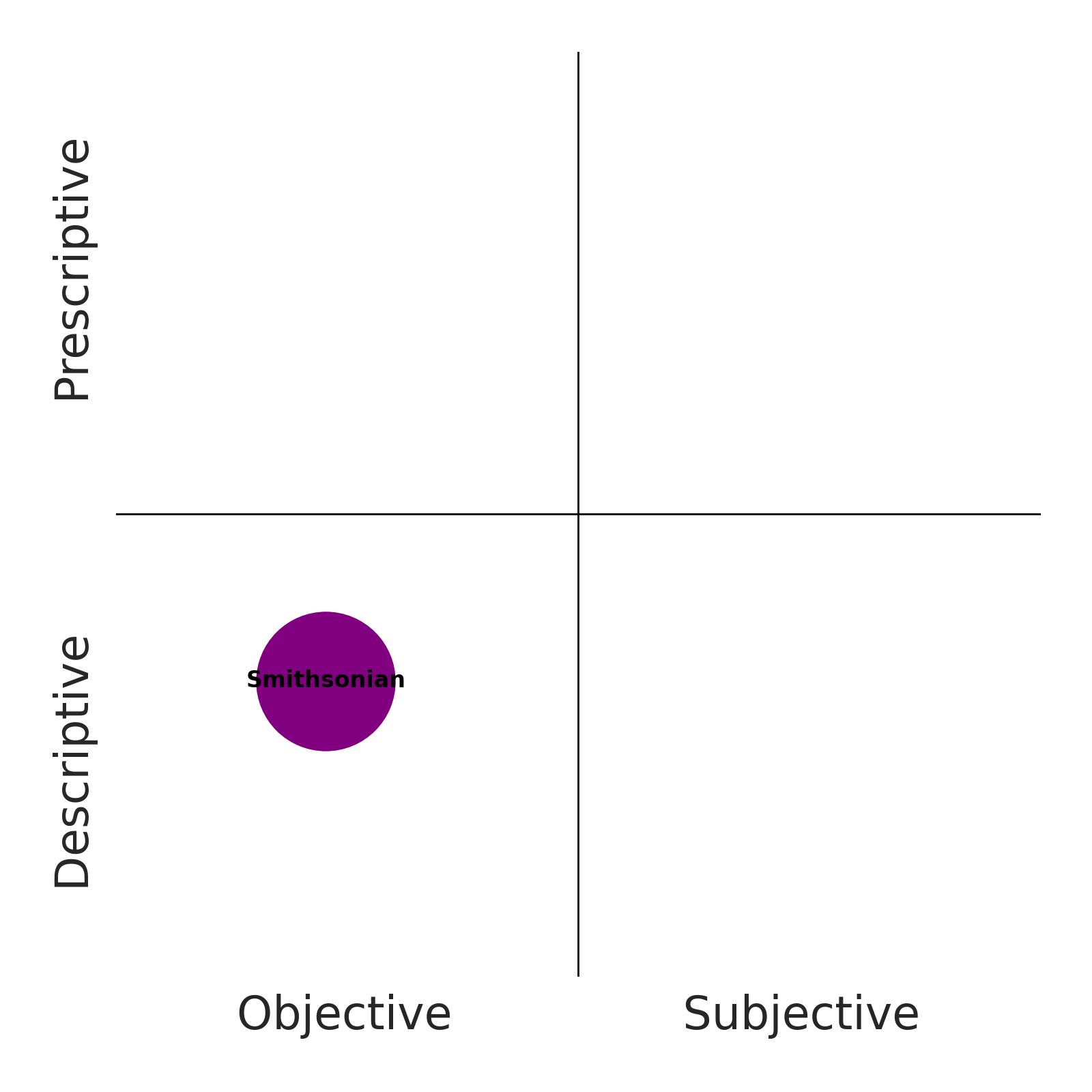
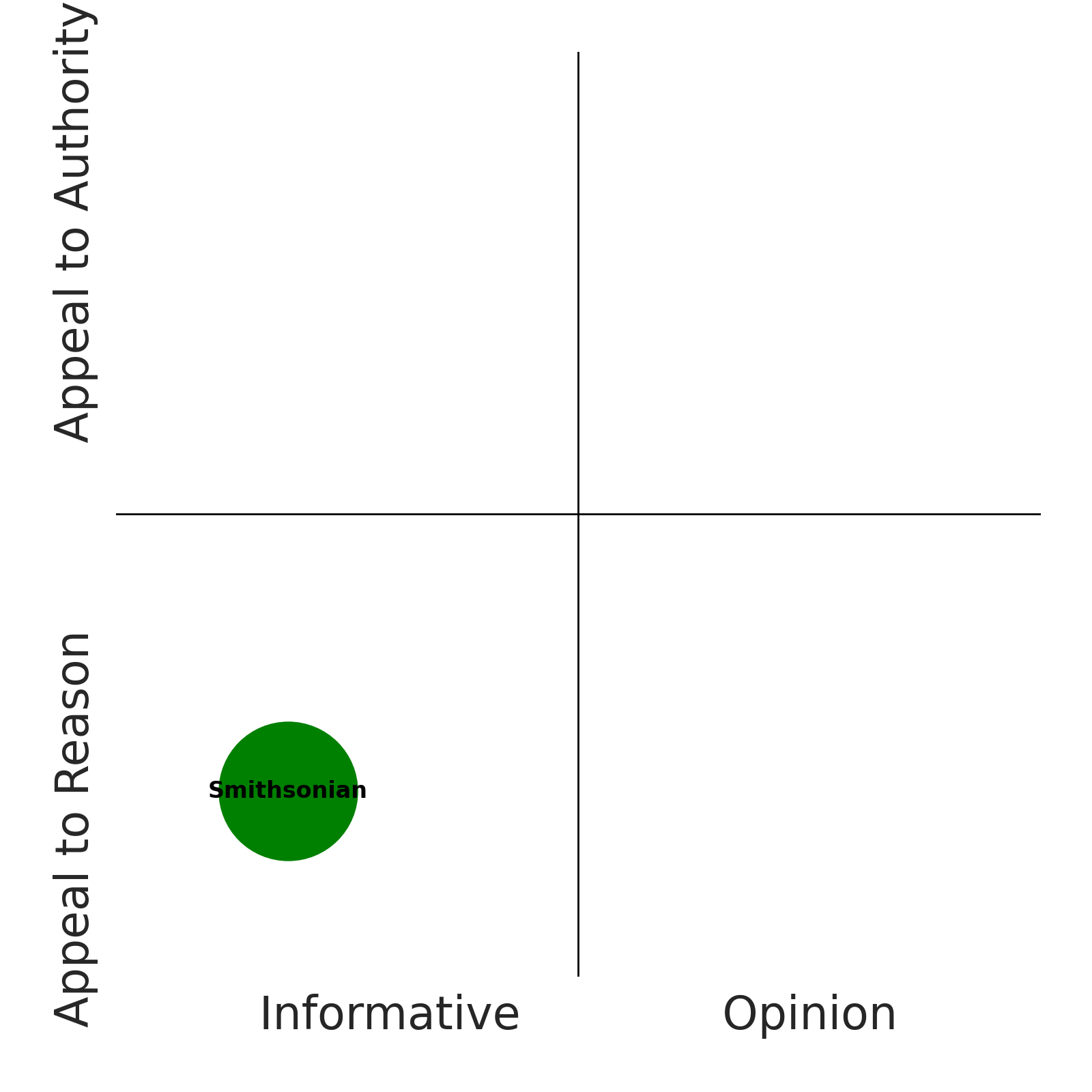
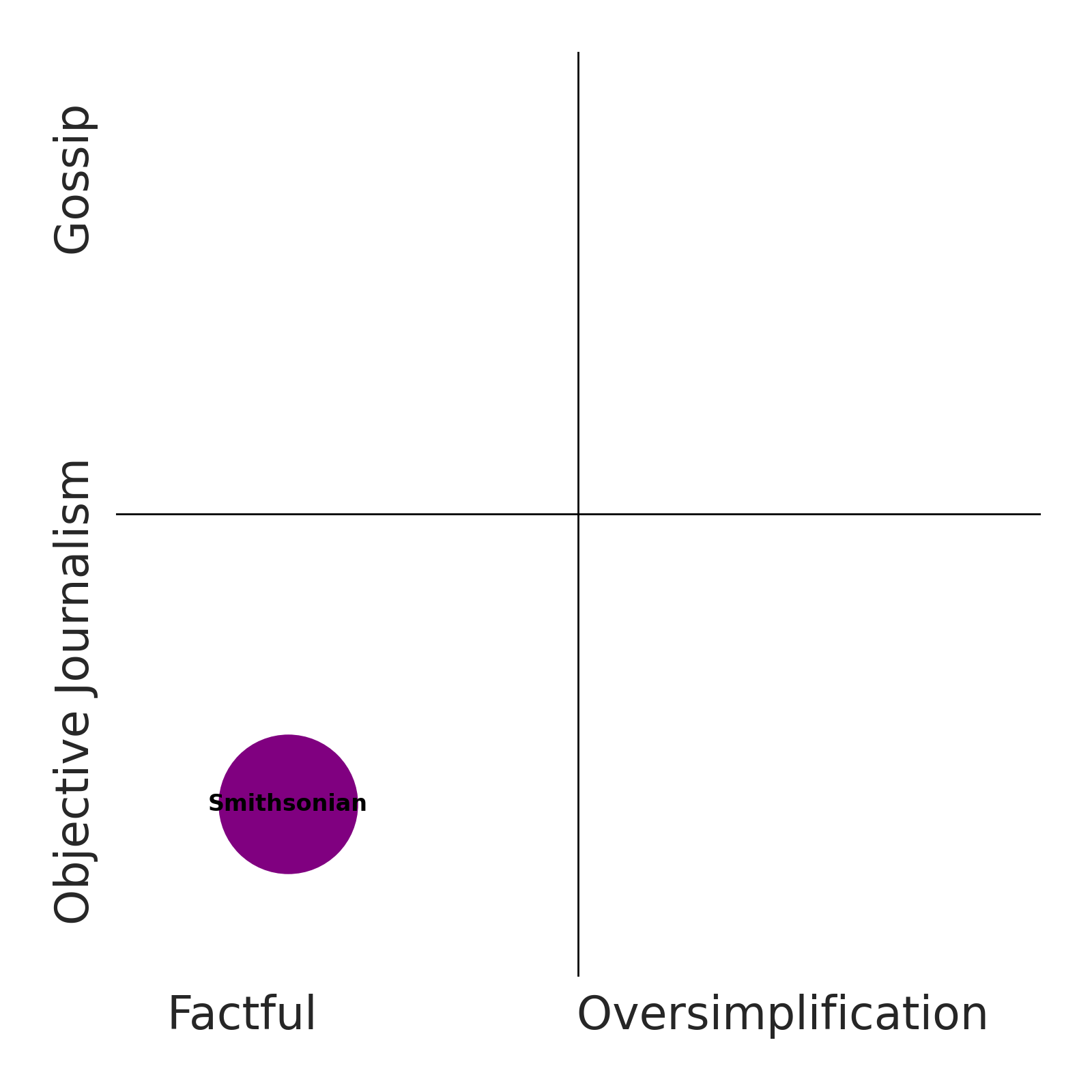
2026 © Helium Trades
Privacy Policy & Disclosure
* Disclaimer: Nothing on this website constitutes investment advice, performance data or any recommendation that any particular security, portfolio of securities, transaction or investment strategy is suitable for any specific person. Helium Trades is not responsible in any way for the accuracy
of any model predictions or price data. Any mention of a particular security and related prediction data is not a recommendation to buy or sell that security. Investments in securities involve the risk of loss. Past performance is no guarantee of future results. Helium Trades is not responsible for any of your investment decisions,
you should consult a financial expert before engaging in any transaction.
Helium Research Assistant

How can I help you today?
Ask any question about Smithsonian bias.


