See whether Helium helps you make better-informed decisions. Try every Pro Trader feature for 30 days. No credit card required.
Try every Pro Trader feature for 30 days. No credit card required.
General framing and worldview. The supplied sample indicates a predominantly liberal-progressive, civil-liberties-oriented perspective, especially in political and institutional coverage.
The source repeatedly scrutinizes executive power, surveillance, immigration enforcement, election restrictions, and alleged politicization, while sympathizing with vulnerable groups and institutional checks.
Examples include its treatment of Trump’s voting proposals as efforts to “make Trump’s math work”
August 16, 2026 · 0 shares
Framing characterizes Trump's voting measures as baseless, punitive tactics to alter electoral math, while acknowledging Republican opposition and real administrative strain.
Automated analysis; not human reviewed. Limitations: The supplied text is an opinionated commentary with embedded quotations and statistics; I could not independently verify cited figures or quoted statements beyond the text. · 12 of 54 available dimensions scored; omitted dimensions are not treated as neutral. · Verified supporting quotes for 12 of 12 scored dimensions.
Claim: The publisher frames Trump's voting measures as illegitimate partisan vote-rigging.
“The SAVE America Act is just one part of a package that includes an executive order and threats of prosecution, all in an effort to make Trump’s math work.” · exact text match
Why: The framing explicitly attributes electoral manipulation intent to Trump's policies.
Claim: The article criticizes state coercion in election administration.
“Would that mean federal agents stationed around polling places—election suppression with a badge?” · exact text match
Why: The rhetorical question presents federal enforcement at polling places as suppression, indicating opposition to coercive state power.
Claim: The article mixes reporting with subjective speculation about Trump's motives.
“His proposals would not yield security, but they could lead to disorder, or the perception of it, which he could make use of in the wake of a close election.” · exact text match
Why: This is an unverified interpretive claim about likely consequences and purpose.
Claim: The article conveys a negative assessment of the current voting-system situation.
“Trump is also poisoning the process at a moment when the system for casting votes in the United States really does need shoring up.” · exact text match
Why: The word "poisoning" and the framing of a system under stress indicate pessimistic tone.
Claim: The article is strongly opinionated rather than neutral.
“The order is an absolute mess; if it were ever fully put into effect, it would not only disenfranchise many eligible citizens but break the mail-in-voting system and possibly the Postal Service.” · exact text match
Why: Strong evaluative language and policy prediction are presented as analysis.
Claim: The article frames the issue as partisan political manipulation.
“The SAVE America Act is just one part of a package that includes an executive order and threats of prosecution, all in an effort to make Trump’s math work.” · exact text match
Why: The framing treats the measures as electoral tactics rather than neutral administration.
Claim: The article states categorical factual conclusions without supplying supporting evidence in the text.
“None of those claims are true.” · exact text match
Why: The assertion is presented as certain, while the supplied text does not provide the underlying verification.
Claim: The article uses emotionally negative language about the voting-process situation.
“Trump is also poisoning the process at a moment when the system for casting votes in the United States really does need shoring up.” · exact text match
Why: "Poisoning" is a negatively charged metaphor, though the overall tone remains analytical.
Claim: The article is moderately credible due to named sourcing and attribution.
“According to the Brennan Center, some local election managers get spare parts for voting machines on eBay.” · exact text match
Why: It cites a named research organization for specific facts, though the surrounding commentary is opinionated.
Claim: The article's analysis is reasoned and evidence-driven.
“There are multiple ironies here. As Murkowski’s objections indicate, some of the Americans most affected by these rules would be rural voters, who tend to lean Republican.” · exact text match
Why: Uses concrete examples and irony to evaluate policy effects rather than relying on pure assertion.
Claim: The article speculates about Trump's motives and future actions.
“He may also be looking for excuses should the midterms deliver a rebuke to his Presidency.” · exact text match
Why: Explicitly hedged speculation about unobservable intent.
Claim: The article demonstrates nuanced analytical reasoning.
“There are multiple ironies here. As Murkowski’s objections indicate, some of the Americans most affected by these rules would be rural voters, who tend to lean Republican.” · exact text match
Why: It considers unintended consequences and countervailing evidence rather than a one-note polemic.
The supplied text is an opinionated commentary with embedded quotations and statistics; I could not independently verify cited figures or quoted statements beyond the text.
July 24, 2026 · 0 shares
The publisher frames ICE detention as an unprecedented, politically charged escalation and uses Alsainy's story to argue that the Trump Administration sabotages the system of legal immigration.
A narrative feature by Jonathan Blitzer about a Guinean refugee detained by ICE at an immigration court in 2025, used to illustrate policy changes.
Automated analysis; not human reviewed. Limitations: Analysis restricted to the provided text; may not reflect broader editorial practices or other articles from the same publisher. · 18 of 52 available dimensions scored; omitted dimensions are not treated as neutral. · Verified supporting quotes for 0 of 18 scored dimensions.
Single-case framing; limited sourcing; context could shift conclusions.
Sympathetic profile of Arab American civil-rights lawyer Abdeen Jabara that frames FBI and NSA surveillance during Operation Boulder as a constitutional overreach and civil-liberties violation.
The piece is an adapted excerpt from 'Seasons of Fury: Four Families and the Rise of Islamophobia in America,' published by The New Yorker (Condé Nast).
Automated analysis; not human reviewed. Limitations: Analysis relies solely on the supplied text; the publisher's underlying sourcing of the surveillance statistics and the legal outcomes could not be independently verified. · 48 of 54 available dimensions scored; omitted dimensions are not treated as neutral. · Verified supporting quotes for 2 of 48 scored dimensions.
Claim: The piece consistently sympathizes with Palestinian national aspirations and is critical of U.S. support for Israel, leaning liberal.
“A federal judge ruled that Abdeen’s Fourth Amendment and privacy rights had been violated.” · exact text match
“No one had been charged with a crime.” · exact text match
Why: The framing of the surveillance and deportation as groundless and rights-violating, plus the explicit sympathy for Arab political causes, indicates a center-left political stance.
Claim: The narrative celebrates grassroots Arab American activism and community organizing over elite or institutional channels.
“It was increasingly clear to Abdeen that Arab American political power would be cultivated here, in coffeehouses and on the streets, not just on college campuses.” · exact text match
Why: Support for local activism over institutional power is present but not a dominant theme across the whole piece.
Claim: The article is sharply critical of state surveillance powers.
“Abdeen learned that the government had amassed an extensive file, covering his organizational affiliations, his travels through the country and abroad, transcripts of phone conversations, and notes from interviews with more than a hundred acquaintances, bank transactions, and summaries of speeches.” · exact text match
“It was not worth the manpower that went into it, one official explained.” · not found in supplied text
Why: Surveillance programs and agencies are depicted as overreaching and abusive; the tone is firmly civil-libertarian.
Analysis relies solely on the supplied text; the publisher's underlying sourcing of the surveillance statistics and the legal outcomes could not be independently verified.
July 30, 2026 · 0 shares
Framing emphasizes the deliberate erosion of VOA's editorial firewall under Trump-era leadership, portraying suppression of independent reporting and politicization of coverage.
Automated analysis; not human reviewed. Limitations: The piece relies heavily on VOA staff interviews and quotes, with limited direct responses from Trump-aligned officials; this may color the framing toward independent journalism and anti-authoritarian framing. · 40 of 52 available dimensions scored; omitted dimensions are not treated as neutral. · Verified supporting quotes for 1 of 40 scored dimensions.
Claim: Trump-era actions are framed as undermining independence of journalism.
“The White House justified the order with a news release titled 'The Voice of Radical America'.” · not found in supplied text
Why: Direct quote demonstrates negative framing of Trump-era policy toward VOA.
Claim: The piece uses emotive framing to critique political interference.
“"The firewall has burned down."” · verified after text normalization
“"The rot is so bad," she told me. "It’s unsalvageable right now."” · not found in supplied text
Why: Direct emotive language indicates subjective framing.
Claim: Interference in VOA is framed as a breakdown of established norms of journalistic firewall protection.
“The firewall has burned down.” · exact text match
Why: The phrase signals critique of political interference in a long-standing institutional guard.
Claim: VOA independence and credibility are presented as normative standards.
“'accurate, objective and comprehensive' reporting” · not found in supplied text
“firewall to protect editors from a President's predilections.” · not found in supplied text
Why: Citations of formal standards and protections support an integrity framing.
The piece relies heavily on VOA staff interviews and quotes, with limited direct responses from Trump-aligned officials; this may color the framing toward independent journalism and anti-authoritarian framing.
August 12, 2026 · 0 shares
Neutral factual reporting of primary election results with background on endorsements and candidate controversies, without editorial slant.
Automated analysis; not human reviewed. Limitations: The article text is short and includes unrelated snippets; analysis limited to the election portion. · 6 of 53 available dimensions scored; omitted dimensions are not treated as neutral. · Verified supporting quotes for 1 of 6 scored dimensions.
Claim: The article treats candidates from both parties neutrally without favor.
“It reports Crowley's win and Hong's loss without editorializing.” · not found in supplied text
“It also reports Tom Tiffany's nomination without criticism.” · not found in supplied text
Why: Both Democratic and Republican outcomes are reported with equal factual depth.
Claim: The article uses purely factual language without subjective adjectives or opinion.
“The Milwaukee County executive defeated Francesca Hong” · exact text match
“Hong has since walked back her position on defunding the police and has said that Thanksgiving is her favorite holiday.” · not found in supplied text
Why: All statements are presented as verifiable facts with no evaluative language.
Claim: The article only describes events and does not prescribe actions or advocate for outcomes.
“Wisconsin Primary-Election Results: David Crowley Wins.” · exact text match
“On the Republican side, Tom Tiffany, a MAGA Republican endorsed by Donald Trump, has secured the nomination.” · exact text match
Why: No imperative mood, recommendations, or normative language.
Claim: The entire article is about a political primary election, making it highly political.
“The article's subject is the Wisconsin Democratic and Republican gubernatorial primaries.” · not found in supplied text
“It mentions endorsements, candidate backgrounds, and party affiliations.” · not found in supplied text
Why: Content is exclusively about electoral politics.
Claim: The article uses specific, verifiable facts and attributions, though some statements lack direct sourcing.
“Hong was endorsed by several national progressive figures, including Representatives Ro Khanna and Ilhan Omar.” · not found in supplied text
“Barnes dropped out citing polls that suggested Hong’s lead was insurmountable.” · not found in supplied text
Why: Most claims are concrete and attributable, but the poll reference is vague and unattributed.
Claim: The article presents a logical, chronological sequence of events without illogical leaps.
“Initially, Hong's main challenger was Mandela Barnes, but Barnes dropped out of the race in late July, citing polls that suggested Hong’s lead was insurmountable. Crowley quickly relaunched his campaign.” · not found in supplied text
Why: The narrative follows cause and effect: Barnes drops out, Crowley relaunches, then wins.
The article text is short and includes unrelated snippets; analysis limited to the election portion.
Coverage selection and topics. Politics and public institutions are prominent: Trump, elections, federal agencies, courts, immigration, Israel, India, the Democratic Socialists of America, and intra-party ideological change
August 07, 2026 · 0 shares
Framing positions the DSA as a controversial force and questions the depth of its socialism while attributing the critique to Remnick.
Automated analysis; not human reviewed. Limitations: Limited to a short podcast description; full interview transcript not available. · 2 of 53 available dimensions scored; omitted dimensions are not treated as neutral. · Verified supporting quotes for 1 of 2 scored dimensions.
Claim: The article is purely descriptive, reporting the interview and positions without prescribing any action.
“Remnick talks with a co-chair of the D.S.A., Megan Romer, who recently went viral for a lightning round of questions pitched at her on Fox News. Romer defends controversial D.S.A. positions...” · not found in supplied text
Why: The text simply describes the interview and the positions defended, without advocating for or against them.
Claim: The article frames the emergence of socialism as a major election story and presents Romer's defense of controversial positions, making it highly political.
“One of the biggest stories of this election cycle is the emergence, for the first time in a long time, of socialism as a force on the national stage.” · exact text match
Why: The opening line explicitly labels socialism's emergence as a major story, setting a political context.
Limited to a short podcast description; full interview transcript not available.
July 31, 2026 · 0 shares
Frames the mayoral race as a progressive challenge to the incumbent, emphasizing the candidate's Democratic Socialist alignment and criticism of Democratic leadership.
Automated analysis; not human reviewed. Limitations: The article text is very short (a few sentences), limiting the depth of bias analysis. The focus is on a single candidate's perspective without rebuttal, but the publisher's framing is minimal. · 2 of 52 available dimensions scored; omitted dimensions are not treated as neutral. · Verified supporting quotes for 1 of 2 scored dimensions.
Claim: The article uses factual, neutral language without subjective editorializing.
“The city-council member Nithya Raman was an ally of Karen Bass, but Raman launched a challenge against her to bring more 'urgency' to fighting the city’s housing crisis.” · not found in supplied text
Why: The statement is a straightforward factual report of a political event. No evaluative adjectives or opinion are present.
Claim: The article is entirely about a political campaign and political affiliations.
“The Democratic Socialist Running for Mayor of Los Angeles” · exact text match
“Raman is aligned with the Democratic Socialists of America” · exact text match
“her frustration with Democratic leadership” · exact text match
Why: All substantive content concerns a mayoral election, candidate alignment, and criticism of an incumbent Democrat.
The article text is very short (a few sentences), limiting the depth of bias analysis. The focus is on a single candidate's perspective without rebuttal, but the publisher's framing is minimal.
August 03, 2026 · 0 shares
Frames India's Gen Z protests as a justified uprising against an increasingly authoritarian government, emphasizing media control and youth desperation.
India's Prime Minister Modi has been in power since 2014, leading the Hindu nationalist BJP. The protests occurred in a context of high youth unemployment and a competitive exam system for government jobs.
Automated analysis; not human reviewed. Limitations: The analysis relies on an interview format; publisher framing is limited to the introductory paragraph and question selection. · 13 of 52 available dimensions scored; omitted dimensions are not treated as neutral. · Verified supporting quotes for 12 of 13 scored dimensions.
Claim: Publisher frames Modi's government as increasingly authoritarian and criticizes the Hindu nationalist agenda.
“an increasingly authoritarian government” · exact text match
“massive crackdown on dissent, on free speech, on progressive thought” · exact text match
Why: Direct characterization by the publisher in the introductory paragraph and quote selection.
Claim: Publisher sympathizes with common people and protesters against an unresponsive government.
“fuelled concerns that the government didn’t care about lacklustre job opportunities for young Indians” · exact text match
Why: Publisher highlights government neglect of youth and working class.
Claim: Publisher strongly criticizes the government's authoritarian actions and media control.
“an increasingly authoritarian government” · exact text match
“violent response from local authorities” · exact text match
“complete crackdown on dissent” · exact text match
Why: Repeated condemnation of authoritarian behavior.
Claim: Publisher uses subjective language in framing the events.
“shocking concession from an increasingly authoritarian government” · exact text match
Why: Loaded adjectives like 'shocking' and 'authoritarian' are opinionated.
Claim: Publisher's introductory paragraph contains opinionated statements.
“shocking concession from an increasingly authoritarian government” · exact text match
Why: Subjective characterization of the government and the resignation.
Claim: Article is heavily focused on political analysis of protests and government.
“What Do India's Gen Z Protests Mean for Modi?” · exact text match
Why: Headline and entire content center on political implications for Modi.
Claim: Publisher portrays protesters as victims of government crackdown and media blackout.
“Many of the demonstrations were met with harsh words from the Modi administration and a violent response from local authorities” · exact text match
“It was a complete blackout.” · exact text match
Why: Emphasizes government violence and media suppression.
Claim: Publisher is anti-establishment, criticizing the government and mainstream media.
“systematic breakdown of that outlet” · exact text match
“media as an extension of the government” · exact text match
Why: Direct criticism of establishment media and government collusion.
Claim: Article has a slightly negative emotional tone towards the government.
“shocking concession from an increasingly authoritarian government” · exact text match
Why: Negative adjectives like 'shocking' and 'authoritarian' convey disapproval.
Claim: Article builds credibility through named experts, specific data, and transparent sourcing.
“I recently spoke by phone with Manisha Pande, editor-in-chief of Newslaundry” · not found in supplied text
“We did a survey, looking at three to four months of television news coverage” · exact text match
Why: Attributes information to a named source and provides survey data.
Claim: Article provides reasoned analysis with data and an expert interview.
“In the 2019 general election, the B.J.P. won three hundred and three out of five hundred and forty-two seats” · exact text match
“We did a survey, looking at three to four months of television news coverage” · exact text match
Why: Uses empirical data and specific statistics.
Claim: Article includes speculation about future protests and government actions.
“you’re going to see a lot of these flash points ahead” · exact text match
“I’m expecting harsher laws for all of us in the digital news space” · exact text match
Why: Predictive statements about future events.
Claim: Publisher maintains integrity by clearly labeling the interview and attributing opinions.
“I recently spoke by phone with Manisha Pande, who has been covering the protests as editor-in-chief of the site Newslaundry. During our conversation, which has been edited for length and clarity” · exact text match
Why: Transparent sourcing and editing disclosure.
The analysis relies on an interview format; publisher framing is limited to the introductory paragraph and question selection.
August 03, 2026 · 0 shares
Strongly critical profile framing Trump's character as indelibly shaped by Cohn's unethical tactics, emphasizing racism, legal manipulation, and media control.
Automated analysis; not human reviewed. · 9 of 52 available dimensions scored; omitted dimensions are not treated as neutral. · Verified supporting quotes for 4 of 9 scored dimensions.
Claim: The article frames Trump's character and actions through a critical, left-leaning lens, emphasizing racism, corruption, and rule-breaking.
“The lawyer who showed an outer-borough striver how to ignore the rules, avoid a paper trail, and make up a good story for the media.” · exact text match
“American scoundrel — Roy Cohn’s Dark Journey from Joe McCarthy to Donald Trump.” · not found in supplied text
Why: The headline and subtitle set a pejorative tone, and the narrative consistently highlights unethical behavior, aligning with liberal critique of Trump.
Claim: The article uses subjective, evaluative language and narrative framing rather than purely objective reporting.
“The prenup was shockingly one-sided.” · exact text match
“Trump was not worth two hundred million dollars.” · exact text match
Why: The author employs adjectives like 'shockingly one-sided' and makes definitive judgments about Trump's wealth, indicating subjective editorializing.
Claim: The article provides richly detailed, narrative storytelling that is engaging and informative.
“The lawyer who showed an outer-borough striver how to ignore the rules, avoid a paper trail, and make up a good story for the media.” · exact text match
Why: The opening hook and extensive anecdotes about famous figures create high reader interest.
Claim: The article includes personal, salacious details about Trump and Cohn's private lives.
“I saw things happening there that to this day I have never seen again ... I would watch supermodels getting screwed, well-known supermodels getting screwed on a bench in the middle of the room.” · not found in supplied text
“Cohn lived a secret life, hooking up regularly with gay hustlers.” · exact text match
Why: These details are not central to the policy or legal analysis but serve to titillate, fitting the gossip dimension.
Claim: The article blends reported facts with strong opinionated framing.
“The stunt, a show of bravado, dominated local headlines, but, a month later, a federal judge dismissed the Trumps’ suit as frivolous, scolding Cohn that he was 'wasting time and paper.'” · not found in supplied text
“Cohn taught Trump that the pyrotechnics of publicity were more important than the law.” · not found in supplied text
Why: The word 'stunt' and the phrase 'pyrotechnics of publicity' are interpretive, not purely factual, indicating opinion intermixed with reporting.
Claim: The article heavily focuses on political connections, campaign contributions, and government manipulation.
“Cohn leaked a story to the Times that Biaggi had pleaded the Fifth ... Beame was sworn in and Cohn became a trusted adviser.” · not found in supplied text
“In 1983, Cohn used his many connections in Ronald Reagan’s White House to engineer the elevation of Maryanne Trump Barry, Trump’s sister, to a federal judgeship.” · exact text match
Why: The narrative is built around political maneuvering and backroom deals, making politics a central lens.
Claim: The article advances a coherent ideological perspective critical of establishment institutions and Trump.
“Cohn was of New York, but he deeply resented New York’s intellectuals, its universities, and its élite law firms. Trump has always felt the same resentment.” · exact text match
Why: This aligns with a progressive critique that links personal psychology with political resentment, though it is not overtly ideological.
Claim: The article portrays Trump and Cohn in a predominantly negative emotional light.
“American scoundrel” · exact text match
“shockingly one-sided” · exact text match
Why: Pejorative labels and morally charged language induce a negative emotional response toward the subjects.
Claim: The article demonstrates strong sourcing, multiple attributions, and references to documents and quotes.
“Trump wrote in his 1987 book, 'The Art of the Deal'” · not found in supplied text
“In an interview with us last year, Trump relayed a different version” · exact text match
Why: The piece cites books, interviews, court documents, and named journalists, which supports credibility despite interpretive slant.
Gossip-driven celebrity lifestyle framing blends pop culture with antiquities, profiling Leguizamo’s Odyssey involvement through opulent artifacts and on-set anecdotes.
Context: feature about John Leguizamo’s role in Christopher Nolan’s Odyssey and interactions with antiquities during production and gallery visits.
Automated analysis; not human reviewed. · 1 of 52 available dimensions scored; omitted dimensions are not treated as neutral. · Verified supporting quotes for 1 of 1 scored dimensions.
Claim: Gossip-driven framing highlights celebrity, fashion, and material details over substantive film production analysis.
“I look like a gelded you-know-what.” · exact text match
“That’s almost my whole salary for the movie!” · exact text match
“You take credit cards?” · exact text match
Why: Quotations focus on appearance, wealth, and personal anecdotes rather than production analysis.
August 16, 2026 · 0 shares
The framing is a subjective, insider-perspective restaurant review that blends enthusiastic culinary description with mild critique, emphasizing the chef's pedigree and the restaurant's low-waste philosophy.
The article is a restaurant review from The New Yorker, a publication known for its cultural and culinary criticism. The review provides subjective assessment of the restaurant's food and experience.
Automated analysis; not human reviewed. Limitations: The review is based on the author's subjective food experience and personal preferences; no objective or comparative data is provided. The tone is highly positive and may not reflect general consensus. · 12 of 54 available dimensions scored; omitted dimensions are not treated as neutral. · Verified supporting quotes for 8 of 12 scored dimensions.
Claim: The article is a subjective restaurant review based on personal experience and taste.
“I found this both intriguing and intimidating...” · not found in supplied text
“considering how overtly excellent I found Cynthia to be—that’s entirely a good thing.” · exact text match
Why: The entire review is built on the author's personal impressions and opinions of the food and dining experience.
Claim: The article uses vivid, enthusiastic language but remains grounded in detailed description.
“the food, which is punchy, witty, and utterly thrilling.” · exact text match
Why: While the language is enthusiastic and colorful, it does not cross into sensationalism; it's typical food writing.
Claim: The review is extremely positive and highly recommends the restaurant.
“considering how overtly excellent I found Cynthia to be” · exact text match
“the food, which is punchy, witty, and utterly thrilling” · exact text match
Why: The overwhelming tone is praise; the only mild criticisms are about the menu poem and the à-la-carte menu potentially diluting the experience.
Claim: The review expresses a positive and enthusiastic outlook on the restaurant's food and concept.
“a menu of thrilling abundance” · exact text match
“entirely successful on its own” · exact text match
Why: The entire review is positive and uplifting about the dining experience.
Claim: The review provides interesting and detailed insights into a unique restaurant concept and dishes.
“an emphasis on low-waste cooking yields a menu of thrilling abundance” · exact text match
“the menu’s many nods to Cardoso’s Brazilian upbringing” · exact text match
Why: The topic is inherently interesting to food enthusiasts; the review provides details on techniques and concepts.
Claim: The review describes the food and experience without giving prescriptive instructions.
“A corn course, for example, has three parts: ...” · not found in supplied text
“each diner is presented with a card printed with something between a manifesto and a poem” · exact text match
Why: The review is descriptive, detailing dishes and the restaurant's approach, without telling readers what to do or how to think.
Claim: The article is predominantly opinion and personal reflection.
“I found this both intriguing and intimidating” · exact text match
“I felt the same way about the lobster” · exact text match
Why: The article is a subjective review filled with the author's personal reactions, judgments, and preferences.
Claim: The article has no political content.
“There is no political discussion in the review.” · not found in supplied text
Why: The review focuses entirely on the restaurant and food, with no political framing or commentary.
Claim: The review makes definitive judgments about the quality of the food based on personal experience.
“each could have served as a full course, a started-and-finished thought” · exact text match
“utterly thrilling” · exact text match
Why: The reviewer expresses strong personal opinions but does not present them as objective facts.
Claim: The review is published in The New Yorker, an established mainstream publication, and positions the restaurant among other upscale establishments.
“Another upscale West Village restaurant in an ever-deepening sea of upscale West Village restaurants” · exact text match
“a blue-chip pedigree (Per Se, Brooklyn Fare)” · exact text match
Why: The publication is part of the cultural establishment, but the review does not promote establishment politics; it focuses on food and culture.
Claim: The review engages in minimal speculation about the restaurant's motives or future.
“A concession to scale? A move to boost business?” · exact text match
“can any restaurant survive these days if it doesn’t offer a burger?” · exact text match
Why: There are rhetorical questions about the restaurant's decisions, but the review doesn't forecast or speculate extensively.
Claim: The review does not employ manipulative techniques; it is straightforward in its subjective assessment.
Why: The author is transparent about personal opinions and does not omit information or use deceptive framing.
The review is based on the author's subjective food experience and personal preferences; no objective or comparative data is provided. The tone is highly positive and may not reflect general consensus.
August 18, 2026 · 0 shares
A literary, first-person music review that adopts a critical, intellectual framing to dissect the two stars' legacies and the genre's perceived decline, blending admiration with a clear-eyed take on misogyny and complicity.
Automated analysis; not human reviewed. Limitations: I may have a tendency to over-interpret the author's tone as more critical than intended, given the subject matter. · 8 of 54 available dimensions scored; omitted dimensions are not treated as neutral. · Verified supporting quotes for 0 of 8 scored dimensions.
Claim: The article's critical stance toward misogyny and its sympathetic portrayal of marginalized groups suggest a generally liberal perspective.
““A good portion of the music world boosts Brown as its fragile prince, grafting a redemption narrative that flatters his princely persecution complex.”” · not found in supplied text
““It is about the queering of the crooner, the alienation from what is hetero and what is masculine.”” · not found in supplied text
Why: While the article criticizes both left and right, its focus on systemic issues like sexism and the exploitative nature of the music industry aligns with liberal cultural critiques.
Claim: The piece is fundamentally subjective, centering the author's personal impressions, emotions, and interpretations rather than objective reporting.
““His volatility is arousing, his bad-boy act steeped in diagnosed mental suffering.”” · not found in supplied text
““you have to wince at the exposure.”” · not found in supplied text
Why: The use of first-person reaction and emotive language indicates subjectivity.
Claim: The author expresses a mildly pessimistic view of the music industry and the artists' trajectories.
““And so the current Usher is a legacy act, the lover who overstays his welcome.”” · not found in supplied text
““the loss of pleasure-seeking.”” · not found in supplied text
Why: The tone towards the future of the genre and the artists is tinged with disappointment and resignation.
Claim: The essay is engaging and thought-provoking, offering nuanced cultural commentary.
““The shared project is called “The R&B Tour,” a play on words.”” · not found in supplied text
““He was like a live Teddy Pendergrass then, maestro of the boudoir.”” · not found in supplied text
Why: The author provides vivid imagery and maintains a compelling narrative that captures the complexity of the subject matter.
Claim: The article uses strongly opinionated language to evaluate the artists and their work.
“the bloated wreck called “BROWN”” · not found in supplied text
“the artists seem the most venal” · not found in supplied text
Why: These subjective evaluations are presented as the author's judgment, not as objective facts.
Claim: The article is not heavily ideological, but it does assume a progressive perspective that critiques traditional gender roles and corporate exploitation.
““It is about the queering of the crooner, the alienation from what is hetero and what is masculine.”” · not found in supplied text
Why: While not pushing a rigid ideology, the piece's stance against misogyny and its criticism of the music industry reflect a subtly leftist framework.
Claim: The report is based on a first-person account with specific details, boosting credibility for the events described.
““The writer Alphonse Pierre, in a recent pan of Brown’s latest album, the bloated wreck called “BROWN,” was right to call out critics for an attitude of righteous neglect toward the artist.”” · not found in supplied text
Why: Specific observations like the crowd's reaction and the annoyed fan's words ground the account, but the piece clearly distinguishes between factual reporting and subjective interpretation.
Claim: The author presents a reasoned, logical progression in evaluating the cultural context of the tour, with no overt logical fallacies.
““The writer Alphonse Pierre, in a recent pan of Brown’s latest album, the bloated wreck called “BROWN,” was right to call out critics for an attitude of righteous neglect toward the artist.”” · not found in supplied text
Why: The article explicitly endorses a critical perspective, suggesting a logical, well-reasoned stance.
I may have a tendency to over-interpret the author's tone as more critical than intended, given the subject matter.
July 25, 2026 · 0 shares
Publisher frames the Whoopi Goldberg revival as a historically grounded, matrilineal lineage of Black performance, balancing reverence for Goldberg’s influence with nuanced critique of its political resonance and 'woke' culture.
Context: A critical review of The Whoopi Monologues revival at Lincoln Center Theatre, analyzing intergenerational lineage, performance, and political resonances.
Automated analysis; not human reviewed. · 13 of 52 available dimensions scored; omitted dimensions are not treated as neutral. · Verified supporting quotes for 0 of 13 scored dimensions.
July 28, 2026 · 0 shares
The framing positions Charli XCX and the Strokes as emblematic of a postmodern, irony-drenched approach to rock, foregrounding fame, authenticity, and genre-blurring within a high-culture, mainstream milieu.
Charli XCX and the Strokes released new albums—Music, Fashion, Film and Reality Awaits—framed as genre-blurring explorations of rock that engage with fame, legacy, and authenticity. The narrative cites production credits, prior work (BRAT, Is This It), the use of Auto-Tune on the Strokes record, and cultural references (John Cale, Marc Jacobs, Martin Scorsese) to situate these releases within a broader pop/rock discourse and celebrity culture.
Automated analysis; not human reviewed. · 3 of 52 available dimensions scored; omitted dimensions are not treated as neutral. · Verified supporting quotes for 1 of 3 scored dimensions.
Claim: Subjective evaluative language dominates the article, rather than impartial reporting.
“Mostly, “Music, Fashion, Film” is ad hoc and confessional, undercooked in a way that feels both pleasing and purposeful.” · exact text match
Why: The sentence signals a subjective assessment rather than neutral description.
Claim: Overall, the writer endorses the albums while acknowledging flaws.
“There’s something fundamentally warped about both ‘Music, Fashion, Film’ and ‘Reality Awaits’—some emptiness or corruption lurking at their centers, threatening to take hold—but it hasn’t prevented me from enjoying the albums.” · not found in supplied text
Why: Balances critique with evident enjoyment, signaling a positive but ambivalent reception.
Claim: The piece clearly expresses opinions about the albums' qualities.
“I surprised myself by eating up the Auto-Tune.” · not found in supplied text
Why: Directly conveys the writer's personal reaction to a musical element.
July 30, 2026 · 0 shares
Prestige-focused, celebratory framing elevates Colson Whitehead as an effortlessly important, multi-genre author whose work blends heavy histories with levity.
Pulitzer Prize–winning author Colson Whitehead is discussed in a Critics at Large episode that surveys his wide-ranging body of work, including The Underground Railroad, Sag Harbor, Harlem Shuffle, and the 2026 Cool Machine.
Automated analysis; not human reviewed. · 6 of 52 available dimensions scored; omitted dimensions are not treated as neutral. · Verified supporting quotes for 0 of 6 scored dimensions.
Claim: Substantial subjective praise and evaluation of Whitehead’s significance.
“"Colson Whitehead’s ascent in the literary world has seemed, like much of what he does, impressively effortless."” · not found in supplied text
“"On the page, Whitehead is a true Gen X ironist, transmitting heavy histories and themes with levity."” · not found in supplied text
“"Despite the occasional darkness of his subject matter, he’s also one of our funniest novelists."” · not found in supplied text
Why: Multiple explicit positive evaluations indicate strong subjective framing.
Claim: Content shows notable interest due to prestige- and humor-oriented framing.
“"The Irony and the Ecstasy of Colson Whitehead."” · not found in supplied text
“"gen X ironist"” · not found in supplied text
“"standup comedian"” · not found in supplied text
Why: Use of provocative descriptors indicates potential interest.
Claim: Descriptive praise rather than prescriptive guidance, reflecting descriptive bias.
“"one of our most important writers"” · not found in supplied text
“"our funniest novelists"” · not found in supplied text
“"playful patter"” · not found in supplied text
Why: Descriptors indicate evaluation rather than calls for action.
Claim: There is explicit opinion-laden framing in favor of Whitehead.
“"one of our most important writers"” · not found in supplied text
“"the funniest novelists"” · not found in supplied text
“"transmitting heavy histories with levity"” · not found in supplied text
Why: Explicit evaluative descriptors indicate opinion bias.
Claim: Framing Whitehead as mainstream and prestigious.
“"The Underground Railroad catapulted Whitehead from literary darling to mainstream celebrity."” · not found in supplied text
“"The author of 'Cool Machine' has become one of our most important writers."” · not found in supplied text
Why: Explicit language positions Whitehead within mainstream, prestige-oriented framing.
Claim: The piece relies on named hosts and direct quotes to support claims.
“"On this episode of Critics at Large, Vinson Cunningham, Naomi Fry, and Alexandra Schwartz survey Whitehead’s wide-ranging body of work."” · not found in supplied text
“"The hosts are joined by their fellow staff writer Julian Lucas, who recently profiled Whitehead for ."” · not found in supplied text
Why: Use of named sources and explicit quotes enhances credibility; however content is promotional.
A first-person memoir essay frames middle-age vision loss as a personal yet universal rite of passage, blending lyrical self-reflection with measured scientific explanation and little alarm.
Automated analysis; not human reviewed. Limitations: No external fact-checking or publication metadata was supplied, so the scoring depends entirely on the presented text. · 8 of 54 available dimensions scored; omitted dimensions are not treated as neutral. · Verified supporting quotes for 4 of 8 scored dimensions.
Claim: The piece is primarily a first-person story, with sensory memories, thoughts, and opinions shaping the framing.
“I had contradictory thoughts: Middle age is upon me, followed by This is how a newborn must see.” · exact text match
Counterevidence:
“About thirty per cent of all adults are myopes; the rate is similar for hyperopes.” · exact text match
Why: The personal narrative and interior responses are persistent, though the reporting also includes scientific data.
Claim: The style is matter-of-fact and culturally observant, not alarmist or over hypodist.
““Yup, you’re at that age,” the optometrist said, not making eye contact. “It happens.”” · exact text match
Why: The condition is treated as almost routine, and the emotional episodes are understated.
Claim: The article is lively and specific, mixing unusual personal observations, human cases, and unexpected scientific research.
“Mice predisposed to disease were being guarded and watched, against the clock, like tiny celebrities.” · not found in supplied text
Why: The individualized clinical vignettes and expressive images make the topic engaging.
Claim: A first-person essay supplies personal opinions and reactions rather than only neutral facts.
“I’d usually found that aspect of the exam suspiciously unscientific, too trusting of the patient.” · not found in supplied text
Why: The line expresses the author’s own outside appraisal within an otherwise instructive essay.
Claim: The text uses named experts, named institutions, and attributed patient statements for its health claims.
“Houmam Araj, who directs lens research at the National Eye Institute, a part of the National Institutes of Health, told me.” · exact text match
Why: Key facts are anchored in named officials, institutions, and direct interviews, separating personal experience from reported medical knowledge partially.
Claim: The account is grounded in logic, physiological mechanism, and measured explanation rather than emotion or mysticism.
“Presbyopia isn’t a problem of eyeball shape but of the lens: a convex disk, the size of a mini M&M, that sits behind the cornea and helps the eye adjust its focus.” · exact text match
Why: The health condition is presented through cause-and-effect physiology and epidemiology, not through rhetoric.
Claim: The report combines detailed scientific description, epidemiological estimates, clinical anecdotes, and independent literary commentary.
“Myopia is caused by an overlong eye; light carrying the image of an object comes through the cornea, and then the lens, but lands short of the retina—an nearly layered tissue, composed of more than sixty types of types, which transform the light into electrical signals that are interpreted by the brain.” · not found in supplied text
Why: The text shows technical distinction, precise anatomical description, and expert/patient context without oversimplifying.
No external fact-checking or publication metadata was supplied, so the scoring depends entirely on the presented text.
Framing techniques and standards. Political commentary often uses loaded diction, ridicule, moral contrast, and personalization: Trump is associated with rule-breaking and manipulation
August 03, 2026 · 0 shares
Strongly critical profile framing Trump's character as indelibly shaped by Cohn's unethical tactics, emphasizing racism, legal manipulation, and media control.
Automated analysis; not human reviewed. · 9 of 52 available dimensions scored; omitted dimensions are not treated as neutral. · Verified supporting quotes for 4 of 9 scored dimensions.
Claim: The article frames Trump's character and actions through a critical, left-leaning lens, emphasizing racism, corruption, and rule-breaking.
“The lawyer who showed an outer-borough striver how to ignore the rules, avoid a paper trail, and make up a good story for the media.” · exact text match
“American scoundrel — Roy Cohn’s Dark Journey from Joe McCarthy to Donald Trump.” · not found in supplied text
Why: The headline and subtitle set a pejorative tone, and the narrative consistently highlights unethical behavior, aligning with liberal critique of Trump.
Claim: The article uses subjective, evaluative language and narrative framing rather than purely objective reporting.
“The prenup was shockingly one-sided.” · exact text match
“Trump was not worth two hundred million dollars.” · exact text match
Why: The author employs adjectives like 'shockingly one-sided' and makes definitive judgments about Trump's wealth, indicating subjective editorializing.
Claim: The article provides richly detailed, narrative storytelling that is engaging and informative.
“The lawyer who showed an outer-borough striver how to ignore the rules, avoid a paper trail, and make up a good story for the media.” · exact text match
Why: The opening hook and extensive anecdotes about famous figures create high reader interest.
Claim: The article includes personal, salacious details about Trump and Cohn's private lives.
“I saw things happening there that to this day I have never seen again ... I would watch supermodels getting screwed, well-known supermodels getting screwed on a bench in the middle of the room.” · not found in supplied text
“Cohn lived a secret life, hooking up regularly with gay hustlers.” · exact text match
Why: These details are not central to the policy or legal analysis but serve to titillate, fitting the gossip dimension.
Claim: The article blends reported facts with strong opinionated framing.
“The stunt, a show of bravado, dominated local headlines, but, a month later, a federal judge dismissed the Trumps’ suit as frivolous, scolding Cohn that he was 'wasting time and paper.'” · not found in supplied text
“Cohn taught Trump that the pyrotechnics of publicity were more important than the law.” · not found in supplied text
Why: The word 'stunt' and the phrase 'pyrotechnics of publicity' are interpretive, not purely factual, indicating opinion intermixed with reporting.
Claim: The article heavily focuses on political connections, campaign contributions, and government manipulation.
“Cohn leaked a story to the Times that Biaggi had pleaded the Fifth ... Beame was sworn in and Cohn became a trusted adviser.” · not found in supplied text
“In 1983, Cohn used his many connections in Ronald Reagan’s White House to engineer the elevation of Maryanne Trump Barry, Trump’s sister, to a federal judgeship.” · exact text match
Why: The narrative is built around political maneuvering and backroom deals, making politics a central lens.
Claim: The article advances a coherent ideological perspective critical of establishment institutions and Trump.
“Cohn was of New York, but he deeply resented New York’s intellectuals, its universities, and its élite law firms. Trump has always felt the same resentment.” · exact text match
Why: This aligns with a progressive critique that links personal psychology with political resentment, though it is not overtly ideological.
Claim: The article portrays Trump and Cohn in a predominantly negative emotional light.
“American scoundrel” · exact text match
“shockingly one-sided” · exact text match
Why: Pejorative labels and morally charged language induce a negative emotional response toward the subjects.
Claim: The article demonstrates strong sourcing, multiple attributions, and references to documents and quotes.
“Trump wrote in his 1987 book, 'The Art of the Deal'” · not found in supplied text
“In an interview with us last year, Trump relayed a different version” · exact text match
Why: The piece cites books, interviews, court documents, and named journalists, which supports credibility despite interpretive slant.
August 07, 2026 · 0 shares
A scathing critique that frames the confirmation as a shameful surrender of Senate integrity to Trump's demands.
Todd Blanche was Trump's personal criminal defense lawyer before joining the Justice Department. The article references prior events: Trump's tax return lawsuit, the January 6, 2021 attack on the U.S. Capitol, the Jeffrey Epstein case, and an indictment of former FBI director James Comey.
Automated analysis; not human reviewed. Limitations: The article is a strongly opinionated editorial; I must distinguish between the publisher's framing and the underlying facts reported. · 12 of 53 available dimensions scored; omitted dimensions are not treated as neutral. · Verified supporting quotes for 5 of 12 scored dimensions.
Claim: Article frames the confirmation as a shameful failure of the Senate and criticizes the Trump administration.
“The Senate's Shameful Acquiescence to Todd Blanche as Attorney General.” · exact text match
“The performance of the department during this time has been nothing short of disastrous.” · exact text match
“Sheldon Whitehouse said... 'I don’t know where this committee goes after it stops being taken seriously, because all you have to be is on the right partisan side to get this committee to roll over and play dead.'” · not found in supplied text
Why: The headline and body consistently use negative framing toward the Trump administration and Republican senators who confirmed Blanche.
Claim: Article displays an elitist perspective critical of populist Trump supporters.
“the favorable treatment of his accomplice Ghislaine Maxwell have taken a toll, even with Trump’s MAGA base.” · exact text match
“the degree of distrust between Republican lawmakers and the Administration” · exact text match
Why: The term 'MAGA base' is used dismissively, and the article praises senators who oppose the administration as having 'spine'.
Claim: Article is heavily subjective and opinionated.
“shameful acquiescence” · not found in supplied text
“disastrous” · exact text match
“collusive” · exact text match
Why: The article uses value-laden language throughout, rather than neutral reporting.
Claim: Article covers a high-stakes political event with dramatic elements.
“Cassidy’s support, however agonized, provided Blanche with his fiftieth vote, the closest margin for an Attorney General since 1975.” · not found in supplied text
“At this point he choked up, and had to pause for several seconds before proceeding.” · exact text match
Why: The narrative has dramatic tension, a close vote, and emotional moments.
Claim: Article is strongly prescriptive about what the Senate should have done.
“it signifies, in the language of the Constitution, the Senate's 'advice and consent.'” · not found in supplied text
“a vote to confirm him represents a ratification of what has happened on his watch.” · exact text match
Why: The article argues that the Senate should have rejected Blanche, presenting the confirmation as a moral and institutional failure.
Claim: Article is an opinion piece with a strong editorial stance.
“The Senate's Shameful Acquiescence to Todd Blanche as Attorney General.” · exact text match
“All of this is on Blanche, and a vote to confirm him represents a ratification of what has happened on his watch.” · exact text match
Why: The article is structured as an argument, not a straight news report, with clear authorial judgment.
Claim: Article is highly political, focusing on partisan conflict and Senate process.
“The Senate's Shameful Acquiescence to Todd Blanche as Attorney General.” · exact text match
“Committee Democrats were cutting not just about the nominee but about what they described as the cowardice of their colleagues.” · exact text match
Why: The entire article is about a political confirmation process and criticizes the majority party.
Claim: Article states conclusions with high certainty.
“Its leadership has subordinated its traditional independence to the whims of a vengeful President, pursuing flimsy prosecutions of Trump’s political adversaries” · exact text match
Why: The article characterizes the administration's actions as definitively disastrous and illegal without acknowledging uncertainty.
Claim: Article relies on liberal institutionalist ideology.
“subordinated its traditional independence to the whims of a vengeful President” · exact text match
Why: The article assumes that DOJ independence is a normative good and that presidential influence is a violation.
Claim: Article uses negative emotional language throughout.
“shameful” · not found in supplied text
“disastrous” · exact text match
“collusive” · exact text match
Why: The vocabulary is emotionally charged and intended to provoke outrage or disappointment.
Claim: Article is credible in its factual reporting despite editorial stance.
“Bill Cassidy announced on the Senate floor, Friday morning, that he would provide the decisive vote to confirm Blanche.” · not found in supplied text
“Murkowski said that she was 'keenly aware' that the slush fund 'is only off the table because this nomination is pending and the Senate has leverage.'” · not found in supplied text
Why: The article provides specific, attributable quotes and details that can be independently verified.
Claim: Article uses loaded framing and omits any positive counterpoints.
“The performance of the department during this time has been nothing short of disastrous.” · exact text match
“A federal judge termed the arrangement 'collusive' and pronounced herself 'extremely troubled' by Blanche’s testimony” · not found in supplied text
Why: The article presents only negative aspects of Blanche's tenure and the confirmation process, without acknowledging any potential merits or alternative perspectives.
The article is a strongly opinionated editorial; I must distinguish between the publisher's framing and the underlying facts reported.
Critical framing of Trump's TikTok push emphasizes propaganda-like messaging, private-interest entanglements, and national-security concerns.
Background includes long-standing U.S. concerns about ByteDance's data harvesting and potential Chinese government influence; In January 2025 the Supreme Court upheld a law requiring ByteDance to divest TikTok's U.S. operations, after which TikTok went offline for several hours; A U.S.-based joint venture with 50% ownership was announced, involving a consortium that includes Oracle, Silver Lake, and M.G.X.; The piece discusses how TikTok's format and audience shape political messaging and the interplay between government messaging and private actors.
Automated analysis; not human reviewed. · 47 of 52 available dimensions scored; omitted dimensions are not treated as neutral. · Verified supporting quotes for 3 of 47 scored dimensions.
Claim: The article frames Trump's TikTok strategy as propaganda-driven and entangled with private interests.
“machine-automated propaganda and cheap trend mimicry” · exact text match
“flood the algorithm with as much MAGA content as possible” · exact text match
Why: Direct quotes indicate negative framing and suspicion toward strategy.
Claim: Editorial framing relies on emotive, subjective language rather than neutral reporting.
“Mostly, though, the Trump Administration’s TikTok presence so far mirrors the aesthetics of Truth Social: machine-automated propaganda and cheap trend mimicry” · exact text match
“utopia of possibility and promise, helmed by the last great man on Earth: Trump” · exact text match
Why: Examples show overt evaluative language rather than neutral description.
Claim: The piece constructs political developments as existential threats or evils.
“these are the evils the Cabinet warns us of” · exact text match
Why: Use of 'evils' frames the topic in fear-inducing terms.
Claim: The article foregrounds high-certainty claims from Trump that imply confident, definitive action.
“"I saved TikTok, so you owe me big"” · not found in supplied text
“"Essentially, with TikTok, I have the right to sell it or close it"” · not found in supplied text
Why: Quotes show certainty about actions, used to underscore framing rather than neutral reporting.
Claim: The piece portrays blurred boundaries between government and private actors as a deficiency of the system.
“The line between government and private interests has blurred beyond distinction during Trump’s second term” · not found in supplied text
Why: Quote signals concern about governance-private entanglements.
August 03, 2026 · 0 shares
Strongly critical profile framing Trump's character as indelibly shaped by Cohn's unethical tactics, emphasizing racism, legal manipulation, and media control.
Automated analysis; not human reviewed. · 9 of 52 available dimensions scored; omitted dimensions are not treated as neutral. · Verified supporting quotes for 4 of 9 scored dimensions.
Claim: The article frames Trump's character and actions through a critical, left-leaning lens, emphasizing racism, corruption, and rule-breaking.
“The lawyer who showed an outer-borough striver how to ignore the rules, avoid a paper trail, and make up a good story for the media.” · exact text match
“American scoundrel — Roy Cohn’s Dark Journey from Joe McCarthy to Donald Trump.” · not found in supplied text
Why: The headline and subtitle set a pejorative tone, and the narrative consistently highlights unethical behavior, aligning with liberal critique of Trump.
Claim: The article uses subjective, evaluative language and narrative framing rather than purely objective reporting.
“The prenup was shockingly one-sided.” · exact text match
“Trump was not worth two hundred million dollars.” · exact text match
Why: The author employs adjectives like 'shockingly one-sided' and makes definitive judgments about Trump's wealth, indicating subjective editorializing.
Claim: The article provides richly detailed, narrative storytelling that is engaging and informative.
“The lawyer who showed an outer-borough striver how to ignore the rules, avoid a paper trail, and make up a good story for the media.” · exact text match
Why: The opening hook and extensive anecdotes about famous figures create high reader interest.
Claim: The article includes personal, salacious details about Trump and Cohn's private lives.
“I saw things happening there that to this day I have never seen again ... I would watch supermodels getting screwed, well-known supermodels getting screwed on a bench in the middle of the room.” · not found in supplied text
“Cohn lived a secret life, hooking up regularly with gay hustlers.” · exact text match
Why: These details are not central to the policy or legal analysis but serve to titillate, fitting the gossip dimension.
Claim: The article blends reported facts with strong opinionated framing.
“The stunt, a show of bravado, dominated local headlines, but, a month later, a federal judge dismissed the Trumps’ suit as frivolous, scolding Cohn that he was 'wasting time and paper.'” · not found in supplied text
“Cohn taught Trump that the pyrotechnics of publicity were more important than the law.” · not found in supplied text
Why: The word 'stunt' and the phrase 'pyrotechnics of publicity' are interpretive, not purely factual, indicating opinion intermixed with reporting.
Claim: The article heavily focuses on political connections, campaign contributions, and government manipulation.
“Cohn leaked a story to the Times that Biaggi had pleaded the Fifth ... Beame was sworn in and Cohn became a trusted adviser.” · not found in supplied text
“In 1983, Cohn used his many connections in Ronald Reagan’s White House to engineer the elevation of Maryanne Trump Barry, Trump’s sister, to a federal judgeship.” · exact text match
Why: The narrative is built around political maneuvering and backroom deals, making politics a central lens.
Claim: The article advances a coherent ideological perspective critical of establishment institutions and Trump.
“Cohn was of New York, but he deeply resented New York’s intellectuals, its universities, and its élite law firms. Trump has always felt the same resentment.” · exact text match
Why: This aligns with a progressive critique that links personal psychology with political resentment, though it is not overtly ideological.
Claim: The article portrays Trump and Cohn in a predominantly negative emotional light.
“American scoundrel” · exact text match
“shockingly one-sided” · exact text match
Why: Pejorative labels and morally charged language induce a negative emotional response toward the subjects.
Claim: The article demonstrates strong sourcing, multiple attributions, and references to documents and quotes.
“Trump wrote in his 1987 book, 'The Art of the Deal'” · not found in supplied text
“In an interview with us last year, Trump relayed a different version” · exact text match
Why: The piece cites books, interviews, court documents, and named journalists, which supports credibility despite interpretive slant.
Frames Max Miller's domestic abuse allegations as credible and his prior hate crime claim as exaggerated, criticizing Republican leadership for defending him.
Automated analysis; not human reviewed. Limitations: The article's account of the dispute relies heavily on allegations and counter-allegations that are not independently verified within the text. · 10 of 53 available dimensions scored; omitted dimensions are not treated as neutral. · Verified supporting quotes for 4 of 10 scored dimensions.
Claim: The article exhibits a liberal bias by framing Republicans as defending the indefensible and criticizing Trump's excusing of heinous behavior.
“testing his party’s willingness to defend the indefensible.” · exact text match
“much of Trump’s power has come from his command of his party, and so much of that control has come from his practice of excusing heinous behavior, beginning with his own.” · exact text match
Why: The article repeatedly criticizes Republican leadership and Trump, without corresponding criticism of Democrats beyond a single balanced mention.
Claim: The article blends factual reporting with subjective opinionated commentary.
“It is a scandal in itself that Republicans have downplayed the allegations against Miller for so long” · exact text match
“It was at once a moral abdication and perhaps a hint of how this is likely to end” · not found in supplied text
Why: The article includes overtly judgmental statements about the political response, indicating subjectivity.
Claim: The article moves from describing events to prescribing what should have been done.
“It is a scandal in itself that Republicans have downplayed the allegations against Miller for so long” · exact text match
“It is almost tautological that the Republican candidate with the best chance of winning Ohio’s Seventh Congressional District in November is not the person who has been deemed unfit to serve by one of his party’s most senior figures, who has also called on him to 'end the clear pattern of abuse left in his wake.'” · not found in supplied text
Why: The article explicitly states that Republican inaction is a scandal and implies Miller should not be the candidate.
Claim: The article includes personal, trivial details that are gossipy.
“several minutes were spent on whether Miller had, in fact, held a blue bunny hostage” · exact text match
“Miller also accidentally released a shirtless picture of the two-year-old daughter he and Moreno share.” · exact text match
Why: These details are peripheral to the main allegations, focusing on personal and trivial aspects.
Claim: The article contains a significant amount of opinionated commentary.
“It is a scandal in itself that Republicans have downplayed the allegations against Miller for so long, as it was when Democrats declined to act decisively amid the mounting evidence against the Maine Senate candidate Graham Platner.” · exact text match
“And so it was at once a moral abdication and perhaps a hint of how this is likely to end when Trump said, on Monday, 'I’m going to let the families figure that out.'” · not found in supplied text
Why: The article offers strong opinions on the political response and moral implications.
Claim: The article is heavily focused on political scandal and partisan implications.
“Miller is now the central figure in Washington’s most intimate and appalling ordeal.” · exact text match
“Compared with the overlapping crises threatening Trump’s political position—the Iran war, his failure to manage the cost of living, his multiplying corruption scandals—the Miller-Moreno conflict is a smaller matter. But much of Trump’s power has come from his command of his party” · exact text match
Why: The entire article is about a political figure and the political ramifications, with extensive discussion of party dynamics and elections.
Claim: The article appears credible due to detailed sourcing and attribution.
“according to Axios, Trump told Miller in a call that same day that 'things aren’t looking good.'” · not found in supplied text
“data pulled from Hamdan’s Tesla “showed that Hamdan’s windows were up during the entire alleged incident” · exact text match
Why: The article cites specific sources (Axios, Tesla data, lawsuit filings) and attributes claims clearly.
Claim: The article applies rational scrutiny to Miller's account, questioning its plausibility based on evidence.
“I found it difficult to picture a single man alternately driving his car, carrying on an involved screaming match through a window, waving a flag, and trying to ram another car off the road, as Hamdan was accused of doing.” · exact text match
“data pulled from Hamdan’s Tesla “showed that Hamdan’s windows were up during the entire alleged incident, and that the movement of his steering wheel was inconsistent with any effort to swerve or ‘run Miller off the road.’”” · exact text match
Why: The article uses logical inconsistency and objective data to question the plausibility of the incident, demonstrating rational analysis.
Claim: The article demonstrates high integrity by presenting both sides of the allegations and including Miller's denials and actions.
“Miller has vehemently denied all the allegations” · not found in supplied text
“Miller held a live stream during which he announced that he would release documents that would exonerate him.” · exact text match
Why: The article attributes allegations to sources, includes Miller's defense, and notes ongoing legal proceedings.
Claim: The article demonstrates high intelligence through nuanced analysis and connections.
“It is almost tautological that the Republican candidate with the best chance of winning Ohio’s Seventh Congressional District in November is not the person who has been deemed unfit to serve by one of his party’s most senior figures” · exact text match
“the G.O.P.’s internal frictions... are also operating as glimpses of how Trump assesses his own strength” · not found in supplied text
Why: The article connects the Miller case to broader political strategy and Trump's calculation, showing analytical depth.
The article's account of the dispute relies heavily on allegations and counter-allegations that are not independently verified within the text.
Bipartisan populist backlash against A.I. data centers is framed as a growing political force exposing the duplicity of tech billionaire alliances.
Data centers are large, energy-intensive facilities that power cloud computing and artificial intelligence, but they also create local environmental and infrastructure impacts.
Automated analysis; not human reviewed. Limitations: Article text includes extraneous teaser lines that were ignored; the analysis assumes the main body is the relevant content. · 16 of 53 available dimensions scored; omitted dimensions are not treated as neutral. · Verified supporting quotes for 15 of 16 scored dimensions.
Claim: The article presents the data center issue as a bipartisan concern, treating both Democratic and Republican actions with similar weight.
“Politicians, first from the left and then from the center and the right, have spent the past few months hastily distancing themselves from them.” · exact text match
Why: The article explicitly mentions both left and right politicians acting similarly, showing balanced coverage without favoring one side's framing.
Claim: The article emphasizes grassroots opposition and frames the issue as a conflict between ordinary people and tech billionaires.
“People really effing hate data centers” · exact text match
“whether A.I. infrastructure will benefit ordinary people, or just the billionaires behind the technology” · exact text match
Why: Direct quotes capture populist anger and the article posed the question of benefit to ordinary people versus billionaires, aligning with populist framing.
Claim: The article blends factual reporting with some subjective commentary, particularly in describing political events.
“The White House’s most memorable foray into the A.I. debate is still the very weird press conference that Melania Trump held” · exact text match
Why: The adjective 'very weird' is a subjective judgment, while most of the article is reported factually.
Claim: The article emphasizes the problems and slowdowns associated with data center construction, suggesting a bearish outlook.
“at least seventy-five data-center projects, whose costs totalled roughly a hundred and thirty billion dollars, were stopped in the first three months of 2026 alone” · exact text match
Why: The focus on halted projects, local opposition, and resource strain paints a negative picture for the data center industry.
Claim: The article covers a timely, cross-partisan political issue with concrete data and vivid quotes, making it engaging.
“What makes data centers interesting not just as a local issue but as a national one is that they might allow Democrats to highlight the duplicity of Trump’s politics of populism” · not found in supplied text
Why: The article itself states the topic is interesting, and the combination of local detail, polling, and political strategy supports this.
Claim: The article includes references to potential job automation and local infrastructure strain that could induce concern.
“the statements from the tech industry about widespread job displacement have grown increasingly dystopian” · exact text match
Why: The word 'dystopian' and the mention of automation fears introduce an element of worry, but the article also counters with lack of evidence so far.
Claim: The article contains some explanatory analysis and commentary beyond pure facts.
“For the Trump Administration, the A.I. backlash is at once a source of political trouble and an expression of its second-term rudderlessness” · exact text match
Why: The characterization of the administration as 'rudderless' is an opinion, though the rest is largely reported.
Claim: The entire article is about the intersection of technology and electoral politics, with extensive political commentary.
“A.I. Is Now a Major Election Issue” · exact text match
Why: The headline and content are explicitly about electoral politics, candidates, and governance.
Claim: The article portrays local communities as being negatively impacted by data centers without sufficient protection.
“Unless and until we protect local communities from the power of corrupting money and politics, we’re going to continue to see projects like this get pushed onto local communities despite themselves” · exact text match
Why: The quote frames communities as vulnerable to outside money and power, implying they are victims.
Claim: The article shows a slight ideological preference for community protection and skepticism of corporate-driven technology.
“Politicians, first from the left and then from the center and the right, have spent the past few months hastily distancing themselves from them.” · exact text match
Why: The framing that politicians are 'hastily distancing' suggests a critical view of the industry, but the article is not strongly ideological.
Claim: The article uses emotional quotes and descriptions that evoke negative feelings toward data centers.
“People really effing hate data centers” · exact text match
Why: The strong language in the quote indicates negative emotion, but the article mostly maintains neutral tone.
Claim: The article cites specific polls, data from watchdogs, and named officials, supporting its trustworthiness.
“according to Gallup” · exact text match
“according to Data Center Watch” · exact text match
Why: Multiple attributions and specific quantitative data enhance credibility.
Claim: The article is critical of tech companies and billionaires, portraying them as benefiting at the expense of the public.
“whether A.I. infrastructure will benefit ordinary people, or just the billionaires behind the technology” · exact text match
Why: The framing questions corporate benefit and implies imbalance, showing anti-corporate leaning.
Claim: The article emphasizes collective community interests over individual or corporate interests.
“how long it takes to drive past one at highway speed (1 minute 42 seconds for the Port Washington site)” · exact text match
Why: The focus on local impacts and community protection indicates a collectivist perspective.
Claim: The article includes speculative statements about future job displacement and political consequences.
“the technology would be able to automate most white-collar tasks within twelve to eighteen months” · exact text match
Why: The automation timeline is a speculative forecast, though attributed and later walked back.
Claim: The article includes attributions, acknowledges uncertainty, and presents multiple perspectives, indicating fair reporting.
“Even if that’s an overstatement, or corporate hype—there’s little evidence of job loss so far, and Suleyman later walked back his remarks” · exact text match
Why: The article explicitly qualifies a strong claim and notes the retraction, showing intellectual honesty.
Article text includes extraneous teaser lines that were ignored; the analysis assumes the main body is the relevant content.
August 12, 2026 · 0 shares
Satirical framing uses an absurd CIA ice-cream archive premise to mock government secrecy and produce humor.
Automated analysis; not human reviewed. Limitations: The article consists only of a satirical headline and metadata, limiting analysis to framing of a single sentence. No substantive reporting or data available. · 5 of 53 available dimensions scored; omitted dimensions are not treated as neutral. · Verified supporting quotes for 5 of 5 scored dimensions.
Claim: The article presents a clearly non-objective, humorous premise.
“America!: Newly Declassified Secrets from the C.I.A.'s Ice-Cream Archives.” · exact text match
Why: The headline is a fantastical, unsubstantiated claim intended for humor, indicating maximal subjectivity.
Claim: The headline uses sensational language to attract attention.
“America!: Newly Declassified Secrets from the C.I.A.'s Ice-Cream Archives.” · exact text match
Why: The phrase 'Newly Declassified Secrets' is typical of sensational headlines, even though the content is absurd.
Claim: The premise of CIA ice-cream archives is unusual and likely to pique curiosity.
“America!: Newly Declassified Secrets from the C.I.A.'s Ice-Cream Archives.” · exact text match
Why: The absurd combination of CIA secrecy and ice-cream creates an interesting hook.
Claim: The piece references the CIA and government secrecy, implying a political subject.
“America!: Newly Declassified Secrets from the C.I.A.'s Ice-Cream Archives.” · exact text match
Why: The CIA is a government agency, making the satirical target political, though lightly.
Claim: The content is silly and not serious, characteristic of immaturity.
“America!: Newly Declassified Secrets from the C.I.A.'s Ice-Cream Archives.” · exact text match
Why: The idea of ice-cream archives is childish and unserious, fitting a low level of maturity.
The article consists only of a satirical headline and metadata, limiting analysis to framing of a single sentence. No substantive reporting or data available.
Satirical and mocking framing that trivializes political figures through exaggerated and fictionalized anecdotes.
Automated analysis; not human reviewed. Limitations: The article is satirical, making classification of bias dimensions challenging due to intentional exaggeration and fictional elements. · 5 of 53 available dimensions scored; omitted dimensions are not treated as neutral. · Verified supporting quotes for 5 of 5 scored dimensions.
Claim: The article is highly subjective, presenting a clearly opinionated and humorous narrative.
“A Mostly True History of Marco Rubio.” · exact text match
“Now, to be clear about this next section: It’s made up.” · exact text match
Why: The article explicitly marks itself as partly fictional and uses a mocking, humorous tone throughout, indicating a subjective framing.
Claim: The article is heavily opinionated, offering a comedic critique of political figures.
“No one knows Marco Rubio’s age. It’s part of his mystery.” · exact text match
Why: The article uses exaggerated and editorialized language, not neutral reporting.
Claim: The article focuses on a political figure and his career, with clear political commentary.
“Next thing you know, he ran for President.” · exact text match
“Trump was reëlected and made Marco Rubio his Secretary of State.” · exact text match
Why: The entire narrative revolves around political events and figures.
Claim: The article oversimplifies complex political dynamics into a comedic story.
“Next thing you know, he ran for President.” · exact text match
Why: Reduces Rubio's political career to a series of humorous events without substantive analysis.
Claim: The article uses immature humor, including jokes about bodily functions.
“He hinted that Trump wet his pants.” · exact text match
Why: References to wetting pants and sweating are childish.
The article is satirical, making classification of bias dimensions challenging due to intentional exaggeration and fictional elements.
A flippant, comedic take that stereotypes and judges individuals based on their swimwear, delivered with a self-consciously quirky and lightly mean-spirited observational tone.
A satirical and humorous piece typical of The New Yorker's online humor sections, parodying the genre of list-based personality quizzes and lifestyle journalism.
Automated analysis; not human reviewed. Limitations: The article is a work of satire, so there is no factual or newsworthy content to analyze for bias; I can only comment on the effectiveness of its comedic framing.
The article is a work of satire, so there is no factual or newsworthy content to analyze for bias; I can only comment on the effectiveness of its comedic framing.
Highest three apparent values:
August 20, 2026 · 0 shares
Relentlessly portrays the U.S. war effort as a foolish, failing, and cruel endeavor, while sympathetically framing Iran's leadership as resilient and strategically astute. The conflict began in February following protests in Iran and a U.S.-led bombing campaign. The war is domestically unpopular in the U.S., and the conflict has strained the U.S. military's resources.
Automated analysis; not human reviewed.
Limitations: The analysis is based on a single, opinionated article; some interpretations may reflect the views of the fictional user.
·
54 of 54 available dimensions scored; omitted dimensions are not treated as neutral. ·
Verified supporting quotes for 22 of 54 scored dimensions.
Claim: Strongly frames the war and the U.S. administration in a negative, critical way.
“he felt the cause was lost”
· not found in supplied text
“the outcome of the conflict as anything other than a profound strategic defeat for the United States”
· exact text match
Why: The text uses strong critical language and frames the U.S. military action as an aggressive failure. Claim: Shows some skepticism toward international institutions and global trade, which is typical of populist framing.
“pushing back against the global elite”
· not found in supplied text
Why: The article criticizes the Iranian regime but does not strongly attack international financial institutions or globalization, making this a weak signal. Claim: Advocates for a more isolated U.S. foreign policy, which is a classical libertarian position.
“The war is already deeply unpopular in the United States”
· exact text match
Why: The article opposes the war, which often correlates with a libertarian anti-interventionist stance, but does not endorse other specific political positions. Claim: The article is heavily opinionated and subjective.
“the outcome of the conflict as anything other than a profound strategic defeat for the United States”
· exact text match
Why: The framing and language is highly interpretative and opinionated, presenting subjective analysis as if it were established fact. Claim: The article uses sensational language to describe events.
“precipitous collapse of American power and American prestige”
· exact text match
Why: Phrases like 'catastrophic collapse' are sensational and dramatic. Claim: Pessimistic about the outcome of the war and the US economy.
“it’s half empty for the Americans.”
· exact text match
Why: The article argues the US has already lost the war and presents a very negative economic outlook. Claim: Pessimistic tone regarding the outcome of the conflict and America's future.
“spare a thought for the Iranian people”
· not found in supplied text
“all that has come for them has been destruction”
· exact text match
Why: The article sympathizes with Iranian suffering and predicts the US is worse off, a deeply pessimistic framing. Claim: The article is generally engaging but not exceptionally so.
“The conflict marks a 'precipitous collapse of American power and American prestige.'”
· not found in supplied text
Why: The topic is engaging but not particularly unique or surprising. Claim: The article is predominantly descriptive in its analysis.
“Now none of the initial aims touted by Trump—including the shuttering of Iran’s nuclear program and the dismantling of its ballistic-missile capabilities—have been realized”
· exact text match
Why: The article primarily describes the events and analyzes their consequences. Claim: The article is strongly anti-war and dovish.
“the U.S. finds itself trying to figure out how to deprive Iran of a tool—the strait—that is in play only because of Trump’s intervention.”
· exact text match
Why: The article argues that U.S. intervention created the current crisis and depicts the war as a failure, strongly opposing military action. Claim: The article uses emotive language to highlight the suffering of the Iranian people.
“living under siege and facing an existential threat”
· not found in supplied text
Why: The article does evoke some fear and anger by describing the war as disastrous. Claim: The article assumes its conclusion that the war is a catastrophic failure, and then uses that framing to describe events.
“it’s hard to view the outcome of the conflict as anything other than a profound strategic defeat for the United States.”
· exact text match
Why: The premise that the war is a strategic defeat is presented as obvious, then used to interpret all events. Claim: The article contains some speculative elements about morale.
“the deterioration of morale aboard the ship”
· not found in supplied text
Why: There is a small element of gossip regarding the sinking morale of the troops. Claim: The article is almost entirely opinion and analysis.
“the outcome of the conflict as anything other than a profound strategic defeat for the United States”
· exact text match
Why: The overwhelming majority of statements are interpretative and opinionated. Claim: The article is highly political, involving elections and political blame.
“has become a weight on Republican electoral prospects in the upcoming midterms”
· exact text match
Why: The article explicitly discusses the political consequences of the war. Claim: The article simplifies complex geopolitics into a narrative of U.S. aggression and failure.
“It is a blow that some analysts have already likened to the calamities of the Vietnam and Iraq Wars.”
· not found in supplied text
Why: The causes and consequences of the war are simplified into a single narrative. Claim: Relies on expert opinions to support its assessment.
“'an expert on Iran and energy at the Eurasia Group, a political-risk consultancy, told me.'”
· not found in supplied text
Why: The article quotes experts and analysts to reinforce its arguments. Claim: The article demonizes the U.S. leadership and uses language characteristic of outrage.
“Trump cannot “Gulf of America” his way out of this disaster.”
· exact text match
Why: The language is mocking and dismissive toward the U.S. President. Claim: The narrative frames the war as a defeat, then uses the consequences of that defeat as proof of the failure.
“a war that none of Iran’s neighbors wanted him to start.”
· exact text match
Why: The conclusion is assumed in the framing of the question. Claim: Frames the U.S. military action as an aggressive overreaction.
“Trump started a war, alongside Israel, to topple the Islamic Republic”
· exact text match
Why: This framing presents U.S. action as disproportionate and aggressive. Claim: The article emphasizes the victimization of the Iranian people and the weakening of the U.S.
“the Iranian people, who have been on the receiving end of 1.5 million pounds of ordnance”
· exact text match
Why: The article highlights the suffering of Iranians and the U.S.'s strategic loss, portraying them as victims. Claim: Presents assessments of the war's outcome with high certainty.
“the outcome of the conflict as anything other than a profound strategic defeat for the United States”
· exact text match
Why: Declarative statements about the war's failure are made without acknowledging significant uncertainty or alternative perspectives. Claim: The article reflects a strong, consistent ideological framework.
“it’s hard to view the outcome of the conflict as anything other than a profound strategic defeat for the United States.”
· exact text match
Why: The analysis is filtered through a strong ideological lens that shapes all the presented facts. Claim: The article is highly anti-establishment, specifically against the US government's policies.
“Instead, the U.S. finds itself trying to figure out how to deprive Iran of a tool—the strait—that is in play only because of Trump’s intervention.”
· not found in supplied text
Why: The article depicts the U.S. government and military action in a negative, misleading light. Claim: The article elicits a negative emotional response towards the war.
“It was a mark of the fragility (and, frankly, the unseriousness) of the diplomatic round”
· exact text match
Why: The language is charged with negative emotional sentiment. Claim: Applies a critical standard to the U.S. while being lenient on Iran.
“Iran has also continued its crackdown on the opposition; according to the United Nations, executions of political prisoners and dissidents are surging.”
· exact text match
Why: While the U.S. is heavily criticized for its actions, Iran's actions are mentioned but mild compared to the U.S. criticism. Claim: The article's heavy bias damages its credibility.
“it’s hard to view the outcome of the conflict as anything other than a profound strategic defeat for the United States.”
· exact text match
Why: While it includes sources, the pervasive bias and one-sided framing make it less trustworthy as a neutral source. Claim: Presents the U.S. decision-making as irrational and the war as an irrational act.
“Trump was overconfident”
· exact text match
“unwinnable war for America”
· exact text match
Why: The article characterizes U.S. policy as driven by overconfidence and sunk-cost fallacy rather than reason. Claim: The article is critical of U.S. military and corporate interests.
“American power has also been perceptibly diminished. The U.S. has burned through inventories of precision-guided and air-defense munitions”
· exact text match
Why: Criticizing the conflict indirectly criticizes the military-industrial complex. Claim: The article is based on analysis and facts, not superstition.
“the regime’s mismanagement of the economy”
· not found in supplied text
Why: The analysis is political, not scientific. Claim: Focuses on group-level success and failure (nation-states) rather than individual rights.
“a new tripartite defense alliance between Saudi Arabia, Turkey, and Pakistan”
· not found in supplied text
Why: The analysis focuses on states as actors, which is a collective framework, but does not necessarily endorse collectivization. Claim: The article makes strong predictions about the future consequences of the war.
“once this war is over, the U.S. is going to find the rest of the world much more difficult to herd around any coherent policy.”
· exact text match
Why: The article engages in forward-looking speculation about future political and strategic alignments. Claim: The article uses emotionally loaded language to guide the reader's opinion, potentially omitting conflicting information.
“spare a thought for the Iranian people”
· not found in supplied text
Why: The language is designed to evoke sympathy for the Iranian people and anger at the U.S. government, simplifying a complex situation. Claim: The article shows some stylistic patterns that could be interpreted as generated, though it is likely human-written.
“spare a thought for the Iranian people, who have been on the receiving end of 1.5 million pounds of ordnance”
· not found in supplied text
Why: The language is a bit standard for this type of opinion piece, which is common in human writing. Claim: Shows fairness by acknowledging the war's popularity with some and the administration's claims.
“Trump branded the whole discussion as 'fake news.'”
· not found in supplied text
Why: The article includes quotes from officials, although used to criticize them, showing some attempt at balance. Claim: The article is intellectually shallow and substitutes analysis for emotion.
“spare a thought for the Iranian people”
· not found in supplied text
Why: The analysis is often replaced by emotional appeals and hyperbole. Claim: Presents a fact-based narrative, though with a specific perspective.
“Trump told Iran’s citizens early on that 'help is on its way'”
· not found in supplied text
Why: The article is grounded in real events, though interpreted in a biased way. Claim: The article uses emotionally charged language to condemn the war.
“struck schools, universities, and health facilities, while killing more than three thousand civilians”
· exact text match
Why: The description of civilian casualties is used to condemn the actions. The analysis is based on a single, opinionated article; some interpretations may reflect the views of the fictional user.
After Six Months of War, Trump Is Still Losing to Iran
Article Analysis
Context
Hidden Assumptions
Inspect evidence · 95% classification confidence
Inspect evidence · 40% classification confidence
Inspect evidence · 50% classification confidence
Inspect evidence · 90% classification confidence
Inspect evidence · 80% classification confidence
Inspect evidence · 90% classification confidence
Inspect evidence · 95% classification confidence
Inspect evidence · 40% classification confidence
Inspect evidence · 30% classification confidence
Inspect evidence · 95% classification confidence
Inspect evidence · 60% classification confidence
Inspect evidence · 75% classification confidence
Inspect evidence · 15% classification confidence
Inspect evidence · 95% classification confidence
Inspect evidence · 80% classification confidence
Inspect evidence · 70% classification confidence
Inspect evidence · 65% classification confidence
Inspect evidence · 75% classification confidence
Inspect evidence · 70% classification confidence
Inspect evidence · 70% classification confidence
Inspect evidence · 80% classification confidence
Inspect evidence · 85% classification confidence
Inspect evidence · 80% classification confidence
Inspect evidence · 90% classification confidence
Inspect evidence · 85% classification confidence
Inspect evidence · 70% classification confidence
Inspect evidence · 70% classification confidence
Inspect evidence · 70% classification confidence
Inspect evidence · 40% classification confidence
Inspect evidence · 20% classification confidence
Inspect evidence · 25% classification confidence
Inspect evidence · 90% classification confidence
Inspect evidence · 80% classification confidence
Inspect evidence · 35% classification confidence
Inspect evidence · 50% classification confidence
Inspect evidence · 60% classification confidence
Inspect evidence · 10% classification confidence
Inspect evidence · 80% classification confidence
Analysis Self-Critique
August 07, 2026 · 0 shares
A scathing critique that frames the confirmation as a shameful surrender of Senate integrity to Trump's demands.
Todd Blanche was Trump's personal criminal defense lawyer before joining the Justice Department. The article references prior events: Trump's tax return lawsuit, the January 6, 2021 attack on the U.S. Capitol, the Jeffrey Epstein case, and an indictment of former FBI director James Comey.
Automated analysis; not human reviewed. Limitations: The article is a strongly opinionated editorial; I must distinguish between the publisher's framing and the underlying facts reported. · 12 of 53 available dimensions scored; omitted dimensions are not treated as neutral. · Verified supporting quotes for 5 of 12 scored dimensions.
Claim: Article frames the confirmation as a shameful failure of the Senate and criticizes the Trump administration.
“The Senate's Shameful Acquiescence to Todd Blanche as Attorney General.” · exact text match
“The performance of the department during this time has been nothing short of disastrous.” · exact text match
“Sheldon Whitehouse said... 'I don’t know where this committee goes after it stops being taken seriously, because all you have to be is on the right partisan side to get this committee to roll over and play dead.'” · not found in supplied text
Why: The headline and body consistently use negative framing toward the Trump administration and Republican senators who confirmed Blanche.
Claim: Article displays an elitist perspective critical of populist Trump supporters.
“the favorable treatment of his accomplice Ghislaine Maxwell have taken a toll, even with Trump’s MAGA base.” · exact text match
“the degree of distrust between Republican lawmakers and the Administration” · exact text match
Why: The term 'MAGA base' is used dismissively, and the article praises senators who oppose the administration as having 'spine'.
Claim: Article is heavily subjective and opinionated.
“shameful acquiescence” · not found in supplied text
“disastrous” · exact text match
“collusive” · exact text match
Why: The article uses value-laden language throughout, rather than neutral reporting.
Claim: Article covers a high-stakes political event with dramatic elements.
“Cassidy’s support, however agonized, provided Blanche with his fiftieth vote, the closest margin for an Attorney General since 1975.” · not found in supplied text
“At this point he choked up, and had to pause for several seconds before proceeding.” · exact text match
Why: The narrative has dramatic tension, a close vote, and emotional moments.
Claim: Article is strongly prescriptive about what the Senate should have done.
“it signifies, in the language of the Constitution, the Senate's 'advice and consent.'” · not found in supplied text
“a vote to confirm him represents a ratification of what has happened on his watch.” · exact text match
Why: The article argues that the Senate should have rejected Blanche, presenting the confirmation as a moral and institutional failure.
Claim: Article is an opinion piece with a strong editorial stance.
“The Senate's Shameful Acquiescence to Todd Blanche as Attorney General.” · exact text match
“All of this is on Blanche, and a vote to confirm him represents a ratification of what has happened on his watch.” · exact text match
Why: The article is structured as an argument, not a straight news report, with clear authorial judgment.
Claim: Article is highly political, focusing on partisan conflict and Senate process.
“The Senate's Shameful Acquiescence to Todd Blanche as Attorney General.” · exact text match
“Committee Democrats were cutting not just about the nominee but about what they described as the cowardice of their colleagues.” · exact text match
Why: The entire article is about a political confirmation process and criticizes the majority party.
Claim: Article states conclusions with high certainty.
“Its leadership has subordinated its traditional independence to the whims of a vengeful President, pursuing flimsy prosecutions of Trump’s political adversaries” · exact text match
Why: The article characterizes the administration's actions as definitively disastrous and illegal without acknowledging uncertainty.
Claim: Article relies on liberal institutionalist ideology.
“subordinated its traditional independence to the whims of a vengeful President” · exact text match
Why: The article assumes that DOJ independence is a normative good and that presidential influence is a violation.
Claim: Article uses negative emotional language throughout.
“shameful” · not found in supplied text
“disastrous” · exact text match
“collusive” · exact text match
Why: The vocabulary is emotionally charged and intended to provoke outrage or disappointment.
Claim: Article is credible in its factual reporting despite editorial stance.
“Bill Cassidy announced on the Senate floor, Friday morning, that he would provide the decisive vote to confirm Blanche.” · not found in supplied text
“Murkowski said that she was 'keenly aware' that the slush fund 'is only off the table because this nomination is pending and the Senate has leverage.'” · not found in supplied text
Why: The article provides specific, attributable quotes and details that can be independently verified.
Claim: Article uses loaded framing and omits any positive counterpoints.
“The performance of the department during this time has been nothing short of disastrous.” · exact text match
“A federal judge termed the arrangement 'collusive' and pronounced herself 'extremely troubled' by Blanche’s testimony” · not found in supplied text
Why: The article presents only negative aspects of Blanche's tenure and the confirmation process, without acknowledging any potential merits or alternative perspectives.
The article is a strongly opinionated editorial; I must distinguish between the publisher's framing and the underlying facts reported.
August 03, 2026 · 0 shares
Presents a strongly critical framing of President Trump's handling of foreign election interference, portraying his actions as self-serving, law-defying, and harmful to democratic integrity.
Automated analysis; not human reviewed. Limitations: The analysis is limited to the text provided and cannot independently verify claims or assess the publisher's broader editorial stance beyond what is observable in the supplied content. · 12 of 52 available dimensions scored; omitted dimensions are not treated as neutral. · Verified supporting quotes for 11 of 12 scored dimensions.
Claim: The article provides detailed revelations about government processes and threats.
“The public versions made for interesting reading.” · exact text match
Why: The article includes multiple specific facts and insider accounts, making it engaging.
Claim: The article warns about future covert influence operations.
“It is easy to imagine a covert foreign-influence operation that might actually threaten to change the outcome of an election” · exact text match
Why: The quote raises a hypothetical but plausible threat, eliciting concern.
Claim: The article is heavily opinionated in its assessment of Trump's actions.
“Trump’s intentions were clear: he was unmistakably trying to distort classified intelligence in order to manipulate American voters.” · not found in supplied text
Why: This is a direct opinion stated as fact, with strong evaluative language.
Claim: The article focuses on electoral politics and partisan behavior.
“he was unmistakably trying to distort classified intelligence in order to manipulate American voters.” · exact text match
Why: The entire article is about election interference and partisan actions.
Claim: The article frequently cites intelligence agencies and experts as authoritative.
“Intelligence officials and independent experts have consistently maintained” · exact text match
Why: Relies on authority of officials and experts to support claims.
Claim: The article asserts certainty about Trump's intentions without direct evidence of internal motives.
“he was unmistakably trying to distort classified intelligence” · exact text match
Why: The word 'unmistakably' expresses certainty beyond what the article's evidence strictly supports.
Claim: The article promotes a worldview that values institutional transparency and democratic norms.
“The damage to the government’s credibility may be harder to repair.” · exact text match
Why: Implies that government credibility is paramount, reflecting an institutionalist ideology.
Claim: The article defends intelligence agencies, rule of law, and bipartisan norms.
“The damage to the government’s credibility may be harder to repair.” · exact text match
Why: Framing damage to government credibility as a key concern indicates pro-establishment stance.
Claim: The article's tone is negative towards Trump and critical of his actions.
“Trump’s own self-absorption may have tripped him up.” · exact text match
Why: The phrase 'self-absorption' carries a negative emotional charge.
Claim: The article uses attributed quotes and references to official assessments, enhancing credibility.
“A declassified and partly redacted assessment put together after the 2022 midterms found” · exact text match
Why: Direct reference to a specific document and its findings.
Claim: The article speculates about future election interference scenarios.
“It is easy to imagine a covert foreign-influence operation that might actually threaten to change the outcome of an election” · exact text match
Why: The quote explicitly imagines a future scenario, which is speculative.
Claim: The article attributes claims to named sources and specific documents, demonstrating journalistic integrity.
“Representative Jim Himes, the ranking Democrat on the House Intelligence Committee, told me” · exact text match
Why: The use of named sources and references to specific assessments supports integrity.
The analysis is limited to the text provided and cannot independently verify claims or assess the publisher's broader editorial stance beyond what is observable in the supplied content.
Gossip-driven celebrity lifestyle framing blends pop culture with antiquities, profiling Leguizamo’s Odyssey involvement through opulent artifacts and on-set anecdotes.
Context: feature about John Leguizamo’s role in Christopher Nolan’s Odyssey and interactions with antiquities during production and gallery visits.
Automated analysis; not human reviewed. · 1 of 52 available dimensions scored; omitted dimensions are not treated as neutral. · Verified supporting quotes for 1 of 1 scored dimensions.
Claim: Gossip-driven framing highlights celebrity, fashion, and material details over substantive film production analysis.
“I look like a gelded you-know-what.” · exact text match
“That’s almost my whole salary for the movie!” · exact text match
“You take credit cards?” · exact text match
Why: Quotations focus on appearance, wealth, and personal anecdotes rather than production analysis.
July 24, 2026 · 0 shares
The publisher frames ICE detention as an unprecedented, politically charged escalation and uses Alsainy's story to argue that the Trump Administration sabotages the system of legal immigration.
A narrative feature by Jonathan Blitzer about a Guinean refugee detained by ICE at an immigration court in 2025, used to illustrate policy changes.
Automated analysis; not human reviewed. Limitations: Analysis restricted to the provided text; may not reflect broader editorial practices or other articles from the same publisher. · 18 of 52 available dimensions scored; omitted dimensions are not treated as neutral. · Verified supporting quotes for 0 of 18 scored dimensions.
Single-case framing; limited sourcing; context could shift conclusions.
Framing exposes a Nobel laureate’s exploitation of Pacific children through survivor testimony and archival records while emphasizing institutional complicity.
Automated analysis; not human reviewed. Limitations: The supplied text truncates mid-sentence and lacks publication metadata, so the article's conclusion and any corrections are unavailable. · 6 of 54 available dimensions scored; omitted dimensions are not treated as neutral. · Verified supporting quotes for 6 of 6 scored dimensions.
Claim: The reporting is largely factual but also includes interpretive commentary about colonial desire and power.
“Colonizers and anthropologists, too, often described foreign lands in erotic terms—as not-quite-real places where they fell in love with people’s differences, as well as their newfound freedom and power.” · exact text match
Why: This sentence is a broad analytical claim in the publisher's voice, not a sourced report of a specific event.
Claim: The narrative contains editorialized thematic judgments rather than purely sourced reporting.
“But Gajdusek made these fantasies portable.” · exact text match
Why: This sentence draws an interpretive conclusion about Gajdusek's behavior in the publisher's voice.
Claim: The text frames the NIH and scientific peers as institutionally protective of Gajdusek rather than stopping him.
“The N.I.H. did not fire Gajdusek; instead, he was allowed to resign.” · exact text match
Why: After a guilty plea to child abuse, the factual detail that the NIH accepted a resignation rather than firing him frames the institution as shielding an elite scientist.
Claim: The reporting selects vivid sensory and memory details that evoke sorrow and horror.
“I can still sense the smell,” Luwi said. “The human body has a distinct smell that is unbearable.” · exact text match
“That’s the only act I remember from the woman who gave me life,” he told me.” · exact text match
Why: The article centers traumatic personal memories and sensory descriptions, producing a somber emotional effect.
Claim: The article relies on named sources, exact quotations, and archival documents, and attributes allegations rather than asserting them as neutral facts.
“The prosecutor, Scott Rolle, told me, “The rest of the case fell apart when the potential victims were squirrelled away and disappeared back to the Western Pacific.”” · exact text match
Why: Directly naming a prosecutor and quoting his explanation demonstrates sourcing practice; throughout, the text distinguishes Gajdusek's journal assertions from legal outcomes.
Claim: The text includes material that complicates a simple condemnation, such as survivor ambivalence and letters of support.
“Luwi did not consider himself a victim.” · exact text match
“At least ten of Gajdusek’s adopted children also wrote letters of sympathy and support” · exact text match
Why: By reporting that a central survivor rejects the victim label and that many children supported Gajdusek, the article does not suppress inconvenient evidence.
The supplied text truncates mid-sentence and lacks publication metadata, so the article's conclusion and any corrections are unavailable.
Sympathetic profile of Arab American civil-rights lawyer Abdeen Jabara that frames FBI and NSA surveillance during Operation Boulder as a constitutional overreach and civil-liberties violation.
The piece is an adapted excerpt from 'Seasons of Fury: Four Families and the Rise of Islamophobia in America,' published by The New Yorker (Condé Nast).
Automated analysis; not human reviewed. Limitations: Analysis relies solely on the supplied text; the publisher's underlying sourcing of the surveillance statistics and the legal outcomes could not be independently verified. · 48 of 54 available dimensions scored; omitted dimensions are not treated as neutral. · Verified supporting quotes for 2 of 48 scored dimensions.
Claim: The piece consistently sympathizes with Palestinian national aspirations and is critical of U.S. support for Israel, leaning liberal.
“A federal judge ruled that Abdeen’s Fourth Amendment and privacy rights had been violated.” · exact text match
“No one had been charged with a crime.” · exact text match
Why: The framing of the surveillance and deportation as groundless and rights-violating, plus the explicit sympathy for Arab political causes, indicates a center-left political stance.
Claim: The narrative celebrates grassroots Arab American activism and community organizing over elite or institutional channels.
“It was increasingly clear to Abdeen that Arab American political power would be cultivated here, in coffeehouses and on the streets, not just on college campuses.” · exact text match
Why: Support for local activism over institutional power is present but not a dominant theme across the whole piece.
Claim: The article is sharply critical of state surveillance powers.
“Abdeen learned that the government had amassed an extensive file, covering his organizational affiliations, his travels through the country and abroad, transcripts of phone conversations, and notes from interviews with more than a hundred acquaintances, bank transactions, and summaries of speeches.” · exact text match
“It was not worth the manpower that went into it, one official explained.” · not found in supplied text
Why: Surveillance programs and agencies are depicted as overreaching and abusive; the tone is firmly civil-libertarian.
Analysis relies solely on the supplied text; the publisher's underlying sourcing of the surveillance statistics and the legal outcomes could not be independently verified.
August 12, 2026 · 0 shares
Satirical framing uses an absurd CIA ice-cream archive premise to mock government secrecy and produce humor.
Automated analysis; not human reviewed. Limitations: The article consists only of a satirical headline and metadata, limiting analysis to framing of a single sentence. No substantive reporting or data available. · 5 of 53 available dimensions scored; omitted dimensions are not treated as neutral. · Verified supporting quotes for 5 of 5 scored dimensions.
Claim: The article presents a clearly non-objective, humorous premise.
“America!: Newly Declassified Secrets from the C.I.A.'s Ice-Cream Archives.” · exact text match
Why: The headline is a fantastical, unsubstantiated claim intended for humor, indicating maximal subjectivity.
Claim: The headline uses sensational language to attract attention.
“America!: Newly Declassified Secrets from the C.I.A.'s Ice-Cream Archives.” · exact text match
Why: The phrase 'Newly Declassified Secrets' is typical of sensational headlines, even though the content is absurd.
Claim: The premise of CIA ice-cream archives is unusual and likely to pique curiosity.
“America!: Newly Declassified Secrets from the C.I.A.'s Ice-Cream Archives.” · exact text match
Why: The absurd combination of CIA secrecy and ice-cream creates an interesting hook.
Claim: The piece references the CIA and government secrecy, implying a political subject.
“America!: Newly Declassified Secrets from the C.I.A.'s Ice-Cream Archives.” · exact text match
Why: The CIA is a government agency, making the satirical target political, though lightly.
Claim: The content is silly and not serious, characteristic of immaturity.
“America!: Newly Declassified Secrets from the C.I.A.'s Ice-Cream Archives.” · exact text match
Why: The idea of ice-cream archives is childish and unserious, fitting a low level of maturity.
The article consists only of a satirical headline and metadata, limiting analysis to framing of a single sentence. No substantive reporting or data available.
August 19, 2026 · 0 shares
A left-leaning, institution-skeptic essay that mourns Jason Arday's death, attributes it to a racialized media 'frenzy' led by a self-proclaimed race-realist, and uses his story to critique academic capitalism and right-wing scapegoating.
The piece responds to Tyler Austin Harper's essay in The Atlantic and the wider media firestorm surrounding Arday's resignation and death. It assumes familiarity with the 'race-realist' movement (the pseudoscientific belief in inherent racial differences in intelligence), the operation of plagiarism-detection software, and the debates over diversity, equity, and inclusion (D.E.I.) policies in higher education.
Automated analysis; not human reviewed. Limitations: The analysis relies on interpreting figurative language and rhetorical framing to assign several subjective bias scores; my own values may influence ratings of political and social dimensions. · 16 of 54 available dimensions scored; omitted dimensions are not treated as neutral. · Verified supporting quotes for 14 of 16 scored dimensions.
Claim: The article adopts a socially and politically progressive stance, criticizing racial biases and the treatment of Black academics.
“The hues of persons whose cases attract rabid notice are also conspicuous” · exact text match
Why: The observation about race-driven media coverage implies a systematic, systemic critique consistent with left-of-center politics.
Claim: The piece is a subjective, interpretive essay rather than a straight news report.
“I distrust the consensus that has crystallized in the days since Arday’s death.” · exact text match
Why: The author states a personal, opinionated position in the first person.
Claim: The piece is somewhat sensational in tone, using dramatic language to evoke a response.
“our debased online watering holes” · exact text match
Why: Fueled by emotional vocabulary.
Claim: The article is overwhelmingly pessimistic about racial justice and institutional ethics.
“Arday is dead and still being propped up as an example of various crises, by commentators unconcerned with his memory.” · exact text match
Why: The closing note is bleak and despairing.
Claim: The piece is engaging and well-written, with vivid prose and cultural references.
“He added, jokingly, 'After the revolution, I’ll be the head of the department of eugenics and race science at Harvard.'” · not found in supplied text
Why: The writing holds attention and provokes thought.
Claim: The article is primarily analytical and descriptive, though it implies certain prescriptions.
“The bombastic hiring, research, and teaching incentives, both spiritual and institutional, of D.E.I. initiatives are child’s play compared with the corporate and financial inducements” · exact text match
Why: The tone is more analytical than directly prescriptive.
Claim: The article is unapologetically an opinion/analysis piece.
“I distrust the consensus that has crystallized in the days since Arday’s death.” · exact text match
Why: States personal conviction.
Claim: The piece is political, addressing race, class, and institutional power.
“Feckless D.E.I. measures... and right-wing interests are not, in fact, equal and opposite forces.” · not found in supplied text
Why: Direct political analysis.
Claim: The piece frames Arday as a victim of a racialized media and academic systems.
“a disproportionate fixation that set off a social-media furor likely accompanied by harassing messages to Arday and anyone within his orbit” · exact text match
Why: Presents him sympathetically as a target.
Claim: The piece takes a distinctly leftist-ideological stance in its critique.
“the long-standing influence of tech companies and the military.” · exact text match
Why: Echoes a structural critique of capitalism typical of left ideologies.
Claim: The article is critical of established institutions like Cambridge and the media, positioning itself against the establishment.
“Staid as they may appear, prestigious institutions love king-making and star-fucking” · exact text match
Why: Directly criticizes institutional behavior.
Claim: The article is emotionally charged, conveying sadness, anger, and frustration.
“News of his death, and its circumstances, has been cloaked in journalistic language that implies suicide, emulating the opacity of suicide itself.” · exact text match
Why: The language is somber and laden with emotional weight.
Claim: The piece is credible within the op-ed genre, referencing verifiable sources but clearly interpretive.
“A recent audit published in The Lancet found that the number of fabricated references in biomedical papers has increased dramatically in the past few years” · exact text match
Why: Offers citations to bolster its arguments.
Claim: The article exhibits intellectual honesty by acknowledging opposing views and context.
“I will sing no ballad for the Black professor; that genre is also well trodden.” · exact text match
Why: Shows a degree of self-awareness and balance expected in credible commentary.
Claim: The article is intellectually sophisticated, weaving together multiple sources and arguments.
“The parallelism sounds nice, and the essay is not wholly incorrect in its rendition of the respective small-“p” parties in question; however, the proportions are off.” · exact text match
Why: Engages with and critiques other essays and ideas.
Claim: The article uses identity-based analysis typical of progressive/intersectional thinking.
“The hues of persons whose cases attract rabid notice are also conspicuous” · exact text match
Counterevidence:
“Feckless D.E.I. measures... are child’s play” · not found in supplied text
Why: Focuses on race as a central explanatory lens.
The analysis relies on interpreting figurative language and rhetorical framing to assign several subjective bias scores; my own values may influence ratings of political and social dimensions.
August 14, 2026 · 0 shares
A sympathetic progressive commentary uses Ocasio-Cortez's egg-freezing videos to criticize conservative reactions and argue that society leaves working women with costly, private choices between family and career.
Automated analysis; not human reviewed. Limitations: This assessment is based on a single commentary piece; external facts and full context of quoted remarks could not be independently verified. · 8 of 54 available dimensions scored; omitted dimensions are not treated as neutral. · Verified supporting quotes for 8 of 8 scored dimensions.
Claim: The commentary treats conservative responses as confused and sides with Ocasio-Cortez's progressive framing of egg-freezing.
“Spoiler: people were weird about it.” · exact text match
“having children very young, as conservatives might wish” · exact text match
Why: The publisher's own words characterize conservative reactions as 'weird' and present conservative preferences as a costly option, a liberal framing.
Claim: The piece uses first-person judgment and explicit wishes, marking it as subjective commentary.
“Watching the congresswoman, I kept wishing for an alternative route, one where the options for an ambitious working woman didn’t come down to either having children very young, as conservatives might wish, or delaying through costly and uncomfortable procedures.” · exact text match
Why: A first-person desire for a different social arrangement is an explicit subjective evaluation, not neutral observation.
Claim: The commentary emphasizes costs, low return-use rates, and a lack of social support, yielding a pessimistic tone.
“There’s the financial burden—most insurance policies, including Ocasio-Cortez’s, don’t cover egg-freezing or storage—and the physical toll on a woman’s body.” · exact text match
“Instead of building a society that accommodates these concerns, we have built one that treats them as superfluous—private affairs that women must navigate like a secret second job.” · exact text match
Why: The first highlights negative trade-offs; the second says society has failed to address them.
Claim: The piece moves beyond description to recommend that Ocasio-Cortez do more and that society change.
“Perhaps she should go further.” · exact text match
“Instead of building a society that accommodates these concerns, we have built one that treats them as superfluous—private affairs that women must navigate like a secret second job.” · exact text match
Why: The first is a direct prescription aimed at the subject; the second is an explicit critique that implies a need for social change.
Claim: The piece reports relationship rumors and personal speculation about Ocasio-Cortez.
“In the days after Ocasio-Cortez began documenting her egg-freezing, rumors swirled around her relationship status.” · exact text match
“Was she still engaged to her college boyfriend, the red-headed web developer Riley Roberts?” · exact text match
Why: The first reports rumors and the second repeats specific personal questions, meeting gossip content beyond policy reporting.
Claim: The piece advances personal opinions about egg-freezing and about what Ocasio-Cortez should do.
“So often, egg-freezing is framed as an empowering choice, but the costs attached to it are not negligible.” · exact text match
“Perhaps she should go further.” · exact text match
Why: Both are evaluative claims: one challenges the empowering frame, the other prescribes an action.
Claim: The commentary is anchored in partisan political conflict over a Democratic congresswoman.
“Ocasio-Cortez’s choice to share her egg-freezing publicly has kicked off furious debate and confused hand-wringing among conservatives.” · exact text match
Why: The central event is framed through conservative backlash to a political figure.
Claim: The piece attributes quantitative claims to named organizations and studies.
“In 2014, around four thousand Americans chose to freeze their eggs, according to the Society for Assisted Reproductive Technology.” · exact text match
“a recent study from U.C.L.A. found that only about six per cent of women who freeze their eggs later return to use them.” · exact text match
Why: Visible sourcing anchors statistics and study claims, supporting credibility within the supplied text.
This assessment is based on a single commentary piece; external facts and full context of quoted remarks could not be independently verified.
A celebratory interview framing treats Sam Smith's nonbinary identity, explicitly queer love songs, and new album as milestones of personal and artistic authenticity.
Automated analysis; not human reviewed. Limitations: The text is an edited, condensed print excerpt, and the full audio or transcript was not provided; autobiographical statements are not independently verified. · 9 of 54 available dimensions scored; omitted dimensions are not treated as neutral. · Verified supporting quotes for 9 of 9 scored dimensions.
Claim: The profile frames Sam Smith's nonbinary identity and explicitly queer love songs as culturally progressive milestones.
“Until that moment, I’d never heard a song by a mainstream artist that was explicitly about gay love.” · exact text match
“Their 2022 single “Unholy,” featuring Kim Petras, is a candidate for the gayest song I’ve ever heard” · exact text match
Why: The interviewer’s first-person commentary celebrates explicit queerness as groundbreaking and presents Smith’s identity journey as a positive cultural advance, with no conservative or skeptical counterweight.
Claim: The piece mixes reported interviewing with the interviewer’s personal memories and evaluations.
“I remember listening to the chorus (“It is him I love, it is him I love”) for the first time in a quiet state of shock.” · exact text match
Why: The central framing relies on the interviewer’s subjective memory and emotional response rather than purely neutral reporting.
Claim: The piece uses hyperbolic, attention-grabbing language about Smith’s music.
“Their 2022 single “Unholy,” featuring Kim Petras, is a candidate for the gayest song I’ve ever heard” · exact text match
Why: The superlative 'gayest song I’ve ever heard' is a deliberately striking characterization typical of sensational framing.
Claim: The article treats Smith’s current relationship and new album as a positive personal and artistic breakthrough.
“I feel like it captures me entirely, and I hear me when I listen to it.” · exact text match
Why: The selected quotes and narrative emphasize fulfillment, requited love, and creative freedom rather than loss or difficulty.
Claim: The interview pursues a personal celebrity detail about Smith’s engagement.
“It was reported recently that you’re engaged. Can I ask, who proposed to whom?” · exact text match
Why: The question treats a private romantic detail as newsworthy, though it is a minor part of the profile.
Claim: The piece includes evaluative and promotional claims about Smith and the new album.
“why their new album, “Hazel Eyes,” is their most personal yet” · exact text match
“I don’t have enough fingers to list all of the genres.” · exact text match
Why: The standfirst asserts a superlative assessment, and the interviewer injects personal enthusiasm rather than confining the text to neutral reporting.
Claim: The piece shows named sourcing, direct observation, and attribution of reported information.
“I recently sat down with Smith for Radio Hour to talk about writing requited love songs for the first time” · verified after text normalization
“It was reported recently that you’re engaged.” · exact text match
Why: The source and occasion of the interview are identified, and an unverified detail is attributed to reporting rather than asserted as independent fact.
Claim: The standfirst promotes the new album in superlative, marketing-like terms.
“why their new album, “Hazel Eyes,” is their most personal yet” · exact text match
Why: The phrase 'most personal yet' functions as a promotional hook for a commercial music release, though the interview itself is substantive.
Claim: The piece signals transparency about the interview’s construction and uses direct observation.
“Our conversation has been edited and condensed.” · exact text match
“Smith holds their pointer fingers up to show the tattoos.” · exact text match
Why: The text discloses editing and condensation and includes on-the-record observed details, supporting an impression of internal honesty.
The text is an edited, condensed print excerpt, and the full audio or transcript was not provided; autobiographical statements are not independently verified.
August 20, 2026 · 0 shares
Relentlessly portrays the U.S. war effort as a foolish, failing, and cruel endeavor, while sympathetically framing Iran's leadership as resilient and strategically astute.
The conflict began in February following protests in Iran and a U.S.-led bombing campaign. The war is domestically unpopular in the U.S., and the conflict has strained the U.S. military's resources.
Automated analysis; not human reviewed. Limitations: The analysis is based on a single, opinionated article; some interpretations may reflect the views of the fictional user. · 54 of 54 available dimensions scored; omitted dimensions are not treated as neutral. · Verified supporting quotes for 22 of 54 scored dimensions.
Claim: Strongly frames the war and the U.S. administration in a negative, critical way.
“he felt the cause was lost” · not found in supplied text
“the outcome of the conflict as anything other than a profound strategic defeat for the United States” · exact text match
Why: The text uses strong critical language and frames the U.S. military action as an aggressive failure.
Claim: Shows some skepticism toward international institutions and global trade, which is typical of populist framing.
“pushing back against the global elite” · not found in supplied text
Why: The article criticizes the Iranian regime but does not strongly attack international financial institutions or globalization, making this a weak signal.
Claim: Advocates for a more isolated U.S. foreign policy, which is a classical libertarian position.
“The war is already deeply unpopular in the United States” · exact text match
Why: The article opposes the war, which often correlates with a libertarian anti-interventionist stance, but does not endorse other specific political positions.
Claim: The article is heavily opinionated and subjective.
“the outcome of the conflict as anything other than a profound strategic defeat for the United States” · exact text match
Why: The framing and language is highly interpretative and opinionated, presenting subjective analysis as if it were established fact.
Claim: The article uses sensational language to describe events.
“precipitous collapse of American power and American prestige” · exact text match
Why: Phrases like 'catastrophic collapse' are sensational and dramatic.
Claim: Pessimistic about the outcome of the war and the US economy.
“it’s half empty for the Americans.” · exact text match
Why: The article argues the US has already lost the war and presents a very negative economic outlook.
Claim: Pessimistic tone regarding the outcome of the conflict and America's future.
“spare a thought for the Iranian people” · not found in supplied text
“all that has come for them has been destruction” · exact text match
Why: The article sympathizes with Iranian suffering and predicts the US is worse off, a deeply pessimistic framing.
Claim: The article is generally engaging but not exceptionally so.
“The conflict marks a 'precipitous collapse of American power and American prestige.'” · not found in supplied text
Why: The topic is engaging but not particularly unique or surprising.
Claim: The article is predominantly descriptive in its analysis.
“Now none of the initial aims touted by Trump—including the shuttering of Iran’s nuclear program and the dismantling of its ballistic-missile capabilities—have been realized” · exact text match
Why: The article primarily describes the events and analyzes their consequences.
Claim: The article is strongly anti-war and dovish.
“the U.S. finds itself trying to figure out how to deprive Iran of a tool—the strait—that is in play only because of Trump’s intervention.” · exact text match
Why: The article argues that U.S. intervention created the current crisis and depicts the war as a failure, strongly opposing military action.
Claim: The article uses emotive language to highlight the suffering of the Iranian people.
“living under siege and facing an existential threat” · not found in supplied text
Why: The article does evoke some fear and anger by describing the war as disastrous.
Claim: The article assumes its conclusion that the war is a catastrophic failure, and then uses that framing to describe events.
“it’s hard to view the outcome of the conflict as anything other than a profound strategic defeat for the United States.” · exact text match
Why: The premise that the war is a strategic defeat is presented as obvious, then used to interpret all events.
Claim: The article contains some speculative elements about morale.
“the deterioration of morale aboard the ship” · not found in supplied text
Why: There is a small element of gossip regarding the sinking morale of the troops.
Claim: The article is almost entirely opinion and analysis.
“the outcome of the conflict as anything other than a profound strategic defeat for the United States” · exact text match
Why: The overwhelming majority of statements are interpretative and opinionated.
Claim: The article is highly political, involving elections and political blame.
“has become a weight on Republican electoral prospects in the upcoming midterms” · exact text match
Why: The article explicitly discusses the political consequences of the war.
Claim: The article simplifies complex geopolitics into a narrative of U.S. aggression and failure.
“It is a blow that some analysts have already likened to the calamities of the Vietnam and Iraq Wars.” · not found in supplied text
Why: The causes and consequences of the war are simplified into a single narrative.
Claim: Relies on expert opinions to support its assessment.
“'an expert on Iran and energy at the Eurasia Group, a political-risk consultancy, told me.'” · not found in supplied text
Why: The article quotes experts and analysts to reinforce its arguments.
Claim: The article demonizes the U.S. leadership and uses language characteristic of outrage.
“Trump cannot “Gulf of America” his way out of this disaster.” · exact text match
Why: The language is mocking and dismissive toward the U.S. President.
Claim: The narrative frames the war as a defeat, then uses the consequences of that defeat as proof of the failure.
“a war that none of Iran’s neighbors wanted him to start.” · exact text match
Why: The conclusion is assumed in the framing of the question.
Claim: Frames the U.S. military action as an aggressive overreaction.
“Trump started a war, alongside Israel, to topple the Islamic Republic” · exact text match
Why: This framing presents U.S. action as disproportionate and aggressive.
Claim: The article emphasizes the victimization of the Iranian people and the weakening of the U.S.
“the Iranian people, who have been on the receiving end of 1.5 million pounds of ordnance” · exact text match
Why: The article highlights the suffering of Iranians and the U.S.'s strategic loss, portraying them as victims.
Claim: Presents assessments of the war's outcome with high certainty.
“the outcome of the conflict as anything other than a profound strategic defeat for the United States” · exact text match
Why: Declarative statements about the war's failure are made without acknowledging significant uncertainty or alternative perspectives.
Claim: The article reflects a strong, consistent ideological framework.
“it’s hard to view the outcome of the conflict as anything other than a profound strategic defeat for the United States.” · exact text match
Why: The analysis is filtered through a strong ideological lens that shapes all the presented facts.
Claim: The article is highly anti-establishment, specifically against the US government's policies.
“Instead, the U.S. finds itself trying to figure out how to deprive Iran of a tool—the strait—that is in play only because of Trump’s intervention.” · not found in supplied text
Why: The article depicts the U.S. government and military action in a negative, misleading light.
Claim: The article elicits a negative emotional response towards the war.
“It was a mark of the fragility (and, frankly, the unseriousness) of the diplomatic round” · exact text match
Why: The language is charged with negative emotional sentiment.
Claim: Applies a critical standard to the U.S. while being lenient on Iran.
“Iran has also continued its crackdown on the opposition; according to the United Nations, executions of political prisoners and dissidents are surging.” · exact text match
Why: While the U.S. is heavily criticized for its actions, Iran's actions are mentioned but mild compared to the U.S. criticism.
Claim: The article's heavy bias damages its credibility.
“it’s hard to view the outcome of the conflict as anything other than a profound strategic defeat for the United States.” · exact text match
Why: While it includes sources, the pervasive bias and one-sided framing make it less trustworthy as a neutral source.
Claim: Presents the U.S. decision-making as irrational and the war as an irrational act.
“Trump was overconfident” · exact text match
“unwinnable war for America” · exact text match
Why: The article characterizes U.S. policy as driven by overconfidence and sunk-cost fallacy rather than reason.
Claim: The article is critical of U.S. military and corporate interests.
“American power has also been perceptibly diminished. The U.S. has burned through inventories of precision-guided and air-defense munitions” · exact text match
Why: Criticizing the conflict indirectly criticizes the military-industrial complex.
Claim: The article is based on analysis and facts, not superstition.
“the regime’s mismanagement of the economy” · not found in supplied text
Why: The analysis is political, not scientific.
Claim: Focuses on group-level success and failure (nation-states) rather than individual rights.
“a new tripartite defense alliance between Saudi Arabia, Turkey, and Pakistan” · not found in supplied text
Why: The analysis focuses on states as actors, which is a collective framework, but does not necessarily endorse collectivization.
Claim: The article makes strong predictions about the future consequences of the war.
“once this war is over, the U.S. is going to find the rest of the world much more difficult to herd around any coherent policy.” · exact text match
Why: The article engages in forward-looking speculation about future political and strategic alignments.
Claim: The article uses emotionally loaded language to guide the reader's opinion, potentially omitting conflicting information.
“spare a thought for the Iranian people” · not found in supplied text
Why: The language is designed to evoke sympathy for the Iranian people and anger at the U.S. government, simplifying a complex situation.
Claim: The article shows some stylistic patterns that could be interpreted as generated, though it is likely human-written.
“spare a thought for the Iranian people, who have been on the receiving end of 1.5 million pounds of ordnance” · not found in supplied text
Why: The language is a bit standard for this type of opinion piece, which is common in human writing.
Claim: Shows fairness by acknowledging the war's popularity with some and the administration's claims.
“Trump branded the whole discussion as 'fake news.'” · not found in supplied text
Why: The article includes quotes from officials, although used to criticize them, showing some attempt at balance.
Claim: The article is intellectually shallow and substitutes analysis for emotion.
“spare a thought for the Iranian people” · not found in supplied text
Why: The analysis is often replaced by emotional appeals and hyperbole.
Claim: Presents a fact-based narrative, though with a specific perspective.
“Trump told Iran’s citizens early on that 'help is on its way'” · not found in supplied text
Why: The article is grounded in real events, though interpreted in a biased way.
Claim: The article uses emotionally charged language to condemn the war.
“struck schools, universities, and health facilities, while killing more than three thousand civilians” · exact text match
Why: The description of civilian casualties is used to condemn the actions.
The analysis is based on a single, opinionated article; some interpretations may reflect the views of the fictional user.
July 30, 2026 · 0 shares
Framing emphasizes the deliberate erosion of VOA's editorial firewall under Trump-era leadership, portraying suppression of independent reporting and politicization of coverage.
Automated analysis; not human reviewed. Limitations: The piece relies heavily on VOA staff interviews and quotes, with limited direct responses from Trump-aligned officials; this may color the framing toward independent journalism and anti-authoritarian framing. · 40 of 52 available dimensions scored; omitted dimensions are not treated as neutral. · Verified supporting quotes for 1 of 40 scored dimensions.
Claim: Trump-era actions are framed as undermining independence of journalism.
“The White House justified the order with a news release titled 'The Voice of Radical America'.” · not found in supplied text
Why: Direct quote demonstrates negative framing of Trump-era policy toward VOA.
Claim: The piece uses emotive framing to critique political interference.
“"The firewall has burned down."” · verified after text normalization
“"The rot is so bad," she told me. "It’s unsalvageable right now."” · not found in supplied text
Why: Direct emotive language indicates subjective framing.
Claim: Interference in VOA is framed as a breakdown of established norms of journalistic firewall protection.
“The firewall has burned down.” · exact text match
Why: The phrase signals critique of political interference in a long-standing institutional guard.
Claim: VOA independence and credibility are presented as normative standards.
“'accurate, objective and comprehensive' reporting” · not found in supplied text
“firewall to protect editors from a President's predilections.” · not found in supplied text
Why: Citations of formal standards and protections support an integrity framing.
The piece relies heavily on VOA staff interviews and quotes, with limited direct responses from Trump-aligned officials; this may color the framing toward independent journalism and anti-authoritarian framing.
August 16, 2026 · 0 shares
Framing characterizes Trump's voting measures as baseless, punitive tactics to alter electoral math, while acknowledging Republican opposition and real administrative strain.
Automated analysis; not human reviewed. Limitations: The supplied text is an opinionated commentary with embedded quotations and statistics; I could not independently verify cited figures or quoted statements beyond the text. · 12 of 54 available dimensions scored; omitted dimensions are not treated as neutral. · Verified supporting quotes for 12 of 12 scored dimensions.
Claim: The publisher frames Trump's voting measures as illegitimate partisan vote-rigging.
“The SAVE America Act is just one part of a package that includes an executive order and threats of prosecution, all in an effort to make Trump’s math work.” · exact text match
Why: The framing explicitly attributes electoral manipulation intent to Trump's policies.
Claim: The article criticizes state coercion in election administration.
“Would that mean federal agents stationed around polling places—election suppression with a badge?” · exact text match
Why: The rhetorical question presents federal enforcement at polling places as suppression, indicating opposition to coercive state power.
Claim: The article mixes reporting with subjective speculation about Trump's motives.
“His proposals would not yield security, but they could lead to disorder, or the perception of it, which he could make use of in the wake of a close election.” · exact text match
Why: This is an unverified interpretive claim about likely consequences and purpose.
Claim: The article conveys a negative assessment of the current voting-system situation.
“Trump is also poisoning the process at a moment when the system for casting votes in the United States really does need shoring up.” · exact text match
Why: The word "poisoning" and the framing of a system under stress indicate pessimistic tone.
Claim: The article is strongly opinionated rather than neutral.
“The order is an absolute mess; if it were ever fully put into effect, it would not only disenfranchise many eligible citizens but break the mail-in-voting system and possibly the Postal Service.” · exact text match
Why: Strong evaluative language and policy prediction are presented as analysis.
Claim: The article frames the issue as partisan political manipulation.
“The SAVE America Act is just one part of a package that includes an executive order and threats of prosecution, all in an effort to make Trump’s math work.” · exact text match
Why: The framing treats the measures as electoral tactics rather than neutral administration.
Claim: The article states categorical factual conclusions without supplying supporting evidence in the text.
“None of those claims are true.” · exact text match
Why: The assertion is presented as certain, while the supplied text does not provide the underlying verification.
Claim: The article uses emotionally negative language about the voting-process situation.
“Trump is also poisoning the process at a moment when the system for casting votes in the United States really does need shoring up.” · exact text match
Why: "Poisoning" is a negatively charged metaphor, though the overall tone remains analytical.
Claim: The article is moderately credible due to named sourcing and attribution.
“According to the Brennan Center, some local election managers get spare parts for voting machines on eBay.” · exact text match
Why: It cites a named research organization for specific facts, though the surrounding commentary is opinionated.
Claim: The article's analysis is reasoned and evidence-driven.
“There are multiple ironies here. As Murkowski’s objections indicate, some of the Americans most affected by these rules would be rural voters, who tend to lean Republican.” · exact text match
Why: Uses concrete examples and irony to evaluate policy effects rather than relying on pure assertion.
Claim: The article speculates about Trump's motives and future actions.
“He may also be looking for excuses should the midterms deliver a rebuke to his Presidency.” · exact text match
Why: Explicitly hedged speculation about unobservable intent.
Claim: The article demonstrates nuanced analytical reasoning.
“There are multiple ironies here. As Murkowski’s objections indicate, some of the Americans most affected by these rules would be rural voters, who tend to lean Republican.” · exact text match
Why: It considers unintended consequences and countervailing evidence rather than a one-note polemic.
The supplied text is an opinionated commentary with embedded quotations and statistics; I could not independently verify cited figures or quoted statements beyond the text.
Gossip-driven celebrity lifestyle framing blends pop culture with antiquities, profiling Leguizamo’s Odyssey involvement through opulent artifacts and on-set anecdotes.
Context: feature about John Leguizamo’s role in Christopher Nolan’s Odyssey and interactions with antiquities during production and gallery visits.
Automated analysis; not human reviewed. · 1 of 52 available dimensions scored; omitted dimensions are not treated as neutral. · Verified supporting quotes for 1 of 1 scored dimensions.
Claim: Gossip-driven framing highlights celebrity, fashion, and material details over substantive film production analysis.
“I look like a gelded you-know-what.” · exact text match
“That’s almost my whole salary for the movie!” · exact text match
“You take credit cards?” · exact text match
Why: Quotations focus on appearance, wealth, and personal anecdotes rather than production analysis.
August 11, 2026 · 0 shares
Frames rising youth unemployment and AI automation as drivers of a leftward populist shift in American politics, with a sympathetic tone toward that shift.
This article is the third in a series by the author examining economic discontent among young Americans and its political implications.
Automated analysis; not human reviewed. Limitations: The analysis is based on an opinion piece with clear left-leaning framing; I cannot verify the accuracy of the cited studies or the interpretation of electoral trends. · 11 of 53 available dimensions scored; omitted dimensions are not treated as neutral. · Verified supporting quotes for 10 of 11 scored dimensions.
Claim: Frames young voters' leftward shift as natural and potentially intensifying.
“The Democratic electorate is already moving left” · exact text match
Why: The subhead directly states the electorate is moving left, and the article describes left-wing electoral wins with approval.
Claim: Promotes populist anti-big-tech sentiment.
“Hong not only supports a conditional moratorium on building data centers in Wisconsin but has also proposed eliminating automatic tax exemptions from A.I. data centers” · exact text match
Why: The article highlights a candidate's anti-data-center stance as popular among young voters, framing it as a positive development.
Claim: First-person opinion piece with subjective judgments.
“it seems ridiculous, or at least a bit irresponsible, not to acknowledge” · exact text match
Why: The phrase 'it seems ridiculous' is a subjective judgment, and the entire article uses first-person analysis.
Claim: Portrays bleak economic future for young people due to AI.
“young people may believe the future is hopeless and that an American renewal will not take place in their lifetimes” · exact text match
Why: The article explicitly states a negative outlook for young people's future prospects.
Claim: Emphasizes growing anxiety about AI taking jobs.
“the growing anxiety about a technology that will take away young people’s jobs” · exact text match
Why: The article directly references 'growing anxiety' as a key driver of political change.
Claim: Entire article is an opinion/analysis piece.
“In the first column in this series, I wrote about” · exact text match
Why: The use of first-person narrative and speculative arguments marks it as opinionated.
Claim: Focuses on electoral politics and leftward shift.
“young voters, in particular, might begin to oppose any candidate who they suspect has been bought off by big tech” · exact text match
Why: The article discusses political consequences of AI anxiety, with specific electoral examples.
Claim: Critical of big tech and technocratic establishment.
“the technocratic promises of the past are even further diluted” · exact text match
Why: The article dismisses 'technocratic promises' and suggests they are failing, aligning with anti-establishment sentiment.
Claim: Relies on cited data from reputable sources.
“According to new findings from the Federal Reserve Bank of New York” · exact text match
Why: The article cites official data and studies, though it is an opinion piece; credibility is moderate due to reliance on external sources.
Claim: Advocates for collectivist economic policies.
“the fairly mild forms of collectivist politics that now exist on the left” · exact text match
Why: The article references 'collectivist politics' positively and expects them to strengthen.
Claim: Speculates about future AI impact and political consequences.
“If unemployment rises among young people... the fairly mild forms of collectivist politics... might start sounding more... like the America First populism” · not found in supplied text
Why: The article uses conditional 'if' statements and 'might' to project future outcomes.
The analysis is based on an opinion piece with clear left-leaning framing; I cannot verify the accuracy of the cited studies or the interpretation of electoral trends.
August 08, 2026 · 0 shares
Frames former President Trump as believing he is above the law and promotes a former Mueller prosecutor's legal accountability proposals without presenting opposing views.
The article is a preview of an interview on The Washington Roundtable podcast, part of The New Yorker's Political Scene series.
Automated analysis; not human reviewed. Limitations: The article text is very short and consists largely of metadata and boilerplate; analysis relies on a few sentences of substantive content. · 6 of 53 available dimensions scored; omitted dimensions are not treated as neutral. · Verified supporting quotes for 4 of 6 scored dimensions.
Claim: The article frames Trump negatively as believing he is above the law and presents only the perspective of a former prosecutor critical of Trump.
“The President believes he’s above the law.” · exact text match
Why: Headline asserts a negative characterization of Trump’s belief; entire text promotes Weissmann’s critical perspective without counterpoint.
Claim: The article primarily conveys Weissmann's opinions and does not present contrary evidence or neutral reporting.
“He points to a fix... explains why he believes... makes the case, drawn from his new book” · not found in supplied text
Why: The text summarizes Weissmann's views without balancing sources.
Claim: The article focuses on the legal accountability of a former president, a highly political topic.
“about what meaningful legal accountability in the Trump Administration looks like” · exact text match
Why: Explicitly about legal accountability of a political figure.
Claim: The article cites Weissmann's credentials to lend weight to his arguments.
“a former prosecutor for the Department of Justice who served as a lead member of the Mueller investigation” · exact text match
Why: Directly invokes his official roles to establish credibility.
Claim: The headline states as fact that President Trump believes he is above the law without attribution.
“The President believes he’s above the law.” · exact text match
Why: The assertion is presented as a fact without hedging or attribution, though it is a claim about a mental state.
Claim: The article promotes Weissmann's new book and the podcast.
“drawn from his new book, “Liar’s Kingdom: How to Stop Trump’s Deceit and Save America”” · not found in supplied text
“Tune in to The Political Scene wherever you get your podcasts.” · exact text match
Why: Explicit mention of the book title and a call to action to listen to the podcast.
The article text is very short and consists largely of metadata and boilerplate; analysis relies on a few sentences of substantive content.
August 03, 2026 · 0 shares
Strongly critical profile framing Trump's character as indelibly shaped by Cohn's unethical tactics, emphasizing racism, legal manipulation, and media control.
Automated analysis; not human reviewed. · 9 of 52 available dimensions scored; omitted dimensions are not treated as neutral. · Verified supporting quotes for 4 of 9 scored dimensions.
Claim: The article frames Trump's character and actions through a critical, left-leaning lens, emphasizing racism, corruption, and rule-breaking.
“The lawyer who showed an outer-borough striver how to ignore the rules, avoid a paper trail, and make up a good story for the media.” · exact text match
“American scoundrel — Roy Cohn’s Dark Journey from Joe McCarthy to Donald Trump.” · not found in supplied text
Why: The headline and subtitle set a pejorative tone, and the narrative consistently highlights unethical behavior, aligning with liberal critique of Trump.
Claim: The article uses subjective, evaluative language and narrative framing rather than purely objective reporting.
“The prenup was shockingly one-sided.” · exact text match
“Trump was not worth two hundred million dollars.” · exact text match
Why: The author employs adjectives like 'shockingly one-sided' and makes definitive judgments about Trump's wealth, indicating subjective editorializing.
Claim: The article provides richly detailed, narrative storytelling that is engaging and informative.
“The lawyer who showed an outer-borough striver how to ignore the rules, avoid a paper trail, and make up a good story for the media.” · exact text match
Why: The opening hook and extensive anecdotes about famous figures create high reader interest.
Claim: The article includes personal, salacious details about Trump and Cohn's private lives.
“I saw things happening there that to this day I have never seen again ... I would watch supermodels getting screwed, well-known supermodels getting screwed on a bench in the middle of the room.” · not found in supplied text
“Cohn lived a secret life, hooking up regularly with gay hustlers.” · exact text match
Why: These details are not central to the policy or legal analysis but serve to titillate, fitting the gossip dimension.
Claim: The article blends reported facts with strong opinionated framing.
“The stunt, a show of bravado, dominated local headlines, but, a month later, a federal judge dismissed the Trumps’ suit as frivolous, scolding Cohn that he was 'wasting time and paper.'” · not found in supplied text
“Cohn taught Trump that the pyrotechnics of publicity were more important than the law.” · not found in supplied text
Why: The word 'stunt' and the phrase 'pyrotechnics of publicity' are interpretive, not purely factual, indicating opinion intermixed with reporting.
Claim: The article heavily focuses on political connections, campaign contributions, and government manipulation.
“Cohn leaked a story to the Times that Biaggi had pleaded the Fifth ... Beame was sworn in and Cohn became a trusted adviser.” · not found in supplied text
“In 1983, Cohn used his many connections in Ronald Reagan’s White House to engineer the elevation of Maryanne Trump Barry, Trump’s sister, to a federal judgeship.” · exact text match
Why: The narrative is built around political maneuvering and backroom deals, making politics a central lens.
Claim: The article advances a coherent ideological perspective critical of establishment institutions and Trump.
“Cohn was of New York, but he deeply resented New York’s intellectuals, its universities, and its élite law firms. Trump has always felt the same resentment.” · exact text match
Why: This aligns with a progressive critique that links personal psychology with political resentment, though it is not overtly ideological.
Claim: The article portrays Trump and Cohn in a predominantly negative emotional light.
“American scoundrel” · exact text match
“shockingly one-sided” · exact text match
Why: Pejorative labels and morally charged language induce a negative emotional response toward the subjects.
Claim: The article demonstrates strong sourcing, multiple attributions, and references to documents and quotes.
“Trump wrote in his 1987 book, 'The Art of the Deal'” · not found in supplied text
“In an interview with us last year, Trump relayed a different version” · exact text match
Why: The piece cites books, interviews, court documents, and named journalists, which supports credibility despite interpretive slant.
August 12, 2026 · 0 shares
Satirical framing uses an absurd CIA ice-cream archive premise to mock government secrecy and produce humor.
Automated analysis; not human reviewed. Limitations: The article consists only of a satirical headline and metadata, limiting analysis to framing of a single sentence. No substantive reporting or data available. · 5 of 53 available dimensions scored; omitted dimensions are not treated as neutral. · Verified supporting quotes for 5 of 5 scored dimensions.
Claim: The article presents a clearly non-objective, humorous premise.
“America!: Newly Declassified Secrets from the C.I.A.'s Ice-Cream Archives.” · exact text match
Why: The headline is a fantastical, unsubstantiated claim intended for humor, indicating maximal subjectivity.
Claim: The headline uses sensational language to attract attention.
“America!: Newly Declassified Secrets from the C.I.A.'s Ice-Cream Archives.” · exact text match
Why: The phrase 'Newly Declassified Secrets' is typical of sensational headlines, even though the content is absurd.
Claim: The premise of CIA ice-cream archives is unusual and likely to pique curiosity.
“America!: Newly Declassified Secrets from the C.I.A.'s Ice-Cream Archives.” · exact text match
Why: The absurd combination of CIA secrecy and ice-cream creates an interesting hook.
Claim: The piece references the CIA and government secrecy, implying a political subject.
“America!: Newly Declassified Secrets from the C.I.A.'s Ice-Cream Archives.” · exact text match
Why: The CIA is a government agency, making the satirical target political, though lightly.
Claim: The content is silly and not serious, characteristic of immaturity.
“America!: Newly Declassified Secrets from the C.I.A.'s Ice-Cream Archives.” · exact text match
Why: The idea of ice-cream archives is childish and unserious, fitting a low level of maturity.
The article consists only of a satirical headline and metadata, limiting analysis to framing of a single sentence. No substantive reporting or data available.
August 21, 2026 · 0 shares
Frames the sex recession as a cultural development best understood through its cinematic reflections, treating onscreen explicitness as a marker of artistic courage and reticence as a symptom of political repression.
Automated analysis; not human reviewed. Limitations: This analysis relies solely on the supplied text; independent knowledge of the films and sex-recession data could lead to different interpretations of the review's framing. · 7 of 54 available dimensions scored; omitted dimensions are not treated as neutral. · Verified supporting quotes for 7 of 7 scored dimensions.
Claim: The review uses framing language consistent with left-of-center positions on cultural and reproductive issues.
“punitive restrictions around abortion” · exact text match
“sex-regulating fascists” · exact text match
Why: Calls abortion restrictions 'punitive' and dismisses those who would regulate sexual expression as 'fascists,' indicating an affinity with socially liberal views.
Claim: The review's allusive, high-register prose signals membership in a cultural elite.
“an amuse-bouche to the erotic banquet” · exact text match
Why: The frequent literary allusions and sophisticated vocabulary construct an erudite, culturally elevated authorial persona.
Claim: The piece is an openly personal essay that centers the author's individual reactions and taste.
“I went to see Emerald Fennell's "Wuthering Heights" at my local movie theatre” · verified after text normalization
Why: Opens with a first-person anecdote and proceeds through a series of subjective evaluations, establishing the critic's own experience as the frame for the review.
Claim: The article addresses a culturally current and thought-provoking topic, the sex recession, connecting it to contemporary cinema.
“Experts and commentators have attributed the trend to a variety of factors: a generalized anxiety about social interaction that ails those who came of age during the pandemic” · exact text match
Why: The subject is topical, and the analysis adds a novel cinematic angle, maintaining reader engagement.
Claim: The conclusion shifts from describing the films to directly advising the reader on how to behave.
“Live a little. Try bending the rules once in a while. And don't let the sex-regulating fascists win.” · verified after text normalization
Why: The closing imperative sentences explicitly direct the audience's behavior, moving from description to prescription.
Claim: The text is saturated with the critic's personal judgments and rhetorical evaluations.
“a very poor case for pleasure” · exact text match
“the repressiveness of the state proves to be its own reward” · exact text match
Why: The sheer density of value judgments, from casting to screenwriting, marks this as unfiltered opinion original to the author.
Claim: For an opinion piece, the review demonstrates reasonable sourcing and transparency about its subjective basis.
“according to one survey” · exact text match
“Most accounts suggest” · exact text match
Why: The article attributes its statistics and distinguishes widely held views from its own critiques, which, while subjective, meets the standards of responsible cultural criticism.
This analysis relies solely on the supplied text; independent knowledge of the films and sex-recession data could lead to different interpretations of the review's framing.
A celebratory interview framing treats Sam Smith's nonbinary identity, explicitly queer love songs, and new album as milestones of personal and artistic authenticity.
Automated analysis; not human reviewed. Limitations: The text is an edited, condensed print excerpt, and the full audio or transcript was not provided; autobiographical statements are not independently verified. · 9 of 54 available dimensions scored; omitted dimensions are not treated as neutral. · Verified supporting quotes for 9 of 9 scored dimensions.
Claim: The profile frames Sam Smith's nonbinary identity and explicitly queer love songs as culturally progressive milestones.
“Until that moment, I’d never heard a song by a mainstream artist that was explicitly about gay love.” · exact text match
“Their 2022 single “Unholy,” featuring Kim Petras, is a candidate for the gayest song I’ve ever heard” · exact text match
Why: The interviewer’s first-person commentary celebrates explicit queerness as groundbreaking and presents Smith’s identity journey as a positive cultural advance, with no conservative or skeptical counterweight.
Claim: The piece mixes reported interviewing with the interviewer’s personal memories and evaluations.
“I remember listening to the chorus (“It is him I love, it is him I love”) for the first time in a quiet state of shock.” · exact text match
Why: The central framing relies on the interviewer’s subjective memory and emotional response rather than purely neutral reporting.
Claim: The piece uses hyperbolic, attention-grabbing language about Smith’s music.
“Their 2022 single “Unholy,” featuring Kim Petras, is a candidate for the gayest song I’ve ever heard” · exact text match
Why: The superlative 'gayest song I’ve ever heard' is a deliberately striking characterization typical of sensational framing.
Claim: The article treats Smith’s current relationship and new album as a positive personal and artistic breakthrough.
“I feel like it captures me entirely, and I hear me when I listen to it.” · exact text match
Why: The selected quotes and narrative emphasize fulfillment, requited love, and creative freedom rather than loss or difficulty.
Claim: The interview pursues a personal celebrity detail about Smith’s engagement.
“It was reported recently that you’re engaged. Can I ask, who proposed to whom?” · exact text match
Why: The question treats a private romantic detail as newsworthy, though it is a minor part of the profile.
Claim: The piece includes evaluative and promotional claims about Smith and the new album.
“why their new album, “Hazel Eyes,” is their most personal yet” · exact text match
“I don’t have enough fingers to list all of the genres.” · exact text match
Why: The standfirst asserts a superlative assessment, and the interviewer injects personal enthusiasm rather than confining the text to neutral reporting.
Claim: The piece shows named sourcing, direct observation, and attribution of reported information.
“I recently sat down with Smith for Radio Hour to talk about writing requited love songs for the first time” · verified after text normalization
“It was reported recently that you’re engaged.” · exact text match
Why: The source and occasion of the interview are identified, and an unverified detail is attributed to reporting rather than asserted as independent fact.
Claim: The standfirst promotes the new album in superlative, marketing-like terms.
“why their new album, “Hazel Eyes,” is their most personal yet” · exact text match
Why: The phrase 'most personal yet' functions as a promotional hook for a commercial music release, though the interview itself is substantive.
Claim: The piece signals transparency about the interview’s construction and uses direct observation.
“Our conversation has been edited and condensed.” · exact text match
“Smith holds their pointer fingers up to show the tattoos.” · exact text match
Why: The text discloses editing and condensation and includes on-the-record observed details, supporting an impression of internal honesty.
The text is an edited, condensed print excerpt, and the full audio or transcript was not provided; autobiographical statements are not independently verified.
AI authorship. There is insufficient evidence to conclude that the source was written by AI. The records describe varied genres, named interviews, firsthand reporting, archival work, and distinctive literary voices
August 16, 2026 · 0 shares
Presents an author’s subjective literary interpretations through an interview format, making personal commentary the organizing frame.
Automated analysis; not human reviewed. Limitations: The underlying story “Hidden Life” was not supplied, so plot details are only as described in the interview. · 2 of 54 available dimensions scored; omitted dimensions are not treated as neutral. · Verified supporting quotes for 1 of 2 scored dimensions.
Claim: The submitted text is primarily an author’s personal interpretation of her fictional characters and themes rather than objective reporting.
“I think Nidhi’s father is being honest about the good time he had.” · exact text match
“I’d like to believe that she begins, on that train ride home, to grope her way toward a third, more profound approach.” · not found in supplied text
Why: The interview repeatedly asks for the author’s views, and her answers are couched in subjective language such as “I think” and “I’d like to believe,” showing the article’s epistemic frame is personal interpretation.
Claim: The text presents quoted, attributed authorial commentary and includes explicit uncertainty markers, supporting credibility as an interview.
“The author discusses her story “Hidden Life.”” · exact text match
“I don’t know for sure that Nidhi has been damaged, but, even if she has, I don’t believe that damage is an impediment to the acquisition of maturity or wisdom.” · exact text match
Why: Transparent framing and direct attribution to the author, with “I don’t know for sure” signaling uncertainty, make the piece credible as an interview.
The underlying story “Hidden Life” was not supplied, so plot details are only as described in the interview.
Framing exposes a Nobel laureate’s exploitation of Pacific children through survivor testimony and archival records while emphasizing institutional complicity.
Automated analysis; not human reviewed. Limitations: The supplied text truncates mid-sentence and lacks publication metadata, so the article's conclusion and any corrections are unavailable. · 6 of 54 available dimensions scored; omitted dimensions are not treated as neutral. · Verified supporting quotes for 6 of 6 scored dimensions.
Claim: The reporting is largely factual but also includes interpretive commentary about colonial desire and power.
“Colonizers and anthropologists, too, often described foreign lands in erotic terms—as not-quite-real places where they fell in love with people’s differences, as well as their newfound freedom and power.” · exact text match
Why: This sentence is a broad analytical claim in the publisher's voice, not a sourced report of a specific event.
Claim: The narrative contains editorialized thematic judgments rather than purely sourced reporting.
“But Gajdusek made these fantasies portable.” · exact text match
Why: This sentence draws an interpretive conclusion about Gajdusek's behavior in the publisher's voice.
Claim: The text frames the NIH and scientific peers as institutionally protective of Gajdusek rather than stopping him.
“The N.I.H. did not fire Gajdusek; instead, he was allowed to resign.” · exact text match
Why: After a guilty plea to child abuse, the factual detail that the NIH accepted a resignation rather than firing him frames the institution as shielding an elite scientist.
Claim: The reporting selects vivid sensory and memory details that evoke sorrow and horror.
“I can still sense the smell,” Luwi said. “The human body has a distinct smell that is unbearable.” · exact text match
“That’s the only act I remember from the woman who gave me life,” he told me.” · exact text match
Why: The article centers traumatic personal memories and sensory descriptions, producing a somber emotional effect.
Claim: The article relies on named sources, exact quotations, and archival documents, and attributes allegations rather than asserting them as neutral facts.
“The prosecutor, Scott Rolle, told me, “The rest of the case fell apart when the potential victims were squirrelled away and disappeared back to the Western Pacific.”” · exact text match
Why: Directly naming a prosecutor and quoting his explanation demonstrates sourcing practice; throughout, the text distinguishes Gajdusek's journal assertions from legal outcomes.
Claim: The text includes material that complicates a simple condemnation, such as survivor ambivalence and letters of support.
“Luwi did not consider himself a victim.” · exact text match
“At least ten of Gajdusek’s adopted children also wrote letters of sympathy and support” · exact text match
Why: By reporting that a central survivor rejects the victim label and that many children supported Gajdusek, the article does not suppress inconvenient evidence.
The supplied text truncates mid-sentence and lacks publication metadata, so the article's conclusion and any corrections are unavailable.
A literary first-person voice frames a personal injury as a meditation on fate and the sensory world, grounding abstract philosophical questions in intimate physical details and frequent appeals to canonical literary authority.
The essay is a work of first-person literary nonfiction by a staff writer published by The New Yorker (Conde Nast), in which the author reflects on a personal accident and recovery; it is not a work of news reporting.
Automated analysis; not human reviewed. Limitations: The article is a first-person literary essay, so assessing it against journalistic or scholarly standards of objectivity may not be appropriate; this analysis treats narrative voice and use of authority as signals of its literary register rather than of systematic bias. Additionally, the Liberty Bounds and San Francisco Giants-related details provided could not be independently verified. · 10 of 54 available dimensions scored; omitted dimensions are not treated as neutral. · Verified supporting quotes for 5 of 10 scored dimensions.
Claim: The piece is written in an erudite, polished register that assumes a certain cultural literacy in the reader.
“the Danish novelist Solvej Balle, in her series "On the Calculation of Volume", imagines a woman who, like Bill Murray in "Groundhog Day," lives the same twenty-four hours over and over; Tara, the novels' protagonist, grows achingly familiar with the sounds of drawers opening and closing, and of water gushing through pipes” · not found in supplied text
“"If you are trying to stop her wheel from turning, you are of all men the most obtuse," the Roman philosopher Boethius wrote, of Fortune.” · verified after text normalization
Why: Weaves literary and philosophical allusions into the narrative, implying and valuing a certain level of cultural knowledge, but never condescends to the reader.
Claim: The piece is written from a deeply personal, experiential perspective, focused on the writer's own feelings and perceptions.
“I loved my electric scooter.” · exact text match
“Now I'm recovering from ankle surgery. To control swelling, I have to spend hours each day with my ankle elevated above my chest.” · verified after text normalization
“In my current state, I can't easily reach the clothes hanging in my closet—a few storage boxes prevent me from wheeling close enough—and so I've missed the feeling of "ribbeting across the sleeves" that Bogost describes.” · verified after text normalization
Why: The essay is explicitly a first-person narrative organized around the writer's personal experiences, feelings, and self-reflection.
Claim: The essay is moderately interesting, offering a reflective and thought-provoking angle on the ordinary experience of recovering from a sports injury.
“Should You Believe in Fate? We'd be happier, perhaps, if we found meaning not through abstractions but through the physical things around us.” · not found in supplied text
“It's through those objects that chance expresses itself: they are now part of your real life.” · verified after text normalization
Why: The essay offers a contemplative, philosophical take on a standard personal-narrative topic; it is well-crafted but remains within a traditional literary essay style.
Claim: The essay asserts a personal point of view and makes claims about life, fate, and the value of small physical objects.
“It is the good feeling you get from resolving the absurdity of the sensory world.” · exact text match
“This sort of gratification feels good in itself, but it can also help you feel good about being a self.” · exact text match
Why: The piece is clearly a personal essay expressing the author's own opinions and beliefs about fate and experience.
Claim: The author supports his claims about fate and meaning by referencing the work of established writers and philosophers.
“Virginia Woolf writes.” · exact text match
“the novelist Karl Ove Knausgaard calls "the deep, slow-shifting layers of reality where fate is at work."” · verified after text normalization
“the Roman philosopher Boethius wrote, of Fortune.” · exact text match
Why: The piece relies heavily on citations of, and allusions to, canonical literary figures to bolster its philosophical arguments.
Claim: The essay is credible as a work of personal reflection; it clearly distinguishes the author's own narrative from the work of others, and makes no pretense to objective reporting.
“According to a witness, he collided with a fire engine, which rolled over his foot.” · not found in supplied text
“I was a romp-prone parent and an avid gymgoer.” · exact text match
Why: The writer attributes claims to sources when appropriate (e.g., 'according to a witness') and is transparent about his own beliefs and experiences, which is consistent with the genre.
Claim: The piece grounds its reflection in physical, observable details and descriptions of the body, rather than superstitious or paranormal explanations.
“my scooter, which also went airborne, weighs around fifty pounds; it landed on my ankle, breaking my fibula—the smaller of the two bones in the lower leg—and shifting my ankle joint decisively to one side.” · not found in supplied text
“It's been months since I've stood at the stove, enjoying the heat, aromas, and physical fluidity of cooking.” · verified after text normalization
Why: Even when discussing abstract concepts like fate and chance, the writer anchors the narrative in physical, sensory reality and bodily experience rather than mystification.
Claim: The essay centers on individual experience, perception, and responsibility rather than collective action or community response.
“most of my days were a pleasant blur of assisted mobility, a functional round of exercises and micro-tasks performed with the help of my family” · not found in supplied text
“I decided to appreciate instead the smooth contraction of the trigger on the long-handled grabber that I've been using to extract my shirts.” · verified after text normalization
Why: The focus is entirely on the writer's individual body, perceptions, and meaning-making, with other people appearing only as supporting figures.
Claim: The prose style is consistent with a human literary essayist, marked by personal anecdote, literary allusion, and a distinctive narrative voice.
“I've been largely oblivious to the smells and sounds of summer—dewy grass, lemon ices, cicadas—and haven't felt the warmth of beach sand beneath my feet or the coolness of ocean water.” · verified after text normalization
Why: The essay contains features such as an authorial byline, a specific narrative voice, literary references, and a level of idiosyncratic detail and stylistic inconsistency that are not strongly characteristic of AI authorship.
Claim: The narrative is reflective and evidence-seeking, grappling honestly with ambiguity rather than insisting on certainty.
“As an idea, fate isn't very logical. But as an experience, it's as real as it gets.” · verified after text normalization
“Chance, fate—these are abstract ideas that usually raise abstract questions. Do people have story-like fates, or are they just subject to concatenations of occurrences?” · exact text match
Why: The author openly questions his own motivations and perspective, signaling a commitment to understanding rather than self-deception; he doesn't claim to have all the answers.
The article is a first-person literary essay, so assessing it against journalistic or scholarly standards of objectivity may not be appropriate; this analysis treats narrative voice and use of authority as signals of its literary register rather than of systematic bias. Additionally, the Liberty Bounds and San Francisco Giants-related details provided could not be independently verified.
Automated source summary · Updated August 23, 2026 · Not human reviewed. Check recent article panels for claim-level evidence when available.
Weighted source-level patterns from recent analyzed coverage. Open recent articles below to inspect score-specific evidence and limitations when available.
🔵 Liberal <—> Conservative 🔴-12
🗞️ Objective <—> Subjective 👁️ 11
🚨 Sensational30
💡 Boring <—> Interesting26
📝 Prescriptive12
😨 Fearful16
💭 Opinion100
🗳 Political28
Oversimplification16
🏛️ Appeal to Authority20
🍼 Immature8
👀 Covering Responses20
😢 Victimization14
😤 Overconfidence20
🔒 Ideological28
📏📏 Double Standard12
❌ Low Credibility <—> High Credibility ✅28
🧠 Rational <—> Irrational 🤪-8
🤑 Advertising7
💔 Low Integrity <—> High Integrity ❤️21
🪨 Low Intelligence <—> High Intelligence 🦉58
✊ Woke30
🔪 Cruel8
🎭 Virtue Signaling36
🔺 Conspiracy10
🐐 Scapegoating6
🤡 Hypocrisy8
🎲 Speculation28
🐍 Manipulative40
🧢 Populist <—> Elitist 🎩1
🗽 Libertarian <—> Authoritarian 🚔-4
📉 Bearish <—> Bullish 📈-2
😩 Pessimistic <—> Optimistic 🌞-4
🕊️ Dovish <—> Hawkish 🦁-1
📞 Begging the Question4
🗣️ Gossip4
🔄 Circular Reasoning2
🏴 Anti-establishment <—> Pro-establishment 📺2
💣 Terrorism0
🔍 Truth-seeking <—> Delusion 🌀0
❤️🔥 Suicidal Empathy0
🔬 Scientific <—> Superstitious 🔮-2
👤 Individualist <—> Collectivist 👥2
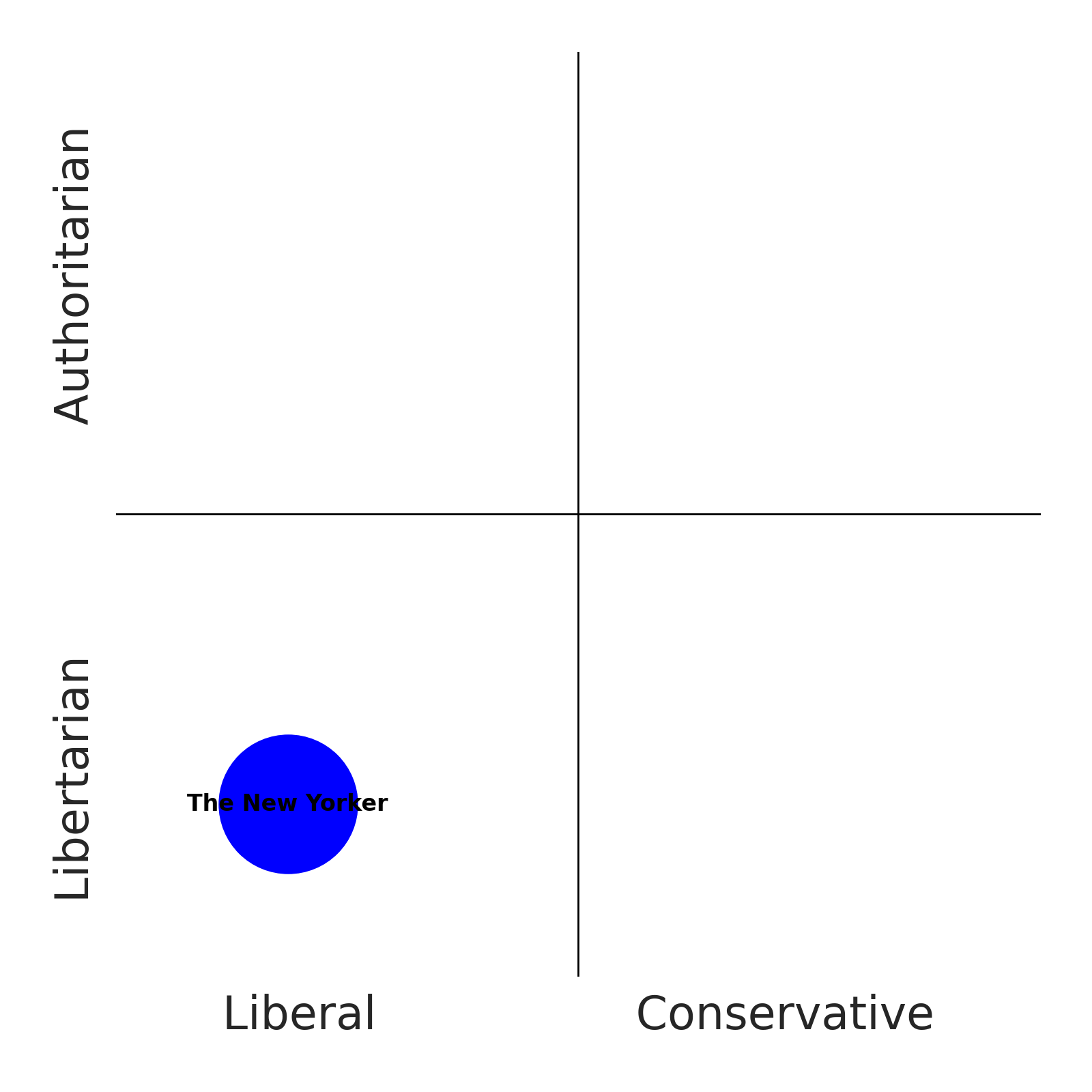
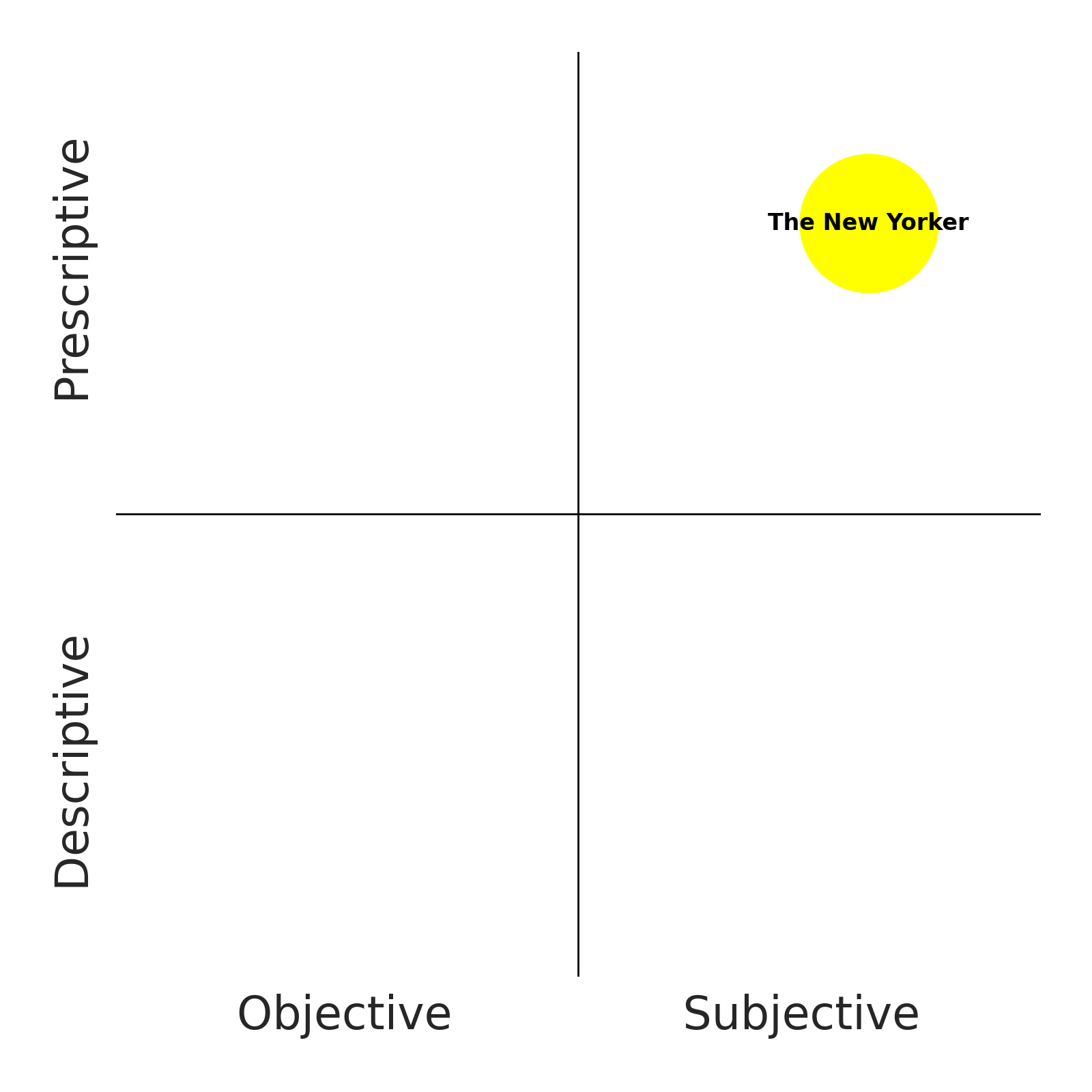
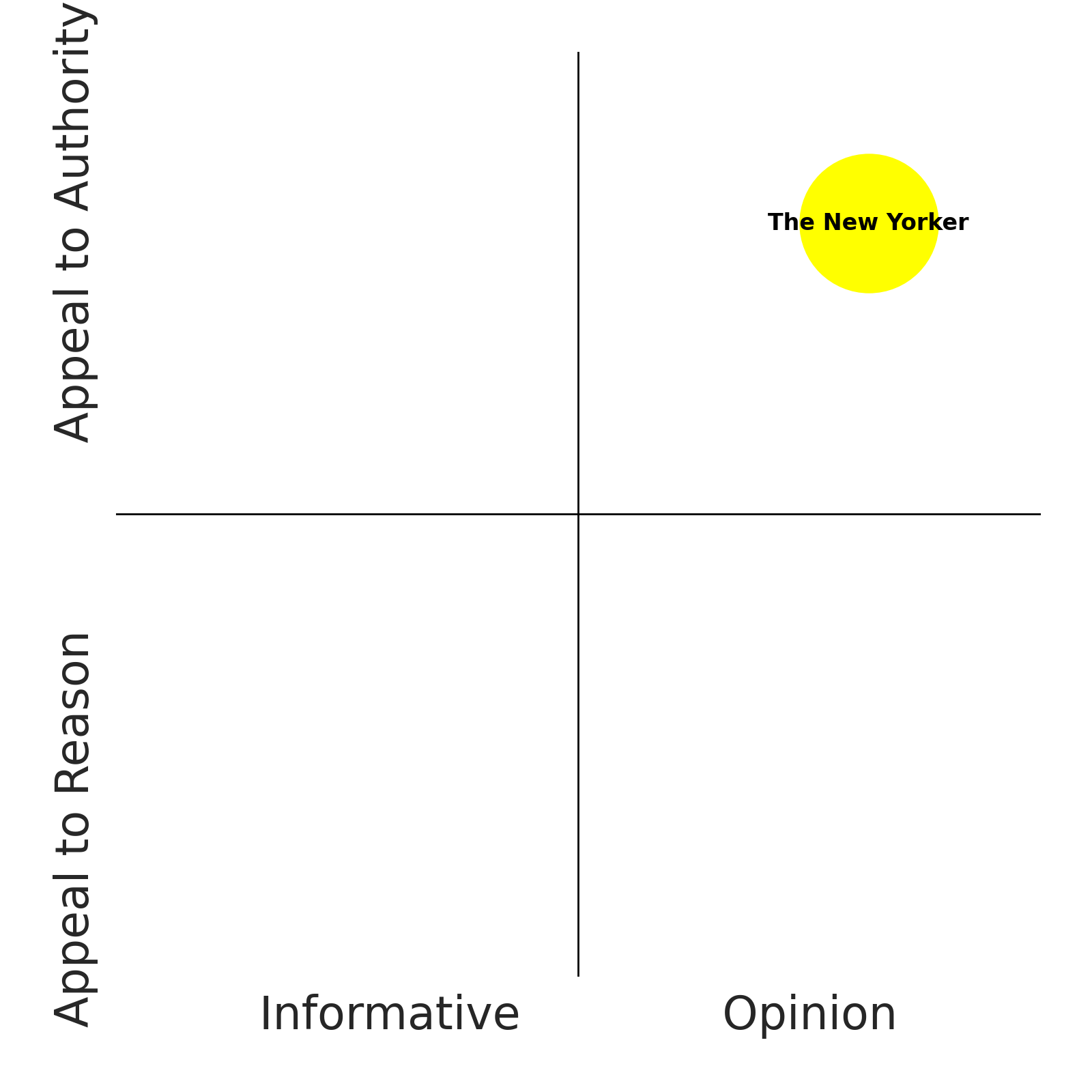
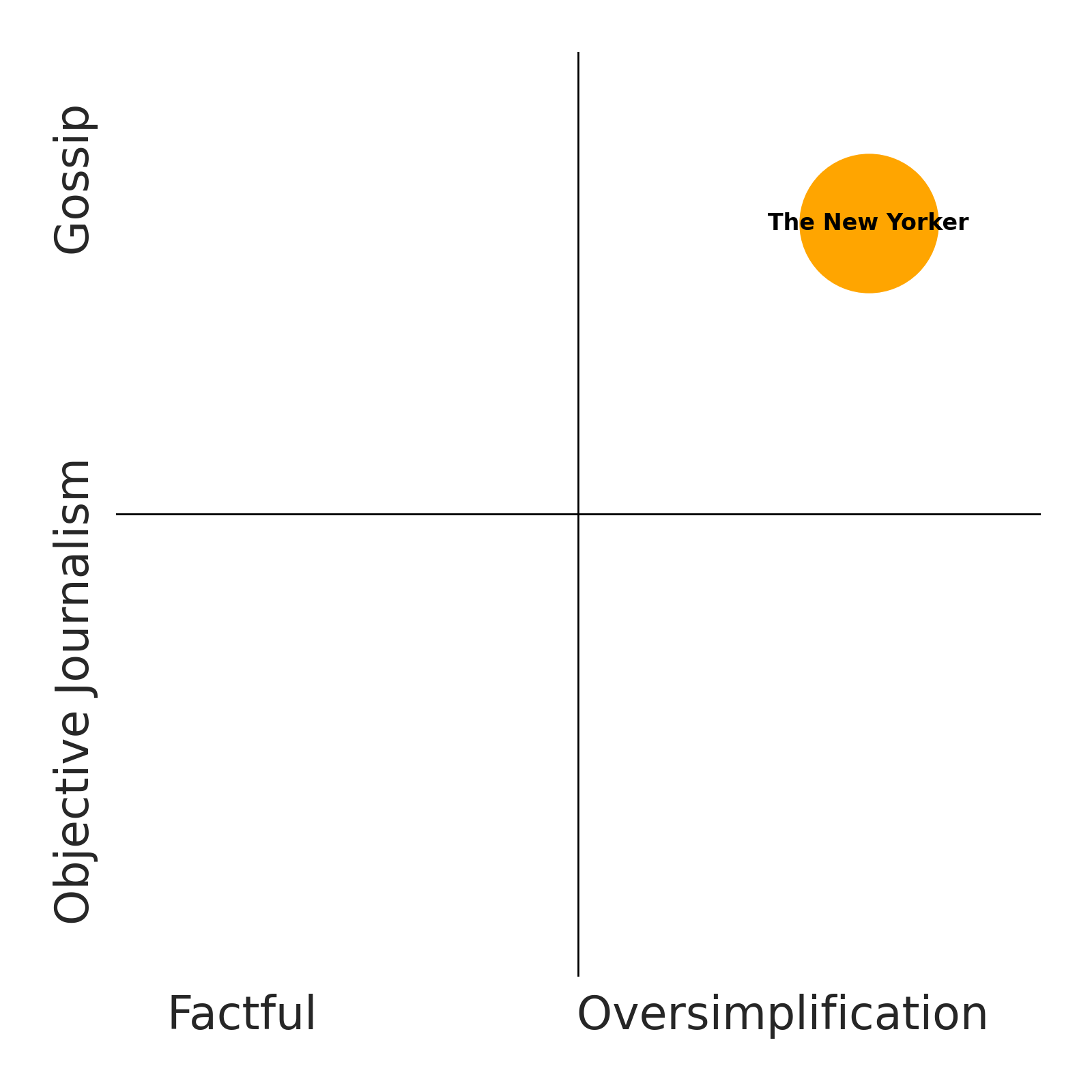
2026 © Helium Trades
Privacy Policy & Disclosure
* Disclaimer: Nothing on this website constitutes investment advice, performance data or any recommendation that any particular security, portfolio of securities, transaction or investment strategy is suitable for any specific person. Helium Trades is not responsible in any way for the accuracy
of any model predictions or price data. Any mention of a particular security and related prediction data is not a recommendation to buy or sell that security. Investments in securities involve the risk of loss. Past performance is no guarantee of future results. Helium Trades is not responsible for any of your investment decisions,
you should consult a financial expert before engaging in any transaction.
Helium Research Assistant

How can I help you today?
Ask any question about The New Yorker bias.