See whether Helium helps you make better-informed decisions. Try every Pro Trader feature for 30 days. No credit card required.
Try every Pro Trader feature for 30 days. No credit card required.
September 22, 2026 · 0 shares
Framing attributes the 40-year discovery low primarily to investment cutbacks and lists the decarbonization push and technical difficulty as secondary pressures, presenting the statistic as established fact without naming a source.
Automated analysis; not human reviewed. Limitations: The excerpt is short and lacks the underlying data source and methodology, so the numerical claims and bias conclusions are based on a single paragraph. · 3 of 55 available dimensions scored; omitted dimensions are not treated as neutral. · Verified supporting quotes for 3 of 3 scored dimensions.
Claim: The report is framed with quantitative, matter-of-fact language and no subjective evaluation.
“The number of new oil and gas field discoveries worldwide in 2025 fell to the lowest level in more than 40 years, with volumes at those fields falling to one-tenth of the 2013 peak” · exact text match
Why: The sentence states a statistical comparison plainly, without emotive adjectives, opinions, or first-person framing.
Claim: The presentation is understated rather than sensational.
“with volumes at those fields falling to one-tenth of the 2013 peak, as reduced investment by global energy companies weighs on exploration activity” · exact text match
Why: The decline is described through numbers and causal context rather than dramatic language or alarming imagery.
Claim: The text describes a market development without recommending or prescribing any action.
“TOKYO -- The number of new oil and gas field discoveries worldwide in 2025 fell to the lowest level in more than 40 years, with volumes at those fields falling to one-tenth of the 2013 peak” · exact text match
Why: The statement is a declarative description of a trend with no imperative, judgment, or policy recommendation.
The excerpt is short and lacks the underlying data source and methodology, so the numerical claims and bias conclusions are based on a single paragraph.
September 21, 2026 · 0 shares
Framing presents an unnamed official account as a terse, matter-of-fact alert, relying on 'authorities say' while treating the North Korean link as established.
Automated analysis; not human reviewed. Limitations: The supplied text is a mix of headlines, one complete news sentence, and a sponsored-content disclosure, so the classification rests on the single-sentence brief only. · 2 of 55 available dimensions scored; omitted dimensions are not treated as neutral. · Verified supporting quotes for 2 of 2 scored dimensions.
Claim: The only complete sentence is an attributed, unadorned factual summary with no subjective or evaluative language.
“TOKYO -- North Korean hackers have compromised devices in more than 100 countries and regions through fake online job interviews, tricking applicants into running malware that is used to steal cryptocurrency, authorities say.” · exact text match
Why: The sentence reports the event in neutral technical terms and attributes the account to 'authorities say,' without opinion, emotional coloring, or evaluative judgment.
Claim: The wording is matter-of-fact rather than sensationalized.
“North Korean hackers have compromised devices in more than 100 countries and regions through fake online job interviews, tricking applicants into running malware that is used to steal cryptocurrency, authorities say.” · exact text match
Why: Although the subject is cybercrime, the terms are standard ('compromised,' 'malware,' 'steal cryptocurrency'), and the report does not use alarmist adjectives, exclamation, or narrative flourishes.
The supplied text is a mix of headlines, one complete news sentence, and a sponsored-content disclosure, so the classification rests on the single-sentence brief only.
August 25, 2026 · 0 shares
The publisher frames the Aboitiz-university partnership as a commendable, innovative solution to a national manufacturing talent gap, presenting it favorably without critical analysis.
Automated analysis; not human reviewed. Limitations: The supplied article text is very brief, lacking detail and context, which limits assessment of many bias dimensions. · 2 of 54 available dimensions scored; omitted dimensions are not treated as neutral. · Verified supporting quotes for 2 of 2 scored dimensions.
Claim: The article is commissioned sponsored content, making it promotional.
“About Sponsored ContentThis content was commissioned by Nikkei's Global Business Bureau.” · exact text match
Why: The explicit disclosure indicates the content is sponsored, which typically serves a promotional purpose.
Claim: The article presents Aboitiz's initiative favorably, supporting corporate interests.
“Philippine conglomerate bolsters industrial park with college campus” · exact text match
“has found an unusual way to help develop talent” · exact text match
Why: The language describes the corporate action as 'bolstering' and 'helping,' with no critical perspective, and the content is sponsored by the business bureau.
The supplied article text is very brief, lacking detail and context, which limits assessment of many bias dimensions.
September 08, 2026 · 0 shares
Publisher framing presents Mongolia's young sovereign wealth fund as an attractive gateway for global investors by emphasizing state-owned copper assets, with commissioned-content status disclosed.
Automated analysis; not human reviewed. Limitations: The supplied text is a very short, explicitly commissioned excerpt, so the classifications rely on disclosed sponsorship and limited wording rather than a fuller report. · 4 of 54 available dimensions scored; omitted dimensions are not treated as neutral. · Verified supporting quotes for 4 of 4 scored dimensions.
Claim: The framing is bullish on Mongolia's copper-backed investment prospects.
“Mongolia's sovereign wealth fund, one of the youngest in the world, aims to attract international investors to the resource-rich country by leveraging state-owned mining companies that produce copper, a critical metal for technology infrastructure.” · exact text match
Why: The lead sentence pairs the fund with 'resource-rich' status and calls copper a 'critical metal,' presenting the country's assets as an opportunity for global capital.
Claim: The overall tone is optimistic, emphasizing opportunity while omitting risks.
“Mongolia's sovereign wealth fund, one of the youngest in the world, aims to attract international investors to the resource-rich country by leveraging state-owned mining companies that produce copper, a critical metal for technology infrastructure.” · exact text match
Why: The wording highlights attractiveness ('resource-rich', 'critical metal') and reports an investor-seeking goal without mentioning challenges.
Claim: The commissioned, one-sided nature of the content limits its independent credibility.
“This content was commissioned by Nikkei's Global Business Bureau.” · exact text match
Counterevidence:
“Temuulen Bayaraa, CEO of Mongolian sovereign wealth fund Chinggis Khaan, speaks during an interview in Singapore.” · exact text match
Why: A named CEO and reported interview provide some sourcing, but explicit commissioned status and the absence of independent or critical detail reduce credibility.
Claim: The piece functions as commissioned promotional content for Mongolia's sovereign wealth fund.
“This content was commissioned by Nikkei's Global Business Bureau.” · exact text match
“Mongolia's sovereign wealth fund, one of the youngest in the world, aims to attract international investors to the resource-rich country by leveraging state-owned mining companies that produce copper, a critical metal for technology infrastructure.” · exact text match
Why: The explicit sponsorship disclosure and the single promotional thrust—presenting the fund as an investment opportunity—support an advertorial classification.
The supplied text is a very short, explicitly commissioned excerpt, so the classifications rely on disclosed sponsorship and limited wording rather than a fuller report.
September 10, 2026 · 0 shares
Framing presents the Sumitomo–Sakana AI partnership as an unqualified win for Japanese business and homegrown technology, using sponsored, promotional language.
Automated analysis; not human reviewed. Limitations: Input is a brief sponsored-content excerpt with limited detail; analysis is based on its disclosed promotional framing and the small amount of quoted text. · 10 of 54 available dimensions scored; omitted dimensions are not treated as neutral. · Verified supporting quotes for 10 of 10 scored dimensions.
Claim: The item mixes facts with subjective promotional evaluation.
“giving a huge push to Japan's homegrown technology” · exact text match
Why: 'Huge push' is an evaluative judgment rather than a neutral description.
Claim: It uses mildly sensational language for an otherwise routine corporate announcement.
“giving a huge push to Japan's homegrown technology” · exact text match
Why: The scale of impact is asserted with emotionally charged wording, not data.
Claim: The narrative is bullish on Sakana AI's commercial potential and Japan's AI sector.
“to bring the startup's artificial-intelligence models to its 100,000 or so client companies” · exact text match
“giving a huge push to Japan's homegrown technology” · exact text match
Why: It emphasizes expanded market access and national technological gains.
Claim: The tone is upbeat about the partnership's impact.
“giving a huge push to Japan's homegrown technology” · exact text match
Why: The phrase 'huge push' asserts a strongly positive outcome.
Claim: The article asserts a major impact from the partnership without evidence.
“giving a huge push to Japan's homegrown technology” · exact text match
Why: The claim of a 'huge push' is certain in tone but unsupported by any data in the supplied text.
Claim: The text is thin, promotional fluff.
“Trading house will support AI adoption across its 100,000-client network” · exact text match
Why: The content consists of a broad promotional assertion without substantive detail.
Claim: The piece has a positive emotional valence.
“huge push to Japan's homegrown technology” · exact text match
Why: The language expresses enthusiasm about the deal's significance.
Claim: The item is commissioned content with no independent sourcing or evidentiary detail.
“This content was commissioned by Nikkei's Global Business Bureau.” · exact text match
Why: The sponsorship disclosure signals a lack of editorial independence, and the text gives no sources or data for its promotional claims.
Claim: The piece is openly commissioned content, making it promotional rather than independent reporting.
“This content was commissioned by Nikkei's Global Business Bureau.” · exact text match
Why: The disclosure labels the content as sponsored/advertorial.
Claim: The reporting presents the corporate partnership as an unqualified positive development.
“helping the Tokyo-based company sell its solutions even to small businesses and giving a huge push to Japan's homegrown technology” · exact text match
Why: The only evaluation offered is favorable to the companies and their market expansion.
Input is a brief sponsored-content excerpt with limited detail; analysis is based on its disclosed promotional framing and the small amount of quoted text.
September 15, 2026 · 0 shares
Headline framing is Japan-focused political and fiscal news, mostly neutral in wording, with a single prescriptive headline opposing the use of forex reserves for a food tax cut.
Automated analysis; not human reviewed. Limitations: Only headline text was supplied, with no article body or byline; analysis rests on headline wording and selection alone. · 4 of 54 available dimensions scored; omitted dimensions are not treated as neutral. · Verified supporting quotes for 4 of 4 scored dimensions.
Claim: The publisher's headline set is predominantly descriptive but includes one prescriptive opinion headline.
“Japan should not raid its forex reserves for Takaichi's food tax cut” · exact text match
Why: The 'should not' formulation states a recommendation rather than reporting a fact, making the overall mix mildly subjective.
Claim: Most headlines describe actions or proposals, but one headline prescribes a policy choice.
“Japan should not raid its forex reserves for Takaichi's food tax cut” · exact text match
Why: The headline directly opposes a policy approach, shifting the text from description to prescription.
Claim: The collection is largely factual but includes at least one overtly opinionated headline.
“Japan should not raid its forex reserves for Takaichi's food tax cut” · exact text match
Why: An explicit policy recommendation is opinion content, but it is isolated among otherwise factual headlines.
Claim: Every substantive headline concerns political actors, government actions, or public policy.
“Japan cabinet approves move to cut consumption tax on food to 1%” · exact text match
“Indonesia's Prabowo fires finance minister, replaces him with deputy” · exact text match
Why: Every substantive headline names a political actor, government action, or public-policy proposal, with no non-political subject matter.
Only headline text was supplied, with no article body or byline; analysis rests on headline wording and selection alone.
September 21, 2026 · 0 shares
Neutral business-news framing foregrounds corporate expansion and supply-chain shifts in the semiconductor industry, with an attributed executive claim and one promotional 'Exclusive' marker.
Automated analysis; not human reviewed. Limitations: The supplied text is a truncated list of headlines, so body-level framing, supporting evidence, and correction practices could not be assessed. · 2 of 55 available dimensions scored; omitted dimensions are not treated as neutral. · Verified supporting quotes for 2 of 2 scored dimensions.
Claim: Headlines are predominantly composed as neutral, third-person news notices with attributed statements and quantified sales data.
“Japan chipmaking equipment suppliers report 10% drop in China sales” · exact text match
“says AT&S CEO” · exact text match
Counterevidence:
“China snaps up US chip […]” · not found in supplied text
Why: The dominant style is factual and attributed, but the vivid verb 'snaps up' and the 'Exclusive' marker reduce full objectivity.
Claim: The text exhibits visible sourcing through attribution to a named executive and to a collective industry report.
“says AT&S CEO” · exact text match
“Japan chipmaking equipment suppliers report 10% drop in China sales” · exact text match
Why: Attribution and numeric specificity suggest care, though with only headlines there is insufficient body to verify claims.
The supplied text is a truncated list of headlines, so body-level framing, supporting evidence, and correction practices could not be assessed.
September 22, 2026 · 0 shares
Frames AI progress as an accelerating U.S.-China 'race' in which AI's growing self-development fuels risk concerns.
Automated analysis; not human reviewed. Limitations: Only a headline, subheadline, caption, and lede were supplied, with no body text, limiting the depth of framing analysis. · 1 of 55 available dimensions scored; omitted dimensions are not treated as neutral. · Verified supporting quotes for 1 of 1 scored dimensions.
Claim: Frames AI model development as a dramatic competitive race and emphasizes risk concerns.
“US-China AI race speeds up as self-improving models advance” · exact text match
“fueling concerns about the risk posed by advanced systems” · exact text match
Counterevidence:
“Anthropic, DeepSeek and others rapidly upgrade models with development time cut to 1/3” · exact text match
Why: The headline's 'race speeds up' and the lede's 'fueling concerns' add dramatic framing beyond the concrete 1/3 development-time detail, but the presence of that specific detail keeps the sensationalism mild.
Only a headline, subheadline, caption, and lede were supplied, with no body text, limiting the depth of framing analysis.
September 10, 2026 · 0 shares
Commissioned coverage presents Alibaba's self-reported product metrics as market news, adopting the vendor's claims without independent verification or skeptical balance.
Automated analysis; not human reviewed. Limitations: Only a brief sponsored excerpt was supplied, so the analysis rests on one lede paragraph plus a headline and subheadline. · 4 of 54 available dimensions scored; omitted dimensions are not treated as neutral. · Verified supporting quotes for 4 of 4 scored dimensions.
Claim: The publisher's headline asserts a comparative advantage as fact rather than as an attributed claim.
“Alibaba takes on Anthropic with 50% cheaper e-commerce AI agent” · exact text match
Why: The body qualifies the cost claim with 'Alibaba says,' but the headline presents '50% cheaper' as an unhedged factual comparison.
Claim: The precise '50% cheaper' claim in the headline exceeds the hedged, less-specific 'substantially more cost-efficient' statement in the body.
“Alibaba takes on Anthropic with 50% cheaper e-commerce AI agent” · exact text match
“substantially more cost-efficient than general agents from OpenAI and Anthropic” · exact text match
Why: The body's only support is an attributed qualitative comparison; the headline converts it into a precise, certain percentage.
Claim: The content is explicitly commissioned by a business bureau and promotes Alibaba's product metrics without critical distance.
“About Sponsored ContentThis content was commissioned by Nikkei's Global Business Bureau.” · exact text match
Why: The text labels itself sponsored and the body highlights Alibaba's user and cost-efficiency figures as positive product news.
Claim: The commissioned coverage is favorable to Alibaba, presenting its product claims and success metrics without challenge.
“Alibaba says its AI agent for e-commerce has brought in more than 60,000 paid users over the five months since its launch” · exact text match
“About Sponsored ContentThis content was commissioned by Nikkei's Global Business Bureau.” · exact text match
Why: The commission disclosure and the prominent placement of Alibaba's positive metrics indicate a promotional, pro-corporate stance.
Only a brief sponsored excerpt was supplied, so the analysis rests on one lede paragraph plus a headline and subheadline.
September 18, 2026 · 0 shares
Sponsored content from Nikkei's Global Business Bureau relays an industry association head's prescriptive call for Thailand to invest in front-end chip production and offer more incentives, framing it as necessary for supply-chain competitiveness without counterpoints or evidence.
Front-end semiconductor manufacturing generally refers to wafer fabrication and design, the capital-intensive stage before assembly, packaging, and testing; back-end steps are less capital-intensive.
Automated analysis; not human reviewed. Limitations: The supplied substantive content is very short: one attributed quotation, a subheadline, and a sponsorship note, which limits the basis for bias scoring. · 6 of 55 available dimensions scored; omitted dimensions are not treated as neutral. · Verified supporting quotes for 6 of 6 scored dimensions.
Claim: The framing instructs Thailand on what it should do rather than neutrally describing a situation.
“Thailand must invest in front-end chip production, industry body says” · exact text match
“Country urged to offer more incentives to welcome foreign firms” · exact text match
Why: The headline uses 'must' and the subheadline uses 'urged'; the body repeats 'should'.
Claim: The only substantive content is a policy opinion from a named industry official, presented without counterpoint or independent verification.
“Thailand should invest in the front end of semiconductor manufacturing to build a comprehensive supply chain, says the head of a local industry group as the country aims to catch up with regional peers in the high-value sector.” · exact text match
Why: The only reported substance is an advocacy statement attributed to an industry association head; no other facts or viewpoints are supplied.
Claim: The headline asserts necessity with 'must' even though the only support is an industry body's recommendation, not independent evidence.
“Thailand must invest in front-end chip production, industry body says” · exact text match
Why: The certainty conveyed by 'must' exceeds the supplied support.
Claim: The content has limited independent credibility because it is sponsored, one-sided advocacy, despite naming a source and disclosing the commission.
“This content was commissioned by Nikkei's Global Business Bureau.” · exact text match
Why: Paid commissioning and a single-source promotional message reduce the visible basis for independent credibility.
Claim: The content is sponsored and presents an industry association's advocacy as a news item, making it advertorial.
“This content was commissioned by Nikkei's Global Business Bureau.” · exact text match
“Thailand should invest in the front end of semiconductor manufacturing to build a comprehensive supply chain, says the head of a local industry group as the country aims to catch up with regional peers in the high-value sector.” · exact text match
Why: Explicit paid commissioning plus one-sided promotional policy messaging indicates advertorial framing.
Claim: The recommended policy favors foreign corporate investors by urging Thailand to offer more incentives to welcome firms.
“Country urged to offer more incentives to welcome foreign firms” · exact text match
“This content was commissioned by Nikkei's Global Business Bureau.” · exact text match
Why: The policy recommendation directly benefits foreign corporate investors, and the content is commissioned by a business bureau.
The supplied substantive content is very short: one attributed quotation, a subheadline, and a sponsorship note, which limits the basis for bias scoring.
August 31, 2026 · 0 shares
Sponsored content frames Sumitomo's fleet expansion goal as a positive ambition without independent sourcing or critical context.
Automated analysis; not human reviewed. Limitations: The substantive article content is extremely brief (one sentence) and includes a sponsored-content disclosure; the analysis relies primarily on that disclosure and the short promotional sentence. · 5 of 54 available dimensions scored; omitted dimensions are not treated as neutral. · Verified supporting quotes for 5 of 5 scored dimensions.
Claim: The article uses promotional framing and states the company's target as fact, making it subjective.
“Japanese trading company builds up inventory of older aircraft to meet goal” · exact text match
Why: The headline presents the company's internal goal as a definitive statement, reflecting a subjective promotional tone.
Claim: The article lacks independent sourcing and is disclosed as commissioned content, reducing its credibility.
“About Sponsored ContentThis content was commissioned by Nikkei's Global Business Bureau.” · exact text match
Why: Sponsored content is generally less credible; no sources or attributions are provided for the claims.
Claim: The article is explicitly commissioned by Nikkei's Global Business Bureau, indicating paid promotional content.
“About Sponsored ContentThis content was commissioned by Nikkei's Global Business Bureau.” · exact text match
Why: The disclosure directly identifies the content as sponsored, which is a clear advertising bias.
Claim: The article presents Sumitomo's expansion as a positive corporate goal without critical perspective.
“Sumitomo Corp. is expanding its fleet of aircraft, targeting more than 2,000 planes in an effort to become the largest player in the leasing industry.” · exact text match
“Japanese trading company builds up inventory of older aircraft to meet goal” · exact text match
Why: The language frames Sumitomo's actions as ambitious and favorable, with no negative implications or independent analysis.
Claim: The article describes an unrealized future target as if it were an established fact.
“Sumitomo Corp. is expanding its fleet of aircraft, targeting more than 2,000 planes in an effort to become the largest player in the leasing industry.” · exact text match
Why: The use of 'targeting' indicates a goal that has not yet been achieved, yet the article states it without qualification.
The substantive article content is extremely brief (one sentence) and includes a sponsored-content disclosure; the analysis relies primarily on that disclosure and the short promotional sentence.
September 04, 2026 · 0 shares
A commissioned corporate brief presents JAL's alliance strategy through a CEO's positive assessment and a promotional, unattributed subheadline.
Automated analysis; not human reviewed. Limitations: The supplied excerpt is brief and does not identify who commissioned the content or how the CEO's remarks were obtained. · 3 of 54 available dimensions scored; omitted dimensions are not treated as neutral. · Verified supporting quotes for 3 of 3 scored dimensions.
Claim: An evaluative promotional assertion is presented as a stated fact.
“Tie-up with Garuda goes beyond route expansion, helping broaden JAL's customer base.” · exact text match
Why: The subheadline states an assessment without attribution or supporting evidence, while the body only reports the CEO's opinion.
Claim: The item functions as promotional sponsored content rather than independent reporting.
“This content was commissioned by Nikkei's Global Business Bureau.” · exact text match
“Tie-up with Garuda goes beyond route expansion, helping broaden JAL's customer base.” · exact text match
Why: The explicit sponsored-content disclosure plus a positive, unhedged subheadline about JAL's tie-up shows promotional framing.
Claim: The framing is favorable to JAL and corporate interests.
“Tie-up with Garuda goes beyond route expansion, helping broaden JAL's customer base.” · exact text match
“The chief executive of Japan Airlines said that partnerships with international carriers, especially peers in Asia, are becoming increasingly important not only for expanding its route network but also for strengthening its global customer base.” · exact text match
Why: The story highlights JAL's alliance strategy as beneficial and is explicitly commissioned by a business bureau, aligning with a pro-corporate perspective.
The supplied excerpt is brief and does not identify who commissioned the content or how the CEO's remarks were obtained.
September 22, 2026 · 0 shares
The two stated corporate developments are presented as neutral fact, with no evaluative or speculative overlay.
BB+ is a speculative-grade (high-yield) credit rating.
Automated analysis; not human reviewed. Limitations: Supplied text is an elided two-sentence fragment; analysis is limited to the visible statements and their original context is unavailable. · 3 of 55 available dimensions scored; omitted dimensions are not treated as neutral. · Verified supporting quotes for 3 of 3 scored dimensions.
Claim: The text uses factual, non-evaluative language with no opinion markers or emotional vocabulary.
“Dollar and euro bonds to be issued at month's end with BB+ rating” · exact text match
“SoftBank Group announced in February that it would invest an additional $30 billion in OpenAI.” · exact text match
Why: Both sentences report plans or announcements in declarative, neutral terms without judgment, tone, or speculation.
Claim: The text describes states of affairs and announced plans; it issues no recommendation, instruction, or value judgment.
“SoftBank Group announced in February that it would invest an additional $30 billion in OpenAI.” · exact text match
“Dollar and euro bonds to be issued at month's end with BB+ rating” · exact text match
Why: The constructions 'to be issued' and 'announced... would invest' are reportorial and descriptive, with no prescriptive or imperative framing.
Claim: The text attributes its investment statement to a named source (SoftBank Group) and presents the bond plan without sensationalism.
“SoftBank Group announced in February that it would invest an additional $30 billion in OpenAI.” · exact text match
Why: One explicit attribution is visible and no credibility red flags appear, but the fragment's brevity limits assessment of sourcing and correction practices.
Supplied text is an elided two-sentence fragment; analysis is limited to the visible statements and their original context is unavailable.
September 22, 2026 · 0 shares
Commissioned business brief that frames Japan as the growth remedy for declining US dating-app use, leaning on CEO statements.
Automated analysis; not human reviewed. Limitations: The supplied text is truncated at the sponsored-content disclosure and the related-headline block may be page chrome; full article text beyond the lede is unavailable. · 4 of 55 available dimensions scored; omitted dimensions are not treated as neutral. · Verified supporting quotes for 4 of 4 scored dimensions.
Claim: The headline adds editorial interpretation by characterizing the company's outlook and a generational trend as fact.
“Match Group hopes to compensate for drop in US users as Gen Z tires of dating apps” · exact text match
Why: Words like 'hopes' and the unattributed 'tires of dating apps' inject interpretation into what is otherwise an attributed news brief.
Claim: The article categorically states causes for US dating-app decline without data or attribution.
“as young Americans cool on online matchmaking” · exact text match
“as Gen Z tires of dating apps” · exact text match
Why: Both causal clauses present a demographic trend as established fact, exceeding the evidence supplied in the text.
Claim: Visible attribution to the CEO supports credibility, but the disclosed commissioning limits it.
“CEO Spencer Rascoff told Nikkei” · exact text match
Counterevidence:
“This content was commissioned by Nikkei's Global Business” · exact text match
Why: Clear sourcing is a credibility signal; the sponsorship disclosure indicates a promotional rather than independent editorial purpose, netting to low-moderate credibility.
Claim: The item is disclosed as commissioned sponsored content, indicating an advertorial purpose.
“This content was commissioned by Nikkei's Global Business” · exact text match
Why: A commissioned-content disclosure is the publisher's own signal that the piece was produced for a paying client, the defining marker of advertorial framing.
The supplied text is truncated at the sponsored-content disclosure and the related-headline block may be page chrome; full article text beyond the lede is unavailable.
September 21, 2026 · 0 shares
Frames the BOJ’s rate hike as part of a ‘historic alignment’ and ‘new normal’ across major central banks, foregrounding political pressure and AI effects while casting central bank independence as under threat.
Automated analysis; not human reviewed. Limitations: The supplied text is a truncated excerpt ending mid-headline; only the title, subhead, and lede were available, so framing analysis rests on partial material. · 4 of 55 available dimensions scored; omitted dimensions are not treated as neutral. · Verified supporting quotes for 4 of 4 scored dimensions.
Claim: The framing treats political pressure as a threat to independent central banks, a technocratic rather than populist stance.
“threats to their independence” · exact text match
Why: Describing political pressure as a ‘threat’ to independence adopts the central banks’ defensive posture, tilting the framing toward elitist/technocratic governance.
Claim: The article characterizes the rate decisions with dramatic framing, calling them a ‘historic alignment’ and a sign of a ‘new normal.’
“Inflation draws BOJ, Fed, ECB into historic alignment on rate hikes.” · exact text match
“is a sign of the new normal as they grapple with inflation amid political pressure” · exact text match
Why: Two attention-grabbing labels (‘historic alignment’, ‘new normal’) go beyond plain factual reporting, supporting a mild sensational classification.
Claim: The tone around the central banks’ situation is cautionary, emphasizing difficulty and threat.
“grapple with inflation amid political pressure” · exact text match
“threats to their independence” · exact text match
Why: The verb ‘grapple’ and the noun ‘threats’ ascribe a difficult environment to central banks, producing a slightly pessimistic overall tone.
Claim: The report shows visible sourcing and attributes its key point about a policy shift to the BOJ chief.
“chief Ueda cites shift in policy” · exact text match
Why: The excerpt attributes the rationale to a named official and gives a specific rate figure (1.25%); no visible errors or unsupported overclaims appear in the limited text.
The supplied text is a truncated excerpt ending mid-headline; only the title, subhead, and lede were available, so framing analysis rests on partial material.
September 21, 2026 · 0 shares
The framing is market-technical and event-driven, presenting the yen rebound as a response to Bank of Japan signals while using a speculative question about Bessent's warning and labeling rate-increase advocates as 'hawks.'
Automated analysis; not human reviewed. Limitations: The supplied text is a short, partly fragmentary excerpt comprising headlines and a lede, so broader article framing may be underrepresented. · 3 of 55 available dimensions scored; omitted dimensions are not treated as neutral. · Verified supporting quotes for 3 of 3 scored dimensions.
Claim: The central lede is mostly factual, but the text includes a loaded question and informal market language.
“The Japanese currency spiked by more than 1 yen to the upper-156 range against the dollar late Friday night into early Saturday morning Japan time, after the Bank of Japan carried out a rate check, often seen as a precursor to currency market intervention.” · exact text match
Why: The lede reports an observable market move and attributes possible intervention signaling to market interpretation, though wording like 'spiked' and the headline question about Bessent's warning add interpretive color.
Claim: The text provides specific quantities, timing, and attribution to the BOJ and Governor Ueda.
“The Japanese currency spiked by more than 1 yen to the upper-156 range against the dollar late Friday night into early Saturday morning Japan time, after the Bank of Japan carried out a rate check, often seen as a precursor to currency market intervention.” · exact text match
“BOJ hikes rates to 1.25% as chief Ueda cites shift in policy phase” · exact text match
Why: The numerical exchange-rate change, time window, named central bank, named governor, and attributed policy shift give the brief a factual, verifiable core.
Claim: A headline opens a forward-looking question about the yen's future rather than limiting the report to settled facts.
“Can Bessent's 'I am the house now' warning keep the yen strong?” · exact text match
Why: The question asks whether an official's warning can sustain a currency level, which is an unresolved, forecast-oriented frame.
The supplied text is a short, partly fragmentary excerpt comprising headlines and a lede, so broader article framing may be underrepresented.
September 18, 2026 · 0 shares
The framing is a sponsored, tech-bullish market narrative that presents AI-exporter currencies as winners and rate-hiking peers as laggards.
Automated analysis; not human reviewed. Limitations: The supplied text is only a brief headline/teaser with no article body or dates, so classifications rely on the visible framing of a commissioned markets digest. · 5 of 55 available dimensions scored; omitted dimensions are not treated as neutral. · Verified supporting quotes for 5 of 5 scored dimensions.
Claim: The main lede is measured and explanatory rather than sensational.
“TOKYO -- The artificial intelligence and semiconductor boom is strengthening the currencies of South Korea and Taiwan, places that are particularly strong in those areas.” · exact text match
Why: The wording is descriptive and analytical, with no alarmist or dramatic language.
Claim: The framing is favorable to the currencies of AI-exporting economies.
“The currencies of AI and chip powers like South Korea and Taiwan are beating those of countries hiking interest rates to combat inflation.” · exact text match
Why: The use of 'strong', 'beating', and 'AI booms' presents an upward, bullish view of the won and Taiwan dollar.
Claim: Currency outcomes are reduced to a simple contest between AI/chip strength and interest-rate policy.
“The currencies of AI and chip powers like South Korea and Taiwan are beating those of countries hiking interest rates to combat inflation.” · exact text match
Why: The subtitle compresses complex currency drivers into a two-sided framing that omits other factors.
Claim: Visible independence and sourcing are weak because the item is commissioned content.
“About Sponsored ContentThis content was commissioned by Nikkei's Global Business Bureau.” · exact text match
Why: The only explicit sourcing/independence signal is a sponsored-content disclosure, which lowers confidence in editorial independence.
Claim: The content is explicitly commissioned and presented as sponsored.
“About Sponsored ContentThis content was commissioned by Nikkei's Global Business Bureau.” · exact text match
Why: The text carries a sponsored-content disclosure, indicating paid-for or commissioned promotional framing.
The supplied text is only a brief headline/teaser with no article body or dates, so classifications rely on the visible framing of a commissioned markets digest.
September 22, 2026 · 0 shares
Coverage frames the Trump-Xi meeting as a high-stakes encounter between rival powers with a ticking trade-truce deadline, while keeping the prose largely in attributable wire-news style.
Automated analysis; not human reviewed. Limitations: The supplied text is a truncated brief followed by repeated related-story headlines and a sponsored-content note, so some lexical signals may belong to page elements rather than the article proper. · 10 of 55 available dimensions scored; omitted dimensions are not treated as neutral. · Verified supporting quotes for 10 of 10 scored dimensions.
Claim: The coverage does not favor a liberal or conservative position on the U.S.-China talks.
“Rival powers expected to seek 'small gains and conflict avoidance' at White House summit” · exact text match
Why: Both governments are described in neutral, symmetrical terms; no ideological or partisan preference is expressed.
Claim: The reporting is strongly objective, presenting facts without subjective commentary.
“U.S. President Donald Trump is set to host Chinese counterpart Xi Jinping for a state visit this week with a packed agenda and an expiry date on the rival powers' trade truce fast approaching.” · exact text match
Why: The sentence states scheduled events and an approaching deadline with no first-person evaluation.
Claim: The coverage is mostly objective with mild dramatic language.
“Trump and Xi set to talk trade and AI as truce hangs in balance” · exact text match
Counterevidence:
“Rival powers expected to seek 'small gains and conflict avoidance' at White House summit” · exact text match
Why: The headline's 'truce hangs in balance' adds tension, but the deck remains measured.
Claim: The article describes events and expectations rather than prescribing policy.
“Rival powers expected to seek 'small gains and conflict avoidance' at White House summit” · exact text match
Why: It reports an expectation, not a recommendation or call to action.
Claim: One listed related headline is gossip-oriented.
“Who was the Chinese 'glass queen' sitting between Musk and Cook?” · exact text match
Why: The question focuses on a person's identity and seating placement rather than policy substance.
Claim: The text is factual rather than opinionated.
“Rival powers expected to seek 'small gains and conflict avoidance' at White House summit” · exact text match
Why: No first-person opinion or editorial stance is present; expectations are attributed.
Claim: The content is heavily political, focused on heads of state, diplomacy, and security issues.
“U.S. President Donald Trump is set to host Chinese counterpart Xi Jinping for a state visit this week with a packed agenda” · exact text match
“Taiwan arms sale in focus as Trump insists he gave no ground to Xi” · exact text match
Why: The summit, trade truce, and Taiwan arms sale are all political and diplomatic topics.
Claim: The reporting is credible, using clear attribution and official sourcing.
“US says China talks yield progress on tariff carve-outs, AI dialogue” · exact text match
“Trump plans to greet Xi at air base on arrival, officials say” · exact text match
Why: Key claims are attributed to the U.S. side or to officials rather than presented as unverified fact.
Claim: The report is reasoned and grounded in concrete scheduling and attributed expectations.
“U.S. President Donald Trump is set to host Chinese counterpart Xi Jinping for a state visit this week with a packed agenda and an expiry date on the rival powers' trade truce fast approaching.” · exact text match
Why: The lede presents factual, dated information rather than emotional or supernatural reasoning.
Claim: The report shows balanced attribution to both U.S. and Chinese positions.
“US says China talks yield progress on tariff carve-outs, AI dialogue” · exact text match
“China rebuffs AI slowdown calls ahead of Trump-Xi summit” · exact text match
Why: It includes both Washington's and Beijing's perspectives as attributed claims.
The supplied text is a truncated brief followed by repeated related-story headlines and a sponsored-content note, so some lexical signals may belong to page elements rather than the article proper.
September 22, 2026 · 0 shares
Framing casts Washington's Xi visit as a red-carpet charm offensive while depicting Japan-China ties as a frozen morass, implicitly leaving Japan diplomatically sidelined.
Automated analysis; not human reviewed. Limitations: Only the lead paragraphs and related headlines were available, so the framing analysis relies on a brief excerpt; the 'Sponsored Content' notice and headline list may be page furniture rather than article substance. · 4 of 55 available dimensions scored; omitted dimensions are not treated as neutral. · Verified supporting quotes for 4 of 4 scored dimensions.
Claim: The publisher's wording uses emotionally loaded metaphors rather than neutral description for the diplomatic relationships.
“Japan-China ties wither as Trump readies red carpet for Xi Jinping” · exact text match
“whose own relations with Beijing remain in a deep freeze” · exact text match
Why: Both the headline and body use evaluative metaphors ('wither,' 'red carpet,' 'deep freeze') that frame the relationships rather than simply report them.
Claim: The report emphasizes ceremonial spectacle in a dramatic way.
“with plans for a rare airport welcome by President Donald Trump and a lavish state dinner” · exact text match
Why: The unusual and lavish reception details are highlighted and the headline describes it as a 'red carpet,' lending a sensational tone to a diplomatic story.
Claim: The framing is pessimistic about Japan-China relations, emphasizing deterioration and a lack of solutions.
“Japan-China ties wither as Trump readies red carpet for Xi Jinping” · exact text match
“Takaichi gets chance to bend US president's ear, but scholars see no clear path out of morass” · exact text match
Why: The selected language describes decline and deadlock, with no hopeful counterpoint in the main text.
Claim: The report's content is centered on high-level political summitry and alliance politics.
“U.S. President Donald Trump is due to meet Japanese Prime Minister Sanae Takaichi this week, just before he hosts Chinese President Xi Jinping in Washington.” · exact text match
Why: The substantive content is exclusively about heads of government, summit planning, and bilateral diplomatic relationships.
Only the lead paragraphs and related headlines were available, so the framing analysis relies on a brief excerpt; the 'Sponsored Content' notice and headline list may be page furniture rather than article substance.
September 09, 2026 · 0 shares
Frames Xi's authority as a continuation of Maoist military control and treats Taiwan as a territorial prize, presenting an analytical thesis as a settled principle.
Mao Zedong died in 1976; Xi Jinping has been China's leader since 2012. The People's Liberation Army is the armed force of the Chinese Communist Party, and Beijing claims Taiwan as part of China.
Automated analysis; not human reviewed. Limitations: Only a headline, subhead, caption, lede, and related-headline list were supplied; the full article body and sourcing are unavailable. · 6 of 54 available dimensions scored; omitted dimensions are not treated as neutral. · Verified supporting quotes for 6 of 6 scored dimensions.
Claim: Xi's power is framed through an interpretive and metaphorical lens rather than neutral reporting.
“Chinese leader keeps ever-tighter grip on military, eyeing Taiwan as long-sought prize” · exact text match
“Power stems from control over the People's Liberation Army.” · exact text match
Why: The subhead and lede characterize Xi's intentions and the basis of CCP power as settled interpretation, using subjective terms like 'eyeing' and 'stems from'.
Claim: The assertion that CCP power stems from PLA control advances a thesis rather than reporting a discrete event.
“Power stems from control over the People's Liberation Army.” · exact text match
Why: This is a contestable analytical assertion, not a documented event or attributed statement.
Claim: The content is centered on political power, military control, and Taiwan's status.
“Chinese leader keeps ever-tighter grip on military, eyeing Taiwan as long-sought prize” · exact text match
Why: The subject matter and wording are explicitly about state power, the PLA, and a territorial dispute.
Claim: Fifty years of CCP rule are reduced to a single military-control principle.
“one political principle has held true for the China's Communist Party even as the country has transformed into the world's second-largest economy: Power stems from control over the People's Liberation Army.” · exact text match
Counterevidence:
“even as the country has transformed into the world's second-largest economy” · exact text match
Why: The analysis acknowledges economic transformation but nevertheless attributes continuity to one factor.
Claim: A broad historical generalization is stated with certainty without visible supporting evidence in the supplied snippet.
“one political principle has held true for the China's Communist Party even as the country has transformed into the world's second-largest economy” · exact text match
Why: 'Has held true' is an unconditional generalization; no evidence, data, or named source is provided in the excerpt.
Claim: Xi's strategic motive regarding Taiwan is asserted through inferred intention rather than documented statements.
“eyeing Taiwan as long-sought prize” · exact text match
Why: 'Eyeing' and 'prize' attribute a subjective strategic goal to Xi without quoted sourcing in the excerpt.
Only a headline, subhead, caption, lede, and related-headline list were supplied; the full article body and sourcing are unavailable.
September 09, 2026 · 0 shares
A commissioned business brief frames China's drone development as an urgent threat and uses an AIDC executive's quote to advocate a dedicated low-cost counter-UAS shield for Taiwan.
Automated analysis; not human reviewed. Limitations: Only a short summary block, headline, and related-link strip were supplied; no full article body was available for a deeper framing analysis. · 2 of 54 available dimensions scored; omitted dimensions are not treated as neutral. · Verified supporting quotes for 1 of 2 scored dimensions.
Claim: The report is politically framed because it embeds a defense-industry story in a Taiwan-versus-China security narrative.
“An executive of Taiwan's top aerospace company said the island democracy needs a counter-UAS system "because China is heavily pushing drone development right now."” · not found in supplied text
“in a sign of alarm in Taipei over China's growing unmanned aircraft system capabilities” · not found in supplied text
Why: The use of 'island democracy' and 'sign of alarm' injects state-identity and threat framing into what is nominally a corporate expansion story, making it politically charged.
Claim: The content is advertorial because it is explicitly labeled as sponsored and commissioned.
“This content was commissioned by Nikkei's Global Business Bureau.” · exact text match
Why: The explicit sponsored-content disclosure indicates the piece was produced on behalf of an outside party, fitting the advertorial definition.
Only a short summary block, headline, and related-link strip were supplied; no full article body was available for a deeper framing analysis.
September 12, 2026 · 0 shares
The article frames Japan's declining marriage and childbearing intentions as driven by financial pressures, presenting a causal claim in the headline that the survey data itself does not explicitly support.
Automated analysis; not human reviewed. Limitations: Limited to a short snippet and headline; unable to assess full article context. · 6 of 54 available dimensions scored; omitted dimensions are not treated as neutral. · Verified supporting quotes for 5 of 6 scored dimensions.
Claim: The headline interprets the survey results with a causal claim rather than purely reporting.
“Financial factors keep eroding desire for children among wedded couples” · exact text match
Why: The causal attribution is subjective; the lead is objective.
Claim: The article frames the trend negatively using 'eroding' and 'losing its appeal'.
“Financial factors keep eroding desire for children among wedded couples” · exact text match
“marriage is losing its appeal for younger generations” · exact text match
Why: Choice of verbs conveys a negative view of the decline.
Claim: The headline attributes declining desire for children to financial factors without support in the body.
“Financial factors keep eroding desire for children among wedded couples” · exact text match
Why: The lead paragraph only reports survey percentages, not causes; the headline asserts a causal mechanism.
Claim: The headline asserts a definite ongoing trend despite the body's cautious 'suggests' wording.
“Financial factors keep eroding desire for children among wedded couples” · exact text match
Counterevidence:
“A Japanese government survey suggests that marriage is losing its appeal for younger generations.” · exact text match
Why: The body uses 'suggests' while the headline states 'keep eroding' as fact.
Claim: The article attributes its key findings to a named government survey, lending credibility.
“a government survey released Friday” · exact text match
Why: Clear attribution to an official source.
Limited to a short snippet and headline; unable to assess full article context.
September 22, 2026 · 0 shares
A sponsored, anecdotal feature frames one hiker's experience as evidence of Chinese tourists shifting toward Hong Kong outdoor trails amid budget pressure, with mildly promotional 'flock' language.
Automated analysis; not human reviewed. Limitations: The supplied text is a partial excerpt containing headline, subhead, photo caption, and a one-sentence lede; the rest of the article body is unavailable, and the set of surrounding headlines appears to be related-link navigation rather than article content. · 7 of 55 available dimensions scored; omitted dimensions are not treated as neutral. · Verified supporting quotes for 7 of 7 scored dimensions.
Claim: Uses an individual, sensory-led narrative to present a tourism trend rather than data.
“Apple Yang squeezes past more than a dozen hikers for selfies in front of Hong Kong's UNESCO-registered Sea Stack” · exact text match
Why: The lede centers on one hiker's physical experience, indicating a subjective feature framing rather than an analytic or data-driven one.
Claim: Headline uses mildly emotive language to dramatize tourist numbers.
“Chinese tourists flock to Hong Kong trails as spending slows” · exact text match
Why: 'Flock' is a mild metaphor implying large numbers and momentum, but the reported scale is not quantified.
Claim: Report is descriptive, offering no recommendations or calls to action.
“Outdoor destinations gain traction as household budgets remain under pressure” · exact text match
Why: The sentences report a trend without prescribing any action, making the framing descriptive.
Claim: A broad tourism trend is supported only by a single hiker anecdote.
“Chinese tourists flock to Hong Kong trails as spending slows” · exact text match
“Apple Yang squeezes past more than a dozen hikers for selfies in front of Hong Kong's UNESCO-registered Sea Stack” · exact text match
Why: The headline generalizes to Chinese tourists while the only concrete illustration is one person, simplifying the relationship between spending and tourism.
Claim: Headline asserts the trend as fact without attribution or hedging.
“Chinese tourists flock to Hong Kong trails as spending slows” · exact text match
Why: The claim is stated categorically even though the supplied text provides no data or authoritative source.
Claim: Visible support for the central claim is minimal and the content is sponsored, lowering credibility.
“Apple Yang squeezes past more than a dozen hikers for selfies in front of Hong Kong's UNESCO-registered Sea Stack” · exact text match
“This content was commissioned by Nikkei's Global Business Bureau” · exact text match
Why: The only named source is an individual hiker, no data or expert sourcing is supplied, and the commissioned status tempers independent credibility.
Claim: Content is commissioned or sponsored, giving it an advertorial character.
“This content was commissioned by Nikkei's Global Business Bureau” · exact text match
Why: The sponsorship disclosure indicates the report was commissioned, a visible marker of promotional intent even though the body text is informational in tone.
The supplied text is a partial excerpt containing headline, subhead, photo caption, and a one-sentence lede; the rest of the article body is unavailable, and the set of surrounding headlines appears to be related-link navigation rather than article content.
September 21, 2026 · 0 shares
Frames the BOJ’s rate hike as part of a ‘historic alignment’ and ‘new normal’ across major central banks, foregrounding political pressure and AI effects while casting central bank independence as under threat.
Automated analysis; not human reviewed. Limitations: The supplied text is a truncated excerpt ending mid-headline; only the title, subhead, and lede were available, so framing analysis rests on partial material. · 4 of 55 available dimensions scored; omitted dimensions are not treated as neutral. · Verified supporting quotes for 4 of 4 scored dimensions.
Claim: The framing treats political pressure as a threat to independent central banks, a technocratic rather than populist stance.
“threats to their independence” · exact text match
Why: Describing political pressure as a ‘threat’ to independence adopts the central banks’ defensive posture, tilting the framing toward elitist/technocratic governance.
Claim: The article characterizes the rate decisions with dramatic framing, calling them a ‘historic alignment’ and a sign of a ‘new normal.’
“Inflation draws BOJ, Fed, ECB into historic alignment on rate hikes.” · exact text match
“is a sign of the new normal as they grapple with inflation amid political pressure” · exact text match
Why: Two attention-grabbing labels (‘historic alignment’, ‘new normal’) go beyond plain factual reporting, supporting a mild sensational classification.
Claim: The tone around the central banks’ situation is cautionary, emphasizing difficulty and threat.
“grapple with inflation amid political pressure” · exact text match
“threats to their independence” · exact text match
Why: The verb ‘grapple’ and the noun ‘threats’ ascribe a difficult environment to central banks, producing a slightly pessimistic overall tone.
Claim: The report shows visible sourcing and attributes its key point about a policy shift to the BOJ chief.
“chief Ueda cites shift in policy” · exact text match
Why: The excerpt attributes the rationale to a named official and gives a specific rate figure (1.25%); no visible errors or unsupported overclaims appear in the limited text.
The supplied text is a truncated excerpt ending mid-headline; only the title, subhead, and lede were available, so framing analysis rests on partial material.
September 21, 2026 · 0 shares
Headline fragments use exact figures and evaluative superlatives such as 'premier destination' and 'historic alignment' to present analytical assertions about Japan, central banks, migration, and political stability as settled facts.
Automated analysis; not human reviewed. Limitations: Input limitation: only fragmentary headline text was supplied, with no article body, so the analysis is limited to explicit headline wording and cannot verify claims or assess body-level context.
Input limitation: only fragmentary headline text was supplied, with no article body, so the analysis is limited to explicit headline wording and cannot verify claims or assess body-level context.
September 21, 2026 · 0 shares
Headline fragments use exact figures and evaluative superlatives such as 'premier destination' and 'historic alignment' to present analytical assertions about Japan, central banks, migration, and political stability as settled facts.
Automated analysis; not human reviewed. Limitations: Input limitation: only fragmentary headline text was supplied, with no article body, so the analysis is limited to explicit headline wording and cannot verify claims or assess body-level context.
Input limitation: only fragmentary headline text was supplied, with no article body, so the analysis is limited to explicit headline wording and cannot verify claims or assess body-level context.
September 10, 2026 · 0 shares
Commissioned coverage presents Alibaba's self-reported product metrics as market news, adopting the vendor's claims without independent verification or skeptical balance.
Automated analysis; not human reviewed. Limitations: Only a brief sponsored excerpt was supplied, so the analysis rests on one lede paragraph plus a headline and subheadline. · 4 of 54 available dimensions scored; omitted dimensions are not treated as neutral. · Verified supporting quotes for 4 of 4 scored dimensions.
Claim: The publisher's headline asserts a comparative advantage as fact rather than as an attributed claim.
“Alibaba takes on Anthropic with 50% cheaper e-commerce AI agent” · exact text match
Why: The body qualifies the cost claim with 'Alibaba says,' but the headline presents '50% cheaper' as an unhedged factual comparison.
Claim: The precise '50% cheaper' claim in the headline exceeds the hedged, less-specific 'substantially more cost-efficient' statement in the body.
“Alibaba takes on Anthropic with 50% cheaper e-commerce AI agent” · exact text match
“substantially more cost-efficient than general agents from OpenAI and Anthropic” · exact text match
Why: The body's only support is an attributed qualitative comparison; the headline converts it into a precise, certain percentage.
Claim: The content is explicitly commissioned by a business bureau and promotes Alibaba's product metrics without critical distance.
“About Sponsored ContentThis content was commissioned by Nikkei's Global Business Bureau.” · exact text match
Why: The text labels itself sponsored and the body highlights Alibaba's user and cost-efficiency figures as positive product news.
Claim: The commissioned coverage is favorable to Alibaba, presenting its product claims and success metrics without challenge.
“Alibaba says its AI agent for e-commerce has brought in more than 60,000 paid users over the five months since its launch” · exact text match
“About Sponsored ContentThis content was commissioned by Nikkei's Global Business Bureau.” · exact text match
Why: The commission disclosure and the prominent placement of Alibaba's positive metrics indicate a promotional, pro-corporate stance.
Only a brief sponsored excerpt was supplied, so the analysis rests on one lede paragraph plus a headline and subheadline.
September 09, 2026 · 0 shares
Frames Xi's authority as a continuation of Maoist military control and treats Taiwan as a territorial prize, presenting an analytical thesis as a settled principle.
Mao Zedong died in 1976; Xi Jinping has been China's leader since 2012. The People's Liberation Army is the armed force of the Chinese Communist Party, and Beijing claims Taiwan as part of China.
Automated analysis; not human reviewed. Limitations: Only a headline, subhead, caption, lede, and related-headline list were supplied; the full article body and sourcing are unavailable. · 6 of 54 available dimensions scored; omitted dimensions are not treated as neutral. · Verified supporting quotes for 6 of 6 scored dimensions.
Claim: Xi's power is framed through an interpretive and metaphorical lens rather than neutral reporting.
“Chinese leader keeps ever-tighter grip on military, eyeing Taiwan as long-sought prize” · exact text match
“Power stems from control over the People's Liberation Army.” · exact text match
Why: The subhead and lede characterize Xi's intentions and the basis of CCP power as settled interpretation, using subjective terms like 'eyeing' and 'stems from'.
Claim: The assertion that CCP power stems from PLA control advances a thesis rather than reporting a discrete event.
“Power stems from control over the People's Liberation Army.” · exact text match
Why: This is a contestable analytical assertion, not a documented event or attributed statement.
Claim: The content is centered on political power, military control, and Taiwan's status.
“Chinese leader keeps ever-tighter grip on military, eyeing Taiwan as long-sought prize” · exact text match
Why: The subject matter and wording are explicitly about state power, the PLA, and a territorial dispute.
Claim: Fifty years of CCP rule are reduced to a single military-control principle.
“one political principle has held true for the China's Communist Party even as the country has transformed into the world's second-largest economy: Power stems from control over the People's Liberation Army.” · exact text match
Counterevidence:
“even as the country has transformed into the world's second-largest economy” · exact text match
Why: The analysis acknowledges economic transformation but nevertheless attributes continuity to one factor.
Claim: A broad historical generalization is stated with certainty without visible supporting evidence in the supplied snippet.
“one political principle has held true for the China's Communist Party even as the country has transformed into the world's second-largest economy” · exact text match
Why: 'Has held true' is an unconditional generalization; no evidence, data, or named source is provided in the excerpt.
Claim: Xi's strategic motive regarding Taiwan is asserted through inferred intention rather than documented statements.
“eyeing Taiwan as long-sought prize” · exact text match
Why: 'Eyeing' and 'prize' attribute a subjective strategic goal to Xi without quoted sourcing in the excerpt.
Only a headline, subhead, caption, lede, and related-headline list were supplied; the full article body and sourcing are unavailable.
August 28, 2026 · 0 shares
Frames an ambiguous Hubei Daily remark as a veiled challenge to Xi Jinping's economic policies, relying on unnamed political chatter rather than direct evidence.
Hubei Daily is the official newspaper of the Hubei provincial committee of the Chinese Communist Party. Direct criticism of the top leader in official Chinese media is rare, so oblique wording is often read as coded political signaling.
Automated analysis; not human reviewed. Limitations: The supplied text is fragmentary; the usable excerpt ends after the political-circles sentence, and the remainder consists of unrelated Nikkei-related headlines and metadata. No independent verification of Hubei Daily's wording was available. · 5 of 54 available dimensions scored; omitted dimensions are not treated as neutral. · Verified supporting quotes for 5 of 5 scored dimensions.
Claim: The central interpretation is subjective, resting on unverified political chatter.
“The hubbub in political circles is that "small group" refers to figures backing Xi Jinping's current policies.” · exact text match
Why: The quote presents an inference from an unnamed 'hubbub,' not an observed or attributed fact.
Claim: The report uses political rumor as the basis for its central framing.
“The hubbub in political circles is that "small group" refers to figures backing Xi Jinping's current policies.” · exact text match
Why: The word 'hubbub' denotes buzz and rumor rather than a confirmed report.
Claim: The report frames Hubei's commentary as a political challenge to Xi Jinping's economic policies.
“Analysis: Hubei issues a challenge to Xi Jinping's economic policies.” · exact text match
“The hubbub in political circles is that "small group" refers to figures backing Xi Jinping's current policies.” · exact text match
Why: The central subject is an alleged internal political challenge to Xi and his policy backers.
Claim: Visible sourcing is thin for the central political interpretation.
“The hubbub in political circles is that "small group" refers to figures backing Xi Jinping's current policies.” · exact text match
Counterevidence:
“The Hubei Daily on Aug. 17 spoke to "a small group of people," telling them, "The idea of trying to develop behind closed doors is destined to lead nowhere."” · exact text match
Why: The quote is concretely attributed to Hubei Daily, but the key political meaning depends on vague, unattributed hearsay.
Claim: The article speculates about whom Hubei Daily's 'small group' remark was meant to target.
“The hubbub in political circles is that "small group" refers to figures backing Xi Jinping's current policies.” · exact text match
Why: No direct statement or named source connects the phrase to Xi's backers; the connection is inferred.
The supplied text is fragmentary; the usable excerpt ends after the political-circles sentence, and the remainder consists of unrelated Nikkei-related headlines and metadata. No independent verification of Hubei Daily's wording was available.
August 28, 2026 · 0 shares
Headline and caption language—'plummeting,' 'growing threat,' and 'opens the way'—frames Prabowo's falling approval as an opening for a West Java rival.
Prabowo Subianto took office after winning Indonesia's 2024 presidential election; Indonesia's next presidential election is scheduled for 2029. The West Java governor is a regional official, not an announced presidential candidate in this text.
Automated analysis; not human reviewed. Limitations: Only a short excerpt was supplied—headline, subheadline, photo caption, and lead paragraph—so the analysis cannot assess the full article's sourcing, balance, or context. · 5 of 54 available dimensions scored; omitted dimensions are not treated as neutral. · Verified supporting quotes for 5 of 5 scored dimensions.
Claim: The report uses evaluative language that goes beyond the poll data.
“His approval ratings in office have plummeted with a lackluster economy and unpopular flagship programs.” · exact text match
Why: It cites polls but characterizes the economy as 'lackluster' and programs as 'unpopular,' adding judgment to the reported numbers.
Claim: The headline and subheadline frame the poll results with dramatic conflict language.
“Prabowo's plummeting approval opens the way to popular rival” · exact text match
“West Java governor poses growing threat to Indonesian president, pollster says” · exact text match
Why: 'Plummeting,' 'opens the way,' and 'growing threat' convey drama and rivalry beyond a plain statement of poll results.
Claim: The overall tone is negative about Prabowo's political standing and governing conditions.
“His approval ratings in office have plummeted with a lackluster economy and unpopular flagship programs.” · exact text match
Why: The vocabulary 'plummeted,' 'lackluster,' and 'unpopular' frames the administration's situation pessimistically.
Claim: The report is focused on domestic electoral politics and presidential popularity.
“Two recent opinion polls show that President Prabowo Subianto's approval ratings have plummeted, with one saying the West Java governor is significantly more popular -- raising questions about Indonesia's political landscape ahead of the 2029 elections.” · exact text match
Why: The lead sentence is entirely about presidential approval, a rival's popularity, and the next election, placing the story firmly in political news.
Claim: The report extrapolates from two polls to future political consequences.
“raising questions about Indonesia's political landscape ahead of the 2029 elections” · exact text match
“Prabowo's plummeting approval opens the way to popular rival” · exact text match
Why: 'Raising questions' and 'opens the way' are forward-looking interpretations not directly established by the poll results.
Only a short excerpt was supplied—headline, subheadline, photo caption, and lead paragraph—so the analysis cannot assess the full article's sourcing, balance, or context.
September 21, 2026 · 0 shares
Headline framing emphasizes competitive threat from Chinese EV makers, describing their Australian gains with militaristic language ('close in,' 'stronghold') amid otherwise neutral corporate updates on Toyota and BYD.
Automated analysis; not human reviewed. Limitations: The supplied text is only a fragmentary set of headlines with elided content ([…]); no body text, sourcing, or attribution was available, so most bias dimensions were omitted for insufficient evidence.
The supplied text is only a fragmentary set of headlines with elided content ([…]); no body text, sourcing, or attribution was available, so most bias dimensions were omitted for insufficient evidence.
September 22, 2026 · 0 shares
Frames AI progress as an accelerating U.S.-China 'race' in which AI's growing self-development fuels risk concerns.
Automated analysis; not human reviewed. Limitations: Only a headline, subheadline, caption, and lede were supplied, with no body text, limiting the depth of framing analysis. · 1 of 55 available dimensions scored; omitted dimensions are not treated as neutral. · Verified supporting quotes for 1 of 1 scored dimensions.
Claim: Frames AI model development as a dramatic competitive race and emphasizes risk concerns.
“US-China AI race speeds up as self-improving models advance” · exact text match
“fueling concerns about the risk posed by advanced systems” · exact text match
Counterevidence:
“Anthropic, DeepSeek and others rapidly upgrade models with development time cut to 1/3” · exact text match
Why: The headline's 'race speeds up' and the lede's 'fueling concerns' add dramatic framing beyond the concrete 1/3 development-time detail, but the presence of that specific detail keeps the sensationalism mild.
Only a headline, subheadline, caption, and lede were supplied, with no body text, limiting the depth of framing analysis.
September 09, 2026 · 0 shares
Framing treats Moscow's tactics as an escalating hybrid war, presents Western reactions as a watched signal in China and North Korea, and leans on unnamed analysts for lessons.
Automated analysis; not human reviewed. Limitations: Source text is only a headline-lede excerpt with a caption and related-link headlines, not the full article; assessment is necessarily limited. · 3 of 54 available dimensions scored; omitted dimensions are not treated as neutral. · Verified supporting quotes for 3 of 3 scored dimensions.
Claim: The article's headline and standfirst center on geopolitical confrontation and state reactions, making it political content.
“Russia's hybrid war in Europe has repercussions in Asia: 5 things to know.” · exact text match
“West's reaction to Moscow tactics watched in China and North Korea, analysts say” · exact text match
Why: The headline and standfirst directly concern interstate conflict, strategy, and diplomatic reactions.
Claim: The article's substantive claims rest on unnamed analysts rather than named sources or verifiable data.
“Russia's escalating hybrid attacks in Europe offer Asia lessons on how to prepare for modern warfare, analysts say.” · exact text match
“West's reaction to Moscow tactics watched in China and North Korea, analysts say” · exact text match
Why: Both central claims are attributed only to anonymous 'analysts', making authority the primary support.
Claim: The article engages in forward-looking interpretation about lessons and responses rather than reporting settled facts.
“Russia's escalating hybrid attacks in Europe offer Asia lessons on how to prepare for modern warfare, analysts say.” · exact text match
Why: The statement projects implications for Asia and anticipates reactions, which is speculative analysis.
Source text is only a headline-lede excerpt with a caption and related-link headlines, not the full article; assessment is necessarily limited.
September 21, 2026 · 0 shares
Frames the BOJ’s rate hike as part of a ‘historic alignment’ and ‘new normal’ across major central banks, foregrounding political pressure and AI effects while casting central bank independence as under threat.
Automated analysis; not human reviewed. Limitations: The supplied text is a truncated excerpt ending mid-headline; only the title, subhead, and lede were available, so framing analysis rests on partial material. · 4 of 55 available dimensions scored; omitted dimensions are not treated as neutral. · Verified supporting quotes for 4 of 4 scored dimensions.
Claim: The framing treats political pressure as a threat to independent central banks, a technocratic rather than populist stance.
“threats to their independence” · exact text match
Why: Describing political pressure as a ‘threat’ to independence adopts the central banks’ defensive posture, tilting the framing toward elitist/technocratic governance.
Claim: The article characterizes the rate decisions with dramatic framing, calling them a ‘historic alignment’ and a sign of a ‘new normal.’
“Inflation draws BOJ, Fed, ECB into historic alignment on rate hikes.” · exact text match
“is a sign of the new normal as they grapple with inflation amid political pressure” · exact text match
Why: Two attention-grabbing labels (‘historic alignment’, ‘new normal’) go beyond plain factual reporting, supporting a mild sensational classification.
Claim: The tone around the central banks’ situation is cautionary, emphasizing difficulty and threat.
“grapple with inflation amid political pressure” · exact text match
“threats to their independence” · exact text match
Why: The verb ‘grapple’ and the noun ‘threats’ ascribe a difficult environment to central banks, producing a slightly pessimistic overall tone.
Claim: The report shows visible sourcing and attributes its key point about a policy shift to the BOJ chief.
“chief Ueda cites shift in policy” · exact text match
Why: The excerpt attributes the rationale to a named official and gives a specific rate figure (1.25%); no visible errors or unsupported overclaims appear in the limited text.
The supplied text is a truncated excerpt ending mid-headline; only the title, subhead, and lede were available, so framing analysis rests on partial material.
August 28, 2026 · 0 shares
A Nikkei commentary takes a firm market-discipline stance, warning that using foreign-exchange reserves for Takaichi's food tax cut would weaken the yen, lift U.S. Treasury yields, and send the wrong market signal.
Automated analysis; not human reviewed. Limitations: The supplied text is fragmentary: significant portions are headlines and a sponsorship note, and the full editorial argument is truncated. · 8 of 54 available dimensions scored; omitted dimensions are not treated as neutral. · Verified supporting quotes for 8 of 8 scored dimensions.
Claim: The framing sides with market discipline against using national reserves for a popular tax cut.
“trying to use them to cover the cut would send the wrong signal to the market.” · exact text match
Why: The warning treats market and currency signals as the decisive reason to reject the proposal, an elite/technocratic perspective.
Claim: The presentation is subjective, centering on a judgment about expected market harm.
“Such a move would push up US Treasury yields, weaken yen” · exact text match
Why: An unqualified forecast of market outcomes is presented as the basis for a subjective policy judgment.
Claim: The overall tone is cautionary and negative about the proposed funding method.
“would send the wrong signal to the market.” · exact text match
Why: The characterization of the move as a 'raid' and a 'wrong signal' frames the proposal as a bad outcome.
Claim: The piece delivers a direct policy recommendation rather than a neutral description.
“Japan should not raid its forex reserves for Takaichi's food tax cut.” · exact text match
Why: The sentence is an explicit normative command, so the framing is strongly prescriptive.
Claim: The central content is opinionated commentary, not factual reporting.
“Japan should not raid its forex reserves for Takaichi's food tax cut.” · exact text match
“trying to use them to cover the cut would send the wrong signal to the market.” · exact text match
Why: The 'should not' judgment and 'wrong signal' evaluation are subjective positions.
Claim: The text is explicitly engaged with a political debate and a political figure's tax plan.
“The debate roiling Japanese politics right now about how to fund a planned consumption tax cut” · exact text match
Why: It directly addresses a political debate over a tax-cut proposal.
Claim: The forecast of market effects is stated as certain despite lack of evidence in the text.
“Such a move would push up US Treasury yields, weaken yen” · exact text match
Why: The word 'would' asserts a definite causal market outcome without hedging or supporting evidence.
Claim: The text engages in forecasting about future market consequences.
“Such a move would push up US Treasury yields, weaken yen” · exact text match
Why: The statement is a conditional prediction about U.S. Treasury yields and the yen, not an observed fact.
The supplied text is fragmentary: significant portions are headlines and a sponsorship note, and the full editorial argument is truncated.
September 15, 2026 · 0 shares
Headline framing is Japan-focused political and fiscal news, mostly neutral in wording, with a single prescriptive headline opposing the use of forex reserves for a food tax cut.
Automated analysis; not human reviewed. Limitations: Only headline text was supplied, with no article body or byline; analysis rests on headline wording and selection alone. · 4 of 54 available dimensions scored; omitted dimensions are not treated as neutral. · Verified supporting quotes for 4 of 4 scored dimensions.
Claim: The publisher's headline set is predominantly descriptive but includes one prescriptive opinion headline.
“Japan should not raid its forex reserves for Takaichi's food tax cut” · exact text match
Why: The 'should not' formulation states a recommendation rather than reporting a fact, making the overall mix mildly subjective.
Claim: Most headlines describe actions or proposals, but one headline prescribes a policy choice.
“Japan should not raid its forex reserves for Takaichi's food tax cut” · exact text match
Why: The headline directly opposes a policy approach, shifting the text from description to prescription.
Claim: The collection is largely factual but includes at least one overtly opinionated headline.
“Japan should not raid its forex reserves for Takaichi's food tax cut” · exact text match
Why: An explicit policy recommendation is opinion content, but it is isolated among otherwise factual headlines.
Claim: Every substantive headline concerns political actors, government actions, or public policy.
“Japan cabinet approves move to cut consumption tax on food to 1%” · exact text match
“Indonesia's Prabowo fires finance minister, replaces him with deputy” · exact text match
Why: Every substantive headline names a political actor, government action, or public-policy proposal, with no non-political subject matter.
Only headline text was supplied, with no article body or byline; analysis rests on headline wording and selection alone.
August 31, 2026 · 0 shares
Sponsored content frames Sumitomo's fleet expansion goal as a positive ambition without independent sourcing or critical context.
Automated analysis; not human reviewed. Limitations: The substantive article content is extremely brief (one sentence) and includes a sponsored-content disclosure; the analysis relies primarily on that disclosure and the short promotional sentence. · 5 of 54 available dimensions scored; omitted dimensions are not treated as neutral. · Verified supporting quotes for 5 of 5 scored dimensions.
Claim: The article uses promotional framing and states the company's target as fact, making it subjective.
“Japanese trading company builds up inventory of older aircraft to meet goal” · exact text match
Why: The headline presents the company's internal goal as a definitive statement, reflecting a subjective promotional tone.
Claim: The article lacks independent sourcing and is disclosed as commissioned content, reducing its credibility.
“About Sponsored ContentThis content was commissioned by Nikkei's Global Business Bureau.” · exact text match
Why: Sponsored content is generally less credible; no sources or attributions are provided for the claims.
Claim: The article is explicitly commissioned by Nikkei's Global Business Bureau, indicating paid promotional content.
“About Sponsored ContentThis content was commissioned by Nikkei's Global Business Bureau.” · exact text match
Why: The disclosure directly identifies the content as sponsored, which is a clear advertising bias.
Claim: The article presents Sumitomo's expansion as a positive corporate goal without critical perspective.
“Sumitomo Corp. is expanding its fleet of aircraft, targeting more than 2,000 planes in an effort to become the largest player in the leasing industry.” · exact text match
“Japanese trading company builds up inventory of older aircraft to meet goal” · exact text match
Why: The language frames Sumitomo's actions as ambitious and favorable, with no negative implications or independent analysis.
Claim: The article describes an unrealized future target as if it were an established fact.
“Sumitomo Corp. is expanding its fleet of aircraft, targeting more than 2,000 planes in an effort to become the largest player in the leasing industry.” · exact text match
Why: The use of 'targeting' indicates a goal that has not yet been achieved, yet the article states it without qualification.
The substantive article content is extremely brief (one sentence) and includes a sponsored-content disclosure; the analysis relies primarily on that disclosure and the short promotional sentence.
September 10, 2026 · 0 shares
Commissioned coverage presents Alibaba's self-reported product metrics as market news, adopting the vendor's claims without independent verification or skeptical balance.
Automated analysis; not human reviewed. Limitations: Only a brief sponsored excerpt was supplied, so the analysis rests on one lede paragraph plus a headline and subheadline. · 4 of 54 available dimensions scored; omitted dimensions are not treated as neutral. · Verified supporting quotes for 4 of 4 scored dimensions.
Claim: The publisher's headline asserts a comparative advantage as fact rather than as an attributed claim.
“Alibaba takes on Anthropic with 50% cheaper e-commerce AI agent” · exact text match
Why: The body qualifies the cost claim with 'Alibaba says,' but the headline presents '50% cheaper' as an unhedged factual comparison.
Claim: The precise '50% cheaper' claim in the headline exceeds the hedged, less-specific 'substantially more cost-efficient' statement in the body.
“Alibaba takes on Anthropic with 50% cheaper e-commerce AI agent” · exact text match
“substantially more cost-efficient than general agents from OpenAI and Anthropic” · exact text match
Why: The body's only support is an attributed qualitative comparison; the headline converts it into a precise, certain percentage.
Claim: The content is explicitly commissioned by a business bureau and promotes Alibaba's product metrics without critical distance.
“About Sponsored ContentThis content was commissioned by Nikkei's Global Business Bureau.” · exact text match
Why: The text labels itself sponsored and the body highlights Alibaba's user and cost-efficiency figures as positive product news.
Claim: The commissioned coverage is favorable to Alibaba, presenting its product claims and success metrics without challenge.
“Alibaba says its AI agent for e-commerce has brought in more than 60,000 paid users over the five months since its launch” · exact text match
“About Sponsored ContentThis content was commissioned by Nikkei's Global Business Bureau.” · exact text match
Why: The commission disclosure and the prominent placement of Alibaba's positive metrics indicate a promotional, pro-corporate stance.
Only a brief sponsored excerpt was supplied, so the analysis rests on one lede paragraph plus a headline and subheadline.
September 04, 2026 · 0 shares
Sponsored framing promotes Malaysia as an attractive critical-minerals destination while treating China's forthcoming export controls as a supply threat.
Automated analysis; not human reviewed. Limitations: The supplied text is very short and identifies itself as sponsored content, so most bias dimensions lack enough evidence for a reliable score. · 1 of 54 available dimensions scored; omitted dimensions are not treated as neutral. · Verified supporting quotes for 1 of 1 scored dimensions.
Claim: The supplied text is explicitly sponsored/advertorial rather than independent editorial content.
“About Sponsored ContentThis content was commissioned by Nikkei's Global Business Bureau.” · exact text match
Why: The exact text labels the content as sponsored and says it was commissioned by Nikkei's Global Business Bureau, directly indicating promotional/advertorial framing.
The supplied text is very short and identifies itself as sponsored content, so most bias dimensions lack enough evidence for a reliable score.
September 18, 2026 · 0 shares
Sponsored content from Nikkei's Global Business Bureau relays an industry association head's prescriptive call for Thailand to invest in front-end chip production and offer more incentives, framing it as necessary for supply-chain competitiveness without counterpoints or evidence.
Front-end semiconductor manufacturing generally refers to wafer fabrication and design, the capital-intensive stage before assembly, packaging, and testing; back-end steps are less capital-intensive.
Automated analysis; not human reviewed. Limitations: The supplied substantive content is very short: one attributed quotation, a subheadline, and a sponsorship note, which limits the basis for bias scoring. · 6 of 55 available dimensions scored; omitted dimensions are not treated as neutral. · Verified supporting quotes for 6 of 6 scored dimensions.
Claim: The framing instructs Thailand on what it should do rather than neutrally describing a situation.
“Thailand must invest in front-end chip production, industry body says” · exact text match
“Country urged to offer more incentives to welcome foreign firms” · exact text match
Why: The headline uses 'must' and the subheadline uses 'urged'; the body repeats 'should'.
Claim: The only substantive content is a policy opinion from a named industry official, presented without counterpoint or independent verification.
“Thailand should invest in the front end of semiconductor manufacturing to build a comprehensive supply chain, says the head of a local industry group as the country aims to catch up with regional peers in the high-value sector.” · exact text match
Why: The only reported substance is an advocacy statement attributed to an industry association head; no other facts or viewpoints are supplied.
Claim: The headline asserts necessity with 'must' even though the only support is an industry body's recommendation, not independent evidence.
“Thailand must invest in front-end chip production, industry body says” · exact text match
Why: The certainty conveyed by 'must' exceeds the supplied support.
Claim: The content has limited independent credibility because it is sponsored, one-sided advocacy, despite naming a source and disclosing the commission.
“This content was commissioned by Nikkei's Global Business Bureau.” · exact text match
Why: Paid commissioning and a single-source promotional message reduce the visible basis for independent credibility.
Claim: The content is sponsored and presents an industry association's advocacy as a news item, making it advertorial.
“This content was commissioned by Nikkei's Global Business Bureau.” · exact text match
“Thailand should invest in the front end of semiconductor manufacturing to build a comprehensive supply chain, says the head of a local industry group as the country aims to catch up with regional peers in the high-value sector.” · exact text match
Why: Explicit paid commissioning plus one-sided promotional policy messaging indicates advertorial framing.
Claim: The recommended policy favors foreign corporate investors by urging Thailand to offer more incentives to welcome firms.
“Country urged to offer more incentives to welcome foreign firms” · exact text match
“This content was commissioned by Nikkei's Global Business Bureau.” · exact text match
Why: The policy recommendation directly benefits foreign corporate investors, and the content is commissioned by a business bureau.
The supplied substantive content is very short: one attributed quotation, a subheadline, and a sponsorship note, which limits the basis for bias scoring.
September 09, 2026 · 0 shares
A sponsored promotional brief frames Pixxel's expansion target and record funding as positive corporate milestones while disclosing that it was commissioned by Nikkei's Global Business Bureau.
Automated analysis; not human reviewed. Limitations: The supplied content is a very short sponsored-content brief mixed with headline and related-link fragments, so scores rely heavily on the commission disclosure and CEO-attributed statements. · 4 of 54 available dimensions scored; omitted dimensions are not treated as neutral. · Verified supporting quotes for 4 of 4 scored dimensions.
Claim: The text conveys a bullish outlook on Pixxel's business.
“record-setting $100m round” · exact text match
Why: The superlative 'record-setting' plus the expansion target present Pixxel's trajectory favorably.
Claim: The overall tone is optimistic about Pixxel's future.
“hopes to more than quadruple its manufacturing capacity to 100 satellites per quarter by next year” · exact text match
Why: The word 'hopes' and the ambitious target frame future prospects positively.
Claim: The item is promotional content rather than independent editorial coverage.
“This content was commissioned by Nikkei's Global Business Bureau.” · exact text match
Why: The explicit commission disclosure identifies the piece as paid content, and surrounding superlatives such as 'record-setting' reinforce an advertorial tone.
Claim: The reporting is favorably oriented toward a single private company and its growth plans.
“hopes to more than quadruple its manufacturing capacity to 100 satellites per quarter by next year” · exact text match
Why: The article presents the company's expansion target and fundraise as achievements without critical context or countervailing information.
The supplied content is a very short sponsored-content brief mixed with headline and related-link fragments, so scores rely heavily on the commission disclosure and CEO-attributed statements.
September 04, 2026 · 0 shares
Commissioned sponsored content frames the won's strength around SK Hynix's U.S. listing and exporter fund repatriation, using positive 'tailwind' language.
Automated analysis; not human reviewed. Limitations: The supplied text is a short sponsored-content brief with one substantive paragraph, and the boundary between article content and related-link headlines is ambiguous. · 4 of 54 available dimensions scored; omitted dimensions are not treated as neutral. · Verified supporting quotes for 4 of 4 scored dimensions.
Claim: The report takes a bullish stance on the South Korean won.
“The won has strengthened on foreign exchange markets” · exact text match
“Robust exports, rate hikes give South Korean currency a tailwind against dollar” · exact text match
Why: 'Strengthened' and 'tailwind' are positive directional market descriptions of the won's performance.
Claim: The report's tone is mildly optimistic about the won's prospects.
“Robust exports, rate hikes give South Korean currency a tailwind against dollar” · exact text match
Why: The 'tailwind' metaphor and the selection of favorable drivers convey an optimistic tone.
Claim: The item is commissioned sponsored content rather than independent editorial.
“This content was commissioned by Nikkei's Global Business Bureau.” · exact text match
Why: The explicit sponsor disclosure is a direct observable marker of advertorial or promotional content.
Claim: SK Hynix's U.S. listing is given a positive causal role in the currency story.
“chipmaker SK Hynix's listing in the U.S. and South Korean efforts to encourage exporters to repatriate funds help tap the brakes on the currency's long-standing structural weakness” · exact text match
Why: The framing foregrounds SK Hynix's listing as a market-positive factor, and the surrounding sponsored-content context reinforces a pro-corporate slant.
The supplied text is a short sponsored-content brief with one substantive paragraph, and the boundary between article content and related-link headlines is ambiguous.
September 04, 2026 · 0 shares
A commissioned corporate brief presents JAL's alliance strategy through a CEO's positive assessment and a promotional, unattributed subheadline.
Automated analysis; not human reviewed. Limitations: The supplied excerpt is brief and does not identify who commissioned the content or how the CEO's remarks were obtained. · 3 of 54 available dimensions scored; omitted dimensions are not treated as neutral. · Verified supporting quotes for 3 of 3 scored dimensions.
Claim: An evaluative promotional assertion is presented as a stated fact.
“Tie-up with Garuda goes beyond route expansion, helping broaden JAL's customer base.” · exact text match
Why: The subheadline states an assessment without attribution or supporting evidence, while the body only reports the CEO's opinion.
Claim: The item functions as promotional sponsored content rather than independent reporting.
“This content was commissioned by Nikkei's Global Business Bureau.” · exact text match
“Tie-up with Garuda goes beyond route expansion, helping broaden JAL's customer base.” · exact text match
Why: The explicit sponsored-content disclosure plus a positive, unhedged subheadline about JAL's tie-up shows promotional framing.
Claim: The framing is favorable to JAL and corporate interests.
“Tie-up with Garuda goes beyond route expansion, helping broaden JAL's customer base.” · exact text match
“The chief executive of Japan Airlines said that partnerships with international carriers, especially peers in Asia, are becoming increasingly important not only for expanding its route network but also for strengthening its global customer base.” · exact text match
Why: The story highlights JAL's alliance strategy as beneficial and is explicitly commissioned by a business bureau, aligning with a pro-corporate perspective.
The supplied excerpt is brief and does not identify who commissioned the content or how the CEO's remarks were obtained.
September 22, 2026 · 0 shares
Commissioned promotional coverage frames the festival warmly, highlighting spontaneous discovery of niche performers rather than critical reporting.
Automated analysis; not human reviewed. Limitations: The supplied text is limited to a headline, standfirst, and a short promotional lead; the full article body was not available. · 5 of 55 available dimensions scored; omitted dimensions are not treated as neutral. · Verified supporting quotes for 5 of 5 scored dimensions.
Claim: The framing uses subjective, value-laden language about the festival experience.
“some of its most memorable moments come between the marquee sets” · exact text match
“giving everything to small but appreciative audiences” · exact text match
Why: The article evaluates experiences with impressionistic praise instead of detached factual description.
Claim: The overall tone is upbeat and favorable toward the festival.
“some of its most memorable moments come between the marquee sets” · exact text match
Why: The only evaluative content is positive, with no countervailing negatives or caveats.
Claim: The content is thin, generic filler typical of promotional blurbs.
“Festivalgoers wander into tents or stop at outdoor stages to see what is happening, often discovering new or niche performers giving everything to small but appreciative audiences.” · exact text match
Why: This sentence is an unverifiable, promotional generality rather than concrete information.
Claim: The wording evokes positive emotion about the festival's intimate performances.
“often discovering new or niche performers giving everything to small but appreciative audiences” · exact text match
Why: Phrases like 'discovering' and 'giving everything' carry warm, admiring emotional coloring.
Claim: The piece is commissioned promotional content that advertises the festival in favorable terms.
“About Sponsored ContentThis content was commissioned by Nikkei's Global Business Bureau.” · exact text match
“Big names draw crowds to the Port Fairy Folk Festival, but some of its most memorable moments come between the marquee sets.” · exact text match
Why: The explicit commission disclosure and the favorable framing are direct markers of advertorial content.
The supplied text is limited to a headline, standfirst, and a short promotional lead; the full article body was not available.
August 28, 2026 · 0 shares
A sponsor-commissioned finance brief presents the record custody-asset figure as proof of a booming Japanese investment pool, using upbeat, uncritical language.
Automated analysis; not human reviewed. Limitations: The supplied text is a short sponsored-content brief with no independent sources or methodology, so I could not verify the custody figures or assess the sponsor's relationship to the subject beyond the disclosure. · 4 of 54 available dimensions scored; omitted dimensions are not treated as neutral. · Verified supporting quotes for 4 of 4 scored dimensions.
Claim: The report frames Japan's investment-asset growth as a strongly positive market development.
“Japan's pool of investment assets is expanding rapidly, propelled by a historic stock market rally and the expansion of NISA” · exact text match
Why: The evaluative words 'expanding rapidly' and 'historic stock market rally' present the data in a bullish light.
Claim: The report conveys an optimistic outlook by presenting asset growth as a successful outcome of market and policy factors.
“historic stock market rally” · exact text match
“Amount triples over past decade on rising stock prices and expansion of individual investors” · exact text match
Why: Growth is framed with positive superlatives and no negative or cautionary context.
Claim: The item is explicitly sponsored content, making the framing promotional rather than independent reporting.
“This content was commissioned by Nikkei's Global Business Bureau.” · exact text match
Why: The disclosure states the content was commissioned, an observable advertorial signal.
Claim: The report gives favorable, non-critical attention to a specific corporate trust bank's performance.
“assets under custody top 1 quadrillion yen” · exact text match
“The Master Trust Bank of Japan, a Mitsubishi UFJ Trust and Banking affiliate, holds assets on behalf of institutional investors” · exact text match
Why: The milestone is reported positively and identifies the corporate affiliate without outside or critical perspectives; this is reinforced by the commissioned-content disclosure.
The supplied text is a short sponsored-content brief with no independent sources or methodology, so I could not verify the custody figures or assess the sponsor's relationship to the subject beyond the disclosure.
September 18, 2026 · 0 shares
Sponsored content from Nikkei's Global Business Bureau relays an industry association head's prescriptive call for Thailand to invest in front-end chip production and offer more incentives, framing it as necessary for supply-chain competitiveness without counterpoints or evidence.
Front-end semiconductor manufacturing generally refers to wafer fabrication and design, the capital-intensive stage before assembly, packaging, and testing; back-end steps are less capital-intensive.
Automated analysis; not human reviewed. Limitations: The supplied substantive content is very short: one attributed quotation, a subheadline, and a sponsorship note, which limits the basis for bias scoring. · 6 of 55 available dimensions scored; omitted dimensions are not treated as neutral. · Verified supporting quotes for 6 of 6 scored dimensions.
Claim: The framing instructs Thailand on what it should do rather than neutrally describing a situation.
“Thailand must invest in front-end chip production, industry body says” · exact text match
“Country urged to offer more incentives to welcome foreign firms” · exact text match
Why: The headline uses 'must' and the subheadline uses 'urged'; the body repeats 'should'.
Claim: The only substantive content is a policy opinion from a named industry official, presented without counterpoint or independent verification.
“Thailand should invest in the front end of semiconductor manufacturing to build a comprehensive supply chain, says the head of a local industry group as the country aims to catch up with regional peers in the high-value sector.” · exact text match
Why: The only reported substance is an advocacy statement attributed to an industry association head; no other facts or viewpoints are supplied.
Claim: The headline asserts necessity with 'must' even though the only support is an industry body's recommendation, not independent evidence.
“Thailand must invest in front-end chip production, industry body says” · exact text match
Why: The certainty conveyed by 'must' exceeds the supplied support.
Claim: The content has limited independent credibility because it is sponsored, one-sided advocacy, despite naming a source and disclosing the commission.
“This content was commissioned by Nikkei's Global Business Bureau.” · exact text match
Why: Paid commissioning and a single-source promotional message reduce the visible basis for independent credibility.
Claim: The content is sponsored and presents an industry association's advocacy as a news item, making it advertorial.
“This content was commissioned by Nikkei's Global Business Bureau.” · exact text match
“Thailand should invest in the front end of semiconductor manufacturing to build a comprehensive supply chain, says the head of a local industry group as the country aims to catch up with regional peers in the high-value sector.” · exact text match
Why: Explicit paid commissioning plus one-sided promotional policy messaging indicates advertorial framing.
Claim: The recommended policy favors foreign corporate investors by urging Thailand to offer more incentives to welcome firms.
“Country urged to offer more incentives to welcome foreign firms” · exact text match
“This content was commissioned by Nikkei's Global Business Bureau.” · exact text match
Why: The policy recommendation directly benefits foreign corporate investors, and the content is commissioned by a business bureau.
The supplied substantive content is very short: one attributed quotation, a subheadline, and a sponsorship note, which limits the basis for bias scoring.
September 21, 2026 · 0 shares
Frames the BOJ’s rate hike as part of a ‘historic alignment’ and ‘new normal’ across major central banks, foregrounding political pressure and AI effects while casting central bank independence as under threat.
Automated analysis; not human reviewed. Limitations: The supplied text is a truncated excerpt ending mid-headline; only the title, subhead, and lede were available, so framing analysis rests on partial material. · 4 of 55 available dimensions scored; omitted dimensions are not treated as neutral. · Verified supporting quotes for 4 of 4 scored dimensions.
Claim: The framing treats political pressure as a threat to independent central banks, a technocratic rather than populist stance.
“threats to their independence” · exact text match
Why: Describing political pressure as a ‘threat’ to independence adopts the central banks’ defensive posture, tilting the framing toward elitist/technocratic governance.
Claim: The article characterizes the rate decisions with dramatic framing, calling them a ‘historic alignment’ and a sign of a ‘new normal.’
“Inflation draws BOJ, Fed, ECB into historic alignment on rate hikes.” · exact text match
“is a sign of the new normal as they grapple with inflation amid political pressure” · exact text match
Why: Two attention-grabbing labels (‘historic alignment’, ‘new normal’) go beyond plain factual reporting, supporting a mild sensational classification.
Claim: The tone around the central banks’ situation is cautionary, emphasizing difficulty and threat.
“grapple with inflation amid political pressure” · exact text match
“threats to their independence” · exact text match
Why: The verb ‘grapple’ and the noun ‘threats’ ascribe a difficult environment to central banks, producing a slightly pessimistic overall tone.
Claim: The report shows visible sourcing and attributes its key point about a policy shift to the BOJ chief.
“chief Ueda cites shift in policy” · exact text match
Why: The excerpt attributes the rationale to a named official and gives a specific rate figure (1.25%); no visible errors or unsupported overclaims appear in the limited text.
The supplied text is a truncated excerpt ending mid-headline; only the title, subhead, and lede were available, so framing analysis rests on partial material.
September 21, 2026 · 0 shares
The framing is market-technical and event-driven, presenting the yen rebound as a response to Bank of Japan signals while using a speculative question about Bessent's warning and labeling rate-increase advocates as 'hawks.'
Automated analysis; not human reviewed. Limitations: The supplied text is a short, partly fragmentary excerpt comprising headlines and a lede, so broader article framing may be underrepresented. · 3 of 55 available dimensions scored; omitted dimensions are not treated as neutral. · Verified supporting quotes for 3 of 3 scored dimensions.
Claim: The central lede is mostly factual, but the text includes a loaded question and informal market language.
“The Japanese currency spiked by more than 1 yen to the upper-156 range against the dollar late Friday night into early Saturday morning Japan time, after the Bank of Japan carried out a rate check, often seen as a precursor to currency market intervention.” · exact text match
Why: The lede reports an observable market move and attributes possible intervention signaling to market interpretation, though wording like 'spiked' and the headline question about Bessent's warning add interpretive color.
Claim: The text provides specific quantities, timing, and attribution to the BOJ and Governor Ueda.
“The Japanese currency spiked by more than 1 yen to the upper-156 range against the dollar late Friday night into early Saturday morning Japan time, after the Bank of Japan carried out a rate check, often seen as a precursor to currency market intervention.” · exact text match
“BOJ hikes rates to 1.25% as chief Ueda cites shift in policy phase” · exact text match
Why: The numerical exchange-rate change, time window, named central bank, named governor, and attributed policy shift give the brief a factual, verifiable core.
Claim: A headline opens a forward-looking question about the yen's future rather than limiting the report to settled facts.
“Can Bessent's 'I am the house now' warning keep the yen strong?” · exact text match
Why: The question asks whether an official's warning can sustain a currency level, which is an unresolved, forecast-oriented frame.
The supplied text is a short, partly fragmentary excerpt comprising headlines and a lede, so broader article framing may be underrepresented.
September 12, 2026 · 0 shares
The article frames Japan's declining marriage and childbearing intentions as driven by financial pressures, presenting a causal claim in the headline that the survey data itself does not explicitly support.
Automated analysis; not human reviewed. Limitations: Limited to a short snippet and headline; unable to assess full article context. · 6 of 54 available dimensions scored; omitted dimensions are not treated as neutral. · Verified supporting quotes for 5 of 6 scored dimensions.
Claim: The headline interprets the survey results with a causal claim rather than purely reporting.
“Financial factors keep eroding desire for children among wedded couples” · exact text match
Why: The causal attribution is subjective; the lead is objective.
Claim: The article frames the trend negatively using 'eroding' and 'losing its appeal'.
“Financial factors keep eroding desire for children among wedded couples” · exact text match
“marriage is losing its appeal for younger generations” · exact text match
Why: Choice of verbs conveys a negative view of the decline.
Claim: The headline attributes declining desire for children to financial factors without support in the body.
“Financial factors keep eroding desire for children among wedded couples” · exact text match
Why: The lead paragraph only reports survey percentages, not causes; the headline asserts a causal mechanism.
Claim: The headline asserts a definite ongoing trend despite the body's cautious 'suggests' wording.
“Financial factors keep eroding desire for children among wedded couples” · exact text match
Counterevidence:
“A Japanese government survey suggests that marriage is losing its appeal for younger generations.” · exact text match
Why: The body uses 'suggests' while the headline states 'keep eroding' as fact.
Claim: The article attributes its key findings to a named government survey, lending credibility.
“a government survey released Friday” · exact text match
Why: Clear attribution to an official source.
Limited to a short snippet and headline; unable to assess full article context.
September 12, 2026 · 0 shares
Reports a legal sentence and conviction in a neutral, factual tone, with a disclosure that the content was commissioned by Nikkei's Global Business Bureau.
Automated analysis; not human reviewed. Limitations: The supplied text is a heavily truncated snippet, limiting analysis to the visible headline and fragment. · 4 of 54 available dimensions scored; omitted dimensions are not treated as neutral. · Verified supporting quotes for 4 of 4 scored dimensions.
Claim: The text reports the sentence and conviction without evaluative commentary.
“sentenced to up to 7 years, 3 months” · exact text match
Why: The language is declarative and factual, with no subjective or emotional terms.
Claim: The text is a plain factual statement without sensational or exaggerated language.
“sentenced to up to 7 years, 3 months” · exact text match
Why: No hyperbolic or dramatic phrasing is present in the headline or fragment.
Claim: The subject matter is inherently political, involving a subversion charge in Hong Kong.
“inciting subversion” · exact text match
Why: The charge and the event pertain to national security and political dissent, making the report political.
Claim: The text describes a legal outcome in a logical, cause-and-effect manner.
“convicted of inciting subversion” · exact text match
Why: The statement links a conviction to a specific charge, reflecting linear reasoning.
The supplied text is a heavily truncated snippet, limiting analysis to the visible headline and fragment.
September 21, 2026 · 0 shares
Framing presents an unnamed official account as a terse, matter-of-fact alert, relying on 'authorities say' while treating the North Korean link as established.
Automated analysis; not human reviewed. Limitations: The supplied text is a mix of headlines, one complete news sentence, and a sponsored-content disclosure, so the classification rests on the single-sentence brief only. · 2 of 55 available dimensions scored; omitted dimensions are not treated as neutral. · Verified supporting quotes for 2 of 2 scored dimensions.
Claim: The only complete sentence is an attributed, unadorned factual summary with no subjective or evaluative language.
“TOKYO -- North Korean hackers have compromised devices in more than 100 countries and regions through fake online job interviews, tricking applicants into running malware that is used to steal cryptocurrency, authorities say.” · exact text match
Why: The sentence reports the event in neutral technical terms and attributes the account to 'authorities say,' without opinion, emotional coloring, or evaluative judgment.
Claim: The wording is matter-of-fact rather than sensationalized.
“North Korean hackers have compromised devices in more than 100 countries and regions through fake online job interviews, tricking applicants into running malware that is used to steal cryptocurrency, authorities say.” · exact text match
Why: Although the subject is cybercrime, the terms are standard ('compromised,' 'malware,' 'steal cryptocurrency'), and the report does not use alarmist adjectives, exclamation, or narrative flourishes.
The supplied text is a mix of headlines, one complete news sentence, and a sponsored-content disclosure, so the classification rests on the single-sentence brief only.
September 15, 2026 · 0 shares
Headline framing is Japan-focused political and fiscal news, mostly neutral in wording, with a single prescriptive headline opposing the use of forex reserves for a food tax cut.
Automated analysis; not human reviewed. Limitations: Only headline text was supplied, with no article body or byline; analysis rests on headline wording and selection alone. · 4 of 54 available dimensions scored; omitted dimensions are not treated as neutral. · Verified supporting quotes for 4 of 4 scored dimensions.
Claim: The publisher's headline set is predominantly descriptive but includes one prescriptive opinion headline.
“Japan should not raid its forex reserves for Takaichi's food tax cut” · exact text match
Why: The 'should not' formulation states a recommendation rather than reporting a fact, making the overall mix mildly subjective.
Claim: Most headlines describe actions or proposals, but one headline prescribes a policy choice.
“Japan should not raid its forex reserves for Takaichi's food tax cut” · exact text match
Why: The headline directly opposes a policy approach, shifting the text from description to prescription.
Claim: The collection is largely factual but includes at least one overtly opinionated headline.
“Japan should not raid its forex reserves for Takaichi's food tax cut” · exact text match
Why: An explicit policy recommendation is opinion content, but it is isolated among otherwise factual headlines.
Claim: Every substantive headline concerns political actors, government actions, or public policy.
“Japan cabinet approves move to cut consumption tax on food to 1%” · exact text match
“Indonesia's Prabowo fires finance minister, replaces him with deputy” · exact text match
Why: Every substantive headline names a political actor, government action, or public-policy proposal, with no non-political subject matter.
Only headline text was supplied, with no article body or byline; analysis rests on headline wording and selection alone.
September 21, 2026 · 0 shares
The visible headlines frame VinFast as a loss-making EV producer seeking a $1.2bn financial boost, while the other auto and infrastructure items are reported in neutral business-news wording.
Automated analysis; not human reviewed. Limitations: The supplied text is truncated and consists mostly of headlines, with no article body, byline, or publication context, so framing classification rests on a narrow surface sample. · 2 of 55 available dimensions scored; omitted dimensions are not treated as neutral. · Verified supporting quotes for 1 of 2 scored dimensions.
Claim: The visible headlines are written as declarative news announcements rather than opinion or advocacy.
“Vietnam's VinFast seeks financial boost with $1.2bn property deal” · exact text match
“Toyota moves into extended-range EVs with model made in […]” · not found in supplied text
Why: The wording is event- and market-focused without first-person commentary or evaluative argument.
Claim: The visible text is non-political business news with no partisan or ideological content.
“Vietnam's VinFast seeks financial boost with $1.2bn property deal” · exact text match
“China's Leapmotor overtakes Subaru, Mitsubishi Motors in global sales” · exact text match
Why: The supplied text contains only corporate, market, and infrastructure finance items; no political party, ideological category, or policy stance is mentioned.
The supplied text is truncated and consists mostly of headlines, with no article body, byline, or publication context, so framing classification rests on a narrow surface sample.
Frames Shein's Hong Kong debut as a missed trend and a fall from a $100bn peak, contrasting Uniqlo's flagship-store strategy as the more durable model.
Automated analysis; not human reviewed. Limitations: The supplied text combines one main editorial item with brief summaries and linked headlines, so the full reporting behind secondary items was not available for analysis. · 6 of 54 available dimensions scored; omitted dimensions are not treated as neutral. · Verified supporting quotes for 5 of 6 scored dimensions.
Claim: The piece mixes factual reporting with an explicit first-person editorial recommendation.
“If Shein wants sustainable long-term growth, it may need to slow down a little, rethink the business model that fueled its meteoric rise, and chart a more durable path forward.” · exact text match
Why: The sentence tells a public company what it should do, which is subjective commentary rather than neutral description.
Claim: The reporting emphasizes Shein's valuation decline and market disappointment.
“Despite being a trendsetter in the industry, Shein does not appear to be on-trend with the growth narrative investors want.” · not found in supplied text
Why: The lead framing and choice of comparisons stress the downside of the listing rather than neutral market results.
Claim: The analysis moves from describing Shein's situation to prescribing a strategic change.
“If Shein wants sustainable long-term growth, it may need to slow down a little, rethink the business model that fueled its meteoric rise, and chart a more durable path forward.” · exact text match
Why: The recommendation uses 'may need to' to tell Shein what it must do, exceeding a descriptive account.
Claim: The text includes an evaluative editorial judgment, not just fact reporting.
“Superfast fashion has long faced criticism for encouraging a disposable approach to clothing and consumer goods.” · exact text match
Why: It advances a critical characterization of the entire category to support the author's recommendation.
Claim: The report attributes key analytical claims and gives specific figures, supporting basic credibility.
“According to a Nikkei Asia analysis, Shein's performance has slowed as regulatory changes affecting low-value imports into the U.S. and Europe have increased costs in its key Western markets.” · exact text match
Why: The analysis is explicitly sourced and tied to identifiable regulatory and competitive factors rather than presented as anonymous assertion.
Claim: The text contains human-authorial markers including a named columnist and a first-person anecdote.
“When I recently visited a Uniqlo shop in Tokyo's swanky Ginza district, it was packed with foreign travelers snapping up the retailer's affordable-yet-high-quality apparel.” · exact text match
Why: A first-person singular visit and named contributor are strong signals of human composition.
The supplied text combines one main editorial item with brief summaries and linked headlines, so the full reporting behind secondary items was not available for analysis.
September 22, 2026 · 0 shares
Framing attributes the 40-year discovery low primarily to investment cutbacks and lists the decarbonization push and technical difficulty as secondary pressures, presenting the statistic as established fact without naming a source.
Automated analysis; not human reviewed. Limitations: The excerpt is short and lacks the underlying data source and methodology, so the numerical claims and bias conclusions are based on a single paragraph. · 3 of 55 available dimensions scored; omitted dimensions are not treated as neutral. · Verified supporting quotes for 3 of 3 scored dimensions.
Claim: The report is framed with quantitative, matter-of-fact language and no subjective evaluation.
“The number of new oil and gas field discoveries worldwide in 2025 fell to the lowest level in more than 40 years, with volumes at those fields falling to one-tenth of the 2013 peak” · exact text match
Why: The sentence states a statistical comparison plainly, without emotive adjectives, opinions, or first-person framing.
Claim: The presentation is understated rather than sensational.
“with volumes at those fields falling to one-tenth of the 2013 peak, as reduced investment by global energy companies weighs on exploration activity” · exact text match
Why: The decline is described through numbers and causal context rather than dramatic language or alarming imagery.
Claim: The text describes a market development without recommending or prescribing any action.
“TOKYO -- The number of new oil and gas field discoveries worldwide in 2025 fell to the lowest level in more than 40 years, with volumes at those fields falling to one-tenth of the 2013 peak” · exact text match
Why: The statement is a declarative description of a trend with no imperative, judgment, or policy recommendation.
The excerpt is short and lacks the underlying data source and methodology, so the numerical claims and bias conclusions are based on a single paragraph.
September 21, 2026 · 0 shares
Framing presents an unnamed official account as a terse, matter-of-fact alert, relying on 'authorities say' while treating the North Korean link as established.
Automated analysis; not human reviewed. Limitations: The supplied text is a mix of headlines, one complete news sentence, and a sponsored-content disclosure, so the classification rests on the single-sentence brief only. · 2 of 55 available dimensions scored; omitted dimensions are not treated as neutral. · Verified supporting quotes for 2 of 2 scored dimensions.
Claim: The only complete sentence is an attributed, unadorned factual summary with no subjective or evaluative language.
“TOKYO -- North Korean hackers have compromised devices in more than 100 countries and regions through fake online job interviews, tricking applicants into running malware that is used to steal cryptocurrency, authorities say.” · exact text match
Why: The sentence reports the event in neutral technical terms and attributes the account to 'authorities say,' without opinion, emotional coloring, or evaluative judgment.
Claim: The wording is matter-of-fact rather than sensationalized.
“North Korean hackers have compromised devices in more than 100 countries and regions through fake online job interviews, tricking applicants into running malware that is used to steal cryptocurrency, authorities say.” · exact text match
Why: Although the subject is cybercrime, the terms are standard ('compromised,' 'malware,' 'steal cryptocurrency'), and the report does not use alarmist adjectives, exclamation, or narrative flourishes.
The supplied text is a mix of headlines, one complete news sentence, and a sponsored-content disclosure, so the classification rests on the single-sentence brief only.
September 04, 2026 · 0 shares
Framing treats Chinese-made defense kit as an espionage risk and relays anonymous experts' prescriptive demand to overhaul UK procurement, under a sponsored-content label.
Automated analysis; not human reviewed. Limitations: The supplied text is a short sponsored brief with no named experts or supporting evidence, so bias judgments rest on framing and labeling rather than detailed reporting. · 5 of 54 available dimensions scored; omitted dimensions are not treated as neutral. · Verified supporting quotes for 4 of 5 scored dimensions.
Claim: The report's key statements are phrased as directives rather than neutral descriptions.
“Britain must eliminate any Chinese spying risks in defense kit, experts say” · exact text match
“Britain should tighten its procurement process to ensure the country's military hardware and kit contain no Chinese-made parts” · exact text match
Why: The central formulations use 'must' and 'should' to call for action, making the framing prescriptive.
Claim: The report frames Chinese suppliers and Chinese-made parts as a threat to be eliminated.
“eliminate any Chinese spying risks in defense kit” · exact text match
“cut an "unhealthy dependency" on Chinese suppliers” · not found in supplied text
Why: The language of elimination and unhealthy dependency depicts China in national-security threat terms.
Claim: The recommendation relies on unnamed 'experts' rather than named sources, evidence, or data.
“Britain must eliminate any Chinese spying risks in defense kit, experts say” · exact text match
Why: The anonymous authority is central and repeated, with no identifying information or supporting evidence supplied.
Claim: The report has weak visible sourcing and an explicit sponsorship label.
“experts say” · exact text match
“About Sponsored ContentThis content was commissioned by Nikkei's Global Business Bureau.” · exact text match
Why: Anonymous expert attribution and the sponsored-content label reduce confidence in independent, verifiable reporting.
Claim: The piece is explicitly labeled sponsored content commissioned by a commercial bureau.
“About Sponsored ContentThis content was commissioned by Nikkei's Global Business Bureau.” · exact text match
Why: The label says 'Sponsored Content' and names the commissioning entity, indicating an advertorial relationship.
The supplied text is a short sponsored brief with no named experts or supporting evidence, so bias judgments rest on framing and labeling rather than detailed reporting.
September 09, 2026 · 0 shares
Framing treats Moscow's tactics as an escalating hybrid war, presents Western reactions as a watched signal in China and North Korea, and leans on unnamed analysts for lessons.
Automated analysis; not human reviewed. Limitations: Source text is only a headline-lede excerpt with a caption and related-link headlines, not the full article; assessment is necessarily limited. · 3 of 54 available dimensions scored; omitted dimensions are not treated as neutral. · Verified supporting quotes for 3 of 3 scored dimensions.
Claim: The article's headline and standfirst center on geopolitical confrontation and state reactions, making it political content.
“Russia's hybrid war in Europe has repercussions in Asia: 5 things to know.” · exact text match
“West's reaction to Moscow tactics watched in China and North Korea, analysts say” · exact text match
Why: The headline and standfirst directly concern interstate conflict, strategy, and diplomatic reactions.
Claim: The article's substantive claims rest on unnamed analysts rather than named sources or verifiable data.
“Russia's escalating hybrid attacks in Europe offer Asia lessons on how to prepare for modern warfare, analysts say.” · exact text match
“West's reaction to Moscow tactics watched in China and North Korea, analysts say” · exact text match
Why: Both central claims are attributed only to anonymous 'analysts', making authority the primary support.
Claim: The article engages in forward-looking interpretation about lessons and responses rather than reporting settled facts.
“Russia's escalating hybrid attacks in Europe offer Asia lessons on how to prepare for modern warfare, analysts say.” · exact text match
Why: The statement projects implications for Asia and anticipates reactions, which is speculative analysis.
Source text is only a headline-lede excerpt with a caption and related-link headlines, not the full article; assessment is necessarily limited.
September 21, 2026 · 0 shares
Lead framing asserts a steep one-month share decline as settled fact, while headlines claim US robot curbs 'lay bare' Chinese-parts dependence and describe investor flows as speculative 'chasing,' all without hedging or attributed sources.
Automated analysis; not human reviewed. Limitations: The input is a short lead followed by three truncated headlines; the full article body, named sources, and any quotes were not available for analysis. · 8 of 55 available dimensions scored; omitted dimensions are not treated as neutral. · Verified supporting quotes for 8 of 8 scored dimensions.
Claim: The report is predominantly factual market reporting with one interpretive headline phrase.
“Shares of Unitree Robotics have declined more than 50% from the opening price a month ago when the Chinese startup debuted on the Shanghai Stock Exchange” · exact text match
“US robot curbs lay bare industry's dependence on Chinese parts” · exact text match
Why: The lead gives a concrete decline, exchange, and timing, while the headline 'lay bare' adds a mild interpretive judgment.
Claim: Tone is objective overall, using no hyperbole or scandal framing.
“US robot curbs lay bare industry's dependence on Chinese parts” · exact text match
“Global investors use 'perp' bets to chase China tech stocks like Unitree” · exact text match
Why: Expressions such as 'lay bare' and 'chase' are vivid but standard financial headlines; no exaggeration or emotional appeals appear.
Claim: The report pairs a bearish price-decline lead with a bullish demand-side headline, offsetting to a neutral market framing.
“Shares of Unitree Robotics have declined more than 50% from the opening price a month ago when the Chinese startup debuted on the Shanghai Stock Exchange” · exact text match
“Global investors use 'perp' bets to chase China tech stocks like Unitree” · exact text match
Why: The only concrete price outcome is a large decline while one headline describes investor demand for the same stock, so neither direction dominates.
Claim: The overall frame is mildly pessimistic, leading with a 50% drop and warning of dependence, while a subordinate phrase notes positive robot potential.
“Shares of Unitree Robotics have declined more than 50% from the opening price” · exact text match
“US robot curbs lay bare industry's dependence on Chinese parts” · exact text match
Counterevidence:
“with retail investors taking a closer look at the potential for humanoid robots” · exact text match
Why: The opening fact and one headline are negative, and the only positive element is an attached phrase mentioning potential, making the tone slightly negative.
Claim: The material is moderately interesting because of a dramatic one-month price decline and the US-China technology angle.
“Shares of Unitree Robotics have declined more than 50% from the opening price a month ago when the Chinese startup debuted on the Shanghai Stock Exchange” · exact text match
Why: A >50% decline shortly after a stock-market debut is an unusual event, but the truncated snippet lacks narrative detail that would raise interest further.
Claim: Reporting is mostly factual with mildly evaluative wording confined to headlines.
“Global investors use 'perp' bets to chase China tech stocks like Unitree” · exact text match
“US robot curbs lay bare industry's dependence on Chinese parts” · exact text match
Counterevidence:
“Shares of Unitree Robotics have declined more than 50% from the opening price” · exact text match
Why: The headline verbs 'chase' and 'lay bare' carry light interpretation, but the lead is a direct factual assertion, keeping the overall opinion content low.
Claim: Politics enters only through a passing reference to US government curbs, without partisan stance.
“US robot curbs lay bare industry's dependence on Chinese parts” · exact text match
Why: The phrase 'US robot curbs' invokes government policy in a market story, but the report neither endorses nor criticizes the policy.
Claim: The report offers a specific, internally consistent factual core, though it provides no named attribution or sourcing details.
“DALIAN, China -- Shares of Unitree Robotics have declined more than 50% from the opening price a month ago when the Chinese startup debuted on the Shanghai Stock Exchange” · exact text match
Why: A dateline, exact percentage, and named exchange support credibility, but the short snippet contains no quotes, named sources, or transparency about data provenance.
The input is a short lead followed by three truncated headlines; the full article body, named sources, and any quotes were not available for analysis.
September 10, 2026 · 0 shares
Framing presents the Sumitomo–Sakana AI partnership as an unqualified win for Japanese business and homegrown technology, using sponsored, promotional language.
Automated analysis; not human reviewed. Limitations: Input is a brief sponsored-content excerpt with limited detail; analysis is based on its disclosed promotional framing and the small amount of quoted text. · 10 of 54 available dimensions scored; omitted dimensions are not treated as neutral. · Verified supporting quotes for 10 of 10 scored dimensions.
Claim: The item mixes facts with subjective promotional evaluation.
“giving a huge push to Japan's homegrown technology” · exact text match
Why: 'Huge push' is an evaluative judgment rather than a neutral description.
Claim: It uses mildly sensational language for an otherwise routine corporate announcement.
“giving a huge push to Japan's homegrown technology” · exact text match
Why: The scale of impact is asserted with emotionally charged wording, not data.
Claim: The narrative is bullish on Sakana AI's commercial potential and Japan's AI sector.
“to bring the startup's artificial-intelligence models to its 100,000 or so client companies” · exact text match
“giving a huge push to Japan's homegrown technology” · exact text match
Why: It emphasizes expanded market access and national technological gains.
Claim: The tone is upbeat about the partnership's impact.
“giving a huge push to Japan's homegrown technology” · exact text match
Why: The phrase 'huge push' asserts a strongly positive outcome.
Claim: The article asserts a major impact from the partnership without evidence.
“giving a huge push to Japan's homegrown technology” · exact text match
Why: The claim of a 'huge push' is certain in tone but unsupported by any data in the supplied text.
Claim: The text is thin, promotional fluff.
“Trading house will support AI adoption across its 100,000-client network” · exact text match
Why: The content consists of a broad promotional assertion without substantive detail.
Claim: The piece has a positive emotional valence.
“huge push to Japan's homegrown technology” · exact text match
Why: The language expresses enthusiasm about the deal's significance.
Claim: The item is commissioned content with no independent sourcing or evidentiary detail.
“This content was commissioned by Nikkei's Global Business Bureau.” · exact text match
Why: The sponsorship disclosure signals a lack of editorial independence, and the text gives no sources or data for its promotional claims.
Claim: The piece is openly commissioned content, making it promotional rather than independent reporting.
“This content was commissioned by Nikkei's Global Business Bureau.” · exact text match
Why: The disclosure labels the content as sponsored/advertorial.
Claim: The reporting presents the corporate partnership as an unqualified positive development.
“helping the Tokyo-based company sell its solutions even to small businesses and giving a huge push to Japan's homegrown technology” · exact text match
Why: The only evaluation offered is favorable to the companies and their market expansion.
Input is a brief sponsored-content excerpt with limited detail; analysis is based on its disclosed promotional framing and the small amount of quoted text.
August 25, 2026 · 0 shares
The publisher frames the Aboitiz-university partnership as a commendable, innovative solution to a national manufacturing talent gap, presenting it favorably without critical analysis.
Automated analysis; not human reviewed. Limitations: The supplied article text is very brief, lacking detail and context, which limits assessment of many bias dimensions. · 2 of 54 available dimensions scored; omitted dimensions are not treated as neutral. · Verified supporting quotes for 2 of 2 scored dimensions.
Claim: The article is commissioned sponsored content, making it promotional.
“About Sponsored ContentThis content was commissioned by Nikkei's Global Business Bureau.” · exact text match
Why: The explicit disclosure indicates the content is sponsored, which typically serves a promotional purpose.
Claim: The article presents Aboitiz's initiative favorably, supporting corporate interests.
“Philippine conglomerate bolsters industrial park with college campus” · exact text match
“has found an unusual way to help develop talent” · exact text match
Why: The language describes the corporate action as 'bolstering' and 'helping,' with no critical perspective, and the content is sponsored by the business bureau.
The supplied article text is very brief, lacking detail and context, which limits assessment of many bias dimensions.
September 09, 2026 · 0 shares
Frames Xi's authority as a continuation of Maoist military control and treats Taiwan as a territorial prize, presenting an analytical thesis as a settled principle.
Mao Zedong died in 1976; Xi Jinping has been China's leader since 2012. The People's Liberation Army is the armed force of the Chinese Communist Party, and Beijing claims Taiwan as part of China.
Automated analysis; not human reviewed. Limitations: Only a headline, subhead, caption, lede, and related-headline list were supplied; the full article body and sourcing are unavailable. · 6 of 54 available dimensions scored; omitted dimensions are not treated as neutral. · Verified supporting quotes for 6 of 6 scored dimensions.
Claim: Xi's power is framed through an interpretive and metaphorical lens rather than neutral reporting.
“Chinese leader keeps ever-tighter grip on military, eyeing Taiwan as long-sought prize” · exact text match
“Power stems from control over the People's Liberation Army.” · exact text match
Why: The subhead and lede characterize Xi's intentions and the basis of CCP power as settled interpretation, using subjective terms like 'eyeing' and 'stems from'.
Claim: The assertion that CCP power stems from PLA control advances a thesis rather than reporting a discrete event.
“Power stems from control over the People's Liberation Army.” · exact text match
Why: This is a contestable analytical assertion, not a documented event or attributed statement.
Claim: The content is centered on political power, military control, and Taiwan's status.
“Chinese leader keeps ever-tighter grip on military, eyeing Taiwan as long-sought prize” · exact text match
Why: The subject matter and wording are explicitly about state power, the PLA, and a territorial dispute.
Claim: Fifty years of CCP rule are reduced to a single military-control principle.
“one political principle has held true for the China's Communist Party even as the country has transformed into the world's second-largest economy: Power stems from control over the People's Liberation Army.” · exact text match
Counterevidence:
“even as the country has transformed into the world's second-largest economy” · exact text match
Why: The analysis acknowledges economic transformation but nevertheless attributes continuity to one factor.
Claim: A broad historical generalization is stated with certainty without visible supporting evidence in the supplied snippet.
“one political principle has held true for the China's Communist Party even as the country has transformed into the world's second-largest economy” · exact text match
Why: 'Has held true' is an unconditional generalization; no evidence, data, or named source is provided in the excerpt.
Claim: Xi's strategic motive regarding Taiwan is asserted through inferred intention rather than documented statements.
“eyeing Taiwan as long-sought prize” · exact text match
Why: 'Eyeing' and 'prize' attribute a subjective strategic goal to Xi without quoted sourcing in the excerpt.
Only a headline, subhead, caption, lede, and related-headline list were supplied; the full article body and sourcing are unavailable.
August 31, 2026 · 0 shares
Sponsored content frames Sumitomo's fleet expansion goal as a positive ambition without independent sourcing or critical context.
Automated analysis; not human reviewed. Limitations: The substantive article content is extremely brief (one sentence) and includes a sponsored-content disclosure; the analysis relies primarily on that disclosure and the short promotional sentence. · 5 of 54 available dimensions scored; omitted dimensions are not treated as neutral. · Verified supporting quotes for 5 of 5 scored dimensions.
Claim: The article uses promotional framing and states the company's target as fact, making it subjective.
“Japanese trading company builds up inventory of older aircraft to meet goal” · exact text match
Why: The headline presents the company's internal goal as a definitive statement, reflecting a subjective promotional tone.
Claim: The article lacks independent sourcing and is disclosed as commissioned content, reducing its credibility.
“About Sponsored ContentThis content was commissioned by Nikkei's Global Business Bureau.” · exact text match
Why: Sponsored content is generally less credible; no sources or attributions are provided for the claims.
Claim: The article is explicitly commissioned by Nikkei's Global Business Bureau, indicating paid promotional content.
“About Sponsored ContentThis content was commissioned by Nikkei's Global Business Bureau.” · exact text match
Why: The disclosure directly identifies the content as sponsored, which is a clear advertising bias.
Claim: The article presents Sumitomo's expansion as a positive corporate goal without critical perspective.
“Sumitomo Corp. is expanding its fleet of aircraft, targeting more than 2,000 planes in an effort to become the largest player in the leasing industry.” · exact text match
“Japanese trading company builds up inventory of older aircraft to meet goal” · exact text match
Why: The language frames Sumitomo's actions as ambitious and favorable, with no negative implications or independent analysis.
Claim: The article describes an unrealized future target as if it were an established fact.
“Sumitomo Corp. is expanding its fleet of aircraft, targeting more than 2,000 planes in an effort to become the largest player in the leasing industry.” · exact text match
Why: The use of 'targeting' indicates a goal that has not yet been achieved, yet the article states it without qualification.
The substantive article content is extremely brief (one sentence) and includes a sponsored-content disclosure; the analysis relies primarily on that disclosure and the short promotional sentence.
August 28, 2026 · 0 shares
A sponsor-commissioned finance brief presents the record custody-asset figure as proof of a booming Japanese investment pool, using upbeat, uncritical language.
Automated analysis; not human reviewed. Limitations: The supplied text is a short sponsored-content brief with no independent sources or methodology, so I could not verify the custody figures or assess the sponsor's relationship to the subject beyond the disclosure. · 4 of 54 available dimensions scored; omitted dimensions are not treated as neutral. · Verified supporting quotes for 4 of 4 scored dimensions.
Claim: The report frames Japan's investment-asset growth as a strongly positive market development.
“Japan's pool of investment assets is expanding rapidly, propelled by a historic stock market rally and the expansion of NISA” · exact text match
Why: The evaluative words 'expanding rapidly' and 'historic stock market rally' present the data in a bullish light.
Claim: The report conveys an optimistic outlook by presenting asset growth as a successful outcome of market and policy factors.
“historic stock market rally” · exact text match
“Amount triples over past decade on rising stock prices and expansion of individual investors” · exact text match
Why: Growth is framed with positive superlatives and no negative or cautionary context.
Claim: The item is explicitly sponsored content, making the framing promotional rather than independent reporting.
“This content was commissioned by Nikkei's Global Business Bureau.” · exact text match
Why: The disclosure states the content was commissioned, an observable advertorial signal.
Claim: The report gives favorable, non-critical attention to a specific corporate trust bank's performance.
“assets under custody top 1 quadrillion yen” · exact text match
“The Master Trust Bank of Japan, a Mitsubishi UFJ Trust and Banking affiliate, holds assets on behalf of institutional investors” · exact text match
Why: The milestone is reported positively and identifies the corporate affiliate without outside or critical perspectives; this is reinforced by the commissioned-content disclosure.
The supplied text is a short sponsored-content brief with no independent sources or methodology, so I could not verify the custody figures or assess the sponsor's relationship to the subject beyond the disclosure.
September 18, 2026 · 0 shares
The framing is a sponsored, tech-bullish market narrative that presents AI-exporter currencies as winners and rate-hiking peers as laggards.
Automated analysis; not human reviewed. Limitations: The supplied text is only a brief headline/teaser with no article body or dates, so classifications rely on the visible framing of a commissioned markets digest. · 5 of 55 available dimensions scored; omitted dimensions are not treated as neutral. · Verified supporting quotes for 5 of 5 scored dimensions.
Claim: The main lede is measured and explanatory rather than sensational.
“TOKYO -- The artificial intelligence and semiconductor boom is strengthening the currencies of South Korea and Taiwan, places that are particularly strong in those areas.” · exact text match
Why: The wording is descriptive and analytical, with no alarmist or dramatic language.
Claim: The framing is favorable to the currencies of AI-exporting economies.
“The currencies of AI and chip powers like South Korea and Taiwan are beating those of countries hiking interest rates to combat inflation.” · exact text match
Why: The use of 'strong', 'beating', and 'AI booms' presents an upward, bullish view of the won and Taiwan dollar.
Claim: Currency outcomes are reduced to a simple contest between AI/chip strength and interest-rate policy.
“The currencies of AI and chip powers like South Korea and Taiwan are beating those of countries hiking interest rates to combat inflation.” · exact text match
Why: The subtitle compresses complex currency drivers into a two-sided framing that omits other factors.
Claim: Visible independence and sourcing are weak because the item is commissioned content.
“About Sponsored ContentThis content was commissioned by Nikkei's Global Business Bureau.” · exact text match
Why: The only explicit sourcing/independence signal is a sponsored-content disclosure, which lowers confidence in editorial independence.
Claim: The content is explicitly commissioned and presented as sponsored.
“About Sponsored ContentThis content was commissioned by Nikkei's Global Business Bureau.” · exact text match
Why: The text carries a sponsored-content disclosure, indicating paid-for or commissioned promotional framing.
The supplied text is only a brief headline/teaser with no article body or dates, so classifications rely on the visible framing of a commissioned markets digest.
Frames Shein's Hong Kong debut as a missed trend and a fall from a $100bn peak, contrasting Uniqlo's flagship-store strategy as the more durable model.
Automated analysis; not human reviewed. Limitations: The supplied text combines one main editorial item with brief summaries and linked headlines, so the full reporting behind secondary items was not available for analysis. · 6 of 54 available dimensions scored; omitted dimensions are not treated as neutral. · Verified supporting quotes for 5 of 6 scored dimensions.
Claim: The piece mixes factual reporting with an explicit first-person editorial recommendation.
“If Shein wants sustainable long-term growth, it may need to slow down a little, rethink the business model that fueled its meteoric rise, and chart a more durable path forward.” · exact text match
Why: The sentence tells a public company what it should do, which is subjective commentary rather than neutral description.
Claim: The reporting emphasizes Shein's valuation decline and market disappointment.
“Despite being a trendsetter in the industry, Shein does not appear to be on-trend with the growth narrative investors want.” · not found in supplied text
Why: The lead framing and choice of comparisons stress the downside of the listing rather than neutral market results.
Claim: The analysis moves from describing Shein's situation to prescribing a strategic change.
“If Shein wants sustainable long-term growth, it may need to slow down a little, rethink the business model that fueled its meteoric rise, and chart a more durable path forward.” · exact text match
Why: The recommendation uses 'may need to' to tell Shein what it must do, exceeding a descriptive account.
Claim: The text includes an evaluative editorial judgment, not just fact reporting.
“Superfast fashion has long faced criticism for encouraging a disposable approach to clothing and consumer goods.” · exact text match
Why: It advances a critical characterization of the entire category to support the author's recommendation.
Claim: The report attributes key analytical claims and gives specific figures, supporting basic credibility.
“According to a Nikkei Asia analysis, Shein's performance has slowed as regulatory changes affecting low-value imports into the U.S. and Europe have increased costs in its key Western markets.” · exact text match
Why: The analysis is explicitly sourced and tied to identifiable regulatory and competitive factors rather than presented as anonymous assertion.
Claim: The text contains human-authorial markers including a named columnist and a first-person anecdote.
“When I recently visited a Uniqlo shop in Tokyo's swanky Ginza district, it was packed with foreign travelers snapping up the retailer's affordable-yet-high-quality apparel.” · exact text match
Why: A first-person singular visit and named contributor are strong signals of human composition.
The supplied text combines one main editorial item with brief summaries and linked headlines, so the full reporting behind secondary items was not available for analysis.
September 22, 2026 · 0 shares
Framing attributes the 40-year discovery low primarily to investment cutbacks and lists the decarbonization push and technical difficulty as secondary pressures, presenting the statistic as established fact without naming a source.
Automated analysis; not human reviewed. Limitations: The excerpt is short and lacks the underlying data source and methodology, so the numerical claims and bias conclusions are based on a single paragraph. · 3 of 55 available dimensions scored; omitted dimensions are not treated as neutral. · Verified supporting quotes for 3 of 3 scored dimensions.
Claim: The report is framed with quantitative, matter-of-fact language and no subjective evaluation.
“The number of new oil and gas field discoveries worldwide in 2025 fell to the lowest level in more than 40 years, with volumes at those fields falling to one-tenth of the 2013 peak” · exact text match
Why: The sentence states a statistical comparison plainly, without emotive adjectives, opinions, or first-person framing.
Claim: The presentation is understated rather than sensational.
“with volumes at those fields falling to one-tenth of the 2013 peak, as reduced investment by global energy companies weighs on exploration activity” · exact text match
Why: The decline is described through numbers and causal context rather than dramatic language or alarming imagery.
Claim: The text describes a market development without recommending or prescribing any action.
“TOKYO -- The number of new oil and gas field discoveries worldwide in 2025 fell to the lowest level in more than 40 years, with volumes at those fields falling to one-tenth of the 2013 peak” · exact text match
Why: The statement is a declarative description of a trend with no imperative, judgment, or policy recommendation.
The excerpt is short and lacks the underlying data source and methodology, so the numerical claims and bias conclusions are based on a single paragraph.
September 15, 2026 · 0 shares
Headline framing is Japan-focused political and fiscal news, mostly neutral in wording, with a single prescriptive headline opposing the use of forex reserves for a food tax cut.
Automated analysis; not human reviewed. Limitations: Only headline text was supplied, with no article body or byline; analysis rests on headline wording and selection alone. · 4 of 54 available dimensions scored; omitted dimensions are not treated as neutral. · Verified supporting quotes for 4 of 4 scored dimensions.
Claim: The publisher's headline set is predominantly descriptive but includes one prescriptive opinion headline.
“Japan should not raid its forex reserves for Takaichi's food tax cut” · exact text match
Why: The 'should not' formulation states a recommendation rather than reporting a fact, making the overall mix mildly subjective.
Claim: Most headlines describe actions or proposals, but one headline prescribes a policy choice.
“Japan should not raid its forex reserves for Takaichi's food tax cut” · exact text match
Why: The headline directly opposes a policy approach, shifting the text from description to prescription.
Claim: The collection is largely factual but includes at least one overtly opinionated headline.
“Japan should not raid its forex reserves for Takaichi's food tax cut” · exact text match
Why: An explicit policy recommendation is opinion content, but it is isolated among otherwise factual headlines.
Claim: Every substantive headline concerns political actors, government actions, or public policy.
“Japan cabinet approves move to cut consumption tax on food to 1%” · exact text match
“Indonesia's Prabowo fires finance minister, replaces him with deputy” · exact text match
Why: Every substantive headline names a political actor, government action, or public-policy proposal, with no non-political subject matter.
Only headline text was supplied, with no article body or byline; analysis rests on headline wording and selection alone.
September 21, 2026 · 0 shares
Frames disaster preparedness as an export-growth opportunity by featuring the Japanese government’s 2030 sales-doubling target and disaster-linked demand.
Automated analysis; not human reviewed. Limitations: The supplied text is truncated after the first body sentence, so classifications rest on the headline, subhead, and one opening claim. · 1 of 55 available dimensions scored; omitted dimensions are not treated as neutral. · Verified supporting quotes for 1 of 1 scored dimensions.
Claim: The text is mostly declarative news copy presenting a government target and a demand trend, with no first-person evaluation or advocacy.
“Government aims to double overseas sales for disaster prevention products by 2030” · exact text match
“A series of natural disasters across Japan is driving increasing interest in preparing supplies for emergencies.” · exact text match
Counterevidence:
“Japan's disaster worries lift demand for emergency supplies.” · exact text match
Why: Neutral declarative sentences dominate, while the headline's 'worries lift demand' is the main subjective/causal shorthand; overall the framing is objective rather than opinionated.
The supplied text is truncated after the first body sentence, so classifications rest on the headline, subhead, and one opening claim.
September 21, 2026 · 0 shares
A first-person editorial framing treats the Global Hawk communications loss as a significant but unresolved news event, foregrounds the outlet's own diligence, and presents Indonesia's regional fund-transfer cuts as a source of hardship and unrest risk.
Automated analysis; not human reviewed. Limitations: The supplied text is fragmentary and interleaves a newsletter segment with app-promotion, headline-like, and sponsored-content material; I prioritized the clearest editorial segment and may have underweighted context from omitted portions. · 8 of 55 available dimensions scored; omitted dimensions are not treated as neutral. · Verified supporting quotes for 8 of 8 scored dimensions.
Claim: The piece is framed as a first-person reflective report rather than a neutral news dispatch.
“In today's newsletter, I'd like to share what goes through my mind and what happens in the Nikkei Asia newsroom” · exact text match
“Naturally, the possibility of a hostile act by another country crossed my mind.” · exact text match
Why: First-person phrasing and explicit mental states place the report in a subjective editorial register.
Claim: The overall tone emphasizes losses, risks, and uncertain prospects.
“Losing one of Japan's three Global Hawks is significant in itself.” · exact text match
“Observers warn the redirection of funds risks stoking unrest among residents of villages and provinces around the country grappling with already-reduced revenue and uncertain future prospects.” · exact text match
Why: The framing highlights negative outcomes and future risk rather than positive or reassuring developments.
Claim: The piece uses evaluative judgments about the significance of events and the appropriate journalistic mission.
“Losing one of Japan's three Global Hawks is significant in itself.” · exact text match
“Our job is to deliver these developments accurately, as quickly as possible, and in a way that is easy for our readers to understand” · exact text match
Why: Judgments of significance and statements of editorial duty are opinion-laden rather than purely factual.
Claim: The piece centers on a government budget decision and the political risk of unrest.
“President Prabowo Subianto's move to cut transfers of funds to regional authorities.” · exact text match
“Observers warn the redirection of funds risks stoking unrest among residents of villages and provinces” · exact text match
Why: Politically consequential action and popular-unrest risk are core to the Indonesian segment.
Claim: The narrative voice is emotionally invested, describing worry and relief.
“Naturally, the possibility of a hostile act by another country crossed my mind.” · exact text match
“it will be a relief compared with the scenarios that initially came to my mind.” · exact text match
Why: Words such as 'crossed my mind' and 'relief' reveal emotional valence rather than detached reporting.
Claim: The piece attributes its warning and leaves causal questions open.
“Observers warn the redirection of funds risks stoking unrest” · exact text match
“Communication has been lost with an Air Self-Defense Force Global Hawk aircraft off the coast of Tottori prefecture.” · exact text match
Why: Direct attribution of the warning and a sourced incident statement support credibility.
Claim: The piece explicitly entertains unresolved causal scenarios for the drone loss and future unrest.
“Naturally, the possibility of a hostile act by another country crossed my mind.” · exact text match
“Yet, if the cause ultimately turns out to be a mechanical malfunction or another explainable accident, it will be a relief” · exact text match
Why: It speculates about possible causes of the drone loss and repeats warning language about possible unrest.
Claim: The piece is transparent about the limits of available information and describes its own reporting process.
“The news editor immediately contacts our Japan editor, who then assigns reporters to gather facts and publish a breaking news story based on the information available.” · exact text match
“Yet, if the cause ultimately turns out to be a mechanical malfunction or another explainable accident, it will be a relief” · exact text match
Why: It avoids asserting the cause and presents its newsroom's method, signaling internal fairness and honesty.
The supplied text is fragmentary and interleaves a newsletter segment with app-promotion, headline-like, and sponsored-content material; I prioritized the clearest editorial segment and may have underweighted context from omitted portions.
August 28, 2026 · 0 shares
A Nikkei commentary takes a firm market-discipline stance, warning that using foreign-exchange reserves for Takaichi's food tax cut would weaken the yen, lift U.S. Treasury yields, and send the wrong market signal.
Automated analysis; not human reviewed. Limitations: The supplied text is fragmentary: significant portions are headlines and a sponsorship note, and the full editorial argument is truncated. · 8 of 54 available dimensions scored; omitted dimensions are not treated as neutral. · Verified supporting quotes for 8 of 8 scored dimensions.
Claim: The framing sides with market discipline against using national reserves for a popular tax cut.
“trying to use them to cover the cut would send the wrong signal to the market.” · exact text match
Why: The warning treats market and currency signals as the decisive reason to reject the proposal, an elite/technocratic perspective.
Claim: The presentation is subjective, centering on a judgment about expected market harm.
“Such a move would push up US Treasury yields, weaken yen” · exact text match
Why: An unqualified forecast of market outcomes is presented as the basis for a subjective policy judgment.
Claim: The overall tone is cautionary and negative about the proposed funding method.
“would send the wrong signal to the market.” · exact text match
Why: The characterization of the move as a 'raid' and a 'wrong signal' frames the proposal as a bad outcome.
Claim: The piece delivers a direct policy recommendation rather than a neutral description.
“Japan should not raid its forex reserves for Takaichi's food tax cut.” · exact text match
Why: The sentence is an explicit normative command, so the framing is strongly prescriptive.
Claim: The central content is opinionated commentary, not factual reporting.
“Japan should not raid its forex reserves for Takaichi's food tax cut.” · exact text match
“trying to use them to cover the cut would send the wrong signal to the market.” · exact text match
Why: The 'should not' judgment and 'wrong signal' evaluation are subjective positions.
Claim: The text is explicitly engaged with a political debate and a political figure's tax plan.
“The debate roiling Japanese politics right now about how to fund a planned consumption tax cut” · exact text match
Why: It directly addresses a political debate over a tax-cut proposal.
Claim: The forecast of market effects is stated as certain despite lack of evidence in the text.
“Such a move would push up US Treasury yields, weaken yen” · exact text match
Why: The word 'would' asserts a definite causal market outcome without hedging or supporting evidence.
Claim: The text engages in forecasting about future market consequences.
“Such a move would push up US Treasury yields, weaken yen” · exact text match
Why: The statement is a conditional prediction about U.S. Treasury yields and the yen, not an observed fact.
The supplied text is fragmentary: significant portions are headlines and a sponsorship note, and the full editorial argument is truncated.
September 21, 2026 · 0 shares
Frames the BOJ’s rate hike as part of a ‘historic alignment’ and ‘new normal’ across major central banks, foregrounding political pressure and AI effects while casting central bank independence as under threat.
Automated analysis; not human reviewed. Limitations: The supplied text is a truncated excerpt ending mid-headline; only the title, subhead, and lede were available, so framing analysis rests on partial material. · 4 of 55 available dimensions scored; omitted dimensions are not treated as neutral. · Verified supporting quotes for 4 of 4 scored dimensions.
Claim: The framing treats political pressure as a threat to independent central banks, a technocratic rather than populist stance.
“threats to their independence” · exact text match
Why: Describing political pressure as a ‘threat’ to independence adopts the central banks’ defensive posture, tilting the framing toward elitist/technocratic governance.
Claim: The article characterizes the rate decisions with dramatic framing, calling them a ‘historic alignment’ and a sign of a ‘new normal.’
“Inflation draws BOJ, Fed, ECB into historic alignment on rate hikes.” · exact text match
“is a sign of the new normal as they grapple with inflation amid political pressure” · exact text match
Why: Two attention-grabbing labels (‘historic alignment’, ‘new normal’) go beyond plain factual reporting, supporting a mild sensational classification.
Claim: The tone around the central banks’ situation is cautionary, emphasizing difficulty and threat.
“grapple with inflation amid political pressure” · exact text match
“threats to their independence” · exact text match
Why: The verb ‘grapple’ and the noun ‘threats’ ascribe a difficult environment to central banks, producing a slightly pessimistic overall tone.
Claim: The report shows visible sourcing and attributes its key point about a policy shift to the BOJ chief.
“chief Ueda cites shift in policy” · exact text match
Why: The excerpt attributes the rationale to a named official and gives a specific rate figure (1.25%); no visible errors or unsupported overclaims appear in the limited text.
The supplied text is a truncated excerpt ending mid-headline; only the title, subhead, and lede were available, so framing analysis rests on partial material.
September 09, 2026 · 0 shares
Frames Xi's authority as a continuation of Maoist military control and treats Taiwan as a territorial prize, presenting an analytical thesis as a settled principle.
Mao Zedong died in 1976; Xi Jinping has been China's leader since 2012. The People's Liberation Army is the armed force of the Chinese Communist Party, and Beijing claims Taiwan as part of China.
Automated analysis; not human reviewed. Limitations: Only a headline, subhead, caption, lede, and related-headline list were supplied; the full article body and sourcing are unavailable. · 6 of 54 available dimensions scored; omitted dimensions are not treated as neutral. · Verified supporting quotes for 6 of 6 scored dimensions.
Claim: Xi's power is framed through an interpretive and metaphorical lens rather than neutral reporting.
“Chinese leader keeps ever-tighter grip on military, eyeing Taiwan as long-sought prize” · exact text match
“Power stems from control over the People's Liberation Army.” · exact text match
Why: The subhead and lede characterize Xi's intentions and the basis of CCP power as settled interpretation, using subjective terms like 'eyeing' and 'stems from'.
Claim: The assertion that CCP power stems from PLA control advances a thesis rather than reporting a discrete event.
“Power stems from control over the People's Liberation Army.” · exact text match
Why: This is a contestable analytical assertion, not a documented event or attributed statement.
Claim: The content is centered on political power, military control, and Taiwan's status.
“Chinese leader keeps ever-tighter grip on military, eyeing Taiwan as long-sought prize” · exact text match
Why: The subject matter and wording are explicitly about state power, the PLA, and a territorial dispute.
Claim: Fifty years of CCP rule are reduced to a single military-control principle.
“one political principle has held true for the China's Communist Party even as the country has transformed into the world's second-largest economy: Power stems from control over the People's Liberation Army.” · exact text match
Counterevidence:
“even as the country has transformed into the world's second-largest economy” · exact text match
Why: The analysis acknowledges economic transformation but nevertheless attributes continuity to one factor.
Claim: A broad historical generalization is stated with certainty without visible supporting evidence in the supplied snippet.
“one political principle has held true for the China's Communist Party even as the country has transformed into the world's second-largest economy” · exact text match
Why: 'Has held true' is an unconditional generalization; no evidence, data, or named source is provided in the excerpt.
Claim: Xi's strategic motive regarding Taiwan is asserted through inferred intention rather than documented statements.
“eyeing Taiwan as long-sought prize” · exact text match
Why: 'Eyeing' and 'prize' attribute a subjective strategic goal to Xi without quoted sourcing in the excerpt.
Only a headline, subhead, caption, lede, and related-headline list were supplied; the full article body and sourcing are unavailable.
September 10, 2026 · 0 shares
Commissioned coverage presents Alibaba's self-reported product metrics as market news, adopting the vendor's claims without independent verification or skeptical balance.
Automated analysis; not human reviewed. Limitations: Only a brief sponsored excerpt was supplied, so the analysis rests on one lede paragraph plus a headline and subheadline. · 4 of 54 available dimensions scored; omitted dimensions are not treated as neutral. · Verified supporting quotes for 4 of 4 scored dimensions.
Claim: The publisher's headline asserts a comparative advantage as fact rather than as an attributed claim.
“Alibaba takes on Anthropic with 50% cheaper e-commerce AI agent” · exact text match
Why: The body qualifies the cost claim with 'Alibaba says,' but the headline presents '50% cheaper' as an unhedged factual comparison.
Claim: The precise '50% cheaper' claim in the headline exceeds the hedged, less-specific 'substantially more cost-efficient' statement in the body.
“Alibaba takes on Anthropic with 50% cheaper e-commerce AI agent” · exact text match
“substantially more cost-efficient than general agents from OpenAI and Anthropic” · exact text match
Why: The body's only support is an attributed qualitative comparison; the headline converts it into a precise, certain percentage.
Claim: The content is explicitly commissioned by a business bureau and promotes Alibaba's product metrics without critical distance.
“About Sponsored ContentThis content was commissioned by Nikkei's Global Business Bureau.” · exact text match
Why: The text labels itself sponsored and the body highlights Alibaba's user and cost-efficiency figures as positive product news.
Claim: The commissioned coverage is favorable to Alibaba, presenting its product claims and success metrics without challenge.
“Alibaba says its AI agent for e-commerce has brought in more than 60,000 paid users over the five months since its launch” · exact text match
“About Sponsored ContentThis content was commissioned by Nikkei's Global Business Bureau.” · exact text match
Why: The commission disclosure and the prominent placement of Alibaba's positive metrics indicate a promotional, pro-corporate stance.
Only a brief sponsored excerpt was supplied, so the analysis rests on one lede paragraph plus a headline and subheadline.
August 31, 2026 · 0 shares
Sponsored content frames Sumitomo's fleet expansion goal as a positive ambition without independent sourcing or critical context.
Automated analysis; not human reviewed. Limitations: The substantive article content is extremely brief (one sentence) and includes a sponsored-content disclosure; the analysis relies primarily on that disclosure and the short promotional sentence. · 5 of 54 available dimensions scored; omitted dimensions are not treated as neutral. · Verified supporting quotes for 5 of 5 scored dimensions.
Claim: The article uses promotional framing and states the company's target as fact, making it subjective.
“Japanese trading company builds up inventory of older aircraft to meet goal” · exact text match
Why: The headline presents the company's internal goal as a definitive statement, reflecting a subjective promotional tone.
Claim: The article lacks independent sourcing and is disclosed as commissioned content, reducing its credibility.
“About Sponsored ContentThis content was commissioned by Nikkei's Global Business Bureau.” · exact text match
Why: Sponsored content is generally less credible; no sources or attributions are provided for the claims.
Claim: The article is explicitly commissioned by Nikkei's Global Business Bureau, indicating paid promotional content.
“About Sponsored ContentThis content was commissioned by Nikkei's Global Business Bureau.” · exact text match
Why: The disclosure directly identifies the content as sponsored, which is a clear advertising bias.
Claim: The article presents Sumitomo's expansion as a positive corporate goal without critical perspective.
“Sumitomo Corp. is expanding its fleet of aircraft, targeting more than 2,000 planes in an effort to become the largest player in the leasing industry.” · exact text match
“Japanese trading company builds up inventory of older aircraft to meet goal” · exact text match
Why: The language frames Sumitomo's actions as ambitious and favorable, with no negative implications or independent analysis.
Claim: The article describes an unrealized future target as if it were an established fact.
“Sumitomo Corp. is expanding its fleet of aircraft, targeting more than 2,000 planes in an effort to become the largest player in the leasing industry.” · exact text match
Why: The use of 'targeting' indicates a goal that has not yet been achieved, yet the article states it without qualification.
The substantive article content is extremely brief (one sentence) and includes a sponsored-content disclosure; the analysis relies primarily on that disclosure and the short promotional sentence.
Frames Shein's Hong Kong debut as a missed trend and a fall from a $100bn peak, contrasting Uniqlo's flagship-store strategy as the more durable model.
Automated analysis; not human reviewed. Limitations: The supplied text combines one main editorial item with brief summaries and linked headlines, so the full reporting behind secondary items was not available for analysis. · 6 of 54 available dimensions scored; omitted dimensions are not treated as neutral. · Verified supporting quotes for 5 of 6 scored dimensions.
Claim: The piece mixes factual reporting with an explicit first-person editorial recommendation.
“If Shein wants sustainable long-term growth, it may need to slow down a little, rethink the business model that fueled its meteoric rise, and chart a more durable path forward.” · exact text match
Why: The sentence tells a public company what it should do, which is subjective commentary rather than neutral description.
Claim: The reporting emphasizes Shein's valuation decline and market disappointment.
“Despite being a trendsetter in the industry, Shein does not appear to be on-trend with the growth narrative investors want.” · not found in supplied text
Why: The lead framing and choice of comparisons stress the downside of the listing rather than neutral market results.
Claim: The analysis moves from describing Shein's situation to prescribing a strategic change.
“If Shein wants sustainable long-term growth, it may need to slow down a little, rethink the business model that fueled its meteoric rise, and chart a more durable path forward.” · exact text match
Why: The recommendation uses 'may need to' to tell Shein what it must do, exceeding a descriptive account.
Claim: The text includes an evaluative editorial judgment, not just fact reporting.
“Superfast fashion has long faced criticism for encouraging a disposable approach to clothing and consumer goods.” · exact text match
Why: It advances a critical characterization of the entire category to support the author's recommendation.
Claim: The report attributes key analytical claims and gives specific figures, supporting basic credibility.
“According to a Nikkei Asia analysis, Shein's performance has slowed as regulatory changes affecting low-value imports into the U.S. and Europe have increased costs in its key Western markets.” · exact text match
Why: The analysis is explicitly sourced and tied to identifiable regulatory and competitive factors rather than presented as anonymous assertion.
Claim: The text contains human-authorial markers including a named columnist and a first-person anecdote.
“When I recently visited a Uniqlo shop in Tokyo's swanky Ginza district, it was packed with foreign travelers snapping up the retailer's affordable-yet-high-quality apparel.” · exact text match
Why: A first-person singular visit and named contributor are strong signals of human composition.
The supplied text combines one main editorial item with brief summaries and linked headlines, so the full reporting behind secondary items was not available for analysis.
September 21, 2026 · 0 shares
A first-person editorial framing treats the Global Hawk communications loss as a significant but unresolved news event, foregrounds the outlet's own diligence, and presents Indonesia's regional fund-transfer cuts as a source of hardship and unrest risk.
Automated analysis; not human reviewed. Limitations: The supplied text is fragmentary and interleaves a newsletter segment with app-promotion, headline-like, and sponsored-content material; I prioritized the clearest editorial segment and may have underweighted context from omitted portions. · 8 of 55 available dimensions scored; omitted dimensions are not treated as neutral. · Verified supporting quotes for 8 of 8 scored dimensions.
Claim: The piece is framed as a first-person reflective report rather than a neutral news dispatch.
“In today's newsletter, I'd like to share what goes through my mind and what happens in the Nikkei Asia newsroom” · exact text match
“Naturally, the possibility of a hostile act by another country crossed my mind.” · exact text match
Why: First-person phrasing and explicit mental states place the report in a subjective editorial register.
Claim: The overall tone emphasizes losses, risks, and uncertain prospects.
“Losing one of Japan's three Global Hawks is significant in itself.” · exact text match
“Observers warn the redirection of funds risks stoking unrest among residents of villages and provinces around the country grappling with already-reduced revenue and uncertain future prospects.” · exact text match
Why: The framing highlights negative outcomes and future risk rather than positive or reassuring developments.
Claim: The piece uses evaluative judgments about the significance of events and the appropriate journalistic mission.
“Losing one of Japan's three Global Hawks is significant in itself.” · exact text match
“Our job is to deliver these developments accurately, as quickly as possible, and in a way that is easy for our readers to understand” · exact text match
Why: Judgments of significance and statements of editorial duty are opinion-laden rather than purely factual.
Claim: The piece centers on a government budget decision and the political risk of unrest.
“President Prabowo Subianto's move to cut transfers of funds to regional authorities.” · exact text match
“Observers warn the redirection of funds risks stoking unrest among residents of villages and provinces” · exact text match
Why: Politically consequential action and popular-unrest risk are core to the Indonesian segment.
Claim: The narrative voice is emotionally invested, describing worry and relief.
“Naturally, the possibility of a hostile act by another country crossed my mind.” · exact text match
“it will be a relief compared with the scenarios that initially came to my mind.” · exact text match
Why: Words such as 'crossed my mind' and 'relief' reveal emotional valence rather than detached reporting.
Claim: The piece attributes its warning and leaves causal questions open.
“Observers warn the redirection of funds risks stoking unrest” · exact text match
“Communication has been lost with an Air Self-Defense Force Global Hawk aircraft off the coast of Tottori prefecture.” · exact text match
Why: Direct attribution of the warning and a sourced incident statement support credibility.
Claim: The piece explicitly entertains unresolved causal scenarios for the drone loss and future unrest.
“Naturally, the possibility of a hostile act by another country crossed my mind.” · exact text match
“Yet, if the cause ultimately turns out to be a mechanical malfunction or another explainable accident, it will be a relief” · exact text match
Why: It speculates about possible causes of the drone loss and repeats warning language about possible unrest.
Claim: The piece is transparent about the limits of available information and describes its own reporting process.
“The news editor immediately contacts our Japan editor, who then assigns reporters to gather facts and publish a breaking news story based on the information available.” · exact text match
“Yet, if the cause ultimately turns out to be a mechanical malfunction or another explainable accident, it will be a relief” · exact text match
Why: It avoids asserting the cause and presents its newsroom's method, signaling internal fairness and honesty.
The supplied text is fragmentary and interleaves a newsletter segment with app-promotion, headline-like, and sponsored-content material; I prioritized the clearest editorial segment and may have underweighted context from omitted portions.
September 09, 2026 · 0 shares
Frames Xi's authority as a continuation of Maoist military control and treats Taiwan as a territorial prize, presenting an analytical thesis as a settled principle.
Mao Zedong died in 1976; Xi Jinping has been China's leader since 2012. The People's Liberation Army is the armed force of the Chinese Communist Party, and Beijing claims Taiwan as part of China.
Automated analysis; not human reviewed. Limitations: Only a headline, subhead, caption, lede, and related-headline list were supplied; the full article body and sourcing are unavailable. · 6 of 54 available dimensions scored; omitted dimensions are not treated as neutral. · Verified supporting quotes for 6 of 6 scored dimensions.
Claim: Xi's power is framed through an interpretive and metaphorical lens rather than neutral reporting.
“Chinese leader keeps ever-tighter grip on military, eyeing Taiwan as long-sought prize” · exact text match
“Power stems from control over the People's Liberation Army.” · exact text match
Why: The subhead and lede characterize Xi's intentions and the basis of CCP power as settled interpretation, using subjective terms like 'eyeing' and 'stems from'.
Claim: The assertion that CCP power stems from PLA control advances a thesis rather than reporting a discrete event.
“Power stems from control over the People's Liberation Army.” · exact text match
Why: This is a contestable analytical assertion, not a documented event or attributed statement.
Claim: The content is centered on political power, military control, and Taiwan's status.
“Chinese leader keeps ever-tighter grip on military, eyeing Taiwan as long-sought prize” · exact text match
Why: The subject matter and wording are explicitly about state power, the PLA, and a territorial dispute.
Claim: Fifty years of CCP rule are reduced to a single military-control principle.
“one political principle has held true for the China's Communist Party even as the country has transformed into the world's second-largest economy: Power stems from control over the People's Liberation Army.” · exact text match
Counterevidence:
“even as the country has transformed into the world's second-largest economy” · exact text match
Why: The analysis acknowledges economic transformation but nevertheless attributes continuity to one factor.
Claim: A broad historical generalization is stated with certainty without visible supporting evidence in the supplied snippet.
“one political principle has held true for the China's Communist Party even as the country has transformed into the world's second-largest economy” · exact text match
Why: 'Has held true' is an unconditional generalization; no evidence, data, or named source is provided in the excerpt.
Claim: Xi's strategic motive regarding Taiwan is asserted through inferred intention rather than documented statements.
“eyeing Taiwan as long-sought prize” · exact text match
Why: 'Eyeing' and 'prize' attribute a subjective strategic goal to Xi without quoted sourcing in the excerpt.
Only a headline, subhead, caption, lede, and related-headline list were supplied; the full article body and sourcing are unavailable.
September 21, 2026 · 0 shares
Frames the BOJ’s rate hike as part of a ‘historic alignment’ and ‘new normal’ across major central banks, foregrounding political pressure and AI effects while casting central bank independence as under threat.
Automated analysis; not human reviewed. Limitations: The supplied text is a truncated excerpt ending mid-headline; only the title, subhead, and lede were available, so framing analysis rests on partial material. · 4 of 55 available dimensions scored; omitted dimensions are not treated as neutral. · Verified supporting quotes for 4 of 4 scored dimensions.
Claim: The framing treats political pressure as a threat to independent central banks, a technocratic rather than populist stance.
“threats to their independence” · exact text match
Why: Describing political pressure as a ‘threat’ to independence adopts the central banks’ defensive posture, tilting the framing toward elitist/technocratic governance.
Claim: The article characterizes the rate decisions with dramatic framing, calling them a ‘historic alignment’ and a sign of a ‘new normal.’
“Inflation draws BOJ, Fed, ECB into historic alignment on rate hikes.” · exact text match
“is a sign of the new normal as they grapple with inflation amid political pressure” · exact text match
Why: Two attention-grabbing labels (‘historic alignment’, ‘new normal’) go beyond plain factual reporting, supporting a mild sensational classification.
Claim: The tone around the central banks’ situation is cautionary, emphasizing difficulty and threat.
“grapple with inflation amid political pressure” · exact text match
“threats to their independence” · exact text match
Why: The verb ‘grapple’ and the noun ‘threats’ ascribe a difficult environment to central banks, producing a slightly pessimistic overall tone.
Claim: The report shows visible sourcing and attributes its key point about a policy shift to the BOJ chief.
“chief Ueda cites shift in policy” · exact text match
Why: The excerpt attributes the rationale to a named official and gives a specific rate figure (1.25%); no visible errors or unsupported overclaims appear in the limited text.
The supplied text is a truncated excerpt ending mid-headline; only the title, subhead, and lede were available, so framing analysis rests on partial material.
September 12, 2026 · 0 shares
The article frames Japan's declining marriage and childbearing intentions as driven by financial pressures, presenting a causal claim in the headline that the survey data itself does not explicitly support.
Automated analysis; not human reviewed. Limitations: Limited to a short snippet and headline; unable to assess full article context. · 6 of 54 available dimensions scored; omitted dimensions are not treated as neutral. · Verified supporting quotes for 5 of 6 scored dimensions.
Claim: The headline interprets the survey results with a causal claim rather than purely reporting.
“Financial factors keep eroding desire for children among wedded couples” · exact text match
Why: The causal attribution is subjective; the lead is objective.
Claim: The article frames the trend negatively using 'eroding' and 'losing its appeal'.
“Financial factors keep eroding desire for children among wedded couples” · exact text match
“marriage is losing its appeal for younger generations” · exact text match
Why: Choice of verbs conveys a negative view of the decline.
Claim: The headline attributes declining desire for children to financial factors without support in the body.
“Financial factors keep eroding desire for children among wedded couples” · exact text match
Why: The lead paragraph only reports survey percentages, not causes; the headline asserts a causal mechanism.
Claim: The headline asserts a definite ongoing trend despite the body's cautious 'suggests' wording.
“Financial factors keep eroding desire for children among wedded couples” · exact text match
Counterevidence:
“A Japanese government survey suggests that marriage is losing its appeal for younger generations.” · exact text match
Why: The body uses 'suggests' while the headline states 'keep eroding' as fact.
Claim: The article attributes its key findings to a named government survey, lending credibility.
“a government survey released Friday” · exact text match
Why: Clear attribution to an official source.
Limited to a short snippet and headline; unable to assess full article context.
Automated source summary · Updated September 24, 2026 · Not human reviewed. Check recent article panels for claim-level evidence when available.
Weighted source-level patterns from recent analyzed coverage. Open recent articles below to inspect score-specific evidence and limitations when available.
🗞️ Objective <—> Subjective 👁️ -7
💡 Boring <—> Interesting7
😨 Fearful6
💭 Opinion15
🗳 Political6
😤 Overconfidence12
🏴 Anti-establishment <—> Pro-establishment 📺6
❌ Low Credibility <—> High Credibility ✅10
🤑 Advertising28
🪨 Low Intelligence <—> High Intelligence 🦉14
🦊 Anti-Corporate <—> Pro-Corporate 👔7
🎲 Speculation12
🐍 Manipulative10
🧢 Populist <—> Elitist 🎩1
🗽 Libertarian <—> Authoritarian 🚔0
🚨 Sensational0
📉 Bearish <—> Bullish 📈3
😩 Pessimistic <—> Optimistic 🌞3
📝 Prescriptive0
🕊️ Dovish <—> Hawkish 🦁1
Oversimplification4
🏛️ Appeal to Authority4
👀 Covering Responses4
😢 Victimization0
🗑️ Spam1
🔒 Ideological4
🧠 Rational <—> Irrational 🤪-4
💔 Low Integrity <—> High Integrity ❤️2
🔍 Truth-seeking <—> Delusion 🌀0
🔬 Scientific <—> Superstitious 🔮0
👤 Individualist <—> Collectivist 👥1
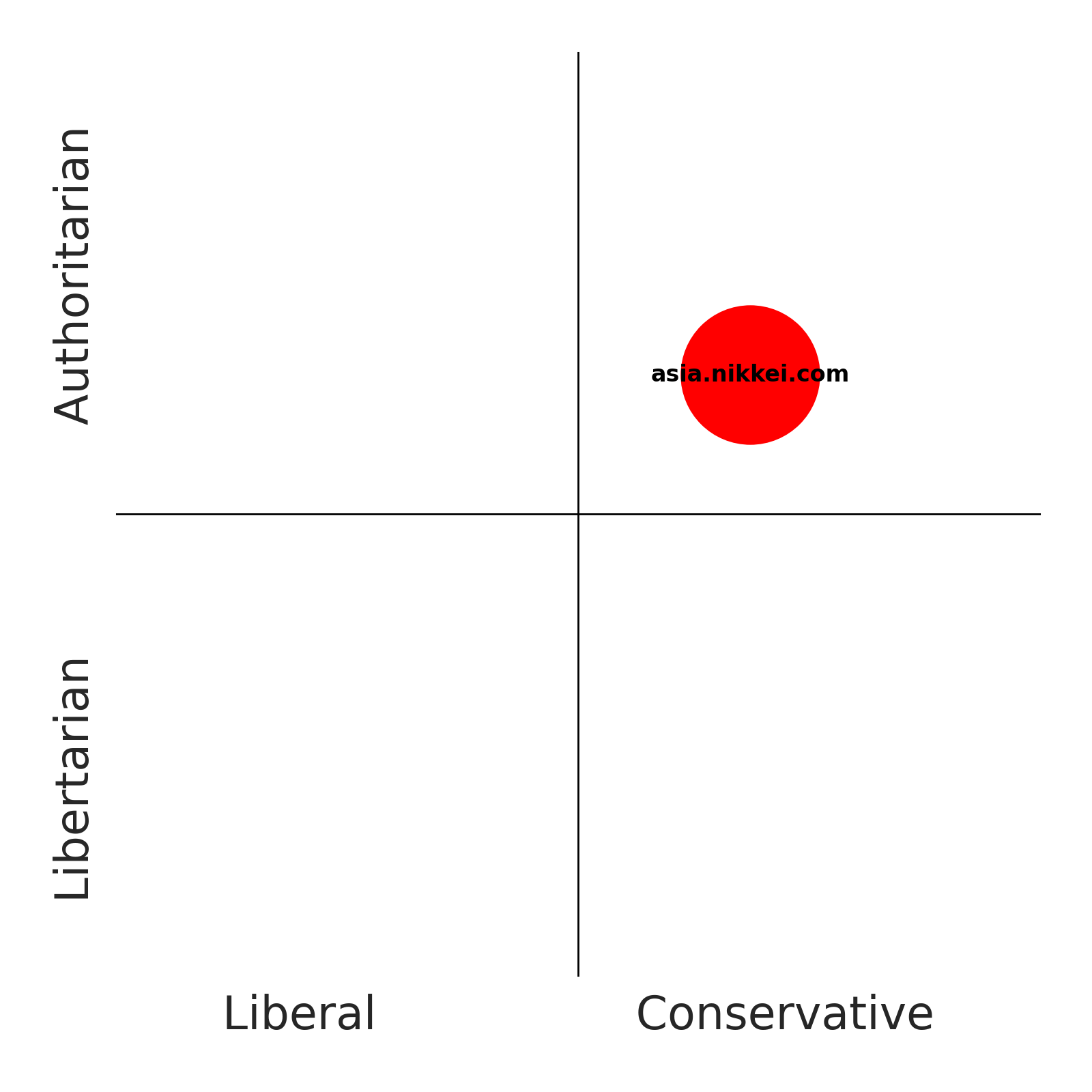
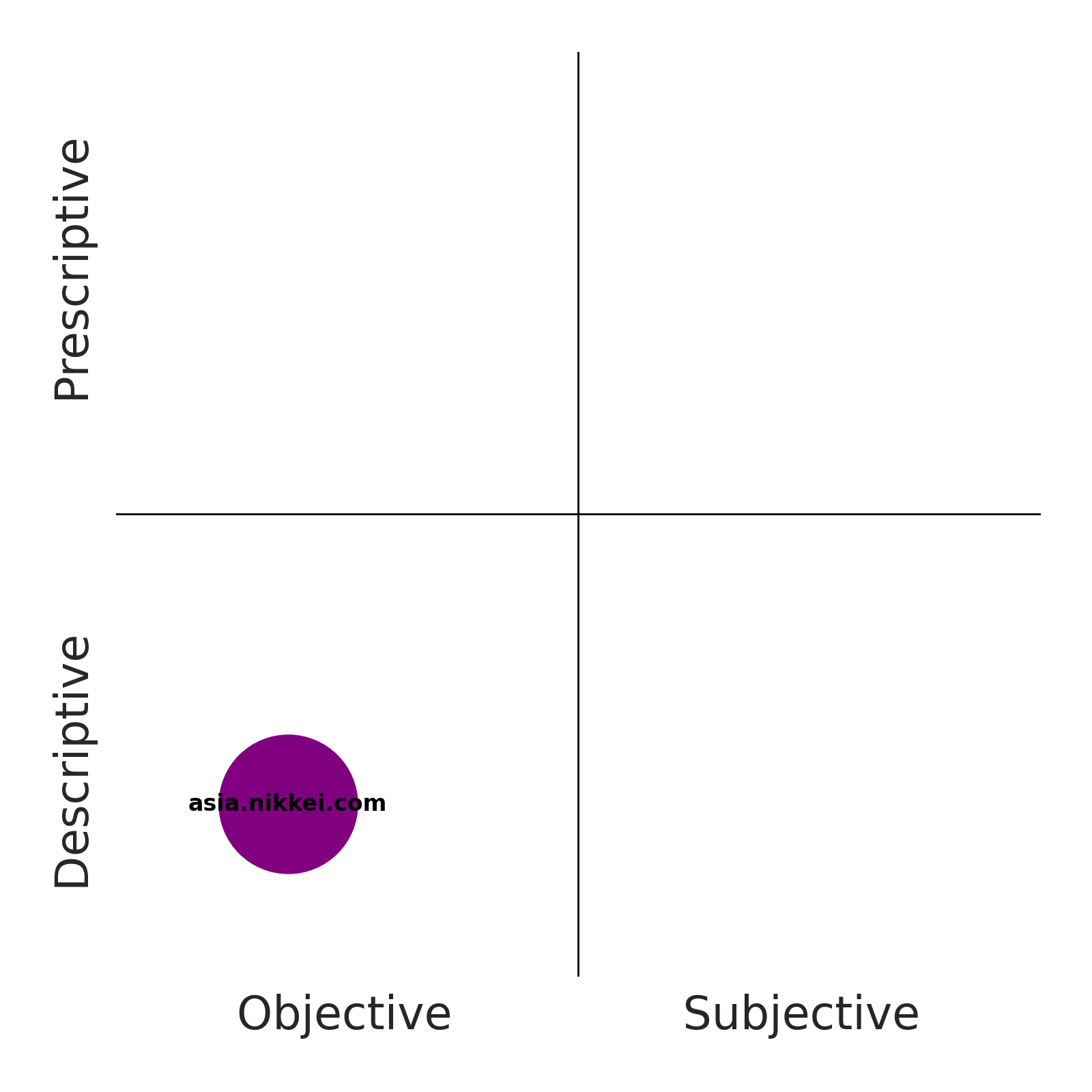
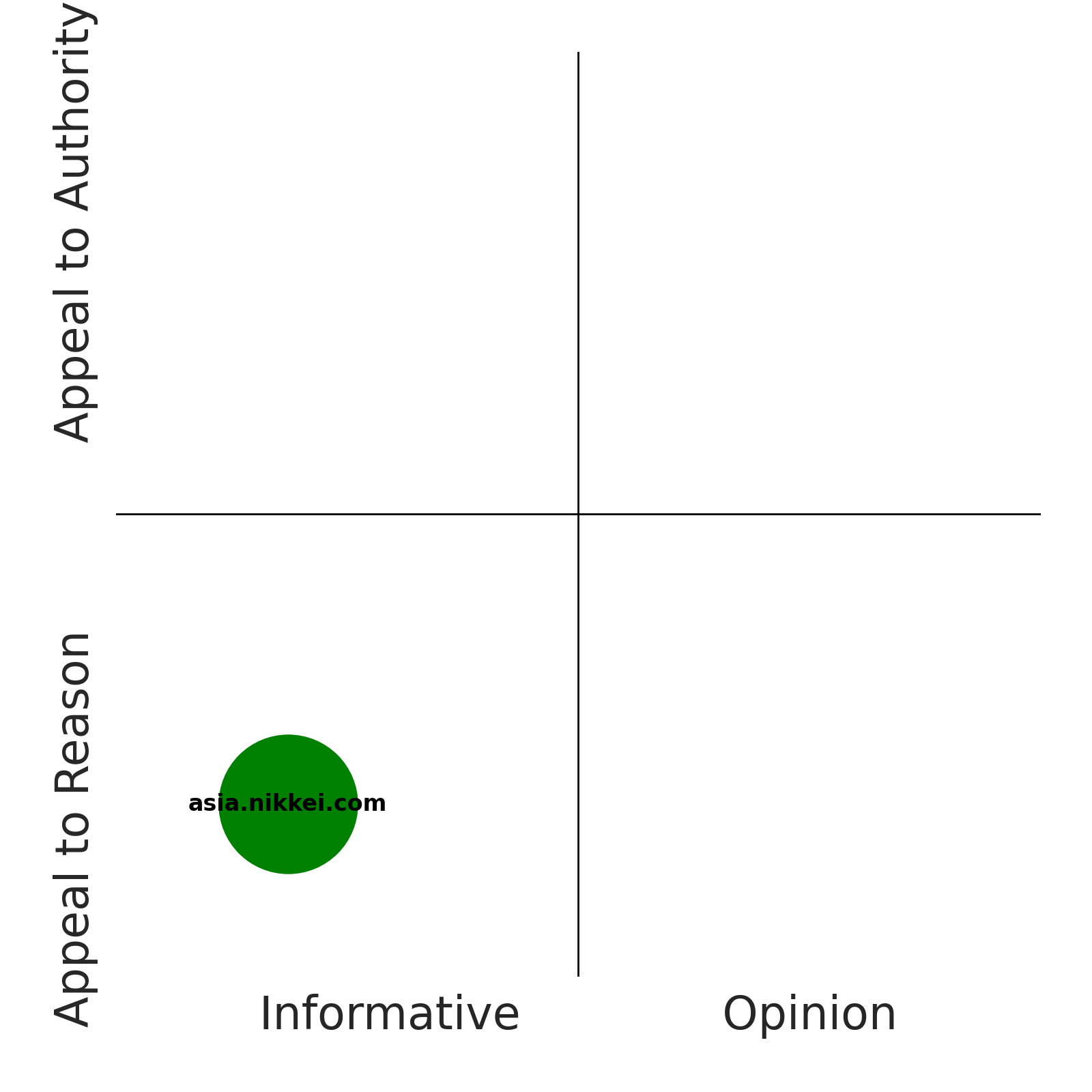
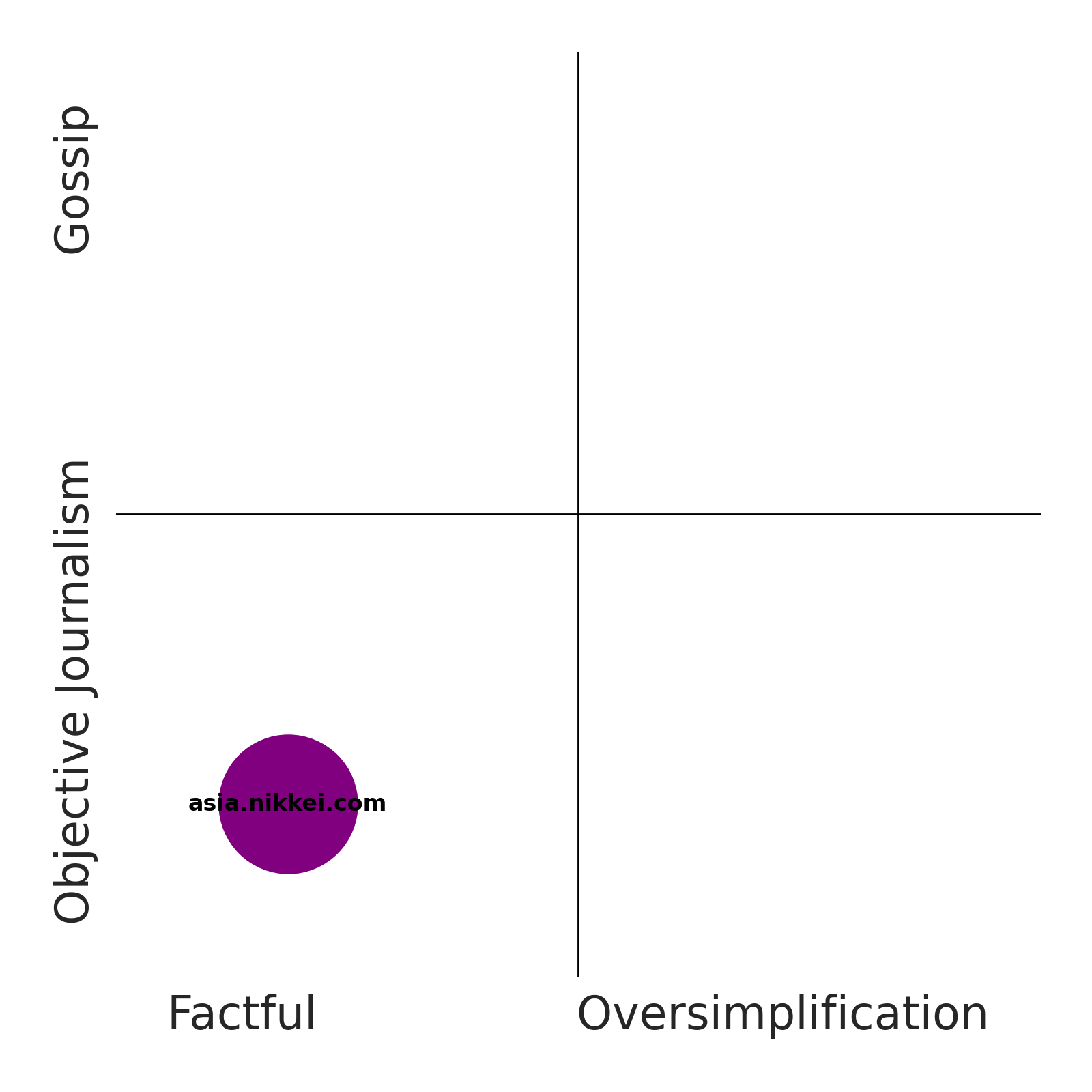
2026 © Helium Trades
Privacy Policy & Disclosure
* Disclaimer: Nothing on this website constitutes investment advice, performance data or any recommendation that any particular security, portfolio of securities, transaction or investment strategy is suitable for any specific person. Helium Trades is not responsible in any way for the accuracy
of any model predictions or price data. Any mention of a particular security and related prediction data is not a recommendation to buy or sell that security. Investments in securities involve the risk of loss. Past performance is no guarantee of future results. Helium Trades is not responsible for any of your investment decisions,
you should consult a financial expert before engaging in any transaction.
Helium Research Assistant

How can I help you today?
Ask any question about asia.nikkei.com bias.


