See whether Helium helps you make better-informed decisions. Try every Pro Trader feature for 30 days. No credit card required.
Try every Pro Trader feature for 30 days. No credit card required.
Ukraine-centric war coverage that frames Russian strikes as an existential threat, uses vivid language for Ukrainian military successes, and leans heavily on ISW and Ukrainian official sources for strategic claims.
The Russo-Ukrainian war is in its fourth year after Russia's full-scale invasion began in February 2022; war-day counts are numbered from that invasion. ISW is the Institute for the Study of War, a Washington-based think tank that publishes daily assessments. Pokrovsk is in Donetsk Oblast, eastern Ukraine; Bryansk and Krasnodar Krai are inside Russia.
Automated analysis; not human reviewed. Limitations: The supplied text is a list of headlines and teasers rather than full articles, so detailed context, sourcing, and independent verification for each item are limited. · 10 of 55 available dimensions scored; omitted dimensions are not treated as neutral. · Verified supporting quotes for 9 of 10 scored dimensions.
Claim: The coverage uses dramatic comparisons and vivid imagery that heighten emotional response beyond neutral reporting.
“"Reminiscent of 11 September at World Trade Center": Russia strikes Ukraine’s century-old National Academy of Sciences in central Kyiv, people are climbing onto windows not to be buried alive.” · verified after text normalization
Why: Comparing a strike on a science academy to 9/11 and describing people climbing onto windows is fear-inducing and dramatic, not matter-of-fact.
Claim: The coverage emphasizes civilian casualties and destruction in ways that induce alarm.
“Russia hits a Kharkiv high-rise overnight, injuring 43 people, then kills four in daylight strikes on central Kyiv and Dnipro.” · exact text match
“people are climbing onto windows not to be buried alive” · exact text match
Why: Repeated focus on residential strikes, deaths, and trapped people is alarming beyond a neutral status report.
Claim: Several headlines use value-laden or colorful language rather than neutral description.
“Ukraine outfoxes Russia near Donetsk’s fortress belt with Soviet BTR-60s rebuilt as kamikaze robots, storms a key hub and takes 250 Russian prisoners.” · exact text match
Why: 'Outfoxes,' 'kamikaze robots,' and 'storms' convey approval and excitement rather than neutral reporting.
Claim: The content is centered on international politics, military conflict, and statecraft.
“Russo-Ukrainian war, day 1678: Russia’s mass drone attacks are designed to bring about Ukraine’s capitulation by spring 2027.” · verified after text normalization
Why: Every item concerns the state-on-state war and its political strategy, making the report inherently political.
Claim: Key strategic and tactical claims are anchored to named authorities rather than independently demonstrated evidence.
“until his new theory of victory has played out, Putin is unlikely to soften his demands or enter serious ceasefire talks, according to ISW.” · not found in supplied text
“Russia’s pipeline into Kupiansk is now its escape route—with kidnapped civilians as human shields, Ukraine says.” · exact text match
Why: The report leans on ISW, Ukrainian officials, commanders, and monitoring channels for crucial claims instead of presenting independent verification.
Claim: Ukraine is consistently cast as the victim of Russian aggression, with emphasis on Russian-inflicted civilian harm.
“Russia hits a Kharkiv high-rise overnight, injuring 43 people, then kills four in daylight strikes on central Kyiv and Dnipro.” · exact text match
“Russia’s pipeline into Kupiansk is now its escape route—with kidnapped civilians as human shields, Ukraine says.” · exact text match
Why: The selection repeatedly foregrounds Russian attacks on civilians and alleged abuses, constructing a victim narrative.
Claim: The lead presents an ISW probability as a definitive Russian war aim.
“Russia’s mass drone attacks are designed to bring about Ukraine’s capitulation by spring 2027.” · verified after text normalization
Counterevidence:
“Russia’s mass drone attacks on Ukraine have a goal—likely Ukraine’s capitulation by spring 2027, ISW says.” · exact text match
Why: The headline states the goal as fact, while the later item attributes it to ISW and qualifies it as 'likely.'
Claim: The overall emotional valence is strongly negative, centered on death, injury, and war costs.
“Russia hits a Kharkiv high-rise overnight, injuring 43 people, then kills four in daylight strikes on central Kyiv and Dnipro.” · exact text match
Why: Civilian casualties and destruction dominate the roundup, producing a negative emotional tone.
Claim: The report is visibly sourced and includes uncertainty qualifiers, but many claims are one-sided and not independently verified.
“Ukrainian officials have not confirmed the system.” · exact text match
“Russia’s mass drone attacks on Ukraine have a goal—likely Ukraine’s capitulation by spring 2027, ISW says.” · exact text match
Why: It attributes claims to ISW, officials, and governors and flags lack of confirmation, but relies heavily on Ukrainian-and-Western-aligned sources and presents some probabilities as headlines.
Claim: The report includes unconfirmed or forward-looking claims about Russian drone capabilities and strategic timelines.
“Russia is launching a faster Geran-5 at Ukraine that satellite jamming may no longer knock off course, a monitoring channel says.” · exact text match
“It was likely a $100 million Nebo-M.” · exact text match
Why: Items use 'likely,' 'may,' and monitoring-channel sourcing for systems and intentions not independently confirmed.
The supplied text is a list of headlines and teasers rather than full articles, so detailed context, sourcing, and independent verification for each item are limited.
September 26, 2026 · 0 shares
Coverage celebrates Ukrainian military-technical advances while portraying Russia as deceptive, reckless, and responsible for civilian harm.
The Russo-Ukrainian war began with Russia's full-scale invasion in February 2022; Ukraine relies on Western military aid and exports grain via the Black Sea corridor, while Russia has targeted civilian and infrastructure sites.
Automated analysis; not human reviewed. Limitations: The supplied text is a headline/summary digest, so full article context, sourcing depth, and in-depth reporting are not available. · 12 of 55 available dimensions scored; omitted dimensions are not treated as neutral. · Verified supporting quotes for 8 of 12 scored dimensions.
Claim: Frames Ukrainian drone development as decisively superior and interprets Russian motives.
“Ukraine's drone innovation outpaces decades of US development” · exact text match
“Russia is using this to divert attention from its setbacks north of Lyman, the think tank says” · exact text match
Why: The headline makes a comparative judgment and the ISW statement includes motivational interpretation, though attributed.
Claim: Uses dramatic hyperbole and alarming hypotheticals to heighten impact.
“Ukraine's soldiers cracked problem US chased for 30 years. It went from idea to combat in 10 days.” · exact text match
“"Killing Ukraine's internet would take nuclear or chemical weapons"” · not found in supplied text
Why: Headlines emphasize record speed and extreme threats, which sensationalizes the report.
Claim: Presents unusual, high-stakes developments likely to hold reader attention.
“Seventeen makers head to Michigan to test bomber drones for the Pentagon” · exact text match
“"Killing Ukraine's internet would take nuclear or chemical weapons"” · not found in supplied text
Why: Uncommon military-technology and infrastructure-warfare details make the digest engaging.
Claim: Highlights existential threats to Ukraine's internet, Starlink, and Black Sea exports.
“"Killing Ukraine's internet would take nuclear or chemical weapons"—MiroHost founder whose data center Russia just destroyed.” · not found in supplied text
“Strip Starlink from Ukraine and its army goes blind—the calculation driving a Russian proposal to knock the satellite network out by any means available.” · exact text match
Why: The framing stresses catastrophic consequences if Russia achieves specific infrastructure attacks.
Claim: Mixes factual summaries with evaluative language and editorial interpretation.
“Ukraine's drone innovation outpaces decades of US development” · exact text match
“Russia is using this to divert attention from its setbacks north of Lyman, the think tank says” · exact text match
Why: Several lines contain value judgments and motivational claims rather than plain facts.
Claim: Focuses heavily on war, Ukraine's government, and geopolitical conflict.
“Zelenskyy says Ukraine has agreed on a new Patriot interceptor package—won't say with whom.” · exact text match
“ISW connects drone crashes in Moldova and Romania, a Starlink fire in Poland, and a Berlin airport shutdown into one Russian pattern.” · exact text match
Why: The entire digest is political-military news involving state leaders, defense policy, and international incidents.
Claim: Reduces complex strategic situations to single-cause narratives.
“Ukraine's drone innovation outpaces decades of US development” · exact text match
“ISW connects drone crashes in Moldova and Romania, a Starlink fire in Poland, and a Berlin airport shutdown into one Russian pattern.” · exact text match
Why: Headlines compress decades of R&D and disparate incidents into singular claims.
Claim: Emphasizes casualties and destructive attacks, pulling for a negative emotional response.
“Russia strikes second civilian ship in Black Sea in six days, killing both captains to choke route that carries 90 percent of Ukraine's farm exports” · exact text match
Why: The phrasing attributes fatal consequences to Russia's deliberate strategy, evoking sympathy and alarm.
Claim: Provides attribution and hedges around unverified claims.
“A report says US intelligence warned France of Russian ship-launched drones. France denies it.” · exact text match
“The Spanish outlet El Mundo described explosive drones hidden on merchant ships. Italy called the alert unconfirmed.” · exact text match
“To suggest a correction or clarification, write to us here” · exact text match
Why: The reporting attributes reports to named sources, includes denials and uncertainty, and references a corrections channel.
Claim: Uses maps and think-tank analysis to ground operational claims.
“ISW publishes map disproving Russia's claim” · exact text match
“The think tank says” · not found in supplied text
Why: The digest presents evidence-based sourcing from ISW rather than purely speculative assertions.
Claim: Reports denials and unconfirmed status of claims, and points to a corrections process.
“France denies it.” · exact text match
“Italy called the alert unconfirmed.” · exact text match
“To suggest a correction or clarification, write to us here” · exact text match
Why: The digest includes denials, uncertainty, and a corrections mechanism, indicating internal accountability.
Claim: Includes specific quantities, systems, and operational details requiring domain knowledge.
“Ukraine is opening access to 5 million frames of real combat to 12 British weapons makers to train AI.” · exact text match
“France arms Ukraine's Mirages with MICA missiles and cannon ammo, tripling to quadrupling the jets' cruise missile engagement range.” · exact text match
Why: The text weaves precise technical and strategic details into the summaries.
The supplied text is a headline/summary digest, so full article context, sourcing depth, and in-depth reporting are not available.
Consistently pro-Ukrainian framing treats Ukrainian official and ISW assessments as authoritative and foregrounds Russian escalation, sabotage, and civilian harm.
The full-scale Russo-Ukrainian war began in February 2022. The Kakhovka Dam was destroyed in June 2023, draining the reservoir and altering the southern front; ISW is a Washington-based think tank that publishes daily war assessments.
Automated analysis; not human reviewed. Limitations: The supplied text is a digest of headlines and summaries, so analysis relies on condensed claims rather than full reporting; many assertions are attributed to Ukrainian officials and ISW without independent verification. · 7 of 55 available dimensions scored; omitted dimensions are not treated as neutral. · Verified supporting quotes for 7 of 7 scored dimensions.
Claim: Uses dramatic, emotionally charged comparisons in headlines.
““Reminiscent of 11 September at World Trade Center”: Russia strikes Ukraine’s century-old National Academy of Sciences in central Kyiv, people are climbing onto windows not to be buried alive” · exact text match
Why: Invoking the 9/11 World Trade Center attacks and 'buried alive' sensationalizes an otherwise factual strike report.
Claim: Portrays Western arms transfers and Ukrainian offensive operations as necessary and positive.
“Belgium rushes three F-16s to Ukraine as Russia expands its drone and missile assault.” · exact text match
“Ukraine's Vivaldi counteroffensive reaches Russian fortifications near Lyman without drone fire” · exact text match
Why: The verb 'rushes' and the framing of counteroffensives as progress endorse military escalation and support for Ukraine.
Claim: The selection and wording frame the war in politically charged, pro-Ukrainian terms.
“Russia’s mass drone attacks on Ukraine have a goal—likely Ukraine’s capitulation by spring 2027, ISW says.” · exact text match
Why: Centering an adversary's alleged political objective and using 'capitulation' frames the conflict as a political struggle while adopting ISW's interpretive lens.
Claim: Relies heavily on assessments from ISW and statements from Ukrainian officials as authority.
“Vivaldi counteroffensive advanced after Ukraine took Russia’s drones out of the fight, ISW assesses.” · exact text match
“Estonia says its intelligence service established that Russia’s special services ordered the August fire at Milrem Robotics” · exact text match
Why: The analysis treats institutional and official assessments as conclusive rather than presenting independent verification.
Claim: The selection of vivid victim details evokes negative emotion toward Russia and sympathy for Ukrainian civilians.
“people are climbing onto windows not to be buried alive” · exact text match
“with kidnapped civilians as human shields, Ukraine says” · exact text match
Why: These phrases elicit fear and moral outrage rather than neutral reporting.
Claim: Shows visible attribution and some uncertainty markers, but sources are predominantly Ukrainian or Western.
“Ukraine's drones reportedly hit the region's railways.” · exact text match
“Estonia says its intelligence service established that Russia’s special services ordered the August fire at Milrem Robotics” · exact text match
Why: The text consistently names or attributes claims and uses hedges like 'reportedly,' though it rarely includes Russian or independent verification.
Claim: Includes attributed forecasts and probabilities despite uncertainty.
“A frontline commander expects small Russian groups to slip into the city by winter.” · exact text match
“Russia’s mass drone attacks on Ukraine have a goal—likely Ukraine’s capitulation by spring 2027, ISW says.” · exact text match
Why: The digest features forward-looking predictions as headline items, though they are attributed and uncertain.
The supplied text is a digest of headlines and summaries, so analysis relies on condensed claims rather than full reporting; many assertions are attributed to Ukrainian officials and ISW without independent verification.
Framing is celebratory and one-sided: Ukrainian military claims about 'world-first' robotic attacks are presented as established achievements with vivid combat detail and no independent verification or Russian perspective.
Russia's full-scale invasion of Ukraine began in February 2022; Donetsk Oblast has been one of the war's main fronts, and unmanned ground vehicles are a newer development in this conflict.
Automated analysis; not human reviewed. Limitations: This evaluation cannot independently verify Ukrainian military claims, casualty counts, or manufacturer specifications; it relies only on the supplied text. · 5 of 55 available dimensions scored; omitted dimensions are not treated as neutral. · Verified supporting quotes for 3 of 5 scored dimensions.
Claim: Descriptive reporting is heightened by dramatic, vivid language.
“they were being torn apart by robots from the 3rd Assault Corps” · exact text match
“kamikaze ground drones” · exact text match
Why: Phrases like 'torn apart' and 'kamikaze' add dramatic color beyond neutral reporting.
Claim: Framing stresses Ukrainian tactical success and innovation.
“Over its first two "seasons," the 3rd Army Corps and attached units have retaken more than 125 square kilometers, half of it de-occupied outright, and inflicted more than 3,000 casualties on Russian forces.” · not found in supplied text
“most importantly, this happens without risk to our infantry” · exact text match
Why: The selected figures and the closing quote emphasize effectiveness and force protection, giving the report a positive cast.
Claim: The article explains events and equipment without urging action.
“During the operation, UGVs equipped with two Bullspike grenade launchers attacked Russian positions, then detonated directly inside their shelters.” · exact text match
Why: The passage is expository; no request, demand, or policy recommendation is made.
Claim: Unverified operational claims are stated as established fact.
“Among its achievements: the world's first robotic assault carried out without infantry involvement, resulting in the capture of two Russian soldiers” · exact text match
Why: The 'world's first' claim is presented without hedging or attribution to a source expressing uncertainty.
Claim: Some specifications and statements are attributed, while operational claims are mostly unattributed.
“According to data from the manufacturer's website, the Bullspike RPG has a maximum aimed firing range of 350 meters” · exact text match
“the soldiers behind the mission say” · not found in supplied text
Counterevidence:
“Over its first two "seasons," the 3rd Army Corps and attached units have retaken more than 125 square kilometers” · not found in supplied text
Why: Visible attribution supports credibility on technical details, but core battlefield claims are not independently sourced, leaving moderate overall credibility.
This evaluation cannot independently verify Ukrainian military claims, casualty counts, or manufacturer specifications; it relies only on the supplied text.
September 25, 2026 · 0 shares
The framing celebrates a Ukrainian frontline unit's 10-day drone-robot innovation as a fielded breakthrough that a 30-year US effort never achieved.
Automated analysis; not human reviewed. Limitations: The supplied text is single-sourced to Brave1 and the unit; no independent or external verification is available. · 7 of 55 available dimensions scored; omitted dimensions are not treated as neutral. · Verified supporting quotes for 0 of 7 scored dimensions.
Claim: The report is predominantly factual and sourced.
“"According to Brave1, just 10 days passed from the idea to its first combat use"” · not found in supplied text
“"The defense cluster, a state platform for scaling battlefield inventions, said it took notice of the Desantnyk"” · not found in supplied text
Why: Key operational details and strike claims are attributed to Brave1 rather than asserted as the outlet's own direct observations.
Claim: The tone is favorable toward the Ukrainian unit's innovation and battlefield effectiveness.
“"took it from idea to combat in 10 days"” · not found in supplied text
“"the Desantnyk has already carried out confirmed strikes: the unit used it to destroy Russian shelters and troops"” · not found in supplied text
Why: The selected details emphasize rapid success and battlefield effectiveness, producing an upbeat framing of Ukrainian capability.
Claim: The framing makes the subject attention-holding.
“"Ukrainian soldiers solve drone-delivery problem US military has chased for three decades"” · not found in supplied text
“"It went from idea to combat in 10 days"” · not found in supplied text
Why: The contrast between a 30-year US effort and a 10-day fielding is inherently striking.
Claim: The content is descriptive, explaining what was built and achieved without urging any course of action.
“"The Desantnyk is a compact wheeled platform. Alter Ego built a way to release it accurately from a heavy bomber drone"” · not found in supplied text
Why: The article explains mechanics and reported events; there are no recommendations, calls to action, or policy prescriptions.
Claim: The report is credible within its scope due to named sourcing and specific details.
“"the Brave1 defense cluster said"” · not found in supplied text
“"According to Brave1, just 10 days passed from the idea to its first combat use"” · not found in supplied text
Why: Specific figures and named institutional sources support trustworthiness, though much is single-sourced.
Claim: The story signals internal fairness by consistently attributing claims to sources.
“"the Brave1 defense cluster said"” · not found in supplied text
“"According to Brave1"” · not found in supplied text
Why: Attribution of potentially contested operational and strike claims to a named source is an observable honesty signal.
Claim: The article offers a clear technical explanation of an unfamiliar system.
“"in a pairing engineers call a 'marsupial', one carrier delivering another"” · not found in supplied text
“"The Desantnyk is a compact wheeled platform. Alter Ego built a way to release it accurately from a heavy bomber drone"” · not found in supplied text
Why: It uses an analogy and specific technical detail to convey how the system works without obvious distortion.
The supplied text is single-sourced to Brave1 and the unit; no independent or external verification is available.
Framing presents the battlefield-data sharing as a controlled, win-win technological collaboration, emphasizing Ukraine’s unique data and safeguards while omitting downsides.
Automated analysis; not human reviewed. Limitations: The supplied text mixes article body with related links and an 'Industry Focus - this content is published as advertorial content' label, making that label’s applicability ambiguous; some claims are attributed only to the Defense Ministry without independent verification. · 3 of 55 available dimensions scored; omitted dimensions are not treated as neutral. · Verified supporting quotes for 3 of 3 scored dimensions.
Claim: The publisher mixes factual reporting with unqualified evaluative claims about the value of Ukraine’s data.
“Ukraine's combat data is a resource no other military has access to.” · exact text match
Why: The uniqueness and value claim is stated as fact rather than attributed analysis, indicating subjective framing.
Claim: The publisher frames the collaboration as a mutually beneficial strategic opportunity.
“British firms get to build and test their AI on battlefield data they could not access elsewhere, while Ukraine gets their technology and joint development of AI for unmanned systems.” · exact text match
Why: The statement presents the arrangement in positive, win-win terms without discussing risks or downsides.
Claim: The report attributes key details to Ukraine’s Defense Ministry, providing a visible source.
“Up to 12 British defense companies will join Avengers Labs, Ukraine's platform for training AI models for drones and robots on real combat data, the Defense Ministry said.” · exact text match
Why: Attribution to an official ministry supports sourcing, though some evaluative claims are unattributed, limiting credibility.
The supplied text mixes article body with related links and an 'Industry Focus - this content is published as advertorial content' label, making that label’s applicability ambiguous; some claims are attributed only to the Defense Ministry without independent verification.
September 29, 2026 · 0 shares
Framing is pro-Ukraine and alarmist about Russia's intensifying attacks, presenting Belgium's F-16 deliveries as a necessary defensive enhancement.
Russia's full-scale invasion of Ukraine began in February 2022; Western allies have since supplied Ukraine with advanced weapons, including F-16s, to support its air defense.
Automated analysis; not human reviewed. Limitations: Only one article text from a single outlet was provided, so delivery claims and battlefield details could not be independently verified. · 3 of 55 available dimensions scored; omitted dimensions are not treated as neutral. · Verified supporting quotes for 3 of 3 scored dimensions.
Claim: The report mixes factual attribution with the publisher's own evaluative assessment of the aircraft's value.
“The aircraft are particularly valuable as Russia increases its use of Shahed/Geran drones” · exact text match
Why: The sentence makes an analytical judgment about the jets' usefulness rather than merely reporting Zelenskyy's statement.
Claim: The article includes a concluding editorial judgment about the significance of the additional jets.
“For Ukraine, the additional jets therefore provide both another layer against Russia's expanding aerial attacks and additional capacity for combat operations on the frontline.” · verified after text normalization
Why: The use of 'therefore' and the evaluative conclusion go beyond neutral factual reporting.
Claim: The article's framing treats the delivery of F-16s as a political-military event central to the Ukraine-Russia conflict.
“Belgium rushes three F-16s to Ukraine as Russia expands its drone and missile assault.” · exact text match
Why: The topic and wording focus on state-level military aid and the Ukraine-Russia war, which is inherently political.
Only one article text from a single outlet was provided, so delivery claims and battlefield details could not be independently verified.
The reporting is supportive of Western arming of Ukraine, emphasizing French resupply and Ukrainian intercept capability while framing Russia's strikes on cities as an ongoing threat.
Automated analysis; not human reviewed. Limitations: Extracted text mixes substantive reporting with page chrome/advertorial labels; the core claim relies on Militarnyi's citation of France's Armed Forces Ministry rather than primary documentation. · 9 of 55 available dimensions scored; omitted dimensions are not treated as neutral. · Verified supporting quotes for 9 of 9 scored dimensions.
Claim: Most substantive claims are attributed or technical; only a small number of interpretive phrases color the report.
“France delivered additional MICA air-to-air missiles and 30mm cannon ammunition for Ukraine's Mirage 2000 fighter jets, Militarnyi reported, citing France's Armed Forces Ministry.” · exact text match
Counterevidence:
“Delivering an aircraft is one step, keeping it armed is another.” · exact text match
Why: The dominant mode is factual attribution; one aphoristic transition provides slight subjectivity.
Claim: No sensational or hyperbolic language is evident; descriptions are technical and restrained.
“The MICA, developed by MBDA, comes in two versions: radar-guided (MICA RF) and infrared (MICA IR). It weighs about 112 kg, flies at Mach 4.9—nearly five times the speed of sound—and can engage targets 60 to 80 km away.” · exact text match
Why: Technical specifications dominate; there is no outrage or exaggerated threat language.
Claim: The piece describes and explains the resupply rather than telling readers what policy to support.
“The 30mm ammunition feeds the Mirage's two built-in DEFA 554 cannons, which fire at a selectable rate of 1,200 or 1,800 rounds per minute.” · exact text match
Why: Sentences are declarative and explanatory; no direct imperatives or policy recommendations appear.
Claim: The report frames French arms deliveries as necessary 'sustained combat support' and emphasizes Ukrainian intercept capability against Russian strikes.
“France's weapons resupply reflects a shift from one-off hardware transfers to sustained combat support as Russia's aerial campaign against Ukrainian cities grinds on.” · exact text match
Why: The wording 'grinds on' and 'sustained combat support' treats continued arming as a positive necessity, but the article does not call for escalation.
Claim: Mostly factual, but the report includes a brief editorial transition.
“Delivering an aircraft is one step, keeping it armed is another.” · exact text match
Why: This sentence expresses an analytical judgment rather than a reported fact, though it is a minor part of the piece.
Claim: Credibility is moderate: the report names a secondary source and a ministry, but some assertions are uncredited.
“France delivered additional MICA air-to-air missiles and 30mm cannon ammunition for Ukraine's Mirage 2000 fighter jets, Militarnyi reported, citing France's Armed Forces Ministry.” · exact text match
Why: Attribution to a named ministry and secondary outlet supports credibility, while the first-sortie kill and fleet figures are asserted without direct sourcing.
Claim: The report infers from available details why Magic 2 missiles stayed in use, explicitly marking the inference as an explanation rather than a confirmed fact.
“MICAs were reportedly included with the original donation, but the supply may have been limited, which would explain why the Magic 2s stayed in use.” · exact text match
Why: 'May have been' and 'would explain' are explicitly hypothetical.
Claim: Core delivery information is attributed to Militarnyi and France's Armed Forces Ministry, with hedged language for uncertain details.
“France delivered additional MICA air-to-air missiles and 30mm cannon ammunition for Ukraine's Mirage 2000 fighter jets, Militarnyi reported, citing France's Armed Forces Ministry.” · exact text match
Counterevidence:
“Ukraine's Mirage had killed a cruise missile on its first combat sortie.” · exact text match
Why: Attribution is clear, but the opening kill claim is stated without a named source, which tempers the integrity assessment.
Claim: The text is technically dense, distinguishing missile variants, weights, speeds, ranges, and gun rates.
“The MICA, developed by MBDA, comes in two versions: radar-guided (MICA RF) and infrared (MICA IR). It weighs about 112 kg, flies at Mach 4.9—nearly five times the speed of sound—and can engage targets 60 to 80 km away.” · exact text match
Why: Specific technical parameters and variant distinctions indicate high informational content.
Extracted text mixes substantive reporting with page chrome/advertorial labels; the core claim relies on Militarnyi's citation of France's Armed Forces Ministry rather than primary documentation.
Ukrainian drone makers are presented as 'battlefield-proven' contenders for Pentagon bomber-drone contracts, and the content carries an explicit advertorial label, giving the report a promotional cast.
Automated analysis; not human reviewed. Limitations: The text is labeled 'advertorial content' and its key facts are attributed to a secondary outlet, limiting independent verification. · 3 of 55 available dimensions scored; omitted dimensions are not treated as neutral. · Verified supporting quotes for 3 of 3 scored dimensions.
Claim: The report is predominantly factual and attributed, with only mild evaluative framing.
“the next stage of the Pentagon's Drone Dominance program, Defender Media reported” · exact text match
“Which models they will bring is not yet clear.” · exact text match
Counterevidence:
“For Ukraine's makers, the bomber round is another chance to turn battlefield-proven hardware into a US contract.” · exact text match
Why: Most claims are attributed or hedged, but 'battlefield-proven' is a promotional evaluation rather than a neutral description.
Claim: The framing is mildly optimistic about Ukrainian drone makers' chances.
“For Ukraine's makers, the bomber round is another chance to turn battlefield-proven hardware into a US contract.” · exact text match
Counterevidence:
“organizers call it the hardest and fastest-paced stage of the program yet” · exact text match
Why: The phrase 'another chance' frames the contest as an opportunity, while the countervailing warning about difficulty and the prior all-American winners temper the optimism.
Claim: The content is explicitly labeled as advertorial and promotes Ukrainian drone companies in a procurement contest.
“Industry Focus - this content is published as advertorial content” · exact text match
Why: The publisher's own label identifies the piece as paid or sponsored promotional content, which is the core of advertising bias.
The text is labeled 'advertorial content' and its key facts are attributed to a secondary outlet, limiting independent verification.
Framing treats Ukraine's Vivaldi counteroffensive as an effective advance and presents ISW's map as definitive proof against Russia's Dobropillia encirclement claim.
ISW is the Institute for the Study of War, a US-based think tank that publishes daily operational assessments of Russia's invasion of Ukraine. The Vivaldi counteroffensive refers to a named Ukrainian military operation in eastern Ukraine.
Automated analysis; not human reviewed. Limitations: The supplied text is fragmentary and contains truncated or repeated passages, limiting full assessment. · 5 of 55 available dimensions scored; omitted dimensions are not treated as neutral. · Verified supporting quotes for 5 of 5 scored dimensions.
Claim: Framing emphasizes Ukrainian operational success by saying the counteroffensive 'advanced' and 'disrupts Russia’s plan'.
“Vivaldi counteroffensive advanced” · exact text match
“disrupts Russia’s plan to encircle Donetsk Fortress Belt” · exact text match
Why: The word choices 'advanced' and 'disrupts' present the operation as succeeding against Russian plans.
Claim: The publisher presents ISW's map as definitively disproving Russia's claim, using 'disproving' and 'actually', while the underlying assessment is attributed and partly probabilistic.
“ISW publishes map disproving Russia’s claim” · exact text match
“they are actually 10+ km away” · exact text match
Counterevidence:
“Ukraine likely neutralized Russia's drone defenses” · exact text match
Why: One claim is hedged with 'likely,' but the Dobropillia claim is presented as definitively disproved, exceeding the cautious framing used elsewhere.
Claim: Most claims are attributed to ISW or military reporting, but there is no independent verification in the supplied text.
“The 3rd Army Corps reported on 17 September that strikes on Russian logistics in occupied Luhansk Oblast had degraded Russian fuel supplies to the front, ISW wrote that day.” · exact text match
Why: Visible attribution to ISW and the 3rd Army Corps supports sourcing, while reliance on those same sources and absence of independent confirmation limits credibility.
Claim: The report includes counterfactual and probabilistic assessments about Russian drone and EW systems.
“Ukraine likely neutralized Russia's drone defenses” · exact text match
“would otherwise have hunted the advancing vehicles” · exact text match
Why: The 'likely' assessment and 'would otherwise have' counterfactual describe events that are inferred rather than directly observed.
Claim: The framing uses 'They say' and 'actually' to present Russia's claim as false while presenting ISW's map as authoritative, an asymmetric and loaded contrast.
“They say Dobropillia is encircled, but they are actually 10+ km away” · exact text match
“ISW publishes map disproving Russia’s claim” · exact text match
Why: The wording contrasts an unattributed 'They say' with a definitive 'actually' and 'disproving,' loading the presentation against Russia's claim.
The supplied text is fragmentary and contains truncated or repeated passages, limiting full assessment.
Framing relies on ISW's evidence-based map to characterize Russia's Dobropillia encirclement claim as disinformation meant to distract from Ukrainian successes near Lyman.
Automated analysis; not human reviewed. Limitations: No access to the original ISW map/report or the Russian Defense Ministry map; the supplied text is secondary and was treated as untrusted data. · 5 of 55 available dimensions scored; omitted dimensions are not treated as neutral. · Verified supporting quotes for 3 of 5 scored dimensions.
Claim: The text marks which statements are Russian claims and which are ISW/Ukrainian observations, but editorial framing calls the Russian statements disinformation.
“ISW analysts, meanwhile, said they have not observed evidence supporting Russia's claim that the city is encircled.” · exact text match
Counterevidence:
“Russia has been spreading disinformation about its successes around Dobropillia as part of what ISW calls a cognitive warfare effort to portray Ukrainian defenses as on the verge of collapse.” · exact text match
Why: Russian statements are attributed as claims and ISW/Ukrainian statements as observations, yet the opening framing describes the Russian effort as disinformation.
Claim: The piece is a descriptive assessment of battlefield claims and motives, not a prescriptive commentary.
“In its 24 September report, ISW said Russia's claims about Dobropillia were partly intended to divert attention from Ukraine's elimination of the Russian salient north of Lyman.” · not found in supplied text
Why: The content summarizes what ISW and other sources said and assessed without issuing instructions or policy prescriptions.
Claim: Named sources, dates, and 'claimed' vs 'observed' labels make the report's sourcing conditions explicit.
“Units of Russia's Center Grouping of Forces continue combat operations against encircled Ukrainian forces in the Dobropillia area of Donetsk Oblast while simultaneously advancing toward Oleksandrivka, the Russian Defense Ministry claimed.” · exact text match
“ISW observed evidence that Russian infiltrators, small groups, were operating east and northeast of Dobropillia on 19 and 20 September. The institute did not assess that these infiltrators had consolidated their positions.” · exact text match
Why: The text consistently labels Russian statements as claims, attributes Ukrainian and ISW observations, and includes specific dates and units.
Claim: The publisher assesses the battle through a specific observed metric rather than through rival claims.
“Based on the evidence observed by ISW, the nearest area where Russian forces are present is 10.2 kilometers from the southeastern outskirts of Dobropillia.” · exact text match
Why: The refutation is anchored in a specific measured distance and in an explicit distinction between observed evidence and unsupported claims.
Claim: The report includes a structural explanation of why the Russian Ministry's claims became inflated.
“ISW noted that Russia's pervasive military culture of lying—what Russian milbloggers themselves call "beautiful reports"—has degraded the Defense Ministry's own ability to understand the battlefield and enabled inflated claims like the Dobropillia encirclement.” · not found in supplied text
Why: It connects the specific false claim to a broader systemic explanation rather than simply reporting the contradiction.
No access to the original ISW map/report or the Russian Defense Ministry map; the supplied text is secondary and was treated as untrusted data.
The roundup frames the war from a pro-Ukrainian, Western-allied perspective, foregrounding Russian aggression, Ukrainian resilience, and the value of international support.
Russia's full-scale invasion of Ukraine has been ongoing since February 2022. By 2026 Ukraine continues to face missile and drone strikes while receiving Western military, financial, and humanitarian aid; the EU and other states have imposed sanctions. This is a daily roundup of war developments.
Automated analysis; not human reviewed. Limitations: The supplied text is a composite digest of headlines and briefs rather than a continuous full article, so scoring reflects selection and headline emphasis rather than detailed reporting. · 5 of 55 available dimensions scored; omitted dimensions are not treated as neutral. · Verified supporting quotes for 5 of 5 scored dimensions.
Claim: The framing emphasizes Ukrainian technological and military progress despite heavy losses.
“Ukraine’s drone innovation outpaces decades of US development” · exact text match
Why: Headline emphasis on Ukrainian drone innovation conveys capability and forward momentum, supporting a positive tilt.
Claim: The selection and framing are heavily political, centered on war, diplomacy, and sanctions.
“Russia strikes Kyiv with ballistic and hypersonic missiles, damaging maternity hospital amid US-led push for energy truce.” · exact text match
Why: The lead brief combines military action and international diplomacy, and nearly every brief concerns state actors, alliances, or sanctions.
Claim: Key claims are anchored to named official and institutional sources rather than independently verified.
“A senior UN official told the Security Council the toll is worsening as strikes reach cities far from the front, with a dark winter ahead.” · exact text match
Why: Casualty and threat assessments are attributed to UN, ISW, DeepState, and intelligence services rather than demonstrated with primary data.
Claim: Reporting is transparently attributed, with allegations separated from assertion.
“Zelenskyy said Russia's war has cost it nearly 249,000 troops this year for about 1,000 square kilometers gained.” · exact text match
“US prosecutors accuse Oxygen Forensics' CEO and a Russian national of concealing Russian ownership and software development while selling digital forensics tools to federal agencies.” · exact text match
Why: The text consistently marks claims with verbs like said and accuse, preserving source attribution and epistemic status.
Claim: Framing presents Russian reports as false and Ukrainian or Western analyses as reliable.
“Russia spreads false encirclement claims from Dobropillia to Kharkiv — ISW.” · exact text match
Why: The headline explicitly labels Russian claims as false, indicating fact-checking and reasoned debunking rather than credulous transmission.
The supplied text is a composite digest of headlines and briefs rather than a continuous full article, so scoring reflects selection and headline emphasis rather than detailed reporting.
Pro-Ukrainian wartime reporting that frames the Nove battle as a clever Ukrainian outmaneuvering of a complacent Russian force, using the Ukrainian command's account as established fact in the headline and omitting a Russian perspective.
Automated analysis; not human reviewed. Limitations: The supplied article text is truncated with ellipses, so the analysis relies on the visible excerpt and may not capture the full report's nuance. · 9 of 55 available dimensions scored; omitted dimensions are not treated as neutral. · Verified supporting quotes for 8 of 9 scored dimensions.
Claim: The publisher frames the battle using subjective, approving language.
“Ukraine outfoxes Russia near Donetsk's fortress belt” · exact text match
Why: 'Outfoxes' is an evaluative term that presents Ukrainian tactics as clever and successful rather than neutrally describing the engagement.
Claim: The publisher uses dramatic, emotionally charged language.
“Soviet BTR-60s rebuilt as kamikaze robots” · exact text match
“storms a key hub and takes 250 Russian prisoners” · exact text match
Why: 'Kamikaze robots' and 'storms' are vivid, sensational descriptions of military equipment and action.
Claim: The overall framing is optimistic about Ukraine's military position.
“Ukraine outfoxes Russia” · exact text match
“takes 250 Russian prisoners” · exact text match
Why: The headline emphasizes Ukrainian success and Russian collapse, conveying an upbeat assessment of the battle's outcome.
Claim: The publisher presents offensive Ukrainian military action favorably.
“storms a key hub and takes 250 Russian prisoners” · exact text match
Why: The article celebrates the successful use of force, including remote-detonated vehicles, aligning with a pro-military stance in the conflict.
Claim: The headline states an evaluative judgment as fact.
“Ukraine outfoxes Russia near Donetsk's fortress belt” · exact text match
Why: 'Outfoxes' is an opinion about Russian competence and Ukrainian skill, presented as a factual characterization.
Claim: The report is embedded in a partisan war narrative.
“kidnapped civilians as human shields, Ukraine says” · exact text match
Why: The article leads with Ukrainian military claims and characterizes Russian actions negatively, taking a side in an active conflict.
Claim: The headline asserts as fact what the body attributes to Ukrainian sources.
“Ukraine outfoxes Russia near Donetsk's fortress belt with Soviet BTR-60s rebuilt as kamikaze robots, storms a key hub and takes 250 Russian prisoners” · exact text match
Counterevidence:
“the corps said” · exact text match
Why: The headline presents the capture of 250 prisoners as established fact, while the body attributes claims to 'the corps said,' showing certainty beyond the supplied attribution.
Claim: The article shows moderate credibility through sourcing but with a one-sided headline.
“the corps said” · exact text match
“Ukraine says” · exact text match
Why: Key claims are attributed to identifiable Ukrainian military sources, but the report relies exclusively on one side's account and the headline overstates it.
Claim: The publisher uses loaded framing and asymmetric attribution.
“Russia has poured its reserves into counterattacks on a feint axis and "slept through" the real strike” · not found in supplied text
“kidnapped civilians as human shields, Ukraine says” · exact text match
Why: The article adopts the Ukrainian command's explanation as narrative and uses emotionally loaded phrases about Russia, without offering a Russian perspective.
The supplied article text is truncated with ellipses, so the analysis relies on the visible excerpt and may not capture the full report's nuance.
A balanced, attribution-heavy news report that frames the Seoul-Kyiv row as a factual disagreement over a confidentiality agreement, giving each government's account roughly equal weight.
Automated analysis; not human reviewed. Limitations: The supplied text is a composite excerpt mixed with related headlines, an advertorial notice, and patron/ad-blocker chrome, making the exact editorial boundary ambiguous; only the core report was analyzed. · 6 of 55 available dimensions scored; omitted dimensions are not treated as neutral. · Verified supporting quotes for 6 of 6 scored dimensions.
Claim: News framing stays descriptive and attribution-based rather than injecting the publisher's opinion.
“Seoul says Kyiv broke a promise to keep the transfer of two North Korean soldiers quiet, and Kyiv says it never made one.” · exact text match
Why: The opening presents both governments' positions as claims and does not decide which side is correct.
Claim: The language is undramatic and reports the dispute without hyperbole or fear appeals.
“Seoul called on Kyiv to explain and apologize for making public the transfer of two North Korean prisoners of war, saying Ukraine had broken an agreement to keep the move private and later denied that such an agreement existed, Reuters reported on 27 September.” · exact text match
Why: The core sentence uses conventional attributed news language and does not editorialize or sensationalize.
Claim: The article describes positions and events without recommending action.
“Ukraine had denied that the two countries had agreed to keep the transfer private.” · exact text match
Why: It reports a denial rather than instructing any party on what should be done.
Claim: The report is heavily sourced to named officials, ministries, and named media outlets, with dates tied to those attributions.
“Reuters reported on 27 September.” · exact text match
“according to the Korea Herald.” · exact text match
Why: Specific named sources and dates allow verification, and phrases such as 'according to' preserve attribution.
Claim: The report treats the controversy as a factual disagreement anchored by dated, sourced events.
“Zelenskyy announced the transfer on 23 September during a speech at the UN General Assembly. He said Ukraine had recently sent two North Korean prisoners of war to South Korea.” · exact text match
Why: It uses a specific date, named officials, and attributed statements rather than speculation or emotional appeals.
Claim: The article gives space to both sides' accounts and flags statements as reported claims.
“Seoul says Kyiv broke a promise to keep the transfer of two North Korean soldiers quiet, and Kyiv says it never made one.” · exact text match
Why: Including both governments' versions in the lead signals fair presentation and avoids one-sided treatment.
The supplied text is a composite excerpt mixed with related headlines, an advertorial notice, and patron/ad-blocker chrome, making the exact editorial boundary ambiguous; only the core report was analyzed.
Reports Russia’s drone escalation primarily through Ukrainian monitoring and official sources, emphasizing the threat and Moscow’s apparent edge while noting official confirmation gaps.
Automated analysis; not human reviewed. Limitations: The supplied text blends the main article with related headlines, embedded social-media content, and support/advertising messages, so the precise article boundaries are ambiguous. · 4 of 55 available dimensions scored; omitted dimensions are not treated as neutral. · Verified supporting quotes for 4 of 4 scored dimensions.
Claim: The framing uses dramatic, overreaching language about the drone threat.
“800 jet drones in four days: Russia is now firing type Ukraine’s interceptors cannot catch” · exact text match
“Ukraine's interceptors are catching just over half of Russia's jet drones.” · exact text match
Why: The headline asserts interceptors cannot catch the drones, while the body reports that more than half are currently caught, dramatizing the threat.
Claim: The stated certainty of the threat exceeds the limited confirmation presented.
“Russia is now firing type Ukraine’s interceptors cannot catch” · exact text match
“Official Ukrainian sources have not confirmed the K5 designation or the DSMAC-class system, Militarnyi noted.” · exact text match
Why: The categorical 'cannot catch' headline is not matched by the body's partial-interception statistic or by the explicit lack of official confirmation.
Claim: The report is heavily attributed and cautious with verification.
“the Ukrainian monitoring channel Polkovnyk GSh reported” · exact text match
“presidential adviser on defense technology Serhii Beskrestnov, known as Flash, said” · exact text match
Why: Named sources with explicit attributions support internal credibility, and the substantive text includes clear acknowledgments of what has not been confirmed.
Claim: The report is transparent about non-confirmation and missing evidence.
“Official Ukrainian sources have not confirmed the K5 designation or the DSMAC-class system, Militarnyi noted.” · exact text match
“HUR's component list includes no terrain-matching optics.” · exact text match
Why: The publisher flags that key designations are unconfirmed and notes that an intelligence component list contradicts a central technical claim, rather than smoothing over uncertainty.
The supplied text blends the main article with related headlines, embedded social-media content, and support/advertising messages, so the precise article boundaries are ambiguous.
Relays Ukrainian security service warnings as authoritative fact, framing Russian digital influence operations and espionage as an active wartime threat requiring public vigilance.
Automated analysis; not human reviewed. Limitations: The supplied text includes related-link headlines and site boilerplate; only the substantive SBU-report portion informed the analysis. · 3 of 55 available dimensions scored; omitted dimensions are not treated as neutral. · Verified supporting quotes for 3 of 3 scored dimensions.
Claim: The report frames the Ukraine-Russia conflict through an adversarial national-security lens, treating Russian cyber and espionage operations as active wartime threats.
“Alongside its full-scale invasion, Russia wages war on Ukraine in the cyber domain and through espionage and sabotage.” · exact text match
Why: The statement is written as the publisher's own framing rather than attributed, aligning the report with Ukrainian official security messaging.
Claim: The article's key claims about Russian fake pages and recruitment activity rest almost entirely on SBU statements rather than independent verification.
“The fake sources serve Russian psychological operations and disinformation campaigns, the SBU said on 28 September.” · exact text match
“The SBU says it has already blocked dozens of clones of its own brand.” · exact text match
Why: Major assertions are repeatedly sourced to the SBU, with no alternate or independent evidence provided in the report.
Claim: The report consistently attributes claims to the SBU and marks unverified recruitment cases with 'allegedly', supporting its visible credibility.
“A mobilized soldier allegedly recruited by the FSB, Russia's Federal Security Service, tried to direct a Russian missile strike on his own unit in Kharkiv Oblast, the SBU said.” · exact text match
Why: Attribution and hedging are visible even though the report relies primarily on a single official source.
The supplied text includes related-link headlines and site boilerplate; only the substantive SBU-report portion informed the analysis.
Framing aggregates separate European incidents into a single Russian hybrid-warfare campaign, conditioning attribution on ISW's assessment while noting the absence of official confirmation.
The reported incidents took place amid Russia's full-scale invasion of Ukraine, which began in 2022, and NATO states have been supporting Ukraine; ISW is a US think tank that publishes widely cited daily updates on the conflict.
Automated analysis; not human reviewed. Limitations: The supplied text bundles headline-like fragments with embedded JSON-style content, so some framing may come from headline aggregations rather than the body; no external verification was possible. · 7 of 55 available dimensions scored; omitted dimensions are not treated as neutral. · Verified supporting quotes for 7 of 7 scored dimensions.
Claim: The text amplifies fear by foregrounding casualty risks and possible Russian military strikes on NATO.
“destructive cyber attacks and sabotage carrying a high risk of casualties” · exact text match
“there is a low but growing risk of a limited Russian military attack on a NATO border state” · exact text match
Why: Selecting and foregrounding these warning details induces alarm even while official attribution is lacking.
Claim: The report frames events through a geopolitical conflict lens, treating them as part of Russia's war against Ukraine and NATO.
“Russia's full-scale war against Ukraine has expanded into a parallel campaign of provocations against European defense and logistical infrastructure” · exact text match
Why: This is an interpretive political claim, not a neutral factual description, classifying the piece as political.
Claim: The article bases attribution and risk claims largely on institutional authorities rather than independent verification.
“Several recent incidents across Europe were conducted by Russia or are likely attributable to Russia, ISW assessed in its 24 September report” · exact text match
“Danish Defense Intelligence assessed on 24 September that Russia will intensify its hybrid war in coming months” · exact text match
“CIA reportedly warned Poland that Russia may sabotage underwater cables to disrupt its banking system” · exact text match
Why: Causation is established via expert and intelligence authorities; the publisher does not independently verify the asserted pattern.
Claim: The reporting is oriented toward institutional and intelligence assessments rather than alternative or critical sources.
“Several recent incidents across Europe were conducted by Russia or are likely attributable to Russia, ISW assessed in its 24 September report” · exact text match
“Danish Defense Intelligence assessed on 24 September that Russia will intensify its hybrid war in coming months” · exact text match
“CIA reportedly warned Poland that Russia may sabotage underwater cables to disrupt its banking system” · exact text match
Why: The story's structure and causality are built on ISW, intelligence agencies, and named officials, signaling deference to establishment institutions.
Claim: The report attributes claims to named officials, agencies, and media, and marks unconfirmed items as unconfirmed.
“Federal police could not confirm it” · exact text match
“ISW said it has not yet seen evidence that Russia has conducted the attacks the warnings describe” · exact text match
Why: Sourcing is specific and uncertainty is flagged, supporting high credibility based on visible practices.
Claim: The report includes several forward-looking warnings about possible Russian attacks and sabotage.
“A Lithuanian Defense Ministry source reported on 23 September that Russia could launch Gerbera drones from a shipping container in the Mediterranean against Spain, France, and Italy” · exact text match
“there is a low but growing risk of a limited Russian military attack on a NATO border state” · exact text match
Why: Uncertain, attributed projections dominate the risk narrative, making the piece more speculative than purely retrospective reporting.
Claim: The text signals honesty by explicitly stating uncertainty and lack of official attribution.
“ISW said it has not yet seen evidence that Russia has conducted the attacks the warnings describe” · exact text match
“though authorities have not officially linked the Polish and German incidents to Moscow” · exact text match
Why: Caveats and non-confirmations are preserved in the report, indicating fair handling of uncertain attribution.
The supplied text bundles headline-like fragments with embedded JSON-style content, so some framing may come from headline aggregations rather than the body; no external verification was possible.
The reporting frames Russia’s responsibility as an established finding of Estonian intelligence and strikes a confident, alliance-positive tone that the sabotage campaign will fail and Ukraine support will continue.
Automated analysis; not human reviewed. Limitations: The supplied text is a short news brief containing a single government’s account and some page-level boilerplate; no Russian response, independent verification, or correction history is available, so bias classification rests on the publisher’s wording and selection alone. · 9 of 55 available dimensions scored; omitted dimensions are not treated as neutral. · Verified supporting quotes for 9 of 9 scored dimensions.
Claim: The report contains a categorical predictive assertion alongside factual reporting.
“Russia’s attempts to divide, intimidate and sow confusion will fail.” · exact text match
Why: The unqualified 'will fail' statement is presented as an assertion, not as an attributed or hedged forecast.
Claim: The report emphasizes that the sabotage campaign will be unsuccessful and Ukraine support will hold.
“Estonia says sabotage will not weaken Ukraine support” · exact text match
“Russia’s sabotage campaign will not achieve its objectives” · exact text match
Why: The subheading and a quoted Foreign Ministry statement frame the episode’s consequences positively for Ukraine and its allies.
Claim: The report foregrounds a firm response of raising pressure on Russia and increasing support for Ukraine.
“Tsahkna said Estonia would respond to the attack by increasing both its support for Ukraine and pressure on Russia.” · exact text match
Why: The stated response favors escalation of pressure and military support rather than conciliation.
Claim: The report includes an editorial assertion about the inevitable strengthening of Allied resolve.
“Every act of sabotage only strengthens Allied resolve, increases pressure on Russia and reinforces support for Ukraine.” · exact text match
Why: This is a normative/predictive claim rather than a reported fact.
Claim: The story is centered on interstate political conflict, intelligence accusations, and diplomatic response.
“Foreign Minister Margus Tsahkna said on 29 September that information gathered by Estonia’s Internal Security Service showed the fire at Milrem’s Tallinn premises on the night of 14–15 August was a Russian intelligence-directed sabotage operation.” · exact text match
Why: The subject is inherently geopolitical and the report is told through government and intelligence sources.
Claim: The report states the failure of Russia’s sabotage campaign as a certainty.
“Russia’s attempts to divide, intimidate and sow confusion will fail.” · exact text match
Why: The categorical future-tense claim exceeds the support provided by the cited intelligence and official statements.
Claim: The report aligns closely with Estonian government and allied institutional positions.
“Estonia and its allies would continue increasing pressure on Russia and supporting Ukraine.” · exact text match
Why: Official statements serve as the response frame, and the report carries a favorable tone toward allied resolve.
Claim: The report attributes its central claims to named officials and includes concrete details and a company response.
“Foreign Minister Margus Tsahkna said on 29 September that information gathered by Estonia’s Internal Security Service showed the fire at Milrem’s Tallinn premises on the night of 14–15 August was a Russian intelligence-directed sabotage operation.” · exact text match
“The company said in August that the fire had not disrupted its production or deliveries to Ukraine.” · exact text match
Why: It relies on attributable official statements and includes the affected company’s reassurance, but lacks independent verification.
Claim: The report includes a transparent caveat about the initial lack of public evidence linking Russia to the fire.
“When the investigation was first announced in August, Estonian authorities had not publicly established a Russian connection or disclosed evidence linking Moscow to the fire.” · exact text match
Why: This caveat signals care about the epistemic status of the earlier announcement, supporting internal integrity.
The supplied text is a short news brief containing a single government’s account and some page-level boilerplate; no Russian response, independent verification, or correction history is available, so bias classification rests on the publisher’s wording and selection alone.
Ukraine-centric war coverage that frames Russian strikes as an existential threat, uses vivid language for Ukrainian military successes, and leans heavily on ISW and Ukrainian official sources for strategic claims.
The Russo-Ukrainian war is in its fourth year after Russia's full-scale invasion began in February 2022; war-day counts are numbered from that invasion. ISW is the Institute for the Study of War, a Washington-based think tank that publishes daily assessments. Pokrovsk is in Donetsk Oblast, eastern Ukraine; Bryansk and Krasnodar Krai are inside Russia.
Automated analysis; not human reviewed. Limitations: The supplied text is a list of headlines and teasers rather than full articles, so detailed context, sourcing, and independent verification for each item are limited. · 10 of 55 available dimensions scored; omitted dimensions are not treated as neutral. · Verified supporting quotes for 9 of 10 scored dimensions.
Claim: The coverage uses dramatic comparisons and vivid imagery that heighten emotional response beyond neutral reporting.
“"Reminiscent of 11 September at World Trade Center": Russia strikes Ukraine’s century-old National Academy of Sciences in central Kyiv, people are climbing onto windows not to be buried alive.” · verified after text normalization
Why: Comparing a strike on a science academy to 9/11 and describing people climbing onto windows is fear-inducing and dramatic, not matter-of-fact.
Claim: The coverage emphasizes civilian casualties and destruction in ways that induce alarm.
“Russia hits a Kharkiv high-rise overnight, injuring 43 people, then kills four in daylight strikes on central Kyiv and Dnipro.” · exact text match
“people are climbing onto windows not to be buried alive” · exact text match
Why: Repeated focus on residential strikes, deaths, and trapped people is alarming beyond a neutral status report.
Claim: Several headlines use value-laden or colorful language rather than neutral description.
“Ukraine outfoxes Russia near Donetsk’s fortress belt with Soviet BTR-60s rebuilt as kamikaze robots, storms a key hub and takes 250 Russian prisoners.” · exact text match
Why: 'Outfoxes,' 'kamikaze robots,' and 'storms' convey approval and excitement rather than neutral reporting.
Claim: The content is centered on international politics, military conflict, and statecraft.
“Russo-Ukrainian war, day 1678: Russia’s mass drone attacks are designed to bring about Ukraine’s capitulation by spring 2027.” · verified after text normalization
Why: Every item concerns the state-on-state war and its political strategy, making the report inherently political.
Claim: Key strategic and tactical claims are anchored to named authorities rather than independently demonstrated evidence.
“until his new theory of victory has played out, Putin is unlikely to soften his demands or enter serious ceasefire talks, according to ISW.” · not found in supplied text
“Russia’s pipeline into Kupiansk is now its escape route—with kidnapped civilians as human shields, Ukraine says.” · exact text match
Why: The report leans on ISW, Ukrainian officials, commanders, and monitoring channels for crucial claims instead of presenting independent verification.
Claim: Ukraine is consistently cast as the victim of Russian aggression, with emphasis on Russian-inflicted civilian harm.
“Russia hits a Kharkiv high-rise overnight, injuring 43 people, then kills four in daylight strikes on central Kyiv and Dnipro.” · exact text match
“Russia’s pipeline into Kupiansk is now its escape route—with kidnapped civilians as human shields, Ukraine says.” · exact text match
Why: The selection repeatedly foregrounds Russian attacks on civilians and alleged abuses, constructing a victim narrative.
Claim: The lead presents an ISW probability as a definitive Russian war aim.
“Russia’s mass drone attacks are designed to bring about Ukraine’s capitulation by spring 2027.” · verified after text normalization
Counterevidence:
“Russia’s mass drone attacks on Ukraine have a goal—likely Ukraine’s capitulation by spring 2027, ISW says.” · exact text match
Why: The headline states the goal as fact, while the later item attributes it to ISW and qualifies it as 'likely.'
Claim: The overall emotional valence is strongly negative, centered on death, injury, and war costs.
“Russia hits a Kharkiv high-rise overnight, injuring 43 people, then kills four in daylight strikes on central Kyiv and Dnipro.” · exact text match
Why: Civilian casualties and destruction dominate the roundup, producing a negative emotional tone.
Claim: The report is visibly sourced and includes uncertainty qualifiers, but many claims are one-sided and not independently verified.
“Ukrainian officials have not confirmed the system.” · exact text match
“Russia’s mass drone attacks on Ukraine have a goal—likely Ukraine’s capitulation by spring 2027, ISW says.” · exact text match
Why: It attributes claims to ISW, officials, and governors and flags lack of confirmation, but relies heavily on Ukrainian-and-Western-aligned sources and presents some probabilities as headlines.
Claim: The report includes unconfirmed or forward-looking claims about Russian drone capabilities and strategic timelines.
“Russia is launching a faster Geran-5 at Ukraine that satellite jamming may no longer knock off course, a monitoring channel says.” · exact text match
“It was likely a $100 million Nebo-M.” · exact text match
Why: Items use 'likely,' 'may,' and monitoring-channel sourcing for systems and intentions not independently confirmed.
The supplied text is a list of headlines and teasers rather than full articles, so detailed context, sourcing, and independent verification for each item are limited.
Consistently pro-Ukrainian framing treats Ukrainian official and ISW assessments as authoritative and foregrounds Russian escalation, sabotage, and civilian harm.
The full-scale Russo-Ukrainian war began in February 2022. The Kakhovka Dam was destroyed in June 2023, draining the reservoir and altering the southern front; ISW is a Washington-based think tank that publishes daily war assessments.
Automated analysis; not human reviewed. Limitations: The supplied text is a digest of headlines and summaries, so analysis relies on condensed claims rather than full reporting; many assertions are attributed to Ukrainian officials and ISW without independent verification. · 7 of 55 available dimensions scored; omitted dimensions are not treated as neutral. · Verified supporting quotes for 7 of 7 scored dimensions.
Claim: Uses dramatic, emotionally charged comparisons in headlines.
““Reminiscent of 11 September at World Trade Center”: Russia strikes Ukraine’s century-old National Academy of Sciences in central Kyiv, people are climbing onto windows not to be buried alive” · exact text match
Why: Invoking the 9/11 World Trade Center attacks and 'buried alive' sensationalizes an otherwise factual strike report.
Claim: Portrays Western arms transfers and Ukrainian offensive operations as necessary and positive.
“Belgium rushes three F-16s to Ukraine as Russia expands its drone and missile assault.” · exact text match
“Ukraine's Vivaldi counteroffensive reaches Russian fortifications near Lyman without drone fire” · exact text match
Why: The verb 'rushes' and the framing of counteroffensives as progress endorse military escalation and support for Ukraine.
Claim: The selection and wording frame the war in politically charged, pro-Ukrainian terms.
“Russia’s mass drone attacks on Ukraine have a goal—likely Ukraine’s capitulation by spring 2027, ISW says.” · exact text match
Why: Centering an adversary's alleged political objective and using 'capitulation' frames the conflict as a political struggle while adopting ISW's interpretive lens.
Claim: Relies heavily on assessments from ISW and statements from Ukrainian officials as authority.
“Vivaldi counteroffensive advanced after Ukraine took Russia’s drones out of the fight, ISW assesses.” · exact text match
“Estonia says its intelligence service established that Russia’s special services ordered the August fire at Milrem Robotics” · exact text match
Why: The analysis treats institutional and official assessments as conclusive rather than presenting independent verification.
Claim: The selection of vivid victim details evokes negative emotion toward Russia and sympathy for Ukrainian civilians.
“people are climbing onto windows not to be buried alive” · exact text match
“with kidnapped civilians as human shields, Ukraine says” · exact text match
Why: These phrases elicit fear and moral outrage rather than neutral reporting.
Claim: Shows visible attribution and some uncertainty markers, but sources are predominantly Ukrainian or Western.
“Ukraine's drones reportedly hit the region's railways.” · exact text match
“Estonia says its intelligence service established that Russia’s special services ordered the August fire at Milrem Robotics” · exact text match
Why: The text consistently names or attributes claims and uses hedges like 'reportedly,' though it rarely includes Russian or independent verification.
Claim: Includes attributed forecasts and probabilities despite uncertainty.
“A frontline commander expects small Russian groups to slip into the city by winter.” · exact text match
“Russia’s mass drone attacks on Ukraine have a goal—likely Ukraine’s capitulation by spring 2027, ISW says.” · exact text match
Why: The digest features forward-looking predictions as headline items, though they are attributed and uncertain.
The supplied text is a digest of headlines and summaries, so analysis relies on condensed claims rather than full reporting; many assertions are attributed to Ukrainian officials and ISW without independent verification.
Framing aggregates separate European incidents into a single Russian hybrid-warfare campaign, conditioning attribution on ISW's assessment while noting the absence of official confirmation.
The reported incidents took place amid Russia's full-scale invasion of Ukraine, which began in 2022, and NATO states have been supporting Ukraine; ISW is a US think tank that publishes widely cited daily updates on the conflict.
Automated analysis; not human reviewed. Limitations: The supplied text bundles headline-like fragments with embedded JSON-style content, so some framing may come from headline aggregations rather than the body; no external verification was possible. · 7 of 55 available dimensions scored; omitted dimensions are not treated as neutral. · Verified supporting quotes for 7 of 7 scored dimensions.
Claim: The text amplifies fear by foregrounding casualty risks and possible Russian military strikes on NATO.
“destructive cyber attacks and sabotage carrying a high risk of casualties” · exact text match
“there is a low but growing risk of a limited Russian military attack on a NATO border state” · exact text match
Why: Selecting and foregrounding these warning details induces alarm even while official attribution is lacking.
Claim: The report frames events through a geopolitical conflict lens, treating them as part of Russia's war against Ukraine and NATO.
“Russia's full-scale war against Ukraine has expanded into a parallel campaign of provocations against European defense and logistical infrastructure” · exact text match
Why: This is an interpretive political claim, not a neutral factual description, classifying the piece as political.
Claim: The article bases attribution and risk claims largely on institutional authorities rather than independent verification.
“Several recent incidents across Europe were conducted by Russia or are likely attributable to Russia, ISW assessed in its 24 September report” · exact text match
“Danish Defense Intelligence assessed on 24 September that Russia will intensify its hybrid war in coming months” · exact text match
“CIA reportedly warned Poland that Russia may sabotage underwater cables to disrupt its banking system” · exact text match
Why: Causation is established via expert and intelligence authorities; the publisher does not independently verify the asserted pattern.
Claim: The reporting is oriented toward institutional and intelligence assessments rather than alternative or critical sources.
“Several recent incidents across Europe were conducted by Russia or are likely attributable to Russia, ISW assessed in its 24 September report” · exact text match
“Danish Defense Intelligence assessed on 24 September that Russia will intensify its hybrid war in coming months” · exact text match
“CIA reportedly warned Poland that Russia may sabotage underwater cables to disrupt its banking system” · exact text match
Why: The story's structure and causality are built on ISW, intelligence agencies, and named officials, signaling deference to establishment institutions.
Claim: The report attributes claims to named officials, agencies, and media, and marks unconfirmed items as unconfirmed.
“Federal police could not confirm it” · exact text match
“ISW said it has not yet seen evidence that Russia has conducted the attacks the warnings describe” · exact text match
Why: Sourcing is specific and uncertainty is flagged, supporting high credibility based on visible practices.
Claim: The report includes several forward-looking warnings about possible Russian attacks and sabotage.
“A Lithuanian Defense Ministry source reported on 23 September that Russia could launch Gerbera drones from a shipping container in the Mediterranean against Spain, France, and Italy” · exact text match
“there is a low but growing risk of a limited Russian military attack on a NATO border state” · exact text match
Why: Uncertain, attributed projections dominate the risk narrative, making the piece more speculative than purely retrospective reporting.
Claim: The text signals honesty by explicitly stating uncertainty and lack of official attribution.
“ISW said it has not yet seen evidence that Russia has conducted the attacks the warnings describe” · exact text match
“though authorities have not officially linked the Polish and German incidents to Moscow” · exact text match
Why: Caveats and non-confirmations are preserved in the report, indicating fair handling of uncertain attribution.
The supplied text bundles headline-like fragments with embedded JSON-style content, so some framing may come from headline aggregations rather than the body; no external verification was possible.
September 29, 2026 · 0 shares
A manufacturer-sourced advertorial presents the Slavic drone as a tailored Ukrainian replacement for DJI Mavic, relaying promotional specifications and CEO testimony as news.
Automated analysis; not human reviewed. Limitations: The supplied text contains an explicit 'Industry Focus - this content is published as advertorial content' label plus surrounding page metadata, making the boundary between editorial and sponsored content ambiguous. · 7 of 55 available dimensions scored; omitted dimensions are not treated as neutral. · Verified supporting quotes for 6 of 7 scored dimensions.
Claim: The report adopts the manufacturer's favorable framing of the drone without independent scrutiny.
“Slavic is one of these domestic alternatives, designed not only to replace Mavic but also to adapt its capabilities to current battlefield conditions, allowing reconnaissance crews to operate farther from the line of contact and reducing risks to personnel.” · exact text match
“The company said its new drone has successfully completed initial combat trials with seven units of the Ukrainian Defense Forces and is preparing for scale-up, the media outlet notes.” · exact text match
Why: The report weaves manufacturer-provided capability claims and a favorable verdict into the news narrative, and it is labeled advertorial content.
Claim: The drone's capabilities and prospects are presented favorably, with no mention of risks or drawbacks.
“The company said its new drone has successfully completed initial combat trials with seven units of the Ukrainian Defense Forces and is preparing for scale-up, the media outlet notes.” · exact text match
Why: The emphasis on successful trials, scale-up, and solving a supply shortage gives the report a positive product outlook.
Claim: The tone is optimistic about the drone's ability to address Ukraine's Mavic shortage.
“Slavic is one of these domestic alternatives, designed not only to replace Mavic but also to adapt its capabilities to current battlefield conditions...” · not found in supplied text
Why: Presents the drone as an effective replacement and improvement rather than noting limitations or setbacks.
Claim: The article includes direct opinion from company leadership and promotional judgment as part of the report.
““The war has changed, and so have the working conditions for crews. The kill zone has expanded, while available commercial drones have a limited tactical range. The main task now is to provide the military with a specialized platform that can fly longer and farther, so crews can operate farther from the line of contact. This is exactly why we began developing Slavic,” said Oleksii Babenko, founder and CEO of Vyriy Industries.” · exact text match
Why: A lengthy CEO argument for the product is quoted as a central part of the report, giving it an opinionated promotional cast.
Claim: Sourcing is disclosed, but the piece is advertiser-funded product promotion built on a single interested source.
“Oboronka reports, citing information from the manufacturer.” · exact text match
“Industry Focus - this content is published as advertorial content” · exact text match
Why: Attribution and sponsorship are transparent, but reliance on the manufacturer alone and the advertorial status lower journalistic credibility.
Claim: The report functions as promotional material for a company's product and is explicitly labeled advertorial.
“Industry Focus - this content is published as advertorial content” · exact text match
“The system is supplied as a ready-to-use package “out of the box,” with all the equipment needed for operation without additional field modifications.” · exact text match
Why: An explicit advertorial label plus uniformly favorable, manufacturer-sourced product description establishes promotional framing.
Claim: The article presents a private company and its product favorably as central to solving a military need.
“Ukrainian company Vyriy Industries is bringing a new tactical reconnaissance drone, Slavic, to the market, Oboronka reports, citing information from the manufacturer.” · exact text match
Why: The report is centered on one company's product announcement and repeatedly relays favorable details from that company.
The supplied text contains an explicit 'Industry Focus - this content is published as advertorial content' label plus surrounding page metadata, making the boundary between editorial and sponsored content ambiguous.
Frames the Pentagon's drone-selection testing as a validation of Ukraine's combat experience, while presenting Unwave's participation in promotional, alliance-integration terms.
Automated analysis; not human reviewed. Limitations: The supplied text includes an advertorial label, so the source's own promotional interest in the subject is the most consequential input limitation. · 6 of 55 available dimensions scored; omitted dimensions are not treated as neutral. · Verified supporting quotes for 4 of 6 scored dimensions.
Claim: The report combines factual reporting with subjective value-laden framing.
“turning Ukraine's hard-won counter-drone experience into the test bench for American hardware” · exact text match
“For Unwave, the value is a door into the alliance's security architecture” · exact text match
Why: Phrases like 'hard-won' and 'value is a door' inject favorable interpretation into otherwise factual reporting.
Claim: The report emphasizes successful outcomes and future benefits without critical balance.
“it judged the tasks successfully completed” · exact text match
“"such interaction will help integrate Ukrainian technologies into the security architecture of our allies."” · not found in supplied text
Why: Positive results and forward-looking integration are highlighted, with no skeptical perspective.
Claim: The story is centered on defense-policy decisions and frames Ukrainian military integration as part of a strategic pattern.
“as part of the Pentagon's Drone Dominance program” · exact text match
“It follows a pattern in which US defense efforts adopt Ukrainian battlefield models” · exact text match
Why: The subject is US-Ukraine defense procurement, and the 'pattern' comment gives it a geopolitical interpretation.
Claim: The narrative treats NATO and allied defense institutions favorably.
“integrate Ukrainian technologies into the security architecture of our allies” · exact text match
Why: Allied security architecture is presented as the desired goal of the testing.
Claim: The story functions as paid or promotional coverage for Unwave rather than independent reporting.
“Industry Focus - this content is published as advertorial content” · exact text match
“"Our mission was to create conditions as close to the real battlefield as possible," the company said” · not found in supplied text
Why: The text is explicitly labelled advertorial and centers on Unwave's success and market access.
Claim: The report is oriented toward Unwave's corporate interests and market access.
“For Unwave, the value is a door into the alliance's security architecture” · exact text match
Why: Business benefit is explicitly framed as a positive outcome, consistent with advertorial content.
The supplied text includes an advertorial label, so the source's own promotional interest in the subject is the most consequential input limitation.
Ukrainian drone makers are presented as 'battlefield-proven' contenders for Pentagon bomber-drone contracts, and the content carries an explicit advertorial label, giving the report a promotional cast.
Automated analysis; not human reviewed. Limitations: The text is labeled 'advertorial content' and its key facts are attributed to a secondary outlet, limiting independent verification. · 3 of 55 available dimensions scored; omitted dimensions are not treated as neutral. · Verified supporting quotes for 3 of 3 scored dimensions.
Claim: The report is predominantly factual and attributed, with only mild evaluative framing.
“the next stage of the Pentagon's Drone Dominance program, Defender Media reported” · exact text match
“Which models they will bring is not yet clear.” · exact text match
Counterevidence:
“For Ukraine's makers, the bomber round is another chance to turn battlefield-proven hardware into a US contract.” · exact text match
Why: Most claims are attributed or hedged, but 'battlefield-proven' is a promotional evaluation rather than a neutral description.
Claim: The framing is mildly optimistic about Ukrainian drone makers' chances.
“For Ukraine's makers, the bomber round is another chance to turn battlefield-proven hardware into a US contract.” · exact text match
Counterevidence:
“organizers call it the hardest and fastest-paced stage of the program yet” · exact text match
Why: The phrase 'another chance' frames the contest as an opportunity, while the countervailing warning about difficulty and the prior all-American winners temper the optimism.
Claim: The content is explicitly labeled as advertorial and promotes Ukrainian drone companies in a procurement contest.
“Industry Focus - this content is published as advertorial content” · exact text match
Why: The publisher's own label identifies the piece as paid or sponsored promotional content, which is the core of advertising bias.
The text is labeled 'advertorial content' and its key facts are attributed to a secondary outlet, limiting independent verification.
Ukraine-centric war coverage that frames Russian strikes as an existential threat, uses vivid language for Ukrainian military successes, and leans heavily on ISW and Ukrainian official sources for strategic claims.
The Russo-Ukrainian war is in its fourth year after Russia's full-scale invasion began in February 2022; war-day counts are numbered from that invasion. ISW is the Institute for the Study of War, a Washington-based think tank that publishes daily assessments. Pokrovsk is in Donetsk Oblast, eastern Ukraine; Bryansk and Krasnodar Krai are inside Russia.
Automated analysis; not human reviewed. Limitations: The supplied text is a list of headlines and teasers rather than full articles, so detailed context, sourcing, and independent verification for each item are limited. · 10 of 55 available dimensions scored; omitted dimensions are not treated as neutral. · Verified supporting quotes for 9 of 10 scored dimensions.
Claim: The coverage uses dramatic comparisons and vivid imagery that heighten emotional response beyond neutral reporting.
“"Reminiscent of 11 September at World Trade Center": Russia strikes Ukraine’s century-old National Academy of Sciences in central Kyiv, people are climbing onto windows not to be buried alive.” · verified after text normalization
Why: Comparing a strike on a science academy to 9/11 and describing people climbing onto windows is fear-inducing and dramatic, not matter-of-fact.
Claim: The coverage emphasizes civilian casualties and destruction in ways that induce alarm.
“Russia hits a Kharkiv high-rise overnight, injuring 43 people, then kills four in daylight strikes on central Kyiv and Dnipro.” · exact text match
“people are climbing onto windows not to be buried alive” · exact text match
Why: Repeated focus on residential strikes, deaths, and trapped people is alarming beyond a neutral status report.
Claim: Several headlines use value-laden or colorful language rather than neutral description.
“Ukraine outfoxes Russia near Donetsk’s fortress belt with Soviet BTR-60s rebuilt as kamikaze robots, storms a key hub and takes 250 Russian prisoners.” · exact text match
Why: 'Outfoxes,' 'kamikaze robots,' and 'storms' convey approval and excitement rather than neutral reporting.
Claim: The content is centered on international politics, military conflict, and statecraft.
“Russo-Ukrainian war, day 1678: Russia’s mass drone attacks are designed to bring about Ukraine’s capitulation by spring 2027.” · verified after text normalization
Why: Every item concerns the state-on-state war and its political strategy, making the report inherently political.
Claim: Key strategic and tactical claims are anchored to named authorities rather than independently demonstrated evidence.
“until his new theory of victory has played out, Putin is unlikely to soften his demands or enter serious ceasefire talks, according to ISW.” · not found in supplied text
“Russia’s pipeline into Kupiansk is now its escape route—with kidnapped civilians as human shields, Ukraine says.” · exact text match
Why: The report leans on ISW, Ukrainian officials, commanders, and monitoring channels for crucial claims instead of presenting independent verification.
Claim: Ukraine is consistently cast as the victim of Russian aggression, with emphasis on Russian-inflicted civilian harm.
“Russia hits a Kharkiv high-rise overnight, injuring 43 people, then kills four in daylight strikes on central Kyiv and Dnipro.” · exact text match
“Russia’s pipeline into Kupiansk is now its escape route—with kidnapped civilians as human shields, Ukraine says.” · exact text match
Why: The selection repeatedly foregrounds Russian attacks on civilians and alleged abuses, constructing a victim narrative.
Claim: The lead presents an ISW probability as a definitive Russian war aim.
“Russia’s mass drone attacks are designed to bring about Ukraine’s capitulation by spring 2027.” · verified after text normalization
Counterevidence:
“Russia’s mass drone attacks on Ukraine have a goal—likely Ukraine’s capitulation by spring 2027, ISW says.” · exact text match
Why: The headline states the goal as fact, while the later item attributes it to ISW and qualifies it as 'likely.'
Claim: The overall emotional valence is strongly negative, centered on death, injury, and war costs.
“Russia hits a Kharkiv high-rise overnight, injuring 43 people, then kills four in daylight strikes on central Kyiv and Dnipro.” · exact text match
Why: Civilian casualties and destruction dominate the roundup, producing a negative emotional tone.
Claim: The report is visibly sourced and includes uncertainty qualifiers, but many claims are one-sided and not independently verified.
“Ukrainian officials have not confirmed the system.” · exact text match
“Russia’s mass drone attacks on Ukraine have a goal—likely Ukraine’s capitulation by spring 2027, ISW says.” · exact text match
Why: It attributes claims to ISW, officials, and governors and flags lack of confirmation, but relies heavily on Ukrainian-and-Western-aligned sources and presents some probabilities as headlines.
Claim: The report includes unconfirmed or forward-looking claims about Russian drone capabilities and strategic timelines.
“Russia is launching a faster Geran-5 at Ukraine that satellite jamming may no longer knock off course, a monitoring channel says.” · exact text match
“It was likely a $100 million Nebo-M.” · exact text match
Why: Items use 'likely,' 'may,' and monitoring-channel sourcing for systems and intentions not independently confirmed.
The supplied text is a list of headlines and teasers rather than full articles, so detailed context, sourcing, and independent verification for each item are limited.
The roundup frames the war from a pro-Ukrainian, Western-allied perspective, foregrounding Russian aggression, Ukrainian resilience, and the value of international support.
Russia's full-scale invasion of Ukraine has been ongoing since February 2022. By 2026 Ukraine continues to face missile and drone strikes while receiving Western military, financial, and humanitarian aid; the EU and other states have imposed sanctions. This is a daily roundup of war developments.
Automated analysis; not human reviewed. Limitations: The supplied text is a composite digest of headlines and briefs rather than a continuous full article, so scoring reflects selection and headline emphasis rather than detailed reporting. · 5 of 55 available dimensions scored; omitted dimensions are not treated as neutral. · Verified supporting quotes for 5 of 5 scored dimensions.
Claim: The framing emphasizes Ukrainian technological and military progress despite heavy losses.
“Ukraine’s drone innovation outpaces decades of US development” · exact text match
Why: Headline emphasis on Ukrainian drone innovation conveys capability and forward momentum, supporting a positive tilt.
Claim: The selection and framing are heavily political, centered on war, diplomacy, and sanctions.
“Russia strikes Kyiv with ballistic and hypersonic missiles, damaging maternity hospital amid US-led push for energy truce.” · exact text match
Why: The lead brief combines military action and international diplomacy, and nearly every brief concerns state actors, alliances, or sanctions.
Claim: Key claims are anchored to named official and institutional sources rather than independently verified.
“A senior UN official told the Security Council the toll is worsening as strikes reach cities far from the front, with a dark winter ahead.” · exact text match
Why: Casualty and threat assessments are attributed to UN, ISW, DeepState, and intelligence services rather than demonstrated with primary data.
Claim: Reporting is transparently attributed, with allegations separated from assertion.
“Zelenskyy said Russia's war has cost it nearly 249,000 troops this year for about 1,000 square kilometers gained.” · exact text match
“US prosecutors accuse Oxygen Forensics' CEO and a Russian national of concealing Russian ownership and software development while selling digital forensics tools to federal agencies.” · exact text match
Why: The text consistently marks claims with verbs like said and accuse, preserving source attribution and epistemic status.
Claim: Framing presents Russian reports as false and Ukrainian or Western analyses as reliable.
“Russia spreads false encirclement claims from Dobropillia to Kharkiv — ISW.” · exact text match
Why: The headline explicitly labels Russian claims as false, indicating fact-checking and reasoned debunking rather than credulous transmission.
The supplied text is a composite digest of headlines and briefs rather than a continuous full article, so scoring reflects selection and headline emphasis rather than detailed reporting.
Framing treats Lithuania's retained US battalion as a reassuring exception within a broader threatening US drawdown, presenting US troops as the key deterrent against Russian aggression.
Automated analysis; not human reviewed. Limitations: The supplied text is a fragment mixing the main report with site boilerplate and related-link headlines; original LNK, LRT, and NBC materials could not be independently checked. · 3 of 55 available dimensions scored; omitted dimensions are not treated as neutral. · Verified supporting quotes for 3 of 3 scored dimensions.
Claim: The report mixes factual reporting with interpretive editorializing about the meaning of US deployments.
“With Washington weighing a pullback and telling Europe to fend for itself, each US unit that stays on Russia's doorstep carries more weight than its size.” · exact text match
Why: The sentence draws a subjective strategic conclusion rather than merely reporting an event or statement.
Claim: The publisher frames US troop presence in Lithuania as an essential military deterrent against Russia, supporting a hawkish tone.
“American soldiers on their soil have long been the clearest sign that attacking them means fighting the US.” · exact text match
Why: This is an asserted editorial claim about deterrence, not an attributed or neutral observation.
Claim: The report demonstrates strong visible sourcing and hedging.
“Nausėda spoke in an interview with LNK television on 28 September.” · exact text match
“NBC News reported, adding that no final decision had been made.” · exact text match
Why: It names interviewees, dates, and outlets, and explicitly flags uncertainty about the Pentagon decision.
The supplied text is a fragment mixing the main report with site boilerplate and related-link headlines; original LNK, LRT, and NBC materials could not be independently checked.
September 26, 2026 · 0 shares
Coverage celebrates Ukrainian military-technical advances while portraying Russia as deceptive, reckless, and responsible for civilian harm.
The Russo-Ukrainian war began with Russia's full-scale invasion in February 2022; Ukraine relies on Western military aid and exports grain via the Black Sea corridor, while Russia has targeted civilian and infrastructure sites.
Automated analysis; not human reviewed. Limitations: The supplied text is a headline/summary digest, so full article context, sourcing depth, and in-depth reporting are not available. · 12 of 55 available dimensions scored; omitted dimensions are not treated as neutral. · Verified supporting quotes for 8 of 12 scored dimensions.
Claim: Frames Ukrainian drone development as decisively superior and interprets Russian motives.
“Ukraine's drone innovation outpaces decades of US development” · exact text match
“Russia is using this to divert attention from its setbacks north of Lyman, the think tank says” · exact text match
Why: The headline makes a comparative judgment and the ISW statement includes motivational interpretation, though attributed.
Claim: Uses dramatic hyperbole and alarming hypotheticals to heighten impact.
“Ukraine's soldiers cracked problem US chased for 30 years. It went from idea to combat in 10 days.” · exact text match
“"Killing Ukraine's internet would take nuclear or chemical weapons"” · not found in supplied text
Why: Headlines emphasize record speed and extreme threats, which sensationalizes the report.
Claim: Presents unusual, high-stakes developments likely to hold reader attention.
“Seventeen makers head to Michigan to test bomber drones for the Pentagon” · exact text match
“"Killing Ukraine's internet would take nuclear or chemical weapons"” · not found in supplied text
Why: Uncommon military-technology and infrastructure-warfare details make the digest engaging.
Claim: Highlights existential threats to Ukraine's internet, Starlink, and Black Sea exports.
“"Killing Ukraine's internet would take nuclear or chemical weapons"—MiroHost founder whose data center Russia just destroyed.” · not found in supplied text
“Strip Starlink from Ukraine and its army goes blind—the calculation driving a Russian proposal to knock the satellite network out by any means available.” · exact text match
Why: The framing stresses catastrophic consequences if Russia achieves specific infrastructure attacks.
Claim: Mixes factual summaries with evaluative language and editorial interpretation.
“Ukraine's drone innovation outpaces decades of US development” · exact text match
“Russia is using this to divert attention from its setbacks north of Lyman, the think tank says” · exact text match
Why: Several lines contain value judgments and motivational claims rather than plain facts.
Claim: Focuses heavily on war, Ukraine's government, and geopolitical conflict.
“Zelenskyy says Ukraine has agreed on a new Patriot interceptor package—won't say with whom.” · exact text match
“ISW connects drone crashes in Moldova and Romania, a Starlink fire in Poland, and a Berlin airport shutdown into one Russian pattern.” · exact text match
Why: The entire digest is political-military news involving state leaders, defense policy, and international incidents.
Claim: Reduces complex strategic situations to single-cause narratives.
“Ukraine's drone innovation outpaces decades of US development” · exact text match
“ISW connects drone crashes in Moldova and Romania, a Starlink fire in Poland, and a Berlin airport shutdown into one Russian pattern.” · exact text match
Why: Headlines compress decades of R&D and disparate incidents into singular claims.
Claim: Emphasizes casualties and destructive attacks, pulling for a negative emotional response.
“Russia strikes second civilian ship in Black Sea in six days, killing both captains to choke route that carries 90 percent of Ukraine's farm exports” · exact text match
Why: The phrasing attributes fatal consequences to Russia's deliberate strategy, evoking sympathy and alarm.
Claim: Provides attribution and hedges around unverified claims.
“A report says US intelligence warned France of Russian ship-launched drones. France denies it.” · exact text match
“The Spanish outlet El Mundo described explosive drones hidden on merchant ships. Italy called the alert unconfirmed.” · exact text match
“To suggest a correction or clarification, write to us here” · exact text match
Why: The reporting attributes reports to named sources, includes denials and uncertainty, and references a corrections channel.
Claim: Uses maps and think-tank analysis to ground operational claims.
“ISW publishes map disproving Russia's claim” · exact text match
“The think tank says” · not found in supplied text
Why: The digest presents evidence-based sourcing from ISW rather than purely speculative assertions.
Claim: Reports denials and unconfirmed status of claims, and points to a corrections process.
“France denies it.” · exact text match
“Italy called the alert unconfirmed.” · exact text match
“To suggest a correction or clarification, write to us here” · exact text match
Why: The digest includes denials, uncertainty, and a corrections mechanism, indicating internal accountability.
Claim: Includes specific quantities, systems, and operational details requiring domain knowledge.
“Ukraine is opening access to 5 million frames of real combat to 12 British weapons makers to train AI.” · exact text match
“France arms Ukraine's Mirages with MICA missiles and cannon ammo, tripling to quadrupling the jets' cruise missile engagement range.” · exact text match
Why: The text weaves precise technical and strategic details into the summaries.
The supplied text is a headline/summary digest, so full article context, sourcing depth, and in-depth reporting are not available.
September 26, 2026 · 0 shares
Coverage celebrates Ukrainian military-technical advances while portraying Russia as deceptive, reckless, and responsible for civilian harm.
The Russo-Ukrainian war began with Russia's full-scale invasion in February 2022; Ukraine relies on Western military aid and exports grain via the Black Sea corridor, while Russia has targeted civilian and infrastructure sites.
Automated analysis; not human reviewed. Limitations: The supplied text is a headline/summary digest, so full article context, sourcing depth, and in-depth reporting are not available. · 12 of 55 available dimensions scored; omitted dimensions are not treated as neutral. · Verified supporting quotes for 8 of 12 scored dimensions.
Claim: Frames Ukrainian drone development as decisively superior and interprets Russian motives.
“Ukraine's drone innovation outpaces decades of US development” · exact text match
“Russia is using this to divert attention from its setbacks north of Lyman, the think tank says” · exact text match
Why: The headline makes a comparative judgment and the ISW statement includes motivational interpretation, though attributed.
Claim: Uses dramatic hyperbole and alarming hypotheticals to heighten impact.
“Ukraine's soldiers cracked problem US chased for 30 years. It went from idea to combat in 10 days.” · exact text match
“"Killing Ukraine's internet would take nuclear or chemical weapons"” · not found in supplied text
Why: Headlines emphasize record speed and extreme threats, which sensationalizes the report.
Claim: Presents unusual, high-stakes developments likely to hold reader attention.
“Seventeen makers head to Michigan to test bomber drones for the Pentagon” · exact text match
“"Killing Ukraine's internet would take nuclear or chemical weapons"” · not found in supplied text
Why: Uncommon military-technology and infrastructure-warfare details make the digest engaging.
Claim: Highlights existential threats to Ukraine's internet, Starlink, and Black Sea exports.
“"Killing Ukraine's internet would take nuclear or chemical weapons"—MiroHost founder whose data center Russia just destroyed.” · not found in supplied text
“Strip Starlink from Ukraine and its army goes blind—the calculation driving a Russian proposal to knock the satellite network out by any means available.” · exact text match
Why: The framing stresses catastrophic consequences if Russia achieves specific infrastructure attacks.
Claim: Mixes factual summaries with evaluative language and editorial interpretation.
“Ukraine's drone innovation outpaces decades of US development” · exact text match
“Russia is using this to divert attention from its setbacks north of Lyman, the think tank says” · exact text match
Why: Several lines contain value judgments and motivational claims rather than plain facts.
Claim: Focuses heavily on war, Ukraine's government, and geopolitical conflict.
“Zelenskyy says Ukraine has agreed on a new Patriot interceptor package—won't say with whom.” · exact text match
“ISW connects drone crashes in Moldova and Romania, a Starlink fire in Poland, and a Berlin airport shutdown into one Russian pattern.” · exact text match
Why: The entire digest is political-military news involving state leaders, defense policy, and international incidents.
Claim: Reduces complex strategic situations to single-cause narratives.
“Ukraine's drone innovation outpaces decades of US development” · exact text match
“ISW connects drone crashes in Moldova and Romania, a Starlink fire in Poland, and a Berlin airport shutdown into one Russian pattern.” · exact text match
Why: Headlines compress decades of R&D and disparate incidents into singular claims.
Claim: Emphasizes casualties and destructive attacks, pulling for a negative emotional response.
“Russia strikes second civilian ship in Black Sea in six days, killing both captains to choke route that carries 90 percent of Ukraine's farm exports” · exact text match
Why: The phrasing attributes fatal consequences to Russia's deliberate strategy, evoking sympathy and alarm.
Claim: Provides attribution and hedges around unverified claims.
“A report says US intelligence warned France of Russian ship-launched drones. France denies it.” · exact text match
“The Spanish outlet El Mundo described explosive drones hidden on merchant ships. Italy called the alert unconfirmed.” · exact text match
“To suggest a correction or clarification, write to us here” · exact text match
Why: The reporting attributes reports to named sources, includes denials and uncertainty, and references a corrections channel.
Claim: Uses maps and think-tank analysis to ground operational claims.
“ISW publishes map disproving Russia's claim” · exact text match
“The think tank says” · not found in supplied text
Why: The digest presents evidence-based sourcing from ISW rather than purely speculative assertions.
Claim: Reports denials and unconfirmed status of claims, and points to a corrections process.
“France denies it.” · exact text match
“Italy called the alert unconfirmed.” · exact text match
“To suggest a correction or clarification, write to us here” · exact text match
Why: The digest includes denials, uncertainty, and a corrections mechanism, indicating internal accountability.
Claim: Includes specific quantities, systems, and operational details requiring domain knowledge.
“Ukraine is opening access to 5 million frames of real combat to 12 British weapons makers to train AI.” · exact text match
“France arms Ukraine's Mirages with MICA missiles and cannon ammo, tripling to quadrupling the jets' cruise missile engagement range.” · exact text match
Why: The text weaves precise technical and strategic details into the summaries.
The supplied text is a headline/summary digest, so full article context, sourcing depth, and in-depth reporting are not available.
Framing is celebratory and one-sided: Ukrainian military claims about 'world-first' robotic attacks are presented as established achievements with vivid combat detail and no independent verification or Russian perspective.
Russia's full-scale invasion of Ukraine began in February 2022; Donetsk Oblast has been one of the war's main fronts, and unmanned ground vehicles are a newer development in this conflict.
Automated analysis; not human reviewed. Limitations: This evaluation cannot independently verify Ukrainian military claims, casualty counts, or manufacturer specifications; it relies only on the supplied text. · 5 of 55 available dimensions scored; omitted dimensions are not treated as neutral. · Verified supporting quotes for 3 of 5 scored dimensions.
Claim: Descriptive reporting is heightened by dramatic, vivid language.
“they were being torn apart by robots from the 3rd Assault Corps” · exact text match
“kamikaze ground drones” · exact text match
Why: Phrases like 'torn apart' and 'kamikaze' add dramatic color beyond neutral reporting.
Claim: Framing stresses Ukrainian tactical success and innovation.
“Over its first two "seasons," the 3rd Army Corps and attached units have retaken more than 125 square kilometers, half of it de-occupied outright, and inflicted more than 3,000 casualties on Russian forces.” · not found in supplied text
“most importantly, this happens without risk to our infantry” · exact text match
Why: The selected figures and the closing quote emphasize effectiveness and force protection, giving the report a positive cast.
Claim: The article explains events and equipment without urging action.
“During the operation, UGVs equipped with two Bullspike grenade launchers attacked Russian positions, then detonated directly inside their shelters.” · exact text match
Why: The passage is expository; no request, demand, or policy recommendation is made.
Claim: Unverified operational claims are stated as established fact.
“Among its achievements: the world's first robotic assault carried out without infantry involvement, resulting in the capture of two Russian soldiers” · exact text match
Why: The 'world's first' claim is presented without hedging or attribution to a source expressing uncertainty.
Claim: Some specifications and statements are attributed, while operational claims are mostly unattributed.
“According to data from the manufacturer's website, the Bullspike RPG has a maximum aimed firing range of 350 meters” · exact text match
“the soldiers behind the mission say” · not found in supplied text
Counterevidence:
“Over its first two "seasons," the 3rd Army Corps and attached units have retaken more than 125 square kilometers” · not found in supplied text
Why: Visible attribution supports credibility on technical details, but core battlefield claims are not independently sourced, leaving moderate overall credibility.
This evaluation cannot independently verify Ukrainian military claims, casualty counts, or manufacturer specifications; it relies only on the supplied text.
September 29, 2026 · 0 shares
Framing is pro-Ukraine and alarmist about Russia's intensifying attacks, presenting Belgium's F-16 deliveries as a necessary defensive enhancement.
Russia's full-scale invasion of Ukraine began in February 2022; Western allies have since supplied Ukraine with advanced weapons, including F-16s, to support its air defense.
Automated analysis; not human reviewed. Limitations: Only one article text from a single outlet was provided, so delivery claims and battlefield details could not be independently verified. · 3 of 55 available dimensions scored; omitted dimensions are not treated as neutral. · Verified supporting quotes for 3 of 3 scored dimensions.
Claim: The report mixes factual attribution with the publisher's own evaluative assessment of the aircraft's value.
“The aircraft are particularly valuable as Russia increases its use of Shahed/Geran drones” · exact text match
Why: The sentence makes an analytical judgment about the jets' usefulness rather than merely reporting Zelenskyy's statement.
Claim: The article includes a concluding editorial judgment about the significance of the additional jets.
“For Ukraine, the additional jets therefore provide both another layer against Russia's expanding aerial attacks and additional capacity for combat operations on the frontline.” · verified after text normalization
Why: The use of 'therefore' and the evaluative conclusion go beyond neutral factual reporting.
Claim: The article's framing treats the delivery of F-16s as a political-military event central to the Ukraine-Russia conflict.
“Belgium rushes three F-16s to Ukraine as Russia expands its drone and missile assault.” · exact text match
Why: The topic and wording focus on state-level military aid and the Ukraine-Russia war, which is inherently political.
Only one article text from a single outlet was provided, so delivery claims and battlefield details could not be independently verified.
The reporting frames Russia’s responsibility as an established finding of Estonian intelligence and strikes a confident, alliance-positive tone that the sabotage campaign will fail and Ukraine support will continue.
Automated analysis; not human reviewed. Limitations: The supplied text is a short news brief containing a single government’s account and some page-level boilerplate; no Russian response, independent verification, or correction history is available, so bias classification rests on the publisher’s wording and selection alone. · 9 of 55 available dimensions scored; omitted dimensions are not treated as neutral. · Verified supporting quotes for 9 of 9 scored dimensions.
Claim: The report contains a categorical predictive assertion alongside factual reporting.
“Russia’s attempts to divide, intimidate and sow confusion will fail.” · exact text match
Why: The unqualified 'will fail' statement is presented as an assertion, not as an attributed or hedged forecast.
Claim: The report emphasizes that the sabotage campaign will be unsuccessful and Ukraine support will hold.
“Estonia says sabotage will not weaken Ukraine support” · exact text match
“Russia’s sabotage campaign will not achieve its objectives” · exact text match
Why: The subheading and a quoted Foreign Ministry statement frame the episode’s consequences positively for Ukraine and its allies.
Claim: The report foregrounds a firm response of raising pressure on Russia and increasing support for Ukraine.
“Tsahkna said Estonia would respond to the attack by increasing both its support for Ukraine and pressure on Russia.” · exact text match
Why: The stated response favors escalation of pressure and military support rather than conciliation.
Claim: The report includes an editorial assertion about the inevitable strengthening of Allied resolve.
“Every act of sabotage only strengthens Allied resolve, increases pressure on Russia and reinforces support for Ukraine.” · exact text match
Why: This is a normative/predictive claim rather than a reported fact.
Claim: The story is centered on interstate political conflict, intelligence accusations, and diplomatic response.
“Foreign Minister Margus Tsahkna said on 29 September that information gathered by Estonia’s Internal Security Service showed the fire at Milrem’s Tallinn premises on the night of 14–15 August was a Russian intelligence-directed sabotage operation.” · exact text match
Why: The subject is inherently geopolitical and the report is told through government and intelligence sources.
Claim: The report states the failure of Russia’s sabotage campaign as a certainty.
“Russia’s attempts to divide, intimidate and sow confusion will fail.” · exact text match
Why: The categorical future-tense claim exceeds the support provided by the cited intelligence and official statements.
Claim: The report aligns closely with Estonian government and allied institutional positions.
“Estonia and its allies would continue increasing pressure on Russia and supporting Ukraine.” · exact text match
Why: Official statements serve as the response frame, and the report carries a favorable tone toward allied resolve.
Claim: The report attributes its central claims to named officials and includes concrete details and a company response.
“Foreign Minister Margus Tsahkna said on 29 September that information gathered by Estonia’s Internal Security Service showed the fire at Milrem’s Tallinn premises on the night of 14–15 August was a Russian intelligence-directed sabotage operation.” · exact text match
“The company said in August that the fire had not disrupted its production or deliveries to Ukraine.” · exact text match
Why: It relies on attributable official statements and includes the affected company’s reassurance, but lacks independent verification.
Claim: The report includes a transparent caveat about the initial lack of public evidence linking Russia to the fire.
“When the investigation was first announced in August, Estonian authorities had not publicly established a Russian connection or disclosed evidence linking Moscow to the fire.” · exact text match
Why: This caveat signals care about the epistemic status of the earlier announcement, supporting internal integrity.
The supplied text is a short news brief containing a single government’s account and some page-level boilerplate; no Russian response, independent verification, or correction history is available, so bias classification rests on the publisher’s wording and selection alone.
Framing treats Lithuania's retained US battalion as a reassuring exception within a broader threatening US drawdown, presenting US troops as the key deterrent against Russian aggression.
Automated analysis; not human reviewed. Limitations: The supplied text is a fragment mixing the main report with site boilerplate and related-link headlines; original LNK, LRT, and NBC materials could not be independently checked. · 3 of 55 available dimensions scored; omitted dimensions are not treated as neutral. · Verified supporting quotes for 3 of 3 scored dimensions.
Claim: The report mixes factual reporting with interpretive editorializing about the meaning of US deployments.
“With Washington weighing a pullback and telling Europe to fend for itself, each US unit that stays on Russia's doorstep carries more weight than its size.” · exact text match
Why: The sentence draws a subjective strategic conclusion rather than merely reporting an event or statement.
Claim: The publisher frames US troop presence in Lithuania as an essential military deterrent against Russia, supporting a hawkish tone.
“American soldiers on their soil have long been the clearest sign that attacking them means fighting the US.” · exact text match
Why: This is an asserted editorial claim about deterrence, not an attributed or neutral observation.
Claim: The report demonstrates strong visible sourcing and hedging.
“Nausėda spoke in an interview with LNK television on 28 September.” · exact text match
“NBC News reported, adding that no final decision had been made.” · exact text match
Why: It names interviewees, dates, and outlets, and explicitly flags uncertainty about the Pentagon decision.
The supplied text is a fragment mixing the main report with site boilerplate and related-link headlines; original LNK, LRT, and NBC materials could not be independently checked.
September 29, 2026 · 0 shares
Framing urges an immediate European-Ukrainian military coalition by declaring NATO non-deterrent, casting Russia's aims as maximal, and depicting the Trump administration as a source of rupture, while labeling a Trump plan a 'lie'.
The text is set in the ongoing Russia-Ukraine war and the Western debate over Ukraine's NATO/EU membership, European defense readiness, and the reliability of US security guarantees under the Trump administration.
Automated analysis; not human reviewed. Limitations: The supplied text is a first-person opinion essay with future-dated references (e.g., 20 January 2026) and forecasts; no external verification of intelligence reports, quotes, or Russian strategic documents is possible from the article alone. · 16 of 55 available dimensions scored; omitted dimensions are not treated as neutral. · Verified supporting quotes for 11 of 16 scored dimensions.
Claim: The text is somewhat elitist, blaming public frustration for populism and deferring to elite voices.
“Building on public frustration, the tsunami of ripple effects gave us Trump and the rise of right-wing parties across Europe.” · exact text match
“Canadian Prime Minister Mark Carney put it plainly at Davos on 20 January 2026” · exact text match
Why: It connects populist outcomes to mass frustration and cites establishment leaders as authoritative.
Claim: The text is a first-person opinion argument rather than objective news reporting.
“This is why I have long argued for a Coalition of Like-Minded European countries (CALM).” · exact text match
“The opinions expressed in our Opinion section belong to their authors.” · exact text match
Why: First-person advocacy and an editorial opinion disclaimer label the content as subjective.
Claim: The text dramatizes the security situation with alarmist timelines and metaphors.
“The war may reach Europe by 2027; NATO won't be ready until 2035.” · exact text match
“It is the same hybrid war Ukraine faced until 24 February 2022, one expected to turn open by 2029.” · exact text match
Why: Near-term war and readiness deadlines are used as dramatic hooks beyond plain reporting.
Claim: The overall framing is pessimistic about NATO's current deterrent and European readiness.
“NATO no longer deters Russia.” · exact text match
“Europe won’t be ready until 2035.” · exact text match
Why: Repeated negative statements about NATO and readiness dominate the argument despite a proposed solution.
Claim: The text primarily prescribes policy action rather than describing events.
“Europe urgently needs a new strategy, one that looks beyond NATO and the EU's inherent weaknesses toward a military alliance credible enough to reshape the strategic environment.” · exact text match
“That is why the declaration matters now, not after the capability is fully built.” · not found in supplied text
Why: Direct 'needs' and 'matters now' statements call for a specific policy course.
Claim: The text is hawkish, advocating military means and intervention preparation.
“NATO's strategic concept commits it to ending, by political and military means, conflicts that threaten Alliance security, including in Ukraine.” · exact text match
“It starts with a declaration; preparing for military intervention comes next.” · exact text match
Why: It endorses political-military conflict ending and explicitly sequences military intervention after a declaration.
Claim: The text uses near-term attack warnings and war timelines to generate fear.
“The war may reach Europe by 2027; NATO won't be ready until 2035.” · exact text match
“A CIA report shared with European governments warns Russia may attack Spain, France or Italy with Gerbera drones launched from ships, El Mundo reported, citing Lithuanian sources.” · exact text match
Why: Concrete warnings of European attacks and near-term war create urgency and alarm.
Claim: The text is heavily opinionated, with the author's judgments stated as conclusions.
“This is why I have long argued for a Coalition of Like-Minded European countries (CALM).” · exact text match
“The opinions expressed in our Opinion section belong to their authors.” · exact text match
Why: First-person advocacy and explicit opinion labeling show the genre.
Claim: The text centers on international politics, elections, and statecraft.
“The foreign policy of the Trump administration is further undermining past postulations.” · exact text match
“Building on public frustration, the tsunami of ripple effects gave us Trump and the rise of right-wing parties across Europe.” · exact text match
Why: It evaluates US/EU political leadership and electoral consequences.
Claim: The text compresses complex strategic realities into four 'tales' and a binary choice.
“Russia has offered the West four tales, all unpleasant, one designed to look like an "easy way out."” · not found in supplied text
“The choice is not between idealism and realism. It is between pretending that the old assumptions still hold and building the capabilities required by the reality that has replaced them.” · exact text match
Why: The four-tales framework and either/or phrasing reduce complexity.
Claim: The text leans on authoritative quotes to support its policy argument.
“In the words of former US National Security Advisor Zbigniew Brzezinski: "Without Ukraine, Russia ceases to be an empire, but with Ukraine suborned and then subordinated, Russia automatically becomes an empire."” · not found in supplied text
“Canadian Prime Minister Mark Carney put it plainly at Davos on 20 January 2026: "We are in the midst of a rupture, not a transition."” · not found in supplied text
Why: Named authorities are invoked to validate the article's diagnosis.
Claim: The text asserts immediate strategic effects of a declaration without supporting evidence.
“The fastest deterrent already exists: a declared alliance with Ukraine's combat-proven force.” · exact text match
“With the interoperability already proven, it changes Russia's strategic assessment immediately, not in 2035.” · not found in supplied text
Why: Certainty about Russia's response and timeline exceeds the evidence supplied.
Claim: The text carries a negative emotional charge, evoking fear and alarm.
“NATO has become a religion.” · not found in supplied text
“Europe is living through the biggest refugee crisis since the Second World War.” · exact text match
Why: Metaphoric and crisis-laden statements heighten emotional response.
Claim: The text is moderately credible by visible sourcing and labeling, but includes unverifiable assertions.
“A CIA report shared with European governments warns Russia may attack Spain, France or Italy with Gerbera drones launched from ships, El Mundo reported, citing Lithuanian sources.” · exact text match
“The opinions expressed in our Opinion section belong to their authors.” · exact text match
Why: It names secondary sources and labels opinions, but much of the argument rests on forecasts and the author's fixed points.
Claim: The text projects future war and readiness timelines.
“Several European intelligence services warn of war by 2029;” · exact text match
“NATO’s generals warn of war by 2029.” · exact text match
“Europe won’t be ready until 2035.” · exact text match
Why: It advances specific forecasts about war timing and readiness.
Claim: The text shows internal transparency markers for an opinion piece.
“The opinions expressed in our Opinion section belong to their authors.” · exact text match
“To suggest a correction or clarification, write to us here” · exact text match
Why: It labels the content as opinion and invites corrections, though it also asserts forecasts without hedging.
The supplied text is a first-person opinion essay with future-dated references (e.g., 20 January 2026) and forecasts; no external verification of intelligence reports, quotes, or Russian strategic documents is possible from the article alone.
Ukraine-centric war coverage that frames Russian strikes as an existential threat, uses vivid language for Ukrainian military successes, and leans heavily on ISW and Ukrainian official sources for strategic claims.
The Russo-Ukrainian war is in its fourth year after Russia's full-scale invasion began in February 2022; war-day counts are numbered from that invasion. ISW is the Institute for the Study of War, a Washington-based think tank that publishes daily assessments. Pokrovsk is in Donetsk Oblast, eastern Ukraine; Bryansk and Krasnodar Krai are inside Russia.
Automated analysis; not human reviewed. Limitations: The supplied text is a list of headlines and teasers rather than full articles, so detailed context, sourcing, and independent verification for each item are limited. · 10 of 55 available dimensions scored; omitted dimensions are not treated as neutral. · Verified supporting quotes for 9 of 10 scored dimensions.
Claim: The coverage uses dramatic comparisons and vivid imagery that heighten emotional response beyond neutral reporting.
“"Reminiscent of 11 September at World Trade Center": Russia strikes Ukraine’s century-old National Academy of Sciences in central Kyiv, people are climbing onto windows not to be buried alive.” · verified after text normalization
Why: Comparing a strike on a science academy to 9/11 and describing people climbing onto windows is fear-inducing and dramatic, not matter-of-fact.
Claim: The coverage emphasizes civilian casualties and destruction in ways that induce alarm.
“Russia hits a Kharkiv high-rise overnight, injuring 43 people, then kills four in daylight strikes on central Kyiv and Dnipro.” · exact text match
“people are climbing onto windows not to be buried alive” · exact text match
Why: Repeated focus on residential strikes, deaths, and trapped people is alarming beyond a neutral status report.
Claim: Several headlines use value-laden or colorful language rather than neutral description.
“Ukraine outfoxes Russia near Donetsk’s fortress belt with Soviet BTR-60s rebuilt as kamikaze robots, storms a key hub and takes 250 Russian prisoners.” · exact text match
Why: 'Outfoxes,' 'kamikaze robots,' and 'storms' convey approval and excitement rather than neutral reporting.
Claim: The content is centered on international politics, military conflict, and statecraft.
“Russo-Ukrainian war, day 1678: Russia’s mass drone attacks are designed to bring about Ukraine’s capitulation by spring 2027.” · verified after text normalization
Why: Every item concerns the state-on-state war and its political strategy, making the report inherently political.
Claim: Key strategic and tactical claims are anchored to named authorities rather than independently demonstrated evidence.
“until his new theory of victory has played out, Putin is unlikely to soften his demands or enter serious ceasefire talks, according to ISW.” · not found in supplied text
“Russia’s pipeline into Kupiansk is now its escape route—with kidnapped civilians as human shields, Ukraine says.” · exact text match
Why: The report leans on ISW, Ukrainian officials, commanders, and monitoring channels for crucial claims instead of presenting independent verification.
Claim: Ukraine is consistently cast as the victim of Russian aggression, with emphasis on Russian-inflicted civilian harm.
“Russia hits a Kharkiv high-rise overnight, injuring 43 people, then kills four in daylight strikes on central Kyiv and Dnipro.” · exact text match
“Russia’s pipeline into Kupiansk is now its escape route—with kidnapped civilians as human shields, Ukraine says.” · exact text match
Why: The selection repeatedly foregrounds Russian attacks on civilians and alleged abuses, constructing a victim narrative.
Claim: The lead presents an ISW probability as a definitive Russian war aim.
“Russia’s mass drone attacks are designed to bring about Ukraine’s capitulation by spring 2027.” · verified after text normalization
Counterevidence:
“Russia’s mass drone attacks on Ukraine have a goal—likely Ukraine’s capitulation by spring 2027, ISW says.” · exact text match
Why: The headline states the goal as fact, while the later item attributes it to ISW and qualifies it as 'likely.'
Claim: The overall emotional valence is strongly negative, centered on death, injury, and war costs.
“Russia hits a Kharkiv high-rise overnight, injuring 43 people, then kills four in daylight strikes on central Kyiv and Dnipro.” · exact text match
Why: Civilian casualties and destruction dominate the roundup, producing a negative emotional tone.
Claim: The report is visibly sourced and includes uncertainty qualifiers, but many claims are one-sided and not independently verified.
“Ukrainian officials have not confirmed the system.” · exact text match
“Russia’s mass drone attacks on Ukraine have a goal—likely Ukraine’s capitulation by spring 2027, ISW says.” · exact text match
Why: It attributes claims to ISW, officials, and governors and flags lack of confirmation, but relies heavily on Ukrainian-and-Western-aligned sources and presents some probabilities as headlines.
Claim: The report includes unconfirmed or forward-looking claims about Russian drone capabilities and strategic timelines.
“Russia is launching a faster Geran-5 at Ukraine that satellite jamming may no longer knock off course, a monitoring channel says.” · exact text match
“It was likely a $100 million Nebo-M.” · exact text match
Why: Items use 'likely,' 'may,' and monitoring-channel sourcing for systems and intentions not independently confirmed.
The supplied text is a list of headlines and teasers rather than full articles, so detailed context, sourcing, and independent verification for each item are limited.
The roundup frames the war from a pro-Ukrainian, Western-allied perspective, foregrounding Russian aggression, Ukrainian resilience, and the value of international support.
Russia's full-scale invasion of Ukraine has been ongoing since February 2022. By 2026 Ukraine continues to face missile and drone strikes while receiving Western military, financial, and humanitarian aid; the EU and other states have imposed sanctions. This is a daily roundup of war developments.
Automated analysis; not human reviewed. Limitations: The supplied text is a composite digest of headlines and briefs rather than a continuous full article, so scoring reflects selection and headline emphasis rather than detailed reporting. · 5 of 55 available dimensions scored; omitted dimensions are not treated as neutral. · Verified supporting quotes for 5 of 5 scored dimensions.
Claim: The framing emphasizes Ukrainian technological and military progress despite heavy losses.
“Ukraine’s drone innovation outpaces decades of US development” · exact text match
Why: Headline emphasis on Ukrainian drone innovation conveys capability and forward momentum, supporting a positive tilt.
Claim: The selection and framing are heavily political, centered on war, diplomacy, and sanctions.
“Russia strikes Kyiv with ballistic and hypersonic missiles, damaging maternity hospital amid US-led push for energy truce.” · exact text match
Why: The lead brief combines military action and international diplomacy, and nearly every brief concerns state actors, alliances, or sanctions.
Claim: Key claims are anchored to named official and institutional sources rather than independently verified.
“A senior UN official told the Security Council the toll is worsening as strikes reach cities far from the front, with a dark winter ahead.” · exact text match
Why: Casualty and threat assessments are attributed to UN, ISW, DeepState, and intelligence services rather than demonstrated with primary data.
Claim: Reporting is transparently attributed, with allegations separated from assertion.
“Zelenskyy said Russia's war has cost it nearly 249,000 troops this year for about 1,000 square kilometers gained.” · exact text match
“US prosecutors accuse Oxygen Forensics' CEO and a Russian national of concealing Russian ownership and software development while selling digital forensics tools to federal agencies.” · exact text match
Why: The text consistently marks claims with verbs like said and accuse, preserving source attribution and epistemic status.
Claim: Framing presents Russian reports as false and Ukrainian or Western analyses as reliable.
“Russia spreads false encirclement claims from Dobropillia to Kharkiv — ISW.” · exact text match
Why: The headline explicitly labels Russian claims as false, indicating fact-checking and reasoned debunking rather than credulous transmission.
The supplied text is a composite digest of headlines and briefs rather than a continuous full article, so scoring reflects selection and headline emphasis rather than detailed reporting.
Framing treats Ukraine's Vivaldi counteroffensive as an effective advance and presents ISW's map as definitive proof against Russia's Dobropillia encirclement claim.
ISW is the Institute for the Study of War, a US-based think tank that publishes daily operational assessments of Russia's invasion of Ukraine. The Vivaldi counteroffensive refers to a named Ukrainian military operation in eastern Ukraine.
Automated analysis; not human reviewed. Limitations: The supplied text is fragmentary and contains truncated or repeated passages, limiting full assessment. · 5 of 55 available dimensions scored; omitted dimensions are not treated as neutral. · Verified supporting quotes for 5 of 5 scored dimensions.
Claim: Framing emphasizes Ukrainian operational success by saying the counteroffensive 'advanced' and 'disrupts Russia’s plan'.
“Vivaldi counteroffensive advanced” · exact text match
“disrupts Russia’s plan to encircle Donetsk Fortress Belt” · exact text match
Why: The word choices 'advanced' and 'disrupts' present the operation as succeeding against Russian plans.
Claim: The publisher presents ISW's map as definitively disproving Russia's claim, using 'disproving' and 'actually', while the underlying assessment is attributed and partly probabilistic.
“ISW publishes map disproving Russia’s claim” · exact text match
“they are actually 10+ km away” · exact text match
Counterevidence:
“Ukraine likely neutralized Russia's drone defenses” · exact text match
Why: One claim is hedged with 'likely,' but the Dobropillia claim is presented as definitively disproved, exceeding the cautious framing used elsewhere.
Claim: Most claims are attributed to ISW or military reporting, but there is no independent verification in the supplied text.
“The 3rd Army Corps reported on 17 September that strikes on Russian logistics in occupied Luhansk Oblast had degraded Russian fuel supplies to the front, ISW wrote that day.” · exact text match
Why: Visible attribution to ISW and the 3rd Army Corps supports sourcing, while reliance on those same sources and absence of independent confirmation limits credibility.
Claim: The report includes counterfactual and probabilistic assessments about Russian drone and EW systems.
“Ukraine likely neutralized Russia's drone defenses” · exact text match
“would otherwise have hunted the advancing vehicles” · exact text match
Why: The 'likely' assessment and 'would otherwise have' counterfactual describe events that are inferred rather than directly observed.
Claim: The framing uses 'They say' and 'actually' to present Russia's claim as false while presenting ISW's map as authoritative, an asymmetric and loaded contrast.
“They say Dobropillia is encircled, but they are actually 10+ km away” · exact text match
“ISW publishes map disproving Russia’s claim” · exact text match
Why: The wording contrasts an unattributed 'They say' with a definitive 'actually' and 'disproving,' loading the presentation against Russia's claim.
The supplied text is fragmentary and contains truncated or repeated passages, limiting full assessment.
September 26, 2026 · 0 shares
Coverage celebrates Ukrainian military-technical advances while portraying Russia as deceptive, reckless, and responsible for civilian harm.
The Russo-Ukrainian war began with Russia's full-scale invasion in February 2022; Ukraine relies on Western military aid and exports grain via the Black Sea corridor, while Russia has targeted civilian and infrastructure sites.
Automated analysis; not human reviewed. Limitations: The supplied text is a headline/summary digest, so full article context, sourcing depth, and in-depth reporting are not available. · 12 of 55 available dimensions scored; omitted dimensions are not treated as neutral. · Verified supporting quotes for 8 of 12 scored dimensions.
Claim: Frames Ukrainian drone development as decisively superior and interprets Russian motives.
“Ukraine's drone innovation outpaces decades of US development” · exact text match
“Russia is using this to divert attention from its setbacks north of Lyman, the think tank says” · exact text match
Why: The headline makes a comparative judgment and the ISW statement includes motivational interpretation, though attributed.
Claim: Uses dramatic hyperbole and alarming hypotheticals to heighten impact.
“Ukraine's soldiers cracked problem US chased for 30 years. It went from idea to combat in 10 days.” · exact text match
“"Killing Ukraine's internet would take nuclear or chemical weapons"” · not found in supplied text
Why: Headlines emphasize record speed and extreme threats, which sensationalizes the report.
Claim: Presents unusual, high-stakes developments likely to hold reader attention.
“Seventeen makers head to Michigan to test bomber drones for the Pentagon” · exact text match
“"Killing Ukraine's internet would take nuclear or chemical weapons"” · not found in supplied text
Why: Uncommon military-technology and infrastructure-warfare details make the digest engaging.
Claim: Highlights existential threats to Ukraine's internet, Starlink, and Black Sea exports.
“"Killing Ukraine's internet would take nuclear or chemical weapons"—MiroHost founder whose data center Russia just destroyed.” · not found in supplied text
“Strip Starlink from Ukraine and its army goes blind—the calculation driving a Russian proposal to knock the satellite network out by any means available.” · exact text match
Why: The framing stresses catastrophic consequences if Russia achieves specific infrastructure attacks.
Claim: Mixes factual summaries with evaluative language and editorial interpretation.
“Ukraine's drone innovation outpaces decades of US development” · exact text match
“Russia is using this to divert attention from its setbacks north of Lyman, the think tank says” · exact text match
Why: Several lines contain value judgments and motivational claims rather than plain facts.
Claim: Focuses heavily on war, Ukraine's government, and geopolitical conflict.
“Zelenskyy says Ukraine has agreed on a new Patriot interceptor package—won't say with whom.” · exact text match
“ISW connects drone crashes in Moldova and Romania, a Starlink fire in Poland, and a Berlin airport shutdown into one Russian pattern.” · exact text match
Why: The entire digest is political-military news involving state leaders, defense policy, and international incidents.
Claim: Reduces complex strategic situations to single-cause narratives.
“Ukraine's drone innovation outpaces decades of US development” · exact text match
“ISW connects drone crashes in Moldova and Romania, a Starlink fire in Poland, and a Berlin airport shutdown into one Russian pattern.” · exact text match
Why: Headlines compress decades of R&D and disparate incidents into singular claims.
Claim: Emphasizes casualties and destructive attacks, pulling for a negative emotional response.
“Russia strikes second civilian ship in Black Sea in six days, killing both captains to choke route that carries 90 percent of Ukraine's farm exports” · exact text match
Why: The phrasing attributes fatal consequences to Russia's deliberate strategy, evoking sympathy and alarm.
Claim: Provides attribution and hedges around unverified claims.
“A report says US intelligence warned France of Russian ship-launched drones. France denies it.” · exact text match
“The Spanish outlet El Mundo described explosive drones hidden on merchant ships. Italy called the alert unconfirmed.” · exact text match
“To suggest a correction or clarification, write to us here” · exact text match
Why: The reporting attributes reports to named sources, includes denials and uncertainty, and references a corrections channel.
Claim: Uses maps and think-tank analysis to ground operational claims.
“ISW publishes map disproving Russia's claim” · exact text match
“The think tank says” · not found in supplied text
Why: The digest presents evidence-based sourcing from ISW rather than purely speculative assertions.
Claim: Reports denials and unconfirmed status of claims, and points to a corrections process.
“France denies it.” · exact text match
“Italy called the alert unconfirmed.” · exact text match
“To suggest a correction or clarification, write to us here” · exact text match
Why: The digest includes denials, uncertainty, and a corrections mechanism, indicating internal accountability.
Claim: Includes specific quantities, systems, and operational details requiring domain knowledge.
“Ukraine is opening access to 5 million frames of real combat to 12 British weapons makers to train AI.” · exact text match
“France arms Ukraine's Mirages with MICA missiles and cannon ammo, tripling to quadrupling the jets' cruise missile engagement range.” · exact text match
Why: The text weaves precise technical and strategic details into the summaries.
The supplied text is a headline/summary digest, so full article context, sourcing depth, and in-depth reporting are not available.
Pro-Ukrainian wartime reporting that frames the Nove battle as a clever Ukrainian outmaneuvering of a complacent Russian force, using the Ukrainian command's account as established fact in the headline and omitting a Russian perspective.
Automated analysis; not human reviewed. Limitations: The supplied article text is truncated with ellipses, so the analysis relies on the visible excerpt and may not capture the full report's nuance. · 9 of 55 available dimensions scored; omitted dimensions are not treated as neutral. · Verified supporting quotes for 8 of 9 scored dimensions.
Claim: The publisher frames the battle using subjective, approving language.
“Ukraine outfoxes Russia near Donetsk's fortress belt” · exact text match
Why: 'Outfoxes' is an evaluative term that presents Ukrainian tactics as clever and successful rather than neutrally describing the engagement.
Claim: The publisher uses dramatic, emotionally charged language.
“Soviet BTR-60s rebuilt as kamikaze robots” · exact text match
“storms a key hub and takes 250 Russian prisoners” · exact text match
Why: 'Kamikaze robots' and 'storms' are vivid, sensational descriptions of military equipment and action.
Claim: The overall framing is optimistic about Ukraine's military position.
“Ukraine outfoxes Russia” · exact text match
“takes 250 Russian prisoners” · exact text match
Why: The headline emphasizes Ukrainian success and Russian collapse, conveying an upbeat assessment of the battle's outcome.
Claim: The publisher presents offensive Ukrainian military action favorably.
“storms a key hub and takes 250 Russian prisoners” · exact text match
Why: The article celebrates the successful use of force, including remote-detonated vehicles, aligning with a pro-military stance in the conflict.
Claim: The headline states an evaluative judgment as fact.
“Ukraine outfoxes Russia near Donetsk's fortress belt” · exact text match
Why: 'Outfoxes' is an opinion about Russian competence and Ukrainian skill, presented as a factual characterization.
Claim: The report is embedded in a partisan war narrative.
“kidnapped civilians as human shields, Ukraine says” · exact text match
Why: The article leads with Ukrainian military claims and characterizes Russian actions negatively, taking a side in an active conflict.
Claim: The headline asserts as fact what the body attributes to Ukrainian sources.
“Ukraine outfoxes Russia near Donetsk's fortress belt with Soviet BTR-60s rebuilt as kamikaze robots, storms a key hub and takes 250 Russian prisoners” · exact text match
Counterevidence:
“the corps said” · exact text match
Why: The headline presents the capture of 250 prisoners as established fact, while the body attributes claims to 'the corps said,' showing certainty beyond the supplied attribution.
Claim: The article shows moderate credibility through sourcing but with a one-sided headline.
“the corps said” · exact text match
“Ukraine says” · exact text match
Why: Key claims are attributed to identifiable Ukrainian military sources, but the report relies exclusively on one side's account and the headline overstates it.
Claim: The publisher uses loaded framing and asymmetric attribution.
“Russia has poured its reserves into counterattacks on a feint axis and "slept through" the real strike” · not found in supplied text
“kidnapped civilians as human shields, Ukraine says” · exact text match
Why: The article adopts the Ukrainian command's explanation as narrative and uses emotionally loaded phrases about Russia, without offering a Russian perspective.
The supplied article text is truncated with ellipses, so the analysis relies on the visible excerpt and may not capture the full report's nuance.
The report presents Ukraine's Bryansk railway strikes as a justified countermeasure against Russia's launchpad for attacks on Kyiv while relying on a Russian official's claim as its factual basis and emphasizing Russia's heavier damage to Ukrainian railways.
Russia's full-scale invasion of Ukraine began in February 2022; since then Ukraine has used long-range drones to strike military and logistics targets inside Russia. Bryansk Oblast borders Ukraine and has been used as a staging area for Russian strikes on Kyiv.
Automated analysis; not human reviewed. Limitations: The supplied text is a short, attribution-heavy excerpt with related headlines and boilerplate; full original article and editorial context are unavailable. · 4 of 55 available dimensions scored; omitted dimensions are not treated as neutral. · Verified supporting quotes for 4 of 4 scored dimensions.
Claim: Reporting is mostly attributed, but an evaluative comparison and an unverified inference about supply routes add subjective framing.
“Ukraine's strikes on Bryansk are modest beside what Russia is doing to Ukraine's railways.” · exact text match
“its lines likely carry supplies that feed those attacks.” · exact text match
Why: The 'modest beside' comparison is an evaluative judgment, and the supply-route claim is introduced with 'likely' rather than evidence.
Claim: The story is framed around the Ukraine-Russia war with a clear pro-Ukraine defensive slant.
“Ukraine hits railways of Bryansk, Russia's launchpad for strikes on Kyiv: downed bridge and 28 derailed cars, region's governor says.” · exact text match
“Ukraine's strikes on Bryansk are modest beside what Russia is doing to Ukraine's railways.” · exact text match
Why: The headline frames the attack as hitting a launchpad for Russian strikes, and the comparison with Russian damage supports a just-war narrative favoring Ukraine.
Claim: The headline states the strike as fact even though the body attributes the account to a Russian official and uses 'reportedly'.
“Ukraine hits railways of Bryansk, Russia's launchpad for strikes on Kyiv: downed bridge and 28 derailed cars, region's governor says.” · exact text match
“Kovalchuk claims that Ukrainian drones collapsed part of a bridge and derailed dozens of rail cars across the region” · exact text match
Why: The headline's assertive wording outruns the body's attributed and hedged sourcing.
Claim: The report consistently attributes damage claims and statistics to named officials and organizations.
“Kovalchuk reports damage in three districts but adds that no one was hurt in those drone attacks.” · exact text match
“Oleh Holovashchenko of Ukrzaliznytsia tells DW.” · exact text match
Why: Transparent attribution to a named official and organization supports credibility, though the central facts remain unverified claims from a Russian official.
The supplied text is a short, attribution-heavy excerpt with related headlines and boilerplate; full original article and editorial context are unavailable.
September 29, 2026 · 0 shares
Framing is pro-Ukraine and alarmist about Russia's intensifying attacks, presenting Belgium's F-16 deliveries as a necessary defensive enhancement.
Russia's full-scale invasion of Ukraine began in February 2022; Western allies have since supplied Ukraine with advanced weapons, including F-16s, to support its air defense.
Automated analysis; not human reviewed. Limitations: Only one article text from a single outlet was provided, so delivery claims and battlefield details could not be independently verified. · 3 of 55 available dimensions scored; omitted dimensions are not treated as neutral. · Verified supporting quotes for 3 of 3 scored dimensions.
Claim: The report mixes factual attribution with the publisher's own evaluative assessment of the aircraft's value.
“The aircraft are particularly valuable as Russia increases its use of Shahed/Geran drones” · exact text match
Why: The sentence makes an analytical judgment about the jets' usefulness rather than merely reporting Zelenskyy's statement.
Claim: The article includes a concluding editorial judgment about the significance of the additional jets.
“For Ukraine, the additional jets therefore provide both another layer against Russia's expanding aerial attacks and additional capacity for combat operations on the frontline.” · verified after text normalization
Why: The use of 'therefore' and the evaluative conclusion go beyond neutral factual reporting.
Claim: The article's framing treats the delivery of F-16s as a political-military event central to the Ukraine-Russia conflict.
“Belgium rushes three F-16s to Ukraine as Russia expands its drone and missile assault.” · exact text match
Why: The topic and wording focus on state-level military aid and the Ukraine-Russia war, which is inherently political.
Only one article text from a single outlet was provided, so delivery claims and battlefield details could not be independently verified.
Relays Ukrainian security service warnings as authoritative fact, framing Russian digital influence operations and espionage as an active wartime threat requiring public vigilance.
Automated analysis; not human reviewed. Limitations: The supplied text includes related-link headlines and site boilerplate; only the substantive SBU-report portion informed the analysis. · 3 of 55 available dimensions scored; omitted dimensions are not treated as neutral. · Verified supporting quotes for 3 of 3 scored dimensions.
Claim: The report frames the Ukraine-Russia conflict through an adversarial national-security lens, treating Russian cyber and espionage operations as active wartime threats.
“Alongside its full-scale invasion, Russia wages war on Ukraine in the cyber domain and through espionage and sabotage.” · exact text match
Why: The statement is written as the publisher's own framing rather than attributed, aligning the report with Ukrainian official security messaging.
Claim: The article's key claims about Russian fake pages and recruitment activity rest almost entirely on SBU statements rather than independent verification.
“The fake sources serve Russian psychological operations and disinformation campaigns, the SBU said on 28 September.” · exact text match
“The SBU says it has already blocked dozens of clones of its own brand.” · exact text match
Why: Major assertions are repeatedly sourced to the SBU, with no alternate or independent evidence provided in the report.
Claim: The report consistently attributes claims to the SBU and marks unverified recruitment cases with 'allegedly', supporting its visible credibility.
“A mobilized soldier allegedly recruited by the FSB, Russia's Federal Security Service, tried to direct a Russian missile strike on his own unit in Kharkiv Oblast, the SBU said.” · exact text match
Why: Attribution and hedging are visible even though the report relies primarily on a single official source.
The supplied text includes related-link headlines and site boilerplate; only the substantive SBU-report portion informed the analysis.
A Ukrainian official's unverified allegations of Russian troops abusing starving residents are presented as the dominant account, with Russian perspectives absent.
Automated analysis; not human reviewed. Limitations: The only substantive source is a Ukrainian official speaking to Ukrainian media, so the accuracy of the allegations cannot be independently checked. · 3 of 55 available dimensions scored; omitted dimensions are not treated as neutral. · Verified supporting quotes for 3 of 3 scored dimensions.
Claim: The publisher portrays the situation in Oleshky as dire and worsening.
“Oleshky in Ukraine’s Kherson Oblast faces a severe humanitarian crisis” · exact text match
“one family tried to return because children had been left behind at home but never made it back” · exact text match
Why: The report emphasizes severe shortages, weakening escapees, minefield deaths, and failed return attempts.
Claim: The publisher frames the story through Ukrainian official accounts and presents Russian conduct as the sole focus.
“Russian troops enter homes and threaten starving Oleshky residents for food and alcohol, officials say” · exact text match
“Russian troops accused of using civilians as cover” · exact text match
Why: The headline and subheading foreground allegations against Russian troops while no Russian account is included.
Claim: The publisher attributes claims to a named official and flags some accounts as reported or alleged.
“Hasanenko told Ukrinform on September 29” · exact text match
“a Russian soldier allegedly locked them in a shower” · exact text match
“Another woman reportedly told Ukrainian officials” · exact text match
Why: Visible sourcing and hedging strengthen credibility, though the story relies on one-sided secondhand accounts.
The only substantive source is a Ukrainian official speaking to Ukrainian media, so the accuracy of the allegations cannot be independently checked.
Automated source summary · Updated October 04, 2026 · Not human reviewed. Check recent article panels for claim-level evidence when available.
Weighted source-level patterns from recent analyzed coverage. Open recent articles below to inspect score-specific evidence and limitations when available.
💡 Boring <—> Interesting21
🕊️ Dovish <—> Hawkish 🦁16
😨 Fearful24
💭 Opinion75
🗳 Political50
Oversimplification18
🏛️ Appeal to Authority30
👀 Covering Responses12
😢 Victimization18
😤 Overconfidence28
🔒 Ideological48
🏴 Anti-establishment <—> Pro-establishment 📺11
📏📏 Double Standard12
❌ Low Credibility <—> High Credibility ✅21
🧠 Rational <—> Irrational 🤪-14
🤑 Advertising28
🤖 Written by AI18
💔 Low Integrity <—> High Integrity ❤️16
🪨 Low Intelligence <—> High Intelligence 🦉42
🎭 Virtue Signaling24
🔍 Truth-seeking <—> Delusion 🌀-12
🐐 Scapegoating6
🔬 Scientific <—> Superstitious 🔮-6
🎲 Speculation29
🐍 Manipulative42
🔵 Liberal <—> Conservative 🔴-2
🧢 Populist <—> Elitist 🎩2
🗽 Libertarian <—> Authoritarian 🚔2
🗞️ Objective <—> Subjective 👁️ -5
🚨 Sensational0
😩 Pessimistic <—> Optimistic 🌞-3
📝 Prescriptive0
📞 Begging the Question4
🗣️ Gossip2
🍼 Immature3
🔄 Circular Reasoning2
🗑️ Spam3
✊ Woke5
🔪 Cruel0
🔺 Conspiracy5
🤡 Hypocrisy2
🦊 Anti-Corporate <—> Pro-Corporate 👔4
👤 Individualist <—> Collectivist 👥2


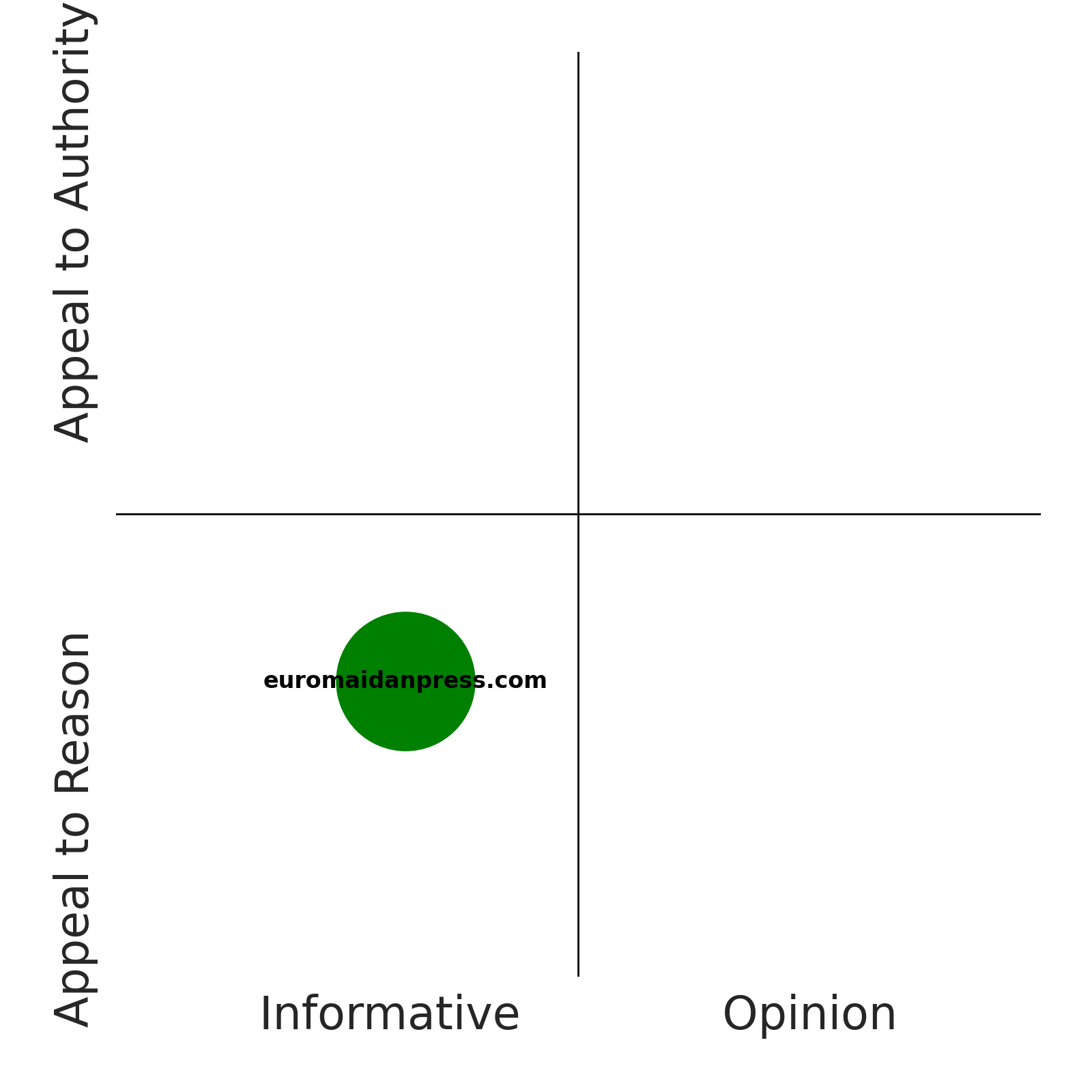
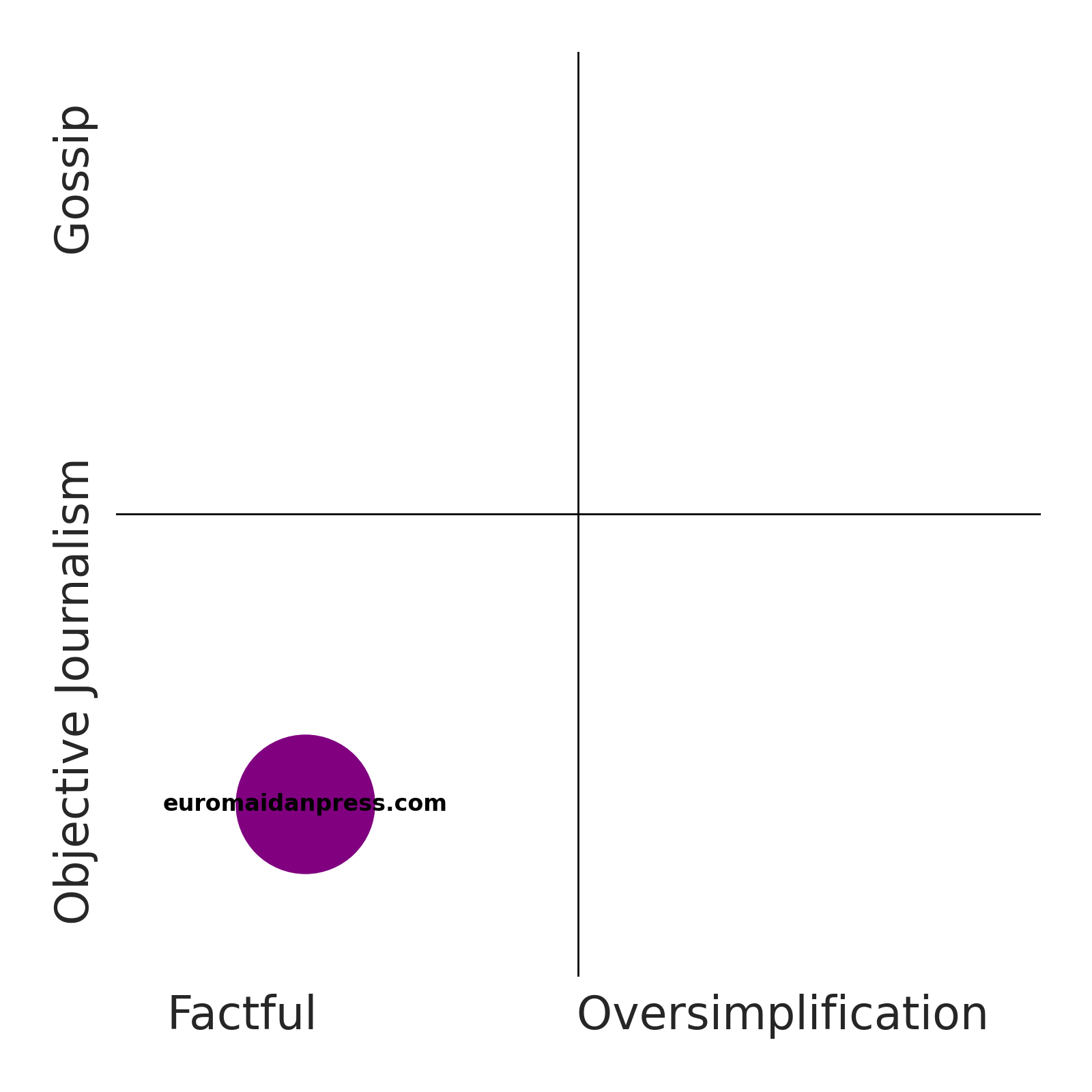
2026 © Helium Trades
Privacy Policy & Disclosure
* Disclaimer: Nothing on this website constitutes investment advice, performance data or any recommendation that any particular security, portfolio of securities, transaction or investment strategy is suitable for any specific person. Helium Trades is not responsible in any way for the accuracy
of any model predictions or price data. Any mention of a particular security and related prediction data is not a recommendation to buy or sell that security. Investments in securities involve the risk of loss. Past performance is no guarantee of future results. Helium Trades is not responsible for any of your investment decisions,
you should consult a financial expert before engaging in any transaction.
Helium Research Assistant

How can I help you today?
Ask any question about euromaidanpress.com bias.


