See whether Helium helps you make better-informed decisions. Try every Pro Trader feature for 30 days. No credit card required.
Try every Pro Trader feature for 30 days. No credit card required.
Scope and topic selection. The supplied sample is strongly concentrated on Jewish communal life, antisemitism, Israel/Palestine, and political contests where Israel policy or Jewish safety is salient.
Recurrent subjects include AIPAC, DSA-aligned candidates, Democratic primaries, and Jewish reactions to candidates or movements
August 10, 2026 · 0 shares
Frames the Democratic Socialists of America as a successful but directionless movement whose leader cannot explain its goals.
Automated analysis; not human reviewed. Limitations: Article text is a short snippet; the full article context is missing. · 10 of 53 available dimensions scored; omitted dimensions are not treated as neutral. · Verified supporting quotes for 10 of 10 scored dimensions.
Claim: The article frames the DSA negatively, implying its goals are unclear and its prominence is undeserved.
“What does the DSA actually want? Its national co-chair can't say.” · exact text match
Why: The headline questions the DSA's purpose and asserts the co-chair's inability to answer, a skeptical framing typical of conservative criticism of left-wing movements.
Claim: The article uses a subjective headline that implies a judgment about the DSA's clarity.
“What does the DSA actually want? Its national co-chair can't say.” · exact text match
Why: The headline is a rhetorical question with a negative implication, not a neutral statement.
Claim: The article uses sensational language like 'eating crow' to describe pundits.
“Pundits who doubted the movement last year are now eating crow.” · exact text match
Why: The phrase 'eating crow' is colloquial and dramatics, adding a sensational tone.
Claim: The article offers opinionated commentary on the DSA's clarity and pundits' reversal.
“What does the DSA actually want? Its national co-chair can't say.” · exact text match
Why: The headline is an opinionated assertion, not a factual report.
Claim: The article is about a political organization and its electoral successes.
“Candidates the organization rallied behind ousted establishment Democrats in New York, Michigan, Colorado and Wisconsin state primaries.” · exact text match
Why: The content is exclusively about political primary elections and the DSA's role.
Claim: The article reduces the DSA's entire agenda to the national co-chair's inability to answer.
“What does the DSA actually want? Its national co-chair can't say.” · exact text match
Why: The article implies that the DSA's goals are unclear based on a single statement from one person, an oversimplification.
Claim: The article uses colloquial and somewhat immature language like 'eating crow'.
“Pundits who doubted the movement last year are now eating crow.” · exact text match
Why: The phrase 'eating crow' is informal and can be seen as immature in serious political reporting.
Claim: The article's framing is ideologically opposed to the DSA's socialist orientation.
“forced its way into the spotlight” · exact text match
Why: The phrase 'forced its way' suggests the DSA's prominence is illegitimate, reflecting an ideological opposition.
Claim: The article sympathizes with establishment Democrats by noting they were 'ousted'.
“Candidates the organization rallied behind ousted establishment Democrats” · exact text match
Why: The term 'establishment Democrats' is used neutrally, but the article's overall skepticism of the DSA aligns with establishment perspectives.
Claim: The headline manipulates reader perception by framing the co-chair as unable to explain the DSA's goals.
“What does the DSA actually want? Its national co-chair can't say.” · exact text match
Why: The headline asserts a negative claim without full context, potentially manipulating reader opinion.
Article text is a short snippet; the full article context is missing.
August 05, 2026 · 0 shares
Frames the primary as a proxy fight over the Gaza war and a referendum on pro-Israel influence in Democratic politics.
Automated analysis; not human reviewed. Limitations: Article text truncated; missing opponent identity and further context limits full framing analysis. · 2 of 53 available dimensions scored; omitted dimensions are not treated as neutral. · Verified supporting quotes for 1 of 2 scored dimensions.
Claim: The article frames the primary around the Gaza war and AIPAC influence, making it highly political.
“had become a proxy fight over the Gaza war and a referendum on Israel supporters’ influence in Democratic politics.” · exact text match
Why: The framing centers on a contentious geopolitical and interest-group issue.
Claim: The article maintains a neutral, unemotional tone.
“narrowly defeated” · exact text match
“according to unofficial results” · not found in supplied text
Why: The text is factual and dispassionate with no emotional language.
Article text truncated; missing opponent identity and further context limits full framing analysis.
Frames Francesca Hong's candidacy through the lens of her controversial Israel-related associations and positions, emphasizing concerns from Jewish groups and the Democratic establishment while reporting her polling lead.
The International Holocaust Remembrance Association (IHRA) definition of antisemitism is a non-legally binding definition that includes examples such as 'applying double standards to Israel,' which some critics argue conflates anti-Zionism with antisemitism. The Democratic Socialists of America (DSA) is a left-wing political organization; its co-chair's comments on Oct. 7 are relevant to the article's framing of Hong's associations.
Automated analysis; not human reviewed. · 53 of 53 available dimensions scored; omitted dimensions are not treated as neutral. · Verified supporting quotes for 4 of 53 scored dimensions.
Claim: The article is descriptive, not prescriptive; it reports events and statements without telling readers what to do.
“Hong’s general-election success may hinge on the broader electorate’s views of the Democratic Socialists of America.” · exact text match
Why: The sentence is speculative but not a prescription; the article lacks explicit calls to action or endorsements.
Claim: The article covers a political primary race with polling, candidate positions, and party dynamics.
“The Badger State’s chaotic Democratic primary for governor ends Tuesday with state Rep. Francesca Hong, a democratic socialist, polling comfortably in the lead.” · exact text match
Why: The subject matter is unequivocally political.
Claim: The article treats Marquette Law School polls as an authoritative 'gold standard,' an appeal to institutional credibility.
“Polling from Marquette Law School, considered the gold standard in the state” · exact text match
Why: Describing a pollster as 'the gold standard' is an explicit appeal to its authority to bolster the claim of Hong's lead.
Claim: The article uses named polls, attributed quotes, and specific numbers, indicating credible reporting.
“A poll of likely voters one week before the race, conducted by nonpartisan outlet State Navigate, showed Hong with a commanding lead. Forty-four percent of those surveyed said they favored Hong” · exact text match
Why: Attribution to a specific pollster with concrete figures supports credibility.
Claim: The article speculates about Hong's general-election prospects based on voter views of the DSA.
“Her general-election success may hinge on the broader electorate’s views of the Democratic Socialists of America.” · not found in supplied text
Why: The word 'may' and conditional structure indicate speculation about future outcomes.
The article reports neutrally on a progressive candidate's primary victory, presenting both her anti-AIPAC statements and her clarifications.
Oklahoma has not elected a Democrat to the Senate in over three decades, making the general election a longshot for Thomas.
Automated analysis; not human reviewed. · 1 of 54 available dimensions scored; omitted dimensions are not treated as neutral. · Verified supporting quotes for 0 of 1 scored dimensions.
Claim: The article demonstrates high sourcing and attribution practices.
“The Associated Press called Tuesday's race, a sequel to the state's June primary, less than an hour after polls closed.” · verified after text normalization
“Thomas told the Jewish Telegraphic Agency in a written statement that her 'concerns [with AIPAC] have NEVER been about Jewish people, Judaism, or Israel’s existence.'” · not found in supplied text
Why: The article relies on wire service reporting, direct quotes from the candidate, and provides specific vote percentages and contextual details.
August 22, 2026 · 0 shares
Election coverage that flags the 'disgraced' predecessor and characterizes outside spending as 'attacks,' a framework that subtly favors the progressive challenger.
The resignation of Eric Swalwell triggered a special election; California's top-two primary advanced two Democrats to the general runoff.
Automated analysis; not human reviewed. Limitations: I may be under-weighting the degree to which the article's tone accepts Wahab's genocide characterization as a factual claim. · 4 of 54 available dimensions scored; omitted dimensions are not treated as neutral. · Verified supporting quotes for 3 of 4 scored dimensions.
Claim: The article's framing of AIPAC's spending is critical but balanced by reporting both sides' views.
“the contest had become unexpectedly tight after the pro-Israel lobby entered the fray.” · not found in supplied text
“a massive spending push from the American Israel Public Affairs Committee aimed at turning the tides for Hernandez.” · exact text match
Why: The language 'entered the fray' and 'massive spending push' carries slightly negative connotation, but the overall reporting includes balanced quotes.
Claim: The reporting is objective but includes some value-laden terms.
“disgraced former Rep. Eric Swalwell” · exact text match
Why: The adjective 'disgraced' is opiniated, but the rest of the article maintains a neutral tone.
Claim: The article is highly credible.
“according to Federal Election Commission filings” · exact text match
“The Associated Press called the race” · exact text match
Why: It cites official sources and wire reports.
Claim: The article includes speculation about the November election.
“Finneburgh said he believes that Hernandez has only a minimal chance of winning that race” · exact text match
Why: The speculation is attributed to a source and clearly marked as belief, so its speculative nature is low.
I may be under-weighting the degree to which the article's tone accepts Wahab's genocide characterization as a factual claim.
August 21, 2026 · 0 shares
A pro-Israel community lens frames the primary upset by emphasizing the Democratic Party's shift leftward, while the body of the report tempers that frame with balanced sourcing and attributed analysis.
Automated analysis; not human reviewed. Limitations: Independent verification of the election results, campaign finances, and quotes depends on external data not supplied in the text. · 12 of 54 available dimensions scored; omitted dimensions are not treated as neutral. · Verified supporting quotes for 7 of 12 scored dimensions.
Claim: Presents a balanced narrative without endorsing one candidate or party, despite describing a shift in the Democratic Party.
“When Democratic socialist Angie Nixon, an ardent critic of Israel, secured a surprise win in Florida’s U.S. Senate Democratic primary Tuesday over Jewish former Soviet refugee Alex Vindman, pro-Israel advocates expressed alarm” · exact text match
Why: Both the left-leaning win and pro-Israel advocates' concerns are described without endorsement.
Claim: The populist/establishment conflict is analyzed as a news subject without adopting either side's framing.
“The Cook Political Report currently rates the race as 'solid' Republican.” · not found in supplied text
Why: An external, non-partisan rater is used to ground the analysis.
Claim: All analysis is attributed to named experts or official reports.
““They did not take her candidacy seriously,” Aubrey Jewett, a political science professor at the University of Central Florida, told the Jewish Telegraphic Agency.” · exact text match
“Records available thus far do not link these funds to the American Israel Public Affairs Committee” · exact text match
Why: Quotes appear punctiliously tied to their speakers, with no anonymous or un-sourced psychoanalysis.
Claim: Even an incendiary statement is reported in a sober, procedural manner.
“President Donald Trump celebrated Vindman’s defeat on Wednesday, describing the outcome on Truth Social as “the most gratifying loss last night” and calling Vindman “a real treasonous creep.”” · exact text match
Why: The extraordinary quote is placed in context and not embellished.
Claim: Describes policy stances and race dynamics without prescribing a political position.
“She introduced a bill calling for a “de-escalation and ceasefire in the state of Israel and occupied Palestine.”” · not found in supplied text
Why: The report refrains from endorsing or denouncing the policy.
Claim: Reflects opinion only within the clearly attributed words of sources.
“Jewett echoed these sentiments, noting that the reason political scientists had “called him the frontrunner was because of his national notoriety and name recognition”” · not found in supplied text
Why: Aspects of opinion and speculation are placed in quotes or attributed.
Claim: The report shows no obvious partiality, treating both candidates with respect.
“President Donald Trump celebrated Vindman’s defeat on Wednesday, describing the outcome on Truth Social as “the most gratifying loss last night” and calling Vindman “a real treasonous creep.”” · exact text match
Why: Even charged political rhetoric is reported without adopting a partisan tone.
Claim: The article retains a calm tone and reports on civil interactions between the opponents.
“Reflecting on the loss on Tuesday night, Vindman credited Nixon for her “strong campaign” against him” · exact text match
“Nixon on Tuesday thanked Vindman for his service” · exact text match
Why: Quotes showcase civility rather than animosity.
Claim: Demonstrates strong sourcing and transparency about limitations.
“Records available thus far do not link these funds to the American Israel Public Affairs Committee, while the Track AIPAC website describes Vindman as 'pro-Israel' but lists his 'Israel lobby total' as 'TBD.'” · not found in supplied text
Why: Clearly attributes data and flags uncertainty.
Claim: Offers multiple, competing causal explanations for the primary result.
“But analysts caution that Nixon’s win may be more connected to local political dynamics, including the miscalculations by Vindman and his staff, than to the country as a whole.” · exact text match
Why: Outlines a causal nuance beyond a single ideological explanation.
Claim: Forwards only lightly hedged statements about future outcomes.
“Nixon is expected to face an uphill battle against her GOP competitor Ashley Moody.” · exact text match
“The Cook Political Report currently rates the race as 'solid' Republican.” · not found in supplied text
Why: Projections derive from an identified rater, not the reporter's own forecast.
Claim: Transparently indicates limitations of available data.
“Records available thus far do not link these funds to the American Israel Public Affairs Committee” · exact text match
Why: The article flags non-verification rather than speculating.
Independent verification of the election results, campaign finances, and quotes depends on external data not supplied in the text.
July 31, 2026 · 0 shares
Skeptical framing portrays Netanyahu's diplomatic victories as fleeting and his failure to maintain bipartisan support as a critical weakness ahead of elections.
Israel and Iran have a long-standing conflict over Iran's nuclear program; the U.S. has mediated negotiations. Netanyahu faces a re-election campaign and has historically cultivated bipartisan U.S. support. The article is an analysis piece from JTA, a Jewish news agency, republished by The Forward.
Automated analysis; not human reviewed. Limitations: Analysis based on a single article from a progressive Jewish outlet; the framing is explicitly skeptical of Netanyahu's strategy. · 9 of 52 available dimensions scored; omitted dimensions are not treated as neutral. · Verified supporting quotes for 9 of 9 scored dimensions.
Claim: The article adopts a liberal framing by criticizing Netanyahu's alignment with Trump and his attacks on Democrats.
“Lapid in a talk to The Atlantic Council took shots at Netanyahu’s public diplomacy, saying his attacks on Democrats who were critical of Israel were making the country more isolated.” · exact text match
Why: The article prominently features Lapid's criticism, which aligns with a liberal perspective favoring bipartisan engagement.
Claim: The article uses subjective, evaluative language to frame Netanyahu's trip.
“Had he checked his pen, however, Netanyahu might have found that the ink was running out.” · exact text match
Why: The phrase 'ink was running out' is a metaphorical judgment, not a neutral fact.
Claim: The article is heavily opinionated, presenting analysis rather than straight news.
“To the degree that the Israeli prime minister scored public relations victories during his visit to the U.S. this week, they all have impending expiration dates.” · exact text match
Why: This is an explicit opinion statement about the nature of the victories.
Claim: The article is highly political, covering election strategy and partisan dynamics.
“Netanyahu, who faces a tough reelection campaign for the elections to be held on Oct. 27, needs to show the Israeli voters that his claimed superpower, influencing Americans to support the Jewish state, is still potent.” · exact text match
Why: The entire article is focused on political strategy and electoral implications.
Claim: The article relies on an expert quote to support its framing.
““Netanyahu’s expectation and hope is that Trump will establish, figuratively speaking, a re-elect Benjamin Netanyahu headquarters in Washington for the next three months,” said Aaron David Miller, a veteran Middle East negotiator under Republican and Democratic administrations who is now a senior fellow at the Carnegie Endowment for International Peace.” · exact text match
Why: The quote is used to lend credibility to the article's skeptical interpretation.
Claim: The article states with certainty that the victories have expiration dates, without hedging.
“they all have impending expiration dates.” · exact text match
Why: The statement is presented as a definitive assessment, though it is an opinion.
Claim: The article endorses Lapid's approach of engaging both parties while criticizing Netanyahu's partisan strategy.
““Boycotting those who oppose you is not the way,” Lapid said on X. ”Repair relations with both parties. It’s not always fun, but that’s what it takes. Not by whining and not by boycotts.”” · exact text match
Why: The article presents Lapid's criticism without counterpoint, signaling agreement.
Claim: The article conveys a negative emotional tone toward Netanyahu's trip.
“Had he checked his pen, however, Netanyahu might have found that the ink was running out.” · exact text match
Why: The metaphor implies a pessimistic, declining trajectory.
Claim: The article speculates about future actions by Trump and Israeli officials.
“Privately, Israeli officials have said they don’t expect the deal to happen, and that Trump will eventually turn to options two and three, which the Israelis favor.” · exact text match
Why: This is an unattributed speculation about future decisions.
Analysis based on a single article from a progressive Jewish outlet; the framing is explicitly skeptical of Netanyahu's strategy.
August 02, 2026 · 0 shares
The report frames Trump's claimed cancellation as part of a pattern of threats and retreats, undermining Netanyahu's assertion of lockstep with the U.S.
Automated analysis; not human reviewed. Limitations: The article includes a photo caption dated July 28, 2026, suggesting a speculative or fictional timeline; this ambiguity affects assessment of factual reliability. · 11 of 52 available dimensions scored; omitted dimensions are not treated as neutral. · Verified supporting quotes for 6 of 11 scored dimensions.
Claim: The article is predominantly objective but includes mild subjective inferences about reactions and patterns.
“The planned assault – and Trump’s retreat – appear to have caught Israel off guard” · exact text match
“The roller-coaster ride appeared to unsettle Netanyahu’s colleagues in his Likud Party.” · exact text match
Why: While most claims are attributed, the article uses subjective phrasing like 'appear' and 'roller-coaster ride' to interpret events.
Claim: The article uses measured, non-sensational language throughout.
“Heeding a Saudi plea, Trump says he canceled a joint U.S.-Israel assault on Iran.” · exact text match
Why: Headline and body avoid hyperbole; all dramatic elements are attributed to sources (e.g., Trump's own statement).
Claim: The article covers a dramatic, last-minute geopolitical reversal with multiple actors.
“Trump said he canceled at the last minute a planned joint assault... at the behest of Saudi Arabia, which feared the war blowing up into a wider conflict.” · not found in supplied text
Why: The scenario of a planned attack being canceled at Saudi request, with Israel reportedly caught off guard, is inherently interesting.
Claim: The article is purely descriptive, reporting events and statements without prescribing actions.
“President Donald Trump said he canceled at the last minute a planned joint assault with Israel on Iran’s energy infrastructure at the behest of Saudi Arabia.” · not found in supplied text
Why: No imperatives or advocacy; only describes what was said, reported, or done.
Claim: The article contains mild editorial framing, such as characterizing reactions and patterns.
“The roller-coaster ride appeared to unsettle Netanyahu’s colleagues in his Likud Party.” · exact text match
“Fars news agency noted in a sardonic tone” · exact text match
Why: Phrases like 'roller-coaster ride' and 'sardonic tone' go beyond strict fact-reporting, but the overall article is mostly factual.
Claim: The article is heavily political, covering U.S., Israel, Saudi, and Iran geopolitical conflict.
“President Donald Trump said he canceled at the last minute a planned joint assault with Israel on Iran’s energy infrastructure” · exact text match
Why: The subject matter involves high-level political and military decisions and alliances.
Claim: The article is credible due to transparent attribution and inclusion of conflicting claims.
“The U.S. alerts over the weekend warning citizens to evacuate the Middle East and then Trump’s announcement late Saturday...” · not found in supplied text
“Iran disputed Trump’s claim, instead saying that it was ready to respond to any attack on the country.” · exact text match
Why: Sources are named and quoted; the article does not hide dissenting views, enhancing trustworthiness.
Claim: The article reports events and claims with attribution and balanced sourcing, avoiding irrational or emotional language.
“President Donald Trump said he canceled at the last minute a planned joint assault with Israel on Iran’s energy infrastructure at the behest of Saudi Arabia, which feared the war blowing up into a wider conflict.” · exact text match
Why: Presents multiple perspectives (Trump, Saudi, Iran, Israel) with clear attribution to official statements and reports, no emotional appeals.
Claim: The article speculates about a pattern of Trump threatening and retreating.
“Trump has multiple times since the war’s launch threatened to escalate the war only to retreat at the last minute, something the Fars news agency noted in a sardonic tone.” · exact text match
Why: The assertion of a 'pattern' is observational and not directly attributed to any specific evidence beyond the article's own reporting of past incidents.
Claim: The article demonstrates high integrity through robust attribution and inclusion of conflicting accounts.
“Saudi Arabia’’s official news agency confirmed that Mohammed bin Salman... appealed to the U.S. president to stand down.” · not found in supplied text
“Iran disputed Trump’s claim, instead saying that it was ready to respond to any attack on the country.” · exact text match
Why: Multiple named sources (CBS, Fars, Saudi Press Agency, Truth Social, Israeli official) are cited, and the article presents opposing viewpoints without suppressing them.
Claim: The article is well-structured, coherent, and uses multiple credible sources.
“The article weaves together official statements from Truth Social, Saudi Press Agency, Fars News Agency, CBS News, and Israeli official quotes.” · not found in supplied text
Why: Clear organization, attributed claims, and contextual background (e.g., importance of Strait of Hormuz) indicate intelligent reporting.
The article includes a photo caption dated July 28, 2026, suggesting a speculative or fictional timeline; this ambiguity affects assessment of factual reliability.
August 22, 2026 · 0 shares
Neutral wire-style coverage that treats the two-state solution as an unassailable premise while giving roughly equal weight to British and Israeli official statements.
Automated analysis; not human reviewed. Limitations: The supplied text includes HTML artifacts and truncation; analysis relies solely on the provided wire copy without external verification. · 10 of 54 available dimensions scored; omitted dimensions are not treated as neutral. · Verified supporting quotes for 7 of 10 scored dimensions.
Claim: The 1,234-unit bidding round in E1 is framed as a diplomatic provocation viewed through a Western-led consensus, with the two-state solution as the baseline.
“"would cut across the heart of Palestine and risks separating the West Bank from East Jerusalem, which would endanger the viability of a two-state solution"” · not found in supplied text
Why: The default frame privileges Western diplomatic objections, while the Israeli counterargument is included but given less exposition, indicating a mild center-left tilt.
Claim: The coverage is oriented toward state-level actors and intergovernmental actions, with popular opinion absent.
“his office also summoned Israel’s charge d’Affaires Thursday to demand a closure of the bidding process” · not found in supplied text
“the U.K. signed onto a joint condemnation by France, Germany, Italy, the Netherlands, Norway, Belgium, Sweden, Australia, New Zealand and Canada” · not found in supplied text
Why: The narrative arc is defined by the executive actions and statements of foreign ministries, consistent with a mildly elitist stance.
Claim: The report separates reported facts from quoted claims by consistently using reporting verbs and quotation marks.
“Miliband wrote” · exact text match
“Sa’ar attacked Miliband on X” · exact text match
Why: Uniform attribution and quotation marks signal an attempt at objective reporting.
Claim: The piece describes events and quotes, refraining from recommending a policy course.
“Israel mostly froze those plans under pressure from the international community” · exact text match
“Netanyahu began to advance the project in earnest in 2012” · exact text match
Why: No imperative or recommendation is made; the tone is journalistic description.
Claim: The framing expresses quiet skepticism toward the settlement expansion and its backers, a mild dovish vector.
“a move that plays well with Netanyahu’s right-wing voter base” · exact text match
Why: While both sides are quoted, the article's own analysis—that the timing suits an election base—carries a critical edge.
Claim: The piece is largely factual with only lightly evaluative language, such as 'largely underdeveloped' and 'a move that plays well.'
“largely underdeveloped section” · not found in supplied text
“a move that plays well with Netanyahu’s right-wing voter base” · exact text match
Why: Evaluative adjectives are limited to characterizations of geography and political motives.
Claim: The subject matter is inherently political, concerning statecraft and elections, but reporting itself is not highly partisan.
“The United Kingdom threatened to sanction Israelis involved in West Bank settlement expansion after the Jewish state’s Lands Authority opened bids for 1,234 homes” · exact text match
Why: The core topic—international relations and electoral politics—places it squarely in the political domain.
Claim: The piece names officials, dates, and procedures with specificity, though it relies on assertion for the underlying facts.
“a special statement he posted on X on Thursday” · exact text match
“set to close on Oct. 19, one week shy of the Israeli elections on Oct. 27” · exact text match
Why: Concrete details and attribution support credible reporting.
Claim: Attribution is consistently used, and both perspectives receive equivalent weight in quotation.
“Miliband wrote” · exact text match
“Sa’ar attacked Miliband on X, stating” · exact text match
“Hussein Al-Sheikh said” · exact text match
Why: Explicit sourcing and fair treatment of differing viewpoints support an impression of integrity.
Claim: The piece integrates historical, legal, and political context into a compact narrative.
“Plans to expand the built-up area of Ma’aleh Adumim settlement by constructing some 3,400 housing units on a largely underdeveloped hilltop within the city’s boundaries have been in place since 1994” · exact text match
Why: Decades-long context and multiple stakeholder positions are woven together coherently.
The supplied text includes HTML artifacts and truncation; analysis relies solely on the provided wire copy without external verification.
General worldview and framing. The source appears to use a Jewish-community and Israel-centered frame of reference.
Antisemitism is treated as a serious, institutionally consequential threat, including on campuses
August 08, 2026 · 0 shares
Framing emphasizes the pervasiveness and severity of antisemitism on Canadian campuses through statistical prevalence and institutional failure.
Automated analysis; not human reviewed. Limitations: The article text contains malformed JSON-like inserts (e.g., {"","One-fifth..."}) that may indicate truncation or corruption, but the main content remains readable. · 5 of 53 available dimensions scored; omitted dimensions are not treated as neutral. · Verified supporting quotes for 4 of 5 scored dimensions.
Claim: The article begins with a highly attention-grabbing statistic and includes vivid student accounts and political controversy.
“Over 95% of Canadian Jewish university students report exposure to antisemitism.” · exact text match
“One respondent said they had witnessed a friend who wears a kippah being chased out of a school building by a group of students who shouted, “There is a Jew … let’s get him.”” · exact text match
Why: The headline statistic and specific student accounts are inherently striking and likely to capture reader interest.
Claim: The article directly addresses government policy and political decisions regarding antisemitism.
“Prime Minister Mark Carney’s administration dissolved alongside an Islamophobia envoy earlier this year.” · exact text match
Why: The article reports on the elimination of a government office and the creation of a new council, making it inherently political.
Claim: The article cites a government-commissioned survey with specific methodology, named experts, and verifiable data.
“The survey from the Department of Canadian Heritage found that 95.7% of Jewish students said they were exposed to antisemitism” · exact text match
“included about 900 Jewish students from schools across Canada” · exact text match
“report titled Campus Antisemitism and Student Experiences” · exact text match
Why: Multiple specific data points, sample size, and report title are provided, enabling verification.
Claim: The article attributes all claims to named sources and distinguishes between data and opinion.
“The survey from the Department of Canadian Heritage found that 95.7% of Jewish students said they were exposed to antisemitism” · exact text match
“said Jack Jedwab, the report’s main author” · exact text match
Why: All key claims are attributed to the survey or named individuals, with no unsupported assertions by the publisher.
Claim: The article synthesizes multiple data points, direct testimony, expert analysis, and political context into a coherent report.
“The survey from the Department of Canadian Heritage found that 95.7%... 70%... 22%... 45%... 65%” · not found in supplied text
“Martha Piper, former president of the University of British Columbia, said the campus antisemitism report revealed “a shocking presence of campus antisemitism throughout this country”” · not found in supplied text
Why: The article integrates statistical findings, student quotes, expert commentary, and political developments in a clear structure.
The article text contains malformed JSON-like inserts (e.g., {"","One-fifth..."}) that may indicate truncation or corruption, but the main content remains readable.
August 01, 2026 · 0 shares
Sympathetically frames Nessel's decision and Jewish Democrats' alarm over antisemitism within the Michigan Democratic Party.
The Michigan Democratic Party is holding a nominating convention to finalize the state's Democratic candidate for the U.S. Senate. The primary between pro-Israel Rep. Haley Stevens and democratic socialist Abdul El-Sayed has been divisive over Israel and antisemitism.
Automated analysis; not human reviewed. Limitations: The article is a news report from a Jewish outlet, which may naturally emphasize Jewish community concerns; I have no additional input limitations. · 5 of 52 available dimensions scored; omitted dimensions are not treated as neutral. · Verified supporting quotes for 3 of 5 scored dimensions.
Claim: The framing is sympathetic to a Democratic official and Jewish Democratic concerns, without presenting conservative viewpoints.
“Local and national Jewish Democrats say they are sympathetic after Michigan’s Jewish attorney general, Dana Nessel, said she would skip the state Democratic Party’s nominating convention over concerns about antisemitism and harassment.” · exact text match
Why: The article centers on a Democratic figure and quotes only supportive Jewish Democratic voices; no countervailing or conservative perspectives are included.
Claim: The article is heavily political, covering party convention, primary, and internal conflicts.
“Nessel’s declaration comes in the final days of the primary between Rep. Haley Stevens, a pro-Israel stalwart, and Abdul El-Sayed, a democratic socialist who is deeply critical of Israel.” · exact text match
“The incident has fueled alarm among Jewish Democrats, according to Halie Soifer, CEO of the Jewish Democratic Council of America.” · exact text match
Why: The entire report is about political party dynamics, a primary election, and accusations of antisemitism within a political party.
Claim: The article presents Nessel and Jewish Democrats as victims of antisemitism and harassment.
““I don’t feel safe going. I feel like my presence isn’t going to be welcome. I don’t want to get chased around. I don’t want to get harassed. I don’t want to get yelled and screamed at. I don’t want to get booed off the stage, irrespective of what I’m saying,” Nessel said.” · not found in supplied text
Why: The article reports Nessel's fear and harassment claims without challenge, and quotes other Jewish Democrats expressing discomfort, reinforcing a victimization narrative.
Claim: The article conveys a negative emotional tone through descriptors of fear, alarm, and discomfort.
““I don’t feel safe going.”” · not found in supplied text
“The incident has fueled alarm among Jewish Democrats.” · not found in supplied text
Why: The quoted language and framing emphasize negative emotions (fear, alarm) as central to the story, outweighing any neutral or positive elements.
Claim: The article is credible due to direct quotes, named sources, and specific factual context.
“Jessica “Decky” Alexander, the Michigan Jewish Democratic caucus chair, told the Jewish Telegraphic Agency on Friday.” · exact text match
“She said she had filed a formal complaint within the party about a party official who had called her a neo-Nazi because of her beliefs.” · exact text match
Why: All claims are attributed to named individuals or public records; the article includes specific details such as the amount spent by AIPAC and the April convention incidents.
The article is a news report from a Jewish outlet, which may naturally emphasize Jewish community concerns; I have no additional input limitations.
Reporting frames the remarks as antisemitic, asserting without qualification that they invoked antisemitic tropes.
The article is a short news snippet about a hate crime investigation in Toronto, with the text ending mid-sentence.
Automated analysis; not human reviewed. Limitations: The article text is truncated, ending mid-sentence, which may omit context.
The article text is truncated, ending mid-sentence, which may omit context.
August 05, 2026 · 0 shares
Frames the primary as a proxy fight over the Gaza war and a referendum on pro-Israel influence in Democratic politics.
Automated analysis; not human reviewed. Limitations: Article text truncated; missing opponent identity and further context limits full framing analysis. · 2 of 53 available dimensions scored; omitted dimensions are not treated as neutral. · Verified supporting quotes for 1 of 2 scored dimensions.
Claim: The article frames the primary around the Gaza war and AIPAC influence, making it highly political.
“had become a proxy fight over the Gaza war and a referendum on Israel supporters’ influence in Democratic politics.” · exact text match
Why: The framing centers on a contentious geopolitical and interest-group issue.
Claim: The article maintains a neutral, unemotional tone.
“narrowly defeated” · exact text match
“according to unofficial results” · not found in supplied text
Why: The text is factual and dispassionate with no emotional language.
Article text truncated; missing opponent identity and further context limits full framing analysis.
August 05, 2026 · 0 shares
Frames the nomination as creating unresolved divisions among Jewish Democrats.
Automated analysis; not human reviewed. Limitations: Article is truncated, limiting analysis to the first few sentences. · 1 of 53 available dimensions scored; omitted dimensions are not treated as neutral. · Verified supporting quotes for 1 of 1 scored dimensions.
Claim: The article focuses on the reaction of Jewish Democrats to El-Sayed's nomination, emphasizing lack of unity.
“Michigan's Jewish Democrats aren't all ready to unite behind El-Sayed as nominee.” · exact text match
Why: The headline and opening sentence directly cover the response of a specific group to a political event, fitting the 'covering the response' pattern.
Article is truncated, limiting analysis to the first few sentences.
August 21, 2026 · 0 shares
A pro-Israel community lens frames the primary upset by emphasizing the Democratic Party's shift leftward, while the body of the report tempers that frame with balanced sourcing and attributed analysis.
Automated analysis; not human reviewed. Limitations: Independent verification of the election results, campaign finances, and quotes depends on external data not supplied in the text. · 12 of 54 available dimensions scored; omitted dimensions are not treated as neutral. · Verified supporting quotes for 7 of 12 scored dimensions.
Claim: Presents a balanced narrative without endorsing one candidate or party, despite describing a shift in the Democratic Party.
“When Democratic socialist Angie Nixon, an ardent critic of Israel, secured a surprise win in Florida’s U.S. Senate Democratic primary Tuesday over Jewish former Soviet refugee Alex Vindman, pro-Israel advocates expressed alarm” · exact text match
Why: Both the left-leaning win and pro-Israel advocates' concerns are described without endorsement.
Claim: The populist/establishment conflict is analyzed as a news subject without adopting either side's framing.
“The Cook Political Report currently rates the race as 'solid' Republican.” · not found in supplied text
Why: An external, non-partisan rater is used to ground the analysis.
Claim: All analysis is attributed to named experts or official reports.
““They did not take her candidacy seriously,” Aubrey Jewett, a political science professor at the University of Central Florida, told the Jewish Telegraphic Agency.” · exact text match
“Records available thus far do not link these funds to the American Israel Public Affairs Committee” · exact text match
Why: Quotes appear punctiliously tied to their speakers, with no anonymous or un-sourced psychoanalysis.
Claim: Even an incendiary statement is reported in a sober, procedural manner.
“President Donald Trump celebrated Vindman’s defeat on Wednesday, describing the outcome on Truth Social as “the most gratifying loss last night” and calling Vindman “a real treasonous creep.”” · exact text match
Why: The extraordinary quote is placed in context and not embellished.
Claim: Describes policy stances and race dynamics without prescribing a political position.
“She introduced a bill calling for a “de-escalation and ceasefire in the state of Israel and occupied Palestine.”” · not found in supplied text
Why: The report refrains from endorsing or denouncing the policy.
Claim: Reflects opinion only within the clearly attributed words of sources.
“Jewett echoed these sentiments, noting that the reason political scientists had “called him the frontrunner was because of his national notoriety and name recognition”” · not found in supplied text
Why: Aspects of opinion and speculation are placed in quotes or attributed.
Claim: The report shows no obvious partiality, treating both candidates with respect.
“President Donald Trump celebrated Vindman’s defeat on Wednesday, describing the outcome on Truth Social as “the most gratifying loss last night” and calling Vindman “a real treasonous creep.”” · exact text match
Why: Even charged political rhetoric is reported without adopting a partisan tone.
Claim: The article retains a calm tone and reports on civil interactions between the opponents.
“Reflecting on the loss on Tuesday night, Vindman credited Nixon for her “strong campaign” against him” · exact text match
“Nixon on Tuesday thanked Vindman for his service” · exact text match
Why: Quotes showcase civility rather than animosity.
Claim: Demonstrates strong sourcing and transparency about limitations.
“Records available thus far do not link these funds to the American Israel Public Affairs Committee, while the Track AIPAC website describes Vindman as 'pro-Israel' but lists his 'Israel lobby total' as 'TBD.'” · not found in supplied text
Why: Clearly attributes data and flags uncertainty.
Claim: Offers multiple, competing causal explanations for the primary result.
“But analysts caution that Nixon’s win may be more connected to local political dynamics, including the miscalculations by Vindman and his staff, than to the country as a whole.” · exact text match
Why: Outlines a causal nuance beyond a single ideological explanation.
Claim: Forwards only lightly hedged statements about future outcomes.
“Nixon is expected to face an uphill battle against her GOP competitor Ashley Moody.” · exact text match
“The Cook Political Report currently rates the race as 'solid' Republican.” · not found in supplied text
Why: Projections derive from an identified rater, not the reporter's own forecast.
Claim: Transparently indicates limitations of available data.
“Records available thus far do not link these funds to the American Israel Public Affairs Committee” · exact text match
Why: The article flags non-verification rather than speculating.
Independent verification of the election results, campaign finances, and quotes depends on external data not supplied in the text.
July 31, 2026 · 0 shares
Skeptical framing portrays Netanyahu's diplomatic victories as fleeting and his failure to maintain bipartisan support as a critical weakness ahead of elections.
Israel and Iran have a long-standing conflict over Iran's nuclear program; the U.S. has mediated negotiations. Netanyahu faces a re-election campaign and has historically cultivated bipartisan U.S. support. The article is an analysis piece from JTA, a Jewish news agency, republished by The Forward.
Automated analysis; not human reviewed. Limitations: Analysis based on a single article from a progressive Jewish outlet; the framing is explicitly skeptical of Netanyahu's strategy. · 9 of 52 available dimensions scored; omitted dimensions are not treated as neutral. · Verified supporting quotes for 9 of 9 scored dimensions.
Claim: The article adopts a liberal framing by criticizing Netanyahu's alignment with Trump and his attacks on Democrats.
“Lapid in a talk to The Atlantic Council took shots at Netanyahu’s public diplomacy, saying his attacks on Democrats who were critical of Israel were making the country more isolated.” · exact text match
Why: The article prominently features Lapid's criticism, which aligns with a liberal perspective favoring bipartisan engagement.
Claim: The article uses subjective, evaluative language to frame Netanyahu's trip.
“Had he checked his pen, however, Netanyahu might have found that the ink was running out.” · exact text match
Why: The phrase 'ink was running out' is a metaphorical judgment, not a neutral fact.
Claim: The article is heavily opinionated, presenting analysis rather than straight news.
“To the degree that the Israeli prime minister scored public relations victories during his visit to the U.S. this week, they all have impending expiration dates.” · exact text match
Why: This is an explicit opinion statement about the nature of the victories.
Claim: The article is highly political, covering election strategy and partisan dynamics.
“Netanyahu, who faces a tough reelection campaign for the elections to be held on Oct. 27, needs to show the Israeli voters that his claimed superpower, influencing Americans to support the Jewish state, is still potent.” · exact text match
Why: The entire article is focused on political strategy and electoral implications.
Claim: The article relies on an expert quote to support its framing.
““Netanyahu’s expectation and hope is that Trump will establish, figuratively speaking, a re-elect Benjamin Netanyahu headquarters in Washington for the next three months,” said Aaron David Miller, a veteran Middle East negotiator under Republican and Democratic administrations who is now a senior fellow at the Carnegie Endowment for International Peace.” · exact text match
Why: The quote is used to lend credibility to the article's skeptical interpretation.
Claim: The article states with certainty that the victories have expiration dates, without hedging.
“they all have impending expiration dates.” · exact text match
Why: The statement is presented as a definitive assessment, though it is an opinion.
Claim: The article endorses Lapid's approach of engaging both parties while criticizing Netanyahu's partisan strategy.
““Boycotting those who oppose you is not the way,” Lapid said on X. ”Repair relations with both parties. It’s not always fun, but that’s what it takes. Not by whining and not by boycotts.”” · exact text match
Why: The article presents Lapid's criticism without counterpoint, signaling agreement.
Claim: The article conveys a negative emotional tone toward Netanyahu's trip.
“Had he checked his pen, however, Netanyahu might have found that the ink was running out.” · exact text match
Why: The metaphor implies a pessimistic, declining trajectory.
Claim: The article speculates about future actions by Trump and Israeli officials.
“Privately, Israeli officials have said they don’t expect the deal to happen, and that Trump will eventually turn to options two and three, which the Israelis favor.” · exact text match
Why: This is an unattributed speculation about future decisions.
Analysis based on a single article from a progressive Jewish outlet; the framing is explicitly skeptical of Netanyahu's strategy.
August 02, 2026 · 0 shares
The report frames Trump's claimed cancellation as part of a pattern of threats and retreats, undermining Netanyahu's assertion of lockstep with the U.S.
Automated analysis; not human reviewed. Limitations: The article includes a photo caption dated July 28, 2026, suggesting a speculative or fictional timeline; this ambiguity affects assessment of factual reliability. · 11 of 52 available dimensions scored; omitted dimensions are not treated as neutral. · Verified supporting quotes for 6 of 11 scored dimensions.
Claim: The article is predominantly objective but includes mild subjective inferences about reactions and patterns.
“The planned assault – and Trump’s retreat – appear to have caught Israel off guard” · exact text match
“The roller-coaster ride appeared to unsettle Netanyahu’s colleagues in his Likud Party.” · exact text match
Why: While most claims are attributed, the article uses subjective phrasing like 'appear' and 'roller-coaster ride' to interpret events.
Claim: The article uses measured, non-sensational language throughout.
“Heeding a Saudi plea, Trump says he canceled a joint U.S.-Israel assault on Iran.” · exact text match
Why: Headline and body avoid hyperbole; all dramatic elements are attributed to sources (e.g., Trump's own statement).
Claim: The article covers a dramatic, last-minute geopolitical reversal with multiple actors.
“Trump said he canceled at the last minute a planned joint assault... at the behest of Saudi Arabia, which feared the war blowing up into a wider conflict.” · not found in supplied text
Why: The scenario of a planned attack being canceled at Saudi request, with Israel reportedly caught off guard, is inherently interesting.
Claim: The article is purely descriptive, reporting events and statements without prescribing actions.
“President Donald Trump said he canceled at the last minute a planned joint assault with Israel on Iran’s energy infrastructure at the behest of Saudi Arabia.” · not found in supplied text
Why: No imperatives or advocacy; only describes what was said, reported, or done.
Claim: The article contains mild editorial framing, such as characterizing reactions and patterns.
“The roller-coaster ride appeared to unsettle Netanyahu’s colleagues in his Likud Party.” · exact text match
“Fars news agency noted in a sardonic tone” · exact text match
Why: Phrases like 'roller-coaster ride' and 'sardonic tone' go beyond strict fact-reporting, but the overall article is mostly factual.
Claim: The article is heavily political, covering U.S., Israel, Saudi, and Iran geopolitical conflict.
“President Donald Trump said he canceled at the last minute a planned joint assault with Israel on Iran’s energy infrastructure” · exact text match
Why: The subject matter involves high-level political and military decisions and alliances.
Claim: The article is credible due to transparent attribution and inclusion of conflicting claims.
“The U.S. alerts over the weekend warning citizens to evacuate the Middle East and then Trump’s announcement late Saturday...” · not found in supplied text
“Iran disputed Trump’s claim, instead saying that it was ready to respond to any attack on the country.” · exact text match
Why: Sources are named and quoted; the article does not hide dissenting views, enhancing trustworthiness.
Claim: The article reports events and claims with attribution and balanced sourcing, avoiding irrational or emotional language.
“President Donald Trump said he canceled at the last minute a planned joint assault with Israel on Iran’s energy infrastructure at the behest of Saudi Arabia, which feared the war blowing up into a wider conflict.” · exact text match
Why: Presents multiple perspectives (Trump, Saudi, Iran, Israel) with clear attribution to official statements and reports, no emotional appeals.
Claim: The article speculates about a pattern of Trump threatening and retreating.
“Trump has multiple times since the war’s launch threatened to escalate the war only to retreat at the last minute, something the Fars news agency noted in a sardonic tone.” · exact text match
Why: The assertion of a 'pattern' is observational and not directly attributed to any specific evidence beyond the article's own reporting of past incidents.
Claim: The article demonstrates high integrity through robust attribution and inclusion of conflicting accounts.
“Saudi Arabia’’s official news agency confirmed that Mohammed bin Salman... appealed to the U.S. president to stand down.” · not found in supplied text
“Iran disputed Trump’s claim, instead saying that it was ready to respond to any attack on the country.” · exact text match
Why: Multiple named sources (CBS, Fars, Saudi Press Agency, Truth Social, Israeli official) are cited, and the article presents opposing viewpoints without suppressing them.
Claim: The article is well-structured, coherent, and uses multiple credible sources.
“The article weaves together official statements from Truth Social, Saudi Press Agency, Fars News Agency, CBS News, and Israeli official quotes.” · not found in supplied text
Why: Clear organization, attributed claims, and contextual background (e.g., importance of Strait of Hormuz) indicate intelligent reporting.
The article includes a photo caption dated July 28, 2026, suggesting a speculative or fictional timeline; this ambiguity affects assessment of factual reliability.
The article reports the passage of a Montreal solidarity motion with Palestinians after amendments removed specific clauses, presenting both supportive and opposing perspectives without editorializing.
The motion was introduced by Montreal's opposition party Projet Montréal, and the amendments were supported by the mayor's administration and opposed by national Jewish organizations including B'nai Brith Canada.
Automated analysis; not human reviewed. · 3 of 54 available dimensions scored; omitted dimensions are not treated as neutral. · Verified supporting quotes for 3 of 3 scored dimensions.
Claim: The article presents both progressive and conservative perspectives without endorsing either.
“The motion was introduced by Projet Montréal, a progressive, environmentalist municipal party that forms the opposition in the city council. An original version demanded the city “immediately suspend its institutional ties with the current government of Israel, its institutions, and its municipalities.” Major Canadian Jewish organizations pushed to discard that clause.” · exact text match
Why: The text includes balanced reporting on the motion's origin and the opposition's pushback, with no editorial slant.
Claim: The article is factual and neutral, using attributed quotes and specific vote counts.
“Montreal’s city council late Monday adopted the measure, which also removed earlier references to Israeli “apartheid” and “genocide,” after a contentious debate about the role of local government in denouncing conflicts abroad.” · exact text match
Why: The reporting relies on observable events and direct quotations, without subjective language.
Claim: The article demonstrates high credibility through specific attribution, named sources, and verifiable details.
“The amended motion passed with 54 councillors voting in favor and six against.” · exact text match
“B’nai Brith Canada said in an open letter to the city council earlier this month that it would be “inappropriate and exacerbate tensions between communities” if Montreal weighed in on the Middle East.” · exact text match
Why: The article cites specific vote counts, quotes named individuals and organizations, and attributes statements clearly.
August 25, 2026 · 0 shares
The report presents the Providence referendum campaign and opposition without favoring either side, giving roughly equal weight to proponents and critics.
Municipal divestment campaigns have gained traction since the 2023 Gaza war, with some non-binding measures passing; the article situates the Providence referendum within that trend and notes existing state anti-BDS laws.
Automated analysis; not human reviewed. Limitations: No substantive input limitation; analysis based solely on the provided article text. · 4 of 54 available dimensions scored; omitted dimensions are not treated as neutral. · Verified supporting quotes for 4 of 4 scored dimensions.
Claim: The report gives no partisan preference, treating both supporters and opponents neutrally.
“both its proponents and opponents have framed the measure as a referendum on Israel” · exact text match
“Hague, the Jewish Alliance staffer opposing the initiative, sees just such a threat to Jewish interests” · exact text match
Why: The article includes direct quotes from both sides without evaluative commentary, indicating neutral coverage.
Claim: The piece is strictly descriptive, presenting facts and quoted opinions rather than subjective analysis.
“The language of the actual ballot petition does not mention Israel, nor any other country, by name.” · exact text match
“With the referendum’s ballot placement secured, Providence has become the largest American municipality ever to place divestment before the voting public.” · exact text match
Why: The text states verifiable facts and attributes all opinions to specific individuals, with no editorializing.
Claim: The article sources its information from named individuals and official documents, with attributed quotes and references to specific events.
“Zack Kligler, a lead organizer of the ballot initiative and member of the Rhode Island chapter of the anti-Zionist group Jewish Voice for Peace, told the Jewish Telegraphic Agency.” · exact text match
“Hague noted that the ballot language, as written, prompts questions about the authority of the international bodies making judgments” · exact text match
Why: The use of named sources, direct quotes, and specific factual details supports high credibility.
Claim: The report demonstrates fairness by including both supportive and critical perspectives and acknowledging legal uncertainties.
“Supporters also note that Providence joined a 2006 divestment initiative against Sudan to protest ethnic cleansing in Darfur” · exact text match
“Even if passed, it’s possible the ballot initiative could run afoul of a statewide ban on working with government contractors who openly boycott Israel” · exact text match
Why: The inclusion of opposing viewpoints and potential legal complications indicates an honest, balanced presentation.
No substantive input limitation; analysis based solely on the provided article text.
August 25, 2026 · 0 shares
The article reports the Dutch broadcaster's withdrawal from Eurovision with neutral, factual language, presenting both the broadcaster's reasoning and the organizer's response without endorsing either side.
The article is a news report from The Forward about the Dutch public broadcaster's decision to withdraw from Eurovision, a move linked to the European backlash against Israel's military actions in Gaza.
Automated analysis; not human reviewed. · 4 of 54 available dimensions scored; omitted dimensions are not treated as neutral. · Verified supporting quotes for 2 of 4 scored dimensions.
Claim: The article does not exhibit a clear political leaning, as it reports on a controversy without endorsing a side.
“Avrotros said the contest's independence was compromised by divisions surrounding 'the severe humanitarian suffering in Gaza'” · not found in supplied text
Why: While the topic touches on politics, the article's framing is descriptive and balanced.
Claim: The article maintains an objective tone, presenting both sides without editorializing.
“Martin Green, the director of the Eurovision Song Contest, said in a statement that organizers 'regret' Avrotros' decision” · not found in supplied text
“Avrotros said the contest's independence was compromised” · verified after text normalization
Why: Both the decision and the opposition response are directly quoted without commentary.
Claim: The article is emotionally neutral, using factual and dispassionate language.
“Avrotros announced on Monday that it was withdrawing” · exact text match
Why: The writing is factual and does not use emotionally charged descriptors.
Claim: The article demonstrates high credibility through specific numbers, named officials, and direct quotes.
“Avrotros announced on Monday that it was withdrawing” · exact text match
“The competition was viewed by 131 million people, down 35 million from the previous year.” · exact text match
Why: The use of precise figures, attributable statements, and named officials supports trustworthiness.
Wording and standards. Most records describe attributed quotations, official statements, vote totals, polls, filings, or investigations, suggesting a strong norm of source attribution and procedural credibility
August 27, 2026 · 0 shares
Automated analysis; not human reviewed. · 5 of 54 available dimensions scored; omitted dimensions are not treated as neutral. · Verified supporting quotes for 3 of 5 scored dimensions.
Claim: The article presents both sides of the Shabbat and pluralism dispute without endorsing either.
“Itzik Rochberger condemned the incident and called for police investigation... committed to “freedom, tolerance, pluralism and coexistence.”” · not found in supplied text
“Cafe Basimta... has faced weekly demonstrations by haredi Orthodox protesters since early July over its decision to remain open on Saturdays.” · not found in supplied text
Why: The text includes statements from liberal leaders and describes actions of conservative protesters, maintaining balance.
Claim: The article reports with attributed quotes and factual police statements, avoiding editorial language.
“Police said the damage was most likely caused by rocks thrown at the building during the night but said the motive remained under investigation.” · exact text match
“Rabbi Eli Levin, who leads Darchei Noam, said a heavy paving stone had been used to smash the window.” · exact text match
Why: The text presents direct quotes and official statements without subjective framing, indicating high objectivity.
Claim: The article uses a neutral, straightforward news style without sensationalist language or exaggeration.
“The incident came just over a week after vandals broke into Kol HaNeshama, a prominent Reform synagogue in Jerusalem’s Baka neighborhood.” · exact text match
Why: The wording is measured and factual, not emotionally charged or exaggerated.
Claim: The article describes events and quotes responses without prescribing actions.
“The congregation said it would hold its regular Friday night service as planned and called on supporters to attend in a show of solidarity.” · not found in supplied text
Why: The report relays statements and facts, not recommendations or directives from the publisher.
Claim: The article demonstrates high credibility through attributed sourcing and specific details.
“Police opened an investigation but have not publicly announced any arrests.” · exact text match
“Darchei Noam was founded in Ramat Hasharon in 1981 and serves residents of that city, Herzliya and northern Tel Aviv.” · exact text match
Why: The article cites police, named officials, and specific historical details, supporting trustworthy reporting.
The article reports the passage of a Montreal solidarity motion with Palestinians after amendments removed specific clauses, presenting both supportive and opposing perspectives without editorializing.
The motion was introduced by Montreal's opposition party Projet Montréal, and the amendments were supported by the mayor's administration and opposed by national Jewish organizations including B'nai Brith Canada.
Automated analysis; not human reviewed. · 3 of 54 available dimensions scored; omitted dimensions are not treated as neutral. · Verified supporting quotes for 3 of 3 scored dimensions.
Claim: The article presents both progressive and conservative perspectives without endorsing either.
“The motion was introduced by Projet Montréal, a progressive, environmentalist municipal party that forms the opposition in the city council. An original version demanded the city “immediately suspend its institutional ties with the current government of Israel, its institutions, and its municipalities.” Major Canadian Jewish organizations pushed to discard that clause.” · exact text match
Why: The text includes balanced reporting on the motion's origin and the opposition's pushback, with no editorial slant.
Claim: The article is factual and neutral, using attributed quotes and specific vote counts.
“Montreal’s city council late Monday adopted the measure, which also removed earlier references to Israeli “apartheid” and “genocide,” after a contentious debate about the role of local government in denouncing conflicts abroad.” · exact text match
Why: The reporting relies on observable events and direct quotations, without subjective language.
Claim: The article demonstrates high credibility through specific attribution, named sources, and verifiable details.
“The amended motion passed with 54 councillors voting in favor and six against.” · exact text match
“B’nai Brith Canada said in an open letter to the city council earlier this month that it would be “inappropriate and exacerbate tensions between communities” if Montreal weighed in on the Middle East.” · exact text match
Why: The article cites specific vote counts, quotes named individuals and organizations, and attributes statements clearly.
August 22, 2026 · 0 shares
Election coverage that flags the 'disgraced' predecessor and characterizes outside spending as 'attacks,' a framework that subtly favors the progressive challenger.
The resignation of Eric Swalwell triggered a special election; California's top-two primary advanced two Democrats to the general runoff.
Automated analysis; not human reviewed. Limitations: I may be under-weighting the degree to which the article's tone accepts Wahab's genocide characterization as a factual claim. · 4 of 54 available dimensions scored; omitted dimensions are not treated as neutral. · Verified supporting quotes for 3 of 4 scored dimensions.
Claim: The article's framing of AIPAC's spending is critical but balanced by reporting both sides' views.
“the contest had become unexpectedly tight after the pro-Israel lobby entered the fray.” · not found in supplied text
“a massive spending push from the American Israel Public Affairs Committee aimed at turning the tides for Hernandez.” · exact text match
Why: The language 'entered the fray' and 'massive spending push' carries slightly negative connotation, but the overall reporting includes balanced quotes.
Claim: The reporting is objective but includes some value-laden terms.
“disgraced former Rep. Eric Swalwell” · exact text match
Why: The adjective 'disgraced' is opiniated, but the rest of the article maintains a neutral tone.
Claim: The article is highly credible.
“according to Federal Election Commission filings” · exact text match
“The Associated Press called the race” · exact text match
Why: It cites official sources and wire reports.
Claim: The article includes speculation about the November election.
“Finneburgh said he believes that Hernandez has only a minimal chance of winning that race” · exact text match
Why: The speculation is attributed to a source and clearly marked as belief, so its speculative nature is low.
I may be under-weighting the degree to which the article's tone accepts Wahab's genocide characterization as a factual claim.
August 18, 2026 · 0 shares
The contest is framed as a proxy battle over the pro-Israel lobby's influence in Democratic politics, with campaign-spending totals and their origins serving as the story's central through-line.
Automated analysis; not human reviewed. Limitations: I may be over-anchoring on the campaign-finance angle and under-weighting other aspects of the reporting; moreover, my training data includes many similar local-race reports, which could color the analysis. · 9 of 54 available dimensions scored; omitted dimensions are not treated as neutral. · Verified supporting quotes for 8 of 9 scored dimensions.
Claim: The article frames AIPAC's political spending as a notable force shaping the Democratic primary, selecting language that implies skepticism of such spending.
“AIPAC and its allies poured millions of dollars, transforming the contest into one of the battlegrounds over the pro-Israel group's place in Democratic politics” · verified after text normalization
Why: The verb 'poured' and the framing of a 'battleground' suggest pressure from the lobby, though the sentence is factually descriptive.
Claim: The piece gives prominence to the argument that outside money from wealthy interests is corrupting the primary process.
“take Republican billionaire dollars and buy a Democratic primary” · exact text match
Why: This is a quote from a J Street spokesperson attacking AIPAC's spending; it is not balanced by a similar defense of AIPAC's spending, thus lending weight to the populist critique.
Claim: The reporting is primarily objective but injects a subjective judgment by calling the race before the count is final.
“has maintained a thin margin of victory” · exact text match
Why: Describing a 51-49 lead with only 62% counted as a 'margin of victory' presumes the outcome before the count is complete.
Claim: The unusual political dynamic and the race's broader significance capture interest and analysis.
“one of the battlegrounds over the pro-Israel group's place in Democratic politics” · verified after text normalization
Why: The article highlights how a local race has become a focal point for national political dynamics, which adds inherent interest.
Claim: The primary focus is on which candidate is ahead in a particular party primary, and the detailed reporting covers campaign maneuvering and spending.
“The two Democrats also advanced from the June 2 primary for the full congressional term and will face each other again in the November general election” · not found in supplied text
Why: The subject matter is explicitly about primary and general elections and the political strategies surrounding them.
Claim: The article uses absolute language ('maintained a thin margin of victory') when the outcome is not yet certain.
“has maintained a thin margin of victory” · exact text match
Why: The first line presumes the outcome, which could still plausibly change with more votes counted, although it aligns with standard horse-race reporting.
Claim: The reporting appears reliable through its clear sourcing, attribution of opinions to named individuals, and transparent correction notice.
“This article has been corrected to reflect that the contest was a special election to fill a seat vacated by Democratic Rep. Eric Swalwell, not a primary” · exact text match
Why: A clear correction note and the use of named sources and specific claims where possible support high credibility, despite the story being a campaign update.
Claim: The article implies the current lead indicates the likely final outcome of the race.
“has maintained a thin margin of victory” · exact text match
Why: While the race remains uncalled, the authors' language suggests confidence in the result, though this could be a routine summary of incomplete data.
Claim: The piece portrays coordinated outside spending as a significant, and potentially manipulative, factor in the race.
“cynical attempt” · exact text match
“AIPAC's super PAC has failed time and again this cycle” · verified after text normalization
Why: The article gives space and prominence to the claim that AIPAC is spending money to buy a primary, predicting it will fail; this supports a narrative of money framing the political process.
I may be over-anchoring on the campaign-finance angle and under-weighting other aspects of the reporting; moreover, my training data includes many similar local-race reports, which could color the analysis.
August 11, 2026 · 0 shares
Sensationalizes a physical altercation during a political podcast debate using the charged word 'brawls' in the headline.
Automated analysis; not human reviewed. Limitations: The supplied article text is truncated and incomplete, limiting analysis to the headline and first few sentences. · 1 of 53 available dimensions scored; omitted dimensions are not treated as neutral. · Verified supporting quotes for 1 of 1 scored dimensions.
Claim: The article uses sensational language ('brawls') to describe a physical altercation, emphasizing conflict.
“Arab-Israeli activist Yoseph Haddad brawls during podcast debate on Israel.” · exact text match
Why: The word 'brawls' is more sensational than neutral descriptors like 'altercation' or 'turned physical', and it appears in the headline, setting a sensational tone for the report.
The supplied article text is truncated and incomplete, limiting analysis to the headline and first few sentences.
August 22, 2026 · 0 shares
Election coverage that flags the 'disgraced' predecessor and characterizes outside spending as 'attacks,' a framework that subtly favors the progressive challenger.
The resignation of Eric Swalwell triggered a special election; California's top-two primary advanced two Democrats to the general runoff.
Automated analysis; not human reviewed. Limitations: I may be under-weighting the degree to which the article's tone accepts Wahab's genocide characterization as a factual claim. · 4 of 54 available dimensions scored; omitted dimensions are not treated as neutral. · Verified supporting quotes for 3 of 4 scored dimensions.
Claim: The article's framing of AIPAC's spending is critical but balanced by reporting both sides' views.
“the contest had become unexpectedly tight after the pro-Israel lobby entered the fray.” · not found in supplied text
“a massive spending push from the American Israel Public Affairs Committee aimed at turning the tides for Hernandez.” · exact text match
Why: The language 'entered the fray' and 'massive spending push' carries slightly negative connotation, but the overall reporting includes balanced quotes.
Claim: The reporting is objective but includes some value-laden terms.
“disgraced former Rep. Eric Swalwell” · exact text match
Why: The adjective 'disgraced' is opiniated, but the rest of the article maintains a neutral tone.
Claim: The article is highly credible.
“according to Federal Election Commission filings” · exact text match
“The Associated Press called the race” · exact text match
Why: It cites official sources and wire reports.
Claim: The article includes speculation about the November election.
“Finneburgh said he believes that Hernandez has only a minimal chance of winning that race” · exact text match
Why: The speculation is attributed to a source and clearly marked as belief, so its speculative nature is low.
I may be under-weighting the degree to which the article's tone accepts Wahab's genocide characterization as a factual claim.
August 10, 2026 · 0 shares
Frames the Democratic Socialists of America as a successful but directionless movement whose leader cannot explain its goals.
Automated analysis; not human reviewed. Limitations: Article text is a short snippet; the full article context is missing. · 10 of 53 available dimensions scored; omitted dimensions are not treated as neutral. · Verified supporting quotes for 10 of 10 scored dimensions.
Claim: The article frames the DSA negatively, implying its goals are unclear and its prominence is undeserved.
“What does the DSA actually want? Its national co-chair can't say.” · exact text match
Why: The headline questions the DSA's purpose and asserts the co-chair's inability to answer, a skeptical framing typical of conservative criticism of left-wing movements.
Claim: The article uses a subjective headline that implies a judgment about the DSA's clarity.
“What does the DSA actually want? Its national co-chair can't say.” · exact text match
Why: The headline is a rhetorical question with a negative implication, not a neutral statement.
Claim: The article uses sensational language like 'eating crow' to describe pundits.
“Pundits who doubted the movement last year are now eating crow.” · exact text match
Why: The phrase 'eating crow' is colloquial and dramatics, adding a sensational tone.
Claim: The article offers opinionated commentary on the DSA's clarity and pundits' reversal.
“What does the DSA actually want? Its national co-chair can't say.” · exact text match
Why: The headline is an opinionated assertion, not a factual report.
Claim: The article is about a political organization and its electoral successes.
“Candidates the organization rallied behind ousted establishment Democrats in New York, Michigan, Colorado and Wisconsin state primaries.” · exact text match
Why: The content is exclusively about political primary elections and the DSA's role.
Claim: The article reduces the DSA's entire agenda to the national co-chair's inability to answer.
“What does the DSA actually want? Its national co-chair can't say.” · exact text match
Why: The article implies that the DSA's goals are unclear based on a single statement from one person, an oversimplification.
Claim: The article uses colloquial and somewhat immature language like 'eating crow'.
“Pundits who doubted the movement last year are now eating crow.” · exact text match
Why: The phrase 'eating crow' is informal and can be seen as immature in serious political reporting.
Claim: The article's framing is ideologically opposed to the DSA's socialist orientation.
“forced its way into the spotlight” · exact text match
Why: The phrase 'forced its way' suggests the DSA's prominence is illegitimate, reflecting an ideological opposition.
Claim: The article sympathizes with establishment Democrats by noting they were 'ousted'.
“Candidates the organization rallied behind ousted establishment Democrats” · exact text match
Why: The term 'establishment Democrats' is used neutrally, but the article's overall skepticism of the DSA aligns with establishment perspectives.
Claim: The headline manipulates reader perception by framing the co-chair as unable to explain the DSA's goals.
“What does the DSA actually want? Its national co-chair can't say.” · exact text match
Why: The headline asserts a negative claim without full context, potentially manipulating reader opinion.
Article text is a short snippet; the full article context is missing.
August 07, 2026 · 0 shares
Sentimental, personal nostalgia framing through a story about a reggae band concert lifting a teenager's mood.
Automated analysis; not human reviewed. Limitations: Only the opening paragraph of a personal essay is available; the full article's framing and context are unknown. · 4 of 53 available dimensions scored; omitted dimensions are not treated as neutral. · Verified supporting quotes for 4 of 4 scored dimensions.
Claim: The article is a subjective personal narrative, not an objective report.
“A Minnesota reggae band gave this Midwestern Jewish teenager the greatest gift of all.” · exact text match
Why: The framing as a personal gift and use of 'I' demonstrate a subjective stance.
Claim: The opening line is intriguing, drawing reader interest.
“A Minnesota reggae band gave this Midwestern Jewish teenager the greatest gift of all.” · exact text match
Why: The juxtaposition of 'Minnesota reggae band' and 'Midwestern Jewish teenager' creates novelty.
Claim: The article is written from a first-person emotional perspective, making it highly opinionated.
“I — moody guy that I am — am in a particularly foul one” · exact text match
Why: The direct first-person narrative and self-description as moody indicate personal opinion rather than objective reporting.
Claim: The article has a positive emotional bias, framing the event as a gift that improves mood.
“gave this Midwestern Jewish teenager the greatest gift of all.” · exact text match
Why: The language 'greatest gift of all' conveys strong positive emotion.
Only the opening paragraph of a personal essay is available; the full article's framing and context are unknown.
August 12, 2026 · 0 shares
A respectful obituary celebrates data-driven Jewish communal professionalism and personal compassion as a lasting model, while acknowledging the subject's criticisms of Israeli extremism.
Automated analysis; not human reviewed. · 5 of 54 available dimensions scored; omitted dimensions are not treated as neutral. · Verified supporting quotes for 5 of 5 scored dimensions.
Claim: The report is framed as a tribute rather than a detached news account.
“was widely and deeply admired as well for his integrity, wisdom and compassion” · exact text match
“Jack was my heart and soul” · exact text match
Why: The article repeatedly offers subjective admiration through direct praise and familial testimony rather than detached reporting.
Claim: The article uses evaluative superlatives to assert the subject's significance and character.
“one of the most prominent members of a cohort of Jewish social scientists who, from the 1980s through the 2000s, played a central role in setting the agenda for organized Jewish life” · exact text match
“was widely and deeply admired as well for his integrity, wisdom and compassion” · exact text match
Why: Value judgments about prominence, centrality, and personal virtue are woven into the reporting, making it more opinionated than a neutral factual report.
Claim: The article carries a warm, admiring emotional register.
“Jack was my heart and soul” · exact text match
“a loyal friend and dear colleague who I and so many others turned to repeatedly for counsel, for wisdom, for ‘chizuk’” · exact text match
Why: Direct quotes and framing convey warmth and admiration, giving the piece a positive emotional tone.
Claim: The article supports its account with named sources and specific biographical details.
“received his B.A. in political science in 1959, and an M.A. in city planning two years later at the University of Pennsylvania” · exact text match
“said Ostrin, an executive at the American Jewish Joint Distribution Committee” · exact text match
Why: Named sources, dates, and institutional details support trustworthiness, despite the admiring tone.
Claim: The article presents data-driven decision-making as the subject's defining strength.
“the common thread in Ukeles’s career in academia, city government and non-profits was to deal with difficult problems by making decisions based on real data, not theoretical ideas” · exact text match
Why: The framing celebrates empirical, data-based problem-solving, placing it toward the rational end of the dimension.
August 27, 2026 · 0 shares
The obituary frames Parton as a beloved philanthropist and Jewish-community inspiration while treating her past anti-Semitic remark as a resolved misstep.
Harold Grinspoon, a philanthropist, became a sponsor of Parton's Imagination Library in Western Massachusetts after hearing her interviewed, then created PJ Library as a Jewish version to build Jewish literacy.
Automated analysis; not human reviewed. Limitations: The substantive article is an obituary; appended donation solicitation, republishing boilerplate, and unrelated headline links were excluded from analysis. · 2 of 54 available dimensions scored; omitted dimensions are not treated as neutral. · Verified supporting quotes for 2 of 2 scored dimensions.
Claim: The reporting relies on named officials and attributed accounts for key claims.
“Alex Zablotsky, PJ Library’s executive director, told the Jewish Telegraphic Agency.” · exact text match
“She later apologized in a letter to Abe Foxman, then head of the Anti-Defamation League, JTA reported at the time.” · exact text match
Why: Named sources and explicit attribution to JTA and other outlets support trustworthiness without independent verification.
Claim: The obituary includes a negative incident and Parton's subsequent apology rather than presenting only praise.
“One trouble spot, however, came in a 1994 interview with Vogue Magazine” · exact text match
“She later apologized in a letter to Abe Foxman, then head of the Anti-Defamation League, JTA reported at the time.” · exact text match
Why: Including the 1994 comment and apology signals balance and willingness to report criticism.
The substantive article is an obituary; appended donation solicitation, republishing boilerplate, and unrelated headline links were excluded from analysis.
August 21, 2026 · 0 shares
The writing is nostalgic and personal, presenting a strong affinity for Irish culture and heritage.
Automated analysis; not human reviewed. · 54 of 54 available dimensions scored; omitted dimensions are not treated as neutral. · Verified supporting quotes for 0 of 54 scored dimensions.
Main apparent biases and propaganda indicators. The clearest biases are selection bias toward antisemitism, Israel-related conflict, and Jewish institutional concerns; political framing that frequently treats AIPAC, DSA, and Israel policy as decisive lenses
August 10, 2026 · 0 shares
Frames the Democratic Socialists of America as a successful but directionless movement whose leader cannot explain its goals.
Automated analysis; not human reviewed. Limitations: Article text is a short snippet; the full article context is missing. · 10 of 53 available dimensions scored; omitted dimensions are not treated as neutral. · Verified supporting quotes for 10 of 10 scored dimensions.
Claim: The article frames the DSA negatively, implying its goals are unclear and its prominence is undeserved.
“What does the DSA actually want? Its national co-chair can't say.” · exact text match
Why: The headline questions the DSA's purpose and asserts the co-chair's inability to answer, a skeptical framing typical of conservative criticism of left-wing movements.
Claim: The article uses a subjective headline that implies a judgment about the DSA's clarity.
“What does the DSA actually want? Its national co-chair can't say.” · exact text match
Why: The headline is a rhetorical question with a negative implication, not a neutral statement.
Claim: The article uses sensational language like 'eating crow' to describe pundits.
“Pundits who doubted the movement last year are now eating crow.” · exact text match
Why: The phrase 'eating crow' is colloquial and dramatics, adding a sensational tone.
Claim: The article offers opinionated commentary on the DSA's clarity and pundits' reversal.
“What does the DSA actually want? Its national co-chair can't say.” · exact text match
Why: The headline is an opinionated assertion, not a factual report.
Claim: The article is about a political organization and its electoral successes.
“Candidates the organization rallied behind ousted establishment Democrats in New York, Michigan, Colorado and Wisconsin state primaries.” · exact text match
Why: The content is exclusively about political primary elections and the DSA's role.
Claim: The article reduces the DSA's entire agenda to the national co-chair's inability to answer.
“What does the DSA actually want? Its national co-chair can't say.” · exact text match
Why: The article implies that the DSA's goals are unclear based on a single statement from one person, an oversimplification.
Claim: The article uses colloquial and somewhat immature language like 'eating crow'.
“Pundits who doubted the movement last year are now eating crow.” · exact text match
Why: The phrase 'eating crow' is informal and can be seen as immature in serious political reporting.
Claim: The article's framing is ideologically opposed to the DSA's socialist orientation.
“forced its way into the spotlight” · exact text match
Why: The phrase 'forced its way' suggests the DSA's prominence is illegitimate, reflecting an ideological opposition.
Claim: The article sympathizes with establishment Democrats by noting they were 'ousted'.
“Candidates the organization rallied behind ousted establishment Democrats” · exact text match
Why: The term 'establishment Democrats' is used neutrally, but the article's overall skepticism of the DSA aligns with establishment perspectives.
Claim: The headline manipulates reader perception by framing the co-chair as unable to explain the DSA's goals.
“What does the DSA actually want? Its national co-chair can't say.” · exact text match
Why: The headline asserts a negative claim without full context, potentially manipulating reader opinion.
Article text is a short snippet; the full article context is missing.
August 05, 2026 · 0 shares
Frames the primary as a proxy fight over the Gaza war and a referendum on pro-Israel influence in Democratic politics.
Automated analysis; not human reviewed. Limitations: Article text truncated; missing opponent identity and further context limits full framing analysis. · 2 of 53 available dimensions scored; omitted dimensions are not treated as neutral. · Verified supporting quotes for 1 of 2 scored dimensions.
Claim: The article frames the primary around the Gaza war and AIPAC influence, making it highly political.
“had become a proxy fight over the Gaza war and a referendum on Israel supporters’ influence in Democratic politics.” · exact text match
Why: The framing centers on a contentious geopolitical and interest-group issue.
Claim: The article maintains a neutral, unemotional tone.
“narrowly defeated” · exact text match
“according to unofficial results” · not found in supplied text
Why: The text is factual and dispassionate with no emotional language.
Article text truncated; missing opponent identity and further context limits full framing analysis.
Frames Francesca Hong's candidacy through the lens of her controversial Israel-related associations and positions, emphasizing concerns from Jewish groups and the Democratic establishment while reporting her polling lead.
The International Holocaust Remembrance Association (IHRA) definition of antisemitism is a non-legally binding definition that includes examples such as 'applying double standards to Israel,' which some critics argue conflates anti-Zionism with antisemitism. The Democratic Socialists of America (DSA) is a left-wing political organization; its co-chair's comments on Oct. 7 are relevant to the article's framing of Hong's associations.
Automated analysis; not human reviewed. · 53 of 53 available dimensions scored; omitted dimensions are not treated as neutral. · Verified supporting quotes for 4 of 53 scored dimensions.
Claim: The article is descriptive, not prescriptive; it reports events and statements without telling readers what to do.
“Hong’s general-election success may hinge on the broader electorate’s views of the Democratic Socialists of America.” · exact text match
Why: The sentence is speculative but not a prescription; the article lacks explicit calls to action or endorsements.
Claim: The article covers a political primary race with polling, candidate positions, and party dynamics.
“The Badger State’s chaotic Democratic primary for governor ends Tuesday with state Rep. Francesca Hong, a democratic socialist, polling comfortably in the lead.” · exact text match
Why: The subject matter is unequivocally political.
Claim: The article treats Marquette Law School polls as an authoritative 'gold standard,' an appeal to institutional credibility.
“Polling from Marquette Law School, considered the gold standard in the state” · exact text match
Why: Describing a pollster as 'the gold standard' is an explicit appeal to its authority to bolster the claim of Hong's lead.
Claim: The article uses named polls, attributed quotes, and specific numbers, indicating credible reporting.
“A poll of likely voters one week before the race, conducted by nonpartisan outlet State Navigate, showed Hong with a commanding lead. Forty-four percent of those surveyed said they favored Hong” · exact text match
Why: Attribution to a specific pollster with concrete figures supports credibility.
Claim: The article speculates about Hong's general-election prospects based on voter views of the DSA.
“Her general-election success may hinge on the broader electorate’s views of the Democratic Socialists of America.” · not found in supplied text
Why: The word 'may' and conditional structure indicate speculation about future outcomes.
August 11, 2026 · 0 shares
Sensationalizes a physical altercation during a political podcast debate using the charged word 'brawls' in the headline.
Automated analysis; not human reviewed. Limitations: The supplied article text is truncated and incomplete, limiting analysis to the headline and first few sentences. · 1 of 53 available dimensions scored; omitted dimensions are not treated as neutral. · Verified supporting quotes for 1 of 1 scored dimensions.
Claim: The article uses sensational language ('brawls') to describe a physical altercation, emphasizing conflict.
“Arab-Israeli activist Yoseph Haddad brawls during podcast debate on Israel.” · exact text match
Why: The word 'brawls' is more sensational than neutral descriptors like 'altercation' or 'turned physical', and it appears in the headline, setting a sensational tone for the report.
The supplied article text is truncated and incomplete, limiting analysis to the headline and first few sentences.
July 31, 2026 · 0 shares
Skeptical framing portrays Netanyahu's diplomatic victories as fleeting and his failure to maintain bipartisan support as a critical weakness ahead of elections.
Israel and Iran have a long-standing conflict over Iran's nuclear program; the U.S. has mediated negotiations. Netanyahu faces a re-election campaign and has historically cultivated bipartisan U.S. support. The article is an analysis piece from JTA, a Jewish news agency, republished by The Forward.
Automated analysis; not human reviewed. Limitations: Analysis based on a single article from a progressive Jewish outlet; the framing is explicitly skeptical of Netanyahu's strategy. · 9 of 52 available dimensions scored; omitted dimensions are not treated as neutral. · Verified supporting quotes for 9 of 9 scored dimensions.
Claim: The article adopts a liberal framing by criticizing Netanyahu's alignment with Trump and his attacks on Democrats.
“Lapid in a talk to The Atlantic Council took shots at Netanyahu’s public diplomacy, saying his attacks on Democrats who were critical of Israel were making the country more isolated.” · exact text match
Why: The article prominently features Lapid's criticism, which aligns with a liberal perspective favoring bipartisan engagement.
Claim: The article uses subjective, evaluative language to frame Netanyahu's trip.
“Had he checked his pen, however, Netanyahu might have found that the ink was running out.” · exact text match
Why: The phrase 'ink was running out' is a metaphorical judgment, not a neutral fact.
Claim: The article is heavily opinionated, presenting analysis rather than straight news.
“To the degree that the Israeli prime minister scored public relations victories during his visit to the U.S. this week, they all have impending expiration dates.” · exact text match
Why: This is an explicit opinion statement about the nature of the victories.
Claim: The article is highly political, covering election strategy and partisan dynamics.
“Netanyahu, who faces a tough reelection campaign for the elections to be held on Oct. 27, needs to show the Israeli voters that his claimed superpower, influencing Americans to support the Jewish state, is still potent.” · exact text match
Why: The entire article is focused on political strategy and electoral implications.
Claim: The article relies on an expert quote to support its framing.
““Netanyahu’s expectation and hope is that Trump will establish, figuratively speaking, a re-elect Benjamin Netanyahu headquarters in Washington for the next three months,” said Aaron David Miller, a veteran Middle East negotiator under Republican and Democratic administrations who is now a senior fellow at the Carnegie Endowment for International Peace.” · exact text match
Why: The quote is used to lend credibility to the article's skeptical interpretation.
Claim: The article states with certainty that the victories have expiration dates, without hedging.
“they all have impending expiration dates.” · exact text match
Why: The statement is presented as a definitive assessment, though it is an opinion.
Claim: The article endorses Lapid's approach of engaging both parties while criticizing Netanyahu's partisan strategy.
““Boycotting those who oppose you is not the way,” Lapid said on X. ”Repair relations with both parties. It’s not always fun, but that’s what it takes. Not by whining and not by boycotts.”” · exact text match
Why: The article presents Lapid's criticism without counterpoint, signaling agreement.
Claim: The article conveys a negative emotional tone toward Netanyahu's trip.
“Had he checked his pen, however, Netanyahu might have found that the ink was running out.” · exact text match
Why: The metaphor implies a pessimistic, declining trajectory.
Claim: The article speculates about future actions by Trump and Israeli officials.
“Privately, Israeli officials have said they don’t expect the deal to happen, and that Trump will eventually turn to options two and three, which the Israelis favor.” · exact text match
Why: This is an unattributed speculation about future decisions.
Analysis based on a single article from a progressive Jewish outlet; the framing is explicitly skeptical of Netanyahu's strategy.
August 10, 2026 · 0 shares
Frames the Democratic Socialists of America as a successful but directionless movement whose leader cannot explain its goals.
Automated analysis; not human reviewed. Limitations: Article text is a short snippet; the full article context is missing. · 10 of 53 available dimensions scored; omitted dimensions are not treated as neutral. · Verified supporting quotes for 10 of 10 scored dimensions.
Claim: The article frames the DSA negatively, implying its goals are unclear and its prominence is undeserved.
“What does the DSA actually want? Its national co-chair can't say.” · exact text match
Why: The headline questions the DSA's purpose and asserts the co-chair's inability to answer, a skeptical framing typical of conservative criticism of left-wing movements.
Claim: The article uses a subjective headline that implies a judgment about the DSA's clarity.
“What does the DSA actually want? Its national co-chair can't say.” · exact text match
Why: The headline is a rhetorical question with a negative implication, not a neutral statement.
Claim: The article uses sensational language like 'eating crow' to describe pundits.
“Pundits who doubted the movement last year are now eating crow.” · exact text match
Why: The phrase 'eating crow' is colloquial and dramatics, adding a sensational tone.
Claim: The article offers opinionated commentary on the DSA's clarity and pundits' reversal.
“What does the DSA actually want? Its national co-chair can't say.” · exact text match
Why: The headline is an opinionated assertion, not a factual report.
Claim: The article is about a political organization and its electoral successes.
“Candidates the organization rallied behind ousted establishment Democrats in New York, Michigan, Colorado and Wisconsin state primaries.” · exact text match
Why: The content is exclusively about political primary elections and the DSA's role.
Claim: The article reduces the DSA's entire agenda to the national co-chair's inability to answer.
“What does the DSA actually want? Its national co-chair can't say.” · exact text match
Why: The article implies that the DSA's goals are unclear based on a single statement from one person, an oversimplification.
Claim: The article uses colloquial and somewhat immature language like 'eating crow'.
“Pundits who doubted the movement last year are now eating crow.” · exact text match
Why: The phrase 'eating crow' is informal and can be seen as immature in serious political reporting.
Claim: The article's framing is ideologically opposed to the DSA's socialist orientation.
“forced its way into the spotlight” · exact text match
Why: The phrase 'forced its way' suggests the DSA's prominence is illegitimate, reflecting an ideological opposition.
Claim: The article sympathizes with establishment Democrats by noting they were 'ousted'.
“Candidates the organization rallied behind ousted establishment Democrats” · exact text match
Why: The term 'establishment Democrats' is used neutrally, but the article's overall skepticism of the DSA aligns with establishment perspectives.
Claim: The headline manipulates reader perception by framing the co-chair as unable to explain the DSA's goals.
“What does the DSA actually want? Its national co-chair can't say.” · exact text match
Why: The headline asserts a negative claim without full context, potentially manipulating reader opinion.
Article text is a short snippet; the full article context is missing.
August 11, 2026 · 0 shares
Sensationalizes a physical altercation during a political podcast debate using the charged word 'brawls' in the headline.
Automated analysis; not human reviewed. Limitations: The supplied article text is truncated and incomplete, limiting analysis to the headline and first few sentences. · 1 of 53 available dimensions scored; omitted dimensions are not treated as neutral. · Verified supporting quotes for 1 of 1 scored dimensions.
Claim: The article uses sensational language ('brawls') to describe a physical altercation, emphasizing conflict.
“Arab-Israeli activist Yoseph Haddad brawls during podcast debate on Israel.” · exact text match
Why: The word 'brawls' is more sensational than neutral descriptors like 'altercation' or 'turned physical', and it appears in the headline, setting a sensational tone for the report.
The supplied article text is truncated and incomplete, limiting analysis to the headline and first few sentences.
August 08, 2026 · 0 shares
Framing emphasizes the pervasiveness and severity of antisemitism on Canadian campuses through statistical prevalence and institutional failure.
Automated analysis; not human reviewed. Limitations: The article text contains malformed JSON-like inserts (e.g., {"","One-fifth..."}) that may indicate truncation or corruption, but the main content remains readable. · 5 of 53 available dimensions scored; omitted dimensions are not treated as neutral. · Verified supporting quotes for 4 of 5 scored dimensions.
Claim: The article begins with a highly attention-grabbing statistic and includes vivid student accounts and political controversy.
“Over 95% of Canadian Jewish university students report exposure to antisemitism.” · exact text match
“One respondent said they had witnessed a friend who wears a kippah being chased out of a school building by a group of students who shouted, “There is a Jew … let’s get him.”” · exact text match
Why: The headline statistic and specific student accounts are inherently striking and likely to capture reader interest.
Claim: The article directly addresses government policy and political decisions regarding antisemitism.
“Prime Minister Mark Carney’s administration dissolved alongside an Islamophobia envoy earlier this year.” · exact text match
Why: The article reports on the elimination of a government office and the creation of a new council, making it inherently political.
Claim: The article cites a government-commissioned survey with specific methodology, named experts, and verifiable data.
“The survey from the Department of Canadian Heritage found that 95.7% of Jewish students said they were exposed to antisemitism” · exact text match
“included about 900 Jewish students from schools across Canada” · exact text match
“report titled Campus Antisemitism and Student Experiences” · exact text match
Why: Multiple specific data points, sample size, and report title are provided, enabling verification.
Claim: The article attributes all claims to named sources and distinguishes between data and opinion.
“The survey from the Department of Canadian Heritage found that 95.7% of Jewish students said they were exposed to antisemitism” · exact text match
“said Jack Jedwab, the report’s main author” · exact text match
Why: All key claims are attributed to the survey or named individuals, with no unsupported assertions by the publisher.
Claim: The article synthesizes multiple data points, direct testimony, expert analysis, and political context into a coherent report.
“The survey from the Department of Canadian Heritage found that 95.7%... 70%... 22%... 45%... 65%” · not found in supplied text
“Martha Piper, former president of the University of British Columbia, said the campus antisemitism report revealed “a shocking presence of campus antisemitism throughout this country”” · not found in supplied text
Why: The article integrates statistical findings, student quotes, expert commentary, and political developments in a clear structure.
The article text contains malformed JSON-like inserts (e.g., {"","One-fifth..."}) that may indicate truncation or corruption, but the main content remains readable.
August 05, 2026 · 0 shares
Frames the primary as a proxy fight over the Gaza war and a referendum on pro-Israel influence in Democratic politics.
Automated analysis; not human reviewed. Limitations: Article text truncated; missing opponent identity and further context limits full framing analysis. · 2 of 53 available dimensions scored; omitted dimensions are not treated as neutral. · Verified supporting quotes for 1 of 2 scored dimensions.
Claim: The article frames the primary around the Gaza war and AIPAC influence, making it highly political.
“had become a proxy fight over the Gaza war and a referendum on Israel supporters’ influence in Democratic politics.” · exact text match
Why: The framing centers on a contentious geopolitical and interest-group issue.
Claim: The article maintains a neutral, unemotional tone.
“narrowly defeated” · exact text match
“according to unofficial results” · not found in supplied text
Why: The text is factual and dispassionate with no emotional language.
Article text truncated; missing opponent identity and further context limits full framing analysis.
August 02, 2026 · 0 shares
The report frames Trump's claimed cancellation as part of a pattern of threats and retreats, undermining Netanyahu's assertion of lockstep with the U.S.
Automated analysis; not human reviewed. Limitations: The article includes a photo caption dated July 28, 2026, suggesting a speculative or fictional timeline; this ambiguity affects assessment of factual reliability. · 11 of 52 available dimensions scored; omitted dimensions are not treated as neutral. · Verified supporting quotes for 6 of 11 scored dimensions.
Claim: The article is predominantly objective but includes mild subjective inferences about reactions and patterns.
“The planned assault – and Trump’s retreat – appear to have caught Israel off guard” · exact text match
“The roller-coaster ride appeared to unsettle Netanyahu’s colleagues in his Likud Party.” · exact text match
Why: While most claims are attributed, the article uses subjective phrasing like 'appear' and 'roller-coaster ride' to interpret events.
Claim: The article uses measured, non-sensational language throughout.
“Heeding a Saudi plea, Trump says he canceled a joint U.S.-Israel assault on Iran.” · exact text match
Why: Headline and body avoid hyperbole; all dramatic elements are attributed to sources (e.g., Trump's own statement).
Claim: The article covers a dramatic, last-minute geopolitical reversal with multiple actors.
“Trump said he canceled at the last minute a planned joint assault... at the behest of Saudi Arabia, which feared the war blowing up into a wider conflict.” · not found in supplied text
Why: The scenario of a planned attack being canceled at Saudi request, with Israel reportedly caught off guard, is inherently interesting.
Claim: The article is purely descriptive, reporting events and statements without prescribing actions.
“President Donald Trump said he canceled at the last minute a planned joint assault with Israel on Iran’s energy infrastructure at the behest of Saudi Arabia.” · not found in supplied text
Why: No imperatives or advocacy; only describes what was said, reported, or done.
Claim: The article contains mild editorial framing, such as characterizing reactions and patterns.
“The roller-coaster ride appeared to unsettle Netanyahu’s colleagues in his Likud Party.” · exact text match
“Fars news agency noted in a sardonic tone” · exact text match
Why: Phrases like 'roller-coaster ride' and 'sardonic tone' go beyond strict fact-reporting, but the overall article is mostly factual.
Claim: The article is heavily political, covering U.S., Israel, Saudi, and Iran geopolitical conflict.
“President Donald Trump said he canceled at the last minute a planned joint assault with Israel on Iran’s energy infrastructure” · exact text match
Why: The subject matter involves high-level political and military decisions and alliances.
Claim: The article is credible due to transparent attribution and inclusion of conflicting claims.
“The U.S. alerts over the weekend warning citizens to evacuate the Middle East and then Trump’s announcement late Saturday...” · not found in supplied text
“Iran disputed Trump’s claim, instead saying that it was ready to respond to any attack on the country.” · exact text match
Why: Sources are named and quoted; the article does not hide dissenting views, enhancing trustworthiness.
Claim: The article reports events and claims with attribution and balanced sourcing, avoiding irrational or emotional language.
“President Donald Trump said he canceled at the last minute a planned joint assault with Israel on Iran’s energy infrastructure at the behest of Saudi Arabia, which feared the war blowing up into a wider conflict.” · exact text match
Why: Presents multiple perspectives (Trump, Saudi, Iran, Israel) with clear attribution to official statements and reports, no emotional appeals.
Claim: The article speculates about a pattern of Trump threatening and retreating.
“Trump has multiple times since the war’s launch threatened to escalate the war only to retreat at the last minute, something the Fars news agency noted in a sardonic tone.” · exact text match
Why: The assertion of a 'pattern' is observational and not directly attributed to any specific evidence beyond the article's own reporting of past incidents.
Claim: The article demonstrates high integrity through robust attribution and inclusion of conflicting accounts.
“Saudi Arabia’’s official news agency confirmed that Mohammed bin Salman... appealed to the U.S. president to stand down.” · not found in supplied text
“Iran disputed Trump’s claim, instead saying that it was ready to respond to any attack on the country.” · exact text match
Why: Multiple named sources (CBS, Fars, Saudi Press Agency, Truth Social, Israeli official) are cited, and the article presents opposing viewpoints without suppressing them.
Claim: The article is well-structured, coherent, and uses multiple credible sources.
“The article weaves together official statements from Truth Social, Saudi Press Agency, Fars News Agency, CBS News, and Israeli official quotes.” · not found in supplied text
Why: Clear organization, attributed claims, and contextual background (e.g., importance of Strait of Hormuz) indicate intelligent reporting.
The article includes a photo caption dated July 28, 2026, suggesting a speculative or fictional timeline; this ambiguity affects assessment of factual reliability.
The article reports the passage of a Montreal solidarity motion with Palestinians after amendments removed specific clauses, presenting both supportive and opposing perspectives without editorializing.
The motion was introduced by Montreal's opposition party Projet Montréal, and the amendments were supported by the mayor's administration and opposed by national Jewish organizations including B'nai Brith Canada.
Automated analysis; not human reviewed. · 3 of 54 available dimensions scored; omitted dimensions are not treated as neutral. · Verified supporting quotes for 3 of 3 scored dimensions.
Claim: The article presents both progressive and conservative perspectives without endorsing either.
“The motion was introduced by Projet Montréal, a progressive, environmentalist municipal party that forms the opposition in the city council. An original version demanded the city “immediately suspend its institutional ties with the current government of Israel, its institutions, and its municipalities.” Major Canadian Jewish organizations pushed to discard that clause.” · exact text match
Why: The text includes balanced reporting on the motion's origin and the opposition's pushback, with no editorial slant.
Claim: The article is factual and neutral, using attributed quotes and specific vote counts.
“Montreal’s city council late Monday adopted the measure, which also removed earlier references to Israeli “apartheid” and “genocide,” after a contentious debate about the role of local government in denouncing conflicts abroad.” · exact text match
Why: The reporting relies on observable events and direct quotations, without subjective language.
Claim: The article demonstrates high credibility through specific attribution, named sources, and verifiable details.
“The amended motion passed with 54 councillors voting in favor and six against.” · exact text match
“B’nai Brith Canada said in an open letter to the city council earlier this month that it would be “inappropriate and exacerbate tensions between communities” if Montreal weighed in on the Middle East.” · exact text match
Why: The article cites specific vote counts, quotes named individuals and organizations, and attributes statements clearly.
August 25, 2026 · 0 shares
The article reports the Dutch broadcaster's withdrawal from Eurovision with neutral, factual language, presenting both the broadcaster's reasoning and the organizer's response without endorsing either side.
The article is a news report from The Forward about the Dutch public broadcaster's decision to withdraw from Eurovision, a move linked to the European backlash against Israel's military actions in Gaza.
Automated analysis; not human reviewed. · 4 of 54 available dimensions scored; omitted dimensions are not treated as neutral. · Verified supporting quotes for 2 of 4 scored dimensions.
Claim: The article does not exhibit a clear political leaning, as it reports on a controversy without endorsing a side.
“Avrotros said the contest's independence was compromised by divisions surrounding 'the severe humanitarian suffering in Gaza'” · not found in supplied text
Why: While the topic touches on politics, the article's framing is descriptive and balanced.
Claim: The article maintains an objective tone, presenting both sides without editorializing.
“Martin Green, the director of the Eurovision Song Contest, said in a statement that organizers 'regret' Avrotros' decision” · not found in supplied text
“Avrotros said the contest's independence was compromised” · verified after text normalization
Why: Both the decision and the opposition response are directly quoted without commentary.
Claim: The article is emotionally neutral, using factual and dispassionate language.
“Avrotros announced on Monday that it was withdrawing” · exact text match
Why: The writing is factual and does not use emotionally charged descriptors.
Claim: The article demonstrates high credibility through specific numbers, named officials, and direct quotes.
“Avrotros announced on Monday that it was withdrawing” · exact text match
“The competition was viewed by 131 million people, down 35 million from the previous year.” · exact text match
Why: The use of precise figures, attributable statements, and named officials supports trustworthiness.
August 18, 2026 · 0 shares
The contest is framed as a proxy battle over the pro-Israel lobby's influence in Democratic politics, with campaign-spending totals and their origins serving as the story's central through-line.
Automated analysis; not human reviewed. Limitations: I may be over-anchoring on the campaign-finance angle and under-weighting other aspects of the reporting; moreover, my training data includes many similar local-race reports, which could color the analysis. · 9 of 54 available dimensions scored; omitted dimensions are not treated as neutral. · Verified supporting quotes for 8 of 9 scored dimensions.
Claim: The article frames AIPAC's political spending as a notable force shaping the Democratic primary, selecting language that implies skepticism of such spending.
“AIPAC and its allies poured millions of dollars, transforming the contest into one of the battlegrounds over the pro-Israel group's place in Democratic politics” · verified after text normalization
Why: The verb 'poured' and the framing of a 'battleground' suggest pressure from the lobby, though the sentence is factually descriptive.
Claim: The piece gives prominence to the argument that outside money from wealthy interests is corrupting the primary process.
“take Republican billionaire dollars and buy a Democratic primary” · exact text match
Why: This is a quote from a J Street spokesperson attacking AIPAC's spending; it is not balanced by a similar defense of AIPAC's spending, thus lending weight to the populist critique.
Claim: The reporting is primarily objective but injects a subjective judgment by calling the race before the count is final.
“has maintained a thin margin of victory” · exact text match
Why: Describing a 51-49 lead with only 62% counted as a 'margin of victory' presumes the outcome before the count is complete.
Claim: The unusual political dynamic and the race's broader significance capture interest and analysis.
“one of the battlegrounds over the pro-Israel group's place in Democratic politics” · verified after text normalization
Why: The article highlights how a local race has become a focal point for national political dynamics, which adds inherent interest.
Claim: The primary focus is on which candidate is ahead in a particular party primary, and the detailed reporting covers campaign maneuvering and spending.
“The two Democrats also advanced from the June 2 primary for the full congressional term and will face each other again in the November general election” · not found in supplied text
Why: The subject matter is explicitly about primary and general elections and the political strategies surrounding them.
Claim: The article uses absolute language ('maintained a thin margin of victory') when the outcome is not yet certain.
“has maintained a thin margin of victory” · exact text match
Why: The first line presumes the outcome, which could still plausibly change with more votes counted, although it aligns with standard horse-race reporting.
Claim: The reporting appears reliable through its clear sourcing, attribution of opinions to named individuals, and transparent correction notice.
“This article has been corrected to reflect that the contest was a special election to fill a seat vacated by Democratic Rep. Eric Swalwell, not a primary” · exact text match
Why: A clear correction note and the use of named sources and specific claims where possible support high credibility, despite the story being a campaign update.
Claim: The article implies the current lead indicates the likely final outcome of the race.
“has maintained a thin margin of victory” · exact text match
Why: While the race remains uncalled, the authors' language suggests confidence in the result, though this could be a routine summary of incomplete data.
Claim: The piece portrays coordinated outside spending as a significant, and potentially manipulative, factor in the race.
“cynical attempt” · exact text match
“AIPAC's super PAC has failed time and again this cycle” · verified after text normalization
Why: The article gives space and prominence to the claim that AIPAC is spending money to buy a primary, predicting it will fail; this supports a narrative of money framing the political process.
I may be over-anchoring on the campaign-finance angle and under-weighting other aspects of the reporting; moreover, my training data includes many similar local-race reports, which could color the analysis.
Highest apparent values:
August 07, 2026 · 0 shares
Sentimental, personal nostalgia framing through a story about a reggae band concert lifting a teenager's mood.
Automated analysis; not human reviewed. Limitations: Only the opening paragraph of a personal essay is available; the full article's framing and context are unknown. · 4 of 53 available dimensions scored; omitted dimensions are not treated as neutral. · Verified supporting quotes for 4 of 4 scored dimensions.
Claim: The article is a subjective personal narrative, not an objective report.
“A Minnesota reggae band gave this Midwestern Jewish teenager the greatest gift of all.” · exact text match
Why: The framing as a personal gift and use of 'I' demonstrate a subjective stance.
Claim: The opening line is intriguing, drawing reader interest.
“A Minnesota reggae band gave this Midwestern Jewish teenager the greatest gift of all.” · exact text match
Why: The juxtaposition of 'Minnesota reggae band' and 'Midwestern Jewish teenager' creates novelty.
Claim: The article is written from a first-person emotional perspective, making it highly opinionated.
“I — moody guy that I am — am in a particularly foul one” · exact text match
Why: The direct first-person narrative and self-description as moody indicate personal opinion rather than objective reporting.
Claim: The article has a positive emotional bias, framing the event as a gift that improves mood.
“gave this Midwestern Jewish teenager the greatest gift of all.” · exact text match
Why: The language 'greatest gift of all' conveys strong positive emotion.
Only the opening paragraph of a personal essay is available; the full article's framing and context are unknown.
August 08, 2026 · 0 shares
Framing emphasizes the pervasiveness and severity of antisemitism on Canadian campuses through statistical prevalence and institutional failure.
Automated analysis; not human reviewed. Limitations: The article text contains malformed JSON-like inserts (e.g., {"","One-fifth..."}) that may indicate truncation or corruption, but the main content remains readable. · 5 of 53 available dimensions scored; omitted dimensions are not treated as neutral. · Verified supporting quotes for 4 of 5 scored dimensions.
Claim: The article begins with a highly attention-grabbing statistic and includes vivid student accounts and political controversy.
“Over 95% of Canadian Jewish university students report exposure to antisemitism.” · exact text match
“One respondent said they had witnessed a friend who wears a kippah being chased out of a school building by a group of students who shouted, “There is a Jew … let’s get him.”” · exact text match
Why: The headline statistic and specific student accounts are inherently striking and likely to capture reader interest.
Claim: The article directly addresses government policy and political decisions regarding antisemitism.
“Prime Minister Mark Carney’s administration dissolved alongside an Islamophobia envoy earlier this year.” · exact text match
Why: The article reports on the elimination of a government office and the creation of a new council, making it inherently political.
Claim: The article cites a government-commissioned survey with specific methodology, named experts, and verifiable data.
“The survey from the Department of Canadian Heritage found that 95.7% of Jewish students said they were exposed to antisemitism” · exact text match
“included about 900 Jewish students from schools across Canada” · exact text match
“report titled Campus Antisemitism and Student Experiences” · exact text match
Why: Multiple specific data points, sample size, and report title are provided, enabling verification.
Claim: The article attributes all claims to named sources and distinguishes between data and opinion.
“The survey from the Department of Canadian Heritage found that 95.7% of Jewish students said they were exposed to antisemitism” · exact text match
“said Jack Jedwab, the report’s main author” · exact text match
Why: All key claims are attributed to the survey or named individuals, with no unsupported assertions by the publisher.
Claim: The article synthesizes multiple data points, direct testimony, expert analysis, and political context into a coherent report.
“The survey from the Department of Canadian Heritage found that 95.7%... 70%... 22%... 45%... 65%” · not found in supplied text
“Martha Piper, former president of the University of British Columbia, said the campus antisemitism report revealed “a shocking presence of campus antisemitism throughout this country”” · not found in supplied text
Why: The article integrates statistical findings, student quotes, expert commentary, and political developments in a clear structure.
The article text contains malformed JSON-like inserts (e.g., {"","One-fifth..."}) that may indicate truncation or corruption, but the main content remains readable.
Frames rising antisemitism within a historical context of Montenegro-Israel friendship, emphasizing Jewish community concerns.
Montenegro, which declared independence from Serbia in 2006, has a population of about 625,000, with about 20% Muslim (Bosniak and Albanian). Judaism was recognized as the country's fourth official religion in 2012.
Automated analysis; not human reviewed. · 2 of 53 available dimensions scored; omitted dimensions are not treated as neutral. · Verified supporting quotes for 0 of 2 scored dimensions.
Claim: The article frames the situation of Montenegro's Jewish community within the broader Israel-Palestine political conflict.
“The article details a brawl where locals shouted 'Free Palestine' and 'F*** Israel' after learning the tourists were Israeli.” · not found in supplied text
“It reports that pro-Palestinian rallies and a mural stating 'Montenegro Stands With Palestine' are central to the narrative.” · not found in supplied text
Why: The core narrative revolves around political tensions tied to the Israeli-Palestinian conflict, despite also including cultural and historical context.
Claim: The article maintains high credibility through named sources, official data, and specific incident reporting.
“Rabbi Ari Edelkopf and Nina Ofner Bokan are quoted by name and affiliation.” · not found in supplied text
“The Israeli government alert and official tourist arrival figures are cited.” · not found in supplied text
Why: Multiple verifiable sources and specific details (dates, locations, numbers) support the reporting.
August 01, 2026 · 0 shares
Sympathetically frames Nessel's decision and Jewish Democrats' alarm over antisemitism within the Michigan Democratic Party.
The Michigan Democratic Party is holding a nominating convention to finalize the state's Democratic candidate for the U.S. Senate. The primary between pro-Israel Rep. Haley Stevens and democratic socialist Abdul El-Sayed has been divisive over Israel and antisemitism.
Automated analysis; not human reviewed. Limitations: The article is a news report from a Jewish outlet, which may naturally emphasize Jewish community concerns; I have no additional input limitations. · 5 of 52 available dimensions scored; omitted dimensions are not treated as neutral. · Verified supporting quotes for 3 of 5 scored dimensions.
Claim: The framing is sympathetic to a Democratic official and Jewish Democratic concerns, without presenting conservative viewpoints.
“Local and national Jewish Democrats say they are sympathetic after Michigan’s Jewish attorney general, Dana Nessel, said she would skip the state Democratic Party’s nominating convention over concerns about antisemitism and harassment.” · exact text match
Why: The article centers on a Democratic figure and quotes only supportive Jewish Democratic voices; no countervailing or conservative perspectives are included.
Claim: The article is heavily political, covering party convention, primary, and internal conflicts.
“Nessel’s declaration comes in the final days of the primary between Rep. Haley Stevens, a pro-Israel stalwart, and Abdul El-Sayed, a democratic socialist who is deeply critical of Israel.” · exact text match
“The incident has fueled alarm among Jewish Democrats, according to Halie Soifer, CEO of the Jewish Democratic Council of America.” · exact text match
Why: The entire report is about political party dynamics, a primary election, and accusations of antisemitism within a political party.
Claim: The article presents Nessel and Jewish Democrats as victims of antisemitism and harassment.
““I don’t feel safe going. I feel like my presence isn’t going to be welcome. I don’t want to get chased around. I don’t want to get harassed. I don’t want to get yelled and screamed at. I don’t want to get booed off the stage, irrespective of what I’m saying,” Nessel said.” · not found in supplied text
Why: The article reports Nessel's fear and harassment claims without challenge, and quotes other Jewish Democrats expressing discomfort, reinforcing a victimization narrative.
Claim: The article conveys a negative emotional tone through descriptors of fear, alarm, and discomfort.
““I don’t feel safe going.”” · not found in supplied text
“The incident has fueled alarm among Jewish Democrats.” · not found in supplied text
Why: The quoted language and framing emphasize negative emotions (fear, alarm) as central to the story, outweighing any neutral or positive elements.
Claim: The article is credible due to direct quotes, named sources, and specific factual context.
“Jessica “Decky” Alexander, the Michigan Jewish Democratic caucus chair, told the Jewish Telegraphic Agency on Friday.” · exact text match
“She said she had filed a formal complaint within the party about a party official who had called her a neo-Nazi because of her beliefs.” · exact text match
Why: All claims are attributed to named individuals or public records; the article includes specific details such as the amount spent by AIPAC and the April convention incidents.
The article is a news report from a Jewish outlet, which may naturally emphasize Jewish community concerns; I have no additional input limitations.
August 12, 2026 · 0 shares
A respectful obituary celebrates data-driven Jewish communal professionalism and personal compassion as a lasting model, while acknowledging the subject's criticisms of Israeli extremism.
Automated analysis; not human reviewed. · 5 of 54 available dimensions scored; omitted dimensions are not treated as neutral. · Verified supporting quotes for 5 of 5 scored dimensions.
Claim: The report is framed as a tribute rather than a detached news account.
“was widely and deeply admired as well for his integrity, wisdom and compassion” · exact text match
“Jack was my heart and soul” · exact text match
Why: The article repeatedly offers subjective admiration through direct praise and familial testimony rather than detached reporting.
Claim: The article uses evaluative superlatives to assert the subject's significance and character.
“one of the most prominent members of a cohort of Jewish social scientists who, from the 1980s through the 2000s, played a central role in setting the agenda for organized Jewish life” · exact text match
“was widely and deeply admired as well for his integrity, wisdom and compassion” · exact text match
Why: Value judgments about prominence, centrality, and personal virtue are woven into the reporting, making it more opinionated than a neutral factual report.
Claim: The article carries a warm, admiring emotional register.
“Jack was my heart and soul” · exact text match
“a loyal friend and dear colleague who I and so many others turned to repeatedly for counsel, for wisdom, for ‘chizuk’” · exact text match
Why: Direct quotes and framing convey warmth and admiration, giving the piece a positive emotional tone.
Claim: The article supports its account with named sources and specific biographical details.
“received his B.A. in political science in 1959, and an M.A. in city planning two years later at the University of Pennsylvania” · exact text match
“said Ostrin, an executive at the American Jewish Joint Distribution Committee” · exact text match
Why: Named sources, dates, and institutional details support trustworthiness, despite the admiring tone.
Claim: The article presents data-driven decision-making as the subject's defining strength.
“the common thread in Ukeles’s career in academia, city government and non-profits was to deal with difficult problems by making decisions based on real data, not theoretical ideas” · exact text match
Why: The framing celebrates empirical, data-based problem-solving, placing it toward the rational end of the dimension.
August 05, 2026 · 0 shares
Frames the primary as a proxy fight over the Gaza war and a referendum on pro-Israel influence in Democratic politics.
Automated analysis; not human reviewed. Limitations: Article text truncated; missing opponent identity and further context limits full framing analysis. · 2 of 53 available dimensions scored; omitted dimensions are not treated as neutral. · Verified supporting quotes for 1 of 2 scored dimensions.
Claim: The article frames the primary around the Gaza war and AIPAC influence, making it highly political.
“had become a proxy fight over the Gaza war and a referendum on Israel supporters’ influence in Democratic politics.” · exact text match
Why: The framing centers on a contentious geopolitical and interest-group issue.
Claim: The article maintains a neutral, unemotional tone.
“narrowly defeated” · exact text match
“according to unofficial results” · not found in supplied text
Why: The text is factual and dispassionate with no emotional language.
Article text truncated; missing opponent identity and further context limits full framing analysis.
August 22, 2026 · 0 shares
Neutral wire-style coverage that treats the two-state solution as an unassailable premise while giving roughly equal weight to British and Israeli official statements.
Automated analysis; not human reviewed. Limitations: The supplied text includes HTML artifacts and truncation; analysis relies solely on the provided wire copy without external verification. · 10 of 54 available dimensions scored; omitted dimensions are not treated as neutral. · Verified supporting quotes for 7 of 10 scored dimensions.
Claim: The 1,234-unit bidding round in E1 is framed as a diplomatic provocation viewed through a Western-led consensus, with the two-state solution as the baseline.
“"would cut across the heart of Palestine and risks separating the West Bank from East Jerusalem, which would endanger the viability of a two-state solution"” · not found in supplied text
Why: The default frame privileges Western diplomatic objections, while the Israeli counterargument is included but given less exposition, indicating a mild center-left tilt.
Claim: The coverage is oriented toward state-level actors and intergovernmental actions, with popular opinion absent.
“his office also summoned Israel’s charge d’Affaires Thursday to demand a closure of the bidding process” · not found in supplied text
“the U.K. signed onto a joint condemnation by France, Germany, Italy, the Netherlands, Norway, Belgium, Sweden, Australia, New Zealand and Canada” · not found in supplied text
Why: The narrative arc is defined by the executive actions and statements of foreign ministries, consistent with a mildly elitist stance.
Claim: The report separates reported facts from quoted claims by consistently using reporting verbs and quotation marks.
“Miliband wrote” · exact text match
“Sa’ar attacked Miliband on X” · exact text match
Why: Uniform attribution and quotation marks signal an attempt at objective reporting.
Claim: The piece describes events and quotes, refraining from recommending a policy course.
“Israel mostly froze those plans under pressure from the international community” · exact text match
“Netanyahu began to advance the project in earnest in 2012” · exact text match
Why: No imperative or recommendation is made; the tone is journalistic description.
Claim: The framing expresses quiet skepticism toward the settlement expansion and its backers, a mild dovish vector.
“a move that plays well with Netanyahu’s right-wing voter base” · exact text match
Why: While both sides are quoted, the article's own analysis—that the timing suits an election base—carries a critical edge.
Claim: The piece is largely factual with only lightly evaluative language, such as 'largely underdeveloped' and 'a move that plays well.'
“largely underdeveloped section” · not found in supplied text
“a move that plays well with Netanyahu’s right-wing voter base” · exact text match
Why: Evaluative adjectives are limited to characterizations of geography and political motives.
Claim: The subject matter is inherently political, concerning statecraft and elections, but reporting itself is not highly partisan.
“The United Kingdom threatened to sanction Israelis involved in West Bank settlement expansion after the Jewish state’s Lands Authority opened bids for 1,234 homes” · exact text match
Why: The core topic—international relations and electoral politics—places it squarely in the political domain.
Claim: The piece names officials, dates, and procedures with specificity, though it relies on assertion for the underlying facts.
“a special statement he posted on X on Thursday” · exact text match
“set to close on Oct. 19, one week shy of the Israeli elections on Oct. 27” · exact text match
Why: Concrete details and attribution support credible reporting.
Claim: Attribution is consistently used, and both perspectives receive equivalent weight in quotation.
“Miliband wrote” · exact text match
“Sa’ar attacked Miliband on X, stating” · exact text match
“Hussein Al-Sheikh said” · exact text match
Why: Explicit sourcing and fair treatment of differing viewpoints support an impression of integrity.
Claim: The piece integrates historical, legal, and political context into a compact narrative.
“Plans to expand the built-up area of Ma’aleh Adumim settlement by constructing some 3,400 housing units on a largely underdeveloped hilltop within the city’s boundaries have been in place since 1994” · exact text match
Why: Decades-long context and multiple stakeholder positions are woven together coherently.
The supplied text includes HTML artifacts and truncation; analysis relies solely on the provided wire copy without external verification.
August 21, 2026 · 0 shares
A pro-Israel community lens frames the primary upset by emphasizing the Democratic Party's shift leftward, while the body of the report tempers that frame with balanced sourcing and attributed analysis.
Automated analysis; not human reviewed. Limitations: Independent verification of the election results, campaign finances, and quotes depends on external data not supplied in the text. · 12 of 54 available dimensions scored; omitted dimensions are not treated as neutral. · Verified supporting quotes for 7 of 12 scored dimensions.
Claim: Presents a balanced narrative without endorsing one candidate or party, despite describing a shift in the Democratic Party.
“When Democratic socialist Angie Nixon, an ardent critic of Israel, secured a surprise win in Florida’s U.S. Senate Democratic primary Tuesday over Jewish former Soviet refugee Alex Vindman, pro-Israel advocates expressed alarm” · exact text match
Why: Both the left-leaning win and pro-Israel advocates' concerns are described without endorsement.
Claim: The populist/establishment conflict is analyzed as a news subject without adopting either side's framing.
“The Cook Political Report currently rates the race as 'solid' Republican.” · not found in supplied text
Why: An external, non-partisan rater is used to ground the analysis.
Claim: All analysis is attributed to named experts or official reports.
““They did not take her candidacy seriously,” Aubrey Jewett, a political science professor at the University of Central Florida, told the Jewish Telegraphic Agency.” · exact text match
“Records available thus far do not link these funds to the American Israel Public Affairs Committee” · exact text match
Why: Quotes appear punctiliously tied to their speakers, with no anonymous or un-sourced psychoanalysis.
Claim: Even an incendiary statement is reported in a sober, procedural manner.
“President Donald Trump celebrated Vindman’s defeat on Wednesday, describing the outcome on Truth Social as “the most gratifying loss last night” and calling Vindman “a real treasonous creep.”” · exact text match
Why: The extraordinary quote is placed in context and not embellished.
Claim: Describes policy stances and race dynamics without prescribing a political position.
“She introduced a bill calling for a “de-escalation and ceasefire in the state of Israel and occupied Palestine.”” · not found in supplied text
Why: The report refrains from endorsing or denouncing the policy.
Claim: Reflects opinion only within the clearly attributed words of sources.
“Jewett echoed these sentiments, noting that the reason political scientists had “called him the frontrunner was because of his national notoriety and name recognition”” · not found in supplied text
Why: Aspects of opinion and speculation are placed in quotes or attributed.
Claim: The report shows no obvious partiality, treating both candidates with respect.
“President Donald Trump celebrated Vindman’s defeat on Wednesday, describing the outcome on Truth Social as “the most gratifying loss last night” and calling Vindman “a real treasonous creep.”” · exact text match
Why: Even charged political rhetoric is reported without adopting a partisan tone.
Claim: The article retains a calm tone and reports on civil interactions between the opponents.
“Reflecting on the loss on Tuesday night, Vindman credited Nixon for her “strong campaign” against him” · exact text match
“Nixon on Tuesday thanked Vindman for his service” · exact text match
Why: Quotes showcase civility rather than animosity.
Claim: Demonstrates strong sourcing and transparency about limitations.
“Records available thus far do not link these funds to the American Israel Public Affairs Committee, while the Track AIPAC website describes Vindman as 'pro-Israel' but lists his 'Israel lobby total' as 'TBD.'” · not found in supplied text
Why: Clearly attributes data and flags uncertainty.
Claim: Offers multiple, competing causal explanations for the primary result.
“But analysts caution that Nixon’s win may be more connected to local political dynamics, including the miscalculations by Vindman and his staff, than to the country as a whole.” · exact text match
Why: Outlines a causal nuance beyond a single ideological explanation.
Claim: Forwards only lightly hedged statements about future outcomes.
“Nixon is expected to face an uphill battle against her GOP competitor Ashley Moody.” · exact text match
“The Cook Political Report currently rates the race as 'solid' Republican.” · not found in supplied text
Why: Projections derive from an identified rater, not the reporter's own forecast.
Claim: Transparently indicates limitations of available data.
“Records available thus far do not link these funds to the American Israel Public Affairs Committee” · exact text match
Why: The article flags non-verification rather than speculating.
Independent verification of the election results, campaign finances, and quotes depends on external data not supplied in the text.
July 31, 2026 · 0 shares
Skeptical framing portrays Netanyahu's diplomatic victories as fleeting and his failure to maintain bipartisan support as a critical weakness ahead of elections.
Israel and Iran have a long-standing conflict over Iran's nuclear program; the U.S. has mediated negotiations. Netanyahu faces a re-election campaign and has historically cultivated bipartisan U.S. support. The article is an analysis piece from JTA, a Jewish news agency, republished by The Forward.
Automated analysis; not human reviewed. Limitations: Analysis based on a single article from a progressive Jewish outlet; the framing is explicitly skeptical of Netanyahu's strategy. · 9 of 52 available dimensions scored; omitted dimensions are not treated as neutral. · Verified supporting quotes for 9 of 9 scored dimensions.
Claim: The article adopts a liberal framing by criticizing Netanyahu's alignment with Trump and his attacks on Democrats.
“Lapid in a talk to The Atlantic Council took shots at Netanyahu’s public diplomacy, saying his attacks on Democrats who were critical of Israel were making the country more isolated.” · exact text match
Why: The article prominently features Lapid's criticism, which aligns with a liberal perspective favoring bipartisan engagement.
Claim: The article uses subjective, evaluative language to frame Netanyahu's trip.
“Had he checked his pen, however, Netanyahu might have found that the ink was running out.” · exact text match
Why: The phrase 'ink was running out' is a metaphorical judgment, not a neutral fact.
Claim: The article is heavily opinionated, presenting analysis rather than straight news.
“To the degree that the Israeli prime minister scored public relations victories during his visit to the U.S. this week, they all have impending expiration dates.” · exact text match
Why: This is an explicit opinion statement about the nature of the victories.
Claim: The article is highly political, covering election strategy and partisan dynamics.
“Netanyahu, who faces a tough reelection campaign for the elections to be held on Oct. 27, needs to show the Israeli voters that his claimed superpower, influencing Americans to support the Jewish state, is still potent.” · exact text match
Why: The entire article is focused on political strategy and electoral implications.
Claim: The article relies on an expert quote to support its framing.
““Netanyahu’s expectation and hope is that Trump will establish, figuratively speaking, a re-elect Benjamin Netanyahu headquarters in Washington for the next three months,” said Aaron David Miller, a veteran Middle East negotiator under Republican and Democratic administrations who is now a senior fellow at the Carnegie Endowment for International Peace.” · exact text match
Why: The quote is used to lend credibility to the article's skeptical interpretation.
Claim: The article states with certainty that the victories have expiration dates, without hedging.
“they all have impending expiration dates.” · exact text match
Why: The statement is presented as a definitive assessment, though it is an opinion.
Claim: The article endorses Lapid's approach of engaging both parties while criticizing Netanyahu's partisan strategy.
““Boycotting those who oppose you is not the way,” Lapid said on X. ”Repair relations with both parties. It’s not always fun, but that’s what it takes. Not by whining and not by boycotts.”” · exact text match
Why: The article presents Lapid's criticism without counterpoint, signaling agreement.
Claim: The article conveys a negative emotional tone toward Netanyahu's trip.
“Had he checked his pen, however, Netanyahu might have found that the ink was running out.” · exact text match
Why: The metaphor implies a pessimistic, declining trajectory.
Claim: The article speculates about future actions by Trump and Israeli officials.
“Privately, Israeli officials have said they don’t expect the deal to happen, and that Trump will eventually turn to options two and three, which the Israelis favor.” · exact text match
Why: This is an unattributed speculation about future decisions.
Analysis based on a single article from a progressive Jewish outlet; the framing is explicitly skeptical of Netanyahu's strategy.
August 27, 2026 · 0 shares
Automated analysis; not human reviewed. · 5 of 54 available dimensions scored; omitted dimensions are not treated as neutral. · Verified supporting quotes for 3 of 5 scored dimensions.
Claim: The article presents both sides of the Shabbat and pluralism dispute without endorsing either.
“Itzik Rochberger condemned the incident and called for police investigation... committed to “freedom, tolerance, pluralism and coexistence.”” · not found in supplied text
“Cafe Basimta... has faced weekly demonstrations by haredi Orthodox protesters since early July over its decision to remain open on Saturdays.” · not found in supplied text
Why: The text includes statements from liberal leaders and describes actions of conservative protesters, maintaining balance.
Claim: The article reports with attributed quotes and factual police statements, avoiding editorial language.
“Police said the damage was most likely caused by rocks thrown at the building during the night but said the motive remained under investigation.” · exact text match
“Rabbi Eli Levin, who leads Darchei Noam, said a heavy paving stone had been used to smash the window.” · exact text match
Why: The text presents direct quotes and official statements without subjective framing, indicating high objectivity.
Claim: The article uses a neutral, straightforward news style without sensationalist language or exaggeration.
“The incident came just over a week after vandals broke into Kol HaNeshama, a prominent Reform synagogue in Jerusalem’s Baka neighborhood.” · exact text match
Why: The wording is measured and factual, not emotionally charged or exaggerated.
Claim: The article describes events and quotes responses without prescribing actions.
“The congregation said it would hold its regular Friday night service as planned and called on supporters to attend in a show of solidarity.” · not found in supplied text
Why: The report relays statements and facts, not recommendations or directives from the publisher.
Claim: The article demonstrates high credibility through attributed sourcing and specific details.
“Police opened an investigation but have not publicly announced any arrests.” · exact text match
“Darchei Noam was founded in Ramat Hasharon in 1981 and serves residents of that city, Herzliya and northern Tel Aviv.” · exact text match
Why: The article cites police, named officials, and specific historical details, supporting trustworthy reporting.
The article reports the passage of a Montreal solidarity motion with Palestinians after amendments removed specific clauses, presenting both supportive and opposing perspectives without editorializing.
The motion was introduced by Montreal's opposition party Projet Montréal, and the amendments were supported by the mayor's administration and opposed by national Jewish organizations including B'nai Brith Canada.
Automated analysis; not human reviewed. · 3 of 54 available dimensions scored; omitted dimensions are not treated as neutral. · Verified supporting quotes for 3 of 3 scored dimensions.
Claim: The article presents both progressive and conservative perspectives without endorsing either.
“The motion was introduced by Projet Montréal, a progressive, environmentalist municipal party that forms the opposition in the city council. An original version demanded the city “immediately suspend its institutional ties with the current government of Israel, its institutions, and its municipalities.” Major Canadian Jewish organizations pushed to discard that clause.” · exact text match
Why: The text includes balanced reporting on the motion's origin and the opposition's pushback, with no editorial slant.
Claim: The article is factual and neutral, using attributed quotes and specific vote counts.
“Montreal’s city council late Monday adopted the measure, which also removed earlier references to Israeli “apartheid” and “genocide,” after a contentious debate about the role of local government in denouncing conflicts abroad.” · exact text match
Why: The reporting relies on observable events and direct quotations, without subjective language.
Claim: The article demonstrates high credibility through specific attribution, named sources, and verifiable details.
“The amended motion passed with 54 councillors voting in favor and six against.” · exact text match
“B’nai Brith Canada said in an open letter to the city council earlier this month that it would be “inappropriate and exacerbate tensions between communities” if Montreal weighed in on the Middle East.” · exact text match
Why: The article cites specific vote counts, quotes named individuals and organizations, and attributes statements clearly.
August 21, 2026 · 0 shares
Framed as a 'cautionary tale,' the narrative centers on the perils of financial miscalculation by well-intentioned leaders, juxtaposing institutional failure with fragile community resilience.
Jewish federations are umbrella organizations that raise and allocate funds for local Jewish social services, education, and cultural programs; understanding this is key to grasping why the Harrisburg collapse challenges the community's infrastructure.
Automated analysis; not human reviewed. Limitations: The analysis draws on a republished article that includes a Forward donation footer; the footer content was excluded from the analysis, and the central events could not be independently verified. · 15 of 54 available dimensions scored; omitted dimensions are not treated as neutral. · Verified supporting quotes for 14 of 15 scored dimensions.
Claim: The report is predominantly objective, relying on attributed facts, documents, and a balance of sources.
“according to public tax filings, in 2024, the organization operated at a $3.3 million deficit” · exact text match
Why: Financial claims are attributed to primary documents rather than presented as opinion, indicating a fact-based approach.
Claim: Despite dramatic events, the reporting remains measured and understated.
“the move didn’t come as a surprise” · exact text match
Why: The article uses understatement and avoids clickbait even when describing crisis, showing restraint.
Claim: Vocabulary such as 'collapse' and 'downfall' tilts the overall tone toward pessimism.
“an inexorable trajectory of decline” · exact text match
Why: The narrative framing conveys a sense of unavoidable negative outcome, despite the inclusion of hopeful quotes.
Claim: Human-interest elements and emotional quotes add engaging detail to the story.
“really, really lovely, vibrant Jewish community” · exact text match
Why: Emotional quotes about community attachment make the story more compelling for readers.
Claim: The author describes the situation without explicitly recommending what the community should do.
“pointed to the purchase of the Grass Campus as the pivotal decision” · exact text match
Why: Root-cause analysis is attributed to a named source rather than asserted by the author, keeping the tone descriptive.
Claim: Most opinions are attributed to sources, with minimal editorializing by the author.
“I was devastated for my daughter” · exact text match
Why: The author lets sources express emotions, keeping their own voice subdued.
Claim: The article notes multiple contributing factors, avoiding overly simple explanations.
“considerably higher than anticipated” · exact text match
Why: By including various factors (cost overruns, missing donations), the author avoids reductionism.
Claim: The article relies heavily on institutional leaders and designated experts for interpretation.
“no substitute for building community consensus” · exact text match
Why: Expert opinion from a former federation leader is used to summarize lessons learned, demonstrating reliance on authority.
Claim: The author remains appropriately uncertain about future outcomes.
“Much remains to be seen regarding how things will turn out” · exact text match
Why: The author explicitly acknowledges uncertainty about the future in this source quote.
Claim: The article demonstrates high credibility through transparent sourcing and use of primary documents.
“according to public tax filings” · exact text match
Why: Direct reference to public records bolsters the trustworthiness of the reporting.
Claim: The reporting employs logical, evidence-based reasoning, attributing the collapse to identifiable causes rather than speculation.
“debt elimination strategy which includes monetizing real estate” · exact text match
Why: The author relies on verifiable financial data and testimony to explain the collapse, suggesting a rational, cause-effect framework.
Claim: The article avoids dwelling on speculative scenarios, only briefly mentioning future possibilities.
“hopes that local donations and the sale of the campus will help” · exact text match
Why: Future references are attributed to sources and framed as hopes rather than certainties.
Claim: The writing shows natural human variation and emotional nuance, suggesting human authorship.
“I don’t know where else she’s going to get that” · exact text match
Why: The narrative flow and specific local details would be difficult to fabricate clearly, but I have low confidence in this assessment based on text alone.
Claim: The article is honest and fair, including self-critical quotes from leadership.
“we are committed to learning from our mistakes” · exact text match
Why: Including official acknowledgment of failure signals fairness and honesty in reporting.
Claim: The report is well-researched, providing synthesis and context for a complex situation.
“the organization operated at a $3.3 million deficit in 2024” · not found in supplied text
Why: Accurate financial details and contextualization demonstrate intelligent reporting.
The analysis draws on a republished article that includes a Forward donation footer; the footer content was excluded from the analysis, and the central events could not be independently verified.
August 07, 2026 · 0 shares
Sentimental, personal nostalgia framing through a story about a reggae band concert lifting a teenager's mood.
Automated analysis; not human reviewed. Limitations: Only the opening paragraph of a personal essay is available; the full article's framing and context are unknown. · 4 of 53 available dimensions scored; omitted dimensions are not treated as neutral. · Verified supporting quotes for 4 of 4 scored dimensions.
Claim: The article is a subjective personal narrative, not an objective report.
“A Minnesota reggae band gave this Midwestern Jewish teenager the greatest gift of all.” · exact text match
Why: The framing as a personal gift and use of 'I' demonstrate a subjective stance.
Claim: The opening line is intriguing, drawing reader interest.
“A Minnesota reggae band gave this Midwestern Jewish teenager the greatest gift of all.” · exact text match
Why: The juxtaposition of 'Minnesota reggae band' and 'Midwestern Jewish teenager' creates novelty.
Claim: The article is written from a first-person emotional perspective, making it highly opinionated.
“I — moody guy that I am — am in a particularly foul one” · exact text match
Why: The direct first-person narrative and self-description as moody indicate personal opinion rather than objective reporting.
Claim: The article has a positive emotional bias, framing the event as a gift that improves mood.
“gave this Midwestern Jewish teenager the greatest gift of all.” · exact text match
Why: The language 'greatest gift of all' conveys strong positive emotion.
Only the opening paragraph of a personal essay is available; the full article's framing and context are unknown.
August 10, 2026 · 0 shares
Frames the Democratic Socialists of America as a successful but directionless movement whose leader cannot explain its goals.
Automated analysis; not human reviewed. Limitations: Article text is a short snippet; the full article context is missing. · 10 of 53 available dimensions scored; omitted dimensions are not treated as neutral. · Verified supporting quotes for 10 of 10 scored dimensions.
Claim: The article frames the DSA negatively, implying its goals are unclear and its prominence is undeserved.
“What does the DSA actually want? Its national co-chair can't say.” · exact text match
Why: The headline questions the DSA's purpose and asserts the co-chair's inability to answer, a skeptical framing typical of conservative criticism of left-wing movements.
Claim: The article uses a subjective headline that implies a judgment about the DSA's clarity.
“What does the DSA actually want? Its national co-chair can't say.” · exact text match
Why: The headline is a rhetorical question with a negative implication, not a neutral statement.
Claim: The article uses sensational language like 'eating crow' to describe pundits.
“Pundits who doubted the movement last year are now eating crow.” · exact text match
Why: The phrase 'eating crow' is colloquial and dramatics, adding a sensational tone.
Claim: The article offers opinionated commentary on the DSA's clarity and pundits' reversal.
“What does the DSA actually want? Its national co-chair can't say.” · exact text match
Why: The headline is an opinionated assertion, not a factual report.
Claim: The article is about a political organization and its electoral successes.
“Candidates the organization rallied behind ousted establishment Democrats in New York, Michigan, Colorado and Wisconsin state primaries.” · exact text match
Why: The content is exclusively about political primary elections and the DSA's role.
Claim: The article reduces the DSA's entire agenda to the national co-chair's inability to answer.
“What does the DSA actually want? Its national co-chair can't say.” · exact text match
Why: The article implies that the DSA's goals are unclear based on a single statement from one person, an oversimplification.
Claim: The article uses colloquial and somewhat immature language like 'eating crow'.
“Pundits who doubted the movement last year are now eating crow.” · exact text match
Why: The phrase 'eating crow' is informal and can be seen as immature in serious political reporting.
Claim: The article's framing is ideologically opposed to the DSA's socialist orientation.
“forced its way into the spotlight” · exact text match
Why: The phrase 'forced its way' suggests the DSA's prominence is illegitimate, reflecting an ideological opposition.
Claim: The article sympathizes with establishment Democrats by noting they were 'ousted'.
“Candidates the organization rallied behind ousted establishment Democrats” · exact text match
Why: The term 'establishment Democrats' is used neutrally, but the article's overall skepticism of the DSA aligns with establishment perspectives.
Claim: The headline manipulates reader perception by framing the co-chair as unable to explain the DSA's goals.
“What does the DSA actually want? Its national co-chair can't say.” · exact text match
Why: The headline asserts a negative claim without full context, potentially manipulating reader opinion.
Article text is a short snippet; the full article context is missing.
Frames Francesca Hong's candidacy through the lens of her controversial Israel-related associations and positions, emphasizing concerns from Jewish groups and the Democratic establishment while reporting her polling lead.
The International Holocaust Remembrance Association (IHRA) definition of antisemitism is a non-legally binding definition that includes examples such as 'applying double standards to Israel,' which some critics argue conflates anti-Zionism with antisemitism. The Democratic Socialists of America (DSA) is a left-wing political organization; its co-chair's comments on Oct. 7 are relevant to the article's framing of Hong's associations.
Automated analysis; not human reviewed. · 53 of 53 available dimensions scored; omitted dimensions are not treated as neutral. · Verified supporting quotes for 4 of 53 scored dimensions.
Claim: The article is descriptive, not prescriptive; it reports events and statements without telling readers what to do.
“Hong’s general-election success may hinge on the broader electorate’s views of the Democratic Socialists of America.” · exact text match
Why: The sentence is speculative but not a prescription; the article lacks explicit calls to action or endorsements.
Claim: The article covers a political primary race with polling, candidate positions, and party dynamics.
“The Badger State’s chaotic Democratic primary for governor ends Tuesday with state Rep. Francesca Hong, a democratic socialist, polling comfortably in the lead.” · exact text match
Why: The subject matter is unequivocally political.
Claim: The article treats Marquette Law School polls as an authoritative 'gold standard,' an appeal to institutional credibility.
“Polling from Marquette Law School, considered the gold standard in the state” · exact text match
Why: Describing a pollster as 'the gold standard' is an explicit appeal to its authority to bolster the claim of Hong's lead.
Claim: The article uses named polls, attributed quotes, and specific numbers, indicating credible reporting.
“A poll of likely voters one week before the race, conducted by nonpartisan outlet State Navigate, showed Hong with a commanding lead. Forty-four percent of those surveyed said they favored Hong” · exact text match
Why: Attribution to a specific pollster with concrete figures supports credibility.
Claim: The article speculates about Hong's general-election prospects based on voter views of the DSA.
“Her general-election success may hinge on the broader electorate’s views of the Democratic Socialists of America.” · not found in supplied text
Why: The word 'may' and conditional structure indicate speculation about future outcomes.
August 12, 2026 · 0 shares
A respectful obituary celebrates data-driven Jewish communal professionalism and personal compassion as a lasting model, while acknowledging the subject's criticisms of Israeli extremism.
Automated analysis; not human reviewed. · 5 of 54 available dimensions scored; omitted dimensions are not treated as neutral. · Verified supporting quotes for 5 of 5 scored dimensions.
Claim: The report is framed as a tribute rather than a detached news account.
“was widely and deeply admired as well for his integrity, wisdom and compassion” · exact text match
“Jack was my heart and soul” · exact text match
Why: The article repeatedly offers subjective admiration through direct praise and familial testimony rather than detached reporting.
Claim: The article uses evaluative superlatives to assert the subject's significance and character.
“one of the most prominent members of a cohort of Jewish social scientists who, from the 1980s through the 2000s, played a central role in setting the agenda for organized Jewish life” · exact text match
“was widely and deeply admired as well for his integrity, wisdom and compassion” · exact text match
Why: Value judgments about prominence, centrality, and personal virtue are woven into the reporting, making it more opinionated than a neutral factual report.
Claim: The article carries a warm, admiring emotional register.
“Jack was my heart and soul” · exact text match
“a loyal friend and dear colleague who I and so many others turned to repeatedly for counsel, for wisdom, for ‘chizuk’” · exact text match
Why: Direct quotes and framing convey warmth and admiration, giving the piece a positive emotional tone.
Claim: The article supports its account with named sources and specific biographical details.
“received his B.A. in political science in 1959, and an M.A. in city planning two years later at the University of Pennsylvania” · exact text match
“said Ostrin, an executive at the American Jewish Joint Distribution Committee” · exact text match
Why: Named sources, dates, and institutional details support trustworthiness, despite the admiring tone.
Claim: The article presents data-driven decision-making as the subject's defining strength.
“the common thread in Ukeles’s career in academia, city government and non-profits was to deal with difficult problems by making decisions based on real data, not theoretical ideas” · exact text match
Why: The framing celebrates empirical, data-based problem-solving, placing it toward the rational end of the dimension.
August 11, 2026 · 0 shares
Sensationalizes a physical altercation during a political podcast debate using the charged word 'brawls' in the headline.
Automated analysis; not human reviewed. Limitations: The supplied article text is truncated and incomplete, limiting analysis to the headline and first few sentences. · 1 of 53 available dimensions scored; omitted dimensions are not treated as neutral. · Verified supporting quotes for 1 of 1 scored dimensions.
Claim: The article uses sensational language ('brawls') to describe a physical altercation, emphasizing conflict.
“Arab-Israeli activist Yoseph Haddad brawls during podcast debate on Israel.” · exact text match
Why: The word 'brawls' is more sensational than neutral descriptors like 'altercation' or 'turned physical', and it appears in the headline, setting a sensational tone for the report.
The supplied article text is truncated and incomplete, limiting analysis to the headline and first few sentences.
July 31, 2026 · 0 shares
Skeptical framing portrays Netanyahu's diplomatic victories as fleeting and his failure to maintain bipartisan support as a critical weakness ahead of elections.
Israel and Iran have a long-standing conflict over Iran's nuclear program; the U.S. has mediated negotiations. Netanyahu faces a re-election campaign and has historically cultivated bipartisan U.S. support. The article is an analysis piece from JTA, a Jewish news agency, republished by The Forward.
Automated analysis; not human reviewed. Limitations: Analysis based on a single article from a progressive Jewish outlet; the framing is explicitly skeptical of Netanyahu's strategy. · 9 of 52 available dimensions scored; omitted dimensions are not treated as neutral. · Verified supporting quotes for 9 of 9 scored dimensions.
Claim: The article adopts a liberal framing by criticizing Netanyahu's alignment with Trump and his attacks on Democrats.
“Lapid in a talk to The Atlantic Council took shots at Netanyahu’s public diplomacy, saying his attacks on Democrats who were critical of Israel were making the country more isolated.” · exact text match
Why: The article prominently features Lapid's criticism, which aligns with a liberal perspective favoring bipartisan engagement.
Claim: The article uses subjective, evaluative language to frame Netanyahu's trip.
“Had he checked his pen, however, Netanyahu might have found that the ink was running out.” · exact text match
Why: The phrase 'ink was running out' is a metaphorical judgment, not a neutral fact.
Claim: The article is heavily opinionated, presenting analysis rather than straight news.
“To the degree that the Israeli prime minister scored public relations victories during his visit to the U.S. this week, they all have impending expiration dates.” · exact text match
Why: This is an explicit opinion statement about the nature of the victories.
Claim: The article is highly political, covering election strategy and partisan dynamics.
“Netanyahu, who faces a tough reelection campaign for the elections to be held on Oct. 27, needs to show the Israeli voters that his claimed superpower, influencing Americans to support the Jewish state, is still potent.” · exact text match
Why: The entire article is focused on political strategy and electoral implications.
Claim: The article relies on an expert quote to support its framing.
““Netanyahu’s expectation and hope is that Trump will establish, figuratively speaking, a re-elect Benjamin Netanyahu headquarters in Washington for the next three months,” said Aaron David Miller, a veteran Middle East negotiator under Republican and Democratic administrations who is now a senior fellow at the Carnegie Endowment for International Peace.” · exact text match
Why: The quote is used to lend credibility to the article's skeptical interpretation.
Claim: The article states with certainty that the victories have expiration dates, without hedging.
“they all have impending expiration dates.” · exact text match
Why: The statement is presented as a definitive assessment, though it is an opinion.
Claim: The article endorses Lapid's approach of engaging both parties while criticizing Netanyahu's partisan strategy.
““Boycotting those who oppose you is not the way,” Lapid said on X. ”Repair relations with both parties. It’s not always fun, but that’s what it takes. Not by whining and not by boycotts.”” · exact text match
Why: The article presents Lapid's criticism without counterpoint, signaling agreement.
Claim: The article conveys a negative emotional tone toward Netanyahu's trip.
“Had he checked his pen, however, Netanyahu might have found that the ink was running out.” · exact text match
Why: The metaphor implies a pessimistic, declining trajectory.
Claim: The article speculates about future actions by Trump and Israeli officials.
“Privately, Israeli officials have said they don’t expect the deal to happen, and that Trump will eventually turn to options two and three, which the Israelis favor.” · exact text match
Why: This is an unattributed speculation about future decisions.
Analysis based on a single article from a progressive Jewish outlet; the framing is explicitly skeptical of Netanyahu's strategy.
July 31, 2026 · 0 shares
Skeptical framing portrays Netanyahu's diplomatic victories as fleeting and his failure to maintain bipartisan support as a critical weakness ahead of elections.
Israel and Iran have a long-standing conflict over Iran's nuclear program; the U.S. has mediated negotiations. Netanyahu faces a re-election campaign and has historically cultivated bipartisan U.S. support. The article is an analysis piece from JTA, a Jewish news agency, republished by The Forward.
Automated analysis; not human reviewed. Limitations: Analysis based on a single article from a progressive Jewish outlet; the framing is explicitly skeptical of Netanyahu's strategy. · 9 of 52 available dimensions scored; omitted dimensions are not treated as neutral. · Verified supporting quotes for 9 of 9 scored dimensions.
Claim: The article adopts a liberal framing by criticizing Netanyahu's alignment with Trump and his attacks on Democrats.
“Lapid in a talk to The Atlantic Council took shots at Netanyahu’s public diplomacy, saying his attacks on Democrats who were critical of Israel were making the country more isolated.” · exact text match
Why: The article prominently features Lapid's criticism, which aligns with a liberal perspective favoring bipartisan engagement.
Claim: The article uses subjective, evaluative language to frame Netanyahu's trip.
“Had he checked his pen, however, Netanyahu might have found that the ink was running out.” · exact text match
Why: The phrase 'ink was running out' is a metaphorical judgment, not a neutral fact.
Claim: The article is heavily opinionated, presenting analysis rather than straight news.
“To the degree that the Israeli prime minister scored public relations victories during his visit to the U.S. this week, they all have impending expiration dates.” · exact text match
Why: This is an explicit opinion statement about the nature of the victories.
Claim: The article is highly political, covering election strategy and partisan dynamics.
“Netanyahu, who faces a tough reelection campaign for the elections to be held on Oct. 27, needs to show the Israeli voters that his claimed superpower, influencing Americans to support the Jewish state, is still potent.” · exact text match
Why: The entire article is focused on political strategy and electoral implications.
Claim: The article relies on an expert quote to support its framing.
““Netanyahu’s expectation and hope is that Trump will establish, figuratively speaking, a re-elect Benjamin Netanyahu headquarters in Washington for the next three months,” said Aaron David Miller, a veteran Middle East negotiator under Republican and Democratic administrations who is now a senior fellow at the Carnegie Endowment for International Peace.” · exact text match
Why: The quote is used to lend credibility to the article's skeptical interpretation.
Claim: The article states with certainty that the victories have expiration dates, without hedging.
“they all have impending expiration dates.” · exact text match
Why: The statement is presented as a definitive assessment, though it is an opinion.
Claim: The article endorses Lapid's approach of engaging both parties while criticizing Netanyahu's partisan strategy.
““Boycotting those who oppose you is not the way,” Lapid said on X. ”Repair relations with both parties. It’s not always fun, but that’s what it takes. Not by whining and not by boycotts.”” · exact text match
Why: The article presents Lapid's criticism without counterpoint, signaling agreement.
Claim: The article conveys a negative emotional tone toward Netanyahu's trip.
“Had he checked his pen, however, Netanyahu might have found that the ink was running out.” · exact text match
Why: The metaphor implies a pessimistic, declining trajectory.
Claim: The article speculates about future actions by Trump and Israeli officials.
“Privately, Israeli officials have said they don’t expect the deal to happen, and that Trump will eventually turn to options two and three, which the Israelis favor.” · exact text match
Why: This is an unattributed speculation about future decisions.
Analysis based on a single article from a progressive Jewish outlet; the framing is explicitly skeptical of Netanyahu's strategy.
The article reports the passage of a Montreal solidarity motion with Palestinians after amendments removed specific clauses, presenting both supportive and opposing perspectives without editorializing.
The motion was introduced by Montreal's opposition party Projet Montréal, and the amendments were supported by the mayor's administration and opposed by national Jewish organizations including B'nai Brith Canada.
Automated analysis; not human reviewed. · 3 of 54 available dimensions scored; omitted dimensions are not treated as neutral. · Verified supporting quotes for 3 of 3 scored dimensions.
Claim: The article presents both progressive and conservative perspectives without endorsing either.
“The motion was introduced by Projet Montréal, a progressive, environmentalist municipal party that forms the opposition in the city council. An original version demanded the city “immediately suspend its institutional ties with the current government of Israel, its institutions, and its municipalities.” Major Canadian Jewish organizations pushed to discard that clause.” · exact text match
Why: The text includes balanced reporting on the motion's origin and the opposition's pushback, with no editorial slant.
Claim: The article is factual and neutral, using attributed quotes and specific vote counts.
“Montreal’s city council late Monday adopted the measure, which also removed earlier references to Israeli “apartheid” and “genocide,” after a contentious debate about the role of local government in denouncing conflicts abroad.” · exact text match
Why: The reporting relies on observable events and direct quotations, without subjective language.
Claim: The article demonstrates high credibility through specific attribution, named sources, and verifiable details.
“The amended motion passed with 54 councillors voting in favor and six against.” · exact text match
“B’nai Brith Canada said in an open letter to the city council earlier this month that it would be “inappropriate and exacerbate tensions between communities” if Montreal weighed in on the Middle East.” · exact text match
Why: The article cites specific vote counts, quotes named individuals and organizations, and attributes statements clearly.
August 25, 2026 · 0 shares
The article reports the Dutch broadcaster's withdrawal from Eurovision with neutral, factual language, presenting both the broadcaster's reasoning and the organizer's response without endorsing either side.
The article is a news report from The Forward about the Dutch public broadcaster's decision to withdraw from Eurovision, a move linked to the European backlash against Israel's military actions in Gaza.
Automated analysis; not human reviewed. · 4 of 54 available dimensions scored; omitted dimensions are not treated as neutral. · Verified supporting quotes for 2 of 4 scored dimensions.
Claim: The article does not exhibit a clear political leaning, as it reports on a controversy without endorsing a side.
“Avrotros said the contest's independence was compromised by divisions surrounding 'the severe humanitarian suffering in Gaza'” · not found in supplied text
Why: While the topic touches on politics, the article's framing is descriptive and balanced.
Claim: The article maintains an objective tone, presenting both sides without editorializing.
“Martin Green, the director of the Eurovision Song Contest, said in a statement that organizers 'regret' Avrotros' decision” · not found in supplied text
“Avrotros said the contest's independence was compromised” · verified after text normalization
Why: Both the decision and the opposition response are directly quoted without commentary.
Claim: The article is emotionally neutral, using factual and dispassionate language.
“Avrotros announced on Monday that it was withdrawing” · exact text match
Why: The writing is factual and does not use emotionally charged descriptors.
Claim: The article demonstrates high credibility through specific numbers, named officials, and direct quotes.
“Avrotros announced on Monday that it was withdrawing” · exact text match
“The competition was viewed by 131 million people, down 35 million from the previous year.” · exact text match
Why: The use of precise figures, attributable statements, and named officials supports trustworthiness.
The framing is observant and humanizing, using an ordinary civilian's daily routine to illustrate the war's intrusion without editorializing.
Automated analysis; not human reviewed. Limitations: Only a brief excerpt was provided; the text cuts off mid-sentence, limiting full context of the original report. · 7 of 54 available dimensions scored; omitted dimensions are not treated as neutral. · Verified supporting quotes for 5 of 7 scored dimensions.
Claim: The report objectively recounts the event without injecting opinion or emotional judgment.
“a 19-year-old student of English philology at the University of Lviv was in the middle of an online Yiddish class when the air raid started” · not found in supplied text
Why: The sentence provides factual, specific details in a neutral tone, avoiding subjective evaluation.
Claim: The writing is starkly objective, deliberately avoiding dramatic or emotional language.
“These sounds didn't surprise Kahaniuk anymore.” · not found in supplied text
Why: The reporting omits sensationalism and treats the tragic situation with matter-of-fact composure, even though it occurs amid conflict.
Claim: The text describes the scene rather than prescribing actions or drawing moral conclusions.
“Her phone blared out a warning.” · exact text match
Why: The author uses descriptive language about the character's actions and surroundings without making recommendations or judgment.
Claim: The text is non-political, focusing on a human-interest angle rather than taking a political stance.
“After five years of war, these sounds didn't surprise Kahaniuk anymore.” · verified after text normalization
Why: The excerpt centers on a student's personal experience and mentions the war merely as context, without endorsing a political agenda.
Claim: The report is free of ideological slant, simply relaying observable facts.
“these non-Jewish Ukrainian students are studying Yiddish” · exact text match
Why: The reporting states facts neutrally, without promoting an ideological agenda or prescribing a worldview.
Claim: The tone is emotionally neutral and unemotional.
“She knew the rules: Seek out” · exact text match
Why: The prose gives a matter-of-fact account of the character's behavior, without emotional descriptors or charged language.
Claim: The text demonstrates high credibility through specific, verifiable details and attribution.
“Daryna Kahaniuk, a 19-year-old student of English philology at the University of Lviv” · exact text match
Why: The reporting includes concrete details such as full name, age, university affiliation and course of study, which are hallmarks of credible journalism.
Only a brief excerpt was provided; the text cuts off mid-sentence, limiting full context of the original report.
AI authorship. It cannot be established from these summaries.
Repetitive labels and formulaic bias categories characterize the supplied annotations, not necessarily the articles.
The underlying records also contain distinctive first-person, obituary, and scene-based prose
August 07, 2026 · 0 shares
Sentimental, personal nostalgia framing through a story about a reggae band concert lifting a teenager's mood.
Automated analysis; not human reviewed. Limitations: Only the opening paragraph of a personal essay is available; the full article's framing and context are unknown. · 4 of 53 available dimensions scored; omitted dimensions are not treated as neutral. · Verified supporting quotes for 4 of 4 scored dimensions.
Claim: The article is a subjective personal narrative, not an objective report.
“A Minnesota reggae band gave this Midwestern Jewish teenager the greatest gift of all.” · exact text match
Why: The framing as a personal gift and use of 'I' demonstrate a subjective stance.
Claim: The opening line is intriguing, drawing reader interest.
“A Minnesota reggae band gave this Midwestern Jewish teenager the greatest gift of all.” · exact text match
Why: The juxtaposition of 'Minnesota reggae band' and 'Midwestern Jewish teenager' creates novelty.
Claim: The article is written from a first-person emotional perspective, making it highly opinionated.
“I — moody guy that I am — am in a particularly foul one” · exact text match
Why: The direct first-person narrative and self-description as moody indicate personal opinion rather than objective reporting.
Claim: The article has a positive emotional bias, framing the event as a gift that improves mood.
“gave this Midwestern Jewish teenager the greatest gift of all.” · exact text match
Why: The language 'greatest gift of all' conveys strong positive emotion.
Only the opening paragraph of a personal essay is available; the full article's framing and context are unknown.
August 12, 2026 · 0 shares
A respectful obituary celebrates data-driven Jewish communal professionalism and personal compassion as a lasting model, while acknowledging the subject's criticisms of Israeli extremism.
Automated analysis; not human reviewed. · 5 of 54 available dimensions scored; omitted dimensions are not treated as neutral. · Verified supporting quotes for 5 of 5 scored dimensions.
Claim: The report is framed as a tribute rather than a detached news account.
“was widely and deeply admired as well for his integrity, wisdom and compassion” · exact text match
“Jack was my heart and soul” · exact text match
Why: The article repeatedly offers subjective admiration through direct praise and familial testimony rather than detached reporting.
Claim: The article uses evaluative superlatives to assert the subject's significance and character.
“one of the most prominent members of a cohort of Jewish social scientists who, from the 1980s through the 2000s, played a central role in setting the agenda for organized Jewish life” · exact text match
“was widely and deeply admired as well for his integrity, wisdom and compassion” · exact text match
Why: Value judgments about prominence, centrality, and personal virtue are woven into the reporting, making it more opinionated than a neutral factual report.
Claim: The article carries a warm, admiring emotional register.
“Jack was my heart and soul” · exact text match
“a loyal friend and dear colleague who I and so many others turned to repeatedly for counsel, for wisdom, for ‘chizuk’” · exact text match
Why: Direct quotes and framing convey warmth and admiration, giving the piece a positive emotional tone.
Claim: The article supports its account with named sources and specific biographical details.
“received his B.A. in political science in 1959, and an M.A. in city planning two years later at the University of Pennsylvania” · exact text match
“said Ostrin, an executive at the American Jewish Joint Distribution Committee” · exact text match
Why: Named sources, dates, and institutional details support trustworthiness, despite the admiring tone.
Claim: The article presents data-driven decision-making as the subject's defining strength.
“the common thread in Ukeles’s career in academia, city government and non-profits was to deal with difficult problems by making decisions based on real data, not theoretical ideas” · exact text match
Why: The framing celebrates empirical, data-based problem-solving, placing it toward the rational end of the dimension.
The framing is observant and humanizing, using an ordinary civilian's daily routine to illustrate the war's intrusion without editorializing.
Automated analysis; not human reviewed. Limitations: Only a brief excerpt was provided; the text cuts off mid-sentence, limiting full context of the original report. · 7 of 54 available dimensions scored; omitted dimensions are not treated as neutral. · Verified supporting quotes for 5 of 7 scored dimensions.
Claim: The report objectively recounts the event without injecting opinion or emotional judgment.
“a 19-year-old student of English philology at the University of Lviv was in the middle of an online Yiddish class when the air raid started” · not found in supplied text
Why: The sentence provides factual, specific details in a neutral tone, avoiding subjective evaluation.
Claim: The writing is starkly objective, deliberately avoiding dramatic or emotional language.
“These sounds didn't surprise Kahaniuk anymore.” · not found in supplied text
Why: The reporting omits sensationalism and treats the tragic situation with matter-of-fact composure, even though it occurs amid conflict.
Claim: The text describes the scene rather than prescribing actions or drawing moral conclusions.
“Her phone blared out a warning.” · exact text match
Why: The author uses descriptive language about the character's actions and surroundings without making recommendations or judgment.
Claim: The text is non-political, focusing on a human-interest angle rather than taking a political stance.
“After five years of war, these sounds didn't surprise Kahaniuk anymore.” · verified after text normalization
Why: The excerpt centers on a student's personal experience and mentions the war merely as context, without endorsing a political agenda.
Claim: The report is free of ideological slant, simply relaying observable facts.
“these non-Jewish Ukrainian students are studying Yiddish” · exact text match
Why: The reporting states facts neutrally, without promoting an ideological agenda or prescribing a worldview.
Claim: The tone is emotionally neutral and unemotional.
“She knew the rules: Seek out” · exact text match
Why: The prose gives a matter-of-fact account of the character's behavior, without emotional descriptors or charged language.
Claim: The text demonstrates high credibility through specific, verifiable details and attribution.
“Daryna Kahaniuk, a 19-year-old student of English philology at the University of Lviv” · exact text match
Why: The reporting includes concrete details such as full name, age, university affiliation and course of study, which are hallmarks of credible journalism.
Only a brief excerpt was provided; the text cuts off mid-sentence, limiting full context of the original report.
Automated source summary · Updated August 30, 2026 · Not human reviewed. Check recent article panels for claim-level evidence when available.
Weighted source-level patterns from recent analyzed coverage. Open recent articles below to inspect score-specific evidence and limitations when available.
💡 Boring <—> Interesting15
😨 Fearful10
💭 Opinion55
🗳 Political28
Oversimplification10
🏛️ Appeal to Authority10
👀 Covering Responses11
😢 Victimization8
😤 Overconfidence10
🔒 Ideological20
❌ Low Credibility <—> High Credibility ✅25
🧠 Rational <—> Irrational 🤪-8
🤑 Advertising6
💔 Low Integrity <—> High Integrity ❤️20
🪨 Low Intelligence <—> High Intelligence 🦉28
✊ Woke10
🎭 Virtue Signaling24
🎲 Speculation15
🐍 Manipulative22
🔵 Liberal <—> Conservative 🔴-5
🧢 Populist <—> Elitist 🎩0
🗽 Libertarian <—> Authoritarian 🚔-2
🗞️ Objective <—> Subjective 👁️ -4
🚨 Sensational0
📉 Bearish <—> Bullish 📈0
😩 Pessimistic <—> Optimistic 🌞-3
📝 Prescriptive0
📞 Begging the Question2
🗣️ Gossip0
🍼 Immature1
🏴 Anti-establishment <—> Pro-establishment 📺3
📏📏 Double Standard0
💣 Terrorism0
🚫✡️ Anti-semitism0
🔪 Cruel2
🔍 Truth-seeking <—> Delusion 🌀-2
🔺 Conspiracy5
🐐 Scapegoating2
🤡 Hypocrisy2
⛓️ Anti-enlightenment0
🦊 Anti-Corporate <—> Pro-Corporate 👔0
🔬 Scientific <—> Superstitious 🔮-1
👤 Individualist <—> Collectivist 👥1

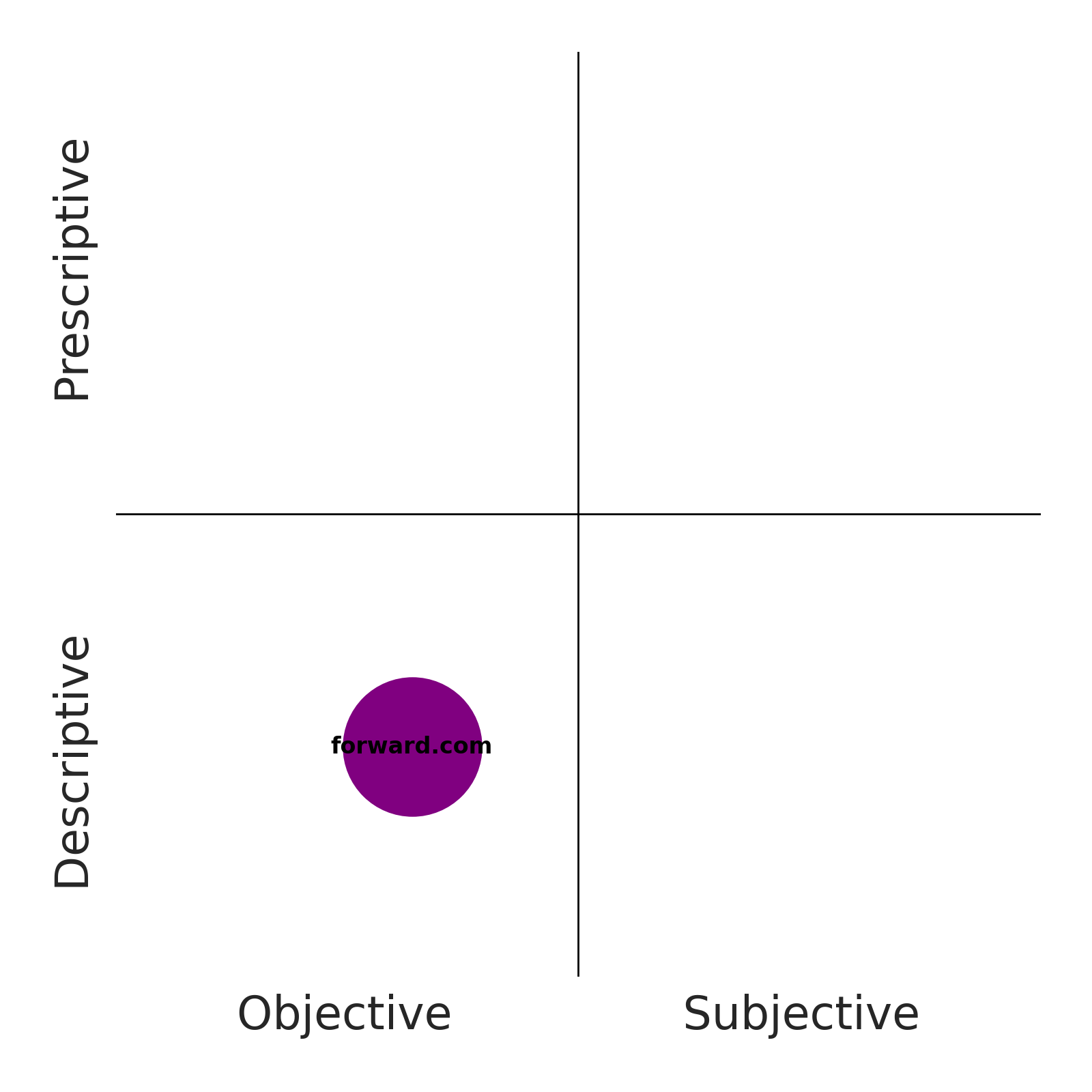
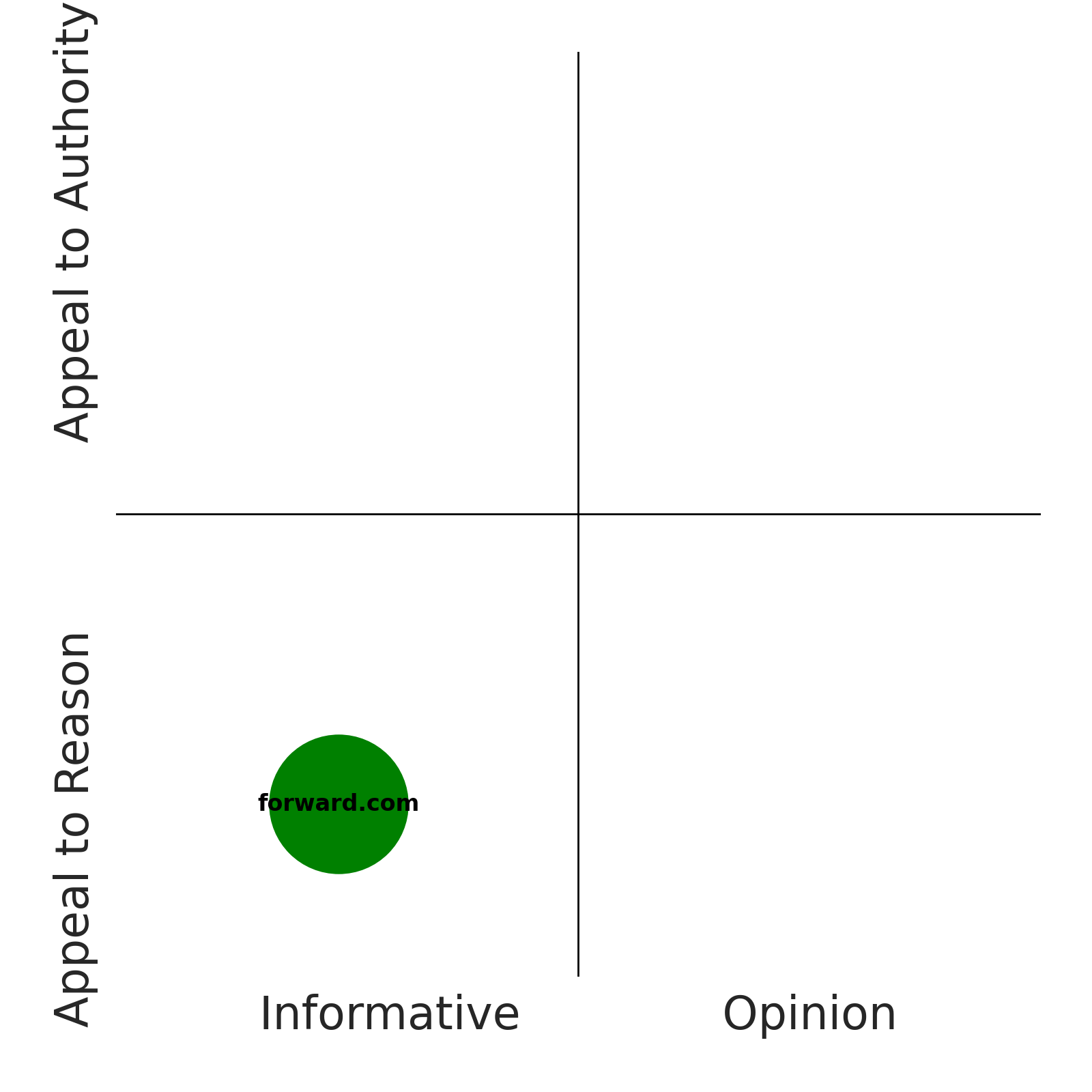
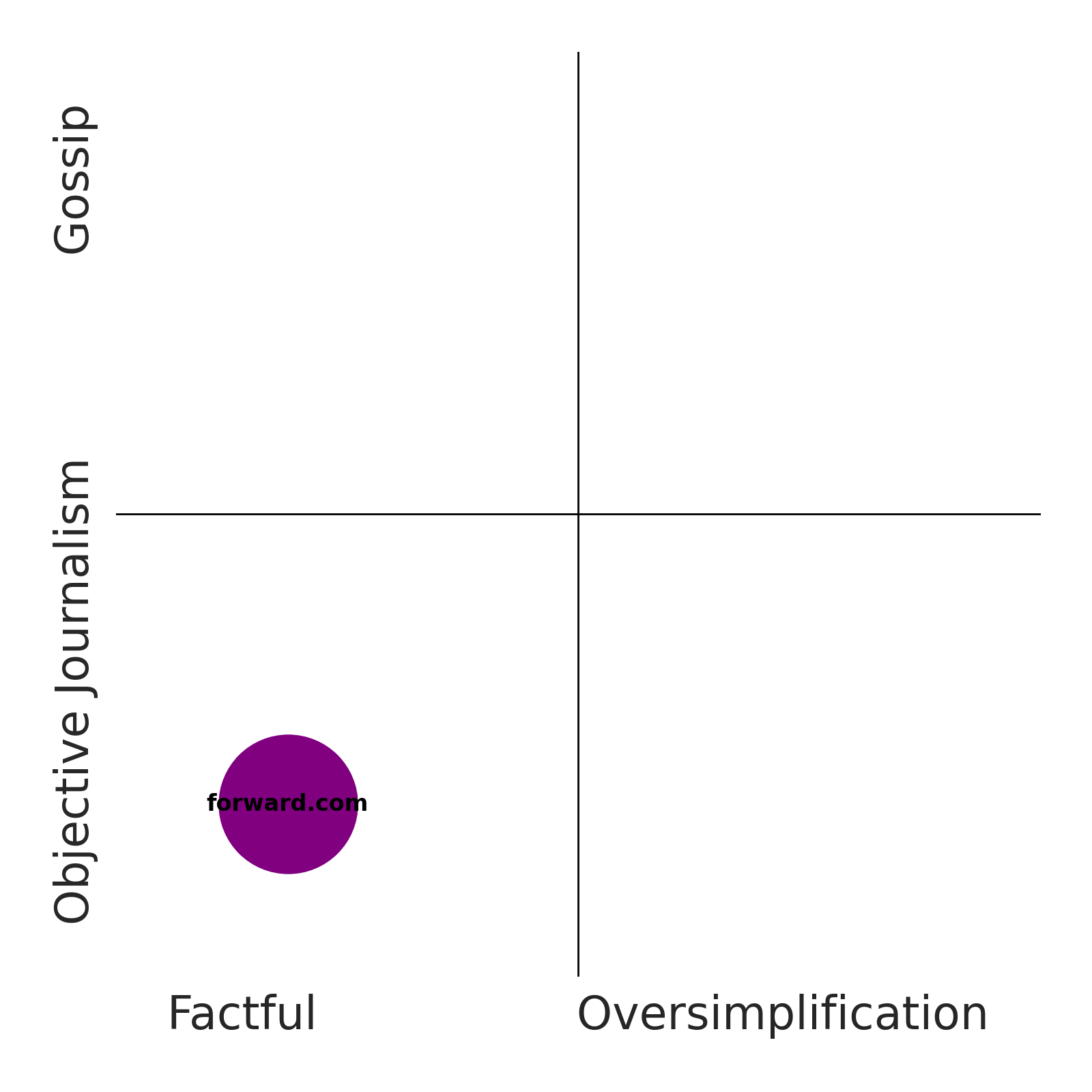
2026 © Helium Trades
Privacy Policy & Disclosure
* Disclaimer: Nothing on this website constitutes investment advice, performance data or any recommendation that any particular security, portfolio of securities, transaction or investment strategy is suitable for any specific person. Helium Trades is not responsible in any way for the accuracy
of any model predictions or price data. Any mention of a particular security and related prediction data is not a recommendation to buy or sell that security. Investments in securities involve the risk of loss. Past performance is no guarantee of future results. Helium Trades is not responsible for any of your investment decisions,
you should consult a financial expert before engaging in any transaction.
Helium Research Assistant

How can I help you today?
Ask any question about forward.com bias.


