See whether Helium helps you make better-informed decisions. Try every Pro Trader feature for 30 days. No credit card required.
Try every Pro Trader feature for 30 days. No credit card required.
The supplied sample shows a pronounced security-first, pro-Israel perspective, especially on Israel–Palestinian, Iran, Hezbollah, and Turkey-related issues.
Coverage frequently foregrounds Israeli or U.S. official claims while giving less space to Palestinian, Iranian, Turkish, Lebanese, UN, or independent responses
August 12, 2026 · 0 shares
Reports Abbas's Ankara visit while foregrounding Israeli official condemnation and a contrasting comparison with Turkey, without providing Palestinian or Turkish responses, reflecting a pro-Israel framing bias in source selection. { "one_sentence_summary": "Palestinian Authority leader Mahmoud Abbas arrived in Ankara for a two-day visit to meet Turkish President Erdoğan, while Israeli Finance Minister Smotrich condemned him and called for barring his return, and Israel’s Foreign Ministry criticized Turkey’s military occupations.", "list_of_extracted_data": [ {"label": "abbas_arrival_ankara", "value": "Mahmoud Abbas arrived in Ankara, Turkey on Tuesday afternoon for a two-day official visit, according to Ramallah’s Wafa agency."}, {"label": "welcome_delegation", "value": "Abbas was met at the airport by Turkish Trade Minister Ömer Bolat and PA envoy Nasri Abu Jaish."}, {"label": "scheduled_meeting", "value": "Abbas is scheduled to meet Turkish President Recep Tayyip Erdoğan during the visit, described as “regular political consultations.”"}, {"label": "discussion_topics", "value": "Talks expected to address developments in Judea, Samaria, and Gaza, and PA-Ankara ties, per Wafa."}, {"label": "pa_delegation_members", "value": "The PA delegation includes Ziad Abu Amr, Maj. Gen. Majed Faraj, Majdi al-Khaldi, and Mahmoud al-Habbash."}, {"label": "smotrich_condemnation", "value": "Finance Minister Smotrich condemned Abbas as “an enemy at the head of a terror authority that encourages and funds terror against the State of Israel.”"}, {"label": "smotrich_call_to_bar_return", "value": "Smotrich urged Netanyahu to prevent Abbas from returning to Israel and Judea and Samaria and said the PA “must be dismantled.”"}, {"label": "foreign_ministry_turkey_criticism", "value": "Israel’s Foreign Ministry accused Erdoğan of “military aggression that knows no borders,” claiming Turkey occupies 36% of Cyprus, 5% of Syria, and 2,000 sq km of Iraq with thousands of troops."}, {"label": "israel_control_comparison", "value": "The ministry contrasted that Israel “temporarily controls merely 0.1% of Syria” as a buffer zone."} ], "article_context": "The Palestinian Authority (PA) administers parts of the West Bank, referred to as Judea and Samaria in Israeli discourse. Israel controls entry and exit of PA leaders. Turkey has been critical of Israeli military operations. Bezalel Smotrich is a far-right Israeli finance minister. JNS is a pro-Israel news agency.", "implicit_assumptions": [ "Assumes that the reader will accept the Israeli government’s characterization of Turkish military presence as aggressive occupation and of Israeli presence in Syria as defensive, without requiring independent verification.", "Assumes that Smotrich’s condemnation of Abbas and call to dismantle the PA are relevant and newsworthy perspectives deserving prominence, while excluding any Palestinian or Turkish rebuttal.", "Assumes that the comparison between Turkey’s military footprint and Israel’s limited buffer zone is a legitimate and informative rebuttal to Turkish criticism, without contextualizing the differences in legality or duration." ], "liberal conservative bias": 6, "objective subjective bias": -2, "integrity bias": 5, "dovish hawkish bias": 6, "establishment bias": 3, "opinion bias": 2, "political bias": 8, "oversimplification bias": 3, "ideological bias": 5, "overall credibility": 5, "written by AI": 0, "article category": "Politics", "my bias": "", "bias evidence": { "liberal conservative bias": { "claim": "The article frames the story from a pro-Israel conservative perspective by leading with Israeli condemnation and including harsh characterizations of Abbas and Turkey without counterbalance.", "evidence": [ "Israeli Finance Minister Bezalel Smotrich condemned Abbas’s visit, describing the P.A. leader as “an enemy at the head of a terror authority that encourages and funds terror against the State of Israel.”" ], "confidence": 70, "rationale": "The article immediately follows the report of Abbas’s visit with a strong negative quote from an Israeli minister, and then includes the Foreign Ministry’s comparison that paints Turkey in a negative light, all without any response from the PA or Turkey." }, "objective subjective bias": { "claim": "The article mostly reports attributed statements in an objective manner, but the selection of quotes and lack of counter-sources introduces a subjective bias.", "evidence": [ "Abbas was met at the airport by Turkish Trade Minister Ömer Bolat and the P.A.’s envoy to Ankara, Nasri Abu Jaish, according to the report." ], "confidence": 60, "rationale": "While the tone is factual and attributive, the omission of any positive or neutral framing of Abbas’s visit or Turkish perspective tilts the overall presentation toward subjectivity." }, "integrity bias": { "claim": "The article attributes all claims to named sources (Wafa, Smotrich, Foreign Ministry) and does not assert unsubstantiated opinions as fact.", "evidence": [ "Wafa said the P.A. delegation includes PLO Executive Committee member Ziad Abu Amr; Fatah Central Committee member Maj. Gen. Majed Faraj, who also heads Ramallah’s General Intelligence Service; and Abbas advisers Majdi al-Khaldi and Mahmoud al-Habbash." ], "confidence": 80, "rationale": "Clear attribution to sources throughout, no editorializing beyond source selection." }, "dovish hawkish bias": { "claim": "The article prominently features hawkish statements from the Israeli government calling for dismantling the PA and criticizing Turkish aggression, framing the visit as problematic.", "evidence": [ "Smotrich urged Netanyahu to bar the Palestinian Authority leader’s return to Israel and Judea and Samaria." ], "confidence": 75, "rationale": "The inclusion of Smotrich’s demand to prevent return and the Foreign Ministry’s aggressive comparison supports a hawkish stance." }, "establishment bias": { "claim": "The article relies on official Israeli government statements and the PA’s official news agency, giving voice to established governmental positions.", "evidence": [ "Israel’s Foreign Ministry on Tuesday accused Erdoğan of military aggression “that knows no borders,”" ], "confidence": 60, "rationale": "Quoting government ministries and an official PA news agency without independent analysis." }, "opinion bias": { "claim": "The article includes a strong opinionated quote from Smotrich, but the article itself does not express opinion.", "evidence": [ "Smotrich called on Israeli Prime Minister Benjamin Netanyahu to prevent Abbas from returning to Israel and Judea and Samaria, adding that the Palestinian Authority “must be dismantled.”" ], "confidence": 50, "rationale": "The quote is opinion, but the article reports it as a statement." }, "political bias": { "claim": "The article is heavily about a political dispute involving Israel, PA, and Turkey, and uses politically charged language.", "evidence": [ "Abbas touches down in Ankara for two-day official visit. Smotrich urges Netanyahu to bar the Palestinian Authority leader’s return to Israel and Judea and Samaria." ], "confidence": 90, "rationale": "The topic is inherently political; the article selects controversial political statements." }, "oversimplification bias": { "claim": "The Foreign Ministry’s comparison between Turkish occupation and Israeli temporary control is oversimplified, but the article merely quotes it without analysis.", "evidence": [ "The ministry made the comparison amid Turkish criticism of Israel, writing on X, “Turkey has the audacity to criticize Israel. But what are the facts on the ground?”" ], "confidence": 40, "rationale": "The oversimplification is in the quote, not the article’s own assertion, but including the quote without context may oversimplify." }, "ideological bias": { "claim": "The article’s selection of quotes and lack of counterpoints reflects an ideological perspective sympathetic to Israeli government positions.", "evidence": [ "The ministry made the comparison amid Turkish criticism of Israel, writing on X, “Turkey has the audacity to criticize Israel. But what are the facts on the ground?”" ], "confidence": 60, "rationale": "Consistent selection of statements that align with a right-wing Israeli worldview." }, "overall credibility": { "claim": "The article uses attributed sources and factual reporting, increasing credibility.", "evidence": [ "Palestinian Authority leader Mahmoud Abbas arrived in Ankara, Turkey on Tuesday afternoon for a two-day visit, Ramallah’s official Wafa agency reported." ], "confidence": 70, "rationale": "Clear attribution, no unsupported claims." }, "written by AI": { "claim": "The text appears human-written with natural variation and no AI markers.", "evidence": [ "The text includes proper names, quoted speech, and journalistic structure." ], "confidence": 90, "rationale": "No repetitive patterns or unnatural fluency; typical news article." } } }
July 21, 2026 · 0 shares
Pro-Israel framing dominates, foregrounding Israeli government claims that UNESCO is cynically politicizing cultural heritage and condemning UNESCO’s silence regarding Hezbollah, while portraying US criticisms as 'woke' and offering minimal counterarguments.
The text consolidates Israeli government claims that UNESCO is biased and that Hezbollah desecrated Beaufort Castle, with historical notes on UNESCO withdrawal and US critiques described as 'woke'.
Automated analysis; not human reviewed. Limitations: Concise, case-specific limitations and plausible alternative interpretations. · 15 of 52 available dimensions scored; omitted dimensions are not treated as neutral. · Verified supporting quotes for 4 of 15 scored dimensions.
Claim: The piece leans toward a pro-Israel framing, presenting UNESCO as biased and the Israeli government’s view as authoritative.
“Israel blasts UNESCO for ‘cynical politicization of cultural heritage’” · exact text match
“UNESCO’s silence on Hezbollah’s systematic desecration at Beaufort, while targeting Israel’s defensive operations, is a moral abdication.” · exact text match
“The U.S. administration has announced its latest withdrawal from UNESCO, which is set to take effect at the end of the year, labeling the organization as “woke” for promoting diversity, equity and inclusion (DEI) policies and harboring anti-Israel and pro-China biases.” · exact text match
Counterevidence:
“Israel formally withdrew from UNESCO in 2018, citing systemic anti-Israel bias capped by a resolution downplaying Jewish ties to the Temple Mount, but still maintains working relations on specific heritage conventions and remains a signatory to several protocols.” · exact text match
“The Trump administration previously pulled out of the U.N. cultural group in 2018, only to have the move reversed by the Biden administration.” · exact text match
Why: Quoted lines indicate pro-Israel framing; counterevidence shows broader political context.
Claim: The article relies on normative, one-sided claims from Israeli officials without presenting UNESCO’s viewpoint.
“For years, Hezbollah has systematically weaponized and desecrated this historic Crusader fortress, converting it into a military stronghold.” · not found in supplied text
“UNESCO’s silence on Hezbollah’s systematic desecration at Beaufort, while targeting Israel’s defensive operations, is a moral abdication.” · exact text match
Why: Heavy reliance on one source with normative language.
Claim: The article uses strong, emotive language to frame events and actors.
“cynical politicization of cultural heritage” · exact text match
“moral abdication” · exact text match
“systematically weaponized and desecrated” · exact text match
Why: Loaded terms indicate sensational framing.
Claim: The piece emphasizes military action and defense framing, suggesting a hawkish stance.
“The 900-year-old Crusader-built site, which was captured by Israeli forces in May, was used by Hezbollah as a strategic military stronghold and included an extensive underground tunnel network just a few miles from the Israeli border.” · exact text match
Why: Military framing supports hawkish interpretation.
Claim: The text frames the issue with strong opinions rather than neutral reporting.
“Israel blasts UNESCO for ‘cynical politicization of cultural heritage’” · exact text match
“UNESCO’s silence ... is a moral abdication.” · not found in supplied text
Why: Loaded phrases and lack of UNESCO counterpoint indicate opinion bias.
Claim: The article shows a clear political orientation favorable to Israel and critical of UNESCO/DEI policies.
“cynical politicization of cultural heritage” · exact text match
“woke for promoting DEI policies and harboring biases” · not found in supplied text
Counterevidence:
“Beaufort Castle context includes Hezbollah's actions, and US policies are discussed.” · not found in supplied text
Why: Language and framing reveal political leaning toward Israel.
Claim: Complex regional politics are reduced to an 'Israel vs UNESCO/Hezbollah' framing.
“Beaufort Castle and sites designated as 'in danger'” · not found in supplied text
“moral abdication” · exact text match
Why: One-dimensional portrayal neglects broader political dynamics.
Claim: The article asserts certainty about actors' motives and biases.
“For years Hezbollah has systematically weaponized and desecrated” · not found in supplied text
“UNESCO’s silence ... is a moral abdication.” · not found in supplied text
Why: Definitive attributions without counter-testimony.
Claim: The piece aligns with a stance favoring Israel and skepticism toward international institutions.
“cynical politicization of cultural heritage” · exact text match
“woke for promoting DEI policies and harboring anti-Israel and pro-China biases” · not found in supplied text
Why: Narrative reflects a specific ideological alignment.
Claim: The article frames UNESCO as an establishment opponent and depicts US criticism as undermining its authority.
“Israel blasts UNESCO for ‘cynical politicization of cultural heritage’” · exact text match
“The U.S. administration ... labeling the organization as 'woke' for promoting DEI policies and harboring biases.” · not found in supplied text
Counterevidence:
“Israel formally withdrew from UNESCO in 2018, citing systemic anti-Israel bias; this acknowledges internal criticisms of UNESCO.” · not found in supplied text
Why: Portrays UNESCO and related policies as biased institutions; supports a perspective critical of establishment bodies.
Claim: The article employs emotionally loaded language.
“moral abdication” · exact text match
“cynical politicization” · exact text match
Why: Term choices indicate emotional influence on interpretation.
Claim: The article shows potential bias due to selective sourcing and lack of UNESCO perspective.
“The piece relies on Israeli government quotes and sources; it lacks UNESCO response.” · not found in supplied text
“The closing line presents JNS as a pro-Israel outlet.” · not found in supplied text
Why: One-sided sourcing suggests potential integrity concerns.
Case-specific ambiguities: sources appear one-sided; UNESCO perspective underrepresented.
August 01, 2026 · 0 shares
Frames Palestinian militants as terrorists and Israeli military actions as justified precise strikes.
Automated analysis; not human reviewed. Limitations: Analysis based solely on one-sided Israeli military reporting; no Palestinian perspective or independent verification available. · 10 of 52 available dimensions scored; omitted dimensions are not treated as neutral. · Verified supporting quotes for 9 of 10 scored dimensions.
Claim: Article exhibits a conservative bias by consistently labeling Palestinian militants as 'terrorists' and reporting Israeli military actions without critical questioning.
“The Israel Defense Forces this week killed a commander from the Kataeb al-Mujahideen terrorist group” · exact text match
“He was eliminated on Tuesday in a precise aerial strike after posing an immediate threat to nearby troops” · exact text match
Why: Repeated use of 'terrorist' and 'eliminated' without attribution to a specific source (though IDF is source for some, but the framing is adopted by the publisher).
Claim: Article is slightly subjective due to the use of emotionally charged labels like 'terrorist' and 'massacre' as assumed facts rather than attributed claims.
“Terrorist Ahmed Hussein Mohammed Kafina, in charge of the central Gaza area for the group” · exact text match
Why: The label 'terrorist' is used as an identifier without hedging, implying publisher acceptance of the classification.
Claim: Article is strongly hawkish, emphasizing the necessity of military strikes and justifying them as responses to threats.
“He was eliminated on Tuesday in a precise aerial strike after posing an immediate threat to nearby troops” · exact text match
“The terrorist posed a threat to the troops and was eliminated in an aerial strike” · exact text match
Why: The repeated justification of strikes based on 'threat' and lack of any dovish alternatives or criticism.
Claim: Article is slightly opinionated due to the use of value-laden terms like 'massacre' and 'terrorist'.
“during the Hamas-led invasion of the northwestern Negev on Oct. 7, 2023” · exact text match
“the Oct. 7 massacre” · exact text match
Why: The term 'massacre' is opinionated, but the rest of the article is factual.
Claim: Article is highly political, covering the Israeli-Palestinian conflict from a partisan perspective.
“IDF slays Gazan terrorist who abducted Noa Argamani and Avinatan Or” · exact text match
Why: The topic is inherently political, and the framing is consistent with Israeli government positions.
Claim: Article oversimplifies by presenting the killings as justified strikes without discussing civilian casualties or broader conflict dynamics.
“He was eliminated on Tuesday in a precise aerial strike after posing an immediate threat to nearby troops” · exact text match
Why: No mention of any Palestinian deaths or collateral damage, simplifying complex military operations.
Claim: Article relies heavily on IDF statements as authoritative sources without critical analysis.
“the IDF said” · exact text match
“the military said” · exact text match
“the army said” · exact text match
Why: Multiple attributions to IDF without questioning or alternative sources.
Claim: Article exhibits a slight ideological bias in favor of Israeli security paradigm.
“Terrorist ... who took part in the abduction of Israeli hostages” · not found in supplied text
Why: The framing aligns with a pro-Israel security ideology, but not extreme.
Claim: Article is pro-establishment by uncritically reporting IDF statements and supporting Israeli government military actions.
“the military said on Friday” · exact text match
“the IDF continued” · exact text match
“the army said” · exact text match
Why: The article relies entirely on IDF statements without independent verification or counterpoints.
Claim: Article is rational in that it presents factual claims from the IDF without logical fallacies or emotional appeals, though one-sided.
“During the war and in recent months, Kafina advanced terrorist attacks against Israeli troops and civilians, the IDF continued.” · exact text match
Why: The article reports events in a straightforward manner based on official statements, without irrational speculation.
Analysis based solely on one-sided Israeli military reporting; no Palestinian perspective or independent verification available.
August 01, 2026 · 0 shares
Coverage frames Israeli military operations as necessary defense against Hezbollah 'terrorists' while giving less prominence to international and Lebanese criticism.
Automated analysis; not human reviewed. Limitations: The analysis relies solely on the article text, which presents IDF statements as facts and may not fully represent the conflict's complexity. · 7 of 52 available dimensions scored; omitted dimensions are not treated as neutral. · Verified supporting quotes for 6 of 7 scored dimensions.
Claim: The report uses emotionally charged pro-Israel terminology and frames Hezbollah as terrorists, reflecting a conservative perspective on the conflict.
“Israeli troops kill Hezbollah terrorists in Lebanon encounter.” · exact text match
Why: Labeling Hezbollah as 'terrorists' and emphasizing Israeli security justifications aligns with conservative foreign policy framing.
Claim: The article mixes factual reporting with subjective labels and selective emphasis, making it more subjective than purely objective.
“Israeli troops kill Hezbollah terrorists in Lebanon encounter.” · exact text match
“"The IDF will continue to operate to remove any threat to its soldiers and will not allow the Hezbollah terrorist organization to harm Israeli civilians," the IDF added.” · verified after text normalization
Why: The phrase 'kill Hezbollah terrorists' is a value-laden description, and the IDF quote presents a one-sided justification.
Claim: The article endorses aggressive military action against Hezbollah, exhibiting a hawkish stance.
“"The IDF will continue to operate to remove any threat to its soldiers and will not allow the Hezbollah terrorist organization to harm Israeli civilians," the IDF added.” · verified after text normalization
Why: The inclusion and framing of IDF statements and the emphasis on military operations indicate support for a forceful approach.
Claim: The article contains editorializing language and opinions from officials, making it moderately opinionated.
“Israeli troops kill Hezbollah terrorists in Lebanon encounter.” · exact text match
“"The IDF will continue to operate to remove any threat to its soldiers and will not allow the Hezbollah terrorist organization to harm Israeli civilians," the IDF added.” · verified after text normalization
Why: The term 'terrorists' and the justification language insert opinion into the reporting.
Claim: The article is strongly political, centered on a geopolitical conflict and official statements.
“Prime Minister Benjamin Netanyahu said that the operation follows Hezbollah's "blatant violation of the ceasefire agreement" on Wednesday, referring to an explosive drone Hezbollah launched at an IDF heavy engineering vehicle.” · verified after text normalization
Why: The entire article deals with political-military events and high-level diplomatic responses.
Claim: The report favorably presents official US and Israeli government positions, supporting the diplomatic framework.
“Marco Rubio on Friday lauded the Israeli-Lebanese framework, saying it is "unprecedented."” · verified after text normalization
Why: Quotes from US and Israeli officials are given prominence and reported without critical counterpoint, aligning with establishment views.
Claim: The article maintains some credibility by attributing statements to sources and including UN and Lebanese criticism, though its one-sided framing lowers it.
“The UN on Saturday expressed concern over the escalation in Lebanon in recent days.” · not found in supplied text
“"The scale of the detonations and demolitions taking place in south Lebanon is deeply concerning, with a devastating impact on civilian infrastructure, cultural heritage and the collective memory of communities," the UN said in a statement.” · not found in supplied text
Why: It shows sourcing and includes opposing views, but the overall tone and selection may reduce trustworthiness.
The analysis relies solely on the article text, which presents IDF statements as facts and may not fully represent the conflict's complexity.
Its preferred frame commonly treats Israeli security, Jewish safety, military preparedness, and opposition to Hamas or Iran as urgent and legitimate.
Examples include describing Iranian missile capabilities as a global threat
August 10, 2026 · 0 shares
Framing emphasizes Iran's missile threat to Europe and the possibility of future US threat, using alarmist language and authoritative sources to create a sense of urgency.
Automated analysis; not human reviewed. Limitations: The article is a short report from a pro-Israel news agency, which may shape the selection of quotes and framing, but the analysis is based solely on the supplied text. · 15 of 53 available dimensions scored; omitted dimensions are not treated as neutral. · Verified supporting quotes for 15 of 15 scored dimensions.
Claim: The article frames Iran's missile capabilities as a threat requiring a strong U.S. response, consistent with conservative foreign policy.
“How long will it be until they can launch one toward the United States?” · exact text match
“All of those cities are now in the sights of Iran” · exact text match
Why: The alarmist question and the inclusion of the IDF's 'Iranian terrorist regime' language reinforce a hawkish, conservative perspective.
Claim: The article's selection of quotes and the headline's phrasing introduce subjective alarm.
“Huckabee: Iran's ballistic missiles can now reach European cities” · exact text match
Why: The headline presents Huckabee's statement as fact, and the article does not offer balancing perspectives.
Claim: The article uses dramatic language and imagery to evoke fear.
“All of those cities are now in the sights of Iran” · exact text match
“The Iranian terrorist regime poses a global threat” · exact text match
Why: Phrases like 'in the sights' and 'global threat' are sensational and intended to provoke an emotional response.
Claim: The article advocates for concern about Iran's missile development and potential nuclear threat, reflecting a hawkish stance.
“How long will it be until they can launch one toward the United States?” · exact text match
“The Iranian terrorist regime poses a global threat” · exact text match
Why: The entire piece is framed around the threat Iran poses to Europe and the US, with no countervailing diplomatic or dovish perspectives.
Claim: The article deliberately evokes fear of immediate threat to European cities and eventual US threat.
“How long will it be until they can launch one toward the United States?” · exact text match
“All of those cities are now in the sights of Iran” · exact text match
Why: The repeated focus on cities being 'in the sights' and the rhetorical question about the US are designed to create fear.
Claim: The article is largely a report of opinions and warnings, presented as factual news.
“Huckabee: Iran's ballistic missiles can now reach European cities” · exact text match
Why: The headline presents Huckabee's opinion as a statement, and the article includes speculative analysis from a think tank.
Claim: The article is entirely centered on a geopolitical issue with clear political implications.
“The Iranian terrorist regime poses a global threat” · exact text match
“How long will it be until they can launch one toward the United States?” · exact text match
Why: The content is about national security, military capability, and potential conflict, making it highly political.
Claim: The article simplifies the complex issue of Iran's missile program into a clear and present danger without discussing limitations or diplomatic context.
“In one year they went from being able to deliver a ballistic missile from 2,000 kilometers to over 4,100 kilometers.” · exact text match
Why: The linear narrative of rapid range increase omits technical, political, and operational constraints.
Claim: The article relies heavily on the authority of Huckabee, the IDF, the Hudson Institute, and the E3 governments.
“U.S. ambassador to Israel Mike Huckabee said” · exact text match
“Hudson Institute senior fellow Can Kasapoğlu wrote” · exact text match
Why: The article presents these authorities' statements without independent verification or counterargument.
Claim: The article consistently reflects a hawkish, pro-Israel, anti-Iran ideology.
“The Iranian terrorist regime poses a global threat” · exact text match
“All of those cities are now in the sights of Iran” · exact text match
Why: The language and selection of sources align with a specific ideological worldview regarding Iran.
Claim: The article relies on statements from official U.S., Israeli, and European government sources and a think tank, reinforcing establishment views.
“U.S. ambassador to Israel Mike Huckabee said” · exact text match
“The British, French, and German governments warned in a joint letter” · exact text match
Why: The sources cited are all within the Western foreign policy establishment, and the article does not question their authority.
Claim: The article conveys a negative emotional tone through fear-mongering and threatening imagery.
“The Iranian terrorist regime poses a global threat” · exact text match
“How long will it be until they can launch one toward the United States?” · exact text match
Why: The words 'terrorist', 'global threat', and 'sights' evoke fear and anxiety rather than calm analysis.
Claim: The article includes a speculative rhetorical question that implies an inevitable threat without evidence of intent.
“How long will it be until they can launch one toward the United States?” · exact text match
Why: The question is not based on any specific evidence of Iran's plans but is used to heighten fear.
Claim: The article includes speculative questions about future Iranian attacks on the US.
“How long will it be until they can launch one toward the United States?” · exact text match
Why: The question is purely speculative about an event that has not been implied by any evidence in the article.
Claim: The article uses loaded language and a rhetorical question to manipulate reader perception of threat.
“How long will it be until they can launch one toward the United States?” · exact text match
“All of those cities are now in the sights of Iran” · exact text match
Why: The rhetorical question implies inevitability, and 'in the sights' is a metaphor designed to provoke a defensive reaction.
The article is a short report from a pro-Israel news agency, which may shape the selection of quotes and framing, but the analysis is based solely on the supplied text.
August 14, 2026 · 0 shares
The report frames the families' demand as legitimate urgency while relaying warnings that restraint endangers soldiers, presenting the offensive as the necessary fulfillment of commitments.
The context involves the ongoing Israel-Hamas conflict following the Oct. 7, 2023, attack, the Swords of Iron war, and political pressures including the Trump administration's peace plan. The 'Yellow Line' refers to a demarcation line near the Gaza border. The forum's letter reflects internal Israeli debates over military strategy and cease-fire terms.
Automated analysis; not human reviewed. Limitations: The analysis is based solely on the provided article text; external context is limited to what is stated. · 8 of 53 available dimensions scored; omitted dimensions are not treated as neutral. · Verified supporting quotes for 0 of 8 scored dimensions.
Claim: The article presents the forum's letter as factual reporting but includes emotionally charged language and direct quotes that convey the forum's perspective, making it somewhat subjective.
“The forum warned in the letter, a copy of which the group provided to JNS, that Hamas was exploiting the fact that Israel had stopped taking the initiative.” · exact text match
“‘The blood that has been spilled obliges all of us to learn the lessons and make sure that the threat is removed from the root.’” · not found in supplied text
Why: The article reports events and statements but uses descriptive language like 'warning' and includes the forum's emotional quotes, while also relaying claims about military actions without extensive critical analysis.
Claim: The article uses dramatic language like 'fallen' and 'blood that has been spilled' but remains grounded in specific events and quotes.
“The forum’s families said their information comes from officials on the ground as well as senior political officials: 'Unfortunately the picture is clear...'” · not found in supplied text
“The blood that has been spilled obliges all of us to learn the lessons and make sure that the threat is removed from the root.” · exact text match
Why: While the subject matter is emotional, the article relies on reported facts and attributed quotes rather than sensationalized speculation.
The analysis is based solely on the provided article text; external context is limited to what is stated.
July 29, 2026 · 0 shares
Framing centers on official Israeli military claims of a precise, justified strike against an Islamic Jihad commander, reinforcing a security-first, pro-establishment narrative.
Background: The report describes a targeted killing by the Israel Defense Forces in Gaza, within the broader Gaza conflict and the Oct. 7, 2023 hostage-taking, noting a U.S.-brokered ceasefire that took effect on Oct. 10, 2025.
Automated analysis; not human reviewed. Limitations: The article's reliance on official Israeli sources may bias interpretation toward establishment framing and away from independent corroboration. · 3 of 52 available dimensions scored; omitted dimensions are not treated as neutral. · Verified supporting quotes for 2 of 3 scored dimensions.
Claim: The text frames the action as a necessary, targeted strike against a threat, aligning with a hawkish security posture.
“The terrorist posed an immediate threat and was eliminated in a precise aerial strike.” · exact text match
“In recent months, Aslam advanced attacks targeting IDF troops and Israeli civilians.” · not found in supplied text
Why: The language portrays the operation as justified and decisive, aligning with a hawkish stance on security.
Claim: The narrative is grounded in statements from authorities (IDF and the ceasefire framework).
“"The Israel Defense Forces has eliminated a Palestinian Islamic Jihad commander who led a terrorist cell that took hostages during the Oct. 7, 2023, massacre, the military said on Tuesday."” · exact text match
“"The terrorist posed an immediate threat and was eliminated in a precise aerial strike."” · verified after text normalization
“"The current ceasefire went into effect in the Gaza Strip on Oct. 10, 2025, ending the two-year war that began when Hamas, other Palestinian terrorist groups and Gazan civilians invaded the northwestern Negev on Oct. 7, 2023."” · exact text match
Why: The text grounds claims in authorities.
Claim: Framing relies on official Israeli military statements and allied ceasefire authorities as the basis for the narrative.
“The Israel Defense Forces has eliminated a Palestinian Islamic Jihad commander who led a terrorist cell that took hostages during the Oct. 7, 2023, massacre, the military said on Tuesday.” · exact text match
“Soldiers remain deployed in the enclave in accordance with the U.S.-brokered ceasefire agreement “and will continue to operate to remove any immediate threat,” it said.” · exact text match
“The current ceasefire went into effect in the Gaza Strip on Oct. 10, 2025, ending the two-year war that began when Hamas, other Palestinian terrorist groups and Gazan civilians invaded the northwestern Negev on Oct. 7, 2023.” · exact text match
Why: The article consistently attributes claims to official sources (IDF and ceasefire authorities).
The article's reliance on official Israeli sources may bias interpretation toward establishment framing and away from independent corroboration.
August 01, 2026 · 0 shares
Frames Palestinian militants as terrorists and Israeli military actions as justified precise strikes.
Automated analysis; not human reviewed. Limitations: Analysis based solely on one-sided Israeli military reporting; no Palestinian perspective or independent verification available. · 10 of 52 available dimensions scored; omitted dimensions are not treated as neutral. · Verified supporting quotes for 9 of 10 scored dimensions.
Claim: Article exhibits a conservative bias by consistently labeling Palestinian militants as 'terrorists' and reporting Israeli military actions without critical questioning.
“The Israel Defense Forces this week killed a commander from the Kataeb al-Mujahideen terrorist group” · exact text match
“He was eliminated on Tuesday in a precise aerial strike after posing an immediate threat to nearby troops” · exact text match
Why: Repeated use of 'terrorist' and 'eliminated' without attribution to a specific source (though IDF is source for some, but the framing is adopted by the publisher).
Claim: Article is slightly subjective due to the use of emotionally charged labels like 'terrorist' and 'massacre' as assumed facts rather than attributed claims.
“Terrorist Ahmed Hussein Mohammed Kafina, in charge of the central Gaza area for the group” · exact text match
Why: The label 'terrorist' is used as an identifier without hedging, implying publisher acceptance of the classification.
Claim: Article is strongly hawkish, emphasizing the necessity of military strikes and justifying them as responses to threats.
“He was eliminated on Tuesday in a precise aerial strike after posing an immediate threat to nearby troops” · exact text match
“The terrorist posed a threat to the troops and was eliminated in an aerial strike” · exact text match
Why: The repeated justification of strikes based on 'threat' and lack of any dovish alternatives or criticism.
Claim: Article is slightly opinionated due to the use of value-laden terms like 'massacre' and 'terrorist'.
“during the Hamas-led invasion of the northwestern Negev on Oct. 7, 2023” · exact text match
“the Oct. 7 massacre” · exact text match
Why: The term 'massacre' is opinionated, but the rest of the article is factual.
Claim: Article is highly political, covering the Israeli-Palestinian conflict from a partisan perspective.
“IDF slays Gazan terrorist who abducted Noa Argamani and Avinatan Or” · exact text match
Why: The topic is inherently political, and the framing is consistent with Israeli government positions.
Claim: Article oversimplifies by presenting the killings as justified strikes without discussing civilian casualties or broader conflict dynamics.
“He was eliminated on Tuesday in a precise aerial strike after posing an immediate threat to nearby troops” · exact text match
Why: No mention of any Palestinian deaths or collateral damage, simplifying complex military operations.
Claim: Article relies heavily on IDF statements as authoritative sources without critical analysis.
“the IDF said” · exact text match
“the military said” · exact text match
“the army said” · exact text match
Why: Multiple attributions to IDF without questioning or alternative sources.
Claim: Article exhibits a slight ideological bias in favor of Israeli security paradigm.
“Terrorist ... who took part in the abduction of Israeli hostages” · not found in supplied text
Why: The framing aligns with a pro-Israel security ideology, but not extreme.
Claim: Article is pro-establishment by uncritically reporting IDF statements and supporting Israeli government military actions.
“the military said on Friday” · exact text match
“the IDF continued” · exact text match
“the army said” · exact text match
Why: The article relies entirely on IDF statements without independent verification or counterpoints.
Claim: Article is rational in that it presents factual claims from the IDF without logical fallacies or emotional appeals, though one-sided.
“During the war and in recent months, Kafina advanced terrorist attacks against Israeli troops and civilians, the IDF continued.” · exact text match
Why: The article reports events in a straightforward manner based on official statements, without irrational speculation.
Analysis based solely on one-sided Israeli military reporting; no Palestinian perspective or independent verification available.
August 12, 2026 · 0 shares
Reports on the upcoming Perseid meteor shower in Israel with factual details and practical viewing advice.
Automated analysis; not human reviewed. · 5 of 53 available dimensions scored; omitted dimensions are not treated as neutral. · Verified supporting quotes for 0 of 5 scored dimensions.
Claim: The article presents only verifiable factual information without subjective opinion.
“The article states expected meteor rate, timing, speed, and viewing advice using objective language such as 'are expected', 'will enter', 'advises the public'.” · not found in supplied text
Why: No evaluative or speculative language; all claims are attributed to the Israel Space Agency or are straightforward factual descriptions.
Claim: The article avoids sensationalism and presents the event in a neutral, informative manner.
“The phrase 'spectacle that looks like fireballs' is a descriptive comparison, not hyperbolic; the article emphasizes practical conditions.” · not found in supplied text
Why: No exaggerated claims, alarmist language, or clickbait framing.
Claim: The article reports a routine annual astronomical event, providing moderate interest but not extraordinary novelty.
“It describes the Perseid meteor shower as 'the richest meteor shower of the year' and gives practical viewing tips.” · not found in supplied text
Why: The information is timely and useful for local readers but does not contain surprising or deeply engaging narrative beyond the event itself.
Claim: The article demonstrates high credibility through clear attribution, specific quantified data, and practical guidance.
“Data is attributed to the Israel Space Agency; includes specific numbers (150 per hour, 36 miles per second) and actionable advice.” · not found in supplied text
Why: Sources are named (ISA, Nature and Parks Authority) and the information is verifiable and consistent with standard meteor shower reporting.
Claim: The article relies on empirical, rational reporting consistent with astronomical science.
“It explains the origin of meteors as 'remnants of comet Swift-Tuttle' and describes their apparent origin from the constellation Perseus.” · not found in supplied text
Why: No supernatural, pseudoscientific, or emotionally charged reasoning; content is based on established astronomy.
August 12, 2026 · 0 shares
Framing emphasizes resilience and successful ecological restoration through expert collaboration.
Automated analysis; not human reviewed. · 20 of 53 available dimensions scored; omitted dimensions are not treated as neutral. · Verified supporting quotes for 14 of 20 scored dimensions.
Claim: Article shows no political slant.
“Just days after the fire in May 2025, experts surveyed the site” · exact text match
Why: No political terminology or partisan framing.
Claim: Article is neutral regarding populist or elitist framing.
“The stumps were placed in a growing medium called pumice, which maintains optimal moisture levels while allowing oxygen to reach the root zone, thereby reducing the risk of rot.” · exact text match
Why: Technical description without populist or elitist language.
Claim: Article does not take a stance on governance or authority.
“Once the rooting process is complete, the stumps will undergo specialized bonsai shaping, after which they will be displayed to the public at the Jerusalem Botanical Gardens at Givat Ram and at KKL-JNF’s Eshtaol Nursery.” · exact text match
Why: Factual reporting of future plans without authoritarian or libertarian advocacy.
Claim: Reporting is factual with direct quotes from experts.
“Once the rooting process is complete, the stumps will undergo specialized bonsai shaping, after which they will be displayed to the public at the Jerusalem Botanical Gardens at Givat Ram and at KKL-JNF’s Eshtaol Nursery.” · exact text match
Why: No subjective editorializing.
Claim: Content is matter-of-fact, not sensational.
“The stumps were uprooted and transferred to a nursery; after about a month, fresh leaves began to emerge, followed several weeks later by new roots.” · exact text match
Why: Factual reporting without exaggeration.
Claim: Article does not express economic outlook.
“They are now undergoing a unique rehabilitation process, at the end of which they will become bonsai trees and be displayed to the public.” · exact text match
Why: No economic terminology or market framing.
Claim: Story about ancient olive trees turned into bonsai is moderately engaging.
“Ancient olive trees burned in Ayalon Canada Park get second life as bonsai trees.” · exact text match
Why: Inherent novelty of topic.
Claim: Article describes process without prescribing actions.
“Just days after the fire in May 2025, experts surveyed the site and discovered that although the trunks and canopies of the trees had burned, the root collars of some of them were still alive.” · exact text match
Why: Narrative of events, not advocacy.
Claim: Article does not address conflict or military matters.
“The method is based on a bonsai technique learned from Shai Cohen, the bonsai artist at the Jerusalem Botanical Gardens at Givat Ram, as part of a collaboration with KKL-JNF’s Central Region.” · exact text match
Why: No mention of conflict, war, or security.
Claim: Relies on expert statements but not excessively.
“Ori Fragman-Sapir, scientific director of the Jerusalem Botanical Gardens ... said: “The renewed sprouting of these ancient olive stumps reminds us of the vitality, remarkable regenerative power, and resilience of trees...”” · not found in supplied text
Why: Uses expert quote to add weight, but not overdone.
Claim: Article does not take an anti- or pro-establishment stance.
“KKL-JNF reports that some of the trees once believed to be lost have survived.” · not found in supplied text
Why: Neutral reference to institutional report without endorsement or criticism.
Claim: Slightly positive emotional tone through quotes about vitality.
““The renewed sprouting of these ancient olive stumps reminds us of the vitality, remarkable regenerative power, and resilience of trees...”” · not found in supplied text
Why: Positive but restrained language.
Claim: Well-sourced with specific details and multiple named sources.
“Rotem Attias, manager of KKL-JNF’s Eshtaol Nursery” · exact text match
“Ori Fragman-Sapir, scientific director of the Jerusalem Botanical Gardens” · exact text match
Why: Multiple named experts, specific methodology timelines.
Claim: Article presents a rational, methodical rehabilitation process.
“The stumps were placed in a growing medium called pumice, which maintains optimal moisture levels while allowing oxygen to reach the root zone, thereby reducing the risk of rot.” · exact text match
Why: Detailed explanation of scientific method.
Claim: Article uses empirical, scientific approach.
“The stumps were placed in a growing medium called pumice, which maintains optimal moisture levels while allowing oxygen to reach the root zone, thereby reducing the risk of rot.” · exact text match
Why: Explanation grounded in biology and horticulture.
Claim: Article attributes quotes and specifics properly.
“According to Rotem Attias, manager of KKL-JNF’s Eshtaol Nursery, “the trees were severely damaged, but we discovered that life remained within the stumps.”” · not found in supplied text
Why: Clear attribution and transparent sourcing.
Claim: Covers technical details and multiple perspectives.
“The method is based on a bonsai technique learned from Shai Cohen, the bonsai artist at the Jerusalem Botanical Gardens at Givat Ram, as part of a collaboration with KKL-JNF’s Central Region.” · exact text match
Why: Describes collaboration and technique.
Claim: Article is truth-seeking, reporting actual events.
“A little more than a year after a wildfire swept through Ayalon Canada Park in Israel, severely damaging the ancient olive trees... KKL-JNF reports that some of the trees once believed to be lost have survived.” · not found in supplied text
Why: No conspiracy or fantasy elements.
August 12, 2026 · 0 shares
The article neutrally reports a U.S. State Department assessment of fiscal transparency in the Middle East, without editorial slant.
Automated analysis; not human reviewed. · 7 of 53 available dimensions scored; omitted dimensions are not treated as neutral. · Verified supporting quotes for 3 of 7 scored dimensions.
Claim: The article contains no opinion statements from the publisher.
“The State Department describes fiscal transparency as essential to market confidence and economic growth and says the report is 'a tool to identify deficiencies'.” · not found in supplied text
Why: All evaluative language is attributed to the State Department.
Claim: The article's topic is political, but coverage is neutral.
“The congressionally mandated report evaluates whether governments publicly disclose key information about their budgets, revenues, debt, audits and procurement.” · exact text match
Why: No partisan slant; simply reports which countries met or failed criteria.
Claim: The article does not assert certainty beyond what the report states.
“The report faulted the Palestinian Authority for failing to publish an executive budget proposal.” · not found in supplied text
Why: Claims are hedged by attribution to the report.
Claim: The article has no emotional language.
“The report faulted the Palestinian Authority for failing to publish an executive budget proposal and for not having its enacted budget approved by the legislature.” · exact text match
Why: Even criticism is presented as a factual report citation.
Claim: The article is credible based on clear attribution and sourcing.
“The State Department recommended further improvements, including revised budget estimates for areas previously lacking transparency.” · not found in supplied text
Why: Direct quotation and attribution to an official U.S. government report; no independent verification is possible from the text alone.
Claim: The article appears honest and fair, not distorting or omitting key context.
“Similar shortcomings have been cited in previous State Department assessments.” · exact text match
Why: Includes historical context, showing consistency over time.
August 13, 2026 · 0 shares
The article neutrally reports a Treasury enforcement action, attributing statements to the department and noting the company's voluntary disclosure and non-egregious violations, without editorializing.
This is a U.S. Treasury enforcement action under U.S. sanctions on Iran, which generally prohibit both direct and indirect exports to Iran by U.S. persons and their foreign subsidiaries. The settlement reflects Treasury's policy of considering voluntary self-disclosure and non-egregious violations in determining penalties.
Automated analysis; not human reviewed. Limitations: The article is concise and primarily quotes or paraphrases the Treasury Department; the analysis relies on the limited factual details provided, but the specific legal context of the violations is not fully elaborated in the text. · 53 of 53 available dimensions scored; omitted dimensions are not treated as neutral. · Verified supporting quotes for 0 of 53 scored dimensions.
The article is concise and primarily quotes or paraphrases the Treasury Department; the analysis relies on the limited factual details provided, but the specific legal context of the violations is not fully elaborated in the text.
August 12, 2026 · 0 shares
Reports Abbas's Ankara visit while foregrounding Israeli official condemnation and a contrasting comparison with Turkey, without providing Palestinian or Turkish responses, reflecting a pro-Israel framing bias in source selection. { "one_sentence_summary": "Palestinian Authority leader Mahmoud Abbas arrived in Ankara for a two-day visit to meet Turkish President Erdoğan, while Israeli Finance Minister Smotrich condemned him and called for barring his return, and Israel’s Foreign Ministry criticized Turkey’s military occupations.", "list_of_extracted_data": [ {"label": "abbas_arrival_ankara", "value": "Mahmoud Abbas arrived in Ankara, Turkey on Tuesday afternoon for a two-day official visit, according to Ramallah’s Wafa agency."}, {"label": "welcome_delegation", "value": "Abbas was met at the airport by Turkish Trade Minister Ömer Bolat and PA envoy Nasri Abu Jaish."}, {"label": "scheduled_meeting", "value": "Abbas is scheduled to meet Turkish President Recep Tayyip Erdoğan during the visit, described as “regular political consultations.”"}, {"label": "discussion_topics", "value": "Talks expected to address developments in Judea, Samaria, and Gaza, and PA-Ankara ties, per Wafa."}, {"label": "pa_delegation_members", "value": "The PA delegation includes Ziad Abu Amr, Maj. Gen. Majed Faraj, Majdi al-Khaldi, and Mahmoud al-Habbash."}, {"label": "smotrich_condemnation", "value": "Finance Minister Smotrich condemned Abbas as “an enemy at the head of a terror authority that encourages and funds terror against the State of Israel.”"}, {"label": "smotrich_call_to_bar_return", "value": "Smotrich urged Netanyahu to prevent Abbas from returning to Israel and Judea and Samaria and said the PA “must be dismantled.”"}, {"label": "foreign_ministry_turkey_criticism", "value": "Israel’s Foreign Ministry accused Erdoğan of “military aggression that knows no borders,” claiming Turkey occupies 36% of Cyprus, 5% of Syria, and 2,000 sq km of Iraq with thousands of troops."}, {"label": "israel_control_comparison", "value": "The ministry contrasted that Israel “temporarily controls merely 0.1% of Syria” as a buffer zone."} ], "article_context": "The Palestinian Authority (PA) administers parts of the West Bank, referred to as Judea and Samaria in Israeli discourse. Israel controls entry and exit of PA leaders. Turkey has been critical of Israeli military operations. Bezalel Smotrich is a far-right Israeli finance minister. JNS is a pro-Israel news agency.", "implicit_assumptions": [ "Assumes that the reader will accept the Israeli government’s characterization of Turkish military presence as aggressive occupation and of Israeli presence in Syria as defensive, without requiring independent verification.", "Assumes that Smotrich’s condemnation of Abbas and call to dismantle the PA are relevant and newsworthy perspectives deserving prominence, while excluding any Palestinian or Turkish rebuttal.", "Assumes that the comparison between Turkey’s military footprint and Israel’s limited buffer zone is a legitimate and informative rebuttal to Turkish criticism, without contextualizing the differences in legality or duration." ], "liberal conservative bias": 6, "objective subjective bias": -2, "integrity bias": 5, "dovish hawkish bias": 6, "establishment bias": 3, "opinion bias": 2, "political bias": 8, "oversimplification bias": 3, "ideological bias": 5, "overall credibility": 5, "written by AI": 0, "article category": "Politics", "my bias": "", "bias evidence": { "liberal conservative bias": { "claim": "The article frames the story from a pro-Israel conservative perspective by leading with Israeli condemnation and including harsh characterizations of Abbas and Turkey without counterbalance.", "evidence": [ "Israeli Finance Minister Bezalel Smotrich condemned Abbas’s visit, describing the P.A. leader as “an enemy at the head of a terror authority that encourages and funds terror against the State of Israel.”" ], "confidence": 70, "rationale": "The article immediately follows the report of Abbas’s visit with a strong negative quote from an Israeli minister, and then includes the Foreign Ministry’s comparison that paints Turkey in a negative light, all without any response from the PA or Turkey." }, "objective subjective bias": { "claim": "The article mostly reports attributed statements in an objective manner, but the selection of quotes and lack of counter-sources introduces a subjective bias.", "evidence": [ "Abbas was met at the airport by Turkish Trade Minister Ömer Bolat and the P.A.’s envoy to Ankara, Nasri Abu Jaish, according to the report." ], "confidence": 60, "rationale": "While the tone is factual and attributive, the omission of any positive or neutral framing of Abbas’s visit or Turkish perspective tilts the overall presentation toward subjectivity." }, "integrity bias": { "claim": "The article attributes all claims to named sources (Wafa, Smotrich, Foreign Ministry) and does not assert unsubstantiated opinions as fact.", "evidence": [ "Wafa said the P.A. delegation includes PLO Executive Committee member Ziad Abu Amr; Fatah Central Committee member Maj. Gen. Majed Faraj, who also heads Ramallah’s General Intelligence Service; and Abbas advisers Majdi al-Khaldi and Mahmoud al-Habbash." ], "confidence": 80, "rationale": "Clear attribution to sources throughout, no editorializing beyond source selection." }, "dovish hawkish bias": { "claim": "The article prominently features hawkish statements from the Israeli government calling for dismantling the PA and criticizing Turkish aggression, framing the visit as problematic.", "evidence": [ "Smotrich urged Netanyahu to bar the Palestinian Authority leader’s return to Israel and Judea and Samaria." ], "confidence": 75, "rationale": "The inclusion of Smotrich’s demand to prevent return and the Foreign Ministry’s aggressive comparison supports a hawkish stance." }, "establishment bias": { "claim": "The article relies on official Israeli government statements and the PA’s official news agency, giving voice to established governmental positions.", "evidence": [ "Israel’s Foreign Ministry on Tuesday accused Erdoğan of military aggression “that knows no borders,”" ], "confidence": 60, "rationale": "Quoting government ministries and an official PA news agency without independent analysis." }, "opinion bias": { "claim": "The article includes a strong opinionated quote from Smotrich, but the article itself does not express opinion.", "evidence": [ "Smotrich called on Israeli Prime Minister Benjamin Netanyahu to prevent Abbas from returning to Israel and Judea and Samaria, adding that the Palestinian Authority “must be dismantled.”" ], "confidence": 50, "rationale": "The quote is opinion, but the article reports it as a statement." }, "political bias": { "claim": "The article is heavily about a political dispute involving Israel, PA, and Turkey, and uses politically charged language.", "evidence": [ "Abbas touches down in Ankara for two-day official visit. Smotrich urges Netanyahu to bar the Palestinian Authority leader’s return to Israel and Judea and Samaria." ], "confidence": 90, "rationale": "The topic is inherently political; the article selects controversial political statements." }, "oversimplification bias": { "claim": "The Foreign Ministry’s comparison between Turkish occupation and Israeli temporary control is oversimplified, but the article merely quotes it without analysis.", "evidence": [ "The ministry made the comparison amid Turkish criticism of Israel, writing on X, “Turkey has the audacity to criticize Israel. But what are the facts on the ground?”" ], "confidence": 40, "rationale": "The oversimplification is in the quote, not the article’s own assertion, but including the quote without context may oversimplify." }, "ideological bias": { "claim": "The article’s selection of quotes and lack of counterpoints reflects an ideological perspective sympathetic to Israeli government positions.", "evidence": [ "The ministry made the comparison amid Turkish criticism of Israel, writing on X, “Turkey has the audacity to criticize Israel. But what are the facts on the ground?”" ], "confidence": 60, "rationale": "Consistent selection of statements that align with a right-wing Israeli worldview." }, "overall credibility": { "claim": "The article uses attributed sources and factual reporting, increasing credibility.", "evidence": [ "Palestinian Authority leader Mahmoud Abbas arrived in Ankara, Turkey on Tuesday afternoon for a two-day visit, Ramallah’s official Wafa agency reported." ], "confidence": 70, "rationale": "Clear attribution, no unsupported claims." }, "written by AI": { "claim": "The text appears human-written with natural variation and no AI markers.", "evidence": [ "The text includes proper names, quoted speech, and journalistic structure." ], "confidence": 90, "rationale": "No repetitive patterns or unnatural fluency; typical news article." } } }
July 31, 2026 · 0 shares
Framing favors Israeli government perspective by highlighting harsh criticism of Turkey and labeling Hamas as terrorists without providing equivalently sourced Turkish rebuttal.
Automated analysis; not human reviewed. · 5 of 52 available dimensions scored; omitted dimensions are not treated as neutral. · Verified supporting quotes for 4 of 5 scored dimensions.
Claim: The publisher frames the story from a conservative, pro-Israel perspective.
“Israeli Minister of Diaspora Affairs and Combating Antisemitism Amichai Chikli on Friday sharply criticized Turkey after Turkish Foreign Minister Hakan Fidan met in Ankara with a Hamas delegation led by the terrorist group’s new leader, Khalil al-Hayya.” · exact text match
Why: The article consistently labels Hamas as a 'terrorist group' and quotes Chikli's extreme accusation without offering a similarly sourced Turkish counterpoint, reflecting a conservative editorial stance.
Claim: The article highlights hawkish criticism of Turkey and includes negative characterization of Hamas.
“Israeli Minister Amichai Chikli accused Turkish President Recep Tayyip Erdoğan’s government of becoming “the command center for Hamas’s rapists and murderers,”” · not found in supplied text
“al-Hayya described the Oct. 7 massacre as 'a source of pride for our people … to be passed down from generation to generation.'” · not found in supplied text
Why: The focus on Chikli's harsh language and al-Hayya's pride in the massacre supports a hawkish framing against Hamas and its supporters.
Claim: The article incorporates opinionated labeling and selective reporting of opinion.
“The meeting appeared to be al-Hayya’s first high-level diplomatic engagement since he was elected Hamas political chief on July 20.” · exact text match
Why: While the article reports facts, the repeated use of 'terrorist group' and the inclusion of Chikli's opinion without rebuttal introduces a mild opinionated slant.
Claim: The article is heavily focused on a political conflict and uses charged political language.
“In a post on X, Chikli accused Turkish President Recep Tayyip Erdoğan’s government of becoming “the command center for Hamas’s rapists and murderers,”” · exact text match
Why: The subject matter is inherently political, and the framing emphasizes a partisan accusation from an Israeli minister.
Claim: The article reflects a consistent pro-Israel ideological framing.
“Jerusalem News Syndicate (JNS) is the fastest-growing news agency covering Israel and the Jewish world.” · exact text match
Why: The publisher's identity and the article's one-sided presentation of Israel's criticism indicate an ideological alignment with Israeli perspectives.
August 01, 2026 · 0 shares
Coverage frames Israeli military operations as necessary defense against Hezbollah 'terrorists' while giving less prominence to international and Lebanese criticism.
Automated analysis; not human reviewed. Limitations: The analysis relies solely on the article text, which presents IDF statements as facts and may not fully represent the conflict's complexity. · 7 of 52 available dimensions scored; omitted dimensions are not treated as neutral. · Verified supporting quotes for 6 of 7 scored dimensions.
Claim: The report uses emotionally charged pro-Israel terminology and frames Hezbollah as terrorists, reflecting a conservative perspective on the conflict.
“Israeli troops kill Hezbollah terrorists in Lebanon encounter.” · exact text match
Why: Labeling Hezbollah as 'terrorists' and emphasizing Israeli security justifications aligns with conservative foreign policy framing.
Claim: The article mixes factual reporting with subjective labels and selective emphasis, making it more subjective than purely objective.
“Israeli troops kill Hezbollah terrorists in Lebanon encounter.” · exact text match
“"The IDF will continue to operate to remove any threat to its soldiers and will not allow the Hezbollah terrorist organization to harm Israeli civilians," the IDF added.” · verified after text normalization
Why: The phrase 'kill Hezbollah terrorists' is a value-laden description, and the IDF quote presents a one-sided justification.
Claim: The article endorses aggressive military action against Hezbollah, exhibiting a hawkish stance.
“"The IDF will continue to operate to remove any threat to its soldiers and will not allow the Hezbollah terrorist organization to harm Israeli civilians," the IDF added.” · verified after text normalization
Why: The inclusion and framing of IDF statements and the emphasis on military operations indicate support for a forceful approach.
Claim: The article contains editorializing language and opinions from officials, making it moderately opinionated.
“Israeli troops kill Hezbollah terrorists in Lebanon encounter.” · exact text match
“"The IDF will continue to operate to remove any threat to its soldiers and will not allow the Hezbollah terrorist organization to harm Israeli civilians," the IDF added.” · verified after text normalization
Why: The term 'terrorists' and the justification language insert opinion into the reporting.
Claim: The article is strongly political, centered on a geopolitical conflict and official statements.
“Prime Minister Benjamin Netanyahu said that the operation follows Hezbollah's "blatant violation of the ceasefire agreement" on Wednesday, referring to an explosive drone Hezbollah launched at an IDF heavy engineering vehicle.” · verified after text normalization
Why: The entire article deals with political-military events and high-level diplomatic responses.
Claim: The report favorably presents official US and Israeli government positions, supporting the diplomatic framework.
“Marco Rubio on Friday lauded the Israeli-Lebanese framework, saying it is "unprecedented."” · verified after text normalization
Why: Quotes from US and Israeli officials are given prominence and reported without critical counterpoint, aligning with establishment views.
Claim: The article maintains some credibility by attributing statements to sources and including UN and Lebanese criticism, though its one-sided framing lowers it.
“The UN on Saturday expressed concern over the escalation in Lebanon in recent days.” · not found in supplied text
“"The scale of the detonations and demolitions taking place in south Lebanon is deeply concerning, with a devastating impact on civilian infrastructure, cultural heritage and the collective memory of communities," the UN said in a statement.” · not found in supplied text
Why: It shows sourcing and includes opposing views, but the overall tone and selection may reduce trustworthiness.
The analysis relies solely on the article text, which presents IDF statements as facts and may not fully represent the conflict's complexity.
Pro-security, pro-establishment framing emphasizes fear of threats to the Jewish community and relies on a single advocacy voice to advocate for increased NYPD security, with little countervailing input.
A JNS report on United Jewish Teachers urging heightened NYPD security for Tisha B’Av amid concerns that a mayoral video incites threats against Jewish institutions, citing recent synagogue attacks and rising antisemitic incidents.
Automated analysis; not human reviewed. Limitations: Concise, case-specific limitations and plausible alternative interpretations. · 9 of 52 available dimensions scored; omitted dimensions are not treated as neutral. · Verified supporting quotes for 6 of 9 scored dimensions.
Claim: Narrative leans subjective through quotes and normative statements.
“The Jewish community simply wants to feel safe” · exact text match
“heightened fears within the Jewish community” · exact text match
Why: Presence of subjective judgments and emotive language.
Claim: Framing uses mild sensational terms like 'dangerous atmosphere' and 'threats'.
“dangerous atmosphere” · exact text match
“threats” · exact text match
Why: Emotive framing exceeds pure factual reporting.
Claim: Article blends reporting with a call to action to increase security.
“increase police patrols and security at Jewish institutions during Tisha B’Av” · exact text match
“extra rounds by uniformed officers and coordination with NYPD Special Ops” · exact text match
“"a time-sensitive matter"” · not found in supplied text
Why: Describes a situation and prescribes immediate measures.
Claim: Text emphasizes fear and perceived threats to the Jewish community connected to the mayor's rhetoric.
“I’m nervous that the community will face threats specifically on this day.” · exact text match
“to a dangerous atmosphere for New York’s Jewish community.” · exact text match
Why: Descriptive language centers on fear and risk.
Claim: Article frames the Jewish community as a threatened, vulnerable group.
“The Jewish community simply wants to feel safe practicing our faith without fear from those being incited by the mayor’s rhetoric.” · exact text match
Why: Community framed as victim needing protection.
Claim: Text supports pro-establishment security actions by highlighting calls to increase NYPD patrols and security at Jewish institutions.
“urged New York City Police Commissioner Jessica Tisch on Wednesday to increase police patrols and security at Jewish institutions during Tisha B’Av” · exact text match
“I urgently call on NYPD Commissioner Tisch to implement heightened patrols and visible security at all Jewish facilities immediately” · exact text match
Why: Direct calls for actions by a government agency indicate establishment-aligned framing.
Claim: Use of emotionally loaded language signals subjective framing rather than neutral reporting.
“nervous” · exact text match
“dangerous atmosphere” · exact text match
“heightened fears” · exact text match
Why: Emotional diction signals bias.
Claim: Reliance on a single advocacy voice may limit balance.
“Spern told JNS the mayor’s remarks contribute” · exact text match
“The message relies on quotes from Spern; no counter quotes from Mamdani are presented in the excerpt” · not found in supplied text
Why: Lack of balancing viewpoints reduces perceived fairness.
Sole reliance on UJT voice; no Mamdani response; limited context.
July 29, 2026 · 0 shares
Alarmist crisis framing of a cross-national surge in antisemitic violence in 2025, anchored by alarming counts and prescriptive policy calls.
Automated analysis; not human reviewed. Limitations: Data rely on a single report and advocacy group sources (J7 Task Force and ADL); potential bias from organization frames; no cross-verification presented. · 7 of 52 available dimensions scored; omitted dimensions are not treated as neutral. · Verified supporting quotes for 2 of 7 scored dimensions.
Claim: Presents data with alarming language and large percentage increases.
“Twenty people were murdered in antisemitic attacks in 2025.” · not found in supplied text
“The number of antisemitic incidents across the seven countries was 136% higher than in 2022.” · not found in supplied text
Why: Dramatic phrasing and large percentage increases imply sensational framing.
Claim: Publisher prescribes policy actions to governments and tech platforms.
“must stop reacting after Jews are attacked and start acting before, with real security funding, stronger laws and social media platforms that enforce their own rules.” · exact text match
“strengthen moderation of hate content and increase transparency and cooperation with civil society to counter emerging threats.” · exact text match
Why: Direct quoted prescriptions show normative framing of solutions, not just reporting.
Claim: Publisher uses alarmist framing by highlighting violence and frequency of targeting.
“Twenty people were murdered in antisemitic attacks in 2025.” · not found in supplied text
“We were targeted an average of 17 times a day.” · exact text match
Why: The quotes emphasize danger; numbers used to evoke fear.
Claim: Frames problem as requiring formal interventions by governments and platforms.
“governments 'must stop reacting after Jews are attacked and start acting before, with real security funding, stronger laws and social media platforms that enforce their own rules.'” · not found in supplied text
“technology companies to 'strengthen moderation of hate content and increase transparency and cooperation with civil society to counter emerging threats.'” · not found in supplied text
Why: Policy prescriptions anchored in governmental action reflect establishment framing.
Claim: Article relies on emotionally charged framing to intensify perceived danger.
“2025 deadliest year for Jews outside Israel since Buenos Aires bombing, report says.” · exact text match
“We were targeted an average of 17 times a day.” · exact text match
Why: Language and figures evoke fear; however numeric data also present.
Claim: Article uses verifiable-sounding data and quotes from identifiable organizations.
“The J7 Large Communities’ Task Force Against Antisemitism documented more than 23,000 antisemitic incidents in 2025 across Argentina, Australia, Canada, France, Germany, the United Kingdom and the United States.” · not found in supplied text
“Jonathan Greenblatt: '2025 was one of the most violent years for American Jews on record. We were targeted an average of 17 times a day.'” · not found in supplied text
Why: Cites named sources and quotes; independent verification not shown.
Claim: Relies on named institutions and quotes; data sources limited to a single report.
“The J7 Large Communities’ Task Force Against Antisemitism documented more than 23,000 antisemitic incidents in 2025 across Argentina, Australia, Canada, France, Germany, the United Kingdom and the United States.” · not found in supplied text
“Last year “was one of the most violent years for American Jews on record,” stated Jonathan Greenblatt, of the ADL.” · exact text match
Why: Use of named sources supports credibility but cross-verification is not shown.
Data rely on a single report and advocacy group sources (J7 Task Force and ADL); potential bias from organization frames; no cross-verification presented.
July 31, 2026 · 0 shares
Frames a Swedish gang recruitment of teens for assassination as part of Iran's 'war of terror across Europe' using alarming language and sourcing from the Daily Mail.
Automated analysis; not human reviewed. Limitations: The article text includes a headline and a JSON-like metadata block that may obscure the boundary between publisher framing and Daily Mail reporting; the bias analysis relies on the JNS-published story text as supplied. · 11 of 52 available dimensions scored; omitted dimensions are not treated as neutral. · Verified supporting quotes for 8 of 11 scored dimensions.
Claim: The article uses sensational language to describe the gang and the threat.
“Europe's most menacing gang” · verified after text normalization
“Iran is using gangs to wage 'a war of terror across Europe'” · not found in supplied text
Why: The phrases are attributed to the Daily Mail, but the publisher adopts and amplifies them in the headline and framing.
Claim: The article implies a need for strong action against Iranian-linked gang terrorism.
“Iran’s European proxies: Criminal gangs recruit teens for terror” · exact text match
Why: The headline frames Iran as an adversary using proxies, suggesting a hawkish stance, but the article itself is mostly descriptive.
Claim: The article emphasizes the threat of teen recruitment and Iranian-linked terror, evoking fear.
“Foxtrot looks for kids as young as 13 for missions” · exact text match
Why: The focus on minors being recruited into assassination plots and the repeated linking to Iran amplifies fear.
Claim: The article occasionally injects opinionated framing beyond straight facts.
“The case is a stark illustration of how Iran is using gangs to wage 'a war of terror across Europe'” · not found in supplied text
Why: The phrase 'stark illustration' is interpretive, but the rest of the article relies on attributed statements.
Claim: The article is heavily political, focusing on Iran's alleged role in European terrorism.
“Iran’s European proxies: Criminal gangs recruit teens for terror” · exact text match
Why: The headline and framing directly tie a criminal gang to a foreign government's proxy warfare.
Claim: The article reflects a pro-Israel, anti-Iran ideological perspective.
“Jerusalem News Syndicate (JNS) is the fastest-growing news agency covering Israel and the Jewish world.” · exact text match
Why: The publisher's stated mission indicates a perspective that may influence the selection and framing of stories about Iran.
Claim: The article sides with authorities and depicts the gang as a threat needing law enforcement response.
“The case is a stark illustration of how Iran is using gangs to wage 'a war of terror across Europe'” · not found in supplied text
Why: It presents police, court, and prosecution actions as legitimate and necessary.
Claim: The article carries a negative emotional tone, focusing on danger and criminality.
“I'm going on a crazy mission” · verified after text normalization
“Now I can finally kill someone and it’s perfect. I get money to do it.” · exact text match
Why: Quotes from the teen evoke negative emotions, but the article does not explicitly editorialize emotionally.
Claim: The article appears moderately credible, citing court proceedings and a named source (Daily Mail).
“At the Central Criminal Court of England and Wales (Old Bailey), jurors learned” · exact text match
“the Daily Mail reported on Wednesday.” · exact text match
Why: It relies on court testimony and a secondary news source, but does not provide independent verification of Iran's role.
Claim: The article includes speculation about Iran's involvement.
“Iran may have been behind the hit, the Mail reported.” · exact text match
Why: The statement is explicitly speculative and attributed, but it is included as a key point.
Claim: The article attributes the gang's actions to Iran, potentially scapegoating Iran for broader crime problems.
“Iran may have been behind the hit, the Mail reported.” · exact text match
Why: The attribution is speculative and presented without strong evidence, but it is qualified by 'may' and attributed to the Mail.
The article text includes a headline and a JSON-like metadata block that may obscure the boundary between publisher framing and Daily Mail reporting; the bias analysis relies on the JNS-published story text as supplied.
August 06, 2026 · 0 shares
The publisher frames Democratic support for Abdul El-Sayed as cowardly and antisemitic by prominently featuring the Republican Jewish Coalition's harsh criticism without providing counterbalancing context.
Automated analysis; not human reviewed. Limitations: I am analyzing a short article with strong partisan framing; limited context. · 15 of 53 available dimensions scored; omitted dimensions are not treated as neutral. · Verified supporting quotes for 8 of 15 scored dimensions.
Claim: Publisher frames Democratic support for El-Sayed as cowardly and antisemitic.
“Schumer, Democrats are 'cowards' for backing El-Sayed, RJC says” · exact text match
Why: The headline adopts the RJC's pejorative label, and the article emphasizes the RJC's attack without counterbalance.
Claim: Publisher presents subjective opinion as headline.
“Schumer, Democrats are 'cowards' for backing El-Sayed, RJC says” · exact text match
Why: The headline repeats a pejorative label rather than stating a neutral fact.
Claim: Publisher uses sensational language.
“complete and total cowards” · exact text match
“Democrat crazy” · exact text match
Why: The article includes inflammatory terms that heighten emotional response.
Claim: Publisher implies that anti-Israel statements are antisemitic and unacceptable.
“El-Sayed has said that Israel is 'bloodthirsty,' guilty of 'genocide' and an 'illegal apartheid regime.'” · not found in supplied text
“Abdul El-Sayed is the most antisemitic candidate for the U.S. Senate in America” · exact text match
Why: The article includes the RJC's labeling without challenge, endorsing the hawkish pro-Israel position.
Claim: Publisher relies heavily on opinion from the RJC.
“The headline and most of the article are direct quotes of opinion.” · not found in supplied text
Why: The article is dominated by the RJC's opinionated statements.
Claim: Publisher focuses on partisan conflict.
“The entire article is about a Senate race and partisan accusations.” · not found in supplied text
Why: The subject matter is inherently political, and the framing amplifies partisan division.
Claim: Publisher presents a binary oversimplification.
“a clear choice between Democrat crazy and Republican common sense” · exact text match
Why: The RJC quote reduces the election to a simplistic dichotomy.
Claim: Publisher presents RJC's labeling as authoritative.
“the Republican Jewish Coalition called Democratic leaders 'cowards'” · not found in supplied text
Why: The RJC is given a platform to define El-Sayed as antisemitic without rebuttal.
Claim: Publisher repeats name-calling.
“complete and total cowards” · exact text match
“Democrat crazy” · exact text match
Why: The article includes juvenile insults as part of the reporting.
Claim: Publisher centers the story on the RJC's response to the Democratic support.
“Schumer, Democrats are 'cowards' for backing El-Sayed, RJC says” · exact text match
Why: The headline and lead focus on the RJC's reaction rather than the original Democratic action.
Claim: Publisher endorses a pro-Israel ideological position.
“The article does not present any counterargument to the RJC's claim that El-Sayed is antisemitic.” · not found in supplied text
Why: By omitting alternative views, the publisher implicitly supports the RJC's pro-Israel stance.
Claim: Publisher conveys negative emotion toward Democrats.
“cowards” · exact text match
“crazy” · exact text match
Why: The repeated negative labels evoke a negative emotional response toward the Democratic side.
Claim: Publisher provides attributable sources but one-sided presentation reduces credibility.
“Sam Markstein, political director of the Republican Jewish Coalition, told JNS.” · exact text match
Why: Named sources are used, but the lack of balance harms overall trustworthiness.
Claim: Publisher uses selective emphasis and loaded language.
“The headline and lead focus on the most negative characterization.” · not found in supplied text
Why: The most inflammatory quotes are placed prominently, shaping reader perception.
Claim: Publisher presents a one-sided attack as news.
“The entire article structure leads with RJC's criticism and does not provide independent verification or context.” · not found in supplied text
Why: While it quotes both sides, the selection and headline show bias against Democrats.
I am analyzing a short article with strong partisan framing; limited context.
July 17, 2026 · 0 shares
Promotes a pro-Israel, anti-left narrative that frames Haaretz and the Israeli left as endorsing antisemitic blood libels and genocide, while defending Israeli voters against an 'out-of-control' judiciary and portraying the podcast episode as a corrective to elite bias.
JNS promotional/opinion piece summarizing a Think Twice episode, framing Haaretz and the Israeli left as promoting antisemitic claims and mass accusations while praising voters and criticizing unelected judicial power.
Automated analysis; not human reviewed. Limitations: Concise, case-specific limitations and plausible alternative interpretations. · 16 of 52 available dimensions scored; omitted dimensions are not treated as neutral. · Verified supporting quotes for 9 of 16 scored dimensions.
Claim: The piece leans conservative, framing Haaretz and the Israeli left as promoting antisemitic blood libels and genocide while defending the Israeli state.
“Why does the Israeli left endorse blood libels against their own nation?” · exact text match
“How can a leading Israeli institution like the Haaretz newspaper justify its role in spreading blood libels against the Jewish state, which help to bolster the efforts of those who are working to eradicate it and kill Israelis?” · exact text match
“They look beyond the fact that they are embracing genocidal terrorism, such as the Hamas-led atrocities that occurred on Oct. 7, 2023, as “resistance” rather than mass murder, rape and kidnapping.” · exact text match
Why: Explicit framing of Haaretz/the left as endorsing antisemitic charges and genocide; lacks balancing sources.
Claim: The article positions voters as rightful authority and critiques unelected judges, signaling anti-elite, populist sentiment.
“15 unelected judges of the Israeli Supreme Court, who have arrogated to themselves absolute power over the government” · exact text match
“will never gain the approval of Israel’s voters” · exact text match
“the voters” · not found in supplied text
Why: Frames elites (judiciary) as illegitimate relative to popular sovereignty.
Claim: The article critiques unelected judicial power and favors voters' control, suggesting a libertarian tilt.
“out-of-control judiciary” · exact text match
“15 unelected judges” · exact text match
“voters” · exact text match
Why: Critique of unelected power and emphasis on voter legitimacy aligns with libertarian themes.
Claim: The report is heavily opinionated with evaluative language about Haaretz and the left.
“spreading blood libels” · exact text match
“embraced efforts to erase the country’s identity and purpose” · exact text match
Why: Strong evaluative phrasing indicates subjective framing.
Claim: The article uses sensational terms to provoke strong emotions.
“blood libels” · exact text match
“genocidal terrorism” · exact text match
“genocide” · exact text match
Why: Loaded language designed to provoke emotion rather than neutral analysis.
Claim: The article is highly attention-grabbing due to sensational framing.
“blood libels” · exact text match
“genocide” · exact text match
“out-of-control judiciary” · exact text match
Why: Loaded terms aimed at eliciting reader interest.
Claim: The narrative prescribes a viewpoint rather than neutrally describing events.
“"they know that the project to essentially dismantle the Jewish state will never gain the approval of Israel’s voters"” · not found in supplied text
Why: Normative judgments about political outcomes observed.
Claim: The piece leans hawkish by defending Israel's state against perceived threats and endorsing voters over elites.
“"self-defense"” · not found in supplied text
“"mass murder, rape and kidnapping"” · not found in supplied text
Why: Supports strong security framing; not policy-specific.
Claim: Language uses fear-based framing about genocide and erasure of the state.
“genocide” · exact text match
“blood libels” · exact text match
“out-of-control judiciary” · exact text match
Why: Emotionally charged rhetoric to persuade readers.
Claim: Article is heavily opinionated rather than neutral reporting.
“"Think Twice" with Jonathan Tobin and guest Gadi Taub, Ep. 230” · verified after text normalization
“descriptive phrasing about Haaretz's positions” · not found in supplied text
Why: Prominent presence of opinion-oriented framing.
Claim: Explicit political stance: support for Israeli right-wing perspective and opposition to left-wing media.
“"Israeli left"” · not found in supplied text
“"extreme left"” · not found in supplied text
“"voters"” · not found in supplied text
Why: Directly engages in partisan political framing.
Claim: Reduces complex political dynamics to a binary left/right struggle.
“"They justify it" by imagining Palestinian Arabs are mirror images of Israelis” · not found in supplied text
“"the left... embrace genocidal terrorism"” · not found in supplied text
Why: Dichotomized portrayal of political actors.
Claim: Absolute certainty about political outcomes without balanced support.
“will never gain the approval of Israel’s voters” · exact text match
Why: Assertive claim lacking explicit broad support in excerpt.
Claim: The piece frames elite media as misaligned with popular will.
“the staff of Haaretz” · exact text match
“the publishers of the newspaper dropped the pretense” · exact text match
Why: Depicts media elites as out of touch with voters.
Claim: The piece relies on loaded language and sensational framing rather than neutral analysis.
“blood libels” · exact text match
“genocidal terrorism” · exact text match
“Hamas-led atrocities” · exact text match
Why: Emphasizes emotive terms over neutral description.
Claim: The piece may show low integrity in balanced reporting by presenting a single viewpoint with loaded terms.
“"Think Twice" with Jonathan Tobin and guest Gadi Taub, Ep. 230” · verified after text normalization
“"Haaretz... justify its role"” · not found in supplied text
Why: Promotional/opinion content with minimal counterbalance.
Case-specific: single-source framing; limited balance; strong emotive framing.
August 12, 2026 · 0 shares
Promotional framing portraying pro-Israel advocacy as truth-seeking against hostile, misinformation-filled campuses.
CAMERA (Committee for Accuracy in Middle East Reporting in America) is a pro-Israel media watchdog and advocacy organization that runs campus programs to counter what it sees as anti-Israel bias.
Automated analysis; not human reviewed. Limitations: The article text is a promotional press release; the analysis may overstate bias because the text lacks journalistic pretense. · 13 of 53 available dimensions scored; omitted dimensions are not treated as neutral. · Verified supporting quotes for 11 of 13 scored dimensions.
Claim: The article adopts a conservative-leaning framing by portraying campuses as hostile to Israel and emphasizing truth-spreading.
“campuses that are often hostile to Israel” · exact text match
“students united behind a shared commitment to spreading the truth about Israel” · not found in supplied text
Why: The language of 'hostile campuses' and 'spreading the truth' aligns with conservative critiques of campus leftism and pro-Israel advocacy.
Claim: The article uses subjective, value-laden language rather than neutral reporting.
“language can be exploited to advance deeply immoral ideas” · exact text match
“students united behind a shared commitment to spreading the truth about Israel” · not found in supplied text
Why: Phrases like 'deeply immoral ideas' and 'spreading the truth' are evaluative and not objective.
Claim: The article promotes a hawkish pro-Israel stance by focusing on defense and advocacy.
“highlighting the good that Israel does instead of simply defending it against false claims” · exact text match
“protect themselves” · exact text match
Why: The emphasis on defending Israel and protecting students from adversarial situations indicates a hawkish orientation.
Claim: The article blends factual reporting with opinionated framing and positive testimonials.
“The CAMERA conference enabled me to connect with students from across the globe who are passionate about standing for the truth” · exact text match
Why: Student quotes express strong opinions in favor of the event, and the article presents them without counterbalance.
Claim: The article is heavily political, focusing on Israel advocacy and anti-Zionist rhetoric.
“spreading the truth about Israel” · exact text match
“anti-Zionist and antisemitic rhetoric” · exact text match
Why: The entire article is devoted to political activism regarding Israel and the Middle East.
Claim: The article reduces complex geopolitical issues to a simple truth-versus-misinformation dichotomy.
“spreading the truth about Israel” · exact text match
“respond to misinformation” · exact text match
Why: It presents the conflict as a battle between truth and falsehood, ignoring nuance.
Claim: The article portrays pro-Israel students as victims of hostile environments.
“campuses that are often hostile to Israel” · exact text match
“protect themselves” · exact text match
Why: Framing campuses as 'hostile' and teaching self-protection suggests a victim narrative.
Claim: The article expresses certainty about the correctness of its pro-Israel stance.
“spreading the truth about Israel” · exact text match
Why: The phrase 'the truth' implies an unquestionable correctness, not typical of balanced reporting.
Claim: The article strongly promotes a specific pro-Israel ideology without acknowledging alternative views.
“shared commitment to spreading the truth about Israel” · exact text match
Why: The emphasis on a 'shared commitment' and 'truth' indicates an ideological rallying cry.
Claim: The article conveys a positive emotional tone about the event and cause.
“I really enjoyed meeting so many people at the conference who are just as passionate about Israel and Zionism as myself” · exact text match
Why: Student quotes express enjoyment and passion, contributing to a positive emotional framing.
Claim: The article lacks journalistic balance and functions as advocacy, reducing credibility.
“spreading the truth about Israel” · exact text match
Why: No opposing viewpoints or critical questions are presented; the article is one-sided advocacy.
Claim: The article functions as promotional material for CAMERA.
“CAMERA is helping prepare students to lead these conversations with both courage and integrity” · exact text match
Why: The closing statement is clearly self-promotional, and the entire article reads like a press release.
Claim: The article uses loaded language to shape reader perception.
“language can be exploited to advance deeply immoral ideas” · exact text match
Why: The phrase 'deeply immoral ideas' is emotionally charged and manipulative.
The article text is a promotional press release; the analysis may overstate bias because the text lacks journalistic pretense.
Frames new nutrition data as definitive proof disproving starvation accusations, portraying Israel as victim of false narratives while dismissing international criticism.
The Integrated Food Security Phase Classification (IPC) is a global food-security monitoring initiative used by UN agencies and aid organizations. The article refers to its August 2025 famine declaration.
Automated analysis; not human reviewed. Limitations: Article is from a pro-Israel news agency and lacks independent verification or counterarguments. · 9 of 53 available dimensions scored; omitted dimensions are not treated as neutral. · Verified supporting quotes for 8 of 9 scored dimensions.
Claim: Article supports Israeli military action against Hamas.
““Israel is fighting Hamas terrorism, while Hamas uses civilians in Gaza as human shields.”” · exact text match
Why: This statement justifies military action.
Claim: Article is opinionated, structured around Danon's statements without balanced reporting.
““Israel is not starving children,” stated the Jewish state’s envoy to the United Nations in New York.” · exact text match
Why: The headline and lead are direct quotes of opinion.
Claim: Report is entirely about Israel-Hamas conflict and UN politics.
““Israel is fighting Hamas terrorism, while Hamas uses civilians in Gaza as human shields.”” · exact text match
Why: The entire article is about political accusations and responses.
Claim: Presents survey as conclusive proof against starvation claims, ignoring complexity.
“The results showed acute malnutrition rates ranging from 0.2% to 0.8% across Gaza.” · exact text match
Why: The article treats these numbers as definitive refutation without addressing methodological disputes or other indicators.
Claim: Relies on authority of UNICEF-coordinated survey and WHO methods.
“The survey was carried out through the U.N.-led Nutrition Cluster, and it used World Health Organization nutritional assessment methods.” · exact text match
Why: Cites authority to bolster credibility.
Claim: Article is entirely a response to international accusations of starvation.
“New Gaza nutrition data coordinated with UNICEF ‘shows facts prevail over fiction,’ Danon says.” · verified after text normalization
Why: The headline and content are reactions to accusations.
Claim: Portrays Israel as victim of lies.
““Those who rushed to accuse Israel must now be held accountable for spreading lies,” he said.” · exact text match
Why: The quote explicitly frames Israel as victim.
Claim: Certainty expressed beyond evidence by calling it 'facts prevail over fiction'.
““Once again, facts prevail over fiction,”” · exact text match
Why: The phrase implies absolute truth.
Article is from a pro-Israel news agency and lacks independent verification or counterarguments.
The publisher frames a Democratic primary victory as a threat to Jewish safety, urging Jews to prioritize candidates who protect Israel and labeling exclusive criticism of Israel as suspicious.
Automated analysis; not human reviewed. Limitations: The analysis may be limited by the article's reliance on a single source and the difficulty in distinguishing publisher framing from quoted opinions. · 16 of 53 available dimensions scored; omitted dimensions are not treated as neutral. · Verified supporting quotes for 15 of 16 scored dimensions.
Claim: The article frames El-Sayed's victory as a threat to Jewish safety, aligning with conservative pro-Israel positions.
“After El-Sayed secures Michigan Dem Senate nod, Jews should vote for those who prioritize their safety, ZOA head says” · exact text match
Why: The headline and selection of Klein's critical quotes emphasize a conservative viewpoint on Israel and security.
Claim: The article covers a controversial and timely topic.
“After El-Sayed secures Michigan Dem Senate nod, Jews should vote for those who prioritize their safety, ZOA head says” · exact text match
Why: The combination of a primary election, Israel criticism, and allegations of antisemitism makes it interesting.
Claim: The article uses prescriptive language urging Jews to act.
“After El-Sayed secures Michigan Dem Senate nod, Jews should vote for those who prioritize their safety, ZOA head says” · exact text match
Why: The headline explicitly states what Jews should do, and the article includes more 'should' statements from Klein.
Claim: The article amplifies hawkish views on Israel and condemns criticism.
“The safety and security of Jews and the Jewish state should now become the priority when we decide whom to vote for” · exact text match
Why: Klein's emphasis on security and his harsh description of El-Sayed as 'bloodthirsty' and 'as evil as Hamas' are included.
Claim: The article invokes fear of rising antisemitism and violence.
“the horror of German and European public officials gaining support and plaudits for their overt Jew-hating statements and policies” · exact text match
Why: Klein's mention of Holocaust horror and 'murderous physical attacks' is included to create fear.
Claim: The article is dominated by strong opinion from a single source.
“Jews should now become more active to protect Jewish and Israeli interests by sending letters regularly” · not found in supplied text
Why: The article is essentially a platform for Morton Klein's opinions, with no counterbalancing views.
Claim: The article is heavily political, about a primary election and Israel policy.
“After El-Sayed secures Michigan Dem Senate nod” · exact text match
Why: The subject matter is explicitly political, involving a Democratic primary and foreign policy.
Claim: The article oversimplifies by reducing criticism of Israel to antisemitism.
“when someone is only condemning the policies of Israel and not saying a word about the policies of Sudan or Somalia or Iran or Iraq or Syria or Turkey, then one has to become suspicious that it’s really Jew-hatred” · exact text match
Why: This statement presents a simplistic litmus test for antisemitism.
Claim: The article relies on Klein's authority as ZOA president and Holocaust survivor.
“Klein, whose parents survived the Holocaust” · exact text match
Why: The article explicitly notes his credentials and family background, lending weight to his statements.
Claim: The article focuses on reaction to El-Sayed's win rather than the primary itself.
“After Dr. Abdul El-Sayed’s victory in the Michigan Democratic Senate primary against Rep. Haley Stevens (D-Mich.), Jews should “take very seriously any threats or condemnations of the Jewish people or Israel,” according to Morton Klein” · exact text match
Why: The lede immediately pivots to Klein's response, not the substantive policy issues.
Claim: The article frames Jews as victims needing protection.
“The safety and security of Jews and the Jewish state should now become the priority” · exact text match
Why: The language of priority for safety suggests a victimhood framing.
Claim: The article promotes a pro-Israel ideological stance.
“When someone is only condemning the policies of Israel and not saying a word about the policies of Sudan or Somalia or Iran or Iraq or Syria or Turkey, then one has to become suspicious that it’s really Jew-hatred” · exact text match
Why: This quote equates exclusive criticism of Israel with antisemitism, a common pro-Israel ideological position.
Claim: The article uses negative emotional language to shape perception.
“legitimizing murderous physical attacks against Jewish children” · exact text match
Why: The article includes this inflammatory claim from Klein, which adds a strong negative emotional charge.
Claim: The article presents a double standard by applying different scrutiny to Israel.
“When someone is only condemning the policies of Israel and not saying a word about the policies of Sudan or Somalia or Iran or Iraq or Syria or Turkey, then one has to become suspicious that it’s really Jew-hatred” · exact text match
Why: Klein explicitly states a double standard, and the article does not challenge it.
Claim: The article uses fear and authority to manipulate readers.
“Eighty years later we Jews and others see a public overt Jew-hating Israel hater, Abdul El-Sayed, gain public support while legitimizing murderous physical attacks against Jewish children” · exact text match
Why: The article includes this emotional and inflammatory claim, which may manipulate reader perceptions.
Claim: The article is a straightforward report with no deep analysis.
“All other issues become secondary during this era of rising Jew-hatred” · exact text match
Why: The article presents one person's viewpoint without analytical depth.
The analysis may be limited by the article's reliance on a single source and the difficulty in distinguishing publisher framing from quoted opinions.
The dismissal is presented as a procedural technicality, with critics' objections given prominence without explicit editorial endorsement. The article allows the ruling's opponents to frame it as a weakening of civil rights enforcement.
Title VI of the Civil Rights Act of 1964 prohibits discrimination based on race, color, or national origin, and has been interpreted to protect Jewish and Israeli students in some cases. The Justice Department had sued Harvard alleging a pattern of antisemitism, and the court's ruling addresses procedural requirements for enforcement.
Automated analysis; not human reviewed. Limitations: No substantial ambiguity; the article is straightforward reporting. · 1 of 53 available dimensions scored; omitted dimensions are not treated as neutral. · Verified supporting quotes for 0 of 1 scored dimensions.
Claim: The article cites specific judicial actions, dates, and attributed statements.
“Richard Stearns, a judge in the U.S. District Court for the District of Massachusetts, said the lawsuit, filed in March, relied primarily on incidents from the 2023-24 academic year.” · exact text match
“Kenneth L. Marcus, chairman and CEO of the Louis D. Brandeis Center for Human Rights Under Law, stated that the ruling “would make it significantly more challenging for the Justice Department to win future civil rights cases.”” · not found in supplied text
Why: The article provides verifiable details such as judge's name, dates, and direct quotes with clear attribution, enhancing its trustworthiness.
No substantial ambiguity; the article is straightforward reporting.
July 30, 2026 · 0 shares
Fearless, promotional framing positions Axis of Truth as a hard-hitting, unfiltered JNS series that presents a credible, pro-Israel perspective and challenges mainstream narratives.
Automated analysis; not human reviewed. · 52 of 52 available dimensions scored; omitted dimensions are not treated as neutral. · Verified supporting quotes for 8 of 52 scored dimensions.
Claim: Promotes a pro-establishment orientation.
“Axis of Truth delivers hard-hitting analysis and unfiltered commentary on the issues that define the Middle East today.” · exact text match
Why: Language emphasizes normative analysis over neutral reporting.
Claim: Promotional, opinionated tone rather than neutral reporting.
“Welcome to Axis of Truth, a fearless JNS series hosted by Emily Schrader.” · not found in supplied text
Why: Intro uses promotional language indicating opinionated framing.
Claim: Frames Middle East issues from a pro-Israel, security-focused perspective.
“the truth about Israel’s fight for survival and the threats facing free societies” · exact text match
Why: Normative framing around Israel and security.
Claim: Frames the publisher as credible and aligned with establishment media norms.
“Jerusalem News Syndicate (JNS) is the fastest-growing news agency covering Israel and the Jewish world.” · exact text match
Why: Describes the publisher with growth and credibility signals.
Claim: Reliance on promotional language without independent sourcing.
“Axis of Truth delivers hard-hitting analysis and unfiltered commentary” · exact text match
Why: No external sources are provided in the excerpt.
Claim: Contains promotional calls-to-action.
“See more at: @JNS_TV and subscribe to our YouTube channel.” · exact text match
Why: Direct promotional language.
Claim: Uses loaded framing and rhetorical devices.
“spin and censorship” · exact text match
Why: Loaded terms suggest manipulation in framing.
Claim: Claims to emphasize facts and accountability without external verification within the text.
“With a sharp focus on facts, context and accountability” · exact text match
Why: Normative claims without external verification material.
Claim: Includes references to Western hypocrisy.
“exposés of Western hypocrisy” · exact text match
Why: Explicitly references hypocrisy as a theme.
August 10, 2026 · 0 shares
Promotional self-description presents the series as uniquely credible and labels Iran's actions as aggression.
Automated analysis; not human reviewed. Limitations: The supplied text is promotional, containing no reported facts or events, which limits bias assessment to the promotional framing. · 7 of 53 available dimensions scored; omitted dimensions are not treated as neutral. · Verified supporting quotes for 6 of 7 scored dimensions.
Claim: The text is subjective, making evaluative judgments about the show's quality rather than presenting objective facts.
“sharp, real-time analysis” · exact text match
“delivers context and clarity you won’t find anywhere else” · exact text match
Why: These phrases express subjective evaluations of the show's performance.
Claim: The text characterizes Iran's actions as 'regional aggression,' indicating a hawkish stance.
“Iran’s regional aggression” · exact text match
Why: Labeling Iran's activities as aggression is a value judgment that aligns with a hawkish foreign policy perspective.
Claim: The text expresses strong positive opinions about the show.
“credible, fast-moving analysis” · exact text match
“clarity you won’t find anywhere else” · exact text match
Why: The language is decisively opinionated, asserting the show's superiority without supporting data.
Claim: The text covers political topics such as U.S.–Israel diplomacy and domestic turmoil.
“From Gaza to Lebanon to Iran’s regional aggression, U.S.-Israel diplomacy and domestic political turmoil” · exact text match
Why: The listed subjects are inherently political, making the content politically oriented.
Claim: The text relies on the hosts' credentials to boost the show's credibility.
“Hosted by Alex Traiman, JNS CEO and Jerusalem bureau chief, and Middle East correspondent Josh Hasten” · exact text match
“Bring an understanding of the history of the Middle East and insider perspectives” · exact text match
Why: It highlights the hosts' titles and insider status as a basis for trusting the analysis.
Claim: The text asserts the show provides unique clarity that cannot be found elsewhere, an overconfident claim.
“clarity you won’t find anywhere else” · exact text match
Why: The absolute claim of uniqueness exceeds the supportive evidence presented.
Claim: The text functions as a promotional advertisement for the 'Jerusalem Minute' video series.
“For anyone seeking a credible, fast-moving analysis of Israel news and Middle East affairs, 'Jerusalem Minute' delivers context and clarity you won’t find anywhere else.” · not found in supplied text
“See more at: @JNS_TV and subscribe to our YouTube channel.” · exact text match
Why: The text is entirely self-promotional, praising the show's unique value and directing viewers to subscribe.
The supplied text is promotional, containing no reported facts or events, which limits bias assessment to the promotional framing.
August 05, 2026 · 0 shares
Promotional framing highlighting JNF-USA's rehabilitation support through selective positive statistics, emotional testimonials, and a call to action, without critical perspective.
Automated analysis; not human reviewed. Limitations: The supplied text appears to be a press release or advertorial; bias classification may reflect the genre rather than deceptive framing. · 9 of 53 available dimensions scored; omitted dimensions are not treated as neutral. · Verified supporting quotes for 3 of 9 scored dimensions.
Claim: The article uses subjective emotional language and presents only one perspective, making it subjective.
“providing life-changing healing and hope to families recovering from physical and emotional trauma.” · exact text match
““It feels like a complete circle of care, and it’s magical.”” · not found in supplied text
Why: The language is emotionally charged and the article includes no critical or alternative viewpoints.
Claim: The article expresses a strongly optimistic outlook about JNF-USA's impact and future goals.
“Jewish National Fund-USA’s support continues to transform lives” · exact text match
“helping make the Negev a place where every family… can build a future with confidence.” · not found in supplied text
Why: The framing emphasizes positive transformation and confidence, with no mention of challenges or setbacks.
Claim: The article is prescriptive, implicitly encouraging support for JNF-USA's work.
“Support advances care for individuals with disabilities, wounded soldiers and families rebuilding their lives in the Negev.” · exact text match
Why: The headline and content describe the positive outcomes of support, serving as indirect advocacy for continued funding.
Claim: The article includes promotional content and a link, resembling advertorial or spam.
“For more information about Jewish National Fund-USA’s support of ADI Negev-Nahalat Eran, visit jnf.org/disabilities.” · exact text match
Why: The inclusion of a direct promotional link and the overall one-sided positive tone indicate a spam-like promotional piece.
Claim: The article uses positive emotional language to evoke a favorable response.
“providing life-changing healing and hope” · exact text match
““It feels like a complete circle of care, and it’s magical.”” · not found in supplied text
Why: The quotes and descriptions are emotionally uplifting and designed to generate sympathy and support.
Claim: The article's credibility is low due to one-sided promotion and lack of transparency about sponsorship.
“The latest half-year impact report from ADI Negev-Nahalat Eran… shows that Jewish National Fund-USA’s support continues to transform lives” · not found in supplied text
Why: While it cites a report, the article functions as a promotional piece without disclosing potential vested interests, reducing trustworthiness.
Claim: The article functions as an advertisement for Jewish National Fund-USA, including a direct call to action.
“For more information about Jewish National Fund-USA’s support of ADI Negev-Nahalat Eran, visit jnf.org/disabilities.” · exact text match
Why: The article ends with a direct promotional link and is entirely positive about JNF-USA's activities, lacking independent editorial content.
Claim: The article uses selective positive facts and emotional testimonials to manipulate reader perception.
“During the first half of the year alone, Jewish National Fund-USA helped support thousands of life-changing treatments… including more than 31,000 inpatient rehabilitation treatments” · not found in supplied text
Why: The article presents only positive statistics and quotes, omitting any challenges or negative aspects, which is a common advertising technique.
Claim: The article presents one-sided promotional content as news, reducing journalistic integrity.
“The latest half-year impact report… shows that Jewish National Fund-USA’s support continues to transform lives” · not found in supplied text
Why: The article is essentially a press release for JNF-USA, lacking independent reporting or balanced coverage.
The supplied text appears to be a press release or advertorial; bias classification may reflect the genre rather than deceptive framing.
August 07, 2026 · 0 shares
Frames American Airlines' assistance as extraordinary moral leadership and a counterpoint to rising antisemitism.
Automated analysis; not human reviewed. · 6 of 53 available dimensions scored; omitted dimensions are not treated as neutral. · Verified supporting quotes for 6 of 6 scored dimensions.
Claim: The publisher expresses value judgments about American Airlines' actions beyond factual reporting.
“Against that backdrop, American Airlines’ actions stood out as an example of exceptional compassion, professionalism and leadership.” · exact text match
Why: This sentence is the publisher's own judgment, not a quote, and frames the actions positively.
Claim: The article frames the attack and airline's response in a political context of antisemitism.
“The recognition carries particular significance for AJCF, which has become an advocate for Jewish travelers facing antisemitic discrimination in commercial aviation.” · exact text match
Why: The article connects the airline's action to the broader issue of antisemitism, which is a political topic.
Claim: The article uses emotionally positive language to describe the events.
“extraordinary act of compassion and moral leadership” · exact text match
“extraordinary empathy and compassion during a moment of profound grief” · exact text match
Why: Both the publisher's framing and quoted descriptions use highly positive emotional terms.
Claim: The article attributes information to named sources and provides specific details.
“According to information confirmed by American Airlines” · exact text match
“said Jack Simony, director general of the Auschwitz Jewish Center Foundation.” · exact text match
Why: The article cites sources and includes verifiable factual details.
Claim: The article serves as a promotional piece for American Airlines.
“American Airlines receives Medal of Valor for moral leadership after Bondi Beach attack.” · exact text match
Why: The headline and entire article positively highlight the airline, resembling a press release.
Claim: The article portrays American Airlines in a uniformly positive light.
“It was an act of moral leadership that reflected a culture where operational excellence and human compassion go hand in hand.” · exact text match
Why: The article consistently praises the corporation without any critical perspective.
These features are compatible with observable propaganda techniques—fear appeals, selective omission, loaded language, authority appeals, and false-binary framing—but the sample does not establish coordinated state propaganda or deliberate deception.
Attribution and specific figures often improve traceability, although reliance on interested official sources limits independent verification
August 12, 2026 · 0 shares
The article frames the lawsuit as an allegation, repeatedly noting the lack of ownership documentation, and maintains a detached, descriptive tone.
The lawsuit is a civil action under U.S. law; the Leahy laws restrict U.S. security assistance to foreign units accused of human-rights violations.
Automated analysis; not human reviewed. · 53 of 53 available dimensions scored; omitted dimensions are not treated as neutral. · Verified supporting quotes for 15 of 53 scored dimensions.
Claim: The article leans moderately liberal by giving prominence to a lawsuit against U.S. defense companies and the Secretary of State while noting a potential evidentiary weakness.
“An Arab American advocacy group filed a proposed federal class-action lawsuit on Tuesday against Boeing, Lockheed Martin, Caterpillar and U.S. Secretary of State Marco Rubio” · exact text match
Why: Selection of a politically charged lawsuit against defense contractors and a Trump administration official, with attention to a claimed human-rights basis, indicates a slight liberal framing.
Claim: The article is mostly objective but introduces subjective framing through selective emphasis on lack of documentation and the map label.
“it contains only a map labeled 'Map of 2026 Israeli Aggression in Lebanon' and does not appear to include deeds” · not found in supplied text
Why: The observation about missing documentation is factual, but the specific mention and the term 'aggression' in the map label add a subjective slant.
Claim: The article avoids sensationalism by using neutral legal language and attributing claims.
“The proposed federal class action alleges that the U.S. companies and U.S. Secretary of State Marco Rubio enabled Israeli military operations that damaged U.S. citizen-owned property in Lebanon” · exact text match
Why: The language is restrained, focusing on legal allegations without dramatic embellishment.
Claim: The article is primarily descriptive, reporting the lawsuit without prescribing actions.
“The lawsuit seeks injunctive relief, including a 'temporary injunction halting the transfer of further instrumentalities' to Israel.” · not found in supplied text
Why: The article describes the legal request without endorsing or opposing it.
Claim: The article leans dovish by reporting allegations that U.S. companies facilitated Israeli military operations causing civilian harm.
“supplied weapons, aircraft, software, parts and heavy equipment to Israel despite knowing ... unreasonable risk of harm” · not found in supplied text
Why: The framing of arms transfers as facilitating harm suggests a critical view of military action, though neutral in tone.
Claim: The article contains minimal fear-inducing content, mostly neutral reporting.
“Israeli military operations in Lebanon that damaged property owned by U.S. citizens” · exact text match
Why: Potential harm to U.S. citizens is mentioned but not exaggerated.
Claim: The article assumes the legal claim's validity by reporting allegations without questioning the factual basis beyond documentation.
“alleges that the defendants facilitated Israeli military operations in Lebanon that damaged property owned by U.S. citizens” · not found in supplied text
Why: It presents the allegations as the premise of the lawsuit without evaluating their truth.
Claim: The article adheres to factual reporting without gossip or speculation.
“The suit alleges ...” · not found in supplied text
“In one example, U.S. citizen Kareem Hassan Jammal claimed” · exact text match
Why: Uses attributed claims rather than personal commentary.
Claim: The article is largely factual with minimal opinion.
“The proposed federal class action alleges” · exact text match
Why: Reports allegations as allegations, not as publisher opinion.
Claim: The article is political as it covers a politically charged lawsuit against government and corporate entities.
“A lawsuit against Boeing, Lockheed Martin, Caterpillar and Secretary of State Marco Rubio” · not found in supplied text
Why: Subject matter is inherently political.
Claim: The article does not oversimplify; it includes legal details and limitations.
“the complaint ... does not appear to include deeds, title records or other documentation establishing ownership” · not found in supplied text
Why: Provides complexity by noting missing evidence.
Claim: The article relies on legal filings and the court system but does not appeal to authority to persuade readers.
“The 79-page complaint was filed in the U.S. District Court” · exact text match
Why: Mentions legal authority but not as an authoritative endorsement.
Claim: The article minimally frames plaintiffs as victims by reporting their claims of harm.
“damaged property owned by U.S. citizens” · exact text match
Why: Mentions harm but does not emphasize victimhood.
Claim: The article does not overstate certainty; it uses cautious language.
“alleges” · exact text match
“does not appear to include” · exact text match
Why: Hedges appropriately.
Claim: The article does not display a strong ideological stance; it is straight news reporting.
“filed a proposed federal class-action lawsuit” · exact text match
Why: Neutral narration.
Claim: The article is slightly pro-establishment by attributing legal authority and citing the Leahy laws without questioning the system.
“The complaint also cites the Leahy laws, which restrict U.S. security assistance to foreign military units accused of human-rights violations.” · exact text match
Why: Mentioning the Leahy laws as a legal basis implies confidence in institutional remedies.
Claim: The article is credible due to clear attribution and inclusion of counterpoints, though it repeats unfounded claims.
“alleges” · exact text match
“claimed” · exact text match
“does not appear to include” · exact text match
Why: Uses attribution and notes missing evidence.
Claim: The article is largely rational in its presentation of the lawsuit details, but includes some speculative elements such as future-dated strikes.
“houses and apartments in Lebanon that were destroyed during Israeli airstrikes in 2024 and 2026” · not found in supplied text
Why: The mention of 2026 airstrikes is internally inconsistent and uncritically repeated, but overall the article maintains a factual tone.
Claim: The article has a minor promotional element for JNS at the end.
“Jerusalem News Syndicate (JNS) is the fastest-growing news agency covering Israel and the Jewish world.” · exact text match
Why: Self-promotional tagline.
Claim: The article shows slight pro-corporate bias by emphasizing the lack of ownership documentation, which undermines the lawsuit against corporations.
“does not appear to include deeds, title records or other documentation establishing ownership” · exact text match
Why: The emphasis on missing evidence could favor corporate defendants, but it may be neutral reporting.
Claim: The article includes some speculation by repeating the 2026 airstrike claim without verification.
“destroyed during Israeli airstrikes in 2024 and 2026” · exact text match
Why: The future date is uncritically reported, indicating possible speculation.
Claim: The article does not use manipulative techniques; it presents both sides.
“JNS sought comment from the ACRL” · exact text match
Why: Attempts to reach plaintiff group for comment.
Claim: The article shows integrity by noting the absence of ownership documentation and attributing claims appropriately.
“does not appear to include deeds, title records or other documentation establishing ownership” · exact text match
Why: Including the counterpoint about missing evidence demonstrates balance and transparency.
Claim: The article demonstrates factual intelligence by presenting relevant details and noting gaps.
“18 individual plaintiffs ... contains only a map ... no deeds” · not found in supplied text
Why: Includes specifics and counterpoints.
August 13, 2026 · 0 shares
Framing treats the U.S. drone task-force expansion as a success and innovation, with Iranian drone capability presented as a threat requiring a response.
Automated analysis; not human reviewed. Limitations: Limited to a short brief relying on official statements; no external verification of military claims or drone capabilities. · 5 of 53 available dimensions scored; omitted dimensions are not treated as neutral. · Verified supporting quotes for 5 of 5 scored dimensions.
Claim: Reporting is factual, with attributed quotes and explicit acknowledgement of missing information.
“U.S. Central Command announced on Thursday that it is expanding the scope of its one-way attack drone force to include other countries and new types of drones that operate at sea and underwater.” · exact text match
“In its announcement on Thursday, CENTCOM did not say what other countries, if any, have actually joined the Falcon Strike task force.” · exact text match
Why: Uses official announcements and direct quotes while noting what has not been disclosed.
Claim: Article presents no editorial opinion; it relays official statements and attributed quotes.
“The Pentagon said that the Task Force Falcon Strike will “employ one-way attack drones consisting of unmanned systems from above, on and below the sea operated by military support staff from the United States and regional partners.”” · exact text match
“In its announcement on Thursday, CENTCOM did not say what other countries, if any, have actually joined the Falcon Strike task force.” · exact text match
Why: No evaluative language beyond official descriptions; conclusions are left to sourced statements.
Claim: Cites named officials and includes attributed statements with clear sourcing.
“stated Adm. Brad Cooper, CENTCOM commander” · exact text match
“In its announcement on Thursday, CENTCOM did not say what other countries, if any, have actually joined the Falcon Strike task force.” · exact text match
Why: Relies on official sources, direct quotes, and explicitly discloses missing information.
Claim: One conditional forecast about LUCAS's future role is clearly hedged.
“The LUCAS could play an increasingly important role in the Iran war amid reports that the United States is suffering from a shortage of some types of precision munitions and missile interceptors.” · exact text match
Why: Uses 'could' and attributes the shortage context to reports rather than asserting certainty.
Claim: Reporting includes denial and notes absence of information, indicating transparent handling of sourcing.
“In its announcement on Thursday, CENTCOM did not say what other countries, if any, have actually joined the Falcon Strike task force.” · exact text match
“The Trump administration has denied those reports. U.S. President Donald Trump said earlier this month that the United States has “massive amounts” of munitions.” · exact text match
Why: Presents both the reported shortage and official denial, and flags that partner participation is unconfirmed.
Limited to a short brief relying on official statements; no external verification of military claims or drone capabilities.
Highest three:
August 10, 2026 · 0 shares
Framing emphasizes Iran's missile threat to Europe and the possibility of future US threat, using alarmist language and authoritative sources to create a sense of urgency.
Automated analysis; not human reviewed. Limitations: The article is a short report from a pro-Israel news agency, which may shape the selection of quotes and framing, but the analysis is based solely on the supplied text. · 15 of 53 available dimensions scored; omitted dimensions are not treated as neutral. · Verified supporting quotes for 15 of 15 scored dimensions.
Claim: The article frames Iran's missile capabilities as a threat requiring a strong U.S. response, consistent with conservative foreign policy.
“How long will it be until they can launch one toward the United States?” · exact text match
“All of those cities are now in the sights of Iran” · exact text match
Why: The alarmist question and the inclusion of the IDF's 'Iranian terrorist regime' language reinforce a hawkish, conservative perspective.
Claim: The article's selection of quotes and the headline's phrasing introduce subjective alarm.
“Huckabee: Iran's ballistic missiles can now reach European cities” · exact text match
Why: The headline presents Huckabee's statement as fact, and the article does not offer balancing perspectives.
Claim: The article uses dramatic language and imagery to evoke fear.
“All of those cities are now in the sights of Iran” · exact text match
“The Iranian terrorist regime poses a global threat” · exact text match
Why: Phrases like 'in the sights' and 'global threat' are sensational and intended to provoke an emotional response.
Claim: The article advocates for concern about Iran's missile development and potential nuclear threat, reflecting a hawkish stance.
“How long will it be until they can launch one toward the United States?” · exact text match
“The Iranian terrorist regime poses a global threat” · exact text match
Why: The entire piece is framed around the threat Iran poses to Europe and the US, with no countervailing diplomatic or dovish perspectives.
Claim: The article deliberately evokes fear of immediate threat to European cities and eventual US threat.
“How long will it be until they can launch one toward the United States?” · exact text match
“All of those cities are now in the sights of Iran” · exact text match
Why: The repeated focus on cities being 'in the sights' and the rhetorical question about the US are designed to create fear.
Claim: The article is largely a report of opinions and warnings, presented as factual news.
“Huckabee: Iran's ballistic missiles can now reach European cities” · exact text match
Why: The headline presents Huckabee's opinion as a statement, and the article includes speculative analysis from a think tank.
Claim: The article is entirely centered on a geopolitical issue with clear political implications.
“The Iranian terrorist regime poses a global threat” · exact text match
“How long will it be until they can launch one toward the United States?” · exact text match
Why: The content is about national security, military capability, and potential conflict, making it highly political.
Claim: The article simplifies the complex issue of Iran's missile program into a clear and present danger without discussing limitations or diplomatic context.
“In one year they went from being able to deliver a ballistic missile from 2,000 kilometers to over 4,100 kilometers.” · exact text match
Why: The linear narrative of rapid range increase omits technical, political, and operational constraints.
Claim: The article relies heavily on the authority of Huckabee, the IDF, the Hudson Institute, and the E3 governments.
“U.S. ambassador to Israel Mike Huckabee said” · exact text match
“Hudson Institute senior fellow Can Kasapoğlu wrote” · exact text match
Why: The article presents these authorities' statements without independent verification or counterargument.
Claim: The article consistently reflects a hawkish, pro-Israel, anti-Iran ideology.
“The Iranian terrorist regime poses a global threat” · exact text match
“All of those cities are now in the sights of Iran” · exact text match
Why: The language and selection of sources align with a specific ideological worldview regarding Iran.
Claim: The article relies on statements from official U.S., Israeli, and European government sources and a think tank, reinforcing establishment views.
“U.S. ambassador to Israel Mike Huckabee said” · exact text match
“The British, French, and German governments warned in a joint letter” · exact text match
Why: The sources cited are all within the Western foreign policy establishment, and the article does not question their authority.
Claim: The article conveys a negative emotional tone through fear-mongering and threatening imagery.
“The Iranian terrorist regime poses a global threat” · exact text match
“How long will it be until they can launch one toward the United States?” · exact text match
Why: The words 'terrorist', 'global threat', and 'sights' evoke fear and anxiety rather than calm analysis.
Claim: The article includes a speculative rhetorical question that implies an inevitable threat without evidence of intent.
“How long will it be until they can launch one toward the United States?” · exact text match
Why: The question is not based on any specific evidence of Iran's plans but is used to heighten fear.
Claim: The article includes speculative questions about future Iranian attacks on the US.
“How long will it be until they can launch one toward the United States?” · exact text match
Why: The question is purely speculative about an event that has not been implied by any evidence in the article.
Claim: The article uses loaded language and a rhetorical question to manipulate reader perception of threat.
“How long will it be until they can launch one toward the United States?” · exact text match
“All of those cities are now in the sights of Iran” · exact text match
Why: The rhetorical question implies inevitability, and 'in the sights' is a metaphor designed to provoke a defensive reaction.
The article is a short report from a pro-Israel news agency, which may shape the selection of quotes and framing, but the analysis is based solely on the supplied text.
Pro-security, pro-establishment framing emphasizes fear of threats to the Jewish community and relies on a single advocacy voice to advocate for increased NYPD security, with little countervailing input.
A JNS report on United Jewish Teachers urging heightened NYPD security for Tisha B’Av amid concerns that a mayoral video incites threats against Jewish institutions, citing recent synagogue attacks and rising antisemitic incidents.
Automated analysis; not human reviewed. Limitations: Concise, case-specific limitations and plausible alternative interpretations. · 9 of 52 available dimensions scored; omitted dimensions are not treated as neutral. · Verified supporting quotes for 6 of 9 scored dimensions.
Claim: Narrative leans subjective through quotes and normative statements.
“The Jewish community simply wants to feel safe” · exact text match
“heightened fears within the Jewish community” · exact text match
Why: Presence of subjective judgments and emotive language.
Claim: Framing uses mild sensational terms like 'dangerous atmosphere' and 'threats'.
“dangerous atmosphere” · exact text match
“threats” · exact text match
Why: Emotive framing exceeds pure factual reporting.
Claim: Article blends reporting with a call to action to increase security.
“increase police patrols and security at Jewish institutions during Tisha B’Av” · exact text match
“extra rounds by uniformed officers and coordination with NYPD Special Ops” · exact text match
“"a time-sensitive matter"” · not found in supplied text
Why: Describes a situation and prescribes immediate measures.
Claim: Text emphasizes fear and perceived threats to the Jewish community connected to the mayor's rhetoric.
“I’m nervous that the community will face threats specifically on this day.” · exact text match
“to a dangerous atmosphere for New York’s Jewish community.” · exact text match
Why: Descriptive language centers on fear and risk.
Claim: Article frames the Jewish community as a threatened, vulnerable group.
“The Jewish community simply wants to feel safe practicing our faith without fear from those being incited by the mayor’s rhetoric.” · exact text match
Why: Community framed as victim needing protection.
Claim: Text supports pro-establishment security actions by highlighting calls to increase NYPD patrols and security at Jewish institutions.
“urged New York City Police Commissioner Jessica Tisch on Wednesday to increase police patrols and security at Jewish institutions during Tisha B’Av” · exact text match
“I urgently call on NYPD Commissioner Tisch to implement heightened patrols and visible security at all Jewish facilities immediately” · exact text match
Why: Direct calls for actions by a government agency indicate establishment-aligned framing.
Claim: Use of emotionally loaded language signals subjective framing rather than neutral reporting.
“nervous” · exact text match
“dangerous atmosphere” · exact text match
“heightened fears” · exact text match
Why: Emotional diction signals bias.
Claim: Reliance on a single advocacy voice may limit balance.
“Spern told JNS the mayor’s remarks contribute” · exact text match
“The message relies on quotes from Spern; no counter quotes from Mamdani are presented in the excerpt” · not found in supplied text
Why: Lack of balancing viewpoints reduces perceived fairness.
Sole reliance on UJT voice; no Mamdani response; limited context.
The publisher frames the report's findings as a damning indictment of Canadian universities, emphasizing systemic failure and the urgent need for action.
The report was conducted by the Metropolis Institute at the Association for Canadian Studies, surveying 900 Jewish students at over two dozen Canadian colleges and universities. It was released on August 4, 2024, and commissioned by the Canadian government.
Automated analysis; not human reviewed. · 10 of 53 available dimensions scored; omitted dimensions are not treated as neutral. · Verified supporting quotes for 1 of 10 scored dimensions.
Claim: Framing of the report is subjective through emotional language and selective emphasis.
““When people read the statistics, it’s damning, and it should be a wake-up call to university leadership, to the government and frankly to all Canadians.”” · not found in supplied text
Why: The article uses a direct quote that includes emotionally charged words like 'damning' and 'wake-up call', and the headline itself is a factual statement but the inclusion of such quotes reveals a subjective framing.
Claim: The article uses sensational language to describe the findings.
““It’s a wholesale failure of higher education institutions.”” · not found in supplied text
Why: The phrase 'wholesale failure' is a strong, sensational characterization of the situation, beyond a neutral reporting of facts.
Claim: The article emphasizes fear among Jewish students, potentially inducing fear in readers.
““Some 72% of respondents ... limit what they say in class about being Jewish, and 57% avoid wearing or displaying Jewish symbols, because they fear for their safety, they said.”” · not found in supplied text
Why: The article directly reports student fears, and the repetition of fear-related statistics contributes to a fearful framing.
Claim: The article includes opinionated statements from sources, but the publisher does not explicitly editorialize.
““The study reaffirms what we have been hearing from Jewish students on campus in Ontario for many, many years—that antisemitism on campus is running rampant.”” · not found in supplied text
Why: The quote is an opinion from a source, and the article's selection of such quotes indicates a bias towards highlighting the severity.
Claim: The topic is inherently political, but the article does not take a partisan stance.
“The report coming from the Canadian national government “makes a difference,” according to Jedwab.” · exact text match
Why: The article reports on a government report and quotes officials, which places it in a political context, but it does not endorse a specific party or ideology.
Claim: The article relies on the authority of a government report and expert quotes.
““The Metropolis Institute, a think tank at the Association for Canadian Studies, released the study, which surveyed 900 Jewish students ... on behalf of the government.”” · not found in supplied text
Why: The article repeatedly cites the government report and named experts, using their authority to bolster the findings.
Claim: The article focuses heavily on Jewish students as victims of systematic antisemitism.
““The survey found that 90% of Jewish students were victims of or had witnessed antisemitism on campus in the past year.”” · not found in supplied text
Why: The entire article centers on victimization of Jewish students, with multiple examples of harm and lack of institutional response.
Claim: The overall tone of the article is negative and alarming.
““When people read the statistics, it’s damning, and it should be a wake-up call to university leadership, to the government and frankly to all Canadians.”” · not found in supplied text
Why: The language is consistently negative, using words like 'damning', 'wake-up call', 'wholesale failure', and 'rampant'.
Claim: The article is credible due to specific sourcing, attribution, and data.
““The survey found that 90% of Jewish students were victims of or had witnessed antisemitism on campus in the past year.”” · not found in supplied text
Why: The article cites a specific survey, number of respondents, institution, and date, and attributes quotes to named individuals, enhancing credibility.
Claim: The article emphasizes collective Jewish student experience and calls for collective action.
““It’s saying quite emphatically that this is a systemic phenomenon.”” · not found in supplied text
Why: The article focuses on the collective group of Jewish students and describes the problem as systemic, implying a need for collective institutional response.
Frames Abdul El-Sayed's primary victory as a dangerous antisemitic threat using one-sided quotes from conservative Jewish organizations.
The Michigan Democratic primary for U.S. Senate was held recently; El-Sayed is an anti-Israel candidate; Stevens was supported by AIPAC.
Automated analysis; not human reviewed. Limitations: Only one side of the candidate's statements or responses is presented; no effort to verify or balance the antisemitism allegations. · 20 of 53 available dimensions scored; omitted dimensions are not treated as neutral. · Verified supporting quotes for 0 of 20 scored dimensions.
Claim: The article's selection of sources and framing favors conservative pro-Israel perspectives.
“'Matt Brooks, CEO of the Republican Jewish Coalition, stated on Wednesday that Democrats had nominated El-Sayed.'” · not found in supplied text
Why: Heavy reliance on RJC, a conservative group, and no counterpoint from El-Sayed or progressive Jewish voices.
Claim: The article presents a one-sided subjective narrative rather than objective reporting.
“'“Spewing conspiracy theories that blame Jews... is not only antisemitic. It’s bad leadership.”'” · not found in supplied text
Why: No inclusion of El-Sayed's defense or rebuttal; entire article is a series of condemnations.
Claim: Headline and quotes use sensational language like 'most antisemitic' and 'alarm bells'.
“'RJC says Dems elected ‘most antisemitic US Senate candidate in America’'” · not found in supplied text
Why: The headline itself is a sensational claim, and the body repeats strong warnings.
Claim: The article ends with a direct vote recommendation for the Republican candidate.
“'Mike Rogers has earned your vote.'” · not found in supplied text
Why: Explicit prescription to vote for Rogers, a Republican, clearly prescriptive.
Claim: Criticizes El-Sayed for anti-Israel views and endorses a pro-Israel stance.
“'El-Sayed has called the government of the Jewish state as ‘evil’ as Hamas'” · not found in supplied text
Why: Strongly hawkish on Israel, portraying El-Sayed's positions as unacceptable.
Claim: Uses fear-inducing language about threats to the Jewish community.
“'“should raise alarm bells for Jewish Americans across the country”'” · not found in supplied text
Why: Repeated warnings about danger, hate crimes, and normalization of antisemitism.
Claim: The article consists almost entirely of opinionated statements from sources.
“'“We’ve seen in New York City what happens when rhetoric targeting Jews is legitimized—hate crimes against Jews rise.”'” · not found in supplied text
Why: Little factual reporting beyond vote totals; dominated by condemnatory opinions.
Claim: The article is entirely about a political primary and partisan implications.
“'Michigan Democrats just picked him as their nominee for the United States Senate.'” · not found in supplied text
Why: Highly political content with election and party dynamics.
Claim: Reduces a complex candidate to a single label of 'antisemitic'.
“'“the most antisemitic U.S. Senate candidate in America.”'” · not found in supplied text
Why: No nuance or acknowledgment of other issues or positions.
Claim: Relies on authority of Jewish organizations to validate claims.
“'Alyza Lewin, president of U.S. affairs at the Combat Antisemitism Movement, stated...'” · not found in supplied text
Why: Multiple quotes from named Jewish groups to lend credibility to the antisemitism accusation.
Claim: Portrays the Jewish community as victims of El-Sayed's rhetoric.
“'“Michigan’s Jewish community does not need this explained to them.”'” · not found in supplied text
Why: Focus on how the community is threatened and endangered.
Claim: Driven by a pro-Israel, anti-antisemitism ideological lens.
“'“championing Israel as a Jewish and democratic state”'” · not found in supplied text
Why: Quotes from Jewish Federation of Detroit supporting Israel, reinforcing ideological alignment.
Claim: Favors established pro-Israel groups and criticizes El-Sayed's anti-establishment rhetoric.
“'He has said that he has ‘a lot of contempt’ for the current political system...'” · not found in supplied text
Why: Quotes AJC criticizing El-Sayed's anti-establishment framing, aligning with establishment.
Claim: Negative emotional appeal through fear and alarm.
“'“should raise alarm bells for Jewish Americans”'” · not found in supplied text
Why: Dominant negative emotion: fear, anger at El-Sayed.
Claim: Low credibility due to one-sidedness and lack of verification.
“'“El-Sayed later told his own supporters that saying it was a ‘risk.’”'” · not found in supplied text
Why: The article does not fact-check the claims; it merely repeats accusations.
Claim: The article employs emotionally charged language and alarmist framing.
“'“Abdul El-Sayed is a direct threat to Michigan’s Jewish community,” Brooks said.'” · not found in supplied text
Why: Use of 'direct threat', 'alarm bells', 'most antisemitic' without moderation.
Claim: Selective presentation of only negative quotes and omission of El-Sayed's response.
“No balanced or countervailing quotes from El-Sayed or his supporters.” · not found in supplied text
Why: Material omission of any defense or alternative framing creates a manipulative narrative.
Claim: The article lacks balance and omits El-Sayed's position, reducing fairness.
“'“It wasn’t a risk, but it was a clear revelation.”'” · not found in supplied text
Why: Only negative characterizations are presented; no attempt to provide context or opposing views.
Claim: The article signals strong opposition to antisemitism to align with moral values.
“'“We must be vigilant to ensure this pattern does not repeat itself”'” · not found in supplied text
Why: Emphasizes standing against antisemitism, a virtuous stance, but without balance.
Claim: Blames El-Sayed for antisemitism and conspiracies.
“'“Spewing conspiracy theories that blame Jews... is not only antisemitic.”'” · not found in supplied text
Why: The article scapegoats El-Sayed as a source of rising antisemitism, but it is limited.
Only one side of the candidate's statements or responses is presented; no effort to verify or balance the antisemitism allegations.
August 03, 2026 · 0 shares
Frames the Trump peace plan through Israeli security demands and presents Hamas disarmament as a prerequisite, omitting Palestinian perspectives.
Automated analysis; not human reviewed. · 10 of 52 available dimensions scored; omitted dimensions are not treated as neutral. · Verified supporting quotes for 10 of 10 scored dimensions.
Claim: The article's framing and source selection reflect a conservative pro-Israel bias.
“The Hamas terrorist group must be fully disarmed before the second phase of U.S. President Donald Trump’s Gaza peace plan can commence” · exact text match
Why: The publisher's use of 'terrorist group' and exclusive reliance on Israeli official statements aligns with conservative perspectives on the Israeli-Palestinian conflict.
Claim: The article emphasizes a hawkish stance on Hamas disarmament.
“The indispensable first step toward any lasting arrangement is the genuine, verifiable and irreversible demilitarization of Hamas” · exact text match
Why: The selected quote advocates for full demilitarization, a hawkish position.
Claim: The article includes fear-inducing language about Hamas attacks.
“Hamas has used the ceasefire to rearm, recruit thousands of additional terrorists, rebuild its military infrastructure, and prepare for further Oct. 7-style massacres” · exact text match
Why: Quote explicitly references a prior massacre and future attacks, intended to evoke fear.
Claim: The article is factual reporting without editorial opinion.
“Israeli President Isaac Herzog said on Monday” · exact text match
Why: The article consistently attributes statements to sources, using 'said' and 'told JNS', maintaining a factual tone.
Claim: The article covers a highly political subject.
“The Hamas terrorist group must be fully disarmed before the second phase of U.S. President Donald Trump’s Gaza peace plan can commence” · exact text match
Why: The subject matter is a political plan involving the US, Israel, and Hamas.
Claim: The article portrays the Trump peace plan and its backers positively.
“I see a lot of positive elements in the efforts of the Board of Peace, under the auspices of President Trump and his leadership” · exact text match
Why: The publisher includes Herzog's positive remarks about the Board of Peace and Trump, supporting the establishment initiative.
Claim: The article cites named officials and attributes statements, enhancing credibility.
“Israeli President Isaac Herzog said on Monday” · exact text match
“Doron Spielman, a spokesman for the Israeli Prime Minister’s Office, told JNS” · exact text match
Why: Multiple attributions to named sources support reliability.
Claim: The article includes promotional content for JNS puzzles.
“Test yourself on one question pulled from JNS reporting. New puzzles daily.” · exact text match
Why: Direct advertisement within the article text.
Claim: The article discusses future phases of the plan, introducing speculative elements.
“the next phase by bringing in the government of technocrats” · exact text match
Why: Discussion of future implementation involves speculation about outcomes.
Claim: The article takes an anti-terrorism stance by labeling Hamas as terrorist.
“The Hamas terrorist group must be fully disarmed before the second phase” · exact text match
Why: The publisher uses the term 'terrorist group' in its own voice, indicating a clear anti-terrorism position.
July 28, 2026 · 0 shares
Framing centers on Israel's defense procurement resilience and close U.S. support, highlighting a massive wartime logistics operation and ongoing defense partnership.
Context: A profile of Col. (Res.) Aviram Hasson, director of the Israeli Defense Ministry's mission to the United States and Canada, discussing its role in wartime procurement, the scale of U.S. aid and Israeli funding, ongoing security conditions, antisemitism concerns, and relations with Canada.
Automated analysis; not human reviewed. Limitations: Ambiguity due to reliance on a single, pro-Israel source (JNS) and direct statements from an Israeli official; potential selection bias. · 47 of 52 available dimensions scored; omitted dimensions are not treated as neutral. · Verified supporting quotes for 0 of 47 scored dimensions.
Claim: Some normative framing is present in quotes about defending the West and standing at the line.
“"We are standing in front of the line," he said.” · verified after text normalization
“"Israel is the last barricade from a very wild neighborhood"” · not found in supplied text
Why: Normative language signals subjectivity.
Claim: Hasson hedges precise figures and acknowledges uncertainty.
“"I might be mistaken, so you have to check me on that"” · not found in supplied text
“"I’m not a fortune teller"” · not found in supplied text
Why: Explicit hedging reduces overconfidence.
Claim: Pro-establishment framing with emphasis on U.S. support and official statements.
“"The administration is very committed to supporting us," Hasson said.” · not found in supplied text
Why: Direct quote demonstrates favorable framing toward U.S. backing.
Claim: Uses official statements to present information as credible.
“The Defense Ministry told JNS that since Oct. 7, its mission to the United States has ‘led one of the largest sustained logistics operations in Israel’s history.’” · not found in supplied text
Why: Official source quotes bolster perceived integrity.
Claim: Article shows high information density with specific figures and timelines.
“"1,000 cargo aircraft"” · not found in supplied text
“"130,000 tons"” · not found in supplied text
“"$3.5 billion in special aid"” · not found in supplied text
Why: Multiple precise data points indicate high informational content.
Ambiguity due to reliance on a single, pro-Israel source (JNS) and direct statements from an Israeli official; potential selection bias.
July 29, 2026 · 0 shares
Alarmist crisis framing of a cross-national surge in antisemitic violence in 2025, anchored by alarming counts and prescriptive policy calls.
Automated analysis; not human reviewed. Limitations: Data rely on a single report and advocacy group sources (J7 Task Force and ADL); potential bias from organization frames; no cross-verification presented. · 7 of 52 available dimensions scored; omitted dimensions are not treated as neutral. · Verified supporting quotes for 2 of 7 scored dimensions.
Claim: Presents data with alarming language and large percentage increases.
“Twenty people were murdered in antisemitic attacks in 2025.” · not found in supplied text
“The number of antisemitic incidents across the seven countries was 136% higher than in 2022.” · not found in supplied text
Why: Dramatic phrasing and large percentage increases imply sensational framing.
Claim: Publisher prescribes policy actions to governments and tech platforms.
“must stop reacting after Jews are attacked and start acting before, with real security funding, stronger laws and social media platforms that enforce their own rules.” · exact text match
“strengthen moderation of hate content and increase transparency and cooperation with civil society to counter emerging threats.” · exact text match
Why: Direct quoted prescriptions show normative framing of solutions, not just reporting.
Claim: Publisher uses alarmist framing by highlighting violence and frequency of targeting.
“Twenty people were murdered in antisemitic attacks in 2025.” · not found in supplied text
“We were targeted an average of 17 times a day.” · exact text match
Why: The quotes emphasize danger; numbers used to evoke fear.
Claim: Frames problem as requiring formal interventions by governments and platforms.
“governments 'must stop reacting after Jews are attacked and start acting before, with real security funding, stronger laws and social media platforms that enforce their own rules.'” · not found in supplied text
“technology companies to 'strengthen moderation of hate content and increase transparency and cooperation with civil society to counter emerging threats.'” · not found in supplied text
Why: Policy prescriptions anchored in governmental action reflect establishment framing.
Claim: Article relies on emotionally charged framing to intensify perceived danger.
“2025 deadliest year for Jews outside Israel since Buenos Aires bombing, report says.” · exact text match
“We were targeted an average of 17 times a day.” · exact text match
Why: Language and figures evoke fear; however numeric data also present.
Claim: Article uses verifiable-sounding data and quotes from identifiable organizations.
“The J7 Large Communities’ Task Force Against Antisemitism documented more than 23,000 antisemitic incidents in 2025 across Argentina, Australia, Canada, France, Germany, the United Kingdom and the United States.” · not found in supplied text
“Jonathan Greenblatt: '2025 was one of the most violent years for American Jews on record. We were targeted an average of 17 times a day.'” · not found in supplied text
Why: Cites named sources and quotes; independent verification not shown.
Claim: Relies on named institutions and quotes; data sources limited to a single report.
“The J7 Large Communities’ Task Force Against Antisemitism documented more than 23,000 antisemitic incidents in 2025 across Argentina, Australia, Canada, France, Germany, the United Kingdom and the United States.” · not found in supplied text
“Last year “was one of the most violent years for American Jews on record,” stated Jonathan Greenblatt, of the ADL.” · exact text match
Why: Use of named sources supports credibility but cross-verification is not shown.
Data rely on a single report and advocacy group sources (J7 Task Force and ADL); potential bias from organization frames; no cross-verification presented.
August 12, 2026 · 0 shares
Frames the Israeli president's honorary degree and his message of unity as a positive and necessary bridge between Israel and Diaspora Jewry, emphasizing shared destiny and responsibility.
Automated analysis; not human reviewed. · 5 of 53 available dimensions scored; omitted dimensions are not treated as neutral. · Verified supporting quotes for 2 of 5 scored dimensions.
Claim: The article positively frames the president and the institution without critical perspective.
“Many give lip service to the goal of creating greater understanding and respect among groups that have been at odds with one another; you have taken it on as a mission.” · not found in supplied text
“a sterling exemplar of love for and service to the entire Jewish people” · exact text match
Why: The article selects and highlights only positive statements about the president and the seminary, reinforcing establishment authority.
Claim: The article conveys a positive emotional tone through selected quotes.
“We are one.” · exact text match
“In the most trying of times, you offered a soothing and healing voice that emphasized unity and courage.” · not found in supplied text
Why: The quotes are uplifting, but the publisher's own narrative is neutral.
Claim: The article uses direct quotes, specific details, and attribution, indicating credible reporting.
“Herzog said in an address at the President’s Residence, where he was presented with the honorary degree.” · exact text match
“Christopher Penello, 29, of New York, a JTS rabbinical student who spent the last year in Jerusalem.” · exact text match
Why: The article provides specific names, locations, and direct quotes, enhancing credibility.
Claim: The article includes a self-promotional tagline about the publisher.
“Jerusalem News Syndicate (JNS) is the fastest-growing news agency covering Israel and the Jewish world.” · exact text match
Why: This is a direct promotional statement at the end of the article.
Claim: The article emphasizes collective unity and shared destiny over individualism.
“The State of Israel and Diaspora Jewry are both facing their own challenges, but the Jewish people have a shared destiny and a shared responsibility.” · not found in supplied text
“We are inseparable.” · not found in supplied text
Why: The central message is about unity and togetherness.
The framing is celebratory and promotional, presenting Jewish camp as an essential setting for Jewish identity and peoplehood through an essay collection release.
The Foundation for Jewish Camp is an organization supporting Jewish summer camps; the Center for Jewish Peoplehood Education focuses on Jewish peoplehood concepts. This press release announces a collaborative publication.
Automated analysis; not human reviewed. Limitations: The input is a press release, limited to organizational announcements and quotes; lacks independent reporting, context, and critical analysis, which constrains bias assessment due to the promotional nature of the text. · 44 of 53 available dimensions scored; omitted dimensions are not treated as neutral. · Verified supporting quotes for 0 of 44 scored dimensions.
The input is a press release, limited to organizational announcements and quotes; lacks independent reporting, context, and critical analysis, which constrains bias assessment due to the promotional nature of the text.
August 10, 2026 · 0 shares
Framing emphasizes Iran's missile threat to Europe and the possibility of future US threat, using alarmist language and authoritative sources to create a sense of urgency.
Automated analysis; not human reviewed. Limitations: The article is a short report from a pro-Israel news agency, which may shape the selection of quotes and framing, but the analysis is based solely on the supplied text. · 15 of 53 available dimensions scored; omitted dimensions are not treated as neutral. · Verified supporting quotes for 15 of 15 scored dimensions.
Claim: The article frames Iran's missile capabilities as a threat requiring a strong U.S. response, consistent with conservative foreign policy.
“How long will it be until they can launch one toward the United States?” · exact text match
“All of those cities are now in the sights of Iran” · exact text match
Why: The alarmist question and the inclusion of the IDF's 'Iranian terrorist regime' language reinforce a hawkish, conservative perspective.
Claim: The article's selection of quotes and the headline's phrasing introduce subjective alarm.
“Huckabee: Iran's ballistic missiles can now reach European cities” · exact text match
Why: The headline presents Huckabee's statement as fact, and the article does not offer balancing perspectives.
Claim: The article uses dramatic language and imagery to evoke fear.
“All of those cities are now in the sights of Iran” · exact text match
“The Iranian terrorist regime poses a global threat” · exact text match
Why: Phrases like 'in the sights' and 'global threat' are sensational and intended to provoke an emotional response.
Claim: The article advocates for concern about Iran's missile development and potential nuclear threat, reflecting a hawkish stance.
“How long will it be until they can launch one toward the United States?” · exact text match
“The Iranian terrorist regime poses a global threat” · exact text match
Why: The entire piece is framed around the threat Iran poses to Europe and the US, with no countervailing diplomatic or dovish perspectives.
Claim: The article deliberately evokes fear of immediate threat to European cities and eventual US threat.
“How long will it be until they can launch one toward the United States?” · exact text match
“All of those cities are now in the sights of Iran” · exact text match
Why: The repeated focus on cities being 'in the sights' and the rhetorical question about the US are designed to create fear.
Claim: The article is largely a report of opinions and warnings, presented as factual news.
“Huckabee: Iran's ballistic missiles can now reach European cities” · exact text match
Why: The headline presents Huckabee's opinion as a statement, and the article includes speculative analysis from a think tank.
Claim: The article is entirely centered on a geopolitical issue with clear political implications.
“The Iranian terrorist regime poses a global threat” · exact text match
“How long will it be until they can launch one toward the United States?” · exact text match
Why: The content is about national security, military capability, and potential conflict, making it highly political.
Claim: The article simplifies the complex issue of Iran's missile program into a clear and present danger without discussing limitations or diplomatic context.
“In one year they went from being able to deliver a ballistic missile from 2,000 kilometers to over 4,100 kilometers.” · exact text match
Why: The linear narrative of rapid range increase omits technical, political, and operational constraints.
Claim: The article relies heavily on the authority of Huckabee, the IDF, the Hudson Institute, and the E3 governments.
“U.S. ambassador to Israel Mike Huckabee said” · exact text match
“Hudson Institute senior fellow Can Kasapoğlu wrote” · exact text match
Why: The article presents these authorities' statements without independent verification or counterargument.
Claim: The article consistently reflects a hawkish, pro-Israel, anti-Iran ideology.
“The Iranian terrorist regime poses a global threat” · exact text match
“All of those cities are now in the sights of Iran” · exact text match
Why: The language and selection of sources align with a specific ideological worldview regarding Iran.
Claim: The article relies on statements from official U.S., Israeli, and European government sources and a think tank, reinforcing establishment views.
“U.S. ambassador to Israel Mike Huckabee said” · exact text match
“The British, French, and German governments warned in a joint letter” · exact text match
Why: The sources cited are all within the Western foreign policy establishment, and the article does not question their authority.
Claim: The article conveys a negative emotional tone through fear-mongering and threatening imagery.
“The Iranian terrorist regime poses a global threat” · exact text match
“How long will it be until they can launch one toward the United States?” · exact text match
Why: The words 'terrorist', 'global threat', and 'sights' evoke fear and anxiety rather than calm analysis.
Claim: The article includes a speculative rhetorical question that implies an inevitable threat without evidence of intent.
“How long will it be until they can launch one toward the United States?” · exact text match
Why: The question is not based on any specific evidence of Iran's plans but is used to heighten fear.
Claim: The article includes speculative questions about future Iranian attacks on the US.
“How long will it be until they can launch one toward the United States?” · exact text match
Why: The question is purely speculative about an event that has not been implied by any evidence in the article.
Claim: The article uses loaded language and a rhetorical question to manipulate reader perception of threat.
“How long will it be until they can launch one toward the United States?” · exact text match
“All of those cities are now in the sights of Iran” · exact text match
Why: The rhetorical question implies inevitability, and 'in the sights' is a metaphor designed to provoke a defensive reaction.
The article is a short report from a pro-Israel news agency, which may shape the selection of quotes and framing, but the analysis is based solely on the supplied text.
August 12, 2026 · 0 shares
Reports Abbas's Ankara visit while foregrounding Israeli official condemnation and a contrasting comparison with Turkey, without providing Palestinian or Turkish responses, reflecting a pro-Israel framing bias in source selection. { "one_sentence_summary": "Palestinian Authority leader Mahmoud Abbas arrived in Ankara for a two-day visit to meet Turkish President Erdoğan, while Israeli Finance Minister Smotrich condemned him and called for barring his return, and Israel’s Foreign Ministry criticized Turkey’s military occupations.", "list_of_extracted_data": [ {"label": "abbas_arrival_ankara", "value": "Mahmoud Abbas arrived in Ankara, Turkey on Tuesday afternoon for a two-day official visit, according to Ramallah’s Wafa agency."}, {"label": "welcome_delegation", "value": "Abbas was met at the airport by Turkish Trade Minister Ömer Bolat and PA envoy Nasri Abu Jaish."}, {"label": "scheduled_meeting", "value": "Abbas is scheduled to meet Turkish President Recep Tayyip Erdoğan during the visit, described as “regular political consultations.”"}, {"label": "discussion_topics", "value": "Talks expected to address developments in Judea, Samaria, and Gaza, and PA-Ankara ties, per Wafa."}, {"label": "pa_delegation_members", "value": "The PA delegation includes Ziad Abu Amr, Maj. Gen. Majed Faraj, Majdi al-Khaldi, and Mahmoud al-Habbash."}, {"label": "smotrich_condemnation", "value": "Finance Minister Smotrich condemned Abbas as “an enemy at the head of a terror authority that encourages and funds terror against the State of Israel.”"}, {"label": "smotrich_call_to_bar_return", "value": "Smotrich urged Netanyahu to prevent Abbas from returning to Israel and Judea and Samaria and said the PA “must be dismantled.”"}, {"label": "foreign_ministry_turkey_criticism", "value": "Israel’s Foreign Ministry accused Erdoğan of “military aggression that knows no borders,” claiming Turkey occupies 36% of Cyprus, 5% of Syria, and 2,000 sq km of Iraq with thousands of troops."}, {"label": "israel_control_comparison", "value": "The ministry contrasted that Israel “temporarily controls merely 0.1% of Syria” as a buffer zone."} ], "article_context": "The Palestinian Authority (PA) administers parts of the West Bank, referred to as Judea and Samaria in Israeli discourse. Israel controls entry and exit of PA leaders. Turkey has been critical of Israeli military operations. Bezalel Smotrich is a far-right Israeli finance minister. JNS is a pro-Israel news agency.", "implicit_assumptions": [ "Assumes that the reader will accept the Israeli government’s characterization of Turkish military presence as aggressive occupation and of Israeli presence in Syria as defensive, without requiring independent verification.", "Assumes that Smotrich’s condemnation of Abbas and call to dismantle the PA are relevant and newsworthy perspectives deserving prominence, while excluding any Palestinian or Turkish rebuttal.", "Assumes that the comparison between Turkey’s military footprint and Israel’s limited buffer zone is a legitimate and informative rebuttal to Turkish criticism, without contextualizing the differences in legality or duration." ], "liberal conservative bias": 6, "objective subjective bias": -2, "integrity bias": 5, "dovish hawkish bias": 6, "establishment bias": 3, "opinion bias": 2, "political bias": 8, "oversimplification bias": 3, "ideological bias": 5, "overall credibility": 5, "written by AI": 0, "article category": "Politics", "my bias": "", "bias evidence": { "liberal conservative bias": { "claim": "The article frames the story from a pro-Israel conservative perspective by leading with Israeli condemnation and including harsh characterizations of Abbas and Turkey without counterbalance.", "evidence": [ "Israeli Finance Minister Bezalel Smotrich condemned Abbas’s visit, describing the P.A. leader as “an enemy at the head of a terror authority that encourages and funds terror against the State of Israel.”" ], "confidence": 70, "rationale": "The article immediately follows the report of Abbas’s visit with a strong negative quote from an Israeli minister, and then includes the Foreign Ministry’s comparison that paints Turkey in a negative light, all without any response from the PA or Turkey." }, "objective subjective bias": { "claim": "The article mostly reports attributed statements in an objective manner, but the selection of quotes and lack of counter-sources introduces a subjective bias.", "evidence": [ "Abbas was met at the airport by Turkish Trade Minister Ömer Bolat and the P.A.’s envoy to Ankara, Nasri Abu Jaish, according to the report." ], "confidence": 60, "rationale": "While the tone is factual and attributive, the omission of any positive or neutral framing of Abbas’s visit or Turkish perspective tilts the overall presentation toward subjectivity." }, "integrity bias": { "claim": "The article attributes all claims to named sources (Wafa, Smotrich, Foreign Ministry) and does not assert unsubstantiated opinions as fact.", "evidence": [ "Wafa said the P.A. delegation includes PLO Executive Committee member Ziad Abu Amr; Fatah Central Committee member Maj. Gen. Majed Faraj, who also heads Ramallah’s General Intelligence Service; and Abbas advisers Majdi al-Khaldi and Mahmoud al-Habbash." ], "confidence": 80, "rationale": "Clear attribution to sources throughout, no editorializing beyond source selection." }, "dovish hawkish bias": { "claim": "The article prominently features hawkish statements from the Israeli government calling for dismantling the PA and criticizing Turkish aggression, framing the visit as problematic.", "evidence": [ "Smotrich urged Netanyahu to bar the Palestinian Authority leader’s return to Israel and Judea and Samaria." ], "confidence": 75, "rationale": "The inclusion of Smotrich’s demand to prevent return and the Foreign Ministry’s aggressive comparison supports a hawkish stance." }, "establishment bias": { "claim": "The article relies on official Israeli government statements and the PA’s official news agency, giving voice to established governmental positions.", "evidence": [ "Israel’s Foreign Ministry on Tuesday accused Erdoğan of military aggression “that knows no borders,”" ], "confidence": 60, "rationale": "Quoting government ministries and an official PA news agency without independent analysis." }, "opinion bias": { "claim": "The article includes a strong opinionated quote from Smotrich, but the article itself does not express opinion.", "evidence": [ "Smotrich called on Israeli Prime Minister Benjamin Netanyahu to prevent Abbas from returning to Israel and Judea and Samaria, adding that the Palestinian Authority “must be dismantled.”" ], "confidence": 50, "rationale": "The quote is opinion, but the article reports it as a statement." }, "political bias": { "claim": "The article is heavily about a political dispute involving Israel, PA, and Turkey, and uses politically charged language.", "evidence": [ "Abbas touches down in Ankara for two-day official visit. Smotrich urges Netanyahu to bar the Palestinian Authority leader’s return to Israel and Judea and Samaria." ], "confidence": 90, "rationale": "The topic is inherently political; the article selects controversial political statements." }, "oversimplification bias": { "claim": "The Foreign Ministry’s comparison between Turkish occupation and Israeli temporary control is oversimplified, but the article merely quotes it without analysis.", "evidence": [ "The ministry made the comparison amid Turkish criticism of Israel, writing on X, “Turkey has the audacity to criticize Israel. But what are the facts on the ground?”" ], "confidence": 40, "rationale": "The oversimplification is in the quote, not the article’s own assertion, but including the quote without context may oversimplify." }, "ideological bias": { "claim": "The article’s selection of quotes and lack of counterpoints reflects an ideological perspective sympathetic to Israeli government positions.", "evidence": [ "The ministry made the comparison amid Turkish criticism of Israel, writing on X, “Turkey has the audacity to criticize Israel. But what are the facts on the ground?”" ], "confidence": 60, "rationale": "Consistent selection of statements that align with a right-wing Israeli worldview." }, "overall credibility": { "claim": "The article uses attributed sources and factual reporting, increasing credibility.", "evidence": [ "Palestinian Authority leader Mahmoud Abbas arrived in Ankara, Turkey on Tuesday afternoon for a two-day visit, Ramallah’s official Wafa agency reported." ], "confidence": 70, "rationale": "Clear attribution, no unsupported claims." }, "written by AI": { "claim": "The text appears human-written with natural variation and no AI markers.", "evidence": [ "The text includes proper names, quoted speech, and journalistic structure." ], "confidence": 90, "rationale": "No repetitive patterns or unnatural fluency; typical news article." } } }
July 27, 2026 · 0 shares
Foregrounds Israeli condemnation and allied NGO criticism to frame Guterres' reappointment of Volker Turk as 'unprecedented and highly controversial,' portraying it as politicized and harmful to UN neutrality.
Automated analysis; not human reviewed. Limitations: The article's framing relies heavily on Israeli official statements and pro-Israel NGO commentary; lacks explicit representation of UN or other states' positions. · 16 of 52 available dimensions scored; omitted dimensions are not treated as neutral. · Verified supporting quotes for 0 of 16 scored dimensions.
Claim: The article frames the reappointment with strongly negative framing and condemnation from Israeli officials
“"unprecedented and highly controversial"” · not found in supplied text
“"The U.N.'s rubber-stamp renewal of Volker Turk for an unprecedented second four-year term"” · not found in supplied text
Why: Explicit use of charged language and sensational framing.
Claim: Narrative emphasizes 'backroom deals' and lack of openness in candidate selection.
“"no open call for candidates, and no public debate"” · not found in supplied text
“"quiet, last-minute maneuver"” · not found in supplied text
Why: Framing suggests distrust of elite institutions and process.
Claim: The article content contributes to a subjective portrayal of the reappointment.
“"By extending the mandate of an OHCHR that erased the atrocities of Oct. 7, misused funds, and betrayed UN neutrality in favor of corrupt political radicalism, Guterres cements, for years to come, the deeply politicized legacy of his tenure"” · not found in supplied text
Why: The quote is clearly normative and politicized.
Claim: Use of sensational phrasing to heighten perceived controversy.
“"infamous legacy"” · not found in supplied text
“"unprecedented and highly controversial"” · not found in supplied text
Why: Phrases carry high emotional valence rather than neutral reporting.
Claim: The article's framing and quotes yield strong interest due to conflict framing.
“"infamous legacy"” · not found in supplied text
“"unprecedented and highly controversial"” · not found in supplied text
Why: The language is designed to attract attention and shape perception.
Claim: Text uses normative descriptors to influence reader perception.
“"unprecedented and highly controversial"” · not found in supplied text
“"quiet, last-minute maneuver"” · not found in supplied text
Why: Descriptive content includes normative judgments.
Claim: The piece includes hawkish signals from U.S. actors about consequences and reassessment.
“"Make no mistake, if this assembly tolerates procedural overreach, backroom deals and the misuse of U.N. posts, there will be consequences"” · not found in supplied text
“"The United States will immediately reassess our engagement, participation and funding"” · not found in supplied text
Why: Direct quotes indicate a tough stance by a political actor.
Claim: The piece relies on opinionated quotes from Israeli officials and a watchdog NGO.
“"Hillel Neuer... said..."” · not found in supplied text
“"Jerusalem News Syndicate (JNS) is the fastest-growing news agency covering Israel and the Jewish world"” · not found in supplied text
Why: Quotations indicate perspective-driven reporting.
Claim: Story centers on political stances and governance decisions.
“"unprecedented and highly controversial"” · not found in supplied text
“"backroom deals"” · not found in supplied text
Why: Highlights politics of UN governance and national positions.
Claim: Language casts UN as an establishment body compromised by political manipulation.
“"The U.N.'s rubber-stamp renewal"” · not found in supplied text
“"no open call for candidates, and no public debate"” · not found in supplied text
Why: Frames UN institutions as flawed or compromised.
Claim: The language uses emotion-laden descriptors to shape perception.
“"infamous legacy"” · not found in supplied text
“"unprecedented and highly controversial"” · not found in supplied text
Why: Valence-laden words convey emotional emphasis.
Claim: Use of emotional normative terms signals non-rational framing rather than purely factual reporting.
“"infamous legacy"” · not found in supplied text
“"unprecedented and highly controversial"” · not found in supplied text
Why: Language expresses normative judgments rather than neutral analysis.
Claim: Coverage may reflect fairness by presenting quotes from multiple sides, but frequently frames in condemnation.
“"The United States opposed Turk’s reappointment."” · not found in supplied text
“"Hillel Neuer... said..."” · not found in supplied text
Why: Multiple attributions exist, but the framing remains critical.
Claim: The article uses direct quotes and counts from the UN vote.
“"The U.N. General Assembly voted 144-10 with 13 abstentions in favor of his reappointment"” · not found in supplied text
“"AP reported"” · not found in supplied text
Why: Attribution and numerical details appear, but no independent verification.
The article's framing relies heavily on Israeli official statements and pro-Israel NGO commentary; lacks explicit representation of UN or other states' positions.
Frames Abdul El-Sayed's primary victory as a dangerous antisemitic threat using one-sided quotes from conservative Jewish organizations.
The Michigan Democratic primary for U.S. Senate was held recently; El-Sayed is an anti-Israel candidate; Stevens was supported by AIPAC.
Automated analysis; not human reviewed. Limitations: Only one side of the candidate's statements or responses is presented; no effort to verify or balance the antisemitism allegations. · 20 of 53 available dimensions scored; omitted dimensions are not treated as neutral. · Verified supporting quotes for 0 of 20 scored dimensions.
Claim: The article's selection of sources and framing favors conservative pro-Israel perspectives.
“'Matt Brooks, CEO of the Republican Jewish Coalition, stated on Wednesday that Democrats had nominated El-Sayed.'” · not found in supplied text
Why: Heavy reliance on RJC, a conservative group, and no counterpoint from El-Sayed or progressive Jewish voices.
Claim: The article presents a one-sided subjective narrative rather than objective reporting.
“'“Spewing conspiracy theories that blame Jews... is not only antisemitic. It’s bad leadership.”'” · not found in supplied text
Why: No inclusion of El-Sayed's defense or rebuttal; entire article is a series of condemnations.
Claim: Headline and quotes use sensational language like 'most antisemitic' and 'alarm bells'.
“'RJC says Dems elected ‘most antisemitic US Senate candidate in America’'” · not found in supplied text
Why: The headline itself is a sensational claim, and the body repeats strong warnings.
Claim: The article ends with a direct vote recommendation for the Republican candidate.
“'Mike Rogers has earned your vote.'” · not found in supplied text
Why: Explicit prescription to vote for Rogers, a Republican, clearly prescriptive.
Claim: Criticizes El-Sayed for anti-Israel views and endorses a pro-Israel stance.
“'El-Sayed has called the government of the Jewish state as ‘evil’ as Hamas'” · not found in supplied text
Why: Strongly hawkish on Israel, portraying El-Sayed's positions as unacceptable.
Claim: Uses fear-inducing language about threats to the Jewish community.
“'“should raise alarm bells for Jewish Americans across the country”'” · not found in supplied text
Why: Repeated warnings about danger, hate crimes, and normalization of antisemitism.
Claim: The article consists almost entirely of opinionated statements from sources.
“'“We’ve seen in New York City what happens when rhetoric targeting Jews is legitimized—hate crimes against Jews rise.”'” · not found in supplied text
Why: Little factual reporting beyond vote totals; dominated by condemnatory opinions.
Claim: The article is entirely about a political primary and partisan implications.
“'Michigan Democrats just picked him as their nominee for the United States Senate.'” · not found in supplied text
Why: Highly political content with election and party dynamics.
Claim: Reduces a complex candidate to a single label of 'antisemitic'.
“'“the most antisemitic U.S. Senate candidate in America.”'” · not found in supplied text
Why: No nuance or acknowledgment of other issues or positions.
Claim: Relies on authority of Jewish organizations to validate claims.
“'Alyza Lewin, president of U.S. affairs at the Combat Antisemitism Movement, stated...'” · not found in supplied text
Why: Multiple quotes from named Jewish groups to lend credibility to the antisemitism accusation.
Claim: Portrays the Jewish community as victims of El-Sayed's rhetoric.
“'“Michigan’s Jewish community does not need this explained to them.”'” · not found in supplied text
Why: Focus on how the community is threatened and endangered.
Claim: Driven by a pro-Israel, anti-antisemitism ideological lens.
“'“championing Israel as a Jewish and democratic state”'” · not found in supplied text
Why: Quotes from Jewish Federation of Detroit supporting Israel, reinforcing ideological alignment.
Claim: Favors established pro-Israel groups and criticizes El-Sayed's anti-establishment rhetoric.
“'He has said that he has ‘a lot of contempt’ for the current political system...'” · not found in supplied text
Why: Quotes AJC criticizing El-Sayed's anti-establishment framing, aligning with establishment.
Claim: Negative emotional appeal through fear and alarm.
“'“should raise alarm bells for Jewish Americans”'” · not found in supplied text
Why: Dominant negative emotion: fear, anger at El-Sayed.
Claim: Low credibility due to one-sidedness and lack of verification.
“'“El-Sayed later told his own supporters that saying it was a ‘risk.’”'” · not found in supplied text
Why: The article does not fact-check the claims; it merely repeats accusations.
Claim: The article employs emotionally charged language and alarmist framing.
“'“Abdul El-Sayed is a direct threat to Michigan’s Jewish community,” Brooks said.'” · not found in supplied text
Why: Use of 'direct threat', 'alarm bells', 'most antisemitic' without moderation.
Claim: Selective presentation of only negative quotes and omission of El-Sayed's response.
“No balanced or countervailing quotes from El-Sayed or his supporters.” · not found in supplied text
Why: Material omission of any defense or alternative framing creates a manipulative narrative.
Claim: The article lacks balance and omits El-Sayed's position, reducing fairness.
“'“It wasn’t a risk, but it was a clear revelation.”'” · not found in supplied text
Why: Only negative characterizations are presented; no attempt to provide context or opposing views.
Claim: The article signals strong opposition to antisemitism to align with moral values.
“'“We must be vigilant to ensure this pattern does not repeat itself”'” · not found in supplied text
Why: Emphasizes standing against antisemitism, a virtuous stance, but without balance.
Claim: Blames El-Sayed for antisemitism and conspiracies.
“'“Spewing conspiracy theories that blame Jews... is not only antisemitic.”'” · not found in supplied text
Why: The article scapegoats El-Sayed as a source of rising antisemitism, but it is limited.
Only one side of the candidate's statements or responses is presented; no effort to verify or balance the antisemitism allegations.
August 06, 2026 · 0 shares
Advocates for revising international rules to enable military defeat of Islamist enemies, dismissing diplomacy.
Automated analysis; not human reviewed. Limitations: The text is a podcast episode summary, not a full news article; it is inherently promotional and opinionated. · 12 of 53 available dimensions scored; omitted dimensions are not treated as neutral. · Verified supporting quotes for 5 of 12 scored dimensions.
Claim: The article promotes a conservative foreign policy approach favoring military action over diplomacy.
“diplomacy will never convince Tehran” · exact text match
“they can be defeated” · exact text match
Why: The article explicitly dismisses diplomacy and advocates for defeating Iran, aligning with conservative hawkish positions.
Claim: The article is subjective opinion, not objective reporting.
“To defeat Islamist terror, it's time to change the rules” · exact text match
“He argues that... are 'not feasible'” · not found in supplied text
Why: The entire piece is an opinionated podcast description, making prescriptive claims.
Claim: The article is highly prescriptive, advocating for changing rules and adopting a new strategy.
“it's time to change the rules” · exact text match
“What Trump needs... is a 'new strategy'” · not found in supplied text
Why: Directly prescriptive language.
Claim: The article is extremely hawkish, advocating for defeat of Iran and its proxies.
“they can be defeated” · exact text match
“If Iran is defeated” · exact text match
Why: Explicitly calls for defeat, not diplomacy.
Claim: The article is heavily opinionated, not factual.
“He argues that... are 'not feasible'” · not found in supplied text
Why: The article is an argument, not news.
Claim: The article is highly political, focusing on US foreign policy and Middle East.
“Is it possible for America to defeat its Islamist enemies...” · not found in supplied text
“U.S. President Donald Trump” · exact text match
Why: Directly political topic.
Claim: The article oversimplifies the conflict by reducing it to a binary of defeat or diplomacy failure.
“They can't be won over by diplomacy... Instead, they can be defeated.” · not found in supplied text
Why: Ignores complexities of diplomacy and military action.
Claim: The article expresses certainty beyond evidence, asserting that diplomacy will never work and that defeat is possible.
“diplomacy will never convince Tehran” · exact text match
“they can be defeated” · exact text match
Why: Makes absolute claims without evidence.
Claim: The article is driven by a strong ideological perspective (pro-Israel, anti-Iran).
“To defeat Islamist terror” · exact text match
“STEP alliance... Islamist obstacle” · not found in supplied text
Why: Framing of Islamist enemies and alliances.
Claim: The article has a slightly negative emotional tone towards Iran and its proxies.
“Iranian terror regime” · exact text match
“Islamist terror” · exact text match
Why: Use of loaded terms 'terror regime' and 'terrorist proxies'.
Claim: The article lacks credibility as factual reporting because it is opinionated and does not provide evidence.
“According to Schanzer” · exact text match
Why: As an opinion piece, credibility is low for objective facts.
Claim: The article speculates about outcomes of defeating Iran, such as IMEC or STEP alliance.
“If Iran is defeated, it will help facilitate the creation of IMEC... The alternative would be the advance of the so-called STEP alliance” · not found in supplied text
Why: Speculative conditional statements.
The text is a podcast episode summary, not a full news article; it is inherently promotional and opinionated.
August 14, 2026 · 0 shares
The report frames the families' demand as legitimate urgency while relaying warnings that restraint endangers soldiers, presenting the offensive as the necessary fulfillment of commitments.
The context involves the ongoing Israel-Hamas conflict following the Oct. 7, 2023, attack, the Swords of Iron war, and political pressures including the Trump administration's peace plan. The 'Yellow Line' refers to a demarcation line near the Gaza border. The forum's letter reflects internal Israeli debates over military strategy and cease-fire terms.
Automated analysis; not human reviewed. Limitations: The analysis is based solely on the provided article text; external context is limited to what is stated. · 8 of 53 available dimensions scored; omitted dimensions are not treated as neutral. · Verified supporting quotes for 0 of 8 scored dimensions.
Claim: The article presents the forum's letter as factual reporting but includes emotionally charged language and direct quotes that convey the forum's perspective, making it somewhat subjective.
“The forum warned in the letter, a copy of which the group provided to JNS, that Hamas was exploiting the fact that Israel had stopped taking the initiative.” · exact text match
“‘The blood that has been spilled obliges all of us to learn the lessons and make sure that the threat is removed from the root.’” · not found in supplied text
Why: The article reports events and statements but uses descriptive language like 'warning' and includes the forum's emotional quotes, while also relaying claims about military actions without extensive critical analysis.
Claim: The article uses dramatic language like 'fallen' and 'blood that has been spilled' but remains grounded in specific events and quotes.
“The forum’s families said their information comes from officials on the ground as well as senior political officials: 'Unfortunately the picture is clear...'” · not found in supplied text
“The blood that has been spilled obliges all of us to learn the lessons and make sure that the threat is removed from the root.” · exact text match
Why: While the subject matter is emotional, the article relies on reported facts and attributed quotes rather than sensationalized speculation.
The analysis is based solely on the provided article text; external context is limited to what is stated.
July 29, 2026 · 0 shares
Alarmist crisis framing of a cross-national surge in antisemitic violence in 2025, anchored by alarming counts and prescriptive policy calls.
Automated analysis; not human reviewed. Limitations: Data rely on a single report and advocacy group sources (J7 Task Force and ADL); potential bias from organization frames; no cross-verification presented. · 7 of 52 available dimensions scored; omitted dimensions are not treated as neutral. · Verified supporting quotes for 2 of 7 scored dimensions.
Claim: Presents data with alarming language and large percentage increases.
“Twenty people were murdered in antisemitic attacks in 2025.” · not found in supplied text
“The number of antisemitic incidents across the seven countries was 136% higher than in 2022.” · not found in supplied text
Why: Dramatic phrasing and large percentage increases imply sensational framing.
Claim: Publisher prescribes policy actions to governments and tech platforms.
“must stop reacting after Jews are attacked and start acting before, with real security funding, stronger laws and social media platforms that enforce their own rules.” · exact text match
“strengthen moderation of hate content and increase transparency and cooperation with civil society to counter emerging threats.” · exact text match
Why: Direct quoted prescriptions show normative framing of solutions, not just reporting.
Claim: Publisher uses alarmist framing by highlighting violence and frequency of targeting.
“Twenty people were murdered in antisemitic attacks in 2025.” · not found in supplied text
“We were targeted an average of 17 times a day.” · exact text match
Why: The quotes emphasize danger; numbers used to evoke fear.
Claim: Frames problem as requiring formal interventions by governments and platforms.
“governments 'must stop reacting after Jews are attacked and start acting before, with real security funding, stronger laws and social media platforms that enforce their own rules.'” · not found in supplied text
“technology companies to 'strengthen moderation of hate content and increase transparency and cooperation with civil society to counter emerging threats.'” · not found in supplied text
Why: Policy prescriptions anchored in governmental action reflect establishment framing.
Claim: Article relies on emotionally charged framing to intensify perceived danger.
“2025 deadliest year for Jews outside Israel since Buenos Aires bombing, report says.” · exact text match
“We were targeted an average of 17 times a day.” · exact text match
Why: Language and figures evoke fear; however numeric data also present.
Claim: Article uses verifiable-sounding data and quotes from identifiable organizations.
“The J7 Large Communities’ Task Force Against Antisemitism documented more than 23,000 antisemitic incidents in 2025 across Argentina, Australia, Canada, France, Germany, the United Kingdom and the United States.” · not found in supplied text
“Jonathan Greenblatt: '2025 was one of the most violent years for American Jews on record. We were targeted an average of 17 times a day.'” · not found in supplied text
Why: Cites named sources and quotes; independent verification not shown.
Claim: Relies on named institutions and quotes; data sources limited to a single report.
“The J7 Large Communities’ Task Force Against Antisemitism documented more than 23,000 antisemitic incidents in 2025 across Argentina, Australia, Canada, France, Germany, the United Kingdom and the United States.” · not found in supplied text
“Last year “was one of the most violent years for American Jews on record,” stated Jonathan Greenblatt, of the ADL.” · exact text match
Why: Use of named sources supports credibility but cross-verification is not shown.
Data rely on a single report and advocacy group sources (J7 Task Force and ADL); potential bias from organization frames; no cross-verification presented.
Frames new nutrition data as definitive proof disproving starvation accusations, portraying Israel as victim of false narratives while dismissing international criticism.
The Integrated Food Security Phase Classification (IPC) is a global food-security monitoring initiative used by UN agencies and aid organizations. The article refers to its August 2025 famine declaration.
Automated analysis; not human reviewed. Limitations: Article is from a pro-Israel news agency and lacks independent verification or counterarguments. · 9 of 53 available dimensions scored; omitted dimensions are not treated as neutral. · Verified supporting quotes for 8 of 9 scored dimensions.
Claim: Article supports Israeli military action against Hamas.
““Israel is fighting Hamas terrorism, while Hamas uses civilians in Gaza as human shields.”” · exact text match
Why: This statement justifies military action.
Claim: Article is opinionated, structured around Danon's statements without balanced reporting.
““Israel is not starving children,” stated the Jewish state’s envoy to the United Nations in New York.” · exact text match
Why: The headline and lead are direct quotes of opinion.
Claim: Report is entirely about Israel-Hamas conflict and UN politics.
““Israel is fighting Hamas terrorism, while Hamas uses civilians in Gaza as human shields.”” · exact text match
Why: The entire article is about political accusations and responses.
Claim: Presents survey as conclusive proof against starvation claims, ignoring complexity.
“The results showed acute malnutrition rates ranging from 0.2% to 0.8% across Gaza.” · exact text match
Why: The article treats these numbers as definitive refutation without addressing methodological disputes or other indicators.
Claim: Relies on authority of UNICEF-coordinated survey and WHO methods.
“The survey was carried out through the U.N.-led Nutrition Cluster, and it used World Health Organization nutritional assessment methods.” · exact text match
Why: Cites authority to bolster credibility.
Claim: Article is entirely a response to international accusations of starvation.
“New Gaza nutrition data coordinated with UNICEF ‘shows facts prevail over fiction,’ Danon says.” · verified after text normalization
Why: The headline and content are reactions to accusations.
Claim: Portrays Israel as victim of lies.
““Those who rushed to accuse Israel must now be held accountable for spreading lies,” he said.” · exact text match
Why: The quote explicitly frames Israel as victim.
Claim: Certainty expressed beyond evidence by calling it 'facts prevail over fiction'.
““Once again, facts prevail over fiction,”” · exact text match
Why: The phrase implies absolute truth.
Article is from a pro-Israel news agency and lacks independent verification or counterarguments.
August 01, 2026 · 0 shares
Frames Palestinian militants as terrorists and Israeli military actions as justified precise strikes.
Automated analysis; not human reviewed. Limitations: Analysis based solely on one-sided Israeli military reporting; no Palestinian perspective or independent verification available. · 10 of 52 available dimensions scored; omitted dimensions are not treated as neutral. · Verified supporting quotes for 9 of 10 scored dimensions.
Claim: Article exhibits a conservative bias by consistently labeling Palestinian militants as 'terrorists' and reporting Israeli military actions without critical questioning.
“The Israel Defense Forces this week killed a commander from the Kataeb al-Mujahideen terrorist group” · exact text match
“He was eliminated on Tuesday in a precise aerial strike after posing an immediate threat to nearby troops” · exact text match
Why: Repeated use of 'terrorist' and 'eliminated' without attribution to a specific source (though IDF is source for some, but the framing is adopted by the publisher).
Claim: Article is slightly subjective due to the use of emotionally charged labels like 'terrorist' and 'massacre' as assumed facts rather than attributed claims.
“Terrorist Ahmed Hussein Mohammed Kafina, in charge of the central Gaza area for the group” · exact text match
Why: The label 'terrorist' is used as an identifier without hedging, implying publisher acceptance of the classification.
Claim: Article is strongly hawkish, emphasizing the necessity of military strikes and justifying them as responses to threats.
“He was eliminated on Tuesday in a precise aerial strike after posing an immediate threat to nearby troops” · exact text match
“The terrorist posed a threat to the troops and was eliminated in an aerial strike” · exact text match
Why: The repeated justification of strikes based on 'threat' and lack of any dovish alternatives or criticism.
Claim: Article is slightly opinionated due to the use of value-laden terms like 'massacre' and 'terrorist'.
“during the Hamas-led invasion of the northwestern Negev on Oct. 7, 2023” · exact text match
“the Oct. 7 massacre” · exact text match
Why: The term 'massacre' is opinionated, but the rest of the article is factual.
Claim: Article is highly political, covering the Israeli-Palestinian conflict from a partisan perspective.
“IDF slays Gazan terrorist who abducted Noa Argamani and Avinatan Or” · exact text match
Why: The topic is inherently political, and the framing is consistent with Israeli government positions.
Claim: Article oversimplifies by presenting the killings as justified strikes without discussing civilian casualties or broader conflict dynamics.
“He was eliminated on Tuesday in a precise aerial strike after posing an immediate threat to nearby troops” · exact text match
Why: No mention of any Palestinian deaths or collateral damage, simplifying complex military operations.
Claim: Article relies heavily on IDF statements as authoritative sources without critical analysis.
“the IDF said” · exact text match
“the military said” · exact text match
“the army said” · exact text match
Why: Multiple attributions to IDF without questioning or alternative sources.
Claim: Article exhibits a slight ideological bias in favor of Israeli security paradigm.
“Terrorist ... who took part in the abduction of Israeli hostages” · not found in supplied text
Why: The framing aligns with a pro-Israel security ideology, but not extreme.
Claim: Article is pro-establishment by uncritically reporting IDF statements and supporting Israeli government military actions.
“the military said on Friday” · exact text match
“the IDF continued” · exact text match
“the army said” · exact text match
Why: The article relies entirely on IDF statements without independent verification or counterpoints.
Claim: Article is rational in that it presents factual claims from the IDF without logical fallacies or emotional appeals, though one-sided.
“During the war and in recent months, Kafina advanced terrorist attacks against Israeli troops and civilians, the IDF continued.” · exact text match
Why: The article reports events in a straightforward manner based on official statements, without irrational speculation.
Analysis based solely on one-sided Israeli military reporting; no Palestinian perspective or independent verification available.
The material does not provide reliable evidence that the underlying articles were AI-written.
Named sourcing, varied subject matter, quotations, and conventional news structure are compatible with human editing, while the supplied summaries themselves cannot establish authorship; one record explicitly assessed the article as probably human-written
August 12, 2026 · 0 shares
Reports Abbas's Ankara visit while foregrounding Israeli official condemnation and a contrasting comparison with Turkey, without providing Palestinian or Turkish responses, reflecting a pro-Israel framing bias in source selection. { "one_sentence_summary": "Palestinian Authority leader Mahmoud Abbas arrived in Ankara for a two-day visit to meet Turkish President Erdoğan, while Israeli Finance Minister Smotrich condemned him and called for barring his return, and Israel’s Foreign Ministry criticized Turkey’s military occupations.", "list_of_extracted_data": [ {"label": "abbas_arrival_ankara", "value": "Mahmoud Abbas arrived in Ankara, Turkey on Tuesday afternoon for a two-day official visit, according to Ramallah’s Wafa agency."}, {"label": "welcome_delegation", "value": "Abbas was met at the airport by Turkish Trade Minister Ömer Bolat and PA envoy Nasri Abu Jaish."}, {"label": "scheduled_meeting", "value": "Abbas is scheduled to meet Turkish President Recep Tayyip Erdoğan during the visit, described as “regular political consultations.”"}, {"label": "discussion_topics", "value": "Talks expected to address developments in Judea, Samaria, and Gaza, and PA-Ankara ties, per Wafa."}, {"label": "pa_delegation_members", "value": "The PA delegation includes Ziad Abu Amr, Maj. Gen. Majed Faraj, Majdi al-Khaldi, and Mahmoud al-Habbash."}, {"label": "smotrich_condemnation", "value": "Finance Minister Smotrich condemned Abbas as “an enemy at the head of a terror authority that encourages and funds terror against the State of Israel.”"}, {"label": "smotrich_call_to_bar_return", "value": "Smotrich urged Netanyahu to prevent Abbas from returning to Israel and Judea and Samaria and said the PA “must be dismantled.”"}, {"label": "foreign_ministry_turkey_criticism", "value": "Israel’s Foreign Ministry accused Erdoğan of “military aggression that knows no borders,” claiming Turkey occupies 36% of Cyprus, 5% of Syria, and 2,000 sq km of Iraq with thousands of troops."}, {"label": "israel_control_comparison", "value": "The ministry contrasted that Israel “temporarily controls merely 0.1% of Syria” as a buffer zone."} ], "article_context": "The Palestinian Authority (PA) administers parts of the West Bank, referred to as Judea and Samaria in Israeli discourse. Israel controls entry and exit of PA leaders. Turkey has been critical of Israeli military operations. Bezalel Smotrich is a far-right Israeli finance minister. JNS is a pro-Israel news agency.", "implicit_assumptions": [ "Assumes that the reader will accept the Israeli government’s characterization of Turkish military presence as aggressive occupation and of Israeli presence in Syria as defensive, without requiring independent verification.", "Assumes that Smotrich’s condemnation of Abbas and call to dismantle the PA are relevant and newsworthy perspectives deserving prominence, while excluding any Palestinian or Turkish rebuttal.", "Assumes that the comparison between Turkey’s military footprint and Israel’s limited buffer zone is a legitimate and informative rebuttal to Turkish criticism, without contextualizing the differences in legality or duration." ], "liberal conservative bias": 6, "objective subjective bias": -2, "integrity bias": 5, "dovish hawkish bias": 6, "establishment bias": 3, "opinion bias": 2, "political bias": 8, "oversimplification bias": 3, "ideological bias": 5, "overall credibility": 5, "written by AI": 0, "article category": "Politics", "my bias": "", "bias evidence": { "liberal conservative bias": { "claim": "The article frames the story from a pro-Israel conservative perspective by leading with Israeli condemnation and including harsh characterizations of Abbas and Turkey without counterbalance.", "evidence": [ "Israeli Finance Minister Bezalel Smotrich condemned Abbas’s visit, describing the P.A. leader as “an enemy at the head of a terror authority that encourages and funds terror against the State of Israel.”" ], "confidence": 70, "rationale": "The article immediately follows the report of Abbas’s visit with a strong negative quote from an Israeli minister, and then includes the Foreign Ministry’s comparison that paints Turkey in a negative light, all without any response from the PA or Turkey." }, "objective subjective bias": { "claim": "The article mostly reports attributed statements in an objective manner, but the selection of quotes and lack of counter-sources introduces a subjective bias.", "evidence": [ "Abbas was met at the airport by Turkish Trade Minister Ömer Bolat and the P.A.’s envoy to Ankara, Nasri Abu Jaish, according to the report." ], "confidence": 60, "rationale": "While the tone is factual and attributive, the omission of any positive or neutral framing of Abbas’s visit or Turkish perspective tilts the overall presentation toward subjectivity." }, "integrity bias": { "claim": "The article attributes all claims to named sources (Wafa, Smotrich, Foreign Ministry) and does not assert unsubstantiated opinions as fact.", "evidence": [ "Wafa said the P.A. delegation includes PLO Executive Committee member Ziad Abu Amr; Fatah Central Committee member Maj. Gen. Majed Faraj, who also heads Ramallah’s General Intelligence Service; and Abbas advisers Majdi al-Khaldi and Mahmoud al-Habbash." ], "confidence": 80, "rationale": "Clear attribution to sources throughout, no editorializing beyond source selection." }, "dovish hawkish bias": { "claim": "The article prominently features hawkish statements from the Israeli government calling for dismantling the PA and criticizing Turkish aggression, framing the visit as problematic.", "evidence": [ "Smotrich urged Netanyahu to bar the Palestinian Authority leader’s return to Israel and Judea and Samaria." ], "confidence": 75, "rationale": "The inclusion of Smotrich’s demand to prevent return and the Foreign Ministry’s aggressive comparison supports a hawkish stance." }, "establishment bias": { "claim": "The article relies on official Israeli government statements and the PA’s official news agency, giving voice to established governmental positions.", "evidence": [ "Israel’s Foreign Ministry on Tuesday accused Erdoğan of military aggression “that knows no borders,”" ], "confidence": 60, "rationale": "Quoting government ministries and an official PA news agency without independent analysis." }, "opinion bias": { "claim": "The article includes a strong opinionated quote from Smotrich, but the article itself does not express opinion.", "evidence": [ "Smotrich called on Israeli Prime Minister Benjamin Netanyahu to prevent Abbas from returning to Israel and Judea and Samaria, adding that the Palestinian Authority “must be dismantled.”" ], "confidence": 50, "rationale": "The quote is opinion, but the article reports it as a statement." }, "political bias": { "claim": "The article is heavily about a political dispute involving Israel, PA, and Turkey, and uses politically charged language.", "evidence": [ "Abbas touches down in Ankara for two-day official visit. Smotrich urges Netanyahu to bar the Palestinian Authority leader’s return to Israel and Judea and Samaria." ], "confidence": 90, "rationale": "The topic is inherently political; the article selects controversial political statements." }, "oversimplification bias": { "claim": "The Foreign Ministry’s comparison between Turkish occupation and Israeli temporary control is oversimplified, but the article merely quotes it without analysis.", "evidence": [ "The ministry made the comparison amid Turkish criticism of Israel, writing on X, “Turkey has the audacity to criticize Israel. But what are the facts on the ground?”" ], "confidence": 40, "rationale": "The oversimplification is in the quote, not the article’s own assertion, but including the quote without context may oversimplify." }, "ideological bias": { "claim": "The article’s selection of quotes and lack of counterpoints reflects an ideological perspective sympathetic to Israeli government positions.", "evidence": [ "The ministry made the comparison amid Turkish criticism of Israel, writing on X, “Turkey has the audacity to criticize Israel. But what are the facts on the ground?”" ], "confidence": 60, "rationale": "Consistent selection of statements that align with a right-wing Israeli worldview." }, "overall credibility": { "claim": "The article uses attributed sources and factual reporting, increasing credibility.", "evidence": [ "Palestinian Authority leader Mahmoud Abbas arrived in Ankara, Turkey on Tuesday afternoon for a two-day visit, Ramallah’s official Wafa agency reported." ], "confidence": 70, "rationale": "Clear attribution, no unsupported claims." }, "written by AI": { "claim": "The text appears human-written with natural variation and no AI markers.", "evidence": [ "The text includes proper names, quoted speech, and journalistic structure." ], "confidence": 90, "rationale": "No repetitive patterns or unnatural fluency; typical news article." } } }
Automated source summary · Updated August 16, 2026 · Not human reviewed. Check recent article panels for claim-level evidence when available.
Weighted source-level patterns from recent analyzed coverage. Open recent articles below to inspect score-specific evidence and limitations when available.
🔵 Liberal <—> Conservative 🔴7
🚨 Sensational15
😩 Pessimistic <—> Optimistic 🌞7
💡 Boring <—> Interesting11
📝 Prescriptive6
🕊️ Dovish <—> Hawkish 🦁10
😨 Fearful14
💭 Opinion45
🗳 Political26
Oversimplification10
🏛️ Appeal to Authority20
👀 Covering Responses15
😢 Victimization10
😤 Overconfidence12
🔒 Ideological36
🏴 Anti-establishment <—> Pro-establishment 📺13
❌ Low Credibility <—> High Credibility ✅22
💔 Low Integrity <—> High Integrity ❤️14
🪨 Low Intelligence <—> High Intelligence 🦉30
💣 Terrorism6
🎭 Virtue Signaling24
🎲 Speculation11
🐍 Manipulative27
🧢 Populist <—> Elitist 🎩2
🗽 Libertarian <—> Authoritarian 🚔5
🗞️ Objective <—> Subjective 👁️ 2
📉 Bearish <—> Bullish 📈3
📞 Begging the Question2
🍼 Immature2
🔄 Circular Reasoning0
📏📏 Double Standard4
🧠 Rational <—> Irrational 🤪-2
🤑 Advertising4
🚫✡️ Anti-semitism0
✊ Woke5
🔪 Cruel4
🔺 Conspiracy5
🐐 Scapegoating2
🤡 Hypocrisy2
🦊 Anti-Corporate <—> Pro-Corporate 👔1
🔬 Scientific <—> Superstitious 🔮0
👤 Individualist <—> Collectivist 👥4
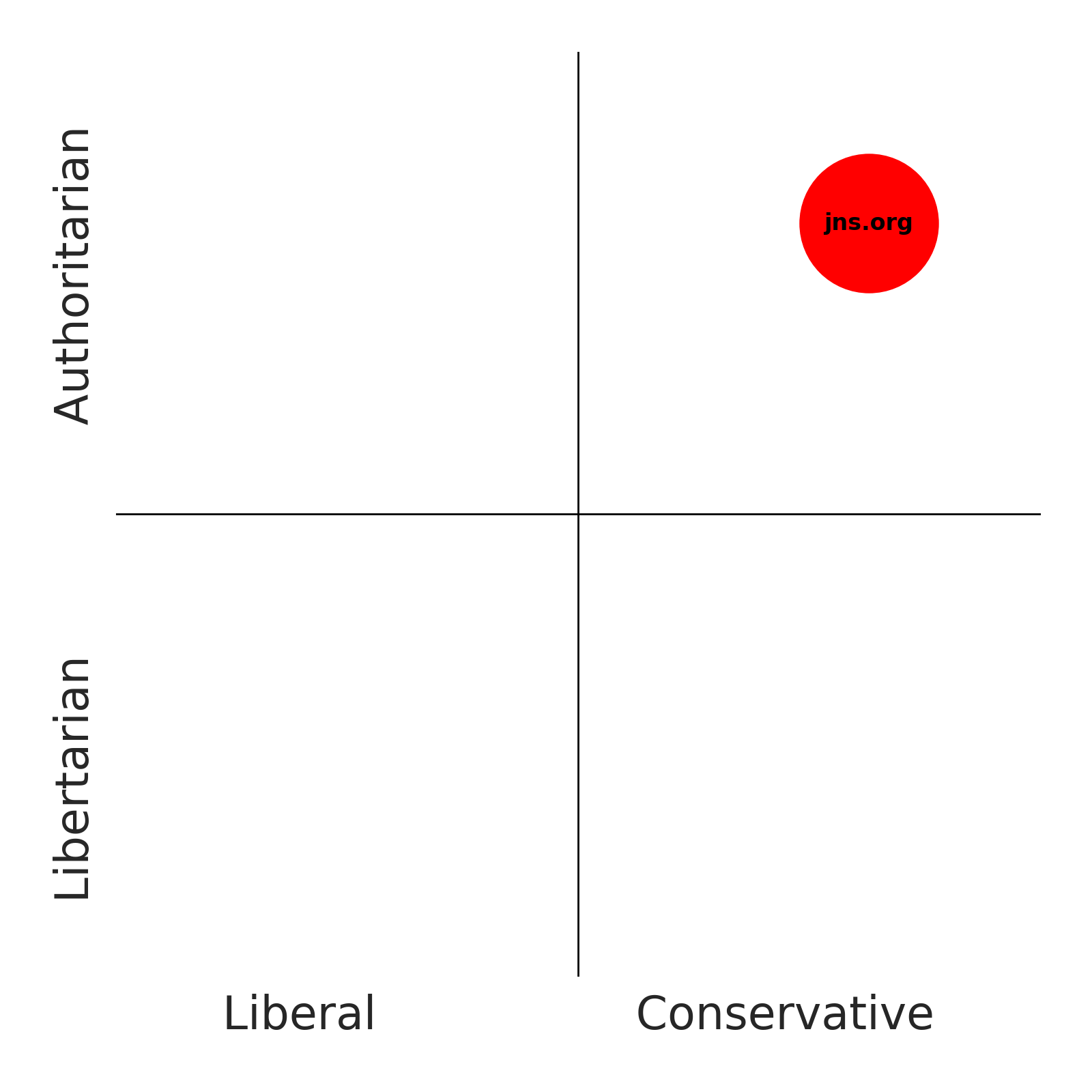
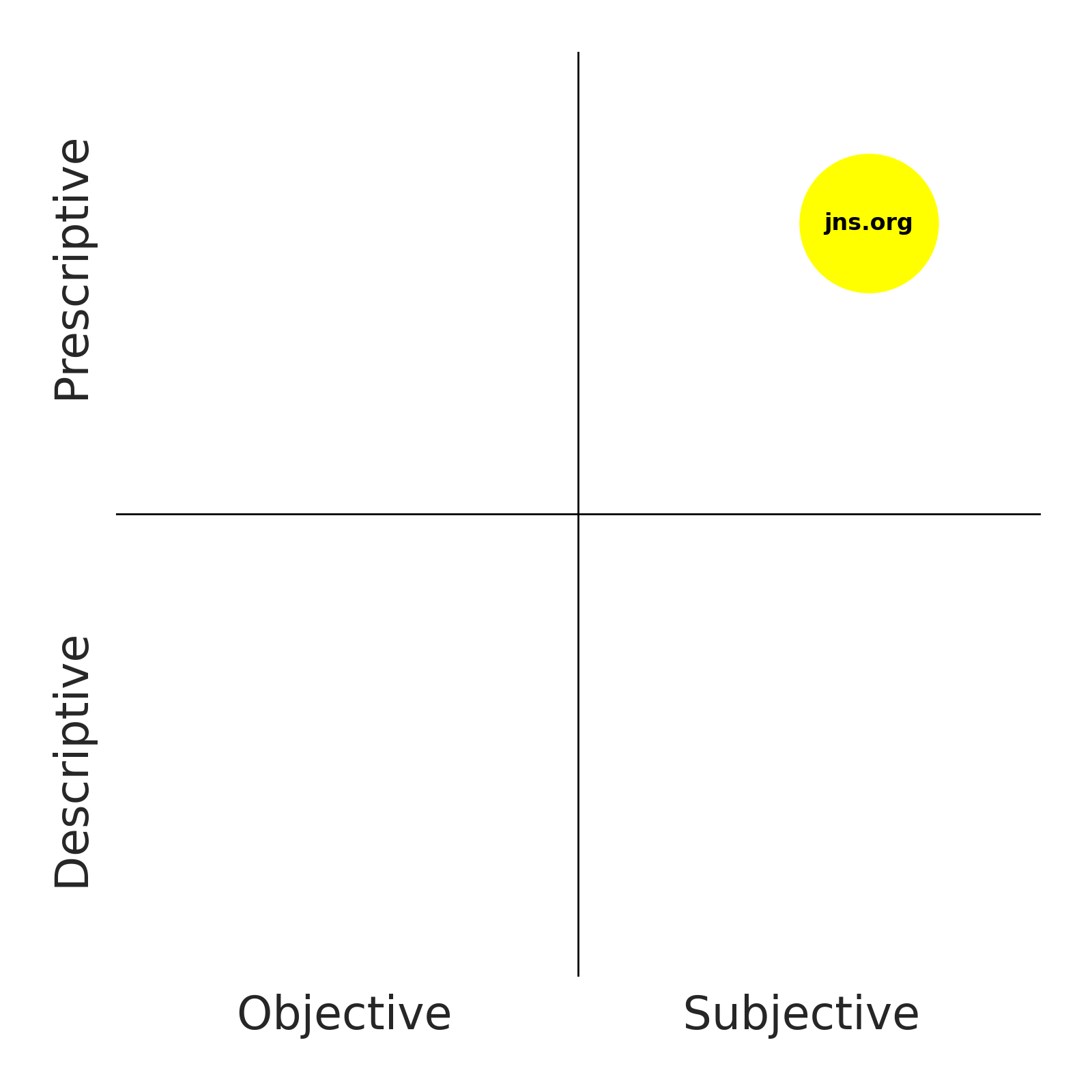
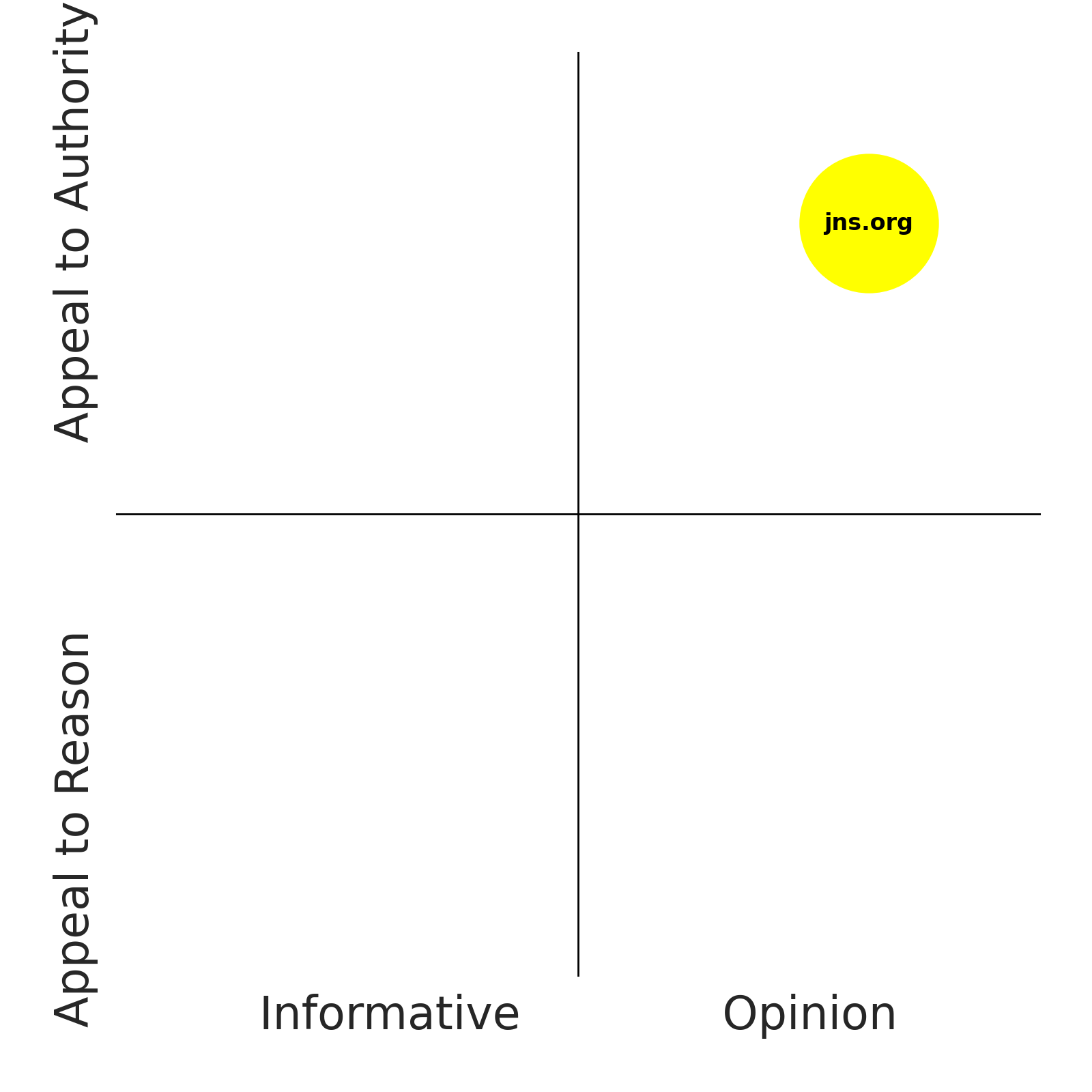
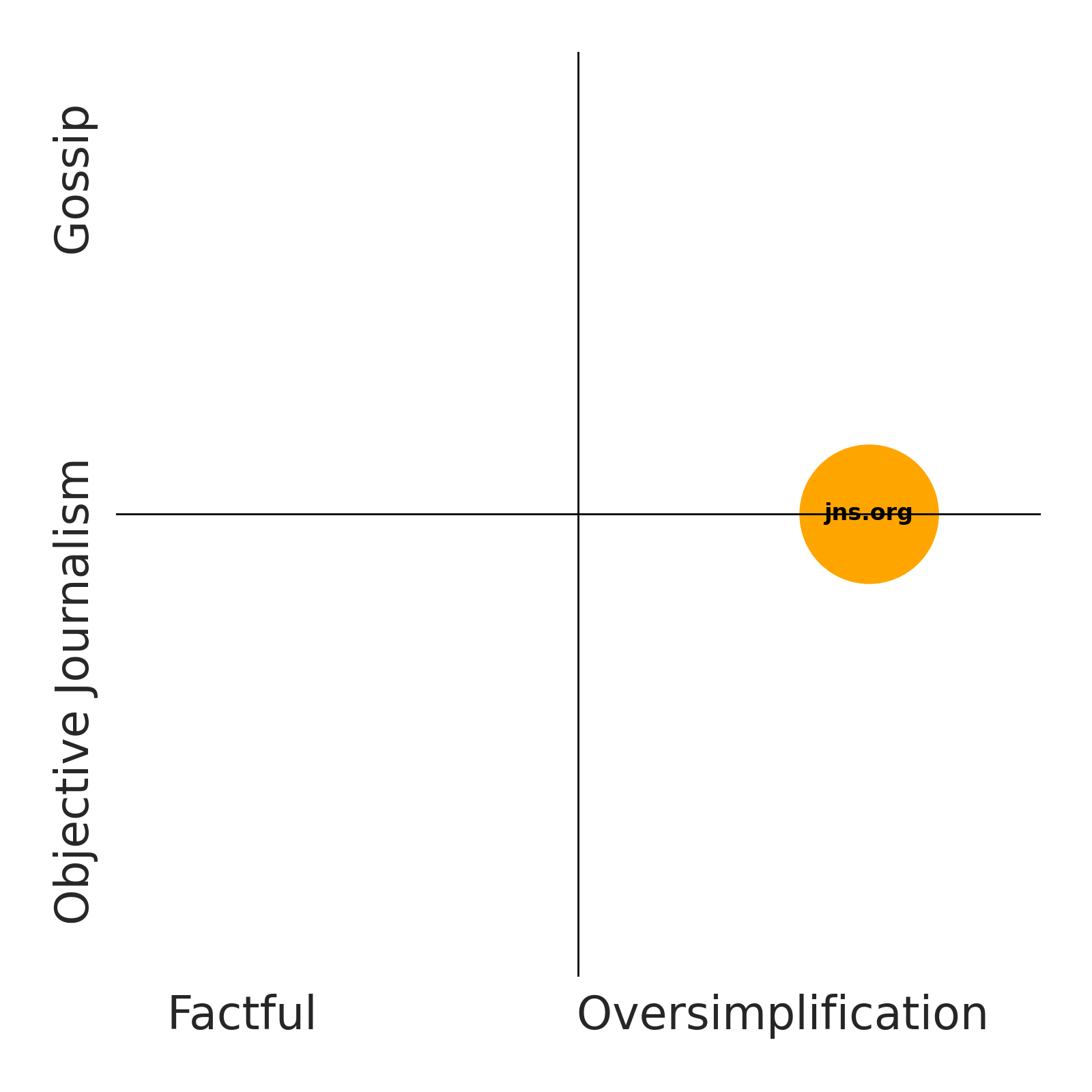
2026 © Helium Trades
Privacy Policy & Disclosure
* Disclaimer: Nothing on this website constitutes investment advice, performance data or any recommendation that any particular security, portfolio of securities, transaction or investment strategy is suitable for any specific person. Helium Trades is not responsible in any way for the accuracy
of any model predictions or price data. Any mention of a particular security and related prediction data is not a recommendation to buy or sell that security. Investments in securities involve the risk of loss. Past performance is no guarantee of future results. Helium Trades is not responsible for any of your investment decisions,
you should consult a financial expert before engaging in any transaction.
Helium Research Assistant

How can I help you today?
Ask any question about jns.org bias.