See whether Helium helps you make better-informed decisions. Try every Pro Trader feature for 30 days. No credit card required.
Try every Pro Trader feature for 30 days. No credit card required.
The source is predominantly market-first, investor-facing, and catalyst-driven. Its recurring unit of attention is a price movement explained through earnings, analyst targets, M&A speculation, regulation, executive statements, or retail sentiment.
The stated high-frequency topics are AI infrastructure and cybersecurity [62], while the sample also heavily features semiconductors and AI companies
Bullish analyst consensus and upgraded price targets frame AMD's server CPU opportunity as a transformative AI-driven growth story.
AMD is a semiconductor company that designs CPUs and GPUs, competing with Nvidia in the AI chip market.
Automated analysis; not human reviewed. · 13 of 52 available dimensions scored; omitted dimensions are not treated as neutral. · Verified supporting quotes for 8 of 13 scored dimensions.
Claim: The publisher selects and highlights only bullish analyst views, introducing subjectivity.
“Wall Street has grown increasingly optimistic ahead of the report, with analysts arguing that the AI infrastructure buildout is creating a much larger market for server CPUs than previously expected.” · not found in supplied text
Why: The article presents only positive analyst sentiment and price target increases, omitting any bearish perspectives.
Claim: The publisher strongly frames the event in a bullish manner.
“Wall Street has grown increasingly optimistic ahead of the report” · exact text match
“Wall Street Is Turning More Bullish On Server CPUs” · exact text match
“Retail sentiment on Stocktwits around AMD trended in the ‘bullish’ territory” · exact text match
Why: Multiple explicit bullish statements and price target increases support a strong bullish framing.
Claim: The publisher presents a uniformly positive narrative without critical counterpoints.
“Wall Street has grown increasingly optimistic ahead of the report, with analysts arguing that the AI infrastructure buildout is creating a much larger market for server CPUs than previously expected.” · not found in supplied text
Why: The article lacks any mention of risks, competition, or bearish views, simplifying the outlook to purely bullish.
Claim: The publisher heavily relies on the credibility of analysts and investment firms without questioning their conclusions.
“Susquehanna said server CPUs are likely to deliver upside as the addressable market continues to expand” · exact text match
“Morningstar expects agentic AI to drive exponential growth in CPU demand over the rest of the decade.” · exact text match
Why: Analyst views are presented as authoritative without independent verification or alternative perspectives.
Claim: The article primarily covers analyst responses to AMD's corporate event.
“At AMD's Advancing AI event last month, CEO Lisa Su raised the company's estimate for the AI server CPU total addressable market to $220 billion by 2030” · exact text match
“The revised outlook has resonated with analysts.” · exact text match
Why: The narrative centers on market reaction to a company announcement rather than independent analysis.
Claim: The publisher aligns with establishment financial institutions and market consensus.
“Susquehanna lifted its price target to $500 from $450, while keeping a ‘Positive’ rating on the stock.” · exact text match
“UBS raised its price target on AMD shares to $730 from $700, while keeping a ‘Buy’ rating.” · exact text match
Why: The article repeatedly cites and endorses the views of major investment banks without critical distance.
Claim: The publisher uses positively valenced language that frames the situation optimistically.
“Wall Street has grown increasingly optimistic” · exact text match
“Wall Street Is Turning More Bullish On Server CPUs” · exact text match
“Retail sentiment on Stocktwits around AMD trended in the ‘bullish’ territory” · exact text match
Why: Repeated use of bullish and optimistic language creates a positive emotional tone.
Claim: The publisher demonstrates good sourcing practices for a financial news summary.
“According to Fiscal.ai data” · exact text match
“Susquehanna said...” · not found in supplied text
“UBS raised its price target...” · not found in supplied text
Why: All major claims are attributed to named sources, though the publisher does not provide independent verification.
Claim: The publisher frames the content using data and analyst projections, supporting a rational approach.
“Analysts argue that the AI infrastructure buildout is creating a much larger market for server CPUs than previously expected.” · exact text match
“According to Fiscal.ai data, AMD is expected to report earnings per share (EPS) of $1.61 on revenue of $11.3 billion in Q2.” · not found in supplied text
Why: The article relies on quantitative data and reasoned analyst arguments rather than emotional appeals.
Claim: The publisher frames AMD's prospects positively, consistent with a pro-corporate stance.
“CEO Lisa Su raised the company's estimate for the AI server CPU total addressable market to $220 billion by 2030” · exact text match
“Analyst Blayne Curtis said new partnerships with Anthropic and OpenAI, along with the expected ramp of the Helios platform and launch of ROCm.AI, could strengthen AMD's competitive position against Nvidia.” · exact text match
Why: The article emphasizes AMD's growth opportunities and competitive advantages without critical scrutiny.
Claim: The publisher relies on empirical data and projections rather than superstition or pseudoscience.
“According to Fiscal.ai data, AMD is expected to report earnings per share (EPS) of $1.61 on revenue of $11.3 billion in Q2” · exact text match
“Morningstar expects adjusted gross margin to expand from 52% in 2025 to 56% in 2026, before reaching 57% by 2030.” · not found in supplied text
Why: The article uses concrete financial data and analyst forecasts, not supernatural or unverifiable claims.
Claim: The article contains future-oriented projections and forecasts about AMD's market and revenue.
“Morningstar expects AMD's revenue to grow at a 40% compound annual rate between 2026 and 2030, driven by the rise of agentic AI” · exact text match
“CEO Lisa Su raised the company's estimate for the AI server CPU total addressable market to $220 billion by 2030” · exact text match
Why: Multiple projections about future market size, revenue growth, and margin expansion qualify as speculation.
Claim: The publisher shows measurable fairness by attributing data and projections to specific sources.
“According to Fiscal.ai data, AMD is expected to report earnings per share (EPS) of $1.61 on revenue of $11.3 billion in Q2” · exact text match
“According to TheFly, Susquehanna said server CPUs are likely to deliver upside” · exact text match
Why: All quantitative claims are attributed to named analysts or data providers, indicating transparent sourcing.
August 14, 2026 · 0 shares
Data-heavy reporting frames the 13F disclosure as a strongly constructive semiconductor pivot, with loaded words in the headline and positive sector momentum placed around the positions.
The filing is a 13F, a quarterly SEC disclosure showing only large institutional managers' U.S.-listed long equity positions; quarter-to-quarter changes can reflect both trading and price moves, and do not necessarily show the full strategy.
Automated analysis; not human reviewed. Limitations: The supplied text is the only basis for analysis; the underlying SEC filing and market figures were not independently verified. · 3 of 54 available dimensions scored; omitted dimensions are not treated as neutral. · Verified supporting quotes for 3 of 3 scored dimensions.
Claim: The article begins by framing a required filing as a high-impact event using 'loads up' and 'Massive' language, even though the body relies on the filing’s numbers.
“Soros Capital Loads Up On MU, AMAT, AMD And TSM In Massive Semiconductor Pivot” · exact text match
Why: The quoted title uses informal, superlative vocabulary, while the body itself is mostly quantitative; this produces a mildly sensational wrapper around an otherwise analytical report.
Claim: The framing is bullish on semiconductors because it emphasizes strong sector performance, AI demand, chip shortages, and ETF returns.
“The semiconductor sector has been one of the market’s strongest performers this year, fueled by booming demand for artificial intelligence and shortages of memory chips that have pushed prices higher.” · exact text match
“While SOXX has added about 70% year-to-date, XLE has clocked 31% gains.” · exact text match
Why: The article highlights positive catalysts and makes repeated return and momentum references, giving the report a noticeably constructive tone on the sector.
Claim: The report grounds its main portfolio claims in a named SEC filing and includes specific position amounts, portfolio counts, and dates.
“according to its filing with the Securities and Exchange Commission on Friday for holdings as of June 30.” · exact text match
Why: It attributes tangible numbers to a government filing, uses exact amounts, and generally separates reported facts from optional Stocktwists sentiment commentary.
The supplied text is the only basis for analysis; the underlying SEC filing and market figures were not independently verified.
Presents Goldman Sachs' optimistic space economy forecast and positive stock movements as authoritative, using bullish retail sentiment and CEO quotes to frame the sector as poised for growth and consolidation.
Automated analysis; not human reviewed. Limitations: Analysis based solely on provided text; cannot verify external claims. · 5 of 53 available dimensions scored; omitted dimensions are not treated as neutral. · Verified supporting quotes for 3 of 5 scored dimensions.
Claim: The article uses attention-grabbing language and a sensational headline to draw readers.
“SPCX, ASTS, RKLB And FLY On Watch: Goldman Sachs Sees $1.8 Trillion Space Economy And Rising M&A Wave” · exact text match
“SPCX surged 10%” · exact text match
Why: The headline is dramatic ('On Watch', large numbers), and the word 'surged' adds excitement; however, the body is largely factual reporting.
Claim: The article frames the space sector and these stocks in a strongly positive light, emphasizing growth forecasts, stock price gains, and bullish retail sentiment.
“Goldman Sachs said the global space economy could reach $1.8 trillion by 2035” · exact text match
“retail sentiment was ‘extremely bullish’ for RKLB and SPCX and ‘bullish’ for ASTS and FLY” · exact text match
Why: The article leads with a large positive forecast and highlights price surges and extremely bullish sentiment, with minimal countervailing negative framing.
Claim: The article relies heavily on authoritative sources (Goldman Sachs, CEOs) to support its positive outlook.
“Goldman Sachs Global Institute called space 'a new pillar of the industrial economy'” · not found in supplied text
“CEO Elon Musk said” · exact text match
Why: The central forecast and justifications come from a prestigious investment bank, and CEO quotes add weight; the article does not challenge these authorities.
Claim: The article favors established financial and corporate institutions, citing Goldman Sachs and major space company executives.
“Goldman Sachs Global Institute called space 'a new pillar of the industrial economy'” · not found in supplied text
“Rocket Lab posted record quarterly revenue of $234 million and a $2.36 billion backlog” · exact text match
Why: The primary source is a top-tier investment bank, and the article highlights large, established companies; retail sentiment is secondary.
Claim: The article includes speculative forecasts about the space economy and M&A activity without presenting contrary evidence.
“global space economy could reach $1.8 trillion by 2035” · exact text match
“may drive a rise in M&A activity” · exact text match
Why: The central claim is a future projection, and the article uses modal verbs ('could', 'may') indicating speculation, albeit attributed to Goldman Sachs.
Analysis based solely on provided text; cannot verify external claims.
Momentum-driven, optimistic framing attributes a rebound in space stocks to SpaceX's Moon/Mars momentum and NASA-backed momentum.
Automated analysis; not human reviewed. Limitations: The article relies on high-profile SpaceX/NASA quotes; header misattributes NASA Administrator to Isaacman, which could mislead about authority. · 2 of 52 available dimensions scored; omitted dimensions are not treated as neutral. · Verified supporting quotes for 2 of 2 scored dimensions.
Claim: The article frames space stocks as bullish due to renewed Moon/Mars momentum and NASA commentary
“Space stocks rose premarket on Thursday” · exact text match
Why: Premarket gains corroborate bullish framing.
Claim: Reliance on SpaceX and NASA as central authorities to drive momentum
“If Elon and SpaceX are betting on this right now, there is no reason to believe this will not come into existence. I never bet against an extremely well-capitalized Elon.” · exact text match
“We can’t do it without them.” · exact text match
Why: Quotations foreground SpaceX and NASA as pivotal actors.
The article relies on high-profile SpaceX/NASA quotes; header misattributes NASA Administrator to Isaacman, which could mislead about authority.
Frames the CLARITY Act as urgent and necessary, portrays Democrats as obstructive and driven by midterm politics, and highlights potential market beneficiaries.
Automated analysis; not human reviewed. Limitations: Analysis limited to the supplied article text; no external verification of claims or publisher bias beyond textual framing. · 12 of 53 available dimensions scored; omitted dimensions are not treated as neutral. · Verified supporting quotes for 7 of 12 scored dimensions.
Claim: Frames Democrats as obstructive and Republicans as proactive.
“I think we ought to just put it to a vote on the floor of the United States Senate and see where the Democrats are” · exact text match
“their goal is to create chaos going into the midterms” · exact text match
Why: The article selects only Republican speakers and portrays Democratic leaders as creating chaos, implying obstruction.
Claim: Headline uses subjective framing ('Showdown', 'Midterm Politics Take Over').
“CLARITY Act Showdown: Bill Hagerty Pushes Senate Vote Before Midterm Politics Take Over” · exact text match
Why: The headline interprets the event as a showdown and frames midterm politics as an obstacle, which is subjective.
Claim: Portrays positive outlook for crypto stocks and the bill.
“COIN stock was up over 3%... retail sentiment remained in the ‘bullish’ zone” · not found in supplied text
“There's no way that we can allow the United States to fall behind in the digital assets arena” · exact text match
Why: Selects positive market data and quotes emphasizing urgency and opportunity, creating a bullish tone.
Claim: Headline and quotes advocate for action.
“Pushes Senate Vote” · exact text match
“we ought to put it to a vote” · not found in supplied text
Why: Headline verb 'pushes' and Hagerty's 'ought to' prescribe a vote rather than simply describe.
Claim: Article includes opinionated quotes and framing.
“CLARITY Act Showdown: Bill Hagerty Pushes Senate Vote Before Midterm Politics Take Over” · exact text match
“their goal is to create chaos going into the midterms” · exact text match
Why: Headline and Emmer's quote express strong opinions about motivations, not just facts.
Claim: Article heavily focuses on partisan midterm politics and accusations.
“Whether it’s Chuck Schumer, Hakeem Jeffries, their goal is to create chaos going into the midterms” · exact text match
“Democrats were looking to shut down the government” · exact text match
Why: Nearly all quotes and framing center on partisan conflict and election motives.
Claim: Promotes pro-crypto, deregulatory stance.
“There's no way that we can allow the United States to fall behind in the digital assets arena” · exact text match
Why: Hagerty's quote assumes that falling behind is unacceptable, implying a preference for rapid adoption.
Claim: Positive emotional tone regarding crypto and negative about Democrats.
“retail sentiment remained in the ‘bullish’ zone” · not found in supplied text
“their goal is to create chaos” · exact text match
Why: Positive sentiment for crypto contrasted with negative characterization of Democratic motives.
Claim: Mentions specific stock performance and sentiment, potentially promotional.
“COIN stock was up over 3%... retail sentiment remained in the ‘bullish’ zone” · not found in supplied text
“CRCL stock was up over 4%” · exact text match
Why: Focus on price movements and sentiment may serve to promote interest in these stocks.
Claim: Highlights companies that benefit from the bill and their stock gains.
“Coinbase (COIN) and Circle (CRCL) are two firms that stand to benefit most from the CLARITY Act. COIN stock was up over 3%.” · not found in supplied text
Why: Explicitly names beneficiaries and reports positive stock performance, suggesting a pro-corporate tilt.
Claim: Emphasizes individual market freedom and digital asset innovation.
“Everything is moving digital around the world” · exact text match
Why: Quote implies a natural, individualistic market progression, supporting a pro-individualist viewpoint.
Claim: Speculates on midterm impact on bill passage.
“Hagerty said midterm elections would slow the bill's passage” · exact text match
“lawmakers with a shrinking window of time before the August recess” · exact text match
Why: Article speculates about future political dynamics affecting legislation.
Analysis limited to the supplied article text; no external verification of claims or publisher bias beyond textual framing.
Framing centers on Letitia James's warning that CLARITY Act would weaken state crypto enforcement and shift oversight to federal regulators.
Automated analysis; not human reviewed. Limitations: The strongest input limitation is reliance on a single official's testimony and market chatter; could understate opposing policy positions. · 47 of 52 available dimensions scored; omitted dimensions are not treated as neutral. · Verified supporting quotes for 2 of 47 scored dimensions.
Claim: The article frames CLARITY Act as weakening state crypto enforcement.
“The Digital Asset Market Clarity Act (CLARITY Act) would limit the ability of state and local law enforcement to police crypto scams, James said in written testimony to the Senate Homeland Security and Governmental Affairs Committee’s Permanent Subcommittee on Investigations on Monday.” · exact text match
“The CLARITY Act would shift oversight of digital assets to the Commodity Futures Trading Commission (CFTC) and preempt state regulation, hampering her office’s ability to pursue enforcement actions against crypto platforms.” · not found in supplied text
Why: Headlines and body emphasize negative framing of the Act's impact on state enforcement.
Claim: Federal regulatory centralization is framed positively as the fix to crypto regulation.
“The CLARITY Act would shift oversight of digital assets to the Commodity Futures Trading Commission (CFTC) and preempt state regulation, hampering her office’s ability to pursue enforcement actions against crypto platforms.” · not found in supplied text
“The proposed framework would also ban untraceable crypto, including funds routed through mixers, from being converted to U.S. dollars, while keeping existing coverage of crypto under money transmission, commodities and securities law.” · exact text match
Why: Federal oversight and integration into established regulatory frameworks are presented as central.
Claim: Credibility of the article is moderate due to reliance on official testimony and market data but tempered by other sources.
“The testimony said that complaints to the Office of the Attorney General (OAG) about cryptocurrency scams have tripled in the last three years.” · exact text match
“Reported scam losses have reached around $500 million over the past five years, while investors have lost billions more in crypto company bankruptcies.” · exact text match
Why: Official figures and quotes support claims; presence of market commentary adds context.
Claim: The piece shows integrity by including counterpoints (Lummis) and diverse voices.
“Previously, Senator Cynthia Lummis (R-WY) addressed the concerns put forward by James, saying that passing the CLARITY Act would close the “DINO loophole,” short for Decentralized In Name Only, and make provisions for bad actors to stop any money laundering activity.” · exact text match
“The bill “brought every corner of the digital asset market inside the Bank Secrecy Act and sanctions framework,” Lummis said last week.” · exact text match
Why: Inclusion of opposing viewpoints and direct quotes supports fairness in reporting.
The strongest input limitation is reliance on a single official's testimony and market chatter; could understate opposing policy positions.
Regulatory clarity via the CLARITY Act is framed as the pivotal catalyst for institutional crypto adoption, with centralized oversight described as a needed upgrade and Ethereum’s outperformance cited as evidence of a coming growth phase.
Automated analysis; not human reviewed. · 5 of 52 available dimensions scored; omitted dimensions are not treated as neutral. · Verified supporting quotes for 0 of 5 scored dimensions.
August 12, 2026 · 0 shares
Emphasizes negative stock impact and drug safety risks, framing the FPWR advisory as a trigger for bearish sentiment.
Automated analysis; not human reviewed. Limitations: The analysis is based on a single article from a financial social media site, which may amplify market sentiment over clinical nuance. · 8 of 53 available dimensions scored; omitted dimensions are not treated as neutral. · Verified supporting quotes for 6 of 8 scored dimensions.
Claim: The article uses sensational language to highlight drug safety risks and deaths.
“NBIX Stock Slips As $2.9B Soleno Deal Triggers Fresh Drug Safety Warnings” · exact text match
“FPWR noted seven reported deaths and more than 100 reports of serious adverse events involving heart or breathing issues” · exact text match
Why: Headline frames deal as triggering warnings; body highlights death count.
Claim: The article frames the stock negatively, emphasizing a price decline and bearish retail sentiment.
“Shares of Neurocrine Biosciences closed 3% lower on Wednesday and further slipped 1% after-hours” · exact text match
“On Stocktwits, retail sentiment around NBIX stayed within ‘bearish’ territory” · exact text match
Why: Direct quotes show stock drop and bearish sentiment label.
Claim: The article amplifies fear by reporting deaths and serious adverse events.
“FPWR noted seven reported deaths and more than 100 reports of serious adverse events involving heart or breathing issues” · exact text match
Why: Explicit mention of deaths and serious complications instills fear.
Claim: The article includes subjective user opinions as part of the narrative.
“A Stocktwits user highlighted that no clear link has been established between the drug’s use and the negative side effects.” · exact text match
““I always thought vykat/soleno was a bad drug and investment,” another user wrote.” · exact text match
Why: Direct inclusion of user commentary with value judgments.
Claim: The article relies on the Foundation for Prader-Willi Research as an authoritative source.
“The Foundation for Prader-Willi Research has recommended that doctors treating people with Prader-Willi syndrome (PWS) should closely track patients on VYKAT XR” · exact text match
Why: The FPWR is cited as an authoritative medical foundation to support the safety warnings.
Claim: The article's tone is negative, driven by safety warnings, deaths, and bearish sentiment.
“FPWR noted seven reported deaths and more than 100 reports of serious adverse events” · exact text match
“A Stocktwits user wrote: 'I always thought vykat/soleno was a bad drug and investment.'” · not found in supplied text
Why: Negative language about deaths and a user's critical comment set a negative emotional frame.
Claim: The article has moderate credibility; it cites sources but also includes user opinions and an unattributed short-seller report.
“FPWR blog from Monday outlines practical steps for real-world use of the drug” · exact text match
“short-seller Scorpion Capital published a lengthy report alleging serious risks” · exact text match
Why: Main sources are cited, but reliance on a short-seller report and anonymous user comments reduces trustworthiness.
Claim: The article speculates about a causal link between the drug and adverse events despite noting uncertainty.
“FPWR noted seven reported deaths and more than 100 reports of serious adverse events involving heart or breathing issues in patients taking the drug. ... a direct link is not always clear.” · not found in supplied text
Why: The article presents adverse events and deaths alongside the stock reaction, implying a causative relationship even while acknowledging uncertainty.
The analysis is based on a single article from a financial social media site, which may amplify market sentiment over clinical nuance.
Framing emphasizes regulatory progress and retail upside while disclosing a missed trial endpoint.
Automated analysis; not human reviewed. Limitations: The article is a brief single-source market update; no independent trial data or regulatory documents are provided, so assessments rely on the publisher's selective inclusion.
The article is a brief single-source market update; no independent trial data or regulatory documents are provided, so assessments rely on the publisher's selective inclusion.
Headline-driven market framing turns an unconfirmed possible acquisition into a market-moving story, while hedging with attribution and including retail stock speculation.
Automated analysis; not human reviewed. Limitations: The analysis is limited to the supplied text and cannot verify the reliability of the underlying WSJ or Reuters reporting or the anonymous sources. · 4 of 54 available dimensions scored; omitted dimensions are not treated as neutral. · Verified supporting quotes for 3 of 4 scored dimensions.
Claim: The article mostly reports attributed facts and market values, with the publisher's own subjective evaluation minimized.
“The Wall Street Journal reported, citing people familiar with the matter.” · exact text match
“At the time of writing in after-hours trading, PYPL stock was marginally higher at 0.07%.” · exact text match
Why: The reporting is tied to WSJ and Reuters attribution and includes specific numeric market data, rather than editorial assertions or first-person opinion.
Claim: The framing and selected trader comments create a mildly optimistic tilt around the possible acquisition.
“PYPL Stock Rises After Report Says Stripe And Advent May Be Ready To Raise Their PayPal Bid.” · exact text match
“On Stocktwits, retail sentiment for PYPL improved to “neutral” from “bearish” in the past 24 hours, while message volume remained “low.”” · exact text match
Counterevidence:
“A third trader took a varied view, making for example a “reasonable clue” about what the stock price could be in a buyout.” · not found in supplied text
Why: The headline highlights a possible higher bid and the article includes improved retail sentiment and an optimistic $85 trader target, though it also notes uncertainty.
Claim: The article consistently attributes claims and uncertainty to WSJ and Reuters and does not assert a completed deal.
“The Wall Street Journal reported, citing people familiar with the matter.” · exact text match
“It is possible a deal could come together in the coming weeks, though there are no guarantees the parties will reach an agreement, the report said.” · exact text match
Why: Visible sourcing is present, attribution is clear, and uncertain statements are explicitly hedged rather than stated as confirmed facts.
Claim: The article centers on a possible future acquisition and includes retail estimates of a potential deal price.
“It is possible may its time in the coming weeks, though there are no guarantees the individuals will reach an agreement, the report said.” · not found in supplied text
“Retail traders actively folded the very opposite of a potential company acquisition, with some looking just beyond the previously public rejected 500-mark-shelf.” · not found in supplied text
Why: The main event is an unconfirmed, possible transaction whose price could still change, and the article displays trader price forecasts in the $85-$100 range.
The analysis is limited to the supplied text and cannot verify the reliability of the underlying WSJ or Reuters reporting or the anonymous sources.
Takeover speculation is framed as a bullish catalyst for Wendy's stock, balanced by acknowledgment of weak sales and operational challenges.
Automated analysis; not human reviewed. Limitations: Article text is from Stocktwits, a retail-investor platform, which may influence the selection of user comments and sentiment data, but the article itself appears neutral. · 1 of 53 available dimensions scored; omitted dimensions are not treated as neutral. · Verified supporting quotes for 1 of 1 scored dimensions.
Claim: The article demonstrates moderate credibility through attributable data and correction policy.
“For updates and corrections, email newsroom[at]stocktwits[dot]com.” · exact text match
“as per Koyfin data” · exact text match
Why: Specific data sources and a correction email are provided, but user comments are unverified.
Article text is from Stocktwits, a retail-investor platform, which may influence the selection of user comments and sentiment data, but the article itself appears neutral.
The article frames dovish market sentiment and Fed rate-hike expectations through cool inflation data, with a neutral market-news tone.
Automated analysis; not human reviewed. Limitations: Analysis based on provided article text without direct access to full original formatting or timing context. · 51 of 53 available dimensions scored; omitted dimensions are not treated as neutral. · Verified supporting quotes for 8 of 51 scored dimensions.
Claim: The article conveys a slightly bullish market tone by highlighting record highs and positive market reactions to inflation data.
“The S&P 500 closed at a record high after touching an intraday peak of 7,816.70.” · exact text match
Why: The mention of record high and positive futures moves suggests a mildly bullish framing, but the overall tone is neutral.
Claim: The article contains several market-moving data points and geopolitical statements that could be considered interesting.
“The Kobeissi Letter said in a post on X.” · exact text match
“According to data from the CME FedWatch tool, the probability of a Fed rate hike in September is down to 34.8% from 55% a week earlier.” · exact text match
Why: The content includes notable economic data and political statements, but it is largely routine market news.
Claim: The article reports dovish market expectations regarding Fed rate hikes, with cooling inflation reducing hike probability.
“The odds of rate hikes are declining further” · exact text match
“probability of a Fed rate hike in September is down to 34.8% from 55% a week earlier” · exact text match
Why: The article emphasizes declining rate hike expectations as a positive development, aligning with a dovish framing.
Claim: The article cites authoritative sources to support its narrative.
“The Kobeissi Letter said in a post on X.” · exact text match
“Mohamed El-Erian, Chief Economic Advisor at Allianz, noted in a post on X.” · not found in supplied text
“According to data from the CME FedWatch tool” · exact text match
Why: The article repeatedly relies on named experts and established data tools, appealing to authority for credibility.
Claim: The article does not exhibit anti-establishment framing; it reports standard market and economic information.
“Mohamed El-Erian, Chief Economic Advisor at Allianz, noted in a post on X” · exact text match
Why: The article relies on mainstream economic sources and market data, indicating a neutral or pro-establishment stance.
Claim: The article uses specific data points and attributes claims to named sources, indicating moderate credibility.
“According to data from the CME FedWatch tool” · exact text match
“The Kobeissi Letter said in a post on X” · exact text match
“Scott Bessent said” · exact text match
Why: Attribution to specific tools and individuals, plus precise numerical data, supports reliability.
Claim: The article includes speculation about future market movements and Fed actions based on current data.
“July’s retail sales data expected later today is likely to provide further insights into the state of the U.S. economy.” · exact text match
“The odds of rate hikes are declining further” · exact text match
Why: The article projects potential future market reactions and Fed decisions, which are inherently speculative.
Claim: The article appears to be written by a human based on the style and content.
“For updates and corrections, email newsroom[at]stocktwits[dot]com.” · exact text match
Why: No strong AI indicators; standard news style and contact information suggest human authorship.
Claim: The article provides a comprehensive summary of market movements and economic indicators.
“July PPI flat, missing market forecasts of a 0.2% increase.” · not found in supplied text
“Annual producer inflation slowed sharply to 4.7%” · not found in supplied text
“Dow futures were up 0.09%, S&P 500 futures climbed 0.04% and Nasdaq-100 futures declined 0.08%” · exact text match
Why: The article integrates multiple data points, including futures, CPI, PPI, and geopolitical context, showing analytical capability.
Claim: The article does not show delusional framing; it reports factual market data and consensus expectations.
“July’s PPI flat, missing market forecasts of a 0.2% increase.” · exact text match
“probability of a Fed rate hike in September is down to 34.8%” · exact text match
Why: The article is grounded in verifiable market data and clearly attributed statements, aligning with truth-seeking reporting.
Analysis based on provided article text without direct access to full original formatting or timing context.
The dominant perspective is generally pro-growth, pro-innovation, and mildly pro-corporate. Positive developments are often presented as investable opportunities: Cerebras’s decline is repeatedly characterized as a “buying opportunity” despite falling margins
Coverage frames the post-earnings sell-off as a buying opportunity, giving prominent place to bullish analyst reactions while treating margin pressure and Wall Street disagreement as caveats.
Automated analysis; not human reviewed. Limitations: The supplied text is a condensed summary of analyst reactions and company disclosures; the underlying broker notes, company filing, and consensus data cannot be independently checked from the text provided. · 7 of 54 available dimensions scored; omitted dimensions are not treated as neutral. · Verified supporting quotes for 5 of 7 scored dimensions.
Claim: The story is mostly built from concrete numbers, attributed analyst actions, and company guidance, with only modest editorial coloration.
“Cerebras reported adjusted loss per share of $0.05, beating Wall Street’s estimates of a $0.18 loss per share cited by Koyfin.” · exact text match
Why: Almost every assertion is numeric or attributed to a broker note, company guidance, or conference-call comment, keeping the text largely objective despite dramatic headline wording.
Claim: The article uses emotionally charged market and sentiment language that adds sensational color.
“CBRS stock plummeted around 10% and was among the top trending tickers on Stocktwits at the time of writing.” · exact text match
Why: Words like 'plummeted' and phrases such as 'extremely bullish' and 'extremely high' chatter elevate the drama beyond a plain summary of results.
Claim: The sell-off is framed as a buyable dip through repeated bullish analyst reactions.
“Both Mizuho and UBS said they see a buying opportunity amid the sell-off, even as one lowered its price target on the shares while the other increased it.” · exact text match
“UBS echoed the sentiment, viewing the pullback as a “compelling buying opportunity.”” · exact text match
Counterevidence:
“However, Cerebras’ adjusted gross margin fell to 40.6% in the second quarter, from 46.5% in the preceding three months.” · exact text match
Why: The framing emphasizes buying opportunity, higher targets, raised guidance, and capacity growth, with the margin drop reported later as a caveat.
Claim: The report accents favorable forward-looking analyst estimates and constructive language.
“UBS also sees significant upside to its 2027 revenue estimates if Cerebras can execute on its planned capacity expansion.” · exact text match
Why: Future upside is highlighted alongside such phrases as 'more constructive' and 'buying opportunity,' while the margin slip is secondary.
Claim: Sourcing is generally visible for analysts, consensus estimates, and company statements.
“Mizuho lowered its price target to $300 from $310, but kept an ‘Outperform’ rating on the stock, according to a note to investors cited by TheFly.” · exact text match
“Cerebras reported adjusted revenue per share of $0.05, beating Wall Street’s estimates of a $0.18 loss per share cited by Koyfin.” · not found in supplied text
Why: The text names the firm, the analyst note, the cited source, and the consensus provider, giving it observed credibility.
Claim: The narrative relies substantially on forward-looking projections and capacity-expansion expectations.
“It cited strong disaggregation inference momentum, improving margins, new platforms, and the potential for up to four times more capacity next year.” · not found in supplied text
“UBS also sees significant upside to its 2027 revenue estimates if Cerebras can execute on its planned capacity expansion.” · exact text match
Why: Much of the article's opportunity-case comes from unobservable future events such as capacity growth, fiscal 2027 revenue growth, and conditional estimate upside.
Claim: The report combines earnings data, analyst target changes, margin explanations, capacity plans, and technical context with identifiable attribution.
“Cerebras reported adjusted loss per share of $0.05, beating Wall Street’s estimates of a $0.18 loss per share cited by Koyfin.” · exact text match
“The architecture is designed to deliver high computing performance and memory bandwidth for AI workloads.” · exact text match
Why: It integrates several types of information in enough detail to be understood by investors, but it stays at a summary level.
The supplied text is a condensed summary of analyst reactions and company disclosures; the underlying broker notes, company filing, and consensus data cannot be independently checked from the text provided.
Emphasizes retail traders' bullish sentiment and historic AI data center backlog as a counterweight to the negative guidance cut, framing the stock crash as a temporary buying opportunity.
Automated analysis; not human reviewed. Limitations: The article text is a mix of headline, summary, and structured data; it may not be the full article. · 10 of 53 available dimensions scored; omitted dimensions are not treated as neutral. · Verified supporting quotes for 6 of 10 scored dimensions.
Claim: The article elevates retail traders' optimistic perspective over analyst estimates, showing a populist leaning.
“Yet retail traders are buying the dip, arguing record $6.4 billion backlog and surging AI data center demand signal execution delays, not weakening fundamentals.” · exact text match
“On Stocktwits, retail sentiment around the stock improved to ‘extremely bullish’ from ‘bullish’ territory the previous day.” · exact text match
Why: The article prominently features retail traders' views and validates their bullish interpretation, aligning with a populist framing that favors 'the people' over institutional analysis.
Claim: The article mixes factual reporting with subjective interpretation and user opinions.
“Yet retail traders are buying the dip, arguing record $6.4 billion backlog and surging AI data center demand signal execution delays, not weakening fundamentals.” · exact text match
Why: The framing phrase 'execution delays, not weakening fundamentals' is an interpretive stance, and user quotes are presented without neutrality markers.
Claim: The headline and language use sensational terms like 'crashes' and 'historic' to describe the stock move and backlog.
“FLNC Stock Crashes Overnight As Weak Outlook Hurts, But Retail Loads Up On Historic AI Data Center Backlog.” · exact text match
Why: The headline uses 'crashes' (sensational) and 'historic' (emotive) to attract attention, going beyond neutral description.
Claim: The overall framing is bullish, emphasizing long-term demand and retail optimism despite the immediate negative news.
“Yet retail traders are buying the dip, arguing record $6.4 billion backlog and surging AI data center demand signal execution delays, not weakening fundamentals.” · exact text match
“A user said, 'If you aren't buying at these prices you hate money LOL.'” · not found in supplied text
Why: The article highlights positive backlog, AI catalyst, and retail bullish sentiment, downplaying the severity of the guidance cut.
Claim: The article incorporates user opinions as a key element, lending weight to subjective viewpoints.
“A user said, 'Demand is insane: Backlog just hit a record $6.4 billion...'” · not found in supplied text
“Another user said, 'They are securing large orders from data centers...'” · not found in supplied text
“A third user quipped, 'If you aren't buying at these prices you hate money LOL.'” · not found in supplied text
Why: Three user quotes are included, all expressing bullish opinions, which shifts the article from pure fact-reporting toward opinionated content.
Claim: The article reduces the story to a simple dichotomy of 'execution delays vs. weakening fundamentals'.
“arguing record $6.4 billion backlog and surging AI data center demand signal execution delays, not weakening fundamentals.” · exact text match
Why: This framing presents a binary interpretation, ignoring other potential factors or risks.
Claim: A substantial portion of the article reports retail traders' reactions and sentiment rather than focusing solely on the company's fundamentals.
“Yet retail traders are buying the dip” · exact text match
“On Stocktwits, retail sentiment around the stock improved to ‘extremely bullish’” · exact text match
“A user said, 'Demand is insane...'” · not found in supplied text
Why: More than half of the article content is devoted to describing and quoting retail traders' response, making the response the central angle.
Claim: The article conveys positive emotional tone through user quotes and bullish descriptors.
“A user quipped, 'If you aren't buying at these prices you hate money LOL.'” · not found in supplied text
Why: The user quote is excited and humorous, contributing a positive emotional charge, though the publisher's own tone is more neutral.
Claim: The article uses specific, attributed financial data from a named source (Fiscal AI) and provides clear numbers.
“Fluence Energy’s fiscal third-quarter (Q3) revenue of $649.8 million with a loss of $0.24 per share missed the analysts’ estimates of $811.12 million and $0.01 per share, respectively, according to Fiscal AI data.” · exact text match
Why: The data is precise and attributed, supporting credibility. The user quotes are not verified but are presented as such.
Claim: The article includes speculative statements about future demand and margin growth.
“surging AI data center demand signal execution delays” · exact text match
“No doubt margin will grow in time.” · exact text match
Why: The phrase 'surging...demand signal' implies a future trend, and the user quote expresses certainty about margin growth, which is speculative.
The article text is a mix of headline, summary, and structured data; it may not be the full article.
Bullish coverage amplifies a single analyst's AI monetization thesis as validation, with hype-driven metaphors and no counterweight.
Automated analysis; not human reviewed. Limitations: The supplied text is an excerpt with no publication date and only a short set of analyst quotes, so analysis is limited to the visible editorial selection of quotes and the ETF statistics. · 8 of 54 available dimensions scored; omitted dimensions are not treated as neutral. · Verified supporting quotes for 2 of 8 scored dimensions.
Claim: The piece relies mainly on Dan Ives's personal beliefs and estimates rather than established facts.
“"The strategist also added that investors betting against tech right now are doing so because they can’t yet see the potential impact of the consumer on the revenue flows and margins."” · not found in supplied text
Why: Central claims are presented through one strategist's subjective assessments instead of objective verifiable analysis.
Claim: The framing uses loaded, urgent language that dramatizes the AI investment story.
“"It’s an arms race playing out, and you cannot, in this arms race, just watch it from the stands."” · not found in supplied text
Why: The 'arms race' phrasing and stand-by framing turn market commentary into an urgent, sensationalized narrative.
Claim: The report presents a strongly bullish reading of AI earnings and GPU demand.
“"Demand to supply, we estimate, is 13-14 to one for chips. The reality is, everyone is lining up when it comes to enterprises; you have to get your space in line relative to the data centers and GPUs," he said.” · verified after text normalization
Why: The selected quotes and headline center on positive AI monetization and an urgent supply shortage, with no contrasting bearish evidence.
Claim: The framing is firmly optimistic about AI-driven tech upside.
“"He noted that for every dollar in capex, there is a five- to six-dollar revenue multiplier across the rest of the technology industry."” · not found in supplied text
Why: The report emphasizes revenue multipliers and a still-early revolution phase, yielding an optimistically framed outlook.
Claim: The bulk of the article is one analyst's opinion, not impartial reporting.
“"The strategist also believes that Microsoft stood out among these companies, with the company’s earnings showing that enterprises are doubling down on AI."” · not found in supplied text
Why: The content repeatedly relays 'believes,' 'added,' and 'estimates' from the analyst rather than establishing independent conclusions.
Claim: The article reduces complex AI economics to simple fixed ratios.
“"He noted that for a dollar in capex there is a 5- to 6 dollar revenue multiplier across the rest of the technology industry."” · not found in supplied text
Why: A sweeping fixed multiplier and a simplistic 'still only 10%-15% of the AI revolution' framing omit a range of business variables, valuations, and failure scenarios.
Claim: The report validates the thesis through named figures, prominent banks, and companies rather than raw evidence.
“"When you look at what the Godfather of AI, Jensen, and Nvidia are doing, there’s a supply-demand issue."” · not found in supplied text
Why: The argument leans on the authority and prominence of Jensen/Nvidia and bank endorsements to strengthen the bullish thesis.
Claim: The commentary forecasts future revenue flows, margins, and AI adoption outcomes without presenting later-stage evidence.
“"The strategist also added that investors betting against tech right now are doing so because they can’t yet see the potential impact of AI on revenue flows and margins."” · exact text match
Why: The claim depends on unseen future effects of AI spending, making it speculative about investor behavior and forward-looking enterprise returns.
The supplied text is an excerpt with no publication date and only a short set of analyst quotes, so analysis is limited to the visible editorial selection of quotes and the ETF statistics.
August 04, 2026 · 0 shares
Bullish framing emphasizing AI-driven growth, analyst upgrades, and merger speculation, with positive retail sentiment from Stocktwits.
Automated analysis; not human reviewed. Limitations: Analysis limited to single article text; no external verification or broader context. · 7 of 52 available dimensions scored; omitted dimensions are not treated as neutral. · Verified supporting quotes for 4 of 7 scored dimensions.
Claim: The article uses sensational language such as 'surge' and highlights 52-week highs to attract attention.
“Why Did AMZN, SNOW, BMY Stocks Surge To 52-Week Highs Today?” · exact text match
“climbed to fresh 52-week highs” · exact text match
“surge followed a blowout second-quarter earnings report” · exact text match
Why: The headline and repeated use of 'surge' and 'highs' emphasize excitement over the news.
Claim: The article relies on analyst opinions and a Financial Times report as authoritative sources.
“BTIG analyst Gray Powell increased his price target for Snowflake” · exact text match
“Citi analyst Geoff Meacham raised his price target for Bristol Myers Squibb” · exact text match
“a Financial Times report said British drugmaker AstraZeneca is in talks to merge” · exact text match
Why: Analyst ratings and a reputable financial newspaper are used to support the positive outlook, which is a form of appeal to authority.
Claim: The article uses emotionally positive language to describe the stock performance and market reactions.
“investors rewarded strong AI-driven growth” · exact text match
“upbeat analyst sentiment” · exact text match
“retail sentiment remained in ‘extremely bullish’ territory” · not found in supplied text
Why: Words like 'rewarded', 'upbeat', 'extremely bullish' convey a positive emotional tone consistent with the overall framing.
Claim: The article reports specific, verifiable data with attribution, but includes self-promotional elements.
“Amazon stock reached a record high of $287.16” · exact text match
“BTIG analyst Gray Powell increased his price target for Snowflake to $340” · exact text match
“Financial Times report said British drugmaker AstraZeneca is in talks to merge” · exact text match
Why: Verifiable facts are provided with sources, but the inclusion of Stocktwits sentiment and plugs slightly detracts from credibility.
Claim: The article presents large corporations in a favorable light, focusing on their successes and potential.
“Amazon crossed a $3 trillion market value” · exact text match
“Snowflake rose as investors showed more confidence in its AI business” · exact text match
“Bristol-Myers stock climbed on possible merger discussions” · exact text match
Why: The companies are portrayed positively with no criticism or downside risks mentioned.
Claim: The article includes speculative forward-looking statements about mergers and future stock performance.
“possible merger discussions” · exact text match
“If the deal goes through, it would create one of the world's largest pharmaceutical companies” · exact text match
“implying an 11% upside” · not found in supplied text
Why: The merger speculation and implied upside from price targets are forward-looking and uncertain.
Claim: The article includes self-promotional content from its publisher Stocktwits, which may compromise objectivity.
“On Stocktwits, retail sentiment for the stock remained in ‘extremely bullish’ territory” · exact text match
“Also See: NOK Stock In Focus...” · not found in supplied text
Why: Integrating the publisher's own platform sentiment and promoting other content reduces perceived independence.
Analysis limited to single article text; no external verification or broader context.
A bullish New Street valuation is elevated to the lead and headline, while the bearish Michael Burry short appears only later, so the dominant framing is investor-optimistic.
Automated analysis; not human reviewed. Limitations: No independent verification of analyst estimates, executive quotes, or cited market data is possible from the supplied text; the analysis relies only on the provided content. · 5 of 54 available dimensions scored; omitted dimensions are not treated as neutral. · Verified supporting quotes for 1 of 5 scored dimensions.
Claim: The lead narrative uses dramatic language and a very large market-cap forecast instead of an emotionally neutral market headline.
“Micron’s Market Cap Could Soar Up To $3 Trillion By 2030 As AI Supercharges Memory Demand, Says New Street” · exact text match
Why: The exact headline uses 'soar,' 'supercharges,' and a $3-trillion target while most of the article body is more measured.
Claim: The article opens with an analyst's Buy rating, upside target, and $2 trillion-to-$3 trillion forecast, presenting a clearly bullish orientation before any contrary short position appears.
“New Street upgraded Micron to 'Buy' from 'Neutral' with a price target of $1,250, implying an upside potential of about 29% after current levels.” · not found in supplied text
“New Street said Micron remains attractively valued even after its recent rally, pointing to the company’s price-to-cost-of-goods-sold ratio.” · exact text match
Why: The primary framing is the bullish analyst story, with the bearish Michael Burry disclosure in later material and absent from the headline.
Claim: The report emphasizes rising demand, improving company economics, and large future cash-flow figures, giving the presentation an optimistic cast.
“The firm expects memory demand to ramp quickly in the coming years as AI-related demand expands.” · exact text match
“By 2030, expects Micron to generate more than $150 billion in annual free cash flow and hold more than $600 billion in cash, both of which it described as peak figures.” · not found in supplied text
Why: Positive forecasts are selected for emphasis, but the presence of a bearish investor's short view reduces the magnitude.
Claim: The report names and directly quotes its main sources and clearly attributes forecasts, so its visible sourcing is transparent for a secondary news summary.
“New Street added that Micron’s improving cost of goods sold reflects stronger industry economics, including improving profitability and through-cycle cash generation.” · exact text match
““We do expect these very tight industry conditions to continue beyond calendar year 2027,” Sadana said while adding that Micron is increasing investments across many worldwide manufacturing network.” · not found in supplied text
Why: The reporting practices are generally transparent, but no independent verification is provided and much of the content is sourced opinion rather than verified fact.
Claim: The central story is not an occurred event but a set of future projections of market value, demand, and cash generation.
“New Street said Micron could become a $2 trillion to $3 trillion company by 2030 as artificial intelligence drives a rapid increase in memory demand.” · not found in supplied text
“New Street expects annual memory demand growth of 15% beyond 2030, compared with a historical average of 10% over the past 20 years.” · not found in supplied text
Why: The article is organized around explicitly labeled forecasts rather than actual reported financial results.
No independent verification of analyst estimates, executive quotes, or cited market data is possible from the supplied text; the analysis relies only on the provided content.
August 12, 2026 · 0 shares
Emphasizes negative stock impact and drug safety risks, framing the FPWR advisory as a trigger for bearish sentiment.
Automated analysis; not human reviewed. Limitations: The analysis is based on a single article from a financial social media site, which may amplify market sentiment over clinical nuance. · 8 of 53 available dimensions scored; omitted dimensions are not treated as neutral. · Verified supporting quotes for 6 of 8 scored dimensions.
Claim: The article uses sensational language to highlight drug safety risks and deaths.
“NBIX Stock Slips As $2.9B Soleno Deal Triggers Fresh Drug Safety Warnings” · exact text match
“FPWR noted seven reported deaths and more than 100 reports of serious adverse events involving heart or breathing issues” · exact text match
Why: Headline frames deal as triggering warnings; body highlights death count.
Claim: The article frames the stock negatively, emphasizing a price decline and bearish retail sentiment.
“Shares of Neurocrine Biosciences closed 3% lower on Wednesday and further slipped 1% after-hours” · exact text match
“On Stocktwits, retail sentiment around NBIX stayed within ‘bearish’ territory” · exact text match
Why: Direct quotes show stock drop and bearish sentiment label.
Claim: The article amplifies fear by reporting deaths and serious adverse events.
“FPWR noted seven reported deaths and more than 100 reports of serious adverse events involving heart or breathing issues” · exact text match
Why: Explicit mention of deaths and serious complications instills fear.
Claim: The article includes subjective user opinions as part of the narrative.
“A Stocktwits user highlighted that no clear link has been established between the drug’s use and the negative side effects.” · exact text match
““I always thought vykat/soleno was a bad drug and investment,” another user wrote.” · exact text match
Why: Direct inclusion of user commentary with value judgments.
Claim: The article relies on the Foundation for Prader-Willi Research as an authoritative source.
“The Foundation for Prader-Willi Research has recommended that doctors treating people with Prader-Willi syndrome (PWS) should closely track patients on VYKAT XR” · exact text match
Why: The FPWR is cited as an authoritative medical foundation to support the safety warnings.
Claim: The article's tone is negative, driven by safety warnings, deaths, and bearish sentiment.
“FPWR noted seven reported deaths and more than 100 reports of serious adverse events” · exact text match
“A Stocktwits user wrote: 'I always thought vykat/soleno was a bad drug and investment.'” · not found in supplied text
Why: Negative language about deaths and a user's critical comment set a negative emotional frame.
Claim: The article has moderate credibility; it cites sources but also includes user opinions and an unattributed short-seller report.
“FPWR blog from Monday outlines practical steps for real-world use of the drug” · exact text match
“short-seller Scorpion Capital published a lengthy report alleging serious risks” · exact text match
Why: Main sources are cited, but reliance on a short-seller report and anonymous user comments reduces trustworthiness.
Claim: The article speculates about a causal link between the drug and adverse events despite noting uncertainty.
“FPWR noted seven reported deaths and more than 100 reports of serious adverse events involving heart or breathing issues in patients taking the drug. ... a direct link is not always clear.” · not found in supplied text
Why: The article presents adverse events and deaths alongside the stock reaction, implying a causative relationship even while acknowledging uncertainty.
The analysis is based on a single article from a financial social media site, which may amplify market sentiment over clinical nuance.
August 18, 2026 · 0 shares
Framing is a data-dense market recap that preserves attribution for analyst and company claims while pairing dramatic decline verbs with repeated Stocktwits retail-sentiment updates.
Automated analysis; not human reviewed. Limitations: The supplied text lacks external links or primary documents, so the accuracy of quoted prices, recall counts, and analyst actions cannot be independently cross-checked. · 6 of 54 available dimensions scored; omitted dimensions are not treated as neutral. · Verified supporting quotes for 6 of 6 scored dimensions.
Claim: The report is predominantly objective, with exact figures and attributed statements, though decline verbs add mild negative color.
“EyePoint stock hit an annual low of $3.95 after its Phase 3 LUGANO study of DURAVYU in wet age-related macular degeneration (AMD) failed to achieve its primary non-inferiority goal against aflibercept.” · exact text match
Counterevidence:
“EyePoint stock plunged nearly 67%, while Enovix and Stellantis stocks dropped 18% and 4%, respectively.” · exact text match
Why: Most content is factual and attributed, but 'plunged' adds negative color, so the direction is objective but not purely neutral.
Claim: Reporting is largely descriptive, using event-and-data statements rather than recommendations or commands.
“EyePoint stock hit an annual low of $3.95 after its Phase 3 LUGANO study of DURAVYU in wet age-related macular degeneration (AMD) failed to achieve its primary non-inferiority goal against aflibercept.” · exact text match
Why: The sentence reports a concrete outcome and trial detail without telling readers what to do; no prescriptive language appears.
Claim: The stock declines are each framed as direct reactions to a single corporate catalyst.
“as investors reacted to a failed clinical endpoint, a large-scale vehicle recall and an unexpected leadership change.” · exact text match
Why: Uses a one-to-one causal mapping between each decline and one catalyst, compressing multiple possible factors into simple reactions.
Claim: The tone is mildly negative because of words such as plunged and crashed, but it remains close to factual reporting.
“EyePoint stock plunged nearly 67%, while Enovix and Stellantis stocks dropped 18% and 4%, respectively.” · exact text match
Why: Negative verbs convey market stress, but no inflammatory or fear-baiting language appears elsewhere.
Claim: The report’s visible sourcing is specific and internally consistent, with named analysts and quantified events.
“RBC downgraded EyePoint to ‘Sector Perform’ from ‘Outperform’ and slashed its price target to $5 from $37.” · exact text match
“Stellantis stock plunged to a twelve-year low of $5.10 after announcing a worldwide recall involving about 955,000 vehicles, including approximately 848,000 in the U.S.” · exact text match
Why: The piece provides concrete figures and names sources for downgrades, though it does not include hyperlinks or independent verification.
Claim: The text visibly distinguishes company belief and analyst opinion from reported fact.
“an imbalance the company believes affected the results” · exact text match
“William Blair downgraded Enovix to ‘Market Perform’ from ‘Outperform’, citing that Talluri's departure increases execution risk and undermines near-term investor confidence.” · exact text match
Why: Attribution phrases such as 'company believes' and 'citing that' mark uncertain or opinionated content rather than presenting it as established fact.
The supplied text lacks external links or primary documents, so the accuracy of quoted prices, recall counts, and analyst actions cannot be independently cross-checked.
August 14, 2026 · 0 shares
The article reports stock movements and related corporate news with a neutral, market-data-driven tone, using third-person attribution for forecasts and sentiment.
Automated analysis; not human reviewed. · 53 of 53 available dimensions scored; omitted dimensions are not treated as neutral. · Verified supporting quotes for 1 of 53 scored dimensions.
Claim: The article maintains a neutral, fact-based tone with no apparent subjectivity.
“Cellebrite DI stock crashed 29%, while XPeng and GameStop stocks pared losses and ended the session 0.26% and 0.16% higher, respectively.” · exact text match
Why: Reporting is factual with limited adjectives or emotional language.
Risk-balancing is selective. The source often discloses caveats—such as Cerebras’s margin contraction
Coverage frames the post-earnings sell-off as a buying opportunity, giving prominent place to bullish analyst reactions while treating margin pressure and Wall Street disagreement as caveats.
Automated analysis; not human reviewed. Limitations: The supplied text is a condensed summary of analyst reactions and company disclosures; the underlying broker notes, company filing, and consensus data cannot be independently checked from the text provided. · 7 of 54 available dimensions scored; omitted dimensions are not treated as neutral. · Verified supporting quotes for 5 of 7 scored dimensions.
Claim: The story is mostly built from concrete numbers, attributed analyst actions, and company guidance, with only modest editorial coloration.
“Cerebras reported adjusted loss per share of $0.05, beating Wall Street’s estimates of a $0.18 loss per share cited by Koyfin.” · exact text match
Why: Almost every assertion is numeric or attributed to a broker note, company guidance, or conference-call comment, keeping the text largely objective despite dramatic headline wording.
Claim: The article uses emotionally charged market and sentiment language that adds sensational color.
“CBRS stock plummeted around 10% and was among the top trending tickers on Stocktwits at the time of writing.” · exact text match
Why: Words like 'plummeted' and phrases such as 'extremely bullish' and 'extremely high' chatter elevate the drama beyond a plain summary of results.
Claim: The sell-off is framed as a buyable dip through repeated bullish analyst reactions.
“Both Mizuho and UBS said they see a buying opportunity amid the sell-off, even as one lowered its price target on the shares while the other increased it.” · exact text match
“UBS echoed the sentiment, viewing the pullback as a “compelling buying opportunity.”” · exact text match
Counterevidence:
“However, Cerebras’ adjusted gross margin fell to 40.6% in the second quarter, from 46.5% in the preceding three months.” · exact text match
Why: The framing emphasizes buying opportunity, higher targets, raised guidance, and capacity growth, with the margin drop reported later as a caveat.
Claim: The report accents favorable forward-looking analyst estimates and constructive language.
“UBS also sees significant upside to its 2027 revenue estimates if Cerebras can execute on its planned capacity expansion.” · exact text match
Why: Future upside is highlighted alongside such phrases as 'more constructive' and 'buying opportunity,' while the margin slip is secondary.
Claim: Sourcing is generally visible for analysts, consensus estimates, and company statements.
“Mizuho lowered its price target to $300 from $310, but kept an ‘Outperform’ rating on the stock, according to a note to investors cited by TheFly.” · exact text match
“Cerebras reported adjusted revenue per share of $0.05, beating Wall Street’s estimates of a $0.18 loss per share cited by Koyfin.” · not found in supplied text
Why: The text names the firm, the analyst note, the cited source, and the consensus provider, giving it observed credibility.
Claim: The narrative relies substantially on forward-looking projections and capacity-expansion expectations.
“It cited strong disaggregation inference momentum, improving margins, new platforms, and the potential for up to four times more capacity next year.” · not found in supplied text
“UBS also sees significant upside to its 2027 revenue estimates if Cerebras can execute on its planned capacity expansion.” · exact text match
Why: Much of the article's opportunity-case comes from unobservable future events such as capacity growth, fiscal 2027 revenue growth, and conditional estimate upside.
Claim: The report combines earnings data, analyst target changes, margin explanations, capacity plans, and technical context with identifiable attribution.
“Cerebras reported adjusted loss per share of $0.05, beating Wall Street’s estimates of a $0.18 loss per share cited by Koyfin.” · exact text match
“The architecture is designed to deliver high computing performance and memory bandwidth for AI workloads.” · exact text match
Why: It integrates several types of information in enough detail to be understood by investors, but it stays at a summary level.
The supplied text is a condensed summary of analyst reactions and company disclosures; the underlying broker notes, company filing, and consensus data cannot be independently checked from the text provided.
Framing emphasizes regulatory progress and retail upside while disclosing a missed trial endpoint.
Automated analysis; not human reviewed. Limitations: The article is a brief single-source market update; no independent trial data or regulatory documents are provided, so assessments rely on the publisher's selective inclusion.
The article is a brief single-source market update; no independent trial data or regulatory documents are provided, so assessments rely on the publisher's selective inclusion.
Sensationalized framing of a stock surge driven by an unverified AI outperformance claim, balanced by analyst price targets and cautionary context.
Doximity is a digital platform for physicians; its AI tools are designed for clinical use. Anthropic is an AI research company. Stocktwits is a social trading network where sentiment is crowdsourced.
Automated analysis; not human reviewed. · 7 of 53 available dimensions scored; omitted dimensions are not treated as neutral. · Verified supporting quotes for 4 of 7 scored dimensions.
Claim: The article uses dramatic, attention-grabbing language to describe the stock move.
“Headline: 'DOCS Stock Soars'” · not found in supplied text
“'surged as much as over 200% in pre-market trade'” · not found in supplied text
Why: Words like 'soars' and 'surged' with extreme percentages signal sensational framing.
Claim: The content is engaging due to the extreme stock move and AI comparison.
“Shares of Doximity (DOCS) surged as much as over 200% in pre-market trade” · exact text match
Why: Large percentage moves and a competitive AI claim generate reader interest.
Claim: The article includes subjective opinions from traders and analysts without publisher critical evaluation.
“Many retail traders on the platform warned that the rally in DOCS might be a short squeeze in the making.” · exact text match
Why: Inclusion of trader warnings and analyst projections injects opinion, though attributed.
Claim: The article relies heavily on statements from the CEO and brokerage analysts as authoritative.
“CEO Jeff Tangney said...” · not found in supplied text
“Canaccord also raised its price target... Meanwhile, BMO Capital raised its price target...” · not found in supplied text
Why: Multiple quotes and actions from CEO and analysts are presented as key drivers without independent verification.
Claim: The article's tone is positive and excited about the stock surge.
“DOCS stock more than tripled at one point in pre-market trading” · exact text match
Why: Dramatic phrasing like 'more than tripled' conveys excitement, contributing to positive emotional bias.
Claim: The article attributes claims and includes both positive and negative context, but lacks independent verification.
“Not accounting for the pre-market rally, DOCS stock has dropped more than 50% this year” · exact text match
Why: Inclusion of stock's year-to-date loss shows balance, but the CEO's AI claim is taken at face value.
Claim: The article includes speculative forecasts about AI monetization and a possible short squeeze.
“Many retail traders... warned that the rally might be a short squeeze in the making.” · not found in supplied text
“Canaccord expects meaningful AI monetization to begin in the third quarter” · exact text match
Why: Both predictions are stated without supporting evidence or probability qualifiers.
August 18, 2026 · 0 shares
Framing is a data-dense market recap that preserves attribution for analyst and company claims while pairing dramatic decline verbs with repeated Stocktwits retail-sentiment updates.
Automated analysis; not human reviewed. Limitations: The supplied text lacks external links or primary documents, so the accuracy of quoted prices, recall counts, and analyst actions cannot be independently cross-checked. · 6 of 54 available dimensions scored; omitted dimensions are not treated as neutral. · Verified supporting quotes for 6 of 6 scored dimensions.
Claim: The report is predominantly objective, with exact figures and attributed statements, though decline verbs add mild negative color.
“EyePoint stock hit an annual low of $3.95 after its Phase 3 LUGANO study of DURAVYU in wet age-related macular degeneration (AMD) failed to achieve its primary non-inferiority goal against aflibercept.” · exact text match
Counterevidence:
“EyePoint stock plunged nearly 67%, while Enovix and Stellantis stocks dropped 18% and 4%, respectively.” · exact text match
Why: Most content is factual and attributed, but 'plunged' adds negative color, so the direction is objective but not purely neutral.
Claim: Reporting is largely descriptive, using event-and-data statements rather than recommendations or commands.
“EyePoint stock hit an annual low of $3.95 after its Phase 3 LUGANO study of DURAVYU in wet age-related macular degeneration (AMD) failed to achieve its primary non-inferiority goal against aflibercept.” · exact text match
Why: The sentence reports a concrete outcome and trial detail without telling readers what to do; no prescriptive language appears.
Claim: The stock declines are each framed as direct reactions to a single corporate catalyst.
“as investors reacted to a failed clinical endpoint, a large-scale vehicle recall and an unexpected leadership change.” · exact text match
Why: Uses a one-to-one causal mapping between each decline and one catalyst, compressing multiple possible factors into simple reactions.
Claim: The tone is mildly negative because of words such as plunged and crashed, but it remains close to factual reporting.
“EyePoint stock plunged nearly 67%, while Enovix and Stellantis stocks dropped 18% and 4%, respectively.” · exact text match
Why: Negative verbs convey market stress, but no inflammatory or fear-baiting language appears elsewhere.
Claim: The report’s visible sourcing is specific and internally consistent, with named analysts and quantified events.
“RBC downgraded EyePoint to ‘Sector Perform’ from ‘Outperform’ and slashed its price target to $5 from $37.” · exact text match
“Stellantis stock plunged to a twelve-year low of $5.10 after announcing a worldwide recall involving about 955,000 vehicles, including approximately 848,000 in the U.S.” · exact text match
Why: The piece provides concrete figures and names sources for downgrades, though it does not include hyperlinks or independent verification.
Claim: The text visibly distinguishes company belief and analyst opinion from reported fact.
“an imbalance the company believes affected the results” · exact text match
“William Blair downgraded Enovix to ‘Market Perform’ from ‘Outperform’, citing that Talluri's departure increases execution risk and undermines near-term investor confidence.” · exact text match
Why: Attribution phrases such as 'company believes' and 'citing that' mark uncertain or opinionated content rather than presenting it as established fact.
The supplied text lacks external links or primary documents, so the accuracy of quoted prices, recall counts, and analyst actions cannot be independently cross-checked.
A regulatory target-date change is framed as a six-month 'delay' accompanying Oracle's stock decline, even though Oracle says Project Jupiter is on schedule and offsetting retail commentary is included.
Oracle's fiscal year ends in May; fiscal 2026 and fiscal 2027 refer to years ending in May 2026 and May 2027.
Automated analysis; not human reviewed. Limitations: No publication date was supplied; fiscal-year references are therefore hard to anchor. · 3 of 54 available dimensions scored; omitted dimensions are not treated as neutral. · Verified supporting quotes for 3 of 3 scored dimensions.
Claim: The report mixes factual market data with attributed retail user opinions and sentiment metrics.
“Another user called Oracle a “very robust company” and added that renowned investor and founder of Scion Asset Management, Michael Burry, will soon be forced to close his short position in the stock.” · exact text match
“On Stocktwits, retail sentiment around ORCL stock stayed within ‘bearish’ territory over the past 24 hours, while message volume remained at ‘low’ levels.” · exact text match
Why: The article's core is factual, but it selects and quotes unprompted retail opinions and sentiment labels, making the presentation slightly subjective.
Claim: A change in a target completion date is repeatedly called a 'delay' without establishing that it delays Project Jupiter.
“ORCL Stock Drops After 6-Month Delay To Gas Pipeline Project Supporting New Mexico AI Data Center.” · exact text match
“Energy Transfer’s unit, Transwestern Pipeline, told federal regulators that the Green Chile Project’s new target completion date is February 1, 2027, up from the original August 15, 2026.” · exact text match
Counterevidence:
““Project Jupiter remains on schedule, and we continue to work closely with our partners to move the project forward,” the company said in a post on X.” · exact text match
Why: The source evidence is a schedule target change, while Oracle explicitly says Project Jupiter remains on schedule; labeling it a 'delay' simplifies the uncertainty.
Claim: Key facts are attributed to a regulatory filing, a named company statement on X, and specific financial figures.
“Energy Transfer’s unit, Transwestern Pipeline, told federal regulators that the Green Chile Project’s new target completion date is February 1, 2027, up from the original August 15, 2026.” · exact text match
““Project Jupiter remains on schedule, and we continue to work closely with our partners to move the project forward,” the company said in a post on X.” · exact text match
Why: The report names the source of the schedule change and quotes the company's denial, with concrete figures for pipeline capacity, capex, and liabilities.
No publication date was supplied; fiscal-year references are therefore hard to anchor.
Retail investor optimism frames a debt-for-equity exchange as a prelude to a larger strategic move, downplaying dilution risks.
Automated analysis; not human reviewed. Limitations: The article is from a retail-focused platform (Stocktwits), which may inherently favor retail trader perspectives; the analysis is based on a short article with limited sourcing. · 8 of 52 available dimensions scored; omitted dimensions are not treated as neutral. · Verified supporting quotes for 6 of 8 scored dimensions.
Claim: The article includes informal, rumor-like user comments characteristic of gossip.
“lol people think that what happened today changed the narrative. This doesn't change or stop an all-cash acquisition from happening.... not one bit.” · verified after text normalization
Why: Direct quotes from anonymous users with colloquial language and speculative claims resemble gossip.
Claim: The article intermingles facts with opinions and speculation, resulting in an opinionated tone.
“Retail traders rallied around theories” · exact text match
“A third user added to bullish sentiment saying, “lol people think that what happened today changed the narrative... it just sped up the process.”” · not found in supplied text
Why: Substantial text is devoted to user opinions and analyst speculation rather than strictly factual reporting.
Claim: The article simplifies a complex financial transaction into a straightforward bullish narrative.
“investors started to believe that removing long-term liabilities could strengthen GameStop’s financial profile and improve access to financing” · exact text match
Why: The potential dilution and risks of the debt exchange are downplayed in favor of a simple optimistic story.
Claim: The article uses a CEO's statement to lend credibility to the bullish interpretation.
“Kevin Malone, CEO of Malone Wealth, said in an X post that GameStop’s latest move may prepare the company for a large acquisition or another transformational investment.” · exact text match
Why: Quoting an investment CEO adds authority to the speculative narrative, even though the article also includes retail views.
Claim: The article includes informal, juvenile language from users.
“lol people think that what happened today changed the narrative” · exact text match
Why: Use of 'lol' and casual phrasing suggests an immature tone, but this is from users, not the publisher.
Claim: User quotes cited in the article express unwarranted certainty.
“A user said, “They’re obviously preparing for a big move soon and getting the balance sheet ready.”” · exact text match
Why: The word 'obviously' indicates overconfidence, but the article is reporting the user's view, not asserting it.
Claim: The overall tone is positive and optimistic.
“retail sentiment around the stock jumped to ‘bullish’” · exact text match
“A third user added to bullish sentiment” · exact text match
Why: The article focuses on positive sentiment and recovery, giving it a positive emotional cast.
Claim: The article engages in significant speculation about future corporate actions.
“GameStop is said to be pursuing the acquisition of e-commerce giant eBay Inc.” · not found in supplied text
“A user said, “So GME could just buy back 1.4 billion worth of shares here below $20 over the next few days”” · not found in supplied text
Why: The article discusses unconfirmed acquisition speculation and user predictions about buybacks.
The article is from a retail-focused platform (Stocktwits), which may inherently favor retail trader perspectives; the analysis is based on a short article with limited sourcing.
The article frames Target's stock rise and analyst optimism with cautious hedging, emphasizing the tough test and investor expectations beyond Q2.
Target Corp. is a major U.S. retailer. The company has been undergoing a turnaround effort under new leadership. The Q2 earnings report is scheduled for August 19.
Automated analysis; not human reviewed. Limitations: Analysis is based solely on the provided article text, which is a brief news snippet; no external validation was performed. · 54 of 54 available dimensions scored; omitted dimensions are not treated as neutral. · Verified supporting quotes for 0 of 54 scored dimensions.
Analysis is based solely on the provided article text, which is a brief news snippet; no external validation was performed.
Framing is bullish, emphasizing analyst upgrades and positive market sentiment while quoting retail traders who dismiss bearish narratives.
Salesforce is a large enterprise software company; JPMorgan's coverage initiation adds to a series of analyst updates. The context mentions Workday acquisition talks, which are separate but move the software sector.
Automated analysis; not human reviewed. Limitations: The article primarily consists of analyst price targets and retail sentiment quotes, which may not reflect broader market views. · 53 of 53 available dimensions scored; omitted dimensions are not treated as neutral. · Verified supporting quotes for 0 of 53 scored dimensions.
The article primarily consists of analyst price targets and retail sentiment quotes, which may not reflect broader market views.
August 14, 2026 · 0 shares
A neutral market-recap framing attributes crypto-equity losses to Bitcoin’s drop, a delayed SEC meeting, and geopolitical/inflation worries.
Automated analysis; not human reviewed. Limitations: No independent price feeds, full SEC statement, or transcript of U.S. officials' remarks were provided, so causal and geopolitical framing cannot be externally verified. · 7 of 54 available dimensions scored; omitted dimensions are not treated as neutral. · Verified supporting quotes for 7 of 7 scored dimensions.
Claim: The report relies on numerical prices, percentage changes, and attributed statements rather than subjective evaluation.
“CRCL stock and MSTR shares were the hardest hit, down nearly 5% in morning trade.” · exact text match
“After markets closed Thursday, Treasury Secretary Scott Bessent said the U.S. would apply economic measures against Iran “that have never been seen on Iran.”” · exact text match
Why: The article gives specific figures and attributes statements, minimizing subjective voice.
Claim: The tone is measured and data-driven, with no dramatic or inflammatory framing.
“The broader equity market also tumbled in morning trade, adding pressure on crypto-linked stocks.” · exact text match
“The SPDR S&P 500 ETF (SPY) fell 0.12%, the SPDR Dow Jones Industrial Average ETF (DIA) slipped 0.18%, and the Nasdaq-100 tracking Invesco QQQ Trust (QQQ) moved 0.14% lower.” · exact text match
Why: Market declines are quantified precisely; the strongest wording is immediately supported by small percentage figures, so the report does not sensationalize.
Claim: The text describes market events and conditions without recommending action or policy.
“The sell-off came after Bitcoin’s price dropped 2% in the last 24 hours to around $62,500.” · exact text match
“The United States Oil Fund (USO) edged 0.45% higher in morning trade, with retail sentiment trending in ‘bullish’ territory over the past day.” · exact text match
Why: Sentences are observational and include no imperatives or normative judgments.
Claim: The report is fact-reporting with no editorial opinion or advocacy.
“The sell-off came after Bitcoin’s price dropped 2% in the last 24 hours to around $62,500.” · exact text match
“The SEC had been expected to discuss its first major digital asset rulemaking effort, known as “Regulation Crypto,” at a meeting on Friday.” · exact text match
Why: Statements are presented as facts or attributed reports, with no first-person commentary or value judgments.
Claim: The report is credible based on visible sourcing, specific data, and attribution.
“The sell-off came after Bitcoin’s price dropped 2% in the last 24 hours to around $62,500.” · exact text match
“After markets closed Thursday, Treasury Secretary Scott Bessent said the U.S. would apply economic measures against Iran “that have never been seen on Iran.”” · exact text match
Why: Price changes are given exact values, statements are attributed to named officials, and an unverified claim is marked 'reportedly.'
Claim: The reporting supplies explanatory context for observed price moves rather than emotional or supernatural causes.
“Crypto-linked stocks often move in tandem with Bitcoin, particularly companies whose business models or balance sheets have significant exposure to digital assets.” · exact text match
“One factor weighing on crypto sentiment Friday was a delay in a closely watched Securities and Exchange Commission (SEC) regulatory initiative.” · exact text match
Why: The explanation is causal but framed as tendency and a single factor, showing measured reasoning rather than dogmatic assertion.
Claim: The report is transparent about sourcing and epistemic status, including hearsay and cancellations.
“Meanwhile, U.S. Defense Secretary Pete Hegseth reportedly said Thursday that the U.S. military could maintain its naval blockade of Iran “indefinitely,” with ships rotating in and out of the region.” · exact text match
“However, the agency canceled the meeting in a statement late Thursday, saying it was moved to “a later date” due to “an unforeseen scheduling issue.”” · exact text match
Why: The article uses 'reportedly' for unverified information and directly quotes the SEC's stated reason, showing fairness and caution.
No independent price feeds, full SEC statement, or transcript of U.S. officials' remarks were provided, so causal and geopolitical framing cannot be externally verified.
August 13, 2026 · 0 shares
Neutral factual comparison of corporate tariff refund outcomes, noting disparate treatment.
August 13, 2026 · 0 shares
The article reports on union and market developments with a neutral, factual tone, emphasizing the union's perspective and labor dynamics.
In Sweden, collective bargaining agreements are a cornerstone of the labor model, covering the vast majority of workplaces. Tesla never signed a collective agreement, maintaining its own pay and benefits met or exceeded Swedish standards.
Automated analysis; not human reviewed. Limitations: Limited context on Swedish labor relations and Tesla's business operations; some reported facts are attributed to the union or external sources. · 30 of 53 available dimensions scored; omitted dimensions are not treated as neutral. · Verified supporting quotes for 14 of 30 scored dimensions.
Claim: The article maintains a balanced political tone, reporting both union and company positions without partisan spin.
“Tesla never signed a collective agreement. The company maintained that its own pay and benefits already met or exceeded Swedish standards and exercised its legal right not to enter such deals.” · exact text match
“IF Metall contract secretary Simon Petersson said Tesla's stance is unprecedented...” · not found in supplied text
“The union stressed that its goal of securing such agreements across the Swedish labor market remains unchanged.” · exact text match
Why: The article presents both the union's and Tesla's perspectives without explicit political alignment, earning a neutral score.
Claim: There is a slight tilt toward the union's perspective, emphasizing the collective bargaining model and criticizing Tesla's buyout strategy.
“The union said the action no longer has any effect because Tesla has purchased the exits of every striking IF Metall member” · exact text match
“IF Metall contract secretary Simon Petersson said Tesla's stance is unprecedented: 'Tesla is so strongly opposed to collective agreements that they would rather buy out employees who are union members than give them secure conditions…'” · not found in supplied text
Why: The framing highlights the union's critique and describes Tesla's actions in a way that could be seen as favorable to workers, but does not overtly advocate for populist positions.
Claim: The article is mostly objective, presenting facts and attributed statements.
“The union said the action no longer has any effect because Tesla has purchased the exits of every striking IF Metall member” · exact text match
“Registrations then fell sharply to 7,252 in 2025—a drop of roughly 67%—widely attributed to broader European backlash against Elon Musk's political activities rather than the labor dispute.” · verified after text normalization
Why: The article mixes factual data with attributed opinions, but overall maintains an objective tone.
Claim: The article is not sensational but reports events straightforwardly.
“The strike became the longest industrial conflict in modern Swedish history, lasting 1,021 days” · exact text match
Why: The description of the strike duration is notable but presented without exaggeration.
Claim: The article contains a slightly bullish tone due to the stock rise and positive developments.
“Shares of TSLA closed 4% higher on Thursday and edged up further 1% after-hours after famed investor Michael Burry covered his short position in Tesla and the company won a necessary permit to operate a few of its autonomous vehicles in Nevada.” · exact text match
Why: The stock rise is reported positively, but the article does not explicitly endorse the stock.
Claim: The article is moderately interesting due to the unique situation and market impact.
“The strike became the longest industrial conflict in modern Swedish history, lasting 1,021 days” · exact text match
Why: The unusual buyout strategy and prolonged strike add interest.
Claim: The article is primarily descriptive, explaining the situation without prescribing actions.
“The Swedish dispute began on October 27, 2023, when Tesla mechanics walked out demanding a collective bargaining agreement.” · exact text match
Why: Focuses on reporting events and background rather than making recommendations.
Claim: The article has a political dimension due to the labor dispute and political backlash mention.
“Registrations then fell sharply to 7,252 in 2025—a drop of roughly 67%—widely attributed to broader European backlash against Elon Musk's political activities” · verified after text normalization
Why: Labor disputes and political backlash are inherently political topics, but the article does not seem partisan.
Claim: The article relies on union statements and market data but does not excessively appeal to authority.
“IF Metall said in a statement.” · exact text match
“IF Metall contract secretary Simon Petersson said” · exact text match
Why: Uses authoritative sources but not overbearingly.
Claim: The article does not exhibit overconfidence, using cautious language like 'widely attributed'.
“widely attributed to broader European backlash” · exact text match
Why: The language is appropriately cautious for the claims made.
Claim: The article is neutral regarding establishment, neither strongly pro nor anti.
“The company maintained that its own pay and benefits already met or exceeded Swedish standards and exercised its legal right not to enter such deals.” · exact text match
Why: Reports both sides without endorsing either.
Claim: The article has a slightly negative emotional tone due to the criticism of Tesla's actions.
“Tesla is so strongly opposed to collective agreements that they would rather buy out employees who are union members than give them secure conditions… They have used methods that have been banned in Sweden since the 1930s.'” · not found in supplied text
Why: The quote is critical but the overall article remains neutral.
Claim: The article is credible, with attributed sources and specific data.
“Shares of TSLA closed 4% higher on Thursday” · exact text match
“the company posting a record 21,894 vehicle registrations in 2024” · exact text match
Why: Provides specific data points and named officials, enhancing credibility.
Claim: The article is factual and follows logical reporting without irrational assertions.
“The strike became the longest industrial conflict in modern Swedish history, lasting 1,021 days and drawing sympathy actions from other unions in Sweden and neighboring Nordic countries.” · exact text match
Why: Information is presented coherently without emotional or unsupported claims.
Claim: The article slightly favors the union over Tesla, resulting in a mild anti-corporate tilt.
“Tesla has purchased the exits of every striking IF Metall member” · exact text match
“They have used methods that have been banned in Sweden since the 1930s.” · exact text match
Why: The emphasis on Tesla's buyout and the union's criticism may suggest a slightly negative view of corporate actions.
Claim: The article leans slightly toward collectivist values by highlighting collective bargaining and the union's perspective.
“In Sweden, a collective bargaining agreement is a formal contract negotiated between a trade union and an employer” · exact text match
“The union stressed that its goal of securing such agreements across the Swedish labor market remains unchanged.” · exact text match
Why: The context of collective bargaining is presented positively, showing a leaning toward collective labor rights.
Claim: The article shows decent integrity by quoting sources and providing specifics.
“IF Metall contract secretary Simon Petersson said...” · not found in supplied text
“For updates and corrections, email newsroom[at]stocktwits[dot]com.” · exact text match
Why: Includes attributed quotes and a corrections email, suggesting a degree of transparency.
Claim: The article is moderately intelligent, providing contextual background and specific data.
“In Sweden, a collective bargaining agreement is a formal contract negotiated between a trade union and an employer that sets standardized wages, working hours, benefits, and job security for covered workers.” · exact text match
Why: Explains relevant context and provides quantitative details.
Limited context on Swedish labor relations and Tesla's business operations; some reported facts are attributed to the union or external sources.
July 31, 2026 · 0 shares
Promotional corporate announcement emphasizing expansion into underserved markets with optimistic executive commentary.
Automated analysis; not human reviewed. · 4 of 52 available dimensions scored; omitted dimensions are not treated as neutral. · Verified supporting quotes for 3 of 4 scored dimensions.
Claim: The article contains attributed opinions from executives and partners.
“We feel that this business model brings even greater opportunity for area schools and communities.” · not found in supplied text
Why: The statement is an opinion ('We feel') rather than a factual claim.
Claim: The press release functions as an advertorial promoting the company's facility and services.
“The grand opening highlights Duos Edge AI’s continued expansion of AI-ready edge infrastructure across rural school districts and underserved markets.” · exact text match
Why: The opening line frames the event as a highlight of expansion, a promotional tactic.
Claim: The article is strongly pro-corporate, exclusively promoting the company's activities and goals.
“Duos Edge AI's mission is to bring advanced technology to underserved communities, particularly in education, healthcare, and rural industries, by deploying high-powered edge computing solutions that minimize latency and optimize performance.” · exact text match
Why: The mission statement presents the company's role in a wholly positive light, emphasizing benefit to communities.
Claim: The article includes forward-looking statements and speculative claims about future performance.
“This news release includes forward-looking statements within the meaning of Section 27A of the Securities Act of 1933, as amended, and Section 21E of the Securities Exchange Act of 1934, as amended” · exact text match
Why: The presence of forward-looking statements and the disclaimer indicate speculation about future events.
August 04, 2026 · 0 shares
Promotional corporate press release positively framing an edge data center open house as a transformative asset for rural education, healthcare, and local enterprise.
Automated analysis; not human reviewed. Limitations: Input is a corporate press release with promotional framing; claims are unattributed to independent sources. · 5 of 53 available dimensions scored; omitted dimensions are not treated as neutral. · Verified supporting quotes for 5 of 5 scored dimensions.
Claim: The publisher uses subjective evaluative adjectives to describe the facility and its impact.
“the company’s first-of-its-kind Edge Data Center (“EDC”) infrastructure” · exact text match
Why: The phrase 'first-of-its-kind' is a subjective claim of uniqueness that goes beyond neutral description.
Claim: The publisher presents cause-effect claims as certain without qualifying uncertainty.
“By bringing compute power to the edge, Duos Edge AI is helping reduce latency, improve service readiness, and support the growing demand for real-time applications” · exact text match
Why: The claim asserts direct causality and definite improvement, but the article lacks independent verification or mention of potential challenges.
Claim: The publisher employs mildly positive emotional language to generate favorable sentiment.
“fostering stronger digital ecosystems and supporting long-term economic development” · exact text match
Why: Words like 'stronger' and 'supporting' carry a positive connotation, but the overall tone remains factual and not highly emotional.
Claim: The publisher uses explicit calls to action and promotional language to market the event and company.
“Guests are encouraged to attend, tour the EDC, and learn more about Duos Edge AI.” · exact text match
“RSVP: Reserve Your Spot” · exact text match
Why: The article includes direct invitations, a reservation link, and positive descriptors that clearly serve an advertising function.
Claim: The publisher frames the company and its subsidiaries in a uniformly positive light without counterpoint.
“Duos Edge AI's mission is to bring advanced technology to underserved communities, particularly in education, healthcare and rural industries, by deploying high-powered edge computing solutions that minimize latency and optimize performance.” · exact text match
Why: The 'About' section and body consistently portray Duos Edge AI as beneficial and innovative, lacking any critical perspective.
Input is a corporate press release with promotional framing; claims are unattributed to independent sources.
A routine scheduling update is framed as a corporate investor announcement, padded with favorable company self-descriptions and forward-looking boilerplate.
The release only changes the timing of an already scheduled quarterly earnings announcement and provides no financial results or reason for the rescheduling.
Automated analysis; not human reviewed. Limitations: Only the corporate press-release text is available, with no independent reporting, financial figures, or prior schedule date to compare against. · 3 of 54 available dimensions scored; omitted dimensions are not treated as neutral. · Verified supporting quotes for 2 of 3 scored dimensions.
Claim: The text mixes a verifiable scheduling announcement with promotional and qualitative company descriptions.
“a leading provider of adaptive, modular, and scalable Edge Data Center solutions” · exact text match
“Together, these platforms position the Company to address the growing demand for distributed digital infrastructure” · exact text match
Why: The date and time details are factual, but the surrounding language contains unqualified positive judgments about the company and its prospects.
Claim: The announcement is packaged as investor-relations marketing, using promotional company copy in the company's self-description.
“a leading provider of adaptive, modular, and scalable Edge Data Center solutions” · exact text match
“Duos is strategically focused on scaling its edge data center platforms in conjunction with its data center infrastructure solutions business.” · exact text match
Why: The substantive news is only a schedule change; most of the press release is favorable company description and boilerplate positioning, making it promotional in presentation.
Claim: The report is written entirely from the company's own perspective, with favorable self-identification and no independent scrutiny or outside viewpoint.
“Duos is strategically focused on scaling the values of our edge data center platforms in conjunction with its data center infrastructure solutions business.” · not found in supplied text
Why: The article is a company-issued press release that presents its own subsidiary structure, strategy, and outlook uncritically and without outside comment or analysis.
Only the corporate press-release text is available, with no independent reporting, financial figures, or prior schedule date to compare against.
Positive corporate announcement emphasizing the company's growth, capacity expansion, and shareholder value without presenting any critical perspective.
Automated analysis; not human reviewed. Limitations: The article is a corporate press release, which inherently presents a one-sided optimistic view. I may have limited knowledge of the company's financial health and market conditions. · 4 of 52 available dimensions scored; omitted dimensions are not treated as neutral. · Verified supporting quotes for 3 of 4 scored dimensions.
Claim: The article frames the news as highly positive for the company's growth.
“This agreement shows how we are investing in infrastructure in key markets so we can quickly add capacity for our customers.” · exact text match
“We believe this model positions Duos to meet growing customer demand and create meaningful long-term value for our shareholders.” · exact text match
Why: The CEO quote explicitly states positive outcomes and the article repeatedly uses optimistic language about capacity, revenue, and shareholder value.
Claim: The article uses promotional language to market the company's services.
“rapidly deploy high-density AI infrastructure while generating durable recurring revenue” · exact text match
“mission is to bring advanced technology to underserved communities, particularly in education, healthcare, and rural industries” · exact text match
Why: The phrasing promotes the company's capabilities and mission in a way typical of marketing materials.
Claim: The article exclusively promotes the company's interests and strategy.
“convert deployed capital into long-term contracted recurring revenue” · exact text match
“creating meaningful long-term value for our shareholders” · not found in supplied text
Why: Every statement supports the company's strategy and shareholder benefit, with no alternative perspectives.
Claim: The article includes forward-looking statements with uncertain outcomes.
“expected to become available in the fourth quarter of 2026” · exact text match
“expected to begin generating revenue in August 2026” · exact text match
Why: Multiple uses of 'expected' indicate uncertainty about future events, though accompanied by cautionary language.
The article is a corporate press release, which inherently presents a one-sided optimistic view. I may have limited knowledge of the company's financial health and market conditions.
Promotional corporate press release highlighting patent filings and bullish market projections for an unproven acoustic drone firefighting technology.
Automated analysis; not human reviewed. · 9 of 53 available dimensions scored; omitted dimensions are not treated as neutral. · Verified supporting quotes for 0 of 9 scored dimensions.
Claim: The article is very bullish, emphasizing growth opportunities and a first-mover advantage.
““positioning for Government, Emergency Management and Commercial Opportunities in Aerial Firefighting Expected to Grow to a $2.8 Billion Market by 2033”” · not found in supplied text
““the company believes whoever solves that first could potentially gain a first-mover position in a largely untapped category.”” · not found in supplied text
Why: Headline and body consistently highlight market growth and competitive positioning.
Claim: The article is prescriptive, advocating for adoption of this specific drone-based solution.
““This widening gap between wildfire risk and available response tools is exactly what autonomous, drone-based detection and suppression technology is positioned to help close”” · not found in supplied text
““Rather than replacing current methods, it's designed to work alongside them, buying time and protecting what matters most where traditional tools fall short.”” · not found in supplied text
Why: Positions the technology as the answer to a defined problem, urging adoption.
Claim: The press release is heavily opinionated, promoting the company's beliefs and forward-looking views.
““ZenaTech management believes the science is proven and the opportunity now is engineering it to work at real-world range and scale.”” · not found in supplied text
““We believe a coordinated swarm approach could also extend acoustic suppression's effective range...”” · not found in supplied text
Why: Multiple instances of 'believes' and subjective projections without independent verification.
Claim: The article oversimplifies the challenges of deploying acoustic fire suppression at scale.
““Acoustic fire suppression is a new technology that uses low-frequency sound...because nothing is sprayed or discharged, it works where conventional suppression can't”” · not found in supplied text
““Looking ahead, a coordinated drone swarm could potentially extend this technology well beyond single-site protection...”” · not found in supplied text
Why: Presents the technology as a straightforward solution without discussing engineering hurdles, regulatory approvals, or real-world testing outcomes.
Claim: The article carries a mildly positive emotional tone, emphasizing hope and opportunity.
““Wildfires are one of the most urgent and costly natural threats facing communities today and we believe autonomous aerial drone technology has an important role to play”” · not found in supplied text
““protecting what matters most where traditional tools fall short.”” · not found in supplied text
Why: Uses urgency and protective language, but not excessively emotional.
Claim: The article has low credibility due to its promotional nature and lack of independent verification.
““This press release and related comments by management of ZenaTech, Inc. include 'forward-looking statements'...” (disclaimer)” · not found in supplied text
“Entire text is a corporate press release with no third-party sources beyond market reports.” · not found in supplied text
Why: The forward-looking statements disclaimer explicitly warns about uncertainty, and the content is unilaterally from the company.
Claim: The press release functions as promotional advertising for the company's products and stock.
““ZenaTech (Nasdaq: ZENA) (FSE: 49Q) (BMV: ZENA) is a technology company specializing in AI drone...” (company description)” · not found in supplied text
““Fire management organizations that wish to partner with the ZenaDrone for trials are invited to reach out through [email protected].”” · not found in supplied text
Why: Entire text is designed to generate investor and customer interest, with stock tickers and partnership invitations.
Claim: The article is strongly pro-corporation, specifically advocating for ZenaTech's commercial interests.
““ZenaTech...announces that five United States provisional patents have been filed covering a portfolio...”” · not found in supplied text
““The Company operates through global offices...and is growing its DaaS business and global network of locations through acquisitions.”” · not found in supplied text
Why: Focus on corporate achievements, growth strategy, and stock listing details.
Claim: The article contains extensive speculation about future capabilities and market outcomes.
““could potentially fill a gap”” · not found in supplied text
““could potentially extend this technology well beyond single-site protection”” · not found in supplied text
““expected to grow to a $2.8 billion market by 2033”” · not found in supplied text
Why: Frequent use of 'could', 'potential', 'expected', and forward-looking statements.
Framing centers on a strengthening Western Canadian oil-and-gas market driven by higher prices and a large investment outlook to justify ZenaTech’s Drone as a Service expansion and Velocity Geomatics acquisition.
Background: The release frames macro-market drivers—substantial anticipated investment and higher oil prices—as supportive of Western Canadian energy activity, while detailing Velocity Geomatics’ July 2026 acquisition, its four offices, and its client base, to underpin ZenaTech’s DaaS expansion.
Automated analysis; not human reviewed. Limitations: The piece is a corporate press release; figures rely on third-party forecasts (RBC) and industry data, which may reflect promotional framing without independent verification. · 6 of 52 available dimensions scored; omitted dimensions are not treated as neutral. · Verified supporting quotes for 3 of 6 scored dimensions.
Claim: Framing emphasizes market strength and investment, aligning with pro-market stance.
“entered a strengthened market with recent oil price increases of over 45% in the second quarter versus the same period last year” · not found in supplied text
“Canada’s oil and gas industry is expected to attract more than US$500 billion in investment over the next decade” · exact text match
Why: Quotes point to a stronger market and large investment outlook, indicating pro-market framing.
Claim: Subjective interpretation of market data as enabling expansion.
“the long-term tailwind to expand our Drone as a Service business in Canada as well as globally.” · not found in supplied text
Why: Projection of market conditions as enabling future expansion reflects subjective interpretation.
Claim: Describes current capabilities and implies expansion strategy.
“Approximately 80% of Velocity’s current projects already utilize drone-based workflows, providing an established platform along with an established customer base to further scale our drone-enabled services.” · exact text match
Why: Describes current capabilities and uses them to justify expansion.
Claim: Optimistic growth framing via tailwinds and continued investment.
“Looking ahead, we also believe current trends and strong forecasts for continued investment in Canada’s energy sector will provide a long-term tailwind to expand our Drone as a Service business in Canada as well as globally.” · exact text match
Why: Explicitly asserts strong future growth conditions.
Claim: References to RBC and large forecasted investment align with financial establishment.
“According to Royal Bank of Canada (RBC), Canada’s oil and gas industry is expected to attract more than US$500 billion in investment over the next decade.” · not found in supplied text
Why: Direct citation of a major financial institution reinforces establishment-aligned framing.
Claim: Use of standard forward-looking disclaimer language to address uncertainty.
“forward-looking statements” · exact text match
“Safe HarborThis press release and related comments by management of ZenaTech, Inc. include “forward-looking statements” within the meaning of U.S. federal securities laws and applicable Canadian securities laws.” · exact text match
Why: Presence of forward-looking disclaimers is a signal of attempt to maintain credibility while acknowledging uncertainty.
The piece is a corporate press release; figures rely on third-party forecasts (RBC) and industry data, which may reflect promotional framing without independent verification.
Frames Netflix positively through an elite investor's bullish perspective, relying heavily on Pershing Square's authority and forward-looking projections while including limited counterpoints.
Automated analysis; not human reviewed. · 12 of 53 available dimensions scored; omitted dimensions are not treated as neutral. · Verified supporting quotes for 2 of 12 scored dimensions.
Claim: The article relies on Pershing Square's authority as a major hedge fund to validate its bullish stance on Netflix.
“Pershing Square Holdings Ltd., the publicly traded investment vehicle managed by the Pershing Square investment firm.” · not found in supplied text
Why: The article repeatedly attributes positive claims to Pershing Square without questioning or balancing them, treating the fund's analysis as sufficient evidence.
Claim: The article aligns with establishment financial perspectives, highlighting a billionaire investor and a major publicly traded company's success.
“Billionaire investor William Ackman” · exact text match
“Pershing Square Holdings Ltd., the publicly traded investment vehicle” · not found in supplied text
Why: The focus on elite financial actors and the absence of anti-establishment or critical viewpoints indicate a pro-establishment stance.
Claim: The article carries a positive emotional tone, using words like 'effectively won' and 'spectacularly' to describe Netflix's rebound.
“Netflix has effectively won the streaming wars” · not found in supplied text
“the stock managed to rebound spectacularly” · exact text match
Why: While the tone is not overly emotional, these phrases inject optimism beyond a neutral factual report.
Claim: The article maintains credibility by attributing all major claims to named sources (Pershing Square, Netflix, retail users) and providing a correction contact.
“For updates and corrections, email newsroom[at]stocktwits[dot]com.” · exact text match
Why: Attributions are clear, and the article includes specific financial figures and quotes. However, it lacks independent verification or critical analysis, which moderately reduces credibility.
Claim: The article presents logical, data-supported arguments from Pershing Square, making it rational overall despite its one-sidedness.
“cash content spend has grown at just a 2% annual rate since 2021” · exact text match
“Netflix converts approximately 90% of earnings into free cash flow” · not found in supplied text
Why: Arguments are based on earnings, cash flow, subscriber counts, and market data, not on emotional appeals or logical fallacies.
Claim: The article portrays Netflix, a large corporation, in an overwhelmingly positive light, highlighting its dominance and financial strength.
“Netflix is now the dominant global streaming platform” · exact text match
“its lower-priced ad-supported tier broadens the addressable market” · exact text match
Why: All substantive content is favorable to Netflix, with no mention of regulatory risks, competition from deep-pocketed rivals, or other corporate weaknesses beyond the stock price decline.
Claim: The article includes forward-looking projections about Netflix's revenue and earnings growth without disclaimers about uncertainty.
“Looking forward, we expect Netflix to compound revenue at a double-digit growth rate... earnings should compound at close to 20% annually.” · not found in supplied text
Why: These projections are presented as confident estimates from Pershing Square, and the article does not note that such forecasts are inherently uncertain.
Presents Goldman Sachs' optimistic space economy forecast and positive stock movements as authoritative, using bullish retail sentiment and CEO quotes to frame the sector as poised for growth and consolidation.
Automated analysis; not human reviewed. Limitations: Analysis based solely on provided text; cannot verify external claims. · 5 of 53 available dimensions scored; omitted dimensions are not treated as neutral. · Verified supporting quotes for 3 of 5 scored dimensions.
Claim: The article uses attention-grabbing language and a sensational headline to draw readers.
“SPCX, ASTS, RKLB And FLY On Watch: Goldman Sachs Sees $1.8 Trillion Space Economy And Rising M&A Wave” · exact text match
“SPCX surged 10%” · exact text match
Why: The headline is dramatic ('On Watch', large numbers), and the word 'surged' adds excitement; however, the body is largely factual reporting.
Claim: The article frames the space sector and these stocks in a strongly positive light, emphasizing growth forecasts, stock price gains, and bullish retail sentiment.
“Goldman Sachs said the global space economy could reach $1.8 trillion by 2035” · exact text match
“retail sentiment was ‘extremely bullish’ for RKLB and SPCX and ‘bullish’ for ASTS and FLY” · exact text match
Why: The article leads with a large positive forecast and highlights price surges and extremely bullish sentiment, with minimal countervailing negative framing.
Claim: The article relies heavily on authoritative sources (Goldman Sachs, CEOs) to support its positive outlook.
“Goldman Sachs Global Institute called space 'a new pillar of the industrial economy'” · not found in supplied text
“CEO Elon Musk said” · exact text match
Why: The central forecast and justifications come from a prestigious investment bank, and CEO quotes add weight; the article does not challenge these authorities.
Claim: The article favors established financial and corporate institutions, citing Goldman Sachs and major space company executives.
“Goldman Sachs Global Institute called space 'a new pillar of the industrial economy'” · not found in supplied text
“Rocket Lab posted record quarterly revenue of $234 million and a $2.36 billion backlog” · exact text match
Why: The primary source is a top-tier investment bank, and the article highlights large, established companies; retail sentiment is secondary.
Claim: The article includes speculative forecasts about the space economy and M&A activity without presenting contrary evidence.
“global space economy could reach $1.8 trillion by 2035” · exact text match
“may drive a rise in M&A activity” · exact text match
Why: The central claim is a future projection, and the article uses modal verbs ('could', 'may') indicating speculation, albeit attributed to Goldman Sachs.
Analysis based solely on provided text; cannot verify external claims.
August 14, 2026 · 0 shares
Data-heavy reporting frames the 13F disclosure as a strongly constructive semiconductor pivot, with loaded words in the headline and positive sector momentum placed around the positions.
The filing is a 13F, a quarterly SEC disclosure showing only large institutional managers' U.S.-listed long equity positions; quarter-to-quarter changes can reflect both trading and price moves, and do not necessarily show the full strategy.
Automated analysis; not human reviewed. Limitations: The supplied text is the only basis for analysis; the underlying SEC filing and market figures were not independently verified. · 3 of 54 available dimensions scored; omitted dimensions are not treated as neutral. · Verified supporting quotes for 3 of 3 scored dimensions.
Claim: The article begins by framing a required filing as a high-impact event using 'loads up' and 'Massive' language, even though the body relies on the filing’s numbers.
“Soros Capital Loads Up On MU, AMAT, AMD And TSM In Massive Semiconductor Pivot” · exact text match
Why: The quoted title uses informal, superlative vocabulary, while the body itself is mostly quantitative; this produces a mildly sensational wrapper around an otherwise analytical report.
Claim: The framing is bullish on semiconductors because it emphasizes strong sector performance, AI demand, chip shortages, and ETF returns.
“The semiconductor sector has been one of the market’s strongest performers this year, fueled by booming demand for artificial intelligence and shortages of memory chips that have pushed prices higher.” · exact text match
“While SOXX has added about 70% year-to-date, XLE has clocked 31% gains.” · exact text match
Why: The article highlights positive catalysts and makes repeated return and momentum references, giving the report a noticeably constructive tone on the sector.
Claim: The report grounds its main portfolio claims in a named SEC filing and includes specific position amounts, portfolio counts, and dates.
“according to its filing with the Securities and Exchange Commission on Friday for holdings as of June 30.” · exact text match
Why: It attributes tangible numbers to a government filing, uses exact amounts, and generally separates reported facts from optional Stocktwists sentiment commentary.
The supplied text is the only basis for analysis; the underlying SEC filing and market figures were not independently verified.
Highlights expert criticism of self-custody as a 'disaster' and reinforces bearish outlook on Zcash, favoring centralized custody.
Automated analysis; not human reviewed. Limitations: Analysis based on limited article text; no additional context beyond what is provided. · 18 of 53 available dimensions scored; omitted dimensions are not treated as neutral. · Verified supporting quotes for 15 of 18 scored dimensions.
Claim: Publisher frames the story around the failure of self-custody and includes prominent voices advocating for centralized exchange custody, indicating an authoritarian bias toward centralized control.
“Coldcard Losses Top $100 Million: ARK's Valente Calls Self-Custody A 'Disaster'” · exact text match
“users are better off today holding funds in several publicly traded exchanges or ETFs” · exact text match
Why: The headline emphasizes self-custody as a disaster, and the article includes Valente's quote favoring exchanges and ETFs, with no counterbalance.
Claim: The article leads with a subjective opinion from Valente and includes multiple subjective quotes without balancing them with factual counterpoints.
“Coldcard Losses Top $100 Million: ARK's Valente Calls Self-Custody A 'Disaster'” · exact text match
“Reacting to it, Ark Invest’s director of research, Lorenzo Valente, called the self-custodial hardware space 'a disaster at this point.'” · not found in supplied text
Why: The publisher's headline frames the article around Valente's opinion, and the article includes strong subjective statements.
Claim: The article uses sensational language such as 'Losses Top $100 Million' and 'Disaster' to attract attention.
“Coldcard Losses Top $100 Million” · exact text match
“Calls Self-Custody A 'Disaster'” · exact text match
Why: The headline combines a large dollar amount with a strong negative label.
Claim: The article takes a bearish stance on self-custody and Zcash by highlighting expert calls to avoid self-custody and a bearish view on ZEC.
“turns more bearish on Zcash” · not found in supplied text
“The Coldcard hack also reinforced Valente’s bearish view on Zcash” · exact text match
Why: The headline explicitly states turning bearish on Zcash, and the article includes supporting negative quotes.
Claim: The article covers a major crypto hack with significant financial losses and expert controversy, making it inherently interesting.
“Coldcard hardware wallet exploit” · exact text match
“over $100 million in funds” · exact text match
Why: The topic is notable and relevant to crypto audiences.
Claim: The article includes a prescriptive recommendation from Valente stating users are better off in exchanges/ETFs, which goes beyond mere description.
“users are better off today holding funds in several publicly traded exchanges or ETFs” · exact text match
Why: The quote is prescriptive, and the article does not disclaim it.
Claim: The article uses fear-inducing language such as 'disaster' and 'losing everything through one mistake' to evoke concern.
“a disaster at this point” · exact text match
“the chance of losing everything through one mistake” · exact text match
Why: These phrases are designed to create fear about self-custody.
Claim: The article is heavily opinionated, leading with an opinion headline and including multiple subjective quotes without factual counterbalance.
“Coldcard Losses Top $100 Million: ARK's Valente Calls Self-Custody A 'Disaster'” · exact text match
“Reacting to it, Ark Invest’s director of research, Lorenzo Valente, called the self-custodial hardware space 'a disaster at this point.'” · not found in supplied text
Why: The headline and article give prominence to Valente's opinion over neutral facts.
Claim: The article presents a simplistic binary between risky self-custody and safer exchanges, ignoring nuances.
“users are better off today holding funds in several publicly traded exchanges or ETFs” · exact text match
“statistically safer to store coins on exchanges than to self-custody” · exact text match
Why: These quotes oversimplify the complex security trade-offs.
Claim: The article heavily relies on authority figures (Ark Invest, Binance co-founder, Galaxy Research, analyst) to support its conclusions.
“Ark Invest’s director of research, Lorenzo Valente” · exact text match
“Binance (BNB) co-founder Changpeng Zhao” · exact text match
“Galaxy Research” · exact text match
Why: Multiple authorities are cited, and their opinions are presented as credible without challenge.
Claim: The article promotes an ideology favoring centralized custody over self-custody by omitting counterarguments.
“Self-Custody A 'Disaster'” · exact text match
“users are better off today holding funds in several publicly traded exchanges or ETFs” · exact text match
Why: The framing consistently supports centralized solutions.
Claim: The article prominently quotes establishment figures from Ark Invest and Binance, lending weight to their views.
“Ark Invest’s director of research, Lorenzo Valente” · exact text match
“Binance (BNB) co-founder Changpeng Zhao” · exact text match
Why: The article relies on well-known industry authorities.
Claim: The article uses negative emotional language to describe self-custody.
“a disaster at this point” · exact text match
“over $100 million in funds” · exact text match
“losing everything through one mistake” · exact text match
Why: The language evokes fear and negativity.
Claim: The article has good credibility due to clear source attribution and a corrections policy, though some claims are unverified.
“Galaxy Research explained that about 7,300 addresses had been drained” · exact text match
“For updates and corrections, email newsroom[at]stocktwits[dot]com” · exact text match
Why: Sources are named, but not independently verified; corrections email adds accountability.
Claim: The article favors corporate entities (exchanges, ETFs) over individual self-custody.
“users are better off today holding funds in several publicly traded exchanges or ETFs” · exact text match
Why: The only positive recommendation is for corporate custody solutions.
Claim: The article advocates for collective custody (exchanges, ETFs) over individual self-custody, reflecting a collectivist bias.
“users are better off today holding funds in several publicly traded exchanges or ETFs” · exact text match
Why: The article promotes reliance on centralized institutions rather than individual control.
Claim: The article includes speculative estimates (Willy Woo's recovery chance) and unconfirmed attack waves.
“Analyst Willy Woo estimated victims have only a 20-40% chance of partial recovery” · exact text match
“Galaxy also identified a suspected fourth wave of 448.73 BTC” · exact text match
Why: These are speculative statements not yet confirmed.
Claim: The article demonstrates high integrity by attributing data to Galaxy Research, naming sources, and providing a corrections email.
“Galaxy Research explained that about 7,300 addresses had been drained” · exact text match
“For updates and corrections, email newsroom[at]stocktwits[dot]com” · exact text match
Why: Clear attribution and a mechanism for corrections indicate integrity.
Analysis based on limited article text; no additional context beyond what is provided.
Emphasizes retail traders' bullish sentiment and historic AI data center backlog as a counterweight to the negative guidance cut, framing the stock crash as a temporary buying opportunity.
Automated analysis; not human reviewed. Limitations: The article text is a mix of headline, summary, and structured data; it may not be the full article. · 10 of 53 available dimensions scored; omitted dimensions are not treated as neutral. · Verified supporting quotes for 6 of 10 scored dimensions.
Claim: The article elevates retail traders' optimistic perspective over analyst estimates, showing a populist leaning.
“Yet retail traders are buying the dip, arguing record $6.4 billion backlog and surging AI data center demand signal execution delays, not weakening fundamentals.” · exact text match
“On Stocktwits, retail sentiment around the stock improved to ‘extremely bullish’ from ‘bullish’ territory the previous day.” · exact text match
Why: The article prominently features retail traders' views and validates their bullish interpretation, aligning with a populist framing that favors 'the people' over institutional analysis.
Claim: The article mixes factual reporting with subjective interpretation and user opinions.
“Yet retail traders are buying the dip, arguing record $6.4 billion backlog and surging AI data center demand signal execution delays, not weakening fundamentals.” · exact text match
Why: The framing phrase 'execution delays, not weakening fundamentals' is an interpretive stance, and user quotes are presented without neutrality markers.
Claim: The headline and language use sensational terms like 'crashes' and 'historic' to describe the stock move and backlog.
“FLNC Stock Crashes Overnight As Weak Outlook Hurts, But Retail Loads Up On Historic AI Data Center Backlog.” · exact text match
Why: The headline uses 'crashes' (sensational) and 'historic' (emotive) to attract attention, going beyond neutral description.
Claim: The overall framing is bullish, emphasizing long-term demand and retail optimism despite the immediate negative news.
“Yet retail traders are buying the dip, arguing record $6.4 billion backlog and surging AI data center demand signal execution delays, not weakening fundamentals.” · exact text match
“A user said, 'If you aren't buying at these prices you hate money LOL.'” · not found in supplied text
Why: The article highlights positive backlog, AI catalyst, and retail bullish sentiment, downplaying the severity of the guidance cut.
Claim: The article incorporates user opinions as a key element, lending weight to subjective viewpoints.
“A user said, 'Demand is insane: Backlog just hit a record $6.4 billion...'” · not found in supplied text
“Another user said, 'They are securing large orders from data centers...'” · not found in supplied text
“A third user quipped, 'If you aren't buying at these prices you hate money LOL.'” · not found in supplied text
Why: Three user quotes are included, all expressing bullish opinions, which shifts the article from pure fact-reporting toward opinionated content.
Claim: The article reduces the story to a simple dichotomy of 'execution delays vs. weakening fundamentals'.
“arguing record $6.4 billion backlog and surging AI data center demand signal execution delays, not weakening fundamentals.” · exact text match
Why: This framing presents a binary interpretation, ignoring other potential factors or risks.
Claim: A substantial portion of the article reports retail traders' reactions and sentiment rather than focusing solely on the company's fundamentals.
“Yet retail traders are buying the dip” · exact text match
“On Stocktwits, retail sentiment around the stock improved to ‘extremely bullish’” · exact text match
“A user said, 'Demand is insane...'” · not found in supplied text
Why: More than half of the article content is devoted to describing and quoting retail traders' response, making the response the central angle.
Claim: The article conveys positive emotional tone through user quotes and bullish descriptors.
“A user quipped, 'If you aren't buying at these prices you hate money LOL.'” · not found in supplied text
Why: The user quote is excited and humorous, contributing a positive emotional charge, though the publisher's own tone is more neutral.
Claim: The article uses specific, attributed financial data from a named source (Fiscal AI) and provides clear numbers.
“Fluence Energy’s fiscal third-quarter (Q3) revenue of $649.8 million with a loss of $0.24 per share missed the analysts’ estimates of $811.12 million and $0.01 per share, respectively, according to Fiscal AI data.” · exact text match
Why: The data is precise and attributed, supporting credibility. The user quotes are not verified but are presented as such.
Claim: The article includes speculative statements about future demand and margin growth.
“surging AI data center demand signal execution delays” · exact text match
“No doubt margin will grow in time.” · exact text match
Why: The phrase 'surging...demand signal' implies a future trend, and the user quote expresses certainty about margin growth, which is speculative.
The article text is a mix of headline, summary, and structured data; it may not be the full article.
A bullish New Street valuation is elevated to the lead and headline, while the bearish Michael Burry short appears only later, so the dominant framing is investor-optimistic.
Automated analysis; not human reviewed. Limitations: No independent verification of analyst estimates, executive quotes, or cited market data is possible from the supplied text; the analysis relies only on the provided content. · 5 of 54 available dimensions scored; omitted dimensions are not treated as neutral. · Verified supporting quotes for 1 of 5 scored dimensions.
Claim: The lead narrative uses dramatic language and a very large market-cap forecast instead of an emotionally neutral market headline.
“Micron’s Market Cap Could Soar Up To $3 Trillion By 2030 As AI Supercharges Memory Demand, Says New Street” · exact text match
Why: The exact headline uses 'soar,' 'supercharges,' and a $3-trillion target while most of the article body is more measured.
Claim: The article opens with an analyst's Buy rating, upside target, and $2 trillion-to-$3 trillion forecast, presenting a clearly bullish orientation before any contrary short position appears.
“New Street upgraded Micron to 'Buy' from 'Neutral' with a price target of $1,250, implying an upside potential of about 29% after current levels.” · not found in supplied text
“New Street said Micron remains attractively valued even after its recent rally, pointing to the company’s price-to-cost-of-goods-sold ratio.” · exact text match
Why: The primary framing is the bullish analyst story, with the bearish Michael Burry disclosure in later material and absent from the headline.
Claim: The report emphasizes rising demand, improving company economics, and large future cash-flow figures, giving the presentation an optimistic cast.
“The firm expects memory demand to ramp quickly in the coming years as AI-related demand expands.” · exact text match
“By 2030, expects Micron to generate more than $150 billion in annual free cash flow and hold more than $600 billion in cash, both of which it described as peak figures.” · not found in supplied text
Why: Positive forecasts are selected for emphasis, but the presence of a bearish investor's short view reduces the magnitude.
Claim: The report names and directly quotes its main sources and clearly attributes forecasts, so its visible sourcing is transparent for a secondary news summary.
“New Street added that Micron’s improving cost of goods sold reflects stronger industry economics, including improving profitability and through-cycle cash generation.” · exact text match
““We do expect these very tight industry conditions to continue beyond calendar year 2027,” Sadana said while adding that Micron is increasing investments across many worldwide manufacturing network.” · not found in supplied text
Why: The reporting practices are generally transparent, but no independent verification is provided and much of the content is sourced opinion rather than verified fact.
Claim: The central story is not an occurred event but a set of future projections of market value, demand, and cash generation.
“New Street said Micron could become a $2 trillion to $3 trillion company by 2030 as artificial intelligence drives a rapid increase in memory demand.” · not found in supplied text
“New Street expects annual memory demand growth of 15% beyond 2030, compared with a historical average of 10% over the past 20 years.” · not found in supplied text
Why: The article is organized around explicitly labeled forecasts rather than actual reported financial results.
No independent verification of analyst estimates, executive quotes, or cited market data is possible from the supplied text; the analysis relies only on the provided content.
Highest three:
Bearish framing centers on retail investor sentiment and the stock's premarket decline after a forecast miss.
Automated analysis; not human reviewed. Limitations: The analysis relies on Stocktwits sentiment as a proxy for retail investor mood; sample size and representativeness are not disclosed. · 2 of 52 available dimensions scored; omitted dimensions are not treated as neutral. · Verified supporting quotes for 0 of 2 scored dimensions.
The analysis relies on Stocktwits sentiment as a proxy for retail investor mood; sample size and representativeness are not disclosed.
DCG frames regulatory clarity as essential to keeping US leadership and digital-asset jobs, portraying 'regulation-by-enforcement' as harmful and urging Senate action on the CLARITY Act before the August recess.
Automated analysis; not human reviewed. Limitations: DCG-originated framing; heavy reliance on quotes from DCG leadership with limited independent corroboration. · 14 of 52 available dimensions scored; omitted dimensions are not treated as neutral. · Verified supporting quotes for 0 of 14 scored dimensions.
Claim: Publisher uses opinionated language and persuasive framing rather than neutral reporting.
“"alarming pace"” · not found in supplied text
“"the cost of continued delay is not abstract — it is measured in jobs that never materialize, companies that relocate, and a generation of technological leadership that moves offshore"” · not found in supplied text
Why: Emphatic language suggests subjective framing rather than neutral reporting.
Claim: Tone leverages sensational terms to signal urgency and risk.
“"alarming" offshore flight” · not found in supplied text
“"alarming pace"” · not found in supplied text
Why: Strong adjectives indicate sensational framing.
Claim: Article frames the crypto industry as likely to benefit from regulatory clarity.
“"could open flood gates for institutional crypto adoption"” · not found in supplied text
“"crypto policy would be a deciding factor" in elections” · not found in supplied text
Why: Positive adoption and outcome projections favor industry.
Claim: Promotes a policy outcome favorable to crypto industry stakeholders.
“The piece emphasizes DCG’s priorities and their push for CLARITY Act.” · not found in supplied text
Why: Voice and framing consistently align with DCG's stance.
Claim: Framing the issue as essential to US leadership and jobs indicates pro-establishment framing.
“"Regulatory uncertainty is driving innovation and capital offshore," DCG President Mark Murphy wrote in a letter to Senate Majority Leader John Thune and Minority Leader Charles E. Schumer.” · verified after text normalization
“"The United States has long been the global center of technological innovation, but we are ceding ground at an alarming pace. Every day without clarity is a day that talent, capital, and innovative companies choose Singapore, Abu Dhabi, the European Union, the United Arab Emirates, and other jurisdictions," Murphy wrote.” · not found in supplied text
Why: The quotes emphasize the need for regulatory clarity to preserve leadership and jobs, signaling pro-establishment framing.
Claim: Text uses emotional framing to push policy action.
“"alarming"” · not found in supplied text
“"cost of delay"” · not found in supplied text
Why: Emotive language present; not purely factual.
Claim: Promotional framing urging policy action favorable to crypto interests.
“"Demands Vote Before August Recess"” · not found in supplied text
Why: Promotional tone suggesting advocacy rather than neutral reporting.
Claim: Content functions as corporate PR and reflects DCG leadership as the primary voice advocating policy.
“"Regulatory uncertainty is driving innovation and capital offshore," DCG President Mark Murphy wrote in a letter to Senate Majority Leader John Thune and Minority Leader Charles E. Schumer.” · verified after text normalization
“"The United States has long been the global center of technological innovation, but we are ceding ground at an alarming pace. Every day without clarity is a day that talent, capital, and innovative companies choose Singapore, Abu Dhabi, the European Union, the United Arab Emirates, and other jurisdictions," Murphy wrote.” · not found in supplied text
“The company’s letter is the latest high-profile push from the crypto industry for passage of the CLARITY Act.” · not found in supplied text
Why: The framing centers DCG leadership and a corporate push toward policy action.
Claim: Contains speculative projections about policy outcomes and market behavior.
“"could open flood gates for institutional crypto adoption"” · not found in supplied text
Why: Uses speculative language about future adoption.
Claim: Uses framing techniques to urge action and frame opponents as uncertain.
“"regulation-by-enforcement" with predictable rules” · verified after text normalization
“"alarming pace" of ceding ground” · not found in supplied text
Why: Loaded framing and urgency tactics.
Claim: The article integrates policy advocacy with industry references and specific actors.
“References to DCG, Circle, Bitmine Immersion, Coinbase, and Anthony Pompliano.” · not found in supplied text
Why: Mix of industry voices and policy calls; not a neutral policy briefing.
DCG-originated framing; heavy reliance on quotes from DCG leadership with limited independent corroboration.
Sensationalized framing of a stock surge driven by an unverified AI outperformance claim, balanced by analyst price targets and cautionary context.
Doximity is a digital platform for physicians; its AI tools are designed for clinical use. Anthropic is an AI research company. Stocktwits is a social trading network where sentiment is crowdsourced.
Automated analysis; not human reviewed. · 7 of 53 available dimensions scored; omitted dimensions are not treated as neutral. · Verified supporting quotes for 4 of 7 scored dimensions.
Claim: The article uses dramatic, attention-grabbing language to describe the stock move.
“Headline: 'DOCS Stock Soars'” · not found in supplied text
“'surged as much as over 200% in pre-market trade'” · not found in supplied text
Why: Words like 'soars' and 'surged' with extreme percentages signal sensational framing.
Claim: The content is engaging due to the extreme stock move and AI comparison.
“Shares of Doximity (DOCS) surged as much as over 200% in pre-market trade” · exact text match
Why: Large percentage moves and a competitive AI claim generate reader interest.
Claim: The article includes subjective opinions from traders and analysts without publisher critical evaluation.
“Many retail traders on the platform warned that the rally in DOCS might be a short squeeze in the making.” · exact text match
Why: Inclusion of trader warnings and analyst projections injects opinion, though attributed.
Claim: The article relies heavily on statements from the CEO and brokerage analysts as authoritative.
“CEO Jeff Tangney said...” · not found in supplied text
“Canaccord also raised its price target... Meanwhile, BMO Capital raised its price target...” · not found in supplied text
Why: Multiple quotes and actions from CEO and analysts are presented as key drivers without independent verification.
Claim: The article's tone is positive and excited about the stock surge.
“DOCS stock more than tripled at one point in pre-market trading” · exact text match
Why: Dramatic phrasing like 'more than tripled' conveys excitement, contributing to positive emotional bias.
Claim: The article attributes claims and includes both positive and negative context, but lacks independent verification.
“Not accounting for the pre-market rally, DOCS stock has dropped more than 50% this year” · exact text match
Why: Inclusion of stock's year-to-date loss shows balance, but the CEO's AI claim is taken at face value.
Claim: The article includes speculative forecasts about AI monetization and a possible short squeeze.
“Many retail traders... warned that the rally might be a short squeeze in the making.” · not found in supplied text
“Canaccord expects meaningful AI monetization to begin in the third quarter” · exact text match
Why: Both predictions are stated without supporting evidence or probability qualifiers.
Bearish framing centers on retail investor sentiment and the stock's premarket decline after a forecast miss.
Automated analysis; not human reviewed. Limitations: The analysis relies on Stocktwits sentiment as a proxy for retail investor mood; sample size and representativeness are not disclosed. · 2 of 52 available dimensions scored; omitted dimensions are not treated as neutral. · Verified supporting quotes for 0 of 2 scored dimensions.
The analysis relies on Stocktwits sentiment as a proxy for retail investor mood; sample size and representativeness are not disclosed.
DCG frames regulatory clarity as essential to keeping US leadership and digital-asset jobs, portraying 'regulation-by-enforcement' as harmful and urging Senate action on the CLARITY Act before the August recess.
Automated analysis; not human reviewed. Limitations: DCG-originated framing; heavy reliance on quotes from DCG leadership with limited independent corroboration. · 14 of 52 available dimensions scored; omitted dimensions are not treated as neutral. · Verified supporting quotes for 0 of 14 scored dimensions.
Claim: Publisher uses opinionated language and persuasive framing rather than neutral reporting.
“"alarming pace"” · not found in supplied text
“"the cost of continued delay is not abstract — it is measured in jobs that never materialize, companies that relocate, and a generation of technological leadership that moves offshore"” · not found in supplied text
Why: Emphatic language suggests subjective framing rather than neutral reporting.
Claim: Tone leverages sensational terms to signal urgency and risk.
“"alarming" offshore flight” · not found in supplied text
“"alarming pace"” · not found in supplied text
Why: Strong adjectives indicate sensational framing.
Claim: Article frames the crypto industry as likely to benefit from regulatory clarity.
“"could open flood gates for institutional crypto adoption"” · not found in supplied text
“"crypto policy would be a deciding factor" in elections” · not found in supplied text
Why: Positive adoption and outcome projections favor industry.
Claim: Promotes a policy outcome favorable to crypto industry stakeholders.
“The piece emphasizes DCG’s priorities and their push for CLARITY Act.” · not found in supplied text
Why: Voice and framing consistently align with DCG's stance.
Claim: Framing the issue as essential to US leadership and jobs indicates pro-establishment framing.
“"Regulatory uncertainty is driving innovation and capital offshore," DCG President Mark Murphy wrote in a letter to Senate Majority Leader John Thune and Minority Leader Charles E. Schumer.” · verified after text normalization
“"The United States has long been the global center of technological innovation, but we are ceding ground at an alarming pace. Every day without clarity is a day that talent, capital, and innovative companies choose Singapore, Abu Dhabi, the European Union, the United Arab Emirates, and other jurisdictions," Murphy wrote.” · not found in supplied text
Why: The quotes emphasize the need for regulatory clarity to preserve leadership and jobs, signaling pro-establishment framing.
Claim: Text uses emotional framing to push policy action.
“"alarming"” · not found in supplied text
“"cost of delay"” · not found in supplied text
Why: Emotive language present; not purely factual.
Claim: Promotional framing urging policy action favorable to crypto interests.
“"Demands Vote Before August Recess"” · not found in supplied text
Why: Promotional tone suggesting advocacy rather than neutral reporting.
Claim: Content functions as corporate PR and reflects DCG leadership as the primary voice advocating policy.
“"Regulatory uncertainty is driving innovation and capital offshore," DCG President Mark Murphy wrote in a letter to Senate Majority Leader John Thune and Minority Leader Charles E. Schumer.” · verified after text normalization
“"The United States has long been the global center of technological innovation, but we are ceding ground at an alarming pace. Every day without clarity is a day that talent, capital, and innovative companies choose Singapore, Abu Dhabi, the European Union, the United Arab Emirates, and other jurisdictions," Murphy wrote.” · not found in supplied text
“The company’s letter is the latest high-profile push from the crypto industry for passage of the CLARITY Act.” · not found in supplied text
Why: The framing centers DCG leadership and a corporate push toward policy action.
Claim: Contains speculative projections about policy outcomes and market behavior.
“"could open flood gates for institutional crypto adoption"” · not found in supplied text
Why: Uses speculative language about future adoption.
Claim: Uses framing techniques to urge action and frame opponents as uncertain.
“"regulation-by-enforcement" with predictable rules” · verified after text normalization
“"alarming pace" of ceding ground” · not found in supplied text
Why: Loaded framing and urgency tactics.
Claim: The article integrates policy advocacy with industry references and specific actors.
“References to DCG, Circle, Bitmine Immersion, Coinbase, and Anthony Pompliano.” · not found in supplied text
Why: Mix of industry voices and policy calls; not a neutral policy briefing.
DCG-originated framing; heavy reliance on quotes from DCG leadership with limited independent corroboration.
Sensationalized framing of a stock surge driven by an unverified AI outperformance claim, balanced by analyst price targets and cautionary context.
Doximity is a digital platform for physicians; its AI tools are designed for clinical use. Anthropic is an AI research company. Stocktwits is a social trading network where sentiment is crowdsourced.
Automated analysis; not human reviewed. · 7 of 53 available dimensions scored; omitted dimensions are not treated as neutral. · Verified supporting quotes for 4 of 7 scored dimensions.
Claim: The article uses dramatic, attention-grabbing language to describe the stock move.
“Headline: 'DOCS Stock Soars'” · not found in supplied text
“'surged as much as over 200% in pre-market trade'” · not found in supplied text
Why: Words like 'soars' and 'surged' with extreme percentages signal sensational framing.
Claim: The content is engaging due to the extreme stock move and AI comparison.
“Shares of Doximity (DOCS) surged as much as over 200% in pre-market trade” · exact text match
Why: Large percentage moves and a competitive AI claim generate reader interest.
Claim: The article includes subjective opinions from traders and analysts without publisher critical evaluation.
“Many retail traders on the platform warned that the rally in DOCS might be a short squeeze in the making.” · exact text match
Why: Inclusion of trader warnings and analyst projections injects opinion, though attributed.
Claim: The article relies heavily on statements from the CEO and brokerage analysts as authoritative.
“CEO Jeff Tangney said...” · not found in supplied text
“Canaccord also raised its price target... Meanwhile, BMO Capital raised its price target...” · not found in supplied text
Why: Multiple quotes and actions from CEO and analysts are presented as key drivers without independent verification.
Claim: The article's tone is positive and excited about the stock surge.
“DOCS stock more than tripled at one point in pre-market trading” · exact text match
Why: Dramatic phrasing like 'more than tripled' conveys excitement, contributing to positive emotional bias.
Claim: The article attributes claims and includes both positive and negative context, but lacks independent verification.
“Not accounting for the pre-market rally, DOCS stock has dropped more than 50% this year” · exact text match
Why: Inclusion of stock's year-to-date loss shows balance, but the CEO's AI claim is taken at face value.
Claim: The article includes speculative forecasts about AI monetization and a possible short squeeze.
“Many retail traders... warned that the rally might be a short squeeze in the making.” · not found in supplied text
“Canaccord expects meaningful AI monetization to begin in the third quarter” · exact text match
Why: Both predictions are stated without supporting evidence or probability qualifiers.
Possible, but unproven. Repeated formulae—headline stock move, catalyst, analyst or Stocktwits reaction, then caveat—along with templated press-release language suggest automation, syndication, or AI-assisted drafting
A routine scheduling update is framed as a corporate investor announcement, padded with favorable company self-descriptions and forward-looking boilerplate.
The release only changes the timing of an already scheduled quarterly earnings announcement and provides no financial results or reason for the rescheduling.
Automated analysis; not human reviewed. Limitations: Only the corporate press-release text is available, with no independent reporting, financial figures, or prior schedule date to compare against. · 3 of 54 available dimensions scored; omitted dimensions are not treated as neutral. · Verified supporting quotes for 2 of 3 scored dimensions.
Claim: The text mixes a verifiable scheduling announcement with promotional and qualitative company descriptions.
“a leading provider of adaptive, modular, and scalable Edge Data Center solutions” · exact text match
“Together, these platforms position the Company to address the growing demand for distributed digital infrastructure” · exact text match
Why: The date and time details are factual, but the surrounding language contains unqualified positive judgments about the company and its prospects.
Claim: The announcement is packaged as investor-relations marketing, using promotional company copy in the company's self-description.
“a leading provider of adaptive, modular, and scalable Edge Data Center solutions” · exact text match
“Duos is strategically focused on scaling its edge data center platforms in conjunction with its data center infrastructure solutions business.” · exact text match
Why: The substantive news is only a schedule change; most of the press release is favorable company description and boilerplate positioning, making it promotional in presentation.
Claim: The report is written entirely from the company's own perspective, with favorable self-identification and no independent scrutiny or outside viewpoint.
“Duos is strategically focused on scaling the values of our edge data center platforms in conjunction with its data center infrastructure solutions business.” · not found in supplied text
Why: The article is a company-issued press release that presents its own subsidiary structure, strategy, and outlook uncritically and without outside comment or analysis.
Only the corporate press-release text is available, with no independent reporting, financial figures, or prior schedule date to compare against.
Positive corporate announcement emphasizing the company's growth, capacity expansion, and shareholder value without presenting any critical perspective.
Automated analysis; not human reviewed. Limitations: The article is a corporate press release, which inherently presents a one-sided optimistic view. I may have limited knowledge of the company's financial health and market conditions. · 4 of 52 available dimensions scored; omitted dimensions are not treated as neutral. · Verified supporting quotes for 3 of 4 scored dimensions.
Claim: The article frames the news as highly positive for the company's growth.
“This agreement shows how we are investing in infrastructure in key markets so we can quickly add capacity for our customers.” · exact text match
“We believe this model positions Duos to meet growing customer demand and create meaningful long-term value for our shareholders.” · exact text match
Why: The CEO quote explicitly states positive outcomes and the article repeatedly uses optimistic language about capacity, revenue, and shareholder value.
Claim: The article uses promotional language to market the company's services.
“rapidly deploy high-density AI infrastructure while generating durable recurring revenue” · exact text match
“mission is to bring advanced technology to underserved communities, particularly in education, healthcare, and rural industries” · exact text match
Why: The phrasing promotes the company's capabilities and mission in a way typical of marketing materials.
Claim: The article exclusively promotes the company's interests and strategy.
“convert deployed capital into long-term contracted recurring revenue” · exact text match
“creating meaningful long-term value for our shareholders” · not found in supplied text
Why: Every statement supports the company's strategy and shareholder benefit, with no alternative perspectives.
Claim: The article includes forward-looking statements with uncertain outcomes.
“expected to become available in the fourth quarter of 2026” · exact text match
“expected to begin generating revenue in August 2026” · exact text match
Why: Multiple uses of 'expected' indicate uncertainty about future events, though accompanied by cautionary language.
The article is a corporate press release, which inherently presents a one-sided optimistic view. I may have limited knowledge of the company's financial health and market conditions.
Presents the market surge as a positive reaction to Trump's diplomatic overture, while including Iranian denial to offer a counterpoint.
Automated analysis; not human reviewed. Limitations: The Dow level of 53,166 is almost certainly a typo, but it is included as stated; this may affect credibility assessment. · 4 of 52 available dimensions scored; omitted dimensions are not treated as neutral. · Verified supporting quotes for 3 of 4 scored dimensions.
Claim: Sensational language used in headline to describe market moves.
“Dow Soars Over 600 Points, Crude Headed For Biggest Single-Day Fall In Over 6 Weeks After Trump Calls Off Iran Strikes” · exact text match
Why: The headline uses dramatic words 'Soars' and 'Biggest Single-Day Fall' to frame the market movements.
Claim: Political bias evident as article centers on U.S.-Iran diplomatic developments and market reactions.
“President Donald Trump called off the strikes on Iran, saying that the talks between the two countries would resume.” · exact text match
“Iran says no negotiations underway with the US currently” · not found in supplied text
Why: The article primarily reports on a political event (cancellation of military strikes, negotiations) and its market impact.
Claim: Low credibility due to an implausible numerical claim and grammatical errors.
“The Dow Jones Industrial Average (DJIA) soared 680 points to rise to 53,166 before paring some of the gains.” · exact text match
Why: The stated Dow level of 53,166 is far outside historical reality, indicating a factual error that damages overall credibility.
Claim: Advertisement of specific ETFs and Stocktwits platform within the article.
“The United States Oil Fund ETF (USO) fell more than 7% at the time of writing, while the ProShares Ultra Bloomberg Crude Oil ETF (UCO) declined about 8%.” · exact text match
“Retail sentiment on Stocktwits regarding the S&P 500 ETF was in the ‘bearish’ territory.” · exact text match
Why: The article includes explicit ticker symbols and promotes Stocktwits sentiment data, which may serve promotional purposes.
The Dow level of 53,166 is almost certainly a typo, but it is included as stated; this may affect credibility assessment.
August 14, 2026 · 0 shares
A filing-driven portfolio recap that uses mildly evaluative verbs like “loaded on” and “sharply boosted” but otherwise stays close to the reported data, ending with a retail-sentiment overlay.
Berkshire Hathaway is a large U.S. public company whose U.S. equity holdings are disclosed quarterly through SEC filings. GOOGL and GOOG are two listed share classes of Alphabet.
Automated analysis; not human reviewed. Limitations: Input limitation: the supplied item is a stock-feed text based on an SEC filing, and the original 13F document is not included for independent verification. · 3 of 54 available dimensions scored; omitted dimensions are not treated as neutral. · Verified supporting quotes for 2 of 3 scored dimensions.
Claim: The report is mostly sourced and numerical, but a few evaluative verbs add mild subjective framing.
“Berkshire Hathaway (BRK.B) loaded on selective technology names while pruning financial holdings in the second quarter, according to the company’s latest filing with the Securities and Exchange Commission.” · exact text match
“The firm sharply boosted its Alphabet holding by roughly 48 million shares” · exact text match
Why: The content is anchored to an SEC filing, but wording such as 'loaded on' and 'sharply boosted' adds an interpretive tint rather than purely neutral reportage.
Claim: The piece is data-driven and does not use panic, exaggerated, or clickbait framing despite some vivid verbs.
“The equity portfolio rose to about $299 billion as of the end of June from $263 billion at the end of the first quarter.” · not found in supplied text
Why: The main narrative is a factual list of holdings changes attributed to SEC disclosures; the 'extremely bullish' retail sentiment is clearly attributed to Stocktwits rather than asserted by the publisher.
Claim: The report credits an SEC filing and gives precise quantities and dates, supporting high visible credibility.
“According to the firm’s filing with the Securities and Exchange Commission, Berkshire lifted the combined GOOGL and GOOG position to about 106 million shares as of Q2-end.” · exact text match
Why: Official filing attribution, exact share counts, and explicit quarter-end references are the main evidentiary basis; the social-media sentiment is separately attributed.
Input limitation: the supplied item is a stock-feed text based on an SEC filing, and the original 13F document is not included for independent verification.
August 14, 2026 · 0 shares
The article frames Intel's unrealized gains from Joby and Mobileye as a positive financial development, highlighting catalysts and bullish prospects while downplaying risks, presenting a generally optimistic financial narrative with a promotional tone.
Intel is a semiconductor company that has invested in Joby Aviation, an electric air taxi developer, and Mobileye, an autonomous driving technology company. SEC filings disclosed Intel's holdings. The article is from Stocktwits, a social platform for retail investors.
Automated analysis; not human reviewed. Limitations: The analysis relies only on the article text and no external sources; the article itself is from a social trading platform, which may have an inherent bullish tilt. · 54 of 54 available dimensions scored; omitted dimensions are not treated as neutral. · Verified supporting quotes for 36 of 54 scored dimensions.
Claim: No liberal or conservative bias is present in the text.
“Intel Banks $150M Paper Gain As Joby And Mobileye Rally In Q2.” · exact text match
Why: The article stays on financial and business topics without partisan angles.
Claim: The article shows a slight populist lean by including retail investor sentiment from Stocktwits.
“On Stocktwits, retail sentiment around INTC stock fell from ‘neutral’ to ‘bearish’ over the past week, while retail chatter stayed at ‘low’ levels.” · exact text match
Why: Inclusion of retail investor chatter suggests an appeal to individual investors over institutional analysis.
Claim: No libertarian or authoritarian bias is detected.
“Intel Banks $150M Paper Gain As Joby And Mobileye Rally In Q2.” · exact text match
Why: The text is purely financial and does not touch on governance or regulation.
Claim: The article covers niche companies and unrealized gains, which may be interesting to investors but not generally.
“It also won a big Stellantis order for its cloud-enhanced systems, began public robotaxi tests with Volkswagen’s all-electric ride-pooling service in Hamburg, and kept integrating its earlier Mentee Robotics acquisition.” · exact text match
Why: Contains specific developments that could intrigue industry followers.
Claim: The article is descriptive in nature, focusing on what happened without prescribing actions.
“According to Intel’s latest filings with the Securities and Exchange Commission (SEC), the company held a steady 15.3 million shares ...” · not found in supplied text
Why: No explicit recommendations or advice are given; it describes events.
Claim: No dovish or hawkish bias is present.
“Intel Banks $150M Paper Gain As Joby And Mobileye Rally In Q2.” · exact text match
Why: The article has no relation to military or foreign policy.
Claim: No fear-inducing framing is used.
“Intel Banks $150M Paper Gain As Joby And Mobileye Rally In Q2.” · exact text match
Why: The tone is positive and confident.
Claim: No circular reasoning is evident.
“According to Intel’s latest filings with the Securities and Exchange Commission (SEC), the company held a steady 15.3 million shares ...” · not found in supplied text
Why: The argument is straightforward.
Claim: The article includes unsolicited user comments about stocks, which are speculative and casual.
“A Stocktwits user described Mobileye as a “sleeping giant of a stock” with low market awareness and multiple catalysts ahead.” · exact text match
Why: Inclusion of social chatter is characteristic of gossip-style commentary, though it's clearly attributed.
Claim: The article presents user opinions and positive assessments as part of the report.
“A Stocktwits user described Mobileye as a “sleeping giant of a stock” with low market awareness and multiple catalysts ahead.” · exact text match
“Another user expressed optimism about Joby’s “very interesting concept” ...” · not found in supplied text
Why: The article incorporates subjective opinions from social media, adding an opinionated component.
Claim: The article reports that Joby joined a White House pilot program without political commentary.
“Joining a White House pilot program let it plan early commercial operations in several states.” · exact text match
Why: The mention is neutral factual reporting with no ideological stance.
Claim: The article is professionally written and mature.
“According to Intel’s latest filings with the Securities and Exchange Commission (SEC), the company held a steady 15.3 million shares ...” · not found in supplied text
Why: No childish language or rage-baiting.
Claim: No circular reasoning is present.
“According to Intel’s latest filings with the Securities and Exchange Commission (SEC), the company held a steady 15.3 million shares ...” · not found in supplied text
Why: The logic is causal and evidence-based.
Claim: No defensive covering response is present.
“Intel Banks $150M Paper Gain As Joby And Mobileye Rally In Q2.” · exact text match
Why: No indication of defensive framing.
Claim: No victimization framing is present.
“Intel Banks $150M Paper Gain As Joby And Mobileye Rally In Q2.” · exact text match
Why: No group portrayed as a victim.
Claim: The article states 'pointed to better near-term profits and future robotaxi growth' as a firm outcome, exceeding evidence.
“Those moves pointed to better near-term profits and future robotaxi growth, lifting the stock from its March levels.” · exact text match
Why: The claim is an inference from a series of events without qualifying uncertainty.
Claim: No spam content is present.
“Intel Banks $150M Paper Gain As Joby And Mobileye Rally In Q2.” · exact text match
Why: Substantive content.
Claim: The article is free-thinking and data-oriented.
“According to Intel’s latest filings with the Securities and Exchange Commission (SEC), the company held a steady 15.3 million shares ...” · not found in supplied text
Why: No ideological dogma.
Claim: The article does not take an anti-establishment or pro-establishment stance.
“Intel Banks $150M Paper Gain As Joby And Mobileye Rally In Q2.” · exact text match
Why: It reports corporate news neutrally.
Claim: The article is largely unemotional and factual, with a slightly positive tone.
“Together the two holdings added around $150 million in unrealized value to Intel’s reported portfolio even as the positions themselves remained unchanged.” · exact text match
Why: The positive framing creates a mildly positive emotional tone.
Claim: No double standards are applied.
“Intel Banks $150M Paper Gain As Joby And Mobileye Rally In Q2.” · exact text match
Why: Consistent treatment.
Claim: The article relies on SEC filing data and company announcements, but uses forward-looking language without expert analysis.
“According to Intel’s latest filings with the Securities and Exchange Commission (SEC), the company held a steady 15.3 million shares of Joby and 50 million Class A shares of Mobileye as of both March 31 and June 30.” · exact text match
Why: The factual core is sourced to SEC filings, but the interpretative parts are speculative.
Claim: The article is mostly rational in presenting facts, but includes some speculative user opinions.
“A Stocktwits user described Mobileye as a “sleeping giant of a stock” with low market awareness and multiple catalysts ahead.” · exact text match
Why: The base analysis is logical, but incorporation of social sentiment introduces irrational elements.
Claim: The article promotes the ideas and growth stories of Joby and Mobileye, possibly favoring them.
“Those moves pointed to better near-term profits and future robotaxi growth, lifting the stock from its March levels.” · exact text match
Why: The positive framing and catalyst listing could serve a promotional function for the companies, though it is not explicitly marketing.
Claim: The article is empirical and factual.
“Second-quarter revenue hit $508 million.” · not found in supplied text
Why: Uses financial data and concrete events.
Claim: The article speculates about near-term profits and future robotaxi growth based on current events.
“Those moves pointed to better near-term profits and future robotaxi growth, lifting the stock from its March levels.” · exact text match
Why: The conclusion of better near-term profits and robotaxi growth is a forward-looking inference from recent company actions.
Claim: Minor manipulation through selective emphasis on positive catalysts without risks.
“Those moves pointed to better near-term profits and future robotaxi growth, lifting the stock from its March levels.” · exact text match
Why: Omits potential risks or negative factors, but is not overtly manipulative.
Claim: The article may have AI-written characteristics such as formulaic structure and repetitive phrasing, but this is weak evidence.
“Intel Banks $150M Paper Gain As Joby And Mobileye Rally In Q2.” · exact text match
Why: No strong indicators beyond conventional financial reporting style.
Claim: The article demonstrates integrity by attributing data to SEC filings and clearly labeling user opinions.
“According to Intel’s latest filings with the Securities and Exchange Commission (SEC), the company held a steady 15.3 million shares of Joby and 50 million Class A shares of Mobileye as of both March 31 and June 30.” · exact text match
“A Stocktwits user described Mobileye as a “sleeping giant of a stock” ...” · not found in supplied text
Why: Proper sourcing and attribution to third-party opinions uphold integrity.
Claim: The article provides substantive details on company developments and financial data, demonstrating intelligence.
“It also won a big Stellantis order for its cloud-enhanced systems, began public robotaxi tests with Volkswagen’s all-electric ride-pooling service in Hamburg, and kept integrating its earlier Mentee Robotics acquisition.” · exact text match
Why: Includes multiple specific facts and contextual details.
Claim: The article is truth-seeking and evidence-based.
“According to Intel’s latest filings with the Securities and Exchange Commission (SEC), the company held a steady 15.3 million shares ...” · not found in supplied text
Why: Relies on actual data.
Claim: No terrorism-related content.
“Intel Banks $150M Paper Gain As Joby And Mobileye Rally In Q2.” · exact text match
Why: Irrelevant topic.
Claim: No Marxist ideology is present.
“Intel Banks $150M Paper Gain As Joby And Mobileye Rally In Q2.” · exact text match
Why: No class conflict or worker-ownership themes.
Claim: No Islamist ideology is present.
“Intel Banks $150M Paper Gain As Joby And Mobileye Rally In Q2.” · exact text match
Why: Irrelevant.
Claim: No racist content is present.
“Intel Banks $150M Paper Gain As Joby And Mobileye Rally In Q2.” · exact text match
Why: Irrelevant.
Claim: No woke ideology is present.
“Intel Banks $150M Paper Gain As Joby And Mobileye Rally In Q2.” · exact text match
Why: No identity politics.
Claim: No cruelty is present.
“Intel Banks $150M Paper Gain As Joby And Mobileye Rally In Q2.” · exact text match
Why: No harmful content.
Claim: No virtue signaling is present.
“Intel Banks $150M Paper Gain As Joby And Mobileye Rally In Q2.” · exact text match
Why: No moral posturing.
Claim: No conspiracy theories are present.
“Intel Banks $150M Paper Gain As Joby And Mobileye Rally In Q2.” · exact text match
Why: No conspiratorial framing.
Claim: No suicidal empathy is present.
“Intel Banks $150M Paper Gain As Joby And Mobileye Rally In Q2.” · exact text match
Why: No self-harm themes.
Claim: No scapegoating is present.
“Intel Banks $150M Paper Gain As Joby And Mobileye Rally In Q2.” · exact text match
Why: No blame assignment.
Claim: No hypocrisy is present.
“Intel Banks $150M Paper Gain As Joby And Mobileye Rally In Q2.” · exact text match
Why: No double standards applied.
The analysis relies only on the article text and no external sources; the article itself is from a social trading platform, which may have an inherent bullish tilt.
Automated source summary · Updated August 23, 2026 · Not human reviewed. Check recent article panels for claim-level evidence when available.
Weighted source-level patterns from recent analyzed coverage. Open recent articles below to inspect score-specific evidence and limitations when available.
🚨 Sensational10
📉 Bearish <—> Bullish 📈11
😩 Pessimistic <—> Optimistic 🌞12
💡 Boring <—> Interesting14
😨 Fearful6
💭 Opinion30
Oversimplification6
🏛️ Appeal to Authority16
👀 Covering Responses11
😤 Overconfidence10
❌ Low Credibility <—> High Credibility ✅25
💔 Low Integrity <—> High Integrity ❤️16
🪨 Low Intelligence <—> High Intelligence 🦉40
🎭 Virtue Signaling6
🦊 Anti-Corporate <—> Pro-Corporate 👔8
🎲 Speculation27
🐍 Manipulative17
🔵 Liberal <—> Conservative 🔴0
🗽 Libertarian <—> Authoritarian 🚔0
🗞️ Objective <—> Subjective 👁️ -2
📝 Prescriptive0
🕊️ Dovish <—> Hawkish 🦁1
🗣️ Gossip4
🗳 Political2
🍼 Immature1
🔒 Ideological0
🏴 Anti-establishment <—> Pro-establishment 📺5
🧠 Rational <—> Irrational 🤪-5
🤑 Advertising5
🔬 Scientific <—> Superstitious 🔮0
👤 Individualist <—> Collectivist 👥0
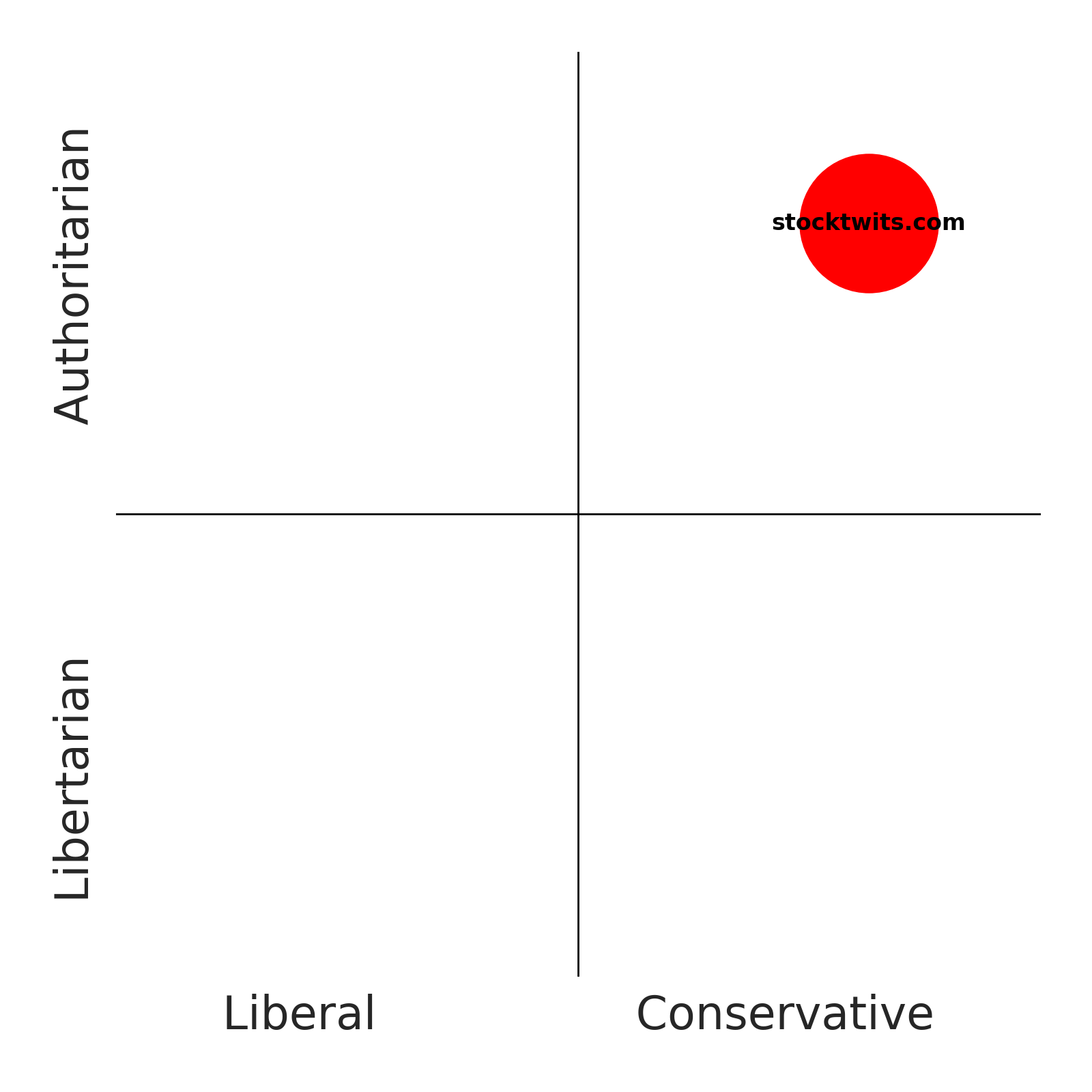
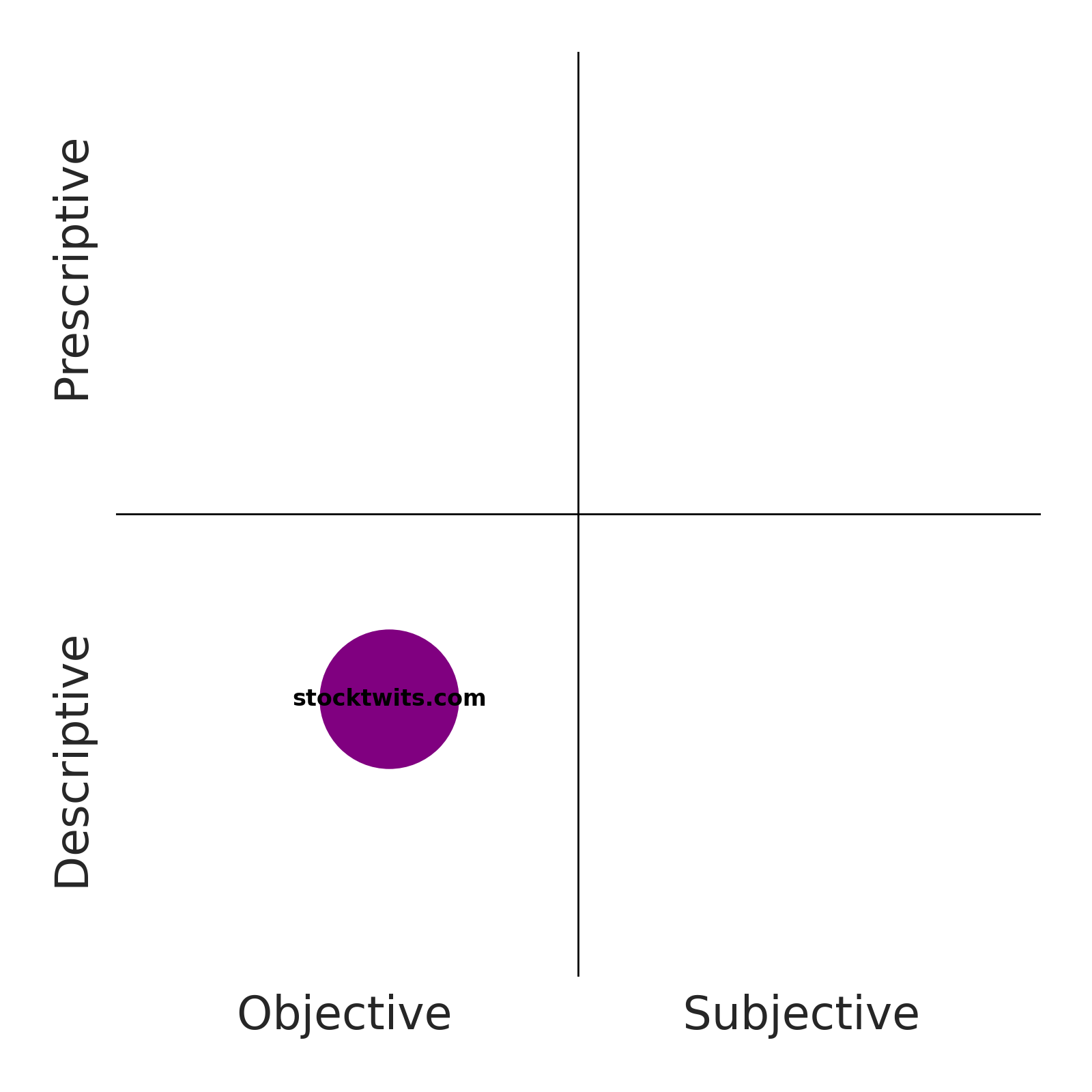
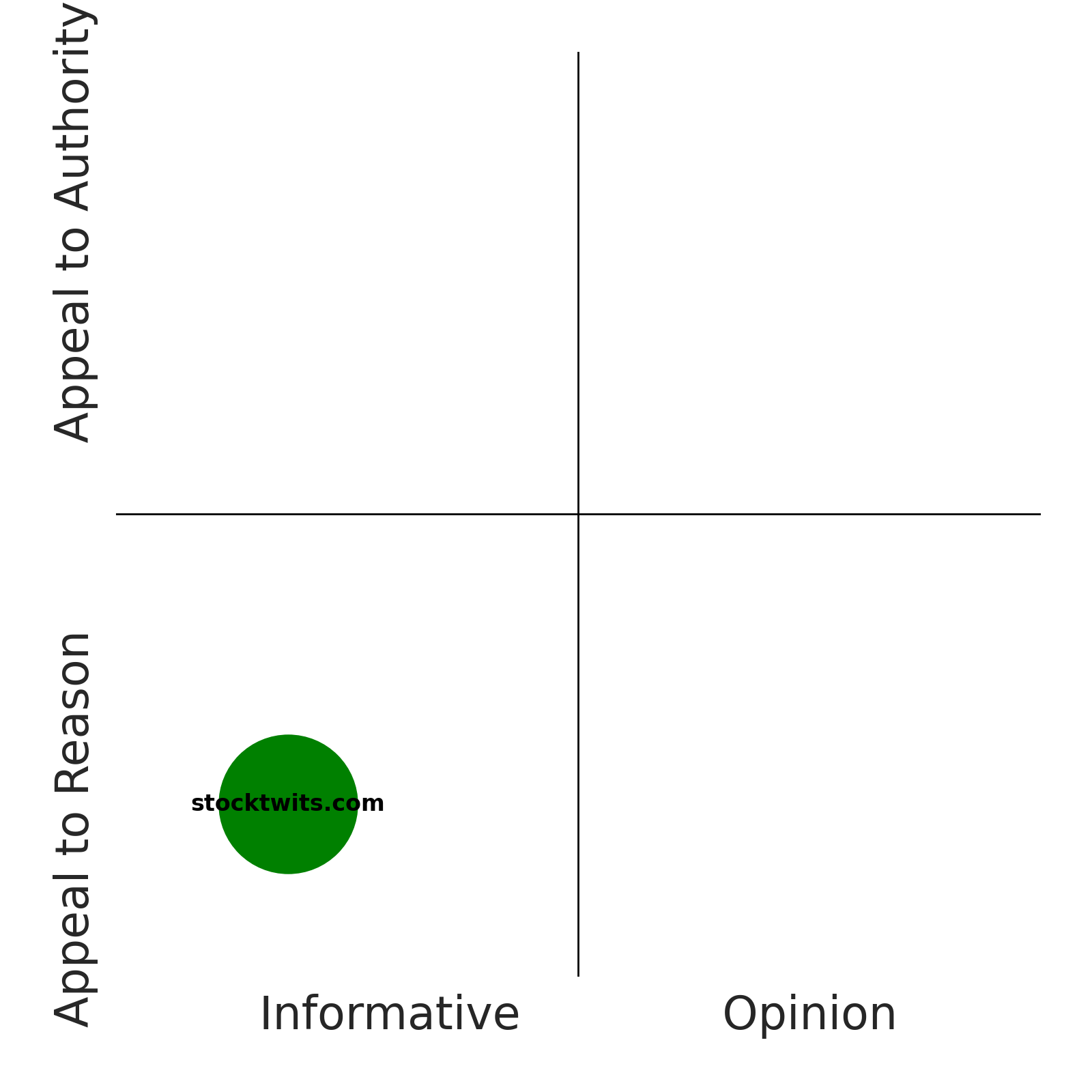
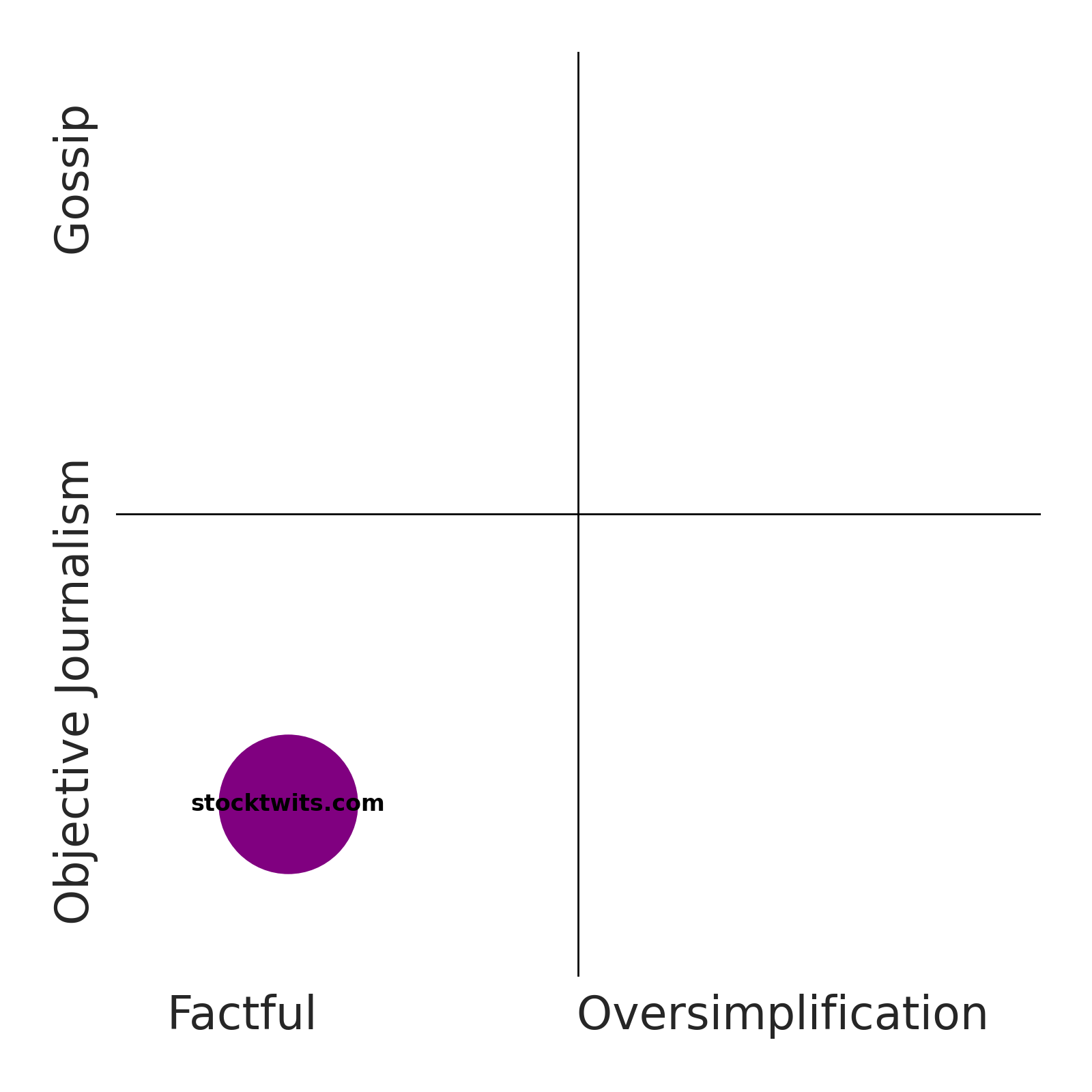
2026 © Helium Trades
Privacy Policy & Disclosure
* Disclaimer: Nothing on this website constitutes investment advice, performance data or any recommendation that any particular security, portfolio of securities, transaction or investment strategy is suitable for any specific person. Helium Trades is not responsible in any way for the accuracy
of any model predictions or price data. Any mention of a particular security and related prediction data is not a recommendation to buy or sell that security. Investments in securities involve the risk of loss. Past performance is no guarantee of future results. Helium Trades is not responsible for any of your investment decisions,
you should consult a financial expert before engaging in any transaction.
Helium Research Assistant

How can I help you today?
Ask any question about stocktwits.com bias.


