See whether Helium helps you make better-informed decisions. Try every Pro Trader feature for 30 days. No credit card required.
Try every Pro Trader feature for 30 days. No credit card required.
Article content was unavailable; the supplied text consists only of Toronto Sun headlines, subscription prompts, cookie notices, and navigation fragments rather than a substantive article.
Automated analysis; not human reviewed. Limitations: The supplied text is a fragmented collection of headlines, subscription prompts, cookie notices, and navigation elements, with no single substantive article to analyze.
The supplied text is a fragmented collection of headlines, subscription prompts, cookie notices, and navigation elements, with no single substantive article to analyze.
Framing leans pro-player/team-rehabilitation with speculative contract focus and reliance on quoted insiders.
The Toronto Sun is a Postmedia-owned Canadian tabloid newspaper covering Toronto sports. Vladimir Guerrero Jr. is a star first baseman for the Toronto Blue Jays. The article is a sports opinion/analysis column published after the 2025 season, discussing the team's offseason priorities.
Automated analysis; not human reviewed. Limitations: The supplied text is a single opinion/analysis column with limited data; some claims (e.g., $500 million contract, WBC effect) rely on unstated or external context, and the publisher's tabloid framing is apparent. · 55 of 55 available dimensions scored; omitted dimensions are not treated as neutral. · Verified supporting quotes for 12 of 55 scored dimensions.
Claim: The piece mixes factual reporting with subjective interpretation, but remains grounded in quotes and specific events.
“With a fan base already surly towards the beleaguered six-time All-Star, why not shut it down a day early for the undisputed worst season of his career?” · exact text match
Why: The rhetorical question and interpretive language ('surly', 'beleaguered', 'undisputed') tilt toward subjectivity while the article mostly reports quotes and events.
Claim: The headline and framing use mildly sensational language like '$500 million problem' and 'rehabilitating the $500 million man.'
“Can Blue Jays fix Vladimir Guerrero Jr.? Solving the $500 million problem needs to start now.” · exact text match
Why: The '$500 million problem' is a dramatic label for a player's performance slump, common in sports tabloid coverage.
Claim: The article is cautiously optimistic about Guerrero's recovery, emphasizing his talent and work ethic.
“Clearly, what is central to a Guerrero turnaround is to reboot the mainframe of a machine that has at times been one of the best hitters in baseball.” · exact text match
Why: The metaphor of a 'mainframe' and the positive framing of a 'turnaround' suggest a hopeful, bullish stance on his future performance.
Claim: Overall tone is slightly optimistic, emphasizing effort, self-awareness, and a concrete plan.
“That Guerrero has come clean to acknowledge how the burden of expectation weighs on him may have been an important first step.” · exact text match
Why: The writer views Guerrero's admission as an 'important first step,' signaling optimism about his recovery.
Claim: The article prescribes what Guerrero should do and what the team must prioritize.
“So now begins the task of rehabilitating the $500 million man, No. 1 priority of a busy offseason for general manager Ross Atkins.” · exact text match
Why: Stating that rehabilitation is the 'No. 1 priority' frames a prescription for the offseason.
Claim: The framing assumes Guerrero's poor season is a 'problem' that can be 'fixed,' presupposing the conclusion.
“Can Blue Jays fix Vladimir Guerrero Jr.?” · exact text match
Why: The headline poses a question that presupposes a need for fixing and a possibility of fixing, without questioning that premise.
Claim: The article is an opinionated sports column with subjective judgments and rhetorical questions.
“So his inherent jocularity, persistent Gatorade baths and an affinity for the home run jacket apparently mean he’s unserious.” · exact text match
Why: The sarcastic tone and direct editorializing ('apparently mean he's unserious') clearly express the columnist's opinion.
Claim: The article simplifies the causes of Guerrero's struggles into a few factors (extra work, WBC, mental snowball).
“When Guerrero was unable to adjust, he was fried and the travails quickly became mental.” · exact text match
Why: It reduces a complex performance decline to a linear narrative of failed adjustment leading to mental struggle.
Claim: The article leans heavily on manager John Schneider's quotes as authoritative explanations for Guerrero's struggles.
““I think you can tie the whole season for a lot of guys into playing an extra month and then what does that do for your off-season,” Schneider said.” · not found in supplied text
Why: Managerial quotes are used to validate the analysis, though Schneider's perspective is clearly attributed.
Claim: Some predictions are stated with certainty, e.g., Schneider's home run range.
“And with that is going to come anywhere between 20 and 35 home runs.” · exact text match
Why: A precise range of future home runs is offered as a near-guarantee, though it's a prediction.
Claim: The article provides attributed quotes and specific details, but uses unnamed sources and tabloid framing.
“much of the pain, apparently, inflicted by putting in extra work to fix what ultimately was unfixable.” · exact text match
Why: The word 'apparently' signals uncertain sourcing, reducing credibility despite the presence of direct quotes.
Claim: The article speculates about a potential MLB work stoppage and its impact, and about Guerrero's future recovery.
“Complicating the resuscitation efforts is the looming labour crisis facing Major League Baseball. If a work stoppage indeed arrives, the Jays will only have to Dec. 1 for hands-on work with all of their players.” · exact text match
Why: The conditional 'if' indicates speculation about a future event that would affect the plan.
Claim: The article uses emotional framing and rhetorical questions to shape reader opinion, but is not heavily manipulative.
“With a fan base already surly towards the beleaguered six-time All-Star, why not shut it down a day early for the undisputed worst season of his career?” · exact text match
Why: The rhetorical question nudges the reader toward a particular interpretation, though the article includes balanced quotes.
The supplied text is a single opinion/analysis column with limited data; some claims (e.g., $500 million contract, WBC effect) rely on unstated or external context, and the publisher's tabloid framing is apparent.
September 17, 2026 · 0 shares
Police-sourced crime blotter framing treats each incident as an open investigation, with claims attributed to authorities and no editorial commentary.
Automated analysis; not human reviewed. Limitations: The supplied text mixes substantive police briefs with page chrome and teaser headlines; I analyzed only the substantive police-report paragraphs and treated police statements as attributed claims. · 6 of 55 available dimensions scored; omitted dimensions are not treated as neutral. · Verified supporting quotes for 6 of 6 scored dimensions.
Claim: Reporting is predominantly descriptive and attributed to police, with subjective editorial opinion absent.
“Police said a woman was sexually assaulted on Aug. 27 at about 3 p.m. by an unknown male suspect while they were both on a TTC streetcar in the Queen St. W.-Peter St. area.” · exact text match
“It’s alleged that a male suspect approached several unoccupied homes in the middle of the day, knocked on the doors several times before forcefully entering the homes and stealing jewelry, wine and other small objects.” · exact text match
Why: The text is built from police statements and explicitly labels contested conduct as alleged, while avoiding evaluative language.
Claim: The report relies on restrained police-report wording even while covering violent and serious crime.
“Durham Regional Police said a male sustained injuries after being assaulted by at least three suspects who attempted to force him into his vehicle while stealing it in Ajax on Tuesday.” · exact text match
“Cops said the man was struck by an industrial truck during road work and was pronounced deceased.” · exact text match
Why: Crime topics are inherently dramatic, but the prose stays close to the police account rather than using exaggeration or emotive adjectives.
Claim: The text describes police events and requests tips; it does not prescribe policy or demand action beyond contacting police.
“Anyone with information is asked to contact police at 416-808-5200.” · exact text match
Why: The only directive is a routine request for tips; no recommendations or moral prescriptions are offered.
Claim: The report is fact-styled and sourced, with no explicit opinion or editorial stance.
“Police said during a search of the suspect and vehicle, officers allegedly found drugs and a loaded firearm, which were seized.” · exact text match
“It’s alleged that a male suspect approached several unoccupied homes in the middle of the day, knocked on the doors several times before forcefully entering the homes and stealing jewelry, wine and other small objects.” · exact text match
Why: Statements are attributed to police and allegations are marked with 'alleged,' which keeps the reporting neutral in form.
Claim: The piece names specific police services, provides details, and gives contact numbers for verification.
“Toronto Police are asking for the public’s help in identifying a male suspect wanted in a sexual assault investigation.” · exact text match
“Anyone with information is asked to contact York Regional Police at 1-866-876-5423, Ext. 7142.” · exact text match
Why: Identifying sources, explicit contact points, and careful use of 'alleged' support trustworthiness, though the content is entirely police-sourced.
Claim: The text shows honest attribution by consistently marking police statements and allegations.
“Police said a woman was sexually assaulted on Aug. 27 at about 3 p.m. by an unknown male suspect while they were both on a TTC streetcar in the Queen St. W.-Peter St. area.” · exact text match
“It’s alleged that a male suspect approached several unoccupied homes in the middle of the day, knocked on the doors several times before forcefully entering the homes and stealing jewelry, wine and other small objects.” · exact text match
Why: Sourcing and 'alleged' formulations demonstrate internally visible fairness, although the items are not independently verified.
The supplied text mixes substantive police briefs with page chrome and teaser headlines; I analyzed only the substantive police-report paragraphs and treated police statements as attributed claims.
A neutral crime brief attributes every substantive claim to police and marks disputed acts as 'alleged'.
Automated analysis; not human reviewed. Limitations: The supplied text intersperses two police briefs with unrelated headlines and page boilerplate; analysis is limited to the substantive briefs. · 12 of 55 available dimensions scored; omitted dimensions are not treated as neutral. · Verified supporting quotes for 12 of 12 scored dimensions.
Claim: The crime report is objective rather than subjective.
“The victim was allegedly pepper-sprayed and physically assaulted, with the suspects fleeing in a black SUV.” · exact text match
“Police said the incident happened Tuesday afternoon in the Taunton Rd. E.-Baldwin St. S. area, where the victim had arranged to meet a man to sell a watch.” · exact text match
Why: Claims are attributed to police and marked 'allegedly', leaving no subjective editorial judgment.
Claim: The report avoids sensational language.
“Police said the victim was treated at a local hospital for minor injuries.” · exact text match
Why: The outcome is stated in flat, understated terms with no dramatic adjectives.
Claim: The report is descriptive, with no editorial prescription.
“Police described one suspect as a Black male around 6 feet tall, between 18 and 20 years old.” · exact text match
Why: The content conveys facts and descriptions rather than advocating a course of action or policy.
Claim: The report is factful rather than opinionated.
“Both men, aged 20 and 21, are facing robbery charges.” · exact text match
Why: Statements are framed as charges and police reports, with no evaluative commentary.
Claim: The report is non-political.
“Durham Regional Police are looking for at least three suspects in an alleged armed robbery that injured a Facebook Marketplace seller at a meetup in Whitby.” · exact text match
Why: The text is limited to local crime details with no political actors, policies, or commentary.
Claim: The text is appropriately uncertain rather than overconfident.
“The victim was allegedly pepper-sprayed and physically assaulted, with the suspects fleeing in a black SUV.” · exact text match
“Police said the incident happened Tuesday afternoon in the Taunton Rd. E.-Baldwin St. S. area, where the victim had arranged to meet a man to sell a watch.” · exact text match
Why: The repeated qualifiers 'allegedly' and 'Police said' keep certainty within the source material's limits.
Claim: The tone is emotionally neutral.
“Police said the victim was treated at a local hospital for minor injuries.” · exact text match
Why: The phrasing is flat and clinical, with no emotive language.
Claim: Credibility is high based on visible sourcing and attribution.
“Police said the incident happened Tuesday afternoon in the Taunton Rd. E.-Baldwin St. S. area, where the victim had arranged to meet a man to sell a watch.” · exact text match
“Police said that while conducting these patrols, officers stopped two people in the middle of robbing a convenience store in the Crown Point neighbourhood.” · exact text match
Why: Claims are sourced to police, allegations are marked, and specific officers and contact paths are named.
Claim: The reporting is rational and evidence-grounding.
“Investigators believed the robberies were linked and mobilized officers to patrol convenience stores in the area.” · exact text match
“Police said the victim was treated at a local hospital for minor injuries.” · exact text match
Why: Even causal inferences are attributed to investigators rather than asserted by the publisher.
Claim: The report signals high integrity through fair legal framing.
“Both men, aged 20 and 21, are facing robbery charges.” · exact text match
“The 20-year-old has also been charged with six counts of failure to comply with a probation order.” · exact text match
Why: It uses 'facing charges' and 'charged' rather than declaring the men guilty.
The supplied text intersperses two police briefs with unrelated headlines and page boilerplate; analysis is limited to the substantive briefs.
September 17, 2026 · 0 shares
Crime briefs are reported as straightforward police-blotter items, with nearly all assertions attributed to police and no editorial commentary.
Automated analysis; not human reviewed. Limitations: The article is a multi-item crime brief, so no single event is developed in depth; all reported facts come from police statements without independent verification. · 7 of 55 available dimensions scored; omitted dimensions are not treated as neutral. · Verified supporting quotes for 7 of 7 scored dimensions.
Claim: Crime reports are presented objectively with attributed police statements and no editorial commentary.
“Toronto Police said, at around 9:25 a.m., officers responded to a call for a person with a gun in the Gerrard St. E. and Broadview Ave. area.” · exact text match
Why: The article consistently attributes factual claims to police and avoids evaluative language.
Claim: The text does not sensationalize crime; it uses restrained, police-account wording.
“Following that incident, nine schools in the area were placed in a hold and secure or shelter in place, which was reportedly lifted by 1:30 p.m.” · exact text match
Why: The lockdown is described in plain operational terms rather than dramatized language.
Claim: The text mainly describes police accounts; even safety advice is relayed as police reminders rather than the outlet's own directives.
“Police say they are reminding residents to be cautious and protect themselves by always locking their vehicle, making sure the windows are rolled up, and never leaving keys behind.” · exact text match
Why: Advice is attributed to police, keeping the article in a descriptive rather than prescriptive register.
Claim: The tone is unemotional and matter-of-fact across crime briefs.
“Toronto Police said, at around 9:25 a.m., officers responded to a call for a person with a gun in the Gerrard St. E. and Broadview Ave. area.” · exact text match
Why: The wording is neutral and procedural, with no emotionally charged descriptors.
Claim: The article's credibility rests on police sources, clear attribution, and contact information for follow-up.
“According to police, the victim reported that while working at the pharmacy, he was touched inappropriately multiple times by the manager.” · exact text match
“Anyone with information is asked to contact police at 416-808-5500 or Crime Stoppers anonymously at 416-222-TIPS (8477).” · exact text match
Why: Claims are attributed to named police services and contact details are provided for verification.
Claim: Reporting is hedged and evidence-bound, distinguishing allegations from charges.
“It’s alleged the accused and the victim were involved in a verbal confrontation outside a school in the area before the accused displayed what appeared to be a firearm and then fled on foot.” · exact text match
Why: The use of 'alleged' and 'what appeared to be' avoids asserting guilt or unverified facts.
Claim: Reporting is internally fair, preserving allegations as allegations and charges as charges.
“It’s alleged the accused and the victim were involved in a verbal confrontation outside a school in the area before the accused displayed what appeared to be a firearm and then fled on foot.” · exact text match
“On Wednesday, police charged Sampath Perera with sexual assault and sexual exploitation.” · exact text match
Why: The article distinguishes alleged conduct from formal charges and avoids loaded language.
The article is a multi-item crime brief, so no single event is developed in depth; all reported facts come from police statements without independent verification.
September 13, 2026 · 0 shares
The recap frames the rookie game as a sloppy, penalty-heavy evaluation in which Toronto's power-play failures and Ottawa's late comeback define the storyline.
Automated analysis; not human reviewed. Limitations: No official box score or team release was supplied to verify the reported game statistics. · 3 of 54 available dimensions scored; omitted dimensions are not treated as neutral. · Verified supporting quotes for 3 of 3 scored dimensions.
Claim: The report is primarily factual but uses some evaluative language.
“Ottawa did manage one on six tries, but gave up a go-ahead goal, short-handed, to Borya Valis, before it rallied in the third to set up Jaxon Cover, 4-3, with 2:11 to go in overtime.” · exact text match
Counterevidence:
“With only a practice or two under their belts, the top prospects of the Maple Leafs and Ottawa Senators flailed away on the power play all Saturday evening in Gatineau, Que.” · exact text match
Why: The article is dominated by concrete scores, statistics, and lineup decisions, but the opening judgment and phrases such as 'flailed away' add mild subjectivity.
Claim: The article includes the writer's own evaluative judgment about rookie tournaments.
“Congested NHL rookie tournaments are even less conducive for special teams work than forgettable September exhibitions for veterans.” · exact text match
Why: This sentence is an unattributed comparative judgment rather than a reported fact, making the article mildly opinionated.
Claim: The report names specific sources and is specific about game events.
““He can shoot it,” praised Campbell to Ottawa media earlier in the week of the second-round pick of San Jose from 2023.” · exact text match
Why: The article attributes a quote to a named coach and provides specific players, scores, and lineup decisions, supporting moderate credibility.
No official box score or team release was supplied to verify the reported game statistics.
September 16, 2026 · 0 shares
Bullpen overwork is framed as a predictable, self-inflicted source of a costly loss, with injury updates presented as more bad news for a team that cannot afford it.
Automated analysis; not human reviewed. Limitations: The supplied text is incomplete and contains unrelated teaser headlines and boilerplate, which limits full verification of context and some facts.
The supplied text is incomplete and contains unrelated teaser headlines and boilerplate, which limits full verification of context and some facts.
September 06, 2026 · 0 shares
The reporting is framed through urgent, opinionated takeaways that treat the loss as a costly playoff setback and sharply judge the team's pitching and defense.
Automated analysis; not human reviewed. Limitations: Only a single unverified game recap was supplied, and the text contains a likely typo and ambiguous season/date context. · 9 of 54 available dimensions scored; omitted dimensions are not treated as neutral. · Verified supporting quotes for 9 of 9 scored dimensions.
Claim: The text presents categorical, evaluative judgments about a player's ability.
“Sanchez can hit, but is a terrible outfielder who shouldn’t be asked to start” · exact text match
Why: An unqualified subjective characterization is presented as a definitive assessment.
Claim: The outlook is negative, emphasizing narrow margins and lost confidence.
“Suffice to say his brief time with the Jays hasn’t exactly inspired much confidence.” · exact text match
Why: The phrasing communicates doubt and discouragement about a key player's performance.
Claim: The report tells the team what it must or cannot do, moving beyond description.
“the Jays can’t afford to cool off right now” · exact text match
“errors of any kind cannot be tolerated” · exact text match
Why: It states obligations and unacceptable outcomes rather than simply describing events.
Claim: The piece is dominated by the columnist's personal verdicts and prescriptions.
“And to use the sun and stifling weather conditions as excuses represent complete and utter nonsense.” · exact text match
Why: The sentence is an editorial opinion about excuses, not a neutral report of an event.
Claim: The tone is critical and frustrated, using harsh descriptors for a player's performance.
“the whole sequence looked amateurish” · exact text match
Why: Negative evaluative language conveys emotion rather than neutral reporting.
Claim: The article cites specific game statistics and explicitly flags a limitation in its assessment.
“He has thrown 15.2 innings while surrendering 14 earned runs — including five home runs.” · exact text match
“in fairness, it’s hard to glean whether he has fully been built up from the nerve issue that delayed his availability” · exact text match
Why: The visible epistemic practices—concrete stats plus a stated uncertainty—support moderate credibility for the column's limited claims.
Claim: The analysis uses statistics and game-specific reasoning to support its conclusions.
“Arrighetti has now pitched in four games for the Jays, each one resulting in a loss. He has thrown 15.2 innings while surrendering 14 earned runs — including five home runs.” · exact text match
Why: A performance judgment is tied to concrete cited numbers, showing an empirically grounded reasoning pattern.
Claim: The text predicts the wild-card race will remain close through the end of the season.
“The back-and-forth jockeying for the final wild card likely will continue until the regular-season finale on Sept. 27.” · exact text match
Why: It explicitly forecasts a future state with a probabilistic qualifier.
Claim: The text tempers its criticism by acknowledging uncertainty about a player's condition.
“in fairness, it’s hard to glean whether he has fully been built up from the nerve issue that delayed his availability” · exact text match
Why: A fairness qualifier surfaces an alternative explanation before continuing the critique.
Only a single unverified game recap was supplied, and the text contains a likely typo and ambiguous season/date context.
September 21, 2026 · 0 shares
Framing leans on credentialed expert testimony to present a cautiously hopeful, action-oriented account of dementia risk and caregiving.
Automated analysis; not human reviewed. Limitations: The supplied text is a truncated excerpt interleaved with subscription, cookie, and navigation artifacts; some quoted passages are cut off, so only the visible substantive passages were analyzed. · 6 of 55 available dimensions scored; omitted dimensions are not treated as neutral. · Verified supporting quotes for 5 of 6 scored dimensions.
Claim: The article shifts into direct guidance, instructing caregivers what to do.
“Use free day programs to get some time for yourself;” · exact text match
“Arrange for other family members or friends to spell you when you are overwhelmed;” · exact text match
Why: Imperative sentences direct readers' behaviour, making the text prescriptive rather than merely descriptive.
Claim: Medical claims rest primarily on credentialed expert testimony rather than on cited studies or data.
“Howard Chertkow, senior scientist at the Baycrest Academy for Research and Education, "half of the burden" of developing dementia is genetic.” · verified after text normalization
“Adriana Shnall believes the situation has improved "dramatically" over her 35 years in the field.” · verified after text normalization
Why: The article's key assertions about genetics, hopeful progress, and treatment are all anchored to expert titles and testimony, with no independent evidence.
Claim: The report attributes all substantive claims to named experts and uses cautious attribution.
“Adriana Shnall believes the situation has improved "dramatically"” · verified after text normalization
“he said” · exact text match
Why: Named titles, named experts, and repeated attribution ('believes', 'said', 'pointed to') provide visible sourcing and uncertainty.
Claim: The article's reasoning is careful and nuanced, containing probabilistic, non-deterministic language.
“Instead, lifestyle choices can help mitigate the risk of developing Alzheimer’s or other types of dementia, he said.” · exact text match
“pointed to treatments on the horizon” · exact text match
Why: Hedging ('can help', 'on the horizon') and a qualified genetic explanation reflect measured reasoning rather than overstatement.
Claim: The framing is aligned with scientific understanding of Alzheimer's genetic risk and deliberately rejects a fatalistic single-gene misconception.
“For the most part, it's not like you get one bad gene (and) you're going to get Alzheimer's […] There's a very small group of people in which this is true, but for the vast majority, that's not how it works.” · not found in supplied text
Why: The quote corrects a common genetic misconception in line with current scientific thinking, rather than endorsing superstition.
Claim: Observable fairness signals include quoting experts directly and preserving nuance.
“There's a very small group of people in which this is true, but for the vast majority, that's not how it works.” · verified after text normalization
Why: Including the expert's own caveat preserves the nuance of the original statement rather than flattening it.
The supplied text is a truncated excerpt interleaved with subscription, cookie, and navigation artifacts; some quoted passages are cut off, so only the visible substantive passages were analyzed.
September 30, 2026 · 0 shares
The coverage frames the study as credible but preliminary, pairing experimental rigor and expert praise with explicit caveats about unresolved mechanisms and clinical implications.
Automated analysis; not human reviewed. Limitations: The supplied text is a partial excerpt that includes subscription/cookie wrappers and some truncated passages; full experiment details such as sample size and complete methods are not available for analysis. · 4 of 55 available dimensions scored; omitted dimensions are not treated as neutral. · Verified supporting quotes for 4 of 4 scored dimensions.
Claim: The publisher frames the research through a neutral, evidence-first lens, reporting findings and limitations without injecting advocacy.
“It’s not clear whether the brain was controlling the immune system because the study didn’t directly test for inflammatory cells or molecules” · exact text match
“The results may help explain some of the benefits of meditation known for centuries, Kipnis said.” · exact text match
Why: The article includes explicit uncertainty and presents a cautious interpretation ('may help explain') rather than asserting certainty.
Claim: The coverage avoids sensationalizing the findings and instead emphasizes the preliminary state of the science.
“Some mechanistic evidence is emerging, but we are just at the beginning of the journey to understand how these things work.” · exact text match
“It’s not clear whether the brain was controlling the immune system because the study didn’t directly test for inflammatory cells or molecules” · exact text match
Why: The publisher highlights limits and uses hedged, understated language from sources.
Claim: The publisher attributes claims to named researchers, includes independent expert commentary, and notes study limitations.
“Kipnis, who was not involved in the study but described it as done “really, really well.”” · exact text match
“It’s not clear whether the brain was controlling the immune system because the study didn’t directly test for inflammatory cells or molecules” · exact text match
Why: Named attribution, independent expert assessment, and explicit uncertainty support credibility.
Claim: The publisher presents the study as empirical and mechanism-oriented, grounded in experimental controls and physiological measures.
“Crucially, the same people did the experiment twice, once with each condition.” · exact text match
“The study also showed that when people paid attention to the inflamed site, they had more heart rate variability” · exact text match
Why: The reporting emphasizes controlled experimental design and physiological measurement rather than speculative or non-empirical explanation.
The supplied text is a partial excerpt that includes subscription/cookie wrappers and some truncated passages; full experiment details such as sample size and complete methods are not available for analysis.
September 30, 2026 · 0 shares
The publisher frames relationship difficulties as solvable through direct prescriptive advice and individual boundary-setting, selecting letters that dramatize infidelity and family-versus-couple conflicts.
Automated analysis; not human reviewed. Limitations: The supplied text cuts off the first response and contains only the columnist's side of one-sided letters, limiting full assessment of the first advisor's reasoning. · 6 of 55 available dimensions scored; omitted dimensions are not treated as neutral. · Verified supporting quotes for 4 of 6 scored dimensions.
Claim: The content is subjective advice and interpretation, not neutral reporting.
“DEAR MONOGAMOUS:” · exact text match
“She has clearly shown you that her extended family is her top priority” · exact text match
Why: The column presents the columnist's personal judgment on private relationship matters.
Claim: The columnist issues direct prescriptive commands rather than describing options.
“stop trying to take that away from her” · exact text match
“it is OK to insist on a 'phones off' rule when things become intimate” · not found in supplied text
Why: The advice uses imperative and normative language to tell the reader what to do.
Claim: The column is dominated by the columnist's opinions and judgments.
“not once in your letter did you say that you love him” · exact text match
“She has clearly shown you that her extended family is her top priority” · exact text match
Why: The columnist interprets the letters and offers value-laden guidance.
Claim: Complex relationship conflicts are reduced to brief rules of thumb.
“stop trying to take that away from her” · exact text match
“it is OK to insist on a 'phones off' rule when things become intimate” · not found in supplied text
Why: A multi-faceted family-versus-couple conflict is condensed into a single principle and a boundary-setting tip.
Claim: The column transparently attributes statements to letter writers, but the underlying facts are unverified.
“I have suggested date nights (a four-hour time slot two nights or afternoons a month) where we would not take calls or texts from family members.” · exact text match
Why: Specific details lend verisimilitude and quotes are attributed, but no independent verification is possible or attempted.
Claim: The advice is practical, specific, and psychologically aware.
“On date nights, choose activities that will keep her busy and engaged. Keep the conversation flowing, and demonstrate that your full attention is on her.” · exact text match
Why: The response offers concrete suggestions that address the underlying need for connection.
The supplied text cuts off the first response and contains only the columnist's side of one-sided letters, limiting full assessment of the first advisor's reasoning.
September 21, 2026 · 0 shares
The framing gives most evidentiary weight to US federal officials' statements about the plot while offering no Haitian government perspective, leaving Haiti's instability as an unevaluated backdrop.
The supplied excerpt is a partial news brief related to the 2021 assassination of Haitian President Jovenel Moise and subsequent U.S. federal proceedings; the surrounding article was truncated in the prompt.
Automated analysis; not human reviewed. Limitations: The supplied excerpt contains multiple truncation markers, so some names, dates, and jurisdictional details are incomplete; classifications rely only on the legible fragments. · 5 of 55 available dimensions scored; omitted dimensions are not treated as neutral. · Verified supporting quotes for 5 of 5 scored dimensions.
Claim: The report keeps the reporter invisible and presents no subjective evaluations; assertions about motive and the investigation are attributed to authorities.
“according to federal prosecutors” · exact text match
“its spokesman said earlier this month” · exact text match
Why: Phrases that would express a personal viewpoint are absent; instead, legal and procedural descriptors are tied to identifiable official sources.
Claim: The article avoids sensational phrasing despite the violent subject, using hedged legal terms.
“The men face possible sentences of life in prison.” · exact text match
Why: The outcome is phrased as a possibility rather than a certainty, and no inflammatory adjectives modify defendants or the setting.
Claim: The overall tone is mildly pessimistic because the report ends by emphasizing Haiti's institutional vacuum and a delayed security mission.
“Haiti has spiralled into deeper chaos since Moise’s killing and currently has no president.” · exact text match
Why: The closing context leaves little prospect of near-term improvement, balancing the otherwise hopeful progress of prosecutions.
Claim: The story's numeric and procedural specifics and layered sourcing support its credibility.
“30 suspects have thus far been indicted in the killing” · exact text match
“Eleven people have already been indicted in connection with the assassination in U.S. courts” · exact text match
Why: Specific, checkable figures and repeated attribution to officials give the reader a basis for verification.
Claim: The report shows high factual integrity by attributing claims to sources and hedging outcomes.
“according to federal prosecutors” · exact text match
“The men face possible sentences of life in prison.” · exact text match
Why: The language distinguishes allegations from established facts and downgrades absolute outcomes to possibilities.
The supplied excerpt contains multiple truncation markers, so some names, dates, and jurisdictional details are incomplete; classifications rely only on the legible fragments.
September 30, 2026 · 0 shares
Frames the formal end of Operation Inherent Resolve as a partial withdrawal that preserves continued US support and warns of risks from Iran-backed factions.
Automated analysis; not human reviewed. Limitations: The supplied article text is truncated with bracketed ellipses, so the exact wording and attribution of some analytical and quoted claims are unavailable. · 4 of 55 available dimensions scored; omitted dimensions are not treated as neutral. · Verified supporting quotes for 2 of 4 scored dimensions.
Claim: The article relies primarily on attributed quotes from officials and avoids first-person opinion, though it includes an analytical risk statement.
“The United States and Iraq agreed in 2024 to wind down the coalition’s mission.” · not found in supplied text
“Iraqi Prime Minister Ali al-Zaidi hailed the end of the mission as the start of a new chapter.” · exact text match
Why: Most claims are reported with attribution to named officials and institutions, but the inclusion of an unhedged warning about Iran-backed factions prevents a stronger objectivity score.
Claim: The report couples the official 'new chapter' framing with a warning about deepening war, giving the overall outlook a slightly pessimistic cast.
“embolden the pro-Iran factions further and draw the country deeper into the Middle East war.” · exact text match
“A new phase has begun, defined by Iraq’s sovereignty, the strength of its institutions, the readiness of its forces, unity of decision-making, and balanced partnerships with its friends.” · not found in supplied text
Why: The pessimistic warning appears in the article's own voice, while the optimistic 'new phase' is attributed to the Iraqi prime minister, making the net framing slightly pessimistic.
Claim: Frames the formal end of the mission as incomplete by emphasizing continued US training and intelligence support and warning that withdrawal could embolden Iran-backed factions.
“The U.S. Department of Defence, however, added that it would "continue to provide targeted training and intelligence support to our Iraqi partners".” · exact text match
“embolden the pro-Iran factions further and draw the country deeper into the Middle East war.” · exact text match
Why: The word 'however' and the unqualified warning about pro-Iran factions favor continued US military engagement, a hawkish framing.
Claim: The article names and directly quotes multiple sources, including the Department of Defence and Prime Minister Zaidi, enabling verification.
““Today, the United States and our Coalition partners formally concluded Operation Inherent Resolve in Iraq, consistent with the September 2024 US-Iraq joint statement and US national interests,”” · exact text match
“Iraqi Prime Minister Ali al-Zaidi hailed the end of the mission as the start of a new chapter.” · exact text match
Why: Attribution to specific officials and institutions supports credibility, though the truncated and partially anonymized context limits a higher score.
The supplied article text is truncated with bracketed ellipses, so the exact wording and attribution of some analytical and quoted claims are unavailable.
September 30, 2026 · 0 shares
Washington's sanctions are called 'economic warfare' while Iranian state-media reports and a Guards spokesman's assertion are relayed without rebuttal, producing a mildly adversarial framing of US policy.
The Strait of Hormuz is a strategically vital passage for global oil exports, which makes Iran's blockade a significant escalation.
Automated analysis; not human reviewed. Limitations: The supplied text mixes a headline fragment, paywall prompts, and truncation ellipses; analysis is limited to the identifiable article body. · 3 of 55 available dimensions scored; omitted dimensions are not treated as neutral. · Verified supporting quotes for 3 of 3 scored dimensions.
Claim: The article inserts a subjective characterization of US sanctions as 'economic warfare' into an otherwise straight news report.
“The US, meanwhile, has stepped up its economic warfare against Iran” · exact text match
Why: Calling sanctions 'economic warfare' without attribution is an evaluative, contested label rather than a neutral description.
Claim: The article uses opinionated language to describe US actions, especially the phrase 'economic warfare.'
“The US, meanwhile, has stepped up its economic warfare against Iran” · exact text match
Why: The term 'economic warfare' is a value-laden characterization that goes beyond reporting the imposed sanctions.
Claim: The article is moderately credible because it attributes claims to named and official sources but relies on state media and uses some editorializing language.
“state media reported” · exact text match
“told state TV” · exact text match
“economic warfare against Iran” · exact text match
Why: Clear attribution and named officials support credibility, while state-media sourcing and a loaded term reduce it.
The supplied text mixes a headline fragment, paywall prompts, and truncation ellipses; analysis is limited to the identifiable article body.
September 16, 2026 · 0 shares
A terse crime brief that stays close to police disclosures and legal charge names, without defense response, context, or emotional commentary.
Under Canadian law, police-laid charges are formal accusations, not findings of guilt; an accused person is presumed innocent unless convicted in court.
Automated analysis; not human reviewed. Limitations: The supplied text is partially truncated and mixed with embedded headlines or promo material, so classification rests mainly on the readable crime-brief passage. · 2 of 54 available dimensions scored; omitted dimensions are not treated as neutral. · Verified supporting quotes for 2 of 2 scored dimensions.
Claim: The emotional register is neutral; no positive or negative affect words modify the reported events.
“Kaden Charles-Robinson, 21, of Toronto, was already accused of 13 charges related to the sex assault of a teenager who he allegedly used Snapchat to lure, charges that included: Make sexually explicit material to a person under 16, publish intimate image without consent, sex assault with a weapon, make child sexual abuse and exploitation material, extortion and more.” · exact text match
Why: The passage uses legal terms and charge names without adjectives such as 'horrific' or 'outrageous,' so the affect is restrained rather than positive or negative in tone.
Claim: The report is explicit about its sourcing and uncertainty, attributing key assertions to police and using 'alleged' and 'accused'.
“Police say in April of 2024, Charles-Robinson started an online conversation with another underage victim” · exact text match
“Toronto Police have laid additional charges against a man accused of luring and sexually assaulting a person under 16 years old in June after they say they found another victim.” · exact text match
Why: The police attribution and repeated qualifiers signal a source-based rather than omniscient stance, though the text provides no independent verification or defense view.
The supplied text is partially truncated and mixed with embedded headlines or promo material, so classification rests mainly on the readable crime-brief passage.
September 17, 2026 · 0 shares
Police-sourced crime blotter framing treats each incident as an open investigation, with claims attributed to authorities and no editorial commentary.
Automated analysis; not human reviewed. Limitations: The supplied text mixes substantive police briefs with page chrome and teaser headlines; I analyzed only the substantive police-report paragraphs and treated police statements as attributed claims. · 6 of 55 available dimensions scored; omitted dimensions are not treated as neutral. · Verified supporting quotes for 6 of 6 scored dimensions.
Claim: Reporting is predominantly descriptive and attributed to police, with subjective editorial opinion absent.
“Police said a woman was sexually assaulted on Aug. 27 at about 3 p.m. by an unknown male suspect while they were both on a TTC streetcar in the Queen St. W.-Peter St. area.” · exact text match
“It’s alleged that a male suspect approached several unoccupied homes in the middle of the day, knocked on the doors several times before forcefully entering the homes and stealing jewelry, wine and other small objects.” · exact text match
Why: The text is built from police statements and explicitly labels contested conduct as alleged, while avoiding evaluative language.
Claim: The report relies on restrained police-report wording even while covering violent and serious crime.
“Durham Regional Police said a male sustained injuries after being assaulted by at least three suspects who attempted to force him into his vehicle while stealing it in Ajax on Tuesday.” · exact text match
“Cops said the man was struck by an industrial truck during road work and was pronounced deceased.” · exact text match
Why: Crime topics are inherently dramatic, but the prose stays close to the police account rather than using exaggeration or emotive adjectives.
Claim: The text describes police events and requests tips; it does not prescribe policy or demand action beyond contacting police.
“Anyone with information is asked to contact police at 416-808-5200.” · exact text match
Why: The only directive is a routine request for tips; no recommendations or moral prescriptions are offered.
Claim: The report is fact-styled and sourced, with no explicit opinion or editorial stance.
“Police said during a search of the suspect and vehicle, officers allegedly found drugs and a loaded firearm, which were seized.” · exact text match
“It’s alleged that a male suspect approached several unoccupied homes in the middle of the day, knocked on the doors several times before forcefully entering the homes and stealing jewelry, wine and other small objects.” · exact text match
Why: Statements are attributed to police and allegations are marked with 'alleged,' which keeps the reporting neutral in form.
Claim: The piece names specific police services, provides details, and gives contact numbers for verification.
“Toronto Police are asking for the public’s help in identifying a male suspect wanted in a sexual assault investigation.” · exact text match
“Anyone with information is asked to contact York Regional Police at 1-866-876-5423, Ext. 7142.” · exact text match
Why: Identifying sources, explicit contact points, and careful use of 'alleged' support trustworthiness, though the content is entirely police-sourced.
Claim: The text shows honest attribution by consistently marking police statements and allegations.
“Police said a woman was sexually assaulted on Aug. 27 at about 3 p.m. by an unknown male suspect while they were both on a TTC streetcar in the Queen St. W.-Peter St. area.” · exact text match
“It’s alleged that a male suspect approached several unoccupied homes in the middle of the day, knocked on the doors several times before forcefully entering the homes and stealing jewelry, wine and other small objects.” · exact text match
Why: Sourcing and 'alleged' formulations demonstrate internally visible fairness, although the items are not independently verified.
The supplied text mixes substantive police briefs with page chrome and teaser headlines; I analyzed only the substantive police-report paragraphs and treated police statements as attributed claims.
A neutral crime brief attributes every substantive claim to police and marks disputed acts as 'alleged'.
Automated analysis; not human reviewed. Limitations: The supplied text intersperses two police briefs with unrelated headlines and page boilerplate; analysis is limited to the substantive briefs. · 12 of 55 available dimensions scored; omitted dimensions are not treated as neutral. · Verified supporting quotes for 12 of 12 scored dimensions.
Claim: The crime report is objective rather than subjective.
“The victim was allegedly pepper-sprayed and physically assaulted, with the suspects fleeing in a black SUV.” · exact text match
“Police said the incident happened Tuesday afternoon in the Taunton Rd. E.-Baldwin St. S. area, where the victim had arranged to meet a man to sell a watch.” · exact text match
Why: Claims are attributed to police and marked 'allegedly', leaving no subjective editorial judgment.
Claim: The report avoids sensational language.
“Police said the victim was treated at a local hospital for minor injuries.” · exact text match
Why: The outcome is stated in flat, understated terms with no dramatic adjectives.
Claim: The report is descriptive, with no editorial prescription.
“Police described one suspect as a Black male around 6 feet tall, between 18 and 20 years old.” · exact text match
Why: The content conveys facts and descriptions rather than advocating a course of action or policy.
Claim: The report is factful rather than opinionated.
“Both men, aged 20 and 21, are facing robbery charges.” · exact text match
Why: Statements are framed as charges and police reports, with no evaluative commentary.
Claim: The report is non-political.
“Durham Regional Police are looking for at least three suspects in an alleged armed robbery that injured a Facebook Marketplace seller at a meetup in Whitby.” · exact text match
Why: The text is limited to local crime details with no political actors, policies, or commentary.
Claim: The text is appropriately uncertain rather than overconfident.
“The victim was allegedly pepper-sprayed and physically assaulted, with the suspects fleeing in a black SUV.” · exact text match
“Police said the incident happened Tuesday afternoon in the Taunton Rd. E.-Baldwin St. S. area, where the victim had arranged to meet a man to sell a watch.” · exact text match
Why: The repeated qualifiers 'allegedly' and 'Police said' keep certainty within the source material's limits.
Claim: The tone is emotionally neutral.
“Police said the victim was treated at a local hospital for minor injuries.” · exact text match
Why: The phrasing is flat and clinical, with no emotive language.
Claim: Credibility is high based on visible sourcing and attribution.
“Police said the incident happened Tuesday afternoon in the Taunton Rd. E.-Baldwin St. S. area, where the victim had arranged to meet a man to sell a watch.” · exact text match
“Police said that while conducting these patrols, officers stopped two people in the middle of robbing a convenience store in the Crown Point neighbourhood.” · exact text match
Why: Claims are sourced to police, allegations are marked, and specific officers and contact paths are named.
Claim: The reporting is rational and evidence-grounding.
“Investigators believed the robberies were linked and mobilized officers to patrol convenience stores in the area.” · exact text match
“Police said the victim was treated at a local hospital for minor injuries.” · exact text match
Why: Even causal inferences are attributed to investigators rather than asserted by the publisher.
Claim: The report signals high integrity through fair legal framing.
“Both men, aged 20 and 21, are facing robbery charges.” · exact text match
“The 20-year-old has also been charged with six counts of failure to comply with a probation order.” · exact text match
Why: It uses 'facing charges' and 'charged' rather than declaring the men guilty.
The supplied text intersperses two police briefs with unrelated headlines and page boilerplate; analysis is limited to the substantive briefs.
September 17, 2026 · 0 shares
Crime briefs are reported as straightforward police-blotter items, with nearly all assertions attributed to police and no editorial commentary.
Automated analysis; not human reviewed. Limitations: The article is a multi-item crime brief, so no single event is developed in depth; all reported facts come from police statements without independent verification. · 7 of 55 available dimensions scored; omitted dimensions are not treated as neutral. · Verified supporting quotes for 7 of 7 scored dimensions.
Claim: Crime reports are presented objectively with attributed police statements and no editorial commentary.
“Toronto Police said, at around 9:25 a.m., officers responded to a call for a person with a gun in the Gerrard St. E. and Broadview Ave. area.” · exact text match
Why: The article consistently attributes factual claims to police and avoids evaluative language.
Claim: The text does not sensationalize crime; it uses restrained, police-account wording.
“Following that incident, nine schools in the area were placed in a hold and secure or shelter in place, which was reportedly lifted by 1:30 p.m.” · exact text match
Why: The lockdown is described in plain operational terms rather than dramatized language.
Claim: The text mainly describes police accounts; even safety advice is relayed as police reminders rather than the outlet's own directives.
“Police say they are reminding residents to be cautious and protect themselves by always locking their vehicle, making sure the windows are rolled up, and never leaving keys behind.” · exact text match
Why: Advice is attributed to police, keeping the article in a descriptive rather than prescriptive register.
Claim: The tone is unemotional and matter-of-fact across crime briefs.
“Toronto Police said, at around 9:25 a.m., officers responded to a call for a person with a gun in the Gerrard St. E. and Broadview Ave. area.” · exact text match
Why: The wording is neutral and procedural, with no emotionally charged descriptors.
Claim: The article's credibility rests on police sources, clear attribution, and contact information for follow-up.
“According to police, the victim reported that while working at the pharmacy, he was touched inappropriately multiple times by the manager.” · exact text match
“Anyone with information is asked to contact police at 416-808-5500 or Crime Stoppers anonymously at 416-222-TIPS (8477).” · exact text match
Why: Claims are attributed to named police services and contact details are provided for verification.
Claim: Reporting is hedged and evidence-bound, distinguishing allegations from charges.
“It’s alleged the accused and the victim were involved in a verbal confrontation outside a school in the area before the accused displayed what appeared to be a firearm and then fled on foot.” · exact text match
Why: The use of 'alleged' and 'what appeared to be' avoids asserting guilt or unverified facts.
Claim: Reporting is internally fair, preserving allegations as allegations and charges as charges.
“It’s alleged the accused and the victim were involved in a verbal confrontation outside a school in the area before the accused displayed what appeared to be a firearm and then fled on foot.” · exact text match
“On Wednesday, police charged Sampath Perera with sexual assault and sexual exploitation.” · exact text match
Why: The article distinguishes alleged conduct from formal charges and avoids loaded language.
The article is a multi-item crime brief, so no single event is developed in depth; all reported facts come from police statements without independent verification.
September 18, 2026 · 0 shares
Framing is largely neutral, police-sourced crime reporting with mildly informal headline language and no editorial commentary.
Automated analysis; not human reviewed. Limitations: The text is a short compilation of unrelated police items, so framing signals are limited to word choice and attribution; no editorial, analysis, or ongoing coverage is available. · 5 of 55 available dimensions scored; omitted dimensions are not treated as neutral. · Verified supporting quotes for 5 of 5 scored dimensions.
Claim: The publisher's framing is predominantly objective, attributing facts to police and reporting specific times and locations.
“York Regional Police say a person riding an e-scooter vandalized four bus shelters in an overnight crime spree in Vaughan.” · exact text match
Why: The main claims are explicitly sourced to police, with concrete details such as time, location, and number of shelters, and no editorial interpretation.
Claim: The framing is mildly sensational, mainly through informal and dramatic wording in the headline and lede.
“Alleged E-scooter-riding vandal sought by York cops; teen cuffed after OPP finds stolen vehicle” · exact text match
“overnight crime spree” · exact text match
Why: 'Cuffed' and 'crime spree' are informal or dramatic, but the body is otherwise neutral police reporting.
Claim: The framing is descriptive, reporting police statements and requests rather than prescribing action to readers.
“Investigators later determined that at around 12:30 a.m., a person riding a yellow e-scooter damaged four bus shelters in the area.” · exact text match
“Investigators are asking residents and motorists in the area who may have dashcamera, security camera, or other video footage to review their recordings and provide any relevant footage.” · exact text match
Why: The publisher describes what police determined and what police are asking, without adopting a prescriptive voice.
Claim: The report shows visible sourcing and hedging appropriate to a police briefs roundup.
“Ontario Provincial Police said an in-cruiser Automated License Plate Recognition (ALPR) system alerted an officer to a stolen vehicle near the village of Hastings.” · exact text match
“According to the news site, the vehicle was reported stolen in Niagara Region earlier this week” · exact text match
Why: Most facts are attributed to named law-enforcement agencies or a cited news site, and at least one charge is hedged as alleged.
Claim: The publisher demonstrates internally observable honesty by attributing claims and flagging allegations.
“A Quebec teen is facing several charges after he was allegedly caught driving a stolen vehicle in Northumberland County on Wednesday.” · exact text match
“According to the news site, the vehicle was reported stolen in Niagara Region earlier this week, and was found abandoned in Hastings.” · exact text match
Why: Secondary sourcing is disclosed and charges are hedged, showing standard attribution practices.
The text is a short compilation of unrelated police items, so framing signals are limited to word choice and attribution; no editorial, analysis, or ongoing coverage is available.
September 16, 2026 · 0 shares
Neutral, source-attributed crime reporting that presents legal outcomes and context without editorial commentary.
Automated analysis; not human reviewed. · 5 of 55 available dimensions scored; omitted dimensions are not treated as neutral. · Verified supporting quotes for 5 of 5 scored dimensions.
Claim: The report is factual and source-attributed rather than subjective or interpretive.
“In the agreed statement of facts read in court in March, Chaudhary admitted to being one of the organizers of the heist and to helping arrange for the stolen gold to be transported to a Mississauga jeweller to be melted down.” · exact text match
Why: The central assertions are anchored to court documents and named legal actors, with no first-person editorializing or value judgments.
Claim: The story describes what happened without prescribing policy, action, or judgment.
“Jeweller Ali Raza, 40, was charged in 2024 with possession of property obtained by crime and was also accused of melting the stolen loot.” · exact text match
Why: Statements are cast as records of charges, court events, and admissions, with no calls to action or recommendations.
Claim: The article relies on named court sources and documented admissions.
“In the agreed statement of facts read in court in March, Chaudhary admitted to being one of the organizers of the heist and to helping arrange for the stolen gold to be transported to a Mississauga jeweller to be melted down.” · exact text match
Why: Specific details are attributed to a prosecutor, court filings, and an agreed statement of facts, and uncertainty is acknowledged through the publication ban.
Claim: The reporting frames the legal decision through an explicit prosecutorial rationale.
“Crown prosecutor Jelena Vlacic said the Crown decided to halt proceedings against Raza after prosecutors concluded the case rested on circumstantial evidence and had no reasonable prospect of conviction.” · exact text match
Why: The piece presents a logical, evidence-based reason for the outcome rather than speculation or emotional appeals.
Claim: The reporting is balanced and transparent about the limits of available information.
“The Crown’s reasons are covered under a publication ban as other men accused in the case are still awaiting their trial.” · exact text match
“Raza and Jalota have maintained their innocence throughout the legal proceedings.” · exact text match
Why: It discloses the publication ban and includes the accused's denial, presenting both the legal outcome and the defendants' position.
September 17, 2026 · 0 shares
Framing presents the permanent-daylight-time announcement as a popular, beneficial outcome through uniformly supportive official and business quotes, without expert or dissenting perspectives.
Automated analysis; not human reviewed. Limitations: The supplied text is a short brief built on a government announcement and supportive quotes, so assessment of framing is limited; no opposing or independent expert perspective is present. · 2 of 55 available dimensions scored; omitted dimensions are not treated as neutral. · Verified supporting quotes for 1 of 2 scored dimensions.
Claim: The report frames permanent daylight saving time as a positive, uncontroversial change.
““Permanent daylight saving time is good for our health, good for business and good for parents,”” · exact text match
““The Winnipeg Chamber welcomes this practical step to make doing business in our province a little easier,”” · not found in supplied text
Why: The only evaluative material in the report comes from sources endorsing the change, with no critical or independent perspective included.
Claim: The report demonstrates credible sourcing and specific attribution of statistics and statements.
“said Premier Wab Kinew in a statement announcing the change.” · exact text match
“It said nearly 72,000 votes were submitted, with 92% of those surveyed in favour of ending seasonal time changes.” · exact text match
Why: Named officials are quoted, and the survey result is presented as a specific count from a government source rather than an anonymous claim.
The supplied text is a short brief built on a government announcement and supportive quotes, so assessment of framing is limited; no opposing or independent expert perspective is present.
September 20, 2026 · 0 shares
Framing treats the Blue Jays’ 7-2 win as only a reprieve in a nearly unwinnable playoff race and weaves direct lineup and personnel criticisms into the game story.
Automated analysis; not human reviewed. Limitations: The supplied text is truncated and mixed with what appear to be teaser or page-chrome artifacts, so some passages lack full context; the analysis is based on the coherent Blue Jays game narrative. · 4 of 55 available dimensions scored; omitted dimensions are not treated as neutral. · Verified supporting quotes for 4 of 4 scored dimensions.
Claim: The report mixes game facts with evaluative judgments and explicit prescriptions about Toronto’s lineup decisions.
“the Jays should have used the kid considerably more than they have” · exact text match
“his potential to go long is one area of the club’s offence that has been in short supply” · exact text match
Why: Those passages do not simply describe the game; they grade Toronto’s roster management and advocate a different usage pattern.
Claim: The dominant framing is that Toronto’s situation is nearly hopeless despite the win.
“the playoff math is heavily weighted against them and their margin for error is zero” · exact text match
Counterevidence:
“But there’s a chance, nonetheless, after the Jays avoided getting swept again by the Rangers.” · exact text match
Why: The text repeatedly foregrounds near-certain failure, while allowing only a slim, guarded chance at a playoff run.
Claim: The publisher inserts direct opinion and prescription into the reporting.
“the Jays should have used the kid considerably more than they have” · exact text match
“the leash provided to Keys hasn’t been long and his potential to go long is one area of the club’s offence that has been in short supply” · exact text match
Why: These statements express a clear club-management opinion and a personnel criticism rather than neutral reporting.
Claim: The piece includes forward-looking uncertainty about the Blue Jays’ postseason chances and a young player’s future contribution.
“But there’s a chance, nonetheless, after the Jays avoided getting swept again by the Rangers” · exact text match
“his potential to go long is one area of the club’s offence that has been in short supply” · exact text match
Why: The text frames playoff and lineup outcomes as ongoing possibilities rather than confining itself to completed plays.
The supplied text is truncated and mixed with what appear to be teaser or page-chrome artifacts, so some passages lack full context; the analysis is based on the coherent Blue Jays game narrative.
September 20, 2026 · 0 shares
Frames the Toronto Blue Jays' late-season collapse as a historic, self-inflicted failure through pessimistic retrospectives and repeated emphasis on regression records.
The Toronto Blue Jays entered the 2024 season with high expectations and a large payroll, coming off closer calls in the previous two postseasons. They began September with a plausible path to a wild-card berth, but their late-season slide left them on the brink of missing the playoffs entirely, with the franchise set to record one of its worst year-over-year declines.
Automated analysis; not human reviewed. Limitations: The text is an opinion column with strong cumulative disappointment, and I did not have access to box scores or standings beyond what was quoted. · 17 of 55 available dimensions scored; omitted dimensions are not treated as neutral. · Verified supporting quotes for 12 of 17 scored dimensions.
Claim: Sports-only framing with no political or economic policy dimension
“Blue Jays headed for one of worst regressions in franchise history” · exact text match
Why: No left-right political content; a 0 indicates the unipolar political dimension is absent, not a comment on partisanship.
Claim: Framing is oriented toward a paying, loyal fan base rather than an expert or insider elite
“a bewildered, yet loyal, fan base” · exact text match
Why: The piece centers the fan perspective, but does not attack or defend an elite class, so a 0 is the fit.
Claim: No individual-rights or government-control content
“unauthorized distribution, transmission or republication strictly prohibited” · not found in supplied text
Why: The only relevant statement is standard copyright language; nothing about state or market control is present.
Claim: The writing is openly interpretive and evaluative about the team's collapse and the fans' hope
“a bewildered, yet loyal, fan base and a weary, morose and desperate group of players” · exact text match
“dodgy hope” · exact text match
Why: Phrases like 'morose and desperate' and 'dodgy hope' attribute internal emotional states and judgment to the team and fans, which is subjective framing.
Claim: The text relies on emotionally charged and dramatic imagery instead of plain reporting
“dug them deeper into the crater” · exact text match
“a 43,000-person wake for a season gone awry” · exact text match
Why: Words like 'crater' and 'wake' are melodramatic metaphors, pushing the framing toward the sensational end.
Claim: The overall tone emphasizes failure, regression, and dashed hope
“The Jays’ poor play of late has been alarming” · not found in supplied text
“one of the most profound regressions since they came into existence 50 seasons ago” · exact text match
Why: 'Alarming' and 'profound regressions' characterize the current state negatively, so the score is meaningfully on the pessimistic side.
Claim: The text primarily describes the team's bad play, but occasionally tells fans what they should have concluded
“it’s not as if his loss dramatically alters the fragile hopes that remain” · exact text match
Why: That last clause is an evaluative prescription about the insignificance of the Cease injury, sizing the analysis rather than merely describing it.
Claim: Non-political sports column
“one of the most profound regressions since they came into existence 50 seasons ago” · exact text match
Why: All content concerns baseball standings and player performance, so the political dimension is not present.
Claim: The column treats the failure as effectively decided rather than merely probable
“Barring a miracle finish and confluence of help elsewhere” · exact text match
Why: The phrase 'barring a miracle' raises the near-certainty to rhetorical finality, while the earlier 4.4% figure is actual uncertainty.
Claim: Narrative perspective is not neutral, but the emotional palette is negative
“woeful season is one for the ages” · exact text match
“paying the price” · exact text match
Why: The publisher borrows the author's affect: 'woeful' sits clearly on a negative emotional spectrum.
Claim: The text steps back to compute a 4.4% chance, but frames the team's situation with emotionally-dense interpretation
“it would take what seems to be an […] a teensy 4.4 per cent prior to Sunday’s finale” · not found in supplied text
Why: The use of 'teensy' before a statistical percentage shows a point-of-view modifier, but the underlying number comes from analytic methodology, so only a mild tilt toward the irrational end is supported.
Claim: The column projects forward by considering remaining games and possible outcomes
“it would take what seems to be an […] a teensy 4.4 per cent prior to Sunday’s finale” · not found in supplied text
Why: The verb structure ('would take') and the explicit probability are forecast-like, but they are tied to a concrete playoff-clinching scenario.
Claim: The piece includes a concrete probability and a named injury update rather than only unsupported assertions
“a teensy 4.4 per cent prior to Sunday’s finale” · exact text match
“Dylan Cease will not make his next scheduled start after returning to Toronto for an MRI” · exact text match
Why: Specific numbers, names, and medical processes are supplied, so the text exhibits internally fair evidentiary practice for a column.
Claim: The column includes context, statistical probability, and a notable sense of baseball history, but also leans on clichés
“third-fewest wins in franchise history” · not found in supplied text
“the Blue Jays' 4.4 per cent playoff chance” · not found in supplied text
Why: The piece weaves specific franchise records and playoff probabilities, so it is slightly above average, though the emotional writing narrows the analysis.
Claim: The article explicitly counters delusional hope and insists better teams are not making an excuse
“In reality, the wayward results of some of the other AL underachievers had a portion (majority?) of the Jays fans duped” · exact text match
Why: The article positions itself as a corrective against fan illusion, which is a truth-telling stance rather than a delusion-seeking one.
The text is an opinion column with strong cumulative disappointment, and I did not have access to box scores or standings beyond what was quoted.
September 06, 2026 · 0 shares
The reporting is framed through urgent, opinionated takeaways that treat the loss as a costly playoff setback and sharply judge the team's pitching and defense.
Automated analysis; not human reviewed. Limitations: Only a single unverified game recap was supplied, and the text contains a likely typo and ambiguous season/date context. · 9 of 54 available dimensions scored; omitted dimensions are not treated as neutral. · Verified supporting quotes for 9 of 9 scored dimensions.
Claim: The text presents categorical, evaluative judgments about a player's ability.
“Sanchez can hit, but is a terrible outfielder who shouldn’t be asked to start” · exact text match
Why: An unqualified subjective characterization is presented as a definitive assessment.
Claim: The outlook is negative, emphasizing narrow margins and lost confidence.
“Suffice to say his brief time with the Jays hasn’t exactly inspired much confidence.” · exact text match
Why: The phrasing communicates doubt and discouragement about a key player's performance.
Claim: The report tells the team what it must or cannot do, moving beyond description.
“the Jays can’t afford to cool off right now” · exact text match
“errors of any kind cannot be tolerated” · exact text match
Why: It states obligations and unacceptable outcomes rather than simply describing events.
Claim: The piece is dominated by the columnist's personal verdicts and prescriptions.
“And to use the sun and stifling weather conditions as excuses represent complete and utter nonsense.” · exact text match
Why: The sentence is an editorial opinion about excuses, not a neutral report of an event.
Claim: The tone is critical and frustrated, using harsh descriptors for a player's performance.
“the whole sequence looked amateurish” · exact text match
Why: Negative evaluative language conveys emotion rather than neutral reporting.
Claim: The article cites specific game statistics and explicitly flags a limitation in its assessment.
“He has thrown 15.2 innings while surrendering 14 earned runs — including five home runs.” · exact text match
“in fairness, it’s hard to glean whether he has fully been built up from the nerve issue that delayed his availability” · exact text match
Why: The visible epistemic practices—concrete stats plus a stated uncertainty—support moderate credibility for the column's limited claims.
Claim: The analysis uses statistics and game-specific reasoning to support its conclusions.
“Arrighetti has now pitched in four games for the Jays, each one resulting in a loss. He has thrown 15.2 innings while surrendering 14 earned runs — including five home runs.” · exact text match
Why: A performance judgment is tied to concrete cited numbers, showing an empirically grounded reasoning pattern.
Claim: The text predicts the wild-card race will remain close through the end of the season.
“The back-and-forth jockeying for the final wild card likely will continue until the regular-season finale on Sept. 27.” · exact text match
Why: It explicitly forecasts a future state with a probabilistic qualifier.
Claim: The text tempers its criticism by acknowledging uncertainty about a player's condition.
“in fairness, it’s hard to glean whether he has fully been built up from the nerve issue that delayed his availability” · exact text match
Why: A fairness qualifier surfaces an alternative explanation before continuing the critique.
Only a single unverified game recap was supplied, and the text contains a likely typo and ambiguous season/date context.
September 13, 2026 · 0 shares
The recap frames the rookie game as a sloppy, penalty-heavy evaluation in which Toronto's power-play failures and Ottawa's late comeback define the storyline.
Automated analysis; not human reviewed. Limitations: No official box score or team release was supplied to verify the reported game statistics. · 3 of 54 available dimensions scored; omitted dimensions are not treated as neutral. · Verified supporting quotes for 3 of 3 scored dimensions.
Claim: The report is primarily factual but uses some evaluative language.
“Ottawa did manage one on six tries, but gave up a go-ahead goal, short-handed, to Borya Valis, before it rallied in the third to set up Jaxon Cover, 4-3, with 2:11 to go in overtime.” · exact text match
Counterevidence:
“With only a practice or two under their belts, the top prospects of the Maple Leafs and Ottawa Senators flailed away on the power play all Saturday evening in Gatineau, Que.” · exact text match
Why: The article is dominated by concrete scores, statistics, and lineup decisions, but the opening judgment and phrases such as 'flailed away' add mild subjectivity.
Claim: The article includes the writer's own evaluative judgment about rookie tournaments.
“Congested NHL rookie tournaments are even less conducive for special teams work than forgettable September exhibitions for veterans.” · exact text match
Why: This sentence is an unattributed comparative judgment rather than a reported fact, making the article mildly opinionated.
Claim: The report names specific sources and is specific about game events.
““He can shoot it,” praised Campbell to Ottawa media earlier in the week of the second-round pick of San Jose from 2023.” · exact text match
Why: The article attributes a quote to a named coach and provides specific players, scores, and lineup decisions, supporting moderate credibility.
No official box score or team release was supplied to verify the reported game statistics.
September 12, 2026 · 0 shares
The race account uses Breeders' Cup qualification as the organizing hook for the Woodbine card, balancing detailed result-telling with approving quotes from winning connections.
Woodbine is a Toronto racecourse, Keeneland is a racecourse in Lexington, Kentucky, and the Breeders' Cup is the year-end North American championship meeting; the listed stakes are part of the Breeders' Cup Challenge 'Win and You're In' series.
Automated analysis; not human reviewed. Limitations: The supplied text is a self-contained recap; no external race charts or official results were available, so verification of placements, margins, and qualifying status was not possible. · 4 of 54 available dimensions scored; omitted dimensions are not treated as neutral. · Verified supporting quotes for 4 of 4 scored dimensions.
Claim: The report is predominantly factual race reporting rather than subjective commentary.
“Notable Speech set into fifth in the field reduced to six with two scratches.” · exact text match
Counterevidence:
“With a sensational stretch run, the five-year-old horse defended his title at Woodbine in the track’s signature $1 million turf race and now he’s off to Keeneland with an all-expenses-paid ticket to racing’s championship event on Oct. 31.” · exact text match
Why: Positions, margins, and race dynamics are reported as events; subjective appreciation appears mainly in attributed quotes, with only light framing language such as 'sensational.'
Claim: The report stays close to a routine race recap rather than sensationalizing outcomes.
“Deterministic, trained by Miguel Clement, ended second. Local star Gas Me Up, ridden by Fraser Aebly for trainer Kevin Attard, ended third.” · exact text match
Counterevidence:
“With a sensational stretch run, the five-year-old horse defended his title at Woodbine in the track’s signature $1 million turf race.” · not found in supplied text
Why: Most of the prose is flat result-telling; the colorful opening and a few dramatic descriptors are mild rather than dominant.
Claim: The report describes results and does not prescribe or recommend any action.
“Notable Speech set into fifth in the field reduced to six with two scratches.” · exact text match
Why: Sentences report positions, margins, records, and qualifications; no policy choice or should-statement is advanced.
Claim: The report supplies enough named participants, amounts, and attributed quotes for its core assertions to be checked.
““I was looking to follow Deterministic but that spot wasn’t available,” jockey William Buick said.” · exact text match
“The $175,000 Vigil Stakes went to 13-1 long shot Heavy Pour.” · exact text match
Why: Direct quotes are attributed to named jockeys and trainers, and race reports include purses, odds, margins, and records; no anonymous claims dominate.
The supplied text is a self-contained recap; no external race charts or official results were available, so verification of placements, margins, and qualifying status was not possible.
September 17, 2026 · 0 shares
Police-sourced crime blotter framing treats each incident as an open investigation, with claims attributed to authorities and no editorial commentary.
Automated analysis; not human reviewed. Limitations: The supplied text mixes substantive police briefs with page chrome and teaser headlines; I analyzed only the substantive police-report paragraphs and treated police statements as attributed claims. · 6 of 55 available dimensions scored; omitted dimensions are not treated as neutral. · Verified supporting quotes for 6 of 6 scored dimensions.
Claim: Reporting is predominantly descriptive and attributed to police, with subjective editorial opinion absent.
“Police said a woman was sexually assaulted on Aug. 27 at about 3 p.m. by an unknown male suspect while they were both on a TTC streetcar in the Queen St. W.-Peter St. area.” · exact text match
“It’s alleged that a male suspect approached several unoccupied homes in the middle of the day, knocked on the doors several times before forcefully entering the homes and stealing jewelry, wine and other small objects.” · exact text match
Why: The text is built from police statements and explicitly labels contested conduct as alleged, while avoiding evaluative language.
Claim: The report relies on restrained police-report wording even while covering violent and serious crime.
“Durham Regional Police said a male sustained injuries after being assaulted by at least three suspects who attempted to force him into his vehicle while stealing it in Ajax on Tuesday.” · exact text match
“Cops said the man was struck by an industrial truck during road work and was pronounced deceased.” · exact text match
Why: Crime topics are inherently dramatic, but the prose stays close to the police account rather than using exaggeration or emotive adjectives.
Claim: The text describes police events and requests tips; it does not prescribe policy or demand action beyond contacting police.
“Anyone with information is asked to contact police at 416-808-5200.” · exact text match
Why: The only directive is a routine request for tips; no recommendations or moral prescriptions are offered.
Claim: The report is fact-styled and sourced, with no explicit opinion or editorial stance.
“Police said during a search of the suspect and vehicle, officers allegedly found drugs and a loaded firearm, which were seized.” · exact text match
“It’s alleged that a male suspect approached several unoccupied homes in the middle of the day, knocked on the doors several times before forcefully entering the homes and stealing jewelry, wine and other small objects.” · exact text match
Why: Statements are attributed to police and allegations are marked with 'alleged,' which keeps the reporting neutral in form.
Claim: The piece names specific police services, provides details, and gives contact numbers for verification.
“Toronto Police are asking for the public’s help in identifying a male suspect wanted in a sexual assault investigation.” · exact text match
“Anyone with information is asked to contact York Regional Police at 1-866-876-5423, Ext. 7142.” · exact text match
Why: Identifying sources, explicit contact points, and careful use of 'alleged' support trustworthiness, though the content is entirely police-sourced.
Claim: The text shows honest attribution by consistently marking police statements and allegations.
“Police said a woman was sexually assaulted on Aug. 27 at about 3 p.m. by an unknown male suspect while they were both on a TTC streetcar in the Queen St. W.-Peter St. area.” · exact text match
“It’s alleged that a male suspect approached several unoccupied homes in the middle of the day, knocked on the doors several times before forcefully entering the homes and stealing jewelry, wine and other small objects.” · exact text match
Why: Sourcing and 'alleged' formulations demonstrate internally visible fairness, although the items are not independently verified.
The supplied text mixes substantive police briefs with page chrome and teaser headlines; I analyzed only the substantive police-report paragraphs and treated police statements as attributed claims.
A neutral crime brief attributes every substantive claim to police and marks disputed acts as 'alleged'.
Automated analysis; not human reviewed. Limitations: The supplied text intersperses two police briefs with unrelated headlines and page boilerplate; analysis is limited to the substantive briefs. · 12 of 55 available dimensions scored; omitted dimensions are not treated as neutral. · Verified supporting quotes for 12 of 12 scored dimensions.
Claim: The crime report is objective rather than subjective.
“The victim was allegedly pepper-sprayed and physically assaulted, with the suspects fleeing in a black SUV.” · exact text match
“Police said the incident happened Tuesday afternoon in the Taunton Rd. E.-Baldwin St. S. area, where the victim had arranged to meet a man to sell a watch.” · exact text match
Why: Claims are attributed to police and marked 'allegedly', leaving no subjective editorial judgment.
Claim: The report avoids sensational language.
“Police said the victim was treated at a local hospital for minor injuries.” · exact text match
Why: The outcome is stated in flat, understated terms with no dramatic adjectives.
Claim: The report is descriptive, with no editorial prescription.
“Police described one suspect as a Black male around 6 feet tall, between 18 and 20 years old.” · exact text match
Why: The content conveys facts and descriptions rather than advocating a course of action or policy.
Claim: The report is factful rather than opinionated.
“Both men, aged 20 and 21, are facing robbery charges.” · exact text match
Why: Statements are framed as charges and police reports, with no evaluative commentary.
Claim: The report is non-political.
“Durham Regional Police are looking for at least three suspects in an alleged armed robbery that injured a Facebook Marketplace seller at a meetup in Whitby.” · exact text match
Why: The text is limited to local crime details with no political actors, policies, or commentary.
Claim: The text is appropriately uncertain rather than overconfident.
“The victim was allegedly pepper-sprayed and physically assaulted, with the suspects fleeing in a black SUV.” · exact text match
“Police said the incident happened Tuesday afternoon in the Taunton Rd. E.-Baldwin St. S. area, where the victim had arranged to meet a man to sell a watch.” · exact text match
Why: The repeated qualifiers 'allegedly' and 'Police said' keep certainty within the source material's limits.
Claim: The tone is emotionally neutral.
“Police said the victim was treated at a local hospital for minor injuries.” · exact text match
Why: The phrasing is flat and clinical, with no emotive language.
Claim: Credibility is high based on visible sourcing and attribution.
“Police said the incident happened Tuesday afternoon in the Taunton Rd. E.-Baldwin St. S. area, where the victim had arranged to meet a man to sell a watch.” · exact text match
“Police said that while conducting these patrols, officers stopped two people in the middle of robbing a convenience store in the Crown Point neighbourhood.” · exact text match
Why: Claims are sourced to police, allegations are marked, and specific officers and contact paths are named.
Claim: The reporting is rational and evidence-grounding.
“Investigators believed the robberies were linked and mobilized officers to patrol convenience stores in the area.” · exact text match
“Police said the victim was treated at a local hospital for minor injuries.” · exact text match
Why: Even causal inferences are attributed to investigators rather than asserted by the publisher.
Claim: The report signals high integrity through fair legal framing.
“Both men, aged 20 and 21, are facing robbery charges.” · exact text match
“The 20-year-old has also been charged with six counts of failure to comply with a probation order.” · exact text match
Why: It uses 'facing charges' and 'charged' rather than declaring the men guilty.
The supplied text intersperses two police briefs with unrelated headlines and page boilerplate; analysis is limited to the substantive briefs.
September 16, 2026 · 0 shares
Neutral, source-attributed crime reporting that presents legal outcomes and context without editorial commentary.
Automated analysis; not human reviewed. · 5 of 55 available dimensions scored; omitted dimensions are not treated as neutral. · Verified supporting quotes for 5 of 5 scored dimensions.
Claim: The report is factual and source-attributed rather than subjective or interpretive.
“In the agreed statement of facts read in court in March, Chaudhary admitted to being one of the organizers of the heist and to helping arrange for the stolen gold to be transported to a Mississauga jeweller to be melted down.” · exact text match
Why: The central assertions are anchored to court documents and named legal actors, with no first-person editorializing or value judgments.
Claim: The story describes what happened without prescribing policy, action, or judgment.
“Jeweller Ali Raza, 40, was charged in 2024 with possession of property obtained by crime and was also accused of melting the stolen loot.” · exact text match
Why: Statements are cast as records of charges, court events, and admissions, with no calls to action or recommendations.
Claim: The article relies on named court sources and documented admissions.
“In the agreed statement of facts read in court in March, Chaudhary admitted to being one of the organizers of the heist and to helping arrange for the stolen gold to be transported to a Mississauga jeweller to be melted down.” · exact text match
Why: Specific details are attributed to a prosecutor, court filings, and an agreed statement of facts, and uncertainty is acknowledged through the publication ban.
Claim: The reporting frames the legal decision through an explicit prosecutorial rationale.
“Crown prosecutor Jelena Vlacic said the Crown decided to halt proceedings against Raza after prosecutors concluded the case rested on circumstantial evidence and had no reasonable prospect of conviction.” · exact text match
Why: The piece presents a logical, evidence-based reason for the outcome rather than speculation or emotional appeals.
Claim: The reporting is balanced and transparent about the limits of available information.
“The Crown’s reasons are covered under a publication ban as other men accused in the case are still awaiting their trial.” · exact text match
“Raza and Jalota have maintained their innocence throughout the legal proceedings.” · exact text match
Why: It discloses the publication ban and includes the accused's denial, presenting both the legal outcome and the defendants' position.
September 30, 2026 · 0 shares
The coverage frames the study as credible but preliminary, pairing experimental rigor and expert praise with explicit caveats about unresolved mechanisms and clinical implications.
Automated analysis; not human reviewed. Limitations: The supplied text is a partial excerpt that includes subscription/cookie wrappers and some truncated passages; full experiment details such as sample size and complete methods are not available for analysis. · 4 of 55 available dimensions scored; omitted dimensions are not treated as neutral. · Verified supporting quotes for 4 of 4 scored dimensions.
Claim: The publisher frames the research through a neutral, evidence-first lens, reporting findings and limitations without injecting advocacy.
“It’s not clear whether the brain was controlling the immune system because the study didn’t directly test for inflammatory cells or molecules” · exact text match
“The results may help explain some of the benefits of meditation known for centuries, Kipnis said.” · exact text match
Why: The article includes explicit uncertainty and presents a cautious interpretation ('may help explain') rather than asserting certainty.
Claim: The coverage avoids sensationalizing the findings and instead emphasizes the preliminary state of the science.
“Some mechanistic evidence is emerging, but we are just at the beginning of the journey to understand how these things work.” · exact text match
“It’s not clear whether the brain was controlling the immune system because the study didn’t directly test for inflammatory cells or molecules” · exact text match
Why: The publisher highlights limits and uses hedged, understated language from sources.
Claim: The publisher attributes claims to named researchers, includes independent expert commentary, and notes study limitations.
“Kipnis, who was not involved in the study but described it as done “really, really well.”” · exact text match
“It’s not clear whether the brain was controlling the immune system because the study didn’t directly test for inflammatory cells or molecules” · exact text match
Why: Named attribution, independent expert assessment, and explicit uncertainty support credibility.
Claim: The publisher presents the study as empirical and mechanism-oriented, grounded in experimental controls and physiological measures.
“Crucially, the same people did the experiment twice, once with each condition.” · exact text match
“The study also showed that when people paid attention to the inflamed site, they had more heart rate variability” · exact text match
Why: The reporting emphasizes controlled experimental design and physiological measurement rather than speculative or non-empirical explanation.
The supplied text is a partial excerpt that includes subscription/cookie wrappers and some truncated passages; full experiment details such as sample size and complete methods are not available for analysis.
September 16, 2026 · 0 shares
Framing is morally charged and one-sided: judicial findings are fused with pejorative descriptors to present Bill Whatcott's conviction as straightforward proof of anti-gay hatred.
The report concerns a Canadian criminal case; wilful promotion of hatred is an offence under the Criminal Code, though the article does not name the statute.
Automated analysis; not human reviewed. Limitations: The supplied text mixes the MANDEL column with sidebar links and a paywall; only the column body was analyzed, so any date or legal context beyond the excerpt is missing. · 8 of 55 available dimensions scored; omitted dimensions are not treated as neutral. · Verified supporting quotes for 8 of 8 scored dimensions.
Claim: The report is strongly subjective, using evaluative adjectives rather than neutral legal reporting.
“Bill Whatcott distributed nasty, bigoted leaflets in his self-described 'spiritual war' to 'strike against the dark forces' of gay pride.” · exact text match
“Instead, he and six of his followers dressed in skin-tight lime green bodysuits and masks with rainbow accessories to distribute vile anti-gay flyers” · exact text match
Why: The publisher adopts loaded moral language ('nasty,' 'bigoted,' 'vile') in its own voice rather than confining such characterizations to the judge's findings.
Claim: The story is sensationalized through dramatic and graphic imagery.
“A “Christian commando” who infiltrated the Toronto Pride parade a decade ago as a “Gay Zombie” and distributed 3,000 homophobic flyers” · exact text match
“there were photos of a “grotesque male anus” with warts next to statistics on HPV” · exact text match
Why: The headline and body emphasize bizarre costumes and grotesque flyer content, choices that amplify drama beyond a neutral case report.
Claim: Descriptive reporting is intermixed with prescriptive moral condemnation.
“Bill Whatcott distributed nasty, bigoted leaflets” · exact text match
“vile anti-gay flyers” · exact text match
Why: Words like 'nasty,' 'bigoted,' and 'vile' are normative judgments layered onto an otherwise factual account of the court's ruling.
Claim: The piece is highly opinionated rather than fact-neutral.
“And the longtime anti-gay activist knew exactly what he was doing:” · exact text match
“Bill Whatcott distributed nasty, bigoted leaflets” · exact text match
Why: The publisher states motives as certain ('knew exactly') and uses pejorative descriptors, characteristic of commentary rather than straight news.
Claim: The framing places the case within a political and cultural struggle over LGBTQ rights.
“The self-proclaimed “political activist with a Christian agenda”” · exact text match
“Another page was devoted to political leaders and claims they’d been co-opted into advancing the gay community’s “perverted” agenda.” · exact text match
Why: The article foregrounds Whatcott's political and religious self-label and quotes flyer content about political leaders, making the story explicitly part of LGBTQ political conflict.
Claim: The article's sentiment is strongly negative and outraged toward Whatcott.
“nasty, bigoted leaflets” · exact text match
“vile anti-gay flyers” · exact text match
Why: Repetition of disgust-laden descriptors conveys outrage, placing the overall emotional valence clearly on the negative side.
Claim: The report is moderately credible because it cites judicial rulings and quotes extensively, but editorializing lowers trust.
“Superior Court Justice Anne Molloy found Bill Whatcott wilfully promoted hatred in his gleeful distribution of nasty, bigoted leaflets” · exact text match
“In 2013, the Supreme Court upheld the finding that Whatcott’s flyers, with its references to “filth”, “dirty”, “degenerated” and “sex addicts,” propagated hatred.” · exact text match
Counterevidence:
“Instead, he and six of his followers dressed in skin-tight lime green bodysuits and masks with rainbow accessories to distribute vile anti-gay flyers” · exact text match
Why: Named judge, direct quotes, and specific case history provide a verifiable basis, but the publisher's own pejorative labels reduce neutrality and therefore credibility.
Claim: Loaded framing is used to steer the reader's judgment before the evidence is weighed.
“Bill Whatcott distributed nasty, bigoted leaflets” · exact text match
“And the longtime anti-gay activist knew exactly what he was doing:” · exact text match
Why: The text prejudges Whatcott with pejorative adjectives and asserts certainty about his intent, rather than presenting the court's determination as one possible finding.
The supplied text mixes the MANDEL column with sidebar links and a paywall; only the column body was analyzed, so any date or legal context beyond the excerpt is missing.
September 30, 2026 · 0 shares
The publisher sensationalizes Combs’s imprisonment by foregrounding anonymous gossip about jailhouse luxuries and framing the story as a celebrity party rather than a legal proceeding.
Automated analysis; not human reviewed. Limitations: Article text is truncated and mixed with page-chrome artifacts, limiting full context. · 3 of 55 available dimensions scored; omitted dimensions are not treated as neutral. · Verified supporting quotes for 2 of 3 scored dimensions.
Claim: The article uses loaded language and dramatic anecdotes to present prison conditions as a luxurious scandal.
““This is not some normal s*** you see in jail. This is some rich s***,” one of the men told the outlet.” · exact text match
““Pretty much the day he arrived, the party started,” one insider said.” · exact text match
Why: The quoted language emphasizes “rich” and “party” to dramatize ordinary jail conditions, a hallmark of sensational framing.
Claim: The report centers on salacious, privately observed details about Combs supplied by unnamed inmates.
““Hell yeah, I drank with him,” one of the men said, recalling how he drank Hennessy with Combs.” · exact text match
“‘He would walk around in only a towel or boxer shorts after a shower, prompting inmates to warn him that he could be targeted for sex.’” · not found in supplied text
Why: The details concern personal conduct and are sourced to anonymous fellow inmates, matching gossip-style reporting.
Claim: The article generalizes an unverified “reputation” and uses an exaggerated anonymous quote to make contraband appear routine.
“With 4,000 prisoners, Fort Dix has a reputation as a facility where jailbirds can get their hands on pretty much whatever they want.” · exact text match
““You can pretty much get anything except a key to the front door and a female,” one of the sources said.” · exact text match
Counterevidence:
“A rep for Combs downplayed the claims in a statement to NBC: “The only real news is that Sean continues to serve his sentence while awaiting the court’s decision on his appeal.”” · not found in supplied text
Why: Presenting a facility’s “reputation” as fact and leading with an anonymous exaggeration shapes the reader’s inference of systemic corruption.
Article text is truncated and mixed with page-chrome artifacts, limiting full context.
September 15, 2026 · 0 shares
Dramatic, alarm-driven presentation dominates: cinematic drone-video narration, all-caps tourist warnings, and loaded words such as 'shocking' and 'butchered' frame the items emotionally rather than analytically.
GO Train is a commuter rail service in the Greater Toronto Area, and Metrolinx is the provincial agency that operates it and is mentioned in other page items; the rescue occurred in Lakeland, Florida.
Automated analysis; not human reviewed. Limitations: The supplied text is a truncated aggregation of headlines, a partial Florida police story, and page boilerplate; several passages are interrupted, so classifications rest on the few fully readable substantive portions. · 8 of 54 available dimensions scored; omitted dimensions are not treated as neutral. · Verified supporting quotes for 8 of 8 scored dimensions.
Claim: The compilation mixes a plainly opinionated column headline into news items and uses evaluative language.
“MANDEL: Scarborough man who butchered parents with golf club on fast track to release” · exact text match
Why: The colon-byline format and the word 'butchered' mark an opinion/analysis presentation rather than neutral news wording.
Claim: The text retells a police rescue with deliberately cinematic, tension-building detail.
“Drone footage showed the man struggling to cross the swamp” · exact text match
“Moments later, the children’s cries are heard as the man comes into view from the darkness.” · exact text match
Why: The narration builds a dramatic scene with sensory detail and cliffhanger sequencing rather than presenting the outcome first.
Claim: The page-level selection accentuates violent or threatening events with little positive or constructive content.
“assaulting, threatening seniors in shocking” · exact text match
“butchered parents with golf club on fast track to release” · exact text match
Why: Repeated crime and victimization items give the aggregate a pessimistic cast, despite the Florida rescue's resolution.
Claim: The rescue narrative is deliberately shaped as a suspenseful and unusual story.
“Moments later, the children’s cries are heard as the man comes into view from the darkness.” · exact text match
Why: The dramatic reveal and live-capture dialogue generate engagement and curiosity.
Claim: Alarm words and an all-caps warning amplify threat perception.
“DO NOT DRIVE IN CANADA” · exact text match
“assaulting, threatening seniors in shocking” · exact text match
Why: The all-caps warning generalizes a single driving experience into a hazard declaration, while 'shocking' accentuates menace.
Claim: A single tourist's driving experience is compressed into a blanket prohibition.
“DO NOT DRIVE IN CANADA” · exact text match
Why: One person's anecdotal warning is presented as an unqualified, universal command.
Claim: Language is emotionally loaded toward fear and sympathy, not neutral exposition.
“children’s cries are heard” · exact text match
“assaulting, threatening seniors in shocking” · exact text match
Why: Words and images like 'cries' and 'shocking' prime an emotional response instead of stopping at verified facts.
Claim: The Florida report is sourced to police and includes clear uncertainty even though surrounding presentation is tabloid-like.
“Police said a drone operator located the driver and two children about 30 minutes into the search.” · exact text match
“unable to confirm if the children had been occupants of the car.” · exact text match
Why: It attributes key claims to police and explicitly flags what remains unconfirmed, balancing credibility against dramatic framing.
The supplied text is a truncated aggregation of headlines, a partial Florida police story, and page boilerplate; several passages are interrupted, so classifications rest on the few fully readable substantive portions.
September 30, 2026 · 0 shares
Washington's sanctions are called 'economic warfare' while Iranian state-media reports and a Guards spokesman's assertion are relayed without rebuttal, producing a mildly adversarial framing of US policy.
The Strait of Hormuz is a strategically vital passage for global oil exports, which makes Iran's blockade a significant escalation.
Automated analysis; not human reviewed. Limitations: The supplied text mixes a headline fragment, paywall prompts, and truncation ellipses; analysis is limited to the identifiable article body. · 3 of 55 available dimensions scored; omitted dimensions are not treated as neutral. · Verified supporting quotes for 3 of 3 scored dimensions.
Claim: The article inserts a subjective characterization of US sanctions as 'economic warfare' into an otherwise straight news report.
“The US, meanwhile, has stepped up its economic warfare against Iran” · exact text match
Why: Calling sanctions 'economic warfare' without attribution is an evaluative, contested label rather than a neutral description.
Claim: The article uses opinionated language to describe US actions, especially the phrase 'economic warfare.'
“The US, meanwhile, has stepped up its economic warfare against Iran” · exact text match
Why: The term 'economic warfare' is a value-laden characterization that goes beyond reporting the imposed sanctions.
Claim: The article is moderately credible because it attributes claims to named and official sources but relies on state media and uses some editorializing language.
“state media reported” · exact text match
“told state TV” · exact text match
“economic warfare against Iran” · exact text match
Why: Clear attribution and named officials support credibility, while state-media sourcing and a loaded term reduce it.
The supplied text mixes a headline fragment, paywall prompts, and truncation ellipses; analysis is limited to the identifiable article body.
Framing leans pro-player/team-rehabilitation with speculative contract focus and reliance on quoted insiders.
The Toronto Sun is a Postmedia-owned Canadian tabloid newspaper covering Toronto sports. Vladimir Guerrero Jr. is a star first baseman for the Toronto Blue Jays. The article is a sports opinion/analysis column published after the 2025 season, discussing the team's offseason priorities.
Automated analysis; not human reviewed. Limitations: The supplied text is a single opinion/analysis column with limited data; some claims (e.g., $500 million contract, WBC effect) rely on unstated or external context, and the publisher's tabloid framing is apparent. · 55 of 55 available dimensions scored; omitted dimensions are not treated as neutral. · Verified supporting quotes for 12 of 55 scored dimensions.
Claim: The piece mixes factual reporting with subjective interpretation, but remains grounded in quotes and specific events.
“With a fan base already surly towards the beleaguered six-time All-Star, why not shut it down a day early for the undisputed worst season of his career?” · exact text match
Why: The rhetorical question and interpretive language ('surly', 'beleaguered', 'undisputed') tilt toward subjectivity while the article mostly reports quotes and events.
Claim: The headline and framing use mildly sensational language like '$500 million problem' and 'rehabilitating the $500 million man.'
“Can Blue Jays fix Vladimir Guerrero Jr.? Solving the $500 million problem needs to start now.” · exact text match
Why: The '$500 million problem' is a dramatic label for a player's performance slump, common in sports tabloid coverage.
Claim: The article is cautiously optimistic about Guerrero's recovery, emphasizing his talent and work ethic.
“Clearly, what is central to a Guerrero turnaround is to reboot the mainframe of a machine that has at times been one of the best hitters in baseball.” · exact text match
Why: The metaphor of a 'mainframe' and the positive framing of a 'turnaround' suggest a hopeful, bullish stance on his future performance.
Claim: Overall tone is slightly optimistic, emphasizing effort, self-awareness, and a concrete plan.
“That Guerrero has come clean to acknowledge how the burden of expectation weighs on him may have been an important first step.” · exact text match
Why: The writer views Guerrero's admission as an 'important first step,' signaling optimism about his recovery.
Claim: The article prescribes what Guerrero should do and what the team must prioritize.
“So now begins the task of rehabilitating the $500 million man, No. 1 priority of a busy offseason for general manager Ross Atkins.” · exact text match
Why: Stating that rehabilitation is the 'No. 1 priority' frames a prescription for the offseason.
Claim: The framing assumes Guerrero's poor season is a 'problem' that can be 'fixed,' presupposing the conclusion.
“Can Blue Jays fix Vladimir Guerrero Jr.?” · exact text match
Why: The headline poses a question that presupposes a need for fixing and a possibility of fixing, without questioning that premise.
Claim: The article is an opinionated sports column with subjective judgments and rhetorical questions.
“So his inherent jocularity, persistent Gatorade baths and an affinity for the home run jacket apparently mean he’s unserious.” · exact text match
Why: The sarcastic tone and direct editorializing ('apparently mean he's unserious') clearly express the columnist's opinion.
Claim: The article simplifies the causes of Guerrero's struggles into a few factors (extra work, WBC, mental snowball).
“When Guerrero was unable to adjust, he was fried and the travails quickly became mental.” · exact text match
Why: It reduces a complex performance decline to a linear narrative of failed adjustment leading to mental struggle.
Claim: The article leans heavily on manager John Schneider's quotes as authoritative explanations for Guerrero's struggles.
““I think you can tie the whole season for a lot of guys into playing an extra month and then what does that do for your off-season,” Schneider said.” · not found in supplied text
Why: Managerial quotes are used to validate the analysis, though Schneider's perspective is clearly attributed.
Claim: Some predictions are stated with certainty, e.g., Schneider's home run range.
“And with that is going to come anywhere between 20 and 35 home runs.” · exact text match
Why: A precise range of future home runs is offered as a near-guarantee, though it's a prediction.
Claim: The article provides attributed quotes and specific details, but uses unnamed sources and tabloid framing.
“much of the pain, apparently, inflicted by putting in extra work to fix what ultimately was unfixable.” · exact text match
Why: The word 'apparently' signals uncertain sourcing, reducing credibility despite the presence of direct quotes.
Claim: The article speculates about a potential MLB work stoppage and its impact, and about Guerrero's future recovery.
“Complicating the resuscitation efforts is the looming labour crisis facing Major League Baseball. If a work stoppage indeed arrives, the Jays will only have to Dec. 1 for hands-on work with all of their players.” · exact text match
Why: The conditional 'if' indicates speculation about a future event that would affect the plan.
Claim: The article uses emotional framing and rhetorical questions to shape reader opinion, but is not heavily manipulative.
“With a fan base already surly towards the beleaguered six-time All-Star, why not shut it down a day early for the undisputed worst season of his career?” · exact text match
Why: The rhetorical question nudges the reader toward a particular interpretation, though the article includes balanced quotes.
The supplied text is a single opinion/analysis column with limited data; some claims (e.g., $500 million contract, WBC effect) rely on unstated or external context, and the publisher's tabloid framing is apparent.
September 06, 2026 · 0 shares
The reporting is framed through urgent, opinionated takeaways that treat the loss as a costly playoff setback and sharply judge the team's pitching and defense.
Automated analysis; not human reviewed. Limitations: Only a single unverified game recap was supplied, and the text contains a likely typo and ambiguous season/date context. · 9 of 54 available dimensions scored; omitted dimensions are not treated as neutral. · Verified supporting quotes for 9 of 9 scored dimensions.
Claim: The text presents categorical, evaluative judgments about a player's ability.
“Sanchez can hit, but is a terrible outfielder who shouldn’t be asked to start” · exact text match
Why: An unqualified subjective characterization is presented as a definitive assessment.
Claim: The outlook is negative, emphasizing narrow margins and lost confidence.
“Suffice to say his brief time with the Jays hasn’t exactly inspired much confidence.” · exact text match
Why: The phrasing communicates doubt and discouragement about a key player's performance.
Claim: The report tells the team what it must or cannot do, moving beyond description.
“the Jays can’t afford to cool off right now” · exact text match
“errors of any kind cannot be tolerated” · exact text match
Why: It states obligations and unacceptable outcomes rather than simply describing events.
Claim: The piece is dominated by the columnist's personal verdicts and prescriptions.
“And to use the sun and stifling weather conditions as excuses represent complete and utter nonsense.” · exact text match
Why: The sentence is an editorial opinion about excuses, not a neutral report of an event.
Claim: The tone is critical and frustrated, using harsh descriptors for a player's performance.
“the whole sequence looked amateurish” · exact text match
Why: Negative evaluative language conveys emotion rather than neutral reporting.
Claim: The article cites specific game statistics and explicitly flags a limitation in its assessment.
“He has thrown 15.2 innings while surrendering 14 earned runs — including five home runs.” · exact text match
“in fairness, it’s hard to glean whether he has fully been built up from the nerve issue that delayed his availability” · exact text match
Why: The visible epistemic practices—concrete stats plus a stated uncertainty—support moderate credibility for the column's limited claims.
Claim: The analysis uses statistics and game-specific reasoning to support its conclusions.
“Arrighetti has now pitched in four games for the Jays, each one resulting in a loss. He has thrown 15.2 innings while surrendering 14 earned runs — including five home runs.” · exact text match
Why: A performance judgment is tied to concrete cited numbers, showing an empirically grounded reasoning pattern.
Claim: The text predicts the wild-card race will remain close through the end of the season.
“The back-and-forth jockeying for the final wild card likely will continue until the regular-season finale on Sept. 27.” · exact text match
Why: It explicitly forecasts a future state with a probabilistic qualifier.
Claim: The text tempers its criticism by acknowledging uncertainty about a player's condition.
“in fairness, it’s hard to glean whether he has fully been built up from the nerve issue that delayed his availability” · exact text match
Why: A fairness qualifier surfaces an alternative explanation before continuing the critique.
Only a single unverified game recap was supplied, and the text contains a likely typo and ambiguous season/date context.
September 29, 2026 · 0 shares
A sports commentary frames Matthew Knies as an indispensable playoff performer and treats the Marchenko trade as a risky financial and identity loss for the Maple Leafs.
Automated analysis; not human reviewed. Limitations: The supplied text is an editorial column; full trade terms, contract values, and source identities are not included, limiting verification of the financial-loss claim. · 5 of 55 available dimensions scored; omitted dimensions are not treated as neutral. · Verified supporting quotes for 5 of 5 scored dimensions.
Claim: Player assessments are expressed as subjective characterizations rather than verifiable facts.
“He was built for playoffs. He’s the kind of player who wins playoff series. That’s how he’s built. That’s what his game is about.” · exact text match
Why: The sentence makes an unverifiable character claim about Knies's playoff value.
Claim: The commentary tells the team what it should and should not do rather than merely describing the trade.
“If the goal is to win the Stanley Cup, you don't trade Matthew Knies.” · exact text match
Why: The headline statement is a conditional directive prescribing a roster decision.
Claim: The column is built on explicit value judgments about the trade's outcome.
“The Leafs got something rather special from Columbus, threw giant money at Marchenko and lost something invaluable in return.” · exact text match
Why: The sentence asserts a non-neutral evaluation of the trade's gain and loss.
Claim: Talent evaluations rely on an anonymous league consensus and unnamed executives.
“They will tell you he has an Auston Matthews-like shot — a lethal shot, one general manager called it” · exact text match
Why: The repeated 'They will tell you' and the unnamed GM are used as authority for the assessment.
Claim: The column supports its argument with attributed quotes and statistics and includes a dissenting source.
““We don’t think Toronto was properly compensated for taking the bad money they did in the deal, but I really like Marchenko and I think they got the best player. So it’s a good trade for Toronto.”” · exact text match
Why: It attributes an opposing GM view and cites concrete stats, showing visible sourcing practices.
The supplied text is an editorial column; full trade terms, contract values, and source identities are not included, limiting verification of the financial-loss claim.
September 17, 2026 · 0 shares
Police-sourced crime blotter framing treats each incident as an open investigation, with claims attributed to authorities and no editorial commentary.
Automated analysis; not human reviewed. Limitations: The supplied text mixes substantive police briefs with page chrome and teaser headlines; I analyzed only the substantive police-report paragraphs and treated police statements as attributed claims. · 6 of 55 available dimensions scored; omitted dimensions are not treated as neutral. · Verified supporting quotes for 6 of 6 scored dimensions.
Claim: Reporting is predominantly descriptive and attributed to police, with subjective editorial opinion absent.
“Police said a woman was sexually assaulted on Aug. 27 at about 3 p.m. by an unknown male suspect while they were both on a TTC streetcar in the Queen St. W.-Peter St. area.” · exact text match
“It’s alleged that a male suspect approached several unoccupied homes in the middle of the day, knocked on the doors several times before forcefully entering the homes and stealing jewelry, wine and other small objects.” · exact text match
Why: The text is built from police statements and explicitly labels contested conduct as alleged, while avoiding evaluative language.
Claim: The report relies on restrained police-report wording even while covering violent and serious crime.
“Durham Regional Police said a male sustained injuries after being assaulted by at least three suspects who attempted to force him into his vehicle while stealing it in Ajax on Tuesday.” · exact text match
“Cops said the man was struck by an industrial truck during road work and was pronounced deceased.” · exact text match
Why: Crime topics are inherently dramatic, but the prose stays close to the police account rather than using exaggeration or emotive adjectives.
Claim: The text describes police events and requests tips; it does not prescribe policy or demand action beyond contacting police.
“Anyone with information is asked to contact police at 416-808-5200.” · exact text match
Why: The only directive is a routine request for tips; no recommendations or moral prescriptions are offered.
Claim: The report is fact-styled and sourced, with no explicit opinion or editorial stance.
“Police said during a search of the suspect and vehicle, officers allegedly found drugs and a loaded firearm, which were seized.” · exact text match
“It’s alleged that a male suspect approached several unoccupied homes in the middle of the day, knocked on the doors several times before forcefully entering the homes and stealing jewelry, wine and other small objects.” · exact text match
Why: Statements are attributed to police and allegations are marked with 'alleged,' which keeps the reporting neutral in form.
Claim: The piece names specific police services, provides details, and gives contact numbers for verification.
“Toronto Police are asking for the public’s help in identifying a male suspect wanted in a sexual assault investigation.” · exact text match
“Anyone with information is asked to contact York Regional Police at 1-866-876-5423, Ext. 7142.” · exact text match
Why: Identifying sources, explicit contact points, and careful use of 'alleged' support trustworthiness, though the content is entirely police-sourced.
Claim: The text shows honest attribution by consistently marking police statements and allegations.
“Police said a woman was sexually assaulted on Aug. 27 at about 3 p.m. by an unknown male suspect while they were both on a TTC streetcar in the Queen St. W.-Peter St. area.” · exact text match
“It’s alleged that a male suspect approached several unoccupied homes in the middle of the day, knocked on the doors several times before forcefully entering the homes and stealing jewelry, wine and other small objects.” · exact text match
Why: Sourcing and 'alleged' formulations demonstrate internally visible fairness, although the items are not independently verified.
The supplied text mixes substantive police briefs with page chrome and teaser headlines; I analyzed only the substantive police-report paragraphs and treated police statements as attributed claims.
September 15, 2026 · 0 shares
Attribution-heavy straight sports reporting centers the commissioner's explanation of the NBA's discipline, with only faint interpretive shading such as "in a roundabout way."
Adam Silver is the NBA commissioner, and the Board of Governors' meeting is the league's regular ownership gathering at which the commissioner takes questions; the Toronto Raptors are Canada's NBA franchise, and Larry Tanenbaum is a longtime Maple Leaf Sports and Entertainment executive whose departure from his league role has local news value.
Automated analysis; not human reviewed. Limitations: The supplied text is a fragmented page scrape that mixes multiple unrelated headlines, a paywall/consent prompt, and truncated sentences, so the boundaries of the substantive NBA report are reconstructed rather than observed in full. · 2 of 54 available dimensions scored; omitted dimensions are not treated as neutral. · Verified supporting quotes for 2 of 2 scored dimensions.
Claim: The piece is predominantly objective, attributed sports reporting; the only notable interpretive phrase is characterizing Silver's answer as "roundabout."
“Silver was asked about Ballmer not specifically admitting wrongdoing in his apology to Clippers fans where he said they would accept the NBA’s penalties.” · exact text match
“Silver said farewell to Larry Tanenbaum, the outgoing Maple Leaf Sports and Entertainment Ltd. co-owner” · exact text match
Counterevidence:
“He also in a roundabout way addressed the belief that Leonard perhaps got off lightly” · exact text match
Why: Nearly every claim is tied to the press conference and to direct quotation of Silver; the phrase "roundabout way" is the only clear authorial judgment, so the text sits on the objective side of the scale rather than becoming subjective.
Claim: In the visible text, the reporting shows strong sourcing practices: it names the commissioner, uses direct quotation, and draws a careful distinction between accepting a penalty and admitting wrongdoing.
“Silver was asked about Ballmer not specifically admitting wrongdoing in his apology to Clippers fans where he said they would accept the NBA’s penalties.” · exact text match
“Silver said the NBA looked at precedent” · exact text match
Why: The excerpt consistently attributes statements to Silver, distinguishes what Ballmer did not admit, and avoids unattributed assertions about the underlying facts, supporting a moderately high credibility score on the visible text alone.
The supplied text is a fragmented page scrape that mixes multiple unrelated headlines, a paywall/consent prompt, and truncated sentences, so the boundaries of the substantive NBA report are reconstructed rather than observed in full.
September 12, 2026 · 0 shares
The race account uses Breeders' Cup qualification as the organizing hook for the Woodbine card, balancing detailed result-telling with approving quotes from winning connections.
Woodbine is a Toronto racecourse, Keeneland is a racecourse in Lexington, Kentucky, and the Breeders' Cup is the year-end North American championship meeting; the listed stakes are part of the Breeders' Cup Challenge 'Win and You're In' series.
Automated analysis; not human reviewed. Limitations: The supplied text is a self-contained recap; no external race charts or official results were available, so verification of placements, margins, and qualifying status was not possible. · 4 of 54 available dimensions scored; omitted dimensions are not treated as neutral. · Verified supporting quotes for 4 of 4 scored dimensions.
Claim: The report is predominantly factual race reporting rather than subjective commentary.
“Notable Speech set into fifth in the field reduced to six with two scratches.” · exact text match
Counterevidence:
“With a sensational stretch run, the five-year-old horse defended his title at Woodbine in the track’s signature $1 million turf race and now he’s off to Keeneland with an all-expenses-paid ticket to racing’s championship event on Oct. 31.” · exact text match
Why: Positions, margins, and race dynamics are reported as events; subjective appreciation appears mainly in attributed quotes, with only light framing language such as 'sensational.'
Claim: The report stays close to a routine race recap rather than sensationalizing outcomes.
“Deterministic, trained by Miguel Clement, ended second. Local star Gas Me Up, ridden by Fraser Aebly for trainer Kevin Attard, ended third.” · exact text match
Counterevidence:
“With a sensational stretch run, the five-year-old horse defended his title at Woodbine in the track’s signature $1 million turf race.” · not found in supplied text
Why: Most of the prose is flat result-telling; the colorful opening and a few dramatic descriptors are mild rather than dominant.
Claim: The report describes results and does not prescribe or recommend any action.
“Notable Speech set into fifth in the field reduced to six with two scratches.” · exact text match
Why: Sentences report positions, margins, records, and qualifications; no policy choice or should-statement is advanced.
Claim: The report supplies enough named participants, amounts, and attributed quotes for its core assertions to be checked.
““I was looking to follow Deterministic but that spot wasn’t available,” jockey William Buick said.” · exact text match
“The $175,000 Vigil Stakes went to 13-1 long shot Heavy Pour.” · exact text match
Why: Direct quotes are attributed to named jockeys and trainers, and race reports include purses, odds, margins, and records; no anonymous claims dominate.
The supplied text is a self-contained recap; no external race charts or official results were available, so verification of placements, margins, and qualifying status was not possible.
September 30, 2026 · 0 shares
The coverage frames the study as credible but preliminary, pairing experimental rigor and expert praise with explicit caveats about unresolved mechanisms and clinical implications.
Automated analysis; not human reviewed. Limitations: The supplied text is a partial excerpt that includes subscription/cookie wrappers and some truncated passages; full experiment details such as sample size and complete methods are not available for analysis. · 4 of 55 available dimensions scored; omitted dimensions are not treated as neutral. · Verified supporting quotes for 4 of 4 scored dimensions.
Claim: The publisher frames the research through a neutral, evidence-first lens, reporting findings and limitations without injecting advocacy.
“It’s not clear whether the brain was controlling the immune system because the study didn’t directly test for inflammatory cells or molecules” · exact text match
“The results may help explain some of the benefits of meditation known for centuries, Kipnis said.” · exact text match
Why: The article includes explicit uncertainty and presents a cautious interpretation ('may help explain') rather than asserting certainty.
Claim: The coverage avoids sensationalizing the findings and instead emphasizes the preliminary state of the science.
“Some mechanistic evidence is emerging, but we are just at the beginning of the journey to understand how these things work.” · exact text match
“It’s not clear whether the brain was controlling the immune system because the study didn’t directly test for inflammatory cells or molecules” · exact text match
Why: The publisher highlights limits and uses hedged, understated language from sources.
Claim: The publisher attributes claims to named researchers, includes independent expert commentary, and notes study limitations.
“Kipnis, who was not involved in the study but described it as done “really, really well.”” · exact text match
“It’s not clear whether the brain was controlling the immune system because the study didn’t directly test for inflammatory cells or molecules” · exact text match
Why: Named attribution, independent expert assessment, and explicit uncertainty support credibility.
Claim: The publisher presents the study as empirical and mechanism-oriented, grounded in experimental controls and physiological measures.
“Crucially, the same people did the experiment twice, once with each condition.” · exact text match
“The study also showed that when people paid attention to the inflamed site, they had more heart rate variability” · exact text match
Why: The reporting emphasizes controlled experimental design and physiological measurement rather than speculative or non-empirical explanation.
The supplied text is a partial excerpt that includes subscription/cookie wrappers and some truncated passages; full experiment details such as sample size and complete methods are not available for analysis.
September 17, 2026 · 0 shares
Crime briefs are reported as straightforward police-blotter items, with nearly all assertions attributed to police and no editorial commentary.
Automated analysis; not human reviewed. Limitations: The article is a multi-item crime brief, so no single event is developed in depth; all reported facts come from police statements without independent verification. · 7 of 55 available dimensions scored; omitted dimensions are not treated as neutral. · Verified supporting quotes for 7 of 7 scored dimensions.
Claim: Crime reports are presented objectively with attributed police statements and no editorial commentary.
“Toronto Police said, at around 9:25 a.m., officers responded to a call for a person with a gun in the Gerrard St. E. and Broadview Ave. area.” · exact text match
Why: The article consistently attributes factual claims to police and avoids evaluative language.
Claim: The text does not sensationalize crime; it uses restrained, police-account wording.
“Following that incident, nine schools in the area were placed in a hold and secure or shelter in place, which was reportedly lifted by 1:30 p.m.” · exact text match
Why: The lockdown is described in plain operational terms rather than dramatized language.
Claim: The text mainly describes police accounts; even safety advice is relayed as police reminders rather than the outlet's own directives.
“Police say they are reminding residents to be cautious and protect themselves by always locking their vehicle, making sure the windows are rolled up, and never leaving keys behind.” · exact text match
Why: Advice is attributed to police, keeping the article in a descriptive rather than prescriptive register.
Claim: The tone is unemotional and matter-of-fact across crime briefs.
“Toronto Police said, at around 9:25 a.m., officers responded to a call for a person with a gun in the Gerrard St. E. and Broadview Ave. area.” · exact text match
Why: The wording is neutral and procedural, with no emotionally charged descriptors.
Claim: The article's credibility rests on police sources, clear attribution, and contact information for follow-up.
“According to police, the victim reported that while working at the pharmacy, he was touched inappropriately multiple times by the manager.” · exact text match
“Anyone with information is asked to contact police at 416-808-5500 or Crime Stoppers anonymously at 416-222-TIPS (8477).” · exact text match
Why: Claims are attributed to named police services and contact details are provided for verification.
Claim: Reporting is hedged and evidence-bound, distinguishing allegations from charges.
“It’s alleged the accused and the victim were involved in a verbal confrontation outside a school in the area before the accused displayed what appeared to be a firearm and then fled on foot.” · exact text match
Why: The use of 'alleged' and 'what appeared to be' avoids asserting guilt or unverified facts.
Claim: Reporting is internally fair, preserving allegations as allegations and charges as charges.
“It’s alleged the accused and the victim were involved in a verbal confrontation outside a school in the area before the accused displayed what appeared to be a firearm and then fled on foot.” · exact text match
“On Wednesday, police charged Sampath Perera with sexual assault and sexual exploitation.” · exact text match
Why: The article distinguishes alleged conduct from formal charges and avoids loaded language.
The article is a multi-item crime brief, so no single event is developed in depth; all reported facts come from police statements without independent verification.
September 17, 2026 · 0 shares
Police-sourced crime blotter framing treats each incident as an open investigation, with claims attributed to authorities and no editorial commentary.
Automated analysis; not human reviewed. Limitations: The supplied text mixes substantive police briefs with page chrome and teaser headlines; I analyzed only the substantive police-report paragraphs and treated police statements as attributed claims. · 6 of 55 available dimensions scored; omitted dimensions are not treated as neutral. · Verified supporting quotes for 6 of 6 scored dimensions.
Claim: Reporting is predominantly descriptive and attributed to police, with subjective editorial opinion absent.
“Police said a woman was sexually assaulted on Aug. 27 at about 3 p.m. by an unknown male suspect while they were both on a TTC streetcar in the Queen St. W.-Peter St. area.” · exact text match
“It’s alleged that a male suspect approached several unoccupied homes in the middle of the day, knocked on the doors several times before forcefully entering the homes and stealing jewelry, wine and other small objects.” · exact text match
Why: The text is built from police statements and explicitly labels contested conduct as alleged, while avoiding evaluative language.
Claim: The report relies on restrained police-report wording even while covering violent and serious crime.
“Durham Regional Police said a male sustained injuries after being assaulted by at least three suspects who attempted to force him into his vehicle while stealing it in Ajax on Tuesday.” · exact text match
“Cops said the man was struck by an industrial truck during road work and was pronounced deceased.” · exact text match
Why: Crime topics are inherently dramatic, but the prose stays close to the police account rather than using exaggeration or emotive adjectives.
Claim: The text describes police events and requests tips; it does not prescribe policy or demand action beyond contacting police.
“Anyone with information is asked to contact police at 416-808-5200.” · exact text match
Why: The only directive is a routine request for tips; no recommendations or moral prescriptions are offered.
Claim: The report is fact-styled and sourced, with no explicit opinion or editorial stance.
“Police said during a search of the suspect and vehicle, officers allegedly found drugs and a loaded firearm, which were seized.” · exact text match
“It’s alleged that a male suspect approached several unoccupied homes in the middle of the day, knocked on the doors several times before forcefully entering the homes and stealing jewelry, wine and other small objects.” · exact text match
Why: Statements are attributed to police and allegations are marked with 'alleged,' which keeps the reporting neutral in form.
Claim: The piece names specific police services, provides details, and gives contact numbers for verification.
“Toronto Police are asking for the public’s help in identifying a male suspect wanted in a sexual assault investigation.” · exact text match
“Anyone with information is asked to contact York Regional Police at 1-866-876-5423, Ext. 7142.” · exact text match
Why: Identifying sources, explicit contact points, and careful use of 'alleged' support trustworthiness, though the content is entirely police-sourced.
Claim: The text shows honest attribution by consistently marking police statements and allegations.
“Police said a woman was sexually assaulted on Aug. 27 at about 3 p.m. by an unknown male suspect while they were both on a TTC streetcar in the Queen St. W.-Peter St. area.” · exact text match
“It’s alleged that a male suspect approached several unoccupied homes in the middle of the day, knocked on the doors several times before forcefully entering the homes and stealing jewelry, wine and other small objects.” · exact text match
Why: Sourcing and 'alleged' formulations demonstrate internally visible fairness, although the items are not independently verified.
The supplied text mixes substantive police briefs with page chrome and teaser headlines; I analyzed only the substantive police-report paragraphs and treated police statements as attributed claims.
September 30, 2026 · 0 shares
The publisher sensationalizes Combs’s imprisonment by foregrounding anonymous gossip about jailhouse luxuries and framing the story as a celebrity party rather than a legal proceeding.
Automated analysis; not human reviewed. Limitations: Article text is truncated and mixed with page-chrome artifacts, limiting full context. · 3 of 55 available dimensions scored; omitted dimensions are not treated as neutral. · Verified supporting quotes for 2 of 3 scored dimensions.
Claim: The article uses loaded language and dramatic anecdotes to present prison conditions as a luxurious scandal.
““This is not some normal s*** you see in jail. This is some rich s***,” one of the men told the outlet.” · exact text match
““Pretty much the day he arrived, the party started,” one insider said.” · exact text match
Why: The quoted language emphasizes “rich” and “party” to dramatize ordinary jail conditions, a hallmark of sensational framing.
Claim: The report centers on salacious, privately observed details about Combs supplied by unnamed inmates.
““Hell yeah, I drank with him,” one of the men said, recalling how he drank Hennessy with Combs.” · exact text match
“‘He would walk around in only a towel or boxer shorts after a shower, prompting inmates to warn him that he could be targeted for sex.’” · not found in supplied text
Why: The details concern personal conduct and are sourced to anonymous fellow inmates, matching gossip-style reporting.
Claim: The article generalizes an unverified “reputation” and uses an exaggerated anonymous quote to make contraband appear routine.
“With 4,000 prisoners, Fort Dix has a reputation as a facility where jailbirds can get their hands on pretty much whatever they want.” · exact text match
““You can pretty much get anything except a key to the front door and a female,” one of the sources said.” · exact text match
Counterevidence:
“A rep for Combs downplayed the claims in a statement to NBC: “The only real news is that Sean continues to serve his sentence while awaiting the court’s decision on his appeal.”” · not found in supplied text
Why: Presenting a facility’s “reputation” as fact and leading with an anonymous exaggeration shapes the reader’s inference of systemic corruption.
Article text is truncated and mixed with page-chrome artifacts, limiting full context.
September 17, 2026 · 0 shares
Framing presents the permanent-daylight-time announcement as a popular, beneficial outcome through uniformly supportive official and business quotes, without expert or dissenting perspectives.
Automated analysis; not human reviewed. Limitations: The supplied text is a short brief built on a government announcement and supportive quotes, so assessment of framing is limited; no opposing or independent expert perspective is present. · 2 of 55 available dimensions scored; omitted dimensions are not treated as neutral. · Verified supporting quotes for 1 of 2 scored dimensions.
Claim: The report frames permanent daylight saving time as a positive, uncontroversial change.
““Permanent daylight saving time is good for our health, good for business and good for parents,”” · exact text match
““The Winnipeg Chamber welcomes this practical step to make doing business in our province a little easier,”” · not found in supplied text
Why: The only evaluative material in the report comes from sources endorsing the change, with no critical or independent perspective included.
Claim: The report demonstrates credible sourcing and specific attribution of statistics and statements.
“said Premier Wab Kinew in a statement announcing the change.” · exact text match
“It said nearly 72,000 votes were submitted, with 92% of those surveyed in favour of ending seasonal time changes.” · exact text match
Why: Named officials are quoted, and the survey result is presented as a specific count from a government source rather than an anonymous claim.
The supplied text is a short brief built on a government announcement and supportive quotes, so assessment of framing is limited; no opposing or independent expert perspective is present.
September 17, 2026 · 0 shares
Roster-news framing is descriptive and neutral, but management's optimistic 'turning a page' and ownership-credit quotes are relayed without independent scrutiny.
The Toronto Maple Leafs are an NHL team; the 2026-27 season is the upcoming season covered by the report. In the NHL, a PTO is a professional tryout contract and LTIR is long-term injury reserve.
Automated analysis; not human reviewed. Limitations: The supplied text is an archive snippet that mixes the roster story with unrelated headlines, a promotional tweet, and subscription/paywall prompts; only the substantive roster-reporting passages were used. · 4 of 55 available dimensions scored; omitted dimensions are not treated as neutral. · Verified supporting quotes for 4 of 4 scored dimensions.
Claim: The report is objectively framed, relying on roster counts and attributed quotes.
“Their list had 73 players when released Wednesday night, following team medicals and updated height and weight statistics.” · exact text match
Why: The text reports concrete numbers and direct quotes without advancing a personal viewpoint.
Claim: The report avoids sensational framing and stays with routine sports-news detail.
“Counting a handful of injuries, it totals 41 forwards (including Max Domi, who is headed for long-term injury reserve), 25 defencemen (Morgan Rielly won’t participate much this week as he battles a viral condition, while William Villeneuve and Cade Webber are recovering from surgeries), plus seven goalies.” · exact text match
Why: The writing emphasizes counts and names rather than dramatic language.
Claim: The report describes the roster and camp situation rather than prescribing action.
“It’s unknown if Sergei Bobrovsky prefers a lot or a little action at camp and part of the four exhibition games.” · exact text match
Why: Uncertainty is acknowledged and no recommendations or demands are made.
Claim: Visible sourcing and attribution support the report's credibility.
“General manager John Chayka, a newbie himself with adviser Mats Sundin and a re-jigged hockey department and coaching staff, talked of “turning a page” when he, Sundin and coach Jim Hiller met the media Wednesday morning.” · exact text match
Why: Direct quotes are attributed to named team officials and specific roster data is presented without unsupported claims.
The supplied text is an archive snippet that mixes the roster story with unrelated headlines, a promotional tweet, and subscription/paywall prompts; only the substantive roster-reporting passages were used.
September 17, 2026 · 0 shares
Police-sourced crime blotter framing treats each incident as an open investigation, with claims attributed to authorities and no editorial commentary.
Automated analysis; not human reviewed. Limitations: The supplied text mixes substantive police briefs with page chrome and teaser headlines; I analyzed only the substantive police-report paragraphs and treated police statements as attributed claims. · 6 of 55 available dimensions scored; omitted dimensions are not treated as neutral. · Verified supporting quotes for 6 of 6 scored dimensions.
Claim: Reporting is predominantly descriptive and attributed to police, with subjective editorial opinion absent.
“Police said a woman was sexually assaulted on Aug. 27 at about 3 p.m. by an unknown male suspect while they were both on a TTC streetcar in the Queen St. W.-Peter St. area.” · exact text match
“It’s alleged that a male suspect approached several unoccupied homes in the middle of the day, knocked on the doors several times before forcefully entering the homes and stealing jewelry, wine and other small objects.” · exact text match
Why: The text is built from police statements and explicitly labels contested conduct as alleged, while avoiding evaluative language.
Claim: The report relies on restrained police-report wording even while covering violent and serious crime.
“Durham Regional Police said a male sustained injuries after being assaulted by at least three suspects who attempted to force him into his vehicle while stealing it in Ajax on Tuesday.” · exact text match
“Cops said the man was struck by an industrial truck during road work and was pronounced deceased.” · exact text match
Why: Crime topics are inherently dramatic, but the prose stays close to the police account rather than using exaggeration or emotive adjectives.
Claim: The text describes police events and requests tips; it does not prescribe policy or demand action beyond contacting police.
“Anyone with information is asked to contact police at 416-808-5200.” · exact text match
Why: The only directive is a routine request for tips; no recommendations or moral prescriptions are offered.
Claim: The report is fact-styled and sourced, with no explicit opinion or editorial stance.
“Police said during a search of the suspect and vehicle, officers allegedly found drugs and a loaded firearm, which were seized.” · exact text match
“It’s alleged that a male suspect approached several unoccupied homes in the middle of the day, knocked on the doors several times before forcefully entering the homes and stealing jewelry, wine and other small objects.” · exact text match
Why: Statements are attributed to police and allegations are marked with 'alleged,' which keeps the reporting neutral in form.
Claim: The piece names specific police services, provides details, and gives contact numbers for verification.
“Toronto Police are asking for the public’s help in identifying a male suspect wanted in a sexual assault investigation.” · exact text match
“Anyone with information is asked to contact York Regional Police at 1-866-876-5423, Ext. 7142.” · exact text match
Why: Identifying sources, explicit contact points, and careful use of 'alleged' support trustworthiness, though the content is entirely police-sourced.
Claim: The text shows honest attribution by consistently marking police statements and allegations.
“Police said a woman was sexually assaulted on Aug. 27 at about 3 p.m. by an unknown male suspect while they were both on a TTC streetcar in the Queen St. W.-Peter St. area.” · exact text match
“It’s alleged that a male suspect approached several unoccupied homes in the middle of the day, knocked on the doors several times before forcefully entering the homes and stealing jewelry, wine and other small objects.” · exact text match
Why: Sourcing and 'alleged' formulations demonstrate internally visible fairness, although the items are not independently verified.
The supplied text mixes substantive police briefs with page chrome and teaser headlines; I analyzed only the substantive police-report paragraphs and treated police statements as attributed claims.
A neutral crime brief attributes every substantive claim to police and marks disputed acts as 'alleged'.
Automated analysis; not human reviewed. Limitations: The supplied text intersperses two police briefs with unrelated headlines and page boilerplate; analysis is limited to the substantive briefs. · 12 of 55 available dimensions scored; omitted dimensions are not treated as neutral. · Verified supporting quotes for 12 of 12 scored dimensions.
Claim: The crime report is objective rather than subjective.
“The victim was allegedly pepper-sprayed and physically assaulted, with the suspects fleeing in a black SUV.” · exact text match
“Police said the incident happened Tuesday afternoon in the Taunton Rd. E.-Baldwin St. S. area, where the victim had arranged to meet a man to sell a watch.” · exact text match
Why: Claims are attributed to police and marked 'allegedly', leaving no subjective editorial judgment.
Claim: The report avoids sensational language.
“Police said the victim was treated at a local hospital for minor injuries.” · exact text match
Why: The outcome is stated in flat, understated terms with no dramatic adjectives.
Claim: The report is descriptive, with no editorial prescription.
“Police described one suspect as a Black male around 6 feet tall, between 18 and 20 years old.” · exact text match
Why: The content conveys facts and descriptions rather than advocating a course of action or policy.
Claim: The report is factful rather than opinionated.
“Both men, aged 20 and 21, are facing robbery charges.” · exact text match
Why: Statements are framed as charges and police reports, with no evaluative commentary.
Claim: The report is non-political.
“Durham Regional Police are looking for at least three suspects in an alleged armed robbery that injured a Facebook Marketplace seller at a meetup in Whitby.” · exact text match
Why: The text is limited to local crime details with no political actors, policies, or commentary.
Claim: The text is appropriately uncertain rather than overconfident.
“The victim was allegedly pepper-sprayed and physically assaulted, with the suspects fleeing in a black SUV.” · exact text match
“Police said the incident happened Tuesday afternoon in the Taunton Rd. E.-Baldwin St. S. area, where the victim had arranged to meet a man to sell a watch.” · exact text match
Why: The repeated qualifiers 'allegedly' and 'Police said' keep certainty within the source material's limits.
Claim: The tone is emotionally neutral.
“Police said the victim was treated at a local hospital for minor injuries.” · exact text match
Why: The phrasing is flat and clinical, with no emotive language.
Claim: Credibility is high based on visible sourcing and attribution.
“Police said the incident happened Tuesday afternoon in the Taunton Rd. E.-Baldwin St. S. area, where the victim had arranged to meet a man to sell a watch.” · exact text match
“Police said that while conducting these patrols, officers stopped two people in the middle of robbing a convenience store in the Crown Point neighbourhood.” · exact text match
Why: Claims are sourced to police, allegations are marked, and specific officers and contact paths are named.
Claim: The reporting is rational and evidence-grounding.
“Investigators believed the robberies were linked and mobilized officers to patrol convenience stores in the area.” · exact text match
“Police said the victim was treated at a local hospital for minor injuries.” · exact text match
Why: Even causal inferences are attributed to investigators rather than asserted by the publisher.
Claim: The report signals high integrity through fair legal framing.
“Both men, aged 20 and 21, are facing robbery charges.” · exact text match
“The 20-year-old has also been charged with six counts of failure to comply with a probation order.” · exact text match
Why: It uses 'facing charges' and 'charged' rather than declaring the men guilty.
The supplied text intersperses two police briefs with unrelated headlines and page boilerplate; analysis is limited to the substantive briefs.
September 15, 2026 · 0 shares
Attribution-heavy straight sports reporting centers the commissioner's explanation of the NBA's discipline, with only faint interpretive shading such as "in a roundabout way."
Adam Silver is the NBA commissioner, and the Board of Governors' meeting is the league's regular ownership gathering at which the commissioner takes questions; the Toronto Raptors are Canada's NBA franchise, and Larry Tanenbaum is a longtime Maple Leaf Sports and Entertainment executive whose departure from his league role has local news value.
Automated analysis; not human reviewed. Limitations: The supplied text is a fragmented page scrape that mixes multiple unrelated headlines, a paywall/consent prompt, and truncated sentences, so the boundaries of the substantive NBA report are reconstructed rather than observed in full. · 2 of 54 available dimensions scored; omitted dimensions are not treated as neutral. · Verified supporting quotes for 2 of 2 scored dimensions.
Claim: The piece is predominantly objective, attributed sports reporting; the only notable interpretive phrase is characterizing Silver's answer as "roundabout."
“Silver was asked about Ballmer not specifically admitting wrongdoing in his apology to Clippers fans where he said they would accept the NBA’s penalties.” · exact text match
“Silver said farewell to Larry Tanenbaum, the outgoing Maple Leaf Sports and Entertainment Ltd. co-owner” · exact text match
Counterevidence:
“He also in a roundabout way addressed the belief that Leonard perhaps got off lightly” · exact text match
Why: Nearly every claim is tied to the press conference and to direct quotation of Silver; the phrase "roundabout way" is the only clear authorial judgment, so the text sits on the objective side of the scale rather than becoming subjective.
Claim: In the visible text, the reporting shows strong sourcing practices: it names the commissioner, uses direct quotation, and draws a careful distinction between accepting a penalty and admitting wrongdoing.
“Silver was asked about Ballmer not specifically admitting wrongdoing in his apology to Clippers fans where he said they would accept the NBA’s penalties.” · exact text match
“Silver said the NBA looked at precedent” · exact text match
Why: The excerpt consistently attributes statements to Silver, distinguishes what Ballmer did not admit, and avoids unattributed assertions about the underlying facts, supporting a moderately high credibility score on the visible text alone.
The supplied text is a fragmented page scrape that mixes multiple unrelated headlines, a paywall/consent prompt, and truncated sentences, so the boundaries of the substantive NBA report are reconstructed rather than observed in full.
September 17, 2026 · 0 shares
Roster-news framing is descriptive and neutral, but management's optimistic 'turning a page' and ownership-credit quotes are relayed without independent scrutiny.
The Toronto Maple Leafs are an NHL team; the 2026-27 season is the upcoming season covered by the report. In the NHL, a PTO is a professional tryout contract and LTIR is long-term injury reserve.
Automated analysis; not human reviewed. Limitations: The supplied text is an archive snippet that mixes the roster story with unrelated headlines, a promotional tweet, and subscription/paywall prompts; only the substantive roster-reporting passages were used. · 4 of 55 available dimensions scored; omitted dimensions are not treated as neutral. · Verified supporting quotes for 4 of 4 scored dimensions.
Claim: The report is objectively framed, relying on roster counts and attributed quotes.
“Their list had 73 players when released Wednesday night, following team medicals and updated height and weight statistics.” · exact text match
Why: The text reports concrete numbers and direct quotes without advancing a personal viewpoint.
Claim: The report avoids sensational framing and stays with routine sports-news detail.
“Counting a handful of injuries, it totals 41 forwards (including Max Domi, who is headed for long-term injury reserve), 25 defencemen (Morgan Rielly won’t participate much this week as he battles a viral condition, while William Villeneuve and Cade Webber are recovering from surgeries), plus seven goalies.” · exact text match
Why: The writing emphasizes counts and names rather than dramatic language.
Claim: The report describes the roster and camp situation rather than prescribing action.
“It’s unknown if Sergei Bobrovsky prefers a lot or a little action at camp and part of the four exhibition games.” · exact text match
Why: Uncertainty is acknowledged and no recommendations or demands are made.
Claim: Visible sourcing and attribution support the report's credibility.
“General manager John Chayka, a newbie himself with adviser Mats Sundin and a re-jigged hockey department and coaching staff, talked of “turning a page” when he, Sundin and coach Jim Hiller met the media Wednesday morning.” · exact text match
Why: Direct quotes are attributed to named team officials and specific roster data is presented without unsupported claims.
The supplied text is an archive snippet that mixes the roster story with unrelated headlines, a promotional tweet, and subscription/paywall prompts; only the substantive roster-reporting passages were used.
September 16, 2026 · 0 shares
Framing is morally charged and one-sided: judicial findings are fused with pejorative descriptors to present Bill Whatcott's conviction as straightforward proof of anti-gay hatred.
The report concerns a Canadian criminal case; wilful promotion of hatred is an offence under the Criminal Code, though the article does not name the statute.
Automated analysis; not human reviewed. Limitations: The supplied text mixes the MANDEL column with sidebar links and a paywall; only the column body was analyzed, so any date or legal context beyond the excerpt is missing. · 8 of 55 available dimensions scored; omitted dimensions are not treated as neutral. · Verified supporting quotes for 8 of 8 scored dimensions.
Claim: The report is strongly subjective, using evaluative adjectives rather than neutral legal reporting.
“Bill Whatcott distributed nasty, bigoted leaflets in his self-described 'spiritual war' to 'strike against the dark forces' of gay pride.” · exact text match
“Instead, he and six of his followers dressed in skin-tight lime green bodysuits and masks with rainbow accessories to distribute vile anti-gay flyers” · exact text match
Why: The publisher adopts loaded moral language ('nasty,' 'bigoted,' 'vile') in its own voice rather than confining such characterizations to the judge's findings.
Claim: The story is sensationalized through dramatic and graphic imagery.
“A “Christian commando” who infiltrated the Toronto Pride parade a decade ago as a “Gay Zombie” and distributed 3,000 homophobic flyers” · exact text match
“there were photos of a “grotesque male anus” with warts next to statistics on HPV” · exact text match
Why: The headline and body emphasize bizarre costumes and grotesque flyer content, choices that amplify drama beyond a neutral case report.
Claim: Descriptive reporting is intermixed with prescriptive moral condemnation.
“Bill Whatcott distributed nasty, bigoted leaflets” · exact text match
“vile anti-gay flyers” · exact text match
Why: Words like 'nasty,' 'bigoted,' and 'vile' are normative judgments layered onto an otherwise factual account of the court's ruling.
Claim: The piece is highly opinionated rather than fact-neutral.
“And the longtime anti-gay activist knew exactly what he was doing:” · exact text match
“Bill Whatcott distributed nasty, bigoted leaflets” · exact text match
Why: The publisher states motives as certain ('knew exactly') and uses pejorative descriptors, characteristic of commentary rather than straight news.
Claim: The framing places the case within a political and cultural struggle over LGBTQ rights.
“The self-proclaimed “political activist with a Christian agenda”” · exact text match
“Another page was devoted to political leaders and claims they’d been co-opted into advancing the gay community’s “perverted” agenda.” · exact text match
Why: The article foregrounds Whatcott's political and religious self-label and quotes flyer content about political leaders, making the story explicitly part of LGBTQ political conflict.
Claim: The article's sentiment is strongly negative and outraged toward Whatcott.
“nasty, bigoted leaflets” · exact text match
“vile anti-gay flyers” · exact text match
Why: Repetition of disgust-laden descriptors conveys outrage, placing the overall emotional valence clearly on the negative side.
Claim: The report is moderately credible because it cites judicial rulings and quotes extensively, but editorializing lowers trust.
“Superior Court Justice Anne Molloy found Bill Whatcott wilfully promoted hatred in his gleeful distribution of nasty, bigoted leaflets” · exact text match
“In 2013, the Supreme Court upheld the finding that Whatcott’s flyers, with its references to “filth”, “dirty”, “degenerated” and “sex addicts,” propagated hatred.” · exact text match
Counterevidence:
“Instead, he and six of his followers dressed in skin-tight lime green bodysuits and masks with rainbow accessories to distribute vile anti-gay flyers” · exact text match
Why: Named judge, direct quotes, and specific case history provide a verifiable basis, but the publisher's own pejorative labels reduce neutrality and therefore credibility.
Claim: Loaded framing is used to steer the reader's judgment before the evidence is weighed.
“Bill Whatcott distributed nasty, bigoted leaflets” · exact text match
“And the longtime anti-gay activist knew exactly what he was doing:” · exact text match
Why: The text prejudges Whatcott with pejorative adjectives and asserts certainty about his intent, rather than presenting the court's determination as one possible finding.
The supplied text mixes the MANDEL column with sidebar links and a paywall; only the column body was analyzed, so any date or legal context beyond the excerpt is missing.
September 15, 2026 · 0 shares
Dramatic, alarm-driven presentation dominates: cinematic drone-video narration, all-caps tourist warnings, and loaded words such as 'shocking' and 'butchered' frame the items emotionally rather than analytically.
GO Train is a commuter rail service in the Greater Toronto Area, and Metrolinx is the provincial agency that operates it and is mentioned in other page items; the rescue occurred in Lakeland, Florida.
Automated analysis; not human reviewed. Limitations: The supplied text is a truncated aggregation of headlines, a partial Florida police story, and page boilerplate; several passages are interrupted, so classifications rest on the few fully readable substantive portions. · 8 of 54 available dimensions scored; omitted dimensions are not treated as neutral. · Verified supporting quotes for 8 of 8 scored dimensions.
Claim: The compilation mixes a plainly opinionated column headline into news items and uses evaluative language.
“MANDEL: Scarborough man who butchered parents with golf club on fast track to release” · exact text match
Why: The colon-byline format and the word 'butchered' mark an opinion/analysis presentation rather than neutral news wording.
Claim: The text retells a police rescue with deliberately cinematic, tension-building detail.
“Drone footage showed the man struggling to cross the swamp” · exact text match
“Moments later, the children’s cries are heard as the man comes into view from the darkness.” · exact text match
Why: The narration builds a dramatic scene with sensory detail and cliffhanger sequencing rather than presenting the outcome first.
Claim: The page-level selection accentuates violent or threatening events with little positive or constructive content.
“assaulting, threatening seniors in shocking” · exact text match
“butchered parents with golf club on fast track to release” · exact text match
Why: Repeated crime and victimization items give the aggregate a pessimistic cast, despite the Florida rescue's resolution.
Claim: The rescue narrative is deliberately shaped as a suspenseful and unusual story.
“Moments later, the children’s cries are heard as the man comes into view from the darkness.” · exact text match
Why: The dramatic reveal and live-capture dialogue generate engagement and curiosity.
Claim: Alarm words and an all-caps warning amplify threat perception.
“DO NOT DRIVE IN CANADA” · exact text match
“assaulting, threatening seniors in shocking” · exact text match
Why: The all-caps warning generalizes a single driving experience into a hazard declaration, while 'shocking' accentuates menace.
Claim: A single tourist's driving experience is compressed into a blanket prohibition.
“DO NOT DRIVE IN CANADA” · exact text match
Why: One person's anecdotal warning is presented as an unqualified, universal command.
Claim: Language is emotionally loaded toward fear and sympathy, not neutral exposition.
“children’s cries are heard” · exact text match
“assaulting, threatening seniors in shocking” · exact text match
Why: Words and images like 'cries' and 'shocking' prime an emotional response instead of stopping at verified facts.
Claim: The Florida report is sourced to police and includes clear uncertainty even though surrounding presentation is tabloid-like.
“Police said a drone operator located the driver and two children about 30 minutes into the search.” · exact text match
“unable to confirm if the children had been occupants of the car.” · exact text match
Why: It attributes key claims to police and explicitly flags what remains unconfirmed, balancing credibility against dramatic framing.
The supplied text is a truncated aggregation of headlines, a partial Florida police story, and page boilerplate; several passages are interrupted, so classifications rest on the few fully readable substantive portions.
September 16, 2026 · 0 shares
Framing is morally charged and one-sided: judicial findings are fused with pejorative descriptors to present Bill Whatcott's conviction as straightforward proof of anti-gay hatred.
The report concerns a Canadian criminal case; wilful promotion of hatred is an offence under the Criminal Code, though the article does not name the statute.
Automated analysis; not human reviewed. Limitations: The supplied text mixes the MANDEL column with sidebar links and a paywall; only the column body was analyzed, so any date or legal context beyond the excerpt is missing. · 8 of 55 available dimensions scored; omitted dimensions are not treated as neutral. · Verified supporting quotes for 8 of 8 scored dimensions.
Claim: The report is strongly subjective, using evaluative adjectives rather than neutral legal reporting.
“Bill Whatcott distributed nasty, bigoted leaflets in his self-described 'spiritual war' to 'strike against the dark forces' of gay pride.” · exact text match
“Instead, he and six of his followers dressed in skin-tight lime green bodysuits and masks with rainbow accessories to distribute vile anti-gay flyers” · exact text match
Why: The publisher adopts loaded moral language ('nasty,' 'bigoted,' 'vile') in its own voice rather than confining such characterizations to the judge's findings.
Claim: The story is sensationalized through dramatic and graphic imagery.
“A “Christian commando” who infiltrated the Toronto Pride parade a decade ago as a “Gay Zombie” and distributed 3,000 homophobic flyers” · exact text match
“there were photos of a “grotesque male anus” with warts next to statistics on HPV” · exact text match
Why: The headline and body emphasize bizarre costumes and grotesque flyer content, choices that amplify drama beyond a neutral case report.
Claim: Descriptive reporting is intermixed with prescriptive moral condemnation.
“Bill Whatcott distributed nasty, bigoted leaflets” · exact text match
“vile anti-gay flyers” · exact text match
Why: Words like 'nasty,' 'bigoted,' and 'vile' are normative judgments layered onto an otherwise factual account of the court's ruling.
Claim: The piece is highly opinionated rather than fact-neutral.
“And the longtime anti-gay activist knew exactly what he was doing:” · exact text match
“Bill Whatcott distributed nasty, bigoted leaflets” · exact text match
Why: The publisher states motives as certain ('knew exactly') and uses pejorative descriptors, characteristic of commentary rather than straight news.
Claim: The framing places the case within a political and cultural struggle over LGBTQ rights.
“The self-proclaimed “political activist with a Christian agenda”” · exact text match
“Another page was devoted to political leaders and claims they’d been co-opted into advancing the gay community’s “perverted” agenda.” · exact text match
Why: The article foregrounds Whatcott's political and religious self-label and quotes flyer content about political leaders, making the story explicitly part of LGBTQ political conflict.
Claim: The article's sentiment is strongly negative and outraged toward Whatcott.
“nasty, bigoted leaflets” · exact text match
“vile anti-gay flyers” · exact text match
Why: Repetition of disgust-laden descriptors conveys outrage, placing the overall emotional valence clearly on the negative side.
Claim: The report is moderately credible because it cites judicial rulings and quotes extensively, but editorializing lowers trust.
“Superior Court Justice Anne Molloy found Bill Whatcott wilfully promoted hatred in his gleeful distribution of nasty, bigoted leaflets” · exact text match
“In 2013, the Supreme Court upheld the finding that Whatcott’s flyers, with its references to “filth”, “dirty”, “degenerated” and “sex addicts,” propagated hatred.” · exact text match
Counterevidence:
“Instead, he and six of his followers dressed in skin-tight lime green bodysuits and masks with rainbow accessories to distribute vile anti-gay flyers” · exact text match
Why: Named judge, direct quotes, and specific case history provide a verifiable basis, but the publisher's own pejorative labels reduce neutrality and therefore credibility.
Claim: Loaded framing is used to steer the reader's judgment before the evidence is weighed.
“Bill Whatcott distributed nasty, bigoted leaflets” · exact text match
“And the longtime anti-gay activist knew exactly what he was doing:” · exact text match
Why: The text prejudges Whatcott with pejorative adjectives and asserts certainty about his intent, rather than presenting the court's determination as one possible finding.
The supplied text mixes the MANDEL column with sidebar links and a paywall; only the column body was analyzed, so any date or legal context beyond the excerpt is missing.
September 15, 2026 · 0 shares
Dramatic, alarm-driven presentation dominates: cinematic drone-video narration, all-caps tourist warnings, and loaded words such as 'shocking' and 'butchered' frame the items emotionally rather than analytically.
GO Train is a commuter rail service in the Greater Toronto Area, and Metrolinx is the provincial agency that operates it and is mentioned in other page items; the rescue occurred in Lakeland, Florida.
Automated analysis; not human reviewed. Limitations: The supplied text is a truncated aggregation of headlines, a partial Florida police story, and page boilerplate; several passages are interrupted, so classifications rest on the few fully readable substantive portions. · 8 of 54 available dimensions scored; omitted dimensions are not treated as neutral. · Verified supporting quotes for 8 of 8 scored dimensions.
Claim: The compilation mixes a plainly opinionated column headline into news items and uses evaluative language.
“MANDEL: Scarborough man who butchered parents with golf club on fast track to release” · exact text match
Why: The colon-byline format and the word 'butchered' mark an opinion/analysis presentation rather than neutral news wording.
Claim: The text retells a police rescue with deliberately cinematic, tension-building detail.
“Drone footage showed the man struggling to cross the swamp” · exact text match
“Moments later, the children’s cries are heard as the man comes into view from the darkness.” · exact text match
Why: The narration builds a dramatic scene with sensory detail and cliffhanger sequencing rather than presenting the outcome first.
Claim: The page-level selection accentuates violent or threatening events with little positive or constructive content.
“assaulting, threatening seniors in shocking” · exact text match
“butchered parents with golf club on fast track to release” · exact text match
Why: Repeated crime and victimization items give the aggregate a pessimistic cast, despite the Florida rescue's resolution.
Claim: The rescue narrative is deliberately shaped as a suspenseful and unusual story.
“Moments later, the children’s cries are heard as the man comes into view from the darkness.” · exact text match
Why: The dramatic reveal and live-capture dialogue generate engagement and curiosity.
Claim: Alarm words and an all-caps warning amplify threat perception.
“DO NOT DRIVE IN CANADA” · exact text match
“assaulting, threatening seniors in shocking” · exact text match
Why: The all-caps warning generalizes a single driving experience into a hazard declaration, while 'shocking' accentuates menace.
Claim: A single tourist's driving experience is compressed into a blanket prohibition.
“DO NOT DRIVE IN CANADA” · exact text match
Why: One person's anecdotal warning is presented as an unqualified, universal command.
Claim: Language is emotionally loaded toward fear and sympathy, not neutral exposition.
“children’s cries are heard” · exact text match
“assaulting, threatening seniors in shocking” · exact text match
Why: Words and images like 'cries' and 'shocking' prime an emotional response instead of stopping at verified facts.
Claim: The Florida report is sourced to police and includes clear uncertainty even though surrounding presentation is tabloid-like.
“Police said a drone operator located the driver and two children about 30 minutes into the search.” · exact text match
“unable to confirm if the children had been occupants of the car.” · exact text match
Why: It attributes key claims to police and explicitly flags what remains unconfirmed, balancing credibility against dramatic framing.
The supplied text is a truncated aggregation of headlines, a partial Florida police story, and page boilerplate; several passages are interrupted, so classifications rest on the few fully readable substantive portions.
September 29, 2026 · 0 shares
A sports commentary frames Matthew Knies as an indispensable playoff performer and treats the Marchenko trade as a risky financial and identity loss for the Maple Leafs.
Automated analysis; not human reviewed. Limitations: The supplied text is an editorial column; full trade terms, contract values, and source identities are not included, limiting verification of the financial-loss claim. · 5 of 55 available dimensions scored; omitted dimensions are not treated as neutral. · Verified supporting quotes for 5 of 5 scored dimensions.
Claim: Player assessments are expressed as subjective characterizations rather than verifiable facts.
“He was built for playoffs. He’s the kind of player who wins playoff series. That’s how he’s built. That’s what his game is about.” · exact text match
Why: The sentence makes an unverifiable character claim about Knies's playoff value.
Claim: The commentary tells the team what it should and should not do rather than merely describing the trade.
“If the goal is to win the Stanley Cup, you don't trade Matthew Knies.” · exact text match
Why: The headline statement is a conditional directive prescribing a roster decision.
Claim: The column is built on explicit value judgments about the trade's outcome.
“The Leafs got something rather special from Columbus, threw giant money at Marchenko and lost something invaluable in return.” · exact text match
Why: The sentence asserts a non-neutral evaluation of the trade's gain and loss.
Claim: Talent evaluations rely on an anonymous league consensus and unnamed executives.
“They will tell you he has an Auston Matthews-like shot — a lethal shot, one general manager called it” · exact text match
Why: The repeated 'They will tell you' and the unnamed GM are used as authority for the assessment.
Claim: The column supports its argument with attributed quotes and statistics and includes a dissenting source.
““We don’t think Toronto was properly compensated for taking the bad money they did in the deal, but I really like Marchenko and I think they got the best player. So it’s a good trade for Toronto.”” · exact text match
Why: It attributes an opposing GM view and cites concrete stats, showing visible sourcing practices.
The supplied text is an editorial column; full trade terms, contract values, and source identities are not included, limiting verification of the financial-loss claim.
September 21, 2026 · 0 shares
Framing leans on credentialed expert testimony to present a cautiously hopeful, action-oriented account of dementia risk and caregiving.
Automated analysis; not human reviewed. Limitations: The supplied text is a truncated excerpt interleaved with subscription, cookie, and navigation artifacts; some quoted passages are cut off, so only the visible substantive passages were analyzed. · 6 of 55 available dimensions scored; omitted dimensions are not treated as neutral. · Verified supporting quotes for 5 of 6 scored dimensions.
Claim: The article shifts into direct guidance, instructing caregivers what to do.
“Use free day programs to get some time for yourself;” · exact text match
“Arrange for other family members or friends to spell you when you are overwhelmed;” · exact text match
Why: Imperative sentences direct readers' behaviour, making the text prescriptive rather than merely descriptive.
Claim: Medical claims rest primarily on credentialed expert testimony rather than on cited studies or data.
“Howard Chertkow, senior scientist at the Baycrest Academy for Research and Education, "half of the burden" of developing dementia is genetic.” · verified after text normalization
“Adriana Shnall believes the situation has improved "dramatically" over her 35 years in the field.” · verified after text normalization
Why: The article's key assertions about genetics, hopeful progress, and treatment are all anchored to expert titles and testimony, with no independent evidence.
Claim: The report attributes all substantive claims to named experts and uses cautious attribution.
“Adriana Shnall believes the situation has improved "dramatically"” · verified after text normalization
“he said” · exact text match
Why: Named titles, named experts, and repeated attribution ('believes', 'said', 'pointed to') provide visible sourcing and uncertainty.
Claim: The article's reasoning is careful and nuanced, containing probabilistic, non-deterministic language.
“Instead, lifestyle choices can help mitigate the risk of developing Alzheimer’s or other types of dementia, he said.” · exact text match
“pointed to treatments on the horizon” · exact text match
Why: Hedging ('can help', 'on the horizon') and a qualified genetic explanation reflect measured reasoning rather than overstatement.
Claim: The framing is aligned with scientific understanding of Alzheimer's genetic risk and deliberately rejects a fatalistic single-gene misconception.
“For the most part, it's not like you get one bad gene (and) you're going to get Alzheimer's […] There's a very small group of people in which this is true, but for the vast majority, that's not how it works.” · not found in supplied text
Why: The quote corrects a common genetic misconception in line with current scientific thinking, rather than endorsing superstition.
Claim: Observable fairness signals include quoting experts directly and preserving nuance.
“There's a very small group of people in which this is true, but for the vast majority, that's not how it works.” · verified after text normalization
Why: Including the expert's own caveat preserves the nuance of the original statement rather than flattening it.
The supplied text is a truncated excerpt interleaved with subscription, cookie, and navigation artifacts; some quoted passages are cut off, so only the visible substantive passages were analyzed.
September 15, 2026 · 0 shares
Dramatic, alarm-driven presentation dominates: cinematic drone-video narration, all-caps tourist warnings, and loaded words such as 'shocking' and 'butchered' frame the items emotionally rather than analytically.
GO Train is a commuter rail service in the Greater Toronto Area, and Metrolinx is the provincial agency that operates it and is mentioned in other page items; the rescue occurred in Lakeland, Florida.
Automated analysis; not human reviewed. Limitations: The supplied text is a truncated aggregation of headlines, a partial Florida police story, and page boilerplate; several passages are interrupted, so classifications rest on the few fully readable substantive portions. · 8 of 54 available dimensions scored; omitted dimensions are not treated as neutral. · Verified supporting quotes for 8 of 8 scored dimensions.
Claim: The compilation mixes a plainly opinionated column headline into news items and uses evaluative language.
“MANDEL: Scarborough man who butchered parents with golf club on fast track to release” · exact text match
Why: The colon-byline format and the word 'butchered' mark an opinion/analysis presentation rather than neutral news wording.
Claim: The text retells a police rescue with deliberately cinematic, tension-building detail.
“Drone footage showed the man struggling to cross the swamp” · exact text match
“Moments later, the children’s cries are heard as the man comes into view from the darkness.” · exact text match
Why: The narration builds a dramatic scene with sensory detail and cliffhanger sequencing rather than presenting the outcome first.
Claim: The page-level selection accentuates violent or threatening events with little positive or constructive content.
“assaulting, threatening seniors in shocking” · exact text match
“butchered parents with golf club on fast track to release” · exact text match
Why: Repeated crime and victimization items give the aggregate a pessimistic cast, despite the Florida rescue's resolution.
Claim: The rescue narrative is deliberately shaped as a suspenseful and unusual story.
“Moments later, the children’s cries are heard as the man comes into view from the darkness.” · exact text match
Why: The dramatic reveal and live-capture dialogue generate engagement and curiosity.
Claim: Alarm words and an all-caps warning amplify threat perception.
“DO NOT DRIVE IN CANADA” · exact text match
“assaulting, threatening seniors in shocking” · exact text match
Why: The all-caps warning generalizes a single driving experience into a hazard declaration, while 'shocking' accentuates menace.
Claim: A single tourist's driving experience is compressed into a blanket prohibition.
“DO NOT DRIVE IN CANADA” · exact text match
Why: One person's anecdotal warning is presented as an unqualified, universal command.
Claim: Language is emotionally loaded toward fear and sympathy, not neutral exposition.
“children’s cries are heard” · exact text match
“assaulting, threatening seniors in shocking” · exact text match
Why: Words and images like 'cries' and 'shocking' prime an emotional response instead of stopping at verified facts.
Claim: The Florida report is sourced to police and includes clear uncertainty even though surrounding presentation is tabloid-like.
“Police said a drone operator located the driver and two children about 30 minutes into the search.” · exact text match
“unable to confirm if the children had been occupants of the car.” · exact text match
Why: It attributes key claims to police and explicitly flags what remains unconfirmed, balancing credibility against dramatic framing.
The supplied text is a truncated aggregation of headlines, a partial Florida police story, and page boilerplate; several passages are interrupted, so classifications rest on the few fully readable substantive portions.
September 30, 2026 · 0 shares
The publisher sensationalizes Combs’s imprisonment by foregrounding anonymous gossip about jailhouse luxuries and framing the story as a celebrity party rather than a legal proceeding.
Automated analysis; not human reviewed. Limitations: Article text is truncated and mixed with page-chrome artifacts, limiting full context. · 3 of 55 available dimensions scored; omitted dimensions are not treated as neutral. · Verified supporting quotes for 2 of 3 scored dimensions.
Claim: The article uses loaded language and dramatic anecdotes to present prison conditions as a luxurious scandal.
““This is not some normal s*** you see in jail. This is some rich s***,” one of the men told the outlet.” · exact text match
““Pretty much the day he arrived, the party started,” one insider said.” · exact text match
Why: The quoted language emphasizes “rich” and “party” to dramatize ordinary jail conditions, a hallmark of sensational framing.
Claim: The report centers on salacious, privately observed details about Combs supplied by unnamed inmates.
““Hell yeah, I drank with him,” one of the men said, recalling how he drank Hennessy with Combs.” · exact text match
“‘He would walk around in only a towel or boxer shorts after a shower, prompting inmates to warn him that he could be targeted for sex.’” · not found in supplied text
Why: The details concern personal conduct and are sourced to anonymous fellow inmates, matching gossip-style reporting.
Claim: The article generalizes an unverified “reputation” and uses an exaggerated anonymous quote to make contraband appear routine.
“With 4,000 prisoners, Fort Dix has a reputation as a facility where jailbirds can get their hands on pretty much whatever they want.” · exact text match
““You can pretty much get anything except a key to the front door and a female,” one of the sources said.” · exact text match
Counterevidence:
“A rep for Combs downplayed the claims in a statement to NBC: “The only real news is that Sean continues to serve his sentence while awaiting the court’s decision on his appeal.”” · not found in supplied text
Why: Presenting a facility’s “reputation” as fact and leading with an anonymous exaggeration shapes the reader’s inference of systemic corruption.
Article text is truncated and mixed with page-chrome artifacts, limiting full context.
Framing leans pro-player/team-rehabilitation with speculative contract focus and reliance on quoted insiders.
The Toronto Sun is a Postmedia-owned Canadian tabloid newspaper covering Toronto sports. Vladimir Guerrero Jr. is a star first baseman for the Toronto Blue Jays. The article is a sports opinion/analysis column published after the 2025 season, discussing the team's offseason priorities.
Automated analysis; not human reviewed. Limitations: The supplied text is a single opinion/analysis column with limited data; some claims (e.g., $500 million contract, WBC effect) rely on unstated or external context, and the publisher's tabloid framing is apparent. · 55 of 55 available dimensions scored; omitted dimensions are not treated as neutral. · Verified supporting quotes for 12 of 55 scored dimensions.
Claim: The piece mixes factual reporting with subjective interpretation, but remains grounded in quotes and specific events.
“With a fan base already surly towards the beleaguered six-time All-Star, why not shut it down a day early for the undisputed worst season of his career?” · exact text match
Why: The rhetorical question and interpretive language ('surly', 'beleaguered', 'undisputed') tilt toward subjectivity while the article mostly reports quotes and events.
Claim: The headline and framing use mildly sensational language like '$500 million problem' and 'rehabilitating the $500 million man.'
“Can Blue Jays fix Vladimir Guerrero Jr.? Solving the $500 million problem needs to start now.” · exact text match
Why: The '$500 million problem' is a dramatic label for a player's performance slump, common in sports tabloid coverage.
Claim: The article is cautiously optimistic about Guerrero's recovery, emphasizing his talent and work ethic.
“Clearly, what is central to a Guerrero turnaround is to reboot the mainframe of a machine that has at times been one of the best hitters in baseball.” · exact text match
Why: The metaphor of a 'mainframe' and the positive framing of a 'turnaround' suggest a hopeful, bullish stance on his future performance.
Claim: Overall tone is slightly optimistic, emphasizing effort, self-awareness, and a concrete plan.
“That Guerrero has come clean to acknowledge how the burden of expectation weighs on him may have been an important first step.” · exact text match
Why: The writer views Guerrero's admission as an 'important first step,' signaling optimism about his recovery.
Claim: The article prescribes what Guerrero should do and what the team must prioritize.
“So now begins the task of rehabilitating the $500 million man, No. 1 priority of a busy offseason for general manager Ross Atkins.” · exact text match
Why: Stating that rehabilitation is the 'No. 1 priority' frames a prescription for the offseason.
Claim: The framing assumes Guerrero's poor season is a 'problem' that can be 'fixed,' presupposing the conclusion.
“Can Blue Jays fix Vladimir Guerrero Jr.?” · exact text match
Why: The headline poses a question that presupposes a need for fixing and a possibility of fixing, without questioning that premise.
Claim: The article is an opinionated sports column with subjective judgments and rhetorical questions.
“So his inherent jocularity, persistent Gatorade baths and an affinity for the home run jacket apparently mean he’s unserious.” · exact text match
Why: The sarcastic tone and direct editorializing ('apparently mean he's unserious') clearly express the columnist's opinion.
Claim: The article simplifies the causes of Guerrero's struggles into a few factors (extra work, WBC, mental snowball).
“When Guerrero was unable to adjust, he was fried and the travails quickly became mental.” · exact text match
Why: It reduces a complex performance decline to a linear narrative of failed adjustment leading to mental struggle.
Claim: The article leans heavily on manager John Schneider's quotes as authoritative explanations for Guerrero's struggles.
““I think you can tie the whole season for a lot of guys into playing an extra month and then what does that do for your off-season,” Schneider said.” · not found in supplied text
Why: Managerial quotes are used to validate the analysis, though Schneider's perspective is clearly attributed.
Claim: Some predictions are stated with certainty, e.g., Schneider's home run range.
“And with that is going to come anywhere between 20 and 35 home runs.” · exact text match
Why: A precise range of future home runs is offered as a near-guarantee, though it's a prediction.
Claim: The article provides attributed quotes and specific details, but uses unnamed sources and tabloid framing.
“much of the pain, apparently, inflicted by putting in extra work to fix what ultimately was unfixable.” · exact text match
Why: The word 'apparently' signals uncertain sourcing, reducing credibility despite the presence of direct quotes.
Claim: The article speculates about a potential MLB work stoppage and its impact, and about Guerrero's future recovery.
“Complicating the resuscitation efforts is the looming labour crisis facing Major League Baseball. If a work stoppage indeed arrives, the Jays will only have to Dec. 1 for hands-on work with all of their players.” · exact text match
Why: The conditional 'if' indicates speculation about a future event that would affect the plan.
Claim: The article uses emotional framing and rhetorical questions to shape reader opinion, but is not heavily manipulative.
“With a fan base already surly towards the beleaguered six-time All-Star, why not shut it down a day early for the undisputed worst season of his career?” · exact text match
Why: The rhetorical question nudges the reader toward a particular interpretation, though the article includes balanced quotes.
The supplied text is a single opinion/analysis column with limited data; some claims (e.g., $500 million contract, WBC effect) rely on unstated or external context, and the publisher's tabloid framing is apparent.
September 06, 2026 · 0 shares
The reporting is framed through urgent, opinionated takeaways that treat the loss as a costly playoff setback and sharply judge the team's pitching and defense.
Automated analysis; not human reviewed. Limitations: Only a single unverified game recap was supplied, and the text contains a likely typo and ambiguous season/date context. · 9 of 54 available dimensions scored; omitted dimensions are not treated as neutral. · Verified supporting quotes for 9 of 9 scored dimensions.
Claim: The text presents categorical, evaluative judgments about a player's ability.
“Sanchez can hit, but is a terrible outfielder who shouldn’t be asked to start” · exact text match
Why: An unqualified subjective characterization is presented as a definitive assessment.
Claim: The outlook is negative, emphasizing narrow margins and lost confidence.
“Suffice to say his brief time with the Jays hasn’t exactly inspired much confidence.” · exact text match
Why: The phrasing communicates doubt and discouragement about a key player's performance.
Claim: The report tells the team what it must or cannot do, moving beyond description.
“the Jays can’t afford to cool off right now” · exact text match
“errors of any kind cannot be tolerated” · exact text match
Why: It states obligations and unacceptable outcomes rather than simply describing events.
Claim: The piece is dominated by the columnist's personal verdicts and prescriptions.
“And to use the sun and stifling weather conditions as excuses represent complete and utter nonsense.” · exact text match
Why: The sentence is an editorial opinion about excuses, not a neutral report of an event.
Claim: The tone is critical and frustrated, using harsh descriptors for a player's performance.
“the whole sequence looked amateurish” · exact text match
Why: Negative evaluative language conveys emotion rather than neutral reporting.
Claim: The article cites specific game statistics and explicitly flags a limitation in its assessment.
“He has thrown 15.2 innings while surrendering 14 earned runs — including five home runs.” · exact text match
“in fairness, it’s hard to glean whether he has fully been built up from the nerve issue that delayed his availability” · exact text match
Why: The visible epistemic practices—concrete stats plus a stated uncertainty—support moderate credibility for the column's limited claims.
Claim: The analysis uses statistics and game-specific reasoning to support its conclusions.
“Arrighetti has now pitched in four games for the Jays, each one resulting in a loss. He has thrown 15.2 innings while surrendering 14 earned runs — including five home runs.” · exact text match
Why: A performance judgment is tied to concrete cited numbers, showing an empirically grounded reasoning pattern.
Claim: The text predicts the wild-card race will remain close through the end of the season.
“The back-and-forth jockeying for the final wild card likely will continue until the regular-season finale on Sept. 27.” · exact text match
Why: It explicitly forecasts a future state with a probabilistic qualifier.
Claim: The text tempers its criticism by acknowledging uncertainty about a player's condition.
“in fairness, it’s hard to glean whether he has fully been built up from the nerve issue that delayed his availability” · exact text match
Why: A fairness qualifier surfaces an alternative explanation before continuing the critique.
Only a single unverified game recap was supplied, and the text contains a likely typo and ambiguous season/date context.
September 18, 2026 · 0 shares
Framing is largely neutral, police-sourced crime reporting with mildly informal headline language and no editorial commentary.
Automated analysis; not human reviewed. Limitations: The text is a short compilation of unrelated police items, so framing signals are limited to word choice and attribution; no editorial, analysis, or ongoing coverage is available. · 5 of 55 available dimensions scored; omitted dimensions are not treated as neutral. · Verified supporting quotes for 5 of 5 scored dimensions.
Claim: The publisher's framing is predominantly objective, attributing facts to police and reporting specific times and locations.
“York Regional Police say a person riding an e-scooter vandalized four bus shelters in an overnight crime spree in Vaughan.” · exact text match
Why: The main claims are explicitly sourced to police, with concrete details such as time, location, and number of shelters, and no editorial interpretation.
Claim: The framing is mildly sensational, mainly through informal and dramatic wording in the headline and lede.
“Alleged E-scooter-riding vandal sought by York cops; teen cuffed after OPP finds stolen vehicle” · exact text match
“overnight crime spree” · exact text match
Why: 'Cuffed' and 'crime spree' are informal or dramatic, but the body is otherwise neutral police reporting.
Claim: The framing is descriptive, reporting police statements and requests rather than prescribing action to readers.
“Investigators later determined that at around 12:30 a.m., a person riding a yellow e-scooter damaged four bus shelters in the area.” · exact text match
“Investigators are asking residents and motorists in the area who may have dashcamera, security camera, or other video footage to review their recordings and provide any relevant footage.” · exact text match
Why: The publisher describes what police determined and what police are asking, without adopting a prescriptive voice.
Claim: The report shows visible sourcing and hedging appropriate to a police briefs roundup.
“Ontario Provincial Police said an in-cruiser Automated License Plate Recognition (ALPR) system alerted an officer to a stolen vehicle near the village of Hastings.” · exact text match
“According to the news site, the vehicle was reported stolen in Niagara Region earlier this week” · exact text match
Why: Most facts are attributed to named law-enforcement agencies or a cited news site, and at least one charge is hedged as alleged.
Claim: The publisher demonstrates internally observable honesty by attributing claims and flagging allegations.
“A Quebec teen is facing several charges after he was allegedly caught driving a stolen vehicle in Northumberland County on Wednesday.” · exact text match
“According to the news site, the vehicle was reported stolen in Niagara Region earlier this week, and was found abandoned in Hastings.” · exact text match
Why: Secondary sourcing is disclosed and charges are hedged, showing standard attribution practices.
The text is a short compilation of unrelated police items, so framing signals are limited to word choice and attribution; no editorial, analysis, or ongoing coverage is available.
September 17, 2026 · 0 shares
Police-sourced crime blotter framing treats each incident as an open investigation, with claims attributed to authorities and no editorial commentary.
Automated analysis; not human reviewed. Limitations: The supplied text mixes substantive police briefs with page chrome and teaser headlines; I analyzed only the substantive police-report paragraphs and treated police statements as attributed claims. · 6 of 55 available dimensions scored; omitted dimensions are not treated as neutral. · Verified supporting quotes for 6 of 6 scored dimensions.
Claim: Reporting is predominantly descriptive and attributed to police, with subjective editorial opinion absent.
“Police said a woman was sexually assaulted on Aug. 27 at about 3 p.m. by an unknown male suspect while they were both on a TTC streetcar in the Queen St. W.-Peter St. area.” · exact text match
“It’s alleged that a male suspect approached several unoccupied homes in the middle of the day, knocked on the doors several times before forcefully entering the homes and stealing jewelry, wine and other small objects.” · exact text match
Why: The text is built from police statements and explicitly labels contested conduct as alleged, while avoiding evaluative language.
Claim: The report relies on restrained police-report wording even while covering violent and serious crime.
“Durham Regional Police said a male sustained injuries after being assaulted by at least three suspects who attempted to force him into his vehicle while stealing it in Ajax on Tuesday.” · exact text match
“Cops said the man was struck by an industrial truck during road work and was pronounced deceased.” · exact text match
Why: Crime topics are inherently dramatic, but the prose stays close to the police account rather than using exaggeration or emotive adjectives.
Claim: The text describes police events and requests tips; it does not prescribe policy or demand action beyond contacting police.
“Anyone with information is asked to contact police at 416-808-5200.” · exact text match
Why: The only directive is a routine request for tips; no recommendations or moral prescriptions are offered.
Claim: The report is fact-styled and sourced, with no explicit opinion or editorial stance.
“Police said during a search of the suspect and vehicle, officers allegedly found drugs and a loaded firearm, which were seized.” · exact text match
“It’s alleged that a male suspect approached several unoccupied homes in the middle of the day, knocked on the doors several times before forcefully entering the homes and stealing jewelry, wine and other small objects.” · exact text match
Why: Statements are attributed to police and allegations are marked with 'alleged,' which keeps the reporting neutral in form.
Claim: The piece names specific police services, provides details, and gives contact numbers for verification.
“Toronto Police are asking for the public’s help in identifying a male suspect wanted in a sexual assault investigation.” · exact text match
“Anyone with information is asked to contact York Regional Police at 1-866-876-5423, Ext. 7142.” · exact text match
Why: Identifying sources, explicit contact points, and careful use of 'alleged' support trustworthiness, though the content is entirely police-sourced.
Claim: The text shows honest attribution by consistently marking police statements and allegations.
“Police said a woman was sexually assaulted on Aug. 27 at about 3 p.m. by an unknown male suspect while they were both on a TTC streetcar in the Queen St. W.-Peter St. area.” · exact text match
“It’s alleged that a male suspect approached several unoccupied homes in the middle of the day, knocked on the doors several times before forcefully entering the homes and stealing jewelry, wine and other small objects.” · exact text match
Why: Sourcing and 'alleged' formulations demonstrate internally visible fairness, although the items are not independently verified.
The supplied text mixes substantive police briefs with page chrome and teaser headlines; I analyzed only the substantive police-report paragraphs and treated police statements as attributed claims.
September 16, 2026 · 0 shares
Neutral, source-attributed crime reporting that presents legal outcomes and context without editorial commentary.
Automated analysis; not human reviewed. · 5 of 55 available dimensions scored; omitted dimensions are not treated as neutral. · Verified supporting quotes for 5 of 5 scored dimensions.
Claim: The report is factual and source-attributed rather than subjective or interpretive.
“In the agreed statement of facts read in court in March, Chaudhary admitted to being one of the organizers of the heist and to helping arrange for the stolen gold to be transported to a Mississauga jeweller to be melted down.” · exact text match
Why: The central assertions are anchored to court documents and named legal actors, with no first-person editorializing or value judgments.
Claim: The story describes what happened without prescribing policy, action, or judgment.
“Jeweller Ali Raza, 40, was charged in 2024 with possession of property obtained by crime and was also accused of melting the stolen loot.” · exact text match
Why: Statements are cast as records of charges, court events, and admissions, with no calls to action or recommendations.
Claim: The article relies on named court sources and documented admissions.
“In the agreed statement of facts read in court in March, Chaudhary admitted to being one of the organizers of the heist and to helping arrange for the stolen gold to be transported to a Mississauga jeweller to be melted down.” · exact text match
Why: Specific details are attributed to a prosecutor, court filings, and an agreed statement of facts, and uncertainty is acknowledged through the publication ban.
Claim: The reporting frames the legal decision through an explicit prosecutorial rationale.
“Crown prosecutor Jelena Vlacic said the Crown decided to halt proceedings against Raza after prosecutors concluded the case rested on circumstantial evidence and had no reasonable prospect of conviction.” · exact text match
Why: The piece presents a logical, evidence-based reason for the outcome rather than speculation or emotional appeals.
Claim: The reporting is balanced and transparent about the limits of available information.
“The Crown’s reasons are covered under a publication ban as other men accused in the case are still awaiting their trial.” · exact text match
“Raza and Jalota have maintained their innocence throughout the legal proceedings.” · exact text match
Why: It discloses the publication ban and includes the accused's denial, presenting both the legal outcome and the defendants' position.
September 17, 2026 · 0 shares
Crime briefs are reported as straightforward police-blotter items, with nearly all assertions attributed to police and no editorial commentary.
Automated analysis; not human reviewed. Limitations: The article is a multi-item crime brief, so no single event is developed in depth; all reported facts come from police statements without independent verification. · 7 of 55 available dimensions scored; omitted dimensions are not treated as neutral. · Verified supporting quotes for 7 of 7 scored dimensions.
Claim: Crime reports are presented objectively with attributed police statements and no editorial commentary.
“Toronto Police said, at around 9:25 a.m., officers responded to a call for a person with a gun in the Gerrard St. E. and Broadview Ave. area.” · exact text match
Why: The article consistently attributes factual claims to police and avoids evaluative language.
Claim: The text does not sensationalize crime; it uses restrained, police-account wording.
“Following that incident, nine schools in the area were placed in a hold and secure or shelter in place, which was reportedly lifted by 1:30 p.m.” · exact text match
Why: The lockdown is described in plain operational terms rather than dramatized language.
Claim: The text mainly describes police accounts; even safety advice is relayed as police reminders rather than the outlet's own directives.
“Police say they are reminding residents to be cautious and protect themselves by always locking their vehicle, making sure the windows are rolled up, and never leaving keys behind.” · exact text match
Why: Advice is attributed to police, keeping the article in a descriptive rather than prescriptive register.
Claim: The tone is unemotional and matter-of-fact across crime briefs.
“Toronto Police said, at around 9:25 a.m., officers responded to a call for a person with a gun in the Gerrard St. E. and Broadview Ave. area.” · exact text match
Why: The wording is neutral and procedural, with no emotionally charged descriptors.
Claim: The article's credibility rests on police sources, clear attribution, and contact information for follow-up.
“According to police, the victim reported that while working at the pharmacy, he was touched inappropriately multiple times by the manager.” · exact text match
“Anyone with information is asked to contact police at 416-808-5500 or Crime Stoppers anonymously at 416-222-TIPS (8477).” · exact text match
Why: Claims are attributed to named police services and contact details are provided for verification.
Claim: Reporting is hedged and evidence-bound, distinguishing allegations from charges.
“It’s alleged the accused and the victim were involved in a verbal confrontation outside a school in the area before the accused displayed what appeared to be a firearm and then fled on foot.” · exact text match
Why: The use of 'alleged' and 'what appeared to be' avoids asserting guilt or unverified facts.
Claim: Reporting is internally fair, preserving allegations as allegations and charges as charges.
“It’s alleged the accused and the victim were involved in a verbal confrontation outside a school in the area before the accused displayed what appeared to be a firearm and then fled on foot.” · exact text match
“On Wednesday, police charged Sampath Perera with sexual assault and sexual exploitation.” · exact text match
Why: The article distinguishes alleged conduct from formal charges and avoids loaded language.
The article is a multi-item crime brief, so no single event is developed in depth; all reported facts come from police statements without independent verification.
September 18, 2026 · 0 shares
Framing is neutral and logistics-focused, relaying the city's/TTC's schedule, service changes, and an attributed warning without editorializing.
Automated analysis; not human reviewed. Limitations: The supplied text is a brief local-news item that relies wholly on the city/TTC notice; no independent verification, exact start date, or affected ridership figures are provided.
The supplied text is a brief local-news item that relies wholly on the city/TTC notice; no independent verification, exact start date, or affected ridership figures are provided.
September 20, 2026 · 0 shares
Frames the Toronto Blue Jays' late-season collapse as a historic, self-inflicted failure through pessimistic retrospectives and repeated emphasis on regression records.
The Toronto Blue Jays entered the 2024 season with high expectations and a large payroll, coming off closer calls in the previous two postseasons. They began September with a plausible path to a wild-card berth, but their late-season slide left them on the brink of missing the playoffs entirely, with the franchise set to record one of its worst year-over-year declines.
Automated analysis; not human reviewed. Limitations: The text is an opinion column with strong cumulative disappointment, and I did not have access to box scores or standings beyond what was quoted. · 17 of 55 available dimensions scored; omitted dimensions are not treated as neutral. · Verified supporting quotes for 12 of 17 scored dimensions.
Claim: Sports-only framing with no political or economic policy dimension
“Blue Jays headed for one of worst regressions in franchise history” · exact text match
Why: No left-right political content; a 0 indicates the unipolar political dimension is absent, not a comment on partisanship.
Claim: Framing is oriented toward a paying, loyal fan base rather than an expert or insider elite
“a bewildered, yet loyal, fan base” · exact text match
Why: The piece centers the fan perspective, but does not attack or defend an elite class, so a 0 is the fit.
Claim: No individual-rights or government-control content
“unauthorized distribution, transmission or republication strictly prohibited” · not found in supplied text
Why: The only relevant statement is standard copyright language; nothing about state or market control is present.
Claim: The writing is openly interpretive and evaluative about the team's collapse and the fans' hope
“a bewildered, yet loyal, fan base and a weary, morose and desperate group of players” · exact text match
“dodgy hope” · exact text match
Why: Phrases like 'morose and desperate' and 'dodgy hope' attribute internal emotional states and judgment to the team and fans, which is subjective framing.
Claim: The text relies on emotionally charged and dramatic imagery instead of plain reporting
“dug them deeper into the crater” · exact text match
“a 43,000-person wake for a season gone awry” · exact text match
Why: Words like 'crater' and 'wake' are melodramatic metaphors, pushing the framing toward the sensational end.
Claim: The overall tone emphasizes failure, regression, and dashed hope
“The Jays’ poor play of late has been alarming” · not found in supplied text
“one of the most profound regressions since they came into existence 50 seasons ago” · exact text match
Why: 'Alarming' and 'profound regressions' characterize the current state negatively, so the score is meaningfully on the pessimistic side.
Claim: The text primarily describes the team's bad play, but occasionally tells fans what they should have concluded
“it’s not as if his loss dramatically alters the fragile hopes that remain” · exact text match
Why: That last clause is an evaluative prescription about the insignificance of the Cease injury, sizing the analysis rather than merely describing it.
Claim: Non-political sports column
“one of the most profound regressions since they came into existence 50 seasons ago” · exact text match
Why: All content concerns baseball standings and player performance, so the political dimension is not present.
Claim: The column treats the failure as effectively decided rather than merely probable
“Barring a miracle finish and confluence of help elsewhere” · exact text match
Why: The phrase 'barring a miracle' raises the near-certainty to rhetorical finality, while the earlier 4.4% figure is actual uncertainty.
Claim: Narrative perspective is not neutral, but the emotional palette is negative
“woeful season is one for the ages” · exact text match
“paying the price” · exact text match
Why: The publisher borrows the author's affect: 'woeful' sits clearly on a negative emotional spectrum.
Claim: The text steps back to compute a 4.4% chance, but frames the team's situation with emotionally-dense interpretation
“it would take what seems to be an […] a teensy 4.4 per cent prior to Sunday’s finale” · not found in supplied text
Why: The use of 'teensy' before a statistical percentage shows a point-of-view modifier, but the underlying number comes from analytic methodology, so only a mild tilt toward the irrational end is supported.
Claim: The column projects forward by considering remaining games and possible outcomes
“it would take what seems to be an […] a teensy 4.4 per cent prior to Sunday’s finale” · not found in supplied text
Why: The verb structure ('would take') and the explicit probability are forecast-like, but they are tied to a concrete playoff-clinching scenario.
Claim: The piece includes a concrete probability and a named injury update rather than only unsupported assertions
“a teensy 4.4 per cent prior to Sunday’s finale” · exact text match
“Dylan Cease will not make his next scheduled start after returning to Toronto for an MRI” · exact text match
Why: Specific numbers, names, and medical processes are supplied, so the text exhibits internally fair evidentiary practice for a column.
Claim: The column includes context, statistical probability, and a notable sense of baseball history, but also leans on clichés
“third-fewest wins in franchise history” · not found in supplied text
“the Blue Jays' 4.4 per cent playoff chance” · not found in supplied text
Why: The piece weaves specific franchise records and playoff probabilities, so it is slightly above average, though the emotional writing narrows the analysis.
Claim: The article explicitly counters delusional hope and insists better teams are not making an excuse
“In reality, the wayward results of some of the other AL underachievers had a portion (majority?) of the Jays fans duped” · exact text match
Why: The article positions itself as a corrective against fan illusion, which is a truth-telling stance rather than a delusion-seeking one.
The text is an opinion column with strong cumulative disappointment, and I did not have access to box scores or standings beyond what was quoted.
Framing leans pro-player/team-rehabilitation with speculative contract focus and reliance on quoted insiders.
The Toronto Sun is a Postmedia-owned Canadian tabloid newspaper covering Toronto sports. Vladimir Guerrero Jr. is a star first baseman for the Toronto Blue Jays. The article is a sports opinion/analysis column published after the 2025 season, discussing the team's offseason priorities.
Automated analysis; not human reviewed. Limitations: The supplied text is a single opinion/analysis column with limited data; some claims (e.g., $500 million contract, WBC effect) rely on unstated or external context, and the publisher's tabloid framing is apparent. · 55 of 55 available dimensions scored; omitted dimensions are not treated as neutral. · Verified supporting quotes for 12 of 55 scored dimensions.
Claim: The piece mixes factual reporting with subjective interpretation, but remains grounded in quotes and specific events.
“With a fan base already surly towards the beleaguered six-time All-Star, why not shut it down a day early for the undisputed worst season of his career?” · exact text match
Why: The rhetorical question and interpretive language ('surly', 'beleaguered', 'undisputed') tilt toward subjectivity while the article mostly reports quotes and events.
Claim: The headline and framing use mildly sensational language like '$500 million problem' and 'rehabilitating the $500 million man.'
“Can Blue Jays fix Vladimir Guerrero Jr.? Solving the $500 million problem needs to start now.” · exact text match
Why: The '$500 million problem' is a dramatic label for a player's performance slump, common in sports tabloid coverage.
Claim: The article is cautiously optimistic about Guerrero's recovery, emphasizing his talent and work ethic.
“Clearly, what is central to a Guerrero turnaround is to reboot the mainframe of a machine that has at times been one of the best hitters in baseball.” · exact text match
Why: The metaphor of a 'mainframe' and the positive framing of a 'turnaround' suggest a hopeful, bullish stance on his future performance.
Claim: Overall tone is slightly optimistic, emphasizing effort, self-awareness, and a concrete plan.
“That Guerrero has come clean to acknowledge how the burden of expectation weighs on him may have been an important first step.” · exact text match
Why: The writer views Guerrero's admission as an 'important first step,' signaling optimism about his recovery.
Claim: The article prescribes what Guerrero should do and what the team must prioritize.
“So now begins the task of rehabilitating the $500 million man, No. 1 priority of a busy offseason for general manager Ross Atkins.” · exact text match
Why: Stating that rehabilitation is the 'No. 1 priority' frames a prescription for the offseason.
Claim: The framing assumes Guerrero's poor season is a 'problem' that can be 'fixed,' presupposing the conclusion.
“Can Blue Jays fix Vladimir Guerrero Jr.?” · exact text match
Why: The headline poses a question that presupposes a need for fixing and a possibility of fixing, without questioning that premise.
Claim: The article is an opinionated sports column with subjective judgments and rhetorical questions.
“So his inherent jocularity, persistent Gatorade baths and an affinity for the home run jacket apparently mean he’s unserious.” · exact text match
Why: The sarcastic tone and direct editorializing ('apparently mean he's unserious') clearly express the columnist's opinion.
Claim: The article simplifies the causes of Guerrero's struggles into a few factors (extra work, WBC, mental snowball).
“When Guerrero was unable to adjust, he was fried and the travails quickly became mental.” · exact text match
Why: It reduces a complex performance decline to a linear narrative of failed adjustment leading to mental struggle.
Claim: The article leans heavily on manager John Schneider's quotes as authoritative explanations for Guerrero's struggles.
““I think you can tie the whole season for a lot of guys into playing an extra month and then what does that do for your off-season,” Schneider said.” · not found in supplied text
Why: Managerial quotes are used to validate the analysis, though Schneider's perspective is clearly attributed.
Claim: Some predictions are stated with certainty, e.g., Schneider's home run range.
“And with that is going to come anywhere between 20 and 35 home runs.” · exact text match
Why: A precise range of future home runs is offered as a near-guarantee, though it's a prediction.
Claim: The article provides attributed quotes and specific details, but uses unnamed sources and tabloid framing.
“much of the pain, apparently, inflicted by putting in extra work to fix what ultimately was unfixable.” · exact text match
Why: The word 'apparently' signals uncertain sourcing, reducing credibility despite the presence of direct quotes.
Claim: The article speculates about a potential MLB work stoppage and its impact, and about Guerrero's future recovery.
“Complicating the resuscitation efforts is the looming labour crisis facing Major League Baseball. If a work stoppage indeed arrives, the Jays will only have to Dec. 1 for hands-on work with all of their players.” · exact text match
Why: The conditional 'if' indicates speculation about a future event that would affect the plan.
Claim: The article uses emotional framing and rhetorical questions to shape reader opinion, but is not heavily manipulative.
“With a fan base already surly towards the beleaguered six-time All-Star, why not shut it down a day early for the undisputed worst season of his career?” · exact text match
Why: The rhetorical question nudges the reader toward a particular interpretation, though the article includes balanced quotes.
The supplied text is a single opinion/analysis column with limited data; some claims (e.g., $500 million contract, WBC effect) rely on unstated or external context, and the publisher's tabloid framing is apparent.
September 16, 2026 · 0 shares
Framing is morally charged and one-sided: judicial findings are fused with pejorative descriptors to present Bill Whatcott's conviction as straightforward proof of anti-gay hatred.
The report concerns a Canadian criminal case; wilful promotion of hatred is an offence under the Criminal Code, though the article does not name the statute.
Automated analysis; not human reviewed. Limitations: The supplied text mixes the MANDEL column with sidebar links and a paywall; only the column body was analyzed, so any date or legal context beyond the excerpt is missing. · 8 of 55 available dimensions scored; omitted dimensions are not treated as neutral. · Verified supporting quotes for 8 of 8 scored dimensions.
Claim: The report is strongly subjective, using evaluative adjectives rather than neutral legal reporting.
“Bill Whatcott distributed nasty, bigoted leaflets in his self-described 'spiritual war' to 'strike against the dark forces' of gay pride.” · exact text match
“Instead, he and six of his followers dressed in skin-tight lime green bodysuits and masks with rainbow accessories to distribute vile anti-gay flyers” · exact text match
Why: The publisher adopts loaded moral language ('nasty,' 'bigoted,' 'vile') in its own voice rather than confining such characterizations to the judge's findings.
Claim: The story is sensationalized through dramatic and graphic imagery.
“A “Christian commando” who infiltrated the Toronto Pride parade a decade ago as a “Gay Zombie” and distributed 3,000 homophobic flyers” · exact text match
“there were photos of a “grotesque male anus” with warts next to statistics on HPV” · exact text match
Why: The headline and body emphasize bizarre costumes and grotesque flyer content, choices that amplify drama beyond a neutral case report.
Claim: Descriptive reporting is intermixed with prescriptive moral condemnation.
“Bill Whatcott distributed nasty, bigoted leaflets” · exact text match
“vile anti-gay flyers” · exact text match
Why: Words like 'nasty,' 'bigoted,' and 'vile' are normative judgments layered onto an otherwise factual account of the court's ruling.
Claim: The piece is highly opinionated rather than fact-neutral.
“And the longtime anti-gay activist knew exactly what he was doing:” · exact text match
“Bill Whatcott distributed nasty, bigoted leaflets” · exact text match
Why: The publisher states motives as certain ('knew exactly') and uses pejorative descriptors, characteristic of commentary rather than straight news.
Claim: The framing places the case within a political and cultural struggle over LGBTQ rights.
“The self-proclaimed “political activist with a Christian agenda”” · exact text match
“Another page was devoted to political leaders and claims they’d been co-opted into advancing the gay community’s “perverted” agenda.” · exact text match
Why: The article foregrounds Whatcott's political and religious self-label and quotes flyer content about political leaders, making the story explicitly part of LGBTQ political conflict.
Claim: The article's sentiment is strongly negative and outraged toward Whatcott.
“nasty, bigoted leaflets” · exact text match
“vile anti-gay flyers” · exact text match
Why: Repetition of disgust-laden descriptors conveys outrage, placing the overall emotional valence clearly on the negative side.
Claim: The report is moderately credible because it cites judicial rulings and quotes extensively, but editorializing lowers trust.
“Superior Court Justice Anne Molloy found Bill Whatcott wilfully promoted hatred in his gleeful distribution of nasty, bigoted leaflets” · exact text match
“In 2013, the Supreme Court upheld the finding that Whatcott’s flyers, with its references to “filth”, “dirty”, “degenerated” and “sex addicts,” propagated hatred.” · exact text match
Counterevidence:
“Instead, he and six of his followers dressed in skin-tight lime green bodysuits and masks with rainbow accessories to distribute vile anti-gay flyers” · exact text match
Why: Named judge, direct quotes, and specific case history provide a verifiable basis, but the publisher's own pejorative labels reduce neutrality and therefore credibility.
Claim: Loaded framing is used to steer the reader's judgment before the evidence is weighed.
“Bill Whatcott distributed nasty, bigoted leaflets” · exact text match
“And the longtime anti-gay activist knew exactly what he was doing:” · exact text match
Why: The text prejudges Whatcott with pejorative adjectives and asserts certainty about his intent, rather than presenting the court's determination as one possible finding.
The supplied text mixes the MANDEL column with sidebar links and a paywall; only the column body was analyzed, so any date or legal context beyond the excerpt is missing.
September 15, 2026 · 0 shares
Dramatic, alarm-driven presentation dominates: cinematic drone-video narration, all-caps tourist warnings, and loaded words such as 'shocking' and 'butchered' frame the items emotionally rather than analytically.
GO Train is a commuter rail service in the Greater Toronto Area, and Metrolinx is the provincial agency that operates it and is mentioned in other page items; the rescue occurred in Lakeland, Florida.
Automated analysis; not human reviewed. Limitations: The supplied text is a truncated aggregation of headlines, a partial Florida police story, and page boilerplate; several passages are interrupted, so classifications rest on the few fully readable substantive portions. · 8 of 54 available dimensions scored; omitted dimensions are not treated as neutral. · Verified supporting quotes for 8 of 8 scored dimensions.
Claim: The compilation mixes a plainly opinionated column headline into news items and uses evaluative language.
“MANDEL: Scarborough man who butchered parents with golf club on fast track to release” · exact text match
Why: The colon-byline format and the word 'butchered' mark an opinion/analysis presentation rather than neutral news wording.
Claim: The text retells a police rescue with deliberately cinematic, tension-building detail.
“Drone footage showed the man struggling to cross the swamp” · exact text match
“Moments later, the children’s cries are heard as the man comes into view from the darkness.” · exact text match
Why: The narration builds a dramatic scene with sensory detail and cliffhanger sequencing rather than presenting the outcome first.
Claim: The page-level selection accentuates violent or threatening events with little positive or constructive content.
“assaulting, threatening seniors in shocking” · exact text match
“butchered parents with golf club on fast track to release” · exact text match
Why: Repeated crime and victimization items give the aggregate a pessimistic cast, despite the Florida rescue's resolution.
Claim: The rescue narrative is deliberately shaped as a suspenseful and unusual story.
“Moments later, the children’s cries are heard as the man comes into view from the darkness.” · exact text match
Why: The dramatic reveal and live-capture dialogue generate engagement and curiosity.
Claim: Alarm words and an all-caps warning amplify threat perception.
“DO NOT DRIVE IN CANADA” · exact text match
“assaulting, threatening seniors in shocking” · exact text match
Why: The all-caps warning generalizes a single driving experience into a hazard declaration, while 'shocking' accentuates menace.
Claim: A single tourist's driving experience is compressed into a blanket prohibition.
“DO NOT DRIVE IN CANADA” · exact text match
Why: One person's anecdotal warning is presented as an unqualified, universal command.
Claim: Language is emotionally loaded toward fear and sympathy, not neutral exposition.
“children’s cries are heard” · exact text match
“assaulting, threatening seniors in shocking” · exact text match
Why: Words and images like 'cries' and 'shocking' prime an emotional response instead of stopping at verified facts.
Claim: The Florida report is sourced to police and includes clear uncertainty even though surrounding presentation is tabloid-like.
“Police said a drone operator located the driver and two children about 30 minutes into the search.” · exact text match
“unable to confirm if the children had been occupants of the car.” · exact text match
Why: It attributes key claims to police and explicitly flags what remains unconfirmed, balancing credibility against dramatic framing.
The supplied text is a truncated aggregation of headlines, a partial Florida police story, and page boilerplate; several passages are interrupted, so classifications rest on the few fully readable substantive portions.
September 17, 2026 · 0 shares
Framing presents the permanent-daylight-time announcement as a popular, beneficial outcome through uniformly supportive official and business quotes, without expert or dissenting perspectives.
Automated analysis; not human reviewed. Limitations: The supplied text is a short brief built on a government announcement and supportive quotes, so assessment of framing is limited; no opposing or independent expert perspective is present. · 2 of 55 available dimensions scored; omitted dimensions are not treated as neutral. · Verified supporting quotes for 1 of 2 scored dimensions.
Claim: The report frames permanent daylight saving time as a positive, uncontroversial change.
““Permanent daylight saving time is good for our health, good for business and good for parents,”” · exact text match
““The Winnipeg Chamber welcomes this practical step to make doing business in our province a little easier,”” · not found in supplied text
Why: The only evaluative material in the report comes from sources endorsing the change, with no critical or independent perspective included.
Claim: The report demonstrates credible sourcing and specific attribution of statistics and statements.
“said Premier Wab Kinew in a statement announcing the change.” · exact text match
“It said nearly 72,000 votes were submitted, with 92% of those surveyed in favour of ending seasonal time changes.” · exact text match
Why: Named officials are quoted, and the survey result is presented as a specific count from a government source rather than an anonymous claim.
The supplied text is a short brief built on a government announcement and supportive quotes, so assessment of framing is limited; no opposing or independent expert perspective is present.
September 17, 2026 · 0 shares
Roster-news framing is descriptive and neutral, but management's optimistic 'turning a page' and ownership-credit quotes are relayed without independent scrutiny.
The Toronto Maple Leafs are an NHL team; the 2026-27 season is the upcoming season covered by the report. In the NHL, a PTO is a professional tryout contract and LTIR is long-term injury reserve.
Automated analysis; not human reviewed. Limitations: The supplied text is an archive snippet that mixes the roster story with unrelated headlines, a promotional tweet, and subscription/paywall prompts; only the substantive roster-reporting passages were used. · 4 of 55 available dimensions scored; omitted dimensions are not treated as neutral. · Verified supporting quotes for 4 of 4 scored dimensions.
Claim: The report is objectively framed, relying on roster counts and attributed quotes.
“Their list had 73 players when released Wednesday night, following team medicals and updated height and weight statistics.” · exact text match
Why: The text reports concrete numbers and direct quotes without advancing a personal viewpoint.
Claim: The report avoids sensational framing and stays with routine sports-news detail.
“Counting a handful of injuries, it totals 41 forwards (including Max Domi, who is headed for long-term injury reserve), 25 defencemen (Morgan Rielly won’t participate much this week as he battles a viral condition, while William Villeneuve and Cade Webber are recovering from surgeries), plus seven goalies.” · exact text match
Why: The writing emphasizes counts and names rather than dramatic language.
Claim: The report describes the roster and camp situation rather than prescribing action.
“It’s unknown if Sergei Bobrovsky prefers a lot or a little action at camp and part of the four exhibition games.” · exact text match
Why: Uncertainty is acknowledged and no recommendations or demands are made.
Claim: Visible sourcing and attribution support the report's credibility.
“General manager John Chayka, a newbie himself with adviser Mats Sundin and a re-jigged hockey department and coaching staff, talked of “turning a page” when he, Sundin and coach Jim Hiller met the media Wednesday morning.” · exact text match
Why: Direct quotes are attributed to named team officials and specific roster data is presented without unsupported claims.
The supplied text is an archive snippet that mixes the roster story with unrelated headlines, a promotional tweet, and subscription/paywall prompts; only the substantive roster-reporting passages were used.
September 30, 2026 · 0 shares
The publisher sensationalizes Combs’s imprisonment by foregrounding anonymous gossip about jailhouse luxuries and framing the story as a celebrity party rather than a legal proceeding.
Automated analysis; not human reviewed. Limitations: Article text is truncated and mixed with page-chrome artifacts, limiting full context. · 3 of 55 available dimensions scored; omitted dimensions are not treated as neutral. · Verified supporting quotes for 2 of 3 scored dimensions.
Claim: The article uses loaded language and dramatic anecdotes to present prison conditions as a luxurious scandal.
““This is not some normal s*** you see in jail. This is some rich s***,” one of the men told the outlet.” · exact text match
““Pretty much the day he arrived, the party started,” one insider said.” · exact text match
Why: The quoted language emphasizes “rich” and “party” to dramatize ordinary jail conditions, a hallmark of sensational framing.
Claim: The report centers on salacious, privately observed details about Combs supplied by unnamed inmates.
““Hell yeah, I drank with him,” one of the men said, recalling how he drank Hennessy with Combs.” · exact text match
“‘He would walk around in only a towel or boxer shorts after a shower, prompting inmates to warn him that he could be targeted for sex.’” · not found in supplied text
Why: The details concern personal conduct and are sourced to anonymous fellow inmates, matching gossip-style reporting.
Claim: The article generalizes an unverified “reputation” and uses an exaggerated anonymous quote to make contraband appear routine.
“With 4,000 prisoners, Fort Dix has a reputation as a facility where jailbirds can get their hands on pretty much whatever they want.” · exact text match
““You can pretty much get anything except a key to the front door and a female,” one of the sources said.” · exact text match
Counterevidence:
“A rep for Combs downplayed the claims in a statement to NBC: “The only real news is that Sean continues to serve his sentence while awaiting the court’s decision on his appeal.”” · not found in supplied text
Why: Presenting a facility’s “reputation” as fact and leading with an anonymous exaggeration shapes the reader’s inference of systemic corruption.
Article text is truncated and mixed with page-chrome artifacts, limiting full context.
September 15, 2026 · 0 shares
Dramatic, alarm-driven presentation dominates: cinematic drone-video narration, all-caps tourist warnings, and loaded words such as 'shocking' and 'butchered' frame the items emotionally rather than analytically.
GO Train is a commuter rail service in the Greater Toronto Area, and Metrolinx is the provincial agency that operates it and is mentioned in other page items; the rescue occurred in Lakeland, Florida.
Automated analysis; not human reviewed. Limitations: The supplied text is a truncated aggregation of headlines, a partial Florida police story, and page boilerplate; several passages are interrupted, so classifications rest on the few fully readable substantive portions. · 8 of 54 available dimensions scored; omitted dimensions are not treated as neutral. · Verified supporting quotes for 8 of 8 scored dimensions.
Claim: The compilation mixes a plainly opinionated column headline into news items and uses evaluative language.
“MANDEL: Scarborough man who butchered parents with golf club on fast track to release” · exact text match
Why: The colon-byline format and the word 'butchered' mark an opinion/analysis presentation rather than neutral news wording.
Claim: The text retells a police rescue with deliberately cinematic, tension-building detail.
“Drone footage showed the man struggling to cross the swamp” · exact text match
“Moments later, the children’s cries are heard as the man comes into view from the darkness.” · exact text match
Why: The narration builds a dramatic scene with sensory detail and cliffhanger sequencing rather than presenting the outcome first.
Claim: The page-level selection accentuates violent or threatening events with little positive or constructive content.
“assaulting, threatening seniors in shocking” · exact text match
“butchered parents with golf club on fast track to release” · exact text match
Why: Repeated crime and victimization items give the aggregate a pessimistic cast, despite the Florida rescue's resolution.
Claim: The rescue narrative is deliberately shaped as a suspenseful and unusual story.
“Moments later, the children’s cries are heard as the man comes into view from the darkness.” · exact text match
Why: The dramatic reveal and live-capture dialogue generate engagement and curiosity.
Claim: Alarm words and an all-caps warning amplify threat perception.
“DO NOT DRIVE IN CANADA” · exact text match
“assaulting, threatening seniors in shocking” · exact text match
Why: The all-caps warning generalizes a single driving experience into a hazard declaration, while 'shocking' accentuates menace.
Claim: A single tourist's driving experience is compressed into a blanket prohibition.
“DO NOT DRIVE IN CANADA” · exact text match
Why: One person's anecdotal warning is presented as an unqualified, universal command.
Claim: Language is emotionally loaded toward fear and sympathy, not neutral exposition.
“children’s cries are heard” · exact text match
“assaulting, threatening seniors in shocking” · exact text match
Why: Words and images like 'cries' and 'shocking' prime an emotional response instead of stopping at verified facts.
Claim: The Florida report is sourced to police and includes clear uncertainty even though surrounding presentation is tabloid-like.
“Police said a drone operator located the driver and two children about 30 minutes into the search.” · exact text match
“unable to confirm if the children had been occupants of the car.” · exact text match
Why: It attributes key claims to police and explicitly flags what remains unconfirmed, balancing credibility against dramatic framing.
The supplied text is a truncated aggregation of headlines, a partial Florida police story, and page boilerplate; several passages are interrupted, so classifications rest on the few fully readable substantive portions.
Automated source summary · Updated October 04, 2026 · Not human reviewed. Check recent article panels for claim-level evidence when available.
Weighted source-level patterns from recent analyzed coverage. Open recent articles below to inspect score-specific evidence and limitations when available.
💡 Boring <—> Interesting11
😨 Fearful8
🗣️ Gossip6
💭 Opinion50
🗳 Political12
Oversimplification8
🏛️ Appeal to Authority12
👀 Covering Responses10
😢 Victimization6
😤 Overconfidence12
🔒 Ideological12
❌ Low Credibility <—> High Credibility ✅21
🤑 Advertising7
💔 Low Integrity <—> High Integrity ❤️12
🪨 Low Intelligence <—> High Intelligence 🦉28
🎭 Virtue Signaling12
🎲 Speculation14
🐍 Manipulative20
🔵 Liberal <—> Conservative 🔴3
🧢 Populist <—> Elitist 🎩-3
🗽 Libertarian <—> Authoritarian 🚔1
🗞️ Objective <—> Subjective 👁️ 0
🚨 Sensational5
📉 Bearish <—> Bullish 📈1
😩 Pessimistic <—> Optimistic 🌞2
📝 Prescriptive2
🕊️ Dovish <—> Hawkish 🦁1
📞 Begging the Question0
🍼 Immature3
🗑️ Spam1
🏴 Anti-establishment <—> Pro-establishment 📺5
📏📏 Double Standard4
🧠 Rational <—> Irrational 🤪-4
🤖 Written by AI0
💣 Terrorism0
✊ Woke0
🔪 Cruel2
🔺 Conspiracy0
🐐 Scapegoating2
🤡 Hypocrisy2
🦊 Anti-Corporate <—> Pro-Corporate 👔1
🔬 Scientific <—> Superstitious 🔮-1
👤 Individualist <—> Collectivist 👥0
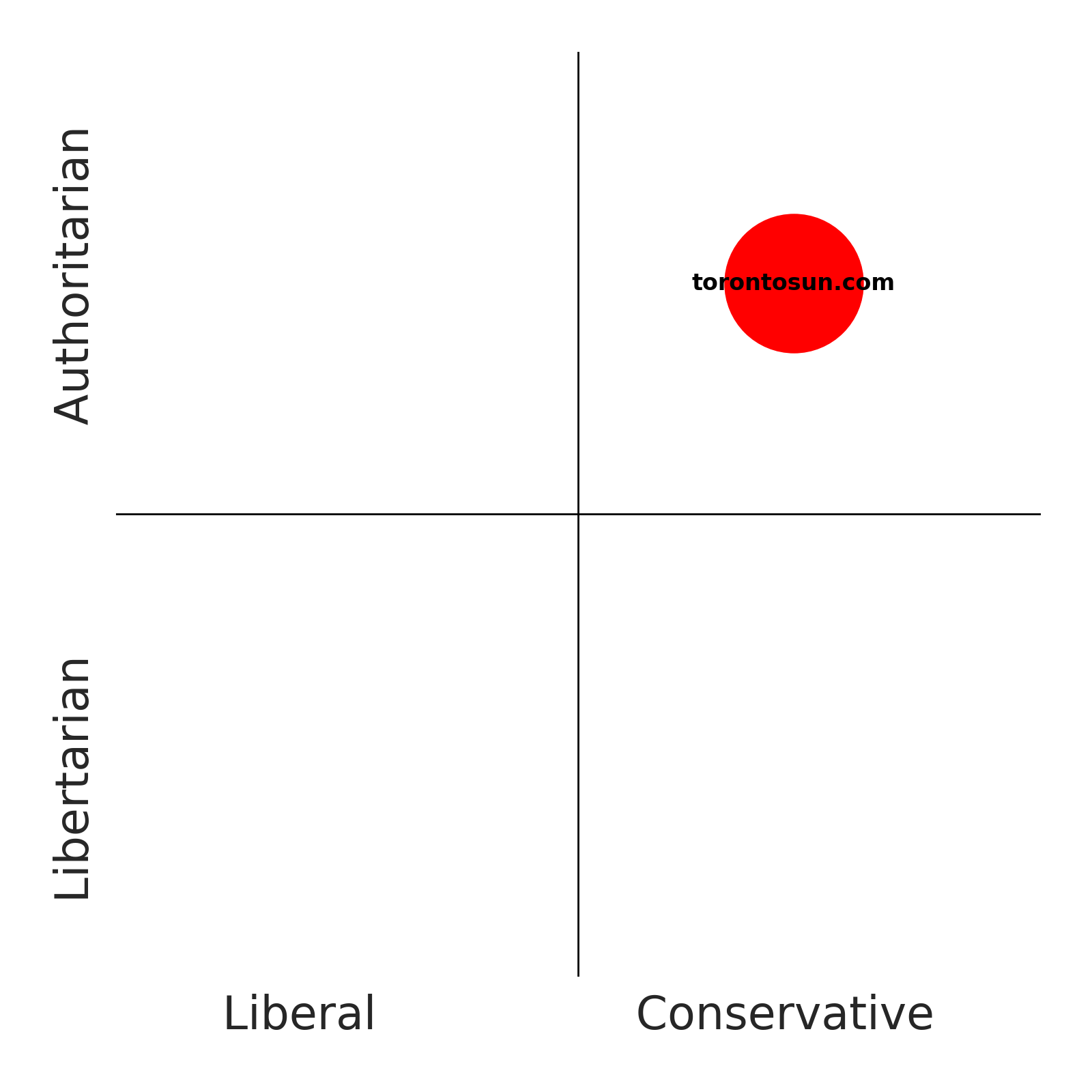
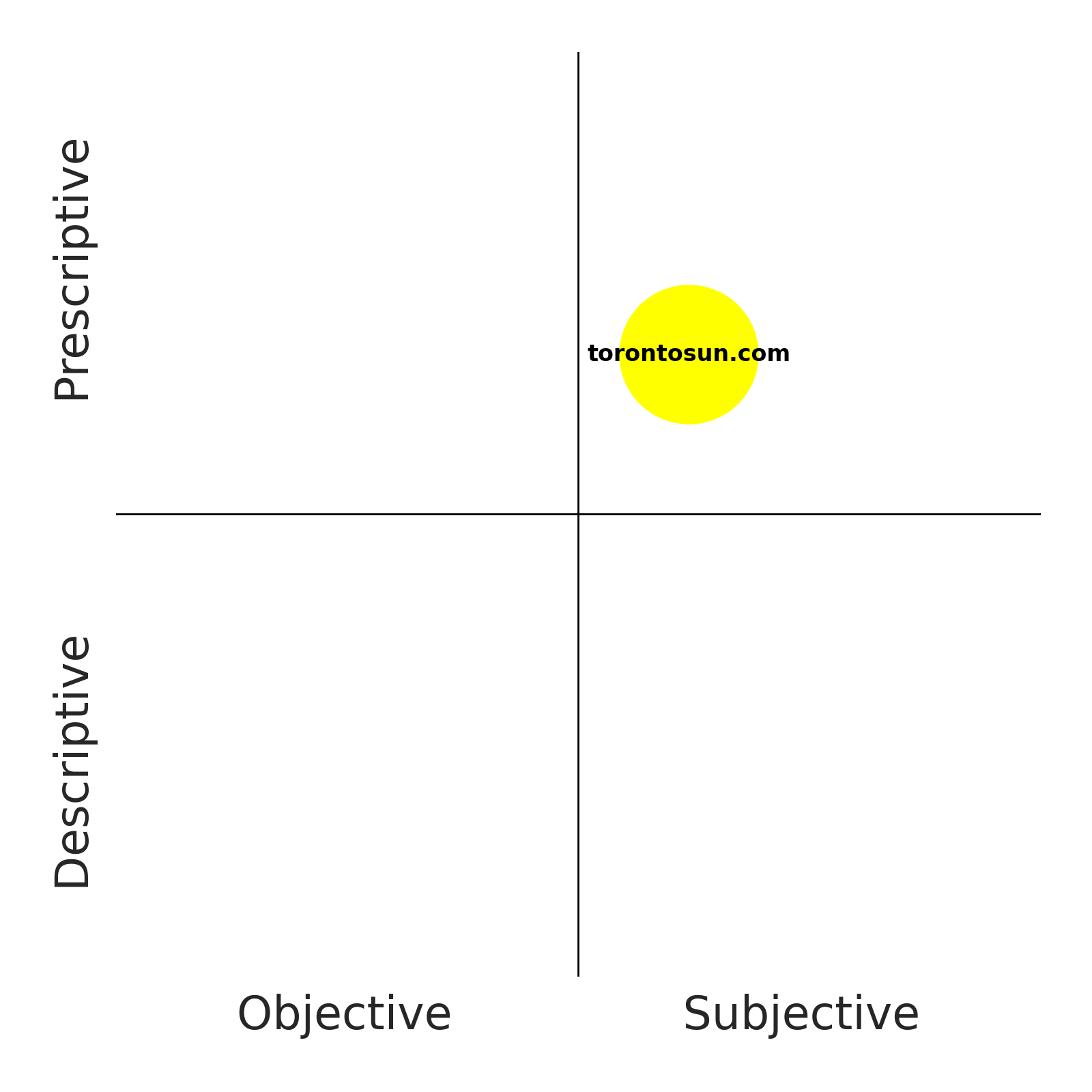
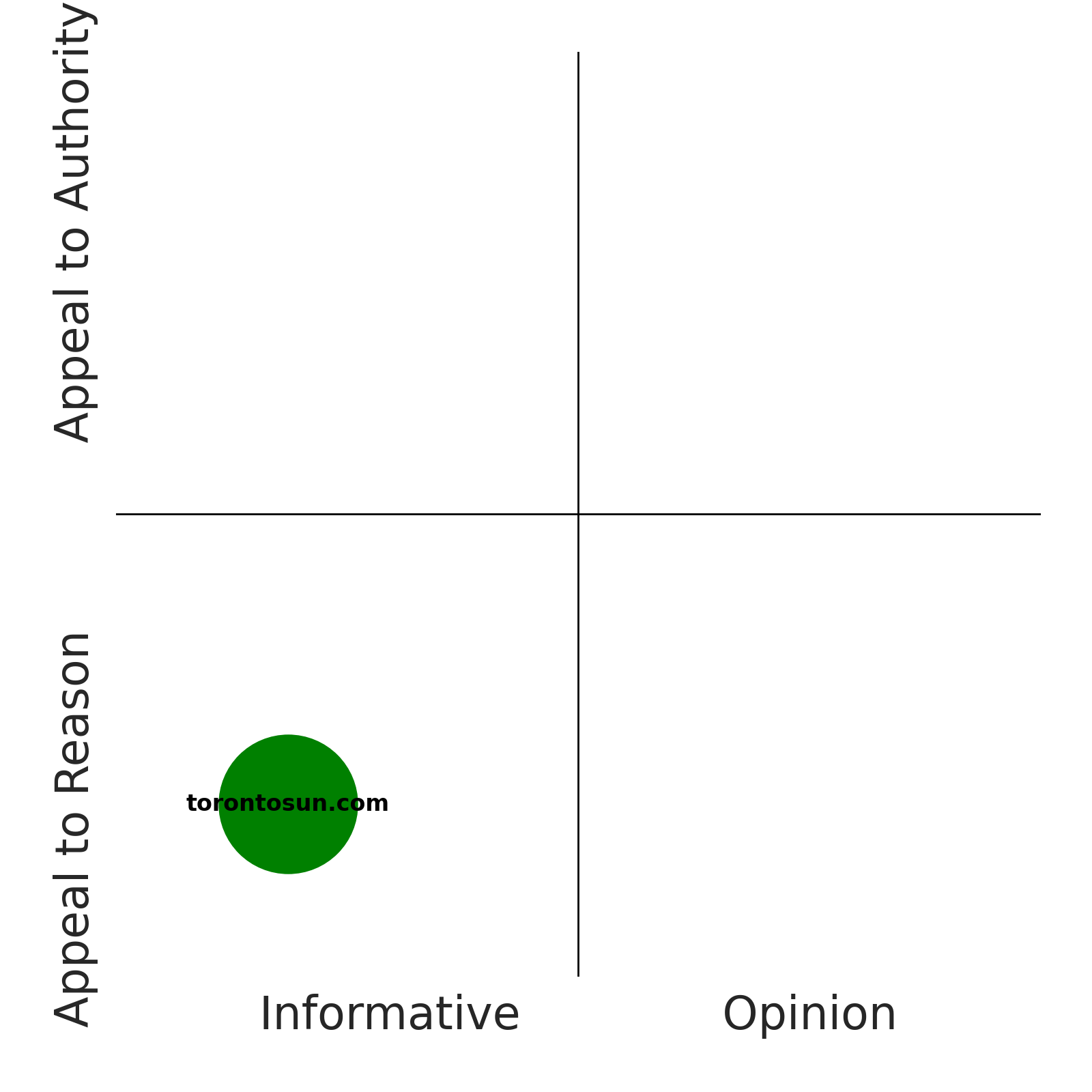
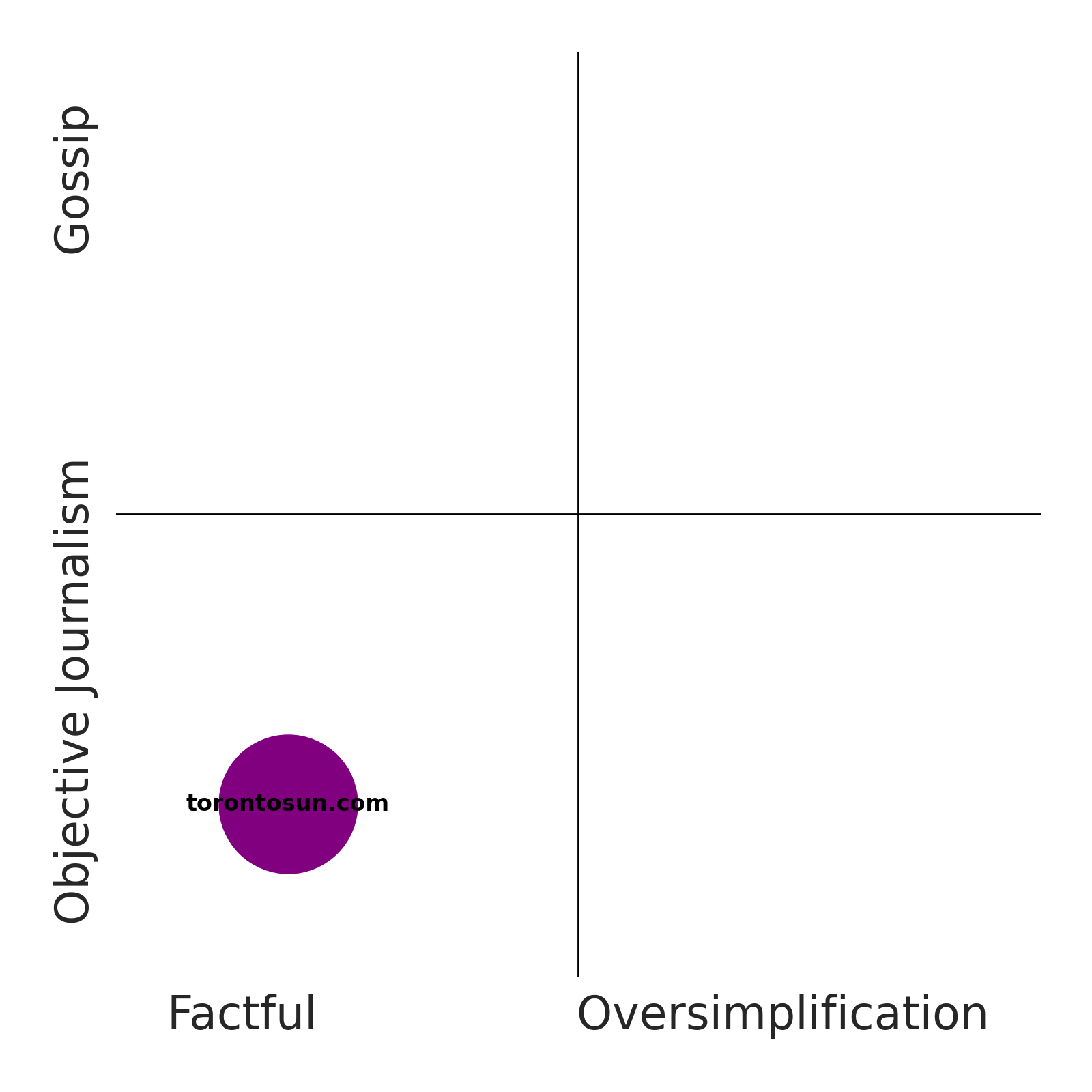
2026 © Helium Trades
Privacy Policy & Disclosure
* Disclaimer: Nothing on this website constitutes investment advice, performance data or any recommendation that any particular security, portfolio of securities, transaction or investment strategy is suitable for any specific person. Helium Trades is not responsible in any way for the accuracy
of any model predictions or price data. Any mention of a particular security and related prediction data is not a recommendation to buy or sell that security. Investments in securities involve the risk of loss. Past performance is no guarantee of future results. Helium Trades is not responsible for any of your investment decisions,
you should consult a financial expert before engaging in any transaction.
Helium Research Assistant

How can I help you today?
Ask any question about torontosun.com bias.