See whether Helium helps you make better-informed decisions. Try every Pro Trader feature for 30 days. No credit card required.
Try every Pro Trader feature for 30 days. No credit card required.
The sample is unmistakably a trucking/freight trade publication (in the mold of Transport Topics or FreightWaves), publishing daily coverage dated Sept.
28–30, 2026 across fleet economics, fuel policy, truck technology, and trade [37]
September 28, 2026 · 0 shares
The reporting frames August truck tonnage declines as evidence that tighter capacity, not stronger demand, is driving the market, with geopolitical diesel costs and weak consumer confidence offered as the main supporting causes.
The ATA For-Hire Truck Tonnage Index is a monthly benchmark of for-hire truck freight volume; the Cass Freight Index and Logistics Managers' Index are separate freight-activity gauges. Consumer confidence and diesel prices are watched as indicators of freight demand.
Automated analysis; not human reviewed. Limitations: The supplied text repeats the same body paragraphs multiple times, so the analysis collapses duplicated content; no external fact-checking was possible. · 7 of 55 available dimensions scored; omitted dimensions are not treated as neutral. · Verified supporting quotes for 7 of 7 scored dimensions.
Claim: The reporting is predominantly objective and data-driven, with interpretations explicitly attributed to named sources.
“The American Trucking Associations For-Hire Truck Tonnage Index declined 0.5% sequentially to 112.7 from 113.3.” · exact text match
Why: The publisher states statistics directly and attributes analysis to ATA, Breakthrough, IntelliTrans, and named academics rather than asserting opinion as fact.
Claim: The article describes market conditions and quotes forecasts rather than issuing directives or policy prescriptions.
“IntelliTrans data showed spot rates were still more than 30% higher than in August 2025.” · exact text match
Why: The text mainly reports data, quotes economists, and characterizes market dynamics without telling readers what to do or demanding policy action.
Claim: Named institutional sources, specific index figures, and attributed forecasts support the report's credibility.
“The Conference Board Consumer Confidence Index fell to an eight-month low of 89.4, while its expectations index fell into the range associated with recession risk at 68.2.” · exact text match
Why: The article consistently names organizations, individual experts, and precise data points, which supports verifiability and measured reporting.
Claim: The article bases its central claim on quantitative indices and attributed expert reasoning rather than emotional or unsupported assertions.
“The Cass Freight Index found that shipments increased 2.1% year over year to 1.038 from 1.017.” · exact text match
Why: The market explanation is tied to observable index levels and attributed expert interpretation, with no supernatural, conspiratorial, or purely ideological reasoning.
Claim: The report is empirical, relying on statistical indexes and economic analysis rather than superstition or ideological claims.
“The Logistics Managers' Index decreased 2.2 points from the previous month to 66.6 in August.” · verified after text normalization
Why: The analysis is built from freight indices, consumer-confidence readings, and named economists' interpretations, with no appeal to non-empirical authority.
Claim: The piece synthesizes multiple data sources and named expert views without oversimplifying the market picture.
“The national numbers make August look like a softer freight month, but that is not necessarily what bulk and breakbulk shippers felt” · exact text match
Why: It holds competing observations together, noting both aggregate softness and regional or segment-specific tightness, which shows analytical nuance.
Claim: The analysis is truth-seeking and hedged, with explicit uncertainty attached to forecasts and diagnoses.
“Jonathan Phares, assistant professor of supply chain management at Iowa State University, suspects gains in the industrial economy, such as those surrounding artificial intelligence infrastructure, haven't been enough to offset losses in consumer markets.” · verified after text normalization
Why: The article repeatedly uses attributions like 'suspects' and 'warned' and presents competing expert interpretations, indicating a search for evidence rather than detachment from it.
The supplied text repeats the same body paragraphs multiple times, so the analysis collapses duplicated content; no external fact-checking was possible.
September 29, 2026 · 0 shares
Near-record port imports are framed as an unmet opportunity for truckers, with named executives and data providers supplying the causal explanations and the underlying statistics presented without independent analysis.
Dry van truckload is the market for moving containerized or boxed freight in enclosed trailers; container dwell time is how long a container waits at a terminal before pickup. In U.S. intermodal freight, imports arrive at seaports and then move onward by truck or rail.
Automated analysis; not human reviewed. Limitations: The supplied text contains duplicated passages and a trailing list of unrelated headlines, so the analysis treats the first full occurrences of each passage as the substantive article; no external fact-checking was possible. · 6 of 55 available dimensions scored; omitted dimensions are not treated as neutral. · Verified supporting quotes for 6 of 6 scored dimensions.
Claim: The report is descriptive, with analysis attributed to named sources rather than asserted by the publisher.
“Trucking companies serving major U.S. ports struggled to fully capitalize on a surge in import volumes during August, data shows.” · exact text match
Why: The opening sentence states a finding as data-backed, and explanations such as front-loading and consumer confidence are explicitly attributed to Roe and Loya.
Claim: The tone is restrained and statistical, with emotional language confined to direct quotations.
“Container volumes at the Port of Los Angeles slipped 0.3% to 955,907 TEUs from 958,355 a year earlier, but the facility notched its busiest three-month stretch on record with 2.9 million units.” · exact text match
Why: The publisher uses precise TEU figures and percentage changes; phrases like 'struggling big time' appear only inside attributed quotes.
Claim: The article reports metrics and quotes without recommending or prescribing any policy or business action.
“The Pacific Merchant Shipping Association reported truck dwell time held relatively steady at 2.95 days in August, roughly in line with the past year.” · exact text match
Why: Most content is presented as reported data and attributed commentary, with no calls for action or recommendations.
Claim: Credibility is supported by specific named data sources, exact figures, and disclosure of data gaps.
“Descartes Systems Group reported in its monthly global shipping report that container imports increased 3.3% from a year earlier to 2,603,709 TEUs.” · exact text match
“The South Carolina Ports Authority and the Port Authority of New York and New Jersey had not released August volume data by press time.” · exact text match
Why: Sourcing is specific to named organizations and reports, and limitations are stated, increasing visible trustworthiness.
Claim: Causal explanations are presented as hypotheses by named experts rather than as certainties.
“Roe noted that container imports hit 2.6 million 20-foot-equivalent units in August, the third-highest month on record, while both the Port of Los Angeles container and Port of Long Beach saw busy August volume.” · exact text match
Why: The article separates quantitative data from interpretation and credits the interpretation to a named source rather than asserting it as fact.
Claim: The reporting is transparent about missing data and consistently attributes claims to named organizations and individuals.
“The South Carolina Ports Authority and the Port Authority of New York and New Jersey had not released August volume data by press time.” · exact text match
Why: Explicitly disclosing unavailable data and naming sources are observable fairness and honesty signals.
The supplied text contains duplicated passages and a trailing list of unrelated headlines, so the analysis treats the first full occurrences of each passage as the substantive article; no external fact-checking was possible.
Topic selection clusters tightly around:
September 29, 2026 · 0 shares
A signed industry-leader advocacy column frames recent federal and state CDL and carrier enforcement actions as proof that its recommended trucking-safety agenda is succeeding and urges completion of the reforms.
Automated analysis; not human reviewed.
Limitations: The piece is a signed advocacy column, so statistics and claims are authorial assertions rather than independently verified reporting; the supplied text also contains repeated and truncated chunks.
·
7 of 55 available dimensions scored; omitted dimensions are not treated as neutral. ·
Verified supporting quotes for 4 of 7 scored dimensions.
Claim: The text favors increased regulatory oversight and enforcement rather than deregulation.
“The plan calls for stronger CDL safeguards, better oversight of training providers, improved safety data, tougher action against freight fraud, greater electronic logging device integrity and more consistent enforcement.”
· not found in supplied text
Why: It repeatedly asks regulators and law enforcement to do more, indicating a preference for state authority over market self-policing. Claim: The framing is subjective and advocacy-driven, presenting the authors' assessment of success rather than neutral reporting.
“Our goal was straightforward: Identify the gaps that allow bad actors to enter and operate illegally in trucking and provide the road map and action plan to close them.”
· exact text match
“Early results show what is possible when industry and government work together with a common purpose.”
· exact text match
Why: First-person purpose-setting and value-laden conclusions reflect a subjective stance, even though some statistics are cited. Claim: The piece is optimistic about the trajectory of trucking safety enforcement.
“A trucking resurgence is underway.”
· exact text match
“Early results show what is possible when industry and government work together with a common purpose.”
· exact text match
Why: It declares progress and momentum, while still calling for more work, producing a positive orientation. Claim: The piece is predominantly prescriptive, urging specific policy and enforcement actions.
“Now we must finish the job.”
· exact text match
“The plan calls for stronger CDL safeguards, better oversight of training providers, improved safety data, tougher action against freight fraud, greater electronic logging device integrity and more consistent enforcement.”
· not found in supplied text
Why: The text repeatedly shifts from description to command, using 'must' and 'need' to advocate for a defined regulatory agenda. Claim: The text is an opinion piece advancing an organizational advocacy agenda.
“That is meaningful progress, but it is not a victory lap.”
· exact text match
“The plan was not about pointing fingers. It was about fixing systems, making roads safer and protecting the integrity of the trucking industry.”
· exact text match
Why: Signed by two association executives and labeled 'Perspective,' the piece argues for its own plan and uses evaluative language. Claim: The text engages in public-policy advocacy concerning federal and state trucking regulation.
“It calls for closer coordination among federal regulators, state agencies, law enforcement and the trucking industry.”
· not found in supplied text
“Credit belongs to the federal and state officials who have treated these concerns with the urgency they deserve.”
· exact text match
Why: The content is substantially about government oversight and credits named federal officials, though it is not partisan. Claim: The piece aligns with established industry and government institutions and their partnership.
“Credit belongs to the federal and state officials who have treated these concerns with the urgency they deserve.”
· exact text match
Why: It praises federal and state officials and the ATA federation, endorsing the current institutional structure rather than challenging it. The piece is a signed advocacy column, so statistics and claims are authorial assertions rather than independently verified reporting; the supplied text also contains repeated and truncated chunks.
Perspective: America's trucking resurgence is underway
Article Analysis
Hidden Assumptions
Bias Dimensions
Inspect evidence · 70% classification confidence
Inspect evidence · 75% classification confidence
Inspect evidence · 80% classification confidence
Inspect evidence · 85% classification confidence
Inspect evidence · 90% classification confidence
Inspect evidence · 65% classification confidence
Inspect evidence · 65% classification confidence
Analysis Self-Critique
September 28, 2026 · 0 shares
The reporting frames August truck tonnage declines as evidence that tighter capacity, not stronger demand, is driving the market, with geopolitical diesel costs and weak consumer confidence offered as the main supporting causes.
The ATA For-Hire Truck Tonnage Index is a monthly benchmark of for-hire truck freight volume; the Cass Freight Index and Logistics Managers' Index are separate freight-activity gauges. Consumer confidence and diesel prices are watched as indicators of freight demand.
Automated analysis; not human reviewed. Limitations: The supplied text repeats the same body paragraphs multiple times, so the analysis collapses duplicated content; no external fact-checking was possible. · 7 of 55 available dimensions scored; omitted dimensions are not treated as neutral. · Verified supporting quotes for 7 of 7 scored dimensions.
Claim: The reporting is predominantly objective and data-driven, with interpretations explicitly attributed to named sources.
“The American Trucking Associations For-Hire Truck Tonnage Index declined 0.5% sequentially to 112.7 from 113.3.” · exact text match
Why: The publisher states statistics directly and attributes analysis to ATA, Breakthrough, IntelliTrans, and named academics rather than asserting opinion as fact.
Claim: The article describes market conditions and quotes forecasts rather than issuing directives or policy prescriptions.
“IntelliTrans data showed spot rates were still more than 30% higher than in August 2025.” · exact text match
Why: The text mainly reports data, quotes economists, and characterizes market dynamics without telling readers what to do or demanding policy action.
Claim: Named institutional sources, specific index figures, and attributed forecasts support the report's credibility.
“The Conference Board Consumer Confidence Index fell to an eight-month low of 89.4, while its expectations index fell into the range associated with recession risk at 68.2.” · exact text match
Why: The article consistently names organizations, individual experts, and precise data points, which supports verifiability and measured reporting.
Claim: The article bases its central claim on quantitative indices and attributed expert reasoning rather than emotional or unsupported assertions.
“The Cass Freight Index found that shipments increased 2.1% year over year to 1.038 from 1.017.” · exact text match
Why: The market explanation is tied to observable index levels and attributed expert interpretation, with no supernatural, conspiratorial, or purely ideological reasoning.
Claim: The report is empirical, relying on statistical indexes and economic analysis rather than superstition or ideological claims.
“The Logistics Managers' Index decreased 2.2 points from the previous month to 66.6 in August.” · verified after text normalization
Why: The analysis is built from freight indices, consumer-confidence readings, and named economists' interpretations, with no appeal to non-empirical authority.
Claim: The piece synthesizes multiple data sources and named expert views without oversimplifying the market picture.
“The national numbers make August look like a softer freight month, but that is not necessarily what bulk and breakbulk shippers felt” · exact text match
Why: It holds competing observations together, noting both aggregate softness and regional or segment-specific tightness, which shows analytical nuance.
Claim: The analysis is truth-seeking and hedged, with explicit uncertainty attached to forecasts and diagnoses.
“Jonathan Phares, assistant professor of supply chain management at Iowa State University, suspects gains in the industrial economy, such as those surrounding artificial intelligence infrastructure, haven't been enough to offset losses in consumer markets.” · verified after text normalization
Why: The article repeatedly uses attributions like 'suspects' and 'warned' and presents competing expert interpretations, indicating a search for evidence rather than detachment from it.
The supplied text repeats the same body paragraphs multiple times, so the analysis collapses duplicated content; no external fact-checking was possible.
September 29, 2026 · 0 shares
Data-led and measured framing characterizes the U.S. labor market as resilient but sluggish, attributing past hiring weakness partly to trade-policy uncertainty without endorsing a policy response.
Automated analysis; not human reviewed. Limitations: The supplied text contains duplicated passages and truncated strings; analysis is based on the most complete rendering. The causal assertion about Trump trade-policy uncertainty is stated without attribution. · 5 of 55 available dimensions scored; omitted dimensions are not treated as neutral. · Verified supporting quotes for 5 of 5 scored dimensions.
Claim: The presentation is politically neutral, balancing positive and negative labor-market indicators without endorsing a party or policy.
“The U.S. job market is sturdy, though unspectacular, despite an energy shock from the Iran war.” · exact text match
“Americans’ confidence in the economy has sunk to the lowest level in more than a decade” · exact text match
Why: Positive and negative indicators are placed side by side; the Trump trade-policy reference is contextual, not a partisan call to action.
Claim: Reporting is mostly objective, leaning on official statistics and attributed forecasts with only minor evaluative characterization.
“U.S. job openings slid to 7.08 million from a revised 7.34 million in July, the Labor Department reported Sept. 29.” · exact text match
Counterevidence:
“The U.S. job market is sturdy, though unspectacular” · exact text match
Why: The facts and attributions dominate; the 'sturdy, though unspectacular' phrase adds an evaluative gloss but does not drive the report.
Claim: The report describes conditions and forecasts and offers no recommended policy or action.
“Employers may not be laying workers off, but they aren't hiring nearly as many as they did a few years ago.” · exact text match
Why: The passage is a descriptive diagnosis; no imperative or policy recommendation appears.
Claim: The text is essentially factual and attributed, with a single mild editorial characterization of the labor market.
“The U.S. job market is sturdy, though unspectacular, despite an energy shock from the Iran war.” · exact text match
Why: This phrase is an authorial judgment, but the surrounding content is data-led and sourced.
Claim: Credibility is high because the report names its data sources, attributes forecasts, and quotes a named economist.
“the Labor Department reported Sept. 29” · exact text match
“according to a survey of forecasters by the data firm FactSet” · exact text match
“Cory Stahle, senior economist at the Indeed jobs website, said” · exact text match
Why: Clear sourcing and attribution support verification; no unsourced central claim drives the report.
The supplied text contains duplicated passages and truncated strings; analysis is based on the most complete rendering. The causal assertion about Trump trade-policy uncertainty is stated without attribution.
September 29, 2026 · 0 shares
Near-record port imports are framed as an unmet opportunity for truckers, with named executives and data providers supplying the causal explanations and the underlying statistics presented without independent analysis.
Dry van truckload is the market for moving containerized or boxed freight in enclosed trailers; container dwell time is how long a container waits at a terminal before pickup. In U.S. intermodal freight, imports arrive at seaports and then move onward by truck or rail.
Automated analysis; not human reviewed. Limitations: The supplied text contains duplicated passages and a trailing list of unrelated headlines, so the analysis treats the first full occurrences of each passage as the substantive article; no external fact-checking was possible. · 6 of 55 available dimensions scored; omitted dimensions are not treated as neutral. · Verified supporting quotes for 6 of 6 scored dimensions.
Claim: The report is descriptive, with analysis attributed to named sources rather than asserted by the publisher.
“Trucking companies serving major U.S. ports struggled to fully capitalize on a surge in import volumes during August, data shows.” · exact text match
Why: The opening sentence states a finding as data-backed, and explanations such as front-loading and consumer confidence are explicitly attributed to Roe and Loya.
Claim: The tone is restrained and statistical, with emotional language confined to direct quotations.
“Container volumes at the Port of Los Angeles slipped 0.3% to 955,907 TEUs from 958,355 a year earlier, but the facility notched its busiest three-month stretch on record with 2.9 million units.” · exact text match
Why: The publisher uses precise TEU figures and percentage changes; phrases like 'struggling big time' appear only inside attributed quotes.
Claim: The article reports metrics and quotes without recommending or prescribing any policy or business action.
“The Pacific Merchant Shipping Association reported truck dwell time held relatively steady at 2.95 days in August, roughly in line with the past year.” · exact text match
Why: Most content is presented as reported data and attributed commentary, with no calls for action or recommendations.
Claim: Credibility is supported by specific named data sources, exact figures, and disclosure of data gaps.
“Descartes Systems Group reported in its monthly global shipping report that container imports increased 3.3% from a year earlier to 2,603,709 TEUs.” · exact text match
“The South Carolina Ports Authority and the Port Authority of New York and New Jersey had not released August volume data by press time.” · exact text match
Why: Sourcing is specific to named organizations and reports, and limitations are stated, increasing visible trustworthiness.
Claim: Causal explanations are presented as hypotheses by named experts rather than as certainties.
“Roe noted that container imports hit 2.6 million 20-foot-equivalent units in August, the third-highest month on record, while both the Port of Los Angeles container and Port of Long Beach saw busy August volume.” · exact text match
Why: The article separates quantitative data from interpretation and credits the interpretation to a named source rather than asserting it as fact.
Claim: The reporting is transparent about missing data and consistently attributes claims to named organizations and individuals.
“The South Carolina Ports Authority and the Port Authority of New York and New Jersey had not released August volume data by press time.” · exact text match
Why: Explicitly disclosing unavailable data and naming sources are observable fairness and honesty signals.
The supplied text contains duplicated passages and a trailing list of unrelated headlines, so the analysis treats the first full occurrences of each passage as the substantive article; no external fact-checking was possible.
Hedged, attributed financial-news language frames inflation and Treasury-yield movements as driven by multiple interlocking market factors.
The Federal Reserve uses this inflation report to guide its interest-rate decisions, and markets were closely watching the data for signals about the next policy move.
Automated analysis; not human reviewed. Limitations: The supplied text is truncated at the start and interspersed with a promotional insert, so the analysis relies on the visible fragmentary news paragraphs. · 8 of 55 available dimensions scored; omitted dimensions are not treated as neutral. · Verified supporting quotes for 8 of 8 scored dimensions.
Claim: Reporting maintains political neutrality on inflation and fiscal policy.
“While that's still worse than the Fed's 2% target, it was not as bad as the 3.7% that economists expected.” · verified after text normalization
Why: The sentence presents the Fed target and economist expectations without endorsing a political position.
Claim: The article is strictly descriptive, attributing all figures and views to named sources.
“The 30-year Treasury yield, which takes into account expectations for inflation and economic growth many years down the line, edged up to 5.60% from 5.59% late Sept.” · exact text match
“according to data from CME Group.” · exact text match
Why: Precise numbers and explicit data attribution indicate objective market reporting without subjective evaluation.
Claim: The article describes market conditions and factors without recommending any policy or action.
“Other factors sending yields higher are also continuing to churn, including worries about the big debt loads that Washington and other governments worldwide are supporting.” · exact text match
Why: The sentence catalogs causal factors descriptively; no prescription is offered.
Claim: The tone is emotionally neutral, reporting market expectations as probabilities.
“They now see less than a coin flip's chance of that, according to data from CME Group.” · verified after text normalization
Why: Probability language and calm attribution convey no fear, enthusiasm, or emotional valence.
Claim: The article supplies specific, attributed data points and names its data providers.
“edged up to 5.60% from 5.59% late Sept.” · exact text match
“according to data from CME Group.” · exact text match
Why: Concrete figures with named providers and contributing writers support a credible evidentiary base within the visible text.
Claim: Forward-looking statements are limited to market uncertainty about a geopolitical event.
“which have been swinging on uncertainty about when the war with Iran will allow the flow of crude to be fully restored” · exact text match
Why: The only speculative element is explicitly attributed to market uncertainty, not asserted as a forecast.
Claim: The article signals fairness by crediting contributing writers and acknowledging multiple causal factors.
“AP Business Writers Yuri Kageyama and Michelle Chapman contributed to this report.” · exact text match
“To be sure, worries about high inflation are just one of the reasons yields have jumped in the United States and around the world.” · exact text match
Why: Named contributors and explicit acknowledgement of competing explanations indicate transparent reporting practices.
Claim: The article synthesizes multiple market drivers into a coherent analytical narrative.
“The bond market also felt upward pressure from another climb for oil prices, which have been swinging on uncertainty about when the war with Iran will allow the flow of crude to be fully restored.” · exact text match
Why: Connecting inflation data, Treasury yields, oil prices, and geopolitical uncertainty reflects competent financial analysis.
The supplied text is truncated at the start and interspersed with a promotional insert, so the analysis relies on the visible fragmentary news paragraphs.
Sponsor-generated promotional framing extols the Force flatbed as an American-made product backed by 80 years of manufacturing and a commitment to quality, integrity, and service.
Automated analysis; not human reviewed. Limitations: The supplied text is truncated mid-sentence and is explicitly sponsor-generated promotional content, so the analysis is based on the visible marketing language and may not capture any non-promotional content omitted by truncation. · 7 of 55 available dimensions scored; omitted dimensions are not treated as neutral. · Verified supporting quotes for 7 of 7 scored dimensions.
Claim: Subjective value judgments are presented as objective product facts.
“an all-aluminum flatbed that balances weight, durability, serviceability, and value” · exact text match
“a commitment to quality, integrity, and service” · exact text match
Why: Phrases like 'balances... value' and 'quality, integrity, and service' are inherently subjective assessments stated without attribution or evidence.
Claim: The text asserts opinions as facts, including market leadership and product quality.
“Fontaine Trailer is North America’s largest platform trailer manufacturer.” · exact text match
Why: The unqualified market-leadership claim and the promotional product description are opinions presented as established facts.
Claim: The text asserts unqualified superlatives about market position.
“Fontaine Trailer is North America’s largest platform trailer manufacturer.” · exact text match
Why: The word 'largest' asserts a factual market position without supplying market data or evidence, exceeding what the text alone can support.
Claim: The text provides no sourcing, attribution, or uncertainty qualifiers for its factual claims.
“Fontaine Trailer is North America’s largest platform trailer manufacturer.” · exact text match
Why: The market-leadership claim is presented without data, study, or attribution, and no other claim in the text carries a source or qualifier.
Claim: The publisher explicitly discloses the content as sponsor-generated and uses promotional language throughout.
“The above article is sponsor-generated content.” · exact text match
Why: The disclosure confirms the text is paid promotional content, and the surrounding copy markets the product with positive superlatives.
Claim: The text adopts the company's own first-person promotional voice.
“We have built American-made flatbeds for 80 years with a commitment to quality, integrity, and service.” · exact text match
Why: The first-person 'we' and unqualified corporate virtue claims present the company's self-image as fact.
Claim: The text uses one-sided framing that omits any product limitations or competitive comparisons.
“Force gives fleet customers another choice: an all-aluminum flatbed that balances weight, durability, serviceability, and value.” · exact text match
Why: Only favorable attributes are presented; no downsides, pricing, or alternatives are mentioned, though the sponsor disclosure reduces the deception.
The supplied text is truncated mid-sentence and is explicitly sponsor-generated promotional content, so the analysis is based on the visible marketing language and may not capture any non-promotional content omitted by truncation.
September 28, 2026 · 0 shares
Centers a TotalEnergies executive's warning that a U.S. diesel export ban would backfire on gasoline prices, with the ban's farm-state backers mentioned only briefly as context.
Automated analysis; not human reviewed. Limitations: The supplied extract contains duplicated/truncated paragraphs and unrelated headline fragments, so some original context may be missing. · 6 of 55 available dimensions scored; omitted dimensions are not treated as neutral. · Verified supporting quotes for 6 of 6 scored dimensions.
Claim: No partisan valuation is placed on the administration policy or its critics.
“under consideration by President Donald Trump to combat high prices” · exact text match
“Several farm-state lawmakers have urged Trump to limit U.S. diesel exports” · exact text match
Why: The administration's goal and lawmakers' request are described in neutral, non-evaluative terms.
Claim: Reporting attributes the policy critique to the executive rather than asserting it.
““It’s a bad idea,” CEO Patrick Pouyanné said during a meeting with investors in New York on Sept. 28.” · exact text match
Why: The central claim is placed in quotation marks and tied to a named source, date, and meeting, separating the publisher's report from the executive's opinion.
Claim: The story is mostly matter-of-fact but uses some vivid market language.
“diesel exports surging to a weekly record of nearly 2 million barrels a day in August” · exact text match
Counterevidence:
“global fuel markets reel from disrupted flows” · exact text match
Why: The record export figure is stated plainly, while 'reel' adds a mild dramatic tone that prevents a strongly objective score.
Claim: The report is grounded in a presidential policy decision and lobbying by lawmakers.
“President Donald Trump” · exact text match
“Several farm-state lawmakers” · exact text match
Why: The policy proposal and political pressure are central to the story, giving it a modest political charge without partisan advocacy.
Claim: The report provides named sources, dates, and specific quantitative data.
“nearly 2 million barrels a day in August” · exact text match
“TotalEnergies SE” · exact text match
“New York on Sept. 28” · exact text match
Why: Concrete figures, a named executive and company, and a dated event provide verifiable anchors.
Claim: The report visibly hedges uncertain effects and includes proponents of the policy.
“oblige U.S. refineries to lower their throughput, and then it might impact the gasoline price in the U.S.” · exact text match
“Several farm-state lawmakers have urged Trump to limit U.S. diesel exports” · exact text match
Why: Causal language is qualified with 'might' and the policy's supporters are mentioned, signaling fair handling of a contested issue.
The supplied extract contains duplicated/truncated paragraphs and unrelated headline fragments, so some original context may be missing.
September 29, 2026 · 0 shares
Reporting frames the SPR drawdown as an election-season response to surging fuel prices while attributing criticism of European shortfalls to Energy Secretary Chris Wright.
The Strategic Petroleum Reserve is the U.S. government's emergency crude oil stockpile, and the International Energy Agency coordinates emergency stock releases among member countries.
Automated analysis; not human reviewed. Limitations: The supplied text contains repeated/duplicated paragraphs, so the analysis is based on deduplicated substantive content; no other input limitation. · 6 of 55 available dimensions scored; omitted dimensions are not treated as neutral. · Verified supporting quotes for 6 of 6 scored dimensions.
Claim: The report is nonpartisan; it describes the administration's action and surrounding pressure without endorsing or opposing either party.
“The U.S. will offer up to 40 million barrels from the Strategic Petroleum Reserve, according to a statement from the Department of Energy” · exact text match
Why: Attribution and neutral factual statements dominate; no praise or blame is directed at Trump, Democrats, or European governments except in the quoted secretary's criticism.
Claim: The report is predominantly factual but contains minor interpretive characterization.
“Energy Secretary Chris Wright took a swipe at some countries in Europe in the statement” · exact text match
Counterevidence:
“The release was structured as an exchange, essentially a loan that companies repay with interest.” · exact text match
Why: 'Took a swipe' is an editorial characterization, while the surrounding report relies on attributed facts and technical detail.
Claim: The report is sober and non-sensational in its treatment of an emergency-release story.
“Federal law bars non-emergency drawdowns once inventories fall below 252.4 million barrels” · exact text match
Why: It presents legal thresholds, operational minimums, and bid deadlines rather than alarming or dramatic language.
Claim: The article describes events and official statements without prescribing policy.
“Bids for the latest SPR releases are due by 11 a.m. Central time on Oct. 6, according to a statement from the Department of Energy.” · exact text match
Why: Content is limited to reporting what is being done, said, and scheduled; no recommendations are made.
Claim: The story explicitly situates the fuel-price issue in electoral and presidential politics.
“intensifying pressure on President Donald Trump to address rising fuel costs ahead of November’s midterm elections, which could determine control of the House” · exact text match
Why: The release is connected to midterm election pressures and White House accountability, giving the story a political frame.
Claim: The report is credible on the surface due to named sources, direct quotes, and attributed data.
“The U.S. will offer up to 40 million barrels from the Strategic Petroleum Reserve, according to a statement from the Department of Energy” · exact text match
“The reserve’s operational minimum — the point at which it becomes difficult for the infrastructure to function — is around 70 million barrels, according to ClearView Energy Partners, a Washington-based consulting firm.” · exact text match
Why: The publisher attributes policy facts to the DOE, IEA context, and a named consulting firm, and provides direct quotes.
The supplied text contains repeated/duplicated paragraphs, so the analysis is based on deduplicated substantive content; no other input limitation.
Straightforward trade-press reporting treats Abbott's emergency diesel measures and Trump's export-ban deliberations as neutral policy responses to record fuel prices, using attributed sourcing and no editorial evaluation.
Automated analysis; not human reviewed. Limitations: The supplied text contains duplicated passages and an embedded promotional segment; analysis is based on the consolidated substantive news report. · 5 of 55 available dimensions scored; omitted dimensions are not treated as neutral. · Verified supporting quotes for 5 of 5 scored dimensions.
Claim: The coverage is neutral on the partisan dimension, neither endorsing nor condemning the Republican officials' actions.
““Record prices put both industries at risk and raise costs for every Texas family,” Abbott said.” · exact text match
“Trump said at the weekend that he’s still looking “very seriously” at implementing an export ban” · exact text match
Why: Official statements are quoted without praise, criticism, or partisan labels.
Claim: The reporting is largely factual and relies on attributed statements rather than subjective commentary.
“Gov. Greg Abbott issued a disaster proclamation on Sept. 28 with a range of measures, including a provision that farmers and truckers can now use dyed diesel on Texas roads, according to a statement on his office’s website.” · exact text match
“Trump said at the weekend that he’s still looking “very seriously” at implementing an export ban, even as others in his administration continue to focus on other possible steps.” · exact text match
Why: Descriptions are sourced to a government statement or directly attributed, with no evaluative adjectives or first-person opinion.
Claim: The report conveys record price and disruption information without sensationalizing it.
“U.S. retail prices have hit a record, and are now averaging about $6.44 a gallon.” · exact text match
Why: The most dramatic fact is presented as a numeric average, and policy reactions are attributed rather than amplified.
Claim: The text describes policy actions and market conditions without prescribing or recommending policy.
“The proclamation by Abbott also suspended the Texas Low Emission Diesel rules as far as the EPA allows.” · exact text match
“Fuel, crop, and timber loads can also move at a higher weight.” · exact text match
Why: It lists measures and effects, and the only advocacy appears inside a direct quotation from Governor Abbott.
Claim: Visible sourcing and attribution practice support moderate-to-high credibility within the text.
“according to a statement on his office’s website” · exact text match
“Trump said at the weekend that he’s still looking “very seriously” at implementing an export ban, even as others in his administration continue to focus on other possible steps.” · exact text match
Why: It attributes the governor's action to an official statement, quotes the governor and president, and uses hedging like 'has mulled' and 'could' for uncertain policy outcomes.
The supplied text contains duplicated passages and an embedded promotional segment; analysis is based on the consolidated substantive news report.
September 28, 2026 · 0 shares
Framing treats the Iowa steel announcement as a midterm-season political move while foregrounding Trump's unpopularity and the economic costs of his trade and Iran policies.
Automated analysis; not human reviewed. Limitations: The supplied text is a fragmented, repeated concatenation that mixes headline, summary, body, and promotional content, so the intended article boundary and publisher framing are harder to identify with certainty. · 7 of 55 available dimensions scored; omitted dimensions are not treated as neutral. · Verified supporting quotes for 7 of 7 scored dimensions.
Claim: The article's loaded descriptions of Trump's foreign and trade policy create a measurably anti-Trump framing.
“record-high diesel prices driven by Trump’s war in Iran” · exact text match
“The president’s tariffs and trade brinkmanship also have shrunk farmers’ export markets.” · exact text match
Why: The article reports poll and tariff data, but uses 'war in Iran' and 'trade brinkmanship' as uncontested negative characterizations of Trump's policies, tilting the framing against the administration.
Claim: The reporting is mostly factual but shifts to subjective characterization in its coverage of Trump's policies.
“Iowa’s agriculture-dependent economy has come under strain from high fuel and fertilizer costs, including record-high diesel prices driven by Trump’s war in Iran.” · exact text match
Why: The phrase 'Trump’s war in Iran' is a contested characterization stated as fact, making the passage at least partly subjective.
Claim: The text includes evaluative causal judgments in a news report.
“The president’s tariffs and trade brinkmanship also have shrunk farmers’ export markets.” · exact text match
Why: 'Trade brinkmanship' and the asserted causal effect are editorial judgments presented alongside factual reporting.
Claim: The report centers the announcement in competitive midterm electoral politics rather than project or industry details.
“The announcement comes amid a pitched election battle over whether Republicans will retain control of Congress in November’s midterm elections, with Iowa playing an unusually central role.” · exact text match
Why: The article repeatedly connects the plant announcement to Republican vulnerability, Iowa toss-up races, and votes for or against Trump.
Claim: The text uses named sources, specific poll and trade data, and hedged projections, but also contains an unsourced causal characterization.
“Steelmaking at the plant could begin by 2030, according to a White House official who shared details of the investment before the announcement.” · exact text match
“In 2025, the U.S. imported about $25 billion worth of steel articles, with the bulk supplied by the European Union and Canada, according to the Congressional Research Service.” · exact text match
Counterevidence:
“record-high diesel prices driven by Trump’s war in Iran” · exact text match
Why: Attribution and hedging are frequent, but the 'war in Iran' clause enters a definitive causal claim without sourcing.
Claim: The article generally distinguishes attributed statements from the reporter's own assertions and identifies its sources.
“Nearly six in 10 registered Iowa voters disapprove of Trump’s job performance, according to a Marist poll released last week.” · exact text match
“In 2025, the U.S. imported about $25 billion worth of steel articles, with the bulk supplied by the European Union and Canada, according to the Congressional Research Service.” · exact text match
Counterevidence:
“driven by Trump’s war in Iran” · exact text match
Why: Frequent attribution supports integrity, while the unqualified 'war in Iran' phrase undermines it slightly.
Claim: The report combines detailed project figures, electoral data, poll numbers, and steel trade statistics.
“Trump said the investment would create up to 6,000 construction jobs and nearly 2,000 manufacturing and mining jobs.” · exact text match
“In 2025, the U.S. imported about $25 billion worth of steel articles, with the bulk supplied by the European Union and Canada, according to the Congressional Research Service.” · exact text match
Why: The text supplies a range of specific quantities and sources, though the provided version is fragmented and duplicated.
The supplied text is a fragmented, repeated concatenation that mixes headline, summary, body, and promotional content, so the intended article boundary and publisher framing are harder to identify with certainty.
September 28, 2026 · 0 shares
Framing urges immediate AI adoption in fleet maintenance as an opportunity while reassuring that human technicians remain central.
Automated analysis; not human reviewed. Limitations: The supplied text is repetitive and appears truncated, with omitted sections and repeated pull quotes, so classification rests on the visible excerpts only. · 3 of 55 available dimensions scored; omitted dimensions are not treated as neutral. · Verified supporting quotes for 2 of 3 scored dimensions.
Claim: The article mixes factual reporting with editorialized statements about AI's value.
“One clear use case for AI is enabling data-driven preventive maintenance programs.” · exact text match
Why: This statement is presented as the publisher's own evaluative conclusion rather than attributed, making the overall text partly subjective.
Claim: The publisher frames AI adoption in fleet maintenance as a positive, opportunity-rich development.
“Those potential benefits cannot be ignored at a time when AI is already ensconced in our phones, vehicles, home appliances and streaming platforms, constantly learning our preferences and serving up recommendations.” · exact text match
Why: The publisher presents AI benefits as unavoidable and as a source of opportunity, supporting a positive/optimistic classification.
Claim: The publisher repeatedly tells readers to act now rather than simply describing events.
“Thompson encouraged industry leaders to begin exploring how they can improve fleet operations and shop performance right now through the use of AI.” · not found in supplied text
“We can start building AI into our workflows today.” · exact text match
Why: The repeated 'right now' and 'today' imperatives, including the selected pull quote, make the framing prescriptive.
The supplied text is repetitive and appears truncated, with omitted sections and repeated pull quotes, so classification rests on the visible excerpts only.
September 28, 2026 · 0 shares
Framing presents AI adoption in trucking as an inevitable competitive necessity, emphasizing productivity gains and urging carriers to overcome employee fear through quick action.
Automated analysis; not human reviewed. Limitations: The supplied text contains repeated/truncated passages and incomplete attribution (e.g., an unnamed 'she'), limiting confidence in precise scalar classifications. · 7 of 55 available dimensions scored; omitted dimensions are not treated as neutral. · Verified supporting quotes for 7 of 7 scored dimensions.
Claim: The framing is optimistic about AI's benefits for workers and companies.
““We’re able to give them a little bit more control of their day and gain back a little bit of their sanity.”” · exact text match
“I don’t see a world in which … a pit of 100 people [only] doing appointment scheduling” · exact text match
Why: The quotes highlight improved job satisfaction and a future where AI handles routine work, a positive outlook.
Claim: The framing prescribes action, telling carriers they must overcome employee fear and encouraging them to 'just do it.'
“Carriers must help employees overcome fear of the technology, experts say” · exact text match
““Just do it,” Hill added, noting that no company “has a lock” on AI yet.” · exact text match
Why: The use of 'must' and the repeated imperative 'Just do it' move beyond description into prescription.
Claim: The article includes expert opinion and advice presented as guidance rather than strictly factual reporting.
““Just do it,” Hill added, noting that no company “has a lock” on AI yet.” · exact text match
Why: Advice from an executive is included as a standalone takeaway, reflecting an opinionated stance.
Claim: The article leans on industry leaders' and experts' authority to support AI adoption.
“technology leaders said” · exact text match
“experts say” · exact text match
Why: The headline and body invoke experts and technology leaders rather than independent evidence for the core claim that fear must be overcome.
Claim: The article shows visible sourcing and attribution, including named executives and specific metrics.
“Arpan Podduturi of Samsara examines how AI, telematics and onboard cameras are converging to protect drivers and reduce risk” · exact text match
“Mark Wang pointed to measurable productivity gains from AI tools already in production” · exact text match
Why: Named sources and concrete productivity claims support the text's reliability on its face.
Claim: The framing is rational and evidence-based, emphasizing realistic use cases and measurable gains.
“realistic use cases that can produce internal success stories and build organizational confidence” · exact text match
“measurable productivity gains from AI tools already in production” · exact text match
Why: The advice and reported results center on practical implementation and measurable outcomes.
Claim: The article includes forward-looking speculation about AI's future role.
“I don’t see a world in which … a pit of 100 people [only] doing appointment scheduling” · exact text match
“no company “has a lock” on AI yet” · exact text match
Why: These statements project future industry conditions rather than reporting current facts.
The supplied text contains repeated/truncated passages and incomplete attribution (e.g., an unnamed 'she'), limiting confidence in precise scalar classifications.
September 28, 2026 · 0 shares
A neutral trade-press report frames AI-assisted truck spec'ing as useful but dependent on fleet-specific data, privacy safeguards, and human oversight.
Automated analysis; not human reviewed. Limitations: The supplied text is truncated with ellipses and repeated fragments, so some context may be missing. · 5 of 55 available dimensions scored; omitted dimensions are not treated as neutral. · Verified supporting quotes for 5 of 5 scored dimensions.
Claim: Reporting is strictly attributed and uses neutral verbs of speech rather than editorial judgments.
“Randy Bell, associate director of digital solutions at International Motors, contrasted his big-tech background with the current state of truck specification tools” · exact text match
“Bell said AI must operate within rules and values, with experts able to pull the plug whenever the technology behaves in ways that are “inconsistent with the way we set it up.”” · exact text match
Why: The article attributes claims to named sources and avoids un-attributed evaluations, indicating objective rather than subjective framing.
Claim: The report is sober and non-hyperbolic, even when relaying warnings about AI.
“Panelists agreed that strict guardrails, continuous testing and human oversight remain nonnegotiable.” · exact text match
“AI, when it doesn’t have those data points to pull in, it’s not making a good decision. But it’s always confident in its decision.” · exact text match
Why: Uses measured terms like 'strict guardrails' and direct expert quotes instead of alarmist language.
Claim: The publisher describes panelists' views and reported events rather than issuing its own prescriptions.
“Panelists agreed that strict guardrails, continuous testing and human oversight remain nonnegotiable.” · exact text match
“Bell said AI must operate within rules and values, with experts able to pull the plug whenever the technology behaves in ways that are “inconsistent with the way we set it up.”” · exact text match
Why: The only prescriptive language is inside attributed quotes or summaries of panelists' agreement, not in the publisher's own voice.
Claim: The article consistently names sources, attributes claims, and provides direct quotes with explicit speakers.
“Randy Bell, associate director of digital solutions at International Motors, contrasted his big-tech background with the current state of truck specification tools” · exact text match
“DG Technologies President Mark Zachos says.” · exact text match
Why: High visibility of sourcing and attribution supports credibility.
Claim: The article gives a balanced account by including both the promise and the limitations of AI, and multiple panelists.
“But Howald stressed that AI will not eliminate the need for human relationships.” · exact text match
“As one example, he said the model confidently recommended a higher road speed for a heavy-haul fleet based on data that failed to distinguish the operation from a typical linehaul fleet.” · exact text match
Why: Inclusion of critical examples and counterbalancing statements indicates fair-minded reporting.
The supplied text is truncated with ellipses and repeated fragments, so some context may be missing.
September 29, 2026 · 0 shares
The framing treats AI as a beneficial, labor-complementing efficiency tool for truck repair, with the main caveat being data quality and industry collaboration rather than any structural downside.
Automated analysis; not human reviewed. Limitations: The supplied text is a trade-publication conference summary; all performance claims are attributed to panelists, and no independent verification or quantitative results are included. · 7 of 55 available dimensions scored; omitted dimensions are not treated as neutral. · Verified supporting quotes for 7 of 7 scored dimensions.
Claim: The report is measured and non-sensational, using hedged, attributed language.
“Kennedy cautioned fleet professionals against viewing AI as a cure-all, noting that failures on brand-new equipment can still require deep troubleshooting and disciplined data management.” · exact text match
Why: The inclusion of a caution and attributed expert quotes shows balanced, non-hyperbolic framing.
Claim: The framing emphasizes AI's potential to accelerate repairs and improve technicians.
“Instead, it could streamline repairs by getting them the information they need faster.” · exact text match
Why: The lead and body foreground the upside of AI adoption, though the article remains balanced with caveats.
Claim: The article's central claims about AI benefits rest on industry leaders' assertions rather than independent evidence.
“industry leaders say the technology will not replace technicians, rather get them the information they need faster.” · exact text match
“Matt Johnston, division head of commercial solutions at Design Interactive, said that model does not align with how people process information.” · exact text match
Why: The validation comes from named executives and panelists, with no independent performance data.
Claim: The headline asserts a benefit as fact, while the body uses more hedged language.
“AI tools speed diagnostics, but data quality still critical.” · exact text match
“Instead, it could streamline repairs by getting them the information they need faster.” · exact text match
Why: A declarative headline states speed as fact, whereas the body qualifies it with 'could.'
Claim: The article is credible because it identifies multiple named sources, attributes direct quotes, and reports a caution.
“Rocco Marrari, vice president of sales at Pedigree Technologies, said embedded AI and telematics systems already can detect anomalies in real time.” · exact text match
“Kennedy cautioned fleet professionals against viewing AI as a cure-all, noting that failures on brand-new equipment can still require deep troubleshooting and disciplined data management.” · exact text match
Why: Visible sourcing, role identification, attributed quotes, and a counterbalancing caution support trustworthiness.
Claim: The article presents a reasoned, cause-effect account rather than an irrational or emotional one.
“If your data isn’t good, Alex is going to be going down a bunch of different rabbit holes.” · exact text match
Why: The explanation ties repair delays to data quality in a logically coherent way, and it includes counterbalancing caution.
Claim: The article includes forward-looking scenarios and projected repair-time gains.
“I think that’ll take those two hours and shrink it down to actual repair time.” · exact text match
Why: That quote is a forecast of future AI impact attributed to a panelist rather than a measured result.
The supplied text is a trade-publication conference summary; all performance claims are attributed to panelists, and no independent verification or quantitative results are included.
September 30, 2026 · 0 shares
Promotional coverage of Trimble's conference frames AI as an inevitable, positive transformation while relying on executive quotes and omitting independent scrutiny.
Trimble is a transportation technology company; the report covers product announcements and executive commentary at its 2026 Insight conference.
Automated analysis; not human reviewed. Limitations: The supplied text is truncated and contains repeated boilerplate, so some framing may be missed. · 4 of 55 available dimensions scored; omitted dimensions are not treated as neutral. · Verified supporting quotes for 4 of 4 scored dimensions.
Claim: The article frames AI as a strongly positive business development for transportation, with no countervailing costs or risks.
“AI is accelerating and multiplying the value we can deliver to our customers” · exact text match
“You find efficiencies that reduce cost.” · exact text match
Why: The selected quotes emphasize AI's value and cost efficiency, giving the report a clearly bullish tone toward AI-driven transformation.
Claim: The article's tone is optimistic about AI's effect on transportation operations.
“you get time back in your day. You find efficiencies that reduce cost.” · exact text match
“our ability to transform it has” · exact text match
Why: The language stresses time savings, efficiency, and transformation, supporting an optimistic outlook.
Claim: The article relies heavily on executive statements to establish the significance of AI in transportation.
“Kornhauser said the fundamentals of transportation remain unchanged” · exact text match
“Painter compared the current AI transformation to another massive technology shift” · exact text match
Why: Key claims and interpretations are carried by company executives' authority rather than independent data or third-party analysis.
Claim: The article presents Trimble's products and announcements favorably and without independent critique.
“One prominent announcement was the rollout of CoPilot Driver Assistant” · exact text match
“Trimble said Arc Agent is designed as a single conversational interface supported by a growing catalog of transportation-specific skills.” · exact text match
Why: The wording adopts Trimble's own promotional framing and product descriptions, with no critical or external perspective.
The supplied text is truncated and contains repeated boilerplate, so some framing may be missed.
September 29, 2026 · 0 shares
Reporting frames the SPR drawdown as an election-season response to surging fuel prices while attributing criticism of European shortfalls to Energy Secretary Chris Wright.
The Strategic Petroleum Reserve is the U.S. government's emergency crude oil stockpile, and the International Energy Agency coordinates emergency stock releases among member countries.
Automated analysis; not human reviewed. Limitations: The supplied text contains repeated/duplicated paragraphs, so the analysis is based on deduplicated substantive content; no other input limitation. · 6 of 55 available dimensions scored; omitted dimensions are not treated as neutral. · Verified supporting quotes for 6 of 6 scored dimensions.
Claim: The report is nonpartisan; it describes the administration's action and surrounding pressure without endorsing or opposing either party.
“The U.S. will offer up to 40 million barrels from the Strategic Petroleum Reserve, according to a statement from the Department of Energy” · exact text match
Why: Attribution and neutral factual statements dominate; no praise or blame is directed at Trump, Democrats, or European governments except in the quoted secretary's criticism.
Claim: The report is predominantly factual but contains minor interpretive characterization.
“Energy Secretary Chris Wright took a swipe at some countries in Europe in the statement” · exact text match
Counterevidence:
“The release was structured as an exchange, essentially a loan that companies repay with interest.” · exact text match
Why: 'Took a swipe' is an editorial characterization, while the surrounding report relies on attributed facts and technical detail.
Claim: The report is sober and non-sensational in its treatment of an emergency-release story.
“Federal law bars non-emergency drawdowns once inventories fall below 252.4 million barrels” · exact text match
Why: It presents legal thresholds, operational minimums, and bid deadlines rather than alarming or dramatic language.
Claim: The article describes events and official statements without prescribing policy.
“Bids for the latest SPR releases are due by 11 a.m. Central time on Oct. 6, according to a statement from the Department of Energy.” · exact text match
Why: Content is limited to reporting what is being done, said, and scheduled; no recommendations are made.
Claim: The story explicitly situates the fuel-price issue in electoral and presidential politics.
“intensifying pressure on President Donald Trump to address rising fuel costs ahead of November’s midterm elections, which could determine control of the House” · exact text match
Why: The release is connected to midterm election pressures and White House accountability, giving the story a political frame.
Claim: The report is credible on the surface due to named sources, direct quotes, and attributed data.
“The U.S. will offer up to 40 million barrels from the Strategic Petroleum Reserve, according to a statement from the Department of Energy” · exact text match
“The reserve’s operational minimum — the point at which it becomes difficult for the infrastructure to function — is around 70 million barrels, according to ClearView Energy Partners, a Washington-based consulting firm.” · exact text match
Why: The publisher attributes policy facts to the DOE, IEA context, and a named consulting firm, and provides direct quotes.
The supplied text contains repeated/duplicated paragraphs, so the analysis is based on deduplicated substantive content; no other input limitation.
September 28, 2026 · 0 shares
The reporting frames the tariff deal as a reciprocal, trade-positive step that is nonetheless incomplete and limited in near-term effect, using official sourcing and hedged language to maintain balance.
Most-favored-nation tariffs are the normal World Trade Organization non-discriminatory rates, lower than the country-specific punitive tariffs that had been imposed; Section 301 is a U.S. trade-law tool for investigating foreign trade practices.
Automated analysis; not human reviewed. Limitations: The supplied article text is truncated and contains repeated fragments, so exact wording and some context are incomplete.
The supplied article text is truncated and contains repeated fragments, so exact wording and some context are incomplete.
September 30, 2026 · 0 shares
The report frames the U.S.-Mexico tariff negotiations through cautious anonymous official sourcing, emphasizing unresolved details and conditional economic consequences while maintaining a neutral straight-news tone.
Automated analysis; not human reviewed. Limitations: The supplied text contains repeated fragments and truncations, and the only identifiable byline is a photo credit, so attribution and full context are partially unavailable. · 10 of 55 available dimensions scored; omitted dimensions are not treated as neutral. · Verified supporting quotes for 8 of 10 scored dimensions.
Claim: The report maintains a neutral, non-partisan tone, presenting both U.S. and Mexican perspectives without endorsing either.
“The officials cautioned that a deal is not yet finalized as negotiations continue.” · exact text match
“Mexico is still pushing for better terms than those offered to Canada last month.” · exact text match
Why: The article attributes claims and conditions evenly, using cautious language rather than favoring a political side.
Claim: The report is largely objective, relying on attributed statements and numerical specifics.
“according to the officials, who requested anonymity because they were not authorized to discuss the negotiations publicly.” · exact text match
Why: The text prioritizes verifiable sourcing and explicit uncertainty over subjective interpretation.
Claim: The tone balances cautious optimism and economic concern without tilting toward either.
“he remained 'cautiously optimistic' they could reach a deal.” · not found in supplied text
“denting business confidence and investment into Mexico.” · exact text match
Why: Both positive and negative elements are reported with equal weight.
Claim: The article describes events and conditions rather than prescribing policy.
“Lower tariffs would be particularly significant for Mexico's large automaking industry, which employs roughly 800,000 people.” · verified after text normalization
Why: It reports potential consequences without recommending or moralizing about what should be done.
Claim: The text is factual, with any evaluative language sourced or clearly conditional.
“The two nations are working on the details of an agreement that would cut U.S. tariffs on light vehicles to 15% from the current 25%.” · exact text match
Why: Statements are presented as attributed facts, and judgments appear only inside quotations or conditionals.
Claim: The article avoids overclaiming, repeatedly noting that negotiations are ongoing.
“The officials cautioned that a deal is not yet finalized as negotiations continue.” · exact text match
Why: Certainty is explicitly qualified, so the text does not exceed the supplied evidence.
Claim: The language is neutral and unemotional.
“Talks have taken on added urgency since June, when Trump announced he wouldn't reauthorize the USMCA, setting the stage for extended negotiations over provisions governing automobiles and other key industries.” · verified after text normalization
Why: Terms like 'urgency' are descriptive and contextual, not used to generate an emotional response.
Claim: The report is credible, with multiple attributed anonymous officials, named officials, and specific data.
“Foreign Minister Roberto Velasco said last week that new talks would take place and that he remained 'cautiously optimistic' they could reach a deal.” · not found in supplied text
Why: It names officials, attributes claims, and includes specific numbers and dates, supporting high credibility within the limits of anonymous sourcing.
Claim: The article uses conditional, evidence-attributed reasoning rather than emotional or conspiratorial claims.
“But an agreement would end months of uncertainty that has weighed on President Claudia Sheinbaum's government while denting business confidence and investment into Mexico.” · verified after text normalization
Why: Statements are logically qualified and tied to officials' accounts, with no appeal to fear or speculation beyond the reported facts.
Claim: The article demonstrates fairness and honesty through transparent sourcing and explicit uncertainty.
“The officials cautioned that a deal is not yet finalized as negotiations continue.” · exact text match
Why: The publisher discloses that the deal is incomplete and uses anonymous sourcing with a stated reason, reflecting observable fairness signals.
The supplied text contains repeated fragments and truncations, and the only identifiable byline is a photo credit, so attribution and full context are partially unavailable.
September 29, 2026 · 0 shares
The report frames the U.S. import ban as a punitive escalation in a Trump-driven trade war, while noting the modest economic impact and Canada's efforts to diversify trade.
The U.S.-Mexico-Canada Agreement, which the article says is at risk, is subject to a joint review in 2026, making the renewal effort a live policy issue.
Automated analysis; not human reviewed. Limitations: The supplied text contains repeated duplicate passages and a truncated final section, so some context and the article's ending are uncertain. · 6 of 55 available dimensions scored; omitted dimensions are not treated as neutral. · Verified supporting quotes for 4 of 6 scored dimensions.
Claim: The wording mildly characterizes the U.S. administration's trade actions as aggressive and punitive toward a longtime ally.
“To punish Canada for retaliating against his tariffs, Trump decided to ban a list of Canadian products” · exact text match
“Trump has directed most of his ire at Canada.” · exact text match
Why: The verbs 'punish' and 'ire' and the repeated 'trade war' label give the U.S. side negative framing, but the report also quotes Canadian and U.S. officials and offers no policy prescription, so the tilt is slight.
Claim: The text is predominantly factual and sourced, with minimal unattributed editorializing.
“Jacob Jensen, director of trade policy at the center-right American Action Forum think tank, calculates that the ban would cover $967 million worth of Canadian imports” · exact text match
“The economic impact is likely to be minimal.” · exact text match
Why: Figures and analysis are attributed to named experts and officials; the few subjective phrases such as 'inflamed public opinion' are exceptions.
Claim: The article describes the situation and quotes stakeholders rather than prescribing policy.
“Childress noted that the products on the banned list were already facing Trump’s tariffs.” · exact text match
“Carney has embraced the prospect of Canada becoming the European Union’s first associate member.” · exact text match
Why: No imperatives or 'should' recommendations appear; the closest to evaluation is characterizing outcomes as 'likely' or 'imperils.'
Claim: Credibility is supported by named sources, specific data, and a wire-service attribution.
“Jacob Jensen, director of trade policy at the center-right American Action Forum think tank, calculates that the ban would cover $967 million worth of Canadian imports” · exact text match
“AP Writer Rob Gillies in Toronto contributed to this story.” · exact text match
Why: The story provides checkable figures with attribution and a bylined wire credit; it also attributes predictions to named experts rather than asserting them.
Claim: The reporting is internally fair, separating sourced opinion from reported events and including both governments' responses.
“trade attorney Patrick Childress, a partner at Holland & Knight and a former U.S. trade official” · exact text match
“"Our first priority remains on protecting and supporting Canadian workers, farmers, families and businesses from these unjustified actions," said Gabriel Brunet, a spokesman for Canada-U.S. Trade Minister Dominic LeBlanc.” · not found in supplied text
Why: Names and credentials accompany expert and official quotes, and both U.S. and Canadian statements are included.
Claim: The article provides context, data, and nuance beyond a simple announcement.
“The U.S. accounted for more than 70% of Canadian exports” · not found in supplied text
“Of that, 87% would be alcoholic beverages that the U.S. targeted because of some Canadian provinces responding to Trump’s provocations by banning U.S. booze from store shelves.” · exact text match
Why: It situates the ban within bilateral trade flows, prior tariff levels, and Canada's diversification strategy, showing analytical synthesis.
The supplied text contains repeated duplicate passages and a truncated final section, so some context and the article's ending are uncertain.
September 28, 2026 · 0 shares
Framing presents AI adoption in trucking as an inevitable competitive necessity, emphasizing productivity gains and urging carriers to overcome employee fear through quick action.
Automated analysis; not human reviewed. Limitations: The supplied text contains repeated/truncated passages and incomplete attribution (e.g., an unnamed 'she'), limiting confidence in precise scalar classifications. · 7 of 55 available dimensions scored; omitted dimensions are not treated as neutral. · Verified supporting quotes for 7 of 7 scored dimensions.
Claim: The framing is optimistic about AI's benefits for workers and companies.
““We’re able to give them a little bit more control of their day and gain back a little bit of their sanity.”” · exact text match
“I don’t see a world in which … a pit of 100 people [only] doing appointment scheduling” · exact text match
Why: The quotes highlight improved job satisfaction and a future where AI handles routine work, a positive outlook.
Claim: The framing prescribes action, telling carriers they must overcome employee fear and encouraging them to 'just do it.'
“Carriers must help employees overcome fear of the technology, experts say” · exact text match
““Just do it,” Hill added, noting that no company “has a lock” on AI yet.” · exact text match
Why: The use of 'must' and the repeated imperative 'Just do it' move beyond description into prescription.
Claim: The article includes expert opinion and advice presented as guidance rather than strictly factual reporting.
““Just do it,” Hill added, noting that no company “has a lock” on AI yet.” · exact text match
Why: Advice from an executive is included as a standalone takeaway, reflecting an opinionated stance.
Claim: The article leans on industry leaders' and experts' authority to support AI adoption.
“technology leaders said” · exact text match
“experts say” · exact text match
Why: The headline and body invoke experts and technology leaders rather than independent evidence for the core claim that fear must be overcome.
Claim: The article shows visible sourcing and attribution, including named executives and specific metrics.
“Arpan Podduturi of Samsara examines how AI, telematics and onboard cameras are converging to protect drivers and reduce risk” · exact text match
“Mark Wang pointed to measurable productivity gains from AI tools already in production” · exact text match
Why: Named sources and concrete productivity claims support the text's reliability on its face.
Claim: The framing is rational and evidence-based, emphasizing realistic use cases and measurable gains.
“realistic use cases that can produce internal success stories and build organizational confidence” · exact text match
“measurable productivity gains from AI tools already in production” · exact text match
Why: The advice and reported results center on practical implementation and measurable outcomes.
Claim: The article includes forward-looking speculation about AI's future role.
“I don’t see a world in which … a pit of 100 people [only] doing appointment scheduling” · exact text match
“no company “has a lock” on AI yet” · exact text match
Why: These statements project future industry conditions rather than reporting current facts.
The supplied text contains repeated/truncated passages and incomplete attribution (e.g., an unnamed 'she'), limiting confidence in precise scalar classifications.
September 28, 2026 · 0 shares
Framing urges immediate AI adoption in fleet maintenance as an opportunity while reassuring that human technicians remain central.
Automated analysis; not human reviewed. Limitations: The supplied text is repetitive and appears truncated, with omitted sections and repeated pull quotes, so classification rests on the visible excerpts only. · 3 of 55 available dimensions scored; omitted dimensions are not treated as neutral. · Verified supporting quotes for 2 of 3 scored dimensions.
Claim: The article mixes factual reporting with editorialized statements about AI's value.
“One clear use case for AI is enabling data-driven preventive maintenance programs.” · exact text match
Why: This statement is presented as the publisher's own evaluative conclusion rather than attributed, making the overall text partly subjective.
Claim: The publisher frames AI adoption in fleet maintenance as a positive, opportunity-rich development.
“Those potential benefits cannot be ignored at a time when AI is already ensconced in our phones, vehicles, home appliances and streaming platforms, constantly learning our preferences and serving up recommendations.” · exact text match
Why: The publisher presents AI benefits as unavoidable and as a source of opportunity, supporting a positive/optimistic classification.
Claim: The publisher repeatedly tells readers to act now rather than simply describing events.
“Thompson encouraged industry leaders to begin exploring how they can improve fleet operations and shop performance right now through the use of AI.” · not found in supplied text
“We can start building AI into our workflows today.” · exact text match
Why: The repeated 'right now' and 'today' imperatives, including the selected pull quote, make the framing prescriptive.
The supplied text is repetitive and appears truncated, with omitted sections and repeated pull quotes, so classification rests on the visible excerpts only.
September 28, 2026 · 0 shares
A neutral trade-press report frames AI-assisted truck spec'ing as useful but dependent on fleet-specific data, privacy safeguards, and human oversight.
Automated analysis; not human reviewed. Limitations: The supplied text is truncated with ellipses and repeated fragments, so some context may be missing. · 5 of 55 available dimensions scored; omitted dimensions are not treated as neutral. · Verified supporting quotes for 5 of 5 scored dimensions.
Claim: Reporting is strictly attributed and uses neutral verbs of speech rather than editorial judgments.
“Randy Bell, associate director of digital solutions at International Motors, contrasted his big-tech background with the current state of truck specification tools” · exact text match
“Bell said AI must operate within rules and values, with experts able to pull the plug whenever the technology behaves in ways that are “inconsistent with the way we set it up.”” · exact text match
Why: The article attributes claims to named sources and avoids un-attributed evaluations, indicating objective rather than subjective framing.
Claim: The report is sober and non-hyperbolic, even when relaying warnings about AI.
“Panelists agreed that strict guardrails, continuous testing and human oversight remain nonnegotiable.” · exact text match
“AI, when it doesn’t have those data points to pull in, it’s not making a good decision. But it’s always confident in its decision.” · exact text match
Why: Uses measured terms like 'strict guardrails' and direct expert quotes instead of alarmist language.
Claim: The publisher describes panelists' views and reported events rather than issuing its own prescriptions.
“Panelists agreed that strict guardrails, continuous testing and human oversight remain nonnegotiable.” · exact text match
“Bell said AI must operate within rules and values, with experts able to pull the plug whenever the technology behaves in ways that are “inconsistent with the way we set it up.”” · exact text match
Why: The only prescriptive language is inside attributed quotes or summaries of panelists' agreement, not in the publisher's own voice.
Claim: The article consistently names sources, attributes claims, and provides direct quotes with explicit speakers.
“Randy Bell, associate director of digital solutions at International Motors, contrasted his big-tech background with the current state of truck specification tools” · exact text match
“DG Technologies President Mark Zachos says.” · exact text match
Why: High visibility of sourcing and attribution supports credibility.
Claim: The article gives a balanced account by including both the promise and the limitations of AI, and multiple panelists.
“But Howald stressed that AI will not eliminate the need for human relationships.” · exact text match
“As one example, he said the model confidently recommended a higher road speed for a heavy-haul fleet based on data that failed to distinguish the operation from a typical linehaul fleet.” · exact text match
Why: Inclusion of critical examples and counterbalancing statements indicates fair-minded reporting.
The supplied text is truncated with ellipses and repeated fragments, so some context may be missing.
September 29, 2026 · 0 shares
The publisher presents the ATA's 2026 Management Conference & Exhibition in purely promotional terms, adopting the association's own celebratory language about the event's significance to the trucking industry.
Automated analysis; not human reviewed. Limitations: The supplied article text is truncated and partially obscured by prompt scaffolding; analysis rests on the visible promotional excerpts and may not capture the full editorial context. · 4 of 55 available dimensions scored; omitted dimensions are not treated as neutral. · Verified supporting quotes for 4 of 4 scored dimensions.
Claim: The piece embeds promotional opinion statements within what is presented as event coverage.
“MCE is where trucking's brightest minds gather to turn challenges into opportunities and vision into action” · verified after text normalization
Why: The unqualified superlative 'brightest minds' and the causal claim about turning challenges into opportunities are evaluative statements presented without critical examination.
Claim: The content reads as event promotion and agenda announcement rather than substantive news reporting.
“Another highlight is American Transportation Research Institute's “Big Reveal” of the top 10 issues facing the trucking industry.” · verified after text normalization
Why: The piece functions as a schedule of conference highlights with promotional framing, typical of trade-press marketing content.
Claim: The article has moderate credibility: it accurately attributes quotes and reports event logistics, but relies entirely on the ATA's own promotional framing and provides no independent verification.
“ATA Chief Operating Officer Dan Horvath said” · exact text match
“pic.twitter.com/Z9omBKiglP” · exact text match
Why: The piece attributes quotes and identifies the event organizer, but its informational value is limited by the absence of independent reporting, sourcing, or critical distance from the subject.
Claim: The article functions as promotional material for the ATA's conference, reproducing the association's own marketing language without critical distance or independent reporting.
“MCE is where trucking's brightest minds gather to turn challenges into opportunities and vision into action” · verified after text normalization
“we will celebrate the progress we've achieved, discuss the issues shaping our future and strengthen the partnerships that drive our industry forward” · verified after text normalization
Why: The article is structured entirely around the ATA's own promotional quotes and event announcements, with no independent analysis, critical perspective, or countervailing sources, making it effectively an advertorial for the trade association's conference.
The supplied article text is truncated and partially obscured by prompt scaffolding; analysis rests on the visible promotional excerpts and may not capture the full editorial context.
Sponsor-generated promotional framing extols the Force flatbed as an American-made product backed by 80 years of manufacturing and a commitment to quality, integrity, and service.
Automated analysis; not human reviewed. Limitations: The supplied text is truncated mid-sentence and is explicitly sponsor-generated promotional content, so the analysis is based on the visible marketing language and may not capture any non-promotional content omitted by truncation. · 7 of 55 available dimensions scored; omitted dimensions are not treated as neutral. · Verified supporting quotes for 7 of 7 scored dimensions.
Claim: Subjective value judgments are presented as objective product facts.
“an all-aluminum flatbed that balances weight, durability, serviceability, and value” · exact text match
“a commitment to quality, integrity, and service” · exact text match
Why: Phrases like 'balances... value' and 'quality, integrity, and service' are inherently subjective assessments stated without attribution or evidence.
Claim: The text asserts opinions as facts, including market leadership and product quality.
“Fontaine Trailer is North America’s largest platform trailer manufacturer.” · exact text match
Why: The unqualified market-leadership claim and the promotional product description are opinions presented as established facts.
Claim: The text asserts unqualified superlatives about market position.
“Fontaine Trailer is North America’s largest platform trailer manufacturer.” · exact text match
Why: The word 'largest' asserts a factual market position without supplying market data or evidence, exceeding what the text alone can support.
Claim: The text provides no sourcing, attribution, or uncertainty qualifiers for its factual claims.
“Fontaine Trailer is North America’s largest platform trailer manufacturer.” · exact text match
Why: The market-leadership claim is presented without data, study, or attribution, and no other claim in the text carries a source or qualifier.
Claim: The publisher explicitly discloses the content as sponsor-generated and uses promotional language throughout.
“The above article is sponsor-generated content.” · exact text match
Why: The disclosure confirms the text is paid promotional content, and the surrounding copy markets the product with positive superlatives.
Claim: The text adopts the company's own first-person promotional voice.
“We have built American-made flatbeds for 80 years with a commitment to quality, integrity, and service.” · exact text match
Why: The first-person 'we' and unqualified corporate virtue claims present the company's self-image as fact.
Claim: The text uses one-sided framing that omits any product limitations or competitive comparisons.
“Force gives fleet customers another choice: an all-aluminum flatbed that balances weight, durability, serviceability, and value.” · exact text match
Why: Only favorable attributes are presented; no downsides, pricing, or alternatives are mentioned, though the sponsor disclosure reduces the deception.
The supplied text is truncated mid-sentence and is explicitly sponsor-generated promotional content, so the analysis is based on the visible marketing language and may not capture any non-promotional content omitted by truncation.
September 30, 2026 · 0 shares
Frames the FedEx-Harbinger electric truck order as an unqualified positive development, presenting the company's cost-saving estimates and 'unprecedented' timeline without counterpoint.
Automated analysis; not human reviewed. Limitations: The supplied text contains repeated interleaved footer artifacts ('40 the TT Top 100 list of the largest logistics companies') and truncations that obscure exact figures such as the option quantity and announcement date, limiting complete extraction. · 3 of 55 available dimensions scored; omitted dimensions are not treated as neutral. · Verified supporting quotes for 2 of 3 scored dimensions.
Claim: The article attributes claims to named executives and includes specific, checkable figures, supporting a reasonably high credibility rating.
“said John Harris, Harbinger co-founder and CEO” · exact text match
“FedEx has said it's aiming for all parcel delivery vehicle purchases to be electric by 2030” · verified after text normalization
Why: Named sources, specific dollar figures, and a dated delivery target provide visible sourcing and attribution.
Claim: The article gives Harbinger's corporate claims and estimates uncontested prominence, treating the company's projections as authoritative.
“Harbinger estimates each of its electric trucks can reduce fuel costs by an average of $20,000 per year when compared with the diesel vehicle it replaces.” · exact text match
“The whole order is planned for delivery in less than 18 months, it's unprecedented for the industry, said John Harris, Harbinger co-founder and CEO.” · not found in supplied text
Why: No independent verification, counterpoint, or outside expert is sought; the savings estimate and 'unprecedented' claim are allowed to stand unchallenged.
Claim: The article relays forward-looking projections about fuel-cost savings and delivery timing without flagging their inherent uncertainty.
“Harbinger plans to deliver the vehicles by the end of 2027” · exact text match
“Harbinger estimates each of its electric trucks can reduce fuel costs by an average of $20,000 per year” · exact text match
Why: Future savings and delivery dates are forecasts, and while hedged with 'plans' and 'estimates,' they are presented as concrete facts rather than speculative projections.
The supplied text contains repeated interleaved footer artifacts ('40 the TT Top 100 list of the largest logistics companies') and truncations that obscure exact figures such as the option quantity and announcement date, limiting complete extraction.
September 28, 2026 · 0 shares
Trade coverage relays Tesla's production-launch claims and executive praise with clear attribution, adding one skeptical observation about cab design.
Automated analysis; not human reviewed. Limitations: The supplied text contains duplicated passages from an apparent scrape, and most substantive claims originate from Tesla or named company officials; independent verification is not possible from the article alone. · 5 of 55 available dimensions scored; omitted dimensions are not treated as neutral. · Verified supporting quotes for 5 of 5 scored dimensions.
Claim: The reporting is factual and attribution-heavy, with claims tied to named Tesla officials or company statements.
“Tesla launched high-volume production of its Class 8 battery-electric Semi tractor Sept. 24 at its factory in Reno, Nev., with plans to build 1,000 trucks a week, Semi program chief Dan Priestley said.” · exact text match
“Some observers, however, remain skeptical about the central seating position when drivers need to interact with customers, law enforcement officers or gate personnel.” · exact text match
Why: The lead sentence attributes the production plan to Priestley, and the only evaluative statement is attributed to unnamed observers, indicating a generally objective, non-editorializing style.
Claim: The article reports the launch in plain, measured trade-press language rather than sensational terms.
“Tesla launched high-volume production of its Class 8 battery-electric Semi tractor Sept. 24 at its factory in Reno, Nev., with plans to build 1,000 trucks a week, Semi program chief Dan Priestley said.” · exact text match
Why: No hyperbolic or alarmist wording appears; the launch and its specifications are described straightforwardly.
Claim: The article describes product specifications and company plans without prescribing policy or action.
“The standard model will have a range of about 325 miles, while the long-range version is expected to travel about 500 miles.” · exact text match
Why: The content is expository and technical, offering no recommendations, calls to action, or normative judgments.
Claim: Visible sourcing is strong: figures and plans are attributed to named executives, a company spokeswoman, and a named fleet executive.
“Semi program chief Dan Priestley said.” · exact text match
“according to a spokeswoman for Catalyst Mobility, which organized the procurement effort with fellow nonprofit Smart Freight Centre.” · exact text match
Why: The article consistently attributes quantitative claims and forward-looking statements, though nearly all originate from Tesla or its partners.
Claim: The report includes a counterpoint to the promotional material and generally distinguishes attributed claims from fact.
“Some observers, however, remain skeptical about the central seating position when drivers need to interact with customers, law enforcement officers or gate personnel.” · exact text match
Why: Including a skeptical observation alongside Tesla's promotional quotes signals an attempt at balanced coverage rather than one-sided promotion.
The supplied text contains duplicated passages from an apparent scrape, and most substantive claims originate from Tesla or named company officials; independent verification is not possible from the article alone.
September 28, 2026 · 0 shares
Framing repeatedly foregrounds automakers' claim that the standards forced EV sales beyond what the market would support, while calling the policy a key one and the rollback a win for auto and oil.
Automated analysis; not human reviewed. Limitations: The supplied text is fragmentary and contains repeated passages and cut-off sentences, so the publisher's original framing may be partially obscured. · 2 of 55 available dimensions scored; omitted dimensions are not treated as neutral. · Verified supporting quotes for 2 of 2 scored dimensions.
Claim: The publisher's own language frames the rollback as a loss for a key climate-related policy and as a win for auto and oil interests.
“rolling back a key policy that had pushed the industry to improve the efficiency of cars and trucks and sell more battery-electric vehicles” · exact text match
“The final rule represents a win for the auto and oil” · exact text match
Counterevidence:
“Automakers had argued the standards, which were toughened under Biden, were too aggressive and acted as an effective requirement to sell more EVs than the market would support.” · exact text match
Why: These phrases cast the standards as beneficial and the rollback as benefiting industry, aligning with a mildly pro-regulation, skeptical view of the rollback.
Claim: The publisher mixes factual reporting with interpretive labels such as 'key policy' and 'a win.'
“key policy” · exact text match
“The final rule represents a win for the auto and oil” · exact text match
Why: 'Key policy' and 'win' are evaluative judgments, not purely neutral descriptions, giving the text a mildly subjective cast.
The supplied text is fragmentary and contains repeated passages and cut-off sentences, so the publisher's original framing may be partially obscured.
September 28, 2026 · 0 shares
Centers a TotalEnergies executive's warning that a U.S. diesel export ban would backfire on gasoline prices, with the ban's farm-state backers mentioned only briefly as context.
Automated analysis; not human reviewed. Limitations: The supplied extract contains duplicated/truncated paragraphs and unrelated headline fragments, so some original context may be missing. · 6 of 55 available dimensions scored; omitted dimensions are not treated as neutral. · Verified supporting quotes for 6 of 6 scored dimensions.
Claim: No partisan valuation is placed on the administration policy or its critics.
“under consideration by President Donald Trump to combat high prices” · exact text match
“Several farm-state lawmakers have urged Trump to limit U.S. diesel exports” · exact text match
Why: The administration's goal and lawmakers' request are described in neutral, non-evaluative terms.
Claim: Reporting attributes the policy critique to the executive rather than asserting it.
““It’s a bad idea,” CEO Patrick Pouyanné said during a meeting with investors in New York on Sept. 28.” · exact text match
Why: The central claim is placed in quotation marks and tied to a named source, date, and meeting, separating the publisher's report from the executive's opinion.
Claim: The story is mostly matter-of-fact but uses some vivid market language.
“diesel exports surging to a weekly record of nearly 2 million barrels a day in August” · exact text match
Counterevidence:
“global fuel markets reel from disrupted flows” · exact text match
Why: The record export figure is stated plainly, while 'reel' adds a mild dramatic tone that prevents a strongly objective score.
Claim: The report is grounded in a presidential policy decision and lobbying by lawmakers.
“President Donald Trump” · exact text match
“Several farm-state lawmakers” · exact text match
Why: The policy proposal and political pressure are central to the story, giving it a modest political charge without partisan advocacy.
Claim: The report provides named sources, dates, and specific quantitative data.
“nearly 2 million barrels a day in August” · exact text match
“TotalEnergies SE” · exact text match
“New York on Sept. 28” · exact text match
Why: Concrete figures, a named executive and company, and a dated event provide verifiable anchors.
Claim: The report visibly hedges uncertain effects and includes proponents of the policy.
“oblige U.S. refineries to lower their throughput, and then it might impact the gasoline price in the U.S.” · exact text match
“Several farm-state lawmakers have urged Trump to limit U.S. diesel exports” · exact text match
Why: Causal language is qualified with 'might' and the policy's supporters are mentioned, signaling fair handling of a contested issue.
The supplied extract contains duplicated/truncated paragraphs and unrelated headline fragments, so some original context may be missing.
September 28, 2026 · 0 shares
Framing treats the Iowa steel announcement as a midterm-season political move while foregrounding Trump's unpopularity and the economic costs of his trade and Iran policies.
Automated analysis; not human reviewed. Limitations: The supplied text is a fragmented, repeated concatenation that mixes headline, summary, body, and promotional content, so the intended article boundary and publisher framing are harder to identify with certainty. · 7 of 55 available dimensions scored; omitted dimensions are not treated as neutral. · Verified supporting quotes for 7 of 7 scored dimensions.
Claim: The article's loaded descriptions of Trump's foreign and trade policy create a measurably anti-Trump framing.
“record-high diesel prices driven by Trump’s war in Iran” · exact text match
“The president’s tariffs and trade brinkmanship also have shrunk farmers’ export markets.” · exact text match
Why: The article reports poll and tariff data, but uses 'war in Iran' and 'trade brinkmanship' as uncontested negative characterizations of Trump's policies, tilting the framing against the administration.
Claim: The reporting is mostly factual but shifts to subjective characterization in its coverage of Trump's policies.
“Iowa’s agriculture-dependent economy has come under strain from high fuel and fertilizer costs, including record-high diesel prices driven by Trump’s war in Iran.” · exact text match
Why: The phrase 'Trump’s war in Iran' is a contested characterization stated as fact, making the passage at least partly subjective.
Claim: The text includes evaluative causal judgments in a news report.
“The president’s tariffs and trade brinkmanship also have shrunk farmers’ export markets.” · exact text match
Why: 'Trade brinkmanship' and the asserted causal effect are editorial judgments presented alongside factual reporting.
Claim: The report centers the announcement in competitive midterm electoral politics rather than project or industry details.
“The announcement comes amid a pitched election battle over whether Republicans will retain control of Congress in November’s midterm elections, with Iowa playing an unusually central role.” · exact text match
Why: The article repeatedly connects the plant announcement to Republican vulnerability, Iowa toss-up races, and votes for or against Trump.
Claim: The text uses named sources, specific poll and trade data, and hedged projections, but also contains an unsourced causal characterization.
“Steelmaking at the plant could begin by 2030, according to a White House official who shared details of the investment before the announcement.” · exact text match
“In 2025, the U.S. imported about $25 billion worth of steel articles, with the bulk supplied by the European Union and Canada, according to the Congressional Research Service.” · exact text match
Counterevidence:
“record-high diesel prices driven by Trump’s war in Iran” · exact text match
Why: Attribution and hedging are frequent, but the 'war in Iran' clause enters a definitive causal claim without sourcing.
Claim: The article generally distinguishes attributed statements from the reporter's own assertions and identifies its sources.
“Nearly six in 10 registered Iowa voters disapprove of Trump’s job performance, according to a Marist poll released last week.” · exact text match
“In 2025, the U.S. imported about $25 billion worth of steel articles, with the bulk supplied by the European Union and Canada, according to the Congressional Research Service.” · exact text match
Counterevidence:
“driven by Trump’s war in Iran” · exact text match
Why: Frequent attribution supports integrity, while the unqualified 'war in Iran' phrase undermines it slightly.
Claim: The report combines detailed project figures, electoral data, poll numbers, and steel trade statistics.
“Trump said the investment would create up to 6,000 construction jobs and nearly 2,000 manufacturing and mining jobs.” · exact text match
“In 2025, the U.S. imported about $25 billion worth of steel articles, with the bulk supplied by the European Union and Canada, according to the Congressional Research Service.” · exact text match
Why: The text supplies a range of specific quantities and sources, though the provided version is fragmented and duplicated.
The supplied text is a fragmented, repeated concatenation that mixes headline, summary, body, and promotional content, so the intended article boundary and publisher framing are harder to identify with certainty.
September 29, 2026 · 0 shares
The report frames the U.S. import ban as a punitive escalation in a Trump-driven trade war, while noting the modest economic impact and Canada's efforts to diversify trade.
The U.S.-Mexico-Canada Agreement, which the article says is at risk, is subject to a joint review in 2026, making the renewal effort a live policy issue.
Automated analysis; not human reviewed. Limitations: The supplied text contains repeated duplicate passages and a truncated final section, so some context and the article's ending are uncertain. · 6 of 55 available dimensions scored; omitted dimensions are not treated as neutral. · Verified supporting quotes for 4 of 6 scored dimensions.
Claim: The wording mildly characterizes the U.S. administration's trade actions as aggressive and punitive toward a longtime ally.
“To punish Canada for retaliating against his tariffs, Trump decided to ban a list of Canadian products” · exact text match
“Trump has directed most of his ire at Canada.” · exact text match
Why: The verbs 'punish' and 'ire' and the repeated 'trade war' label give the U.S. side negative framing, but the report also quotes Canadian and U.S. officials and offers no policy prescription, so the tilt is slight.
Claim: The text is predominantly factual and sourced, with minimal unattributed editorializing.
“Jacob Jensen, director of trade policy at the center-right American Action Forum think tank, calculates that the ban would cover $967 million worth of Canadian imports” · exact text match
“The economic impact is likely to be minimal.” · exact text match
Why: Figures and analysis are attributed to named experts and officials; the few subjective phrases such as 'inflamed public opinion' are exceptions.
Claim: The article describes the situation and quotes stakeholders rather than prescribing policy.
“Childress noted that the products on the banned list were already facing Trump’s tariffs.” · exact text match
“Carney has embraced the prospect of Canada becoming the European Union’s first associate member.” · exact text match
Why: No imperatives or 'should' recommendations appear; the closest to evaluation is characterizing outcomes as 'likely' or 'imperils.'
Claim: Credibility is supported by named sources, specific data, and a wire-service attribution.
“Jacob Jensen, director of trade policy at the center-right American Action Forum think tank, calculates that the ban would cover $967 million worth of Canadian imports” · exact text match
“AP Writer Rob Gillies in Toronto contributed to this story.” · exact text match
Why: The story provides checkable figures with attribution and a bylined wire credit; it also attributes predictions to named experts rather than asserting them.
Claim: The reporting is internally fair, separating sourced opinion from reported events and including both governments' responses.
“trade attorney Patrick Childress, a partner at Holland & Knight and a former U.S. trade official” · exact text match
“"Our first priority remains on protecting and supporting Canadian workers, farmers, families and businesses from these unjustified actions," said Gabriel Brunet, a spokesman for Canada-U.S. Trade Minister Dominic LeBlanc.” · not found in supplied text
Why: Names and credentials accompany expert and official quotes, and both U.S. and Canadian statements are included.
Claim: The article provides context, data, and nuance beyond a simple announcement.
“The U.S. accounted for more than 70% of Canadian exports” · not found in supplied text
“Of that, 87% would be alcoholic beverages that the U.S. targeted because of some Canadian provinces responding to Trump’s provocations by banning U.S. booze from store shelves.” · exact text match
Why: It situates the ban within bilateral trade flows, prior tariff levels, and Canada's diversification strategy, showing analytical synthesis.
The supplied text contains repeated duplicate passages and a truncated final section, so some context and the article's ending are uncertain.
Straightforward trade-press reporting treats Abbott's emergency diesel measures and Trump's export-ban deliberations as neutral policy responses to record fuel prices, using attributed sourcing and no editorial evaluation.
Automated analysis; not human reviewed. Limitations: The supplied text contains duplicated passages and an embedded promotional segment; analysis is based on the consolidated substantive news report. · 5 of 55 available dimensions scored; omitted dimensions are not treated as neutral. · Verified supporting quotes for 5 of 5 scored dimensions.
Claim: The coverage is neutral on the partisan dimension, neither endorsing nor condemning the Republican officials' actions.
““Record prices put both industries at risk and raise costs for every Texas family,” Abbott said.” · exact text match
“Trump said at the weekend that he’s still looking “very seriously” at implementing an export ban” · exact text match
Why: Official statements are quoted without praise, criticism, or partisan labels.
Claim: The reporting is largely factual and relies on attributed statements rather than subjective commentary.
“Gov. Greg Abbott issued a disaster proclamation on Sept. 28 with a range of measures, including a provision that farmers and truckers can now use dyed diesel on Texas roads, according to a statement on his office’s website.” · exact text match
“Trump said at the weekend that he’s still looking “very seriously” at implementing an export ban, even as others in his administration continue to focus on other possible steps.” · exact text match
Why: Descriptions are sourced to a government statement or directly attributed, with no evaluative adjectives or first-person opinion.
Claim: The report conveys record price and disruption information without sensationalizing it.
“U.S. retail prices have hit a record, and are now averaging about $6.44 a gallon.” · exact text match
Why: The most dramatic fact is presented as a numeric average, and policy reactions are attributed rather than amplified.
Claim: The text describes policy actions and market conditions without prescribing or recommending policy.
“The proclamation by Abbott also suspended the Texas Low Emission Diesel rules as far as the EPA allows.” · exact text match
“Fuel, crop, and timber loads can also move at a higher weight.” · exact text match
Why: It lists measures and effects, and the only advocacy appears inside a direct quotation from Governor Abbott.
Claim: Visible sourcing and attribution practice support moderate-to-high credibility within the text.
“according to a statement on his office’s website” · exact text match
“Trump said at the weekend that he’s still looking “very seriously” at implementing an export ban, even as others in his administration continue to focus on other possible steps.” · exact text match
Why: It attributes the governor's action to an official statement, quotes the governor and president, and uses hedging like 'has mulled' and 'could' for uncertain policy outcomes.
The supplied text contains duplicated passages and an embedded promotional segment; analysis is based on the consolidated substantive news report.
September 29, 2026 · 0 shares
Reporting frames the SPR drawdown as an election-season response to surging fuel prices while attributing criticism of European shortfalls to Energy Secretary Chris Wright.
The Strategic Petroleum Reserve is the U.S. government's emergency crude oil stockpile, and the International Energy Agency coordinates emergency stock releases among member countries.
Automated analysis; not human reviewed. Limitations: The supplied text contains repeated/duplicated paragraphs, so the analysis is based on deduplicated substantive content; no other input limitation. · 6 of 55 available dimensions scored; omitted dimensions are not treated as neutral. · Verified supporting quotes for 6 of 6 scored dimensions.
Claim: The report is nonpartisan; it describes the administration's action and surrounding pressure without endorsing or opposing either party.
“The U.S. will offer up to 40 million barrels from the Strategic Petroleum Reserve, according to a statement from the Department of Energy” · exact text match
Why: Attribution and neutral factual statements dominate; no praise or blame is directed at Trump, Democrats, or European governments except in the quoted secretary's criticism.
Claim: The report is predominantly factual but contains minor interpretive characterization.
“Energy Secretary Chris Wright took a swipe at some countries in Europe in the statement” · exact text match
Counterevidence:
“The release was structured as an exchange, essentially a loan that companies repay with interest.” · exact text match
Why: 'Took a swipe' is an editorial characterization, while the surrounding report relies on attributed facts and technical detail.
Claim: The report is sober and non-sensational in its treatment of an emergency-release story.
“Federal law bars non-emergency drawdowns once inventories fall below 252.4 million barrels” · exact text match
Why: It presents legal thresholds, operational minimums, and bid deadlines rather than alarming or dramatic language.
Claim: The article describes events and official statements without prescribing policy.
“Bids for the latest SPR releases are due by 11 a.m. Central time on Oct. 6, according to a statement from the Department of Energy.” · exact text match
Why: Content is limited to reporting what is being done, said, and scheduled; no recommendations are made.
Claim: The story explicitly situates the fuel-price issue in electoral and presidential politics.
“intensifying pressure on President Donald Trump to address rising fuel costs ahead of November’s midterm elections, which could determine control of the House” · exact text match
Why: The release is connected to midterm election pressures and White House accountability, giving the story a political frame.
Claim: The report is credible on the surface due to named sources, direct quotes, and attributed data.
“The U.S. will offer up to 40 million barrels from the Strategic Petroleum Reserve, according to a statement from the Department of Energy” · exact text match
“The reserve’s operational minimum — the point at which it becomes difficult for the infrastructure to function — is around 70 million barrels, according to ClearView Energy Partners, a Washington-based consulting firm.” · exact text match
Why: The publisher attributes policy facts to the DOE, IEA context, and a named consulting firm, and provides direct quotes.
The supplied text contains repeated/duplicated paragraphs, so the analysis is based on deduplicated substantive content; no other input limitation.
September 28, 2026 · 0 shares
Centers a TotalEnergies executive's warning that a U.S. diesel export ban would backfire on gasoline prices, with the ban's farm-state backers mentioned only briefly as context.
Automated analysis; not human reviewed. Limitations: The supplied extract contains duplicated/truncated paragraphs and unrelated headline fragments, so some original context may be missing. · 6 of 55 available dimensions scored; omitted dimensions are not treated as neutral. · Verified supporting quotes for 6 of 6 scored dimensions.
Claim: No partisan valuation is placed on the administration policy or its critics.
“under consideration by President Donald Trump to combat high prices” · exact text match
“Several farm-state lawmakers have urged Trump to limit U.S. diesel exports” · exact text match
Why: The administration's goal and lawmakers' request are described in neutral, non-evaluative terms.
Claim: Reporting attributes the policy critique to the executive rather than asserting it.
““It’s a bad idea,” CEO Patrick Pouyanné said during a meeting with investors in New York on Sept. 28.” · exact text match
Why: The central claim is placed in quotation marks and tied to a named source, date, and meeting, separating the publisher's report from the executive's opinion.
Claim: The story is mostly matter-of-fact but uses some vivid market language.
“diesel exports surging to a weekly record of nearly 2 million barrels a day in August” · exact text match
Counterevidence:
“global fuel markets reel from disrupted flows” · exact text match
Why: The record export figure is stated plainly, while 'reel' adds a mild dramatic tone that prevents a strongly objective score.
Claim: The report is grounded in a presidential policy decision and lobbying by lawmakers.
“President Donald Trump” · exact text match
“Several farm-state lawmakers” · exact text match
Why: The policy proposal and political pressure are central to the story, giving it a modest political charge without partisan advocacy.
Claim: The report provides named sources, dates, and specific quantitative data.
“nearly 2 million barrels a day in August” · exact text match
“TotalEnergies SE” · exact text match
“New York on Sept. 28” · exact text match
Why: Concrete figures, a named executive and company, and a dated event provide verifiable anchors.
Claim: The report visibly hedges uncertain effects and includes proponents of the policy.
“oblige U.S. refineries to lower their throughput, and then it might impact the gasoline price in the U.S.” · exact text match
“Several farm-state lawmakers have urged Trump to limit U.S. diesel exports” · exact text match
Why: Causal language is qualified with 'might' and the policy's supporters are mentioned, signaling fair handling of a contested issue.
The supplied extract contains duplicated/truncated paragraphs and unrelated headline fragments, so some original context may be missing.
Factual hygiene is generally strong: heavy attribution, named sources, dates, and hedged uncertainty
September 28, 2026 · 0 shares
The reporting frames August truck tonnage declines as evidence that tighter capacity, not stronger demand, is driving the market, with geopolitical diesel costs and weak consumer confidence offered as the main supporting causes.
The ATA For-Hire Truck Tonnage Index is a monthly benchmark of for-hire truck freight volume; the Cass Freight Index and Logistics Managers' Index are separate freight-activity gauges. Consumer confidence and diesel prices are watched as indicators of freight demand.
Automated analysis; not human reviewed. Limitations: The supplied text repeats the same body paragraphs multiple times, so the analysis collapses duplicated content; no external fact-checking was possible. · 7 of 55 available dimensions scored; omitted dimensions are not treated as neutral. · Verified supporting quotes for 7 of 7 scored dimensions.
Claim: The reporting is predominantly objective and data-driven, with interpretations explicitly attributed to named sources.
“The American Trucking Associations For-Hire Truck Tonnage Index declined 0.5% sequentially to 112.7 from 113.3.” · exact text match
Why: The publisher states statistics directly and attributes analysis to ATA, Breakthrough, IntelliTrans, and named academics rather than asserting opinion as fact.
Claim: The article describes market conditions and quotes forecasts rather than issuing directives or policy prescriptions.
“IntelliTrans data showed spot rates were still more than 30% higher than in August 2025.” · exact text match
Why: The text mainly reports data, quotes economists, and characterizes market dynamics without telling readers what to do or demanding policy action.
Claim: Named institutional sources, specific index figures, and attributed forecasts support the report's credibility.
“The Conference Board Consumer Confidence Index fell to an eight-month low of 89.4, while its expectations index fell into the range associated with recession risk at 68.2.” · exact text match
Why: The article consistently names organizations, individual experts, and precise data points, which supports verifiability and measured reporting.
Claim: The article bases its central claim on quantitative indices and attributed expert reasoning rather than emotional or unsupported assertions.
“The Cass Freight Index found that shipments increased 2.1% year over year to 1.038 from 1.017.” · exact text match
Why: The market explanation is tied to observable index levels and attributed expert interpretation, with no supernatural, conspiratorial, or purely ideological reasoning.
Claim: The report is empirical, relying on statistical indexes and economic analysis rather than superstition or ideological claims.
“The Logistics Managers' Index decreased 2.2 points from the previous month to 66.6 in August.” · verified after text normalization
Why: The analysis is built from freight indices, consumer-confidence readings, and named economists' interpretations, with no appeal to non-empirical authority.
Claim: The piece synthesizes multiple data sources and named expert views without oversimplifying the market picture.
“The national numbers make August look like a softer freight month, but that is not necessarily what bulk and breakbulk shippers felt” · exact text match
Why: It holds competing observations together, noting both aggregate softness and regional or segment-specific tightness, which shows analytical nuance.
Claim: The analysis is truth-seeking and hedged, with explicit uncertainty attached to forecasts and diagnoses.
“Jonathan Phares, assistant professor of supply chain management at Iowa State University, suspects gains in the industrial economy, such as those surrounding artificial intelligence infrastructure, haven't been enough to offset losses in consumer markets.” · verified after text normalization
Why: The article repeatedly uses attributions like 'suspects' and 'warned' and presents competing expert interpretations, indicating a search for evidence rather than detachment from it.
The supplied text repeats the same body paragraphs multiple times, so the analysis collapses duplicated content; no external fact-checking was possible.
September 29, 2026 · 0 shares
A sober, heavily attributed business update on Oman’s Duqm storage plans avoids editorial commentary.
Automated analysis; not human reviewed. Limitations: The input text contains duplicated paragraphs, a newsletter promotion, and related-headline artifacts, but the substantive news content is coherent. · 8 of 55 available dimensions scored; omitted dimensions are not treated as neutral. · Verified supporting quotes for 8 of 8 scored dimensions.
Claim: The report is factual and consistently separates attribution from assertion.
“State energy firm OQ SAOC is evaluating acquiring two supertankers and leasing them out for floating storage at the port of Duqm, CEO Ashraf Al Mamari said in an interview.” · exact text match
Why: Plans and statements are attributed to a named executive, and the text does not interject editorial judgment.
Claim: The tone is measured and non-sensational despite high-cost freight details.
“Oman has a longer-term goal to expand the onshore tank farm at Duqm to eventually store about 40 million barrels of crude.” · exact text match
Why: Even dramatic figures like $1-million-a-day charter rates are presented with specific numbers rather than alarmist framing.
Claim: The article describes actions and plans without prescribing what should happen.
“Producers like the United Arab Emirates and Saudi Arabia have been pushing tankers through the strait with their transponders turned off, while also looking for alternative pipeline routes.” · exact text match
Why: The text reports observable industry behavior and statements rather than advocating policy or strategy.
Claim: No editorial opinion is offered; the text stays within reported facts and attributed statements.
“The company is evaluating plans to sell shares in its refining and petrochemicals business and could go to market in 2027.” · exact text match
Why: Forward-looking items are framed as evaluations or possibilities, not as the publisher's recommendations or predictions.
Claim: Language is neutral and tradeoff-focused rather than emotionally charged.
“A decision on adding two supertankers as floating storage at Duqm, each with 2 million barrels of capacity, is set for later this year, after OQ weighs the high cost of the vessels against potential gains from storing crude, Al Mamari said.” · exact text match
Why: The sentence presents costs and benefits symmetrically, with no positive or negative emotional loading.
Claim: Sourcing is specific and consistently attributed to named executives.
“CEO Ashraf Al Mamari said in an interview.” · exact text match
“Saudi Aramco CEO Amin Nasser said the company was looking for alternatives to its traditional Red Sea and Persian Gulf export routes.” · exact text match
Why: Key claims are tied to identifiable sources, and the article includes concrete quantities and timeframes.
Claim: The article presents a reasoned, context-driven explanation of logistics and investment decisions.
“Storage at Duqm, on the Arabian Sea, gives customers easier access to their crude, as opposed to being reliant on risky ship transits through Hormuz.” · exact text match
Why: Claims are supported by strategic and commercial reasoning tied to the Hormuz chokepoint.
Claim: The reporting is internally transparent about the limits of its information.
“He said talks are at government-to-government level and he didn’t have details.” · exact text match
Why: The article explicitly notes when a source lacks details, indicating disclosure rather than overclaiming.
The input text contains duplicated paragraphs, a newsletter promotion, and related-headline artifacts, but the substantive news content is coherent.
September 29, 2026 · 0 shares
Near-record port imports are framed as an unmet opportunity for truckers, with named executives and data providers supplying the causal explanations and the underlying statistics presented without independent analysis.
Dry van truckload is the market for moving containerized or boxed freight in enclosed trailers; container dwell time is how long a container waits at a terminal before pickup. In U.S. intermodal freight, imports arrive at seaports and then move onward by truck or rail.
Automated analysis; not human reviewed. Limitations: The supplied text contains duplicated passages and a trailing list of unrelated headlines, so the analysis treats the first full occurrences of each passage as the substantive article; no external fact-checking was possible. · 6 of 55 available dimensions scored; omitted dimensions are not treated as neutral. · Verified supporting quotes for 6 of 6 scored dimensions.
Claim: The report is descriptive, with analysis attributed to named sources rather than asserted by the publisher.
“Trucking companies serving major U.S. ports struggled to fully capitalize on a surge in import volumes during August, data shows.” · exact text match
Why: The opening sentence states a finding as data-backed, and explanations such as front-loading and consumer confidence are explicitly attributed to Roe and Loya.
Claim: The tone is restrained and statistical, with emotional language confined to direct quotations.
“Container volumes at the Port of Los Angeles slipped 0.3% to 955,907 TEUs from 958,355 a year earlier, but the facility notched its busiest three-month stretch on record with 2.9 million units.” · exact text match
Why: The publisher uses precise TEU figures and percentage changes; phrases like 'struggling big time' appear only inside attributed quotes.
Claim: The article reports metrics and quotes without recommending or prescribing any policy or business action.
“The Pacific Merchant Shipping Association reported truck dwell time held relatively steady at 2.95 days in August, roughly in line with the past year.” · exact text match
Why: Most content is presented as reported data and attributed commentary, with no calls for action or recommendations.
Claim: Credibility is supported by specific named data sources, exact figures, and disclosure of data gaps.
“Descartes Systems Group reported in its monthly global shipping report that container imports increased 3.3% from a year earlier to 2,603,709 TEUs.” · exact text match
“The South Carolina Ports Authority and the Port Authority of New York and New Jersey had not released August volume data by press time.” · exact text match
Why: Sourcing is specific to named organizations and reports, and limitations are stated, increasing visible trustworthiness.
Claim: Causal explanations are presented as hypotheses by named experts rather than as certainties.
“Roe noted that container imports hit 2.6 million 20-foot-equivalent units in August, the third-highest month on record, while both the Port of Los Angeles container and Port of Long Beach saw busy August volume.” · exact text match
Why: The article separates quantitative data from interpretation and credits the interpretation to a named source rather than asserting it as fact.
Claim: The reporting is transparent about missing data and consistently attributes claims to named organizations and individuals.
“The South Carolina Ports Authority and the Port Authority of New York and New Jersey had not released August volume data by press time.” · exact text match
Why: Explicitly disclosing unavailable data and naming sources are observable fairness and honesty signals.
The supplied text contains duplicated passages and a trailing list of unrelated headlines, so the analysis treats the first full occurrences of each passage as the substantive article; no external fact-checking was possible.
September 30, 2026 · 0 shares
The report frames the U.S.-Mexico tariff negotiations through cautious anonymous official sourcing, emphasizing unresolved details and conditional economic consequences while maintaining a neutral straight-news tone.
Automated analysis; not human reviewed. Limitations: The supplied text contains repeated fragments and truncations, and the only identifiable byline is a photo credit, so attribution and full context are partially unavailable. · 10 of 55 available dimensions scored; omitted dimensions are not treated as neutral. · Verified supporting quotes for 8 of 10 scored dimensions.
Claim: The report maintains a neutral, non-partisan tone, presenting both U.S. and Mexican perspectives without endorsing either.
“The officials cautioned that a deal is not yet finalized as negotiations continue.” · exact text match
“Mexico is still pushing for better terms than those offered to Canada last month.” · exact text match
Why: The article attributes claims and conditions evenly, using cautious language rather than favoring a political side.
Claim: The report is largely objective, relying on attributed statements and numerical specifics.
“according to the officials, who requested anonymity because they were not authorized to discuss the negotiations publicly.” · exact text match
Why: The text prioritizes verifiable sourcing and explicit uncertainty over subjective interpretation.
Claim: The tone balances cautious optimism and economic concern without tilting toward either.
“he remained 'cautiously optimistic' they could reach a deal.” · not found in supplied text
“denting business confidence and investment into Mexico.” · exact text match
Why: Both positive and negative elements are reported with equal weight.
Claim: The article describes events and conditions rather than prescribing policy.
“Lower tariffs would be particularly significant for Mexico's large automaking industry, which employs roughly 800,000 people.” · verified after text normalization
Why: It reports potential consequences without recommending or moralizing about what should be done.
Claim: The text is factual, with any evaluative language sourced or clearly conditional.
“The two nations are working on the details of an agreement that would cut U.S. tariffs on light vehicles to 15% from the current 25%.” · exact text match
Why: Statements are presented as attributed facts, and judgments appear only inside quotations or conditionals.
Claim: The article avoids overclaiming, repeatedly noting that negotiations are ongoing.
“The officials cautioned that a deal is not yet finalized as negotiations continue.” · exact text match
Why: Certainty is explicitly qualified, so the text does not exceed the supplied evidence.
Claim: The language is neutral and unemotional.
“Talks have taken on added urgency since June, when Trump announced he wouldn't reauthorize the USMCA, setting the stage for extended negotiations over provisions governing automobiles and other key industries.” · verified after text normalization
Why: Terms like 'urgency' are descriptive and contextual, not used to generate an emotional response.
Claim: The report is credible, with multiple attributed anonymous officials, named officials, and specific data.
“Foreign Minister Roberto Velasco said last week that new talks would take place and that he remained 'cautiously optimistic' they could reach a deal.” · not found in supplied text
Why: It names officials, attributes claims, and includes specific numbers and dates, supporting high credibility within the limits of anonymous sourcing.
Claim: The article uses conditional, evidence-attributed reasoning rather than emotional or conspiratorial claims.
“But an agreement would end months of uncertainty that has weighed on President Claudia Sheinbaum's government while denting business confidence and investment into Mexico.” · verified after text normalization
Why: Statements are logically qualified and tied to officials' accounts, with no appeal to fear or speculation beyond the reported facts.
Claim: The article demonstrates fairness and honesty through transparent sourcing and explicit uncertainty.
“The officials cautioned that a deal is not yet finalized as negotiations continue.” · exact text match
Why: The publisher discloses that the deal is incomplete and uses anonymous sourcing with a stated reason, reflecting observable fairness signals.
The supplied text contains repeated fragments and truncations, and the only identifiable byline is a photo credit, so attribution and full context are partially unavailable.
September 29, 2026 · 0 shares
Production halts are framed as temporary, demand-aligned adjustments caused by strong long-range EV demand and ACC battery shortages, while the EV demand surge is attributed to the U.S.-Israeli war on Iran.
Automated analysis; not human reviewed. Limitations: The supplied text is an archive capture with duplicated and concatenated segments; analysis relies on deduplicated content, and no publication date or byline was supplied. · 5 of 55 available dimensions scored; omitted dimensions are not treated as neutral. · Verified supporting quotes for 5 of 5 scored dimensions.
Claim: The reporting relies on attributed statements rather than publisher opinion.
“a media representative for Stellantis said in a statement” · exact text match
“While declining to comment on Stellantis’ temporary halts, a media representative for ACC said the EV battery factory owner is in the process of ramping up production” · exact text match
Why: Key claims are attributed to named company representatives, and the publisher does not interject first-person opinion.
Claim: The report primarily uses sober operational language without hyperbolic or fear-based framing.
“temporarily suspend operations at some plants in France next month amid a shortage of long-range electric-vehicle batteries” · exact text match
Why: The lead states the event plainly; the war-on-Iran context is geopolitical but not used to inflame the report.
Claim: The content describes planned actions, with no recommendations or judgments about what should occur.
“Stellantis NV said it will temporarily suspend operations at some plants in France next month” · exact text match
“The group also plans to shutter the plant in Mulhouse for the final two weeks of October” · exact text match
Why: Sentences report company decisions and reasons; no 'should' or prescriptive language appears.
Claim: The article provides role-attributed sourcing and direct quotes, though the geopolitical causal claim is unsourced.
“a media representative for Stellantis said in a statement” · exact text match
“a media representative for ACC said the EV battery factory owner is in the process of ramping up production” · exact text match
Counterevidence:
“caused by the U.S.-Israeli war on Iran” · exact text match
Why: Visible sourcing is strong for the company-specific facts, but the unattributed war-on-Iran causal claim lowers full confidence.
Claim: The report balances Stellantis's explanation with ACC's response and attributes quotes.
“While declining to comment on Stellantis’ temporary halts, a media representative for ACC said the EV battery factory owner is in the process of ramping up production” · exact text match
“a media representative for Stellantis said in a statement” · exact text match
Counterevidence:
“The long-range battery shortage points to the need for automakers such as Stellantis to adjust production plans amid a spike in EV demand caused by the U.S.-Israeli war on Iran” · exact text match
Why: Both the automaker and its battery supplier are given a hearing, and their positions are attributed.
The supplied text is an archive capture with duplicated and concatenated segments; analysis relies on deduplicated content, and no publication date or byline was supplied.
September 28, 2026 · 0 shares
Framing treats the Iowa steel announcement as a midterm-season political move while foregrounding Trump's unpopularity and the economic costs of his trade and Iran policies.
Automated analysis; not human reviewed. Limitations: The supplied text is a fragmented, repeated concatenation that mixes headline, summary, body, and promotional content, so the intended article boundary and publisher framing are harder to identify with certainty. · 7 of 55 available dimensions scored; omitted dimensions are not treated as neutral. · Verified supporting quotes for 7 of 7 scored dimensions.
Claim: The article's loaded descriptions of Trump's foreign and trade policy create a measurably anti-Trump framing.
“record-high diesel prices driven by Trump’s war in Iran” · exact text match
“The president’s tariffs and trade brinkmanship also have shrunk farmers’ export markets.” · exact text match
Why: The article reports poll and tariff data, but uses 'war in Iran' and 'trade brinkmanship' as uncontested negative characterizations of Trump's policies, tilting the framing against the administration.
Claim: The reporting is mostly factual but shifts to subjective characterization in its coverage of Trump's policies.
“Iowa’s agriculture-dependent economy has come under strain from high fuel and fertilizer costs, including record-high diesel prices driven by Trump’s war in Iran.” · exact text match
Why: The phrase 'Trump’s war in Iran' is a contested characterization stated as fact, making the passage at least partly subjective.
Claim: The text includes evaluative causal judgments in a news report.
“The president’s tariffs and trade brinkmanship also have shrunk farmers’ export markets.” · exact text match
Why: 'Trade brinkmanship' and the asserted causal effect are editorial judgments presented alongside factual reporting.
Claim: The report centers the announcement in competitive midterm electoral politics rather than project or industry details.
“The announcement comes amid a pitched election battle over whether Republicans will retain control of Congress in November’s midterm elections, with Iowa playing an unusually central role.” · exact text match
Why: The article repeatedly connects the plant announcement to Republican vulnerability, Iowa toss-up races, and votes for or against Trump.
Claim: The text uses named sources, specific poll and trade data, and hedged projections, but also contains an unsourced causal characterization.
“Steelmaking at the plant could begin by 2030, according to a White House official who shared details of the investment before the announcement.” · exact text match
“In 2025, the U.S. imported about $25 billion worth of steel articles, with the bulk supplied by the European Union and Canada, according to the Congressional Research Service.” · exact text match
Counterevidence:
“record-high diesel prices driven by Trump’s war in Iran” · exact text match
Why: Attribution and hedging are frequent, but the 'war in Iran' clause enters a definitive causal claim without sourcing.
Claim: The article generally distinguishes attributed statements from the reporter's own assertions and identifies its sources.
“Nearly six in 10 registered Iowa voters disapprove of Trump’s job performance, according to a Marist poll released last week.” · exact text match
“In 2025, the U.S. imported about $25 billion worth of steel articles, with the bulk supplied by the European Union and Canada, according to the Congressional Research Service.” · exact text match
Counterevidence:
“driven by Trump’s war in Iran” · exact text match
Why: Frequent attribution supports integrity, while the unqualified 'war in Iran' phrase undermines it slightly.
Claim: The report combines detailed project figures, electoral data, poll numbers, and steel trade statistics.
“Trump said the investment would create up to 6,000 construction jobs and nearly 2,000 manufacturing and mining jobs.” · exact text match
“In 2025, the U.S. imported about $25 billion worth of steel articles, with the bulk supplied by the European Union and Canada, according to the Congressional Research Service.” · exact text match
Why: The text supplies a range of specific quantities and sources, though the provided version is fragmented and duplicated.
The supplied text is a fragmented, repeated concatenation that mixes headline, summary, body, and promotional content, so the intended article boundary and publisher framing are harder to identify with certainty.
September 29, 2026 · 0 shares
The framing treats AI as a beneficial, labor-complementing efficiency tool for truck repair, with the main caveat being data quality and industry collaboration rather than any structural downside.
Automated analysis; not human reviewed. Limitations: The supplied text is a trade-publication conference summary; all performance claims are attributed to panelists, and no independent verification or quantitative results are included. · 7 of 55 available dimensions scored; omitted dimensions are not treated as neutral. · Verified supporting quotes for 7 of 7 scored dimensions.
Claim: The report is measured and non-sensational, using hedged, attributed language.
“Kennedy cautioned fleet professionals against viewing AI as a cure-all, noting that failures on brand-new equipment can still require deep troubleshooting and disciplined data management.” · exact text match
Why: The inclusion of a caution and attributed expert quotes shows balanced, non-hyperbolic framing.
Claim: The framing emphasizes AI's potential to accelerate repairs and improve technicians.
“Instead, it could streamline repairs by getting them the information they need faster.” · exact text match
Why: The lead and body foreground the upside of AI adoption, though the article remains balanced with caveats.
Claim: The article's central claims about AI benefits rest on industry leaders' assertions rather than independent evidence.
“industry leaders say the technology will not replace technicians, rather get them the information they need faster.” · exact text match
“Matt Johnston, division head of commercial solutions at Design Interactive, said that model does not align with how people process information.” · exact text match
Why: The validation comes from named executives and panelists, with no independent performance data.
Claim: The headline asserts a benefit as fact, while the body uses more hedged language.
“AI tools speed diagnostics, but data quality still critical.” · exact text match
“Instead, it could streamline repairs by getting them the information they need faster.” · exact text match
Why: A declarative headline states speed as fact, whereas the body qualifies it with 'could.'
Claim: The article is credible because it identifies multiple named sources, attributes direct quotes, and reports a caution.
“Rocco Marrari, vice president of sales at Pedigree Technologies, said embedded AI and telematics systems already can detect anomalies in real time.” · exact text match
“Kennedy cautioned fleet professionals against viewing AI as a cure-all, noting that failures on brand-new equipment can still require deep troubleshooting and disciplined data management.” · exact text match
Why: Visible sourcing, role identification, attributed quotes, and a counterbalancing caution support trustworthiness.
Claim: The article presents a reasoned, cause-effect account rather than an irrational or emotional one.
“If your data isn’t good, Alex is going to be going down a bunch of different rabbit holes.” · exact text match
Why: The explanation ties repair delays to data quality in a logically coherent way, and it includes counterbalancing caution.
Claim: The article includes forward-looking scenarios and projected repair-time gains.
“I think that’ll take those two hours and shrink it down to actual repair time.” · exact text match
Why: That quote is a forecast of future AI impact attributed to a panelist rather than a measured result.
The supplied text is a trade-publication conference summary; all performance claims are attributed to panelists, and no independent verification or quantitative results are included.
September 29, 2026 · 0 shares
Framing is factual and company-attributed, with vivid decline verbs like 'cratered' and 'plummeted' adding mild negative color to an otherwise unopinionated business report.
Automated analysis; not human reviewed. Limitations: The supplied text is a wire compilation with duplicated passages; the 'seventh straight month' framing appears only in the first-line headline, and the year of publication is not stated. · 11 of 55 available dimensions scored; omitted dimensions are not treated as neutral. · Verified supporting quotes for 11 of 11 scored dimensions.
Claim: The report exhibits no partisan slant; the only policy-adjacent reference describes tariffs as market context rather than endorsing or condemning them.
“Alternative powertrains have provided the Japanese carmaker with a strong arsenal in the U.S., where steep tariffs have all but blocked BYD Co. and other Chinese brands from entering the market.” · exact text match
Why: Tariffs are presented as a factual market condition affecting competition, without advocacy for or against the policy.
Claim: The report is dominated by attributed sales figures and company statements rather than the publisher's interpretation.
“Toyota and Lexus brand sales cratered 23% in the world’s biggest auto market in August on weak demand for gasoline and hybrid vehicles, the Japanese manufacturer said Sept. 29.” · exact text match
Why: Key figures are attributed to the manufacturer, and nearly every claim is anchored to a stated number or announcement.
Claim: The tone is factual but uses vivid decline verbs that add dramatic color to the otherwise sober reporting.
“Nissan Motor Co.’s deliveries in the country plummeted 52%, resulting in a global sales decline of 17.5%.” · exact text match
Counterevidence:
“That dragged down its global group deliveries, which declined 7.5% from a year earlier.” · exact text match
Why: Words like 'plummeted' and 'cratered' are emotionally resonant, but the surrounding content remains data-driven.
Claim: The framing emphasizes falling sales and a prolonged China slump, giving a mildly negative commercial outlook.
“Toyota Motor Corp.’s car sales fell again last month due to a prolonged slump in China, where legacy brands are grappling with mounting competition from fast-moving local electric-vehicle makers.” · exact text match
Counterevidence:
“Toyota and Lexus did better elsewhere, with sales rising 2.6% in Europe and 9.1% in Japan thanks to robust demand for new models, especially hybrids.” · exact text match
Why: The lead highlights decline and competitive pressure, though the report also includes gains elsewhere.
Claim: The overall tone leans mildly pessimistic, centered on contraction in China and global delivery declines.
“Toyota Motor Corp.’s car sales fell again last month due to a prolonged slump in China, where legacy brands are grappling with mounting competition from fast-moving local electric-vehicle makers.” · exact text match
Counterevidence:
“Earlier this year, Toyota said hybrid sales are on track to exceed 5 million units for the first time in 2026.” · exact text match
Why: The story leads with decline and competitive struggle, but the included hybrid growth forecast tempers the negativity.
Claim: The piece reports outcomes and market conditions without recommending actions, policies, or strategies.
“Toyota and Lexus did better elsewhere, with sales rising 2.6% in Europe and 9.1% in Japan thanks to robust demand for new models, especially hybrids.” · exact text match
Why: Every passage describes results or company statements; no imperative or advisory language appears.
Claim: The prose carries a mildly negative emotional register through verbs such as 'cratered,' 'plummeted,' and 'slump.'
“Nissan Motor Co.’s deliveries in the country plummeted 52%, resulting in a global sales decline of 17.5%.” · exact text match
Why: The negative charge is limited to word choice and does not extend to commentary or advocacy.
Claim: Credibility rests on named companies, specific percentages, and a dated disclosure of the sales figures.
“Honda Motor Co.’s global sales fell 9.2% in August, dragged down by a 50% slump in China.” · exact text match
Why: Specific, checkable data with clear attribution supports a trustworthy presentation.
Claim: The explanation for the sales decline relies on specific macroeconomic and geopolitical factors rather than emotional or unsupported reasoning.
“Carmakers are also dealing with uneven demand for EVs, and soaring oil prices triggered by the fighting in the Middle East.” · exact text match
Why: Causal context is concrete and conventionally economic, indicating evidence-based reporting.
Claim: The writing shows internal fairness by attributing figures to the companies and naming the announcement date.
“Toyota and Lexus brand sales cratered 23% in the world’s biggest auto market in August on weak demand for gasoline and hybrid vehicles, the Japanese manufacturer said Sept. 29.” · exact text match
Why: Precise sourcing and dated disclosure indicate transparent, honest reporting practice.
Claim: The report is analytically coherent, linking the China decline to global totals and regional variation.
“That dragged down its global group deliveries, which declined 7.5% from a year earlier.” · exact text match
Why: The causal linkage between the China drop and wider group performance shows structured analysis.
The supplied text is a wire compilation with duplicated passages; the 'seventh straight month' framing appears only in the first-line headline, and the year of publication is not stated.
September 28, 2026 · 0 shares
Framing repeatedly foregrounds automakers' claim that the standards forced EV sales beyond what the market would support, while calling the policy a key one and the rollback a win for auto and oil.
Automated analysis; not human reviewed. Limitations: The supplied text is fragmentary and contains repeated passages and cut-off sentences, so the publisher's original framing may be partially obscured. · 2 of 55 available dimensions scored; omitted dimensions are not treated as neutral. · Verified supporting quotes for 2 of 2 scored dimensions.
Claim: The publisher's own language frames the rollback as a loss for a key climate-related policy and as a win for auto and oil interests.
“rolling back a key policy that had pushed the industry to improve the efficiency of cars and trucks and sell more battery-electric vehicles” · exact text match
“The final rule represents a win for the auto and oil” · exact text match
Counterevidence:
“Automakers had argued the standards, which were toughened under Biden, were too aggressive and acted as an effective requirement to sell more EVs than the market would support.” · exact text match
Why: These phrases cast the standards as beneficial and the rollback as benefiting industry, aligning with a mildly pro-regulation, skeptical view of the rollback.
Claim: The publisher mixes factual reporting with interpretive labels such as 'key policy' and 'a win.'
“key policy” · exact text match
“The final rule represents a win for the auto and oil” · exact text match
Why: 'Key policy' and 'win' are evaluative judgments, not purely neutral descriptions, giving the text a mildly subjective cast.
The supplied text is fragmentary and contains repeated passages and cut-off sentences, so the publisher's original framing may be partially obscured.
Observable patterns include native advertising
Sponsor-generated promotional framing extols the Force flatbed as an American-made product backed by 80 years of manufacturing and a commitment to quality, integrity, and service.
Automated analysis; not human reviewed. Limitations: The supplied text is truncated mid-sentence and is explicitly sponsor-generated promotional content, so the analysis is based on the visible marketing language and may not capture any non-promotional content omitted by truncation. · 7 of 55 available dimensions scored; omitted dimensions are not treated as neutral. · Verified supporting quotes for 7 of 7 scored dimensions.
Claim: Subjective value judgments are presented as objective product facts.
“an all-aluminum flatbed that balances weight, durability, serviceability, and value” · exact text match
“a commitment to quality, integrity, and service” · exact text match
Why: Phrases like 'balances... value' and 'quality, integrity, and service' are inherently subjective assessments stated without attribution or evidence.
Claim: The text asserts opinions as facts, including market leadership and product quality.
“Fontaine Trailer is North America’s largest platform trailer manufacturer.” · exact text match
Why: The unqualified market-leadership claim and the promotional product description are opinions presented as established facts.
Claim: The text asserts unqualified superlatives about market position.
“Fontaine Trailer is North America’s largest platform trailer manufacturer.” · exact text match
Why: The word 'largest' asserts a factual market position without supplying market data or evidence, exceeding what the text alone can support.
Claim: The text provides no sourcing, attribution, or uncertainty qualifiers for its factual claims.
“Fontaine Trailer is North America’s largest platform trailer manufacturer.” · exact text match
Why: The market-leadership claim is presented without data, study, or attribution, and no other claim in the text carries a source or qualifier.
Claim: The publisher explicitly discloses the content as sponsor-generated and uses promotional language throughout.
“The above article is sponsor-generated content.” · exact text match
Why: The disclosure confirms the text is paid promotional content, and the surrounding copy markets the product with positive superlatives.
Claim: The text adopts the company's own first-person promotional voice.
“We have built American-made flatbeds for 80 years with a commitment to quality, integrity, and service.” · exact text match
Why: The first-person 'we' and unqualified corporate virtue claims present the company's self-image as fact.
Claim: The text uses one-sided framing that omits any product limitations or competitive comparisons.
“Force gives fleet customers another choice: an all-aluminum flatbed that balances weight, durability, serviceability, and value.” · exact text match
Why: Only favorable attributes are presented; no downsides, pricing, or alternatives are mentioned, though the sponsor disclosure reduces the deception.
The supplied text is truncated mid-sentence and is explicitly sponsor-generated promotional content, so the analysis is based on the visible marketing language and may not capture any non-promotional content omitted by truncation.
September 29, 2026 · 0 shares
The publisher presents the ATA's 2026 Management Conference & Exhibition in purely promotional terms, adopting the association's own celebratory language about the event's significance to the trucking industry.
Automated analysis; not human reviewed. Limitations: The supplied article text is truncated and partially obscured by prompt scaffolding; analysis rests on the visible promotional excerpts and may not capture the full editorial context. · 4 of 55 available dimensions scored; omitted dimensions are not treated as neutral. · Verified supporting quotes for 4 of 4 scored dimensions.
Claim: The piece embeds promotional opinion statements within what is presented as event coverage.
“MCE is where trucking's brightest minds gather to turn challenges into opportunities and vision into action” · verified after text normalization
Why: The unqualified superlative 'brightest minds' and the causal claim about turning challenges into opportunities are evaluative statements presented without critical examination.
Claim: The content reads as event promotion and agenda announcement rather than substantive news reporting.
“Another highlight is American Transportation Research Institute's “Big Reveal” of the top 10 issues facing the trucking industry.” · verified after text normalization
Why: The piece functions as a schedule of conference highlights with promotional framing, typical of trade-press marketing content.
Claim: The article has moderate credibility: it accurately attributes quotes and reports event logistics, but relies entirely on the ATA's own promotional framing and provides no independent verification.
“ATA Chief Operating Officer Dan Horvath said” · exact text match
“pic.twitter.com/Z9omBKiglP” · exact text match
Why: The piece attributes quotes and identifies the event organizer, but its informational value is limited by the absence of independent reporting, sourcing, or critical distance from the subject.
Claim: The article functions as promotional material for the ATA's conference, reproducing the association's own marketing language without critical distance or independent reporting.
“MCE is where trucking's brightest minds gather to turn challenges into opportunities and vision into action” · verified after text normalization
“we will celebrate the progress we've achieved, discuss the issues shaping our future and strengthen the partnerships that drive our industry forward” · verified after text normalization
Why: The article is structured entirely around the ATA's own promotional quotes and event announcements, with no independent analysis, critical perspective, or countervailing sources, making it effectively an advertorial for the trade association's conference.
The supplied article text is truncated and partially obscured by prompt scaffolding; analysis rests on the visible promotional excerpts and may not capture the full editorial context.
September 28, 2026 · 0 shares
Framing presents AI adoption in trucking as an inevitable competitive necessity, emphasizing productivity gains and urging carriers to overcome employee fear through quick action.
Automated analysis; not human reviewed. Limitations: The supplied text contains repeated/truncated passages and incomplete attribution (e.g., an unnamed 'she'), limiting confidence in precise scalar classifications. · 7 of 55 available dimensions scored; omitted dimensions are not treated as neutral. · Verified supporting quotes for 7 of 7 scored dimensions.
Claim: The framing is optimistic about AI's benefits for workers and companies.
““We’re able to give them a little bit more control of their day and gain back a little bit of their sanity.”” · exact text match
“I don’t see a world in which … a pit of 100 people [only] doing appointment scheduling” · exact text match
Why: The quotes highlight improved job satisfaction and a future where AI handles routine work, a positive outlook.
Claim: The framing prescribes action, telling carriers they must overcome employee fear and encouraging them to 'just do it.'
“Carriers must help employees overcome fear of the technology, experts say” · exact text match
““Just do it,” Hill added, noting that no company “has a lock” on AI yet.” · exact text match
Why: The use of 'must' and the repeated imperative 'Just do it' move beyond description into prescription.
Claim: The article includes expert opinion and advice presented as guidance rather than strictly factual reporting.
““Just do it,” Hill added, noting that no company “has a lock” on AI yet.” · exact text match
Why: Advice from an executive is included as a standalone takeaway, reflecting an opinionated stance.
Claim: The article leans on industry leaders' and experts' authority to support AI adoption.
“technology leaders said” · exact text match
“experts say” · exact text match
Why: The headline and body invoke experts and technology leaders rather than independent evidence for the core claim that fear must be overcome.
Claim: The article shows visible sourcing and attribution, including named executives and specific metrics.
“Arpan Podduturi of Samsara examines how AI, telematics and onboard cameras are converging to protect drivers and reduce risk” · exact text match
“Mark Wang pointed to measurable productivity gains from AI tools already in production” · exact text match
Why: Named sources and concrete productivity claims support the text's reliability on its face.
Claim: The framing is rational and evidence-based, emphasizing realistic use cases and measurable gains.
“realistic use cases that can produce internal success stories and build organizational confidence” · exact text match
“measurable productivity gains from AI tools already in production” · exact text match
Why: The advice and reported results center on practical implementation and measurable outcomes.
Claim: The article includes forward-looking speculation about AI's future role.
“I don’t see a world in which … a pit of 100 people [only] doing appointment scheduling” · exact text match
“no company “has a lock” on AI yet” · exact text match
Why: These statements project future industry conditions rather than reporting current facts.
The supplied text contains repeated/truncated passages and incomplete attribution (e.g., an unnamed 'she'), limiting confidence in precise scalar classifications.
September 30, 2026 · 0 shares
The reporting frames the Federal Reserve Bank of Dallas survey around energy executives' unease, foregrounding anonymous complaints about federal oil-policy decisions and midterm politics while balancing the report with a bank economist's constraints-based explanation.
The Federal Reserve Bank of Dallas conducts a recurring energy survey of oil and gas executives; its anonymous comments are widely covered as a barometer of oil-patch sentiment, and the article's '$100 per barrel to extreme lows of -$30 per barrel' reference recalls a prior price crash that respondents fear could recur in 2026.
Automated analysis; not human reviewed. Limitations: The supplied article text is truncated at the end and mixed with embedded podcast promotional content, which may limit full assessment of the publisher's framing. · 5 of 55 available dimensions scored; omitted dimensions are not treated as neutral. · Verified supporting quotes for 3 of 5 scored dimensions.
Claim: The publisher's own voice maintains a factual, attributive register throughout the article.
“While oil activity is up in the region, it's not at levels reached in the second quarter, and there are some indications that output is being capped by higher costs, Kunal Patel, a senior business economist at the bank, said.” · not found in supplied text
Why: The article separates the reporter's neutral synthesis from directly quoted respondent comments and attributes analysis to a named economist.
Claim: The article frames the survey result around executives' unease, lending a mildly pessimistic cast.
“Energy executives called out the wide swings in oil prices as the main source of their unease.” · not found in supplied text
Counterevidence:
“There is still too much chaos, but it is leading to a bullish oil price sentiment because of all of the ramifications of what has taken place in the Middle East.” · not found in supplied text
Why: The lead frames the story through 'unease' even though the report also contains a respondent's bullish-price sentiment, making the pessimistic note the publisher's organizing frame.
Claim: The article describes the survey's findings without recommending any course of action.
“While shale executives have railed on the impact of instability in the oil market in past surveys, the latest report featured one executive wondering if past extreme volatility will repeat itself.” · exact text match
Why: The publisher's summary sentences characterize what the report and respondents said rather than prescribing policy or business decisions.
Claim: The publisher builds the report on the authority of the Federal Reserve Bank of Dallas and its economist.
“a report released by the Federal Reserve Bank of Dallas” · exact text match
“Kunal Patel, a senior business economist at the bank, said” · exact text match
Why: Institutional authority provides the evidentiary backbone; the article does not independently verify the survey's claims.
Claim: The article exhibits strong sourcing, naming its institutional source and quoting a bank economist with title.
“a report released by the Federal Reserve Bank of Dallas” · exact text match
“Kunal Patel, a senior business economist at the bank, said” · exact text match
Why: Attribution to a named institutional report and a titled economist, plus clear quotation marks around respondent comments, supports high credibility for the supplied text.
The supplied article text is truncated at the end and mixed with embedded podcast promotional content, which may limit full assessment of the publisher's framing.
September 30, 2026 · 0 shares
Promotional coverage of Trimble's conference frames AI as an inevitable, positive transformation while relying on executive quotes and omitting independent scrutiny.
Trimble is a transportation technology company; the report covers product announcements and executive commentary at its 2026 Insight conference.
Automated analysis; not human reviewed. Limitations: The supplied text is truncated and contains repeated boilerplate, so some framing may be missed. · 4 of 55 available dimensions scored; omitted dimensions are not treated as neutral. · Verified supporting quotes for 4 of 4 scored dimensions.
Claim: The article frames AI as a strongly positive business development for transportation, with no countervailing costs or risks.
“AI is accelerating and multiplying the value we can deliver to our customers” · exact text match
“You find efficiencies that reduce cost.” · exact text match
Why: The selected quotes emphasize AI's value and cost efficiency, giving the report a clearly bullish tone toward AI-driven transformation.
Claim: The article's tone is optimistic about AI's effect on transportation operations.
“you get time back in your day. You find efficiencies that reduce cost.” · exact text match
“our ability to transform it has” · exact text match
Why: The language stresses time savings, efficiency, and transformation, supporting an optimistic outlook.
Claim: The article relies heavily on executive statements to establish the significance of AI in transportation.
“Kornhauser said the fundamentals of transportation remain unchanged” · exact text match
“Painter compared the current AI transformation to another massive technology shift” · exact text match
Why: Key claims and interpretations are carried by company executives' authority rather than independent data or third-party analysis.
Claim: The article presents Trimble's products and announcements favorably and without independent critique.
“One prominent announcement was the rollout of CoPilot Driver Assistant” · exact text match
“Trimble said Arc Agent is designed as a single conversational interface supported by a growing catalog of transportation-specific skills.” · exact text match
Why: The wording adopts Trimble's own promotional framing and product descriptions, with no critical or external perspective.
The supplied text is truncated and contains repeated boilerplate, so some framing may be missed.
September 30, 2026 · 0 shares
Stalled transportation legislation is framed as a costly and dangerous problem, with conditional cut warnings and safety quotes used to urge congressional action.
The previous multi-year surface transportation authorization has lapsed or been temporarily extended, and the BUILD America 250 Act is the House committee-approved reauthorization measure.
Automated analysis; not human reviewed. Limitations: The supplied article text is truncated and contains repeated paragraphs, so some attributions and full context are missing. · 4 of 55 available dimensions scored; omitted dimensions are not treated as neutral. · Verified supporting quotes for 4 of 4 scored dimensions.
Claim: The article emphasizes inaction, potential cuts, and danger rather than progress or positive outcomes.
“Congress has not advanced replacement for landmark infrastructure bill” · exact text match
“A lapse in transportation safety funding could trigger $36.8 billion in automatic cuts” · exact text match
Why: The lead frames the situation around what has not happened and what could go wrong.
Claim: The article uses alarming consequences and safety warnings to create urgency.
“A lapse in transportation safety funding could trigger $36.8 billion in automatic cuts” · exact text match
“driving and getting out on the road certainly shouldn’t be one of the most dangerous things you do all day.” · exact text match
Why: Automatic cuts and road-danger warnings are selected to evoke concern about inaction.
Claim: The article provides specific dollar figures, bill details, and named sources.
“The BUILD America 250 Act would authorize about $580 billion in transportation funding over five years.” · exact text match
“Henry Hanscom, chief advocacy and public affairs officer for American Trucking Associations” · exact text match
Why: Concrete financial details and attributed quotes support the article's trustworthiness.
Claim: The article reports conditional and uncertain legislative possibilities.
“Kohler said one possible legislative vehicle could be a defense supplemental package.” · exact text match
Why: The sentence explicitly presents a possible future vehicle rather than a confirmed plan.
The supplied article text is truncated and contains repeated paragraphs, so some attributions and full context are missing.
September 28, 2026 · 0 shares
Framing urges immediate AI adoption in fleet maintenance as an opportunity while reassuring that human technicians remain central.
Automated analysis; not human reviewed. Limitations: The supplied text is repetitive and appears truncated, with omitted sections and repeated pull quotes, so classification rests on the visible excerpts only. · 3 of 55 available dimensions scored; omitted dimensions are not treated as neutral. · Verified supporting quotes for 2 of 3 scored dimensions.
Claim: The article mixes factual reporting with editorialized statements about AI's value.
“One clear use case for AI is enabling data-driven preventive maintenance programs.” · exact text match
Why: This statement is presented as the publisher's own evaluative conclusion rather than attributed, making the overall text partly subjective.
Claim: The publisher frames AI adoption in fleet maintenance as a positive, opportunity-rich development.
“Those potential benefits cannot be ignored at a time when AI is already ensconced in our phones, vehicles, home appliances and streaming platforms, constantly learning our preferences and serving up recommendations.” · exact text match
Why: The publisher presents AI benefits as unavoidable and as a source of opportunity, supporting a positive/optimistic classification.
Claim: The publisher repeatedly tells readers to act now rather than simply describing events.
“Thompson encouraged industry leaders to begin exploring how they can improve fleet operations and shop performance right now through the use of AI.” · not found in supplied text
“We can start building AI into our workflows today.” · exact text match
Why: The repeated 'right now' and 'today' imperatives, including the selected pull quote, make the framing prescriptive.
The supplied text is repetitive and appears truncated, with omitted sections and repeated pull quotes, so classification rests on the visible excerpts only.
Highest: data-driven rigor
September 28, 2026 · 0 shares
The reporting frames August truck tonnage declines as evidence that tighter capacity, not stronger demand, is driving the market, with geopolitical diesel costs and weak consumer confidence offered as the main supporting causes.
The ATA For-Hire Truck Tonnage Index is a monthly benchmark of for-hire truck freight volume; the Cass Freight Index and Logistics Managers' Index are separate freight-activity gauges. Consumer confidence and diesel prices are watched as indicators of freight demand.
Automated analysis; not human reviewed. Limitations: The supplied text repeats the same body paragraphs multiple times, so the analysis collapses duplicated content; no external fact-checking was possible. · 7 of 55 available dimensions scored; omitted dimensions are not treated as neutral. · Verified supporting quotes for 7 of 7 scored dimensions.
Claim: The reporting is predominantly objective and data-driven, with interpretations explicitly attributed to named sources.
“The American Trucking Associations For-Hire Truck Tonnage Index declined 0.5% sequentially to 112.7 from 113.3.” · exact text match
Why: The publisher states statistics directly and attributes analysis to ATA, Breakthrough, IntelliTrans, and named academics rather than asserting opinion as fact.
Claim: The article describes market conditions and quotes forecasts rather than issuing directives or policy prescriptions.
“IntelliTrans data showed spot rates were still more than 30% higher than in August 2025.” · exact text match
Why: The text mainly reports data, quotes economists, and characterizes market dynamics without telling readers what to do or demanding policy action.
Claim: Named institutional sources, specific index figures, and attributed forecasts support the report's credibility.
“The Conference Board Consumer Confidence Index fell to an eight-month low of 89.4, while its expectations index fell into the range associated with recession risk at 68.2.” · exact text match
Why: The article consistently names organizations, individual experts, and precise data points, which supports verifiability and measured reporting.
Claim: The article bases its central claim on quantitative indices and attributed expert reasoning rather than emotional or unsupported assertions.
“The Cass Freight Index found that shipments increased 2.1% year over year to 1.038 from 1.017.” · exact text match
Why: The market explanation is tied to observable index levels and attributed expert interpretation, with no supernatural, conspiratorial, or purely ideological reasoning.
Claim: The report is empirical, relying on statistical indexes and economic analysis rather than superstition or ideological claims.
“The Logistics Managers' Index decreased 2.2 points from the previous month to 66.6 in August.” · verified after text normalization
Why: The analysis is built from freight indices, consumer-confidence readings, and named economists' interpretations, with no appeal to non-empirical authority.
Claim: The piece synthesizes multiple data sources and named expert views without oversimplifying the market picture.
“The national numbers make August look like a softer freight month, but that is not necessarily what bulk and breakbulk shippers felt” · exact text match
Why: It holds competing observations together, noting both aggregate softness and regional or segment-specific tightness, which shows analytical nuance.
Claim: The analysis is truth-seeking and hedged, with explicit uncertainty attached to forecasts and diagnoses.
“Jonathan Phares, assistant professor of supply chain management at Iowa State University, suspects gains in the industrial economy, such as those surrounding artificial intelligence infrastructure, haven't been enough to offset losses in consumer markets.” · verified after text normalization
Why: The article repeatedly uses attributions like 'suspects' and 'warned' and presents competing expert interpretations, indicating a search for evidence rather than detachment from it.
The supplied text repeats the same body paragraphs multiple times, so the analysis collapses duplicated content; no external fact-checking was possible.
September 29, 2026 · 0 shares
Data-led and measured framing characterizes the U.S. labor market as resilient but sluggish, attributing past hiring weakness partly to trade-policy uncertainty without endorsing a policy response.
Automated analysis; not human reviewed. Limitations: The supplied text contains duplicated passages and truncated strings; analysis is based on the most complete rendering. The causal assertion about Trump trade-policy uncertainty is stated without attribution. · 5 of 55 available dimensions scored; omitted dimensions are not treated as neutral. · Verified supporting quotes for 5 of 5 scored dimensions.
Claim: The presentation is politically neutral, balancing positive and negative labor-market indicators without endorsing a party or policy.
“The U.S. job market is sturdy, though unspectacular, despite an energy shock from the Iran war.” · exact text match
“Americans’ confidence in the economy has sunk to the lowest level in more than a decade” · exact text match
Why: Positive and negative indicators are placed side by side; the Trump trade-policy reference is contextual, not a partisan call to action.
Claim: Reporting is mostly objective, leaning on official statistics and attributed forecasts with only minor evaluative characterization.
“U.S. job openings slid to 7.08 million from a revised 7.34 million in July, the Labor Department reported Sept. 29.” · exact text match
Counterevidence:
“The U.S. job market is sturdy, though unspectacular” · exact text match
Why: The facts and attributions dominate; the 'sturdy, though unspectacular' phrase adds an evaluative gloss but does not drive the report.
Claim: The report describes conditions and forecasts and offers no recommended policy or action.
“Employers may not be laying workers off, but they aren't hiring nearly as many as they did a few years ago.” · exact text match
Why: The passage is a descriptive diagnosis; no imperative or policy recommendation appears.
Claim: The text is essentially factual and attributed, with a single mild editorial characterization of the labor market.
“The U.S. job market is sturdy, though unspectacular, despite an energy shock from the Iran war.” · exact text match
Why: This phrase is an authorial judgment, but the surrounding content is data-led and sourced.
Claim: Credibility is high because the report names its data sources, attributes forecasts, and quotes a named economist.
“the Labor Department reported Sept. 29” · exact text match
“according to a survey of forecasters by the data firm FactSet” · exact text match
“Cory Stahle, senior economist at the Indeed jobs website, said” · exact text match
Why: Clear sourcing and attribution support verification; no unsourced central claim drives the report.
The supplied text contains duplicated passages and truncated strings; analysis is based on the most complete rendering. The causal assertion about Trump trade-policy uncertainty is stated without attribution.
September 28, 2026 · 0 shares
Framing urges immediate AI adoption in fleet maintenance as an opportunity while reassuring that human technicians remain central.
Automated analysis; not human reviewed. Limitations: The supplied text is repetitive and appears truncated, with omitted sections and repeated pull quotes, so classification rests on the visible excerpts only. · 3 of 55 available dimensions scored; omitted dimensions are not treated as neutral. · Verified supporting quotes for 2 of 3 scored dimensions.
Claim: The article mixes factual reporting with editorialized statements about AI's value.
“One clear use case for AI is enabling data-driven preventive maintenance programs.” · exact text match
Why: This statement is presented as the publisher's own evaluative conclusion rather than attributed, making the overall text partly subjective.
Claim: The publisher frames AI adoption in fleet maintenance as a positive, opportunity-rich development.
“Those potential benefits cannot be ignored at a time when AI is already ensconced in our phones, vehicles, home appliances and streaming platforms, constantly learning our preferences and serving up recommendations.” · exact text match
Why: The publisher presents AI benefits as unavoidable and as a source of opportunity, supporting a positive/optimistic classification.
Claim: The publisher repeatedly tells readers to act now rather than simply describing events.
“Thompson encouraged industry leaders to begin exploring how they can improve fleet operations and shop performance right now through the use of AI.” · not found in supplied text
“We can start building AI into our workflows today.” · exact text match
Why: The repeated 'right now' and 'today' imperatives, including the selected pull quote, make the framing prescriptive.
The supplied text is repetitive and appears truncated, with omitted sections and repeated pull quotes, so classification rests on the visible excerpts only.
September 29, 2026 · 0 shares
A signed industry-leader advocacy column frames recent federal and state CDL and carrier enforcement actions as proof that its recommended trucking-safety agenda is succeeding and urges completion of the reforms.
Automated analysis; not human reviewed. Limitations: The piece is a signed advocacy column, so statistics and claims are authorial assertions rather than independently verified reporting; the supplied text also contains repeated and truncated chunks. · 7 of 55 available dimensions scored; omitted dimensions are not treated as neutral. · Verified supporting quotes for 4 of 7 scored dimensions.
Claim: The text favors increased regulatory oversight and enforcement rather than deregulation.
“The plan calls for stronger CDL safeguards, better oversight of training providers, improved safety data, tougher action against freight fraud, greater electronic logging device integrity and more consistent enforcement.” · not found in supplied text
Why: It repeatedly asks regulators and law enforcement to do more, indicating a preference for state authority over market self-policing.
Claim: The framing is subjective and advocacy-driven, presenting the authors' assessment of success rather than neutral reporting.
“Our goal was straightforward: Identify the gaps that allow bad actors to enter and operate illegally in trucking and provide the road map and action plan to close them.” · exact text match
“Early results show what is possible when industry and government work together with a common purpose.” · exact text match
Why: First-person purpose-setting and value-laden conclusions reflect a subjective stance, even though some statistics are cited.
Claim: The piece is optimistic about the trajectory of trucking safety enforcement.
“A trucking resurgence is underway.” · exact text match
“Early results show what is possible when industry and government work together with a common purpose.” · exact text match
Why: It declares progress and momentum, while still calling for more work, producing a positive orientation.
Claim: The piece is predominantly prescriptive, urging specific policy and enforcement actions.
“Now we must finish the job.” · exact text match
“The plan calls for stronger CDL safeguards, better oversight of training providers, improved safety data, tougher action against freight fraud, greater electronic logging device integrity and more consistent enforcement.” · not found in supplied text
Why: The text repeatedly shifts from description to command, using 'must' and 'need' to advocate for a defined regulatory agenda.
Claim: The text is an opinion piece advancing an organizational advocacy agenda.
“That is meaningful progress, but it is not a victory lap.” · exact text match
“The plan was not about pointing fingers. It was about fixing systems, making roads safer and protecting the integrity of the trucking industry.” · exact text match
Why: Signed by two association executives and labeled 'Perspective,' the piece argues for its own plan and uses evaluative language.
Claim: The text engages in public-policy advocacy concerning federal and state trucking regulation.
“It calls for closer coordination among federal regulators, state agencies, law enforcement and the trucking industry.” · not found in supplied text
“Credit belongs to the federal and state officials who have treated these concerns with the urgency they deserve.” · exact text match
Why: The content is substantially about government oversight and credits named federal officials, though it is not partisan.
Claim: The piece aligns with established industry and government institutions and their partnership.
“Credit belongs to the federal and state officials who have treated these concerns with the urgency they deserve.” · exact text match
Why: It praises federal and state officials and the ATA federation, endorsing the current institutional structure rather than challenging it.
The piece is a signed advocacy column, so statistics and claims are authorial assertions rather than independently verified reporting; the supplied text also contains repeated and truncated chunks.
September 29, 2026 · 0 shares
A sober, heavily attributed business update on Oman’s Duqm storage plans avoids editorial commentary.
Automated analysis; not human reviewed. Limitations: The input text contains duplicated paragraphs, a newsletter promotion, and related-headline artifacts, but the substantive news content is coherent. · 8 of 55 available dimensions scored; omitted dimensions are not treated as neutral. · Verified supporting quotes for 8 of 8 scored dimensions.
Claim: The report is factual and consistently separates attribution from assertion.
“State energy firm OQ SAOC is evaluating acquiring two supertankers and leasing them out for floating storage at the port of Duqm, CEO Ashraf Al Mamari said in an interview.” · exact text match
Why: Plans and statements are attributed to a named executive, and the text does not interject editorial judgment.
Claim: The tone is measured and non-sensational despite high-cost freight details.
“Oman has a longer-term goal to expand the onshore tank farm at Duqm to eventually store about 40 million barrels of crude.” · exact text match
Why: Even dramatic figures like $1-million-a-day charter rates are presented with specific numbers rather than alarmist framing.
Claim: The article describes actions and plans without prescribing what should happen.
“Producers like the United Arab Emirates and Saudi Arabia have been pushing tankers through the strait with their transponders turned off, while also looking for alternative pipeline routes.” · exact text match
Why: The text reports observable industry behavior and statements rather than advocating policy or strategy.
Claim: No editorial opinion is offered; the text stays within reported facts and attributed statements.
“The company is evaluating plans to sell shares in its refining and petrochemicals business and could go to market in 2027.” · exact text match
Why: Forward-looking items are framed as evaluations or possibilities, not as the publisher's recommendations or predictions.
Claim: Language is neutral and tradeoff-focused rather than emotionally charged.
“A decision on adding two supertankers as floating storage at Duqm, each with 2 million barrels of capacity, is set for later this year, after OQ weighs the high cost of the vessels against potential gains from storing crude, Al Mamari said.” · exact text match
Why: The sentence presents costs and benefits symmetrically, with no positive or negative emotional loading.
Claim: Sourcing is specific and consistently attributed to named executives.
“CEO Ashraf Al Mamari said in an interview.” · exact text match
“Saudi Aramco CEO Amin Nasser said the company was looking for alternatives to its traditional Red Sea and Persian Gulf export routes.” · exact text match
Why: Key claims are tied to identifiable sources, and the article includes concrete quantities and timeframes.
Claim: The article presents a reasoned, context-driven explanation of logistics and investment decisions.
“Storage at Duqm, on the Arabian Sea, gives customers easier access to their crude, as opposed to being reliant on risky ship transits through Hormuz.” · exact text match
Why: Claims are supported by strategic and commercial reasoning tied to the Hormuz chokepoint.
Claim: The reporting is internally transparent about the limits of its information.
“He said talks are at government-to-government level and he didn’t have details.” · exact text match
Why: The article explicitly notes when a source lacks details, indicating disclosure rather than overclaiming.
The input text contains duplicated paragraphs, a newsletter promotion, and related-headline artifacts, but the substantive news content is coherent.
September 29, 2026 · 0 shares
Presents the Israeli government’s security objections and the bidders’ rebuttals with balanced, attributed sourcing and no editorial slant.
Automated analysis; not human reviewed. Limitations: The supplied text contained heavily duplicated passages; analysis used the de-duplicated content, with no other substantive limitation. · 7 of 55 available dimensions scored; omitted dimensions are not treated as neutral. · Verified supporting quotes for 7 of 7 scored dimensions.
Claim: The article presents the Israeli ministry’s objection and the buyers’ response without endorsing either side.
“Israel’s finance ministry said it objected to the $4.2 billion sale of local firm ZIim Integrated Shipping Services to Hapag-Lloyd AG, partly because of Saudi Arabian and Qatari holdings in the German company.” · exact text match
“In a statement to Bloomberg, Hapag said on Sept. 28 it was confident the transaction would eventually go ahead.” · exact text match
Why: Both sides are quoted directly, and no partisan or ideological language appears.
Claim: The article reports events through attributed statements and factual details rather than subjective commentary.
“Multiple government ministries are opposed to the deal, on what they describe as security concerns.” · exact text match
“The Israeli finance ministry noted the “involvement of hostile shareholders” as one of several factors, adding that “the governments of Qatar and Saudi Arabia hold shares in Hapag.”” · verified after text normalization
Why: The article consistently attributes positions to named officials and companies, using the phrase 'on what they describe as' to separate fact from characterization.
Claim: The article uses restrained business-news language with no dramatized or alarmist framing.
“Hapag, one of the world’s biggest container shipping companies, is trying to buy Zim along with Israeli investment fund FIMI Opportunity.” · exact text match
“The finance ministry’s move comes weeks ahead of Israel’s national elections.” · exact text match
Why: Even the politically sensitive context is stated plainly, without loaded adjectives or dire predictions.
Claim: The article describes the deal, objections, and regulatory process without prescribing what should happen.
“The Government Companies Authority said, however, that while Zim raised in a Sept. 24 letter the possibility that an updated or new transaction structure may be submitted, it “does not in any event constitute a new transaction structure or an updated request that would enable review by the relevant State authorities”” · exact text match
“Hapag intends to split Zim into two entities.” · exact text match
Why: The piece relays procedural positions and stated plans rather than recommending outcomes.
Claim: The article’s tone is unemotional and matter-of-fact.
“The Israeli finance ministry said any newly-proposed deal could be considered.” · exact text match
Why: Even the ministry’s strongly worded objection is framed as a quoted statement rather than adopted emotional language.
Claim: The article shows strong visible sourcing, including specific dates, percentages, official letters, and named officials.
“Saudi Arabia’s wealth fund owns just over 10% of Hapag, while Qatar’s holds roughly 12%.” · exact text match
“wrote authority head Roi Kahlon.” · exact text match
Why: Concrete quantities and named authorities anchor the report, and all contested claims are attributed.
Claim: The article is internally fair, giving both the government and the buyers a direct hearing through named attribution.
“Israel’s defense minister, Israel Katz said in July that he opposes the acquisition.” · exact text match
“In a statement to Bloomberg, Hapag said on Sept. 28 it was confident the transaction would eventually go ahead.” · exact text match
Why: Conflicting positions are reported with named sources and direct quotes, without stacking or slanting.
The supplied text contained heavily duplicated passages; analysis used the de-duplicated content, with no other substantive limitation.
September 30, 2026 · 0 shares
Frames the FedEx-Harbinger electric truck order as an unqualified positive development, presenting the company's cost-saving estimates and 'unprecedented' timeline without counterpoint.
Automated analysis; not human reviewed. Limitations: The supplied text contains repeated interleaved footer artifacts ('40 the TT Top 100 list of the largest logistics companies') and truncations that obscure exact figures such as the option quantity and announcement date, limiting complete extraction. · 3 of 55 available dimensions scored; omitted dimensions are not treated as neutral. · Verified supporting quotes for 2 of 3 scored dimensions.
Claim: The article attributes claims to named executives and includes specific, checkable figures, supporting a reasonably high credibility rating.
“said John Harris, Harbinger co-founder and CEO” · exact text match
“FedEx has said it's aiming for all parcel delivery vehicle purchases to be electric by 2030” · verified after text normalization
Why: Named sources, specific dollar figures, and a dated delivery target provide visible sourcing and attribution.
Claim: The article gives Harbinger's corporate claims and estimates uncontested prominence, treating the company's projections as authoritative.
“Harbinger estimates each of its electric trucks can reduce fuel costs by an average of $20,000 per year when compared with the diesel vehicle it replaces.” · exact text match
“The whole order is planned for delivery in less than 18 months, it's unprecedented for the industry, said John Harris, Harbinger co-founder and CEO.” · not found in supplied text
Why: No independent verification, counterpoint, or outside expert is sought; the savings estimate and 'unprecedented' claim are allowed to stand unchallenged.
Claim: The article relays forward-looking projections about fuel-cost savings and delivery timing without flagging their inherent uncertainty.
“Harbinger plans to deliver the vehicles by the end of 2027” · exact text match
“Harbinger estimates each of its electric trucks can reduce fuel costs by an average of $20,000 per year” · exact text match
Why: Future savings and delivery dates are forecasts, and while hedged with 'plans' and 'estimates,' they are presented as concrete facts rather than speculative projections.
The supplied text contains repeated interleaved footer artifacts ('40 the TT Top 100 list of the largest logistics companies') and truncations that obscure exact figures such as the option quantity and announcement date, limiting complete extraction.
September 28, 2026 · 0 shares
Trade coverage relays Tesla's production-launch claims and executive praise with clear attribution, adding one skeptical observation about cab design.
Automated analysis; not human reviewed. Limitations: The supplied text contains duplicated passages from an apparent scrape, and most substantive claims originate from Tesla or named company officials; independent verification is not possible from the article alone. · 5 of 55 available dimensions scored; omitted dimensions are not treated as neutral. · Verified supporting quotes for 5 of 5 scored dimensions.
Claim: The reporting is factual and attribution-heavy, with claims tied to named Tesla officials or company statements.
“Tesla launched high-volume production of its Class 8 battery-electric Semi tractor Sept. 24 at its factory in Reno, Nev., with plans to build 1,000 trucks a week, Semi program chief Dan Priestley said.” · exact text match
“Some observers, however, remain skeptical about the central seating position when drivers need to interact with customers, law enforcement officers or gate personnel.” · exact text match
Why: The lead sentence attributes the production plan to Priestley, and the only evaluative statement is attributed to unnamed observers, indicating a generally objective, non-editorializing style.
Claim: The article reports the launch in plain, measured trade-press language rather than sensational terms.
“Tesla launched high-volume production of its Class 8 battery-electric Semi tractor Sept. 24 at its factory in Reno, Nev., with plans to build 1,000 trucks a week, Semi program chief Dan Priestley said.” · exact text match
Why: No hyperbolic or alarmist wording appears; the launch and its specifications are described straightforwardly.
Claim: The article describes product specifications and company plans without prescribing policy or action.
“The standard model will have a range of about 325 miles, while the long-range version is expected to travel about 500 miles.” · exact text match
Why: The content is expository and technical, offering no recommendations, calls to action, or normative judgments.
Claim: Visible sourcing is strong: figures and plans are attributed to named executives, a company spokeswoman, and a named fleet executive.
“Semi program chief Dan Priestley said.” · exact text match
“according to a spokeswoman for Catalyst Mobility, which organized the procurement effort with fellow nonprofit Smart Freight Centre.” · exact text match
Why: The article consistently attributes quantitative claims and forward-looking statements, though nearly all originate from Tesla or its partners.
Claim: The report includes a counterpoint to the promotional material and generally distinguishes attributed claims from fact.
“Some observers, however, remain skeptical about the central seating position when drivers need to interact with customers, law enforcement officers or gate personnel.” · exact text match
Why: Including a skeptical observation alongside Tesla's promotional quotes signals an attempt at balanced coverage rather than one-sided promotion.
The supplied text contains duplicated passages from an apparent scrape, and most substantive claims originate from Tesla or named company officials; independent verification is not possible from the article alone.
Sponsor-generated promotional framing extols the Force flatbed as an American-made product backed by 80 years of manufacturing and a commitment to quality, integrity, and service.
Automated analysis; not human reviewed. Limitations: The supplied text is truncated mid-sentence and is explicitly sponsor-generated promotional content, so the analysis is based on the visible marketing language and may not capture any non-promotional content omitted by truncation. · 7 of 55 available dimensions scored; omitted dimensions are not treated as neutral. · Verified supporting quotes for 7 of 7 scored dimensions.
Claim: Subjective value judgments are presented as objective product facts.
“an all-aluminum flatbed that balances weight, durability, serviceability, and value” · exact text match
“a commitment to quality, integrity, and service” · exact text match
Why: Phrases like 'balances... value' and 'quality, integrity, and service' are inherently subjective assessments stated without attribution or evidence.
Claim: The text asserts opinions as facts, including market leadership and product quality.
“Fontaine Trailer is North America’s largest platform trailer manufacturer.” · exact text match
Why: The unqualified market-leadership claim and the promotional product description are opinions presented as established facts.
Claim: The text asserts unqualified superlatives about market position.
“Fontaine Trailer is North America’s largest platform trailer manufacturer.” · exact text match
Why: The word 'largest' asserts a factual market position without supplying market data or evidence, exceeding what the text alone can support.
Claim: The text provides no sourcing, attribution, or uncertainty qualifiers for its factual claims.
“Fontaine Trailer is North America’s largest platform trailer manufacturer.” · exact text match
Why: The market-leadership claim is presented without data, study, or attribution, and no other claim in the text carries a source or qualifier.
Claim: The publisher explicitly discloses the content as sponsor-generated and uses promotional language throughout.
“The above article is sponsor-generated content.” · exact text match
Why: The disclosure confirms the text is paid promotional content, and the surrounding copy markets the product with positive superlatives.
Claim: The text adopts the company's own first-person promotional voice.
“We have built American-made flatbeds for 80 years with a commitment to quality, integrity, and service.” · exact text match
Why: The first-person 'we' and unqualified corporate virtue claims present the company's self-image as fact.
Claim: The text uses one-sided framing that omits any product limitations or competitive comparisons.
“Force gives fleet customers another choice: an all-aluminum flatbed that balances weight, durability, serviceability, and value.” · exact text match
Why: Only favorable attributes are presented; no downsides, pricing, or alternatives are mentioned, though the sponsor disclosure reduces the deception.
The supplied text is truncated mid-sentence and is explicitly sponsor-generated promotional content, so the analysis is based on the visible marketing language and may not capture any non-promotional content omitted by truncation.
September 29, 2026 · 0 shares
The publisher presents the ATA's 2026 Management Conference & Exhibition in purely promotional terms, adopting the association's own celebratory language about the event's significance to the trucking industry.
Automated analysis; not human reviewed. Limitations: The supplied article text is truncated and partially obscured by prompt scaffolding; analysis rests on the visible promotional excerpts and may not capture the full editorial context. · 4 of 55 available dimensions scored; omitted dimensions are not treated as neutral. · Verified supporting quotes for 4 of 4 scored dimensions.
Claim: The piece embeds promotional opinion statements within what is presented as event coverage.
“MCE is where trucking's brightest minds gather to turn challenges into opportunities and vision into action” · verified after text normalization
Why: The unqualified superlative 'brightest minds' and the causal claim about turning challenges into opportunities are evaluative statements presented without critical examination.
Claim: The content reads as event promotion and agenda announcement rather than substantive news reporting.
“Another highlight is American Transportation Research Institute's “Big Reveal” of the top 10 issues facing the trucking industry.” · verified after text normalization
Why: The piece functions as a schedule of conference highlights with promotional framing, typical of trade-press marketing content.
Claim: The article has moderate credibility: it accurately attributes quotes and reports event logistics, but relies entirely on the ATA's own promotional framing and provides no independent verification.
“ATA Chief Operating Officer Dan Horvath said” · exact text match
“pic.twitter.com/Z9omBKiglP” · exact text match
Why: The piece attributes quotes and identifies the event organizer, but its informational value is limited by the absence of independent reporting, sourcing, or critical distance from the subject.
Claim: The article functions as promotional material for the ATA's conference, reproducing the association's own marketing language without critical distance or independent reporting.
“MCE is where trucking's brightest minds gather to turn challenges into opportunities and vision into action” · verified after text normalization
“we will celebrate the progress we've achieved, discuss the issues shaping our future and strengthen the partnerships that drive our industry forward” · verified after text normalization
Why: The article is structured entirely around the ATA's own promotional quotes and event announcements, with no independent analysis, critical perspective, or countervailing sources, making it effectively an advertorial for the trade association's conference.
The supplied article text is truncated and partially obscured by prompt scaffolding; analysis rests on the visible promotional excerpts and may not capture the full editorial context.
September 28, 2026 · 0 shares
Framing presents AI adoption in trucking as an inevitable competitive necessity, emphasizing productivity gains and urging carriers to overcome employee fear through quick action.
Automated analysis; not human reviewed. Limitations: The supplied text contains repeated/truncated passages and incomplete attribution (e.g., an unnamed 'she'), limiting confidence in precise scalar classifications. · 7 of 55 available dimensions scored; omitted dimensions are not treated as neutral. · Verified supporting quotes for 7 of 7 scored dimensions.
Claim: The framing is optimistic about AI's benefits for workers and companies.
““We’re able to give them a little bit more control of their day and gain back a little bit of their sanity.”” · exact text match
“I don’t see a world in which … a pit of 100 people [only] doing appointment scheduling” · exact text match
Why: The quotes highlight improved job satisfaction and a future where AI handles routine work, a positive outlook.
Claim: The framing prescribes action, telling carriers they must overcome employee fear and encouraging them to 'just do it.'
“Carriers must help employees overcome fear of the technology, experts say” · exact text match
““Just do it,” Hill added, noting that no company “has a lock” on AI yet.” · exact text match
Why: The use of 'must' and the repeated imperative 'Just do it' move beyond description into prescription.
Claim: The article includes expert opinion and advice presented as guidance rather than strictly factual reporting.
““Just do it,” Hill added, noting that no company “has a lock” on AI yet.” · exact text match
Why: Advice from an executive is included as a standalone takeaway, reflecting an opinionated stance.
Claim: The article leans on industry leaders' and experts' authority to support AI adoption.
“technology leaders said” · exact text match
“experts say” · exact text match
Why: The headline and body invoke experts and technology leaders rather than independent evidence for the core claim that fear must be overcome.
Claim: The article shows visible sourcing and attribution, including named executives and specific metrics.
“Arpan Podduturi of Samsara examines how AI, telematics and onboard cameras are converging to protect drivers and reduce risk” · exact text match
“Mark Wang pointed to measurable productivity gains from AI tools already in production” · exact text match
Why: Named sources and concrete productivity claims support the text's reliability on its face.
Claim: The framing is rational and evidence-based, emphasizing realistic use cases and measurable gains.
“realistic use cases that can produce internal success stories and build organizational confidence” · exact text match
“measurable productivity gains from AI tools already in production” · exact text match
Why: The advice and reported results center on practical implementation and measurable outcomes.
Claim: The article includes forward-looking speculation about AI's future role.
“I don’t see a world in which … a pit of 100 people [only] doing appointment scheduling” · exact text match
“no company “has a lock” on AI yet” · exact text match
Why: These statements project future industry conditions rather than reporting current facts.
The supplied text contains repeated/truncated passages and incomplete attribution (e.g., an unnamed 'she'), limiting confidence in precise scalar classifications.
September 30, 2026 · 0 shares
Automated analysis; not human reviewed. Limitations: The article text appears truncated, and some included items (e.g., a promotional item about Samsara, image captions) may be part of the page rather than the article, so the analysis is based on the visible portions.
The article text appears truncated, and some included items (e.g., a promotional item about Samsara, image captions) may be part of the page rather than the article, so the analysis is based on the visible portions.
Possibly, but weakly evidenced. The prose shows consistent house voice, dated sourcing, AP contributor credits
Hedged, attributed financial-news language frames inflation and Treasury-yield movements as driven by multiple interlocking market factors.
The Federal Reserve uses this inflation report to guide its interest-rate decisions, and markets were closely watching the data for signals about the next policy move.
Automated analysis; not human reviewed. Limitations: The supplied text is truncated at the start and interspersed with a promotional insert, so the analysis relies on the visible fragmentary news paragraphs. · 8 of 55 available dimensions scored; omitted dimensions are not treated as neutral. · Verified supporting quotes for 8 of 8 scored dimensions.
Claim: Reporting maintains political neutrality on inflation and fiscal policy.
“While that's still worse than the Fed's 2% target, it was not as bad as the 3.7% that economists expected.” · verified after text normalization
Why: The sentence presents the Fed target and economist expectations without endorsing a political position.
Claim: The article is strictly descriptive, attributing all figures and views to named sources.
“The 30-year Treasury yield, which takes into account expectations for inflation and economic growth many years down the line, edged up to 5.60% from 5.59% late Sept.” · exact text match
“according to data from CME Group.” · exact text match
Why: Precise numbers and explicit data attribution indicate objective market reporting without subjective evaluation.
Claim: The article describes market conditions and factors without recommending any policy or action.
“Other factors sending yields higher are also continuing to churn, including worries about the big debt loads that Washington and other governments worldwide are supporting.” · exact text match
Why: The sentence catalogs causal factors descriptively; no prescription is offered.
Claim: The tone is emotionally neutral, reporting market expectations as probabilities.
“They now see less than a coin flip's chance of that, according to data from CME Group.” · verified after text normalization
Why: Probability language and calm attribution convey no fear, enthusiasm, or emotional valence.
Claim: The article supplies specific, attributed data points and names its data providers.
“edged up to 5.60% from 5.59% late Sept.” · exact text match
“according to data from CME Group.” · exact text match
Why: Concrete figures with named providers and contributing writers support a credible evidentiary base within the visible text.
Claim: Forward-looking statements are limited to market uncertainty about a geopolitical event.
“which have been swinging on uncertainty about when the war with Iran will allow the flow of crude to be fully restored” · exact text match
Why: The only speculative element is explicitly attributed to market uncertainty, not asserted as a forecast.
Claim: The article signals fairness by crediting contributing writers and acknowledging multiple causal factors.
“AP Business Writers Yuri Kageyama and Michelle Chapman contributed to this report.” · exact text match
“To be sure, worries about high inflation are just one of the reasons yields have jumped in the United States and around the world.” · exact text match
Why: Named contributors and explicit acknowledgement of competing explanations indicate transparent reporting practices.
Claim: The article synthesizes multiple market drivers into a coherent analytical narrative.
“The bond market also felt upward pressure from another climb for oil prices, which have been swinging on uncertainty about when the war with Iran will allow the flow of crude to be fully restored.” · exact text match
Why: Connecting inflation data, Treasury yields, oil prices, and geopolitical uncertainty reflects competent financial analysis.
The supplied text is truncated at the start and interspersed with a promotional insert, so the analysis relies on the visible fragmentary news paragraphs.
Automated source summary · Updated October 04, 2026 · Not human reviewed. Check recent article panels for claim-level evidence when available.
Weighted source-level patterns from recent analyzed coverage. Open recent articles below to inspect score-specific evidence and limitations when available.
🗞️ Objective <—> Subjective 👁️ -19
💡 Boring <—> Interesting8
😨 Fearful12
💭 Opinion55
🗳 Political18
Oversimplification16
🏛️ Appeal to Authority32
👀 Covering Responses6
😤 Overconfidence20
🗑️ Spam9
🔒 Ideological8
🏴 Anti-establishment <—> Pro-establishment 📺11
❌ Low Credibility <—> High Credibility ✅28
🧠 Rational <—> Irrational 🤪-20
🤑 Advertising23
🤖 Written by AI30
💔 Low Integrity <—> High Integrity ❤️25
🪨 Low Intelligence <—> High Intelligence 🦉44
🎭 Virtue Signaling6
🔍 Truth-seeking <—> Delusion 🌀-18
🦊 Anti-Corporate <—> Pro-Corporate 👔13
🔬 Scientific <—> Superstitious 🔮-6
🎲 Speculation24
🐍 Manipulative32
🔵 Liberal <—> Conservative 🔴0
🧢 Populist <—> Elitist 🎩2
🚨 Sensational0
📉 Bearish <—> Bullish 📈5
😩 Pessimistic <—> Optimistic 🌞3
📝 Prescriptive0
🕊️ Dovish <—> Hawkish 🦁1
📞 Begging the Question0
😢 Victimization2
📏📏 Double Standard4
🐐 Scapegoating2
💊 Big Pharma2

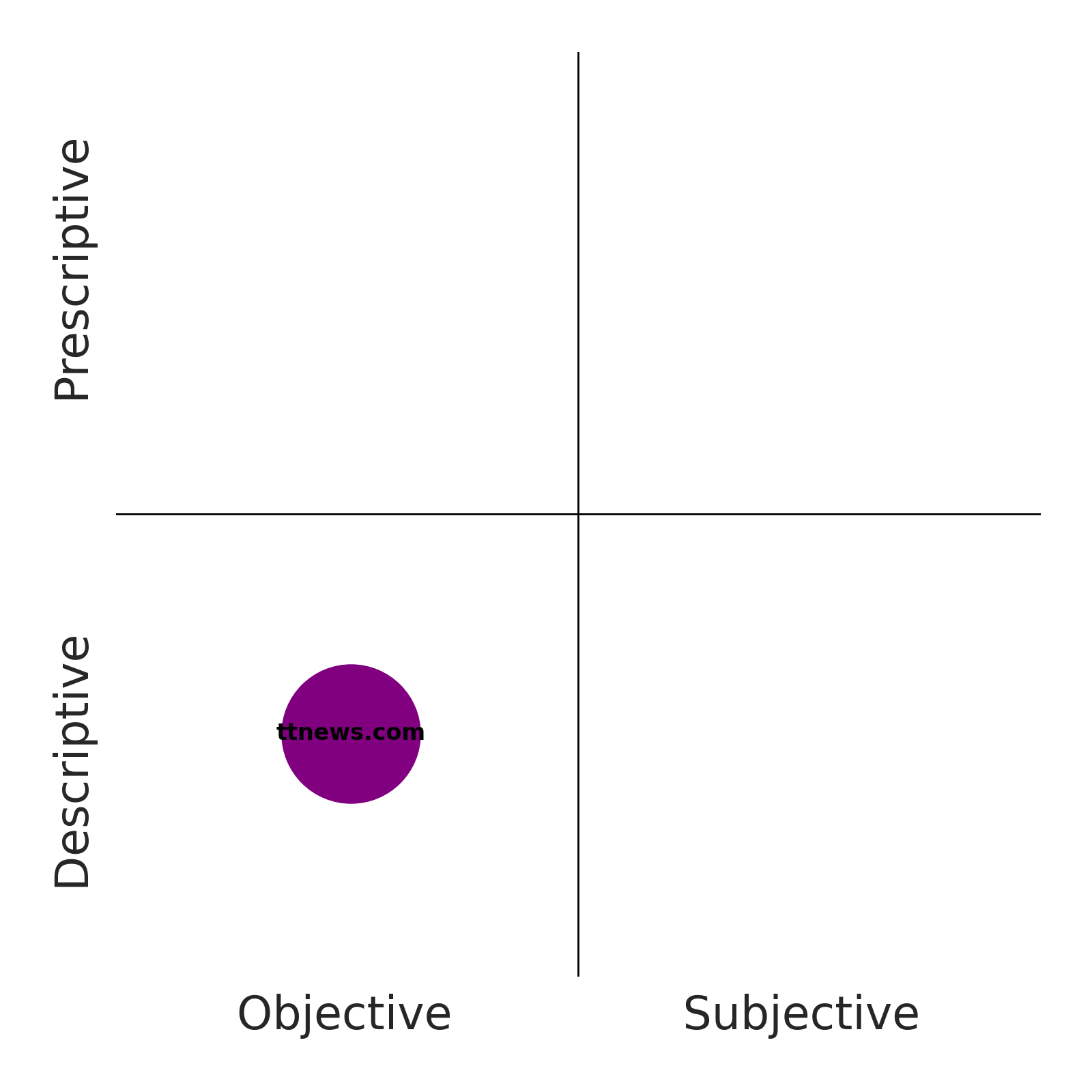
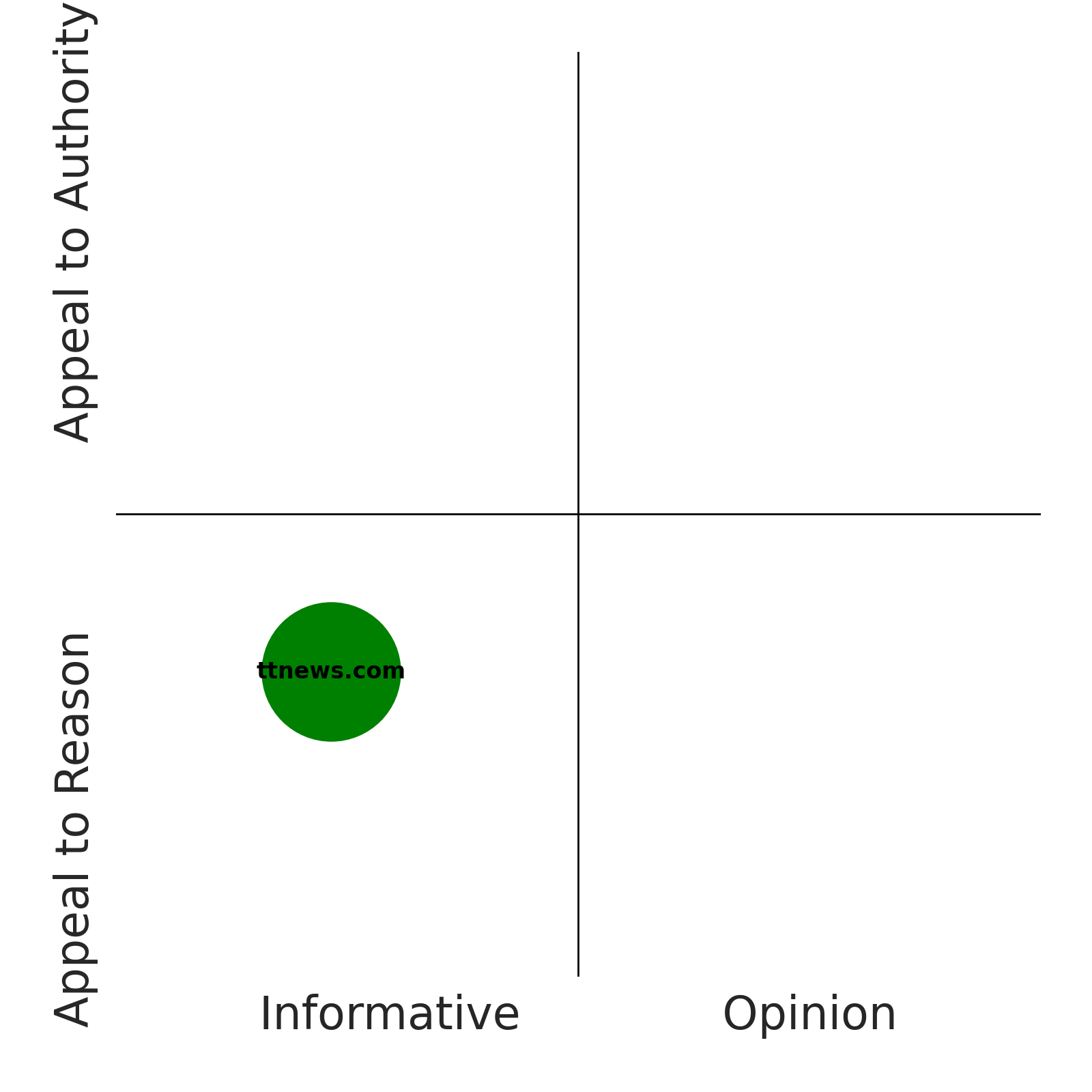
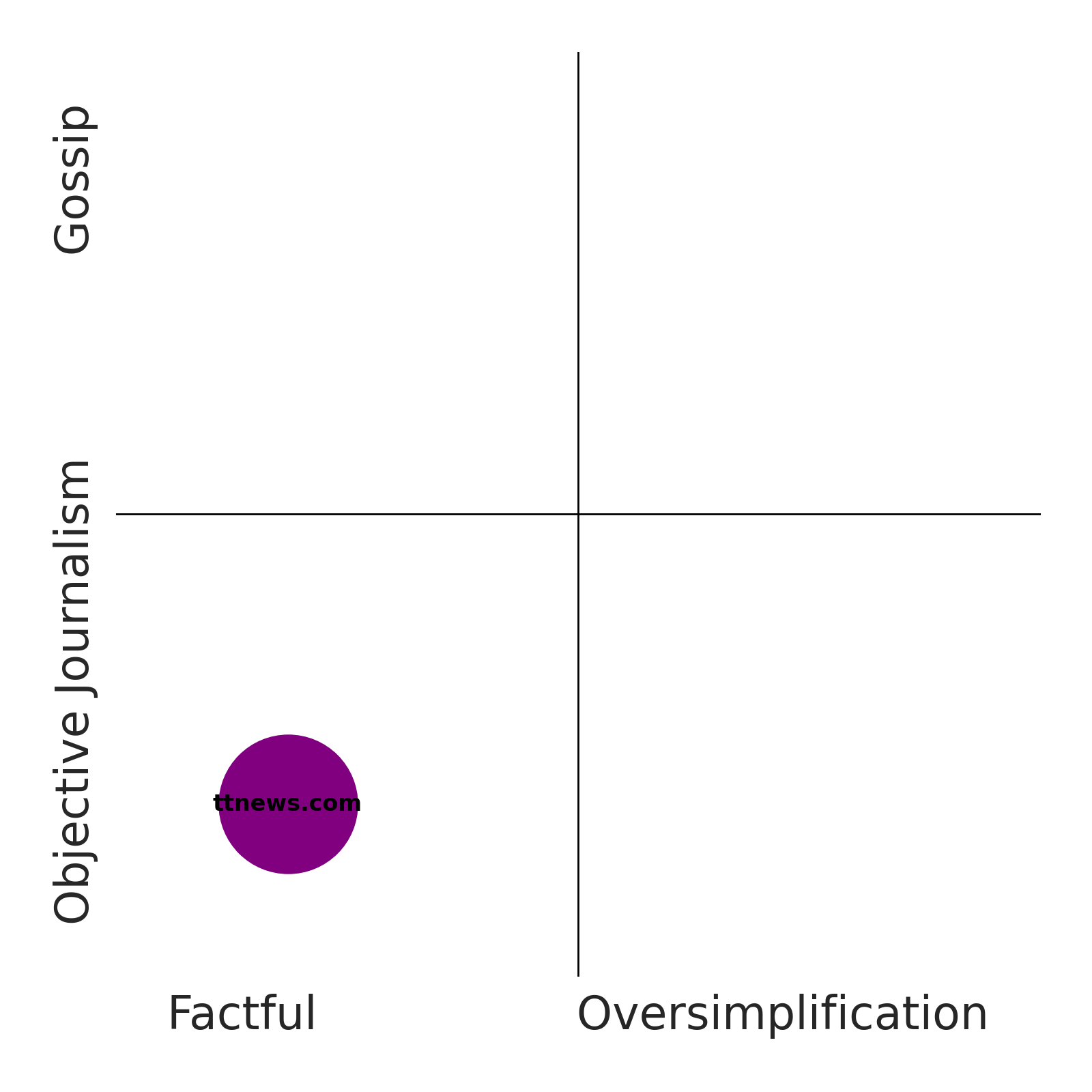
2026 © Helium Trades
Privacy Policy & Disclosure
* Disclaimer: Nothing on this website constitutes investment advice, performance data or any recommendation that any particular security, portfolio of securities, transaction or investment strategy is suitable for any specific person. Helium Trades is not responsible in any way for the accuracy
of any model predictions or price data. Any mention of a particular security and related prediction data is not a recommendation to buy or sell that security. Investments in securities involve the risk of loss. Past performance is no guarantee of future results. Helium Trades is not responsible for any of your investment decisions,
you should consult a financial expert before engaging in any transaction.
Helium Research Assistant

How can I help you today?
Ask any question about ttnews.com bias.


