See whether Helium helps you make better-informed decisions. Try every Pro Trader feature for 30 days. No credit card required.
Try every Pro Trader feature for 30 days. No credit card required.
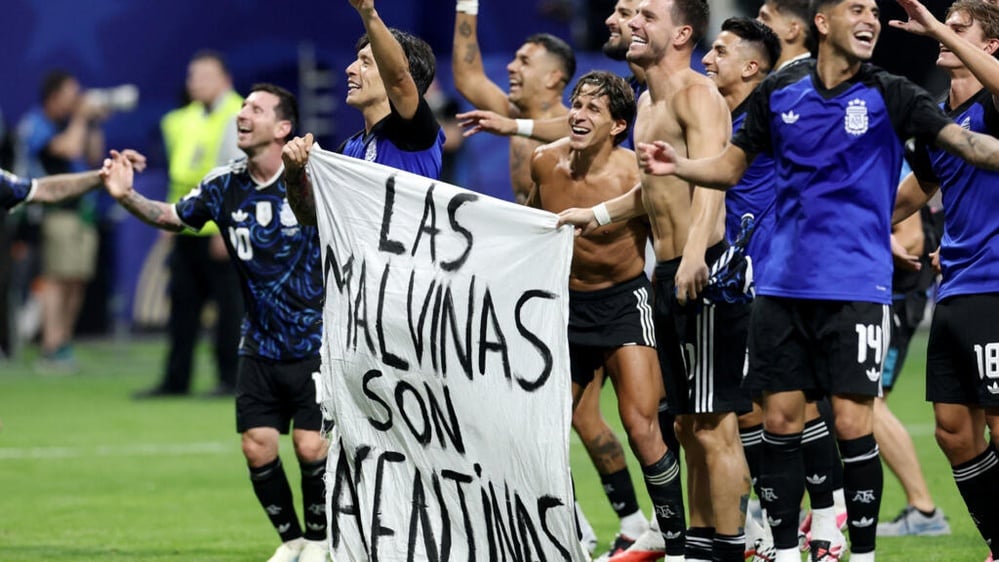
July 16, 2026 · 0 shares
Establishment-leaning framing prioritizes official UK and Falkland Islands positions on sovereignty, portrays Argentina's banner as a political issue within sport, and includes Argentine perspectives insofar as they contextualize the dispute.
Concise, factual overview of sovereignty dispute, the Argentina banner incident at a World Cup event, and related reactions from UK officials, Falkland Islands government, FIFA, and various politicians.
Automated analysis; not human reviewed.
Limitations: Case-specific; presence of some opposing voices is acknowledged, but dominant framing centers UK/Falkland Islands sovereignty perspectives.
·
1 of 52 available dimensions scored; omitted dimensions are not treated as neutral.
·
Verified supporting quotes for 0 of 1 scored dimensions.
Framing leans toward establishment positions, foregrounding UK government statements on Falkland Islands sovereignty and penalties for political messaging in football, while presenting Argentina's actions as inappropriate but contextualized, with limited balancing voice.
World Cup Falklands banner dispute between Argentina and the UK is reported with emphasis on UK government framing and calls for FIFA investigation, including naval movement details and Argentinian statements.
Automated analysis; not human reviewed.
·
1 of 52 available dimensions scored; omitted dimensions are not treated as neutral.
·
Verified supporting quotes for 0 of 1 scored dimensions.
Multi-source, procedure-focused coverage that neutrally reports FIFA's disciplinary process, UK and Argentine responses, and historical Falklands context while avoiding editorial framing.
FIFA is investigating Argentina players for displaying a Falklands banner after a World Cup semifinal, with UK officials urging investigation and Argentina defending the banner, set against the background of the 1982 Falklands War and prior FIFA sanctions.
Automated analysis; not human reviewed.
Limitations: Concise, case-specific limitations and plausible alternative interpretations.
·
52 of 52 available dimensions scored; omitted dimensions are not treated as neutral.
·
Verified supporting quotes for 3 of 52 scored dimensions.
Claim: Framing appears neutral with multiple sources, not clearly liberal or conservative.
“The move sparked a row in the UK, where top government officials urged FIFA to investigate the matter” · exact text match
“Britain occupied the Falklands in the 19th century, but Argentina claims the islands are part of its territory.” · exact text match
Counterevidence:
“No direct editorial stance; quotes from both sides feature in the report.” · not found in supplied text
Why: Diverse sourcing and lack of opinionated framing suggest neutrality.
Claim: Report uses official statements and contextual examples to support credibility.
“FIFA’s independent disciplinary committee is currently assessing the match reports and considering the relevant circumstances before deciding on potential further steps based on the FIFA disciplinary code,” · exact text match
“The move sparked a row in the UK, where top government officials urged FIFA to investigate the matter and the global governing body confirmed it had launched a probe as a “standard procedure”.” · exact text match
“Argentina will defend their World Cup title when they take on Spain in the World Cup final on Sunday at New York New Jersey Stadium.” · exact text match
Why: Multiple, attributed sources and references to prior cases support credibility.
Claim: Article demonstrates analytical synthesis with historical context and precedent.
“Argentina invaded the British overseas territory in the South Atlantic in 1982.” · exact text match
“The 1982 conflict ended with the deaths of 649 Argentinians and 255 Britons.” · exact text match
“FIFA’s fines for political messaging range from about $5,000 to $20,000.” · exact text match
Why: Inclusion of historical context and sanctions indicates analytical framing.
Ambiguity: limited sources; context-sensitive; evidence gaps could change bias.
Framing leans toward establishment positions, foregrounding UK government statements on Falkland Islands sovereignty and penalties for political messaging in football, while presenting Argentina's actions as inappropriate but contextualized, with limited balancing voice.
World Cup Falklands banner dispute between Argentina and the UK is reported with emphasis on UK government framing and calls for FIFA investigation, including naval movement details and Argentinian statements.
Automated analysis; not human reviewed.
·
1 of 52 available dimensions scored; omitted dimensions are not treated as neutral.
·
Verified supporting quotes for 0 of 1 scored dimensions.
Establishment-leaning framing dominates, foregrounding government positions on the Falklands dispute and portraying Argentina's actions as inappropriate while highlighting supportive statements from UK officials and opposition leaders.
British coverage notes Downing Street backing a FIFA probe into Argentina players for the Falklands banner during the World Cup, situating the incident within the sovereignty dispute and including government quotes and opposition response.
Automated analysis; not human reviewed.
Limitations: Concise, case-specific limitations and plausible alternative interpretations.
·
1 of 52 available dimensions scored; omitted dimensions are not treated as neutral.
·
Verified supporting quotes for 1 of 1 scored dimensions.
Claim: Article framing foregrounds government/establishment positions and portrays Argentina's actions as inappropriate.
“"The World Cup might not be ours, but the Falkland Islands definitely are," a Downing Street spokeswoman said.” · verified after text normalization
“"Our position is unchanged.
Self-determination rests with the islanders."”
· verified after text normalization
“"The Falkland Islands are British.
They will always be British.
The Conservatives fought for them before we will do so again if necessary."”
· verified after text normalization
Counterevidence:
“"In the build-up to the fixture, she had described England as 'invaders' and 'usurping pirates'.” · not found in supplied text
“"It wasn’t just another match".” · not found in supplied text
Why: Direct government quotes and emphasis on official positions dominate coverage, with occasional Argentine viewpoint statements appearing as counterpoints.
UK-leaning framing; limited Argentine perspective in text.
Establishment-leaning framing dominates, foregrounding government positions on the Falklands dispute and portraying Argentina's actions as inappropriate while highlighting supportive statements from UK officials and opposition leaders.
British coverage notes Downing Street backing a FIFA probe into Argentina players for the Falklands banner during the World Cup, situating the incident within the sovereignty dispute and including government quotes and opposition response.
Automated analysis; not human reviewed.
Limitations: Concise, case-specific limitations and plausible alternative interpretations.
·
1 of 52 available dimensions scored; omitted dimensions are not treated as neutral.
·
Verified supporting quotes for 1 of 1 scored dimensions.
Claim: Article framing foregrounds government/establishment positions and portrays Argentina's actions as inappropriate.
“"The World Cup might not be ours, but the Falkland Islands definitely are," a Downing Street spokeswoman said.” · verified after text normalization
“"Our position is unchanged.
Self-determination rests with the islanders."”
· verified after text normalization
“"The Falkland Islands are British.
They will always be British.
The Conservatives fought for them before we will do so again if necessary."”
· verified after text normalization
Counterevidence:
“"In the build-up to the fixture, she had described England as 'invaders' and 'usurping pirates'.” · not found in supplied text
“"It wasn’t just another match".” · not found in supplied text
Why: Direct government quotes and emphasis on official positions dominate coverage, with occasional Argentine viewpoint statements appearing as counterpoints.
UK-leaning framing; limited Argentine perspective in text.
Multi-source, procedure-focused coverage that neutrally reports FIFA's disciplinary process, UK and Argentine responses, and historical Falklands context while avoiding editorial framing.
FIFA is investigating Argentina players for displaying a Falklands banner after a World Cup semifinal, with UK officials urging investigation and Argentina defending the banner, set against the background of the 1982 Falklands War and prior FIFA sanctions.
Automated analysis; not human reviewed.
Limitations: Concise, case-specific limitations and plausible alternative interpretations.
·
52 of 52 available dimensions scored; omitted dimensions are not treated as neutral.
·
Verified supporting quotes for 3 of 52 scored dimensions.
Claim: Framing appears neutral with multiple sources, not clearly liberal or conservative.
“The move sparked a row in the UK, where top government officials urged FIFA to investigate the matter” · exact text match
“Britain occupied the Falklands in the 19th century, but Argentina claims the islands are part of its territory.” · exact text match
Counterevidence:
“No direct editorial stance; quotes from both sides feature in the report.” · not found in supplied text
Why: Diverse sourcing and lack of opinionated framing suggest neutrality.
Claim: Report uses official statements and contextual examples to support credibility.
“FIFA’s independent disciplinary committee is currently assessing the match reports and considering the relevant circumstances before deciding on potential further steps based on the FIFA disciplinary code,” · exact text match
“The move sparked a row in the UK, where top government officials urged FIFA to investigate the matter and the global governing body confirmed it had launched a probe as a “standard procedure”.” · exact text match
“Argentina will defend their World Cup title when they take on Spain in the World Cup final on Sunday at New York New Jersey Stadium.” · exact text match
Why: Multiple, attributed sources and references to prior cases support credibility.
Claim: Article demonstrates analytical synthesis with historical context and precedent.
“Argentina invaded the British overseas territory in the South Atlantic in 1982.” · exact text match
“The 1982 conflict ended with the deaths of 649 Argentinians and 255 Britons.” · exact text match
“FIFA’s fines for political messaging range from about $5,000 to $20,000.” · exact text match
Why: Inclusion of historical context and sanctions indicates analytical framing.
Ambiguity: limited sources; context-sensitive; evidence gaps could change bias.
July 15, 2026 · 0 shares
Neutral, evidence-based reporting that presents the Falklands banner incident within its historical and FIFA-regulation context, without endorsing either side.
Report on Argentina's World Cup semi-final win over England, the Falklands banner, FIFA disciplinary considerations, and background on the Falklands sovereignty dispute.
Automated analysis; not human reviewed.
·
51 of 52 available dimensions scored; omitted dimensions are not treated as neutral.
·
Supporting quotes supplied for 0 of 51 scored dimensions; exact matching was not run.
I aim for neutrality; confidence ~0.
6.
July 15, 2026 · 0 shares
Neutral, evidence-based reporting that presents the Falklands banner incident within its historical and FIFA-regulation context, without endorsing either side.
Report on Argentina's World Cup semi-final win over England, the Falklands banner, FIFA disciplinary considerations, and background on the Falklands sovereignty dispute.
Automated analysis; not human reviewed.
·
51 of 52 available dimensions scored; omitted dimensions are not treated as neutral.
·
Supporting quotes supplied for 0 of 51 scored dimensions; exact matching was not run.
I aim for neutrality; confidence ~0.
6.
Multi-source, procedure-focused coverage that neutrally reports FIFA's disciplinary process, UK and Argentine responses, and historical Falklands context while avoiding editorial framing.
FIFA is investigating Argentina players for displaying a Falklands banner after a World Cup semifinal, with UK officials urging investigation and Argentina defending the banner, set against the background of the 1982 Falklands War and prior FIFA sanctions.
Automated analysis; not human reviewed.
Limitations: Concise, case-specific limitations and plausible alternative interpretations.
·
52 of 52 available dimensions scored; omitted dimensions are not treated as neutral.
·
Verified supporting quotes for 3 of 52 scored dimensions.
Claim: Framing appears neutral with multiple sources, not clearly liberal or conservative.
“The move sparked a row in the UK, where top government officials urged FIFA to investigate the matter” · exact text match
“Britain occupied the Falklands in the 19th century, but Argentina claims the islands are part of its territory.” · exact text match
Counterevidence:
“No direct editorial stance; quotes from both sides feature in the report.” · not found in supplied text
Why: Diverse sourcing and lack of opinionated framing suggest neutrality.
Claim: Report uses official statements and contextual examples to support credibility.
“FIFA’s independent disciplinary committee is currently assessing the match reports and considering the relevant circumstances before deciding on potential further steps based on the FIFA disciplinary code,” · exact text match
“The move sparked a row in the UK, where top government officials urged FIFA to investigate the matter and the global governing body confirmed it had launched a probe as a “standard procedure”.” · exact text match
“Argentina will defend their World Cup title when they take on Spain in the World Cup final on Sunday at New York New Jersey Stadium.” · exact text match
Why: Multiple, attributed sources and references to prior cases support credibility.
Claim: Article demonstrates analytical synthesis with historical context and precedent.
“Argentina invaded the British overseas territory in the South Atlantic in 1982.” · exact text match
“The 1982 conflict ended with the deaths of 649 Argentinians and 255 Britons.” · exact text match
“FIFA’s fines for political messaging range from about $5,000 to $20,000.” · exact text match
Why: Inclusion of historical context and sanctions indicates analytical framing.
Ambiguity: limited sources; context-sensitive; evidence gaps could change bias.
July 17, 2026 · 0 shares
Neutral, event-focused coverage foregrounding local Buenos Aires sentiment and Britain's response, indicating balanced framing with a subtle Argentine emphasis.
A concise, fact-based report on a World Cup-related incident involving a Falkland Islands banner and local reaction.
Automated analysis; not human reviewed.
Limitations: Concise, case-specific limitations and plausible alternative interpretations.
·
52 of 52 available dimensions scored; omitted dimensions are not treated as neutral.
·
Verified supporting quotes for 1 of 52 scored dimensions.
Claim: Neutral, balanced framing with no explicit ideological tilt.
“Buenos Aires locals support Argentine footballers over World Cup Falkland banner.” · exact text match
“Britain has called for FIFA to investigate the incident.” · exact text match
Why: Reported statements show no clear ideological slant, just coverage of a local reaction and a British reaction.
Ambiguity: limited data; potential local framing.
Multi-source, procedure-focused coverage that neutrally reports FIFA's disciplinary process, UK and Argentine responses, and historical Falklands context while avoiding editorial framing.
FIFA is investigating Argentina players for displaying a Falklands banner after a World Cup semifinal, with UK officials urging investigation and Argentina defending the banner, set against the background of the 1982 Falklands War and prior FIFA sanctions.
Automated analysis; not human reviewed.
Limitations: Concise, case-specific limitations and plausible alternative interpretations.
·
52 of 52 available dimensions scored; omitted dimensions are not treated as neutral.
·
Verified supporting quotes for 3 of 52 scored dimensions.
Claim: Framing appears neutral with multiple sources, not clearly liberal or conservative.
“The move sparked a row in the UK, where top government officials urged FIFA to investigate the matter” · exact text match
“Britain occupied the Falklands in the 19th century, but Argentina claims the islands are part of its territory.” · exact text match
Counterevidence:
“No direct editorial stance; quotes from both sides feature in the report.” · not found in supplied text
Why: Diverse sourcing and lack of opinionated framing suggest neutrality.
Claim: Report uses official statements and contextual examples to support credibility.
“FIFA’s independent disciplinary committee is currently assessing the match reports and considering the relevant circumstances before deciding on potential further steps based on the FIFA disciplinary code,” · exact text match
“The move sparked a row in the UK, where top government officials urged FIFA to investigate the matter and the global governing body confirmed it had launched a probe as a “standard procedure”.” · exact text match
“Argentina will defend their World Cup title when they take on Spain in the World Cup final on Sunday at New York New Jersey Stadium.” · exact text match
Why: Multiple, attributed sources and references to prior cases support credibility.
Claim: Article demonstrates analytical synthesis with historical context and precedent.
“Argentina invaded the British overseas territory in the South Atlantic in 1982.” · exact text match
“The 1982 conflict ended with the deaths of 649 Argentinians and 255 Britons.” · exact text match
“FIFA’s fines for political messaging range from about $5,000 to $20,000.” · exact text match
Why: Inclusion of historical context and sanctions indicates analytical framing.
Ambiguity: limited sources; context-sensitive; evidence gaps could change bias.
July 15, 2026 · 0 shares
Neutral, evidence-based reporting that presents the Falklands banner incident within its historical and FIFA-regulation context, without endorsing either side.
Report on Argentina's World Cup semi-final win over England, the Falklands banner, FIFA disciplinary considerations, and background on the Falklands sovereignty dispute.
Automated analysis; not human reviewed.
·
51 of 52 available dimensions scored; omitted dimensions are not treated as neutral.
·
Supporting quotes supplied for 0 of 51 scored dimensions; exact matching was not run.
I aim for neutrality; confidence ~0.
6.
July 16, 2026 · 0 shares
Establishment-leaning framing prioritizes official UK and Falkland Islands positions on sovereignty, portrays Argentina's banner as a political issue within sport, and includes Argentine perspectives insofar as they contextualize the dispute.
Concise, factual overview of sovereignty dispute, the Argentina banner incident at a World Cup event, and related reactions from UK officials, Falkland Islands government, FIFA, and various politicians.
Automated analysis; not human reviewed. Limitations: Case-specific; presence of some opposing voices is acknowledged, but dominant framing centers UK/Falkland Islands sovereignty perspectives. · 1 of 52 available dimensions scored; omitted dimensions are not treated as neutral. · Verified supporting quotes for 0 of 1 scored dimensions.
Multi-source, procedure-focused coverage that neutrally reports FIFA's disciplinary process, UK and Argentine responses, and historical Falklands context while avoiding editorial framing.
FIFA is investigating Argentina players for displaying a Falklands banner after a World Cup semifinal, with UK officials urging investigation and Argentina defending the banner, set against the background of the 1982 Falklands War and prior FIFA sanctions.
Automated analysis; not human reviewed. Limitations: Concise, case-specific limitations and plausible alternative interpretations. · 52 of 52 available dimensions scored; omitted dimensions are not treated as neutral. · Verified supporting quotes for 3 of 52 scored dimensions.
Claim: Framing appears neutral with multiple sources, not clearly liberal or conservative.
“The move sparked a row in the UK, where top government officials urged FIFA to investigate the matter” · exact text match
“Britain occupied the Falklands in the 19th century, but Argentina claims the islands are part of its territory.” · exact text match
Counterevidence:
“No direct editorial stance; quotes from both sides feature in the report.” · not found in supplied text
Why: Diverse sourcing and lack of opinionated framing suggest neutrality.
Claim: Report uses official statements and contextual examples to support credibility.
“FIFA’s independent disciplinary committee is currently assessing the match reports and considering the relevant circumstances before deciding on potential further steps based on the FIFA disciplinary code,” · exact text match
“The move sparked a row in the UK, where top government officials urged FIFA to investigate the matter and the global governing body confirmed it had launched a probe as a “standard procedure”.” · exact text match
“Argentina will defend their World Cup title when they take on Spain in the World Cup final on Sunday at New York New Jersey Stadium.” · exact text match
Why: Multiple, attributed sources and references to prior cases support credibility.
Claim: Article demonstrates analytical synthesis with historical context and precedent.
“Argentina invaded the British overseas territory in the South Atlantic in 1982.” · exact text match
“The 1982 conflict ended with the deaths of 649 Argentinians and 255 Britons.” · exact text match
“FIFA’s fines for political messaging range from about $5,000 to $20,000.” · exact text match
Why: Inclusion of historical context and sanctions indicates analytical framing.
Ambiguity: limited sources; context-sensitive; evidence gaps could change bias.
Framing leans toward establishment positions, foregrounding UK government statements on Falkland Islands sovereignty and penalties for political messaging in football, while presenting Argentina's actions as inappropriate but contextualized, with limited balancing voice.
World Cup Falklands banner dispute between Argentina and the UK is reported with emphasis on UK government framing and calls for FIFA investigation, including naval movement details and Argentinian statements.
Automated analysis; not human reviewed. · 1 of 52 available dimensions scored; omitted dimensions are not treated as neutral. · Verified supporting quotes for 0 of 1 scored dimensions.
Establishment-leaning framing dominates, foregrounding government positions on the Falklands dispute and portraying Argentina's actions as inappropriate while highlighting supportive statements from UK officials and opposition leaders.
British coverage notes Downing Street backing a FIFA probe into Argentina players for the Falklands banner during the World Cup, situating the incident within the sovereignty dispute and including government quotes and opposition response.
Automated analysis; not human reviewed. Limitations: Concise, case-specific limitations and plausible alternative interpretations. · 1 of 52 available dimensions scored; omitted dimensions are not treated as neutral. · Verified supporting quotes for 1 of 1 scored dimensions.
Claim: Article framing foregrounds government/establishment positions and portrays Argentina's actions as inappropriate.
“"The World Cup might not be ours, but the Falkland Islands definitely are," a Downing Street spokeswoman said.” · verified after text normalization
“"Our position is unchanged. Self-determination rests with the islanders."” · verified after text normalization
“"The Falkland Islands are British. They will always be British. The Conservatives fought for them before we will do so again if necessary."” · verified after text normalization
Counterevidence:
“"In the build-up to the fixture, she had described England as 'invaders' and 'usurping pirates'.” · not found in supplied text
“"It wasn’t just another match".” · not found in supplied text
Why: Direct government quotes and emphasis on official positions dominate coverage, with occasional Argentine viewpoint statements appearing as counterpoints.
UK-leaning framing; limited Argentine perspective in text.
July 15, 2026 · 0 shares
Neutral, evidence-based reporting that presents the Falklands banner incident within its historical and FIFA-regulation context, without endorsing either side.
Report on Argentina's World Cup semi-final win over England, the Falklands banner, FIFA disciplinary considerations, and background on the Falklands sovereignty dispute.
Automated analysis; not human reviewed. · 51 of 52 available dimensions scored; omitted dimensions are not treated as neutral. · Supporting quotes supplied for 0 of 51 scored dimensions; exact matching was not run.
I aim for neutrality; confidence ~0.6.
Local Argentine public sentiment framing
July 17, 2026 · 0 shares
Neutral, event-focused coverage foregrounding local Buenos Aires sentiment and Britain's response, indicating balanced framing with a subtle Argentine emphasis.
A concise, fact-based report on a World Cup-related incident involving a Falkland Islands banner and local reaction.
Automated analysis; not human reviewed. Limitations: Concise, case-specific limitations and plausible alternative interpretations. · 52 of 52 available dimensions scored; omitted dimensions are not treated as neutral. · Verified supporting quotes for 1 of 52 scored dimensions.
Claim: Neutral, balanced framing with no explicit ideological tilt.
“Buenos Aires locals support Argentine footballers over World Cup Falkland banner.” · exact text match
“Britain has called for FIFA to investigate the incident.” · exact text match
Why: Reported statements show no clear ideological slant, just coverage of a local reaction and a British reaction.
Ambiguity: limited data; potential local framing.
July 17, 2026 · 0 shares
Neutral, event-focused coverage foregrounding local Buenos Aires sentiment and Britain's response, indicating balanced framing with a subtle Argentine emphasis.
A concise, fact-based report on a World Cup-related incident involving a Falkland Islands banner and local reaction.
Automated analysis; not human reviewed. Limitations: Concise, case-specific limitations and plausible alternative interpretations. · 52 of 52 available dimensions scored; omitted dimensions are not treated as neutral. · Verified supporting quotes for 1 of 52 scored dimensions.
Claim: Neutral, balanced framing with no explicit ideological tilt.
“Buenos Aires locals support Argentine footballers over World Cup Falkland banner.” · exact text match
“Britain has called for FIFA to investigate the incident.” · exact text match
Why: Reported statements show no clear ideological slant, just coverage of a local reaction and a British reaction.
Ambiguity: limited data; potential local framing.
Story Blindspots
Multi-source, procedure-focused coverage that neutrally reports FIFA's disciplinary process, UK and Argentine responses, and historical Falklands context while avoiding editorial framing.
FIFA is investigating Argentina players for displaying a Falklands banner after a World Cup semifinal, with UK officials urging investigation and Argentina defending the banner, set against the background of the 1982 Falklands War and prior FIFA sanctions.
Automated analysis; not human reviewed. Limitations: Concise, case-specific limitations and plausible alternative interpretations. · 52 of 52 available dimensions scored; omitted dimensions are not treated as neutral. · Verified supporting quotes for 3 of 52 scored dimensions.
Claim: Framing appears neutral with multiple sources, not clearly liberal or conservative.
“The move sparked a row in the UK, where top government officials urged FIFA to investigate the matter” · exact text match
“Britain occupied the Falklands in the 19th century, but Argentina claims the islands are part of its territory.” · exact text match
Counterevidence:
“No direct editorial stance; quotes from both sides feature in the report.” · not found in supplied text
Why: Diverse sourcing and lack of opinionated framing suggest neutrality.
Claim: Report uses official statements and contextual examples to support credibility.
“FIFA’s independent disciplinary committee is currently assessing the match reports and considering the relevant circumstances before deciding on potential further steps based on the FIFA disciplinary code,” · exact text match
“The move sparked a row in the UK, where top government officials urged FIFA to investigate the matter and the global governing body confirmed it had launched a probe as a “standard procedure”.” · exact text match
“Argentina will defend their World Cup title when they take on Spain in the World Cup final on Sunday at New York New Jersey Stadium.” · exact text match
Why: Multiple, attributed sources and references to prior cases support credibility.
Claim: Article demonstrates analytical synthesis with historical context and precedent.
“Argentina invaded the British overseas territory in the South Atlantic in 1982.” · exact text match
“The 1982 conflict ended with the deaths of 649 Argentinians and 255 Britons.” · exact text match
“FIFA’s fines for political messaging range from about $5,000 to $20,000.” · exact text match
Why: Inclusion of historical context and sanctions indicates analytical framing.
Ambiguity: limited sources; context-sensitive; evidence gaps could change bias.
July 15, 2026 · 0 shares
Neutral, evidence-based reporting that presents the Falklands banner incident within its historical and FIFA-regulation context, without endorsing either side.
Report on Argentina's World Cup semi-final win over England, the Falklands banner, FIFA disciplinary considerations, and background on the Falklands sovereignty dispute.
Automated analysis; not human reviewed. · 51 of 52 available dimensions scored; omitted dimensions are not treated as neutral. · Supporting quotes supplied for 0 of 51 scored dimensions; exact matching was not run.
I aim for neutrality; confidence ~0.6.
Multi-source, procedure-focused coverage that neutrally reports FIFA's disciplinary process, UK and Argentine responses, and historical Falklands context while avoiding editorial framing.
FIFA is investigating Argentina players for displaying a Falklands banner after a World Cup semifinal, with UK officials urging investigation and Argentina defending the banner, set against the background of the 1982 Falklands War and prior FIFA sanctions.
Automated analysis; not human reviewed. Limitations: Concise, case-specific limitations and plausible alternative interpretations. · 52 of 52 available dimensions scored; omitted dimensions are not treated as neutral. · Verified supporting quotes for 3 of 52 scored dimensions.
Claim: Framing appears neutral with multiple sources, not clearly liberal or conservative.
“The move sparked a row in the UK, where top government officials urged FIFA to investigate the matter” · exact text match
“Britain occupied the Falklands in the 19th century, but Argentina claims the islands are part of its territory.” · exact text match
Counterevidence:
“No direct editorial stance; quotes from both sides feature in the report.” · not found in supplied text
Why: Diverse sourcing and lack of opinionated framing suggest neutrality.
Claim: Report uses official statements and contextual examples to support credibility.
“FIFA’s independent disciplinary committee is currently assessing the match reports and considering the relevant circumstances before deciding on potential further steps based on the FIFA disciplinary code,” · exact text match
“The move sparked a row in the UK, where top government officials urged FIFA to investigate the matter and the global governing body confirmed it had launched a probe as a “standard procedure”.” · exact text match
“Argentina will defend their World Cup title when they take on Spain in the World Cup final on Sunday at New York New Jersey Stadium.” · exact text match
Why: Multiple, attributed sources and references to prior cases support credibility.
Claim: Article demonstrates analytical synthesis with historical context and precedent.
“Argentina invaded the British overseas territory in the South Atlantic in 1982.” · exact text match
“The 1982 conflict ended with the deaths of 649 Argentinians and 255 Britons.” · exact text match
“FIFA’s fines for political messaging range from about $5,000 to $20,000.” · exact text match
Why: Inclusion of historical context and sanctions indicates analytical framing.
Ambiguity: limited sources; context-sensitive; evidence gaps could change bias.
July 15, 2026 · 0 shares
Neutral, evidence-based reporting that presents the Falklands banner incident within its historical and FIFA-regulation context, without endorsing either side.
Report on Argentina's World Cup semi-final win over England, the Falklands banner, FIFA disciplinary considerations, and background on the Falklands sovereignty dispute.
Automated analysis; not human reviewed. · 51 of 52 available dimensions scored; omitted dimensions are not treated as neutral. · Supporting quotes supplied for 0 of 51 scored dimensions; exact matching was not run.
I aim for neutrality; confidence ~0.6.
Multi-source, procedure-focused coverage that neutrally reports FIFA's disciplinary process, UK and Argentine responses, and historical Falklands context while avoiding editorial framing.
FIFA is investigating Argentina players for displaying a Falklands banner after a World Cup semifinal, with UK officials urging investigation and Argentina defending the banner, set against the background of the 1982 Falklands War and prior FIFA sanctions.
Automated analysis; not human reviewed. Limitations: Concise, case-specific limitations and plausible alternative interpretations. · 52 of 52 available dimensions scored; omitted dimensions are not treated as neutral. · Verified supporting quotes for 3 of 52 scored dimensions.
Claim: Framing appears neutral with multiple sources, not clearly liberal or conservative.
“The move sparked a row in the UK, where top government officials urged FIFA to investigate the matter” · exact text match
“Britain occupied the Falklands in the 19th century, but Argentina claims the islands are part of its territory.” · exact text match
Counterevidence:
“No direct editorial stance; quotes from both sides feature in the report.” · not found in supplied text
Why: Diverse sourcing and lack of opinionated framing suggest neutrality.
Claim: Report uses official statements and contextual examples to support credibility.
“FIFA’s independent disciplinary committee is currently assessing the match reports and considering the relevant circumstances before deciding on potential further steps based on the FIFA disciplinary code,” · exact text match
“The move sparked a row in the UK, where top government officials urged FIFA to investigate the matter and the global governing body confirmed it had launched a probe as a “standard procedure”.” · exact text match
“Argentina will defend their World Cup title when they take on Spain in the World Cup final on Sunday at New York New Jersey Stadium.” · exact text match
Why: Multiple, attributed sources and references to prior cases support credibility.
Claim: Article demonstrates analytical synthesis with historical context and precedent.
“Argentina invaded the British overseas territory in the South Atlantic in 1982.” · exact text match
“The 1982 conflict ended with the deaths of 649 Argentinians and 255 Britons.” · exact text match
“FIFA’s fines for political messaging range from about $5,000 to $20,000.” · exact text match
Why: Inclusion of historical context and sanctions indicates analytical framing.
Ambiguity: limited sources; context-sensitive; evidence gaps could change bias.
July 15, 2026 · 0 shares
Neutral, evidence-based reporting that presents the Falklands banner incident within its historical and FIFA-regulation context, without endorsing either side.
Report on Argentina's World Cup semi-final win over England, the Falklands banner, FIFA disciplinary considerations, and background on the Falklands sovereignty dispute.
Automated analysis; not human reviewed. · 51 of 52 available dimensions scored; omitted dimensions are not treated as neutral. · Supporting quotes supplied for 0 of 51 scored dimensions; exact matching was not run.
I aim for neutrality; confidence ~0.6.
July 16, 2026 · 0 shares
Establishment-leaning framing prioritizes official UK and Falkland Islands positions on sovereignty, portrays Argentina's banner as a political issue within sport, and includes Argentine perspectives insofar as they contextualize the dispute.
Concise, factual overview of sovereignty dispute, the Argentina banner incident at a World Cup event, and related reactions from UK officials, Falkland Islands government, FIFA, and various politicians.
Automated analysis; not human reviewed. Limitations: Case-specific; presence of some opposing voices is acknowledged, but dominant framing centers UK/Falkland Islands sovereignty perspectives. · 1 of 52 available dimensions scored; omitted dimensions are not treated as neutral. · Verified supporting quotes for 0 of 1 scored dimensions.
Multi-source, procedure-focused coverage that neutrally reports FIFA's disciplinary process, UK and Argentine responses, and historical Falklands context while avoiding editorial framing.
FIFA is investigating Argentina players for displaying a Falklands banner after a World Cup semifinal, with UK officials urging investigation and Argentina defending the banner, set against the background of the 1982 Falklands War and prior FIFA sanctions.
Automated analysis; not human reviewed. Limitations: Concise, case-specific limitations and plausible alternative interpretations. · 52 of 52 available dimensions scored; omitted dimensions are not treated as neutral. · Verified supporting quotes for 3 of 52 scored dimensions.
Claim: Framing appears neutral with multiple sources, not clearly liberal or conservative.
“The move sparked a row in the UK, where top government officials urged FIFA to investigate the matter” · exact text match
“Britain occupied the Falklands in the 19th century, but Argentina claims the islands are part of its territory.” · exact text match
Counterevidence:
“No direct editorial stance; quotes from both sides feature in the report.” · not found in supplied text
Why: Diverse sourcing and lack of opinionated framing suggest neutrality.
Claim: Report uses official statements and contextual examples to support credibility.
“FIFA’s independent disciplinary committee is currently assessing the match reports and considering the relevant circumstances before deciding on potential further steps based on the FIFA disciplinary code,” · exact text match
“The move sparked a row in the UK, where top government officials urged FIFA to investigate the matter and the global governing body confirmed it had launched a probe as a “standard procedure”.” · exact text match
“Argentina will defend their World Cup title when they take on Spain in the World Cup final on Sunday at New York New Jersey Stadium.” · exact text match
Why: Multiple, attributed sources and references to prior cases support credibility.
Claim: Article demonstrates analytical synthesis with historical context and precedent.
“Argentina invaded the British overseas territory in the South Atlantic in 1982.” · exact text match
“The 1982 conflict ended with the deaths of 649 Argentinians and 255 Britons.” · exact text match
“FIFA’s fines for political messaging range from about $5,000 to $20,000.” · exact text match
Why: Inclusion of historical context and sanctions indicates analytical framing.
Ambiguity: limited sources; context-sensitive; evidence gaps could change bias.
Establishment-leaning framing dominates, foregrounding government positions on the Falklands dispute and portraying Argentina's actions as inappropriate while highlighting supportive statements from UK officials and opposition leaders.
British coverage notes Downing Street backing a FIFA probe into Argentina players for the Falklands banner during the World Cup, situating the incident within the sovereignty dispute and including government quotes and opposition response.
Automated analysis; not human reviewed. Limitations: Concise, case-specific limitations and plausible alternative interpretations. · 1 of 52 available dimensions scored; omitted dimensions are not treated as neutral. · Verified supporting quotes for 1 of 1 scored dimensions.
Claim: Article framing foregrounds government/establishment positions and portrays Argentina's actions as inappropriate.
“"The World Cup might not be ours, but the Falkland Islands definitely are," a Downing Street spokeswoman said.” · verified after text normalization
“"Our position is unchanged. Self-determination rests with the islanders."” · verified after text normalization
“"The Falkland Islands are British. They will always be British. The Conservatives fought for them before we will do so again if necessary."” · verified after text normalization
Counterevidence:
“"In the build-up to the fixture, she had described England as 'invaders' and 'usurping pirates'.” · not found in supplied text
“"It wasn’t just another match".” · not found in supplied text
Why: Direct government quotes and emphasis on official positions dominate coverage, with occasional Argentine viewpoint statements appearing as counterpoints.
UK-leaning framing; limited Argentine perspective in text.
Multi-source, procedure-focused coverage that neutrally reports FIFA's disciplinary process, UK and Argentine responses, and historical Falklands context while avoiding editorial framing.
FIFA is investigating Argentina players for displaying a Falklands banner after a World Cup semifinal, with UK officials urging investigation and Argentina defending the banner, set against the background of the 1982 Falklands War and prior FIFA sanctions.
Automated analysis; not human reviewed. Limitations: Concise, case-specific limitations and plausible alternative interpretations. · 52 of 52 available dimensions scored; omitted dimensions are not treated as neutral. · Verified supporting quotes for 3 of 52 scored dimensions.
Claim: Framing appears neutral with multiple sources, not clearly liberal or conservative.
“The move sparked a row in the UK, where top government officials urged FIFA to investigate the matter” · exact text match
“Britain occupied the Falklands in the 19th century, but Argentina claims the islands are part of its territory.” · exact text match
Counterevidence:
“No direct editorial stance; quotes from both sides feature in the report.” · not found in supplied text
Why: Diverse sourcing and lack of opinionated framing suggest neutrality.
Claim: Report uses official statements and contextual examples to support credibility.
“FIFA’s independent disciplinary committee is currently assessing the match reports and considering the relevant circumstances before deciding on potential further steps based on the FIFA disciplinary code,” · exact text match
“The move sparked a row in the UK, where top government officials urged FIFA to investigate the matter and the global governing body confirmed it had launched a probe as a “standard procedure”.” · exact text match
“Argentina will defend their World Cup title when they take on Spain in the World Cup final on Sunday at New York New Jersey Stadium.” · exact text match
Why: Multiple, attributed sources and references to prior cases support credibility.
Claim: Article demonstrates analytical synthesis with historical context and precedent.
“Argentina invaded the British overseas territory in the South Atlantic in 1982.” · exact text match
“The 1982 conflict ended with the deaths of 649 Argentinians and 255 Britons.” · exact text match
“FIFA’s fines for political messaging range from about $5,000 to $20,000.” · exact text match
Why: Inclusion of historical context and sanctions indicates analytical framing.
Ambiguity: limited sources; context-sensitive; evidence gaps could change bias.
July 15, 2026 · 0 shares
Neutral, evidence-based reporting that presents the Falklands banner incident within its historical and FIFA-regulation context, without endorsing either side.
Report on Argentina's World Cup semi-final win over England, the Falklands banner, FIFA disciplinary considerations, and background on the Falklands sovereignty dispute.
Automated analysis; not human reviewed. · 51 of 52 available dimensions scored; omitted dimensions are not treated as neutral. · Supporting quotes supplied for 0 of 51 scored dimensions; exact matching was not run.
I aim for neutrality; confidence ~0.6.
July 16, 2026 · 0 shares
Establishment-leaning framing prioritizes official UK and Falkland Islands positions on sovereignty, portrays Argentina's banner as a political issue within sport, and includes Argentine perspectives insofar as they contextualize the dispute.
Concise, factual overview of sovereignty dispute, the Argentina banner incident at a World Cup event, and related reactions from UK officials, Falkland Islands government, FIFA, and various politicians.
Automated analysis; not human reviewed.
Limitations: Case-specific; presence of some opposing voices is acknowledged, but dominant framing centers UK/Falkland Islands sovereignty perspectives.
·
1 of 52 available dimensions scored; omitted dimensions are not treated as neutral.
·
Verified supporting quotes for 0 of 1 scored dimensions.
Framing leans toward establishment positions, foregrounding UK government statements on Falkland Islands sovereignty and penalties for political messaging in football, while presenting Argentina's actions as inappropriate but contextualized, with limited balancing voice.
World Cup Falklands banner dispute between Argentina and the UK is reported with emphasis on UK government framing and calls for FIFA investigation, including naval movement details and Argentinian statements.
Automated analysis; not human reviewed.
·
1 of 52 available dimensions scored; omitted dimensions are not treated as neutral.
·
Verified supporting quotes for 0 of 1 scored dimensions.
Establishment-leaning framing dominates, foregrounding government positions on the Falklands dispute and portraying Argentina's actions as inappropriate while highlighting supportive statements from UK officials and opposition leaders.
British coverage notes Downing Street backing a FIFA probe into Argentina players for the Falklands banner during the World Cup, situating the incident within the sovereignty dispute and including government quotes and opposition response.
Automated analysis; not human reviewed.
Limitations: Concise, case-specific limitations and plausible alternative interpretations.
·
1 of 52 available dimensions scored; omitted dimensions are not treated as neutral.
·
Verified supporting quotes for 1 of 1 scored dimensions.
Claim: Article framing foregrounds government/establishment positions and portrays Argentina's actions as inappropriate.
“"The World Cup might not be ours, but the Falkland Islands definitely are," a Downing Street spokeswoman said.” · verified after text normalization
“"Our position is unchanged.
Self-determination rests with the islanders."”
· verified after text normalization
“"The Falkland Islands are British.
They will always be British.
The Conservatives fought for them before we will do so again if necessary."”
· verified after text normalization
Counterevidence:
“"In the build-up to the fixture, she had described England as 'invaders' and 'usurping pirates'.” · not found in supplied text
“"It wasn’t just another match".” · not found in supplied text
Why: Direct government quotes and emphasis on official positions dominate coverage, with occasional Argentine viewpoint statements appearing as counterpoints.
UK-leaning framing; limited Argentine perspective in text.
Multi-source, procedure-focused coverage that neutrally reports FIFA's disciplinary process, UK and Argentine responses, and historical Falklands context while avoiding editorial framing.
FIFA is investigating Argentina players for displaying a Falklands banner after a World Cup semifinal, with UK officials urging investigation and Argentina defending the banner, set against the background of the 1982 Falklands War and prior FIFA sanctions.
Automated analysis; not human reviewed.
Limitations: Concise, case-specific limitations and plausible alternative interpretations.
·
52 of 52 available dimensions scored; omitted dimensions are not treated as neutral.
·
Verified supporting quotes for 3 of 52 scored dimensions.
Claim: Framing appears neutral with multiple sources, not clearly liberal or conservative.
“The move sparked a row in the UK, where top government officials urged FIFA to investigate the matter” · exact text match
“Britain occupied the Falklands in the 19th century, but Argentina claims the islands are part of its territory.” · exact text match
Counterevidence:
“No direct editorial stance; quotes from both sides feature in the report.” · not found in supplied text
Why: Diverse sourcing and lack of opinionated framing suggest neutrality.
Claim: Report uses official statements and contextual examples to support credibility.
“FIFA’s independent disciplinary committee is currently assessing the match reports and considering the relevant circumstances before deciding on potential further steps based on the FIFA disciplinary code,” · exact text match
“The move sparked a row in the UK, where top government officials urged FIFA to investigate the matter and the global governing body confirmed it had launched a probe as a “standard procedure”.” · exact text match
“Argentina will defend their World Cup title when they take on Spain in the World Cup final on Sunday at New York New Jersey Stadium.” · exact text match
Why: Multiple, attributed sources and references to prior cases support credibility.
Claim: Article demonstrates analytical synthesis with historical context and precedent.
“Argentina invaded the British overseas territory in the South Atlantic in 1982.” · exact text match
“The 1982 conflict ended with the deaths of 649 Argentinians and 255 Britons.” · exact text match
“FIFA’s fines for political messaging range from about $5,000 to $20,000.” · exact text match
Why: Inclusion of historical context and sanctions indicates analytical framing.
Ambiguity: limited sources; context-sensitive; evidence gaps could change bias.
Framing leans toward establishment positions, foregrounding UK government statements on Falkland Islands sovereignty and penalties for political messaging in football, while presenting Argentina's actions as inappropriate but contextualized, with limited balancing voice.
World Cup Falklands banner dispute between Argentina and the UK is reported with emphasis on UK government framing and calls for FIFA investigation, including naval movement details and Argentinian statements.
Automated analysis; not human reviewed.
·
1 of 52 available dimensions scored; omitted dimensions are not treated as neutral.
·
Verified supporting quotes for 0 of 1 scored dimensions.
Establishment-leaning framing dominates, foregrounding government positions on the Falklands dispute and portraying Argentina's actions as inappropriate while highlighting supportive statements from UK officials and opposition leaders.
British coverage notes Downing Street backing a FIFA probe into Argentina players for the Falklands banner during the World Cup, situating the incident within the sovereignty dispute and including government quotes and opposition response.
Automated analysis; not human reviewed.
Limitations: Concise, case-specific limitations and plausible alternative interpretations.
·
1 of 52 available dimensions scored; omitted dimensions are not treated as neutral.
·
Verified supporting quotes for 1 of 1 scored dimensions.
Claim: Article framing foregrounds government/establishment positions and portrays Argentina's actions as inappropriate.
“"The World Cup might not be ours, but the Falkland Islands definitely are," a Downing Street spokeswoman said.” · verified after text normalization
“"Our position is unchanged.
Self-determination rests with the islanders."”
· verified after text normalization
“"The Falkland Islands are British.
They will always be British.
The Conservatives fought for them before we will do so again if necessary."”
· verified after text normalization
Counterevidence:
“"In the build-up to the fixture, she had described England as 'invaders' and 'usurping pirates'.” · not found in supplied text
“"It wasn’t just another match".” · not found in supplied text
Why: Direct government quotes and emphasis on official positions dominate coverage, with occasional Argentine viewpoint statements appearing as counterpoints.
UK-leaning framing; limited Argentine perspective in text.
July 15, 2026 · 0 shares
Neutral, evidence-based reporting that presents the Falklands banner incident within its historical and FIFA-regulation context, without endorsing either side.
Report on Argentina's World Cup semi-final win over England, the Falklands banner, FIFA disciplinary considerations, and background on the Falklands sovereignty dispute.
Automated analysis; not human reviewed.
·
51 of 52 available dimensions scored; omitted dimensions are not treated as neutral.
·
Supporting quotes supplied for 0 of 51 scored dimensions; exact matching was not run.
I aim for neutrality; confidence ~0.
6.
Multi-source, procedure-focused coverage that neutrally reports FIFA's disciplinary process, UK and Argentine responses, and historical Falklands context while avoiding editorial framing.
FIFA is investigating Argentina players for displaying a Falklands banner after a World Cup semifinal, with UK officials urging investigation and Argentina defending the banner, set against the background of the 1982 Falklands War and prior FIFA sanctions.
Automated analysis; not human reviewed.
Limitations: Concise, case-specific limitations and plausible alternative interpretations.
·
52 of 52 available dimensions scored; omitted dimensions are not treated as neutral.
·
Verified supporting quotes for 3 of 52 scored dimensions.
Claim: Framing appears neutral with multiple sources, not clearly liberal or conservative.
“The move sparked a row in the UK, where top government officials urged FIFA to investigate the matter” · exact text match
“Britain occupied the Falklands in the 19th century, but Argentina claims the islands are part of its territory.” · exact text match
Counterevidence:
“No direct editorial stance; quotes from both sides feature in the report.” · not found in supplied text
Why: Diverse sourcing and lack of opinionated framing suggest neutrality.
Claim: Report uses official statements and contextual examples to support credibility.
“FIFA’s independent disciplinary committee is currently assessing the match reports and considering the relevant circumstances before deciding on potential further steps based on the FIFA disciplinary code,” · exact text match
“The move sparked a row in the UK, where top government officials urged FIFA to investigate the matter and the global governing body confirmed it had launched a probe as a “standard procedure”.” · exact text match
“Argentina will defend their World Cup title when they take on Spain in the World Cup final on Sunday at New York New Jersey Stadium.” · exact text match
Why: Multiple, attributed sources and references to prior cases support credibility.
Claim: Article demonstrates analytical synthesis with historical context and precedent.
“Argentina invaded the British overseas territory in the South Atlantic in 1982.” · exact text match
“The 1982 conflict ended with the deaths of 649 Argentinians and 255 Britons.” · exact text match
“FIFA’s fines for political messaging range from about $5,000 to $20,000.” · exact text match
Why: Inclusion of historical context and sanctions indicates analytical framing.
Ambiguity: limited sources; context-sensitive; evidence gaps could change bias.
Balanced by quotes and official positions from both sides, bias is minimal, presenting sovereignty claims and self-determination with historical context without endorsing either side.
Concise, factful, accurate, balanced context for the article in one sentence.
Mostly neutral; confidence 0.
6.
July 17, 2026 · 0 shares
Neutral, event-focused coverage foregrounding local Buenos Aires sentiment and Britain's response, indicating balanced framing with a subtle Argentine emphasis.
A concise, fact-based report on a World Cup-related incident involving a Falkland Islands banner and local reaction.
Automated analysis; not human reviewed.
Limitations: Concise, case-specific limitations and plausible alternative interpretations.
·
52 of 52 available dimensions scored; omitted dimensions are not treated as neutral.
·
Verified supporting quotes for 1 of 52 scored dimensions.
Claim: Neutral, balanced framing with no explicit ideological tilt.
“Buenos Aires locals support Argentine footballers over World Cup Falkland banner.” · exact text match
“Britain has called for FIFA to investigate the incident.” · exact text match
Why: Reported statements show no clear ideological slant, just coverage of a local reaction and a British reaction.
Ambiguity: limited data; potential local framing.
Moderate establishment bias with Falklands framing and government references, while primary focus remains sports reporting.
London World Cup coverage detailing seven arrests amid England's 2-1 defeat to Argentina, with related violence references and Falklands banner/political content, including government responses.
Automated analysis; not human reviewed.
Limitations: Concise, case-specific limitations and plausible alternative interpretations.
·
2 of 52 available dimensions scored; omitted dimensions are not treated as neutral.
·
Verified supporting quotes for 2 of 2 scored dimensions.
Claim: There is political framing through Falklands content and UK government references in the sports story.
“No 10 backs calls for Fifa probe after Argentina players wave Falklands banner” · exact text match
“Our position is unchanged.
Self-determination rests with the islanders.”
· exact text match
Counterevidence:
“Ahead of the game, police in Britain had appealed to fans to behave.” · exact text match
Why: Political content intersects with sports reporting; government voices appear alongside event coverage.
Claim: The reporting includes government framing and Falklands-related content suggesting establishment-leaning bias.
“No 10 backs calls for Fifa probe after Argentina players wave Falklands banner” · exact text match
“Our position is unchanged.
Self-determination rests with the islanders.”
· exact text match
“Our commitment to the Falklands will never waver.” · exact text match
Counterevidence:
“Ahead of the game, police in Britain had appealed to fans to behave.” · exact text match
“Sir Keir Starmer condemned the move.” · not found in supplied text
Why: Government-related content anchors the framing; but some neutral reporting avenues exist but not enough to negate the framing.
Ambiguity: reliance on official statements; limited independent sourcing; potential underreporting of non-government perspectives.
July 17, 2026 · 0 shares
Neutral, event-focused coverage foregrounding local Buenos Aires sentiment and Britain's response, indicating balanced framing with a subtle Argentine emphasis.
A concise, fact-based report on a World Cup-related incident involving a Falkland Islands banner and local reaction.
Automated analysis; not human reviewed. Limitations: Concise, case-specific limitations and plausible alternative interpretations. · 52 of 52 available dimensions scored; omitted dimensions are not treated as neutral. · Verified supporting quotes for 1 of 52 scored dimensions.
Claim: Neutral, balanced framing with no explicit ideological tilt.
“Buenos Aires locals support Argentine footballers over World Cup Falkland banner.” · exact text match
“Britain has called for FIFA to investigate the incident.” · exact text match
Why: Reported statements show no clear ideological slant, just coverage of a local reaction and a British reaction.
Ambiguity: limited data; potential local framing.
Multi-source, procedure-focused coverage that neutrally reports FIFA's disciplinary process, UK and Argentine responses, and historical Falklands context while avoiding editorial framing.
FIFA is investigating Argentina players for displaying a Falklands banner after a World Cup semifinal, with UK officials urging investigation and Argentina defending the banner, set against the background of the 1982 Falklands War and prior FIFA sanctions.
Automated analysis; not human reviewed. Limitations: Concise, case-specific limitations and plausible alternative interpretations. · 52 of 52 available dimensions scored; omitted dimensions are not treated as neutral. · Verified supporting quotes for 3 of 52 scored dimensions.
Claim: Framing appears neutral with multiple sources, not clearly liberal or conservative.
“The move sparked a row in the UK, where top government officials urged FIFA to investigate the matter” · exact text match
“Britain occupied the Falklands in the 19th century, but Argentina claims the islands are part of its territory.” · exact text match
Counterevidence:
“No direct editorial stance; quotes from both sides feature in the report.” · not found in supplied text
Why: Diverse sourcing and lack of opinionated framing suggest neutrality.
Claim: Report uses official statements and contextual examples to support credibility.
“FIFA’s independent disciplinary committee is currently assessing the match reports and considering the relevant circumstances before deciding on potential further steps based on the FIFA disciplinary code,” · exact text match
“The move sparked a row in the UK, where top government officials urged FIFA to investigate the matter and the global governing body confirmed it had launched a probe as a “standard procedure”.” · exact text match
“Argentina will defend their World Cup title when they take on Spain in the World Cup final on Sunday at New York New Jersey Stadium.” · exact text match
Why: Multiple, attributed sources and references to prior cases support credibility.
Claim: Article demonstrates analytical synthesis with historical context and precedent.
“Argentina invaded the British overseas territory in the South Atlantic in 1982.” · exact text match
“The 1982 conflict ended with the deaths of 649 Argentinians and 255 Britons.” · exact text match
“FIFA’s fines for political messaging range from about $5,000 to $20,000.” · exact text match
Why: Inclusion of historical context and sanctions indicates analytical framing.
Ambiguity: limited sources; context-sensitive; evidence gaps could change bias.
Establishment-leaning framing dominates, foregrounding government positions on the Falklands dispute and portraying Argentina's actions as inappropriate while highlighting supportive statements from UK officials and opposition leaders.
British coverage notes Downing Street backing a FIFA probe into Argentina players for the Falklands banner during the World Cup, situating the incident within the sovereignty dispute and including government quotes and opposition response.
Automated analysis; not human reviewed. Limitations: Concise, case-specific limitations and plausible alternative interpretations. · 1 of 52 available dimensions scored; omitted dimensions are not treated as neutral. · Verified supporting quotes for 1 of 1 scored dimensions.
Claim: Article framing foregrounds government/establishment positions and portrays Argentina's actions as inappropriate.
“"The World Cup might not be ours, but the Falkland Islands definitely are," a Downing Street spokeswoman said.” · verified after text normalization
“"Our position is unchanged. Self-determination rests with the islanders."” · verified after text normalization
“"The Falkland Islands are British. They will always be British. The Conservatives fought for them before we will do so again if necessary."” · verified after text normalization
Counterevidence:
“"In the build-up to the fixture, she had described England as 'invaders' and 'usurping pirates'.” · not found in supplied text
“"It wasn’t just another match".” · not found in supplied text
Why: Direct government quotes and emphasis on official positions dominate coverage, with occasional Argentine viewpoint statements appearing as counterpoints.
UK-leaning framing; limited Argentine perspective in text.
July 15, 2026 · 0 shares
Neutral, evidence-based reporting that presents the Falklands banner incident within its historical and FIFA-regulation context, without endorsing either side.
Report on Argentina's World Cup semi-final win over England, the Falklands banner, FIFA disciplinary considerations, and background on the Falklands sovereignty dispute.
Automated analysis; not human reviewed. · 51 of 52 available dimensions scored; omitted dimensions are not treated as neutral. · Supporting quotes supplied for 0 of 51 scored dimensions; exact matching was not run.
I aim for neutrality; confidence ~0.6.


2026 © Helium Trades
Privacy Policy & Disclosure
* Disclaimer: Nothing on this website constitutes investment advice, performance data or any recommendation that any particular security, portfolio of securities, transaction or investment strategy is suitable for any specific person. Helium Trades is not responsible in any way for the accuracy
of any model predictions or price data. Any mention of a particular security and related prediction data is not a recommendation to buy or sell that security. Investments in securities involve the risk of loss. Past performance is no guarantee of future results. Helium Trades is not responsible for any of your investment decisions,
you should consult a financial expert before engaging in any transaction.
Helium Research Assistant

How can I help you today?
Ask any question about this page.


