See whether Helium helps you make better-informed decisions. Try every Pro Trader feature for 30 days. No credit card required.
Try every Pro Trader feature for 30 days. No credit card required.
July 29, 2026 · 0 shares
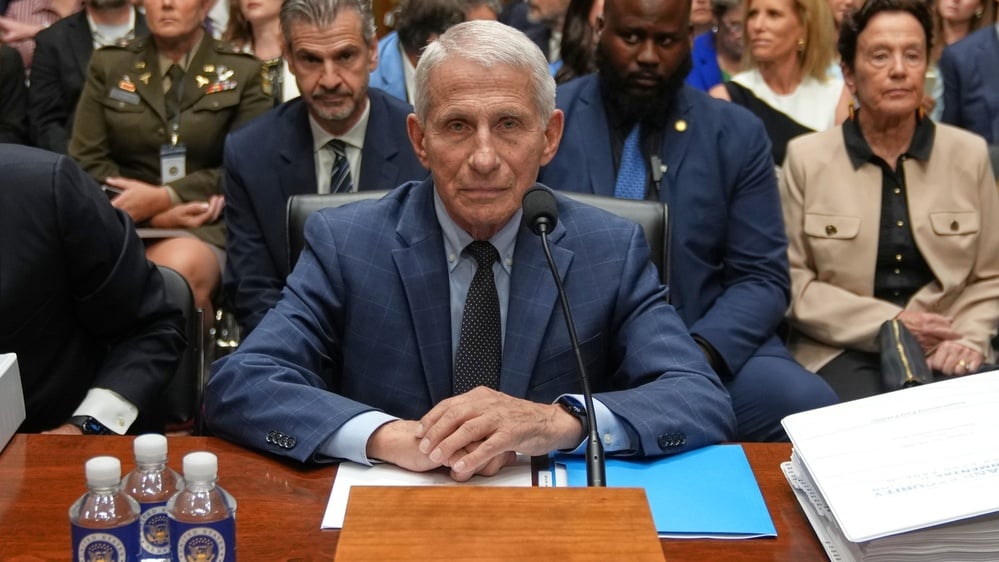
Neutral, event-focused framing around Fauci's Fifth Amendment invocation during a Senate probe into his Covid pandemic response.
Senate probe into Fauci's Covid pandemic response.
July 29, 2026 · 0 shares
Fact-focused, quotation-driven, conflict-centered coverage of a high-profile Senate hearing that neutrally presents Fauci's Fifth Amendment invocation and Rand Paul's ongoing criticisms.
Partisan framing foregrounds Republican attacks on Fauci and Democratic defense of his pandemic work during a GOP-led Senate hearing.
Fauci led the NIH's COVID-19 response and faced a politically charged hearing focused on his handling of the pandemic, the origins of SARS-CoV-2, and gain-of-function research funding.
The event comes after Fauci left government service in 2022 and after Rand Paul released over 1,000 pages of Fauci's private diary; Democrats defended Fauci's pandemic work while Republicans accused him of dishonesty and sought potential contempt charges.
Automated analysis; not human reviewed.
·
47 of 52 available dimensions scored; omitted dimensions are not treated as neutral.
·
Verified supporting quotes for 1 of 47 scored dimensions.
Claim: Framing emphasizes partisan conflict, with Democrats defending Fauci and Republicans attacking him.
“Democrats praised Fauci's work during the pandemic.” · not found in supplied text
“Republicans accuse Fauci of lying while Democrats say he didn’t deserve that.” · not found in supplied text
Why: Direct quotes show partisan framing.
Claim: The event is described as a standard congressional inquiry conducted by a GOP-led Senate panel.
“GOP-led Senate panel's COVID-19 hearing” · exact text match
Why: Terminology frames the event as an established political process.
Claim: The piece uses credible sourcing and includes direct quotes and background context.
“Fauci invoked the Fifth Amendment” · not found in supplied text
“Paul dominated the approximately three-hour hearing” · exact text match
“The Associated Press Health and Science Department receives support from the Howard Hughes Medical Institute and the Robert Wood Johnson Foundation” · not found in supplied text
Why: Quotations and background context support credibility.
Claim: The article includes an explicit claim about the fairness of the proceeding via quotes from participants.
“This hearing is designed to entrap you, said Maggie Hassan.” · not found in supplied text
Why: A quote about the hearing's fairness.
Framing centers on partisan confrontation in a Republican-led Senate committee and foregrounds Fauci’s Fifth Amendment invocation as a central moment.
July 29, 2026 · 0 shares
Conservative-leaning framing elevates Republican Sen. Bernie Moreno's critique of Fauci and casts Democrats defending him in a negative light, using loaded language about Fauci and policies.
Context: Fauci testified before the Senate Homeland Security and Governmental Affairs Committee on July 29, 2026, in Washington, D.C.; he had been pardoned in January 2025 by President Biden; Moreno is a Republican from Ohio who defeated Democrat incumbent Sherrod Brown in 2024.
Automated analysis; not human reviewed.
·
1 of 52 available dimensions scored; omitted dimensions are not treated as neutral.
·
Verified supporting quotes for 0 of 1 scored dimensions.
Framing centers on partisan confrontation over Fauci's Fifth Amendment invocation, depicting Rand Paul pursuing contempt-of-Congress action while Republicans press inquiries on NIH-funded research and Covid-19 origins.
July 29, 2026 · 0 shares
Fact-focused, quotation-driven, conflict-centered coverage of a high-profile Senate hearing that neutrally presents Fauci's Fifth Amendment invocation and Rand Paul's ongoing criticisms.
July 29, 2026 · 0 shares
Framing centers on political-legal maneuvering around Covid origins, presenting Fauci's Fifth Amendment invocation as a response to potential Republican perjury prosecution.
Balanced framing that presents Rand Paul’s accusations against Fauci and Fauci’s denial, anchored by Fauci’s invocation of the Fifth Amendment.
Framing emphasizes Republicans attacking Fauci in a Senate COVID hearing, with Fauci invoking the Fifth Amendment.
Context: Senate hearing on Fauci's role in the U.S. COVID-19 response; Debates include origins of the virus (lab origin vs natural origins) and gain-of-function research; a letter from scientists and remarks by Trump are noted.
Automated analysis; not human reviewed.
·
1 of 52 available dimensions scored; omitted dimensions are not treated as neutral.
·
Verified supporting quotes for 1 of 1 scored dimensions.
Claim: Loaded framing presents Republicans as attackers in Fauci hearing
“Fauci invokes Fifth Amendment as Republicans go on attack at U.S. Senate COVID hearing.” · exact text match
Why: The phrase 'go on attack' is a loaded framing device indicating perceived aggressiveness by Republicans.
Framing centers on partisan confrontation in a Republican-led Senate committee and foregrounds Fauci’s Fifth Amendment invocation as a central moment.
July 29, 2026 · 0 shares
Dramatic framing of a Senate hearing around Fauci invoking the Fifth Amendment and the removal of his attorney during questioning by Rand Paul.
Hearing centers on pandemic-era decisions, federally funded coronavirus research, and the origins of COVID-19. Paul released Fauci's pandemic-era diary entries, fueling questions about transparency; intelligence agencies remain divided on whether the virus originated naturally or via a lab, and there is ongoing debate about accountability and transparency in government pandemic actions.
Automated analysis; not human reviewed.
·
1 of 52 available dimensions scored; omitted dimensions are not treated as neutral.
·
Verified supporting quotes for 1 of 1 scored dimensions.
Claim: headline and framing emphasize drama and conflict at the hearing
“Fauci Hearing Erupts as Rand Paul Has Attorney Removed.” · exact text match
Why: The title uses 'erupts' to signal sensational framing rather than neutral reporting.
July 29, 2026 · 0 shares
Framing centers on a partisan confrontation over Fauci's testimony, foregrounding his Fifth Amendment invocation and Rand Paul's contempt threat.
July 29, 2026 · 0 shares
Partisan framing emphasizes a political clash over COVID-19 origins, foregrounding Rand Paul's diary-release allegations and Fauci's Fifth Amendment invocation alongside expert skepticism and mainstream science.
Automated analysis; not human reviewed.
·
21 of 52 available dimensions scored; omitted dimensions are not treated as neutral.
·
Verified supporting quotes for 0 of 21 scored dimensions.
Claim: No ideological tilt detected; coverage presents multiple sides of the origin debate
“"The hearing follows years of debate about the pandemic's origins, and whether the virus that causes COVID-19 emerged from a Chinese laboratory."” · exact text match
“"It's not unusual that people would be entertaining a variety of opinions or thinking about a lot of different theories and holes in their theories as they go forward," she says.” · not found in supplied text
Why: Direct quotes illustrate balanced treatment of competing views and scientific questioning.
Claim: Publisher demonstrates integrity by citing documents and consulting sources, showing fairness and verification
“"A spokesperson for Fauci sent a document fact-checking Paul's claims and a letter written by Fauci's legal team to Paul last month."” · not found in supplied text
Why: Use of official statements and explicit fact-checking signals transparency.
July 29, 2026 · 0 shares
Framing centers on a partisan confrontation over Fauci's testimony, foregrounding his Fifth Amendment invocation and Rand Paul's contempt threat.
July 29, 2026 · 0 shares
Neutral, event-focused framing around Fauci's Fifth Amendment invocation during a Senate probe into his Covid pandemic response.
Senate probe into Fauci's Covid pandemic response.
July 29, 2026 · 0 shares
Fact-focused, quotation-driven, conflict-centered coverage of a high-profile Senate hearing that neutrally presents Fauci's Fifth Amendment invocation and Rand Paul's ongoing criticisms.
July 29, 2026 · 0 shares
Framing centers on political-legal maneuvering around Covid origins, presenting Fauci's Fifth Amendment invocation as a response to potential Republican perjury prosecution.
Balanced framing that presents Rand Paul’s accusations against Fauci and Fauci’s denial, anchored by Fauci’s invocation of the Fifth Amendment.
Partisan framing foregrounds Republican attacks on Fauci and Democratic defense of his pandemic work during a GOP-led Senate hearing.
Fauci led the NIH's COVID-19 response and faced a politically charged hearing focused on his handling of the pandemic, the origins of SARS-CoV-2, and gain-of-function research funding. The event comes after Fauci left government service in 2022 and after Rand Paul released over 1,000 pages of Fauci's private diary; Democrats defended Fauci's pandemic work while Republicans accused him of dishonesty and sought potential contempt charges.
Automated analysis; not human reviewed. · 47 of 52 available dimensions scored; omitted dimensions are not treated as neutral. · Verified supporting quotes for 1 of 47 scored dimensions.
Claim: Framing emphasizes partisan conflict, with Democrats defending Fauci and Republicans attacking him.
“Democrats praised Fauci's work during the pandemic.” · not found in supplied text
“Republicans accuse Fauci of lying while Democrats say he didn’t deserve that.” · not found in supplied text
Why: Direct quotes show partisan framing.
Claim: The event is described as a standard congressional inquiry conducted by a GOP-led Senate panel.
“GOP-led Senate panel's COVID-19 hearing” · exact text match
Why: Terminology frames the event as an established political process.
Claim: The piece uses credible sourcing and includes direct quotes and background context.
“Fauci invoked the Fifth Amendment” · not found in supplied text
“Paul dominated the approximately three-hour hearing” · exact text match
“The Associated Press Health and Science Department receives support from the Howard Hughes Medical Institute and the Robert Wood Johnson Foundation” · not found in supplied text
Why: Quotations and background context support credibility.
Claim: The article includes an explicit claim about the fairness of the proceeding via quotes from participants.
“This hearing is designed to entrap you, said Maggie Hassan.” · not found in supplied text
Why: A quote about the hearing's fairness.
July 29, 2026 · 0 shares
Confrontational, partisan framing emphasizes a fiery Senate hearing and Republican threats to hold Fauci in contempt for not answering questions.
Automated analysis; not human reviewed. Limitations: Headlines-only text; limited context; full article needed for deeper interpretation.
Headlines-only text; limited context; full article needed for deeper interpretation.
Framing emphasizes Republicans attacking Fauci in a Senate COVID hearing, with Fauci invoking the Fifth Amendment.
Context: Senate hearing on Fauci's role in the U.S. COVID-19 response; Debates include origins of the virus (lab origin vs natural origins) and gain-of-function research; a letter from scientists and remarks by Trump are noted.
Automated analysis; not human reviewed. · 1 of 52 available dimensions scored; omitted dimensions are not treated as neutral. · Verified supporting quotes for 1 of 1 scored dimensions.
Claim: Loaded framing presents Republicans as attackers in Fauci hearing
“Fauci invokes Fifth Amendment as Republicans go on attack at U.S. Senate COVID hearing.” · exact text match
Why: The phrase 'go on attack' is a loaded framing device indicating perceived aggressiveness by Republicans.
Framing centers on a state attorney general launching an investigation into Fauci after a contentious Senate hearing, emphasizing Fauci's alleged lack of candor.
Framing centers on partisan confrontation in a Republican-led Senate committee and foregrounds Fauci’s Fifth Amendment invocation as a central moment.
Framing centers on partisan confrontation over Fauci's Fifth Amendment invocation, depicting Rand Paul pursuing contempt-of-Congress action while Republicans press inquiries on NIH-funded research and Covid-19 origins.
July 29, 2026 · 0 shares
Partisan framing emphasizes a political clash over COVID-19 origins, foregrounding Rand Paul's diary-release allegations and Fauci's Fifth Amendment invocation alongside expert skepticism and mainstream science.
Automated analysis; not human reviewed. · 21 of 52 available dimensions scored; omitted dimensions are not treated as neutral. · Verified supporting quotes for 0 of 21 scored dimensions.
Claim: No ideological tilt detected; coverage presents multiple sides of the origin debate
“"The hearing follows years of debate about the pandemic's origins, and whether the virus that causes COVID-19 emerged from a Chinese laboratory."” · exact text match
“"It's not unusual that people would be entertaining a variety of opinions or thinking about a lot of different theories and holes in their theories as they go forward," she says.” · not found in supplied text
Why: Direct quotes illustrate balanced treatment of competing views and scientific questioning.
Claim: Publisher demonstrates integrity by citing documents and consulting sources, showing fairness and verification
“"A spokesperson for Fauci sent a document fact-checking Paul's claims and a letter written by Fauci's legal team to Paul last month."” · not found in supplied text
Why: Use of official statements and explicit fact-checking signals transparency.
July 29, 2026 · 0 shares
Framing centers on a partisan confrontation over Fauci's testimony, foregrounding his Fifth Amendment invocation and Rand Paul's contempt threat.
July 29, 2026 · 0 shares
Framing centers on partisan controversy over Fauci's diaries and COVID origins, with Republican claims contrasted against mainstream counterclaims while promotional branding is embedded.
Rand Paul released Fauci's diaries ahead of a Senate hearing on COVID-19 origins and the federal pandemic response; the diaries cover December 2019 through December 2022 and include private reflections and conversations with major political figures.
Automated analysis; not human reviewed. Limitations: The article relies on promotional branding and aggregator framing, which could color the presentation of contested claims (e.g., diary contents) and the balance of perspectives. · 52 of 52 available dimensions scored; omitted dimensions are not treated as neutral. · Verified supporting quotes for 3 of 52 scored dimensions.
Claim: Treats diary content as sensational personal material.
“Here are some experts from Fauci’s diary that reveal private reflections and conversations. Straight Arrow has censored instances of profanity.” · exact text match
Why: Framing around private diary content and censorship of profanity.
Claim: Cites NewsGuard and AllSides to frame credibility and align with credible sources.
“Awarded a perfect reliability rating from NewsGuard” · exact text match
“According to media bias experts at AllSides” · exact text match
Why: Anchoring the piece on third-party credibility assessments.
Claim: Promotional content advertises the publisher's app and asserts no spin.
“Download the Straight Arrow app today to get the stories that matter free from manipulation, bias or agenda.” · exact text match
Why: Explicit marketing language embedded in the piece.
The article relies on promotional branding and aggregator framing, which could color the presentation of contested claims (e.g., diary contents) and the balance of perspectives.
July 29, 2026 · 0 shares
Partisan framing emphasizes a political clash over COVID-19 origins, foregrounding Rand Paul's diary-release allegations and Fauci's Fifth Amendment invocation alongside expert skepticism and mainstream science.
Automated analysis; not human reviewed. · 21 of 52 available dimensions scored; omitted dimensions are not treated as neutral. · Verified supporting quotes for 0 of 21 scored dimensions.
Claim: No ideological tilt detected; coverage presents multiple sides of the origin debate
“"The hearing follows years of debate about the pandemic's origins, and whether the virus that causes COVID-19 emerged from a Chinese laboratory."” · exact text match
“"It's not unusual that people would be entertaining a variety of opinions or thinking about a lot of different theories and holes in their theories as they go forward," she says.” · not found in supplied text
Why: Direct quotes illustrate balanced treatment of competing views and scientific questioning.
Claim: Publisher demonstrates integrity by citing documents and consulting sources, showing fairness and verification
“"A spokesperson for Fauci sent a document fact-checking Paul's claims and a letter written by Fauci's legal team to Paul last month."” · not found in supplied text
Why: Use of official statements and explicit fact-checking signals transparency.
Partisan framing foregrounds Republican attacks on Fauci and Democratic defense of his pandemic work during a GOP-led Senate hearing.
Fauci led the NIH's COVID-19 response and faced a politically charged hearing focused on his handling of the pandemic, the origins of SARS-CoV-2, and gain-of-function research funding. The event comes after Fauci left government service in 2022 and after Rand Paul released over 1,000 pages of Fauci's private diary; Democrats defended Fauci's pandemic work while Republicans accused him of dishonesty and sought potential contempt charges.
Automated analysis; not human reviewed. · 47 of 52 available dimensions scored; omitted dimensions are not treated as neutral. · Verified supporting quotes for 1 of 47 scored dimensions.
Claim: Framing emphasizes partisan conflict, with Democrats defending Fauci and Republicans attacking him.
“Democrats praised Fauci's work during the pandemic.” · not found in supplied text
“Republicans accuse Fauci of lying while Democrats say he didn’t deserve that.” · not found in supplied text
Why: Direct quotes show partisan framing.
Claim: The event is described as a standard congressional inquiry conducted by a GOP-led Senate panel.
“GOP-led Senate panel's COVID-19 hearing” · exact text match
Why: Terminology frames the event as an established political process.
Claim: The piece uses credible sourcing and includes direct quotes and background context.
“Fauci invoked the Fifth Amendment” · not found in supplied text
“Paul dominated the approximately three-hour hearing” · exact text match
“The Associated Press Health and Science Department receives support from the Howard Hughes Medical Institute and the Robert Wood Johnson Foundation” · not found in supplied text
Why: Quotations and background context support credibility.
Claim: The article includes an explicit claim about the fairness of the proceeding via quotes from participants.
“This hearing is designed to entrap you, said Maggie Hassan.” · not found in supplied text
Why: A quote about the hearing's fairness.
Helium Bias
Story Blindspots
Framing centers on partisan confrontation in a Republican-led Senate committee and foregrounds Fauci’s Fifth Amendment invocation as a central moment.
July 29, 2026 · 0 shares
Conservative-leaning framing elevates Republican Sen. Bernie Moreno's critique of Fauci and casts Democrats defending him in a negative light, using loaded language about Fauci and policies.
Context: Fauci testified before the Senate Homeland Security and Governmental Affairs Committee on July 29, 2026, in Washington, D.C.; he had been pardoned in January 2025 by President Biden; Moreno is a Republican from Ohio who defeated Democrat incumbent Sherrod Brown in 2024.
Automated analysis; not human reviewed. · 1 of 52 available dimensions scored; omitted dimensions are not treated as neutral. · Verified supporting quotes for 0 of 1 scored dimensions.
Framing centers on partisan confrontation over Fauci's Fifth Amendment invocation, depicting Rand Paul pursuing contempt-of-Congress action while Republicans press inquiries on NIH-funded research and Covid-19 origins.
Partisan framing foregrounds Republican attacks on Fauci and Democratic defense of his pandemic work during a GOP-led Senate hearing.
Fauci led the NIH's COVID-19 response and faced a politically charged hearing focused on his handling of the pandemic, the origins of SARS-CoV-2, and gain-of-function research funding. The event comes after Fauci left government service in 2022 and after Rand Paul released over 1,000 pages of Fauci's private diary; Democrats defended Fauci's pandemic work while Republicans accused him of dishonesty and sought potential contempt charges.
Automated analysis; not human reviewed. · 47 of 52 available dimensions scored; omitted dimensions are not treated as neutral. · Verified supporting quotes for 1 of 47 scored dimensions.
Claim: Framing emphasizes partisan conflict, with Democrats defending Fauci and Republicans attacking him.
“Democrats praised Fauci's work during the pandemic.” · not found in supplied text
“Republicans accuse Fauci of lying while Democrats say he didn’t deserve that.” · not found in supplied text
Why: Direct quotes show partisan framing.
Claim: The event is described as a standard congressional inquiry conducted by a GOP-led Senate panel.
“GOP-led Senate panel's COVID-19 hearing” · exact text match
Why: Terminology frames the event as an established political process.
Claim: The piece uses credible sourcing and includes direct quotes and background context.
“Fauci invoked the Fifth Amendment” · not found in supplied text
“Paul dominated the approximately three-hour hearing” · exact text match
“The Associated Press Health and Science Department receives support from the Howard Hughes Medical Institute and the Robert Wood Johnson Foundation” · not found in supplied text
Why: Quotations and background context support credibility.
Claim: The article includes an explicit claim about the fairness of the proceeding via quotes from participants.
“This hearing is designed to entrap you, said Maggie Hassan.” · not found in supplied text
Why: A quote about the hearing's fairness.
July 29, 2026 · 0 shares
Conservative-leaning framing elevates Republican Sen. Bernie Moreno's critique of Fauci and casts Democrats defending him in a negative light, using loaded language about Fauci and policies.
Context: Fauci testified before the Senate Homeland Security and Governmental Affairs Committee on July 29, 2026, in Washington, D.C.; he had been pardoned in January 2025 by President Biden; Moreno is a Republican from Ohio who defeated Democrat incumbent Sherrod Brown in 2024.
Automated analysis; not human reviewed. · 1 of 52 available dimensions scored; omitted dimensions are not treated as neutral. · Verified supporting quotes for 0 of 1 scored dimensions.
Conservative-leaning framing casts Fauci as the target of a politically motivated, prosecutorial inquiry led by Rand Paul, using sensational language to frame the hearing as high-stakes and adversarial.
Automated analysis; not human reviewed. Limitations: The article's framing is strongly partisan, reflecting a conservative outlet's emphasis on prosecutorial accountability for Fauci; context or alternative framing may be underrepresented. · 7 of 52 available dimensions scored; omitted dimensions are not treated as neutral. · Verified supporting quotes for 3 of 7 scored dimensions.
Claim: Publisher framing favors a conservative prosecutorial narrative against Fauci
“JUST IN: Fauci Lashes Out At Rand Paul, Pleads The Fifth In Tense Hearing.” · exact text match
“Trending Politics Conservative Breaking News and Commentary” · exact text match
Why: Explicit labeling and sensational framing indicate a conservative framing.
Claim: Punitively framed discourse with emphasis on prosecutions and pardons indicates an authoritarian lean
“A pardon that protects a person from criminal prosecution doesn’t rewrite history. It does not erase documents. It does not convert a misleading statement to a truthful one, and it does not prevent Congress from establishing what happened.” · not found in supplied text
Why: Pardons and prosecutions used to discuss accountability reflect authoritarian tilt.
Claim: Subjective framing through emotive language indicating non-objectivity
“🚨 LMAO!! Dr. Fauci just FUMED” · exact text match
“The dramatic exchange marked the first time Fauci has invoked the Fifth Amendment in more than 250 appearances before Congress.” · exact text match
Why: Use of sensational language and 'dramatic' framing indicates subjectivity.
Claim: Polls and rhetorical framing are used to prescribe normative judgments
“POLL: Should Fauci Be Punished For His Role In COVID Tyranny?” · exact text match
“POLL: Is JD Vance A Better Vice President Than Mike Pence?” · exact text match
Why: Poll content signals normative judgement about Fauci and political figures.
Claim: The article uses sensational language that fosters irrational interpretation
“🚨 LMAO!! Dr. Fauci just FUMED that Rand Paul released his private diary entries because they’re 'embarrassing' and could contribute to his prosecution” · not found in supplied text
Why: Emotive language and emoji indicate sensationalism.
The article's framing is strongly partisan, reflecting a conservative outlet's emphasis on prosecutorial accountability for Fauci; context or alternative framing may be underrepresented.
July 29, 2026 · 0 shares
Neutral, event-focused framing around Fauci's Fifth Amendment invocation during a Senate probe into his Covid pandemic response.
Senate probe into Fauci's Covid pandemic response.
July 29, 2026 · 0 shares
Framing centers on political-legal maneuvering around Covid origins, presenting Fauci's Fifth Amendment invocation as a response to potential Republican perjury prosecution.
Partisan framing foregrounds Republican attacks on Fauci and Democratic defense of his pandemic work during a GOP-led Senate hearing.
Fauci led the NIH's COVID-19 response and faced a politically charged hearing focused on his handling of the pandemic, the origins of SARS-CoV-2, and gain-of-function research funding. The event comes after Fauci left government service in 2022 and after Rand Paul released over 1,000 pages of Fauci's private diary; Democrats defended Fauci's pandemic work while Republicans accused him of dishonesty and sought potential contempt charges.
Automated analysis; not human reviewed. · 47 of 52 available dimensions scored; omitted dimensions are not treated as neutral. · Verified supporting quotes for 1 of 47 scored dimensions.
Claim: Framing emphasizes partisan conflict, with Democrats defending Fauci and Republicans attacking him.
“Democrats praised Fauci's work during the pandemic.” · not found in supplied text
“Republicans accuse Fauci of lying while Democrats say he didn’t deserve that.” · not found in supplied text
Why: Direct quotes show partisan framing.
Claim: The event is described as a standard congressional inquiry conducted by a GOP-led Senate panel.
“GOP-led Senate panel's COVID-19 hearing” · exact text match
Why: Terminology frames the event as an established political process.
Claim: The piece uses credible sourcing and includes direct quotes and background context.
“Fauci invoked the Fifth Amendment” · not found in supplied text
“Paul dominated the approximately three-hour hearing” · exact text match
“The Associated Press Health and Science Department receives support from the Howard Hughes Medical Institute and the Robert Wood Johnson Foundation” · not found in supplied text
Why: Quotations and background context support credibility.
Claim: The article includes an explicit claim about the fairness of the proceeding via quotes from participants.
“This hearing is designed to entrap you, said Maggie Hassan.” · not found in supplied text
Why: A quote about the hearing's fairness.
July 29, 2026 · 0 shares
Confrontational, partisan framing emphasizes a fiery Senate hearing and Republican threats to hold Fauci in contempt for not answering questions.
Automated analysis; not human reviewed. Limitations: Headlines-only text; limited context; full article needed for deeper interpretation.
Headlines-only text; limited context; full article needed for deeper interpretation.
Framing centers on partisan confrontation in a Republican-led Senate committee and foregrounds Fauci’s Fifth Amendment invocation as a central moment.
July 29, 2026 · 0 shares
Conservative-leaning framing elevates Republican Sen. Bernie Moreno's critique of Fauci and casts Democrats defending him in a negative light, using loaded language about Fauci and policies.
Context: Fauci testified before the Senate Homeland Security and Governmental Affairs Committee on July 29, 2026, in Washington, D.C.; he had been pardoned in January 2025 by President Biden; Moreno is a Republican from Ohio who defeated Democrat incumbent Sherrod Brown in 2024.
Automated analysis; not human reviewed. · 1 of 52 available dimensions scored; omitted dimensions are not treated as neutral. · Verified supporting quotes for 0 of 1 scored dimensions.
Framing centers on partisan confrontation over Fauci's Fifth Amendment invocation, depicting Rand Paul pursuing contempt-of-Congress action while Republicans press inquiries on NIH-funded research and Covid-19 origins.
Framing emphasizes Republicans attacking Fauci in a Senate COVID hearing, with Fauci invoking the Fifth Amendment.
Context: Senate hearing on Fauci's role in the U.S. COVID-19 response; Debates include origins of the virus (lab origin vs natural origins) and gain-of-function research; a letter from scientists and remarks by Trump are noted.
Automated analysis; not human reviewed. · 1 of 52 available dimensions scored; omitted dimensions are not treated as neutral. · Verified supporting quotes for 1 of 1 scored dimensions.
Claim: Loaded framing presents Republicans as attackers in Fauci hearing
“Fauci invokes Fifth Amendment as Republicans go on attack at U.S. Senate COVID hearing.” · exact text match
Why: The phrase 'go on attack' is a loaded framing device indicating perceived aggressiveness by Republicans.
Framing centers on a state attorney general launching an investigation into Fauci after a contentious Senate hearing, emphasizing Fauci's alleged lack of candor.
Framing centers on partisan confrontation in a Republican-led Senate committee and foregrounds Fauci’s Fifth Amendment invocation as a central moment.
Framing centers on partisan confrontation over Fauci's Fifth Amendment invocation, depicting Rand Paul pursuing contempt-of-Congress action while Republicans press inquiries on NIH-funded research and Covid-19 origins.
July 29, 2026 · 0 shares
Fact-focused, quotation-driven, conflict-centered coverage of a high-profile Senate hearing that neutrally presents Fauci's Fifth Amendment invocation and Rand Paul's ongoing criticisms.
July 29, 2026 · 0 shares
Framing centers on political-legal maneuvering around Covid origins, presenting Fauci's Fifth Amendment invocation as a response to potential Republican perjury prosecution.
Balanced framing that presents Rand Paul’s accusations against Fauci and Fauci’s denial, anchored by Fauci’s invocation of the Fifth Amendment.
July 29, 2026 · 0 shares
Partisan confrontation dominates framing, depicting Rand Paul as pursuing a punitive, politically charged challenge to Fauci while Fauci is framed as defending legitimate congressional oversight amid a high-stakes hearing.
Context: The hearing concerns the Covid-19 origins and the U.S. pandemic response; Rand Paul and his allies allege Fauci misled Congress and engaged in 'covering up' the virus origins; Fauci asserts the hearing is part of legitimate oversight, and Biden's pardon adds to the political dimension.
Automated analysis; not human reviewed. · 8 of 52 available dimensions scored; omitted dimensions are not treated as neutral. · Verified supporting quotes for 1 of 8 scored dimensions.
Claim: Loaded and dramatic framing of the dispute through vivid descriptors.
“"rock star status" for a time due to his central role in charting the U.S. pandemic response.” · not found in supplied text
“"Any reasonable person who has followed his unhinged obsession with me would readily come to the same conclusion," he said.” · verified after text normalization
Why: The phrases evoke drama around the figures involved.
Claim: The piece frames the hearing within a political context, indicating partisan implications.
“"not bipartisan"” · not found in supplied text
“"partisan agenda"” · not found in supplied text
Why: Use of explicit partisan descriptors signals political framing.
Claim: Framing emphasizes oversight legitimacy and cautions against partisan aims.
“Gary Peters (D-Mich.), the ranking member of the committee, opened the hearing by calling the legitimacy of Paul’s efforts into question, saying the oversight efforts were not bipartisan as usual.” · exact text match
“"I fear the intent of this hearing is only meant to fuel a purely partisan agenda and will not … make Americans safer," Peters said.” · verified after text normalization
“Before stating that he would not answer questions, Fauci noted that in his nearly four decades as director of the National Institute of Allergy and Infectious Diseases he had testified before or briefed House and Senate committees more than 200 times — a track record, he said, that demonstrated his belief in and respect for "legitimate congressional oversight."” · verified after text normalization
Why: These quotes show the article foregrounding procedural legitimacy and cautioning against partisan manipulation, consistent with establishment framing.
Claim: Emotional framing appears via charged descriptors around the dispute.
“"unhinged obsession"” · not found in supplied text
“"strongman behind key pandemic decisions"” · not found in supplied text
Why: Quotes show loaded language influencing tone.
Claim: The piece appears to rely on direct quotes from multiple actors, indicating balanced sourcing.
“the article includes quotes from Fauci, Paul, and Peters” · not found in supplied text
Why: Presence of quotes from multiple sides suggests fairness, though not definitive without broader sourcing.
July 29, 2026 · 0 shares
Fact-focused, quotation-driven, conflict-centered coverage of a high-profile Senate hearing that neutrally presents Fauci's Fifth Amendment invocation and Rand Paul's ongoing criticisms.
July 29, 2026 · 0 shares
Partisan framing emphasizes a political clash over COVID-19 origins, foregrounding Rand Paul's diary-release allegations and Fauci's Fifth Amendment invocation alongside expert skepticism and mainstream science.
Automated analysis; not human reviewed. · 21 of 52 available dimensions scored; omitted dimensions are not treated as neutral. · Verified supporting quotes for 0 of 21 scored dimensions.
Claim: No ideological tilt detected; coverage presents multiple sides of the origin debate
“"The hearing follows years of debate about the pandemic's origins, and whether the virus that causes COVID-19 emerged from a Chinese laboratory."” · exact text match
“"It's not unusual that people would be entertaining a variety of opinions or thinking about a lot of different theories and holes in their theories as they go forward," she says.” · not found in supplied text
Why: Direct quotes illustrate balanced treatment of competing views and scientific questioning.
Claim: Publisher demonstrates integrity by citing documents and consulting sources, showing fairness and verification
“"A spokesperson for Fauci sent a document fact-checking Paul's claims and a letter written by Fauci's legal team to Paul last month."” · not found in supplied text
Why: Use of official statements and explicit fact-checking signals transparency.
July 29, 2026 · 0 shares
Framing centers on a partisan confrontation over Fauci's testimony, foregrounding his Fifth Amendment invocation and Rand Paul's contempt threat.
July 29, 2026 · 0 shares
Partisan framing emphasizes a political clash over COVID-19 origins, foregrounding Rand Paul's diary-release allegations and Fauci's Fifth Amendment invocation alongside expert skepticism and mainstream science.
Automated analysis; not human reviewed. · 21 of 52 available dimensions scored; omitted dimensions are not treated as neutral. · Verified supporting quotes for 0 of 21 scored dimensions.
Claim: No ideological tilt detected; coverage presents multiple sides of the origin debate
“"The hearing follows years of debate about the pandemic's origins, and whether the virus that causes COVID-19 emerged from a Chinese laboratory."” · exact text match
“"It's not unusual that people would be entertaining a variety of opinions or thinking about a lot of different theories and holes in their theories as they go forward," she says.” · not found in supplied text
Why: Direct quotes illustrate balanced treatment of competing views and scientific questioning.
Claim: Publisher demonstrates integrity by citing documents and consulting sources, showing fairness and verification
“"A spokesperson for Fauci sent a document fact-checking Paul's claims and a letter written by Fauci's legal team to Paul last month."” · not found in supplied text
Why: Use of official statements and explicit fact-checking signals transparency.
July 29, 2026 · 0 shares
Framing centers on partisan controversy over Fauci's diaries and COVID origins, with Republican claims contrasted against mainstream counterclaims while promotional branding is embedded.
Rand Paul released Fauci's diaries ahead of a Senate hearing on COVID-19 origins and the federal pandemic response; the diaries cover December 2019 through December 2022 and include private reflections and conversations with major political figures.
Automated analysis; not human reviewed. Limitations: The article relies on promotional branding and aggregator framing, which could color the presentation of contested claims (e.g., diary contents) and the balance of perspectives. · 52 of 52 available dimensions scored; omitted dimensions are not treated as neutral. · Verified supporting quotes for 3 of 52 scored dimensions.
Claim: Treats diary content as sensational personal material.
“Here are some experts from Fauci’s diary that reveal private reflections and conversations. Straight Arrow has censored instances of profanity.” · exact text match
Why: Framing around private diary content and censorship of profanity.
Claim: Cites NewsGuard and AllSides to frame credibility and align with credible sources.
“Awarded a perfect reliability rating from NewsGuard” · exact text match
“According to media bias experts at AllSides” · exact text match
Why: Anchoring the piece on third-party credibility assessments.
Claim: Promotional content advertises the publisher's app and asserts no spin.
“Download the Straight Arrow app today to get the stories that matter free from manipulation, bias or agenda.” · exact text match
Why: Explicit marketing language embedded in the piece.
The article relies on promotional branding and aggregator framing, which could color the presentation of contested claims (e.g., diary contents) and the balance of perspectives.
July 29, 2026 · 0 shares
Partisan framing emphasizes a political clash over COVID-19 origins, foregrounding Rand Paul's diary-release allegations and Fauci's Fifth Amendment invocation alongside expert skepticism and mainstream science.
Automated analysis; not human reviewed. · 21 of 52 available dimensions scored; omitted dimensions are not treated as neutral. · Verified supporting quotes for 0 of 21 scored dimensions.
Claim: No ideological tilt detected; coverage presents multiple sides of the origin debate
“"The hearing follows years of debate about the pandemic's origins, and whether the virus that causes COVID-19 emerged from a Chinese laboratory."” · exact text match
“"It's not unusual that people would be entertaining a variety of opinions or thinking about a lot of different theories and holes in their theories as they go forward," she says.” · not found in supplied text
Why: Direct quotes illustrate balanced treatment of competing views and scientific questioning.
Claim: Publisher demonstrates integrity by citing documents and consulting sources, showing fairness and verification
“"A spokesperson for Fauci sent a document fact-checking Paul's claims and a letter written by Fauci's legal team to Paul last month."” · not found in supplied text
Why: Use of official statements and explicit fact-checking signals transparency.
Partisan framing foregrounds Republican attacks on Fauci and Democratic defense of his pandemic work during a GOP-led Senate hearing.
Fauci led the NIH's COVID-19 response and faced a politically charged hearing focused on his handling of the pandemic, the origins of SARS-CoV-2, and gain-of-function research funding. The event comes after Fauci left government service in 2022 and after Rand Paul released over 1,000 pages of Fauci's private diary; Democrats defended Fauci's pandemic work while Republicans accused him of dishonesty and sought potential contempt charges.
Automated analysis; not human reviewed. · 47 of 52 available dimensions scored; omitted dimensions are not treated as neutral. · Verified supporting quotes for 1 of 47 scored dimensions.
Claim: Framing emphasizes partisan conflict, with Democrats defending Fauci and Republicans attacking him.
“Democrats praised Fauci's work during the pandemic.” · not found in supplied text
“Republicans accuse Fauci of lying while Democrats say he didn’t deserve that.” · not found in supplied text
Why: Direct quotes show partisan framing.
Claim: The event is described as a standard congressional inquiry conducted by a GOP-led Senate panel.
“GOP-led Senate panel's COVID-19 hearing” · exact text match
Why: Terminology frames the event as an established political process.
Claim: The piece uses credible sourcing and includes direct quotes and background context.
“Fauci invoked the Fifth Amendment” · not found in supplied text
“Paul dominated the approximately three-hour hearing” · exact text match
“The Associated Press Health and Science Department receives support from the Howard Hughes Medical Institute and the Robert Wood Johnson Foundation” · not found in supplied text
Why: Quotations and background context support credibility.
Claim: The article includes an explicit claim about the fairness of the proceeding via quotes from participants.
“This hearing is designed to entrap you, said Maggie Hassan.” · not found in supplied text
Why: A quote about the hearing's fairness.
July 29, 2026 · 0 shares
Neutral, event-focused framing around Fauci's Fifth Amendment invocation during a Senate probe into his Covid pandemic response.
Senate probe into Fauci's Covid pandemic response.
July 29, 2026 · 0 shares
Framing centers on political-legal maneuvering around Covid origins, presenting Fauci's Fifth Amendment invocation as a response to potential Republican perjury prosecution.
Balanced framing that presents Rand Paul’s accusations against Fauci and Fauci’s denial, anchored by Fauci’s invocation of the Fifth Amendment.
Framing centers on partisan confrontation in a Republican-led Senate committee and foregrounds Fauci’s Fifth Amendment invocation as a central moment.
July 29, 2026 · 0 shares
Fiery Senate hearing framing highlights a partisan clash over Covid-19 policy and Fauci's testimony, with contempt threats used as leverage.
Automated analysis; not human reviewed. Limitations: Based on a single headline; no full article content is provided to assess framing beyond the stated claims.
Based on a single headline; no full article content is provided to assess framing beyond the stated claims.
July 29, 2026 · 0 shares
Confrontational, partisan framing emphasizes a fiery Senate hearing and Republican threats to hold Fauci in contempt for not answering questions.
Automated analysis; not human reviewed. Limitations: Headlines-only text; limited context; full article needed for deeper interpretation.
Headlines-only text; limited context; full article needed for deeper interpretation.
July 29, 2026 · 0 shares
Partisan confrontation dominates framing, depicting Rand Paul as pursuing a punitive, politically charged challenge to Fauci while Fauci is framed as defending legitimate congressional oversight amid a high-stakes hearing.
Context: The hearing concerns the Covid-19 origins and the U.S. pandemic response; Rand Paul and his allies allege Fauci misled Congress and engaged in 'covering up' the virus origins; Fauci asserts the hearing is part of legitimate oversight, and Biden's pardon adds to the political dimension.
Automated analysis; not human reviewed.
·
8 of 52 available dimensions scored; omitted dimensions are not treated as neutral.
·
Verified supporting quotes for 1 of 8 scored dimensions.
Claim: Loaded and dramatic framing of the dispute through vivid descriptors.
“"rock star status" for a time due to his central role in charting the U.S. pandemic response.” · not found in supplied text
“"Any reasonable person who has followed his unhinged obsession with me would readily come to the same conclusion," he said.” · verified after text normalization
Why: The phrases evoke drama around the figures involved.
Claim: The piece frames the hearing within a political context, indicating partisan implications.
“"not bipartisan"” · not found in supplied text
“"partisan agenda"” · not found in supplied text
Why: Use of explicit partisan descriptors signals political framing.
Claim: Framing emphasizes oversight legitimacy and cautions against partisan aims.
“Gary Peters (D-Mich.), the ranking member of the committee, opened the hearing by calling the legitimacy of Paul’s efforts into question, saying the oversight efforts were not bipartisan as usual.” · exact text match
“"I fear the intent of this hearing is only meant to fuel a purely partisan agenda and will not … make Americans safer," Peters said.” · verified after text normalization
“Before stating that he would not answer questions, Fauci noted that in his nearly four decades as director of the National Institute of Allergy and Infectious Diseases he had testified before or briefed House and Senate committees more than 200 times — a track record, he said, that demonstrated his belief in and respect for "legitimate congressional oversight."” · verified after text normalization
Why: These quotes show the article foregrounding procedural legitimacy and cautioning against partisan manipulation, consistent with establishment framing.
Claim: Emotional framing appears via charged descriptors around the dispute.
“"unhinged obsession"” · not found in supplied text
“"strongman behind key pandemic decisions"” · not found in supplied text
Why: Quotes show loaded language influencing tone.
Claim: The piece appears to rely on direct quotes from multiple actors, indicating balanced sourcing.
“the article includes quotes from Fauci, Paul, and Peters” · not found in supplied text
Why: Presence of quotes from multiple sides suggests fairness, though not definitive without broader sourcing.
July 29, 2026 · 0 shares
Framing centers on political-legal maneuvering around Covid origins, presenting Fauci's Fifth Amendment invocation as a response to potential Republican perjury prosecution.
July 29, 2026 · 0 shares
Framing centers on a partisan confrontation over Fauci's testimony, foregrounding his Fifth Amendment invocation and Rand Paul's contempt threat.
Framing centers on a state attorney general launching an investigation into Fauci after a contentious Senate hearing, emphasizing Fauci's alleged lack of candor.
Partisan framing foregrounds Republican attacks on Fauci and Democratic defense of his pandemic work during a GOP-led Senate hearing.
Fauci led the NIH's COVID-19 response and faced a politically charged hearing focused on his handling of the pandemic, the origins of SARS-CoV-2, and gain-of-function research funding.
The event comes after Fauci left government service in 2022 and after Rand Paul released over 1,000 pages of Fauci's private diary; Democrats defended Fauci's pandemic work while Republicans accused him of dishonesty and sought potential contempt charges.
Automated analysis; not human reviewed.
·
47 of 52 available dimensions scored; omitted dimensions are not treated as neutral.
·
Verified supporting quotes for 1 of 47 scored dimensions.
Claim: Framing emphasizes partisan conflict, with Democrats defending Fauci and Republicans attacking him.
“Democrats praised Fauci's work during the pandemic.” · not found in supplied text
“Republicans accuse Fauci of lying while Democrats say he didn’t deserve that.” · not found in supplied text
Why: Direct quotes show partisan framing.
Claim: The event is described as a standard congressional inquiry conducted by a GOP-led Senate panel.
“GOP-led Senate panel's COVID-19 hearing” · exact text match
Why: Terminology frames the event as an established political process.
Claim: The piece uses credible sourcing and includes direct quotes and background context.
“Fauci invoked the Fifth Amendment” · not found in supplied text
“Paul dominated the approximately three-hour hearing” · exact text match
“The Associated Press Health and Science Department receives support from the Howard Hughes Medical Institute and the Robert Wood Johnson Foundation” · not found in supplied text
Why: Quotations and background context support credibility.
Claim: The article includes an explicit claim about the fairness of the proceeding via quotes from participants.
“This hearing is designed to entrap you, said Maggie Hassan.” · not found in supplied text
Why: A quote about the hearing's fairness.
July 29, 2026 · 0 shares
Conservative-leaning framing elevates Republican Sen. Bernie Moreno's critique of Fauci and casts Democrats defending him in a negative light, using loaded language about Fauci and policies.
Context: Fauci testified before the Senate Homeland Security and Governmental Affairs Committee on July 29, 2026, in Washington, D.C.; he had been pardoned in January 2025 by President Biden; Moreno is a Republican from Ohio who defeated Democrat incumbent Sherrod Brown in 2024.
Automated analysis; not human reviewed.
·
1 of 52 available dimensions scored; omitted dimensions are not treated as neutral.
·
Verified supporting quotes for 0 of 1 scored dimensions.
July 29, 2026 · 0 shares
Dramatic framing of a Senate hearing around Fauci invoking the Fifth Amendment and the removal of his attorney during questioning by Rand Paul.
Hearing centers on pandemic-era decisions, federally funded coronavirus research, and the origins of COVID-19. Paul released Fauci's pandemic-era diary entries, fueling questions about transparency; intelligence agencies remain divided on whether the virus originated naturally or via a lab, and there is ongoing debate about accountability and transparency in government pandemic actions.
Automated analysis; not human reviewed.
·
1 of 52 available dimensions scored; omitted dimensions are not treated as neutral.
·
Verified supporting quotes for 1 of 1 scored dimensions.
Claim: headline and framing emphasize drama and conflict at the hearing
“Fauci Hearing Erupts as Rand Paul Has Attorney Removed.” · exact text match
Why: The title uses 'erupts' to signal sensational framing rather than neutral reporting.
Conservative-leaning framing casts Fauci as the target of a politically motivated, prosecutorial inquiry led by Rand Paul, using sensational language to frame the hearing as high-stakes and adversarial.
Automated analysis; not human reviewed.
Limitations: The article's framing is strongly partisan, reflecting a conservative outlet's emphasis on prosecutorial accountability for Fauci; context or alternative framing may be underrepresented.
·
7 of 52 available dimensions scored; omitted dimensions are not treated as neutral.
·
Verified supporting quotes for 3 of 7 scored dimensions.
Claim: Publisher framing favors a conservative prosecutorial narrative against Fauci
“JUST IN: Fauci Lashes Out At Rand Paul, Pleads The Fifth In Tense Hearing.” · exact text match
“Trending Politics Conservative Breaking News and Commentary” · exact text match
Why: Explicit labeling and sensational framing indicate a conservative framing.
Claim: Punitively framed discourse with emphasis on prosecutions and pardons indicates an authoritarian lean
“A pardon that protects a person from criminal prosecution doesn’t rewrite history.
It does not erase documents.
It does not convert a misleading statement to a truthful one, and it does not prevent Congress from establishing what happened.”
· not found in supplied text
Why: Pardons and prosecutions used to discuss accountability reflect authoritarian tilt.
Claim: Subjective framing through emotive language indicating non-objectivity
“🚨 LMAO!! Dr. Fauci just FUMED” · exact text match
“The dramatic exchange marked the first time Fauci has invoked the Fifth Amendment in more than 250 appearances before Congress.” · exact text match
Why: Use of sensational language and 'dramatic' framing indicates subjectivity.
Claim: Polls and rhetorical framing are used to prescribe normative judgments
“POLL: Should Fauci Be Punished For His Role In COVID Tyranny?” · exact text match
“POLL: Is JD Vance A Better Vice President Than Mike Pence?” · exact text match
Why: Poll content signals normative judgement about Fauci and political figures.
Claim: The article uses sensational language that fosters irrational interpretation
“🚨 LMAO!! Dr. Fauci just FUMED that Rand Paul released his private diary entries because they’re 'embarrassing' and could contribute to his prosecution” · not found in supplied text
Why: Emotive language and emoji indicate sensationalism.
The article's framing is strongly partisan, reflecting a conservative outlet's emphasis on prosecutorial accountability for Fauci; context or alternative framing may be underrepresented.
Framing emphasizes Republicans attacking Fauci in a Senate COVID hearing, with Fauci invoking the Fifth Amendment.
Context: Senate hearing on Fauci's role in the U.S. COVID-19 response; Debates include origins of the virus (lab origin vs natural origins) and gain-of-function research; a letter from scientists and remarks by Trump are noted.
Automated analysis; not human reviewed.
·
1 of 52 available dimensions scored; omitted dimensions are not treated as neutral.
·
Verified supporting quotes for 1 of 1 scored dimensions.
Claim: Loaded framing presents Republicans as attackers in Fauci hearing
“Fauci invokes Fifth Amendment as Republicans go on attack at U.S. Senate COVID hearing.” · exact text match
Why: The phrase 'go on attack' is a loaded framing device indicating perceived aggressiveness by Republicans.
July 29, 2026 · 0 shares
Framing centers on a partisan confrontation over Fauci's testimony, foregrounding his Fifth Amendment invocation and Rand Paul's contempt threat.
2026 © Helium Trades
Privacy Policy & Disclosure
* Disclaimer: Nothing on this website constitutes investment advice, performance data or any recommendation that any particular security, portfolio of securities, transaction or investment strategy is suitable for any specific person. Helium Trades is not responsible in any way for the accuracy
of any model predictions or price data. Any mention of a particular security and related prediction data is not a recommendation to buy or sell that security. Investments in securities involve the risk of loss. Past performance is no guarantee of future results. Helium Trades is not responsible for any of your investment decisions,
you should consult a financial expert before engaging in any transaction.
Helium Research Assistant

How can I help you today?
Ask any question about this page.