See whether Helium helps you make better-informed decisions. Try every Pro Trader feature for 30 days. No credit card required.
Try every Pro Trader feature for 30 days. No credit card required.
Compare Al Jazeera source-level patterns, recent coverage, and article evidence. Updated weekly.
Weighted source-level patterns from recent analyzed coverage. Open recent articles below to inspect score-specific evidence and limitations when available.
😩 Pessimistic <—> Optimistic 🌞-14
💡 Boring <—> Interesting11
😨 Fearful12
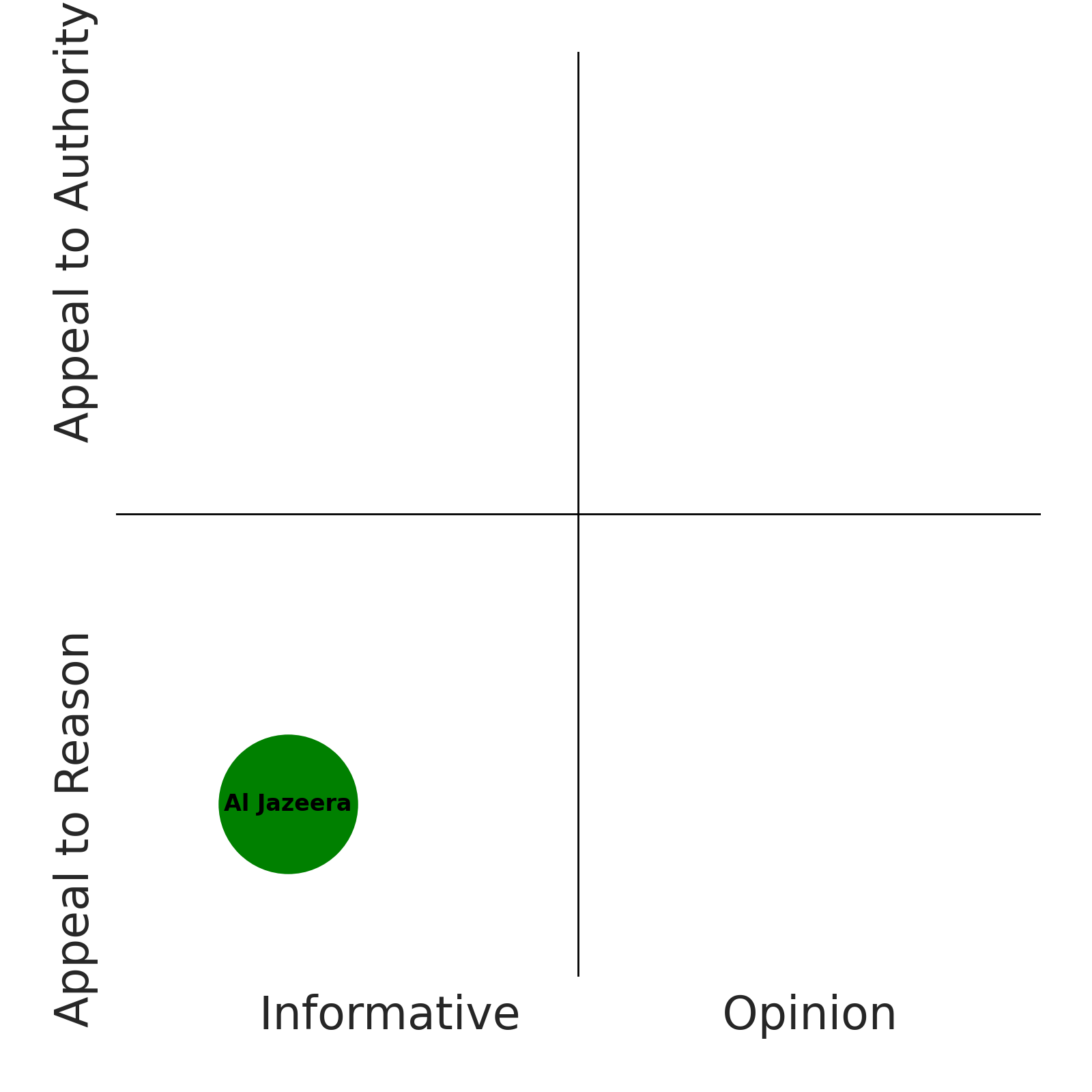
💭 Opinion30
🗳 Political18
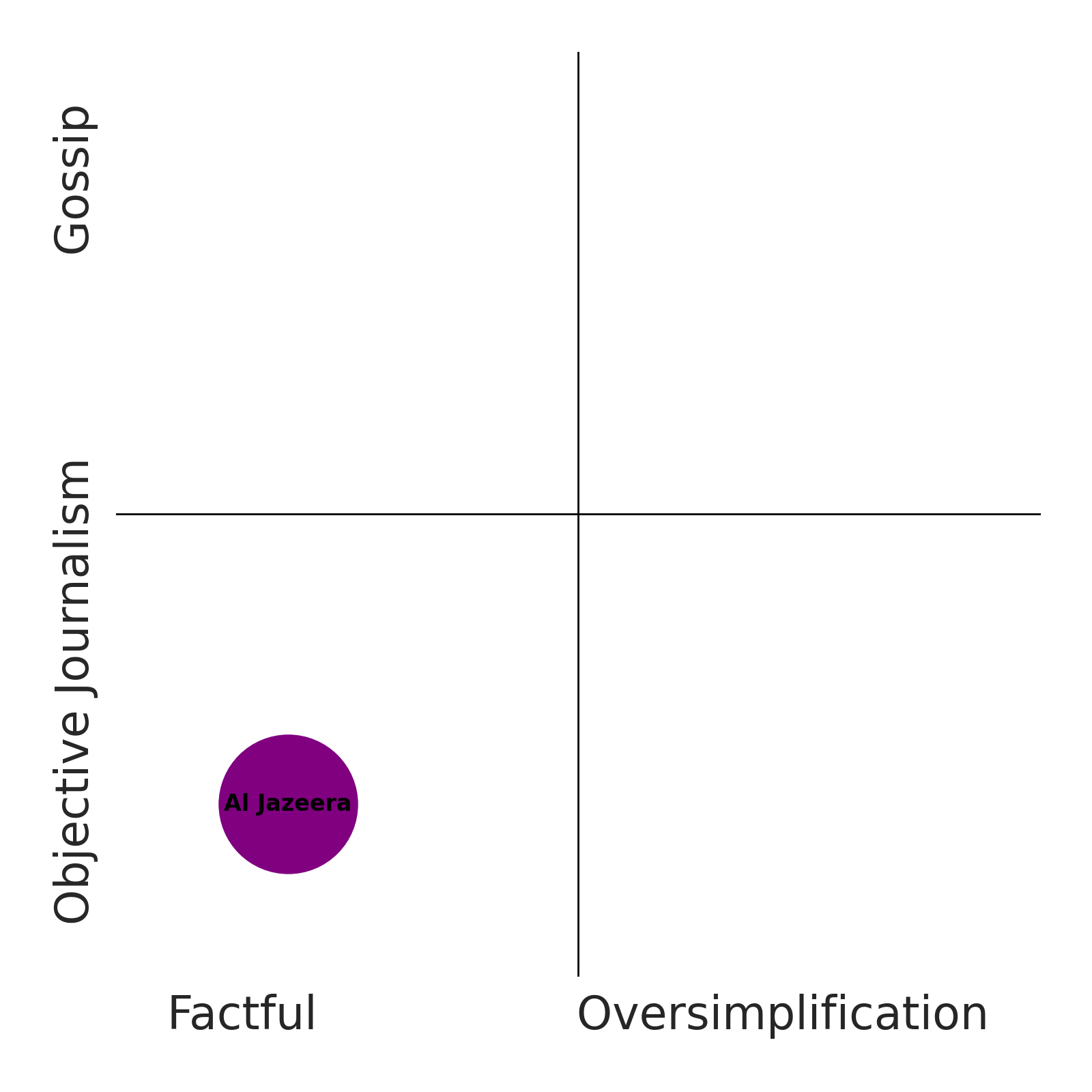
Oversimplification6
🏛️ Appeal to Authority10
👀 Covering Responses12
😢 Victimization12
😤 Overconfidence12
🔒 Ideological12
❌ Low Credibility <—> High Credibility ✅21
🧠 Rational <—> Irrational 🤪-6
💔 Low Integrity <—> High Integrity ❤️15
🪨 Low Intelligence <—> High Intelligence 🦉30
🎭 Virtue Signaling12
🎲 Speculation13
🐍 Manipulative15
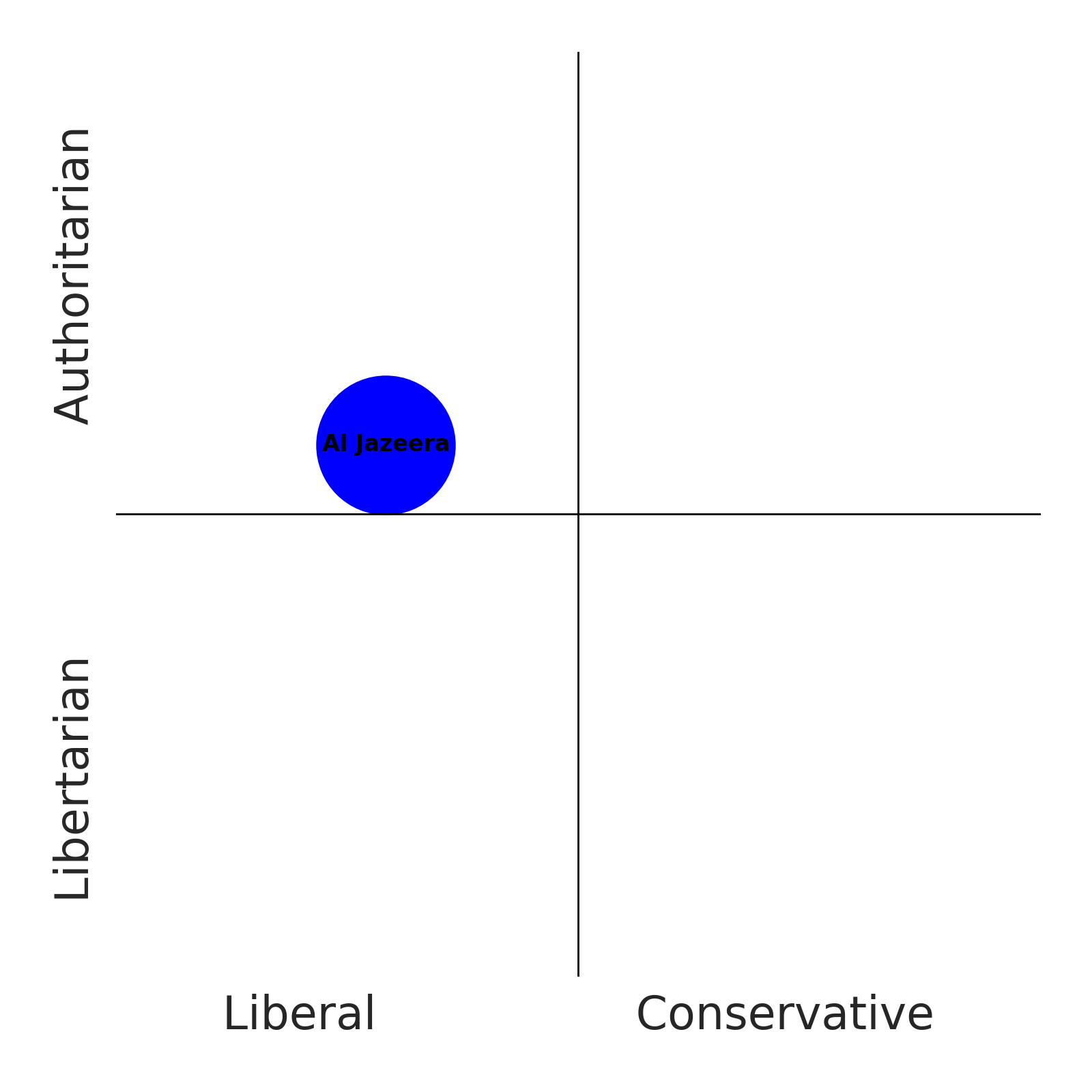
🔵 Liberal <—> Conservative 🔴-5
🧢 Populist <—> Elitist 🎩0
🗽 Libertarian <—> Authoritarian 🚔0
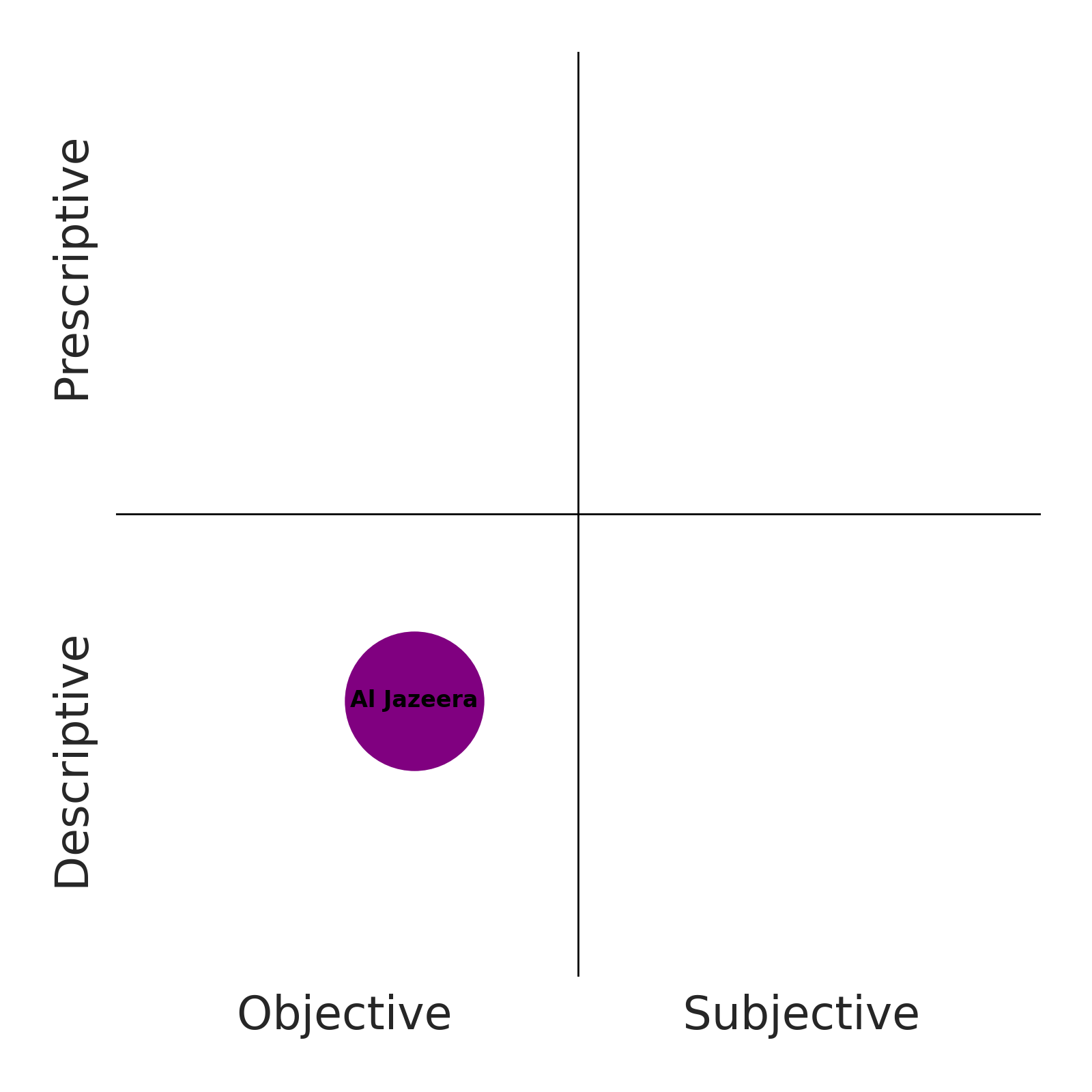
🗞️ Objective <—> Subjective 👁️ -5
🚨 Sensational0
📝 Prescriptive0
📞 Begging the Question2
🗣️ Gossip0
🍼 Immature1
🏴 Anti-establishment <—> Pro-establishment 📺2
📏📏 Double Standard4
💣 Terrorism0
✊ Woke5
🔪 Cruel4
🔍 Truth-seeking <—> Delusion 🌀0
🔺 Conspiracy0
🐐 Scapegoating2
🤡 Hypocrisy0
🔬 Scientific <—> Superstitious 🔮-1
👤 Individualist <—> Collectivist 👥1
💊 Big Pharma2
The report frames Gaza's breastfeeding crisis as an unqualified result of Israel's 'genocidal war,' using emotive language that favors Palestinian mothers.
Automated analysis; not human reviewed. Limitations: The supplied text is extremely short—only a headline and one lead paragraph—so bias judgments rely on sparse wording and provide no sourcing or context. · 55 of 55 available dimensions scored; omitted dimensions are not treated as neutral. · Verified supporting quotes for 14 of 55 scored dimensions.
Claim: The report adopts a strongly pro-Palestinian, anti-Israel political stance by labeling the war genocidal.
“After three years of Israel’s genocidal war, women suffer malnutrition, displacement and poor healthcare, yet still strive to nourish their infants.” · exact text match
Why: The unqualified 'genocidal war' label and exclusive focus on Palestinian suffering align with a left/liberal critique of Israel.
Claim: The report uses a loaded, conclusory characterization rather than neutral description.
“After three years of Israel’s genocidal war, women suffer malnutrition, displacement and poor healthcare, yet still strive to nourish their infants.” · exact text match
Why: The term 'genocidal' and the emotive 'yet still strive' present a value-laden rather than detached account.
Claim: The report uses a dramatic, highly charged term in a brief news item.
“After three years of Israel’s genocidal war” · exact text match
Why: 'Genocidal war' is an emotionally and politically sensational characterization for a short update.
Claim: The report emphasizes deterioration and suffering, with only a faint note of resilience.
“women suffer malnutrition, displacement and poor healthcare” · exact text match
Why: It highlights difficulty and suffering, though 'yet still strive' partly offsets the negative tone.
Claim: The article assumes the war is genocidal rather than demonstrating it.
“After three years of Israel’s genocidal war” · exact text match
Why: The contested conclusion is built into the premise of the sentence.
Claim: A contested political label is stated as fact.
“After three years of Israel’s genocidal war” · exact text match
Why: The unqualified 'genocidal' label expresses an opinion presented as established fact.
Claim: The report makes a political statement by characterizing the Gaza conflict as genocide.
“After three years of Israel’s genocidal war” · exact text match
Why: Adopting a charged legal-political label in an ongoing conflict is inherently political.
Claim: A complex conflict and humanitarian situation are reduced to a single causal label.
“After three years of Israel’s genocidal war, women suffer malnutrition, displacement and poor healthcare” · exact text match
Why: It attributes multiple harms to 'genocidal war' without detail, context, or qualification.
Claim: The framing presents Palestinian mothers primarily as victims of a genocidal war.
“women suffer malnutrition, displacement and poor healthcare, yet still strive to nourish their infants” · exact text match
Why: Emphasis on suffering and oppression casts the subjects as victims, with agency limited to 'strive.'
Claim: The article asserts the genocide label and causation with no hedging or evidence.
“After three years of Israel’s genocidal war” · exact text match
Why: The claim is stated categorically, exceeding the support supplied in the text.
Claim: The wording reflects an ideological narrative about the Israel-Gaza conflict.
“After three years of Israel’s genocidal war” · exact text match
Why: A single, ideologically charged label is used without qualification or sourcing.
Claim: The report is strongly negative in emotional tone.
“genocidal war” · exact text match
“suffer malnutrition, displacement and poor healthcare” · exact text match
Why: Words such as 'genocidal' and 'suffer' evoke strong negative emotional reactions.
Claim: The piece lacks sourcing, named attribution, and evidence while making a conclusive accusation.
“After three years of Israel’s genocidal war” · exact text match
Why: No source, data, or attribution is provided to support the central loaded claim.
Claim: The item uses a loaded, conclusory term and emotional appeal to shape reader response.
“After three years of Israel’s genocidal war, women suffer malnutrition, displacement and poor healthcare, yet still strive to nourish their infants.” · exact text match
Why: Dramatic labeling and suffering imagery are observable techniques that push a particular emotional reading.
The supplied text is extremely short—only a headline and one lead paragraph—so bias judgments rely on sparse wording and provide no sourcing or context.
October 08, 2026 · 0 shares
Strongly partisan framing against Israel and India's Modi government, repeatedly treating 'genocidal war' and 'ethnic cleansing' as unqualified facts while amplifying critical expert voices.
Automated analysis; not human reviewed. Limitations: The supplied article text is truncated and includes duplicated headline/teaser blocks; author and publication metadata are absent. · 13 of 55 available dimensions scored; omitted dimensions are not treated as neutral. · Verified supporting quotes for 13 of 13 scored dimensions.
Claim: The article uses left-coded language and a strongly critical stance toward Israel and Modi's right-wing government.
“As Israel was conducting its genocidal war on Gaza, bombing and killing dozens on the very days he was visiting India” · exact text match
Why: 'Genocidal war' and the critical framing of Israel/Modi align with left-coded media positions.
Claim: The article presents contested characterizations as unqualified facts and embeds interpretive judgments in reporting.
“As Israel was conducting its genocidal war on Gaza, bombing and killing dozens on the very days he was visiting India” · exact text match
Why: The phrase 'genocidal war' is a contested legal/moral characterization asserted without qualification.
Claim: The article uses sensational and emotive language to heighten the gravity of events.
“Netanyahu’s disruptive and fatal assault on Gaza” · exact text match
“brutal use of force in Gaza” · exact text match
Why: Terms like 'fatal assault' and 'brutal use of force' are sensational and emotive.
Claim: The article adopts a dovish foreign-policy stance, criticizing military force and favoring diplomacy.
“New Delhi has maintained that war doesn’t solve anything.” · exact text match
“refusal to criticise the brutal use of force in Gaza” · exact text match
Why: The framing privileges diplomacy and criticizes Israeli military action, indicating dovish bias.
Claim: The article treats the contested claim that Israel's Gaza war is genocidal as an established premise.
“As Israel was conducting its genocidal war on Gaza” · exact text match
Why: The term 'genocidal war' is used as an unargued descriptor, assuming the conclusion.
Claim: The article is heavily opinionated, embedding evaluative judgments and causal claims in the narrative.
“New Delhi was ready to expand business with Israel like never before” · exact text match
“nothing has moved Modi’s bonhomie with Israel’s Netanyahu” · exact text match
Why: These are evaluative and interpretive statements rather than neutral description.
Claim: The article is thoroughly political, focused on government policy, leaders, and geopolitical alignments.
“How Gaza war sped up India's shift towards Israel under Modi” · exact text match
“Modi’s India has embraced the country” · exact text match
Why: The subject is explicitly political and framed around leaders and state policy.
Claim: The article asserts contested or unverifiable claims with high certainty.
“New Delhi was ready to expand business with Israel like never before” · exact text match
“nothing has moved Modi’s bonhomie with Israel’s Netanyahu” · exact text match
Why: These statements are presented as certain despite limited supplied evidence.
Claim: The article is strongly shaped by an ideological critique of Hindu nationalism and Israeli policy.
“Modi’s Hindu-first politics, by contrast, thrives on othering Indian Muslims.” · exact text match
“genocidal war on Gaza” · exact text match
Why: The framing centers ideological categories and moral condemnation.
Claim: The article's tone is strongly negative toward Israel and Modi's India.
“genocidal war” · exact text match
“brutal use of force in Gaza” · exact text match
“fatal assault on Gaza” · exact text match
Why: The repeated negative terminology conveys strong negative emotional framing.
Claim: The article engages in speculation about political motives and consequences.
“New Delhi was ready to expand business with Israel like never before” · exact text match
“Modi’s party believes it stands to gain nothing from a pro-Palestine posture” · exact text match
Why: These are interpretive forecasts/motive claims not directly evidenced by the reported facts.
Claim: The article uses loaded language and asymmetric framing to steer judgment.
“genocidal war” · exact text match
“New Delhi was ready to expand business with Israel like never before” · exact text match
Why: Loaded terms and unqualified assertions function as manipulative framing.
Claim: The article is analytically intelligent, with historical context, named expert analysis, and causal explanation.
“Analysts believe that the framing of Israel as a country under attack has helped Modi justify pushing India closer to it.” · exact text match
“In 1948, India opposed the creation of Israel.” · exact text match
Why: It synthesizes historical and expert material into a structured analysis.
The supplied article text is truncated and includes duplicated headline/teaser blocks; author and publication metadata are absent.
The publisher frames Israel's military campaign as a 'genocidal war' and treats that characterization as settled fact while cataloguing Palestinian suffering.
Automated analysis; not human reviewed. Limitations: No byline; the supplied text repeats the opening and I could not independently verify the cited casualty or survey figures. · 14 of 55 available dimensions scored; omitted dimensions are not treated as neutral. · Verified supporting quotes for 14 of 14 scored dimensions.
Claim: The publisher uses the unqualified label 'genocidal war' and foregrounds Palestinian suffering, a framing aligned with left/pro-Palestinian politics.
“Three years after Israel launched its genocidal war on Gaza following the Hamas-led October 7, 2023 attack on Israel” · exact text match
“The war has shattered the lives of a population of around two million people.” · exact text match
Why: The repeated genocide label and focus on Palestinian victimhood are characteristic of a critical, left-coded framing of Israel.
Claim: The article mixes sourced statistics with an evaluative 'genocidal war' label, making its central framing subjective.
“How three years of Israel’s genocidal war have changed Gaza” · exact text match
Counterevidence:
“In September, according to the UN, 94 percent of Gaza’s population remained in urgent need of shelter and basic household assistance” · exact text match
Why: A contested moral/legal label is presented as a factual descriptor.
Claim: The report uses dramatic and sweeping language, especially in its headline and opening lines.
“How three years of Israel’s genocidal war have changed Gaza” · exact text match
“the Palestinian enclave has been transformed beyond recognition” · exact text match
Why: The headline's genocide label and the opening's 'transformed beyond recognition' are sensationalizing, though the body is largely statistical.
Claim: The article's conclusion is explicitly bleak, describing uncertainty and no path forward.
“For people in Gaza, three years of war have left behind a sense of uncertainty with no clear path forward.” · exact text match
Why: The ending frames Gaza's future as hopeless.
Claim: The article evaluates Israeli military action through civilian suffering and continued attacks, without presenting a security rationale.
“Although a “ceasefire” was announced in October 2025, it has not brought an end to the suffering” · exact text match
“Israeli attacks and other military activity have continued across the Strip” · exact text match
Why: War is framed as continued violence and suffering, an anti-war/dovish stance.
Claim: The article assumes Israel's campaign is genocidal instead of demonstrating it.
“How three years of Israel’s genocidal war have changed Gaza” · exact text match
Why: The conclusion is built into the title and repeated as fact, requiring the reader to accept the contested premise.
Claim: The article presents the contested label 'genocidal war' as a factual description rather than as analysis or commentary.
“Three years after Israel launched its genocidal war on Gaza” · exact text match
Why: Unattributed moral/legal labeling makes the report partly opinionated.
Claim: The article is a politically charged treatment of the Gaza war, using 'genocidal war' as its central description.
“How three years of Israel’s genocidal war have changed Gaza” · exact text match
Why: The headline takes a political position on a geopolitical conflict.
Claim: Palestinians are portrayed primarily as passive victims of displacement and military control.
“Repeated displacement and evacuation orders have uprooted families and communities” · exact text match
“leaving Palestinians displaced from the city unable to return to their homes” · exact text match
Why: The population is acted upon by Israeli forces; no Palestinian agency or resistance is presented.
Claim: The article states the contested genocide classification with unqualified certainty.
“Three years after Israel launched its genocidal war on Gaza” · exact text match
Why: No caveat or attribution accompanies the label, so certainty exceeds the evidence presented.
Claim: The prose is emotionally negative, emphasizing shattered lives and daily survival struggles.
“The war has shattered the lives of a population of around two million people.” · exact text match
Why: The verb 'shattered' conveys strong negative emotion.
Claim: The article's statistics are consistently attributed to named institutions, while its central genocide label is unqualified.
“more than 74,245 Palestinians have been killed, according to Gaza’s Ministry of Health” · exact text match
“Nearly 98 percent of schools have been damaged or destroyed, according to UNICEF” · exact text match
Counterevidence:
“Three years after Israel launched its genocidal war on Gaza” · exact text match
Why: Strong sourcing supports credibility, but a contested label without attribution reduces it.
Claim: The publisher uses 'genocidal war' as an unqualified frame and describes Israeli action as continued attacks, steering interpretation.
“Three years after Israel launched its genocidal war on Gaza” · exact text match
“The Ministry of Health says 1,462 Palestinians have been killed since the “ceasefire” took effect, while Israeli attacks and other military activity have continued across the Strip” · exact text match
Why: The loaded label and one-sided 'attacks' framing guide conclusions without presenting alternative explanations.
Claim: The report is transparent about its data sources but not about its adversarial genocide framing.
“Three years after Israel launched its genocidal war on Gaza” · exact text match
Counterevidence:
“according to Gaza’s Ministry of Health” · exact text match
Why: Data is attributed, but a contested label is asserted as fact, creating an internal fairness gap.
No byline; the supplied text repeats the opening and I could not independently verify the cited casualty or survey figures.
October 10, 2026 · 0 shares
The article adopts activist framing throughout, presenting the IMA suspension campaign's claims and terminology as established fact without attribution or Israeli response.
The World Medical Association is an international grouping of national medical associations; the Israeli Medical Association is a member. The IMA Out! coalition is campaigning for its suspension over the Gaza war.
Automated analysis; not human reviewed. Limitations: The article text appears truncated and contains only the protest/campaign side; no Israeli or WMA response is included in the supplied excerpt. · 55 of 55 available dimensions scored; omitted dimensions are not treated as neutral. · Verified supporting quotes for 35 of 55 scored dimensions.
Claim: The article uses left-wing framing regarding Israel-Palestine.
“genocidal war” · exact text match
Why: Term 'genocidal' aligns with progressive criticism of Israel.
Claim: The article sides with grassroots activist doctors against an institutional body.
“Hundreds of doctors have gathered outside the World Medical Association (WMA) summit” · exact text match
Why: Grassroots mobilization against establishment institution.
Claim: The article supports coercive suspension of an organization.
“calling for the suspension of the Israeli Medical Association” · exact text match
Why: Advocacy for institutional exclusion.
Claim: The article presents campaign claims and characterizations as established fact rather than attributed subjective positions.
“Palestinian healthcare has been systematically destroyed” · exact text match
Why: Contested characterization stated as objective fact rather than attributed claim.
Claim: The article uses emotive and sensational language rather than neutral reporting.
“starved and tortured” · exact text match
Why: Graphic language used to evoke strong emotion rather than report neutrally.
Claim: Not applicable.
Why: No financial or market content.
Claim: The article has a pessimistic tone about Palestinian healthcare.
“Palestinian healthcare is systematically destroyed” · exact text match
Why: Focus on destruction and loss.
Claim: The article moves from describing events to prescribing withdrawal from the IMA.
“Break your ties with the IMA and suspend the IMA from the WMA now” · exact text match
Why: Explicit prescriptive demand.
Claim: The article opposes Israeli military actions and supports peaceful institutional pressure.
“Israel’s genocidal war on Gaza” · exact text match
Why: Critical of war, favors diplomatic measures.
Claim: The article uses fear-inducing descriptions of torture, starvation, and killing.
“starved and tortured” · exact text match
Why: Graphic harm descriptions elicit fear and outrage.
Claim: The article assumes Israeli guilt in its framing of events.
“illegal Israeli detention” · exact text match
Why: Legality characterized as settled without adjudication.
Claim: The article focuses on organizational politics and protest events.
“the campaign said” · exact text match
Why: Slight organizational gossip element.
Claim: The article is largely composed of opinion and advocacy statements.
“That is not medical neutrality. That is complicity” · exact text match
Why: Opinionated quotes dominate the piece.
Claim: The article is substantially political, centered on a geopolitical advocacy campaign against Israel.
“calling for the suspension of the Israeli Medical Association (IMA)” · exact text match
Why: The subject is a political advocacy demand at an international body.
Claim: The complex conflict is reduced to a clear victim-perpetrator narrative.
“Our Palestinian colleagues are being killed and imprisoned” · exact text match
Why: Simplified moral framing.
Claim: The article appeals to medical ethical codes and the WMA as moral authorities.
“breaching almost every ethical principle in the WMA’s Code of Medical Ethics” · exact text match
Why: Relies on ethical authority.
Claim: The article uses emotionally charged language that could be seen as inflammatory.
“starved and tortured” · exact text match
Why: Graphic emotive descriptions.
Claim: The article asserts Israeli complicity as both premise and conclusion.
“It defends these attacks and blocks international condemnation” · exact text match
Why: The conclusion of complicity is restated as evidence.
Claim: The article does not include a response from the Israeli Medical Association or WMA.
“The IMA has said and done nothing about these war crimes” · exact text match
Why: No opposing response presented.
Claim: The article frames Palestinian healthcare workers and detainees primarily as victims of Israeli atrocities.
“Our Palestinian colleagues are being killed and imprisoned, where they are starved and tortured.” · exact text match
Why: Sustained victim framing with no counterbalancing perspective.
Claim: The article states contested legal and factual characterizations with certainty.
“Israel’s genocidal war on Gaza” · exact text match
Why: Genocide designation asserted without qualification or attribution.
Claim: No spam content.
Why: Not applicable.
Claim: The article advances a consistent activist ideological line without presenting opposing views.
“That is not medical neutrality. That is complicity” · exact text match
Why: One-sided ideological advocacy presented as fact.
Claim: The article aligns with NGO/activist campaigns against a state rather than with institutional or governmental authority.
“Break your ties with the IMA and suspend the IMA from the WMA now” · exact text match
Why: Advocacy framing against a national medical association.
Claim: The article's tone is strongly negative toward Israel and sympathetic to Palestinian victims.
“These scrubs should not be empty. Our colleagues belong with their patients, not in Israeli prisons.” · exact text match
Why: Emotive appeal emphasizing suffering and injustice.
Claim: The article applies scrutiny to Israeli medical ethics without comparable scrutiny of Palestinian or other actors.
“breaching almost every ethical principle in the WMA’s Code of Medical Ethics” · exact text match
Why: Single-sided ethical condemnation.
Claim: The article relies heavily on campaign statements with limited independent verification and no opposing perspective.
“the campaign said” · exact text match
Why: Attribution to the campaign rather than independent reporting.
Claim: No advertising.
Why: Not applicable.
Claim: No superstition.
Why: Not applicable.
Claim: Frames healthcare as a collective public good under attack.
“Palestinian healthcare is systematically destroyed” · exact text match
Why: Collective framing of healthcare.
Claim: The article includes forward-looking advocacy demands rather than reporting only.
“Break your ties with the IMA and suspend the IMA from the WMA now” · exact text match
Why: Prescriptive future-oriented demand.
Claim: The article omits any Israeli or IMA response, creating a one-sided presentation.
“The IMA has said and done nothing about these war crimes” · exact text match
Why: Material omission of the accused party's response.
Claim: Text appears human-written with no strong AI indicators.
Why: No clear AI patterns.
Claim: The article is transparent about sourcing to the campaign but lacks balance.
“the IMA Out! coalition that organised the demonstration said in a statement” · exact text match
Why: Sources are attributed but only one side is represented.
Claim: The article presents a coherent but one-sided account.
“Hundreds of doctors have gathered outside the World Medical Association (WMA) summit” · exact text match
Why: Basic reporting quality with limited analysis.
Claim: No endorsement of terrorism present.
Why: No content supporting terrorism.
Claim: No fraud content.
Why: No fraud-related framing.
Claim: No Marxist class analysis present.
Why: No Marxist framing.
Claim: No Islamist advocacy present.
Why: No Islamist content.
Claim: The article criticizes Israeli state and medical institutions without anti-Jewish generalization.
“It defends these attacks and blocks international condemnation” · exact text match
Why: Criticism targets Israeli institutions, not Jewish people as a group.
Claim: No LGBT content.
Why: Not relevant.
Claim: No racial generalization.
Why: No racist content.
Claim: The article employs identity-based power framing of Palestinians as oppressed versus Israeli oppressors.
“Palestinian healthcare is systematically destroyed” · exact text match
Why: Group-based oppression framing with moral asymmetry.
Claim: No cruelty advocacy.
Why: Not applicable.
Claim: The article frames the campaign as a moral humanitarian cause.
“Care cannot be given based on whose life is deemed worthy.” · exact text match
Why: Moralistic framing of the campaign's demands.
Claim: No conspiracy theories.
Why: Not applicable.
Claim: No self-harm advocacy.
Why: Not applicable.
Claim: The Israeli Medical Association is blamed for Palestinian healthcare destruction.
“The IMA is not a bystander. It defends these attacks and blocks international condemnation” · exact text match
Why: Blame assigned to a single entity for broader harm.
Claim: The article implies the IMA fails ethical standards while the campaign claims moral high ground.
“That is not medical neutrality. That is complicity” · exact text match
Why: Accusation of ethical hypocrisy against the IMA.
Claim: No rejection of reason or universal rights.
Why: Not applicable.
The article text appears truncated and contains only the protest/campaign side; no Israeli or WMA response is included in the supplied excerpt.
September 29, 2026 · 0 shares
The reporting frames Israel's military campaign as a genocidal war and emphasizes Palestinian suffering and destruction, using UN-sourced statistics as evidentiary support.
Automated analysis; not human reviewed. Limitations: The supplied text interleaves the main article with unrelated headlines; I analyzed only the main article, and the publisher, publication date, and independent verification of figures are not available. · 13 of 55 available dimensions scored; omitted dimensions are not treated as neutral. · Verified supporting quotes for 13 of 13 scored dimensions.
Claim: Frames the Israel-Gaza conflict with the unqualified label 'genocidal war' and foregrounds Palestinian victimhood.
“nearly three years into Israel’s genocidal war” · exact text match
“the besieged Gaza Strip” · exact text match
Why: The term 'genocidal war' is a strong moral-political accusation, and its unqualified repetition signals a left-aligned editorial stance rather than neutral balance.
Claim: Mixes factual satellite and UN reporting with the interpretive judgment 'genocidal war.'
“nearly three years into Israel’s genocidal war” · exact text match
“With neighbourhood after neighbourhood reduced to rubble” · exact text match
Why: The central label is a subjective moral-legal conclusion, and the destruction descriptions are emotive rather than purely factual.
Claim: Uses dramatic, emotive language to depict destruction.
“With neighbourhood after neighbourhood reduced to rubble” · exact text match
“wiped from the landscape” · exact text match
Why: These phrases heighten emotional impact beyond neutral description.
Claim: Embeds moral condemnation in the description, making it normative.
“genocidal war” · exact text match
Why: Labeling the war 'genocidal' is a prescriptive moral judgment presented as description.
Claim: The central characterization assumes the conclusion that the campaign is genocidal.
“genocidal war” · exact text match
Why: The framing presupposes the genocide conclusion it uses as the basis for reporting.
Claim: Presents a contested legal and moral conclusion as an asserted fact.
“genocidal war” · exact text match
Why: The label is repeated in the headline and lede without attribution, hedge, or counterperspective, which is opinion presented as fact.
Claim: Frames a volatile geopolitical conflict with explicit moral alignment and references to US weapons policy.
“genocidal war” · exact text match
“then-US President Joe Biden warned” · exact text match
Why: The article is not neutral about the conflict; the language and selection of details carry a partisan charge.
Claim: Repeatedly emphasizes Palestinian displacement, suffering, and lack of options.
“packed with families who have nowhere else to go” · exact text match
“true toll is likely higher because many people are still missing beneath the rubble” · exact text match
Why: The article consistently centers Palestinian victimhood, which frames the conflict primarily through suffering.
Claim: Asserts the genocide characterization without qualification or a supporting legal finding.
“genocidal war” · exact text match
Why: Certainty about the label exceeds the evidence presented, which is damage and casualty data rather than a genocide determination.
Claim: Uses one-sided ideological framing that assigns culpability to Israel and omits the conflict's other context.
“genocidal war” · exact text match
“the besieged Gaza Strip” · exact text match
Why: The framing presupposes a particular ideological interpretation of the war.
Claim: Employs negatively charged language that generates an emotional response.
“packed with families who have nowhere else to go” · exact text match
“reduced to rubble” · exact text match
Why: The wording is strongly negative and evocative, biasing emotional response.
Claim: Cites specific UN agencies and statistics, lending factual grounding, but offsets it with an unsupported editorial label.
“about 82 percent of structures in Gaza, roughly 200,000 buildings, have been damaged” · exact text match
“according to the UN agency for Palestinian refugees, UNRWA” · exact text match
Why: The presence of named sources and specific figures is credible, but the unqualified 'genocidal war' assertion lowers overall trustworthiness.
Claim: Uses loaded labels and selective context, producing a one-sided framing.
“genocidal war” · exact text match
“Israel went ahead with the operation, pushing hundreds of thousands more people into al-Mawasi” · exact text match
Why: The combination of an unproven label and emotive narrative choices constitutes observable framing that guides interpretation.
The supplied text interleaves the main article with unrelated headlines; I analyzed only the main article, and the publisher, publication date, and independent verification of figures are not available.
October 08, 2026 · 0 shares
Frames Colombia’s restored ties with Israel through repeated uncontested genocide allegations and 'far-right' labels, while presenting the anti-Israel protest position sympathetically.
Automated analysis; not human reviewed. Limitations: Article text appears partially duplicated and includes related-headline fragments; analysis is limited to the core protest report. · 14 of 55 available dimensions scored; omitted dimensions are not treated as neutral. · Verified supporting quotes for 14 of 14 scored dimensions.
Claim: Frames Colombia’s new government as 'far-right' and Israel’s Gaza campaign as 'genocide,' aligning with left-coded anti-Israel framing.
“new far-right government’s policy towards Israel” · exact text match
“ongoing genocide in Gaza” · exact text match
Why: The publisher uses left-associated ideological labels and uncontested genocide language in its own voice.
Claim: Uses subjective moral-political labels as factual descriptors.
“ongoing genocide in Gaza” · exact text match
“new far-right government’s policy towards Israel” · exact text match
Why: Contested characterizations are presented directly rather than as attributed claims or disputed labels.
Claim: Employs charged atrocity and genocide language rather than neutral conflict terminology.
“genocidal war on Gaza” · exact text match
“atrocities being committed in Palestine” · exact text match
Why: The wording is emotionally and morally loaded, elevating the report’s tone beyond neutral description.
Claim: Presents opposition to Israeli military action and Colombia-Israel security ties sympathetically.
“criticised Israel’s genocidal war on Gaza” · exact text match
“halted Israeli arms imports” · exact text match
Why: The report highlights criticism of Israel’s war and the halting of arms imports without counterbalancing security rationale.
Claim: Repeatedly presupposes that Israel’s Gaza campaign is genocide without qualification.
“ongoing genocide in Gaza” · exact text match
“Israel launching a genocidal war on Gaza” · exact text match
Why: The central contested characterization is used as a premise rather than framed as an allegation or debated claim.
Claim: Blends reported protest with opinionated descriptors like 'far-right' and 'genocide.'
“new far-right government’s policy towards Israel” · exact text match
“ongoing genocide in Gaza” · exact text match
Why: The report adopts evaluative labels that go beyond neutral factual reporting.
Claim: Centers a political protest and government foreign-policy reversal.
“Protesters in Colombia rally against ties with Israel” · exact text match
“restore diplomatic and economic relations with Israel” · exact text match
Why: The article’s subject is explicitly political, involving protests, diplomatic relations, and government policy.
Claim: Reduces a complex Israel-Gaza and Colombia-Israel policy dispute to genocide versus complicity.
“ongoing genocide in Gaza” · exact text match
“complicit in their atrocities” · exact text match
Why: The framing presents a binary moral conflict without exploring competing legal, historical, or policy perspectives.
Claim: Frames Palestinians and protesters as victims of atrocities and government complicity.
“atrocities being committed in Palestine” · exact text match
“ongoing genocide in Gaza” · exact text match
Why: The report emphasizes Palestinian suffering and protester moral opposition to government policy.
Claim: States contested genocide characterization as established fact.
“ongoing genocide in Gaza” · exact text match
“Israel launching a genocidal war on Gaza” · exact text match
Why: The article uses definitive language for a highly contested international legal and political characterization.
Claim: Adopts a coherent anti-Israel/pro-Palestinian ideological frame.
“genocidal war on Gaza” · exact text match
“complicit in their atrocities” · exact text match
Why: The selection and wording consistently advance one side’s moral-political interpretation of the conflict.
Claim: Tone is strongly negative toward Israel and the Colombian government, sympathetic to protesters.
“atrocities being committed in Palestine” · exact text match
“genocidal war on Gaza” · exact text match
Why: The language is emotionally charged and morally condemnatory rather than neutral.
Claim: Uses contested labels as fact and lacks attribution for the central genocide claim.
“Hundreds took to the streets of Bogota on Wednesday to protest against the ongoing genocide in Gaza” · exact text match
Why: The report presents a contested characterization in its own voice without visible qualification or opposing official response.
Claim: Uses loaded, one-sided framing to shape interpretation of the diplomatic dispute.
“ongoing genocide in Gaza” · exact text match
“new far-right government’s policy towards Israel” · exact text match
Why: Loaded labels and an uncontested genocide premise function as observable framing techniques.
Article text appears partially duplicated and includes related-headline fragments; analysis is limited to the core protest report.
The strongest observable framing is a left-leaning, anti-Israel perspective that treats Israel’s military campaign as genocidal and the primary source of regional unrest while using pessimistic, emotive language.
Automated analysis; not human reviewed. Limitations: Author attribution is absent, and the supplied page includes unrelated promotional headlines; analysis relies on the main article segment. · 13 of 55 available dimensions scored; omitted dimensions are not treated as neutral. · Verified supporting quotes for 12 of 13 scored dimensions.
Claim: The article's own voice uses left-coded 'genocidal war' and frames Israel as the military aggressor.
“the start of Israel’s genocidal war on Gaza” · exact text match
“Its military aggression has come at a cost” · exact text match
Why: These contested labels are characteristic of left/pro-Palestinian framing.
Claim: The article embeds contested evaluative labels as factual description.
“the start of Israel’s genocidal war on Gaza” · exact text match
“Israel’s military aggression” · not found in supplied text
Why: The terms are not neutral but express a strong moral judgment.
Claim: The article's dominant tone is pessimistic about regional stability and economic prospects.
“the wider region has been marked by conflict, economic turmoil, and a shattering of the balance of power.” · exact text match
Why: The language emphasizes decline and disruption.
Claim: The article offers a compelling, detail-rich analysis of a major geopolitical shift.
“the US entered into a war with Iran this year, and has since looked on as Tehran targeted US allies across the Gulf, shattering the perceived security of the US security umbrella.” · exact text match
Why: The analysis connects multiple significant developments.
Claim: The article primarily describes events and assessments rather than prescribing policy actions.
“Three years of war have upended alliances, weakened US influence and reshaped the region’s power balance.” · exact text match
Why: The text reports and analyzes without explicit recommendations.
Claim: The article is wholly focused on geopolitical power, alliances, and conflict.
“Three years of war have upended alliances, weakened US influence and reshaped the region’s power balance.” · exact text match
Why: The subject matter is inherently political and framed through political power dynamics.
Claim: The article relies on named elite experts to establish its analytical claims.
“HA Hellyer of the Royal United Services Institute said” · exact text match
“Sanam Vakil, the director of the Middle East and North Africa Programme at Chatham House, said” · exact text match
Why: The framing and interpretation are substantially delegated to institutional authorities.
Claim: The article emphasizes Palestinian suffering and destruction without equal attention to Israeli victims.
“Israel occupies most of Gaza, where it has also killed more than 74,000 Palestinians and reduced much of the enclave to rubble.” · exact text match
Why: The detailed casualty and destruction focus centers on one victim group.
Claim: The article asserts contested characterizations as established fact.
“the start of Israel’s genocidal war on Gaza” · exact text match
Why: The phrase presents a disputed legal/moral label as a factual description.
Claim: The article interprets events through a fixed ideological lens that treats Israel as genocidal and the primary source of unrest.
“the start of Israel’s genocidal war on Gaza” · exact text match
“making many governments around the world view it as the primary source of unrest in the Middle East.” · exact text match
Why: The framing imposes a consistent ideological narrative on complex events.
Claim: The article's language is emotionally negative toward Israel and regional conflict.
“genocidal war on Gaza” · exact text match
“shattering of the balance of power” · exact text match
Why: The terms are affectively charged and convey strong disapproval.
Claim: The article includes forecasts about future geopolitical alignments.
“The potential for more normalisation deals with Arab countries seems unlikely, at least in the short term.” · exact text match
Why: The text predicts future developments rather than strictly reporting past events.
Claim: The article synthesizes multiple regional dynamics and expert perspectives with analytical nuance.
“It’s ironic, since October 7, it’s Israel that has emerged as the revisionist power and Iran almost as the status quo power” · exact text match
“real power is typically classed as being able to project stability, which Israel hasn’t shown itself able or willing to do” · exact text match
Why: It provides structural analysis and countervailing expert qualification.
Author attribution is absent, and the supplied page includes unrelated promotional headlines; analysis relies on the main article segment.
September 16, 2026 · 0 shares
The publisher frames Israeli actions in Jerusalem as a deliberate campaign to seize religious control and overturn the established status quo, using an unqualified, emotionally loaded claim.
Automated analysis; not human reviewed. Limitations: The supplied input is a set of headlines and truncated fragments from multiple stories, so the publisher's full framing and evidentiary support cannot be assessed reliably. · 4 of 54 available dimensions scored; omitted dimensions are not treated as neutral. · Verified supporting quotes for 4 of 4 scored dimensions.
Claim: The publisher presents a contestable interpretation of Israel's intentions as an objective fact.
“Israel is destroying the Status Quo to establish full control over Muslim and Christian religious life at holy sites.” · exact text match
Why: The sentence is an unqualified evaluative claim about intent and effect, with no attribution or opposing evidence.
Claim: The publisher uses dramatic absolute language to maximize the event's severity.
“Israel is destroying the Status Quo to establish full control over Muslim and Christian religious life at holy sites.” · exact text match
Why: The words 'destroying' and 'full control' are emotionally freighted and absolute, going beyond a neutral report.
Claim: The text states an opinion about Israel's policy as if it were settled fact.
“Israel is destroying the Status Quo to establish full control over Muslim and Christian religious life at holy sites.” · exact text match
Why: A policy disagreement is embedded in a declarative sentence without attribution, hedging, or countervailing detail.
Claim: The text's strongest visible language carries a distinctly negative emotional charge.
“Israel is destroying the Status Quo to establish full control over Muslim and Christian religious life at holy sites.” · exact text match
Why: Words such as 'destroying' and 'full control' express a negative, alarming evaluation of the actor's conduct.
The supplied input is a set of headlines and truncated fragments from multiple stories, so the publisher's full framing and evidentiary support cannot be assessed reliably.
October 08, 2026 · 0 shares
Strongly partisan framing against Israel and India's Modi government, repeatedly treating 'genocidal war' and 'ethnic cleansing' as unqualified facts while amplifying critical expert voices.
Automated analysis; not human reviewed. Limitations: The supplied article text is truncated and includes duplicated headline/teaser blocks; author and publication metadata are absent. · 13 of 55 available dimensions scored; omitted dimensions are not treated as neutral. · Verified supporting quotes for 13 of 13 scored dimensions.
Claim: The article uses left-coded language and a strongly critical stance toward Israel and Modi's right-wing government.
“As Israel was conducting its genocidal war on Gaza, bombing and killing dozens on the very days he was visiting India” · exact text match
Why: 'Genocidal war' and the critical framing of Israel/Modi align with left-coded media positions.
Claim: The article presents contested characterizations as unqualified facts and embeds interpretive judgments in reporting.
“As Israel was conducting its genocidal war on Gaza, bombing and killing dozens on the very days he was visiting India” · exact text match
Why: The phrase 'genocidal war' is a contested legal/moral characterization asserted without qualification.
Claim: The article uses sensational and emotive language to heighten the gravity of events.
“Netanyahu’s disruptive and fatal assault on Gaza” · exact text match
“brutal use of force in Gaza” · exact text match
Why: Terms like 'fatal assault' and 'brutal use of force' are sensational and emotive.
Claim: The article adopts a dovish foreign-policy stance, criticizing military force and favoring diplomacy.
“New Delhi has maintained that war doesn’t solve anything.” · exact text match
“refusal to criticise the brutal use of force in Gaza” · exact text match
Why: The framing privileges diplomacy and criticizes Israeli military action, indicating dovish bias.
Claim: The article treats the contested claim that Israel's Gaza war is genocidal as an established premise.
“As Israel was conducting its genocidal war on Gaza” · exact text match
Why: The term 'genocidal war' is used as an unargued descriptor, assuming the conclusion.
Claim: The article is heavily opinionated, embedding evaluative judgments and causal claims in the narrative.
“New Delhi was ready to expand business with Israel like never before” · exact text match
“nothing has moved Modi’s bonhomie with Israel’s Netanyahu” · exact text match
Why: These are evaluative and interpretive statements rather than neutral description.
Claim: The article is thoroughly political, focused on government policy, leaders, and geopolitical alignments.
“How Gaza war sped up India's shift towards Israel under Modi” · exact text match
“Modi’s India has embraced the country” · exact text match
Why: The subject is explicitly political and framed around leaders and state policy.
Claim: The article asserts contested or unverifiable claims with high certainty.
“New Delhi was ready to expand business with Israel like never before” · exact text match
“nothing has moved Modi’s bonhomie with Israel’s Netanyahu” · exact text match
Why: These statements are presented as certain despite limited supplied evidence.
Claim: The article is strongly shaped by an ideological critique of Hindu nationalism and Israeli policy.
“Modi’s Hindu-first politics, by contrast, thrives on othering Indian Muslims.” · exact text match
“genocidal war on Gaza” · exact text match
Why: The framing centers ideological categories and moral condemnation.
Claim: The article's tone is strongly negative toward Israel and Modi's India.
“genocidal war” · exact text match
“brutal use of force in Gaza” · exact text match
“fatal assault on Gaza” · exact text match
Why: The repeated negative terminology conveys strong negative emotional framing.
Claim: The article engages in speculation about political motives and consequences.
“New Delhi was ready to expand business with Israel like never before” · exact text match
“Modi’s party believes it stands to gain nothing from a pro-Palestine posture” · exact text match
Why: These are interpretive forecasts/motive claims not directly evidenced by the reported facts.
Claim: The article uses loaded language and asymmetric framing to steer judgment.
“genocidal war” · exact text match
“New Delhi was ready to expand business with Israel like never before” · exact text match
Why: Loaded terms and unqualified assertions function as manipulative framing.
Claim: The article is analytically intelligent, with historical context, named expert analysis, and causal explanation.
“Analysts believe that the framing of Israel as a country under attack has helped Modi justify pushing India closer to it.” · exact text match
“In 1948, India opposed the creation of Israel.” · exact text match
Why: It synthesizes historical and expert material into a structured analysis.
The supplied article text is truncated and includes duplicated headline/teaser blocks; author and publication metadata are absent.
October 07, 2026 · 0 shares
Frames Israel’s Gaza campaign as ‘genocide’ and portrays British pro-Palestine activists as principled citizens facing state repression, while presenting UK government and police actions as illegitimate.
Automated analysis; not human reviewed. Limitations: The supplied text is an excerpt with no byline or publication date, and it contains no Israeli or UK official responses, limiting verification and comparison. · 14 of 55 available dimensions scored; omitted dimensions are not treated as neutral. · Verified supporting quotes for 14 of 14 scored dimensions.
Claim: The article uses left-aligned political framing by treating Israel's campaign as 'genocide' and depicting the British government as complicit.
“How Israel's genocide in Gaza pulled Britons into the Palestine movement” · exact text match
“Hundreds of thousands have taken to the streets to protest against Israel’s genocidal campaign in Gaza and what they see as the UK’s role in the conflict.” · exact text match
Why: Unqualified 'genocide' framing and adversarial treatment of the UK government align with a left/pro-Palestinian stance.
Claim: The article champions ordinary Britons against government and police power.
“From quiet lives to protest arrests, Britons are risking freedom and reputations to stand with Palestinians and challenge government policy.” · exact text match
Why: It emphasizes 'quiet lives' and ordinary people challenging authority, a populist frame.
Claim: The article portrays state terrorism-law enforcement as an assault on civil liberties.
“our own civil liberties … are being eroded to protect the interests of Israel” · exact text match
“Now Britain is breaking British law.” · exact text match
Why: Selection of these quotes without challenge frames police and government authority as oppressive.
Claim: The report's language is advocacy-laden rather than detached.
“But as the genocide in Gaza was livestreamed, many have rallied around the cause of Palestinian solidarity.” · exact text match
Why: Using 'genocide' as an established fact while describing emotional mobilization is subjective framing.
Claim: The article uses dramatic, emotional imagery.
“The small territory is now home to the largest group of child amputees in modern history.” · exact text match
Why: This stark, extreme image heightens emotional impact.
Claim: The article is anti-war and presents ceasefire and arms-embargo demands sympathetically.
“She went to a pro-Palestine rally on Armistice Day, calling for a ceasefire” · exact text match
“They have urged the UK government to cease all arms sales to Israel and cut diplomatic and trade ties” · exact text match
Why: It presents ceasefire and arms embargo demands without countervailing security framing.
Claim: The article assumes the conclusion that Israel is committing genocide.
“How Israel's genocide in Gaza pulled Britons into the Palestine movement” · exact text match
“as the genocide in Gaza was livestreamed” · exact text match
Why: The term 'genocide' is used as a premise in the headline and narrative, not established through evidence.
Claim: The publisher states advocacy conclusions as fact.
“Israel’s genocidal campaign in Gaza” · exact text match
Why: The evaluative label 'genocidal' is used as a descriptor rather than an attributed opinion.
Claim: The article is a politically charged feature about activism and state policy.
“Hundreds of thousands have taken to the streets to protest against Israel’s genocidal campaign in Gaza and what they see as the UK’s role in the conflict.” · exact text match
Why: It centers political protest and frames state policy as part of a contested conflict.
Claim: The article reduces the conflict to a one-sided 'genocide' frame.
“Israel’s genocidal campaign in Gaza” · exact text match
Why: Complex conflict and law-enforcement motives are collapsed into a single moral frame.
Claim: The article is structured around a coherent ideological narrative of Palestinian liberation against Israeli genocide.
“How Israel's genocide in Gaza pulled Britons into the Palestine movement” · exact text match
“our own civil liberties … are being eroded to protect the interests of Israel” · exact text match
Why: The framing consistently aligns with an ideological position rather than neutral reporting.
Claim: The article takes an anti-establishment stance toward the UK government and police.
“Now Britain is breaking British law.” · exact text match
Why: The quote accusing the British state of lawlessness is presented without challenge.
Claim: The article provides concrete details but uses unsourced, contested assertions and one-sided sourcing.
“Since October 7, 2023, Israel’s relentless bombardment has killed more than 74,000 people and devastated Gaza” · verified after text normalization
“To date, more than 3,000 people have been arrested for showing support for the pressure group that was banned in 2025.” · exact text match
Why: It gives specific figures but no sourcing for the death toll and no official responses, lowering credibility.
Claim: The article's fairness signals are weak: it uses 'genocide' as fact and quotes only activists.
“Israel’s genocidal campaign in Gaza” · exact text match
“The government participation, complicity, and their lies. Their gaslighting makes people more determined” · exact text match
Why: No opposing official perspective is included, and contested claims are stated as fact.
The supplied text is an excerpt with no byline or publication date, and it contains no Israeli or UK official responses, limiting verification and comparison.
September 29, 2026 · 0 shares
The reporting frames Israel's military campaign as a genocidal war and emphasizes Palestinian suffering and destruction, using UN-sourced statistics as evidentiary support.
Automated analysis; not human reviewed. Limitations: The supplied text interleaves the main article with unrelated headlines; I analyzed only the main article, and the publisher, publication date, and independent verification of figures are not available. · 13 of 55 available dimensions scored; omitted dimensions are not treated as neutral. · Verified supporting quotes for 13 of 13 scored dimensions.
Claim: Frames the Israel-Gaza conflict with the unqualified label 'genocidal war' and foregrounds Palestinian victimhood.
“nearly three years into Israel’s genocidal war” · exact text match
“the besieged Gaza Strip” · exact text match
Why: The term 'genocidal war' is a strong moral-political accusation, and its unqualified repetition signals a left-aligned editorial stance rather than neutral balance.
Claim: Mixes factual satellite and UN reporting with the interpretive judgment 'genocidal war.'
“nearly three years into Israel’s genocidal war” · exact text match
“With neighbourhood after neighbourhood reduced to rubble” · exact text match
Why: The central label is a subjective moral-legal conclusion, and the destruction descriptions are emotive rather than purely factual.
Claim: Uses dramatic, emotive language to depict destruction.
“With neighbourhood after neighbourhood reduced to rubble” · exact text match
“wiped from the landscape” · exact text match
Why: These phrases heighten emotional impact beyond neutral description.
Claim: Embeds moral condemnation in the description, making it normative.
“genocidal war” · exact text match
Why: Labeling the war 'genocidal' is a prescriptive moral judgment presented as description.
Claim: The central characterization assumes the conclusion that the campaign is genocidal.
“genocidal war” · exact text match
Why: The framing presupposes the genocide conclusion it uses as the basis for reporting.
Claim: Presents a contested legal and moral conclusion as an asserted fact.
“genocidal war” · exact text match
Why: The label is repeated in the headline and lede without attribution, hedge, or counterperspective, which is opinion presented as fact.
Claim: Frames a volatile geopolitical conflict with explicit moral alignment and references to US weapons policy.
“genocidal war” · exact text match
“then-US President Joe Biden warned” · exact text match
Why: The article is not neutral about the conflict; the language and selection of details carry a partisan charge.
Claim: Repeatedly emphasizes Palestinian displacement, suffering, and lack of options.
“packed with families who have nowhere else to go” · exact text match
“true toll is likely higher because many people are still missing beneath the rubble” · exact text match
Why: The article consistently centers Palestinian victimhood, which frames the conflict primarily through suffering.
Claim: Asserts the genocide characterization without qualification or a supporting legal finding.
“genocidal war” · exact text match
Why: Certainty about the label exceeds the evidence presented, which is damage and casualty data rather than a genocide determination.
Claim: Uses one-sided ideological framing that assigns culpability to Israel and omits the conflict's other context.
“genocidal war” · exact text match
“the besieged Gaza Strip” · exact text match
Why: The framing presupposes a particular ideological interpretation of the war.
Claim: Employs negatively charged language that generates an emotional response.
“packed with families who have nowhere else to go” · exact text match
“reduced to rubble” · exact text match
Why: The wording is strongly negative and evocative, biasing emotional response.
Claim: Cites specific UN agencies and statistics, lending factual grounding, but offsets it with an unsupported editorial label.
“about 82 percent of structures in Gaza, roughly 200,000 buildings, have been damaged” · exact text match
“according to the UN agency for Palestinian refugees, UNRWA” · exact text match
Why: The presence of named sources and specific figures is credible, but the unqualified 'genocidal war' assertion lowers overall trustworthiness.
Claim: Uses loaded labels and selective context, producing a one-sided framing.
“genocidal war” · exact text match
“Israel went ahead with the operation, pushing hundreds of thousands more people into al-Mawasi” · exact text match
Why: The combination of an unproven label and emotive narrative choices constitutes observable framing that guides interpretation.
The supplied text interleaves the main article with unrelated headlines; I analyzed only the main article, and the publisher, publication date, and independent verification of figures are not available.
August 04, 2026 · 0 shares
Uses the term 'genocidal war' repeatedly to frame the funeral as part of Israel's deliberate destruction of Palestinians, emphasizing death tolls and missing persons without Israeli perspective.
The Sabra attack refers to an Israeli airstrike in the Sabra neighborhood of Gaza City on November 22, 2023, during the Israel-Hamas war that began in October 2023.
Automated analysis; not human reviewed. · 16 of 53 available dimensions scored; omitted dimensions are not treated as neutral. · Verified supporting quotes for 13 of 16 scored dimensions.
Claim: The article employs strong left-wing framing by repeatedly labeling Israel's actions as genocide.
“Israel’s genocidal war on Gaza began” · exact text match
“Israel’s genocidal war on Gaza” · exact text match
Why: The unattributed use of 'genocidal war' shows the publisher adopts a left-wing political stance against Israel.
Claim: The article sympathizes with ordinary Palestinians and criticizes elite-backed institutions like the Western-backed Board of Peace.
“called on the Western-backed Board of Peace to accelerate efforts” · exact text match
“Thousands join to bury the remains after they were recovered from rubble” · exact text match
Why: The framing contrasts grassroots suffering with Western-backed entities, showing populist sentiment.
Claim: The article uses emotional and opinionated language rather than neutral reporting.
“exceptional and painful scene” · exact text match
“renewed testament to the scale of the tragedy left behind by the war” · exact text match
Why: The language includes subjective descriptors and does not present alternative viewpoints, indicating subjective framing.
Claim: The article highlights dramatic and emotional aspects to attract attention.
“one of the largest mass funerals” · exact text match
“exceptional and painful scene” · exact text match
Why: Emphasis on scale and pain is sensational, though appropriate to the event.
Claim: The article shifts from description to advocating for action.
“called on the Western-backed Board of Peace to accelerate efforts” · exact text match
“support the reconstruction of Gaza” · exact text match
Why: The title of the Assembly's call for action is reported, and the article concludes with an implicit call for recovery efforts.
Claim: The article strongly criticizes Israeli military action and supports a ceasefire, indicating dovish stance.
“ceasefire agreement” · not found in supplied text
“continued Israeli violations” · not found in supplied text
Why: The context of the funeral is used to highlight civilian deaths and calls for end to war, showing anti-war framing.
Claim: The article emphasizes death, missing persons, and suffering to evoke fear and grief.
“remains may have decomposed” · exact text match
“bodies obliterated by the explosions” · exact text match
Why: Vivid descriptions of decomposition and obliteration aim to provoke emotional response.
Claim: The article uses opinionated language such as 'genocidal war' without factual attribution.
“Israel’s genocidal war on Gaza” · exact text match
Why: Repeated use of 'genocidal war' is an unsupported opinion masquerading as fact.
Claim: The article is entirely about the Israeli-Palestinian conflict, a highly political subject.
“Israel’s genocidal war on Gaza” · exact text match
“ceasefire agreement in October” · not found in supplied text
Why: The content directly addresses the ongoing war and related political issues.
Claim: The article reduces a complex war to 'genocide' without nuance.
“Israel’s genocidal war on Gaza began” · exact text match
Why: Attributing the entire war to genocide simplifies the conflict and ignores other dimensions.
Claim: The article focuses on Palestinian victims and suffering without contextualizing Israeli casualties or military objectives.
“Thousands join to bury the remains” · exact text match
“bodies of its children from under the rubble after years of genocide” · exact text match
Why: Sole focus on Palestinian civilian deaths and suffering portrays them exclusively as victims.
Claim: The article asserts 'genocide' with certainty despite lack of legal determination.
“Israel’s genocidal war on Gaza” · exact text match
Why: The term is used unqualified, implying certainty beyond the evidence presented.
Claim: The article consistently applies a pro-Palestinian ideological lens.
“Israel’s genocidal war on Gaza” · exact text match
“genocidal war on Gaza” · exact text match
Why: Repeated ideological labeling demonstrates a fixed worldview guiding coverage.
Claim: The tone is consistently negative, focusing on tragedy and loss.
“painful scene” · exact text match
“tragedy left behind by the war” · exact text match
Why: Language evokes sadness and anger, creating a negative emotional polarisation.
Claim: The article uses scare quotes around 'ceasefire' to imply it is a sham, influencing reader perception.
“ceasefire agreement” · not found in supplied text
Why: The scare quotes around 'ceasefire' suggest manipulation by implying the agreement is not genuine.
Claim: The article omits Israeli perspective and uses the loaded term 'genocidal war' without attribution, reducing integrity.
“Israel’s genocidal war on Gaza began” · exact text match
Why: No mention of Israeli rationale or response; the term 'genocide' is used as established fact, undermining balanced presentation.
October 10, 2026 · 0 shares
The article adopts activist framing throughout, presenting the IMA suspension campaign's claims and terminology as established fact without attribution or Israeli response.
The World Medical Association is an international grouping of national medical associations; the Israeli Medical Association is a member. The IMA Out! coalition is campaigning for its suspension over the Gaza war.
Automated analysis; not human reviewed. Limitations: The article text appears truncated and contains only the protest/campaign side; no Israeli or WMA response is included in the supplied excerpt. · 55 of 55 available dimensions scored; omitted dimensions are not treated as neutral. · Verified supporting quotes for 35 of 55 scored dimensions.
Claim: The article uses left-wing framing regarding Israel-Palestine.
“genocidal war” · exact text match
Why: Term 'genocidal' aligns with progressive criticism of Israel.
Claim: The article sides with grassroots activist doctors against an institutional body.
“Hundreds of doctors have gathered outside the World Medical Association (WMA) summit” · exact text match
Why: Grassroots mobilization against establishment institution.
Claim: The article supports coercive suspension of an organization.
“calling for the suspension of the Israeli Medical Association” · exact text match
Why: Advocacy for institutional exclusion.
Claim: The article presents campaign claims and characterizations as established fact rather than attributed subjective positions.
“Palestinian healthcare has been systematically destroyed” · exact text match
Why: Contested characterization stated as objective fact rather than attributed claim.
Claim: The article uses emotive and sensational language rather than neutral reporting.
“starved and tortured” · exact text match
Why: Graphic language used to evoke strong emotion rather than report neutrally.
Claim: Not applicable.
Why: No financial or market content.
Claim: The article has a pessimistic tone about Palestinian healthcare.
“Palestinian healthcare is systematically destroyed” · exact text match
Why: Focus on destruction and loss.
Claim: The article moves from describing events to prescribing withdrawal from the IMA.
“Break your ties with the IMA and suspend the IMA from the WMA now” · exact text match
Why: Explicit prescriptive demand.
Claim: The article opposes Israeli military actions and supports peaceful institutional pressure.
“Israel’s genocidal war on Gaza” · exact text match
Why: Critical of war, favors diplomatic measures.
Claim: The article uses fear-inducing descriptions of torture, starvation, and killing.
“starved and tortured” · exact text match
Why: Graphic harm descriptions elicit fear and outrage.
Claim: The article assumes Israeli guilt in its framing of events.
“illegal Israeli detention” · exact text match
Why: Legality characterized as settled without adjudication.
Claim: The article focuses on organizational politics and protest events.
“the campaign said” · exact text match
Why: Slight organizational gossip element.
Claim: The article is largely composed of opinion and advocacy statements.
“That is not medical neutrality. That is complicity” · exact text match
Why: Opinionated quotes dominate the piece.
Claim: The article is substantially political, centered on a geopolitical advocacy campaign against Israel.
“calling for the suspension of the Israeli Medical Association (IMA)” · exact text match
Why: The subject is a political advocacy demand at an international body.
Claim: The complex conflict is reduced to a clear victim-perpetrator narrative.
“Our Palestinian colleagues are being killed and imprisoned” · exact text match
Why: Simplified moral framing.
Claim: The article appeals to medical ethical codes and the WMA as moral authorities.
“breaching almost every ethical principle in the WMA’s Code of Medical Ethics” · exact text match
Why: Relies on ethical authority.
Claim: The article uses emotionally charged language that could be seen as inflammatory.
“starved and tortured” · exact text match
Why: Graphic emotive descriptions.
Claim: The article asserts Israeli complicity as both premise and conclusion.
“It defends these attacks and blocks international condemnation” · exact text match
Why: The conclusion of complicity is restated as evidence.
Claim: The article does not include a response from the Israeli Medical Association or WMA.
“The IMA has said and done nothing about these war crimes” · exact text match
Why: No opposing response presented.
Claim: The article frames Palestinian healthcare workers and detainees primarily as victims of Israeli atrocities.
“Our Palestinian colleagues are being killed and imprisoned, where they are starved and tortured.” · exact text match
Why: Sustained victim framing with no counterbalancing perspective.
Claim: The article states contested legal and factual characterizations with certainty.
“Israel’s genocidal war on Gaza” · exact text match
Why: Genocide designation asserted without qualification or attribution.
Claim: No spam content.
Why: Not applicable.
Claim: The article advances a consistent activist ideological line without presenting opposing views.
“That is not medical neutrality. That is complicity” · exact text match
Why: One-sided ideological advocacy presented as fact.
Claim: The article aligns with NGO/activist campaigns against a state rather than with institutional or governmental authority.
“Break your ties with the IMA and suspend the IMA from the WMA now” · exact text match
Why: Advocacy framing against a national medical association.
Claim: The article's tone is strongly negative toward Israel and sympathetic to Palestinian victims.
“These scrubs should not be empty. Our colleagues belong with their patients, not in Israeli prisons.” · exact text match
Why: Emotive appeal emphasizing suffering and injustice.
Claim: The article applies scrutiny to Israeli medical ethics without comparable scrutiny of Palestinian or other actors.
“breaching almost every ethical principle in the WMA’s Code of Medical Ethics” · exact text match
Why: Single-sided ethical condemnation.
Claim: The article relies heavily on campaign statements with limited independent verification and no opposing perspective.
“the campaign said” · exact text match
Why: Attribution to the campaign rather than independent reporting.
Claim: No advertising.
Why: Not applicable.
Claim: No superstition.
Why: Not applicable.
Claim: Frames healthcare as a collective public good under attack.
“Palestinian healthcare is systematically destroyed” · exact text match
Why: Collective framing of healthcare.
Claim: The article includes forward-looking advocacy demands rather than reporting only.
“Break your ties with the IMA and suspend the IMA from the WMA now” · exact text match
Why: Prescriptive future-oriented demand.
Claim: The article omits any Israeli or IMA response, creating a one-sided presentation.
“The IMA has said and done nothing about these war crimes” · exact text match
Why: Material omission of the accused party's response.
Claim: Text appears human-written with no strong AI indicators.
Why: No clear AI patterns.
Claim: The article is transparent about sourcing to the campaign but lacks balance.
“the IMA Out! coalition that organised the demonstration said in a statement” · exact text match
Why: Sources are attributed but only one side is represented.
Claim: The article presents a coherent but one-sided account.
“Hundreds of doctors have gathered outside the World Medical Association (WMA) summit” · exact text match
Why: Basic reporting quality with limited analysis.
Claim: No endorsement of terrorism present.
Why: No content supporting terrorism.
Claim: No fraud content.
Why: No fraud-related framing.
Claim: No Marxist class analysis present.
Why: No Marxist framing.
Claim: No Islamist advocacy present.
Why: No Islamist content.
Claim: The article criticizes Israeli state and medical institutions without anti-Jewish generalization.
“It defends these attacks and blocks international condemnation” · exact text match
Why: Criticism targets Israeli institutions, not Jewish people as a group.
Claim: No LGBT content.
Why: Not relevant.
Claim: No racial generalization.
Why: No racist content.
Claim: The article employs identity-based power framing of Palestinians as oppressed versus Israeli oppressors.
“Palestinian healthcare is systematically destroyed” · exact text match
Why: Group-based oppression framing with moral asymmetry.
Claim: No cruelty advocacy.
Why: Not applicable.
Claim: The article frames the campaign as a moral humanitarian cause.
“Care cannot be given based on whose life is deemed worthy.” · exact text match
Why: Moralistic framing of the campaign's demands.
Claim: No conspiracy theories.
Why: Not applicable.
Claim: No self-harm advocacy.
Why: Not applicable.
Claim: The Israeli Medical Association is blamed for Palestinian healthcare destruction.
“The IMA is not a bystander. It defends these attacks and blocks international condemnation” · exact text match
Why: Blame assigned to a single entity for broader harm.
Claim: The article implies the IMA fails ethical standards while the campaign claims moral high ground.
“That is not medical neutrality. That is complicity” · exact text match
Why: Accusation of ethical hypocrisy against the IMA.
Claim: No rejection of reason or universal rights.
Why: Not applicable.
The article text appears truncated and contains only the protest/campaign side; no Israeli or WMA response is included in the supplied excerpt.
June 11, 2026 · 0 shares
Overall bias leans pro-Palestinian, foregrounding Palestinian displacement and Bedouin land rights while citing Amnesty International and UN data to frame Israeli settler activity as a state-backed campaign of ethnic cleansing.
A reporting narrative on Palestinian Bedouin displacement in the West Bank, detailing settler violence, land disputes, and Amnesty International and UN data about dispossession and potential ethnic cleansing.
I aim for balanced analysis; may reflect training data biases.
August 04, 2026 · 0 shares
Uses the term 'genocidal war' repeatedly to frame the funeral as part of Israel's deliberate destruction of Palestinians, emphasizing death tolls and missing persons without Israeli perspective.
The Sabra attack refers to an Israeli airstrike in the Sabra neighborhood of Gaza City on November 22, 2023, during the Israel-Hamas war that began in October 2023.
Automated analysis; not human reviewed. · 16 of 53 available dimensions scored; omitted dimensions are not treated as neutral. · Verified supporting quotes for 13 of 16 scored dimensions.
Claim: The article employs strong left-wing framing by repeatedly labeling Israel's actions as genocide.
“Israel’s genocidal war on Gaza began” · exact text match
“Israel’s genocidal war on Gaza” · exact text match
Why: The unattributed use of 'genocidal war' shows the publisher adopts a left-wing political stance against Israel.
Claim: The article sympathizes with ordinary Palestinians and criticizes elite-backed institutions like the Western-backed Board of Peace.
“called on the Western-backed Board of Peace to accelerate efforts” · exact text match
“Thousands join to bury the remains after they were recovered from rubble” · exact text match
Why: The framing contrasts grassroots suffering with Western-backed entities, showing populist sentiment.
Claim: The article uses emotional and opinionated language rather than neutral reporting.
“exceptional and painful scene” · exact text match
“renewed testament to the scale of the tragedy left behind by the war” · exact text match
Why: The language includes subjective descriptors and does not present alternative viewpoints, indicating subjective framing.
Claim: The article highlights dramatic and emotional aspects to attract attention.
“one of the largest mass funerals” · exact text match
“exceptional and painful scene” · exact text match
Why: Emphasis on scale and pain is sensational, though appropriate to the event.
Claim: The article shifts from description to advocating for action.
“called on the Western-backed Board of Peace to accelerate efforts” · exact text match
“support the reconstruction of Gaza” · exact text match
Why: The title of the Assembly's call for action is reported, and the article concludes with an implicit call for recovery efforts.
Claim: The article strongly criticizes Israeli military action and supports a ceasefire, indicating dovish stance.
“ceasefire agreement” · not found in supplied text
“continued Israeli violations” · not found in supplied text
Why: The context of the funeral is used to highlight civilian deaths and calls for end to war, showing anti-war framing.
Claim: The article emphasizes death, missing persons, and suffering to evoke fear and grief.
“remains may have decomposed” · exact text match
“bodies obliterated by the explosions” · exact text match
Why: Vivid descriptions of decomposition and obliteration aim to provoke emotional response.
Claim: The article uses opinionated language such as 'genocidal war' without factual attribution.
“Israel’s genocidal war on Gaza” · exact text match
Why: Repeated use of 'genocidal war' is an unsupported opinion masquerading as fact.
Claim: The article is entirely about the Israeli-Palestinian conflict, a highly political subject.
“Israel’s genocidal war on Gaza” · exact text match
“ceasefire agreement in October” · not found in supplied text
Why: The content directly addresses the ongoing war and related political issues.
Claim: The article reduces a complex war to 'genocide' without nuance.
“Israel’s genocidal war on Gaza began” · exact text match
Why: Attributing the entire war to genocide simplifies the conflict and ignores other dimensions.
Claim: The article focuses on Palestinian victims and suffering without contextualizing Israeli casualties or military objectives.
“Thousands join to bury the remains” · exact text match
“bodies of its children from under the rubble after years of genocide” · exact text match
Why: Sole focus on Palestinian civilian deaths and suffering portrays them exclusively as victims.
Claim: The article asserts 'genocide' with certainty despite lack of legal determination.
“Israel’s genocidal war on Gaza” · exact text match
Why: The term is used unqualified, implying certainty beyond the evidence presented.
Claim: The article consistently applies a pro-Palestinian ideological lens.
“Israel’s genocidal war on Gaza” · exact text match
“genocidal war on Gaza” · exact text match
Why: Repeated ideological labeling demonstrates a fixed worldview guiding coverage.
Claim: The tone is consistently negative, focusing on tragedy and loss.
“painful scene” · exact text match
“tragedy left behind by the war” · exact text match
Why: Language evokes sadness and anger, creating a negative emotional polarisation.
Claim: The article uses scare quotes around 'ceasefire' to imply it is a sham, influencing reader perception.
“ceasefire agreement” · not found in supplied text
Why: The scare quotes around 'ceasefire' suggest manipulation by implying the agreement is not genuine.
Claim: The article omits Israeli perspective and uses the loaded term 'genocidal war' without attribution, reducing integrity.
“Israel’s genocidal war on Gaza began” · exact text match
Why: No mention of Israeli rationale or response; the term 'genocide' is used as established fact, undermining balanced presentation.
May 19, 2026 · 0 shares
Activatorily framed with a civil-rights lens, endorsing a Black-athlete boycott against southern public universities in response to a Supreme Court voting-rights ruling and redistricting, portraying Republican-led maps as diluting Black power and emphasizing economic impacts, signaling a clearly liberal, pro-advocacy bias with emphasis on minority empowerment and institutional wealth implications.
Promotional piece about the NAACP's call to boycott southern public universities in response to a Supreme Court ruling affecting the Voting Rights Act and associated redistricting, highlighting potential impacts on Black voting power and university revenues.
Training data biases; cautious about political framing.
April 18, 2026 · 0 shares
A left-leaning, anti-Israel and anti-US framing that presents Israel's death penalty for Palestinians as evidence of apartheid and argues Europe should sever ties, while foregrounding Iran-US tensions and labeling US-Israeli actions as war crimes, relying on statements from a European Parliament member to advocate a critical stance.
A concise, geopolitically focused segment quoting a European Parliament member on Israel's death penalty and EU-Israel relations alongside US-Iran tensions and related rhetoric.
No explicit personal bias; aims for objective analysis.
September 08, 2026 · 0 shares
The framing treats a cartographic projection and a UN decision as a dramatic deception that has just been corrected, using accusatory and urgent language.
The unnamed '450-year-old' map is widely identified as the Mercator projection (1569), which preserves navigation angles but distorts area, making equatorial landmasses like Africa appear smaller than high-latitude regions. A UN vote would not by itself alter commercial map projections, so the reported vote likely refers to a symbolic or educational resolution.
Automated analysis; not human reviewed. Limitations: Only a brief headline/description was supplied; the related headlines were treated as navigation and the full video content was unavailable. · 4 of 54 available dimensions scored; omitted dimensions are not treated as neutral. · Verified supporting quotes for 4 of 4 scored dimensions.
Claim: The report presents an interpretation as fact using evaluative language such as 'lying' and 'really is.'
“The Map Was Lying To You” · exact text match
“For 450 years, the world’s most-used map has made Africa look smaller than it really is.” · exact text match
Why: The framing labels a map as deceptive rather than describing the projection's trade-offs.
Claim: The report uses dramatic, accusatory wording and an urgent time marker to present a cartographic issue.
“The Map Was Lying To You” · exact text match
“The United Nations just voted to change that.” · exact text match
Why: The headline and the 'just voted' phrasing inject excitement and conflict beyond a neutral summary.
Claim: The report compresses a long cartographic history and an institutional decision into one simple causal statement.
“For 450 years, the world’s most-used map has made Africa look smaller than it really is. The United Nations just voted to change that.” · exact text match
Why: The single sentence omits the technical nature of map projections, the specific map, and the UN process.
Claim: The report states the UN decision as a settled, unqualified fact without naming the vote, body, or source.
“The United Nations just voted to change that.” · exact text match
Why: The assertion is presented with certainty but lacks the attribution or detail needed to verify it.
Only a brief headline/description was supplied; the related headlines were treated as navigation and the full video content was unavailable.
Frames Israeli military action in Gaza as a genocidal war, emphasizing civilian casualties and attributing attacks to occupation while giving minimal weight to Israeli security justifications.
Automated analysis; not human reviewed. Limitations: The analysis relies on the article text as provided, which includes multiple other headlines at the end; I assumed those are separate teasers and focused on the main strike report. The 'genocidal war' phrase is attributed to the publisher, but it may be a direct quote from a source; however, the text presents it as the publisher's own sentence, so I treated it as such. · 12 of 53 available dimensions scored; omitted dimensions are not treated as neutral. · Verified supporting quotes for 9 of 12 scored dimensions.
Claim: The publisher uses the label 'genocidal war' to characterize Israeli operations, a highly charged political term that signals strong liberal/anti-Israel framing.
“since Israel launched its genocidal war against Palestinians in Gaza on October 7, 2023” · exact text match
Why: The term 'genocidal war' is a direct, unqualified assertion by the publisher that goes beyond neutral reporting, placing the narrative firmly on the liberal/anti-Israel side.
Claim: The article mixes factual reporting with subjective labels, notably 'genocidal war' and 'occupation', which are value judgments.
“since Israel launched its genocidal war against Palestinians in Gaza on October 7, 2023” · exact text match
“the occupation resumed its aerial bombardment” · exact text match
Why: The publisher's own voice uses subjective characterizations rather than adhering to neutral descriptors.
Claim: The phrase 'genocidal war' is sensationalist, designed to evoke strong emotional response beyond the factual record.
“since Israel launched its genocidal war against Palestinians in Gaza on October 7, 2023” · exact text match
Why: Accusing a state of genocide is a sensational claim that amplifies the story's emotional impact.
Claim: The article not only describes events but prescribes a moral judgment by labeling the conflict a 'genocidal war'.
“since Israel launched its genocidal war against Palestinians in Gaza on October 7, 2023” · exact text match
Why: The term 'genocidal war' is a prescriptive condemnation, not a descriptive term.
Claim: The article emphasizes civilian casualties and criticizes Israeli actions, reflecting a dovish, anti-war stance.
“Israeli attacks have killed more than 1,250 Palestinians in Gaza, most of them civilians, since a US-backed 'ceasefire' took effect” · not found in supplied text
“genocidal war” · exact text match
Why: Highlighting civilian deaths and using loaded anti-war language places the framing against military solutions.
Claim: The publisher states 'genocidal war' as fact, which is a strong opinion rather than a verifiable fact.
“since Israel launched its genocidal war against Palestinians in Gaza on October 7, 2023” · exact text match
Why: This is an opinionated characterization presented without attribution or qualification.
Claim: The article is highly political, taking a clear side in the Israeli-Palestinian conflict and criticizing Israeli and US policies.
“genocidal war” · exact text match
“Israel said it rejected the latest version of US President Donald Trump’s plan to end the war” · not found in supplied text
“US-backed 'ceasefire'” · not found in supplied text
Why: The framing and word choices are overtly political, opposing Israeli policy and the US role.
Claim: Labeling the entire war as 'genocidal' oversimplifies a complex conflict with multiple actors and motivations.
“since Israel launched its genocidal war against Palestinians in Gaza on October 7, 2023” · exact text match
Why: The term reduces the conflict to a single moral status, ignoring nuance such as Hamas's role or Israel's security claims.
Claim: The article consistently frames Palestinians as victims, including the father's account of his son's injury, the widow narrative, and the term 'genocidal war'.
“I found my son thrown on the ground, bleeding from his head” · exact text match
“Widows in Gaza struggle alone under displacement, burdened by loss, insecurity, and daily battles for survival” · exact text match
Why: The publisher selects and emphasizes suffering and helplessness, constructing a victim narrative.
Claim: The article uses emotionally charged language and graphic descriptions to elicit a negative emotional response towards Israel.
“genocidal war” · exact text match
“my son thrown on the ground, bleeding from his head” · exact text match
Why: The combination of the 'genocidal war' label and the father's raw account generates strong negative emotion.
Claim: While the article cites sources (AFP, civil defence, Israeli military), the loaded language and unqualified accusations lower its credibility as an objective news report.
“genocidal war” · exact text match
“Mohamad Saada, whose body was transferred ... to al-Shifa Hospital in Gaza City (attributed)” · not found in supplied text
Why: Attribution of facts is present, but the publisher's own commentary ('genocidal war') contradicts the standard of neutral reporting, reducing overall trustworthiness.
Claim: The publisher sacrifices neutral language for advocacy, reducing perceived fairness and honesty.
“genocidal war” · exact text match
“occupation resumed its aerial bombardment” · exact text match
Why: By adopting partisan labels, the article signals a lack of commitment to balanced reporting, which undermines integrity.
The analysis relies on the article text as provided, which includes multiple other headlines at the end; I assumed those are separate teasers and focused on the main strike report. The 'genocidal war' phrase is attributed to the publisher, but it may be a direct quote from a source; however, the text presents it as the publisher's own sentence, so I treated it as such.
October 07, 2026 · 0 shares
Frames Israel’s Gaza campaign as ‘genocide’ and portrays British pro-Palestine activists as principled citizens facing state repression, while presenting UK government and police actions as illegitimate.
Automated analysis; not human reviewed. Limitations: The supplied text is an excerpt with no byline or publication date, and it contains no Israeli or UK official responses, limiting verification and comparison. · 14 of 55 available dimensions scored; omitted dimensions are not treated as neutral. · Verified supporting quotes for 14 of 14 scored dimensions.
Claim: The article uses left-aligned political framing by treating Israel's campaign as 'genocide' and depicting the British government as complicit.
“How Israel's genocide in Gaza pulled Britons into the Palestine movement” · exact text match
“Hundreds of thousands have taken to the streets to protest against Israel’s genocidal campaign in Gaza and what they see as the UK’s role in the conflict.” · exact text match
Why: Unqualified 'genocide' framing and adversarial treatment of the UK government align with a left/pro-Palestinian stance.
Claim: The article champions ordinary Britons against government and police power.
“From quiet lives to protest arrests, Britons are risking freedom and reputations to stand with Palestinians and challenge government policy.” · exact text match
Why: It emphasizes 'quiet lives' and ordinary people challenging authority, a populist frame.
Claim: The article portrays state terrorism-law enforcement as an assault on civil liberties.
“our own civil liberties … are being eroded to protect the interests of Israel” · exact text match
“Now Britain is breaking British law.” · exact text match
Why: Selection of these quotes without challenge frames police and government authority as oppressive.
Claim: The report's language is advocacy-laden rather than detached.
“But as the genocide in Gaza was livestreamed, many have rallied around the cause of Palestinian solidarity.” · exact text match
Why: Using 'genocide' as an established fact while describing emotional mobilization is subjective framing.
Claim: The article uses dramatic, emotional imagery.
“The small territory is now home to the largest group of child amputees in modern history.” · exact text match
Why: This stark, extreme image heightens emotional impact.
Claim: The article is anti-war and presents ceasefire and arms-embargo demands sympathetically.
“She went to a pro-Palestine rally on Armistice Day, calling for a ceasefire” · exact text match
“They have urged the UK government to cease all arms sales to Israel and cut diplomatic and trade ties” · exact text match
Why: It presents ceasefire and arms embargo demands without countervailing security framing.
Claim: The article assumes the conclusion that Israel is committing genocide.
“How Israel's genocide in Gaza pulled Britons into the Palestine movement” · exact text match
“as the genocide in Gaza was livestreamed” · exact text match
Why: The term 'genocide' is used as a premise in the headline and narrative, not established through evidence.
Claim: The publisher states advocacy conclusions as fact.
“Israel’s genocidal campaign in Gaza” · exact text match
Why: The evaluative label 'genocidal' is used as a descriptor rather than an attributed opinion.
Claim: The article is a politically charged feature about activism and state policy.
“Hundreds of thousands have taken to the streets to protest against Israel’s genocidal campaign in Gaza and what they see as the UK’s role in the conflict.” · exact text match
Why: It centers political protest and frames state policy as part of a contested conflict.
Claim: The article reduces the conflict to a one-sided 'genocide' frame.
“Israel’s genocidal campaign in Gaza” · exact text match
Why: Complex conflict and law-enforcement motives are collapsed into a single moral frame.
Claim: The article is structured around a coherent ideological narrative of Palestinian liberation against Israeli genocide.
“How Israel's genocide in Gaza pulled Britons into the Palestine movement” · exact text match
“our own civil liberties … are being eroded to protect the interests of Israel” · exact text match
Why: The framing consistently aligns with an ideological position rather than neutral reporting.
Claim: The article takes an anti-establishment stance toward the UK government and police.
“Now Britain is breaking British law.” · exact text match
Why: The quote accusing the British state of lawlessness is presented without challenge.
Claim: The article provides concrete details but uses unsourced, contested assertions and one-sided sourcing.
“Since October 7, 2023, Israel’s relentless bombardment has killed more than 74,000 people and devastated Gaza” · verified after text normalization
“To date, more than 3,000 people have been arrested for showing support for the pressure group that was banned in 2025.” · exact text match
Why: It gives specific figures but no sourcing for the death toll and no official responses, lowering credibility.
Claim: The article's fairness signals are weak: it uses 'genocide' as fact and quotes only activists.
“Israel’s genocidal campaign in Gaza” · exact text match
“The government participation, complicity, and their lies. Their gaslighting makes people more determined” · exact text match
Why: No opposing official perspective is included, and contested claims are stated as fact.
The supplied text is an excerpt with no byline or publication date, and it contains no Israeli or UK official responses, limiting verification and comparison.
A highly emotive Gaza mother’s firsthand account foregrounds Palestinian suffering, condemns Israeli actions and international inaction, and argues for humanitarian protection and accountability, signaling a strong pro-Palestinian humanitarian bias with high subjectivity and normative critique of established norms.
First-person testimony from a Gaza mother describing January 2024 events near Gaza City, emphasizing human cost, trauma, dehumanization discourse, and calls for accountability and humanitarian protection.
Overemphasizes humanitarian framing; limited geopolitical context.
May 09, 2026 · 0 shares
Content displays a strongly pro-Palestinian, anti-Israel tilt, employing charged language like genocidal war and unacceptable ceasefire violations, foregrounding Palestinian casualty data from Gaza Health Ministry and Anadolu, highlighting Turkish diplomacy with Hamas, and pairing reporting with activist framing (Gaza Genocide Tapestry) and cultural context (Venice Biennale), resulting in a highly subjective, emotionally charged narrative with limited Israeli counter-narrative.
A Gaza conflict briefing centered on casualty figures, ceasefire allegations, and international diplomacy, notably Turkey-Hamas discussions and humanitarian aid concerns.
I may skew toward humanitarian framing; may underrepresent Israeli official sources.
A strongly pro-Palestinian tribute that frames Sheikh Hamad as a heroic figure who broke the Gaza siege and condemns Israel and Western double standards.
A commemorative profile of Sheikh Hamad bin Khalifa Al Thani focusing on his Gaza relief efforts and Palestinian solidarity.
My bias: pro-Palestinian tilt; confidence ~0.6
Presents the documentary as a measured historical examination while using dramatic, fear-inducing language about global collapse.
Automated analysis; not human reviewed. Limitations: Input is a promotional description for a documentary, not a full news article; all analysis is based on framing in that description. · 5 of 52 available dimensions scored; omitted dimensions are not treated as neutral. · Verified supporting quotes for 4 of 5 scored dimensions.
Claim: The text employs fear-inducing language to attract attention.
“one of the most dangerous wars” · not found in supplied text
“threat of collapsing the entire global economy as well as the world order as we know it” · exact text match
Why: Both phrases are designed to evoke fear about the consequences of the conflict.
Claim: The text is about a highly political topic.
“Beginning with the CIA-led coup in 1953 that led to the removal of Mohammad Mosaddegh” · exact text match
Why: The entire description revolves around geopolitical events and actors.
Claim: The text conveys a negative emotional tone.
“devastating impact on the Middle East” · exact text match
“threat of collapsing the entire global economy” · exact text match
Why: These phrases evoke fear and pessimism, indicating a negative emotional valence.
Claim: The text is promotional content for a documentary.
“Iran: The Making of a War” · exact text match
Why: The text is a direct description of the documentary intended to attract viewers.
Claim: The text uses emotional manipulation to promote the documentary.
“threat of collapsing the entire global economy as well as the world order as we know it” · exact text match
Why: The exaggerated claim about global collapse is a manipulative technique to create urgency.
Input is a promotional description for a documentary, not a full news article; all analysis is based on framing in that description.
Strong anti sugar industry bias that frames sugar's history as slavery, exploitation and environmental destruction, centers affected communities and advocates fair production while criticizing corporate power and colonial legacies.
Documentary series examining historical and current costs of sugar production across regions, using testimony, archival material, and expert interviews.
Training data tilt: liberal; domain context limited.
October 08, 2026 · 0 shares
Framing centers on international demands for Russian transparency about a suspected plague death, with official attributions and cautious risk language rather than alarmism.
Pneumonic plague is a severe respiratory infection; when a plague institute worker dies of unexplained pneumonia, international health authorities typically seek transparency about potential exposure and spread.
Automated analysis; not human reviewed. Limitations: The supplied text appears truncated and includes duplicated headline fragments and related-article links, which limits confidence in completeness. · 55 of 55 available dimensions scored; omitted dimensions are not treated as neutral. · Verified supporting quotes for 5 of 55 scored dimensions.
Claim: The article privileges official institutional sources over ordinary or dissenting perspectives.
“Senior WHO official urges Russia to to provide more information on the suspected pneumonic plague case.” · not found in supplied text
Why: The framing centers on WHO and other elite institutional calls rather than citizen or local Siberian perspectives.
Claim: The article uses measured language and official attributions rather than alarmist or sensational phrasing.
“At this time, there is no indication of a broader threat to the United States” · exact text match
Why: Risk is characterized as low and reporting is attributed to officials, reducing sensational tone.
Claim: The article includes political figures and geopolitical dimensions of the suspected plague case.
“Trump confirmed he has spoken with Russian President Vladimir Putin” · exact text match
Why: US-Russia diplomacy and bioweapon questions introduce political context to a health story.
Claim: The article leans heavily on quoting named institutional authorities to establish the significance of the event.
“We cannot ignore any reporting that comes,” · exact text match
Why: WHO, CDC, Kremlin, and US officials are used as primary sources for the risk and response narrative.
Claim: The article treats established governments and international bodies as the relevant actors and sources.
“The United States, the European Union and the WHO have all called on Russia to be transparent about the situation.” · exact text match
Why: Framing aligns with official institutional calls for transparency rather than anti-establishment or grassroots angles.
Claim: The article relies on named officials and attributed statements, supporting its credibility.
“Rospotrebnadzor said there were no infections detected among staff after a plague institute worker died from pneumonia.” · not found in supplied text
Why: Attribution to specific agencies and individuals provides verifiability and sourcing transparency.
Claim: The article frames the event through scientific and epidemiological categories.
“the origin of the illness remains unknown, prompting international concern that the case could involve the plague.” · not found in supplied text
Why: It relies on laboratory, epidemiological, and public-health concepts rather than superstitious or supernatural explanation.
Claim: The article reports possible future updates and unresolved origins without resolving them.
“that they would likely be able to provide an update “probably tomorrow.”” · exact text match
Why: Future information and unknown causation are noted, but the article remains largely descriptive of current statements.
Claim: The article presents public health authorities as the legitimate arbiters of the response without questioning their framing.
“CDC described the risk to the United States from the suspected pneumonic plague case as “extremely low”.” · not found in supplied text
Why: Health institutions are cited favorably for risk assessment and monitoring, though no coercive mandates are advocated.
The supplied text appears truncated and includes duplicated headline fragments and related-article links, which limits confidence in completeness.
August 17, 2026 · 0 shares
The report emphasizes humanitarian aspects and recovery efforts while noting government criticism and economic damage, presenting a balanced yet slightly critical view of the government's response.
Colombia is a country prone to earthquakes, and the quake struck areas with existing vulnerabilities, particularly the Pacific region and Choco department, which faces armed conflict and poverty. The president had recently been inaugurated, and the disaster became an early test for his administration.
Automated analysis; not human reviewed. · 54 of 54 available dimensions scored; omitted dimensions are not treated as neutral. · Verified supporting quotes for 19 of 54 scored dimensions.
Claim: The article presents factual data with some subjective quotes from officials and affected individuals, but overall maintains an objective tone.
“In total, 127,557 homes were damaged, and were 26,945 destroyed. The disaster also devastated other institutions, including 285 health centres and 2,838 educational facilities.” · exact text match
Why: The article includes specific numbers and figures, but also incorporates personal stories and quotes that add a subjective element, though not overly so.
Claim: The article reports on the disaster in a factual manner without sensationalizing the details.
“The earthquake represents the first major test for the leader, who was inaugurated just three days before it struck.” · exact text match
Why: The focus is on recovery and data, with some humanizing anecdotes, but not exaggerated or sensational language.
Claim: The article balances the grim reality of the disaster with hopeful notes about rescue efforts and recovery, leaning slightly optimistic.
“"The search for survivors continues; there's always the possibility of miracles," said Sergeant Bustamente.” · verified after text normalization
Why: While acknowledging devastation and challenges, the overall narrative emphasizes recovery and hope, and also notes positive aspects like international aid and community support.
Claim: The article is moderately interesting due to its human stories and the scale of the disaster, but it is a straightforward news report.
“It is a crisis that comes on top of another major crisis that already existed," said ActionAid's Sanz.” · verified after text normalization
Why: The article includes some compelling details and quotes, but is not particularly extraordinary.
Claim: The article is primarily descriptive, reporting on the situation without prescribing specific policies.
“The disaster response, however, is entering a new phase as rescue teams wind down operations and aid organisations begin focusing on housing those made homeless by the earthquake and providing basic necessities.” · exact text match
Why: It states facts and quotes opinions, but does not tell readers what should be done beyond the ongoing recovery efforts.
Claim: The article contains no hawkish or dovish statements regarding military or foreign policy; it is neutral in this respect.
“In recent days, he said, local rescue efforts have been boosted by international teams from countries like Israel, the United States, and Mexico.” · exact text match
Why: The mention of international teams is factual and not framed in a hawkish or dovish manner.
Claim: There is minimal fear-inducing language; the article focuses on facts and recovery.
“While the chances of finding life under the rubble drop sharply after the first 72 hours following an earthquake, others still hope.” · exact text match
Why: The article mentions grim statistics but also includes hope and recovery, so it does not incite fear.
Claim: The article is largely factual, but includes opinions from quoted sources and some editorialized criticism of the president.
“He has faced criticism for abstaining from a handover process with the previous government, muddying the disaster response, and for politicising aid” · exact text match
Why: The criticism is reported as coming from others, but the selection of these criticisms suggests some editorial judgment.
Claim: The article is political at times, focusing on the president's response and criticism, but also covers the humanitarian and economic aspects.
“The president also declared an economic emergency, granting him powers to raise funds through new taxes, but the right-wing statesman has instead opted to increase borrowing, primarily through a $450m credit line from the World Bank.” · exact text match
Why: The article explicitly mentions the president's political leaning and includes political criticism, making it political in some parts.
Claim: The article does not oversimplify; it provides detailed numbers and acknowledges complexity.
“It is a crisis that comes on top of another major crisis that already existed," said ActionAid's Sanz.” · verified after text normalization
Why: It notes that the disaster is compounded by existing crises in Choco, avoiding oversimplification.
Claim: The article appeals to authority by quoting officials and experts, but this is appropriate for news reporting.
“"It has been a gruelling week, with little time to rest, as we've been focused on searching for, locating, and rescuing potential victims," said Sergeant Joel Bustamente” · verified after text normalization
Why: It relies on authoritative sources for information, which is standard in journalism.
Claim: The article does not exhibit circular reasoning; it provides external facts and quotes.
“The earthquake represents the first major test for the leader, who was inaugurated just three days before it struck.” · exact text match
Why: The statements are supported by data and quotes, not circular logic.
Claim: The article is not overconfident; it uses attributed statements and acknowledges uncertainties.
“Though an unofficial online database called Colombia Te Busca (Colombia is looking for you) puts the number of missing at more than 3,000.” · not found in supplied text
Why: It distinguishes between official and unofficial data and uses phrases like 'according to' and 'estimates'.
Claim: The article includes criticism of the government, suggesting a slightly anti-establishment stance, but overall it is balanced.
“He has faced criticism for abstaining from a handover process with the previous government, muddying the disaster response, and for politicising aid” · exact text match
Why: The criticism is factual and attributed, but the article also reports the government's actions and pledges, so it is not strongly anti-establishment.
Claim: The article has a slightly positive emotional tone, emphasizing hope and community support, but is generally neutral.
“"We never lose hope," said Maximiliano Herrera, a volunteer rescuer in Cali” · verified after text normalization
Why: While there are sad elements, the inclusion of hopeful quotes and recovery efforts gives a slightly positive emotional slant.
Claim: The article appears credible with specific data, named sources, and a clear distinction between facts and allegations.
“As of Sunday night, 143 people remain unaccounted for, according to government figures” · exact text match
Why: It attributes information to specific sources and provides detailed statistics, enhancing credibility.
Claim: The article emphasizes collective action and community support in response to the disaster.
“This support network has allowed us to respond immediately to some of the most urgent needs of the affected families," said Echeverry.” · verified after text normalization
Why: It highlights collective responses such as shelters and donations, suggesting a collectivist perspective.
Claim: The article is not speculative; it reports on current events and only includes forecasts from authorities.
“He added that the chances of finding life under the rubble have dropped significantly, and response teams' priorities are shifting towards a medium-term emergency.” · verified after text normalization
Why: The statement is an expert assessment, not speculation by the article.
Claim: The article appears to report the information with integrity, including criticisms of the government and contrasting official and unofficial data.
“He has faced criticism for abstaining from a handover process with the previous government, muddying the disaster response, and for politicising aid by saying he would only accept rescue teams from Israel, El Salvador, and the US” · exact text match
Why: The article includes criticism of the government and present multiple perspectives, suggesting a fair and honest approach.
Claim: The article is intelligent, providing comprehensive data and context without oversimplifying.
“Economic infrastructure sustained significant damage, with 407 roads, 92 water supply systems, 44 vehicular bridges, and five airports affected.” · exact text match
Why: It includes detailed statistics and nuanced analysis of the situation.
A promotional blurb for a documentary foregrounds allegations of decades-long torture and sexual violence by Israeli authorities against Palestinian detainees, citing expert and rights-group testimony and framing Israeli legal rulings and international support as part of a systemic abuse narrative.
A promotional blurb describing a documentary about alleged decades-long torture and sexual violence by Israeli authorities against Palestinian detainees, drawing on expert testimony and rights-group claims.
Context-limited to excerpt; cautious with contested claims; no external facts.
April 12, 2026 · 0 shares
Framing is largely neutral, focusing on numerical results (52.49% for Magyar's Tisza, 38.83% for Orban's Fidesz; turnout 77.8%) and a spectrum of international responses that celebrate democracy and European alignment rather than endorsing or criticizing any party. It avoids partisan adjectives and presents concessions and reactions from multiple stakeholders in a balanced manner.
Hungarian parliamentary election results show opposition victory with early shares and broad international reactions praising democracy and European unity.
My bias: Mostly neutral; potential Western/EU framing in training data.
June 07, 2026 · 0 shares
Neutral, multi-source synthesis highlighting varied international responses, calls for restraint and diplomacy, and economic implications without endorsing any side.
Global roundup of international responses to the US-Israel war on Iran, detailing ceasefire updates, mediation efforts by Oman, Qatar, Pakistan, and others, and economic impacts.
I may lean on official sources and Western-aligned outlets due to training data.
May 13, 2026 · 0 shares
Multi-sided framing centers on Claudia Sheinbaum's denial of CIA involvement in cartel operations, with CNN and The New York Times reporting allegations while the CIA denies and Mexico stresses sovereignty. CNN has stood by its reporting, and Mexican officials say cooperation exists but deny direct unilateral operations. The tone emphasizes contested claims, official responses, and sovereignty implications rather than advocacy or conclusion. Coverage seeks balance by presenting multiple perspectives and the limits of publicly available information.
Balanced reporting of allegations about possible CIA involvement in Mexican cartels, including official denials and sovereignty concerns, with reference to US-Mexico cooperation and related events.
Training data may underrepresent non-English outlets; aim for balanced view, but limits exist.
August 04, 2026 · 0 shares
Uses the term 'genocidal war' repeatedly to frame the funeral as part of Israel's deliberate destruction of Palestinians, emphasizing death tolls and missing persons without Israeli perspective.
The Sabra attack refers to an Israeli airstrike in the Sabra neighborhood of Gaza City on November 22, 2023, during the Israel-Hamas war that began in October 2023.
Automated analysis; not human reviewed. · 16 of 53 available dimensions scored; omitted dimensions are not treated as neutral. · Verified supporting quotes for 13 of 16 scored dimensions.
Claim: The article employs strong left-wing framing by repeatedly labeling Israel's actions as genocide.
“Israel’s genocidal war on Gaza began” · exact text match
“Israel’s genocidal war on Gaza” · exact text match
Why: The unattributed use of 'genocidal war' shows the publisher adopts a left-wing political stance against Israel.
Claim: The article sympathizes with ordinary Palestinians and criticizes elite-backed institutions like the Western-backed Board of Peace.
“called on the Western-backed Board of Peace to accelerate efforts” · exact text match
“Thousands join to bury the remains after they were recovered from rubble” · exact text match
Why: The framing contrasts grassroots suffering with Western-backed entities, showing populist sentiment.
Claim: The article uses emotional and opinionated language rather than neutral reporting.
“exceptional and painful scene” · exact text match
“renewed testament to the scale of the tragedy left behind by the war” · exact text match
Why: The language includes subjective descriptors and does not present alternative viewpoints, indicating subjective framing.
Claim: The article highlights dramatic and emotional aspects to attract attention.
“one of the largest mass funerals” · exact text match
“exceptional and painful scene” · exact text match
Why: Emphasis on scale and pain is sensational, though appropriate to the event.
Claim: The article shifts from description to advocating for action.
“called on the Western-backed Board of Peace to accelerate efforts” · exact text match
“support the reconstruction of Gaza” · exact text match
Why: The title of the Assembly's call for action is reported, and the article concludes with an implicit call for recovery efforts.
Claim: The article strongly criticizes Israeli military action and supports a ceasefire, indicating dovish stance.
“ceasefire agreement” · not found in supplied text
“continued Israeli violations” · not found in supplied text
Why: The context of the funeral is used to highlight civilian deaths and calls for end to war, showing anti-war framing.
Claim: The article emphasizes death, missing persons, and suffering to evoke fear and grief.
“remains may have decomposed” · exact text match
“bodies obliterated by the explosions” · exact text match
Why: Vivid descriptions of decomposition and obliteration aim to provoke emotional response.
Claim: The article uses opinionated language such as 'genocidal war' without factual attribution.
“Israel’s genocidal war on Gaza” · exact text match
Why: Repeated use of 'genocidal war' is an unsupported opinion masquerading as fact.
Claim: The article is entirely about the Israeli-Palestinian conflict, a highly political subject.
“Israel’s genocidal war on Gaza” · exact text match
“ceasefire agreement in October” · not found in supplied text
Why: The content directly addresses the ongoing war and related political issues.
Claim: The article reduces a complex war to 'genocide' without nuance.
“Israel’s genocidal war on Gaza began” · exact text match
Why: Attributing the entire war to genocide simplifies the conflict and ignores other dimensions.
Claim: The article focuses on Palestinian victims and suffering without contextualizing Israeli casualties or military objectives.
“Thousands join to bury the remains” · exact text match
“bodies of its children from under the rubble after years of genocide” · exact text match
Why: Sole focus on Palestinian civilian deaths and suffering portrays them exclusively as victims.
Claim: The article asserts 'genocide' with certainty despite lack of legal determination.
“Israel’s genocidal war on Gaza” · exact text match
Why: The term is used unqualified, implying certainty beyond the evidence presented.
Claim: The article consistently applies a pro-Palestinian ideological lens.
“Israel’s genocidal war on Gaza” · exact text match
“genocidal war on Gaza” · exact text match
Why: Repeated ideological labeling demonstrates a fixed worldview guiding coverage.
Claim: The tone is consistently negative, focusing on tragedy and loss.
“painful scene” · exact text match
“tragedy left behind by the war” · exact text match
Why: Language evokes sadness and anger, creating a negative emotional polarisation.
Claim: The article uses scare quotes around 'ceasefire' to imply it is a sham, influencing reader perception.
“ceasefire agreement” · not found in supplied text
Why: The scare quotes around 'ceasefire' suggest manipulation by implying the agreement is not genuine.
Claim: The article omits Israeli perspective and uses the loaded term 'genocidal war' without attribution, reducing integrity.
“Israel’s genocidal war on Gaza began” · exact text match
Why: No mention of Israeli rationale or response; the term 'genocide' is used as established fact, undermining balanced presentation.
A highly emotive Gaza mother’s firsthand account foregrounds Palestinian suffering, condemns Israeli actions and international inaction, and argues for humanitarian protection and accountability, signaling a strong pro-Palestinian humanitarian bias with high subjectivity and normative critique of established norms.
First-person testimony from a Gaza mother describing January 2024 events near Gaza City, emphasizing human cost, trauma, dehumanization discourse, and calls for accountability and humanitarian protection.
Overemphasizes humanitarian framing; limited geopolitical context.
A strongly pro-Palestinian tribute that frames Sheikh Hamad as a heroic figure who broke the Gaza siege and condemns Israel and Western double standards.
A commemorative profile of Sheikh Hamad bin Khalifa Al Thani focusing on his Gaza relief efforts and Palestinian solidarity.
My bias: pro-Palestinian tilt; confidence ~0.6
July 13, 2026 · 0 shares
I lean toward official/state data; confidence ~0.65
April 12, 2026 · 0 shares
Primarily establishment-aligned, the piece foregrounds Iranian hardline and state-media voices, frames US actions as adversarial, and minimizes US perspectives or independent analysis.
Overview of Iranian official reaction to Islamabad talks with the US aimed at ending the war, highlighting defiant rhetoric and internal political dynamics.
Aiming for objectivity; may rely on official/state sources that shape framing.
May 24, 2026 · 0 shares
Bias favors Iranian establishment perspectives, using nationalist rhetoric and historical symbolism to frame negotiations as resistance to external aggression with limited counterpoints.
Reported statements describe Iranian officials using historical symbolism to frame a potential US-Iran deal as a struggle against external aggression, highlighting nationalist rhetoric and arguments about sovereignty.
I lean toward balanced, evidence-based analysis; may reflect source biases.
Strong anti-Israel and pro-humanitarian framing that labels expansion and potential annexation as ethnic cleansing and unlawful, foregrounding UN/ICJ critiques and humanitarian concerns to challenge Western responses.
A concise, fact-driven examination of Israel's Gaza policy, territorial changes, humanitarian impact, and international reactions.
Slight left-leaning; humanitarian framing; possible pro-Palestinian tilt.
September 15, 2026 · 0 shares
Framing emphasizes panic and physical destruction to heighten drama in reporting an aircraft incident.
Automated analysis; not human reviewed. Limitations: The article text is extremely short and may be truncated from a larger piece, limiting context and full framing analysis. · 3 of 54 available dimensions scored; omitted dimensions are not treated as neutral. · Verified supporting quotes for 2 of 3 scored dimensions.
Claim: The article mixes factual reporting with subjective emotional description.
“A Sepehran Airlines Boeing 737 returned to Mashhad airport after suffering a burst tyre and engine damage” · not found in supplied text
“Panic on board Iranian plane as violent shaking rips cabin apart” · exact text match
Why: While the core fact is objective, the framing with 'panic' and 'violent shaking' introduces subjective interpretation of the experience.
Claim: The article uses dramatic and emotional language to describe the incident.
“Panic on board Iranian plane as violent shaking rips cabin apart” · exact text match
“violent shaking rips cabin apart” · exact text match
Why: The headline and description use words like 'panic', 'violent shaking', and 'rips apart' to evoke strong emotional response, exceeding neutral reporting.
Claim: The article emphasizes danger and panic to generate fear.
“Panic on board” · exact text match
“violent shaking rips cabin apart” · exact text match
Why: The language directly elicits fear and alarm, focusing on the terrifying experience rather than solely the factual incident.
The article text is extremely short and may be truncated from a larger piece, limiting context and full framing analysis.
July 29, 2026 · 0 shares
Framing centers fear and limbo for Haitians after TPS termination, emphasizing human impact over policy analysis.
Automated analysis; not human reviewed. · 2 of 52 available dimensions scored; omitted dimensions are not treated as neutral. · Verified supporting quotes for 2 of 2 scored dimensions.
Claim: Emotive language and focus on human impact indicate subjective framing.
“New York’s Haitian community is living in limbo and fear after Temporary Protected Status (TPS) was terminated Monday.” · exact text match
Why: Descriptive phrases convey emotional state, not purely neutral fact-reporting.
Claim: The publisher emphasizes fear in relation to TPS termination.
“Haitians living in fear as Temporary Protected Status ends in the US.” · exact text match
Why: Headline explicitly links TPS end with fear; body repeats fear among Haitians.
October 06, 2026 · 0 shares
The report stays largely neutral and attributional, framing the dispute as Ronaldo's account against Jesus's denial, but its headline overstates Ronaldo's apology by focusing on the walkout rather than the central allegation.
Ronaldo left Portugal's training camp in Copenhagen before a Nations League match against Denmark last week; Portugal later beat Norway.
Automated analysis; not human reviewed. Limitations: The article text appears truncated and contains duplicated fragments and unrelated headlines, which may obscure the full context of the dispute. · 55 of 55 available dimensions scored; omitted dimensions are not treated as neutral. · Verified supporting quotes for 0 of 55 scored dimensions.
The article text appears truncated and contains duplicated fragments and unrelated headlines, which may obscure the full context of the dispute.
July 21, 2026 · 0 shares
Transfer rumor coverage presents Mohamed Salah's future as a global market story, mixing speculative options with contextual World Cup notes and occasional favorable framing of the Saudi Pro League, while repeatedly signaling uncertainty.
Concise, factful context for a transfer rumor-driven piece about Mohamed Salah after the World Cup, noting Besiktas as a leading Turkish option and exploring MLS and Saudi Pro League possibilities while situating moves within broader football economics and events.
Automated analysis; not human reviewed. Limitations: Concise, case-specific limitations and plausible alternative interpretations. · 52 of 52 available dimensions scored; omitted dimensions are not treated as neutral. · Verified supporting quotes for 4 of 52 scored dimensions.
Claim: Some language foregrounds Salah’s persona and stature beyond pure facts.
“The magical left foot is complemented by the grace he also has off the field of play.” · exact text match
“Salah enjoys a large following and is counted among the biggest icons of his generation.” · not found in supplied text
Counterevidence:
“This much is not clear as of yet.” · not found in supplied text
Why: Descriptive praise alongside disclaimers suggests partial subjectivity.
Claim: Dramatic framing around transfers and league impact.
“It would be seen as a huge coup for the Saudi Pro League, especially given Salah’s status as the greatest player to not only come out of the Middle East but also as Africa’s finest.” · exact text match
“The MLS ... poster boy is the MLS.” · not found in supplied text
Counterevidence:
“This much is not clear as of yet.” · not found in supplied text
Why: Phrases like huge coup and poster boy signal sensational framing.
Claim: Positive framing favors the value of Salah’s potential move and the leagues involved.
“It would be seen as a huge coup for the Saudi Pro League.” · not found in supplied text
“Now that the player is a free agent, the Saudi Pro League will surely be scrambling to secure his signature.” · exact text match
“Salah’s signing would be seen as the perfect tonic on and off the field.” · exact text match
Counterevidence:
“This much is not clear as of yet.” · not found in supplied text
Why: Descriptive language conveys optimism about transfer outcomes and league benefits.
Claim: The article relies on rumors and social-media-sourced chatter about Salah's future.
“The rumour mill is in full flow, and there are a plethora of options for the former Liverpool star.” · exact text match
“A move to Turkiye has been mooted, and Besiktas are believed to be leading the candidates. If social media reports are to be believed, a verbal agreement has already been reached.” · exact text match
“Marketeers and financiers will be rubbing their hands together in whichever part of the world Salah ends up.” · exact text match
Counterevidence:
“This much is not clear as of yet, but the link has been there for some time between Salah and the Saudi Pro League.” · exact text match
“Now that the player is a free agent, the Saudi Pro League will surely be scrambling to secure his signature.” · exact text match
Why: Frequent reference to rumours and social media supports a gossip-oriented framing.
Claim: The piece contains subjective praise about Salah and his status.
“Salah’s signing would be seen as the perfect tonic on and off the field.” · exact text match
“Salah enjoys a large following and is counted among the biggest icons of his generation.” · not found in supplied text
“the greatest player to not only come out of the Middle East but also as Africa’s finest.” · exact text match
Counterevidence:
“This much is not clear as of yet, acknowledging uncertainty.” · not found in supplied text
Why: Adjectival praise and evaluative language indicate opinion skew.
Claim: Some emotionally charged descriptors elevate Salah’s status.
“The magical left foot is complemented by the grace he also has off the field of play.” · exact text match
“Salah enjoys a large following and is counted among the biggest icons of his generation.” · not found in supplied text
Counterevidence:
“This much is not clear as of yet.” · not found in supplied text
Why: Emotive language accompanies factual content, signaling mild emotional framing.
Claim: The piece blends rumor with data and sourced quotes, offering mixed credibility.
“FIFA World Cup 2026 in numbers: Goals, clean sheets, yellow cards, and more” · exact text match
“FIFA’s biggest global showpiece saw 1,039 players from 48 nations play across 16 venues and score 308 goals.” · exact text match
Counterevidence:
“The article centers on rumors and unverified reports about signings.” · not found in supplied text
Why: Qualitative rumor content coexists with verifiable World Cup stats; overall credibility is mixed.
Claim: Coverage treats possible future moves as speculative scenarios rather than confirmed events.
“The rumour mill is in full flow, and there are a plethora of options for the former Liverpool star.” · exact text match
“Could Salah move to the MLS or Saudi Arabia’s Pro League?” · exact text match
“A move to Turkiye has been mooted, and Besiktas are believed to be leading the candidates. If social media reports are to be believed, a verbal agreement has already been reached.” · exact text match
Counterevidence:
“This much is not clear as of yet, but the link has been there for some time between Salah and the Saudi Pro League.” · exact text match
Why: Use of questions and conditional language signals speculation rather than confirmed facts.
Claim: Rhetorical framing uses sensational language to influence reader perception.
“The rumour mill is in full flow, and there are a plethora of options for the former Liverpool star.” · exact text match
“Marketeers and financiers will be rubbing their hands together in whichever part of the world Salah ends up.” · exact text match
Counterevidence:
“This much is not clear as of yet.” · not found in supplied text
Why: Loaded phrases and market framing may steer perception toward inevitability.
Claim: The article references substantive data (World Cup numbers) alongside rumor-based content.
“FIFA World Cup 2026 in numbers: Goals, clean sheets, yellow cards, and more” · exact text match
“1,039 players from 48 nations, 16 venues, 308 goals.” · not found in supplied text
Counterevidence:
“The content is heavily rumor-based in other sections.” · not found in supplied text
Why: Combination of verifiable statistics with speculative reporting affects reliability.
Ambiguities around source reliability; evidence gaps could shift conclusions.
A highly emotive Gaza mother’s firsthand account foregrounds Palestinian suffering, condemns Israeli actions and international inaction, and argues for humanitarian protection and accountability, signaling a strong pro-Palestinian humanitarian bias with high subjectivity and normative critique of established norms.
First-person testimony from a Gaza mother describing January 2024 events near Gaza City, emphasizing human cost, trauma, dehumanization discourse, and calls for accountability and humanitarian protection.
Overemphasizes humanitarian framing; limited geopolitical context.
Humanitarian framing; diverse sources; cautious on verification.
April 22, 2026 · 0 shares
I may reflect Western NGO framing; aim for balance.
October 07, 2026 · 0 shares
The report frames the violence through Palestinian official sources and emotive terms like "pogrom" and "war crimes," with no Israeli attribution or response, producing a one-sided account.
The olive harvest is a key social and economic season for Palestinian families in the West Bank; the reported attack occurred amid a broader pattern of settler-related violence in the occupied territory.
Automated analysis; not human reviewed. Limitations: The article relies heavily on Palestinian official sources and lacks Israeli comment or independent verification, limiting the ability to confirm events or balance the perspective. · 55 of 55 available dimensions scored; omitted dimensions are not treated as neutral. · Verified supporting quotes for 8 of 55 scored dimensions.
Claim: The article aligns with a pro-Palestinian perspective often associated with liberal media, emphasizing Palestinian suffering and international law.
“Palestinian Foreign Ministry condemned the attacks, describing them as "war crimes"” · verified after text normalization
Why: Centering Palestinian official condemnation and human rights language reflects a liberal-leaning editorial choice.
Claim: The article employs subjective and emotive terminology such as "pogrom" and "war crimes" without neutral qualification.
“A Palestinian has been killed and 16 others wounded in a pogrom by settlers” · exact text match
Why: "Pogrom" is a loaded historical term that frames the event as a targeted massacre rather than a neutral report of violence.
Claim: The article uses sensational language and emphasizes victimization in its framing.
“A Palestinian has been killed and 16 others wounded in a pogrom by settlers” · exact text match
Why: The term "pogrom" is sensational and heightens emotional impact beyond a neutral description.
Claim: The narrative centers on Palestinian victimhood through detailed casualty and injury accounts without comparable context.
“If you just go to pick your olives now … you could not return from the journey. It could be dangerous” · exact text match
Why: The quote emphasizes fear and helplessness, reinforcing a victimization frame.
Claim: The article adopts a negative emotional tone focused on suffering and loss.
“She said the attacks have transformed an important social and economic season for Palestinian families.” · exact text match
Why: The framing of a disrupted joyous season evokes negative emotion.
Claim: The article presents only Palestinian casualties and settler violence without Israeli perspectives or context of Israeli victims.
“A Palestinian has been killed and 16 others wounded” · exact text match
Why: Omission of Israeli statements or context creates an asymmetrical presentation.
Claim: The article uses loaded terminology and selective sourcing to shape reader perception against Israeli settlers.
“settlers under the protection of Israeli forces” · exact text match
Why: The phrase implies complicity of Israeli forces without direct evidence, a loaded framing.
Claim: Israeli settlers are portrayed as the sole perpetrators of violence in a manner that scapegoats them.
“pogrom by settlers under the protection of Israeli forces” · exact text match
Why: Attributing violence solely to settlers while ignoring other factors scapegoats the group.
The article relies heavily on Palestinian official sources and lacks Israeli comment or independent verification, limiting the ability to confirm events or balance the perspective.
October 08, 2026 · 0 shares
The report adopts a consistently pro-Palestinian, anti-Israel framing, using loaded terms like 'genocidal war', 'illegal settlements', 'ethnic cleansing' and foregrounding Palestinian suffering while treating hostile characterizations as unqualified fact.
The Balfour Declaration of November 2, 1917 committed Britain to a national home for the Jewish people in Palestine; Britain ruled Palestine under a League of Nations mandate and withdrew in May 1948, when Israel declared independence.
Automated analysis; not human reviewed. Limitations: The article text is truncated and partly duplicated, and several lines appear fused from other articles, limiting full assessment of the publisher's framing. · 55 of 55 available dimensions scored; omitted dimensions are not treated as neutral. · Verified supporting quotes for 29 of 55 scored dimensions.
Claim: The report frames the dispute through a pro-Palestinian, anti-Israel lens typical of left-leaning coverage.
“Israel’s genocidal war on Gaza” · exact text match
Why: The phrase 'genocidal war' is a strongly loaded, left-coded characterization of Israel's military campaign.
Claim: The report substitutes evaluative labels for neutral description.
“Israel’s genocidal war on Gaza” · exact text match
Why: The term 'genocidal' is an opinion-laden characterization rather than a neutral factual descriptor.
Claim: The report uses sensational, emotionally charged language.
“More than 74,000 people in Gaza have been killed in Israeli strikes and its siege of the strip” · exact text match
Why: Unattributed mass-casualty framing in an emotive register heightens sensational impact.
Claim: The report forecasts escalating negative outcomes for the relationship and region.
“Unless Israel reverses its policies, the situation is likely to escalate further.” · exact text match
Why: The closing framing emphasizes deterioration rather than resolution.
Claim: The report uses fear-inducing casualty and war imagery.
“Thousands more are lost under the rubble and presumed dead.” · exact text match
Why: Vivid mass-death imagery is likely to evoke fear and outrage.
Claim: The report assumes Israeli culpability in the Gaza war without establishing it.
“Israel’s genocidal war on Gaza” · exact text match
Why: Labeling the war 'genocidal' presupposes the contested legal conclusion.
Claim: The report blends evaluative opinion into factual narrative.
“Palestinians are being ethnically cleansed by settlers in parts of the West Bank” · exact text match
Why: Strong contested accusation is presented without qualification or counterview.
Claim: The report is thoroughly political, centering on state-to-state disputes and partisan responses.
“In September 2025, it formally recognised the State of Palestine.” · exact text match
Why: The entire subject is diplomatic and electoral politics.
Claim: The report compresses complex history and legal disputes into a single hostile narrative.
“Britain in particular bears primary historical responsibility for the creation of the State of Israel, for supporting it, for suppressing the Palestinian people” · exact text match
Why: Monocausal attribution reduces complex history to one actor's responsibility.
Claim: The report centers Palestinian victimhood in its framing.
“Most of the dead are women and children.” · exact text match
Why: Selective emphasis on the most sympathetic victims advances a victimization narrative.
Claim: The report states highly contested casualty and genocide claims without attribution or caveats.
“More than 74,000 people in Gaza have been killed in Israeli strikes and its siege of the strip” · exact text match
Why: Contested figures and legal characterizations are asserted with unqualified certainty.
Claim: The report contains loosely appended unrelated teaser headlines.
“Why has Iraq decided to ban online map service Waze?” · exact text match
Why: Embedded unrelated headline teasers dilute the article's informational core.
Claim: The report is structured around an anti-Israel ideological frame rather than neutral historical reporting.
“Israel’s genocidal war on Gaza” · exact text match
Why: The chosen characterization commits the report to a specific ideological interpretation.
Claim: The report's dominant emotional register is negative toward Israel and sympathetic to Palestinians.
“ethnic cleansing” · not found in supplied text
Why: Strongly negative emotive terms drive the reader's affect against one party.
Claim: The report treats UK measures as principled while framing Israeli counter-measures as punitive.
“Israel’s order to shut UK’s Jerusalem consulate is the latest downturn in a relationship strained since before 1948.” · exact text match
Why: Israeli actions are labeled provocations while equivalent UK actions are framed as justified sanctions.
Claim: The report's loaded language and asymmetric sourcing lower its observable credibility.
“Israel’s genocidal war on Gaza” · exact text match
Why: Non-neutral terminology and one-sided framing weaken trustworthiness signals.
Claim: The report presents contested historical episodes with a skeptical, adverse reading of Israeli motives.
“They believed Begin, by then prime minister, still bore a grudge against the UK from the Mandate era.” · exact text match
Why: Smuggling alleged motive ('bore a grudge') into a factual timeline is a mildly irrational framing move.
Claim: The report emphasizes group-level national and settler responsibility over individual agency.
“Britain in particular bears primary historical responsibility for the creation of the State of Israel” · exact text match
Why: Collective national guilt framing leans collectivist.
Claim: The report includes speculative historical and future scenarios.
“Unless Israel reverses its policies, the situation is likely to escalate further.” · exact text match
Why: Forward-looking prediction and conjectural motive imputation are speculative.
Claim: The report uses loaded framing and asymmetric emphasis to steer reader judgment.
“genocidal war” · exact text match
Why: Loaded labels combined with curated historical selection are observable persuasive techniques.
Claim: Lexical and structural regularity is consistent with human editorial composition.
“Britain withdrew from Palestine in May 1948, and Israel declared itself an independent state.” · exact text match
Why: Textual patterns show little decisive evidence of machine authorship, and duplication likely reflects scraping.
Claim: The report largely omits Israeli official positions and presents contested claims without balance or attribution.
“Israel’s order to shut UK’s Jerusalem consulate is the latest downturn in a relationship strained since before 1948.” · exact text match
Why: Asymmetric sourcing and loaded framing reduce visible fairness.
Claim: The report treats contested characterizations as settled reality.
“genocidal war” · exact text match
Why: Presenting a legally contested claim as established fact is delusion-adjacent framing.
Claim: The report softens descriptions of Palestinian-linked terror-group activity.
“Zionist armed groups had turned their guns on the British administration itself.” · exact text match
Why: Applying 'armed groups' to Irgun while the article elsewhere dwells on Israeli culpability is an asymmetric sanitization.
Claim: The report gives space to claims that Zionism is racism and minimizes criticism of that framing.
“equating Zionism with “racism”” · exact text match
Why: Amplifying the equation of Zionism with racism without counterframing carries anti-Jewish undertones.
Claim: The report applies identity-power framing through concepts like 'ethnic cleansing' and settler violence.
“sanctioned individuals and companies linked to settler violence” · exact text match
Why: Identity-group power framing with moralized labels is characteristic of woke-adjacent coverage.
Claim: The report signals alignment with Palestinian rights advocacy.
“I’m rather proud’: Barrister, 94, arrested for supporting Palestine Action” · exact text match
Why: Prominently displaying Palestine-solidarity content functions as virtue signaling.
Claim: The report assigns blame primarily to Israel and settlers.
“Israel’s problem here is that it is punishing itself” · exact text match
Why: Causal blame is repeatedly assigned to Israel while Palestinian or UK roles are minimized.
Claim: The report applies asymmetric standards to comparable incidents.
“This isn’t the first time tensions have arisen between Israel and the UK, however.” · exact text match
Why: It presents Israeli actions as provocations while treating UK sanctions as reasonable without equivalent scrutiny.
Claim: The report adopts a postcolonial framing of Western responsibility that downplays universal or pluralistic considerations.
“Britain in particular bears primary historical responsibility for the creation of the State of Israel” · exact text match
Why: Monolithic attribution of guilt to a Western state aligns with regressive anti-enlightenment tropes.
The article text is truncated and partly duplicated, and several lines appear fused from other articles, limiting full assessment of the publisher's framing.
A strongly pro-Palestinian tribute that frames Sheikh Hamad as a heroic figure who broke the Gaza siege and condemns Israel and Western double standards.
A commemorative profile of Sheikh Hamad bin Khalifa Al Thani focusing on his Gaza relief efforts and Palestinian solidarity.
My bias: pro-Palestinian tilt; confidence ~0.6
April 03, 2026 · 0 shares
Predominantly hawkish and establishment-aligned, foregrounding Israeli/US actions against Iran via drone footage and war framing, with limited alternative perspectives.
Drone footage shows a Petah Tikva factory damaged by debris from an intercepted Iranian missile amid the ongoing US-Israeli clash with Iran on day 35.
Western-leaning data exposure; may bias toward US-Israel framing.
April 19, 2026 · 0 shares
Pro-settlement, pro-government framing that portrays Sa-Nur reopening as a historic correction while foregrounding international-law debates and rights-group criticisms, indicating a bias toward legitimizing settlement expansion.
A policy-focused report on Sa-Nur’s reopening and West Bank settlement approvals, including legal debates and humanitarian concerns.
Bias toward pro-settlement framing; may underplay Palestinian rights.
April 25, 2026 · 0 shares
Predominantly relies on Iranian state-media sources and hardline officials to present unity and a hawkish, anti-negotiation stance, deflecting independent verification and dissent while portraying external threats as justification for domestic cohesion.
A diplomatic-political briefing summarizing Iran's official stance and state-media narratives on US-Iran tensions, nuclear talks, and regional security during the ongoing standoff.
Overreliance on state sources; limited independent verification; geopolitical tilt.
April 22, 2026 · 0 shares
State-sanctioned messaging and hardline rhetoric dominate coverage, highlighting militancy and opposition to concessions while acknowledging moderating voices.
Reports on Iranian leadership debates about war and peace after Trump's ceasefire extension, including state-media rhetoric, military displays, and calls for resilience amid US-Israel pressure.
I may overweight official/state narratives due to training data.
May 24, 2026 · 0 shares
Bias favors Iranian establishment perspectives, using nationalist rhetoric and historical symbolism to frame negotiations as resistance to external aggression with limited counterpoints.
Reported statements describe Iranian officials using historical symbolism to frame a potential US-Iran deal as a struggle against external aggression, highlighting nationalist rhetoric and arguments about sovereignty.
I lean toward balanced, evidence-based analysis; may reflect source biases.
April 25, 2026 · 0 shares
Predominantly relies on Iranian state-media sources and hardline officials to present unity and a hawkish, anti-negotiation stance, deflecting independent verification and dissent while portraying external threats as justification for domestic cohesion.
A diplomatic-political briefing summarizing Iran's official stance and state-media narratives on US-Iran tensions, nuclear talks, and regional security during the ongoing standoff.
Overreliance on state sources; limited independent verification; geopolitical tilt.
August 04, 2026 · 0 shares
Uses the term 'genocidal war' repeatedly to frame the funeral as part of Israel's deliberate destruction of Palestinians, emphasizing death tolls and missing persons without Israeli perspective.
The Sabra attack refers to an Israeli airstrike in the Sabra neighborhood of Gaza City on November 22, 2023, during the Israel-Hamas war that began in October 2023.
Automated analysis; not human reviewed. · 16 of 53 available dimensions scored; omitted dimensions are not treated as neutral. · Verified supporting quotes for 13 of 16 scored dimensions.
Claim: The article employs strong left-wing framing by repeatedly labeling Israel's actions as genocide.
“Israel’s genocidal war on Gaza began” · exact text match
“Israel’s genocidal war on Gaza” · exact text match
Why: The unattributed use of 'genocidal war' shows the publisher adopts a left-wing political stance against Israel.
Claim: The article sympathizes with ordinary Palestinians and criticizes elite-backed institutions like the Western-backed Board of Peace.
“called on the Western-backed Board of Peace to accelerate efforts” · exact text match
“Thousands join to bury the remains after they were recovered from rubble” · exact text match
Why: The framing contrasts grassroots suffering with Western-backed entities, showing populist sentiment.
Claim: The article uses emotional and opinionated language rather than neutral reporting.
“exceptional and painful scene” · exact text match
“renewed testament to the scale of the tragedy left behind by the war” · exact text match
Why: The language includes subjective descriptors and does not present alternative viewpoints, indicating subjective framing.
Claim: The article highlights dramatic and emotional aspects to attract attention.
“one of the largest mass funerals” · exact text match
“exceptional and painful scene” · exact text match
Why: Emphasis on scale and pain is sensational, though appropriate to the event.
Claim: The article shifts from description to advocating for action.
“called on the Western-backed Board of Peace to accelerate efforts” · exact text match
“support the reconstruction of Gaza” · exact text match
Why: The title of the Assembly's call for action is reported, and the article concludes with an implicit call for recovery efforts.
Claim: The article strongly criticizes Israeli military action and supports a ceasefire, indicating dovish stance.
“ceasefire agreement” · not found in supplied text
“continued Israeli violations” · not found in supplied text
Why: The context of the funeral is used to highlight civilian deaths and calls for end to war, showing anti-war framing.
Claim: The article emphasizes death, missing persons, and suffering to evoke fear and grief.
“remains may have decomposed” · exact text match
“bodies obliterated by the explosions” · exact text match
Why: Vivid descriptions of decomposition and obliteration aim to provoke emotional response.
Claim: The article uses opinionated language such as 'genocidal war' without factual attribution.
“Israel’s genocidal war on Gaza” · exact text match
Why: Repeated use of 'genocidal war' is an unsupported opinion masquerading as fact.
Claim: The article is entirely about the Israeli-Palestinian conflict, a highly political subject.
“Israel’s genocidal war on Gaza” · exact text match
“ceasefire agreement in October” · not found in supplied text
Why: The content directly addresses the ongoing war and related political issues.
Claim: The article reduces a complex war to 'genocide' without nuance.
“Israel’s genocidal war on Gaza began” · exact text match
Why: Attributing the entire war to genocide simplifies the conflict and ignores other dimensions.
Claim: The article focuses on Palestinian victims and suffering without contextualizing Israeli casualties or military objectives.
“Thousands join to bury the remains” · exact text match
“bodies of its children from under the rubble after years of genocide” · exact text match
Why: Sole focus on Palestinian civilian deaths and suffering portrays them exclusively as victims.
Claim: The article asserts 'genocide' with certainty despite lack of legal determination.
“Israel’s genocidal war on Gaza” · exact text match
Why: The term is used unqualified, implying certainty beyond the evidence presented.
Claim: The article consistently applies a pro-Palestinian ideological lens.
“Israel’s genocidal war on Gaza” · exact text match
“genocidal war on Gaza” · exact text match
Why: Repeated ideological labeling demonstrates a fixed worldview guiding coverage.
Claim: The tone is consistently negative, focusing on tragedy and loss.
“painful scene” · exact text match
“tragedy left behind by the war” · exact text match
Why: Language evokes sadness and anger, creating a negative emotional polarisation.
Claim: The article uses scare quotes around 'ceasefire' to imply it is a sham, influencing reader perception.
“ceasefire agreement” · not found in supplied text
Why: The scare quotes around 'ceasefire' suggest manipulation by implying the agreement is not genuine.
Claim: The article omits Israeli perspective and uses the loaded term 'genocidal war' without attribution, reducing integrity.
“Israel’s genocidal war on Gaza began” · exact text match
Why: No mention of Israeli rationale or response; the term 'genocide' is used as established fact, undermining balanced presentation.
October 08, 2026 · 0 shares
Strongly partisan framing against Israel and India's Modi government, repeatedly treating 'genocidal war' and 'ethnic cleansing' as unqualified facts while amplifying critical expert voices.
Automated analysis; not human reviewed. Limitations: The supplied article text is truncated and includes duplicated headline/teaser blocks; author and publication metadata are absent. · 13 of 55 available dimensions scored; omitted dimensions are not treated as neutral. · Verified supporting quotes for 13 of 13 scored dimensions.
Claim: The article uses left-coded language and a strongly critical stance toward Israel and Modi's right-wing government.
“As Israel was conducting its genocidal war on Gaza, bombing and killing dozens on the very days he was visiting India” · exact text match
Why: 'Genocidal war' and the critical framing of Israel/Modi align with left-coded media positions.
Claim: The article presents contested characterizations as unqualified facts and embeds interpretive judgments in reporting.
“As Israel was conducting its genocidal war on Gaza, bombing and killing dozens on the very days he was visiting India” · exact text match
Why: The phrase 'genocidal war' is a contested legal/moral characterization asserted without qualification.
Claim: The article uses sensational and emotive language to heighten the gravity of events.
“Netanyahu’s disruptive and fatal assault on Gaza” · exact text match
“brutal use of force in Gaza” · exact text match
Why: Terms like 'fatal assault' and 'brutal use of force' are sensational and emotive.
Claim: The article adopts a dovish foreign-policy stance, criticizing military force and favoring diplomacy.
“New Delhi has maintained that war doesn’t solve anything.” · exact text match
“refusal to criticise the brutal use of force in Gaza” · exact text match
Why: The framing privileges diplomacy and criticizes Israeli military action, indicating dovish bias.
Claim: The article treats the contested claim that Israel's Gaza war is genocidal as an established premise.
“As Israel was conducting its genocidal war on Gaza” · exact text match
Why: The term 'genocidal war' is used as an unargued descriptor, assuming the conclusion.
Claim: The article is heavily opinionated, embedding evaluative judgments and causal claims in the narrative.
“New Delhi was ready to expand business with Israel like never before” · exact text match
“nothing has moved Modi’s bonhomie with Israel’s Netanyahu” · exact text match
Why: These are evaluative and interpretive statements rather than neutral description.
Claim: The article is thoroughly political, focused on government policy, leaders, and geopolitical alignments.
“How Gaza war sped up India's shift towards Israel under Modi” · exact text match
“Modi’s India has embraced the country” · exact text match
Why: The subject is explicitly political and framed around leaders and state policy.
Claim: The article asserts contested or unverifiable claims with high certainty.
“New Delhi was ready to expand business with Israel like never before” · exact text match
“nothing has moved Modi’s bonhomie with Israel’s Netanyahu” · exact text match
Why: These statements are presented as certain despite limited supplied evidence.
Claim: The article is strongly shaped by an ideological critique of Hindu nationalism and Israeli policy.
“Modi’s Hindu-first politics, by contrast, thrives on othering Indian Muslims.” · exact text match
“genocidal war on Gaza” · exact text match
Why: The framing centers ideological categories and moral condemnation.
Claim: The article's tone is strongly negative toward Israel and Modi's India.
“genocidal war” · exact text match
“brutal use of force in Gaza” · exact text match
“fatal assault on Gaza” · exact text match
Why: The repeated negative terminology conveys strong negative emotional framing.
Claim: The article engages in speculation about political motives and consequences.
“New Delhi was ready to expand business with Israel like never before” · exact text match
“Modi’s party believes it stands to gain nothing from a pro-Palestine posture” · exact text match
Why: These are interpretive forecasts/motive claims not directly evidenced by the reported facts.
Claim: The article uses loaded language and asymmetric framing to steer judgment.
“genocidal war” · exact text match
“New Delhi was ready to expand business with Israel like never before” · exact text match
Why: Loaded terms and unqualified assertions function as manipulative framing.
Claim: The article is analytically intelligent, with historical context, named expert analysis, and causal explanation.
“Analysts believe that the framing of Israel as a country under attack has helped Modi justify pushing India closer to it.” · exact text match
“In 1948, India opposed the creation of Israel.” · exact text match
Why: It synthesizes historical and expert material into a structured analysis.
The supplied article text is truncated and includes duplicated headline/teaser blocks; author and publication metadata are absent.
October 10, 2026 · 0 shares
The article adopts activist framing throughout, presenting the IMA suspension campaign's claims and terminology as established fact without attribution or Israeli response.
The World Medical Association is an international grouping of national medical associations; the Israeli Medical Association is a member. The IMA Out! coalition is campaigning for its suspension over the Gaza war.
Automated analysis; not human reviewed. Limitations: The article text appears truncated and contains only the protest/campaign side; no Israeli or WMA response is included in the supplied excerpt. · 55 of 55 available dimensions scored; omitted dimensions are not treated as neutral. · Verified supporting quotes for 35 of 55 scored dimensions.
Claim: The article uses left-wing framing regarding Israel-Palestine.
“genocidal war” · exact text match
Why: Term 'genocidal' aligns with progressive criticism of Israel.
Claim: The article sides with grassroots activist doctors against an institutional body.
“Hundreds of doctors have gathered outside the World Medical Association (WMA) summit” · exact text match
Why: Grassroots mobilization against establishment institution.
Claim: The article supports coercive suspension of an organization.
“calling for the suspension of the Israeli Medical Association” · exact text match
Why: Advocacy for institutional exclusion.
Claim: The article presents campaign claims and characterizations as established fact rather than attributed subjective positions.
“Palestinian healthcare has been systematically destroyed” · exact text match
Why: Contested characterization stated as objective fact rather than attributed claim.
Claim: The article uses emotive and sensational language rather than neutral reporting.
“starved and tortured” · exact text match
Why: Graphic language used to evoke strong emotion rather than report neutrally.
Claim: Not applicable.
Why: No financial or market content.
Claim: The article has a pessimistic tone about Palestinian healthcare.
“Palestinian healthcare is systematically destroyed” · exact text match
Why: Focus on destruction and loss.
Claim: The article moves from describing events to prescribing withdrawal from the IMA.
“Break your ties with the IMA and suspend the IMA from the WMA now” · exact text match
Why: Explicit prescriptive demand.
Claim: The article opposes Israeli military actions and supports peaceful institutional pressure.
“Israel’s genocidal war on Gaza” · exact text match
Why: Critical of war, favors diplomatic measures.
Claim: The article uses fear-inducing descriptions of torture, starvation, and killing.
“starved and tortured” · exact text match
Why: Graphic harm descriptions elicit fear and outrage.
Claim: The article assumes Israeli guilt in its framing of events.
“illegal Israeli detention” · exact text match
Why: Legality characterized as settled without adjudication.
Claim: The article focuses on organizational politics and protest events.
“the campaign said” · exact text match
Why: Slight organizational gossip element.
Claim: The article is largely composed of opinion and advocacy statements.
“That is not medical neutrality. That is complicity” · exact text match
Why: Opinionated quotes dominate the piece.
Claim: The article is substantially political, centered on a geopolitical advocacy campaign against Israel.
“calling for the suspension of the Israeli Medical Association (IMA)” · exact text match
Why: The subject is a political advocacy demand at an international body.
Claim: The complex conflict is reduced to a clear victim-perpetrator narrative.
“Our Palestinian colleagues are being killed and imprisoned” · exact text match
Why: Simplified moral framing.
Claim: The article appeals to medical ethical codes and the WMA as moral authorities.
“breaching almost every ethical principle in the WMA’s Code of Medical Ethics” · exact text match
Why: Relies on ethical authority.
Claim: The article uses emotionally charged language that could be seen as inflammatory.
“starved and tortured” · exact text match
Why: Graphic emotive descriptions.
Claim: The article asserts Israeli complicity as both premise and conclusion.
“It defends these attacks and blocks international condemnation” · exact text match
Why: The conclusion of complicity is restated as evidence.
Claim: The article does not include a response from the Israeli Medical Association or WMA.
“The IMA has said and done nothing about these war crimes” · exact text match
Why: No opposing response presented.
Claim: The article frames Palestinian healthcare workers and detainees primarily as victims of Israeli atrocities.
“Our Palestinian colleagues are being killed and imprisoned, where they are starved and tortured.” · exact text match
Why: Sustained victim framing with no counterbalancing perspective.
Claim: The article states contested legal and factual characterizations with certainty.
“Israel’s genocidal war on Gaza” · exact text match
Why: Genocide designation asserted without qualification or attribution.
Claim: No spam content.
Why: Not applicable.
Claim: The article advances a consistent activist ideological line without presenting opposing views.
“That is not medical neutrality. That is complicity” · exact text match
Why: One-sided ideological advocacy presented as fact.
Claim: The article aligns with NGO/activist campaigns against a state rather than with institutional or governmental authority.
“Break your ties with the IMA and suspend the IMA from the WMA now” · exact text match
Why: Advocacy framing against a national medical association.
Claim: The article's tone is strongly negative toward Israel and sympathetic to Palestinian victims.
“These scrubs should not be empty. Our colleagues belong with their patients, not in Israeli prisons.” · exact text match
Why: Emotive appeal emphasizing suffering and injustice.
Claim: The article applies scrutiny to Israeli medical ethics without comparable scrutiny of Palestinian or other actors.
“breaching almost every ethical principle in the WMA’s Code of Medical Ethics” · exact text match
Why: Single-sided ethical condemnation.
Claim: The article relies heavily on campaign statements with limited independent verification and no opposing perspective.
“the campaign said” · exact text match
Why: Attribution to the campaign rather than independent reporting.
Claim: No advertising.
Why: Not applicable.
Claim: No superstition.
Why: Not applicable.
Claim: Frames healthcare as a collective public good under attack.
“Palestinian healthcare is systematically destroyed” · exact text match
Why: Collective framing of healthcare.
Claim: The article includes forward-looking advocacy demands rather than reporting only.
“Break your ties with the IMA and suspend the IMA from the WMA now” · exact text match
Why: Prescriptive future-oriented demand.
Claim: The article omits any Israeli or IMA response, creating a one-sided presentation.
“The IMA has said and done nothing about these war crimes” · exact text match
Why: Material omission of the accused party's response.
Claim: Text appears human-written with no strong AI indicators.
Why: No clear AI patterns.
Claim: The article is transparent about sourcing to the campaign but lacks balance.
“the IMA Out! coalition that organised the demonstration said in a statement” · exact text match
Why: Sources are attributed but only one side is represented.
Claim: The article presents a coherent but one-sided account.
“Hundreds of doctors have gathered outside the World Medical Association (WMA) summit” · exact text match
Why: Basic reporting quality with limited analysis.
Claim: No endorsement of terrorism present.
Why: No content supporting terrorism.
Claim: No fraud content.
Why: No fraud-related framing.
Claim: No Marxist class analysis present.
Why: No Marxist framing.
Claim: No Islamist advocacy present.
Why: No Islamist content.
Claim: The article criticizes Israeli state and medical institutions without anti-Jewish generalization.
“It defends these attacks and blocks international condemnation” · exact text match
Why: Criticism targets Israeli institutions, not Jewish people as a group.
Claim: No LGBT content.
Why: Not relevant.
Claim: No racial generalization.
Why: No racist content.
Claim: The article employs identity-based power framing of Palestinians as oppressed versus Israeli oppressors.
“Palestinian healthcare is systematically destroyed” · exact text match
Why: Group-based oppression framing with moral asymmetry.
Claim: No cruelty advocacy.
Why: Not applicable.
Claim: The article frames the campaign as a moral humanitarian cause.
“Care cannot be given based on whose life is deemed worthy.” · exact text match
Why: Moralistic framing of the campaign's demands.
Claim: No conspiracy theories.
Why: Not applicable.
Claim: No self-harm advocacy.
Why: Not applicable.
Claim: The Israeli Medical Association is blamed for Palestinian healthcare destruction.
“The IMA is not a bystander. It defends these attacks and blocks international condemnation” · exact text match
Why: Blame assigned to a single entity for broader harm.
Claim: The article implies the IMA fails ethical standards while the campaign claims moral high ground.
“That is not medical neutrality. That is complicity” · exact text match
Why: Accusation of ethical hypocrisy against the IMA.
Claim: No rejection of reason or universal rights.
Why: Not applicable.
The article text appears truncated and contains only the protest/campaign side; no Israeli or WMA response is included in the supplied excerpt.
July 26, 2026 · 0 shares
Framing foregrounds foreign-right endorsements for Flavio Bolsonaro and the AI-referenced attendance of his imprisoned father, while casting Lula as left-wing opposition and portraying foreign influence and anti-socialist rhetoric as central to the race.
Context: The piece situates Flavio Bolsonaro's campaign within a broader Brazilian presidential race, highlighting foreign endorsements, limited domestic attendance, and debates over election integrity and foreign involvement.
Automated analysis; not human reviewed. Limitations: Analysis relies on explicit phrasing and quotes in the supplied text; no access to corrigenda or broader editorial context beyond the snippet. · 46 of 52 available dimensions scored; omitted dimensions are not treated as neutral. · Verified supporting quotes for 0 of 46 scored dimensions.
Ambiguities include date/time specificity and the extent of domestic support; evidence limited to the cited text.
May 30, 2026 · 0 shares
Focuses on US defense policy with a hawkish framing. It portrays China as the primary challenge and urges allied defense spending. It foregrounds Taiwan and Iran within a US-led security framework and relies heavily on official voices, with limited counter-perspectives.
Reporting on Shangri-La Dialogue where US Defence Secretary Pete Hegseth outlines geopolitical priorities, emphasizing China as a challenge and linking Taiwan and Iran to allied defense commitments.
Tends to favor U.S.-centric perspectives; may underweight non-U.S. viewpoints.
May 15, 2026 · 0 shares
Overall, the coverage exhibits a hawkish, pro-establishment tilt toward U.S. policy on Cuba, foregrounding indictment and regime-change rhetoric while downplaying Cuban governance criticisms and treating U.S. pressure as legitimate.
Overview of potential U.S. indictment against Raul Castro within a broader framework of sanctions and diplomatic pressure on Cuba, with Cuban responses noted.
I may reflect US-centric political-news bias.
October 05, 2026 · 0 shares
Framing presents Taiz as a defensive government struggle against Houthi expansion while foregrounding civilian peril and humanitarian warnings, and it flags unverified military claims.
Automated analysis; not human reviewed. Limitations: The supplied text contains repeated and truncated passages with placeholder spaces where outlet and source names should appear, which may obscure some attributions. · 5 of 55 available dimensions scored; omitted dimensions are not treated as neutral. · Verified supporting quotes for 5 of 5 scored dimensions.
Claim: The report uses attributed sourcing and explicitly notes verification limits rather than presenting subjective impressions as fact.
“Yemeni military spokesman Majed al-Nuzaili said government forces had carried out dozens of operations using aircraft, drones, artillery, missiles and snipers, resulting in hundreds of Houthi casualties. could not verify these claims.” · verified after text normalization
Why: Claims are attributed to a named spokesman and the publisher's inability to verify them is stated.
Claim: The framing emphasizes negative humanitarian consequences and the risk of worse outcomes.
“The closure of some major roads into Taiz City has raised fears of an impending humanitarian disaster.” · exact text match
Why: The wording 'fears' and 'disaster' projects a negative trajectory.
Claim: The report primarily describes events and conditions, with no calls to action or policy prescriptions.
“There has been no clear winner in the battle for Taiz so far, which observers have described as a stalemate.” · exact text match
Why: The chosen example is a neutral status assessment rather than an argument for what should be done.
Claim: The report supports its statements with named sources and institutional data.
“Since fighting escalated in early September, nearly 200,000 people have been displaced in Yemen, most of them from Taiz governorate, according to Yemen’s Executive Unit for IDP Camps Management.” · exact text match
Why: Key figures are attributed to a named government unit and military claims are marked as unverified.
Claim: The report shows internal fairness and honesty by attributing contested claims and flagging verification limits.
“could not verify these claims.” · exact text match
“Government forces are also shelling Houthi forces positioned around the city.” · exact text match
Why: It notes unverified information and reports shelling by both sides rather than only one side.
The supplied text contains repeated and truncated passages with placeholder spaces where outlet and source names should appear, which may obscure some attributions.
October 15, 2026 · 0 shares
The report attributes the arrest and related details to Syrian state media/SANA, presenting the official account without independent verification.
Automated analysis; not human reviewed. Limitations: The supplied text is fragmentary and includes repeated snippets plus unrelated related-headline items; only the brief core report is analyzed. · 12 of 55 available dimensions scored; omitted dimensions are not treated as neutral. · Verified supporting quotes for 12 of 12 scored dimensions.
Claim: The report presents the arrest without left-right ideological framing.
“Syrian authorities have arrested a suspect accused of involvement in the mass killing of civilians in the coastal city of Baniyas in 2013, according to state media.” · exact text match
Why: The language is factual and attributes to state media; no partisan ideological categories or advocacy appear.
Claim: The report neither advocates liberty nor authoritarian state control; it reports an arrest.
“Syrian authorities have arrested a suspect accused of involvement in the mass killing of civilians in the coastal city of Baniyas in 2013, according to state media.” · exact text match
Why: State arrest is reported as an event, with no normative endorsement of authoritarianism or libertarian critique.
Claim: The report is predominantly objective and attributional.
“Intelligence officials apprehended Ali Kayali, also known as Mihrac Ural, as he tried to cross the border, state news agency SANA reported on Thursday.” · exact text match
Why: It states observable facts and attributes them to SANA without subjective commentary.
Claim: The report is not sensational in tone.
“Syrian authorities have arrested a suspect accused of involvement in the mass killing of civilians in the coastal city of Baniyas in 2013, according to state media.” · exact text match
Why: It describes grave allegations in measured, factual language without emotive amplification.
Claim: The report describes events without prescribing policy or action.
“At the time, he led an armed group loyal to then-president Bashar al-Assad.” · exact text match
Why: It provides historical descriptive context and makes no prescriptive recommendation.
Claim: The report contains no explicit editorial opinion.
“Syrian authorities have arrested a suspect accused of involvement in the mass killing of civilians in the coastal city of Baniyas in 2013, according to state media.” · exact text match
Why: The statement is factual and sourced; no evaluative or opinion language is present.
Claim: The report concerns a political-security development in Syria.
“Syrian authorities have arrested a suspect accused of involvement in the mass killing of civilians in the coastal city of Baniyas in 2013, according to state media.” · exact text match
Why: The event involves state authorities, the Assad era, and alleged mass killings, making it inherently political.
Claim: The report avoids asserting guilt with excessive certainty.
“Kayali has long been suspected of playing a leading role in the killing of civilians in Baniyas and the nearby village of Bayda in western Syria.” · exact text match
Why: It uses suspicion and attribution, not definitive guilt.
Claim: The tone is neutral despite the grave subject matter.
“mass killing of civilians in the coastal city of Baniyas in 2013” · exact text match
Why: The phrasing is factual and not emotionally charged.
Claim: Credibility is moderate: the report attributes to SANA but does not provide independent verification.
“according to state media” · exact text match
“state news agency SANA reported on Thursday” · exact text match
Why: Source attribution is clear, but reliance on a state news agency limits corroboration.
Claim: The report is rationally framed through attribution and hedged suspicion.
“state news agency SANA reported on Thursday” · exact text match
“Kayali has long been suspected of playing a leading role in the killing of civilians in Baniyas and the nearby village of Bayda in western Syria.” · exact text match
Why: It cites a named news agency and uses 'suspected' rather than asserting guilt.
Claim: The report transparently identifies its source as state media/SANA.
“according to state media” · exact text match
“state news agency SANA reported on Thursday” · exact text match
Why: It discloses reliance on official Syrian media rather than concealing or overstating independent verification.
The supplied text is fragmentary and includes repeated snippets plus unrelated related-headline items; only the brief core report is analyzed.
October 15, 2026 · 0 shares
Publisher framing is largely factual and attribution-driven, but foregrounds escalation, regional economic disruption, and humanitarian suffering while giving voice to both Houthi and Saudi/Yemeni government claims.
Automated analysis; not human reviewed. Limitations: The supplied text contains repeated article blocks and related-article headlines; the analysis is based on the main news report and treats quoted claims as attributed. · 13 of 55 available dimensions scored; omitted dimensions are not treated as neutral. · Verified supporting quotes for 12 of 13 scored dimensions.
Claim: The report relies on attribution and observable events rather than the publisher's subjective evaluation.
“A Saudi Ministry of Energy official confirmed that a building belonging to Aramco in Dhahran was hit” · exact text match
Why: Claims are attributed to named officials and groups, reducing subjective framing.
Claim: The report is largely sober and factual, avoiding sensational language.
“resulting in a “limited fire” but “no casualties or fatalities”” · exact text match
Why: Even amid attacks, the wording is measured and quantifies casualties without hyperbolic language.
Claim: The report emphasizes escalation, casualties, and humanitarian shortages, producing a pessimistic tone.
“Houthi attacks on Riyadh’s King Khalid international airport over the weekend killed 14 people and wounded more than 300 others.” · exact text match
Why: Heavy casualty and humanitarian details dominate the narrative.
Claim: The report describes events and military developments without prescribing policy responses.
“What comes next is either a retreat for the Houthis or a war of attrition.” · exact text match
Why: The article frames outcomes descriptively rather than advocating actions.
Claim: The report contains some fear-inducing content about casualties and humanitarian collapse, but it is not rage-baiting.
“wheat flour stocks have been nearly exhausted” · exact text match
Why: The language and facts are alarming but remain measured and attributed.
Claim: The report is overwhelmingly framed around a political-military conflict involving state and non-state actors.
“Fighting between the Saudi-backed Yemeni government forces and Iran-aligned Houthi rebels has intensified along the country’s western Red Sea coast” · exact text match
Why: The central subject is a geopolitical and military conflict, making the article highly political.
Claim: The report highlights civilian suffering and shortages without overtly framing one side as pure victim.
“unprecedented numbers of weapon-wounded patients” · exact text match
Why: Victim impact is prominently reported, though not in a strongly partisan victimhood narrative.
Claim: The article's emotional valence is negative due to war casualties and humanitarian suffering.
“The Houthi siege of Taiz has resulted in civilian casualties and severe shortages of fuel, gas and other supplies.” · exact text match
Why: The reported content is predominantly negative and harm-focused.
Claim: The report shows credible sourcing and attribution practices.
“Yemeni government forces said they had carried out 2,309 “targeting operations” against the Houthis as part of their “Dawn of Yemen” military campaign.” · exact text match
Why: Institutional attribution and concrete details support credibility.
Claim: The report is rational in structure and attribution, avoiding overtly irrational claims.
“The United Nations World Food Programme (WFP) reported that wheat flour stocks have been nearly exhausted.” · not found in supplied text
Why: Attribution to a named institution and concrete detail indicate rational reporting rather than irrational framing.
Claim: The report includes limited forecasting and uncertainty about next steps.
“What comes next is either a retreat for the Houthis or a war of attrition.” · exact text match
Why: It offers possible future outcomes without presenting them as certain.
Claim: The report distinguishes confirmed information from claims and cites named or institutional sources.
“A Saudi Ministry of Energy official confirmed that a building belonging to Aramco in Dhahran was hit” · exact text match
Why: Attribution and confirmation signals support high integrity.
Claim: The report demonstrates contextual intelligence by linking battlefield geography, strategic value, and economic effects.
“Whoever controls the altitude and gains control of the mountains controls the landscape. They control the Red Sea coastlines and even the city of Taiz” · exact text match
Why: The article connects tactical geography to broader strategic dynamics.
The supplied text contains repeated article blocks and related-article headlines; the analysis is based on the main news report and treats quoted claims as attributed.
The report largely attributes competing claims to Russian, Ukrainian, US, and SpaceX figures, preserving official denials and uncertainty rather than asserting independent verification.
Automated analysis; not human reviewed. Limitations: The supplied text is mostly attributed reporting on an ongoing war, so operational effects and the accuracy of official claims cannot be independently verified from the article alone. · 7 of 55 available dimensions scored; omitted dimensions are not treated as neutral. · Verified supporting quotes for 7 of 7 scored dimensions.
Claim: The report attributes contested military and diplomatic claims to named actors rather than asserting them as established facts.
““The Kyiv regime attempted a large-scale attack on an oil refinery in Ryazan,” Moscow’s defence ministry said in a statement on Thursday” · exact text match
“Zelenskyy also alleged that Ukraine’s access to SpaceX’s satellite internet service was restricted” · exact text match
Why: Attribution to the Russian ministry and Ukrainian president with 'alleged' supports objective framing.
Claim: The report uses measured, factual wording rather than sensational language in its own voice.
“Moscow’s defence ministry said in a statement on Thursday, adding that a “fire broke out after drone debris fell onto the refinery site.”” · exact text match
“Ukraine said it suspended attacks on Russian energy sites for several days after Trump’s announcement.” · exact text match
Why: The publisher reports events through official statements without hyperbolic descriptors.
Claim: The report describes actions, statements, and conditions without prescribing a policy course in its own voice.
“Zelenskyy said he would be willing to pause strikes on Russian energy sites again, but only if the US supplied Ukraine with crucial Patriot interceptors.” · exact text match
“Dutch Prime Minister Rob Jetten has called on EU leaders to “step up” their game to ensure Ukraine wins the war against Russia.” · exact text match
Why: Prescriptive statements are quoted from officials; the article itself remains descriptive.
Claim: The report centers on political and geopolitical conflict among national leaders.
“Zelenskyy is due to meet European leaders in Brussels on Thursday as he pushes for tougher sanctions on Moscow and faster delivery of support from the European Union.” · exact text match
“Trump has denied that the US has stopped sharing intelligence with Ukraine.” · exact text match
Why: Focus on leaders, sanctions, intelligence sharing, and war diplomacy indicates high political content.
Claim: Sourcing is attributed to named officials and actors, with uncertainty and denials preserved.
“Moscow’s defence ministry said in a statement on Thursday” · exact text match
“Zelenskyy also alleged that Ukraine’s access to SpaceX’s satellite internet service was restricted” · exact text match
Why: Attribution and use of 'alleged' support credibility.
Claim: The report separates attributed claims from established facts and includes opposing official statements.
“Zelenskyy also alleged that Ukraine’s access to SpaceX’s satellite internet service was restricted” · exact text match
“Trump has denied that the US has stopped sharing intelligence with Ukraine.” · exact text match
Why: Use of 'alleged' and inclusion of a denial show rational, evidence-bound reporting rather than assertion.
Claim: The report includes official denials and multiple sides, indicating fair and transparent reporting.
“Trump has denied that the US has stopped sharing intelligence with Ukraine.” · exact text match
“Ukraine said it suspended attacks on Russian energy sites for several days after Trump’s announcement.” · exact text match
Why: Inclusion of a denial and attribution to Ukraine and Russia supports high integrity.
The supplied text is mostly attributed reporting on an ongoing war, so operational effects and the accuracy of official claims cannot be independently verified from the article alone.
Publisher framing is neutral and descriptive, with no evident ideological, sensational, or prescriptive language.
Automated analysis; not human reviewed. Limitations: Supplied text includes repeated sidebar headlines; only the lead bridge item is treated as substantive article content. · 55 of 55 available dimensions scored; omitted dimensions are not treated as neutral. · Verified supporting quotes for 55 of 55 scored dimensions.
Claim: The article shows no evident left-right ideological framing.
“China and North Korea have officially opened the New Yalu River Bridge after a 12-year delay.” · exact text match
Why: The report focuses on a bilateral infrastructure event without using left-right political cues.
Claim: The article shows no evident populist or elitist framing.
“China and North Korea have officially opened the New Yalu River Bridge after a 12-year delay.” · exact text match
Why: It reports state-level diplomatic infrastructure without populist or elitist appeals.
Claim: The article shows no evident libertarian or authoritarian framing.
“China and North Korea have officially opened the New Yalu River Bridge after a 12-year delay.” · exact text match
Why: It reports an official opening without advocacy for or against state authority.
Claim: The bridge opening is reported in objective, non-evaluative language.
“China and North Korea have officially opened the New Yalu River Bridge after a 12-year delay.” · exact text match
Why: The sentence states a factual event without subjective adjectives or evaluative framing.
Claim: The report avoids sensational or emotionally charged language.
“China and North Korea have officially opened the New Yalu River Bridge after a 12-year delay.” · exact text match
Why: The wording is plain and factual, with no sensational modifiers or alarmist cues.
Claim: The article shows no evident market-bearish or market-bullish framing.
“The 3 kilometre bridge is expected to become the main land route between the two countries as they seek to improve relations.” · exact text match
Why: It discusses infrastructure and diplomacy, not financial-market direction.
Claim: The article shows no strong optimistic or pessimistic framing.
“as they seek to improve relations” · exact text match
Why: The mention of improving relations is mildly positive but not framed as a broad optimistic or pessimistic judgment.
Claim: The article's interest level is neutral in the supplied text.
“China and North Korea have officially opened the New Yalu River Bridge after a 12-year delay.” · exact text match
Why: The brief reports a notable opening but contains little narrative or analysis.
Claim: The article describes an event and expected function without prescribing policy or action.
“The 3 kilometre bridge is expected to become the main land route between the two countries as they seek to improve relations.” · exact text match
Why: It reports the bridge's expected role and the countries' stated goal, not a recommendation.
Claim: The article shows no evident dovish or hawkish framing.
“as they seek to improve relations” · exact text match
Why: It mentions improving relations but does not address military conflict or defense posture.
Claim: The article shows no fearful or rage-baiting framing.
“China and North Korea have officially opened the New Yalu River Bridge after a 12-year delay.” · exact text match
Why: The wording is calm and factual, with no fear-inducing language.
Claim: The article shows no begging-the-question reasoning.
“China and North Korea have officially opened the New Yalu River Bridge after a 12-year delay.” · exact text match
Why: The brief makes a factual report without circular argumentation.
Claim: The article shows no gossip-oriented framing.
“China and North Korea have officially opened the New Yalu River Bridge after a 12-year delay.” · exact text match
Why: It reports an infrastructure opening, not personal or celebrity gossip.
Claim: The article is primarily factual rather than opinionated.
“China and North Korea have officially opened the New Yalu River Bridge after a 12-year delay.” · exact text match
Why: It states an event and expectation without expressing a personal or editorial opinion.
Claim: The item is political in topic because it concerns China-North Korea bilateral relations.
“as they seek to improve relations” · exact text match
Why: The framing centers on diplomatic relations between two states, making the item political.
Claim: The article shows no strong oversimplification beyond its brief format.
“as they seek to improve relations” · exact text match
Why: The report is concise but does not make a simplistic causal claim about complex relations.
Claim: The article shows no appeal-to-authority framing.
“China and North Korea have officially opened the New Yalu River Bridge after a 12-year delay.” · exact text match
Why: It does not cite authorities to support a claim; it simply reports the opening.
Claim: The article shows no immature or rage-baiting framing.
“China and North Korea have officially opened the New Yalu River Bridge after a 12-year delay.” · exact text match
Why: The tone is straightforward and measured.
Claim: The article shows no circular reasoning.
“China and North Korea have officially opened the New Yalu River Bridge after a 12-year delay.” · exact text match
Why: It presents a direct report without argumentative circularity.
Claim: The article shows no covering-the-response framing.
“China and North Korea have officially opened the New Yalu River Bridge after a 12-year delay.” · exact text match
Why: There is no visible effort to shield a party from criticism or response.
Claim: The article shows no victimization framing.
“China and North Korea have officially opened the New Yalu River Bridge after a 12-year delay.” · exact text match
Why: It reports an opening without casting any group as a victim.
Claim: The article shows no overconfidence; it uses hedged language for the forecast.
“expected to become the main land route” · exact text match
Why: The word 'expected' signals uncertainty rather than excessive certainty.
Claim: The article is not spam or promotional fluff.
“China and North Korea have officially opened the New Yalu River Bridge after a 12-year delay.” · exact text match
Why: It presents a news report without repetitive advertising or promotional language.
Claim: The article shows no strong ideological framing.
“China and North Korea have officially opened the New Yalu River Bridge after a 12-year delay.” · exact text match
Why: It reports a bilateral event without imposing a broader ideological doctrine.
Claim: The article shows no evident pro-establishment or anti-establishment framing.
“China and North Korea have officially opened the New Yalu River Bridge after a 12-year delay.” · exact text match
Why: It reports an official state event without endorsing or attacking established institutions.
Claim: The article maintains a neutral emotional tone.
“China and North Korea have officially opened the New Yalu River Bridge after a 12-year delay.” · exact text match
Why: The wording is calm and does not evoke strong positive or negative emotion.
Claim: The article shows no double-standard framing.
“China and North Korea have officially opened the New Yalu River Bridge after a 12-year delay.” · exact text match
Why: There are no comparable cases treated with inconsistent standards.
Claim: The article has no visible sourcing or attribution, limiting demonstrable credibility.
“China and North Korea have officially opened the New Yalu River Bridge after a 12-year delay.” · exact text match
Why: The brief states an official opening without naming a source, though the claim itself is not inherently implausible.
Claim: The article reports the event in a rational, factual manner.
“China and North Korea have officially opened the New Yalu River Bridge after a 12-year delay.” · exact text match
Why: The sentence states a verifiable event without irrational or fallacious framing.
Claim: The article is not advertorial or promotional.
“China and North Korea have officially opened the New Yalu River Bridge after a 12-year delay.” · exact text match
Why: It contains no marketing or sponsored-content framing.
Claim: The article includes a forecast about the bridge's future role.
“expected to become the main land route” · exact text match
Why: The phrase 'expected to become' projects a future outcome rather than reporting only a completed event.
Claim: The supplied text lacks strong independent indicators of AI authorship.
“China and North Korea have officially opened the New Yalu River Bridge after a 12-year delay.” · exact text match
Why: The short, generic news brief does not contain multiple distinctive AI-writing patterns.
Claim: The article shows no evident lack of integrity in its visible framing.
“China and North Korea have officially opened the New Yalu River Bridge after a 12-year delay.” · exact text match
Why: There is no visible deceptive or manipulative framing in the supplied text.
Claim: The article's intelligence level appears average in the supplied text.
“China and North Korea have officially opened the New Yalu River Bridge after a 12-year delay.” · exact text match
Why: The text is a simple news brief with no complex analysis to assess.
Claim: The article shows no terrorism-related framing.
“China and North Korea have officially opened the New Yalu River Bridge after a 12-year delay.” · exact text match
Why: It does not discuss terrorism or intentional violence against civilians.
Claim: The article shows no fraud-promoting framing.
“China and North Korea have officially opened the New Yalu River Bridge after a 12-year delay.” · exact text match
Why: It reports an infrastructure event without normalizing or justifying fraud.
Claim: The article shows no Marxist framing.
“China and North Korea have officially opened the New Yalu River Bridge after a 12-year delay.” · exact text match
Why: It contains no class-conflict, worker-ownership, or anti-capital framing.
Claim: The article shows no Islamist framing.
“China and North Korea have officially opened the New Yalu River Bridge after a 12-year delay.” · exact text match
Why: It does not discuss Islamist political governance or movement goals.
Claim: The article shows no anti-Semitic framing.
“China and North Korea have officially opened the New Yalu River Bridge after a 12-year delay.” · exact text match
Why: It contains no anti-Jewish generalizations or conspiracy claims.
Claim: The article shows no anti-LGBT framing.
“China and North Korea have officially opened the New Yalu River Bridge after a 12-year delay.” · exact text match
Why: It does not mention LGBT people or related policies.
Claim: The article shows no racist framing.
“China and North Korea have officially opened the New Yalu River Bridge after a 12-year delay.” · exact text match
Why: It contains no racial group generalizations or dehumanization.
Claim: The article shows no woke identity-politics framing.
“China and North Korea have officially opened the New Yalu River Bridge after a 12-year delay.” · exact text match
Why: It does not use identity-group power framing or prescriptive institutional remedies.
Claim: The article shows no cruel framing.
“China and North Korea have officially opened the New Yalu River Bridge after a 12-year delay.” · exact text match
Why: The report is neutral and contains no cruel or immoral advocacy.
Claim: The article shows no virtue-signaling framing.
“China and North Korea have officially opened the New Yalu River Bridge after a 12-year delay.” · exact text match
Why: It does not use moral posturing or performative virtue claims.
Claim: The article shows no conspiratorial framing.
“China and North Korea have officially opened the New Yalu River Bridge after a 12-year delay.” · exact text match
Why: It reports a straightforward official event without conspiracy claims.
Claim: The article shows no suicidal-empathy framing.
“China and North Korea have officially opened the New Yalu River Bridge after a 12-year delay.” · exact text match
Why: It contains no compassion-based advocacy that ignores severe self-harm tradeoffs.
Claim: The article shows no scapegoating framing.
“China and North Korea have officially opened the New Yalu River Bridge after a 12-year delay.” · exact text match
Why: It does not blame a group for a problem.
Claim: The article shows no hypocritical double standard.
“China and North Korea have officially opened the New Yalu River Bridge after a 12-year delay.” · exact text match
Why: There are no comparable cases framed with incompatible standards.
Claim: The article shows no anti-enlightenment framing.
“China and North Korea have officially opened the New Yalu River Bridge after a 12-year delay.” · exact text match
Why: It does not reject reason, evidence, universal rights, or pluralism.
Supplied text includes repeated sidebar headlines; only the lead bridge item is treated as substantive article content.
October 15, 2026 · 0 shares
The item uses a neutral, video-news frame and states the debris field and its cause in unqualified terms without named sourcing.
The Strait of Hormuz is a strategic maritime chokepoint connecting the Persian Gulf to the Gulf of Oman.
Automated analysis; not human reviewed. Limitations: The article text is extremely brief and consists mainly of a video caption plus unrelated headline links, limiting reliable bias assessment. · 5 of 55 available dimensions scored; omitted dimensions are not treated as neutral. · Verified supporting quotes for 5 of 5 scored dimensions.
Claim: The report uses primarily observational, non-interpretive language to describe the debris field.
“Video shows containers and debris scattered around the Strait of Hormuz due to the recent attacks on vessels.” · exact text match
Why: The sentence is a visual description and avoids subjective evaluation; the causal phrase is stated without named sourcing, slightly reducing objectivity.
Claim: The item avoids sensational or emotive language.
“Containers and debris captured floating around the Strait of Hormuz.” · exact text match
Why: The wording is plain and factual, with no alarming adjectives or dramatic phrasing.
Claim: The item is purely descriptive and contains no recommendations or prescriptions.
“Video shows containers and debris scattered around the Strait of Hormuz due to the recent attacks on vessels.” · exact text match
Why: It reports what video shows without advocating any action.
Claim: The item presents no evaluative opinion.
“Containers and debris captured floating around the Strait of Hormuz.” · exact text match
Why: The language is factual and lacks opinion markers.
Claim: The item's tone is neutral and unemotional.
“Containers and debris captured floating around the Strait of Hormuz.” · exact text match
Why: No positive or negative emotional language is used.
The article text is extremely brief and consists mainly of a video caption plus unrelated headline links, limiting reliable bias assessment.
October 15, 2026 · 0 shares
The report uses a straight-news frame with official attribution and repeated uncertainty markers, presenting the alleged plot as unconfirmed and the suspect's views through police and prosecutors.
Automated analysis; not human reviewed. Limitations: The text includes duplicated article blocks and appended related-link headlines; analysis is limited to the substantive main report. · 55 of 55 available dimensions scored; omitted dimensions are not treated as neutral. · Verified supporting quotes for 51 of 55 scored dimensions.
Claim: The report uses neutral, attributed language without endorsing a political viewpoint.
“police in the US state of Illinois have said” · exact text match
Why: Official attribution and absence of partisan framing support measured political neutrality.
Claim: The report cites official authorities and advocates without adopting a populist or elitist stance.
“Palatine police said on Wednesday” · exact text match
Why: Institutional sourcing is standard and not framed as either populist or elitist.
Claim: The report describes law enforcement action and charges without advocating authoritarian or libertarian positions.
“Police said Paporakis is facing felony charges” · exact text match
Why: Neutral reporting of arrest and charges does not promote either libertarian or authoritarian ideology.
Claim: The report relies on official attribution and neutral descriptive language rather than subjective commentary.
“police in the US state of Illinois have said” · exact text match
“according to prosecutors from the Cook County State’s Attorney’s office” · exact text match
Why: Direct attribution to named authorities supports an objective, non-opinionated presentation.
Claim: The report frames the alleged plot with qualifying terms rather than sensational certainty.
“alleged plan to carry out a mass shooting” · exact text match
“possibly targeting a Hindu temple in Aurora” · exact text match
Why: Qualifiers like 'alleged' and 'possibly' reduce sensationalism and keep the tone measured.
Claim: The report has no market or investment framing.
“Police arrest US teen in alleged Illinois Hindu temple mass shooting plot” · exact text match
Why: The story is a crime report with no bullish or bearish financial content.
Claim: The report maintains a neutral tone on outcomes without optimistic or pessimistic forecasting.
“his next court appearance is scheduled for the end of October” · exact text match
Why: Procedural reporting avoids emotional or directional forecasting.
Claim: The report presents a notable alleged mass-shooting plot with specific details.
“outlined an alleged plan to carry out a mass shooting” · exact text match
Why: The nature of the alleged crime and specific evidence make the account inherently newsworthy.
Claim: The report describes events and allegations without prescribing policy or behavior.
“Police said Paporakis is facing felony charges” · exact text match
Why: The article remains descriptive rather than offering recommendations or normative prescriptions.
Claim: The report does not advocate for military or diplomatic positions.
“the FBI was assisting in the probe” · exact text match
Why: Law enforcement cooperation is reported without a dovish or hawkish foreign-policy stance.
Claim: The report conveys an alarming alleged threat but remains factually measured.
“couldn’t wait to kill Indian people” · not found in supplied text
Why: The quoted threat is inherently fear-inducing, though the overall tone avoids explicit fear-mongering.
Claim: The report does not rely on circular reasoning.
“Authorities believed Paporakis was planning to carry out his attack” · exact text match
Why: Claims are attributed to sources rather than argued circularly.
Claim: The report is a crime-news account, not gossip or personal rumor.
“Palatine police said on Wednesday” · exact text match
Why: Official sourcing and public-safety details distinguish it from gossip.
Claim: The report is primarily factual and attributed rather than opinionated.
“police in the US state of Illinois have said” · exact text match
Why: The text reports allegations and official statements without inserting authorial opinion.
Claim: The report contains some political context but is not primarily political advocacy.
“rising anti-immigration policies and a rise in white supremacist ideology” · exact text match
Why: The quoted advocacy context introduces political themes without the publisher adopting a partisan stance.
Claim: The report presents a detailed account without oversimplifying the allegations or evidence.
“Detectives searched Paporakis’s home and recovered a rifle, multiple loaded rifle magazines and hundreds of additional rounds of rifle ammunition” · exact text match
Why: Specific evidence details and qualifications prevent oversimplification.
Claim: The report cites authorities as sources, which is standard sourcing rather than excessive appeals to authority.
“according to prosecutors from the Cook County State’s Attorney’s office” · exact text match
Why: Official attribution is necessary for a crime report and is not used to shut down inquiry.
Claim: The report maintains a serious tone appropriate to the subject.
“Police arrest US teen in alleged Illinois Hindu temple mass shooting plot” · exact text match
Why: No mocking, rage-baiting, or immature language is present.
Claim: The report does not present circular arguments.
“Authorities believed Paporakis was planning to carry out his attack on Sunday” · exact text match
Why: The claims are attributed rather than argued in a closed loop.
Claim: The report includes official response and procedural updates without over-covering one side's response.
“The suspect appeared for a detention hearing on Wednesday” · exact text match
Why: Procedural reporting is balanced and does not disproportionately cover a response.
Claim: The report notes the targeted community and hate-crime context but does not reduce the story to victimization.
“hate against South Asians has surged in the United States in recent years” · exact text match
Why: The article reports potential victims and advocacy context while centering the alleged plot and arrest.
Claim: The report avoids overconfidence by using qualifiers and noting unresolved details.
“alleged plan to carry out a mass shooting” · exact text match
“the specific intended location has not been confirmed” · exact text match
Why: The article does not assert certainty beyond the supplied evidence.
Claim: The report is not spam or promotional fluff.
“Police arrest US teen in alleged Illinois Hindu temple mass shooting plot” · exact text match
Why: The content is a substantive news report.
Claim: The report is not structured around a rigid ideology.
“police in the US state of Illinois have said” · exact text match
Why: The article presents attributed facts rather than an ideological program.
Claim: The report relies on official law-enforcement and prosecutorial sources without challenging or promoting establishment institutions.
“according to prosecutors from the Cook County State’s Attorney’s office” · exact text match
Why: Standard reliance on official sources does not by itself indicate a reflexive pro-establishment stance.
Claim: The report maintains a neutral emotional tone.
“It was not immediately clear whether he had legal representation” · not found in supplied text
Why: The language is measured and avoids positive or negative emotional coloring.
Claim: The report does not exhibit a double standard across comparable cases.
“according to prosecutors from the Cook County State’s Attorney’s office” · exact text match
Why: Only one case is reported, with no comparative double standard evident.
Claim: The report is credible because it attributes key claims to multiple official sources and marks unresolved details.
“Palatine police said on Wednesday” · exact text match
“the specific intended location has not been confirmed” · exact text match
Why: Named sourcing, attributed statements, and caveats on unverified facts support high credibility.
Claim: The report avoids overclaiming by attributing the alleged plan and possible target to authorities and noting uncertainty.
“Authorities believed Paporakis was planning to carry out his attack on Sunday, possibly targeting a Hindu temple in Aurora” · exact text match
“the specific intended location has not been confirmed” · exact text match
Why: The use of 'believed' and 'possibly' plus an explicit unconfirmed-location caveat shows rational, evidence-bounded framing.
Claim: The report is not advertorial or marketing content.
“Police arrest US teen in alleged Illinois Hindu temple mass shooting plot” · exact text match
Why: No promotional or marketing framing is present.
Claim: The report relays authorities' beliefs about the alleged plan and possible target with clear qualification.
“Authorities believed Paporakis was planning to carry out his attack on Sunday, possibly targeting a Hindu temple in Aurora” · exact text match
Why: The speculative element is attributed to authorities and qualified as unconfirmed.
Claim: The text lacks strong independent indicators of AI authorship.
“Palatine police said on Wednesday” · exact text match
Why: The prose and sourcing are consistent with standard human-written news reporting.
Claim: The report discloses uncertainty and avoids asserting unconfirmed details as fact.
“the specific intended location has not been confirmed” · exact text match
“It was not immediately clear whether he had legal representation” · not found in supplied text
Why: Explicit acknowledgment of unconfirmed and unclear elements signals fair, honest reporting practices.
Claim: The report is clearly organized and contextually informative.
“Alexandros Paporakis, 19, of Palatine, was arrested on Sunday after an individual reported receiving concerning electronic communications from him” · exact text match
Why: The article provides coherent details, sources, and procedural context.
Claim: The report describes an alleged terrorist threat without endorsing or sanitizing violence.
“Police said Paporakis is facing felony charges of “making a terrorist threat”” · exact text match
Why: The article reports terrorism-related charges neutrally and does not justify the alleged violence.
Claim: The report has no fraud-promoting framing.
“Police arrest US teen in alleged Illinois Hindu temple mass shooting plot” · exact text match
Why: The story concerns an alleged violent plot, not fraud or deceptive gain.
Claim: The report contains no Marxist class-conflict framing.
“rising anti-immigration policies and a rise in white supremacist ideology” · exact text match
Why: The political context concerns immigration and extremism, not class struggle or worker ownership.
Claim: The report does not advocate Islamist political governance or goals.
“targeting a Hindu place of worship” · exact text match
Why: The article discusses a Hindu temple target, not Islamist ideology or advocacy.
Claim: The report contains no anti-Jewish generalizations or conspiracy claims.
“white supremacist and extremist ideologies” · exact text match
Why: The alleged extremism is reported without anti-Semitic framing by the publisher.
Claim: The report contains no anti-LGBT framing.
“Police arrest US teen in alleged Illinois Hindu temple mass shooting plot” · exact text match
Why: LGBT issues are not discussed in the substantive report.
Claim: The report describes white supremacist allegations without endorsing racism.
“a patch displaying imagery associated with white supremacist extremism” · exact text match
Why: The article reports racist ideology as evidence in a crime investigation, not as the publisher's view.
Claim: The report does not use identity-group power framing or prescriptive institutional remedies.
“hate against South Asians has surged in the United States in recent years” · exact text match
Why: The article reports hate-crime context without adopting woke identity-politics advocacy.
Claim: The report does not display cruelty or callousness toward victims.
“targeting a Hindu place of worship” · exact text match
Why: The tone treats the alleged threat seriously without dehumanizing anyone.
Claim: The report does not engage in faux virtue signaling.
“Human rights advocates said hate against South Asians has surged in the United States in recent years” · exact text match
Why: Advocacy statements are attributed rather than adopted as the publisher's moral performance.
Claim: The report does not promote conspiratorial thinking.
“Palatine police said on Wednesday” · exact text match
Why: The article relies on official sources and investigation rather than conspiracy narratives.
Claim: The report does not advocate compassion that accepts severe foreseeable self-harm.
“Police arrest US teen in alleged Illinois Hindu temple mass shooting plot” · exact text match
Why: No compassion-based policy advocacy or self-harm tradeoff is present.
Claim: The report does not scapegoat a group for the alleged crime.
“Alexandros Paporakis, 19, of Palatine, was arrested on Sunday” · exact text match
Why: Responsibility is attributed to an individual suspect, not a broader group.
Claim: The report does not apply inconsistent standards to comparable cases.
“according to prosecutors from the Cook County State’s Attorney’s office” · exact text match
Why: Only one case is reported, with no incompatible standards evident.
Claim: The report does not reject reason, evidence, or pluralism.
“the specific intended location has not been confirmed and remains under investigation” · not found in supplied text
Why: The article relies on official investigation and evidence rather than anti-enlightenment claims.
The text includes duplicated article blocks and appended related-link headlines; analysis is limited to the substantive main report.
October 15, 2026 · 0 shares
The strongest observable framing is a straight, attribution-heavy news brief that reports Moscow's missile-test claim while presenting Japan's protest as contextual tension.
Automated analysis; not human reviewed. Limitations: The supplied text is a very short news brief with no byline or date and includes unrelated headline links; bias assessment is limited to the main attributed report. · 55 of 55 available dimensions scored; omitted dimensions are not treated as neutral. · Verified supporting quotes for 8 of 55 scored dimensions.
Claim: The report is framed objectively through attribution to Moscow and factual details.
“Moscow says.” · exact text match
Why: Attribution to Moscow rather than publisher endorsement supports objective framing.
Claim: The report avoids sensational language and uses neutral factual details.
“striking a target 1,200km away” · exact text match
Why: Precise distance and attributed claim indicate objective, non-sensational framing.
Claim: The report describes events without recommending actions.
“Russia’s Pacific Fleet has test-fired cruise missiles from a nuclear-powered submarine” · exact text match
Why: No prescriptive or advocacy language.
Claim: The report is geopolitical, linking the drills to tensions and a territorial dispute.
“The drills come amid tensions with Japan, which protested Russian military exercises near the disputed Kuril Islands in August.” · exact text match
Why: Explicit mention of interstate tensions and disputed territory makes the item political.
Claim: The report is emotionally neutral.
“Moscow says.” · exact text match
Why: Attributed, factual wording lacks emotional valence.
Claim: The report provides clear attribution to Moscow and specific factual details.
“Moscow says.” · exact text match
Why: Attribution and specificity support credibility, though independent verification is absent.
Claim: The report relies on a coherent factual sequence and attributed claim.
“Russia’s Pacific Fleet has test-fired cruise missiles from a nuclear-powered submarine, striking a target 1,200km away, Moscow says.” · exact text match
Why: Clear cause-effect description without logical fallacies.
Claim: The report transparently attributes the missile claim to Moscow.
“Moscow says.” · exact text match
Why: Explicit source attribution signals fairness and honesty.
The supplied text is a very short news brief with no byline or date and includes unrelated headline links; bias assessment is limited to the main attributed report.
2026 © Helium Trades
Privacy Policy & Disclosure
* Disclaimer: Nothing on this website constitutes investment advice, performance data or any recommendation that any particular security, portfolio of securities, transaction or investment strategy is suitable for any specific person. Helium Trades is not responsible in any way for the accuracy
of any model predictions or price data. Any mention of a particular security and related prediction data is not a recommendation to buy or sell that security. Investments in securities involve the risk of loss. Past performance is no guarantee of future results. Helium Trades is not responsible for any of your investment decisions,
you should consult a financial expert before engaging in any transaction.


