See whether Helium helps you make better-informed decisions. Try every Pro Trader feature for 30 days. No credit card required.
Try every Pro Trader feature for 30 days. No credit card required.
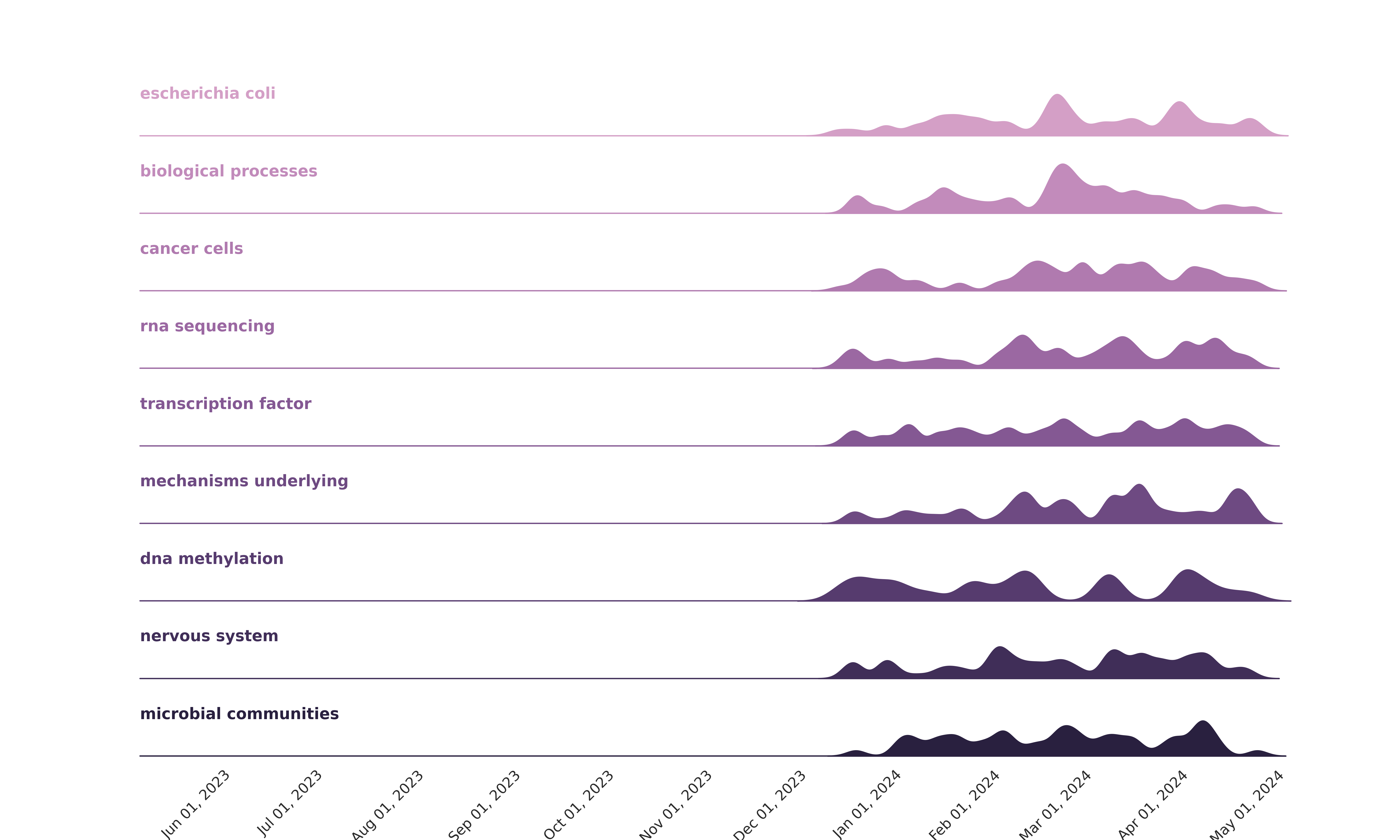
Corpus and coverage. The source appears to be a research-summary aggregator concentrated on molecular biology, genomics, biotechnology, ecology, neuroscience, biomedical engineering, infectious disease, and computational methods.
Its explicit keyword pattern—“transformation,” “biotechnology,” “mediterranean,” and “vulnerabilities”—offers limited but direct evidence of recurring subject interests [31].
The supplied sample disproportionately features unusual, technical, recently published studies, including genome assemblies
Confident, method-forward reporting that quantifies virtually every claim ('N50 of 3.06 Mb'; '~26.5% of the chromosomal genome'), reserving its most assertive language—'the fewest for any non-P. falciparum Plasmodium genome' and 'Critically'—for assembly-quality achievements while using 'suggesting' and 'closely resembling' to soften its most significant biological inference.
Automated analysis; not human reviewed. Limitations: The input is a short abstract presented without the full paper's methods supplement, so I could only verify internal consistency of statistics and methods rather than external validity or accuracy.
The input is a short abstract presented without the full paper's methods supplement, so I could only verify internal consistency of statistics and methods rather than external validity or accuracy.
Frames the described framework as an effective solution that overcomes existing challenges in spatial transcriptomics for post-mortem brain tissue.
Automated analysis; not human reviewed. Limitations: Analysis based solely on the abstract of a preprint; full paper may contain additional nuance. · 6 of 52 available dimensions scored; omitted dimensions are not treated as neutral. · Verified supporting quotes for 6 of 6 scored dimensions.
Claim: The article shows no political liberal or conservative bias.
“Single-cell resolution spatial transcriptomics enables transcriptome-wide molecular profiling within intact tissue architecture, providing unprecedented opportunities to investigate cellular organization and disease-associated molecular states in the human brain.” · exact text match
Why: The text is a purely scientific methodology paper with no political content or ideological framing.
Claim: The article is highly objective, reporting methods and results without subjective opinion.
“Experimentally, we show that a condensed two-day Visium HD workflow provides improved library quality, lowered qPCR cycle thresholds, and more consistent fragment size distributions.” · exact text match
Why: Language is factual and descriptive, with findings presented as results of controlled experiments.
Claim: The article describes what was done and found, not prescribing what should be done.
“Here, we present an end-to-end framework for single-cell-resolution, whole-transcriptome spatial transcriptomics of fresh-frozen (FF) and formalin-fixed paraffin-embedded (FFPE) post-mortem human brain tissue.” · exact text match
Why: The text reports the development and application of a framework without imposing normative recommendations beyond its own utility.
Claim: The article exhibits moderate credibility by transparently describing methods and results.
“Application of this framework to seven Alzheimer's disease frontal cortex specimens (five FF and two FFPE) generated a unified single-cell spatial transcriptomic atlas comprising more than 530,000 spatially resolved cells.” · exact text match
Why: The article specifies sample sizes, tissue types, and outcomes, but as a preprint it lacks peer review and full methodological details.
Claim: The article presents a logical, evidence-based argument without irrational reasoning.
“Sequencing saturation analyses further identified cost-effective sequencing depths that maximize transcript recovery while minimizing redundant sequencing.” · exact text match
Why: Claims are supported by experimental data and analyses, with no appeals to emotion or unsupported assertions.
Claim: The article demonstrates high intellectual depth through technical precision and logical structure.
“We implemented a reference-based highly variable gene selection strategy to enable robust cross-sample harmonization independent of tissue preservation method.” · exact text match
Why: The text uses specialized terminology, describes complex multi-step workflows, and integrates computational and experimental approaches, reflecting advanced scientific reasoning.
Analysis based solely on the abstract of a preprint; full paper may contain additional nuance.
Neutral, dispassionate presentation of empirical lab results in an academic abstract form.
The standard context for stem cell and tissue engineering research provides a background for experiments using induced pluripotent stem cells (iPSCs).
Automated analysis; not human reviewed. Limitations: The assessment is based only on the text snippet provided, which may not include key details about the study's methodology or limitations. · 9 of 54 available dimensions scored; omitted dimensions are not treated as neutral. · Verified supporting quotes for 8 of 9 scored dimensions.
Claim: The abstract presents its findings objectively and descriptively without subjective or emotional language.
“Our results show subtype-specific responses to the PEG–microgel scaffolds, with respect to motor and sensory neurosphere morphology and size.” · exact text match
Why: The wording is descriptive, focusing on observable outcomes and outcomes without emotional or subjective evaluation.
Claim: The report is presented in an unemotional and non-sensationalist style.
“We observe notable differences in structural organization, maturity, and neuronal outgrowth” · exact text match
Why: While the language is confident ('notable differences'), the tone remains measured and professional.
Claim: The research topic is scientifically specific and may not have broad mainstream appeal but is relevant within its academic field.
“To improve the physiological relevance of in vitro platforms for neuron-based research.” · not found in supplied text
Why: The topic is highly specialized and likely to interest only those within this specific field of research, making it difficult to categorize as broadly 'interesting' in a general sense.
Claim: The abstract primarily describes findings rather than prescribing specific actions.
“Furthermore, we compare the formation of the PEG–microgel/scaffolds when starting from iPSCs–derived precursor neuron spheres versus undifferentiated iPSCs.” · exact text match
Why: The language focuses on what was done and found ('we compare', 'we observe'), which is characteristic of a descriptive report.
Claim: The text focuses on the presentation of objective experimental facts rather than opinion.
“In this study, we investigate the differentiation, maturation, and neuronal outgrowth” · exact text match
Why: The language is centered on the research activities performed and the results gathered, reflecting a fact-focused presentation.
Claim: The content maintains a neutral, unemotional tone.
“Sensory and motor neurons differ significantly in their morphology, structural organization, functional properties, and mode of action.” · exact text match
Why: The text describes scientific findings without employing any emotional or judgmental language, firmly anchoring the report in neutrality.
Claim: The abstract is presented as rational, reasoned scientific work using measured language and logical points.
“Together, these results underline the importance of studying motor and sensory neurons separately” · exact text match
Why: The conclusions logically follow from the findings presented, and claims are restricted to observed data, showing high rationality.
Claim: The content relies on experimental evidence and appropriate scientific methodology, presenting itself as scientific and empirical.
“Our results show subtype-specific responses to the PEG–microgel scaffolds” · exact text match
Why: The paper underscores the need for scientifically grounded experimentation and arrives at conclusions based on these experimental outcomes.
Claim: The content is based on valid scientific innovation and reasoning, indicating a high level of intelligence.
“Our results show subtype-specific responses to the PEG–microgel scaffolds” · exact text match
Why: The article contributes to the scientific debate on the need for a more controlled culture platform to investigate motor and sensory neurons separately, suggesting an intelligent contribution to the field.
The assessment is based only on the text snippet provided, which may not include key details about the study's methodology or limitations.
Hedged, technical writing that adheres closely to the reported genomic data without interpretive leaps.
Automated analysis; not human reviewed. Limitations: Analysis is limited to a single preprint abstract; methods, data, and peer review were unavailable, so credibility and methodology assessments rely on the abstract's self-report. · 6 of 54 available dimensions scored; omitted dimensions are not treated as neutral. · Verified supporting quotes for 6 of 6 scored dimensions.
Claim: The text maintains an impersonal, evidence-based style with no subjective interpretation.
“Metabolic profiling revealed that CO₂ and CH₄ cycling constitute a minor fraction of the pond’s metabolic potential” · exact text match
Why: All statements concern data and methods; no first-person opinions or value judgments appear.
Claim: The text only describes study results without making recommendations.
“This study underscores the role of seasonally evolving microbial networks in regulating carbon turnover” · exact text match
Why: No recommendations, calls to action, or policy positions are present.
Claim: The writing is clinically neutral and unemotional.
“Using TaxVAMB, we recovered 78 high- and medium-quality metagenome-assembled genomes (MAGs)” · exact text match
Why: The text contains no emotionally charged language.
Claim: Visible hedging and clear attribution of findings support the text's credibility.
“An integrated metabolic network suggested that genetic potential for CO2 production is primarily driven by pyruvate and acetyl-CoA oxidation” · exact text match
Why: Attribution of findings to specific genome mining and hedged interpretation support credibility, though no original data are available for verification.
Claim: The text reasons carefully from data with appropriate hedging.
“An integrated metabolic network suggested that genetic potential for CO2 production is primarily driven by pyruvate and acetyl-CoA oxidation” · exact text match
“Bathyarchaeia emerged as the most versatile taxon” · exact text match
Why: Claims are explicitly derived from metabolic profiling and clearly flagged with hedges such as 'suggested' and 'emerged'.
Claim: The text reports empirical methodology and quantified findings, anchoring it at the scientific end of the scale.
“Using TaxVAMB, we recovered 78 high- and medium-quality metagenome-assembled genomes (MAGs)” · exact text match
“Seasonal dynamics, rather than management treatment, strongly influenced functional gene abundances” · exact text match
Why: Empirical methods and quantified findings are central to the report rather than superstitious explanations.
Analysis is limited to a single preprint abstract; methods, data, and peer review were unavailable, so credibility and methodology assessments rely on the abstract's self-report.
Frames the research through rigorous, evidence-based scientific validation, reporting both failures and promising leads even-handedly to argue the microfracture clot remains an underexploited target for cartilage repair.
Microfracture is a standard marrow-stimulation technique for treating cartilage defects, but it tends to produce mechanically inferior fibrotic tissue rather than hyaline-like cartilage, driving the search for strategies to improve repair quality.
Automated analysis; not human reviewed. Limitations: The supplied article text is truncated mid-sentence at 'drove TGF-', leaving the downstream outcome of the Rho-ROCK intervention unverified; conclusions therefore rest on the preceding, incomplete portion of the reported experiment. · 6 of 54 available dimensions scored; omitted dimensions are not treated as neutral. · Verified supporting quotes for 4 of 6 scored dimensions.
Claim: The writing maintains a strictly objective, systematic register, presenting findings without subjective evaluation or narrative flourish.
“extracellular control of cell-environment interactions, through fibrinogen augmentation or anti-fibrinolytic treatment, limited contraction but had no effect on or even exacerbated the fibrotic susceptibility of marrow-derived cells” · not found in supplied text
Why: The abstract reports only observational and experimental results, using precise technical vocabulary and avoiding first-person evaluative language.
Claim: Reporting is measured and two-sided, transparently presenting failures and mixed results without dramatic or exaggerated language.
“had no effect on or even exacerbated the fibrotic susceptibility of marrow-derived cells” · exact text match
Why: Unfavorable findings are disclosed candidly, and the abstract avoids hyped descriptors for the successful intervention, signaling careful, unembellished reporting.
Claim: The abstract's certainty is well matched to the evidence; results are framed within experimental limits rather than as absolute claims.
“limited contraction but had no effect on or even exacerbated the fibrotic susceptibility” · exact text match
Why: Clear negative and mixed outcomes are reported side-by-side with positive ones, evidencing calibration that does not exceed the support of the data.
Claim: The abstract reports itself as highly credible through transparent disclosure of mixed results and specific, verifiable experimental details.
“We verified that MFx contraction and fibrosis hinder repair success in minipigs and become evident as early as one week in multiple animal models” · exact text match
“through modulation of the Rho-ROCK pathway” · exact text match
Why: Precise model systems, timelines, and mechanism-specific language—combined with honest reporting of adverse and null effects—support an assessment of high trustworthiness.
Claim: The text is highly rational, grounding every claim in empirical verification and describing interventions in terms of falsifiable experimental outcomes.
“We verified that MFx contraction and fibrosis hinder repair success in minipigs” · exact text match
“therefore, our objective was to investigate and direct microenvironmental interactions in the MFx clot” · not found in supplied text
Why: Claims are anchored to direct animal-model verification, and the rationale follows a logical, testable progression consistent with the scientific method.
The supplied article text is truncated mid-sentence at 'drove TGF-', leaving the downstream outcome of the Rho-ROCK intervention unverified; conclusions therefore rest on the preceding, incomplete portion of the reported experiment.
August 22, 2026 · 0 shares
The abstract frames the protein language model's next-step optimization as autonomous, experiential knowledge acquisition—'AI can acquire knowledge by acting directly on biological systems'—and presents the month-long campaign as general proof of machine insight rather than one laboratory demonstration.
Automated analysis; not human reviewed. Limitations: Analysis is limited to the abstract text; full methods, quantitative results, baselines, and source data are unavailable, constraining verification and comparison of the stated claims. · 15 of 54 available dimensions scored; omitted dimensions are not treated as neutral. · Verified supporting quotes for 14 of 15 scored dimensions.
Claim: Abstract is apolitical; contains no policy or ideological content.
Why: The text deals exclusively with experimental methods and results in biochemistry; no political dimension is engaged.
Claim: Describes observations and outcomes in neutral, third-person terms.
“Applied to glycoside hydrolases” · exact text match
“We then allowed the system to operate continuously and without human intervention” · exact text match
Why: Third-person, passive-voice scientific prose with no affective or personal language.
Claim: Uses sweeping, unqualified language of proof and novelty.
“These results demonstrate that AI can autonomously interact with biology over extended periods to acquire knowledge through experience” · exact text match
Why: The conclusion is presented as conclusive truth without caveats about scope, failure modes, or generalizability.
Claim: Emphasizes the framework's positive promise for discovery.
“establishing a framework for biological discovery driven by continuous experimental interaction” · exact text match
Why: The forward-looking framing is positive but relatively mild, typical of scientific conclusions.
Claim: Descriptively recounts what was done and found, without giving directives.
“We then allowed the system to operate continuously and without human intervention” · exact text match
Why: The abstract never recommends a course of action; it is purely descriptive in tone.
Claim: Condenses a complex engineering and scientific process into a simple 'learning from experience' narrative.
“acquire knowledge through experience” · exact text match
Why: Elides the substantial engineering and interpretive work behind the result into a single tidy claim.
Claim: Presupposes that the system's performance is evidence of 'knowledge' rather than pattern matching.
“progressively learned the structure of the underlying sequence-function landscape” · exact text match
Why: Equates successful optimization with understanding without independently defining or evidencing the latter.
Claim: Celebrates the system's learned behavior as genuine autonomous discovery.
“agents independently explored protein sequence space while learning from shared experimental experience” · exact text match
Why: The abstract recounts the agents' behavior with language implying intentionality and curiosity, inflating the achievement beyond a statistical optimization.
Claim: Uses conclusory language well beyond the reported evidence.
“These results demonstrate that AI can” · exact text match
“establishing a framework” · exact text match
Why: A single continuous run in one enzyme family is presented as a general proof, with no expression of uncertainty or scope limitation.
Claim: Provides enough methodological detail to be plausible but no quantitative support.
“approximately one month” · exact text match
“glycoside hydrolases” · exact text match
Why: Names specific duration, biological targets, and methodology, which builds confidence, but omits numbers and baselines needed for independent verification.
Claim: Uses measured, qualified language for the methods and results.
“We developed a closed-loop framework” · exact text match
“the agents discovered enzymes with substantially altered substrate specificity” · exact text match
Why: Mostly neutral scientific prose with only minor grandiosity in the opening and closing statements.
Claim: Grounded in systematic experimentation and empirical results.
“characterize them in a robotic laboratory” · exact text match
Why: The framework is explicitly experimental, with no trace of mysticism or supernatural explanation.
Claim: Shows signs of formulaic and repetitive abstract structure consistent with AI assistance.
“Biological AI learns primarily from existing observations, but many questions cannot be answered from available data alone” · exact text match
“Here we show that AI can instead acquire knowledge by acting directly on biological systems” · exact text match
Why: The generic transitions and repeated 'learning/knowledge' formulations are consistent with AI tool use, but not conclusive; many human-authored abstracts follow similar templates.
Claim: Discloses methods and lets results stand without obvious distortion.
“construct and characterize them in a robotic laboratory” · exact text match
“learning from shared experimental experience” · exact text match
Why: No deception is apparent, though the abstract omits limitations, numerical outcomes, and negative results that are common to such reports.
Claim: Characterizes pattern-based generation as evidence of robust understanding.
“to acquire knowledge through experience” · exact text match
Why: Presents a strong interpretation of machine learning outcomes as genuine insight, a position that remains disputed within the field.
Analysis is limited to the abstract text; full methods, quantitative results, baselines, and source data are unavailable, constraining verification and comparison of the stated claims.
General framing and worldview. The dominant framing is scientific-positivist and method-centered: methods, sample sizes, benchmark metrics, mechanisms, and uncertainty markers are repeatedly foregrounded
Reporting adopts a deliberately guarded epistemic stance, quantifying gains against an NRC-2001 reference standard rather than observed intake, while still advancing the workflow as a scalable decision-support foundation.
The finding derives from a bioRxiv preprint abstract that has not been peer-reviewed. The NRC (2001) model referenced as the reference standard is the U.S. National Research Council's dairy nutrient requirement equations, which provide expected dry matter intake based on production and animal factors.
Automated analysis; not human reviewed. Limitations: The analysis rests solely on a preprint abstract; full methods, data, and peer-review status were outside the supplied text, limiting verification of statistical claims. · 5 of 54 available dimensions scored; omitted dimensions are not treated as neutral. · Verified supporting quotes for 4 of 5 scored dimensions.
Claim: The report is presented in measured, mostly technical prose with explicit acknowledgment of the endpoint's limitations.
“these metrics quantify reference reconstruction rather than accuracy against observed intake” · exact text match
“Two independently recorded veterinary events were temporally concordant with unusual feeding trajectories, providing descriptive biological context” · exact text match
Why: Qualifying language that limits claims to what the reference standard can support, as well as labeling biological interpretation as descriptive, are hallmarks of an objective-oriented presentation.
Claim: Language is technical and unemotional throughout, with no value-laden or sensationalized terms.
“yielding 153 cow-days after quality exclusions applied before model fitting” · exact text match
“the sole cow at 15 days in milk had MAPE 28.8%” · exact text match
Why: Every sentence conveys data or methods; there is no emotionally charged term or appeal, confirming a rationally neutral emotional valence.
Claim: The manuscript presents specific, falsifiable results and is transparent about its methodological constraints, boosting its internal credibility.
“Because the endpoint was NRC-derived, these metrics quantify reference reconstruction rather than accuracy against observed intake” · exact text match
“after quality exclusions applied before model fitting” · exact text match
Why: Disclosing that the endpoint is a reference rather than ground truth, and noting when exclusions were applied, signals internal honesty and supports reader trust.
Claim: Argumentation is consistently quantitative and hinges on performance metrics and explicit caveats rather than emotional appeal.
“these metrics quantify reference reconstruction rather than accuracy against observed intake” · exact text match
“RMSE from 2.015 to 1.763 kg DM/day” · exact text match
Why: The authors anchor every conclusion in numerically reported model performance while explicitly bounding the inference to what the reference standard supports, indicating rational, evidence-based reasoning.
Claim: Conclusions are grounded in transparent, replicable measurement and statistical analysis with no appeal to non-empirical explanations.
“yielding 153 cow-dies after quality exclusions applied before model fitting” · not found in supplied text
“NRC (2001) expected dry matter intake provided a transparent physiological reference” · exact text match
Why: The text relies wholly on quantitative variables, statistical error metrics, and a standard reference model, reflecting an empirical and scientific outlook.
The analysis rests solely on a preprint abstract; full methods, data, and peer-review status were outside the supplied text, limiting verification of statistical claims.
Precise numeric reporting and hedged causal language frame maintained EPO responses as robust, while brain-aging implications are cautiously deferred to future research.
Normobaric hypoxia is being evaluated as a conditioning stimulus because repeated activation of hypoxia-responsive pathways may promote longer-term adaptations relevant to brain aging, with erythropoietin (EPO) proposed as a central neurotrophic mediator.
Automated analysis; not human reviewed. Limitations: Evaluated from a single abstract without access to the full methodology or peer-review context; missing p-values and effect sizes for the primary EPO outcome weaken precision of these ratings. · 5 of 54 available dimensions scored; omitted dimensions are not treated as neutral. · Verified supporting quotes for 4 of 5 scored dimensions.
Claim: The writing is dispassionate and data-driven, with conclusions carefully scaled to the strength of the reported results.
“sustained normobaric hypoxia elicited robust and reproducible increases in circulating EPO in healthy older adults, demonstrating continued engagement of hypoxia-responsive pathways” · exact text match
Why: Numeric precision (e.g., means, SDs), hedged qualifiers ('proposed', 'likely', 'supporting future investigations'), and an absence of emotional or evaluative language are hallmarks of a deliberately objective register.
Claim: The conclusion about maintained EPO responses is stated with certainty that is justified by the reported within-study measurements, with cautious extension to clinical implications.
“Plasma EPO increased acutely following the first hypoxic exposure, with an estimated mean increase of 6.33 mIU/mL from baseline to 3 h post-exposure.” · exact text match
Counterevidence:
“The final sentence generalizes to 'brain outcomes in aging' without direct brain measures.” · not found in supplied text
Why: While the primary EPO finding is backed by specific numbers, the concluding claim about brain outcomes exceeds the presented data, so moderate confidence reflects this tension.
Claim: The report is transparent about sample size, dosing, measurement, and analysis approach, which supports a strong overall credibility rating.
“Mean SpO2 during steady-state hypoxia was 79.6% (SD = 0.8), reflecting a consistent hypoxic stimulus.” · exact text match
Why: The presence of exact numbers, SDs, and descriptions of the protocol (15 sessions, repeated sampling) reflects a methodology that facilitates scrutiny and verification.
Claim: The text clearly labels exploratory findings and future implications rather than presenting speculations as firm conclusions.
“Exploratory outcomes included ... reduction in resting blood pressure following the intervention.” · not found in supplied text
Why: The use of 'Exploratory outcomes included' and the explicit flag that the brain-related support is for 'future investigations' signals that these claims are not yet conclusive.
Claim: The writing is technically sophisticated and appropriately qualified for a specialized scientific audience.
“Hypoxic conditioning is a potential intervention for promoting brain function in aging, with erythropoietin (EPO) proposed as a central neurotrophic mediator.” · exact text match
Why: The abstract presupposes domain knowledge (e.g., NIRS, iron-related markers, normobaric hypoxia) and uses precise physiological terminology without simplification, indicating expert-level discourse.
Evaluated from a single abstract without access to the full methodology or peer-review context; missing p-values and effect sizes for the primary EPO outcome weaken precision of these ratings.
Bacterial persistence is framed through scrupulously hedged, method-first reporting that repeatedly narrows each claim to the evidence—'mainly', 'largely', 'supports a model'.
Bacterial persisters are a subset of cells that survive antibiotics without being genetically resistant, and distinguishing genetic drivers of persistence from confounders like slow growth has been a key methodological challenge in the field.
Automated analysis; not human reviewed. Limitations: Assessment rests on a brief, self-contained summary paragraph with no methods, data, citations, or author context; tone and framing, not independent verification, drive the scores. · 5 of 54 available dimensions scored; omitted dimensions are not treated as neutral. · Verified supporting quotes for 4 of 5 scored dimensions.
Claim: Reporting is strongly objective, relaying methods and findings in neutral, non-evaluative language.
“we developed a genome-wide Tn-seq approach to identify genes and pathways involved in persistence” · exact text match
“Persistence was largely independent of growth” · not found in supplied text
Why: The text states observations and methods without value judgments, emotional language, or editorial commentary, instead presenting hedged, measurable findings.
Claim: Reporting is purely descriptive of the study, prescribing no actions, policies, or recommendations.
“Ampicillin persistence relied primarily on pathways linked to energy metabolism” · exact text match
Why: The sentence reports an empirical pattern without any imperatives, recommendations, or judgments about what should be done.
Claim: Language calibrates certainty precisely to the level of evidence, avoiding overstatement.
“supports a model in which bacterial persistence is mainly an antibiotic-specific phenomenon” · exact text match
“largely independent of growth” · exact text match
Why: The qualifiers 'supports a model', 'mainly', and 'largely' demonstrate reasoned epistemic modesty that matches the correlational study design.
Claim: Reporting shows strong epistemic care through methodological transparency and explicit acknowledgement of uncertainty.
“the genetic basis of persistence remains only partially understood” · exact text match
“while avoiding persister enrichment and controlling for the confounding effects of growth” · exact text match
Why: The text highlights specific methodological controls and explicitly flags the limits of current knowledge, both hallmarks of trustworthy scientific reporting, though sourcing and corrections are not visible in this excerpt.
Assessment rests on a brief, self-contained summary paragraph with no methods, data, citations, or author context; tone and framing, not independent verification, drive the scores.
Reporting adopts a deliberately guarded epistemic stance, quantifying gains against an NRC-2001 reference standard rather than observed intake, while still advancing the workflow as a scalable decision-support foundation.
The finding derives from a bioRxiv preprint abstract that has not been peer-reviewed. The NRC (2001) model referenced as the reference standard is the U.S. National Research Council's dairy nutrient requirement equations, which provide expected dry matter intake based on production and animal factors.
Automated analysis; not human reviewed. Limitations: The analysis rests solely on a preprint abstract; full methods, data, and peer-review status were outside the supplied text, limiting verification of statistical claims. · 5 of 54 available dimensions scored; omitted dimensions are not treated as neutral. · Verified supporting quotes for 4 of 5 scored dimensions.
Claim: The report is presented in measured, mostly technical prose with explicit acknowledgment of the endpoint's limitations.
“these metrics quantify reference reconstruction rather than accuracy against observed intake” · exact text match
“Two independently recorded veterinary events were temporally concordant with unusual feeding trajectories, providing descriptive biological context” · exact text match
Why: Qualifying language that limits claims to what the reference standard can support, as well as labeling biological interpretation as descriptive, are hallmarks of an objective-oriented presentation.
Claim: Language is technical and unemotional throughout, with no value-laden or sensationalized terms.
“yielding 153 cow-days after quality exclusions applied before model fitting” · exact text match
“the sole cow at 15 days in milk had MAPE 28.8%” · exact text match
Why: Every sentence conveys data or methods; there is no emotionally charged term or appeal, confirming a rationally neutral emotional valence.
Claim: The manuscript presents specific, falsifiable results and is transparent about its methodological constraints, boosting its internal credibility.
“Because the endpoint was NRC-derived, these metrics quantify reference reconstruction rather than accuracy against observed intake” · exact text match
“after quality exclusions applied before model fitting” · exact text match
Why: Disclosing that the endpoint is a reference rather than ground truth, and noting when exclusions were applied, signals internal honesty and supports reader trust.
Claim: Argumentation is consistently quantitative and hinges on performance metrics and explicit caveats rather than emotional appeal.
“these metrics quantify reference reconstruction rather than accuracy against observed intake” · exact text match
“RMSE from 2.015 to 1.763 kg DM/day” · exact text match
Why: The authors anchor every conclusion in numerically reported model performance while explicitly bounding the inference to what the reference standard supports, indicating rational, evidence-based reasoning.
Claim: Conclusions are grounded in transparent, replicable measurement and statistical analysis with no appeal to non-empirical explanations.
“yielding 153 cow-dies after quality exclusions applied before model fitting” · not found in supplied text
“NRC (2001) expected dry matter intake provided a transparent physiological reference” · exact text match
Why: The text relies wholly on quantitative variables, statistical error metrics, and a standard reference model, reflecting an empirical and scientific outlook.
The analysis rests solely on a preprint abstract; full methods, data, and peer-review status were outside the supplied text, limiting verification of statistical claims.
August 22, 2026 · 0 shares
A dispassionate, empirical framing that leads with quantitative benchmarks (75% loading, 4-log reduction) and hedges translational claims with modals such as 'could' rather than asserting clinical benefits.
The findings are from a laboratory study in mice; the formulations have not been evaluated in human clinical trials.
Automated analysis; not human reviewed. Limitations: Analysis relies solely on the supplied abstract; no information about the publication venue, author disclosures, or reproducibility of the results is available. · 54 of 54 available dimensions scored; omitted dimensions are not treated as neutral. · Verified supporting quotes for 5 of 54 scored dimensions.
Claim: The presentation is largely factual and methodological, with quantitative outcomes leading the narrative and only minimal evaluative language.
“A single intramuscular (IM) injection of NCRPT in mice resulted in therapeutic serum concentrations for over a week.” · exact text match
Why: The sentence states a specific, checkable result in neutral, measurement-oriented language, typical of objective reporting.
Claim: The writing maintains a consistently flat, unemotional tone throughout, avoiding both positive and negative affect.
“A single intramuscular (IM) injection of NCRPT in mice resulted in therapeutic serum concentrations for over a week.” · exact text match
Why: Serum concentrations and injection details are reported in dry, dispassionate language with no emotional coloring.
Claim: The reasoning follows a clear empirical chain, differentiating formulation types and outcomes rather than asserting unsupported conclusions.
“Crystalline formulations resulted in much slower depot dissolution compared to amorphous formulations.” · exact text match
Why: The cause-and-effect statement reflects logical, evidence-based differentiation among the tested formulations.
Claim: The abstract is firmly grounded in empirical, quantitative evidence from controlled experiments.
“In each case, a [~] 4-log-fold reduction in lung bacterial load compared to untreated mice was observed.” · exact text match
Why: The claim is grounded in a specific, replicable measure (4-log-fold reduction) from an animal model, reflecting a scientific rather than superstitious mindset.
Claim: The text engages in forward-looking speculation about clinical applications beyond the translational findings of the mouse data.
“These results open new avenues for developing LAI formulations of TB drugs and could improve patient compliance and TB management.” · exact text match
Why: The modal 'could' signals a prediction about future human benefit that goes beyond the immediate study findings.
Analysis relies solely on the supplied abstract; no information about the publication venue, author disclosures, or reproducibility of the results is available.
August 22, 2026 · 0 shares
The abstract frames the protein language model's next-step optimization as autonomous, experiential knowledge acquisition—'AI can acquire knowledge by acting directly on biological systems'—and presents the month-long campaign as general proof of machine insight rather than one laboratory demonstration.
Automated analysis; not human reviewed. Limitations: Analysis is limited to the abstract text; full methods, quantitative results, baselines, and source data are unavailable, constraining verification and comparison of the stated claims. · 15 of 54 available dimensions scored; omitted dimensions are not treated as neutral. · Verified supporting quotes for 14 of 15 scored dimensions.
Claim: Abstract is apolitical; contains no policy or ideological content.
Why: The text deals exclusively with experimental methods and results in biochemistry; no political dimension is engaged.
Claim: Describes observations and outcomes in neutral, third-person terms.
“Applied to glycoside hydrolases” · exact text match
“We then allowed the system to operate continuously and without human intervention” · exact text match
Why: Third-person, passive-voice scientific prose with no affective or personal language.
Claim: Uses sweeping, unqualified language of proof and novelty.
“These results demonstrate that AI can autonomously interact with biology over extended periods to acquire knowledge through experience” · exact text match
Why: The conclusion is presented as conclusive truth without caveats about scope, failure modes, or generalizability.
Claim: Emphasizes the framework's positive promise for discovery.
“establishing a framework for biological discovery driven by continuous experimental interaction” · exact text match
Why: The forward-looking framing is positive but relatively mild, typical of scientific conclusions.
Claim: Descriptively recounts what was done and found, without giving directives.
“We then allowed the system to operate continuously and without human intervention” · exact text match
Why: The abstract never recommends a course of action; it is purely descriptive in tone.
Claim: Condenses a complex engineering and scientific process into a simple 'learning from experience' narrative.
“acquire knowledge through experience” · exact text match
Why: Elides the substantial engineering and interpretive work behind the result into a single tidy claim.
Claim: Presupposes that the system's performance is evidence of 'knowledge' rather than pattern matching.
“progressively learned the structure of the underlying sequence-function landscape” · exact text match
Why: Equates successful optimization with understanding without independently defining or evidencing the latter.
Claim: Celebrates the system's learned behavior as genuine autonomous discovery.
“agents independently explored protein sequence space while learning from shared experimental experience” · exact text match
Why: The abstract recounts the agents' behavior with language implying intentionality and curiosity, inflating the achievement beyond a statistical optimization.
Claim: Uses conclusory language well beyond the reported evidence.
“These results demonstrate that AI can” · exact text match
“establishing a framework” · exact text match
Why: A single continuous run in one enzyme family is presented as a general proof, with no expression of uncertainty or scope limitation.
Claim: Provides enough methodological detail to be plausible but no quantitative support.
“approximately one month” · exact text match
“glycoside hydrolases” · exact text match
Why: Names specific duration, biological targets, and methodology, which builds confidence, but omits numbers and baselines needed for independent verification.
Claim: Uses measured, qualified language for the methods and results.
“We developed a closed-loop framework” · exact text match
“the agents discovered enzymes with substantially altered substrate specificity” · exact text match
Why: Mostly neutral scientific prose with only minor grandiosity in the opening and closing statements.
Claim: Grounded in systematic experimentation and empirical results.
“characterize them in a robotic laboratory” · exact text match
Why: The framework is explicitly experimental, with no trace of mysticism or supernatural explanation.
Claim: Shows signs of formulaic and repetitive abstract structure consistent with AI assistance.
“Biological AI learns primarily from existing observations, but many questions cannot be answered from available data alone” · exact text match
“Here we show that AI can instead acquire knowledge by acting directly on biological systems” · exact text match
Why: The generic transitions and repeated 'learning/knowledge' formulations are consistent with AI tool use, but not conclusive; many human-authored abstracts follow similar templates.
Claim: Discloses methods and lets results stand without obvious distortion.
“construct and characterize them in a robotic laboratory” · exact text match
“learning from shared experimental experience” · exact text match
Why: No deception is apparent, though the abstract omits limitations, numerical outcomes, and negative results that are common to such reports.
Claim: Characterizes pattern-based generation as evidence of robust understanding.
“to acquire knowledge through experience” · exact text match
Why: Presents a strong interpretation of machine learning outcomes as genuine insight, a position that remains disputed within the field.
Analysis is limited to the abstract text; full methods, quantitative results, baselines, and source data are unavailable, constraining verification and comparison of the stated claims.
Perspective and selection effects. The perspective favors technical novelty and translational potential: organoids are framed as a therapeutic-discovery platform
Translational framing casts cortical organoids as a robust human model for CDM neurodevelopment and a platform for testing DM1 therapeutics.
Automated analysis; not human reviewed. Limitations: bioRxiv preprint; not peer-reviewed. · 2 of 52 available dimensions scored; omitted dimensions are not treated as neutral. · Verified supporting quotes for 2 of 2 scored dimensions.
Claim: The article frames the organoid platform as a translational therapeutic discovery platform.
“demonstrate the utility of this platform for translational therapeutic discovery in DM1.” · exact text match
Why: Explicit reference to translational therapeutic discovery implies a prescriptive orientation toward clinical application.
Claim: Cortical organoids are presented as a robust, translational model for CDM neurodevelopment.
“Together, these findings establish cortical organoids as a robust human model of CDM-associated neurodevelopmental defects, uncover MBNL-dependent mechanisms underlying early corticogenesis impairment and demonstrate the utility of this platform for translational therapeutic discovery in DM1.” · exact text match
Why: The sentence asserts robustness and translational potential of the organoid model.
bioRxiv preprint; not peer-reviewed.
July 30, 2026 · 0 shares
Framing emphasizes practical health applications and outbreak preparedness, highlighting countermeasure potential and patent filings.
Alphaviruses rely on receptor–glycoprotein interactions to infect hosts, with CHIKV vectored by Aedes mosquitoes; Lachesin is a mosquito-specific receptor implicated in CHIKV entry; the envelope E2-E1 glycoproteins recognize Lachesin across diverse mosquito species but not other arthropods; the study uses cryo-EM to map interactions across CHIKV, SFV, and MIDV and shows that a soluble Lachesin decoy can block entry and protect mice; a Lachesin polymorphism in Anopheles can ablate recognition; these findings have implications for vector-targeted genetic interventions and outbreak preparedness.
Automated analysis; not human reviewed. Limitations: The article is a bioRxiv preprint; findings have not undergone peer review; IP filing could reflect commercialization bias. · 2 of 52 available dimensions scored; omitted dimensions are not treated as neutral. · Verified supporting quotes for 0 of 2 scored dimensions.
The article is a bioRxiv preprint; findings have not undergone peer review; IP filing could reflect commercialization bias.
Framing centers on PlasChain as a novel, superior-performing graph-based plasmid assembler that outperforms state-of-the-art tools in recovering long plasmids from metagenomic data.
Automated analysis; not human reviewed. · 1 of 52 available dimensions scored; omitted dimensions are not treated as neutral. · Verified supporting quotes for 1 of 1 scored dimensions.
Claim: The framing presents PlasChain as superior, indicating a subjective emphasis on favorable results.
“Across nearly all benchmarks, PlasChain demonstrates superior performance in recovering long plasmids while maintaining competitive accuracy in assembling short plasmids.” · exact text match
Why: The sentence uses evaluative language asserting superiority rather than neutral reporting.
A dispassionate, method-first abstract that conveys stark extinction risk through quantified inference and hedged causal claims rather than emotive language.
Main apparent biases. The strongest are technical/empirical bias—favoring measurable and model-based claims
Scientific writing presents experimental results in measured, empirical language with precise quantitative claims and no acknowledgment of interpretive flexibility.
In diffuse correlation spectroscopy, the temporal autocorrelation function of scattered coherent light is related to a blood flow index via the Siegert relation, which assumes purely stochastic motion of scatterers. Biological tissue, however, contains both static structures (e.g., vessel walls) and slowly moving components whose effect on the measured signal must be characterized to interpret BFI changes.
Automated analysis; not human reviewed. Limitations: The abstract text is incomplete (truncated mid-sentence), so some methods details and full numerical results are missing. · 4 of 54 available dimensions scored; omitted dimensions are not treated as neutral. · Verified supporting quotes for 4 of 4 scored dimensions.
Claim: The report is written in a detached, factual register presenting findings without personal judgment.
“Continuous wave diffuse correlation spectroscopy (cw-DCS) is a noninvasive optical technique to monitor the tissues blood flow changes.” · exact text match
Why: Sentences state factual information using technical terminology and passive constructions with no first-person commentary, evaluative language, or causal claims beyond the data.
Claim: The report reasons from controlled measurements to quantified conclusions using explicit methodology.
“The measurements performed on Agar-based phantom with tube showed that presence of static scatterer component and slow-dynamic scatterer component led to substantial underestimation (≈ 123%) of the flow index derived by Siegert relation” · exact text match
Why: The text describes hypothesis-driven experiments with controlled conditions (phantom types, human challenges), quantitative effect sizes, and comparisons among analysis methods, reflecting rational scientific reasoning.
Claim: The abstract reports empirical experimental work using physical instrumentation and quantitative data analysis.
“The measurements performed on Agar-based phantom with tube showed that presence of static scatterer component and slow-dynamic scatterer component led to substantial underestimation (≈ 123%) of the flow index derived by Siegert relation, compared to effective diffusion coefficient of fast-dynamic scatterers components derived by modified Siegert relation and bi-exponential model.” · exact text match
Why: The work involves controlled phantom-based measurements, human challenge tests, and quantitative comparison of estimation methods, representing empirical scientific methodology at the far scientific end of the spectrum.
Claim: The report demonstrates subject-matter sophistication through precise technical terminology and description of complex methodology.
“compared to effective diffusion coefficient of fast-dynamic scatterers components derived by modified Siegert relation and bi-exponential model.” · exact text match
Why: Using discipline-specific terms (e.g., 'Siegert relation', 'bi-exponential model') and explaining causal chains precisely shows advanced reasoning, though the abstract format limits breadth.
The abstract text is incomplete (truncated mid-sentence), so some methods details and full numerical results are missing.
Framing centers on PlasChain as a novel, superior-performing graph-based plasmid assembler that outperforms state-of-the-art tools in recovering long plasmids from metagenomic data.
Automated analysis; not human reviewed. · 1 of 52 available dimensions scored; omitted dimensions are not treated as neutral. · Verified supporting quotes for 1 of 1 scored dimensions.
Claim: The framing presents PlasChain as superior, indicating a subjective emphasis on favorable results.
“Across nearly all benchmarks, PlasChain demonstrates superior performance in recovering long plasmids while maintaining competitive accuracy in assembling short plasmids.” · exact text match
Why: The sentence uses evaluative language asserting superiority rather than neutral reporting.
August 22, 2026 · 0 shares
The abstract frames the protein language model's next-step optimization as autonomous, experiential knowledge acquisition—'AI can acquire knowledge by acting directly on biological systems'—and presents the month-long campaign as general proof of machine insight rather than one laboratory demonstration.
Automated analysis; not human reviewed. Limitations: Analysis is limited to the abstract text; full methods, quantitative results, baselines, and source data are unavailable, constraining verification and comparison of the stated claims. · 15 of 54 available dimensions scored; omitted dimensions are not treated as neutral. · Verified supporting quotes for 14 of 15 scored dimensions.
Claim: Abstract is apolitical; contains no policy or ideological content.
Why: The text deals exclusively with experimental methods and results in biochemistry; no political dimension is engaged.
Claim: Describes observations and outcomes in neutral, third-person terms.
“Applied to glycoside hydrolases” · exact text match
“We then allowed the system to operate continuously and without human intervention” · exact text match
Why: Third-person, passive-voice scientific prose with no affective or personal language.
Claim: Uses sweeping, unqualified language of proof and novelty.
“These results demonstrate that AI can autonomously interact with biology over extended periods to acquire knowledge through experience” · exact text match
Why: The conclusion is presented as conclusive truth without caveats about scope, failure modes, or generalizability.
Claim: Emphasizes the framework's positive promise for discovery.
“establishing a framework for biological discovery driven by continuous experimental interaction” · exact text match
Why: The forward-looking framing is positive but relatively mild, typical of scientific conclusions.
Claim: Descriptively recounts what was done and found, without giving directives.
“We then allowed the system to operate continuously and without human intervention” · exact text match
Why: The abstract never recommends a course of action; it is purely descriptive in tone.
Claim: Condenses a complex engineering and scientific process into a simple 'learning from experience' narrative.
“acquire knowledge through experience” · exact text match
Why: Elides the substantial engineering and interpretive work behind the result into a single tidy claim.
Claim: Presupposes that the system's performance is evidence of 'knowledge' rather than pattern matching.
“progressively learned the structure of the underlying sequence-function landscape” · exact text match
Why: Equates successful optimization with understanding without independently defining or evidencing the latter.
Claim: Celebrates the system's learned behavior as genuine autonomous discovery.
“agents independently explored protein sequence space while learning from shared experimental experience” · exact text match
Why: The abstract recounts the agents' behavior with language implying intentionality and curiosity, inflating the achievement beyond a statistical optimization.
Claim: Uses conclusory language well beyond the reported evidence.
“These results demonstrate that AI can” · exact text match
“establishing a framework” · exact text match
Why: A single continuous run in one enzyme family is presented as a general proof, with no expression of uncertainty or scope limitation.
Claim: Provides enough methodological detail to be plausible but no quantitative support.
“approximately one month” · exact text match
“glycoside hydrolases” · exact text match
Why: Names specific duration, biological targets, and methodology, which builds confidence, but omits numbers and baselines needed for independent verification.
Claim: Uses measured, qualified language for the methods and results.
“We developed a closed-loop framework” · exact text match
“the agents discovered enzymes with substantially altered substrate specificity” · exact text match
Why: Mostly neutral scientific prose with only minor grandiosity in the opening and closing statements.
Claim: Grounded in systematic experimentation and empirical results.
“characterize them in a robotic laboratory” · exact text match
Why: The framework is explicitly experimental, with no trace of mysticism or supernatural explanation.
Claim: Shows signs of formulaic and repetitive abstract structure consistent with AI assistance.
“Biological AI learns primarily from existing observations, but many questions cannot be answered from available data alone” · exact text match
“Here we show that AI can instead acquire knowledge by acting directly on biological systems” · exact text match
Why: The generic transitions and repeated 'learning/knowledge' formulations are consistent with AI tool use, but not conclusive; many human-authored abstracts follow similar templates.
Claim: Discloses methods and lets results stand without obvious distortion.
“construct and characterize them in a robotic laboratory” · exact text match
“learning from shared experimental experience” · exact text match
Why: No deception is apparent, though the abstract omits limitations, numerical outcomes, and negative results that are common to such reports.
Claim: Characterizes pattern-based generation as evidence of robust understanding.
“to acquire knowledge through experience” · exact text match
Why: Presents a strong interpretation of machine learning outcomes as genuine insight, a position that remains disputed within the field.
Analysis is limited to the abstract text; full methods, quantitative results, baselines, and source data are unavailable, constraining verification and comparison of the stated claims.
Translational framing casts cortical organoids as a robust human model for CDM neurodevelopment and a platform for testing DM1 therapeutics.
Automated analysis; not human reviewed. Limitations: bioRxiv preprint; not peer-reviewed. · 2 of 52 available dimensions scored; omitted dimensions are not treated as neutral. · Verified supporting quotes for 2 of 2 scored dimensions.
Claim: The article frames the organoid platform as a translational therapeutic discovery platform.
“demonstrate the utility of this platform for translational therapeutic discovery in DM1.” · exact text match
Why: Explicit reference to translational therapeutic discovery implies a prescriptive orientation toward clinical application.
Claim: Cortical organoids are presented as a robust, translational model for CDM neurodevelopment.
“Together, these findings establish cortical organoids as a robust human model of CDM-associated neurodevelopmental defects, uncover MBNL-dependent mechanisms underlying early corticogenesis impairment and demonstrate the utility of this platform for translational therapeutic discovery in DM1.” · exact text match
Why: The sentence asserts robustness and translational potential of the organoid model.
bioRxiv preprint; not peer-reviewed.
Mechanistic confidence is conveyed through measured scientific language, framing a self-amplifying microbial-abiotic sulfur relay as a field-feasible, low-cost solution to the long-standing problem of bauxite residue remediation.
Bauxite residue is the highly alkaline solid waste generated during alumina refining; its high pH and salt content make it toxic to vegetation and difficult and costly to rehabilitate.
Automated analysis; not human reviewed. Limitations: The analysis relies on a single research abstract with no methods, data, or discussion, so effect sizes, statistical validity, and the strength of causal claims could not be independently verified.
The analysis relies on a single research abstract with no methods, data, or discussion, so effect sizes, statistical validity, and the strength of causal claims could not be independently verified.
August 22, 2026 · 0 shares
The preprint abstract frames a systemically delivered, ultrasound-activated STING agonist as a promising immunotherapeutic strategy, using hedged scientific language and emphasizing mechanism and efficacy in mouse models.
Automated analysis; not human reviewed. Limitations: The supplied text was a truncated and partially duplicated preprint abstract, so analysis is limited to the available text and full methods/results were not accessible.
The supplied text was a truncated and partially duplicated preprint abstract, so analysis is limited to the available text and full methods/results were not accessible.
Reporting is precise and carefully hedged, positioning AI reconstruction strictly as a quality-controlled 'adjunct' rather than a replacement, reflecting a strong quantitative and evidence-bound framing.
Multiparametric prostate MRI (mpMRI) combines T2-weighted, diffusion-weighted, and T1-weighted sequences to detect and stage prostate cancer, and missing or degraded sequences can limit its diagnostic yield. MRI-guided biopsy and focal therapy require accurate image synthesis models. Cross-modal deep learning aims to generate missing sequences, but acceptance hinges on independent, blinded validation against acquired images.
Automated analysis; not human reviewed. Limitations: The abstract does not report lesion-level characterization of the non-inferiority outcomes or discuss generalizability limits in detail; the quantitative summaries are taken at face value. · 50 of 54 available dimensions scored; omitted dimensions are not treated as neutral. · Verified supporting quotes for 0 of 50 scored dimensions.
The abstract does not report lesion-level characterization of the non-inferiority outcomes or discuss generalizability limits in detail; the quantitative summaries are taken at face value.
August 22, 2026 · 0 shares
The preprint abstract frames a systemically delivered, ultrasound-activated STING agonist as a promising immunotherapeutic strategy, using hedged scientific language and emphasizing mechanism and efficacy in mouse models.
Automated analysis; not human reviewed. Limitations: The supplied text was a truncated and partially duplicated preprint abstract, so analysis is limited to the available text and full methods/results were not accessible.
The supplied text was a truncated and partially duplicated preprint abstract, so analysis is limited to the available text and full methods/results were not accessible.
Values. The three highest apparent values are empirical rigor
Bacterial persistence is framed through scrupulously hedged, method-first reporting that repeatedly narrows each claim to the evidence—'mainly', 'largely', 'supports a model'.
Bacterial persisters are a subset of cells that survive antibiotics without being genetically resistant, and distinguishing genetic drivers of persistence from confounders like slow growth has been a key methodological challenge in the field.
Automated analysis; not human reviewed. Limitations: Assessment rests on a brief, self-contained summary paragraph with no methods, data, citations, or author context; tone and framing, not independent verification, drive the scores. · 5 of 54 available dimensions scored; omitted dimensions are not treated as neutral. · Verified supporting quotes for 4 of 5 scored dimensions.
Claim: Reporting is strongly objective, relaying methods and findings in neutral, non-evaluative language.
“we developed a genome-wide Tn-seq approach to identify genes and pathways involved in persistence” · exact text match
“Persistence was largely independent of growth” · not found in supplied text
Why: The text states observations and methods without value judgments, emotional language, or editorial commentary, instead presenting hedged, measurable findings.
Claim: Reporting is purely descriptive of the study, prescribing no actions, policies, or recommendations.
“Ampicillin persistence relied primarily on pathways linked to energy metabolism” · exact text match
Why: The sentence reports an empirical pattern without any imperatives, recommendations, or judgments about what should be done.
Claim: Language calibrates certainty precisely to the level of evidence, avoiding overstatement.
“supports a model in which bacterial persistence is mainly an antibiotic-specific phenomenon” · exact text match
“largely independent of growth” · exact text match
Why: The qualifiers 'supports a model', 'mainly', and 'largely' demonstrate reasoned epistemic modesty that matches the correlational study design.
Claim: Reporting shows strong epistemic care through methodological transparency and explicit acknowledgement of uncertainty.
“the genetic basis of persistence remains only partially understood” · exact text match
“while avoiding persister enrichment and controlling for the confounding effects of growth” · exact text match
Why: The text highlights specific methodological controls and explicitly flags the limits of current knowledge, both hallmarks of trustworthy scientific reporting, though sourcing and corrections are not visible in this excerpt.
Assessment rests on a brief, self-contained summary paragraph with no methods, data, citations, or author context; tone and framing, not independent verification, drive the scores.
Reporting adopts a deliberately guarded epistemic stance, quantifying gains against an NRC-2001 reference standard rather than observed intake, while still advancing the workflow as a scalable decision-support foundation.
The finding derives from a bioRxiv preprint abstract that has not been peer-reviewed. The NRC (2001) model referenced as the reference standard is the U.S. National Research Council's dairy nutrient requirement equations, which provide expected dry matter intake based on production and animal factors.
Automated analysis; not human reviewed. Limitations: The analysis rests solely on a preprint abstract; full methods, data, and peer-review status were outside the supplied text, limiting verification of statistical claims. · 5 of 54 available dimensions scored; omitted dimensions are not treated as neutral. · Verified supporting quotes for 4 of 5 scored dimensions.
Claim: The report is presented in measured, mostly technical prose with explicit acknowledgment of the endpoint's limitations.
“these metrics quantify reference reconstruction rather than accuracy against observed intake” · exact text match
“Two independently recorded veterinary events were temporally concordant with unusual feeding trajectories, providing descriptive biological context” · exact text match
Why: Qualifying language that limits claims to what the reference standard can support, as well as labeling biological interpretation as descriptive, are hallmarks of an objective-oriented presentation.
Claim: Language is technical and unemotional throughout, with no value-laden or sensationalized terms.
“yielding 153 cow-days after quality exclusions applied before model fitting” · exact text match
“the sole cow at 15 days in milk had MAPE 28.8%” · exact text match
Why: Every sentence conveys data or methods; there is no emotionally charged term or appeal, confirming a rationally neutral emotional valence.
Claim: The manuscript presents specific, falsifiable results and is transparent about its methodological constraints, boosting its internal credibility.
“Because the endpoint was NRC-derived, these metrics quantify reference reconstruction rather than accuracy against observed intake” · exact text match
“after quality exclusions applied before model fitting” · exact text match
Why: Disclosing that the endpoint is a reference rather than ground truth, and noting when exclusions were applied, signals internal honesty and supports reader trust.
Claim: Argumentation is consistently quantitative and hinges on performance metrics and explicit caveats rather than emotional appeal.
“these metrics quantify reference reconstruction rather than accuracy against observed intake” · exact text match
“RMSE from 2.015 to 1.763 kg DM/day” · exact text match
Why: The authors anchor every conclusion in numerically reported model performance while explicitly bounding the inference to what the reference standard supports, indicating rational, evidence-based reasoning.
Claim: Conclusions are grounded in transparent, replicable measurement and statistical analysis with no appeal to non-empirical explanations.
“yielding 153 cow-dies after quality exclusions applied before model fitting” · not found in supplied text
“NRC (2001) expected dry matter intake provided a transparent physiological reference” · exact text match
Why: The text relies wholly on quantitative variables, statistical error metrics, and a standard reference model, reflecting an empirical and scientific outlook.
The analysis rests solely on a preprint abstract; full methods, data, and peer-review status were outside the supplied text, limiting verification of statistical claims.
Precise numeric reporting and hedged causal language frame maintained EPO responses as robust, while brain-aging implications are cautiously deferred to future research.
Normobaric hypoxia is being evaluated as a conditioning stimulus because repeated activation of hypoxia-responsive pathways may promote longer-term adaptations relevant to brain aging, with erythropoietin (EPO) proposed as a central neurotrophic mediator.
Automated analysis; not human reviewed. Limitations: Evaluated from a single abstract without access to the full methodology or peer-review context; missing p-values and effect sizes for the primary EPO outcome weaken precision of these ratings. · 5 of 54 available dimensions scored; omitted dimensions are not treated as neutral. · Verified supporting quotes for 4 of 5 scored dimensions.
Claim: The writing is dispassionate and data-driven, with conclusions carefully scaled to the strength of the reported results.
“sustained normobaric hypoxia elicited robust and reproducible increases in circulating EPO in healthy older adults, demonstrating continued engagement of hypoxia-responsive pathways” · exact text match
Why: Numeric precision (e.g., means, SDs), hedged qualifiers ('proposed', 'likely', 'supporting future investigations'), and an absence of emotional or evaluative language are hallmarks of a deliberately objective register.
Claim: The conclusion about maintained EPO responses is stated with certainty that is justified by the reported within-study measurements, with cautious extension to clinical implications.
“Plasma EPO increased acutely following the first hypoxic exposure, with an estimated mean increase of 6.33 mIU/mL from baseline to 3 h post-exposure.” · exact text match
Counterevidence:
“The final sentence generalizes to 'brain outcomes in aging' without direct brain measures.” · not found in supplied text
Why: While the primary EPO finding is backed by specific numbers, the concluding claim about brain outcomes exceeds the presented data, so moderate confidence reflects this tension.
Claim: The report is transparent about sample size, dosing, measurement, and analysis approach, which supports a strong overall credibility rating.
“Mean SpO2 during steady-state hypoxia was 79.6% (SD = 0.8), reflecting a consistent hypoxic stimulus.” · exact text match
Why: The presence of exact numbers, SDs, and descriptions of the protocol (15 sessions, repeated sampling) reflects a methodology that facilitates scrutiny and verification.
Claim: The text clearly labels exploratory findings and future implications rather than presenting speculations as firm conclusions.
“Exploratory outcomes included ... reduction in resting blood pressure following the intervention.” · not found in supplied text
Why: The use of 'Exploratory outcomes included' and the explicit flag that the brain-related support is for 'future investigations' signals that these claims are not yet conclusive.
Claim: The writing is technically sophisticated and appropriately qualified for a specialized scientific audience.
“Hypoxic conditioning is a potential intervention for promoting brain function in aging, with erythropoietin (EPO) proposed as a central neurotrophic mediator.” · exact text match
Why: The abstract presupposes domain knowledge (e.g., NIRS, iron-related markers, normobaric hypoxia) and uses precise physiological terminology without simplification, indicating expert-level discourse.
Evaluated from a single abstract without access to the full methodology or peer-review context; missing p-values and effect sizes for the primary EPO outcome weaken precision of these ratings.
Frames the described framework as an effective solution that overcomes existing challenges in spatial transcriptomics for post-mortem brain tissue.
Automated analysis; not human reviewed. Limitations: Analysis based solely on the abstract of a preprint; full paper may contain additional nuance. · 6 of 52 available dimensions scored; omitted dimensions are not treated as neutral. · Verified supporting quotes for 6 of 6 scored dimensions.
Claim: The article shows no political liberal or conservative bias.
“Single-cell resolution spatial transcriptomics enables transcriptome-wide molecular profiling within intact tissue architecture, providing unprecedented opportunities to investigate cellular organization and disease-associated molecular states in the human brain.” · exact text match
Why: The text is a purely scientific methodology paper with no political content or ideological framing.
Claim: The article is highly objective, reporting methods and results without subjective opinion.
“Experimentally, we show that a condensed two-day Visium HD workflow provides improved library quality, lowered qPCR cycle thresholds, and more consistent fragment size distributions.” · exact text match
Why: Language is factual and descriptive, with findings presented as results of controlled experiments.
Claim: The article describes what was done and found, not prescribing what should be done.
“Here, we present an end-to-end framework for single-cell-resolution, whole-transcriptome spatial transcriptomics of fresh-frozen (FF) and formalin-fixed paraffin-embedded (FFPE) post-mortem human brain tissue.” · exact text match
Why: The text reports the development and application of a framework without imposing normative recommendations beyond its own utility.
Claim: The article exhibits moderate credibility by transparently describing methods and results.
“Application of this framework to seven Alzheimer's disease frontal cortex specimens (five FF and two FFPE) generated a unified single-cell spatial transcriptomic atlas comprising more than 530,000 spatially resolved cells.” · exact text match
Why: The article specifies sample sizes, tissue types, and outcomes, but as a preprint it lacks peer review and full methodological details.
Claim: The article presents a logical, evidence-based argument without irrational reasoning.
“Sequencing saturation analyses further identified cost-effective sequencing depths that maximize transcript recovery while minimizing redundant sequencing.” · exact text match
Why: Claims are supported by experimental data and analyses, with no appeals to emotion or unsupported assertions.
Claim: The article demonstrates high intellectual depth through technical precision and logical structure.
“We implemented a reference-based highly variable gene selection strategy to enable robust cross-sample harmonization independent of tissue preservation method.” · exact text match
Why: The text uses specialized terminology, describes complex multi-step workflows, and integrates computational and experimental approaches, reflecting advanced scientific reasoning.
Analysis based solely on the abstract of a preprint; full paper may contain additional nuance.
August 22, 2026 · 0 shares
The abstract frames the protein language model's next-step optimization as autonomous, experiential knowledge acquisition—'AI can acquire knowledge by acting directly on biological systems'—and presents the month-long campaign as general proof of machine insight rather than one laboratory demonstration.
Automated analysis; not human reviewed. Limitations: Analysis is limited to the abstract text; full methods, quantitative results, baselines, and source data are unavailable, constraining verification and comparison of the stated claims. · 15 of 54 available dimensions scored; omitted dimensions are not treated as neutral. · Verified supporting quotes for 14 of 15 scored dimensions.
Claim: Abstract is apolitical; contains no policy or ideological content.
Why: The text deals exclusively with experimental methods and results in biochemistry; no political dimension is engaged.
Claim: Describes observations and outcomes in neutral, third-person terms.
“Applied to glycoside hydrolases” · exact text match
“We then allowed the system to operate continuously and without human intervention” · exact text match
Why: Third-person, passive-voice scientific prose with no affective or personal language.
Claim: Uses sweeping, unqualified language of proof and novelty.
“These results demonstrate that AI can autonomously interact with biology over extended periods to acquire knowledge through experience” · exact text match
Why: The conclusion is presented as conclusive truth without caveats about scope, failure modes, or generalizability.
Claim: Emphasizes the framework's positive promise for discovery.
“establishing a framework for biological discovery driven by continuous experimental interaction” · exact text match
Why: The forward-looking framing is positive but relatively mild, typical of scientific conclusions.
Claim: Descriptively recounts what was done and found, without giving directives.
“We then allowed the system to operate continuously and without human intervention” · exact text match
Why: The abstract never recommends a course of action; it is purely descriptive in tone.
Claim: Condenses a complex engineering and scientific process into a simple 'learning from experience' narrative.
“acquire knowledge through experience” · exact text match
Why: Elides the substantial engineering and interpretive work behind the result into a single tidy claim.
Claim: Presupposes that the system's performance is evidence of 'knowledge' rather than pattern matching.
“progressively learned the structure of the underlying sequence-function landscape” · exact text match
Why: Equates successful optimization with understanding without independently defining or evidencing the latter.
Claim: Celebrates the system's learned behavior as genuine autonomous discovery.
“agents independently explored protein sequence space while learning from shared experimental experience” · exact text match
Why: The abstract recounts the agents' behavior with language implying intentionality and curiosity, inflating the achievement beyond a statistical optimization.
Claim: Uses conclusory language well beyond the reported evidence.
“These results demonstrate that AI can” · exact text match
“establishing a framework” · exact text match
Why: A single continuous run in one enzyme family is presented as a general proof, with no expression of uncertainty or scope limitation.
Claim: Provides enough methodological detail to be plausible but no quantitative support.
“approximately one month” · exact text match
“glycoside hydrolases” · exact text match
Why: Names specific duration, biological targets, and methodology, which builds confidence, but omits numbers and baselines needed for independent verification.
Claim: Uses measured, qualified language for the methods and results.
“We developed a closed-loop framework” · exact text match
“the agents discovered enzymes with substantially altered substrate specificity” · exact text match
Why: Mostly neutral scientific prose with only minor grandiosity in the opening and closing statements.
Claim: Grounded in systematic experimentation and empirical results.
“characterize them in a robotic laboratory” · exact text match
Why: The framework is explicitly experimental, with no trace of mysticism or supernatural explanation.
Claim: Shows signs of formulaic and repetitive abstract structure consistent with AI assistance.
“Biological AI learns primarily from existing observations, but many questions cannot be answered from available data alone” · exact text match
“Here we show that AI can instead acquire knowledge by acting directly on biological systems” · exact text match
Why: The generic transitions and repeated 'learning/knowledge' formulations are consistent with AI tool use, but not conclusive; many human-authored abstracts follow similar templates.
Claim: Discloses methods and lets results stand without obvious distortion.
“construct and characterize them in a robotic laboratory” · exact text match
“learning from shared experimental experience” · exact text match
Why: No deception is apparent, though the abstract omits limitations, numerical outcomes, and negative results that are common to such reports.
Claim: Characterizes pattern-based generation as evidence of robust understanding.
“to acquire knowledge through experience” · exact text match
Why: Presents a strong interpretation of machine learning outcomes as genuine insight, a position that remains disputed within the field.
Analysis is limited to the abstract text; full methods, quantitative results, baselines, and source data are unavailable, constraining verification and comparison of the stated claims.
Reporting is precise and carefully hedged, positioning AI reconstruction strictly as a quality-controlled 'adjunct' rather than a replacement, reflecting a strong quantitative and evidence-bound framing.
Multiparametric prostate MRI (mpMRI) combines T2-weighted, diffusion-weighted, and T1-weighted sequences to detect and stage prostate cancer, and missing or degraded sequences can limit its diagnostic yield. MRI-guided biopsy and focal therapy require accurate image synthesis models. Cross-modal deep learning aims to generate missing sequences, but acceptance hinges on independent, blinded validation against acquired images.
Automated analysis; not human reviewed. Limitations: The abstract does not report lesion-level characterization of the non-inferiority outcomes or discuss generalizability limits in detail; the quantitative summaries are taken at face value. · 50 of 54 available dimensions scored; omitted dimensions are not treated as neutral. · Verified supporting quotes for 0 of 50 scored dimensions.
The abstract does not report lesion-level characterization of the non-inferiority outcomes or discuss generalizability limits in detail; the quantitative summaries are taken at face value.
Keeps a neutrally scientific and method-focused register while explicitly hedging its own generalizability claim, signaling high epistemic caution.
Automated analysis; not human reviewed. Limitations: Evaluation relies solely on the abstract; not the full paper, code, or data, so the accuracy of reported statistics and the algorithm's real-world robustness cannot be independently verified. · 8 of 54 available dimensions scored; omitted dimensions are not treated as neutral. · Verified supporting quotes for 0 of 8 scored dimensions.
Evaluation relies solely on the abstract; not the full paper, code, or data, so the accuracy of reported statistics and the algorithm's real-world robustness cannot be independently verified.
AI authorship and propaganda. AI assistance is plausible, not demonstrable: the entries use highly repetitive templates (“Claim-level evidence,” “Hidden assumptions,” and near-identical evaluative categories)
Neutral, dispassionate presentation of empirical lab results in an academic abstract form.
The standard context for stem cell and tissue engineering research provides a background for experiments using induced pluripotent stem cells (iPSCs).
Automated analysis; not human reviewed. Limitations: The assessment is based only on the text snippet provided, which may not include key details about the study's methodology or limitations. · 9 of 54 available dimensions scored; omitted dimensions are not treated as neutral. · Verified supporting quotes for 8 of 9 scored dimensions.
Claim: The abstract presents its findings objectively and descriptively without subjective or emotional language.
“Our results show subtype-specific responses to the PEG–microgel scaffolds, with respect to motor and sensory neurosphere morphology and size.” · exact text match
Why: The wording is descriptive, focusing on observable outcomes and outcomes without emotional or subjective evaluation.
Claim: The report is presented in an unemotional and non-sensationalist style.
“We observe notable differences in structural organization, maturity, and neuronal outgrowth” · exact text match
Why: While the language is confident ('notable differences'), the tone remains measured and professional.
Claim: The research topic is scientifically specific and may not have broad mainstream appeal but is relevant within its academic field.
“To improve the physiological relevance of in vitro platforms for neuron-based research.” · not found in supplied text
Why: The topic is highly specialized and likely to interest only those within this specific field of research, making it difficult to categorize as broadly 'interesting' in a general sense.
Claim: The abstract primarily describes findings rather than prescribing specific actions.
“Furthermore, we compare the formation of the PEG–microgel/scaffolds when starting from iPSCs–derived precursor neuron spheres versus undifferentiated iPSCs.” · exact text match
Why: The language focuses on what was done and found ('we compare', 'we observe'), which is characteristic of a descriptive report.
Claim: The text focuses on the presentation of objective experimental facts rather than opinion.
“In this study, we investigate the differentiation, maturation, and neuronal outgrowth” · exact text match
Why: The language is centered on the research activities performed and the results gathered, reflecting a fact-focused presentation.
Claim: The content maintains a neutral, unemotional tone.
“Sensory and motor neurons differ significantly in their morphology, structural organization, functional properties, and mode of action.” · exact text match
Why: The text describes scientific findings without employing any emotional or judgmental language, firmly anchoring the report in neutrality.
Claim: The abstract is presented as rational, reasoned scientific work using measured language and logical points.
“Together, these results underline the importance of studying motor and sensory neurons separately” · exact text match
Why: The conclusions logically follow from the findings presented, and claims are restricted to observed data, showing high rationality.
Claim: The content relies on experimental evidence and appropriate scientific methodology, presenting itself as scientific and empirical.
“Our results show subtype-specific responses to the PEG–microgel scaffolds” · exact text match
Why: The paper underscores the need for scientifically grounded experimentation and arrives at conclusions based on these experimental outcomes.
Claim: The content is based on valid scientific innovation and reasoning, indicating a high level of intelligence.
“Our results show subtype-specific responses to the PEG–microgel scaffolds” · exact text match
Why: The article contributes to the scientific debate on the need for a more controlled culture platform to investigate motor and sensory neurons separately, suggesting an intelligent contribution to the field.
The assessment is based only on the text snippet provided, which may not include key details about the study's methodology or limitations.
Precise numeric reporting and hedged causal language frame maintained EPO responses as robust, while brain-aging implications are cautiously deferred to future research.
Normobaric hypoxia is being evaluated as a conditioning stimulus because repeated activation of hypoxia-responsive pathways may promote longer-term adaptations relevant to brain aging, with erythropoietin (EPO) proposed as a central neurotrophic mediator.
Automated analysis; not human reviewed. Limitations: Evaluated from a single abstract without access to the full methodology or peer-review context; missing p-values and effect sizes for the primary EPO outcome weaken precision of these ratings. · 5 of 54 available dimensions scored; omitted dimensions are not treated as neutral. · Verified supporting quotes for 4 of 5 scored dimensions.
Claim: The writing is dispassionate and data-driven, with conclusions carefully scaled to the strength of the reported results.
“sustained normobaric hypoxia elicited robust and reproducible increases in circulating EPO in healthy older adults, demonstrating continued engagement of hypoxia-responsive pathways” · exact text match
Why: Numeric precision (e.g., means, SDs), hedged qualifiers ('proposed', 'likely', 'supporting future investigations'), and an absence of emotional or evaluative language are hallmarks of a deliberately objective register.
Claim: The conclusion about maintained EPO responses is stated with certainty that is justified by the reported within-study measurements, with cautious extension to clinical implications.
“Plasma EPO increased acutely following the first hypoxic exposure, with an estimated mean increase of 6.33 mIU/mL from baseline to 3 h post-exposure.” · exact text match
Counterevidence:
“The final sentence generalizes to 'brain outcomes in aging' without direct brain measures.” · not found in supplied text
Why: While the primary EPO finding is backed by specific numbers, the concluding claim about brain outcomes exceeds the presented data, so moderate confidence reflects this tension.
Claim: The report is transparent about sample size, dosing, measurement, and analysis approach, which supports a strong overall credibility rating.
“Mean SpO2 during steady-state hypoxia was 79.6% (SD = 0.8), reflecting a consistent hypoxic stimulus.” · exact text match
Why: The presence of exact numbers, SDs, and descriptions of the protocol (15 sessions, repeated sampling) reflects a methodology that facilitates scrutiny and verification.
Claim: The text clearly labels exploratory findings and future implications rather than presenting speculations as firm conclusions.
“Exploratory outcomes included ... reduction in resting blood pressure following the intervention.” · not found in supplied text
Why: The use of 'Exploratory outcomes included' and the explicit flag that the brain-related support is for 'future investigations' signals that these claims are not yet conclusive.
Claim: The writing is technically sophisticated and appropriately qualified for a specialized scientific audience.
“Hypoxic conditioning is a potential intervention for promoting brain function in aging, with erythropoietin (EPO) proposed as a central neurotrophic mediator.” · exact text match
Why: The abstract presupposes domain knowledge (e.g., NIRS, iron-related markers, normobaric hypoxia) and uses precise physiological terminology without simplification, indicating expert-level discourse.
Evaluated from a single abstract without access to the full methodology or peer-review context; missing p-values and effect sizes for the primary EPO outcome weaken precision of these ratings.
Framing centers on PlasChain as a novel, superior-performing graph-based plasmid assembler that outperforms state-of-the-art tools in recovering long plasmids from metagenomic data.
Automated analysis; not human reviewed. · 1 of 52 available dimensions scored; omitted dimensions are not treated as neutral. · Verified supporting quotes for 1 of 1 scored dimensions.
Claim: The framing presents PlasChain as superior, indicating a subjective emphasis on favorable results.
“Across nearly all benchmarks, PlasChain demonstrates superior performance in recovering long plasmids while maintaining competitive accuracy in assembling short plasmids.” · exact text match
Why: The sentence uses evaluative language asserting superiority rather than neutral reporting.
July 30, 2026 · 0 shares
Framing emphasizes practical health applications and outbreak preparedness, highlighting countermeasure potential and patent filings.
Alphaviruses rely on receptor–glycoprotein interactions to infect hosts, with CHIKV vectored by Aedes mosquitoes; Lachesin is a mosquito-specific receptor implicated in CHIKV entry; the envelope E2-E1 glycoproteins recognize Lachesin across diverse mosquito species but not other arthropods; the study uses cryo-EM to map interactions across CHIKV, SFV, and MIDV and shows that a soluble Lachesin decoy can block entry and protect mice; a Lachesin polymorphism in Anopheles can ablate recognition; these findings have implications for vector-targeted genetic interventions and outbreak preparedness.
Automated analysis; not human reviewed. Limitations: The article is a bioRxiv preprint; findings have not undergone peer review; IP filing could reflect commercialization bias. · 2 of 52 available dimensions scored; omitted dimensions are not treated as neutral. · Verified supporting quotes for 0 of 2 scored dimensions.
The article is a bioRxiv preprint; findings have not undergone peer review; IP filing could reflect commercialization bias.
August 22, 2026 · 0 shares
The abstract frames the protein language model's next-step optimization as autonomous, experiential knowledge acquisition—'AI can acquire knowledge by acting directly on biological systems'—and presents the month-long campaign as general proof of machine insight rather than one laboratory demonstration.
Automated analysis; not human reviewed. Limitations: Analysis is limited to the abstract text; full methods, quantitative results, baselines, and source data are unavailable, constraining verification and comparison of the stated claims. · 15 of 54 available dimensions scored; omitted dimensions are not treated as neutral. · Verified supporting quotes for 14 of 15 scored dimensions.
Claim: Abstract is apolitical; contains no policy or ideological content.
Why: The text deals exclusively with experimental methods and results in biochemistry; no political dimension is engaged.
Claim: Describes observations and outcomes in neutral, third-person terms.
“Applied to glycoside hydrolases” · exact text match
“We then allowed the system to operate continuously and without human intervention” · exact text match
Why: Third-person, passive-voice scientific prose with no affective or personal language.
Claim: Uses sweeping, unqualified language of proof and novelty.
“These results demonstrate that AI can autonomously interact with biology over extended periods to acquire knowledge through experience” · exact text match
Why: The conclusion is presented as conclusive truth without caveats about scope, failure modes, or generalizability.
Claim: Emphasizes the framework's positive promise for discovery.
“establishing a framework for biological discovery driven by continuous experimental interaction” · exact text match
Why: The forward-looking framing is positive but relatively mild, typical of scientific conclusions.
Claim: Descriptively recounts what was done and found, without giving directives.
“We then allowed the system to operate continuously and without human intervention” · exact text match
Why: The abstract never recommends a course of action; it is purely descriptive in tone.
Claim: Condenses a complex engineering and scientific process into a simple 'learning from experience' narrative.
“acquire knowledge through experience” · exact text match
Why: Elides the substantial engineering and interpretive work behind the result into a single tidy claim.
Claim: Presupposes that the system's performance is evidence of 'knowledge' rather than pattern matching.
“progressively learned the structure of the underlying sequence-function landscape” · exact text match
Why: Equates successful optimization with understanding without independently defining or evidencing the latter.
Claim: Celebrates the system's learned behavior as genuine autonomous discovery.
“agents independently explored protein sequence space while learning from shared experimental experience” · exact text match
Why: The abstract recounts the agents' behavior with language implying intentionality and curiosity, inflating the achievement beyond a statistical optimization.
Claim: Uses conclusory language well beyond the reported evidence.
“These results demonstrate that AI can” · exact text match
“establishing a framework” · exact text match
Why: A single continuous run in one enzyme family is presented as a general proof, with no expression of uncertainty or scope limitation.
Claim: Provides enough methodological detail to be plausible but no quantitative support.
“approximately one month” · exact text match
“glycoside hydrolases” · exact text match
Why: Names specific duration, biological targets, and methodology, which builds confidence, but omits numbers and baselines needed for independent verification.
Claim: Uses measured, qualified language for the methods and results.
“We developed a closed-loop framework” · exact text match
“the agents discovered enzymes with substantially altered substrate specificity” · exact text match
Why: Mostly neutral scientific prose with only minor grandiosity in the opening and closing statements.
Claim: Grounded in systematic experimentation and empirical results.
“characterize them in a robotic laboratory” · exact text match
Why: The framework is explicitly experimental, with no trace of mysticism or supernatural explanation.
Claim: Shows signs of formulaic and repetitive abstract structure consistent with AI assistance.
“Biological AI learns primarily from existing observations, but many questions cannot be answered from available data alone” · exact text match
“Here we show that AI can instead acquire knowledge by acting directly on biological systems” · exact text match
Why: The generic transitions and repeated 'learning/knowledge' formulations are consistent with AI tool use, but not conclusive; many human-authored abstracts follow similar templates.
Claim: Discloses methods and lets results stand without obvious distortion.
“construct and characterize them in a robotic laboratory” · exact text match
“learning from shared experimental experience” · exact text match
Why: No deception is apparent, though the abstract omits limitations, numerical outcomes, and negative results that are common to such reports.
Claim: Characterizes pattern-based generation as evidence of robust understanding.
“to acquire knowledge through experience” · exact text match
Why: Presents a strong interpretation of machine learning outcomes as genuine insight, a position that remains disputed within the field.
Analysis is limited to the abstract text; full methods, quantitative results, baselines, and source data are unavailable, constraining verification and comparison of the stated claims.
Evidence limits: The records are snippets and pre-assessed bias descriptions, mostly dated July–August 2026, and may be selected for unusually technical or high-interest papers.
We cannot observe omitted stories, headlines, full articles, source links, corrections, or editorial decisions; historical summaries are context rather than independent verification.
Automated source summary · Updated August 23, 2026 · Not human reviewed. Check recent article panels for claim-level evidence when available.
Weighted source-level patterns from recent analyzed coverage. Open recent articles below to inspect score-specific evidence and limitations when available.
🗞️ Objective <—> Subjective 👁️ -13
😩 Pessimistic <—> Optimistic 🌞8
💡 Boring <—> Interesting11
😤 Overconfidence6
❌ Low Credibility <—> High Credibility ✅25
🧠 Rational <—> Irrational 🤪-13
💔 Low Integrity <—> High Integrity ❤️15
🪨 Low Intelligence <—> High Intelligence 🦉46
🔍 Truth-seeking <—> Delusion 🌀-8
🔬 Scientific <—> Superstitious 🔮-16
🎲 Speculation10
🚨 Sensational0
📉 Bearish <—> Bullish 📈1
📝 Prescriptive0
💭 Opinion5
Oversimplification2
🏛️ Appeal to Authority0
👀 Covering Responses3
🏴 Anti-establishment <—> Pro-establishment 📺0
🤑 Advertising1
🦊 Anti-Corporate <—> Pro-Corporate 👔0
🐍 Manipulative2
💊 Big Pharma2

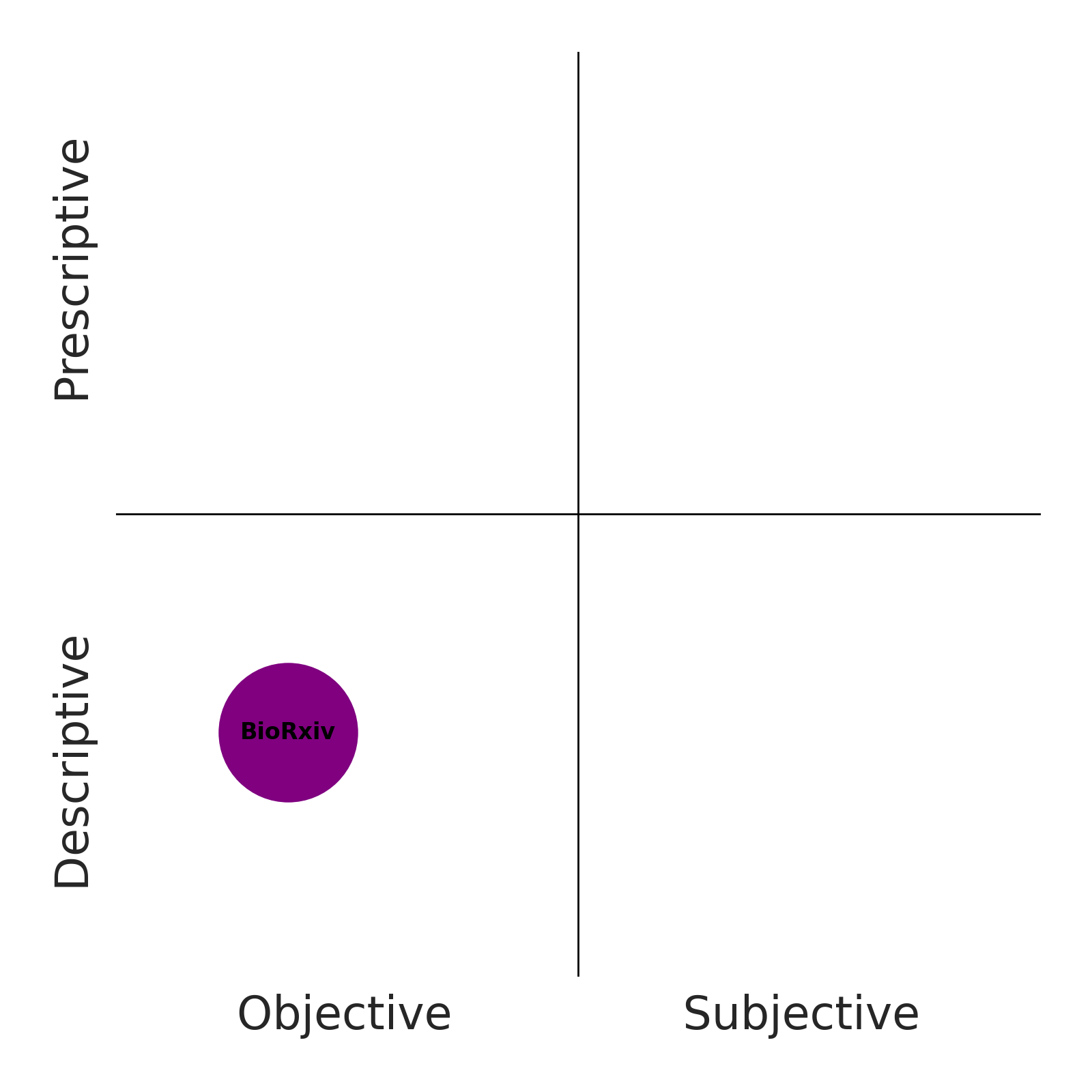
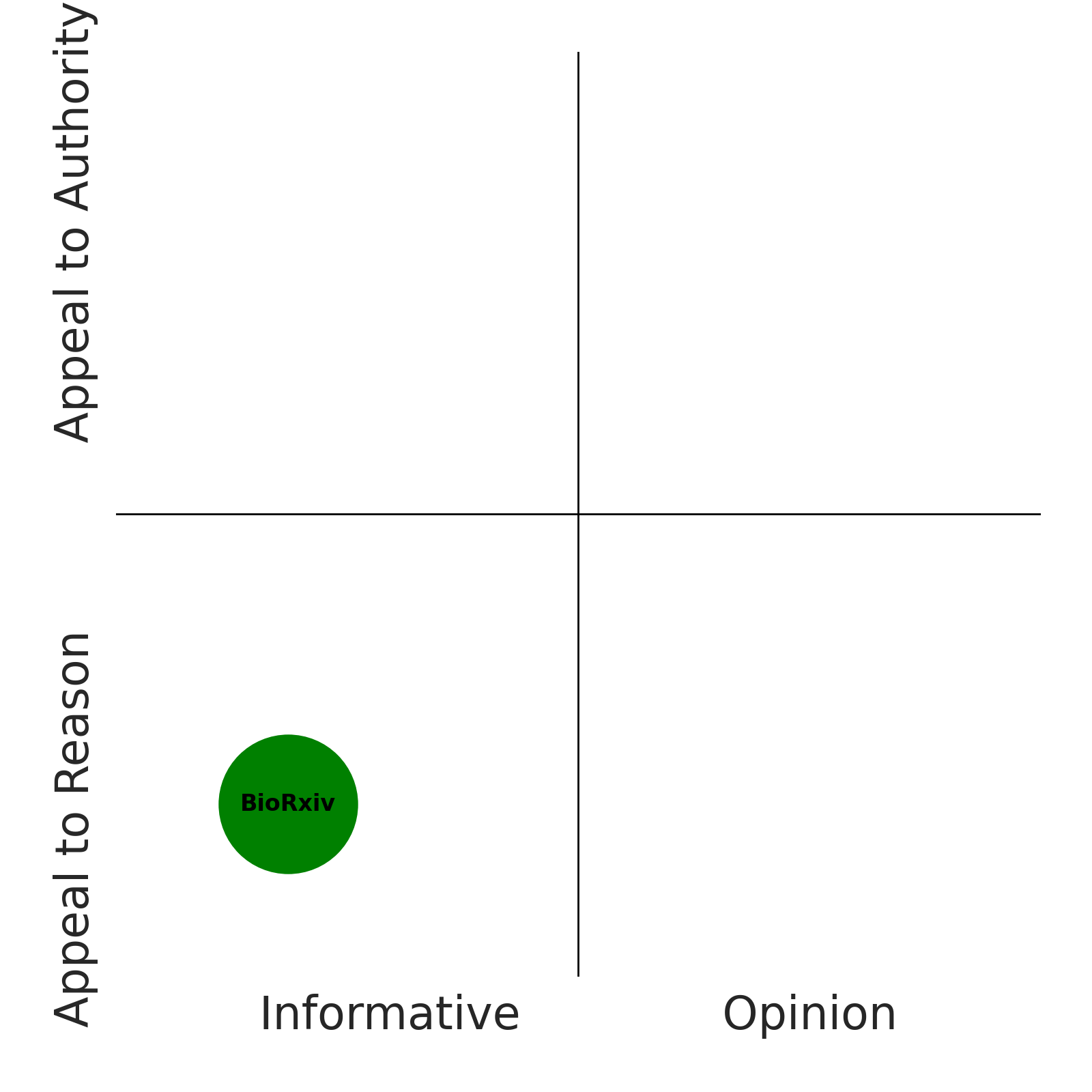
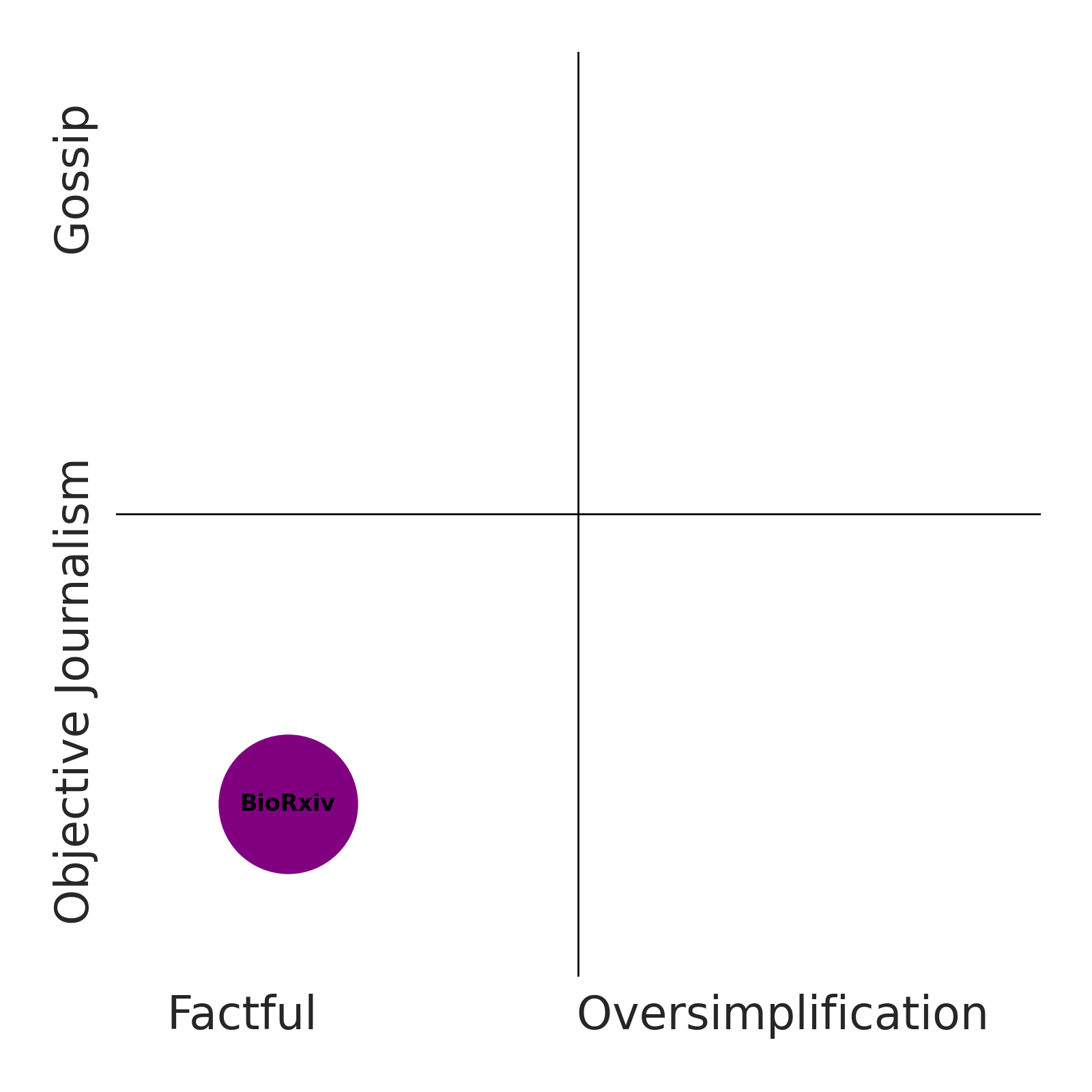
2026 © Helium Trades
Privacy Policy & Disclosure
* Disclaimer: Nothing on this website constitutes investment advice, performance data or any recommendation that any particular security, portfolio of securities, transaction or investment strategy is suitable for any specific person. Helium Trades is not responsible in any way for the accuracy
of any model predictions or price data. Any mention of a particular security and related prediction data is not a recommendation to buy or sell that security. Investments in securities involve the risk of loss. Past performance is no guarantee of future results. Helium Trades is not responsible for any of your investment decisions,
you should consult a financial expert before engaging in any transaction.