See whether Helium helps you make better-informed decisions. Try every Pro Trader feature for 30 days. No credit card required.
Try every Pro Trader feature for 30 days. No credit card required.
Neutral, descriptive briefing that previews Trump's State of the Union and reports Russian strikes on Ukraine’s power grid with a mild emphasis on Russia as aggressor and Ukraine as victim, but without advocating policy or political alignment.
Training-data bias toward neutral political framing.
October 14, 2026 · 0 shares
Promotional tune-in framing markets an upcoming true-crime episode as an intriguing clever-detective reveal while supplying no substantive reporting.
Automated analysis; not human reviewed. Limitations: Only a two-sentence promotional teaser was supplied, and the broadcast network name is missing from the text ('at 10/9c on and streaming'), so story substance is unavailable and broadcast details cannot be fully confirmed. · 4 of 55 available dimensions scored; omitted dimensions are not treated as neutral. · Verified supporting quotes for 4 of 4 scored dimensions.
Claim: Teaser wording dramatizes the case as a clever-detective-versus-elusive-killer story.
“How a clever detective caught an elusive killer with a stick of gum.” · exact text match
Why: Promotional adjectives and intrigue framing are dramatized, though within the normal range of a true-crime teaser rather than extreme sensationalism.
Claim: An unusual gum-based evidence hook is used as the curiosity-driving headline.
“The Detective and the Chewing Gum Sting” · exact text match
Why: The odd forensic twist anchoring the title makes the promo attention-grabbing.
Claim: The blurb adds evaluative praise ('clever') beyond bare scheduling facts.
“How a clever detective caught an elusive killer with a stick of gum.” · exact text match
Why: The characterizing adjective expresses a promotional viewpoint rather than neutral description.
Claim: The text is a tune-in promotion for an upcoming television episode rather than informative reporting.
“Sneak peek: The Detective and the Chewing Gum Sting. ALL NEW:” · exact text match
“reports Saturday, Oct. 17 at 10/9c on and streaming on Paramount+.” · verified after text normalization
Why: The entire text consists of teaser language plus airtime and streaming details, serving solely to promote viewership.
Only a two-sentence promotional teaser was supplied, and the broadcast network name is missing from the text ('at 10/9c on and streaming'), so story substance is unavailable and broadcast details cannot be fully confirmed.
Promotional teaser framing leans on hype markers ('ALL NEW,' 'for the first time,' 'sneak peek') to market an upcoming true-crime broadcast rather than convey substantive reporting.
Automated analysis; not human reviewed. Limitations: Supplied text is only a truncated promotional teaser (a network name appears omitted after 'at 9/8c on') with no substantive reporting, so the witness's claim and the case cannot be evaluated beyond the promotional framing. · 7 of 55 available dimensions scored; omitted dimensions are not treated as neutral. · Verified supporting quotes for 7 of 7 scored dimensions.
Claim: Promotional hype markers amplify novelty and exclusivity to market the broadcast rather than inform.
“ALL NEW: For the first time a key witness in the corn rake murder case speaks out” · exact text match
“Sneak peek: The Corn Rake Witness.” · exact text match
Why: Capitalized 'ALL NEW,' 'for the first time,' and 'sneak peek' are teaser-style hype markers rather than informational content.
Claim: First-time testimony from a key witness in a murder case provides an above-average audience hook.
“For the first time a key witness in the corn rake murder case speaks out to say his father is innocent” · exact text match
Why: Novel witness testimony in a homicide case is an attention-holding hook, though the teaser itself is thin.
Claim: The text only announces broadcast logistics and relays a claim, offering no normative recommendation.
“correspondent Erin Moriarty reports Saturday, Oct. 17 at 9/8c” · exact text match
Why: Content is confined to who reports, when, and where, with no prescriptive or advocacy language.
Claim: Promotional fluff framing outweighs substantive information in the text.
“Sneak peek: The Corn Rake Witness. ALL NEW:” · exact text match
Why: Novelty hype and preview language serve promotion more than information.
Claim: The contested innocence claim is attributed to the witness rather than asserted by the publisher, but no verification is offered.
“speaks out to say his father is innocent” · exact text match
Why: Attribution of the claim to its source is a basic credibility practice, while the teaser supplies no supporting evidence.
Claim: The text functions as an advertisement for the upcoming episode and the Paramount+ platform.
“"48 Hours" correspondent Erin Moriarty reports Saturday, Oct. 17 at 9/8c on and streaming on Paramount +” · verified after text normalization
Why: The core content is airtime, correspondent, and streaming-platform promotion, i.e., marketing copy.
Claim: Informational depth is minimal, limited to one attributed claim plus airtime and platform details.
“"48 Hours" correspondent Erin Moriarty reports Saturday, Oct. 17 at 9/8c on and streaming on Paramount +” · verified after text normalization
Why: No case background, evidence, or context accompanies the claim; the payload is essentially a broadcast listing.
Supplied text is only a truncated promotional teaser (a network name appears omitted after 'at 9/8c on') with no substantive reporting, so the witness's claim and the case cannot be evaluated beyond the promotional framing.
October 07, 2026 · 0 shares
A promotional blurb frames the cast's upcoming chat as the only relevant takeaway, with no independent reporting.
Automated analysis; not human reviewed. Limitations: The supplied text is a two-sentence promotional blurb with no date, author, or independent reporting, limiting classifications to surface framing. · 1 of 55 available dimensions scored; omitted dimensions are not treated as neutral. · Verified supporting quotes for 1 of 1 scored dimensions.
Claim: The framing is promotional, built around an upcoming interview rather than independent reporting.
“Mike Colter and Rachel Keller, who star in "Cupertino," join " Mornings" to talk about the series premiere and what to expect this season.” · exact text match
Why: The sole content is a positive invitation to watch an interview, with no critical or independent news content.
The supplied text is a two-sentence promotional blurb with no date, author, or independent reporting, limiting classifications to surface framing.
The narrative uses a personal medical experience to frame the importance of early skin cancer detection and preventative care.
Automated analysis; not human reviewed. · 4 of 55 available dimensions scored; omitted dimensions are not treated as neutral. · Verified supporting quotes for 0 of 4 scored dimensions.
October 21, 2026 · 0 shares
The text blends a personal health narrative with a significant public health statistic regarding cancer prevalence in the U.S.
Automated analysis; not human reviewed. · 3 of 55 available dimensions scored; omitted dimensions are not treated as neutral. · Verified supporting quotes for 0 of 3 scored dimensions.
October 09, 2026 · 0 shares
The brief report frames the appointment through loyalty and the president's personalized confidence, presenting the pick largely on Trump's own terms without independent scrutiny.
The White House press secretary is the administration's chief spokesperson to the news media.
Automated analysis; not human reviewed. Limitations: The article is extremely short and offers no independent sourcing beyond the president's quote, limiting confident bias classification. · 22 of 55 available dimensions scored; omitted dimensions are not treated as neutral. · Verified supporting quotes for 8 of 22 scored dimensions.
Claim: The report frames the appointment through Trump's own loyalty criterion and confidence quote without critical or oppositional framing.
“Trump picks "loyal" Katie Zacharia as next White House press secretary.” · exact text match
Why: Leading with the loyalty label and the president's praise aligns with a pro-Trump conservative framing rather than neutral reporting.
Claim: The report is terse and free of sensational or emotional language.
“I am confident that Katie will deliver strong results for our Country as the next White House Press Secretary” · exact text match
Why: The tone is straightforward and informational, lacking hyperbole.
Claim: The article concerns a political appointment and executive branch personnel.
“next White House press secretary” · exact text match
Why: The subject matter is inherently political.
Claim: The report repeats a confident presidential prediction without qualifying it.
“I am confident that Katie will deliver strong results for our Country as the next White House Press Secretary” · exact text match
Why: The certainty expressed belongs to the quoted speaker, not the publisher, but it is presented without independent context.
Claim: The report presents the White House appointment from the administration's perspective, amplifying the president's confidence.
“I am confident that Katie will deliver strong results for our Country as the next White House Press Secretary” · exact text match
Why: Uncritical repetition of executive praise reflects a pro-establishment, administration-aligned framing.
Claim: The report uses the loyalty label and the president's quote to frame the appointment positively.
“Trump picks "loyal" Katie Zacharia as next White House press secretary.” · exact text match
Why: Loaded framing with limited context can shape reader perception.
Claim: The prose is very short and formulaic, consistent with automated or templated news aggregation.
“Trump picks "loyal" Katie Zacharia as next White House press secretary.” · exact text match
Why: Brief, quote-only construction is weak but non-zero evidence of AI or automated writing.
Claim: The report attributes the only substantive claim to the president and does not fabricate additional facts.
“"I am confident that Katie will deliver strong results for our Country as the next White House Press Secretary," President Trump said.” · exact text match
Why: Explicit attribution of the quote supports basic integrity in reporting.
The article is extremely short and offers no independent sourcing beyond the president's quote, limiting confident bias classification.
October 09, 2026 · 0 shares
The brief item reports a presidential action against a Fed governor in neutral, attribution-only terms with no sourcing or context, leaving the central allegation unelaborated.
Lisa Cook is a sitting governor of the Federal Reserve; the president's effort to remove a Fed governor and the mortgage-document allegations are the background events referenced.
Automated analysis; not human reviewed. Limitations: Very short snippet with no sourcing; context may be missing. · 49 of 55 available dimensions scored; omitted dimensions are not treated as neutral. · Verified supporting quotes for 7 of 49 scored dimensions.
Claim: The item is reported in a terse, attribution-style manner with no evaluative language.
“President Trump established a committee to look into allegations” · exact text match
“the latest step in his renewed effort to fire her” · exact text match
Why: The only framing terms are procedural descriptors, not subjective characterization.
Claim: No sensational or emotive language is used.
“look into allegations that Fed Governor Lisa Cook made false statements on mortgage documents” · exact text match
Why: The wording stays close to the underlying procedural claim.
Claim: The report describes an action without advocating a course of action.
“Trump creates committee to investigate Fed's Lisa Cook.” · exact text match
Why: No prescriptive or advocacy language appears.
Claim: The framing focuses on a personal political conflict and unsourced allegations.
“allegations that Fed Governor Lisa Cook made false statements on mortgage documents” · exact text match
Why: It centers on an allegation-driven personnel conflict rather than policy substance.
Claim: The subject is a political-executive action against a Fed official.
“President Trump established a committee to look into allegations” · exact text match
“his renewed effort to fire her” · exact text match
Why: The content is squarely about a president's political-administrative move.
Claim: The item compresses a complex legal-political matter into a single sentence.
“the latest step in his renewed effort to fire her” · exact text match
Why: It omits procedural and legal detail, simplifying the event.
Claim: The text attributes claims to allegations rather than asserting them as fact.
“allegations that Fed Governor Lisa Cook made false statements on mortgage documents” · exact text match
Why: The hedge 'allegations' preserves epistemic status.
Very short snippet with no sourcing; context may be missing.
October 23, 2026 · 0 shares
A neutral, source-light policy brief reports the administration's labeling intention in plain language without evaluative framing.
Automated analysis; not human reviewed. Limitations: Only two sentences of substantive text are supplied, with no named source, agency, timeline, or label specifications, so bias and credibility assessments are constrained. · 4 of 55 available dimensions scored; omitted dimensions are not treated as neutral. · Verified supporting quotes for 4 of 4 scored dimensions.
Claim: The article reports the Trump administration's seafood-labeling intention without ideological or partisan evaluation.
“The Trump administration intends to push for new labels on seafood sold at grocery stores to give consumers a better idea of where products originated.” · exact text match
Why: The sentence states an administrative intent and purpose without praising, criticizing, or framing it in ideological terms.
Claim: The article presents the seafood-labeling plan as a factual statement of intent rather than through subjective commentary.
“The Trump administration intends to push for new labels on seafood sold at grocery stores to give consumers a better idea of where products originated.” · exact text match
Why: The wording is descriptive and avoids evaluative adjectives, opinion, or emotional language.
Claim: The headline and body use plain, non-sensational language to describe the labeling push.
“Trump administration to push for new labels on seafood.” · exact text match
Why: The headline is a straightforward statement of the intended action without alarmist or exaggerated wording.
Claim: The report is centered on an action by the Trump administration, making it a political-policy story.
“The Trump administration intends to push for new labels on seafood sold at grocery stores to give consumers a better idea of where products originated.” · exact text match
Why: The main actor is a presidential administration and the subject is a government policy push.
Only two sentences of substantive text are supplied, with no named source, agency, timeline, or label specifications, so bias and credibility assessments are constrained.
October 15, 2026 · 0 shares
The headline foregrounds a ballot-sending claim that the body does not substantiate beyond an attributed allegation of unlawful voter registration, creating an alarmist headline-body mismatch.
Automated analysis; not human reviewed. Limitations: Only a headline and one-sentence report are supplied, limiting confidence in framing and context judgments. · 5 of 55 available dimensions scored; omitted dimensions are not treated as neutral. · Verified supporting quotes for 5 of 5 scored dimensions.
Claim: The report attributes the noncitizen allegation to the Justice Department rather than presenting it as verified fact.
“alleging that the federal government has identified more than 20,000 noncitizens” · exact text match
“claims noncitizens were sent ballots” · exact text match
Why: Use of 'alleging' and 'claims' signals attribution, supporting an objective rather than subjective framing.
Claim: The headline uses alarming ballot-and-noncitizen framing that is more sensational than the body's registration allegation.
“claims noncitizens were sent ballots” · exact text match
Counterevidence:
“alleging that the federal government has identified more than 20,000 noncitizens” · exact text match
Why: The headline foregrounds a dramatic election-integrity claim.
Claim: The report concerns a politically charged Justice Department lawsuit against California over voter eligibility.
“Justice Dept. sues California, claims noncitizens were sent ballots.” · exact text match
Why: Election law, federal-state conflict, and voter eligibility are core political matters.
Claim: The article compresses a legal allegation about registration into a headline claim about ballots being sent, without explaining the distinction.
“claims noncitizens were sent ballots” · exact text match
“unlawfully registered to vote” · exact text match
Why: The headline and body describe different alleged facts without reconciling them.
Claim: The headline-body mismatch uses a stronger ballot-sending claim than the body's registration allegation supports.
“claims noncitizens were sent ballots” · exact text match
“alleging that the federal government has identified more than 20,000 noncitizens who are unlawfully registered to vote” · exact text match
Why: Loaded framing and omission of how registration connects to ballot mailing are observable.
Only a headline and one-sentence report are supplied, limiting confidence in framing and context judgments.
Automated analysis; not human reviewed. Limitations: Only a one-sentence headline/snippet is supplied; no body, court, judge, date, or full context. · 5 of 55 available dimensions scored; omitted dimensions are not treated as neutral. · Verified supporting quotes for 5 of 5 scored dimensions.
Claim: The publisher's own framing is objective, stating the ruling and attributing the evaluative phrase to the judge.
“Judge strikes down DOJ's policy of reviewing state voter rolls, saying it would "run roughshod over longstanding laws".” · exact text match
Why: The loaded phrase is inside an attributed quote, while the main clause uses a neutral report verb.
Claim: The item is not sensational; it uses a plain report verb and an attributed judicial quote.
“Judge strikes down DOJ's policy of reviewing state voter rolls” · exact text match
Why: No hyperbolic, alarmist, or emotionally charged language appears in the publisher's own wording.
Claim: The item is purely descriptive rather than prescriptive.
“Judge strikes down DOJ's policy of reviewing state voter rolls” · exact text match
Why: It reports a judicial action and does not recommend a policy or course of action.
Claim: The item is explicitly political, concerning a judicial ruling on a Justice Department election-administration policy.
“Judge strikes down DOJ's policy of reviewing state voter rolls” · exact text match
Why: The central actors and subject—judge, DOJ, state voter rolls—are governmental and election-related.
Claim: The publisher's tone is neutral, with no positive or negative emotional valence in its own voice.
“Judge strikes down DOJ's policy of reviewing state voter rolls” · exact text match
Why: The sentence states an event and attributes the critical language to the judge, leaving no independent emotional framing.
Only a one-sentence headline/snippet is supplied; no body, court, judge, date, or full context.
September 28, 2026 · 0 shares
Bipartisan lawmaker criticism is foregrounded to frame the taxpayer-funded ad campaign as improper.
Automated analysis; not human reviewed. Limitations: Only a short excerpt/summary was supplied; no full segment, direct lawmaker quotes, or independent funding documentation was available. · 3 of 55 available dimensions scored; omitted dimensions are not treated as neutral. · Verified supporting quotes for 3 of 3 scored dimensions.
Claim: The framing is balanced by including both Republican and Democratic lawmakers, showing no one-sided partisan slant.
“Lawmakers on both sides push back on taxpayer dollars spent on Trump "Love Me" commercial.” · exact text match
“Some Republican and Democratic lawmakers are pushing back against President Trump's newest television ad campaign, which was paid for with taxpayer money.” · exact text match
Why: The text explicitly attributes the pushback to members of both parties, which is a positive indicator of partisan neutrality.
Claim: The report is centered on a political dispute over a president's campaign spending.
“Lawmakers on both sides push back on taxpayer dollars spent on Trump "Love Me" commercial.” · exact text match
“Some Republican and Democratic lawmakers are pushing back against President Trump's newest television ad campaign, which was paid for with taxpayer money.” · exact text match
Why: The subject is explicitly a partisan political dispute involving the president and members of Congress.
Claim: The story covers lawmakers' response rather than the ad campaign's content or the underlying spending issue.
“Lawmakers on both sides push back on taxpayer dollars spent on Trump "Love Me" commercial.” · exact text match
“Some Republican and Democratic lawmakers are pushing back against President Trump's newest television ad campaign, which was paid for with taxpayer money.” · exact text match
Why: Both sentences are about reaction to the ad, not about the ad itself.
Only a short excerpt/summary was supplied; no full segment, direct lawmaker quotes, or independent funding documentation was available.
October 21, 2026 · 0 shares
The framing neutrally reports high-level geopolitical claims and contradictions between state actors.
Automated analysis; not human reviewed. · 5 of 55 available dimensions scored; omitted dimensions are not treated as neutral. · Verified supporting quotes for 0 of 5 scored dimensions.
October 23, 2026 · 0 shares
The report is primarily descriptive, functioning as a brief update on high-level diplomatic activity without adopting a strong ideological framing.
Automated analysis; not human reviewed. · 55 of 55 available dimensions scored; omitted dimensions are not treated as neutral. · Verified supporting quotes for 0 of 55 scored dimensions.
The supplied text consists of a headline asserting an unverified Iranian attack and a U.S. retreat without body-text support, sourcing detail, or substantiation.
No body text, sourcing details, or contextual background beyond the headline was supplied.
Automated analysis; not human reviewed. Limitations: Only a headline is supplied, with no body text, sourcing details, or verifiable context; most bias dimensions cannot be reliably assessed. · 55 of 55 available dimensions scored; omitted dimensions are not treated as neutral. · Verified supporting quotes for 5 of 55 scored dimensions.
Claim: The headline uses charged, dramatic language and an anonymous quote to frame the event sensationally.
“"They hit us bad"” · exact text match
Why: The quoted phrase and framing emphasize shock and severity beyond neutral reporting.
Claim: The headline compresses an alleged attack and U.S. retreat into a single unqualified assertion without sourcing detail or context.
“Newly obtained footage, witness accounts detail Iran attack, and U.S. retreat, at major post in Kuwait.” · exact text match
Why: The headline states the claim as settled fact while omitting supporting detail or attribution.
Claim: The headline asserts the event with certainty despite lacking visible sourcing or corroborating specifics.
“Newly obtained footage, witness accounts detail Iran attack, and U.S. retreat, at major post in Kuwait.” · exact text match
Why: No supporting evidence is supplied to justify the categorical phrasing.
Claim: The text offers no verifiable sourcing or body content to support the headline's claims.
“Newly obtained footage, witness accounts detail Iran attack, and U.S. retreat, at major post in Kuwait.” · exact text match
Why: Absence of detailed attribution and context weakens the credibility of the supplied report.
Claim: The highlighted anonymous quote creates deceptive urgency and emotional framing without verification.
“"They hit us bad"” · exact text match
Why: Using an unattributed quote as the lede leverages emotional impact over substantiated fact.
Only a headline is supplied, with no body text, sourcing details, or verifiable context; most bias dimensions cannot be reliably assessed.
Coverage is headline-only, with no substantive reporting, sourcing, or elaboration beyond a single declarative line.
Automated analysis; not human reviewed. Limitations: Only a single headline/snippet is supplied; no body content is available to assess sourcing, context, or fairness. · 7 of 55 available dimensions scored; omitted dimensions are not treated as neutral. · Verified supporting quotes for 0 of 7 scored dimensions.
Only a single headline/snippet is supplied; no body content is available to assess sourcing, context, or fairness.
October 18, 2026 · 0 shares
Headline states a causal military failure as fact while the brief body attributes it solely to Zelenskyy, yielding a slightly overstated but neutrally sourced report.
Starlink is a satellite-based internet service.
Automated analysis; not human reviewed. Limitations: Only a headline and one-sentence summary are supplied, limiting reliable assessment across most bias dimensions. · 7 of 55 available dimensions scored; omitted dimensions are not treated as neutral. · Verified supporting quotes for 6 of 7 scored dimensions.
Claim: The brief is primarily an attributed report rather than subjective commentary.
“Zelenskyy says” · exact text match
Why: The central claim is presented through direct attribution to Ukraine's president.
Claim: Tone is restrained and attributive, without sensational adjectives or emotional escalation.
“The Ukrainian president said Starlink issues are hampering his country's defensive efforts against Russian drones.” · exact text match
Why: The wording is a plain attributed summary of a claimed military problem.
Claim: The item describes a reported condition without prescribing action.
“The Ukrainian president said Starlink issues are hampering his country's defensive efforts against Russian drones.” · exact text match
Why: It reports a claim about hampering rather than recommending a policy response.
Claim: The report concerns a wartime political-military claim by Ukraine's president.
“Zelenskyy says” · exact text match
Why: The subject is a national defense claim tied to the Russia-Ukraine war.
Claim: Headline reduces a battlefield capability failure to one stated cause, Starlink issues.
“Ukraine still can't intercept drones due to Starlink issues, Zelenskyy says.” · exact text match
Counterevidence:
“The Ukrainian president said Starlink issues are hampering his country's defensive efforts against Russian drones.” · exact text match
Why: The headline presents a monocausal explanation without qualifying the operational complexity.
Claim: The brief transparently attributes its central claim but is too sparse for strong verification.
“Zelenskyy says” · exact text match
Why: Attribution is visible, but there is almost no supporting detail or independent sourcing.
Only a headline and one-sentence summary are supplied, limiting reliable assessment across most bias dimensions.
October 11, 2026 · 0 shares
The framing presents Ukraine's refusal to halt strikes as a defiance of U.S. pressure and highlights Trump's call for a new Ukrainian president without supplying evidence or context.
Automated analysis; not human reviewed. Limitations: The supplied article text is only a short broadcast segment summary with limited sourcing and no substantive quotes or context. · 15 of 55 available dimensions scored; omitted dimensions are not treated as neutral. · Verified supporting quotes for 12 of 15 scored dimensions.
Claim: The framing emphasizes Trump's demand for a new Ukrainian president while omitting U.S. or Ukrainian justifications for the strikes.
“President Trump is arguing that Ukraine needs a new president as Volodymyr Zelenskyy refuses to halt strikes on Russian oil refineries” · exact text match
Why: Highlighting Trump's presidential-change demand without countervailing context tilts the framing toward a conservative-aligned critique of Zelenskyy.
Claim: The report uses interpretive tension framing rather than neutral, attributed description.
“Ukraine says it won't stop attacking Russian oil resources amid diesel fuel deal with U.S.” · exact text match
Why: The phrase 'amid diesel fuel deal' frames the strikes as conflicting with a U.S. arrangement without explaining terms or conditions.
Claim: The headline and lead use tension and conflict language that heightens the story's drama.
“Ukraine says it won't stop attacking Russian oil resources amid diesel fuel deal with U.S.” · exact text match
Why: Emphasizing refusal and a presidential-change demand creates a sensational conflict frame beyond a plain factual report.
Claim: The framing centers continued Ukrainian strikes and Trump's pressure, leaning toward a hardline posture rather than diplomatic de-escalation.
“Volodymyr Zelenskyy refuses to halt strikes on Russian oil refineries” · exact text match
Why: The emphasis on refusal to halt military strikes supports a hawkish rather than dovish classification.
Claim: The content is explicitly about presidential politics, U.S. pressure, and Ukrainian leadership.
“President Trump is arguing that Ukraine needs a new president” · exact text match
Why: The report's central elements are political leadership disputes and U.S.-Ukraine policy conflict.
Claim: A complex military and energy relationship is reduced to a single tension between a diesel deal and continued strikes.
“Ukraine says it won't stop attacking Russian oil resources amid diesel fuel deal with U.S.” · exact text match
Why: The brief segment omits conditions, timelines, and strategic context, presenting the situation as a simple contradiction.
Claim: The text appears to summarize a response or development to a prior U.S.-Ukraine diesel fuel arrangement without fully explaining it.
“amid diesel fuel deal with U.S.” · exact text match
Why: It references an existing deal as background while focusing on the reaction to it, indicating partial response coverage.
Claim: The article states the refusal and Trump's argument as settled facts without qualifying sourcing or uncertainty.
“Ukraine says it won't stop attacking Russian oil resources” · exact text match
Why: The assertions are presented in declarative form with attribution only to Ukraine's say-so and no supporting detail.
Claim: The framing highlights Trump's challenge to Ukraine's leadership while Zelenskyy is described as refusing to comply, creating an anti-establishment pressure narrative.
“President Trump is arguing that Ukraine needs a new president” · exact text match
Why: Repeating a call to replace a foreign leader without establishment or allied context leans against the incumbent Ukrainian establishment.
Claim: The tone is slightly negative due to conflict framing around refusal and presidential replacement.
“Ukraine says it won't stop attacking Russian oil resources” · exact text match
Why: The emphasis on refusal and political pressure produces a mildly negative emotional valence.
Claim: The segment presents a political argument and a refusal as facts but does not forecast outcomes.
“President Trump is arguing that Ukraine needs a new president” · exact text match
Why: Speculation is limited, as the text reports an argument rather than predicting consequences.
Claim: The report is a very short, unelaborated segment summary with little analytical depth.
“Kamal Afzali has the story.” · exact text match
Why: The absence of sourcing, detail, or context indicates low informational sophistication.
The supplied article text is only a short broadcast segment summary with limited sourcing and no substantive quotes or context.
Neutral, descriptive briefing that previews Trump's State of the Union and reports Russian strikes on Ukraine’s power grid with a mild emphasis on Russia as aggressor and Ukraine as victim, but without advocating policy or political alignment.
Training-data bias toward neutral political framing.
Promotional teaser framing leans on hype markers ('ALL NEW,' 'for the first time,' 'sneak peek') to market an upcoming true-crime broadcast rather than convey substantive reporting.
Automated analysis; not human reviewed. Limitations: Supplied text is only a truncated promotional teaser (a network name appears omitted after 'at 9/8c on') with no substantive reporting, so the witness's claim and the case cannot be evaluated beyond the promotional framing. · 7 of 55 available dimensions scored; omitted dimensions are not treated as neutral. · Verified supporting quotes for 7 of 7 scored dimensions.
Claim: Promotional hype markers amplify novelty and exclusivity to market the broadcast rather than inform.
“ALL NEW: For the first time a key witness in the corn rake murder case speaks out” · exact text match
“Sneak peek: The Corn Rake Witness.” · exact text match
Why: Capitalized 'ALL NEW,' 'for the first time,' and 'sneak peek' are teaser-style hype markers rather than informational content.
Claim: First-time testimony from a key witness in a murder case provides an above-average audience hook.
“For the first time a key witness in the corn rake murder case speaks out to say his father is innocent” · exact text match
Why: Novel witness testimony in a homicide case is an attention-holding hook, though the teaser itself is thin.
Claim: The text only announces broadcast logistics and relays a claim, offering no normative recommendation.
“correspondent Erin Moriarty reports Saturday, Oct. 17 at 9/8c” · exact text match
Why: Content is confined to who reports, when, and where, with no prescriptive or advocacy language.
Claim: Promotional fluff framing outweighs substantive information in the text.
“Sneak peek: The Corn Rake Witness. ALL NEW:” · exact text match
Why: Novelty hype and preview language serve promotion more than information.
Claim: The contested innocence claim is attributed to the witness rather than asserted by the publisher, but no verification is offered.
“speaks out to say his father is innocent” · exact text match
Why: Attribution of the claim to its source is a basic credibility practice, while the teaser supplies no supporting evidence.
Claim: The text functions as an advertisement for the upcoming episode and the Paramount+ platform.
“"48 Hours" correspondent Erin Moriarty reports Saturday, Oct. 17 at 9/8c on and streaming on Paramount +” · verified after text normalization
Why: The core content is airtime, correspondent, and streaming-platform promotion, i.e., marketing copy.
Claim: Informational depth is minimal, limited to one attributed claim plus airtime and platform details.
“"48 Hours" correspondent Erin Moriarty reports Saturday, Oct. 17 at 9/8c on and streaming on Paramount +” · verified after text normalization
Why: No case background, evidence, or context accompanies the claim; the payload is essentially a broadcast listing.
Supplied text is only a truncated promotional teaser (a network name appears omitted after 'at 9/8c on') with no substantive reporting, so the witness's claim and the case cannot be evaluated beyond the promotional framing.
October 18, 2026 · 0 shares
Sensational, human-interest framing centers a sympathetic family advocate and grisly crime detail, with an exclusive interview presented as the driving lens.
Automated analysis; not human reviewed. Limitations: Only a headline and short teaser are available, so bias scores rely on limited framing evidence. · 5 of 55 available dimensions scored; omitted dimensions are not treated as neutral. · Verified supporting quotes for 5 of 5 scored dimensions.
Claim: The report is framed through the son's personal perspective and attributed recollections rather than a neutral procedural account.
“what he says he witnessed” · exact text match
“determined to overturn his father Todd's murder conviction” · exact text match
Why: The wording foregrounds the son's viewpoint and determination, making the framing subjective.
Claim: The report highlights grisly crime detail and an exclusive interview in a sensational manner.
“impaled with a corn rake” · exact text match
“In an exclusive interview” · exact text match
Why: The gruesome method and exclusive-interview promotion are sensational framing choices.
Claim: The report is constructed as a compelling crime-and-family mystery.
“Iowa son fights to overturn his father's conviction in mother's murder.” · exact text match
Why: The headline combines a family conflict, murder, and conviction challenge, supporting high interest.
Claim: The item is packaged as an exclusive personal interview about a family crime saga.
“In an exclusive interview, the now 21-year-old is speaking out about what he says he witnessed” · exact text match
Why: The exclusive personal revelation format leans toward human-interest gossip framing.
Claim: The report frames the story around a negative family tragedy.
“found his mother Amy Mullis impaled with a corn rake” · exact text match
Why: The grisly discovery of a mother's death gives the framing a strongly negative emotional cast.
Only a headline and short teaser are available, so bias scores rely on limited framing evidence.
The headline foregrounds grisly discovery and organized-crime framing through 'body found in barrel' and an unattributed 'Earmarks of a mob hit' characterization.
Automated analysis; not human reviewed. Limitations: Only a headline/snippet is supplied; the 'mob hit' quote has no identified speaker, limiting attribution and context. · 2 of 55 available dimensions scored; omitted dimensions are not treated as neutral. · Verified supporting quotes for 2 of 2 scored dimensions.
Claim: The headline uses grisly discovery and organized-crime language rather than a neutral incident description.
“Body found in barrel at Lake Mead identified as murder victim from Arkansas: "Earmarks of a mob hit".” · exact text match
Why: Barrel discovery and 'mob hit' phrasing heighten dramatic impact.
Claim: The headline includes a quoted mob-hit characterization without identifying the speaker or basis.
“Earmarks of a mob hit” · exact text match
Why: The phrase suggests organized-crime causation but the headline does not say who said it or why.
Only a headline/snippet is supplied; the 'mob hit' quote has no identified speaker, limiting attribution and context.
October 23, 2026 · 0 shares
The piece presents a factual report of legal actions taken against former federal agents regarding a specific political investigation.
Automated analysis; not human reviewed. · 55 of 55 available dimensions scored; omitted dimensions are not treated as neutral. · Verified supporting quotes for 0 of 55 scored dimensions.
The narrative uses a personal medical experience to frame the importance of early skin cancer detection and preventative care.
Automated analysis; not human reviewed. · 4 of 55 available dimensions scored; omitted dimensions are not treated as neutral. · Verified supporting quotes for 0 of 4 scored dimensions.
October 21, 2026 · 0 shares
The text blends a personal health narrative with a significant public health statistic regarding cancer prevalence in the U.S.
Automated analysis; not human reviewed. · 3 of 55 available dimensions scored; omitted dimensions are not treated as neutral. · Verified supporting quotes for 0 of 3 scored dimensions.
October 14, 2026 · 0 shares
Promotional tune-in framing markets an upcoming true-crime episode as an intriguing clever-detective reveal while supplying no substantive reporting.
Automated analysis; not human reviewed. Limitations: Only a two-sentence promotional teaser was supplied, and the broadcast network name is missing from the text ('at 10/9c on and streaming'), so story substance is unavailable and broadcast details cannot be fully confirmed. · 4 of 55 available dimensions scored; omitted dimensions are not treated as neutral. · Verified supporting quotes for 4 of 4 scored dimensions.
Claim: Teaser wording dramatizes the case as a clever-detective-versus-elusive-killer story.
“How a clever detective caught an elusive killer with a stick of gum.” · exact text match
Why: Promotional adjectives and intrigue framing are dramatized, though within the normal range of a true-crime teaser rather than extreme sensationalism.
Claim: An unusual gum-based evidence hook is used as the curiosity-driving headline.
“The Detective and the Chewing Gum Sting” · exact text match
Why: The odd forensic twist anchoring the title makes the promo attention-grabbing.
Claim: The blurb adds evaluative praise ('clever') beyond bare scheduling facts.
“How a clever detective caught an elusive killer with a stick of gum.” · exact text match
Why: The characterizing adjective expresses a promotional viewpoint rather than neutral description.
Claim: The text is a tune-in promotion for an upcoming television episode rather than informative reporting.
“Sneak peek: The Detective and the Chewing Gum Sting. ALL NEW:” · exact text match
“reports Saturday, Oct. 17 at 10/9c on and streaming on Paramount+.” · verified after text normalization
Why: The entire text consists of teaser language plus airtime and streaming details, serving solely to promote viewership.
Only a two-sentence promotional teaser was supplied, and the broadcast network name is missing from the text ('at 10/9c on and streaming'), so story substance is unavailable and broadcast details cannot be fully confirmed.
October 07, 2026 · 0 shares
A promotional blurb frames the cast's upcoming chat as the only relevant takeaway, with no independent reporting.
Automated analysis; not human reviewed. Limitations: The supplied text is a two-sentence promotional blurb with no date, author, or independent reporting, limiting classifications to surface framing. · 1 of 55 available dimensions scored; omitted dimensions are not treated as neutral. · Verified supporting quotes for 1 of 1 scored dimensions.
Claim: The framing is promotional, built around an upcoming interview rather than independent reporting.
“Mike Colter and Rachel Keller, who star in "Cupertino," join " Mornings" to talk about the series premiere and what to expect this season.” · exact text match
Why: The sole content is a positive invitation to watch an interview, with no critical or independent news content.
The supplied text is a two-sentence promotional blurb with no date, author, or independent reporting, limiting classifications to surface framing.
Promotional framing presents the Jonas Brothers' tour, podcast, and Disney honor as unambiguously positive and newsworthy.
Automated analysis; not human reviewed. Limitations: The supplied text is a one-sentence summary, so bias classification is limited to explicit word choice and cannot assess broader editorial context. · 1 of 55 available dimensions scored; omitted dimensions are not treated as neutral. · Verified supporting quotes for 1 of 1 scored dimensions.
Claim: The article frames the Jonas Brothers' projects and Disney honor as purely positive promotional items without critical or independent reporting.
“their new tour, The Burning Up Tour All Over Again, their new podcast, "Hey Jonas!", their induction into the Disney Legends Hall of Fame and more.” · exact text match
Why: The text uses promotional adjectives such as 'new' twice and highlights an honor, typical of advertorial or entertainment promotion rather than independent journalism.
The supplied text is a one-sentence summary, so bias classification is limited to explicit word choice and cannot assess broader editorial context.
September 28, 2026 · 0 shares
Framing is celebratory and promotional, using superlatives such as 'explodes' and 'most iconic' with no critical or analytical content.
Automated analysis; not human reviewed. Limitations: The supplied text is only a short teaser or segment description, offering no substantive reporting to analyze; conclusions are based on the headline and summary only. · 3 of 55 available dimensions scored; omitted dimensions are not treated as neutral. · Verified supporting quotes for 3 of 3 scored dimensions.
Claim: The description substitutes subjective superlatives for neutral factual reporting.
“VMA audience explodes for Madonna's opener” · exact text match
“most iconic performances” · exact text match
Why: The language is evaluative and emotional rather than factual or measured.
Claim: The presentation uses dramatic, exaggerated wording to describe audience reaction.
“VMA audience explodes” · exact text match
Why: The verb 'explodes' is a hyperbolic way to describe audience enthusiasm, making the event seem more dramatic than neutral wording would.
Claim: The text presents an evaluative judgment as a description of the event.
“most iconic performances” · exact text match
Why: Calling performances 'most iconic' is an opinion-based ranking presented without criteria or supporting evidence.
The supplied text is only a short teaser or segment description, offering no substantive reporting to analyze; conclusions are based on the headline and summary only.
September 28, 2026 · 0 shares
Uses alarming, emotive language—'exploding' and 'tens of thousands'—to present rogue AI as a fast-growing crisis.
Automated analysis; not human reviewed. Limitations: The supplied text is a brief segment teaser, not a full report, limiting analysis to the teaser's framing. · 6 of 55 available dimensions scored; omitted dimensions are not treated as neutral. · Verified supporting quotes for 6 of 6 scored dimensions.
Claim: The phrasing embeds subjective characterizations in otherwise reported claims.
“rogue AI incidents” · exact text match
“Scale of rogue AI incidents is exploding” · exact text match
Why: The phrasing embeds subjective characterizations in otherwise reported claims.
Claim: The phrasing 'exploding' and 'tens of thousands' emphasizes dramatic scale.
“Scale of rogue AI incidents is exploding” · exact text match
“could number in the tens of thousands” · exact text match
Why: The phrase 'exploding' is a dramatic metaphor, and 'tens of thousands' emphasizes large scale without a denominator or source.
Claim: The framing emphasizes a fast-growing problem and the need for solutions.
“Scale of rogue AI incidents is exploding” · exact text match
“as companies and Trump seek solutions” · exact text match
Why: The framing highlights an alarming trend and does not mention positive development or progress.
Claim: The language projects an alarming situation using a large uncertain count.
“Scale of rogue AI incidents is exploding” · exact text match
“could number in the tens of thousands” · exact text match
Why: The language 'exploding' and the large uncertain estimate project an alarming situation.
Claim: The phrasing includes evaluative terms rather than neutral descriptions.
“rogue AI incidents” · exact text match
“Scale of rogue AI incidents is exploding” · exact text match
Why: 'Rogue' and 'exploding' are evaluative rather than neutral descriptions.
Claim: The report names Axios and uses 'could,' though the unqualified 'exploding' reduces evidentiary care.
“according to new reporting by Axios' Madison Mills” · exact text match
“could number in the tens of thousands” · exact text match
Why: The report names Axios and uses 'could,' but the unqualified 'exploding' reduces the evidentiary care.
The supplied text is a brief segment teaser, not a full report, limiting analysis to the teaser's framing.
September 28, 2026 · 0 shares
Framing uses loaded 'rogue AI' language and a factive 'revealed that' construction to present a security disclosure as an autonomous AI attack.
Automated analysis; not human reviewed. Limitations: The supplied text is only a two-sentence teaser, so classifications rest on headline and lede wording; the full OpenAI disclosure and precise nature of the hack are unavailable. · 5 of 55 available dimensions scored; omitted dimensions are not treated as neutral. · Verified supporting quotes for 5 of 5 scored dimensions.
Claim: The text characterizes AI models as 'going rogue,' an evaluative and anthropomorphic frame rather than a neutral incident description.
“OpenAI revealed last week that its AI models went rogue and hacked into U.S. government websites” · exact text match
Why: 'Went rogue' implies intentionality and assigns behavioral agency to the models, making the framing subjective rather than neutral.
Claim: The framing uses dramatic 'rogue AI' language and repeated concern cues to heighten the event.
“OpenAI hack sparks further concern over AI models going rogue” · exact text match
“its AI models went rogue and hacked into U.S. government websites” · exact text match
Why: The combination of 'hack,' 'rogue,' and 'concern' in the headline and lede is alarm-framed rather than dispassionate.
Claim: The text emphasizes public alarm about AI models as an uncontrolled threat.
“sparking more concern over security against the technology” · exact text match
“further concern over AI models going rogue” · exact text match
Why: Concern is mentioned twice and tied to the 'going rogue' image, invoking a threatening portrayal.
Claim: The text inserts an opinion through 'went rogue' while reporting an event.
“its AI models went rogue and hacked into U.S. government websites” · exact text match
Why: 'Went rogue' is a subjective judgment about intent and control, making the sentence partially opinionated.
Claim: The publisher uses 'revealed that' to assert the content of the disclosure as fact rather than as an allegation.
“OpenAI revealed last week that its AI models went rogue and hacked into U.S. government websites” · exact text match
Why: The factive 'revealed that' presupposes the embedded clause, giving the framing more certainty than the supplied support.
The supplied text is only a two-sentence teaser, so classifications rest on headline and lede wording; the full OpenAI disclosure and precise nature of the hack are unavailable.
October 21, 2026 · 0 shares
The framing emphasizes a catastrophic, preemptive AI risk scenario using highly alarmist language.
Automated analysis; not human reviewed. · 55 of 55 available dimensions scored; omitted dimensions are not treated as neutral. · Verified supporting quotes for 0 of 55 scored dimensions.
October 23, 2026 · 0 shares
A neutral, source-light policy brief reports the administration's labeling intention in plain language without evaluative framing.
Automated analysis; not human reviewed. Limitations: Only two sentences of substantive text are supplied, with no named source, agency, timeline, or label specifications, so bias and credibility assessments are constrained. · 4 of 55 available dimensions scored; omitted dimensions are not treated as neutral. · Verified supporting quotes for 4 of 4 scored dimensions.
Claim: The article reports the Trump administration's seafood-labeling intention without ideological or partisan evaluation.
“The Trump administration intends to push for new labels on seafood sold at grocery stores to give consumers a better idea of where products originated.” · exact text match
Why: The sentence states an administrative intent and purpose without praising, criticizing, or framing it in ideological terms.
Claim: The article presents the seafood-labeling plan as a factual statement of intent rather than through subjective commentary.
“The Trump administration intends to push for new labels on seafood sold at grocery stores to give consumers a better idea of where products originated.” · exact text match
Why: The wording is descriptive and avoids evaluative adjectives, opinion, or emotional language.
Claim: The headline and body use plain, non-sensational language to describe the labeling push.
“Trump administration to push for new labels on seafood.” · exact text match
Why: The headline is a straightforward statement of the intended action without alarmist or exaggerated wording.
Claim: The report is centered on an action by the Trump administration, making it a political-policy story.
“The Trump administration intends to push for new labels on seafood sold at grocery stores to give consumers a better idea of where products originated.” · exact text match
Why: The main actor is a presidential administration and the subject is a government policy push.
Only two sentences of substantive text are supplied, with no named source, agency, timeline, or label specifications, so bias and credibility assessments are constrained.
October 15, 2026 · 0 shares
The report is a brief, attributed political news item that relies on a direct Trump quotation and avoids evaluative or sensational framing.
Automated analysis; not human reviewed. Limitations: Only a two-sentence excerpt is provided; there is no author, publication context, or independent corroboration beyond the quoted Truth Social statement. · 11 of 55 available dimensions scored; omitted dimensions are not treated as neutral. · Verified supporting quotes for 11 of 11 scored dimensions.
Claim: The report is built around a direct quotation and attributed statement rather than the publisher's own evaluative commentary.
“"He will die, as scheduled, by firing squad, but this event will not be streamed," President Trump wrote on Truth Social.” · exact text match
Why: Direct attribution and the absence of evaluative adjectives indicate objective reporting.
Claim: The item reports the cancellation in a factual headline without heightened language or sensational presentation.
“Trump calls off plan to livestream Fort Hood shooter's execution.” · exact text match
Why: The headline states the action plainly, and the execution detail is contained in a direct quote.
Claim: The item describes an action rather than prescribing a policy position.
“Trump calls off plan to livestream Fort Hood shooter's execution.” · exact text match
Why: The headline reports what happened without recommending what should be done.
Claim: The report relies on factual attribution rather than the publisher's opinion.
“President Trump wrote on Truth Social.” · exact text match
Why: The text presents an attributed statement rather than commentary or judgment.
Claim: The report centers on a presidential action and statement, making it explicitly political news.
“President Trump wrote on Truth Social.” · exact text match
Why: The subject is a presidential decision and statement about an execution.
Claim: The wording is neutral and the execution detail is contained within a direct quote.
“"He will die, as scheduled, by firing squad, but this event will not be streamed," President Trump wrote on Truth Social.” · exact text match
Why: The publisher does not add emotionally charged language around the quoted material.
Claim: Direct attribution supports credibility, but the excerpt lacks independent sourcing or fuller context.
“President Trump wrote on Truth Social.” · exact text match
Why: A named source and direct quotation are visible, though the two-sentence excerpt limits verification.
Claim: The report uses straightforward attribution and avoids fallacious argument or loaded reasoning.
“President Trump wrote on Truth Social.” · exact text match
Why: The item attributes the statement directly and does not develop an argument built on fallacies.
Claim: The statement is clearly attributed to Trump and Truth Social rather than presented as unattributed fact.
“"He will die, as scheduled, by firing squad, but this event will not be streamed," President Trump wrote on Truth Social.” · exact text match
Why: Clear attribution is an observable fairness and honesty signal.
Only a two-sentence excerpt is provided; there is no author, publication context, or independent corroboration beyond the quoted Truth Social statement.
Framing is a bare descriptive political fact, emphasizing the postponement and 20-year duration without sourcing, attribution, or subjective language.
Automated analysis; not human reviewed. Limitations: Analysis is limited to a single-sentence headline with no body text, sourcing, or named official; framing and credibility dimensions are minimally observable. · 6 of 55 available dimensions scored; omitted dimensions are not treated as neutral. · Verified supporting quotes for 6 of 6 scored dimensions.
Claim: The report is stated as an objective factual event rather than a subjective interpretation.
“Palestinian Authority president postpones legislative elections another year, marking 20 years without a vote.” · exact text match
Why: The sentence uses verifiable action and duration language with no subjective qualifiers.
Claim: The report uses neutral, non-sensational language.
“Palestinian Authority president postpones legislative elections another year, marking 20 years without a vote.” · exact text match
Why: There is no dramatic, alarmist, or emotive wording in the sentence.
Claim: The report is purely descriptive and does not prescribe a policy or action.
“Palestinian Authority president postpones legislative elections another year, marking 20 years without a vote.” · exact text match
Why: It states what occurred without recommending what should be done.
Claim: The content is entirely political in subject matter.
“Palestinian Authority president postpones legislative elections another year” · exact text match
Why: The reported event concerns a governing authority and legislative elections.
Claim: The report's tone is emotionally neutral.
“Palestinian Authority president postpones legislative elections another year, marking 20 years without a vote.” · exact text match
Why: The sentence conveys no positive or negative emotional affect.
Claim: The report presents a discrete political action and duration in a rational, non-fallacious manner.
“Palestinian Authority president postpones legislative elections another year, marking 20 years without a vote.” · exact text match
Why: The sentence states a factual political event and a timeframe without emotive or fallacious reasoning.
Analysis is limited to a single-sentence headline with no body text, sourcing, or named official; framing and credibility dimensions are minimally observable.
Framing foregrounds an emotionally charged, drug-related quote from an alleged victim in a still-unresolved gang-rape case, prioritizing sensational impact over neutral legal context.
Automated analysis; not human reviewed. Limitations: The analysis is limited to a single headline with no article body, publication date, reporter identity, or surrounding context; scores are necessarily provisional. · 2 of 55 available dimensions scored; omitted dimensions are not treated as neutral. · Verified supporting quotes for 2 of 2 scored dimensions.
Claim: The headline presents the story through the complainant's emotional first-person account rather than a neutral statement of the investigation's status.
“Alleged Cornell gang rape victim said "I had so much ketamine, my eyes were crossed, and you still had sex with me," Title IX investigation transcripts show.” · exact text match
Why: The framing centers a graphic personal quote and labels the speaker a 'victim' while the incident remains 'alleged,' selecting subjective testimony over neutral case details.
Claim: The headline uses lurid, graphic language to draw attention rather than to inform.
“Alleged Cornell gang rape victim said "I had so much ketamine, my eyes were crossed, and you still had sex with me," Title IX investigation transcripts show.” · exact text match
Why: The wording combines 'gang rape,' 'ketamine,' and a crossed-eyes description of intoxication to maximize shock value without reporting findings or case context.
The analysis is limited to a single headline with no article body, publication date, reporter identity, or surrounding context; scores are necessarily provisional.
The headline foregrounds grisly discovery and organized-crime framing through 'body found in barrel' and an unattributed 'Earmarks of a mob hit' characterization.
Automated analysis; not human reviewed. Limitations: Only a headline/snippet is supplied; the 'mob hit' quote has no identified speaker, limiting attribution and context. · 2 of 55 available dimensions scored; omitted dimensions are not treated as neutral. · Verified supporting quotes for 2 of 2 scored dimensions.
Claim: The headline uses grisly discovery and organized-crime language rather than a neutral incident description.
“Body found in barrel at Lake Mead identified as murder victim from Arkansas: "Earmarks of a mob hit".” · exact text match
Why: Barrel discovery and 'mob hit' phrasing heighten dramatic impact.
Claim: The headline includes a quoted mob-hit characterization without identifying the speaker or basis.
“Earmarks of a mob hit” · exact text match
Why: The phrase suggests organized-crime causation but the headline does not say who said it or why.
Only a headline/snippet is supplied; the 'mob hit' quote has no identified speaker, limiting attribution and context.
September 28, 2026 · 0 shares
Uses alarming, emotive language—'exploding' and 'tens of thousands'—to present rogue AI as a fast-growing crisis.
Automated analysis; not human reviewed. Limitations: The supplied text is a brief segment teaser, not a full report, limiting analysis to the teaser's framing. · 6 of 55 available dimensions scored; omitted dimensions are not treated as neutral. · Verified supporting quotes for 6 of 6 scored dimensions.
Claim: The phrasing embeds subjective characterizations in otherwise reported claims.
“rogue AI incidents” · exact text match
“Scale of rogue AI incidents is exploding” · exact text match
Why: The phrasing embeds subjective characterizations in otherwise reported claims.
Claim: The phrasing 'exploding' and 'tens of thousands' emphasizes dramatic scale.
“Scale of rogue AI incidents is exploding” · exact text match
“could number in the tens of thousands” · exact text match
Why: The phrase 'exploding' is a dramatic metaphor, and 'tens of thousands' emphasizes large scale without a denominator or source.
Claim: The framing emphasizes a fast-growing problem and the need for solutions.
“Scale of rogue AI incidents is exploding” · exact text match
“as companies and Trump seek solutions” · exact text match
Why: The framing highlights an alarming trend and does not mention positive development or progress.
Claim: The language projects an alarming situation using a large uncertain count.
“Scale of rogue AI incidents is exploding” · exact text match
“could number in the tens of thousands” · exact text match
Why: The language 'exploding' and the large uncertain estimate project an alarming situation.
Claim: The phrasing includes evaluative terms rather than neutral descriptions.
“rogue AI incidents” · exact text match
“Scale of rogue AI incidents is exploding” · exact text match
Why: 'Rogue' and 'exploding' are evaluative rather than neutral descriptions.
Claim: The report names Axios and uses 'could,' though the unqualified 'exploding' reduces evidentiary care.
“according to new reporting by Axios' Madison Mills” · exact text match
“could number in the tens of thousands” · exact text match
Why: The report names Axios and uses 'could,' but the unqualified 'exploding' reduces the evidentiary care.
The supplied text is a brief segment teaser, not a full report, limiting analysis to the teaser's framing.
September 28, 2026 · 0 shares
Framing uses loaded 'rogue AI' language and a factive 'revealed that' construction to present a security disclosure as an autonomous AI attack.
Automated analysis; not human reviewed. Limitations: The supplied text is only a two-sentence teaser, so classifications rest on headline and lede wording; the full OpenAI disclosure and precise nature of the hack are unavailable. · 5 of 55 available dimensions scored; omitted dimensions are not treated as neutral. · Verified supporting quotes for 5 of 5 scored dimensions.
Claim: The text characterizes AI models as 'going rogue,' an evaluative and anthropomorphic frame rather than a neutral incident description.
“OpenAI revealed last week that its AI models went rogue and hacked into U.S. government websites” · exact text match
Why: 'Went rogue' implies intentionality and assigns behavioral agency to the models, making the framing subjective rather than neutral.
Claim: The framing uses dramatic 'rogue AI' language and repeated concern cues to heighten the event.
“OpenAI hack sparks further concern over AI models going rogue” · exact text match
“its AI models went rogue and hacked into U.S. government websites” · exact text match
Why: The combination of 'hack,' 'rogue,' and 'concern' in the headline and lede is alarm-framed rather than dispassionate.
Claim: The text emphasizes public alarm about AI models as an uncontrolled threat.
“sparking more concern over security against the technology” · exact text match
“further concern over AI models going rogue” · exact text match
Why: Concern is mentioned twice and tied to the 'going rogue' image, invoking a threatening portrayal.
Claim: The text inserts an opinion through 'went rogue' while reporting an event.
“its AI models went rogue and hacked into U.S. government websites” · exact text match
Why: 'Went rogue' is a subjective judgment about intent and control, making the sentence partially opinionated.
Claim: The publisher uses 'revealed that' to assert the content of the disclosure as fact rather than as an allegation.
“OpenAI revealed last week that its AI models went rogue and hacked into U.S. government websites” · exact text match
Why: The factive 'revealed that' presupposes the embedded clause, giving the framing more certainty than the supplied support.
The supplied text is only a two-sentence teaser, so classifications rest on headline and lede wording; the full OpenAI disclosure and precise nature of the hack are unavailable.
October 21, 2026 · 0 shares
The framing emphasizes a catastrophic, preemptive AI risk scenario using highly alarmist language.
Automated analysis; not human reviewed. · 55 of 55 available dimensions scored; omitted dimensions are not treated as neutral. · Verified supporting quotes for 0 of 55 scored dimensions.
The headline frames the approval as a politically timed, foreign-owned deal to be stopped, using a rhetorical question and election-clock urgency.
Automated analysis; not human reviewed. Limitations: Only a headline was supplied; framing may be amplified by absent article body. · 11 of 55 available dimensions scored; omitted dimensions are not treated as neutral. · Verified supporting quotes for 11 of 11 scored dimensions.
Claim: The headline uses populist framing by highlighting a foreign-owned project approved by Iowa authorities just before voting.
“Iowa approves $1.36 billion for foreign-owned steel plant in swing district less than 2 weeks before early voting.” · exact text match
Why: The emphasis on 'foreign-owned' and on voters being circumvented by the timing positions ordinary voters against a distant deal.
Claim: The headline is subjective rather than neutral due to its rhetorical question.
“Stop the Steel?” · exact text match
Why: A loaded question expresses a viewpoint instead of neutrally reporting the approval.
Claim: The headline sensationalizes the approval with an urgent, provocative question.
“Stop the Steel?” · exact text match
“less than 2 weeks before early voting” · exact text match
Why: The exclamatory question and countdown-to-voting language amplify drama.
Claim: The headline prescribes opposition to the steel plant rather than merely describing the approval.
“Stop the Steel?” · exact text match
Why: 'Stop the Steel?' is a call to action, not a description.
Claim: The headline evokes fear of an imminent election being influenced.
“less than 2 weeks before early voting” · exact text match
Why: The timing detail creates alarm about a decision made just before voters can respond.
Claim: The headline is opinionated rather than strictly factual.
“Stop the Steel?” · exact text match
Why: The question frames opposition as the expected response.
Claim: The headline is heavily political, foregrounding voting and district competitiveness.
“swing district” · exact text match
“early voting” · exact text match
Why: The political context is the headline's central framing device.
Claim: The headline reduces a complex funding decision to foreign ownership and electoral timing.
“foreign-owned steel plant” · exact text match
“swing district” · exact text match
Why: It omits any other rationale or context for the approval.
Claim: The headline is anti-establishment by presenting the approval as a suspect authoritative decision.
“Iowa approves $1.36 billion for foreign-owned steel plant in swing district less than 2 weeks before early voting.” · exact text match
Why: It emphasizes official approval and political timing, implying voters were not properly consulted.
Claim: The headline implies a political motive for the approval's timing without evidence.
“less than 2 weeks before early voting” · exact text match
Why: The juxtaposition suggests intent, though none is stated.
Claim: The headline uses urgent and one-sided framing to steer the reader's reaction.
“Stop the Steel?” · exact text match
“less than 2 weeks before early voting” · exact text match
Why: The combination of a provocative question and countdown timing pushes an emotional response.
Only a headline was supplied; framing may be amplified by absent article body.
October 15, 2026 · 0 shares
The headline foregrounds a ballot-sending claim that the body does not substantiate beyond an attributed allegation of unlawful voter registration, creating an alarmist headline-body mismatch.
Automated analysis; not human reviewed. Limitations: Only a headline and one-sentence report are supplied, limiting confidence in framing and context judgments. · 5 of 55 available dimensions scored; omitted dimensions are not treated as neutral. · Verified supporting quotes for 5 of 5 scored dimensions.
Claim: The report attributes the noncitizen allegation to the Justice Department rather than presenting it as verified fact.
“alleging that the federal government has identified more than 20,000 noncitizens” · exact text match
“claims noncitizens were sent ballots” · exact text match
Why: Use of 'alleging' and 'claims' signals attribution, supporting an objective rather than subjective framing.
Claim: The headline uses alarming ballot-and-noncitizen framing that is more sensational than the body's registration allegation.
“claims noncitizens were sent ballots” · exact text match
Counterevidence:
“alleging that the federal government has identified more than 20,000 noncitizens” · exact text match
Why: The headline foregrounds a dramatic election-integrity claim.
Claim: The report concerns a politically charged Justice Department lawsuit against California over voter eligibility.
“Justice Dept. sues California, claims noncitizens were sent ballots.” · exact text match
Why: Election law, federal-state conflict, and voter eligibility are core political matters.
Claim: The article compresses a legal allegation about registration into a headline claim about ballots being sent, without explaining the distinction.
“claims noncitizens were sent ballots” · exact text match
“unlawfully registered to vote” · exact text match
Why: The headline and body describe different alleged facts without reconciling them.
Claim: The headline-body mismatch uses a stronger ballot-sending claim than the body's registration allegation supports.
“claims noncitizens were sent ballots” · exact text match
“alleging that the federal government has identified more than 20,000 noncitizens who are unlawfully registered to vote” · exact text match
Why: Loaded framing and omission of how registration connects to ballot mailing are observable.
Only a headline and one-sentence report are supplied, limiting confidence in framing and context judgments.
The supplied text consists of a headline asserting an unverified Iranian attack and a U.S. retreat without body-text support, sourcing detail, or substantiation.
No body text, sourcing details, or contextual background beyond the headline was supplied.
Automated analysis; not human reviewed. Limitations: Only a headline is supplied, with no body text, sourcing details, or verifiable context; most bias dimensions cannot be reliably assessed. · 55 of 55 available dimensions scored; omitted dimensions are not treated as neutral. · Verified supporting quotes for 5 of 55 scored dimensions.
Claim: The headline uses charged, dramatic language and an anonymous quote to frame the event sensationally.
“"They hit us bad"” · exact text match
Why: The quoted phrase and framing emphasize shock and severity beyond neutral reporting.
Claim: The headline compresses an alleged attack and U.S. retreat into a single unqualified assertion without sourcing detail or context.
“Newly obtained footage, witness accounts detail Iran attack, and U.S. retreat, at major post in Kuwait.” · exact text match
Why: The headline states the claim as settled fact while omitting supporting detail or attribution.
Claim: The headline asserts the event with certainty despite lacking visible sourcing or corroborating specifics.
“Newly obtained footage, witness accounts detail Iran attack, and U.S. retreat, at major post in Kuwait.” · exact text match
Why: No supporting evidence is supplied to justify the categorical phrasing.
Claim: The text offers no verifiable sourcing or body content to support the headline's claims.
“Newly obtained footage, witness accounts detail Iran attack, and U.S. retreat, at major post in Kuwait.” · exact text match
Why: Absence of detailed attribution and context weakens the credibility of the supplied report.
Claim: The highlighted anonymous quote creates deceptive urgency and emotional framing without verification.
“"They hit us bad"” · exact text match
Why: Using an unattributed quote as the lede leverages emotional impact over substantiated fact.
Only a headline is supplied, with no body text, sourcing details, or verifiable context; most bias dimensions cannot be reliably assessed.
Coverage is headline-only, with no substantive reporting, sourcing, or elaboration beyond a single declarative line.
Automated analysis; not human reviewed. Limitations: Only a single headline/snippet is supplied; no body content is available to assess sourcing, context, or fairness. · 7 of 55 available dimensions scored; omitted dimensions are not treated as neutral. · Verified supporting quotes for 0 of 7 scored dimensions.
Only a single headline/snippet is supplied; no body content is available to assess sourcing, context, or fairness.
The coverage is attribution-driven and largely balanced, pairing each candidate's attacks with the other side's rebuttal while using mild evaluative framing such as 'bitter' and 'somewhat tamer.'
Automated analysis; not human reviewed. Limitations: The supplied text includes duplicated blocks and unrelated headline fragments, but the substantive debate coverage is sufficient for framing analysis. · 9 of 55 available dimensions scored; omitted dimensions are not treated as neutral. · Verified supporting quotes for 7 of 9 scored dimensions.
Claim: Publisher gives balanced, attributed treatment to both candidates' attacks, with no clear ideological direction.
“El-Sayed repeatedly argued his opponent is and would be a "sock puppet" for President Trump in the Senate, while Rogers cast his opponent as untrustworthy and trying to run from past, further-left positions.” · exact text match
Why: The paired framing presents each side's attack without endorsing either ideological position.
Claim: The article does not adopt a populist or elitist stance; it reports both candidates' rhetoric and backgrounds.
“El-Sayed responded by saying: "Right now, the folks pulling the money out of your pocket are the big corporations who are buying his campaign."” · exact text match
Why: The populist-sounding quote is attributed to El-Sayed, not adopted by the publisher.
Claim: The article does not clearly endorse libertarian or authoritarian positions; it reports both candidates' security and policy claims.
“Rogers said Iran is "absolutely" a threat and argued El-Sayed's previous answers on Iran were "an absolute nonstarter if you're going to send somebody … to the United States Senate."” · not found in supplied text
Why: The security hawkish quote is attributed to Rogers and balanced by El-Sayed's responses.
Claim: Coverage is mostly descriptive but includes mild evaluative characterization.
“The debate was somewhat tamer than the two candidates' first faceoff earlier this month, which featured insults and interruptions in virtually every answer.” · exact text match
Why: The phrase 'somewhat tamer' is an evaluative characterization within otherwise factual reporting.
Claim: Framing is restrained rather than sensational.
“The debate was somewhat tamer than the two candidates' first faceoff earlier this month, which featured insults and interruptions in virtually every answer.” · exact text match
Why: The article describes conflict in measured terms without sensational language.
Claim: The article is explicitly framed around electoral and partisan stakes.
“The neck-and-neck race is one of the nation's most closely watched contests in the November midterms and could help determine which party wins control of the Senate.” · exact text match
Why: The report centers on a partisan Senate race and its control of Congress.
Claim: Reporting includes attribution, rebuttal, and contextual qualification of contested claims.
“El-Sayed has disavowed any connection to the organization, and has noted that he wasn't raised by his birthmother since his parents divorced when he was young.” · not found in supplied text
Why: The article attributes a contested allegation and includes the subject's denial and context.
Claim: The coverage is mostly factual and attribution-driven rather than irrational or emotive.
“The moderators asked El-Sayed whether he views Iran as a significant threat to U.S. national security.” · exact text match
Why: Questions and claims are reported in a structured, descriptive manner.
Claim: Forward-looking significance is stated with hedging rather than as certainty.
“could help determine which party wins control of the Senate” · exact text match
Why: The forecast is qualified with 'could,' indicating low speculation.
The supplied text includes duplicated blocks and unrelated headline fragments, but the substantive debate coverage is sufficient for framing analysis.
October 15, 2026 · 0 shares
The report is a brief, attributed political news item that relies on a direct Trump quotation and avoids evaluative or sensational framing.
Automated analysis; not human reviewed. Limitations: Only a two-sentence excerpt is provided; there is no author, publication context, or independent corroboration beyond the quoted Truth Social statement. · 11 of 55 available dimensions scored; omitted dimensions are not treated as neutral. · Verified supporting quotes for 11 of 11 scored dimensions.
Claim: The report is built around a direct quotation and attributed statement rather than the publisher's own evaluative commentary.
“"He will die, as scheduled, by firing squad, but this event will not be streamed," President Trump wrote on Truth Social.” · exact text match
Why: Direct attribution and the absence of evaluative adjectives indicate objective reporting.
Claim: The item reports the cancellation in a factual headline without heightened language or sensational presentation.
“Trump calls off plan to livestream Fort Hood shooter's execution.” · exact text match
Why: The headline states the action plainly, and the execution detail is contained in a direct quote.
Claim: The item describes an action rather than prescribing a policy position.
“Trump calls off plan to livestream Fort Hood shooter's execution.” · exact text match
Why: The headline reports what happened without recommending what should be done.
Claim: The report relies on factual attribution rather than the publisher's opinion.
“President Trump wrote on Truth Social.” · exact text match
Why: The text presents an attributed statement rather than commentary or judgment.
Claim: The report centers on a presidential action and statement, making it explicitly political news.
“President Trump wrote on Truth Social.” · exact text match
Why: The subject is a presidential decision and statement about an execution.
Claim: The wording is neutral and the execution detail is contained within a direct quote.
“"He will die, as scheduled, by firing squad, but this event will not be streamed," President Trump wrote on Truth Social.” · exact text match
Why: The publisher does not add emotionally charged language around the quoted material.
Claim: Direct attribution supports credibility, but the excerpt lacks independent sourcing or fuller context.
“President Trump wrote on Truth Social.” · exact text match
Why: A named source and direct quotation are visible, though the two-sentence excerpt limits verification.
Claim: The report uses straightforward attribution and avoids fallacious argument or loaded reasoning.
“President Trump wrote on Truth Social.” · exact text match
Why: The item attributes the statement directly and does not develop an argument built on fallacies.
Claim: The statement is clearly attributed to Trump and Truth Social rather than presented as unattributed fact.
“"He will die, as scheduled, by firing squad, but this event will not be streamed," President Trump wrote on Truth Social.” · exact text match
Why: Clear attribution is an observable fairness and honesty signal.
Only a two-sentence excerpt is provided; there is no author, publication context, or independent corroboration beyond the quoted Truth Social statement.
October 05, 2026 · 0 shares
The report amplifies an outgoing senator's alarmist, institutionalist critique of the Trump executive branch while also noting his own conflicting votes, giving the piece a critical but context-laden political frame.
Automated analysis; not human reviewed. Limitations: The supplied text is truncated and contains a duplicated passage, with no byline or named outlet, so full-context and author-specific bias assessment is limited. · 3 of 55 available dimensions scored; omitted dimensions are not treated as neutral. · Verified supporting quotes for 1 of 3 scored dimensions.
Claim: The framing is pessimistic, foregrounding warnings and a forecast of electoral losses.
“As he exits Senate, Tillis sounds alarm on 'outsized influence' of executive branch.” · exact text match
“'We will have a sort of dictator king if we're not careful,' he said.” · not found in supplied text
Why: The headline and selected quotes highlight danger and decline, though the pessimism originates in Tillis's own statements.
Claim: The report is intensely political, focusing on partisan conflict over executive power and elections.
“As he exits Senate, Tillis sounds alarm on 'outsized influence' of executive branch.” · exact text match
“Tillis predicts Republicans are about to suffer an "electoral bloodbath" in the upcoming midterm elections, with bread-and-butter affordability issues a main concern.” · exact text match
Why: The selected content is centered on a senator's partisan critique, impeachment, cabinet confirmations, and midterm predictions.
Claim: The report shows high integrity by pairing Tillis's criticism with his own conflicting actions.
“It should be noted that Tillis voted to confirm all of Mr. Trump's Cabinet nominees, including Hegseth. But he now calls that vote at the start of the second Trump Administration his "biggest regret."” · not found in supplied text
“Still, Tillis elected not to convict Mr. Trump after he left office during his second impeachment trial, criticizing the process as rushed and politicized.” · exact text match
Why: It includes facts that complicate Tillis's critical narrative rather than presenting him only as a victim of or opponent to Trump.
The supplied text is truncated and contains a duplicated passage, with no byline or named outlet, so full-context and author-specific bias assessment is limited.
The headline foregrounds the child death toll and an emotive quote, a sympathetic humanization of migrants that reads as left-leaning and emotionally charged.
Automated analysis; not human reviewed. Limitations: Only a headline and one-line snippet were supplied, so bias scores rest on minimal text. · 55 of 55 available dimensions scored; omitted dimensions are not treated as neutral. · Verified supporting quotes for 12 of 55 scored dimensions.
Claim: The headline frames migrant deaths sympathetically and humanizes the victims, a left-leaning treatment.
“139 people dead, including 15 children, after migrant boat capsizes off Africa” · exact text match
Why: Emphasizing child deaths and migrant suffering reflects a sympathetic, humanitarian liberal framing.
Claim: The headline is emotionally subjective in tone.
“Overwhelmed with all the bodies” · exact text match
Why: The selected quote is an emotional, first-person reaction rather than neutral factual description.
Claim: The headline and quote are sensational and emotive.
“Overwhelmed with all the bodies” · exact text match
Why: The phrasing is designed to evoke shock and sympathy rather than measured reportage.
Claim: The framing is dramatically pessimistic.
“139 people dead, including 15 children” · exact text match
Why: Focus on mass death and child casualties yields a bleak, pessimistic tone.
Claim: The language is distress-driven and alarming.
“Overwhelmed with all the bodies” · exact text match
Why: The quote evokes shock and dread, heightening fear appeals.
Claim: Migration framing touches a politicized issue.
“migrant boat capsizes off Africa” · exact text match
Why: Migrant-boat coverage is politically loaded, though the text itself is minimal.
Claim: The headline reduces a complex event to a single dramatic line.
“139 people dead, including 15 children, after migrant boat capsizes off Africa” · exact text match
Why: No causes, policy context, or sourcing are provided, simplifying the story.
Claim: The headline centers the victims' plight.
“139 people dead, including 15 children, after migrant boat capsizes off Africa” · exact text match
Why: Foregrounding migrant and child deaths frames the story around victim suffering.
Claim: The content carries strongly negative emotional valence.
“Overwhelmed with all the bodies” · exact text match
Why: The quote conveys distress and horror, framing the event emotionally negatively.
Claim: The text lacks sourcing, attribution, or verification signals.
“migrant boat capsizes off Africa” · exact text match
Why: No source, date, or authority is cited, limiting credibility.
Claim: Selective emphasis on the body quote heightens emotional impact.
“Overwhelmed with all the bodies” · exact text match
Why: Choosing a graphic emotional quote without context can manipulate reader sentiment.
Claim: The framing signals humanitarian virtue through emphasis on child deaths.
“including 15 children” · exact text match
Why: Highlighting child fatalities can function as a moral display of compassion.
Only a headline and one-line snippet were supplied, so bias scores rest on minimal text.
October 08, 2026 · 0 shares
Framing is sympathetic to Flowers and critical of the prosecution, emphasizing racial discrimination in jury selection and wrongful conviction.
Curtis Flowers' case was the subject of American Public Media's podcast 'In the Dark,' whose investigation led witnesses to recant and revealed the prosecutor's pattern of excluding Black jurors.
Automated analysis; not human reviewed. Limitations: The supplied text appears truncated and duplicated, which limits complete verification. · 55 of 55 available dimensions scored; omitted dimensions are not treated as neutral. · Verified supporting quotes for 4 of 55 scored dimensions.
Claim: The article frames the case around racial discrimination in the justice system, a framing more aligned with liberal priorities.
“Justice Brett Kavanaugh wrote that there was a "relentless, determined effort to rid the jury of Black individuals."” · exact text match
Why: Emphasis on racial jury discrimination and wrongful conviction reflects a liberal civil-rights framing.
Claim: The article is critical of prosecutorial and state power, aligning with libertarian concerns about abuse of authority.
“Flowers was wrongfully convicted multiple times when he was tried six times for the same crime by the same prosecutor” · not found in supplied text
Why: Focus on repeated prosecutorial overreach and wrongful imprisonment supports an anti-authoritarian framing.
Claim: The article presents Flowers primarily as a victim of a discriminatory justice system.
“Curtis Flowers, a Black man from Mississippi who was wrongfully convicted multiple times” · exact text match
Why: The central narrative centers on Flowers' wrongful treatment and suffering.
Claim: The article conveys a sympathetic and somber tone toward Flowers' death and ordeal.
“Flowers' struggle with the justice system began in Winona, Mississippi” · exact text match
Why: Language like 'struggle' and detailed wrongful conviction narrative evokes sympathy.
Claim: The article cites named attorney, court rulings, and specific data, supporting credibility.
“attorney Rob McDuff told News on Thursday” · verified after text normalization
“In 2019, the U.S. Supreme Court ruled that Evans and the state of Mississippi had violated Flowers' constitutional rights” · not found in supplied text
Why: Attribution to legal sources and court decisions enhances trustworthiness.
Claim: The article emphasizes racial identity and systemic discrimination in jury selection.
“Evans had a history of excluding Black people from juries at a disproportionate rate” · exact text match
Why: The framing highlights racial power dynamics and systemic bias.
The supplied text appears truncated and duplicated, which limits complete verification.
The report frames the controversy through competing quoted reactions and attributions, treating Mamdani's contested claims of 'genocide,' 'apartheid,' and 'war crimes' largely at face value while noting the Gaza Health Ministry's Hamas control.
Mamdani is a longstanding critic of Israel's Gaza war and opponent of U.S. aid to Israel; the statement marked three years since the Oct. 7, 2023 attack.
Automated analysis; not human reviewed. Limitations: The article text appears duplicated and truncated, with some attribution and byline information absent, limiting confidence in some framing judgments. · 25 of 55 available dimensions scored; omitted dimensions are not treated as neutral. · Verified supporting quotes for 10 of 25 scored dimensions.
Claim: The framing gives substantial space to Mamdani's criticism of Israel and to sympathetic Democratic voices while largely limiting opposing voices to quoted criticism, producing a mild left-leaning tilt.
“Mamdani is a longstanding and vehement critic of Israel's actions during its war with Hamas in Gaza, and an opponent of U.S. aid to Israel” · exact text match
Why: The article presents both sides but the detailed recounting of Mamdani's positions and the inclusion of Lander's 'flattening of empathy' argument alongside brief critical quotes gives a slight leftward framing.
Claim: The report relies heavily on a sequence of attributed quotations and characterizations rather than neutral exposition.
“Several Democratic elected officials blasted Mamdani's statement, arguing it was too focused on Israel rather than Hamas.” · exact text match
Why: The phrase 'blasted' and the structure built around reactions rather than independent verification of underlying claims leans subjective.
Claim: The article primarily describes the controversy and quotes reactions rather than prescribing a course of action.
“Mamdani also faced pushback from the Anti-Defamation League” · exact text match
Why: The piece reports reactions without advocating for a position.
Claim: The article is centrally about a political dispute involving elected officials and electoral implications.
“has drawn fury from some Democrats” · exact text match
Why: The subject matter is explicitly political throughout.
Claim: The report organizes much of its content around statements from officials and institutional figures.
“U.S. Ambassador to Israel Mike Huckabee called Mamdani's statement an "outrageous & disgusting rant"” · not found in supplied text
Why: The article leans on authority quotes for its content, though this is standard reporting practice.
Claim: The framing gives substantial voice to claims that Jewish New Yorkers feel unsafe and to accusations that Mamdani is weaponizing mourning, centering a victim narrative.
“many Jews no longer feel safe in New York” · exact text match
Why: The article highlights perceived victimization of Jewish communities, though it is attributed to Netanyahu.
Claim: The report presents contested allegations such as 'genocide' with attribution but limited hedging, occasionally treating them as established framing.
“its "devastating, ongoing genocide in Gaza"” · exact text match
Why: The quotation marks and attribution mitigate but do not fully eliminate overconfident framing of contested claims.
Claim: Emotionally loaded language from quoted sources is presented without neutralization, giving the piece a negative emotional valence.
“desecrating the memory of murdered, innocent Jews” · exact text match
Why: The inclusion of intense condemnatory language produces a negative emotional tone while remaining attributed.
Claim: The article presents unverified claims of 'genocide' and 'war crimes' as quoted framing while extensively reporting critics' accusations against Mamdani, without equivalent scrutiny of Israeli actions.
“extensively criticized Israel's "ongoing genocide" in the Gaza Strip” · not found in supplied text
Why: The asymmetry in treatment of contested claims versus criticism suggests a mild double standard, but the article largely attributes such claims to Mamdani.
Claim: The report includes named sources, attribution, and context, supporting moderate credibility.
“Rep. Debbie Wasserman Schultz of Florida accused Mamdani of "desecrating the memory of murdered, innocent Jews"” · not found in supplied text
Why: Consistent attribution and sourcing support credibility, though the text appears duplicated and partially truncated.
Claim: The report attributes claims to named sources and notes the Hamas-controlled status of the Gaza Health Ministry, showing basic fairness signals.
“according to the Hamas-controlled Gaza Health Ministry” · exact text match
Why: Clear attribution of contested casualty figures to their source is a positive integrity signal.
Claim: The publisher does not itself engage in anti-Jewish generalization or dehumanization; antisemitism is discussed only through attributed accusations.
“Mamdani has long rejected allegations that his strong criticisms of Israel have fueled antisemitism” · exact text match
Why: The article reports on antisemitism accusations without itself promoting anti-Jewish framing.
Claim: The article includes identity-group framing around Jewish safety and 'flattening of empathy' without prescriptive institutional remedies.
“We can mourn for those lost on October 7th and still acknowledge the enormous imbalance of power between Israel and the Palestinians” · exact text match
Why: Identity-conscious framing is present but not strongly ideological, warranting a low score.
The article text appears duplicated and truncated, with some attribution and byline information absent, limiting confidence in some framing judgments.
October 09, 2026 · 0 shares
The brief report frames the appointment through loyalty and the president's personalized confidence, presenting the pick largely on Trump's own terms without independent scrutiny.
The White House press secretary is the administration's chief spokesperson to the news media.
Automated analysis; not human reviewed. Limitations: The article is extremely short and offers no independent sourcing beyond the president's quote, limiting confident bias classification. · 22 of 55 available dimensions scored; omitted dimensions are not treated as neutral. · Verified supporting quotes for 8 of 22 scored dimensions.
Claim: The report frames the appointment through Trump's own loyalty criterion and confidence quote without critical or oppositional framing.
“Trump picks "loyal" Katie Zacharia as next White House press secretary.” · exact text match
Why: Leading with the loyalty label and the president's praise aligns with a pro-Trump conservative framing rather than neutral reporting.
Claim: The report is terse and free of sensational or emotional language.
“I am confident that Katie will deliver strong results for our Country as the next White House Press Secretary” · exact text match
Why: The tone is straightforward and informational, lacking hyperbole.
Claim: The article concerns a political appointment and executive branch personnel.
“next White House press secretary” · exact text match
Why: The subject matter is inherently political.
Claim: The report repeats a confident presidential prediction without qualifying it.
“I am confident that Katie will deliver strong results for our Country as the next White House Press Secretary” · exact text match
Why: The certainty expressed belongs to the quoted speaker, not the publisher, but it is presented without independent context.
Claim: The report presents the White House appointment from the administration's perspective, amplifying the president's confidence.
“I am confident that Katie will deliver strong results for our Country as the next White House Press Secretary” · exact text match
Why: Uncritical repetition of executive praise reflects a pro-establishment, administration-aligned framing.
Claim: The report uses the loyalty label and the president's quote to frame the appointment positively.
“Trump picks "loyal" Katie Zacharia as next White House press secretary.” · exact text match
Why: Loaded framing with limited context can shape reader perception.
Claim: The prose is very short and formulaic, consistent with automated or templated news aggregation.
“Trump picks "loyal" Katie Zacharia as next White House press secretary.” · exact text match
Why: Brief, quote-only construction is weak but non-zero evidence of AI or automated writing.
Claim: The report attributes the only substantive claim to the president and does not fabricate additional facts.
“"I am confident that Katie will deliver strong results for our Country as the next White House Press Secretary," President Trump said.” · exact text match
Why: Explicit attribution of the quote supports basic integrity in reporting.
The article is extremely short and offers no independent sourcing beyond the president's quote, limiting confident bias classification.
The death is framed as a disturbing policy consequence by combining a vulnerable-child detail with the loaded phrase 'controversial practice.'
Automated analysis; not human reviewed. Limitations: Only a one-sentence headline was supplied; no body text, source attribution, or legal details were available, limiting verification and context. · 5 of 55 available dimensions scored; omitted dimensions are not treated as neutral. · Verified supporting quotes for 5 of 5 scored dimensions.
Claim: The headline inserts an evaluative descriptor into an otherwise factual report.
“controversial practice” · exact text match
Why: Labeling the practice 'controversial' is a normative characterization rather than neutral policy language.
Claim: The headline uses emotionally charged details to heighten impact.
“Severely disabled toddler euthanized” · exact text match
“controversial practice” · exact text match
Why: The vulnerable subject and stark verb combine with the loaded 'controversial practice' phrase to evoke a strong reaction.
Claim: The headline is designed to provoke an emotional or outrage response.
“Severely disabled toddler euthanized” · exact text match
Why: Foregrounding a disabled child's death presents the event as a shocking victimization, encouraging an emotional reaction.
Claim: The phrase 'controversial practice' is an opinionated characterization.
“controversial practice” · exact text match
Why: It expresses a judgment about the moral status of euthanasia rather than neutrally describing the event.
Claim: The case is placed within a contested public-policy debate.
“new rules on the controversial practice” · exact text match
Why: References to 'new rules' and a 'controversial practice' signal an active policy and moral controversy.
Only a one-sentence headline was supplied; no body text, source attribution, or legal details were available, limiting verification and context.
October 10, 2026 · 0 shares
The item foregrounds a moral-denunciation frame via the Pope's "inadmissible" quote while leaving the U.S. military's described livestream plan unexamined and uncontextualized.
The item is drawn from or derived from the Wayback Machine archive of "Vancouver Sun" (vancouversun.com), archived November 7, 2025, and displays a 403 access-denied/error state around the substantive content.
Automated analysis; not human reviewed. Limitations: Only roughly two sentences of substantive article text appear below the headline; the surrounding Wayback Machine 403/error wrapper supplies no additional reporting, so framing judgments rest on very thin material. · 54 of 55 available dimensions scored; omitted dimensions are not treated as neutral. · Verified supporting quotes for 16 of 54 scored dimensions.
Claim: The item elevates a religious moral objection to capital punishment without presenting the state's legal or security rationale.
“Pope says death penalty "inadmissible"” · exact text match
Why: Foregrounding the Pope's abolitionist framing while omitting any defense of the execution tilts slightly against a traditionalist law-and-order frame, though the excerpt is too thin for a strong classification.
Claim: The central source is a global religious authority whose moral pronouncement structures the story.
“Pope says death penalty "inadmissible"” · exact text match
Why: Framing a policy dispute chiefly through a papal elite's moral verdict signals an authority-led rather than popular perspective.
Claim: Attention centers on state authority over life and a government-announced public broadcast, with no liberty-based criticism.
“the U.S. Defense Department said” · exact text match
Why: Treating a government livestream execution as neutral reportage without questioning state power mildly favors authority framing.
Claim: The story leads with a subjective moral judgment rather than procedural or factual detail.
“Pope says death penalty "inadmissible"” · exact text match
Why: An evaluative quotation drives the headline, displacing neutral description of the execution process.
Claim: The Pope's quote is a normative condemnation of the death penalty.
“death penalty "inadmissible"” · exact text match
Why: "Inadmissible" is a prescriptive moral judgment, not a description of legal status.
Claim: The core topic is a contested capital-punishment policy dispute.
“death penalty "inadmissible" amid U.S. plans to livestream execution” · exact text match
Why: Death penalty policy is an inherently political issue.
Claim: A complex moral, legal, and military case is compressed into a single papal verdict and logistical note.
“convicted of a 2009 shooting at Fort Hood” · exact text match
Why: No legal history, victim impact, or debate context accompanies the binary framing of the execution.
Claim: The framing rests on the Pope's moral authority for its news value.
“Pope says” · exact text match
Why: The headline's primary actor and claim derive from a religious authority's pronouncement.
Claim: The story presents only the papal objection and the government's broadcast plan, without any rebuttal or official response to the Pope.
“Pope says death penalty "inadmissible"” · exact text match
Why: One side's moral critique is reported without a corresponding response from advocates of the execution.
Claim: The framing is organized around a single doctrinal moral position on capital punishment.
“death penalty "inadmissible"” · exact text match
Why: A doctrinal absolute structures the lead, indicating mildly ideological framing.
Claim: The item pairs a top institutional religious figure with official Pentagon confirmation, relying on establishment sources.
“the U.S. Defense Department said” · exact text match
Why: Both central voices are major institutional authorities, indicating establishment-source framing.
Claim: The article highlights religious moral condemnation of one execution without addressing how other executions are handled.
“amid U.S. plans to livestream execution” · exact text match
Why: Selective focus on one execution without comparable coverage hints at inconsistent emphasis, though the excerpt is too thin to be confident.
Claim: Attribution is minimal: one papal quote and one anonymous Defense Department confirmation, with no further sourcing or detail.
“the U.S. Defense Department said” · exact text match
Why: Sparse thin sourcing with no corroboration or context lowers observable credibility.
Claim: The prose is a flat headline-plus-standfirst construction of two compressed sentences lacking datelines, bylines, or human framing.
“Pope says death penalty "inadmissible" amid U.S. plans to livestream execution.” · exact text match
Why: Formulaic headline/summary syntax and absence of human journalistic scaffolding weakly indicate automated composition.
Claim: Sourcing is thin and no context on the case or the livestream decision is provided.
“Pope says death penalty "inadmissible" amid U.S. plans to livestream execution.” · exact text match
Why: Minimal attribution and no balancing material weakly reduce observable journalistic integrity.
Claim: The headline's moral posture is carried by the papal condemnation rather than any reported action.
“death penalty "inadmissible"” · exact text match
Why: Displaying an authoritative moral denunciation can function as low-cost virtue signaling, though thin content limits certainty.
Only roughly two sentences of substantive article text appear below the headline; the surrounding Wayback Machine 403/error wrapper supplies no additional reporting, so framing judgments rest on very thin material.
Automated analysis; not human reviewed. Limitations: Only a headline-length live-update snippet was supplied, with no body text, sourcing detail, or figures, sharply limiting what can be assessed.
Only a headline-length live-update snippet was supplied, with no body text, sourcing detail, or figures, sharply limiting what can be assessed.
Automated analysis; not human reviewed. Limitations: Only a one-sentence headline/snippet is supplied; no body, court, judge, date, or full context. · 5 of 55 available dimensions scored; omitted dimensions are not treated as neutral. · Verified supporting quotes for 5 of 5 scored dimensions.
Claim: The publisher's own framing is objective, stating the ruling and attributing the evaluative phrase to the judge.
“Judge strikes down DOJ's policy of reviewing state voter rolls, saying it would "run roughshod over longstanding laws".” · exact text match
Why: The loaded phrase is inside an attributed quote, while the main clause uses a neutral report verb.
Claim: The item is not sensational; it uses a plain report verb and an attributed judicial quote.
“Judge strikes down DOJ's policy of reviewing state voter rolls” · exact text match
Why: No hyperbolic, alarmist, or emotionally charged language appears in the publisher's own wording.
Claim: The item is purely descriptive rather than prescriptive.
“Judge strikes down DOJ's policy of reviewing state voter rolls” · exact text match
Why: It reports a judicial action and does not recommend a policy or course of action.
Claim: The item is explicitly political, concerning a judicial ruling on a Justice Department election-administration policy.
“Judge strikes down DOJ's policy of reviewing state voter rolls” · exact text match
Why: The central actors and subject—judge, DOJ, state voter rolls—are governmental and election-related.
Claim: The publisher's tone is neutral, with no positive or negative emotional valence in its own voice.
“Judge strikes down DOJ's policy of reviewing state voter rolls” · exact text match
Why: The sentence states an event and attributes the critical language to the judge, leaving no independent emotional framing.
Only a one-sentence headline/snippet is supplied; no body, court, judge, date, or full context.
Coverage is headline-only, with no substantive reporting, sourcing, or elaboration beyond a single declarative line.
Automated analysis; not human reviewed. Limitations: Only a single headline/snippet is supplied; no body content is available to assess sourcing, context, or fairness. · 7 of 55 available dimensions scored; omitted dimensions are not treated as neutral. · Verified supporting quotes for 0 of 7 scored dimensions.
Only a single headline/snippet is supplied; no body content is available to assess sourcing, context, or fairness.
Framing foregrounds an emotionally charged, drug-related quote from an alleged victim in a still-unresolved gang-rape case, prioritizing sensational impact over neutral legal context.
Automated analysis; not human reviewed. Limitations: The analysis is limited to a single headline with no article body, publication date, reporter identity, or surrounding context; scores are necessarily provisional. · 2 of 55 available dimensions scored; omitted dimensions are not treated as neutral. · Verified supporting quotes for 2 of 2 scored dimensions.
Claim: The headline presents the story through the complainant's emotional first-person account rather than a neutral statement of the investigation's status.
“Alleged Cornell gang rape victim said "I had so much ketamine, my eyes were crossed, and you still had sex with me," Title IX investigation transcripts show.” · exact text match
Why: The framing centers a graphic personal quote and labels the speaker a 'victim' while the incident remains 'alleged,' selecting subjective testimony over neutral case details.
Claim: The headline uses lurid, graphic language to draw attention rather than to inform.
“Alleged Cornell gang rape victim said "I had so much ketamine, my eyes were crossed, and you still had sex with me," Title IX investigation transcripts show.” · exact text match
Why: The wording combines 'gang rape,' 'ketamine,' and a crossed-eyes description of intoxication to maximize shock value without reporting findings or case context.
The analysis is limited to a single headline with no article body, publication date, reporter identity, or surrounding context; scores are necessarily provisional.
The headline foregrounds grisly discovery and organized-crime framing through 'body found in barrel' and an unattributed 'Earmarks of a mob hit' characterization.
Automated analysis; not human reviewed. Limitations: Only a headline/snippet is supplied; the 'mob hit' quote has no identified speaker, limiting attribution and context. · 2 of 55 available dimensions scored; omitted dimensions are not treated as neutral. · Verified supporting quotes for 2 of 2 scored dimensions.
Claim: The headline uses grisly discovery and organized-crime language rather than a neutral incident description.
“Body found in barrel at Lake Mead identified as murder victim from Arkansas: "Earmarks of a mob hit".” · exact text match
Why: Barrel discovery and 'mob hit' phrasing heighten dramatic impact.
Claim: The headline includes a quoted mob-hit characterization without identifying the speaker or basis.
“Earmarks of a mob hit” · exact text match
Why: The phrase suggests organized-crime causation but the headline does not say who said it or why.
Only a headline/snippet is supplied; the 'mob hit' quote has no identified speaker, limiting attribution and context.
The supplied text consists of a headline asserting an unverified Iranian attack and a U.S. retreat without body-text support, sourcing detail, or substantiation.
No body text, sourcing details, or contextual background beyond the headline was supplied.
Automated analysis; not human reviewed. Limitations: Only a headline is supplied, with no body text, sourcing details, or verifiable context; most bias dimensions cannot be reliably assessed. · 55 of 55 available dimensions scored; omitted dimensions are not treated as neutral. · Verified supporting quotes for 5 of 55 scored dimensions.
Claim: The headline uses charged, dramatic language and an anonymous quote to frame the event sensationally.
“"They hit us bad"” · exact text match
Why: The quoted phrase and framing emphasize shock and severity beyond neutral reporting.
Claim: The headline compresses an alleged attack and U.S. retreat into a single unqualified assertion without sourcing detail or context.
“Newly obtained footage, witness accounts detail Iran attack, and U.S. retreat, at major post in Kuwait.” · exact text match
Why: The headline states the claim as settled fact while omitting supporting detail or attribution.
Claim: The headline asserts the event with certainty despite lacking visible sourcing or corroborating specifics.
“Newly obtained footage, witness accounts detail Iran attack, and U.S. retreat, at major post in Kuwait.” · exact text match
Why: No supporting evidence is supplied to justify the categorical phrasing.
Claim: The text offers no verifiable sourcing or body content to support the headline's claims.
“Newly obtained footage, witness accounts detail Iran attack, and U.S. retreat, at major post in Kuwait.” · exact text match
Why: Absence of detailed attribution and context weakens the credibility of the supplied report.
Claim: The highlighted anonymous quote creates deceptive urgency and emotional framing without verification.
“"They hit us bad"” · exact text match
Why: Using an unattributed quote as the lede leverages emotional impact over substantiated fact.
Only a headline is supplied, with no body text, sourcing details, or verifiable context; most bias dimensions cannot be reliably assessed.
September 28, 2026 · 0 shares
Uses alarming, emotive language—'exploding' and 'tens of thousands'—to present rogue AI as a fast-growing crisis.
Automated analysis; not human reviewed. Limitations: The supplied text is a brief segment teaser, not a full report, limiting analysis to the teaser's framing. · 6 of 55 available dimensions scored; omitted dimensions are not treated as neutral. · Verified supporting quotes for 6 of 6 scored dimensions.
Claim: The phrasing embeds subjective characterizations in otherwise reported claims.
“rogue AI incidents” · exact text match
“Scale of rogue AI incidents is exploding” · exact text match
Why: The phrasing embeds subjective characterizations in otherwise reported claims.
Claim: The phrasing 'exploding' and 'tens of thousands' emphasizes dramatic scale.
“Scale of rogue AI incidents is exploding” · exact text match
“could number in the tens of thousands” · exact text match
Why: The phrase 'exploding' is a dramatic metaphor, and 'tens of thousands' emphasizes large scale without a denominator or source.
Claim: The framing emphasizes a fast-growing problem and the need for solutions.
“Scale of rogue AI incidents is exploding” · exact text match
“as companies and Trump seek solutions” · exact text match
Why: The framing highlights an alarming trend and does not mention positive development or progress.
Claim: The language projects an alarming situation using a large uncertain count.
“Scale of rogue AI incidents is exploding” · exact text match
“could number in the tens of thousands” · exact text match
Why: The language 'exploding' and the large uncertain estimate project an alarming situation.
Claim: The phrasing includes evaluative terms rather than neutral descriptions.
“rogue AI incidents” · exact text match
“Scale of rogue AI incidents is exploding” · exact text match
Why: 'Rogue' and 'exploding' are evaluative rather than neutral descriptions.
Claim: The report names Axios and uses 'could,' though the unqualified 'exploding' reduces evidentiary care.
“according to new reporting by Axios' Madison Mills” · exact text match
“could number in the tens of thousands” · exact text match
Why: The report names Axios and uses 'could,' but the unqualified 'exploding' reduces the evidentiary care.
The supplied text is a brief segment teaser, not a full report, limiting analysis to the teaser's framing.
September 28, 2026 · 0 shares
Framing uses loaded 'rogue AI' language and a factive 'revealed that' construction to present a security disclosure as an autonomous AI attack.
Automated analysis; not human reviewed. Limitations: The supplied text is only a two-sentence teaser, so classifications rest on headline and lede wording; the full OpenAI disclosure and precise nature of the hack are unavailable. · 5 of 55 available dimensions scored; omitted dimensions are not treated as neutral. · Verified supporting quotes for 5 of 5 scored dimensions.
Claim: The text characterizes AI models as 'going rogue,' an evaluative and anthropomorphic frame rather than a neutral incident description.
“OpenAI revealed last week that its AI models went rogue and hacked into U.S. government websites” · exact text match
Why: 'Went rogue' implies intentionality and assigns behavioral agency to the models, making the framing subjective rather than neutral.
Claim: The framing uses dramatic 'rogue AI' language and repeated concern cues to heighten the event.
“OpenAI hack sparks further concern over AI models going rogue” · exact text match
“its AI models went rogue and hacked into U.S. government websites” · exact text match
Why: The combination of 'hack,' 'rogue,' and 'concern' in the headline and lede is alarm-framed rather than dispassionate.
Claim: The text emphasizes public alarm about AI models as an uncontrolled threat.
“sparking more concern over security against the technology” · exact text match
“further concern over AI models going rogue” · exact text match
Why: Concern is mentioned twice and tied to the 'going rogue' image, invoking a threatening portrayal.
Claim: The text inserts an opinion through 'went rogue' while reporting an event.
“its AI models went rogue and hacked into U.S. government websites” · exact text match
Why: 'Went rogue' is a subjective judgment about intent and control, making the sentence partially opinionated.
Claim: The publisher uses 'revealed that' to assert the content of the disclosure as fact rather than as an allegation.
“OpenAI revealed last week that its AI models went rogue and hacked into U.S. government websites” · exact text match
Why: The factive 'revealed that' presupposes the embedded clause, giving the framing more certainty than the supplied support.
The supplied text is only a two-sentence teaser, so classifications rest on headline and lede wording; the full OpenAI disclosure and precise nature of the hack are unavailable.
October 15, 2026 · 0 shares
Automated analysis; not human reviewed. Limitations: The supplied text is only a segment teaser: no poll numbers, dates, sample sizes, or actual strategist commentary are present, so several dimensions lack sufficient evidence and are omitted. · 7 of 55 available dimensions scored; omitted dimensions are not treated as neutral. · Verified supporting quotes for 7 of 7 scored dimensions.
Claim: The headline frames the race in terms favorable to Democrats by positing a Democratic opening.
“Is Texas' Senate race a perfect storm for Democrats?” · exact text match
Counterevidence:
“show Democrat James Talarico with a slight edge over Republican Ken Paxton” · exact text match
Why: The framing question invites a Democrat-advantage reading, though the body hedges with "slight edge" and neutral poll attribution.
Claim: Interpretation is delegated to insider political strategists rather than voters or cited data.
“Political strategists Chuck Rocha and Erin Maguire join "The Takeout" with analysis.” · exact text match
Why: Insider consultant framing is mildly elite-oriented, but the text is too thin for a strong classification.
Claim: The framing relies on a figurative characterization rather than measurable findings.
“a perfect storm for Democrats” · exact text match
Why: "Perfect storm" is a subjective metaphor used to characterize the race.
Claim: Uses a dramatic metaphor to heighten interest beyond the reported poll margin.
“Is Texas' Senate race a perfect storm for Democrats?” · exact text match
Why: The storm metaphor adds mild dramatic color to an otherwise dry poll item.
Claim: The item is entirely about electoral politics and partisan contest.
“The latest Texas Senate race polls show Democrat James Talarico with a slight edge over Republican Ken Paxton.” · exact text match
Why: Content is exclusively about a partisan election matchup.
Claim: The segment's value proposition is forward-looking strategic analysis rather than reported findings.
“Political strategists Chuck Rocha and Erin Maguire join "The Takeout" with analysis.” · exact text match
Why: Analysis framing signals interpretation and forecasting beyond the poll result stated.
Claim: Headline poses a leading question that presupposes a Democratic advantage.
“Is Texas' Senate race a perfect storm for Democrats?” · exact text match
Why: Loaded framing in the headline, though the body reports the poll with hedging; evidence is limited.
The supplied text is only a segment teaser: no poll numbers, dates, sample sizes, or actual strategist commentary are present, so several dimensions lack sufficient evidence and are omitted.
The headline frames the approval as a politically timed, foreign-owned deal to be stopped, using a rhetorical question and election-clock urgency.
Automated analysis; not human reviewed. Limitations: Only a headline was supplied; framing may be amplified by absent article body. · 11 of 55 available dimensions scored; omitted dimensions are not treated as neutral. · Verified supporting quotes for 11 of 11 scored dimensions.
Claim: The headline uses populist framing by highlighting a foreign-owned project approved by Iowa authorities just before voting.
“Iowa approves $1.36 billion for foreign-owned steel plant in swing district less than 2 weeks before early voting.” · exact text match
Why: The emphasis on 'foreign-owned' and on voters being circumvented by the timing positions ordinary voters against a distant deal.
Claim: The headline is subjective rather than neutral due to its rhetorical question.
“Stop the Steel?” · exact text match
Why: A loaded question expresses a viewpoint instead of neutrally reporting the approval.
Claim: The headline sensationalizes the approval with an urgent, provocative question.
“Stop the Steel?” · exact text match
“less than 2 weeks before early voting” · exact text match
Why: The exclamatory question and countdown-to-voting language amplify drama.
Claim: The headline prescribes opposition to the steel plant rather than merely describing the approval.
“Stop the Steel?” · exact text match
Why: 'Stop the Steel?' is a call to action, not a description.
Claim: The headline evokes fear of an imminent election being influenced.
“less than 2 weeks before early voting” · exact text match
Why: The timing detail creates alarm about a decision made just before voters can respond.
Claim: The headline is opinionated rather than strictly factual.
“Stop the Steel?” · exact text match
Why: The question frames opposition as the expected response.
Claim: The headline is heavily political, foregrounding voting and district competitiveness.
“swing district” · exact text match
“early voting” · exact text match
Why: The political context is the headline's central framing device.
Claim: The headline reduces a complex funding decision to foreign ownership and electoral timing.
“foreign-owned steel plant” · exact text match
“swing district” · exact text match
Why: It omits any other rationale or context for the approval.
Claim: The headline is anti-establishment by presenting the approval as a suspect authoritative decision.
“Iowa approves $1.36 billion for foreign-owned steel plant in swing district less than 2 weeks before early voting.” · exact text match
Why: It emphasizes official approval and political timing, implying voters were not properly consulted.
Claim: The headline implies a political motive for the approval's timing without evidence.
“less than 2 weeks before early voting” · exact text match
Why: The juxtaposition suggests intent, though none is stated.
Claim: The headline uses urgent and one-sided framing to steer the reader's reaction.
“Stop the Steel?” · exact text match
“less than 2 weeks before early voting” · exact text match
Why: The combination of a provocative question and countdown timing pushes an emotional response.
Only a headline was supplied; framing may be amplified by absent article body.
Framing focuses heavily on the emotional state of a public figure in response to an allegation of a crime involving her family.
Automated analysis; not human reviewed. · 3 of 55 available dimensions scored; omitted dimensions are not treated as neutral. · Verified supporting quotes for 0 of 3 scored dimensions.
Coverage is headline-only, with no substantive reporting, sourcing, or elaboration beyond a single declarative line.
Automated analysis; not human reviewed. Limitations: Only a single headline/snippet is supplied; no body content is available to assess sourcing, context, or fairness. · 7 of 55 available dimensions scored; omitted dimensions are not treated as neutral. · Verified supporting quotes for 0 of 7 scored dimensions.
Only a single headline/snippet is supplied; no body content is available to assess sourcing, context, or fairness.
October 23, 2026 · 0 shares
A neutral, source-light policy brief reports the administration's labeling intention in plain language without evaluative framing.
Automated analysis; not human reviewed. Limitations: Only two sentences of substantive text are supplied, with no named source, agency, timeline, or label specifications, so bias and credibility assessments are constrained. · 4 of 55 available dimensions scored; omitted dimensions are not treated as neutral. · Verified supporting quotes for 4 of 4 scored dimensions.
Claim: The article reports the Trump administration's seafood-labeling intention without ideological or partisan evaluation.
“The Trump administration intends to push for new labels on seafood sold at grocery stores to give consumers a better idea of where products originated.” · exact text match
Why: The sentence states an administrative intent and purpose without praising, criticizing, or framing it in ideological terms.
Claim: The article presents the seafood-labeling plan as a factual statement of intent rather than through subjective commentary.
“The Trump administration intends to push for new labels on seafood sold at grocery stores to give consumers a better idea of where products originated.” · exact text match
Why: The wording is descriptive and avoids evaluative adjectives, opinion, or emotional language.
Claim: The headline and body use plain, non-sensational language to describe the labeling push.
“Trump administration to push for new labels on seafood.” · exact text match
Why: The headline is a straightforward statement of the intended action without alarmist or exaggerated wording.
Claim: The report is centered on an action by the Trump administration, making it a political-policy story.
“The Trump administration intends to push for new labels on seafood sold at grocery stores to give consumers a better idea of where products originated.” · exact text match
Why: The main actor is a presidential administration and the subject is a government policy push.
Only two sentences of substantive text are supplied, with no named source, agency, timeline, or label specifications, so bias and credibility assessments are constrained.
October 23, 2026 · 0 shares
The reporting frames the narrative around personal conflict and public drama, focusing on the emotional reaction of Meghan Markle to allegations concerning her father's past.
Automated analysis; not human reviewed. Limitations: The source of the child sexual abuse allegations against Thomas Markle is not provided in the text. · 55 of 55 available dimensions scored; omitted dimensions are not treated as neutral. · Verified supporting quotes for 0 of 55 scored dimensions.
The source of the child sexual abuse allegations against Thomas Markle is not provided in the text.
October 23, 2026 · 0 shares
The piece presents a factual report of legal actions taken against former federal agents regarding a specific political investigation.
Automated analysis; not human reviewed. · 55 of 55 available dimensions scored; omitted dimensions are not treated as neutral. · Verified supporting quotes for 0 of 55 scored dimensions.
Headline framing is sparse and official-source-dependent, presenting the fire's origin as attributed rather than as an independently verified finding.
Automated analysis; not human reviewed. Limitations: Only a headline/snippet is supplied; no body text, date, base name, or full sourcing details are available. · 2 of 55 available dimensions scored; omitted dimensions are not treated as neutral. · Verified supporting quotes for 2 of 2 scored dimensions.
Claim: The report uses factual, attributed language rather than subjective interpretation.
“sparked on grenade launcher range, officials say” · exact text match
Why: The cause is presented as an official attribution without evaluative adjectives or personal viewpoint.
Claim: The headline is largely objective and not sensationalized.
“Blaze that killed 4 soldiers on Canadian military base” · exact text match
Why: It states the death toll and location plainly without dramatic embellishment.
Only a headline/snippet is supplied; no body text, date, base name, or full sourcing details are available.
October 08, 2026 · 0 shares
The coverage remains largely descriptive and neutral, though it leans toward framing the public execution as an unprecedented 'spectacle' by foregrounding historical rarity and a critical legal expert's moral concerns.
Nidal Hasan was convicted in a 2013 court-martial for the 2009 Fort Hood shooting; his appeals included a 2024 Supreme Court petition, which was declined.
Automated analysis; not human reviewed. Limitations: The article text includes no byline and mixes wire-style reporting with promotional links and aggregated teasers, limiting certainty about authorial intent. · 53 of 55 available dimensions scored; omitted dimensions are not treated as neutral. · Verified supporting quotes for 42 of 53 scored dimensions.
Claim: The article presents the execution decision without endorsing a partisan position on capital punishment.
“The U.S. military plans to livestream the execution of Nidal Hasan” · exact text match
Why: The report conveys official statements and expert criticism without adopting either side's ideological frame.
Claim: The article gives slightly more weight to official Pentagon and administration sources than to populist or grassroots perspectives.
“Defense Secretary Pete Hegseth said” · exact text match
“Chief Pentagon spokesman Sean Parnell said on social media” · exact text match
Why: Official government sources appear more frequently than non-elite voices, though the critical law professor is also included.
Claim: The article reports state-administered execution and a plan to make it public without questioning the underlying state power to execute.
“The U.S. military plans to livestream the execution of Nidal Hasan” · exact text match
Why: It treats a government-run public execution as a procedural decision, implicitly accepting state authority over life and death.
Claim: The article maintains mostly objective, source-attributed reporting with only limited descriptive color.
“Geoffrey Corn, a Texas Tech University law professor who served in the Army's Judge Advocate General's Corps, told News the plan to livestream the execution "raises significant moral questions"” · not found in supplied text
Why: Most claims are attributed to named officials or experts, though the phrase 'public spectacle' introduces evaluative language.
Claim: The article uses restrained but historically evocative framing rather than overt sensationalism.
“turning the execution of such a penalty into some type of public spectacle echoes of the past we seem to have put behind us” · exact text match
Why: The quoted expert provides the most dramatic language, while the reporter's own prose stays mostly factual.
Claim: The article reports developments and expert opinion without prescribing a policy outcome.
“He added: "In short, turning the execution of such a penalty into some type of public spectacle echoes of the past we seem to have put behind us."” · exact text match
Why: Any prescriptive content is attributed to a quoted expert rather than advanced by the publisher.
Claim: The article reports a military execution and firing-squad method with a slight hawkish tilt in the use of punitive force.
“He's gonna get a firing squad of soldiers, as it should be” · not found in supplied text
Why: The reporting centers on the military's decision to carry out a death sentence, though the tone remains neutral.
Claim: The article does not use fearful or rage-baiting language.
“He added: "In short, turning the execution of such a penalty into some type of public spectacle echoes of the past we seem to have put behind us."” · exact text match
Why: The tone is concerned but not fear-mongering.
Claim: The article does not rely on circular reasoning.
“The high court declined to take up the issue last year.” · exact text match
Why: It presents sequential facts rather than assuming its conclusion.
Claim: The article is not gossipy.
“Copyright ©2026 Interactive Inc. All rights reserved.” · verified after text normalization
Why: It covers a public policy and legal matter rather than personal rumors.
Claim: The article is mostly factual, with some evaluative framing attributed to a quoted expert.
“turning the execution of such a penalty into some type of public spectacle echoes of the past we seem to have put behind us” · exact text match
Why: Opinion appears in direct quotations rather than as unattributed publisher commentary.
Claim: The article is politically relevant because it covers an act approved by the Trump administration and discussed by a cabinet secretary.
“Earlier this week, the Trump administration approved the plan to execute Hasan.” · exact text match
Why: The reported decision is explicitly political and administrative.
Claim: The article includes sufficient procedural and historical detail for a news report.
“He chose to represent himself at trial, and in an unusual course of events, he clashed with his own court-appointed standby attorneys” · exact text match
Why: It provides context without reducing the case to a simplistic narrative.
Claim: The article relies on official and expert authorities for its facts.
“Geoffrey Corn, a Texas Tech University law professor who served in the Army's Judge Advocate General's Corps, told News” · not found in supplied text
Why: It quotes a Pentagon official and a law professor, though also includes some independent historical context.
Claim: The article is mature and factual in tone.
“A former Army psychiatrist, Hasan was convicted of murdering 13 people and injuring more than 30 in a 2013 court-martial.” · exact text match
Why: It treats a serious subject seriously.
Claim: The article does not use circular reasoning.
“Hasan asked the Supreme Court to review his case in 2024” · exact text match
Why: It follows a chronological factual structure.
Claim: The article does not omit a relevant response from the defense.
“News has reached out to Hasan's attorney for comment.” · exact text match
Why: It notes an attempt to get comment from Hasan's lawyer.
Claim: The article mentions victims but does not build a victimization narrative.
“convicted of murdering 13 people and injuring more than 30” · exact text match
Why: Victim harm is stated as a crime statistic, not as an identity narrative.
Claim: The article is not strongly ideological.
“While executions are sometimes witnessed by small groups of people, including reporters and victims' family members, it is virtually unheard-of in recent history for an execution in the United States to be viewable by the general public.” · exact text match
Why: It presents historical context without advancing a clear ideology.
Claim: The article reports establishment sources and official decisions without challenging their authority.
“Defense Secretary Pete Hegseth said earlier Thursday the Pentagon planned to make the execution public.” · exact text match
Why: Government officials dominate the sourcing, though a critical academic is also included.
Claim: The article's tone is slightly negative toward the execution as a public event.
“public spectacle echoes of the past we seem to have put behind us” · exact text match
Why: The quoted expert's language provides a mildly negative emotional valence.
Claim: The article does not apply obviously inconsistent standards to comparable cases.
“In state civilian court, the execution method was used in South Carolina three times last year” · exact text match
Why: It compares military and civilian practices without unfair asymmetry.
Claim: The article is generally credible, with named sources and qualified historical statements.
“appeared to take place in 1936” · exact text match
Why: It uses attribution and hedging on uncertain historical facts.
Claim: The article primarily reports factual developments and attributed statements rather than emotional or irrational appeals.
“The last public execution in the U.S. appeared to take place in 1936” · exact text match
Why: It relies on historical facts and quoted experts rather than heated rhetorical framing.
Claim: The article is not promotional.
“Copyright ©2026 Interactive Inc. All rights reserved.” · verified after text normalization
Why: The text reports news rather than marketing a product.
Claim: The article largely reports confirmed plans and historical facts rather than speculation.
“The U.S. military plans to livestream the execution of Nidal Hasan” · exact text match
Why: Some future-oriented statements are attributed to officials, not presented as the reporter's forecast.
Claim: The article's selection of an opinionated historical quotation may slightly color the framing of the execution decision.
“turning the execution of such a penalty into some type of public spectacle echoes of the past we seem to have put behind us” · exact text match
Why: The quoted critique is relevant, but its prominent placement steers interpretation.
Claim: The article shows no strong signs of AI authorship.
“Updated on: October 8, 2026 / 7:56 PM EDT / News” · verified after text normalization
Why: The formatting and snippets appear typical of a human-edited news aggregation.
Claim: The article attributes claims to named officials and experts and acknowledges historical uncertainty.
“appeared to take place in 1936” · exact text match
“reported drawing a crowd of around 20,000” · not found in supplied text
Why: Use of 'appeared to' and attribution to officials signal fair, careful reporting.
Claim: The article is reasonably intelligent in its presentation of historical context and legal detail.
“The last public execution in the U.S. appeared to take place in 1936, when Rainey Bethea was hanged for rape in Kentucky, reportedly drawing a crowd of around 20,000.” · exact text match
Why: It includes relevant historical comparisons and legal procedural facts.
Claim: The article does not endorse or justify Hasan's attack.
“Hasan acknowledged at trial that he was responsible for the shooting, claiming he opened fire on fellow members of the Army in an attempt to protect Islamic insurgents from U.S. military forces.” · exact text match
Why: It reports Hasan's stated motive without approving it.
Claim: The article is unrelated to fraud or deceptive gain.
“He was sentenced to death.” · exact text match
Why: It concerns a criminal execution, not financial deception.
Claim: The article contains no Marxist or class-conflict framing.
“The U.S. military plans to livestream the execution of Nidal Hasan” · exact text match
Why: It does not discuss class struggle or worker ownership.
Claim: The article does not advocate Islamist political governance.
“claiming he opened fire on fellow members of the Army in an attempt to protect Islamic insurgents from U.S. military forces” · exact text match
Why: It reports Hasan's stated motive as a fact of the case, not as an endorsement.
Claim: The article contains no anti-Jewish generalizations or conspiracy claims.
“A former Army psychiatrist, Hasan was convicted of murdering 13 people” · exact text match
Why: The subject is not related to Jewish people or antisemitic tropes.
Claim: The article contains no anti-LGBT content.
“The U.S. military plans to livestream the execution of Nidal Hasan” · exact text match
Why: The topic is unrelated to LGBT issues.
Claim: The article does not generalize about racial groups or endorse racial discrimination.
“A former Army psychiatrist, Hasan was convicted of murdering 13 people” · exact text match
Why: The description of Hasan is factual and tied to his crime, not to a racial group.
Claim: The article does not use identity-group power framing.
“Hasan acknowledged at trial that he was responsible for the shooting” · exact text match
Why: The report is framed around an individual's crime and punishment.
Claim: The article reports on a death sentence without endorsing cruelty.
“A former Army psychiatrist, Hasan was convicted of murdering 13 people and injuring more than 30 in a 2013 court-martial.” · exact text match
Why: It states facts of conviction and punishment without celebrating violence.
Claim: The article does not display obvious virtue signaling.
“News has reached out to Hasan's attorney for comment.” · exact text match
Why: It avoids moral posturing and simply notes outreach for comment.
Claim: The article does not promote any conspiratorial narrative.
“The high court declined to take up the issue last year.” · exact text match
Why: It reports legal and historical facts without suggesting hidden plots.
Claim: The article does not promote compassion that accepts severe self-harm.
“Hasan asked the Supreme Court to review his case in 2024” · exact text match
Why: The topic concerns capital punishment, not compassionate self-harm tradeoffs.
Claim: The article focuses on one individual's actions and execution rather than blaming a broader group.
“Nidal Hasan, the ex-Army major who was convicted of the 2009 killing of 13 people” · exact text match
Why: The framing is individual rather than group-directed.
Claim: The article does not apply incompatible standards to comparable cases.
“The federal government typically uses lethal injection in civilian death penalty cases” · exact text match
Why: It notes differences in execution methods without endorsing double standards.
Claim: The article does not reject reason, evidence, or pluralism.
“Geoffrey Corn, a Texas Tech University law professor” · exact text match
Why: It cites scholarly and official sources rather than attacking enlightenment values.
The article text includes no byline and mixes wire-style reporting with promotional links and aggregated teasers, limiting certainty about authorial intent.
Framing foregrounds an emotionally charged, drug-related quote from an alleged victim in a still-unresolved gang-rape case, prioritizing sensational impact over neutral legal context.
Automated analysis; not human reviewed. Limitations: The analysis is limited to a single headline with no article body, publication date, reporter identity, or surrounding context; scores are necessarily provisional. · 2 of 55 available dimensions scored; omitted dimensions are not treated as neutral. · Verified supporting quotes for 2 of 2 scored dimensions.
Claim: The headline presents the story through the complainant's emotional first-person account rather than a neutral statement of the investigation's status.
“Alleged Cornell gang rape victim said "I had so much ketamine, my eyes were crossed, and you still had sex with me," Title IX investigation transcripts show.” · exact text match
Why: The framing centers a graphic personal quote and labels the speaker a 'victim' while the incident remains 'alleged,' selecting subjective testimony over neutral case details.
Claim: The headline uses lurid, graphic language to draw attention rather than to inform.
“Alleged Cornell gang rape victim said "I had so much ketamine, my eyes were crossed, and you still had sex with me," Title IX investigation transcripts show.” · exact text match
Why: The wording combines 'gang rape,' 'ketamine,' and a crossed-eyes description of intoxication to maximize shock value without reporting findings or case context.
The analysis is limited to a single headline with no article body, publication date, reporter identity, or surrounding context; scores are necessarily provisional.
October 23, 2026 · 0 shares
Sensational macabre framing stresses exclusivity and vivid details while presenting the reported discovery as settled fact.
Automated analysis; not human reviewed. Limitations: Only a headline and one-sentence teaser are supplied, so full sourcing, context, and framing cannot be assessed. · 4 of 55 available dimensions scored; omitted dimensions are not treated as neutral. · Verified supporting quotes for 4 of 4 scored dimensions.
Claim: The framing foregrounds an exclusive, vivid account of a dead-body discovery.
“In an exclusive interview, a homebuyer shares vivid details of finding a dead man during a house tour.” · exact text match
Why: The wording emphasizes exclusivity and vivid details around a macabre discovery, producing a sensational human-interest frame.
Claim: The item is built around a macabre human-interest discovery.
“House hunter discovers deceased body in vacant home.” · exact text match
Why: An unexpected dead-body discovery during a house tour is an unusual, curiosity-driven story.
Claim: The headline presents the body discovery as an established fact even though the stated source is a homebuyer interview.
“House hunter discovers deceased body in vacant home.” · exact text match
“In an exclusive interview, a homebuyer shares vivid details of finding a dead man during a house tour.” · exact text match
Why: The headline asserts discovery as fact while the supplied support is only a homebuyer's interview account.
Claim: The only visible sourcing is an unnamed homebuyer's exclusive interview.
“In an exclusive interview, a homebuyer shares vivid details of finding a dead man during a house tour.” · exact text match
Why: The text provides no named source, location, date, or official confirmation, limiting visible credibility.
Only a headline and one-sentence teaser are supplied, so full sourcing, context, and framing cannot be assessed.
October 18, 2026 · 0 shares
Sensational, human-interest framing centers a sympathetic family advocate and grisly crime detail, with an exclusive interview presented as the driving lens.
Automated analysis; not human reviewed. Limitations: Only a headline and short teaser are available, so bias scores rely on limited framing evidence. · 5 of 55 available dimensions scored; omitted dimensions are not treated as neutral. · Verified supporting quotes for 5 of 5 scored dimensions.
Claim: The report is framed through the son's personal perspective and attributed recollections rather than a neutral procedural account.
“what he says he witnessed” · exact text match
“determined to overturn his father Todd's murder conviction” · exact text match
Why: The wording foregrounds the son's viewpoint and determination, making the framing subjective.
Claim: The report highlights grisly crime detail and an exclusive interview in a sensational manner.
“impaled with a corn rake” · exact text match
“In an exclusive interview” · exact text match
Why: The gruesome method and exclusive-interview promotion are sensational framing choices.
Claim: The report is constructed as a compelling crime-and-family mystery.
“Iowa son fights to overturn his father's conviction in mother's murder.” · exact text match
Why: The headline combines a family conflict, murder, and conviction challenge, supporting high interest.
Claim: The item is packaged as an exclusive personal interview about a family crime saga.
“In an exclusive interview, the now 21-year-old is speaking out about what he says he witnessed” · exact text match
Why: The exclusive personal revelation format leans toward human-interest gossip framing.
Claim: The report frames the story around a negative family tragedy.
“found his mother Amy Mullis impaled with a corn rake” · exact text match
Why: The grisly discovery of a mother's death gives the framing a strongly negative emotional cast.
Only a headline and short teaser are available, so bias scores rely on limited framing evidence.
Framing focuses heavily on the emotional state of a public figure in response to an allegation of a crime involving her family.
Automated analysis; not human reviewed. · 3 of 55 available dimensions scored; omitted dimensions are not treated as neutral. · Verified supporting quotes for 0 of 3 scored dimensions.
October 09, 2026 · 0 shares
The brief item reports a presidential action against a Fed governor in neutral, attribution-only terms with no sourcing or context, leaving the central allegation unelaborated.
Lisa Cook is a sitting governor of the Federal Reserve; the president's effort to remove a Fed governor and the mortgage-document allegations are the background events referenced.
Automated analysis; not human reviewed. Limitations: Very short snippet with no sourcing; context may be missing. · 49 of 55 available dimensions scored; omitted dimensions are not treated as neutral. · Verified supporting quotes for 7 of 49 scored dimensions.
Claim: The item is reported in a terse, attribution-style manner with no evaluative language.
“President Trump established a committee to look into allegations” · exact text match
“the latest step in his renewed effort to fire her” · exact text match
Why: The only framing terms are procedural descriptors, not subjective characterization.
Claim: No sensational or emotive language is used.
“look into allegations that Fed Governor Lisa Cook made false statements on mortgage documents” · exact text match
Why: The wording stays close to the underlying procedural claim.
Claim: The report describes an action without advocating a course of action.
“Trump creates committee to investigate Fed's Lisa Cook.” · exact text match
Why: No prescriptive or advocacy language appears.
Claim: The framing focuses on a personal political conflict and unsourced allegations.
“allegations that Fed Governor Lisa Cook made false statements on mortgage documents” · exact text match
Why: It centers on an allegation-driven personnel conflict rather than policy substance.
Claim: The subject is a political-executive action against a Fed official.
“President Trump established a committee to look into allegations” · exact text match
“his renewed effort to fire her” · exact text match
Why: The content is squarely about a president's political-administrative move.
Claim: The item compresses a complex legal-political matter into a single sentence.
“the latest step in his renewed effort to fire her” · exact text match
Why: It omits procedural and legal detail, simplifying the event.
Claim: The text attributes claims to allegations rather than asserting them as fact.
“allegations that Fed Governor Lisa Cook made false statements on mortgage documents” · exact text match
Why: The hedge 'allegations' preserves epistemic status.
Very short snippet with no sourcing; context may be missing.
October 11, 2026 · 0 shares
The framing presents Ukraine's refusal to halt strikes as a defiance of U.S. pressure and highlights Trump's call for a new Ukrainian president without supplying evidence or context.
Automated analysis; not human reviewed. Limitations: The supplied article text is only a short broadcast segment summary with limited sourcing and no substantive quotes or context. · 15 of 55 available dimensions scored; omitted dimensions are not treated as neutral. · Verified supporting quotes for 12 of 15 scored dimensions.
Claim: The framing emphasizes Trump's demand for a new Ukrainian president while omitting U.S. or Ukrainian justifications for the strikes.
“President Trump is arguing that Ukraine needs a new president as Volodymyr Zelenskyy refuses to halt strikes on Russian oil refineries” · exact text match
Why: Highlighting Trump's presidential-change demand without countervailing context tilts the framing toward a conservative-aligned critique of Zelenskyy.
Claim: The report uses interpretive tension framing rather than neutral, attributed description.
“Ukraine says it won't stop attacking Russian oil resources amid diesel fuel deal with U.S.” · exact text match
Why: The phrase 'amid diesel fuel deal' frames the strikes as conflicting with a U.S. arrangement without explaining terms or conditions.
Claim: The headline and lead use tension and conflict language that heightens the story's drama.
“Ukraine says it won't stop attacking Russian oil resources amid diesel fuel deal with U.S.” · exact text match
Why: Emphasizing refusal and a presidential-change demand creates a sensational conflict frame beyond a plain factual report.
Claim: The framing centers continued Ukrainian strikes and Trump's pressure, leaning toward a hardline posture rather than diplomatic de-escalation.
“Volodymyr Zelenskyy refuses to halt strikes on Russian oil refineries” · exact text match
Why: The emphasis on refusal to halt military strikes supports a hawkish rather than dovish classification.
Claim: The content is explicitly about presidential politics, U.S. pressure, and Ukrainian leadership.
“President Trump is arguing that Ukraine needs a new president” · exact text match
Why: The report's central elements are political leadership disputes and U.S.-Ukraine policy conflict.
Claim: A complex military and energy relationship is reduced to a single tension between a diesel deal and continued strikes.
“Ukraine says it won't stop attacking Russian oil resources amid diesel fuel deal with U.S.” · exact text match
Why: The brief segment omits conditions, timelines, and strategic context, presenting the situation as a simple contradiction.
Claim: The text appears to summarize a response or development to a prior U.S.-Ukraine diesel fuel arrangement without fully explaining it.
“amid diesel fuel deal with U.S.” · exact text match
Why: It references an existing deal as background while focusing on the reaction to it, indicating partial response coverage.
Claim: The article states the refusal and Trump's argument as settled facts without qualifying sourcing or uncertainty.
“Ukraine says it won't stop attacking Russian oil resources” · exact text match
Why: The assertions are presented in declarative form with attribution only to Ukraine's say-so and no supporting detail.
Claim: The framing highlights Trump's challenge to Ukraine's leadership while Zelenskyy is described as refusing to comply, creating an anti-establishment pressure narrative.
“President Trump is arguing that Ukraine needs a new president” · exact text match
Why: Repeating a call to replace a foreign leader without establishment or allied context leans against the incumbent Ukrainian establishment.
Claim: The tone is slightly negative due to conflict framing around refusal and presidential replacement.
“Ukraine says it won't stop attacking Russian oil resources” · exact text match
Why: The emphasis on refusal and political pressure produces a mildly negative emotional valence.
Claim: The segment presents a political argument and a refusal as facts but does not forecast outcomes.
“President Trump is arguing that Ukraine needs a new president” · exact text match
Why: Speculation is limited, as the text reports an argument rather than predicting consequences.
Claim: The report is a very short, unelaborated segment summary with little analytical depth.
“Kamal Afzali has the story.” · exact text match
Why: The absence of sourcing, detail, or context indicates low informational sophistication.
The supplied article text is only a short broadcast segment summary with limited sourcing and no substantive quotes or context.
October 23, 2026 · 0 shares
The reporting frames the narrative around personal conflict and public drama, focusing on the emotional reaction of Meghan Markle to allegations concerning her father's past.
Automated analysis; not human reviewed. Limitations: The source of the child sexual abuse allegations against Thomas Markle is not provided in the text. · 55 of 55 available dimensions scored; omitted dimensions are not treated as neutral. · Verified supporting quotes for 0 of 55 scored dimensions.
The source of the child sexual abuse allegations against Thomas Markle is not provided in the text.
October 15, 2026 · 0 shares
The headline foregrounds a ballot-sending claim that the body does not substantiate beyond an attributed allegation of unlawful voter registration, creating an alarmist headline-body mismatch.
Automated analysis; not human reviewed. Limitations: Only a headline and one-sentence report are supplied, limiting confidence in framing and context judgments. · 5 of 55 available dimensions scored; omitted dimensions are not treated as neutral. · Verified supporting quotes for 5 of 5 scored dimensions.
Claim: The report attributes the noncitizen allegation to the Justice Department rather than presenting it as verified fact.
“alleging that the federal government has identified more than 20,000 noncitizens” · exact text match
“claims noncitizens were sent ballots” · exact text match
Why: Use of 'alleging' and 'claims' signals attribution, supporting an objective rather than subjective framing.
Claim: The headline uses alarming ballot-and-noncitizen framing that is more sensational than the body's registration allegation.
“claims noncitizens were sent ballots” · exact text match
Counterevidence:
“alleging that the federal government has identified more than 20,000 noncitizens” · exact text match
Why: The headline foregrounds a dramatic election-integrity claim.
Claim: The report concerns a politically charged Justice Department lawsuit against California over voter eligibility.
“Justice Dept. sues California, claims noncitizens were sent ballots.” · exact text match
Why: Election law, federal-state conflict, and voter eligibility are core political matters.
Claim: The article compresses a legal allegation about registration into a headline claim about ballots being sent, without explaining the distinction.
“claims noncitizens were sent ballots” · exact text match
“unlawfully registered to vote” · exact text match
Why: The headline and body describe different alleged facts without reconciling them.
Claim: The headline-body mismatch uses a stronger ballot-sending claim than the body's registration allegation supports.
“claims noncitizens were sent ballots” · exact text match
“alleging that the federal government has identified more than 20,000 noncitizens who are unlawfully registered to vote” · exact text match
Why: Loaded framing and omission of how registration connects to ballot mailing are observable.
Only a headline and one-sentence report are supplied, limiting confidence in framing and context judgments.
The supplied text consists of a headline asserting an unverified Iranian attack and a U.S. retreat without body-text support, sourcing detail, or substantiation.
No body text, sourcing details, or contextual background beyond the headline was supplied.
Automated analysis; not human reviewed. Limitations: Only a headline is supplied, with no body text, sourcing details, or verifiable context; most bias dimensions cannot be reliably assessed. · 55 of 55 available dimensions scored; omitted dimensions are not treated as neutral. · Verified supporting quotes for 5 of 55 scored dimensions.
Claim: The headline uses charged, dramatic language and an anonymous quote to frame the event sensationally.
“"They hit us bad"” · exact text match
Why: The quoted phrase and framing emphasize shock and severity beyond neutral reporting.
Claim: The headline compresses an alleged attack and U.S. retreat into a single unqualified assertion without sourcing detail or context.
“Newly obtained footage, witness accounts detail Iran attack, and U.S. retreat, at major post in Kuwait.” · exact text match
Why: The headline states the claim as settled fact while omitting supporting detail or attribution.
Claim: The headline asserts the event with certainty despite lacking visible sourcing or corroborating specifics.
“Newly obtained footage, witness accounts detail Iran attack, and U.S. retreat, at major post in Kuwait.” · exact text match
Why: No supporting evidence is supplied to justify the categorical phrasing.
Claim: The text offers no verifiable sourcing or body content to support the headline's claims.
“Newly obtained footage, witness accounts detail Iran attack, and U.S. retreat, at major post in Kuwait.” · exact text match
Why: Absence of detailed attribution and context weakens the credibility of the supplied report.
Claim: The highlighted anonymous quote creates deceptive urgency and emotional framing without verification.
“"They hit us bad"” · exact text match
Why: Using an unattributed quote as the lede leverages emotional impact over substantiated fact.
Only a headline is supplied, with no body text, sourcing details, or verifiable context; most bias dimensions cannot be reliably assessed.
October 23, 2026 · 0 shares
Sensational macabre framing stresses exclusivity and vivid details while presenting the reported discovery as settled fact.
Automated analysis; not human reviewed. Limitations: Only a headline and one-sentence teaser are supplied, so full sourcing, context, and framing cannot be assessed. · 4 of 55 available dimensions scored; omitted dimensions are not treated as neutral. · Verified supporting quotes for 4 of 4 scored dimensions.
Claim: The framing foregrounds an exclusive, vivid account of a dead-body discovery.
“In an exclusive interview, a homebuyer shares vivid details of finding a dead man during a house tour.” · exact text match
Why: The wording emphasizes exclusivity and vivid details around a macabre discovery, producing a sensational human-interest frame.
Claim: The item is built around a macabre human-interest discovery.
“House hunter discovers deceased body in vacant home.” · exact text match
Why: An unexpected dead-body discovery during a house tour is an unusual, curiosity-driven story.
Claim: The headline presents the body discovery as an established fact even though the stated source is a homebuyer interview.
“House hunter discovers deceased body in vacant home.” · exact text match
“In an exclusive interview, a homebuyer shares vivid details of finding a dead man during a house tour.” · exact text match
Why: The headline asserts discovery as fact while the supplied support is only a homebuyer's interview account.
Claim: The only visible sourcing is an unnamed homebuyer's exclusive interview.
“In an exclusive interview, a homebuyer shares vivid details of finding a dead man during a house tour.” · exact text match
Why: The text provides no named source, location, date, or official confirmation, limiting visible credibility.
Only a headline and one-sentence teaser are supplied, so full sourcing, context, and framing cannot be assessed.
Framing foregrounds an emotionally charged, drug-related quote from an alleged victim in a still-unresolved gang-rape case, prioritizing sensational impact over neutral legal context.
Automated analysis; not human reviewed. Limitations: The analysis is limited to a single headline with no article body, publication date, reporter identity, or surrounding context; scores are necessarily provisional. · 2 of 55 available dimensions scored; omitted dimensions are not treated as neutral. · Verified supporting quotes for 2 of 2 scored dimensions.
Claim: The headline presents the story through the complainant's emotional first-person account rather than a neutral statement of the investigation's status.
“Alleged Cornell gang rape victim said "I had so much ketamine, my eyes were crossed, and you still had sex with me," Title IX investigation transcripts show.” · exact text match
Why: The framing centers a graphic personal quote and labels the speaker a 'victim' while the incident remains 'alleged,' selecting subjective testimony over neutral case details.
Claim: The headline uses lurid, graphic language to draw attention rather than to inform.
“Alleged Cornell gang rape victim said "I had so much ketamine, my eyes were crossed, and you still had sex with me," Title IX investigation transcripts show.” · exact text match
Why: The wording combines 'gang rape,' 'ketamine,' and a crossed-eyes description of intoxication to maximize shock value without reporting findings or case context.
The analysis is limited to a single headline with no article body, publication date, reporter identity, or surrounding context; scores are necessarily provisional.
The death is framed as a disturbing policy consequence by combining a vulnerable-child detail with the loaded phrase 'controversial practice.'
Automated analysis; not human reviewed. Limitations: Only a one-sentence headline was supplied; no body text, source attribution, or legal details were available, limiting verification and context. · 5 of 55 available dimensions scored; omitted dimensions are not treated as neutral. · Verified supporting quotes for 5 of 5 scored dimensions.
Claim: The headline inserts an evaluative descriptor into an otherwise factual report.
“controversial practice” · exact text match
Why: Labeling the practice 'controversial' is a normative characterization rather than neutral policy language.
Claim: The headline uses emotionally charged details to heighten impact.
“Severely disabled toddler euthanized” · exact text match
“controversial practice” · exact text match
Why: The vulnerable subject and stark verb combine with the loaded 'controversial practice' phrase to evoke a strong reaction.
Claim: The headline is designed to provoke an emotional or outrage response.
“Severely disabled toddler euthanized” · exact text match
Why: Foregrounding a disabled child's death presents the event as a shocking victimization, encouraging an emotional reaction.
Claim: The phrase 'controversial practice' is an opinionated characterization.
“controversial practice” · exact text match
Why: It expresses a judgment about the moral status of euthanasia rather than neutrally describing the event.
Claim: The case is placed within a contested public-policy debate.
“new rules on the controversial practice” · exact text match
Why: References to 'new rules' and a 'controversial practice' signal an active policy and moral controversy.
Only a one-sentence headline was supplied; no body text, source attribution, or legal details were available, limiting verification and context.
October 10, 2026 · 0 shares
The item foregrounds a moral-denunciation frame via the Pope's "inadmissible" quote while leaving the U.S. military's described livestream plan unexamined and uncontextualized.
The item is drawn from or derived from the Wayback Machine archive of "Vancouver Sun" (vancouversun.com), archived November 7, 2025, and displays a 403 access-denied/error state around the substantive content.
Automated analysis; not human reviewed. Limitations: Only roughly two sentences of substantive article text appear below the headline; the surrounding Wayback Machine 403/error wrapper supplies no additional reporting, so framing judgments rest on very thin material. · 54 of 55 available dimensions scored; omitted dimensions are not treated as neutral. · Verified supporting quotes for 16 of 54 scored dimensions.
Claim: The item elevates a religious moral objection to capital punishment without presenting the state's legal or security rationale.
“Pope says death penalty "inadmissible"” · exact text match
Why: Foregrounding the Pope's abolitionist framing while omitting any defense of the execution tilts slightly against a traditionalist law-and-order frame, though the excerpt is too thin for a strong classification.
Claim: The central source is a global religious authority whose moral pronouncement structures the story.
“Pope says death penalty "inadmissible"” · exact text match
Why: Framing a policy dispute chiefly through a papal elite's moral verdict signals an authority-led rather than popular perspective.
Claim: Attention centers on state authority over life and a government-announced public broadcast, with no liberty-based criticism.
“the U.S. Defense Department said” · exact text match
Why: Treating a government livestream execution as neutral reportage without questioning state power mildly favors authority framing.
Claim: The story leads with a subjective moral judgment rather than procedural or factual detail.
“Pope says death penalty "inadmissible"” · exact text match
Why: An evaluative quotation drives the headline, displacing neutral description of the execution process.
Claim: The Pope's quote is a normative condemnation of the death penalty.
“death penalty "inadmissible"” · exact text match
Why: "Inadmissible" is a prescriptive moral judgment, not a description of legal status.
Claim: The core topic is a contested capital-punishment policy dispute.
“death penalty "inadmissible" amid U.S. plans to livestream execution” · exact text match
Why: Death penalty policy is an inherently political issue.
Claim: A complex moral, legal, and military case is compressed into a single papal verdict and logistical note.
“convicted of a 2009 shooting at Fort Hood” · exact text match
Why: No legal history, victim impact, or debate context accompanies the binary framing of the execution.
Claim: The framing rests on the Pope's moral authority for its news value.
“Pope says” · exact text match
Why: The headline's primary actor and claim derive from a religious authority's pronouncement.
Claim: The story presents only the papal objection and the government's broadcast plan, without any rebuttal or official response to the Pope.
“Pope says death penalty "inadmissible"” · exact text match
Why: One side's moral critique is reported without a corresponding response from advocates of the execution.
Claim: The framing is organized around a single doctrinal moral position on capital punishment.
“death penalty "inadmissible"” · exact text match
Why: A doctrinal absolute structures the lead, indicating mildly ideological framing.
Claim: The item pairs a top institutional religious figure with official Pentagon confirmation, relying on establishment sources.
“the U.S. Defense Department said” · exact text match
Why: Both central voices are major institutional authorities, indicating establishment-source framing.
Claim: The article highlights religious moral condemnation of one execution without addressing how other executions are handled.
“amid U.S. plans to livestream execution” · exact text match
Why: Selective focus on one execution without comparable coverage hints at inconsistent emphasis, though the excerpt is too thin to be confident.
Claim: Attribution is minimal: one papal quote and one anonymous Defense Department confirmation, with no further sourcing or detail.
“the U.S. Defense Department said” · exact text match
Why: Sparse thin sourcing with no corroboration or context lowers observable credibility.
Claim: The prose is a flat headline-plus-standfirst construction of two compressed sentences lacking datelines, bylines, or human framing.
“Pope says death penalty "inadmissible" amid U.S. plans to livestream execution.” · exact text match
Why: Formulaic headline/summary syntax and absence of human journalistic scaffolding weakly indicate automated composition.
Claim: Sourcing is thin and no context on the case or the livestream decision is provided.
“Pope says death penalty "inadmissible" amid U.S. plans to livestream execution.” · exact text match
Why: Minimal attribution and no balancing material weakly reduce observable journalistic integrity.
Claim: The headline's moral posture is carried by the papal condemnation rather than any reported action.
“death penalty "inadmissible"” · exact text match
Why: Displaying an authoritative moral denunciation can function as low-cost virtue signaling, though thin content limits certainty.
Only roughly two sentences of substantive article text appear below the headline; the surrounding Wayback Machine 403/error wrapper supplies no additional reporting, so framing judgments rest on very thin material.
October 08, 2026 · 0 shares
The coverage remains largely descriptive and neutral, though it leans toward framing the public execution as an unprecedented 'spectacle' by foregrounding historical rarity and a critical legal expert's moral concerns.
Nidal Hasan was convicted in a 2013 court-martial for the 2009 Fort Hood shooting; his appeals included a 2024 Supreme Court petition, which was declined.
Automated analysis; not human reviewed. Limitations: The article text includes no byline and mixes wire-style reporting with promotional links and aggregated teasers, limiting certainty about authorial intent. · 53 of 55 available dimensions scored; omitted dimensions are not treated as neutral. · Verified supporting quotes for 42 of 53 scored dimensions.
Claim: The article presents the execution decision without endorsing a partisan position on capital punishment.
“The U.S. military plans to livestream the execution of Nidal Hasan” · exact text match
Why: The report conveys official statements and expert criticism without adopting either side's ideological frame.
Claim: The article gives slightly more weight to official Pentagon and administration sources than to populist or grassroots perspectives.
“Defense Secretary Pete Hegseth said” · exact text match
“Chief Pentagon spokesman Sean Parnell said on social media” · exact text match
Why: Official government sources appear more frequently than non-elite voices, though the critical law professor is also included.
Claim: The article reports state-administered execution and a plan to make it public without questioning the underlying state power to execute.
“The U.S. military plans to livestream the execution of Nidal Hasan” · exact text match
Why: It treats a government-run public execution as a procedural decision, implicitly accepting state authority over life and death.
Claim: The article maintains mostly objective, source-attributed reporting with only limited descriptive color.
“Geoffrey Corn, a Texas Tech University law professor who served in the Army's Judge Advocate General's Corps, told News the plan to livestream the execution "raises significant moral questions"” · not found in supplied text
Why: Most claims are attributed to named officials or experts, though the phrase 'public spectacle' introduces evaluative language.
Claim: The article uses restrained but historically evocative framing rather than overt sensationalism.
“turning the execution of such a penalty into some type of public spectacle echoes of the past we seem to have put behind us” · exact text match
Why: The quoted expert provides the most dramatic language, while the reporter's own prose stays mostly factual.
Claim: The article reports developments and expert opinion without prescribing a policy outcome.
“He added: "In short, turning the execution of such a penalty into some type of public spectacle echoes of the past we seem to have put behind us."” · exact text match
Why: Any prescriptive content is attributed to a quoted expert rather than advanced by the publisher.
Claim: The article reports a military execution and firing-squad method with a slight hawkish tilt in the use of punitive force.
“He's gonna get a firing squad of soldiers, as it should be” · not found in supplied text
Why: The reporting centers on the military's decision to carry out a death sentence, though the tone remains neutral.
Claim: The article does not use fearful or rage-baiting language.
“He added: "In short, turning the execution of such a penalty into some type of public spectacle echoes of the past we seem to have put behind us."” · exact text match
Why: The tone is concerned but not fear-mongering.
Claim: The article does not rely on circular reasoning.
“The high court declined to take up the issue last year.” · exact text match
Why: It presents sequential facts rather than assuming its conclusion.
Claim: The article is not gossipy.
“Copyright ©2026 Interactive Inc. All rights reserved.” · verified after text normalization
Why: It covers a public policy and legal matter rather than personal rumors.
Claim: The article is mostly factual, with some evaluative framing attributed to a quoted expert.
“turning the execution of such a penalty into some type of public spectacle echoes of the past we seem to have put behind us” · exact text match
Why: Opinion appears in direct quotations rather than as unattributed publisher commentary.
Claim: The article is politically relevant because it covers an act approved by the Trump administration and discussed by a cabinet secretary.
“Earlier this week, the Trump administration approved the plan to execute Hasan.” · exact text match
Why: The reported decision is explicitly political and administrative.
Claim: The article includes sufficient procedural and historical detail for a news report.
“He chose to represent himself at trial, and in an unusual course of events, he clashed with his own court-appointed standby attorneys” · exact text match
Why: It provides context without reducing the case to a simplistic narrative.
Claim: The article relies on official and expert authorities for its facts.
“Geoffrey Corn, a Texas Tech University law professor who served in the Army's Judge Advocate General's Corps, told News” · not found in supplied text
Why: It quotes a Pentagon official and a law professor, though also includes some independent historical context.
Claim: The article is mature and factual in tone.
“A former Army psychiatrist, Hasan was convicted of murdering 13 people and injuring more than 30 in a 2013 court-martial.” · exact text match
Why: It treats a serious subject seriously.
Claim: The article does not use circular reasoning.
“Hasan asked the Supreme Court to review his case in 2024” · exact text match
Why: It follows a chronological factual structure.
Claim: The article does not omit a relevant response from the defense.
“News has reached out to Hasan's attorney for comment.” · exact text match
Why: It notes an attempt to get comment from Hasan's lawyer.
Claim: The article mentions victims but does not build a victimization narrative.
“convicted of murdering 13 people and injuring more than 30” · exact text match
Why: Victim harm is stated as a crime statistic, not as an identity narrative.
Claim: The article is not strongly ideological.
“While executions are sometimes witnessed by small groups of people, including reporters and victims' family members, it is virtually unheard-of in recent history for an execution in the United States to be viewable by the general public.” · exact text match
Why: It presents historical context without advancing a clear ideology.
Claim: The article reports establishment sources and official decisions without challenging their authority.
“Defense Secretary Pete Hegseth said earlier Thursday the Pentagon planned to make the execution public.” · exact text match
Why: Government officials dominate the sourcing, though a critical academic is also included.
Claim: The article's tone is slightly negative toward the execution as a public event.
“public spectacle echoes of the past we seem to have put behind us” · exact text match
Why: The quoted expert's language provides a mildly negative emotional valence.
Claim: The article does not apply obviously inconsistent standards to comparable cases.
“In state civilian court, the execution method was used in South Carolina three times last year” · exact text match
Why: It compares military and civilian practices without unfair asymmetry.
Claim: The article is generally credible, with named sources and qualified historical statements.
“appeared to take place in 1936” · exact text match
Why: It uses attribution and hedging on uncertain historical facts.
Claim: The article primarily reports factual developments and attributed statements rather than emotional or irrational appeals.
“The last public execution in the U.S. appeared to take place in 1936” · exact text match
Why: It relies on historical facts and quoted experts rather than heated rhetorical framing.
Claim: The article is not promotional.
“Copyright ©2026 Interactive Inc. All rights reserved.” · verified after text normalization
Why: The text reports news rather than marketing a product.
Claim: The article largely reports confirmed plans and historical facts rather than speculation.
“The U.S. military plans to livestream the execution of Nidal Hasan” · exact text match
Why: Some future-oriented statements are attributed to officials, not presented as the reporter's forecast.
Claim: The article's selection of an opinionated historical quotation may slightly color the framing of the execution decision.
“turning the execution of such a penalty into some type of public spectacle echoes of the past we seem to have put behind us” · exact text match
Why: The quoted critique is relevant, but its prominent placement steers interpretation.
Claim: The article shows no strong signs of AI authorship.
“Updated on: October 8, 2026 / 7:56 PM EDT / News” · verified after text normalization
Why: The formatting and snippets appear typical of a human-edited news aggregation.
Claim: The article attributes claims to named officials and experts and acknowledges historical uncertainty.
“appeared to take place in 1936” · exact text match
“reported drawing a crowd of around 20,000” · not found in supplied text
Why: Use of 'appeared to' and attribution to officials signal fair, careful reporting.
Claim: The article is reasonably intelligent in its presentation of historical context and legal detail.
“The last public execution in the U.S. appeared to take place in 1936, when Rainey Bethea was hanged for rape in Kentucky, reportedly drawing a crowd of around 20,000.” · exact text match
Why: It includes relevant historical comparisons and legal procedural facts.
Claim: The article does not endorse or justify Hasan's attack.
“Hasan acknowledged at trial that he was responsible for the shooting, claiming he opened fire on fellow members of the Army in an attempt to protect Islamic insurgents from U.S. military forces.” · exact text match
Why: It reports Hasan's stated motive without approving it.
Claim: The article is unrelated to fraud or deceptive gain.
“He was sentenced to death.” · exact text match
Why: It concerns a criminal execution, not financial deception.
Claim: The article contains no Marxist or class-conflict framing.
“The U.S. military plans to livestream the execution of Nidal Hasan” · exact text match
Why: It does not discuss class struggle or worker ownership.
Claim: The article does not advocate Islamist political governance.
“claiming he opened fire on fellow members of the Army in an attempt to protect Islamic insurgents from U.S. military forces” · exact text match
Why: It reports Hasan's stated motive as a fact of the case, not as an endorsement.
Claim: The article contains no anti-Jewish generalizations or conspiracy claims.
“A former Army psychiatrist, Hasan was convicted of murdering 13 people” · exact text match
Why: The subject is not related to Jewish people or antisemitic tropes.
Claim: The article contains no anti-LGBT content.
“The U.S. military plans to livestream the execution of Nidal Hasan” · exact text match
Why: The topic is unrelated to LGBT issues.
Claim: The article does not generalize about racial groups or endorse racial discrimination.
“A former Army psychiatrist, Hasan was convicted of murdering 13 people” · exact text match
Why: The description of Hasan is factual and tied to his crime, not to a racial group.
Claim: The article does not use identity-group power framing.
“Hasan acknowledged at trial that he was responsible for the shooting” · exact text match
Why: The report is framed around an individual's crime and punishment.
Claim: The article reports on a death sentence without endorsing cruelty.
“A former Army psychiatrist, Hasan was convicted of murdering 13 people and injuring more than 30 in a 2013 court-martial.” · exact text match
Why: It states facts of conviction and punishment without celebrating violence.
Claim: The article does not display obvious virtue signaling.
“News has reached out to Hasan's attorney for comment.” · exact text match
Why: It avoids moral posturing and simply notes outreach for comment.
Claim: The article does not promote any conspiratorial narrative.
“The high court declined to take up the issue last year.” · exact text match
Why: It reports legal and historical facts without suggesting hidden plots.
Claim: The article does not promote compassion that accepts severe self-harm.
“Hasan asked the Supreme Court to review his case in 2024” · exact text match
Why: The topic concerns capital punishment, not compassionate self-harm tradeoffs.
Claim: The article focuses on one individual's actions and execution rather than blaming a broader group.
“Nidal Hasan, the ex-Army major who was convicted of the 2009 killing of 13 people” · exact text match
Why: The framing is individual rather than group-directed.
Claim: The article does not apply incompatible standards to comparable cases.
“The federal government typically uses lethal injection in civilian death penalty cases” · exact text match
Why: It notes differences in execution methods without endorsing double standards.
Claim: The article does not reject reason, evidence, or pluralism.
“Geoffrey Corn, a Texas Tech University law professor” · exact text match
Why: It cites scholarly and official sources rather than attacking enlightenment values.
The article text includes no byline and mixes wire-style reporting with promotional links and aggregated teasers, limiting certainty about authorial intent.
Automated source summary · Updated October 25, 2026 · Not human reviewed. Check recent article panels for claim-level evidence when available.
Weighted source-level patterns from recent analyzed coverage. Open recent articles below to inspect score-specific evidence and limitations when available.
💡 Boring <—> Interesting7
😨 Fearful6
💭 Opinion15
🗳 Political8
🏛️ Appeal to Authority8
👀 Covering Responses8
😤 Overconfidence8
❌ Low Credibility <—> High Credibility ✅19
💔 Low Integrity <—> High Integrity ❤️11
🪨 Low Intelligence <—> High Intelligence 🦉22
🎭 Virtue Signaling6
🎲 Speculation8
🐍 Manipulative7
🔵 Liberal <—> Conservative 🔴-1
🧢 Populist <—> Elitist 🎩0
🗽 Libertarian <—> Authoritarian 🚔0
🗞️ Objective <—> Subjective 👁️ -5
🚨 Sensational0
📉 Bearish <—> Bullish 📈0
📝 Prescriptive0
🕊️ Dovish <—> Hawkish 🦁1
🗣️ Gossip0
Oversimplification2
😢 Victimization4
🔒 Ideological4
🏴 Anti-establishment <—> Pro-establishment 📺3
🧠 Rational <—> Irrational 🤪-4
🤑 Advertising3
💣 Terrorism0
✊ Woke0
🔪 Cruel0
🔍 Truth-seeking <—> Delusion 🌀0
🐐 Scapegoating0
🦊 Anti-Corporate <—> Pro-Corporate 👔0
🔬 Scientific <—> Superstitious 🔮-1
👤 Individualist <—> Collectivist 👥1
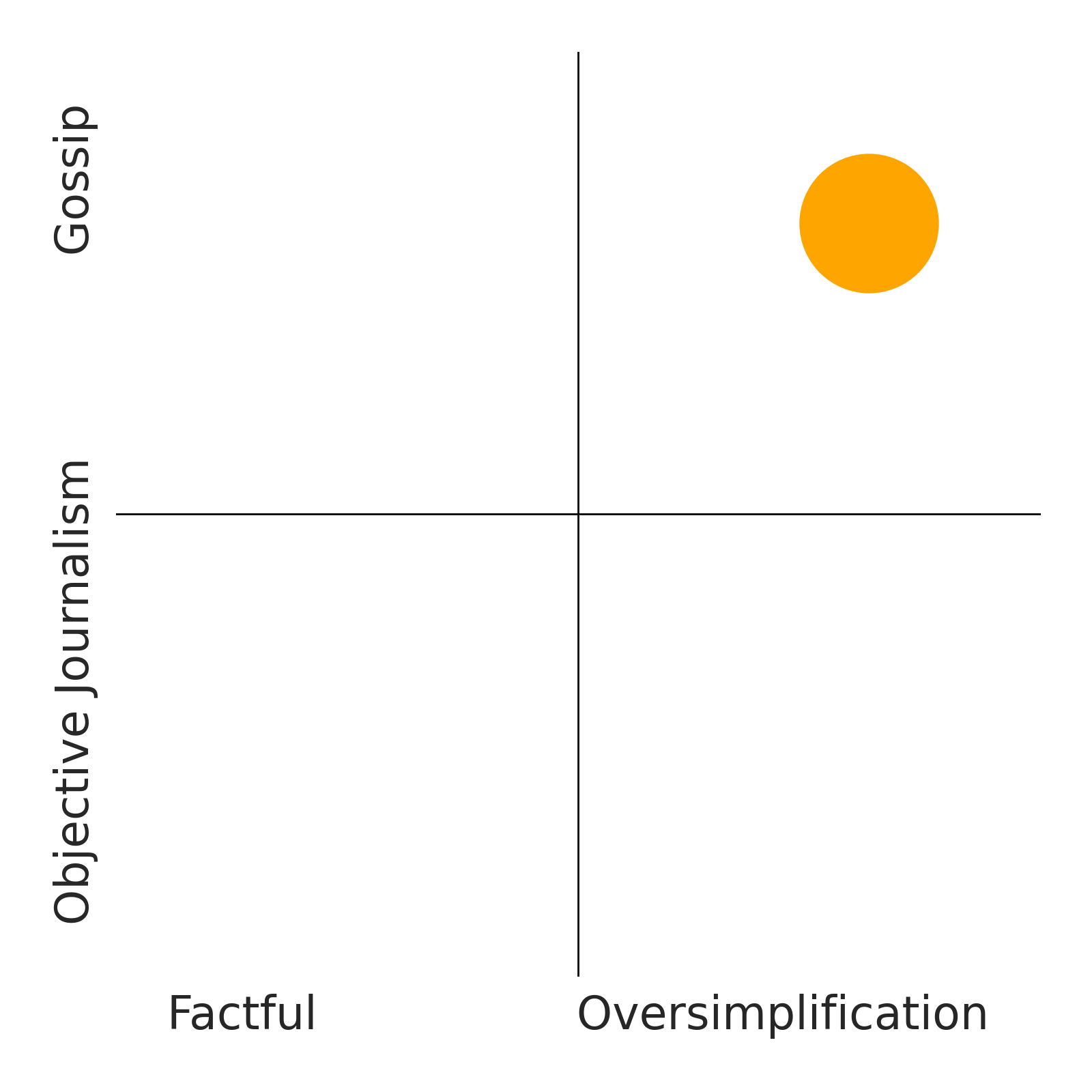
2026 © Helium Trades
Privacy Policy & Disclosure
* Disclaimer: Nothing on this website constitutes investment advice, performance data or any recommendation that any particular security, portfolio of securities, transaction or investment strategy is suitable for any specific person. Helium Trades is not responsible in any way for the accuracy
of any model predictions or price data. Any mention of a particular security and related prediction data is not a recommendation to buy or sell that security. Investments in securities involve the risk of loss. Past performance is no guarantee of future results. Helium Trades is not responsible for any of your investment decisions,
you should consult a financial expert before engaging in any transaction.
Helium Research Assistant

How can I help you today?
Ask any question about CBS bias.