See whether Helium helps you make better-informed decisions. Try every Pro Trader feature for 30 days. No credit card required.
Try every Pro Trader feature for 30 days. No credit card required.
Identity and scope: The evidence strongly indicates this is the Chicago Tribune and especially its Editorial Board.
Observable markers include Tribune-brand endorsements
September 29, 2026 · 0 shares
A bare list of editorial endorsements recommends four Chicago School Board candidates without supporting rationale.
Automated analysis; not human reviewed. Limitations: The supplied content is only a list of endorsement headlines with no candidate details or reasoning, so ideological direction and depth of framing cannot be assessed. · 4 of 55 available dimensions scored; omitted dimensions are not treated as neutral. · Verified supporting quotes for 4 of 4 scored dimensions.
Claim: The content expresses subjective editorial judgment rather than objective reporting.
“Editorial: Patrick Watson for Chicago School Board in District 10B” · exact text match
Why: It is labeled an editorial and recommends specific candidates, which is inherently a subjective position.
Claim: The content prescribes whom voters should support rather than describing facts.
“Editorial: Patrick Watson for Chicago School Board in District 10B” · exact text match
Why: The 'Candidate for office' headline format is an explicit endorsement, a recommendation of whom voters should elect.
Claim: The content is entirely composed of opinionated endorsements.
“Editorial: Patrick Watson for Chicago School Board in District 10B” · exact text match
Why: Every substantive item is an 'Editorial' endorsement of a candidate, not a factual news report.
Claim: The content is highly political because it endorses candidates in a general election.
“Editorial: Patrick Watson for Chicago School Board in District 10B” · exact text match
Why: Endorsing candidates for elected office is political advocacy.
The supplied content is only a list of endorsement headlines with no candidate details or reasoning, so ideological direction and depth of framing cannot be assessed.
September 28, 2026 · 0 shares
The framing recasts Peralta's union-aligned 'progressive revenue' stance as a slogan and presents Pierre's school-choice and budgeting positions as the district's pragmatic fit.
Automated analysis; not human reviewed. · 7 of 55 available dimensions scored; omitted dimensions are not treated as neutral. · Verified supporting quotes for 7 of 7 scored dimensions.
Claim: The endorsement favors a school-choice-aligned candidate while framing the opponent's revenue plan as a union refrain.
“Pierre is a supporter of charter and selective-enrollment schools and would take a pragmatic approach to budgeting for the chronically deficit-riddled district.” · exact text match
“Echoing the CTU refrain, her focus on CPS’ budget woes is winning “progressive revenue.”” · exact text match
Why: Favoring charter/selective enrollment and dismissing 'progressive revenue' as a CTU refrain is center-right on school governance and fiscal policy.
Claim: The editorial states its conclusion as belief and endorses a candidate.
“We believe this Northwest Side district is more in tune with Pierre, and Michelle Pierre has our endorsement.” · exact text match
Why: Explicit 'We believe' language plus an endorsement is subjective advocacy, not detached reporting.
Claim: The text directs readers to vote for Pierre.
“Michelle Pierre has our endorsement.” · exact text match
Why: An endorsement is a direct recommendation, making the content prescriptive rather than descriptive.
Claim: The article is an evaluative endorsement rather than a neutral factual account.
“We believe this Northwest Side district is more in tune with Pierre, and Michelle Pierre has our endorsement.” · exact text match
Why: The dominant mode is advocacy: belief, evaluation, and endorsement.
Claim: The content centers on electoral competition and coalition endorsements in a school board race.
“Claudia Peralta, who is currently progressive U.S. Rep. Delia Ramirez’s district director and is endorsed by both the Chicago Teachers Union and the Service Employees International Union” · exact text match
Why: The selection and framing foreground endorsements, unions, and political alignments, not administrative policy detail.
Claim: The endorsement treats the opponent's 'progressive revenue' position as an ideological CTU refrain and counterposes it to 'pragmatic' budgeting.
“Echoing the CTU refrain, her focus on CPS’ budget woes is winning “progressive revenue.”” · exact text match
Why: 'Refrain' characterizes a substantive fiscal position as a slogan, a framing move typical of ideological polarization.
Claim: The editorial grounds its report in named people, groups, and funding sources and attributes claims where appropriate.
“Pierre, 50, is endorsed by Common Ground Collective, an organization opposing CTU and Mayor Brandon Johnson and financed in large part by the chief executive officer of GCM Grosvenor, Michael Sacks.” · exact text match
Why: Specific attribution and funding detail provide visible sourcing, even though the conclusion is editorial opinion.
September 28, 2026 · 0 shares
This endorsement editorial centers the District 4A school board race on candidate experience, fiscal accountability, and union-alignment contrasts, then directly urges a vote for Ellen Sherratt.
Automated analysis; not human reviewed. Limitations: The input is a short editorial endorsement with selective comparisons; full candidate records and external context are unavailable, so this analysis cannot assess broader validity. · 4 of 55 available dimensions scored; omitted dimensions are not treated as neutral. · Verified supporting quotes for 4 of 4 scored dimensions.
Claim: The recommendation is explicitly subjective and based on the editorial board's judgment.
“we believe Sherratt is the better bet to unseat Zaccor, and we endorse Ellen Sherratt.” · exact text match
Why: The board states a belief and an endorsement, signaling opinion rather than objective reporting.
Claim: The text tells readers which candidate to support.
“we endorse Ellen Sherratt.” · exact text match
Why: The piece explicitly prescribes a vote rather than merely describing the race.
Claim: The text functions as a direct editorial endorsement.
“we believe Sherratt is the better bet to unseat Zaccor, and we endorse Ellen Sherratt.” · exact text match
Why: The piece's purpose is to recommend a candidate, and it does so in explicit terms.
Claim: The endorsement frames the contest using union and political coalition terms.
“Chicago Teachers Union-backed Zaccor, 70, then was appointed to the board by Mayor Brandon Johnson.” · exact text match
“endorsed by the Service Employees International Union (SEIU) and Common Ground Collective, an organization opposing CTU and Johnson” · exact text match
Why: The candidates are positioned by union backing and opposition to local political actors, making the endorsement expressly political.
The input is a short editorial endorsement with selective comparisons; full candidate records and external context are unavailable, so this analysis cannot assess broader validity.
September 29, 2026 · 0 shares
The endorsement frames Yesenia Lopez as a courageous independent who resisted the Chicago Teachers Union and mayor, while using her opponent's private-school background as a counterpoint.
Automated analysis; not human reviewed. Limitations: The supplied text is an opinion endorsement; claims about the opponent's personal background and the union's motivations are not independently sourced, and the 'reportedly' and 'Presumably' attributions signal that uncertainty. · 7 of 55 available dimensions scored; omitted dimensions are not treated as neutral. · Verified supporting quotes for 7 of 7 scored dimensions.
Claim: The editorial positions itself to the right of the endorsed candidate and frames her fiscal resistance positively.
“She is for sure to our left on some tricky CPS issues” · exact text match
“She opposed their push for the board to take on high-cost debt to balance its budget” · exact text match
Why: The board states it is to the right of a candidate it describes as left, and it praises her resistance to costly debt, indicating a conservative-leaning stance.
Claim: The endorsement creates a public-school versus private-school contrast that favors the public-school candidate.
“who reportedly attended private schools in Chicago and Oak Park as a child and sends her children to private schools as well” · exact text match
“Lopez doesn’t have children, but she’s a product of Chicago Public Schools” · exact text match
Why: Highlighting the opponent's private schooling while emphasizing Lopez's public-school background is an anti-elite, populist framing.
Claim: The text is an opinion endorsement using evaluative and subjective language.
“we admire the political courage and independence she’s shown” · exact text match
“Yesenia Lopez is endorsed.” · exact text match
Why: The editorial voice and explicit recommendation make the piece subjective rather than objective reporting.
Claim: The piece prescribes a vote for Lopez.
“Yesenia Lopez is endorsed.” · exact text match
Why: A direct endorsement instructing readers to support a candidate is prescriptive.
Claim: The text is almost entirely opinionated, with praise and a recommendation.
“we admire the political courage and independence she’s shown” · exact text match
“Yesenia Lopez is endorsed.” · exact text match
Why: It is an editorial endorsement with evaluative praise and a direct recommendation.
Claim: The content is heavily focused on local political power struggles.
“has refused to take orders from CTU and the mayor’s office” · exact text match
“she abstained on the unbalanced budget meant to put political pressure on the state” · exact text match
Why: The text centers on union, mayoral, and state political pressure rather than non-political matters.
Claim: The editorial offers an unverified inference about the union's motive.
“Presumably, the reason for the union’s unusual turnabout is that Lopez, 38, who’s worked in the past for U.S. Rep. Jesús “Chuy” García’s organization, has refused to take orders from CTU and the mayor’s office” · exact text match
Why: The word 'Presumably' signals that the stated reason is an inference, not established fact.
The supplied text is an opinion endorsement; claims about the opponent's personal background and the union's motivations are not independently sourced, and the 'reportedly' and 'Presumably' attributions signal that uncertainty.
An archival retrospective frames Chicago's 2016 Olympic bid loss as a plain, matter-of-fact local history item, without editorial commentary or dramatic emphasis.
Automated analysis; not human reviewed. Limitations: Only a brief headline/teaser and surrounding archive links were available; the full Tribune article body was not supplied. · 3 of 55 available dimensions scored; omitted dimensions are not treated as neutral. · Verified supporting quotes for 3 of 3 scored dimensions.
Claim: The item's framing is objective rather than subjective.
“City loses bid to host 2016 Summer Olympics in first round of voting.” · exact text match
Why: The only reported assertion is an unqualified factual statement; no evaluative, emotional, or opinionated wording appears.
Claim: The framing is non-sensational and plain.
“Here's a look back at what happened in the Chicago area on Oct. 2, according to the Tribune's archives.” · exact text match
Why: The retrospective hook is understated and factual, with no dramatic or exaggerated language.
Claim: The item describes rather than prescribes.
“Here's a look back at what happened in the Chicago area on Oct. 2, according to the Tribune's archives.” · exact text match
Why: It points to an archival recap and offers no recommendations, directives, or calls to action.
Only a brief headline/teaser and surrounding archive links were available; the full Tribune article body was not supplied.
An editorial framed Mayor Johnson’s resistance to a supermajority bond-approval rule as ideologically driven fiscal recklessness and urged a council override.
A mayoral veto in Chicago can be overridden by a two-thirds vote of the City Council (34 of 50 aldermen).
Automated analysis; not human reviewed. Limitations: The article is an editorial, so its opinionated framing is explicit; no external budget, credit-rating, or vote records were available to verify claims independently. · 9 of 55 available dimensions scored; omitted dimensions are not treated as neutral. · Verified supporting quotes for 9 of 9 scored dimensions.
Claim: The editorial takes a fiscal-conservative position by criticizing the mayor's debt-financed social investment as ideological.
“Per Johnson’s worldview, heaping more debt burdens on future taxpayers is a way to redress inequities rather than a necessary tool to maintain the city’s infrastructure.” · exact text match
Why: The contrast between 'redress inequities' and 'necessary tool' frames redistributive borrowing as an ideological departure from prudent finance.
Claim: The article interprets the mayor's intent rather than reporting only verifiable actions.
“Johnson made it clear he views worries about Chicago’s growing debt pile entirely through his usual ideological lens.” · exact text match
Why: It asserts a definitive internal motive that cannot be observed from the cited vote or quote.
Claim: The article takes a bearish view of Chicago's fiscal position and borrowing practices.
“And a city swimming in pension and bond debt, to the point where those two buckets consume almost 40% of its annual budget, must show far more discretion than has this administration when it comes to tapping the markets.” · exact text match
Why: It characterizes the city as 'swimming in' debt and the administration as lacking discretion, a negative outlook.
Claim: The article is pessimistic about the city's financial trajectory under Mayor Johnson.
“Under Johnson’s watch, the city’s annual cost of servicing general-obligation bonds — the sorts of securities covered by both the $1.25 billion and $830 million votes — has spiked, as we outlined last month.” · exact text match
Why: It highlights a worsening trend during the mayor's tenure without offsetting positives.
Claim: The article prescribes a specific course of action to the city council.
“If the mayor does as he implied and vetoes the three-fifths requirement, the council should override.” · exact text match
Why: The sentence directly instructs the council to override a veto.
Claim: The article is an explicit opinion piece with strong editorial judgments.
“Well, sure. But as a general matter bonds are meant to finance long-lived infrastructure work — on the South, West or any other sides of Chicago.” · exact text match
Why: The dismissive 'Well, sure' and correction of the mayor's framing are unmistakably opinionated.
Claim: The article takes a side in a mayoral-council political fight.
“Mayor Brandon Johnson should join with aldermen in their insistence on fiscal restraint.” · exact text match
Why: The opening sentence takes a position directed at a political actor in a governmental dispute.
Claim: The editorial treats bond investors, credit analysts, and credit rating agencies as authoritative judges of city policy.
“it would signal to bond investors and credit analysts, who are taking an increasingly dim view of the city of Chicago as a safe investment, that policymakers here across the ideological spectrum understand the language of dollars and cents” · exact text match
Why: The argument's desired outcome is reassuring financial elites, signaling alignment with financial-establishment norms.
Claim: The article is credible because it discloses its prior stance and cites specific votes and events.
“We expressed cautious openness to the idea at the time, and 32 aldermen voted yes — more than the three-fifths threshold to which Johnson now objects.” · exact text match
Why: Acknowledging earlier support and providing a precise vote count are transparency signals that support credibility in an editorial.
The article is an editorial, so its opinionated framing is explicit; no external budget, credit-rating, or vote records were available to verify claims independently.
The compilation is a conventional wire-news aggregation, though phrases like 'mail voting crackdown' and 'disease remains out of control' add a mild alarmist gloss.
Automated analysis; not human reviewed. Limitations: The supplied text is a concatenation of several truncated headlines and ledes, making it difficult to identify a single central event for all items. · 2 of 55 available dimensions scored; omitted dimensions are not treated as neutral. · Verified supporting quotes for 0 of 2 scored dimensions.
Claim: The publisher states an unqualified conclusion about the outbreak's trajectory.
“Congo’s Ebola outbreak tops 8,000 confirmed cases as disease remains out of control.” · not found in supplied text
Why: The reported statistic supports the case count but does not by itself establish that the outbreak 'remains out of control.'
Claim: The text mostly attributes statistics and statements to identifiable sources, but an unqualified headline phrase slightly lowers its precision.
“The latest data from Congo’s health ministry released yesterday showed that 8,067 cases have been confirmed, with 3,901 deaths.” · not found in supplied text
Counterevidence:
“Congo’s Ebola outbreak tops 8,000 confirmed cases as disease remains out of control.” · not found in supplied text
Why: Most items report concrete figures and attributed remarks, but 'remains out of control' is an unattributed editorialization rather than a sourced claim.
The supplied text is a concatenation of several truncated headlines and ledes, making it difficult to identify a single central event for all items.
An editorial law-and-order framing treats Chicago's lower summertime homicide count as real but inadequate, credits policing, prosecution, and technology, and blames Mayor Johnson's office for unfinished progress.
Automated analysis; not human reviewed. Limitations: The supplied text is an editorial, so opinion is mixed with reporting; the 'good authority' retirement motive and causal explanations cannot be independently checked from the text alone. · 10 of 54 available dimensions scored; omitted dimensions are not treated as neutral. · Verified supporting quotes for 10 of 10 scored dimensions.
Claim: The editorial applies a conservative-leaning law-and-order framework to local crime.
“the absurd defund-the-police movement” · exact text match
“seeking meaningful sentences rather than plea deals for those serious crimes” · exact text match
Why: It derides defunding police and praises police-morale restoration, tougher prosecution, and pretrial safety, positions commonly associated with conservative crime policy; its support for summer jobs tempers but does not outweigh that leaning.
Claim: The editorial favors more surveillance, policing, pretrial detention, and punishment.
“The proliferation of cameras at homes and businesses and on public transit, cellphone data that pinpoints the location of would-be perpetrators and more sophisticated law-enforcement tools almost certainly serve as deterrents to would-be criminals.” · exact text match
“keeping the public safe from accused violent criminals as they await trial and seeking meaningful sentences rather than plea deals for those serious crimes” · exact text match
Why: It explicitly endorses camera and cellphone surveillance and the detention and meaningful sentencing of accused violent criminals, indicating an authority-and-order orientation on this continuum.
Claim: The piece is presented as the board's opinion, not neutral reporting.
“We’re grateful that Chicago is safer, at least statistically speaking, than it has been in decades.” · exact text match
“To our minds, any and all declarations of victory are absurd when New York has posted 115 fewer homicides than Chicago through August despite being more than three times as large.” · exact text match
Why: First-person evaluation and direct judgment make the content explicitly subjective.
Claim: The overall evaluative tone is cautiously pessimistic despite acknowledging good news.
“Chicago still has a long, long way to go” · exact text match
“any and all declarations of victory are absurd” · exact text match
Counterevidence:
“this is undeniably good news” · exact text match
Why: The good news is acknowledged, but the conclusion stresses inadequacy and lagging peers, producing a net pessimistic frame.
Claim: The editorial repeatedly tells officials and voters what should be done.
“Whoever is mayor after next year’s election should continue the emphasis on summer jobs within the confines of budgetary reality.” · exact text match
“A more competent mayor’s office would have ensured Snelling remained at his post at least through the coming election.” · exact text match
Why: 'Should' and a counterfactual prescription are clearly prescriptive rather than descriptive.
Claim: Includes an insider detail about a retirement motive based on unnamed authority.
“Snelling opted to retire in mid-July, a decision that we had on good authority was due in part to the top cop’s frustration with Johnson’s chaotic fifth floor.” · exact text match
Why: The sentence reports internal frustration and office dynamics from an unnamed source, a gossip-like reliance on unverifiable insider information.
Claim: The piece is heavily opinionated advocacy rather than factual news.
“One explanation we find persuasive is the growth in technology” · exact text match
“we believe we’re seeing the positive effects of the acknowledgment of such on the streets in the improved statistics as well.” · exact text match
Why: The writer states personal beliefs and endorses policy positions throughout.
Claim: The editorial is heavily engaged in local electoral politics and the mayor's record.
“one for which the mayor, as he nears an announcement of his expected reelection bid, deserves credit” · exact text match
“Whoever is mayor after next year’s election should continue the emphasis on summer jobs” · exact text match
Why: It evaluates the mayor's reelection prospects, appointive choices, and the next election, placing the piece squarely in political contest.
Claim: Expresses certainty about a causal explanation beyond what the acknowledged lack of consensus supports.
“There are many theories but little consensus.” · exact text match
“The proliferation of cameras at homes and businesses and on public transit, cellphone data that pinpoints the location of would-be perpetrators and more sophisticated law-enforcement tools almost certainly serve as deterrents to would-be criminals.” · exact text match
Why: After noting little consensus, the editorial asserts a specific deterrence mechanism with 'almost certainly,' a degree of certainty not warranted by the acknowledged uncertainty.
Claim: The editorial shows moderate-high credibility through attribution and named officials, with one unsourced insider claim.
“according to the various local reports” · exact text match
“according to the L.A. Police Department” · exact text match
“she told us” · exact text match
Counterevidence:
“we had on good authority” · exact text match
Why: Specific statistics are attributed to agencies and officials, and uncertainty is acknowledged, but the unnamed 'good authority' detail lowers credibility.
The supplied text is an editorial, so opinion is mixed with reporting; the 'good authority' retirement motive and causal explanations cannot be independently checked from the text alone.
An editorial framed Mayor Johnson’s resistance to a supermajority bond-approval rule as ideologically driven fiscal recklessness and urged a council override.
A mayoral veto in Chicago can be overridden by a two-thirds vote of the City Council (34 of 50 aldermen).
Automated analysis; not human reviewed. Limitations: The article is an editorial, so its opinionated framing is explicit; no external budget, credit-rating, or vote records were available to verify claims independently. · 9 of 55 available dimensions scored; omitted dimensions are not treated as neutral. · Verified supporting quotes for 9 of 9 scored dimensions.
Claim: The editorial takes a fiscal-conservative position by criticizing the mayor's debt-financed social investment as ideological.
“Per Johnson’s worldview, heaping more debt burdens on future taxpayers is a way to redress inequities rather than a necessary tool to maintain the city’s infrastructure.” · exact text match
Why: The contrast between 'redress inequities' and 'necessary tool' frames redistributive borrowing as an ideological departure from prudent finance.
Claim: The article interprets the mayor's intent rather than reporting only verifiable actions.
“Johnson made it clear he views worries about Chicago’s growing debt pile entirely through his usual ideological lens.” · exact text match
Why: It asserts a definitive internal motive that cannot be observed from the cited vote or quote.
Claim: The article takes a bearish view of Chicago's fiscal position and borrowing practices.
“And a city swimming in pension and bond debt, to the point where those two buckets consume almost 40% of its annual budget, must show far more discretion than has this administration when it comes to tapping the markets.” · exact text match
Why: It characterizes the city as 'swimming in' debt and the administration as lacking discretion, a negative outlook.
Claim: The article is pessimistic about the city's financial trajectory under Mayor Johnson.
“Under Johnson’s watch, the city’s annual cost of servicing general-obligation bonds — the sorts of securities covered by both the $1.25 billion and $830 million votes — has spiked, as we outlined last month.” · exact text match
Why: It highlights a worsening trend during the mayor's tenure without offsetting positives.
Claim: The article prescribes a specific course of action to the city council.
“If the mayor does as he implied and vetoes the three-fifths requirement, the council should override.” · exact text match
Why: The sentence directly instructs the council to override a veto.
Claim: The article is an explicit opinion piece with strong editorial judgments.
“Well, sure. But as a general matter bonds are meant to finance long-lived infrastructure work — on the South, West or any other sides of Chicago.” · exact text match
Why: The dismissive 'Well, sure' and correction of the mayor's framing are unmistakably opinionated.
Claim: The article takes a side in a mayoral-council political fight.
“Mayor Brandon Johnson should join with aldermen in their insistence on fiscal restraint.” · exact text match
Why: The opening sentence takes a position directed at a political actor in a governmental dispute.
Claim: The editorial treats bond investors, credit analysts, and credit rating agencies as authoritative judges of city policy.
“it would signal to bond investors and credit analysts, who are taking an increasingly dim view of the city of Chicago as a safe investment, that policymakers here across the ideological spectrum understand the language of dollars and cents” · exact text match
Why: The argument's desired outcome is reassuring financial elites, signaling alignment with financial-establishment norms.
Claim: The article is credible because it discloses its prior stance and cites specific votes and events.
“We expressed cautious openness to the idea at the time, and 32 aldermen voted yes — more than the three-fifths threshold to which Johnson now objects.” · exact text match
Why: Acknowledging earlier support and providing a precise vote count are transparency signals that support credibility in an editorial.
The article is an editorial, so its opinionated framing is explicit; no external budget, credit-rating, or vote records were available to verify claims independently.
Opposes a proposed parking surcharge on suburban visitors as petty “crazy-town nonsense” that would make outsiders feel unwelcome while Chicago depends on their spending.
Chicago's parking meter system has operated under a long-term private concession, and the city faces recurring budget pressure while aldermen weigh additional revenue measures.
Automated analysis; not human reviewed. Limitations: The article is an unsigned editorial, so its claims are opinionated and no independent revenue or behavioral estimates for the surcharge are provided. · 8 of 55 available dimensions scored; omitted dimensions are not treated as neutral. · Verified supporting quotes for 7 of 8 scored dimensions.
Claim: The editorial criticizes the proposed surcharge and similar measures as foolish revenue grabs, reflecting a fiscally conservative stance.
“Soaking the suburbs over parking is reminiscent of other foolish, revenue-grabbing ideas, such as a congestion tax aimed at outsiders as a way to gin up money to cover Chicago’s ever-present budget black hole.” · exact text match
Why: The quote frames tax-like surcharges as improper revenue grabs rather than legitimate fiscal tools, a conservative fiscal position.
Claim: The editorial opposes a government-imposed fee on non-residents as an unwelcoming restriction.
“creating a suburban parking surcharge sends the message that you’re not welcome in Chicago unless you live here.” · exact text match
Why: The quote treats the surcharge as a coercive barrier to visitors, indicating opposition to government-imposed restrictions on outsiders.
Claim: The piece is heavily subjective, presenting the proposal as absurd rather than neutrally reporting it.
“What we know for sure is that such a move is crazy-town nonsense.” · exact text match
Why: The quote directly expresses the publisher's evaluative judgment rather than objective reporting.
Claim: The editorial uses dramatic, emotionally loaded language to characterize the lease and the surcharge idea.
“We were tired of writing about this historic disaster.” · exact text match
“Soaking the suburbs over parking is reminiscent of other foolish, revenue-grabbing ideas” · exact text match
Why: Terms like “historic disaster” and “soaking” heighten emotional response beyond neutral description.
Claim: The editorial is strongly prescriptive, telling aldermen what should and should not happen.
“Enough already. This idea should not be floating around. It should sink.” · exact text match
Why: The quote is a direct prescription against the proposal, rather than a description of it.
Claim: The text is an opinion piece that asserts the publisher's preferred viewpoint.
“We have an altogether different view of our neighbors to the north, south and west.” · exact text match
Why: The quote explicitly presents a viewpoint rather than reporting facts.
Claim: The editorial engages directly in local political debate about city council revenue policy.
“Now, aldermen are looking to the future. And as some gaze into their crystal ball, they see a brave new world in which suburbanites pay more to park.” · exact text match
Why: The quote frames aldermen's political deliberations in mocking terms, making the piece part of a political argument.
The article is an unsigned editorial, so its claims are opinionated and no independent revenue or behavioral estimates for the surcharge are provided.
September 29, 2026 · 0 shares
A bare list of editorial endorsements recommends four Chicago School Board candidates without supporting rationale.
Automated analysis; not human reviewed. Limitations: The supplied content is only a list of endorsement headlines with no candidate details or reasoning, so ideological direction and depth of framing cannot be assessed. · 4 of 55 available dimensions scored; omitted dimensions are not treated as neutral. · Verified supporting quotes for 4 of 4 scored dimensions.
Claim: The content expresses subjective editorial judgment rather than objective reporting.
“Editorial: Patrick Watson for Chicago School Board in District 10B” · exact text match
Why: It is labeled an editorial and recommends specific candidates, which is inherently a subjective position.
Claim: The content prescribes whom voters should support rather than describing facts.
“Editorial: Patrick Watson for Chicago School Board in District 10B” · exact text match
Why: The 'Candidate for office' headline format is an explicit endorsement, a recommendation of whom voters should elect.
Claim: The content is entirely composed of opinionated endorsements.
“Editorial: Patrick Watson for Chicago School Board in District 10B” · exact text match
Why: Every substantive item is an 'Editorial' endorsement of a candidate, not a factual news report.
Claim: The content is highly political because it endorses candidates in a general election.
“Editorial: Patrick Watson for Chicago School Board in District 10B” · exact text match
Why: Endorsing candidates for elected office is political advocacy.
The supplied content is only a list of endorsement headlines with no candidate details or reasoning, so ideological direction and depth of framing cannot be assessed.
September 28, 2026 · 0 shares
The framing recasts Peralta's union-aligned 'progressive revenue' stance as a slogan and presents Pierre's school-choice and budgeting positions as the district's pragmatic fit.
Automated analysis; not human reviewed. · 7 of 55 available dimensions scored; omitted dimensions are not treated as neutral. · Verified supporting quotes for 7 of 7 scored dimensions.
Claim: The endorsement favors a school-choice-aligned candidate while framing the opponent's revenue plan as a union refrain.
“Pierre is a supporter of charter and selective-enrollment schools and would take a pragmatic approach to budgeting for the chronically deficit-riddled district.” · exact text match
“Echoing the CTU refrain, her focus on CPS’ budget woes is winning “progressive revenue.”” · exact text match
Why: Favoring charter/selective enrollment and dismissing 'progressive revenue' as a CTU refrain is center-right on school governance and fiscal policy.
Claim: The editorial states its conclusion as belief and endorses a candidate.
“We believe this Northwest Side district is more in tune with Pierre, and Michelle Pierre has our endorsement.” · exact text match
Why: Explicit 'We believe' language plus an endorsement is subjective advocacy, not detached reporting.
Claim: The text directs readers to vote for Pierre.
“Michelle Pierre has our endorsement.” · exact text match
Why: An endorsement is a direct recommendation, making the content prescriptive rather than descriptive.
Claim: The article is an evaluative endorsement rather than a neutral factual account.
“We believe this Northwest Side district is more in tune with Pierre, and Michelle Pierre has our endorsement.” · exact text match
Why: The dominant mode is advocacy: belief, evaluation, and endorsement.
Claim: The content centers on electoral competition and coalition endorsements in a school board race.
“Claudia Peralta, who is currently progressive U.S. Rep. Delia Ramirez’s district director and is endorsed by both the Chicago Teachers Union and the Service Employees International Union” · exact text match
Why: The selection and framing foreground endorsements, unions, and political alignments, not administrative policy detail.
Claim: The endorsement treats the opponent's 'progressive revenue' position as an ideological CTU refrain and counterposes it to 'pragmatic' budgeting.
“Echoing the CTU refrain, her focus on CPS’ budget woes is winning “progressive revenue.”” · exact text match
Why: 'Refrain' characterizes a substantive fiscal position as a slogan, a framing move typical of ideological polarization.
Claim: The editorial grounds its report in named people, groups, and funding sources and attributes claims where appropriate.
“Pierre, 50, is endorsed by Common Ground Collective, an organization opposing CTU and Mayor Brandon Johnson and financed in large part by the chief executive officer of GCM Grosvenor, Michael Sacks.” · exact text match
Why: Specific attribution and funding detail provide visible sourcing, even though the conclusion is editorial opinion.
September 28, 2026 · 0 shares
This endorsement editorial centers the District 4A school board race on candidate experience, fiscal accountability, and union-alignment contrasts, then directly urges a vote for Ellen Sherratt.
Automated analysis; not human reviewed. Limitations: The input is a short editorial endorsement with selective comparisons; full candidate records and external context are unavailable, so this analysis cannot assess broader validity. · 4 of 55 available dimensions scored; omitted dimensions are not treated as neutral. · Verified supporting quotes for 4 of 4 scored dimensions.
Claim: The recommendation is explicitly subjective and based on the editorial board's judgment.
“we believe Sherratt is the better bet to unseat Zaccor, and we endorse Ellen Sherratt.” · exact text match
Why: The board states a belief and an endorsement, signaling opinion rather than objective reporting.
Claim: The text tells readers which candidate to support.
“we endorse Ellen Sherratt.” · exact text match
Why: The piece explicitly prescribes a vote rather than merely describing the race.
Claim: The text functions as a direct editorial endorsement.
“we believe Sherratt is the better bet to unseat Zaccor, and we endorse Ellen Sherratt.” · exact text match
Why: The piece's purpose is to recommend a candidate, and it does so in explicit terms.
Claim: The endorsement frames the contest using union and political coalition terms.
“Chicago Teachers Union-backed Zaccor, 70, then was appointed to the board by Mayor Brandon Johnson.” · exact text match
“endorsed by the Service Employees International Union (SEIU) and Common Ground Collective, an organization opposing CTU and Johnson” · exact text match
Why: The candidates are positioned by union backing and opposition to local political actors, making the endorsement expressly political.
The input is a short editorial endorsement with selective comparisons; full candidate records and external context are unavailable, so this analysis cannot assess broader validity.
September 29, 2026 · 0 shares
The endorsement frames Yesenia Lopez as a courageous independent who resisted the Chicago Teachers Union and mayor, while using her opponent's private-school background as a counterpoint.
Automated analysis; not human reviewed. Limitations: The supplied text is an opinion endorsement; claims about the opponent's personal background and the union's motivations are not independently sourced, and the 'reportedly' and 'Presumably' attributions signal that uncertainty. · 7 of 55 available dimensions scored; omitted dimensions are not treated as neutral. · Verified supporting quotes for 7 of 7 scored dimensions.
Claim: The editorial positions itself to the right of the endorsed candidate and frames her fiscal resistance positively.
“She is for sure to our left on some tricky CPS issues” · exact text match
“She opposed their push for the board to take on high-cost debt to balance its budget” · exact text match
Why: The board states it is to the right of a candidate it describes as left, and it praises her resistance to costly debt, indicating a conservative-leaning stance.
Claim: The endorsement creates a public-school versus private-school contrast that favors the public-school candidate.
“who reportedly attended private schools in Chicago and Oak Park as a child and sends her children to private schools as well” · exact text match
“Lopez doesn’t have children, but she’s a product of Chicago Public Schools” · exact text match
Why: Highlighting the opponent's private schooling while emphasizing Lopez's public-school background is an anti-elite, populist framing.
Claim: The text is an opinion endorsement using evaluative and subjective language.
“we admire the political courage and independence she’s shown” · exact text match
“Yesenia Lopez is endorsed.” · exact text match
Why: The editorial voice and explicit recommendation make the piece subjective rather than objective reporting.
Claim: The piece prescribes a vote for Lopez.
“Yesenia Lopez is endorsed.” · exact text match
Why: A direct endorsement instructing readers to support a candidate is prescriptive.
Claim: The text is almost entirely opinionated, with praise and a recommendation.
“we admire the political courage and independence she’s shown” · exact text match
“Yesenia Lopez is endorsed.” · exact text match
Why: It is an editorial endorsement with evaluative praise and a direct recommendation.
Claim: The content is heavily focused on local political power struggles.
“has refused to take orders from CTU and the mayor’s office” · exact text match
“she abstained on the unbalanced budget meant to put political pressure on the state” · exact text match
Why: The text centers on union, mayoral, and state political pressure rather than non-political matters.
Claim: The editorial offers an unverified inference about the union's motive.
“Presumably, the reason for the union’s unusual turnabout is that Lopez, 38, who’s worked in the past for U.S. Rep. Jesús “Chuy” García’s organization, has refused to take orders from CTU and the mayor’s office” · exact text match
Why: The word 'Presumably' signals that the stated reason is an inference, not established fact.
The supplied text is an opinion endorsement; claims about the opponent's personal background and the union's motivations are not independently sourced, and the 'reportedly' and 'Presumably' attributions signal that uncertainty.
Primary worldview — pragmatic, fiscal-moderate, establishment: The opinion content consistently favors fiscal restraint and market-oriented framing: opposing the mayor's debt-financing as ideological
An editorial framed Mayor Johnson’s resistance to a supermajority bond-approval rule as ideologically driven fiscal recklessness and urged a council override.
A mayoral veto in Chicago can be overridden by a two-thirds vote of the City Council (34 of 50 aldermen).
Automated analysis; not human reviewed. Limitations: The article is an editorial, so its opinionated framing is explicit; no external budget, credit-rating, or vote records were available to verify claims independently. · 9 of 55 available dimensions scored; omitted dimensions are not treated as neutral. · Verified supporting quotes for 9 of 9 scored dimensions.
Claim: The editorial takes a fiscal-conservative position by criticizing the mayor's debt-financed social investment as ideological.
“Per Johnson’s worldview, heaping more debt burdens on future taxpayers is a way to redress inequities rather than a necessary tool to maintain the city’s infrastructure.” · exact text match
Why: The contrast between 'redress inequities' and 'necessary tool' frames redistributive borrowing as an ideological departure from prudent finance.
Claim: The article interprets the mayor's intent rather than reporting only verifiable actions.
“Johnson made it clear he views worries about Chicago’s growing debt pile entirely through his usual ideological lens.” · exact text match
Why: It asserts a definitive internal motive that cannot be observed from the cited vote or quote.
Claim: The article takes a bearish view of Chicago's fiscal position and borrowing practices.
“And a city swimming in pension and bond debt, to the point where those two buckets consume almost 40% of its annual budget, must show far more discretion than has this administration when it comes to tapping the markets.” · exact text match
Why: It characterizes the city as 'swimming in' debt and the administration as lacking discretion, a negative outlook.
Claim: The article is pessimistic about the city's financial trajectory under Mayor Johnson.
“Under Johnson’s watch, the city’s annual cost of servicing general-obligation bonds — the sorts of securities covered by both the $1.25 billion and $830 million votes — has spiked, as we outlined last month.” · exact text match
Why: It highlights a worsening trend during the mayor's tenure without offsetting positives.
Claim: The article prescribes a specific course of action to the city council.
“If the mayor does as he implied and vetoes the three-fifths requirement, the council should override.” · exact text match
Why: The sentence directly instructs the council to override a veto.
Claim: The article is an explicit opinion piece with strong editorial judgments.
“Well, sure. But as a general matter bonds are meant to finance long-lived infrastructure work — on the South, West or any other sides of Chicago.” · exact text match
Why: The dismissive 'Well, sure' and correction of the mayor's framing are unmistakably opinionated.
Claim: The article takes a side in a mayoral-council political fight.
“Mayor Brandon Johnson should join with aldermen in their insistence on fiscal restraint.” · exact text match
Why: The opening sentence takes a position directed at a political actor in a governmental dispute.
Claim: The editorial treats bond investors, credit analysts, and credit rating agencies as authoritative judges of city policy.
“it would signal to bond investors and credit analysts, who are taking an increasingly dim view of the city of Chicago as a safe investment, that policymakers here across the ideological spectrum understand the language of dollars and cents” · exact text match
Why: The argument's desired outcome is reassuring financial elites, signaling alignment with financial-establishment norms.
Claim: The article is credible because it discloses its prior stance and cites specific votes and events.
“We expressed cautious openness to the idea at the time, and 32 aldermen voted yes — more than the three-fifths threshold to which Johnson now objects.” · exact text match
Why: Acknowledging earlier support and providing a precise vote count are transparency signals that support credibility in an editorial.
The article is an editorial, so its opinionated framing is explicit; no external budget, credit-rating, or vote records were available to verify claims independently.
Publisher framing presents Illinois’s failure to opt in to a federal school-choice scholarship program as a self-evident mistake, criticizing Gov. Pritzker and teacher unions while promoting private-school choice as beneficial.
Automated analysis; not human reviewed. Limitations: The supplied text is a fragmentary excerpt from a larger editorial; it begins mid-sentence and includes unrelated sports headlines and a copyright notice, so no article date, title, or complete policy context is available for analysis. · 15 of 55 available dimensions scored; omitted dimensions are not treated as neutral. · Verified supporting quotes for 13 of 15 scored dimensions.
Claim: The publisher frames school choice as an obvious public good and criticizes elected officials and public-sector unions for blocking it, a conservative-aligned education policy stance.
“If Gov. Pritzker continues to bow to teacher unions on what strikes us as a no-brainer decision, Illinoisans who believe in school choice and would love the tax break have an option.” · exact text match
“Left floating adrift are the mothers, fathers and children who are deprived of the same access and options as kids in other states.” · exact text match
Why: The first quote treats the decision as obvious and frames opposition as union-driven; the second emotionalizes the consequences, a common conservative/libertarian school-choice framing.
Claim: The publisher favors individual choice and private options over a government-run school assignment system, a libertarian position.
“Illinoisans who believe in school choice and would love the tax break have an option.” · exact text match
Why: The emphasis on individual choice, tax breaks, and private schooling reflects a preference for individual rather than collective provision.
Claim: The publisher uses first-person plural and value judgments, making the piece subjective rather than neutral.
“Do we really want Illinoisans’ charitable giving flowing out of our state?” · exact text match
“what strikes us as a no-brainer decision” · exact text match
Why: First-person editorial 'we' and 'strikes us' signal opinion rather than detached reporting.
Claim: The publisher uses emotionally loaded metaphors to dramatize the policy stakes.
“Illinois, then, is on an island. Left floating adrift are the mothers, fathers and children who are deprived of the same access and options as kids in other states.” · exact text match
Why: Phrases like 'on an island' and 'left floating adrift' are dramatic, emotional metaphors rather than neutral description.
Claim: The publisher prescribes what Illinois should do, urging state officials to join the program.
“If Gov. Pritzker continues to bow to teacher unions on what strikes us as a no-brainer decision, Illinoisans who believe in school choice and would love the tax break have an option.” · exact text match
Why: The quote treats the decision as obviously correct and urges action, a prescriptive stance.
Claim: The text is heavily opinionated, explicitly calling a policy choice a 'no-brainer' and arguing against state inaction.
“what strikes us as a no-brainer decision” · exact text match
“Do we really want Illinoisans’ charitable giving flowing out of our state?” · exact text match
Why: Value judgments, rhetorical questions, and first-person editorial 'we' mark the text as opinion.
Claim: The piece engages an ongoing political fight over school choice, the governor’s decision, and teacher unions.
“JB Pritzker continues to be noncommittal, with just a scant few months remaining to decide.” · exact text match
“If Gov. Pritzker continues to bow to teacher unions...” · not found in supplied text
Why: It names a governor and criticizes his political relationship with teacher unions, making the piece directly political.
Claim: The publisher reduces a complex state-policy decision to a 'no-brainer' and attributes inaction entirely to union influence.
“If Gov. Pritzker continues to bow to teacher unions on what strikes us as a no-brainer decision” · exact text match
Why: No policy trade-offs, fiscal effects, or legitimate objections are considered; the decision is presented as self-evident.
Claim: The publisher frames children and families as passive victims of state inaction.
“Left floating adrift are the mothers, fathers and children who are deprived of the same access and options as kids in other states.” · exact text match
Why: The language emphasizes harm and helplessness, not agency or competing considerations.
Claim: The publisher expresses certainty that the decision is obvious and that inaction reflects union control, beyond the evidence supplied in the excerpt.
“what strikes us as a no-brainer decision” · exact text match
Why: The phrase 'no-brainer' asserts certainty without supporting analysis of the policy’s trade-offs.
Claim: The article applies a fixed school-choice ideological lens, treating private school choice as an unqualified benefit.
“This program was a life-changer for families and kids who wouldn’t otherwise have been able to afford private school tuition.” · exact text match
Why: The publisher asserts positive outcomes ('life-changer') from a prior program without presenting evidence or trade-offs, suggesting a preset ideological position.
Claim: The publisher gives some attribution and hedges its central speculative claim, but the piece is advocacy and uses emotional language.
“The intent behind this effort, they say,” · exact text match
“We don’t know how much money Illinois donors would give...” · not found in supplied text
Why: The text attributes the organization’s intent and openly acknowledges uncertainty about a key estimate, supporting credible sourcing within the excerpt.
Claim: The publisher prioritizes individual family choice and flexibility over collective public-school solutions.
“families already have flexibility up north” · exact text match
“Illinoisans who believe in school choice and would love the tax break have an option.” · exact text match
Why: The language of 'flexibility' and individual 'options' favors individual rather than collective decision-making.
Claim: The publisher explicitly engages in speculation about the effect on donations while acknowledging uncertainty.
“We don’t know how much money Illinois donors would give to an out-of-state scholarship-granting organization, but we do see that it’s possible that this Indiana advantage opens up a stream of donations” · exact text match
Why: The phrase 'we do see that it’s possible' is an explicit forecast/speculation, though hedged by 'don’t know.'
Claim: The publisher uses loaded, emotionally directing language and one-sided framing to make the case without engaging counterarguments.
“If Gov. Pritzker continues to bow to teacher unions on what strikes us as a no-brainer decision” · exact text match
“Left floating adrift are the mothers, fathers and children who are deprived of the same access and options” · exact text match
Why: 'Bow to teacher unions' presupposes illegitimate influence and 'floating adrift' suggests severe harm; both are loaded framing.
The supplied text is a fragmentary excerpt from a larger editorial; it begins mid-sentence and includes unrelated sports headlines and a copyright notice, so no article date, title, or complete policy context is available for analysis.
Framing presents Kwame Raoul's settlement as a self-contradictory deal that shields organized labor's 'gravy train' while deferring costs to ratepayers.
In Illinois, natural gas rate increases are reviewed by the Illinois Commerce Commission, and the attorney general can negotiate settlements in rate cases.
Automated analysis; not human reviewed. Limitations: Only the supplied editorial text was available; no independent verification of the underlying settlements or projected bill impacts was possible. · 17 of 54 available dimensions scored; omitted dimensions are not treated as neutral. · Verified supporting quotes for 15 of 17 scored dimensions.
Claim: The editorial promotes a conservative economic position by opposing union job protections as an illegitimate cost on ratepayers.
“Nor should Nicor’s customers.” · exact text match
“In other words, keep organized labor’s gravy train rolling even though it’s based in part on work that is needless.” · exact text match
Why: The framing treats union preservation as a 'gravy train' and says customers should not be responsible for contractor employment.
Claim: The editorial takes the side of ordinary ratepayers against an institutional deal, portraying consumers as having no choice and bearing repeated burdens.
“Ratepayers don’t have a choice when it comes to heating their homes and have shouldered the burden already of repeated rate hikes.” · exact text match
Why: The language centers on powerless consumers bearing costs imposed by an institutional arrangement, a populist framing.
Claim: The editorial opposes a government-imposed obligation to preserve unionized contracting work, favoring market reallocation of contractors.
“Nor should Nicor’s customers.” · exact text match
“Those outfits will have no problem finding data centers or other infrastructure developers to replace whatever business they lose from Nicor.” · exact text match
Why: The editorial resists compelled spending and says contractors can find private alternatives.
Claim: The editorial uses overtly evaluative language and explicitly recommends outcomes.
“the AG’s nonsensical jobs deal” · exact text match
“keep organized labor’s gravy train rolling” · exact text match
Why: Loaded adjectives and metaphors convey subjective judgment rather than neutral reporting.
Claim: The editorial uses colorful, loaded phrases to dramatize a regulatory dispute.
“In other words, keep organized labor’s gravy train rolling even though it’s based in part on work that is needless.” · exact text match
Why: 'Gravy train' is a vivid metaphor that heightens emotional valence beyond a neutral summary.
Claim: The editorial warns that the deal will lead to larger future bills.
“But Nicor surely will seek higher rates in the future to cover the cost of that investment (plus a profit).” · exact text match
Why: The outlook is explicitly negative about future costs.
Claim: The editorial prescribes what the Illinois Commerce Commission should do.
“The ICC ought to approve the AG’s deal that blunts the rate-hike effect while rejecting the AG’s nonsensical jobs deal.” · not found in supplied text
Why: 'Ought to approve' and 'rejecting' are direct normative prescriptions.
Claim: The headline and body warn that union protections will cause future bill increases.
“union protections likely will balloon bills later” · exact text match
Why: The warning uses 'balloon' to frame future costs as a threat.
Claim: The content is unambiguously opinionated, with evaluative judgments throughout.
“the AG’s nonsensical jobs deal” · exact text match
“They shouldn’t have to finance trade union payrolls in perpetuity.” · exact text match
Why: Subjective judgment is the article's mode rather than neutral fact presentation.
Claim: The subject and argument are squarely about state government regulatory and labor policy.
“Illinois Attorney General Kwame Raoul wants to have it both ways with two legal arrangements his office struck last week with Nicor Gas” · exact text match
Why: The editorial is an intervention in a political and regulatory controversy.
Claim: Ratepayers are cast as captive victims with no choice but to pay.
“Ratepayers don’t have a choice when it comes to heating their homes and have shouldered the burden already of repeated rate hikes.” · exact text match
Why: The 'no choice' language frames consumers as harmed parties.
Claim: Future outcomes are stated with unqualified certainty.
“But Nicor surely will seek higher rates in the future” · exact text match
“Those outfits will have no problem finding data centers or other infrastructure developers” · exact text match
Why: 'Surely' and 'will have no problem' express certainty beyond the evidence cited.
Claim: The editorial is transparent about its basis, quoting the settlement and identifying which consumer groups declined to sign.
“Here’s the language from the second settlement:” · exact text match
“consumer groups such as Illinois PIRG and the Citizens Utility Board were parties to the first settlement but didn’t sign onto the job protections deal.” · exact text match
Why: Specific quotation and attribution lend verifiability even though the piece is opinion.
Claim: The core argument is a logical contradiction: Raoul allegedly called the capital program overstated or unnecessary, then required Nicor to maintain it.
“But Raoul contradicts himself in the second part of the deal by insisting that Nicor adhere to that same forecast capital spending program he’d alleged was bloated.” · exact text match
Why: The criticism is grounded in a stated inconsistency rather than in emotional appeal.
Claim: The editorial favors individual ratepayer interests and market mobility over collective union protections.
“Nor should Nicor’s customers.” · exact text match
“Those outfits will have no problem finding data centers or other infrastructure developers to replace whatever business they lose from Nicor.” · exact text match
Why: It rejects collective job preservation in favor of individual market outcomes.
Claim: The argument depends on forecasts of future rate cases and contractor re-employment.
“But Nicor surely will seek higher rates in the future to cover the cost of that investment (plus a profit).” · exact text match
Why: The future cost conclusion is a projection, not an established fact.
Claim: The editorial demonstrates an understanding of utility rate regulation and uses direct quotation to support its reasoning.
“That’s how utility regulation works. The more a utility invests in its delivery system, the more revenue it requires from ratepayers to absorb the cost and earn an added regulated return on the investment.” · not found in supplied text
“Here’s the language from the second settlement:” · exact text match
Why: It connects the rate-base incentive to future bills and cites specific settlement text.
Only the supplied editorial text was available; no independent verification of the underlying settlements or projected bill impacts was possible.
An editorial law-and-order framing treats Chicago's lower summertime homicide count as real but inadequate, credits policing, prosecution, and technology, and blames Mayor Johnson's office for unfinished progress.
Automated analysis; not human reviewed. Limitations: The supplied text is an editorial, so opinion is mixed with reporting; the 'good authority' retirement motive and causal explanations cannot be independently checked from the text alone. · 10 of 54 available dimensions scored; omitted dimensions are not treated as neutral. · Verified supporting quotes for 10 of 10 scored dimensions.
Claim: The editorial applies a conservative-leaning law-and-order framework to local crime.
“the absurd defund-the-police movement” · exact text match
“seeking meaningful sentences rather than plea deals for those serious crimes” · exact text match
Why: It derides defunding police and praises police-morale restoration, tougher prosecution, and pretrial safety, positions commonly associated with conservative crime policy; its support for summer jobs tempers but does not outweigh that leaning.
Claim: The editorial favors more surveillance, policing, pretrial detention, and punishment.
“The proliferation of cameras at homes and businesses and on public transit, cellphone data that pinpoints the location of would-be perpetrators and more sophisticated law-enforcement tools almost certainly serve as deterrents to would-be criminals.” · exact text match
“keeping the public safe from accused violent criminals as they await trial and seeking meaningful sentences rather than plea deals for those serious crimes” · exact text match
Why: It explicitly endorses camera and cellphone surveillance and the detention and meaningful sentencing of accused violent criminals, indicating an authority-and-order orientation on this continuum.
Claim: The piece is presented as the board's opinion, not neutral reporting.
“We’re grateful that Chicago is safer, at least statistically speaking, than it has been in decades.” · exact text match
“To our minds, any and all declarations of victory are absurd when New York has posted 115 fewer homicides than Chicago through August despite being more than three times as large.” · exact text match
Why: First-person evaluation and direct judgment make the content explicitly subjective.
Claim: The overall evaluative tone is cautiously pessimistic despite acknowledging good news.
“Chicago still has a long, long way to go” · exact text match
“any and all declarations of victory are absurd” · exact text match
Counterevidence:
“this is undeniably good news” · exact text match
Why: The good news is acknowledged, but the conclusion stresses inadequacy and lagging peers, producing a net pessimistic frame.
Claim: The editorial repeatedly tells officials and voters what should be done.
“Whoever is mayor after next year’s election should continue the emphasis on summer jobs within the confines of budgetary reality.” · exact text match
“A more competent mayor’s office would have ensured Snelling remained at his post at least through the coming election.” · exact text match
Why: 'Should' and a counterfactual prescription are clearly prescriptive rather than descriptive.
Claim: Includes an insider detail about a retirement motive based on unnamed authority.
“Snelling opted to retire in mid-July, a decision that we had on good authority was due in part to the top cop’s frustration with Johnson’s chaotic fifth floor.” · exact text match
Why: The sentence reports internal frustration and office dynamics from an unnamed source, a gossip-like reliance on unverifiable insider information.
Claim: The piece is heavily opinionated advocacy rather than factual news.
“One explanation we find persuasive is the growth in technology” · exact text match
“we believe we’re seeing the positive effects of the acknowledgment of such on the streets in the improved statistics as well.” · exact text match
Why: The writer states personal beliefs and endorses policy positions throughout.
Claim: The editorial is heavily engaged in local electoral politics and the mayor's record.
“one for which the mayor, as he nears an announcement of his expected reelection bid, deserves credit” · exact text match
“Whoever is mayor after next year’s election should continue the emphasis on summer jobs” · exact text match
Why: It evaluates the mayor's reelection prospects, appointive choices, and the next election, placing the piece squarely in political contest.
Claim: Expresses certainty about a causal explanation beyond what the acknowledged lack of consensus supports.
“There are many theories but little consensus.” · exact text match
“The proliferation of cameras at homes and businesses and on public transit, cellphone data that pinpoints the location of would-be perpetrators and more sophisticated law-enforcement tools almost certainly serve as deterrents to would-be criminals.” · exact text match
Why: After noting little consensus, the editorial asserts a specific deterrence mechanism with 'almost certainly,' a degree of certainty not warranted by the acknowledged uncertainty.
Claim: The editorial shows moderate-high credibility through attribution and named officials, with one unsourced insider claim.
“according to the various local reports” · exact text match
“according to the L.A. Police Department” · exact text match
“she told us” · exact text match
Counterevidence:
“we had on good authority” · exact text match
Why: Specific statistics are attributed to agencies and officials, and uncertainty is acknowledged, but the unnamed 'good authority' detail lowers credibility.
The supplied text is an editorial, so opinion is mixed with reporting; the 'good authority' retirement motive and causal explanations cannot be independently checked from the text alone.
September 11, 2026 · 0 shares
Conservative editorial framing opposes Illinois' 'right to die' law by warning of a slippery slope toward broader euthanasia and foregrounding protection for religious conscientious objectors.
Automated analysis; not human reviewed. Limitations: The supplied article text is a partial editorial excerpt interleaved with unrelated headlines and boilerplate, so the full argument may be incomplete. · 13 of 54 available dimensions scored; omitted dimensions are not treated as neutral. · Verified supporting quotes for 12 of 13 scored dimensions.
Claim: The editorial opposes Illinois' assisted dying law and defends religious conscientious objection, indicating socially conservative framing.
“We wonder how much protection our Catholic friends and other principled objectors now will have when it comes to saying no.” · exact text match
Why: Defending religious objectors and resisting assisted-dying expansion aligns with conservative social framing.
Claim: Openly interpretive and advocacy-laden rather than measured reporting.
“We can see how the lines can become blurred, wherein what starts as an effort to ease end-of-life suffering turns into something very different.” · exact text match
Why: Expresses editorial judgment about where the law will lead.
Claim: Expresses pessimistic expectations about the law's consequences.
“We can see how the lines can become blurred, wherein what starts as an effort to ease end-of-life suffering turns into something very different.” · exact text match
Why: Foresees the law evolving into something other than its stated purpose.
Claim: Prescribes a moral standard for how the law should treat objectors.
“[T]hat should not mean every doctor, pharmacist or religious healthcare institution should be required to help them do... they or their loved ones would like.” · not found in supplied text
Why: Advocates a normative position on what providers should be required to do.
Claim: Strongly opinionated editorial argument.
“It's also concerning that in places like the Netherlands, you don't have to be terminally ill to end your own life.” · verified after text normalization
Why: Editorial voice with direct value judgment.
Claim: Engages a contested legislative and political issue from a social-policy angle.
“Illinois has decided that terminally ill patients should have a legal right to seek medical help to end their lives” · exact text match
Why: Addresses state legislation directly with positioning.
Claim: Reduces a complex policy debate to a singular slippery-slope warning.
“We can see how the lines can become blurred” · exact text match
Why: Ignores the law's terminal-illness restriction and regulatory safeguards in favor of a broad slide narrative.
Claim: The tone conveys concern for religious objectors rather than neutrality.
“We wonder how much protection our Catholic friends and other principled objectors now will have when it comes to saying no.” · exact text match
Why: Expresses worry and sympathy toward the objectors' uncertain position.
Claim: Demonstrates basic factual care in describing the law's provisions.
“To be clear, the law does not require an unwilling provider to prescribe the drugs that would end a patient's life, but it does require an unwilling provider to refer the patient to a willing provider” · verified after text normalization
Why: Corrects a potential misreading of the law, showing fairness, though overall framing remains opinion-driven.
Claim: Uses a slippery-slope inference from foreign euthanasia regimes to predict Illinois outcomes.
“It's also concerning that in places like the Netherlands, you don't have to be terminally ill to end your own life. A 29-year-old woman with depression and other mental health issues made headlines when she chose euthanasia in 2024.” · verified after text normalization
Why: The article juxtaposes the Netherlands' non-terminal euthanasia practice against Illinois' terminal-only law, implying a logical slide.
Claim: Speculates about future consequences without direct evidence.
“We can see how the lines can become blurred, wherein what starts as an effort to ease end-of-life suffering turns into something very different.” · exact text match
Why: Forecasts future evolution of the law.
Claim: Uses emotionally loaded, jurisdictionally distinct examples to steer reader perception.
“A 29-year-old woman with depression and other mental health issues made headlines when she chose euthanasia in 2024.” · exact text match
Why: Selects a sympathetic, alarming case from a non-comparable legal regime to imply Illinois consequences the law's text does not support.
Claim: Shows fair-minded disclosure of the law's actual provisions despite opposing it.
“To be clear, the law does not require an unwilling provider to prescribe the drugs that would end a patient's life” · verified after text normalization
Why: The clarification demonstrates an internal fairness signal in how the law is described.
The supplied article text is a partial editorial excerpt interleaved with unrelated headlines and boilerplate, so the full argument may be incomplete.
Institutional trust asymmetry: News briefs treat police and prosecutors as authoritative with no counterweight — every claim attributed to officials with no independent verification
September 26, 2026 · 0 shares
An attributed police brief reports the shooting and arrest with measured, unembellished language and no commentary.
Automated analysis; not human reviewed. Limitations: The supplied text contains unrelated headlines and boilerplate after the crime brief; only the initial report was treated as the article. The headline says West Lawn while the body says Chicago Lawn, and this geographic ambiguity was not analyzed as a substantive fact. · 7 of 55 available dimensions scored; omitted dimensions are not treated as neutral. · Verified supporting quotes for 7 of 7 scored dimensions.
Claim: The report is written from an objective standpoint, presenting only police-attributed facts without opinion or subjective language.
“Police found a female child who had suffered a gunshot wound, and she was taken to Comer Children’s Hospital where she was listed in critical condition, police said.” · exact text match
Why: Every substantive claim is attributed to police and stated in neutral, concrete terms; no evaluative adjectives or interpretation appear.
Claim: The brief is non-sensational, avoiding dramatic language despite the violent subject.
“A person of interest was taken into police custody after a girl was critically wounded inside a residence in the Chicago Lawn neighborhood, Chicago police said.” · exact text match
Why: The lead uses the police term 'person of interest' and 'critically wounded' without lurid detail or emotional appeal.
Claim: The report is purely descriptive, making no recommendations or moral judgments.
“Officers recovered a weapon at the scene, and a person of interest was arrested, police said.” · exact text match
Why: It reports actions and outcomes without urging policy, charges, or opinions.
Claim: The text is unemotional, keeping affect out of the crime report.
“A person of interest was taken into police custody after a girl was critically wounded inside a residence in the Chicago Lawn neighborhood, Chicago police said.” · exact text match
Why: Wording is flat and impersonal, with no expressions of sympathy, outrage, or fear despite the gravity of the event.
Claim: The brief is credible in visible sourcing and attribution practices.
“Police found a female child who had suffered a gunshot wound, and she was taken to Comer Children’s Hospital where she was listed in critical condition, police said.” · exact text match
Why: All asserted facts are explicitly attributed to Chicago police, naming the hospital, condition, location, and recovery of a weapon; no anonymous or unverifiable editorial claims appear.
Claim: The text is rational and coherent, offering a chronological, evidence-bound sequence of police-reported events.
“Shortly after midnight, officers responded to a call of someone shot inside a residence in the 6400 block of South Mozart Street.” · exact text match
Why: The account follows a logical incident sequence and does not advance speculation or supernatural/emotional reasoning.
Claim: The report displays internally observable honesty by consistently attributing claims to police and noting the ongoing investigation.
“Police found a female child who had suffered a gunshot wound, and she was taken to Comer Children’s Hospital where she was listed in critical condition, police said.” · exact text match
“Area One detectives are investigating.” · exact text match
Why: Repeated attribution and the explicit note that detectives are investigating signal care not to overstate confirmed facts.
The supplied text contains unrelated headlines and boilerplate after the crime brief; only the initial report was treated as the article. The headline says West Lawn while the body says Chicago Lawn, and this geographic ambiguity was not analyzed as a substantive fact.
September 26, 2026 · 0 shares
The dominant framing is neutral police-sourced crime reporting: every substantive claim is attributed to officials, the tone is unemotional, and no speculation, commentary, or loaded language appears.
Automated analysis; not human reviewed. Limitations: The substantive text is solely a police-sourced crime brief, so details cannot be independently verified from the supplied text; the page also carries unrelated headline links. · 12 of 55 available dimensions scored; omitted dimensions are not treated as neutral. · Verified supporting quotes for 12 of 12 scored dimensions.
Claim: The report is impersonal and fact-only, attributing all details to police with no subjective commentary.
“A 26-year-old man was pronounced dead Friday after he was chased down in traffic and wounded before crashing into a pole in the Grand Crossing neighborhood, Chicago police said.” · exact text match
Why: The opening sentence consists solely of attributed facts about the death, location, and cause, with no evaluative wording.
Claim: A violent shooting is narrated with clinical, unemotional detail rather than dramatization.
“The chase ended when the victim, who suffered wounds to the back and knee, crashed into a pole near 74th and Cottage.” · exact text match
Why: The wounds are specified clinically and the crash is described without dramatic adjectives, menace, or alarm.
Claim: The report describes events and police statements without recommending or judging anything.
“Two people inside displayed firearms and opened fire, police said.” · exact text match
Why: Every sentence narrates what happened or what police said; no imperative, recommendation, or moral judgment appears.
Claim: Reporting of a fatal shooting does not use alarmist or fear-baiting language.
“He was taken to UChicago Medicine where he later was pronounced dead. The gunmen fled the scene.” · exact text match
Why: The outcome and the suspects' escape are stated matter-of-factly without calls to fear or outrage.
Claim: The text contains no evaluative adjectives, editorial commentary, or unsupported assertions.
“Chicago police said.” · exact text match
Why: The recurring police attribution frames each assertion as sourced fact, and no word choices express judgment.
Claim: The report is apolitical, involving no candidates, parties, or policy positions.
“The victim was standing near his vehicle at a gas station in the 7500 block of South Cottage Grove Avenue around 7 p.m.” · exact text match
Why: The subject matter is an isolated incident description; no political actors or issues are invoked.
Claim: Claims are explicitly hedged by police attribution rather than asserted as independently verified fact.
“The victim entered his vehicle and drove away but the gunmen followed him and continued to shoot in his direction while in traffic, police said.” · exact text match
Why: The attribution 'police said' is attached to the traffic-shooting sequence, marking it as sourced rather than certain fact.
Claim: The narrative tone is flat and unemotional despite the violent subject.
“The gunmen fled the scene.” · exact text match
Why: The ending sentence reports the suspects' flight with no fear, anger, or sympathy cues.
Claim: The brief is credible based on visible sourcing: repeated police attribution and specific, internally consistent details of time, place, wounds, and outcome.
“The victim was standing near his vehicle at a gas station in the 7500 block of South Cottage Grove Avenue around 7 p.m. when a black sedan approached him.” · verified after text normalization
Why: Exact address block, time, sequence, and medical outcome are provided, all consistently attributed to Chicago police.
Claim: The report shows internal fairness by attributing every assertion and refraining from distortion.
“A 26-year-old man died Friday after gunmen opened fire on him and chased his vehicle until it crashed into a pole in the city’s Grand Crossing neighborhood, Chicago police said.” · exact text match
Why: The lede supplies attribution in the same sentence as the claim, and the rest of the text maintains that sourcing discipline.
The substantive text is solely a police-sourced crime brief, so details cannot be independently verified from the supplied text; the page also carries unrelated headline links.
Presents the official State's Attorney's determination of justified police use of force as the closing account, with de-escalation details and no opposing perspective.
Automated analysis; not human reviewed. Limitations: The supplied text contains bracketed elisions and interleaved headline fragments, so the analysis relies on partial content and cannot capture the original article's full context. · 6 of 55 available dimensions scored; omitted dimensions are not treated as neutral. · Verified supporting quotes for 3 of 6 scored dimensions.
Claim: Framing favors the official use-of-force justification by leading with the legal determination and emphasizing de-escalation efforts.
“justified as self-defense and in the defense of others” · exact text match
“Mosser said the officers made repeated attempts to de-escalate the situation, and ordered Welendreyas to show them his hands and to drop the knife when they saw it” · exact text match
Counterevidence:
“The investigation into the incident is now closed, according to a news release from the State’s Attorney’s Office on Friday” · not found in supplied text
Why: Selected details—17-minute de-escalation attempt, non-lethal tools, knife advance—support the authorities' account without countervailing perspectives.
Claim: Reporting maintains an attributed, non-evaluative register without subjective descriptors.
“according to a news release from the State’s Attorney’s Office on Friday” · exact text match
“officials said” · exact text match
Why: Facts and legal findings are consistently attributed to official sources rather than asserted by the publisher.
Claim: Language is clinical and restrained, avoiding dramatic or loaded terms.
“Officers, responding to a call about a person with a weapon, found a man barricaded and armed with a weapon, who displayed a knife when the officers encountered him” · exact text match
“The investigation into the incident is now closed” · exact text match
Why: The shooting is described in plain procedural terms with no sensational adjectives or fear-inducing imagery.
Claim: The piece describes events and findings without offering recommendations or normative directives.
“Following this determination, the investigation into the incident is now closed” · exact text match
“The officers would have had a reasonable belief that they, along with the […] the Aurora personnel involved” · not found in supplied text
Why: No policy prescriptions or moral judgments appear; the text limits itself to narrative and attributed legal conclusions.
Claim: The State's Attorney's Office and police account are treated as the authoritative, closing version of events.
“Following this determination, the investigation into the incident is now closed, according to a news release from the State’s Attorney’s Office on Friday” · exact text match
“The officers would have had a reasonable belief that they, along with the […] the Aurora personnel involved” · not found in supplied text
Counterevidence:
“according to a news release from the State’s Attorney’s Office on Friday” · exact text match
Why: The institutional legal conclusion is reported as the final word, with no scrutiny of the underlying account.
Claim: The article demonstrates visible sourcing and attribution, naming the investigative body and reviewing office.
“The investigation, conducted by the Fox Valley Major Crimes Task Force and reviewed by the […]” · not found in supplied text
“according to a news release from the State’s Attorney’s Office on Friday” · exact text match
Why: Specific institutional sources and procedural details are attributed, allowing verification of the legal determination.
The supplied text contains bracketed elisions and interleaved headline fragments, so the analysis relies on partial content and cannot capture the original article's full context.
An editorial framed Mayor Johnson’s resistance to a supermajority bond-approval rule as ideologically driven fiscal recklessness and urged a council override.
A mayoral veto in Chicago can be overridden by a two-thirds vote of the City Council (34 of 50 aldermen).
Automated analysis; not human reviewed. Limitations: The article is an editorial, so its opinionated framing is explicit; no external budget, credit-rating, or vote records were available to verify claims independently. · 9 of 55 available dimensions scored; omitted dimensions are not treated as neutral. · Verified supporting quotes for 9 of 9 scored dimensions.
Claim: The editorial takes a fiscal-conservative position by criticizing the mayor's debt-financed social investment as ideological.
“Per Johnson’s worldview, heaping more debt burdens on future taxpayers is a way to redress inequities rather than a necessary tool to maintain the city’s infrastructure.” · exact text match
Why: The contrast between 'redress inequities' and 'necessary tool' frames redistributive borrowing as an ideological departure from prudent finance.
Claim: The article interprets the mayor's intent rather than reporting only verifiable actions.
“Johnson made it clear he views worries about Chicago’s growing debt pile entirely through his usual ideological lens.” · exact text match
Why: It asserts a definitive internal motive that cannot be observed from the cited vote or quote.
Claim: The article takes a bearish view of Chicago's fiscal position and borrowing practices.
“And a city swimming in pension and bond debt, to the point where those two buckets consume almost 40% of its annual budget, must show far more discretion than has this administration when it comes to tapping the markets.” · exact text match
Why: It characterizes the city as 'swimming in' debt and the administration as lacking discretion, a negative outlook.
Claim: The article is pessimistic about the city's financial trajectory under Mayor Johnson.
“Under Johnson’s watch, the city’s annual cost of servicing general-obligation bonds — the sorts of securities covered by both the $1.25 billion and $830 million votes — has spiked, as we outlined last month.” · exact text match
Why: It highlights a worsening trend during the mayor's tenure without offsetting positives.
Claim: The article prescribes a specific course of action to the city council.
“If the mayor does as he implied and vetoes the three-fifths requirement, the council should override.” · exact text match
Why: The sentence directly instructs the council to override a veto.
Claim: The article is an explicit opinion piece with strong editorial judgments.
“Well, sure. But as a general matter bonds are meant to finance long-lived infrastructure work — on the South, West or any other sides of Chicago.” · exact text match
Why: The dismissive 'Well, sure' and correction of the mayor's framing are unmistakably opinionated.
Claim: The article takes a side in a mayoral-council political fight.
“Mayor Brandon Johnson should join with aldermen in their insistence on fiscal restraint.” · exact text match
Why: The opening sentence takes a position directed at a political actor in a governmental dispute.
Claim: The editorial treats bond investors, credit analysts, and credit rating agencies as authoritative judges of city policy.
“it would signal to bond investors and credit analysts, who are taking an increasingly dim view of the city of Chicago as a safe investment, that policymakers here across the ideological spectrum understand the language of dollars and cents” · exact text match
Why: The argument's desired outcome is reassuring financial elites, signaling alignment with financial-establishment norms.
Claim: The article is credible because it discloses its prior stance and cites specific votes and events.
“We expressed cautious openness to the idea at the time, and 32 aldermen voted yes — more than the three-fifths threshold to which Johnson now objects.” · exact text match
Why: Acknowledging earlier support and providing a precise vote count are transparency signals that support credibility in an editorial.
The article is an editorial, so its opinionated framing is explicit; no external budget, credit-rating, or vote records were available to verify claims independently.
Publisher framing presents Illinois’s failure to opt in to a federal school-choice scholarship program as a self-evident mistake, criticizing Gov. Pritzker and teacher unions while promoting private-school choice as beneficial.
Automated analysis; not human reviewed. Limitations: The supplied text is a fragmentary excerpt from a larger editorial; it begins mid-sentence and includes unrelated sports headlines and a copyright notice, so no article date, title, or complete policy context is available for analysis. · 15 of 55 available dimensions scored; omitted dimensions are not treated as neutral. · Verified supporting quotes for 13 of 15 scored dimensions.
Claim: The publisher frames school choice as an obvious public good and criticizes elected officials and public-sector unions for blocking it, a conservative-aligned education policy stance.
“If Gov. Pritzker continues to bow to teacher unions on what strikes us as a no-brainer decision, Illinoisans who believe in school choice and would love the tax break have an option.” · exact text match
“Left floating adrift are the mothers, fathers and children who are deprived of the same access and options as kids in other states.” · exact text match
Why: The first quote treats the decision as obvious and frames opposition as union-driven; the second emotionalizes the consequences, a common conservative/libertarian school-choice framing.
Claim: The publisher favors individual choice and private options over a government-run school assignment system, a libertarian position.
“Illinoisans who believe in school choice and would love the tax break have an option.” · exact text match
Why: The emphasis on individual choice, tax breaks, and private schooling reflects a preference for individual rather than collective provision.
Claim: The publisher uses first-person plural and value judgments, making the piece subjective rather than neutral.
“Do we really want Illinoisans’ charitable giving flowing out of our state?” · exact text match
“what strikes us as a no-brainer decision” · exact text match
Why: First-person editorial 'we' and 'strikes us' signal opinion rather than detached reporting.
Claim: The publisher uses emotionally loaded metaphors to dramatize the policy stakes.
“Illinois, then, is on an island. Left floating adrift are the mothers, fathers and children who are deprived of the same access and options as kids in other states.” · exact text match
Why: Phrases like 'on an island' and 'left floating adrift' are dramatic, emotional metaphors rather than neutral description.
Claim: The publisher prescribes what Illinois should do, urging state officials to join the program.
“If Gov. Pritzker continues to bow to teacher unions on what strikes us as a no-brainer decision, Illinoisans who believe in school choice and would love the tax break have an option.” · exact text match
Why: The quote treats the decision as obviously correct and urges action, a prescriptive stance.
Claim: The text is heavily opinionated, explicitly calling a policy choice a 'no-brainer' and arguing against state inaction.
“what strikes us as a no-brainer decision” · exact text match
“Do we really want Illinoisans’ charitable giving flowing out of our state?” · exact text match
Why: Value judgments, rhetorical questions, and first-person editorial 'we' mark the text as opinion.
Claim: The piece engages an ongoing political fight over school choice, the governor’s decision, and teacher unions.
“JB Pritzker continues to be noncommittal, with just a scant few months remaining to decide.” · exact text match
“If Gov. Pritzker continues to bow to teacher unions...” · not found in supplied text
Why: It names a governor and criticizes his political relationship with teacher unions, making the piece directly political.
Claim: The publisher reduces a complex state-policy decision to a 'no-brainer' and attributes inaction entirely to union influence.
“If Gov. Pritzker continues to bow to teacher unions on what strikes us as a no-brainer decision” · exact text match
Why: No policy trade-offs, fiscal effects, or legitimate objections are considered; the decision is presented as self-evident.
Claim: The publisher frames children and families as passive victims of state inaction.
“Left floating adrift are the mothers, fathers and children who are deprived of the same access and options as kids in other states.” · exact text match
Why: The language emphasizes harm and helplessness, not agency or competing considerations.
Claim: The publisher expresses certainty that the decision is obvious and that inaction reflects union control, beyond the evidence supplied in the excerpt.
“what strikes us as a no-brainer decision” · exact text match
Why: The phrase 'no-brainer' asserts certainty without supporting analysis of the policy’s trade-offs.
Claim: The article applies a fixed school-choice ideological lens, treating private school choice as an unqualified benefit.
“This program was a life-changer for families and kids who wouldn’t otherwise have been able to afford private school tuition.” · exact text match
Why: The publisher asserts positive outcomes ('life-changer') from a prior program without presenting evidence or trade-offs, suggesting a preset ideological position.
Claim: The publisher gives some attribution and hedges its central speculative claim, but the piece is advocacy and uses emotional language.
“The intent behind this effort, they say,” · exact text match
“We don’t know how much money Illinois donors would give...” · not found in supplied text
Why: The text attributes the organization’s intent and openly acknowledges uncertainty about a key estimate, supporting credible sourcing within the excerpt.
Claim: The publisher prioritizes individual family choice and flexibility over collective public-school solutions.
“families already have flexibility up north” · exact text match
“Illinoisans who believe in school choice and would love the tax break have an option.” · exact text match
Why: The language of 'flexibility' and individual 'options' favors individual rather than collective decision-making.
Claim: The publisher explicitly engages in speculation about the effect on donations while acknowledging uncertainty.
“We don’t know how much money Illinois donors would give to an out-of-state scholarship-granting organization, but we do see that it’s possible that this Indiana advantage opens up a stream of donations” · exact text match
Why: The phrase 'we do see that it’s possible' is an explicit forecast/speculation, though hedged by 'don’t know.'
Claim: The publisher uses loaded, emotionally directing language and one-sided framing to make the case without engaging counterarguments.
“If Gov. Pritzker continues to bow to teacher unions on what strikes us as a no-brainer decision” · exact text match
“Left floating adrift are the mothers, fathers and children who are deprived of the same access and options” · exact text match
Why: 'Bow to teacher unions' presupposes illegitimate influence and 'floating adrift' suggests severe harm; both are loaded framing.
The supplied text is a fragmentary excerpt from a larger editorial; it begins mid-sentence and includes unrelated sports headlines and a copyright notice, so no article date, title, or complete policy context is available for analysis.
September 28, 2026 · 0 shares
The framing recasts Peralta's union-aligned 'progressive revenue' stance as a slogan and presents Pierre's school-choice and budgeting positions as the district's pragmatic fit.
Automated analysis; not human reviewed. · 7 of 55 available dimensions scored; omitted dimensions are not treated as neutral. · Verified supporting quotes for 7 of 7 scored dimensions.
Claim: The endorsement favors a school-choice-aligned candidate while framing the opponent's revenue plan as a union refrain.
“Pierre is a supporter of charter and selective-enrollment schools and would take a pragmatic approach to budgeting for the chronically deficit-riddled district.” · exact text match
“Echoing the CTU refrain, her focus on CPS’ budget woes is winning “progressive revenue.”” · exact text match
Why: Favoring charter/selective enrollment and dismissing 'progressive revenue' as a CTU refrain is center-right on school governance and fiscal policy.
Claim: The editorial states its conclusion as belief and endorses a candidate.
“We believe this Northwest Side district is more in tune with Pierre, and Michelle Pierre has our endorsement.” · exact text match
Why: Explicit 'We believe' language plus an endorsement is subjective advocacy, not detached reporting.
Claim: The text directs readers to vote for Pierre.
“Michelle Pierre has our endorsement.” · exact text match
Why: An endorsement is a direct recommendation, making the content prescriptive rather than descriptive.
Claim: The article is an evaluative endorsement rather than a neutral factual account.
“We believe this Northwest Side district is more in tune with Pierre, and Michelle Pierre has our endorsement.” · exact text match
Why: The dominant mode is advocacy: belief, evaluation, and endorsement.
Claim: The content centers on electoral competition and coalition endorsements in a school board race.
“Claudia Peralta, who is currently progressive U.S. Rep. Delia Ramirez’s district director and is endorsed by both the Chicago Teachers Union and the Service Employees International Union” · exact text match
Why: The selection and framing foreground endorsements, unions, and political alignments, not administrative policy detail.
Claim: The endorsement treats the opponent's 'progressive revenue' position as an ideological CTU refrain and counterposes it to 'pragmatic' budgeting.
“Echoing the CTU refrain, her focus on CPS’ budget woes is winning “progressive revenue.”” · exact text match
Why: 'Refrain' characterizes a substantive fiscal position as a slogan, a framing move typical of ideological polarization.
Claim: The editorial grounds its report in named people, groups, and funding sources and attributes claims where appropriate.
“Pierre, 50, is endorsed by Common Ground Collective, an organization opposing CTU and Mayor Brandon Johnson and financed in large part by the chief executive officer of GCM Grosvenor, Michael Sacks.” · exact text match
Why: Specific attribution and funding detail provide visible sourcing, even though the conclusion is editorial opinion.
September 29, 2026 · 0 shares
The endorsement frames Yesenia Lopez as a courageous independent who resisted the Chicago Teachers Union and mayor, while using her opponent's private-school background as a counterpoint.
Automated analysis; not human reviewed. Limitations: The supplied text is an opinion endorsement; claims about the opponent's personal background and the union's motivations are not independently sourced, and the 'reportedly' and 'Presumably' attributions signal that uncertainty. · 7 of 55 available dimensions scored; omitted dimensions are not treated as neutral. · Verified supporting quotes for 7 of 7 scored dimensions.
Claim: The editorial positions itself to the right of the endorsed candidate and frames her fiscal resistance positively.
“She is for sure to our left on some tricky CPS issues” · exact text match
“She opposed their push for the board to take on high-cost debt to balance its budget” · exact text match
Why: The board states it is to the right of a candidate it describes as left, and it praises her resistance to costly debt, indicating a conservative-leaning stance.
Claim: The endorsement creates a public-school versus private-school contrast that favors the public-school candidate.
“who reportedly attended private schools in Chicago and Oak Park as a child and sends her children to private schools as well” · exact text match
“Lopez doesn’t have children, but she’s a product of Chicago Public Schools” · exact text match
Why: Highlighting the opponent's private schooling while emphasizing Lopez's public-school background is an anti-elite, populist framing.
Claim: The text is an opinion endorsement using evaluative and subjective language.
“we admire the political courage and independence she’s shown” · exact text match
“Yesenia Lopez is endorsed.” · exact text match
Why: The editorial voice and explicit recommendation make the piece subjective rather than objective reporting.
Claim: The piece prescribes a vote for Lopez.
“Yesenia Lopez is endorsed.” · exact text match
Why: A direct endorsement instructing readers to support a candidate is prescriptive.
Claim: The text is almost entirely opinionated, with praise and a recommendation.
“we admire the political courage and independence she’s shown” · exact text match
“Yesenia Lopez is endorsed.” · exact text match
Why: It is an editorial endorsement with evaluative praise and a direct recommendation.
Claim: The content is heavily focused on local political power struggles.
“has refused to take orders from CTU and the mayor’s office” · exact text match
“she abstained on the unbalanced budget meant to put political pressure on the state” · exact text match
Why: The text centers on union, mayoral, and state political pressure rather than non-political matters.
Claim: The editorial offers an unverified inference about the union's motive.
“Presumably, the reason for the union’s unusual turnabout is that Lopez, 38, who’s worked in the past for U.S. Rep. Jesús “Chuy” García’s organization, has refused to take orders from CTU and the mayor’s office” · exact text match
Why: The word 'Presumably' signals that the stated reason is an inference, not established fact.
The supplied text is an opinion endorsement; claims about the opponent's personal background and the union's motivations are not independently sourced, and the 'reportedly' and 'Presumably' attributions signal that uncertainty.
September 28, 2026 · 0 shares
This endorsement editorial centers the District 4A school board race on candidate experience, fiscal accountability, and union-alignment contrasts, then directly urges a vote for Ellen Sherratt.
Automated analysis; not human reviewed. Limitations: The input is a short editorial endorsement with selective comparisons; full candidate records and external context are unavailable, so this analysis cannot assess broader validity. · 4 of 55 available dimensions scored; omitted dimensions are not treated as neutral. · Verified supporting quotes for 4 of 4 scored dimensions.
Claim: The recommendation is explicitly subjective and based on the editorial board's judgment.
“we believe Sherratt is the better bet to unseat Zaccor, and we endorse Ellen Sherratt.” · exact text match
Why: The board states a belief and an endorsement, signaling opinion rather than objective reporting.
Claim: The text tells readers which candidate to support.
“we endorse Ellen Sherratt.” · exact text match
Why: The piece explicitly prescribes a vote rather than merely describing the race.
Claim: The text functions as a direct editorial endorsement.
“we believe Sherratt is the better bet to unseat Zaccor, and we endorse Ellen Sherratt.” · exact text match
Why: The piece's purpose is to recommend a candidate, and it does so in explicit terms.
Claim: The endorsement frames the contest using union and political coalition terms.
“Chicago Teachers Union-backed Zaccor, 70, then was appointed to the board by Mayor Brandon Johnson.” · exact text match
“endorsed by the Service Employees International Union (SEIU) and Common Ground Collective, an organization opposing CTU and Johnson” · exact text match
Why: The candidates are positioned by union backing and opposition to local political actors, making the endorsement expressly political.
The input is a short editorial endorsement with selective comparisons; full candidate records and external context are unavailable, so this analysis cannot assess broader validity.
Editorializing and propaganda techniques: Observable loaded-language devices include name-calling ('crazy-town nonsense'
Opposes a proposed parking surcharge on suburban visitors as petty “crazy-town nonsense” that would make outsiders feel unwelcome while Chicago depends on their spending.
Chicago's parking meter system has operated under a long-term private concession, and the city faces recurring budget pressure while aldermen weigh additional revenue measures.
Automated analysis; not human reviewed. Limitations: The article is an unsigned editorial, so its claims are opinionated and no independent revenue or behavioral estimates for the surcharge are provided. · 8 of 55 available dimensions scored; omitted dimensions are not treated as neutral. · Verified supporting quotes for 7 of 8 scored dimensions.
Claim: The editorial criticizes the proposed surcharge and similar measures as foolish revenue grabs, reflecting a fiscally conservative stance.
“Soaking the suburbs over parking is reminiscent of other foolish, revenue-grabbing ideas, such as a congestion tax aimed at outsiders as a way to gin up money to cover Chicago’s ever-present budget black hole.” · exact text match
Why: The quote frames tax-like surcharges as improper revenue grabs rather than legitimate fiscal tools, a conservative fiscal position.
Claim: The editorial opposes a government-imposed fee on non-residents as an unwelcoming restriction.
“creating a suburban parking surcharge sends the message that you’re not welcome in Chicago unless you live here.” · exact text match
Why: The quote treats the surcharge as a coercive barrier to visitors, indicating opposition to government-imposed restrictions on outsiders.
Claim: The piece is heavily subjective, presenting the proposal as absurd rather than neutrally reporting it.
“What we know for sure is that such a move is crazy-town nonsense.” · exact text match
Why: The quote directly expresses the publisher's evaluative judgment rather than objective reporting.
Claim: The editorial uses dramatic, emotionally loaded language to characterize the lease and the surcharge idea.
“We were tired of writing about this historic disaster.” · exact text match
“Soaking the suburbs over parking is reminiscent of other foolish, revenue-grabbing ideas” · exact text match
Why: Terms like “historic disaster” and “soaking” heighten emotional response beyond neutral description.
Claim: The editorial is strongly prescriptive, telling aldermen what should and should not happen.
“Enough already. This idea should not be floating around. It should sink.” · exact text match
Why: The quote is a direct prescription against the proposal, rather than a description of it.
Claim: The text is an opinion piece that asserts the publisher's preferred viewpoint.
“We have an altogether different view of our neighbors to the north, south and west.” · exact text match
Why: The quote explicitly presents a viewpoint rather than reporting facts.
Claim: The editorial engages directly in local political debate about city council revenue policy.
“Now, aldermen are looking to the future. And as some gaze into their crystal ball, they see a brave new world in which suburbanites pay more to park.” · exact text match
Why: The quote frames aldermen's political deliberations in mocking terms, making the piece part of a political argument.
The article is an unsigned editorial, so its claims are opinionated and no independent revenue or behavioral estimates for the surcharge are provided.
September 11, 2026 · 0 shares
Conservative editorial framing opposes Illinois' 'right to die' law by warning of a slippery slope toward broader euthanasia and foregrounding protection for religious conscientious objectors.
Automated analysis; not human reviewed. Limitations: The supplied article text is a partial editorial excerpt interleaved with unrelated headlines and boilerplate, so the full argument may be incomplete. · 13 of 54 available dimensions scored; omitted dimensions are not treated as neutral. · Verified supporting quotes for 12 of 13 scored dimensions.
Claim: The editorial opposes Illinois' assisted dying law and defends religious conscientious objection, indicating socially conservative framing.
“We wonder how much protection our Catholic friends and other principled objectors now will have when it comes to saying no.” · exact text match
Why: Defending religious objectors and resisting assisted-dying expansion aligns with conservative social framing.
Claim: Openly interpretive and advocacy-laden rather than measured reporting.
“We can see how the lines can become blurred, wherein what starts as an effort to ease end-of-life suffering turns into something very different.” · exact text match
Why: Expresses editorial judgment about where the law will lead.
Claim: Expresses pessimistic expectations about the law's consequences.
“We can see how the lines can become blurred, wherein what starts as an effort to ease end-of-life suffering turns into something very different.” · exact text match
Why: Foresees the law evolving into something other than its stated purpose.
Claim: Prescribes a moral standard for how the law should treat objectors.
“[T]hat should not mean every doctor, pharmacist or religious healthcare institution should be required to help them do... they or their loved ones would like.” · not found in supplied text
Why: Advocates a normative position on what providers should be required to do.
Claim: Strongly opinionated editorial argument.
“It's also concerning that in places like the Netherlands, you don't have to be terminally ill to end your own life.” · verified after text normalization
Why: Editorial voice with direct value judgment.
Claim: Engages a contested legislative and political issue from a social-policy angle.
“Illinois has decided that terminally ill patients should have a legal right to seek medical help to end their lives” · exact text match
Why: Addresses state legislation directly with positioning.
Claim: Reduces a complex policy debate to a singular slippery-slope warning.
“We can see how the lines can become blurred” · exact text match
Why: Ignores the law's terminal-illness restriction and regulatory safeguards in favor of a broad slide narrative.
Claim: The tone conveys concern for religious objectors rather than neutrality.
“We wonder how much protection our Catholic friends and other principled objectors now will have when it comes to saying no.” · exact text match
Why: Expresses worry and sympathy toward the objectors' uncertain position.
Claim: Demonstrates basic factual care in describing the law's provisions.
“To be clear, the law does not require an unwilling provider to prescribe the drugs that would end a patient's life, but it does require an unwilling provider to refer the patient to a willing provider” · verified after text normalization
Why: Corrects a potential misreading of the law, showing fairness, though overall framing remains opinion-driven.
Claim: Uses a slippery-slope inference from foreign euthanasia regimes to predict Illinois outcomes.
“It's also concerning that in places like the Netherlands, you don't have to be terminally ill to end your own life. A 29-year-old woman with depression and other mental health issues made headlines when she chose euthanasia in 2024.” · verified after text normalization
Why: The article juxtaposes the Netherlands' non-terminal euthanasia practice against Illinois' terminal-only law, implying a logical slide.
Claim: Speculates about future consequences without direct evidence.
“We can see how the lines can become blurred, wherein what starts as an effort to ease end-of-life suffering turns into something very different.” · exact text match
Why: Forecasts future evolution of the law.
Claim: Uses emotionally loaded, jurisdictionally distinct examples to steer reader perception.
“A 29-year-old woman with depression and other mental health issues made headlines when she chose euthanasia in 2024.” · exact text match
Why: Selects a sympathetic, alarming case from a non-comparable legal regime to imply Illinois consequences the law's text does not support.
Claim: Shows fair-minded disclosure of the law's actual provisions despite opposing it.
“To be clear, the law does not require an unwilling provider to prescribe the drugs that would end a patient's life” · verified after text normalization
Why: The clarification demonstrates an internal fairness signal in how the law is described.
The supplied article text is a partial editorial excerpt interleaved with unrelated headlines and boilerplate, so the full argument may be incomplete.
Piker's al-Qaeda comparison is used to frame El-Sayed's campaign as burdened by an indefensible association and his disavowal as political expediency.
El-Sayed is Michigan's Democratic nominee for U.S. Senate after a narrow primary win; Piker is a Twitch streamer with a large audience who supported El-Sayed's primary campaign.
Automated analysis; not human reviewed. Limitations: The supplied text is an editorial, so the analysis treats opinionated framing as the object of study and cannot externally verify the Axios interview, U.N. finding, or campaign specifics. · 13 of 55 available dimensions scored; omitted dimensions are not treated as neutral. · Verified supporting quotes for 12 of 13 scored dimensions.
Claim: The piece frames El-Sayed and Piker as too far left for the general electorate.
“the incendiary Twitch streamer Hasan Piker” · exact text match
“most outside the uber-progressive bubble Piker and El-Sayed have occupied until now would find alarming or insulting” · exact text match
Why: The labels 'incendiary' and 'uber-progressive bubble' mark the piece as critical from a more mainstream or conservative vantage, though it does not endorse a specific conservative policy agenda.
Claim: The editorial uses direct value judgments and asserts motives rather than just reporting facts.
“have no reason to believe El-Sayed’s attempts to distance himself are anything but political expediency” · exact text match
“as we sure do” · exact text match
Why: The first quote attributes political expediency as the only plausible explanation; the second expresses the publisher's own strong opinion.
Claim: The writing uses theatrical and dramatic language to heighten the controversy.
“The latest Piker rhetorical bomb El-Sayed had to dodge” · exact text match
“(take that in)” · exact text match
Why: Phrases like 'rhetorical bomb' and the parenthetical 'take that in' are dramatic rather than neutral.
Claim: The piece ends by prescribing what El-Sayed should do.
“At the very least, El-Sayed ought to promise Michigan voters he will have nothing whatsoever to do with Piker” · exact text match
Why: The sentence is a direct instruction to the candidate.
Claim: The piece centers on a personal political relationship rather than on policy or governance.
“his bromance with Piker is a major liability rather than an asset” · exact text match
“campaigned repeatedly with Piker at his side” · exact text match
Why: The focus is on El-Sayed's closeness to Piker and the political fallout from that relationship.
Claim: The content is an editorial argument rather than neutral reporting.
“as we sure do” · exact text match
“the company one keeps is a legitimate consideration for voters” · exact text match
Why: The piece openly states the publisher's view of Piker and argues a normative conclusion about El-Sayed's campaign.
Claim: The piece is centered on partisan campaign positioning and candidate ideology.
“liberal firebrand Abdul El-Sayed” · exact text match
“moderate U.S. House member Haley Stevens” · exact text match
Why: The framing explicitly sorts candidates into liberal and moderate categories within a Senate campaign.
Claim: The primary subject is El-Sayed's handling of Piker's remarks rather than the underlying claim or policy.
“The latest Piker rhetorical bomb El-Sayed had to dodge” · exact text match
“his unconvincing efforts to distance himself” · not found in supplied text
Why: The framing emphasizes response management: dodging, distancing, and political liability.
Claim: The editorial asserts certainty about El-Sayed's motives and the campaign effect.
“The reality, of course, is that El-Sayed has campaigned repeatedly with Piker at his side” · exact text match
“have no reason to believe El-Sayed’s attempts to distance himself are anything but political expediency” · exact text match
Why: The phrase 'of course' and the claim that there is 'no reason to believe' any sincere motive exceed what the supplied evidence directly demonstrates.
Claim: The editorial treats moderates and mainstream political norms as the expected standard.
“moderate U.S. House member Haley Stevens” · exact text match
“see Barack Obama and Rev. Jeremiah Wright in 2008” · exact text match
Why: It praises Stevens through the label 'moderate' and invokes an establishment example of separating from a controversial figure.
Claim: The tone is persistently negative toward Piker and El-Sayed.
“the incendiary Twitch streamer Hasan Piker” · exact text match
“as we sure do” · exact text match
Why: Negative descriptors and the editor's stated objection anchor the piece's negative emotional valence.
Claim: The editorial attributes quotes and findings to sources, though it mixes fact with opinion.
“excerpts of which were posted Thursday” · exact text match
“A U.N. fact-finding mission concluded on Thursday that it believed the action constituted a war crime, mainly due to recklessness” · exact text match
Why: It names Axios and a U.N. mission and includes direct quotes, giving the text visible sourcing despite its editorial stance.
Claim: The editorial predicts electoral consequences of the Piker association.
“his bromance with Piker is a major liability rather than an asset” · exact text match
Why: The claim about what the association means for the race is an estimate of voter reactions, not an established fact.
The supplied text is an editorial, so the analysis treats opinionated framing as the object of study and cannot externally verify the Axios interview, U.N. finding, or campaign specifics.
September 26, 2026 · 0 shares
An opinion column frames direct admissions as a power shift that exposes a two-tier higher-education market and urges families to treat unsolicited offers as opening bids.
The Common Application is a centralized online platform used by many colleges and universities to process admission applications.
Automated analysis; not human reviewed. Limitations: The supplied text is an op-ed by a college admissions consultant, so its framing may reflect the author’s professional perspective, and the cited statistics could not be independently verified from the provided text. · 7 of 55 available dimensions scored; omitted dimensions are not treated as neutral. · Verified supporting quotes for 7 of 7 scored dimensions.
Claim: The framing favors ordinary families and non-elite colleges while portraying elite institutions as self-interested and unrepresentative.
“Most families hear far less about these schools because national attention remains focused on the rejection factories at the top.” · exact text match
“They occupy the luxury end of the market, where scarcity is part of the product.” · exact text match
Why: Pejorative terms like 'rejection factories' and 'luxury end of the market' side with families and non-elite colleges against prestigious institutions.
Claim: The text is substantially subjective, expressing the author’s personal viewpoint and advice rather than neutral reporting.
“That is the lesson families should take from direct admission.” · exact text match
Why: The author explicitly draws a personal lesson and recommends a stance, showing the text is driven by opinion.
Claim: The overall assessment of direct admission is cautiously optimistic about a more transparent system.
“Direct admission could eventually produce a healthier and more honest system.” · exact text match
Counterevidence:
“This does not mean every direct-admission offer is automatically a good one as affordability is an important consideration.” · exact text match
Why: The conditional 'could' and the affordability caveat make the optimism cautious, but the direction is positive.
Claim: The piece is prescriptive, directly instructing families how to handle direct-admission offers.
“Families should therefore treat an unsolicited admission offer as an opening bid, not as a command to enroll.” · exact text match
Why: Direct 'should' instruction tells readers what to do, moving beyond description into prescription.
Claim: The text is heavily opinionated, using evaluative language and advocating a point of view.
“Direct admission also exposes how much unnecessary machinery has accumulated around the application process.” · exact text match
“The mysticism surrounding “holistic admissions” would not disappear at Harvard or Stanford.” · exact text match
Why: Evaluative phrases such as 'unnecessary machinery' and 'mysticism' clearly mark the text as opinionated.
Claim: The argument is chiefly logical and evidence-based, relying on statistics and a cost-benefit challenge rather than emotional appeals.
“If a college can determine from a transcript and basic biographical information that a student is academically qualified, why should they need another essay, another recommendation and another application fee?” · exact text match
Why: The central argument is a reasoned cost-benefit question supported by cited figures such as 234 colleges and 800,000 recipients.
Claim: The text shows internal fairness by voluntarily acknowledging a major limitation of direct admission.
“This does not mean every direct-admission offer is automatically a good one as affordability is an important consideration.” · exact text match
Why: Including a countervailing financial-aid caveat signals honesty beyond a one-sided pitch.
The supplied text is an op-ed by a college admissions consultant, so its framing may reflect the author’s professional perspective, and the cited statistics could not be independently verified from the provided text.
Publisher framing presents Illinois’s failure to opt in to a federal school-choice scholarship program as a self-evident mistake, criticizing Gov. Pritzker and teacher unions while promoting private-school choice as beneficial.
Automated analysis; not human reviewed. Limitations: The supplied text is a fragmentary excerpt from a larger editorial; it begins mid-sentence and includes unrelated sports headlines and a copyright notice, so no article date, title, or complete policy context is available for analysis. · 15 of 55 available dimensions scored; omitted dimensions are not treated as neutral. · Verified supporting quotes for 13 of 15 scored dimensions.
Claim: The publisher frames school choice as an obvious public good and criticizes elected officials and public-sector unions for blocking it, a conservative-aligned education policy stance.
“If Gov. Pritzker continues to bow to teacher unions on what strikes us as a no-brainer decision, Illinoisans who believe in school choice and would love the tax break have an option.” · exact text match
“Left floating adrift are the mothers, fathers and children who are deprived of the same access and options as kids in other states.” · exact text match
Why: The first quote treats the decision as obvious and frames opposition as union-driven; the second emotionalizes the consequences, a common conservative/libertarian school-choice framing.
Claim: The publisher favors individual choice and private options over a government-run school assignment system, a libertarian position.
“Illinoisans who believe in school choice and would love the tax break have an option.” · exact text match
Why: The emphasis on individual choice, tax breaks, and private schooling reflects a preference for individual rather than collective provision.
Claim: The publisher uses first-person plural and value judgments, making the piece subjective rather than neutral.
“Do we really want Illinoisans’ charitable giving flowing out of our state?” · exact text match
“what strikes us as a no-brainer decision” · exact text match
Why: First-person editorial 'we' and 'strikes us' signal opinion rather than detached reporting.
Claim: The publisher uses emotionally loaded metaphors to dramatize the policy stakes.
“Illinois, then, is on an island. Left floating adrift are the mothers, fathers and children who are deprived of the same access and options as kids in other states.” · exact text match
Why: Phrases like 'on an island' and 'left floating adrift' are dramatic, emotional metaphors rather than neutral description.
Claim: The publisher prescribes what Illinois should do, urging state officials to join the program.
“If Gov. Pritzker continues to bow to teacher unions on what strikes us as a no-brainer decision, Illinoisans who believe in school choice and would love the tax break have an option.” · exact text match
Why: The quote treats the decision as obviously correct and urges action, a prescriptive stance.
Claim: The text is heavily opinionated, explicitly calling a policy choice a 'no-brainer' and arguing against state inaction.
“what strikes us as a no-brainer decision” · exact text match
“Do we really want Illinoisans’ charitable giving flowing out of our state?” · exact text match
Why: Value judgments, rhetorical questions, and first-person editorial 'we' mark the text as opinion.
Claim: The piece engages an ongoing political fight over school choice, the governor’s decision, and teacher unions.
“JB Pritzker continues to be noncommittal, with just a scant few months remaining to decide.” · exact text match
“If Gov. Pritzker continues to bow to teacher unions...” · not found in supplied text
Why: It names a governor and criticizes his political relationship with teacher unions, making the piece directly political.
Claim: The publisher reduces a complex state-policy decision to a 'no-brainer' and attributes inaction entirely to union influence.
“If Gov. Pritzker continues to bow to teacher unions on what strikes us as a no-brainer decision” · exact text match
Why: No policy trade-offs, fiscal effects, or legitimate objections are considered; the decision is presented as self-evident.
Claim: The publisher frames children and families as passive victims of state inaction.
“Left floating adrift are the mothers, fathers and children who are deprived of the same access and options as kids in other states.” · exact text match
Why: The language emphasizes harm and helplessness, not agency or competing considerations.
Claim: The publisher expresses certainty that the decision is obvious and that inaction reflects union control, beyond the evidence supplied in the excerpt.
“what strikes us as a no-brainer decision” · exact text match
Why: The phrase 'no-brainer' asserts certainty without supporting analysis of the policy’s trade-offs.
Claim: The article applies a fixed school-choice ideological lens, treating private school choice as an unqualified benefit.
“This program was a life-changer for families and kids who wouldn’t otherwise have been able to afford private school tuition.” · exact text match
Why: The publisher asserts positive outcomes ('life-changer') from a prior program without presenting evidence or trade-offs, suggesting a preset ideological position.
Claim: The publisher gives some attribution and hedges its central speculative claim, but the piece is advocacy and uses emotional language.
“The intent behind this effort, they say,” · exact text match
“We don’t know how much money Illinois donors would give...” · not found in supplied text
Why: The text attributes the organization’s intent and openly acknowledges uncertainty about a key estimate, supporting credible sourcing within the excerpt.
Claim: The publisher prioritizes individual family choice and flexibility over collective public-school solutions.
“families already have flexibility up north” · exact text match
“Illinoisans who believe in school choice and would love the tax break have an option.” · exact text match
Why: The language of 'flexibility' and individual 'options' favors individual rather than collective decision-making.
Claim: The publisher explicitly engages in speculation about the effect on donations while acknowledging uncertainty.
“We don’t know how much money Illinois donors would give to an out-of-state scholarship-granting organization, but we do see that it’s possible that this Indiana advantage opens up a stream of donations” · exact text match
Why: The phrase 'we do see that it’s possible' is an explicit forecast/speculation, though hedged by 'don’t know.'
Claim: The publisher uses loaded, emotionally directing language and one-sided framing to make the case without engaging counterarguments.
“If Gov. Pritzker continues to bow to teacher unions on what strikes us as a no-brainer decision” · exact text match
“Left floating adrift are the mothers, fathers and children who are deprived of the same access and options” · exact text match
Why: 'Bow to teacher unions' presupposes illegitimate influence and 'floating adrift' suggests severe harm; both are loaded framing.
The supplied text is a fragmentary excerpt from a larger editorial; it begins mid-sentence and includes unrelated sports headlines and a copyright notice, so no article date, title, or complete policy context is available for analysis.
September 04, 2026 · 0 shares
Frames unsupervised childhood independence as a developmental benefit and portrays legal and child-welfare intervention in such cases as overreach.
Automated analysis; not human reviewed. Limitations: The supplied text has no clear publication date, so temporal references such as 'in August' and 'in January' cannot be anchored. · 9 of 54 available dimensions scored; omitted dimensions are not treated as neutral. · Verified supporting quotes for 9 of 9 scored dimensions.
Claim: The editorial's emphasis on parental freedom and skepticism of state intervention leans mildly conservative on this issue.
“After a security guard noticed him, the boy was brought home, police and child protective services showed up, and the system threw the book at Parkinson.” · exact text match
Why: The criticism of state intervention and defense of parental authority is consistent with conservative-leaning framing, though not strongly partisan.
Claim: The text uses ordinary-parent sympathy and 'the system' framing against institutional authority.
“Is it any wonder today’s parents are anxious? And that their anxiety spreads to their children?” · exact text match
Why: The rhetorical appeal to parents' anxiety and the description of 'the system' throwing the book at a mother carry mildly populist, anti-institutional undertones.
Claim: The text opposes government and child-welfare intervention in parents' decisions about children's independence.
“After a security guard noticed him, the boy was brought home, police and child protective services showed up, and the system threw the book at Parkinson.” · exact text match
Why: The loaded description of legal and child-welfare consequences shows opposition to state authority in this context.
Claim: The framing is subjective and value-laden, presenting an opinion as a general truth.
“Is it any wonder today’s parents are anxious? And that their anxiety spreads to their children?” · exact text match
Why: Rhetorical questions and evaluative language signal a subjective viewpoint rather than neutral reporting.
Claim: The text prescribes that parents should allow children more unsupervised freedom.
“Letting them do so not only offers a good time in the short term, but greater confidence and resilience over the long haul.” · exact text match
Why: The sentence evaluates and prescribes what parents should do, rather than merely describing a state of affairs.
Claim: The text is an editorial advancing a normative argument about parenting, not a neutral news report.
“With summer heat dragging on into September, we can imagine many Chicagoland kids would do well to exercise their freedoms this Labor Day weekend, unimpeded by their parents and guardians.” · exact text match
Why: The text urges a specific course of action and evaluates a policy outcome, characteristic of editorial opinion.
Claim: The text engages a public-policy and legal debate about parental rights and state child-welfare authority.
“State lawmakers in 2023 passed a Reasonable Childhood Independence Law making it clear that parents can allow their children to enjoy reasonable freedoms like walking to school, playing outside or staying home alone for short periods.” · exact text match
Why: The argument centers on legislation and state authority, making it political in a policy sense.
Claim: The text states a broad causal parenting outcome as certain without presenting supporting evidence.
“too much hovering prevents children from later learning how to navigate the world on their own” · exact text match
Why: The causal claim is phrased as a definitive outcome despite the article offering no supporting data.
Claim: The text prizes individual self-reliance and independence over collective or institutional supervision.
““I can do it myself” should be music to parents’ ears.” · exact text match
Why: The editorial frames children's autonomous action as an ideal to be celebrated.
The supplied text has no clear publication date, so temporal references such as 'in August' and 'in January' cannot be anchored.
An editorial uses historical art and Gallup polling to frame today's worker disengagement as a serious but fixable problem, mixing hopeful progress narratives with a prescriptive call for employers to act.
Labor Day in the United States honors workers' contributions. Gallup's annual U.S. employee engagement survey asks workers how involved and enthusiastic they are at work; the Grohmann Museum at the Milwaukee School of Engineering contains a large collection of artwork depicting the history of work.
Automated analysis; not human reviewed. Limitations: The supplied text is an editorial, so opinion and advocacy are inherent; Gallup figures are summarized without full methodology, and some economic claims are unsourced. · 7 of 54 available dimensions scored; omitted dimensions are not treated as neutral. · Verified supporting quotes for 5 of 7 scored dimensions.
Claim: The editorial's economic-fairness criticism places it moderately left of center, while its praise for free enterprise keeps it from being strongly liberal.
“Tax policy and technology have concentrated money into fewer, richer hands, more dependent on capital gains and corporate profits than wages for a day’s work.” · exact text match
Counterevidence:
“Free enterprise and a flexible workforce are among the nation’s greatest strengths, and no one should take for granted that they will continue to be.” · exact text match
Why: The phrase 'concentrated money into fewer, richer hands' is a standard liberal economic critique; the countervailing endorsement of free enterprise tempers the score.
Claim: The piece mixes fact-based reporting with clearly subjective judgment, making it predominantly subjective.
“Mercifully, American workplaces have evolved from the dangerous, unregulated environments so prominent in the Grohmann collection.” · exact text match
“Here’s hoping the immense progress they’ve made will continue.” · not found in supplied text
Why: The editorial is framed as opinion and uses words like 'Mercifully' and 'Here's hoping.'
Claim: The piece is cautious but explicitly hopeful about the future of work.
“Like Kieselburg, we remain hopeful for the future, while also being mindful that America’s famously productive workers are in a fragile state.” · exact text match
Why: The text explicitly says 'we remain hopeful' despite noting fragility.
Claim: The piece primarily advocates employer action and future progress rather than merely describing conditions.
“Most jobs aren’t easy or stress-free, and employers can do a lot more to help their employees reengage, if only they would make it a priority.” · exact text match
Why: It urges employers to make reengagement a priority, which is prescriptive.
Claim: The language is heavily opinionated and hortatory.
“Here’s hoping the immense progress they’ve made will continue.” · not found in supplied text
Why: It offers direct hopes and recommendations rather than neutral reporting.
Claim: The piece engages contested political-economic issues such as wealth concentration and labor's share.
“Labor’s share of the nation’s wealth has fallen sharply in recent decades. Tax policy and technology have concentrated money into fewer, richer hands, more dependent on capital gains and corporate profits than wages for a day’s work.” · exact text match
Why: Labor share and tax policy are inherently contested political topics.
Claim: The piece forecasts possible AI-driven labor-market disruption.
“Some farsighted experts have warned that AI could devastate the job market and widen the divisions that mark today’s politics and society.” · exact text match
Why: It relays unnamed experts' warnings about AI and the job market, which are forward-looking claims.
The supplied text is an editorial, so opinion and advocacy are inherent; Gallup figures are summarized without full methodology, and some economic claims are unsourced.
Reliable core alongside opinion: Straight news briefs (crime
September 26, 2026 · 0 shares
An attributed police brief reports the shooting and arrest with measured, unembellished language and no commentary.
Automated analysis; not human reviewed. Limitations: The supplied text contains unrelated headlines and boilerplate after the crime brief; only the initial report was treated as the article. The headline says West Lawn while the body says Chicago Lawn, and this geographic ambiguity was not analyzed as a substantive fact. · 7 of 55 available dimensions scored; omitted dimensions are not treated as neutral. · Verified supporting quotes for 7 of 7 scored dimensions.
Claim: The report is written from an objective standpoint, presenting only police-attributed facts without opinion or subjective language.
“Police found a female child who had suffered a gunshot wound, and she was taken to Comer Children’s Hospital where she was listed in critical condition, police said.” · exact text match
Why: Every substantive claim is attributed to police and stated in neutral, concrete terms; no evaluative adjectives or interpretation appear.
Claim: The brief is non-sensational, avoiding dramatic language despite the violent subject.
“A person of interest was taken into police custody after a girl was critically wounded inside a residence in the Chicago Lawn neighborhood, Chicago police said.” · exact text match
Why: The lead uses the police term 'person of interest' and 'critically wounded' without lurid detail or emotional appeal.
Claim: The report is purely descriptive, making no recommendations or moral judgments.
“Officers recovered a weapon at the scene, and a person of interest was arrested, police said.” · exact text match
Why: It reports actions and outcomes without urging policy, charges, or opinions.
Claim: The text is unemotional, keeping affect out of the crime report.
“A person of interest was taken into police custody after a girl was critically wounded inside a residence in the Chicago Lawn neighborhood, Chicago police said.” · exact text match
Why: Wording is flat and impersonal, with no expressions of sympathy, outrage, or fear despite the gravity of the event.
Claim: The brief is credible in visible sourcing and attribution practices.
“Police found a female child who had suffered a gunshot wound, and she was taken to Comer Children’s Hospital where she was listed in critical condition, police said.” · exact text match
Why: All asserted facts are explicitly attributed to Chicago police, naming the hospital, condition, location, and recovery of a weapon; no anonymous or unverifiable editorial claims appear.
Claim: The text is rational and coherent, offering a chronological, evidence-bound sequence of police-reported events.
“Shortly after midnight, officers responded to a call of someone shot inside a residence in the 6400 block of South Mozart Street.” · exact text match
Why: The account follows a logical incident sequence and does not advance speculation or supernatural/emotional reasoning.
Claim: The report displays internally observable honesty by consistently attributing claims to police and noting the ongoing investigation.
“Police found a female child who had suffered a gunshot wound, and she was taken to Comer Children’s Hospital where she was listed in critical condition, police said.” · exact text match
“Area One detectives are investigating.” · exact text match
Why: Repeated attribution and the explicit note that detectives are investigating signal care not to overstate confirmed facts.
The supplied text contains unrelated headlines and boilerplate after the crime brief; only the initial report was treated as the article. The headline says West Lawn while the body says Chicago Lawn, and this geographic ambiguity was not analyzed as a substantive fact.
September 26, 2026 · 0 shares
The dominant framing is neutral police-sourced crime reporting: every substantive claim is attributed to officials, the tone is unemotional, and no speculation, commentary, or loaded language appears.
Automated analysis; not human reviewed. Limitations: The substantive text is solely a police-sourced crime brief, so details cannot be independently verified from the supplied text; the page also carries unrelated headline links. · 12 of 55 available dimensions scored; omitted dimensions are not treated as neutral. · Verified supporting quotes for 12 of 12 scored dimensions.
Claim: The report is impersonal and fact-only, attributing all details to police with no subjective commentary.
“A 26-year-old man was pronounced dead Friday after he was chased down in traffic and wounded before crashing into a pole in the Grand Crossing neighborhood, Chicago police said.” · exact text match
Why: The opening sentence consists solely of attributed facts about the death, location, and cause, with no evaluative wording.
Claim: A violent shooting is narrated with clinical, unemotional detail rather than dramatization.
“The chase ended when the victim, who suffered wounds to the back and knee, crashed into a pole near 74th and Cottage.” · exact text match
Why: The wounds are specified clinically and the crash is described without dramatic adjectives, menace, or alarm.
Claim: The report describes events and police statements without recommending or judging anything.
“Two people inside displayed firearms and opened fire, police said.” · exact text match
Why: Every sentence narrates what happened or what police said; no imperative, recommendation, or moral judgment appears.
Claim: Reporting of a fatal shooting does not use alarmist or fear-baiting language.
“He was taken to UChicago Medicine where he later was pronounced dead. The gunmen fled the scene.” · exact text match
Why: The outcome and the suspects' escape are stated matter-of-factly without calls to fear or outrage.
Claim: The text contains no evaluative adjectives, editorial commentary, or unsupported assertions.
“Chicago police said.” · exact text match
Why: The recurring police attribution frames each assertion as sourced fact, and no word choices express judgment.
Claim: The report is apolitical, involving no candidates, parties, or policy positions.
“The victim was standing near his vehicle at a gas station in the 7500 block of South Cottage Grove Avenue around 7 p.m.” · exact text match
Why: The subject matter is an isolated incident description; no political actors or issues are invoked.
Claim: Claims are explicitly hedged by police attribution rather than asserted as independently verified fact.
“The victim entered his vehicle and drove away but the gunmen followed him and continued to shoot in his direction while in traffic, police said.” · exact text match
Why: The attribution 'police said' is attached to the traffic-shooting sequence, marking it as sourced rather than certain fact.
Claim: The narrative tone is flat and unemotional despite the violent subject.
“The gunmen fled the scene.” · exact text match
Why: The ending sentence reports the suspects' flight with no fear, anger, or sympathy cues.
Claim: The brief is credible based on visible sourcing: repeated police attribution and specific, internally consistent details of time, place, wounds, and outcome.
“The victim was standing near his vehicle at a gas station in the 7500 block of South Cottage Grove Avenue around 7 p.m. when a black sedan approached him.” · verified after text normalization
Why: Exact address block, time, sequence, and medical outcome are provided, all consistently attributed to Chicago police.
Claim: The report shows internal fairness by attributing every assertion and refraining from distortion.
“A 26-year-old man died Friday after gunmen opened fire on him and chased his vehicle until it crashed into a pole in the city’s Grand Crossing neighborhood, Chicago police said.” · exact text match
Why: The lede supplies attribution in the same sentence as the claim, and the rest of the text maintains that sourcing discipline.
The substantive text is solely a police-sourced crime brief, so details cannot be independently verified from the supplied text; the page also carries unrelated headline links.
September 26, 2026 · 0 shares
The reporting frames the Paris Mass as evidence of the Catholic Church's enduring appeal and spiritual vitality, while including statistical decline and secularist criticism as balance.
Automated analysis; not human reviewed. Limitations: The main limitation is reliance on the Vatican's crowd estimate and selected attendee accounts without independent verification. · 9 of 55 available dimensions scored; omitted dimensions are not treated as neutral. · Verified supporting quotes for 8 of 9 scored dimensions.
Claim: The text mixes attributed facts with a light interpretive frame.
“The Vatican estimated that 700,000 people came out — more than the 600,000 who had registered in advance.” · exact text match
“The turnout testified to the church’s lasting influence in France, despite sharp declines in churchgoing in recent decades and secularizing trends that have emptied churches around Europe.” · exact text match
Why: One quote is an attributed factual estimate; the other is an interpretive conclusion about the crowd's significance, showing mild subjectivity in an otherwise factual report.
Claim: The overall tone is mildly hopeful, emphasizing vitality and appeal despite acknowledged declines.
“a sign of the Catholic Church’s enduring appeal in the once staunchly Catholic but officially secular country.” · exact text match
“The turnout testified to the church’s lasting influence in France, despite sharp declines in churchgoing in recent decades and secularizing trends that have emptied churches around Europe.” · exact text match
Counterevidence:
“But statistics and experts caution that the uptick, which has been recorded also in secular Spain, doesn’t counteract the overall downward trend.” · exact text match
Why: The dominant framing stresses enduring appeal and enthusiasm, making the report mildly optimistic even though it includes decline statistics.
Claim: The article stays descriptive, offering no recommendations or calls to action.
“PARIS — Hundreds of thousands of people packed Paris’ iconic Champs-Élysées avenue for Pope Leo XIV’s big outdoor Mass on Saturday” · exact text match
Why: The report describes events, quotes, and context without instructing readers or advocating a position.
Claim: Mostly factual, but editorial interpretive statements appear in the lede and analysis.
“a sign of the Catholic Church’s enduring appeal in the once staunchly Catholic but officially secular country.” · exact text match
“The turnout testified to the church’s lasting influence in France, despite sharp declines in churchgoing in recent decades and secularizing trends that have emptied churches around Europe.” · exact text match
Why: These are analytic judgments about what the turnout means, giving the report a small opinion component beyond raw facts.
Claim: The article's language is warm and celebratory, focusing on joy and unity.
“The party-like atmosphere drew people of multiple faiths and no faith at all.” · not found in supplied text
“their joyful enthusiasm rivaled other communal but non-religious moments of celebration that marked France in recent decades.” · exact text match
Why: The descriptive vocabulary is positive and celebratory, though the emotion is largely attributed to attendees.
Claim: Credibility is high due to clear attribution, named speakers, and inclusion of caveats.
“The Vatican estimated that 700,000 people came out — more than the 600,000 who had registered in advance.” · exact text match
“But statistics and experts caution that the uptick, which has been recorded also in secular Spain, doesn’t counteract the overall downward trend.” · exact text match
“Organizers of the Mass said the square was the only area in central Paris that could accommodate such large crowds.” · exact text match
Why: Numbers are attributed, expert caution is included, and multiple named sources appear, strengthening visible trustworthiness.
Claim: The reporting uses empirical data and expert caution rather than endorsing supernatural claims.
“But statistics and experts caution that the uptick, which has been recorded also in secular Spain, doesn’t counteract the overall downward trend.” · exact text match
“In 1980, there were 513,000 baptisms in France; in 2024, a total of 186,000.” · exact text match
Why: The inclusion of statistical context and expert skepticism grounds the report in data rather than in theological or supernatural framing.
Claim: The story attributes figures and includes critical perspectives, showing balanced reporting.
“The Vatican estimated that 700,000 people came out — more than the 600,000 who had registered in advance.” · exact text match
“But statistics and experts caution that the uptick, which has been recorded also in secular Spain, doesn’t counteract the overall downward trend.” · exact text match
“the choice was criticized by staunch supporters of France’s strict form of secularism in public life based on a 1905 law separating church and state.” · exact text match
Why: Clear attribution, statistical caveats, and inclusion of critics are observable fairness signals inside the report.
Claim: Reporting includes statistical breadth and historical context, supporting informed analysis.
“In 1980, there were 513,000 baptisms in France; in 2024, a total of 186,000.” · exact text match
“But statistics and experts caution that the uptick, which has been recorded also in secular Spain, doesn’t counteract the overall downward trend.” · exact text match
Why: Longitudinal baptism data and expert caveats demonstrate nuanced, contextual reporting.
The main limitation is reliance on the Vatican's crowd estimate and selected attendee accounts without independent verification.
September 28, 2026 · 0 shares
Framing is an expert-driven, prescriptive public-health advisory that urges vaccination while relying on officials’ projections and published statistics.
The U.S. fall respiratory-virus season is when annual influenza and COVID-19 vaccines and RSV immunizations are typically made available ahead of winter circulation.
Automated analysis; not human reviewed. Limitations: The scraped text included unrelated headline teasers and boilerplate after the piece; they were excluded, and the exact publication date was not explicit. · 13 of 55 available dimensions scored; omitted dimensions are not treated as neutral. · Verified supporting quotes for 9 of 13 scored dimensions.
Claim: The piece consistently defers to credentialed public-health professionals and institutional recommendations rather than lay or community perspectives.
“Here’s the latest on the outlook for flu, COVID-19 and RSV from two public health veterans.” · exact text match
“The IDPH recommends flu vaccinations for everyone age 6 months and older.” · exact text match
Why: All substantive guidance originates from public-health agencies and a pediatric specialty group, with no alternative or non-expert viewpoint quoted.
Claim: The text is largely factual reporting of attributed statements and data, with only a directive opening nudging readers toward vaccination.
“Cook County Department of Public Health Chief Operating Officer Dr. Kiran Joshi said.” · exact text match
“AAP data also shows that 85% of children who have died from influenza were unvaccinated.” · exact text match
Counterevidence:
“Time to roll up your sleeves as flu, COVID-19 and RSV season looms.” · exact text match
Why: The body relies on attributed quotes and statistics; the opening imperative introduces a subjective call to action.
Claim: The presentation is measured, using projections and caveats rather than alarmist or sensational wording.
“we are expecting the overall number of hospitalizations for all three viruses to be the same this season” · exact text match
“we do need to keep our guard up because these are just projections and viruses can change” · exact text match
Why: Even risk-related statements are framed through officials’ caution and data rather than fear-driven exaggeration.
Claim: The overall emotional tone is mildly positive, emphasizing declining COVID-19 hospitalizations and vaccine benefits despite some worry about flu.
“The good news is that hospitalizations and deaths from COVID-19 have been declining, and I want to highlight that as a public health success.” · exact text match
Counterevidence:
“We are, of course, worried this year in terms of what we were seeing last year.” · exact text match
Why: The positive framing of COVID progress is explicit, but caution about pediatric flu severity tempers the optimism.
Claim: The text is strongly prescriptive, instructing readers to get vaccinated and relaying official recommendations as actions to take.
“Time to roll up your sleeves as flu, COVID-19 and RSV season looms.” · exact text match
“IDPH recommends flu vaccinations for everyone age 6 months and older.” · exact text match
Why: Direct imperative language and repeated “recommends” guidance tell readers what to do, not merely what is happening.
Claim: The text mixes factual reporting with an explicit recommendation to act, making it partly opinionated on the value of vaccination.
“Time to roll up your sleeves as flu, COVID-19 and RSV season looms.” · exact text match
Why: An imperative opening encourages specific behavior, although most content is attributed reporting.
Claim: The story is favorable to and reliant on government health agencies and mainstream medical institutions.
“IDPH guidelines recommend COVID-19 shots for: all young children ages 6 to 23 months; children ages 2 through 17 with risk factors that could cause severe outcomes, such as asthma, or whose parents want them to be vaccinated; pregnant women, including after delivery and while breastfeeding; and all adults.” · exact text match
“Meanwhile, the Cook County Department of Public Health plans to hold Saturday clinics offering flu and COVID-19 vaccinations in the suburbs starting Oct. 5.” · exact text match
Why: Agency recommendations and a county health department clinic announcement are presented as straightforward news with no critical or independent scrutiny.
Claim: The text is highly credible in its sourcing, naming officials and institutions and attributing data and recommendations.
“Cook County Department of Public Health Chief Operating Officer Dr. Kiran Joshi said.” · exact text match
“A recent U.S. Centers for Disease Control and Prevention study estimated that vaccinations prevented 180,000 flu-related hospitalizations and 12,000 flu-related deaths for patients of all ages in 2024-25.” · not found in supplied text
Why: Named individuals, titles, agencies, and study estimates are all present, enabling verification.
Claim: The reporting grounds its main claims in attributed public-health projections and quantitative studies rather than speculation or emotional reasoning.
“A recent U.S. Centers for Disease Control and Prevention study estimated that vaccinations prevented 180,000 flu-related hospitalizations and 12,000 flu-related deaths for patients of all ages in 2024-25.” · not found in supplied text
“we are expecting the overall number of hospitalizations for all three viruses to be the same this season” · exact text match
Why: Projections, CDC estimates, and named-official quotes dominate the article, with only a brief uncertainty caveat.
Claim: All substantive claims are scientific or empirical in orientation, with no supernatural, anti-scientific, or tradition-based reasoning.
“A recent U.S. Centers for Disease Control and Prevention study estimated that vaccinations prevented 180,000 flu-related hospitalizations and 12,000 flu-related deaths for patients of all ages in 2024-25.” · not found in supplied text
“two doses of which are 97% effective in preventing measles” · exact text match
Why: The article centers epidemiological data and vaccine-effectiveness science.
Claim: Vaccination is framed partly as a collective duty to protect others, not only as individual self-protection.
“even if you yourself don’t have a high-risk condition, remember that getting vaccinated will help protect your family members, loved ones and vulnerable folks in the community” · exact text match
Why: The rationale explicitly invokes community and vulnerable-other benefits, a collectivist justification for individual action.
Claim: The reporting is transparent in attributing statements and in labeling projections as uncertain.
“we do need to keep our guard up because these are just projections and viruses can change” · exact text match
“Cook County Department of Public Health Chief Operating Officer Dr. Kiran Joshi said.” · exact text match
Why: Sources are named with titles, and uncertainty about projections is openly stated rather than hidden.
Claim: The text integrates multiple attributed data points, stratified recommendations, and uncertainty caveats in a coherent way.
“AAP data also shows that 85% of children who have died from influenza were unvaccinated.” · exact text match
“A recent U.S. Centers for Disease Control and Prevention study estimated that vaccinations prevented 180,000 flu-related hospitalizations and 12,000 flu-related deaths for patients of all ages in 2024-25.” · not found in supplied text
Why: It combines epidemiological statistics with specific eligibility groups for multiple vaccines, showing informational complexity.
The scraped text included unrelated headline teasers and boilerplate after the piece; they were excluded, and the exact publication date was not explicit.
September 29, 2026 · 0 shares
The coverage is plain game-summary reporting, with the headline's 'takeaway parade' metaphor supplying the only stylistic coloration.
Automated analysis; not human reviewed. Limitations: The supplied text is only a headline and a one-sentence summary, limiting assessment of the full article's framing and sourcing. · 2 of 55 available dimensions scored; omitted dimensions are not treated as neutral. · Verified supporting quotes for 2 of 2 scored dimensions.
Claim: The report is descriptive and factual, enumerating named players and defensive events with no analysis or evaluation.
“Dillon Thieneman and T.J. Edwards had interceptions, and Xavier Woods added a fumble recovery during a three-takeaway night for the Chicago Bears.” · exact text match
Counterevidence:
“Dillon Thieneman joins Chicago Bears' takeaway parade with 1st career interception.” · exact text match
Why: The body sentence is a plain list of game events; the headline adds only a mild celebratory metaphor, so the overall framing remains objective.
Claim: The writing avoids exaggerated drama or hype; its only colorful element is the 'takeaway parade' metaphor in the headline.
“Dillon Thieneman and T.J. Edwards had interceptions, and Xavier Woods added a fumble recovery during a three-takeaway night for the Chicago Bears.” · exact text match
Counterevidence:
“Dillon Thieneman joins Chicago Bears' takeaway parade with 1st career interception.” · exact text match
Why: The body is straightforward and statistical, while the headline phrase 'takeaway parade' is playful but not sensationalized.
The supplied text is only a headline and a one-sentence summary, limiting assessment of the full article's framing and sourcing.
Reporting is limited to a neutral game-recap statement of player statistics and outcome, without evaluative or emotional language.
Automated analysis; not human reviewed. Limitations: The supplied excerpt is a single sentence with no surrounding context or attribution.
The supplied excerpt is a single sentence with no surrounding context or attribution.
The recap frames the Cubs' Game 1 loss as a self-inflicted, urgent failure, emphasizing missed chances, defensive lapses, and the need to win Game 2.
MLB's wild-card series is best-of-three; after losing Game 1, the Cubs must win Game 2 to avoid elimination.
Automated analysis; not human reviewed. Limitations: The supplied text is truncated and interleaved with unrelated headlines, so the analysis is limited to the clearest Cubs-Padres Game 1 segment. · 3 of 55 available dimensions scored; omitted dimensions are not treated as neutral. · Verified supporting quotes for 3 of 3 scored dimensions.
Claim: The report mixes factual game details with subjective evaluations of the Cubs' performance.
“The early four-run deficit felt even bigger with King cruising against the Cubs.” · exact text match
Why: Phrases such as 'felt even bigger' and 'cruising' are evaluative rather than strictly factual.
Claim: The report frames the Cubs' loss as an urgent, failure-ridden situation.
“all-around ugly showing” · exact text match
“must find a way to extend their season Wednesday” · exact text match
Why: The repeated emphasis on the Cubs' poor play and elimination urgency produces a pessimistic tone.
Claim: The report attributes quotes to named players and includes specific game statistics.
“Boyd said he knew Tatís was going to swing at the first pitch he threw in the first” · exact text match
“All phases of the game did not go well” · exact text match
Why: Named attribution and concrete details support the report's credibility.
The supplied text is truncated and interleaved with unrelated headlines, so the analysis is limited to the clearest Cubs-Padres Game 1 segment.
Framing is a neutral, statistics-led recap that reports game events and outcomes without editorializing, political content, or dramatic embellishment.
Automated analysis; not human reviewed. Limitations: The supplied text is a single byline-free game recap with no publication-level context, so framing analysis is limited to the article's internal wording and structure.
The supplied text is a single byline-free game recap with no publication-level context, so framing analysis is limited to the article's internal wording and structure.
The article is extremely critical of the Russian government and expressed strong support towards the deceased Navalny; it's also very opinionated.
Highest 3 values: fiscal prudence
An editorial framed Mayor Johnson’s resistance to a supermajority bond-approval rule as ideologically driven fiscal recklessness and urged a council override.
A mayoral veto in Chicago can be overridden by a two-thirds vote of the City Council (34 of 50 aldermen).
Automated analysis; not human reviewed. Limitations: The article is an editorial, so its opinionated framing is explicit; no external budget, credit-rating, or vote records were available to verify claims independently. · 9 of 55 available dimensions scored; omitted dimensions are not treated as neutral. · Verified supporting quotes for 9 of 9 scored dimensions.
Claim: The editorial takes a fiscal-conservative position by criticizing the mayor's debt-financed social investment as ideological.
“Per Johnson’s worldview, heaping more debt burdens on future taxpayers is a way to redress inequities rather than a necessary tool to maintain the city’s infrastructure.” · exact text match
Why: The contrast between 'redress inequities' and 'necessary tool' frames redistributive borrowing as an ideological departure from prudent finance.
Claim: The article interprets the mayor's intent rather than reporting only verifiable actions.
“Johnson made it clear he views worries about Chicago’s growing debt pile entirely through his usual ideological lens.” · exact text match
Why: It asserts a definitive internal motive that cannot be observed from the cited vote or quote.
Claim: The article takes a bearish view of Chicago's fiscal position and borrowing practices.
“And a city swimming in pension and bond debt, to the point where those two buckets consume almost 40% of its annual budget, must show far more discretion than has this administration when it comes to tapping the markets.” · exact text match
Why: It characterizes the city as 'swimming in' debt and the administration as lacking discretion, a negative outlook.
Claim: The article is pessimistic about the city's financial trajectory under Mayor Johnson.
“Under Johnson’s watch, the city’s annual cost of servicing general-obligation bonds — the sorts of securities covered by both the $1.25 billion and $830 million votes — has spiked, as we outlined last month.” · exact text match
Why: It highlights a worsening trend during the mayor's tenure without offsetting positives.
Claim: The article prescribes a specific course of action to the city council.
“If the mayor does as he implied and vetoes the three-fifths requirement, the council should override.” · exact text match
Why: The sentence directly instructs the council to override a veto.
Claim: The article is an explicit opinion piece with strong editorial judgments.
“Well, sure. But as a general matter bonds are meant to finance long-lived infrastructure work — on the South, West or any other sides of Chicago.” · exact text match
Why: The dismissive 'Well, sure' and correction of the mayor's framing are unmistakably opinionated.
Claim: The article takes a side in a mayoral-council political fight.
“Mayor Brandon Johnson should join with aldermen in their insistence on fiscal restraint.” · exact text match
Why: The opening sentence takes a position directed at a political actor in a governmental dispute.
Claim: The editorial treats bond investors, credit analysts, and credit rating agencies as authoritative judges of city policy.
“it would signal to bond investors and credit analysts, who are taking an increasingly dim view of the city of Chicago as a safe investment, that policymakers here across the ideological spectrum understand the language of dollars and cents” · exact text match
Why: The argument's desired outcome is reassuring financial elites, signaling alignment with financial-establishment norms.
Claim: The article is credible because it discloses its prior stance and cites specific votes and events.
“We expressed cautious openness to the idea at the time, and 32 aldermen voted yes — more than the three-fifths threshold to which Johnson now objects.” · exact text match
Why: Acknowledging earlier support and providing a precise vote count are transparency signals that support credibility in an editorial.
The article is an editorial, so its opinionated framing is explicit; no external budget, credit-rating, or vote records were available to verify claims independently.
An editorial law-and-order framing treats Chicago's lower summertime homicide count as real but inadequate, credits policing, prosecution, and technology, and blames Mayor Johnson's office for unfinished progress.
Automated analysis; not human reviewed. Limitations: The supplied text is an editorial, so opinion is mixed with reporting; the 'good authority' retirement motive and causal explanations cannot be independently checked from the text alone. · 10 of 54 available dimensions scored; omitted dimensions are not treated as neutral. · Verified supporting quotes for 10 of 10 scored dimensions.
Claim: The editorial applies a conservative-leaning law-and-order framework to local crime.
“the absurd defund-the-police movement” · exact text match
“seeking meaningful sentences rather than plea deals for those serious crimes” · exact text match
Why: It derides defunding police and praises police-morale restoration, tougher prosecution, and pretrial safety, positions commonly associated with conservative crime policy; its support for summer jobs tempers but does not outweigh that leaning.
Claim: The editorial favors more surveillance, policing, pretrial detention, and punishment.
“The proliferation of cameras at homes and businesses and on public transit, cellphone data that pinpoints the location of would-be perpetrators and more sophisticated law-enforcement tools almost certainly serve as deterrents to would-be criminals.” · exact text match
“keeping the public safe from accused violent criminals as they await trial and seeking meaningful sentences rather than plea deals for those serious crimes” · exact text match
Why: It explicitly endorses camera and cellphone surveillance and the detention and meaningful sentencing of accused violent criminals, indicating an authority-and-order orientation on this continuum.
Claim: The piece is presented as the board's opinion, not neutral reporting.
“We’re grateful that Chicago is safer, at least statistically speaking, than it has been in decades.” · exact text match
“To our minds, any and all declarations of victory are absurd when New York has posted 115 fewer homicides than Chicago through August despite being more than three times as large.” · exact text match
Why: First-person evaluation and direct judgment make the content explicitly subjective.
Claim: The overall evaluative tone is cautiously pessimistic despite acknowledging good news.
“Chicago still has a long, long way to go” · exact text match
“any and all declarations of victory are absurd” · exact text match
Counterevidence:
“this is undeniably good news” · exact text match
Why: The good news is acknowledged, but the conclusion stresses inadequacy and lagging peers, producing a net pessimistic frame.
Claim: The editorial repeatedly tells officials and voters what should be done.
“Whoever is mayor after next year’s election should continue the emphasis on summer jobs within the confines of budgetary reality.” · exact text match
“A more competent mayor’s office would have ensured Snelling remained at his post at least through the coming election.” · exact text match
Why: 'Should' and a counterfactual prescription are clearly prescriptive rather than descriptive.
Claim: Includes an insider detail about a retirement motive based on unnamed authority.
“Snelling opted to retire in mid-July, a decision that we had on good authority was due in part to the top cop’s frustration with Johnson’s chaotic fifth floor.” · exact text match
Why: The sentence reports internal frustration and office dynamics from an unnamed source, a gossip-like reliance on unverifiable insider information.
Claim: The piece is heavily opinionated advocacy rather than factual news.
“One explanation we find persuasive is the growth in technology” · exact text match
“we believe we’re seeing the positive effects of the acknowledgment of such on the streets in the improved statistics as well.” · exact text match
Why: The writer states personal beliefs and endorses policy positions throughout.
Claim: The editorial is heavily engaged in local electoral politics and the mayor's record.
“one for which the mayor, as he nears an announcement of his expected reelection bid, deserves credit” · exact text match
“Whoever is mayor after next year’s election should continue the emphasis on summer jobs” · exact text match
Why: It evaluates the mayor's reelection prospects, appointive choices, and the next election, placing the piece squarely in political contest.
Claim: Expresses certainty about a causal explanation beyond what the acknowledged lack of consensus supports.
“There are many theories but little consensus.” · exact text match
“The proliferation of cameras at homes and businesses and on public transit, cellphone data that pinpoints the location of would-be perpetrators and more sophisticated law-enforcement tools almost certainly serve as deterrents to would-be criminals.” · exact text match
Why: After noting little consensus, the editorial asserts a specific deterrence mechanism with 'almost certainly,' a degree of certainty not warranted by the acknowledged uncertainty.
Claim: The editorial shows moderate-high credibility through attribution and named officials, with one unsourced insider claim.
“according to the various local reports” · exact text match
“according to the L.A. Police Department” · exact text match
“she told us” · exact text match
Counterevidence:
“we had on good authority” · exact text match
Why: Specific statistics are attributed to agencies and officials, and uncertainty is acknowledged, but the unnamed 'good authority' detail lowers credibility.
The supplied text is an editorial, so opinion is mixed with reporting; the 'good authority' retirement motive and causal explanations cannot be independently checked from the text alone.
September 29, 2026 · 0 shares
The endorsement frames Yesenia Lopez as a courageous independent who resisted the Chicago Teachers Union and mayor, while using her opponent's private-school background as a counterpoint.
Automated analysis; not human reviewed. Limitations: The supplied text is an opinion endorsement; claims about the opponent's personal background and the union's motivations are not independently sourced, and the 'reportedly' and 'Presumably' attributions signal that uncertainty. · 7 of 55 available dimensions scored; omitted dimensions are not treated as neutral. · Verified supporting quotes for 7 of 7 scored dimensions.
Claim: The editorial positions itself to the right of the endorsed candidate and frames her fiscal resistance positively.
“She is for sure to our left on some tricky CPS issues” · exact text match
“She opposed their push for the board to take on high-cost debt to balance its budget” · exact text match
Why: The board states it is to the right of a candidate it describes as left, and it praises her resistance to costly debt, indicating a conservative-leaning stance.
Claim: The endorsement creates a public-school versus private-school contrast that favors the public-school candidate.
“who reportedly attended private schools in Chicago and Oak Park as a child and sends her children to private schools as well” · exact text match
“Lopez doesn’t have children, but she’s a product of Chicago Public Schools” · exact text match
Why: Highlighting the opponent's private schooling while emphasizing Lopez's public-school background is an anti-elite, populist framing.
Claim: The text is an opinion endorsement using evaluative and subjective language.
“we admire the political courage and independence she’s shown” · exact text match
“Yesenia Lopez is endorsed.” · exact text match
Why: The editorial voice and explicit recommendation make the piece subjective rather than objective reporting.
Claim: The piece prescribes a vote for Lopez.
“Yesenia Lopez is endorsed.” · exact text match
Why: A direct endorsement instructing readers to support a candidate is prescriptive.
Claim: The text is almost entirely opinionated, with praise and a recommendation.
“we admire the political courage and independence she’s shown” · exact text match
“Yesenia Lopez is endorsed.” · exact text match
Why: It is an editorial endorsement with evaluative praise and a direct recommendation.
Claim: The content is heavily focused on local political power struggles.
“has refused to take orders from CTU and the mayor’s office” · exact text match
“she abstained on the unbalanced budget meant to put political pressure on the state” · exact text match
Why: The text centers on union, mayoral, and state political pressure rather than non-political matters.
Claim: The editorial offers an unverified inference about the union's motive.
“Presumably, the reason for the union’s unusual turnabout is that Lopez, 38, who’s worked in the past for U.S. Rep. Jesús “Chuy” García’s organization, has refused to take orders from CTU and the mayor’s office” · exact text match
Why: The word 'Presumably' signals that the stated reason is an inference, not established fact.
The supplied text is an opinion endorsement; claims about the opponent's personal background and the union's motivations are not independently sourced, and the 'reportedly' and 'Presumably' attributions signal that uncertainty.
Publisher framing presents Illinois’s failure to opt in to a federal school-choice scholarship program as a self-evident mistake, criticizing Gov. Pritzker and teacher unions while promoting private-school choice as beneficial.
Automated analysis; not human reviewed. Limitations: The supplied text is a fragmentary excerpt from a larger editorial; it begins mid-sentence and includes unrelated sports headlines and a copyright notice, so no article date, title, or complete policy context is available for analysis. · 15 of 55 available dimensions scored; omitted dimensions are not treated as neutral. · Verified supporting quotes for 13 of 15 scored dimensions.
Claim: The publisher frames school choice as an obvious public good and criticizes elected officials and public-sector unions for blocking it, a conservative-aligned education policy stance.
“If Gov. Pritzker continues to bow to teacher unions on what strikes us as a no-brainer decision, Illinoisans who believe in school choice and would love the tax break have an option.” · exact text match
“Left floating adrift are the mothers, fathers and children who are deprived of the same access and options as kids in other states.” · exact text match
Why: The first quote treats the decision as obvious and frames opposition as union-driven; the second emotionalizes the consequences, a common conservative/libertarian school-choice framing.
Claim: The publisher favors individual choice and private options over a government-run school assignment system, a libertarian position.
“Illinoisans who believe in school choice and would love the tax break have an option.” · exact text match
Why: The emphasis on individual choice, tax breaks, and private schooling reflects a preference for individual rather than collective provision.
Claim: The publisher uses first-person plural and value judgments, making the piece subjective rather than neutral.
“Do we really want Illinoisans’ charitable giving flowing out of our state?” · exact text match
“what strikes us as a no-brainer decision” · exact text match
Why: First-person editorial 'we' and 'strikes us' signal opinion rather than detached reporting.
Claim: The publisher uses emotionally loaded metaphors to dramatize the policy stakes.
“Illinois, then, is on an island. Left floating adrift are the mothers, fathers and children who are deprived of the same access and options as kids in other states.” · exact text match
Why: Phrases like 'on an island' and 'left floating adrift' are dramatic, emotional metaphors rather than neutral description.
Claim: The publisher prescribes what Illinois should do, urging state officials to join the program.
“If Gov. Pritzker continues to bow to teacher unions on what strikes us as a no-brainer decision, Illinoisans who believe in school choice and would love the tax break have an option.” · exact text match
Why: The quote treats the decision as obviously correct and urges action, a prescriptive stance.
Claim: The text is heavily opinionated, explicitly calling a policy choice a 'no-brainer' and arguing against state inaction.
“what strikes us as a no-brainer decision” · exact text match
“Do we really want Illinoisans’ charitable giving flowing out of our state?” · exact text match
Why: Value judgments, rhetorical questions, and first-person editorial 'we' mark the text as opinion.
Claim: The piece engages an ongoing political fight over school choice, the governor’s decision, and teacher unions.
“JB Pritzker continues to be noncommittal, with just a scant few months remaining to decide.” · exact text match
“If Gov. Pritzker continues to bow to teacher unions...” · not found in supplied text
Why: It names a governor and criticizes his political relationship with teacher unions, making the piece directly political.
Claim: The publisher reduces a complex state-policy decision to a 'no-brainer' and attributes inaction entirely to union influence.
“If Gov. Pritzker continues to bow to teacher unions on what strikes us as a no-brainer decision” · exact text match
Why: No policy trade-offs, fiscal effects, or legitimate objections are considered; the decision is presented as self-evident.
Claim: The publisher frames children and families as passive victims of state inaction.
“Left floating adrift are the mothers, fathers and children who are deprived of the same access and options as kids in other states.” · exact text match
Why: The language emphasizes harm and helplessness, not agency or competing considerations.
Claim: The publisher expresses certainty that the decision is obvious and that inaction reflects union control, beyond the evidence supplied in the excerpt.
“what strikes us as a no-brainer decision” · exact text match
Why: The phrase 'no-brainer' asserts certainty without supporting analysis of the policy’s trade-offs.
Claim: The article applies a fixed school-choice ideological lens, treating private school choice as an unqualified benefit.
“This program was a life-changer for families and kids who wouldn’t otherwise have been able to afford private school tuition.” · exact text match
Why: The publisher asserts positive outcomes ('life-changer') from a prior program without presenting evidence or trade-offs, suggesting a preset ideological position.
Claim: The publisher gives some attribution and hedges its central speculative claim, but the piece is advocacy and uses emotional language.
“The intent behind this effort, they say,” · exact text match
“We don’t know how much money Illinois donors would give...” · not found in supplied text
Why: The text attributes the organization’s intent and openly acknowledges uncertainty about a key estimate, supporting credible sourcing within the excerpt.
Claim: The publisher prioritizes individual family choice and flexibility over collective public-school solutions.
“families already have flexibility up north” · exact text match
“Illinoisans who believe in school choice and would love the tax break have an option.” · exact text match
Why: The language of 'flexibility' and individual 'options' favors individual rather than collective decision-making.
Claim: The publisher explicitly engages in speculation about the effect on donations while acknowledging uncertainty.
“We don’t know how much money Illinois donors would give to an out-of-state scholarship-granting organization, but we do see that it’s possible that this Indiana advantage opens up a stream of donations” · exact text match
Why: The phrase 'we do see that it’s possible' is an explicit forecast/speculation, though hedged by 'don’t know.'
Claim: The publisher uses loaded, emotionally directing language and one-sided framing to make the case without engaging counterarguments.
“If Gov. Pritzker continues to bow to teacher unions on what strikes us as a no-brainer decision” · exact text match
“Left floating adrift are the mothers, fathers and children who are deprived of the same access and options” · exact text match
Why: 'Bow to teacher unions' presupposes illegitimate influence and 'floating adrift' suggests severe harm; both are loaded framing.
The supplied text is a fragmentary excerpt from a larger editorial; it begins mid-sentence and includes unrelated sports headlines and a copyright notice, so no article date, title, or complete policy context is available for analysis.
September 28, 2026 · 0 shares
The framing recasts Peralta's union-aligned 'progressive revenue' stance as a slogan and presents Pierre's school-choice and budgeting positions as the district's pragmatic fit.
Automated analysis; not human reviewed. · 7 of 55 available dimensions scored; omitted dimensions are not treated as neutral. · Verified supporting quotes for 7 of 7 scored dimensions.
Claim: The endorsement favors a school-choice-aligned candidate while framing the opponent's revenue plan as a union refrain.
“Pierre is a supporter of charter and selective-enrollment schools and would take a pragmatic approach to budgeting for the chronically deficit-riddled district.” · exact text match
“Echoing the CTU refrain, her focus on CPS’ budget woes is winning “progressive revenue.”” · exact text match
Why: Favoring charter/selective enrollment and dismissing 'progressive revenue' as a CTU refrain is center-right on school governance and fiscal policy.
Claim: The editorial states its conclusion as belief and endorses a candidate.
“We believe this Northwest Side district is more in tune with Pierre, and Michelle Pierre has our endorsement.” · exact text match
Why: Explicit 'We believe' language plus an endorsement is subjective advocacy, not detached reporting.
Claim: The text directs readers to vote for Pierre.
“Michelle Pierre has our endorsement.” · exact text match
Why: An endorsement is a direct recommendation, making the content prescriptive rather than descriptive.
Claim: The article is an evaluative endorsement rather than a neutral factual account.
“We believe this Northwest Side district is more in tune with Pierre, and Michelle Pierre has our endorsement.” · exact text match
Why: The dominant mode is advocacy: belief, evaluation, and endorsement.
Claim: The content centers on electoral competition and coalition endorsements in a school board race.
“Claudia Peralta, who is currently progressive U.S. Rep. Delia Ramirez’s district director and is endorsed by both the Chicago Teachers Union and the Service Employees International Union” · exact text match
Why: The selection and framing foreground endorsements, unions, and political alignments, not administrative policy detail.
Claim: The endorsement treats the opponent's 'progressive revenue' position as an ideological CTU refrain and counterposes it to 'pragmatic' budgeting.
“Echoing the CTU refrain, her focus on CPS’ budget woes is winning “progressive revenue.”” · exact text match
Why: 'Refrain' characterizes a substantive fiscal position as a slogan, a framing move typical of ideological polarization.
Claim: The editorial grounds its report in named people, groups, and funding sources and attributes claims where appropriate.
“Pierre, 50, is endorsed by Common Ground Collective, an organization opposing CTU and Mayor Brandon Johnson and financed in large part by the chief executive officer of GCM Grosvenor, Michael Sacks.” · exact text match
Why: Specific attribution and funding detail provide visible sourcing, even though the conclusion is editorial opinion.
An editorial law-and-order framing treats Chicago's lower summertime homicide count as real but inadequate, credits policing, prosecution, and technology, and blames Mayor Johnson's office for unfinished progress.
Automated analysis; not human reviewed. Limitations: The supplied text is an editorial, so opinion is mixed with reporting; the 'good authority' retirement motive and causal explanations cannot be independently checked from the text alone. · 10 of 54 available dimensions scored; omitted dimensions are not treated as neutral. · Verified supporting quotes for 10 of 10 scored dimensions.
Claim: The editorial applies a conservative-leaning law-and-order framework to local crime.
“the absurd defund-the-police movement” · exact text match
“seeking meaningful sentences rather than plea deals for those serious crimes” · exact text match
Why: It derides defunding police and praises police-morale restoration, tougher prosecution, and pretrial safety, positions commonly associated with conservative crime policy; its support for summer jobs tempers but does not outweigh that leaning.
Claim: The editorial favors more surveillance, policing, pretrial detention, and punishment.
“The proliferation of cameras at homes and businesses and on public transit, cellphone data that pinpoints the location of would-be perpetrators and more sophisticated law-enforcement tools almost certainly serve as deterrents to would-be criminals.” · exact text match
“keeping the public safe from accused violent criminals as they await trial and seeking meaningful sentences rather than plea deals for those serious crimes” · exact text match
Why: It explicitly endorses camera and cellphone surveillance and the detention and meaningful sentencing of accused violent criminals, indicating an authority-and-order orientation on this continuum.
Claim: The piece is presented as the board's opinion, not neutral reporting.
“We’re grateful that Chicago is safer, at least statistically speaking, than it has been in decades.” · exact text match
“To our minds, any and all declarations of victory are absurd when New York has posted 115 fewer homicides than Chicago through August despite being more than three times as large.” · exact text match
Why: First-person evaluation and direct judgment make the content explicitly subjective.
Claim: The overall evaluative tone is cautiously pessimistic despite acknowledging good news.
“Chicago still has a long, long way to go” · exact text match
“any and all declarations of victory are absurd” · exact text match
Counterevidence:
“this is undeniably good news” · exact text match
Why: The good news is acknowledged, but the conclusion stresses inadequacy and lagging peers, producing a net pessimistic frame.
Claim: The editorial repeatedly tells officials and voters what should be done.
“Whoever is mayor after next year’s election should continue the emphasis on summer jobs within the confines of budgetary reality.” · exact text match
“A more competent mayor’s office would have ensured Snelling remained at his post at least through the coming election.” · exact text match
Why: 'Should' and a counterfactual prescription are clearly prescriptive rather than descriptive.
Claim: Includes an insider detail about a retirement motive based on unnamed authority.
“Snelling opted to retire in mid-July, a decision that we had on good authority was due in part to the top cop’s frustration with Johnson’s chaotic fifth floor.” · exact text match
Why: The sentence reports internal frustration and office dynamics from an unnamed source, a gossip-like reliance on unverifiable insider information.
Claim: The piece is heavily opinionated advocacy rather than factual news.
“One explanation we find persuasive is the growth in technology” · exact text match
“we believe we’re seeing the positive effects of the acknowledgment of such on the streets in the improved statistics as well.” · exact text match
Why: The writer states personal beliefs and endorses policy positions throughout.
Claim: The editorial is heavily engaged in local electoral politics and the mayor's record.
“one for which the mayor, as he nears an announcement of his expected reelection bid, deserves credit” · exact text match
“Whoever is mayor after next year’s election should continue the emphasis on summer jobs” · exact text match
Why: It evaluates the mayor's reelection prospects, appointive choices, and the next election, placing the piece squarely in political contest.
Claim: Expresses certainty about a causal explanation beyond what the acknowledged lack of consensus supports.
“There are many theories but little consensus.” · exact text match
“The proliferation of cameras at homes and businesses and on public transit, cellphone data that pinpoints the location of would-be perpetrators and more sophisticated law-enforcement tools almost certainly serve as deterrents to would-be criminals.” · exact text match
Why: After noting little consensus, the editorial asserts a specific deterrence mechanism with 'almost certainly,' a degree of certainty not warranted by the acknowledged uncertainty.
Claim: The editorial shows moderate-high credibility through attribution and named officials, with one unsourced insider claim.
“according to the various local reports” · exact text match
“according to the L.A. Police Department” · exact text match
“she told us” · exact text match
Counterevidence:
“we had on good authority” · exact text match
Why: Specific statistics are attributed to agencies and officials, and uncertainty is acknowledged, but the unnamed 'good authority' detail lowers credibility.
The supplied text is an editorial, so opinion is mixed with reporting; the 'good authority' retirement motive and causal explanations cannot be independently checked from the text alone.
Presents the official State's Attorney's determination of justified police use of force as the closing account, with de-escalation details and no opposing perspective.
Automated analysis; not human reviewed. Limitations: The supplied text contains bracketed elisions and interleaved headline fragments, so the analysis relies on partial content and cannot capture the original article's full context. · 6 of 55 available dimensions scored; omitted dimensions are not treated as neutral. · Verified supporting quotes for 3 of 6 scored dimensions.
Claim: Framing favors the official use-of-force justification by leading with the legal determination and emphasizing de-escalation efforts.
“justified as self-defense and in the defense of others” · exact text match
“Mosser said the officers made repeated attempts to de-escalate the situation, and ordered Welendreyas to show them his hands and to drop the knife when they saw it” · exact text match
Counterevidence:
“The investigation into the incident is now closed, according to a news release from the State’s Attorney’s Office on Friday” · not found in supplied text
Why: Selected details—17-minute de-escalation attempt, non-lethal tools, knife advance—support the authorities' account without countervailing perspectives.
Claim: Reporting maintains an attributed, non-evaluative register without subjective descriptors.
“according to a news release from the State’s Attorney’s Office on Friday” · exact text match
“officials said” · exact text match
Why: Facts and legal findings are consistently attributed to official sources rather than asserted by the publisher.
Claim: Language is clinical and restrained, avoiding dramatic or loaded terms.
“Officers, responding to a call about a person with a weapon, found a man barricaded and armed with a weapon, who displayed a knife when the officers encountered him” · exact text match
“The investigation into the incident is now closed” · exact text match
Why: The shooting is described in plain procedural terms with no sensational adjectives or fear-inducing imagery.
Claim: The piece describes events and findings without offering recommendations or normative directives.
“Following this determination, the investigation into the incident is now closed” · exact text match
“The officers would have had a reasonable belief that they, along with the […] the Aurora personnel involved” · not found in supplied text
Why: No policy prescriptions or moral judgments appear; the text limits itself to narrative and attributed legal conclusions.
Claim: The State's Attorney's Office and police account are treated as the authoritative, closing version of events.
“Following this determination, the investigation into the incident is now closed, according to a news release from the State’s Attorney’s Office on Friday” · exact text match
“The officers would have had a reasonable belief that they, along with the […] the Aurora personnel involved” · not found in supplied text
Counterevidence:
“according to a news release from the State’s Attorney’s Office on Friday” · exact text match
Why: The institutional legal conclusion is reported as the final word, with no scrutiny of the underlying account.
Claim: The article demonstrates visible sourcing and attribution, naming the investigative body and reviewing office.
“The investigation, conducted by the Fox Valley Major Crimes Task Force and reviewed by the […]” · not found in supplied text
“according to a news release from the State’s Attorney’s Office on Friday” · exact text match
Why: Specific institutional sources and procedural details are attributed, allowing verification of the legal determination.
The supplied text contains bracketed elisions and interleaved headline fragments, so the analysis relies on partial content and cannot capture the original article's full context.
Framing presents Kwame Raoul's settlement as a self-contradictory deal that shields organized labor's 'gravy train' while deferring costs to ratepayers.
In Illinois, natural gas rate increases are reviewed by the Illinois Commerce Commission, and the attorney general can negotiate settlements in rate cases.
Automated analysis; not human reviewed. Limitations: Only the supplied editorial text was available; no independent verification of the underlying settlements or projected bill impacts was possible. · 17 of 54 available dimensions scored; omitted dimensions are not treated as neutral. · Verified supporting quotes for 15 of 17 scored dimensions.
Claim: The editorial promotes a conservative economic position by opposing union job protections as an illegitimate cost on ratepayers.
“Nor should Nicor’s customers.” · exact text match
“In other words, keep organized labor’s gravy train rolling even though it’s based in part on work that is needless.” · exact text match
Why: The framing treats union preservation as a 'gravy train' and says customers should not be responsible for contractor employment.
Claim: The editorial takes the side of ordinary ratepayers against an institutional deal, portraying consumers as having no choice and bearing repeated burdens.
“Ratepayers don’t have a choice when it comes to heating their homes and have shouldered the burden already of repeated rate hikes.” · exact text match
Why: The language centers on powerless consumers bearing costs imposed by an institutional arrangement, a populist framing.
Claim: The editorial opposes a government-imposed obligation to preserve unionized contracting work, favoring market reallocation of contractors.
“Nor should Nicor’s customers.” · exact text match
“Those outfits will have no problem finding data centers or other infrastructure developers to replace whatever business they lose from Nicor.” · exact text match
Why: The editorial resists compelled spending and says contractors can find private alternatives.
Claim: The editorial uses overtly evaluative language and explicitly recommends outcomes.
“the AG’s nonsensical jobs deal” · exact text match
“keep organized labor’s gravy train rolling” · exact text match
Why: Loaded adjectives and metaphors convey subjective judgment rather than neutral reporting.
Claim: The editorial uses colorful, loaded phrases to dramatize a regulatory dispute.
“In other words, keep organized labor’s gravy train rolling even though it’s based in part on work that is needless.” · exact text match
Why: 'Gravy train' is a vivid metaphor that heightens emotional valence beyond a neutral summary.
Claim: The editorial warns that the deal will lead to larger future bills.
“But Nicor surely will seek higher rates in the future to cover the cost of that investment (plus a profit).” · exact text match
Why: The outlook is explicitly negative about future costs.
Claim: The editorial prescribes what the Illinois Commerce Commission should do.
“The ICC ought to approve the AG’s deal that blunts the rate-hike effect while rejecting the AG’s nonsensical jobs deal.” · not found in supplied text
Why: 'Ought to approve' and 'rejecting' are direct normative prescriptions.
Claim: The headline and body warn that union protections will cause future bill increases.
“union protections likely will balloon bills later” · exact text match
Why: The warning uses 'balloon' to frame future costs as a threat.
Claim: The content is unambiguously opinionated, with evaluative judgments throughout.
“the AG’s nonsensical jobs deal” · exact text match
“They shouldn’t have to finance trade union payrolls in perpetuity.” · exact text match
Why: Subjective judgment is the article's mode rather than neutral fact presentation.
Claim: The subject and argument are squarely about state government regulatory and labor policy.
“Illinois Attorney General Kwame Raoul wants to have it both ways with two legal arrangements his office struck last week with Nicor Gas” · exact text match
Why: The editorial is an intervention in a political and regulatory controversy.
Claim: Ratepayers are cast as captive victims with no choice but to pay.
“Ratepayers don’t have a choice when it comes to heating their homes and have shouldered the burden already of repeated rate hikes.” · exact text match
Why: The 'no choice' language frames consumers as harmed parties.
Claim: Future outcomes are stated with unqualified certainty.
“But Nicor surely will seek higher rates in the future” · exact text match
“Those outfits will have no problem finding data centers or other infrastructure developers” · exact text match
Why: 'Surely' and 'will have no problem' express certainty beyond the evidence cited.
Claim: The editorial is transparent about its basis, quoting the settlement and identifying which consumer groups declined to sign.
“Here’s the language from the second settlement:” · exact text match
“consumer groups such as Illinois PIRG and the Citizens Utility Board were parties to the first settlement but didn’t sign onto the job protections deal.” · exact text match
Why: Specific quotation and attribution lend verifiability even though the piece is opinion.
Claim: The core argument is a logical contradiction: Raoul allegedly called the capital program overstated or unnecessary, then required Nicor to maintain it.
“But Raoul contradicts himself in the second part of the deal by insisting that Nicor adhere to that same forecast capital spending program he’d alleged was bloated.” · exact text match
Why: The criticism is grounded in a stated inconsistency rather than in emotional appeal.
Claim: The editorial favors individual ratepayer interests and market mobility over collective union protections.
“Nor should Nicor’s customers.” · exact text match
“Those outfits will have no problem finding data centers or other infrastructure developers to replace whatever business they lose from Nicor.” · exact text match
Why: It rejects collective job preservation in favor of individual market outcomes.
Claim: The argument depends on forecasts of future rate cases and contractor re-employment.
“But Nicor surely will seek higher rates in the future to cover the cost of that investment (plus a profit).” · exact text match
Why: The future cost conclusion is a projection, not an established fact.
Claim: The editorial demonstrates an understanding of utility rate regulation and uses direct quotation to support its reasoning.
“That’s how utility regulation works. The more a utility invests in its delivery system, the more revenue it requires from ratepayers to absorb the cost and earn an added regulated return on the investment.” · not found in supplied text
“Here’s the language from the second settlement:” · exact text match
Why: It connects the rate-base incentive to future bills and cites specific settlement text.
Only the supplied editorial text was available; no independent verification of the underlying settlements or projected bill impacts was possible.
Publisher framing presents Illinois’s failure to opt in to a federal school-choice scholarship program as a self-evident mistake, criticizing Gov. Pritzker and teacher unions while promoting private-school choice as beneficial.
Automated analysis; not human reviewed. Limitations: The supplied text is a fragmentary excerpt from a larger editorial; it begins mid-sentence and includes unrelated sports headlines and a copyright notice, so no article date, title, or complete policy context is available for analysis. · 15 of 55 available dimensions scored; omitted dimensions are not treated as neutral. · Verified supporting quotes for 13 of 15 scored dimensions.
Claim: The publisher frames school choice as an obvious public good and criticizes elected officials and public-sector unions for blocking it, a conservative-aligned education policy stance.
“If Gov. Pritzker continues to bow to teacher unions on what strikes us as a no-brainer decision, Illinoisans who believe in school choice and would love the tax break have an option.” · exact text match
“Left floating adrift are the mothers, fathers and children who are deprived of the same access and options as kids in other states.” · exact text match
Why: The first quote treats the decision as obvious and frames opposition as union-driven; the second emotionalizes the consequences, a common conservative/libertarian school-choice framing.
Claim: The publisher favors individual choice and private options over a government-run school assignment system, a libertarian position.
“Illinoisans who believe in school choice and would love the tax break have an option.” · exact text match
Why: The emphasis on individual choice, tax breaks, and private schooling reflects a preference for individual rather than collective provision.
Claim: The publisher uses first-person plural and value judgments, making the piece subjective rather than neutral.
“Do we really want Illinoisans’ charitable giving flowing out of our state?” · exact text match
“what strikes us as a no-brainer decision” · exact text match
Why: First-person editorial 'we' and 'strikes us' signal opinion rather than detached reporting.
Claim: The publisher uses emotionally loaded metaphors to dramatize the policy stakes.
“Illinois, then, is on an island. Left floating adrift are the mothers, fathers and children who are deprived of the same access and options as kids in other states.” · exact text match
Why: Phrases like 'on an island' and 'left floating adrift' are dramatic, emotional metaphors rather than neutral description.
Claim: The publisher prescribes what Illinois should do, urging state officials to join the program.
“If Gov. Pritzker continues to bow to teacher unions on what strikes us as a no-brainer decision, Illinoisans who believe in school choice and would love the tax break have an option.” · exact text match
Why: The quote treats the decision as obviously correct and urges action, a prescriptive stance.
Claim: The text is heavily opinionated, explicitly calling a policy choice a 'no-brainer' and arguing against state inaction.
“what strikes us as a no-brainer decision” · exact text match
“Do we really want Illinoisans’ charitable giving flowing out of our state?” · exact text match
Why: Value judgments, rhetorical questions, and first-person editorial 'we' mark the text as opinion.
Claim: The piece engages an ongoing political fight over school choice, the governor’s decision, and teacher unions.
“JB Pritzker continues to be noncommittal, with just a scant few months remaining to decide.” · exact text match
“If Gov. Pritzker continues to bow to teacher unions...” · not found in supplied text
Why: It names a governor and criticizes his political relationship with teacher unions, making the piece directly political.
Claim: The publisher reduces a complex state-policy decision to a 'no-brainer' and attributes inaction entirely to union influence.
“If Gov. Pritzker continues to bow to teacher unions on what strikes us as a no-brainer decision” · exact text match
Why: No policy trade-offs, fiscal effects, or legitimate objections are considered; the decision is presented as self-evident.
Claim: The publisher frames children and families as passive victims of state inaction.
“Left floating adrift are the mothers, fathers and children who are deprived of the same access and options as kids in other states.” · exact text match
Why: The language emphasizes harm and helplessness, not agency or competing considerations.
Claim: The publisher expresses certainty that the decision is obvious and that inaction reflects union control, beyond the evidence supplied in the excerpt.
“what strikes us as a no-brainer decision” · exact text match
Why: The phrase 'no-brainer' asserts certainty without supporting analysis of the policy’s trade-offs.
Claim: The article applies a fixed school-choice ideological lens, treating private school choice as an unqualified benefit.
“This program was a life-changer for families and kids who wouldn’t otherwise have been able to afford private school tuition.” · exact text match
Why: The publisher asserts positive outcomes ('life-changer') from a prior program without presenting evidence or trade-offs, suggesting a preset ideological position.
Claim: The publisher gives some attribution and hedges its central speculative claim, but the piece is advocacy and uses emotional language.
“The intent behind this effort, they say,” · exact text match
“We don’t know how much money Illinois donors would give...” · not found in supplied text
Why: The text attributes the organization’s intent and openly acknowledges uncertainty about a key estimate, supporting credible sourcing within the excerpt.
Claim: The publisher prioritizes individual family choice and flexibility over collective public-school solutions.
“families already have flexibility up north” · exact text match
“Illinoisans who believe in school choice and would love the tax break have an option.” · exact text match
Why: The language of 'flexibility' and individual 'options' favors individual rather than collective decision-making.
Claim: The publisher explicitly engages in speculation about the effect on donations while acknowledging uncertainty.
“We don’t know how much money Illinois donors would give to an out-of-state scholarship-granting organization, but we do see that it’s possible that this Indiana advantage opens up a stream of donations” · exact text match
Why: The phrase 'we do see that it’s possible' is an explicit forecast/speculation, though hedged by 'don’t know.'
Claim: The publisher uses loaded, emotionally directing language and one-sided framing to make the case without engaging counterarguments.
“If Gov. Pritzker continues to bow to teacher unions on what strikes us as a no-brainer decision” · exact text match
“Left floating adrift are the mothers, fathers and children who are deprived of the same access and options” · exact text match
Why: 'Bow to teacher unions' presupposes illegitimate influence and 'floating adrift' suggests severe harm; both are loaded framing.
The supplied text is a fragmentary excerpt from a larger editorial; it begins mid-sentence and includes unrelated sports headlines and a copyright notice, so no article date, title, or complete policy context is available for analysis.
An editorial framed Mayor Johnson’s resistance to a supermajority bond-approval rule as ideologically driven fiscal recklessness and urged a council override.
A mayoral veto in Chicago can be overridden by a two-thirds vote of the City Council (34 of 50 aldermen).
Automated analysis; not human reviewed. Limitations: The article is an editorial, so its opinionated framing is explicit; no external budget, credit-rating, or vote records were available to verify claims independently. · 9 of 55 available dimensions scored; omitted dimensions are not treated as neutral. · Verified supporting quotes for 9 of 9 scored dimensions.
Claim: The editorial takes a fiscal-conservative position by criticizing the mayor's debt-financed social investment as ideological.
“Per Johnson’s worldview, heaping more debt burdens on future taxpayers is a way to redress inequities rather than a necessary tool to maintain the city’s infrastructure.” · exact text match
Why: The contrast between 'redress inequities' and 'necessary tool' frames redistributive borrowing as an ideological departure from prudent finance.
Claim: The article interprets the mayor's intent rather than reporting only verifiable actions.
“Johnson made it clear he views worries about Chicago’s growing debt pile entirely through his usual ideological lens.” · exact text match
Why: It asserts a definitive internal motive that cannot be observed from the cited vote or quote.
Claim: The article takes a bearish view of Chicago's fiscal position and borrowing practices.
“And a city swimming in pension and bond debt, to the point where those two buckets consume almost 40% of its annual budget, must show far more discretion than has this administration when it comes to tapping the markets.” · exact text match
Why: It characterizes the city as 'swimming in' debt and the administration as lacking discretion, a negative outlook.
Claim: The article is pessimistic about the city's financial trajectory under Mayor Johnson.
“Under Johnson’s watch, the city’s annual cost of servicing general-obligation bonds — the sorts of securities covered by both the $1.25 billion and $830 million votes — has spiked, as we outlined last month.” · exact text match
Why: It highlights a worsening trend during the mayor's tenure without offsetting positives.
Claim: The article prescribes a specific course of action to the city council.
“If the mayor does as he implied and vetoes the three-fifths requirement, the council should override.” · exact text match
Why: The sentence directly instructs the council to override a veto.
Claim: The article is an explicit opinion piece with strong editorial judgments.
“Well, sure. But as a general matter bonds are meant to finance long-lived infrastructure work — on the South, West or any other sides of Chicago.” · exact text match
Why: The dismissive 'Well, sure' and correction of the mayor's framing are unmistakably opinionated.
Claim: The article takes a side in a mayoral-council political fight.
“Mayor Brandon Johnson should join with aldermen in their insistence on fiscal restraint.” · exact text match
Why: The opening sentence takes a position directed at a political actor in a governmental dispute.
Claim: The editorial treats bond investors, credit analysts, and credit rating agencies as authoritative judges of city policy.
“it would signal to bond investors and credit analysts, who are taking an increasingly dim view of the city of Chicago as a safe investment, that policymakers here across the ideological spectrum understand the language of dollars and cents” · exact text match
Why: The argument's desired outcome is reassuring financial elites, signaling alignment with financial-establishment norms.
Claim: The article is credible because it discloses its prior stance and cites specific votes and events.
“We expressed cautious openness to the idea at the time, and 32 aldermen voted yes — more than the three-fifths threshold to which Johnson now objects.” · exact text match
Why: Acknowledging earlier support and providing a precise vote count are transparency signals that support credibility in an editorial.
The article is an editorial, so its opinionated framing is explicit; no external budget, credit-rating, or vote records were available to verify claims independently.
Presents the official State's Attorney's determination of justified police use of force as the closing account, with de-escalation details and no opposing perspective.
Automated analysis; not human reviewed. Limitations: The supplied text contains bracketed elisions and interleaved headline fragments, so the analysis relies on partial content and cannot capture the original article's full context. · 6 of 55 available dimensions scored; omitted dimensions are not treated as neutral. · Verified supporting quotes for 3 of 6 scored dimensions.
Claim: Framing favors the official use-of-force justification by leading with the legal determination and emphasizing de-escalation efforts.
“justified as self-defense and in the defense of others” · exact text match
“Mosser said the officers made repeated attempts to de-escalate the situation, and ordered Welendreyas to show them his hands and to drop the knife when they saw it” · exact text match
Counterevidence:
“The investigation into the incident is now closed, according to a news release from the State’s Attorney’s Office on Friday” · not found in supplied text
Why: Selected details—17-minute de-escalation attempt, non-lethal tools, knife advance—support the authorities' account without countervailing perspectives.
Claim: Reporting maintains an attributed, non-evaluative register without subjective descriptors.
“according to a news release from the State’s Attorney’s Office on Friday” · exact text match
“officials said” · exact text match
Why: Facts and legal findings are consistently attributed to official sources rather than asserted by the publisher.
Claim: Language is clinical and restrained, avoiding dramatic or loaded terms.
“Officers, responding to a call about a person with a weapon, found a man barricaded and armed with a weapon, who displayed a knife when the officers encountered him” · exact text match
“The investigation into the incident is now closed” · exact text match
Why: The shooting is described in plain procedural terms with no sensational adjectives or fear-inducing imagery.
Claim: The piece describes events and findings without offering recommendations or normative directives.
“Following this determination, the investigation into the incident is now closed” · exact text match
“The officers would have had a reasonable belief that they, along with the […] the Aurora personnel involved” · not found in supplied text
Why: No policy prescriptions or moral judgments appear; the text limits itself to narrative and attributed legal conclusions.
Claim: The State's Attorney's Office and police account are treated as the authoritative, closing version of events.
“Following this determination, the investigation into the incident is now closed, according to a news release from the State’s Attorney’s Office on Friday” · exact text match
“The officers would have had a reasonable belief that they, along with the […] the Aurora personnel involved” · not found in supplied text
Counterevidence:
“according to a news release from the State’s Attorney’s Office on Friday” · exact text match
Why: The institutional legal conclusion is reported as the final word, with no scrutiny of the underlying account.
Claim: The article demonstrates visible sourcing and attribution, naming the investigative body and reviewing office.
“The investigation, conducted by the Fox Valley Major Crimes Task Force and reviewed by the […]” · not found in supplied text
“according to a news release from the State’s Attorney’s Office on Friday” · exact text match
Why: Specific institutional sources and procedural details are attributed, allowing verification of the legal determination.
The supplied text contains bracketed elisions and interleaved headline fragments, so the analysis relies on partial content and cannot capture the original article's full context.
An editorial law-and-order framing treats Chicago's lower summertime homicide count as real but inadequate, credits policing, prosecution, and technology, and blames Mayor Johnson's office for unfinished progress.
Automated analysis; not human reviewed. Limitations: The supplied text is an editorial, so opinion is mixed with reporting; the 'good authority' retirement motive and causal explanations cannot be independently checked from the text alone. · 10 of 54 available dimensions scored; omitted dimensions are not treated as neutral. · Verified supporting quotes for 10 of 10 scored dimensions.
Claim: The editorial applies a conservative-leaning law-and-order framework to local crime.
“the absurd defund-the-police movement” · exact text match
“seeking meaningful sentences rather than plea deals for those serious crimes” · exact text match
Why: It derides defunding police and praises police-morale restoration, tougher prosecution, and pretrial safety, positions commonly associated with conservative crime policy; its support for summer jobs tempers but does not outweigh that leaning.
Claim: The editorial favors more surveillance, policing, pretrial detention, and punishment.
“The proliferation of cameras at homes and businesses and on public transit, cellphone data that pinpoints the location of would-be perpetrators and more sophisticated law-enforcement tools almost certainly serve as deterrents to would-be criminals.” · exact text match
“keeping the public safe from accused violent criminals as they await trial and seeking meaningful sentences rather than plea deals for those serious crimes” · exact text match
Why: It explicitly endorses camera and cellphone surveillance and the detention and meaningful sentencing of accused violent criminals, indicating an authority-and-order orientation on this continuum.
Claim: The piece is presented as the board's opinion, not neutral reporting.
“We’re grateful that Chicago is safer, at least statistically speaking, than it has been in decades.” · exact text match
“To our minds, any and all declarations of victory are absurd when New York has posted 115 fewer homicides than Chicago through August despite being more than three times as large.” · exact text match
Why: First-person evaluation and direct judgment make the content explicitly subjective.
Claim: The overall evaluative tone is cautiously pessimistic despite acknowledging good news.
“Chicago still has a long, long way to go” · exact text match
“any and all declarations of victory are absurd” · exact text match
Counterevidence:
“this is undeniably good news” · exact text match
Why: The good news is acknowledged, but the conclusion stresses inadequacy and lagging peers, producing a net pessimistic frame.
Claim: The editorial repeatedly tells officials and voters what should be done.
“Whoever is mayor after next year’s election should continue the emphasis on summer jobs within the confines of budgetary reality.” · exact text match
“A more competent mayor’s office would have ensured Snelling remained at his post at least through the coming election.” · exact text match
Why: 'Should' and a counterfactual prescription are clearly prescriptive rather than descriptive.
Claim: Includes an insider detail about a retirement motive based on unnamed authority.
“Snelling opted to retire in mid-July, a decision that we had on good authority was due in part to the top cop’s frustration with Johnson’s chaotic fifth floor.” · exact text match
Why: The sentence reports internal frustration and office dynamics from an unnamed source, a gossip-like reliance on unverifiable insider information.
Claim: The piece is heavily opinionated advocacy rather than factual news.
“One explanation we find persuasive is the growth in technology” · exact text match
“we believe we’re seeing the positive effects of the acknowledgment of such on the streets in the improved statistics as well.” · exact text match
Why: The writer states personal beliefs and endorses policy positions throughout.
Claim: The editorial is heavily engaged in local electoral politics and the mayor's record.
“one for which the mayor, as he nears an announcement of his expected reelection bid, deserves credit” · exact text match
“Whoever is mayor after next year’s election should continue the emphasis on summer jobs” · exact text match
Why: It evaluates the mayor's reelection prospects, appointive choices, and the next election, placing the piece squarely in political contest.
Claim: Expresses certainty about a causal explanation beyond what the acknowledged lack of consensus supports.
“There are many theories but little consensus.” · exact text match
“The proliferation of cameras at homes and businesses and on public transit, cellphone data that pinpoints the location of would-be perpetrators and more sophisticated law-enforcement tools almost certainly serve as deterrents to would-be criminals.” · exact text match
Why: After noting little consensus, the editorial asserts a specific deterrence mechanism with 'almost certainly,' a degree of certainty not warranted by the acknowledged uncertainty.
Claim: The editorial shows moderate-high credibility through attribution and named officials, with one unsourced insider claim.
“according to the various local reports” · exact text match
“according to the L.A. Police Department” · exact text match
“she told us” · exact text match
Counterevidence:
“we had on good authority” · exact text match
Why: Specific statistics are attributed to agencies and officials, and uncertainty is acknowledged, but the unnamed 'good authority' detail lowers credibility.
The supplied text is an editorial, so opinion is mixed with reporting; the 'good authority' retirement motive and causal explanations cannot be independently checked from the text alone.
AI authorship: Low likelihood — voice is consistent, locally specific, and human-editorial in idiom; the paid keyword traffic item [42] suggests syndication/SEO plumbing, not machine authorship.
Topic profile: Chicago/Illinois politics, schools, crime, plus routine local sports, food, and syndicated content
September 29, 2026 · 0 shares
Frames pork-chop cooking as a precise, technique-driven craft, using imperative instructions and justifications for ingredient choices to establish an expert, directive voice.
Automated analysis; not human reviewed. Limitations: The supplied text is a truncated recipe with legal boilerplate; the prescriptive genre is clear, but wider social and political bias dimensions are largely inapplicable. · 2 of 55 available dimensions scored; omitted dimensions are not treated as neutral. · Verified supporting quotes for 2 of 2 scored dimensions.
Claim: The recipe relies on precise measurements and timings, giving an objective, reproducible method despite some subjective quality cues.
“Tear 4 ounces French or Italian bread into large pieces” · exact text match
“cook until well browned, 3 to 4 minutes per side” · exact text match
Why: Exact quantities and timings dominate the text, though phrases like 'well browned' introduce a mild subjective judgment.
Claim: The publisher's instructions are strongly prescriptive, telling the reader exactly what to do and what to avoid.
“do not let the stuffing come to the edge” · exact text match
“do not clean the skillet but remove any bits of stuffing” · exact text match
Why: The repeated imperative and prohibitive constructions ('do not let', 'do not clean') show the text functions as a directive manual rather than a neutral description.
The supplied text is a truncated recipe with legal boilerplate; the prescriptive genre is clear, but wider social and political bias dimensions are largely inapplicable.
Syndicated food-column framing pairs practical step-by-step instructions with upbeat promotional superlatives ('glow-up', 'elegant', 'polished finish') that market the dish as refined and satisfying.
Automated analysis; not human reviewed. Limitations: The supplied text is a recipe column with no news or factual claims, so bias classification rests on tone and promotional framing rather than editorial substance; the category list also lacks a food/lifestyle option, making 'Health' an imperfect fit. · 4 of 55 available dimensions scored; omitted dimensions are not treated as neutral. · Verified supporting quotes for 4 of 4 scored dimensions.
Claim: The article presents the recipe with an upbeat, positive tone, emphasizing the dish's satisfying and refined qualities.
“This version is satisfying enough for a light lunch entree, yet refined enough to serve as a first course.” · exact text match
Why: Positive evaluative descriptors ('satisfying', 'refined') present the outcome favorably, but the overall piece stays measured and instructional.
Claim: The article contains no political content, actors, or policy positions.
“1 apple such as Pink Lady, Envy or Cosmic Crisp, peeled, cored and coarsely chopped” · exact text match
Why: The entire supplied text is a cooking recipe; the absence of any political dimension is directly observable.
Claim: The article provides visible sourcing through a named author, stated credentials, and a syndication/copyright line.
“Diane Rossen Worthington is an authority on new American cooking. She is the author of 18 cookbooks, including “Seriously Simple Parties,” and a James Beard Award-winning radio show host.” · exact text match
“©2026 Diane Rossen Worthington. Distributed by Tribune Content Agency, LLC.” · exact text match
Why: Clear attribution and provenance markers support the trustworthiness of the recipe's origin, though the credential line is self-descriptive and the recipe itself cannot be externally verified.
Claim: The article uses sales-style superlatives and engaging recipe-column copy that markets the dish to readers.
“Give cauliflower soup a glow-up. Cauliflower makes an elegant, versatile soup when paired with warm curry, sweet apple and a bright mango yogurt drizzle.” · exact text match
“Together, they give the soup color, texture and a polished finish.” · exact text match
Why: The opening and closing lines use promotional vocabulary ('glow-up', 'elegant', 'polished finish') that frames the recipe favorably, though the body remains mostly instructional.
The supplied text is a recipe column with no news or factual claims, so bias classification rests on tone and promotional framing rather than editorial substance; the category list also lacks a food/lifestyle option, making 'Health' an imperfect fit.
September 29, 2026 · 0 shares
The coverage is plain game-summary reporting, with the headline's 'takeaway parade' metaphor supplying the only stylistic coloration.
Automated analysis; not human reviewed. Limitations: The supplied text is only a headline and a one-sentence summary, limiting assessment of the full article's framing and sourcing. · 2 of 55 available dimensions scored; omitted dimensions are not treated as neutral. · Verified supporting quotes for 2 of 2 scored dimensions.
Claim: The report is descriptive and factual, enumerating named players and defensive events with no analysis or evaluation.
“Dillon Thieneman and T.J. Edwards had interceptions, and Xavier Woods added a fumble recovery during a three-takeaway night for the Chicago Bears.” · exact text match
Counterevidence:
“Dillon Thieneman joins Chicago Bears' takeaway parade with 1st career interception.” · exact text match
Why: The body sentence is a plain list of game events; the headline adds only a mild celebratory metaphor, so the overall framing remains objective.
Claim: The writing avoids exaggerated drama or hype; its only colorful element is the 'takeaway parade' metaphor in the headline.
“Dillon Thieneman and T.J. Edwards had interceptions, and Xavier Woods added a fumble recovery during a three-takeaway night for the Chicago Bears.” · exact text match
Counterevidence:
“Dillon Thieneman joins Chicago Bears' takeaway parade with 1st career interception.” · exact text match
Why: The body is straightforward and statistical, while the headline phrase 'takeaway parade' is playful but not sensationalized.
The supplied text is only a headline and a one-sentence summary, limiting assessment of the full article's framing and sourcing.
Automated source summary · Updated October 04, 2026 · Not human reviewed. Check recent article panels for claim-level evidence when available.
Weighted source-level patterns from recent analyzed coverage. Open recent articles below to inspect score-specific evidence and limitations when available.
🗞️ Objective <—> Subjective 👁️ 13
🚨 Sensational20
💡 Boring <—> Interesting16
📝 Prescriptive34
😨 Fearful14
📞 Begging the Question6
💭 Opinion100
🗳 Political38
Oversimplification20
🏛️ Appeal to Authority18
👀 Covering Responses20
😢 Victimization10
😤 Overconfidence28
🔒 Ideological44
🏴 Anti-establishment <—> Pro-establishment 📺10
📏📏 Double Standard12
❌ Low Credibility <—> High Credibility ✅27
🧠 Rational <—> Irrational 🤪-6
💔 Low Integrity <—> High Integrity ❤️19
🪨 Low Intelligence <—> High Intelligence 🦉44
✊ Woke15
🎭 Virtue Signaling36
🐐 Scapegoating6
🎲 Speculation22
🐍 Manipulative42
🔵 Liberal <—> Conservative 🔴1
🗽 Libertarian <—> Authoritarian 🚔0
📉 Bearish <—> Bullish 📈1
😩 Pessimistic <—> Optimistic 🌞0
🕊️ Dovish <—> Hawkish 🦁2
🗣️ Gossip2
🍼 Immature5
🔄 Circular Reasoning2
🤑 Advertising2
💣 Terrorism0
🔪 Cruel2
🔺 Conspiracy5
🤡 Hypocrisy4
🦊 Anti-Corporate <—> Pro-Corporate 👔3
🔬 Scientific <—> Superstitious 🔮-1
👤 Individualist <—> Collectivist 👥3
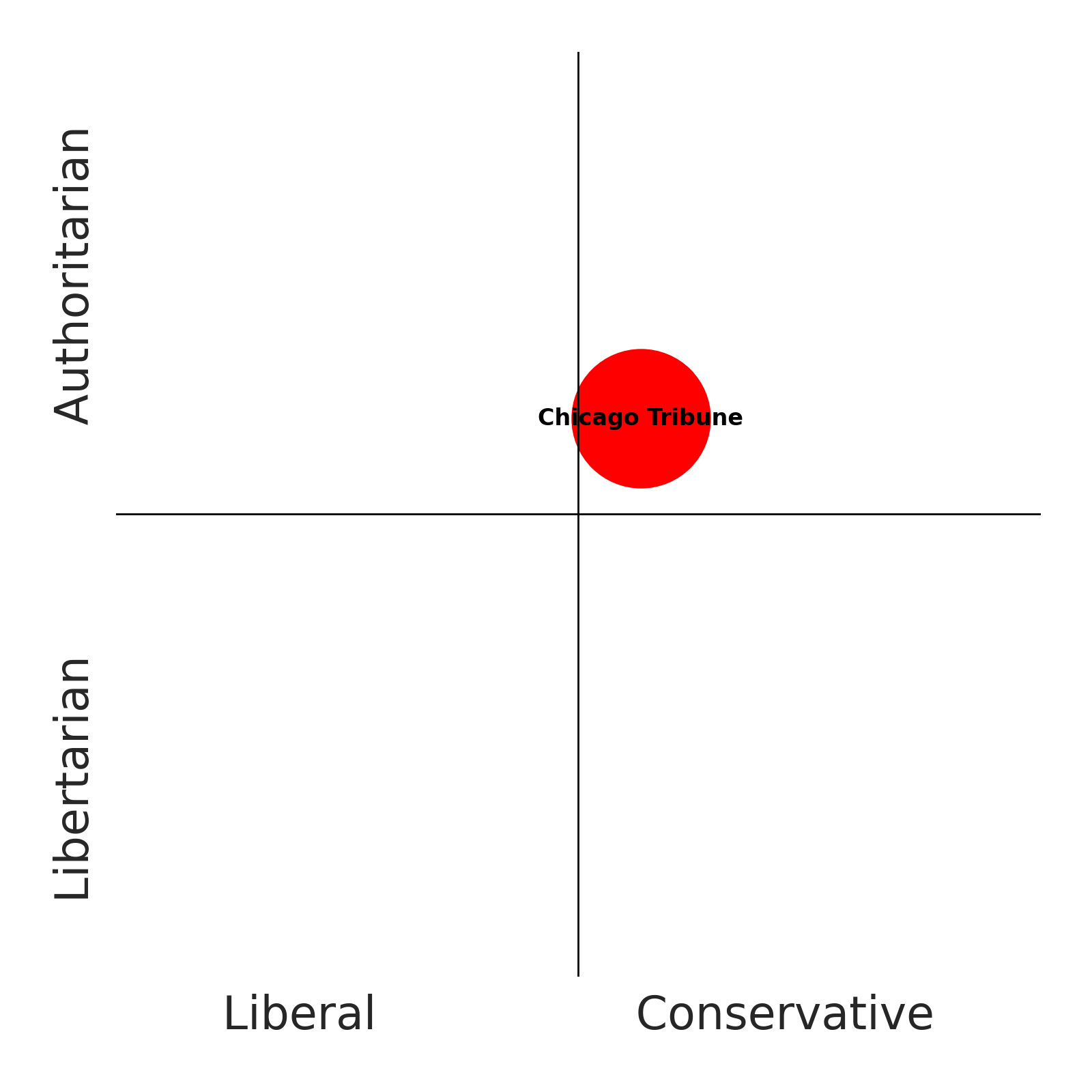
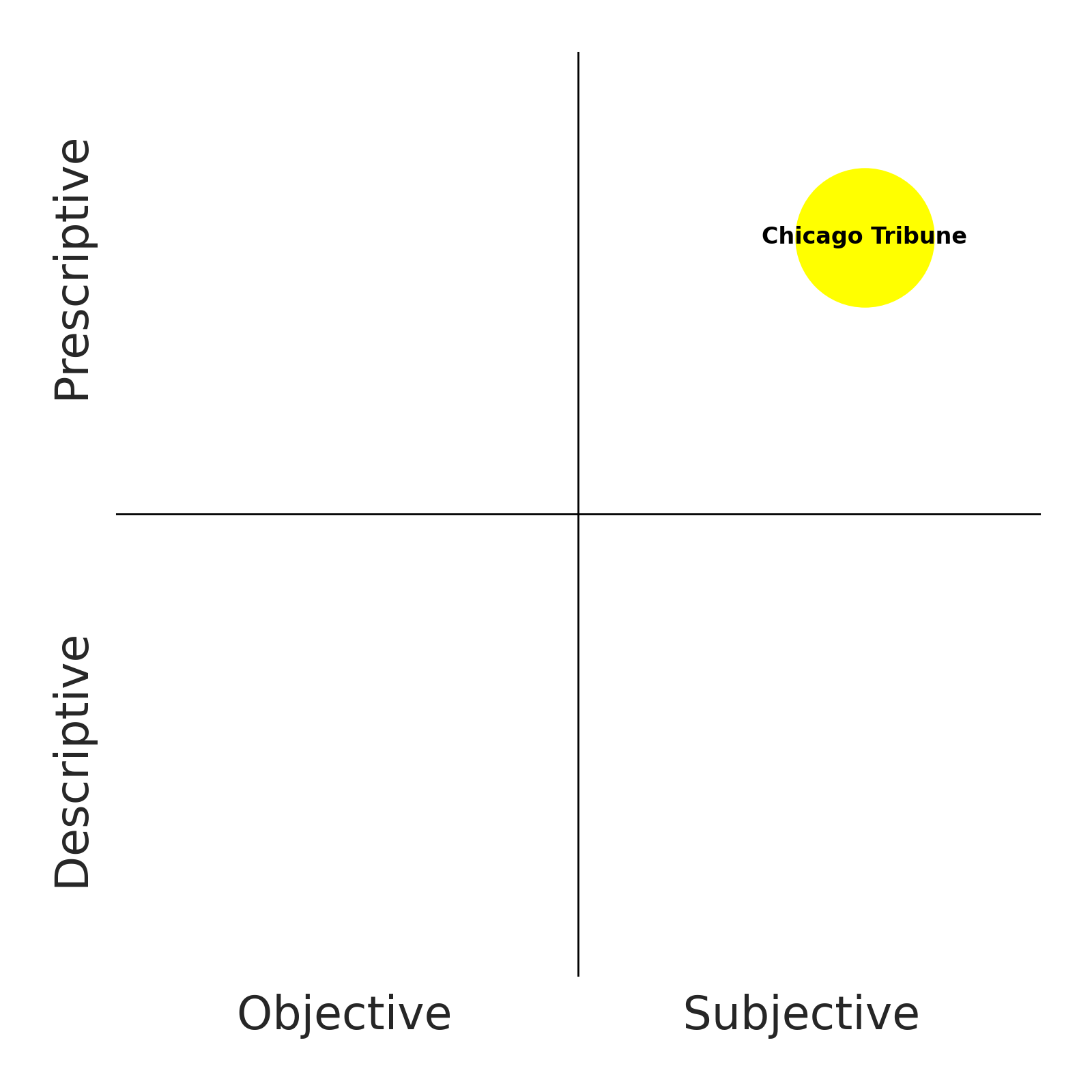
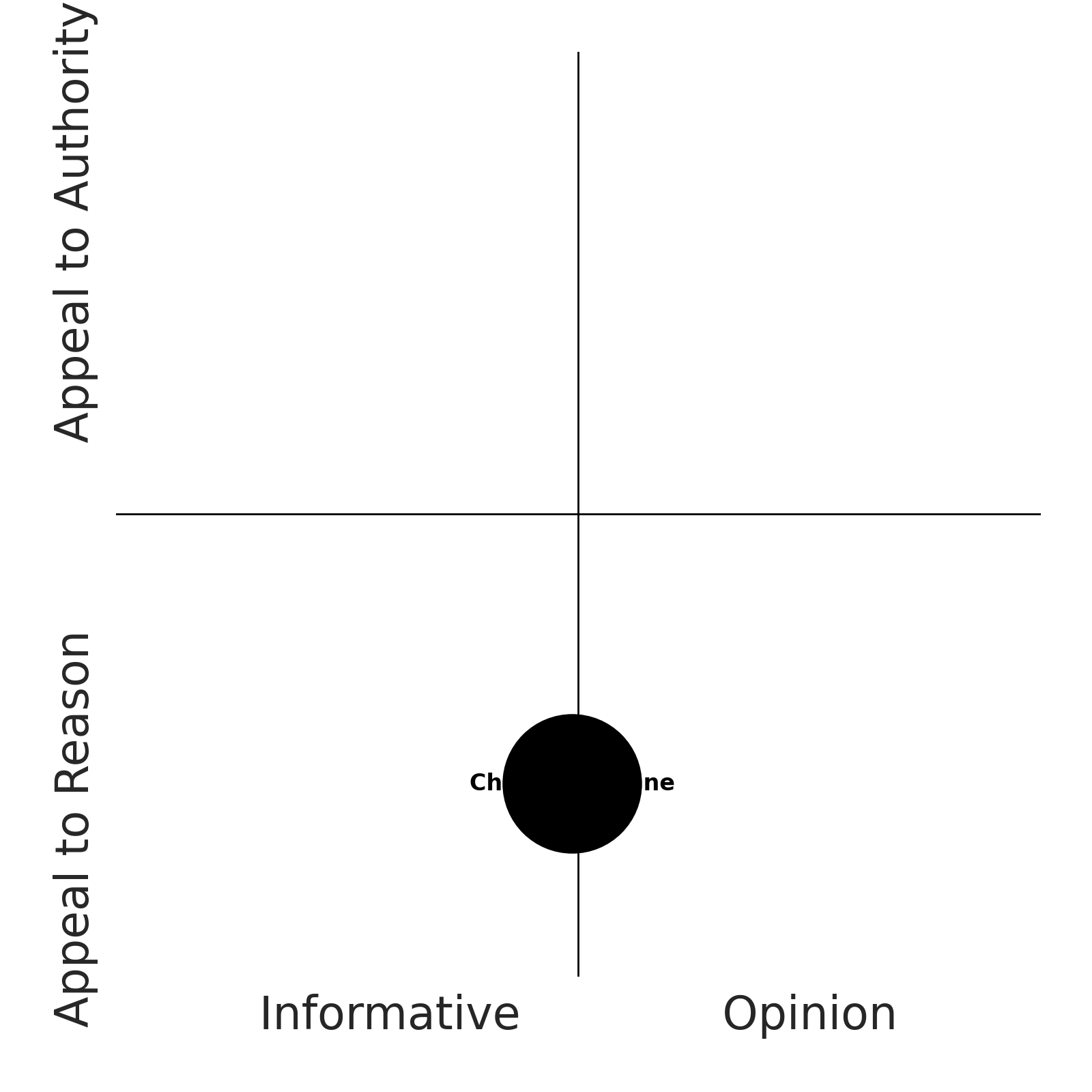
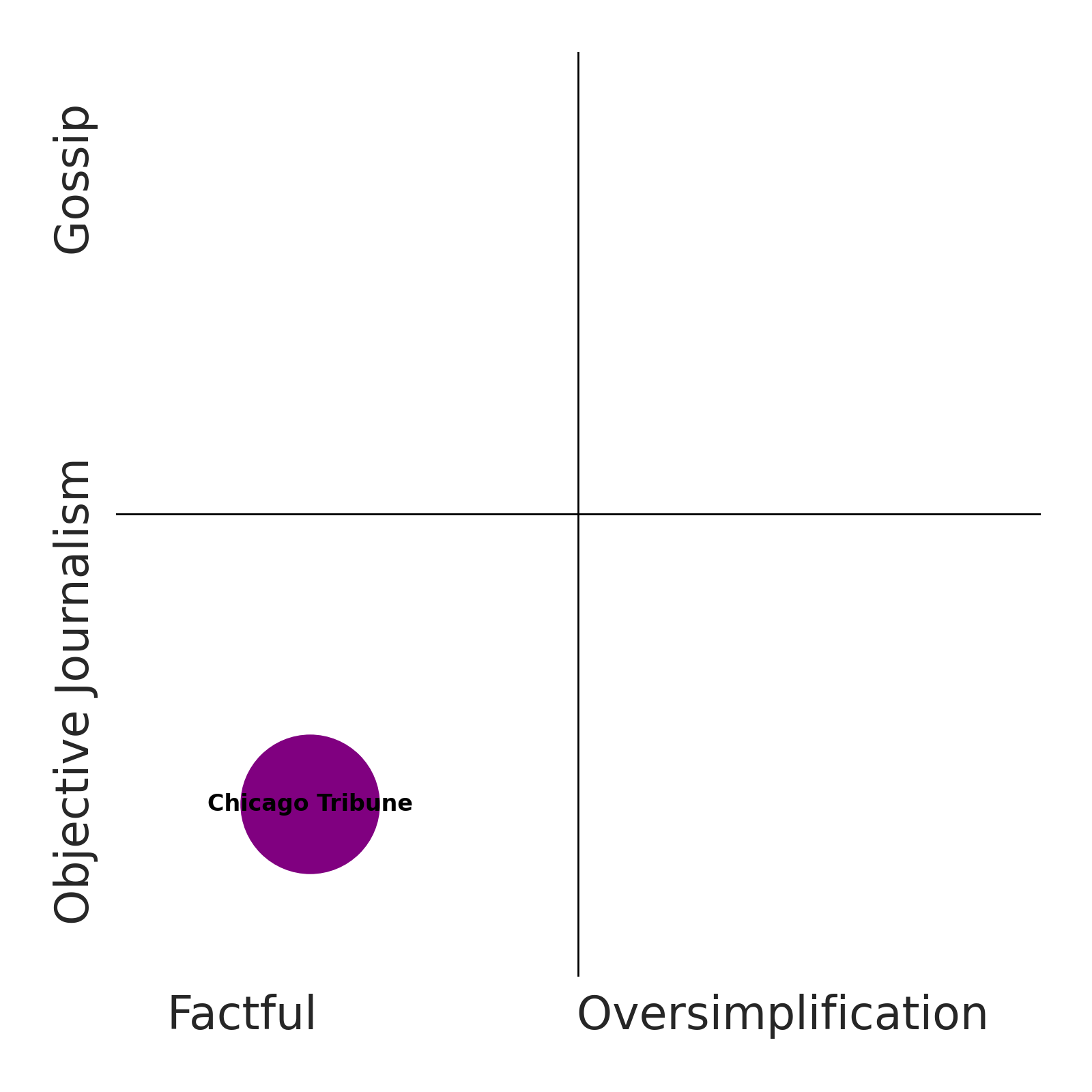
2026 © Helium Trades
Privacy Policy & Disclosure
* Disclaimer: Nothing on this website constitutes investment advice, performance data or any recommendation that any particular security, portfolio of securities, transaction or investment strategy is suitable for any specific person. Helium Trades is not responsible in any way for the accuracy
of any model predictions or price data. Any mention of a particular security and related prediction data is not a recommendation to buy or sell that security. Investments in securities involve the risk of loss. Past performance is no guarantee of future results. Helium Trades is not responsible for any of your investment decisions,
you should consult a financial expert before engaging in any transaction.
Helium Research Assistant

How can I help you today?
Ask any question about Chicago Tribune bias.


