See whether Helium helps you make better-informed decisions. Try every Pro Trader feature for 30 days. No credit card required.
Try every Pro Trader feature for 30 days. No credit card required.
October 04, 2026 · 0 shares
A conservative culture-war polemic that frames the National Book Foundation's diversity-oriented nonfiction longlist as absurd 'woke' theater and argues the awards have lost cultural relevance.
Automated analysis; not human reviewed. Limitations: The supplied text is a single concatenated block mixing headline, body, author bio, and boilerplate; I cannot verify the original layout, so headline/body attribution may be imperfect. · 14 of 55 available dimensions scored; omitted dimensions are not treated as neutral. · Verified supporting quotes for 12 of 14 scored dimensions.
Claim: The article uses conservative culture-war terminology to characterize the National Book Foundation's longlist as absurd and 'woke.'
“A cri de coeur against white paint joins other DEI-themed absurdities as a finalist for the organization’s increasingly irrelevant nonfiction award.” · exact text match
Why: The phrase 'DEI-themed absurdities' and 'increasingly irrelevant' explicitly frame the foundation's diversity focus as a negative conservative talking point.
Claim: The article adopts a populist tone, contrasting the 'posh' gala location with 'the capitalist heart of New York' while mocking foundation insiders.
“No trace of irony about that choice of location in the capitalist heart of New York seems to have crossed the minds of the organizers or nominees—and why would it?” · exact text match
Why: The passage mocks the foundation's elite setting and perceived lack of self-awareness, a populist framing.
Claim: The article is a subjective opinion piece that uses sarcasm and evaluative language.
“Walters finds herself in impeccable DEI company.” · exact text match
Why: The word 'impeccable' is sarcastic, and the overall piece is a polemic rather than neutral reporting.
Claim: The article uses a satirical hook about a book-length attack on white paint.
“A Dead White: An Argument Against White Paint” · exact text match
Why: The unusual book premise makes the piece more interesting.
Claim: The article prescribes changes to the National Book Foundation's direction.
“the foundation would be wise to do some rethinking soon” · exact text match
Why: 'Would be wise to do some rethinking' is explicit prescription.
Claim: The article is heavily opinionated.
“A cri de coeur against white paint joins other DEI-themed absurdities as a finalist for the organization’s increasingly irrelevant nonfiction award.” · exact text match
Why: The headline sentence is a strong evaluative opinion.
Claim: The article frames the book award in terms of the political culture war over DEI.
“If the National Book Foundation and its well-mocked awards continue valorizing woke absurdity, those numbers won’t improve.” · exact text match
Why: The term 'woke absurdity' places the dispute in an explicitly political context.
Claim: The article draws a simplified causal link between the foundation's DEI selections and the decline in reading.
“If the National Book Foundation and its well-mocked awards continue valorizing woke absurdity, those numbers won’t improve.” · exact text match
Why: The statement asserts a direct causal connection between the longlist and readership decline without controlling for other factors.
Claim: The article advances a consistent free-market, anti-woke ideological perspective.
“Walters finds herself in impeccable DEI company.” · exact text match
Why: The framing reflects a broader ideological opposition to DEI in cultural institutions.
Claim: The article is critical of a cultural establishment institution, the National Book Foundation.
“The National Book Foundation’s November 18 gala awards ceremony will be held at Cipriani Wall Street, one of Manhattan’s poshest commercial event spaces.” · exact text match
Why: The detail about the posh venue frames the foundation as out-of-touch, an anti-establishment critique.
Claim: The article uses sarcasm and mockery.
“Walters is so exercised by white paint, for which she professes 'a genuine and visceral dislike'” · not found in supplied text
Why: 'So exercised' is condescending and emotionally charged.
Claim: The article cites specific financial and statistical data but presents it within an opinionated frame.
“The foundation’s 2025 tax filing reported nearly $2.9 million in revenue.” · exact text match
“only 16 percent of Americans still read for pleasure as of 2023” · exact text match
Why: The inclusion of verifiable figures lends partial credibility, but the editorializing reduces overall trustworthiness.
Claim: The article cites empirical data but pairs it with a strong causal claim that goes beyond the evidence.
“According to a study released last year, only 16 percent of Americans still read for pleasure as of 2023, compared with a high of 28 percent in 2004.” · not found in supplied text
Why: The study citation provides an empirical anchor, but the surrounding argument attributes the decline to the foundation's DEI selections without evidence.
Claim: The article uses loaded language and one-sided framing.
“DEI-themed absurdities” · exact text match
“well-mocked awards” · exact text match
Why: The terms 'absurdities' and 'well-mocked' frame the subject negatively without neutral alternatives.
The supplied text is a single concatenated block mixing headline, body, author bio, and boilerplate; I cannot verify the original layout, so headline/body attribution may be imperfect.
The Indian-American immigration debate is framed through a conservative assimilationist lens that dismisses both left- and right-wing racialist interpretations as 'two lies.'
Automated analysis; not human reviewed. Limitations: The supplied text appears truncated and contains duplicated passages, so the analysis is limited to the visible complete fragments. · 7 of 55 available dimensions scored; omitted dimensions are not treated as neutral. · Verified supporting quotes for 7 of 7 scored dimensions.
Claim: The article's framing advances conservative positions on immigration and colorblind equality.
“I believe the best path forward is to slow down the flow of immigration to match our capacity to assimilate newcomers, to focus on building a shared national identity, and to initiate an honest debate about what kinds of institutions we want in America.” · exact text match
Why: The preferred policy—slowing immigration and building national identity—is a standard conservative restrictionist position, and the essay frames the I-1000 fight as upholding colorblind equality against left-wing racialism.
Claim: The essay is explicitly the author's personal interpretation and argument rather than neutral reporting.
“I see three great questions in this conversation: assimilation, immigration, and culture.” · exact text match
“I believe the best path forward is to slow down the flow of immigration to match our capacity to assimilate newcomers, to focus on building a shared national identity, and to initiate an honest debate about what kinds of institutions we want in America.” · exact text match
Why: Repeated first-person framing marks the text as subjective commentary and advocacy rather than objective reporting.
Claim: The article is predominantly prescriptive, telling Americans what they should do about immigration and national identity.
“We should use tests to identify natural talent, reward those who work hard, and judge individuals without regard to race.” · exact text match
Why: The 'we should' construction directly prescribes policy and cultural priorities.
Claim: The article is heavily opinionated, openly advocating a specific policy agenda and normative judgments.
“I believe the best path forward is to slow down the flow of immigration to match our capacity to assimilate newcomers, to focus on building a shared national identity, and to initiate an honest debate about what kinds of institutions we want in America.” · exact text match
Why: The author states a personal policy preference with normative urgency, and the essay is structured as advocacy.
Claim: The article is highly political, framing immigration as a factional conflict and a policy choice.
“The post was a gift to two groups: the racialist Left and the racialist Right.” · exact text match
“These are policy choices, and it is perfectly legitimate for Americans to demand different ones.” · exact text match
Why: It locates the debate between political factions and treats immigration as a matter of legitimate political demand.
Claim: The article reduces complex viewpoints to two 'racialist' factions and characterizes entire civilizational cultures in broad terms.
“The post was a gift to two groups: the racialist Left and the racialist Right.” · exact text match
“While something like the sharia culture of the Islamic world provides an acute contrast, the high-stakes testing cultures of countries like India and China entail more subtle tradeoffs.” · exact text match
Why: It compresses the debate into mirror-image lies and contrasts cultures with sweeping generalizations.
Claim: The article presents sweeping, contestable assertions as settled truths beyond the evidence it supplies.
“These two lies are mirror images of each other.” · exact text match
“Whatever the skill level or country of origin, mass immigration always carries a risk of increasing cultural tensions, balkanization, nepotism, and dislocation.” · exact text match
Why: The phrases 'two lies' and 'always carries' present strongly generalized judgments without supporting data or direct evidence.
The supplied text appears truncated and contains duplicated passages, so the analysis is limited to the visible complete fragments.
A conservative policy analysis frames homelessness progress as a product of stricter enforcement, criminal sanctions, and the rollback of progressive Housing First orthodoxy.
Automated analysis; not human reviewed. Limitations: The supplied text repeats itself and includes donation boilerplate; analysis is based on the substantive opinion body without external verification of cited statistics. · 13 of 55 available dimensions scored; omitted dimensions are not treated as neutral. · Verified supporting quotes for 11 of 13 scored dimensions.
Claim: The publisher frames homelessness and disorder through conservative critiques of blue-state governance and progressive policy orthodoxy.
“California and other blue states’ failure to get public disorder under control has helped reduce levels of trust in government to record lows.” · exact text match
“Grants Pass greenlighted the enforcement of camping bans, striking a blow for accountability.” · exact text match
Why: The opening critique of blue states and praise for enforcement and criminal sanctions reflect a conservative policy orientation.
Claim: The article treats government enforcement, criminal sanctions, and behavioral conditions as necessary solutions.
“Grants Pass greenlighted the enforcement of camping bans, striking a blow for accountability.” · exact text match
“Offenders in California now face more consequences for their behavior than they did a decade ago.” · exact text match
Why: The article celebrates the Supreme Court's permission to enforce camping bans and California's restoration of criminal consequences, placing it toward the authoritarian pole.
Claim: The essay is a value-laden opinion analysis rather than neutral reporting.
“Housing First proponents acted imperialistically, appropriating vast portions of the billions in new government funding authorized to improve street conditions—yet homelessness continued to surge.” · exact text match
“In typical American fashion, adding another governmental layer only made the tensions worse.” · not found in supplied text
Why: Loaded evaluative language and sweeping generalizations about 'typical American fashion' and 'imperialistically' mark this as subjective commentary.
Claim: The article uses emotionally charged wording to dramatize street disorder.
“Extreme disorder reigned not only because of judicial activism but also because of progressive officials’ commitment to Housing First.” · exact text match
“notorious for their “medieval” public-health conditions, sexual exploitation, and despair.” · exact text match
Why: Terms like 'extreme disorder' and 'medieval' conditions add dramatic intensity, though the article also includes sober data.
Claim: The article is cautiously optimistic that the direction of homelessness policy has improved.
“America is tackling homelessness much more effectively than just five years ago.” · exact text match
“Though street conditions in West Coast cities are still bad, the nature of the crisis has changed, as Democrats are bringing more accountability to the homelessness problem.” · exact text match
Why: The article emphasizes improvement while acknowledging remaining problems, yielding a mildly optimistic tone.
Claim: The article is prescriptive, endorsing specific policy changes and warning about political obstacles.
“Grants Pass greenlighted the enforcement of camping bans, striking a blow for accountability.” · exact text match
“The center-left has thwarted homelessness policy reform before.” · exact text match
Why: The essay evaluates policies as 'constructive' or failures and urges sustaining reforms, making it prescriptive.
Claim: The essay is heavily opinionated, with evaluative judgments throughout.
“Housing First proponents acted imperialistically, appropriating vast portions of the billions in new government funding authorized to improve street conditions—yet homelessness continued to surge.” · exact text match
“In typical American fashion, adding another governmental layer only made the tensions worse.” · not found in supplied text
Why: The repeated use of charged evaluative phrases demonstrates a strongly opinionated stance.
Claim: The article centers partisan and electoral contests, framing homelessness as a political battleground.
“Whether the recent gains can be sustained will hinge substantially on November’s midterm election results.” · exact text match
“If Democrats score decisive wins in the midterms, homelessness will become one front in the struggle between the party’s center-left and far-left wings.” · exact text match
Why: The article ties homelessness policy outcomes directly to midterm elections and Democratic Party infighting.
Claim: The analysis consistently applies a conservative free-market think-tank lens to homelessness policy.
“Housing First proponents acted imperialistically, appropriating vast portions of the billions in new government funding authorized to improve street conditions—yet homelessness continued to surge.” · exact text match
“Far-left Democrats in Congress will want to countermand Trump’s reforms to the Continuum of Care.” · exact text match
Why: The article frames progressive homelessness orthodoxy as an imperialist failure and treats Trump-administration reforms as progress, reflecting a coherent ideological viewpoint.
Claim: The article demonstrates visible sourcing and attribution for its key factual claims.
“According to a recent Public Policy Institute of California study” · exact text match
“The most recent version, which details numbers collected in January 2025, shows” · exact text match
Why: Named study, federal count, and court case are attributed, but the piece remains an opinion essay with no independent verification mechanism.
Claim: The article makes conditional forecasts about future policy based on elections and political dynamics.
“Whether the recent gains can be sustained will hinge substantially on November’s midterm election results.” · exact text match
“If Democrats score decisive wins in the midterms, homelessness will become one front in the struggle between the party’s center-left and far-left wings.” · exact text match
Why: The article explicitly predicts how midterm outcomes and party factions could shape homelessness policy.
Claim: The article shows internally observable fairness by citing contrary data and acknowledging limits.
“The most recent version, which details numbers collected in January 2025, shows that both street and chronic (i.e., disabled and long-term) homelessness remain at or near record highs.” · exact text match
“There’s still a long way to go, but America is tackling homelessness much more effectively than just five years ago.” · exact text match
Why: Including record-high federal counts while advocating reform suggests the author is not hiding inconvenient evidence.
Claim: The article builds its argument with named data sources, legal cases, and survey statistics.
“According to a recent Public Policy Institute of California study, Prop. 47’s effective decriminalization of drug and drug-related offenses not only increased street homelessness and drug use but also reduced the use of drug treatment programs.” · exact text match
“Every year, the federal government publishes a report for the nation as a whole. The most recent version, which details numbers collected in January 2025, shows that both street and chronic (i.e., disabled and long-term) homelessness remain at or near record highs.” · exact text match
Why: It cites specific studies, dates, and legal rulings, demonstrating a structured and evidence-informed argument.
The supplied text repeats itself and includes donation boilerplate; analysis is based on the substantive opinion body without external verification of cited statistics.
October 08, 2026 · 0 shares
The article adopts a strongly conservative, anti-drug-legalization, law-and-order framing that portrays a Canadian court ruling as illegitimate judicial activism driven by junk science and credulous judges.
Canada's Charter of Rights and Freedoms, adopted in 1982, includes Section 7 guaranteeing 'life, liberty, and security of the person' and a notwithstanding clause allowing legislative override of certain rights.
Automated analysis; not human reviewed. · 55 of 55 available dimensions scored; omitted dimensions are not treated as neutral. · Verified supporting quotes for 9 of 55 scored dimensions.
Claim: The article frames the ruling as illegitimate judicial activism and advocates for law-and-order remedies.
“Though the ruling is clear judicial activism, it could nevertheless impose drug legalization across Canada unless it successfully appealed.” · exact text match
Why: The publisher endorses a conservative law-and-order position and criticizes judicial expansion of drug access rights.
Claim: The article favors state enforcement against drug trafficking over individual liberty claims.
“criminalizing drug trafficking is unconstitutional” · exact text match
Why: By defending prohibition enforcement and criticizing the expansion of drug access rights, the article leans authoritarian on drug policy.
Claim: The article uses highly subjective, value-laden language rather than neutral reporting.
“Incredibly, Justice Catherine Murray of the B.C. Supreme Court agreed with their arguments.” · exact text match
Why: Words like 'incredibly' and 'junk science' signal subjective judgment rather than detached description.
Claim: The article is heavily opinionated, presenting strong normative judgments throughout.
“Junk science, though, does not become reliable simply because serious research is impractical or unavailable.” · exact text match
Why: The publisher directly asserts a contentious evaluative claim about the research rather than merely reporting it.
Claim: The article is deeply political, centered on constitutional law, judicial power, and drug policy.
“She took it upon herself to impose an enormously consequential and highly contentious drug policy reform through judicial fiat.” · exact text match
Why: The framing is explicitly about political-legal contestation and the proper limits of judicial authority.
Claim: The article is strongly ideological, consistently advancing a free-market think-tank policy perspective against harm reduction.
“None of these remedies would be necessary in a more rational world, but, alas, such steps are necessary in the face of Canadian judicial activism.” · exact text match
Why: The conclusion frames opposition to the ruling as the only rational position, reflecting a tightly ideological stance.
Claim: The article conveys negative affect toward the ruling and its supporters.
“Thankfully, the case can still be appealed.” · exact text match
Why: The word 'thankfully' expresses a clearly negative emotional stance toward the ruling being final.
Claim: The article cites specific studies, reports, and court rulings but is openly polemical.
“a 2024 study conducted by Vancouver’s Infectious Disease Centre showed, via urine tests, that drug users regularly deceive researchers” · exact text match
Why: It references concrete evidence and named sources, though the presentation is one-sided and advocacy-oriented.
Claim: The article emphasizes individual responsibility and the harms of collective drug liberalization.
“no sane policymaker or judge should believe that frequent drug users—who are known to lie and manipulate those around them to acquire drugs—are being honest simply because they say so” · exact text match
Why: The framing treats drug users as individually culpable and dismisses collectivist harm-reduction rationales.
Claim: The article engages with constitutional law, research methodology, and policy arguments at a moderately sophisticated level.
“She noted that Kalicum and Nyx had 'repeatedly advised members of the need to be candid,' and that two compassion club members had testified in court that they 'felt free to be candid.'” · not found in supplied text
Why: It discusses response bias, study design, and Charter interpretation, showing above-average policy literacy.
October 12, 2026 · 0 shares
Overt conservative advocacy casting the Trump census proposal as a decisive strike against a Left supposedly weaponizing demographic categories to fracture the nation, complete with appeals for readers to lobby the rulemaking process before a deadline.
Automated analysis; not human reviewed. Limitations: Supplied text is truncated mid-sentence and contains duplicated paragraph blocks, and the magazine's name is cut off, so the full arc of the argument is unavailable; as a bylined opinion column, the publisher framing scored here is the named author's advocacy. · 24 of 55 available dimensions scored; omitted dimensions are not treated as neutral. · Verified supporting quotes for 24 of 24 scored dimensions.
Claim: The column is unambiguously conservative, endorsing Trump administration policy and framing the Left as the adversary.
“It deserves our support in this effort.” · exact text match
“the corrosive doctrine of disparate impact” · exact text match
Why: Explicit endorsement of Trump policy plus hostile framing of leftist ideas and race-conscious law place the piece firmly at the conservative pole.
Claim: The framing pits ordinary, politically disengaged Americans against activist and bureaucratic elites.
“especially conservatives and nonactivists minding their own business and trying to make ends meet” · exact text match
“a society manipulated by interest groups” · exact text match
Why: People-versus-activist-elite framing is populist in direction, though the piece is written from elite think-tank platforms, limiting the score.
Claim: The content is openly normative commentary rather than neutral reporting.
“But no move is more vital than its proposal to eliminate race, ethnicity, and sexual preference from the U.S. Census.” · exact text match
Why: Superlative value judgments and sustained advocacy mark the piece as subjective opinion.
Claim: Dramatic framing raises the stakes beyond a sober register.
“In the wrong hands, a census can change the character of a republic.” · exact text match
Why: Apocalyptic framing such as 'cultural balkanization' and this warning is mildly sensational while the substance stays policy-focused.
Claim: The dominant outlook is alarm about deepening national division, tempered by hope in the proposed fix.
“But America’s focus on race has unsurprisingly failed to produce the desired results.” · exact text match
“At that point, he warned, “the cultural divide in America will be formalized.”” · exact text match
Why: Warnings of cultural fragmentation and failed race policy outweigh the hopeful closing, tilting the tone pessimistic.
Claim: The column offers an unusual, historically grounded argument that census labeling itself shapes identity.
“The Indo-European root of the word “census” means “to evoke in speech, almost to call a thing into existence by naming it,”” · exact text match
Why: Etymology, bureaucratic history, and a live rulemaking give the argument substantive novelty despite its partisanship.
Claim: The column is heavily prescriptive, directing officials and readers on what to do.
“The best way to support the proposal is to go to the Federal Register, submit a comment supporting it, and then ask that a question on citizenship be added.” · exact text match
Why: Normative directives ('should hold the line,' 'should absolutely do so') and mobilization instructions dominate the piece.
Claim: The column uses urgency and warning language to press for immediate action.
“There’s no time to waste, as the comment period ends on November 2.” · exact text match
Why: Deadline urgency and warnings of a formalized cultural divide create mild fear-based pressure without rage-baiting.
Claim: The argument presupposes that census categories are the source of national division rather than demonstrating it.
“Trump’s Census proposal revives Washington’s vision by attacking the source of the problem: racial, ethnic, and sexual preference categories.” · exact text match
Why: The conclusion that removing categories will heal division rests on the asserted premise that the categories cause the division.
Claim: The content is an explicitly argued opinion column rather than factual reporting.
“These changes are significant and worthy of support.” · exact text match
Why: Sustained advocacy, value judgments, and calls to action define the piece as opinion.
Claim: The content is intensely political, built on a partisan conflict frame.
“The boldness of the proposal seems to have caught the Left off guard, but the Trump administration should hold the line against the inevitable blowback.” · exact text match
Why: A Trump-versus-the-Left conflict frame structures the entire argument.
Claim: The column reduces complex social divisions to census categories and activist schemes.
“At the policy level, the Census reforms will help on fronts where the administration is already fighting elsewhere with other measures, eliminating several societal ills.” · exact text match
Why: Attributing disparate-impact doctrine, admissions preferences, and voting-district rulings to one administrative lever oversimplifies causation.
Claim: The column leans on named scholars and founding-era authority to legitimize contested claims.
“As the sociologist Nathan Glazer wrote in 2002, “As we follow this process further and further into the details that have shaped the census, the element of nobility declines.”” · exact text match
Why: Nicolet, Mora, Glazer, Huntington, and Washington are repeatedly invoked to carry normative and causal weight.
Claim: The column asserts with certainty outcomes the cited evidence cannot establish.
“Eliminating race and ethnicity tabulation from the decennial questionnaire will help dismantle identity politics and the grievance industry.” · exact text match
Why: Definitive predictions about societal effects of an unimplemented rule exceed the supporting evidence presented.
Claim: The column argues within a fixed anti-Left ideological framework rather than open inquiry.
“The Census is a frequently overlooked theater in that struggle.” · exact text match
Why: Framing administrative policy as a front in an ideological war presumes the author's worldview throughout.
Claim: The emotional register tilts negative, driven by indignation at the Left's influence.
“The Census’s racial questions are a betrayal of the vision of the American Founders” · exact text match
Why: Indignant, alarm-laden language dominates, though hope about the proposal tempers the overall valence.
Claim: The column cites checkable sources and quotes the rule text directly, supporting moderate credibility for an opinion piece.
“Trump’s proposed rule states: “No question about race, ethnicity, or sexual orientation shall appear on the short form decennial census questionnaire” · exact text match
Why: Direct quotation of the proposal and named scholarly works provide verifiable sourcing, though contested causal claims are unhedged.
Claim: The column argues from cited history but overreaches with sweeping, unsupported causal claims.
“For nearly four decades, leftists have used the Census to do just that, fragmenting the U.S. into a nation of groups, some of them invented.” · exact text match
Why: Scholarly citations and direct quotes of the rule show structured argument, while blanket causal assertions pulled toward polemic reduce the rational score.
Claim: The column favors colorblind individual treatment over official group categorization.
“should be colorblind and should not be distorted in any way by questions about immaterial personal characteristics, such as race” · exact text match
Why: Opposition to group-based categories and preferences leans individualist, tempered by the piece's assimilationist nationalism.
Claim: The column forecasts the rule's societal effects and the Left's future plans.
“If the Left’s plans to add MENA to the 2030 Census succeed, it may become the next official ethnicity in the public mind.” · exact text match
Why: Hedged forecasts about 2030 and asserted future benefits of the rule add a speculative layer, though most content is historical.
Claim: The column uses loaded labels and motive attribution against opponents.
“The activists cloaked each of these actions in the rhetoric of noble intent.” · exact text match
Why: Dismissing opponents' motives as cloaked rhetoric, plus labels like 'grievance industry,' are observable loaded-framing techniques.
Claim: The text shows strong human-authorship markers and no AI-pattern indicators.
“I remember it happening: my uncle, a journalist, walked into our semi-detached home in Queens in the 1970s and announced, “They’re going to start calling us Hispanics.”” · exact text match
Why: Specific autobiographical anecdote and idiosyncratic personal voice are strong human indicators; no repeated AI-prose patterns appear.
Claim: The column shows some fairness signals, conceding flaws and citing an adverse-source scholar accurately, while remaining one-sided.
“The proposal itself is not perfect.” · exact text match
“UCLA sociologist Cristina Mora, who is sympathetic to the creation of the Hispanic category” · exact text match
Why: Acknowledged imperfections and accurate quotation of a scholar who favors the categories modestly offset the otherwise one-sided advocacy.
Claim: The column is a well-constructed, historically informed argument despite one-sidedness.
“Few used these terms before the Office of Management and Budget created them in 1977 and added them to the Census for the first time in 1980.” · exact text match
Why: Specific dated historical claims, scholarly sourcing, and direct engagement with the rule text show above-average craft.
Supplied text is truncated mid-sentence and contains duplicated paragraph blocks, and the magazine's name is cut off, so the full arc of the argument is unavailable; as a bylined opinion column, the publisher framing scored here is the named author's advocacy.
September 30, 2026 · 0 shares
Framing condemns San Francisco's housing of sex offenders in the Tenderloin as a taxpayer-funded failure that endangers children while ignoring voters' will, using emotionally loaded terms such as 'pedophile houses' and 'predators' to characterize city policy.
Automated analysis; not human reviewed. Limitations: The supplied article text is truncated and contains partial sentences, which may omit context or later sections of the piece. · 16 of 55 available dimensions scored; omitted dimensions are not treated as neutral. · Verified supporting quotes for 14 of 16 scored dimensions.
Claim: The article frames San Francisco's sex offender housing policy as a failure of liberal governance.
“Instead of listening to California voters, San Francisco has become a taxpayer-funded dumping ground for sex criminals.” · exact text match
Why: The framing contrasts 'California voters' with San Francisco's government, using the loaded phrase 'dumping ground for sex criminals.'
Claim: The article positions ordinary residents and voters against city officials.
“Instead of listening to California voters, San Francisco has become a taxpayer-funded dumping ground for sex criminals.” · exact text match
Why: The framing pits 'California voters' against San Francisco's city government, a classic populist contrast.
Claim: The article blends reported facts with editorialized judgment.
“But the pedophile houses are not restricted to low-income areas like the Tenderloin.” · exact text match
Why: The term 'pedophile houses' is an editorial label rather than a neutral description.
Claim: The article uses sensational, fear-evoking language.
“crawling with sex offenders” · exact text match
“predators leering at her family from across the street” · exact text match
Why: Phrases like 'crawling with' and 'predators leering' are designed to evoke fear and disgust.
Claim: The article portrays the situation as a persistent, unresolved problem.
“Despite his conduct, Adams was relocated to Taylor Street, where he continued to exhibit 'increased sexual deviance related to minors'” · not found in supplied text
Why: Emphasizes the failure of the system to protect children despite prior convictions.
Claim: The article describes a problem and implies a prescription.
“They do all of this despite statewide efforts to ban concentrating pedophiles so close to children.” · exact text match
Why: The word 'despite' implies the concentration should not be happening.
Claim: The article supports stricter residency restrictions for sex offenders.
“Fresno County enacted new restrictions earlier this year to limit the number who can live in one residential property to six.” · exact text match
Why: The article presents Fresno's restrictions as a positive development, suggesting support for harsher measures.
Claim: The article uses fear of sex offenders near children as its primary emotional register.
“crawling with sex offenders” · exact text match
“predators leering at her family from across the street” · exact text match
Why: The imagery of 'predators leering' at children evokes a direct threat to families.
Claim: The article is heavily opinionated rather than purely factual.
“San Francisco has become a taxpayer-funded dumping ground for sex criminals” · exact text match
Why: This is an editorial judgment presented as part of the article's framing.
Claim: The article is politically charged, criticizing a city's governance.
“Instead of listening to California voters” · exact text match
Why: Frames the issue as a political failure.
Claim: The article centers a victim's experience to argue against the policy.
“couldn't even 'get my kids buckled into the car' without predators leering at her family” · not found in supplied text
Why: The mother's testimony is used to illustrate the policy's harm.
Claim: The article makes categorical predictions without qualification.
“Any sex offender housed in the Tenderloin is bound to encounter children.” · exact text match
Why: 'Is bound to' is a definitive prediction that exceeds the supplied evidence.
Claim: The article is critical of San Francisco's governing establishment.
“Instead of listening to California voters, San Francisco has become a taxpayer-funded dumping ground for sex criminals.” · exact text match
Why: Positions the city government as unaccountable to voters.
Claim: The article mixes data with emotional appeals.
“It can cost the city $30,000 to $40,000 per resident annually” · exact text match
“pedophile houses” · exact text match
Why: Alongside budget figures, the article uses emotionally loaded terms.
Claim: The article speculates about future encounters.
“Any sex offender housed in the Tenderloin is bound to encounter children.” · exact text match
Why: This is a prediction about the future stated as certainty.
Claim: The article uses loaded framing and one-sided selection of examples.
“taxpayer-funded dumping ground” · exact text match
“pedophile houses” · exact text match
Why: These terms frame the issue in a way that forecloses alternative interpretations.
The supplied article text is truncated and contains partial sentences, which may omit context or later sections of the piece.
An opinionated headline frames California's billionaire tax as a policy mistake that ignores a basic principle of investment-gain taxation.
Automated analysis; not human reviewed. Limitations: The supplied text contains only a headline, a standfirst, and publication boilerplate; no article body was available for analysis. · 4 of 55 available dimensions scored; omitted dimensions are not treated as neutral. · Verified supporting quotes for 4 of 4 scored dimensions.
Claim: The publisher takes a conservative-leaning economic position against a billionaire wealth tax.
“California’s billionaire tax overlooks a basic lesson about how investment gains should be taxed.” · exact text match
Why: Opposing a billionaire wealth tax and defending a principle of investment-gain taxation is a right-of-center economic stance, though the snippet lacks broader ideological content.
Claim: The publisher presents an evaluative opinion rather than a neutral factual report.
“The Trouble with Taxing Wealth.” · exact text match
“California’s billionaire tax overlooks a basic lesson about how investment gains should be taxed.” · exact text match
Why: The title's word 'trouble' and the standfirst's 'overlooks a basic lesson' are value-laden judgments rather than neutral descriptions.
Claim: The statement is a policy opinion presented as an asserted conclusion.
“California’s billionaire tax overlooks a basic lesson about how investment gains should be taxed.” · exact text match
Why: The text asserts a deficiency in tax policy without presenting supporting facts, data, or attributed analysis.
Claim: The content takes a side in a politically contested tax-policy issue.
“California’s billionaire tax overlooks a basic lesson about how investment gains should be taxed.” · exact text match
Why: State tax policy is a political subject, and the framing opposes a specific billionaire tax, making the text political rather than purely technical.
The supplied text contains only a headline, a standfirst, and publication boilerplate; no article body was available for analysis.
A one-sided free-market policy commentary uses loaded terms such as 'exodus' and 'hostile posture to capital' and selective warnings to frame high taxes and regulation as primary threats to urban prosperity.
Automated analysis; not human reviewed. Limitations: The text is an opinion commentary, and the cited Bloomberg, academic, and comptroller data could not be independently verified from the supplied excerpt. · 17 of 55 available dimensions scored; omitted dimensions are not treated as neutral. · Verified supporting quotes for 17 of 17 scored dimensions.
Claim: The commentary frames high taxes and regulation as primary threats to urban prosperity and warns New York and California.
“There’s a warning here for policymakers in New York and California who mistake their own jurisdictions’ economic advantages for protection against the consequences of their policy decisions.” · exact text match
“The cumulative effects of high taxes, burdensome regulations, and a generally hostile posture to capital can shift that calculation.” · exact text match
Why: Pro-market, tax-skeptical framing aligns with conservative economic policy.
Claim: The argument centers mobile billionaires, star scientists, and capital as the decisive actors for city prosperity.
“billionaires worth a combined $160 billion have left the United Kingdom or loosened their ties with the country over the past two years.” · exact text match
“Even people whose careers benefit from specialized professional networks respond to the financial advantages of relocation.” · exact text match
Why: Elite economic actors are centered as the key constituency rather than ordinary residents.
Claim: The commentary advocates lower taxes and less regulation while warning against policy costs on capital and business location.
“The cumulative effects of high taxes, burdensome regulations, and a generally hostile posture to capital can shift that calculation.” · exact text match
“For governments that preside over such productive economies, a reasonable starting principle is to do no harm.” · exact text match
Why: Pro-market, anti-tax, anti-regulation prescription aligns with libertarian direction.
Claim: The piece is an opinionated policy commentary with normative prescriptions rather than a neutral news report.
“For governments that preside over such productive economies, a reasonable starting principle is to do no harm.” · exact text match
“Policymakers overlook these effects when they point to successful businesses as proof that their jurisdictions can bear still higher costs.” · exact text match
Why: Normative recommendations and evaluative claims make the framing subjective.
Claim: Loaded phrasing such as 'exodus' and 'hostile posture to capital' heightens the warning.
“It’s a remarkable exodus for a country that has long been among the world’s most attractive destinations for the wealthy.” · exact text match
“The cumulative effects of high taxes, burdensome regulations, and a generally hostile posture to capital can shift that calculation.” · exact text match
Why: Strong evaluative language adds sensational emphasis beyond neutral description.
Claim: The article emphasizes decline, capital flight, and unrealized potential unless policy changes.
“A city can remain prosperous while steadily falling short of its potential.” · exact text match
“The damage may even be “irreversible.”” · exact text match
Why: Pessimistic warning about long-term erosion dominates the outlook.
Claim: It moves from describing economic effects to prescribing policy restraint.
“For governments that preside over such productive economies, a reasonable starting principle is to do no harm.” · exact text match
“Their task is to preserve the conditions that make people want to invest there.” · exact text match
Why: Explicit policy prescriptions dominate the conclusion.
Claim: The article is an advocacy commentary evaluating policy rather than a straight factual report.
“The political temptation is to mistake that extra room for immunity.” · exact text match
“Policymakers overlook these effects when they point to successful businesses as proof that their jurisdictions can bear still higher costs.” · exact text match
Why: Evaluative and argumentative claims signal high opinion content.
Claim: The central argument concerns tax policy and policymaker choices in New York and California.
“There’s a warning here for policymakers in New York and California who mistake their own jurisdictions’ economic advantages for protection against the consequences of their policy decisions.” · exact text match
“Policy can help set that process in motion.” · exact text match
Why: Tax and regulatory policy are the article’s central political subject.
Claim: The argument heavily relies on named economists, a Bloomberg analysis, and official data.
“According to a new Bloomberg analysis, billionaires worth a combined $160 billion have left the United Kingdom or loosened their ties with the country over the past two years.” · exact text match
“According to an analysis by economists Joshua Rauh and Ryan Shyu, the state’s 2012 tax increase on high earners prompted some affected taxpayers to leave and reduced the income reported by those who stayed.” · exact text match
Why: Named authorities and studies carry the evidentiary weight.
Claim: The commentary applies a consistent free-market, tax-skeptical lens to urban policy.
“The political temptation is to mistake that extra room for immunity.” · exact text match
“For governments that preside over such productive economies, a reasonable starting principle is to do no harm.” · exact text match
Why: A coherent ideological framework shapes the interpretation and prescription.
Claim: Claims are attributed to named sources and studies, though the piece remains one-sided advocacy.
“According to a new Bloomberg analysis” · exact text match
“According to an analysis by economists Joshua Rauh and Ryan Shyu” · exact text match
Why: Visible sourcing supports credibility, tempered by opinion framing.
Claim: The argument relies on named economic studies and models to make its case.
“Research by Richard Baldwin and Paul Krugman explains how these advantages can give governments room to impose higher taxes without immediately driving businesses away.” · exact text match
“In a 2017 study, Enrico Moretti and Daniel J. Wilson examined the location decisions of star scientists using decades of patent data.” · exact text match
Why: Systematic economic reasoning and cited research support a rational rather than emotive mode.
Claim: The article treats capital and business investment as beneficial and warns against a hostile posture to capital.
“The cumulative effects of high taxes, burdensome regulations, and a generally hostile posture to capital can shift that calculation.” · exact text match
“A firm may accept a larger tax bill because moving would mean sacrificing opportunities worth more than the savings.” · exact text match
Why: Pro-business, pro-capital framing is favorable to corporate interests.
Claim: The argument centers individual and firm location choices and market incentives rather than collective provision.
“A firm may accept a larger tax bill because moving would mean sacrificing opportunities worth more than the savings.” · exact text match
“Even highly specialized workers can be responsive to these economic changes.” · exact text match
Why: Individual and firm incentives drive the analysis, indicating individualist framing.
Claim: The article forecasts future capital and talent responses and warns of unseen consequences.
“The damage may even be “irreversible.”” · exact text match
“Over time, these decisions can also make the established center less attractive.” · exact text match
Why: Forward-looking causal predictions are central to the argument.
Claim: The article uses economic concepts, research citations, and a structured argument.
“Economists refer to these gains as “agglomeration.”” · exact text match
“In their model, taxes that get too high can drive capital out and undermine the agglomeration that previously kept it in place.” · exact text match
Why: Conceptual and research-based argumentation indicates high article intelligence.
The text is an opinion commentary, and the cited Bloomberg, academic, and comptroller data could not be independently verified from the supplied excerpt.
Framing promotes school choice as an encouraging family-empowering opportunity while portraying National Book Award finalists and Telluride's antiracism turn as 'woke' cultural decline.
Automated analysis; not human reviewed. Limitations: The supplied text is a roundup of multiple linked City Journal essays, with many judgments attributed to named authors, so the publisher's own stance must be inferred from selection and framing; original linked pieces were not available. · 12 of 55 available dimensions scored; omitted dimensions are not treated as neutral. · Verified supporting quotes for 12 of 12 scored dimensions.
Claim: The publisher's framing is conservative, promoting school choice and criticizing 'woke' cultural selections.
“If the National Book Foundation and its well-mocked awards continue to valorize woke absurdity,” du Quenoy argues, “those numbers will not improve.” · exact text match
“Somewhere along the line, though, a liberal devotion to debate turned into a progressive devotion to preapproved answers.” · exact text match
Why: The framing amplifies conservative critiques of cultural institutions and advocates a market-based education policy.
Claim: The framing favors voluntary, family-directed educational spending over centralized school assignment.
“The program will allow the families of these children either to apply for a scholarship to a different school or use the funds to supplement schooling with additional educational opportunities.” · exact text match
Why: Emphasis on parental choice and private scholarships supports a libertarian-leaning classification, though it operates through a federal tax program.
Claim: The piece is heavily subjective, using evaluative labels such as 'woke absurdity' and 'damning indictment.'
“If the National Book Foundation and its well-mocked awards continue to valorize woke absurdity,” du Quenoy argues, “those numbers will not improve.” · exact text match
“Bhattacharya’s Hillsdale address was a damning indictment of the state of science research, especially medical research,” Richard Bosshardt writes.” · exact text match
Why: Strong evaluative language and editorial argument dominate; factual summary is embedded in an opinionated frame.
Claim: Dramatic language is used to frame cultural and scientific developments as scandals or downfalls.
“the National Book Foundation’s woes, and the downfall of the Telluride Association Summer Program” · exact text match
“Bhattacharya’s Hillsdale address was a damning indictment of the state of science research, especially medical research,” Richard Bosshardt writes.” · exact text match
Why: Words like 'downfall' and 'damning indictment' heighten drama beyond a neutral summary.
Claim: The framing is prescriptive, urging action on school choice and warning of consequences if cultural awards remain 'woke.'
“Now’s the time to do so, Danyela Souza Egorov argues.” · exact text match
“If the National Book Foundation and its well-mocked awards continue to valorize woke absurdity,” du Quenoy argues, “those numbers will not improve.” · exact text match
Why: It explicitly calls for state action and issues a conditional prediction/warning.
Claim: The article is opinionated, with editorial judgments about policy, science, literature, and education.
“It’s no wonder reading is in such sharp decline, Paul du Quenoy writes.” · exact text match
“If the National Book Foundation and its well-mocked awards continue to valorize woke absurdity,” du Quenoy argues, “those numbers will not improve.” · exact text match
Why: The framing presents evaluative commentary as the main vehicle for reporting.
Claim: The article is squarely political, addressing a state policy opt-in and using culture-war framing.
“Now’s the time to do so, Danyela Souza Egorov argues.” · exact text match
“If the National Book Foundation and its well-mocked awards continue to valorize woke absurdity,” du Quenoy argues, “those numbers will not improve.” · exact text match
Why: The central school-choice item concerns a state government decision and the cultural critique is coded to political debates.
Claim: The article attributes broad cultural decline and institutional failures to 'woke' selections and antiracism programs without considering alternative causes.
“It’s no wonder reading is in such sharp decline, Paul du Quenoy writes.” · exact text match
“Students were subjected to daily antiracism workshops, and basic competence began to decline.” · exact text match
Why: Single-factor causal reasoning connects book awards to reading rates and antiracism training to competence decline.
Claim: The framing uses categorical assertions and confident predictions beyond the supplied evidence.
“If the National Book Foundation and its well-mocked awards continue to valorize woke absurdity,” du Quenoy argues, “those numbers will not improve.” · exact text match
“Research intended to find a predetermined conclusion isn’t research, after all. It is propaganda.” · exact text match
Why: It presents a conditional prediction as certain and defines research intended to find a conclusion as propaganda, not empirical evidence.
Claim: The article processes news through an ideological lens that treats 'progressive' preapproved answers as the cause of institutional decline.
“Somewhere along the line, though, a liberal devotion to debate turned into a progressive devotion to preapproved answers.” · exact text match
“If the National Book Foundation and its well-mocked awards continue to valorize woke absurdity,” du Quenoy argues, “those numbers will not improve.” · exact text match
Why: The framing treats ideological conformity as a self-evident explanation for Telluride's cancellation and literary award choices.
Claim: The tone is predominantly negative about cultural and scientific institutions, though positive about school choice.
“Bhattacharya’s Hillsdale address was a damning indictment of the state of science research, especially medical research,” Richard Bosshardt writes.” · exact text match
“the National Book Foundation’s woes, and the downfall of the Telluride Association Summer Program” · exact text match
Why: Negative emotional labels such as 'damning' and 'downfall' set a pessimistic tone for most items.
Claim: The framing emphasizes individual and family choice while warning against collective ideological training.
“The program will allow the families of these children either to apply for a scholarship to a different school or use the funds to supplement schooling with additional educational opportunities.” · exact text match
Why: Choice-based schooling and critique of compulsory-style antiracism workshops align with individualist framing.
The supplied text is a roundup of multiple linked City Journal essays, with many judgments attributed to named authors, so the publisher's own stance must be inferred from selection and framing; original linked pieces were not available.
October 07, 2026 · 0 shares
The article adopts an openly polemical, pro-Israel framing that labels Students for Justice in Palestine a violent hate group and accuses mainstream media of lying to protect it.
Automated analysis; not human reviewed. Limitations: The supplied text is a single strongly polemical opinion essay by an author affiliated with the publisher's parent think tank; no opposing voices or primary documentation beyond quoted campus posts are included. · 54 of 55 available dimensions scored; omitted dimensions are not treated as neutral. · Verified supporting quotes for 39 of 54 scored dimensions.
Claim: The article frames the conflict and campus activism from a strongly pro-Israel, conservative perspective.
“They are an organized, widespread apparatus advancing the interests of terrorists.” · exact text match
Why: The language aligns with conservative pro-Israel advocacy and hostility to progressive campus movements.
Claim: The article appeals to the American people against university and media elites.
“The American people should demand that university leaders explain why.” · exact text match
Why: It mobilizes popular accountability against institutional leadership.
Claim: The article supports university sanctions and expulsions for political speech and association.
“The institutions providing the barbarians safe harbor need to kick them back outside the gates, where they belong.” · exact text match
Why: It advocates institutional coercion against a political group.
Claim: The article uses highly charged, sensational language throughout.
“Students for Justice in Palestine’s anti-morality, its celebration of barbarism, is incompatible with civilization.” · exact text match
Why: The phrasing is inflammatory and emotive rather than measured or neutral.
Claim: The article does not address financial markets.
Why: No relevant content.
Claim: The article is pessimistic about campus and civilizational trends.
“Students for Justice in Palestine’s anti-morality, its celebration of barbarism, is incompatible with civilization.” · exact text match
Why: The tone is darkly pessimistic about the state of universities and society.
Claim: The article takes a strongly hawkish, anti-Hamas, pro-Israel stance.
“murder is good if the victim is, say, an Israeli baby.” · exact text match
Why: The framing strongly supports Israeli military response and condemns Hamas without qualification.
Claim: The article uses fear- and outrage-inducing language about campus extremism.
“What is coming will be even worse.” · exact text match
Why: It amplifies a quoted threat without contextual analysis, heightening alarm.
Claim: The article assumes what it sets out to prove about SJP's violent intentions.
“If SJP—an umbrella group for hundreds of anti-Israel student organizations across “Turtle Island (so-called North America)”—ever intended to hide its conviction that murdering Israelis is an affirmative good, it has stopped pretending.” · exact text match
Why: The conclusion that SJP celebrates murder rests on contested interpretation of slogans.
Claim: The article is not gossip-oriented.
Why: It is political commentary.
Claim: The article is an opinion polemic rather than a factual news report.
“Calling SJP what it is—a vicious hate group—does not resolve the question of whether universities can sanction its members.” · exact text match
Why: The author explicitly advocates a normative label and policy response.
Claim: The article is centrally political, addressing campus activism, Middle East policy, and university governance.
“The institutions providing the barbarians safe harbor need to kick them back outside the gates, where they belong.” · exact text match
Why: The entire argument is political advocacy about Israel, Hamas, and campus policy.
Claim: The article relies on its own moral authority rather than external expertise.
“a notorious left-wing publication” · not found in supplied text
Why: It makes claims without deferring to authoritative sources.
Claim: The article uses inflammatory insults rather than sober analysis.
“a vicious hate group” · exact text match
Why: The label is a categorical denunciation rather than a reasoned assessment.
Claim: The article's argument that SJP is extremist rests on treating its slogans as self-evidently extremist.
“Advertisements for SJP gatherings make this abundantly clear.” · exact text match
Why: The evidence is framed as conclusively proving the prior characterization.
Claim: The article does not exhibit covering-the-response behavior.
Why: It openly states its adversarial position.
Claim: The article emphasizes Israeli victimhood rather than SJP victimization.
“the Hamas terrorists and other Gazans who invaded Israel to rape, torture, and murder men, women, and children.” · exact text match
Why: It focuses on Israeli victims, not on a victimization narrative for its target.
Claim: The article asserts certainty about SJP's intentions and moral character beyond what the supplied evidence establishes.
“If SJP—an umbrella group for hundreds of anti-Israel student organizations across “Turtle Island (so-called North America)”—ever intended to hide its conviction that murdering Israelis is an affirmative good, it has stopped pretending.” · exact text match
Why: The claim about hidden conviction is asserted as fact without documentary support in the text.
Claim: The article is not spam or advertising.
Why: It is a substantive opinion essay.
Claim: The article is strongly ideological, framing all events through a single moral-political lens.
“Students for Justice in Palestine’s anti-morality, its celebration of barbarism, is incompatible with civilization.” · exact text match
Why: The article subsumes complex campus politics into a stark civilizational conflict narrative.
Claim: The article is critical of media and university establishments but aligns with a think-tank institutional perspective.
“Yet, scandalously, Western media provided public relations for SJP and its ilk during the encampment fiascos of recent years, recasting these groups as protesters for peace.” · exact text match
Why: It attacks mainstream media and universities while speaking from a policy-establishment think tank.
Claim: The article's tone is strongly negative and hostile toward SJP and its allies.
“They engage in masked intimidation for the same reason the KKK burned crosses and neo-Nazis marched through neighborhoods of Holocaust survivors: to frighten decent people in the service of a repulsive anti-morality.” · exact text match
Why: The comparison to the KKK and neo-Nazis is intensely negative and emotive.
Claim: The article applies harsher standards to SJP than to the KKK/neo-Nazi hypothetical it invokes.
“How is it that NYU reliably manages to keep neo-Nazis out, yet students who relish the murder of Jewish Israelis somehow make it through the admissions process?” · exact text match
Why: The rhetorical comparison suggests inconsistent treatment without addressing why the cases differ legally or institutionally.
Claim: The article relies on quoting SJP posts but makes sweeping unsupported characterizations.
“By now, it should be evident that these groups are not antiwar or antiviolence. Nor are they even meaningfully pro-Palestinian.” · exact text match
Why: Sweeping conclusions are asserted without addressing contrary evidence or nuance.
Claim: The article substitutes moral outrage for measured reasoning.
“These are self-deceiving lies.” · exact text match
Why: Dismissing opposing framing as lies without argument suggests emotionally driven reasoning.
Claim: The article is not promotional content for a commercial product.
Why: It is political commentary.
Claim: The article speculates about SJP's intentions and motivations.
“They will mourn the fact that Hamas failed to achieve its goal of destroying Israel while celebrating the effort to do so.” · exact text match
Why: The claim about what SJP members mourn and celebrate is inferred rather than directly documented in the text.
Claim: The article uses loaded comparisons and absolute framing to delegitimize its target.
“They are an organized, widespread apparatus advancing the interests of terrorists.” · exact text match
Why: The framing treats contested campus activism as uniformly terror-aligned, an emotionally loaded absolute.
Claim: The article shows no strong independent AI-authorship indicators.
“Tal Fortgang is a Legal Policy Fellow at the Manhattan Institute.” · exact text match
Why: It has a named human author and publication context.
Claim: The article uses selective and inflammatory characterizations that undermine fair presentation.
“These are self-deceiving lies.” · exact text match
Why: Calling media reports lies without engaging their substance suggests low fairness toward opposing views.
Claim: The article is rhetorically forceful but analytically one-sided.
“If SJP—an umbrella group for hundreds of anti-Israel student organizations across “Turtle Island (so-called North America)”—ever intended to hide its conviction that murdering Israelis is an affirmative good, it has stopped pretending.” · exact text match
Why: The argument is coherent but relies on loaded assertion rather than evidence-based analysis.
Claim: The article shows limited willingness to engage counter-evidence about SJP's stated positions.
“For all the posturing about Palestinian victimhood and indignant accusations over Israel’s conduct of the war, these self-styled champions of the Palestinians aren’t mourning the atrocities that invited Israel’s retaliation.” · exact text match
Why: It dismisses SJP's own framing as mere posturing without engagement.
Claim: The article condemns, rather than endorses, terrorism.
“the Hamas terrorists and other Gazans who invaded Israel to rape, torture, and murder men, women, and children.” · exact text match
Why: The framing is explicitly hostile to Hamas violence, so no terrorism bias is present.
Claim: The article does not normalize fraud.
“These are self-deceiving lies.” · exact text match
Why: It condemns deception rather than endorsing it.
Claim: The article does not advance Marxist class analysis.
“anti-imperialism . . . in its highest form” · exact text match
Why: It criticizes the left but does not use Marxist categories.
Claim: The article opposes rather than supports Islamist governance.
“the military campaign launched by resistance fighters against Israel” · exact text match
Why: It condemns Hamas, so no Islamist bias is present.
Claim: The article frames anti-Israel campus activism as antisemitic and akin to neo-Nazism.
“They engage in masked intimidation for the same reason the KKK burned crosses and neo-Nazis marched through neighborhoods of Holocaust survivors: to frighten decent people in the service of a repulsive anti-morality.” · exact text match
Why: The comparison to neo-Nazis and Holocaust survivors invokes antisemitism framing, though it targets anti-Israel groups rather than Jews as a group.
Claim: The article does not address LGBT issues.
Why: No relevant content.
Claim: The article does not make racial generalizations.
Why: No relevant content.
Claim: The article is anti-woke rather than woke.
“recasting these groups as protesters for peace” · exact text match
Why: It attacks identity-based campus activism.
Claim: The article endorses harsh punitive responses to student activists.
“The institutions providing the barbarians safe harbor need to kick them back outside the gates, where they belong.” · exact text match
Why: The metaphor of expelling 'barbarians' advocates exclusion and punishment.
Claim: The article signals moral righteousness against SJP and its defenders.
“The American people should demand that university leaders explain why.” · exact text match
Why: The call to public accountability functions partly as moral signaling.
Claim: The article alleges a broad organized apparatus without detailing evidence.
“They are an organized, widespread apparatus advancing the interests of terrorists.” · exact text match
Why: It asserts a coordinated network without presenting structural evidence.
Claim: The article does not display compassion-based self-harm advocacy.
“The institutions providing the barbarians safe harbor need to kick them back outside the gates, where they belong.” · exact text match
Why: This is the opposite of suicidal empathy; it calls for exclusion.
Claim: The article blames SJP and university elites for moral corruption.
“The American people should demand that university leaders explain why.” · exact text match
Why: It assigns collective blame to university leaders for harboring SJP chapters.
Claim: The article accuses media and universities of hypocrisy while employing similar rhetorical excess.
“What would they do if they discovered a neo-Nazi or KKK affinity group on campus?” · exact text match
Why: The argument faults others for selective standards while applying its own absolute moral framing.
Claim: The article prioritizes civilizational exclusion over pluralistic debate.
“Students for Justice in Palestine’s anti-morality, its celebration of barbarism, is incompatible with civilization.” · exact text match
Why: The framing treats a political movement as outside civilization rather than engaging it in rational discourse.
The supplied text is a single strongly polemical opinion essay by an author affiliated with the publisher's parent think tank; no opposing voices or primary documentation beyond quoted campus posts are included.
Framing presents capital punishment as a legal duty and applies conservative law-and-order and assimilationist lenses to crime, homelessness, and immigration-related news.
Automated analysis; not human reviewed. Limitations: The article text contains duplicated and truncated sections, so the full scope and some context of the roundup may be incomplete. · 10 of 55 available dimensions scored; omitted dimensions are not treated as neutral. · Verified supporting quotes for 9 of 10 scored dimensions.
Claim: The framing endorses capital punishment and enforcement-led policy, a conservative stance.
“That’s what Christa Pike’s execution is about: not a referendum on the merits of the death penalty but the obligation to see justice done.” · exact text match
“Now, as officials ramp up enforcement, the number of tents and mass encampments in major cities is down.” · exact text match
Why: The piece explicitly frames execution as a duty and welcomes enforcement.
Claim: The piece favors state coercion in executions and in clearing homeless encampments.
“the obligation to see justice done” · exact text match
“Now, as officials ramp up enforcement, the number of tents and mass encampments in major cities is down.” · exact text match
Why: Execution and enforcement are treated as proper functions of government authority.
Claim: The piece is an editorial argument rather than neutral reporting.
“Christa Pike Should Be Executed.” · exact text match
“That’s what Christa Pike’s execution is about: not a referendum on the merits of the death penalty but the obligation to see justice done.” · exact text match
Why: The headline itself is a normative demand, and the prose defends that demand.
Claim: The article tells officials what they should do rather than only describing events.
“Christa Pike Should Be Executed.” · exact text match
“That’s what Christa Pike’s execution is about: not a referendum on the merits of the death penalty but the obligation to see justice done.” · exact text match
Why: It prescribes a specific outcome for a pending execution.
Claim: The article takes a clear, opinionated position on a politically contested issue.
“Christa Pike Should Be Executed.” · exact text match
“not a referendum on the merits of the death penalty but the obligation to see justice done” · exact text match
Why: Position-taking is explicit in headline and argument.
Claim: The piece frames issues through partisan categories and electoral stakes.
“His post was a gift to both the racialist Left and the racialist Right, Christopher F. Rufo writes.” · exact text match
“If Democrats score decisive wins in the midterms, homelessness will become one front in the struggle between the party’s center-left and far-left wings” · exact text match
Why: It interprets a social-media post and homelessness policy through party-faction conflict.
Claim: The piece draws a simple causal line from drug-policy changes to crime trends.
“Consumption and overdoses increased, and rising crime soon followed” · exact text match
“Crime has since returned to pre-pandemic levels.” · exact text match
Why: It omits confounding factors when attributing crime trends to policy changes.
Claim: The piece interprets the Texas post through an ideological framework that rejects both 'racialist' poles.
“The Left has tried to convince Indian Americans that they’re an oppressed group, while the Right “insists that people of Indian descent are an eternal Other who will never become Americans.”” · exact text match
Why: It applies a defined ideological lens to characterize the political meaning of the episode.
Claim: The piece attributes arguments to named writers and hedges uncertain facts.
“Pike is reportedly unconscious.” · exact text match
““Yet no law stipulates that executions must be pleasant,” Charles Fain Lehman points out.” · exact text match
Why: Named attribution and explicit uncertainty markers support moderate credibility.
Claim: The argument uses legal and empirical references rather than emotional assertion.
“The Eighth Amendment’s prohibition on “cruel and unusual punishment” does not, the Supreme Court has written, preclude capital punishment” · not found in supplied text
“laws in more than half of U.S. states allow capital punishment for murders that are particularly heinous” · exact text match
Why: It anchors its central claim in constitutional text and statutory prevalence.
The article text contains duplicated and truncated sections, so the full scope and some context of the roundup may be incomplete.
Framing treats capital punishment as a moral obligation to the victim and treats the botched execution as a denial of justice rather than as a reason to reconsider the death penalty.
Automated analysis; not human reviewed. Limitations: The supplied text is an opinion column, so its assertions are treated as claims for scoring rather than externally verified facts. · 14 of 55 available dimensions scored; omitted dimensions are not treated as neutral. · Verified supporting quotes for 14 of 14 scored dimensions.
Claim: The column's framing favors conservative retributive justice and capital punishment.
“Certain acts—gruesome murders, terrorism or sedition, the rape of a child—call out for the highest possible penalty available to a free people.” · exact text match
Why: The quote frames the death penalty as a morally required penalty for specific crimes, a distinctly conservative retributive position.
Claim: The column endorses the state's duty to execute, prioritizing state authority over individual rights.
“But with her appeals exhausted, it was Tennessee’s obligation to carry out the sentence.” · exact text match
Why: The language of state obligation to impose the ultimate punishment reflects an authority-centered rather than liberty-centered stance.
Claim: The column makes moral judgments rather than neutral observations.
“Christa Pike Deserves the Death Penalty.” · exact text match
Why: The headline is an evaluative moral conclusion and the column argues for it.
Claim: The column includes macabre details chosen for shock value.
“Pike mentioned she’d kept a piece of Slemmer’s skull as a souvenir, adding that “yes, I’m eating breakfast with it.”” · exact text match
Why: The skull-souvenir detail is vivid and shocking and goes beyond what is necessary for the legal argument.
Claim: The column prescribes what the state should do rather than describing events.
“But with her appeals exhausted, it was Tennessee’s obligation to carry out the sentence.” · exact text match
Why: It tells the state what it ought to do, rather than reporting that it did or did not do something.
Claim: The column advocates maximum punishment for violent crimes.
“Certain acts—gruesome murders, terrorism or sedition, the rape of a child—call out for the highest possible penalty available to a free people.” · exact text match
Why: The quote argues for the harshest available sanction, a hawkish crime-policy position.
Claim: The argument assumes that execution equals justice rather than proving it.
“That’s what Christa Pike’s execution is about: not a referendum on the merits of the death penalty but the obligation to see justice done.” · exact text match
Why: It defines 'justice' as carrying out the death sentence without independently justifying capital punishment.
Claim: The text is an editorial advocating a specific conclusion.
“Christa Pike Deserves the Death Penalty.” · exact text match
Why: The headline asserts a normative judgment rather than presenting neutral reporting.
Claim: The column advances a position in the partisan policy debate over the death penalty.
“Two-thirds of Americans favor the death penalty for murders, like Slemmer’s, “involving torture, sexual violence, or other extreme cruelty.”” · exact text match
Why: It uses public opinion on a contested criminal-justice policy to support a political outcome.
Claim: The column presents a retributive worldview as self-evident.
“Certain acts—gruesome murders, terrorism or sedition, the rape of a child—call out for the highest possible penalty available to a free people.” · exact text match
Why: The quote presents a moral hierarchy of crimes and penalties as obvious truth, characteristic of ideological argument.
Claim: The column's language is emotionally negative, emphasizing grief and outrage.
“Colleen Slemmer died scared and pleading. Colleen Slemmer will never have a job, never see her mother again, never have children of her own.” · exact text match
Why: The repeated personal address to the victim evokes grief and outrage, giving the text a negative emotional valence.
Claim: The column qualifies disputed facts and cites sources.
“Her lawyers allege that the execution team did not properly place the IV meant to administer a lethal dose of pentobarbital. Pike is, as of this writing, reportedly unconscious and on a ventilator.” · exact text match
Why: It attributes the IV claim to lawyers and marks Pike's condition as reported rather than confirmed.
Claim: The column uses loaded, emotionally charged language to steer moral judgment.
“It was her young life, after all, that was slaughtered, for no other reason than the joy Pike derived from doing so.” · exact text match
Why: Words such as 'slaughtered' and 'joy' are emotionally charged interpretive claims presented as established fact.
Claim: The column is fair-minded in acknowledging a reasonable opposing view and using cautious language.
“For some, Tennessee’s failure to execute Pike has become proof of the problems with lethal injection. That’s a not-unreasonable position.” · exact text match
Why: It explicitly grants merit to an opponent's argument rather than dismissing it, a signal of observable honesty.
The supplied text is an opinion column, so its assertions are treated as claims for scoring rather than externally verified facts.
October 06, 2026 · 0 shares
A law-and-order critique of Portland’s progressive governance frames understaffed policing and the defeat of a police-funding ballot measure as the core barrier to restoring public safety.
Automated analysis; not human reviewed. Limitations: The supplied text is an opinionated first-person essay; independent verification of the statistics, quotes, and election procedures was unavailable. · 12 of 55 available dimensions scored; omitted dimensions are not treated as neutral. · Verified supporting quotes for 12 of 12 scored dimensions.
Claim: The article frames Portland's disorder as a result of progressive policies and presents tougher law enforcement as the solution.
“With a new, tough-on-crime DA and strengthened state drug laws, the Rose City lacks only one more ingredient to restore public safety.” · exact text match
“policies that have left Oregon’s largest city with an under-resourced, understaffed police bureau struggling to enforce basic laws.” · exact text match
Why: 'Tough-on-crime' approval and blame of progressive prosecution/policies place the framing clearly on the conservative side.
Claim: The article casts ordinary Portlanders and local businesses against out-of-touch city officials and progressive groups.
“City Council is out of touch; my message was ‘let’s get this on the ballot,’” · exact text match
“Portlanders largely support using these funds for policing and other essential services: 64 percent favored the idea in an independent poll.” · exact text match
Why: It uses a resident-activist quote and poll numbers to frame the conflict as locals versus distant officials, a populist appeal.
Claim: The article advocates expanding police and federal drug-enforcement authority.
“one key step remains: give police the power to enforce the law.” · exact text match
“enhanced federal enforcement of drug laws, in collaboration with the cross-county Oregon-Idaho HIDTA (High Intensity Drug Trafficking Area), which facilitates cooperation on drug enforcement, could make a difference in Portland as it has elsewhere.” · exact text match
Why: It calls for more police power and federal enforcement, a law-and-order position on the authoritarian side of this dimension.
Claim: The article uses evaluative, first-person imagery rather than neutral descriptive reporting.
“Morbid figures drag themselves up and down the street.” · exact text match
“The weirdness that once attracted so many to the Rose City has devolved into pervasive disorder and squalor, turning Portland into a case study in failed urban governance.” · exact text match
Why: Loaded visual language and an explicit verdict make the presentation subjective.
Claim: The article selects graphic street-level details to dramatize the disorder.
“Morbid figures drag themselves up and down the street.” · exact text match
“A man lies with his genitals exposed. Another carries construction material down the street, swinging it at street signs as passersby cross to avoid him.” · exact text match
Why: The grotesque and threatening vignettes are emotionally charged and sensational in presentation.
Claim: The article prescribes specific policy steps rather than only describing the situation.
“one key step remains: give police the power to enforce the law.” · exact text match
“Portlanders must decide if they’re ready to take the steps needed to achieve it.” · exact text match
Why: The language tells officials and voters what should happen next.
Claim: The opening scenes are chosen to evoke fear and alarm about public disorder.
“Morbid figures drag themselves up and down the street.” · exact text match
“A man lies with his genitals exposed. Another carries construction material down the street, swinging it at street signs as passersby cross to avoid him.” · exact text match
Why: The grotesque and threatening examples are intended to provoke concern and outrage.
Claim: The article makes explicit recommendations and urges a course of action.
“one key step remains: give police the power to enforce the law.” · exact text match
“Portlanders must decide if they’re ready to take the steps needed to achieve it.” · exact text match
Why: It repeatedly tells readers what must be done, characteristic of opinion/editorial writing.
Claim: The article centers on a contested ideological and electoral fight in Portland.
“entrenched progressive interests brought legal challenges against it, a city hall elections insider was caught following petition-gatherers, and signatures were disqualified at disproportionately high rates.” · exact text match
“A more public-safety-minded council could pass a bill re-directing some funds from climate levies toward law enforcement, as the ballot initiative would have amended the city charter to do.” · exact text match
Why: The story is built around ballot measures, city-council blocs, and ideological opposition, making it highly political.
Claim: The article reduces a complex urban crisis to a single main cause.
“Portland’s main bottleneck in restoring order is therefore the under-resourcing of its police department.” · exact text match
“Everything changed in 2020.” · exact text match
Why: It presents police under-resourcing as the decisive bottleneck and uses a stark before/after frame for a complex crisis.
Claim: The article is anti-establishment toward Portland's current progressive local governance.
“entrenched progressive interests brought legal challenges against it, a city hall elections insider was caught following petition-gatherers, and signatures were disqualified at disproportionately high rates.” · exact text match
“Nor did city officials act impartially.” · exact text match
Why: It portrays the existing political and electoral establishment as obstructing a police-funding measure.
Claim: The article uses named sources, precise statistics, and dated figures, giving it moderate visible credibility.
“According to Brian Hughes, the PPB’s acting police chief the week I visited, the department has had “to prioritize homicide cases and put [its] limited resources towards” them.” · exact text match
“said Rob Bovett, an adjunct professor at Lewis and Clark Law School.” · exact text match
Why: Attribution to named officials and professors and the inclusion of specific data support credibility, though the essay remains opinionated.
The supplied text is an opinionated first-person essay; independent verification of the statistics, quotes, and election procedures was unavailable.
A conservative policy analysis frames homelessness progress as a product of stricter enforcement, criminal sanctions, and the rollback of progressive Housing First orthodoxy.
Automated analysis; not human reviewed. Limitations: The supplied text repeats itself and includes donation boilerplate; analysis is based on the substantive opinion body without external verification of cited statistics. · 13 of 55 available dimensions scored; omitted dimensions are not treated as neutral. · Verified supporting quotes for 11 of 13 scored dimensions.
Claim: The publisher frames homelessness and disorder through conservative critiques of blue-state governance and progressive policy orthodoxy.
“California and other blue states’ failure to get public disorder under control has helped reduce levels of trust in government to record lows.” · exact text match
“Grants Pass greenlighted the enforcement of camping bans, striking a blow for accountability.” · exact text match
Why: The opening critique of blue states and praise for enforcement and criminal sanctions reflect a conservative policy orientation.
Claim: The article treats government enforcement, criminal sanctions, and behavioral conditions as necessary solutions.
“Grants Pass greenlighted the enforcement of camping bans, striking a blow for accountability.” · exact text match
“Offenders in California now face more consequences for their behavior than they did a decade ago.” · exact text match
Why: The article celebrates the Supreme Court's permission to enforce camping bans and California's restoration of criminal consequences, placing it toward the authoritarian pole.
Claim: The essay is a value-laden opinion analysis rather than neutral reporting.
“Housing First proponents acted imperialistically, appropriating vast portions of the billions in new government funding authorized to improve street conditions—yet homelessness continued to surge.” · exact text match
“In typical American fashion, adding another governmental layer only made the tensions worse.” · not found in supplied text
Why: Loaded evaluative language and sweeping generalizations about 'typical American fashion' and 'imperialistically' mark this as subjective commentary.
Claim: The article uses emotionally charged wording to dramatize street disorder.
“Extreme disorder reigned not only because of judicial activism but also because of progressive officials’ commitment to Housing First.” · exact text match
“notorious for their “medieval” public-health conditions, sexual exploitation, and despair.” · exact text match
Why: Terms like 'extreme disorder' and 'medieval' conditions add dramatic intensity, though the article also includes sober data.
Claim: The article is cautiously optimistic that the direction of homelessness policy has improved.
“America is tackling homelessness much more effectively than just five years ago.” · exact text match
“Though street conditions in West Coast cities are still bad, the nature of the crisis has changed, as Democrats are bringing more accountability to the homelessness problem.” · exact text match
Why: The article emphasizes improvement while acknowledging remaining problems, yielding a mildly optimistic tone.
Claim: The article is prescriptive, endorsing specific policy changes and warning about political obstacles.
“Grants Pass greenlighted the enforcement of camping bans, striking a blow for accountability.” · exact text match
“The center-left has thwarted homelessness policy reform before.” · exact text match
Why: The essay evaluates policies as 'constructive' or failures and urges sustaining reforms, making it prescriptive.
Claim: The essay is heavily opinionated, with evaluative judgments throughout.
“Housing First proponents acted imperialistically, appropriating vast portions of the billions in new government funding authorized to improve street conditions—yet homelessness continued to surge.” · exact text match
“In typical American fashion, adding another governmental layer only made the tensions worse.” · not found in supplied text
Why: The repeated use of charged evaluative phrases demonstrates a strongly opinionated stance.
Claim: The article centers partisan and electoral contests, framing homelessness as a political battleground.
“Whether the recent gains can be sustained will hinge substantially on November’s midterm election results.” · exact text match
“If Democrats score decisive wins in the midterms, homelessness will become one front in the struggle between the party’s center-left and far-left wings.” · exact text match
Why: The article ties homelessness policy outcomes directly to midterm elections and Democratic Party infighting.
Claim: The analysis consistently applies a conservative free-market think-tank lens to homelessness policy.
“Housing First proponents acted imperialistically, appropriating vast portions of the billions in new government funding authorized to improve street conditions—yet homelessness continued to surge.” · exact text match
“Far-left Democrats in Congress will want to countermand Trump’s reforms to the Continuum of Care.” · exact text match
Why: The article frames progressive homelessness orthodoxy as an imperialist failure and treats Trump-administration reforms as progress, reflecting a coherent ideological viewpoint.
Claim: The article demonstrates visible sourcing and attribution for its key factual claims.
“According to a recent Public Policy Institute of California study” · exact text match
“The most recent version, which details numbers collected in January 2025, shows” · exact text match
Why: Named study, federal count, and court case are attributed, but the piece remains an opinion essay with no independent verification mechanism.
Claim: The article makes conditional forecasts about future policy based on elections and political dynamics.
“Whether the recent gains can be sustained will hinge substantially on November’s midterm election results.” · exact text match
“If Democrats score decisive wins in the midterms, homelessness will become one front in the struggle between the party’s center-left and far-left wings.” · exact text match
Why: The article explicitly predicts how midterm outcomes and party factions could shape homelessness policy.
Claim: The article shows internally observable fairness by citing contrary data and acknowledging limits.
“The most recent version, which details numbers collected in January 2025, shows that both street and chronic (i.e., disabled and long-term) homelessness remain at or near record highs.” · exact text match
“There’s still a long way to go, but America is tackling homelessness much more effectively than just five years ago.” · exact text match
Why: Including record-high federal counts while advocating reform suggests the author is not hiding inconvenient evidence.
Claim: The article builds its argument with named data sources, legal cases, and survey statistics.
“According to a recent Public Policy Institute of California study, Prop. 47’s effective decriminalization of drug and drug-related offenses not only increased street homelessness and drug use but also reduced the use of drug treatment programs.” · exact text match
“Every year, the federal government publishes a report for the nation as a whole. The most recent version, which details numbers collected in January 2025, shows that both street and chronic (i.e., disabled and long-term) homelessness remain at or near record highs.” · exact text match
Why: It cites specific studies, dates, and legal rulings, demonstrating a structured and evidence-informed argument.
The supplied text repeats itself and includes donation boilerplate; analysis is based on the substantive opinion body without external verification of cited statistics.
October 08, 2026 · 0 shares
The piece adopts a strongly alarmed, first-person advocacy frame that treats pro-Palestinian protest chants and imagery as direct glorification of terrorism and a threat to America's 'soul.'
On October 7, 2023, Hamas attacked Israel, killing more than 1,000 people; since 2023 Columbia University has been a site of anti-Israel protests, and Zohran Mamdani is described as New York's mayor who had promised to fire Police Commissioner Jessica Tisch and disband the Strategic Response Group.
Automated analysis; not human reviewed. Limitations: The article is a first-person advocacy account from a think-tank-affiliated author without independent verification of the protest chant meanings or crowd size beyond the reporters' observations. · 55 of 55 available dimensions scored; omitted dimensions are not treated as neutral. · Verified supporting quotes for 13 of 55 scored dimensions.
Claim: The account frames pro-Palestinian protesters as violent, thuggish, and anti-American while treating Israeli victims as the wronged party.
“The day was nothing resembling a peaceful protest and was more akin to a guerilla mob teetering on violence.” · exact text match
“something is deeply wrong with the soul of America” · exact text match
Why: The conservative-aligned framing valorizes Israel and condemns the protesters in stark moral terms typical of right-leaning opinion journalism.
Claim: The piece is written as first-person emotional testimony rather than neutral reporting.
“that’s exactly what I saw happening in New York” · exact text match
“we should be alarmed” · exact text match
Why: First-person narration and direct calls to alarm make the account subjective advocacy rather than objective reporting.
Claim: The language is highly charged and sensational, using terms like 'guerilla mob' and 'thuggish.'
“more akin to a guerilla mob teetering on violence” · exact text match
“The atmosphere was thuggish” · exact text match
Why: Sensational metaphors and loaded adjectives heighten emotional impact beyond neutral description.
Claim: The article moves from description to prescription, calling for alarm and action.
“we should be alarmed” · exact text match
Why: The explicit 'should' indicates prescriptive rather than purely descriptive intent.
Claim: The account uses fear-inducing imagery and warns of looming danger.
“We ignore that message at our peril.” · exact text match
Why: A direct call to alarm about existential risk is fear-based framing.
Claim: The piece is overwhelmingly opinion and advocacy rather than fact reporting.
“If what we saw yesterday represents the views of some significant portion of students and young adults, something is deeply wrong with the soul of America.” · exact text match
“We ignore that message at our peril.” · exact text match
Why: The author offers prescriptions and moral judgments throughout rather than restrained factual narration.
Claim: The article is explicitly political, focused on anti-Israel protest movements, Hamas, and American radicalism.
“American radicals have a clear message: “There is only one solution: intifada, revolution.”” · exact text match
Why: The subject matter and framing are centrally political.
Claim: The article reduces complex protest motivations to simple support for terrorism.
“participants dressed up as terrorists, chanted for Hamas, and menaced counterprotesters” · exact text match
Why: It flattens diverse protesters into a single menacing category.
Claim: The account is driven by a strong ideological opposition to anti-Israel activism.
“Three years after October 7, American radicals have a clear message: “There is only one solution: intifada, revolution.”” · exact text match
Why: The framing consistently aligns with a specific ideological stance against the protest movement.
Claim: The author is affiliated with a think tank and presents a mainstream institutional perspective critical of protesters.
“Josh Appel is a policy analyst at the Manhattan Institute.” · exact text match
Why: The affiliation suggests an establishment-aligned viewpoint, though the article is not uniformly pro-government.
Claim: The piece conveys strongly negative emotion toward the protesters and events.
“The day was nothing resembling a peaceful protest and was more akin to a guerilla mob teetering on violence.” · exact text match
Why: The negative emotional tone is pervasive and unmistakable.
Claim: The piece relies on the authors' own observations with limited sourcing or verification.
“When I and reporter Adam Lehodey tried to ask protesters questions or understand what their chants meant, they refused to respond.” · verified after text normalization
Why: First-hand reporting provides some credibility but lacks independent corroboration of key characterizations.
Claim: The piece signals moral virtue by condemning protesters and aligning with victims.
“Typically, an anniversary commemorates a past event that occurred on that day. In the case of heinous episodes, the victims are remembered and the story is retold.” · exact text match
Why: Moral framing of victimhood and condemnation serves as a virtue signal against the protesters.
The article is a first-person advocacy account from a think-tank-affiliated author without independent verification of the protest chant meanings or crowd size beyond the reporters' observations.
October 04, 2026 · 0 shares
A conservative culture-war polemic that frames the National Book Foundation's diversity-oriented nonfiction longlist as absurd 'woke' theater and argues the awards have lost cultural relevance.
Automated analysis; not human reviewed. Limitations: The supplied text is a single concatenated block mixing headline, body, author bio, and boilerplate; I cannot verify the original layout, so headline/body attribution may be imperfect. · 14 of 55 available dimensions scored; omitted dimensions are not treated as neutral. · Verified supporting quotes for 12 of 14 scored dimensions.
Claim: The article uses conservative culture-war terminology to characterize the National Book Foundation's longlist as absurd and 'woke.'
“A cri de coeur against white paint joins other DEI-themed absurdities as a finalist for the organization’s increasingly irrelevant nonfiction award.” · exact text match
Why: The phrase 'DEI-themed absurdities' and 'increasingly irrelevant' explicitly frame the foundation's diversity focus as a negative conservative talking point.
Claim: The article adopts a populist tone, contrasting the 'posh' gala location with 'the capitalist heart of New York' while mocking foundation insiders.
“No trace of irony about that choice of location in the capitalist heart of New York seems to have crossed the minds of the organizers or nominees—and why would it?” · exact text match
Why: The passage mocks the foundation's elite setting and perceived lack of self-awareness, a populist framing.
Claim: The article is a subjective opinion piece that uses sarcasm and evaluative language.
“Walters finds herself in impeccable DEI company.” · exact text match
Why: The word 'impeccable' is sarcastic, and the overall piece is a polemic rather than neutral reporting.
Claim: The article uses a satirical hook about a book-length attack on white paint.
“A Dead White: An Argument Against White Paint” · exact text match
Why: The unusual book premise makes the piece more interesting.
Claim: The article prescribes changes to the National Book Foundation's direction.
“the foundation would be wise to do some rethinking soon” · exact text match
Why: 'Would be wise to do some rethinking' is explicit prescription.
Claim: The article is heavily opinionated.
“A cri de coeur against white paint joins other DEI-themed absurdities as a finalist for the organization’s increasingly irrelevant nonfiction award.” · exact text match
Why: The headline sentence is a strong evaluative opinion.
Claim: The article frames the book award in terms of the political culture war over DEI.
“If the National Book Foundation and its well-mocked awards continue valorizing woke absurdity, those numbers won’t improve.” · exact text match
Why: The term 'woke absurdity' places the dispute in an explicitly political context.
Claim: The article draws a simplified causal link between the foundation's DEI selections and the decline in reading.
“If the National Book Foundation and its well-mocked awards continue valorizing woke absurdity, those numbers won’t improve.” · exact text match
Why: The statement asserts a direct causal connection between the longlist and readership decline without controlling for other factors.
Claim: The article advances a consistent free-market, anti-woke ideological perspective.
“Walters finds herself in impeccable DEI company.” · exact text match
Why: The framing reflects a broader ideological opposition to DEI in cultural institutions.
Claim: The article is critical of a cultural establishment institution, the National Book Foundation.
“The National Book Foundation’s November 18 gala awards ceremony will be held at Cipriani Wall Street, one of Manhattan’s poshest commercial event spaces.” · exact text match
Why: The detail about the posh venue frames the foundation as out-of-touch, an anti-establishment critique.
Claim: The article uses sarcasm and mockery.
“Walters is so exercised by white paint, for which she professes 'a genuine and visceral dislike'” · not found in supplied text
Why: 'So exercised' is condescending and emotionally charged.
Claim: The article cites specific financial and statistical data but presents it within an opinionated frame.
“The foundation’s 2025 tax filing reported nearly $2.9 million in revenue.” · exact text match
“only 16 percent of Americans still read for pleasure as of 2023” · exact text match
Why: The inclusion of verifiable figures lends partial credibility, but the editorializing reduces overall trustworthiness.
Claim: The article cites empirical data but pairs it with a strong causal claim that goes beyond the evidence.
“According to a study released last year, only 16 percent of Americans still read for pleasure as of 2023, compared with a high of 28 percent in 2004.” · not found in supplied text
Why: The study citation provides an empirical anchor, but the surrounding argument attributes the decline to the foundation's DEI selections without evidence.
Claim: The article uses loaded language and one-sided framing.
“DEI-themed absurdities” · exact text match
“well-mocked awards” · exact text match
Why: The terms 'absurdities' and 'well-mocked' frame the subject negatively without neutral alternatives.
The supplied text is a single concatenated block mixing headline, body, author bio, and boilerplate; I cannot verify the original layout, so headline/body attribution may be imperfect.
Framing promotes school choice as an encouraging family-empowering opportunity while portraying National Book Award finalists and Telluride's antiracism turn as 'woke' cultural decline.
Automated analysis; not human reviewed. Limitations: The supplied text is a roundup of multiple linked City Journal essays, with many judgments attributed to named authors, so the publisher's own stance must be inferred from selection and framing; original linked pieces were not available. · 12 of 55 available dimensions scored; omitted dimensions are not treated as neutral. · Verified supporting quotes for 12 of 12 scored dimensions.
Claim: The publisher's framing is conservative, promoting school choice and criticizing 'woke' cultural selections.
“If the National Book Foundation and its well-mocked awards continue to valorize woke absurdity,” du Quenoy argues, “those numbers will not improve.” · exact text match
“Somewhere along the line, though, a liberal devotion to debate turned into a progressive devotion to preapproved answers.” · exact text match
Why: The framing amplifies conservative critiques of cultural institutions and advocates a market-based education policy.
Claim: The framing favors voluntary, family-directed educational spending over centralized school assignment.
“The program will allow the families of these children either to apply for a scholarship to a different school or use the funds to supplement schooling with additional educational opportunities.” · exact text match
Why: Emphasis on parental choice and private scholarships supports a libertarian-leaning classification, though it operates through a federal tax program.
Claim: The piece is heavily subjective, using evaluative labels such as 'woke absurdity' and 'damning indictment.'
“If the National Book Foundation and its well-mocked awards continue to valorize woke absurdity,” du Quenoy argues, “those numbers will not improve.” · exact text match
“Bhattacharya’s Hillsdale address was a damning indictment of the state of science research, especially medical research,” Richard Bosshardt writes.” · exact text match
Why: Strong evaluative language and editorial argument dominate; factual summary is embedded in an opinionated frame.
Claim: Dramatic language is used to frame cultural and scientific developments as scandals or downfalls.
“the National Book Foundation’s woes, and the downfall of the Telluride Association Summer Program” · exact text match
“Bhattacharya’s Hillsdale address was a damning indictment of the state of science research, especially medical research,” Richard Bosshardt writes.” · exact text match
Why: Words like 'downfall' and 'damning indictment' heighten drama beyond a neutral summary.
Claim: The framing is prescriptive, urging action on school choice and warning of consequences if cultural awards remain 'woke.'
“Now’s the time to do so, Danyela Souza Egorov argues.” · exact text match
“If the National Book Foundation and its well-mocked awards continue to valorize woke absurdity,” du Quenoy argues, “those numbers will not improve.” · exact text match
Why: It explicitly calls for state action and issues a conditional prediction/warning.
Claim: The article is opinionated, with editorial judgments about policy, science, literature, and education.
“It’s no wonder reading is in such sharp decline, Paul du Quenoy writes.” · exact text match
“If the National Book Foundation and its well-mocked awards continue to valorize woke absurdity,” du Quenoy argues, “those numbers will not improve.” · exact text match
Why: The framing presents evaluative commentary as the main vehicle for reporting.
Claim: The article is squarely political, addressing a state policy opt-in and using culture-war framing.
“Now’s the time to do so, Danyela Souza Egorov argues.” · exact text match
“If the National Book Foundation and its well-mocked awards continue to valorize woke absurdity,” du Quenoy argues, “those numbers will not improve.” · exact text match
Why: The central school-choice item concerns a state government decision and the cultural critique is coded to political debates.
Claim: The article attributes broad cultural decline and institutional failures to 'woke' selections and antiracism programs without considering alternative causes.
“It’s no wonder reading is in such sharp decline, Paul du Quenoy writes.” · exact text match
“Students were subjected to daily antiracism workshops, and basic competence began to decline.” · exact text match
Why: Single-factor causal reasoning connects book awards to reading rates and antiracism training to competence decline.
Claim: The framing uses categorical assertions and confident predictions beyond the supplied evidence.
“If the National Book Foundation and its well-mocked awards continue to valorize woke absurdity,” du Quenoy argues, “those numbers will not improve.” · exact text match
“Research intended to find a predetermined conclusion isn’t research, after all. It is propaganda.” · exact text match
Why: It presents a conditional prediction as certain and defines research intended to find a conclusion as propaganda, not empirical evidence.
Claim: The article processes news through an ideological lens that treats 'progressive' preapproved answers as the cause of institutional decline.
“Somewhere along the line, though, a liberal devotion to debate turned into a progressive devotion to preapproved answers.” · exact text match
“If the National Book Foundation and its well-mocked awards continue to valorize woke absurdity,” du Quenoy argues, “those numbers will not improve.” · exact text match
Why: The framing treats ideological conformity as a self-evident explanation for Telluride's cancellation and literary award choices.
Claim: The tone is predominantly negative about cultural and scientific institutions, though positive about school choice.
“Bhattacharya’s Hillsdale address was a damning indictment of the state of science research, especially medical research,” Richard Bosshardt writes.” · exact text match
“the National Book Foundation’s woes, and the downfall of the Telluride Association Summer Program” · exact text match
Why: Negative emotional labels such as 'damning' and 'downfall' set a pessimistic tone for most items.
Claim: The framing emphasizes individual and family choice while warning against collective ideological training.
“The program will allow the families of these children either to apply for a scholarship to a different school or use the funds to supplement schooling with additional educational opportunities.” · exact text match
Why: Choice-based schooling and critique of compulsory-style antiracism workshops align with individualist framing.
The supplied text is a roundup of multiple linked City Journal essays, with many judgments attributed to named authors, so the publisher's own stance must be inferred from selection and framing; original linked pieces were not available.
The publisher frames the Harvard Medical School panel as a far-left ideological assault on evidence-based medicine, using evaluative and sarcastic language to delegitimize the panelists and Harvard’s judgment.
Automated analysis; not human reviewed. Limitations: Only the supplied article text was available; the event, quotes, and Harvard affiliations could not be independently verified. · 14 of 55 available dimensions scored; omitted dimensions are not treated as neutral. · Verified supporting quotes for 13 of 14 scored dimensions.
Claim: The publisher frames the panel as evidence of far-left ideological capture of Harvard Medical School.
“how extensively far-left ideology has captured the institution.” · exact text match
Why: Directly characterizes the institution through a conservative critique of far-left ideology.
Claim: The publisher’s framing is evaluative and opinion-laden rather than neutral reporting.
“It’s hard to square that reputation, however, with a recent panel hosted by HMS” · exact text match
Why: The sentence asserts a judgment about compatibility, not a neutral fact.
Claim: The publisher uses sensational framing around genocide and extremism.
“The panel also raised the specter of “fat genocide”” · not found in supplied text
Why: The word “specter” heightens the dramatic framing of the panel’s claims.
Claim: The publisher is pessimistic about the state of medical education at Harvard.
“The panel raised questions about how seriously Harvard is taking medical education” · exact text match
Why: The phrase negatively questions Harvard’s educational seriousness.
Claim: The article is overwhelmingly opinion commentary.
“Confounding as all this is, what’s most telling is Harvard’s role in it.” · exact text match
Why: This is first-person evaluative commentary rather than neutral reporting.
Claim: The article interprets the event as a political ideological struggle.
“how extensively far-left ideology has captured the institution.” · exact text match
Why: Explicit political framing around far-left ideology.
Claim: The publisher invokes Harvard’s prestige as a standard for judging the panel.
“Few educational institutions are as prestigious as Harvard Medical School.” · exact text match
Why: Uses institutional prestige as a framing authority to heighten the critique.
Claim: The publisher filters the panel through a fixed ideological lens.
“The prestigious medical school will evidently continue to play host to those decrying health innovations as oppressive.” · exact text match
Why: Frames the debate as ideological oppression versus health innovation.
Claim: The publisher’s tone is negative and critical toward the panel and Harvard.
“Confounding as all this is, what’s most telling is Harvard’s role in it.” · exact text match
Why: The wording conveys clear negative judgment.
Claim: The article includes named participants and direct attribution, supporting internal credibility.
“Alongside Gay were Da’Shaun L. Harrison (who appeared shirtless on the event poster), Ragen Chastain, and Alisha Steigerwald.” · exact text match
Why: Names and attributes the panelists discussed.
Claim: The publisher anchors its critique in evidence-based medicine and treats the panel’s stance as an attack on empirical rigor.
“At its best, the school is a bastion of evidence-based medicine and excellence in human health.” · exact text match
Why: The positive standard invoked is evidence-based medicine.
Claim: The publisher aligns with scientific and empirical medicine against what it portrays as an ideological rejection of empirical data.
“Panelists portrayed medical science as biased, overly reliant on empirical data, and unable to account fully for lived experience, racism, profit, and other systems of power.” · exact text match
Why: The publisher presents reliance on empirical data as a virtue being attacked by the panelists.
Claim: The publisher discloses a Harvard disclaimer and attributes panelists’ views rather than treating them as official Harvard positions.
“Despite a warning that the “views and opinions expressed during this event are those of the panelists and do not necessarily represent the official views of Harvard,”” · exact text match
Why: Including the disclaimer is a fairness and accuracy signal.
Claim: The article uses historical context and synthesis to build its critique.
“Ten years ago, fat theorists were championing health at every size and pushing for a more holistic vision of health that included remaining fat.” · exact text match
Why: Provides temporal context and traces shifts in fat-theory positions.
Only the supplied article text was available; the event, quotes, and Harvard affiliations could not be independently verified.
September 30, 2026 · 0 shares
Framing condemns San Francisco's housing of sex offenders in the Tenderloin as a taxpayer-funded failure that endangers children while ignoring voters' will, using emotionally loaded terms such as 'pedophile houses' and 'predators' to characterize city policy.
Automated analysis; not human reviewed. Limitations: The supplied article text is truncated and contains partial sentences, which may omit context or later sections of the piece. · 16 of 55 available dimensions scored; omitted dimensions are not treated as neutral. · Verified supporting quotes for 14 of 16 scored dimensions.
Claim: The article frames San Francisco's sex offender housing policy as a failure of liberal governance.
“Instead of listening to California voters, San Francisco has become a taxpayer-funded dumping ground for sex criminals.” · exact text match
Why: The framing contrasts 'California voters' with San Francisco's government, using the loaded phrase 'dumping ground for sex criminals.'
Claim: The article positions ordinary residents and voters against city officials.
“Instead of listening to California voters, San Francisco has become a taxpayer-funded dumping ground for sex criminals.” · exact text match
Why: The framing pits 'California voters' against San Francisco's city government, a classic populist contrast.
Claim: The article blends reported facts with editorialized judgment.
“But the pedophile houses are not restricted to low-income areas like the Tenderloin.” · exact text match
Why: The term 'pedophile houses' is an editorial label rather than a neutral description.
Claim: The article uses sensational, fear-evoking language.
“crawling with sex offenders” · exact text match
“predators leering at her family from across the street” · exact text match
Why: Phrases like 'crawling with' and 'predators leering' are designed to evoke fear and disgust.
Claim: The article portrays the situation as a persistent, unresolved problem.
“Despite his conduct, Adams was relocated to Taylor Street, where he continued to exhibit 'increased sexual deviance related to minors'” · not found in supplied text
Why: Emphasizes the failure of the system to protect children despite prior convictions.
Claim: The article describes a problem and implies a prescription.
“They do all of this despite statewide efforts to ban concentrating pedophiles so close to children.” · exact text match
Why: The word 'despite' implies the concentration should not be happening.
Claim: The article supports stricter residency restrictions for sex offenders.
“Fresno County enacted new restrictions earlier this year to limit the number who can live in one residential property to six.” · exact text match
Why: The article presents Fresno's restrictions as a positive development, suggesting support for harsher measures.
Claim: The article uses fear of sex offenders near children as its primary emotional register.
“crawling with sex offenders” · exact text match
“predators leering at her family from across the street” · exact text match
Why: The imagery of 'predators leering' at children evokes a direct threat to families.
Claim: The article is heavily opinionated rather than purely factual.
“San Francisco has become a taxpayer-funded dumping ground for sex criminals” · exact text match
Why: This is an editorial judgment presented as part of the article's framing.
Claim: The article is politically charged, criticizing a city's governance.
“Instead of listening to California voters” · exact text match
Why: Frames the issue as a political failure.
Claim: The article centers a victim's experience to argue against the policy.
“couldn't even 'get my kids buckled into the car' without predators leering at her family” · not found in supplied text
Why: The mother's testimony is used to illustrate the policy's harm.
Claim: The article makes categorical predictions without qualification.
“Any sex offender housed in the Tenderloin is bound to encounter children.” · exact text match
Why: 'Is bound to' is a definitive prediction that exceeds the supplied evidence.
Claim: The article is critical of San Francisco's governing establishment.
“Instead of listening to California voters, San Francisco has become a taxpayer-funded dumping ground for sex criminals.” · exact text match
Why: Positions the city government as unaccountable to voters.
Claim: The article mixes data with emotional appeals.
“It can cost the city $30,000 to $40,000 per resident annually” · exact text match
“pedophile houses” · exact text match
Why: Alongside budget figures, the article uses emotionally loaded terms.
Claim: The article speculates about future encounters.
“Any sex offender housed in the Tenderloin is bound to encounter children.” · exact text match
Why: This is a prediction about the future stated as certainty.
Claim: The article uses loaded framing and one-sided selection of examples.
“taxpayer-funded dumping ground” · exact text match
“pedophile houses” · exact text match
Why: These terms frame the issue in a way that forecloses alternative interpretations.
The supplied article text is truncated and contains partial sentences, which may omit context or later sections of the piece.
Frames La Defensa’s judicial endorsements through alarmist labels such as “radicals,” “infiltrate,” and “national takeover,” while using guilt-by-association and later noting the judges’ assignments may not involve hardened criminals.
Automated analysis; not human reviewed. Limitations: The supplied text includes no substantive response from La Defensa or the judges, leaving motive and future-impact claims to rest on quoted past statements and associations. · 24 of 55 available dimensions scored; omitted dimensions are not treated as neutral. · Verified supporting quotes for 24 of 24 scored dimensions.
Claim: Frames progressive criminal-justice reform as a “hard-left” radical threat to the legal system.
“hard-left activists spent nearly $1 million on a slate of judicial candidates” · exact text match
“a new crop of radicals in California is pursuing that goal by other means” · exact text match
Why: Consistently negative characterization of progressive judicial candidates aligns with conservative law-and-order framing.
Claim: Adopts a law-and-order posture that treats punishment and incarceration as legitimate and decarceration as dangerous.
“Many judges are former prosecutors who believe in punishing criminals. La Defensa wants to change that.” · exact text match
Why: The contrast endorses punitive authority over reform-oriented approaches.
Claim: Heavily evaluative labels and interpretations replace neutral description.
“Turner is a committed radical.” · exact text match
“Multiple candidates on the slate seemed to sympathize more with criminals than with their victims.” · exact text match
Why: Direct character judgments and unsupported impressions dominate framing.
Claim: Dramatic framing of a judicial election as a revolutionary takeover.
“Los Angeles County is the seat of the revolution.” · exact text match
“this is the opening move in what they hope will be a national takeover of the judiciary” · exact text match
Why: Sensational metaphors heighten threat beyond the reported electoral facts.
Claim: Uses vivid historical and personal details to dramatize the judicial elections.
“In 1970, a 17-year-old black militant pulled a gun from beneath his coat at the Marin County Hall of Justice.” · exact text match
Why: Opening with a violent historical episode makes the report more dramatic and engaging.
Claim: Frames criminal-justice reform as dangerous and aligns with punitive, hawkish responses.
“Many judges are former prosecutors who believe in punishing criminals. La Defensa wants to change that.” · exact text match
Why: Presents punishment-oriented judges favorably relative to decarceration advocates.
Claim: Uses threat and alarm language about a radical takeover.
“These activists hope to infiltrate the judiciary and use the levers of power to upend American justice.” · exact text match
Why: Infiltration and upending language is fear-inducing.
Claim: Asserts candidates sympathize with criminals without demonstrating that conclusion from their stated positions.
“Multiple candidates on the slate seemed to sympathize more with criminals than with their victims.” · exact text match
Why: The conclusion is stated as impression rather than established through cited evidence.
Claim: Includes personal and biographical color not necessary to the electoral facts.
“He named his three sons after his “favorite revolutionaries,”” · exact text match
Why: Personal naming detail adds gossip-style color to characterize the judge.
Claim: Opinionated characterizations pervade the report.
“Turner is a committed radical.” · exact text match
“She thinks “diversity” will fix supposed problems with the criminal-justice system.” · exact text match
Why: Evaluative assertions and scare quotes signal strong opinion.
Claim: The report is centrally about ideological control of the judiciary and electoral politics.
“hard-left activists spent nearly $1 million on a slate of judicial candidates” · exact text match
“For the ideologues behind the campaign, this is the opening move in what they hope will be a national takeover of the judiciary.” · exact text match
Why: Political actors, ideology, elections, and power are the core subject.
Claim: Reduces complex criminal-justice debates to a radical takeover narrative.
“For the ideologues behind the campaign, this is the opening move in what they hope will be a national takeover of the judiciary.” · exact text match
Why: Complex judicial elections are framed as a coordinated ideological seizure.
Claim: Uses mocking and dismissive phrasing.
“She thinks “diversity” will fix supposed problems with the criminal-justice system.” · exact text match
“I just want to get on the bench so . . . I can try all these crazy things” · exact text match
Why: Scare quotes and “crazy things” lend a mocking tone.
Claim: Notes attempts to obtain comment from subjects and includes their non-response.
“We reached out to La Defensa, Eunisses Hernandez, and the three judges named in this story. La Defensa and Hernandez did not respond, and the judges declined to comment.” · exact text match
Why: Explicitly reports response attempts and outcomes.
Claim: States sweeping conclusions about motives and future national impact with little hedging.
“Eventually, it seeks to overturn America’s entire 237-year-old judicial system.” · exact text match
Why: Strong certainty about long-term intentions exceeds the quoted evidence.
Claim: Organizes the report around a stark ideological struggle.
“These activists hope to infiltrate the judiciary and use the levers of power to upend American justice.” · exact text match
Why: The framing is explicitly ideological rather than neutral.
Claim: Defends the established legal system against actors framed as radicals seeking to upend it.
“The vigilantes failed to break the legal system. But today, a new crop of radicals in California is pursuing that goal by other means.” · exact text match
Why: Positions the existing judiciary as legitimate and under threat.
Claim: Negative and alarmed emotional tone toward the subjects.
“Multiple candidates on the slate seemed to sympathize more with criminals than with their victims.” · exact text match
Why: The language is strongly negative rather than neutral.
Claim: Includes named sources, specific figures, and response attempts, but remains one-sided and evaluative.
“We reached out to La Defensa, Eunisses Hernandez, and the three judges named in this story.” · exact text match
Why: Visible sourcing and response attempts support some credibility despite biased framing.
Claim: Uses hyperbolic, conspiratorial language to characterize routine political organizing.
“These activists hope to infiltrate the judiciary and use the levers of power to upend American justice.” · exact text match
Why: Frames electoral activity as infiltration and systemic destruction rather than reporting it neutrally.
Claim: Forecasts a national takeover and future judicial transformation beyond the reported election results.
“Eventually, it seeks to overturn America’s entire 237-year-old judicial system.” · exact text match
Why: Long-term intentions and consequences are asserted beyond immediate evidence.
Claim: Uses loaded labels, guilt by association, and unsupported impressions to steer judgment.
“Multiple candidates on the slate seemed to sympathize more with criminals than with their victims.” · exact text match
“La Defensa is linked to the Soros-funded Tides Advocacy network.” · exact text match
Why: These framings invite negative inference without direct proof.
Claim: The report is coherent and detailed but analytically slanted.
“The three judges are variously assigned to children, family, small claims, and unlawful detainer matters, and likely aren’t dealing much with hardened criminals.” · exact text match
Why: Includes a qualifying fact, but overall argument is tendentious.
Claim: Suggests a coordinated left-wing network seeking national judicial takeover.
“La Defensa is linked to the Soros-funded Tides Advocacy network.” · exact text match
“this is the opening move in what they hope will be a national takeover of the judiciary” · exact text match
Why: Network links and takeover language invite a conspiratorial reading, though attributed partly to activists.
The supplied text includes no substantive response from La Defensa or the judges, leaving motive and future-impact claims to rest on quoted past statements and associations.
A conservative, prescriptive policy roundup that uses selected anecdotes and named-author commentary to oppose New York's exit-exam removal, Seattle's grocery subsidy, and relative-poverty metrics.
Automated analysis; not human reviewed. Limitations: The source text is a digest of short editorial blurbs summarizing and linking to longer pieces, so the full arguments, sources, and data behind each claim were unavailable for verification. · 12 of 55 available dimensions scored; omitted dimensions are not treated as neutral. · Verified supporting quotes for 11 of 12 scored dimensions.
Claim: The featured policy positions lean conservative on education, urban spending, and poverty measurement.
“Axing its high school exit exam will harm students.” · exact text match
“What the city should be doing, Malanga argues, is tackling the problems that have made it hard for food stores to stay in business in Seattle: rising crime, filthy streets, and a soaring population of street homeless.” · exact text match
“Relative poverty fails to measure what matters most: whether people can afford their basic needs.” · exact text match
Why: The framing opposed removing standardized exams, criticized a municipal grocery subsidy as misdirected, and rejected relative poverty measurement, all recognizable conservative/right-of-center positions.
Claim: The content functions as editorial commentary rather than neutral reporting.
“It’s not likely to end well, Neetu Arnold argues.” · exact text match
“By that flawed metric, the United States is poorer than Mexico, and poverty declines during recessions.” · exact text match
Why: The text advances judgments and recommendations through named opinion pieces rather than presenting competing views neutrally.
Claim: The writing tells readers what should happen rather than just describing events.
“Axing its high school exit exam will harm students.” · exact text match
“Chris Pope argues that policymakers should be wary of treating economic inequality as synonymous with actual poverty.” · exact text match
Why: It repeatedly asserts what will happen and what policymakers should do, making the text heavily prescriptive.
Claim: The text is heavily opinionated.
“It’s not likely to end well, Neetu Arnold argues.” · exact text match
“By that flawed metric, the United States is poorer than Mexico, and poverty declines during recessions.” · exact text match
Why: The text labels positions as arguments and uses evaluative language such as 'flawed metric.'
Claim: The text engages partisan policy controversies.
“New York Weakens School Accountability. Axing its high school exit exam will harm students.” · exact text match
“What the city should be doing, Malanga argues, is tackling the problems that have made it hard for food stores to stay in business in Seattle: rising crime, filthy streets, and a soaring population of street homeless.” · exact text match
Why: Education accountability, municipal spending, crime, homelessness, and poverty measurement are staple political-policy conflicts.
Claim: The text reduces complex policy questions to selective examples and one-line dismissals.
“At one school, for instance, students talked about math in their projects, but demonstrated very little knowledge of it, with one of the teachers stating that she wasn’t assessing whether students “know how to multiply.”” · exact text match
“Relative poverty fails to measure what matters most: whether people can afford their basic needs.” · exact text match
Why: One school's pilot experience is used to characterize the entire alternatives-to-exam approach, and relative poverty is dismissed in a single assertion.
Claim: The text states predicted harm and failure with more certainty than its cited anecdotes support.
“Axing its high school exit exam will harm students.” · exact text match
“It’s not likely to end well, Neetu Arnold argues.” · exact text match
Why: 'Will harm' is presented as fact despite the text offering only anecdotal pilot evidence.
Claim: The arguments consistently advance a free-market, limited-government, traditionalist worldview.
“What the city should be doing, Malanga argues, is tackling the problems that have made it hard for food stores to stay in business in Seattle: rising crime, filthy streets, and a soaring population of street homeless.” · exact text match
“Generally rising affluence provides the best opportunity for the poor to prosper—both through their own efforts and by expanding the assistance that others can afford to provide.” · exact text match
Why: Opposition to subsidies, emphasis on public order, and trust in rising affluence and individual effort form a coherent ideological outlook.
Claim: The text supplies specific, attributed figures but only in summary form.
“The pilot program took place at 23 schools” · exact text match
“$1.7 million to help struggling independent supermarkets avoid going out of business.” · exact text match
“a metropolis of nearly 400 food stores” · exact text match
Why: Concrete figures and named authors support the claims, but the blurbs do not include full evidence chains, limiting verification.
Claim: The view of poverty relief emphasizes individual effort and market-generated affluence over collective redistribution.
“Generally rising affluence provides the best opportunity for the poor to prosper—both through their own efforts and by expanding the assistance that others can afford to provide.” · exact text match
Why: The recommended path for poverty relief is individual effort plus privately available assistance rather than collective transfers or equalizing outcomes.
Claim: The text forecasts future harm and decline.
“Axing its high school exit exam will harm students.” · exact text match
“Without that dynamism, New York risks becoming a museum: its buildings and institutions will remain, but its people will go elsewhere for opportunity,” Adam Lehodey writes.” · exact text match
Why: These are predictions about consequences rather than reports of settled fact.
Claim: The text openly attributes opinions to named writers and identifies its institutional perspective.
“Neetu Arnold argues.” · exact text match
“Steven Malanga writes.” · exact text match
“Chris Pope argues.” · not found in supplied text
Why: Opinions are attributed to named writers, and the publication identifies itself as a free-market think-tank magazine, though the selection remains one-sided.
The source text is a digest of short editorial blurbs summarizing and linking to longer pieces, so the full arguments, sources, and data behind each claim were unavailable for verification.
October 06, 2026 · 0 shares
A law-and-order critique of Portland’s progressive governance frames understaffed policing and the defeat of a police-funding ballot measure as the core barrier to restoring public safety.
Automated analysis; not human reviewed. Limitations: The supplied text is an opinionated first-person essay; independent verification of the statistics, quotes, and election procedures was unavailable. · 12 of 55 available dimensions scored; omitted dimensions are not treated as neutral. · Verified supporting quotes for 12 of 12 scored dimensions.
Claim: The article frames Portland's disorder as a result of progressive policies and presents tougher law enforcement as the solution.
“With a new, tough-on-crime DA and strengthened state drug laws, the Rose City lacks only one more ingredient to restore public safety.” · exact text match
“policies that have left Oregon’s largest city with an under-resourced, understaffed police bureau struggling to enforce basic laws.” · exact text match
Why: 'Tough-on-crime' approval and blame of progressive prosecution/policies place the framing clearly on the conservative side.
Claim: The article casts ordinary Portlanders and local businesses against out-of-touch city officials and progressive groups.
“City Council is out of touch; my message was ‘let’s get this on the ballot,’” · exact text match
“Portlanders largely support using these funds for policing and other essential services: 64 percent favored the idea in an independent poll.” · exact text match
Why: It uses a resident-activist quote and poll numbers to frame the conflict as locals versus distant officials, a populist appeal.
Claim: The article advocates expanding police and federal drug-enforcement authority.
“one key step remains: give police the power to enforce the law.” · exact text match
“enhanced federal enforcement of drug laws, in collaboration with the cross-county Oregon-Idaho HIDTA (High Intensity Drug Trafficking Area), which facilitates cooperation on drug enforcement, could make a difference in Portland as it has elsewhere.” · exact text match
Why: It calls for more police power and federal enforcement, a law-and-order position on the authoritarian side of this dimension.
Claim: The article uses evaluative, first-person imagery rather than neutral descriptive reporting.
“Morbid figures drag themselves up and down the street.” · exact text match
“The weirdness that once attracted so many to the Rose City has devolved into pervasive disorder and squalor, turning Portland into a case study in failed urban governance.” · exact text match
Why: Loaded visual language and an explicit verdict make the presentation subjective.
Claim: The article selects graphic street-level details to dramatize the disorder.
“Morbid figures drag themselves up and down the street.” · exact text match
“A man lies with his genitals exposed. Another carries construction material down the street, swinging it at street signs as passersby cross to avoid him.” · exact text match
Why: The grotesque and threatening vignettes are emotionally charged and sensational in presentation.
Claim: The article prescribes specific policy steps rather than only describing the situation.
“one key step remains: give police the power to enforce the law.” · exact text match
“Portlanders must decide if they’re ready to take the steps needed to achieve it.” · exact text match
Why: The language tells officials and voters what should happen next.
Claim: The opening scenes are chosen to evoke fear and alarm about public disorder.
“Morbid figures drag themselves up and down the street.” · exact text match
“A man lies with his genitals exposed. Another carries construction material down the street, swinging it at street signs as passersby cross to avoid him.” · exact text match
Why: The grotesque and threatening examples are intended to provoke concern and outrage.
Claim: The article makes explicit recommendations and urges a course of action.
“one key step remains: give police the power to enforce the law.” · exact text match
“Portlanders must decide if they’re ready to take the steps needed to achieve it.” · exact text match
Why: It repeatedly tells readers what must be done, characteristic of opinion/editorial writing.
Claim: The article centers on a contested ideological and electoral fight in Portland.
“entrenched progressive interests brought legal challenges against it, a city hall elections insider was caught following petition-gatherers, and signatures were disqualified at disproportionately high rates.” · exact text match
“A more public-safety-minded council could pass a bill re-directing some funds from climate levies toward law enforcement, as the ballot initiative would have amended the city charter to do.” · exact text match
Why: The story is built around ballot measures, city-council blocs, and ideological opposition, making it highly political.
Claim: The article reduces a complex urban crisis to a single main cause.
“Portland’s main bottleneck in restoring order is therefore the under-resourcing of its police department.” · exact text match
“Everything changed in 2020.” · exact text match
Why: It presents police under-resourcing as the decisive bottleneck and uses a stark before/after frame for a complex crisis.
Claim: The article is anti-establishment toward Portland's current progressive local governance.
“entrenched progressive interests brought legal challenges against it, a city hall elections insider was caught following petition-gatherers, and signatures were disqualified at disproportionately high rates.” · exact text match
“Nor did city officials act impartially.” · exact text match
Why: It portrays the existing political and electoral establishment as obstructing a police-funding measure.
Claim: The article uses named sources, precise statistics, and dated figures, giving it moderate visible credibility.
“According to Brian Hughes, the PPB’s acting police chief the week I visited, the department has had “to prioritize homicide cases and put [its] limited resources towards” them.” · exact text match
“said Rob Bovett, an adjunct professor at Lewis and Clark Law School.” · exact text match
Why: Attribution to named officials and professors and the inclusion of specific data support credibility, though the essay remains opinionated.
The supplied text is an opinionated first-person essay; independent verification of the statistics, quotes, and election procedures was unavailable.
The Indian-American immigration debate is framed through a conservative assimilationist lens that dismisses both left- and right-wing racialist interpretations as 'two lies.'
Automated analysis; not human reviewed. Limitations: The supplied text appears truncated and contains duplicated passages, so the analysis is limited to the visible complete fragments. · 7 of 55 available dimensions scored; omitted dimensions are not treated as neutral. · Verified supporting quotes for 7 of 7 scored dimensions.
Claim: The article's framing advances conservative positions on immigration and colorblind equality.
“I believe the best path forward is to slow down the flow of immigration to match our capacity to assimilate newcomers, to focus on building a shared national identity, and to initiate an honest debate about what kinds of institutions we want in America.” · exact text match
Why: The preferred policy—slowing immigration and building national identity—is a standard conservative restrictionist position, and the essay frames the I-1000 fight as upholding colorblind equality against left-wing racialism.
Claim: The essay is explicitly the author's personal interpretation and argument rather than neutral reporting.
“I see three great questions in this conversation: assimilation, immigration, and culture.” · exact text match
“I believe the best path forward is to slow down the flow of immigration to match our capacity to assimilate newcomers, to focus on building a shared national identity, and to initiate an honest debate about what kinds of institutions we want in America.” · exact text match
Why: Repeated first-person framing marks the text as subjective commentary and advocacy rather than objective reporting.
Claim: The article is predominantly prescriptive, telling Americans what they should do about immigration and national identity.
“We should use tests to identify natural talent, reward those who work hard, and judge individuals without regard to race.” · exact text match
Why: The 'we should' construction directly prescribes policy and cultural priorities.
Claim: The article is heavily opinionated, openly advocating a specific policy agenda and normative judgments.
“I believe the best path forward is to slow down the flow of immigration to match our capacity to assimilate newcomers, to focus on building a shared national identity, and to initiate an honest debate about what kinds of institutions we want in America.” · exact text match
Why: The author states a personal policy preference with normative urgency, and the essay is structured as advocacy.
Claim: The article is highly political, framing immigration as a factional conflict and a policy choice.
“The post was a gift to two groups: the racialist Left and the racialist Right.” · exact text match
“These are policy choices, and it is perfectly legitimate for Americans to demand different ones.” · exact text match
Why: It locates the debate between political factions and treats immigration as a matter of legitimate political demand.
Claim: The article reduces complex viewpoints to two 'racialist' factions and characterizes entire civilizational cultures in broad terms.
“The post was a gift to two groups: the racialist Left and the racialist Right.” · exact text match
“While something like the sharia culture of the Islamic world provides an acute contrast, the high-stakes testing cultures of countries like India and China entail more subtle tradeoffs.” · exact text match
Why: It compresses the debate into mirror-image lies and contrasts cultures with sweeping generalizations.
Claim: The article presents sweeping, contestable assertions as settled truths beyond the evidence it supplies.
“These two lies are mirror images of each other.” · exact text match
“Whatever the skill level or country of origin, mass immigration always carries a risk of increasing cultural tensions, balkanization, nepotism, and dislocation.” · exact text match
Why: The phrases 'two lies' and 'always carries' present strongly generalized judgments without supporting data or direct evidence.
The supplied text appears truncated and contains duplicated passages, so the analysis is limited to the visible complete fragments.
September 30, 2026 · 0 shares
Framing presents Hayek's philosophy as a bulwark against authoritarian AI governance and presents the SMARTER Act as a salary-based immigration reform that maximizes fiscal benefits.
Automated analysis; not human reviewed. Limitations: The supplied article text is fragmentary and mixes multiple policy excerpts, limiting confident classification. · 10 of 55 available dimensions scored; omitted dimensions are not treated as neutral. · Verified supporting quotes for 10 of 10 scored dimensions.
Claim: The framing advances a conservative policy agenda and critiques top-down governance.
“It would end the “diversity” visa, cut parts of the family-based system, and, importantly, create a points-based category for high-skilled immigrants” · exact text match
“top-down interventions crush individual freedoms” · exact text match
Why: The article supports conservative immigration reforms and invokes individual freedom against government planning, consistent with a conservative orientation.
Claim: The framing strongly favors individual freedom and opposes top-down control.
“top-down interventions crush individual freedoms” · exact text match
“authoritarian thinking and proposals we witnessed” · exact text match
Why: The text associates top-down interventions with authoritarianism and defends individual freedoms, a libertarian stance.
Claim: The text mixes reported bill details with value-laden policy judgments.
“Hayek would tell us that AI alignment is not a computable math equation” · exact text match
“It also maximizes the fiscal benefits of skilled immigration” · exact text match
Why: These statements are subjective ideological claims presented as observations, giving the text a subjective cast.
Claim: The framing is prescriptive, advocating specific immigration policy changes.
“It would end the “diversity” visa, cut parts of the family-based system, and, importantly, create a points-based category” · exact text match
Why: The use of 'would' plus policy specifics prescribes legislative changes rather than merely describing them.
Claim: The text relies heavily on opinion and ideological argument.
“Hayek would tell us that AI alignment is not a computable math equation” · exact text match
“It also maximizes the fiscal benefits of skilled immigration” · exact text match
Why: These statements assert contested judgments without supporting evidence, indicating opinionated framing.
Claim: The text is explicitly political, covering legislation and ideological governance.
“David Schweikert introduced the SMARTER Act, which would make important changes to America’s immigration system” · exact text match
Why: It discusses a legislative proposal and political philosophy, placing the content squarely in the political domain.
Claim: The text uses Hayek's authority to support the argument.
“Hayek would tell us that AI alignment is not a computable math equation” · exact text match
Why: The argument is grounded in what Hayek would say, appealing to his intellectual authority rather than evidence alone.
Claim: The text is shaped by a coherent Hayekian ideological framework.
“Hayek would tell us” · exact text match
“top-down interventions crush individual freedoms” · exact text match
Why: The framing applies a free-market or classical liberal ideology to AI and immigration policy.
Claim: The framing prioritizes individual freedom over collective or top-down outcomes.
“top-down interventions crush individual freedoms” · exact text match
Why: The text directly endorses individual freedom against collective planning, an individualist position.
Claim: The text engages in counterfactual speculation about Hayek's views.
“Hayek would tell us that AI alignment is not a computable math equation” · exact text match
Why: The phrase 'would tell us' presents a hypothetical claim about Hayek's opinion rather than an observed fact.
The supplied article text is fragmentary and mixes multiple policy excerpts, limiting confident classification.
September 29, 2026 · 0 shares
A free-market think-tank commentary promotes the SMARTER Act as a pragmatic, market-based overhaul that prioritizes high-skilled, high-earning immigrants.
Automated analysis; not human reviewed. Limitations: The text is an advocacy/opinion essay, so the bill’s predicted effects are not independently verified by this source. · 10 of 55 available dimensions scored; omitted dimensions are not treated as neutral. · Verified supporting quotes for 10 of 10 scored dimensions.
Claim: The policy framing emphasizes conservative/free-market priorities such as fiscal benefits, deficit reduction, and cutting family- and diversity-based immigration.
“end the “diversity” visa, reduce large parts of the family-based system” · exact text match
“as the highest-earning workers will contribute more tax revenue” · exact text match
Why: These are concrete positions commonly associated with a center-right/free-market orientation.
Claim: The text advances normative judgments about what immigration policy should prioritize.
“The reforms proposed by the SMARTER Act can move the U.S. toward a legal immigration system that prioritizes workers, researchers, and entrepreneurs offering in-demand skills.” · exact text match
Why: The wording 'can move' and 'prioritizes' expresses a desired outcome rather than neutral description.
Claim: The framing presents the bill as likely to produce national benefits.
“The bill would help preserve America’s lead in critical and emerging technologies while reducing the federal budget deficit by bringing in more tax revenue.” · exact text match
Why: It forecasts positive economic and fiscal outcomes from a legislative proposal.
Claim: The text prescribes a specific policy design and calls for reform.
“The SMARTER Act’s solution is to keep its points system focused on the outcome we actually care about: earnings.” · exact text match
Why: It defines what the immigration system should focus on and endorses the bill's approach.
Claim: The text openly advocates for the SMARTER Act and evaluates its merits.
“While the bill is by no means the final word on merit-based immigration reform, it offers valuable ideas that will help Congress deliver a more transparent immigration system that better serves the national interest.” · exact text match
Why: It is an evaluative, persuasive conclusion rather than a factual report.
Claim: The text treats immigration policy as a political matter requiring democratic choices.
“Immigration levels and composition are fundamentally political questions that require democratic legitimacy.” · exact text match
Why: It explicitly frames the subject as political and contests who should decide immigration levels.
Claim: The argument is grounded in a free-market/fiscal-conservative ideological frame.
“It also maximizes the fiscal benefits of skilled immigration for Americans, as the highest-earning workers will contribute more tax revenue.” · exact text match
Why: It evaluates immigration primarily through tax-revenue and fiscal-impact criteria, a signal of free-market ideology.
Claim: The argument is structured as a reasoned policy analysis that considers tradeoffs and potential downsides.
“Poorly implemented points-based systems have serious downsides, but Schweikert’s SMARTER Act anticipates and designs around these risks.” · exact text match
Why: It identifies common pitfalls and proposes specific design responses rather than relying on emotional appeals.
Claim: The text makes forward-looking, unverified claims about national benefits.
“This wage-based selection is less prone to abuse and does not motivate visa applicants to stack dubious degrees to get more points.” · exact text match
Why: The predicted behavioral effects are forecasts, not demonstrated outcomes.
Claim: The text demonstrates structured, conditional reasoning about a complex policy area.
“First, assigning point values to specific categories can easily go off the rails.” · exact text match
Why: It acknowledges complexity and addresses potential objections, indicating above-average analytical care.
The text is an advocacy/opinion essay, so the bill’s predicted effects are not independently verified by this source.
October 12, 2026 · 0 shares
Overt conservative advocacy casting the Trump census proposal as a decisive strike against a Left supposedly weaponizing demographic categories to fracture the nation, complete with appeals for readers to lobby the rulemaking process before a deadline.
Automated analysis; not human reviewed. Limitations: Supplied text is truncated mid-sentence and contains duplicated paragraph blocks, and the magazine's name is cut off, so the full arc of the argument is unavailable; as a bylined opinion column, the publisher framing scored here is the named author's advocacy. · 24 of 55 available dimensions scored; omitted dimensions are not treated as neutral. · Verified supporting quotes for 24 of 24 scored dimensions.
Claim: The column is unambiguously conservative, endorsing Trump administration policy and framing the Left as the adversary.
“It deserves our support in this effort.” · exact text match
“the corrosive doctrine of disparate impact” · exact text match
Why: Explicit endorsement of Trump policy plus hostile framing of leftist ideas and race-conscious law place the piece firmly at the conservative pole.
Claim: The framing pits ordinary, politically disengaged Americans against activist and bureaucratic elites.
“especially conservatives and nonactivists minding their own business and trying to make ends meet” · exact text match
“a society manipulated by interest groups” · exact text match
Why: People-versus-activist-elite framing is populist in direction, though the piece is written from elite think-tank platforms, limiting the score.
Claim: The content is openly normative commentary rather than neutral reporting.
“But no move is more vital than its proposal to eliminate race, ethnicity, and sexual preference from the U.S. Census.” · exact text match
Why: Superlative value judgments and sustained advocacy mark the piece as subjective opinion.
Claim: Dramatic framing raises the stakes beyond a sober register.
“In the wrong hands, a census can change the character of a republic.” · exact text match
Why: Apocalyptic framing such as 'cultural balkanization' and this warning is mildly sensational while the substance stays policy-focused.
Claim: The dominant outlook is alarm about deepening national division, tempered by hope in the proposed fix.
“But America’s focus on race has unsurprisingly failed to produce the desired results.” · exact text match
“At that point, he warned, “the cultural divide in America will be formalized.”” · exact text match
Why: Warnings of cultural fragmentation and failed race policy outweigh the hopeful closing, tilting the tone pessimistic.
Claim: The column offers an unusual, historically grounded argument that census labeling itself shapes identity.
“The Indo-European root of the word “census” means “to evoke in speech, almost to call a thing into existence by naming it,”” · exact text match
Why: Etymology, bureaucratic history, and a live rulemaking give the argument substantive novelty despite its partisanship.
Claim: The column is heavily prescriptive, directing officials and readers on what to do.
“The best way to support the proposal is to go to the Federal Register, submit a comment supporting it, and then ask that a question on citizenship be added.” · exact text match
Why: Normative directives ('should hold the line,' 'should absolutely do so') and mobilization instructions dominate the piece.
Claim: The column uses urgency and warning language to press for immediate action.
“There’s no time to waste, as the comment period ends on November 2.” · exact text match
Why: Deadline urgency and warnings of a formalized cultural divide create mild fear-based pressure without rage-baiting.
Claim: The argument presupposes that census categories are the source of national division rather than demonstrating it.
“Trump’s Census proposal revives Washington’s vision by attacking the source of the problem: racial, ethnic, and sexual preference categories.” · exact text match
Why: The conclusion that removing categories will heal division rests on the asserted premise that the categories cause the division.
Claim: The content is an explicitly argued opinion column rather than factual reporting.
“These changes are significant and worthy of support.” · exact text match
Why: Sustained advocacy, value judgments, and calls to action define the piece as opinion.
Claim: The content is intensely political, built on a partisan conflict frame.
“The boldness of the proposal seems to have caught the Left off guard, but the Trump administration should hold the line against the inevitable blowback.” · exact text match
Why: A Trump-versus-the-Left conflict frame structures the entire argument.
Claim: The column reduces complex social divisions to census categories and activist schemes.
“At the policy level, the Census reforms will help on fronts where the administration is already fighting elsewhere with other measures, eliminating several societal ills.” · exact text match
Why: Attributing disparate-impact doctrine, admissions preferences, and voting-district rulings to one administrative lever oversimplifies causation.
Claim: The column leans on named scholars and founding-era authority to legitimize contested claims.
“As the sociologist Nathan Glazer wrote in 2002, “As we follow this process further and further into the details that have shaped the census, the element of nobility declines.”” · exact text match
Why: Nicolet, Mora, Glazer, Huntington, and Washington are repeatedly invoked to carry normative and causal weight.
Claim: The column asserts with certainty outcomes the cited evidence cannot establish.
“Eliminating race and ethnicity tabulation from the decennial questionnaire will help dismantle identity politics and the grievance industry.” · exact text match
Why: Definitive predictions about societal effects of an unimplemented rule exceed the supporting evidence presented.
Claim: The column argues within a fixed anti-Left ideological framework rather than open inquiry.
“The Census is a frequently overlooked theater in that struggle.” · exact text match
Why: Framing administrative policy as a front in an ideological war presumes the author's worldview throughout.
Claim: The emotional register tilts negative, driven by indignation at the Left's influence.
“The Census’s racial questions are a betrayal of the vision of the American Founders” · exact text match
Why: Indignant, alarm-laden language dominates, though hope about the proposal tempers the overall valence.
Claim: The column cites checkable sources and quotes the rule text directly, supporting moderate credibility for an opinion piece.
“Trump’s proposed rule states: “No question about race, ethnicity, or sexual orientation shall appear on the short form decennial census questionnaire” · exact text match
Why: Direct quotation of the proposal and named scholarly works provide verifiable sourcing, though contested causal claims are unhedged.
Claim: The column argues from cited history but overreaches with sweeping, unsupported causal claims.
“For nearly four decades, leftists have used the Census to do just that, fragmenting the U.S. into a nation of groups, some of them invented.” · exact text match
Why: Scholarly citations and direct quotes of the rule show structured argument, while blanket causal assertions pulled toward polemic reduce the rational score.
Claim: The column favors colorblind individual treatment over official group categorization.
“should be colorblind and should not be distorted in any way by questions about immaterial personal characteristics, such as race” · exact text match
Why: Opposition to group-based categories and preferences leans individualist, tempered by the piece's assimilationist nationalism.
Claim: The column forecasts the rule's societal effects and the Left's future plans.
“If the Left’s plans to add MENA to the 2030 Census succeed, it may become the next official ethnicity in the public mind.” · exact text match
Why: Hedged forecasts about 2030 and asserted future benefits of the rule add a speculative layer, though most content is historical.
Claim: The column uses loaded labels and motive attribution against opponents.
“The activists cloaked each of these actions in the rhetoric of noble intent.” · exact text match
Why: Dismissing opponents' motives as cloaked rhetoric, plus labels like 'grievance industry,' are observable loaded-framing techniques.
Claim: The text shows strong human-authorship markers and no AI-pattern indicators.
“I remember it happening: my uncle, a journalist, walked into our semi-detached home in Queens in the 1970s and announced, “They’re going to start calling us Hispanics.”” · exact text match
Why: Specific autobiographical anecdote and idiosyncratic personal voice are strong human indicators; no repeated AI-prose patterns appear.
Claim: The column shows some fairness signals, conceding flaws and citing an adverse-source scholar accurately, while remaining one-sided.
“The proposal itself is not perfect.” · exact text match
“UCLA sociologist Cristina Mora, who is sympathetic to the creation of the Hispanic category” · exact text match
Why: Acknowledged imperfections and accurate quotation of a scholar who favors the categories modestly offset the otherwise one-sided advocacy.
Claim: The column is a well-constructed, historically informed argument despite one-sidedness.
“Few used these terms before the Office of Management and Budget created them in 1977 and added them to the Census for the first time in 1980.” · exact text match
Why: Specific dated historical claims, scholarly sourcing, and direct engagement with the rule text show above-average craft.
Supplied text is truncated mid-sentence and contains duplicated paragraph blocks, and the magazine's name is cut off, so the full arc of the argument is unavailable; as a bylined opinion column, the publisher framing scored here is the named author's advocacy.
September 29, 2026 · 0 shares
A free-market policy essay frames AI safety as a lesson in Hayekian spontaneity, casting regulatory calls as panic-driven, technocratic, and liberty-threatening.
Friedrich Hayek (1899–1992) was an Austrian-British economist and Nobel laureate who argued that social order emerges from decentralized individual actions rather than central planning; 'AI alignment' is the term for efforts to make AI systems act in line with human goals.
Automated analysis; not human reviewed. Limitations: The supplied text is a single opinion essay from a free-market think tank; factual claims and quotations cannot be externally verified, so scores reflect internal framing. · 15 of 55 available dimensions scored; omitted dimensions are not treated as neutral. · Verified supporting quotes for 13 of 15 scored dimensions.
Claim: The essay advances a conservative, free-market position against government AI regulation.
“spent his life demolishing that reasoning, while warning of the “fatal conceit” of elites who thought they could reorder entire economic systems and remake human nature through freedom-crushing, top-down interventions.” · exact text match
Why: Criticism of top-down intervention and praise for decentralized market order are core conservative/libertarian economic positions.
Claim: The essay uses an anti-elite framing that casts global elites and technocratic leaders as the danger.
“Empowering global elites to guide humanity’s acceptable risks and technological future raises other risks in the process.” · exact text match
Why: The explicit target is 'global elites' and 'technocratic leaders,' a populist rhetorical pattern.
Claim: The essay is strongly libertarian, rejecting top-down government direction of AI.
“Hayek teaches us that technical “alignment” can be a pretext for dangerous political control of our economy and liberties.” · exact text match
Why: It consistently frames state control as dangerous and calls for decentralized solutions, opposing authoritarian governance.
Claim: The writing is subjective, making normative recommendations rather than neutral observations.
“But what will work best, and ensure the greatest degree of both long-term safety and innovation, is what the great Hayekian legal scholar Richard A. Epstein called “simple rules for a complex world.”” · exact text match
Why: It is an opinion essay that tells readers what 'will work best' in AI governance.
Claim: The essay uses emotionally loaded language to characterize the AI policy debate.
“an intense panic now grips the minds of the press, policymakers, and the public” · exact text match
Why: The phrasing is dramatic, but the overall essay is analytical rather than tabloid-style; hence a moderate score.
Claim: The essay's overall framing is optimistic about decentralized technological progress.
“Most of these are already in place today but are constantly being refined.” · exact text match
Why: It expresses confidence that current safety practices are largely adequate and improving, a positive outlook.
Claim: The essay is strongly prescriptive, telling policymakers what AI-governance approach to adopt.
“real AI safety will require a more boring but pragmatic blueprint” · exact text match
Why: It issues direct normative instructions for how AI safety should be achieved.
Claim: The piece is a highly opinionated commentary.
“But what will work best, and ensure the greatest degree of both long-term safety and innovation, is what the great Hayekian legal scholar Richard A. Epstein called “simple rules for a complex world.”” · exact text match
Why: The entire essay is an argument for a particular policy view rather than a report.
Claim: The essay is explicitly political, naming political figures and addressing government power.
“A familiar cast of technocratic leaders—Barack Obama, Rahm Emanuel, Kamala Harris, Bernie Sanders, Elizabeth Warren, and even King Charles—have chimed in with calls for some sort of “AI pause” or other steps to give government major new powers to ensure proper “alignment” of AI models, algorithmic applications, and advanced computation.” · exact text match
Why: It situates the AI debate within partisan and ideological political conflict.
Claim: The essay compresses complex AI-safety policy into a dichotomy between Hayekian trial-and-error and top-down planning.
“Hayek would tell us that AI alignment is not a computable math equation, and that efforts to treat it as such will lead to the sort of authoritarian thinking and proposals we witnessed with previous efforts to remake economies and humanity according to some grand design.” · exact text match
Why: A complex technical and policy problem is reduced to a single ideological lesson.
Claim: The argument leans heavily on the authority of named scholars and executives.
“what the great Hayekian legal scholar Richard A. Epstein called “simple rules for a complex world.”” · exact text match
Why: The conclusion is grounded in the authority of Epstein and Hayek rather than data or experiments.
Claim: The essay asserts definitive policy conclusions without empirical support.
“real AI safety will require a more boring but pragmatic blueprint” · exact text match
Why: The word 'will require' expresses certainty beyond the evidence provided.
Claim: The essay is structured around a Hayekian free-market ideology.
“Hayek spent his life demolishing that reasoning, while warning of the “fatal conceit” of elites who thought they could reorder entire economic systems and remake human nature through freedom-crushing, top-down interventions.” · not found in supplied text
Why: It applies a coherent free-market philosophical framework to AI policy.
Claim: The essay strongly favors individual initiative and decentralized action over collective planning.
“grown from the free efforts of millions of individuals” · exact text match
Why: It celebrates emergent order from individual efforts and criticizes collective, state-directed schemes.
Claim: The essay makes forward-looking assertions about future AI-governance institutions.
“Independent model testing and certification bodies will also become more prevalent, and AI liability and insurance will play a role, too.” · not found in supplied text
Why: These are predictions about future developments, not established facts.
The supplied text is a single opinion essay from a free-market think tank; factual claims and quotations cannot be externally verified, so scores reflect internal framing.
September 30, 2026 · 0 shares
Framing presents Hayek's philosophy as a bulwark against authoritarian AI governance and presents the SMARTER Act as a salary-based immigration reform that maximizes fiscal benefits.
Automated analysis; not human reviewed. Limitations: The supplied article text is fragmentary and mixes multiple policy excerpts, limiting confident classification. · 10 of 55 available dimensions scored; omitted dimensions are not treated as neutral. · Verified supporting quotes for 10 of 10 scored dimensions.
Claim: The framing advances a conservative policy agenda and critiques top-down governance.
“It would end the “diversity” visa, cut parts of the family-based system, and, importantly, create a points-based category for high-skilled immigrants” · exact text match
“top-down interventions crush individual freedoms” · exact text match
Why: The article supports conservative immigration reforms and invokes individual freedom against government planning, consistent with a conservative orientation.
Claim: The framing strongly favors individual freedom and opposes top-down control.
“top-down interventions crush individual freedoms” · exact text match
“authoritarian thinking and proposals we witnessed” · exact text match
Why: The text associates top-down interventions with authoritarianism and defends individual freedoms, a libertarian stance.
Claim: The text mixes reported bill details with value-laden policy judgments.
“Hayek would tell us that AI alignment is not a computable math equation” · exact text match
“It also maximizes the fiscal benefits of skilled immigration” · exact text match
Why: These statements are subjective ideological claims presented as observations, giving the text a subjective cast.
Claim: The framing is prescriptive, advocating specific immigration policy changes.
“It would end the “diversity” visa, cut parts of the family-based system, and, importantly, create a points-based category” · exact text match
Why: The use of 'would' plus policy specifics prescribes legislative changes rather than merely describing them.
Claim: The text relies heavily on opinion and ideological argument.
“Hayek would tell us that AI alignment is not a computable math equation” · exact text match
“It also maximizes the fiscal benefits of skilled immigration” · exact text match
Why: These statements assert contested judgments without supporting evidence, indicating opinionated framing.
Claim: The text is explicitly political, covering legislation and ideological governance.
“David Schweikert introduced the SMARTER Act, which would make important changes to America’s immigration system” · exact text match
Why: It discusses a legislative proposal and political philosophy, placing the content squarely in the political domain.
Claim: The text uses Hayek's authority to support the argument.
“Hayek would tell us that AI alignment is not a computable math equation” · exact text match
Why: The argument is grounded in what Hayek would say, appealing to his intellectual authority rather than evidence alone.
Claim: The text is shaped by a coherent Hayekian ideological framework.
“Hayek would tell us” · exact text match
“top-down interventions crush individual freedoms” · exact text match
Why: The framing applies a free-market or classical liberal ideology to AI and immigration policy.
Claim: The framing prioritizes individual freedom over collective or top-down outcomes.
“top-down interventions crush individual freedoms” · exact text match
Why: The text directly endorses individual freedom against collective planning, an individualist position.
Claim: The text engages in counterfactual speculation about Hayek's views.
“Hayek would tell us that AI alignment is not a computable math equation” · exact text match
Why: The phrase 'would tell us' presents a hypothetical claim about Hayek's opinion rather than an observed fact.
The supplied article text is fragmentary and mixes multiple policy excerpts, limiting confident classification.
October 13, 2026 · 0 shares
Strongly conservative advocacy framing casts gender-affirming child-welfare practices as 'radical' ideological capture and promotes the bill as necessary protection for parental rights.
Automated analysis; not human reviewed. Limitations: The piece is an advocacy/opinion article with a single prominent case and no direct links to the cited bill, trainings, or opposing views, limiting independent verification. · 21 of 55 available dimensions scored; omitted dimensions are not treated as neutral. · Verified supporting quotes for 21 of 21 scored dimensions.
Claim: Frames child-welfare gender-affirmation policy as a Biden-administration ideological imposition and champions a conservative parental-rights bill.
“radical transformation of the child welfare system under the Biden administration” · exact text match
“inject gender ideology into child-protective systems nationwide” · exact text match
Why: Conservative ideological framing and support for parental-rights legislation.
Claim: Contrasts ordinary parental/common-sense judgment with activist and judicial-training elites.
“trans activists wield considerable power through trainings that often function like law” · exact text match
“It doesn’t take a lawyer or a judge to see” · exact text match
Why: Populist appeal to common sense against institutional experts.
Claim: Presents evaluative conclusions as clear from the evidence.
“Passing the Yaeli Martinez Act would be a step in the right direction” · exact text match
“It quickly becomes clear which parent is considered to be acting in the child’s best interest.” · exact text match
Why: Explicit opinion and subjective interpretation.
Claim: Uses a death and charged language to heighten stakes.
“Three years later, at 19, Yaeli was dead.” · exact text match
“highly charged hypothetical” · exact text match
Why: Emotive death detail and charged characterization.
Claim: Moves from describing the bill to urging its passage and further reforms.
“Passing the Yaeli Martinez Act would be a step in the right direction” · exact text match
“This includes creating new training efforts” · exact text match
Why: Explicit prescription for policy action.
Claim: Frames current child-welfare practices as threatening parents and children.
“Yaeli was dead” · exact text match
“undermined procedural fairness, parental rights, and the well-being of sex-distressed minors” · exact text match
Why: Tragic outcome and threat framing heighten fear.
Claim: Contains explicit advocacy and evaluative judgments.
“Passing the Yaeli Martinez Act would be a step in the right direction” · exact text match
“It doesn’t take a lawyer or a judge to see” · exact text match
Why: Overt opinion and advocacy language.
Claim: Centers federal legislation and partisan administration policy.
“U.S. Senator Eric Schmitt introduced theYaeli Martinez Child Protection Act” · exact text match
“the radical transformation of the child welfare system under the Biden administration” · exact text match
Why: Political actors and partisan framing dominate.
Claim: Reduces contested custody/medical questions to a clear activist-versus-parent binary.
“It quickly becomes clear which parent is considered to be acting in the child’s best interest.” · exact text match
“virtually ensuring that custody recommendations align with activist dogma” · exact text match
Why: Complex disputes are presented as one-sided institutional bias.
Claim: Centers parents and children as victims of child-welfare and training practices.
“Families in Oregon, California, Maryland, Virginia, and Indiana have had similarly distressing encounters with Child Protective Services (CPS).” · exact text match
“parents who oppose transition for scientific, ethical, or religious reasons” · exact text match
Why: Victim framing of families facing state intervention.
Claim: Asserts near-certain institutional bias and outcomes.
“virtually ensuring that custody recommendations align with activist dogma” · exact text match
“the spirit of the rule lives on as de facto policy” · exact text match
Why: Strong certainty about institutional effects.
Claim: Organizes the report around a 'gender ideology' conflict and activist dogma.
“inject gender ideology into child-protective systems nationwide” · exact text match
“activist dogma” · exact text match
Why: Ideological conflict is the organizing frame.
Claim: Negatively charged language and tragic case dominate the framing.
“Yaeli was dead” · exact text match
“distressing encounters” · exact text match
Why: Overall tone is strongly negative.
Claim: Criticizes affirmation-based trainings as value-laden while proposing new trainings to advance its preferred values.
“often impart contested ideas that actively threaten procedural fairness while presenting them as value-neutral” · exact text match
“This includes creating new training efforts” · exact text match
Why: Applies value-neutrality critique selectively.
Claim: Provides named author affiliation and specific cases but relies on one-sided, uncited references.
“Joseph Figliolia is a policy analyst at the Manhattan Institute.” · exact text match
“a recent Boston Globe article about the Kutzko family in Massachusetts” · exact text match
Why: Visible attribution but limited verification and no opposing views.
Claim: Uses loaded, one-sided characterizations rather than neutral description.
“radical transformation” · exact text match
“activist dogma” · exact text match
Why: Loaded terms signal affective rather than neutral reasoning.
Claim: Frames the issue around parental and family autonomy against state/collective mandates.
“protect parental rights” · exact text match
“parents who oppose transition for scientific, ethical, or religious reasons” · exact text match
Why: Parental autonomy is the central value.
Claim: Forecasts that the bill would help and that lasting change requires further reforms.
“would help address this situation” · exact text match
“lasting change will require reforms to legal and judicial education” · exact text match
Why: Forward-looking claims about policy effects.
Claim: Uses loaded metaphors and a one-sided selection of training excerpts.
“smuggled into trainings” · exact text match
“highly charged hypothetical” · exact text match
Why: Loaded framing and asymmetric selection.
Claim: Structured policy argument with named bill, cases, and legal-training examples.
“The bill would not weaken a state’s ability to intervene in genuine cases of abuse” · exact text match
“Joseph Figliolia is a policy analyst at the Manhattan Institute.” · exact text match
Why: Shows legal-policy detail, nuance, and author affiliation.
Claim: Attributes systemic child-welfare problems to trans activists and activist-derived trainings.
“trans activists wield considerable power through trainings that often function like law” · exact text match
“activist-derived trainings” · exact text match
Why: Blame is concentrated on activists and their trainings.
The piece is an advocacy/opinion article with a single prominent case and no direct links to the cited bill, trainings, or opposing views, limiting independent verification.
October 08, 2026 · 0 shares
The article frames gender-affirming care and school social transition as a coercive threat to parental rights, presenting the author's personal outcome as proof that a red-state legal regime is superior.
Several U.S. states have passed laws restricting gender-affirming medical care and school social transition for minors, while others require schools to affirm students' gender identities and may treat parental refusal as a child-welfare matter.
Automated analysis; not human reviewed. Limitations: The supplied text is a partial extract that cuts off mid-sentence in one paragraph and repeats content, limiting a complete reading of the argument. · 55 of 55 available dimensions scored; omitted dimensions are not treated as neutral. · Verified supporting quotes for 32 of 55 scored dimensions.
Claim: The article advances a socially conservative position against gender-affirming care and school social transition while praising Florida's parental-rights laws and the Trump administration.
“Families in those states are at risk of enduring what the Kutzkos are reportedly going through.” · exact text match
“To its credit, the Trump administration has notified states that religious belief does not constitute child abuse or neglect.” · exact text match
Why: Explicit alignment with conservative cultural and legal priorities.
Claim: The article opposes state intervention in parental decisions and favors parental authority over children's gender identity.
“They have been denied their right to parent and protect her.” · not found in supplied text
Why: Positions parental rights against state authority.
Claim: The piece is written as personal advocacy rather than neutral reporting.
“The Kutzkos are going through hell. I know, because my family went through a similar hell six years ago.” · exact text match
Why: First-person narrative drives the argument.
Claim: Sensational phrasing heightens the stakes of the policy dispute.
“I hope their daughter gets the love and help she needs before it’s too late.” · exact text match
Why: Urgency and alarm amplify the framing.
Claim: The article moves quickly from description to prescriptions for parents, courts, and Congress.
“Congress should pass a law that protects all parents from being punished for protecting their kids from radical gender ideology.” · exact text match
Why: Strong prescriptive advocacy.
Claim: The article uses fear of losing children and of irreversible medical treatments to drive its message.
“And I hope that our leaders do whatever it takes to save our children.” · exact text match
Why: Child-safety fear framing.
Claim: The article assumes the harm of gender-affirming care rather than arguing it.
“We gave her time to mature and room to express herself without dangerous and irreversible medical treatments.” · exact text match
Why: Contested premise presented as self-evident.
Claim: The article is heavily opinionated, written by an advocate and full of evaluative judgments.
“Massachusetts has no such protections for families.” · exact text match
Why: Advocacy voice throughout.
Claim: The article is deeply political, centered on state laws, governors, Congress, and the Supreme Court.
“Senator Eric Schmitt recently introduced the Yaeli Martinez Child Protection Act” · exact text match
Why: Policy and electoral actors dominate the text.
Claim: The article reduces complex gender-care debates to a two-state moral contrast.
“Two States. Two Children. Two Fights Over Gender.” · exact text match
Why: Binary framing simplifies competing considerations.
Claim: The article appeals to the Trump administration and legislation as validating its position.
“To its credit, the Trump administration has notified states that religious belief does not constitute child abuse or neglect.” · exact text match
Why: Authority endorsement used as support.
Claim: The article includes harsh, dismissive phrasing toward opponents.
“biological reality and parental rights be damned.” · exact text match
Why: Rhetorical aggression.
Claim: The article partially assumes its conclusion that parental rights protect children.
“That right was never taken from my husband and me. We believe that it saved our daughter’s life.” · exact text match
Why: The premise and conclusion reinforce each other.
Claim: The article anticipates and dismisses opposing views by grouping them under 'radical gender ideology.'
“protecting their kids from radical gender ideology.” · exact text match
Why: Uses a label to preempt counterarguments.
Claim: The article centers victim narratives of parents and children harmed by state policy.
“They’ve spent the past two years separated from their daughter and are even barred from contacting her.” · exact text match
Why: Victim framing is central.
Claim: The article asserts highly contested causal claims with certainty.
“We believe that it saved our daughter’s life.” · exact text match
Why: Strong certainty about contested outcomes.
Claim: The article is strongly ideological, organized around a conservative parental-rights worldview.
“Congress should pass a law that protects all parents from being punished for protecting their kids from radical gender ideology.” · exact text match
Why: Ideological framework drives all claims.
Claim: The article attacks Massachusetts' Democratic establishment while praising the Trump administration and conservative legislation.
“Governor Maura Healey is defending the authorities—biological reality and parental rights be damned.” · exact text match
Why: Explicitly anti-establishment toward blue-state officials.
Claim: The emotional register is strongly negative toward the opposing policy regime.
“The Kutzkos are going through hell.” · exact text match
Why: Negative emotional language.
Claim: The article criticizes Massachusetts while excusing Florida's restrictions on parental rights, creating an inconsistent standard.
“Massachusetts has no such protections for families.” · exact text match
Why: Same-sex regulatory interventions judged differently.
Claim: The article lacks neutral sourcing and relies on personal experience and contested allegations, reducing credibility.
“which was allegedly encouraged in secret by her school counselor” · exact text match
Why: Unverified allegations presented without counterbalance.
Claim: The article relies on anecdote, loaded language, and generalization to support its policy conclusions.
“Governor Maura Healey is defending the authorities—biological reality and parental rights be damned.” · exact text match
Why: Emotionally charged framing substitutes for rigorous evidence.
Claim: The article favors religious and traditional views over medical consensus.
“This measure helps ensure that parents don’t abuse their rights by supporting their son or daughter’s attempted transition.” · exact text match
Why: Rejects accepted medical practice.
Claim: The article strongly favors individual parental authority over collective state oversight.
“The state respected our freedom to help her understand her true identity.” · exact text match
Why: Individual freedom against state control.
Claim: The article speculates about other families and future harms without substantiation.
“Many families already have. You just haven’t heard of them, in no small part because parents are often put under gag orders.” · exact text match
Why: Unverified generalizations.
Claim: The article uses loaded labels and emotional appeals to shape reader conclusions.
“radical gender ideology” · exact text match
Why: Loaded terminology.
Claim: The text shows little evidence of AI authorship, with personal voice and idiomatic phrasing.
“I know, because my family went through a similar hell six years ago.” · exact text match
Why: Human-like narrative.
Claim: The article shows low internal fairness by presenting one-sided claims as established and omitting countervailing perspectives.
“The state respected our freedom to help her understand her true identity.” · exact text match
Why: Asymmetric treatment of Florida versus Massachusetts undercuts balanced presentation.
Claim: The article opposes medical transition and questions medical authority in gender care.
“without dangerous and irreversible medical treatments” · exact text match
Why: Skeptical of medical intervention.
Claim: The article opposes affirmation of transgender identity and favors restricting social and medical transition for minors, framing it as dangerous ideology.
“without dangerous and irreversible medical treatments” · exact text match
Why: Negative framing of transgender-affirming care and school support.
Claim: The article frames acceptance of a child's transgender identity as risking severe harm, including loss of life.
“before it’s too late” · exact text match
Why: Compares affirming care to a self-destructive outcome.
Claim: The article blames schools, blue-state governments, and gender ideology for family harm.
“schools socially transition children in secret or even take children from parents” · exact text match
Why: Singles out actors as responsible for harm.
Claim: The article rejects mainstream medical and educational consensus on gender-affirming care in favor of religious and traditional views.
“The Kutzkos, devout Catholics, believe they were punished for refusing to affirm their daughter’s transgender identity” · exact text match
Why: Challenges evidence-based institutional practice.
The supplied text is a partial extract that cuts off mid-sentence in one paragraph and repeats content, limiting a complete reading of the argument.
October 08, 2026 · 0 shares
The article's framing is consistently adversarial toward Students for Justice in Palestine, characterizing the group's actions as celebration of murder rather than reporting neutral fact.
City Journal is a quarterly magazine of urban affairs published by the Manhattan Institute, a free-market think tank.
Automated analysis; not human reviewed. Limitations: The supplied text appears truncated, with some sections incomplete, which may limit full context for scoring. · 55 of 55 available dimensions scored; omitted dimensions are not treated as neutral. · Verified supporting quotes for 7 of 55 scored dimensions.
Claim: The article frames SJP and related groups in strongly negative terms, aligning with conservative critiques.
“Their is a pro-war, anti-Israel stance: murder is good if the victim is, say, an Israeli baby.” · not found in supplied text
Why: This loaded characterization of SJP as pro-murder reflects a strong conservative framing.
Claim: The article relies heavily on subjective, evaluative language rather than neutral description.
“murder is good if the victim is, say, an Israeli baby” · exact text match
Why: The use of emotionally charged and evaluative 'murder is good' language indicates subjectivity.
Claim: The article uses sensational phrasing to heighten emotional impact.
“What is coming will be even worse.” · exact text match
Why: Quoting this threatening line without contextual restraint contributes to a sensational tone.
Claim: The article presents a pessimistic view of public safety and institutional failures.
“Californians deserve to know what kind of monsters await them on the city’s public trains.” · exact text match
Why: Calling people 'monsters' awaiting riders conveys a deeply pessimistic outlook.
Claim: The article adopts a hawkish stance on the October 7 attack, condemning celebration of violence against Israel.
“Their is a pro-war, anti-Israel stance: murder is good if the victim is, say, an Israeli baby.” · not found in supplied text
Why: The framing aligns with a hawkish perspective that condemns anti-Israel violence and supports Israel.
Claim: The article uses fear-inducing language about public safety threats.
“What kind of monsters await them on the city’s public trains.” · not found in supplied text
Why: The term 'monsters' and the implication of danger on transit systems generates fear.
Claim: The article presents strong opinions as factual assertions.
“There’s no excuse for universities not to know what SJP really stands for.” · exact text match
Why: This is an opinionated statement presented without qualification.
Claim: The article is highly political, focusing on partisan and policy disputes.
“California deserved to know what kind of monsters await them on the city’s public trains.” · not found in supplied text
Why: The discussion of public safety, immigration, and Israel-Palestine is politically charged.
Claim: The article expresses certainty about contentious claims without sufficient evidence.
“Their is a pro-war, anti-Israel stance: murder is good if the victim is, say, an Israeli baby.” · not found in supplied text
Why: The assertion of SJP's stance as 'murder is good' is a strong claim presented without nuance.
Claim: The article is strongly ideological, advancing a conservative/right-wing perspective.
“Their is a pro-war, anti-Israel stance: murder is good if the victim is, say, an Israeli baby.” · not found in supplied text
Why: The framing consistently promotes a conservative ideological viewpoint.
Claim: The article includes some sourcing but relies on opinion and selective facts, reducing credibility.
“Tal Fortgang writes” · exact text match
Why: Attribution to an author is present, but the overall piece is opinion-heavy.
Claim: The article appears to be human-written with natural stylistic variation.
“Today, we’re looking at why Students for Justice in Palestine is celebrating October 7” · exact text match
Why: The informal opening and varied sentence structures suggest human authorship.
Claim: The article signals virtue by condemning SJP and highlighting victimhood.
“There’s no excuse for universities not to know what SJP really stands for.” · exact text match
Why: The moral condemnation may serve as virtue signaling to like-minded readers.
The supplied text appears truncated, with some sections incomplete, which may limit full context for scoring.
October 07, 2026 · 0 shares
The article adopts an openly polemical, pro-Israel framing that labels Students for Justice in Palestine a violent hate group and accuses mainstream media of lying to protect it.
Automated analysis; not human reviewed. Limitations: The supplied text is a single strongly polemical opinion essay by an author affiliated with the publisher's parent think tank; no opposing voices or primary documentation beyond quoted campus posts are included. · 54 of 55 available dimensions scored; omitted dimensions are not treated as neutral. · Verified supporting quotes for 39 of 54 scored dimensions.
Claim: The article frames the conflict and campus activism from a strongly pro-Israel, conservative perspective.
“They are an organized, widespread apparatus advancing the interests of terrorists.” · exact text match
Why: The language aligns with conservative pro-Israel advocacy and hostility to progressive campus movements.
Claim: The article appeals to the American people against university and media elites.
“The American people should demand that university leaders explain why.” · exact text match
Why: It mobilizes popular accountability against institutional leadership.
Claim: The article supports university sanctions and expulsions for political speech and association.
“The institutions providing the barbarians safe harbor need to kick them back outside the gates, where they belong.” · exact text match
Why: It advocates institutional coercion against a political group.
Claim: The article uses highly charged, sensational language throughout.
“Students for Justice in Palestine’s anti-morality, its celebration of barbarism, is incompatible with civilization.” · exact text match
Why: The phrasing is inflammatory and emotive rather than measured or neutral.
Claim: The article does not address financial markets.
Why: No relevant content.
Claim: The article is pessimistic about campus and civilizational trends.
“Students for Justice in Palestine’s anti-morality, its celebration of barbarism, is incompatible with civilization.” · exact text match
Why: The tone is darkly pessimistic about the state of universities and society.
Claim: The article takes a strongly hawkish, anti-Hamas, pro-Israel stance.
“murder is good if the victim is, say, an Israeli baby.” · exact text match
Why: The framing strongly supports Israeli military response and condemns Hamas without qualification.
Claim: The article uses fear- and outrage-inducing language about campus extremism.
“What is coming will be even worse.” · exact text match
Why: It amplifies a quoted threat without contextual analysis, heightening alarm.
Claim: The article assumes what it sets out to prove about SJP's violent intentions.
“If SJP—an umbrella group for hundreds of anti-Israel student organizations across “Turtle Island (so-called North America)”—ever intended to hide its conviction that murdering Israelis is an affirmative good, it has stopped pretending.” · exact text match
Why: The conclusion that SJP celebrates murder rests on contested interpretation of slogans.
Claim: The article is not gossip-oriented.
Why: It is political commentary.
Claim: The article is an opinion polemic rather than a factual news report.
“Calling SJP what it is—a vicious hate group—does not resolve the question of whether universities can sanction its members.” · exact text match
Why: The author explicitly advocates a normative label and policy response.
Claim: The article is centrally political, addressing campus activism, Middle East policy, and university governance.
“The institutions providing the barbarians safe harbor need to kick them back outside the gates, where they belong.” · exact text match
Why: The entire argument is political advocacy about Israel, Hamas, and campus policy.
Claim: The article relies on its own moral authority rather than external expertise.
“a notorious left-wing publication” · not found in supplied text
Why: It makes claims without deferring to authoritative sources.
Claim: The article uses inflammatory insults rather than sober analysis.
“a vicious hate group” · exact text match
Why: The label is a categorical denunciation rather than a reasoned assessment.
Claim: The article's argument that SJP is extremist rests on treating its slogans as self-evidently extremist.
“Advertisements for SJP gatherings make this abundantly clear.” · exact text match
Why: The evidence is framed as conclusively proving the prior characterization.
Claim: The article does not exhibit covering-the-response behavior.
Why: It openly states its adversarial position.
Claim: The article emphasizes Israeli victimhood rather than SJP victimization.
“the Hamas terrorists and other Gazans who invaded Israel to rape, torture, and murder men, women, and children.” · exact text match
Why: It focuses on Israeli victims, not on a victimization narrative for its target.
Claim: The article asserts certainty about SJP's intentions and moral character beyond what the supplied evidence establishes.
“If SJP—an umbrella group for hundreds of anti-Israel student organizations across “Turtle Island (so-called North America)”—ever intended to hide its conviction that murdering Israelis is an affirmative good, it has stopped pretending.” · exact text match
Why: The claim about hidden conviction is asserted as fact without documentary support in the text.
Claim: The article is not spam or advertising.
Why: It is a substantive opinion essay.
Claim: The article is strongly ideological, framing all events through a single moral-political lens.
“Students for Justice in Palestine’s anti-morality, its celebration of barbarism, is incompatible with civilization.” · exact text match
Why: The article subsumes complex campus politics into a stark civilizational conflict narrative.
Claim: The article is critical of media and university establishments but aligns with a think-tank institutional perspective.
“Yet, scandalously, Western media provided public relations for SJP and its ilk during the encampment fiascos of recent years, recasting these groups as protesters for peace.” · exact text match
Why: It attacks mainstream media and universities while speaking from a policy-establishment think tank.
Claim: The article's tone is strongly negative and hostile toward SJP and its allies.
“They engage in masked intimidation for the same reason the KKK burned crosses and neo-Nazis marched through neighborhoods of Holocaust survivors: to frighten decent people in the service of a repulsive anti-morality.” · exact text match
Why: The comparison to the KKK and neo-Nazis is intensely negative and emotive.
Claim: The article applies harsher standards to SJP than to the KKK/neo-Nazi hypothetical it invokes.
“How is it that NYU reliably manages to keep neo-Nazis out, yet students who relish the murder of Jewish Israelis somehow make it through the admissions process?” · exact text match
Why: The rhetorical comparison suggests inconsistent treatment without addressing why the cases differ legally or institutionally.
Claim: The article relies on quoting SJP posts but makes sweeping unsupported characterizations.
“By now, it should be evident that these groups are not antiwar or antiviolence. Nor are they even meaningfully pro-Palestinian.” · exact text match
Why: Sweeping conclusions are asserted without addressing contrary evidence or nuance.
Claim: The article substitutes moral outrage for measured reasoning.
“These are self-deceiving lies.” · exact text match
Why: Dismissing opposing framing as lies without argument suggests emotionally driven reasoning.
Claim: The article is not promotional content for a commercial product.
Why: It is political commentary.
Claim: The article speculates about SJP's intentions and motivations.
“They will mourn the fact that Hamas failed to achieve its goal of destroying Israel while celebrating the effort to do so.” · exact text match
Why: The claim about what SJP members mourn and celebrate is inferred rather than directly documented in the text.
Claim: The article uses loaded comparisons and absolute framing to delegitimize its target.
“They are an organized, widespread apparatus advancing the interests of terrorists.” · exact text match
Why: The framing treats contested campus activism as uniformly terror-aligned, an emotionally loaded absolute.
Claim: The article shows no strong independent AI-authorship indicators.
“Tal Fortgang is a Legal Policy Fellow at the Manhattan Institute.” · exact text match
Why: It has a named human author and publication context.
Claim: The article uses selective and inflammatory characterizations that undermine fair presentation.
“These are self-deceiving lies.” · exact text match
Why: Calling media reports lies without engaging their substance suggests low fairness toward opposing views.
Claim: The article is rhetorically forceful but analytically one-sided.
“If SJP—an umbrella group for hundreds of anti-Israel student organizations across “Turtle Island (so-called North America)”—ever intended to hide its conviction that murdering Israelis is an affirmative good, it has stopped pretending.” · exact text match
Why: The argument is coherent but relies on loaded assertion rather than evidence-based analysis.
Claim: The article shows limited willingness to engage counter-evidence about SJP's stated positions.
“For all the posturing about Palestinian victimhood and indignant accusations over Israel’s conduct of the war, these self-styled champions of the Palestinians aren’t mourning the atrocities that invited Israel’s retaliation.” · exact text match
Why: It dismisses SJP's own framing as mere posturing without engagement.
Claim: The article condemns, rather than endorses, terrorism.
“the Hamas terrorists and other Gazans who invaded Israel to rape, torture, and murder men, women, and children.” · exact text match
Why: The framing is explicitly hostile to Hamas violence, so no terrorism bias is present.
Claim: The article does not normalize fraud.
“These are self-deceiving lies.” · exact text match
Why: It condemns deception rather than endorsing it.
Claim: The article does not advance Marxist class analysis.
“anti-imperialism . . . in its highest form” · exact text match
Why: It criticizes the left but does not use Marxist categories.
Claim: The article opposes rather than supports Islamist governance.
“the military campaign launched by resistance fighters against Israel” · exact text match
Why: It condemns Hamas, so no Islamist bias is present.
Claim: The article frames anti-Israel campus activism as antisemitic and akin to neo-Nazism.
“They engage in masked intimidation for the same reason the KKK burned crosses and neo-Nazis marched through neighborhoods of Holocaust survivors: to frighten decent people in the service of a repulsive anti-morality.” · exact text match
Why: The comparison to neo-Nazis and Holocaust survivors invokes antisemitism framing, though it targets anti-Israel groups rather than Jews as a group.
Claim: The article does not address LGBT issues.
Why: No relevant content.
Claim: The article does not make racial generalizations.
Why: No relevant content.
Claim: The article is anti-woke rather than woke.
“recasting these groups as protesters for peace” · exact text match
Why: It attacks identity-based campus activism.
Claim: The article endorses harsh punitive responses to student activists.
“The institutions providing the barbarians safe harbor need to kick them back outside the gates, where they belong.” · exact text match
Why: The metaphor of expelling 'barbarians' advocates exclusion and punishment.
Claim: The article signals moral righteousness against SJP and its defenders.
“The American people should demand that university leaders explain why.” · exact text match
Why: The call to public accountability functions partly as moral signaling.
Claim: The article alleges a broad organized apparatus without detailing evidence.
“They are an organized, widespread apparatus advancing the interests of terrorists.” · exact text match
Why: It asserts a coordinated network without presenting structural evidence.
Claim: The article does not display compassion-based self-harm advocacy.
“The institutions providing the barbarians safe harbor need to kick them back outside the gates, where they belong.” · exact text match
Why: This is the opposite of suicidal empathy; it calls for exclusion.
Claim: The article blames SJP and university elites for moral corruption.
“The American people should demand that university leaders explain why.” · exact text match
Why: It assigns collective blame to university leaders for harboring SJP chapters.
Claim: The article accuses media and universities of hypocrisy while employing similar rhetorical excess.
“What would they do if they discovered a neo-Nazi or KKK affinity group on campus?” · exact text match
Why: The argument faults others for selective standards while applying its own absolute moral framing.
Claim: The article prioritizes civilizational exclusion over pluralistic debate.
“Students for Justice in Palestine’s anti-morality, its celebration of barbarism, is incompatible with civilization.” · exact text match
Why: The framing treats a political movement as outside civilization rather than engaging it in rational discourse.
The supplied text is a single strongly polemical opinion essay by an author affiliated with the publisher's parent think tank; no opposing voices or primary documentation beyond quoted campus posts are included.
October 08, 2026 · 0 shares
The piece adopts a strongly alarmed, first-person advocacy frame that treats pro-Palestinian protest chants and imagery as direct glorification of terrorism and a threat to America's 'soul.'
On October 7, 2023, Hamas attacked Israel, killing more than 1,000 people; since 2023 Columbia University has been a site of anti-Israel protests, and Zohran Mamdani is described as New York's mayor who had promised to fire Police Commissioner Jessica Tisch and disband the Strategic Response Group.
Automated analysis; not human reviewed. Limitations: The article is a first-person advocacy account from a think-tank-affiliated author without independent verification of the protest chant meanings or crowd size beyond the reporters' observations. · 55 of 55 available dimensions scored; omitted dimensions are not treated as neutral. · Verified supporting quotes for 13 of 55 scored dimensions.
Claim: The account frames pro-Palestinian protesters as violent, thuggish, and anti-American while treating Israeli victims as the wronged party.
“The day was nothing resembling a peaceful protest and was more akin to a guerilla mob teetering on violence.” · exact text match
“something is deeply wrong with the soul of America” · exact text match
Why: The conservative-aligned framing valorizes Israel and condemns the protesters in stark moral terms typical of right-leaning opinion journalism.
Claim: The piece is written as first-person emotional testimony rather than neutral reporting.
“that’s exactly what I saw happening in New York” · exact text match
“we should be alarmed” · exact text match
Why: First-person narration and direct calls to alarm make the account subjective advocacy rather than objective reporting.
Claim: The language is highly charged and sensational, using terms like 'guerilla mob' and 'thuggish.'
“more akin to a guerilla mob teetering on violence” · exact text match
“The atmosphere was thuggish” · exact text match
Why: Sensational metaphors and loaded adjectives heighten emotional impact beyond neutral description.
Claim: The article moves from description to prescription, calling for alarm and action.
“we should be alarmed” · exact text match
Why: The explicit 'should' indicates prescriptive rather than purely descriptive intent.
Claim: The account uses fear-inducing imagery and warns of looming danger.
“We ignore that message at our peril.” · exact text match
Why: A direct call to alarm about existential risk is fear-based framing.
Claim: The piece is overwhelmingly opinion and advocacy rather than fact reporting.
“If what we saw yesterday represents the views of some significant portion of students and young adults, something is deeply wrong with the soul of America.” · exact text match
“We ignore that message at our peril.” · exact text match
Why: The author offers prescriptions and moral judgments throughout rather than restrained factual narration.
Claim: The article is explicitly political, focused on anti-Israel protest movements, Hamas, and American radicalism.
“American radicals have a clear message: “There is only one solution: intifada, revolution.”” · exact text match
Why: The subject matter and framing are centrally political.
Claim: The article reduces complex protest motivations to simple support for terrorism.
“participants dressed up as terrorists, chanted for Hamas, and menaced counterprotesters” · exact text match
Why: It flattens diverse protesters into a single menacing category.
Claim: The account is driven by a strong ideological opposition to anti-Israel activism.
“Three years after October 7, American radicals have a clear message: “There is only one solution: intifada, revolution.”” · exact text match
Why: The framing consistently aligns with a specific ideological stance against the protest movement.
Claim: The author is affiliated with a think tank and presents a mainstream institutional perspective critical of protesters.
“Josh Appel is a policy analyst at the Manhattan Institute.” · exact text match
Why: The affiliation suggests an establishment-aligned viewpoint, though the article is not uniformly pro-government.
Claim: The piece conveys strongly negative emotion toward the protesters and events.
“The day was nothing resembling a peaceful protest and was more akin to a guerilla mob teetering on violence.” · exact text match
Why: The negative emotional tone is pervasive and unmistakable.
Claim: The piece relies on the authors' own observations with limited sourcing or verification.
“When I and reporter Adam Lehodey tried to ask protesters questions or understand what their chants meant, they refused to respond.” · verified after text normalization
Why: First-hand reporting provides some credibility but lacks independent corroboration of key characterizations.
Claim: The piece signals moral virtue by condemning protesters and aligning with victims.
“Typically, an anniversary commemorates a past event that occurred on that day. In the case of heinous episodes, the victims are remembered and the story is retold.” · exact text match
Why: Moral framing of victimhood and condemnation serves as a virtue signal against the protesters.
The article is a first-person advocacy account from a think-tank-affiliated author without independent verification of the protest chant meanings or crowd size beyond the reporters' observations.
October 07, 2026 · 0 shares
The article adopts an openly polemical, pro-Israel framing that labels Students for Justice in Palestine a violent hate group and accuses mainstream media of lying to protect it.
Automated analysis; not human reviewed. Limitations: The supplied text is a single strongly polemical opinion essay by an author affiliated with the publisher's parent think tank; no opposing voices or primary documentation beyond quoted campus posts are included. · 54 of 55 available dimensions scored; omitted dimensions are not treated as neutral. · Verified supporting quotes for 39 of 54 scored dimensions.
Claim: The article frames the conflict and campus activism from a strongly pro-Israel, conservative perspective.
“They are an organized, widespread apparatus advancing the interests of terrorists.” · exact text match
Why: The language aligns with conservative pro-Israel advocacy and hostility to progressive campus movements.
Claim: The article appeals to the American people against university and media elites.
“The American people should demand that university leaders explain why.” · exact text match
Why: It mobilizes popular accountability against institutional leadership.
Claim: The article supports university sanctions and expulsions for political speech and association.
“The institutions providing the barbarians safe harbor need to kick them back outside the gates, where they belong.” · exact text match
Why: It advocates institutional coercion against a political group.
Claim: The article uses highly charged, sensational language throughout.
“Students for Justice in Palestine’s anti-morality, its celebration of barbarism, is incompatible with civilization.” · exact text match
Why: The phrasing is inflammatory and emotive rather than measured or neutral.
Claim: The article does not address financial markets.
Why: No relevant content.
Claim: The article is pessimistic about campus and civilizational trends.
“Students for Justice in Palestine’s anti-morality, its celebration of barbarism, is incompatible with civilization.” · exact text match
Why: The tone is darkly pessimistic about the state of universities and society.
Claim: The article takes a strongly hawkish, anti-Hamas, pro-Israel stance.
“murder is good if the victim is, say, an Israeli baby.” · exact text match
Why: The framing strongly supports Israeli military response and condemns Hamas without qualification.
Claim: The article uses fear- and outrage-inducing language about campus extremism.
“What is coming will be even worse.” · exact text match
Why: It amplifies a quoted threat without contextual analysis, heightening alarm.
Claim: The article assumes what it sets out to prove about SJP's violent intentions.
“If SJP—an umbrella group for hundreds of anti-Israel student organizations across “Turtle Island (so-called North America)”—ever intended to hide its conviction that murdering Israelis is an affirmative good, it has stopped pretending.” · exact text match
Why: The conclusion that SJP celebrates murder rests on contested interpretation of slogans.
Claim: The article is not gossip-oriented.
Why: It is political commentary.
Claim: The article is an opinion polemic rather than a factual news report.
“Calling SJP what it is—a vicious hate group—does not resolve the question of whether universities can sanction its members.” · exact text match
Why: The author explicitly advocates a normative label and policy response.
Claim: The article is centrally political, addressing campus activism, Middle East policy, and university governance.
“The institutions providing the barbarians safe harbor need to kick them back outside the gates, where they belong.” · exact text match
Why: The entire argument is political advocacy about Israel, Hamas, and campus policy.
Claim: The article relies on its own moral authority rather than external expertise.
“a notorious left-wing publication” · not found in supplied text
Why: It makes claims without deferring to authoritative sources.
Claim: The article uses inflammatory insults rather than sober analysis.
“a vicious hate group” · exact text match
Why: The label is a categorical denunciation rather than a reasoned assessment.
Claim: The article's argument that SJP is extremist rests on treating its slogans as self-evidently extremist.
“Advertisements for SJP gatherings make this abundantly clear.” · exact text match
Why: The evidence is framed as conclusively proving the prior characterization.
Claim: The article does not exhibit covering-the-response behavior.
Why: It openly states its adversarial position.
Claim: The article emphasizes Israeli victimhood rather than SJP victimization.
“the Hamas terrorists and other Gazans who invaded Israel to rape, torture, and murder men, women, and children.” · exact text match
Why: It focuses on Israeli victims, not on a victimization narrative for its target.
Claim: The article asserts certainty about SJP's intentions and moral character beyond what the supplied evidence establishes.
“If SJP—an umbrella group for hundreds of anti-Israel student organizations across “Turtle Island (so-called North America)”—ever intended to hide its conviction that murdering Israelis is an affirmative good, it has stopped pretending.” · exact text match
Why: The claim about hidden conviction is asserted as fact without documentary support in the text.
Claim: The article is not spam or advertising.
Why: It is a substantive opinion essay.
Claim: The article is strongly ideological, framing all events through a single moral-political lens.
“Students for Justice in Palestine’s anti-morality, its celebration of barbarism, is incompatible with civilization.” · exact text match
Why: The article subsumes complex campus politics into a stark civilizational conflict narrative.
Claim: The article is critical of media and university establishments but aligns with a think-tank institutional perspective.
“Yet, scandalously, Western media provided public relations for SJP and its ilk during the encampment fiascos of recent years, recasting these groups as protesters for peace.” · exact text match
Why: It attacks mainstream media and universities while speaking from a policy-establishment think tank.
Claim: The article's tone is strongly negative and hostile toward SJP and its allies.
“They engage in masked intimidation for the same reason the KKK burned crosses and neo-Nazis marched through neighborhoods of Holocaust survivors: to frighten decent people in the service of a repulsive anti-morality.” · exact text match
Why: The comparison to the KKK and neo-Nazis is intensely negative and emotive.
Claim: The article applies harsher standards to SJP than to the KKK/neo-Nazi hypothetical it invokes.
“How is it that NYU reliably manages to keep neo-Nazis out, yet students who relish the murder of Jewish Israelis somehow make it through the admissions process?” · exact text match
Why: The rhetorical comparison suggests inconsistent treatment without addressing why the cases differ legally or institutionally.
Claim: The article relies on quoting SJP posts but makes sweeping unsupported characterizations.
“By now, it should be evident that these groups are not antiwar or antiviolence. Nor are they even meaningfully pro-Palestinian.” · exact text match
Why: Sweeping conclusions are asserted without addressing contrary evidence or nuance.
Claim: The article substitutes moral outrage for measured reasoning.
“These are self-deceiving lies.” · exact text match
Why: Dismissing opposing framing as lies without argument suggests emotionally driven reasoning.
Claim: The article is not promotional content for a commercial product.
Why: It is political commentary.
Claim: The article speculates about SJP's intentions and motivations.
“They will mourn the fact that Hamas failed to achieve its goal of destroying Israel while celebrating the effort to do so.” · exact text match
Why: The claim about what SJP members mourn and celebrate is inferred rather than directly documented in the text.
Claim: The article uses loaded comparisons and absolute framing to delegitimize its target.
“They are an organized, widespread apparatus advancing the interests of terrorists.” · exact text match
Why: The framing treats contested campus activism as uniformly terror-aligned, an emotionally loaded absolute.
Claim: The article shows no strong independent AI-authorship indicators.
“Tal Fortgang is a Legal Policy Fellow at the Manhattan Institute.” · exact text match
Why: It has a named human author and publication context.
Claim: The article uses selective and inflammatory characterizations that undermine fair presentation.
“These are self-deceiving lies.” · exact text match
Why: Calling media reports lies without engaging their substance suggests low fairness toward opposing views.
Claim: The article is rhetorically forceful but analytically one-sided.
“If SJP—an umbrella group for hundreds of anti-Israel student organizations across “Turtle Island (so-called North America)”—ever intended to hide its conviction that murdering Israelis is an affirmative good, it has stopped pretending.” · exact text match
Why: The argument is coherent but relies on loaded assertion rather than evidence-based analysis.
Claim: The article shows limited willingness to engage counter-evidence about SJP's stated positions.
“For all the posturing about Palestinian victimhood and indignant accusations over Israel’s conduct of the war, these self-styled champions of the Palestinians aren’t mourning the atrocities that invited Israel’s retaliation.” · exact text match
Why: It dismisses SJP's own framing as mere posturing without engagement.
Claim: The article condemns, rather than endorses, terrorism.
“the Hamas terrorists and other Gazans who invaded Israel to rape, torture, and murder men, women, and children.” · exact text match
Why: The framing is explicitly hostile to Hamas violence, so no terrorism bias is present.
Claim: The article does not normalize fraud.
“These are self-deceiving lies.” · exact text match
Why: It condemns deception rather than endorsing it.
Claim: The article does not advance Marxist class analysis.
“anti-imperialism . . . in its highest form” · exact text match
Why: It criticizes the left but does not use Marxist categories.
Claim: The article opposes rather than supports Islamist governance.
“the military campaign launched by resistance fighters against Israel” · exact text match
Why: It condemns Hamas, so no Islamist bias is present.
Claim: The article frames anti-Israel campus activism as antisemitic and akin to neo-Nazism.
“They engage in masked intimidation for the same reason the KKK burned crosses and neo-Nazis marched through neighborhoods of Holocaust survivors: to frighten decent people in the service of a repulsive anti-morality.” · exact text match
Why: The comparison to neo-Nazis and Holocaust survivors invokes antisemitism framing, though it targets anti-Israel groups rather than Jews as a group.
Claim: The article does not address LGBT issues.
Why: No relevant content.
Claim: The article does not make racial generalizations.
Why: No relevant content.
Claim: The article is anti-woke rather than woke.
“recasting these groups as protesters for peace” · exact text match
Why: It attacks identity-based campus activism.
Claim: The article endorses harsh punitive responses to student activists.
“The institutions providing the barbarians safe harbor need to kick them back outside the gates, where they belong.” · exact text match
Why: The metaphor of expelling 'barbarians' advocates exclusion and punishment.
Claim: The article signals moral righteousness against SJP and its defenders.
“The American people should demand that university leaders explain why.” · exact text match
Why: The call to public accountability functions partly as moral signaling.
Claim: The article alleges a broad organized apparatus without detailing evidence.
“They are an organized, widespread apparatus advancing the interests of terrorists.” · exact text match
Why: It asserts a coordinated network without presenting structural evidence.
Claim: The article does not display compassion-based self-harm advocacy.
“The institutions providing the barbarians safe harbor need to kick them back outside the gates, where they belong.” · exact text match
Why: This is the opposite of suicidal empathy; it calls for exclusion.
Claim: The article blames SJP and university elites for moral corruption.
“The American people should demand that university leaders explain why.” · exact text match
Why: It assigns collective blame to university leaders for harboring SJP chapters.
Claim: The article accuses media and universities of hypocrisy while employing similar rhetorical excess.
“What would they do if they discovered a neo-Nazi or KKK affinity group on campus?” · exact text match
Why: The argument faults others for selective standards while applying its own absolute moral framing.
Claim: The article prioritizes civilizational exclusion over pluralistic debate.
“Students for Justice in Palestine’s anti-morality, its celebration of barbarism, is incompatible with civilization.” · exact text match
Why: The framing treats a political movement as outside civilization rather than engaging it in rational discourse.
The supplied text is a single strongly polemical opinion essay by an author affiliated with the publisher's parent think tank; no opposing voices or primary documentation beyond quoted campus posts are included.
September 30, 2026 · 0 shares
Framing condemns San Francisco's housing of sex offenders in the Tenderloin as a taxpayer-funded failure that endangers children while ignoring voters' will, using emotionally loaded terms such as 'pedophile houses' and 'predators' to characterize city policy.
Automated analysis; not human reviewed. Limitations: The supplied article text is truncated and contains partial sentences, which may omit context or later sections of the piece. · 16 of 55 available dimensions scored; omitted dimensions are not treated as neutral. · Verified supporting quotes for 14 of 16 scored dimensions.
Claim: The article frames San Francisco's sex offender housing policy as a failure of liberal governance.
“Instead of listening to California voters, San Francisco has become a taxpayer-funded dumping ground for sex criminals.” · exact text match
Why: The framing contrasts 'California voters' with San Francisco's government, using the loaded phrase 'dumping ground for sex criminals.'
Claim: The article positions ordinary residents and voters against city officials.
“Instead of listening to California voters, San Francisco has become a taxpayer-funded dumping ground for sex criminals.” · exact text match
Why: The framing pits 'California voters' against San Francisco's city government, a classic populist contrast.
Claim: The article blends reported facts with editorialized judgment.
“But the pedophile houses are not restricted to low-income areas like the Tenderloin.” · exact text match
Why: The term 'pedophile houses' is an editorial label rather than a neutral description.
Claim: The article uses sensational, fear-evoking language.
“crawling with sex offenders” · exact text match
“predators leering at her family from across the street” · exact text match
Why: Phrases like 'crawling with' and 'predators leering' are designed to evoke fear and disgust.
Claim: The article portrays the situation as a persistent, unresolved problem.
“Despite his conduct, Adams was relocated to Taylor Street, where he continued to exhibit 'increased sexual deviance related to minors'” · not found in supplied text
Why: Emphasizes the failure of the system to protect children despite prior convictions.
Claim: The article describes a problem and implies a prescription.
“They do all of this despite statewide efforts to ban concentrating pedophiles so close to children.” · exact text match
Why: The word 'despite' implies the concentration should not be happening.
Claim: The article supports stricter residency restrictions for sex offenders.
“Fresno County enacted new restrictions earlier this year to limit the number who can live in one residential property to six.” · exact text match
Why: The article presents Fresno's restrictions as a positive development, suggesting support for harsher measures.
Claim: The article uses fear of sex offenders near children as its primary emotional register.
“crawling with sex offenders” · exact text match
“predators leering at her family from across the street” · exact text match
Why: The imagery of 'predators leering' at children evokes a direct threat to families.
Claim: The article is heavily opinionated rather than purely factual.
“San Francisco has become a taxpayer-funded dumping ground for sex criminals” · exact text match
Why: This is an editorial judgment presented as part of the article's framing.
Claim: The article is politically charged, criticizing a city's governance.
“Instead of listening to California voters” · exact text match
Why: Frames the issue as a political failure.
Claim: The article centers a victim's experience to argue against the policy.
“couldn't even 'get my kids buckled into the car' without predators leering at her family” · not found in supplied text
Why: The mother's testimony is used to illustrate the policy's harm.
Claim: The article makes categorical predictions without qualification.
“Any sex offender housed in the Tenderloin is bound to encounter children.” · exact text match
Why: 'Is bound to' is a definitive prediction that exceeds the supplied evidence.
Claim: The article is critical of San Francisco's governing establishment.
“Instead of listening to California voters, San Francisco has become a taxpayer-funded dumping ground for sex criminals.” · exact text match
Why: Positions the city government as unaccountable to voters.
Claim: The article mixes data with emotional appeals.
“It can cost the city $30,000 to $40,000 per resident annually” · exact text match
“pedophile houses” · exact text match
Why: Alongside budget figures, the article uses emotionally loaded terms.
Claim: The article speculates about future encounters.
“Any sex offender housed in the Tenderloin is bound to encounter children.” · exact text match
Why: This is a prediction about the future stated as certainty.
Claim: The article uses loaded framing and one-sided selection of examples.
“taxpayer-funded dumping ground” · exact text match
“pedophile houses” · exact text match
Why: These terms frame the issue in a way that forecloses alternative interpretations.
The supplied article text is truncated and contains partial sentences, which may omit context or later sections of the piece.
Frames La Defensa’s judicial endorsements through alarmist labels such as “radicals,” “infiltrate,” and “national takeover,” while using guilt-by-association and later noting the judges’ assignments may not involve hardened criminals.
Automated analysis; not human reviewed. Limitations: The supplied text includes no substantive response from La Defensa or the judges, leaving motive and future-impact claims to rest on quoted past statements and associations. · 24 of 55 available dimensions scored; omitted dimensions are not treated as neutral. · Verified supporting quotes for 24 of 24 scored dimensions.
Claim: Frames progressive criminal-justice reform as a “hard-left” radical threat to the legal system.
“hard-left activists spent nearly $1 million on a slate of judicial candidates” · exact text match
“a new crop of radicals in California is pursuing that goal by other means” · exact text match
Why: Consistently negative characterization of progressive judicial candidates aligns with conservative law-and-order framing.
Claim: Adopts a law-and-order posture that treats punishment and incarceration as legitimate and decarceration as dangerous.
“Many judges are former prosecutors who believe in punishing criminals. La Defensa wants to change that.” · exact text match
Why: The contrast endorses punitive authority over reform-oriented approaches.
Claim: Heavily evaluative labels and interpretations replace neutral description.
“Turner is a committed radical.” · exact text match
“Multiple candidates on the slate seemed to sympathize more with criminals than with their victims.” · exact text match
Why: Direct character judgments and unsupported impressions dominate framing.
Claim: Dramatic framing of a judicial election as a revolutionary takeover.
“Los Angeles County is the seat of the revolution.” · exact text match
“this is the opening move in what they hope will be a national takeover of the judiciary” · exact text match
Why: Sensational metaphors heighten threat beyond the reported electoral facts.
Claim: Uses vivid historical and personal details to dramatize the judicial elections.
“In 1970, a 17-year-old black militant pulled a gun from beneath his coat at the Marin County Hall of Justice.” · exact text match
Why: Opening with a violent historical episode makes the report more dramatic and engaging.
Claim: Frames criminal-justice reform as dangerous and aligns with punitive, hawkish responses.
“Many judges are former prosecutors who believe in punishing criminals. La Defensa wants to change that.” · exact text match
Why: Presents punishment-oriented judges favorably relative to decarceration advocates.
Claim: Uses threat and alarm language about a radical takeover.
“These activists hope to infiltrate the judiciary and use the levers of power to upend American justice.” · exact text match
Why: Infiltration and upending language is fear-inducing.
Claim: Asserts candidates sympathize with criminals without demonstrating that conclusion from their stated positions.
“Multiple candidates on the slate seemed to sympathize more with criminals than with their victims.” · exact text match
Why: The conclusion is stated as impression rather than established through cited evidence.
Claim: Includes personal and biographical color not necessary to the electoral facts.
“He named his three sons after his “favorite revolutionaries,”” · exact text match
Why: Personal naming detail adds gossip-style color to characterize the judge.
Claim: Opinionated characterizations pervade the report.
“Turner is a committed radical.” · exact text match
“She thinks “diversity” will fix supposed problems with the criminal-justice system.” · exact text match
Why: Evaluative assertions and scare quotes signal strong opinion.
Claim: The report is centrally about ideological control of the judiciary and electoral politics.
“hard-left activists spent nearly $1 million on a slate of judicial candidates” · exact text match
“For the ideologues behind the campaign, this is the opening move in what they hope will be a national takeover of the judiciary.” · exact text match
Why: Political actors, ideology, elections, and power are the core subject.
Claim: Reduces complex criminal-justice debates to a radical takeover narrative.
“For the ideologues behind the campaign, this is the opening move in what they hope will be a national takeover of the judiciary.” · exact text match
Why: Complex judicial elections are framed as a coordinated ideological seizure.
Claim: Uses mocking and dismissive phrasing.
“She thinks “diversity” will fix supposed problems with the criminal-justice system.” · exact text match
“I just want to get on the bench so . . . I can try all these crazy things” · exact text match
Why: Scare quotes and “crazy things” lend a mocking tone.
Claim: Notes attempts to obtain comment from subjects and includes their non-response.
“We reached out to La Defensa, Eunisses Hernandez, and the three judges named in this story. La Defensa and Hernandez did not respond, and the judges declined to comment.” · exact text match
Why: Explicitly reports response attempts and outcomes.
Claim: States sweeping conclusions about motives and future national impact with little hedging.
“Eventually, it seeks to overturn America’s entire 237-year-old judicial system.” · exact text match
Why: Strong certainty about long-term intentions exceeds the quoted evidence.
Claim: Organizes the report around a stark ideological struggle.
“These activists hope to infiltrate the judiciary and use the levers of power to upend American justice.” · exact text match
Why: The framing is explicitly ideological rather than neutral.
Claim: Defends the established legal system against actors framed as radicals seeking to upend it.
“The vigilantes failed to break the legal system. But today, a new crop of radicals in California is pursuing that goal by other means.” · exact text match
Why: Positions the existing judiciary as legitimate and under threat.
Claim: Negative and alarmed emotional tone toward the subjects.
“Multiple candidates on the slate seemed to sympathize more with criminals than with their victims.” · exact text match
Why: The language is strongly negative rather than neutral.
Claim: Includes named sources, specific figures, and response attempts, but remains one-sided and evaluative.
“We reached out to La Defensa, Eunisses Hernandez, and the three judges named in this story.” · exact text match
Why: Visible sourcing and response attempts support some credibility despite biased framing.
Claim: Uses hyperbolic, conspiratorial language to characterize routine political organizing.
“These activists hope to infiltrate the judiciary and use the levers of power to upend American justice.” · exact text match
Why: Frames electoral activity as infiltration and systemic destruction rather than reporting it neutrally.
Claim: Forecasts a national takeover and future judicial transformation beyond the reported election results.
“Eventually, it seeks to overturn America’s entire 237-year-old judicial system.” · exact text match
Why: Long-term intentions and consequences are asserted beyond immediate evidence.
Claim: Uses loaded labels, guilt by association, and unsupported impressions to steer judgment.
“Multiple candidates on the slate seemed to sympathize more with criminals than with their victims.” · exact text match
“La Defensa is linked to the Soros-funded Tides Advocacy network.” · exact text match
Why: These framings invite negative inference without direct proof.
Claim: The report is coherent and detailed but analytically slanted.
“The three judges are variously assigned to children, family, small claims, and unlawful detainer matters, and likely aren’t dealing much with hardened criminals.” · exact text match
Why: Includes a qualifying fact, but overall argument is tendentious.
Claim: Suggests a coordinated left-wing network seeking national judicial takeover.
“La Defensa is linked to the Soros-funded Tides Advocacy network.” · exact text match
“this is the opening move in what they hope will be a national takeover of the judiciary” · exact text match
Why: Network links and takeover language invite a conspiratorial reading, though attributed partly to activists.
The supplied text includes no substantive response from La Defensa or the judges, leaving motive and future-impact claims to rest on quoted past statements and associations.
September 21, 2026 · 0 shares
An opinion framing that tells readers not to equate falling confidence with loss of support for the Supreme Court's rulings.
Automated analysis; not human reviewed. Limitations: Only a two-sentence headline/deck was supplied, so bias classification rests on framing alone; no underlying article, polling data, or authorial context is available. · 3 of 55 available dimensions scored; omitted dimensions are not treated as neutral. · Verified supporting quotes for 3 of 3 scored dimensions.
Claim: The text is presented as a directive and a value judgment rather than as an impartial report.
“Don't Judge the Supreme Court by Its Polls.” · exact text match
“but Americans still generally support the Court’s rulings.” · exact text match
Why: The imperative and the unqualified assertion of ongoing support reflect an opinionated, subjective framing.
Claim: The framing instructs readers not to use public confidence polls to evaluate the Supreme Court, favoring a prescriptive stance over neutral description.
“Don't Judge the Supreme Court by Its Polls.” · exact text match
Why: The sentence is an imperative telling readers how to judge the Court, making the text prescriptive rather than descriptive.
Claim: The text expresses a clear evaluative opinion about how the Court should be perceived.
“Don't Judge the Supreme Court by Its Polls.” · exact text match
Why: A command and a qualitative claim about public opinion signal commentary rather than neutral reporting.
Only a two-sentence headline/deck was supplied, so bias classification rests on framing alone; no underlying article, polling data, or authorial context is available.
October 04, 2026 · 0 shares
A conservative culture-war polemic that frames the National Book Foundation's diversity-oriented nonfiction longlist as absurd 'woke' theater and argues the awards have lost cultural relevance.
Automated analysis; not human reviewed. Limitations: The supplied text is a single concatenated block mixing headline, body, author bio, and boilerplate; I cannot verify the original layout, so headline/body attribution may be imperfect. · 14 of 55 available dimensions scored; omitted dimensions are not treated as neutral. · Verified supporting quotes for 12 of 14 scored dimensions.
Claim: The article uses conservative culture-war terminology to characterize the National Book Foundation's longlist as absurd and 'woke.'
“A cri de coeur against white paint joins other DEI-themed absurdities as a finalist for the organization’s increasingly irrelevant nonfiction award.” · exact text match
Why: The phrase 'DEI-themed absurdities' and 'increasingly irrelevant' explicitly frame the foundation's diversity focus as a negative conservative talking point.
Claim: The article adopts a populist tone, contrasting the 'posh' gala location with 'the capitalist heart of New York' while mocking foundation insiders.
“No trace of irony about that choice of location in the capitalist heart of New York seems to have crossed the minds of the organizers or nominees—and why would it?” · exact text match
Why: The passage mocks the foundation's elite setting and perceived lack of self-awareness, a populist framing.
Claim: The article is a subjective opinion piece that uses sarcasm and evaluative language.
“Walters finds herself in impeccable DEI company.” · exact text match
Why: The word 'impeccable' is sarcastic, and the overall piece is a polemic rather than neutral reporting.
Claim: The article uses a satirical hook about a book-length attack on white paint.
“A Dead White: An Argument Against White Paint” · exact text match
Why: The unusual book premise makes the piece more interesting.
Claim: The article prescribes changes to the National Book Foundation's direction.
“the foundation would be wise to do some rethinking soon” · exact text match
Why: 'Would be wise to do some rethinking' is explicit prescription.
Claim: The article is heavily opinionated.
“A cri de coeur against white paint joins other DEI-themed absurdities as a finalist for the organization’s increasingly irrelevant nonfiction award.” · exact text match
Why: The headline sentence is a strong evaluative opinion.
Claim: The article frames the book award in terms of the political culture war over DEI.
“If the National Book Foundation and its well-mocked awards continue valorizing woke absurdity, those numbers won’t improve.” · exact text match
Why: The term 'woke absurdity' places the dispute in an explicitly political context.
Claim: The article draws a simplified causal link between the foundation's DEI selections and the decline in reading.
“If the National Book Foundation and its well-mocked awards continue valorizing woke absurdity, those numbers won’t improve.” · exact text match
Why: The statement asserts a direct causal connection between the longlist and readership decline without controlling for other factors.
Claim: The article advances a consistent free-market, anti-woke ideological perspective.
“Walters finds herself in impeccable DEI company.” · exact text match
Why: The framing reflects a broader ideological opposition to DEI in cultural institutions.
Claim: The article is critical of a cultural establishment institution, the National Book Foundation.
“The National Book Foundation’s November 18 gala awards ceremony will be held at Cipriani Wall Street, one of Manhattan’s poshest commercial event spaces.” · exact text match
Why: The detail about the posh venue frames the foundation as out-of-touch, an anti-establishment critique.
Claim: The article uses sarcasm and mockery.
“Walters is so exercised by white paint, for which she professes 'a genuine and visceral dislike'” · not found in supplied text
Why: 'So exercised' is condescending and emotionally charged.
Claim: The article cites specific financial and statistical data but presents it within an opinionated frame.
“The foundation’s 2025 tax filing reported nearly $2.9 million in revenue.” · exact text match
“only 16 percent of Americans still read for pleasure as of 2023” · exact text match
Why: The inclusion of verifiable figures lends partial credibility, but the editorializing reduces overall trustworthiness.
Claim: The article cites empirical data but pairs it with a strong causal claim that goes beyond the evidence.
“According to a study released last year, only 16 percent of Americans still read for pleasure as of 2023, compared with a high of 28 percent in 2004.” · not found in supplied text
Why: The study citation provides an empirical anchor, but the surrounding argument attributes the decline to the foundation's DEI selections without evidence.
Claim: The article uses loaded language and one-sided framing.
“DEI-themed absurdities” · exact text match
“well-mocked awards” · exact text match
Why: The terms 'absurdities' and 'well-mocked' frame the subject negatively without neutral alternatives.
The supplied text is a single concatenated block mixing headline, body, author bio, and boilerplate; I cannot verify the original layout, so headline/body attribution may be imperfect.
October 12, 2026 · 0 shares
Overt conservative advocacy casting the Trump census proposal as a decisive strike against a Left supposedly weaponizing demographic categories to fracture the nation, complete with appeals for readers to lobby the rulemaking process before a deadline.
Automated analysis; not human reviewed. Limitations: Supplied text is truncated mid-sentence and contains duplicated paragraph blocks, and the magazine's name is cut off, so the full arc of the argument is unavailable; as a bylined opinion column, the publisher framing scored here is the named author's advocacy. · 24 of 55 available dimensions scored; omitted dimensions are not treated as neutral. · Verified supporting quotes for 24 of 24 scored dimensions.
Claim: The column is unambiguously conservative, endorsing Trump administration policy and framing the Left as the adversary.
“It deserves our support in this effort.” · exact text match
“the corrosive doctrine of disparate impact” · exact text match
Why: Explicit endorsement of Trump policy plus hostile framing of leftist ideas and race-conscious law place the piece firmly at the conservative pole.
Claim: The framing pits ordinary, politically disengaged Americans against activist and bureaucratic elites.
“especially conservatives and nonactivists minding their own business and trying to make ends meet” · exact text match
“a society manipulated by interest groups” · exact text match
Why: People-versus-activist-elite framing is populist in direction, though the piece is written from elite think-tank platforms, limiting the score.
Claim: The content is openly normative commentary rather than neutral reporting.
“But no move is more vital than its proposal to eliminate race, ethnicity, and sexual preference from the U.S. Census.” · exact text match
Why: Superlative value judgments and sustained advocacy mark the piece as subjective opinion.
Claim: Dramatic framing raises the stakes beyond a sober register.
“In the wrong hands, a census can change the character of a republic.” · exact text match
Why: Apocalyptic framing such as 'cultural balkanization' and this warning is mildly sensational while the substance stays policy-focused.
Claim: The dominant outlook is alarm about deepening national division, tempered by hope in the proposed fix.
“But America’s focus on race has unsurprisingly failed to produce the desired results.” · exact text match
“At that point, he warned, “the cultural divide in America will be formalized.”” · exact text match
Why: Warnings of cultural fragmentation and failed race policy outweigh the hopeful closing, tilting the tone pessimistic.
Claim: The column offers an unusual, historically grounded argument that census labeling itself shapes identity.
“The Indo-European root of the word “census” means “to evoke in speech, almost to call a thing into existence by naming it,”” · exact text match
Why: Etymology, bureaucratic history, and a live rulemaking give the argument substantive novelty despite its partisanship.
Claim: The column is heavily prescriptive, directing officials and readers on what to do.
“The best way to support the proposal is to go to the Federal Register, submit a comment supporting it, and then ask that a question on citizenship be added.” · exact text match
Why: Normative directives ('should hold the line,' 'should absolutely do so') and mobilization instructions dominate the piece.
Claim: The column uses urgency and warning language to press for immediate action.
“There’s no time to waste, as the comment period ends on November 2.” · exact text match
Why: Deadline urgency and warnings of a formalized cultural divide create mild fear-based pressure without rage-baiting.
Claim: The argument presupposes that census categories are the source of national division rather than demonstrating it.
“Trump’s Census proposal revives Washington’s vision by attacking the source of the problem: racial, ethnic, and sexual preference categories.” · exact text match
Why: The conclusion that removing categories will heal division rests on the asserted premise that the categories cause the division.
Claim: The content is an explicitly argued opinion column rather than factual reporting.
“These changes are significant and worthy of support.” · exact text match
Why: Sustained advocacy, value judgments, and calls to action define the piece as opinion.
Claim: The content is intensely political, built on a partisan conflict frame.
“The boldness of the proposal seems to have caught the Left off guard, but the Trump administration should hold the line against the inevitable blowback.” · exact text match
Why: A Trump-versus-the-Left conflict frame structures the entire argument.
Claim: The column reduces complex social divisions to census categories and activist schemes.
“At the policy level, the Census reforms will help on fronts where the administration is already fighting elsewhere with other measures, eliminating several societal ills.” · exact text match
Why: Attributing disparate-impact doctrine, admissions preferences, and voting-district rulings to one administrative lever oversimplifies causation.
Claim: The column leans on named scholars and founding-era authority to legitimize contested claims.
“As the sociologist Nathan Glazer wrote in 2002, “As we follow this process further and further into the details that have shaped the census, the element of nobility declines.”” · exact text match
Why: Nicolet, Mora, Glazer, Huntington, and Washington are repeatedly invoked to carry normative and causal weight.
Claim: The column asserts with certainty outcomes the cited evidence cannot establish.
“Eliminating race and ethnicity tabulation from the decennial questionnaire will help dismantle identity politics and the grievance industry.” · exact text match
Why: Definitive predictions about societal effects of an unimplemented rule exceed the supporting evidence presented.
Claim: The column argues within a fixed anti-Left ideological framework rather than open inquiry.
“The Census is a frequently overlooked theater in that struggle.” · exact text match
Why: Framing administrative policy as a front in an ideological war presumes the author's worldview throughout.
Claim: The emotional register tilts negative, driven by indignation at the Left's influence.
“The Census’s racial questions are a betrayal of the vision of the American Founders” · exact text match
Why: Indignant, alarm-laden language dominates, though hope about the proposal tempers the overall valence.
Claim: The column cites checkable sources and quotes the rule text directly, supporting moderate credibility for an opinion piece.
“Trump’s proposed rule states: “No question about race, ethnicity, or sexual orientation shall appear on the short form decennial census questionnaire” · exact text match
Why: Direct quotation of the proposal and named scholarly works provide verifiable sourcing, though contested causal claims are unhedged.
Claim: The column argues from cited history but overreaches with sweeping, unsupported causal claims.
“For nearly four decades, leftists have used the Census to do just that, fragmenting the U.S. into a nation of groups, some of them invented.” · exact text match
Why: Scholarly citations and direct quotes of the rule show structured argument, while blanket causal assertions pulled toward polemic reduce the rational score.
Claim: The column favors colorblind individual treatment over official group categorization.
“should be colorblind and should not be distorted in any way by questions about immaterial personal characteristics, such as race” · exact text match
Why: Opposition to group-based categories and preferences leans individualist, tempered by the piece's assimilationist nationalism.
Claim: The column forecasts the rule's societal effects and the Left's future plans.
“If the Left’s plans to add MENA to the 2030 Census succeed, it may become the next official ethnicity in the public mind.” · exact text match
Why: Hedged forecasts about 2030 and asserted future benefits of the rule add a speculative layer, though most content is historical.
Claim: The column uses loaded labels and motive attribution against opponents.
“The activists cloaked each of these actions in the rhetoric of noble intent.” · exact text match
Why: Dismissing opponents' motives as cloaked rhetoric, plus labels like 'grievance industry,' are observable loaded-framing techniques.
Claim: The text shows strong human-authorship markers and no AI-pattern indicators.
“I remember it happening: my uncle, a journalist, walked into our semi-detached home in Queens in the 1970s and announced, “They’re going to start calling us Hispanics.”” · exact text match
Why: Specific autobiographical anecdote and idiosyncratic personal voice are strong human indicators; no repeated AI-prose patterns appear.
Claim: The column shows some fairness signals, conceding flaws and citing an adverse-source scholar accurately, while remaining one-sided.
“The proposal itself is not perfect.” · exact text match
“UCLA sociologist Cristina Mora, who is sympathetic to the creation of the Hispanic category” · exact text match
Why: Acknowledged imperfections and accurate quotation of a scholar who favors the categories modestly offset the otherwise one-sided advocacy.
Claim: The column is a well-constructed, historically informed argument despite one-sidedness.
“Few used these terms before the Office of Management and Budget created them in 1977 and added them to the Census for the first time in 1980.” · exact text match
Why: Specific dated historical claims, scholarly sourcing, and direct engagement with the rule text show above-average craft.
Supplied text is truncated mid-sentence and contains duplicated paragraph blocks, and the magazine's name is cut off, so the full arc of the argument is unavailable; as a bylined opinion column, the publisher framing scored here is the named author's advocacy.
A sympathetic, evidence-heavy but advocacy-driven frame credits DOGE’s civil-service cuts as a success while casting media and critic warnings as substantially overstated.
Automated analysis; not human reviewed. Limitations: The supplied text is an explicitly argumentative policy analysis, so neutrality and credibility scores are genre-limited. · 54 of 55 available dimensions scored; omitted dimensions are not treated as neutral. · Verified supporting quotes for 27 of 54 scored dimensions.
Claim: DOGE’s workforce cuts are endorsed as effective, aligning with a conservative small-government posture.
“Some critics may have to admit: the DOGE workforce cuts worked.” · exact text match
“The evidence so far suggests that they were right.” · exact text match
Why: The publisher’s own conclusion validates a Trump/Musk small-government initiative against its critics.
Claim: The analysis favors shrinking federal agencies and argues agencies can do more with less.
“DOGE and Vought argued that most agencies could do more with less.” · exact text match
“The evidence so far suggests that they were right.” · exact text match
Why: This is a small-government, libertarian-leaning policy stance, though not a full anti-state position.
Claim: The conclusion is framed through the author’s evaluative judgment of success.
“One might call that a success.” · exact text match
“Some critics may have to admit: the DOGE workforce cuts worked.” · exact text match
Why: The judgment of success is interpretive and argumentative rather than a purely descriptive report.
Claim: The presentation is largely measured and data-based rather than sensational.
“By most indications, the federal government is running much as it did before.” · exact text match
“Many of DOGE’s claims were exaggerated” · exact text match
Why: It avoids alarmist language and explicitly discounts exaggerated claims from multiple sides.
Claim: The article reaches an upbeat conclusion about DOGE’s effects.
“The government kept functioning much as before.” · exact text match
“One might call that a success.” · exact text match
Why: The overall assessment is optimistic about the reforms’ outcomes.
Claim: The piece moves from description to recommending that critics justify their opposition.
“Those who decry them need to explain why” · exact text match
Why: This is a prescriptive challenge to opponents rather than neutral description alone.
Claim: The article is explicitly an opinion analysis defending a positive assessment of DOGE.
“One might call that a success.” · exact text match
“Some critics may have to admit: the DOGE workforce cuts worked.” · exact text match
Why: Evaluative conclusions are central to the framing.
Claim: The content is centrally about a Trump administration initiative and partisan policy conflict.
“President Trump launched the Department of Government Efficiency in January 2025” · exact text match
“The Trump administration and the Republican Congress have showered the department with largesse” · exact text match
Why: The report is framed around executive-branch politics and Republican policy priorities.
Claim: The analysis reduces the success question largely to whether visible government functions continued.
“The government kept functioning much as before.” · exact text match
“One might call that a success.” · exact text match
Why: This simplifies success by focusing on short-term continuity rather than longer-term capacity costs.
Claim: The analysis sometimes relies on institutional studies and officials to support its claims.
“An audit that Warren requested from SSA Inspector General Michelle Anderson, a longtime civil servant, found” · exact text match
“The Economic Policy Innovation Center estimated” · exact text match
Why: It cites authorities, but usually alongside specific data rather than as the sole basis.
Claim: The article extensively addresses and rebuts critics’ predictions.
“DOGE foes succumbed to their own hyperbole about the workforce downsizing” · exact text match
“opponents have predicted dire consequences from the loss of federal employees” · exact text match
Why: A large share of the text is organized around responding to criticism.
Claim: The analysis expresses modest confidence that DOGE’s approach was vindicated.
“The evidence so far suggests that they were right.” · exact text match
“One might call that a success.” · exact text match
Why: The hedged wording limits certainty, so the overconfidence signal is only moderate.
Claim: The analysis is shaped by a free-market small-government ideology.
“DOGE and Vought argued that most agencies could do more with less.” · exact text match
“The evidence so far suggests that they were right.” · exact text match
Why: The evaluation depends on a small-government premise about agency efficiency.
Claim: The overall tone toward DOGE’s record is positive.
“One might call that a success.” · exact text match
Why: The concluding evaluation carries a favorable emotional valence.
Claim: The article applies a somewhat forgiving standard to DOGE while criticizing opponents’ predictions.
“DOGE foes succumbed to their own hyperbole about the workforce downsizing” · exact text match
Why: It does acknowledge DOGE exaggeration, so the double-standard signal is limited.
Claim: The analysis cites specific figures and acknowledges uncertainty and contrary evidence.
“Many of DOGE’s claims were exaggerated” · exact text match
“It’s far too soon to know the effects of the new system.” · exact text match
Why: These practices improve credibility within the supplied text, though the piece remains argumentative.
Claim: The analysis engages quantitative evidence and acknowledges DOGE’s exaggerations rather than arguing only emotionally.
“Many of DOGE’s claims were exaggerated” · exact text match
“By any reasonable measure, then, the eliminated civil-service positions were not simply replaced by contractors.” · exact text match
Why: It weighs data, caveats, and counterclaims, which supports a rational rather than irrational framing.
Claim: The analysis relies on empirical budget, staffing, and audit figures.
“The federal government publishes a vast array of statistics” · exact text match
Why: Its reasoning is data-oriented rather than superstitious.
Claim: The analysis leans toward individualist skepticism of a large federal workforce but not strongly.
“American taxpayers should not be overly burdened with supporting people abroad” · exact text match
Why: The quoted framing reflects an individualist/taxpayer perspective, though the publisher’s own voice is more technocratic.
Claim: Some conclusions depend on projected future effects of the reforms.
“It’s far too soon to know the effects of the new system.” · exact text match
Why: The article flags uncertainty and mostly avoids forecasting, so the speculative signal is weak.
Claim: The piece uses some loaded framing against critics but no strong deceptive techniques.
“The media have hunted for such catastrophic consequences ever since.” · exact text match
Why: The language is somewhat loaded, but the article also reports contrary evidence.
Claim: The text shows human-authored characteristics such as a named author, institutional context, and detailed historical argument.
“Judge Glock is director of research, a senior fellow at the Manhattan Institute, and a contributing editor” · exact text match
Why: These are weak but affirmative human-authorship indicators rather than AI indicators.
Claim: The analysis acknowledges contrary evidence and limits to its conclusions.
“Many of DOGE’s claims were exaggerated” · exact text match
“It’s far too soon to know the effects of the new system.” · exact text match
Why: Admitting exaggeration and uncertainty signals fair, honest treatment of the subject.
Claim: The piece uses historical comparisons and multiple metrics to assess DOGE.
“A closer analogy to Trump’s reforms is the retrenchment of the 1990s” · exact text match
Why: Historical analogy and detailed data analysis indicate above-average analytical depth.
Claim: The analysis is generally truth-seeking, with caveats about uncertain effects.
“It’s far too soon to know the effects of the new system.” · exact text match
Why: It recognizes uncertainty, reducing a delusion-seeking classification.
Claim: Critics and media are portrayed as having exaggerated DOGE’s failures.
“The media have hunted for such catastrophic consequences ever since.” · exact text match
Why: Media critics are cast as the source of overwrought predictions, but this is not a central scapegoating frame.
Claim: There is only limited indication of inconsistent standards, mainly in dismissing critics’ warnings while acknowledging some DOGE exaggeration.
“Many of DOGE’s claims were exaggerated” · exact text match
Why: The article largely applies criticism to both sides, so any hypocrisy signal is weak.
The supplied text is an explicitly argumentative policy analysis, so neutrality and credibility scores are genre-limited.
The analysis is a market-oriented, reformist critique of California’s Democratic establishment, using a self-commissioned poll to argue that voters want accountable government but lack a non-Republican coalition.
Automated analysis; not human reviewed. Limitations: The analysis relies on a self-commissioned Manhattan Institute poll whose full question wording and toplines are not included in the supplied text. · 19 of 55 available dimensions scored; omitted dimensions are not treated as neutral. · Verified supporting quotes for 19 of 19 scored dimensions.
Claim: The analysis frames California’s progressive orthodoxies and redistribution proposals as out of step with voters.
“they express an appetite for reforms that would challenge the state’s progressive orthodoxies” · exact text match
“Nor is the electorate clamoring for every progressive revenue or redistribution proposal.” · exact text match
Why: The publisher’s own language treats progressive policies as targets of reform and highlights opposition to redistribution.
Claim: The article frames politics as a failure of the governing class to respond to ordinary voters and residents.
“Californians recognize many of the failures of their governing class.” · exact text match
“treats public services as obligations to residents rather than privileges for organized interests” · exact text match
Why: The governing-class versus residents/organized-interests framing is populist in orientation, though the author writes from a think tank.
Claim: The analysis moves from polling data to evaluative claims about California’s political failure.
“California’s problem is not simply the absence of sensible policy ideas. It is the failure to assemble a politically acceptable coalition capable of putting them into practice.” · exact text match
Why: The quoted passage is an interpretive judgment rather than a direct poll result.
Claim: The article uses measured, analytical language rather than sensational or alarmist framing.
“The political reality is that changing how California governs may require a coalition whose members disagree about national politics.” · exact text match
Why: This is a calm strategic assessment, not sensational language.
Claim: The framing is negative on California’s governing and business climate.
“Only 32 percent of Californians believe their state is headed in a better direction than other states; 45 percent say worse.” · exact text match
“California has no shortage of voters who understand that something is broken.” · exact text match
Why: The selected poll results and closing line emphasize dysfunction rather than positive momentum.
Claim: The article ends on a pessimistic note about California’s capacity to fix its problems.
“What the Golden State lacks is a durable political vehicle for fixing it.” · exact text match
Counterevidence:
“San Francisco offers a more hopeful example.” · exact text match
Why: The closing judgment is negative, though the San Francisco example qualifies it.
Claim: The article prescribes a reform coalition and tests political actors against it.
“A reform coalition would have to bridge the gap between the policies Californians are willing to support and the political identities they are willing to accept.” · exact text match
“Are they willing to challenge public-sector unions, activist vetoes, and candidates whose broader agendas undermine the reforms they claim to favor?” · exact text match
Why: The publisher explicitly recommends and demands coalition-building and political choices.
Claim: The article is an argumentative analysis, not a neutral news report.
“California’s problem is not simply the absence of sensible policy ideas.” · exact text match
“The political reality is that changing how California governs may require a coalition whose members disagree about national politics.” · exact text match
Why: The author asserts diagnoses and strategic prescriptions beyond mere reporting.
Claim: The article is centrally about partisan politics, elections, and governing coalitions.
“The resulting political vacuum is consequential.” · exact text match
“California’s partisan loyalties give its Democratic establishment considerable insulation from failure.” · exact text match
Why: The core subject is political competition and governance.
Claim: The article advances a free-market, accountability-oriented reform agenda.
“there is a substantial constituency for government that spends responsibly, enforces standards, and treats public services as obligations to residents rather than privileges for organized interests” · exact text match
“Fifty-six percent consider California less business-friendly than its peers, compared with just 14 percent who say more.” · exact text match
Why: The selection and framing emphasize market-friendliness, fiscal discipline, and organized-interest skepticism.
Claim: The article criticizes California’s Democratic establishment as lethargic and insulated from failure.
“A lethargic Democratic establishment can continue winning without delivering much.” · exact text match
“California’s partisan loyalties give its Democratic establishment considerable insulation from failure.” · exact text match
Why: The language is anti-establishment toward the state’s governing party, though not a broad anti-system stance.
Claim: The overall tone is negative about California’s condition, though not highly emotional.
“California has no shortage of voters who understand that something is broken.” · exact text match
Counterevidence:
“San Francisco offers a more hopeful example.” · exact text match
Why: The closing diagnosis is negative, with a qualifying hopeful example.
Claim: The article shows strong sourcing and transparency for an advocacy poll analysis.
“Our poll, conducted September 24 through October 1, surveyed 1,000 likely voters statewide and a separate sample of 449 in the City of Los Angeles.” · exact text match
“This was a comparison between separate randomized groups, not individual voters changing their answers.” · exact text match
Why: Methodology and caveats are stated, though the poll is self-commissioned by an advocacy think tank.
Claim: The article explicitly notes methodological limits of its randomized survey experiment.
“This was a comparison between separate randomized groups, not individual voters changing their answers.” · exact text match
“Nor does it isolate whether familiarity, reputation, or some other association explains the difference.” · exact text match
Why: It presents data with caveats and avoids treating the subgroup comparison as a causal mandate.
Claim: The article highlights California’s business climate and deregulatory alternatives favorably.
“Fifty-six percent consider California less business-friendly than its peers, compared with just 14 percent who say more.” · exact text match
“The other emphasized housing construction, less business red tape, stronger enforcement against street disorder, and treatment.” · exact text match
Why: Business-friendliness and red-tape reduction are presented as salient reform criteria.
Claim: The analysis relies on empirical polling and randomized comparison rather than superstition.
“We randomly divided respondents and presented two hypothetical mayoral choices with the same respective policy descriptions.” · exact text match
Why: Randomization and polling are empirical methods.
Claim: The article includes explicit counterfactual and coalition scenarios.
“A Becerra–Mahan contest would have forced a choice between two different approaches to Democratic governance.” · exact text match
“But a reform-minded Democrat could plausibly reach voters who agree with conservatives about California’s failures yet remain unwilling to vote Republican.” · exact text match
Why: These passages forecast hypothetical electoral dynamics beyond the poll data.
Claim: The article discloses poll methodology, randomization, and limits in a transparent way.
“Our poll, conducted September 24 through October 1, surveyed 1,000 likely voters statewide and a separate sample of 449 in the City of Los Angeles.” · exact text match
“This was a comparison between separate randomized groups, not individual voters changing their answers.” · exact text match
Why: Specific methodology and caveats are visible in the text, supporting high integrity.
Claim: The analysis integrates polling, a randomized experiment, and caveats to draw nuanced conclusions.
“This was a comparison between separate randomized groups, not individual voters changing their answers.” · exact text match
“Our poll does not tell us who would have won that hypothetical race.” · exact text match
Why: The text engages evidence and uncertainty in a sophisticated way.
The analysis relies on a self-commissioned Manhattan Institute poll whose full question wording and toplines are not included in the supplied text.
September 28, 2026 · 0 shares
Frames test-based graduation requirements as objective standards and alternative pathways as nebulous shortcuts, favoring external motivation and traditional exit exams.
MCAS is the Massachusetts Comprehensive Assessment System; Regents exams are New York's traditional standardized graduation tests; Pennsylvania's evidence-based pathway allows alternative credentials instead of passing state tests.
Automated analysis; not human reviewed. Limitations: The supplied text is truncated in places, so some surrounding context and evidence may be missing. · 10 of 55 available dimensions scored; omitted dimensions are not treated as neutral. · Verified supporting quotes for 10 of 10 scored dimensions.
Claim: Frames test-based graduation requirements as objective standards and alternative pathways as politically motivated shortcuts.
“Replacing objective standards will introduce nebulous requirements that exist mainly to boost graduation rates rather than help students learn.” · exact text match
Why: This language treats traditional exit exams as neutral and rigorous while dismissing alternatives as politically driven.
Claim: Highlights declining scores and weakening standards, producing a negative outlook on education policy changes.
“newly released MCAS scores show declining scores, particularly for tenth-graders” · exact text match
“Those states’ experiences show that weakening graduation requirements reduces” · exact text match
Why: The framing emphasizes negative trends and adverse consequences.
Claim: Prescribes that graduation requirements should provide external motivation and keep teachers on track.
“The Regents exams avoid these issues while offering other benefits. They give students external motivation to care about their academic outcomes. They keep teachers on track.” · exact text match
Why: Uses normative language about what exams should do rather than merely describing outcomes.
Claim: Presents contestable policy judgments as established fact.
“Replacing objective standards will introduce nebulous requirements that exist mainly to boost graduation rates rather than help students learn.” · exact text match
Why: The assertion about motive and consequence is an opinion, not a reported fact.
Claim: Treats graduation policy as a political struggle involving unions and state leaders.
“supported by the Massachusetts Teachers Association” · exact text match
“State leaders insist that they are not dumbing down expectations” · exact text match
Why: Injects partisan actors and political messaging into the policy discussion.
Claim: Generalizes from limited state examples and student-choice stereotypes to reach a sweeping conclusion.
“Those states’ experiences show that weakening graduation requirements reduces” · exact text match
“students tend to select ones that are easy to earn but not highly valued by employers” · exact text match
Why: Uses a handful of examples and a broad generalization about student motivation to support a strong conclusion.
Claim: States a strong causal conclusion despite acknowledging unresolved uncertainty.
“Those states’ experiences show that weakening graduation requirements reduces” · exact text match
“Replacing objective standards will introduce nebulous requirements” · exact text match
Counterevidence:
“It’s unclear whether the results were primarily due to fewer students being academically prepared or whether students were less motivated to do their best on tests with low stakes.” · exact text match
Why: This entry makes firm claims about cause and effect while later acknowledging that a key result is unclear.
Claim: Uses negatively charged words to describe alternative assessments and their supporters.
“flimsy assignment” · exact text match
“nebulous requirements” · exact text match
Why: These words carry emotional weight and signal disapproval beyond factual description.
Claim: Predicts future consequences of replacing objective standards.
“Replacing objective standards will introduce nebulous requirements that exist mainly to boost graduation rates rather than help students learn.” · exact text match
Why: The statement is a forecast about the effects of policy change, not an observed outcome.
Claim: Uses loaded framing and selective wording to portray alternative pathways as illegitimate.
“Replacing objective standards will introduce nebulous requirements that exist mainly to boost graduation rates rather than help students learn.” · exact text match
“flimsy assignment” · exact text match
Why: The framing assumes motive and labels alternatives as 'nebulous' and 'flimsy' without substantiation.
The supplied text is truncated in places, so some surrounding context and evidence may be missing.
A one-sided free-market policy commentary uses loaded terms such as 'exodus' and 'hostile posture to capital' and selective warnings to frame high taxes and regulation as primary threats to urban prosperity.
Automated analysis; not human reviewed. Limitations: The text is an opinion commentary, and the cited Bloomberg, academic, and comptroller data could not be independently verified from the supplied excerpt. · 17 of 55 available dimensions scored; omitted dimensions are not treated as neutral. · Verified supporting quotes for 17 of 17 scored dimensions.
Claim: The commentary frames high taxes and regulation as primary threats to urban prosperity and warns New York and California.
“There’s a warning here for policymakers in New York and California who mistake their own jurisdictions’ economic advantages for protection against the consequences of their policy decisions.” · exact text match
“The cumulative effects of high taxes, burdensome regulations, and a generally hostile posture to capital can shift that calculation.” · exact text match
Why: Pro-market, tax-skeptical framing aligns with conservative economic policy.
Claim: The argument centers mobile billionaires, star scientists, and capital as the decisive actors for city prosperity.
“billionaires worth a combined $160 billion have left the United Kingdom or loosened their ties with the country over the past two years.” · exact text match
“Even people whose careers benefit from specialized professional networks respond to the financial advantages of relocation.” · exact text match
Why: Elite economic actors are centered as the key constituency rather than ordinary residents.
Claim: The commentary advocates lower taxes and less regulation while warning against policy costs on capital and business location.
“The cumulative effects of high taxes, burdensome regulations, and a generally hostile posture to capital can shift that calculation.” · exact text match
“For governments that preside over such productive economies, a reasonable starting principle is to do no harm.” · exact text match
Why: Pro-market, anti-tax, anti-regulation prescription aligns with libertarian direction.
Claim: The piece is an opinionated policy commentary with normative prescriptions rather than a neutral news report.
“For governments that preside over such productive economies, a reasonable starting principle is to do no harm.” · exact text match
“Policymakers overlook these effects when they point to successful businesses as proof that their jurisdictions can bear still higher costs.” · exact text match
Why: Normative recommendations and evaluative claims make the framing subjective.
Claim: Loaded phrasing such as 'exodus' and 'hostile posture to capital' heightens the warning.
“It’s a remarkable exodus for a country that has long been among the world’s most attractive destinations for the wealthy.” · exact text match
“The cumulative effects of high taxes, burdensome regulations, and a generally hostile posture to capital can shift that calculation.” · exact text match
Why: Strong evaluative language adds sensational emphasis beyond neutral description.
Claim: The article emphasizes decline, capital flight, and unrealized potential unless policy changes.
“A city can remain prosperous while steadily falling short of its potential.” · exact text match
“The damage may even be “irreversible.”” · exact text match
Why: Pessimistic warning about long-term erosion dominates the outlook.
Claim: It moves from describing economic effects to prescribing policy restraint.
“For governments that preside over such productive economies, a reasonable starting principle is to do no harm.” · exact text match
“Their task is to preserve the conditions that make people want to invest there.” · exact text match
Why: Explicit policy prescriptions dominate the conclusion.
Claim: The article is an advocacy commentary evaluating policy rather than a straight factual report.
“The political temptation is to mistake that extra room for immunity.” · exact text match
“Policymakers overlook these effects when they point to successful businesses as proof that their jurisdictions can bear still higher costs.” · exact text match
Why: Evaluative and argumentative claims signal high opinion content.
Claim: The central argument concerns tax policy and policymaker choices in New York and California.
“There’s a warning here for policymakers in New York and California who mistake their own jurisdictions’ economic advantages for protection against the consequences of their policy decisions.” · exact text match
“Policy can help set that process in motion.” · exact text match
Why: Tax and regulatory policy are the article’s central political subject.
Claim: The argument heavily relies on named economists, a Bloomberg analysis, and official data.
“According to a new Bloomberg analysis, billionaires worth a combined $160 billion have left the United Kingdom or loosened their ties with the country over the past two years.” · exact text match
“According to an analysis by economists Joshua Rauh and Ryan Shyu, the state’s 2012 tax increase on high earners prompted some affected taxpayers to leave and reduced the income reported by those who stayed.” · exact text match
Why: Named authorities and studies carry the evidentiary weight.
Claim: The commentary applies a consistent free-market, tax-skeptical lens to urban policy.
“The political temptation is to mistake that extra room for immunity.” · exact text match
“For governments that preside over such productive economies, a reasonable starting principle is to do no harm.” · exact text match
Why: A coherent ideological framework shapes the interpretation and prescription.
Claim: Claims are attributed to named sources and studies, though the piece remains one-sided advocacy.
“According to a new Bloomberg analysis” · exact text match
“According to an analysis by economists Joshua Rauh and Ryan Shyu” · exact text match
Why: Visible sourcing supports credibility, tempered by opinion framing.
Claim: The argument relies on named economic studies and models to make its case.
“Research by Richard Baldwin and Paul Krugman explains how these advantages can give governments room to impose higher taxes without immediately driving businesses away.” · exact text match
“In a 2017 study, Enrico Moretti and Daniel J. Wilson examined the location decisions of star scientists using decades of patent data.” · exact text match
Why: Systematic economic reasoning and cited research support a rational rather than emotive mode.
Claim: The article treats capital and business investment as beneficial and warns against a hostile posture to capital.
“The cumulative effects of high taxes, burdensome regulations, and a generally hostile posture to capital can shift that calculation.” · exact text match
“A firm may accept a larger tax bill because moving would mean sacrificing opportunities worth more than the savings.” · exact text match
Why: Pro-business, pro-capital framing is favorable to corporate interests.
Claim: The argument centers individual and firm location choices and market incentives rather than collective provision.
“A firm may accept a larger tax bill because moving would mean sacrificing opportunities worth more than the savings.” · exact text match
“Even highly specialized workers can be responsive to these economic changes.” · exact text match
Why: Individual and firm incentives drive the analysis, indicating individualist framing.
Claim: The article forecasts future capital and talent responses and warns of unseen consequences.
“The damage may even be “irreversible.”” · exact text match
“Over time, these decisions can also make the established center less attractive.” · exact text match
Why: Forward-looking causal predictions are central to the argument.
Claim: The article uses economic concepts, research citations, and a structured argument.
“Economists refer to these gains as “agglomeration.”” · exact text match
“In their model, taxes that get too high can drive capital out and undermine the agglomeration that previously kept it in place.” · exact text match
Why: Conceptual and research-based argumentation indicates high article intelligence.
The text is an opinion commentary, and the cited Bloomberg, academic, and comptroller data could not be independently verified from the supplied excerpt.
September 29, 2026 · 0 shares
A free-market policy essay frames AI safety as a lesson in Hayekian spontaneity, casting regulatory calls as panic-driven, technocratic, and liberty-threatening.
Friedrich Hayek (1899–1992) was an Austrian-British economist and Nobel laureate who argued that social order emerges from decentralized individual actions rather than central planning; 'AI alignment' is the term for efforts to make AI systems act in line with human goals.
Automated analysis; not human reviewed. Limitations: The supplied text is a single opinion essay from a free-market think tank; factual claims and quotations cannot be externally verified, so scores reflect internal framing. · 15 of 55 available dimensions scored; omitted dimensions are not treated as neutral. · Verified supporting quotes for 13 of 15 scored dimensions.
Claim: The essay advances a conservative, free-market position against government AI regulation.
“spent his life demolishing that reasoning, while warning of the “fatal conceit” of elites who thought they could reorder entire economic systems and remake human nature through freedom-crushing, top-down interventions.” · exact text match
Why: Criticism of top-down intervention and praise for decentralized market order are core conservative/libertarian economic positions.
Claim: The essay uses an anti-elite framing that casts global elites and technocratic leaders as the danger.
“Empowering global elites to guide humanity’s acceptable risks and technological future raises other risks in the process.” · exact text match
Why: The explicit target is 'global elites' and 'technocratic leaders,' a populist rhetorical pattern.
Claim: The essay is strongly libertarian, rejecting top-down government direction of AI.
“Hayek teaches us that technical “alignment” can be a pretext for dangerous political control of our economy and liberties.” · exact text match
Why: It consistently frames state control as dangerous and calls for decentralized solutions, opposing authoritarian governance.
Claim: The writing is subjective, making normative recommendations rather than neutral observations.
“But what will work best, and ensure the greatest degree of both long-term safety and innovation, is what the great Hayekian legal scholar Richard A. Epstein called “simple rules for a complex world.”” · exact text match
Why: It is an opinion essay that tells readers what 'will work best' in AI governance.
Claim: The essay uses emotionally loaded language to characterize the AI policy debate.
“an intense panic now grips the minds of the press, policymakers, and the public” · exact text match
Why: The phrasing is dramatic, but the overall essay is analytical rather than tabloid-style; hence a moderate score.
Claim: The essay's overall framing is optimistic about decentralized technological progress.
“Most of these are already in place today but are constantly being refined.” · exact text match
Why: It expresses confidence that current safety practices are largely adequate and improving, a positive outlook.
Claim: The essay is strongly prescriptive, telling policymakers what AI-governance approach to adopt.
“real AI safety will require a more boring but pragmatic blueprint” · exact text match
Why: It issues direct normative instructions for how AI safety should be achieved.
Claim: The piece is a highly opinionated commentary.
“But what will work best, and ensure the greatest degree of both long-term safety and innovation, is what the great Hayekian legal scholar Richard A. Epstein called “simple rules for a complex world.”” · exact text match
Why: The entire essay is an argument for a particular policy view rather than a report.
Claim: The essay is explicitly political, naming political figures and addressing government power.
“A familiar cast of technocratic leaders—Barack Obama, Rahm Emanuel, Kamala Harris, Bernie Sanders, Elizabeth Warren, and even King Charles—have chimed in with calls for some sort of “AI pause” or other steps to give government major new powers to ensure proper “alignment” of AI models, algorithmic applications, and advanced computation.” · exact text match
Why: It situates the AI debate within partisan and ideological political conflict.
Claim: The essay compresses complex AI-safety policy into a dichotomy between Hayekian trial-and-error and top-down planning.
“Hayek would tell us that AI alignment is not a computable math equation, and that efforts to treat it as such will lead to the sort of authoritarian thinking and proposals we witnessed with previous efforts to remake economies and humanity according to some grand design.” · exact text match
Why: A complex technical and policy problem is reduced to a single ideological lesson.
Claim: The argument leans heavily on the authority of named scholars and executives.
“what the great Hayekian legal scholar Richard A. Epstein called “simple rules for a complex world.”” · exact text match
Why: The conclusion is grounded in the authority of Epstein and Hayek rather than data or experiments.
Claim: The essay asserts definitive policy conclusions without empirical support.
“real AI safety will require a more boring but pragmatic blueprint” · exact text match
Why: The word 'will require' expresses certainty beyond the evidence provided.
Claim: The essay is structured around a Hayekian free-market ideology.
“Hayek spent his life demolishing that reasoning, while warning of the “fatal conceit” of elites who thought they could reorder entire economic systems and remake human nature through freedom-crushing, top-down interventions.” · not found in supplied text
Why: It applies a coherent free-market philosophical framework to AI policy.
Claim: The essay strongly favors individual initiative and decentralized action over collective planning.
“grown from the free efforts of millions of individuals” · exact text match
Why: It celebrates emergent order from individual efforts and criticizes collective, state-directed schemes.
Claim: The essay makes forward-looking assertions about future AI-governance institutions.
“Independent model testing and certification bodies will also become more prevalent, and AI liability and insurance will play a role, too.” · not found in supplied text
Why: These are predictions about future developments, not established facts.
The supplied text is a single opinion essay from a free-market think tank; factual claims and quotations cannot be externally verified, so scores reflect internal framing.
An opinionated headline frames California's billionaire tax as a policy mistake that ignores a basic principle of investment-gain taxation.
Automated analysis; not human reviewed. Limitations: The supplied text contains only a headline, a standfirst, and publication boilerplate; no article body was available for analysis. · 4 of 55 available dimensions scored; omitted dimensions are not treated as neutral. · Verified supporting quotes for 4 of 4 scored dimensions.
Claim: The publisher takes a conservative-leaning economic position against a billionaire wealth tax.
“California’s billionaire tax overlooks a basic lesson about how investment gains should be taxed.” · exact text match
Why: Opposing a billionaire wealth tax and defending a principle of investment-gain taxation is a right-of-center economic stance, though the snippet lacks broader ideological content.
Claim: The publisher presents an evaluative opinion rather than a neutral factual report.
“The Trouble with Taxing Wealth.” · exact text match
“California’s billionaire tax overlooks a basic lesson about how investment gains should be taxed.” · exact text match
Why: The title's word 'trouble' and the standfirst's 'overlooks a basic lesson' are value-laden judgments rather than neutral descriptions.
Claim: The statement is a policy opinion presented as an asserted conclusion.
“California’s billionaire tax overlooks a basic lesson about how investment gains should be taxed.” · exact text match
Why: The text asserts a deficiency in tax policy without presenting supporting facts, data, or attributed analysis.
Claim: The content takes a side in a politically contested tax-policy issue.
“California’s billionaire tax overlooks a basic lesson about how investment gains should be taxed.” · exact text match
Why: State tax policy is a political subject, and the framing opposes a specific billionaire tax, making the text political rather than purely technical.
The supplied text contains only a headline, a standfirst, and publication boilerplate; no article body was available for analysis.
Framing treats capital punishment as a moral obligation to the victim and treats the botched execution as a denial of justice rather than as a reason to reconsider the death penalty.
Automated analysis; not human reviewed. Limitations: The supplied text is an opinion column, so its assertions are treated as claims for scoring rather than externally verified facts. · 14 of 55 available dimensions scored; omitted dimensions are not treated as neutral. · Verified supporting quotes for 14 of 14 scored dimensions.
Claim: The column's framing favors conservative retributive justice and capital punishment.
“Certain acts—gruesome murders, terrorism or sedition, the rape of a child—call out for the highest possible penalty available to a free people.” · exact text match
Why: The quote frames the death penalty as a morally required penalty for specific crimes, a distinctly conservative retributive position.
Claim: The column endorses the state's duty to execute, prioritizing state authority over individual rights.
“But with her appeals exhausted, it was Tennessee’s obligation to carry out the sentence.” · exact text match
Why: The language of state obligation to impose the ultimate punishment reflects an authority-centered rather than liberty-centered stance.
Claim: The column makes moral judgments rather than neutral observations.
“Christa Pike Deserves the Death Penalty.” · exact text match
Why: The headline is an evaluative moral conclusion and the column argues for it.
Claim: The column includes macabre details chosen for shock value.
“Pike mentioned she’d kept a piece of Slemmer’s skull as a souvenir, adding that “yes, I’m eating breakfast with it.”” · exact text match
Why: The skull-souvenir detail is vivid and shocking and goes beyond what is necessary for the legal argument.
Claim: The column prescribes what the state should do rather than describing events.
“But with her appeals exhausted, it was Tennessee’s obligation to carry out the sentence.” · exact text match
Why: It tells the state what it ought to do, rather than reporting that it did or did not do something.
Claim: The column advocates maximum punishment for violent crimes.
“Certain acts—gruesome murders, terrorism or sedition, the rape of a child—call out for the highest possible penalty available to a free people.” · exact text match
Why: The quote argues for the harshest available sanction, a hawkish crime-policy position.
Claim: The argument assumes that execution equals justice rather than proving it.
“That’s what Christa Pike’s execution is about: not a referendum on the merits of the death penalty but the obligation to see justice done.” · exact text match
Why: It defines 'justice' as carrying out the death sentence without independently justifying capital punishment.
Claim: The text is an editorial advocating a specific conclusion.
“Christa Pike Deserves the Death Penalty.” · exact text match
Why: The headline asserts a normative judgment rather than presenting neutral reporting.
Claim: The column advances a position in the partisan policy debate over the death penalty.
“Two-thirds of Americans favor the death penalty for murders, like Slemmer’s, “involving torture, sexual violence, or other extreme cruelty.”” · exact text match
Why: It uses public opinion on a contested criminal-justice policy to support a political outcome.
Claim: The column presents a retributive worldview as self-evident.
“Certain acts—gruesome murders, terrorism or sedition, the rape of a child—call out for the highest possible penalty available to a free people.” · exact text match
Why: The quote presents a moral hierarchy of crimes and penalties as obvious truth, characteristic of ideological argument.
Claim: The column's language is emotionally negative, emphasizing grief and outrage.
“Colleen Slemmer died scared and pleading. Colleen Slemmer will never have a job, never see her mother again, never have children of her own.” · exact text match
Why: The repeated personal address to the victim evokes grief and outrage, giving the text a negative emotional valence.
Claim: The column qualifies disputed facts and cites sources.
“Her lawyers allege that the execution team did not properly place the IV meant to administer a lethal dose of pentobarbital. Pike is, as of this writing, reportedly unconscious and on a ventilator.” · exact text match
Why: It attributes the IV claim to lawyers and marks Pike's condition as reported rather than confirmed.
Claim: The column uses loaded, emotionally charged language to steer moral judgment.
“It was her young life, after all, that was slaughtered, for no other reason than the joy Pike derived from doing so.” · exact text match
Why: Words such as 'slaughtered' and 'joy' are emotionally charged interpretive claims presented as established fact.
Claim: The column is fair-minded in acknowledging a reasonable opposing view and using cautious language.
“For some, Tennessee’s failure to execute Pike has become proof of the problems with lethal injection. That’s a not-unreasonable position.” · exact text match
Why: It explicitly grants merit to an opponent's argument rather than dismissing it, a signal of observable honesty.
The supplied text is an opinion column, so its assertions are treated as claims for scoring rather than externally verified facts.
A conservative policy analysis frames homelessness progress as a product of stricter enforcement, criminal sanctions, and the rollback of progressive Housing First orthodoxy.
Automated analysis; not human reviewed. Limitations: The supplied text repeats itself and includes donation boilerplate; analysis is based on the substantive opinion body without external verification of cited statistics. · 13 of 55 available dimensions scored; omitted dimensions are not treated as neutral. · Verified supporting quotes for 11 of 13 scored dimensions.
Claim: The publisher frames homelessness and disorder through conservative critiques of blue-state governance and progressive policy orthodoxy.
“California and other blue states’ failure to get public disorder under control has helped reduce levels of trust in government to record lows.” · exact text match
“Grants Pass greenlighted the enforcement of camping bans, striking a blow for accountability.” · exact text match
Why: The opening critique of blue states and praise for enforcement and criminal sanctions reflect a conservative policy orientation.
Claim: The article treats government enforcement, criminal sanctions, and behavioral conditions as necessary solutions.
“Grants Pass greenlighted the enforcement of camping bans, striking a blow for accountability.” · exact text match
“Offenders in California now face more consequences for their behavior than they did a decade ago.” · exact text match
Why: The article celebrates the Supreme Court's permission to enforce camping bans and California's restoration of criminal consequences, placing it toward the authoritarian pole.
Claim: The essay is a value-laden opinion analysis rather than neutral reporting.
“Housing First proponents acted imperialistically, appropriating vast portions of the billions in new government funding authorized to improve street conditions—yet homelessness continued to surge.” · exact text match
“In typical American fashion, adding another governmental layer only made the tensions worse.” · not found in supplied text
Why: Loaded evaluative language and sweeping generalizations about 'typical American fashion' and 'imperialistically' mark this as subjective commentary.
Claim: The article uses emotionally charged wording to dramatize street disorder.
“Extreme disorder reigned not only because of judicial activism but also because of progressive officials’ commitment to Housing First.” · exact text match
“notorious for their “medieval” public-health conditions, sexual exploitation, and despair.” · exact text match
Why: Terms like 'extreme disorder' and 'medieval' conditions add dramatic intensity, though the article also includes sober data.
Claim: The article is cautiously optimistic that the direction of homelessness policy has improved.
“America is tackling homelessness much more effectively than just five years ago.” · exact text match
“Though street conditions in West Coast cities are still bad, the nature of the crisis has changed, as Democrats are bringing more accountability to the homelessness problem.” · exact text match
Why: The article emphasizes improvement while acknowledging remaining problems, yielding a mildly optimistic tone.
Claim: The article is prescriptive, endorsing specific policy changes and warning about political obstacles.
“Grants Pass greenlighted the enforcement of camping bans, striking a blow for accountability.” · exact text match
“The center-left has thwarted homelessness policy reform before.” · exact text match
Why: The essay evaluates policies as 'constructive' or failures and urges sustaining reforms, making it prescriptive.
Claim: The essay is heavily opinionated, with evaluative judgments throughout.
“Housing First proponents acted imperialistically, appropriating vast portions of the billions in new government funding authorized to improve street conditions—yet homelessness continued to surge.” · exact text match
“In typical American fashion, adding another governmental layer only made the tensions worse.” · not found in supplied text
Why: The repeated use of charged evaluative phrases demonstrates a strongly opinionated stance.
Claim: The article centers partisan and electoral contests, framing homelessness as a political battleground.
“Whether the recent gains can be sustained will hinge substantially on November’s midterm election results.” · exact text match
“If Democrats score decisive wins in the midterms, homelessness will become one front in the struggle between the party’s center-left and far-left wings.” · exact text match
Why: The article ties homelessness policy outcomes directly to midterm elections and Democratic Party infighting.
Claim: The analysis consistently applies a conservative free-market think-tank lens to homelessness policy.
“Housing First proponents acted imperialistically, appropriating vast portions of the billions in new government funding authorized to improve street conditions—yet homelessness continued to surge.” · exact text match
“Far-left Democrats in Congress will want to countermand Trump’s reforms to the Continuum of Care.” · exact text match
Why: The article frames progressive homelessness orthodoxy as an imperialist failure and treats Trump-administration reforms as progress, reflecting a coherent ideological viewpoint.
Claim: The article demonstrates visible sourcing and attribution for its key factual claims.
“According to a recent Public Policy Institute of California study” · exact text match
“The most recent version, which details numbers collected in January 2025, shows” · exact text match
Why: Named study, federal count, and court case are attributed, but the piece remains an opinion essay with no independent verification mechanism.
Claim: The article makes conditional forecasts about future policy based on elections and political dynamics.
“Whether the recent gains can be sustained will hinge substantially on November’s midterm election results.” · exact text match
“If Democrats score decisive wins in the midterms, homelessness will become one front in the struggle between the party’s center-left and far-left wings.” · exact text match
Why: The article explicitly predicts how midterm outcomes and party factions could shape homelessness policy.
Claim: The article shows internally observable fairness by citing contrary data and acknowledging limits.
“The most recent version, which details numbers collected in January 2025, shows that both street and chronic (i.e., disabled and long-term) homelessness remain at or near record highs.” · exact text match
“There’s still a long way to go, but America is tackling homelessness much more effectively than just five years ago.” · exact text match
Why: Including record-high federal counts while advocating reform suggests the author is not hiding inconvenient evidence.
Claim: The article builds its argument with named data sources, legal cases, and survey statistics.
“According to a recent Public Policy Institute of California study, Prop. 47’s effective decriminalization of drug and drug-related offenses not only increased street homelessness and drug use but also reduced the use of drug treatment programs.” · exact text match
“Every year, the federal government publishes a report for the nation as a whole. The most recent version, which details numbers collected in January 2025, shows that both street and chronic (i.e., disabled and long-term) homelessness remain at or near record highs.” · exact text match
Why: It cites specific studies, dates, and legal rulings, demonstrating a structured and evidence-informed argument.
The supplied text repeats itself and includes donation boilerplate; analysis is based on the substantive opinion body without external verification of cited statistics.
October 06, 2026 · 0 shares
A law-and-order critique of Portland’s progressive governance frames understaffed policing and the defeat of a police-funding ballot measure as the core barrier to restoring public safety.
Automated analysis; not human reviewed. Limitations: The supplied text is an opinionated first-person essay; independent verification of the statistics, quotes, and election procedures was unavailable. · 12 of 55 available dimensions scored; omitted dimensions are not treated as neutral. · Verified supporting quotes for 12 of 12 scored dimensions.
Claim: The article frames Portland's disorder as a result of progressive policies and presents tougher law enforcement as the solution.
“With a new, tough-on-crime DA and strengthened state drug laws, the Rose City lacks only one more ingredient to restore public safety.” · exact text match
“policies that have left Oregon’s largest city with an under-resourced, understaffed police bureau struggling to enforce basic laws.” · exact text match
Why: 'Tough-on-crime' approval and blame of progressive prosecution/policies place the framing clearly on the conservative side.
Claim: The article casts ordinary Portlanders and local businesses against out-of-touch city officials and progressive groups.
“City Council is out of touch; my message was ‘let’s get this on the ballot,’” · exact text match
“Portlanders largely support using these funds for policing and other essential services: 64 percent favored the idea in an independent poll.” · exact text match
Why: It uses a resident-activist quote and poll numbers to frame the conflict as locals versus distant officials, a populist appeal.
Claim: The article advocates expanding police and federal drug-enforcement authority.
“one key step remains: give police the power to enforce the law.” · exact text match
“enhanced federal enforcement of drug laws, in collaboration with the cross-county Oregon-Idaho HIDTA (High Intensity Drug Trafficking Area), which facilitates cooperation on drug enforcement, could make a difference in Portland as it has elsewhere.” · exact text match
Why: It calls for more police power and federal enforcement, a law-and-order position on the authoritarian side of this dimension.
Claim: The article uses evaluative, first-person imagery rather than neutral descriptive reporting.
“Morbid figures drag themselves up and down the street.” · exact text match
“The weirdness that once attracted so many to the Rose City has devolved into pervasive disorder and squalor, turning Portland into a case study in failed urban governance.” · exact text match
Why: Loaded visual language and an explicit verdict make the presentation subjective.
Claim: The article selects graphic street-level details to dramatize the disorder.
“Morbid figures drag themselves up and down the street.” · exact text match
“A man lies with his genitals exposed. Another carries construction material down the street, swinging it at street signs as passersby cross to avoid him.” · exact text match
Why: The grotesque and threatening vignettes are emotionally charged and sensational in presentation.
Claim: The article prescribes specific policy steps rather than only describing the situation.
“one key step remains: give police the power to enforce the law.” · exact text match
“Portlanders must decide if they’re ready to take the steps needed to achieve it.” · exact text match
Why: The language tells officials and voters what should happen next.
Claim: The opening scenes are chosen to evoke fear and alarm about public disorder.
“Morbid figures drag themselves up and down the street.” · exact text match
“A man lies with his genitals exposed. Another carries construction material down the street, swinging it at street signs as passersby cross to avoid him.” · exact text match
Why: The grotesque and threatening examples are intended to provoke concern and outrage.
Claim: The article makes explicit recommendations and urges a course of action.
“one key step remains: give police the power to enforce the law.” · exact text match
“Portlanders must decide if they’re ready to take the steps needed to achieve it.” · exact text match
Why: It repeatedly tells readers what must be done, characteristic of opinion/editorial writing.
Claim: The article centers on a contested ideological and electoral fight in Portland.
“entrenched progressive interests brought legal challenges against it, a city hall elections insider was caught following petition-gatherers, and signatures were disqualified at disproportionately high rates.” · exact text match
“A more public-safety-minded council could pass a bill re-directing some funds from climate levies toward law enforcement, as the ballot initiative would have amended the city charter to do.” · exact text match
Why: The story is built around ballot measures, city-council blocs, and ideological opposition, making it highly political.
Claim: The article reduces a complex urban crisis to a single main cause.
“Portland’s main bottleneck in restoring order is therefore the under-resourcing of its police department.” · exact text match
“Everything changed in 2020.” · exact text match
Why: It presents police under-resourcing as the decisive bottleneck and uses a stark before/after frame for a complex crisis.
Claim: The article is anti-establishment toward Portland's current progressive local governance.
“entrenched progressive interests brought legal challenges against it, a city hall elections insider was caught following petition-gatherers, and signatures were disqualified at disproportionately high rates.” · exact text match
“Nor did city officials act impartially.” · exact text match
Why: It portrays the existing political and electoral establishment as obstructing a police-funding measure.
Claim: The article uses named sources, precise statistics, and dated figures, giving it moderate visible credibility.
“According to Brian Hughes, the PPB’s acting police chief the week I visited, the department has had “to prioritize homicide cases and put [its] limited resources towards” them.” · exact text match
“said Rob Bovett, an adjunct professor at Lewis and Clark Law School.” · exact text match
Why: Attribution to named officials and professors and the inclusion of specific data support credibility, though the essay remains opinionated.
The supplied text is an opinionated first-person essay; independent verification of the statistics, quotes, and election procedures was unavailable.
The Indian-American immigration debate is framed through a conservative assimilationist lens that dismisses both left- and right-wing racialist interpretations as 'two lies.'
Automated analysis; not human reviewed. Limitations: The supplied text appears truncated and contains duplicated passages, so the analysis is limited to the visible complete fragments. · 7 of 55 available dimensions scored; omitted dimensions are not treated as neutral. · Verified supporting quotes for 7 of 7 scored dimensions.
Claim: The article's framing advances conservative positions on immigration and colorblind equality.
“I believe the best path forward is to slow down the flow of immigration to match our capacity to assimilate newcomers, to focus on building a shared national identity, and to initiate an honest debate about what kinds of institutions we want in America.” · exact text match
Why: The preferred policy—slowing immigration and building national identity—is a standard conservative restrictionist position, and the essay frames the I-1000 fight as upholding colorblind equality against left-wing racialism.
Claim: The essay is explicitly the author's personal interpretation and argument rather than neutral reporting.
“I see three great questions in this conversation: assimilation, immigration, and culture.” · exact text match
“I believe the best path forward is to slow down the flow of immigration to match our capacity to assimilate newcomers, to focus on building a shared national identity, and to initiate an honest debate about what kinds of institutions we want in America.” · exact text match
Why: Repeated first-person framing marks the text as subjective commentary and advocacy rather than objective reporting.
Claim: The article is predominantly prescriptive, telling Americans what they should do about immigration and national identity.
“We should use tests to identify natural talent, reward those who work hard, and judge individuals without regard to race.” · exact text match
Why: The 'we should' construction directly prescribes policy and cultural priorities.
Claim: The article is heavily opinionated, openly advocating a specific policy agenda and normative judgments.
“I believe the best path forward is to slow down the flow of immigration to match our capacity to assimilate newcomers, to focus on building a shared national identity, and to initiate an honest debate about what kinds of institutions we want in America.” · exact text match
Why: The author states a personal policy preference with normative urgency, and the essay is structured as advocacy.
Claim: The article is highly political, framing immigration as a factional conflict and a policy choice.
“The post was a gift to two groups: the racialist Left and the racialist Right.” · exact text match
“These are policy choices, and it is perfectly legitimate for Americans to demand different ones.” · exact text match
Why: It locates the debate between political factions and treats immigration as a matter of legitimate political demand.
Claim: The article reduces complex viewpoints to two 'racialist' factions and characterizes entire civilizational cultures in broad terms.
“The post was a gift to two groups: the racialist Left and the racialist Right.” · exact text match
“While something like the sharia culture of the Islamic world provides an acute contrast, the high-stakes testing cultures of countries like India and China entail more subtle tradeoffs.” · exact text match
Why: It compresses the debate into mirror-image lies and contrasts cultures with sweeping generalizations.
Claim: The article presents sweeping, contestable assertions as settled truths beyond the evidence it supplies.
“These two lies are mirror images of each other.” · exact text match
“Whatever the skill level or country of origin, mass immigration always carries a risk of increasing cultural tensions, balkanization, nepotism, and dislocation.” · exact text match
Why: The phrases 'two lies' and 'always carries' present strongly generalized judgments without supporting data or direct evidence.
The supplied text appears truncated and contains duplicated passages, so the analysis is limited to the visible complete fragments.
October 12, 2026 · 0 shares
Overt conservative advocacy casting the Trump census proposal as a decisive strike against a Left supposedly weaponizing demographic categories to fracture the nation, complete with appeals for readers to lobby the rulemaking process before a deadline.
Automated analysis; not human reviewed. Limitations: Supplied text is truncated mid-sentence and contains duplicated paragraph blocks, and the magazine's name is cut off, so the full arc of the argument is unavailable; as a bylined opinion column, the publisher framing scored here is the named author's advocacy. · 24 of 55 available dimensions scored; omitted dimensions are not treated as neutral. · Verified supporting quotes for 24 of 24 scored dimensions.
Claim: The column is unambiguously conservative, endorsing Trump administration policy and framing the Left as the adversary.
“It deserves our support in this effort.” · exact text match
“the corrosive doctrine of disparate impact” · exact text match
Why: Explicit endorsement of Trump policy plus hostile framing of leftist ideas and race-conscious law place the piece firmly at the conservative pole.
Claim: The framing pits ordinary, politically disengaged Americans against activist and bureaucratic elites.
“especially conservatives and nonactivists minding their own business and trying to make ends meet” · exact text match
“a society manipulated by interest groups” · exact text match
Why: People-versus-activist-elite framing is populist in direction, though the piece is written from elite think-tank platforms, limiting the score.
Claim: The content is openly normative commentary rather than neutral reporting.
“But no move is more vital than its proposal to eliminate race, ethnicity, and sexual preference from the U.S. Census.” · exact text match
Why: Superlative value judgments and sustained advocacy mark the piece as subjective opinion.
Claim: Dramatic framing raises the stakes beyond a sober register.
“In the wrong hands, a census can change the character of a republic.” · exact text match
Why: Apocalyptic framing such as 'cultural balkanization' and this warning is mildly sensational while the substance stays policy-focused.
Claim: The dominant outlook is alarm about deepening national division, tempered by hope in the proposed fix.
“But America’s focus on race has unsurprisingly failed to produce the desired results.” · exact text match
“At that point, he warned, “the cultural divide in America will be formalized.”” · exact text match
Why: Warnings of cultural fragmentation and failed race policy outweigh the hopeful closing, tilting the tone pessimistic.
Claim: The column offers an unusual, historically grounded argument that census labeling itself shapes identity.
“The Indo-European root of the word “census” means “to evoke in speech, almost to call a thing into existence by naming it,”” · exact text match
Why: Etymology, bureaucratic history, and a live rulemaking give the argument substantive novelty despite its partisanship.
Claim: The column is heavily prescriptive, directing officials and readers on what to do.
“The best way to support the proposal is to go to the Federal Register, submit a comment supporting it, and then ask that a question on citizenship be added.” · exact text match
Why: Normative directives ('should hold the line,' 'should absolutely do so') and mobilization instructions dominate the piece.
Claim: The column uses urgency and warning language to press for immediate action.
“There’s no time to waste, as the comment period ends on November 2.” · exact text match
Why: Deadline urgency and warnings of a formalized cultural divide create mild fear-based pressure without rage-baiting.
Claim: The argument presupposes that census categories are the source of national division rather than demonstrating it.
“Trump’s Census proposal revives Washington’s vision by attacking the source of the problem: racial, ethnic, and sexual preference categories.” · exact text match
Why: The conclusion that removing categories will heal division rests on the asserted premise that the categories cause the division.
Claim: The content is an explicitly argued opinion column rather than factual reporting.
“These changes are significant and worthy of support.” · exact text match
Why: Sustained advocacy, value judgments, and calls to action define the piece as opinion.
Claim: The content is intensely political, built on a partisan conflict frame.
“The boldness of the proposal seems to have caught the Left off guard, but the Trump administration should hold the line against the inevitable blowback.” · exact text match
Why: A Trump-versus-the-Left conflict frame structures the entire argument.
Claim: The column reduces complex social divisions to census categories and activist schemes.
“At the policy level, the Census reforms will help on fronts where the administration is already fighting elsewhere with other measures, eliminating several societal ills.” · exact text match
Why: Attributing disparate-impact doctrine, admissions preferences, and voting-district rulings to one administrative lever oversimplifies causation.
Claim: The column leans on named scholars and founding-era authority to legitimize contested claims.
“As the sociologist Nathan Glazer wrote in 2002, “As we follow this process further and further into the details that have shaped the census, the element of nobility declines.”” · exact text match
Why: Nicolet, Mora, Glazer, Huntington, and Washington are repeatedly invoked to carry normative and causal weight.
Claim: The column asserts with certainty outcomes the cited evidence cannot establish.
“Eliminating race and ethnicity tabulation from the decennial questionnaire will help dismantle identity politics and the grievance industry.” · exact text match
Why: Definitive predictions about societal effects of an unimplemented rule exceed the supporting evidence presented.
Claim: The column argues within a fixed anti-Left ideological framework rather than open inquiry.
“The Census is a frequently overlooked theater in that struggle.” · exact text match
Why: Framing administrative policy as a front in an ideological war presumes the author's worldview throughout.
Claim: The emotional register tilts negative, driven by indignation at the Left's influence.
“The Census’s racial questions are a betrayal of the vision of the American Founders” · exact text match
Why: Indignant, alarm-laden language dominates, though hope about the proposal tempers the overall valence.
Claim: The column cites checkable sources and quotes the rule text directly, supporting moderate credibility for an opinion piece.
“Trump’s proposed rule states: “No question about race, ethnicity, or sexual orientation shall appear on the short form decennial census questionnaire” · exact text match
Why: Direct quotation of the proposal and named scholarly works provide verifiable sourcing, though contested causal claims are unhedged.
Claim: The column argues from cited history but overreaches with sweeping, unsupported causal claims.
“For nearly four decades, leftists have used the Census to do just that, fragmenting the U.S. into a nation of groups, some of them invented.” · exact text match
Why: Scholarly citations and direct quotes of the rule show structured argument, while blanket causal assertions pulled toward polemic reduce the rational score.
Claim: The column favors colorblind individual treatment over official group categorization.
“should be colorblind and should not be distorted in any way by questions about immaterial personal characteristics, such as race” · exact text match
Why: Opposition to group-based categories and preferences leans individualist, tempered by the piece's assimilationist nationalism.
Claim: The column forecasts the rule's societal effects and the Left's future plans.
“If the Left’s plans to add MENA to the 2030 Census succeed, it may become the next official ethnicity in the public mind.” · exact text match
Why: Hedged forecasts about 2030 and asserted future benefits of the rule add a speculative layer, though most content is historical.
Claim: The column uses loaded labels and motive attribution against opponents.
“The activists cloaked each of these actions in the rhetoric of noble intent.” · exact text match
Why: Dismissing opponents' motives as cloaked rhetoric, plus labels like 'grievance industry,' are observable loaded-framing techniques.
Claim: The text shows strong human-authorship markers and no AI-pattern indicators.
“I remember it happening: my uncle, a journalist, walked into our semi-detached home in Queens in the 1970s and announced, “They’re going to start calling us Hispanics.”” · exact text match
Why: Specific autobiographical anecdote and idiosyncratic personal voice are strong human indicators; no repeated AI-prose patterns appear.
Claim: The column shows some fairness signals, conceding flaws and citing an adverse-source scholar accurately, while remaining one-sided.
“The proposal itself is not perfect.” · exact text match
“UCLA sociologist Cristina Mora, who is sympathetic to the creation of the Hispanic category” · exact text match
Why: Acknowledged imperfections and accurate quotation of a scholar who favors the categories modestly offset the otherwise one-sided advocacy.
Claim: The column is a well-constructed, historically informed argument despite one-sidedness.
“Few used these terms before the Office of Management and Budget created them in 1977 and added them to the Census for the first time in 1980.” · exact text match
Why: Specific dated historical claims, scholarly sourcing, and direct engagement with the rule text show above-average craft.
Supplied text is truncated mid-sentence and contains duplicated paragraph blocks, and the magazine's name is cut off, so the full arc of the argument is unavailable; as a bylined opinion column, the publisher framing scored here is the named author's advocacy.
September 29, 2026 · 0 shares
A free-market think-tank commentary promotes the SMARTER Act as a pragmatic, market-based overhaul that prioritizes high-skilled, high-earning immigrants.
Automated analysis; not human reviewed. Limitations: The text is an advocacy/opinion essay, so the bill’s predicted effects are not independently verified by this source. · 10 of 55 available dimensions scored; omitted dimensions are not treated as neutral. · Verified supporting quotes for 10 of 10 scored dimensions.
Claim: The policy framing emphasizes conservative/free-market priorities such as fiscal benefits, deficit reduction, and cutting family- and diversity-based immigration.
“end the “diversity” visa, reduce large parts of the family-based system” · exact text match
“as the highest-earning workers will contribute more tax revenue” · exact text match
Why: These are concrete positions commonly associated with a center-right/free-market orientation.
Claim: The text advances normative judgments about what immigration policy should prioritize.
“The reforms proposed by the SMARTER Act can move the U.S. toward a legal immigration system that prioritizes workers, researchers, and entrepreneurs offering in-demand skills.” · exact text match
Why: The wording 'can move' and 'prioritizes' expresses a desired outcome rather than neutral description.
Claim: The framing presents the bill as likely to produce national benefits.
“The bill would help preserve America’s lead in critical and emerging technologies while reducing the federal budget deficit by bringing in more tax revenue.” · exact text match
Why: It forecasts positive economic and fiscal outcomes from a legislative proposal.
Claim: The text prescribes a specific policy design and calls for reform.
“The SMARTER Act’s solution is to keep its points system focused on the outcome we actually care about: earnings.” · exact text match
Why: It defines what the immigration system should focus on and endorses the bill's approach.
Claim: The text openly advocates for the SMARTER Act and evaluates its merits.
“While the bill is by no means the final word on merit-based immigration reform, it offers valuable ideas that will help Congress deliver a more transparent immigration system that better serves the national interest.” · exact text match
Why: It is an evaluative, persuasive conclusion rather than a factual report.
Claim: The text treats immigration policy as a political matter requiring democratic choices.
“Immigration levels and composition are fundamentally political questions that require democratic legitimacy.” · exact text match
Why: It explicitly frames the subject as political and contests who should decide immigration levels.
Claim: The argument is grounded in a free-market/fiscal-conservative ideological frame.
“It also maximizes the fiscal benefits of skilled immigration for Americans, as the highest-earning workers will contribute more tax revenue.” · exact text match
Why: It evaluates immigration primarily through tax-revenue and fiscal-impact criteria, a signal of free-market ideology.
Claim: The argument is structured as a reasoned policy analysis that considers tradeoffs and potential downsides.
“Poorly implemented points-based systems have serious downsides, but Schweikert’s SMARTER Act anticipates and designs around these risks.” · exact text match
Why: It identifies common pitfalls and proposes specific design responses rather than relying on emotional appeals.
Claim: The text makes forward-looking, unverified claims about national benefits.
“This wage-based selection is less prone to abuse and does not motivate visa applicants to stack dubious degrees to get more points.” · exact text match
Why: The predicted behavioral effects are forecasts, not demonstrated outcomes.
Claim: The text demonstrates structured, conditional reasoning about a complex policy area.
“First, assigning point values to specific categories can easily go off the rails.” · exact text match
Why: It acknowledges complexity and addresses potential objections, indicating above-average analytical care.
The text is an advocacy/opinion essay, so the bill’s predicted effects are not independently verified by this source.
A conservative policy analysis frames homelessness progress as a product of stricter enforcement, criminal sanctions, and the rollback of progressive Housing First orthodoxy.
Automated analysis; not human reviewed. Limitations: The supplied text repeats itself and includes donation boilerplate; analysis is based on the substantive opinion body without external verification of cited statistics. · 13 of 55 available dimensions scored; omitted dimensions are not treated as neutral. · Verified supporting quotes for 11 of 13 scored dimensions.
Claim: The publisher frames homelessness and disorder through conservative critiques of blue-state governance and progressive policy orthodoxy.
“California and other blue states’ failure to get public disorder under control has helped reduce levels of trust in government to record lows.” · exact text match
“Grants Pass greenlighted the enforcement of camping bans, striking a blow for accountability.” · exact text match
Why: The opening critique of blue states and praise for enforcement and criminal sanctions reflect a conservative policy orientation.
Claim: The article treats government enforcement, criminal sanctions, and behavioral conditions as necessary solutions.
“Grants Pass greenlighted the enforcement of camping bans, striking a blow for accountability.” · exact text match
“Offenders in California now face more consequences for their behavior than they did a decade ago.” · exact text match
Why: The article celebrates the Supreme Court's permission to enforce camping bans and California's restoration of criminal consequences, placing it toward the authoritarian pole.
Claim: The essay is a value-laden opinion analysis rather than neutral reporting.
“Housing First proponents acted imperialistically, appropriating vast portions of the billions in new government funding authorized to improve street conditions—yet homelessness continued to surge.” · exact text match
“In typical American fashion, adding another governmental layer only made the tensions worse.” · not found in supplied text
Why: Loaded evaluative language and sweeping generalizations about 'typical American fashion' and 'imperialistically' mark this as subjective commentary.
Claim: The article uses emotionally charged wording to dramatize street disorder.
“Extreme disorder reigned not only because of judicial activism but also because of progressive officials’ commitment to Housing First.” · exact text match
“notorious for their “medieval” public-health conditions, sexual exploitation, and despair.” · exact text match
Why: Terms like 'extreme disorder' and 'medieval' conditions add dramatic intensity, though the article also includes sober data.
Claim: The article is cautiously optimistic that the direction of homelessness policy has improved.
“America is tackling homelessness much more effectively than just five years ago.” · exact text match
“Though street conditions in West Coast cities are still bad, the nature of the crisis has changed, as Democrats are bringing more accountability to the homelessness problem.” · exact text match
Why: The article emphasizes improvement while acknowledging remaining problems, yielding a mildly optimistic tone.
Claim: The article is prescriptive, endorsing specific policy changes and warning about political obstacles.
“Grants Pass greenlighted the enforcement of camping bans, striking a blow for accountability.” · exact text match
“The center-left has thwarted homelessness policy reform before.” · exact text match
Why: The essay evaluates policies as 'constructive' or failures and urges sustaining reforms, making it prescriptive.
Claim: The essay is heavily opinionated, with evaluative judgments throughout.
“Housing First proponents acted imperialistically, appropriating vast portions of the billions in new government funding authorized to improve street conditions—yet homelessness continued to surge.” · exact text match
“In typical American fashion, adding another governmental layer only made the tensions worse.” · not found in supplied text
Why: The repeated use of charged evaluative phrases demonstrates a strongly opinionated stance.
Claim: The article centers partisan and electoral contests, framing homelessness as a political battleground.
“Whether the recent gains can be sustained will hinge substantially on November’s midterm election results.” · exact text match
“If Democrats score decisive wins in the midterms, homelessness will become one front in the struggle between the party’s center-left and far-left wings.” · exact text match
Why: The article ties homelessness policy outcomes directly to midterm elections and Democratic Party infighting.
Claim: The analysis consistently applies a conservative free-market think-tank lens to homelessness policy.
“Housing First proponents acted imperialistically, appropriating vast portions of the billions in new government funding authorized to improve street conditions—yet homelessness continued to surge.” · exact text match
“Far-left Democrats in Congress will want to countermand Trump’s reforms to the Continuum of Care.” · exact text match
Why: The article frames progressive homelessness orthodoxy as an imperialist failure and treats Trump-administration reforms as progress, reflecting a coherent ideological viewpoint.
Claim: The article demonstrates visible sourcing and attribution for its key factual claims.
“According to a recent Public Policy Institute of California study” · exact text match
“The most recent version, which details numbers collected in January 2025, shows” · exact text match
Why: Named study, federal count, and court case are attributed, but the piece remains an opinion essay with no independent verification mechanism.
Claim: The article makes conditional forecasts about future policy based on elections and political dynamics.
“Whether the recent gains can be sustained will hinge substantially on November’s midterm election results.” · exact text match
“If Democrats score decisive wins in the midterms, homelessness will become one front in the struggle between the party’s center-left and far-left wings.” · exact text match
Why: The article explicitly predicts how midterm outcomes and party factions could shape homelessness policy.
Claim: The article shows internally observable fairness by citing contrary data and acknowledging limits.
“The most recent version, which details numbers collected in January 2025, shows that both street and chronic (i.e., disabled and long-term) homelessness remain at or near record highs.” · exact text match
“There’s still a long way to go, but America is tackling homelessness much more effectively than just five years ago.” · exact text match
Why: Including record-high federal counts while advocating reform suggests the author is not hiding inconvenient evidence.
Claim: The article builds its argument with named data sources, legal cases, and survey statistics.
“According to a recent Public Policy Institute of California study, Prop. 47’s effective decriminalization of drug and drug-related offenses not only increased street homelessness and drug use but also reduced the use of drug treatment programs.” · exact text match
“Every year, the federal government publishes a report for the nation as a whole. The most recent version, which details numbers collected in January 2025, shows that both street and chronic (i.e., disabled and long-term) homelessness remain at or near record highs.” · exact text match
Why: It cites specific studies, dates, and legal rulings, demonstrating a structured and evidence-informed argument.
The supplied text repeats itself and includes donation boilerplate; analysis is based on the substantive opinion body without external verification of cited statistics.
October 08, 2026 · 0 shares
The article adopts a strongly conservative, anti-drug-legalization, law-and-order framing that portrays a Canadian court ruling as illegitimate judicial activism driven by junk science and credulous judges.
Canada's Charter of Rights and Freedoms, adopted in 1982, includes Section 7 guaranteeing 'life, liberty, and security of the person' and a notwithstanding clause allowing legislative override of certain rights.
Automated analysis; not human reviewed. · 55 of 55 available dimensions scored; omitted dimensions are not treated as neutral. · Verified supporting quotes for 9 of 55 scored dimensions.
Claim: The article frames the ruling as illegitimate judicial activism and advocates for law-and-order remedies.
“Though the ruling is clear judicial activism, it could nevertheless impose drug legalization across Canada unless it successfully appealed.” · exact text match
Why: The publisher endorses a conservative law-and-order position and criticizes judicial expansion of drug access rights.
Claim: The article favors state enforcement against drug trafficking over individual liberty claims.
“criminalizing drug trafficking is unconstitutional” · exact text match
Why: By defending prohibition enforcement and criticizing the expansion of drug access rights, the article leans authoritarian on drug policy.
Claim: The article uses highly subjective, value-laden language rather than neutral reporting.
“Incredibly, Justice Catherine Murray of the B.C. Supreme Court agreed with their arguments.” · exact text match
Why: Words like 'incredibly' and 'junk science' signal subjective judgment rather than detached description.
Claim: The article is heavily opinionated, presenting strong normative judgments throughout.
“Junk science, though, does not become reliable simply because serious research is impractical or unavailable.” · exact text match
Why: The publisher directly asserts a contentious evaluative claim about the research rather than merely reporting it.
Claim: The article is deeply political, centered on constitutional law, judicial power, and drug policy.
“She took it upon herself to impose an enormously consequential and highly contentious drug policy reform through judicial fiat.” · exact text match
Why: The framing is explicitly about political-legal contestation and the proper limits of judicial authority.
Claim: The article is strongly ideological, consistently advancing a free-market think-tank policy perspective against harm reduction.
“None of these remedies would be necessary in a more rational world, but, alas, such steps are necessary in the face of Canadian judicial activism.” · exact text match
Why: The conclusion frames opposition to the ruling as the only rational position, reflecting a tightly ideological stance.
Claim: The article conveys negative affect toward the ruling and its supporters.
“Thankfully, the case can still be appealed.” · exact text match
Why: The word 'thankfully' expresses a clearly negative emotional stance toward the ruling being final.
Claim: The article cites specific studies, reports, and court rulings but is openly polemical.
“a 2024 study conducted by Vancouver’s Infectious Disease Centre showed, via urine tests, that drug users regularly deceive researchers” · exact text match
Why: It references concrete evidence and named sources, though the presentation is one-sided and advocacy-oriented.
Claim: The article emphasizes individual responsibility and the harms of collective drug liberalization.
“no sane policymaker or judge should believe that frequent drug users—who are known to lie and manipulate those around them to acquire drugs—are being honest simply because they say so” · exact text match
Why: The framing treats drug users as individually culpable and dismisses collectivist harm-reduction rationales.
Claim: The article engages with constitutional law, research methodology, and policy arguments at a moderately sophisticated level.
“She noted that Kalicum and Nyx had 'repeatedly advised members of the need to be candid,' and that two compassion club members had testified in court that they 'felt free to be candid.'” · not found in supplied text
Why: It discusses response bias, study design, and Charter interpretation, showing above-average policy literacy.
Frames La Defensa’s judicial endorsements through alarmist labels such as “radicals,” “infiltrate,” and “national takeover,” while using guilt-by-association and later noting the judges’ assignments may not involve hardened criminals.
Automated analysis; not human reviewed. Limitations: The supplied text includes no substantive response from La Defensa or the judges, leaving motive and future-impact claims to rest on quoted past statements and associations. · 24 of 55 available dimensions scored; omitted dimensions are not treated as neutral. · Verified supporting quotes for 24 of 24 scored dimensions.
Claim: Frames progressive criminal-justice reform as a “hard-left” radical threat to the legal system.
“hard-left activists spent nearly $1 million on a slate of judicial candidates” · exact text match
“a new crop of radicals in California is pursuing that goal by other means” · exact text match
Why: Consistently negative characterization of progressive judicial candidates aligns with conservative law-and-order framing.
Claim: Adopts a law-and-order posture that treats punishment and incarceration as legitimate and decarceration as dangerous.
“Many judges are former prosecutors who believe in punishing criminals. La Defensa wants to change that.” · exact text match
Why: The contrast endorses punitive authority over reform-oriented approaches.
Claim: Heavily evaluative labels and interpretations replace neutral description.
“Turner is a committed radical.” · exact text match
“Multiple candidates on the slate seemed to sympathize more with criminals than with their victims.” · exact text match
Why: Direct character judgments and unsupported impressions dominate framing.
Claim: Dramatic framing of a judicial election as a revolutionary takeover.
“Los Angeles County is the seat of the revolution.” · exact text match
“this is the opening move in what they hope will be a national takeover of the judiciary” · exact text match
Why: Sensational metaphors heighten threat beyond the reported electoral facts.
Claim: Uses vivid historical and personal details to dramatize the judicial elections.
“In 1970, a 17-year-old black militant pulled a gun from beneath his coat at the Marin County Hall of Justice.” · exact text match
Why: Opening with a violent historical episode makes the report more dramatic and engaging.
Claim: Frames criminal-justice reform as dangerous and aligns with punitive, hawkish responses.
“Many judges are former prosecutors who believe in punishing criminals. La Defensa wants to change that.” · exact text match
Why: Presents punishment-oriented judges favorably relative to decarceration advocates.
Claim: Uses threat and alarm language about a radical takeover.
“These activists hope to infiltrate the judiciary and use the levers of power to upend American justice.” · exact text match
Why: Infiltration and upending language is fear-inducing.
Claim: Asserts candidates sympathize with criminals without demonstrating that conclusion from their stated positions.
“Multiple candidates on the slate seemed to sympathize more with criminals than with their victims.” · exact text match
Why: The conclusion is stated as impression rather than established through cited evidence.
Claim: Includes personal and biographical color not necessary to the electoral facts.
“He named his three sons after his “favorite revolutionaries,”” · exact text match
Why: Personal naming detail adds gossip-style color to characterize the judge.
Claim: Opinionated characterizations pervade the report.
“Turner is a committed radical.” · exact text match
“She thinks “diversity” will fix supposed problems with the criminal-justice system.” · exact text match
Why: Evaluative assertions and scare quotes signal strong opinion.
Claim: The report is centrally about ideological control of the judiciary and electoral politics.
“hard-left activists spent nearly $1 million on a slate of judicial candidates” · exact text match
“For the ideologues behind the campaign, this is the opening move in what they hope will be a national takeover of the judiciary.” · exact text match
Why: Political actors, ideology, elections, and power are the core subject.
Claim: Reduces complex criminal-justice debates to a radical takeover narrative.
“For the ideologues behind the campaign, this is the opening move in what they hope will be a national takeover of the judiciary.” · exact text match
Why: Complex judicial elections are framed as a coordinated ideological seizure.
Claim: Uses mocking and dismissive phrasing.
“She thinks “diversity” will fix supposed problems with the criminal-justice system.” · exact text match
“I just want to get on the bench so . . . I can try all these crazy things” · exact text match
Why: Scare quotes and “crazy things” lend a mocking tone.
Claim: Notes attempts to obtain comment from subjects and includes their non-response.
“We reached out to La Defensa, Eunisses Hernandez, and the three judges named in this story. La Defensa and Hernandez did not respond, and the judges declined to comment.” · exact text match
Why: Explicitly reports response attempts and outcomes.
Claim: States sweeping conclusions about motives and future national impact with little hedging.
“Eventually, it seeks to overturn America’s entire 237-year-old judicial system.” · exact text match
Why: Strong certainty about long-term intentions exceeds the quoted evidence.
Claim: Organizes the report around a stark ideological struggle.
“These activists hope to infiltrate the judiciary and use the levers of power to upend American justice.” · exact text match
Why: The framing is explicitly ideological rather than neutral.
Claim: Defends the established legal system against actors framed as radicals seeking to upend it.
“The vigilantes failed to break the legal system. But today, a new crop of radicals in California is pursuing that goal by other means.” · exact text match
Why: Positions the existing judiciary as legitimate and under threat.
Claim: Negative and alarmed emotional tone toward the subjects.
“Multiple candidates on the slate seemed to sympathize more with criminals than with their victims.” · exact text match
Why: The language is strongly negative rather than neutral.
Claim: Includes named sources, specific figures, and response attempts, but remains one-sided and evaluative.
“We reached out to La Defensa, Eunisses Hernandez, and the three judges named in this story.” · exact text match
Why: Visible sourcing and response attempts support some credibility despite biased framing.
Claim: Uses hyperbolic, conspiratorial language to characterize routine political organizing.
“These activists hope to infiltrate the judiciary and use the levers of power to upend American justice.” · exact text match
Why: Frames electoral activity as infiltration and systemic destruction rather than reporting it neutrally.
Claim: Forecasts a national takeover and future judicial transformation beyond the reported election results.
“Eventually, it seeks to overturn America’s entire 237-year-old judicial system.” · exact text match
Why: Long-term intentions and consequences are asserted beyond immediate evidence.
Claim: Uses loaded labels, guilt by association, and unsupported impressions to steer judgment.
“Multiple candidates on the slate seemed to sympathize more with criminals than with their victims.” · exact text match
“La Defensa is linked to the Soros-funded Tides Advocacy network.” · exact text match
Why: These framings invite negative inference without direct proof.
Claim: The report is coherent and detailed but analytically slanted.
“The three judges are variously assigned to children, family, small claims, and unlawful detainer matters, and likely aren’t dealing much with hardened criminals.” · exact text match
Why: Includes a qualifying fact, but overall argument is tendentious.
Claim: Suggests a coordinated left-wing network seeking national judicial takeover.
“La Defensa is linked to the Soros-funded Tides Advocacy network.” · exact text match
“this is the opening move in what they hope will be a national takeover of the judiciary” · exact text match
Why: Network links and takeover language invite a conspiratorial reading, though attributed partly to activists.
The supplied text includes no substantive response from La Defensa or the judges, leaving motive and future-impact claims to rest on quoted past statements and associations.
October 08, 2026 · 0 shares
The piece adopts a strongly alarmed, first-person advocacy frame that treats pro-Palestinian protest chants and imagery as direct glorification of terrorism and a threat to America's 'soul.'
On October 7, 2023, Hamas attacked Israel, killing more than 1,000 people; since 2023 Columbia University has been a site of anti-Israel protests, and Zohran Mamdani is described as New York's mayor who had promised to fire Police Commissioner Jessica Tisch and disband the Strategic Response Group.
Automated analysis; not human reviewed. Limitations: The article is a first-person advocacy account from a think-tank-affiliated author without independent verification of the protest chant meanings or crowd size beyond the reporters' observations. · 55 of 55 available dimensions scored; omitted dimensions are not treated as neutral. · Verified supporting quotes for 13 of 55 scored dimensions.
Claim: The account frames pro-Palestinian protesters as violent, thuggish, and anti-American while treating Israeli victims as the wronged party.
“The day was nothing resembling a peaceful protest and was more akin to a guerilla mob teetering on violence.” · exact text match
“something is deeply wrong with the soul of America” · exact text match
Why: The conservative-aligned framing valorizes Israel and condemns the protesters in stark moral terms typical of right-leaning opinion journalism.
Claim: The piece is written as first-person emotional testimony rather than neutral reporting.
“that’s exactly what I saw happening in New York” · exact text match
“we should be alarmed” · exact text match
Why: First-person narration and direct calls to alarm make the account subjective advocacy rather than objective reporting.
Claim: The language is highly charged and sensational, using terms like 'guerilla mob' and 'thuggish.'
“more akin to a guerilla mob teetering on violence” · exact text match
“The atmosphere was thuggish” · exact text match
Why: Sensational metaphors and loaded adjectives heighten emotional impact beyond neutral description.
Claim: The article moves from description to prescription, calling for alarm and action.
“we should be alarmed” · exact text match
Why: The explicit 'should' indicates prescriptive rather than purely descriptive intent.
Claim: The account uses fear-inducing imagery and warns of looming danger.
“We ignore that message at our peril.” · exact text match
Why: A direct call to alarm about existential risk is fear-based framing.
Claim: The piece is overwhelmingly opinion and advocacy rather than fact reporting.
“If what we saw yesterday represents the views of some significant portion of students and young adults, something is deeply wrong with the soul of America.” · exact text match
“We ignore that message at our peril.” · exact text match
Why: The author offers prescriptions and moral judgments throughout rather than restrained factual narration.
Claim: The article is explicitly political, focused on anti-Israel protest movements, Hamas, and American radicalism.
“American radicals have a clear message: “There is only one solution: intifada, revolution.”” · exact text match
Why: The subject matter and framing are centrally political.
Claim: The article reduces complex protest motivations to simple support for terrorism.
“participants dressed up as terrorists, chanted for Hamas, and menaced counterprotesters” · exact text match
Why: It flattens diverse protesters into a single menacing category.
Claim: The account is driven by a strong ideological opposition to anti-Israel activism.
“Three years after October 7, American radicals have a clear message: “There is only one solution: intifada, revolution.”” · exact text match
Why: The framing consistently aligns with a specific ideological stance against the protest movement.
Claim: The author is affiliated with a think tank and presents a mainstream institutional perspective critical of protesters.
“Josh Appel is a policy analyst at the Manhattan Institute.” · exact text match
Why: The affiliation suggests an establishment-aligned viewpoint, though the article is not uniformly pro-government.
Claim: The piece conveys strongly negative emotion toward the protesters and events.
“The day was nothing resembling a peaceful protest and was more akin to a guerilla mob teetering on violence.” · exact text match
Why: The negative emotional tone is pervasive and unmistakable.
Claim: The piece relies on the authors' own observations with limited sourcing or verification.
“When I and reporter Adam Lehodey tried to ask protesters questions or understand what their chants meant, they refused to respond.” · verified after text normalization
Why: First-hand reporting provides some credibility but lacks independent corroboration of key characterizations.
Claim: The piece signals moral virtue by condemning protesters and aligning with victims.
“Typically, an anniversary commemorates a past event that occurred on that day. In the case of heinous episodes, the victims are remembered and the story is retold.” · exact text match
Why: Moral framing of victimhood and condemnation serves as a virtue signal against the protesters.
The article is a first-person advocacy account from a think-tank-affiliated author without independent verification of the protest chant meanings or crowd size beyond the reporters' observations.
October 07, 2026 · 0 shares
The article adopts an openly polemical, pro-Israel framing that labels Students for Justice in Palestine a violent hate group and accuses mainstream media of lying to protect it.
Automated analysis; not human reviewed. Limitations: The supplied text is a single strongly polemical opinion essay by an author affiliated with the publisher's parent think tank; no opposing voices or primary documentation beyond quoted campus posts are included. · 54 of 55 available dimensions scored; omitted dimensions are not treated as neutral. · Verified supporting quotes for 39 of 54 scored dimensions.
Claim: The article frames the conflict and campus activism from a strongly pro-Israel, conservative perspective.
“They are an organized, widespread apparatus advancing the interests of terrorists.” · exact text match
Why: The language aligns with conservative pro-Israel advocacy and hostility to progressive campus movements.
Claim: The article appeals to the American people against university and media elites.
“The American people should demand that university leaders explain why.” · exact text match
Why: It mobilizes popular accountability against institutional leadership.
Claim: The article supports university sanctions and expulsions for political speech and association.
“The institutions providing the barbarians safe harbor need to kick them back outside the gates, where they belong.” · exact text match
Why: It advocates institutional coercion against a political group.
Claim: The article uses highly charged, sensational language throughout.
“Students for Justice in Palestine’s anti-morality, its celebration of barbarism, is incompatible with civilization.” · exact text match
Why: The phrasing is inflammatory and emotive rather than measured or neutral.
Claim: The article does not address financial markets.
Why: No relevant content.
Claim: The article is pessimistic about campus and civilizational trends.
“Students for Justice in Palestine’s anti-morality, its celebration of barbarism, is incompatible with civilization.” · exact text match
Why: The tone is darkly pessimistic about the state of universities and society.
Claim: The article takes a strongly hawkish, anti-Hamas, pro-Israel stance.
“murder is good if the victim is, say, an Israeli baby.” · exact text match
Why: The framing strongly supports Israeli military response and condemns Hamas without qualification.
Claim: The article uses fear- and outrage-inducing language about campus extremism.
“What is coming will be even worse.” · exact text match
Why: It amplifies a quoted threat without contextual analysis, heightening alarm.
Claim: The article assumes what it sets out to prove about SJP's violent intentions.
“If SJP—an umbrella group for hundreds of anti-Israel student organizations across “Turtle Island (so-called North America)”—ever intended to hide its conviction that murdering Israelis is an affirmative good, it has stopped pretending.” · exact text match
Why: The conclusion that SJP celebrates murder rests on contested interpretation of slogans.
Claim: The article is not gossip-oriented.
Why: It is political commentary.
Claim: The article is an opinion polemic rather than a factual news report.
“Calling SJP what it is—a vicious hate group—does not resolve the question of whether universities can sanction its members.” · exact text match
Why: The author explicitly advocates a normative label and policy response.
Claim: The article is centrally political, addressing campus activism, Middle East policy, and university governance.
“The institutions providing the barbarians safe harbor need to kick them back outside the gates, where they belong.” · exact text match
Why: The entire argument is political advocacy about Israel, Hamas, and campus policy.
Claim: The article relies on its own moral authority rather than external expertise.
“a notorious left-wing publication” · not found in supplied text
Why: It makes claims without deferring to authoritative sources.
Claim: The article uses inflammatory insults rather than sober analysis.
“a vicious hate group” · exact text match
Why: The label is a categorical denunciation rather than a reasoned assessment.
Claim: The article's argument that SJP is extremist rests on treating its slogans as self-evidently extremist.
“Advertisements for SJP gatherings make this abundantly clear.” · exact text match
Why: The evidence is framed as conclusively proving the prior characterization.
Claim: The article does not exhibit covering-the-response behavior.
Why: It openly states its adversarial position.
Claim: The article emphasizes Israeli victimhood rather than SJP victimization.
“the Hamas terrorists and other Gazans who invaded Israel to rape, torture, and murder men, women, and children.” · exact text match
Why: It focuses on Israeli victims, not on a victimization narrative for its target.
Claim: The article asserts certainty about SJP's intentions and moral character beyond what the supplied evidence establishes.
“If SJP—an umbrella group for hundreds of anti-Israel student organizations across “Turtle Island (so-called North America)”—ever intended to hide its conviction that murdering Israelis is an affirmative good, it has stopped pretending.” · exact text match
Why: The claim about hidden conviction is asserted as fact without documentary support in the text.
Claim: The article is not spam or advertising.
Why: It is a substantive opinion essay.
Claim: The article is strongly ideological, framing all events through a single moral-political lens.
“Students for Justice in Palestine’s anti-morality, its celebration of barbarism, is incompatible with civilization.” · exact text match
Why: The article subsumes complex campus politics into a stark civilizational conflict narrative.
Claim: The article is critical of media and university establishments but aligns with a think-tank institutional perspective.
“Yet, scandalously, Western media provided public relations for SJP and its ilk during the encampment fiascos of recent years, recasting these groups as protesters for peace.” · exact text match
Why: It attacks mainstream media and universities while speaking from a policy-establishment think tank.
Claim: The article's tone is strongly negative and hostile toward SJP and its allies.
“They engage in masked intimidation for the same reason the KKK burned crosses and neo-Nazis marched through neighborhoods of Holocaust survivors: to frighten decent people in the service of a repulsive anti-morality.” · exact text match
Why: The comparison to the KKK and neo-Nazis is intensely negative and emotive.
Claim: The article applies harsher standards to SJP than to the KKK/neo-Nazi hypothetical it invokes.
“How is it that NYU reliably manages to keep neo-Nazis out, yet students who relish the murder of Jewish Israelis somehow make it through the admissions process?” · exact text match
Why: The rhetorical comparison suggests inconsistent treatment without addressing why the cases differ legally or institutionally.
Claim: The article relies on quoting SJP posts but makes sweeping unsupported characterizations.
“By now, it should be evident that these groups are not antiwar or antiviolence. Nor are they even meaningfully pro-Palestinian.” · exact text match
Why: Sweeping conclusions are asserted without addressing contrary evidence or nuance.
Claim: The article substitutes moral outrage for measured reasoning.
“These are self-deceiving lies.” · exact text match
Why: Dismissing opposing framing as lies without argument suggests emotionally driven reasoning.
Claim: The article is not promotional content for a commercial product.
Why: It is political commentary.
Claim: The article speculates about SJP's intentions and motivations.
“They will mourn the fact that Hamas failed to achieve its goal of destroying Israel while celebrating the effort to do so.” · exact text match
Why: The claim about what SJP members mourn and celebrate is inferred rather than directly documented in the text.
Claim: The article uses loaded comparisons and absolute framing to delegitimize its target.
“They are an organized, widespread apparatus advancing the interests of terrorists.” · exact text match
Why: The framing treats contested campus activism as uniformly terror-aligned, an emotionally loaded absolute.
Claim: The article shows no strong independent AI-authorship indicators.
“Tal Fortgang is a Legal Policy Fellow at the Manhattan Institute.” · exact text match
Why: It has a named human author and publication context.
Claim: The article uses selective and inflammatory characterizations that undermine fair presentation.
“These are self-deceiving lies.” · exact text match
Why: Calling media reports lies without engaging their substance suggests low fairness toward opposing views.
Claim: The article is rhetorically forceful but analytically one-sided.
“If SJP—an umbrella group for hundreds of anti-Israel student organizations across “Turtle Island (so-called North America)”—ever intended to hide its conviction that murdering Israelis is an affirmative good, it has stopped pretending.” · exact text match
Why: The argument is coherent but relies on loaded assertion rather than evidence-based analysis.
Claim: The article shows limited willingness to engage counter-evidence about SJP's stated positions.
“For all the posturing about Palestinian victimhood and indignant accusations over Israel’s conduct of the war, these self-styled champions of the Palestinians aren’t mourning the atrocities that invited Israel’s retaliation.” · exact text match
Why: It dismisses SJP's own framing as mere posturing without engagement.
Claim: The article condemns, rather than endorses, terrorism.
“the Hamas terrorists and other Gazans who invaded Israel to rape, torture, and murder men, women, and children.” · exact text match
Why: The framing is explicitly hostile to Hamas violence, so no terrorism bias is present.
Claim: The article does not normalize fraud.
“These are self-deceiving lies.” · exact text match
Why: It condemns deception rather than endorsing it.
Claim: The article does not advance Marxist class analysis.
“anti-imperialism . . . in its highest form” · exact text match
Why: It criticizes the left but does not use Marxist categories.
Claim: The article opposes rather than supports Islamist governance.
“the military campaign launched by resistance fighters against Israel” · exact text match
Why: It condemns Hamas, so no Islamist bias is present.
Claim: The article frames anti-Israel campus activism as antisemitic and akin to neo-Nazism.
“They engage in masked intimidation for the same reason the KKK burned crosses and neo-Nazis marched through neighborhoods of Holocaust survivors: to frighten decent people in the service of a repulsive anti-morality.” · exact text match
Why: The comparison to neo-Nazis and Holocaust survivors invokes antisemitism framing, though it targets anti-Israel groups rather than Jews as a group.
Claim: The article does not address LGBT issues.
Why: No relevant content.
Claim: The article does not make racial generalizations.
Why: No relevant content.
Claim: The article is anti-woke rather than woke.
“recasting these groups as protesters for peace” · exact text match
Why: It attacks identity-based campus activism.
Claim: The article endorses harsh punitive responses to student activists.
“The institutions providing the barbarians safe harbor need to kick them back outside the gates, where they belong.” · exact text match
Why: The metaphor of expelling 'barbarians' advocates exclusion and punishment.
Claim: The article signals moral righteousness against SJP and its defenders.
“The American people should demand that university leaders explain why.” · exact text match
Why: The call to public accountability functions partly as moral signaling.
Claim: The article alleges a broad organized apparatus without detailing evidence.
“They are an organized, widespread apparatus advancing the interests of terrorists.” · exact text match
Why: It asserts a coordinated network without presenting structural evidence.
Claim: The article does not display compassion-based self-harm advocacy.
“The institutions providing the barbarians safe harbor need to kick them back outside the gates, where they belong.” · exact text match
Why: This is the opposite of suicidal empathy; it calls for exclusion.
Claim: The article blames SJP and university elites for moral corruption.
“The American people should demand that university leaders explain why.” · exact text match
Why: It assigns collective blame to university leaders for harboring SJP chapters.
Claim: The article accuses media and universities of hypocrisy while employing similar rhetorical excess.
“What would they do if they discovered a neo-Nazi or KKK affinity group on campus?” · exact text match
Why: The argument faults others for selective standards while applying its own absolute moral framing.
Claim: The article prioritizes civilizational exclusion over pluralistic debate.
“Students for Justice in Palestine’s anti-morality, its celebration of barbarism, is incompatible with civilization.” · exact text match
Why: The framing treats a political movement as outside civilization rather than engaging it in rational discourse.
The supplied text is a single strongly polemical opinion essay by an author affiliated with the publisher's parent think tank; no opposing voices or primary documentation beyond quoted campus posts are included.
October 04, 2026 · 0 shares
A conservative culture-war polemic that frames the National Book Foundation's diversity-oriented nonfiction longlist as absurd 'woke' theater and argues the awards have lost cultural relevance.
Automated analysis; not human reviewed. Limitations: The supplied text is a single concatenated block mixing headline, body, author bio, and boilerplate; I cannot verify the original layout, so headline/body attribution may be imperfect. · 14 of 55 available dimensions scored; omitted dimensions are not treated as neutral. · Verified supporting quotes for 12 of 14 scored dimensions.
Claim: The article uses conservative culture-war terminology to characterize the National Book Foundation's longlist as absurd and 'woke.'
“A cri de coeur against white paint joins other DEI-themed absurdities as a finalist for the organization’s increasingly irrelevant nonfiction award.” · exact text match
Why: The phrase 'DEI-themed absurdities' and 'increasingly irrelevant' explicitly frame the foundation's diversity focus as a negative conservative talking point.
Claim: The article adopts a populist tone, contrasting the 'posh' gala location with 'the capitalist heart of New York' while mocking foundation insiders.
“No trace of irony about that choice of location in the capitalist heart of New York seems to have crossed the minds of the organizers or nominees—and why would it?” · exact text match
Why: The passage mocks the foundation's elite setting and perceived lack of self-awareness, a populist framing.
Claim: The article is a subjective opinion piece that uses sarcasm and evaluative language.
“Walters finds herself in impeccable DEI company.” · exact text match
Why: The word 'impeccable' is sarcastic, and the overall piece is a polemic rather than neutral reporting.
Claim: The article uses a satirical hook about a book-length attack on white paint.
“A Dead White: An Argument Against White Paint” · exact text match
Why: The unusual book premise makes the piece more interesting.
Claim: The article prescribes changes to the National Book Foundation's direction.
“the foundation would be wise to do some rethinking soon” · exact text match
Why: 'Would be wise to do some rethinking' is explicit prescription.
Claim: The article is heavily opinionated.
“A cri de coeur against white paint joins other DEI-themed absurdities as a finalist for the organization’s increasingly irrelevant nonfiction award.” · exact text match
Why: The headline sentence is a strong evaluative opinion.
Claim: The article frames the book award in terms of the political culture war over DEI.
“If the National Book Foundation and its well-mocked awards continue valorizing woke absurdity, those numbers won’t improve.” · exact text match
Why: The term 'woke absurdity' places the dispute in an explicitly political context.
Claim: The article draws a simplified causal link between the foundation's DEI selections and the decline in reading.
“If the National Book Foundation and its well-mocked awards continue valorizing woke absurdity, those numbers won’t improve.” · exact text match
Why: The statement asserts a direct causal connection between the longlist and readership decline without controlling for other factors.
Claim: The article advances a consistent free-market, anti-woke ideological perspective.
“Walters finds herself in impeccable DEI company.” · exact text match
Why: The framing reflects a broader ideological opposition to DEI in cultural institutions.
Claim: The article is critical of a cultural establishment institution, the National Book Foundation.
“The National Book Foundation’s November 18 gala awards ceremony will be held at Cipriani Wall Street, one of Manhattan’s poshest commercial event spaces.” · exact text match
Why: The detail about the posh venue frames the foundation as out-of-touch, an anti-establishment critique.
Claim: The article uses sarcasm and mockery.
“Walters is so exercised by white paint, for which she professes 'a genuine and visceral dislike'” · not found in supplied text
Why: 'So exercised' is condescending and emotionally charged.
Claim: The article cites specific financial and statistical data but presents it within an opinionated frame.
“The foundation’s 2025 tax filing reported nearly $2.9 million in revenue.” · exact text match
“only 16 percent of Americans still read for pleasure as of 2023” · exact text match
Why: The inclusion of verifiable figures lends partial credibility, but the editorializing reduces overall trustworthiness.
Claim: The article cites empirical data but pairs it with a strong causal claim that goes beyond the evidence.
“According to a study released last year, only 16 percent of Americans still read for pleasure as of 2023, compared with a high of 28 percent in 2004.” · not found in supplied text
Why: The study citation provides an empirical anchor, but the surrounding argument attributes the decline to the foundation's DEI selections without evidence.
Claim: The article uses loaded language and one-sided framing.
“DEI-themed absurdities” · exact text match
“well-mocked awards” · exact text match
Why: The terms 'absurdities' and 'well-mocked' frame the subject negatively without neutral alternatives.
The supplied text is a single concatenated block mixing headline, body, author bio, and boilerplate; I cannot verify the original layout, so headline/body attribution may be imperfect.
The commentary frames NIH Director Jay Bhattacharya's agenda as a corrective to an authority-driven, ideologically contaminated medical-research culture, endorsing replication-based standards and condemning DEI-related studies.
The replication crisis refers to the widespread failure of published scientific results to be reproduced in later studies. The Great Barrington Declaration was a 2020 statement by epidemiologists including Bhattacharya that opposed broad COVID-19 lockdowns and advocated targeted protection of vulnerable groups; it drew strong criticism from public health officials.
Automated analysis; not human reviewed. Limitations: The supplied text is a short opinion essay from a named think-tank author without linked primary sources, so the quoted email, study metrics, and “definitively debunked” claim cannot be independently verified from this text. · 14 of 55 available dimensions scored; omitted dimensions are not treated as neutral. · Verified supporting quotes for 10 of 14 scored dimensions.
Claim: The piece applies a conservative cultural frame to medical research, treating DEI-related work as propaganda and criticizing pandemic public health leadership.
“Bhattacharya is also pushing to get politics and DEI/gender ideology out of medical research.” · exact text match
“Both the study and the concept itself have been definitively debunked.” · exact text match
Why: Criticizing DEI/gender ideology in medicine and calling a racial-concordance study propaganda are standard conservative cultural appeals.
Claim: The piece opposes centralized authority in science and supports distributing research funding more widely.
“from establishing truth in science through reliance on the reproducible results of objective research to acceding to whatever authority figures declared that truth to be” · exact text match
“He wants to spread NIH funds across a greater number of institutions, rather than sending the lion’s share to a few elite institutions.” · exact text match
Why: The complaint is that science moved from reproducible research to authority decrees, and the proposed funding changes decentralize control.
Claim: The essay uses value-laden, first-person commentary rather than neutral reportage.
“Bhattacharya’s Hillsdale address was a damning indictment of the state of science research, especially medical research.” · exact text match
“It is my hope that his tenure can help restore faith in science and scientists.” · not found in supplied text
Why: The author's explicit hope and evaluative verdicts make the essay subjective.
Claim: The text tells readers what must be done to fix research, not just describes the crisis.
“For the results of studies to be considered valid, they must be replicable by independent researchers utilizing those same criteria.” · exact text match
“That needs to change if we want to stop seeing so many published studies with findings that turn out to be false.” · exact text match
Why: Normative 'must' and 'needs to change' language tells readers what should happen.
Claim: The essay is an opinion column with explicit personal hope and normative verdicts.
“Bhattacharya’s Hillsdale address was a damning indictment of the state of science research, especially medical research.” · exact text match
“It is my hope that his tenure can help restore faith in science and scientists.” · not found in supplied text
Why: Regular first-person and evaluative language mark the text as opinionated.
Claim: The piece focuses on politically contested subjects, including Covid policy and DEI.
“Bhattacharya is also pushing to get politics and DEI/gender ideology out of medical research.” · exact text match
“In an email to Anthony Fauci, Collins called its three authors “fringe epidemiologists” in need of a “devastating published takedown.”” · not found in supplied text
Why: Covid policy and DEI are politically contested topics; quoting Collins's email to Fauci brings partisan valence.
Claim: The essay reduces validation to replication and asserts the racial-concordance debate is settled.
“Unless others can reproduce a scientific study’s results, its validity must be seen as questionable.” · exact text match
“Both the study and the concept itself have been definitively debunked.” · exact text match
Why: It treats replication as a binary validity gate and presents the racial-concordance dispute as settled.
Claim: The essay states categorical conclusions with more certainty than its exposition supports.
“Both the study and the concept itself have been definitively debunked.” · exact text match
“Bhattacharya’s Hillsdale address was a damning indictment of the state of science research, especially medical research.” · exact text match
Why: 'Definitively debunked' and 'damning indictment' assert certainty beyond what the text demonstrates.
Claim: The article interprets scientific disputes through a consistent ideological lens rather than examining competing evidence.
“Research to obtain a predetermined conclusion is not research; it is a tool to advance an agenda, in other words propaganda, the antithesis of research.” · exact text match
“The study was done to advance the concept of racial concordance, which claims that black patients fare better generally in the care of black physicians.” · exact text match
Why: It uses one worldview to label a study 'propaganda' and a concept 'definitively debunked.'
Claim: The piece positions existing public-health and scientific leadership as the problem and Bhattacharya as a corrective.
“In particular, he focused on a lamentable shift in the field—from establishing truth in science through reliance on the reproducible results of objective research to acceding to whatever authority figures declared that truth to be.” · exact text match
“Bhattacharya now directs the agency whose former head tried to discredit him.” · exact text match
Why: It explicitly casts the agency's former leadership as hostile to a credentialed challenger and the current director as restoring truth.
Claim: The essay's word choices are emotionally negative about the current research culture.
“a lamentable shift in the field” · exact text match
“Bhattacharya’s Hillsdale address was a damning indictment of the state of science research, especially medical research.” · exact text match
Why: Words such as 'lamentable' and 'damning indictment' load the report with negative emotion.
Claim: The essay displays moderate visible sourcing through named actors and metrics but lacks direct support for its most sweeping claims.
“In an email to Anthony Fauci, Collins called its three authors “fringe epidemiologists” in need of a “devastating published takedown.”” · not found in supplied text
“the study on black babies, for example, has been viewed 160,422 times, cited 627 times—and replicated zero times.” · exact text match
Why: Named actors and specific metrics add credibility, but the unsupported 'definitively debunked' claim and lack of linked original evidence reduce it.
Claim: The text's recommended method is empirical and reason-based.
“reproducible results—not pronouncements from authorities—to determine scientific truth” · exact text match
“Unless others can reproduce a scientific study’s results, its validity must be seen as questionable.” · exact text match
Why: The essay argues for methodological rigor and reproducibility as truth tests, a rational-evidence stance.
Claim: The essay's standard for truth is empirical replicability, not authority or supernatural belief.
“reproducible results—not pronouncements from authorities—to determine scientific truth” · exact text match
“For the results of studies to be considered valid, they must be replicable by independent researchers utilizing those same criteria.” · exact text match
Why: The essay's ideal is evidence-based replication, which is the opposite of superstition.
The supplied text is a short opinion essay from a named think-tank author without linked primary sources, so the quoted email, study metrics, and “definitively debunked” claim cannot be independently verified from this text.
October 08, 2026 · 0 shares
The article adopts a strongly conservative, anti-drug-legalization, law-and-order framing that portrays a Canadian court ruling as illegitimate judicial activism driven by junk science and credulous judges.
Canada's Charter of Rights and Freedoms, adopted in 1982, includes Section 7 guaranteeing 'life, liberty, and security of the person' and a notwithstanding clause allowing legislative override of certain rights.
Automated analysis; not human reviewed. · 55 of 55 available dimensions scored; omitted dimensions are not treated as neutral. · Verified supporting quotes for 9 of 55 scored dimensions.
Claim: The article frames the ruling as illegitimate judicial activism and advocates for law-and-order remedies.
“Though the ruling is clear judicial activism, it could nevertheless impose drug legalization across Canada unless it successfully appealed.” · exact text match
Why: The publisher endorses a conservative law-and-order position and criticizes judicial expansion of drug access rights.
Claim: The article favors state enforcement against drug trafficking over individual liberty claims.
“criminalizing drug trafficking is unconstitutional” · exact text match
Why: By defending prohibition enforcement and criticizing the expansion of drug access rights, the article leans authoritarian on drug policy.
Claim: The article uses highly subjective, value-laden language rather than neutral reporting.
“Incredibly, Justice Catherine Murray of the B.C. Supreme Court agreed with their arguments.” · exact text match
Why: Words like 'incredibly' and 'junk science' signal subjective judgment rather than detached description.
Claim: The article is heavily opinionated, presenting strong normative judgments throughout.
“Junk science, though, does not become reliable simply because serious research is impractical or unavailable.” · exact text match
Why: The publisher directly asserts a contentious evaluative claim about the research rather than merely reporting it.
Claim: The article is deeply political, centered on constitutional law, judicial power, and drug policy.
“She took it upon herself to impose an enormously consequential and highly contentious drug policy reform through judicial fiat.” · exact text match
Why: The framing is explicitly about political-legal contestation and the proper limits of judicial authority.
Claim: The article is strongly ideological, consistently advancing a free-market think-tank policy perspective against harm reduction.
“None of these remedies would be necessary in a more rational world, but, alas, such steps are necessary in the face of Canadian judicial activism.” · exact text match
Why: The conclusion frames opposition to the ruling as the only rational position, reflecting a tightly ideological stance.
Claim: The article conveys negative affect toward the ruling and its supporters.
“Thankfully, the case can still be appealed.” · exact text match
Why: The word 'thankfully' expresses a clearly negative emotional stance toward the ruling being final.
Claim: The article cites specific studies, reports, and court rulings but is openly polemical.
“a 2024 study conducted by Vancouver’s Infectious Disease Centre showed, via urine tests, that drug users regularly deceive researchers” · exact text match
Why: It references concrete evidence and named sources, though the presentation is one-sided and advocacy-oriented.
Claim: The article emphasizes individual responsibility and the harms of collective drug liberalization.
“no sane policymaker or judge should believe that frequent drug users—who are known to lie and manipulate those around them to acquire drugs—are being honest simply because they say so” · exact text match
Why: The framing treats drug users as individually culpable and dismisses collectivist harm-reduction rationales.
Claim: The article engages with constitutional law, research methodology, and policy arguments at a moderately sophisticated level.
“She noted that Kalicum and Nyx had 'repeatedly advised members of the need to be candid,' and that two compassion club members had testified in court that they 'felt free to be candid.'” · not found in supplied text
Why: It discusses response bias, study design, and Charter interpretation, showing above-average policy literacy.
The analysis is a market-oriented, reformist critique of California’s Democratic establishment, using a self-commissioned poll to argue that voters want accountable government but lack a non-Republican coalition.
Automated analysis; not human reviewed. Limitations: The analysis relies on a self-commissioned Manhattan Institute poll whose full question wording and toplines are not included in the supplied text. · 19 of 55 available dimensions scored; omitted dimensions are not treated as neutral. · Verified supporting quotes for 19 of 19 scored dimensions.
Claim: The analysis frames California’s progressive orthodoxies and redistribution proposals as out of step with voters.
“they express an appetite for reforms that would challenge the state’s progressive orthodoxies” · exact text match
“Nor is the electorate clamoring for every progressive revenue or redistribution proposal.” · exact text match
Why: The publisher’s own language treats progressive policies as targets of reform and highlights opposition to redistribution.
Claim: The article frames politics as a failure of the governing class to respond to ordinary voters and residents.
“Californians recognize many of the failures of their governing class.” · exact text match
“treats public services as obligations to residents rather than privileges for organized interests” · exact text match
Why: The governing-class versus residents/organized-interests framing is populist in orientation, though the author writes from a think tank.
Claim: The analysis moves from polling data to evaluative claims about California’s political failure.
“California’s problem is not simply the absence of sensible policy ideas. It is the failure to assemble a politically acceptable coalition capable of putting them into practice.” · exact text match
Why: The quoted passage is an interpretive judgment rather than a direct poll result.
Claim: The article uses measured, analytical language rather than sensational or alarmist framing.
“The political reality is that changing how California governs may require a coalition whose members disagree about national politics.” · exact text match
Why: This is a calm strategic assessment, not sensational language.
Claim: The framing is negative on California’s governing and business climate.
“Only 32 percent of Californians believe their state is headed in a better direction than other states; 45 percent say worse.” · exact text match
“California has no shortage of voters who understand that something is broken.” · exact text match
Why: The selected poll results and closing line emphasize dysfunction rather than positive momentum.
Claim: The article ends on a pessimistic note about California’s capacity to fix its problems.
“What the Golden State lacks is a durable political vehicle for fixing it.” · exact text match
Counterevidence:
“San Francisco offers a more hopeful example.” · exact text match
Why: The closing judgment is negative, though the San Francisco example qualifies it.
Claim: The article prescribes a reform coalition and tests political actors against it.
“A reform coalition would have to bridge the gap between the policies Californians are willing to support and the political identities they are willing to accept.” · exact text match
“Are they willing to challenge public-sector unions, activist vetoes, and candidates whose broader agendas undermine the reforms they claim to favor?” · exact text match
Why: The publisher explicitly recommends and demands coalition-building and political choices.
Claim: The article is an argumentative analysis, not a neutral news report.
“California’s problem is not simply the absence of sensible policy ideas.” · exact text match
“The political reality is that changing how California governs may require a coalition whose members disagree about national politics.” · exact text match
Why: The author asserts diagnoses and strategic prescriptions beyond mere reporting.
Claim: The article is centrally about partisan politics, elections, and governing coalitions.
“The resulting political vacuum is consequential.” · exact text match
“California’s partisan loyalties give its Democratic establishment considerable insulation from failure.” · exact text match
Why: The core subject is political competition and governance.
Claim: The article advances a free-market, accountability-oriented reform agenda.
“there is a substantial constituency for government that spends responsibly, enforces standards, and treats public services as obligations to residents rather than privileges for organized interests” · exact text match
“Fifty-six percent consider California less business-friendly than its peers, compared with just 14 percent who say more.” · exact text match
Why: The selection and framing emphasize market-friendliness, fiscal discipline, and organized-interest skepticism.
Claim: The article criticizes California’s Democratic establishment as lethargic and insulated from failure.
“A lethargic Democratic establishment can continue winning without delivering much.” · exact text match
“California’s partisan loyalties give its Democratic establishment considerable insulation from failure.” · exact text match
Why: The language is anti-establishment toward the state’s governing party, though not a broad anti-system stance.
Claim: The overall tone is negative about California’s condition, though not highly emotional.
“California has no shortage of voters who understand that something is broken.” · exact text match
Counterevidence:
“San Francisco offers a more hopeful example.” · exact text match
Why: The closing diagnosis is negative, with a qualifying hopeful example.
Claim: The article shows strong sourcing and transparency for an advocacy poll analysis.
“Our poll, conducted September 24 through October 1, surveyed 1,000 likely voters statewide and a separate sample of 449 in the City of Los Angeles.” · exact text match
“This was a comparison between separate randomized groups, not individual voters changing their answers.” · exact text match
Why: Methodology and caveats are stated, though the poll is self-commissioned by an advocacy think tank.
Claim: The article explicitly notes methodological limits of its randomized survey experiment.
“This was a comparison between separate randomized groups, not individual voters changing their answers.” · exact text match
“Nor does it isolate whether familiarity, reputation, or some other association explains the difference.” · exact text match
Why: It presents data with caveats and avoids treating the subgroup comparison as a causal mandate.
Claim: The article highlights California’s business climate and deregulatory alternatives favorably.
“Fifty-six percent consider California less business-friendly than its peers, compared with just 14 percent who say more.” · exact text match
“The other emphasized housing construction, less business red tape, stronger enforcement against street disorder, and treatment.” · exact text match
Why: Business-friendliness and red-tape reduction are presented as salient reform criteria.
Claim: The analysis relies on empirical polling and randomized comparison rather than superstition.
“We randomly divided respondents and presented two hypothetical mayoral choices with the same respective policy descriptions.” · exact text match
Why: Randomization and polling are empirical methods.
Claim: The article includes explicit counterfactual and coalition scenarios.
“A Becerra–Mahan contest would have forced a choice between two different approaches to Democratic governance.” · exact text match
“But a reform-minded Democrat could plausibly reach voters who agree with conservatives about California’s failures yet remain unwilling to vote Republican.” · exact text match
Why: These passages forecast hypothetical electoral dynamics beyond the poll data.
Claim: The article discloses poll methodology, randomization, and limits in a transparent way.
“Our poll, conducted September 24 through October 1, surveyed 1,000 likely voters statewide and a separate sample of 449 in the City of Los Angeles.” · exact text match
“This was a comparison between separate randomized groups, not individual voters changing their answers.” · exact text match
Why: Specific methodology and caveats are visible in the text, supporting high integrity.
Claim: The analysis integrates polling, a randomized experiment, and caveats to draw nuanced conclusions.
“This was a comparison between separate randomized groups, not individual voters changing their answers.” · exact text match
“Our poll does not tell us who would have won that hypothetical race.” · exact text match
Why: The text engages evidence and uncertainty in a sophisticated way.
The analysis relies on a self-commissioned Manhattan Institute poll whose full question wording and toplines are not included in the supplied text.
October 08, 2026 · 0 shares
The piece adopts a strongly alarmed, first-person advocacy frame that treats pro-Palestinian protest chants and imagery as direct glorification of terrorism and a threat to America's 'soul.'
On October 7, 2023, Hamas attacked Israel, killing more than 1,000 people; since 2023 Columbia University has been a site of anti-Israel protests, and Zohran Mamdani is described as New York's mayor who had promised to fire Police Commissioner Jessica Tisch and disband the Strategic Response Group.
Automated analysis; not human reviewed. Limitations: The article is a first-person advocacy account from a think-tank-affiliated author without independent verification of the protest chant meanings or crowd size beyond the reporters' observations. · 55 of 55 available dimensions scored; omitted dimensions are not treated as neutral. · Verified supporting quotes for 13 of 55 scored dimensions.
Claim: The account frames pro-Palestinian protesters as violent, thuggish, and anti-American while treating Israeli victims as the wronged party.
“The day was nothing resembling a peaceful protest and was more akin to a guerilla mob teetering on violence.” · exact text match
“something is deeply wrong with the soul of America” · exact text match
Why: The conservative-aligned framing valorizes Israel and condemns the protesters in stark moral terms typical of right-leaning opinion journalism.
Claim: The piece is written as first-person emotional testimony rather than neutral reporting.
“that’s exactly what I saw happening in New York” · exact text match
“we should be alarmed” · exact text match
Why: First-person narration and direct calls to alarm make the account subjective advocacy rather than objective reporting.
Claim: The language is highly charged and sensational, using terms like 'guerilla mob' and 'thuggish.'
“more akin to a guerilla mob teetering on violence” · exact text match
“The atmosphere was thuggish” · exact text match
Why: Sensational metaphors and loaded adjectives heighten emotional impact beyond neutral description.
Claim: The article moves from description to prescription, calling for alarm and action.
“we should be alarmed” · exact text match
Why: The explicit 'should' indicates prescriptive rather than purely descriptive intent.
Claim: The account uses fear-inducing imagery and warns of looming danger.
“We ignore that message at our peril.” · exact text match
Why: A direct call to alarm about existential risk is fear-based framing.
Claim: The piece is overwhelmingly opinion and advocacy rather than fact reporting.
“If what we saw yesterday represents the views of some significant portion of students and young adults, something is deeply wrong with the soul of America.” · exact text match
“We ignore that message at our peril.” · exact text match
Why: The author offers prescriptions and moral judgments throughout rather than restrained factual narration.
Claim: The article is explicitly political, focused on anti-Israel protest movements, Hamas, and American radicalism.
“American radicals have a clear message: “There is only one solution: intifada, revolution.”” · exact text match
Why: The subject matter and framing are centrally political.
Claim: The article reduces complex protest motivations to simple support for terrorism.
“participants dressed up as terrorists, chanted for Hamas, and menaced counterprotesters” · exact text match
Why: It flattens diverse protesters into a single menacing category.
Claim: The account is driven by a strong ideological opposition to anti-Israel activism.
“Three years after October 7, American radicals have a clear message: “There is only one solution: intifada, revolution.”” · exact text match
Why: The framing consistently aligns with a specific ideological stance against the protest movement.
Claim: The author is affiliated with a think tank and presents a mainstream institutional perspective critical of protesters.
“Josh Appel is a policy analyst at the Manhattan Institute.” · exact text match
Why: The affiliation suggests an establishment-aligned viewpoint, though the article is not uniformly pro-government.
Claim: The piece conveys strongly negative emotion toward the protesters and events.
“The day was nothing resembling a peaceful protest and was more akin to a guerilla mob teetering on violence.” · exact text match
Why: The negative emotional tone is pervasive and unmistakable.
Claim: The piece relies on the authors' own observations with limited sourcing or verification.
“When I and reporter Adam Lehodey tried to ask protesters questions or understand what their chants meant, they refused to respond.” · verified after text normalization
Why: First-hand reporting provides some credibility but lacks independent corroboration of key characterizations.
Claim: The piece signals moral virtue by condemning protesters and aligning with victims.
“Typically, an anniversary commemorates a past event that occurred on that day. In the case of heinous episodes, the victims are remembered and the story is retold.” · exact text match
Why: Moral framing of victimhood and condemnation serves as a virtue signal against the protesters.
The article is a first-person advocacy account from a think-tank-affiliated author without independent verification of the protest chant meanings or crowd size beyond the reporters' observations.
October 06, 2026 · 0 shares
A law-and-order critique of Portland’s progressive governance frames understaffed policing and the defeat of a police-funding ballot measure as the core barrier to restoring public safety.
Automated analysis; not human reviewed. Limitations: The supplied text is an opinionated first-person essay; independent verification of the statistics, quotes, and election procedures was unavailable. · 12 of 55 available dimensions scored; omitted dimensions are not treated as neutral. · Verified supporting quotes for 12 of 12 scored dimensions.
Claim: The article frames Portland's disorder as a result of progressive policies and presents tougher law enforcement as the solution.
“With a new, tough-on-crime DA and strengthened state drug laws, the Rose City lacks only one more ingredient to restore public safety.” · exact text match
“policies that have left Oregon’s largest city with an under-resourced, understaffed police bureau struggling to enforce basic laws.” · exact text match
Why: 'Tough-on-crime' approval and blame of progressive prosecution/policies place the framing clearly on the conservative side.
Claim: The article casts ordinary Portlanders and local businesses against out-of-touch city officials and progressive groups.
“City Council is out of touch; my message was ‘let’s get this on the ballot,’” · exact text match
“Portlanders largely support using these funds for policing and other essential services: 64 percent favored the idea in an independent poll.” · exact text match
Why: It uses a resident-activist quote and poll numbers to frame the conflict as locals versus distant officials, a populist appeal.
Claim: The article advocates expanding police and federal drug-enforcement authority.
“one key step remains: give police the power to enforce the law.” · exact text match
“enhanced federal enforcement of drug laws, in collaboration with the cross-county Oregon-Idaho HIDTA (High Intensity Drug Trafficking Area), which facilitates cooperation on drug enforcement, could make a difference in Portland as it has elsewhere.” · exact text match
Why: It calls for more police power and federal enforcement, a law-and-order position on the authoritarian side of this dimension.
Claim: The article uses evaluative, first-person imagery rather than neutral descriptive reporting.
“Morbid figures drag themselves up and down the street.” · exact text match
“The weirdness that once attracted so many to the Rose City has devolved into pervasive disorder and squalor, turning Portland into a case study in failed urban governance.” · exact text match
Why: Loaded visual language and an explicit verdict make the presentation subjective.
Claim: The article selects graphic street-level details to dramatize the disorder.
“Morbid figures drag themselves up and down the street.” · exact text match
“A man lies with his genitals exposed. Another carries construction material down the street, swinging it at street signs as passersby cross to avoid him.” · exact text match
Why: The grotesque and threatening vignettes are emotionally charged and sensational in presentation.
Claim: The article prescribes specific policy steps rather than only describing the situation.
“one key step remains: give police the power to enforce the law.” · exact text match
“Portlanders must decide if they’re ready to take the steps needed to achieve it.” · exact text match
Why: The language tells officials and voters what should happen next.
Claim: The opening scenes are chosen to evoke fear and alarm about public disorder.
“Morbid figures drag themselves up and down the street.” · exact text match
“A man lies with his genitals exposed. Another carries construction material down the street, swinging it at street signs as passersby cross to avoid him.” · exact text match
Why: The grotesque and threatening examples are intended to provoke concern and outrage.
Claim: The article makes explicit recommendations and urges a course of action.
“one key step remains: give police the power to enforce the law.” · exact text match
“Portlanders must decide if they’re ready to take the steps needed to achieve it.” · exact text match
Why: It repeatedly tells readers what must be done, characteristic of opinion/editorial writing.
Claim: The article centers on a contested ideological and electoral fight in Portland.
“entrenched progressive interests brought legal challenges against it, a city hall elections insider was caught following petition-gatherers, and signatures were disqualified at disproportionately high rates.” · exact text match
“A more public-safety-minded council could pass a bill re-directing some funds from climate levies toward law enforcement, as the ballot initiative would have amended the city charter to do.” · exact text match
Why: The story is built around ballot measures, city-council blocs, and ideological opposition, making it highly political.
Claim: The article reduces a complex urban crisis to a single main cause.
“Portland’s main bottleneck in restoring order is therefore the under-resourcing of its police department.” · exact text match
“Everything changed in 2020.” · exact text match
Why: It presents police under-resourcing as the decisive bottleneck and uses a stark before/after frame for a complex crisis.
Claim: The article is anti-establishment toward Portland's current progressive local governance.
“entrenched progressive interests brought legal challenges against it, a city hall elections insider was caught following petition-gatherers, and signatures were disqualified at disproportionately high rates.” · exact text match
“Nor did city officials act impartially.” · exact text match
Why: It portrays the existing political and electoral establishment as obstructing a police-funding measure.
Claim: The article uses named sources, precise statistics, and dated figures, giving it moderate visible credibility.
“According to Brian Hughes, the PPB’s acting police chief the week I visited, the department has had “to prioritize homicide cases and put [its] limited resources towards” them.” · exact text match
“said Rob Bovett, an adjunct professor at Lewis and Clark Law School.” · exact text match
Why: Attribution to named officials and professors and the inclusion of specific data support credibility, though the essay remains opinionated.
The supplied text is an opinionated first-person essay; independent verification of the statistics, quotes, and election procedures was unavailable.
A sympathetic, evidence-heavy but advocacy-driven frame credits DOGE’s civil-service cuts as a success while casting media and critic warnings as substantially overstated.
Automated analysis; not human reviewed. Limitations: The supplied text is an explicitly argumentative policy analysis, so neutrality and credibility scores are genre-limited. · 54 of 55 available dimensions scored; omitted dimensions are not treated as neutral. · Verified supporting quotes for 27 of 54 scored dimensions.
Claim: DOGE’s workforce cuts are endorsed as effective, aligning with a conservative small-government posture.
“Some critics may have to admit: the DOGE workforce cuts worked.” · exact text match
“The evidence so far suggests that they were right.” · exact text match
Why: The publisher’s own conclusion validates a Trump/Musk small-government initiative against its critics.
Claim: The analysis favors shrinking federal agencies and argues agencies can do more with less.
“DOGE and Vought argued that most agencies could do more with less.” · exact text match
“The evidence so far suggests that they were right.” · exact text match
Why: This is a small-government, libertarian-leaning policy stance, though not a full anti-state position.
Claim: The conclusion is framed through the author’s evaluative judgment of success.
“One might call that a success.” · exact text match
“Some critics may have to admit: the DOGE workforce cuts worked.” · exact text match
Why: The judgment of success is interpretive and argumentative rather than a purely descriptive report.
Claim: The presentation is largely measured and data-based rather than sensational.
“By most indications, the federal government is running much as it did before.” · exact text match
“Many of DOGE’s claims were exaggerated” · exact text match
Why: It avoids alarmist language and explicitly discounts exaggerated claims from multiple sides.
Claim: The article reaches an upbeat conclusion about DOGE’s effects.
“The government kept functioning much as before.” · exact text match
“One might call that a success.” · exact text match
Why: The overall assessment is optimistic about the reforms’ outcomes.
Claim: The piece moves from description to recommending that critics justify their opposition.
“Those who decry them need to explain why” · exact text match
Why: This is a prescriptive challenge to opponents rather than neutral description alone.
Claim: The article is explicitly an opinion analysis defending a positive assessment of DOGE.
“One might call that a success.” · exact text match
“Some critics may have to admit: the DOGE workforce cuts worked.” · exact text match
Why: Evaluative conclusions are central to the framing.
Claim: The content is centrally about a Trump administration initiative and partisan policy conflict.
“President Trump launched the Department of Government Efficiency in January 2025” · exact text match
“The Trump administration and the Republican Congress have showered the department with largesse” · exact text match
Why: The report is framed around executive-branch politics and Republican policy priorities.
Claim: The analysis reduces the success question largely to whether visible government functions continued.
“The government kept functioning much as before.” · exact text match
“One might call that a success.” · exact text match
Why: This simplifies success by focusing on short-term continuity rather than longer-term capacity costs.
Claim: The analysis sometimes relies on institutional studies and officials to support its claims.
“An audit that Warren requested from SSA Inspector General Michelle Anderson, a longtime civil servant, found” · exact text match
“The Economic Policy Innovation Center estimated” · exact text match
Why: It cites authorities, but usually alongside specific data rather than as the sole basis.
Claim: The article extensively addresses and rebuts critics’ predictions.
“DOGE foes succumbed to their own hyperbole about the workforce downsizing” · exact text match
“opponents have predicted dire consequences from the loss of federal employees” · exact text match
Why: A large share of the text is organized around responding to criticism.
Claim: The analysis expresses modest confidence that DOGE’s approach was vindicated.
“The evidence so far suggests that they were right.” · exact text match
“One might call that a success.” · exact text match
Why: The hedged wording limits certainty, so the overconfidence signal is only moderate.
Claim: The analysis is shaped by a free-market small-government ideology.
“DOGE and Vought argued that most agencies could do more with less.” · exact text match
“The evidence so far suggests that they were right.” · exact text match
Why: The evaluation depends on a small-government premise about agency efficiency.
Claim: The overall tone toward DOGE’s record is positive.
“One might call that a success.” · exact text match
Why: The concluding evaluation carries a favorable emotional valence.
Claim: The article applies a somewhat forgiving standard to DOGE while criticizing opponents’ predictions.
“DOGE foes succumbed to their own hyperbole about the workforce downsizing” · exact text match
Why: It does acknowledge DOGE exaggeration, so the double-standard signal is limited.
Claim: The analysis cites specific figures and acknowledges uncertainty and contrary evidence.
“Many of DOGE’s claims were exaggerated” · exact text match
“It’s far too soon to know the effects of the new system.” · exact text match
Why: These practices improve credibility within the supplied text, though the piece remains argumentative.
Claim: The analysis engages quantitative evidence and acknowledges DOGE’s exaggerations rather than arguing only emotionally.
“Many of DOGE’s claims were exaggerated” · exact text match
“By any reasonable measure, then, the eliminated civil-service positions were not simply replaced by contractors.” · exact text match
Why: It weighs data, caveats, and counterclaims, which supports a rational rather than irrational framing.
Claim: The analysis relies on empirical budget, staffing, and audit figures.
“The federal government publishes a vast array of statistics” · exact text match
Why: Its reasoning is data-oriented rather than superstitious.
Claim: The analysis leans toward individualist skepticism of a large federal workforce but not strongly.
“American taxpayers should not be overly burdened with supporting people abroad” · exact text match
Why: The quoted framing reflects an individualist/taxpayer perspective, though the publisher’s own voice is more technocratic.
Claim: Some conclusions depend on projected future effects of the reforms.
“It’s far too soon to know the effects of the new system.” · exact text match
Why: The article flags uncertainty and mostly avoids forecasting, so the speculative signal is weak.
Claim: The piece uses some loaded framing against critics but no strong deceptive techniques.
“The media have hunted for such catastrophic consequences ever since.” · exact text match
Why: The language is somewhat loaded, but the article also reports contrary evidence.
Claim: The text shows human-authored characteristics such as a named author, institutional context, and detailed historical argument.
“Judge Glock is director of research, a senior fellow at the Manhattan Institute, and a contributing editor” · exact text match
Why: These are weak but affirmative human-authorship indicators rather than AI indicators.
Claim: The analysis acknowledges contrary evidence and limits to its conclusions.
“Many of DOGE’s claims were exaggerated” · exact text match
“It’s far too soon to know the effects of the new system.” · exact text match
Why: Admitting exaggeration and uncertainty signals fair, honest treatment of the subject.
Claim: The piece uses historical comparisons and multiple metrics to assess DOGE.
“A closer analogy to Trump’s reforms is the retrenchment of the 1990s” · exact text match
Why: Historical analogy and detailed data analysis indicate above-average analytical depth.
Claim: The analysis is generally truth-seeking, with caveats about uncertain effects.
“It’s far too soon to know the effects of the new system.” · exact text match
Why: It recognizes uncertainty, reducing a delusion-seeking classification.
Claim: Critics and media are portrayed as having exaggerated DOGE’s failures.
“The media have hunted for such catastrophic consequences ever since.” · exact text match
Why: Media critics are cast as the source of overwrought predictions, but this is not a central scapegoating frame.
Claim: There is only limited indication of inconsistent standards, mainly in dismissing critics’ warnings while acknowledging some DOGE exaggeration.
“Many of DOGE’s claims were exaggerated” · exact text match
Why: The article largely applies criticism to both sides, so any hypocrisy signal is weak.
The supplied text is an explicitly argumentative policy analysis, so neutrality and credibility scores are genre-limited.
The analysis is a market-oriented, reformist critique of California’s Democratic establishment, using a self-commissioned poll to argue that voters want accountable government but lack a non-Republican coalition.
Automated analysis; not human reviewed. Limitations: The analysis relies on a self-commissioned Manhattan Institute poll whose full question wording and toplines are not included in the supplied text. · 19 of 55 available dimensions scored; omitted dimensions are not treated as neutral. · Verified supporting quotes for 19 of 19 scored dimensions.
Claim: The analysis frames California’s progressive orthodoxies and redistribution proposals as out of step with voters.
“they express an appetite for reforms that would challenge the state’s progressive orthodoxies” · exact text match
“Nor is the electorate clamoring for every progressive revenue or redistribution proposal.” · exact text match
Why: The publisher’s own language treats progressive policies as targets of reform and highlights opposition to redistribution.
Claim: The article frames politics as a failure of the governing class to respond to ordinary voters and residents.
“Californians recognize many of the failures of their governing class.” · exact text match
“treats public services as obligations to residents rather than privileges for organized interests” · exact text match
Why: The governing-class versus residents/organized-interests framing is populist in orientation, though the author writes from a think tank.
Claim: The analysis moves from polling data to evaluative claims about California’s political failure.
“California’s problem is not simply the absence of sensible policy ideas. It is the failure to assemble a politically acceptable coalition capable of putting them into practice.” · exact text match
Why: The quoted passage is an interpretive judgment rather than a direct poll result.
Claim: The article uses measured, analytical language rather than sensational or alarmist framing.
“The political reality is that changing how California governs may require a coalition whose members disagree about national politics.” · exact text match
Why: This is a calm strategic assessment, not sensational language.
Claim: The framing is negative on California’s governing and business climate.
“Only 32 percent of Californians believe their state is headed in a better direction than other states; 45 percent say worse.” · exact text match
“California has no shortage of voters who understand that something is broken.” · exact text match
Why: The selected poll results and closing line emphasize dysfunction rather than positive momentum.
Claim: The article ends on a pessimistic note about California’s capacity to fix its problems.
“What the Golden State lacks is a durable political vehicle for fixing it.” · exact text match
Counterevidence:
“San Francisco offers a more hopeful example.” · exact text match
Why: The closing judgment is negative, though the San Francisco example qualifies it.
Claim: The article prescribes a reform coalition and tests political actors against it.
“A reform coalition would have to bridge the gap between the policies Californians are willing to support and the political identities they are willing to accept.” · exact text match
“Are they willing to challenge public-sector unions, activist vetoes, and candidates whose broader agendas undermine the reforms they claim to favor?” · exact text match
Why: The publisher explicitly recommends and demands coalition-building and political choices.
Claim: The article is an argumentative analysis, not a neutral news report.
“California’s problem is not simply the absence of sensible policy ideas.” · exact text match
“The political reality is that changing how California governs may require a coalition whose members disagree about national politics.” · exact text match
Why: The author asserts diagnoses and strategic prescriptions beyond mere reporting.
Claim: The article is centrally about partisan politics, elections, and governing coalitions.
“The resulting political vacuum is consequential.” · exact text match
“California’s partisan loyalties give its Democratic establishment considerable insulation from failure.” · exact text match
Why: The core subject is political competition and governance.
Claim: The article advances a free-market, accountability-oriented reform agenda.
“there is a substantial constituency for government that spends responsibly, enforces standards, and treats public services as obligations to residents rather than privileges for organized interests” · exact text match
“Fifty-six percent consider California less business-friendly than its peers, compared with just 14 percent who say more.” · exact text match
Why: The selection and framing emphasize market-friendliness, fiscal discipline, and organized-interest skepticism.
Claim: The article criticizes California’s Democratic establishment as lethargic and insulated from failure.
“A lethargic Democratic establishment can continue winning without delivering much.” · exact text match
“California’s partisan loyalties give its Democratic establishment considerable insulation from failure.” · exact text match
Why: The language is anti-establishment toward the state’s governing party, though not a broad anti-system stance.
Claim: The overall tone is negative about California’s condition, though not highly emotional.
“California has no shortage of voters who understand that something is broken.” · exact text match
Counterevidence:
“San Francisco offers a more hopeful example.” · exact text match
Why: The closing diagnosis is negative, with a qualifying hopeful example.
Claim: The article shows strong sourcing and transparency for an advocacy poll analysis.
“Our poll, conducted September 24 through October 1, surveyed 1,000 likely voters statewide and a separate sample of 449 in the City of Los Angeles.” · exact text match
“This was a comparison between separate randomized groups, not individual voters changing their answers.” · exact text match
Why: Methodology and caveats are stated, though the poll is self-commissioned by an advocacy think tank.
Claim: The article explicitly notes methodological limits of its randomized survey experiment.
“This was a comparison between separate randomized groups, not individual voters changing their answers.” · exact text match
“Nor does it isolate whether familiarity, reputation, or some other association explains the difference.” · exact text match
Why: It presents data with caveats and avoids treating the subgroup comparison as a causal mandate.
Claim: The article highlights California’s business climate and deregulatory alternatives favorably.
“Fifty-six percent consider California less business-friendly than its peers, compared with just 14 percent who say more.” · exact text match
“The other emphasized housing construction, less business red tape, stronger enforcement against street disorder, and treatment.” · exact text match
Why: Business-friendliness and red-tape reduction are presented as salient reform criteria.
Claim: The analysis relies on empirical polling and randomized comparison rather than superstition.
“We randomly divided respondents and presented two hypothetical mayoral choices with the same respective policy descriptions.” · exact text match
Why: Randomization and polling are empirical methods.
Claim: The article includes explicit counterfactual and coalition scenarios.
“A Becerra–Mahan contest would have forced a choice between two different approaches to Democratic governance.” · exact text match
“But a reform-minded Democrat could plausibly reach voters who agree with conservatives about California’s failures yet remain unwilling to vote Republican.” · exact text match
Why: These passages forecast hypothetical electoral dynamics beyond the poll data.
Claim: The article discloses poll methodology, randomization, and limits in a transparent way.
“Our poll, conducted September 24 through October 1, surveyed 1,000 likely voters statewide and a separate sample of 449 in the City of Los Angeles.” · exact text match
“This was a comparison between separate randomized groups, not individual voters changing their answers.” · exact text match
Why: Specific methodology and caveats are visible in the text, supporting high integrity.
Claim: The analysis integrates polling, a randomized experiment, and caveats to draw nuanced conclusions.
“This was a comparison between separate randomized groups, not individual voters changing their answers.” · exact text match
“Our poll does not tell us who would have won that hypothetical race.” · exact text match
Why: The text engages evidence and uncertainty in a sophisticated way.
The analysis relies on a self-commissioned Manhattan Institute poll whose full question wording and toplines are not included in the supplied text.
Automated source summary · Updated October 18, 2026 · Not human reviewed. Check recent article panels for claim-level evidence when available.
Weighted source-level patterns from recent analyzed coverage. Open recent articles below to inspect score-specific evidence and limitations when available.
🔵 Liberal <—> Conservative 🔴28
🧢 Populist <—> Elitist 🎩10
🗞️ Objective <—> Subjective 👁️ 22
🚨 Sensational75
💡 Boring <—> Interesting23
📝 Prescriptive60
🕊️ Dovish <—> Hawkish 🦁13
😨 Fearful30
📞 Begging the Question18
💭 Opinion100
🗳 Political70
Oversimplification42
🏛️ Appeal to Authority36
🍼 Immature12
🔄 Circular Reasoning10
👀 Covering Responses25
😢 Victimization16
😤 Overconfidence48
🔒 Ideological100
🏴 Anti-establishment <—> Pro-establishment 📺18
📏📏 Double Standard36
❌ Low Credibility <—> High Credibility ✅21
🧠 Rational <—> Irrational 🤪-7
🤑 Advertising13
💔 Low Integrity <—> High Integrity ❤️17
🪨 Low Intelligence <—> High Intelligence 🦉50
👺 Marxism6
⚠️🌍 Racism12
✊ Woke25
🔪 Cruel8
🎭 Virtue Signaling54
🔺 Conspiracy15
🐐 Scapegoating20
🤡 Hypocrisy14
🦊 Anti-Corporate <—> Pro-Corporate 👔12
👤 Individualist <—> Collectivist 👥-10
🎲 Speculation38
🐍 Manipulative92
💊 Big Pharma6
🗽 Libertarian <—> Authoritarian 🚔-4
📉 Bearish <—> Bullish 📈1
😩 Pessimistic <—> Optimistic 🌞-2
🗣️ Gossip4
🗑️ Spam2
💣 Terrorism2
🚫🏳️🌈 Anti-LGBT2
🔍 Truth-seeking <—> Delusion 🌀0
❤️🔥 Suicidal Empathy0
⛓️ Anti-enlightenment2
🔬 Scientific <—> Superstitious 🔮-3
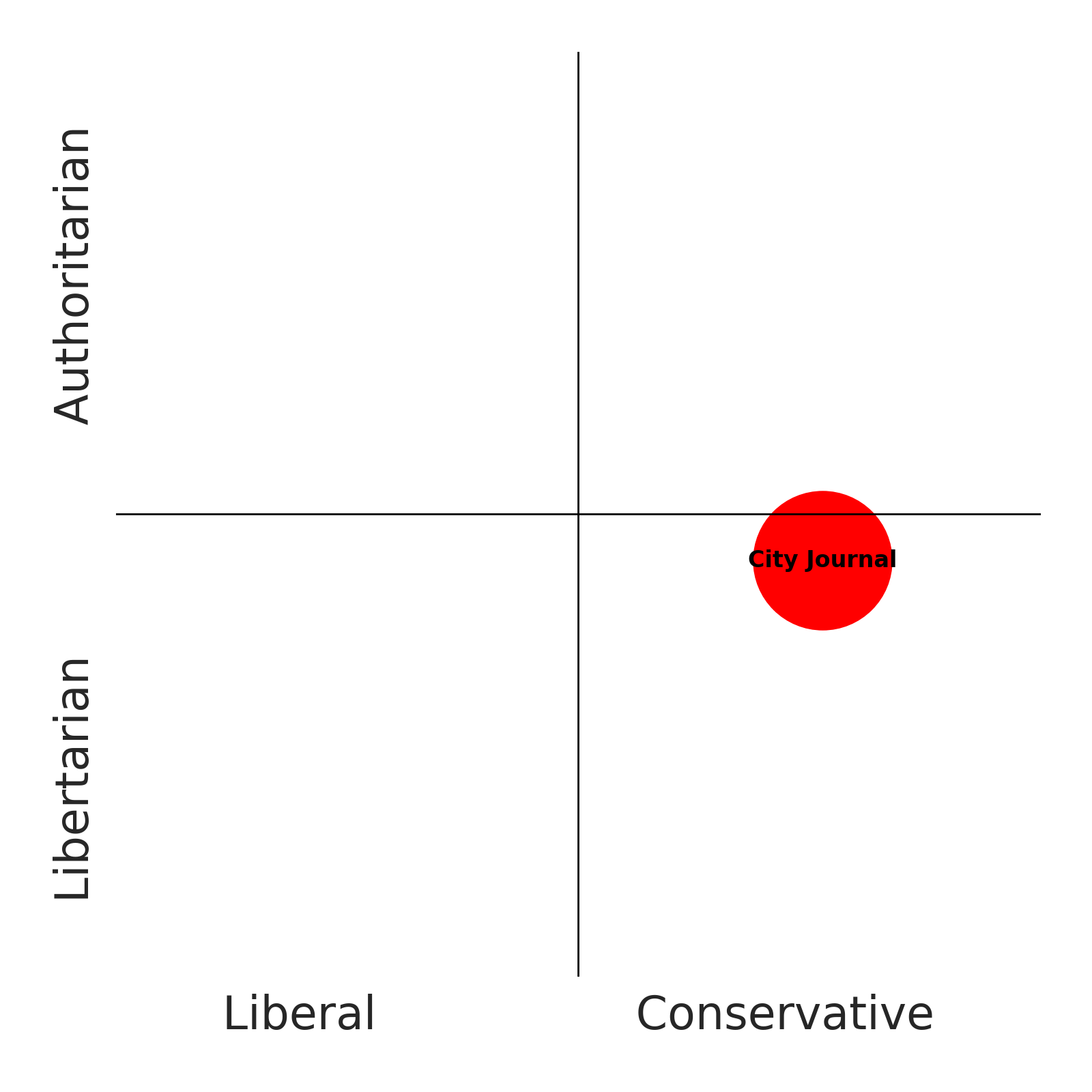
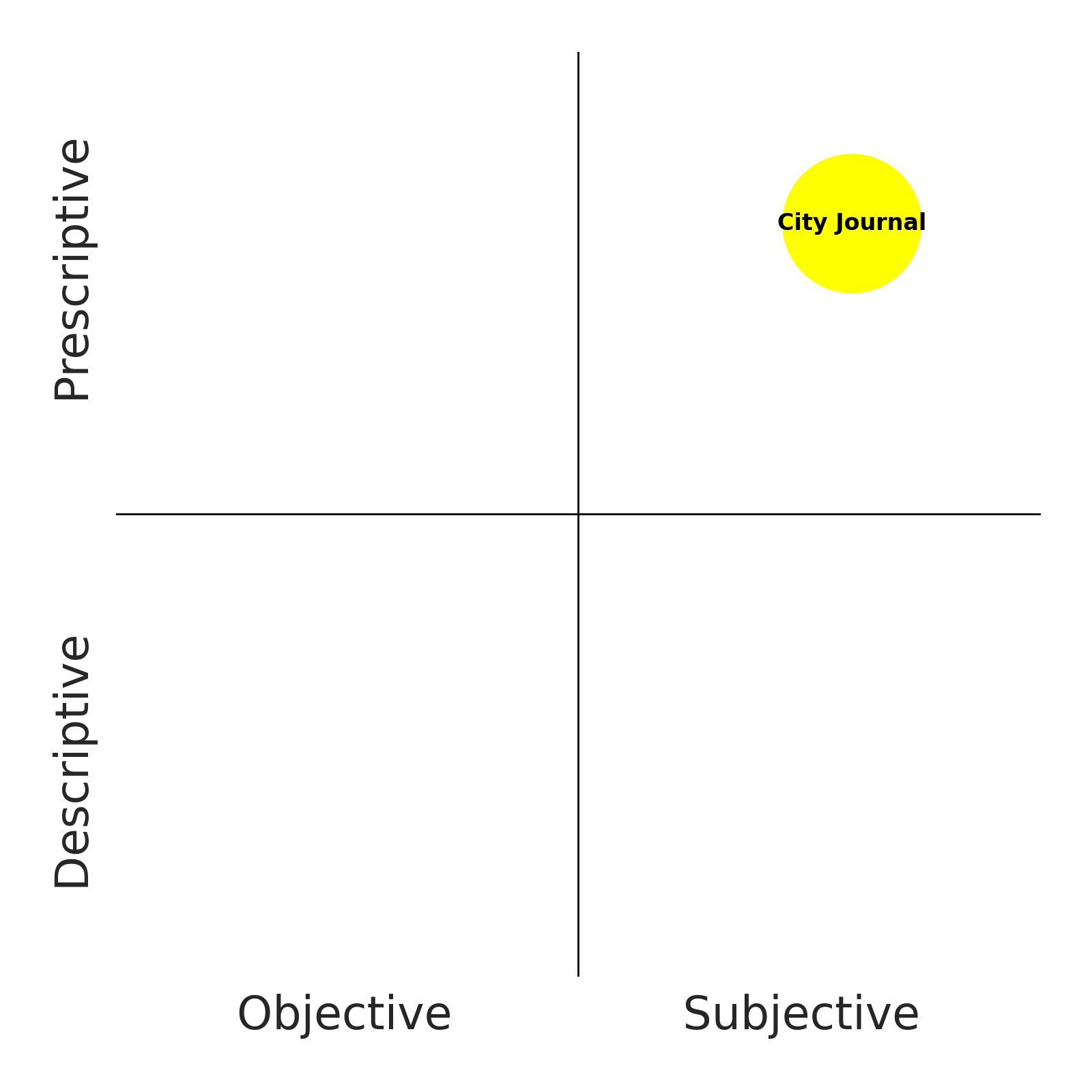
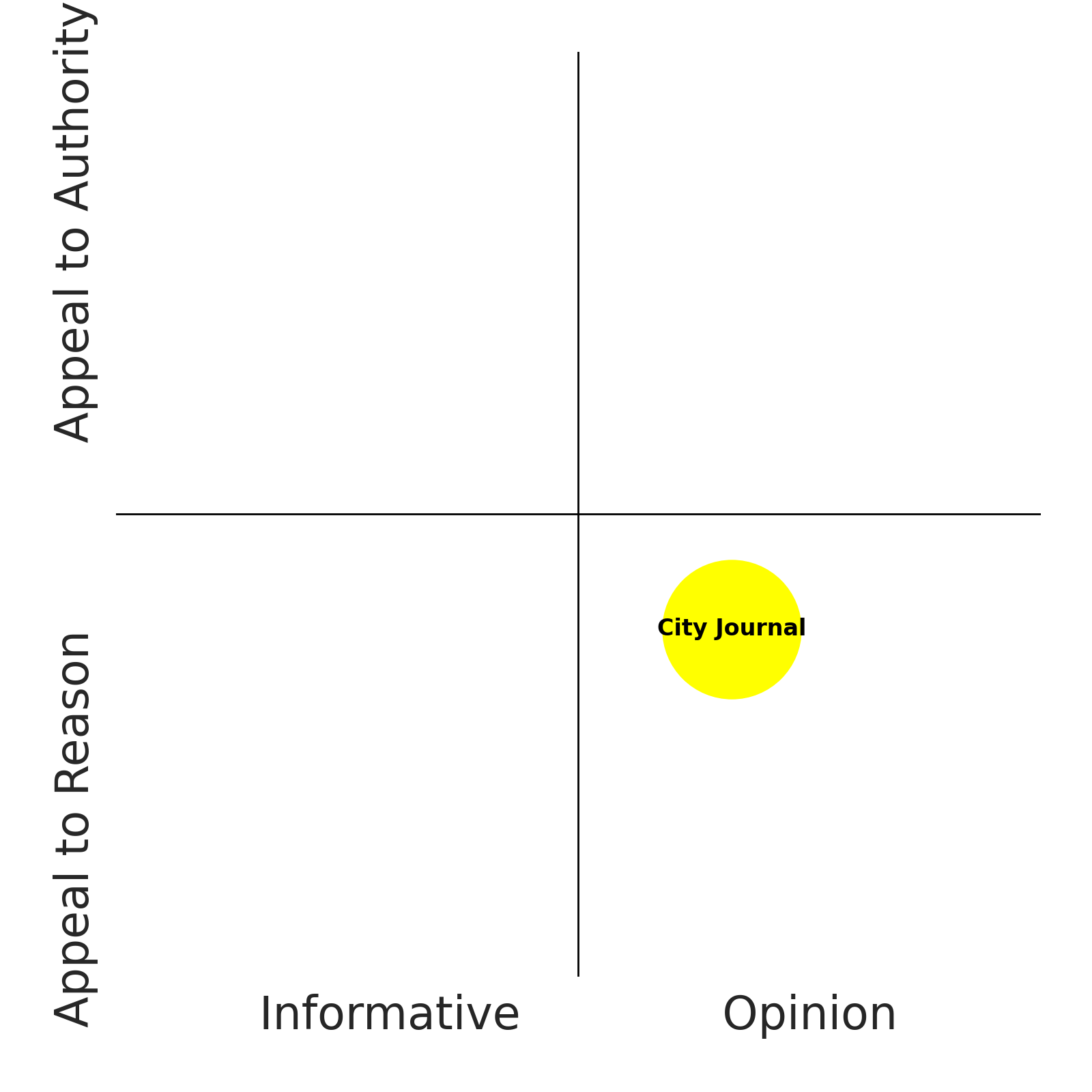
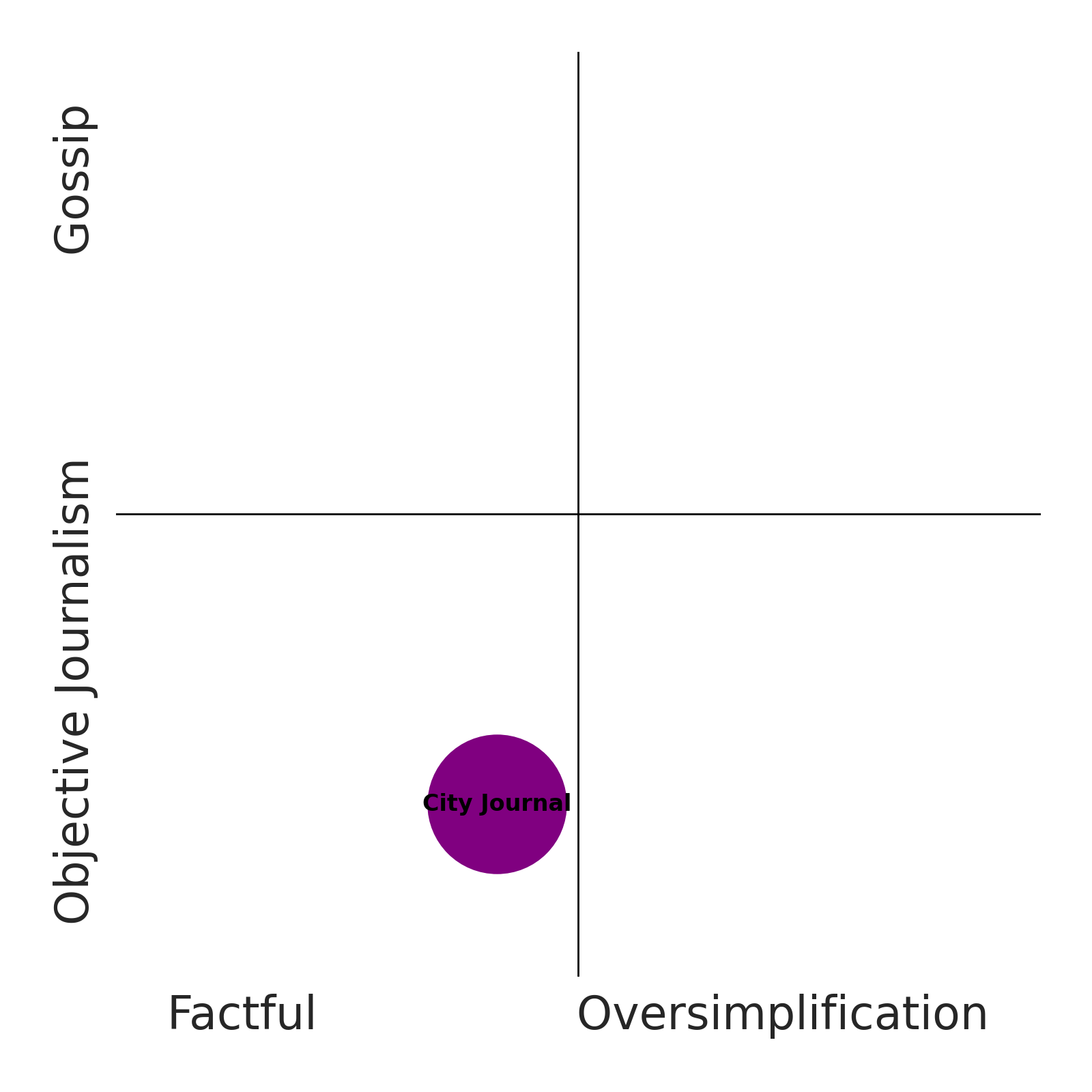
Click points to explore news by date. News sentiment ranges from -10 (very negative) to +10 (very positive) where 0 is neutral.
2026 © Helium Trades
Privacy Policy & Disclosure
* Disclaimer: Nothing on this website constitutes investment advice, performance data or any recommendation that any particular security, portfolio of securities, transaction or investment strategy is suitable for any specific person. Helium Trades is not responsible in any way for the accuracy
of any model predictions or price data. Any mention of a particular security and related prediction data is not a recommendation to buy or sell that security. Investments in securities involve the risk of loss. Past performance is no guarantee of future results. Helium Trades is not responsible for any of your investment decisions,
you should consult a financial expert before engaging in any transaction.
Helium Research Assistant

How can I help you today?
Ask any question about City Journal bias.


