See whether Helium helps you make better-informed decisions. Try every Pro Trader feature for 30 days. No credit card required.
Try every Pro Trader feature for 30 days. No credit card required.
This source is City Journal / Manhattan Institute material: heavily NYC-focused, conservative think-tank commentary
September 04, 2026 · 0 shares
A free-market urban-affairs digest frames data-center development, union pay, Western Islam discourse, and housing regulation through conservative, limited-government arguments presented as common sense.
Automated analysis; not human reviewed. Limitations: Only brief summaries and headlines from longer columns were supplied, so the underlying evidence and nuance for each policy claim could not be independently assessed. · 8 of 54 available dimensions scored; omitted dimensions are not treated as neutral. · Verified supporting quotes for 7 of 8 scored dimensions.
Claim: The newsletter consistently frames policy questions from conservative and free-market positions.
“Opposition to Data Centers Makes Little Sense. They offer massive benefits at little cost.” · exact text match
“But it will benefit the city’s powerful teachers’ unions, she argues.” · exact text match
Why: The lead endorses business development, the special-education item casts union influence negatively, and the housing item blames government regulation.
Claim: The editorial voice is that of a policy expert dismissing lay opposition and local political fixes as misguided.
“Opposition to Data Centers Makes Little Sense. They offer massive benefits at little cost.” · exact text match
“they frequently adopt “quick fixes” that fail to address the core problem—or even make things worse.” · exact text match
Why: The framing treats everyday opposition and elected officials' solutions as less informed than the journal's expert analysis.
Claim: The policy orientation is limited-government, favoring market outcomes over union power and housing regulation.
“The real problem: years of underbuilding, caused by state and local policies.” · exact text match
“Read here to see how overregulation is suppressing new housing construction and keeping affordability out of reach.” · exact text match
Why: The housing section identifies government policy, not market failure, as the core problem; the education item criticizes a union-oriented remedy.
Claim: The newsletter's summaries are explicitly evaluative and opinion-led rather than neutral reporting.
“Opposition to Data Centers Makes Little Sense. They offer massive benefits at little cost.” · exact text match
“Bonuses Won’t Fix New York’s Special-Education System” · exact text match
Why: Headlines and editorial conclusions render judgments, not just facts.
Claim: The framing is chiefly prescriptive, telling readers what will or won't work.
“Bonuses Won’t Fix New York’s Special-Education System” · exact text match
“Price collusion is a legitimate concern, but it’s not the primary driver of high housing costs. The real problem: years of underbuilding, caused by state and local policies.” · not found in supplied text
Why: The item titles and summaries assess policy effectiveness rather than simply describing events.
Claim: The items are opinion columns and editorial summaries, not neutral news.
“Bonuses Won’t Fix New York’s Special-Education System” · exact text match
“Nor will it do much to help fill open paraprofessional roles. But it will benefit the city’s powerful teachers’ unions, she argues.” · exact text match
Why: The text makes explicit evaluative judgments and attributes them to named columnists.
Claim: Nearly every summarized item involves government, legislation, or political conflict.
“In July, the New York City Council unanimously passed a law to make $10,000 supplemental payments to public school paraprofessionals (non-teacher aides), ostensibly to address a shortage in those roles.” · exact text match
“Local government leaders across the country are rushing to address the problem of housing affordability.” · exact text match
Why: Content centers on city legislation, union politics, mayoral appointment, and housing policy.
Claim: Complex policy problems are compressed into single-cause or binary formulations.
“They offer massive benefits at little cost.” · exact text match
“The real problem: years of underbuilding, caused by state and local policies.” · exact text match
Why: The data-center and housing summaries reduce opposition and affordability to one-sided formulations without presenting tradeoffs.
Only brief summaries and headlines from longer columns were supplied, so the underlying evidence and nuance for each policy claim could not be independently assessed.
September 03, 2026 · 0 shares
A free-market think-tank commentary frames the city council's paraprofessional bonus law as a fiscally irresponsible union handout that will not solve special-education cost growth.
Carter cases are tuition-reimbursement disputes under federal special-education law; New York City's normal municipal employee-compensation process runs through collective bargaining, which the council's legislation would circumvent.
Automated analysis; not human reviewed. Limitations: Only the supplied op-ed text was analyzed; no external verification of the cited statistics was possible. · 12 of 54 available dimensions scored; omitted dimensions are not treated as neutral. · Verified supporting quotes for 12 of 12 scored dimensions.
Claim: The commentary uses anti-union, free-market rhetoric to frame the paraprofessional bonus law as a fiscally irresponsible handout to a powerful union.
“a handout to the powerful teachers’ union” · exact text match
“Paying off the beneficiaries of this cartel won’t do anything to dismantle it.” · exact text match
Why: The phrases characterize union influence negatively and dismiss the law as a handout, a standard conservative labor-policy framing.
Claim: The piece is overtly evaluative, telling readers that the union-handout rationale is invalid.
“These costs shouldn’t be invoked to justify a union handout.” · exact text match
Why: 'shouldn't' is a direct value judgment, making the piece subjective rather than merely descriptive.
Claim: The tone is mildly sensational, using phrases like 'soaring' and 'budget-busting,' though the supporting data is concrete.
“soaring Carter-case spending” · exact text match
“budget-busting Carter case costs” · exact text match
Why: The language is dramatic but not extreme, and is paired with specific figures.
Claim: The piece gives a negative assessment of the law's likely effectiveness.
“The RESPECT Check Act will neither help fill paraprofessional shortages nor address the city’s underinvestment in public special-education needs.” · exact text match
Why: It predicts the law will fail to achieve its stated goals.
Claim: The article prescribes that the law should not be justified as fiscally responsible.
“These costs shouldn’t be invoked to justify a union handout.” · exact text match
Why: The statement is prescriptive about what should not be done.
Claim: The text is heavily opinionated, with direct evaluative judgments about the law and the union.
“These costs shouldn’t be invoked to justify a union handout.” · exact text match
Why: Overt normative language pervades the piece.
Claim: The article is a political intervention in a city council-mayor dispute, using adversarial political categories.
“a handout to the powerful teachers’ union” · exact text match
“it mostly lines the coffers of the city’s unions” · exact text match
Why: Frames the issue as a union-political power grab and partisan battle.
Claim: The article leans on expert and institutional authority to support its case.
“as my colleague Ken Girardin has explained” · exact text match
“the comptroller’s office analyzed thousands of special-education complaints” · exact text match
Why: Cites an internal colleague and a comptroller's analysis as authoritative support, alongside reasoning.
Claim: The piece sides with the mayor's legal challenge and the existing collective-bargaining process.
“Mamdani’s administration is now arguing (correctly, as my colleague Ken Girardin has explained) that allowing the city council to set employee compensation would amount to an end-run around the city’s collective-bargaining process” · exact text match
Why: Endorses the institutional process over direct council action.
Claim: The article cites specific figures and named institutional analyses, but its one-sided opinion framing reduces inferred credibility.
“In 2023, the comptroller’s office analyzed thousands of special-education complaints.” · exact text match
“The city spends about $1.5 billion annually on Carter cases today, up from a mere $47 million in 2005.” · exact text match
Why: Verifiable details and attribution are present, but the piece is an advocacy commentary with selective framing.
Claim: The argument is grounded in quantitative data and a logical comparison rather than emotional appeals.
“Between 2014 and 2016, only about 60 percent of students with disabilities received all the services required by their IEPs. By 2023–24, that figure had improved to about 92 percent.” · exact text match
“Yet Carter case spending keeps growing.” · exact text match
Why: Uses empirical trends to test a causal claim, indicating rational, evidence-based reasoning.
Claim: The piece is analytical, using multiple data points and a structured cost-causation argument.
“The city spends about $1.5 billion annually on Carter cases today, up from a mere $47 million in 2005.” · exact text match
“Between 2014 and 2016, only about 60 percent of students with disabilities received all the services required by their IEPs. By 2023–24, that figure had improved to about 92 percent.” · exact text match
Why: Integrates cost, utilization, and outcome data into a coherent argument.
Only the supplied op-ed text was analyzed; no external verification of the cited statistics was possible.
September 09, 2026 · 0 shares
Framing promotes ALPR, camera, and drone surveillance as beneficial public-safety tools, treating backlash and privacy worries as matters to be managed with safeguards rather than as fundamental objections.
Automated license-plate readers (ALPR) capture and log license plates at scale, and their use by law enforcement has generated privacy and data-retention debates in the U.S.
Automated analysis; not human reviewed. Limitations: Only a brief episode description was supplied, so classifications rely on framing language rather than the full interview content. · 5 of 54 available dimensions scored; omitted dimensions are not treated as neutral. · Verified supporting quotes for 4 of 5 scored dimensions.
Claim: The publisher frames police use of surveillance technology as beneficial and focuses on its public-safety value.
“real-world benefits of these tools in helping police solve crimes, recover stolen vehicles, and respond faster in emergencies” · exact text match
Counterevidence:
“the legal and privacy concerns surrounding surveillance, and the safeguards meant to prevent misuse” · exact text match
Why: The only outcome-oriented framing in the description highlights law-enforcement benefits, while concerns are acknowledged as topics rather than decisive objections.
Claim: The format is a promotional interview description using evaluative language rather than neutral reporting.
“How should we think about automated license-plate readers, surveillance cameras, drones, and other public safety tools?” · exact text match
“They also explore the real-world benefits of these tools” · exact text match
Why: A normative question and positive evaluative phrase ('real-world benefits') make the framing subjective and promotional.
Claim: The description emphasizes beneficial outcomes of surveillance tools, giving it a positive tilt.
“help police solve crimes, recover stolen vehicles, and respond faster in emergencies” · not found in supplied text
Why: Benefits are the only concrete outcomes listed, outweighing the brief mention of backlash and concerns.
Claim: The subject matter is a political-policy topic involving privacy, surveillance, and policing.
“the backlash against ALPR technology, the legal and privacy concerns surrounding surveillance” · exact text match
“public safety tools” · exact text match
Why: Surveillance, privacy, and police powers are inherently political-policy issues, and the text frames them as such.
Claim: The text is a promotional teaser for an interview episode rather than independent reporting.
“Rafael Mangual sits down with Rahul Sidhu of Flock Safety to discuss” · exact text match
“They also explore the real-world benefits of these tools” · exact text match
Why: The description markets the conversation and highlights its expected positive takeaways.
Only a brief episode description was supplied, so classifications rely on framing language rather than the full interview content.
This opinion piece presents full-height fare gates as a proven solution to transit crime while using selective statistics and assertive language to advocate for federal funding, framing opposition as ineffective.
The article responds to recent transit crime incidents, including a 2023 attack on a Chicago train, and the pending Surface Transportation Reauthorization bill, arguing for a specific policy change to fund full-height fare gates.
Automated analysis; not human reviewed. Limitations: The article relies on unverified statistics from transit agencies, and its causal claims are not independently confirmed. · 3 of 54 available dimensions scored; omitted dimensions are not treated as neutral. · Verified supporting quotes for 3 of 3 scored dimensions.
Claim: The article asserts certainty about the effectiveness of fare gates using absolute language.
“While new fare gates are a proven anti-crime policy” · exact text match
Why: The word 'proven' is an overstatement given the correlational evidence.
Claim: The article uses emotionally charged language to evoke fear and urgency.
“needlessly lose more lives to the criminals plaguing America’s public transit.” · exact text match
Why: The phrase 'plaguing' and 'needlessly lose more lives' are emotionally charged.
Claim: The article presents correlation as causation and selectively cites statistics to support its policy recommendation.
“97 percent of people who committed a violent crime didn’t pay.” · exact text match
“San Francisco’s BART found that systemwide crime fell 41 percent after new gates were installed.” · exact text match
Why: These statistics suggest a link but do not establish that fare gates cause the reduction; other factors are not controlled.
The article relies on unverified statistics from transit agencies, and its causal claims are not independently confirmed.
A caveat-laden cost estimate is ultimately used to endorse the post-9/11 national-security response as justified and inevitable, dismissing the 'overreaction' critique as mistaken.
Automated analysis; not human reviewed. Limitations: The supplied text is a single analytical essay; the underlying budget, VSL, and war-cost figures and the author's counterfactual assumptions cannot be independently verified from the article text alone. · 9 of 54 available dimensions scored; omitted dimensions are not treated as neutral. · Verified supporting quotes for 9 of 9 scored dimensions.
Claim: The analysis endorses a conservative national-security posture by rejecting the overreaction critique and defending a vigorous response to 9/11.
“But it is mistaken to assume that such restraint would not have invited further aggression by signaling weakness” · exact text match
“A vigorous response to mass murder was both justified and likely inevitable.” · exact text match
Why: The conclusion aligns with conservative hawkish foreign-policy views and frames restraint as dangerous rather than cost-saving.
Claim: The text shifts from describing costs to prescribing that the post-9/11 response was correct.
“A vigorous response to mass murder was both justified and likely inevitable.” · exact text match
“preventing such attacks carries immense value.” · exact text match
Why: The final paragraphs make a normative case for retaliation and prevention rather than merely presenting estimates.
Claim: The analysis is hawkish on terrorism: it argues against restraint and in favor of a forceful response.
“such restraint would not have invited further aggression by signaling weakness” · exact text match
“A vigorous response to mass murder was both justified and likely inevitable.” · exact text match
Why: It explicitly rejects the 'overreaction' view and says retaliation was justified and inevitable.
Claim: The cost analysis includes an opined verdict on the U.S. response, not just factual reporting.
“But it is mistaken to assume that such restraint would not have invited further aggression by signaling weakness” · exact text match
“A vigorous response to mass murder was both justified and likely inevitable.” · exact text match
Why: These assertions are debatable value-and-strategy judgments presented as conclusions.
Claim: The piece is credible in its visible sourcing and epistemic caution.
“These numbers are, admittedly, some of my least certain.” · exact text match
“No one can fully tally the consequences of an event as momentous as 9/11 or know how American policy would have evolved had the attacks never occurred.” · exact text match
Why: It attributes estimates to named studies and agencies and explicitly separates certain, conservative, and speculative figures.
Claim: The cost estimates are built through a methodical, caveat-laden framework rather than an emotional or dismissive one.
“To estimate the nationwide costs conservatively, I confine the analysis to five well-defined categories” · exact text match
“These numbers are, admittedly, some of my least certain.” · exact text match
Why: It uses defined categories, explicit conversions, and uncertainty labeling, though the closing normative argument is not derived from the cost data.
Claim: The piece contains forward-looking extrapolations, some explicitly labeled speculative.
“Extending the figure through the present is more speculative, since the official series was discontinued” · exact text match
“These numbers are, admittedly, some of my least certain.” · exact text match
Why: It projects TSA delay and homeland-security costs into the present using rough multipliers while flagging the uncertainty.
Claim: The author discloses uncertainty, warns against double-counting, and invites readers to adjust estimates.
“Estimates of 9/11’s costs differ in important ways, and some can’t simply be added together.” · exact text match
“These numbers are, admittedly, some of my least certain.” · exact text match
Why: The piece repeatedly flags limits and offers readers the ability to discard or modify individual estimates.
Claim: The analysis is nuanced and avoids simple addition of overlapping cost categories.
“Estimates of 9/11’s costs differ in important ways, and some can’t simply be added together.” · exact text match
“Each component is estimated separately, with the sources explained below, so readers can disregard or adjust any individual estimate as they see fit.” · exact text match
Why: The piece engages with double-counting, baseline choices, and uncertainty, indicating above-average analytical care.
The supplied text is a single analytical essay; the underlying budget, VSL, and war-cost figures and the author's counterfactual assumptions cannot be independently verified from the article text alone.
September 09, 2026 · 0 shares
Loaded 'Nigerian Chief' framing, lavish wealth imagery, and expert accusations present a Medicaid provider as probably fraudulent even though no official finding exists.
Medi-Cal is California's Medicaid program; HCAI is the state Department of Health Care Access and Information, which collects mandatory home-health utilization reports. California's home-health sector has expanded rapidly and has been a focus of federal and state fraud concerns.
Automated analysis; not human reviewed. Limitations: This assessment is based solely on the supplied text and cannot verify the underlying Medicaid, property, or licensing records. · 5 of 54 available dimensions scored; omitted dimensions are not treated as neutral. · Verified supporting quotes for 5 of 5 scored dimensions.
Claim: Frames the story through concern about taxpayer-funded government health spending and a free-market institutional perspective.
“California is riddled with Medicaid fraud.” · exact text match
“a leading free-market think tank.” · exact text match
Why: The article's unqualified 'riddled with fraud' claim and its own free-market institutional identity tilt the reporting toward a conservative critique of a state health program.
Claim: Uses tabloid-style presentation, lavish imagery, and a provocative headline, making the report sensational rather than purely neutral.
“How Did This Nigerian Chief Make Millions From Medicaid?” · exact text match
““half man, half god”” · exact text match
Why: The headline poses a suggestive question and the piece foregrounds palaces, golden statues, and mansions, heightening drama beyond the underlying data.
Claim: The headline and structure presuppose that Ogbatue's wealth came improperly from Medicaid, framing the investigation as explaining how rather than whether.
“How Did This Nigerian Chief Make Millions From Medicaid?” · exact text match
Counterevidence:
“No officials have publicly accused CHHA of wrongdoing.” · exact text match
Why: The opening question treats wrongdoing as the premise to explain, although the text later acknowledges no official accusation exists.
Claim: Mixes verified data with selected expert judgments and editorializing words, yielding a strongly opinionated investigation.
“Experts we spoke with said that CHHA's billing numbers raised major red flags.” · verified after text normalization
Why: The article reports data but then injects an interpretive conclusion—'major red flags'—from selected experts, steering readers toward suspicion.
Claim: Shows strong sourcing practices by naming experts, quoting documents and officials, publishing the subject's response, and noting the absence of official accusations.
“We sent Ogbatue a list of questions and assertions, including the reported Medicaid billing totals, before publication.” · exact text match
“A lawyer from King & Spalding sent a long response.” · exact text match
“No officials have publicly accused CHHA of wrongdoing.” · exact text match
Why: The report shows it sought comment, publishes the rebuttal, names sources, and explicitly notes the lack of official accusations—signals of internally observable sourcing and fairness.
This assessment is based solely on the supplied text and cannot verify the underlying Medicaid, property, or licensing records.
Framing presents polling disruption as the fault of an 'overeducated, downwardly mobile' population segment, lending an anti-credentialist and conservative-tinged cast.
Automated analysis; not human reviewed. Limitations: Only the headline and standfirst were supplied; the body, methodology, and data were unavailable, so bias scores rely on short framing language. · 7 of 54 available dimensions scored; omitted dimensions are not treated as neutral. · Verified supporting quotes for 7 of 7 scored dimensions.
Claim: Framing casts an educated, downwardly mobile segment as a problematic force in polling, a conservative-leaning critique of credentialed elites.
“An overeducated, downwardly mobile segment of the population is scrambling the polls.” · exact text match
Why: 'Overeducated' is a normative, conservative-aligned characterization, and the segment is blamed for disrupting polls.
Claim: The headline and standfirst use evaluative and interpretive language rather than neutral description.
“An overeducated, downwardly mobile segment of the population is scrambling the polls.” · exact text match
Why: 'Overeducated' is a value judgment and 'scrambling the polls' is an interpretive causal claim, not measured observation.
Claim: The statement advances a thesis about who is breaking polls rather than reporting verified findings.
“An overeducated, downwardly mobile segment of the population is scrambling the polls.” · exact text match
Why: The sentence asserts a diagnosis without source attribution, hedging, or data, characteristic of opinion framing.
Claim: The subject matter is political polling and political elites, and the 'counter-elite' framing is political terminology.
“The Pollsters' Counter-Elite Problem.” · exact text match
Why: Pollsters, elites, and demographic voting segments are political categories; the framing is political.
Claim: The text attributes polling disruption to a single demographic category, reducing a complex process to one cause.
“An overeducated, downwardly mobile segment of the population is scrambling the polls.” · exact text match
Why: It names one segment as 'scrambling' polls, omitting methodological, sampling, and other possible factors.
Claim: The causal statement is made definitively, without qualifying language or supporting evidence.
“An overeducated, downwardly mobile segment of the population is scrambling the polls.” · exact text match
Why: 'Is scrambling' asserts fact-like certainty, while the supplied text offers no supporting data or hedge.
Claim: The phrasing carries negative emotional valence, framing the group as a problem.
“The Pollsters' Counter-Elite Problem.” · exact text match
“An overeducated, downwardly mobile segment of the population is scrambling the polls.” · exact text match
Why: 'Problem' and 'scrambling' convey concern and disapproval rather than neutral narration.
Only the headline and standfirst were supplied; the body, methodology, and data were unavailable, so bias scores rely on short framing language.
Framing labels opposition to Flock license plate readers as a panicked overreaction and warns that ordinary citizens will bear the cost.
Automated analysis; not human reviewed. Limitations: The supplied text is only a two-sentence headline and subtitle, so many dimensions cannot be reliably assessed; the analysis treats it as an opinion headline rather than a reported story. · 7 of 54 available dimensions scored; omitted dimensions are not treated as neutral. · Verified supporting quotes for 7 of 7 scored dimensions.
Claim: The text presents an evaluative judgment about a controversy rather than a neutral report of facts.
“The meltdown about license plate readers is a classic moral panic.” · exact text match
Why: Calling opposition a 'moral panic' is an interpretive evaluation, not a verifiable observation.
Claim: The headline and subhead use inflamed, informal language characteristic of sensational commentary.
“Stop Freaking Out About Flock.” · exact text match
“The meltdown about license plate readers is a classic moral panic.” · exact text match
Why: The imperative 'Stop Freaking Out' and the word 'meltdown' are emotionally loaded and heighten the language.
Claim: The text tells readers how to act and warns of consequences instead of describing events.
“Stop Freaking Out About Flock.” · exact text match
“Everyday citizens will pay the price.” · exact text match
Why: The headline is a direct instruction and the closing clause is a normative warning.
Claim: The content consists almost entirely of personal viewpoint expressed as assertion.
“The meltdown about license plate readers is a classic moral panic.” · exact text match
Why: The statement is a subjective conclusion with no supporting factual basis.
Claim: The piece takes a side in a public-policy debate over government surveillance technology.
“The meltdown about license plate readers is a classic moral panic.” · exact text match
“Everyday citizens will pay the price.” · exact text match
Why: License plate readers are a police surveillance policy issue, and the text urges a specific public response.
Claim: A complex privacy and public-safety tradeoff is reduced to a single pejorative label.
“The meltdown about license plate readers is a classic moral panic.” · exact text match
Why: The label 'moral panic' dismisses detailed concerns without engaging them.
Claim: Conclusions are stated with certainty far beyond the evidence offered.
“The meltdown about license plate readers is a classic moral panic.” · exact text match
“Everyday citizens will pay the price.” · exact text match
Why: No evidence is provided, yet both claims are asserted as definitive.
The supplied text is only a two-sentence headline and subtitle, so many dimensions cannot be reliably assessed; the analysis treats it as an opinion headline rather than a reported story.
Framing treats government overregulation as the root cause of Maryland's housing costs and casts algorithmic-rent-software restrictions as a politically convenient distraction rather than a real remedy.
Montgomery County, Maryland, is a high-cost suburban county in the Washington, D.C., metropolitan area where restrictive single-family zoning and strong housing demand have long pushed up prices.
Automated analysis; not human reviewed. Limitations: Key statistics are asserted without cited underlying data, so external verification is limited. · 7 of 54 available dimensions scored; omitted dimensions are not treated as neutral. · Verified supporting quotes for 6 of 7 scored dimensions.
Claim: The essay identifies government overregulation, not market behavior, as the cause of high housing costs and supports supply-side deregulation.
“The real problem: years of underbuilding, caused by state and local policies.” · exact text match
“Until state and local leaders in Maryland confront the reality that overregulation is the real problem, affordability will remain out of reach for the very residents whom local leaders say they want to help.” · exact text match
Counterevidence:
“Price collusion is a legitimate concern, but it’s not the primary driver of high housing costs in either Montgomery County or the state of Maryland, which has a shortage of approximately 100,000 housing units.” · exact text match
Why: The dominant causal account and recommended remedy align with conservative/free-market housing policy.
Claim: The essay favors removing government restrictions on housing development.
“Improving affordability means allowing more housing types, streamlining approvals, reducing uncertainty for builders, and understanding that while growing pains are real, growth is what maintains an area’s energy and vitality.” · exact text match
Why: Its central recommendations reduce government control over land use and construction.
Claim: The essay instructs policymakers on what should be done to fix affordability.
“Improving affordability means allowing more housing types, streamlining approvals, reducing uncertainty for builders, and understanding that while growing pains are real, growth is what maintains an area’s energy and vitality.” · exact text match
“Until state and local leaders in Maryland confront the reality that overregulation is the real problem, affordability will remain out of reach for the very residents whom local leaders say they want to help.” · exact text match
Why: The language is imperative and policy-recommending, not merely descriptive.
Claim: The text is a persuasive editorial advancing a contested policy view.
“But easy political narratives don’t build the homes people need.” · exact text match
“Reform efforts that ignore the underlying supply imbalance will fail.” · exact text match
Why: Strong normative judgments and causal assertions are presented as conclusions.
Claim: The essay intervenes in a legislative and zoning policy dispute.
“Instead of addressing zoning rules or rent control, Montgomery County politicians are going after software designed to help landlords better understand local market conditions.” · not found in supplied text
“From a political standpoint, enacting pro-supply reforms is not as easy as demonizing software.” · exact text match
Why: It characterizes political actors' motives and advocates a specific side in a contested housing debate.
Claim: The essay applies a consistent free-market, deregulatory lens to housing policy.
“The real problem: years of underbuilding, caused by state and local policies.” · exact text match
“Reform efforts that ignore the underlying supply imbalance will fail.” · exact text match
Why: The framing consistently prioritizes market supply and treats regulation as the primary obstacle.
Claim: The argument uses supply-demand logic and cites empirical research rather than relying on emotional appeals.
“Price collusion is a legitimate concern, but it’s not the primary driver of high housing costs in either Montgomery County or the state of Maryland, which has a shortage of approximately 100,000 housing units.” · exact text match
“dozens of studies have found that rent-control policies reduce the supply of housing.” · exact text match
Why: The essay is logically structured and evidence-citing, though selective in its treatment of other factors.
Key statistics are asserted without cited underlying data, so external verification is limited.
September 04, 2026 · 0 shares
A free-market urban-affairs digest frames data-center development, union pay, Western Islam discourse, and housing regulation through conservative, limited-government arguments presented as common sense.
Automated analysis; not human reviewed. Limitations: Only brief summaries and headlines from longer columns were supplied, so the underlying evidence and nuance for each policy claim could not be independently assessed. · 8 of 54 available dimensions scored; omitted dimensions are not treated as neutral. · Verified supporting quotes for 7 of 8 scored dimensions.
Claim: The newsletter consistently frames policy questions from conservative and free-market positions.
“Opposition to Data Centers Makes Little Sense. They offer massive benefits at little cost.” · exact text match
“But it will benefit the city’s powerful teachers’ unions, she argues.” · exact text match
Why: The lead endorses business development, the special-education item casts union influence negatively, and the housing item blames government regulation.
Claim: The editorial voice is that of a policy expert dismissing lay opposition and local political fixes as misguided.
“Opposition to Data Centers Makes Little Sense. They offer massive benefits at little cost.” · exact text match
“they frequently adopt “quick fixes” that fail to address the core problem—or even make things worse.” · exact text match
Why: The framing treats everyday opposition and elected officials' solutions as less informed than the journal's expert analysis.
Claim: The policy orientation is limited-government, favoring market outcomes over union power and housing regulation.
“The real problem: years of underbuilding, caused by state and local policies.” · exact text match
“Read here to see how overregulation is suppressing new housing construction and keeping affordability out of reach.” · exact text match
Why: The housing section identifies government policy, not market failure, as the core problem; the education item criticizes a union-oriented remedy.
Claim: The newsletter's summaries are explicitly evaluative and opinion-led rather than neutral reporting.
“Opposition to Data Centers Makes Little Sense. They offer massive benefits at little cost.” · exact text match
“Bonuses Won’t Fix New York’s Special-Education System” · exact text match
Why: Headlines and editorial conclusions render judgments, not just facts.
Claim: The framing is chiefly prescriptive, telling readers what will or won't work.
“Bonuses Won’t Fix New York’s Special-Education System” · exact text match
“Price collusion is a legitimate concern, but it’s not the primary driver of high housing costs. The real problem: years of underbuilding, caused by state and local policies.” · not found in supplied text
Why: The item titles and summaries assess policy effectiveness rather than simply describing events.
Claim: The items are opinion columns and editorial summaries, not neutral news.
“Bonuses Won’t Fix New York’s Special-Education System” · exact text match
“Nor will it do much to help fill open paraprofessional roles. But it will benefit the city’s powerful teachers’ unions, she argues.” · exact text match
Why: The text makes explicit evaluative judgments and attributes them to named columnists.
Claim: Nearly every summarized item involves government, legislation, or political conflict.
“In July, the New York City Council unanimously passed a law to make $10,000 supplemental payments to public school paraprofessionals (non-teacher aides), ostensibly to address a shortage in those roles.” · exact text match
“Local government leaders across the country are rushing to address the problem of housing affordability.” · exact text match
Why: Content centers on city legislation, union politics, mayoral appointment, and housing policy.
Claim: Complex policy problems are compressed into single-cause or binary formulations.
“They offer massive benefits at little cost.” · exact text match
“The real problem: years of underbuilding, caused by state and local policies.” · exact text match
Why: The data-center and housing summaries reduce opposition and affordability to one-sided formulations without presenting tradeoffs.
Only brief summaries and headlines from longer columns were supplied, so the underlying evidence and nuance for each policy claim could not be independently assessed.
September 03, 2026 · 0 shares
The framing treats opposition to data centers as perplexing and presents them as one of the best available local development deals, foregrounding tax revenue and jobs while minimizing environmental and service costs.
Automated analysis; not human reviewed. Limitations: Only the supplied opinion text was available; external data, studies, and tax figures could not be independently verified. · 12 of 54 available dimensions scored; omitted dimensions are not treated as neutral. · Verified supporting quotes for 12 of 12 scored dimensions.
Claim: The piece reflects a conservative/free-market think-tank orientation on economic development.
“a leading free-market think tank” · exact text match
Why: The publisher is explicitly identified as a free-market think tank, and the argument favors private-sector development projects and tax-incentive competition.
Claim: The framing positions expert economic comparison above local opposition.
“heated opposition that data centers have generated so perplexing” · exact text match
“If you consider data centers on the same terms as any other kind of local economic development project, they look like one of the better deals around.” · exact text match
Why: Calling opposition 'perplexing' and appealing to comparative economic analysis suggests an elite/technocratic stance, although the conclusion grants communities a choice.
Claim: The piece combines factual material with subjective value judgments.
“data centers offer some of the best benefits—and the fewest costs.” · exact text match
Why: The closing judgment rates data centers against other development options, a subjective assessment presented confidently.
Claim: The article is bullish on data centers as an investment/development asset.
“if a community is looking for development, data centers offer some of the best benefits—and the fewest costs.” · exact text match
Why: The conclusion endorses data-center projects as a strongly favorable choice for communities.
Claim: The tone is optimistic about the local effects of data centers.
“they look like one of the better deals around.” · exact text match
Why: The piece emphasizes benefits and frames costs as comparatively minor.
Claim: The article prescribes how communities should evaluate development proposals.
“Every community should decide for itself whether the tax breaks or other costs of attracting various projects are worthwhile.” · exact text match
Why: The explicit 'should' makes the prescriptive purpose clear.
Claim: The text is an opinion/advocacy essay rather than straight factual reporting.
“If you consider data centers on the same terms as any other kind of local economic development project, they look like one of the better deals around.” · exact text match
Why: It argues a thesis, urges a viewpoint, and uses evaluative language.
Claim: The topic concerns government tax incentives and local development policy.
“State and local economic development officials compete fiercely for these and other projects using tax incentives” · exact text match
Why: The essay weighs in on tax-policy and government-incentive debates, giving it a political-policy character.
Claim: The argument is built on evidence-based cost-benefit reasoning rather than emotional appeals.
“Michael Greenstone, Enrico Moretti, and Richard Hornbeck have studied how counties that “won” big plants, often with subsidies, compared with those that lost them after trying.” · exact text match
Why: The essay cites named academic research and specific fiscal quantities to support its conclusion.
Claim: The article is favorable to corporations and corporate developers.
“corporations pay an immense amount of taxes but use relatively few services.” · exact text match
Why: It portrays corporate tax contributions as a major benefit and frames data-center builders as advantageous municipal partners.
Claim: The article visibly acknowledges opposing points and costs before rebutting them.
“All economic development has some negative effects, including pollution.” · exact text match
“Some data-center critics note that they create at most a few dozen to a few hundred long-term jobs—unlike, say, a big auto plant, which can bring in thousands.” · exact text match
Why: It concedes pollution, tax-break concerns, and job-count criticisms, which signals internal fairness even within an advocacy essay.
Claim: The essay shows above-average analytical content with specific data and named experts.
“J.P. Morgan estimates the total capital expenditures of the five biggest “hyperscalers”—the tech companies building the centers—will reach almost $700 billion this year, or over 2 percent of the entire U.S. economy.” · exact text match
Why: It integrates attributed estimates, named studies, and comparative examples, indicating thoughtful analysis.
Only the supplied opinion text was available; external data, studies, and tax figures could not be independently verified.
September 10, 2026 · 0 shares
Frames Mayor Zohran Mamdani’s rent freeze as legally dubious and economically harmful, while advocating owner-oriented market remedies.
The New York City Rent Guidelines Board (RGB) annually sets rent-adjustment percentages for rent-stabilized apartments. The HSTPA is the Housing Stability and Tenant Protection Act, a 2019 state law that tightened rent regulation by eliminating vacancy increases and limiting rent increases for improvements.
Automated analysis; not human reviewed. Limitations: Only excerpted opinion text was supplied; the author has a disclosed financial interest in the outcome, and no independent verification of cited data was available. · 10 of 54 available dimensions scored; omitted dimensions are not treated as neutral. · Verified supporting quotes for 10 of 10 scored dimensions.
Claim: The publisher frames rent regulation as harmful and proposes market-based alternatives.
“Lawmakers who want to help tenants further can do so without forcing owners to pay the entire bill—for example, through housing vouchers and deregulatory measures to boost housing supply.” · exact text match
“the legislature embraced older, stricter forms of rent control.” · exact text match
Counterevidence:
“If successful, our legal challenge would not end rent stabilization or resolve the deeper issues with the HSTPA.” · exact text match
Why: The language criticizes rent control and endorses deregulation/vouchers, while the counterevidence shows acceptance of rent stabilization as a baseline.
Claim: The publisher favors reducing government control over rents and expanding private market options.
“deregulatory measures to boost housing supply” · exact text match
“prevent mayors from co-opting an independent body for political gain.” · exact text match
Why: Opposition to rent regulation and political control of the RGB signals a libertarian-leaning position on housing policy.
Claim: The text is an advocacy argument, not neutral reporting.
“For these reasons and others, the RGB’s order should not receive the deference usually afforded administrative decisions.” · exact text match
Why: Prescriptive legal judgment and advocacy are central to the text.
Claim: The publisher forecasts negative consequences from the rent freeze.
“A rent freeze will accelerate vacancies and lead to further disrepair.” · exact text match
Why: Predicts deterioration in housing conditions and market outcomes.
Claim: The publisher prescribes specific policies and legal outcomes.
“Lawmakers who want to help tenants further can do so without forcing owners to pay the entire bill—for example, through housing vouchers and deregulatory measures to boost housing supply.” · exact text match
“It would, however, ensure that owners receive a fair process and prevent mayors from co-opting an independent body for political gain.” · exact text match
Why: Offers explicit recommendations and demands for legal/policy change.
Claim: The text is strongly opinionated editorial content.
“But his signature campaign promise has a more fundamental issue: it may be illegal.” · exact text match
“For these reasons and others, the RGB’s order should not receive the deference usually afforded administrative decisions.” · exact text match
Why: Uses evaluative and conclusory language to argue against the mayor and RGB.
Claim: The publisher frames the issue around a mayor's campaign and political control of a public body.
“Mayor Zohran Mamdani’s rent freeze” · exact text match
“prevent mayors from co-opting an independent body for political gain.” · exact text match
Why: Centers electoral and institutional-power conflict rather than neutral administration.
Claim: The publisher applies a consistent free-market/anti-rent-control ideology.
“the legislature embraced older, stricter forms of rent control.” · exact text match
“through housing vouchers and deregulatory measures to boost housing supply.” · exact text match
Why: Criticizes stricter rent control and promotes deregulation, indicating a coherent ideological frame.
Claim: The publisher prioritizes individual property-owner burdens over collective tenant benefits.
“forcing owners to pay the entire bill” · exact text match
“ensure that owners receive a fair process” · exact text match
Why: Emphasizes owners' financial burden and rights, with tenant help framed through individual market measures.
Claim: The publisher makes predictive claims about future housing-market effects.
“A rent freeze will accelerate vacancies and lead to further disrepair.” · exact text match
“Mayor Zohran Mamdani’s rent freeze will likely make that problem worse by pushing more demand into the market-rate sector.” · exact text match
Why: States future outcomes as likely or certain without demonstrated empirical support in the text.
Only excerpted opinion text was supplied; the author has a disclosed financial interest in the outcome, and no independent verification of cited data was available.
September 10, 2026 · 0 shares
A pro-surveillance, pro-policing framing that treats expanded data collection as an essential counterterrorism gain and depicts opposition, protests, and public distrust as dangerous threats to that progress.
September 09, 2026 · 0 shares
A conservative, hawkish, free-market framing runs through the roundup, with anti-progressive attacks on terrorism discourse and higher education.
The September 11, 2001 attacks killed nearly 3,000 people and triggered major U.S. counterterrorism efforts; the lead section is set on the 25th anniversary.
Automated analysis; not human reviewed. Limitations: The supplied text is a roundup of blurbs rather than full articles, and the reader comment included at the end may not reflect editorial opinion. · 9 of 54 available dimensions scored; omitted dimensions are not treated as neutral. · Verified supporting quotes for 6 of 9 scored dimensions.
Claim: The content is strongly conservative, targeting progressive politics and praising conservative educational reform.
“Hasan Piker has entered the Democratic mainstream. Many Democratic Socialists of America candidates have acted disturbingly conciliatory toward al-Qaeda. Progressive politicians now often draw a moral equivalence between the U.S. and its enemies.” · exact text match
Why: The direct critique of Democratic-aligned figures and the approval of a state law removing diversity-themed courses from general education place the framing clearly on the conservative side.
Claim: The roundup favors state-imposed curriculum requirements and a strong national-security posture.
“Come 2028, topics like these will no longer count for credit. That’s thanks to state legislation passed in June that requires all college students to take a U.S. history course and a government course—and these classes must be broad enough to count as introductory surveys.” · exact text match
Why: The article presents a state-mandated curriculum as a positive reform, which leans toward government authority rather than individual choice.
Claim: The roundup is dominated by evaluative moral and political judgments rather than neutral reporting.
“we have forgotten that a real difference exists between us and our enemies—and that Americans are right to insist that their nation belongs to those who believe in Americanism, not those who aid and abet its enemies.” · exact text match
Why: This is an explicit moral and political conclusion, not a verifiable factual statement.
Claim: The overall tone is pessimistic, stressing forgotten lessons and looming institutional failures.
“Today, many of the lessons of 9/11 and its aftermath have been forgotten or were never learned.” · not found in supplied text
Why: The emphasis on forgotten lessons and colleges at risk of financial failure outweighs the limited affirmative notes about rebuilding and reform.
Claim: The text explicitly recommends specific policy changes.
“investing in psychiatric care inside jails, rather than overtaxing the nation’s already-strained state-hospital system, would be a better option.” · exact text match
“University boards must stop assuming that yesterday’s business model can be preserved through incremental reform.” · not found in supplied text
Why: Both statements prescribe what should be done rather than merely describing what is happening.
Claim: Counterterrorism is framed as an urgent priority and enemies are depicted as morally distinct.
“Indeed, the city is still the world’s top terrorist target; protecting it requires coordination among local law enforcement, federal homeland security agencies, and nonprofit groups like the Community Security Initiative.” · exact text match
Why: The lead emphasis on the city as the world's top target and on thwarted plots expresses a hawkish threat posture.
Claim: The content is largely editorial opinion and advocacy rather than straight news.
“Iowa’s higher-education reforms show that a hands-on approach to general education can work.” · not found in supplied text
Why: This is a positive evaluative policy judgment presented as a conclusion, characteristic of opinion writing.
Claim: The roundup is heavily political, taking sides against progressive political actors and policies.
“Many Democratic Socialists of America candidates have acted disturbingly conciliatory toward al-Qaeda. Progressive politicians now often draw a moral equivalence between the U.S. and its enemies.” · exact text match
Why: The text directly attacks political actors and frames them as dangerous, making the content political advocacy rather than nonpartisan description.
Claim: The content is organized around conservative ideological premises, especially nationalist 'Americanism.'
“Americans are right to insist that their nation belongs to those who believe in Americanism, not those who aid and abet its enemies.” · exact text match
Why: The assertion defines national belonging by adherence to 'Americanism,' which is a distinctly ideological claim.
The supplied text is a roundup of blurbs rather than full articles, and the reader comment included at the end may not reflect editorial opinion.
A caveat-laden cost estimate is ultimately used to endorse the post-9/11 national-security response as justified and inevitable, dismissing the 'overreaction' critique as mistaken.
Automated analysis; not human reviewed. Limitations: The supplied text is a single analytical essay; the underlying budget, VSL, and war-cost figures and the author's counterfactual assumptions cannot be independently verified from the article text alone. · 9 of 54 available dimensions scored; omitted dimensions are not treated as neutral. · Verified supporting quotes for 9 of 9 scored dimensions.
Claim: The analysis endorses a conservative national-security posture by rejecting the overreaction critique and defending a vigorous response to 9/11.
“But it is mistaken to assume that such restraint would not have invited further aggression by signaling weakness” · exact text match
“A vigorous response to mass murder was both justified and likely inevitable.” · exact text match
Why: The conclusion aligns with conservative hawkish foreign-policy views and frames restraint as dangerous rather than cost-saving.
Claim: The text shifts from describing costs to prescribing that the post-9/11 response was correct.
“A vigorous response to mass murder was both justified and likely inevitable.” · exact text match
“preventing such attacks carries immense value.” · exact text match
Why: The final paragraphs make a normative case for retaliation and prevention rather than merely presenting estimates.
Claim: The analysis is hawkish on terrorism: it argues against restraint and in favor of a forceful response.
“such restraint would not have invited further aggression by signaling weakness” · exact text match
“A vigorous response to mass murder was both justified and likely inevitable.” · exact text match
Why: It explicitly rejects the 'overreaction' view and says retaliation was justified and inevitable.
Claim: The cost analysis includes an opined verdict on the U.S. response, not just factual reporting.
“But it is mistaken to assume that such restraint would not have invited further aggression by signaling weakness” · exact text match
“A vigorous response to mass murder was both justified and likely inevitable.” · exact text match
Why: These assertions are debatable value-and-strategy judgments presented as conclusions.
Claim: The piece is credible in its visible sourcing and epistemic caution.
“These numbers are, admittedly, some of my least certain.” · exact text match
“No one can fully tally the consequences of an event as momentous as 9/11 or know how American policy would have evolved had the attacks never occurred.” · exact text match
Why: It attributes estimates to named studies and agencies and explicitly separates certain, conservative, and speculative figures.
Claim: The cost estimates are built through a methodical, caveat-laden framework rather than an emotional or dismissive one.
“To estimate the nationwide costs conservatively, I confine the analysis to five well-defined categories” · exact text match
“These numbers are, admittedly, some of my least certain.” · exact text match
Why: It uses defined categories, explicit conversions, and uncertainty labeling, though the closing normative argument is not derived from the cost data.
Claim: The piece contains forward-looking extrapolations, some explicitly labeled speculative.
“Extending the figure through the present is more speculative, since the official series was discontinued” · exact text match
“These numbers are, admittedly, some of my least certain.” · exact text match
Why: It projects TSA delay and homeland-security costs into the present using rough multipliers while flagging the uncertainty.
Claim: The author discloses uncertainty, warns against double-counting, and invites readers to adjust estimates.
“Estimates of 9/11’s costs differ in important ways, and some can’t simply be added together.” · exact text match
“These numbers are, admittedly, some of my least certain.” · exact text match
Why: The piece repeatedly flags limits and offers readers the ability to discard or modify individual estimates.
Claim: The analysis is nuanced and avoids simple addition of overlapping cost categories.
“Estimates of 9/11’s costs differ in important ways, and some can’t simply be added together.” · exact text match
“Each component is estimated separately, with the sources explained below, so readers can disregard or adjust any individual estimate as they see fit.” · exact text match
Why: The piece engages with double-counting, baseline choices, and uncertainty, indicating above-average analytical care.
The supplied text is a single analytical essay; the underlying budget, VSL, and war-cost figures and the author's counterfactual assumptions cannot be independently verified from the article text alone.
September 03, 2026 · 0 shares
A free-market think-tank commentary frames the city council's paraprofessional bonus law as a fiscally irresponsible union handout that will not solve special-education cost growth.
Carter cases are tuition-reimbursement disputes under federal special-education law; New York City's normal municipal employee-compensation process runs through collective bargaining, which the council's legislation would circumvent.
Automated analysis; not human reviewed. Limitations: Only the supplied op-ed text was analyzed; no external verification of the cited statistics was possible. · 12 of 54 available dimensions scored; omitted dimensions are not treated as neutral. · Verified supporting quotes for 12 of 12 scored dimensions.
Claim: The commentary uses anti-union, free-market rhetoric to frame the paraprofessional bonus law as a fiscally irresponsible handout to a powerful union.
“a handout to the powerful teachers’ union” · exact text match
“Paying off the beneficiaries of this cartel won’t do anything to dismantle it.” · exact text match
Why: The phrases characterize union influence negatively and dismiss the law as a handout, a standard conservative labor-policy framing.
Claim: The piece is overtly evaluative, telling readers that the union-handout rationale is invalid.
“These costs shouldn’t be invoked to justify a union handout.” · exact text match
Why: 'shouldn't' is a direct value judgment, making the piece subjective rather than merely descriptive.
Claim: The tone is mildly sensational, using phrases like 'soaring' and 'budget-busting,' though the supporting data is concrete.
“soaring Carter-case spending” · exact text match
“budget-busting Carter case costs” · exact text match
Why: The language is dramatic but not extreme, and is paired with specific figures.
Claim: The piece gives a negative assessment of the law's likely effectiveness.
“The RESPECT Check Act will neither help fill paraprofessional shortages nor address the city’s underinvestment in public special-education needs.” · exact text match
Why: It predicts the law will fail to achieve its stated goals.
Claim: The article prescribes that the law should not be justified as fiscally responsible.
“These costs shouldn’t be invoked to justify a union handout.” · exact text match
Why: The statement is prescriptive about what should not be done.
Claim: The text is heavily opinionated, with direct evaluative judgments about the law and the union.
“These costs shouldn’t be invoked to justify a union handout.” · exact text match
Why: Overt normative language pervades the piece.
Claim: The article is a political intervention in a city council-mayor dispute, using adversarial political categories.
“a handout to the powerful teachers’ union” · exact text match
“it mostly lines the coffers of the city’s unions” · exact text match
Why: Frames the issue as a union-political power grab and partisan battle.
Claim: The article leans on expert and institutional authority to support its case.
“as my colleague Ken Girardin has explained” · exact text match
“the comptroller’s office analyzed thousands of special-education complaints” · exact text match
Why: Cites an internal colleague and a comptroller's analysis as authoritative support, alongside reasoning.
Claim: The piece sides with the mayor's legal challenge and the existing collective-bargaining process.
“Mamdani’s administration is now arguing (correctly, as my colleague Ken Girardin has explained) that allowing the city council to set employee compensation would amount to an end-run around the city’s collective-bargaining process” · exact text match
Why: Endorses the institutional process over direct council action.
Claim: The article cites specific figures and named institutional analyses, but its one-sided opinion framing reduces inferred credibility.
“In 2023, the comptroller’s office analyzed thousands of special-education complaints.” · exact text match
“The city spends about $1.5 billion annually on Carter cases today, up from a mere $47 million in 2005.” · exact text match
Why: Verifiable details and attribution are present, but the piece is an advocacy commentary with selective framing.
Claim: The argument is grounded in quantitative data and a logical comparison rather than emotional appeals.
“Between 2014 and 2016, only about 60 percent of students with disabilities received all the services required by their IEPs. By 2023–24, that figure had improved to about 92 percent.” · exact text match
“Yet Carter case spending keeps growing.” · exact text match
Why: Uses empirical trends to test a causal claim, indicating rational, evidence-based reasoning.
Claim: The piece is analytical, using multiple data points and a structured cost-causation argument.
“The city spends about $1.5 billion annually on Carter cases today, up from a mere $47 million in 2005.” · exact text match
“Between 2014 and 2016, only about 60 percent of students with disabilities received all the services required by their IEPs. By 2023–24, that figure had improved to about 92 percent.” · exact text match
Why: Integrates cost, utilization, and outcome data into a coherent argument.
Only the supplied op-ed text was analyzed; no external verification of the cited statistics was possible.
August 21, 2026 · 0 shares
The article is a conservative, anti-union editorial that supports the mayor's lawsuit and criticizes collective bargaining.
Automated analysis; not human reviewed. Limitations: The text is an opinion editorial, not news reporting. · 8 of 54 available dimensions scored; omitted dimensions are not treated as neutral. · Verified supporting quotes for 7 of 8 scored dimensions.
Claim: The article expresses a conservative, free-market viewpoint critical of collective bargaining and supportive of the mayor's legal challenge.
“To be sure, public-sector collective bargaining is deeply problematic: it grants special privileges to inherently political organizations and their leaders and takes decision-making away from elected officials.” · exact text match
Why: The statement directly criticizes collective bargaining and favors market-based decision-making, indicating a conservative ideological stance.
Claim: The article adopts an elitist viewpoint, dismissing union demands and legislative actions as populist pressure.
“Public-employee unions already sidestep the bargaining table—lawfully—by pushing the New York State Legislature to do their bidding.” · exact text match
Why: The phrase 'do their bidding' implies unions manipulate the legislature, reflecting an elitist distrust of union populism.
Claim: The article favors minimal government interference in employment matters and emphasizes individual/local control over union constraints.
“In a perfect world, local governments would be able to make changes to employee pay, benefits, and work rules, and the mayor would not be handcuffed by collective-bargaining provisions that cause sitcom-worthy examples of inefficiency.” · exact text match
Why: The quote advocates for local government autonomy and criticizes collective bargaining, aligning with libertarian principles.
Claim: The article is opinionated and does not present a neutral account of the facts.
“Whatever the eventual outcome, Mayor Mamdani deserves credit for taking on this fight.” · exact text match
Why: The use of 'deserves credit' is inherently subjective, expressing approval rather than objective reporting.
Claim: The article prescribes what the legal outcome should be and argues for a particular course of action.
“The state legislature, through the Taylor Law, sets the rules of the road, and municipalities—including New York City—must heed those rules.” · not found in supplied text
Why: The statement commands that municipalities must follow the Taylor Law, indicating a prescriptive stance.
Claim: The article is heavily opinionated, interpreting events and motives rather than just reporting.
“Seeming to fear a direct confrontation with the UFT, Mamdani didn’t veto the bill. Instead, he allowed it to become law, then sued.” · exact text match
Why: The interpretation of 'seeming to fear' is subjective and not directly supported by reported facts.
Claim: The article is focused on political maneuverings and union influence in politics.
“The UFT successfully squeezed city council candidates (including most of the council’s Republican members) into pledging support for the checks.” · exact text match
Why: The description of 'squeezed' and the emphasis on 'Republican members' highlights political pressure, indicating a political bias.
Claim: The article asserts the correctness of its legal analysis without acknowledging counterarguments.
“The administration argues, correctly, that payments outside the normal negotiation process are preempted by the state’s collective bargaining statute, the 1967 Taylor Law.” · exact text match
Why: The use of 'correctly' expresses certainty that may exceed the evidence presented, as the legal issue is not settled.
The text is an opinion editorial, not news reporting.
Frames Mayor Mamdani's judicial panel appointments as radically abolitionist and a threat to the rule of law, using loaded language and selective quotes to criticize progressive criminal-justice reforms.
The Mayor's Advisory Committee on the Judiciary is a panel established in 1978 that evaluates and recommends judicial candidates for mayoral appointment to criminal, family, and interim civil courts.
Automated analysis; not human reviewed. Limitations: Analysis based solely on the provided article text; no external verification. · 5 of 54 available dimensions scored; omitted dimensions are not treated as neutral. · Verified supporting quotes for 5 of 5 scored dimensions.
Claim: The article presents a conservative critique of progressive judicial appointments, emphasizing their radical nature and threat to the rule of law.
“more committed to changing the courts than they are to the rule of law.” · exact text match
Why: The conclusion explicitly states that the appointees are more committed to change than to the rule of law, which is a conservative framing.
Claim: The article is highly subjective, using loaded terms like 'radical direction' and 'abolitionist bench' to frame the appointments negatively.
“reveals the radical direction in which New York’s criminal and family courts may be headed.” · exact text match
Why: The phrase 'radical direction' is a subjective evaluation, not a neutral description.
Claim: The article demonstrates moderate credibility through direct attribution and a correction note, but lacks balance.
“Editor’s note: An earlier version of this article identified Issa Kohler-Hausmann as Martin LaFalce’s wife. The text has been corrected.” · exact text match
Why: The article includes a correction, but it is one-sided and does not present counterarguments.
Claim: The article speculates about the future impact of the appointments on the court system.
“the future of New York City’s court system may soon be ruled over by judges who, like the advisors who recommended them, are more committed to changing the courts than they are to the rule of law.” · exact text match
Why: The use of 'may soon' indicates speculation about future judicial behavior.
Claim: The article uses loaded framing and selective presentation of the appointees' most extreme quotes to portray them as radical.
“reveals the radical direction in which New York’s criminal and family courts may be headed.” · exact text match
Why: The opening framing sets a negative tone and the article highlights the most extreme statements from the appointees, such as comparing prisons to 'weapons of mass destruction'.
Analysis based solely on the provided article text; no external verification.
Promotes private-sector-led growth as the proven formula for New York's resilience while portraying the current Democratic Socialist mayor's approach as a risky departure.
Automated analysis; not human reviewed. Limitations: The article is an opinion piece from a free-market think tank; economic data and causal claims cannot be independently verified from the supplied text. · 4 of 54 available dimensions scored; omitted dimensions are not treated as neutral. · Verified supporting quotes for 3 of 4 scored dimensions.
Claim: The publisher's orientation is conservative/center-right, endorsing private-sector growth and criticizing a Democratic Socialist mayor.
“support private-sector growth, the only reliable source of the tax revenues needed to sustain big government” · exact text match
“New York’s Democratic Socialist mayor, Zohran Mamdani, represents a decisive break from the approach that prevailed from the 1980s through the pandemic” · exact text match
Why: The text explicitly contrasts the mayor's socialist label with a pro-growth consensus and endorses the latter.
Claim: The text is an opinion essay containing explicit value judgments about policy success.
“The instinct was sound.” · exact text match
“New York didn’t reimagine itself because it didn’t need to.” · exact text match
Why: Normative conclusions about what was 'sound' or 'needed' are presented as the author's judgments.
Claim: The text engages directly in electoral and mayoral politics, evaluating an elected official's ideology and campaign platform.
“New York’s Democratic Socialist mayor, Zohran Mamdani, represents a decisive break from the approach that prevailed from the 1980s through the pandemic” · exact text match
“he hadn’t won office the previous year on a growth platform” · exact text match
Why: The analysis focuses on the mayor's political label, speeches, and election platform, making it overtly political.
Claim: The text cites named officials and specific statistics, supporting its overall credibility within an opinion format.
“William Dudley, then-president of the New York Federal Reserve, put it in a 2016 speech” · exact text match
“the state comptroller noted, “the current expansion is not only the largest on record, but also the fastest”” · not found in supplied text
Why: Attribution to identifiable sources and concrete data strengthens the piece's credibility, despite its opinionated framing.
The article is an opinion piece from a free-market think tank; economic data and causal claims cannot be independently verified from the supplied text.
August 20, 2026 · 0 shares
The article strongly criticizes tokenism and wokeness, asserting that race played the crucial role in a black academic's elevation despite thin credentials.
The article is from City Journal, a publication of the Manhattan Institute for Policy Research, a free-market think tank.
Automated analysis; not human reviewed. Limitations: The article is an opinion piece by a known columnist; lacking external verification, I cannot confirm factual claims. · 7 of 54 available dimensions scored; omitted dimensions are not treated as neutral. · Verified supporting quotes for 6 of 7 scored dimensions.
Claim: The article advocates for merit-based selection over diversity initiatives.
“Today's wokenism is no more justified than yesterday's tokenism.” · verified after text normalization
Why: The article criticizes DEI and wokeness, which are typically positions associated with conservatism.
Claim: The article uses first-person opinion and personal sentiment.
“I don't sense that Arday was a cynical operator” · verified after text normalization
“I don't relish calling these things out” · verified after text normalization
Why: The frequent first-person statements and evaluative language make the piece overtly subjective.
Claim: The article uses dramatic and emotionally charged language.
“gruesome public downfall” · exact text match
“dehumanizing patronization” · exact text match
Why: Words like 'gruesome' and 'dehumanizing' intensify the narrative beyond neutral reporting.
Claim: The article prescribes how hiring decisions should be made.
“We must face reality.” · exact text match
“it is always better than the dehumanizing patronization of naming a token black person” · exact text match
Why: The article explicitly urges a course of action, making it prescriptive rather than purely descriptive.
Claim: The article makes strong assertions without providing verifiable evidence for key claims.
“His scholarly work was insubstantial” · exact text match
“his life story was wildly improbable” · not found in supplied text
Why: The piece relies on the author's subjective judgment and rhetorical assertions rather than documented evidence, reducing its credibility.
Claim: The article prioritizes individual merit over group identity.
“If there are no truly excellent black candidates for a post, giving it to one more white person may feel frustrating—but it is always better than the dehumanizing patronization of naming a token black person.” · exact text match
Why: The emphasis on individual excellence over racial representation reflects an individualist stance.
Claim: The article speculates about the role of race in Arday's appointment without direct evidence.
“it’s impossible to avoid the reality that Arday’s color was the crucial factor in his elevation” · exact text match
Why: The claim is presented as unavoidable reality despite being inferential, lacking direct testimony or documentation.
The article is an opinion piece by a known columnist; lacking external verification, I cannot confirm factual claims.
The article employs conservative framing that condemns woke tokenism, criticizes Washington schools for failing to prevent sexual abuse while using progressive programs, and rejects gender-transition procedures for minors as ideologically driven rather than scientific.
This is an editorial commentary from City Journal, a publication of the Manhattan Institute for Policy Research, a conservative free-market think tank. The piece addresses higher education, public school policy, and transgender healthcare, and is written in an opinionated style.
Automated analysis; not human reviewed. Limitations: The analysis relies solely on the provided text, which is an opinion editorial; the quoted sources may not be fully represented, and the piece's ideological orientation could influence interpretation. · 4 of 54 available dimensions scored; omitted dimensions are not treated as neutral. · Verified supporting quotes for 3 of 4 scored dimensions.
Claim: The article adopts a conservative stance against woke identity politics and transgender medical procedures.
“That changed in 2020, when “Woke 1” took hold. Suddenly, such tokenism was the point.” · exact text match
“the claim that surgically transitioning a child is ‘medically necessary’ does not rest on science but rather on an ideology” · exact text match
Why: The language explicitly opposes progressive initiatives and endorses conservative positions on gender and affirmative action.
Claim: The article presents opinionated judgments as conclusions.
“tokenism was the point” · exact text match
“immoral” · exact text match
“harsh warning” · exact text match
Why: Loaded terms and personal judgments are used to characterize policies and individuals, indicating a subjective stance.
Claim: The article asserts absolute certainty on contested matters.
“does not rest on science” · exact text match
“the problem isn’t that Washington public schools don’t know how to prevent educator sexual misconduct—it’s that many are choosing not to” · not found in supplied text
Why: Definitive phrasing without hedging presents disputed claims as settled fact.
Claim: The article speculates on the motives of white academics and on counterfactual outcomes for Jason Arday.
“the whites around him considered it more important to be seen elevating him” · exact text match
“he would have experienced no gruesome public downfall” · exact text match
Why: These statements assert unverified intentions and a hypothetical alternative outcome, exceeding what can be established from reported facts.
The analysis relies solely on the provided text, which is an opinion editorial; the quoted sources may not be fully represented, and the piece's ideological orientation could influence interpretation.
September 08, 2026 · 0 shares
The article strongly endorses Iowa's anti-DEI higher-education reforms, framing them as a successful restoration of intellectual tradition and dismissing critics' warnings as unfounded.
Iowa's House File 663, signed in May 2024, was one of several conservative state laws targeting DEI programs in higher education following the Supreme Court's 2023 ruling against affirmative action. The Manhattan Institute, publisher of this article, is a conservative policy think tank.
Automated analysis; not human reviewed. Limitations: The provided article text is truncated at the beginning, potentially missing initial context; analysis relies solely on the supplied portion. · 7 of 54 available dimensions scored; omitted dimensions are not treated as neutral. · Verified supporting quotes for 7 of 7 scored dimensions.
Claim: The article presents anti-DEI legislation as fixing a problem of 'super-blue campuses in red states' and expresses frustration with liberal academic culture.
“One of the great frustrations for conservatives in higher education has been the persistence of super-blue campuses in red states.” · exact text match
Why: The framing of frustration with 'super-blue campuses' reflects a distinctly conservative perspective on higher education.
Claim: The article endorses using state legislative power to mandate university compliance with restrictions on DEI concepts and programs.
“An accrediting agency shall not take any adverse action against a public institution of higher education for complying with a state law or refusing to violate a state law.” · exact text match
Why: The article supports state compulsion to enforce curriculum restrictions, leaning toward authoritarian in the academic context.
Claim: The article uses subjective characterizations like 'ideologically biased' and 'dire warnings' as if they were objective descriptions.
“ideologically biased departments” · exact text match
“dire warnings” · exact text match
Why: Evaluative labels are applied without defining criteria, presenting opinion as observation.
Claim: The article frames reform outcomes as uniformly positive, emphasizing success without acknowledging negative consequences.
“There have been no accreditation challenges, and recruitment hasn't lagged—in fact, it has increased.” · verified after text normalization
Why: Outcomes are presented as wholly positive, with no countervailing costs or challenges acknowledged.
Claim: The article states definitive conclusions about reform outcomes without qualification or acknowledgment of remaining uncertainties.
“There have been no accreditation challenges, and recruitment hasn't lagged—in fact, it has increased.” · verified after text normalization
Why: The statement is presented as an absolute fact with no remaining uncertainty expressed.
Claim: The article provides named sources and specific figures but embeds them in clear advocacy framing with subjective characterizations.
“Remarkably, in addition to authoring such important legislation, he already chairs the Higher Education Committee.” · exact text match
Why: The word 'Remarkably' signals advocacy rather than neutral reporting, though specific figures and named sources appear throughout.
Claim: The article selectively presents examples to support its advocacy position while dismissing critics' warnings as baseless.
“Campus officials issued dire warnings about the dangerous effects of reform, but none have come to pass.” · exact text match
Counterevidence:
“His critics did have a point, however, when they warned that accreditation was a concern.” · exact text match
Why: The article uses loaded framing that all warnings were baseless and cites selective examples as representative, without providing comprehensive evidence.
The provided article text is truncated at the beginning, potentially missing initial context; analysis relies solely on the supplied portion.
Frames higher education's financial and demographic troubles as a catastrophic “extinction event” and casts accreditation deregulation as the necessary opening for renewal.
Automated analysis; not human reviewed. Limitations: The supplied text is a signed opinion/advocacy essay from a think-tank publication, so the classifications assess its explicit argument and framing rather than independent news reporting; several statistics are cited only as “by one estimate” without naming the source. · 12 of 54 available dimensions scored; omitted dimensions are not treated as neutral. · Verified supporting quotes for 12 of 12 scored dimensions.
Claim: The essay's treatment of higher education's problems and the administration's accreditation policy is aligned with conservative, free-market critiques.
“The Trump administration is opening the door to this necessary change.” · exact text match
“Increasingly, however, Americans see many of these institutions as serving narrower ideological and cultural commitments.” · exact text match
Counterevidence:
“institutions must recommit themselves to open inquiry, intellectual pluralism, and the fearless pursuit of truth” · exact text match
Why: It frames the Trump administration's policy as necessary and describes universities' ideological commitments as a cause of lost public trust.
Claim: The essay is heavily subjective and prescriptive, advancing the authors' own judgments and demands rather than neutral description.
“This moment demands institutional imagination and courage.” · exact text match
“University boards must stop assuming that yesterday’s business model can be preserved through incremental reform.” · exact text match
Why: Words like 'demands' and 'must' express the authors' normative positions.
Claim: The essay uses catastrophic metaphors that amplify the emotional impact of the reported issues.
“Higher education is approaching an “extinction event.”” · exact text match
“All these factors have brought higher education to a cliff’s edge.” · exact text match
Why: The phrases 'extinction event' and 'cliff’s edge' are dramatic crisis framing rather than neutral description.
Claim: The essay is optimistic about the possibility of renewal despite its dire diagnosis.
“Yet history suggests that extinction events are also moments of extraordinary creativity.” · exact text match
“The future will not belong to the institutions that cling most tightly to the assumptions of the last century. It will belong to those with the imagination to recover the university’s oldest purpose: not merely the transmission of knowledge, but the cultivation of judgment and wisdom and the nurturing of free human beings.” · exact text match
Why: The conclusion emphasizes opportunity and creativity, balancing the negative diagnosis.
Claim: The essay is explicitly prescriptive, directing multiple constituencies to act.
“University boards must stop assuming that yesterday’s business model can be preserved through incremental reform.” · exact text match
“Faculty need to recognize that defending higher learning is not the same thing as defending existing structures.” · exact text match
Why: It issues direct commands and recommendations to boards, presidents, and faculty.
Claim: The essay relies on survival-and-threat language that creates urgency through fear.
“Now the university model is battling for survival.” · exact text match
“AI is an existential threat.” · exact text match
Why: Terms like 'battling for survival' and 'existential threat' evoke emergency and danger.
Claim: The essay is dominated by the authors' forecasts, value judgments, and recommended actions.
“Some institutions will undoubtedly disappear. Others will survive by rediscovering purposes they had abandoned. And new institutions will emerge, founded on different educational models.” · exact text match
Why: The use of 'undoubtedly' and 'will emerge' asserts the authors' predictions as certain, with no rival evidence or counterargument.
Claim: The essay engages directly with partisan politics by endorsing the Trump administration's accreditation policy.
“The Trump administration is opening the door to this necessary change.” · exact text match
“Only 38 percent of Americans express strong confidence in higher education, according to Gallup. Universities cannot sustain themselves if the public no longer believes they’re acting for the public good.” · exact text match
Why: Support for a specific administration policy and linkage of public trust to ideological perception make the essay politically positioned.
Claim: The essay simplifies the role of universities to transmitting knowledge and treats AI as a near substitute.
“Large language models already perform many of the analytical tasks that once justified years of specialized collegiate education.” · exact text match
Why: This collapses the value of a degree into analytical task performance and ignores other institutional purposes.
Claim: The essay states sweeping conclusions about the scale and timing of institutional failure as certain.
“Far more institutions are in danger of disruption and closure than people realize.” · exact text match
“The extinction event is already underway.” · exact text match
Counterevidence:
“By one estimate, more than 440 colleges are at serious risk” · exact text match
Why: These assertions are presented as established fact without quantified support; 'far more' lacks a cited comparison.
Claim: The essay has moderate visible credibility: some statistics are attributed, while key figures are vague or unsourced.
“By one estimate, more than 440 colleges are at serious risk of financial failure over the coming decade” · exact text match
“according to Gallup” · exact text match
Why: Named attributions to Gallup and the Wall Street Journal bolster trust, but the unnamed estimate and unsourced 438 percent figure weaken it.
Claim: The essay makes forward-looking predictions about closures and institutional renewal.
“By one estimate, more than 440 colleges are at serious risk of financial failure over the coming decade.” · exact text match
“And new institutions will emerge, founded on different educational models.” · exact text match
Why: The first is an attributed estimate; the second is an unqualified forecast of future institutional development.
The supplied text is a signed opinion/advocacy essay from a think-tank publication, so the classifications assess its explicit argument and framing rather than independent news reporting; several statistics are cited only as “by one estimate” without naming the source.
Yes, with calibrated confidence: guilt by association (linking a candidate to Hamas co-conspirators via surrogates' relatives)
August 17, 2026 · 0 shares
A conservative commentary frames the AAUP's first national endorsement as a far-left partisan takeover, using loaded labels and associative details to discredit the candidate and organization.
Automated analysis; not human reviewed. Limitations: No external verification of the supplied text's citations (Free Beacon, FIRE, Lumina/Gallup, leaked audio, polling) was possible from this single source. · 10 of 54 available dimensions scored; omitted dimensions are not treated as neutral. · Verified supporting quotes for 10 of 10 scored dimensions.
Claim: The article labels the AAUP's turn and El-Sayed's platform as far-left or radical-left.
“radical-left activist group” · exact text match
“decidedly on his party’s far left wing” · exact text match
Why: The chosen labels evaluate the subject from a right-of-center position.
Claim: The article uses explicit evaluative and rhetorical language rather than neutral description.
“bizarrely concluding” · exact text match
“So much for the free marketplace of ideas.” · exact text match
Why: 'Bizarrely' injects judgment, and the closing phrase is rhetorical.
Claim: The article emphasizes personal and family associations and private recorded remarks.
“Jukaku Tayeb, who contributed heavily to a PAC connected to his campaign, is also a longtime donor and member of the Founders Committee of the Islamic Society of North America” · exact text match
“said in a leaked audio recording” · exact text match
Why: These personal and leaked details go beyond the institutional policy record.
Claim: The article is a strongly worded opinion piece, not straight news.
“a radical-left activist group that seems determined to play an explicitly partisan role in national politics” · exact text match
“So much for the free marketplace of ideas.” · exact text match
Why: These are interpretive and editorial judgments.
Claim: The article is centered on partisan electoral strategy and the politics of a faculty association.
“putting its weight behind Abdul El-Sayed’s bid for the Democratic Party nomination” · exact text match
“explicitly partisan role in national politics” · exact text match
Why: Its subject and framing are inherently political.
Claim: The article compresses a complex institutional history into a single radical-left trajectory.
“from a professional association that advocates for academic freedom and other professional rights to a radical-left activist group” · exact text match
“That directive identifies such policies as coming only from one direction.” · exact text match
Why: It presents one interpretive arc and attributes a one-sided direction to the AAUP's resolutions.
Claim: The article draws on conservative free-market and free-speech ideology.
“So much for the free marketplace of ideas.” · exact text match
“radical-left activist group” · exact text match
Why: The phrase 'free marketplace of ideas' and the 'radical-left' label mark an ideological frame.
Claim: The overall tone is emotionally negative toward the AAUP and El-Sayed.
“bizarrely concluding” · exact text match
“So much for the free marketplace of ideas.” · exact text match
Why: Negative judgment words and a sarcastic conclusion produce a critical tone.
Claim: The article offers conditional predictions about the endorsement's electoral impact.
“The AAUP’s involvement may even have hurt El-Sayed’s chances.” · exact text match
Why: It speculates on causation without direct evidence.
Claim: The article juxtaposes the endorsed candidate with Hamas and 9/11-related statements to imply guilt by association.
“The Justice Department named both groups as unindicted co-conspirators in a 2007 criminal case in which the defendants—founders of a supposed “relief organization”—were convicted of illegally funneling $12 million to Hamas.” · exact text match
“opined that “America deserved 9/11.”” · exact text match
Why: These loaded references appear in proximity to the candidate without direct proof of a connection.
No external verification of the supplied text's citations (Free Beacon, FIRE, Lumina/Gallup, leaked audio, polling) was possible from this single source.
Framing labels opposition to Flock license plate readers as a panicked overreaction and warns that ordinary citizens will bear the cost.
Automated analysis; not human reviewed. Limitations: The supplied text is only a two-sentence headline and subtitle, so many dimensions cannot be reliably assessed; the analysis treats it as an opinion headline rather than a reported story. · 7 of 54 available dimensions scored; omitted dimensions are not treated as neutral. · Verified supporting quotes for 7 of 7 scored dimensions.
Claim: The text presents an evaluative judgment about a controversy rather than a neutral report of facts.
“The meltdown about license plate readers is a classic moral panic.” · exact text match
Why: Calling opposition a 'moral panic' is an interpretive evaluation, not a verifiable observation.
Claim: The headline and subhead use inflamed, informal language characteristic of sensational commentary.
“Stop Freaking Out About Flock.” · exact text match
“The meltdown about license plate readers is a classic moral panic.” · exact text match
Why: The imperative 'Stop Freaking Out' and the word 'meltdown' are emotionally loaded and heighten the language.
Claim: The text tells readers how to act and warns of consequences instead of describing events.
“Stop Freaking Out About Flock.” · exact text match
“Everyday citizens will pay the price.” · exact text match
Why: The headline is a direct instruction and the closing clause is a normative warning.
Claim: The content consists almost entirely of personal viewpoint expressed as assertion.
“The meltdown about license plate readers is a classic moral panic.” · exact text match
Why: The statement is a subjective conclusion with no supporting factual basis.
Claim: The piece takes a side in a public-policy debate over government surveillance technology.
“The meltdown about license plate readers is a classic moral panic.” · exact text match
“Everyday citizens will pay the price.” · exact text match
Why: License plate readers are a police surveillance policy issue, and the text urges a specific public response.
Claim: A complex privacy and public-safety tradeoff is reduced to a single pejorative label.
“The meltdown about license plate readers is a classic moral panic.” · exact text match
Why: The label 'moral panic' dismisses detailed concerns without engaging them.
Claim: Conclusions are stated with certainty far beyond the evidence offered.
“The meltdown about license plate readers is a classic moral panic.” · exact text match
“Everyday citizens will pay the price.” · exact text match
Why: No evidence is provided, yet both claims are asserted as definitive.
The supplied text is only a two-sentence headline and subtitle, so many dimensions cannot be reliably assessed; the analysis treats it as an opinion headline rather than a reported story.
Framing packages post-9/11 executive expansion as a civil-liberties concern, casts a Medicaid agency’s profits as questionable, and labels U.S. North Korea sympathizers as apologists.
Automated analysis; not human reviewed. Limitations: The supplied text is a truncated composite newsletter excerpt with missing context and incomplete sentences. · 6 of 54 available dimensions scored; omitted dimensions are not treated as neutral. · Verified supporting quotes for 6 of 6 scored dimensions.
Claim: The publisher’s framing uses conservative-coded critiques of government-funded programs and foreign-policy sympathizers.
“California Home Health Agency’s questionable profits” · exact text match
“North Korea’s apologists in the U.S.” · exact text match
Why: The roundup line labels a Medicaid-funded agency’s profits “questionable” and calls U.S. North Korea sympathizers “apologists,” signaling conservative skepticism of government programs and a U.S.-centric foreign-policy stance.
Claim: The framing relies on evaluative labels rather than neutral description.
“California Home Health Agency’s questionable profits” · exact text match
“North Korea’s apologists in the U.S.” · exact text match
Why: “Questionable” and “apologists” are subjective judgments presented as descriptors.
Claim: The publisher’s own framing is opinionated, not merely factual.
“The Growing Army of North Korea Apologists in America” · exact text match
“California Home Health Agency’s questionable profits” · exact text match
Why: The title and roundup line brand a political category and a business’s earnings with evaluative terms.
Claim: The subject matter is framed as a matter of political contestation.
“increasing executive power since 9/11” · exact text match
“North Korea’s apologists in the U.S.” · exact text match
Why: The items directly address executive power, Medicaid oversight, and U.S. policy toward North Korea/South Korea.
Claim: The treatment of North Korea sympathizers as an “army” of “apologists” reflects an ideological lens.
“The Growing Army of North Korea Apologists in America” · exact text match
“Nodutdol, a 501(c)(3) organization, sits at the center of the network.” · exact text match
Why: The phrase frames a political tendency as an organized apologist network rather than presenting discrete claims neutrally.
Claim: The framing uses loaded language that can steer interpretation.
“California Home Health Agency’s questionable profits” · exact text match
“The Growing Army of North Korea Apologists in America” · exact text match
Why: “Questionable” and “army … apologists” are emotionally and evaluatively loaded choices, an observable framing technique.
The supplied text is a truncated composite newsletter excerpt with missing context and incomplete sentences.
Frames Mayor Mamdani's judicial panel appointments as radically abolitionist and a threat to the rule of law, using loaded language and selective quotes to criticize progressive criminal-justice reforms.
The Mayor's Advisory Committee on the Judiciary is a panel established in 1978 that evaluates and recommends judicial candidates for mayoral appointment to criminal, family, and interim civil courts.
Automated analysis; not human reviewed. Limitations: Analysis based solely on the provided article text; no external verification. · 5 of 54 available dimensions scored; omitted dimensions are not treated as neutral. · Verified supporting quotes for 5 of 5 scored dimensions.
Claim: The article presents a conservative critique of progressive judicial appointments, emphasizing their radical nature and threat to the rule of law.
“more committed to changing the courts than they are to the rule of law.” · exact text match
Why: The conclusion explicitly states that the appointees are more committed to change than to the rule of law, which is a conservative framing.
Claim: The article is highly subjective, using loaded terms like 'radical direction' and 'abolitionist bench' to frame the appointments negatively.
“reveals the radical direction in which New York’s criminal and family courts may be headed.” · exact text match
Why: The phrase 'radical direction' is a subjective evaluation, not a neutral description.
Claim: The article demonstrates moderate credibility through direct attribution and a correction note, but lacks balance.
“Editor’s note: An earlier version of this article identified Issa Kohler-Hausmann as Martin LaFalce’s wife. The text has been corrected.” · exact text match
Why: The article includes a correction, but it is one-sided and does not present counterarguments.
Claim: The article speculates about the future impact of the appointments on the court system.
“the future of New York City’s court system may soon be ruled over by judges who, like the advisors who recommended them, are more committed to changing the courts than they are to the rule of law.” · exact text match
Why: The use of 'may soon' indicates speculation about future judicial behavior.
Claim: The article uses loaded framing and selective presentation of the appointees' most extreme quotes to portray them as radical.
“reveals the radical direction in which New York’s criminal and family courts may be headed.” · exact text match
Why: The opening framing sets a negative tone and the article highlights the most extreme statements from the appointees, such as comparing prisons to 'weapons of mass destruction'.
Analysis based solely on the provided article text; no external verification.
A conservative legal-policy essay argues that Americans have forgotten the moral difference between themselves and their enemies, framing 9/11 equivocation by left and Islamist actors as a growing security and cultural failure.
Automated analysis; not human reviewed. Limitations: The supplied input is a single opinion essay, so external verification of its factual assertions about Piker, DSA candidates, TikTok videos, and legal enforcement is unavailable. · 17 of 54 available dimensions scored; omitted dimensions are not treated as neutral. · Verified supporting quotes for 14 of 17 scored dimensions.
Claim: The publisher frames the political landscape in conservative terms, treating left/progressive politics and leftist-Islamist solidarity as threats and defending President George W. Bush's 'with us or against us' stance.
“George W. Bush, much maligned, was actually right: you are either with us or against us.” · exact text match
“Hasan Piker has entered today’s Democratic mainstream, not the pariahdom that would have resulted in the early years after 9/11.” · exact text match
Why: The targets, language, and endorsements align with conservative national-security and culture-war positions.
Claim: The essay treats mass culture and online audiences as gullible and looks to legal and intellectual authorities, indicating an elitist orientation.
“In our mimetic culture, a transgressive message delivered under the guise of forbidden truth can influence millions of susceptible minds.” · exact text match
Why: The phrasing disparages mass susceptibility and contrasts it with an implied elite understanding.
Claim: The essay supports broad anti-terrorism laws, the Supreme Court's material-support speech doctrine, and more prosecutions, an authoritarian stance on national-security enforcement.
“Congress has prohibited all forms of support for foreign terrorist organizations” · exact text match
“Our enforcement of these laws, however, lags behind their apparent implications.” · exact text match
Counterevidence:
“Some of this activity may be protected by the First Amendment.” · exact text match
Why: It endorses categorical bans and calls for greater enforcement while making only a narrow nod to First Amendment protections.
Claim: The piece is a value-laden argument rather than neutral reporting, with first-person moral judgments.
“Americans are right to insist that their nation belongs to those who believe in Americanism, not those who aid and abet its enemies.” · exact text match
Why: This is an explicit normative prescription, not an observation.
Claim: Some phrasing is emotionally charged and dramatic, though the essay retains an analytical structure.
“the macabre spectacle of October 7” · exact text match
“the shocking proliferation of terrorist paraphernalia” · not found in supplied text
Why: Words like 'macabre' and 'shocking' inject sensation into the political argument.
Claim: The essay forecasts continued decline unless Americans adopt the prescribed stance, a pessimistic outlook.
“Until they can say that America and its allies are better than their enemies and deserve to prevail, they will keep ceding ground to those who equivocate about 9/11—if not worse.” · exact text match
Why: The central trajectory is negative, with success contingent on an unlikely change in progressive politics.
Claim: The essay prescribes what Americans should believe and how institutions should enforce the law.
“Americans are right to insist that their nation belongs to those who believe in Americanism, not those who aid and abet its enemies.” · exact text match
Why: It instructs readers on the correct moral and legal stance rather than merely describing events.
Claim: The essay endorses a hard-line 'with us or against us' approach and criticizes under-enforcement against terrorist supporters.
“George W. Bush, much maligned, was actually right: you are either with us or against us.” · exact text match
“Investigations and prosecutions remain rare.” · not found in supplied text
Why: It favors stronger national-security enforcement and rejects moral equivalence.
Claim: The text is dominantly opinion, advancing claims and judgments rather than reporting facts.
“Americans are right to insist that their nation belongs to those who believe in Americanism, not those who aid and abet its enemies.” · exact text match
Why: The explicit normative claims place it firmly in opinion writing.
Claim: The essay is centrally about partisan and ideological conflicts, progressive politics, and national-security policy.
“Hasan Piker has entered today’s Democratic mainstream” · exact text match
“Consider the axis of leftism and Islamism—the Red–Green alliance, whose cultural and political prominence has grown in recent years.” · exact text match
Why: It explicitly evaluates Democratic/progressive politics and political alliances.
Claim: The essay reduces complex ideological and geopolitical circumstances to a binary choice and a single 'Red-Green' alliance.
“George W. Bush, much maligned, was actually right: you are either with us or against us.” · exact text match
“Consider the axis of leftism and Islamism—the Red–Green alliance, whose cultural and political prominence has grown in recent years.” · exact text match
Why: It compresses diverse actors and views into a stark dichotomy and a single axis.
Claim: The essay leans on named authorities and institutions—Bush, the Supreme Court, Paul Berman, and the New York Times—to support its case.
“the thesis offered by critic Paul Berman in Terror and Liberalism, analyzing the world’s rush of sympathy to the perpetrators of suicide bombings in Israel during the opening years of the 2000s—what might be called the era of High Islamist Terror—becomes inescapable” · exact text match
“In upholding that principle, the Supreme Court has ruled that even some forms of speech may constitute prosecutable material support if they confer a benefit on a terrorist group.” · exact text match
Why: It uses authoritative sources as the basis for key conclusions rather than independent empirical support.
Claim: The essay asserts contested political claims as settled and describes conclusions as 'inescapable' without supporting evidence.
“In articulating the inescapable conclusion of this line of thinking—“America deserved 9/11,” as he put it—Hasan Piker has entered today’s Democratic mainstream, not the pariahdom that would have resulted in the early years after 9/11.” · exact text match
“whose cultural and political prominence has grown in recent years” · exact text match
Why: The phrase 'inescapable' and categorical assertions about mainstream status exceed the evidence supplied.
Claim: The essay is driven by a comprehensive ideological worldview, combining Americanist nationalism, free-market think-tank orientation, and anti-left politics.
“Americans are right to insist that their nation belongs to those who believe in Americanism, not those who aid and abet its enemies.” · exact text match
Why: The conclusion is explicitly ideological, defining national belonging by adherence to 'Americanism' and rejecting those who 'aid and abet' enemies.
Claim: The essay carries a negative emotional charge through dramatic language about terrorism and cultural decline.
“the macabre spectacle of October 7” · exact text match
“the shocking proliferation of terrorist paraphernalia” · not found in supplied text
Why: The descriptors evoke revulsion and alarm, tilting the emotional valence negative.
Claim: The essay includes a forward-looking prediction about political and cultural decline.
“Until they can say that America and its allies are better than their enemies and deserve to prevail, they will keep ceding ground to those who equivocate about 9/11—if not worse.” · exact text match
Why: It forecasts a future trajectory explicitly rather than confining itself to current facts.
Claim: The essay uses loaded labels and a false-dichotomy formulation to steer the reader's conclusion.
“George W. Bush, much maligned, was actually right: you are either with us or against us.” · exact text match
“the axis of leftism and Islamism—the Red–Green alliance” · exact text match
Why: Presenting 'with us or against us' as correct and labeling critics as an 'axis' are observable framing techniques that narrow acceptable positions.
The supplied input is a single opinion essay, so external verification of its factual assertions about Piker, DSA candidates, TikTok videos, and legal enforcement is unavailable.
Conservative, hawkish framing posits a binary between a radical 'diaspora Islam' cultivated in Western progressive institutions and pragmatic, U.S.-aligned Middle Eastern governments.
October 7 refers to the Hamas-led attack on Israel in 2023 that triggered the Gaza war; the Abraham Accords are U.S.-brokered normalization agreements between Israel and several Arab states.
Automated analysis; not human reviewed. Limitations: Input is a single argumentative essay without inline citations or opposing viewpoints; factual assertions cannot be independently verified, so bias judgments rest on the essay’s internal framing. · 12 of 54 available dimensions scored; omitted dimensions are not treated as neutral. · Verified supporting quotes for 12 of 12 scored dimensions.
Claim: The text is conservative, treating Western progressive and postcolonial activism as the main internal Islamist threat and praising pragmatic state alliances.
“The version of Islam that has emerged within Western universities, activist groups, and progressive politics clashes with both the Western societies in which it operates and the Middle Eastern governments now abandoning revolutionary politics.” · exact text match
Why: The target is 'progressive politics' and 'postcolonial theory,' while U.S.- and Israel-aligned Gulf governments are presented as realistic.
Claim: The text is a subjective opinion essay in which the author asserts a thesis rather than reporting neutrally.
“But the principal challenge will not come from Huntington’s civilizational Islam, but instead from the version the West has itself helped cultivate: a diaspora Islam molded by Third-Worldism, postcolonial grievance, and a politics of permanent resistance.” · exact text match
Why: The central content is the author’s evaluative thesis about what should be seen as the principal challenge.
Claim: The essay is pessimistic, anticipating sustained confrontation and two-sided pressure.
“The United States and Europe thus face pressure from two directions: an ideological movement extending its institutional reach at home; and regional allies that regard that same movement as a direct threat.” · exact text match
Why: Emphasis on 'pressure,' 'direct threat,' and confrontation indicates a negative and pessimistic orientation.
Claim: The text is hawkish in its support for Israel-aligned normalization and its treatment of Iran and Islamist groups as adversaries.
“Iran remains the principal revolutionary holdout. The Islamic Republic defines itself through opposition to the United States and Israel while sustaining a regional network of armed proxies.” · exact text match
“The Abraham Accords institutionalized security cooperation and trade with Israel.” · exact text match
Why: It frames Iran and Islamist actors as threats and treats Abraham Accords partnership as progress.
Claim: The text is highly opinionated, built around the author’s argued judgments.
“Huntington was right that culture would matter after the Cold War, but he misidentified the principal fault line.” · exact text match
Why: This is a direct evaluative judgment on a major thesis, not a neutral report.
Claim: The text is a political intervention about campus, municipal, electoral, and foreign-policy conflicts.
“Palestine became the organizing symbol for broader critiques of American influence, capitalism, and the liberal international order.” · exact text match
Why: It analyzes and evaluates highly charged political battles and their institutional consequences.
Claim: The text reduces a complex religion and political landscape to two coherent ideological worlds.
“the principal fault line runs through Islam itself, separating two ideological worlds.” · exact text match
Why: The dichotomy is the text’s central organizing frame and erases internal diversity.
Claim: The text makes a definitive forecast of confrontation without presenting commensurate evidence.
“The United States will continue to confront Islamism in the twenty-first century.” · exact text match
Why: A categorical future assertion is stated as settled, though it is an extrapolation from trends.
Claim: The text applies a fixed anti-postcolonial, pro-normalization interpretive lens.
“Revolutionary Islam now finds expression through postcolonial theory rather than religious doctrine.” · exact text match
Why: It equates an intellectual school with revolutionary Islam, revealing a structured ideological lens.
Claim: The text validates established governments and U.S.-led alliances while dismissing anti-system activism.
“Pragmatic Middle Eastern governments increasingly see cooperation with the United States and Israel as a means to strengthen security, attract investment, acquire technology, and accelerate economic growth.” · exact text match
Why: Governmental pragmatism and cooperation with the existing order are presented as the legitimate path.
Claim: The text makes an analytical, historically reasoned argument rather than an emotional or irrational appeal.
“Political evolution within civilizations matters more than the boundaries between them.” · exact text match
Why: It appeals to historical comparison and a conceptual thesis, supporting a rational and analytic tone.
Claim: The text extrapolates current trends into a forecast of sustained confrontation.
“These trajectories suggest sustained confrontation.” · exact text match
Why: The conclusion is explicitly a projection from selected trajectories.
Input is a single argumentative essay without inline citations or opposing viewpoints; factual assertions cannot be independently verified, so bias judgments rest on the essay’s internal framing.
September 09, 2026 · 0 shares
Loaded 'Nigerian Chief' framing, lavish wealth imagery, and expert accusations present a Medicaid provider as probably fraudulent even though no official finding exists.
Medi-Cal is California's Medicaid program; HCAI is the state Department of Health Care Access and Information, which collects mandatory home-health utilization reports. California's home-health sector has expanded rapidly and has been a focus of federal and state fraud concerns.
Automated analysis; not human reviewed. Limitations: This assessment is based solely on the supplied text and cannot verify the underlying Medicaid, property, or licensing records. · 5 of 54 available dimensions scored; omitted dimensions are not treated as neutral. · Verified supporting quotes for 5 of 5 scored dimensions.
Claim: Frames the story through concern about taxpayer-funded government health spending and a free-market institutional perspective.
“California is riddled with Medicaid fraud.” · exact text match
“a leading free-market think tank.” · exact text match
Why: The article's unqualified 'riddled with fraud' claim and its own free-market institutional identity tilt the reporting toward a conservative critique of a state health program.
Claim: Uses tabloid-style presentation, lavish imagery, and a provocative headline, making the report sensational rather than purely neutral.
“How Did This Nigerian Chief Make Millions From Medicaid?” · exact text match
““half man, half god”” · exact text match
Why: The headline poses a suggestive question and the piece foregrounds palaces, golden statues, and mansions, heightening drama beyond the underlying data.
Claim: The headline and structure presuppose that Ogbatue's wealth came improperly from Medicaid, framing the investigation as explaining how rather than whether.
“How Did This Nigerian Chief Make Millions From Medicaid?” · exact text match
Counterevidence:
“No officials have publicly accused CHHA of wrongdoing.” · exact text match
Why: The opening question treats wrongdoing as the premise to explain, although the text later acknowledges no official accusation exists.
Claim: Mixes verified data with selected expert judgments and editorializing words, yielding a strongly opinionated investigation.
“Experts we spoke with said that CHHA's billing numbers raised major red flags.” · verified after text normalization
Why: The article reports data but then injects an interpretive conclusion—'major red flags'—from selected experts, steering readers toward suspicion.
Claim: Shows strong sourcing practices by naming experts, quoting documents and officials, publishing the subject's response, and noting the absence of official accusations.
“We sent Ogbatue a list of questions and assertions, including the reported Medicaid billing totals, before publication.” · exact text match
“A lawyer from King & Spalding sent a long response.” · exact text match
“No officials have publicly accused CHHA of wrongdoing.” · exact text match
Why: The report shows it sought comment, publishes the rebuttal, names sources, and explicitly notes the lack of official accusations—signals of internally observable sourcing and fairness.
This assessment is based solely on the supplied text and cannot verify the underlying Medicaid, property, or licensing records.
Unlikely. Distinctive named authors (Gurri, VerBruggen, Shapiro, Glock), varied first-person memoir voice
A confessional retrospective frames the author's Iraq War support as an emotionally driven cognitive error, emphasizing the limits of certainty and the cost of imposing assumptions.
Automated analysis; not human reviewed. Limitations: The supplied text is truncated with ellipses, so later context, headline, and full argument are unavailable. · 6 of 54 available dimensions scored; omitted dimensions are not treated as neutral. · Verified supporting quotes for 6 of 6 scored dimensions.
Claim: The essay is a first-person memoir built on personal observation, memory, and feeling rather than detached analysis.
“I awoke at 10:30 a.m., lifted my shades, and saw people in office attire, some of them very dirty, walking up the middle of Central Park West where there should have been vehicle traffic.” · exact text match
“The pleasures of my certainty were considerable.” · exact text match
Why: The account's structure centers the author's own perceptions and emotional state, making the framing subjective.
Claim: The overall framing emphasizes the reversal of U.S. accomplishments and the fading of living memory.
“After we left Afghanistan, the Taliban swiftly undid what we had accomplished there at great cost.” · exact text match
“This might be the last anniversary on which 9/11 will be “memory.”” · exact text match
Why: The emphasis is on loss, reversal, and memory fading rather than progress or resilience.
Claim: The essay frames the Iraq War as a costly error rooted in emotion rather than in a concrete security threat.
“My error was in allowing my emotional response to September 11 to narrow my field of vision.” · exact text match
“I supported it in the quixotic belief that my wanting something badly enough was ample justification.” · exact text match
Why: It attributes the author's hawkish position to emotional want rather than strategic necessity, making the essay's frame critical of hawkish certainty.
Claim: The essay is centrally engaged with U.S. foreign policy, war, and national identity.
“I did not support the war because I thought Saddam Hussein was a security threat to the United States.” · exact text match
“I felt a kind of moral valor standing behind the war effort even as the obstacles to Coalition victory became apparent.” · exact text match
Why: Its subject matter is national-security decision-making and the moral consequences of military intervention.
Claim: The essay presents its past views as cognitive errors and stresses the value of re-examining certainty.
“Where the evidence was ambiguous or my knowledge incomplete, I substituted prejudices and received ideas.” · exact text match
“I began to understand the limits of what certainty could do for me.” · exact text match
Why: It explicitly identifies prejudice and mental substitution as failures, aligning with a rational, self-corrective stance.
Claim: The writing is reflective and nuanced, connecting personal emotion and geopolitical consequences.
“How quickly the old atavisms return under duress.” · exact text match
“It did not occur to me that they might have a different vision for the future of their countries.” · exact text match
Why: It combines self-criticism, cultural awareness, and historical reflection in a non-rote way.
The supplied text is truncated with ellipses, so later context, headline, and full argument are unavailable.
September 07, 2026 · 0 shares
The narrative credits private-sector initiative with rebuilding Ground Zero and portrays government-led planning as dysfunctional and captured by interest groups.
Automated analysis; not human reviewed. Limitations: The supplied text is truncated and partially garbled—several passages break off with ellipses, the concluding 25th-anniversary argument is cut off, and a donation solicitation and copyright notice at the end were excluded from analysis—so the classification rests only on the available narrative segments. · 5 of 54 available dimensions scored; omitted dimensions are not treated as neutral. · Verified supporting quotes for 4 of 5 scored dimensions.
Claim: The publisher presents the Ground Zero rebuilding as a story of private-sector competence overcoming a dysfunctional government-led process.
“Only after officials tired of the endless wrangling and deferred to the lone private developer with a meaningful stake in the site did rebuilding finally move forward.” · exact text match
“Fortunately, I had no government involvement in 7 World Trade, which gave me the opportunity to do what I do best.” · exact text match
Why: The contrast between 'endless wrangling' and the developer's decisive action, together with celebration of the absence of government involvement, frames public-sector leadership as a barrier and private initiative as the solution.
Claim: The publisher treats public participation in planning as a contrived exercise and favors decision-making by business leaders.
“Thousands of attendees, many recruited by the participating groups, were divided into facilitated discussion circles, with grief counselors on hand and journalists asked not to disrupt the groups' "dynamics."” · verified after text normalization
Why: Highlighting that attendees were 'recruited' and that journalists were kept out implies the listening sessions were staged, signaling wariness of mass input in favor of elite-driven rebuilding.
Claim: The publisher endorses minimal government involvement in rebuilding, quoting with approval decisions made without government oversight.
“Fortunately, I had no government involvement in 7 World Trade, which gave me the opportunity to do what I do best.” · exact text match
“I simply did not listen to all the naysayers because I was spending my money, not theirs.” · not found in supplied text
Why: The approving quotation of Silverstein's boasts that he faced no government involvement and ignored 'naysayers' signals a preference for private control over government direction of the rebuild.
Claim: The piece is a first-person essay that injects the author's own rhetorical labels and personal reflections into the historical narrative.
“a "Disneyland of Death," as I dubbed it” · verified after text normalization
“I wondered how life could ever return to normal.” · exact text match
Why: The author explicitly claims authorship of a loaded label and recounts personal wondering, marking subjective editorializing rather than neutral reporting.
Claim: The publisher emphasizes New York's resilience and recovery despite the stalled Ground Zero project, giving the narrative a hopeful arc.
“Between 2002, when the attacks' economic effects rippled through the city, and mid-2014, just before One World Trade Center opened, New York added nearly half a million jobs and roughly 400,000 residents.” · verified after text normalization
“the momentum that New York had built over the previous eight years had not disappeared.” · exact text match
Why: By foregrounding job and population growth and asserting that pre-9/11 momentum survived, the publisher frames the period as one of recovery rather than decline.
The supplied text is truncated and partially garbled—several passages break off with ellipses, the concluding 25th-anniversary argument is cut off, and a donation solicitation and copyright notice at the end were excluded from analysis—so the classification rests only on the available narrative segments.
Highest:
Frames American political conflict as a contest of quasi-religious 'constructed worlds' while contending that left-wing cultural institutions make left-wing delusions more dangerous than QAnon-style right-wing conspiracism.
Automated analysis; not human reviewed. Limitations: The analysis relies solely on the supplied text; the cited surveys, studies, and quotations cannot be independently verified, and the essay is an explicit polemic rather than a neutral report. · 17 of 54 available dimensions scored; omitted dimensions are not treated as neutral. · Verified supporting quotes for 17 of 17 scored dimensions.
Claim: The essay's central comparison advances a conservative critique of left-wing cultural power.
“The Left, by contrast, owns the culture.” · exact text match
Why: One-sided framing identifies progressive institutions as the dominant source of harmful 'constructed worlds,' a hallmark of conservative argumentation.
Claim: The essay uses a class-based dismissal to characterize right-wing conspiracy audiences.
“to an audience mostly composed of the cognitive underclass” · exact text match
Why: 'Cognitive underclass' positions the author as intellectually superior to QAnon followers, signaling elitism.
Claim: The author injects personal, unverifiable speculation into the analysis.
“I doubt they would tolerate a Jewish presidential candidate.” · exact text match
Why: This is a subjective prediction presented as an analytical consequence.
Claim: The essay uses sensational, catastrophic language to dramatize its argument.
“Only someone buried deep in a constructed world could swallow such a story.” · exact text match
“Faith then declares war on facts, reality becomes an enemy, and communal life begins to resemble a mass psychotic episode.” · exact text match
Why: Loaded metaphors and dramatic accusations heighten emotional response beyond neutral exposition.
Claim: The essay's conclusion is pessimistic about the possibility of recovering shared reality.
“Constructed worlds flourish where genuine sources of meaning have collapsed.” · exact text match
Why: Ends on a note of cultural loss, suggesting the trend toward constructed worlds will continue.
Claim: Beyond describing the problem, the essay explicitly recommends a response.
“If we put away our smartphones, we will find reality, with all its riddles, staring us in the face. What we make of it is up to us.” · exact text match
Why: The imperative 'we need not walk through it' and 'What we make of it is up to us' moves from analysis to prescription.
Claim: The essay invokes alarming, emotionally charged consequences to make its case.
“Even its most destructive lunacies, such as child sexual mutilation, descend from the mountaintop with a voice like thunder, clothed in the language of legal and moral obligation.” · exact text match
Why: The extreme example of 'child sexual mutilation' is used to evoke fear and disgust.
Claim: The piece is a sustained opinion argument, using first-person belief and advocacy.
“I believe that the twinkling stars are giant fireballs billions of light-years away, though I cannot prove that, either.” · exact text match
“I doubt they would tolerate a Jewish presidential candidate.” · exact text match
Why: First-person epistemic statements and personal judgments mark it as opinion, not neutral reporting.
Claim: The essay is saturated with partisan political claims about parties, leaders, and movements.
“The Democratic Party, the political home of most American Jews, has also undergone a marked anti-Zionist shift.” · exact text match
Why: It directly evaluates parties' ideological trajectories and ties them to cultural power.
Claim: The essay reduces complex political phenomena to two symmetrical 'constructed world' models.
“Constructed worlds are prevalent on the Right and on the Left, indulged by MAGA ultras and progressive fanatics alike.” · exact text match
Why: A binary division of political pathology into QAnon versus Omnicause oversimplifies diverse movements.
Claim: The author asserts sweeping conclusions without supplying sufficient evidence.
“Only someone buried deep in a constructed world could swallow such a story.” · exact text match
“The Left controls the designation of saints and sinners.” · exact text match
Why: Absolute claims about entire institutions and readers' cognitive states exceed what the cited evidence can establish.
Claim: The essay presents a cohesive ideological worldview that treats mainstream institutions as left-dominated and harmful.
“From the New York Times to the National Institutes of Health, from the Ivy League to Hollywood, from the sprawling regulatory agencies to the vast world of NGOs, the Left and our cultural institutions are deeply intertwined.” · exact text match
Why: This sweeping institutional narrative is ideologically structured, not empirically qualified.
Claim: The tone is predominantly negative, using words like 'rage,' 'virus,' and 'catastrophe' to convey alarm.
“hence the constant irritability that so often crests into rage” · exact text match
Why: Negative affect dominates the conclusion, framing political life as pathology.
Claim: The essay names some sources and officials but provides no verifiable links or methodological detail.
“According to one study, anti-Semitic incidents associated with the far Left rose globally by 324 percent between 2023 and 2024” · exact text match
“According to one survey, 20 percent of Republicans were believers” · exact text match
Why: It attributes specific statistics to a survey and a study and quotes named officials, but lacks sourcing detail and uses rhetorical dismissals.
Claim: The essay emphasizes individual choice as the remedy for collective delusion.
“What we make of it is up to us.” · exact text match
Why: It places responsibility on individuals to step out of constructed worlds, favoring individual over collective solutions.
Claim: The author speculates about future political tolerance and consequences.
“I doubt they would tolerate a Jewish presidential candidate.” · exact text match
Why: A forward-looking personal conjecture is presented as an analytical conclusion.
Claim: The essay uses loaded epithets and asymmetric examples to steer the reader's judgment.
“The New York Times, the Omnicause’s house organ, published an opinion piece by Nicholas Kristof accusing Israel of systemic torture of Palestinian captives, including, notoriously, training dogs to rape male prisoners.” · exact text match
“Only someone buried deep in a constructed world could swallow such a story.” · exact text match
Why: 'House organ' and the suggestion of cognitive deficiency frame the source preemptively rather than evaluating its evidence.
The analysis relies solely on the supplied text; the cited surveys, studies, and quotations cannot be independently verified, and the essay is an explicit polemic rather than a neutral report.
Framing treats government overregulation as the root cause of Maryland's housing costs and casts algorithmic-rent-software restrictions as a politically convenient distraction rather than a real remedy.
Montgomery County, Maryland, is a high-cost suburban county in the Washington, D.C., metropolitan area where restrictive single-family zoning and strong housing demand have long pushed up prices.
Automated analysis; not human reviewed. Limitations: Key statistics are asserted without cited underlying data, so external verification is limited. · 7 of 54 available dimensions scored; omitted dimensions are not treated as neutral. · Verified supporting quotes for 6 of 7 scored dimensions.
Claim: The essay identifies government overregulation, not market behavior, as the cause of high housing costs and supports supply-side deregulation.
“The real problem: years of underbuilding, caused by state and local policies.” · exact text match
“Until state and local leaders in Maryland confront the reality that overregulation is the real problem, affordability will remain out of reach for the very residents whom local leaders say they want to help.” · exact text match
Counterevidence:
“Price collusion is a legitimate concern, but it’s not the primary driver of high housing costs in either Montgomery County or the state of Maryland, which has a shortage of approximately 100,000 housing units.” · exact text match
Why: The dominant causal account and recommended remedy align with conservative/free-market housing policy.
Claim: The essay favors removing government restrictions on housing development.
“Improving affordability means allowing more housing types, streamlining approvals, reducing uncertainty for builders, and understanding that while growing pains are real, growth is what maintains an area’s energy and vitality.” · exact text match
Why: Its central recommendations reduce government control over land use and construction.
Claim: The essay instructs policymakers on what should be done to fix affordability.
“Improving affordability means allowing more housing types, streamlining approvals, reducing uncertainty for builders, and understanding that while growing pains are real, growth is what maintains an area’s energy and vitality.” · exact text match
“Until state and local leaders in Maryland confront the reality that overregulation is the real problem, affordability will remain out of reach for the very residents whom local leaders say they want to help.” · exact text match
Why: The language is imperative and policy-recommending, not merely descriptive.
Claim: The text is a persuasive editorial advancing a contested policy view.
“But easy political narratives don’t build the homes people need.” · exact text match
“Reform efforts that ignore the underlying supply imbalance will fail.” · exact text match
Why: Strong normative judgments and causal assertions are presented as conclusions.
Claim: The essay intervenes in a legislative and zoning policy dispute.
“Instead of addressing zoning rules or rent control, Montgomery County politicians are going after software designed to help landlords better understand local market conditions.” · not found in supplied text
“From a political standpoint, enacting pro-supply reforms is not as easy as demonizing software.” · exact text match
Why: It characterizes political actors' motives and advocates a specific side in a contested housing debate.
Claim: The essay applies a consistent free-market, deregulatory lens to housing policy.
“The real problem: years of underbuilding, caused by state and local policies.” · exact text match
“Reform efforts that ignore the underlying supply imbalance will fail.” · exact text match
Why: The framing consistently prioritizes market supply and treats regulation as the primary obstacle.
Claim: The argument uses supply-demand logic and cites empirical research rather than relying on emotional appeals.
“Price collusion is a legitimate concern, but it’s not the primary driver of high housing costs in either Montgomery County or the state of Maryland, which has a shortage of approximately 100,000 housing units.” · exact text match
“dozens of studies have found that rent-control policies reduce the supply of housing.” · exact text match
Why: The essay is logically structured and evidence-citing, though selective in its treatment of other factors.
Key statistics are asserted without cited underlying data, so external verification is limited.
September 03, 2026 · 0 shares
The framing treats opposition to data centers as perplexing and presents them as one of the best available local development deals, foregrounding tax revenue and jobs while minimizing environmental and service costs.
Automated analysis; not human reviewed. Limitations: Only the supplied opinion text was available; external data, studies, and tax figures could not be independently verified. · 12 of 54 available dimensions scored; omitted dimensions are not treated as neutral. · Verified supporting quotes for 12 of 12 scored dimensions.
Claim: The piece reflects a conservative/free-market think-tank orientation on economic development.
“a leading free-market think tank” · exact text match
Why: The publisher is explicitly identified as a free-market think tank, and the argument favors private-sector development projects and tax-incentive competition.
Claim: The framing positions expert economic comparison above local opposition.
“heated opposition that data centers have generated so perplexing” · exact text match
“If you consider data centers on the same terms as any other kind of local economic development project, they look like one of the better deals around.” · exact text match
Why: Calling opposition 'perplexing' and appealing to comparative economic analysis suggests an elite/technocratic stance, although the conclusion grants communities a choice.
Claim: The piece combines factual material with subjective value judgments.
“data centers offer some of the best benefits—and the fewest costs.” · exact text match
Why: The closing judgment rates data centers against other development options, a subjective assessment presented confidently.
Claim: The article is bullish on data centers as an investment/development asset.
“if a community is looking for development, data centers offer some of the best benefits—and the fewest costs.” · exact text match
Why: The conclusion endorses data-center projects as a strongly favorable choice for communities.
Claim: The tone is optimistic about the local effects of data centers.
“they look like one of the better deals around.” · exact text match
Why: The piece emphasizes benefits and frames costs as comparatively minor.
Claim: The article prescribes how communities should evaluate development proposals.
“Every community should decide for itself whether the tax breaks or other costs of attracting various projects are worthwhile.” · exact text match
Why: The explicit 'should' makes the prescriptive purpose clear.
Claim: The text is an opinion/advocacy essay rather than straight factual reporting.
“If you consider data centers on the same terms as any other kind of local economic development project, they look like one of the better deals around.” · exact text match
Why: It argues a thesis, urges a viewpoint, and uses evaluative language.
Claim: The topic concerns government tax incentives and local development policy.
“State and local economic development officials compete fiercely for these and other projects using tax incentives” · exact text match
Why: The essay weighs in on tax-policy and government-incentive debates, giving it a political-policy character.
Claim: The argument is built on evidence-based cost-benefit reasoning rather than emotional appeals.
“Michael Greenstone, Enrico Moretti, and Richard Hornbeck have studied how counties that “won” big plants, often with subsidies, compared with those that lost them after trying.” · exact text match
Why: The essay cites named academic research and specific fiscal quantities to support its conclusion.
Claim: The article is favorable to corporations and corporate developers.
“corporations pay an immense amount of taxes but use relatively few services.” · exact text match
Why: It portrays corporate tax contributions as a major benefit and frames data-center builders as advantageous municipal partners.
Claim: The article visibly acknowledges opposing points and costs before rebutting them.
“All economic development has some negative effects, including pollution.” · exact text match
“Some data-center critics note that they create at most a few dozen to a few hundred long-term jobs—unlike, say, a big auto plant, which can bring in thousands.” · exact text match
Why: It concedes pollution, tax-break concerns, and job-count criticisms, which signals internal fairness even within an advocacy essay.
Claim: The essay shows above-average analytical content with specific data and named experts.
“J.P. Morgan estimates the total capital expenditures of the five biggest “hyperscalers”—the tech companies building the centers—will reach almost $700 billion this year, or over 2 percent of the entire U.S. economy.” · exact text match
Why: It integrates attributed estimates, named studies, and comparative examples, indicating thoughtful analysis.
Only the supplied opinion text was available; external data, studies, and tax figures could not be independently verified.
August 20, 2026 · 0 shares
The article strongly criticizes tokenism and wokeness, asserting that race played the crucial role in a black academic's elevation despite thin credentials.
The article is from City Journal, a publication of the Manhattan Institute for Policy Research, a free-market think tank.
Automated analysis; not human reviewed. Limitations: The article is an opinion piece by a known columnist; lacking external verification, I cannot confirm factual claims. · 7 of 54 available dimensions scored; omitted dimensions are not treated as neutral. · Verified supporting quotes for 6 of 7 scored dimensions.
Claim: The article advocates for merit-based selection over diversity initiatives.
“Today's wokenism is no more justified than yesterday's tokenism.” · verified after text normalization
Why: The article criticizes DEI and wokeness, which are typically positions associated with conservatism.
Claim: The article uses first-person opinion and personal sentiment.
“I don't sense that Arday was a cynical operator” · verified after text normalization
“I don't relish calling these things out” · verified after text normalization
Why: The frequent first-person statements and evaluative language make the piece overtly subjective.
Claim: The article uses dramatic and emotionally charged language.
“gruesome public downfall” · exact text match
“dehumanizing patronization” · exact text match
Why: Words like 'gruesome' and 'dehumanizing' intensify the narrative beyond neutral reporting.
Claim: The article prescribes how hiring decisions should be made.
“We must face reality.” · exact text match
“it is always better than the dehumanizing patronization of naming a token black person” · exact text match
Why: The article explicitly urges a course of action, making it prescriptive rather than purely descriptive.
Claim: The article makes strong assertions without providing verifiable evidence for key claims.
“His scholarly work was insubstantial” · exact text match
“his life story was wildly improbable” · not found in supplied text
Why: The piece relies on the author's subjective judgment and rhetorical assertions rather than documented evidence, reducing its credibility.
Claim: The article prioritizes individual merit over group identity.
“If there are no truly excellent black candidates for a post, giving it to one more white person may feel frustrating—but it is always better than the dehumanizing patronization of naming a token black person.” · exact text match
Why: The emphasis on individual excellence over racial representation reflects an individualist stance.
Claim: The article speculates about the role of race in Arday's appointment without direct evidence.
“it’s impossible to avoid the reality that Arday’s color was the crucial factor in his elevation” · exact text match
Why: The claim is presented as unavoidable reality despite being inferential, lacking direct testimony or documentation.
The article is an opinion piece by a known columnist; lacking external verification, I cannot confirm factual claims.
September 09, 2026 · 0 shares
A conservative, hawkish, free-market framing runs through the roundup, with anti-progressive attacks on terrorism discourse and higher education.
The September 11, 2001 attacks killed nearly 3,000 people and triggered major U.S. counterterrorism efforts; the lead section is set on the 25th anniversary.
Automated analysis; not human reviewed. Limitations: The supplied text is a roundup of blurbs rather than full articles, and the reader comment included at the end may not reflect editorial opinion. · 9 of 54 available dimensions scored; omitted dimensions are not treated as neutral. · Verified supporting quotes for 6 of 9 scored dimensions.
Claim: The content is strongly conservative, targeting progressive politics and praising conservative educational reform.
“Hasan Piker has entered the Democratic mainstream. Many Democratic Socialists of America candidates have acted disturbingly conciliatory toward al-Qaeda. Progressive politicians now often draw a moral equivalence between the U.S. and its enemies.” · exact text match
Why: The direct critique of Democratic-aligned figures and the approval of a state law removing diversity-themed courses from general education place the framing clearly on the conservative side.
Claim: The roundup favors state-imposed curriculum requirements and a strong national-security posture.
“Come 2028, topics like these will no longer count for credit. That’s thanks to state legislation passed in June that requires all college students to take a U.S. history course and a government course—and these classes must be broad enough to count as introductory surveys.” · exact text match
Why: The article presents a state-mandated curriculum as a positive reform, which leans toward government authority rather than individual choice.
Claim: The roundup is dominated by evaluative moral and political judgments rather than neutral reporting.
“we have forgotten that a real difference exists between us and our enemies—and that Americans are right to insist that their nation belongs to those who believe in Americanism, not those who aid and abet its enemies.” · exact text match
Why: This is an explicit moral and political conclusion, not a verifiable factual statement.
Claim: The overall tone is pessimistic, stressing forgotten lessons and looming institutional failures.
“Today, many of the lessons of 9/11 and its aftermath have been forgotten or were never learned.” · not found in supplied text
Why: The emphasis on forgotten lessons and colleges at risk of financial failure outweighs the limited affirmative notes about rebuilding and reform.
Claim: The text explicitly recommends specific policy changes.
“investing in psychiatric care inside jails, rather than overtaxing the nation’s already-strained state-hospital system, would be a better option.” · exact text match
“University boards must stop assuming that yesterday’s business model can be preserved through incremental reform.” · not found in supplied text
Why: Both statements prescribe what should be done rather than merely describing what is happening.
Claim: Counterterrorism is framed as an urgent priority and enemies are depicted as morally distinct.
“Indeed, the city is still the world’s top terrorist target; protecting it requires coordination among local law enforcement, federal homeland security agencies, and nonprofit groups like the Community Security Initiative.” · exact text match
Why: The lead emphasis on the city as the world's top target and on thwarted plots expresses a hawkish threat posture.
Claim: The content is largely editorial opinion and advocacy rather than straight news.
“Iowa’s higher-education reforms show that a hands-on approach to general education can work.” · not found in supplied text
Why: This is a positive evaluative policy judgment presented as a conclusion, characteristic of opinion writing.
Claim: The roundup is heavily political, taking sides against progressive political actors and policies.
“Many Democratic Socialists of America candidates have acted disturbingly conciliatory toward al-Qaeda. Progressive politicians now often draw a moral equivalence between the U.S. and its enemies.” · exact text match
Why: The text directly attacks political actors and frames them as dangerous, making the content political advocacy rather than nonpartisan description.
Claim: The content is organized around conservative ideological premises, especially nationalist 'Americanism.'
“Americans are right to insist that their nation belongs to those who believe in Americanism, not those who aid and abet its enemies.” · exact text match
Why: The assertion defines national belonging by adherence to 'Americanism,' which is a distinctly ideological claim.
The supplied text is a roundup of blurbs rather than full articles, and the reader comment included at the end may not reflect editorial opinion.
September 10, 2026 · 0 shares
A pro-surveillance, pro-policing framing that treats expanded data collection as an essential counterterrorism gain and depicts opposition, protests, and public distrust as dangerous threats to that progress.
September 04, 2026 · 0 shares
A former CIA analyst frames 9/11 and its aftermath as a civilizational struggle against radical Islam that is now turning in America's favor, blending hawkish interventionism with a libertarian critique of post-9/11 surveillance.
The Islamic Republic of Iran was established in 1979, and the Abraham Accords are U.S.-brokered normalization agreements between Israel and several Arab states signed in 2020; both are referenced without explanation in the essay.
Automated analysis; not human reviewed. Limitations: The supplied text is a bylined opinion essay, so the classifications assess the author's argumentative framing and rhetoric rather than independently verified reporting. · 15 of 54 available dimensions scored; omitted dimensions are not treated as neutral. · Verified supporting quotes for 13 of 15 scored dimensions.
Claim: The essay advances a conservative political outlook on foreign policy and domestic liberty.
“The conflict pitted the liberal West against the most radical forms of political Islam.” · exact text match
Why: The framing of a Western-liberal versus Islamist struggle, criticism of Obama's Iran policy, and closing appeal to individual freedom align with conservative positions.
Claim: The essay takes a libertarian stance on domestic state power.
“It is possible to be both safe and free.” · exact text match
“But perhaps the time has come to reconsider policies that treat every American citizen as a potential bin Laden.” · exact text match
Counterevidence:
“That leaves the United States as the region’s dominant power, with an opportunity to mold what comes next.” · exact text match
Why: The domestic-liberty conclusion is explicit, but the essay simultaneously endorses U.S. military dominance, so the score is moderately libertarian rather than extreme.
Claim: The essay is predominantly subjective, merging personal memoir with political analysis.
“I drove my children to see the scarred face of the Pentagon.” · exact text match
“I felt a terrible sadness but great anger as well.” · exact text match
Why: Personal recollection and emotional response structure the opening and recur as interpretive lenses.
Claim: The essay uses dramatic and emotionally loaded language to describe strategic events.
“the fire and fury raining down from the skies of Iran” · exact text match
Why: Phrases such as 'fire and fury' heighten the drama of geopolitical reporting.
Claim: The essay is cautiously optimistic about the trajectory of the post-9/11 conflicts.
“The long arc of violence that began with the shock and loss of 9/11 may, at last, be bending toward a satisfactory close.” · exact text match
Why: The conclusion sees a favorable strategic turn while acknowledging luck and uncertainty.
Claim: The essay prescribes a policy direction rather than merely describing events.
“It would be a fitting memorial to those who died—not only on that awful day but in all the struggles that followed—if we reasserted the freedom and primacy of the individual over the smothering protections of the state.” · exact text match
Why: The final sentence is a direct recommendation about how the United States should change course.
Claim: The essay is hawkish on Iran and its regional proxies.
“The heart of the matter was always Iran” · exact text match
“The opportunity now exists to build a stronger Abraham Accords coalition capable of preventing any Iranian resurgence.” · exact text match
Why: It treats Iran as the central adversary and calls for a coalition to prevent its resurgence, while celebrating Israeli and U.S. strikes.
Claim: The essay is highly opinionated, with evaluative metaphors and judgments throughout.
“It was like sentencing the local bookie to death while desperately trying to befriend his boss, the mafia godfather.” · exact text match
Why: The extended analogy renders an interpretive judgment of Obama's Iran policy rather than neutral description.
Claim: The essay is strongly political, focusing on foreign-policy and domestic-security choices.
“It is by no means the least remarkable aspect of this moment that the Iraq War seems to have been won retroactively.” · not found in supplied text
Why: It explicitly scores political and policy outcomes, including affirming the Iraq War retroactively.
Claim: The essay compresses a complex set of actors and histories into one unified Islamist threat.
“These groups often fought one another, but they shared the same grim vision of human relations.” · not found in supplied text
“The explanation is simple: decline resulted from the corruption of the faith.” · exact text match
Why: Despite acknowledging sectarian conflict, it attributes a single shared vision and simple cultural explanation to diverse movements.
Claim: The essay is organized by an ideological framework of Western liberalism versus Islamism.
“The conflict pitted the liberal West against the most radical forms of political Islam.” · exact text match
Why: The central frame imposes a binary worldview that shapes selection and interpretation of events.
Claim: The essay is aligned with an establishment, U.S.-centric foreign-policy outlook.
“That leaves the United States as the region’s dominant power, with an opportunity to mold what comes next.” · exact text match
Why: It endorses U.S. regional dominance and an alliance structure, a conventional establishment posture.
Claim: The essay's dominant emotional register is negative, mixing grief and anger.
“I felt a terrible sadness but great anger as well.” · exact text match
Why: The opening emotion is explicitly sad and angry, setting the tone for much of the essay.
Claim: The essay favors individual freedom over state control.
“if we reasserted the freedom and primacy of the individual over the smothering protections of the state.” · exact text match
Why: The final recommendation explicitly prioritizes the individual against the state.
Claim: The essay makes speculative forecasts about the Middle East's future.
“Though the architecture of the new Middle East will not be fully discernible until the Iran conflict is settled, much already seems decided.” · exact text match
“it is unlikely ever to possess nuclear weapons” · exact text match
Why: It predicts the future shape of the region and Iran's nuclear prospects with limited conditional support.
The supplied text is a bylined opinion essay, so the classifications assess the author's argumentative framing and rhetoric rather than independently verified reporting.
August 21, 2026 · 0 shares
This book review from a free-market think tank strongly supports the judiciary as an institution, dismisses popular critics as uninformed partisans, and advocates for protecting established institutions.
Automated analysis; not human reviewed. Limitations: The analysis is based solely on the article text, which is a book review; the reviewer's perspective may not reflect the book's actual content. · 8 of 54 available dimensions scored; omitted dimensions are not treated as neutral. · Verified supporting quotes for 6 of 8 scored dimensions.
Claim: The publication has a free-market conservative orientation.
“a publication of the Manhattan Institute for Policy Research (MI), a leading free-market think tank.” · exact text match
Why: The publisher self-identifies as a free-market think tank, indicating a conservative bias.
Claim: The review criticizes those without governing experience and elevates expertise.
“the public square is now chock-full of people with no experience in governing and who know little about the day-to-day work of America’s institutions but nevertheless have tall platforms from which to criticize and lament.” · not found in supplied text
Why: This statement dismisses popular critics and praises insiders, showing elitism.
Claim: The review is based on personal opinion.
“My only semi-misgiving about Last Branch Standing” · exact text match
Why: The use of 'my' and 'semi-misgiving' indicates a subjective, personal assessment.
Claim: The review expresses a positive, upbeat tone about the book and the judiciary.
“It is eminently readable—punchy, informative, fun.” · exact text match
Why: The enthusiastic language reflects an optimistic outlook.
Claim: The review advocates for action to strengthen institutions.
“if you want to strengthen our institutions, commit yourself and encourage others to serve them.” · exact text match
Why: This is a direct call to action, making the review prescriptive.
Claim: The review is highly opinionated, expressing personal views and judgments.
“I’ve argued that one critical aspect of American civic virtue is disappearing.” · not found in supplied text
Why: The direct expression of a personal argument indicates strong opinion.
Claim: The review supports and defends established institutions.
“protecting America’s key institutions” · exact text match
Why: The phrase explicitly advocates for protecting established institutions.
Claim: The review demonstrates credibility through specific descriptions and attribution.
“The book’s chapters are episodic, like Law & Order.” · exact text match
Why: The specific analogy and detailed references to the book's content suggest a reliable review.
The analysis is based solely on the article text, which is a book review; the reviewer's perspective may not reflect the book's actual content.
The framing treats Democratic Supreme Court reform proposals as partisan “courting disaster” driven by losses, while presenting the Court’s existing structure and conservative rulings as legitimate.
The current U.S. Supreme Court has a 6-3 conservative majority, and rulings such as overturning Roe v. Wade and ending racial preferences in college admissions have fueled Democratic proposals for court expansion, term limits, and ethics reform.
Automated analysis; not human reviewed. Limitations: The supplied text is a signed opinion column, so the analysis depends on the author’s framing and cannot independently verify quoted statements or legislative proposals. · 10 of 54 available dimensions scored; omitted dimensions are not treated as neutral. · Verified supporting quotes for 7 of 10 scored dimensions.
Claim: The column is conservative because it treats Democratic Supreme Court reform as illegitimate and defends conservative Court rulings.
“for the Left, it’s only a constitutional crisis when the Court rules against left-wing interests.” · exact text match
“Court-packing is the most dangerous of the Left’s proposals.” · exact text match
Why: The framing characterizes Democratic objections as result-based left-wing reactions and treats conservative-aligned rulings and the existing Court structure as legitimate.
Claim: The column is critical of centralized governmental power and favors limited national decision-making.
“Washington makes too many decisions for the whole country, and Congress delegates too much power to executive agencies, leaving it to the courts to resolve enormous social and regulatory disputes.” · exact text match
Why: This statement emphasizes limited government and distrust of concentrated federal authority, a libertarian-leaning position.
Claim: The column is highly subjective, relying on first-person judgment and rhetorical metaphor.
“I’ve long thought that staggered 18-year terms are attractive in theory” · exact text match
“Ultimately, all this reform talk is rearranging deck chairs on the Titanic: the fundamental problem is the politicization not of the Court or its processes but of its product.” · exact text match
Why: First-person opinion and an evaluative metaphor make the piece openly subjective rather than neutral reporting.
Claim: The column prescribes what Democrats should do and rejects proposed institutional changes.
“If Democrats want a Court with a different jurisprudential direction, there’s an established method: win elections and appoint judges.” · exact text match
Why: The closing advice instructs Democrats on the only acceptable path to changing the Court, making the piece strongly prescriptive.
Claim: The piece is an opinion column marked by personal views and evaluative language.
“I’ve long thought that staggered 18-year terms are attractive in theory” · exact text match
“Ultimately, all this reform talk is rearranging deck chairs on the Titanic: the fundamental problem is the politicization not of the Court or its processes but of its product.” · exact text match
Why: First-person reflection and a metaphorical verdict on the reform debate clearly signal opinion writing.
Claim: The column is heavily political, framing the debate through left-right partisan conflict.
“for the Left, it’s only a constitutional crisis when the Court rules against left-wing interests.” · exact text match
Why: It attributes adversarial motives to one political coalition and evaluates court reform through a partisan lens.
Claim: The column advances a limited-government ideological diagnosis of the Supreme Court debate.
“The fundamental problem is the politicization not of the Court or its processes but of its product. Washington makes too many decisions for the whole country, and Congress delegates too much power to executive agencies, leaving it to the courts to resolve enormous social and regulatory disputes.” · not found in supplied text
Why: The diagnosis is rooted in a free-market, anti-centralization worldview rather than institutional neutrality.
Claim: The column defends existing constitutional norms and institutions against structural change.
“You don’t restore norms by transforming institutions to produce your preferred results.” · exact text match
Why: The argument treats current institutional arrangements as norm-based and warns against altering them for partisan advantage.
Claim: The column argues from logical consequences and factual correction rather than purely emotional appeal.
“If Democrats add four justices to create a 7–6 left-wing majority, why wouldn’t the next Republican trifecta add another four? Or six?” · exact text match
“There are in fact 94 federal judicial districts and 13 courts of appeals (one of which, the Federal Circuit, isn’t geographic but rather subject-matter-specific).” · not found in supplied text
Why: It uses a hypothetical retaliation dynamic and points out a factual error about court structure, indicating reasoned argumentation.
Claim: The text demonstrates above-average analytical sophistication through factual correction, historical comparison, and conceptual argument.
“There are in fact 94 federal judicial districts and 13 courts of appeals (one of which, the Federal Circuit, isn’t geographic but rather subject-matter-specific).” · not found in supplied text
Why: It corrects a factual misstatement and uses historical examples such as the 1937 Court-packing plan and the Chase impeachment to support the argument.
The supplied text is a signed opinion column, so the analysis depends on the author’s framing and cannot independently verify quoted statements or legislative proposals.
August 20, 2026 · 0 shares
The article strongly criticizes tokenism and wokeness, asserting that race played the crucial role in a black academic's elevation despite thin credentials.
The article is from City Journal, a publication of the Manhattan Institute for Policy Research, a free-market think tank.
Automated analysis; not human reviewed. Limitations: The article is an opinion piece by a known columnist; lacking external verification, I cannot confirm factual claims. · 7 of 54 available dimensions scored; omitted dimensions are not treated as neutral. · Verified supporting quotes for 6 of 7 scored dimensions.
Claim: The article advocates for merit-based selection over diversity initiatives.
“Today's wokenism is no more justified than yesterday's tokenism.” · verified after text normalization
Why: The article criticizes DEI and wokeness, which are typically positions associated with conservatism.
Claim: The article uses first-person opinion and personal sentiment.
“I don't sense that Arday was a cynical operator” · verified after text normalization
“I don't relish calling these things out” · verified after text normalization
Why: The frequent first-person statements and evaluative language make the piece overtly subjective.
Claim: The article uses dramatic and emotionally charged language.
“gruesome public downfall” · exact text match
“dehumanizing patronization” · exact text match
Why: Words like 'gruesome' and 'dehumanizing' intensify the narrative beyond neutral reporting.
Claim: The article prescribes how hiring decisions should be made.
“We must face reality.” · exact text match
“it is always better than the dehumanizing patronization of naming a token black person” · exact text match
Why: The article explicitly urges a course of action, making it prescriptive rather than purely descriptive.
Claim: The article makes strong assertions without providing verifiable evidence for key claims.
“His scholarly work was insubstantial” · exact text match
“his life story was wildly improbable” · not found in supplied text
Why: The piece relies on the author's subjective judgment and rhetorical assertions rather than documented evidence, reducing its credibility.
Claim: The article prioritizes individual merit over group identity.
“If there are no truly excellent black candidates for a post, giving it to one more white person may feel frustrating—but it is always better than the dehumanizing patronization of naming a token black person.” · exact text match
Why: The emphasis on individual excellence over racial representation reflects an individualist stance.
Claim: The article speculates about the role of race in Arday's appointment without direct evidence.
“it’s impossible to avoid the reality that Arday’s color was the crucial factor in his elevation” · exact text match
Why: The claim is presented as unavoidable reality despite being inferential, lacking direct testimony or documentation.
The article is an opinion piece by a known columnist; lacking external verification, I cannot confirm factual claims.
Frames American political conflict as a contest of quasi-religious 'constructed worlds' while contending that left-wing cultural institutions make left-wing delusions more dangerous than QAnon-style right-wing conspiracism.
Automated analysis; not human reviewed. Limitations: The analysis relies solely on the supplied text; the cited surveys, studies, and quotations cannot be independently verified, and the essay is an explicit polemic rather than a neutral report. · 17 of 54 available dimensions scored; omitted dimensions are not treated as neutral. · Verified supporting quotes for 17 of 17 scored dimensions.
Claim: The essay's central comparison advances a conservative critique of left-wing cultural power.
“The Left, by contrast, owns the culture.” · exact text match
Why: One-sided framing identifies progressive institutions as the dominant source of harmful 'constructed worlds,' a hallmark of conservative argumentation.
Claim: The essay uses a class-based dismissal to characterize right-wing conspiracy audiences.
“to an audience mostly composed of the cognitive underclass” · exact text match
Why: 'Cognitive underclass' positions the author as intellectually superior to QAnon followers, signaling elitism.
Claim: The author injects personal, unverifiable speculation into the analysis.
“I doubt they would tolerate a Jewish presidential candidate.” · exact text match
Why: This is a subjective prediction presented as an analytical consequence.
Claim: The essay uses sensational, catastrophic language to dramatize its argument.
“Only someone buried deep in a constructed world could swallow such a story.” · exact text match
“Faith then declares war on facts, reality becomes an enemy, and communal life begins to resemble a mass psychotic episode.” · exact text match
Why: Loaded metaphors and dramatic accusations heighten emotional response beyond neutral exposition.
Claim: The essay's conclusion is pessimistic about the possibility of recovering shared reality.
“Constructed worlds flourish where genuine sources of meaning have collapsed.” · exact text match
Why: Ends on a note of cultural loss, suggesting the trend toward constructed worlds will continue.
Claim: Beyond describing the problem, the essay explicitly recommends a response.
“If we put away our smartphones, we will find reality, with all its riddles, staring us in the face. What we make of it is up to us.” · exact text match
Why: The imperative 'we need not walk through it' and 'What we make of it is up to us' moves from analysis to prescription.
Claim: The essay invokes alarming, emotionally charged consequences to make its case.
“Even its most destructive lunacies, such as child sexual mutilation, descend from the mountaintop with a voice like thunder, clothed in the language of legal and moral obligation.” · exact text match
Why: The extreme example of 'child sexual mutilation' is used to evoke fear and disgust.
Claim: The piece is a sustained opinion argument, using first-person belief and advocacy.
“I believe that the twinkling stars are giant fireballs billions of light-years away, though I cannot prove that, either.” · exact text match
“I doubt they would tolerate a Jewish presidential candidate.” · exact text match
Why: First-person epistemic statements and personal judgments mark it as opinion, not neutral reporting.
Claim: The essay is saturated with partisan political claims about parties, leaders, and movements.
“The Democratic Party, the political home of most American Jews, has also undergone a marked anti-Zionist shift.” · exact text match
Why: It directly evaluates parties' ideological trajectories and ties them to cultural power.
Claim: The essay reduces complex political phenomena to two symmetrical 'constructed world' models.
“Constructed worlds are prevalent on the Right and on the Left, indulged by MAGA ultras and progressive fanatics alike.” · exact text match
Why: A binary division of political pathology into QAnon versus Omnicause oversimplifies diverse movements.
Claim: The author asserts sweeping conclusions without supplying sufficient evidence.
“Only someone buried deep in a constructed world could swallow such a story.” · exact text match
“The Left controls the designation of saints and sinners.” · exact text match
Why: Absolute claims about entire institutions and readers' cognitive states exceed what the cited evidence can establish.
Claim: The essay presents a cohesive ideological worldview that treats mainstream institutions as left-dominated and harmful.
“From the New York Times to the National Institutes of Health, from the Ivy League to Hollywood, from the sprawling regulatory agencies to the vast world of NGOs, the Left and our cultural institutions are deeply intertwined.” · exact text match
Why: This sweeping institutional narrative is ideologically structured, not empirically qualified.
Claim: The tone is predominantly negative, using words like 'rage,' 'virus,' and 'catastrophe' to convey alarm.
“hence the constant irritability that so often crests into rage” · exact text match
Why: Negative affect dominates the conclusion, framing political life as pathology.
Claim: The essay names some sources and officials but provides no verifiable links or methodological detail.
“According to one study, anti-Semitic incidents associated with the far Left rose globally by 324 percent between 2023 and 2024” · exact text match
“According to one survey, 20 percent of Republicans were believers” · exact text match
Why: It attributes specific statistics to a survey and a study and quotes named officials, but lacks sourcing detail and uses rhetorical dismissals.
Claim: The essay emphasizes individual choice as the remedy for collective delusion.
“What we make of it is up to us.” · exact text match
Why: It places responsibility on individuals to step out of constructed worlds, favoring individual over collective solutions.
Claim: The author speculates about future political tolerance and consequences.
“I doubt they would tolerate a Jewish presidential candidate.” · exact text match
Why: A forward-looking personal conjecture is presented as an analytical conclusion.
Claim: The essay uses loaded epithets and asymmetric examples to steer the reader's judgment.
“The New York Times, the Omnicause’s house organ, published an opinion piece by Nicholas Kristof accusing Israel of systemic torture of Palestinian captives, including, notoriously, training dogs to rape male prisoners.” · exact text match
“Only someone buried deep in a constructed world could swallow such a story.” · exact text match
Why: 'House organ' and the suggestion of cognitive deficiency frame the source preemptively rather than evaluating its evidence.
The analysis relies solely on the supplied text; the cited surveys, studies, and quotations cannot be independently verified, and the essay is an explicit polemic rather than a neutral report.
September 03, 2026 · 0 shares
A free-market think-tank commentary frames the city council's paraprofessional bonus law as a fiscally irresponsible union handout that will not solve special-education cost growth.
Carter cases are tuition-reimbursement disputes under federal special-education law; New York City's normal municipal employee-compensation process runs through collective bargaining, which the council's legislation would circumvent.
Automated analysis; not human reviewed. Limitations: Only the supplied op-ed text was analyzed; no external verification of the cited statistics was possible. · 12 of 54 available dimensions scored; omitted dimensions are not treated as neutral. · Verified supporting quotes for 12 of 12 scored dimensions.
Claim: The commentary uses anti-union, free-market rhetoric to frame the paraprofessional bonus law as a fiscally irresponsible handout to a powerful union.
“a handout to the powerful teachers’ union” · exact text match
“Paying off the beneficiaries of this cartel won’t do anything to dismantle it.” · exact text match
Why: The phrases characterize union influence negatively and dismiss the law as a handout, a standard conservative labor-policy framing.
Claim: The piece is overtly evaluative, telling readers that the union-handout rationale is invalid.
“These costs shouldn’t be invoked to justify a union handout.” · exact text match
Why: 'shouldn't' is a direct value judgment, making the piece subjective rather than merely descriptive.
Claim: The tone is mildly sensational, using phrases like 'soaring' and 'budget-busting,' though the supporting data is concrete.
“soaring Carter-case spending” · exact text match
“budget-busting Carter case costs” · exact text match
Why: The language is dramatic but not extreme, and is paired with specific figures.
Claim: The piece gives a negative assessment of the law's likely effectiveness.
“The RESPECT Check Act will neither help fill paraprofessional shortages nor address the city’s underinvestment in public special-education needs.” · exact text match
Why: It predicts the law will fail to achieve its stated goals.
Claim: The article prescribes that the law should not be justified as fiscally responsible.
“These costs shouldn’t be invoked to justify a union handout.” · exact text match
Why: The statement is prescriptive about what should not be done.
Claim: The text is heavily opinionated, with direct evaluative judgments about the law and the union.
“These costs shouldn’t be invoked to justify a union handout.” · exact text match
Why: Overt normative language pervades the piece.
Claim: The article is a political intervention in a city council-mayor dispute, using adversarial political categories.
“a handout to the powerful teachers’ union” · exact text match
“it mostly lines the coffers of the city’s unions” · exact text match
Why: Frames the issue as a union-political power grab and partisan battle.
Claim: The article leans on expert and institutional authority to support its case.
“as my colleague Ken Girardin has explained” · exact text match
“the comptroller’s office analyzed thousands of special-education complaints” · exact text match
Why: Cites an internal colleague and a comptroller's analysis as authoritative support, alongside reasoning.
Claim: The piece sides with the mayor's legal challenge and the existing collective-bargaining process.
“Mamdani’s administration is now arguing (correctly, as my colleague Ken Girardin has explained) that allowing the city council to set employee compensation would amount to an end-run around the city’s collective-bargaining process” · exact text match
Why: Endorses the institutional process over direct council action.
Claim: The article cites specific figures and named institutional analyses, but its one-sided opinion framing reduces inferred credibility.
“In 2023, the comptroller’s office analyzed thousands of special-education complaints.” · exact text match
“The city spends about $1.5 billion annually on Carter cases today, up from a mere $47 million in 2005.” · exact text match
Why: Verifiable details and attribution are present, but the piece is an advocacy commentary with selective framing.
Claim: The argument is grounded in quantitative data and a logical comparison rather than emotional appeals.
“Between 2014 and 2016, only about 60 percent of students with disabilities received all the services required by their IEPs. By 2023–24, that figure had improved to about 92 percent.” · exact text match
“Yet Carter case spending keeps growing.” · exact text match
Why: Uses empirical trends to test a causal claim, indicating rational, evidence-based reasoning.
Claim: The piece is analytical, using multiple data points and a structured cost-causation argument.
“The city spends about $1.5 billion annually on Carter cases today, up from a mere $47 million in 2005.” · exact text match
“Between 2014 and 2016, only about 60 percent of students with disabilities received all the services required by their IEPs. By 2023–24, that figure had improved to about 92 percent.” · exact text match
Why: Integrates cost, utilization, and outcome data into a coherent argument.
Only the supplied op-ed text was analyzed; no external verification of the cited statistics was possible.
August 21, 2026 · 0 shares
The article is a conservative, anti-union editorial that supports the mayor's lawsuit and criticizes collective bargaining.
Automated analysis; not human reviewed. Limitations: The text is an opinion editorial, not news reporting. · 8 of 54 available dimensions scored; omitted dimensions are not treated as neutral. · Verified supporting quotes for 7 of 8 scored dimensions.
Claim: The article expresses a conservative, free-market viewpoint critical of collective bargaining and supportive of the mayor's legal challenge.
“To be sure, public-sector collective bargaining is deeply problematic: it grants special privileges to inherently political organizations and their leaders and takes decision-making away from elected officials.” · exact text match
Why: The statement directly criticizes collective bargaining and favors market-based decision-making, indicating a conservative ideological stance.
Claim: The article adopts an elitist viewpoint, dismissing union demands and legislative actions as populist pressure.
“Public-employee unions already sidestep the bargaining table—lawfully—by pushing the New York State Legislature to do their bidding.” · exact text match
Why: The phrase 'do their bidding' implies unions manipulate the legislature, reflecting an elitist distrust of union populism.
Claim: The article favors minimal government interference in employment matters and emphasizes individual/local control over union constraints.
“In a perfect world, local governments would be able to make changes to employee pay, benefits, and work rules, and the mayor would not be handcuffed by collective-bargaining provisions that cause sitcom-worthy examples of inefficiency.” · exact text match
Why: The quote advocates for local government autonomy and criticizes collective bargaining, aligning with libertarian principles.
Claim: The article is opinionated and does not present a neutral account of the facts.
“Whatever the eventual outcome, Mayor Mamdani deserves credit for taking on this fight.” · exact text match
Why: The use of 'deserves credit' is inherently subjective, expressing approval rather than objective reporting.
Claim: The article prescribes what the legal outcome should be and argues for a particular course of action.
“The state legislature, through the Taylor Law, sets the rules of the road, and municipalities—including New York City—must heed those rules.” · not found in supplied text
Why: The statement commands that municipalities must follow the Taylor Law, indicating a prescriptive stance.
Claim: The article is heavily opinionated, interpreting events and motives rather than just reporting.
“Seeming to fear a direct confrontation with the UFT, Mamdani didn’t veto the bill. Instead, he allowed it to become law, then sued.” · exact text match
Why: The interpretation of 'seeming to fear' is subjective and not directly supported by reported facts.
Claim: The article is focused on political maneuverings and union influence in politics.
“The UFT successfully squeezed city council candidates (including most of the council’s Republican members) into pledging support for the checks.” · exact text match
Why: The description of 'squeezed' and the emphasis on 'Republican members' highlights political pressure, indicating a political bias.
Claim: The article asserts the correctness of its legal analysis without acknowledging counterarguments.
“The administration argues, correctly, that payments outside the normal negotiation process are preempted by the state’s collective bargaining statute, the 1967 Taylor Law.” · exact text match
Why: The use of 'correctly' expresses certainty that may exceed the evidence presented, as the legal issue is not settled.
The text is an opinion editorial, not news reporting.
August 20, 2026 · 0 shares
The article strongly criticizes tokenism and wokeness, asserting that race played the crucial role in a black academic's elevation despite thin credentials.
The article is from City Journal, a publication of the Manhattan Institute for Policy Research, a free-market think tank.
Automated analysis; not human reviewed. Limitations: The article is an opinion piece by a known columnist; lacking external verification, I cannot confirm factual claims. · 7 of 54 available dimensions scored; omitted dimensions are not treated as neutral. · Verified supporting quotes for 6 of 7 scored dimensions.
Claim: The article advocates for merit-based selection over diversity initiatives.
“Today's wokenism is no more justified than yesterday's tokenism.” · verified after text normalization
Why: The article criticizes DEI and wokeness, which are typically positions associated with conservatism.
Claim: The article uses first-person opinion and personal sentiment.
“I don't sense that Arday was a cynical operator” · verified after text normalization
“I don't relish calling these things out” · verified after text normalization
Why: The frequent first-person statements and evaluative language make the piece overtly subjective.
Claim: The article uses dramatic and emotionally charged language.
“gruesome public downfall” · exact text match
“dehumanizing patronization” · exact text match
Why: Words like 'gruesome' and 'dehumanizing' intensify the narrative beyond neutral reporting.
Claim: The article prescribes how hiring decisions should be made.
“We must face reality.” · exact text match
“it is always better than the dehumanizing patronization of naming a token black person” · exact text match
Why: The article explicitly urges a course of action, making it prescriptive rather than purely descriptive.
Claim: The article makes strong assertions without providing verifiable evidence for key claims.
“His scholarly work was insubstantial” · exact text match
“his life story was wildly improbable” · not found in supplied text
Why: The piece relies on the author's subjective judgment and rhetorical assertions rather than documented evidence, reducing its credibility.
Claim: The article prioritizes individual merit over group identity.
“If there are no truly excellent black candidates for a post, giving it to one more white person may feel frustrating—but it is always better than the dehumanizing patronization of naming a token black person.” · exact text match
Why: The emphasis on individual excellence over racial representation reflects an individualist stance.
Claim: The article speculates about the role of race in Arday's appointment without direct evidence.
“it’s impossible to avoid the reality that Arday’s color was the crucial factor in his elevation” · exact text match
Why: The claim is presented as unavoidable reality despite being inferential, lacking direct testimony or documentation.
The article is an opinion piece by a known columnist; lacking external verification, I cannot confirm factual claims.
September 08, 2026 · 0 shares
The article strongly endorses Iowa's anti-DEI higher-education reforms, framing them as a successful restoration of intellectual tradition and dismissing critics' warnings as unfounded.
Iowa's House File 663, signed in May 2024, was one of several conservative state laws targeting DEI programs in higher education following the Supreme Court's 2023 ruling against affirmative action. The Manhattan Institute, publisher of this article, is a conservative policy think tank.
Automated analysis; not human reviewed. Limitations: The provided article text is truncated at the beginning, potentially missing initial context; analysis relies solely on the supplied portion. · 7 of 54 available dimensions scored; omitted dimensions are not treated as neutral. · Verified supporting quotes for 7 of 7 scored dimensions.
Claim: The article presents anti-DEI legislation as fixing a problem of 'super-blue campuses in red states' and expresses frustration with liberal academic culture.
“One of the great frustrations for conservatives in higher education has been the persistence of super-blue campuses in red states.” · exact text match
Why: The framing of frustration with 'super-blue campuses' reflects a distinctly conservative perspective on higher education.
Claim: The article endorses using state legislative power to mandate university compliance with restrictions on DEI concepts and programs.
“An accrediting agency shall not take any adverse action against a public institution of higher education for complying with a state law or refusing to violate a state law.” · exact text match
Why: The article supports state compulsion to enforce curriculum restrictions, leaning toward authoritarian in the academic context.
Claim: The article uses subjective characterizations like 'ideologically biased' and 'dire warnings' as if they were objective descriptions.
“ideologically biased departments” · exact text match
“dire warnings” · exact text match
Why: Evaluative labels are applied without defining criteria, presenting opinion as observation.
Claim: The article frames reform outcomes as uniformly positive, emphasizing success without acknowledging negative consequences.
“There have been no accreditation challenges, and recruitment hasn't lagged—in fact, it has increased.” · verified after text normalization
Why: Outcomes are presented as wholly positive, with no countervailing costs or challenges acknowledged.
Claim: The article states definitive conclusions about reform outcomes without qualification or acknowledgment of remaining uncertainties.
“There have been no accreditation challenges, and recruitment hasn't lagged—in fact, it has increased.” · verified after text normalization
Why: The statement is presented as an absolute fact with no remaining uncertainty expressed.
Claim: The article provides named sources and specific figures but embeds them in clear advocacy framing with subjective characterizations.
“Remarkably, in addition to authoring such important legislation, he already chairs the Higher Education Committee.” · exact text match
Why: The word 'Remarkably' signals advocacy rather than neutral reporting, though specific figures and named sources appear throughout.
Claim: The article selectively presents examples to support its advocacy position while dismissing critics' warnings as baseless.
“Campus officials issued dire warnings about the dangerous effects of reform, but none have come to pass.” · exact text match
Counterevidence:
“His critics did have a point, however, when they warned that accreditation was a concern.” · exact text match
Why: The article uses loaded framing that all warnings were baseless and cites selective examples as representative, without providing comprehensive evidence.
The provided article text is truncated at the beginning, potentially missing initial context; analysis relies solely on the supplied portion.
August 25, 2026 · 0 shares
This article argues against press regulations and criticizes left-wing exploitation of Jason Arday's death.
Automated analysis; not human reviewed. Limitations: The analysis is based solely on the provided article text; external verification is not possible. · 9 of 54 available dimensions scored; omitted dimensions are not treated as neutral. · Verified supporting quotes for 9 of 9 scored dimensions.
Claim: The article adopts a conservative stance critical of left-wing activism.
“Many on the woke Left are determined to set these criticisms aside and exonerate Arday.” · exact text match
Why: The term 'woke Left' and the critique of the academic Left indicate conservative positioning.
Claim: The article opposes state regulation of the press.
“It must not become an excuse to introduce yet more restrictions on press freedom.” · exact text match
Why: The author advocates against press restrictions.
Claim: The article is subjective and opinionated.
“It was never going to end well.” · exact text match
Why: Opens with a subjective commentary.
Claim: The article prescribes what should not happen.
“It must not become an excuse to introduce yet more restrictions on press freedom.” · exact text match
Why: Directly states a prescription.
Claim: The article is a strongly opinionated commentary.
“This narrative bears little relationship to the truth.” · exact text match
Why: Declares a narrative false, which is an opinion.
Claim: The article is partisan.
“Many on the woke Left are determined to set these criticisms aside and exonerate Arday.” · exact text match
Why: Use of 'woke Left' indicates political partisanship.
Claim: The article oversimplifies the cause of university failures as DEI.
“These universities were so in thrall to DEI that they abandoned all critical faculties.” · exact text match
Why: Attributes failures solely to DEI.
Claim: The article expresses certainty beyond the evidence provided.
“This narrative bears little relationship to the truth.” · exact text match
Why: Makes a definitive claim without offering comprehensive evidence.
Claim: The article lacks citations and presents assertions as facts.
“Nor is it true that white people accused of fabricating their life stories have been spared scrutiny.” · exact text match
Why: Makes an assertion without providing evidence.
The analysis is based solely on the provided article text; external verification is not possible.
September 04, 2026 · 0 shares
A former CIA analyst frames 9/11 and its aftermath as a civilizational struggle against radical Islam that is now turning in America's favor, blending hawkish interventionism with a libertarian critique of post-9/11 surveillance.
The Islamic Republic of Iran was established in 1979, and the Abraham Accords are U.S.-brokered normalization agreements between Israel and several Arab states signed in 2020; both are referenced without explanation in the essay.
Automated analysis; not human reviewed. Limitations: The supplied text is a bylined opinion essay, so the classifications assess the author's argumentative framing and rhetoric rather than independently verified reporting. · 15 of 54 available dimensions scored; omitted dimensions are not treated as neutral. · Verified supporting quotes for 13 of 15 scored dimensions.
Claim: The essay advances a conservative political outlook on foreign policy and domestic liberty.
“The conflict pitted the liberal West against the most radical forms of political Islam.” · exact text match
Why: The framing of a Western-liberal versus Islamist struggle, criticism of Obama's Iran policy, and closing appeal to individual freedom align with conservative positions.
Claim: The essay takes a libertarian stance on domestic state power.
“It is possible to be both safe and free.” · exact text match
“But perhaps the time has come to reconsider policies that treat every American citizen as a potential bin Laden.” · exact text match
Counterevidence:
“That leaves the United States as the region’s dominant power, with an opportunity to mold what comes next.” · exact text match
Why: The domestic-liberty conclusion is explicit, but the essay simultaneously endorses U.S. military dominance, so the score is moderately libertarian rather than extreme.
Claim: The essay is predominantly subjective, merging personal memoir with political analysis.
“I drove my children to see the scarred face of the Pentagon.” · exact text match
“I felt a terrible sadness but great anger as well.” · exact text match
Why: Personal recollection and emotional response structure the opening and recur as interpretive lenses.
Claim: The essay uses dramatic and emotionally loaded language to describe strategic events.
“the fire and fury raining down from the skies of Iran” · exact text match
Why: Phrases such as 'fire and fury' heighten the drama of geopolitical reporting.
Claim: The essay is cautiously optimistic about the trajectory of the post-9/11 conflicts.
“The long arc of violence that began with the shock and loss of 9/11 may, at last, be bending toward a satisfactory close.” · exact text match
Why: The conclusion sees a favorable strategic turn while acknowledging luck and uncertainty.
Claim: The essay prescribes a policy direction rather than merely describing events.
“It would be a fitting memorial to those who died—not only on that awful day but in all the struggles that followed—if we reasserted the freedom and primacy of the individual over the smothering protections of the state.” · exact text match
Why: The final sentence is a direct recommendation about how the United States should change course.
Claim: The essay is hawkish on Iran and its regional proxies.
“The heart of the matter was always Iran” · exact text match
“The opportunity now exists to build a stronger Abraham Accords coalition capable of preventing any Iranian resurgence.” · exact text match
Why: It treats Iran as the central adversary and calls for a coalition to prevent its resurgence, while celebrating Israeli and U.S. strikes.
Claim: The essay is highly opinionated, with evaluative metaphors and judgments throughout.
“It was like sentencing the local bookie to death while desperately trying to befriend his boss, the mafia godfather.” · exact text match
Why: The extended analogy renders an interpretive judgment of Obama's Iran policy rather than neutral description.
Claim: The essay is strongly political, focusing on foreign-policy and domestic-security choices.
“It is by no means the least remarkable aspect of this moment that the Iraq War seems to have been won retroactively.” · not found in supplied text
Why: It explicitly scores political and policy outcomes, including affirming the Iraq War retroactively.
Claim: The essay compresses a complex set of actors and histories into one unified Islamist threat.
“These groups often fought one another, but they shared the same grim vision of human relations.” · not found in supplied text
“The explanation is simple: decline resulted from the corruption of the faith.” · exact text match
Why: Despite acknowledging sectarian conflict, it attributes a single shared vision and simple cultural explanation to diverse movements.
Claim: The essay is organized by an ideological framework of Western liberalism versus Islamism.
“The conflict pitted the liberal West against the most radical forms of political Islam.” · exact text match
Why: The central frame imposes a binary worldview that shapes selection and interpretation of events.
Claim: The essay is aligned with an establishment, U.S.-centric foreign-policy outlook.
“That leaves the United States as the region’s dominant power, with an opportunity to mold what comes next.” · exact text match
Why: It endorses U.S. regional dominance and an alliance structure, a conventional establishment posture.
Claim: The essay's dominant emotional register is negative, mixing grief and anger.
“I felt a terrible sadness but great anger as well.” · exact text match
Why: The opening emotion is explicitly sad and angry, setting the tone for much of the essay.
Claim: The essay favors individual freedom over state control.
“if we reasserted the freedom and primacy of the individual over the smothering protections of the state.” · exact text match
Why: The final recommendation explicitly prioritizes the individual against the state.
Claim: The essay makes speculative forecasts about the Middle East's future.
“Though the architecture of the new Middle East will not be fully discernible until the Iran conflict is settled, much already seems decided.” · exact text match
“it is unlikely ever to possess nuclear weapons” · exact text match
Why: It predicts the future shape of the region and Iran's nuclear prospects with limited conditional support.
The supplied text is a bylined opinion essay, so the classifications assess the author's argumentative framing and rhetoric rather than independently verified reporting.
September 09, 2026 · 0 shares
Framing promotes ALPR, camera, and drone surveillance as beneficial public-safety tools, treating backlash and privacy worries as matters to be managed with safeguards rather than as fundamental objections.
Automated license-plate readers (ALPR) capture and log license plates at scale, and their use by law enforcement has generated privacy and data-retention debates in the U.S.
Automated analysis; not human reviewed. Limitations: Only a brief episode description was supplied, so classifications rely on framing language rather than the full interview content. · 5 of 54 available dimensions scored; omitted dimensions are not treated as neutral. · Verified supporting quotes for 4 of 5 scored dimensions.
Claim: The publisher frames police use of surveillance technology as beneficial and focuses on its public-safety value.
“real-world benefits of these tools in helping police solve crimes, recover stolen vehicles, and respond faster in emergencies” · exact text match
Counterevidence:
“the legal and privacy concerns surrounding surveillance, and the safeguards meant to prevent misuse” · exact text match
Why: The only outcome-oriented framing in the description highlights law-enforcement benefits, while concerns are acknowledged as topics rather than decisive objections.
Claim: The format is a promotional interview description using evaluative language rather than neutral reporting.
“How should we think about automated license-plate readers, surveillance cameras, drones, and other public safety tools?” · exact text match
“They also explore the real-world benefits of these tools” · exact text match
Why: A normative question and positive evaluative phrase ('real-world benefits') make the framing subjective and promotional.
Claim: The description emphasizes beneficial outcomes of surveillance tools, giving it a positive tilt.
“help police solve crimes, recover stolen vehicles, and respond faster in emergencies” · not found in supplied text
Why: Benefits are the only concrete outcomes listed, outweighing the brief mention of backlash and concerns.
Claim: The subject matter is a political-policy topic involving privacy, surveillance, and policing.
“the backlash against ALPR technology, the legal and privacy concerns surrounding surveillance” · exact text match
“public safety tools” · exact text match
Why: Surveillance, privacy, and police powers are inherently political-policy issues, and the text frames them as such.
Claim: The text is a promotional teaser for an interview episode rather than independent reporting.
“Rafael Mangual sits down with Rahul Sidhu of Flock Safety to discuss” · exact text match
“They also explore the real-world benefits of these tools” · exact text match
Why: The description markets the conversation and highlights its expected positive takeaways.
Only a brief episode description was supplied, so classifications rely on framing language rather than the full interview content.
Framing labels opposition to Flock license plate readers as a panicked overreaction and warns that ordinary citizens will bear the cost.
Automated analysis; not human reviewed. Limitations: The supplied text is only a two-sentence headline and subtitle, so many dimensions cannot be reliably assessed; the analysis treats it as an opinion headline rather than a reported story. · 7 of 54 available dimensions scored; omitted dimensions are not treated as neutral. · Verified supporting quotes for 7 of 7 scored dimensions.
Claim: The text presents an evaluative judgment about a controversy rather than a neutral report of facts.
“The meltdown about license plate readers is a classic moral panic.” · exact text match
Why: Calling opposition a 'moral panic' is an interpretive evaluation, not a verifiable observation.
Claim: The headline and subhead use inflamed, informal language characteristic of sensational commentary.
“Stop Freaking Out About Flock.” · exact text match
“The meltdown about license plate readers is a classic moral panic.” · exact text match
Why: The imperative 'Stop Freaking Out' and the word 'meltdown' are emotionally loaded and heighten the language.
Claim: The text tells readers how to act and warns of consequences instead of describing events.
“Stop Freaking Out About Flock.” · exact text match
“Everyday citizens will pay the price.” · exact text match
Why: The headline is a direct instruction and the closing clause is a normative warning.
Claim: The content consists almost entirely of personal viewpoint expressed as assertion.
“The meltdown about license plate readers is a classic moral panic.” · exact text match
Why: The statement is a subjective conclusion with no supporting factual basis.
Claim: The piece takes a side in a public-policy debate over government surveillance technology.
“The meltdown about license plate readers is a classic moral panic.” · exact text match
“Everyday citizens will pay the price.” · exact text match
Why: License plate readers are a police surveillance policy issue, and the text urges a specific public response.
Claim: A complex privacy and public-safety tradeoff is reduced to a single pejorative label.
“The meltdown about license plate readers is a classic moral panic.” · exact text match
Why: The label 'moral panic' dismisses detailed concerns without engaging them.
Claim: Conclusions are stated with certainty far beyond the evidence offered.
“The meltdown about license plate readers is a classic moral panic.” · exact text match
“Everyday citizens will pay the price.” · exact text match
Why: No evidence is provided, yet both claims are asserted as definitive.
The supplied text is only a two-sentence headline and subtitle, so many dimensions cannot be reliably assessed; the analysis treats it as an opinion headline rather than a reported story.
NYC politics (esp.
Mamdani)
August 21, 2026 · 0 shares
The article is a conservative, anti-union editorial that supports the mayor's lawsuit and criticizes collective bargaining.
Automated analysis; not human reviewed. Limitations: The text is an opinion editorial, not news reporting. · 8 of 54 available dimensions scored; omitted dimensions are not treated as neutral. · Verified supporting quotes for 7 of 8 scored dimensions.
Claim: The article expresses a conservative, free-market viewpoint critical of collective bargaining and supportive of the mayor's legal challenge.
“To be sure, public-sector collective bargaining is deeply problematic: it grants special privileges to inherently political organizations and their leaders and takes decision-making away from elected officials.” · exact text match
Why: The statement directly criticizes collective bargaining and favors market-based decision-making, indicating a conservative ideological stance.
Claim: The article adopts an elitist viewpoint, dismissing union demands and legislative actions as populist pressure.
“Public-employee unions already sidestep the bargaining table—lawfully—by pushing the New York State Legislature to do their bidding.” · exact text match
Why: The phrase 'do their bidding' implies unions manipulate the legislature, reflecting an elitist distrust of union populism.
Claim: The article favors minimal government interference in employment matters and emphasizes individual/local control over union constraints.
“In a perfect world, local governments would be able to make changes to employee pay, benefits, and work rules, and the mayor would not be handcuffed by collective-bargaining provisions that cause sitcom-worthy examples of inefficiency.” · exact text match
Why: The quote advocates for local government autonomy and criticizes collective bargaining, aligning with libertarian principles.
Claim: The article is opinionated and does not present a neutral account of the facts.
“Whatever the eventual outcome, Mayor Mamdani deserves credit for taking on this fight.” · exact text match
Why: The use of 'deserves credit' is inherently subjective, expressing approval rather than objective reporting.
Claim: The article prescribes what the legal outcome should be and argues for a particular course of action.
“The state legislature, through the Taylor Law, sets the rules of the road, and municipalities—including New York City—must heed those rules.” · not found in supplied text
Why: The statement commands that municipalities must follow the Taylor Law, indicating a prescriptive stance.
Claim: The article is heavily opinionated, interpreting events and motives rather than just reporting.
“Seeming to fear a direct confrontation with the UFT, Mamdani didn’t veto the bill. Instead, he allowed it to become law, then sued.” · exact text match
Why: The interpretation of 'seeming to fear' is subjective and not directly supported by reported facts.
Claim: The article is focused on political maneuverings and union influence in politics.
“The UFT successfully squeezed city council candidates (including most of the council’s Republican members) into pledging support for the checks.” · exact text match
Why: The description of 'squeezed' and the emphasis on 'Republican members' highlights political pressure, indicating a political bias.
Claim: The article asserts the correctness of its legal analysis without acknowledging counterarguments.
“The administration argues, correctly, that payments outside the normal negotiation process are preempted by the state’s collective bargaining statute, the 1967 Taylor Law.” · exact text match
Why: The use of 'correctly' expresses certainty that may exceed the evidence presented, as the legal issue is not settled.
The text is an opinion editorial, not news reporting.
Frames Mayor Mamdani's judicial panel appointments as radically abolitionist and a threat to the rule of law, using loaded language and selective quotes to criticize progressive criminal-justice reforms.
The Mayor's Advisory Committee on the Judiciary is a panel established in 1978 that evaluates and recommends judicial candidates for mayoral appointment to criminal, family, and interim civil courts.
Automated analysis; not human reviewed. Limitations: Analysis based solely on the provided article text; no external verification. · 5 of 54 available dimensions scored; omitted dimensions are not treated as neutral. · Verified supporting quotes for 5 of 5 scored dimensions.
Claim: The article presents a conservative critique of progressive judicial appointments, emphasizing their radical nature and threat to the rule of law.
“more committed to changing the courts than they are to the rule of law.” · exact text match
Why: The conclusion explicitly states that the appointees are more committed to change than to the rule of law, which is a conservative framing.
Claim: The article is highly subjective, using loaded terms like 'radical direction' and 'abolitionist bench' to frame the appointments negatively.
“reveals the radical direction in which New York’s criminal and family courts may be headed.” · exact text match
Why: The phrase 'radical direction' is a subjective evaluation, not a neutral description.
Claim: The article demonstrates moderate credibility through direct attribution and a correction note, but lacks balance.
“Editor’s note: An earlier version of this article identified Issa Kohler-Hausmann as Martin LaFalce’s wife. The text has been corrected.” · exact text match
Why: The article includes a correction, but it is one-sided and does not present counterarguments.
Claim: The article speculates about the future impact of the appointments on the court system.
“the future of New York City’s court system may soon be ruled over by judges who, like the advisors who recommended them, are more committed to changing the courts than they are to the rule of law.” · exact text match
Why: The use of 'may soon' indicates speculation about future judicial behavior.
Claim: The article uses loaded framing and selective presentation of the appointees' most extreme quotes to portray them as radical.
“reveals the radical direction in which New York’s criminal and family courts may be headed.” · exact text match
Why: The opening framing sets a negative tone and the article highlights the most extreme statements from the appointees, such as comparing prisons to 'weapons of mass destruction'.
Analysis based solely on the provided article text; no external verification.
An advocacy piece urging the council to confirm John Mangin, framing opposition as a settled culture war while presenting market-rate building as research-backed.
The article is an opinion editorial from City Journal, published by the Manhattan Institute, a free-market think tank, advocating for a specific policy outcome.
Automated analysis; not human reviewed. · 14 of 54 available dimensions scored; omitted dimensions are not treated as neutral. · Verified supporting quotes for 11 of 14 scored dimensions.
Claim: The article takes a pro-development, free-market stance on housing policy, aligning with conservative or libertarian urban policy perspectives.
“The city needs more housing.” · exact text match
“A growing body of research supports this view.” · exact text match
Why: While the article advocates for building housing, it does not explicitly endorse a conservative agenda; however, its emphasis on market-rate solutions and opposition to 'culture war' fits conservative-leaning urban policy.
Claim: The article defends a policy expert and criticizes local political opposition, aligning with an elitist perspective.
“His nomination should be judged based on whether he is qualified to carry out the policies that the city has already chosen. He clearly is.” · exact text match
Why: It supports institutional policy expertise over local political resistance, favoring an expert-driven approach over populist opposition.
Claim: The article is an opinion-editorial that expresses a clear viewpoint.
“The city needs more housing.” · exact text match
“Mangin is a strong fit on both counts.” · exact text match
Why: It argues for a specific position, but it also presents factual data and cites research.
Claim: The article is cautiously optimistic about Mangin's confirmation and the housing policies.
“He clearly is.” · exact text match
Why: It expresses confidence in Mangin's capabilities and support for policies.
Claim: The article describes the situation and prescribes an action (confirm Mangin).
“His nomination should be judged based on whether he is qualified to carry out the policies that the city has already chosen.” · exact text match
Why: It primarily argues for a specific decision.
Claim: The text is an opinion piece with clear advocacy.
“The BSA needs a chair who understands New York’s complicated land-use rules and will exercise good judgment in applying the law. Mangin is a strong fit on both counts.” · exact text match
Why: It presents a personal viewpoint and recommendation.
Claim: The article engages in a political controversy regarding a city appointment and policy.
“Instead has become something of a culture war in New York’s long-running fight over housing development.” · not found in supplied text
Why: It discusses political dynamics and takes a side.
Claim: The article simplifies the opposition to Mangin as a 'culture war' and dismisses it without fully addressing critics' concerns.
“What should be a straightforward appointment of a veteran housing-policy official, however, has instead become something of a culture war” · exact text match
“Some members representing low-density districts may also resent 'City of Yes'” · not found in supplied text
Why: It reduces resistance to 'resentment' or 'culture war' without analyzing the substantive merits of objections in detail.
Claim: The article relies on Mangin's credentials and cited research to support its argument.
“A Yale Law School graduate and current director of the Housing Division at the Department of City Planning” · exact text match
“A growing body of research supports this view.” · exact text match
Why: It emphasizes Mangin's qualifications and research findings.
Claim: The article asserts Mangin 'clearly is' qualified and that opposition is unwarranted, with limited direct evidence.
“He clearly is.” · exact text match
Why: It makes a strong claim without addressing potential counterarguments.
Claim: The article reflects a free-market ideology on housing development.
“Adding new housing—even market-rate housing—can therefore reduce pressure on older housing and help lower-income residents remain in their neighborhoods.” · exact text match
Why: It promotes market-driven solutions as beneficial.
Claim: The article is credible in its presentation of facts and attribution.
“In the most recent housing survey, the rental vacancy rate fell to just 1.4 percent” · exact text match
“A recent review by NYU’s Vicki Been” · not found in supplied text
Why: It provides specific data and cites sources.
Claim: The article presents a reasoned, evidence-based argument for confirmation.
“A growing body of research supports this view.” · exact text match
“However, his broader arguments are far more conventional among city planners—and more nuanced—than his critics suggest.” · exact text match
Why: It cites research and emphasizes nuance, avoiding emotional or ideological rhetoric.
Claim: The article speculates on the consequences of housing development.
“Adding new housing—even market-rate housing—can therefore reduce pressure on older housing and help lower-income residents remain in their neighborhoods.” · exact text match
Why: It makes predictive claims about market dynamics.
September 09, 2026 · 0 shares
A conservative, hawkish, free-market framing runs through the roundup, with anti-progressive attacks on terrorism discourse and higher education.
The September 11, 2001 attacks killed nearly 3,000 people and triggered major U.S. counterterrorism efforts; the lead section is set on the 25th anniversary.
Automated analysis; not human reviewed. Limitations: The supplied text is a roundup of blurbs rather than full articles, and the reader comment included at the end may not reflect editorial opinion. · 9 of 54 available dimensions scored; omitted dimensions are not treated as neutral. · Verified supporting quotes for 6 of 9 scored dimensions.
Claim: The content is strongly conservative, targeting progressive politics and praising conservative educational reform.
“Hasan Piker has entered the Democratic mainstream. Many Democratic Socialists of America candidates have acted disturbingly conciliatory toward al-Qaeda. Progressive politicians now often draw a moral equivalence between the U.S. and its enemies.” · exact text match
Why: The direct critique of Democratic-aligned figures and the approval of a state law removing diversity-themed courses from general education place the framing clearly on the conservative side.
Claim: The roundup favors state-imposed curriculum requirements and a strong national-security posture.
“Come 2028, topics like these will no longer count for credit. That’s thanks to state legislation passed in June that requires all college students to take a U.S. history course and a government course—and these classes must be broad enough to count as introductory surveys.” · exact text match
Why: The article presents a state-mandated curriculum as a positive reform, which leans toward government authority rather than individual choice.
Claim: The roundup is dominated by evaluative moral and political judgments rather than neutral reporting.
“we have forgotten that a real difference exists between us and our enemies—and that Americans are right to insist that their nation belongs to those who believe in Americanism, not those who aid and abet its enemies.” · exact text match
Why: This is an explicit moral and political conclusion, not a verifiable factual statement.
Claim: The overall tone is pessimistic, stressing forgotten lessons and looming institutional failures.
“Today, many of the lessons of 9/11 and its aftermath have been forgotten or were never learned.” · not found in supplied text
Why: The emphasis on forgotten lessons and colleges at risk of financial failure outweighs the limited affirmative notes about rebuilding and reform.
Claim: The text explicitly recommends specific policy changes.
“investing in psychiatric care inside jails, rather than overtaxing the nation’s already-strained state-hospital system, would be a better option.” · exact text match
“University boards must stop assuming that yesterday’s business model can be preserved through incremental reform.” · not found in supplied text
Why: Both statements prescribe what should be done rather than merely describing what is happening.
Claim: Counterterrorism is framed as an urgent priority and enemies are depicted as morally distinct.
“Indeed, the city is still the world’s top terrorist target; protecting it requires coordination among local law enforcement, federal homeland security agencies, and nonprofit groups like the Community Security Initiative.” · exact text match
Why: The lead emphasis on the city as the world's top target and on thwarted plots expresses a hawkish threat posture.
Claim: The content is largely editorial opinion and advocacy rather than straight news.
“Iowa’s higher-education reforms show that a hands-on approach to general education can work.” · not found in supplied text
Why: This is a positive evaluative policy judgment presented as a conclusion, characteristic of opinion writing.
Claim: The roundup is heavily political, taking sides against progressive political actors and policies.
“Many Democratic Socialists of America candidates have acted disturbingly conciliatory toward al-Qaeda. Progressive politicians now often draw a moral equivalence between the U.S. and its enemies.” · exact text match
Why: The text directly attacks political actors and frames them as dangerous, making the content political advocacy rather than nonpartisan description.
Claim: The content is organized around conservative ideological premises, especially nationalist 'Americanism.'
“Americans are right to insist that their nation belongs to those who believe in Americanism, not those who aid and abet its enemies.” · exact text match
Why: The assertion defines national belonging by adherence to 'Americanism,' which is a distinctly ideological claim.
The supplied text is a roundup of blurbs rather than full articles, and the reader comment included at the end may not reflect editorial opinion.
A confessional retrospective frames the author's Iraq War support as an emotionally driven cognitive error, emphasizing the limits of certainty and the cost of imposing assumptions.
Automated analysis; not human reviewed. Limitations: The supplied text is truncated with ellipses, so later context, headline, and full argument are unavailable. · 6 of 54 available dimensions scored; omitted dimensions are not treated as neutral. · Verified supporting quotes for 6 of 6 scored dimensions.
Claim: The essay is a first-person memoir built on personal observation, memory, and feeling rather than detached analysis.
“I awoke at 10:30 a.m., lifted my shades, and saw people in office attire, some of them very dirty, walking up the middle of Central Park West where there should have been vehicle traffic.” · exact text match
“The pleasures of my certainty were considerable.” · exact text match
Why: The account's structure centers the author's own perceptions and emotional state, making the framing subjective.
Claim: The overall framing emphasizes the reversal of U.S. accomplishments and the fading of living memory.
“After we left Afghanistan, the Taliban swiftly undid what we had accomplished there at great cost.” · exact text match
“This might be the last anniversary on which 9/11 will be “memory.”” · exact text match
Why: The emphasis is on loss, reversal, and memory fading rather than progress or resilience.
Claim: The essay frames the Iraq War as a costly error rooted in emotion rather than in a concrete security threat.
“My error was in allowing my emotional response to September 11 to narrow my field of vision.” · exact text match
“I supported it in the quixotic belief that my wanting something badly enough was ample justification.” · exact text match
Why: It attributes the author's hawkish position to emotional want rather than strategic necessity, making the essay's frame critical of hawkish certainty.
Claim: The essay is centrally engaged with U.S. foreign policy, war, and national identity.
“I did not support the war because I thought Saddam Hussein was a security threat to the United States.” · exact text match
“I felt a kind of moral valor standing behind the war effort even as the obstacles to Coalition victory became apparent.” · exact text match
Why: Its subject matter is national-security decision-making and the moral consequences of military intervention.
Claim: The essay presents its past views as cognitive errors and stresses the value of re-examining certainty.
“Where the evidence was ambiguous or my knowledge incomplete, I substituted prejudices and received ideas.” · exact text match
“I began to understand the limits of what certainty could do for me.” · exact text match
Why: It explicitly identifies prejudice and mental substitution as failures, aligning with a rational, self-corrective stance.
Claim: The writing is reflective and nuanced, connecting personal emotion and geopolitical consequences.
“How quickly the old atavisms return under duress.” · exact text match
“It did not occur to me that they might have a different vision for the future of their countries.” · exact text match
Why: It combines self-criticism, cultural awareness, and historical reflection in a non-rote way.
The supplied text is truncated with ellipses, so later context, headline, and full argument are unavailable.
September 11, 2026 · 0 shares
The article frames 9/11 education as dangerously negligent, with left-leaning curricula deliberately whitewashing the ideological nature of the attacks, and argues for a patriotic, morally clear teaching of the events.
Automated analysis; not human reviewed. Limitations: The analysis is based on a single editorial article, which is inherently subjective. · 14 of 54 available dimensions scored; omitted dimensions are not treated as neutral. · Verified supporting quotes for 7 of 14 scored dimensions.
Claim: The publisher frames 9/11 education as distorted by liberal ideology.
“Dangers to our free society still abound. ... especially when our educational institutions are willing to distort history for ideological purposes.” · not found in supplied text
“The attacks should be taught as an expression of an extremist political ideology that aims to destroy the United States and threatens freedom around the world.” · exact text match
Why: These quotes show a conservative critique of educational practices and a call for a specific interpretation.
Claim: The article is an opinion piece presenting personal views.
“We can no longer safely assume that the truth of what happened on September 11 and why it matters will make its way into American classrooms.” · exact text match
“Unfortunately, the Penn curriculum is only one example of curricula that downplay 9/11.” · not found in supplied text
Why: These statements express opinion and evaluation.
Claim: The article expresses pessimism about the state of 9/11 education.
“We can no longer safely assume that the truth of what happened on September 11 and why it matters will make its way into American classrooms.” · exact text match
“Dangers to our free society still abound.” · exact text match
Why: Indicates a loss of confidence and a warning of threats.
Claim: The article prescribes how 9/11 should be taught.
“The attacks should be taught as an expression of an extremist political ideology that aims to destroy the United States and threatens freedom around the world.” · exact text match
“Students should understand the moral difference between those who deliberately target civilians and those acting to defend people from such attacks.” · exact text match
Why: These are mandates for curricula.
Claim: The article advocates a strong stance against terrorism.
“threatens freedom around the world” · exact text match
“aims to destroy the United States” · exact text match
Why: Uses threatening language to describe the enemy.
Claim: The article uses fear of terrorism and its consequences.
“Dangers to our free society still abound.” · exact text match
“we don’t suffer another failure of imagination.” · exact text match
Why: Evokes fear of future attacks.
Claim: The article is an editorial opinion.
“Unfortunately, the Penn curriculum is only one example of curricula that downplay 9/11.” · not found in supplied text
Why: Expresses evaluation and judgment.
Claim: The article is about political ideology in education.
“Dangers to our free society still abound. ... especially when our educational institutions are willing to distort history for ideological purposes.” · not found in supplied text
Why: Discusses ideological purposes and their impact.
Claim: The article generalizes about curricula.
“a pattern of activist framing of the terrorist attacks that leaves children ignorant of the ideological forces that drove the attackers and steers them toward activism.” · not found in supplied text
Why: Sweeping statement about curricula without detailed nuance.
Claim: The article promotes a specific ideological viewpoint.
“The attacks should be taught as an expression of an extremist political ideology that aims to destroy the United States and threatens freedom around the world.” · exact text match
Why: Explicitly states an ideological position.
Claim: The article criticizes educational establishment institutions.
“One teaching guide, promoted by the National Education Association, the nation’s largest teachers’ union, encourages students to blame U.S. ...” · not found in supplied text
“a lesson on the American Federation of Teachers' 'Share My Lesson' platform...” · not found in supplied text
Why: Points to teacher unions as promoting problematic content.
Claim: The article carries a negative emotional tone.
“Dangers to our free society still abound.” · exact text match
Why: Expresses concern and alarm.
Claim: The article uses specific sources and quotes.
“One teaching guide, promoted by the National Education Association, the nation’s largest teachers’ union, encourages students to blame U.S. ...” · not found in supplied text
“a lesson on the American Federation of Teachers' 'Share My Lesson' platform...” · not found in supplied text
Why: Provides explicit references to curricula.
Claim: The article is well-reasoned and articulate.
“Terrorism is the deliberate targeting of innocent civilians to achieve a political, ideological, or religious objective.” · exact text match
Why: Provides a clear and logical definition.
The analysis is based on a single editorial article, which is inherently subjective.
Framing treats government overregulation as the root cause of Maryland's housing costs and casts algorithmic-rent-software restrictions as a politically convenient distraction rather than a real remedy.
Montgomery County, Maryland, is a high-cost suburban county in the Washington, D.C., metropolitan area where restrictive single-family zoning and strong housing demand have long pushed up prices.
Automated analysis; not human reviewed. Limitations: Key statistics are asserted without cited underlying data, so external verification is limited. · 7 of 54 available dimensions scored; omitted dimensions are not treated as neutral. · Verified supporting quotes for 6 of 7 scored dimensions.
Claim: The essay identifies government overregulation, not market behavior, as the cause of high housing costs and supports supply-side deregulation.
“The real problem: years of underbuilding, caused by state and local policies.” · exact text match
“Until state and local leaders in Maryland confront the reality that overregulation is the real problem, affordability will remain out of reach for the very residents whom local leaders say they want to help.” · exact text match
Counterevidence:
“Price collusion is a legitimate concern, but it’s not the primary driver of high housing costs in either Montgomery County or the state of Maryland, which has a shortage of approximately 100,000 housing units.” · exact text match
Why: The dominant causal account and recommended remedy align with conservative/free-market housing policy.
Claim: The essay favors removing government restrictions on housing development.
“Improving affordability means allowing more housing types, streamlining approvals, reducing uncertainty for builders, and understanding that while growing pains are real, growth is what maintains an area’s energy and vitality.” · exact text match
Why: Its central recommendations reduce government control over land use and construction.
Claim: The essay instructs policymakers on what should be done to fix affordability.
“Improving affordability means allowing more housing types, streamlining approvals, reducing uncertainty for builders, and understanding that while growing pains are real, growth is what maintains an area’s energy and vitality.” · exact text match
“Until state and local leaders in Maryland confront the reality that overregulation is the real problem, affordability will remain out of reach for the very residents whom local leaders say they want to help.” · exact text match
Why: The language is imperative and policy-recommending, not merely descriptive.
Claim: The text is a persuasive editorial advancing a contested policy view.
“But easy political narratives don’t build the homes people need.” · exact text match
“Reform efforts that ignore the underlying supply imbalance will fail.” · exact text match
Why: Strong normative judgments and causal assertions are presented as conclusions.
Claim: The essay intervenes in a legislative and zoning policy dispute.
“Instead of addressing zoning rules or rent control, Montgomery County politicians are going after software designed to help landlords better understand local market conditions.” · not found in supplied text
“From a political standpoint, enacting pro-supply reforms is not as easy as demonizing software.” · exact text match
Why: It characterizes political actors' motives and advocates a specific side in a contested housing debate.
Claim: The essay applies a consistent free-market, deregulatory lens to housing policy.
“The real problem: years of underbuilding, caused by state and local policies.” · exact text match
“Reform efforts that ignore the underlying supply imbalance will fail.” · exact text match
Why: The framing consistently prioritizes market supply and treats regulation as the primary obstacle.
Claim: The argument uses supply-demand logic and cites empirical research rather than relying on emotional appeals.
“Price collusion is a legitimate concern, but it’s not the primary driver of high housing costs in either Montgomery County or the state of Maryland, which has a shortage of approximately 100,000 housing units.” · exact text match
“dozens of studies have found that rent-control policies reduce the supply of housing.” · exact text match
Why: The essay is logically structured and evidence-citing, though selective in its treatment of other factors.
Key statistics are asserted without cited underlying data, so external verification is limited.
September 03, 2026 · 0 shares
The framing treats opposition to data centers as perplexing and presents them as one of the best available local development deals, foregrounding tax revenue and jobs while minimizing environmental and service costs.
Automated analysis; not human reviewed. Limitations: Only the supplied opinion text was available; external data, studies, and tax figures could not be independently verified. · 12 of 54 available dimensions scored; omitted dimensions are not treated as neutral. · Verified supporting quotes for 12 of 12 scored dimensions.
Claim: The piece reflects a conservative/free-market think-tank orientation on economic development.
“a leading free-market think tank” · exact text match
Why: The publisher is explicitly identified as a free-market think tank, and the argument favors private-sector development projects and tax-incentive competition.
Claim: The framing positions expert economic comparison above local opposition.
“heated opposition that data centers have generated so perplexing” · exact text match
“If you consider data centers on the same terms as any other kind of local economic development project, they look like one of the better deals around.” · exact text match
Why: Calling opposition 'perplexing' and appealing to comparative economic analysis suggests an elite/technocratic stance, although the conclusion grants communities a choice.
Claim: The piece combines factual material with subjective value judgments.
“data centers offer some of the best benefits—and the fewest costs.” · exact text match
Why: The closing judgment rates data centers against other development options, a subjective assessment presented confidently.
Claim: The article is bullish on data centers as an investment/development asset.
“if a community is looking for development, data centers offer some of the best benefits—and the fewest costs.” · exact text match
Why: The conclusion endorses data-center projects as a strongly favorable choice for communities.
Claim: The tone is optimistic about the local effects of data centers.
“they look like one of the better deals around.” · exact text match
Why: The piece emphasizes benefits and frames costs as comparatively minor.
Claim: The article prescribes how communities should evaluate development proposals.
“Every community should decide for itself whether the tax breaks or other costs of attracting various projects are worthwhile.” · exact text match
Why: The explicit 'should' makes the prescriptive purpose clear.
Claim: The text is an opinion/advocacy essay rather than straight factual reporting.
“If you consider data centers on the same terms as any other kind of local economic development project, they look like one of the better deals around.” · exact text match
Why: It argues a thesis, urges a viewpoint, and uses evaluative language.
Claim: The topic concerns government tax incentives and local development policy.
“State and local economic development officials compete fiercely for these and other projects using tax incentives” · exact text match
Why: The essay weighs in on tax-policy and government-incentive debates, giving it a political-policy character.
Claim: The argument is built on evidence-based cost-benefit reasoning rather than emotional appeals.
“Michael Greenstone, Enrico Moretti, and Richard Hornbeck have studied how counties that “won” big plants, often with subsidies, compared with those that lost them after trying.” · exact text match
Why: The essay cites named academic research and specific fiscal quantities to support its conclusion.
Claim: The article is favorable to corporations and corporate developers.
“corporations pay an immense amount of taxes but use relatively few services.” · exact text match
Why: It portrays corporate tax contributions as a major benefit and frames data-center builders as advantageous municipal partners.
Claim: The article visibly acknowledges opposing points and costs before rebutting them.
“All economic development has some negative effects, including pollution.” · exact text match
“Some data-center critics note that they create at most a few dozen to a few hundred long-term jobs—unlike, say, a big auto plant, which can bring in thousands.” · exact text match
Why: It concedes pollution, tax-break concerns, and job-count criticisms, which signals internal fairness even within an advocacy essay.
Claim: The essay shows above-average analytical content with specific data and named experts.
“J.P. Morgan estimates the total capital expenditures of the five biggest “hyperscalers”—the tech companies building the centers—will reach almost $700 billion this year, or over 2 percent of the entire U.S. economy.” · exact text match
Why: It integrates attributed estimates, named studies, and comparative examples, indicating thoughtful analysis.
Only the supplied opinion text was available; external data, studies, and tax figures could not be independently verified.
September 04, 2026 · 0 shares
A supportive review frames family-directed and unconventional schooling as an inevitable, positive revolution while portraying traditional public schools as an adult-serving institution losing its grip.
Automated analysis; not human reviewed. Limitations: The analysis is limited to the supplied review text and cannot independently verify the cited statistics or the book's broader evidence. · 19 of 54 available dimensions scored; omitted dimensions are not treated as neutral. · Verified supporting quotes for 19 of 19 scored dimensions.
Claim: The publisher's framing is conservative-leaning: it portrays traditional public schooling as failing and celebrates school choice and family-directed alternatives.
“The standardized program of traditional schools and districts is losing its grip on American families.” · exact text match
“Over time, however, the interests of the adults in the classrooms take priority over those of the children, and money continues to flow into the programs despite a lack of progress.” · exact text match
Why: The wording casts public schooling as an institutional failure and parental alternatives as the solution, a characteristic conservative/libertarian education-policy frame.
Claim: The framing is populist rather than elitist because it consistently takes the side of parents and families against schools and education professionals.
“Parents now have the tools to design an educational program that suits their children.” · exact text match
“Over time, however, the interests of the adults in the classrooms take priority over those of the children, and money continues to flow into the programs despite a lack of progress.” · exact text match
Why: The central conflict is presented as ordinary families versus institutional insiders, an anti-elite stance.
Claim: The article is strongly libertarian on education, favoring individual and family choice over state-run schooling.
“Instead, they customize education to their children’s individual needs.” · exact text match
“Schools and districts are no longer the sole intermediaries between families and educational technology, for better or worse.” · exact text match
Why: The recommended direction is decentralized, individualized parental control rather than institutional authority.
Claim: The piece is subjective and evaluative, reflecting a book-review perspective rather than neutral reporting.
“Revenaugh’s book is essential reading for anyone looking to understand the alternative schooling revolution.” · exact text match
“The standardized program of traditional schools and districts is losing its grip on American families.” · exact text match
Why: Direct praise and an assertive verdict about the direction of education mark the text as opinionated.
Claim: The article uses mildly sensational language such as 'revolution' and 'historic' to describe the trend.
“Revenaugh’s book is essential reading for anyone looking to understand the alternative schooling revolution.” · exact text match
“Publicly funded school choice is experiencing historic growth in the United States.” · exact text match
Why: The vocabulary elevates the significance of the trend, but the tone remains within a policy-review register.
Claim: The article is bullish on unconventional education and bearish on the traditional school model.
“But a small corner of the education marketplace—homeschooling, microschools, and other alternatives to school-based programs—was booming long before this expansion began.” · exact text match
“Revenaugh sees family-directed education’s growth as inevitable.” · exact text match
Why: It describes alternatives as booming and inevitable while describing traditional schools as losing their grip.
Claim: The overall tone is optimistic about the spread of family-directed education.
“Parents now have the tools to design an educational program that suits their children.” · exact text match
“There will likely be many false starts and missteps ahead. But as Revenaugh points out, the confluence of school choice, rapidly expanding AI, and more generous work-from-home policies is irreversibly changing the relationship between families and schools.” · exact text match
Why: Despite caveats, the outlook is presented as progressive and irreversible.
Claim: The text is partly descriptive but also prescriptive in endorsing the move away from traditional schools.
“Parents choosing these options have lost faith in the traditional school model, which places students in age-specific grades in a single physical space to learn a common curriculum.” · exact text match
“The standardized program of traditional schools and districts is losing its grip on American families.” · exact text match
Why: It describes a trend while implying the trend is a positive correction.
Claim: The article is heavily opinionated rather than neutral or fact-driven.
“Revenaugh’s book is essential reading for anyone looking to understand the alternative schooling revolution.” · exact text match
“The standardized program of traditional schools and districts is losing its grip on American families.” · exact text match
Why: The review is explicitly evaluative and concludes with a broad normative judgment.
Claim: The article is political, engaging the school-choice and equity policy debate.
“Publicly funded school choice is experiencing historic growth in the United States.” · exact text match
“Today’s family-level embrace of unconventional education may actually be evidence of the horseshoe theory at work.” · exact text match
Why: School choice, equity, and left-right political theory are central to the framing.
Claim: The article generalizes about traditional schools' failures and adult motivations without direct evidence.
“Over time, however, the interests of the adults in the classrooms take priority over those of the children, and money continues to flow into the programs despite a lack of progress.” · exact text match
“Traditional schools struggle with this type of personalization, at best assigning students to peer groups like gifted, special needs, or the like.” · exact text match
Why: It compresses complex institutional dynamics into a single self-interest claim.
Claim: The article expresses more certainty about the trend's future than the supporting evidence warrants.
“Revenaugh sees family-directed education’s growth as inevitable.” · exact text match
“the confluence of school choice, rapidly expanding AI, and more generous work-from-home policies is irreversibly changing the relationship between families and schools” · exact text match
Why: Words like 'inevitable' and 'irreversibly' assert a future trajectory beyond what the cited statistics demonstrate.
Claim: The article applies a consistent free-market, parental-choice lens without engaging opposing policy positions.
“Publicly funded school choice is experiencing historic growth in the United States.” · exact text match
“Schools and districts are no longer the sole intermediaries between families and educational technology, for better or worse.” · exact text match
Why: The treatment consistently favors market-like choice and individual action as the solution to educational problems.
Claim: The article is anti-establishment in the education context, criticizing school and district leadership.
“Over time, however, the interests of the adults in the classrooms take priority over those of the children, and money continues to flow into the programs despite a lack of progress.” · exact text match
“Schools and districts are no longer the sole intermediaries between families and educational technology, for better or worse.” · exact text match
Why: It treats the public school system as self-serving and challenged by family-directed alternatives.
Claim: The article has moderately credible sourcing but is one-sided and unverified in places.
“According to the National Center for Education Statistics, 82 percent of all U.S. students are enrolled in traditional public schools, roughly 10 percent in private and religious schools, 5 percent in charters, and 2 percent in microschools or homeschooling.” · exact text match
“A 2022–23 Census Household Pulse Survey notes that, among homeschooling families, 12 percent were black and 19 percent Hispanic.” · exact text match
Why: It relies on named statistical sources and attributed quotes, but does not present competing evidence or independent verification.
Claim: The article is moderately rational: it cites statistical sources and acknowledges counterarguments despite advocacy.
“According to the National Center for Education Statistics, 82 percent of all U.S. students are enrolled in traditional public schools, roughly 10 percent in private and religious schools, 5 percent in charters, and 2 percent in microschools or homeschooling.” · exact text match
“Revenaugh discusses the possible drawbacks of self- and family-directed education, acknowledging "real concerns about the ‘cloche effect’ of very small, self-contained learning communities of like-minded families."” · verified after text normalization
Why: It uses named data and includes a caveat about insularity, though the overall argument is one-sided.
Claim: The article uses promotional language for the reviewed book.
“Revenaugh’s book is essential reading for anyone looking to understand the alternative schooling revolution.” · exact text match
“Her impressive book ends with an insightful political observation:” · exact text match
Why: The review functions partly as a positive endorsement of the book.
Claim: The article is strongly individualist, prioritizing personal and family tailoring over collective standard provision.
“Instead, they customize education to their children’s individual needs.” · exact text match
“Parents now have the tools to design an educational program that suits their children.” · exact text match
Why: The ideal is individualized choice rather than collective standardization.
Claim: The article engages in forward-looking speculation about the future of education.
“Revenaugh sees family-directed education’s growth as inevitable.” · exact text match
“There will likely be many false starts and missteps ahead.” · exact text match
Why: It forecasts the trajectory of unconventional education while acknowledging uncertainty.
The analysis is limited to the supplied review text and cannot independently verify the cited statistics or the book's broader evidence.
August 26, 2026 · 0 shares
The essay frames teachers' union opposition to a federal tax credit for private school scholarships as a defense of public-school monopoly and religious prejudice, while urging Governor Hochul to support the program.
Automated analysis; not human reviewed. Limitations: The supplied text is an opinion essay from a single ideological perspective; no independent verification of claims is possible. · 5 of 54 available dimensions scored; omitted dimensions are not treated as neutral. · Verified supporting quotes for 5 of 5 scored dimensions.
Claim: The piece advances conservative positions favoring school choice and criticizing teachers' unions.
“prioritizing public school monopoly control of K-12 education” · exact text match
“pro-family, pro-democracy, and pro-religious liberty initiative” · exact text match
Why: The language characterizes unions as a monopoly and frames the initiative with conservative values such as family and religious liberty.
Claim: The piece evaluates the union president's claims as false without providing external verification.
“Person’s assertions are at odds with both America’s history and the Constitution’s guarantee of religious freedom.” · exact text match
Why: The statement presents a subjective judgment about historical and constitutional accuracy.
Claim: The piece is prescriptive, telling the governor what to do.
“Governor Hochul should stand firm and support this pro-family, pro-democracy, and pro-religious liberty initiative.” · exact text match
Why: Uses 'should' to mandate a course of action.
Claim: The piece is strongly opinionated, explicitly prescribing action.
“Governor Hochul should ignore arguments like these and stick to her original commitment.” · exact text match
Why: The sentence directly advises the governor, indicating a personal stance rather than neutral reporting.
Claim: The article takes sides in a political debate over education policy.
“prioritizing public school monopoly control of K-12 education” · exact text match
Why: The characterization of union motives as monopoly control is a political framing.
The supplied text is an opinion essay from a single ideological perspective; no independent verification of claims is possible.
This opinion piece presents full-height fare gates as a proven solution to transit crime while using selective statistics and assertive language to advocate for federal funding, framing opposition as ineffective.
The article responds to recent transit crime incidents, including a 2023 attack on a Chicago train, and the pending Surface Transportation Reauthorization bill, arguing for a specific policy change to fund full-height fare gates.
Automated analysis; not human reviewed. Limitations: The article relies on unverified statistics from transit agencies, and its causal claims are not independently confirmed. · 3 of 54 available dimensions scored; omitted dimensions are not treated as neutral. · Verified supporting quotes for 3 of 3 scored dimensions.
Claim: The article asserts certainty about the effectiveness of fare gates using absolute language.
“While new fare gates are a proven anti-crime policy” · exact text match
Why: The word 'proven' is an overstatement given the correlational evidence.
Claim: The article uses emotionally charged language to evoke fear and urgency.
“needlessly lose more lives to the criminals plaguing America’s public transit.” · exact text match
Why: The phrase 'plaguing' and 'needlessly lose more lives' are emotionally charged.
Claim: The article presents correlation as causation and selectively cites statistics to support its policy recommendation.
“97 percent of people who committed a violent crime didn’t pay.” · exact text match
“San Francisco’s BART found that systemwide crime fell 41 percent after new gates were installed.” · exact text match
Why: These statistics suggest a link but do not establish that fare gates cause the reduction; other factors are not controlled.
The article relies on unverified statistics from transit agencies, and its causal claims are not independently confirmed.
August 27, 2026 · 0 shares
The article promotes conservative fiscal and education policies, favoring restraint, fare gates, and private school tax credits.
The article is from City Journal, a publication of the Manhattan Institute, a free-market think tank.
Automated analysis; not human reviewed. Limitations: The analysis is based solely on the provided text, which is an opinion piece from a free-market think tank. · 8 of 54 available dimensions scored; omitted dimensions are not treated as neutral. · Verified supporting quotes for 3 of 8 scored dimensions.
Claim: The article endorses conservative fiscal and education policies.
“fiscal restraint has been the exception rather than the rule” · exact text match
“Governor Hochul should stand firm and support this pro-family, pro-democracy, and pro-religious liberty initiative.” · exact text match
Why: The article criticizes the mayor's socialist leanings and supports limited government and school choice.
Claim: The article favors limited government.
“Governor Hochul should stand firm and support this pro-family, pro-democracy, and pro-religious liberty initiative.” · exact text match
Why: Supports school choice and opposes union pressure.
Claim: The article is opinionated and prescriptive.
“The solution? Full-height fare gates.” · exact text match
“Governor Hochul should stand firm...” · not found in supplied text
Why: The article makes value judgments and recommends policies.
Claim: The article is largely prescriptive.
“The solution? Full-height fare gates.” · exact text match
“Governor Hochul should stand firm...” · not found in supplied text
Why: It tells what should be done.
Claim: The article expresses strong opinions.
“The obvious problem with this stance is that New York is hardly austere.” · not found in supplied text
Why: States opinion as fact.
Claim: The article has moderate credibility with some unverified statistics.
“In Los Angeles, 97 percent of people who committed a violent crime didn’t pay.” · not found in supplied text
Why: Presents specific numbers without citations.
Claim: The article is rationally argued with data.
“Crime fell 41 percent in San Francisco’s BART after the city installed new gates.” · exact text match
Why: Uses empirical data to support claims.
Claim: The article favors individual choice over collective action.
“Governor Hochul should stand firm and support this pro-family, pro-democracy, and pro-religious liberty initiative.” · exact text match
“Person’s assertions are at odds with both America’s history and the Constitution’s guarantee of religious freedom.” · not found in supplied text
Why: It defends religious liberty and private education against union objections.
The analysis is based solely on the provided text, which is an opinion piece from a free-market think tank.
Frames higher education's financial and demographic troubles as a catastrophic “extinction event” and casts accreditation deregulation as the necessary opening for renewal.
Automated analysis; not human reviewed. Limitations: The supplied text is a signed opinion/advocacy essay from a think-tank publication, so the classifications assess its explicit argument and framing rather than independent news reporting; several statistics are cited only as “by one estimate” without naming the source. · 12 of 54 available dimensions scored; omitted dimensions are not treated as neutral. · Verified supporting quotes for 12 of 12 scored dimensions.
Claim: The essay's treatment of higher education's problems and the administration's accreditation policy is aligned with conservative, free-market critiques.
“The Trump administration is opening the door to this necessary change.” · exact text match
“Increasingly, however, Americans see many of these institutions as serving narrower ideological and cultural commitments.” · exact text match
Counterevidence:
“institutions must recommit themselves to open inquiry, intellectual pluralism, and the fearless pursuit of truth” · exact text match
Why: It frames the Trump administration's policy as necessary and describes universities' ideological commitments as a cause of lost public trust.
Claim: The essay is heavily subjective and prescriptive, advancing the authors' own judgments and demands rather than neutral description.
“This moment demands institutional imagination and courage.” · exact text match
“University boards must stop assuming that yesterday’s business model can be preserved through incremental reform.” · exact text match
Why: Words like 'demands' and 'must' express the authors' normative positions.
Claim: The essay uses catastrophic metaphors that amplify the emotional impact of the reported issues.
“Higher education is approaching an “extinction event.”” · exact text match
“All these factors have brought higher education to a cliff’s edge.” · exact text match
Why: The phrases 'extinction event' and 'cliff’s edge' are dramatic crisis framing rather than neutral description.
Claim: The essay is optimistic about the possibility of renewal despite its dire diagnosis.
“Yet history suggests that extinction events are also moments of extraordinary creativity.” · exact text match
“The future will not belong to the institutions that cling most tightly to the assumptions of the last century. It will belong to those with the imagination to recover the university’s oldest purpose: not merely the transmission of knowledge, but the cultivation of judgment and wisdom and the nurturing of free human beings.” · exact text match
Why: The conclusion emphasizes opportunity and creativity, balancing the negative diagnosis.
Claim: The essay is explicitly prescriptive, directing multiple constituencies to act.
“University boards must stop assuming that yesterday’s business model can be preserved through incremental reform.” · exact text match
“Faculty need to recognize that defending higher learning is not the same thing as defending existing structures.” · exact text match
Why: It issues direct commands and recommendations to boards, presidents, and faculty.
Claim: The essay relies on survival-and-threat language that creates urgency through fear.
“Now the university model is battling for survival.” · exact text match
“AI is an existential threat.” · exact text match
Why: Terms like 'battling for survival' and 'existential threat' evoke emergency and danger.
Claim: The essay is dominated by the authors' forecasts, value judgments, and recommended actions.
“Some institutions will undoubtedly disappear. Others will survive by rediscovering purposes they had abandoned. And new institutions will emerge, founded on different educational models.” · exact text match
Why: The use of 'undoubtedly' and 'will emerge' asserts the authors' predictions as certain, with no rival evidence or counterargument.
Claim: The essay engages directly with partisan politics by endorsing the Trump administration's accreditation policy.
“The Trump administration is opening the door to this necessary change.” · exact text match
“Only 38 percent of Americans express strong confidence in higher education, according to Gallup. Universities cannot sustain themselves if the public no longer believes they’re acting for the public good.” · exact text match
Why: Support for a specific administration policy and linkage of public trust to ideological perception make the essay politically positioned.
Claim: The essay simplifies the role of universities to transmitting knowledge and treats AI as a near substitute.
“Large language models already perform many of the analytical tasks that once justified years of specialized collegiate education.” · exact text match
Why: This collapses the value of a degree into analytical task performance and ignores other institutional purposes.
Claim: The essay states sweeping conclusions about the scale and timing of institutional failure as certain.
“Far more institutions are in danger of disruption and closure than people realize.” · exact text match
“The extinction event is already underway.” · exact text match
Counterevidence:
“By one estimate, more than 440 colleges are at serious risk” · exact text match
Why: These assertions are presented as established fact without quantified support; 'far more' lacks a cited comparison.
Claim: The essay has moderate visible credibility: some statistics are attributed, while key figures are vague or unsourced.
“By one estimate, more than 440 colleges are at serious risk of financial failure over the coming decade” · exact text match
“according to Gallup” · exact text match
Why: Named attributions to Gallup and the Wall Street Journal bolster trust, but the unnamed estimate and unsourced 438 percent figure weaken it.
Claim: The essay makes forward-looking predictions about closures and institutional renewal.
“By one estimate, more than 440 colleges are at serious risk of financial failure over the coming decade.” · exact text match
“And new institutions will emerge, founded on different educational models.” · exact text match
Why: The first is an attributed estimate; the second is an unqualified forecast of future institutional development.
The supplied text is a signed opinion/advocacy essay from a think-tank publication, so the classifications assess its explicit argument and framing rather than independent news reporting; several statistics are cited only as “by one estimate” without naming the source.
September 08, 2026 · 0 shares
The article strongly endorses Iowa's anti-DEI higher-education reforms, framing them as a successful restoration of intellectual tradition and dismissing critics' warnings as unfounded.
Iowa's House File 663, signed in May 2024, was one of several conservative state laws targeting DEI programs in higher education following the Supreme Court's 2023 ruling against affirmative action. The Manhattan Institute, publisher of this article, is a conservative policy think tank.
Automated analysis; not human reviewed. Limitations: The provided article text is truncated at the beginning, potentially missing initial context; analysis relies solely on the supplied portion. · 7 of 54 available dimensions scored; omitted dimensions are not treated as neutral. · Verified supporting quotes for 7 of 7 scored dimensions.
Claim: The article presents anti-DEI legislation as fixing a problem of 'super-blue campuses in red states' and expresses frustration with liberal academic culture.
“One of the great frustrations for conservatives in higher education has been the persistence of super-blue campuses in red states.” · exact text match
Why: The framing of frustration with 'super-blue campuses' reflects a distinctly conservative perspective on higher education.
Claim: The article endorses using state legislative power to mandate university compliance with restrictions on DEI concepts and programs.
“An accrediting agency shall not take any adverse action against a public institution of higher education for complying with a state law or refusing to violate a state law.” · exact text match
Why: The article supports state compulsion to enforce curriculum restrictions, leaning toward authoritarian in the academic context.
Claim: The article uses subjective characterizations like 'ideologically biased' and 'dire warnings' as if they were objective descriptions.
“ideologically biased departments” · exact text match
“dire warnings” · exact text match
Why: Evaluative labels are applied without defining criteria, presenting opinion as observation.
Claim: The article frames reform outcomes as uniformly positive, emphasizing success without acknowledging negative consequences.
“There have been no accreditation challenges, and recruitment hasn't lagged—in fact, it has increased.” · verified after text normalization
Why: Outcomes are presented as wholly positive, with no countervailing costs or challenges acknowledged.
Claim: The article states definitive conclusions about reform outcomes without qualification or acknowledgment of remaining uncertainties.
“There have been no accreditation challenges, and recruitment hasn't lagged—in fact, it has increased.” · verified after text normalization
Why: The statement is presented as an absolute fact with no remaining uncertainty expressed.
Claim: The article provides named sources and specific figures but embeds them in clear advocacy framing with subjective characterizations.
“Remarkably, in addition to authoring such important legislation, he already chairs the Higher Education Committee.” · exact text match
Why: The word 'Remarkably' signals advocacy rather than neutral reporting, though specific figures and named sources appear throughout.
Claim: The article selectively presents examples to support its advocacy position while dismissing critics' warnings as baseless.
“Campus officials issued dire warnings about the dangerous effects of reform, but none have come to pass.” · exact text match
Counterevidence:
“His critics did have a point, however, when they warned that accreditation was a concern.” · exact text match
Why: The article uses loaded framing that all warnings were baseless and cites selective examples as representative, without providing comprehensive evidence.
The provided article text is truncated at the beginning, potentially missing initial context; analysis relies solely on the supplied portion.
August 18, 2026 · 0 shares
The article frames Justice Ketanji Brown Jackson's jurisprudence as a radical departure from originalism and judicial restraint, positioning her as a harbinger of a more left-leaning judiciary that echoes the Warren Court's excesses, while the author's own conservative critique of the Roberts Court is presented as moderate and principled.
The article discusses recent Supreme Court rulings and dissents from Justice Ketanji Brown Jackson, comparing her approach to that of Justice William Brennan and the Warren Court era. It also references ongoing debates within the Democratic Party about court reform, such as court packing and term limits.
Automated analysis; not human reviewed. Limitations: The analysis is based solely on the provided text, which is an opinion piece by a conservative legal scholar. The article's explicit conservative perspective and reliance on selective case citations may not fully capture the nuances of Jackson's broader jurisprudence. · 54 of 54 available dimensions scored; omitted dimensions are not treated as neutral. · Verified supporting quotes for 11 of 54 scored dimensions.
Claim: The article strongly critiques Justice Jackson's judicial philosophy, framing it as radical and left-leaning, while praising the Roberts Court's restraint and originalism.
“Justice Ketanji Brown Jackson has increasingly taken a more radical path by questioning originalism and textualism while adopting a selectively imperial view of judicial power, one that makes the Warren Court look modest and principled by comparison.” · exact text match
“Her jurisprudence signals a revived skepticism of originalism and limits on judicial power.” · exact text match
Why: The publisher's framing consistently labels Jackson's approach as 'radical' and contrasts it favorably with the 'modest' and 'principled' Warren Court, and 'tries to avoid errors' of the Roberts Court, revealing a strong conservative ideological stance.
Claim: The article aligns with conservative legal elites and critiques Jackson's approach as potentially populist (by prioritizing social inequity) and unreasonable, suggesting a preference for elite legal expertise.
“As the Democratic Party moves further left, one can expect more appointees who openly question originalism and textualism and make their own view of social inequity central to constitutional judgment, as Jackson did in her Students for Fair Admissions dissent in 2023.” · exact text match
“Her approach to discrimination law recalls that of Justice William Brennan—the moving spirit of the Warren Court—who permitted racial preferences under Title VII despite that section’s flat prohibition against discrimination based on race.” · not found in supplied text
Why: The article positions itself against populist-driven judicial activism and seems to value traditional legal constraints and institutional norms, which could be interpreted as an elitist stance favoring expert consensus over popular will.
Claim: The article criticizes Jackson's expansive view of judicial power and universal injunctions, which the author views as authoriarian, while favoring limited government and judicial restraint.
“Jackson argued that the Court’s law-declaring function supported injunctions ordering universal compliance with the Court’s view.” · exact text match
“The conservative critique of Earl Warren’s Supreme Court was twofold—that it ignored the original meaning of the Constitution and statutes and that it transgressed traditional limits on judicial power.” · exact text match
Why: The article supports limits on judicial power and criticizes expansive injunctions, aligning with a libertarian view of limited government. The critique suggests authoritarian tendencies in Jackson's approach.
Claim: The article is an opinion piece that mixes objective reporting of court decisions with subjective critique of Jackson's philosophy.
“Jackson’s dissent in this past term’s Wolford v. Lopez ruling is particularly telling.” · exact text match
“Nor will Jackson be constrained by the traditional restraints on judicial power.” · exact text match
Why: The article relies on factual case citations but frames them with subjective labels like 'radical,' 'imperial,' and 'telling,', making the overall tone subjective and judgmental.
Claim: The article is highly opinionated, offering a clear editorial viewpoint on Justice Jackson's jurisprudence and political implications.
“Justice Ketanji Brown Jackson has increasingly taken a more radical path by questioning originalism and textualism while adopting a selectively imperial view of judicial power, one that makes the Warren Court look modest and principled by comparison.” · exact text match
“Jackson’s approach to discrimination law recalls that of Justice William Brennan—the moving spirit of the Warren Court—who permitted racial preferences under Title VII despite that section’s flat prohibition against discrimination based on race.” · exact text match
Why: The entire text is an opinion piece by a law professor that asserts strong normative judgments about Jackson's ideology and judicial philosophy.
Claim: The article is deeply political, framing legal analysis within partisan contexts and anticipating political consequences.
“As the Democratic Party moves further left, one can expect more appointees who openly question originalism and textualism and make their own view of social inequity central to constitutional judgment.” · not found in supplied text
“Democrats are considering trying to pack the Court or remove sitting judges through term limits.” · exact text match
Why: The article explicitly connects judicial philosophy to political parties and discusses political strategies like court packing, demonstrating a high political bias.
Claim: The article simplifies complex legal positions into a dichotomy of originalism vs. radicalism, potentially misrepresenting the nuances.
“Her jurisprudence signals a revived skepticism of originalism and limits on judicial power.” · exact text match
“Jackson’s approach to discrimination law recalls that of Justice William Brennan—the moving spirit of the Warren Court—who permitted racial preferences under Title VII despite that section’s flat prohibition against discrimination based on race.” · exact text match
Why: It reduces Jackson's multifaceted dissents to a single 'radical' label and contrasts them with a 'principled' Roberts Court, overlooking possible complexities in each case.
Claim: The article leverages the author's academic position and cited judicial cases as authoritative to support its critique.
“John O. McGinnis is a professor of law at Northwestern University.” · exact text match
“Justice Amy Coney Barrett responded that, on Jackson’s theory, a law requiring every property owner expressly to permit someone to wear a hijab before entering would have nothing to do with the Free Exercise Clause.” · exact text match
Why: The article relies on the author's expertise and quotes judicial opinions, but it primarily uses logical argumentation about legal text and history rather than simply deferring to authority.
Claim: The article confidently asserts Jackson's future impact and the direction of the Democratic Party without qualification.
“Justice Ketanji Brown Jackson has increasingly taken a more radical path... She likely foretells the direction of future Democratic appointees.” · not found in supplied text
“As the Democratic Party moves further left, one can expect more appointees who openly question originalism and textualism...” · not found in supplied text
Why: The author makes speculative predictions about judicial philosophy and political trends with certainty, exceeding the evidence provided.
Claim: The article is strongly ideological, promoting a conservative legal worldview and disparaging progressive judicial interpretations.
“The conservative critique of Earl Warren’s Supreme Court was twofold—that it ignored the original meaning of the Constitution and statutes and that it transgressed traditional limits on judicial power.” · exact text match
“Nor will Jackson be constrained by the traditional restraints on judicial power.” · exact text match
Why: The article is firmly rooted in conservative legal theory (originalism, textualism, judicial restraint) and frames opposing views as radical or unprincipled.
Claim: The article presents a reasoned critique, but it also relies on selective evidence and frames Jackson's arguments as unprincipled, potentially oversimplifying legal debates.
“Jackson’s skepticism about original meaning is not confined to very old texts. In West Virginia v. B.P.J., the Court decided that neither Title IX nor the Equal Protection Clause required West Virginia to permit transgender children to play on the teams of the gender to which they had transitioned.” · exact text match
“This theory sits uneasily with Marbury v. Madison’s recognition that unlawful executive conduct does not provide jurisdiction or remedial authority.” · exact text match
Why: While the article uses legal reasoning, it tends to assert conclusions with limited engagement with opposing arguments, potentially leaning toward irrationality in its dismissive tone, but the specific evidence is not strong enough for a strong claim.
Claim: The article speculates about future Democratic court appointments and political actions based on current trends.
“She likely foretells the direction of future Democratic appointees.” · exact text match
“Democrats are considering trying to pack the Court or remove sitting judges through term limits.” · exact text match
Why: The author makes forward-looking predictions about judges and political strategies, which are inherently speculative.
Claim: The article uses emotive language and selective presentation of Jackson's opinions to cast her in a negative light, potentially manipulating reader perception.
“radical path” · exact text match
“selectively imperial view of judicial power” · exact text match
“makes the Warren Court look modest and principled by comparison” · exact text match
Why: The diction ('radical', 'imperial') is loaded, and the article selectively highlights certain dissents while omitting other aspects of Jackson's record, but it is not overtly deceptive.
Claim: The article demonstrates a high level of legal reasoning and analysis, engaging with complex constitutional arguments.
“Jackson’s opinion establishes an unjustified hierarchy of rights, with the Second Amendment at the bottom.” · exact text match
“This theory sits uneasily with Marbury v. Madison’s recognition that unlawful executive conduct does not provide jurisdiction or remedial authority.” · exact text match
Why: The article engages with legal precedent, textualist critiques, and institutional considerations, showing sophisticated analysis despite its ideological bent.
Claim: There is no indication that the article rejects reason or evidence, but it does critique a particular legal philosophy that prioritizes social outcomes over original meaning.
“Jackson’s skepticism about original meaning is not confined to very old texts. In West Virginia v. B.P.J., the Court decided that neither Title IX nor the Equal Protection Clause required West Virginia to permit transgender children to play on the teams of the gender to which they had transitioned.” · exact text match
“Her approach to discrimination law recalls that of Justice William Brennan—the moving spirit of the Warren Court—who permitted racial preferences under Title VII despite that section’s flat prohibition against discrimination based on race.” · not found in supplied text
Why: The article criticizes Jackson's rejection of originalism as unprincipled, but it doesn't reject enlightenment values; it upholds textual and historical reasoning.
The analysis is based solely on the provided text, which is an opinion piece by a conservative legal scholar. The article's explicit conservative perspective and reliance on selective case citations may not fully capture the nuances of Jackson's broader jurisprudence.
The framing treats Democratic Supreme Court reform proposals as partisan “courting disaster” driven by losses, while presenting the Court’s existing structure and conservative rulings as legitimate.
The current U.S. Supreme Court has a 6-3 conservative majority, and rulings such as overturning Roe v. Wade and ending racial preferences in college admissions have fueled Democratic proposals for court expansion, term limits, and ethics reform.
Automated analysis; not human reviewed. Limitations: The supplied text is a signed opinion column, so the analysis depends on the author’s framing and cannot independently verify quoted statements or legislative proposals. · 10 of 54 available dimensions scored; omitted dimensions are not treated as neutral. · Verified supporting quotes for 7 of 10 scored dimensions.
Claim: The column is conservative because it treats Democratic Supreme Court reform as illegitimate and defends conservative Court rulings.
“for the Left, it’s only a constitutional crisis when the Court rules against left-wing interests.” · exact text match
“Court-packing is the most dangerous of the Left’s proposals.” · exact text match
Why: The framing characterizes Democratic objections as result-based left-wing reactions and treats conservative-aligned rulings and the existing Court structure as legitimate.
Claim: The column is critical of centralized governmental power and favors limited national decision-making.
“Washington makes too many decisions for the whole country, and Congress delegates too much power to executive agencies, leaving it to the courts to resolve enormous social and regulatory disputes.” · exact text match
Why: This statement emphasizes limited government and distrust of concentrated federal authority, a libertarian-leaning position.
Claim: The column is highly subjective, relying on first-person judgment and rhetorical metaphor.
“I’ve long thought that staggered 18-year terms are attractive in theory” · exact text match
“Ultimately, all this reform talk is rearranging deck chairs on the Titanic: the fundamental problem is the politicization not of the Court or its processes but of its product.” · exact text match
Why: First-person opinion and an evaluative metaphor make the piece openly subjective rather than neutral reporting.
Claim: The column prescribes what Democrats should do and rejects proposed institutional changes.
“If Democrats want a Court with a different jurisprudential direction, there’s an established method: win elections and appoint judges.” · exact text match
Why: The closing advice instructs Democrats on the only acceptable path to changing the Court, making the piece strongly prescriptive.
Claim: The piece is an opinion column marked by personal views and evaluative language.
“I’ve long thought that staggered 18-year terms are attractive in theory” · exact text match
“Ultimately, all this reform talk is rearranging deck chairs on the Titanic: the fundamental problem is the politicization not of the Court or its processes but of its product.” · exact text match
Why: First-person reflection and a metaphorical verdict on the reform debate clearly signal opinion writing.
Claim: The column is heavily political, framing the debate through left-right partisan conflict.
“for the Left, it’s only a constitutional crisis when the Court rules against left-wing interests.” · exact text match
Why: It attributes adversarial motives to one political coalition and evaluates court reform through a partisan lens.
Claim: The column advances a limited-government ideological diagnosis of the Supreme Court debate.
“The fundamental problem is the politicization not of the Court or its processes but of its product. Washington makes too many decisions for the whole country, and Congress delegates too much power to executive agencies, leaving it to the courts to resolve enormous social and regulatory disputes.” · not found in supplied text
Why: The diagnosis is rooted in a free-market, anti-centralization worldview rather than institutional neutrality.
Claim: The column defends existing constitutional norms and institutions against structural change.
“You don’t restore norms by transforming institutions to produce your preferred results.” · exact text match
Why: The argument treats current institutional arrangements as norm-based and warns against altering them for partisan advantage.
Claim: The column argues from logical consequences and factual correction rather than purely emotional appeal.
“If Democrats add four justices to create a 7–6 left-wing majority, why wouldn’t the next Republican trifecta add another four? Or six?” · exact text match
“There are in fact 94 federal judicial districts and 13 courts of appeals (one of which, the Federal Circuit, isn’t geographic but rather subject-matter-specific).” · not found in supplied text
Why: It uses a hypothetical retaliation dynamic and points out a factual error about court structure, indicating reasoned argumentation.
Claim: The text demonstrates above-average analytical sophistication through factual correction, historical comparison, and conceptual argument.
“There are in fact 94 federal judicial districts and 13 courts of appeals (one of which, the Federal Circuit, isn’t geographic but rather subject-matter-specific).” · not found in supplied text
Why: It corrects a factual misstatement and uses historical examples such as the 1937 Court-packing plan and the Chase impeachment to support the argument.
The supplied text is a signed opinion column, so the analysis depends on the author’s framing and cannot independently verify quoted statements or legislative proposals.
September 09, 2026 · 0 shares
A conservative think-tank framing treats Nodutdol and allied groups as a coordinated far-left, pro-North Korean network that threatens U.S. alliances and serves Communist Chinese strategic interests, ending with a call for policy action.
Automated analysis; not human reviewed. Limitations: The input is a single opinionated analysis from a conservative think tank, with no independent primary-source documents included, so the article's claims cannot be externally verified from this text. · 15 of 54 available dimensions scored; omitted dimensions are not treated as neutral. · Verified supporting quotes for 15 of 15 scored dimensions.
Claim: The framing is strongly conservative, presenting left-wing activism as a security threat aligned with Communist Chinese interests.
“Centered around the nonprofit Nodutdol, a far-left activist network threatens East Asian security and U.S. alliances in ways that align with the interests of Communist China.” · exact text match
Why: The opening asserts a direct link between 'far-left' activists and Communist Chinese strategic interests, a characteristically conservative geopolitical frame.
Claim: The report calls for government or legal action against the activist network.
“the time has come to take meaningful action against it.” · exact text match
“policymakers and lawmakers can no longer afford to ignore the questions surrounding these groups.” · exact text match
Why: It urges state and policy responses to a political movement, leaning in an authoritarian direction on this dimension.
Claim: The report blends facts with asserted judgments about activist motives and strategic consequences.
“The pro-North Korea movement in the United States, then, is committed to reducing American defensive might in the region—and by extension, strengthening its foes.” · exact text match
Why: This is an editorializing conclusion presented as an established fact.
Claim: The framing uses alarmist and dramatic language.
“The Growing Army of North Korea Apologists in America.” · exact text match
“poses threats to regional security and could weaken U.S. alliances in East Asia—often in ways that align with the strategic interests of the Chinese Communist Party.” · exact text match
Why: The title and repeated threat language are sensationalizing rather than neutral.
Claim: The report is primarily prescriptive, ending with an explicit call for action.
“As the pro-North Korean bloc of activist groups expands and strengthens, the time has come to take meaningful action against it.” · exact text match
Why: The author moves from analysis to a direct policy prescription.
Claim: The report favors U.S. military alliances and intelligence cooperation while opposing critics of U.S. bases.
“The pro-North Korea movement in the United States, then, is committed to reducing American defensive might in the region—and by extension, strengthening its foes.” · exact text match
“offer a unique opportunity for American, Japanese, Filipino, and South Korean intelligence to cooperate and share intelligence.” · exact text match
Why: U.S. military presence is treated as defensive strength, and those opposing it are framed as aiding adversaries.
Claim: The report uses fear-focused language about a growing, hidden threat.
“The Growing Army of North Korea Apologists in America.” · exact text match
“a far-left activist network threatens East Asian security and U.S. alliances” · exact text match
Why: The imagery of an 'army' and 'threatens' is designed to alarm the audience.
Claim: The report is openly opinionated and advocacy-oriented.
“the time has come to take meaningful action against it.” · exact text match
Why: It states a clear political conclusion rather than merely reporting.
Claim: The report is explicitly political, centering on left-right geopolitical conflict.
“a far-left activist network threatens East Asian security and U.S. alliances in ways that align with the interests of Communist China.” · exact text match
Why: The frame is adversarial and partisan in its characterization of activists and foreign governments.
Claim: A heterogeneous set of activist groups is reduced to a single coordinated pro-North Korea movement.
“The pro-North Korea movement in the United States, then, is committed to reducing American defensive might in the region—and by extension, strengthening its foes.” · exact text match
Why: It collapses varied organizations, motivations, and actions into one unified strategic intention.
Claim: The report asserts definitive intentions and consequences from limited observable activity.
“The pro-North Korea movement in the United States, then, is committed to reducing American defensive might in the region—and by extension, strengthening its foes.” · exact text match
Why: The certainty of 'is committed to' exceeds the direct evidence of protest and delegation activities.
Claim: The report sides with policymakers, intelligence agencies, and allied national institutions.
“policymakers and lawmakers can no longer afford to ignore the questions surrounding these groups.” · exact text match
“offer a unique opportunity for American, Japanese, Filipino, and South Korean intelligence to cooperate and share intelligence.” · exact text match
Why: It appeals to state institutions and allied governments as the proper actors to address the issue.
Claim: The language carries a negative emotional charge against the groups.
“The Growing Army of North Korea Apologists in America.” · exact text match
Why: The title and framing evoke alarm and hostility toward the subjects.
Claim: The report includes speculative statements about investigations and future policy effects.
“the organization may already be under investigation.” · exact text match
“could weaken U.S. alliances in East Asia—often in ways that align with the strategic interests of the Chinese Communist Party.” · exact text match
Why: These are conditional or unverified assertions about future or hidden developments.
Claim: Loaded labels and one-sided framing are used to steer interpretation.
“Centered around the nonprofit Nodutdol, a far-left activist network threatens East Asian security and U.S. alliances in ways that align with the interests of Communist China.” · exact text match
Why: The assertion of alignment with Communist China is presented without direct evidence, shaping the reader's conclusion.
The input is a single opinionated analysis from a conservative think tank, with no independent primary-source documents included, so the article's claims cannot be externally verified from this text.
Framing treats anti-Israel progressive politics as a Third-Worldist grievance project and casts Israel as a proxy for the legitimacy of the Western order.
Automated analysis; not human reviewed. Limitations: The analysis relies solely on the supplied essay text and cannot verify the events, quotes, or sources it cites. · 16 of 54 available dimensions scored; omitted dimensions are not treated as neutral. · Verified supporting quotes for 15 of 16 scored dimensions.
Claim: The essay frames progressive anti-Israel politics as a dangerous ideological project, a conservative-aligned critique.
“The result is a politics of grievance that is now the operating language of a rising generation of American progressives.” · exact text match
“In this framework, Israel occupies the role of an imperial oppressor, while Palestinians—and, by extension, other perceived victims of Western power—serve as privileged victims.” · exact text match
Why: The framing explicitly condemns progressives and portrays their opposition to Israel as illegitimate grievance, which aligns with conservative critiques.
Claim: The essay is an interpretive argument rather than neutral reporting, using moralized categories to characterize a political movement.
“Within the Third-Worldist moral economy, Israel functions less as an object of geopolitical analysis than as what René Girard would have recognized as a scapegoat.” · not found in supplied text
Why: This is an explicitly interpretive judgment based on a theoretical frame, not a neutral observation.
Claim: The essay is pessimistic about the persistence of what it sees as a harmful ideological pattern.
“Even if the present controversy fades, the underlying pattern is likely to persist.” · exact text match
Why: The prediction of persistence without resolution conveys a pessimistic view of the trajectory.
Claim: The essay prescribes a particular recognition of the functional role of Israel in domestic politics rather than merely describing events.
“The challenge, then, is not simply to adjudicate the merits of the Israel debate but to recognize the functional role Israel plays within this broader political project.” · exact text match
Why: It tells readers what challenge must be met, a prescriptive stance.
Claim: The essay takes a hawkish, pro-Israel and pro-Western-order stance by treating anti-Israel municipal policy as harmful to U.S. interests.
“To treat Israel as the central antagonist of municipal policy is, therefore, to disregard substantial local American and New York interests.” · exact text match
Why: It frames defense of Israel as an American interest and delegitimizes opposition, indicating a hawkish tendency on the Israel issue.
Claim: The essay is a strongly opinion-driven piece, asserting a single explanatory worldview rather than balanced reporting.
“The philosophy that best explains this development is Third Worldism.” · exact text match
Why: A categorical explanatory claim is presented as the answer to a contested political phenomenon.
Claim: The essay is explicitly concerned with political mobilization, progressive coalitions, and electoral consequences.
“For many, Israel has become a political litmus test—not primarily because of events in the Middle East but because the nation serves as the unifying enemy for a wider domestic project.” · exact text match
Why: It directly analyzes and evaluates political behavior, making the piece inherently political.
Claim: The essay reduces a complex set of motivations to a single ideology—Third Worldism—and treats that ideology as the best explanation.
“The philosophy that best explains this development is Third Worldism.” · exact text match
“Gaza, however, offered a fresh focal point—with an adversary capable of unifying disparate grievances within a single moral framework.” · exact text match
Why: The phrase 'best explains' asserts a singular explanatory frame for heterogeneous political actors and motivations.
Claim: The essay states causal and predictive claims with certainty not supported by presented evidence.
“Gaza, however, offered a fresh focal point—with an adversary capable of unifying disparate grievances within a single moral framework.” · exact text match
“This phenomenon will outlast the present electoral cycle.” · exact text match
Why: It presents motivation and prediction as established facts rather than hypotheses.
Claim: The essay's analysis is organized by an ideological worldview that treats opposition to Israel as a symptom of a broader leftist project.
“The three Rs function as generators of political identity. A position on Gaza thus becomes one not just on the Middle East but also on wealth, sovereignty, and political legitimacy.” · exact text match
Why: It interprets a specific foreign-policy stance as a node in a comprehensive ideological structure.
Claim: The essay defends Western republics and the existing global order against a perceived anti-establishment ideological project.
“if the Jewish state is a fundamentally illegitimate settler-colonial project, then the same logic can be applied to the United States, Canada, Australia, and other Western republics.” · exact text match
Why: The concern about delegitimizing Israel is tied to defending the legitimacy of Western states.
Claim: The essay's tone is negative and critical toward progressives and municipal anti-Israel policies.
“The result is a politics of grievance that is now the operating language of a rising generation of American progressives.” · exact text match
Why: The words 'politics of grievance' and 'operating language' carry negative emotional valuation.
Claim: The essay cites named sources and attributed statements, supporting moderate credibility despite its one-sided framing.
“The company’s chief executive, Shahar Abuhazira, told the New York Post that board members had privately indicated pressure from city hall.” · exact text match
“Abdul El-Sayed, the Egyptian-American Muslim Democrat currently leading the Michigan Senate primary, told CNN on April 19 that he considers the Israeli government “just as evil” as Hamas” · exact text match
Why: It includes specific attribution for some claims, but many central claims are interpretive and not independently verifiable in the text.
Claim: The essay emphasizes harm to business and investment as a central reason to oppose municipal anti-Israel policies.
“Those 30 Israeli-founded unicorns in the city employ more than 15,000 New Yorkers in finance, cybersecurity, biotechnology, and artificial intelligence.” · exact text match
“New York hosts the largest concentration of Israeli capital, technology firms, and venture investment outside Tel Aviv.” · exact text match
Why: The economic and corporate losses are emphasized as consequential, indicating pro-business framing.
Claim: The essay makes forward-looking predictions about political persistence and future mobilizations.
“This phenomenon will outlast the present electoral cycle.” · exact text match
“Future mobilizations will seek another object around which the same political energies can be organized.” · exact text match
Why: It forecasts future political behavior as if from an established trend.
Claim: The essay uses loaded framing and an asymmetric moral framework to characterize opposition to Israel.
“Israel’s political utility lies in its ability to unite disparate constituencies around a common antagonism.” · exact text match
Why: The framing of political opposition as organized around a common antagonism is a loaded interpretive device.
The analysis relies solely on the supplied essay text and cannot verify the events, quotes, or sources it cites.
Automated source summary · Updated September 13, 2026 · Not human reviewed. Check recent article panels for claim-level evidence when available.
Weighted source-level patterns from recent analyzed coverage. Open recent articles below to inspect score-specific evidence and limitations when available.
🔵 Liberal <—> Conservative 🔴27
🧢 Populist <—> Elitist 🎩14
🗞️ Objective <—> Subjective 👁️ 21
🚨 Sensational70
💡 Boring <—> Interesting23
📝 Prescriptive58
🕊️ Dovish <—> Hawkish 🦁13
😨 Fearful28
📞 Begging the Question16
💭 Opinion100
🗳 Political68
Oversimplification42
🏛️ Appeal to Authority36
🍼 Immature12
🔄 Circular Reasoning8
👀 Covering Responses27
😢 Victimization16
😤 Overconfidence48
🔒 Ideological100
🏴 Anti-establishment <—> Pro-establishment 📺19
📏📏 Double Standard36
❌ Low Credibility <—> High Credibility ✅23
🧠 Rational <—> Irrational 🤪-7
🤑 Advertising14
💔 Low Integrity <—> High Integrity ❤️17
🪨 Low Intelligence <—> High Intelligence 🦉48
👺 Marxism6
⚠️🌍 Racism18
✊ Woke25
🔪 Cruel8
🎭 Virtue Signaling54
🔺 Conspiracy15
🐐 Scapegoating20
🤡 Hypocrisy14
🦊 Anti-Corporate <—> Pro-Corporate 👔12
👤 Individualist <—> Collectivist 👥-9
🎲 Speculation37
🐍 Manipulative90
🗽 Libertarian <—> Authoritarian 🚔-5
📉 Bearish <—> Bullish 📈1
😩 Pessimistic <—> Optimistic 🌞2
🗣️ Gossip2
🗑️ Spam1
💣 Terrorism2
🚫🏳️🌈 Anti-LGBT2
🔍 Truth-seeking <—> Delusion 🌀2
❤️🔥 Suicidal Empathy0
⛓️ Anti-enlightenment2
🔬 Scientific <—> Superstitious 🔮-2
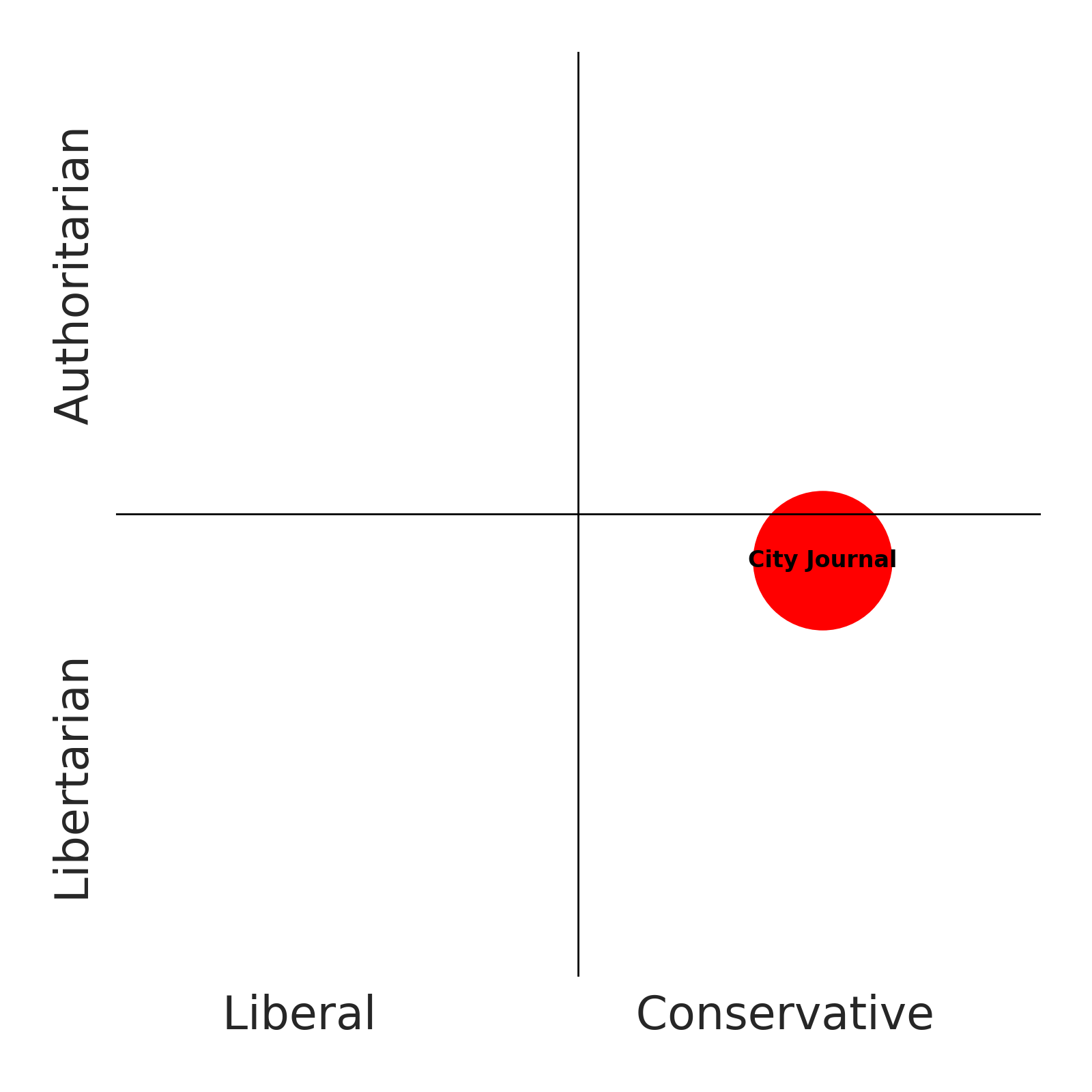
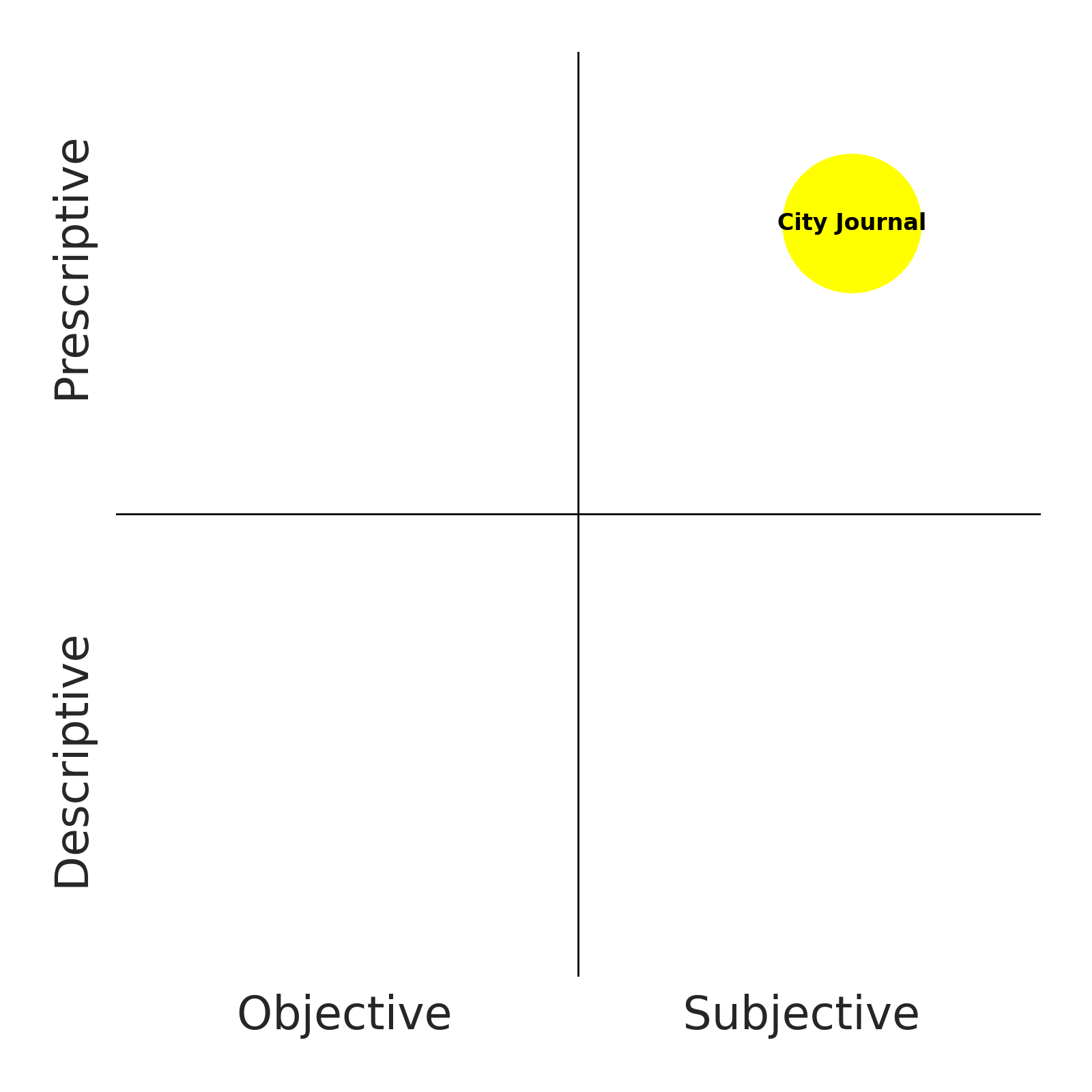
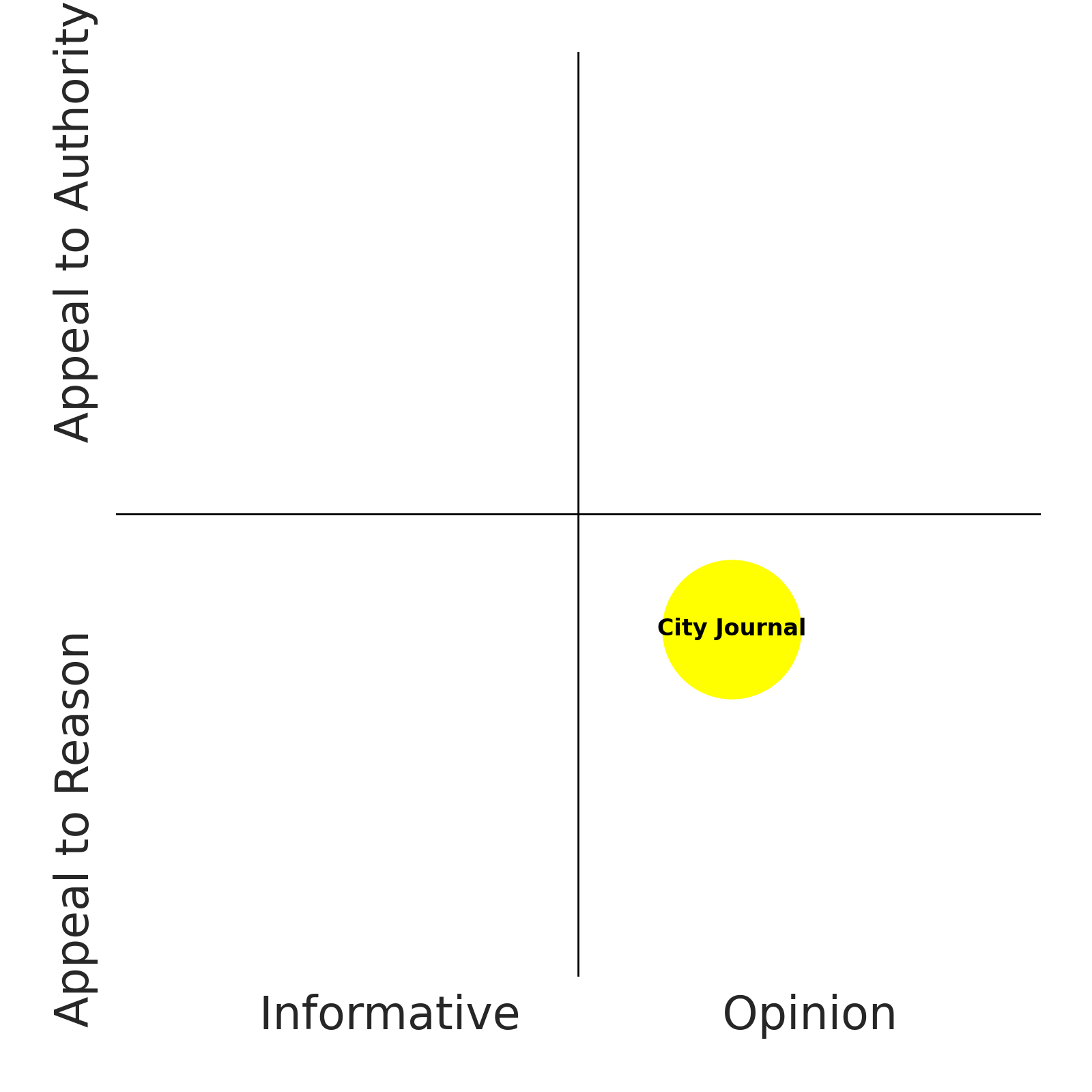
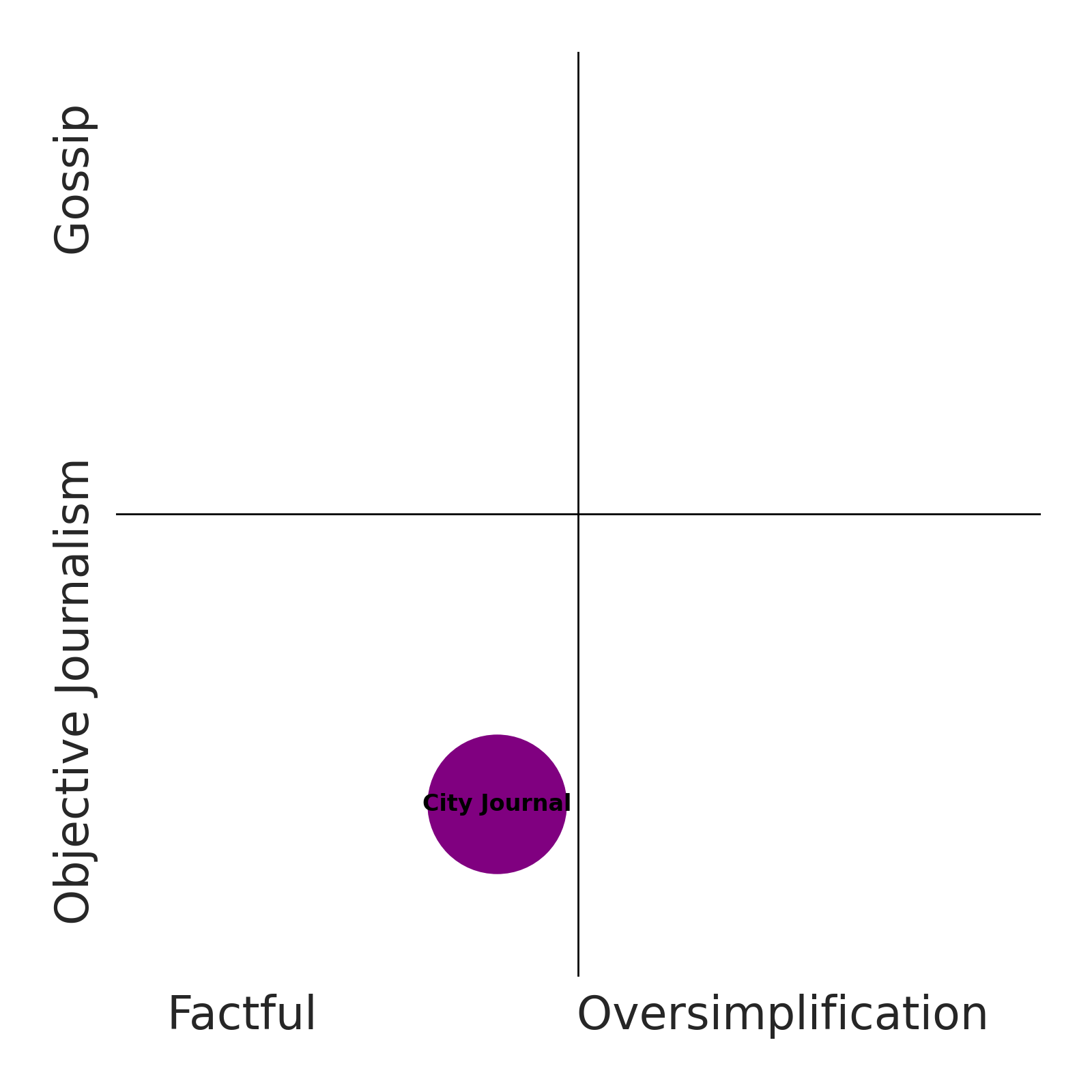
Click points to explore news by date. News sentiment ranges from -10 (very negative) to +10 (very positive) where 0 is neutral.
A market-oriented urban-policy analysis criticizes progressive and neo-socialist urban governance and presents an upscale “Prime Suburbia” model as the emerging, market-driven path for city-suburban growth.
Automated analysis; not human reviewed. Limitations: The supplied text is a truncated excerpt with ellipses and no surrounding full-text context, so classification reflects only the visible fragments. · 7 of 55 available dimensions scored; omitted dimensions are not treated as neutral. · Verified supporting quotes for 7 of 7 scored dimensions.
Claim: The framing is center-right, criticizing progressive urban governance and neo-socialism while accepting market-driven development.
“Beyond its substantive defects, neo-socialism is simply not catalyzing urban growth the way previous conceptions did.” · exact text match
“Most American cities are now viewed, with reason, as failing to address their central challenges, governing themselves ideologically—and often poorly.” · exact text match
Why: Terms such as “neo-socialism” and “governing themselves ideologically” signal a conservative critique, while the essay accepts “market reality” and credits some federal programs in the past.
Claim: The analysis is top-down, framing urban success through elite talent, capital, and upscale development rather than through democratic participation or ordinary residents.
“These services, in turn, required elite global talent concentrated in a small number of cities, such as New York, London, and Singapore.” · exact text match
“This may not be socially desirable, but it reflects the current market reality.” · exact text match
Why: The focus on “elite global talent,” leaders, and “market reality” adopts an elite and technocratic perspective on urban development.
Claim: The text is an opinion/analysis essay, marked by editorial judgments and normative prescriptions rather than straight factual reporting.
“Most American cities are now viewed, with reason, as failing to address their central challenges, governing themselves ideologically—and often poorly.” · exact text match
“Any new ideal must rest on a credible promise of competent governance.” · exact text match
Why: Phrases like “with reason” and “must rest” express editorial judgment and normative argument.
Claim: The piece is strongly prescriptive, telling leaders and cities what they must do and require.
“Any new ideal must rest on a credible promise of competent governance.” · exact text match
“Even as fertility declines, cities have long struggled to attract middle-class families with school-age children, an issue they must confront directly.” · exact text match
Why: Repeated use of “must” and “will require” recommends a specific direction for urban policy.
Claim: The piece is explicitly political, framing urban development through ideology and governance competition.
“Beyond its substantive defects, neo-socialism is simply not catalyzing urban growth the way previous conceptions did.” · exact text match
“Most American cities are now viewed, with reason, as failing to address their central challenges, governing themselves ideologically—and often poorly.” · exact text match
Why: The terms “neo-socialism” and “governing themselves ideologically” treat municipal choices as ideological and political contests.
Claim: The essay predicts future urban outcomes and trends without presenting systematic evidence.
“Most other cities will not.” · exact text match
“As earlier urban visions have faltered, a new suburban one has begun gaining momentum: Prime Suburbia.” · exact text match
Why: Sentences like “Most other cities will not” and “has begun gaining momentum” assert forward-looking trends as established.
Claim: The argument is candid about trade-offs and uncomfortable quotes, showing internal fairness rather than a one-sided presentation.
“This may not be socially desirable, but it reflects the current market reality.” · exact text match
“While perhaps true, this wasn’t a politic way of framing it.” · exact text match
Why: The essay acknowledges social costs and quotes Bloomberg in an unflattering way, which suggests intellectual candor.
The supplied text is a truncated excerpt with ellipses and no surrounding full-text context, so classification reflects only the visible fragments.
2026 © Helium Trades
Privacy Policy & Disclosure
* Disclaimer: Nothing on this website constitutes investment advice, performance data or any recommendation that any particular security, portfolio of securities, transaction or investment strategy is suitable for any specific person. Helium Trades is not responsible in any way for the accuracy
of any model predictions or price data. Any mention of a particular security and related prediction data is not a recommendation to buy or sell that security. Investments in securities involve the risk of loss. Past performance is no guarantee of future results. Helium Trades is not responsible for any of your investment decisions,
you should consult a financial expert before engaging in any transaction.