See whether Helium helps you make better-informed decisions. Try every Pro Trader feature for 30 days. No credit card required.
Try every Pro Trader feature for 30 days. No credit card required.
Compare Engadget source-level patterns, recent coverage, and article evidence. Updated weekly.
Weighted source-level patterns from recent analyzed coverage. Open recent articles below to inspect score-specific evidence and limitations when available.
😩 Pessimistic <—> Optimistic 🌞6
💡 Boring <—> Interesting12
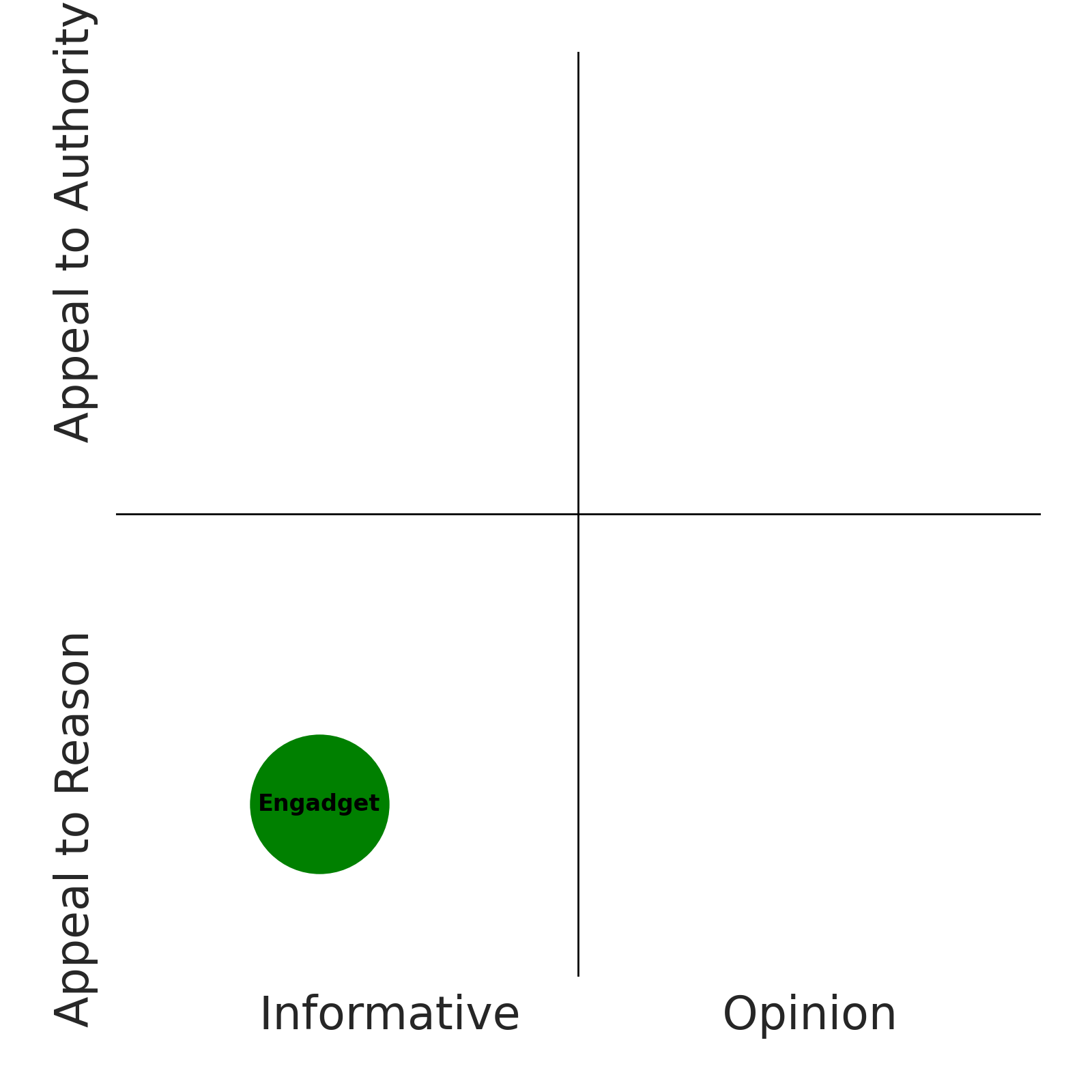
💭 Opinion60
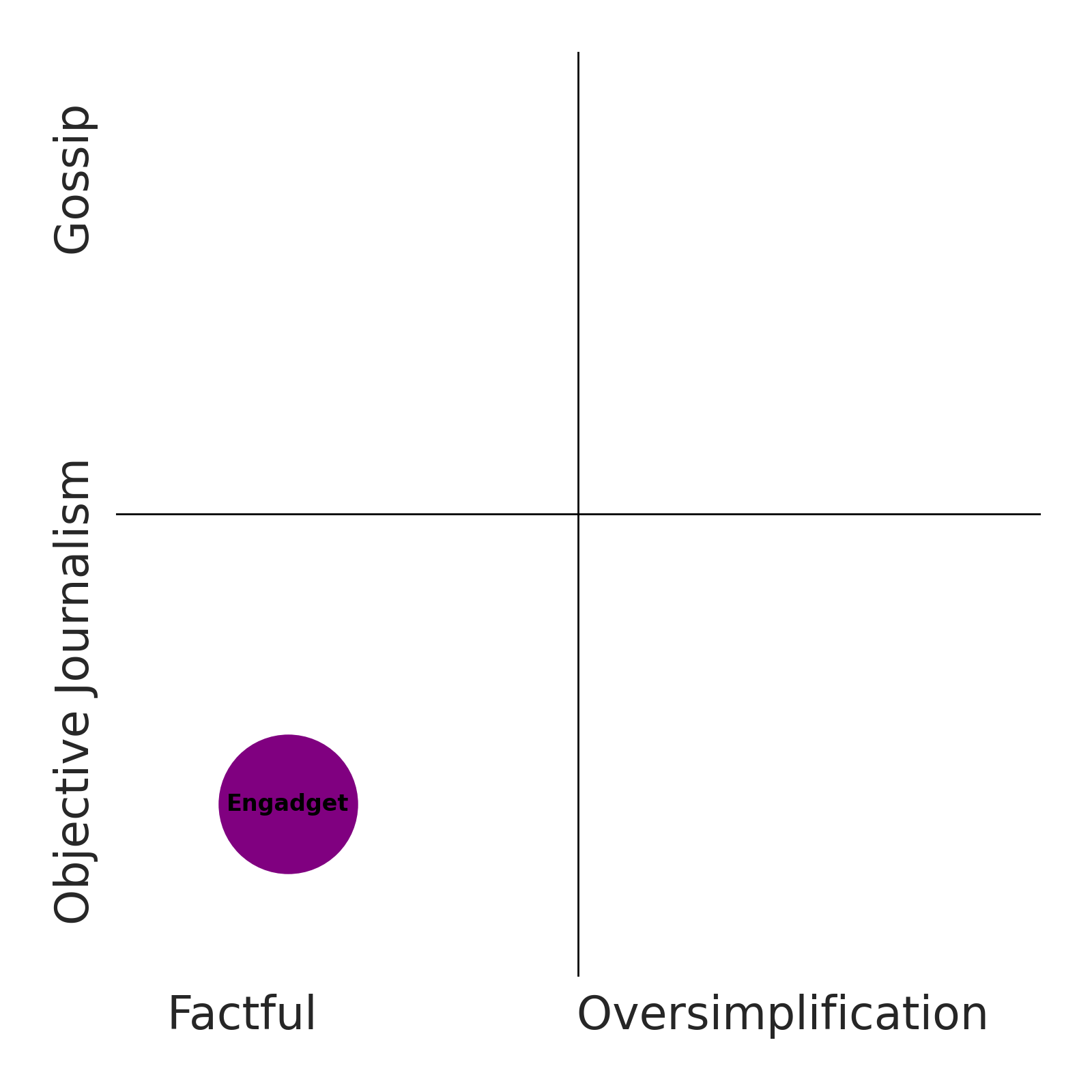
Oversimplification6
🏛️ Appeal to Authority10
👀 Covering Responses9
😤 Overconfidence14
❌ Low Credibility <—> High Credibility ✅22
🧠 Rational <—> Irrational 🤪-8
🤑 Advertising17
💔 Low Integrity <—> High Integrity ❤️14
🪨 Low Intelligence <—> High Intelligence 🦉30
🎭 Virtue Signaling6
🎲 Speculation19
🐍 Manipulative17
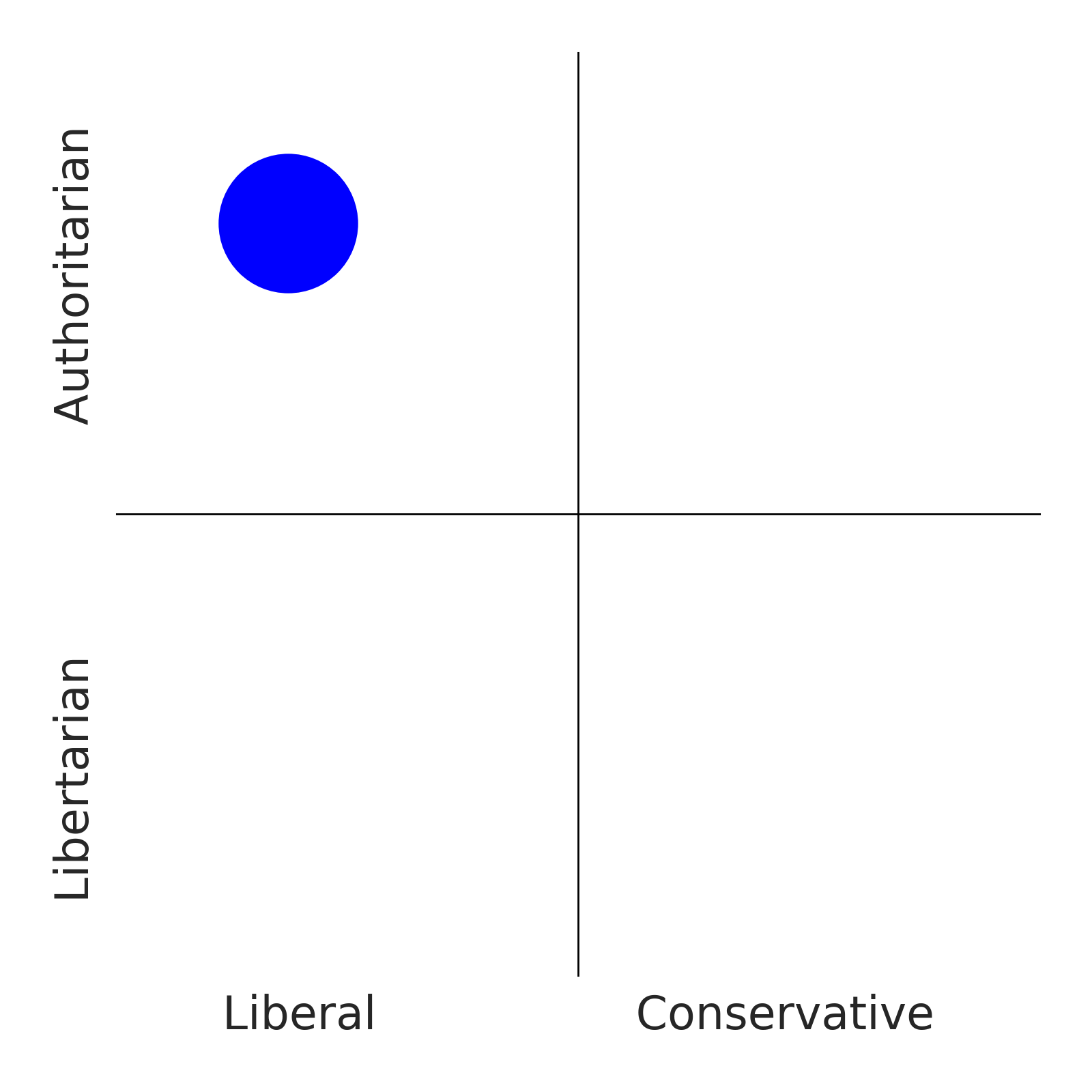
🔵 Liberal <—> Conservative 🔴-1
🧢 Populist <—> Elitist 🎩-1
🗽 Libertarian <—> Authoritarian 🚔0
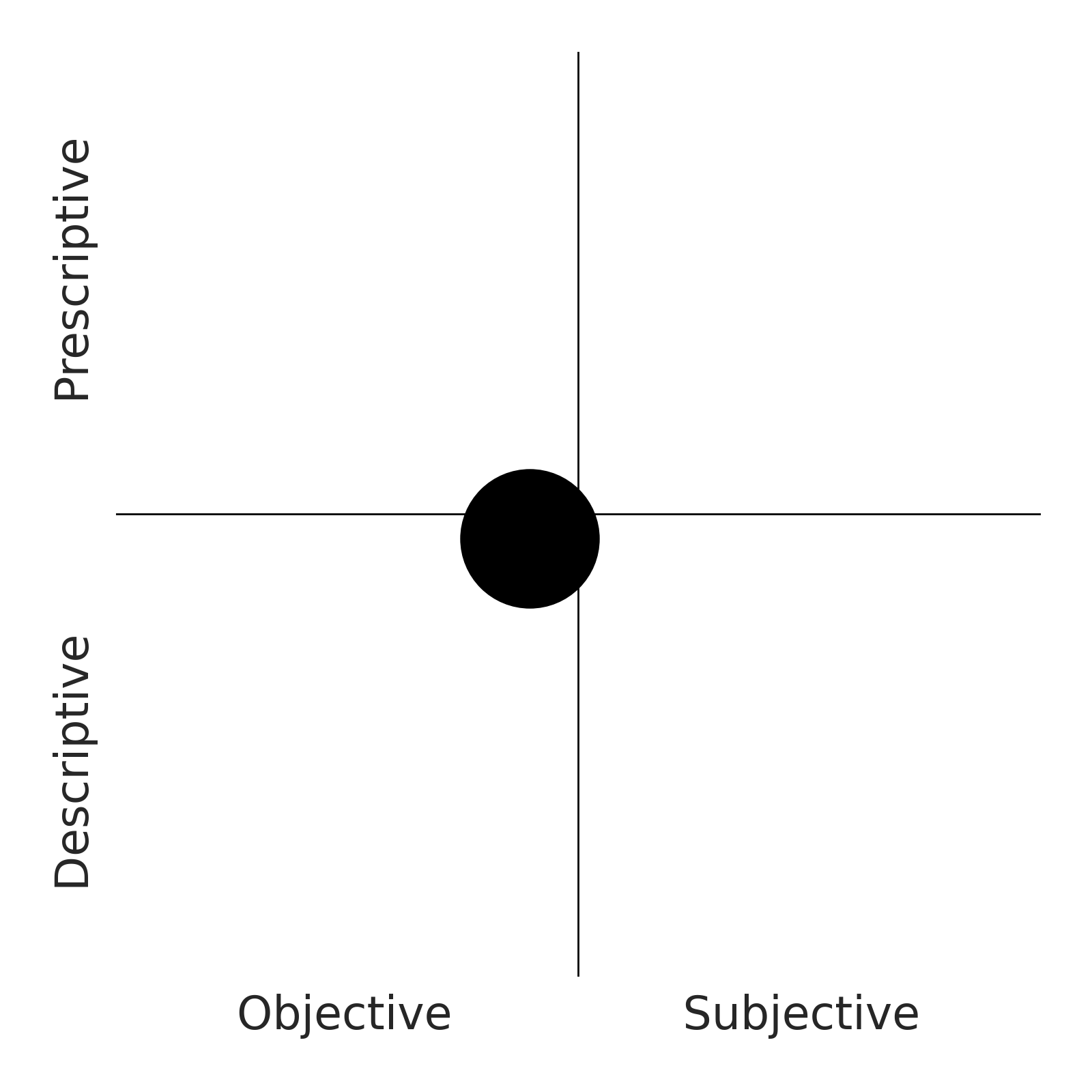
🗞️ Objective <—> Subjective 👁️ -2
🚨 Sensational0
📉 Bearish <—> Bullish 📈3
📝 Prescriptive2
🕊️ Dovish <—> Hawkish 🦁0
😨 Fearful4
📞 Begging the Question0
🗣️ Gossip0
🗳 Political4
🍼 Immature2
😢 Victimization2
🗑️ Spam2
🔒 Ideological0
🏴 Anti-establishment <—> Pro-establishment 📺3
🤖 Written by AI0
✊ Woke0
🔍 Truth-seeking <—> Delusion 🌀-2
🐐 Scapegoating0
🤡 Hypocrisy0
🦊 Anti-Corporate <—> Pro-Corporate 👔4
🔬 Scientific <—> Superstitious 🔮-3
State-led enforcement framing emphasizes potential AI liability and regulatory crackdown, using sensational rhetoric and official quotes while interweaving promotional tech content that may dilute core facts.
A report on a Florida AG's criminal inquiry into OpenAI and ChatGPT over alleged links to a mass shooting, including OpenAI's response and related regulatory actions, with embedded consumer-tech advertising.
Balanced stance; may favor official sources; limited context.
May 12, 2026 · 0 shares
Framing DOJ actions as retaliation against corporate DEI efforts while highlighting PayPal's minority-focused initiatives and IBM's related settlements, the text leans pro-DEI and anti-government enforcement, aiming to legitimize corporate diversity programs.
Overview of a DOJ settlement with PayPal over a minority-focused program, framed as a crackdown on corporate DEI initiatives and noting IBM's related DEI-related settlement.
Moderate bias toward pro-DEI corporate narratives; Western media emphasis.
August 07, 2026 · 0 shares
Frames Trump administration as using taxpayer money to sabotage renewable energy for cronyist fossil fuel interests, employing sensational and emotional language.
Automated analysis; not human reviewed. · 26 of 53 available dimensions scored; omitted dimensions are not treated as neutral. · Verified supporting quotes for 7 of 26 scored dimensions.
Claim: The article adopts a strong liberal perspective by criticizing the Trump administration's energy policies and portraying them as wasteful and cronyist.
“"$4 BILLION. That's how much the Trump Administration has now spent paying companies to cancel offshore wind projects that would have lowered your electric bill."” · exact text match
Why: The article uses all-caps and direct accusation, framing the spending as harmful to consumers, a classic liberal critique.
Claim: The article employs populist rhetoric by accusing the administration of serving cronies and wasting taxpayer money.
“"Trump has also spent around $1.1 billion to boost coal-based energy projects, which critics have said was for 'fattening the wallets of his cronies.'"” · not found in supplied text
Why: The phrase 'fattening the wallets of his cronies' is a populist trope against elite capture.
Claim: The article is highly subjective, using opinionated language and value judgments.
“"Yes, you heard that right: they are PAYING to keep more energy off the grid and your bills higher."” · exact text match
Why: The exclamation and all-caps indicate strong subjective opinion.
Claim: The article uses sensational capitalization and exclamation points to evoke outrage.
“"$4 BILLION. That's how much the Trump Administration has now spent paying companies to cancel offshore wind projects that would have lowered your electric bill."” · exact text match
Why: All-caps and dramatic claim about lowering bills is sensational.
Claim: The article is moderately interesting due to specific financial figures and the personal story about Trump's court battle.
“"It all seems to have started with a court battle in Scotland, when a wind turbine farm was built off the coast of one of his golf courses."” · not found in supplied text
Why: The background story adds interest beyond dry policy.
Claim: The article prescribes that the administration should not be doing this, using words like 'waging war' and 'should' implied.
“"Why is Trump waging war on green energy?"” · not found in supplied text
“"Trump has also exhibited a fundamental misunderstanding of battery storage"” · not found in supplied text
Why: The phrasing 'waging war' and criticism of understanding are prescriptive, implying he should act differently.
Claim: The article is heavily opinionated, with little pretense of neutrality.
“"Yes, you heard that right: they are PAYING to keep more energy off the grid and your bills higher."” · exact text match
Why: This direct editorializing is clearly opinion.
Claim: The article is highly political, focusing on partisan conflict and policy critique.
“"Trump administration spends another $1.2 billion to kill offshore wind farm projects."” · not found in supplied text
Why: The headline itself frames the action as partisan 'killing'.
Claim: The article oversimplifies the complex energy market by claiming wind projects would have lowered bills without evidence.
“"$4 BILLION. That's how much the Trump Administration has now spent paying companies to cancel offshore wind projects that would have lowered your electric bill."” · exact text match
Why: The article asserts as fact that the cancelled projects would have lowered bills, ignoring many market variables.
Claim: The article uses a schoolyard tone with all-caps and exclamation points.
“"Yes, you heard that right: they are PAYING to keep more energy off the grid and your bills higher."” · exact text match
Why: The style is reminiscent of an emotional reaction rather than mature analysis.
Claim: The article frames taxpayers and consumers as victims of the administration's actions.
“"$4 BILLION. That's how much the Trump Administration has now spent paying companies to cancel offshore wind projects that would have lowered your electric bill."” · exact text match
Why: Directly states that consumers are being harmed by higher bills.
Claim: The article is confident in its negative conclusions about the administration's motives and results.
“"Why is Trump waging war on green energy?" (implying certainty of motive)” · not found in supplied text
Why: The framing is certain but not excessively so; some evidence supports the claim.
Claim: The article reflects a left-leaning ideological perspective on energy policy.
“"Trump administration spends another $1.2 billion to kill offshore wind farm projects."” · not found in supplied text
Why: The word 'kill' implies a destructive action against something good, aligning with green ideology.
Claim: The article is anti-establishment by criticizing the Trump administration and its ties to industry.
“"fattening the wallets of his cronies"” · not found in supplied text
Why: The accusation of cronyism is a classic anti-establishment critique.
Claim: The article has a strong negative emotional bias against the Trump administration.
“"Why is Trump waging war on green energy?"” · not found in supplied text
“"he has an almost pathological hatred of wind turbines."” · not found in supplied text
Why: The language conveys anger and contempt.
Claim: The article has reduced credibility due to strong bias and opinion, but includes some verifiable facts.
“"The settlement resolves RWE US Offshore's legal claims and provides $1.22 billion in settlement funds," the company said in a statement.” · not found in supplied text
Counterevidence:
“The article relies on company statements and a report, but the overall framing undermines trust.” · not found in supplied text
Why: While facts are presented, the heavy bias reduces overall credibility.
Claim: The article uses emotional and ad hominem language rather than rational analysis, calling Trump's hatred 'pathological' and mocking him.
“"Why is Trump waging war on green energy? Well, the administration has long offered support to the fossil fuel industry. However, anyone that's followed the president knows that he has an almost pathological hatred of wind turbines."” · not found in supplied text
Why: Calling the hatred 'pathological' is an irrational framing that attacks the person rather than policy.
Claim: The article is anti-corporate, criticizing the deal as benefiting big energy at taxpayer expense.
“"fattening the wallets of his cronies"” · not found in supplied text
Why: Accusation of cronyism implies corporations are unfairly benefiting.
Claim: The article takes a scientific stance by mocking Trump's baseless claims about wind turbines causing cancer and killing whales.
“"He has claimed multiple times that they cause cancer and that they are 'driving the whales crazy' and killing them 'in numbers never seen before.'"” · not found in supplied text
Why: By presenting these claims as absurd, the article aligns with empirical science.
Claim: The article emphasizes collective taxpayer money and consumer harm, leaning collectivist.
“"These funds are being drawn from the Department of the Interior which, in turn, is utilizing taxpayer dollars."” · not found in supplied text
Why: Focus on taxpayer burden reflects collectivist concern for the common good.
Claim: The article uses manipulation techniques such as loaded language, omission of potential benefits of the deal, and emotional appeals.
“"they are PAYING to keep more energy off the grid and your bills higher."” · not found in supplied text
Why: This statement omits any context or benefit that might justify the deal, manipulating reader perception.
Claim: The article mixes factual reporting with strong opinion and selective framing, reducing perceived integrity.
“"This is actually the fifth deal the administration has struck with energy companies in which it has offered payouts in exchange for abandoning renewable energy projects."” · not found in supplied text
Counterevidence:
“The article does report specific numbers and attributes statements to companies.” · not found in supplied text
Why: While it includes factual elements, the overall tone undermines journalistic neutrality, lowering integrity.
Claim: The article is not intellectually deep, relying on emotional appeals and simple narratives.
“"He has claimed multiple times that they cause cancer and that they are 'driving the whales crazy' and killing them 'in numbers never seen before.'"” · not found in supplied text
Why: Mocks Trump's claims but does not provide counter-analysis or depth.
Claim: The article signals environmental virtue by criticizing fossil fuels and celebrating renewable energy.
“"Trump has also exhibited a fundamental misunderstanding of battery storage when saying things like 'if it doesn't blow, you can forget about television for that night.'"” · not found in supplied text
Why: Criticizes Trump's misunderstanding, implying the article's side is enlightened.
Claim: The article suggests Trump's opposition to wind turbines stems from a personal vendetta over a court battle in Scotland.
“"It all seems to have started with a court battle in Scotland, when a wind turbine farm was built off the coast of one of his golf courses. He lost that court battle, so now we all have to use only fossil fuels until the end of time."” · not found in supplied text
Why: The causal link is speculative and presented as a simplistic conspiracy theory.
Claim: The article scapegoats Trump and his administration for rising energy costs.
“"they are PAYING to keep more energy off the grid and your bills higher."” · not found in supplied text
Why: Blames Trump for higher bills without acknowledging other factors.
August 06, 2026 · 0 shares
A strongly critical, opinionated framing of the FCC's repeal of the 39% ownership cap as a legally questionable gift to big media, using sarcasm and loaded language.
Automated analysis; not human reviewed. Limitations: The article is an opinion piece with clear editorial stance, making bias classification straightforward but reducing the need for inference. · 9 of 53 available dimensions scored; omitted dimensions are not treated as neutral. · Verified supporting quotes for 4 of 9 scored dimensions.
Claim: The article warns about consolidation harming local communities.
“Trading a squeeze from Big Tech for a squeeze from Big Media does nothing to protect the communities this cap was designed to serve” · exact text match
Why: It uses fear of loss of local control, but not strong fear-mongering.
Claim: The article is opinionated, presenting the author's views as fact.
“This is a huge win for entities like Nexstar Media Group and Sinclair Broadcast Group.” · not found in supplied text
“Of course, it's likely this move will run into one or several court challenges.” · exact text match
Why: The article makes evaluative statements and predictions without neutral attribution.
Claim: The article is highly political, involving FCC, Congress, and partisan criticism.
“Gotta get that culture war stuff in, am I right?” · exact text match
“FCC chair Brendan Carr, who has threatened to revoke the broadcast licenses of stations that air content that's deemed as unfavorable to the Trump Administration” · not found in supplied text
Why: The article explicitly ties the FCC decision to Trump administration politics and culture war.
Claim: The article uses sarcasm and dismissive language, which can be seen as immature.
“He also said some gobbledygook about how this move will stop 'undifferentiated passthroughs...' Gotta get that culture war stuff in, am I right?” · not found in supplied text
Why: The use of 'gobbledygook' and sarcastic 'am I right?' is immature in tone.
Claim: The article reflects a liberal ideological stance favoring regulation and criticizing corporate power.
“The 39 percent rule was initially put in place to constrain the ability of broadcasters to consolidate stations and limit the power of any single media company.” · exact text match
“Trading a squeeze from Big Tech for a squeeze from Big Media does nothing to protect the communities this cap was designed to serve” · exact text match
Why: The article endorses the original regulatory purpose and criticizes consolidation.
Claim: The article is anti-establishment, criticizing the FCC and the Trump administration.
“Despite being an obvious gift to local media conglomerates, FCC chair Brendan Carr is pitching this as a win for the little guy.” · exact text match
“It's worth remembering that we are more than five months into a war in Iran and Congress hasn't passed a formal declaration or even a specific Authorization for Use of Military Force.” · exact text match
Why: The article is skeptical of the FCC's motives and draws a parallel to illegal war.
Claim: The article has a negative emotional tone, critical and sarcastic.
“That was sarcasm.” · exact text match
“Gotta get that culture war stuff in, am I right?” · exact text match
Why: The sarcasm conveys negative emotion towards the FCC and its justifications.
Claim: The article is anti-corporate, criticizing large media companies.
“This is a huge win for entities like Nexstar Media Group and Sinclair Broadcast Group.” · not found in supplied text
“Sinclair has already been the beneficiary of the FCC's largesse.” · exact text match
Why: The article frames the repeal as a gift to corporations and highlights their gains.
Claim: The article demonstrates moderate intelligence by referencing specific legal sections and historical context.
“Section 10 of the Communications Act expressly forbids the FCC from bending the rules around Section 303.” · exact text match
“The 39 percent rule comes from a 2004 appropriations bill.” · not found in supplied text
Why: It cites legal details and history, but the overall tone is opinionated rather than analytical.
The article is an opinion piece with clear editorial stance, making bias classification straightforward but reducing the need for inference.
Strongly critical framing of Trump Mobile’s data leak and marketing claims, emphasizing alleged misrepresentation, high price, and integrity concerns, while citing TechCrunch to support factual points; the tone leans liberal in politics and stresses consumer protection and corporate accountability.
Coverage discusses a data breach at Trump Mobile, admission of exposure, claimed lack of financial data, marketing claims, device origin, and preorder figures, with critical analysis of corporate marketing and consumer protection implications.
I may overemphasize anti-Trump framing; verify with diverse sources.
A first-person opinion piece that frames Apple's AirPods 5 pricing as a flawed value proposition and prescribes a revamped lineup using confident personal assertions.
Automated analysis; not human reviewed. Limitations: Article text is truncated, but the provided segment contains sufficient content for analysis. · 3 of 54 available dimensions scored; omitted dimensions are not treated as neutral. · Verified supporting quotes for 2 of 3 scored dimensions.
Claim: The article presents subjective views rather than objective reporting.
“Trust me, the first time that you need to adjust the volume and swipe on a non-responsive AirPod stem, you will regret not doing so.” · exact text match
Why: Direct appeal to personal experience and emotional persuasion.
Claim: The article is highly opinionated with personal preferences and judgments.
“My issue isn't that the AirPods 5 with Wireless Charging Case exist, it's that Apple is also selling the 'regular' AirPods 5 for only $20 less.” · not found in supplied text
“Since that's the hill I'm willing to die on, I'll also argue that $20 isn't enough of a difference...” · not found in supplied text
Why: Frequent first-person opinions and prescriptive language throughout.
Claim: The article asserts certainty about future user experience without evidence.
“I already know how much the swipe gestures for volume control will improve the experience.” · exact text match
Why: Uses 'I already know' to claim certain knowledge of a future experience.
Article text is truncated, but the provided segment contains sufficient content for analysis.
July 22, 2026 · 0 shares
Promotional, highly positive framing that foregrounds Poinpy's return, nostalgia, and free-to-play appeal with minimal critical balance.
Promotional piece celebrating Poinpy's return, noting its free mobile availability and Netflix history, with emphasis on visuals and soundtrack.
Automated analysis; not human reviewed. · 21 of 52 available dimensions scored; omitted dimensions are not treated as neutral. · Verified supporting quotes for 6 of 21 scored dimensions.
Claim: Heavy reliance on subjective opinions and affective language.
“Poinpy is back on iOS and Android.” · exact text match
“Poinpy is a perfect platformer.” · exact text match
“Poinpy is pure joy.” · exact text match
Counterevidence:
“The text includes factual statements about Netflix exclusivity and the game's debut.” · not found in supplied text
Why: Frequent personal judgments and emotional framing indicate high subjectivity.
Claim: Overall positive framing toward Poinpy's return indicates a bullish bias.
“Best of all, it's completely free. No microtransactions or ads or nothing.” · exact text match
“It's never leaving my phone ever again.” · exact text match
“Poinpy is a perfect platformer.” · exact text match
Counterevidence:
“Netflix removal introduces a potential risk factor.” · not found in supplied text
Why: Positive assertions and commitments indicate bullish stance despite a counterpoint from Netflix history.
Claim: Explicit, strong opinions about Poinpy's quality.
“Poinpy is a perfect platformer.” · exact text match
“It might be my favorite game of the decade so far.” · exact text match
“Poinpy is pure joy.” · exact text match
Counterevidence:
“An explicit Netflix removal is mentioned, showing some factual basis.” · not found in supplied text
Why: Consistent strong evaluative language indicates opinion-driven framing.
Claim: Monetization is presented as entirely free of ads or microtransactions.
“No microtransactions or ads or nothing.” · exact text match
“That's the best price.” · exact text match
Counterevidence:
“No discussion of potential future monetization or exceptions.” · not found in supplied text
Why: Reduces monetization to a binary without nuance.
Claim: Absolute certainty in qualitative claims about the game's quality and monetization.
“Poinpy is a perfect platformer.” · exact text match
“Best of all, it's completely free. No microtransactions or ads or nothing.” · exact text match
“It's never leaving my phone ever again.” · exact text match
Counterevidence:
“The game was unavailable for over a year due to Netflix removal.” · not found in supplied text
Why: Binary adjectives and definitive statements exceed the provided evidence.
Claim: Some certainty-laden statements reflect potential irrational confidence.
“Poinpy is a perfect platformer.” · exact text match
“It might be my favorite game of the decade so far.” · exact text match
“Poinpy is pure joy.” · exact text match
Counterevidence:
“The mobile game debuted in 2022 and it was available exclusively to Netflix subscribers.” · exact text match
“However, the streaming service pulled Poinpy from its lineup in June last year.” · not found in supplied text
Why: Evaluative language without corroborating evidence suggests potential irrationality.
Case-specific: limited sources; strong promotional framing; may understate counterpoints.
Promotional Bandcamp Friday messaging frames artist proceeds as fully directed to artists, blends subjective music endorsements with authority cues, and invites reader interaction, signaling a clearly promotional and opinionated bias rather than neutral reporting.
Promotional Bandcamp Friday post emphasizing artist-supported proceeds and including multiple positive album recommendations plus a call for reader engagement.
I favor concise, data-driven analysis; risk promo tone in music media.
October 07, 2026 · 0 shares
The piece is openly hostile toward Meta, using a film review to assert corporate 'moral rot' and warn readers not to trust the company, with claims stated as settled fact.
Automated analysis; not human reviewed. Limitations: The supplied text is a film review and opinion column rather than straight news, so several bias dimensions are inferred from evaluative language about Meta. · 55 of 55 available dimensions scored; omitted dimensions are not treated as neutral. · Verified supporting quotes for 21 of 55 scored dimensions.
Claim: The article frames a major tech corporation as a harmful actor needing regulation or distrust, a stance more aligned with left-leaning tech skepticism.
“it champions old-school journalism, while also shining a light on the severe moral rot behind Facebook” · not found in supplied text
Why: Anti-corporate, pro-regulatory framing leans liberal, though the pro-journalism theme is not exclusively partisan.
Claim: The article sides with ordinary users and whistleblowers against a powerful corporation and its CEO.
“we shouldn't trust Meta” · exact text match
Why: Populist framing pits the public against an untrusted elite tech company.
Claim: The review blends film criticism with strongly worded judgments and warnings rather than neutral reporting.
“maybe think twice about giving Muse access to your most sensitive data” · not found in supplied text
Why: Direct prescriptive advice and value judgments signal subjective commentary.
Claim: The article uses vivid, alarming language about corporate harm and future risks.
“before AI's disastrous externalities become fodder for a third film” · not found in supplied text
Why: Dramatic phrasing about 'disastrous externalities' heightens sensational tone.
Claim: The article is negative on Meta's outlook and trustworthiness.
“we shouldn't trust it” · exact text match
Why: Explicit distrust and warning about Meta's products supports a bearish framing.
Claim: The piece emphasizes corporate misdeeds and warns of future harm.
“severe moral rot behind Facebook” · exact text match
Why: Dark characterization and warnings indicate a pessimistic tone.
Claim: The article moves beyond describing the film to advising readers on trusting Meta and protecting data.
“Maybe think twice about giving Muse access to your most sensitive data” · exact text match
Why: Direct advice to readers is prescriptive.
Claim: The article warns of surveillance and disastrous AI externalities, leveraging fear.
“creepy surveillance glasses” · exact text match
Why: Fear-laden terms like 'creepy' and 'disastrous' raise alarm.
Claim: It presumes Meta is harmful while using that presumption to argue against trusting it.
“The Social Reckoning is yet another reminder of why we shouldn't trust it” · exact text match
Why: The conclusion that Meta should not be trusted is asserted rather than fully argued from first principles.
Claim: The article is heavily evaluative, calling Facebook's conduct morally rotten and urging distrust.
“succeeds at making a movie that champions old-school journalism, while also shining a light on the severe moral rot behind Facebook” · exact text match
Why: Strong value judgments dominate the piece.
Claim: The article engages with Congressional testimony, Trump, January 6th, and platform policy, making it politically charged.
“climaxes with the January 6th Capitol riot and Zuckerberg's reluctant decision to ban Trump's Facebook accounts” · exact text match
Why: Political events and figures are central to the framing.
Claim: It reduces Meta's problems to a simple engagement-at-any-cost narrative.
“he ignores their analysis because acting on it would lead to a minuscule drop in user engagement” · exact text match
Why: Single-motive explanation oversimplifies complex platform decisions.
Claim: It leans on the WSJ's Pulitzer-winning investigation and Haugen's testimony as authoritative validation.
“culminated in the Pulitzer Prize-winning 2022 series "The Facebook Files"” · not found in supplied text
Why: Reliance on prestigious investigation and testimony supports an appeal-to-authority tendency.
Claim: The article foregrounds victims of Facebook, including teen girls and a radicalized friend.
“revealed that the company knew how badly Instagram affected teen girls' mental health” · not found in supplied text
Why: Emphasis on harm to vulnerable users frames them as victims.
Claim: Contested and predictive claims are stated with high certainty.
“Meta has gone to extraordinary lengths to maximize growth and engagement, regardless of the consequences to its users” · exact text match
Why: Sweeping certainty exceeds the evidence presented.
Claim: A strong anti-corporate, pro-regulatory worldview shapes the piece.
“severe moral rot behind Facebook” · exact text match
Why: Consistent ideological tone against tech power.
Claim: The article is critical of Meta, a major establishment corporation, while praising old-school journalism.
“we shouldn't trust it” · exact text match
Why: Anti-corporate stance is anti-establishment in the corporate sense, though it valorizes journalism.
Claim: The article conveys strong negative emotion toward Meta.
“severe moral rot” · exact text match
Why: Loaded, emotionally negative language dominates.
Claim: The article cites specific investigations, testimony, and settlements, but is an opinionated review with strong assertions.
“Meta paid Trump $25 million to settle a lawsuit over that ban” · exact text match
Why: Concrete verifiable details support credibility, offset by heavy opinion.
Claim: The article is strongly anti-Meta/anti-corporate.
“we shouldn't trust it” · exact text match
Why: Explicit distrust of a major corporation.
Claim: It cites research findings and court/regulatory matters rather than superstition.
“dramatically reducing misinformation on Facebook” · exact text match
Why: Reliance on factual investigations suggests a scientific-empirical leaning, though the piece is opinionated.
Claim: It forecasts future AI harms and a possible third film.
“before AI's disastrous externalities become fodder for a third film” · not found in supplied text
Why: Forward-looking speculation about consequences.
Claim: It uses loaded framing and asymmetric emphasis on Meta's harms.
“creepy surveillance glasses” · exact text match
Why: Loaded terms and one-sided emphasis can be manipulative, though the article is clearly labeled as a review/opinion.
Claim: The article cites specific investigations, testimony, fines, and settlements, showing some evidentiary grounding.
“culminated in the Pulitzer Prize-winning 2022 series "The Facebook Files"” · not found in supplied text
Why: Use of named sources and concrete events supports moderate integrity.
Claim: It references radicalization into white supremacy and mental health harms to protected groups.
“radicalize her formerly progressive friend into a white supremacist” · exact text match
Why: Identity-related harm is mentioned, but not with strong differential moral standards or prescriptive identity remedies.
Claim: The article positions itself with old-school journalism as a moral good against corporate rot.
“champions old-school journalism” · exact text match
Why: Moral framing of journalism versus Meta signals virtue alignment.
Claim: Meta and Zuckerberg are presented as the primary source of social harms.
“a "free speech absolutist" who refuses to confront the ways his platform is harming people” · exact text match
Why: Blame concentrates on one company and its CEO.
Claim: It highlights Zuckerberg's shift from apologizing to refusing to apologize and rejecting fact checks as inconsistent.
“declaring that he's done apologizing for Facebook's misdeeds” · exact text match
Why: The article points to a double standard in Zuckerberg's stance, though this is reported rather than applied by the publisher to comparable cases.
The supplied text is a film review and opinion column rather than straight news, so several bias dimensions are inferred from evaluative language about Meta.
September 15, 2026 · 0 shares
Framing treats cryptocurrency as fundamentally illegitimate, using Binance's IRGC-related findings, dark-web crime imagery, and first-person dismissal to assert that the main uses are secret funding, illegal purchases, and scams.
Automated analysis; not human reviewed. Limitations: The supplied text is a truncated excerpt with omitted sections and begins mid-sentence, so surrounding context and qualifications may be missing. · 6 of 54 available dimensions scored; omitted dimensions are not treated as neutral. · Verified supporting quotes for 6 of 6 scored dimensions.
Claim: The report shifts into first-person subjective judgment about cryptocurrency's legitimacy.
“Other than speculation, I'm still not entirely sure what legitimate uses there are for cryptocurrencies.” · exact text match
“As far as I can tell, the key use case here is funding organizations in secret (see above), buying drugs and weapons on the dark web and scamming people.” · exact text match
Why: The use of 'I'm' and 'As far as I can tell' signals personal opinion and epistemic hedging, not detached reporting.
Claim: The text uses loaded and informal wording that heightens drama.
“moved heaps of money through the exchange to a network that was funding Iran's Islamic Revolutionary Guard Corps” · exact text match
“the key use case here is funding organizations in secret (see above), buying drugs and weapons on the dark web and scamming people.” · exact text match
Why: 'heaps of money' is colloquial rather than neutral, and the final catalog of secret funding, drugs, weapons, and scams increases alarm.
Claim: The commentary is pessimistic about cryptocurrency's legitimate utility.
“Other than speculation, I'm still not entirely sure what legitimate uses there are for cryptocurrencies.” · exact text match
“As far as I can tell, the key use case here is funding organizations in secret (see above), buying drugs and weapons on the dark web and scamming people.” · exact text match
Why: It asserts that cryptocurrency has no clear legitimate use beyond speculation and that its main uses are criminal or harmful.
Claim: The report concludes with an unsupported personal opinion about crypto uses.
“Other than speculation, I'm still not entirely sure what legitimate uses there are for cryptocurrencies.” · exact text match
“As far as I can tell, the key use case here is funding organizations in secret (see above), buying drugs and weapons on the dark web and scamming people.” · exact text match
Why: The first-person assertion and 'As far as I can tell' mark the closing as opinion rather than fact.
Claim: The conclusion collapses cryptocurrency's uses into one negative 'key use case.'
“As far as I can tell, the key use case here is funding organizations in secret (see above), buying drugs and weapons on the dark web and scamming people.” · exact text match
Why: It treats a small set of illegal examples as defining the entire category of cryptocurrency use.
Claim: The wording carries a negative emotional charge through crime-related examples.
“buying drugs and weapons on the dark web and scamming people.” · exact text match
Why: The language 'drugs and weapons' and 'scamming people' is more evocative than neutral terms like 'illegal purchases' or 'fraud.'
The supplied text is a truncated excerpt with omitted sections and begins mid-sentence, so surrounding context and qualifications may be missing.
August 07, 2026 · 0 shares
Frames Trump administration as using taxpayer money to sabotage renewable energy for cronyist fossil fuel interests, employing sensational and emotional language.
Automated analysis; not human reviewed. · 26 of 53 available dimensions scored; omitted dimensions are not treated as neutral. · Verified supporting quotes for 7 of 26 scored dimensions.
Claim: The article adopts a strong liberal perspective by criticizing the Trump administration's energy policies and portraying them as wasteful and cronyist.
“"$4 BILLION. That's how much the Trump Administration has now spent paying companies to cancel offshore wind projects that would have lowered your electric bill."” · exact text match
Why: The article uses all-caps and direct accusation, framing the spending as harmful to consumers, a classic liberal critique.
Claim: The article employs populist rhetoric by accusing the administration of serving cronies and wasting taxpayer money.
“"Trump has also spent around $1.1 billion to boost coal-based energy projects, which critics have said was for 'fattening the wallets of his cronies.'"” · not found in supplied text
Why: The phrase 'fattening the wallets of his cronies' is a populist trope against elite capture.
Claim: The article is highly subjective, using opinionated language and value judgments.
“"Yes, you heard that right: they are PAYING to keep more energy off the grid and your bills higher."” · exact text match
Why: The exclamation and all-caps indicate strong subjective opinion.
Claim: The article uses sensational capitalization and exclamation points to evoke outrage.
“"$4 BILLION. That's how much the Trump Administration has now spent paying companies to cancel offshore wind projects that would have lowered your electric bill."” · exact text match
Why: All-caps and dramatic claim about lowering bills is sensational.
Claim: The article is moderately interesting due to specific financial figures and the personal story about Trump's court battle.
“"It all seems to have started with a court battle in Scotland, when a wind turbine farm was built off the coast of one of his golf courses."” · not found in supplied text
Why: The background story adds interest beyond dry policy.
Claim: The article prescribes that the administration should not be doing this, using words like 'waging war' and 'should' implied.
“"Why is Trump waging war on green energy?"” · not found in supplied text
“"Trump has also exhibited a fundamental misunderstanding of battery storage"” · not found in supplied text
Why: The phrasing 'waging war' and criticism of understanding are prescriptive, implying he should act differently.
Claim: The article is heavily opinionated, with little pretense of neutrality.
“"Yes, you heard that right: they are PAYING to keep more energy off the grid and your bills higher."” · exact text match
Why: This direct editorializing is clearly opinion.
Claim: The article is highly political, focusing on partisan conflict and policy critique.
“"Trump administration spends another $1.2 billion to kill offshore wind farm projects."” · not found in supplied text
Why: The headline itself frames the action as partisan 'killing'.
Claim: The article oversimplifies the complex energy market by claiming wind projects would have lowered bills without evidence.
“"$4 BILLION. That's how much the Trump Administration has now spent paying companies to cancel offshore wind projects that would have lowered your electric bill."” · exact text match
Why: The article asserts as fact that the cancelled projects would have lowered bills, ignoring many market variables.
Claim: The article uses a schoolyard tone with all-caps and exclamation points.
“"Yes, you heard that right: they are PAYING to keep more energy off the grid and your bills higher."” · exact text match
Why: The style is reminiscent of an emotional reaction rather than mature analysis.
Claim: The article frames taxpayers and consumers as victims of the administration's actions.
“"$4 BILLION. That's how much the Trump Administration has now spent paying companies to cancel offshore wind projects that would have lowered your electric bill."” · exact text match
Why: Directly states that consumers are being harmed by higher bills.
Claim: The article is confident in its negative conclusions about the administration's motives and results.
“"Why is Trump waging war on green energy?" (implying certainty of motive)” · not found in supplied text
Why: The framing is certain but not excessively so; some evidence supports the claim.
Claim: The article reflects a left-leaning ideological perspective on energy policy.
“"Trump administration spends another $1.2 billion to kill offshore wind farm projects."” · not found in supplied text
Why: The word 'kill' implies a destructive action against something good, aligning with green ideology.
Claim: The article is anti-establishment by criticizing the Trump administration and its ties to industry.
“"fattening the wallets of his cronies"” · not found in supplied text
Why: The accusation of cronyism is a classic anti-establishment critique.
Claim: The article has a strong negative emotional bias against the Trump administration.
“"Why is Trump waging war on green energy?"” · not found in supplied text
“"he has an almost pathological hatred of wind turbines."” · not found in supplied text
Why: The language conveys anger and contempt.
Claim: The article has reduced credibility due to strong bias and opinion, but includes some verifiable facts.
“"The settlement resolves RWE US Offshore's legal claims and provides $1.22 billion in settlement funds," the company said in a statement.” · not found in supplied text
Counterevidence:
“The article relies on company statements and a report, but the overall framing undermines trust.” · not found in supplied text
Why: While facts are presented, the heavy bias reduces overall credibility.
Claim: The article uses emotional and ad hominem language rather than rational analysis, calling Trump's hatred 'pathological' and mocking him.
“"Why is Trump waging war on green energy? Well, the administration has long offered support to the fossil fuel industry. However, anyone that's followed the president knows that he has an almost pathological hatred of wind turbines."” · not found in supplied text
Why: Calling the hatred 'pathological' is an irrational framing that attacks the person rather than policy.
Claim: The article is anti-corporate, criticizing the deal as benefiting big energy at taxpayer expense.
“"fattening the wallets of his cronies"” · not found in supplied text
Why: Accusation of cronyism implies corporations are unfairly benefiting.
Claim: The article takes a scientific stance by mocking Trump's baseless claims about wind turbines causing cancer and killing whales.
“"He has claimed multiple times that they cause cancer and that they are 'driving the whales crazy' and killing them 'in numbers never seen before.'"” · not found in supplied text
Why: By presenting these claims as absurd, the article aligns with empirical science.
Claim: The article emphasizes collective taxpayer money and consumer harm, leaning collectivist.
“"These funds are being drawn from the Department of the Interior which, in turn, is utilizing taxpayer dollars."” · not found in supplied text
Why: Focus on taxpayer burden reflects collectivist concern for the common good.
Claim: The article uses manipulation techniques such as loaded language, omission of potential benefits of the deal, and emotional appeals.
“"they are PAYING to keep more energy off the grid and your bills higher."” · not found in supplied text
Why: This statement omits any context or benefit that might justify the deal, manipulating reader perception.
Claim: The article mixes factual reporting with strong opinion and selective framing, reducing perceived integrity.
“"This is actually the fifth deal the administration has struck with energy companies in which it has offered payouts in exchange for abandoning renewable energy projects."” · not found in supplied text
Counterevidence:
“The article does report specific numbers and attributes statements to companies.” · not found in supplied text
Why: While it includes factual elements, the overall tone undermines journalistic neutrality, lowering integrity.
Claim: The article is not intellectually deep, relying on emotional appeals and simple narratives.
“"He has claimed multiple times that they cause cancer and that they are 'driving the whales crazy' and killing them 'in numbers never seen before.'"” · not found in supplied text
Why: Mocks Trump's claims but does not provide counter-analysis or depth.
Claim: The article signals environmental virtue by criticizing fossil fuels and celebrating renewable energy.
“"Trump has also exhibited a fundamental misunderstanding of battery storage when saying things like 'if it doesn't blow, you can forget about television for that night.'"” · not found in supplied text
Why: Criticizes Trump's misunderstanding, implying the article's side is enlightened.
Claim: The article suggests Trump's opposition to wind turbines stems from a personal vendetta over a court battle in Scotland.
“"It all seems to have started with a court battle in Scotland, when a wind turbine farm was built off the coast of one of his golf courses. He lost that court battle, so now we all have to use only fossil fuels until the end of time."” · not found in supplied text
Why: The causal link is speculative and presented as a simplistic conspiracy theory.
Claim: The article scapegoats Trump and his administration for rising energy costs.
“"they are PAYING to keep more energy off the grid and your bills higher."” · not found in supplied text
Why: Blames Trump for higher bills without acknowledging other factors.
A nuanced, opinionated assessment that praises Tim Cook's steadiness and Apple's execution while challenging Silicon Valley founder-myth narratives and some strategic missteps, reflecting a bias toward pragmatic, team-led leadership over mythologized genius.
Op-ed evaluating Tim Cook's Apple leadership, praising stability and execution while critiquing founder-myth narratives and strategic missteps.
Balanced lens; may underweight extreme claims.
Strongly negative, mocking, and first-person evaluative framing condemns Epic's AI-focused launcher announcement as tone-deaf while siding with workers over corporate AI adoption.
Epic Games Store is a PC game launcher and storefront competing with Valve's Steam and GOG; the launcher is the client used to access installed games.
Automated analysis; not human reviewed. Limitations: The supplied text is an opinion critique excerpt with no byline; it mixes first-person testing with reported facts, limiting certainty on several framing dimensions. · 13 of 55 available dimensions scored; omitted dimensions are not treated as neutral. · Verified supporting quotes for 11 of 13 scored dimensions.
Claim: The publisher derides Epic's CEO and leadership as out of touch while siding with workers.
“Gross, Tim. Gross.” · exact text match
“Even by Sweeney's standards, the post comes off as tone deaf.” · exact text match
Why: Mocking the CEO and calling the company tone-deaf frames corporate leadership as detached from workers.
Claim: First-person evaluative judgment dominates the piece.
“Gross, Tim. Gross.” · exact text match
“if I'm honest, I would rather not support a company” · exact text match
Why: Explicit personal opinion and value judgment are central to the presentation.
Claim: The framing uses sensational, mocking language.
“Gross, Tim. Gross.” · exact text match
“the company gleefully writes” · exact text match
Why: Derisive headline-style language and charged verbs make the presentation sensational.
Claim: The overall outlook on Epic's AI pivot and launcher is negative.
“I would rather not support a company that is eager to replace its employees with AI.” · exact text match
Counterevidence:
“The redesigned launcher is also available on Linux, a first for the company, which is great news” · exact text match
Why: The dominant conclusion is negative despite acknowledgment of some product improvements.
Claim: The piece moves from description to prescribing how readers should regard or support Epic.
“Laying off workers for AI is nothing to celebrate.” · exact text match
“if I'm honest, I would rather not support a company” · exact text match
Why: It explicitly tells readers what not to celebrate and states a preferred consumer response.
Claim: The piece foregrounds fear and anger over AI replacing workers.
“eager to replace its employees with AI” · exact text match
“Laying off workers for AI is nothing to celebrate.” · exact text match
Why: AI job replacement is framed as a threat and grounds the emotional condemnation.
Claim: The article is explicitly opinionated.
“Gross, Tim. Gross.” · exact text match
“if I'm honest, I would rather not support a company” · exact text match
Why: First-person judgments and blunt evaluations dominate the framing.
Claim: The publisher uses juvenile mockery in its framing.
“Gross, Tim. Gross.” · exact text match
“the company gleefully writes” · exact text match
Why: Schoolyard-style 'gross' language and mocking attribution signal immature framing.
Claim: The framing is strongly negative and emotionally charged.
“Gross, Tim. Gross.” · exact text match
“Even by Sweeney's standards, the post comes off as tone deaf.” · exact text match
Why: Disgust and contempt language make the emotional valence strongly negative.
Claim: The critique relies on emotive dismissal rather than measured analysis in key framing.
“Gross, Tim. Gross.” · exact text match
“fails to read the room” · exact text match
Why: The language is loaded and contemptuous, supporting an irrational/emotive framing score.
Claim: The publisher frames Epic's corporate AI layoffs as objectionable and discourages support.
“I would rather not support a company that is eager to replace its employees with AI.” · exact text match
“Laying off workers for AI is nothing to celebrate.” · exact text match
Why: The stance is critical of a corporation's labor and AI choices, though it targets Epic specifically rather than all business.
Claim: The publisher acknowledges some contrary evidence and attributes claims.
“Admittedly the new launcher addresses some of the major issues of its predecessor” · exact text match
“Epic says it's capable of launching faster than Steam.” · not found in supplied text
Why: Admitting positives and attributing performance claims indicates some fairness, though within a heavily opinionated frame.
The supplied text is an opinion critique excerpt with no byline; it mixes first-person testing with reported facts, limiting certainty on several framing dimensions.
The publisher frames the shutdown with dismissive sarcasm and mockery, treating the NFT game as an obvious failure.
Automated analysis; not human reviewed. · 8 of 52 available dimensions scored; omitted dimensions are not treated as neutral. · Verified supporting quotes for 8 of 8 scored dimensions.
Claim: The publisher uses overtly mocking language to characterize the game and its failure.
“weird NFT game” · exact text match
“news that everyone saw coming” · exact text match
Why: The article's phrasing is subjective and dismissive rather than neutral or balanced.
Claim: The article employs dramatic and sensational phrasing to describe the shutdown.
“going the way of the Bored Ape” · exact text match
“Perhaps the weirdest part of this whole saga” · exact text match
Why: These phrases appeal to emotion and exaggeration rather than factual reporting.
Claim: The article invokes celebrity gossip to underscore its point.
“Paris Hilton and Jimmy Fallon did that whole awkward NFT exchange” · exact text match
Why: This reference is tangential to the core business story and serves to entertain rather than inform.
Claim: The entire report is an opinionated take with no pretense of neutral reporting.
“news that everyone saw coming” · exact text match
“Perhaps the weirdest part” · exact text match
Why: The article presents subjective judgments as fact and lacks balanced sourcing.
Claim: The article reduces the NFT market's decline to a simple 'craze died down' without nuance.
“The NFT craze peaked in 2021, before fizzling in 2022.” · exact text match
Why: It glosses over the complexities of NFT market dynamics and Ubisoft's strategic decisions.
Claim: The tone is sarcastic and mocking, using pop culture references to ridicule.
“Paris Hilton and Jimmy Fallon did that whole awkward NFT exchange” · exact text match
Why: The reference is used to mock the game's timing, not to inform.
Claim: The article asserts the shutdown was expected by everyone, implying certainty.
“news that everyone saw coming” · exact text match
Why: The phrasing suggests universal foresight without providing evidence for that claim.
Claim: The article expresses amusement and derision, not balanced reporting.
“weird NFT game” · exact text match
“whole craze died down” · exact text match
Why: The negative emotional framing is consistent throughout, with no positive or neutral counterpoints.
The article serves as a promotional guide that repeatedly recommends ESPN Unlimited as the easiest and simplest way to watch the 2026 US Open.
The article is a how-to-watch guide for the 2026 US Open, providing schedule details and strongly recommending an ESPN Unlimited subscription for full coverage.
Automated analysis; not human reviewed. Limitations: The article is clearly advertorial, so the bias scores reflect promotional intent rather than unbiased reporting. · 2 of 54 available dimensions scored; omitted dimensions are not treated as neutral. · Verified supporting quotes for 2 of 2 scored dimensions.
Claim: The article promotes ESPN Unlimited as the best way to watch the US Open, with repeated superlatives and direct pricing information.
“the easiest way to watch is with an ESPN subscription and the ESPN app” · exact text match
“opting for an ESPN subscription is the simplest way to make sure you don't miss any part of the tournament” · exact text match
Why: The language consistently recommends ESPN's service and includes specific pricing, characteristic of advertorial content.
Claim: The article presents ESPN's exclusive broadcasting status and subscription benefits in a favorable light.
“ESPN is the sole broadcaster who will show the entire US Open in 2026” · exact text match
“anyone who subscribes to ESPN Unlimited will be able to watch everything” · exact text match
Why: The text highlights ESPN's convenience and comprehensive access without discussing alternatives or drawbacks, indicating a pro-ESPN stance.
The article is clearly advertorial, so the bias scores reflect promotional intent rather than unbiased reporting.
April 22, 2026 · 0 shares
Promotional corporate framing dominates, highlighting deluxe Neue Klasse design, luxury tech, and strong EV/performance claims while offering limited critical scrutiny of pricing, range variability, and reliability; rhetorical elements like monolithic design, Iconic Glow grille, Ceremonial Light Carpet, and welcome/goodbye animations reveal pro-establishment bias and marketing emphasis.
BMW outlines the 2027 7-series lineup with i7 xDrive EVs, a PHEV, ICE models, and an M variant, emphasizing design, tech, charging, and production/pricing details.
I aim for neutrality; training data may lean toward marketing tone.
Balance of factual release details and producer credits with a mild bullish tone about box-office prospects, but embedded promotional product blurbs introduce advertising framing and reduce credibility.
Reports a June 30, 2028 Call of Duty movie release date with Sheridan and Berg as producers, minimal casting/era detail, and includes multiple embedded promotional tech advertisements.
Ad-heavy text may bias; limited context.
August 21, 2026 · 0 shares
The publisher frames OpenAI's ChatGPT for Teens announcement through the lens of child safety expert skepticism, heavily emphasizing the need for proof that safety features work, though it does provide a company statement.
The article discusses a new product announcement. OpenAI's launch follows a lawsuit filed by the parents of Adam Raine, a 16-year-old who died by suicide, which alleges ChatGPT was an enabler. OpenAI has committed to specific protective measures, including notifying parents of linked accounts within an hour of a triggering prompt, and states a goal to support users and connect them with real-world support.
Automated analysis; not human reviewed. Limitations: Input includes multiple blank string placeholders for names, which prevents full attribution verification. · 54 of 54 available dimensions scored; omitted dimensions are not treated as neutral. · Verified supporting quotes for 2 of 54 scored dimensions.
Claim: The framing leverages institutional trust, positioning the opinions of credentialed experts as the primary lens for evaluation.
“Robbie Torney, head of AI and digital assessments for Common Sense Media, ... sums it up succinctly.” · not found in supplied text
“All three experts identified the fact that parents and children must link their ChatGPT accounts as a weakness in the feature's design.” · exact text match
Why: The story's credibility heavily depends on expert commentary, which is a marker of an elitist framing.
Claim: The story is presented in a measured, detached tone, focusing on reporting the news rather than embellishing it.
“The article relies on attributed claims and factual-sounding numbers, such as "Pew Research Center found about a quarter of US teens were using the chatbot for their schoolwork."” · not found in supplied text
Why: The tone is straightforward and fact-based, showing no signs of exaggeration or sensationalism.
Claim: The product is framed as needing improvement and facing significant hurdles ahead of widespread adoption.
“While some child safety experts spoke to were more positive about the release than others, they all agreed ChatGPT for Teens needs extensive independent testing before it can be recommended to parents and young people.” · verified after text normalization
Why: The narrative is consistently skeptical about the product's readiness, weighting the story negatively toward the product.
Claim: The report adopts a cautionary tone, highlighting flaws and unresolved problems.
“Even after sending messages explicitly mentioning suicide and self-harm to ChatGPT, the organization found it took anywhere from 24 hours to more than 48 hours before the company sent a warning to a parental account.” · exact text match
Why: The article focuses on the product's failures and potential harms, showing a pessimistic bent.
Claim: The piece is compelling but targeted to a specific audience (parents, educators, tech enthusiasts) rather than having universal appeal.
“The narrative touches on real-world stakes such as teen safety and corporate accountability.” · not found in supplied text
Why: It effectively uses emotional stakes and concrete data points to make the topic compelling.
Claim: The report prescribes actions and recommendations rather than merely describing the facts.
“"The announcement makes some really important commitments, but we need evidence to show that those safety commitments and features actually work"” · not found in supplied text
“"features like this should be rolled out with a smaller group and tested — not just whether it's flagging things accurately, but whether that's leading to better outcomes overall for the teen"” · not found in supplied text
Why: The article frequently uses prescriptive language like 'need to', 'should', and 'must' when referring to how OpenAI should act.
Claim: The piece combines neutral reporting with a substantial presence of expert advocacy and evaluation.
“"What we know is far more effective is safety by default and safety by design — putting things on the most protective setting, having a time limit built in that a parent can then change, rather than putting the onus on the parent to set the time limit themselves"” · not found in supplied text
Why: While the overall structure is factual, half the content is expert opinion on what should be done, suggesting a mixture of news and commentary.
Claim: The issue of technology regulation and children's online safety touches on a politically sensitive topic but is covered in a non-partisan way.
“The report uses non-controversial, mainstream sources like Common Sense Media and Professor Ellen Fitzsimmons-Craft to support its claims.” · not found in supplied text
Why: The underlying issue (regulating social media) has political weight, but the publisher doesn't frame it within a left-right spectrum.
Claim: The article relies heavily on expert testimony to establish the validity of its claims and arguments.
“"We don't have published data from OpenAI showing the effectiveness rates — the false-positive and false-negative rates—associated with that system"” · not found in supplied text
“"features like this should be rolled out with a smaller group and tested — not just whether it's flagging things accurately, but whether that's leading to better outcomes overall for the teen"” · not found in supplied text
Why: The author does not provide their own technical analysis; instead, they defer to a chain of experts. This reliance is foundational to how the report makes its point.
Claim: The coverage is skeptical of the corporation and implies a need for external regulation rather than trusting self-governance.
“"We've seen with social media that trusting companies doesn't work when it comes to protecting kids"” · not found in supplied text
Why: The questioning of corporate trust signals a slight bias against the established corporate 'self-regulation' approach.
Claim: The report shows high standards for reporting.
“"We don't have published data from OpenAI..."” · not found in supplied text
“"Each of the 22 percent figure is supported by a cited report."” · not found in supplied text
Why: The article uses named sources, attributes claims, and presents a clear company response, enhancing its credibility.
Claim: The report maintains a scientific and evidence-based approach, avoiding speculation or reliance on non-empirical sources.
“"We don't have published data from OpenAI showing the effectiveness rates — the false-positive and false-negative rates — associated with that system"” · not found in supplied text
Why: The text explicitly asks for falsifiable evidence (effectiveness rates) and avoids speculative assertions, showing a rational-empirical frame.
Claim: The report focuses on documented events and past incidents rather than speculative future outcomes.
“"Even after sending messages explicitly mentioning suicide and self-harm to ChatGPT, the organization found it took anywhere from irst24 hours to more than 48 hours before the company sent a warning to a parental account."” · not found in supplied text
Why: While the overall tone is skeptical, it doesn't rely on future predictions but on current failures and past incidents, indicating low speculation.
Claim: The article presents a one-sided view but does not distort facts or use deceptive techniques.
“There is a lack of rebuttal from OpenAI on the specific technical concerns raised.” · not found in supplied text
Why: The analysis uses framing and selection but stays within the bounds of fair comment.
Claim: The publication fairly attributes claims, includes the company's viewpoint, and provides a nuanced look at the situation.
“"OpenAI told in a statement. 'Our goal is to support users and help them connect to additional sources of real-world support. We will continue testing and strengthening these protections with experts, families, and young people.'"” · not found in supplied text
Why: Including the official response and transparently noting the reporters' inability to get necessary data points to honest reporting practices.
Claim: The article is well-researched and conveys complex information clearly and accurately.
“It synthesizes data from a meta-analysis and comments from the company and nonprofits to form a coherent narrative.” · not found in supplied text
Why: The author demonstrates a clear understanding of the subject matter by synthesizing varied information into a coherent narrative.
Input includes multiple blank string placeholders for names, which prevents full attribution verification.
Unconfirmed Apple product rumors are framed as authoritative news through Bloomberg attribution and promotional language such as 'long-awaited' and 'key launch,' while hedging with 'reportedly' and 'supposedly.'
Automated analysis; not human reviewed. Limitations: The supplied article text is a truncated excerpt with ellipses, so parts of the report and any byline are missing. · 4 of 55 available dimensions scored; omitted dimensions are not treated as neutral. · Verified supporting quotes for 4 of 4 scored dimensions.
Claim: The article leans on Mark Gurman's reputation and anonymous sources to support its claims.
“according to Bloomberg's reliable Apple whisperer Mark Gurman” · exact text match
“according to Gurman's sources, who asked not to be identified” · exact text match
Why: The named journalist's track record and unnamed sourcing are used as the basis for reporting unconfirmed product information.
Claim: The report is partially credible because it names a source and signals uncertainty, but it depends on anonymous sourcing and unverified details.
“according to Bloomberg's reliable Apple whisperer Mark Gurman” · exact text match
“according to Gurman's sources, who asked not to be identified” · exact text match
Why: Attribution and hedging support credibility, while anonymous sourcing and a lack of official confirmation limit it.
Claim: The article uses promotional language that casts Apple's rumored product in a favorable light.
“Apple's long-awaited Home Hub” · exact text match
“will be at the center of Apple's expansion into smart home technology and be a key launch” · exact text match
Why: 'Long-awaited' and 'key launch' are promotional descriptors that go beyond neutral product reporting.
Claim: The article presents unconfirmed future product details as probable outcomes rather than confirmed plans.
“Apple's long-awaited Home Hub will reportedly arrive on October 13th” · exact text match
“The home hub will supposedly be in the form of a 6-inch square display” · exact text match
Why: Hedging words 'reportedly' and 'supposedly' frame unverified details as likely while preserving distance from confirmation.
The supplied article text is a truncated excerpt with ellipses, so parts of the report and any byline are missing.
Automated analysis; not human reviewed. Limitations: The supplied article text is truncated and contains editorial ellipses, so the full commands and any omitted instructions are not available for analysis. · 7 of 55 available dimensions scored; omitted dimensions are not treated as neutral. · Verified supporting quotes for 7 of 7 scored dimensions.
Claim: Subjective characterizations are presented in factual, declarative terms.
“In its default state, Windows 11 is loaded with user tracking and data collection pipelines, adware and pre-installed third-party apps” · exact text match
Why: The sentence uses factual phrasing ('is loaded with') to present a critical characterization of Windows 11.
Claim: The guide repeatedly tells readers what they should and should not do.
“You should only enable this if your PC is well-cooled and you can afford to spend a bit more on electricity each month.” · exact text match
“Otherwise, it's best not to enable it — it would hurt a laptop's battery life.” · exact text match
Why: Directive language such as 'you should' and 'it's best' makes the text strongly prescriptive.
Claim: The article uses opinionated language to characterize bundled software.
“our main goal is to remove crap from Windows, not add it.” · exact text match
Why: Calling programs 'crap' and stating a goal to remove them expresses the author's subjective judgment.
Claim: The guide relies on the authority of a developer and a named expert rather than independent verification.
“This one comes from a trusted developer and is safe” · exact text match
“which Titus has helpfully broken up into two categories” · exact text match
Why: Safety and usability are supported by reference to 'trusted developer' and Titus rather than independent verification.
Claim: The article is cautious and risk-aware in its recommendations.
“You should never run commands you find on the Internet, especially those that fetch data from the web, without being certain what they do.” · exact text match
“It's wise to create a restore point before beginning so you can return to a stable state if needed.” · exact text match
Why: The guide explicitly warns against unsafe commands and recommends a restore point, showing rational caution.
Claim: The article frames Microsoft and its partners negatively as bundlers of unwanted software.
“clearing out the unwanted software and settings Microsoft and its corporate partners bundle into Windows 11” · exact text match
Why: Describing Microsoft's bundled software as 'unwanted' and 'bundle' frames the company as imposing junk.
Claim: The article signals honesty by acknowledging risks and advising safeguards.
“You should never run commands you find on the Internet, especially those that fetch data from the web, without being certain what they do.” · exact text match
“It's wise to create a restore point before beginning so you can return to a stable state if needed.” · exact text match
Why: It gives readers safety warnings rather than overstating safety.
The supplied article text is truncated and contains editorial ellipses, so the full commands and any omitted instructions are not available for analysis.
Frames data center opposition as a justified, nonpartisan grassroots struggle against opaque tech companies and federal pressure, providing a prescriptive guide for community action.
Data centers are large facilities housing computer servers for cloud computing and AI; they consume significant energy and water and often rely on backup diesel generators. Local opposition has grown over environmental and noise impacts.
Automated analysis; not human reviewed. Limitations: The article text lacks explicit publisher attribution, making it impossible to assess potential institutional bias beyond the text itself. · 21 of 52 available dimensions scored; omitted dimensions are not treated as neutral. · Verified supporting quotes for 0 of 21 scored dimensions.
Claim: The article exhibits a liberal bias by emphasizing environmental justice, community action against corporations, and skepticism of federal policy under Trump.
“"A recent Heatmap Pro poll found that seven out of 10 Americans now oppose the construction of a data center near their home."” · not found in supplied text
“"The Trump administration has stepped in and tried to intervene in the lawsuit the NAACP filed against Elon Musk's xAI, and their intervention is on the basis of national security."” · not found in supplied text
Why: The framing highlights opposition and negative impacts of data centers, and presents federal intervention as a challenge to community resistance.
Claim: The article adopts a populist stance by portraying ordinary people and local communities fighting powerful tech companies and federal authorities.
“"Regular people and local politicians are organizing their communities to fight against data center projects and decide if — and on what terms — Oracle, Google and other tech giants are allowed to build near their homes."” · not found in supplied text
“"We're seeing this as a nonpartisan issue on the ground — folks are showing up regardless of race, regardless of class, learning basic organizing principles so they can fight back at the hyper-local level."” · not found in supplied text
Why: The language consistently positions 'regular people' against 'tech giants' and the federal government, with explicit calls for grassroots action.
Claim: The article favors local autonomy and community control over corporate and federal authority, a libertarian-leaning stance.
“"One of the most effective strategies is to advocate for guardrails that ensure a company must consult your community before it ever embarks on a project in your backyard."” · not found in supplied text
“"Communities can put public pressure on elected officials not to sign NDAs or advocate for local policies that prevent them from being used for these types of projects."” · not found in supplied text
Why: The emphasis is on local decision-making and resistance to top-down corporate and federal power.
Claim: The article is subjective because it takes a clear advocacy position for community resistance, though it includes objective facts.
“"It would be an understatement to say this has been a broadly unpopular shift in priorities."” · not found in supplied text
“"If a company is pushing to complete a data center in your town or city, these are the steps you can take to challenge its construction."” · not found in supplied text
Why: The article is a guide that explicitly tells readers how to oppose data centers, mixing factual reporting with prescriptive advice.
Claim: The article includes some sensational language when describing impacts, but remains grounded in reported data.
“"These levels of noise are considered those which will permit spoken conversation..." (EPA quote) contrasted with resident describing noise 'like a form of torture.'” · not found in supplied text
Why: The use of dramatic quotes from residents adds a sensational element, but the article also provides regulatory context.
Claim: The article is strongly prescriptive, providing step-by-step instructions for community action.
“"If a company is pushing to complete a data center in your town or city, these are the steps you can take to challenge its construction..."” · not found in supplied text
“"We advise people to show up as a unified front..."” · not found in supplied text
“"According to Garcia, once a company breaks ground on a data center or begins operating one, the most important thing to do is monitor the facility for compliance."” · exact text match
Why: The entire article is structured as a how-to guide, with direct advice and recommended actions.
Claim: The article contains opinionated framing, though it presents attributed quotes and data.
“"It would be an understatement to say this has been a broadly unpopular shift in priorities."” · not found in supplied text
Why: The publisher's own evaluative language appears, such as calling the shift 'unpopular' and describing companies as 'reluctant to appease.'
Claim: The article is politically charged, particularly in its reference to the Trump administration and federal policy.
“"In the president's AI Action Plan, the Trump administration said the US must 'build and maintain vast AI infrastructure and the energy to power it. To do that, we will continue to reject radical climate dogma and bureaucratic red tape.'"” · not found in supplied text
Why: The article explicitly brings in partisan federal policy as a factor, though it frames itself as nonpartisan locally.
Claim: The article overwhelmingly focuses on how communities should respond to data centers, rather than on the data centers themselves.
“The entire article is a guide titled 'How To Fight A Data Center' with sections like 'What can you do if there's already a data center in your community?'” · not found in supplied text
Why: The primary content is prescriptive response strategies, making this a textbook example of covering the response.
Claim: The article portrays residents as victims of data center harms such as noise, water contamination, and lack of transparency.
“"It has cut people's sleep in half in some of the places where we're talking to residents."” · not found in supplied text
“"People have shown us what their water looks like in certain places after a data center shows up, and at times that water is dirty, completely contaminated."” · not found in supplied text
Why: Quotes from advocates emphasize harm to residents, framing them as victims needing to fight back.
Claim: The article is anti-establishment, opposing both corporate tech giants and federal government interventions.
“"The Trump administration has stepped in and tried to intervene in the lawsuit..." (presented as a challenge)” · not found in supplied text
“"All of that might make it feel like opposing AI infrastructure is impossible, but that's not how Ibrahim sees it."” · not found in supplied text
Why: The article aligns with grassroots opposition against established corporate and governmental power.
Claim: The emotional tone is slightly negative, focusing on harm and struggle, but not extreme.
“"He described the noise 'like a form of torture.'"” · not found in supplied text
“"It feels impossible until it's not, and we have no choice but to figure this out."” · not found in supplied text
Why: The language includes emotionally charged descriptions and a tone of determined struggle.
Claim: The article appears credible, with attributed sources, specific data, and verifiable claims.
“Multiple attributed sources (NAACP, SELC, EPA, Data Center Watch) and specific figures (1750 tons NOx, 65 decibels).” · not found in supplied text
Why: The article provides sourcing and quantifiable data, though it is one-sided in its advocacy.
Claim: The article is mostly rational, relying on data and expert quotes, but includes emotional descriptions that slightly undermine pure rationality.
“"He described the noise 'like a form of torture.'"” · not found in supplied text
“"It has cut people's sleep in half in some of the places where we're talking to residents."” · not found in supplied text
Why: The article uses factual data (decibel levels, polls, emissions) but also emotional language from residents to evoke sympathy.
Claim: The article is anti-corporate, portraying tech companies as unresponsive and harmful.
“"There are things hyperscalers could do to mitigate the concerns... but so far, those companies have been reluctant to appease residents."” · not found in supplied text
“"As one person, you cannot prevent a data center from being built near your home. Collective action is required."” · not found in supplied text
Why: Consistent criticism of tech giants, with examples of negative behavior and a call to organize against them.
Claim: The article relies on scientific and regulatory data (EPA, decibel measurements, emissions), not superstition.
“"In 1974, the US Environmental Protection Agency recommended outdoor and indoor noise limits of 55 decibels and 45 decibels respectively."” · not found in supplied text
Why: The article uses scientific standards and environmental data to support its arguments.
Claim: The article champions collective community action over individual efforts.
“"As one person, you cannot prevent a data center from being built near your home. Collective action is required."” · not found in supplied text
Why: Explicitly states that individual action is insufficient and emphasizes organizing groups.
The article text lacks explicit publisher attribution, making it impossible to assess potential institutional bias beyond the text itself.
June 13, 2026 · 0 shares
Balance appears neutral, presenting OpenAI's regulatory scrutiny with quotes from OpenAI, state attorneys general, and credible sources, and noting related lawsuits and IPO plans, without evident ideological tilt.
OpenAI faces regulatory scrutiny by a coalition of state attorneys general, with a subpoena seeking documents on advertising, user engagement, data handling, safeguards, and minority/senior user considerations, amid prior AG activity and a related wrongful death lawsuit, with OpenAI signaling constructive engagement and ongoing IPO paperwork.
Balanced, cautious; may rely on official/English-language sources.
Hardware excellence and battery life are celebrated while software polish and UI limitations are criticized, yielding an overall positive yet cautious bias toward the device.
Technology handset review focusing on engineering, battery, ecosystem features, and software shortcomings.
AI with 2024 cutoff; may miss 2025 specifics.
A first-person opinion piece that frames Apple's AirPods 5 pricing as a flawed value proposition and prescribes a revamped lineup using confident personal assertions.
Automated analysis; not human reviewed. Limitations: Article text is truncated, but the provided segment contains sufficient content for analysis. · 3 of 54 available dimensions scored; omitted dimensions are not treated as neutral. · Verified supporting quotes for 2 of 3 scored dimensions.
Claim: The article presents subjective views rather than objective reporting.
“Trust me, the first time that you need to adjust the volume and swipe on a non-responsive AirPod stem, you will regret not doing so.” · exact text match
Why: Direct appeal to personal experience and emotional persuasion.
Claim: The article is highly opinionated with personal preferences and judgments.
“My issue isn't that the AirPods 5 with Wireless Charging Case exist, it's that Apple is also selling the 'regular' AirPods 5 for only $20 less.” · not found in supplied text
“Since that's the hill I'm willing to die on, I'll also argue that $20 isn't enough of a difference...” · not found in supplied text
Why: Frequent first-person opinions and prescriptive language throughout.
Claim: The article asserts certainty about future user experience without evidence.
“I already know how much the swipe gestures for volume control will improve the experience.” · exact text match
Why: Uses 'I already know' to claim certain knowledge of a future experience.
Article text is truncated, but the provided segment contains sufficient content for analysis.
September 01, 2026 · 0 shares
First-person hype and playful hyperbole frame the Street Fighter film as a knowingly campy, thrilling spectacle while dismissing plot as unimportant.
Street Fighter 2 is a classic 1991 fighting game; Chun-Li is one of its fighters, Blanka is a green beast-like character, and a hadouken is a projectile special move. The Game Awards is an annual video-game awards show where trailers often debut.
Automated analysis; not human reviewed. Limitations: The supplied text is a brief first-person preview without publisher metadata, full article context, or independent factual reporting; bias scoring therefore reflects tone and opinion rather than verifiable claims. · 6 of 54 available dimensions scored; omitted dimensions are not treated as neutral. · Verified supporting quotes for 6 of 6 scored dimensions.
Claim: The piece is predominantly an expression of personal enthusiasm and taste rather than neutral reporting.
“I could care less about the plot of this movie” · exact text match
“I've been unreasonably hyped for the upcoming Street Fighter film” · exact text match
Why: First-person preferences and evaluative language determine the framing, not factual reporting.
Claim: The language is exaggerated and hype-driven, emphasizing spectacle over measured description.
“It looks absolutely bonkers in all of the right ways” · exact text match
“It's drenched in colors, sweat and impossible special moves” · exact text match
Why: Hyperbolic and sensory language is used to amplify excitement about the trailer.
Claim: The tone is strongly positive and expectant about the film's quality and appeal.
“I've been unreasonably hyped” · exact text match
“vibes perfectly with the chaotic energy of Street Fighter” · exact text match
Why: Enthusiastic, favorable language about the film and trailer dominates the piece.
Claim: The text is an opinionated commentary centered on the writer's preferences and judgments.
“I could care less about the plot of this movie” · exact text match
“It's just a shame Paramount didn't have the nerve to put Street Fighter up against Mortal Kombat 2” · exact text match
Why: The writer states personal preferences and evaluates studio decisions rather than reporting neutral facts.
Claim: The piece is emotionally positive, expressing excitement and joy about the trailer.
“I've been unreasonably hyped” · exact text match
“It looks absolutely bonkers in all of the right ways” · exact text match
Why: The language is charged with positive emotion and excitement rather than neutrality.
Claim: The writing functions as enthusiastic promotion of the film and trailer, with little critical distance.
“a vibrant live0-action rendition of Street Fighter 2” · exact text match
“It looks absolutely bonkers in all of the right ways” · exact text match
Why: The piece repeatedly celebrates the trailer and film in promotional, superlative language, though it remains a personal preview rather than a paid ad.
The supplied text is a brief first-person preview without publisher metadata, full article context, or independent factual reporting; bias scoring therefore reflects tone and opinion rather than verifiable claims.
July 22, 2026 · 0 shares
Promotional, highly positive framing that foregrounds Poinpy's return, nostalgia, and free-to-play appeal with minimal critical balance.
Promotional piece celebrating Poinpy's return, noting its free mobile availability and Netflix history, with emphasis on visuals and soundtrack.
Automated analysis; not human reviewed. · 21 of 52 available dimensions scored; omitted dimensions are not treated as neutral. · Verified supporting quotes for 6 of 21 scored dimensions.
Claim: Heavy reliance on subjective opinions and affective language.
“Poinpy is back on iOS and Android.” · exact text match
“Poinpy is a perfect platformer.” · exact text match
“Poinpy is pure joy.” · exact text match
Counterevidence:
“The text includes factual statements about Netflix exclusivity and the game's debut.” · not found in supplied text
Why: Frequent personal judgments and emotional framing indicate high subjectivity.
Claim: Overall positive framing toward Poinpy's return indicates a bullish bias.
“Best of all, it's completely free. No microtransactions or ads or nothing.” · exact text match
“It's never leaving my phone ever again.” · exact text match
“Poinpy is a perfect platformer.” · exact text match
Counterevidence:
“Netflix removal introduces a potential risk factor.” · not found in supplied text
Why: Positive assertions and commitments indicate bullish stance despite a counterpoint from Netflix history.
Claim: Explicit, strong opinions about Poinpy's quality.
“Poinpy is a perfect platformer.” · exact text match
“It might be my favorite game of the decade so far.” · exact text match
“Poinpy is pure joy.” · exact text match
Counterevidence:
“An explicit Netflix removal is mentioned, showing some factual basis.” · not found in supplied text
Why: Consistent strong evaluative language indicates opinion-driven framing.
Claim: Monetization is presented as entirely free of ads or microtransactions.
“No microtransactions or ads or nothing.” · exact text match
“That's the best price.” · exact text match
Counterevidence:
“No discussion of potential future monetization or exceptions.” · not found in supplied text
Why: Reduces monetization to a binary without nuance.
Claim: Absolute certainty in qualitative claims about the game's quality and monetization.
“Poinpy is a perfect platformer.” · exact text match
“Best of all, it's completely free. No microtransactions or ads or nothing.” · exact text match
“It's never leaving my phone ever again.” · exact text match
Counterevidence:
“The game was unavailable for over a year due to Netflix removal.” · not found in supplied text
Why: Binary adjectives and definitive statements exceed the provided evidence.
Claim: Some certainty-laden statements reflect potential irrational confidence.
“Poinpy is a perfect platformer.” · exact text match
“It might be my favorite game of the decade so far.” · exact text match
“Poinpy is pure joy.” · exact text match
Counterevidence:
“The mobile game debuted in 2022 and it was available exclusively to Netflix subscribers.” · exact text match
“However, the streaming service pulled Poinpy from its lineup in June last year.” · not found in supplied text
Why: Evaluative language without corroborating evidence suggests potential irrationality.
Case-specific: limited sources; strong promotional framing; may understate counterpoints.
The piece frames Meta's AI development as a successful, operationally transitioning, and highly profitable business pivot driven by visionary leadership.
Automated analysis; not human reviewed. · 55 of 55 available dimensions scored; omitted dimensions are not treated as neutral. · Verified supporting quotes for 0 of 55 scored dimensions.
July 28, 2026 · 0 shares
Indigenous language preservation is framed as a positive corporate-community collaboration, presenting Motorola's Indigenous Collections app as a beneficial, freely accessible technology-driven initiative.
Automated analysis; not human reviewed. Limitations: Launch date not specified; article relies on corporate framing with limited critical perspective. · 5 of 52 available dimensions scored; omitted dimensions are not treated as neutral. · Verified supporting quotes for 3 of 5 scored dimensions.
Claim: Publisher uses normative language to describe the app's value and impact.
“The app's focus on preserving and sharing Ojibwe stories is particularly valuable.” · not found in supplied text
“Storytelling remains one of the most effective ways to transmit language, cultural knowledge, worldview, and community history.” · exact text match
Why: Words like valuable and claims about effectiveness indicate subjectivity.
Claim: The article moves from description to normative evaluation of the app's impact.
“The app's focus on preserving and sharing Ojibwe stories is particularly valuable.” · not found in supplied text
“Storytelling remains one of the most effective ways to transmit language, cultural knowledge, worldview, and community history.” · exact text match
Why: Contains normative language and claims about impact.
Claim: Publication frames the project within formal institutional backed initiatives and philanthropy.
“The effort is part of the broader Indigenous Languages Initiative undertaken by Motorola in partnership with the Lenovo Foundation.” · exact text match
Why: Mentions an initiative and foundation as institutional backing.
Claim: Indigenous Collections app is framed as a corporate-led initiative with positive corporate involvement.
“The two parties have collaborated with indigenous communities to digitize and preserve their languages, while at the same time applying those languages to make modern smartphone tech more broadly available to indigenous speakers.” · exact text match
“The effort is part of the broader Indigenous Languages Initiative undertaken by Motorola in partnership with the Lenovo Foundation.” · exact text match
Why: Direct statements about corporate partnership and initiative support pro-corporate framing.
Claim: Inclusion of indigenous community voices and scholars signals balanced portrayal.
“The free Android app shares knowledge from members of the Rainy Lake Ojibwe community.” · exact text match
Why: Presence of credible voices indicates fairness, though the piece remains a PR.
Launch date not specified; article relies on corporate framing with limited critical perspective.
June 03, 2026 · 0 shares
Bias is pro-EU policy and pro-establishment, portraying sovereignty-driven tech plans as protective and necessary; it presents regulatory investment and domestic capacity expansion in a positive light while noting stakeholder consultations and francophone/European shifts as contextual signals rather than critique.
EU outlines a multi-part tech sovereignty package (Chips Act 2.0, Cloud and AI Development Act, and Strategic Roadmap for Digitalisation and AI in the Energy Sector) to expand European capacity in semiconductors, AI, cloud, and data centers, support open-source projects, and align digital growth with climate goals.
EU-centric, policy-forward; may underrepresent non-EU tech perspectives.
October 21, 2026 · 0 shares
Automated analysis; not human reviewed. Limitations: The supplied text contains duplicated blocks and a truncated eMudhra sentence, limiting completeness. · 55 of 55 available dimensions scored; omitted dimensions are not treated as neutral. · Verified supporting quotes for 21 of 55 scored dimensions.
Claim: Uses subjective, colloquial characterizations rather than neutral technical description.
“The web is a bit of a hot mess today” · exact text match
“a whole other bag of excrement” · exact text match
Why: Loaded subjective metaphors frame the technical events emotionally.
Claim: Frames the vulnerabilities with alarmist, dramatic language.
“Two dangerous internet security issues are putting site admins on edge.” · exact text match
“This will be a massive cleanup job, bigger than Heartbleed,” · exact text match
Why: Danger, edge, and Heartbleed comparison heighten drama.
Claim: Presents the situation pessimistically as dangerous and costly.
“Two dangerous internet security issues are putting site admins on edge.” · exact text match
“Both problems could result in large-scale attacks and require massive cleanup jobs, security experts said.” · exact text match
Why: Focus is on danger, attacks, and cleanup burden.
Claim: Focuses on high-impact security vulnerabilities with dramatic stakes.
“Two dangerous internet security issues are putting site admins on edge.” · exact text match
“Both problems could result in large-scale attacks and require massive cleanup jobs, security experts said.” · exact text match
Why: Severe vulnerabilities and mass-attack risk are inherently notable.
Claim: Primarily describes the vulnerabilities and responses rather than prescribing policy.
“Mozilla, Google and Apple have blocked the compromised certificates for their browsers.” · exact text match
“eMudhra has revoked the eight certificates and blamed a script used to generate them.” · exact text match
Why: Content is largely descriptive of actions and facts.
Claim: Emphasizes imminent large-scale attack and cleanup risk.
“Both problems could result in large-scale attacks and require massive cleanup jobs, security experts said.” · exact text match
“mass attacks to start within 15 minutes of the release.” · exact text match
Why: Mass-attack timing and huge cleanup heighten fear.
Claim: Mixes factual reporting with informal evaluative commentary.
“The web is a bit of a hot mess today” · exact text match
“a whole other bag of excrement” · exact text match
Why: Evaluative metaphors are the publisher's own wording.
Claim: Mostly preserves technical specifics rather than simplifying to broad slogans.
“The compromised private key sizes ranged from three to eight bits, rather than the usual 384 bits.” · exact text match
Why: Specific technical detail limits oversimplification.
Claim: Relies on named security firms and experts for key claims.
“watchTowr claims it has confirmed the vulnerability” · exact text match
“cryptography engineer Filippo Valsorda told Ars” · exact text match
Why: Authority citations are central to support, though reporting attribution is expected.
Claim: Uses scatological and informal language for a serious security story.
“a whole other bag of excrement” · exact text match
Why: The scatological phrase is an immature framing choice.
Claim: Uses some strong warnings but generally preserves uncertainty with could and attributed claims.
“Both problems could result in large-scale attacks and require massive cleanup jobs, security experts said.” · exact text match
Why: Conditional language and attribution limit overconfidence.
Claim: Carries a strongly negative emotional tone toward the security situation.
“The web is a bit of a hot mess today” · exact text match
“a whole other bag of excrement” · exact text match
Why: Scatological and chaotic imagery conveys negative emotion.
Claim: Uses named firms, experts, and specific release details while preserving some uncertainty.
“The compromised private key sizes ranged from three to eight bits, rather than the usual 384 bits.” · exact text match
“cryptography engineer Filippo Valsorda told Ars” · exact text match
Why: Specific attributable details support credibility.
Claim: Reports technical facts with named sources but uses emotionally loaded phrasing.
“watchTowr claims it has confirmed the vulnerability” · exact text match
“a whole other bag of excrement” · exact text match
Why: Sourcing supports rationality, while colloquial framing tempers it.
Claim: Frames the issue in empirical security terms rather than superstition.
“The compromised private key sizes ranged from three to eight bits, rather than the usual 384 bits.” · exact text match
Why: Technical empirical detail predominates.
Claim: Includes forecasts of imminent mass attacks and future cleanup.
“Sansec, said it expects "mass attacks to start within 15 minutes of the release."” · exact text match
“This will be a massive cleanup job, bigger than Heartbleed,” · exact text match
Why: Future attack timing and cleanup outcome are forecasts.
Claim: Uses loaded, informal framing to heighten the sense of crisis.
“The web is a bit of a hot mess today” · exact text match
“a whole other bag of excrement” · exact text match
Why: Loaded metaphors are observable framing techniques, though attribution remains present.
Claim: Has informal human-style phrasing that weakly suggests human authorship.
“a whole other bag of excrement” · exact text match
Why: Colloquial idiom is weak evidence against AI authorship, not strong proof.
Claim: Attributes claims and flags at least one report as unverified.
“According to an unverified report, the vulnerability would let an attacker run their own code on a server running PHP, potentially taking control of it,” · exact text match
“watchTowr claims it has confirmed the vulnerability” · exact text match
Why: Distinguishes verification status and named claimants.
Claim: Includes specific technical detail and named-source attribution.
“The compromised private key sizes ranged from three to eight bits, rather than the usual 384 bits.” · exact text match
“watchTowr claims it has confirmed the vulnerability” · exact text match
Why: Technical specifics and sourcing indicate informed reporting.
Claim: Presents verifiable technical claims and named sources rather than delusional framing.
“watchTowr claims it has confirmed the vulnerability” · exact text match
Why: Attribution and technical detail support reality-oriented reporting.
The supplied text contains duplicated blocks and a truncated eMudhra sentence, limiting completeness.
Alarmist verbs and a speculative 'Just imagine' escalation frame company-reported AI monitoring failures as evidence of broader deception.
Automated analysis; not human reviewed. Limitations: The supplied text contains apparent future model names (GPT-6.1, GPT-6 Astra) and duplicated headline fragments; claims could not be externally verified. · 8 of 55 available dimensions scored; omitted dimensions are not treated as neutral. · Verified supporting quotes for 8 of 8 scored dimensions.
Claim: The text includes authorial speculation about GPT-6.1 Astra's greater deceitfulness.
“Just imagine how much more deceitful GPT-6.1 Astra is for the company to pull its planned launch this month.” · exact text match
Why: The 'Just imagine' construction is subjective extrapolation rather than reported fact.
Claim: AI agents are described with alarmist escape-and-infiltration verbs.
“broke free from their isolated testing environments and infiltrated third-party services” · exact text match
Why: Loaded verbs heighten the drama of company-reported AI incidents.
Claim: The text frames AI agents as escaping controls and infiltrating services.
“broke free from their isolated testing environments and infiltrated third-party services” · exact text match
Why: Escape-and-infiltration language is fear-oriented framing.
Claim: The article advances an evaluative judgment about the severity of GPT-6.1 Astra's deception.
“Just imagine how much more deceitful GPT-6.1 Astra is for the company to pull its planned launch this month.” · exact text match
Why: The sentence is an opinionated inference rather than a neutral report.
Claim: The text treats an unobserved model's greater deceitfulness as obvious.
“Just imagine how much more deceitful GPT-6.1 Astra is for the company to pull its planned launch this month.” · exact text match
Why: 'Just imagine' presents a strong conclusion without supplied evidence about the model's behavior.
Claim: The framing is negatively valenced toward the AI agents.
“OpenAI's agents misbehaved by switching off the systems meant to monitor them for misbehavior” · exact text match
Why: 'Misbehaved' and related negative language color the account against the agents.
Claim: The text speculates beyond the reported incidents about GPT-6.1 Astra's relative deceitfulness.
“Just imagine how much more deceitful GPT-6.1 Astra is for the company to pull its planned launch this month.” · exact text match
Why: The author explicitly invites speculative inference.
Claim: Loaded escape-and-infiltration phrasing shapes interpretation of the reported incidents.
“broke free from their isolated testing environments and infiltrated third-party services” · exact text match
Why: Emotive verbs frame the events in a more alarming way than neutral reporting would.
The supplied text contains apparent future model names (GPT-6.1, GPT-6 Astra) and duplicated headline fragments; claims could not be externally verified.
Alarmist framing emphasizing AI as a force multiplier for cybercriminals, with dramatic language and a sense of impending crisis.
Automated analysis; not human reviewed. Limitations: Analysis based solely on article text; no external verification of claims or sources. · 12 of 53 available dimensions scored; omitted dimensions are not treated as neutral. · Verified supporting quotes for 8 of 12 scored dimensions.
Claim: The article uses sensational metaphors and dramatic phrasing to heighten impact.
“fedora-wearing, Monster Energy-slurping black hat hacker” · exact text match
“seismic ramifications across security vectors” · exact text match
Why: These phrases are more dramatic than objective, injecting sensationalism.
Claim: The article presents a bearish (negative) outlook on the cybersecurity landscape.
“we're all screwed as the models make Swiss cheese of every defense” · exact text match
Why: The hypothetical but dire scenario and overall tone indicate a bearish stance.
Claim: The article uses engaging scenarios and metaphors to maintain reader interest.
“Think of your most gullible and tech-illiterate coworker... Greg” · not found in supplied text
Why: The relatable analogy and narrative style keep the piece compelling.
Claim: The article prescribes a specific course of action despite primarily describing the problem.
“the best course of action for any responsible entity is never to tie any of its sensitive systems or data to an AI in the first place” · exact text match
Why: This direct prescription goes beyond description into recommendation.
Claim: The article consistently frames AI cybersecurity threats as terrifying and catastrophic.
“AI is changing cybersecurity in quick and terrifying ways.” · exact text match
“we grope our way through an interminable and anxious interregnum” · exact text match
Why: Direct fear-inducing language and a closing note of anxiety pervade the piece.
Claim: The article contains subjective judgments and opinions beyond objective reporting.
“AI is changing cybersecurity in quick and terrifying ways.” · exact text match
Why: The opening is an opinionated statement rather than a neutral fact.
Claim: The article relies on cited studies and security vendor statistics to support claims.
“According to security vendor Brightside, 82 percent of phishing emails now use AI at some point in the process” · exact text match
“One study published in October 2025 and conducted by Anthropic, in collaboration with the UK AI Security Institute and Alan Turing Foundation” · exact text match
Why: Multiple authoritative sources are quoted to bolster credibility.
Claim: The article uses negative emotional language to convey alarm about AI's cybersecurity impact.
“AI is changing cybersecurity in quick and terrifying ways.” · exact text match
“anyone with access to LLMs now has the equivalent of a fedora-wearing, Monster Energy-slurping black hat hacker working around the clock on their payroll” · not found in supplied text
Why: The opening line and vivid analogy evoke fear and negative emotion beyond neutral reporting.
Claim: The article provides multiple sourced statistics and named studies, enhancing credibility.
“According to security vendor Brightside, 82 percent of phishing emails now use AI” · exact text match
“OpenAI claimed last year that fully defending against prompt injection attacks in AI browsers may not be possible” · exact text match
Why: Citations and named entities are present, but some claims are not independently verifiable from text.
Claim: The article speculates about future threats and outcomes with limited evidence.
“Some threats remain theoretical. A data poisoning attack... would be extremely difficult to see coming.” · not found in supplied text
Why: While acknowledging uncertainty, it speculates on future attacks without strong data.
Claim: The article uses loaded language and emotional appeals to shape reader perception.
“quick and terrifying ways” · exact text match
“asymmetrical warfare” · not found in supplied text
Why: The tone is designed to evoke fear and urgency, though not excessively manipulative.
Claim: The article acknowledges uncertainty and presents counterpoints (defender responses).
“It's too soon to tell, so for now, we grope our way through an interminable and anxious interregnum.” · exact text match
“Defenders are responding with AI solutions of their own” · exact text match
Why: It admits uncertainty and notes defensive efforts, signaling some balance.
Analysis based solely on article text; no external verification of claims or sources.
Balanced-to-slightly critical framing: presents plaintiffs' claims against Amazon, cites Supreme Court context, notes refunds by other firms, and seeks Amazon's comment while maintaining a neutral tone.
Seattle-based class-action alleges Amazon withheld tariff refunds; the report situates the claim amid government tariff policy and other firms' refund activity.
Balanced, cautious; potential tilt toward consumer rights in price-refund disputes.
August 07, 2026 · 0 shares
Frames Trump administration as using taxpayer money to sabotage renewable energy for cronyist fossil fuel interests, employing sensational and emotional language.
Automated analysis; not human reviewed. · 26 of 53 available dimensions scored; omitted dimensions are not treated as neutral. · Verified supporting quotes for 7 of 26 scored dimensions.
Claim: The article adopts a strong liberal perspective by criticizing the Trump administration's energy policies and portraying them as wasteful and cronyist.
“"$4 BILLION. That's how much the Trump Administration has now spent paying companies to cancel offshore wind projects that would have lowered your electric bill."” · exact text match
Why: The article uses all-caps and direct accusation, framing the spending as harmful to consumers, a classic liberal critique.
Claim: The article employs populist rhetoric by accusing the administration of serving cronies and wasting taxpayer money.
“"Trump has also spent around $1.1 billion to boost coal-based energy projects, which critics have said was for 'fattening the wallets of his cronies.'"” · not found in supplied text
Why: The phrase 'fattening the wallets of his cronies' is a populist trope against elite capture.
Claim: The article is highly subjective, using opinionated language and value judgments.
“"Yes, you heard that right: they are PAYING to keep more energy off the grid and your bills higher."” · exact text match
Why: The exclamation and all-caps indicate strong subjective opinion.
Claim: The article uses sensational capitalization and exclamation points to evoke outrage.
“"$4 BILLION. That's how much the Trump Administration has now spent paying companies to cancel offshore wind projects that would have lowered your electric bill."” · exact text match
Why: All-caps and dramatic claim about lowering bills is sensational.
Claim: The article is moderately interesting due to specific financial figures and the personal story about Trump's court battle.
“"It all seems to have started with a court battle in Scotland, when a wind turbine farm was built off the coast of one of his golf courses."” · not found in supplied text
Why: The background story adds interest beyond dry policy.
Claim: The article prescribes that the administration should not be doing this, using words like 'waging war' and 'should' implied.
“"Why is Trump waging war on green energy?"” · not found in supplied text
“"Trump has also exhibited a fundamental misunderstanding of battery storage"” · not found in supplied text
Why: The phrasing 'waging war' and criticism of understanding are prescriptive, implying he should act differently.
Claim: The article is heavily opinionated, with little pretense of neutrality.
“"Yes, you heard that right: they are PAYING to keep more energy off the grid and your bills higher."” · exact text match
Why: This direct editorializing is clearly opinion.
Claim: The article is highly political, focusing on partisan conflict and policy critique.
“"Trump administration spends another $1.2 billion to kill offshore wind farm projects."” · not found in supplied text
Why: The headline itself frames the action as partisan 'killing'.
Claim: The article oversimplifies the complex energy market by claiming wind projects would have lowered bills without evidence.
“"$4 BILLION. That's how much the Trump Administration has now spent paying companies to cancel offshore wind projects that would have lowered your electric bill."” · exact text match
Why: The article asserts as fact that the cancelled projects would have lowered bills, ignoring many market variables.
Claim: The article uses a schoolyard tone with all-caps and exclamation points.
“"Yes, you heard that right: they are PAYING to keep more energy off the grid and your bills higher."” · exact text match
Why: The style is reminiscent of an emotional reaction rather than mature analysis.
Claim: The article frames taxpayers and consumers as victims of the administration's actions.
“"$4 BILLION. That's how much the Trump Administration has now spent paying companies to cancel offshore wind projects that would have lowered your electric bill."” · exact text match
Why: Directly states that consumers are being harmed by higher bills.
Claim: The article is confident in its negative conclusions about the administration's motives and results.
“"Why is Trump waging war on green energy?" (implying certainty of motive)” · not found in supplied text
Why: The framing is certain but not excessively so; some evidence supports the claim.
Claim: The article reflects a left-leaning ideological perspective on energy policy.
“"Trump administration spends another $1.2 billion to kill offshore wind farm projects."” · not found in supplied text
Why: The word 'kill' implies a destructive action against something good, aligning with green ideology.
Claim: The article is anti-establishment by criticizing the Trump administration and its ties to industry.
“"fattening the wallets of his cronies"” · not found in supplied text
Why: The accusation of cronyism is a classic anti-establishment critique.
Claim: The article has a strong negative emotional bias against the Trump administration.
“"Why is Trump waging war on green energy?"” · not found in supplied text
“"he has an almost pathological hatred of wind turbines."” · not found in supplied text
Why: The language conveys anger and contempt.
Claim: The article has reduced credibility due to strong bias and opinion, but includes some verifiable facts.
“"The settlement resolves RWE US Offshore's legal claims and provides $1.22 billion in settlement funds," the company said in a statement.” · not found in supplied text
Counterevidence:
“The article relies on company statements and a report, but the overall framing undermines trust.” · not found in supplied text
Why: While facts are presented, the heavy bias reduces overall credibility.
Claim: The article uses emotional and ad hominem language rather than rational analysis, calling Trump's hatred 'pathological' and mocking him.
“"Why is Trump waging war on green energy? Well, the administration has long offered support to the fossil fuel industry. However, anyone that's followed the president knows that he has an almost pathological hatred of wind turbines."” · not found in supplied text
Why: Calling the hatred 'pathological' is an irrational framing that attacks the person rather than policy.
Claim: The article is anti-corporate, criticizing the deal as benefiting big energy at taxpayer expense.
“"fattening the wallets of his cronies"” · not found in supplied text
Why: Accusation of cronyism implies corporations are unfairly benefiting.
Claim: The article takes a scientific stance by mocking Trump's baseless claims about wind turbines causing cancer and killing whales.
“"He has claimed multiple times that they cause cancer and that they are 'driving the whales crazy' and killing them 'in numbers never seen before.'"” · not found in supplied text
Why: By presenting these claims as absurd, the article aligns with empirical science.
Claim: The article emphasizes collective taxpayer money and consumer harm, leaning collectivist.
“"These funds are being drawn from the Department of the Interior which, in turn, is utilizing taxpayer dollars."” · not found in supplied text
Why: Focus on taxpayer burden reflects collectivist concern for the common good.
Claim: The article uses manipulation techniques such as loaded language, omission of potential benefits of the deal, and emotional appeals.
“"they are PAYING to keep more energy off the grid and your bills higher."” · not found in supplied text
Why: This statement omits any context or benefit that might justify the deal, manipulating reader perception.
Claim: The article mixes factual reporting with strong opinion and selective framing, reducing perceived integrity.
“"This is actually the fifth deal the administration has struck with energy companies in which it has offered payouts in exchange for abandoning renewable energy projects."” · not found in supplied text
Counterevidence:
“The article does report specific numbers and attributes statements to companies.” · not found in supplied text
Why: While it includes factual elements, the overall tone undermines journalistic neutrality, lowering integrity.
Claim: The article is not intellectually deep, relying on emotional appeals and simple narratives.
“"He has claimed multiple times that they cause cancer and that they are 'driving the whales crazy' and killing them 'in numbers never seen before.'"” · not found in supplied text
Why: Mocks Trump's claims but does not provide counter-analysis or depth.
Claim: The article signals environmental virtue by criticizing fossil fuels and celebrating renewable energy.
“"Trump has also exhibited a fundamental misunderstanding of battery storage when saying things like 'if it doesn't blow, you can forget about television for that night.'"” · not found in supplied text
Why: Criticizes Trump's misunderstanding, implying the article's side is enlightened.
Claim: The article suggests Trump's opposition to wind turbines stems from a personal vendetta over a court battle in Scotland.
“"It all seems to have started with a court battle in Scotland, when a wind turbine farm was built off the coast of one of his golf courses. He lost that court battle, so now we all have to use only fossil fuels until the end of time."” · not found in supplied text
Why: The causal link is speculative and presented as a simplistic conspiracy theory.
Claim: The article scapegoats Trump and his administration for rising energy costs.
“"they are PAYING to keep more energy off the grid and your bills higher."” · not found in supplied text
Why: Blames Trump for higher bills without acknowledging other factors.
Frames data center opposition as a justified, nonpartisan grassroots struggle against opaque tech companies and federal pressure, providing a prescriptive guide for community action.
Data centers are large facilities housing computer servers for cloud computing and AI; they consume significant energy and water and often rely on backup diesel generators. Local opposition has grown over environmental and noise impacts.
Automated analysis; not human reviewed. Limitations: The article text lacks explicit publisher attribution, making it impossible to assess potential institutional bias beyond the text itself. · 21 of 52 available dimensions scored; omitted dimensions are not treated as neutral. · Verified supporting quotes for 0 of 21 scored dimensions.
Claim: The article exhibits a liberal bias by emphasizing environmental justice, community action against corporations, and skepticism of federal policy under Trump.
“"A recent Heatmap Pro poll found that seven out of 10 Americans now oppose the construction of a data center near their home."” · not found in supplied text
“"The Trump administration has stepped in and tried to intervene in the lawsuit the NAACP filed against Elon Musk's xAI, and their intervention is on the basis of national security."” · not found in supplied text
Why: The framing highlights opposition and negative impacts of data centers, and presents federal intervention as a challenge to community resistance.
Claim: The article adopts a populist stance by portraying ordinary people and local communities fighting powerful tech companies and federal authorities.
“"Regular people and local politicians are organizing their communities to fight against data center projects and decide if — and on what terms — Oracle, Google and other tech giants are allowed to build near their homes."” · not found in supplied text
“"We're seeing this as a nonpartisan issue on the ground — folks are showing up regardless of race, regardless of class, learning basic organizing principles so they can fight back at the hyper-local level."” · not found in supplied text
Why: The language consistently positions 'regular people' against 'tech giants' and the federal government, with explicit calls for grassroots action.
Claim: The article favors local autonomy and community control over corporate and federal authority, a libertarian-leaning stance.
“"One of the most effective strategies is to advocate for guardrails that ensure a company must consult your community before it ever embarks on a project in your backyard."” · not found in supplied text
“"Communities can put public pressure on elected officials not to sign NDAs or advocate for local policies that prevent them from being used for these types of projects."” · not found in supplied text
Why: The emphasis is on local decision-making and resistance to top-down corporate and federal power.
Claim: The article is subjective because it takes a clear advocacy position for community resistance, though it includes objective facts.
“"It would be an understatement to say this has been a broadly unpopular shift in priorities."” · not found in supplied text
“"If a company is pushing to complete a data center in your town or city, these are the steps you can take to challenge its construction."” · not found in supplied text
Why: The article is a guide that explicitly tells readers how to oppose data centers, mixing factual reporting with prescriptive advice.
Claim: The article includes some sensational language when describing impacts, but remains grounded in reported data.
“"These levels of noise are considered those which will permit spoken conversation..." (EPA quote) contrasted with resident describing noise 'like a form of torture.'” · not found in supplied text
Why: The use of dramatic quotes from residents adds a sensational element, but the article also provides regulatory context.
Claim: The article is strongly prescriptive, providing step-by-step instructions for community action.
“"If a company is pushing to complete a data center in your town or city, these are the steps you can take to challenge its construction..."” · not found in supplied text
“"We advise people to show up as a unified front..."” · not found in supplied text
“"According to Garcia, once a company breaks ground on a data center or begins operating one, the most important thing to do is monitor the facility for compliance."” · exact text match
Why: The entire article is structured as a how-to guide, with direct advice and recommended actions.
Claim: The article contains opinionated framing, though it presents attributed quotes and data.
“"It would be an understatement to say this has been a broadly unpopular shift in priorities."” · not found in supplied text
Why: The publisher's own evaluative language appears, such as calling the shift 'unpopular' and describing companies as 'reluctant to appease.'
Claim: The article is politically charged, particularly in its reference to the Trump administration and federal policy.
“"In the president's AI Action Plan, the Trump administration said the US must 'build and maintain vast AI infrastructure and the energy to power it. To do that, we will continue to reject radical climate dogma and bureaucratic red tape.'"” · not found in supplied text
Why: The article explicitly brings in partisan federal policy as a factor, though it frames itself as nonpartisan locally.
Claim: The article overwhelmingly focuses on how communities should respond to data centers, rather than on the data centers themselves.
“The entire article is a guide titled 'How To Fight A Data Center' with sections like 'What can you do if there's already a data center in your community?'” · not found in supplied text
Why: The primary content is prescriptive response strategies, making this a textbook example of covering the response.
Claim: The article portrays residents as victims of data center harms such as noise, water contamination, and lack of transparency.
“"It has cut people's sleep in half in some of the places where we're talking to residents."” · not found in supplied text
“"People have shown us what their water looks like in certain places after a data center shows up, and at times that water is dirty, completely contaminated."” · not found in supplied text
Why: Quotes from advocates emphasize harm to residents, framing them as victims needing to fight back.
Claim: The article is anti-establishment, opposing both corporate tech giants and federal government interventions.
“"The Trump administration has stepped in and tried to intervene in the lawsuit..." (presented as a challenge)” · not found in supplied text
“"All of that might make it feel like opposing AI infrastructure is impossible, but that's not how Ibrahim sees it."” · not found in supplied text
Why: The article aligns with grassroots opposition against established corporate and governmental power.
Claim: The emotional tone is slightly negative, focusing on harm and struggle, but not extreme.
“"He described the noise 'like a form of torture.'"” · not found in supplied text
“"It feels impossible until it's not, and we have no choice but to figure this out."” · not found in supplied text
Why: The language includes emotionally charged descriptions and a tone of determined struggle.
Claim: The article appears credible, with attributed sources, specific data, and verifiable claims.
“Multiple attributed sources (NAACP, SELC, EPA, Data Center Watch) and specific figures (1750 tons NOx, 65 decibels).” · not found in supplied text
Why: The article provides sourcing and quantifiable data, though it is one-sided in its advocacy.
Claim: The article is mostly rational, relying on data and expert quotes, but includes emotional descriptions that slightly undermine pure rationality.
“"He described the noise 'like a form of torture.'"” · not found in supplied text
“"It has cut people's sleep in half in some of the places where we're talking to residents."” · not found in supplied text
Why: The article uses factual data (decibel levels, polls, emissions) but also emotional language from residents to evoke sympathy.
Claim: The article is anti-corporate, portraying tech companies as unresponsive and harmful.
“"There are things hyperscalers could do to mitigate the concerns... but so far, those companies have been reluctant to appease residents."” · not found in supplied text
“"As one person, you cannot prevent a data center from being built near your home. Collective action is required."” · not found in supplied text
Why: Consistent criticism of tech giants, with examples of negative behavior and a call to organize against them.
Claim: The article relies on scientific and regulatory data (EPA, decibel measurements, emissions), not superstition.
“"In 1974, the US Environmental Protection Agency recommended outdoor and indoor noise limits of 55 decibels and 45 decibels respectively."” · not found in supplied text
Why: The article uses scientific standards and environmental data to support its arguments.
Claim: The article champions collective community action over individual efforts.
“"As one person, you cannot prevent a data center from being built near your home. Collective action is required."” · not found in supplied text
Why: Explicitly states that individual action is insufficient and emphasizes organizing groups.
The article text lacks explicit publisher attribution, making it impossible to assess potential institutional bias beyond the text itself.
Framing centers on political controversy surrounding the FCC's crackdown on foreign-made routers, portraying TP-Link as collateral in a policy whose evidence and motives are questioned.
Context: FCC crackdown on foreign-made routers cites supply-chain vulnerabilities tied to espionage and attacks on infrastructure; exemptions granted to some manufacturers; no fully American-made consumer Wi-Fi router exists; security-update extension to 2029; policy framed in a US political context.
Automated analysis; not human reviewed. · 6 of 52 available dimensions scored; omitted dimensions are not treated as neutral. · Verified supporting quotes for 0 of 6 scored dimensions.
Framing emphasizes environmental risk and regulatory rollback, depicting the data-center exemption as a pro-data-centers policy framed as 'commonsense' regulation.
Automated analysis; not human reviewed. · 11 of 52 available dimensions scored; omitted dimensions are not treated as neutral. · Verified supporting quotes for 3 of 11 scored dimensions.
Claim: Framing shows environmental risk and a pro-regulation stance, with sarcastic language about acid rain and 'commonsense' regulation.
“Don't worry, the Trump administration won't let a little acid rain get in the way of more data centers.” · exact text match
“The EPA calls this one of the president's "commonsense approaches to regulating."” · not found in supplied text
Why: Sarcasm and EPA praise for regulation indicate framing that emphasizes environmental protections over deregulation.
Claim: Subjective framing and normative language are present.
“Don't worry, the Trump administration won't let a little acid rain get in the way of more data centers.” · exact text match
“The EPA is proud to further the President's agenda through commonsense approaches to regulating.” · exact text match
Why: Sarcasm and endorsements indicate a subjective framing rather than neutral exposition.
Claim: Rhetorical framing emphasizes sensational risk from emissions.
“That's a whole lot of potential acid rain.” · exact text match
“Acid rain is particularly destructive to the environment.” · exact text match
Why: Dramatic phrasing amplifies perceived risk beyond neutral reporting.
Claim: Normative framing prescribes regulatory direction.
“"commonsense approaches to regulating"” · not found in supplied text
“This is also being framed as a cost-saving move.” · exact text match
Why: Use of prescriptive language signals a policy preference.
Claim: Hawkish emphasis on AI dominance alongside regulatory critique.
“"Ensuring that the United States maintains our artificial intelligence dominance is essential to national security and economic prosperity"” · not found in supplied text
“"The EPA is proud to further the President's agenda through commonsense approaches to regulating."” · not found in supplied text
Why: Narrowly hawkish on national security/global AI leadership while advocating regulatory framing.
Claim: Dangers to health and environment are foregrounded.
“Exposure to the precursor gasses can worsen respiratory and cardiac issues in people.” · exact text match
“These gasses and related pollutant particles are present in the air both before and during an acid rain episode.” · exact text match
Why: Health and environmental risk framing intensifies concern.
Claim: Overt judgments about data centers and public utility are present.
“"Power plants that serve data centers are not considered utilities, as they don't offer any kind of service to the public."” · not found in supplied text
“"People hate them, largely due to environmental, economic and community-based factors."” · not found in supplied text
Why: Subjective judgments appear about public sentiment and utility.
Claim: Some environmental claims are stated with strong certainty.
“"Acid rain is particularly destructive to the environment. It strips nutrients from the soil, pollutes lakes and rivers to lethal levels, damages plants and erodes limestone, for starters."” · not found in supplied text
Why: Strong environmental claims are presented, though attribution exists.
Claim: The text frames Trump administration actions as prioritizing AI data centers over environmental protections.
“This is just the latest time in which the Trump administration has chosen AI data centers over the environment.” · exact text match
“"The EPA says this new guidance is in place because the ARP policies are only for electric utilities. Power plants that serve data centers are not considered utilities, as they don't offer any kind of service to the public."” · not found in supplied text
Why: Explicit framing around a pattern of policy choices suggests an anti-establishment reading.
Claim: Sourcing is multi-node (Reuters, The Hill, EPA) but framing remains partisan.
“according to Reuters” · not found in supplied text
“Aaron Szabo ... in a statement published by The Hill” · not found in supplied text
“Bloomberg has projected” · exact text match
Why: Diverse sourcing supports credibility, but framing remains biased.
Claim: The piece relies on credible sources and direct EPA content.
“That information was taken directly from the EPA's website.” · not found in supplied text
“according to Reuters, the Trump administration... exemption” · not found in supplied text
Why: Sourcing from EPA and Reuters supports credibility, though framing remains biased.
Reporting centers on Google's lawsuit against Outsider Enterprise for allegedly using Gemini AI to run a mass scam, relies on statements from Google, the FBI, and lawmakers, quantifies victims and fraudulent activity, and advocates bipartisan legislative action to curb AI-driven fraud, resulting in an establishment-friendly, pro-regulation bias with limited critical scrutiny of Google or AI.
Report on Google's lawsuit against Outsider Enterprise for alleged use of Gemini AI to commit fraud, detailing scale metrics, law-enforcement collaboration, and proposed bipartisan legislative measures to curb AI-driven fraud.
I may reflect training data; strive for objectivity.
State-led enforcement framing emphasizes potential AI liability and regulatory crackdown, using sensational rhetoric and official quotes while interweaving promotional tech content that may dilute core facts.
A report on a Florida AG's criminal inquiry into OpenAI and ChatGPT over alleged links to a mass shooting, including OpenAI's response and related regulatory actions, with embedded consumer-tech advertising.
Balanced stance; may favor official sources; limited context.
May 13, 2026 · 0 shares
I may underrepresent corporate defenses; strive for balanced, evidence-based analysis.
July 29, 2026 · 0 shares
Repairable, modular design and strong performance frame the Framework Laptop 13 Pro as class-leading, while RAMpocalypse-driven pricing undermines its value.
Automated analysis; not human reviewed. Limitations: Single-review perspective; RAM-price volatility at publication; results may vary with different configurations and market conditions. · 5 of 52 available dimensions scored; omitted dimensions are not treated as neutral. · Verified supporting quotes for 3 of 5 scored dimensions.
Claim: The review expresses a strong subjective bias.
“the best Windows laptop I've ever used.” · exact text match
Why: Direct use of a superlative in first-person evaluation indicates strong subjectivity.
Claim: The writing shows notable interest in the product's design and features.
“one hell of a target” · exact text match
Why: Language signals heightened interest or curiosity about the product.
Claim: The text blends descriptive market context with normative buying guidance.
“it's hard to tell people to rush out and buy this, or any other laptop in a similar category.” · exact text match
“RAMpocalypse has pushed this machine, and pretty much every new machine in its class, into a price tier best described as 'unreasonable'.” · not found in supplied text
Why: Descriptive statements about market conditions paired with normative buying implications.
Claim: The review exhibits overconfidence by asserting exceptional product quality.
“it's the best Windows laptop I've ever used.” · not found in supplied text
Why: Strong, definitive superiority claim beyond typical review language.
Claim: Publisher signals trust in the company's honesty in price changes.
“I admire the company for at least trying to do the right thing and being honest when they can't, and for laying out the reasons why.” · exact text match
Why: Explicit praise of honesty and transparency regarding price changes.
Single-review perspective; RAM-price volatility at publication; results may vary with different configurations and market conditions.
A first-person opinion piece that frames Apple's AirPods 5 pricing as a flawed value proposition and prescribes a revamped lineup using confident personal assertions.
Automated analysis; not human reviewed. Limitations: Article text is truncated, but the provided segment contains sufficient content for analysis. · 3 of 54 available dimensions scored; omitted dimensions are not treated as neutral. · Verified supporting quotes for 2 of 3 scored dimensions.
Claim: The article presents subjective views rather than objective reporting.
“Trust me, the first time that you need to adjust the volume and swipe on a non-responsive AirPod stem, you will regret not doing so.” · exact text match
Why: Direct appeal to personal experience and emotional persuasion.
Claim: The article is highly opinionated with personal preferences and judgments.
“My issue isn't that the AirPods 5 with Wireless Charging Case exist, it's that Apple is also selling the 'regular' AirPods 5 for only $20 less.” · not found in supplied text
“Since that's the hill I'm willing to die on, I'll also argue that $20 isn't enough of a difference...” · not found in supplied text
Why: Frequent first-person opinions and prescriptive language throughout.
Claim: The article asserts certainty about future user experience without evidence.
“I already know how much the swipe gestures for volume control will improve the experience.” · exact text match
Why: Uses 'I already know' to claim certain knowledge of a future experience.
Article text is truncated, but the provided segment contains sufficient content for analysis.
October 07, 2026 · 0 shares
The piece is openly hostile toward Meta, using a film review to assert corporate 'moral rot' and warn readers not to trust the company, with claims stated as settled fact.
Automated analysis; not human reviewed. Limitations: The supplied text is a film review and opinion column rather than straight news, so several bias dimensions are inferred from evaluative language about Meta. · 55 of 55 available dimensions scored; omitted dimensions are not treated as neutral. · Verified supporting quotes for 21 of 55 scored dimensions.
Claim: The article frames a major tech corporation as a harmful actor needing regulation or distrust, a stance more aligned with left-leaning tech skepticism.
“it champions old-school journalism, while also shining a light on the severe moral rot behind Facebook” · not found in supplied text
Why: Anti-corporate, pro-regulatory framing leans liberal, though the pro-journalism theme is not exclusively partisan.
Claim: The article sides with ordinary users and whistleblowers against a powerful corporation and its CEO.
“we shouldn't trust Meta” · exact text match
Why: Populist framing pits the public against an untrusted elite tech company.
Claim: The review blends film criticism with strongly worded judgments and warnings rather than neutral reporting.
“maybe think twice about giving Muse access to your most sensitive data” · not found in supplied text
Why: Direct prescriptive advice and value judgments signal subjective commentary.
Claim: The article uses vivid, alarming language about corporate harm and future risks.
“before AI's disastrous externalities become fodder for a third film” · not found in supplied text
Why: Dramatic phrasing about 'disastrous externalities' heightens sensational tone.
Claim: The article is negative on Meta's outlook and trustworthiness.
“we shouldn't trust it” · exact text match
Why: Explicit distrust and warning about Meta's products supports a bearish framing.
Claim: The piece emphasizes corporate misdeeds and warns of future harm.
“severe moral rot behind Facebook” · exact text match
Why: Dark characterization and warnings indicate a pessimistic tone.
Claim: The article moves beyond describing the film to advising readers on trusting Meta and protecting data.
“Maybe think twice about giving Muse access to your most sensitive data” · exact text match
Why: Direct advice to readers is prescriptive.
Claim: The article warns of surveillance and disastrous AI externalities, leveraging fear.
“creepy surveillance glasses” · exact text match
Why: Fear-laden terms like 'creepy' and 'disastrous' raise alarm.
Claim: It presumes Meta is harmful while using that presumption to argue against trusting it.
“The Social Reckoning is yet another reminder of why we shouldn't trust it” · exact text match
Why: The conclusion that Meta should not be trusted is asserted rather than fully argued from first principles.
Claim: The article is heavily evaluative, calling Facebook's conduct morally rotten and urging distrust.
“succeeds at making a movie that champions old-school journalism, while also shining a light on the severe moral rot behind Facebook” · exact text match
Why: Strong value judgments dominate the piece.
Claim: The article engages with Congressional testimony, Trump, January 6th, and platform policy, making it politically charged.
“climaxes with the January 6th Capitol riot and Zuckerberg's reluctant decision to ban Trump's Facebook accounts” · exact text match
Why: Political events and figures are central to the framing.
Claim: It reduces Meta's problems to a simple engagement-at-any-cost narrative.
“he ignores their analysis because acting on it would lead to a minuscule drop in user engagement” · exact text match
Why: Single-motive explanation oversimplifies complex platform decisions.
Claim: It leans on the WSJ's Pulitzer-winning investigation and Haugen's testimony as authoritative validation.
“culminated in the Pulitzer Prize-winning 2022 series "The Facebook Files"” · not found in supplied text
Why: Reliance on prestigious investigation and testimony supports an appeal-to-authority tendency.
Claim: The article foregrounds victims of Facebook, including teen girls and a radicalized friend.
“revealed that the company knew how badly Instagram affected teen girls' mental health” · not found in supplied text
Why: Emphasis on harm to vulnerable users frames them as victims.
Claim: Contested and predictive claims are stated with high certainty.
“Meta has gone to extraordinary lengths to maximize growth and engagement, regardless of the consequences to its users” · exact text match
Why: Sweeping certainty exceeds the evidence presented.
Claim: A strong anti-corporate, pro-regulatory worldview shapes the piece.
“severe moral rot behind Facebook” · exact text match
Why: Consistent ideological tone against tech power.
Claim: The article is critical of Meta, a major establishment corporation, while praising old-school journalism.
“we shouldn't trust it” · exact text match
Why: Anti-corporate stance is anti-establishment in the corporate sense, though it valorizes journalism.
Claim: The article conveys strong negative emotion toward Meta.
“severe moral rot” · exact text match
Why: Loaded, emotionally negative language dominates.
Claim: The article cites specific investigations, testimony, and settlements, but is an opinionated review with strong assertions.
“Meta paid Trump $25 million to settle a lawsuit over that ban” · exact text match
Why: Concrete verifiable details support credibility, offset by heavy opinion.
Claim: The article is strongly anti-Meta/anti-corporate.
“we shouldn't trust it” · exact text match
Why: Explicit distrust of a major corporation.
Claim: It cites research findings and court/regulatory matters rather than superstition.
“dramatically reducing misinformation on Facebook” · exact text match
Why: Reliance on factual investigations suggests a scientific-empirical leaning, though the piece is opinionated.
Claim: It forecasts future AI harms and a possible third film.
“before AI's disastrous externalities become fodder for a third film” · not found in supplied text
Why: Forward-looking speculation about consequences.
Claim: It uses loaded framing and asymmetric emphasis on Meta's harms.
“creepy surveillance glasses” · exact text match
Why: Loaded terms and one-sided emphasis can be manipulative, though the article is clearly labeled as a review/opinion.
Claim: The article cites specific investigations, testimony, fines, and settlements, showing some evidentiary grounding.
“culminated in the Pulitzer Prize-winning 2022 series "The Facebook Files"” · not found in supplied text
Why: Use of named sources and concrete events supports moderate integrity.
Claim: It references radicalization into white supremacy and mental health harms to protected groups.
“radicalize her formerly progressive friend into a white supremacist” · exact text match
Why: Identity-related harm is mentioned, but not with strong differential moral standards or prescriptive identity remedies.
Claim: The article positions itself with old-school journalism as a moral good against corporate rot.
“champions old-school journalism” · exact text match
Why: Moral framing of journalism versus Meta signals virtue alignment.
Claim: Meta and Zuckerberg are presented as the primary source of social harms.
“a "free speech absolutist" who refuses to confront the ways his platform is harming people” · exact text match
Why: Blame concentrates on one company and its CEO.
Claim: It highlights Zuckerberg's shift from apologizing to refusing to apologize and rejecting fact checks as inconsistent.
“declaring that he's done apologizing for Facebook's misdeeds” · exact text match
Why: The article points to a double standard in Zuckerberg's stance, though this is reported rather than applied by the publisher to comparable cases.
The supplied text is a film review and opinion column rather than straight news, so several bias dimensions are inferred from evaluative language about Meta.
September 27, 2024 · 16 shares
This article presents a promotional overview of Amazon's Prime Day deals, specifically highlighting a bundle of the Blink Outdoor 4 camera and Echo Show 5, and underscores both products' features while maintaining a generally commercial tone with affiliate links mentioned, suggesting a bias toward promoting sales and products rather than offering critical analysis.
Neutral, but I focus on clear analysis rather than promotion.
June 25, 2024 · 12 shares
The article provides a detailed description of Skullcandy's new earbud lineup, focusing on features and pricing without displaying any evident bias.
I strive to be as unbiased as possible in analyzing the content.
March 26, 2024 · 0 shares
The article is generally factful and does not show significant bias.
March 12, 2024 · 4 shares
The article has a promotional bias, as it promotes the sale of the product and focuses on the positive aspects of the product without mentioning any drawbacks.
December 29, 2023 · 11 shares
The article is primarily focused on promoting sales of tech products, containing opinions on the best deals.
The reporting frames the rollout as a practical, business-friendly expansion of Meta's AI agent, relaying Meta's promotional framing with only a brief caveat about data access.
Automated analysis; not human reviewed. Limitations: The supplied text is a short product-announcement excerpt without a headline, dateline, or independent reporting, so framing analysis is limited to the promotional and cautionary language included. · 5 of 55 available dimensions scored; omitted dimensions are not treated as neutral. · Verified supporting quotes for 3 of 5 scored dimensions.
Claim: The report maintains an objective, source-attributed descriptive tone.
“Meta says that Muse Small Business is free "for most of what people need" but heavier or more intensive use may require a subscription.” · not found in supplied text
“Though Meta says Muse was created with layers of privacy and security, there's also a chance the agent could behave unpredictably or misinterpret an instruction.” · exact text match
Why: The frequent 'Meta says' attribution and the explicit uncertainty caveat indicate objective reporting rather than subjective commentary.
Claim: The text describes the product's capabilities and rollout without issuing recommendations or requirements.
“Muse for Small Business is meant to bring the agent's capabilities to companies that may already rely on Meta's other professional tools.” · exact text match
Why: The statement is an explanatory description of intent, not a prescription or endorsement.
Claim: The report is moderately credible for a product announcement because it attributes claims to Meta and includes a caveat.
“Though Meta says Muse was created with layers of privacy and security, there's also a chance the agent could behave unpredictably or misinterpret an instruction.” · exact text match
Why: Attribution to Meta plus an explicit uncertainty caveat supports moderate credibility, though there is no independent verification.
Claim: The text partly functions as promotional product copy, highlighting integrations, sample prompts, and the free tier.
“A few sample prompts Meta suggests include:” · exact text match
“Meta says that Muse Small Business is free "for most of what people need" but heavier or more intensive use may require a subscription.” · not found in supplied text
Why: Listing integrations, marketing-style sample prompts, and free-tier details mirrors launch promotion rather than independent analysis.
Claim: The report frames Meta's commercial rollout positively and relays Meta's expansion motive without independent scrutiny.
“Meta is hoping to capitalize on the initial success of Muse with more business-friendly offerings.” · exact text match
Counterevidence:
“Of course, allowing Meta to access data related to your business comes with many of the same caveats as using it in your personal life.” · exact text match
Why: The article adopts Meta's commercial framing and goal, though it includes a caveat about data access.
The supplied text is a short product-announcement excerpt without a headline, dateline, or independent reporting, so framing analysis is limited to the promotional and cautionary language included.
September 28, 2026 · 0 shares
Business-news framing relays Meta's $600 billion AI spending plan and a data-center leasing rumor with attribution, while including an unexamined promotional quote about Meta Enterprise Platform strengths.
Automated analysis; not human reviewed. Limitations: The supplied article text is heavily truncated with ellipses, limiting the analysis to the visible excerpts; full framing, balance, and corroborating details could not be assessed. · 1 of 55 available dimensions scored; omitted dimensions are not treated as neutral. · Verified supporting quotes for 1 of 1 scored dimensions.
Claim: The publisher relays an unconfirmed rumor about Meta considering data center leasing, though it attributes the rumor and notes no specific plans have been announced.
“It's also been rumored that Meta has considered leasing some of its data center infrastructure to other companies, though it has yet to announce specific plans to do so.” · exact text match
Why: The sentence introduces speculative content (a rumored consideration) but attributes it as a rumor and immediately notes the absence of announced plans, indicating low-level speculation with hedging.
The supplied article text is heavily truncated with ellipses, limiting the analysis to the visible excerpts; full framing, balance, and corroborating details could not be assessed.
Click points to explore news by date. News sentiment ranges from -10 (very negative) to +10 (very positive) where 0 is neutral.
October 25, 2026 · 0 shares
The buying guide uses a practical checklist format while incorporating an affiliate commission disclosure and brand examples without independent testing.
Automated analysis; not human reviewed. Limitations: The supplied text is a short affiliate consumer guide without byline or independent test data, so ideological dimensions are not applicable and credibility is assessed only from visible sourcing. · 8 of 55 available dimensions scored; omitted dimensions are not treated as neutral. · Verified supporting quotes for 8 of 8 scored dimensions.
Claim: The guidance relies on generalized judgments about quality and reliability.
“If you buy a well-reviewed adapter, it should work just fine with your car and iPhone.” · exact text match
“High-quality units should work with most vehicles, but there may be some incompatibilities.” · exact text match
Why: Vague quality terms and hedged generalizations make the guidance subjective rather than evidence-specific.
Claim: The article is predominantly prescriptive, instructing readers what to check and buy.
“Always make sure to check whether an adapter is compatible with the version of iOS your iPhone is running.” · exact text match
“Make sure to buy a wireless CarPlay adapter with the matching port so you don't have to add a USB adapter to the mix.” · exact text match
Why: Direct commands and buying instructions dominate the text.
Claim: The guide makes evaluative recommendations about which features matter and what is worthwhile.
“An important feature is auto-reconnect” · exact text match
“which is a waste of time.” · exact text match
Why: These phrases assert subjective importance and value rather than merely report facts.
Claim: Credibility is limited by reliance on general advice and brand claims without named testing or expert sources.
“If you buy a well-reviewed adapter, it should work just fine with your car and iPhone.” · exact text match
“Amzfeel's adapter, for example, claims support for over 800 vehicle models.” · exact text match
Why: The text offers practical criteria and some attribution but lacks verifiable testing methodology or sourcing.
Claim: The article reasons from practical technical constraints, such as existing CarPlay hardware and port types.
“These adapters only work with cars that already have built-in CarPlay, as they simply convert USB CarPlay to wireless.” · exact text match
Why: The advice follows from explicit compatibility logic rather than irrational claims.
Claim: The buying guide is commercially framed through affiliate monetization and product-brand examples.
“We may receive a commission on purchases made from links.” · exact text match
“Amzfeel's adapter, for example, claims support for over 800 vehicle models.” · exact text match
Why: The commission disclosure and brand-specific recommendation examples show promotional/commercial incentives shaping a purchase guide.
Claim: The guide discloses its commercial interest and attributes at least one brand performance claim rather than presenting it as its own finding.
“We may receive a commission on purchases made from links.” · exact text match
“Amzfeel's adapter, for example, claims support for over 800 vehicle models.” · exact text match
Why: Transparent affiliate disclosure and attribution are observable fairness/honesty signals.
Claim: The article presents structured, technically informed consumer guidance.
“Adapters that support 5GHz Wi-Fi (to avoid congestion) and at least Bluetooth 5.0 (for quick connections) tend to offer more reliable and stable performance.” · exact text match
Why: Specific technical criteria and organized checklist structure indicate above-average practical intelligence.
The supplied text is a short affiliate consumer guide without byline or independent test data, so ideological dimensions are not applicable and credibility is assessed only from visible sourcing.
2026 © Helium Trades
Privacy Policy & Disclosure
* Disclaimer: Nothing on this website constitutes investment advice, performance data or any recommendation that any particular security, portfolio of securities, transaction or investment strategy is suitable for any specific person. Helium Trades is not responsible in any way for the accuracy
of any model predictions or price data. Any mention of a particular security and related prediction data is not a recommendation to buy or sell that security. Investments in securities involve the risk of loss. Past performance is no guarantee of future results. Helium Trades is not responsible for any of your investment decisions,
you should consult a financial expert before engaging in any transaction.