See whether Helium helps you make better-informed decisions. Try every Pro Trader feature for 30 days. No credit card required.
Try every Pro Trader feature for 30 days. No credit card required.
Compare New Scientist source-level patterns, recent coverage, and article evidence. Updated weekly.
Weighted source-level patterns from recent analyzed coverage. Open recent articles below to inspect score-specific evidence and limitations when available.
💡 Boring <—> Interesting21
😨 Fearful8
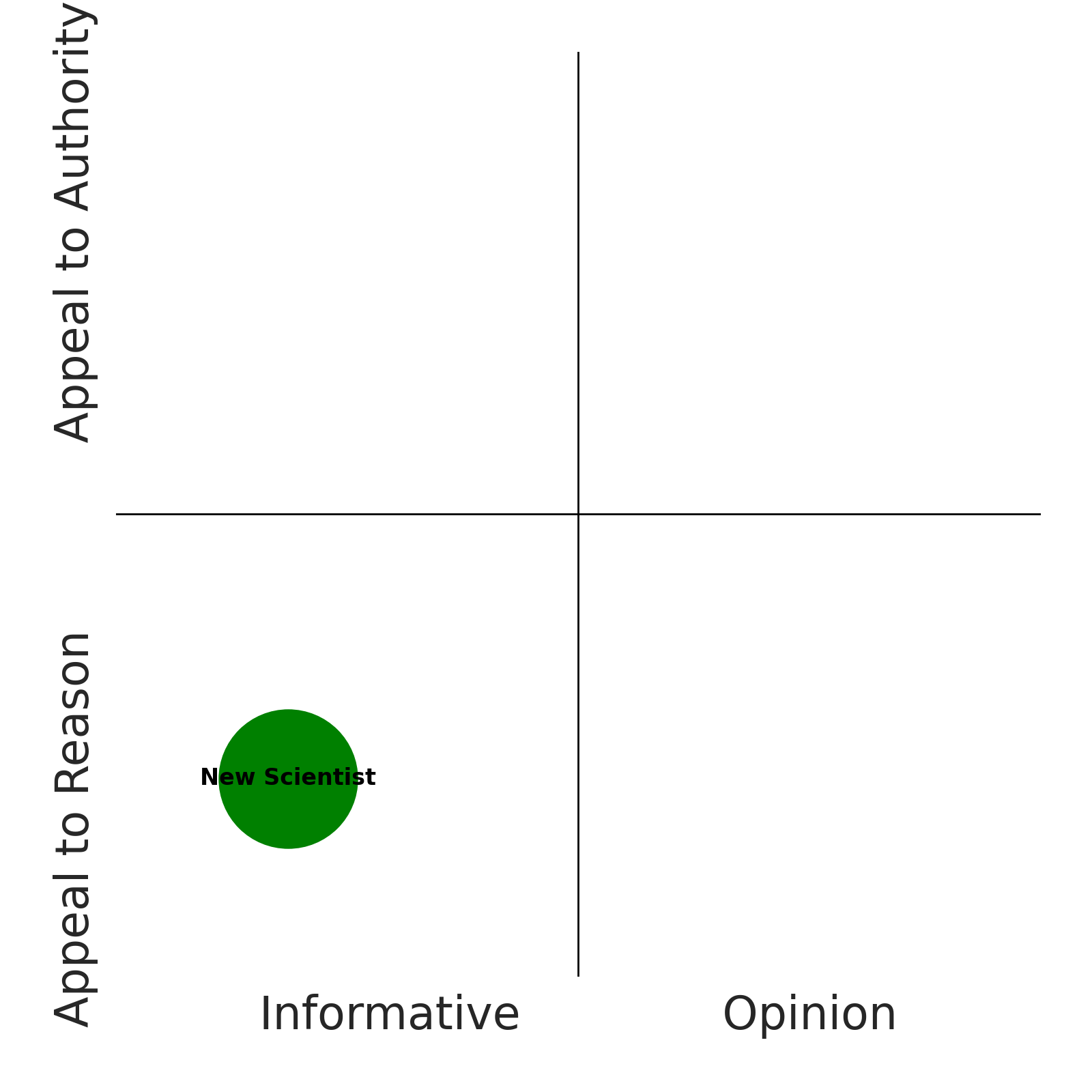
💭 Opinion35
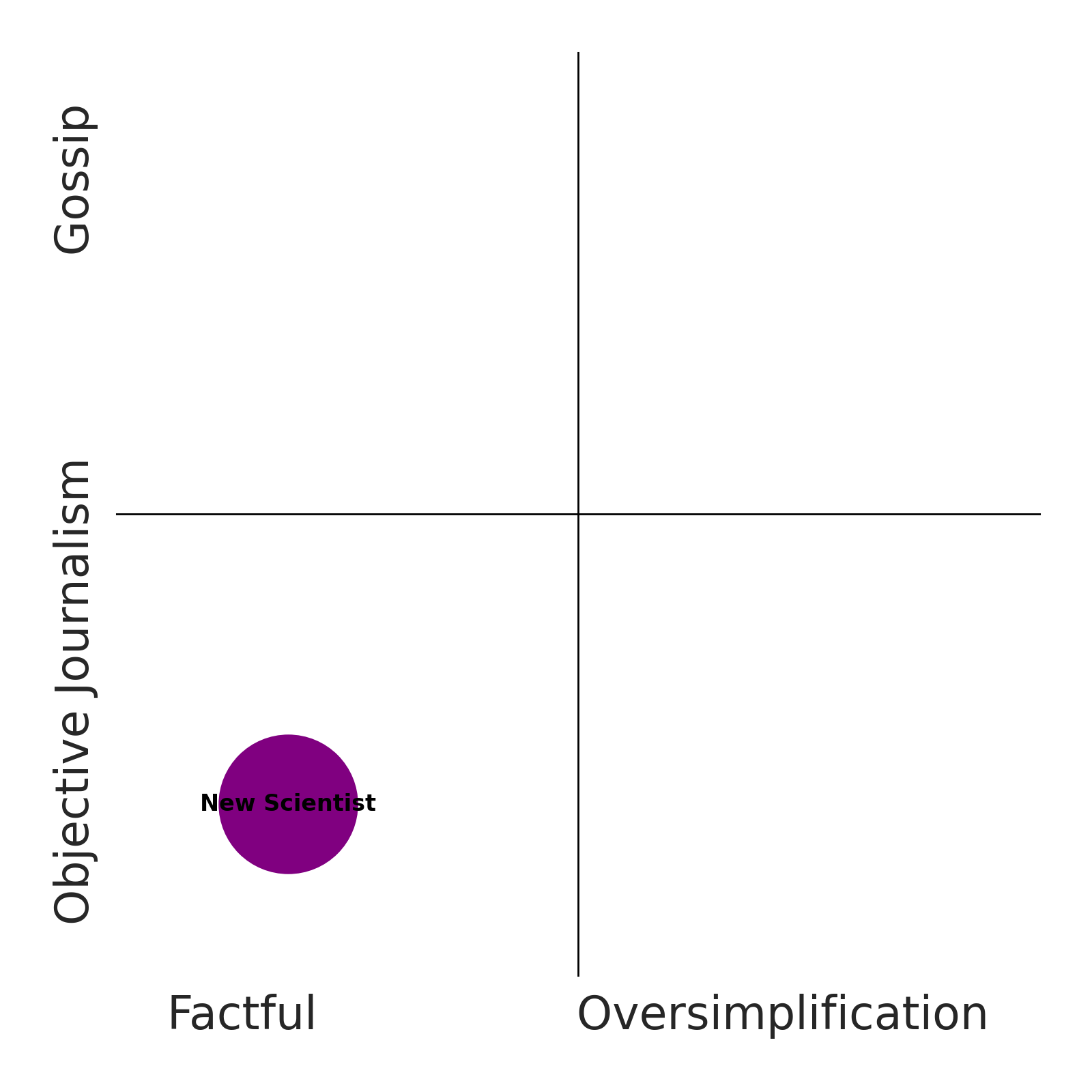
Oversimplification8
🏛️ Appeal to Authority20
👀 Covering Responses16
😤 Overconfidence8
❌ Low Credibility <—> High Credibility ✅33
🧠 Rational <—> Irrational 🤪-10
🤑 Advertising14
💔 Low Integrity <—> High Integrity ❤️25
🪨 Low Intelligence <—> High Intelligence 🦉58
🎭 Virtue Signaling12
🔍 Truth-seeking <—> Delusion 🌀-6
🔬 Scientific <—> Superstitious 🔮-15
🎲 Speculation27
🐍 Manipulative17
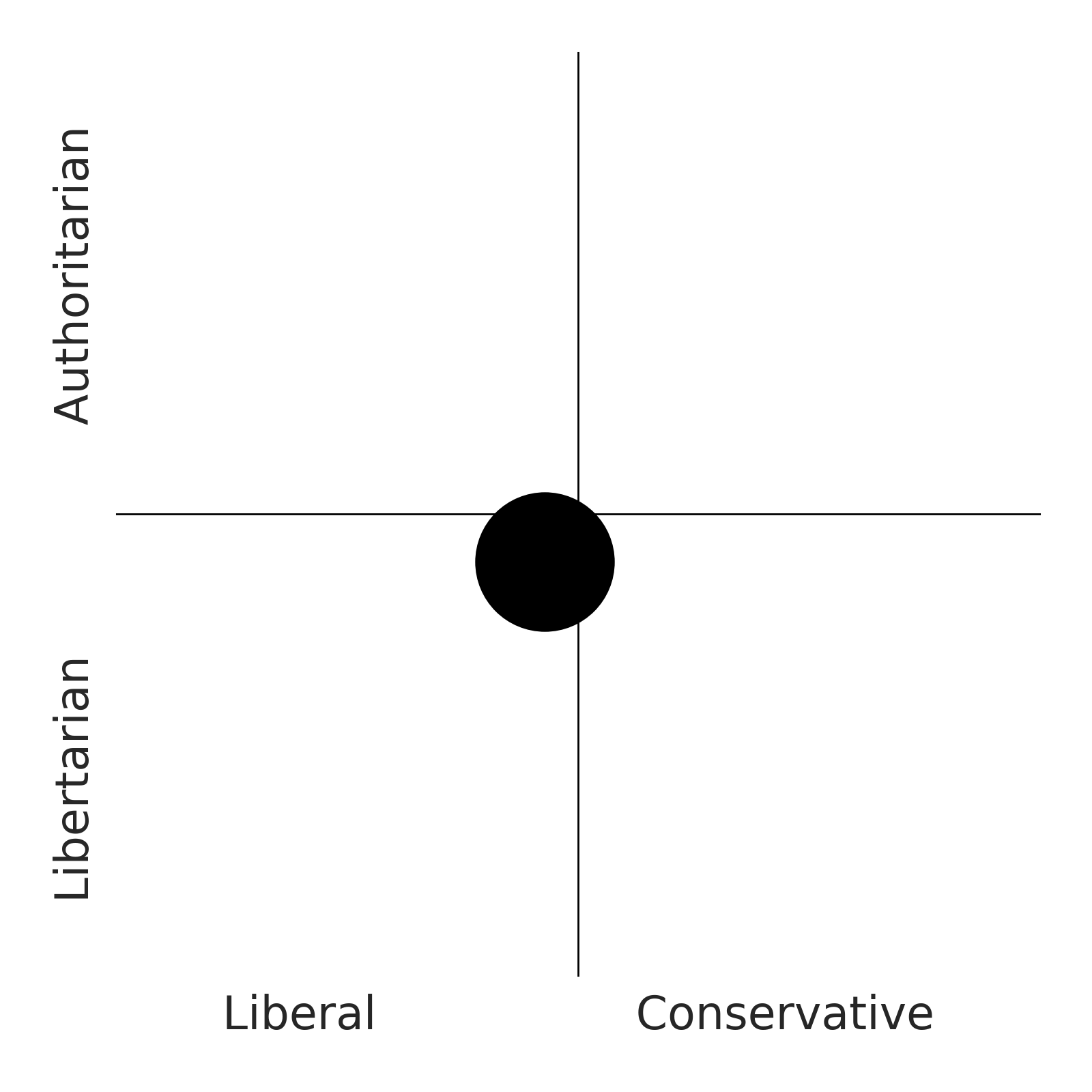
🔵 Liberal <—> Conservative 🔴-1
🧢 Populist <—> Elitist 🎩1
🗽 Libertarian <—> Authoritarian 🚔0
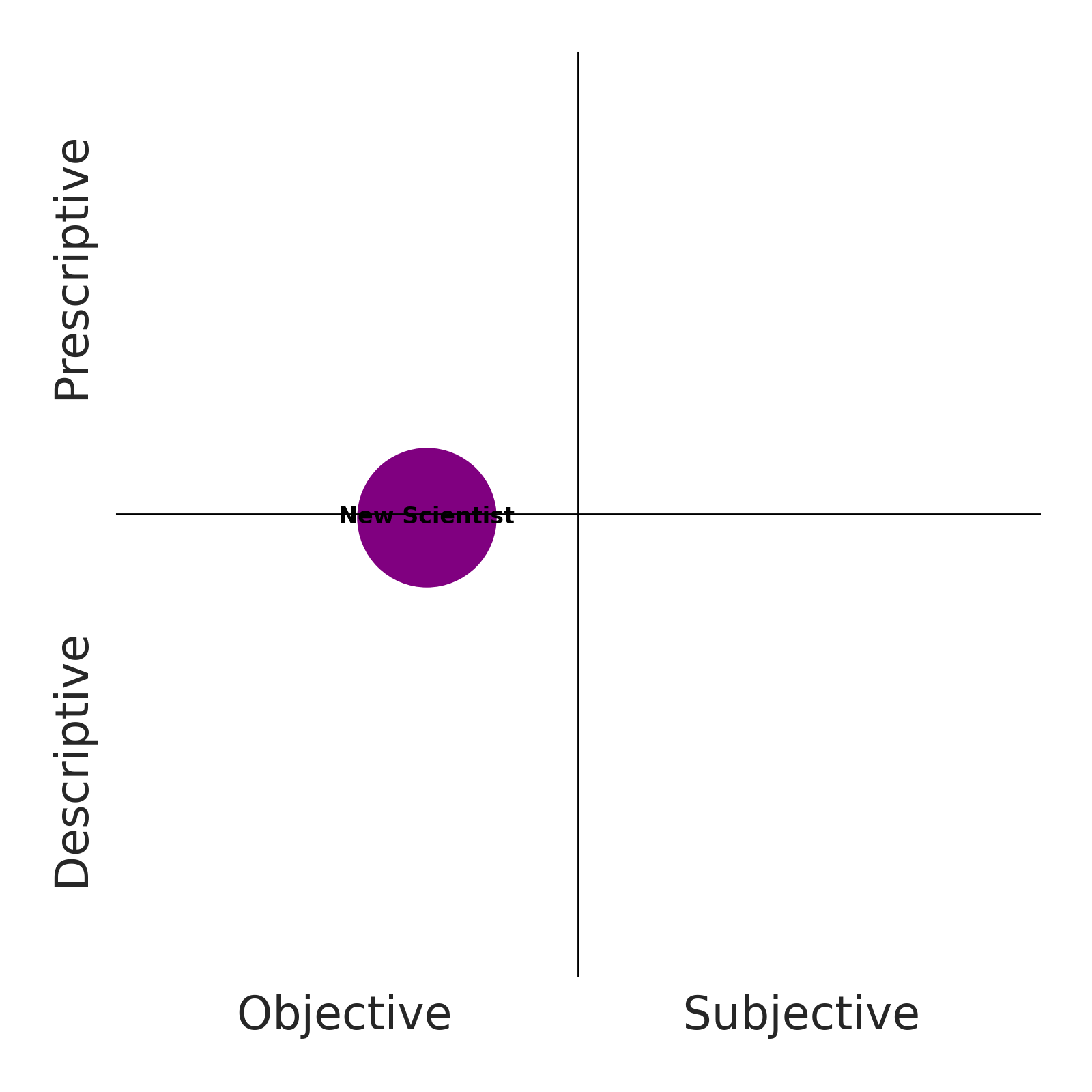
🗞️ Objective <—> Subjective 👁️ -3
🚨 Sensational0
📉 Bearish <—> Bullish 📈3
📝 Prescriptive4
🕊️ Dovish <—> Hawkish 🦁0
📞 Begging the Question0
🗣️ Gossip0
🗳 Political2
🍼 Immature1
😢 Victimization2
🗑️ Spam4
🔒 Ideological4
🏴 Anti-establishment <—> Pro-establishment 📺5
📏📏 Double Standard0
✊ Woke5
🔪 Cruel0
🦊 Anti-Corporate <—> Pro-Corporate 👔0
👤 Individualist <—> Collectivist 👥1
Click points to explore news by date. News sentiment ranges from -10 (very negative) to +10 (very positive) where 0 is neutral.
November 02, 2026 · 0 shares
Strongly evidence-oriented science-feature framing is optimistic about dyslexia research while incorporating first-person anecdote and occasional evaluative commentary.
Automated analysis; not human reviewed. Limitations: Political and market dimensions are largely inapplicable to this long-form science feature; scores emphasize epistemic and tone framing. · 14 of 55 available dimensions scored; omitted dimensions are not treated as neutral. · Verified supporting quotes for 14 of 14 scored dimensions.
Claim: First-person anecdote and evaluative asides introduce subjectivity into an otherwise reported feature.
“I used to be stupid.” · exact text match
“Me, too.” · exact text match
Why: These quoted passages show personal narrative and authorial stance mixed into the science reporting.
Claim: Framing is optimistic about research progress and interventions.
“Better yet, this research is pointing to novel, practical and fairer ways to help all children who struggle to read.” · exact text match
“I’m an optimist” · exact text match
Why: The language emphasizes promising practical advances and explicitly identifies optimism.
Claim: Mostly descriptive but ends with prescriptive call about attitudes.
“Times have changed, and so should attitudes.” · exact text match
Why: The quoted line shifts from describing research to recommending changed attitudes.
Claim: Personal opinions and authorial judgments appear alongside reporting.
“I do think there is still a stigma associated with dyslexia.” · exact text match
“Me, too.” · exact text match
Why: These are first-person evaluative statements, not only reported findings.
Claim: Heavily relies on named expert quotes from academic institutions.
“says Maggie Snowling, a psychologist at the University of Oxford” · exact text match
Why: The article repeatedly grounds claims in named academic authorities, though generally with context.
Claim: Some strong phrasing about pinning down mechanisms appears despite acknowledged uncertainty.
“Now, finally, we are pinning down what makes dyslexic brains different.” · exact text match
“decades of research have generated plenty of ideas, but not much consensus.” · exact text match
Why: The framing uses confident progress language while also noting unresolved consensus, supporting mild overconfidence.
Claim: Personal and positive emotional tone appears within the feature.
“Thank you, Mrs Kennedy!” · exact text match
“Yikes!” · exact text match
Why: Exclamatory personal asides convey emotional coloring, but the overall piece remains largely explanatory.
Claim: Sourcing is named, caveated, and includes conflict-of-interest disclosure, supporting high credibility.
“I must now declare an interest: I have been in the UK Biobank project from the start, done all the tests and had my genome sequenced and my brain scanned, so one of those 35,231 people is me.” · exact text match
“says Michelle Luciano, who studies behavioural genetics at the University of Edinburgh in the UK” · exact text match
Why: Named experts, caveats, and disclosure are visible credibility practices in the supplied text.
Claim: Framing privileges empirical research and methodological caveats.
“A major roadblock has been that studies were small and not easily compared. This is now being addressed thanks to the availability of large-scale longitudinal datasets and improved methods.” · exact text match
Why: The text explicitly discusses methodological limitations and improvements, supporting a rational/empirical classification.
Claim: Strongly empirical and scientific framing.
“Using information from the 23andMe genetic database, a team led by Luciano analysed the genomes of 51,800 people with a dyslexia diagnosis and over 1 million controls.” · exact text match
Why: The article centers genetic data and study methods rather than superstition or anecdotal causation.
Claim: Mostly reports completed research; limited forward-looking speculation about interventions.
“He also thinks there is potential to train the visual system to work better through specially designed computer games.” · exact text match
Why: The text contains some speculative potential for future interventions but is dominated by reported findings.
Claim: Reporting discloses author interest, quotes competing researchers, and acknowledges uncertainty.
“I must now declare an interest: I have been in the UK Biobank project from the start, done all the tests and had my genome sequenced and my brain scanned, so one of those 35,231 people is me.” · exact text match
“His view is controversial, but perhaps that’s not surprising.” · exact text match
Why: Conflict disclosure and inclusion of contested views are observable fairness and honesty signals.
Claim: Explains complex genetics, neuroanatomy, and competing theories with context.
“Reading is cognitively complicated. It entails three key components: understanding how sounds relate to squiggles on a page (phonology); mastering the patterns of written words and the rules of spelling (orthography); and making sense of what you see (semantics).” · exact text match
Why: The passage demonstrates structured explanatory depth about reading components.
Claim: Truth-seeking and acknowledges uncertainty.
“decades of research have generated plenty of ideas, but not much consensus.” · exact text match
Why: Explicit acknowledgment of limited consensus supports a truth-seeking rather than delusional classification.
Political and market dimensions are largely inapplicable to this long-form science feature; scores emphasize epistemic and tone framing.
2026 © Helium Trades
Privacy Policy & Disclosure
* Disclaimer: Nothing on this website constitutes investment advice, performance data or any recommendation that any particular security, portfolio of securities, transaction or investment strategy is suitable for any specific person. Helium Trades is not responsible in any way for the accuracy
of any model predictions or price data. Any mention of a particular security and related prediction data is not a recommendation to buy or sell that security. Investments in securities involve the risk of loss. Past performance is no guarantee of future results. Helium Trades is not responsible for any of your investment decisions,
you should consult a financial expert before engaging in any transaction.