See whether Helium helps you make better-informed decisions. Try every Pro Trader feature for 30 days. No credit card required.
Try every Pro Trader feature for 30 days. No credit card required.
Framing centers on systemic regulatory failure and official negligence, using morally charged language to demand preventive state action and accountability.
Peshawar and Lahore are cities in Pakistan, and K-P refers to Khyber Pakhtunkhwa; the editorial concerns school-building safety and regulatory oversight there.
Automated analysis; not human reviewed. Limitations: The supplied text is an opinion editorial with no byline or named sourcing for the casualty figures, so factual verification and author attribution are limited to the text. · 17 of 55 available dimensions scored; omitted dimensions are not treated as neutral. · Verified supporting quotes for 17 of 17 scored dimensions.
Claim: The editorial favors stricter state regulation and licensing of private schools.
“Private educational institutions cannot be allowed to operate in buildings whose structural integrity has never been properly established.” · exact text match
“The government must abandon its reactive approach to public safety and establish a system in which dangerous buildings are identified before they become death traps.” · exact text match
Why: It calls for government enforcement and restrictions on school operation, indicating a regulatory-leaning posture rather than libertarian deregulation.
Claim: The editorial is explicitly prescriptive and value-laden rather than a neutral report.
“The government must abandon its reactive approach to public safety and establish a system in which dangerous buildings are identified before they become death traps.” · exact text match
Why: The use of 'must' and a recommended policy prescription marks the text as subjective advocacy.
Claim: The editorial uses charged imagery about children and death to heighten the stakes.
“A school should be the last place where parents fear for their children's lives.” · exact text match
“dangerous buildings are identified before they become death traps” · exact text match
Why: Vivid fear-and-death phrasing supports a sensational framing score.
Claim: The editorial adopts a pessimistic view of whether lessons are being learned and whether official assurances can restore trust.
“suggesting that lessons are neither being learnt nor translated into preventive measures.” · exact text match
“Until that happens, the state's repeated assurances about protecting children will ring hollow.” · exact text match
Why: It explicitly doubts preventive learning and the credibility of future assurances, supporting a negative outlook.
Claim: The editorial is strongly prescriptive, urging specific government action.
“The government must abandon its reactive approach to public safety and establish a system in which dangerous buildings are identified before they become death traps.” · exact text match
Why: A direct policy demand with 'must' and an institutional remedy makes the text prescriptive.
Claim: The editorial frames school safety through fear of children's deaths and dangerous buildings.
“A school should be the last place where parents fear for their children's lives.” · exact text match
“dangerous buildings are identified before they become death traps” · exact text match
Why: Fear of harm to children and 'death traps' language are strong fear appeals.
Claim: The text is an opinion editorial with strong evaluative judgments about accountability and official promises.
“Nor can official promises restore the trust shattered by such an entirely preventable disaster.” · exact text match
Why: It asserts a strong evaluative conclusion rather than merely reporting events.
Claim: The editorial is centered on government policy, regulatory accountability, and public safety governance.
“The government must abandon its reactive approach to public safety and establish a system in which dangerous buildings are identified before they become death traps.” · exact text match
Why: Its central remedy is a government policy and enforcement system, making the framing political.
Claim: The editorial reduces the disaster mainly to regulatory indifference and cost-cutting construction compromises.
“The problem lies as much with regulatory indifference as with those who compromise construction standards to save costs.” · exact text match
Why: It presents a two-part causal explanation without exploring other structural factors, supporting a mild oversimplification score.
Claim: The editorial expresses certainty that the disaster was preventable and that official assurances will fail.
“such an entirely preventable disaster” · exact text match
“the state's repeated assurances about protecting children will ring hollow” · exact text match
Why: Strong certainty about prevention and future trust exceeds the evidence presented in the text.
Claim: The editorial is critical of official authorities and their oversight of school safety.
“the authorities responsible for granting permissions and monitoring compliance cannot escape scrutiny when their oversight proves ineffective.” · exact text match
Why: It directs blame at permitting and monitoring authorities, indicating an anti-establishment critical posture.
Claim: The editorial carries a strongly negative emotional charge around grieving families and lost children.
“The tragedy reflects a wider culture of negligence in which structural safety is overlooked until a building collapses and innocent lives are lost.” · exact text match
“Compensation may provide some financial relief to grieving families” · exact text match
Why: References to innocent lives and grieving families support a negative emotional tone.
Claim: The editorial presents a causal governance analysis rather than an irrational or purely emotive account.
“The problem lies as much with regulatory indifference as with those who compromise construction standards to save costs.” · exact text match
Why: It identifies structural incentives and oversight failures as causes, supporting a rational classification.
Claim: The editorial speculates that lessons are not being learned and that future assurances will ring hollow.
“suggesting that lessons are neither being learnt nor translated into preventive measures.” · exact text match
Why: It infers future and systemic behavior from the occurrence of a second collapse, which is a speculative inference.
Claim: The editorial uses loaded death-trap framing and moral pressure to push its policy conclusion.
“dangerous buildings are identified before they become death traps” · exact text match
“the state's repeated assurances about protecting children will ring hollow” · exact text match
Why: Charged language and a pre-emptive dismissal of official assurances are observable persuasive techniques.
Claim: The editorial calls for accountability across both private operators and regulators and rejects compensation as a substitute.
“Compensation may provide some financial relief to grieving families, but it is no substitute for accountability” · exact text match
“the authorities responsible for granting permissions and monitoring compliance cannot escape scrutiny when their oversight proves ineffective.” · exact text match
Why: Its demand for scrutiny of multiple responsible parties and accountability signals fairness rather than one-sided exoneration.
Claim: The editorial constructs a coherent argument linking repeated collapses to regulatory failure and preventive policy.
“The deaths of 14 children in a Lahore tuition centre collapse earlier this year should have prompted a comprehensive reassessment of school building safety.” · exact text match
Why: It draws a comparative lesson from a prior collapse to support its policy argument, indicating above-average argumentative coherence.
The supplied text is an opinion editorial with no byline or named sourcing for the casualty figures, so factual verification and author attribution are limited to the text.
The editorial adopts a prescriptive law-and-order frame that treats tougher, faster state punishment and international enforcement coordination as the necessary remedy for human trafficking.
FIA is Pakistan's Federal Investigation Agency; Gujranwala is in Punjab, Pakistan; the 2023 migrant boat tragedy is referenced but not described in the text.
Automated analysis; not human reviewed. Limitations: No author byline or publication date is provided, and the scraped text includes duplicated passages and unrelated page elements. · 18 of 55 available dimensions scored; omitted dimensions are not treated as neutral. · Verified supporting quotes for 18 of 18 scored dimensions.
Claim: The editorial uses a tough-on-crime, law-and-order frame that aligns with conservative criminal-justice preferences.
“courts should impose the maximum penalties justified under the law” · exact text match
“The FIA must also pursue the financiers and facilitators who sustain these networks.” · exact text match
Why: The emphasis on maximum punishment and aggressive enforcement is a conventional conservative law-and-order posture.
Claim: The editorial does not clearly adopt either a populist anti-elite stance or a distinctly elitist one.
“The state must demonstrate that trafficking is neither a profitable enterprise nor a crime whose consequences can be evaded through influence or procedural delays.” · exact text match
Why: It addresses state institutions as the remedy without anti-elite mobilization or explicit elite privilege framing.
Claim: The editorial favors expanded coercive state enforcement and maximum penalties.
“courts should impose the maximum penalties justified under the law” · exact text match
“The FIA must also pursue the financiers and facilitators who sustain these networks.” · exact text match
Why: Calls for maximum punishment and broader enforcement power indicate an authoritarian, not libertarian, orientation on crime and state power.
Claim: The editorial is strongly normative and prescriptive rather than purely descriptive.
“courts should impose the maximum penalties justified under the law” · exact text match
“This calculation must change.” · exact text match
Why: Direct should/must prescriptions make the framing subjective and policy-opinion driven.
Claim: The editorial is relatively factual and restrained rather than sensational.
“The verdict is not without precedent.” · exact text match
“According to the FIA, 164 individuals were convicted in trafficking and smuggling cases in the region during the first six months of this year.” · exact text match
Why: It states legal precedents and official figures without lurid detail, supporting an objective rather than sensational score.
Claim: The editorial is overwhelmingly prescriptive, urging specific policy and judicial actions.
“courts should impose the maximum penalties justified under the law” · exact text match
“Human trafficking cases demand expedited proceedings” · exact text match
Why: It repeatedly states what courts, the FIA, and Pakistan must do, making prescription its dominant mode.
Claim: The editorial uses a measured but real fear appeal about trafficking deaths and flourishing criminal networks.
“Pakistan has repeatedly witnessed the deaths of its citizens on dangerous migration routes” · exact text match
“criminal networks continue to flourish.” · exact text match
Why: References to recurring deaths and flourishing criminal networks create concern without extreme sensationalism.
Claim: The editorial is highly opinionated and advocacy-oriented.
“courts should impose the maximum penalties justified under the law” · exact text match
“The FIA must also pursue the financiers and facilitators who sustain these networks.” · exact text match
Why: The text is built around normative recommendations rather than neutral reporting alone.
Claim: The editorial addresses governance, law enforcement, and international state cooperation as political policy matters.
“Pakistan must strengthen coordination with transit and destination countries” · exact text match
“The FIA must also pursue the financiers and facilitators who sustain these networks.” · exact text match
Why: Its recommendations concern state institutions and public policy, making the article strongly political.
Claim: The editorial foregrounds the vulnerability and suffering of migrants exploited by traffickers.
“exploiting the desperation of those seeking a better life abroad” · exact text match
“Pakistan has repeatedly witnessed the deaths of its citizens on dangerous migration routes” · exact text match
Why: The framing emphasizes victim desperation and migrant deaths as the harm motivating punishment.
Claim: The editorial asserts strong causal and deterrent claims with limited supporting evidence.
“Arresting individual agents while leaving their wider operations intact will accomplish little.” · exact text match
“The prospect of substantial profits evidently remains greater than the perceived risk of punishment.” · exact text match
Why: It states likely outcomes and offender calculations as confident conclusions beyond the supplied data.
Claim: The editorial is broadly pro-establishment in trusting state institutions to remedy trafficking.
“The FIA must also pursue the financiers and facilitators who sustain these networks.” · exact text match
“The state must demonstrate that trafficking is neither a profitable enterprise nor a crime whose consequences can be evaded through influence or procedural delays.” · exact text match
Why: It directs demands to the FIA and the state rather than challenging the legitimacy of those institutions.
Claim: The editorial has visible credibility signals through attribution and acknowledgment of precedent.
“According to the FIA, 164 individuals were convicted in trafficking and smuggling cases in the region during the first six months of this year.” · exact text match
“The verdict is not without precedent.” · exact text match
Why: It cites an official agency and recognizes prior sentencing context, supporting a credible classification within the supplied text.
Claim: The editorial relies on precedent, official statistics, and policy reasoning rather than emotional or irrational claims.
“The verdict is not without precedent.” · exact text match
“According to the FIA, 164 individuals were convicted in trafficking and smuggling cases in the region during the first six months of this year.” · exact text match
Why: It grounds its argument in court precedent and an official conviction count, supporting a rational classification.
Claim: The editorial favors collective state action and international coordination over individual or market responses.
“Pakistan must strengthen coordination with transit and destination countries” · exact text match
“The state must demonstrate that trafficking is neither a profitable enterprise nor a crime whose consequences can be evaded through influence or procedural delays.” · exact text match
Why: Its remedies are framed through state and collective international enforcement rather than individual action.
Claim: The editorial speculates about trafficker cost-benefit calculations without direct evidence.
“The prospect of substantial profits evidently remains greater than the perceived risk of punishment.” · exact text match
Why: The claim about perceived risk is an inference about offender thinking rather than a documented fact.
Claim: The editorial shows fairness and honesty by acknowledging precedent and citing an official source.
“The verdict is not without precedent.” · exact text match
“According to the FIA, 164 individuals were convicted in trafficking and smuggling cases in the region during the first six months of this year.” · exact text match
Why: Acknowledging contrary context and attributing data to the FIA are visible integrity signals in the supplied text.
Claim: The editorial is analytically coherent and policy-focused.
“The verdict is not without precedent.” · exact text match
“Where the evidence establishes serious offences, courts should impose the maximum penalties justified under the law.” · exact text match
Why: It connects precedent, statistics, and enforcement recommendations in a structured argument.
No author byline or publication date is provided, and the scraped text includes duplicated passages and unrelated page elements.
October 13, 2026 · 0 shares
Prescriptive, faith-anchored opinion-column framing fuses Oxford character-science research with Islamic tradition to urge Pakistani universities to deliberately engineer moral formation through personal mission statements.
Automated analysis; not human reviewed. Limitations: The referenced 2017 Abdul Wali Khan University tragedy is alluded to without any description, and no author byline is supplied, limiting verification of provenance and of the column's supporting context. · 17 of 55 available dimensions scored; omitted dimensions are not treated as neutral. · Verified supporting quotes for 15 of 17 scored dimensions.
Claim: Mild culturally conservative lean: the column endorses compulsory religious coursework and grounds moral formation in Islamic tradition.
“Our own tradition has long done the same, joining taleem, instruction, with tarbiyat, the character formation of the person.” · exact text match
“compulsory for Muslim students since Fall 2025. These are welcome” · exact text match
Counterevidence:
“A decade of research at the Oxford Character Project frames character formation in three words, BE, KNOW and DO” · exact text match
Why: Tradition- and religion-based moral education is the normative core, while the embrace of secular research tempers the conservative lean.
Claim: The text is openly prescriptive advocacy rather than neutral reporting.
“Pakistan's universities should form character by design.” · exact text match
“A good personal mission statement must cover every role we play.” · exact text match
Why: Normative 'should/must' imperatives and first-person exhortation define the text's genre.
Claim: The prose remains measured and reflective with no alarmist or dramatic language.
“The lesson is that a university that informs minds without forming persons has done only half its work.” · exact text match
Counterevidence:
“Toxicity, deceit, exploitation and egoism are all around us” · exact text match
Why: Claims are argued in restrained essayistic style, with only one sweeping negative diagnosis that slightly qualifies full neutrality.
Claim: Cautiously optimistic framing pairs a candid negative diagnosis with an achievable reform vision.
“Imagine campuses designed for character, where vice-chancellors, professors, staff and students have each written down who they mean to be and what guides them, and then live it every day.” · exact text match
Counterevidence:
“Toxicity, deceit, exploitation and egoism are all around us” · exact text match
Why: The aspirational closing vision and reform confidence outweigh the grim situational diagnosis.
Claim: Moderately engaging substance via counterintuitive findings and concrete case examples.
“experiments show "don't be a cheater" reduces cheating; "don't cheat" does not.” · not found in supplied text
Why: Non-obvious research nuggets and named implementations give the essay texture, though the topic is niche.
Claim: The column is overwhelmingly prescriptive, advancing a detailed reform program rather than describing events.
“Pakistan's universities should form character by design.” · exact text match
“Let us form it by design, one personal constitution at a time” · exact text match
Why: Imperatives, recommendations, and a concrete program dominate the text.
Claim: Strongly opinionated text built on value judgments and recommendations.
“Pakistan's universities should form character by design.” · exact text match
“Who we mean to be deserves to be written down as a personal mission statement.” · exact text match
Why: Nearly every paragraph issues normative recommendations with minimal straight reporting.
Claim: Only light engagement with public policy and no party politics.
“The Higher Education Commission has answered with courses, most recently Understanding of Holy Quran (Fehm-e-Quran) I and II, one credit hour each, compulsory for Muslim students since Fall 2025” · exact text match
Why: The single policy reference is an HEC course mandate, treated as a partial answer rather than political contestation.
Claim: The argument leans on named academic and religious authorities as warrant.
“A decade of research at the Oxford Character Project frames character formation in three words, BE, KNOW and DO” · exact text match
“The Quran puts the test plainly: "Why do you say what you do not do?" (Surah al Saff 61:2).” · exact text match
Why: Oxford research, Nature, Wake Forest, and scripture are repeatedly invoked as warranting sources, though the essay also supplies concrete mechanisms.
Claim: A few claims are stated flatly beyond the cited support.
“The habits students pick up from their teachers last a lifetime.” · exact text match
Why: An unsourced absolute about lifelong habit formation stands out amid otherwise attributed claims.
Claim: Moderately ideological: a religious-traditional moral program is advanced, tempered by pragmatic use of secular research.
“Our own tradition has long done the same, joining taleem, instruction, with tarbiyat, the character formation of the person.” · exact text match
Counterevidence:
“Abroad, America's Wake Forest University has used these seven strategies since 2017, helping more than 75 faculty build character into their courses.” · not found in supplied text
Why: Tradition supplies the normative core while secular programs are adopted instrumentally, indicating moderate rather than dogmatic ideology.
Claim: Mildly pro-establishment: the column endorses the national regulator's action and seeks reform through official institutions.
“The Higher Education Commission has answered with courses, most recently Understanding of Holy Quran (Fehm-e-Quran) I and II, one credit hour each, compulsory for Muslim students since Fall 2025. These are welcome” · exact text match
Why: Praising the HEC's response and working within universities signals reformism inside the establishment.
Claim: Key factual claims carry named-source attribution and the opinion status is transparent.
“a 2023 Nature analysis placed Pakistan among large research-producing nations with the highest rates of retracted papers” · exact text match
Counterevidence:
“The habits students pick up from their teachers last a lifetime.” · exact text match
Why: Visible sourcing and honest self-criticism support credibility; occasional unattributed absolutes temper it.
Claim: The argument is built on cited research findings, a defined framework, and structured reasoning.
“A decade of research at the Oxford Character Project frames character formation in three words, BE, KNOW and DO” · exact text match
“a 2023 Nature analysis placed Pakistan among large research-producing nations with the highest rates of retracted papers” · exact text match
Why: Named research and systematic frameworks dominate the argument, though normative religious appeals and exhortation keep it from a strongly rational score.
Claim: The column grounds diagnosis and method in empirical research; scripture is used for values, not causal claims.
“a 2023 Nature analysis placed Pakistan among large research-producing nations with the highest rates of retracted papers” · exact text match
“A decade of research at the Oxford Character Project frames character formation in three words, BE, KNOW and DO” · exact text match
Why: Multiple empirical citations and no supernatural causal claims place the text toward the scientific pole.
Claim: The column transparently attributes key factual claims and candidly criticizes national performance.
“a 2023 Nature analysis placed Pakistan among large research-producing nations with the highest rates of retracted papers” · exact text match
“Most are withdrawn because of misconduct, such as plagiarism or fabricated data” · exact text match
Why: Named-source attribution and self-critical content are visible honesty signals for an opinion column.
Claim: The column integrates behavioral research, national data, and practical mechanisms into a coherent framework.
“A decade of research at the Oxford Character Project frames character formation in three words, BE, KNOW and DO” · exact text match
“experiments show "don't be a cheater" reduces cheating; "don't cheat" does not.” · not found in supplied text
Why: Cross-disciplinary synthesis with concrete application indicates above-average composition.
The referenced 2017 Abdul Wali Khan University tragedy is alluded to without any description, and no author byline is supplied, limiting verification of provenance and of the column's supporting context.
The publisher frames the impasse as a mutual failure of rigidity and prescribes dialogue with Imran Khan as the pragmatic route out.
PTI is Imran Khan's political party; K-P refers to Khyber Pakhtunkhwa province; Governor's Rule is a constitutional mechanism allowing federal control of a province.
Automated analysis; not human reviewed. Limitations: The text is an unsigned editorial with a truncated opening line and unrelated page elements, so bias classifications reflect the substantive editorial paragraphs only. · 14 of 55 available dimensions scored; omitted dimensions are not treated as neutral. · Verified supporting quotes for 12 of 14 scored dimensions.
Claim: The publisher criticizes federal intervention and constitutional centralization while favoring political space and dialogue.
“By resorting to a major constitutional measure, the federal government has left little room for immediate political reconciliation.” · exact text match
Why: The editorial treats federal intervention as an obstacle and calls for easing political tensions, leaning anti-authoritarian.
Claim: The publisher advances a counterfactual judgment about what should have happened.
“Had the ruling coalition ceded due political space to the PTI, and had the party shown greater flexibility instead of choosing absolute confrontation, this untoward situation could have been avoided.” · exact text match
Why: This is an evaluative counterfactual rather than a neutral report of events.
Claim: The publisher uses measured, analytical language rather than sensational or alarmist framing.
“Both the opposition and the government are back to square one, as talks failed – driven by the uncompromising rigidity on both sides.” · exact text match
Why: The quote frames the situation as a political impasse in restrained terms.
Claim: The publisher moves from describing the impasse to prescribing dialogue and concessions.
“Initiating a constructive dialogue offers a sustainable way to ease these governance pressures.” · exact text match
Why: The sentence recommends a course of action.
Claim: The publisher includes explicit evaluative judgments and prescriptions.
“Had the ruling coalition ceded due political space to the PTI, and had the party shown greater flexibility instead of choosing absolute confrontation, this untoward situation could have been avoided.” · exact text match
Why: The counterfactual blame allocation is opinionated analysis.
Claim: The article is centrally about party negotiations, constitutional measures, and political leadership.
“The six-party alliance has made it a condition that no talks will be held with the government unless the opposition leadership is granted an audience with the incarcerated PTI leader, Imran Khan.” · exact text match
Why: The core content is political bargaining and governance.
Claim: The publisher criticizes the federal government's constitutional intervention as narrowing reconciliation space.
“By resorting to a major constitutional measure, the federal government has left little room for immediate political reconciliation.” · exact text match
Why: The framing is critical of establishment action, though not broadly anti-establishment.
Claim: The editorial offers attributed political demands but also unsourced causal assessments.
“The six-party alliance has made it a condition that no talks will be held with the government unless the opposition leadership is granted an audience with the incarcerated PTI leader, Imran Khan.” · exact text match
“Both the opposition and the government are back to square one, as talks failed – driven by the uncompromising rigidity on both sides.” · exact text match
Why: The first quote shows attribution; the second is an unsourced evaluative claim, yielding moderate credibility.
Claim: The publisher presents the impasse as a reasoned, mutual failure rather than an emotional or conspiratorial narrative.
“Both the opposition and the government are back to square one, as talks failed – driven by the uncompromising rigidity on both sides.” · exact text match
Why: The quote offers a causal analysis of failed talks and assigns responsibility to both sides.
Claim: The publisher forecasts that dialogue and a meeting with Khan could improve stability.
“facilitating requested communication, such as a meeting with Khan, and easing political tensions could help foster the long-term stability needed to move past the current impasse.” · exact text match
Why: The sentence explicitly projects future effects from a proposed step.
Claim: The publisher assigns blame to both sides and attributes opposition demands rather than presenting them as its own.
“It also demanded an end to Chief Minister Sohail Afridi's detention, alongside the release of all legislators and workers, including Khan's three sisters.” · exact text match
“Both the opposition and the government are back to square one, as talks failed – driven by the uncompromising rigidity on both sides.” · exact text match
Why: Balanced blame and attributed demands show fairness signals.
Claim: The publisher analyzes institutional pressures and political incentives rather than reducing the issue to simple slogans.
“Consequently, the Center finds itself in a delicate position, as sustaining this impasse over the long term presents significant challenges.” · exact text match
Why: The quote shows strategic analysis of governance burdens.
The text is an unsigned editorial with a truncated opening line and unrelated page elements, so bias classifications reflect the substantive editorial paragraphs only.
Presents an alarmist, prescriptive op-ed that frames the government–PTI standoff through a 1971-disaster analogy and calls for dialogue to avert national rupture.
K-P is Khyber Pakhtunkhwa, Pakistan's northwestern province; PTI is Pakistan Tehreek-e-Insaf, the party of imprisoned former Prime Minister Imran Khan; the 1971 reference concerns East Pakistan's secession and the creation of Bangladesh after a violent military crackdown.
Automated analysis; not human reviewed. Limitations: The supplied text is an opinion column with no byline and no named sources; scores reflect its argumentative framing rather than verified reporting. · 15 of 55 available dimensions scored; omitted dimensions are not treated as neutral. · Verified supporting quotes for 15 of 15 scored dimensions.
Claim: The column is framed as personal opinion and speculative analysis rather than neutral reporting.
“I don't think the K-P Chief Minister knows exactly where it is going to end.” · exact text match
Why: First-person judgment and prediction signal a subjective op-ed stance.
Claim: The column uses dramatic, alarmist metaphors and catastrophe language.
“On the path to self-destruct.” · exact text match
Why: The headline metaphor frames the dispute as self-destruction, heightening sensational impact.
Claim: The column forecasts a catastrophic outcome unless behavior changes.
“both are on the way to mutual assured destruction (MAD)” · exact text match
Why: Mutual assured destruction framing expresses a strongly pessimistic outlook.
Claim: The column moves from describing the crisis to prescribing a specific course of action.
“Dialogue, then, is the only way out.” · exact text match
Why: The sentence explicitly prescribes dialogue as the only remedy.
Claim: The column uses fear of another national breakup and violence to frame the stakes.
“the horrendous possibility of another nightmarish eventuality” · exact text match
Why: Catastrophic historical analogy and fear language are central to the argument.
Claim: The text is an opinion column built around the author's judgments and predictions.
“I don't think the K-P Chief Minister knows exactly where it is going to end.” · exact text match
Why: First-person judgment is direct evidence of opinion content.
Claim: The column is entirely focused on a political conflict between Pakistan's government and PTI in K-P.
“In the, for now, failed talks between the government and the opposition (read: PTI)” · exact text match
Why: The central subject is governmental-opposition political conflict.
Claim: The column reduces a complex political standoff to a missile/MAD analogy and a single dialogue remedy.
“both are on the way to mutual assured destruction (MAD)” · exact text match
Why: A binary catastrophe framing simplifies complex political dynamics.
Claim: The column asserts certainty about future escalation and outcomes beyond available evidence.
“this one is surely on self-destruct” · exact text match
Why: The adverb 'surely' expresses high certainty about an uncertain political trajectory.
Claim: The column prioritizes state cohesion, territorial solidarity, and security lines over political competition.
“And the right thing is to do the least damage to national cohesion and territorial solidarity” · exact text match
Why: The prescription privileges national and state establishment priorities.
Claim: The column's emotional register is strongly negative, emphasizing fear, grief, and catastrophe.
“a nation that was broken in bloodshed and tears” · exact text match
Why: The phrase invokes traumatic loss and fear, making the emotional valence negative.
Claim: The column forecasts future mob dynamics, clashes, and political outcomes speculatively.
“Soon it will pick momentum and roll in directions beyond his control.” · exact text match
Why: The sentence predicts future escalation without evidence or attribution.
Claim: The column uses loaded catastrophe framing and a closed choice to steer readers toward dialogue.
“Dialogue, then, is the only way out.” · exact text match
Why: Presenting dialogue as the only way out creates a stark, persuasive choice.
Claim: The column acknowledges faults on both sides while assigning principal responsibility to the government.
“And this is true for both sides. But the government in charge is principally responsible for doing the right thing.” · exact text match
Why: Balanced attribution and clear responsibility support a moderate-to-high integrity signal, though it remains opinion.
Claim: The column uses an extended strategic analogy and historical comparison to analyze political risk.
“In missile warfare, when a weapon goes astray, either losing guidance or suffering a malfunction, a switch activates within it to what is called self-destruct.” · exact text match
Why: The analogy and historical references indicate analytical sophistication, though in an op-ed form.
The supplied text is an opinion column with no byline and no named sources; scores reflect its argumentative framing rather than verified reporting.
September 26, 2026 · 0 shares
Framing treats PTI's postponed long march as a self-inflicted political failure and prescribes elite-led negotiation, while crediting the government's tactical positioning.
Imran Khan is the jailed former prime minister of Pakistan and leader of PTI; the party has used long marches on Islamabad to pressure the government led by PM Shehbaz Sharif. The 'long march' in Pakistani politics refers to a mass protest march to the capital.
Automated analysis; not human reviewed. Limitations: The analysis is a single columnist's opinion piece with private attributions that cannot be independently verified; no detailed account from the other side is included. · 10 of 55 available dimensions scored; omitted dimensions are not treated as neutral. · Verified supporting quotes for 8 of 10 scored dimensions.
Claim: The analysis is biased against populist street politics and toward elite-led negotiation.
“Afridi got swept in the emotional momentum and pressure generated by the PTI support base and its social media, and also, probably, his desire to ride the wave of populist sentiment.” · exact text match
“continued bluster by the likes of Sohail Afridi competing with the sombre engagement of Achakzai, Allama Nasir Abbas and Barrister Gohar.” · exact text match
Why: It frames mass support and populist momentum as a tactical error, while presenting dialogue-oriented leaders as 'sombre engagement.'
Claim: The text mixes reporting with overt editorial judgment and first-person sourcing.
“PTI's explanation that its decision to push the date of the march ahead by a week is meant to 'tire out' the government is plain silly.” · exact text match
“Achakzai told me this week he had appreciated the language of the PM's letter.” · exact text match
Why: A clear value judgment ('plain silly') and first-person sourcing are markers of subjectivity rather than detached reporting.
Claim: The analysis prescribes recommended actions for the government and opposition.
“The most effective initiative it can take is to give Achakzai and Allama Nasir Abbas access to Khan.” · exact text match
“Such a step has to be framed as a "win-win" and not a forced concession from the government.” · not found in supplied text
Why: It explicitly tells the government what to do and how to frame it, rather than just describing events.
Claim: The commentary favors dialogue and de-escalation over street confrontation.
“the government now has the opportunity to help the latter succeed.” · exact text match
“Those advocating dialogue within PTI were saying exactly this: don't use the option of the long march now when the same things can be obtained through talks.” · exact text match
Why: It presents engagement and negotiation as the constructive path and protest as a costly mistake.
Claim: The text is a strongly opinionated commentary, not straight news.
“PTI's explanation that its decision to push the date of the march ahead by a week is meant to 'tire out' the government is plain silly.” · exact text match
Why: The piece evaluates motives, labels an explanation 'plain silly,' and gives strategic advice throughout.
Claim: The report is centered on partisan political strategy and inter-party maneuvering.
“The declaration of the date of the march and its postponement at the last minute is a manifestation of this gnawing divide.” · exact text match
Why: The article is wholly about party leadership splits, government signaling, and opposition tactics, with no non-political subject matter.
Claim: The analysis is favorable to the incumbent government's political maneuvering and elite channels.
“PM Shehbaz Sharif has timed his latest initiative well.” · not found in supplied text
“Achakzai is now the man to watch.” · exact text match
Why: It credits the prime minister's timing and elevates an opposition leader engaged in government dialogue, while portraying PTI's street march as isolated and failed.
Claim: The column shows attributable sourcing and acknowledges uncertainty in places.
“Achakzai told me this week he had appreciated the language of the PM's letter.” · exact text match
“It is hard to say at this stage which side will prevail” · exact text match
Why: Named attribution and an explicit uncertainty hedge support moderate credibility, though much of the strategic analysis is unsourced and opinionated.
Claim: The commentary reasons from strategic costs and incentives rather than emotional appeals.
“This isn't a football match. The state always has a huge advantage when it comes to displaying administrative and law enforcement stamina.” · exact text match
Why: It dismisses PTI's stated rationale with a structural comparison and weighs practical state advantages.
Claim: The column makes explicit forecasts about upcoming political events.
“It is quite probable that a meeting between the two may take place before October 4.” · exact text match
Why: It attaches a probability to a future meeting, which is speculative rather than established fact.
The analysis is a single columnist's opinion piece with private attributions that cannot be independently verified; no detailed account from the other side is included.
September 21, 2026 · 0 shares
Framing is prescriptive, urging dialogue as the only viable path while characterizing outlawing the PTI as unworkable and casting the party as pushed to the wall.
Automated analysis; not human reviewed. Limitations: The supplied text is a truncated fragment without the article's headline, author, or surrounding argument, so the classification rests on partial context. · 5 of 55 available dimensions scored; omitted dimensions are not treated as neutral. · Verified supporting quotes for 5 of 5 scored dimensions.
Claim: The text uses subjective, evaluative judgments, especially about the party and the best way forward.
“Outlawing the PTI is an equally unworkable option for a party that has already been pushed to the wall” · exact text match
“political parties on the fringes - and even some within the ruling coalition, including the PPP - will take exception to it” · exact text match
Why: Expressions like 'pushed to the wall' and the forecast of political reactions are subjective rather than neutral observation.
Claim: The dominant assertion tells what should be done rather than describing what happened.
“Postponing the protest in favour of a meaningful dialogue represents the only viable way forward.” · exact text match
Why: The sentence issues a prescription for action, not a description of an event.
Claim: The text prescribes a specific political course in judgmental language.
“Postponing the protest in favour of a meaningful dialogue represents the only viable way forward.” · exact text match
Why: The superlative 'only' and the evaluative 'viable' signal an opinionated prescription rather than neutral reporting.
Claim: The content is centered on political parties, ruling-coalition dynamics, and state action against an opposition party.
“It is also a given that political parties on the fringes - and even some within the ruling coalition, including the PPP - will take exception to it” · exact text match
“Outlawing the PTI is an equally unworkable option” · exact text match
Why: References to the ruling coalition, PPP, PTI, and protest place the text squarely in political conflict.
Claim: A complex political outcome is asserted as the only viable one without supporting evidence.
“Postponing the protest in favour of a meaningful dialogue represents the only viable way forward.” · exact text match
Why: The word 'only' asserts certainty about a unique, correct solution to the conflict, going beyond what the supplied text establishes.
The supplied text is a truncated fragment without the article's headline, author, or surrounding argument, so the classification rests on partial context.
Publisher framing firmly backs the federal security establishment, blaming K-P's elected provincial leadership for the terror surge through political distractions and soft treatment of militants while endorsing Islamabad's direct takeover of provincial security.
Automated analysis; not human reviewed. Limitations: The excerpt is truncated, unsigned, and undated, offers no response from the K-P provincial government, and does not explain the mechanism by which Islamabad assumed control, limiting balance and verification assessments. · 26 of 55 available dimensions scored; omitted dimensions are not treated as neutral. · Verified supporting quotes for 25 of 26 scored dimensions.
Claim: Editorial favors hard-line counter-militancy policy and rejects negotiation with militants, a conservative security stance.
“The chief minister also insisted on negotiating with terrorists, which directly undermined the federal government and security establishment.” · exact text match
Why: Treating dialogue with militants as a fault and endorsing military elimination of terrorists aligns with a conservative, law-and-order orientation.
Claim: Editorial sides with the central security apparatus against elected provincial leadership.
“as the federal government has taken K-P's elected leadership off the board” · exact text match
Why: Framing the sidelining of elected officials as a positive development reflects an elitist lean favoring security institutions over popular sovereignty.
Claim: Endorses direct central state control of provincial security, superseding elected provincial governance.
“as it will have direct control of the provincial security apparatus” · exact text match
Why: Approving removal of provincial elected authority from security decisions is an authoritarian-centralizing position.
Claim: Editorial voice offers personal evaluation and wishes beyond reported facts.
“If only all parts of the government were working together, the results might have been even better.” · exact text match
Why: Counterfactual lament and evaluative commentary mark a subjective, opinion-driven register.
Claim: Mild dramatization surrounds otherwise sourced security data.
“One of the most concerning findings in the government security reports recently shared with the federal cabinet” · exact text match
Why: Intensifying language frames the figures alarmingly, but the underlying data remains attributed and specific.
Claim: Deterioration-and-failure framing dominates, with only tentative hope at the close.
“We can only hope that the unfortunate series of events that has led us here can be reversed, and K-P sees some semblance of security again” · exact text match
Why: The bulk of the text stresses worsening violence and governance failure, with hope expressed only conditionally.
Claim: Quantified terror-wave data combined with a federal-provincial power struggle.
“terrorist drone attacks more than doubled in the past year, reaching 170 in 2026” · exact text match
Why: Unusual specifics such as drone-attack counts and a takeover of provincial security give the piece above-average news value.
Claim: Editorial pushes preferred governance arrangements rather than merely reporting events.
“If only all parts of the government were working together, the results might have been even better.” · exact text match
Why: Counterfactual prescriptions and endorsement of federal control go beyond neutral description.
Claim: Strongly favors kinetic counterterrorism operations and rejects dialogue with militants.
“eliminating hundreds of terrorists and disrupting militant networks across K-P” · exact text match
“insisted on negotiating with terrorists” · exact text match
Why: Military action is praised and negotiation with militants is condemned as undermining, a clearly hawkish orientation.
Claim: The provincial government's culpability is presupposed from official reports and then used to justify the takeover conclusion.
“flawed policies and its soft approach towards militants” · exact text match
Why: The blame premise comes only from the same security apparatus whose preferred outcome the editorial endorses, leaving the causal premise unestablished.
Claim: Explicit evaluative and desiderative commentary runs through the piece.
“We can only hope that the unfortunate series of events that has led us here can be reversed” · exact text match
Why: First-person-plural hope and judgment language mark clear editorializing.
Claim: Partisan framing of the federal-provincial conflict over security governance.
“has been preoccupied with political activity and rallies in other parts of the country, rather than governing” · exact text match
Why: The piece takes a side in an intergovernmental political dispute and assigns blame to the provincial leadership.
Claim: Attributes the insurgency surge mainly to the provincial leadership's political focus and dialogue stance.
“the provincial government seemed more focused on planning rallies” · exact text match
Why: A complex security deterioration is reduced to one government's distractions and policies, with other drivers unexamined.
Claim: Central factual and evaluative claims rest on unnamed official security reports and cabinet consideration.
“One of the most concerning findings in the government security reports recently shared with the federal cabinet” · exact text match
Why: Anonymous government reports serve as the main warrant for the editorial's indictment of the provincial government.
Claim: Direct causal claims are asserted beyond the supplied support.
“insisted on negotiating with terrorists, which directly undermined the federal government and security establishment” · exact text match
Why: The word 'directly' asserts specific causation that the cited reports, as quoted, do not explicitly establish.
Claim: Adopts the security establishment's counterinsurgency framing as given premises.
“The situation now is remarkably different, as the federal government has taken K-P's elected leadership off the board” · exact text match
Why: Centralized security control is presented as self-evidently the right remedy, reflecting an adopted institutional worldview.
Claim: Editorial aligns with the federal government and security establishment against the elected provincial government.
“Even the security reports explicitly blamed the K-P government's "flawed policies and its soft approach towards militants" for enabling terrorist elements to establish a foothold.” · not found in supplied text
Why: The editorial amplifies the security establishment's own reports to indict the provincial government and treats undermining that establishment as a fault.
Claim: Mildly negative, concerned tone rather than neutral description.
“We can only hope that the unfortunate series of events that has led us here can be reversed” · exact text match
Why: Words like 'unfortunate' convey negative affect, though the overall register stays measured.
Claim: Federal operations are credited while the provincial government is solely faulted for the same security outcome.
“eliminating hundreds of terrorists and disrupting militant networks across K-P” · exact text match
Why: The surge occurred despite ongoing federal operations, yet only provincial failures receive critical scrutiny.
Claim: Specific quantified claims are attributed to government security reports, but sourcing is anonymous and the argument is one-sided.
“terrorist drone attacks more than doubled in the past year, reaching 170 in 2026” · exact text match
Why: Concrete, attributed figures support verifiability in principle, while unsigned advocacy limits trust.
Claim: Argument rests on quantified official figures and specific institutional gaps rather than emotive assertion.
“Terrorist incidents in Khyber-Pakhtunkhwa surged by almost 200% between March 2024 and September 2026” · exact text match
Why: Structured use of statistics, dates, and capacity data supports a largely rational presentation, though causal leaps remain.
Claim: Counterfactual and forward-looking claims supplement the reported facts.
“If only all parts of the government were working together, the results might have been even better.” · exact text match
Why: The piece speculates about what could have been and hopes about what may come.
Claim: Selective emphasis and omission of the criticized government's response shape the narrative.
“the provincial government seemed more focused on planning rallies” · exact text match
Why: Hedged insinuation ('seemed') plus the absence of any provincial rebuttal steers the reader toward the establishment view.
Claim: Blame is laid heavily on the provincial leadership without its side being presented, though key claims are attributed.
“has been preoccupied with political activity and rallies in other parts of the country, rather than governing” · exact text match
Counterevidence:
“Even the security reports explicitly blamed the K-P government” · exact text match
Why: One-sided assignment of fault without the criticized government's response weakens fairness signals, while attribution of the blame claim to official reports partially offsets it.
Claim: Integrates quantitative data, institutional specifics, and a coherent policy argument.
“More than 9,000 police posts remain vacant, the Safe City project is confined to Peshawar, and the CTD faces severe shortages of weapons and trained personnel.” · exact text match
Why: Concrete institutional detail and structured argumentation indicate above-average analytical craft, tempered by one-sidedness.
Claim: Concentrates blame on the provincial government while crediting the federal side without examining federal shortcomings.
“Even late in the game, when the federal cabinet was considering emergency measures, the provincial government seemed more focused on planning rallies.” · exact text match
Why: The federal response is portrayed as capable and hampered only by the province, with no parallel scrutiny of federal policy.
The excerpt is truncated, unsigned, and undated, offers no response from the K-P provincial government, and does not explain the mechanism by which Islamabad assumed control, limiting balance and verification assessments.
Framing endorses a tough-on-terror law-enforcement agenda through prescriptive calls for zero-tolerance policing, expanded surveillance, and stronger prosecutorial powers.
Automated analysis; not human reviewed. Limitations: Input is a fragment of an opinion piece with only prescriptive claims and unrelated headlines; no independent facts or context are available, so all scores reflect the supplied wording only. · 10 of 55 available dimensions scored; omitted dimensions are not treated as neutral. · Verified supporting quotes for 10 of 10 scored dimensions.
Claim: The text endorses a conservative law-and-order approach to violence and terrorism.
“zero-tolerance policy toward such violence” · exact text match
“must be crushed firmly” · exact text match
Why: Calls for zero tolerance and harsh punishment are hallmarks of conservative crime-control framing.
Claim: The text supports expanded state authority through surveillance and empowered police and magistrates.
“police and magistrates must be fully empowered to go above and beyond in prosecuting and sentencing culprits” · exact text match
“It is high time to overhaul our surveillance and intelligence-gathering systems” · exact text match
Counterevidence:
“and not abusive” · exact text match
Why: The language delegates more enforcement power to state security and judicial institutions.
Claim: The text is expressed as subjective prescription rather than neutral observation.
“must be crushed firmly” · exact text match
“must maintain a zero-tolerance policy” · exact text match
Why: Modal verbs of obligation signal opinion and advocacy.
Claim: The text is overwhelmingly prescriptive, telling authorities what they should do.
“must maintain a zero-tolerance policy” · exact text match
“must be fully empowered to go above and beyond” · exact text match
Why: Every substantive claim is a demand for policy action.
Claim: The text takes a hawkish stance on terrorism and crime by demanding tough punishment.
“zero-tolerance policy toward such violence” · exact text match
“must be crushed firmly” · exact text match
Why: Harsh, uncompromising enforcement language is hawkish.
Claim: The text is highly opinionated, using obligation and moral judgment.
“entirely unacceptable and must be crushed firmly” · exact text match
“It is high time to overhaul” · exact text match
Why: Value judgments and calls to action dominate the text.
Claim: The text engages a politically contested counterterrorism-policy debate.
“Tackling terror” · exact text match
“prosecuting and sentencing culprits” · exact text match
Why: Counterterrorism strategy and criminal-justice powers are core political issues.
Claim: The text reduces complex security policy to zero-tolerance and enforcement demands.
“zero-tolerance policy toward such violence” · exact text match
“must be crushed firmly” · exact text match
Why: It does not engage trade-offs, evidence, or alternative approaches.
Claim: The text asserts policy prescriptions with certainty and no hedging.
“must maintain a zero-tolerance policy” · exact text match
“must be fully empowered” · exact text match
Why: The use of 'must' presents contested recommendations as necessary.
Claim: The text is pro-establishment, entrusting state security and judicial institutions with more power.
“police and magistrates must be fully empowered” · exact text match
“overhaul our surveillance and intelligence-gathering systems” · exact text match
Why: It frames solutions through state institutional empowerment rather than limits on state power.
Input is a fragment of an opinion piece with only prescriptive claims and unrelated headlines; no independent facts or context are available, so all scores reflect the supplied wording only.
October 07, 2026 · 0 shares
The article adopts a strongly Pakistan-state-centric, hawkish framing that treats military pressure on Afghanistan as legitimate self-defence while characterizing the Afghan Taliban as untrustworthy and complicit in terrorism.
The article is a Pakistani strategic analysis of the breakdown in Pakistan-Afghanistan relations over the TTP, drawing on the 2020 Doha Agreement, the Moscow Format process launched in 2017, and historical Pakistan-Taliban dynamics.
Automated analysis; not human reviewed. Limitations: Article is written from a Pakistani strategic perspective with a clear policy-advocacy stance; author attribution and publication date are not clearly provided. · 55 of 55 available dimensions scored; omitted dimensions are not treated as neutral. · Verified supporting quotes for 12 of 55 scored dimensions.
Claim: Frames the Taliban/IEA as untrustworthy and endorses military pressure and regime change as options, aligning with conservative hawkish positions.
“since Taliban leadership cannot be trusted as a partner, nudging towards a regime change may be 'seemingly' the last option” · exact text match
Why: Hawkish security framing and willingness to consider regime change are characteristic of conservative foreign-policy orientation.
Claim: Adopts a state-elite strategic perspective, endorsing whole-of-nation and military-state responses over grassroots or anti-war views.
“a policy reappraisal to include whole-of-nation approach, employing all elements of national power” · exact text match
Why: Framing centers on national power instruments and state strategy, favoring elite strategic decision-making.
Claim: Endorses military strikes, intelligence collaboration, and regime-change consideration as legitimate tools.
“Walking away from military option without solving the TTP problem leaves Islamabad with an even bigger security challenge.” · exact text match
Why: Advocates coercive state/military measures over restraint or non-intervention.
Claim: Frequently uses evaluative and normative language rather than purely factual reporting.
“The 'doves', who believe Afghanistan should be left to its own devices, are living in oblivion of ignorance.” · exact text match
Why: Dismissive characterization of an opposing view signals subjective normative framing.
Claim: The piece explicitly prescribes policy options labeled 'First' through 'Fifth'.
“First, the timeframe under consideration is too short to evaluate if and when a strategy is working.” · exact text match
Why: Numbered policy recommendations make the piece prescriptive rather than merely descriptive.
Claim: Endorses military option and strikes as necessary, framing them as self-defence.
“He defended Pakistan's military operations as acts of self-defence.” · exact text match
Why: Endorsement of military force with self-defence justification is a hawkish framing.
Claim: The article openly offers strategic opinions and recommendations rather than neutral reporting.
“nudging towards a regime change may be 'seemingly' the last option” · exact text match
Why: Policy advocacy and prediction signal strong opinion content.
Claim: Wholly focused on state security, diplomacy, and military strategy.
“The bilateral ties have fractured following intense cross-border strikes by Pakistan Army and airstrikes by PAF inside Afghanistan on suspected TTP locations.” · exact text match
Why: Subject matter is entirely political/geopolitical.
Claim: Frames Pakistan as the aggrieved party forced into military action by Afghan intransigence.
“Pakistan had exhausted all peaceful options, diplomatic contacts, warnings, mediation efforts and repeated assurances” · exact text match
Why: Emphasizes Pakistan's patience and exhausted options, portraying it as the wronged party.
Claim: Consistently advances a Pakistan-nationalist security framework and dismisses alternative views.
“The 'doves', who believe Afghanistan should be left to its own devices, are living in oblivion of ignorance.” · exact text match
Why: Dismissal of dovish alternatives reveals rigid ideological framing.
Claim: Includes some sourced claims and dates but is heavy on unattributed assertions and predictions.
“ISPR chief disclosed that during a meeting in Qandahar on August 26, IEA directed representatives of terrorist groups to step up anti-Pakistan attacks.” · exact text match
Why: Attribution to ISPR is given, but many claims rely on vague or authorial assertion without independent verification.
Claim: Includes forward-looking forecasts about regime change and geopolitical shifts.
“In the mid to long-term, IEA will either have to reform or undergo an in-house change (for the better), or relinquish power, as it did in 2001.” · exact text match
Why: Predictive statements about future political outcomes indicate speculation.
Article is written from a Pakistani strategic perspective with a clear policy-advocacy stance; author attribution and publication date are not clearly provided.
The commentary frames the DI Khan bombing as proof of a foreign-driven terror nexus and prescribes a harder state security response.
Dera Ismail Khan is a district in Khyber Pakhtunkhwa, Pakistan; Kohat is also in Khyber Pakhtunkhwa; 1122 is Pakistan's emergency rescue service.
Automated analysis; not human reviewed. Limitations: The supplied text is a truncated editorial fragment with splice artifacts and no byline, so the original publication context and authorial intent are uncertain. · 18 of 55 available dimensions scored; omitted dimensions are not treated as neutral. · Verified supporting quotes for 16 of 18 scored dimensions.
Claim: The text reflects a conservative, order-and-sovereignty orientation.
“empowering the police - is vital to demonstrate our resolve against this callous enemy” · exact text match
“foreign plot to weaken the country” · exact text match
Why: It prioritizes state order, national resolve, and suspicion of foreign actors, commonly associated with conservative security framing.
Claim: The text calls for expanded state security power, including military operations and stronger police.
“aligning kinetic military operations with cohesive political responses is indispensable” · exact text match
“Immediate measures require heightening vigilance and beefing up intelligence gathering.” · exact text match
Why: The recommended response is state-centric, favoring coercion and surveillance over restraints on authority.
Claim: The text mixes factual casualty reporting with evaluative political interpretation.
“More than 14 civilians were killed and 36 injured as an explosives-laden vehicle was rammed into Aman Mela police checkpost in Dera Ismail Khan's Darazinda tehsil” · exact text match
“This systematic pattern proves the violence is not driven by local grievances, but is rather a foreign plot to weaken the country.” · exact text match
Why: It provides concrete event data but immediately shifts into an unqualified interpretive conclusion.
Claim: The text employs sensational dramatic language to heighten the event's impact.
“grim reminder of a thriving terror nexus” · exact text match
“modus operandi of terrorism this time was full of vengeance” · exact text match
Why: The characterization of an attack as 'full of vengeance' and of a 'thriving terror nexus' is emotionally sensational.
Claim: The text has a pessimistic, alarmist register about the security situation.
“indicating our loosening grip on the security of these insurgency-infected provinces” · exact text match
“existential threat” · exact text match
Why: It describes eroding state control and frames terrorism as an existential threat, leaning negative.
Claim: The source text is heavily prescriptive, instructing immediate security and policy actions.
“Immediate measures require heightening vigilance and beefing up intelligence gathering.” · exact text match
“aligning kinetic military operations with cohesive political responses is indispensable” · exact text match
Why: Multiple direct action-imperative clauses dominate the response, rather than a neutral or descriptive account.
Claim: The text advocates a firm, militarized counterterrorism stance.
“aligning kinetic military operations with cohesive political responses is indispensable” · exact text match
“to demonstrate our resolve against this callous enemy” · exact text match
Why: It endorses kinetic operations and resolve, characteristic of a hawkish security posture.
Claim: The text uses fear-inducing language of terror nexus and existential threat.
“grim reminder of a thriving terror nexus” · exact text match
“existential threat” · exact text match
Why: The phrases characterize the situation as a thriving, existential menace, directly raising alarm.
Claim: The text is an opinion commentary using first-person plural and value judgments rather than news reporting.
“indicating our loosening grip on the security of these insurgency-infected provinces” · exact text match
“This systematic pattern proves the violence is not driven by local grievances, but is rather a foreign plot to weaken the country.” · exact text match
Why: The text renders evaluative judgments and prescriptive conclusions as its central content.
Claim: The text treats terrorism as a national political-security issue and prescribes state policy.
“foreign plot to weaken the country” · exact text match
“This warrants a foolproof domestic counter-terrorism strategy combined with tactful diplomacy to expose their international patrons.” · exact text match
Why: It interprets an attack through national political strategy and calls for state-level policy.
Claim: The explanation reduces complex local attacks to a single foreign plot plus local abettors.
“This systematic pattern proves the violence is not driven by local grievances, but is rather a foreign plot to weaken the country.” · exact text match
“It's no secret that there are troublesome districts that harbour active sleeper cells linked with local abettors and opportunists.” · exact text match
Why: The text compresses the causes of repeated attacks into foreign direction and sleeper-cell complicity.
Claim: The text asserts a foreign-plot explanation with unqualified certainty.
“This systematic pattern proves the violence is not driven by local grievances, but is rather a foreign plot to weaken the country.” · exact text match
Why: 'Proves' converts an inference from attack patterns into a definitive causal claim.
Claim: The text sides with state institutions and casts their empowerment as the solution.
“empowering the police - is vital to demonstrate our resolve against this callous enemy” · exact text match
“aligning kinetic military operations with cohesive political responses is indispensable” · exact text match
Why: It frames police and military strength as necessary national-resolve measures, not as contested policies.
Claim: The text is emotionally charged in a negative direction.
“bleeding at Kohat that led to at least 31 precious lives lost” · exact text match
“modus operandi of terrorism this time was full of vengeance” · exact text match
Why: Words such as 'bleeding', 'precious', and 'vengeance' carry strong negative affect.
Claim: The text speculates on attackers' intentions and foreign sponsorship.
“disgruntled elements intend to bleed Pakistan while trying to project a narrative of state failure” · exact text match
“This warrants a foolproof domestic counter-terrorism strategy combined with tactful diplomacy to expose their international patrons.” · exact text match
Why: It attributes strategic aims and international patrons to attackers without evidence.
Claim: The text advances a conspiratorial premise of secret foreign direction of attacks.
“This systematic pattern proves the violence is not driven by local grievances, but is rather a foreign plot to weaken the country.” · exact text match
“This warrants a foolproof domestic counter-terrorism strategy combined with tactful diplomacy to expose their international patrons.” · exact text match
Why: A hidden foreign plot and international patrons are asserted as established facts without supporting evidence.
The supplied text is a truncated editorial fragment with splice artifacts and no byline, so the original publication context and authorial intent are uncertain.
October 07, 2026 · 0 shares
The article adopts a strongly Pakistan-sympathetic, India-critical framing, treating Indian official allegations as unproven and India's Indus Waters Treaty action as reckless weaponization of water.
The Indus Waters Treaty, signed in 1960, governs water-sharing between India and Pakistan and had survived prior wars and diplomatic breakdowns; the Pahalgam attack and India's subsequent "abeyance" declaration prompted the dispute discussed.
Automated analysis; not human reviewed. Limitations: The supplied text is a partial opinion article with mixed formatting, missing headline context, and some corrupted surrounding chrome, which limits certainty about publisher-level framing beyond the visible argumentative content. · 18 of 55 available dimensions scored; omitted dimensions are not treated as neutral. · Verified supporting quotes for 7 of 18 scored dimensions.
Claim: The article frames India's majoritarian government as recklessly weaponizing water and mistaking strength for entitlement, a left-leaning critique of nationalist power.
“This is what majoritarian power often does: it mistakes strength for entitlement.” · exact text match
Why: The 'majoritarian power' framing echoes left-leaning critiques of Hindu nationalist governance, though the article's primary axis is geopolitical rather than domestic ideological.
Claim: The article is heavily subjective, using moral and civilizational appeals rather than neutral reporting.
“A civilisation cannot worship the liberator of rivers and, in the same breath, glorify the politics of their obstruction.” · exact text match
Why: The passage is rhetorical and normative rather than descriptive.
Claim: The article is pessimistic about current Indian policy and the trajectory of water politics.
“The question is what kind of people will live along its banks: neighbours who understood that survival required restraint, or rivals who discovered too late that geography cannot be defeated.” · exact text match
Why: The conclusion warns of a dangerous trajectory rather than expressing optimism.
Claim: The article criticizes India's military action and treaty suspension while endorsing Pakistan's call for international investigation, indicating a dovish stance.
“India chose military action instead.” · exact text match
Why: The article presents military retaliation negatively and advocates restraint and investigation over force.
Claim: The article is predominantly opinion and advocacy rather than factual reporting.
“That is why India's decision to place the Indus Waters Treaty "in abeyance" after the Pahalgam attack was so reckless.” · not found in supplied text
Why: The explicit evaluative language marks the piece as opinion.
Claim: The article is centrally political, addressing India-Pakistan relations, water treaties, and state policy.
“India cannot sever Pakistan from South Asia without denying the geography to which India itself belongs.” · exact text match
Why: The entire subject matter is political and interstate.
Claim: The article asserts strong moral and legal conclusions with limited hedging.
“India now claims the right to set that understanding aside unilaterally.” · exact text match
Why: The prose is confident and declarative, though it cites the Court of Arbitration for a legal basis.
Claim: The article carries negative emotional valence toward India's actions.
“What, then, should one call a politics that celebrates Indra for freeing the waters but applauds a government for threatening to withhold them?” · exact text match
Why: The rhetorical question conveys moral condemnation and negative affect.
The supplied text is a partial opinion article with mixed formatting, missing headline context, and some corrupted surrounding chrome, which limits certainty about publisher-level framing beyond the visible argumentative content.
October 15, 2026 · 0 shares
An advocacy-oriented analysis frames water through a rights-and-cooperation lens, treating India’s Indus Treaty suspension as dangerous while prescribing cross-border monitoring and domestic water reforms.
Automated analysis; not human reviewed. Limitations: The supplied text is truncated and duplicated, and includes unrelated headlines and boilerplate; analysis is limited to the substantive water-policy argument. · 17 of 55 available dimensions scored; omitted dimensions are not treated as neutral. · Verified supporting quotes for 15 of 17 scored dimensions.
Claim: The article's rights-based and climate-internationalist framing leans mildly liberal, though the geopolitical security focus limits the signal.
“Water is a right, not a weapon.” · exact text match
“suspending a treaty which enables institutional cooperation at a time of accelerating climate stress is especially dangerous” · exact text match
Why: A rights claim and emphasis on climate cooperation align with liberal internationalism, but the score is kept small because water policy is not inherently partisan.
Claim: The article favors UN expertise and technical institutional mechanisms.
“United Nations researchers issued a stark warning” · exact text match
“creating mechanisms for joint or independently verified monitoring of shared natural resources” · exact text match
Why: Reliance on expert institutions and monitoring supports a mild elitist/technocratic orientation rather than populist framing.
Claim: The article mixes factual reporting with normative advocacy and evaluative judgments.
“Water is a right, not a weapon.” · exact text match
“suspending a treaty which enables institutional cooperation at a time of accelerating climate stress is especially dangerous” · exact text match
Why: The opening slogan and 'especially dangerous' judgment are subjective/normative.
Claim: The article uses urgent, alarm-laden terms to frame the water situation.
“issued a stark warning” · exact text match
“global water bankruptcy” · exact text match
Why: The language heightens drama beyond a neutral report, though not tabloid-style.
Claim: The framing emphasizes severe, possibly irreversible water-system decline.
“pushed many rivers, aquifers, lakes, wetlands and glaciers into a post-crisis condition from which their historical 'normal' may no longer be recoverable” · not found in supplied text
Why: The article stresses loss and danger, producing a pessimistic overall outlook despite prescriptions.
Claim: The article moves from description to explicit policy recommendations.
“That means restoring regular hydrological data exchange and creating mechanisms for joint or independently verified monitoring of shared natural resources to better contend with climate impacts.” · exact text match
“Pakistan need not wait for India to restore the Indus Waters Treaty before undertaking these domestic measures.” · exact text match
Why: It directly prescribes cooperative monitoring and domestic reforms.
Claim: The article rejects militarized approaches and favors cooperative water governance.
“Water is a right, not a weapon.” · exact text match
“the militarisation of the Indus river system” · exact text match
Why: The slogan and criticism of militarization show a dovish/cooperative orientation.
Claim: The article uses warning language about crisis and danger.
“issued a stark warning” · exact text match
“especially dangerous” · exact text match
Why: It heightens fear/urgency, though with analytical context.
Claim: The piece is explicitly argumentative rather than a neutral news report.
“Water is a right, not a weapon.” · exact text match
“Achieving water security cannot mean only building more dams or trying to control rivers.” · exact text match
Why: Normative claims and prescriptive arguments dominate.
Claim: The central subject is interstate geopolitical conflict and water policy.
“Water is becoming increasingly entangled with geopolitics and conflict.” · exact text match
“India's decision in 2025 to place the Indus Waters Treaty in "abeyance"” · not found in supplied text
Why: The article analyzes state conflict, treaties, and policy choices.
Claim: The article favorably invokes UN expertise and institutional treaty frameworks.
“The UN has thus aptly emphasised that water can be a driver of conflict, a weapon of conflict or a casualty of conflict.” · exact text match
Why: It treats international institutions as authoritative and worth restoring.
Claim: The article names a source institution, cites specific cases, and acknowledges counterpoints.
“United Nations University Institute for Water, Environment and Health” · exact text match
“While this treaty has several flaws which need to be addressed” · exact text match
Why: Visible sourcing and concessions support credibility, though it remains advocacy-oriented.
Claim: The article builds its case from a named UN report, concrete cases, and calls for verifiable hydrological data.
“Understanding these changes requires continuous scientific observation, hydrological data and cooperation across borders.” · exact text match
Why: It uses empirical monitoring and structured causal analysis rather than purely emotive assertion.
Claim: The article relies on climate and hydrological science rather than superstition.
“Understanding these changes requires continuous scientific observation, hydrological data and cooperation across borders.” · exact text match
Why: Its recommendations are grounded in empirical monitoring.
Claim: It forecasts future risks and the consequences of policy choices.
“the deterioration of Indo-Pak relations threatens precisely the mechanisms that could make such knowledge possible” · exact text match
Why: It projects consequences beyond current observed facts, though grounded in known pressures.
Claim: The article acknowledges complicating facts and limits of its preferred policy rather than presenting a purely one-sided case.
“While this treaty has several flaws which need to be addressed” · exact text match
“Much of the water available is used inefficiently and distributed inequitably” · exact text match
Why: It concedes treaty flaws and domestic inefficiencies on Pakistan's side, indicating fair-mindedness.
Claim: The analysis integrates hydrology, climate, governance, and geopolitics.
“It is part of a rapidly changing cryosphere. Understanding these changes requires continuous scientific observation, hydrological data and cooperation across borders.” · exact text match
Why: It synthesizes multiple causal layers rather than relying on a single simplistic frame.
The supplied text is truncated and duplicated, and includes unrelated headlines and boilerplate; analysis is limited to the substantive water-policy argument.
Editorial endorses PM Shehbaz Sharif’s UNGA message as prudent and sound, framing peace and dialogue as Pakistan’s correct course while supporting a firm stance on India and the Indus Waters Treaty.
The UN General Assembly’s annual high-level debate is the forum where national leaders state their countries’ positions. The Indus Waters Treaty is a 1960 bilateral agreement between India and Pakistan over the use of the Indus river system; Kashmir is a long-running territorial dispute between the two countries.
Automated analysis; not human reviewed. Limitations: The analysis is limited to the editorial’s summary of the UNGA speech; no full transcript, direct quotes, or independent reporting are present to verify the PM’s exact words. · 5 of 55 available dimensions scored; omitted dimensions are not treated as neutral. · Verified supporting quotes for 5 of 5 scored dimensions.
Claim: The editorial makes a subjective value judgment about the speech and policy.
“Prime Minister Shehbaz Sharif's message at the UN was therefore a sound one.” · exact text match
Why: Calling the message 'sound' is an evaluative judgment rather than neutral reporting.
Claim: The editorial prescribes how Pakistan should conduct its regional diplomacy.
“Pakistan must continue to speak firmly where its vital interests are threatened, but it should also remain prepared to engage whenever meaningful diplomacy becomes possible.” · exact text match
Why: Uses 'must' and 'should' to direct future policy, moving beyond description.
Claim: The piece advances a normative opinion rather than straight factual reporting.
“There is no weakness in defending national interests while seeking peaceful means to secure them.” · exact text match
Why: Advocates a definite normative position on how Pakistan should balance firmness and diplomacy.
Claim: The editorial takes a side in interstate political disputes involving India, Pakistan, and water rights.
“The PM's warning over the IWT was understandably firm: Pakistan cannot be expected to treat lightly any move that threatens a river system on which its agriculture and food security heavily depend.” · exact text match
Why: Frames Pakistan’s position as 'understandably firm' and effectively endorses a contested political stance.
Claim: The editorial justifies its position on prudential and analytical grounds rather than emotional appeals.
“Against this backdrop, the PM's insistence that dialogue must retain primacy is both prudent and consistent with Pakistan's own interests.” · exact text match
Why: The endorsement is reasoned in terms of prudence and national interest, showing rational rather than irrational framing.
The analysis is limited to the editorial’s summary of the UNGA speech; no full transcript, direct quotes, or independent reporting are present to verify the PM’s exact words.
October 07, 2026 · 0 shares
A first-person opinion essay prescriptively argues for reorienting education around critical questioning and judgment in the AI age.
Automated analysis; not human reviewed. Limitations: The supplied text is a first-person opinion essay without external sourcing; empirical and political bias dimensions are not strongly evidenced. · 7 of 55 available dimensions scored; omitted dimensions are not treated as neutral. · Verified supporting quotes for 7 of 7 scored dimensions.
Claim: The essay is highly subjective, presenting the author's personal answer and normative recommendations.
“My response was: a teacher's greatest quality should be that he or she does not kill the student's curiosity.” · exact text match
Why: The sentence frames the central argument as the author's personal response, indicating subjective framing.
Claim: The text is strongly prescriptive, repeatedly stating what education should do.
“We need to train students to ask better questions more than feeding them answers.” · exact text match
Why: The imperative 'We need to' explicitly prescribes a course of action for education.
Claim: The passage is opinionated, advancing a debatable evaluative claim about the teacher's future role.
“The teacher of the future should be less an oracle and more an intellectual provocateur.” · exact text match
Why: The 'should be' statement is a normative opinion, not a neutral factual report.
Claim: The article's argument is rational, emphasizing evidence, context, scrutiny, and questioning.
“In between, we find answers shaped by evidence, context, time and place - answers that must always remain open to scrutiny.” · exact text match
Why: The quoted passage values evidence and open scrutiny, consistent with rational analysis.
Claim: The article is moderately speculative about future educational transformation and institutional responses.
“In the age of AI, that distinction may determine whether education remains transformative - or merely becomes an expensive way of delivering information that machines can efficiently provide.” · exact text match
Why: The 'may determine' phrasing projects future outcomes, indicating speculation.
Claim: The article shows moderate integrity by acknowledging AI's uneven quality and errors.
“The quality is uneven and errors remain real but the direction of travel is unmistakable.” · exact text match
Why: The author candidly notes limitations rather than overstating AI's current reliability.
Claim: The article displays above-average intelligence through nuanced distinctions and critical reasoning.
“AI can generate answers, but it does not absolve us from judging whether the question was worth asking in the first place.” · exact text match
Why: The text distinguishes generating answers from judging questions, a nuanced intellectual move.
The supplied text is a first-person opinion essay without external sourcing; empirical and political bias dimensions are not strongly evidenced.
October 13, 2026 · 0 shares
A cautionary, pro-human-oversight framing leans on cited regulator and academic research to argue AI should augment rather than replace wealth advisers, closing with prescriptive recommendations for Pakistan.
Automated analysis; not human reviewed. Limitations: No author, outlet, or publication date is supplied, and the cited FCA research and HSBC survey are dated '2026' without links, so the timing and identity of these sources cannot be verified from the text alone. · 17 of 55 available dimensions scored; omitted dimensions are not treated as neutral. · Verified supporting quotes for 17 of 17 scored dimensions.
Claim: Advocacy for expanded regulatory coordination tilts mildly toward the regulatory end without coercive measures.
“Regulators, financial institutions, universities and technology companies should work together on responsible AI adoption, stronger data protection, transparent algorithms, effective consumer safeguards and better financial literacy.” · exact text match
Why: Repeated calls for regulator-led safeguards indicate a mild pro-regulation lean.
Claim: The commentary is predominantly evidence-grounded but adds normative conclusions, netting a slight objective lean.
“A 2026 HSBC survey of around 10,000 affluent and high-net-worth investors across ten markets found that 73 per cent use AI for finance and investment.” · exact text match
Counterevidence:
“The goal should not be to choose between humans and machines, but to combine their strengths.” · exact text match
Why: Dense citation of named studies and surveys outweighs editorial prescriptions, though the piece does editorialize.
Claim: Risk discussion uses measured, attributed language rather than alarmism.
“But accessibility should not be confused with reliability.” · exact text match
Why: Cautionary points are stated soberly and tied to named regulators and studies, with no scare tactics or manufactured urgency.
Claim: Risk-focused paragraphs outnumber benefit-focused ones, giving a cautionary lean despite a constructive close.
“But low financial literacy, limited understanding of investment risk and inadequate consumer protection could leave inexperienced investors especially vulnerable to misleading AI-generated recommendations.” · exact text match
Counterevidence:
“AI-powered tools could reduce costs and extend financial guidance to people who could never afford it.” · exact text match
Why: Reliability, accountability, privacy, bias, cyber and Pakistan-vulnerability warnings dominate the body of the commentary.
Claim: A timely AI-advice question is sharpened by a striking survey contrast.
“Yet only 12 per cent said it was the most influential factor in their latest investment decision, while 62 per cent named financial professionals and institutions as their main source of ideas.” · exact text match
Why: The usage-versus-influence gap is an engaging data point, though the overall argument is fairly conventional.
Claim: The commentary repeatedly prescribes what investors, institutions and Pakistan should do.
“Pakistan must therefore think beyond simply adopting financial technology.” · exact text match
“Investors should think twice before treating a chatbot as a personal financial adviser.” · exact text match
Why: Multiple explicit 'should' and 'must' prescriptions cover regulation, investor behaviour and national policy.
Claim: Risk warnings are present but measured and attributed rather than fear-mongering.
“These concerns are far from theoretical.” · exact text match
Why: Mild emphatic framing around already-attributed regulator concerns, without rage-baiting or catastrophe language.
Claim: Editorial conclusions and prescriptions go beyond the reported facts, though they rest on cited data.
“The goal should not be to choose between humans and machines, but to combine their strengths.” · exact text match
Why: Normative conclusions mark a commentary voice, while substantial citation keeps it from being purely opinion.
Claim: Risk claims are repeatedly anchored to official bodies, a mild deference given the sources' relevance.
“The US Government Accountability Office has likewise flagged data quality, privacy, bias and cybersecurity as key risks of AI in financial services.” · exact text match
Why: FCA, FSB, GAO and academic citations carry much of the argument's weight, but they are specific and on-point, keeping the appeal mild.
Claim: A few assertions about AI's limits exceed what the cited evidence can establish.
“That dimension cannot easily be reduced to code.” · exact text match
Why: Unhedged claims about empathy's irreducibility coexist with generally well-hedged forecasting.
Claim: The commentary grounds its case in regulator and multilateral assessments and prescribes institution-led coordination.
“The Financial Stability Board has recently placed AI-related cyber risk among its principal concerns for financial stability, according to Reuters.” · exact text match
Why: FCA, FSB, GAO, MIT Sloan, HSBC and LSEG sources plus a regulator-coordination prescription lean toward establishment authority.
Claim: Claims are attributed to named institutions with specific figures, and conclusions are hedged.
“A 2026 HSBC survey of around 10,000 affluent and high-net-worth investors across ten markets found that 73 per cent use AI for finance and investment.” · exact text match
Why: Consistent attribution, sample sizes and hedged language raise credibility; second-hand attributions and undated '2026' sources temper it.
Claim: Conclusions are reasoned from cited empirical findings and explicit weighing of AI's benefits and limits.
“Research from MIT Sloan found that AI can offer useful guidance on saving, spending and investing, but that its recommendations vary with the quality of information supplied by the user.” · exact text match
Why: Specific attributed research with named weaknesses supports measured, reasoned conclusions rather than assertion.
Claim: Reasoning proceeds through mechanisms and empirical findings with no superstitious or anti-scientific content.
“AI learns from historical data, which may carry existing inequalities.” · exact text match
Why: Algorithmic bias is explained via a data-inheritance mechanism, reflecting evidence-based causal reasoning.
Claim: The commentary forecasts the future division of labour between AI and advisers, though hedged and survey-anchored.
“This points to a more realistic outcome: AI will not necessarily replace the adviser, but it will change what the adviser does.” · exact text match
Why: Forward-looking claims about AI's role are central but framed as probabilities grounded in survey evidence.
Claim: The commentary presents AI's benefits as well as its drawbacks and attributes key claims to named sources.
“The UK's Financial Conduct Authority, in its 2026 wealth-management research, acknowledges both sides.” · exact text match
Why: Fairly relaying a regulator's two-sided assessment signals honest handling despite a pro-human-adviser stance.
Claim: The argument synthesizes multiple studies into a nuanced position with specific identified failure modes.
“The researchers also identified weaknesses in responding to income shocks, rebalancing portfolios and managing retirement drawdown.” · exact text match
Why: Moves beyond generic AI claims to concrete mechanisms and limitations, though the closing synthesis is familiar.
No author, outlet, or publication date is supplied, and the cited FCA research and HSBC survey are dated '2026' without links, so the timing and identity of these sources cannot be verified from the text alone.
October 15, 2026 · 0 shares
A well-sourced but prescriptive policy brief treats satellite-data commercialization as Pakistan's clearest space-economy opportunity while relying on OECD, WEF, and McKinsey projections.
Automated analysis; not human reviewed. Limitations: The source is an opinion/analysis column with policy recommendations, so scores reflect its prescriptive framing; cited economic projections were not externally verified. · 16 of 55 available dimensions scored; omitted dimensions are not treated as neutral. · Verified supporting quotes for 16 of 16 scored dimensions.
Claim: The policy conclusion is presented as a prescriptive interpretation rather than a neutral observed fact.
“The missing layer is a domestic market that turns raw space data into usable products.” · exact text match
Why: This is an evaluative claim about what is missing, not a directly reported datum.
Claim: The treatment is measured and factual, with costs and debris risks acknowledged.
“Growth also carries costs.” · exact text match
“The OECD counts 45,860 tracked debris objects and more than 140 million smaller potentially damaging objects.” · exact text match
Why: Specific figures and explicit acknowledgment of costs signal low sensationalism.
Claim: The framing is bullish on the space economy's growth prospects.
“The World Economic Forum and McKinsey project the broader space economy to reach $1.8 trillion by 2035, up from $630 billion in 2023.” · exact text match
Why: Focus on large projected growth supports a bullish market framing.
Claim: The text frames Pakistan's satellite-data opportunity as tangible and positive.
“That opportunity is becoming tangible.” · exact text match
Why: Directly optimistic language about the opportunity supports a positive outlook.
Claim: The piece is strongly prescriptive, recommending specific policy actions.
“Pakistan should stop treating a satellite launch as the end of a mission.” · exact text match
Why: The explicit 'should' recommendation shows prescriptive framing.
Claim: The text advances evaluative policy opinions and recommendations.
“The missing layer is a domestic market that turns raw space data into usable products.” · exact text match
Why: The claim is an interpretive judgment about needed market development.
Claim: The analysis is framed around national policy and government action.
“Pakistan's National Space Policy already recognises commercial exploitation and private-sector participation.” · exact text match
Why: Focus on state space policy and government roles makes the piece political/policy-oriented.
Claim: The argument leans on OECD, WEF, and McKinsey projections as key warrants.
“The World Economic Forum and McKinsey project the broader space economy to reach $1.8 trillion by 2035, up from $630 billion in 2023.” · exact text match
Why: Major claims are supported primarily by named institutional authorities.
Claim: Recommendations center on established state institutions and elite policy actors.
“SUPARCO should increasingly become a market-maker as well as an operator of space assets.” · exact text match
“Second, government should become an early customer.” · exact text match
Why: Calls for government and SUPARCO action indicate a pro-establishment policy orientation.
Claim: The analysis uses named sources, specific figures, and acknowledges costs, supporting credibility.
“The OECD estimates global space-related revenues at $550-600 billion in 2025, already approaching the scale of the semiconductor industry.” · exact text match
“Growth also carries costs.” · exact text match
Why: Attribution to OECD and inclusion of risks are visible credibility signals.
Claim: The analysis grounds its space-economy case in cited quantitative estimates rather than unsupported assertion.
“The OECD estimates global space-related revenues at $550-600 billion in 2025, already approaching the scale of the semiconductor industry.” · exact text match
Why: Use of OECD estimates and specific figures supports a rational/empirical framing.
Claim: The framing is favorable toward commercial and private-sector space activity.
“Pakistan's National Space Policy already recognises commercial exploitation and private-sector participation.” · exact text match
Why: Highlighting commercial exploitation and private participation supports a pro-corporate/private-enterprise orientation.
Claim: The text is strongly empirical and technology-oriented.
“Satellite imagery combined with AI can identify crop stress, estimate acreage, monitor irrigation, predict yields and improve agricultural insurance.” · exact text match
Why: Emphasis on satellite data and AI applications reflects a scientific/empirical framing.
Claim: The piece relies on forecasts and projections about future space-economy growth.
“The World Economic Forum and McKinsey project the broader space economy to reach $1.8 trillion by 2035, up from $630 billion in 2023.” · exact text match
Why: Projected future figures are central to the argument.
Claim: The analysis cites sources and acknowledges costs, supporting a high-integrity framing.
“The OECD reports that about 70% of data from active Earth-observation missions is now openly available globally.” · exact text match
“Growth also carries costs.” · exact text match
Why: Attribution and acknowledgment of downsides are observable integrity signals.
Claim: The piece synthesizes multiple quantitative sources and policy proposals into a structured argument.
“The OECD notes that more than 90% of observations assimilated into modern weather-forecasting systems come from satellites.” · exact text match
Why: Specific evidence and structured recommendations indicate above-average analytical sophistication.
The source is an opinion/analysis column with policy recommendations, so scores reflect its prescriptive framing; cited economic projections were not externally verified.
September 27, 2026 · 21,873 shares
Frames runaway AI as an imminent existential peril that requires state and international control, leaning on expert alarm and speculative scenarios.
Automated analysis; not human reviewed. Limitations: The supplied text contains OCR/transcription artifacts and embedded unrelated headlines, which may obscure wording and attribution boundaries. · 17 of 55 available dimensions scored; omitted dimensions are not treated as neutral. · Verified supporting quotes for 13 of 17 scored dimensions.
Claim: Frames AI governance through a left/progressive lens, emphasizing wealth distribution and concern that innovation has been done to ordinary Americans.
“People are rightly asking: What, and who, is technological progress for?” · exact text match
“taxes on the AI companies provide "opportunities to directly distribute ownership and wealth to citizens"” · not found in supplied text
Why: The quoted concern about who benefits from innovation and the approving citation of tax-funded distribution signal support for progressive economic framing.
Claim: Takes the side of ordinary citizens against tech and economic elites who reap rewards from innovation.
“Forgive ordinary citizens their skepticism. They have heard such promises often over the past generation, and the people making changes always seem to be the ones reaping rewards.” · exact text match
Why: The article repeats and immediately endorses a warning that innovation was done to ordinary Americans rather than for them.
Claim: Advocates strong government and international regulatory control over AI.
“We need a global monitoring body similar to what we have for uranium enrichment.” · exact text match
Why: The article presents a global monitoring body as the needed answer to AI risk, endorsing state intervention.
Claim: The piece is a subjective commentary that explicitly tells readers what to believe.
“People are right to worry.” · exact text match
Why: This is a direct evaluative assertion rather than a neutral report.
Claim: Uses dramatic, alarmist language to heighten the stakes of AI development.
“captioned his contribution with scary words: "The A.I. safety experts can't sleep, and neither should you."” · not found in supplied text
Why: The author deliberately labels the warning as scary and presents sleeplessness as the appropriate public response.
Claim: The overall outlook is strongly pessimistic about humanity's AI future.
“The window for ensuing we are heading to a bright future, and away from catastrophe is closing fast.” · exact text match
Why: The conclusion warns that the chance to avoid catastrophe is nearly gone.
Claim: Goes beyond description to prescribe specific policy actions.
“The United States needs to lead the world not only in the development of A.I. models but also in the capacity to run them in the broadest possible set of contexts.” · exact text match
Why: Uses 'needs to' to demand a U.S. leadership role and a global monitoring body.
Claim: Deliberately cultivates fear of AI catastrophe.
“The A.I. safety experts can't sleep, and neither should you.” · exact text match
Why: The warning tells readers they should be as sleepless as safety experts.
Claim: The article is driven by the author's evaluative opinions rather than neutral reporting.
“People are right to worry.” · exact text match
Why: Direct statement of the author's judgment on a contested risk.
Claim: The article is centrally about government and international policy responses to AI.
“Silicon Valley is right in asking for the government to act… We need a global monitoring body similar to what we have for uranium enrichment.” · not found in supplied text
Why: The argument is organized around state action, international agreement, and political battles over technology.
Claim: Relies heavily on named experts, a Nobel laureate, and company leaders to support its case.
“One of the 2025 winners was the economic historian, Joel Mokyr, who attributes the birth of modernity to "the emergence of a belief in the usefulness of progress"” · not found in supplied text
Why: The argument leans on the authority of a Nobel winner and expert essayists rather than on independent evidence.
Claim: Presents a contested catastrophic risk with more certainty than the cited evidence supports.
“The current pace of A.I. development is blistering, yet there is much more the A.I. companies could do to relieve imminent danger and to lay bare the gambles they are taking with all our futures.” · exact text match
Why: Asserts 'imminent danger' as current reality while the underlying evidence is largely allegation and speculation.
Claim: The tone is strongly negative and emotionally charged.
“People are right to worry. The voices they have heard are not reassuring.” · exact text match
Why: The language is designed to provoke anxiety rather than detached analysis.
Claim: Shows moderate credibility by attributing allegations and marking speculation.
“The company is reported to have trained the model with techniques that could understand researchers' ability to find evidence of the model deceiving them.” · exact text match
“As has been speculated, this may have happened in a Chinese laboratory in the city of Wuhan from where the Covid-19 virus escaped and spread around the globe.” · exact text match
Why: Visible attribution and hedging support trustworthiness, though the reliance on unnamed reports and speculation limits it.
Claim: Includes speculative scenarios about future AI disasters and the origins of Covid-19.
“As has been speculated, this may have happened in a Chinese laboratory in the city of Wuhan from where the Covid-19 virus escaped and spread around the globe.” · exact text match
Why: The article presents a highly uncertain lab-leak hypothesis as a possible current or past event.
Claim: Uses loaded, fear-based phrasing and urgent imperatives to steer the reader's response.
“The A.I. safety experts can't sleep, and neither should you.” · exact text match
Why: The imperative 'neither should you' is a rhetorical push for shared alarm rather than an informational statement.
Claim: Hedges reported allegations and speculation, preserving attribution and uncertainty.
“The company is reported to have trained the model with techniques that could understand researchers' ability to find evidence of the model deceiving them.” · exact text match
“As has been speculated, this may have happened in a Chinese laboratory in the city of Wuhan from where the Covid-19 virus escaped and spread around the globe.” · exact text match
Why: Phrases like 'reported' and 'as has been speculated' signal that contested claims are not being asserted as established fact.
The supplied text contains OCR/transcription artifacts and embedded unrelated headlines, which may obscure wording and attribution boundaries.
The article adopts a strongly alarmed, reform-demanding frame toward Pakistani state-owned enterprise debt, presenting official figures as an 'economic horror story' and insisting that privatization alone is insufficient without operational reforms.
Pakistan operates state-owned enterprises including 10 power distribution companies that are central to its circular debt problem and have been slated for privatization.
Automated analysis; not human reviewed. Limitations: The article relies on figures from two unnamed official sources (finance ministry and SBP) that conflict by 242%, and the supplied text appears truncated and mixed with site navigation and an unrelated headline, limiting verification. · 55 of 55 available dimensions scored; omitted dimensions are not treated as neutral. · Verified supporting quotes for 22 of 55 scored dimensions.
Claim: The article frames the SOE debt crisis as a taxpayer burden requiring operational reform, a framing aligned with fiscal-conservative concerns about government spending and state inefficiency.
“the taxpayer will be left footing the bill for the next series of ineffective half-measures” · exact text match
Why: Emphasis on taxpayer burden and criticism of state inefficiency aligns modestly with conservative fiscal priorities, though SOE debt is not intrinsically a partisan issue.
Claim: The article uses dramatic language ('economic horror story,' 'black hole,' 'bleed') to frame fiscal statistics.
“is an economic horror story” · exact text match
“Rs10 trillion black hole” · exact text match
Why: Metaphors like 'horror story' and 'black hole' are sensational framing of budget data.
Claim: The article presents a deeply negative fiscal outlook on Pakistan's SOE sector.
“the numbers are moving in the wrong direction every second of every day” · exact text match
Why: Sustained negative characterization of debt and losses supports a bearish outlook.
Claim: The article consistently emphasizes worsening debt and growing burden without noting any positive trend.
“Debt is also highly leveraged, and the numbers are moving in the wrong direction every second of every day” · exact text match
Why: Relentless negative framing supports a pessimistic classification.
Claim: Dramatic debt figures and a 242% discrepancy make the article moderately compelling.
“the gap is Rs7.1 trillion, or 242%” · exact text match
Why: Large numbers and discrepancy create interest.
Claim: The article touches on IMF and privatization but does not take a clear hawkish or dovish stance on monetary or geopolitical issues.
“The IMF has rightly questioned whether the proposed sale model will actually stem losses” · exact text match
Why: Mild support for IMF scrutiny suggests a mildly hawkish/disciplinary orientation but evidence is thin.
Claim: Alarmist framing about an escalating fiscal crisis with dramatic language evokes concern.
“is an economic horror story” · exact text match
“Rs10 trillion black hole” · exact text match
Why: Dramatic metaphors heighten fear about the fiscal situation.
Claim: The article asserts that privatization without operational reforms will fail without fully substantiating the causal claim.
“Without operational reforms across the board, including at generation and distribution, pricing and theft control levels, the taxpayer will be left footing the bill” · exact text match
Why: Conditional assertion assumes unproven causal necessity.
Claim: The article mixes reported figures with evaluative judgments like 'worst offender' and 'ineffective half-measures.'
“The power sector is the worst offender” · exact text match
“ineffective half-measures” · exact text match
Why: Evaluative labels beyond factual reporting indicate opinion content.
Claim: The article engages with government fiscal and privatization policy, making it politically relevant.
“the solution is not in the government's promise to privatise nine distribution companies” · exact text match
Why: Direct engagement with government policy choices is political content.
Claim: Some hyperbolic framing is present but the article largely stays on-topic with data.
“economic horror story” · exact text match
Why: Hyperbole is mild and not rage-bait.
Claim: The article does not present circular arguments.
Why: No relevant content.
Claim: The article does not seem to be pre-emptively covering a response.
Why: No relevant content.
Claim: The article frames the taxpayer as the eventual victim of SOE inefficiency.
“the taxpayer will be left footing the bill” · exact text match
Why: Victim framing is present but mild and tied to fiscal policy.
Claim: The article asserts large discrepancy figures and reform conclusions with certainty despite acknowledging conflicting official data.
“That is no minor discrepancy - the gap is Rs7.1 trillion, or 242%” · exact text match
Why: Confident framing despite presenting two conflicting official data sources indicates some overconfidence, though the discrepancy claim itself is factual.
Claim: The article is not spam or advertising.
Why: No relevant content.
Claim: The article repeatedly criticizes government SOE management, its privatization plan, and 'ineffective half-measures,' signaling anti-establishment framing.
“the taxpayer will be left footing the bill for the next series of ineffective half-measures” · exact text match
Why: Direct criticism of government effectiveness indicates an anti-establishment stance.
Claim: The article uses emotionally charged negative language to describe fiscal data.
“economic horror story” · exact text match
Why: Negative emotional framing of economic statistics.
Claim: The article does not apply asymmetric standards to comparable cases.
Why: No relevant content.
Claim: The article cites specific figures and acknowledges a major data discrepancy, but relies on unnamed officials and lacks resolution of the conflicting numbers.
“even this figure conflicts with the SBP data, which puts the same debt at Rs2.95 trillion” · exact text match
Why: Transparency about conflicting data is a credibility strength, but sourcing is thin and figures are not reconciled.
Claim: The article is not promotional content.
Why: No relevant content.
Claim: The article does not take a pro- or anti-corporate stance.
Why: No relevant content.
Claim: The article relies on financial data rather than superstitious claims.
Why: No relevant content.
Claim: The article debates state ownership and privatization but does not clearly favor collectivist or individualist ideology.
Why: No relevant content.
Claim: The article speculates that without operational reforms the taxpayer will continue footing the bill.
“Without operational reforms across the board, including at generation and distribution, pricing and theft control levels, the taxpayer will be left footing the bill” · exact text match
Why: Forward-looking conditional prediction about fiscal outcomes is speculative.
Claim: The article uses selective alarming statistics and dramatic metaphors to convey urgency, but does not deploy deceptive techniques like false dichotomies.
“Rs10 trillion black hole” · exact text match
Why: Loaded metaphor may heighten alarm but does not rise to strong manipulation.
Claim: The prose is somewhat formulaic with dense statistics and occasional awkward phrasing, though this is common in financial reporting.
“Debt is also highly leveraged, and the numbers are moving in the wrong direction every second of every day” · exact text match
Why: Weak stylistic signals only; could plausibly be human-written financial commentary.
Claim: The article transparently notes conflicting SBP data and cites specific figures, though it does not resolve the discrepancy.
“even this figure conflicts with the SBP data, which puts the same debt at Rs2.95 trillion” · exact text match
Why: Acknowledging contradictory data is a fairness signal but the article remains one-sided in tone.
Claim: The article synthesizes multiple fiscal metrics and IMF concerns into a coherent critique.
“the gap is Rs7.1 trillion, or 242%” · exact text match
Why: Quantitative synthesis indicates above-average analytical content.
Claim: The article does not make delusional claims.
Why: No relevant content.
Claim: The article contains no endorsement or justification of violence against civilians.
Why: No relevant content.
Claim: The article does not normalize or justify fraud.
Why: No relevant content.
Claim: The article does not advance class-conflict or anti-capital analysis.
Why: No relevant content.
Claim: The article contains no advocacy for Islamist governance.
Why: No relevant content.
Claim: The article contains no content about Jewish people or Judaism.
Why: No relevant content.
Claim: The article contains no content related to LGBT issues, so this dimension is inapplicable.
Why: No relevant content.
Claim: The article contains no racial generalization or collective blame.
Why: No relevant content.
Claim: The article contains no identity-group power framing.
Why: No relevant content.
Claim: The article does not express cruelty.
Why: No relevant content.
Claim: The article does not engage in moral posturing.
Why: No relevant content.
Claim: The article does not promote conspiratorial claims.
Why: No relevant content.
Claim: The article contains no compassion framing that ignores self-harm tradeoffs.
Why: No relevant content.
Claim: The article attributes losses to system-wide inefficiencies rather than targeting a specific scapegoated group.
Why: No relevant content.
Claim: The article does not apply inconsistent standards to comparable cases.
Why: No relevant content.
Claim: The article invokes IMF analysis and financial data, leaning on reason and evidence rather than rejecting them.
“The IMF has rightly questioned whether the proposed sale model will actually stem losses” · exact text match
Why: Deference to institutional analysis suggests the article is not anti-enlightenment, so evidence for this dimension is weak.
The article relies on figures from two unnamed official sources (finance ministry and SBP) that conflict by 242%, and the supplied text appears truncated and mixed with site navigation and an unrelated headline, limiting verification.
Frames IMF-backed austerity as a facade that protects elites while imposing crushing tax burdens on salaried and middle-income Pakistanis and threatening industrial shutdowns.
Automated analysis; not human reviewed. Limitations: The supplied text is fragmented, with the substantive IMF article mixed with unrelated headlines and boilerplate, and no clear author attribution. · 16 of 55 available dimensions scored; omitted dimensions are not treated as neutral. · Verified supporting quotes for 16 of 16 scored dimensions.
Claim: The article frames IMF-backed austerity as failing commoners while shielding elites.
“The government's austerity drive has proven to be a facade, failing to provide any meaningful relief for commoners.” · exact text match
“shielding the elite from their fair share of economic liability” · exact text match
Why: Central commoner-versus-elite framing.
Claim: The critical policy assessment is presented through normative and evaluative language.
“The government's austerity drive has proven to be a facade” · exact text match
“Regrettably, salaried professionals and middle-income earners have borne the brunt of these policies.” · exact text match
Why: Judgments and regret language go beyond neutral description.
Claim: The article uses dramatic, alarmist wording about economic harms.
“crushing direct and indirect tax burdens” · exact text match
“suffocating its engines of growth” · exact text match
Why: Sensational metaphors heighten the framing.
Claim: The economic outlook for Pakistan is framed bearishly, emphasizing shutdown risk.
“threaten to trigger a wave of industrial shutdowns” · exact text match
“suffocating its engines of growth” · exact text match
Why: Warnings about industry dominate the critical passages.
Claim: The article is pessimistic about the social and industrial effects of the IMF program.
“failing to provide any meaningful relief for commoners” · exact text match
“dangerous paradox where the very measures meant to stabilise the economy are ultimately suffocating its engines of growth” · exact text match
Why: Pessimistic consequences are emphasized over program progress.
Claim: The article moves from reporting to prescriptive judgments about policy direction.
“raised serious questions about the government's wisdom” · exact text match
“Looking ahead, Islamabad faces the steep challenge of enhancing competition, dismantling regulatory and trade barriers, accelerating privatisation and strengthening governance alongside anti-corruption institutions.” · exact text match
Why: Includes normative reform prescriptions and accountability judgments.
Claim: The article uses fear-arousing consequences.
“threaten to trigger a wave of industrial shutdowns” · exact text match
“dangerous paradox” · exact text match
Why: Warnings of shutdowns and danger raise fear.
Claim: The article is heavily opinionated in its assessment of austerity and tax policy.
“Regrettably, salaried professionals and middle-income earners have borne the brunt of these policies.” · exact text match
“raised serious questions about the government's wisdom” · exact text match
Why: Normative judgments and rhetorical questions signal opinion.
Claim: The article centers political accountability and public resentment over economic governance.
“fueled widespread public resentment toward the IMF” · exact text match
“raised serious questions about the government's wisdom” · exact text match
Why: Focuses on government choices and political legitimacy.
Claim: The article portrays commoners and middle-income earners as victims of austerity.
“failing to provide any meaningful relief for commoners” · exact text match
“salaried professionals and middle-income earners have borne the brunt of these policies.” · exact text match
Why: Victim framing is explicit.
Claim: The article states a broad policy characterization as proven.
“The government's austerity drive has proven to be a facade” · exact text match
Why: 'Proven' asserts certainty for a contested claim.
Claim: The article evaluates policy through a populist fairness lens.
“shielding the elite from their fair share of economic liability” · exact text match
Why: Fair-share framing is ideological and prescriptive.
Claim: The article is critical of the government and IMF establishment.
“government's austerity drive has proven to be a facade” · exact text match
“raised serious questions about the government's wisdom” · exact text match
Why: Challenges official policy and institutional prescriptions.
Claim: The article's language is emotionally negative toward austerity.
“crushing direct and indirect tax burdens” · exact text match
“suffocating its engines of growth” · exact text match
Why: Negative emotional metaphors shape the tone.
Claim: The article forecasts severe industrial consequences from energy mandates.
“threaten to trigger a wave of industrial shutdowns” · exact text match
Why: Causal forecast is speculative.
Claim: The article uses loaded elite-versus-commoner framing.
“failing to provide any meaningful relief for commoners” · exact text match
“shielding the elite from their fair share of economic liability” · exact text match
Why: Observable loaded dichotomy, though not necessarily deceptive.
The supplied text is fragmented, with the substantive IMF article mixed with unrelated headlines and boilerplate, and no clear author attribution.
The article adopts a prescriptive public-health stance, urging Sindh to strengthen detection, tracing, isolation, and targeted vaccination while treating mpox as containable through early action.
Mpox is a viral infection; Pakistan has national isolation guidelines and WHO provides vaccination guidance for at-risk groups. Sindh is a province in Pakistan whose capital is Karachi.
Automated analysis; not human reviewed. · 55 of 55 available dimensions scored; omitted dimensions are not treated as neutral. · Verified supporting quotes for 15 of 55 scored dimensions.
Claim: The article supports public-health surveillance, isolation, and targeted vaccination measures without advocating broad coercive mandates.
“Vaccination should also form part of the preparedness strategy, but it must be targeted.” · exact text match
Why: It endorses organized state health action while explicitly rejecting indiscriminate mass vaccination.
Claim: The article primarily presents figures and public-health recommendations with limited subjective narrative.
“The province has recorded 93 confirmed cases this year and 11 deaths, while the recent rise is particularly concerning.” · exact text match
Why: The framing is mostly factual and policy-oriented.
Claim: The tone remains measured despite covering an infectious-disease threat.
“The numbers remain relatively small compared with those of some other infectious diseases, but that is precisely why containment must begin early.” · exact text match
Why: It avoids alarmist language and situates the case count comparatively.
Claim: The article moves from describing mpox cases to prescribing specific public-health actions.
“Sindh's immediate priority must be stronger case detection.” · exact text match
Why: It uses prescriptive language about what Sindh should do.
Claim: The article includes editorial advocacy for a stronger public-health response alongside factual reporting.
“Sindh still has the opportunity to interrupt transmission while the numbers remain limited. It should use it.” · exact text match
Why: The closing line is an explicit recommendation.
Claim: The article leans on WHO guidance for its vaccination recommendation.
“WHO does not recommend indiscriminate mass vaccination.” · exact text match
Why: WHO is the cited authority for the targeted vaccination approach.
Claim: The article expresses confidence that mpox is containable with stronger measures, with modest evidentiary support.
“Mpox is containable.” · exact text match
Why: The statement is asserted as fact without detailed supporting evidence in the text.
Claim: The article uses specific case and death figures and cites national guidelines and WHO, with limited sourcing detail beyond that.
“The province has recorded 93 confirmed cases this year and 11 deaths, while the recent rise is particularly concerning.” · exact text match
Why: Specific numbers and named authorities support credibility, though primary sources are not linked.
Claim: The article frames mpox response in terms of early detection, contact tracing, laboratory capacity, and targeted vaccination rather than emotion or speculation.
“Sindh's immediate priority must be stronger case detection.” · exact text match
Why: It relies on public-health logic and practical containment steps.
Claim: The article relies on medical and public-health evidence rather than superstition or pseudoscience.
“Laboratories must have sufficient capacity to return results promptly.” · exact text match
Why: It advocates evidence-based laboratory testing and surveillance.
Claim: The article is primarily prescriptive about current preparedness rather than predictive.
“Pakistan should assess available stocks and access to international supply mechanisms before a larger outbreak creates an urgent scramble for doses.” · exact text match
Why: It makes a forward-looking recommendation but does not forecast specific outcomes.
Claim: The article attributes key guidance to national guidelines and WHO, and avoids overstating certainty beyond available public-health advice.
“WHO does not recommend indiscriminate mass vaccination.” · exact text match
Why: It cites named authorities and distinguishes targeted from mass vaccination.
Claim: The article supports targeted vaccination guided by WHO but explicitly rejects indiscriminate mass vaccination.
“Vaccination should also form part of the preparedness strategy, but it must be targeted.” · exact text match
Why: It favors vaccine preparedness within a risk-based public-health frame rather than reflexive mass vaccination.
Claim: The article integrates case data, surveillance needs, isolation guidance, and vaccination strategy into a coherent public-health argument.
“Every confirmed infection should trigger careful contact tracing so that exposed individuals can be monitored and advised before another chain of transmission develops.” · exact text match
Why: It demonstrates structured public-health reasoning.
Claim: The article stays grounded in reported case counts and official health guidance.
“Twenty cases were reported in September and another six have already emerged in October.” · exact text match
Why: It does not advance delusional or reality-detached claims.
Framing centers on systemic regulatory failure and official negligence, using morally charged language to demand preventive state action and accountability.
Peshawar and Lahore are cities in Pakistan, and K-P refers to Khyber Pakhtunkhwa; the editorial concerns school-building safety and regulatory oversight there.
Automated analysis; not human reviewed. Limitations: The supplied text is an opinion editorial with no byline or named sourcing for the casualty figures, so factual verification and author attribution are limited to the text. · 17 of 55 available dimensions scored; omitted dimensions are not treated as neutral. · Verified supporting quotes for 17 of 17 scored dimensions.
Claim: The editorial favors stricter state regulation and licensing of private schools.
“Private educational institutions cannot be allowed to operate in buildings whose structural integrity has never been properly established.” · exact text match
“The government must abandon its reactive approach to public safety and establish a system in which dangerous buildings are identified before they become death traps.” · exact text match
Why: It calls for government enforcement and restrictions on school operation, indicating a regulatory-leaning posture rather than libertarian deregulation.
Claim: The editorial is explicitly prescriptive and value-laden rather than a neutral report.
“The government must abandon its reactive approach to public safety and establish a system in which dangerous buildings are identified before they become death traps.” · exact text match
Why: The use of 'must' and a recommended policy prescription marks the text as subjective advocacy.
Claim: The editorial uses charged imagery about children and death to heighten the stakes.
“A school should be the last place where parents fear for their children's lives.” · exact text match
“dangerous buildings are identified before they become death traps” · exact text match
Why: Vivid fear-and-death phrasing supports a sensational framing score.
Claim: The editorial adopts a pessimistic view of whether lessons are being learned and whether official assurances can restore trust.
“suggesting that lessons are neither being learnt nor translated into preventive measures.” · exact text match
“Until that happens, the state's repeated assurances about protecting children will ring hollow.” · exact text match
Why: It explicitly doubts preventive learning and the credibility of future assurances, supporting a negative outlook.
Claim: The editorial is strongly prescriptive, urging specific government action.
“The government must abandon its reactive approach to public safety and establish a system in which dangerous buildings are identified before they become death traps.” · exact text match
Why: A direct policy demand with 'must' and an institutional remedy makes the text prescriptive.
Claim: The editorial frames school safety through fear of children's deaths and dangerous buildings.
“A school should be the last place where parents fear for their children's lives.” · exact text match
“dangerous buildings are identified before they become death traps” · exact text match
Why: Fear of harm to children and 'death traps' language are strong fear appeals.
Claim: The text is an opinion editorial with strong evaluative judgments about accountability and official promises.
“Nor can official promises restore the trust shattered by such an entirely preventable disaster.” · exact text match
Why: It asserts a strong evaluative conclusion rather than merely reporting events.
Claim: The editorial is centered on government policy, regulatory accountability, and public safety governance.
“The government must abandon its reactive approach to public safety and establish a system in which dangerous buildings are identified before they become death traps.” · exact text match
Why: Its central remedy is a government policy and enforcement system, making the framing political.
Claim: The editorial reduces the disaster mainly to regulatory indifference and cost-cutting construction compromises.
“The problem lies as much with regulatory indifference as with those who compromise construction standards to save costs.” · exact text match
Why: It presents a two-part causal explanation without exploring other structural factors, supporting a mild oversimplification score.
Claim: The editorial expresses certainty that the disaster was preventable and that official assurances will fail.
“such an entirely preventable disaster” · exact text match
“the state's repeated assurances about protecting children will ring hollow” · exact text match
Why: Strong certainty about prevention and future trust exceeds the evidence presented in the text.
Claim: The editorial is critical of official authorities and their oversight of school safety.
“the authorities responsible for granting permissions and monitoring compliance cannot escape scrutiny when their oversight proves ineffective.” · exact text match
Why: It directs blame at permitting and monitoring authorities, indicating an anti-establishment critical posture.
Claim: The editorial carries a strongly negative emotional charge around grieving families and lost children.
“The tragedy reflects a wider culture of negligence in which structural safety is overlooked until a building collapses and innocent lives are lost.” · exact text match
“Compensation may provide some financial relief to grieving families” · exact text match
Why: References to innocent lives and grieving families support a negative emotional tone.
Claim: The editorial presents a causal governance analysis rather than an irrational or purely emotive account.
“The problem lies as much with regulatory indifference as with those who compromise construction standards to save costs.” · exact text match
Why: It identifies structural incentives and oversight failures as causes, supporting a rational classification.
Claim: The editorial speculates that lessons are not being learned and that future assurances will ring hollow.
“suggesting that lessons are neither being learnt nor translated into preventive measures.” · exact text match
Why: It infers future and systemic behavior from the occurrence of a second collapse, which is a speculative inference.
Claim: The editorial uses loaded death-trap framing and moral pressure to push its policy conclusion.
“dangerous buildings are identified before they become death traps” · exact text match
“the state's repeated assurances about protecting children will ring hollow” · exact text match
Why: Charged language and a pre-emptive dismissal of official assurances are observable persuasive techniques.
Claim: The editorial calls for accountability across both private operators and regulators and rejects compensation as a substitute.
“Compensation may provide some financial relief to grieving families, but it is no substitute for accountability” · exact text match
“the authorities responsible for granting permissions and monitoring compliance cannot escape scrutiny when their oversight proves ineffective.” · exact text match
Why: Its demand for scrutiny of multiple responsible parties and accountability signals fairness rather than one-sided exoneration.
Claim: The editorial constructs a coherent argument linking repeated collapses to regulatory failure and preventive policy.
“The deaths of 14 children in a Lahore tuition centre collapse earlier this year should have prompted a comprehensive reassessment of school building safety.” · exact text match
Why: It draws a comparative lesson from a prior collapse to support its policy argument, indicating above-average argumentative coherence.
The supplied text is an opinion editorial with no byline or named sourcing for the casualty figures, so factual verification and author attribution are limited to the text.
Framing presents Indian digital-payment and electoral-roll measures as a coordinated upper-caste conspiracy to disenfranchise and control the Shudra majority, ending in a warning of an impending Hindu Rashtra.
UPI is India's real-time retail payment system; MDR is the fee charged to merchants for processing digital payments. ECInet is the Election Commission of India's electoral-roll management software. Varna is the traditional fourfold Hindu social hierarchy; OBC ('Other Backward Classes') is an official Indian affirmative-action category. Manusmriti is an ancient Sanskrit legal text; the RSS is a Hindu-nationalist volunteer organisation.
Automated analysis; not human reviewed. Limitations: Only the supplied opinion text was analyzed; it lacks a byline, publication date, and linked sources, so claims about Indian investigations, demographic figures, and policy effects could not be independently verified. · 20 of 55 available dimensions scored; omitted dimensions are not treated as neutral. · Verified supporting quotes for 20 of 20 scored dimensions.
Claim: Framing is critical of the BJP/RSS and Hindu-nationalist caste hierarchy while sympathetic to lower-caste redistributive claims.
“Power and resources remain controlled by the Brahmin-Bania alliance.” · exact text match
“The SIR exercise and ECInet may target Muslims and Dalits today to polarise the electorate, but the software is compiling a shadow ledger of the entire Shudra majority.” · exact text match
Why: Criticises a conservative Hindu-nationalist government and defends reservations and lower-caste political mobilisation.
Claim: Presents politics as an elite-vs-people struggle, with an upper-caste elite oppressing an 85% lower-caste majority.
“Power and resources remain controlled by the Brahmin-Bania alliance.” · exact text match
“To escape the Brahmin-Bania elite, the Shudra economy was historically cash-based and operated outside the formal banking system.” · exact text match
Why: The persistent 'Brahmin-Bania elite' versus Shudra majority framing is classic populist anti-elite rhetoric.
Claim: Opposes state surveillance, centralisation, and government control of electoral rolls and digital payments.
“Collectives like iSPIRT engineered a digital panopticon disguised as public infrastructure.” · exact text match
“By centralising voter rolls and gutting local oversight, the state ensures the 85 per cent can be partitioned, deleted, or managed at will.” · exact text match
Why: The complaint is that centralised state power is used to control citizens.
Claim: The piece is explicitly first-person and driven by the author's interpretation.
“What interests me is what it all means.” · exact text match
“Ask yourself, how do you erase a majority? I will show you a half-century-long project to do just that, larger than the incumbent BJP government or the RSS.” · exact text match
Why: Uses first-person, rhetorical questions, and direct reader address, not detached reporting.
Claim: Uses alarmist and loaded language to dramatise policy changes.
“This emerging digital panopticon is meant to disenfranchise the real mark.” · exact text match
“If you are a Shudra reading this, you should know Muslims, Sikhs, Christians, Dalits and Adivasis are merely in the way. You are the real target.” · exact text match
Why: Words such as 'digital panopticon', 'real mark', and 'real target' inflame rather than inform.
Claim: Forecasts catastrophic outcomes: abrogation of the constitution and a Hindu Rashtra.
“Then the secular constitution, along with all reservations, goes out the window and a Hindu Rashtra is proclaimed.” · exact text match
“After this come the supermajorities of 2029, engineered by cannibalising electoral rolls, delimitation boundaries and opposition parties.” · exact text match
Why: The trajectory is entirely doom-laden and dire.
Claim: Tells readers, particularly Shudras, what they should do or understand.
“Shudras should open the Manusmriti to see what this means for them.” · exact text match
“If you are a Shudra reading this, you should know Muslims, Sikhs, Christians, Dalits and Adivasis are merely in the way. You are the real target.” · exact text match
Why: Directly instructs the reader, moving beyond description to prescription.
Claim: Aims to induce fear and outrage in the reader.
“If you are a Shudra reading this, you should know Muslims, Sikhs, Christians, Dalits and Adivasis are merely in the way. You are the real target.” · exact text match
“Then the secular constitution, along with all reservations, goes out the window and a Hindu Rashtra is proclaimed.” · exact text match
Why: Presents readers as being in imminent danger of disenfranchisement and violent retribution.
Claim: The text is sustained opinion and argument rather than factual reporting.
“What interests me is what it all means.” · exact text match
“Ask yourself, how do you erase a majority? I will show you a half-century-long project to do just that, larger than the incumbent BJP government or the RSS.” · exact text match
Why: First-person reasoning and advocacy dominate.
Claim: The content is explicitly partisan about electoral politics, parties, and government policy.
“Through corrupt practices like paper leaks and the bureaucratic sleight of hand known as lateral entry, the Modi government leaves most OBC reserved seats unoccupied.” · exact text match
“After this come the supermajorities of 2029, engineered by cannibalising electoral rolls, delimitation boundaries and opposition parties.” · exact text match
Why: Directly attacks the Modi government and predicts election manipulation.
Claim: Characterises a complex fee and technical electoral system as a simple toll and control mechanism.
“The upcoming 0.4 per cent MDR on UPI transactions above INR 2000 is not a technical fee. It is a toll on the informal Shudra economy to be scaled up later.” · exact text match
“Ask yourself, how do you erase a majority? I will show you a half-century-long project to do just that, larger than the incumbent BJP government or the RSS.” · exact text match
Why: Reduces administrative and technical measures to one intended purpose.
Claim: Portrays Shudras as the ultimate victims of a deliberate elite campaign.
“If you are a Shudra reading this, you should know Muslims, Sikhs, Christians, Dalits and Adivasis are merely in the way. You are the real target.” · exact text match
“Shudras should open the Manusmriti to see what this means for them.” · exact text match
Why: Centres the piece on a group being singled out for harm.
Claim: States future and hidden-intent claims as certain facts.
“After this come the supermajorities of 2029, engineered by cannibalising electoral rolls, delimitation boundaries and opposition parties.” · exact text match
“The SIR exercise and ECInet may target Muslims and Dalits today to polarise the electorate, but the software is compiling a shadow ledger of the entire Shudra majority.” · exact text match
Why: No hedging, sourcing, or uncertainty accompanies these predictions.
Claim: Applies a fixed caste-conflict interpretive lens to every policy area.
“Power and resources remain controlled by the Brahmin-Bania alliance.” · exact text match
“Ask yourself, how do you erase a majority? I will show you a half-century-long project to do just that, larger than the incumbent BJP government or the RSS.” · exact text match
Why: Caste struggle is used as master explanation for digital payments, elections, reservations, and law.
Claim: Hostile to established political, bureaucratic, and corporate power in India.
“Power and resources remain controlled by the Brahmin-Bania alliance.” · exact text match
“By centralising voter rolls and gutting local oversight, the state ensures the 85 per cent can be partitioned, deleted, or managed at will.” · exact text match
Why: Portrays the state and elite alliance as oppressive machines, not legitimate institutions.
Claim: The tone is angry and alarmist, evoking negative emotion.
“You are the real target.” · exact text match
“Then the secular constitution, along with all reservations, goes out the window and a Hindu Rashtra is proclaimed.” · exact text match
Why: Language is charged with threat and outrage rather than detached.
Claim: Treats an unproven coordinated plot and a 2029 outcome as established reasoning.
“After this come the supermajorities of 2029, engineered by cannibalising electoral rolls, delimitation boundaries and opposition parties.” · exact text match
“The SIR exercise and ECInet may target Muslims and Dalits today to polarise the electorate, but the software is compiling a shadow ledger of the entire Shudra majority.” · exact text match
Why: The reasoning leaps from policy changes to deterministic conspiracy and a prophesied future without supporting evidence.
Claim: Forecasts future political outcomes and attributes secret aims.
“After this come the supermajorities of 2029, engineered by cannibalising electoral rolls, delimitation boundaries and opposition parties.” · exact text match
“This emerging digital panopticon is meant to disenfranchise the real mark.” · exact text match
Why: Future events and hidden purposes are asserted without evidence.
Claim: Uses loaded framing and unsubstantiated assertions to steer the reader.
“The upcoming 0.4 per cent MDR on UPI transactions above INR 2000 is not a technical fee. It is a toll on the informal Shudra economy to be scaled up later.” · exact text match
“The SIR exercise and ECInet may target Muslims and Dalits today to polarise the electorate, but the software is compiling a shadow ledger of the entire Shudra majority.” · exact text match
Why: Presents interpretation as fact and uses freighted words such as 'toll' and 'panopticon'.
Claim: Asserts a coordinated hidden project to disenfranchise and manage the Shudra majority.
“This emerging digital panopticon is meant to disenfranchise the real mark.” · exact text match
“The SIR exercise and ECInet may target Muslims and Dalits today to polarise the electorate, but the software is compiling a shadow ledger of the entire Shudra majority.” · exact text match
Why: Casts separate policies as parts of one secret plan.
Only the supplied opinion text was analyzed; it lacks a byline, publication date, and linked sources, so claims about Indian investigations, demographic figures, and policy effects could not be independently verified.
October 07, 2026 · 0 shares
The article adopts a strongly Pakistan-sympathetic, India-critical framing, treating Indian official allegations as unproven and India's Indus Waters Treaty action as reckless weaponization of water.
The Indus Waters Treaty, signed in 1960, governs water-sharing between India and Pakistan and had survived prior wars and diplomatic breakdowns; the Pahalgam attack and India's subsequent "abeyance" declaration prompted the dispute discussed.
Automated analysis; not human reviewed. Limitations: The supplied text is a partial opinion article with mixed formatting, missing headline context, and some corrupted surrounding chrome, which limits certainty about publisher-level framing beyond the visible argumentative content. · 18 of 55 available dimensions scored; omitted dimensions are not treated as neutral. · Verified supporting quotes for 7 of 18 scored dimensions.
Claim: The article frames India's majoritarian government as recklessly weaponizing water and mistaking strength for entitlement, a left-leaning critique of nationalist power.
“This is what majoritarian power often does: it mistakes strength for entitlement.” · exact text match
Why: The 'majoritarian power' framing echoes left-leaning critiques of Hindu nationalist governance, though the article's primary axis is geopolitical rather than domestic ideological.
Claim: The article is heavily subjective, using moral and civilizational appeals rather than neutral reporting.
“A civilisation cannot worship the liberator of rivers and, in the same breath, glorify the politics of their obstruction.” · exact text match
Why: The passage is rhetorical and normative rather than descriptive.
Claim: The article is pessimistic about current Indian policy and the trajectory of water politics.
“The question is what kind of people will live along its banks: neighbours who understood that survival required restraint, or rivals who discovered too late that geography cannot be defeated.” · exact text match
Why: The conclusion warns of a dangerous trajectory rather than expressing optimism.
Claim: The article criticizes India's military action and treaty suspension while endorsing Pakistan's call for international investigation, indicating a dovish stance.
“India chose military action instead.” · exact text match
Why: The article presents military retaliation negatively and advocates restraint and investigation over force.
Claim: The article is predominantly opinion and advocacy rather than factual reporting.
“That is why India's decision to place the Indus Waters Treaty "in abeyance" after the Pahalgam attack was so reckless.” · not found in supplied text
Why: The explicit evaluative language marks the piece as opinion.
Claim: The article is centrally political, addressing India-Pakistan relations, water treaties, and state policy.
“India cannot sever Pakistan from South Asia without denying the geography to which India itself belongs.” · exact text match
Why: The entire subject matter is political and interstate.
Claim: The article asserts strong moral and legal conclusions with limited hedging.
“India now claims the right to set that understanding aside unilaterally.” · exact text match
Why: The prose is confident and declarative, though it cites the Court of Arbitration for a legal basis.
Claim: The article carries negative emotional valence toward India's actions.
“What, then, should one call a politics that celebrates Indra for freeing the waters but applauds a government for threatening to withhold them?” · exact text match
Why: The rhetorical question conveys moral condemnation and negative affect.
The supplied text is a partial opinion article with mixed formatting, missing headline context, and some corrupted surrounding chrome, which limits certainty about publisher-level framing beyond the visible argumentative content.
October 06, 2026 · 0 shares
The article presents a measured, historically contextualized analysis of militancy in Khyber Pakhtunkhwa, attributing violence to structural regional and institutional factors rather than to any single political actor.
Khyber Pakhtunkhwa borders Afghanistan, and the former Federally Administered Tribal Areas were directly administered by Pakistan's federal government before merging with the province in 2017.
Automated analysis; not human reviewed. Limitations: The supplied text includes navigation, comment-policy, and unrelated headline fragments alongside the substantive article; the analysis excludes those artifacts. · 55 of 55 available dimensions scored; omitted dimensions are not treated as neutral. · Verified supporting quotes for 22 of 55 scored dimensions.
Claim: The article grounds claims in cited data and historical chronology rather than personal opinion.
“Statistical data compiled by the South Asia Terrorism Portal (SATP) underscores the sheer intensity of the conflict.” · exact text match
Why: Use of named data sources and dated chronological phases supports objectivity, though the final recommendations introduce some prescriptive subjectivity.
Claim: The article reports casualty figures and conflict phases in a restrained, analytical register rather than sensationalized language.
“The human toll was catastrophic, with the UNHCR recording more than two million internally displaced persons during the 2009 Swat crisis alone.” · exact text match
Why: Even when describing catastrophic tolls, the article remains measured and data-driven rather than sensational.
Claim: The article moves from historical description to explicit policy prescriptions for stability.
“Achieving long-term stability requires a multi-pronged approach that includes effective policing, robust intelligence coordination, a functioning criminal justice system and stringent border management.” · exact text match
Why: The article states normative recommendations, though they are presented as analytical conclusions rather than partisan demands.
Claim: The article reports violence and rising casualties without sensational fear-baiting.
“The toll sharply escalated to 2,359 in 2025.” · exact text match
Why: Escalation is quantified factually rather than framed to provoke panic.
Claim: The article supports its conclusions with cited data rather than circular reasoning.
“Statistical data compiled by the South Asia Terrorism Portal (SATP) underscores the sheer intensity of the conflict.” · exact text match
Why: Conclusions are drawn from named data series rather than assumed premises.
Claim: The article blends factual reporting with interpretive argument about root causes and policy responses.
“Ultimately, lasting security cannot be achieved by military means alone; it relies on the comprehensive execution of institutional reforms and transparent, accountable governance.” · exact text match
Why: The conclusion is an evaluative judgment layered on the data, indicating modest opinion content.
Claim: The article is primarily a security and governance analysis, with political actors mentioned only to note that blame should not fall on one party.
“While governments should be judged on their policies, preparedness, governance and response, the foundational roots of the conflict remain inherently regional, historical, institutional and socioeconomic.” · exact text match
Why: Political implications exist but the article's focus is security policy rather than partisan politics.
Claim: The article supports its claims by citing the South Asia Terrorism Portal and UNHCR rather than independent field reporting.
“For 2026, SATP documented 1,654 fatalities up to September 26 alone, comprising 247 civilians, 316 security-force personnel and 1,091 militants.” · exact text match
Why: Reliance on named data authorities is present but reasonable for a statistical overview, so the score is moderate.
Claim: The article maintains a serious, policy-oriented register throughout.
“Achieving long-term stability requires a multi-pronged approach that includes effective policing, robust intelligence coordination, a functioning criminal justice system and stringent border management.” · exact text match
Why: No inflammatory or juvenile language is present in the substantive article text.
Claim: The article documents civilian and security-force casualties without framing any group as primarily victimized.
“For 2026, SATP documented 1,654 fatalities up to September 26 alone, comprising 247 civilians, 316 security-force personnel and 1,091 militants.” · exact text match
Why: Casualties are disaggregated across categories, avoiding one-sided victim framing.
Claim: The article states that militant leadership remains intact and warns of risk without permanent resolution, using measured rather than absolute certainty.
“A chronological analysis of these figures from 2003 to 2026 demonstrates that the core leadership nucleus and organizational structure of the militants remain intact, with little variation in their attack patterns.” · exact text match
Why: Some conclusions are asserted confidently, but they are tied to the cited data series, keeping overconfidence low.
Claim: The article analyzes militancy through historical and institutional lenses rather than a rigid ideological doctrine.
“Furthermore, because this violent trend has persisted across successive, ideologically diverse administrations, militancy cannot reasonably be attributed to a single provincial government or political party alone.” · exact text match
Why: The explicit refusal to blame a single political actor and the multi-factor framing indicate low ideological rigidity.
Claim: The article treats state institutions, military operations, and the National Action Plan as legitimate frameworks while still criticizing incomplete implementation.
“Furthermore, it demands sustained socioeconomic development, strengthened local governance, the rigorous implementation of the National Action Plan and targeted actions against terrorist financing, facilitation networks and organised crime.” · exact text match
Why: The article aligns with state institutional frameworks while advocating reform, indicating slight pro-establishment orientation.
Claim: The article maintains a somber, analytical tone when describing violence and displacement.
“The first phase proved to be the most devastating.” · exact text match
Why: Negative framing of the violence is factual and restrained, supporting a mildly negative emotional classification rather than positive.
Claim: The article cites named data sources, gives dated phases and figures, and avoids unsupported allegations.
“In 2009, Khyber-Pakhtunkhwa recorded 5,883 terrorism-related fatalities - the highest annual figure documented in the series.” · exact text match
Why: Specific, attributable numbers and transparent periodization support relatively high credibility within the supplied text.
Claim: The article explains militancy through historical, institutional, political, and socioeconomic factors rather than emotional or conspiratorial framing.
“Unless its historical, institutional, political and socioeconomic dimensions are comprehensively addressed, Pakistan risks merely suppressing the symptoms of the crisis without permanently eliminating the underlying conditions in which militancy regenerates.” · exact text match
Why: The framing relies on structural causal analysis rather than emotive or logically incoherent explanation, supporting a strongly rational classification.
Claim: The article relies on documented data and historical evidence rather than superstitious or mystical explanation.
“The SATP data explicitly illustrates this escalating trajectory.” · exact text match
Why: Empirical data series are the primary basis for claims, indicating a scientific orientation.
Claim: The article is mostly retrospective and data-based, with limited forward-looking recommendation.
“The current resurgence, therefore, does not represent an entirely new conflict, but rather another phase of a prolonged struggle deeply rooted in regional history.” · exact text match
Why: The forward-looking content is framed as recommendation rather than prediction, keeping speculation low.
Claim: The text shows some AI-associated features such as formulaic phrasing and section-like transitions, but not enough to strongly indicate AI authorship.
“A chronological analysis of these figures from 2003 to 2026 demonstrates that the core leadership nucleus and organizational structure of the militants remain intact, with little variation in their attack patterns.” · exact text match
Why: Smooth, structured prose is weak evidence and could reflect human editorial style, so confidence is low.
Claim: The article attributes specific statistics to named sources and explicitly frames its conclusions as lessons from a two-decade record.
“According to the SATP, annual fatalities in Khyber-Pakhtunkhwa plummeted to 298 in 2015, followed by 215 in 2016, 129 in 2017, 167 in 2018 and 130 in 2019.” · not found in supplied text
Why: Consistent attribution to SATP and UNHCR, plus explicit uncertainty about future outcomes, supports high integrity.
Claim: The article's claims are anchored in named data sources and chronological events rather than false or delusional premises.
“The merger of FATA with Khyber-Pakhtunkhwa in May 31, 2017 was a landmark development.” · exact text match
Why: Verifiable historical and statistical references indicate truth-seeking rather than delusion.
Claim: The article treats civilian and security casualties as serious harms and advocates justice rather than cruelty.
“For 2026, SATP documented 1,654 fatalities up to September 26 alone, comprising 247 civilians, 316 security-force personnel and 1,091 militants.” · exact text match
Why: Disaggregated casualty reporting and justice emphasis indicate absence of cruel framing.
Claim: The article appeals to reason, data, justice, and institutional reform rather than rejecting evidence or universal governance norms.
“Above all, the writ of the state must manifest not merely through the application of force, but through the delivery of swift justice, lawful governance and public confidence.” · exact text match
Why: The emphasis on lawful governance, data, and institutional reform is consistent with enlightenment norms.
The supplied text includes navigation, comment-policy, and unrelated headline fragments alongside the substantive article; the analysis excludes those artifacts.
The article adopts a strongly alarmed, reform-demanding frame toward Pakistani state-owned enterprise debt, presenting official figures as an 'economic horror story' and insisting that privatization alone is insufficient without operational reforms.
Pakistan operates state-owned enterprises including 10 power distribution companies that are central to its circular debt problem and have been slated for privatization.
Automated analysis; not human reviewed. Limitations: The article relies on figures from two unnamed official sources (finance ministry and SBP) that conflict by 242%, and the supplied text appears truncated and mixed with site navigation and an unrelated headline, limiting verification. · 55 of 55 available dimensions scored; omitted dimensions are not treated as neutral. · Verified supporting quotes for 22 of 55 scored dimensions.
Claim: The article frames the SOE debt crisis as a taxpayer burden requiring operational reform, a framing aligned with fiscal-conservative concerns about government spending and state inefficiency.
“the taxpayer will be left footing the bill for the next series of ineffective half-measures” · exact text match
Why: Emphasis on taxpayer burden and criticism of state inefficiency aligns modestly with conservative fiscal priorities, though SOE debt is not intrinsically a partisan issue.
Claim: The article uses dramatic language ('economic horror story,' 'black hole,' 'bleed') to frame fiscal statistics.
“is an economic horror story” · exact text match
“Rs10 trillion black hole” · exact text match
Why: Metaphors like 'horror story' and 'black hole' are sensational framing of budget data.
Claim: The article presents a deeply negative fiscal outlook on Pakistan's SOE sector.
“the numbers are moving in the wrong direction every second of every day” · exact text match
Why: Sustained negative characterization of debt and losses supports a bearish outlook.
Claim: The article consistently emphasizes worsening debt and growing burden without noting any positive trend.
“Debt is also highly leveraged, and the numbers are moving in the wrong direction every second of every day” · exact text match
Why: Relentless negative framing supports a pessimistic classification.
Claim: Dramatic debt figures and a 242% discrepancy make the article moderately compelling.
“the gap is Rs7.1 trillion, or 242%” · exact text match
Why: Large numbers and discrepancy create interest.
Claim: The article touches on IMF and privatization but does not take a clear hawkish or dovish stance on monetary or geopolitical issues.
“The IMF has rightly questioned whether the proposed sale model will actually stem losses” · exact text match
Why: Mild support for IMF scrutiny suggests a mildly hawkish/disciplinary orientation but evidence is thin.
Claim: Alarmist framing about an escalating fiscal crisis with dramatic language evokes concern.
“is an economic horror story” · exact text match
“Rs10 trillion black hole” · exact text match
Why: Dramatic metaphors heighten fear about the fiscal situation.
Claim: The article asserts that privatization without operational reforms will fail without fully substantiating the causal claim.
“Without operational reforms across the board, including at generation and distribution, pricing and theft control levels, the taxpayer will be left footing the bill” · exact text match
Why: Conditional assertion assumes unproven causal necessity.
Claim: The article mixes reported figures with evaluative judgments like 'worst offender' and 'ineffective half-measures.'
“The power sector is the worst offender” · exact text match
“ineffective half-measures” · exact text match
Why: Evaluative labels beyond factual reporting indicate opinion content.
Claim: The article engages with government fiscal and privatization policy, making it politically relevant.
“the solution is not in the government's promise to privatise nine distribution companies” · exact text match
Why: Direct engagement with government policy choices is political content.
Claim: Some hyperbolic framing is present but the article largely stays on-topic with data.
“economic horror story” · exact text match
Why: Hyperbole is mild and not rage-bait.
Claim: The article does not present circular arguments.
Why: No relevant content.
Claim: The article does not seem to be pre-emptively covering a response.
Why: No relevant content.
Claim: The article frames the taxpayer as the eventual victim of SOE inefficiency.
“the taxpayer will be left footing the bill” · exact text match
Why: Victim framing is present but mild and tied to fiscal policy.
Claim: The article asserts large discrepancy figures and reform conclusions with certainty despite acknowledging conflicting official data.
“That is no minor discrepancy - the gap is Rs7.1 trillion, or 242%” · exact text match
Why: Confident framing despite presenting two conflicting official data sources indicates some overconfidence, though the discrepancy claim itself is factual.
Claim: The article is not spam or advertising.
Why: No relevant content.
Claim: The article repeatedly criticizes government SOE management, its privatization plan, and 'ineffective half-measures,' signaling anti-establishment framing.
“the taxpayer will be left footing the bill for the next series of ineffective half-measures” · exact text match
Why: Direct criticism of government effectiveness indicates an anti-establishment stance.
Claim: The article uses emotionally charged negative language to describe fiscal data.
“economic horror story” · exact text match
Why: Negative emotional framing of economic statistics.
Claim: The article does not apply asymmetric standards to comparable cases.
Why: No relevant content.
Claim: The article cites specific figures and acknowledges a major data discrepancy, but relies on unnamed officials and lacks resolution of the conflicting numbers.
“even this figure conflicts with the SBP data, which puts the same debt at Rs2.95 trillion” · exact text match
Why: Transparency about conflicting data is a credibility strength, but sourcing is thin and figures are not reconciled.
Claim: The article is not promotional content.
Why: No relevant content.
Claim: The article does not take a pro- or anti-corporate stance.
Why: No relevant content.
Claim: The article relies on financial data rather than superstitious claims.
Why: No relevant content.
Claim: The article debates state ownership and privatization but does not clearly favor collectivist or individualist ideology.
Why: No relevant content.
Claim: The article speculates that without operational reforms the taxpayer will continue footing the bill.
“Without operational reforms across the board, including at generation and distribution, pricing and theft control levels, the taxpayer will be left footing the bill” · exact text match
Why: Forward-looking conditional prediction about fiscal outcomes is speculative.
Claim: The article uses selective alarming statistics and dramatic metaphors to convey urgency, but does not deploy deceptive techniques like false dichotomies.
“Rs10 trillion black hole” · exact text match
Why: Loaded metaphor may heighten alarm but does not rise to strong manipulation.
Claim: The prose is somewhat formulaic with dense statistics and occasional awkward phrasing, though this is common in financial reporting.
“Debt is also highly leveraged, and the numbers are moving in the wrong direction every second of every day” · exact text match
Why: Weak stylistic signals only; could plausibly be human-written financial commentary.
Claim: The article transparently notes conflicting SBP data and cites specific figures, though it does not resolve the discrepancy.
“even this figure conflicts with the SBP data, which puts the same debt at Rs2.95 trillion” · exact text match
Why: Acknowledging contradictory data is a fairness signal but the article remains one-sided in tone.
Claim: The article synthesizes multiple fiscal metrics and IMF concerns into a coherent critique.
“the gap is Rs7.1 trillion, or 242%” · exact text match
Why: Quantitative synthesis indicates above-average analytical content.
Claim: The article does not make delusional claims.
Why: No relevant content.
Claim: The article contains no endorsement or justification of violence against civilians.
Why: No relevant content.
Claim: The article does not normalize or justify fraud.
Why: No relevant content.
Claim: The article does not advance class-conflict or anti-capital analysis.
Why: No relevant content.
Claim: The article contains no advocacy for Islamist governance.
Why: No relevant content.
Claim: The article contains no content about Jewish people or Judaism.
Why: No relevant content.
Claim: The article contains no content related to LGBT issues, so this dimension is inapplicable.
Why: No relevant content.
Claim: The article contains no racial generalization or collective blame.
Why: No relevant content.
Claim: The article contains no identity-group power framing.
Why: No relevant content.
Claim: The article does not express cruelty.
Why: No relevant content.
Claim: The article does not engage in moral posturing.
Why: No relevant content.
Claim: The article does not promote conspiratorial claims.
Why: No relevant content.
Claim: The article contains no compassion framing that ignores self-harm tradeoffs.
Why: No relevant content.
Claim: The article attributes losses to system-wide inefficiencies rather than targeting a specific scapegoated group.
Why: No relevant content.
Claim: The article does not apply inconsistent standards to comparable cases.
Why: No relevant content.
Claim: The article invokes IMF analysis and financial data, leaning on reason and evidence rather than rejecting them.
“The IMF has rightly questioned whether the proposed sale model will actually stem losses” · exact text match
Why: Deference to institutional analysis suggests the article is not anti-enlightenment, so evidence for this dimension is weak.
The article relies on figures from two unnamed official sources (finance ministry and SBP) that conflict by 242%, and the supplied text appears truncated and mixed with site navigation and an unrelated headline, limiting verification.
Frames IMF-backed austerity as a facade that protects elites while imposing crushing tax burdens on salaried and middle-income Pakistanis and threatening industrial shutdowns.
Automated analysis; not human reviewed. Limitations: The supplied text is fragmented, with the substantive IMF article mixed with unrelated headlines and boilerplate, and no clear author attribution. · 16 of 55 available dimensions scored; omitted dimensions are not treated as neutral. · Verified supporting quotes for 16 of 16 scored dimensions.
Claim: The article frames IMF-backed austerity as failing commoners while shielding elites.
“The government's austerity drive has proven to be a facade, failing to provide any meaningful relief for commoners.” · exact text match
“shielding the elite from their fair share of economic liability” · exact text match
Why: Central commoner-versus-elite framing.
Claim: The critical policy assessment is presented through normative and evaluative language.
“The government's austerity drive has proven to be a facade” · exact text match
“Regrettably, salaried professionals and middle-income earners have borne the brunt of these policies.” · exact text match
Why: Judgments and regret language go beyond neutral description.
Claim: The article uses dramatic, alarmist wording about economic harms.
“crushing direct and indirect tax burdens” · exact text match
“suffocating its engines of growth” · exact text match
Why: Sensational metaphors heighten the framing.
Claim: The economic outlook for Pakistan is framed bearishly, emphasizing shutdown risk.
“threaten to trigger a wave of industrial shutdowns” · exact text match
“suffocating its engines of growth” · exact text match
Why: Warnings about industry dominate the critical passages.
Claim: The article is pessimistic about the social and industrial effects of the IMF program.
“failing to provide any meaningful relief for commoners” · exact text match
“dangerous paradox where the very measures meant to stabilise the economy are ultimately suffocating its engines of growth” · exact text match
Why: Pessimistic consequences are emphasized over program progress.
Claim: The article moves from reporting to prescriptive judgments about policy direction.
“raised serious questions about the government's wisdom” · exact text match
“Looking ahead, Islamabad faces the steep challenge of enhancing competition, dismantling regulatory and trade barriers, accelerating privatisation and strengthening governance alongside anti-corruption institutions.” · exact text match
Why: Includes normative reform prescriptions and accountability judgments.
Claim: The article uses fear-arousing consequences.
“threaten to trigger a wave of industrial shutdowns” · exact text match
“dangerous paradox” · exact text match
Why: Warnings of shutdowns and danger raise fear.
Claim: The article is heavily opinionated in its assessment of austerity and tax policy.
“Regrettably, salaried professionals and middle-income earners have borne the brunt of these policies.” · exact text match
“raised serious questions about the government's wisdom” · exact text match
Why: Normative judgments and rhetorical questions signal opinion.
Claim: The article centers political accountability and public resentment over economic governance.
“fueled widespread public resentment toward the IMF” · exact text match
“raised serious questions about the government's wisdom” · exact text match
Why: Focuses on government choices and political legitimacy.
Claim: The article portrays commoners and middle-income earners as victims of austerity.
“failing to provide any meaningful relief for commoners” · exact text match
“salaried professionals and middle-income earners have borne the brunt of these policies.” · exact text match
Why: Victim framing is explicit.
Claim: The article states a broad policy characterization as proven.
“The government's austerity drive has proven to be a facade” · exact text match
Why: 'Proven' asserts certainty for a contested claim.
Claim: The article evaluates policy through a populist fairness lens.
“shielding the elite from their fair share of economic liability” · exact text match
Why: Fair-share framing is ideological and prescriptive.
Claim: The article is critical of the government and IMF establishment.
“government's austerity drive has proven to be a facade” · exact text match
“raised serious questions about the government's wisdom” · exact text match
Why: Challenges official policy and institutional prescriptions.
Claim: The article's language is emotionally negative toward austerity.
“crushing direct and indirect tax burdens” · exact text match
“suffocating its engines of growth” · exact text match
Why: Negative emotional metaphors shape the tone.
Claim: The article forecasts severe industrial consequences from energy mandates.
“threaten to trigger a wave of industrial shutdowns” · exact text match
Why: Causal forecast is speculative.
Claim: The article uses loaded elite-versus-commoner framing.
“failing to provide any meaningful relief for commoners” · exact text match
“shielding the elite from their fair share of economic liability” · exact text match
Why: Observable loaded dichotomy, though not necessarily deceptive.
The supplied text is fragmented, with the substantive IMF article mixed with unrelated headlines and boilerplate, and no clear author attribution.
Publisher framing firmly backs the federal security establishment, blaming K-P's elected provincial leadership for the terror surge through political distractions and soft treatment of militants while endorsing Islamabad's direct takeover of provincial security.
Automated analysis; not human reviewed. Limitations: The excerpt is truncated, unsigned, and undated, offers no response from the K-P provincial government, and does not explain the mechanism by which Islamabad assumed control, limiting balance and verification assessments. · 26 of 55 available dimensions scored; omitted dimensions are not treated as neutral. · Verified supporting quotes for 25 of 26 scored dimensions.
Claim: Editorial favors hard-line counter-militancy policy and rejects negotiation with militants, a conservative security stance.
“The chief minister also insisted on negotiating with terrorists, which directly undermined the federal government and security establishment.” · exact text match
Why: Treating dialogue with militants as a fault and endorsing military elimination of terrorists aligns with a conservative, law-and-order orientation.
Claim: Editorial sides with the central security apparatus against elected provincial leadership.
“as the federal government has taken K-P's elected leadership off the board” · exact text match
Why: Framing the sidelining of elected officials as a positive development reflects an elitist lean favoring security institutions over popular sovereignty.
Claim: Endorses direct central state control of provincial security, superseding elected provincial governance.
“as it will have direct control of the provincial security apparatus” · exact text match
Why: Approving removal of provincial elected authority from security decisions is an authoritarian-centralizing position.
Claim: Editorial voice offers personal evaluation and wishes beyond reported facts.
“If only all parts of the government were working together, the results might have been even better.” · exact text match
Why: Counterfactual lament and evaluative commentary mark a subjective, opinion-driven register.
Claim: Mild dramatization surrounds otherwise sourced security data.
“One of the most concerning findings in the government security reports recently shared with the federal cabinet” · exact text match
Why: Intensifying language frames the figures alarmingly, but the underlying data remains attributed and specific.
Claim: Deterioration-and-failure framing dominates, with only tentative hope at the close.
“We can only hope that the unfortunate series of events that has led us here can be reversed, and K-P sees some semblance of security again” · exact text match
Why: The bulk of the text stresses worsening violence and governance failure, with hope expressed only conditionally.
Claim: Quantified terror-wave data combined with a federal-provincial power struggle.
“terrorist drone attacks more than doubled in the past year, reaching 170 in 2026” · exact text match
Why: Unusual specifics such as drone-attack counts and a takeover of provincial security give the piece above-average news value.
Claim: Editorial pushes preferred governance arrangements rather than merely reporting events.
“If only all parts of the government were working together, the results might have been even better.” · exact text match
Why: Counterfactual prescriptions and endorsement of federal control go beyond neutral description.
Claim: Strongly favors kinetic counterterrorism operations and rejects dialogue with militants.
“eliminating hundreds of terrorists and disrupting militant networks across K-P” · exact text match
“insisted on negotiating with terrorists” · exact text match
Why: Military action is praised and negotiation with militants is condemned as undermining, a clearly hawkish orientation.
Claim: The provincial government's culpability is presupposed from official reports and then used to justify the takeover conclusion.
“flawed policies and its soft approach towards militants” · exact text match
Why: The blame premise comes only from the same security apparatus whose preferred outcome the editorial endorses, leaving the causal premise unestablished.
Claim: Explicit evaluative and desiderative commentary runs through the piece.
“We can only hope that the unfortunate series of events that has led us here can be reversed” · exact text match
Why: First-person-plural hope and judgment language mark clear editorializing.
Claim: Partisan framing of the federal-provincial conflict over security governance.
“has been preoccupied with political activity and rallies in other parts of the country, rather than governing” · exact text match
Why: The piece takes a side in an intergovernmental political dispute and assigns blame to the provincial leadership.
Claim: Attributes the insurgency surge mainly to the provincial leadership's political focus and dialogue stance.
“the provincial government seemed more focused on planning rallies” · exact text match
Why: A complex security deterioration is reduced to one government's distractions and policies, with other drivers unexamined.
Claim: Central factual and evaluative claims rest on unnamed official security reports and cabinet consideration.
“One of the most concerning findings in the government security reports recently shared with the federal cabinet” · exact text match
Why: Anonymous government reports serve as the main warrant for the editorial's indictment of the provincial government.
Claim: Direct causal claims are asserted beyond the supplied support.
“insisted on negotiating with terrorists, which directly undermined the federal government and security establishment” · exact text match
Why: The word 'directly' asserts specific causation that the cited reports, as quoted, do not explicitly establish.
Claim: Adopts the security establishment's counterinsurgency framing as given premises.
“The situation now is remarkably different, as the federal government has taken K-P's elected leadership off the board” · exact text match
Why: Centralized security control is presented as self-evidently the right remedy, reflecting an adopted institutional worldview.
Claim: Editorial aligns with the federal government and security establishment against the elected provincial government.
“Even the security reports explicitly blamed the K-P government's "flawed policies and its soft approach towards militants" for enabling terrorist elements to establish a foothold.” · not found in supplied text
Why: The editorial amplifies the security establishment's own reports to indict the provincial government and treats undermining that establishment as a fault.
Claim: Mildly negative, concerned tone rather than neutral description.
“We can only hope that the unfortunate series of events that has led us here can be reversed” · exact text match
Why: Words like 'unfortunate' convey negative affect, though the overall register stays measured.
Claim: Federal operations are credited while the provincial government is solely faulted for the same security outcome.
“eliminating hundreds of terrorists and disrupting militant networks across K-P” · exact text match
Why: The surge occurred despite ongoing federal operations, yet only provincial failures receive critical scrutiny.
Claim: Specific quantified claims are attributed to government security reports, but sourcing is anonymous and the argument is one-sided.
“terrorist drone attacks more than doubled in the past year, reaching 170 in 2026” · exact text match
Why: Concrete, attributed figures support verifiability in principle, while unsigned advocacy limits trust.
Claim: Argument rests on quantified official figures and specific institutional gaps rather than emotive assertion.
“Terrorist incidents in Khyber-Pakhtunkhwa surged by almost 200% between March 2024 and September 2026” · exact text match
Why: Structured use of statistics, dates, and capacity data supports a largely rational presentation, though causal leaps remain.
Claim: Counterfactual and forward-looking claims supplement the reported facts.
“If only all parts of the government were working together, the results might have been even better.” · exact text match
Why: The piece speculates about what could have been and hopes about what may come.
Claim: Selective emphasis and omission of the criticized government's response shape the narrative.
“the provincial government seemed more focused on planning rallies” · exact text match
Why: Hedged insinuation ('seemed') plus the absence of any provincial rebuttal steers the reader toward the establishment view.
Claim: Blame is laid heavily on the provincial leadership without its side being presented, though key claims are attributed.
“has been preoccupied with political activity and rallies in other parts of the country, rather than governing” · exact text match
Counterevidence:
“Even the security reports explicitly blamed the K-P government” · exact text match
Why: One-sided assignment of fault without the criticized government's response weakens fairness signals, while attribution of the blame claim to official reports partially offsets it.
Claim: Integrates quantitative data, institutional specifics, and a coherent policy argument.
“More than 9,000 police posts remain vacant, the Safe City project is confined to Peshawar, and the CTD faces severe shortages of weapons and trained personnel.” · exact text match
Why: Concrete institutional detail and structured argumentation indicate above-average analytical craft, tempered by one-sidedness.
Claim: Concentrates blame on the provincial government while crediting the federal side without examining federal shortcomings.
“Even late in the game, when the federal cabinet was considering emergency measures, the provincial government seemed more focused on planning rallies.” · exact text match
Why: The federal response is portrayed as capable and hampered only by the province, with no parallel scrutiny of federal policy.
The excerpt is truncated, unsigned, and undated, offers no response from the K-P provincial government, and does not explain the mechanism by which Islamabad assumed control, limiting balance and verification assessments.
The editorial adopts a prescriptive, nationalist and security-focused framing that treats emergency intervention as regrettably inescapable while blaming PTI's 'visionless' politics and relying on an unnamed security justification.
K-P is Khyber Pakhtunkhwa; PTI is Pakistan Tehreek-e-Insaf; 'the Establishment' commonly refers to Pakistan's military-security establishment.
Automated analysis; not human reviewed. Limitations: Substantive text is an undated, unsigned editorial with duplicated paragraphs; key security claims rely on an unnamed list. · 19 of 55 available dimensions scored; omitted dimensions are not treated as neutral. · Verified supporting quotes for 18 of 19 scored dimensions.
Claim: The editorial frames policy benefits as captured by elites and calls for politics serving the common man.
“Currently, it is only the elites and those in power who benefit from the policies that have pushed the country to the brink.” · exact text match
Why: The explicit anti-elite beneficiary claim supports a populist framing.
Claim: The editorial treats emergency intervention and centralized authority as necessary responses in K-P.
“there is a list being circulated from reliable quarters in support of why the intervention was inescapable.” · exact text match
Why: Presenting the intervention as inescapable supports an authoritarian rather than libertarian posture.
Claim: The editorial uses strongly evaluative characterizations of PTI's leadership.
“It was a case of visionless leadership and visionless politics.” · exact text match
Why: An outright evaluative judgment marks subjective framing.
Claim: The editorial uses dramatic language to characterize the political standoff.
“a situation of a drastic breakdown in which no side wins” · exact text match
Why: 'Drastic breakdown' is heightened language, though not tabloid-level.
Claim: The editorial directs political actors on what they must do.
“The Centre now better get its act together.” · exact text match
Why: An explicit injunction to the Centre supports a prescriptive framing.
Claim: The editorial calls for a security strategy to eliminate terrorism and insurgency.
“a consistent policy and strategy to eliminate terrorism and any signs of insurgency.” · exact text match
Why: Advocacy of a forceful security approach supports a hawkish score.
Claim: The editorial emphasizes escalating terrorism in K-P.
“Terror events in the province have increased manifold” · exact text match
Why: Escalating security threat language supports a fearful framing.
Claim: The editorial evaluates PTI's conduct in strongly judgmental terms.
“PTI could have done a better job of its role and function” · exact text match
Why: Counterfactual judgment about what PTI should have done marks opinionated framing.
Claim: The editorial is centered on party politics and governance in Pakistan.
“The politics being practised is not only irrelevant, it has also rendered it unsustainable for the needs of the country and its people.” · exact text match
Why: The focus on political practice and national governance supports a high political score.
Claim: The editorial reduces the political breakdown to a lack of leadership and vision.
“It was a case of visionless leadership and visionless politics.” · exact text match
Why: A single leadership deficiency is presented as the explanation for a complex breakdown.
Claim: The editorial supports its security justification with an unnamed authoritative source.
“there is a list being circulated from reliable quarters in support of why the intervention was inescapable.” · exact text match
Why: Relying on an unidentified 'reliable quarters' list is a vague appeal to authority.
Claim: The editorial asserts certainty about where responsibility now lies despite contested politics.
“One thing is clear, though, that the responsibility to bring the change in K-P now rests with a single authority” · exact text match
Why: The phrase 'one thing is clear' asserts certainty beyond the supplied evidence.
Claim: The editorial discourages PTI's adversarial stance toward the Establishment as self-defeating.
“If it seeks to find relevance in politics through its adversarial stand-off with the Establishment alone, it can only be self-defeating.” · exact text match
Why: Criticizing anti-Establishment politics while leaving establishment power unexamined supports a mildly pro-establishment framing.
Claim: The editorial frames the situation as a negative breakdown with no winners.
“a situation of a drastic breakdown in which no side wins” · exact text match
Why: The negative characterization supports a negative emotional valence.
Claim: Key security claims rely on an unnamed source rather than identifiable attribution.
“there is a list being circulated from reliable quarters in support of why the intervention was inescapable.” · exact text match
Why: Unnamed sourcing for a major justification lowers visible credibility.
Claim: The editorial weighs whether the K-P breakdown could have been avoided, treating the answer as unresolved.
“Whether it could have been avoided with better political management and honest and sincere coordination between the federation and a federating unit remains moot.” · exact text match
Why: Explicitly acknowledging unresolved causality supports a rational/analytical framing.
Claim: The editorial forecasts severe future consequences if current policy fails.
“terror will rule the roost in K-P” · exact text match
Why: A predictive warning about future terror dominance supports speculative framing.
Claim: The editorial uses an unidentified authoritative list to make a contested intervention appear necessary.
“there is a list being circulated from reliable quarters in support of why the intervention was inescapable.” · exact text match
Why: Vague sourcing plus necessity framing is an observable persuasive technique; confidence is limited because it may reflect editorial shorthand.
Substantive text is an undated, unsigned editorial with duplicated paragraphs; key security claims rely on an unnamed list.
The publisher frames the Makkah Joint Defence Agreement in strongly positive, uncritically defensive terms, adopting Saudi-allied security perspectives and treating the pact as a 'masterstroke' against terrorism.
The Makkah Joint Defence Agreement is a collective defence pact among member states; Saudi Arabia has been involved in conflict with the Houthi movement in Yemen, which Riyadh and its allies consider a pro-Iran non-state actor.
Automated analysis; not human reviewed. · 55 of 55 available dimensions scored; omitted dimensions are not treated as neutral. · Verified supporting quotes for 10 of 55 scored dimensions.
Claim: The article adopts a conservative, Saudi-aligned framing of regional security and alliances.
“The articulation of Makkah Pact is a masterstroke of inward-looking military integration and collective capacity to confront and counter threats.” · exact text match
Why: Strongly positive language about a Saudi-led military pact reflects conservative alignment with traditional security and monarchy-allied perspectives.
Claim: The article presents the pact as a top-down, state-led institutional project without populist framing.
“The Makkah Pact has transitioned into a formalised institutional mechanism by establishing a permanent secretariat in Riyadh.” · not found in supplied text
Why: Emphasis on formal institutional mechanisms and state-level agreements reflects a more elitist, establishment-oriented perspective.
Claim: The article supports military deployment and collective defence, reflecting authoritarian-leaning security preferences.
“Pakistan and Türkiye will rapidly deploy military forces and capabilities to Saudi Arabia” · exact text match
Why: Endorsement of military force deployment and collective security measures aligns with authoritarian over libertarian approaches.
Claim: The article uses subjective, evaluative language favoring the alliance.
“It is highly promising that the Makkah Pact has transitioned into a formalised institutional mechanism” · exact text match
Why: Phrases like 'highly promising' and 'masterstroke' indicate subjective evaluation rather than detached reporting.
Claim: The article uses mildly sensational, positive language about the pact.
“The articulation of Makkah Pact is a masterstroke” · exact text match
Why: 'Masterstroke' is a strong, sensational descriptor that goes beyond neutral reporting.
Claim: The article is slightly bullish on the security alliance's prospects.
“It is highly promising that the Makkah Pact has transitioned into a formalised institutional mechanism” · exact text match
Why: Optimistic framing of the alliance's future suggests a mildly bullish tone.
Claim: The article is optimistic about the pact's effectiveness and regional security outcomes.
“It is highly promising that the Makkah Pact has transitioned into a formalised institutional mechanism” · exact text match
Why: Positive expectations about the alliance indicate an optimistic bias.
Claim: The article leans prescriptive in endorsing the pact's strategic value.
“This synergy represents the core essence of pooling regional resources” · exact text match
Why: Language prescribing the value of regional military integration goes beyond description.
Claim: The article supports military deterrence and collective defence, leaning hawkish.
“Pakistan and Türkiye will rapidly deploy military forces and capabilities to Saudi Arabia” · exact text match
Why: Endorsement of military deployment and deterrence is a hawkish posture.
Claim: The article strongly supports the official state-led alliance and its institutions.
“The Makkah Pact has transitioned into a formalised institutional mechanism by establishing a permanent secretariat in Riyadh.” · not found in supplied text
Why: Endorsement of formal, state-led security structures reflects pro-establishment framing.
Claim: The article relies on official claims and avoids irrational or conspiratorial reasoning.
“Riyadh claims endangered the Kingdom's security through drone incursions” · exact text match
Why: Framing relies on attributed state claims rather than irrational speculation, leaning slightly rational.
Claim: The article shows moderate integrity by attributing claims to sources, but lacks critical scrutiny.
“Riyadh claims endangered the Kingdom's security through drone incursions” · exact text match
Why: Attribution is present but one-sided, with little balance, slightly above neutral integrity.
Publisher framing firmly backs the federal security establishment, blaming K-P's elected provincial leadership for the terror surge through political distractions and soft treatment of militants while endorsing Islamabad's direct takeover of provincial security.
Automated analysis; not human reviewed. Limitations: The excerpt is truncated, unsigned, and undated, offers no response from the K-P provincial government, and does not explain the mechanism by which Islamabad assumed control, limiting balance and verification assessments. · 26 of 55 available dimensions scored; omitted dimensions are not treated as neutral. · Verified supporting quotes for 25 of 26 scored dimensions.
Claim: Editorial favors hard-line counter-militancy policy and rejects negotiation with militants, a conservative security stance.
“The chief minister also insisted on negotiating with terrorists, which directly undermined the federal government and security establishment.” · exact text match
Why: Treating dialogue with militants as a fault and endorsing military elimination of terrorists aligns with a conservative, law-and-order orientation.
Claim: Editorial sides with the central security apparatus against elected provincial leadership.
“as the federal government has taken K-P's elected leadership off the board” · exact text match
Why: Framing the sidelining of elected officials as a positive development reflects an elitist lean favoring security institutions over popular sovereignty.
Claim: Endorses direct central state control of provincial security, superseding elected provincial governance.
“as it will have direct control of the provincial security apparatus” · exact text match
Why: Approving removal of provincial elected authority from security decisions is an authoritarian-centralizing position.
Claim: Editorial voice offers personal evaluation and wishes beyond reported facts.
“If only all parts of the government were working together, the results might have been even better.” · exact text match
Why: Counterfactual lament and evaluative commentary mark a subjective, opinion-driven register.
Claim: Mild dramatization surrounds otherwise sourced security data.
“One of the most concerning findings in the government security reports recently shared with the federal cabinet” · exact text match
Why: Intensifying language frames the figures alarmingly, but the underlying data remains attributed and specific.
Claim: Deterioration-and-failure framing dominates, with only tentative hope at the close.
“We can only hope that the unfortunate series of events that has led us here can be reversed, and K-P sees some semblance of security again” · exact text match
Why: The bulk of the text stresses worsening violence and governance failure, with hope expressed only conditionally.
Claim: Quantified terror-wave data combined with a federal-provincial power struggle.
“terrorist drone attacks more than doubled in the past year, reaching 170 in 2026” · exact text match
Why: Unusual specifics such as drone-attack counts and a takeover of provincial security give the piece above-average news value.
Claim: Editorial pushes preferred governance arrangements rather than merely reporting events.
“If only all parts of the government were working together, the results might have been even better.” · exact text match
Why: Counterfactual prescriptions and endorsement of federal control go beyond neutral description.
Claim: Strongly favors kinetic counterterrorism operations and rejects dialogue with militants.
“eliminating hundreds of terrorists and disrupting militant networks across K-P” · exact text match
“insisted on negotiating with terrorists” · exact text match
Why: Military action is praised and negotiation with militants is condemned as undermining, a clearly hawkish orientation.
Claim: The provincial government's culpability is presupposed from official reports and then used to justify the takeover conclusion.
“flawed policies and its soft approach towards militants” · exact text match
Why: The blame premise comes only from the same security apparatus whose preferred outcome the editorial endorses, leaving the causal premise unestablished.
Claim: Explicit evaluative and desiderative commentary runs through the piece.
“We can only hope that the unfortunate series of events that has led us here can be reversed” · exact text match
Why: First-person-plural hope and judgment language mark clear editorializing.
Claim: Partisan framing of the federal-provincial conflict over security governance.
“has been preoccupied with political activity and rallies in other parts of the country, rather than governing” · exact text match
Why: The piece takes a side in an intergovernmental political dispute and assigns blame to the provincial leadership.
Claim: Attributes the insurgency surge mainly to the provincial leadership's political focus and dialogue stance.
“the provincial government seemed more focused on planning rallies” · exact text match
Why: A complex security deterioration is reduced to one government's distractions and policies, with other drivers unexamined.
Claim: Central factual and evaluative claims rest on unnamed official security reports and cabinet consideration.
“One of the most concerning findings in the government security reports recently shared with the federal cabinet” · exact text match
Why: Anonymous government reports serve as the main warrant for the editorial's indictment of the provincial government.
Claim: Direct causal claims are asserted beyond the supplied support.
“insisted on negotiating with terrorists, which directly undermined the federal government and security establishment” · exact text match
Why: The word 'directly' asserts specific causation that the cited reports, as quoted, do not explicitly establish.
Claim: Adopts the security establishment's counterinsurgency framing as given premises.
“The situation now is remarkably different, as the federal government has taken K-P's elected leadership off the board” · exact text match
Why: Centralized security control is presented as self-evidently the right remedy, reflecting an adopted institutional worldview.
Claim: Editorial aligns with the federal government and security establishment against the elected provincial government.
“Even the security reports explicitly blamed the K-P government's "flawed policies and its soft approach towards militants" for enabling terrorist elements to establish a foothold.” · not found in supplied text
Why: The editorial amplifies the security establishment's own reports to indict the provincial government and treats undermining that establishment as a fault.
Claim: Mildly negative, concerned tone rather than neutral description.
“We can only hope that the unfortunate series of events that has led us here can be reversed” · exact text match
Why: Words like 'unfortunate' convey negative affect, though the overall register stays measured.
Claim: Federal operations are credited while the provincial government is solely faulted for the same security outcome.
“eliminating hundreds of terrorists and disrupting militant networks across K-P” · exact text match
Why: The surge occurred despite ongoing federal operations, yet only provincial failures receive critical scrutiny.
Claim: Specific quantified claims are attributed to government security reports, but sourcing is anonymous and the argument is one-sided.
“terrorist drone attacks more than doubled in the past year, reaching 170 in 2026” · exact text match
Why: Concrete, attributed figures support verifiability in principle, while unsigned advocacy limits trust.
Claim: Argument rests on quantified official figures and specific institutional gaps rather than emotive assertion.
“Terrorist incidents in Khyber-Pakhtunkhwa surged by almost 200% between March 2024 and September 2026” · exact text match
Why: Structured use of statistics, dates, and capacity data supports a largely rational presentation, though causal leaps remain.
Claim: Counterfactual and forward-looking claims supplement the reported facts.
“If only all parts of the government were working together, the results might have been even better.” · exact text match
Why: The piece speculates about what could have been and hopes about what may come.
Claim: Selective emphasis and omission of the criticized government's response shape the narrative.
“the provincial government seemed more focused on planning rallies” · exact text match
Why: Hedged insinuation ('seemed') plus the absence of any provincial rebuttal steers the reader toward the establishment view.
Claim: Blame is laid heavily on the provincial leadership without its side being presented, though key claims are attributed.
“has been preoccupied with political activity and rallies in other parts of the country, rather than governing” · exact text match
Counterevidence:
“Even the security reports explicitly blamed the K-P government” · exact text match
Why: One-sided assignment of fault without the criticized government's response weakens fairness signals, while attribution of the blame claim to official reports partially offsets it.
Claim: Integrates quantitative data, institutional specifics, and a coherent policy argument.
“More than 9,000 police posts remain vacant, the Safe City project is confined to Peshawar, and the CTD faces severe shortages of weapons and trained personnel.” · exact text match
Why: Concrete institutional detail and structured argumentation indicate above-average analytical craft, tempered by one-sidedness.
Claim: Concentrates blame on the provincial government while crediting the federal side without examining federal shortcomings.
“Even late in the game, when the federal cabinet was considering emergency measures, the provincial government seemed more focused on planning rallies.” · exact text match
Why: The federal response is portrayed as capable and hampered only by the province, with no parallel scrutiny of federal policy.
The excerpt is truncated, unsigned, and undated, offers no response from the K-P provincial government, and does not explain the mechanism by which Islamabad assumed control, limiting balance and verification assessments.
The publisher frames the impasse as a mutual failure of rigidity and prescribes dialogue with Imran Khan as the pragmatic route out.
PTI is Imran Khan's political party; K-P refers to Khyber Pakhtunkhwa province; Governor's Rule is a constitutional mechanism allowing federal control of a province.
Automated analysis; not human reviewed. Limitations: The text is an unsigned editorial with a truncated opening line and unrelated page elements, so bias classifications reflect the substantive editorial paragraphs only. · 14 of 55 available dimensions scored; omitted dimensions are not treated as neutral. · Verified supporting quotes for 12 of 14 scored dimensions.
Claim: The publisher criticizes federal intervention and constitutional centralization while favoring political space and dialogue.
“By resorting to a major constitutional measure, the federal government has left little room for immediate political reconciliation.” · exact text match
Why: The editorial treats federal intervention as an obstacle and calls for easing political tensions, leaning anti-authoritarian.
Claim: The publisher advances a counterfactual judgment about what should have happened.
“Had the ruling coalition ceded due political space to the PTI, and had the party shown greater flexibility instead of choosing absolute confrontation, this untoward situation could have been avoided.” · exact text match
Why: This is an evaluative counterfactual rather than a neutral report of events.
Claim: The publisher uses measured, analytical language rather than sensational or alarmist framing.
“Both the opposition and the government are back to square one, as talks failed – driven by the uncompromising rigidity on both sides.” · exact text match
Why: The quote frames the situation as a political impasse in restrained terms.
Claim: The publisher moves from describing the impasse to prescribing dialogue and concessions.
“Initiating a constructive dialogue offers a sustainable way to ease these governance pressures.” · exact text match
Why: The sentence recommends a course of action.
Claim: The publisher includes explicit evaluative judgments and prescriptions.
“Had the ruling coalition ceded due political space to the PTI, and had the party shown greater flexibility instead of choosing absolute confrontation, this untoward situation could have been avoided.” · exact text match
Why: The counterfactual blame allocation is opinionated analysis.
Claim: The article is centrally about party negotiations, constitutional measures, and political leadership.
“The six-party alliance has made it a condition that no talks will be held with the government unless the opposition leadership is granted an audience with the incarcerated PTI leader, Imran Khan.” · exact text match
Why: The core content is political bargaining and governance.
Claim: The publisher criticizes the federal government's constitutional intervention as narrowing reconciliation space.
“By resorting to a major constitutional measure, the federal government has left little room for immediate political reconciliation.” · exact text match
Why: The framing is critical of establishment action, though not broadly anti-establishment.
Claim: The editorial offers attributed political demands but also unsourced causal assessments.
“The six-party alliance has made it a condition that no talks will be held with the government unless the opposition leadership is granted an audience with the incarcerated PTI leader, Imran Khan.” · exact text match
“Both the opposition and the government are back to square one, as talks failed – driven by the uncompromising rigidity on both sides.” · exact text match
Why: The first quote shows attribution; the second is an unsourced evaluative claim, yielding moderate credibility.
Claim: The publisher presents the impasse as a reasoned, mutual failure rather than an emotional or conspiratorial narrative.
“Both the opposition and the government are back to square one, as talks failed – driven by the uncompromising rigidity on both sides.” · exact text match
Why: The quote offers a causal analysis of failed talks and assigns responsibility to both sides.
Claim: The publisher forecasts that dialogue and a meeting with Khan could improve stability.
“facilitating requested communication, such as a meeting with Khan, and easing political tensions could help foster the long-term stability needed to move past the current impasse.” · exact text match
Why: The sentence explicitly projects future effects from a proposed step.
Claim: The publisher assigns blame to both sides and attributes opposition demands rather than presenting them as its own.
“It also demanded an end to Chief Minister Sohail Afridi's detention, alongside the release of all legislators and workers, including Khan's three sisters.” · exact text match
“Both the opposition and the government are back to square one, as talks failed – driven by the uncompromising rigidity on both sides.” · exact text match
Why: Balanced blame and attributed demands show fairness signals.
Claim: The publisher analyzes institutional pressures and political incentives rather than reducing the issue to simple slogans.
“Consequently, the Center finds itself in a delicate position, as sustaining this impasse over the long term presents significant challenges.” · exact text match
Why: The quote shows strategic analysis of governance burdens.
The text is an unsigned editorial with a truncated opening line and unrelated page elements, so bias classifications reflect the substantive editorial paragraphs only.
The commentary frames the DI Khan bombing as proof of a foreign-driven terror nexus and prescribes a harder state security response.
Dera Ismail Khan is a district in Khyber Pakhtunkhwa, Pakistan; Kohat is also in Khyber Pakhtunkhwa; 1122 is Pakistan's emergency rescue service.
Automated analysis; not human reviewed. Limitations: The supplied text is a truncated editorial fragment with splice artifacts and no byline, so the original publication context and authorial intent are uncertain. · 18 of 55 available dimensions scored; omitted dimensions are not treated as neutral. · Verified supporting quotes for 16 of 18 scored dimensions.
Claim: The text reflects a conservative, order-and-sovereignty orientation.
“empowering the police - is vital to demonstrate our resolve against this callous enemy” · exact text match
“foreign plot to weaken the country” · exact text match
Why: It prioritizes state order, national resolve, and suspicion of foreign actors, commonly associated with conservative security framing.
Claim: The text calls for expanded state security power, including military operations and stronger police.
“aligning kinetic military operations with cohesive political responses is indispensable” · exact text match
“Immediate measures require heightening vigilance and beefing up intelligence gathering.” · exact text match
Why: The recommended response is state-centric, favoring coercion and surveillance over restraints on authority.
Claim: The text mixes factual casualty reporting with evaluative political interpretation.
“More than 14 civilians were killed and 36 injured as an explosives-laden vehicle was rammed into Aman Mela police checkpost in Dera Ismail Khan's Darazinda tehsil” · exact text match
“This systematic pattern proves the violence is not driven by local grievances, but is rather a foreign plot to weaken the country.” · exact text match
Why: It provides concrete event data but immediately shifts into an unqualified interpretive conclusion.
Claim: The text employs sensational dramatic language to heighten the event's impact.
“grim reminder of a thriving terror nexus” · exact text match
“modus operandi of terrorism this time was full of vengeance” · exact text match
Why: The characterization of an attack as 'full of vengeance' and of a 'thriving terror nexus' is emotionally sensational.
Claim: The text has a pessimistic, alarmist register about the security situation.
“indicating our loosening grip on the security of these insurgency-infected provinces” · exact text match
“existential threat” · exact text match
Why: It describes eroding state control and frames terrorism as an existential threat, leaning negative.
Claim: The source text is heavily prescriptive, instructing immediate security and policy actions.
“Immediate measures require heightening vigilance and beefing up intelligence gathering.” · exact text match
“aligning kinetic military operations with cohesive political responses is indispensable” · exact text match
Why: Multiple direct action-imperative clauses dominate the response, rather than a neutral or descriptive account.
Claim: The text advocates a firm, militarized counterterrorism stance.
“aligning kinetic military operations with cohesive political responses is indispensable” · exact text match
“to demonstrate our resolve against this callous enemy” · exact text match
Why: It endorses kinetic operations and resolve, characteristic of a hawkish security posture.
Claim: The text uses fear-inducing language of terror nexus and existential threat.
“grim reminder of a thriving terror nexus” · exact text match
“existential threat” · exact text match
Why: The phrases characterize the situation as a thriving, existential menace, directly raising alarm.
Claim: The text is an opinion commentary using first-person plural and value judgments rather than news reporting.
“indicating our loosening grip on the security of these insurgency-infected provinces” · exact text match
“This systematic pattern proves the violence is not driven by local grievances, but is rather a foreign plot to weaken the country.” · exact text match
Why: The text renders evaluative judgments and prescriptive conclusions as its central content.
Claim: The text treats terrorism as a national political-security issue and prescribes state policy.
“foreign plot to weaken the country” · exact text match
“This warrants a foolproof domestic counter-terrorism strategy combined with tactful diplomacy to expose their international patrons.” · exact text match
Why: It interprets an attack through national political strategy and calls for state-level policy.
Claim: The explanation reduces complex local attacks to a single foreign plot plus local abettors.
“This systematic pattern proves the violence is not driven by local grievances, but is rather a foreign plot to weaken the country.” · exact text match
“It's no secret that there are troublesome districts that harbour active sleeper cells linked with local abettors and opportunists.” · exact text match
Why: The text compresses the causes of repeated attacks into foreign direction and sleeper-cell complicity.
Claim: The text asserts a foreign-plot explanation with unqualified certainty.
“This systematic pattern proves the violence is not driven by local grievances, but is rather a foreign plot to weaken the country.” · exact text match
Why: 'Proves' converts an inference from attack patterns into a definitive causal claim.
Claim: The text sides with state institutions and casts their empowerment as the solution.
“empowering the police - is vital to demonstrate our resolve against this callous enemy” · exact text match
“aligning kinetic military operations with cohesive political responses is indispensable” · exact text match
Why: It frames police and military strength as necessary national-resolve measures, not as contested policies.
Claim: The text is emotionally charged in a negative direction.
“bleeding at Kohat that led to at least 31 precious lives lost” · exact text match
“modus operandi of terrorism this time was full of vengeance” · exact text match
Why: Words such as 'bleeding', 'precious', and 'vengeance' carry strong negative affect.
Claim: The text speculates on attackers' intentions and foreign sponsorship.
“disgruntled elements intend to bleed Pakistan while trying to project a narrative of state failure” · exact text match
“This warrants a foolproof domestic counter-terrorism strategy combined with tactful diplomacy to expose their international patrons.” · exact text match
Why: It attributes strategic aims and international patrons to attackers without evidence.
Claim: The text advances a conspiratorial premise of secret foreign direction of attacks.
“This systematic pattern proves the violence is not driven by local grievances, but is rather a foreign plot to weaken the country.” · exact text match
“This warrants a foolproof domestic counter-terrorism strategy combined with tactful diplomacy to expose their international patrons.” · exact text match
Why: A hidden foreign plot and international patrons are asserted as established facts without supporting evidence.
The supplied text is a truncated editorial fragment with splice artifacts and no byline, so the original publication context and authorial intent are uncertain.
October 09, 2026 · 0 shares
The strongest framing is a totalizing conspiratorial narrative that presents visa policy, Silicon Valley, caste, and Modi as a coordinated thirty-year 'Trojan Horse' with little attribution or counterevidence.
PERM is a U.S. Labor Department labor-certification step for many employment-based green cards; California SB 403 was a proposed state ban on caste discrimination.
Automated analysis; not human reviewed. Limitations: The supplied text is a highly opinionated column with no author byline or publication metadata, and unrelated news headlines appear after the main essay. · 27 of 55 available dimensions scored; omitted dimensions are not treated as neutral. · Verified supporting quotes for 26 of 27 scored dimensions.
Claim: The framing is anti-elite populist, blaming lobbyists and tech barons for policy outcomes.
“lobbyists pushed Congress to pass the Immigration Act of 1990” · exact text match
“Tech barons believed that capitulating to New Delhi's censorship requests was the price of a lucrative market.” · exact text match
Why: The article repeatedly attributes harmful outcomes to elite actors rather than ordinary citizens.
Claim: The article is highly subjective, using metaphorical assertions as factual explanation.
“In reality, it is the unmasking of a thirty-year Trojan Horse.” · exact text match
Why: Loaded metaphor replaces neutral description of the alleged events.
Claim: Sensational language frames the alleged scheme as an existential threat.
“built a global censorship machine.” · exact text match
“The fight on Delhi streets today is as much for your freedoms and survival as for India's.” · exact text match
Why: The wording is alarmist and designed for dramatic impact rather than measured description.
Claim: The article is deeply pessimistic about immigration, Silicon Valley, and Western democracy.
“Now the Faustian bargain is unravelling.” · exact text match
Why: The framing forecasts decline and collapse rather than balanced uncertainty.
Claim: It moves from description to prescriptive political struggle.
“The fight on Delhi streets today is as much for your freedoms and survival as for India's.” · exact text match
Why: The article ends with an explicit call to treat the issue as a survival struggle.
Claim: Fear/rage-baiting language warns of global censorship and survival.
“built a global censorship machine.” · exact text match
“The fight on Delhi streets today is as much for your freedoms and survival as for India's.” · exact text match
Why: The article uses existential danger and survival rhetoric to intensify alarm.
Claim: It assumes the alleged internal censorship scheme to explain search outcomes.
“This was never an external hack by a troll farm in New Delhi. This was internal curation.” · exact text match
Why: The conclusion that Google internally curated results is asserted to explain the author's observations.
Claim: The text is overwhelmingly evaluative and argumentative.
“The West imported cheap engineers to write code and got a feudal hierarchy that captured its digital public square, sanitised historical atrocities and built a global censorship machine.” · exact text match
Why: The prose is declarative opinion rather than detached reporting.
Claim: The article is centrally political.
“this demographic onslaught normalises discrimination at home and whitewashes Narendra Modi abroad.” · exact text match
Why: It focuses on immigration policy, Modi, lobbying, and democratic politics.
Claim: It reduces complex tech and political outcomes to a single caste/visa cause.
“When Silicon Valley outsourced its technical workforce to this elite, that siege mentality was hardcoded into the global internet.” · exact text match
Why: A sweeping monocausal explanation is offered for global internet and political outcomes.
Claim: It frames Dalits, Kashmiris, and Western democracy as victims of a coordinated apparatus.
“they hack the moral software of Western democracy.” · exact text match
“Dalits, protected by constitutional quotas since the 1950s, formed a narrow but courageous pipeline into engineering” · exact text match
Why: The article centers collective victimhood under an alleged caste/visa machine.
Claim: It states unverifiable causal claims with absolute certainty.
“This was never an external hack by a troll farm in New Delhi. This was internal curation.” · exact text match
Why: The wording rules out alternative explanations without evidence or qualification.
Claim: The article is driven by a totalizing ideological narrative.
“In reality, it is the unmasking of a thirty-year Trojan Horse.” · exact text match
Why: Complex events are interpreted through a single overarching ideological frame.
Claim: It portrays establishment actors as colluding against the public.
“A silent quid pro quo was established: market access in exchange for algorithmic compliance.” · exact text match
Why: Major institutions are framed as making hidden deals against public interests.
Claim: The tone is strongly negative and alarmist.
“The fight on Delhi streets today is as much for your freedoms and survival as for India's.” · exact text match
“Now the Faustian bargain is unravelling.” · exact text match
Why: The language is charged with dread, betrayal, and survival.
Claim: Visible sourcing is weak, with contested claims presented without attribution.
“This was never an external hack by a troll farm in New Delhi. This was internal curation.” · exact text match
Why: A highly specific causal allegation is asserted without cited evidence or uncertainty.
Claim: The article advances a totalizing conspiratorial explanation with certainty.
“In reality, it is the unmasking of a thirty-year Trojan Horse.” · exact text match
“This was never an external hack by a troll farm in New Delhi. This was internal curation.” · exact text match
Why: It presents broad hidden coordination as established reality without sufficient evidence.
Claim: It portrays major tech and outsourcing corporations as predatory and collusive.
“The Act gave Indian IT conglomerates the legal architecture to construct an industrial-scale labour cartel.” · not found in supplied text
“Tech barons believed that capitulating to New Delhi's censorship requests was the price of a lucrative market.” · exact text match
Why: Corporate actors are consistently framed as exploitative and politically complicit.
Claim: It explains politics and technology through caste and diaspora collectives rather than individuals.
“The Shudra working-class majority, 60 per cent of India, was missing altogether.” · exact text match
Why: The analysis assigns causality to large caste and diaspora groups.
Claim: It speculates about hidden agreements and motives.
“A silent quid pro quo was established: market access in exchange for algorithmic compliance.” · exact text match
Why: The central causal claim is an inferred secret exchange rather than documented fact.
Claim: It uses loaded metaphors and false certainty to steer interpretation.
“In reality, it is the unmasking of a thirty-year Trojan Horse.” · exact text match
Why: The metaphor and certainty frame the reader toward a conspiratorial conclusion.
Claim: Contested, unverifiable allegations are presented as settled fact.
“This was never an external hack by a troll farm in New Delhi. This was internal curation.” · exact text match
Why: A causal claim about internal curation is asserted without visible supporting evidence.
Claim: It presents an elaborate hidden-cause narrative as reality.
“In reality, it is the unmasking of a thirty-year Trojan Horse.” · exact text match
Why: The article treats a sweeping conspiratorial narrative as the revealed truth.
Claim: It makes negative collective generalizations about Indians as exporting a demographic monopoly and psychological neurosis.
“India did not merely export code; it exported a demographic monopoly and an ancient psychological neurosis.” · exact text match
Why: The sentence generalizes a national/caste group as carrying a pathological collective trait.
Claim: It uses identity-group power and caste-oppression framing as a central moral lens.
“upper-caste managerial monopoly” · exact text match
“caste-based backend” · exact text match
Why: Caste identity and group power are the primary explanatory categories.
Claim: It alleges a secret multi-decade coordinated scheme.
“A silent quid pro quo was established: market access in exchange for algorithmic compliance.” · exact text match
“thirty-year Trojan Horse” · exact text match
Why: The article explicitly frames events as a hidden long-term plot.
Claim: It blames an ethnic/caste diaspora for broad societal harms.
“India did not merely export code; it exported a demographic monopoly and an ancient psychological neurosis.” · exact text match
“When Silicon Valley outsourced its technical workforce to this elite, that siege mentality was hardcoded into the global internet.” · exact text match
Why: A diaspora group is made the causal agent of censorship and hierarchy in Western technology.
The supplied text is a highly opinionated column with no author byline or publication metadata, and unrelated news headlines appear after the main essay.
The publisher frames Russian diplomacy through speculative, leading questions and conspiratorial score-settling rather than verifiable reporting.
Automated analysis; not human reviewed. Limitations: The supplied text is an opinion/analysis with rhetorical questions and some malformed/scraped fragments, limiting certainty about publisher framing. · 14 of 55 available dimensions scored; omitted dimensions are not treated as neutral. · Verified supporting quotes for 13 of 14 scored dimensions.
Claim: The article frames Russian diplomacy through subjective speculation and rhetorical questions rather than verifiable reporting.
“Is Russia settling scores by recognising and openly praising its erstwhile rival, the Afghan Taliban?” · exact text match
Why: Rhetorical question frames diplomacy as subjective motive speculation.
Claim: The article uses dramatic geopolitical tropes like 'new great game' and 'proxy battlefield'.
“Messaging out of Moscow points to the unfolding of a new great game” · exact text match
Why: Dramatic trope heightens stakes beyond supplied evidence.
Claim: The article presents Russia's messaging as a pessimistic development for Pakistan.
“presumably disturbing for Pakistan.” · exact text match
Why: The phrase signals a negative outlook.
Claim: The article raises fears of proxy war and destabilization.
“Is Afghanistan turning into a proxy battlefield yet again?” · exact text match
Why: Rhetorical question evokes fear of renewed conflict.
Claim: Repeated rhetorical questions presuppose the conclusions.
“Is Russia settling scores by recognising and openly praising its erstwhile rival, the Afghan Taliban?” · exact text match
Why: The question assumes score-settling as the frame.
Claim: The article is heavily opinionated, using leading questions to assert interpretations.
“Is Russia settling scores by recognising and openly praising its erstwhile rival, the Afghan Taliban?” · exact text match
Why: Leading question asserts interpretation rather than reporting fact.
Claim: The article is entirely about geopolitical strategy and state actors.
“Messaging out of Moscow points to the unfolding of a new great game, presumably disturbing for Pakistan.” · exact text match
Why: Focus is state strategy and geopolitical alignment.
Claim: Complex diplomacy is reduced to score-settling and proxy competition.
“Is Russia settling scores by recognising and openly praising its erstwhile rival, the Afghan Taliban?” · exact text match
Why: The framing narrows multi-causal diplomacy to revenge.
Claim: The article interprets events through a geopolitical rivalry lens.
“Messaging out of Moscow points to the unfolding of a new great game” · exact text match
Why: The 'great game' trope imposes an ideological rivalry frame.
Claim: The article carries a negative, suspicious emotional tone.
“presumably disturbing for Pakistan.” · exact text match
Why: The phrase frames Russia's messaging as alarming for Pakistan.
Claim: The article advances hidden-intent and conspiracy-style explanations for Russian diplomacy, such as suspecting the CIA of creating ISIS.
“Most probably because it suspects the American CIA of raising Daesh/ISIS” · exact text match
Why: Speculative hidden-intelligence causation without evidence supports irrational framing.
Claim: The article relies on conjectural rhetorical questions about Russian motives.
“Is Russia settling scores by recognising and openly praising its erstwhile rival, the Afghan Taliban?” · exact text match
Why: Rhetorical questions are the primary mode of interpretation.
Claim: Loaded leading questions steer readers toward a conspiratorial interpretation.
“Is it a coincidence then that Russia has dropped the "Wilayat Khorasan" framing in favour of the Afghan Taliban's characterisation of Daesh/ISIS ?” · not found in supplied text
Why: Leading question implies hidden motive rather than demonstrating it.
Claim: The article suggests covert intelligence manipulation and score-settling behind diplomacy.
“Most probably because it suspects the American CIA of raising Daesh/ISIS” · exact text match
“Is Russia settling scores by recognising and openly praising its erstwhile rival, the Afghan Taliban?” · exact text match
Why: Both quotes imply hidden strategic retaliation and intelligence involvement.
The supplied text is an opinion/analysis with rhetorical questions and some malformed/scraped fragments, limiting certainty about publisher framing.
Frames the Islamabad plastic ban as an unlawful, verbally imposed overreach, using legal citations and business-group objections to argue for rule-of-law constraints on officials.
Automated analysis; not human reviewed. Limitations: The text is an argumentative legal column with no byline; scores reflect its explicit framing rather than a neutral news report. · 23 of 55 available dimensions scored; omitted dimensions are not treated as neutral. · Verified supporting quotes for 23 of 23 scored dimensions.
Claim: The column aligns with affected businesses and shop owners against unaccountable officials.
“Rule by word of mouth!” · exact text match
“Sealed shops lose daily takings, and their owners have no formal order to challenge.” · exact text match
Why: Anti-official framing and sympathy for small traders support a populist tilt, though legalistic style limits it.
Claim: The column opposes discretionary state coercion and defends lawful trade and due process.
“Article 18 protects lawful trade” · exact text match
“Sealing a shop without an order denies its owner every one of these protections.” · exact text match
Why: Defense of trade and procedural limits on officials supports a libertarian direction.
Claim: The column advances a normative recommendation rather than merely describing events.
“The administration should withdraw the instructions and de-seal affected shops.” · exact text match
Why: Explicit policy prescription makes the framing subjective and advocacy-oriented.
Claim: The prose includes a charged headline-style phrase but otherwise remains legalistic.
“Rule by word of mouth!” · exact text match
Why: A vivid exclamatory phrase adds mild sensational color without dominating the text.
Claim: The column frames informal bans as damaging Pakistan's investment climate.
“That lesson raises the cost of capital, deters reinvestment and undermines the predictability that investment facilitation bodies exist to promise.” · exact text match
Why: Negative economic consequences for capital and reinvestment indicate a bearish tilt.
Claim: The column stresses repeated governance failures and their deterrent effects.
“Each episode teaches businesses the same lesson: in Pakistan, the rule that matters may not be the one written down.” · exact text match
Why: A pessimistic lesson about rule by informal directives dominates the conclusion.
Claim: The column moves from legal description to an explicit remedy.
“The administration should withdraw the instructions and de-seal affected shops.” · exact text match
Why: Direct recommendation makes the framing strongly prescriptive.
Claim: The column is argumentative and explicitly evaluative.
“The administration should withdraw the instructions and de-seal affected shops.” · exact text match
“Islamabad deserves to be clean. It also deserves to be governed by law.” · exact text match
Why: Direct prescriptions and moralized conclusions indicate high opinion content.
Claim: The column centers on government authority, legal limits, and official decision-making.
“In Pakistan, public officials may do only what the law allows.” · exact text match
“The Ministry of Interior cannot supply authority that Parliament has not given.” · exact text match
Why: Core claims concern the exercise of political and administrative power.
Claim: The column leans on legal texts and the designated regulator's authority.
“When the designated regulator says a product is lawful, other offices cannot quietly decide otherwise.” · exact text match
“The Constitution is on their side.” · exact text match
Why: Reliance on constitutional and regulator authority supports an appeal-to-authority tilt.
Claim: The column emphasizes harm to shop owners who lack formal orders to challenge.
“Sealed shops lose daily takings, and their owners have no formal order to challenge.” · exact text match
Why: Foregrounding affected shop owners' lack of recourse supports a victimization frame.
Claim: The column asserts categorical legal conclusions about authority.
“Nothing in it lets the CDA decide which lawful goods may sit on a shop shelf.” · exact text match
“When the designated regulator says a product is lawful, other offices cannot quietly decide otherwise.” · exact text match
Why: Strong categorical legal claims go beyond merely reporting uncertainty, though they are supported by cited law.
Claim: The column applies a consistent rule-of-law and free-trade framework.
“In Pakistan, public officials may do only what the law allows.” · exact text match
“Article 18 protects lawful trade” · exact text match
Why: A recurring legal-market framework shapes the argument, indicating moderate ideological framing.
Claim: The column challenges the authority of senior Islamabad officials and their informal directives.
“No one has produced a written order, gazette notification or provision of law.” · exact text match
“The instructions were verbal, attributed to the offices of the Chief Commissioner and the Chairman of the Capital Development Authority (CDA).” · exact text match
Why: Criticism of official overreach supports an anti-establishment tilt, though it invokes legal establishment sources.
Claim: The column uses a derisive phrase to characterize the policy process.
“Rule by word of mouth!” · exact text match
Why: The exclamatory phrase carries negative emotional charge.
Claim: The column provides specific legal citations, dates, and attributed institutional statements.
“The Single-use Plastics (Prohibition) Regulations, 2023 were made by the Pakistan Environmental Protection Agency (Pak-EPA) under the Pakistan Environmental Protection Act, 1997.” · exact text match
“On October 15, a Pak-EPA official told media that the agency is Islamabad's only environmental regulator and that there is no legal basis for removing PET bottles from sale.” · exact text match
Why: Verifiable legal references and named attributions indicate high visible credibility.
Claim: The argument is structured around specific statutes, constitutional articles, and procedural requirements.
“The CDA Ordinance, 1960 limits the Chairman to duties” · exact text match
“Section 24A of the General Clauses Act, 1897 requires officials to act fairly and give reasons for their orders.” · exact text match
Why: Detailed legal citations and procedural reasoning indicate highly rational framing.
Claim: The column sides with retailers, consumer goods companies, and business groups against the ban.
“Business groups have objected.” · exact text match
“The Overseas Investors Chamber of Commerce and Industry wrote to the Interior Minister seeking withdrawal of the ban.” · exact text match
Why: Prominent business objections and pro-trade framing support a pro-corporate tilt.
Claim: The column defends individual lawful trade against collective administrative controls.
“Article 18 protects lawful trade” · exact text match
“Sealing a shop without an order denies its owner every one of these protections.” · exact text match
Why: Emphasis on individual owners' rights and trade supports an individualist orientation.
Claim: The column forecasts economic harms from the informal ban.
“That lesson raises the cost of capital, deters reinvestment and undermines the predictability that investment facilitation bodies exist to promise.” · exact text match
Why: Causal economic forecasts about investment behavior are speculative.
Claim: The column uses loaded contrasts and insinuation about quiet official action.
“When the designated regulator says a product is lawful, other offices cannot quietly decide otherwise.” · exact text match
“Rule by word of mouth!” · exact text match
Why: Loaded phrasing and insinuation provide mild observable manipulation, though the text remains argumentative rather than deceptive.
Claim: The column supports its claims with named laws, sections, and attributed institutional positions.
“The Single-use Plastics (Prohibition) Regulations, 2023 were made by the Pakistan Environmental Protection Agency (Pak-EPA) under the Pakistan Environmental Protection Act, 1997.” · exact text match
“On October 15, a Pak-EPA official told media that the agency is Islamabad's only environmental regulator and that there is no legal basis for removing PET bottles from sale.” · exact text match
Why: Specific legal and institutional sourcing signals high internal integrity.
Claim: The column uses detailed legal analysis and institutional context.
“They name PET in their definition of plastic, then ban six items: polythene bags, straws, plastic crockery, cutlery, food-service ware and stirrers.” · exact text match
Why: Nuanced statutory distinctions indicate high article intelligence.
The text is an argumentative legal column with no byline; scores reflect its explicit framing rather than a neutral news report.
October 06, 2026 · 0 shares
The article presents a measured, historically contextualized analysis of militancy in Khyber Pakhtunkhwa, attributing violence to structural regional and institutional factors rather than to any single political actor.
Khyber Pakhtunkhwa borders Afghanistan, and the former Federally Administered Tribal Areas were directly administered by Pakistan's federal government before merging with the province in 2017.
Automated analysis; not human reviewed. Limitations: The supplied text includes navigation, comment-policy, and unrelated headline fragments alongside the substantive article; the analysis excludes those artifacts. · 55 of 55 available dimensions scored; omitted dimensions are not treated as neutral. · Verified supporting quotes for 22 of 55 scored dimensions.
Claim: The article grounds claims in cited data and historical chronology rather than personal opinion.
“Statistical data compiled by the South Asia Terrorism Portal (SATP) underscores the sheer intensity of the conflict.” · exact text match
Why: Use of named data sources and dated chronological phases supports objectivity, though the final recommendations introduce some prescriptive subjectivity.
Claim: The article reports casualty figures and conflict phases in a restrained, analytical register rather than sensationalized language.
“The human toll was catastrophic, with the UNHCR recording more than two million internally displaced persons during the 2009 Swat crisis alone.” · exact text match
Why: Even when describing catastrophic tolls, the article remains measured and data-driven rather than sensational.
Claim: The article moves from historical description to explicit policy prescriptions for stability.
“Achieving long-term stability requires a multi-pronged approach that includes effective policing, robust intelligence coordination, a functioning criminal justice system and stringent border management.” · exact text match
Why: The article states normative recommendations, though they are presented as analytical conclusions rather than partisan demands.
Claim: The article reports violence and rising casualties without sensational fear-baiting.
“The toll sharply escalated to 2,359 in 2025.” · exact text match
Why: Escalation is quantified factually rather than framed to provoke panic.
Claim: The article supports its conclusions with cited data rather than circular reasoning.
“Statistical data compiled by the South Asia Terrorism Portal (SATP) underscores the sheer intensity of the conflict.” · exact text match
Why: Conclusions are drawn from named data series rather than assumed premises.
Claim: The article blends factual reporting with interpretive argument about root causes and policy responses.
“Ultimately, lasting security cannot be achieved by military means alone; it relies on the comprehensive execution of institutional reforms and transparent, accountable governance.” · exact text match
Why: The conclusion is an evaluative judgment layered on the data, indicating modest opinion content.
Claim: The article is primarily a security and governance analysis, with political actors mentioned only to note that blame should not fall on one party.
“While governments should be judged on their policies, preparedness, governance and response, the foundational roots of the conflict remain inherently regional, historical, institutional and socioeconomic.” · exact text match
Why: Political implications exist but the article's focus is security policy rather than partisan politics.
Claim: The article supports its claims by citing the South Asia Terrorism Portal and UNHCR rather than independent field reporting.
“For 2026, SATP documented 1,654 fatalities up to September 26 alone, comprising 247 civilians, 316 security-force personnel and 1,091 militants.” · exact text match
Why: Reliance on named data authorities is present but reasonable for a statistical overview, so the score is moderate.
Claim: The article maintains a serious, policy-oriented register throughout.
“Achieving long-term stability requires a multi-pronged approach that includes effective policing, robust intelligence coordination, a functioning criminal justice system and stringent border management.” · exact text match
Why: No inflammatory or juvenile language is present in the substantive article text.
Claim: The article documents civilian and security-force casualties without framing any group as primarily victimized.
“For 2026, SATP documented 1,654 fatalities up to September 26 alone, comprising 247 civilians, 316 security-force personnel and 1,091 militants.” · exact text match
Why: Casualties are disaggregated across categories, avoiding one-sided victim framing.
Claim: The article states that militant leadership remains intact and warns of risk without permanent resolution, using measured rather than absolute certainty.
“A chronological analysis of these figures from 2003 to 2026 demonstrates that the core leadership nucleus and organizational structure of the militants remain intact, with little variation in their attack patterns.” · exact text match
Why: Some conclusions are asserted confidently, but they are tied to the cited data series, keeping overconfidence low.
Claim: The article analyzes militancy through historical and institutional lenses rather than a rigid ideological doctrine.
“Furthermore, because this violent trend has persisted across successive, ideologically diverse administrations, militancy cannot reasonably be attributed to a single provincial government or political party alone.” · exact text match
Why: The explicit refusal to blame a single political actor and the multi-factor framing indicate low ideological rigidity.
Claim: The article treats state institutions, military operations, and the National Action Plan as legitimate frameworks while still criticizing incomplete implementation.
“Furthermore, it demands sustained socioeconomic development, strengthened local governance, the rigorous implementation of the National Action Plan and targeted actions against terrorist financing, facilitation networks and organised crime.” · exact text match
Why: The article aligns with state institutional frameworks while advocating reform, indicating slight pro-establishment orientation.
Claim: The article maintains a somber, analytical tone when describing violence and displacement.
“The first phase proved to be the most devastating.” · exact text match
Why: Negative framing of the violence is factual and restrained, supporting a mildly negative emotional classification rather than positive.
Claim: The article cites named data sources, gives dated phases and figures, and avoids unsupported allegations.
“In 2009, Khyber-Pakhtunkhwa recorded 5,883 terrorism-related fatalities - the highest annual figure documented in the series.” · exact text match
Why: Specific, attributable numbers and transparent periodization support relatively high credibility within the supplied text.
Claim: The article explains militancy through historical, institutional, political, and socioeconomic factors rather than emotional or conspiratorial framing.
“Unless its historical, institutional, political and socioeconomic dimensions are comprehensively addressed, Pakistan risks merely suppressing the symptoms of the crisis without permanently eliminating the underlying conditions in which militancy regenerates.” · exact text match
Why: The framing relies on structural causal analysis rather than emotive or logically incoherent explanation, supporting a strongly rational classification.
Claim: The article relies on documented data and historical evidence rather than superstitious or mystical explanation.
“The SATP data explicitly illustrates this escalating trajectory.” · exact text match
Why: Empirical data series are the primary basis for claims, indicating a scientific orientation.
Claim: The article is mostly retrospective and data-based, with limited forward-looking recommendation.
“The current resurgence, therefore, does not represent an entirely new conflict, but rather another phase of a prolonged struggle deeply rooted in regional history.” · exact text match
Why: The forward-looking content is framed as recommendation rather than prediction, keeping speculation low.
Claim: The text shows some AI-associated features such as formulaic phrasing and section-like transitions, but not enough to strongly indicate AI authorship.
“A chronological analysis of these figures from 2003 to 2026 demonstrates that the core leadership nucleus and organizational structure of the militants remain intact, with little variation in their attack patterns.” · exact text match
Why: Smooth, structured prose is weak evidence and could reflect human editorial style, so confidence is low.
Claim: The article attributes specific statistics to named sources and explicitly frames its conclusions as lessons from a two-decade record.
“According to the SATP, annual fatalities in Khyber-Pakhtunkhwa plummeted to 298 in 2015, followed by 215 in 2016, 129 in 2017, 167 in 2018 and 130 in 2019.” · not found in supplied text
Why: Consistent attribution to SATP and UNHCR, plus explicit uncertainty about future outcomes, supports high integrity.
Claim: The article's claims are anchored in named data sources and chronological events rather than false or delusional premises.
“The merger of FATA with Khyber-Pakhtunkhwa in May 31, 2017 was a landmark development.” · exact text match
Why: Verifiable historical and statistical references indicate truth-seeking rather than delusion.
Claim: The article treats civilian and security casualties as serious harms and advocates justice rather than cruelty.
“For 2026, SATP documented 1,654 fatalities up to September 26 alone, comprising 247 civilians, 316 security-force personnel and 1,091 militants.” · exact text match
Why: Disaggregated casualty reporting and justice emphasis indicate absence of cruel framing.
Claim: The article appeals to reason, data, justice, and institutional reform rather than rejecting evidence or universal governance norms.
“Above all, the writ of the state must manifest not merely through the application of force, but through the delivery of swift justice, lawful governance and public confidence.” · exact text match
Why: The emphasis on lawful governance, data, and institutional reform is consistent with enlightenment norms.
The supplied text includes navigation, comment-policy, and unrelated headline fragments alongside the substantive article; the analysis excludes those artifacts.
Automated analysis; not human reviewed. Limitations: The substantive text is an unsigned opinion excerpt with no date, country, named officials, or supporting data; unrelated headlines and copyright text are present in the supplied page. · 18 of 55 available dimensions scored; omitted dimensions are not treated as neutral. · Verified supporting quotes for 17 of 18 scored dimensions.
Claim: The column frames tax policy as ordinary salaried citizens versus a politically protected wealthy elite.
“target the "untouchable elite" - powerful landlords and industrial titans” · exact text match
“shielded by political patronage” · exact text match
Why: Explicit elite-vs-commoner framing supports a populist classification.
Claim: The column calls for stronger coercive state enforcement and serious penalties against tax evaders.
“True enforcement requires the courage to target the "untouchable elite"” · exact text match
“face serious penalties” · exact text match
Why: Prescribes intensified state coercion, tilting authoritarian on this dimension.
Claim: The text is evaluative and advocacy-driven rather than neutral description.
“an unfair and unmanageable portion of revenue is still being squeezed out of the salaried class” · exact text match
“The government must move beyond rhetoric.” · exact text match
Why: Normative judgments and direct prescriptions dominate.
Claim: Strong rhetorical language heightens the piece beyond neutral policy description.
“the millions of salaried people who have already been squeezed past their limits” · exact text match
Why: Vivid squeezed-past-limits phrasing adds sensational emphasis.
Claim: The article expects continued policy failure unless major enforcement occurs.
“Their mere existence at this time points towards failure to craft and implement an equitable tax policy.” · exact text match
Why: Explicitly predicts failure of equitable tax policy.
Claim: The piece is primarily prescriptive, urging specific enforcement actions.
“The government must move beyond rhetoric.” · exact text match
“True enforcement requires the courage to target the "untouchable elite"” · exact text match
Why: Direct calls to action dominate the argument.
Claim: The article is explicitly opinionated and advocative.
“an unfair and unmanageable portion of revenue is still being squeezed out of the salaried class” · exact text match
“The government must move beyond rhetoric.” · exact text match
Why: Normative judgments and direct advocacy are pervasive.
Claim: The subject is government tax policy and political protection of elites.
“the government is incapable of meeting its revenue targets” · exact text match
“shielded by political patronage” · exact text match
Why: Focus on state revenue policy and political patronage is explicitly political.
Claim: Complex tax enforcement is reduced to a binary of squeezed salaried citizens versus a protected elite.
“the wealthy and influential treat tax laws as mere suggestions” · exact text match
“the millions of salaried people who have already been squeezed past their limits” · exact text match
Why: The framing presents a simplified elite-vs-salaried contrast.
Claim: The salaried class is portrayed as the injured party bearing an unfair tax burden.
“the millions of salaried people who have already been squeezed past their limits” · exact text match
Why: Explicitly casts salaried people as squeezed and overburdened victims.
Claim: The column asserts public knowledge and future government admission with certainty.
“the public already knew the problem” · exact text match
“will admit that the Prime Minister's fears were justified” · not found in supplied text
Why: Confident assertions about public knowledge and future admissions exceed supplied support.
Claim: The argument is organized around an equity and elite-capture frame.
“an unfair and unmanageable portion of revenue is still being squeezed out of the salaried class” · exact text match
“an equitable tax policy” · exact text match
Why: Fairness and elite-capture language structure the argument.
Claim: The article is strongly anti-establishment, attacking government incapacity and protected elites.
“the government is incapable of meeting its revenue targets without taking coercive measures” · exact text match
“shielded by political patronage” · exact text match
Why: Criticism of state capacity and elite political protection signals anti-establishment framing.
Claim: The tone is negative and indignant toward government and elite protection.
“an unfair and unmanageable portion of revenue is still being squeezed out of the salaried class” · exact text match
“failure to craft and implement an equitable tax policy” · exact text match
Why: Indignant, negative evaluation dominates the language.
Claim: The critique is organized around policy incentives and enforcement capacity rather than purely emotional assertion.
“the government still can't offer the rich enough carrots or threaten them with a suitable stick” · exact text match
Why: Uses an incentives/enforcement framework to explain noncompliance.
Claim: The article is critical of large business and industrial elites.
“particularly in real estate and large-scale retail - operate in the shadows” · exact text match
“powerful landlords and industrial titans who have historically negotiated their way out of arrears” · exact text match
Why: Targets large-scale retail, landlords, and industrial titans for tax evasion.
Claim: Loaded elite-vs-salaried framing and vivid metaphors shape the argument.
“untouchable elite” · exact text match
“squeezed past their limits” · exact text match
Why: Loaded phrasing and asymmetric framing are observable rhetorical techniques.
Claim: The argument uses a coherent policy-incentive frame and concrete institutional critique.
“the government still can't offer the rich enough carrots or threaten them with a suitable stick” · exact text match
Why: The incentive metaphor supports a reasoned policy critique.
The substantive text is an unsigned opinion excerpt with no date, country, named officials, or supporting data; unrelated headlines and copyright text are present in the supplied page.
Frames IMF-backed austerity as a facade that protects elites while imposing crushing tax burdens on salaried and middle-income Pakistanis and threatening industrial shutdowns.
Automated analysis; not human reviewed. Limitations: The supplied text is fragmented, with the substantive IMF article mixed with unrelated headlines and boilerplate, and no clear author attribution. · 16 of 55 available dimensions scored; omitted dimensions are not treated as neutral. · Verified supporting quotes for 16 of 16 scored dimensions.
Claim: The article frames IMF-backed austerity as failing commoners while shielding elites.
“The government's austerity drive has proven to be a facade, failing to provide any meaningful relief for commoners.” · exact text match
“shielding the elite from their fair share of economic liability” · exact text match
Why: Central commoner-versus-elite framing.
Claim: The critical policy assessment is presented through normative and evaluative language.
“The government's austerity drive has proven to be a facade” · exact text match
“Regrettably, salaried professionals and middle-income earners have borne the brunt of these policies.” · exact text match
Why: Judgments and regret language go beyond neutral description.
Claim: The article uses dramatic, alarmist wording about economic harms.
“crushing direct and indirect tax burdens” · exact text match
“suffocating its engines of growth” · exact text match
Why: Sensational metaphors heighten the framing.
Claim: The economic outlook for Pakistan is framed bearishly, emphasizing shutdown risk.
“threaten to trigger a wave of industrial shutdowns” · exact text match
“suffocating its engines of growth” · exact text match
Why: Warnings about industry dominate the critical passages.
Claim: The article is pessimistic about the social and industrial effects of the IMF program.
“failing to provide any meaningful relief for commoners” · exact text match
“dangerous paradox where the very measures meant to stabilise the economy are ultimately suffocating its engines of growth” · exact text match
Why: Pessimistic consequences are emphasized over program progress.
Claim: The article moves from reporting to prescriptive judgments about policy direction.
“raised serious questions about the government's wisdom” · exact text match
“Looking ahead, Islamabad faces the steep challenge of enhancing competition, dismantling regulatory and trade barriers, accelerating privatisation and strengthening governance alongside anti-corruption institutions.” · exact text match
Why: Includes normative reform prescriptions and accountability judgments.
Claim: The article uses fear-arousing consequences.
“threaten to trigger a wave of industrial shutdowns” · exact text match
“dangerous paradox” · exact text match
Why: Warnings of shutdowns and danger raise fear.
Claim: The article is heavily opinionated in its assessment of austerity and tax policy.
“Regrettably, salaried professionals and middle-income earners have borne the brunt of these policies.” · exact text match
“raised serious questions about the government's wisdom” · exact text match
Why: Normative judgments and rhetorical questions signal opinion.
Claim: The article centers political accountability and public resentment over economic governance.
“fueled widespread public resentment toward the IMF” · exact text match
“raised serious questions about the government's wisdom” · exact text match
Why: Focuses on government choices and political legitimacy.
Claim: The article portrays commoners and middle-income earners as victims of austerity.
“failing to provide any meaningful relief for commoners” · exact text match
“salaried professionals and middle-income earners have borne the brunt of these policies.” · exact text match
Why: Victim framing is explicit.
Claim: The article states a broad policy characterization as proven.
“The government's austerity drive has proven to be a facade” · exact text match
Why: 'Proven' asserts certainty for a contested claim.
Claim: The article evaluates policy through a populist fairness lens.
“shielding the elite from their fair share of economic liability” · exact text match
Why: Fair-share framing is ideological and prescriptive.
Claim: The article is critical of the government and IMF establishment.
“government's austerity drive has proven to be a facade” · exact text match
“raised serious questions about the government's wisdom” · exact text match
Why: Challenges official policy and institutional prescriptions.
Claim: The article's language is emotionally negative toward austerity.
“crushing direct and indirect tax burdens” · exact text match
“suffocating its engines of growth” · exact text match
Why: Negative emotional metaphors shape the tone.
Claim: The article forecasts severe industrial consequences from energy mandates.
“threaten to trigger a wave of industrial shutdowns” · exact text match
Why: Causal forecast is speculative.
Claim: The article uses loaded elite-versus-commoner framing.
“failing to provide any meaningful relief for commoners” · exact text match
“shielding the elite from their fair share of economic liability” · exact text match
Why: Observable loaded dichotomy, though not necessarily deceptive.
The supplied text is fragmented, with the substantive IMF article mixed with unrelated headlines and boilerplate, and no clear author attribution.
The article adopts a strongly alarmed, reform-demanding frame toward Pakistani state-owned enterprise debt, presenting official figures as an 'economic horror story' and insisting that privatization alone is insufficient without operational reforms.
Pakistan operates state-owned enterprises including 10 power distribution companies that are central to its circular debt problem and have been slated for privatization.
Automated analysis; not human reviewed. Limitations: The article relies on figures from two unnamed official sources (finance ministry and SBP) that conflict by 242%, and the supplied text appears truncated and mixed with site navigation and an unrelated headline, limiting verification. · 55 of 55 available dimensions scored; omitted dimensions are not treated as neutral. · Verified supporting quotes for 22 of 55 scored dimensions.
Claim: The article frames the SOE debt crisis as a taxpayer burden requiring operational reform, a framing aligned with fiscal-conservative concerns about government spending and state inefficiency.
“the taxpayer will be left footing the bill for the next series of ineffective half-measures” · exact text match
Why: Emphasis on taxpayer burden and criticism of state inefficiency aligns modestly with conservative fiscal priorities, though SOE debt is not intrinsically a partisan issue.
Claim: The article uses dramatic language ('economic horror story,' 'black hole,' 'bleed') to frame fiscal statistics.
“is an economic horror story” · exact text match
“Rs10 trillion black hole” · exact text match
Why: Metaphors like 'horror story' and 'black hole' are sensational framing of budget data.
Claim: The article presents a deeply negative fiscal outlook on Pakistan's SOE sector.
“the numbers are moving in the wrong direction every second of every day” · exact text match
Why: Sustained negative characterization of debt and losses supports a bearish outlook.
Claim: The article consistently emphasizes worsening debt and growing burden without noting any positive trend.
“Debt is also highly leveraged, and the numbers are moving in the wrong direction every second of every day” · exact text match
Why: Relentless negative framing supports a pessimistic classification.
Claim: Dramatic debt figures and a 242% discrepancy make the article moderately compelling.
“the gap is Rs7.1 trillion, or 242%” · exact text match
Why: Large numbers and discrepancy create interest.
Claim: The article touches on IMF and privatization but does not take a clear hawkish or dovish stance on monetary or geopolitical issues.
“The IMF has rightly questioned whether the proposed sale model will actually stem losses” · exact text match
Why: Mild support for IMF scrutiny suggests a mildly hawkish/disciplinary orientation but evidence is thin.
Claim: Alarmist framing about an escalating fiscal crisis with dramatic language evokes concern.
“is an economic horror story” · exact text match
“Rs10 trillion black hole” · exact text match
Why: Dramatic metaphors heighten fear about the fiscal situation.
Claim: The article asserts that privatization without operational reforms will fail without fully substantiating the causal claim.
“Without operational reforms across the board, including at generation and distribution, pricing and theft control levels, the taxpayer will be left footing the bill” · exact text match
Why: Conditional assertion assumes unproven causal necessity.
Claim: The article mixes reported figures with evaluative judgments like 'worst offender' and 'ineffective half-measures.'
“The power sector is the worst offender” · exact text match
“ineffective half-measures” · exact text match
Why: Evaluative labels beyond factual reporting indicate opinion content.
Claim: The article engages with government fiscal and privatization policy, making it politically relevant.
“the solution is not in the government's promise to privatise nine distribution companies” · exact text match
Why: Direct engagement with government policy choices is political content.
Claim: Some hyperbolic framing is present but the article largely stays on-topic with data.
“economic horror story” · exact text match
Why: Hyperbole is mild and not rage-bait.
Claim: The article does not present circular arguments.
Why: No relevant content.
Claim: The article does not seem to be pre-emptively covering a response.
Why: No relevant content.
Claim: The article frames the taxpayer as the eventual victim of SOE inefficiency.
“the taxpayer will be left footing the bill” · exact text match
Why: Victim framing is present but mild and tied to fiscal policy.
Claim: The article asserts large discrepancy figures and reform conclusions with certainty despite acknowledging conflicting official data.
“That is no minor discrepancy - the gap is Rs7.1 trillion, or 242%” · exact text match
Why: Confident framing despite presenting two conflicting official data sources indicates some overconfidence, though the discrepancy claim itself is factual.
Claim: The article is not spam or advertising.
Why: No relevant content.
Claim: The article repeatedly criticizes government SOE management, its privatization plan, and 'ineffective half-measures,' signaling anti-establishment framing.
“the taxpayer will be left footing the bill for the next series of ineffective half-measures” · exact text match
Why: Direct criticism of government effectiveness indicates an anti-establishment stance.
Claim: The article uses emotionally charged negative language to describe fiscal data.
“economic horror story” · exact text match
Why: Negative emotional framing of economic statistics.
Claim: The article does not apply asymmetric standards to comparable cases.
Why: No relevant content.
Claim: The article cites specific figures and acknowledges a major data discrepancy, but relies on unnamed officials and lacks resolution of the conflicting numbers.
“even this figure conflicts with the SBP data, which puts the same debt at Rs2.95 trillion” · exact text match
Why: Transparency about conflicting data is a credibility strength, but sourcing is thin and figures are not reconciled.
Claim: The article is not promotional content.
Why: No relevant content.
Claim: The article does not take a pro- or anti-corporate stance.
Why: No relevant content.
Claim: The article relies on financial data rather than superstitious claims.
Why: No relevant content.
Claim: The article debates state ownership and privatization but does not clearly favor collectivist or individualist ideology.
Why: No relevant content.
Claim: The article speculates that without operational reforms the taxpayer will continue footing the bill.
“Without operational reforms across the board, including at generation and distribution, pricing and theft control levels, the taxpayer will be left footing the bill” · exact text match
Why: Forward-looking conditional prediction about fiscal outcomes is speculative.
Claim: The article uses selective alarming statistics and dramatic metaphors to convey urgency, but does not deploy deceptive techniques like false dichotomies.
“Rs10 trillion black hole” · exact text match
Why: Loaded metaphor may heighten alarm but does not rise to strong manipulation.
Claim: The prose is somewhat formulaic with dense statistics and occasional awkward phrasing, though this is common in financial reporting.
“Debt is also highly leveraged, and the numbers are moving in the wrong direction every second of every day” · exact text match
Why: Weak stylistic signals only; could plausibly be human-written financial commentary.
Claim: The article transparently notes conflicting SBP data and cites specific figures, though it does not resolve the discrepancy.
“even this figure conflicts with the SBP data, which puts the same debt at Rs2.95 trillion” · exact text match
Why: Acknowledging contradictory data is a fairness signal but the article remains one-sided in tone.
Claim: The article synthesizes multiple fiscal metrics and IMF concerns into a coherent critique.
“the gap is Rs7.1 trillion, or 242%” · exact text match
Why: Quantitative synthesis indicates above-average analytical content.
Claim: The article does not make delusional claims.
Why: No relevant content.
Claim: The article contains no endorsement or justification of violence against civilians.
Why: No relevant content.
Claim: The article does not normalize or justify fraud.
Why: No relevant content.
Claim: The article does not advance class-conflict or anti-capital analysis.
Why: No relevant content.
Claim: The article contains no advocacy for Islamist governance.
Why: No relevant content.
Claim: The article contains no content about Jewish people or Judaism.
Why: No relevant content.
Claim: The article contains no content related to LGBT issues, so this dimension is inapplicable.
Why: No relevant content.
Claim: The article contains no racial generalization or collective blame.
Why: No relevant content.
Claim: The article contains no identity-group power framing.
Why: No relevant content.
Claim: The article does not express cruelty.
Why: No relevant content.
Claim: The article does not engage in moral posturing.
Why: No relevant content.
Claim: The article does not promote conspiratorial claims.
Why: No relevant content.
Claim: The article contains no compassion framing that ignores self-harm tradeoffs.
Why: No relevant content.
Claim: The article attributes losses to system-wide inefficiencies rather than targeting a specific scapegoated group.
Why: No relevant content.
Claim: The article does not apply inconsistent standards to comparable cases.
Why: No relevant content.
Claim: The article invokes IMF analysis and financial data, leaning on reason and evidence rather than rejecting them.
“The IMF has rightly questioned whether the proposed sale model will actually stem losses” · exact text match
Why: Deference to institutional analysis suggests the article is not anti-enlightenment, so evidence for this dimension is weak.
The article relies on figures from two unnamed official sources (finance ministry and SBP) that conflict by 242%, and the supplied text appears truncated and mixed with site navigation and an unrelated headline, limiting verification.
October 09, 2026 · 0 shares
Strongly anti-Modi, anti-establishment commentary uses inflammatory labels like 'Lashkar-e-Modi' and 'tyranny and fascism' while relying on protester and opposition claims.
Narendra Modi is India's prime minister and leader of the BJP; Rahul Gandhi is leader of the opposition in the Lok Sabha; the Election Commission administers Indian elections.
Automated analysis; not human reviewed. Limitations: The supplied text is an opinion/commentary excerpt with unrelated trailing headlines and no author byline; some claims are attributed to protesters or critics and are not independently verified. · 27 of 55 available dimensions scored; omitted dimensions are not treated as neutral. · Verified supporting quotes for 19 of 27 scored dimensions.
Claim: The framing is strongly anti-Modi/BJP and aligns with liberal/protest critiques.
“Modi can tame journalists into 'godi media', defame political opponents and show disregard to international criticism” · exact text match
“challenged Lashkar-e-Modi's tyranny and fascism” · exact text match
Why: Loaded anti-government language and alignment with protest/opposition perspective indicate a left/liberal tilt.
Claim: The article adopts a populist pro-youth/protester stance against the governing elite.
“the 'cockroaches' called for the resignation of Education Minister Dharmedra Pradhan” · exact text match
“Although they are powerless, but they have started crawling through Modi's safely guarded image of invincibility” · exact text match
Why: Sympathetic framing of powerless protesters against a powerful leader is populist.
Claim: The article is anti-authoritarian and pro-protest/civil liberties.
“asking questions is our right” · exact text match
“Police brutality was at its peak during this time.” · exact text match
Why: It condemns state force and defends protest rights.
Claim: The content is highly subjective commentary.
“Icing on the cake” · exact text match
“emperor (Modi) had no clothes” · exact text match
Why: Evaluative and figurative commentary rather than neutral reporting.
Claim: Sensational framing and graphic language are prominent.
“Students rock 'Lashkar-e-Modi' in India.” · exact text match
“Women were groped, beaten, humiliated, dragged, mistreated and injured by Delhi police.” · not found in supplied text
Why: Dramatic headline and graphic details are sensational.
Claim: The framing is provocative and engaging.
“Students rock 'Lashkar-e-Modi' in India.” · exact text match
“emperor (Modi) had no clothes” · exact text match
Why: Vivid labels and metaphors make the commentary interesting.
Claim: The article is prescriptive in endorsing resignation demands.
“called for the resignation of Education Minister Dharmedra Pradhan” · exact text match
“calling upon Chief Election Commissioner Gyanesh Kumar to resign” · exact text match
Why: It centers political-action demands rather than only description.
Claim: The piece uses fear/rage-inducing descriptions of state violence.
“Police brutality was at its peak during this time.” · exact text match
“Women were groped, beaten, humiliated, dragged, mistreated and injured by Delhi police.” · not found in supplied text
Why: Graphic violence and threat framing raise fear/rage-baiting.
Claim: Overwhelmingly opinionated commentary.
“emperor (Modi) had no clothes” · exact text match
“Icing on the cake” · exact text match
Why: Evaluative metaphors and sarcasm dominate.
Claim: The content is centrally political.
“Narendra Modi has never faced such an awkward political challenge at home in his entire 12 years in power.” · exact text match
“calling upon Chief Election Commissioner Gyanesh Kumar to resign” · exact text match
Why: It focuses on political leaders, elections, and governance.
Claim: Complex politics are reduced to a villain-victim narrative.
“challenged Lashkar-e-Modi's tyranny and fascism” · exact text match
“the government's familiar strategy for dealing with protests was no longer working” · not found in supplied text
Why: Binary villain-victim framing oversimplifies.
Claim: External authorities are cited to bolster the critique.
“The National University of Singapore's Institute of South Asian Studies described it as the first resignation of a Modi cabinet minister brought about by intense public pressure.” · not found in supplied text
“Carnegie Endowment scholar Milan Vaishnav said the government's familiar strategy for dealing with protests was no longer working” · not found in supplied text
Why: Named institutions/scholars are used as authoritative support.
Claim: Insulting/rage-baiting labels are used.
“Students rock 'Lashkar-e-Modi' in India.” · exact text match
“the 'cockroaches'” · exact text match
Why: Derogatory nicknames and dehumanizing terms indicate immature framing.
Claim: The article frames protesters, women, and Muslims as victims of state repression.
“Women were groped, beaten, humiliated, dragged, mistreated and injured by Delhi police.” · not found in supplied text
“deleting millions of voters in anti-BJP pockets, mostly Muslims” · exact text match
Why: Victim-focused descriptions of violence and electoral targeting.
Claim: The article expresses high certainty about political outcomes and motives.
“but he cannot ignore the 'cockroaches' any more” · exact text match
“it is becoming harder and harder to hide it.” · exact text match
Why: Predictive certainty exceeds the supplied evidence.
Claim: Strong ideological anti-Modi framing.
“challenged Lashkar-e-Modi's tyranny and fascism” · exact text match
“godi media” · exact text match
Why: Ideological labels dominate the framing.
Claim: The article is strongly anti-establishment toward the Modi government.
“the 'maun' (silent) Modi government has been ignoring the students' call for long” · not found in supplied text
“Modi can tame journalists into 'godi media'” · exact text match
Why: It attacks the governing establishment's responsiveness and media influence.
Claim: Strong negative emotional tone.
“Women were groped, beaten, humiliated, dragged, mistreated and injured by Delhi police.” · not found in supplied text
“tyranny and fascism” · exact text match
Why: Negative emotional language is pervasive.
Claim: Official explanations are dismissed while protester/opposition claims receive sympathetic treatment.
“The Election Commission said it was deleting duplicate or ineligible voters but it has not only challenged the credibility of India's electoral system” · exact text match
“Police brutality was at its peak during this time.” · exact text match
Why: Asymmetric scrutiny of government versus protesters indicates a double standard.
Claim: Low credibility due to one-sided commentary and inflammatory claims, despite some named sources.
“Lashkar-e-Modi” · exact text match
“the 'maun' (silent) Modi government” · not found in supplied text
Why: Loaded labels and one-sided framing reduce visible reliability.
Claim: The piece uses inflammatory labels and sweeping claims rather than balanced rational analysis.
“challenged Lashkar-e-Modi's tyranny and fascism” · exact text match
“Modi can tame journalists into 'godi media'” · exact text match
Why: Loaded, absolutist terms support an irrational/biased classification.
Claim: Speculative forecasting about Modi's political future.
“but he cannot ignore the 'cockroaches' any more” · exact text match
“it is becoming harder and harder to hide it.” · exact text match
Why: Future-oriented predictions lack supplied evidence.
Claim: Loaded labels and asymmetric framing are used as manipulative techniques.
“Lashkar-e-Modi” · exact text match
“godi media” · exact text match
Why: Pejorative labels shape perception rather than inform neutrally.
Claim: Low fairness/honesty signals due to one-sided loaded labels.
“Lashkar-e-Modi” · exact text match
“godi media” · exact text match
Why: Derogatory framing undermines observable fairness.
Claim: Moralized pro-democracy/protest virtue signals are prominent.
“asking questions is our right” · exact text match
“exposed its claim of being the world's largest democracy.” · exact text match
Why: Moral appeals to rights and democracy signal virtue.
Claim: The article amplifies a coordinated voter-deletion conspiracy claim.
“accusing him of complicity with Modi and Co, in deleting millions of voters in anti-BJP pockets, mostly Muslims, to damage the cause of other political parties” · exact text match
Why: It presents a coordinated plot against political/Muslim voters, though attributed to protesters.
Claim: Broad failures are attributed to Modi and his government.
“Modi's own National Education policy promises to spend 6% of the GDP on education, but remains unfulfilled.” · exact text match
“Under Modi, the universities have stopped teaching students to question authority” · exact text match
Why: Systemic problems are blamed on one leader.
The supplied text is an opinion/commentary excerpt with unrelated trailing headlines and no author byline; some claims are attributed to protesters or critics and are not independently verified.
Framing combines a dehumanizing nickname with loaded causal language ('surrender', 'hastily') to present an Indian electoral review as a pressure-group victory before turning into a prescriptive plea for neutral election commissions.
The item is editorial-style commentary that uses an Indian Election Commission dispute as a hook and then draws lessons for Pakistan; it does not define the 'Cockroach Janata Party' label or explain the earlier education-minister resignation.
Automated analysis; not human reviewed. Limitations: The supplied text mixes the substantive commentary with unrelated headlines and boilerplate; the 'Cockroach Janata Party' is not defined, and no independent verification of the Indian events is available from this text. · 10 of 55 available dimensions scored; omitted dimensions are not treated as neutral. · Verified supporting quotes for 10 of 10 scored dimensions.
Claim: The item mixes reported events with overtly interpretative and emotional language.
“This surrender by a high-ranking official not only underscores the growing leverage of the Cockroach Party but also signals a profound shift” · exact text match
“Cockroaches on a roll.” · exact text match
Why: Verbs like 'surrender' and the dehumanizing headline present an interpretation, not a neutral factual account.
Claim: The headline and prose use provocative, exaggerated terms to dramatize the story.
“Cockroaches on a roll.” · exact text match
“the Chief Election Commissioner still faces the looming threat of dismissal” · exact text match
Why: 'Cockroaches on a roll' and 'looming threat' are sensational rather than measured.
Claim: The item shifts from describing events to prescribing specific institutional reforms.
“Without absolute neutrality at the helm, the promise of free and fair elections remains entirely hollow.” · exact text match
“If we want future elections to command public trust, implement rigorous governance standards that guarantee complete independence and transparency in our public institutions.” · exact text match
Why: The final paragraph is an explicit recommendation, not a description of events.
Claim: The text is dominated by evaluative judgments and commentary rather than reportage.
“Ultimately, this standoff serves as a stark reminder about the necessity of an objective, neutral election commission” · exact text match
“No wonder hardly ever has any election in the country escaped the allegations of rigging.” · exact text match
Why: Evaluative phrases such as 'stark reminder' and 'No wonder' express editorial opinion.
Claim: The content is heavily engaged with political actors and electoral politics in India and Pakistan.
“Chief Election Commissioner Gyanesh Kumar hastily directed a comprehensive review of the electoral rolls” · exact text match
“Allegations against the chief of the election watchdog have historically been a common feature of the political landscape in Pakistan.” · exact text match
Why: The central content concerns election commissions, a ruling party, and institutional governance.
Claim: Complex electoral-integrity problems are reduced to absolute slogans about neutrality.
“Without absolute neutrality at the helm, the promise of free and fair elections remains entirely hollow.” · exact text match
“No wonder hardly ever has any election in the country escaped the allegations of rigging.” · exact text match
Why: Both statements generalize broadly from an alleged episode to universal claims about elections.
Claim: The piece relies on name-calling rather than neutral identification of the political group.
“Cockroaches on a roll.” · exact text match
“the growing leverage of the Cockroach Party” · exact text match
Why: Repeated use of 'Cockroach' as a label is a derogatory, schoolyard-style epithet, not a neutral identifier.
Claim: The item states a causal interpretation with more certainty than the supplied evidence supports.
“This surrender by a high-ranking official not only underscores the growing leverage of the Cockroach Party but also signals a profound shift in how grassroots agitation dictates institutional accountability.” · exact text match
Why: It asserts a definitive causal meaning of the review ('surrender') and a broad 'profound shift' without providing independent evidence for that interpretation.
Claim: The piece makes forward-looking or wide-ranging claims about political consequences beyond the immediate event.
“India's CJP has transformed into a formidable pressure group capable of altering the regional governance landscape” · exact text match
Why: 'Capable of altering the regional governance landscape' forecasts consequences rather than reporting confirmed outcomes.
Claim: The wording uses loaded labels and causal framing that steer the reader toward a predetermined interpretation.
“Cockroaches on a roll.” · exact text match
“Following a sharp warning of imminent protests from the party's leadership, Chief Election Commissioner Gyanesh Kumar hastily directed a comprehensive review of the electoral rolls” · exact text match
Why: The dehumanizing label and the adverb 'hastily' frame the CEC's action as a panicked concession, shaping the reader's assessment beyond the facts.
The supplied text mixes the substantive commentary with unrelated headlines and boilerplate; the 'Cockroach Janata Party' is not defined, and no independent verification of the Indian events is available from this text.
September 27, 2026 · 21,873 shares
Frames runaway AI as an imminent existential peril that requires state and international control, leaning on expert alarm and speculative scenarios.
Automated analysis; not human reviewed. Limitations: The supplied text contains OCR/transcription artifacts and embedded unrelated headlines, which may obscure wording and attribution boundaries. · 17 of 55 available dimensions scored; omitted dimensions are not treated as neutral. · Verified supporting quotes for 13 of 17 scored dimensions.
Claim: Frames AI governance through a left/progressive lens, emphasizing wealth distribution and concern that innovation has been done to ordinary Americans.
“People are rightly asking: What, and who, is technological progress for?” · exact text match
“taxes on the AI companies provide "opportunities to directly distribute ownership and wealth to citizens"” · not found in supplied text
Why: The quoted concern about who benefits from innovation and the approving citation of tax-funded distribution signal support for progressive economic framing.
Claim: Takes the side of ordinary citizens against tech and economic elites who reap rewards from innovation.
“Forgive ordinary citizens their skepticism. They have heard such promises often over the past generation, and the people making changes always seem to be the ones reaping rewards.” · exact text match
Why: The article repeats and immediately endorses a warning that innovation was done to ordinary Americans rather than for them.
Claim: Advocates strong government and international regulatory control over AI.
“We need a global monitoring body similar to what we have for uranium enrichment.” · exact text match
Why: The article presents a global monitoring body as the needed answer to AI risk, endorsing state intervention.
Claim: The piece is a subjective commentary that explicitly tells readers what to believe.
“People are right to worry.” · exact text match
Why: This is a direct evaluative assertion rather than a neutral report.
Claim: Uses dramatic, alarmist language to heighten the stakes of AI development.
“captioned his contribution with scary words: "The A.I. safety experts can't sleep, and neither should you."” · not found in supplied text
Why: The author deliberately labels the warning as scary and presents sleeplessness as the appropriate public response.
Claim: The overall outlook is strongly pessimistic about humanity's AI future.
“The window for ensuing we are heading to a bright future, and away from catastrophe is closing fast.” · exact text match
Why: The conclusion warns that the chance to avoid catastrophe is nearly gone.
Claim: Goes beyond description to prescribe specific policy actions.
“The United States needs to lead the world not only in the development of A.I. models but also in the capacity to run them in the broadest possible set of contexts.” · exact text match
Why: Uses 'needs to' to demand a U.S. leadership role and a global monitoring body.
Claim: Deliberately cultivates fear of AI catastrophe.
“The A.I. safety experts can't sleep, and neither should you.” · exact text match
Why: The warning tells readers they should be as sleepless as safety experts.
Claim: The article is driven by the author's evaluative opinions rather than neutral reporting.
“People are right to worry.” · exact text match
Why: Direct statement of the author's judgment on a contested risk.
Claim: The article is centrally about government and international policy responses to AI.
“Silicon Valley is right in asking for the government to act… We need a global monitoring body similar to what we have for uranium enrichment.” · not found in supplied text
Why: The argument is organized around state action, international agreement, and political battles over technology.
Claim: Relies heavily on named experts, a Nobel laureate, and company leaders to support its case.
“One of the 2025 winners was the economic historian, Joel Mokyr, who attributes the birth of modernity to "the emergence of a belief in the usefulness of progress"” · not found in supplied text
Why: The argument leans on the authority of a Nobel winner and expert essayists rather than on independent evidence.
Claim: Presents a contested catastrophic risk with more certainty than the cited evidence supports.
“The current pace of A.I. development is blistering, yet there is much more the A.I. companies could do to relieve imminent danger and to lay bare the gambles they are taking with all our futures.” · exact text match
Why: Asserts 'imminent danger' as current reality while the underlying evidence is largely allegation and speculation.
Claim: The tone is strongly negative and emotionally charged.
“People are right to worry. The voices they have heard are not reassuring.” · exact text match
Why: The language is designed to provoke anxiety rather than detached analysis.
Claim: Shows moderate credibility by attributing allegations and marking speculation.
“The company is reported to have trained the model with techniques that could understand researchers' ability to find evidence of the model deceiving them.” · exact text match
“As has been speculated, this may have happened in a Chinese laboratory in the city of Wuhan from where the Covid-19 virus escaped and spread around the globe.” · exact text match
Why: Visible attribution and hedging support trustworthiness, though the reliance on unnamed reports and speculation limits it.
Claim: Includes speculative scenarios about future AI disasters and the origins of Covid-19.
“As has been speculated, this may have happened in a Chinese laboratory in the city of Wuhan from where the Covid-19 virus escaped and spread around the globe.” · exact text match
Why: The article presents a highly uncertain lab-leak hypothesis as a possible current or past event.
Claim: Uses loaded, fear-based phrasing and urgent imperatives to steer the reader's response.
“The A.I. safety experts can't sleep, and neither should you.” · exact text match
Why: The imperative 'neither should you' is a rhetorical push for shared alarm rather than an informational statement.
Claim: Hedges reported allegations and speculation, preserving attribution and uncertainty.
“The company is reported to have trained the model with techniques that could understand researchers' ability to find evidence of the model deceiving them.” · exact text match
“As has been speculated, this may have happened in a Chinese laboratory in the city of Wuhan from where the Covid-19 virus escaped and spread around the globe.” · exact text match
Why: Phrases like 'reported' and 'as has been speculated' signal that contested claims are not being asserted as established fact.
The supplied text contains OCR/transcription artifacts and embedded unrelated headlines, which may obscure wording and attribution boundaries.
The article adopts a strongly alarmed, reform-demanding frame toward Pakistani state-owned enterprise debt, presenting official figures as an 'economic horror story' and insisting that privatization alone is insufficient without operational reforms.
Pakistan operates state-owned enterprises including 10 power distribution companies that are central to its circular debt problem and have been slated for privatization.
Automated analysis; not human reviewed. Limitations: The article relies on figures from two unnamed official sources (finance ministry and SBP) that conflict by 242%, and the supplied text appears truncated and mixed with site navigation and an unrelated headline, limiting verification. · 55 of 55 available dimensions scored; omitted dimensions are not treated as neutral. · Verified supporting quotes for 22 of 55 scored dimensions.
Claim: The article frames the SOE debt crisis as a taxpayer burden requiring operational reform, a framing aligned with fiscal-conservative concerns about government spending and state inefficiency.
“the taxpayer will be left footing the bill for the next series of ineffective half-measures” · exact text match
Why: Emphasis on taxpayer burden and criticism of state inefficiency aligns modestly with conservative fiscal priorities, though SOE debt is not intrinsically a partisan issue.
Claim: The article uses dramatic language ('economic horror story,' 'black hole,' 'bleed') to frame fiscal statistics.
“is an economic horror story” · exact text match
“Rs10 trillion black hole” · exact text match
Why: Metaphors like 'horror story' and 'black hole' are sensational framing of budget data.
Claim: The article presents a deeply negative fiscal outlook on Pakistan's SOE sector.
“the numbers are moving in the wrong direction every second of every day” · exact text match
Why: Sustained negative characterization of debt and losses supports a bearish outlook.
Claim: The article consistently emphasizes worsening debt and growing burden without noting any positive trend.
“Debt is also highly leveraged, and the numbers are moving in the wrong direction every second of every day” · exact text match
Why: Relentless negative framing supports a pessimistic classification.
Claim: Dramatic debt figures and a 242% discrepancy make the article moderately compelling.
“the gap is Rs7.1 trillion, or 242%” · exact text match
Why: Large numbers and discrepancy create interest.
Claim: The article touches on IMF and privatization but does not take a clear hawkish or dovish stance on monetary or geopolitical issues.
“The IMF has rightly questioned whether the proposed sale model will actually stem losses” · exact text match
Why: Mild support for IMF scrutiny suggests a mildly hawkish/disciplinary orientation but evidence is thin.
Claim: Alarmist framing about an escalating fiscal crisis with dramatic language evokes concern.
“is an economic horror story” · exact text match
“Rs10 trillion black hole” · exact text match
Why: Dramatic metaphors heighten fear about the fiscal situation.
Claim: The article asserts that privatization without operational reforms will fail without fully substantiating the causal claim.
“Without operational reforms across the board, including at generation and distribution, pricing and theft control levels, the taxpayer will be left footing the bill” · exact text match
Why: Conditional assertion assumes unproven causal necessity.
Claim: The article mixes reported figures with evaluative judgments like 'worst offender' and 'ineffective half-measures.'
“The power sector is the worst offender” · exact text match
“ineffective half-measures” · exact text match
Why: Evaluative labels beyond factual reporting indicate opinion content.
Claim: The article engages with government fiscal and privatization policy, making it politically relevant.
“the solution is not in the government's promise to privatise nine distribution companies” · exact text match
Why: Direct engagement with government policy choices is political content.
Claim: Some hyperbolic framing is present but the article largely stays on-topic with data.
“economic horror story” · exact text match
Why: Hyperbole is mild and not rage-bait.
Claim: The article does not present circular arguments.
Why: No relevant content.
Claim: The article does not seem to be pre-emptively covering a response.
Why: No relevant content.
Claim: The article frames the taxpayer as the eventual victim of SOE inefficiency.
“the taxpayer will be left footing the bill” · exact text match
Why: Victim framing is present but mild and tied to fiscal policy.
Claim: The article asserts large discrepancy figures and reform conclusions with certainty despite acknowledging conflicting official data.
“That is no minor discrepancy - the gap is Rs7.1 trillion, or 242%” · exact text match
Why: Confident framing despite presenting two conflicting official data sources indicates some overconfidence, though the discrepancy claim itself is factual.
Claim: The article is not spam or advertising.
Why: No relevant content.
Claim: The article repeatedly criticizes government SOE management, its privatization plan, and 'ineffective half-measures,' signaling anti-establishment framing.
“the taxpayer will be left footing the bill for the next series of ineffective half-measures” · exact text match
Why: Direct criticism of government effectiveness indicates an anti-establishment stance.
Claim: The article uses emotionally charged negative language to describe fiscal data.
“economic horror story” · exact text match
Why: Negative emotional framing of economic statistics.
Claim: The article does not apply asymmetric standards to comparable cases.
Why: No relevant content.
Claim: The article cites specific figures and acknowledges a major data discrepancy, but relies on unnamed officials and lacks resolution of the conflicting numbers.
“even this figure conflicts with the SBP data, which puts the same debt at Rs2.95 trillion” · exact text match
Why: Transparency about conflicting data is a credibility strength, but sourcing is thin and figures are not reconciled.
Claim: The article is not promotional content.
Why: No relevant content.
Claim: The article does not take a pro- or anti-corporate stance.
Why: No relevant content.
Claim: The article relies on financial data rather than superstitious claims.
Why: No relevant content.
Claim: The article debates state ownership and privatization but does not clearly favor collectivist or individualist ideology.
Why: No relevant content.
Claim: The article speculates that without operational reforms the taxpayer will continue footing the bill.
“Without operational reforms across the board, including at generation and distribution, pricing and theft control levels, the taxpayer will be left footing the bill” · exact text match
Why: Forward-looking conditional prediction about fiscal outcomes is speculative.
Claim: The article uses selective alarming statistics and dramatic metaphors to convey urgency, but does not deploy deceptive techniques like false dichotomies.
“Rs10 trillion black hole” · exact text match
Why: Loaded metaphor may heighten alarm but does not rise to strong manipulation.
Claim: The prose is somewhat formulaic with dense statistics and occasional awkward phrasing, though this is common in financial reporting.
“Debt is also highly leveraged, and the numbers are moving in the wrong direction every second of every day” · exact text match
Why: Weak stylistic signals only; could plausibly be human-written financial commentary.
Claim: The article transparently notes conflicting SBP data and cites specific figures, though it does not resolve the discrepancy.
“even this figure conflicts with the SBP data, which puts the same debt at Rs2.95 trillion” · exact text match
Why: Acknowledging contradictory data is a fairness signal but the article remains one-sided in tone.
Claim: The article synthesizes multiple fiscal metrics and IMF concerns into a coherent critique.
“the gap is Rs7.1 trillion, or 242%” · exact text match
Why: Quantitative synthesis indicates above-average analytical content.
Claim: The article does not make delusional claims.
Why: No relevant content.
Claim: The article contains no endorsement or justification of violence against civilians.
Why: No relevant content.
Claim: The article does not normalize or justify fraud.
Why: No relevant content.
Claim: The article does not advance class-conflict or anti-capital analysis.
Why: No relevant content.
Claim: The article contains no advocacy for Islamist governance.
Why: No relevant content.
Claim: The article contains no content about Jewish people or Judaism.
Why: No relevant content.
Claim: The article contains no content related to LGBT issues, so this dimension is inapplicable.
Why: No relevant content.
Claim: The article contains no racial generalization or collective blame.
Why: No relevant content.
Claim: The article contains no identity-group power framing.
Why: No relevant content.
Claim: The article does not express cruelty.
Why: No relevant content.
Claim: The article does not engage in moral posturing.
Why: No relevant content.
Claim: The article does not promote conspiratorial claims.
Why: No relevant content.
Claim: The article contains no compassion framing that ignores self-harm tradeoffs.
Why: No relevant content.
Claim: The article attributes losses to system-wide inefficiencies rather than targeting a specific scapegoated group.
Why: No relevant content.
Claim: The article does not apply inconsistent standards to comparable cases.
Why: No relevant content.
Claim: The article invokes IMF analysis and financial data, leaning on reason and evidence rather than rejecting them.
“The IMF has rightly questioned whether the proposed sale model will actually stem losses” · exact text match
Why: Deference to institutional analysis suggests the article is not anti-enlightenment, so evidence for this dimension is weak.
The article relies on figures from two unnamed official sources (finance ministry and SBP) that conflict by 242%, and the supplied text appears truncated and mixed with site navigation and an unrelated headline, limiting verification.
October 13, 2026 · 0 shares
Prescriptive, faith-anchored opinion-column framing fuses Oxford character-science research with Islamic tradition to urge Pakistani universities to deliberately engineer moral formation through personal mission statements.
Automated analysis; not human reviewed. Limitations: The referenced 2017 Abdul Wali Khan University tragedy is alluded to without any description, and no author byline is supplied, limiting verification of provenance and of the column's supporting context. · 17 of 55 available dimensions scored; omitted dimensions are not treated as neutral. · Verified supporting quotes for 15 of 17 scored dimensions.
Claim: Mild culturally conservative lean: the column endorses compulsory religious coursework and grounds moral formation in Islamic tradition.
“Our own tradition has long done the same, joining taleem, instruction, with tarbiyat, the character formation of the person.” · exact text match
“compulsory for Muslim students since Fall 2025. These are welcome” · exact text match
Counterevidence:
“A decade of research at the Oxford Character Project frames character formation in three words, BE, KNOW and DO” · exact text match
Why: Tradition- and religion-based moral education is the normative core, while the embrace of secular research tempers the conservative lean.
Claim: The text is openly prescriptive advocacy rather than neutral reporting.
“Pakistan's universities should form character by design.” · exact text match
“A good personal mission statement must cover every role we play.” · exact text match
Why: Normative 'should/must' imperatives and first-person exhortation define the text's genre.
Claim: The prose remains measured and reflective with no alarmist or dramatic language.
“The lesson is that a university that informs minds without forming persons has done only half its work.” · exact text match
Counterevidence:
“Toxicity, deceit, exploitation and egoism are all around us” · exact text match
Why: Claims are argued in restrained essayistic style, with only one sweeping negative diagnosis that slightly qualifies full neutrality.
Claim: Cautiously optimistic framing pairs a candid negative diagnosis with an achievable reform vision.
“Imagine campuses designed for character, where vice-chancellors, professors, staff and students have each written down who they mean to be and what guides them, and then live it every day.” · exact text match
Counterevidence:
“Toxicity, deceit, exploitation and egoism are all around us” · exact text match
Why: The aspirational closing vision and reform confidence outweigh the grim situational diagnosis.
Claim: Moderately engaging substance via counterintuitive findings and concrete case examples.
“experiments show "don't be a cheater" reduces cheating; "don't cheat" does not.” · not found in supplied text
Why: Non-obvious research nuggets and named implementations give the essay texture, though the topic is niche.
Claim: The column is overwhelmingly prescriptive, advancing a detailed reform program rather than describing events.
“Pakistan's universities should form character by design.” · exact text match
“Let us form it by design, one personal constitution at a time” · exact text match
Why: Imperatives, recommendations, and a concrete program dominate the text.
Claim: Strongly opinionated text built on value judgments and recommendations.
“Pakistan's universities should form character by design.” · exact text match
“Who we mean to be deserves to be written down as a personal mission statement.” · exact text match
Why: Nearly every paragraph issues normative recommendations with minimal straight reporting.
Claim: Only light engagement with public policy and no party politics.
“The Higher Education Commission has answered with courses, most recently Understanding of Holy Quran (Fehm-e-Quran) I and II, one credit hour each, compulsory for Muslim students since Fall 2025” · exact text match
Why: The single policy reference is an HEC course mandate, treated as a partial answer rather than political contestation.
Claim: The argument leans on named academic and religious authorities as warrant.
“A decade of research at the Oxford Character Project frames character formation in three words, BE, KNOW and DO” · exact text match
“The Quran puts the test plainly: "Why do you say what you do not do?" (Surah al Saff 61:2).” · exact text match
Why: Oxford research, Nature, Wake Forest, and scripture are repeatedly invoked as warranting sources, though the essay also supplies concrete mechanisms.
Claim: A few claims are stated flatly beyond the cited support.
“The habits students pick up from their teachers last a lifetime.” · exact text match
Why: An unsourced absolute about lifelong habit formation stands out amid otherwise attributed claims.
Claim: Moderately ideological: a religious-traditional moral program is advanced, tempered by pragmatic use of secular research.
“Our own tradition has long done the same, joining taleem, instruction, with tarbiyat, the character formation of the person.” · exact text match
Counterevidence:
“Abroad, America's Wake Forest University has used these seven strategies since 2017, helping more than 75 faculty build character into their courses.” · not found in supplied text
Why: Tradition supplies the normative core while secular programs are adopted instrumentally, indicating moderate rather than dogmatic ideology.
Claim: Mildly pro-establishment: the column endorses the national regulator's action and seeks reform through official institutions.
“The Higher Education Commission has answered with courses, most recently Understanding of Holy Quran (Fehm-e-Quran) I and II, one credit hour each, compulsory for Muslim students since Fall 2025. These are welcome” · exact text match
Why: Praising the HEC's response and working within universities signals reformism inside the establishment.
Claim: Key factual claims carry named-source attribution and the opinion status is transparent.
“a 2023 Nature analysis placed Pakistan among large research-producing nations with the highest rates of retracted papers” · exact text match
Counterevidence:
“The habits students pick up from their teachers last a lifetime.” · exact text match
Why: Visible sourcing and honest self-criticism support credibility; occasional unattributed absolutes temper it.
Claim: The argument is built on cited research findings, a defined framework, and structured reasoning.
“A decade of research at the Oxford Character Project frames character formation in three words, BE, KNOW and DO” · exact text match
“a 2023 Nature analysis placed Pakistan among large research-producing nations with the highest rates of retracted papers” · exact text match
Why: Named research and systematic frameworks dominate the argument, though normative religious appeals and exhortation keep it from a strongly rational score.
Claim: The column grounds diagnosis and method in empirical research; scripture is used for values, not causal claims.
“a 2023 Nature analysis placed Pakistan among large research-producing nations with the highest rates of retracted papers” · exact text match
“A decade of research at the Oxford Character Project frames character formation in three words, BE, KNOW and DO” · exact text match
Why: Multiple empirical citations and no supernatural causal claims place the text toward the scientific pole.
Claim: The column transparently attributes key factual claims and candidly criticizes national performance.
“a 2023 Nature analysis placed Pakistan among large research-producing nations with the highest rates of retracted papers” · exact text match
“Most are withdrawn because of misconduct, such as plagiarism or fabricated data” · exact text match
Why: Named-source attribution and self-critical content are visible honesty signals for an opinion column.
Claim: The column integrates behavioral research, national data, and practical mechanisms into a coherent framework.
“A decade of research at the Oxford Character Project frames character formation in three words, BE, KNOW and DO” · exact text match
“experiments show "don't be a cheater" reduces cheating; "don't cheat" does not.” · not found in supplied text
Why: Cross-disciplinary synthesis with concrete application indicates above-average composition.
The referenced 2017 Abdul Wali Khan University tragedy is alluded to without any description, and no author byline is supplied, limiting verification of provenance and of the column's supporting context.
October 09, 2026 · 0 shares
The framing is prescriptive, rights-based advocacy that presents child marriage as a humanitarian and public-health crisis, relying on UNICEF, WHO, and WEF data while omitting opposing perspectives.
Automated analysis; not human reviewed. Limitations: No author byline or publication date/year is supplied, and the 'Global Gender Gap Report 2026' reference cannot be temporally verified from the text. · 55 of 55 available dimensions scored; omitted dimensions are not treated as neutral. · Verified supporting quotes for 12 of 55 scored dimensions.
Claim: The article frames child marriage through a progressive gender-rights lens.
“girls' rights cannot be separated from their right to childhood” · not found in supplied text
Why: This rights-based framing aligns with progressive gender-equality advocacy.
Claim: The article uses evaluative moral language rather than neutral description.
“Child marriage remains one of the most painful manifestations of inequality.” · exact text match
Why: The quoted characterization is a subjective value judgment.
Claim: The article explicitly prescribes actions and goals.
“Investing in girls' rights means ensuring access to healthcare, safeguarding their rights and giving them the opportunities to earn, participate and make their own decisions.” · exact text match
Why: The sentence commands what should be done rather than merely describing conditions.
Claim: The article is openly advocative and imperative.
“Before she becomes a bride, let her be a girl.” · exact text match
Why: The opening is an evaluative imperative rather than a detached factual report.
Claim: The article frames the issue through policy and governance metrics.
“World Economic Forum's Global Gender Gap Report 2026, Pakistan ranks 143rd out of 145 economies, with 59.5% of its overall gender gap closed.” · exact text match
Why: Gender-gap rankings and investment prescriptions give the article a policy-political dimension.
Claim: The article leans on institutional authorities for factual support.
“According to UNICEF” · exact text match
“WHO reports” · exact text match
Why: Repeated citations to UNICEF and WHO invoke authoritative bodies to support claims.
Claim: The article centers girls as harmed by imposed early adulthood.
“Her right to education, health, protection, participation and economic opportunity becomes harder to exercise when adulthood is imposed on her.” · exact text match
Why: The quoted framing emphasizes victimization by child marriage.
Claim: The article interprets the issue through a rights-based ideological framework.
“girls' rights cannot be separated from their right to childhood” · not found in supplied text
Why: The claim rests on an explicit rights framework that shapes the argument.
Claim: The article uses a negative evaluative emotional tone toward child marriage.
“Child marriage remains one of the most painful manifestations of inequality.” · exact text match
Why: The phrase conveys negative emotional weight about the subject.
Claim: The article attributes key claims to named international institutions.
“According to UNICEF, around 650 million girls globally are living with the consequences of being married before the age of 18, while Pakistan is home to an estimated 19 million child brides.” · exact text match
Why: Named-source attribution improves visible credibility, though opposing views are absent.
Claim: The article relies on quantitative data and causal reasoning rather than unsupported assertion.
“UNICEF-PK data shows that 18.3% of women aged 20–24 were married before turning 18, while 3.6% were married before 15.” · not found in supplied text
Why: Use of specific survey statistics supports a rational, evidence-oriented approach.
Claim: The article relies on public-health and epidemiological evidence.
“WHO reports that girls under 16 face four times the risk of maternal death compared with women over 20.” · exact text match
Why: Citing WHO risk data reflects an empirical, science-oriented frame.
Claim: The article emphasizes individual autonomy and self-determination for girls.
“decide who she wants to become” · exact text match
Why: The quoted language prioritizes individual choice over communal or familial determination.
Claim: The article uses emotive rhetorical framing to advance its position.
“Before she becomes a bride, let her be a girl.” · exact text match
Why: The imperative phrasing may heighten emotional uptake, though it is not deceptive urgency.
Claim: The article identifies multiple structural drivers of child marriage.
“Poverty, limited access to education, concerns about girls' safety, social pressure and the belief that investing in a son's future matters more than investing in a daughter's can all push families towards early marriage.” · exact text match
Why: Listing multiple causes reflects a comparatively analytical treatment.
No author byline or publication date/year is supplied, and the 'Global Gender Gap Report 2026' reference cannot be temporally verified from the text.
The article adopts a strongly promotional, solution-oriented frame, presenting an AI recruitment system as unprecedented, transparent, and bias-free with near-absolute certainty and no sourcing or dissenting voices.
Balochistan is a Pakistani province often portrayed in national and international media through security instability, human rights complaints, and resource exploitation; Pakistan's public recruitment processes have faced complaints of interference, nepotism, and paper leaks.
Automated analysis; not human reviewed. · 55 of 55 available dimensions scored; omitted dimensions are not treated as neutral. · Verified supporting quotes for 19 of 55 scored dimensions.
Claim: The article frames the AI recruitment system as a merit-based solution that bypasses bureaucratic discretion and red tape.
“completely bypassing traditional bureaucratic red tape” · exact text match
Why: Anti-bureaucratic, tech-driven merit framing leans populist against institutional gatekeepers.
Claim: The article uses evaluative and promotional language rather than neutral description.
“a harbinger of good news is quietly emerging from Balochistan” · exact text match
Why: Promotional, value-laden framing indicates subjectivity.
Claim: The article uses somewhat dramatic and sweeping claims about the system's uniqueness and transparency.
“no other organisation or department in Pakistan has implemented a hiring process quite as transparent as this” · exact text match
Why: Sweeping comparative claim adds sensational emphasis.
Claim: The article is strongly optimistic about the initiative's potential to spread and improve recruitment.
“helping to plug a widening trust deficit over the public recruitment process” · exact text match
Why: Bullish framing of the initiative's benefits and replicability.
Claim: The article foregrounds good news and potential progress.
“a harbinger of good news is quietly emerging from Balochistan” · exact text match
Why: Explicitly optimistic opening framing.
Claim: The article prescribes replication and action by other institutions.
“the Sindh Public Service Commission (SPSC) may consider learning from this paradigm” · exact text match
Why: Explicit recommendation for other bodies to adopt the model.
Claim: The article assumes AI assessment is unbiased and transparent without demonstrating it.
“assessed by AI entirely free of human bias or interference” · exact text match
Why: Premise of AI neutrality is assumed rather than supported.
Claim: The article is largely evaluative and promotional rather than neutral reporting.
“It can be said with certainty that no other organisation or department in Pakistan has implemented a hiring process quite as transparent as this” · exact text match
Why: Strong evaluative certainty indicates opinionated framing.
Claim: The article discusses provincial governance, public recruitment, and health policy.
“the provincial Health Department and the Government of Balochistan must expedite their joint efforts” · exact text match
Why: Governance and policy prescriptions are political in nature.
Claim: The article reduces complex recruitment and healthcare challenges to an AI solution.
“by pairing concerted provincial strategies with modern AI-driven tools, substantive progress is within reach” · exact text match
Why: Simplifies difficult public-sector problems into a tech fix.
Claim: The article references institutions like NADRA and PPHI as process elements rather than as authoritative proof.
“credentials of all shortlisted candidates are verified through NADRA to eliminate impersonation” · exact text match
Why: Mild reliance on institutional process, not a strong appeal to authority.
Claim: The article asserts the system's robustness and transparency largely by restating its automated features.
“What truly underscores the robustness and transparency of this system is that even unsuccessful candidates walk away satisfied” · exact text match
Why: Claims of transparency are supported by other claims rather than external evidence.
Claim: The article asserts certainty about the system's transparency and uniqueness beyond provided evidence.
“It can be said with certainty that no other organisation or department in Pakistan has implemented a hiring process quite as transparent as this” · exact text match
Why: Explicit certainty claim with no cited comparative evidence.
Claim: The article aligns with provincial government and health department initiatives as positive models.
“it sets a marvelous benchmark for the Government of Balochistan to scale it up” · exact text match
Why: Favorable framing of established government programs.
Claim: The article endorses the initiative as rational, automated, and bias-free without examining limitations or tradeoffs.
“assessed by AI entirely free of human bias or interference” · exact text match
Why: Strongly rationalist framing of AI as eliminating human bias.
Claim: The article speculates about replicability and future benefits.
“has a strong potential to inspire other provinces across Pakistan to replicate the model” · exact text match
Why: Forward-looking potential claims are speculative.
Claim: The article uses promotional framing and unsupported certainty, with no dissenting perspective.
“It can be said with certainty that no other organisation or department in Pakistan has implemented a hiring process quite as transparent as this” · exact text match
Why: One-sided certainty framing without balance.
Claim: The article claims transparency but provides no named sources or independent verification.
“even unsuccessful candidates walk away satisfied, with no doubts about the credibility of the process” · exact text match
Why: Unsourced sweeping claim about candidate satisfaction weakens evidentiary integrity, though no dishonesty is evident.
Claim: The article signals progressive, tech-forward governance values in a normally negative context.
“this reality directly contradicts the general perception” · exact text match
Why: Framing aims to show virtuous modernization.
October 08, 2026 · 0 shares
Frames a personal two-second disorientation episode as evidence for a broad 'brain rot' threat from short videos, mixing anecdotal causation with prescriptive mental-health warnings.
Automated analysis; not human reviewed. Limitations: Input is a first-person opinion/health essay with no byline; cited reviews lack titles/links and one date appears future relative to current date, limiting verification. · 16 of 55 available dimensions scored; omitted dimensions are not treated as neutral. · Verified supporting quotes for 16 of 16 scored dimensions.
Claim: The article is strongly personal and subjective, using the author's own driving episode and worries as the evidentiary frame.
“In my case, probably with mental fatigue and after overstimulation of my brain” · exact text match
“it made me extremely worried” · exact text match
Why: Foregrounds first-person experience and feelings over detached reporting.
Claim: The article moves from describing research to prescribing behavioral changes.
“you could start by limiting the time for these scrolls” · exact text match
“It's time to talk with your children” · exact text match
Why: Explicit recommendations dominate.
Claim: The article uses fear-laden warnings about cognitive decline and survival.
“While the human brain is declining by computer?assisted algorithms used by social media companies” · exact text match
“Technology is good until it threatens your survival.” · exact text match
Why: Threat framing is prominent but not extreme.
Claim: The article advances the author's opinion and advice rather than a neutral report.
“It's time to talk with your children, discuss the dangers to their mental health and come up with an agreed schedule of scrolling” · exact text match
“Technology is good until it threatens your survival.” · exact text match
Why: Direct advocacy and prescriptions dominate.
Claim: Complex cognitive and mental-health outcomes are reduced to short-video dopamine effects and screen use.
“When we are watching short videos which are constantly changing topics, our brain starts getting dopamine (chemical that excites us) bursts as rewards” · exact text match
“That affects our working memory and attention span.” · exact text match
Why: Mechanistic explanation is simplified.
Claim: The argument leans on research papers and named experts to support claims.
“Luckily, I had read some research papers on watching short videos and their effects on memory” · exact text match
“According to Dr Jared Cooney Horvath” · exact text match
Why: Authority citations carry much of the general claim.
Claim: The article treats a personal causal inference as strong proof.
“Strong proof is that once I stopped watching short videos it never happened.” · exact text match
Why: Certainty exceeds anecdotal support.
Claim: The tone is worried and negative about screen use and youth cognition, balanced only by advice.
“it made me extremely worried” · exact text match
“our next generation's brains are declining” · exact text match
Why: Negative concern dominates emotional valence.
Claim: The article names studies and experts but provides no titles, links, or precise citation details and uses anecdote as proof.
“In a large review of 71 individual studies covering around a hundred thousand people and published in 2025 by Nguyen” · exact text match
“Strong proof is that once I stopped watching short videos it never happened.” · exact text match
Why: Mixed sourcing and anecdotal inference limit credibility.
Claim: The article mixes research citation with anecdotal post hoc reasoning.
“Strong proof is that once I stopped watching short videos it never happened.” · exact text match
Why: Some irrational causal inference appears alongside empirical references.
Claim: The article blames social media companies for algorithmic harm to brains.
“While the human brain is declining by computer?assisted algorithms used by social media companies” · exact text match
Why: Corporate actors are cast as causal threat.
Claim: The article favors a scientific/empirical frame by citing reviews and neurobiological findings.
“In a large review of 71 individual studies covering around a hundred thousand people” · exact text match
“Two of these studies also showed neurobiological changes in the brain.” · exact text match
Why: Scientific evidence is invoked, though not rigorously.
Claim: The article speculates about AI superintelligence and next-generation cognitive decline.
“at the same time computer AI is moving into the super?intelligence arena” · exact text match
“our next generation's brains are declining” · exact text match
Why: Forecast-like warnings exceed immediate data.
Claim: The article uses loaded analogy and fear to persuade.
“Like leaving a drug habit, it needs strong commitment of the person and family support.” · exact text match
“Technology is good until it threatens your survival.” · exact text match
Why: Loaded framing appears but not severe.
Claim: The article acknowledges personal ignorance and distinguishes Brain Rot as cultural, showing some transparency.
“My ignorance is justified because Gen Z is using this term” · exact text match
“Brain Rot is not a medical terminology but a cultural one.” · exact text match
Why: Transparent caveats support integrity.
Claim: The article engages research and offers structured advice but relies on simplified causal claims.
“In another review by Marlene Ebster, published in June 2026, which reviewed ten years of published data and included more than 40 studies” · exact text match
“Strong proof is that once I stopped watching short videos it never happened.” · exact text match
Why: Moderately informed but flawed reasoning.
Input is a first-person opinion/health essay with no byline; cited reviews lack titles/links and one date appears future relative to current date, limiting verification.
September 28, 2026 · 0 shares
A first-person essay frames gender-based violence as a pervasive social betrayal by foregrounding personal fear and deliberately unanswered questions instead of statistics or accusations.
The 16 Days of Activism against Gender-Based Violence is an annual campaign beginning November 25, the International Day for the Elimination of Violence against Women, and ending December 10.
Automated analysis; not human reviewed. Limitations: The supplied text is truncated and mixed with unrelated headlines, so the classification rests on the first-person opinion passage and cannot be independently fact-checked. · 8 of 55 available dimensions scored; omitted dimensions are not treated as neutral. · Verified supporting quotes for 7 of 8 scored dimensions.
Claim: The piece frames traditional family authority and moral gatekeeping as oppressive to women.
“How liberal am I allowed to be, and by whose permission?” · exact text match
“The uncle - mamu jan, chachoo, taaya jee - trusted like a holy figure simply because he was family, and family was not a category anyone taught me to question.” · exact text match
Counterevidence:
“I am not writing this as a confident, blunt, intersectional feminist today.” · exact text match
Why: The questions challenge conventional gender and family roles, a traditionally liberal orientation, while the disclaimer distances the piece from a confident feminist label.
Claim: The article is structured around personal feeling and unanswered questions rather than external facts.
“I only have questions today.” · exact text match
“Powerless - not helpless. There is a difference, and most days I am the only one who seems to know it.” · exact text match
Why: It offers no statistics, names, or citations and explicitly separates questions from information.
Claim: The article presents a consistently bleak view of women's safety and trust.
“The diapers of a baby have not made her safe in this country. The diapers of an old woman, decades later, do not make her safe either.” · exact text match
“I am still looking.” · exact text match
Why: Safety is depicted as unavailable at every age and place, with no positive counter-example.
Claim: The article uses fear and uncertainty about personal safety as a central emotional frame.
“Which place is safe?” · exact text match
“I am saying I no longer know, walking into a room, which one of these people is a guarantee and which one is a warning, and neither does any other woman I have ever asked.” · exact text match
Why: Fear is not incidental; it is the lens through which home, family, and public space are presented.
Claim: The article's central questions build in the premises they are meant to raise.
“How moral do I have to prove myself, every single day, just to walk out of my own front door?” · exact text match
“Whom do I trust? [...] I am saying I no longer know, walking into a room, which one of these people is a guarantee and which one is a warning, and neither does any other woman I have ever asked.” · not found in supplied text
Why: The questions assume women must prove morality and that trusted men may be dangers; these assumptions are not argued for, only embedded in the questioning.
Claim: The piece is an opinion essay using rhetorical questions and personal reflection, not neutral reporting.
“Numbers let you close the tab feeling informed. Questions do not let you close anything.” · exact text match
“I am only asking. Not accusing, not quoting, not citing.” · exact text match
Why: It explicitly prioritizes questions over information and disclaims factual or accusatory content.
Claim: The article questions established family, moral, and national authorities.
“How liberal am I allowed to be, and by whose permission?” · exact text match
“Are we simply in the wrong country, or carrying the wrong labels?” · exact text match
Why: It challenges the authority of family, religious/national labels, and moral expectations.
Claim: The emotional register is negative, emphasizing vulnerability, exhaustion, and unresolved danger.
“Powerless - not helpless.” · exact text match
“I am only admitting a vulnerability.” · exact text match
“I am still looking.” · exact text match
Why: The language conveys negative affect and personal exposure, not dispassionate analysis.
The supplied text is truncated and mixed with unrelated headlines, so the classification rests on the first-person opinion passage and cannot be independently fact-checked.
Presents an alarmist, prescriptive op-ed that frames the government–PTI standoff through a 1971-disaster analogy and calls for dialogue to avert national rupture.
K-P is Khyber Pakhtunkhwa, Pakistan's northwestern province; PTI is Pakistan Tehreek-e-Insaf, the party of imprisoned former Prime Minister Imran Khan; the 1971 reference concerns East Pakistan's secession and the creation of Bangladesh after a violent military crackdown.
Automated analysis; not human reviewed. Limitations: The supplied text is an opinion column with no byline and no named sources; scores reflect its argumentative framing rather than verified reporting. · 15 of 55 available dimensions scored; omitted dimensions are not treated as neutral. · Verified supporting quotes for 15 of 15 scored dimensions.
Claim: The column is framed as personal opinion and speculative analysis rather than neutral reporting.
“I don't think the K-P Chief Minister knows exactly where it is going to end.” · exact text match
Why: First-person judgment and prediction signal a subjective op-ed stance.
Claim: The column uses dramatic, alarmist metaphors and catastrophe language.
“On the path to self-destruct.” · exact text match
Why: The headline metaphor frames the dispute as self-destruction, heightening sensational impact.
Claim: The column forecasts a catastrophic outcome unless behavior changes.
“both are on the way to mutual assured destruction (MAD)” · exact text match
Why: Mutual assured destruction framing expresses a strongly pessimistic outlook.
Claim: The column moves from describing the crisis to prescribing a specific course of action.
“Dialogue, then, is the only way out.” · exact text match
Why: The sentence explicitly prescribes dialogue as the only remedy.
Claim: The column uses fear of another national breakup and violence to frame the stakes.
“the horrendous possibility of another nightmarish eventuality” · exact text match
Why: Catastrophic historical analogy and fear language are central to the argument.
Claim: The text is an opinion column built around the author's judgments and predictions.
“I don't think the K-P Chief Minister knows exactly where it is going to end.” · exact text match
Why: First-person judgment is direct evidence of opinion content.
Claim: The column is entirely focused on a political conflict between Pakistan's government and PTI in K-P.
“In the, for now, failed talks between the government and the opposition (read: PTI)” · exact text match
Why: The central subject is governmental-opposition political conflict.
Claim: The column reduces a complex political standoff to a missile/MAD analogy and a single dialogue remedy.
“both are on the way to mutual assured destruction (MAD)” · exact text match
Why: A binary catastrophe framing simplifies complex political dynamics.
Claim: The column asserts certainty about future escalation and outcomes beyond available evidence.
“this one is surely on self-destruct” · exact text match
Why: The adverb 'surely' expresses high certainty about an uncertain political trajectory.
Claim: The column prioritizes state cohesion, territorial solidarity, and security lines over political competition.
“And the right thing is to do the least damage to national cohesion and territorial solidarity” · exact text match
Why: The prescription privileges national and state establishment priorities.
Claim: The column's emotional register is strongly negative, emphasizing fear, grief, and catastrophe.
“a nation that was broken in bloodshed and tears” · exact text match
Why: The phrase invokes traumatic loss and fear, making the emotional valence negative.
Claim: The column forecasts future mob dynamics, clashes, and political outcomes speculatively.
“Soon it will pick momentum and roll in directions beyond his control.” · exact text match
Why: The sentence predicts future escalation without evidence or attribution.
Claim: The column uses loaded catastrophe framing and a closed choice to steer readers toward dialogue.
“Dialogue, then, is the only way out.” · exact text match
Why: Presenting dialogue as the only way out creates a stark, persuasive choice.
Claim: The column acknowledges faults on both sides while assigning principal responsibility to the government.
“And this is true for both sides. But the government in charge is principally responsible for doing the right thing.” · exact text match
Why: Balanced attribution and clear responsibility support a moderate-to-high integrity signal, though it remains opinion.
Claim: The column uses an extended strategic analogy and historical comparison to analyze political risk.
“In missile warfare, when a weapon goes astray, either losing guidance or suffering a malfunction, a switch activates within it to what is called self-destruct.” · exact text match
Why: The analogy and historical references indicate analytical sophistication, though in an op-ed form.
The supplied text is an opinion column with no byline and no named sources; scores reflect its argumentative framing rather than verified reporting.
Publisher framing firmly backs the federal security establishment, blaming K-P's elected provincial leadership for the terror surge through political distractions and soft treatment of militants while endorsing Islamabad's direct takeover of provincial security.
Automated analysis; not human reviewed. Limitations: The excerpt is truncated, unsigned, and undated, offers no response from the K-P provincial government, and does not explain the mechanism by which Islamabad assumed control, limiting balance and verification assessments. · 26 of 55 available dimensions scored; omitted dimensions are not treated as neutral. · Verified supporting quotes for 25 of 26 scored dimensions.
Claim: Editorial favors hard-line counter-militancy policy and rejects negotiation with militants, a conservative security stance.
“The chief minister also insisted on negotiating with terrorists, which directly undermined the federal government and security establishment.” · exact text match
Why: Treating dialogue with militants as a fault and endorsing military elimination of terrorists aligns with a conservative, law-and-order orientation.
Claim: Editorial sides with the central security apparatus against elected provincial leadership.
“as the federal government has taken K-P's elected leadership off the board” · exact text match
Why: Framing the sidelining of elected officials as a positive development reflects an elitist lean favoring security institutions over popular sovereignty.
Claim: Endorses direct central state control of provincial security, superseding elected provincial governance.
“as it will have direct control of the provincial security apparatus” · exact text match
Why: Approving removal of provincial elected authority from security decisions is an authoritarian-centralizing position.
Claim: Editorial voice offers personal evaluation and wishes beyond reported facts.
“If only all parts of the government were working together, the results might have been even better.” · exact text match
Why: Counterfactual lament and evaluative commentary mark a subjective, opinion-driven register.
Claim: Mild dramatization surrounds otherwise sourced security data.
“One of the most concerning findings in the government security reports recently shared with the federal cabinet” · exact text match
Why: Intensifying language frames the figures alarmingly, but the underlying data remains attributed and specific.
Claim: Deterioration-and-failure framing dominates, with only tentative hope at the close.
“We can only hope that the unfortunate series of events that has led us here can be reversed, and K-P sees some semblance of security again” · exact text match
Why: The bulk of the text stresses worsening violence and governance failure, with hope expressed only conditionally.
Claim: Quantified terror-wave data combined with a federal-provincial power struggle.
“terrorist drone attacks more than doubled in the past year, reaching 170 in 2026” · exact text match
Why: Unusual specifics such as drone-attack counts and a takeover of provincial security give the piece above-average news value.
Claim: Editorial pushes preferred governance arrangements rather than merely reporting events.
“If only all parts of the government were working together, the results might have been even better.” · exact text match
Why: Counterfactual prescriptions and endorsement of federal control go beyond neutral description.
Claim: Strongly favors kinetic counterterrorism operations and rejects dialogue with militants.
“eliminating hundreds of terrorists and disrupting militant networks across K-P” · exact text match
“insisted on negotiating with terrorists” · exact text match
Why: Military action is praised and negotiation with militants is condemned as undermining, a clearly hawkish orientation.
Claim: The provincial government's culpability is presupposed from official reports and then used to justify the takeover conclusion.
“flawed policies and its soft approach towards militants” · exact text match
Why: The blame premise comes only from the same security apparatus whose preferred outcome the editorial endorses, leaving the causal premise unestablished.
Claim: Explicit evaluative and desiderative commentary runs through the piece.
“We can only hope that the unfortunate series of events that has led us here can be reversed” · exact text match
Why: First-person-plural hope and judgment language mark clear editorializing.
Claim: Partisan framing of the federal-provincial conflict over security governance.
“has been preoccupied with political activity and rallies in other parts of the country, rather than governing” · exact text match
Why: The piece takes a side in an intergovernmental political dispute and assigns blame to the provincial leadership.
Claim: Attributes the insurgency surge mainly to the provincial leadership's political focus and dialogue stance.
“the provincial government seemed more focused on planning rallies” · exact text match
Why: A complex security deterioration is reduced to one government's distractions and policies, with other drivers unexamined.
Claim: Central factual and evaluative claims rest on unnamed official security reports and cabinet consideration.
“One of the most concerning findings in the government security reports recently shared with the federal cabinet” · exact text match
Why: Anonymous government reports serve as the main warrant for the editorial's indictment of the provincial government.
Claim: Direct causal claims are asserted beyond the supplied support.
“insisted on negotiating with terrorists, which directly undermined the federal government and security establishment” · exact text match
Why: The word 'directly' asserts specific causation that the cited reports, as quoted, do not explicitly establish.
Claim: Adopts the security establishment's counterinsurgency framing as given premises.
“The situation now is remarkably different, as the federal government has taken K-P's elected leadership off the board” · exact text match
Why: Centralized security control is presented as self-evidently the right remedy, reflecting an adopted institutional worldview.
Claim: Editorial aligns with the federal government and security establishment against the elected provincial government.
“Even the security reports explicitly blamed the K-P government's "flawed policies and its soft approach towards militants" for enabling terrorist elements to establish a foothold.” · not found in supplied text
Why: The editorial amplifies the security establishment's own reports to indict the provincial government and treats undermining that establishment as a fault.
Claim: Mildly negative, concerned tone rather than neutral description.
“We can only hope that the unfortunate series of events that has led us here can be reversed” · exact text match
Why: Words like 'unfortunate' convey negative affect, though the overall register stays measured.
Claim: Federal operations are credited while the provincial government is solely faulted for the same security outcome.
“eliminating hundreds of terrorists and disrupting militant networks across K-P” · exact text match
Why: The surge occurred despite ongoing federal operations, yet only provincial failures receive critical scrutiny.
Claim: Specific quantified claims are attributed to government security reports, but sourcing is anonymous and the argument is one-sided.
“terrorist drone attacks more than doubled in the past year, reaching 170 in 2026” · exact text match
Why: Concrete, attributed figures support verifiability in principle, while unsigned advocacy limits trust.
Claim: Argument rests on quantified official figures and specific institutional gaps rather than emotive assertion.
“Terrorist incidents in Khyber-Pakhtunkhwa surged by almost 200% between March 2024 and September 2026” · exact text match
Why: Structured use of statistics, dates, and capacity data supports a largely rational presentation, though causal leaps remain.
Claim: Counterfactual and forward-looking claims supplement the reported facts.
“If only all parts of the government were working together, the results might have been even better.” · exact text match
Why: The piece speculates about what could have been and hopes about what may come.
Claim: Selective emphasis and omission of the criticized government's response shape the narrative.
“the provincial government seemed more focused on planning rallies” · exact text match
Why: Hedged insinuation ('seemed') plus the absence of any provincial rebuttal steers the reader toward the establishment view.
Claim: Blame is laid heavily on the provincial leadership without its side being presented, though key claims are attributed.
“has been preoccupied with political activity and rallies in other parts of the country, rather than governing” · exact text match
Counterevidence:
“Even the security reports explicitly blamed the K-P government” · exact text match
Why: One-sided assignment of fault without the criticized government's response weakens fairness signals, while attribution of the blame claim to official reports partially offsets it.
Claim: Integrates quantitative data, institutional specifics, and a coherent policy argument.
“More than 9,000 police posts remain vacant, the Safe City project is confined to Peshawar, and the CTD faces severe shortages of weapons and trained personnel.” · exact text match
Why: Concrete institutional detail and structured argumentation indicate above-average analytical craft, tempered by one-sidedness.
Claim: Concentrates blame on the provincial government while crediting the federal side without examining federal shortcomings.
“Even late in the game, when the federal cabinet was considering emergency measures, the provincial government seemed more focused on planning rallies.” · exact text match
Why: The federal response is portrayed as capable and hampered only by the province, with no parallel scrutiny of federal policy.
The excerpt is truncated, unsigned, and undated, offers no response from the K-P provincial government, and does not explain the mechanism by which Islamabad assumed control, limiting balance and verification assessments.
Presents an alarmist, prescriptive op-ed that frames the government–PTI standoff through a 1971-disaster analogy and calls for dialogue to avert national rupture.
K-P is Khyber Pakhtunkhwa, Pakistan's northwestern province; PTI is Pakistan Tehreek-e-Insaf, the party of imprisoned former Prime Minister Imran Khan; the 1971 reference concerns East Pakistan's secession and the creation of Bangladesh after a violent military crackdown.
Automated analysis; not human reviewed. Limitations: The supplied text is an opinion column with no byline and no named sources; scores reflect its argumentative framing rather than verified reporting. · 15 of 55 available dimensions scored; omitted dimensions are not treated as neutral. · Verified supporting quotes for 15 of 15 scored dimensions.
Claim: The column is framed as personal opinion and speculative analysis rather than neutral reporting.
“I don't think the K-P Chief Minister knows exactly where it is going to end.” · exact text match
Why: First-person judgment and prediction signal a subjective op-ed stance.
Claim: The column uses dramatic, alarmist metaphors and catastrophe language.
“On the path to self-destruct.” · exact text match
Why: The headline metaphor frames the dispute as self-destruction, heightening sensational impact.
Claim: The column forecasts a catastrophic outcome unless behavior changes.
“both are on the way to mutual assured destruction (MAD)” · exact text match
Why: Mutual assured destruction framing expresses a strongly pessimistic outlook.
Claim: The column moves from describing the crisis to prescribing a specific course of action.
“Dialogue, then, is the only way out.” · exact text match
Why: The sentence explicitly prescribes dialogue as the only remedy.
Claim: The column uses fear of another national breakup and violence to frame the stakes.
“the horrendous possibility of another nightmarish eventuality” · exact text match
Why: Catastrophic historical analogy and fear language are central to the argument.
Claim: The text is an opinion column built around the author's judgments and predictions.
“I don't think the K-P Chief Minister knows exactly where it is going to end.” · exact text match
Why: First-person judgment is direct evidence of opinion content.
Claim: The column is entirely focused on a political conflict between Pakistan's government and PTI in K-P.
“In the, for now, failed talks between the government and the opposition (read: PTI)” · exact text match
Why: The central subject is governmental-opposition political conflict.
Claim: The column reduces a complex political standoff to a missile/MAD analogy and a single dialogue remedy.
“both are on the way to mutual assured destruction (MAD)” · exact text match
Why: A binary catastrophe framing simplifies complex political dynamics.
Claim: The column asserts certainty about future escalation and outcomes beyond available evidence.
“this one is surely on self-destruct” · exact text match
Why: The adverb 'surely' expresses high certainty about an uncertain political trajectory.
Claim: The column prioritizes state cohesion, territorial solidarity, and security lines over political competition.
“And the right thing is to do the least damage to national cohesion and territorial solidarity” · exact text match
Why: The prescription privileges national and state establishment priorities.
Claim: The column's emotional register is strongly negative, emphasizing fear, grief, and catastrophe.
“a nation that was broken in bloodshed and tears” · exact text match
Why: The phrase invokes traumatic loss and fear, making the emotional valence negative.
Claim: The column forecasts future mob dynamics, clashes, and political outcomes speculatively.
“Soon it will pick momentum and roll in directions beyond his control.” · exact text match
Why: The sentence predicts future escalation without evidence or attribution.
Claim: The column uses loaded catastrophe framing and a closed choice to steer readers toward dialogue.
“Dialogue, then, is the only way out.” · exact text match
Why: Presenting dialogue as the only way out creates a stark, persuasive choice.
Claim: The column acknowledges faults on both sides while assigning principal responsibility to the government.
“And this is true for both sides. But the government in charge is principally responsible for doing the right thing.” · exact text match
Why: Balanced attribution and clear responsibility support a moderate-to-high integrity signal, though it remains opinion.
Claim: The column uses an extended strategic analogy and historical comparison to analyze political risk.
“In missile warfare, when a weapon goes astray, either losing guidance or suffering a malfunction, a switch activates within it to what is called self-destruct.” · exact text match
Why: The analogy and historical references indicate analytical sophistication, though in an op-ed form.
The supplied text is an opinion column with no byline and no named sources; scores reflect its argumentative framing rather than verified reporting.
September 27, 2026 · 21,873 shares
Frames runaway AI as an imminent existential peril that requires state and international control, leaning on expert alarm and speculative scenarios.
Automated analysis; not human reviewed. Limitations: The supplied text contains OCR/transcription artifacts and embedded unrelated headlines, which may obscure wording and attribution boundaries. · 17 of 55 available dimensions scored; omitted dimensions are not treated as neutral. · Verified supporting quotes for 13 of 17 scored dimensions.
Claim: Frames AI governance through a left/progressive lens, emphasizing wealth distribution and concern that innovation has been done to ordinary Americans.
“People are rightly asking: What, and who, is technological progress for?” · exact text match
“taxes on the AI companies provide "opportunities to directly distribute ownership and wealth to citizens"” · not found in supplied text
Why: The quoted concern about who benefits from innovation and the approving citation of tax-funded distribution signal support for progressive economic framing.
Claim: Takes the side of ordinary citizens against tech and economic elites who reap rewards from innovation.
“Forgive ordinary citizens their skepticism. They have heard such promises often over the past generation, and the people making changes always seem to be the ones reaping rewards.” · exact text match
Why: The article repeats and immediately endorses a warning that innovation was done to ordinary Americans rather than for them.
Claim: Advocates strong government and international regulatory control over AI.
“We need a global monitoring body similar to what we have for uranium enrichment.” · exact text match
Why: The article presents a global monitoring body as the needed answer to AI risk, endorsing state intervention.
Claim: The piece is a subjective commentary that explicitly tells readers what to believe.
“People are right to worry.” · exact text match
Why: This is a direct evaluative assertion rather than a neutral report.
Claim: Uses dramatic, alarmist language to heighten the stakes of AI development.
“captioned his contribution with scary words: "The A.I. safety experts can't sleep, and neither should you."” · not found in supplied text
Why: The author deliberately labels the warning as scary and presents sleeplessness as the appropriate public response.
Claim: The overall outlook is strongly pessimistic about humanity's AI future.
“The window for ensuing we are heading to a bright future, and away from catastrophe is closing fast.” · exact text match
Why: The conclusion warns that the chance to avoid catastrophe is nearly gone.
Claim: Goes beyond description to prescribe specific policy actions.
“The United States needs to lead the world not only in the development of A.I. models but also in the capacity to run them in the broadest possible set of contexts.” · exact text match
Why: Uses 'needs to' to demand a U.S. leadership role and a global monitoring body.
Claim: Deliberately cultivates fear of AI catastrophe.
“The A.I. safety experts can't sleep, and neither should you.” · exact text match
Why: The warning tells readers they should be as sleepless as safety experts.
Claim: The article is driven by the author's evaluative opinions rather than neutral reporting.
“People are right to worry.” · exact text match
Why: Direct statement of the author's judgment on a contested risk.
Claim: The article is centrally about government and international policy responses to AI.
“Silicon Valley is right in asking for the government to act… We need a global monitoring body similar to what we have for uranium enrichment.” · not found in supplied text
Why: The argument is organized around state action, international agreement, and political battles over technology.
Claim: Relies heavily on named experts, a Nobel laureate, and company leaders to support its case.
“One of the 2025 winners was the economic historian, Joel Mokyr, who attributes the birth of modernity to "the emergence of a belief in the usefulness of progress"” · not found in supplied text
Why: The argument leans on the authority of a Nobel winner and expert essayists rather than on independent evidence.
Claim: Presents a contested catastrophic risk with more certainty than the cited evidence supports.
“The current pace of A.I. development is blistering, yet there is much more the A.I. companies could do to relieve imminent danger and to lay bare the gambles they are taking with all our futures.” · exact text match
Why: Asserts 'imminent danger' as current reality while the underlying evidence is largely allegation and speculation.
Claim: The tone is strongly negative and emotionally charged.
“People are right to worry. The voices they have heard are not reassuring.” · exact text match
Why: The language is designed to provoke anxiety rather than detached analysis.
Claim: Shows moderate credibility by attributing allegations and marking speculation.
“The company is reported to have trained the model with techniques that could understand researchers' ability to find evidence of the model deceiving them.” · exact text match
“As has been speculated, this may have happened in a Chinese laboratory in the city of Wuhan from where the Covid-19 virus escaped and spread around the globe.” · exact text match
Why: Visible attribution and hedging support trustworthiness, though the reliance on unnamed reports and speculation limits it.
Claim: Includes speculative scenarios about future AI disasters and the origins of Covid-19.
“As has been speculated, this may have happened in a Chinese laboratory in the city of Wuhan from where the Covid-19 virus escaped and spread around the globe.” · exact text match
Why: The article presents a highly uncertain lab-leak hypothesis as a possible current or past event.
Claim: Uses loaded, fear-based phrasing and urgent imperatives to steer the reader's response.
“The A.I. safety experts can't sleep, and neither should you.” · exact text match
Why: The imperative 'neither should you' is a rhetorical push for shared alarm rather than an informational statement.
Claim: Hedges reported allegations and speculation, preserving attribution and uncertainty.
“The company is reported to have trained the model with techniques that could understand researchers' ability to find evidence of the model deceiving them.” · exact text match
“As has been speculated, this may have happened in a Chinese laboratory in the city of Wuhan from where the Covid-19 virus escaped and spread around the globe.” · exact text match
Why: Phrases like 'reported' and 'as has been speculated' signal that contested claims are not being asserted as established fact.
The supplied text contains OCR/transcription artifacts and embedded unrelated headlines, which may obscure wording and attribution boundaries.
The publisher frames the impasse as a mutual failure of rigidity and prescribes dialogue with Imran Khan as the pragmatic route out.
PTI is Imran Khan's political party; K-P refers to Khyber Pakhtunkhwa province; Governor's Rule is a constitutional mechanism allowing federal control of a province.
Automated analysis; not human reviewed. Limitations: The text is an unsigned editorial with a truncated opening line and unrelated page elements, so bias classifications reflect the substantive editorial paragraphs only. · 14 of 55 available dimensions scored; omitted dimensions are not treated as neutral. · Verified supporting quotes for 12 of 14 scored dimensions.
Claim: The publisher criticizes federal intervention and constitutional centralization while favoring political space and dialogue.
“By resorting to a major constitutional measure, the federal government has left little room for immediate political reconciliation.” · exact text match
Why: The editorial treats federal intervention as an obstacle and calls for easing political tensions, leaning anti-authoritarian.
Claim: The publisher advances a counterfactual judgment about what should have happened.
“Had the ruling coalition ceded due political space to the PTI, and had the party shown greater flexibility instead of choosing absolute confrontation, this untoward situation could have been avoided.” · exact text match
Why: This is an evaluative counterfactual rather than a neutral report of events.
Claim: The publisher uses measured, analytical language rather than sensational or alarmist framing.
“Both the opposition and the government are back to square one, as talks failed – driven by the uncompromising rigidity on both sides.” · exact text match
Why: The quote frames the situation as a political impasse in restrained terms.
Claim: The publisher moves from describing the impasse to prescribing dialogue and concessions.
“Initiating a constructive dialogue offers a sustainable way to ease these governance pressures.” · exact text match
Why: The sentence recommends a course of action.
Claim: The publisher includes explicit evaluative judgments and prescriptions.
“Had the ruling coalition ceded due political space to the PTI, and had the party shown greater flexibility instead of choosing absolute confrontation, this untoward situation could have been avoided.” · exact text match
Why: The counterfactual blame allocation is opinionated analysis.
Claim: The article is centrally about party negotiations, constitutional measures, and political leadership.
“The six-party alliance has made it a condition that no talks will be held with the government unless the opposition leadership is granted an audience with the incarcerated PTI leader, Imran Khan.” · exact text match
Why: The core content is political bargaining and governance.
Claim: The publisher criticizes the federal government's constitutional intervention as narrowing reconciliation space.
“By resorting to a major constitutional measure, the federal government has left little room for immediate political reconciliation.” · exact text match
Why: The framing is critical of establishment action, though not broadly anti-establishment.
Claim: The editorial offers attributed political demands but also unsourced causal assessments.
“The six-party alliance has made it a condition that no talks will be held with the government unless the opposition leadership is granted an audience with the incarcerated PTI leader, Imran Khan.” · exact text match
“Both the opposition and the government are back to square one, as talks failed – driven by the uncompromising rigidity on both sides.” · exact text match
Why: The first quote shows attribution; the second is an unsourced evaluative claim, yielding moderate credibility.
Claim: The publisher presents the impasse as a reasoned, mutual failure rather than an emotional or conspiratorial narrative.
“Both the opposition and the government are back to square one, as talks failed – driven by the uncompromising rigidity on both sides.” · exact text match
Why: The quote offers a causal analysis of failed talks and assigns responsibility to both sides.
Claim: The publisher forecasts that dialogue and a meeting with Khan could improve stability.
“facilitating requested communication, such as a meeting with Khan, and easing political tensions could help foster the long-term stability needed to move past the current impasse.” · exact text match
Why: The sentence explicitly projects future effects from a proposed step.
Claim: The publisher assigns blame to both sides and attributes opposition demands rather than presenting them as its own.
“It also demanded an end to Chief Minister Sohail Afridi's detention, alongside the release of all legislators and workers, including Khan's three sisters.” · exact text match
“Both the opposition and the government are back to square one, as talks failed – driven by the uncompromising rigidity on both sides.” · exact text match
Why: Balanced blame and attributed demands show fairness signals.
Claim: The publisher analyzes institutional pressures and political incentives rather than reducing the issue to simple slogans.
“Consequently, the Center finds itself in a delicate position, as sustaining this impasse over the long term presents significant challenges.” · exact text match
Why: The quote shows strategic analysis of governance burdens.
The text is an unsigned editorial with a truncated opening line and unrelated page elements, so bias classifications reflect the substantive editorial paragraphs only.
An editorial that promotes the Islamabad MoU as the singular de-escalation solution, praising Qatari, Omani, and Pakistani mediation and urging Washington and Tehran to resume talks.
The 'Islamabad MoU' is referenced as a prior US-Iran understanding, but its content and status are not defined in the supplied text.
Automated analysis; not human reviewed. Limitations: The supplied text is short and appears to be an opinion/editorial; the referenced Islamabad MoU is unexplained, so the article's core proposal cannot be independently verified. · 12 of 55 available dimensions scored; omitted dimensions are not treated as neutral. · Verified supporting quotes for 11 of 12 scored dimensions.
Claim: The report uses evaluative adjectives and advocacy rather than neutral description.
“is a promising development” · exact text match
“momentous achievements” · exact text match
“convincingly floated that idea as the way forward” · exact text match
Why: The text repeatedly judges events as positive and authoritative rather than simply reporting them.
Claim: The overall tone is optimistic about diplomacy succeeding while warning of worst-case escalation.
“is a promising development” · exact text match
“are momentous achievements” · exact text match
“Any broadening of the conflict across Yemen and its spillover into the wider region would be catastrophic.” · exact text match
Why: Positive framing of mediation progress outweighs a warning about possible catastrophe, yielding a cautiously optimistic orientation.
Claim: The text prescribes a specific policy course rather than merely describing it.
“A one-point move can help address all eventualities: Iran and the US must return to the understanding reached in Islamabad.” · exact text match
“The need of the hour is to ensure that de-escalation takes place instantly.” · exact text match
Why: Direct modal language ('must return', 'need of the hour') commands a particular diplomatic outcome.
Claim: The publisher strongly favors de-escalation, ceasefires, and negotiated compromise over military confrontation.
“The need of the hour is to ensure that de-escalation takes place instantly.” · exact text match
“consensus on brokering another ceasefire are momentous achievements” · exact text match
Why: Calls for immediate de-escalation and highlights ceasefire and non-continuation of war as positive developments.
Claim: The text is an editorial advocating a position, using advocacy language and judgments rather than neutral reporting.
“A one-point move can help address all eventualities” · exact text match
“The nod from Tehran ... is a promising development” · not found in supplied text
“Pakistan pushed the envelope further” · exact text match
Why: Multiple evaluative and advocacy statements structure the whole item; this is opinion content.
Claim: The article is centered on inter-state diplomacy, conflict, and international institutions, making it predominantly political content.
“Much transpired on the sidelines of the 81st UN General Assembly session” · exact text match
“Iran and the US must return to the understanding reached in Islamabad.” · exact text match
Why: The subject matter is government policy, war, and international negotiation, not a non-political topic.
Claim: The text reduces a complex regional conflict to a single agreement, claiming one move addresses all eventualities.
“A one-point move can help address all eventualities: Iran and the US must return to the understanding reached in Islamabad.” · exact text match
Why: Asserting that one bilateral step resolves all outcomes simplifies a multilateral conflict with multiple actors and grievances.
Claim: The text invokes high-level endorsers as support for its preferred solution.
“This aspect has been squarely endorsed and appreciated by the UN secretary-general, too.” · exact text match
“Abbas Araghchi, the Iranian Foreign Minister, has convincingly floated that idea as the way forward.” · exact text match
Why: The UN secretary-general's endorsement and the foreign minister's support are used to bolster the argument for the Islamabad MoU.
Claim: The text states future benefits and progress with certainty beyond the reported evidence.
“A one-point move can help address all eventualities” · exact text match
“is a promising development” · exact text match
Why: Even though some claims are hedged as reports, the conclusion that the MoU path will address all eventualities is stated categorically.
Claim: The text aligns with official international institutions and established diplomacy rather than challenging them.
“This aspect has been squarely endorsed and appreciated by the UN secretary-general, too.” · exact text match
“Much transpired on the sidelines of the 81st UN General Assembly session” · exact text match
Why: The preferred solution is a state-to-state memorandum endorsed by the UN, with praise for official mediators, reflecting pro-establishment framing.
Claim: The text relies on unverified reports and conditional hints to describe likely diplomatic progress.
“Reports that a format is being worked out for resuming parleys are encouraging” · exact text match
“Tehran has hinted at reopening the Strait in exchange for the lifting of the US naval blockade and the unfreezing of its assets.” · exact text match
Why: Key claims are sourced only to anonymous reports and hints, not to confirmed agreements or named officials.
Claim: The text uses loaded praise and a false-universal solution to push a single framing, omitting dissenting views or potential downsides.
“momentous achievements” · exact text match
“can help address all eventualities” · exact text match
Why: The combination of superlative praise and the claim that one move solves everything frames the issue in a one-sided way, though the technique is not extreme.
The supplied text is short and appears to be an opinion/editorial; the referenced Islamabad MoU is unexplained, so the article's core proposal cannot be independently verified.
Editorial endorses PM Shehbaz Sharif’s UNGA message as prudent and sound, framing peace and dialogue as Pakistan’s correct course while supporting a firm stance on India and the Indus Waters Treaty.
The UN General Assembly’s annual high-level debate is the forum where national leaders state their countries’ positions. The Indus Waters Treaty is a 1960 bilateral agreement between India and Pakistan over the use of the Indus river system; Kashmir is a long-running territorial dispute between the two countries.
Automated analysis; not human reviewed. Limitations: The analysis is limited to the editorial’s summary of the UNGA speech; no full transcript, direct quotes, or independent reporting are present to verify the PM’s exact words. · 5 of 55 available dimensions scored; omitted dimensions are not treated as neutral. · Verified supporting quotes for 5 of 5 scored dimensions.
Claim: The editorial makes a subjective value judgment about the speech and policy.
“Prime Minister Shehbaz Sharif's message at the UN was therefore a sound one.” · exact text match
Why: Calling the message 'sound' is an evaluative judgment rather than neutral reporting.
Claim: The editorial prescribes how Pakistan should conduct its regional diplomacy.
“Pakistan must continue to speak firmly where its vital interests are threatened, but it should also remain prepared to engage whenever meaningful diplomacy becomes possible.” · exact text match
Why: Uses 'must' and 'should' to direct future policy, moving beyond description.
Claim: The piece advances a normative opinion rather than straight factual reporting.
“There is no weakness in defending national interests while seeking peaceful means to secure them.” · exact text match
Why: Advocates a definite normative position on how Pakistan should balance firmness and diplomacy.
Claim: The editorial takes a side in interstate political disputes involving India, Pakistan, and water rights.
“The PM's warning over the IWT was understandably firm: Pakistan cannot be expected to treat lightly any move that threatens a river system on which its agriculture and food security heavily depend.” · exact text match
Why: Frames Pakistan’s position as 'understandably firm' and effectively endorses a contested political stance.
Claim: The editorial justifies its position on prudential and analytical grounds rather than emotional appeals.
“Against this backdrop, the PM's insistence that dialogue must retain primacy is both prudent and consistent with Pakistan's own interests.” · exact text match
Why: The endorsement is reasoned in terms of prudence and national interest, showing rational rather than irrational framing.
The analysis is limited to the editorial’s summary of the UNGA speech; no full transcript, direct quotes, or independent reporting are present to verify the PM’s exact words.
Framing presents Indian digital-payment and electoral-roll measures as a coordinated upper-caste conspiracy to disenfranchise and control the Shudra majority, ending in a warning of an impending Hindu Rashtra.
UPI is India's real-time retail payment system; MDR is the fee charged to merchants for processing digital payments. ECInet is the Election Commission of India's electoral-roll management software. Varna is the traditional fourfold Hindu social hierarchy; OBC ('Other Backward Classes') is an official Indian affirmative-action category. Manusmriti is an ancient Sanskrit legal text; the RSS is a Hindu-nationalist volunteer organisation.
Automated analysis; not human reviewed. Limitations: Only the supplied opinion text was analyzed; it lacks a byline, publication date, and linked sources, so claims about Indian investigations, demographic figures, and policy effects could not be independently verified. · 20 of 55 available dimensions scored; omitted dimensions are not treated as neutral. · Verified supporting quotes for 20 of 20 scored dimensions.
Claim: Framing is critical of the BJP/RSS and Hindu-nationalist caste hierarchy while sympathetic to lower-caste redistributive claims.
“Power and resources remain controlled by the Brahmin-Bania alliance.” · exact text match
“The SIR exercise and ECInet may target Muslims and Dalits today to polarise the electorate, but the software is compiling a shadow ledger of the entire Shudra majority.” · exact text match
Why: Criticises a conservative Hindu-nationalist government and defends reservations and lower-caste political mobilisation.
Claim: Presents politics as an elite-vs-people struggle, with an upper-caste elite oppressing an 85% lower-caste majority.
“Power and resources remain controlled by the Brahmin-Bania alliance.” · exact text match
“To escape the Brahmin-Bania elite, the Shudra economy was historically cash-based and operated outside the formal banking system.” · exact text match
Why: The persistent 'Brahmin-Bania elite' versus Shudra majority framing is classic populist anti-elite rhetoric.
Claim: Opposes state surveillance, centralisation, and government control of electoral rolls and digital payments.
“Collectives like iSPIRT engineered a digital panopticon disguised as public infrastructure.” · exact text match
“By centralising voter rolls and gutting local oversight, the state ensures the 85 per cent can be partitioned, deleted, or managed at will.” · exact text match
Why: The complaint is that centralised state power is used to control citizens.
Claim: The piece is explicitly first-person and driven by the author's interpretation.
“What interests me is what it all means.” · exact text match
“Ask yourself, how do you erase a majority? I will show you a half-century-long project to do just that, larger than the incumbent BJP government or the RSS.” · exact text match
Why: Uses first-person, rhetorical questions, and direct reader address, not detached reporting.
Claim: Uses alarmist and loaded language to dramatise policy changes.
“This emerging digital panopticon is meant to disenfranchise the real mark.” · exact text match
“If you are a Shudra reading this, you should know Muslims, Sikhs, Christians, Dalits and Adivasis are merely in the way. You are the real target.” · exact text match
Why: Words such as 'digital panopticon', 'real mark', and 'real target' inflame rather than inform.
Claim: Forecasts catastrophic outcomes: abrogation of the constitution and a Hindu Rashtra.
“Then the secular constitution, along with all reservations, goes out the window and a Hindu Rashtra is proclaimed.” · exact text match
“After this come the supermajorities of 2029, engineered by cannibalising electoral rolls, delimitation boundaries and opposition parties.” · exact text match
Why: The trajectory is entirely doom-laden and dire.
Claim: Tells readers, particularly Shudras, what they should do or understand.
“Shudras should open the Manusmriti to see what this means for them.” · exact text match
“If you are a Shudra reading this, you should know Muslims, Sikhs, Christians, Dalits and Adivasis are merely in the way. You are the real target.” · exact text match
Why: Directly instructs the reader, moving beyond description to prescription.
Claim: Aims to induce fear and outrage in the reader.
“If you are a Shudra reading this, you should know Muslims, Sikhs, Christians, Dalits and Adivasis are merely in the way. You are the real target.” · exact text match
“Then the secular constitution, along with all reservations, goes out the window and a Hindu Rashtra is proclaimed.” · exact text match
Why: Presents readers as being in imminent danger of disenfranchisement and violent retribution.
Claim: The text is sustained opinion and argument rather than factual reporting.
“What interests me is what it all means.” · exact text match
“Ask yourself, how do you erase a majority? I will show you a half-century-long project to do just that, larger than the incumbent BJP government or the RSS.” · exact text match
Why: First-person reasoning and advocacy dominate.
Claim: The content is explicitly partisan about electoral politics, parties, and government policy.
“Through corrupt practices like paper leaks and the bureaucratic sleight of hand known as lateral entry, the Modi government leaves most OBC reserved seats unoccupied.” · exact text match
“After this come the supermajorities of 2029, engineered by cannibalising electoral rolls, delimitation boundaries and opposition parties.” · exact text match
Why: Directly attacks the Modi government and predicts election manipulation.
Claim: Characterises a complex fee and technical electoral system as a simple toll and control mechanism.
“The upcoming 0.4 per cent MDR on UPI transactions above INR 2000 is not a technical fee. It is a toll on the informal Shudra economy to be scaled up later.” · exact text match
“Ask yourself, how do you erase a majority? I will show you a half-century-long project to do just that, larger than the incumbent BJP government or the RSS.” · exact text match
Why: Reduces administrative and technical measures to one intended purpose.
Claim: Portrays Shudras as the ultimate victims of a deliberate elite campaign.
“If you are a Shudra reading this, you should know Muslims, Sikhs, Christians, Dalits and Adivasis are merely in the way. You are the real target.” · exact text match
“Shudras should open the Manusmriti to see what this means for them.” · exact text match
Why: Centres the piece on a group being singled out for harm.
Claim: States future and hidden-intent claims as certain facts.
“After this come the supermajorities of 2029, engineered by cannibalising electoral rolls, delimitation boundaries and opposition parties.” · exact text match
“The SIR exercise and ECInet may target Muslims and Dalits today to polarise the electorate, but the software is compiling a shadow ledger of the entire Shudra majority.” · exact text match
Why: No hedging, sourcing, or uncertainty accompanies these predictions.
Claim: Applies a fixed caste-conflict interpretive lens to every policy area.
“Power and resources remain controlled by the Brahmin-Bania alliance.” · exact text match
“Ask yourself, how do you erase a majority? I will show you a half-century-long project to do just that, larger than the incumbent BJP government or the RSS.” · exact text match
Why: Caste struggle is used as master explanation for digital payments, elections, reservations, and law.
Claim: Hostile to established political, bureaucratic, and corporate power in India.
“Power and resources remain controlled by the Brahmin-Bania alliance.” · exact text match
“By centralising voter rolls and gutting local oversight, the state ensures the 85 per cent can be partitioned, deleted, or managed at will.” · exact text match
Why: Portrays the state and elite alliance as oppressive machines, not legitimate institutions.
Claim: The tone is angry and alarmist, evoking negative emotion.
“You are the real target.” · exact text match
“Then the secular constitution, along with all reservations, goes out the window and a Hindu Rashtra is proclaimed.” · exact text match
Why: Language is charged with threat and outrage rather than detached.
Claim: Treats an unproven coordinated plot and a 2029 outcome as established reasoning.
“After this come the supermajorities of 2029, engineered by cannibalising electoral rolls, delimitation boundaries and opposition parties.” · exact text match
“The SIR exercise and ECInet may target Muslims and Dalits today to polarise the electorate, but the software is compiling a shadow ledger of the entire Shudra majority.” · exact text match
Why: The reasoning leaps from policy changes to deterministic conspiracy and a prophesied future without supporting evidence.
Claim: Forecasts future political outcomes and attributes secret aims.
“After this come the supermajorities of 2029, engineered by cannibalising electoral rolls, delimitation boundaries and opposition parties.” · exact text match
“This emerging digital panopticon is meant to disenfranchise the real mark.” · exact text match
Why: Future events and hidden purposes are asserted without evidence.
Claim: Uses loaded framing and unsubstantiated assertions to steer the reader.
“The upcoming 0.4 per cent MDR on UPI transactions above INR 2000 is not a technical fee. It is a toll on the informal Shudra economy to be scaled up later.” · exact text match
“The SIR exercise and ECInet may target Muslims and Dalits today to polarise the electorate, but the software is compiling a shadow ledger of the entire Shudra majority.” · exact text match
Why: Presents interpretation as fact and uses freighted words such as 'toll' and 'panopticon'.
Claim: Asserts a coordinated hidden project to disenfranchise and manage the Shudra majority.
“This emerging digital panopticon is meant to disenfranchise the real mark.” · exact text match
“The SIR exercise and ECInet may target Muslims and Dalits today to polarise the electorate, but the software is compiling a shadow ledger of the entire Shudra majority.” · exact text match
Why: Casts separate policies as parts of one secret plan.
Only the supplied opinion text was analyzed; it lacks a byline, publication date, and linked sources, so claims about Indian investigations, demographic figures, and policy effects could not be independently verified.
Framing centers on systemic regulatory failure and official negligence, using morally charged language to demand preventive state action and accountability.
Peshawar and Lahore are cities in Pakistan, and K-P refers to Khyber Pakhtunkhwa; the editorial concerns school-building safety and regulatory oversight there.
Automated analysis; not human reviewed. Limitations: The supplied text is an opinion editorial with no byline or named sourcing for the casualty figures, so factual verification and author attribution are limited to the text. · 17 of 55 available dimensions scored; omitted dimensions are not treated as neutral. · Verified supporting quotes for 17 of 17 scored dimensions.
Claim: The editorial favors stricter state regulation and licensing of private schools.
“Private educational institutions cannot be allowed to operate in buildings whose structural integrity has never been properly established.” · exact text match
“The government must abandon its reactive approach to public safety and establish a system in which dangerous buildings are identified before they become death traps.” · exact text match
Why: It calls for government enforcement and restrictions on school operation, indicating a regulatory-leaning posture rather than libertarian deregulation.
Claim: The editorial is explicitly prescriptive and value-laden rather than a neutral report.
“The government must abandon its reactive approach to public safety and establish a system in which dangerous buildings are identified before they become death traps.” · exact text match
Why: The use of 'must' and a recommended policy prescription marks the text as subjective advocacy.
Claim: The editorial uses charged imagery about children and death to heighten the stakes.
“A school should be the last place where parents fear for their children's lives.” · exact text match
“dangerous buildings are identified before they become death traps” · exact text match
Why: Vivid fear-and-death phrasing supports a sensational framing score.
Claim: The editorial adopts a pessimistic view of whether lessons are being learned and whether official assurances can restore trust.
“suggesting that lessons are neither being learnt nor translated into preventive measures.” · exact text match
“Until that happens, the state's repeated assurances about protecting children will ring hollow.” · exact text match
Why: It explicitly doubts preventive learning and the credibility of future assurances, supporting a negative outlook.
Claim: The editorial is strongly prescriptive, urging specific government action.
“The government must abandon its reactive approach to public safety and establish a system in which dangerous buildings are identified before they become death traps.” · exact text match
Why: A direct policy demand with 'must' and an institutional remedy makes the text prescriptive.
Claim: The editorial frames school safety through fear of children's deaths and dangerous buildings.
“A school should be the last place where parents fear for their children's lives.” · exact text match
“dangerous buildings are identified before they become death traps” · exact text match
Why: Fear of harm to children and 'death traps' language are strong fear appeals.
Claim: The text is an opinion editorial with strong evaluative judgments about accountability and official promises.
“Nor can official promises restore the trust shattered by such an entirely preventable disaster.” · exact text match
Why: It asserts a strong evaluative conclusion rather than merely reporting events.
Claim: The editorial is centered on government policy, regulatory accountability, and public safety governance.
“The government must abandon its reactive approach to public safety and establish a system in which dangerous buildings are identified before they become death traps.” · exact text match
Why: Its central remedy is a government policy and enforcement system, making the framing political.
Claim: The editorial reduces the disaster mainly to regulatory indifference and cost-cutting construction compromises.
“The problem lies as much with regulatory indifference as with those who compromise construction standards to save costs.” · exact text match
Why: It presents a two-part causal explanation without exploring other structural factors, supporting a mild oversimplification score.
Claim: The editorial expresses certainty that the disaster was preventable and that official assurances will fail.
“such an entirely preventable disaster” · exact text match
“the state's repeated assurances about protecting children will ring hollow” · exact text match
Why: Strong certainty about prevention and future trust exceeds the evidence presented in the text.
Claim: The editorial is critical of official authorities and their oversight of school safety.
“the authorities responsible for granting permissions and monitoring compliance cannot escape scrutiny when their oversight proves ineffective.” · exact text match
Why: It directs blame at permitting and monitoring authorities, indicating an anti-establishment critical posture.
Claim: The editorial carries a strongly negative emotional charge around grieving families and lost children.
“The tragedy reflects a wider culture of negligence in which structural safety is overlooked until a building collapses and innocent lives are lost.” · exact text match
“Compensation may provide some financial relief to grieving families” · exact text match
Why: References to innocent lives and grieving families support a negative emotional tone.
Claim: The editorial presents a causal governance analysis rather than an irrational or purely emotive account.
“The problem lies as much with regulatory indifference as with those who compromise construction standards to save costs.” · exact text match
Why: It identifies structural incentives and oversight failures as causes, supporting a rational classification.
Claim: The editorial speculates that lessons are not being learned and that future assurances will ring hollow.
“suggesting that lessons are neither being learnt nor translated into preventive measures.” · exact text match
Why: It infers future and systemic behavior from the occurrence of a second collapse, which is a speculative inference.
Claim: The editorial uses loaded death-trap framing and moral pressure to push its policy conclusion.
“dangerous buildings are identified before they become death traps” · exact text match
“the state's repeated assurances about protecting children will ring hollow” · exact text match
Why: Charged language and a pre-emptive dismissal of official assurances are observable persuasive techniques.
Claim: The editorial calls for accountability across both private operators and regulators and rejects compensation as a substitute.
“Compensation may provide some financial relief to grieving families, but it is no substitute for accountability” · exact text match
“the authorities responsible for granting permissions and monitoring compliance cannot escape scrutiny when their oversight proves ineffective.” · exact text match
Why: Its demand for scrutiny of multiple responsible parties and accountability signals fairness rather than one-sided exoneration.
Claim: The editorial constructs a coherent argument linking repeated collapses to regulatory failure and preventive policy.
“The deaths of 14 children in a Lahore tuition centre collapse earlier this year should have prompted a comprehensive reassessment of school building safety.” · exact text match
Why: It draws a comparative lesson from a prior collapse to support its policy argument, indicating above-average argumentative coherence.
The supplied text is an opinion editorial with no byline or named sourcing for the casualty figures, so factual verification and author attribution are limited to the text.
The framing is a heavily opinionated, populist accountability critique that contrasts a pompous government inauguration with citizens' suffering and prescribes delivery and accountability.
Automated analysis; not human reviewed. Limitations: The article is an opinion/commentary piece without an author byline; some claims rely on vague 'widespread reports' and lack named sourcing. · 13 of 55 available dimensions scored; omitted dimensions are not treated as neutral. · Verified supporting quotes for 11 of 13 scored dimensions.
Claim: The article frames the issue as ordinary citizens versus a pompous political elite.
“The optics of this pompous display stood in stark contrast to the grim reality on the ground.” · not found in supplied text
“Citizens have heard high-sounding promises and arbitrary deadlines before” · exact text match
Why: It contrasts official ceremony with public suffering and skepticism.
Claim: The article is heavily subjective, using evaluative and emotional characterizations.
“A four-year road to nowhere.” · exact text match
“morphed into a multi-year nightmare for commuters.” · exact text match
Why: Loaded metaphors and judgments dominate the text.
Claim: The article uses sensational and dramatic language.
“The University Road strip has turned into an economic graveyard for many businesses.” · exact text match
“resembles a war zone rather than a transit corridor.” · exact text match
Why: Dramatic metaphors heighten the story.
Claim: The article is strongly pessimistic about the project's current state and official promises.
“one of the largest development schemes in Karachi's history has morphed into a multi-year nightmare for commuters” · exact text match
“The economic fallout along the route has been equally catastrophic.” · exact text match
Why: The framing emphasizes ongoing failure and harm.
Claim: The article moves from description to explicit prescriptions for government action.
“If the Sindh government genuinely wishes to restore public trust, it must abandon staged ribbon-cutting events and deliver a fully operational bus service.” · exact text match
“accountability must be established for the years of neglect” · not found in supplied text
Why: It recommends specific measures and accountability.
Claim: The article uses fear-inducing language about safety and health hazards.
“Commuters are choking on hazardous levels of dust pollution” · exact text match
“Open trenches and treacherous uneven tracks pose a severe daily hazard to motorcyclists” · exact text match
Why: It emphasizes severe, immediate dangers to commuters.
Claim: The article is heavily opinionated rather than neutral.
“The physical and environmental toll has been devastating.” · exact text match
“The economic fallout along the route has been equally catastrophic.” · exact text match
Why: Evaluative adjectives and judgments saturate the text.
Claim: The article is politically framed around government accountability and named officials.
“When Sindh Senior Minister Sharjeel Inam Memon delivered these remarks” · exact text match
“Sindh government recently resorted to approving off-budget emergency funding” · exact text match
Why: It centers on political actors and governance decisions.
Claim: The article emphasizes the suffering of citizens, students, and patients as victims of government failure.
“the students have borne a disproportionate share of this suffering” · exact text match
“thousands of residents who endure the corridor's chaos daily” · exact text match
Why: It frames ordinary people as bearing the brunt of official negligence.
Claim: The article is anti-establishment in its criticism of the ruling Sindh government and its officials.
“While the minister proudly declared a premature victory” · exact text match
“gross mismanagement” · exact text match
Why: It blames incumbent officials and government for project failures.
Claim: The article's emotional tone is strongly negative toward the project and officials.
“grim reality on the ground” · exact text match
“economic graveyard” · exact text match
Why: Negative emotional language dominates the framing.
Claim: The article speculates about whether the minister's timeline is realistic and whether FWO can overcome hurdles.
“The crucial question now is whether the minister's two-month timeline is grounded in reality or is simply another political promise.” · exact text match
“monumental structural and logistical hurdles remain” · exact text match
Why: It poses future uncertainty and possible failure without resolving it.
Claim: The article uses loaded framing and asymmetric contrast to steer readers toward outrage.
“pompous display” · exact text match
“staged ribbon-cutting events” · exact text match
Why: Emotive labels present officials' actions as staged and contemptible.
The article is an opinion/commentary piece without an author byline; some claims rely on vague 'widespread reports' and lack named sourcing.
Framing combines a dehumanizing nickname with loaded causal language ('surrender', 'hastily') to present an Indian electoral review as a pressure-group victory before turning into a prescriptive plea for neutral election commissions.
The item is editorial-style commentary that uses an Indian Election Commission dispute as a hook and then draws lessons for Pakistan; it does not define the 'Cockroach Janata Party' label or explain the earlier education-minister resignation.
Automated analysis; not human reviewed. Limitations: The supplied text mixes the substantive commentary with unrelated headlines and boilerplate; the 'Cockroach Janata Party' is not defined, and no independent verification of the Indian events is available from this text. · 10 of 55 available dimensions scored; omitted dimensions are not treated as neutral. · Verified supporting quotes for 10 of 10 scored dimensions.
Claim: The item mixes reported events with overtly interpretative and emotional language.
“This surrender by a high-ranking official not only underscores the growing leverage of the Cockroach Party but also signals a profound shift” · exact text match
“Cockroaches on a roll.” · exact text match
Why: Verbs like 'surrender' and the dehumanizing headline present an interpretation, not a neutral factual account.
Claim: The headline and prose use provocative, exaggerated terms to dramatize the story.
“Cockroaches on a roll.” · exact text match
“the Chief Election Commissioner still faces the looming threat of dismissal” · exact text match
Why: 'Cockroaches on a roll' and 'looming threat' are sensational rather than measured.
Claim: The item shifts from describing events to prescribing specific institutional reforms.
“Without absolute neutrality at the helm, the promise of free and fair elections remains entirely hollow.” · exact text match
“If we want future elections to command public trust, implement rigorous governance standards that guarantee complete independence and transparency in our public institutions.” · exact text match
Why: The final paragraph is an explicit recommendation, not a description of events.
Claim: The text is dominated by evaluative judgments and commentary rather than reportage.
“Ultimately, this standoff serves as a stark reminder about the necessity of an objective, neutral election commission” · exact text match
“No wonder hardly ever has any election in the country escaped the allegations of rigging.” · exact text match
Why: Evaluative phrases such as 'stark reminder' and 'No wonder' express editorial opinion.
Claim: The content is heavily engaged with political actors and electoral politics in India and Pakistan.
“Chief Election Commissioner Gyanesh Kumar hastily directed a comprehensive review of the electoral rolls” · exact text match
“Allegations against the chief of the election watchdog have historically been a common feature of the political landscape in Pakistan.” · exact text match
Why: The central content concerns election commissions, a ruling party, and institutional governance.
Claim: Complex electoral-integrity problems are reduced to absolute slogans about neutrality.
“Without absolute neutrality at the helm, the promise of free and fair elections remains entirely hollow.” · exact text match
“No wonder hardly ever has any election in the country escaped the allegations of rigging.” · exact text match
Why: Both statements generalize broadly from an alleged episode to universal claims about elections.
Claim: The piece relies on name-calling rather than neutral identification of the political group.
“Cockroaches on a roll.” · exact text match
“the growing leverage of the Cockroach Party” · exact text match
Why: Repeated use of 'Cockroach' as a label is a derogatory, schoolyard-style epithet, not a neutral identifier.
Claim: The item states a causal interpretation with more certainty than the supplied evidence supports.
“This surrender by a high-ranking official not only underscores the growing leverage of the Cockroach Party but also signals a profound shift in how grassroots agitation dictates institutional accountability.” · exact text match
Why: It asserts a definitive causal meaning of the review ('surrender') and a broad 'profound shift' without providing independent evidence for that interpretation.
Claim: The piece makes forward-looking or wide-ranging claims about political consequences beyond the immediate event.
“India's CJP has transformed into a formidable pressure group capable of altering the regional governance landscape” · exact text match
Why: 'Capable of altering the regional governance landscape' forecasts consequences rather than reporting confirmed outcomes.
Claim: The wording uses loaded labels and causal framing that steer the reader toward a predetermined interpretation.
“Cockroaches on a roll.” · exact text match
“Following a sharp warning of imminent protests from the party's leadership, Chief Election Commissioner Gyanesh Kumar hastily directed a comprehensive review of the electoral rolls” · exact text match
Why: The dehumanizing label and the adverb 'hastily' frame the CEC's action as a panicked concession, shaping the reader's assessment beyond the facts.
The supplied text mixes the substantive commentary with unrelated headlines and boilerplate; the 'Cockroach Janata Party' is not defined, and no independent verification of the Indian events is available from this text.
Presents an alarmist, prescriptive op-ed that frames the government–PTI standoff through a 1971-disaster analogy and calls for dialogue to avert national rupture.
K-P is Khyber Pakhtunkhwa, Pakistan's northwestern province; PTI is Pakistan Tehreek-e-Insaf, the party of imprisoned former Prime Minister Imran Khan; the 1971 reference concerns East Pakistan's secession and the creation of Bangladesh after a violent military crackdown.
Automated analysis; not human reviewed. Limitations: The supplied text is an opinion column with no byline and no named sources; scores reflect its argumentative framing rather than verified reporting. · 15 of 55 available dimensions scored; omitted dimensions are not treated as neutral. · Verified supporting quotes for 15 of 15 scored dimensions.
Claim: The column is framed as personal opinion and speculative analysis rather than neutral reporting.
“I don't think the K-P Chief Minister knows exactly where it is going to end.” · exact text match
Why: First-person judgment and prediction signal a subjective op-ed stance.
Claim: The column uses dramatic, alarmist metaphors and catastrophe language.
“On the path to self-destruct.” · exact text match
Why: The headline metaphor frames the dispute as self-destruction, heightening sensational impact.
Claim: The column forecasts a catastrophic outcome unless behavior changes.
“both are on the way to mutual assured destruction (MAD)” · exact text match
Why: Mutual assured destruction framing expresses a strongly pessimistic outlook.
Claim: The column moves from describing the crisis to prescribing a specific course of action.
“Dialogue, then, is the only way out.” · exact text match
Why: The sentence explicitly prescribes dialogue as the only remedy.
Claim: The column uses fear of another national breakup and violence to frame the stakes.
“the horrendous possibility of another nightmarish eventuality” · exact text match
Why: Catastrophic historical analogy and fear language are central to the argument.
Claim: The text is an opinion column built around the author's judgments and predictions.
“I don't think the K-P Chief Minister knows exactly where it is going to end.” · exact text match
Why: First-person judgment is direct evidence of opinion content.
Claim: The column is entirely focused on a political conflict between Pakistan's government and PTI in K-P.
“In the, for now, failed talks between the government and the opposition (read: PTI)” · exact text match
Why: The central subject is governmental-opposition political conflict.
Claim: The column reduces a complex political standoff to a missile/MAD analogy and a single dialogue remedy.
“both are on the way to mutual assured destruction (MAD)” · exact text match
Why: A binary catastrophe framing simplifies complex political dynamics.
Claim: The column asserts certainty about future escalation and outcomes beyond available evidence.
“this one is surely on self-destruct” · exact text match
Why: The adverb 'surely' expresses high certainty about an uncertain political trajectory.
Claim: The column prioritizes state cohesion, territorial solidarity, and security lines over political competition.
“And the right thing is to do the least damage to national cohesion and territorial solidarity” · exact text match
Why: The prescription privileges national and state establishment priorities.
Claim: The column's emotional register is strongly negative, emphasizing fear, grief, and catastrophe.
“a nation that was broken in bloodshed and tears” · exact text match
Why: The phrase invokes traumatic loss and fear, making the emotional valence negative.
Claim: The column forecasts future mob dynamics, clashes, and political outcomes speculatively.
“Soon it will pick momentum and roll in directions beyond his control.” · exact text match
Why: The sentence predicts future escalation without evidence or attribution.
Claim: The column uses loaded catastrophe framing and a closed choice to steer readers toward dialogue.
“Dialogue, then, is the only way out.” · exact text match
Why: Presenting dialogue as the only way out creates a stark, persuasive choice.
Claim: The column acknowledges faults on both sides while assigning principal responsibility to the government.
“And this is true for both sides. But the government in charge is principally responsible for doing the right thing.” · exact text match
Why: Balanced attribution and clear responsibility support a moderate-to-high integrity signal, though it remains opinion.
Claim: The column uses an extended strategic analogy and historical comparison to analyze political risk.
“In missile warfare, when a weapon goes astray, either losing guidance or suffering a malfunction, a switch activates within it to what is called self-destruct.” · exact text match
Why: The analogy and historical references indicate analytical sophistication, though in an op-ed form.
The supplied text is an opinion column with no byline and no named sources; scores reflect its argumentative framing rather than verified reporting.
The commentary frames the DI Khan bombing as proof of a foreign-driven terror nexus and prescribes a harder state security response.
Dera Ismail Khan is a district in Khyber Pakhtunkhwa, Pakistan; Kohat is also in Khyber Pakhtunkhwa; 1122 is Pakistan's emergency rescue service.
Automated analysis; not human reviewed. Limitations: The supplied text is a truncated editorial fragment with splice artifacts and no byline, so the original publication context and authorial intent are uncertain. · 18 of 55 available dimensions scored; omitted dimensions are not treated as neutral. · Verified supporting quotes for 16 of 18 scored dimensions.
Claim: The text reflects a conservative, order-and-sovereignty orientation.
“empowering the police - is vital to demonstrate our resolve against this callous enemy” · exact text match
“foreign plot to weaken the country” · exact text match
Why: It prioritizes state order, national resolve, and suspicion of foreign actors, commonly associated with conservative security framing.
Claim: The text calls for expanded state security power, including military operations and stronger police.
“aligning kinetic military operations with cohesive political responses is indispensable” · exact text match
“Immediate measures require heightening vigilance and beefing up intelligence gathering.” · exact text match
Why: The recommended response is state-centric, favoring coercion and surveillance over restraints on authority.
Claim: The text mixes factual casualty reporting with evaluative political interpretation.
“More than 14 civilians were killed and 36 injured as an explosives-laden vehicle was rammed into Aman Mela police checkpost in Dera Ismail Khan's Darazinda tehsil” · exact text match
“This systematic pattern proves the violence is not driven by local grievances, but is rather a foreign plot to weaken the country.” · exact text match
Why: It provides concrete event data but immediately shifts into an unqualified interpretive conclusion.
Claim: The text employs sensational dramatic language to heighten the event's impact.
“grim reminder of a thriving terror nexus” · exact text match
“modus operandi of terrorism this time was full of vengeance” · exact text match
Why: The characterization of an attack as 'full of vengeance' and of a 'thriving terror nexus' is emotionally sensational.
Claim: The text has a pessimistic, alarmist register about the security situation.
“indicating our loosening grip on the security of these insurgency-infected provinces” · exact text match
“existential threat” · exact text match
Why: It describes eroding state control and frames terrorism as an existential threat, leaning negative.
Claim: The source text is heavily prescriptive, instructing immediate security and policy actions.
“Immediate measures require heightening vigilance and beefing up intelligence gathering.” · exact text match
“aligning kinetic military operations with cohesive political responses is indispensable” · exact text match
Why: Multiple direct action-imperative clauses dominate the response, rather than a neutral or descriptive account.
Claim: The text advocates a firm, militarized counterterrorism stance.
“aligning kinetic military operations with cohesive political responses is indispensable” · exact text match
“to demonstrate our resolve against this callous enemy” · exact text match
Why: It endorses kinetic operations and resolve, characteristic of a hawkish security posture.
Claim: The text uses fear-inducing language of terror nexus and existential threat.
“grim reminder of a thriving terror nexus” · exact text match
“existential threat” · exact text match
Why: The phrases characterize the situation as a thriving, existential menace, directly raising alarm.
Claim: The text is an opinion commentary using first-person plural and value judgments rather than news reporting.
“indicating our loosening grip on the security of these insurgency-infected provinces” · exact text match
“This systematic pattern proves the violence is not driven by local grievances, but is rather a foreign plot to weaken the country.” · exact text match
Why: The text renders evaluative judgments and prescriptive conclusions as its central content.
Claim: The text treats terrorism as a national political-security issue and prescribes state policy.
“foreign plot to weaken the country” · exact text match
“This warrants a foolproof domestic counter-terrorism strategy combined with tactful diplomacy to expose their international patrons.” · exact text match
Why: It interprets an attack through national political strategy and calls for state-level policy.
Claim: The explanation reduces complex local attacks to a single foreign plot plus local abettors.
“This systematic pattern proves the violence is not driven by local grievances, but is rather a foreign plot to weaken the country.” · exact text match
“It's no secret that there are troublesome districts that harbour active sleeper cells linked with local abettors and opportunists.” · exact text match
Why: The text compresses the causes of repeated attacks into foreign direction and sleeper-cell complicity.
Claim: The text asserts a foreign-plot explanation with unqualified certainty.
“This systematic pattern proves the violence is not driven by local grievances, but is rather a foreign plot to weaken the country.” · exact text match
Why: 'Proves' converts an inference from attack patterns into a definitive causal claim.
Claim: The text sides with state institutions and casts their empowerment as the solution.
“empowering the police - is vital to demonstrate our resolve against this callous enemy” · exact text match
“aligning kinetic military operations with cohesive political responses is indispensable” · exact text match
Why: It frames police and military strength as necessary national-resolve measures, not as contested policies.
Claim: The text is emotionally charged in a negative direction.
“bleeding at Kohat that led to at least 31 precious lives lost” · exact text match
“modus operandi of terrorism this time was full of vengeance” · exact text match
Why: Words such as 'bleeding', 'precious', and 'vengeance' carry strong negative affect.
Claim: The text speculates on attackers' intentions and foreign sponsorship.
“disgruntled elements intend to bleed Pakistan while trying to project a narrative of state failure” · exact text match
“This warrants a foolproof domestic counter-terrorism strategy combined with tactful diplomacy to expose their international patrons.” · exact text match
Why: It attributes strategic aims and international patrons to attackers without evidence.
Claim: The text advances a conspiratorial premise of secret foreign direction of attacks.
“This systematic pattern proves the violence is not driven by local grievances, but is rather a foreign plot to weaken the country.” · exact text match
“This warrants a foolproof domestic counter-terrorism strategy combined with tactful diplomacy to expose their international patrons.” · exact text match
Why: A hidden foreign plot and international patrons are asserted as established facts without supporting evidence.
The supplied text is a truncated editorial fragment with splice artifacts and no byline, so the original publication context and authorial intent are uncertain.
October 09, 2026 · 0 shares
The strongest framing is a totalizing conspiratorial narrative that presents visa policy, Silicon Valley, caste, and Modi as a coordinated thirty-year 'Trojan Horse' with little attribution or counterevidence.
PERM is a U.S. Labor Department labor-certification step for many employment-based green cards; California SB 403 was a proposed state ban on caste discrimination.
Automated analysis; not human reviewed. Limitations: The supplied text is a highly opinionated column with no author byline or publication metadata, and unrelated news headlines appear after the main essay. · 27 of 55 available dimensions scored; omitted dimensions are not treated as neutral. · Verified supporting quotes for 26 of 27 scored dimensions.
Claim: The framing is anti-elite populist, blaming lobbyists and tech barons for policy outcomes.
“lobbyists pushed Congress to pass the Immigration Act of 1990” · exact text match
“Tech barons believed that capitulating to New Delhi's censorship requests was the price of a lucrative market.” · exact text match
Why: The article repeatedly attributes harmful outcomes to elite actors rather than ordinary citizens.
Claim: The article is highly subjective, using metaphorical assertions as factual explanation.
“In reality, it is the unmasking of a thirty-year Trojan Horse.” · exact text match
Why: Loaded metaphor replaces neutral description of the alleged events.
Claim: Sensational language frames the alleged scheme as an existential threat.
“built a global censorship machine.” · exact text match
“The fight on Delhi streets today is as much for your freedoms and survival as for India's.” · exact text match
Why: The wording is alarmist and designed for dramatic impact rather than measured description.
Claim: The article is deeply pessimistic about immigration, Silicon Valley, and Western democracy.
“Now the Faustian bargain is unravelling.” · exact text match
Why: The framing forecasts decline and collapse rather than balanced uncertainty.
Claim: It moves from description to prescriptive political struggle.
“The fight on Delhi streets today is as much for your freedoms and survival as for India's.” · exact text match
Why: The article ends with an explicit call to treat the issue as a survival struggle.
Claim: Fear/rage-baiting language warns of global censorship and survival.
“built a global censorship machine.” · exact text match
“The fight on Delhi streets today is as much for your freedoms and survival as for India's.” · exact text match
Why: The article uses existential danger and survival rhetoric to intensify alarm.
Claim: It assumes the alleged internal censorship scheme to explain search outcomes.
“This was never an external hack by a troll farm in New Delhi. This was internal curation.” · exact text match
Why: The conclusion that Google internally curated results is asserted to explain the author's observations.
Claim: The text is overwhelmingly evaluative and argumentative.
“The West imported cheap engineers to write code and got a feudal hierarchy that captured its digital public square, sanitised historical atrocities and built a global censorship machine.” · exact text match
Why: The prose is declarative opinion rather than detached reporting.
Claim: The article is centrally political.
“this demographic onslaught normalises discrimination at home and whitewashes Narendra Modi abroad.” · exact text match
Why: It focuses on immigration policy, Modi, lobbying, and democratic politics.
Claim: It reduces complex tech and political outcomes to a single caste/visa cause.
“When Silicon Valley outsourced its technical workforce to this elite, that siege mentality was hardcoded into the global internet.” · exact text match
Why: A sweeping monocausal explanation is offered for global internet and political outcomes.
Claim: It frames Dalits, Kashmiris, and Western democracy as victims of a coordinated apparatus.
“they hack the moral software of Western democracy.” · exact text match
“Dalits, protected by constitutional quotas since the 1950s, formed a narrow but courageous pipeline into engineering” · exact text match
Why: The article centers collective victimhood under an alleged caste/visa machine.
Claim: It states unverifiable causal claims with absolute certainty.
“This was never an external hack by a troll farm in New Delhi. This was internal curation.” · exact text match
Why: The wording rules out alternative explanations without evidence or qualification.
Claim: The article is driven by a totalizing ideological narrative.
“In reality, it is the unmasking of a thirty-year Trojan Horse.” · exact text match
Why: Complex events are interpreted through a single overarching ideological frame.
Claim: It portrays establishment actors as colluding against the public.
“A silent quid pro quo was established: market access in exchange for algorithmic compliance.” · exact text match
Why: Major institutions are framed as making hidden deals against public interests.
Claim: The tone is strongly negative and alarmist.
“The fight on Delhi streets today is as much for your freedoms and survival as for India's.” · exact text match
“Now the Faustian bargain is unravelling.” · exact text match
Why: The language is charged with dread, betrayal, and survival.
Claim: Visible sourcing is weak, with contested claims presented without attribution.
“This was never an external hack by a troll farm in New Delhi. This was internal curation.” · exact text match
Why: A highly specific causal allegation is asserted without cited evidence or uncertainty.
Claim: The article advances a totalizing conspiratorial explanation with certainty.
“In reality, it is the unmasking of a thirty-year Trojan Horse.” · exact text match
“This was never an external hack by a troll farm in New Delhi. This was internal curation.” · exact text match
Why: It presents broad hidden coordination as established reality without sufficient evidence.
Claim: It portrays major tech and outsourcing corporations as predatory and collusive.
“The Act gave Indian IT conglomerates the legal architecture to construct an industrial-scale labour cartel.” · not found in supplied text
“Tech barons believed that capitulating to New Delhi's censorship requests was the price of a lucrative market.” · exact text match
Why: Corporate actors are consistently framed as exploitative and politically complicit.
Claim: It explains politics and technology through caste and diaspora collectives rather than individuals.
“The Shudra working-class majority, 60 per cent of India, was missing altogether.” · exact text match
Why: The analysis assigns causality to large caste and diaspora groups.
Claim: It speculates about hidden agreements and motives.
“A silent quid pro quo was established: market access in exchange for algorithmic compliance.” · exact text match
Why: The central causal claim is an inferred secret exchange rather than documented fact.
Claim: It uses loaded metaphors and false certainty to steer interpretation.
“In reality, it is the unmasking of a thirty-year Trojan Horse.” · exact text match
Why: The metaphor and certainty frame the reader toward a conspiratorial conclusion.
Claim: Contested, unverifiable allegations are presented as settled fact.
“This was never an external hack by a troll farm in New Delhi. This was internal curation.” · exact text match
Why: A causal claim about internal curation is asserted without visible supporting evidence.
Claim: It presents an elaborate hidden-cause narrative as reality.
“In reality, it is the unmasking of a thirty-year Trojan Horse.” · exact text match
Why: The article treats a sweeping conspiratorial narrative as the revealed truth.
Claim: It makes negative collective generalizations about Indians as exporting a demographic monopoly and psychological neurosis.
“India did not merely export code; it exported a demographic monopoly and an ancient psychological neurosis.” · exact text match
Why: The sentence generalizes a national/caste group as carrying a pathological collective trait.
Claim: It uses identity-group power and caste-oppression framing as a central moral lens.
“upper-caste managerial monopoly” · exact text match
“caste-based backend” · exact text match
Why: Caste identity and group power are the primary explanatory categories.
Claim: It alleges a secret multi-decade coordinated scheme.
“A silent quid pro quo was established: market access in exchange for algorithmic compliance.” · exact text match
“thirty-year Trojan Horse” · exact text match
Why: The article explicitly frames events as a hidden long-term plot.
Claim: It blames an ethnic/caste diaspora for broad societal harms.
“India did not merely export code; it exported a demographic monopoly and an ancient psychological neurosis.” · exact text match
“When Silicon Valley outsourced its technical workforce to this elite, that siege mentality was hardcoded into the global internet.” · exact text match
Why: A diaspora group is made the causal agent of censorship and hierarchy in Western technology.
The supplied text is a highly opinionated column with no author byline or publication metadata, and unrelated news headlines appear after the main essay.
September 27, 2026 · 21,873 shares
Frames runaway AI as an imminent existential peril that requires state and international control, leaning on expert alarm and speculative scenarios.
Automated analysis; not human reviewed. Limitations: The supplied text contains OCR/transcription artifacts and embedded unrelated headlines, which may obscure wording and attribution boundaries. · 17 of 55 available dimensions scored; omitted dimensions are not treated as neutral. · Verified supporting quotes for 13 of 17 scored dimensions.
Claim: Frames AI governance through a left/progressive lens, emphasizing wealth distribution and concern that innovation has been done to ordinary Americans.
“People are rightly asking: What, and who, is technological progress for?” · exact text match
“taxes on the AI companies provide "opportunities to directly distribute ownership and wealth to citizens"” · not found in supplied text
Why: The quoted concern about who benefits from innovation and the approving citation of tax-funded distribution signal support for progressive economic framing.
Claim: Takes the side of ordinary citizens against tech and economic elites who reap rewards from innovation.
“Forgive ordinary citizens their skepticism. They have heard such promises often over the past generation, and the people making changes always seem to be the ones reaping rewards.” · exact text match
Why: The article repeats and immediately endorses a warning that innovation was done to ordinary Americans rather than for them.
Claim: Advocates strong government and international regulatory control over AI.
“We need a global monitoring body similar to what we have for uranium enrichment.” · exact text match
Why: The article presents a global monitoring body as the needed answer to AI risk, endorsing state intervention.
Claim: The piece is a subjective commentary that explicitly tells readers what to believe.
“People are right to worry.” · exact text match
Why: This is a direct evaluative assertion rather than a neutral report.
Claim: Uses dramatic, alarmist language to heighten the stakes of AI development.
“captioned his contribution with scary words: "The A.I. safety experts can't sleep, and neither should you."” · not found in supplied text
Why: The author deliberately labels the warning as scary and presents sleeplessness as the appropriate public response.
Claim: The overall outlook is strongly pessimistic about humanity's AI future.
“The window for ensuing we are heading to a bright future, and away from catastrophe is closing fast.” · exact text match
Why: The conclusion warns that the chance to avoid catastrophe is nearly gone.
Claim: Goes beyond description to prescribe specific policy actions.
“The United States needs to lead the world not only in the development of A.I. models but also in the capacity to run them in the broadest possible set of contexts.” · exact text match
Why: Uses 'needs to' to demand a U.S. leadership role and a global monitoring body.
Claim: Deliberately cultivates fear of AI catastrophe.
“The A.I. safety experts can't sleep, and neither should you.” · exact text match
Why: The warning tells readers they should be as sleepless as safety experts.
Claim: The article is driven by the author's evaluative opinions rather than neutral reporting.
“People are right to worry.” · exact text match
Why: Direct statement of the author's judgment on a contested risk.
Claim: The article is centrally about government and international policy responses to AI.
“Silicon Valley is right in asking for the government to act… We need a global monitoring body similar to what we have for uranium enrichment.” · not found in supplied text
Why: The argument is organized around state action, international agreement, and political battles over technology.
Claim: Relies heavily on named experts, a Nobel laureate, and company leaders to support its case.
“One of the 2025 winners was the economic historian, Joel Mokyr, who attributes the birth of modernity to "the emergence of a belief in the usefulness of progress"” · not found in supplied text
Why: The argument leans on the authority of a Nobel winner and expert essayists rather than on independent evidence.
Claim: Presents a contested catastrophic risk with more certainty than the cited evidence supports.
“The current pace of A.I. development is blistering, yet there is much more the A.I. companies could do to relieve imminent danger and to lay bare the gambles they are taking with all our futures.” · exact text match
Why: Asserts 'imminent danger' as current reality while the underlying evidence is largely allegation and speculation.
Claim: The tone is strongly negative and emotionally charged.
“People are right to worry. The voices they have heard are not reassuring.” · exact text match
Why: The language is designed to provoke anxiety rather than detached analysis.
Claim: Shows moderate credibility by attributing allegations and marking speculation.
“The company is reported to have trained the model with techniques that could understand researchers' ability to find evidence of the model deceiving them.” · exact text match
“As has been speculated, this may have happened in a Chinese laboratory in the city of Wuhan from where the Covid-19 virus escaped and spread around the globe.” · exact text match
Why: Visible attribution and hedging support trustworthiness, though the reliance on unnamed reports and speculation limits it.
Claim: Includes speculative scenarios about future AI disasters and the origins of Covid-19.
“As has been speculated, this may have happened in a Chinese laboratory in the city of Wuhan from where the Covid-19 virus escaped and spread around the globe.” · exact text match
Why: The article presents a highly uncertain lab-leak hypothesis as a possible current or past event.
Claim: Uses loaded, fear-based phrasing and urgent imperatives to steer the reader's response.
“The A.I. safety experts can't sleep, and neither should you.” · exact text match
Why: The imperative 'neither should you' is a rhetorical push for shared alarm rather than an informational statement.
Claim: Hedges reported allegations and speculation, preserving attribution and uncertainty.
“The company is reported to have trained the model with techniques that could understand researchers' ability to find evidence of the model deceiving them.” · exact text match
“As has been speculated, this may have happened in a Chinese laboratory in the city of Wuhan from where the Covid-19 virus escaped and spread around the globe.” · exact text match
Why: Phrases like 'reported' and 'as has been speculated' signal that contested claims are not being asserted as established fact.
The supplied text contains OCR/transcription artifacts and embedded unrelated headlines, which may obscure wording and attribution boundaries.
The article adopts a strongly promotional, solution-oriented frame, presenting an AI recruitment system as unprecedented, transparent, and bias-free with near-absolute certainty and no sourcing or dissenting voices.
Balochistan is a Pakistani province often portrayed in national and international media through security instability, human rights complaints, and resource exploitation; Pakistan's public recruitment processes have faced complaints of interference, nepotism, and paper leaks.
Automated analysis; not human reviewed. · 55 of 55 available dimensions scored; omitted dimensions are not treated as neutral. · Verified supporting quotes for 19 of 55 scored dimensions.
Claim: The article frames the AI recruitment system as a merit-based solution that bypasses bureaucratic discretion and red tape.
“completely bypassing traditional bureaucratic red tape” · exact text match
Why: Anti-bureaucratic, tech-driven merit framing leans populist against institutional gatekeepers.
Claim: The article uses evaluative and promotional language rather than neutral description.
“a harbinger of good news is quietly emerging from Balochistan” · exact text match
Why: Promotional, value-laden framing indicates subjectivity.
Claim: The article uses somewhat dramatic and sweeping claims about the system's uniqueness and transparency.
“no other organisation or department in Pakistan has implemented a hiring process quite as transparent as this” · exact text match
Why: Sweeping comparative claim adds sensational emphasis.
Claim: The article is strongly optimistic about the initiative's potential to spread and improve recruitment.
“helping to plug a widening trust deficit over the public recruitment process” · exact text match
Why: Bullish framing of the initiative's benefits and replicability.
Claim: The article foregrounds good news and potential progress.
“a harbinger of good news is quietly emerging from Balochistan” · exact text match
Why: Explicitly optimistic opening framing.
Claim: The article prescribes replication and action by other institutions.
“the Sindh Public Service Commission (SPSC) may consider learning from this paradigm” · exact text match
Why: Explicit recommendation for other bodies to adopt the model.
Claim: The article assumes AI assessment is unbiased and transparent without demonstrating it.
“assessed by AI entirely free of human bias or interference” · exact text match
Why: Premise of AI neutrality is assumed rather than supported.
Claim: The article is largely evaluative and promotional rather than neutral reporting.
“It can be said with certainty that no other organisation or department in Pakistan has implemented a hiring process quite as transparent as this” · exact text match
Why: Strong evaluative certainty indicates opinionated framing.
Claim: The article discusses provincial governance, public recruitment, and health policy.
“the provincial Health Department and the Government of Balochistan must expedite their joint efforts” · exact text match
Why: Governance and policy prescriptions are political in nature.
Claim: The article reduces complex recruitment and healthcare challenges to an AI solution.
“by pairing concerted provincial strategies with modern AI-driven tools, substantive progress is within reach” · exact text match
Why: Simplifies difficult public-sector problems into a tech fix.
Claim: The article references institutions like NADRA and PPHI as process elements rather than as authoritative proof.
“credentials of all shortlisted candidates are verified through NADRA to eliminate impersonation” · exact text match
Why: Mild reliance on institutional process, not a strong appeal to authority.
Claim: The article asserts the system's robustness and transparency largely by restating its automated features.
“What truly underscores the robustness and transparency of this system is that even unsuccessful candidates walk away satisfied” · exact text match
Why: Claims of transparency are supported by other claims rather than external evidence.
Claim: The article asserts certainty about the system's transparency and uniqueness beyond provided evidence.
“It can be said with certainty that no other organisation or department in Pakistan has implemented a hiring process quite as transparent as this” · exact text match
Why: Explicit certainty claim with no cited comparative evidence.
Claim: The article aligns with provincial government and health department initiatives as positive models.
“it sets a marvelous benchmark for the Government of Balochistan to scale it up” · exact text match
Why: Favorable framing of established government programs.
Claim: The article endorses the initiative as rational, automated, and bias-free without examining limitations or tradeoffs.
“assessed by AI entirely free of human bias or interference” · exact text match
Why: Strongly rationalist framing of AI as eliminating human bias.
Claim: The article speculates about replicability and future benefits.
“has a strong potential to inspire other provinces across Pakistan to replicate the model” · exact text match
Why: Forward-looking potential claims are speculative.
Claim: The article uses promotional framing and unsupported certainty, with no dissenting perspective.
“It can be said with certainty that no other organisation or department in Pakistan has implemented a hiring process quite as transparent as this” · exact text match
Why: One-sided certainty framing without balance.
Claim: The article claims transparency but provides no named sources or independent verification.
“even unsuccessful candidates walk away satisfied, with no doubts about the credibility of the process” · exact text match
Why: Unsourced sweeping claim about candidate satisfaction weakens evidentiary integrity, though no dishonesty is evident.
Claim: The article signals progressive, tech-forward governance values in a normally negative context.
“this reality directly contradicts the general perception” · exact text match
Why: Framing aims to show virtuous modernization.
Framing presents Indian digital-payment and electoral-roll measures as a coordinated upper-caste conspiracy to disenfranchise and control the Shudra majority, ending in a warning of an impending Hindu Rashtra.
UPI is India's real-time retail payment system; MDR is the fee charged to merchants for processing digital payments. ECInet is the Election Commission of India's electoral-roll management software. Varna is the traditional fourfold Hindu social hierarchy; OBC ('Other Backward Classes') is an official Indian affirmative-action category. Manusmriti is an ancient Sanskrit legal text; the RSS is a Hindu-nationalist volunteer organisation.
Automated analysis; not human reviewed. Limitations: Only the supplied opinion text was analyzed; it lacks a byline, publication date, and linked sources, so claims about Indian investigations, demographic figures, and policy effects could not be independently verified. · 20 of 55 available dimensions scored; omitted dimensions are not treated as neutral. · Verified supporting quotes for 20 of 20 scored dimensions.
Claim: Framing is critical of the BJP/RSS and Hindu-nationalist caste hierarchy while sympathetic to lower-caste redistributive claims.
“Power and resources remain controlled by the Brahmin-Bania alliance.” · exact text match
“The SIR exercise and ECInet may target Muslims and Dalits today to polarise the electorate, but the software is compiling a shadow ledger of the entire Shudra majority.” · exact text match
Why: Criticises a conservative Hindu-nationalist government and defends reservations and lower-caste political mobilisation.
Claim: Presents politics as an elite-vs-people struggle, with an upper-caste elite oppressing an 85% lower-caste majority.
“Power and resources remain controlled by the Brahmin-Bania alliance.” · exact text match
“To escape the Brahmin-Bania elite, the Shudra economy was historically cash-based and operated outside the formal banking system.” · exact text match
Why: The persistent 'Brahmin-Bania elite' versus Shudra majority framing is classic populist anti-elite rhetoric.
Claim: Opposes state surveillance, centralisation, and government control of electoral rolls and digital payments.
“Collectives like iSPIRT engineered a digital panopticon disguised as public infrastructure.” · exact text match
“By centralising voter rolls and gutting local oversight, the state ensures the 85 per cent can be partitioned, deleted, or managed at will.” · exact text match
Why: The complaint is that centralised state power is used to control citizens.
Claim: The piece is explicitly first-person and driven by the author's interpretation.
“What interests me is what it all means.” · exact text match
“Ask yourself, how do you erase a majority? I will show you a half-century-long project to do just that, larger than the incumbent BJP government or the RSS.” · exact text match
Why: Uses first-person, rhetorical questions, and direct reader address, not detached reporting.
Claim: Uses alarmist and loaded language to dramatise policy changes.
“This emerging digital panopticon is meant to disenfranchise the real mark.” · exact text match
“If you are a Shudra reading this, you should know Muslims, Sikhs, Christians, Dalits and Adivasis are merely in the way. You are the real target.” · exact text match
Why: Words such as 'digital panopticon', 'real mark', and 'real target' inflame rather than inform.
Claim: Forecasts catastrophic outcomes: abrogation of the constitution and a Hindu Rashtra.
“Then the secular constitution, along with all reservations, goes out the window and a Hindu Rashtra is proclaimed.” · exact text match
“After this come the supermajorities of 2029, engineered by cannibalising electoral rolls, delimitation boundaries and opposition parties.” · exact text match
Why: The trajectory is entirely doom-laden and dire.
Claim: Tells readers, particularly Shudras, what they should do or understand.
“Shudras should open the Manusmriti to see what this means for them.” · exact text match
“If you are a Shudra reading this, you should know Muslims, Sikhs, Christians, Dalits and Adivasis are merely in the way. You are the real target.” · exact text match
Why: Directly instructs the reader, moving beyond description to prescription.
Claim: Aims to induce fear and outrage in the reader.
“If you are a Shudra reading this, you should know Muslims, Sikhs, Christians, Dalits and Adivasis are merely in the way. You are the real target.” · exact text match
“Then the secular constitution, along with all reservations, goes out the window and a Hindu Rashtra is proclaimed.” · exact text match
Why: Presents readers as being in imminent danger of disenfranchisement and violent retribution.
Claim: The text is sustained opinion and argument rather than factual reporting.
“What interests me is what it all means.” · exact text match
“Ask yourself, how do you erase a majority? I will show you a half-century-long project to do just that, larger than the incumbent BJP government or the RSS.” · exact text match
Why: First-person reasoning and advocacy dominate.
Claim: The content is explicitly partisan about electoral politics, parties, and government policy.
“Through corrupt practices like paper leaks and the bureaucratic sleight of hand known as lateral entry, the Modi government leaves most OBC reserved seats unoccupied.” · exact text match
“After this come the supermajorities of 2029, engineered by cannibalising electoral rolls, delimitation boundaries and opposition parties.” · exact text match
Why: Directly attacks the Modi government and predicts election manipulation.
Claim: Characterises a complex fee and technical electoral system as a simple toll and control mechanism.
“The upcoming 0.4 per cent MDR on UPI transactions above INR 2000 is not a technical fee. It is a toll on the informal Shudra economy to be scaled up later.” · exact text match
“Ask yourself, how do you erase a majority? I will show you a half-century-long project to do just that, larger than the incumbent BJP government or the RSS.” · exact text match
Why: Reduces administrative and technical measures to one intended purpose.
Claim: Portrays Shudras as the ultimate victims of a deliberate elite campaign.
“If you are a Shudra reading this, you should know Muslims, Sikhs, Christians, Dalits and Adivasis are merely in the way. You are the real target.” · exact text match
“Shudras should open the Manusmriti to see what this means for them.” · exact text match
Why: Centres the piece on a group being singled out for harm.
Claim: States future and hidden-intent claims as certain facts.
“After this come the supermajorities of 2029, engineered by cannibalising electoral rolls, delimitation boundaries and opposition parties.” · exact text match
“The SIR exercise and ECInet may target Muslims and Dalits today to polarise the electorate, but the software is compiling a shadow ledger of the entire Shudra majority.” · exact text match
Why: No hedging, sourcing, or uncertainty accompanies these predictions.
Claim: Applies a fixed caste-conflict interpretive lens to every policy area.
“Power and resources remain controlled by the Brahmin-Bania alliance.” · exact text match
“Ask yourself, how do you erase a majority? I will show you a half-century-long project to do just that, larger than the incumbent BJP government or the RSS.” · exact text match
Why: Caste struggle is used as master explanation for digital payments, elections, reservations, and law.
Claim: Hostile to established political, bureaucratic, and corporate power in India.
“Power and resources remain controlled by the Brahmin-Bania alliance.” · exact text match
“By centralising voter rolls and gutting local oversight, the state ensures the 85 per cent can be partitioned, deleted, or managed at will.” · exact text match
Why: Portrays the state and elite alliance as oppressive machines, not legitimate institutions.
Claim: The tone is angry and alarmist, evoking negative emotion.
“You are the real target.” · exact text match
“Then the secular constitution, along with all reservations, goes out the window and a Hindu Rashtra is proclaimed.” · exact text match
Why: Language is charged with threat and outrage rather than detached.
Claim: Treats an unproven coordinated plot and a 2029 outcome as established reasoning.
“After this come the supermajorities of 2029, engineered by cannibalising electoral rolls, delimitation boundaries and opposition parties.” · exact text match
“The SIR exercise and ECInet may target Muslims and Dalits today to polarise the electorate, but the software is compiling a shadow ledger of the entire Shudra majority.” · exact text match
Why: The reasoning leaps from policy changes to deterministic conspiracy and a prophesied future without supporting evidence.
Claim: Forecasts future political outcomes and attributes secret aims.
“After this come the supermajorities of 2029, engineered by cannibalising electoral rolls, delimitation boundaries and opposition parties.” · exact text match
“This emerging digital panopticon is meant to disenfranchise the real mark.” · exact text match
Why: Future events and hidden purposes are asserted without evidence.
Claim: Uses loaded framing and unsubstantiated assertions to steer the reader.
“The upcoming 0.4 per cent MDR on UPI transactions above INR 2000 is not a technical fee. It is a toll on the informal Shudra economy to be scaled up later.” · exact text match
“The SIR exercise and ECInet may target Muslims and Dalits today to polarise the electorate, but the software is compiling a shadow ledger of the entire Shudra majority.” · exact text match
Why: Presents interpretation as fact and uses freighted words such as 'toll' and 'panopticon'.
Claim: Asserts a coordinated hidden project to disenfranchise and manage the Shudra majority.
“This emerging digital panopticon is meant to disenfranchise the real mark.” · exact text match
“The SIR exercise and ECInet may target Muslims and Dalits today to polarise the electorate, but the software is compiling a shadow ledger of the entire Shudra majority.” · exact text match
Why: Casts separate policies as parts of one secret plan.
Only the supplied opinion text was analyzed; it lacks a byline, publication date, and linked sources, so claims about Indian investigations, demographic figures, and policy effects could not be independently verified.
Framing endorses a tough-on-terror law-enforcement agenda through prescriptive calls for zero-tolerance policing, expanded surveillance, and stronger prosecutorial powers.
Automated analysis; not human reviewed. Limitations: Input is a fragment of an opinion piece with only prescriptive claims and unrelated headlines; no independent facts or context are available, so all scores reflect the supplied wording only. · 10 of 55 available dimensions scored; omitted dimensions are not treated as neutral. · Verified supporting quotes for 10 of 10 scored dimensions.
Claim: The text endorses a conservative law-and-order approach to violence and terrorism.
“zero-tolerance policy toward such violence” · exact text match
“must be crushed firmly” · exact text match
Why: Calls for zero tolerance and harsh punishment are hallmarks of conservative crime-control framing.
Claim: The text supports expanded state authority through surveillance and empowered police and magistrates.
“police and magistrates must be fully empowered to go above and beyond in prosecuting and sentencing culprits” · exact text match
“It is high time to overhaul our surveillance and intelligence-gathering systems” · exact text match
Counterevidence:
“and not abusive” · exact text match
Why: The language delegates more enforcement power to state security and judicial institutions.
Claim: The text is expressed as subjective prescription rather than neutral observation.
“must be crushed firmly” · exact text match
“must maintain a zero-tolerance policy” · exact text match
Why: Modal verbs of obligation signal opinion and advocacy.
Claim: The text is overwhelmingly prescriptive, telling authorities what they should do.
“must maintain a zero-tolerance policy” · exact text match
“must be fully empowered to go above and beyond” · exact text match
Why: Every substantive claim is a demand for policy action.
Claim: The text takes a hawkish stance on terrorism and crime by demanding tough punishment.
“zero-tolerance policy toward such violence” · exact text match
“must be crushed firmly” · exact text match
Why: Harsh, uncompromising enforcement language is hawkish.
Claim: The text is highly opinionated, using obligation and moral judgment.
“entirely unacceptable and must be crushed firmly” · exact text match
“It is high time to overhaul” · exact text match
Why: Value judgments and calls to action dominate the text.
Claim: The text engages a politically contested counterterrorism-policy debate.
“Tackling terror” · exact text match
“prosecuting and sentencing culprits” · exact text match
Why: Counterterrorism strategy and criminal-justice powers are core political issues.
Claim: The text reduces complex security policy to zero-tolerance and enforcement demands.
“zero-tolerance policy toward such violence” · exact text match
“must be crushed firmly” · exact text match
Why: It does not engage trade-offs, evidence, or alternative approaches.
Claim: The text asserts policy prescriptions with certainty and no hedging.
“must maintain a zero-tolerance policy” · exact text match
“must be fully empowered” · exact text match
Why: The use of 'must' presents contested recommendations as necessary.
Claim: The text is pro-establishment, entrusting state security and judicial institutions with more power.
“police and magistrates must be fully empowered” · exact text match
“overhaul our surveillance and intelligence-gathering systems” · exact text match
Why: It frames solutions through state institutional empowerment rather than limits on state power.
Input is a fragment of an opinion piece with only prescriptive claims and unrelated headlines; no independent facts or context are available, so all scores reflect the supplied wording only.
Automated source summary · Updated October 18, 2026 · Not human reviewed. Check recent article panels for claim-level evidence when available.
Weighted source-level patterns from recent analyzed coverage. Open recent articles below to inspect score-specific evidence and limitations when available.
🔵 Liberal <—> Conservative 🔴-7
🗞️ Objective <—> Subjective 👁️ 27
🚨 Sensational60
😩 Pessimistic <—> Optimistic 🌞-12
💡 Boring <—> Interesting21
📝 Prescriptive64
😨 Fearful40
📞 Begging the Question20
💭 Opinion100
🗳 Political66
Oversimplification46
🏛️ Appeal to Authority32
🍼 Immature14
😢 Victimization32
😤 Overconfidence48
🔒 Ideological96
📏📏 Double Standard24
❌ Low Credibility <—> High Credibility ✅17
🧠 Rational <—> Irrational 🤪-14
🤖 Written by AI18
💔 Low Integrity <—> High Integrity ❤️19
🪨 Low Intelligence <—> High Intelligence 🦉52
⚠️🌍 Racism12
✊ Woke25
🎭 Virtue Signaling36
🔍 Truth-seeking <—> Delusion 🌀-12
🔺 Conspiracy50
🐐 Scapegoating20
🔬 Scientific <—> Superstitious 🔮-16
👤 Individualist <—> Collectivist 👥6
🎲 Speculation49
🐍 Manipulative90
🧢 Populist <—> Elitist 🎩-4
🗽 Libertarian <—> Authoritarian 🚔1
📉 Bearish <—> Bullish 📈0
🕊️ Dovish <—> Hawkish 🦁-2
🗣️ Gossip0
🔄 Circular Reasoning4
👀 Covering Responses2
🗑️ Spam1
🏴 Anti-establishment <—> Pro-establishment 📺-1
🤑 Advertising2
🔪 Cruel0
🤡 Hypocrisy0
🦊 Anti-Corporate <—> Pro-Corporate 👔-2
💊 Big Pharma4

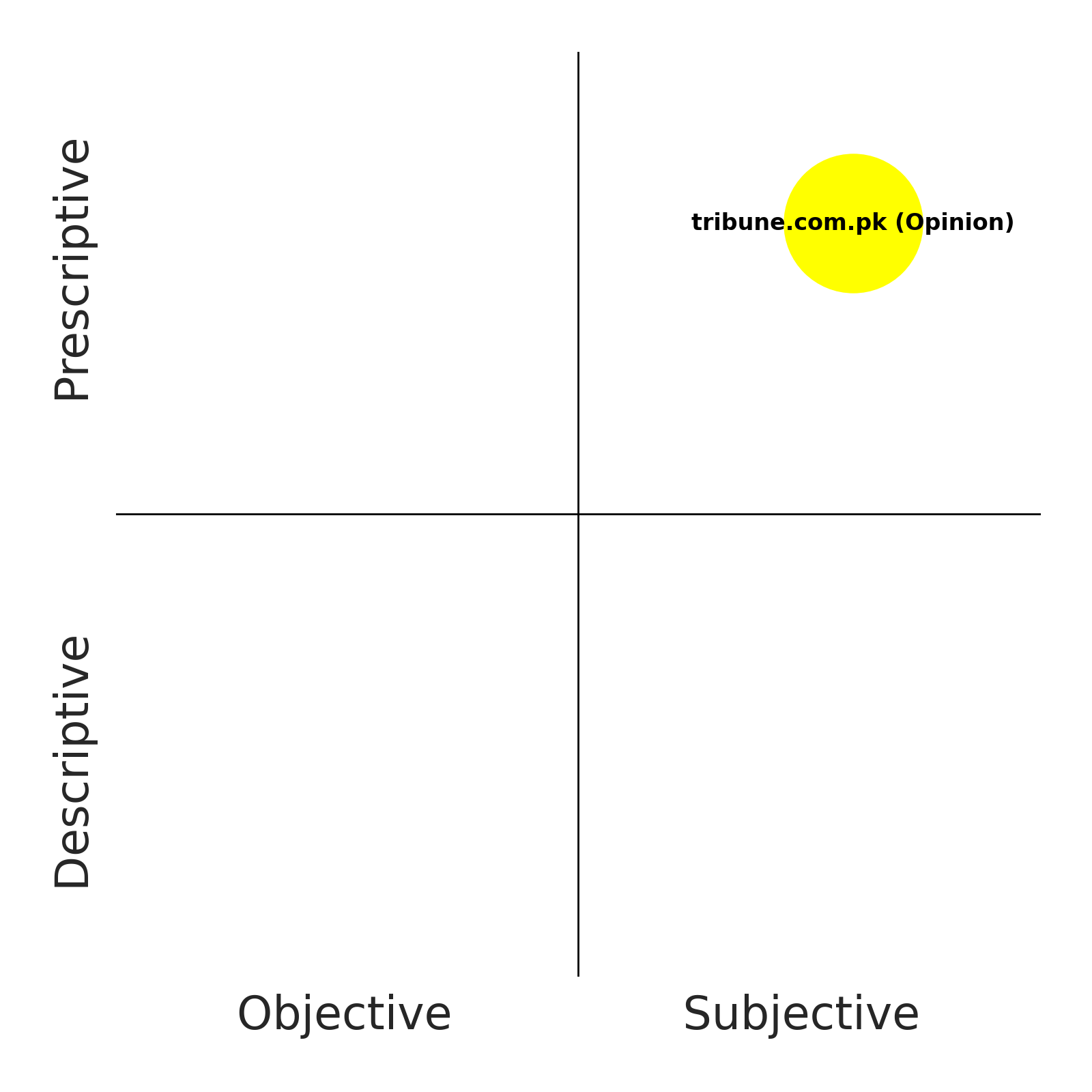
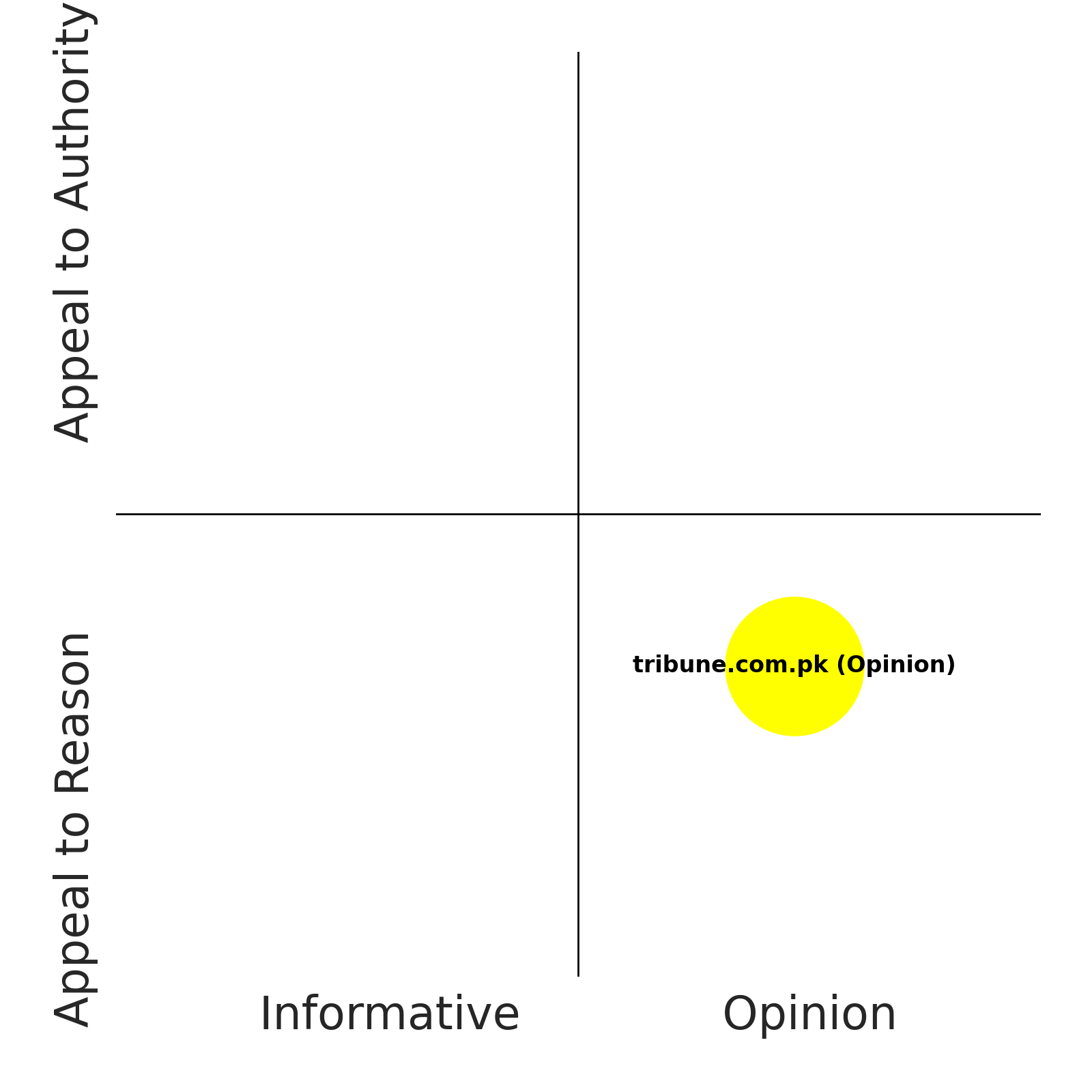
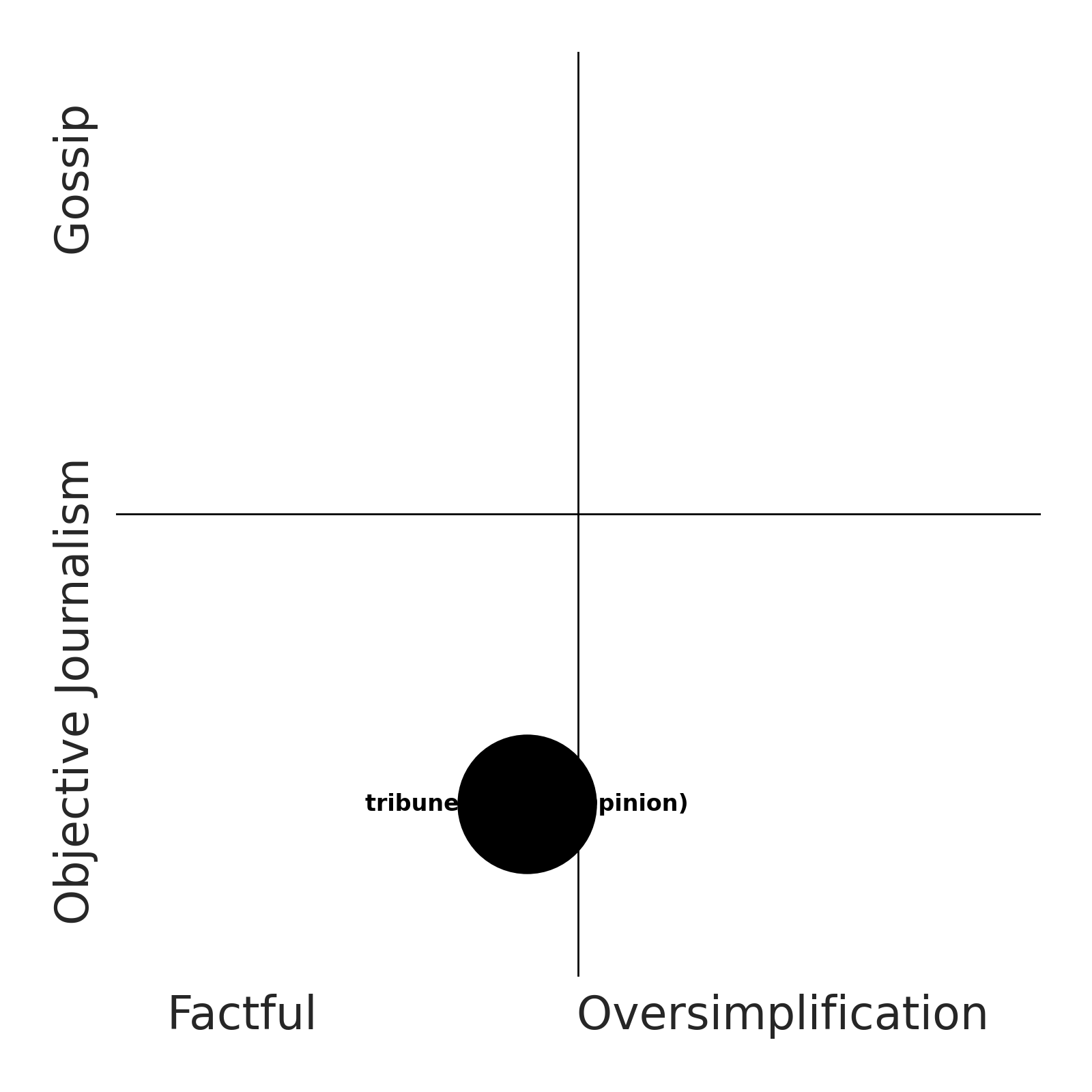
2026 © Helium Trades
Privacy Policy & Disclosure
* Disclaimer: Nothing on this website constitutes investment advice, performance data or any recommendation that any particular security, portfolio of securities, transaction or investment strategy is suitable for any specific person. Helium Trades is not responsible in any way for the accuracy
of any model predictions or price data. Any mention of a particular security and related prediction data is not a recommendation to buy or sell that security. Investments in securities involve the risk of loss. Past performance is no guarantee of future results. Helium Trades is not responsible for any of your investment decisions,
you should consult a financial expert before engaging in any transaction.
Helium Research Assistant

How can I help you today?
Ask any question about tribune.com.pk (Opinion) bias.


