See whether Helium helps you make better-informed decisions. Try every Pro Trader feature for 30 days. No credit card required.
Try every Pro Trader feature for 30 days. No credit card required.
September 12, 2026 · 0 shares
A promotional celebrity interview that treats opposition to Trump's Ukraine policy as self-evidently justified, using loaded questions and empathetic vignettes of Ukrainian youth.
Russia's full-scale invasion of Ukraine began in 2022; the war has driven major international aid debates. USAID is the U.S. Agency for International Development, and the Trump administration's foreign-assistance decisions and the Trump-Vance-Zelensky meeting are the policy flashpoints referenced in the interview.
Automated analysis; not human reviewed. Limitations: The supplied text is an interview, so most political statements are explicitly attributed to interviewees; the publisher's own stance is inferred mainly from question wording and editorial asides, and I cannot verify the documentary's factual claims. · 5 of 54 available dimensions scored; omitted dimensions are not treated as neutral. · Verified supporting quotes for 5 of 5 scored dimensions.
Claim: The interviewer's framing is structurally critical of Trump and the administration's Ukraine policy.
“Do you think that is one of his greatest crimes as president?” · exact text match
“This meeting with Zelensky, Trump and Vance was embarrassing to watch in the theater.” · exact text match
Why: The publisher's own questions presuppose wrongful action by Trump and embarrassment by the administration, creating a liberal-leaning frame even though the explicit opinions are quoted from Penn and Haney.
Claim: The publisher uses evaluative and emotional language in its own voice rather than confining itself to factual description.
“Haney’s film is a brisk 95 minutes but it packs a punch.” · exact text match
“This meeting with Zelensky, Trump and Vance was embarrassing to watch in the theater.” · exact text match
Why: Both sentences are publisher-voice judgments, making the piece substantially subjective.
Claim: The article is built around subjective judgments and rhetorical assertions in the interviewer's voice.
“I couldn't help but feel like the Ukrainian youth has such moral certainty. And then I thought about us Americans, and it's like, are we just entitled brats?” · exact text match
“This meeting with Zelensky, Trump and Vance was embarrassing to watch in the theater.” · exact text match
Why: The interviewer editorializes and asks rhetorical questions, so the piece is heavily opinionated rather than fact-neutral.
Claim: The piece repeatedly frames the documentary through U.S. party politics, presidential culpability, and elections.
“We're entering the midterms and the next presidential election. Do you think the Democrats will prioritize this as an issue?” · exact text match
“Do you think that is one of his greatest crimes as president?” · exact text match
Why: The interviewer steers the discussion toward electoral and partisan questions, making the article highly political.
Claim: The piece functions as promotion for the documentary.
“Haney’s film is a brisk 95 minutes but it packs a punch.” · exact text match
“Sean, you want to get this movie out there. You want to get this message out there.” · exact text match
Why: Publisher-voice praise and explicit talk of getting the movie out give the interview a promotional character.
The supplied text is an interview, so most political statements are explicitly attributed to interviewees; the publisher's own stance is inferred mainly from question wording and editorial asides, and I cannot verify the documentary's factual claims.
September 18, 2026 · 0 shares
Framing is adulatory and insider-driven, treating the show as a visceral art-world event and relying on the artist’s own anti-explanatory rhetoric.
Automated analysis; not human reviewed. Limitations: The supplied text is a first-person arts profile with promotional access; the writer’s critical praise, the artist’s statements, and reported facts are closely layered, leaving no independent verification. · 7 of 55 available dimensions scored; omitted dimensions are not treated as neutral. · Verified supporting quotes for 7 of 7 scored dimensions.
Claim: The story measures the show’s significance through insider art-world status and gallery prestige.
“an art-world EGOT-level feat that only the late Richard Serra, Jeff Koons and Gerhard Richter achieved at certain points in their careers.” · exact text match
“Based on a straw poll of curators, collectors, and rival dealers at a spree of events last week, this is the show everyone’s most excited to see in Chelsea this fall.” · exact text match
Why: The show is framed as important because of elite galleries, famous artists, and insider enthusiasm rather than broader public or critically reasoned criteria.
Claim: The account is presented through the writer’s personal, evaluative judgments rather than neutral reporting.
“he’s simply one of the best-known—and best, full stop—artists of his generation” · exact text match
“It’s got teeth that sink into you long after you walk away, and a force that hits you in your gut.” · exact text match
Why: The writer asserts superlative aesthetic judgments and visceral reader reactions as if they were self-evident.
Claim: The writing emphasizes shocking and provocative imagery to heighten the drama of the show.
“Even in thumbnail form on your phone, they have an immediate impact, the kind that shocks and provokes.” · exact text match
“I could spell out in detail what it’s like to witness Jeff Koons’s explicit “Made in Heaven” tableau of Koons penetrating his wife, Cicciolina, as rendered by Wolfson into a still from a Pixar-esque film.” · exact text match
Why: The writer foregrounds explicit sexual material and language of shock, though this is partly descriptive of the artwork itself.
Claim: The piece is dominated by the writer’s own critical praise and first-person assessment.
“I described Wolfson as “the most ambitious artist of his generation making provocative, awe-inspiring, interactive, unforgettable art experiences, sculptures, and unclassifiable objects.”” · exact text match
“he’s simply one of the best-known—and best, full stop—artists of his generation” · exact text match
Why: First-person superlatives and conclusory praise drive the text rather than documented analysis.
Claim: The piece validates the show using famous names and institutional credentials rather than independent argument.
“an art-world EGOT-level feat that only the late Richard Serra, Jeff Koons and Gerhard Richter achieved at certain points in their careers.” · exact text match
“VF called him “The Baddest Boy.”” · exact text match
Why: Status comparisons and prior publication labels are used as markers of artistic importance.
Claim: The writer converts personal impressions and anecdotal buzz into categorical statements about the show’s status.
“he’s simply one of the best-known—and best, full stop—artists of his generation” · exact text match
“this is the show everyone’s most excited to see in Chelsea this fall.” · exact text match
Why: Phrases like “full stop” and “everyone” assert consensus beyond the anecdotal evidence supplied.
Claim: The writing uses visceral, feeling-laden language to evoke an emotional response.
“It’s got teeth that sink into you long after you walk away, and a force that hits you in your gut.” · exact text match
“The spikes suffuse the air with a hard to describe but palpable dread.” · exact text match
Why: Intense body imagery and atmospheric dread are used to induce excitement about the artwork.
The supplied text is a first-person arts profile with promotional access; the writer’s critical praise, the artist’s statements, and reported facts are closely layered, leaving no independent verification.
September 17, 2026 · 0 shares
A warm celebrity-profile frame treats Norway's royal succession as a historic and heartwarming milestone, celebrating the monarchy and the new heir with admiring family anecdotes and a light gossip aside.
Norway is a constitutional monarchy with hereditary succession; the Council of State and a constitutional oath before the Storting are formal steps in the transfer of royal authority.
Automated analysis; not human reviewed. Limitations: Only the supplied article text was available; no external verification of the reported succession events or quoted statements was possible. · 6 of 55 available dimensions scored; omitted dimensions are not treated as neutral. · Verified supporting quotes for 6 of 6 scored dimensions.
Claim: The report blends factual succession details with admiring, intimate royal-portrait language.
“the beloved “people’s king” who passed away at the age of 89” · exact text match
“the joy that lives in you and all the life you fill our home with” · exact text match
Why: A positive epithet and private family praise are incorporated into the news narrative, coloring the factual report with a subjective celebratory tone.
Claim: The framing is forward-looking and celebrates the princess's future reign and personal freedom.
“new generation of queens who will reign in Europe in the coming years” · exact text match
“she has the freedom to shape her own role and find her own path, even if she makes mistakes” · exact text match
Why: The story emphasizes a historic, positive future and encouragement rather than dwelling on bereavement or illness.
Claim: The profile includes a light celebrity-gossip aside about the princess's romantic life.
“It’s not clear if romance is one of her current hobbies: In 2024, the Norwegian press revealed that, after two years of dating, she had broken up with her boyfriend, economics student Magnus Heien Haugstad.” · exact text match
Why: The relationship breakup is framed coyly as a possible 'hobby' and included as personal color rather than as a matter of public record or policy.
Claim: Royal succession and constitutional ceremony are treated approvingly and without critical examination.
“the beloved “people’s king” who passed away at the age of 89” · exact text match
“her next engagement will be the oath of allegiance to the constitution before the Storting (parliament)” · exact text match
Why: The monarchy is described with admiring language and its formal procedures are presented as a natural part of the heir's preparation.
Claim: The feature is emotionally warm, foregrounding affection, love, and family praise.
“I have a lot of love for Norway.” · exact text match
“the joy that lives in you and all the life you fill our home with” · exact text match
Why: Positive emotional statements from and about the princess are emphasized and left to stand as defining character evidence.
Claim: The reporting attributes key personal details and quotes to identifiable sources and gives specific dates and institutions.
“In 2024, the Norwegian press revealed” · exact text match
“Ingrid gave a rare interview” · exact text match
Why: The text cites a press report and a named interview, and matches biographical claims to specific dates and public institutions.
Only the supplied article text was available; no external verification of the reported succession events or quoted statements was possible.
September 26, 2026 · 0 shares
Sensational celebrity-gossip framing treats Prince Harry's charity skydive as a high-stakes personal gamble and foregrounds private family details.
The Invictus Games is a multi-sport event for wounded, injured, and sick military personnel and veterans, founded by Prince Harry; the article references the Birmingham edition without explaining it.
Automated analysis; not human reviewed. Limitations: The article contains internal timeline and location inconsistencies—a February 2025 photo caption, a September 2026 photo caption, and a "back on British soil" comment after a Toronto skydive—that limit confidence in the chronology and coherence. · 4 of 55 available dimensions scored; omitted dimensions are not treated as neutral. · Verified supporting quotes for 3 of 4 scored dimensions.
Claim: The reporting mixes factual detail with evaluative, subjective language.
“Prince Harry made the daring leap during a fundraiser for Canadian veterans.” · exact text match
“It was a predicament he defused with his typical humor.” · exact text match
Why: Words like "daring" and "typical humor" are evaluative choices, even though the story otherwise relies on attributed facts.
Claim: The framing inflates the stakes of the event by implying unusually high risk.
“Prince Harry Risks It All During Canadian Skydiving Event.” · exact text match
Why: A charity skydive is described with the dramatic phrase "Risks It All," which goes beyond the reported facts.
Claim: The story is framed with a positive, upbeat emotional tone.
“It’s been great.” · not found in supplied text
“glad he didn’t and he’s still here!” · exact text match
Why: The selected quotes emphasize positive outcomes and cheerful reassurance without countervailing negative detail.
Claim: The story emphasizes the private lives and reactions of the royal couple rather than substantive charity results.
“Once safely on the ground, Harry was spotted making a call to wife Meghan Markle, who remained at their new home in England.” · exact text match
“I didn’t have to convince her, but she was relieved once we were down.” · exact text match
Why: The piece dwells on a private phone call and family reactions, which is characteristic of celebrity-gossip framing.
The article contains internal timeline and location inconsistencies—a February 2025 photo caption, a September 2026 photo caption, and a "back on British soil" comment after a Toronto skydive—that limit confidence in the chronology and coherence.
September 21, 2026 · 0 shares
The coverage frames the inspector’s decision largely as a vindication of the couple’s security and privacy position, while including the public-access side as a counterpoint.
The dispute is about whether a driveway at Barton Court, Kintbury, West Berkshire, should be a public right of way; under British law referenced in the report, the relevant legal question was whether there had been 20 consecutive years of public use.
Automated analysis; not human reviewed. · 1 of 55 available dimensions scored; omitted dimensions are not treated as neutral. · Verified supporting quotes for 1 of 1 scored dimensions.
Claim: The publisher interleaves reporting with its own interpretive judgments about testimony and the outcome.
“Her words bolstered Matthews argument, casting doubt on whether the path had in fact been used by the public on a continuous basis sufficient to establish a right-of-way.” · exact text match
“For now, local officials are favoring the couple, and their privacy seems secure.” · exact text match
Why: These sentences are not sourced; they are the publisher’s own characterization of testimony and the result. The second sentence states a subjective impression of the couple’s privacy rather than a reported fact.
September 27, 2026 · 0 shares
Uses tabloid-sourced, conflict-focused framing around the princes' reported estrangement, emphasizing body language and a speculative Harry project as the story's hook.
Automated analysis; not human reviewed. Limitations: The supplied text is fragmented, mixing substantive sentences with unrelated headlines and site boilerplate, so the classification rests on a partial view of the article. · 4 of 55 available dimensions scored; omitted dimensions are not treated as neutral. · Verified supporting quotes for 4 of 4 scored dimensions.
Claim: Dramatic language and sequencing heighten the emotional conflict beyond a plain account.
“where they reportedly behaved like complete strangers” · exact text match
“Prince Harry left for California as soon as the ceremony ended.” · exact text match
Why: The words 'complete strangers' and the immediate-departure detail dramatize the rift.
Claim: The reporting emphasizes the princes' personal estrangement with loaded interpersonal detail.
“where they reportedly behaved like complete strangers” · exact text match
“Prince Harry left for California as soon as the ceremony ended.” · exact text match
Why: The focus on body language, not speaking, and abrupt departure is characteristic of gossip-style royal coverage.
Claim: The report is only moderately credible because it relies on attributed tabloid sourcing and hedges.
“According to the Sunday Times” · exact text match
“Daily Mail reporter Richard Kay said” · exact text match
Why: Key claims are attributed to named or titled sources and softened with 'reportedly,' but the underlying sources are tabloid outlets.
Claim: The text includes an unverified conjecture about what Harry would do.
“This is a project Prince Harry would take on” · exact text match
Why: The modal 'would' signals speculation about Harry's motivations or choices rather than a directly sourced fact.
The supplied text is fragmented, mixing substantive sentences with unrelated headlines and site boilerplate, so the classification rests on a partial view of the article.
September 27, 2026 · 0 shares
Tabloid-style sensationalism dominates the framing, emphasizing spectacular dollar figures and celebrity gossip while treating estimates as definitive.
Automated analysis; not human reviewed. Limitations: The supplied text only gives internal estimates and reports for settlement figures, with no underlying sources or methodology, so the ranking’s accuracy cannot be verified. · 6 of 55 available dimensions scored; omitted dimensions are not treated as neutral. · Verified supporting quotes for 4 of 6 scored dimensions.
Claim: The presentation injects interpretive and evaluative language into financial reporting.
“So, naturally, when he decided to divorce his longtime wife, novelist MacKenzie Scott, their settlement ran into the billions: approximately $35 billion, to be exact.” · exact text match
Why: The word 'naturally' frames the settlement as inevitable and obvious rather than reporting neutral facts.
Claim: The article uses exaggerated, colloquial language to dramatize divorce payouts.
“Proof of this can be found below, an overview of luminaries who have had to shell out big bucks to say goodbye.” · not found in supplied text
Why: 'Shell out big bucks' and the superlative framing of 'most expensive' sensationalize the financial settlements.
Claim: The coverage dwells on tabloid-style private details rather than limiting itself to financial outcomes.
“She reportedly uncovered the truth by checking her husband’s phone, which allegedly revealed that he had been involved with no fewer than a dozen women, including waitresses, escorts, and pornographic actresses.” · exact text match
Why: The phone-checking and detailed list of alleged partners have no bearing on the settlement amount and are classic gossip content.
Claim: The text inserts an editorial judgment about a subject’s personal life.
“Murdoch seems to love marriages almost as much as he loves divorces.” · exact text match
Why: This is an unverified personal characterization rather than a reported fact.
Claim: The tone includes juvenile colloquialisms that undercut neutral reporting.
“Barely 17 days after his divorce from dePeyster was officially finalized, the media mogul was already putting a ring on the finger of Wendi Deng, 38 years his junior.” · not found in supplied text
Why: 'Putting a ring on the finger' is a clichéd, informal construction, and the age-gap detail is emphasized for gossip effect.
Claim: Most figures are hedged, but the lead superlative is asserted without attribution.
“With an estimated cost of $76 billion, the most expensive divorce in history remains, to this day, that of Bill and Melinda Gates.” · exact text match
Counterevidence:
“dePeyster reportedly received a settlement estimated at $1.7 billion.” · not found in supplied text
Why: The headline claim is presented as definitive despite only an 'estimated' figure and no source, while other entries at least use 'reportedly.'
The supplied text only gives internal estimates and reports for settlement figures, with no underlying sources or methodology, so the ranking’s accuracy cannot be verified.
September 17, 2026 · 0 shares
A promotional biography excerpt turns Kardashian's genealogy and business rise into a fated, hereditary myth, treating commerce as matriarchal destiny.
Automated analysis; not human reviewed. Limitations: The analysis relies on a single promotional excerpt; family memories and biographical claims cannot be independently verified. · 7 of 55 available dimensions scored; omitted dimensions are not treated as neutral. · Verified supporting quotes for 7 of 7 scored dimensions.
Claim: The framing is subjective because it advances a destiny-and-blood origin story rather than a neutral report.
“Call it a curse or call it destiny, Kardashian’s success is a fusion of Armenian folklore and the American dream.” · exact text match
“It’s in her blood argues author Jonathan Van Meter, in a revealing new biography, Citizen Kim.” · exact text match
Why: The language explicitly frames success through myth ('destiny', 'blood') and endorses the biography as 'revealing'.
Claim: The prose is sensational, using crowd frenzy, celebrity myth, and monumental spectacle.
“It was full-crazy mayhem,” she said. “It felt like the whole town had come out, so it was like an Evita moment, waving to everyone from the balcony.” · exact text match
“a massive, 60-foot-long inflatable replica of Kim appeared in Times Square.” · exact text match
Why: The 'Evita moment' and giant inflatable are spectacle-driven framing.
Claim: The narrative is emphatically positive, treating setbacks as springboards and gloom as unacceptable.
“Gloom be gone!” · exact text match
“By leaving when they did, they managed to escape the Armenian genocide and the surrounding tumult of the First World War and the Russian Revolution.” · exact text match
Why: The author's exclamation and framing of escape and prosperity create a hopeful, success-oriented tone.
Claim: The excerpt dwells on intimate and scandalous family details.
“Kim’s ill-advised marriage to basketball star Kris Humphries in 2011 famously lasted only 72 days.” · exact text match
“In 1975, when Kris was 19, he died in a horrific car accident.” · exact text match
Why: Private marriages, deaths, and graphic accident details are presented as entertainment.
Claim: The writing is heavily interpretive, using superlatives and speculative causal statements.
“It is perhaps one of the most successful diasporas in American history.” · exact text match
“Perhaps the cultural mystification over Kim’s ubiquity is seeded right here.” · exact text match
Why: The sentence makes an evaluative historical claim and attributes cultural mystery to a guessed origin.
Claim: The narrative uses prophecy, preordination, and 'magical thinking' as explanatory lenses for Kim's rise.
“It all began with a prophecy, a story foretold by an 11-year-old illiterate boy in Armenia sometime in the mid-19th century, predicting that Christians in the region were doomed if they did not make the voyage to the West Coast of America—California, more specifically.” · exact text match
“magical thinking combined with an immigrant’s work ethic.” · exact text match
Why: The origin story is keyed to supernatural prophecy, and the author explicitly blends 'magical thinking' into the explanation.
Claim: The text is promotional, presenting a forthcoming book and celebrity products in commercially favorable terms.
“Exclusive Excerpt: A New Biography Traces Kim Kardashian's Ambitions to Ancient Armenia.” · exact text match
“From Citizen Kim: The Woman Who Created the Future, by Jonathan Van Meter, to be published on October 27 by Viking, an imprint of Penguin Random House.” · exact text match
Why: The 'exclusive excerpt' label and publication details make the promotional function explicit; product lines such as SKIMS are showcased positively.
The analysis relies on a single promotional excerpt; family memories and biographical claims cannot be independently verified.
September 21, 2026 · 0 shares
Sensational celebrity-gossip framing romanticizes the Olivier–Leigh affair as a fated ‘Shakespearean tragedy,’ mixing explicit sex details, sympathetic reporting on Leigh’s mental illness, and judgmental editorial asides into an emotionally loaded melodrama.
Automated analysis; not human reviewed. Limitations: The supplied text is a truncated, elision-laced excerpt in which some passages are cut off mid-sentence, so the full wording and surrounding context of key claims could not be checked. · 8 of 55 available dimensions scored; omitted dimensions are not treated as neutral. · Verified supporting quotes for 8 of 8 scored dimensions.
Claim: The article expresses a sympathetic, non-moralizing view of mental illness and criticizes the era’s treatment of it.
“Doctors of the time were woefully unable to treat her—and their contemporaries were notoriously unkind about her condition.” · exact text match
“being empathetic about the lack of useful treatments” · exact text match
Why: The phrase ‘woefully unable’ and the praise for empathy mark a progressive, compassionate stance on a social issue, without countervailing conservative framing.
Claim: The authorial voice applies an interpretive romantic frame rather than neutral description.
“It is the story of two yearning, lost souls” · exact text match
“Appropriately, each one fell in love with the other onstage.” · exact text match
Why: Words like ‘yearning,’ ‘lost souls,’ and the rhetorical ‘Appropriately’ present a particular tragic-romantic interpretation as fact.
Claim: Events are presented in an emotionally inflated, melodramatic register, starting with the framing phrase that the romance was a ‘Shakespearean tragedy.’
“It is the story of two yearning, lost souls” · exact text match
“The Oliviers’ happiness would be short-lived.” · exact text match
Why: The literary superlatives and dramatic foreshadowing push the narrative beyond neutral reporting into sensational storytelling.
Claim: The piece features celebrity gossip: extramarital affairs, a rumored tryst at a christening, and a graphic sexual account.
“they even had a tryst during Tarquin’s christening” · exact text match
“Larry met me in the hotel lobby, and we went upstairs, and we fucked, and we fucked, and we fucked the whole weekend.” · exact text match
Why: The publisher repeats the christening rumor as a gossipy aside and includes the explicit recollection unexpurgated, indicating gossip as a primary mode.
Claim: The dominant emotional valence is tragic and elegiac, emphasizing grief and loss.
“The Oliviers’ happiness would be short-lived.” · exact text match
“Olivier came to see her, bowed by grief” · exact text match
Why: The text stresses a decline into unhappiness and pathos, with a marked emotional coloring of mourning.
Claim: Unverifiable romantic and psychological states are reported as fact.
“Vivien was the first to fall when she saw Olivier in the comedy Theatre Royal in 1933” · exact text match
“each one fell in love with the other onstage” · exact text match
Why: The exact timing and experience of falling in love are presented directly as established biographical data, without attribution or hedging.
Claim: The narrative inserts moralized editorializing language to direct reader judgment.
“their selfish actions” · exact text match
“Always a misogynist, Brando” · exact text match
Why: Calling infidelity ‘selfish actions’ and labeling Brando a ‘misogynist’ are editorial judgments embedded in the narration rather than neutral description.
Claim: The publisher repeatedly names its sources and flags at least one claim as ‘allegedly.’
“according to Galloway” · exact text match
“who writes about the incident sympathetically in his memoir, Bring on the Empty Horses” · exact text match
Why: Explicit attribution and source-naming are credibility markers even within the gossipy, melodramatic frame.
The supplied text is a truncated, elision-laced excerpt in which some passages are cut off mid-sentence, so the full wording and surrounding context of key claims could not be checked.
A sympathetic, access-driven profile treats Erika Kirk's grief seriously while critically cataloging her late husband's hard-line record and conspiracist legacy.
Automated analysis; not human reviewed. Limitations: No independent verification of the reported financial figures, legal assertions, or interview quotes was possible from the supplied text. · 6 of 55 available dimensions scored; omitted dimensions are not treated as neutral. · Verified supporting quotes for 6 of 6 scored dimensions.
Claim: The piece applies critical, value-laden characterization to a conservative leader while framing his widow sympathetically.
“His rhetoric veered into vitriol, and he showed little concern for the rights or interests of anyone other than white Christian men.” · exact text match
Why: This is an evaluative editorial judgment rather than a neutral description, indicating a liberal-leaning framing.
Claim: The reporting is structured around the author's personal impressions and subjective assessments.
“I couldn’t tell if it was because she lacked conviction or if she simply didn’t want to offend me.” · exact text match
Why: The first-person uncertainty directly injects the reporter's interpretation into the profile.
Claim: The profile includes substantial celebrity-culture and personal-life detail typical of gossip-oriented coverage.
“Bravo producers had recently approached her about joining the cast of Summer House” · exact text match
Why: Details about reality-TV casting, pageants, clothing, and family life go beyond the political-succession story.
Claim: The piece contains explicit analytical opinions about Erika Kirk's fitness for leadership.
“Erika may be the moral heart of the organization, but she’s far from the political animal her husband was.” · exact text match
Why: This is a direct editorial judgment, not a reported fact or a quoted source's characterization.
Claim: The story is centered on internal dynamics of a partisan political movement.
“the future of the organization in a fracturing MAGA movement now seems less certain one year later” · exact text match
Why: The framing treats the MAGA movement and Turning Point's place in it as the central stakes of the narrative.
Claim: The article consistently attributes claims, charges, and quoted statements to named or described sources.
“According to prosecutors, 23-year-old Tyler Robinson, who has pleaded not guilty to all charges, including aggravated murder, in Charlie Kirk’s death” · exact text match
Why: The author distinguishes allegations from established facts and identifies the basis for the information.
No independent verification of the reported financial figures, legal assertions, or interview quotes was possible from the supplied text.
September 17, 2026 · 0 shares
Celebratory, insider-toned coverage sells the show as a breakthrough and treats criticism as FOMO, leaning on subjective praise and promotional spectacle.
Automated analysis; not human reviewed. Limitations: Assessment relies on a single unsigned feature text; no byline, publication date, or external reporting was supplied to verify attendance and scheduling claims. · 8 of 55 available dimensions scored; omitted dimensions are not treated as neutral. · Verified supporting quotes for 6 of 8 scored dimensions.
Claim: The framing is predominantly experiential and evaluative rather than detached reporting.
“In a way, this was Taymour’s most compelling and successful world-building exercise.” · exact text match
“And miss something they did.” · exact text match
Counterevidence:
“More than 400 people attended the show.” · not found in supplied text
Why: The publisher's own assessment and exclamatory narration shape the report around emotional payoff rather than neutral observation.
Claim: Conflict is foregrounded in a more dramatic way than the body's reported details support.
“Collina Strada: The New York Fashion Week Runway Show that Divided Fashion.” · exact text match
“split the industry between those up for the journey and those who found the idea preposterous.” · exact text match
Why: The headline and opening frame a scheduling-and-travel dispute as a stark industry split.
Claim: The coverage is affirmative and forward-looking, emphasizing the show's joyful reception and growth.
“I want to keep creating moments that make people excited.” · exact text match
“I have never been at a fashion show where everyone’s in a good mood.” · not found in supplied text
Counterevidence:
“Much of the criticism Taymour received was that she could have chosen another time to stage this show.” · not found in supplied text
Why: The selected quotes and closing note dwell on enthusiasm, good mood, and ambition; criticism is framed as pushback to be overcome.
Claim: The text includes incidental celebrity and party details that function more as social color than as fashion-week news.
“The only thing that could have made this better is mushrooms,” I overheard one handsome guy from Love Island USA say to a pretty girl in line for a pop-up by Blank Street coffee.” · exact text match
“After the show, and the dancing, guests were ushered atop a hill for an after-party that included a functioning margarita fountain” · exact text match
Why: The Love Island anecdote and party detail are included for celebrity flavor rather than to advance a verifiable news point.
Claim: The narrative includes direct editorial praise and normative judgments, not just reporting.
“In a way, this was Taymour’s most compelling and successful world-building exercise.” · exact text match
“Taymour has fashioned it into New York’s foremost tree-hugging, green-thumbed label.” · exact text match
Why: Unqualified superlatives and an evaluative verdict about success are offered as conclusions.
Claim: The dispute is reduced to a binary of committed attendees versus those who found the idea preposterous, while the body describes a more ordinary scheduling tradeoff.
“split the industry between those up for the journey and those who found the idea preposterous.” · exact text match
“People are annoyed, but they’re only annoyed because they wanted to come,” · exact text match
Why: The opening creates a stark binary and the article later dismisses critics through a single FOMO explanation.
Claim: The feature is moderately credible because it names sources and supplies concrete numbers, though it is one-sided and unverified.
“More than 400 people attended the show.” · not found in supplied text
“said Blake Abbie, the editor in chief of A Magazine Curated By” · exact text match
Why: Attribution and attendance figures provide a basis for verification, but no independent corroboration or critical sourcing is present.
Claim: Brand names and commercial collaborations are highlighted approvingly, giving the piece a promotional texture.
“the launch of Taymour’s latest furniture collaboration with Swedish interiors label Layered.” · exact text match
“a pop-up by Blank Street coffee” · exact text match
Why: Specific brand launches and event sponsors are woven into the celebratory narrative without critical or consumer-useful context.
Assessment relies on a single unsigned feature text; no byline, publication date, or external reporting was supplied to verify attendance and scheduling claims.
September 21, 2026 · 0 shares
Names Christopher Kane 'one of London's most beloved fashion designers' without attribution, framing his Mulberry return in an admiring, promotional tone.
Automated analysis; not human reviewed. Limitations: The provided article text is severely truncated after a single sentence, so the analysis is limited to that opening framing. · 1 of 55 available dimensions scored; omitted dimensions are not treated as neutral. · Verified supporting quotes for 1 of 1 scored dimensions.
Claim: The framing characterizes Kane with an unqualified subjective superlative rather than confining itself to observable facts.
“one of London's most beloved fashion designers” · verified after text normalization
Why: The phrase 'most beloved' asserts a collective emotional judgment without attribution or evidence, a mildly opinionated framing. Confidence is moderate because only one sentence of the text was supplied.
The provided article text is severely truncated after a single sentence, so the analysis is limited to that opening framing.
A first-person, insider-celebratory framing proclaims Tribeca's gallery boom as a definitive ascendance, using superlatives, name-dropping, and a blue-chip status narrative.
Tribeca is the lower Manhattan neighborhood south of SoHo and Canal Street; Chelsea has long been the city's dominant blue-chip gallery district after galleries earlier moved there from SoHo.
Automated analysis; not human reviewed. Limitations: The supplied text is a first-person arts column with no independent data or external verification; the count of 70 openings and rent stability rest on the author and named sources. · 7 of 54 available dimensions scored; omitted dimensions are not treated as neutral. · Verified supporting quotes for 7 of 7 scored dimensions.
Claim: The piece signals Tribeca's art-world status through wealth, celebrity residents, and blue-chip commercial galleries.
“Crypto-loving billionaire Michael Novogratz lives in Tribeca. So does Mukesh Ambani, the Indian businessman worth $120 billion, who’s turning 11 Hubert Street into the largest apartment in New York City.” · exact text match
Why: Billionaire residents and a record-setting apartment are used to convey the neighborhood's exclusivity and desirability, an elite status marker rather than a neutral arts statistic.
Claim: First-person, evaluative language dominates the reporting.
“I was blown away by everything happening at Maxwell Graham” · exact text match
“The food, though, is perfect. Particularly the steak frites.” · exact text match
Why: The author repeatedly uses personal enthusiasm and aesthetic verdicts, making the piece openly subjective.
Claim: The gallery openings are described with excited, hyperbolic language.
“the energy gets pretty bonkers with 70 openings raging at the same time” · exact text match
Why: Words like 'bonkers' and 'raging' dramatize the scene beyond a neutral report of exhibition openings.
Claim: The Tribeca gallery trend is framed as a triumphant success story.
“Now all of those spaces have been snapped up by dealers ready for the spotlight, hell-bent on competing in what’s now the most concentrated art-viewing hopscotch in Manhattan.” · exact text match
Why: The language emphasizes opportunity, energy, and competitive vitality, presenting the changes as overwhelmingly positive.
Claim: Celebrity and social sightings are included as part of the reporting.
“Taylor Swift lives in Tribeca.” · exact text match
“Jerry Saltz went looking for pizza and found it, while Roberta Smith sat at a table with former New Museum director Lisa Phillips.” · exact text match
Why: Details such as celebrity residences and who ate where function as society-page material alongside the gallery coverage.
Claim: The piece advances explicit taste judgments and a strong point of view.
“It’s time to proclaim a new preeminent gallery district in New York.” · exact text match
Why: This declarative verdict is a subjective editorial judgment, not a neutral observation.
Claim: The report visibly attributes claims to named sources and flags uncertainty where it appears.
“This data point is coming from no lesser authority than Jonathan Travis, the real estate agent who, during the pandemic, brokered deals for one gallerist after another looking for spaces in Tribeca.” · exact text match
“The new ground-floor space is, by my eyeball estimate, about 10 times the size of the old gallery” · exact text match
Why: Named sources, direct quotation, and an explicit uncertainty marker support a moderately credible presentation.
The supplied text is a first-person arts column with no independent data or external verification; the count of 70 openings and rent stability rest on the author and named sources.
September 18, 2026 · 0 shares
Framing is adulatory and insider-driven, treating the show as a visceral art-world event and relying on the artist’s own anti-explanatory rhetoric.
Automated analysis; not human reviewed. Limitations: The supplied text is a first-person arts profile with promotional access; the writer’s critical praise, the artist’s statements, and reported facts are closely layered, leaving no independent verification. · 7 of 55 available dimensions scored; omitted dimensions are not treated as neutral. · Verified supporting quotes for 7 of 7 scored dimensions.
Claim: The story measures the show’s significance through insider art-world status and gallery prestige.
“an art-world EGOT-level feat that only the late Richard Serra, Jeff Koons and Gerhard Richter achieved at certain points in their careers.” · exact text match
“Based on a straw poll of curators, collectors, and rival dealers at a spree of events last week, this is the show everyone’s most excited to see in Chelsea this fall.” · exact text match
Why: The show is framed as important because of elite galleries, famous artists, and insider enthusiasm rather than broader public or critically reasoned criteria.
Claim: The account is presented through the writer’s personal, evaluative judgments rather than neutral reporting.
“he’s simply one of the best-known—and best, full stop—artists of his generation” · exact text match
“It’s got teeth that sink into you long after you walk away, and a force that hits you in your gut.” · exact text match
Why: The writer asserts superlative aesthetic judgments and visceral reader reactions as if they were self-evident.
Claim: The writing emphasizes shocking and provocative imagery to heighten the drama of the show.
“Even in thumbnail form on your phone, they have an immediate impact, the kind that shocks and provokes.” · exact text match
“I could spell out in detail what it’s like to witness Jeff Koons’s explicit “Made in Heaven” tableau of Koons penetrating his wife, Cicciolina, as rendered by Wolfson into a still from a Pixar-esque film.” · exact text match
Why: The writer foregrounds explicit sexual material and language of shock, though this is partly descriptive of the artwork itself.
Claim: The piece is dominated by the writer’s own critical praise and first-person assessment.
“I described Wolfson as “the most ambitious artist of his generation making provocative, awe-inspiring, interactive, unforgettable art experiences, sculptures, and unclassifiable objects.”” · exact text match
“he’s simply one of the best-known—and best, full stop—artists of his generation” · exact text match
Why: First-person superlatives and conclusory praise drive the text rather than documented analysis.
Claim: The piece validates the show using famous names and institutional credentials rather than independent argument.
“an art-world EGOT-level feat that only the late Richard Serra, Jeff Koons and Gerhard Richter achieved at certain points in their careers.” · exact text match
“VF called him “The Baddest Boy.”” · exact text match
Why: Status comparisons and prior publication labels are used as markers of artistic importance.
Claim: The writer converts personal impressions and anecdotal buzz into categorical statements about the show’s status.
“he’s simply one of the best-known—and best, full stop—artists of his generation” · exact text match
“this is the show everyone’s most excited to see in Chelsea this fall.” · exact text match
Why: Phrases like “full stop” and “everyone” assert consensus beyond the anecdotal evidence supplied.
Claim: The writing uses visceral, feeling-laden language to evoke an emotional response.
“It’s got teeth that sink into you long after you walk away, and a force that hits you in your gut.” · exact text match
“The spikes suffuse the air with a hard to describe but palpable dread.” · exact text match
Why: Intense body imagery and atmospheric dread are used to induce excitement about the artwork.
The supplied text is a first-person arts profile with promotional access; the writer’s critical praise, the artist’s statements, and reported facts are closely layered, leaving no independent verification.
September 11, 2026 · 0 shares
Promotional insider-access framing celebrates the restaurant’s exclusivity and luxury details while treating high demand and George Lucas’s personal involvement as markers of success.
Automated analysis; not human reviewed. Limitations: The supplied text is a single promotional preview with no pricing, independent reviews, or critical perspective, so the analysis is limited to the publisher’s positive framing. · 9 of 54 available dimensions scored; omitted dimensions are not treated as neutral. · Verified supporting quotes for 9 of 9 scored dimensions.
Claim: The framing celebrates exclusivity and luxury as the restaurant’s selling points rather than accessibility or value.
“An Exclusive Look Inside the Skywalker Grill at the Lucas Museum of Narrative Art.” · exact text match
“It’s already tough to get a reservation.” · exact text match
Why: The headline and reservation scarcity highlight insider status and high demand, while the menu’s luxury items signal an elite cultural-consumption frame.
Claim: The writing mixes reported facts with subjective aesthetic judgments, presenting the venue in openly evaluative language.
“But perhaps the hallmark of the interiors isn’t any object but the epic, rambling view of Los Angeles that unfurls beyond the restaurant’s windows.” · exact text match
Why: This sentence is an editorial judgment about what matters most in the design rather than a neutral factual report.
Claim: The presentation uses hype and scarcity cues to build excitement beyond plain reporting.
“Los Angeles’s Next Hot Restaurant?” · exact text match
“Spoiler alert: It’s already tough to get a reservation.” · exact text match
Why: The headline poses a promotional question and the “spoiler alert” framing dramatizes booking demand.
Claim: The report frames the restaurant as a clear success before it has opened, emphasizing surging demand.
“The anticipation for the Lucas Museum has spilled over to Skywalker Grill, which is already booked out on Resy through most of the fall.” · exact text match
Why: Booking demand is presented as confirmation of the restaurant’s appeal.
Claim: The overall tone is celebratory and expectation-building, with no negative or cautionary notes.
“No museum in recent history—save for, maybe, the Whitney Museum of American Art amid its move downtown—has been as anticipated as the Lucas Museum, the $1 billion passion project” · exact text match
“It’s already tough to get a reservation.” · exact text match
Why: The article repeatedly emphasizes anticipation, passion, and success without reporting drawbacks.
Claim: The article contains explicit evaluative statements presented as the writer’s views.
“But perhaps the hallmark of the interiors isn’t any object but the epic, rambling view of Los Angeles that unfurls beyond the restaurant’s windows.” · exact text match
“No item, however, was more fastidiously workshopped than the burger.” · exact text match
Why: Both sentences assert judgments about what is most important or most carefully made, rather than reporting neutral facts.
Claim: The language is emotionally warm and enthusiastic, using positive descriptors to shape an upbeat response.
“triumphant swirling walls of cherrywood” · exact text match
“the epic, rambling view of Los Angeles that unfurls beyond the restaurant’s windows” · exact text match
Why: Repeated positive aesthetic words create an enthusiastic emotional tone rather than a detached one.
Claim: The article is specific and transparent about dates and the absence of critic reviews, though it is promotional rather than critical.
“As of publishing, the next available two-person reservation is for December 2.” · exact text match
“takes from food critics won’t come until around September 22, when the restaurant officially opens.” · exact text match
Why: It supplies a precise reservation date and distinguishes the pre-opening preview from future critic reviews, supporting moderate credibility.
Claim: The feature works as promotional marketing for the museum and restaurant, burnishing the brand with superlatives and exclusive-access details.
“An Exclusive Look Inside the Skywalker Grill at the Lucas Museum of Narrative Art.” · exact text match
“No item, however, was more fastidiously workshopped than the burger.” · exact text match
Why: The exclusive-access framing and effusive item-by-item praise resemble marketing copy rather than neutral reporting.
The supplied text is a single promotional preview with no pricing, independent reviews, or critical perspective, so the analysis is limited to the publisher’s positive framing.
September 05, 2026 · 0 shares
Glossy celebrity-event coverage turns a Cartier-branded Venice dinner into an aspirational spectacle, emphasizing star power, luxury, and nostalgic triumph over news.
La La Land is a 2016 Oscar-winning musical directed by Damien Chazelle, starring Emma Stone and Ryan Gosling; it premiered in competition at the 2016 Venice Film Festival and was later involved in the Oscars' best-picture announcement mix-up. Bucking Fastard is a film at the same festival featuring Orlando Bloom and sisters Kate and Rooney Mara.
Automated analysis; not human reviewed. Limitations: The supplied text is a single-source celebrity-event feature without independent verification; no sponsorship terms or editorial-disclosure details are available. · 6 of 54 available dimensions scored; omitted dimensions are not treated as neutral. · Verified supporting quotes for 5 of 6 scored dimensions.
Claim: The reporting treats an exclusive luxury-branded celebrity celebration as an aspirational social event.
“While it wasn’t held in the city of stars, plenty of stars came out to celebrate the 10th anniversary of La La Land.” · exact text match
“I think the Venice Film Festival is maybe the most elegant and chic experience anyone can encounter, right?” said Bloom.” · not found in supplied text
Why: The framing repeatedly highlights stars, elegance, and a luxury setting while presenting them as self-evidently enchanting.
Claim: The account is structured around personal impressions and editorial enthusiasm rather than verifiable facts.
“Embarrassing or not, the result is truly incredible to watch.” · exact text match
“It’s that sort of thing where time kind of bends. So on some level it feels so distant. On other levels, yeah, it feels like yesterday.” · exact text match
Why: The narrative is built on subjective appraisals and emotional reflections, with no analytical or countervailing perspective.
Claim: The piece closes on a celebratory, triumphant emotional note.
“And now he’s on top of the world. Well, if not the world, at least Venice.” · exact text match
“I feel lucky. If you saw what I saw, I think you would cry.” · exact text match
Why: Positive, lucky, and world-beating language dominates the concluding passages.
Claim: The report emphasizes personal celebrity trivia and private anecdotes over substantive news.
“Funnily enough, I’m getting my Irish passport,” says Bloom. “My grandfather was Irish.” · exact text match
“I have some really special videos of us doing the most embarrassing things,” Mara says.” · exact text match
Why: The details are intimate personal/passport and embarrassing-video anecdotes typical of celebrity-gossip coverage.
Claim: The tone is warmly positive and emotionally affirming.
“I feel lucky. If you saw what I saw, I think you would cry.” · exact text match
“And now he’s on top of the world. Well, if not the world, at least Venice.” · exact text match
Why: The article selects and foregrounds expressions of luck, awe, and triumph.
Claim: A Cartier-branded event is described in glowing terms without critical distance, functioning as soft promotion.
“Nothing was mistaken at the inaugural Cartier Cinema Club dinner held at Venice’s Gritti Palace, where Chazelle’s La La Land was honored with dinner on the canal overlooking the Basilica della Salute.” · exact text match
“I ended at a gorgeous Cartier party,” said Thiele on the rooftop of the Gritti Palace.” · exact text match
Why: Brand names and the luxury setting are woven into celebratory event coverage with no editorial caveats or disclosure.
The supplied text is a single-source celebrity-event feature without independent verification; no sponsorship terms or editorial-disclosure details are available.
September 11, 2026 · 0 shares
A promotional first-look feature frames Babies through admiring interviews and personal anecdotes, treating the film as an emotionally resonant and relatable story.
Automated analysis; not human reviewed. Limitations: The supplied text is a single promotional entertainment feature, so external verification of quotes and film details was not possible. · 5 of 54 available dimensions scored; omitted dimensions are not treated as neutral. · Verified supporting quotes for 5 of 5 scored dimensions.
Claim: The feature presents the film through admiring personal impressions rather than neutral description.
“Lauren Miller Rogen’s extremely personal new film” · exact text match
“She has this very special ability to balance humor and love and snark in a way that I wanted that character to embody” · exact text match
Why: The publisher's own description and the selected quotes emphasize subjective emotional reactions and praise.
Claim: The feature's tone is warm, upbeat, and excited about the film and the couple's relationship.
“Their relationship is so beautiful and grounded and solid.” · exact text match
“I am unbelievably excited, and I am also a human being putting something very personal out there.” · exact text match
Why: The article leads with favorable superlatives and positive emotion, while mentioning difficulties only as backstory.
Claim: The article is built around favorable quoted judgments rather than neutral information.
““It was absolutely stunning,” Kendrick says of the script.” · exact text match
“dream come true” · exact text match
Why: The quoted assessments are uniformly admiring and are not balanced by critical or skeptical commentary.
Claim: The article attributes its information to named participants and includes concrete dates and details.
“premiering September 12 at the 2026 Toronto International Film Festival” · exact text match
“Miller Rogen, who wrote and directed the film” · exact text match
Why: Specific dates, named roles, and direct quotations support the feature's reliability as reporting, despite its promotional tone.
Claim: The piece is promotional preview coverage for an upcoming film.
“First Look: In 'Babies,' Seth Rogen and Anna Kendrick Stare Down Parenthood” · exact text match
“Lauren Miller Rogen’s extremely personal new film” · exact text match
Why: The article functions as a marketing-style first look, emphasizing positive reaction and personal backstory with no critical assessment.
The supplied text is a single promotional entertainment feature, so external verification of quotes and film details was not possible.
September 11, 2026 · 0 shares
The framing is a snarky, liberal-leaning portrayal of the convention as a self-serving Trump-worship spectacle, with condescension toward the president and his supporters.
Automated analysis; not human reviewed. Limitations: Only the caption-style excerpt of a photo essay was supplied; the photographs and any fuller surrounding reporting are not available for verification. · 6 of 54 available dimensions scored; omitted dimensions are not treated as neutral. · Verified supporting quotes for 5 of 6 scored dimensions.
Claim: The publisher's framing is consistently negative toward Trump and the Republican convention, using liberal-aligned mockery rather than neutral description.
“The two-day spectacle may have been a curiously-timed festival of Trump worship” · exact text match
“In a fitting tribute to Trump as he stares down impotence should Democrats retake Congress” · exact text match
Why: 'Trump worship' and the 'impotence' image disparage Trump and his movement without comparable criticism of Democratic actors.
Claim: The framing condescends to Trump supporters, portraying them as an undifferentiated, gullible crowd.
“an excitable woman in a MAGA cowboy hat, on her feet the entire speech, waved her hands as if spreading out dollar bills and shouted 'redistribute!' as though the logic of this proposal were eminently obvious” · not found in supplied text
“the faithful streamed out of the arena, well-nourished and hoping to beat the traffic” · exact text match
Why: The woman's enthusiasm is mocked as uncomprehending, and attendees are labeled 'the faithful' and 'well-nourished,' implying uncritical, lower-status behavior.
Claim: The text is heavily interpretive, mixing reported scenes with editorial judgments.
“The scenes inside the American Airlines Center were surreal” · exact text match
“In a fitting tribute to Trump as he stares down impotence should Democrats retake Congress” · exact text match
Why: 'Surreal' and the editorial verdict 'fitting tribute' with 'impotence' are subjective, not neutral factual descriptions.
Claim: The piece is highly opinionated, with overt characterizations of the event and Trump's political position.
“The two-day spectacle may have been a curiously-timed festival of Trump worship” · exact text match
“as though the logic of this proposal were eminently obvious” · exact text match
Why: Both quotes express editorial judgment rather than verifiable reporting.
Claim: The content is squarely political, centered on party power and election outcomes.
“President Trump pledged to distribute $5,000 to every American adult if voters keep his party in power this November” · exact text match
“In a fitting tribute to Trump as he stares down impotence should Democrats retake Congress” · exact text match
Why: The central stakes are retaining or retaking congressional control, and the commentary is framed around that partisan contest.
Claim: The tone carries negative emotional charge, using sarcasm and contempt rather than neutral affect.
“as though the logic of this proposal were eminently obvious” · exact text match
“stares down impotence should Democrats retake Congress” · exact text match
Why: The sarcastic 'as though' and the 'impotence' wording convey contempt and derision.
Only the caption-style excerpt of a photo essay was supplied; the photographs and any fuller surrounding reporting are not available for verification.
September 10, 2026 · 0 shares
The Dallas gathering is framed as a self-glorifying Trump rally, with the Iran war treated as politically toxic and Trump's behavior as a liability to his party.
Automated analysis; not human reviewed. Limitations: The supplied text is a single opinionated field report, so independent verification of the observed details and the anonymous operative’s quote is not possible. · 10 of 54 available dimensions scored; omitted dimensions are not treated as neutral. · Verified supporting quotes for 9 of 10 scored dimensions.
Claim: The report frames Trump and the Republican convention through a left-leaning, critical lens.
“This was a tarted-up Trump rally.” · exact text match
“The fact that none in his party dared to mention this historic achievement—even in this room packed with MAGA faithful—is a good sign of just how toxic the war has become.” · exact text match
Why: The characterization of the convention as a “tarted-up Trump rally” and the war as “toxic” reflect an adversarial, liberal-leaning stance toward Trump and Republicans.
Claim: The report adopts an elite, condescending tone toward Trump supporters and their display items.
“One elderly woman wore a mini-dress made entirely of printed-out photos of Trump taped together.” · exact text match
“A portly man with a handlebar mustache, wearing a loose golf polo and tight pants, wore a “Make America Hot Again” cap.” · exact text match
Why: The detailed mockery of attendees’ appearance and Trump-themed merchandise conveys social distance and an elitist viewpoint.
Claim: The report is substantially shaped by the writer’s personal reactions and judgments.
“So you can imagine my confusion when I arrived at the convention in the blazing Texas heat—temperatures cracked 100° on Wednesday—to find no sign of the president on the jumbotron outside of the arena.” · exact text match
“Whatever this was, it was hard to see how it would help his party in November.” · exact text match
Why: First-person framing, explicit reactions, and an evaluative conclusion place the piece more in subjective commentary than neutral reporting.
Claim: The piece uses colorful, exaggerated language to heighten the scene.
“Inside was a glittering dedication to Trump that would have made Rafael Trujillo blush.” · exact text match
“This was a tarted-up Trump rally.” · exact text match
Why: The Trujillo allusion and “tarted-up” characterization are sensational and dramatic rather than restrained or neutral.
Claim: The report gives a negative assessment of Trump’s effect on Republican electoral chances.
“Whatever this was, it was hard to see how it would help his party in November.” · exact text match
Why: The explicit judgment that Trump’s convention event would not help Republicans conveys a pessimistic outlook for that party’s campaign.
Claim: The report treats the Iran conflict as an unpopular, domestically costly war.
“he wages an intractable war abroad that’s raising prices at home” · exact text match
“just how toxic the war has become” · exact text match
Why: The language frames the Iran operation negatively, implying opposition to the war rather than support.
Claim: The report editorializes and asserts judgments as conclusions.
“This was a tarted-up Trump rally.” · exact text match
“It’s hard to argue with this conclusion when you consider just how unhelpful Trump has been thus far.” · exact text match
Why: The statements are explicit evaluative opinions rather than neutral factual summaries.
Claim: The report is thoroughly engaged with partisan strategy, elections, and Trump’s political standing.
“The president isn’t on the ballot in November, but the Republican National Committee made it explicit.” · not found in supplied text
“Whatever this was, it was hard to see how it would help his party in November.” · exact text match
Why: The focus is on how Trump’s actions affect Republican midterm prospects, making the report inherently political.
Claim: The report mixes verifiable field reporting and named attribution with anonymous sourcing and editorializing.
““He doesn’t care about Republicans winning the midterms,” grumbled one top Republican operative close to the White House, who declined to attend the convention.” · exact text match
“Joe Lonsdale, the Palantir cofounder who hosted a convention after-party on Wednesday night with Donald Trump Jr., was scathing in his assessment: “For the record, I am hugely in favor of winning the midterms, and love much about this admin,” he wrote on X, “but am strongly against bread and circus bribes.”” · exact text match
Why: Named and quoted sources add credibility, but the key critique is from an anonymous operative and framed by the writer’s opinion, so overall credibility is moderate.
Claim: The report makes predictive forecasts beyond the immediately reported record.
“The payouts, which critics have taken to calling a national bribe, are unlikely to happen.” · exact text match
Why: The phrase “are unlikely to happen” is a forward-looking judgment not grounded in an explicit source.
The supplied text is a single opinionated field report, so independent verification of the observed details and the anonymous operative’s quote is not possible.
A gossip-heavy insider feature with editorializing generalizations frames Trump-era Washington as ostentatious and profiteering.
Automated analysis; not human reviewed. Limitations: Most claims depend on unnamed insider sources, and the text provides no external verification or representative sampling. · 9 of 55 available dimensions scored; omitted dimensions are not treated as neutral. · Verified supporting quotes for 9 of 9 scored dimensions.
Claim: The framing consistently characterizes the Trump administration and its circle in negative moral terms tied to wealth and profiteering.
“a towering tolerance for profiteering has ensured a lobbying boom” · exact text match
“enjoying, with flash and impunity, the spoils of a second Trump presidency” · exact text match
Why: The language attributes profiteering, impunity, and moral decay to the administration, a critique conventionally associated with liberal media framing.
Claim: The report mixes factual reportage with unqualified editorial judgments about the city's character.
“Washington is, more than ever, a town flush with cash and starved of humility” · exact text match
Why: The sentence is an unquantified, evaluative assertion rather than an observable fact.
Claim: The presentation emphasizes secrecy, exclusivity, and dramatic scene-setting.
“Mansions, Jets, and the Secret White House Watch: The New Status Symbols of Trump's Washington” · exact text match
Why: The headline foregrounds 'Secret' and big-ticket luxury items to generate intrigue.
Claim: The report surfaces unusual, little-known status markers that make the subject intriguing.
“Perhaps the most prized gift of all could be spotted peeking out from beneath the suit worn by Eric Trump at Lindsey Graham’s funeral: red cuff links with the presidential seal in gold, embossed with Trump’s signature on the back.” · exact text match
Why: The combination of funeral context, secret presidential gifts, and named personalities is distinctive.
Claim: The article trades heavily in envious insider chatter and unverified anecdotes.
“These watches—known to a select few as “the White House Rolex”—are gossiped about with no shortage of envy, as they were made only for White House staff.” · exact text match
Why: The sentence explicitly centers gossip and envy, and much of the piece relies on unnamed insiders.
Claim: The piece contains editorializing assertions presented as general truths.
“Even small-time players can rake in the cash in exchange for the specter of proximity to Trump.” · exact text match
Why: This is an evaluative generalization about motive and money, not a directly observed event.
Claim: The content is heavily oriented toward the politics and personnel of the Trump administration.
“The Trump administration is the richest in history, and a towering tolerance for profiteering has ensured a lobbying boom.” · exact text match
Why: The central subject is partisan political power and its financial culture, presented in evaluative terms.
Claim: The piece reduces the 'MAGA set' to a single flashy trait.
“The MAGA set is all flash.” · exact text match
Why: This is a categorical generalization that collapses a diverse group into one characteristic.
Claim: The piece uses historical and literary comparisons that demonstrate intellectual range.
“In 1962, Tom Wolfe wrote a story that was never published. The drafts sit in a box at the New York Public Library, and they trace the markers of social rank in John F. Kennedy’s Washington:” · exact text match
Why: Connecting current status symbols to Tom Wolfe's archival reporting adds analytical depth.
Most claims depend on unnamed insider sources, and the text provides no external verification or representative sampling.
September 29, 2026 · 0 shares
A first-person dispatch uses loaded, anecdotal details to frame the pro-data-center movement as MAGA-aligned, culturally regressive, and short on substance while presenting the anti-data-center activist sympathetically.
The rapid expansion of AI data centers has become a contested local issue in the U.S., with communities and policymakers weighing tax revenue and technological growth against electricity demand, water use, and pollution.
Automated analysis; not human reviewed. Limitations: The source is a first-person feature, so bias classifications depend on the reporter's own scene-setting, descriptions, and tone rather than independently verifiable facts. · 18 of 55 available dimensions scored; omitted dimensions are not treated as neutral. · Verified supporting quotes for 18 of 18 scored dimensions.
Claim: The report frames the pro-data-center event and its attendees as MAGA-aligned and culturally regressive.
“I can also tell you that MAGA-associated folks are using suspiciously Trumpian accents and slurs I swore were dead and gone.” · exact text match
“It was catnip to MAGA-aligned, Andreessen Horowitz–backed edgelords.” · exact text match
Why: The publisher's own narration repeatedly associates the pro-data-center side with Trump-aligned attendees, slurs, and edgelords, a left-leaning framing.
Claim: The narrative looks down on the party scene through class and style cues.
“a guest list filled with Trump officials and bleach-blonde women in Chanel-esque jackets with impossibly short miniskirts” · exact text match
“the men in crisp suits with baseball caps that say “Let Data Reign” and the women in slinky silk dresses and kitten heels” · exact text match
Why: The emphasis on appearance and the dismissive 'edgelords' descriptor suggests cultural elitism, while the sympathetic activist figure complicates a strong populist label.
Claim: The text is skeptical of the event's 'freedom' rhetoric while noting anti-protest and nationalist reactions.
“Adam Thierer from the R Street Institute, says, “We know who doesn’t believe in freedom. It’s the kind of freaks who were just up here.”” · exact text match
“But once the crowd registers it’s a protester, they join together in a feral chant: “USA! USA! USA!”” · exact text match
Why: It juxtaposes libertarian freedom language with crowd intimidation of a protester, suggesting the movement's professed liberty masks authoritarian instincts.
Claim: The piece is an impressionistic, first-person narrative rather than neutral reporting.
“I feel embarrassed for bringing her, for putting her in that position around these men.” · exact text match
“My weekend with the tech bros began at Pascal’s Rager, a house party in Washington, DC, cohosted by Micah Bock, who works at the Department of Homeland Security, and Madison Campbell, a flame-throwing, rage-baiting tech influencer with more than 62,000 followers on X.” · exact text match
Why: Personal feelings, sensory details, and the reporter's role as a participant dominate the text.
Claim: Dramatic language amplifies the scene's confrontation and conflict.
“But once the crowd registers it’s a protester, they join together in a feral chant: “USA! USA! USA!”” · exact text match
“I see what happens next in a slow-motion-car-crash kind of way: The besuited blond man in front of us turns around and looks right at her.” · exact text match
Why: Words like 'feral' and the 'slow-motion-car-crash' framing are sensational narrative devices.
Claim: The overall tone is cynical and pessimistic about the pro-tech movement's direction.
“It doesn’t matter. The party went viral on X.” · exact text match
“Is there no way to create a pro-tech movement that’s neither cruel nor uncool?” · exact text match
Why: The closing sequence emphasizes that superficial viral success outlasts the event's lack of substance, and the rhetorical question suggests despair about the movement.
Claim: The narrative uses vivid confrontation and scene-setting to engage readers.
“I see what happens next in a slow-motion-car-crash kind of way: The besuited blond man in front of us turns around and looks right at her.” · exact text match
Why: The report is built around an unusual social experiment with dramatic tension and personality-driven detail.
Claim: The piece mostly describes a scene rather than issuing policy prescriptions.
“The conversation is respectful, but it’s clear to me that there is a chasm between their points of view that won’t be bridged today.” · exact text match
“Is there no way to create a pro-tech movement that’s neither cruel nor uncool?” · exact text match
Why: It is primarily a scene-based report, and even the concluding plea is rhetorical rather than a concrete program.
Claim: The narrative dwells on party guests' appearance, clothing, and social behavior.
“a guest list filled with Trump officials and bleach-blonde women in Chanel-esque jackets with impossibly short miniskirts” · exact text match
“the men in crisp suits with baseball caps that say “Let Data Reign” and the women in slinky silk dresses and kitten heels” · exact text match
Why: The focus on fashion, party invitations, and personal taunts is characteristic of gossipy feature coverage.
Claim: The piece explicitly evaluates the movement and its participants rather than staying neutral.
“It was catnip to MAGA-aligned, Andreessen Horowitz–backed edgelords.” · exact text match
“Is there no way to create a pro-tech movement that’s neither cruel nor uncool?” · exact text match
Why: Characterizations like 'edgelords' and the closing editorial question are overt opinion.
Claim: The piece is steeped in partisan political markers and ideological positioning.
“a guest list filled with Trump officials and bleach-blonde women in Chanel-esque jackets” · exact text match
“I can also tell you that MAGA-associated folks are using suspiciously Trumpian accents and slurs I swore were dead and gone.” · exact text match
Why: Trump, MAGA, and 'Deport-o-Ween' references make partisan politics a central frame for the tech debate.
Claim: The piece is skeptical of the tech-booster establishment and its political allies.
“It was catnip to MAGA-aligned, Andreessen Horowitz–backed edgelords.” · exact text match
“The hosts announced there’ll be more in San Francisco, New York City, Miami, Austin, and Los Angeles.” · exact text match
Why: It critiques the moneyed, venture-capital-aligned scene around data-center advocacy while publishing in a major commercial outlet, producing a moderately anti-establishment stance.
Claim: The text carries a predominantly negative emotional charge of embarrassment, cynicism, and unease.
“I feel embarrassed for bringing her, for putting her in that position around these men.” · exact text match
“It doesn’t matter. The party went viral on X.” · exact text match
Why: The reporter's emotional reactions and resigned conclusion shape the reader's mood more than neutral exposition would.
Claim: The report mixes attributed data with anonymous first-person impressions.
“According to Data Center Watch, $64 billion of data center projects have already been blocked or delayed.” · exact text match
“has reached out to SpaceXAI for comment.” · exact text match
Why: Some numbers and outreach are attributed, but much of the account comes from unnamed friends and subjective impressions, limiting overall verifiability.
Claim: The piece contrasts the activist's evidence-based concerns with the party's lack of substantive content.
“In the end, my friend was less bothered by the racism than by the stunning lack of information about data centers at the event, which we stayed at until nearly the end.” · exact text match
“Before I forget,” he texts me at 2:30 am. “There was notably NOTHING OF SUBSTANCE said about data centers today. Acute lack of specificity.” · exact text match
Why: It emphasizes that the pro-data-center rally produced little factual or technical substance, positioning the report on the rational/evidence side.
Claim: The text uses loaded language and selective anecdote to steer readers toward the reporter's view.
“It was catnip to MAGA-aligned, Andreessen Horowitz–backed edgelords.” · exact text match
“But once the crowd registers it’s a protester, they join together in a feral chant: “USA! USA! USA!”” · exact text match
Why: The charged descriptors and dramatic confrontation are prominent framing techniques, though the piece is openly a first-person dispatch.
Claim: The reporting shows some transparency through attribution and outreach for comment.
“According to Data Center Watch, $64 billion of data center projects have already been blocked or delayed.” · exact text match
“has reached out to SpaceXAI for comment.” · exact text match
Why: It attributes at least some data and notes attempted comment outreach, but it also relies heavily on unnamed friends and first-person impressions.
Claim: The piece is culturally literate and attempts to stage two conflicting viewpoints within a narrative.
“Frazier McCollum cares about her immediate access to clean water, pollutant-free air, and affordable electricity, while Deshpande speaks in decades, forgiving the follies of today if they pave the way for future abundance.” · exact text match
“I see what happens next in a slow-motion-car-crash kind of way: The besuited blond man in front of us turns around and looks right at her.” · exact text match
Why: It engages with a real policy dispute and adds cultural observation, though the first-person form limits depth.
The source is a first-person feature, so bias classifications depend on the reporter's own scene-setting, descriptions, and tone rather than independently verifiable facts.
September 25, 2026 · 0 shares
The reporting frames the New Museum’s expansion and new directorship as a triumphant continuation of its downtown, artist-centered identity, using insider access and personal praise.
Automated analysis; not human reviewed. Limitations: Single first-person arts feature; tone and insider perspective may limit generalizability. · 5 of 55 available dimensions scored; omitted dimensions are not treated as neutral. · Verified supporting quotes for 4 of 5 scored dimensions.
Claim: The reporting is oriented toward the museum’s elite insider circles and name-brand art-world figures.
“To mark that occasion, the museum threw a simple celebration for just 45 artists and 42 trustees.” · exact text match
“I kind of spent the whole day with Gioni.” · exact text match
Why: First-person access and trustee/artist guest counts signal insider, elite framing rather than a populist perspective.
Claim: The account is heavily shaped by the writer’s personal aesthetic judgments and first-person experiences.
“But for me it was a revelation.” · exact text match
“It’s a miraculous OMA-designed space with an interactive Ian Cheng video behind the bar.” · exact text match
Why: Uses explicit personal evaluation and enthusiastic descriptives throughout.
Claim: Includes celebrity sighting and social-scene speculation outside the core exhibition reporting.
“Kanye West was supposed to arrive at the dinner; a group had been awaiting his arrival at the New Museum at 6:30. As far as I know, he didn’t show, though a source told me they spotted him walking into the Ralph Lauren store on Prince and Wooster in the late afternoon.” · exact text match
Why: A single-source celebrity sighting and no-show is ornamental gossip rather than exhibition news.
Claim: The piece is substantially evaluative, with categorical praise and personal verdicts.
“One of the shows premiering this week, Diego Marcon’s fantastic “Arrivederci, Piggies!,” consists of three works and one new commission.” · not found in supplied text
“But for me it was a revelation.” · exact text match
Why: Direct positive adjectives and personal verdicts mark an opinionated feature.
Claim: The reporting is transparent about sourcing, attribution, and the limits of personal knowledge.
“Gioni told me over the phone this week” · exact text match
“As far as I know, he didn’t show, though a source told me they spotted him walking into the Ralph Lauren store on Prince and Wooster in the late afternoon.” · exact text match
Why: Uses attributed quotes, first-person observation, and clearly hedged speculation; no unsupported assertions are presented as verified fact.
Single first-person arts feature; tone and insider perspective may limit generalizability.
September 18, 2026 · 0 shares
Framing is adulatory and insider-driven, treating the show as a visceral art-world event and relying on the artist’s own anti-explanatory rhetoric.
Automated analysis; not human reviewed. Limitations: The supplied text is a first-person arts profile with promotional access; the writer’s critical praise, the artist’s statements, and reported facts are closely layered, leaving no independent verification. · 7 of 55 available dimensions scored; omitted dimensions are not treated as neutral. · Verified supporting quotes for 7 of 7 scored dimensions.
Claim: The story measures the show’s significance through insider art-world status and gallery prestige.
“an art-world EGOT-level feat that only the late Richard Serra, Jeff Koons and Gerhard Richter achieved at certain points in their careers.” · exact text match
“Based on a straw poll of curators, collectors, and rival dealers at a spree of events last week, this is the show everyone’s most excited to see in Chelsea this fall.” · exact text match
Why: The show is framed as important because of elite galleries, famous artists, and insider enthusiasm rather than broader public or critically reasoned criteria.
Claim: The account is presented through the writer’s personal, evaluative judgments rather than neutral reporting.
“he’s simply one of the best-known—and best, full stop—artists of his generation” · exact text match
“It’s got teeth that sink into you long after you walk away, and a force that hits you in your gut.” · exact text match
Why: The writer asserts superlative aesthetic judgments and visceral reader reactions as if they were self-evident.
Claim: The writing emphasizes shocking and provocative imagery to heighten the drama of the show.
“Even in thumbnail form on your phone, they have an immediate impact, the kind that shocks and provokes.” · exact text match
“I could spell out in detail what it’s like to witness Jeff Koons’s explicit “Made in Heaven” tableau of Koons penetrating his wife, Cicciolina, as rendered by Wolfson into a still from a Pixar-esque film.” · exact text match
Why: The writer foregrounds explicit sexual material and language of shock, though this is partly descriptive of the artwork itself.
Claim: The piece is dominated by the writer’s own critical praise and first-person assessment.
“I described Wolfson as “the most ambitious artist of his generation making provocative, awe-inspiring, interactive, unforgettable art experiences, sculptures, and unclassifiable objects.”” · exact text match
“he’s simply one of the best-known—and best, full stop—artists of his generation” · exact text match
Why: First-person superlatives and conclusory praise drive the text rather than documented analysis.
Claim: The piece validates the show using famous names and institutional credentials rather than independent argument.
“an art-world EGOT-level feat that only the late Richard Serra, Jeff Koons and Gerhard Richter achieved at certain points in their careers.” · exact text match
“VF called him “The Baddest Boy.”” · exact text match
Why: Status comparisons and prior publication labels are used as markers of artistic importance.
Claim: The writer converts personal impressions and anecdotal buzz into categorical statements about the show’s status.
“he’s simply one of the best-known—and best, full stop—artists of his generation” · exact text match
“this is the show everyone’s most excited to see in Chelsea this fall.” · exact text match
Why: Phrases like “full stop” and “everyone” assert consensus beyond the anecdotal evidence supplied.
Claim: The writing uses visceral, feeling-laden language to evoke an emotional response.
“It’s got teeth that sink into you long after you walk away, and a force that hits you in your gut.” · exact text match
“The spikes suffuse the air with a hard to describe but palpable dread.” · exact text match
Why: Intense body imagery and atmospheric dread are used to induce excitement about the artwork.
The supplied text is a first-person arts profile with promotional access; the writer’s critical praise, the artist’s statements, and reported facts are closely layered, leaving no independent verification.
A first-person, insider-celebratory framing proclaims Tribeca's gallery boom as a definitive ascendance, using superlatives, name-dropping, and a blue-chip status narrative.
Tribeca is the lower Manhattan neighborhood south of SoHo and Canal Street; Chelsea has long been the city's dominant blue-chip gallery district after galleries earlier moved there from SoHo.
Automated analysis; not human reviewed. Limitations: The supplied text is a first-person arts column with no independent data or external verification; the count of 70 openings and rent stability rest on the author and named sources. · 7 of 54 available dimensions scored; omitted dimensions are not treated as neutral. · Verified supporting quotes for 7 of 7 scored dimensions.
Claim: The piece signals Tribeca's art-world status through wealth, celebrity residents, and blue-chip commercial galleries.
“Crypto-loving billionaire Michael Novogratz lives in Tribeca. So does Mukesh Ambani, the Indian businessman worth $120 billion, who’s turning 11 Hubert Street into the largest apartment in New York City.” · exact text match
Why: Billionaire residents and a record-setting apartment are used to convey the neighborhood's exclusivity and desirability, an elite status marker rather than a neutral arts statistic.
Claim: First-person, evaluative language dominates the reporting.
“I was blown away by everything happening at Maxwell Graham” · exact text match
“The food, though, is perfect. Particularly the steak frites.” · exact text match
Why: The author repeatedly uses personal enthusiasm and aesthetic verdicts, making the piece openly subjective.
Claim: The gallery openings are described with excited, hyperbolic language.
“the energy gets pretty bonkers with 70 openings raging at the same time” · exact text match
Why: Words like 'bonkers' and 'raging' dramatize the scene beyond a neutral report of exhibition openings.
Claim: The Tribeca gallery trend is framed as a triumphant success story.
“Now all of those spaces have been snapped up by dealers ready for the spotlight, hell-bent on competing in what’s now the most concentrated art-viewing hopscotch in Manhattan.” · exact text match
Why: The language emphasizes opportunity, energy, and competitive vitality, presenting the changes as overwhelmingly positive.
Claim: Celebrity and social sightings are included as part of the reporting.
“Taylor Swift lives in Tribeca.” · exact text match
“Jerry Saltz went looking for pizza and found it, while Roberta Smith sat at a table with former New Museum director Lisa Phillips.” · exact text match
Why: Details such as celebrity residences and who ate where function as society-page material alongside the gallery coverage.
Claim: The piece advances explicit taste judgments and a strong point of view.
“It’s time to proclaim a new preeminent gallery district in New York.” · exact text match
Why: This declarative verdict is a subjective editorial judgment, not a neutral observation.
Claim: The report visibly attributes claims to named sources and flags uncertainty where it appears.
“This data point is coming from no lesser authority than Jonathan Travis, the real estate agent who, during the pandemic, brokered deals for one gallerist after another looking for spaces in Tribeca.” · exact text match
“The new ground-floor space is, by my eyeball estimate, about 10 times the size of the old gallery” · exact text match
Why: Named sources, direct quotation, and an explicit uncertainty marker support a moderately credible presentation.
The supplied text is a first-person arts column with no independent data or external verification; the count of 70 openings and rent stability rest on the author and named sources.
September 05, 2026 · 0 shares
Glossy celebrity-event coverage turns a Cartier-branded Venice dinner into an aspirational spectacle, emphasizing star power, luxury, and nostalgic triumph over news.
La La Land is a 2016 Oscar-winning musical directed by Damien Chazelle, starring Emma Stone and Ryan Gosling; it premiered in competition at the 2016 Venice Film Festival and was later involved in the Oscars' best-picture announcement mix-up. Bucking Fastard is a film at the same festival featuring Orlando Bloom and sisters Kate and Rooney Mara.
Automated analysis; not human reviewed. Limitations: The supplied text is a single-source celebrity-event feature without independent verification; no sponsorship terms or editorial-disclosure details are available. · 6 of 54 available dimensions scored; omitted dimensions are not treated as neutral. · Verified supporting quotes for 5 of 6 scored dimensions.
Claim: The reporting treats an exclusive luxury-branded celebrity celebration as an aspirational social event.
“While it wasn’t held in the city of stars, plenty of stars came out to celebrate the 10th anniversary of La La Land.” · exact text match
“I think the Venice Film Festival is maybe the most elegant and chic experience anyone can encounter, right?” said Bloom.” · not found in supplied text
Why: The framing repeatedly highlights stars, elegance, and a luxury setting while presenting them as self-evidently enchanting.
Claim: The account is structured around personal impressions and editorial enthusiasm rather than verifiable facts.
“Embarrassing or not, the result is truly incredible to watch.” · exact text match
“It’s that sort of thing where time kind of bends. So on some level it feels so distant. On other levels, yeah, it feels like yesterday.” · exact text match
Why: The narrative is built on subjective appraisals and emotional reflections, with no analytical or countervailing perspective.
Claim: The piece closes on a celebratory, triumphant emotional note.
“And now he’s on top of the world. Well, if not the world, at least Venice.” · exact text match
“I feel lucky. If you saw what I saw, I think you would cry.” · exact text match
Why: Positive, lucky, and world-beating language dominates the concluding passages.
Claim: The report emphasizes personal celebrity trivia and private anecdotes over substantive news.
“Funnily enough, I’m getting my Irish passport,” says Bloom. “My grandfather was Irish.” · exact text match
“I have some really special videos of us doing the most embarrassing things,” Mara says.” · exact text match
Why: The details are intimate personal/passport and embarrassing-video anecdotes typical of celebrity-gossip coverage.
Claim: The tone is warmly positive and emotionally affirming.
“I feel lucky. If you saw what I saw, I think you would cry.” · exact text match
“And now he’s on top of the world. Well, if not the world, at least Venice.” · exact text match
Why: The article selects and foregrounds expressions of luck, awe, and triumph.
Claim: A Cartier-branded event is described in glowing terms without critical distance, functioning as soft promotion.
“Nothing was mistaken at the inaugural Cartier Cinema Club dinner held at Venice’s Gritti Palace, where Chazelle’s La La Land was honored with dinner on the canal overlooking the Basilica della Salute.” · exact text match
“I ended at a gorgeous Cartier party,” said Thiele on the rooftop of the Gritti Palace.” · exact text match
Why: Brand names and the luxury setting are woven into celebratory event coverage with no editorial caveats or disclosure.
The supplied text is a single-source celebrity-event feature without independent verification; no sponsorship terms or editorial-disclosure details are available.
September 17, 2026 · 0 shares
An upbeat celebrity-interview framing that uses festival awards, designer gowns, and red-carpet glamour as entertainment news.
Automated analysis; not human reviewed. Limitations: This is a promotional celebrity interview; most claims come from the celebrity’s self-reports or the publisher’s promotional descriptions, so external verification is not possible from the text. · 6 of 55 available dimensions scored; omitted dimensions are not treated as neutral. · Verified supporting quotes for 6 of 6 scored dimensions.
Claim: The piece is organized around personal preference, memory, and emotional response rather than neutral reporting.
“My day-to-day style is quite low-key, unfussy, and quite easy. But when it comes to dressing for work, events, and red carpets, I like to up the glamour and the drama.” · exact text match
“I feel so proud to be part of this film. It's been such a long kind of winding journey to get this film made. It's really a small miracle that the film got made at all.” · exact text match
Why: Most content consists of Chan describing her tastes, memories, and feelings, not verifiable news.
Claim: The framing emphasizes excitement and hopeful momentum around the film’s release.
“For it now to be out there in the world and people responding to it in the way that they have has been so special.” · exact text match
“I'm excited for more people to see it.” · exact text match
Why: Quotes express gratitude and anticipation, with no setbacks or negative prospects discussed.
Claim: Editorial descriptions use evaluative, promotional adjectives about films and television shows.
“She stars alongside Channing Tatum in the devastating drama, a Sundance festival darling about parents figuring out how to help their daughter deal with witnessing a terrible crime.” · exact text match
“This year, Ryan Murphy’s Love Story captivated audiences around the country, not just by the depiction of John F. Kennedy Jr. and Carolyn Bessette’s eponymous love story but with Bessette’s style that exemplified the American minimalism of the 1990s.” · exact text match
Why: Words like 'devastating,' 'darling,' and 'captivated' are subjective evaluations rather than neutral factual descriptions.
Claim: The selected quotes and framing present the featured people and projects in a consistently positive light.
“It felt such a special thing to have a story that's centered around five women and their lives and there's no murder to solve.” · exact text match
“For it now to be out there in the world and people responding to it in the way that they have has been so special.” · exact text match
Why: The chosen material emphasizes joy, pride, and affection without any critical or negative framing.
Claim: The interview has visible sourcing through named interview subject, direct quotes, and specific production details.
“Chan caught up with VF as she got ready for the Calvin Klein Collection Spring 2027 show, the fourth collection by Veronica Leoni.” · exact text match
“Recently, the film earned both the Grand Jury Prize and the Audience Award at the Sundance Film Festival, and it will be premiering at TIFF soon.” · exact text match
Why: The text names the collection, designer, awards, and festival, and identifies Chan as the speaker, making key claims attributable.
Claim: The feature functions as promotional coverage for an actor’s upcoming releases and a designer brand partnership.
“I'm also very excited because we have a premiere of Josephine, the movie I'm promoting at the moment, in Toronto on the weekend, and Calvin Klein have made me a beautiful custom gown.” · exact text match
“In recent months, you’ve been on our screens again with the massive summer hit, The Five Star Weekend.” · exact text match
Why: The first quote openly identifies the film being promoted; the second uses the promotional adjective 'massive summer hit.' The selected content gives favorable attention to Calvin Klein and the films.
This is a promotional celebrity interview; most claims come from the celebrity’s self-reports or the publisher’s promotional descriptions, so external verification is not possible from the text.
September 11, 2026 · 0 shares
Promotional insider-access framing celebrates the restaurant’s exclusivity and luxury details while treating high demand and George Lucas’s personal involvement as markers of success.
Automated analysis; not human reviewed. Limitations: The supplied text is a single promotional preview with no pricing, independent reviews, or critical perspective, so the analysis is limited to the publisher’s positive framing. · 9 of 54 available dimensions scored; omitted dimensions are not treated as neutral. · Verified supporting quotes for 9 of 9 scored dimensions.
Claim: The framing celebrates exclusivity and luxury as the restaurant’s selling points rather than accessibility or value.
“An Exclusive Look Inside the Skywalker Grill at the Lucas Museum of Narrative Art.” · exact text match
“It’s already tough to get a reservation.” · exact text match
Why: The headline and reservation scarcity highlight insider status and high demand, while the menu’s luxury items signal an elite cultural-consumption frame.
Claim: The writing mixes reported facts with subjective aesthetic judgments, presenting the venue in openly evaluative language.
“But perhaps the hallmark of the interiors isn’t any object but the epic, rambling view of Los Angeles that unfurls beyond the restaurant’s windows.” · exact text match
Why: This sentence is an editorial judgment about what matters most in the design rather than a neutral factual report.
Claim: The presentation uses hype and scarcity cues to build excitement beyond plain reporting.
“Los Angeles’s Next Hot Restaurant?” · exact text match
“Spoiler alert: It’s already tough to get a reservation.” · exact text match
Why: The headline poses a promotional question and the “spoiler alert” framing dramatizes booking demand.
Claim: The report frames the restaurant as a clear success before it has opened, emphasizing surging demand.
“The anticipation for the Lucas Museum has spilled over to Skywalker Grill, which is already booked out on Resy through most of the fall.” · exact text match
Why: Booking demand is presented as confirmation of the restaurant’s appeal.
Claim: The overall tone is celebratory and expectation-building, with no negative or cautionary notes.
“No museum in recent history—save for, maybe, the Whitney Museum of American Art amid its move downtown—has been as anticipated as the Lucas Museum, the $1 billion passion project” · exact text match
“It’s already tough to get a reservation.” · exact text match
Why: The article repeatedly emphasizes anticipation, passion, and success without reporting drawbacks.
Claim: The article contains explicit evaluative statements presented as the writer’s views.
“But perhaps the hallmark of the interiors isn’t any object but the epic, rambling view of Los Angeles that unfurls beyond the restaurant’s windows.” · exact text match
“No item, however, was more fastidiously workshopped than the burger.” · exact text match
Why: Both sentences assert judgments about what is most important or most carefully made, rather than reporting neutral facts.
Claim: The language is emotionally warm and enthusiastic, using positive descriptors to shape an upbeat response.
“triumphant swirling walls of cherrywood” · exact text match
“the epic, rambling view of Los Angeles that unfurls beyond the restaurant’s windows” · exact text match
Why: Repeated positive aesthetic words create an enthusiastic emotional tone rather than a detached one.
Claim: The article is specific and transparent about dates and the absence of critic reviews, though it is promotional rather than critical.
“As of publishing, the next available two-person reservation is for December 2.” · exact text match
“takes from food critics won’t come until around September 22, when the restaurant officially opens.” · exact text match
Why: It supplies a precise reservation date and distinguishes the pre-opening preview from future critic reviews, supporting moderate credibility.
Claim: The feature works as promotional marketing for the museum and restaurant, burnishing the brand with superlatives and exclusive-access details.
“An Exclusive Look Inside the Skywalker Grill at the Lucas Museum of Narrative Art.” · exact text match
“No item, however, was more fastidiously workshopped than the burger.” · exact text match
Why: The exclusive-access framing and effusive item-by-item praise resemble marketing copy rather than neutral reporting.
The supplied text is a single promotional preview with no pricing, independent reviews, or critical perspective, so the analysis is limited to the publisher’s positive framing.
September 11, 2026 · 0 shares
The framing is a snarky, liberal-leaning portrayal of the convention as a self-serving Trump-worship spectacle, with condescension toward the president and his supporters.
Automated analysis; not human reviewed. Limitations: Only the caption-style excerpt of a photo essay was supplied; the photographs and any fuller surrounding reporting are not available for verification. · 6 of 54 available dimensions scored; omitted dimensions are not treated as neutral. · Verified supporting quotes for 5 of 6 scored dimensions.
Claim: The publisher's framing is consistently negative toward Trump and the Republican convention, using liberal-aligned mockery rather than neutral description.
“The two-day spectacle may have been a curiously-timed festival of Trump worship” · exact text match
“In a fitting tribute to Trump as he stares down impotence should Democrats retake Congress” · exact text match
Why: 'Trump worship' and the 'impotence' image disparage Trump and his movement without comparable criticism of Democratic actors.
Claim: The framing condescends to Trump supporters, portraying them as an undifferentiated, gullible crowd.
“an excitable woman in a MAGA cowboy hat, on her feet the entire speech, waved her hands as if spreading out dollar bills and shouted 'redistribute!' as though the logic of this proposal were eminently obvious” · not found in supplied text
“the faithful streamed out of the arena, well-nourished and hoping to beat the traffic” · exact text match
Why: The woman's enthusiasm is mocked as uncomprehending, and attendees are labeled 'the faithful' and 'well-nourished,' implying uncritical, lower-status behavior.
Claim: The text is heavily interpretive, mixing reported scenes with editorial judgments.
“The scenes inside the American Airlines Center were surreal” · exact text match
“In a fitting tribute to Trump as he stares down impotence should Democrats retake Congress” · exact text match
Why: 'Surreal' and the editorial verdict 'fitting tribute' with 'impotence' are subjective, not neutral factual descriptions.
Claim: The piece is highly opinionated, with overt characterizations of the event and Trump's political position.
“The two-day spectacle may have been a curiously-timed festival of Trump worship” · exact text match
“as though the logic of this proposal were eminently obvious” · exact text match
Why: Both quotes express editorial judgment rather than verifiable reporting.
Claim: The content is squarely political, centered on party power and election outcomes.
“President Trump pledged to distribute $5,000 to every American adult if voters keep his party in power this November” · exact text match
“In a fitting tribute to Trump as he stares down impotence should Democrats retake Congress” · exact text match
Why: The central stakes are retaining or retaking congressional control, and the commentary is framed around that partisan contest.
Claim: The tone carries negative emotional charge, using sarcasm and contempt rather than neutral affect.
“as though the logic of this proposal were eminently obvious” · exact text match
“stares down impotence should Democrats retake Congress” · exact text match
Why: The sarcastic 'as though' and the 'impotence' wording convey contempt and derision.
Only the caption-style excerpt of a photo essay was supplied; the photographs and any fuller surrounding reporting are not available for verification.
September 22, 2026 · 0 shares
A personality-driven, lightly mocking frame presents the meeting as a real-estate charm performance rather than a substantive political exchange.
Zohran Mamdani is a New York state assemblymember and candidate for New York City mayor; Gracie Mansion is the official residence of the mayor. Donald Trump is the sitting U.S. president.
Automated analysis; not human reviewed. Limitations: The supplied text is only a brief excerpt or headline fragment; no full article, byline, or named source is available, so inference relies on limited text. · 6 of 55 available dimensions scored; omitted dimensions are not treated as neutral. · Verified supporting quotes for 6 of 6 scored dimensions.
Claim: The piece presents the meeting primarily through interpretive commentary about atmosphere and impression rather than through policy or procedural detail.
“The chemistry was on full display as Mamdani wowed Trump” · exact text match
Why: Words like 'chemistry' and 'wowed' are interpretive judgments about the personal dynamic, not verifiable facts from the press remarks.
Claim: The coverage uses playful, celebrity-style language that amplifies the drama of the encounter.
“one of the president’s favorite toys: a nice piece of real estate” · exact text match
Why: Calling Gracie Mansion a favorite toy treats a government residence as a celebrity prop, sensationalizing the story.
Claim: The report centers on personal chemistry and behind-the-scenes charm.
“The chemistry was on full display as Mamdani wowed Trump” · exact text match
Why: The focus on charm and chemistry between two political figures is characteristic of gossip-style political coverage.
Claim: The report editorializes about the quality of the interaction rather than just reporting it.
“Mamdani wowed Trump” · exact text match
Why: 'Wowed' is an evaluative claim about Trump's reaction not established by the reported facts.
Claim: The tone treats the president's known real-estate interest in a childlike, mocking way.
“one of the president’s favorite toys: a nice piece of real estate” · exact text match
Why: 'Favorite toys' infantilizes the subject and reduces a political meeting to a plaything dynamic.
Claim: The article's tone is positive and admiring about the encounter.
“The chemistry was on full display as Mamdani wowed Trump” · exact text match
Why: The language celebrates a warm, successful interaction, giving the report an upbeat emotional cast.
The supplied text is only a brief excerpt or headline fragment; no full article, byline, or named source is available, so inference relies on limited text.
September 10, 2026 · 0 shares
The framing treats Bezos's rapprochement with Trump as a self-interested capitulation that endangered independent journalism.
Automated analysis; not human reviewed. Limitations: The supplied text is a book excerpt that mixes reported events with the author's interpretive judgments; no independent verification of the underlying episodes is possible. · 9 of 54 available dimensions scored; omitted dimensions are not treated as neutral. · Verified supporting quotes for 8 of 9 scored dimensions.
Claim: The narrative frames Bezos's shift toward Trump as a threat to democratic press independence, a culturally liberal position.
“his capitulation on the editorial page cast a long shadow over the newsroom” · exact text match
“fealty and favoritism would drive outcomes, as they did with everything else under Trump” · exact text match
Why: The language of capitulation, corruption, and defense of a watchdog newspaper aligns with a liberal critique of Trump-era power.
Claim: The narrative is an interpretive portrait that uses literary judgment and rhetorical speculation, not neutral reporting.
“emerging as a gym-sculpted, bullet-headed replica of Picard” · not found in supplied text
“The man who couldn’t be blackmailed, could, it now seemed, be blackmailed.” · exact text match
Why: It uses character sketches and rhetorical claims about Bezos's motives rather than relying only on factual reporting.
Claim: The narrative emphasizes corruption and institutional decline in the Trump era.
“fealty and favoritism would drive outcomes, as they did with everything else under Trump” · exact text match
“his capitulation on the editorial page cast a long shadow over the newsroom” · exact text match
Why: The arc emphasizes loss, intimidation, and corrupt favoritism, presenting a negative outlook.
Claim: The narrative uses morally loaded language to judge Bezos's choices.
“his capitulation on the editorial page cast a long shadow over the newsroom” · exact text match
Why: Normative words like 'capitulation' impose a judgment on behavior rather than merely describing events.
Claim: The narrative includes tabloid-style personal and physical details beyond what is needed for the political argument.
“The ship’s figurehead, a voluptuous goddess with feathery wings, appeared to depict a blend of a Norse deity and his pneumatic fiancée.” · exact text match
Why: The focus on a yacht's figurehead and a fiancée's appearance is personal and tabloid-like.
Claim: The narrative embeds strong authorial judgments in its account.
“The man who couldn’t be blackmailed, could, it now seemed, be blackmailed.” · exact text match
“his capitulation on the editorial page cast a long shadow over the newsroom” · exact text match
Why: The sentences assert authorial interpretations as conclusions, making the piece strongly opinionated.
Claim: The narrative centers on presidential power, electoral conflict, and government-contract favoritism.
“Facing this array of risks, Bezos began doing what nearly every other tech leader was doing: making nice with the Trump Family.” · exact text match
“fealty and favoritism would drive outcomes, as they did with everything else under Trump” · exact text match
Why: The subject matter is presidential influence, elections, and government contracts, with explicit commentary on political power.
Claim: The writing displays visible sourcing, attribution, and uncertainty hedging.
“Whether the plan ever truly existed is unclear, but the possibility disappeared overnight.” · exact text match
“As of this writing, there have been no credible reports of Bezos interfering in news coverage.” · exact text match
Why: It gives hedges and attributions for uncertain matters, which supports trust in the reporting, while remaining an interpretive excerpt.
Claim: The narrative includes explicit caveats and counterevidence that qualify its critical portrayal.
“As of this writing, there have been no credible reports of Bezos interfering in news coverage.” · exact text match
“Whether the plan ever truly existed is unclear, but the possibility disappeared overnight.” · exact text match
Why: The text flags uncertainty and reports countervailing facts, which are internally observable honesty signals.
The supplied text is a book excerpt that mixes reported events with the author's interpretive judgments; no independent verification of the underlying episodes is possible.
September 10, 2026 · 0 shares
The framing is elegiac and critical: 9/11 is treated as a media watershed that created global simultaneous viewing but also led to surveillance, corporate data extraction, forever wars, and the loss of objective imagery.
Automated analysis; not human reviewed. Limitations: The supplied text is a first-person essay with no visible publication date, so time-sensitive references and some estimates cannot be independently anchored. · 13 of 54 available dimensions scored; omitted dimensions are not treated as neutral. · Verified supporting quotes for 13 of 13 scored dimensions.
Claim: The essay's framing is left-of-center, combining civil-liberties criticism of the Patriot Act, condemnation of the Iraq war, and inclusion of Trump among autocrats.
“Only weeks after September 11, Congress passed the draconian Patriot Act.” · exact text match
“the Bush administration’s misguided foray” · exact text match
Why: 'Draconian' and 'misguided foray' are value judgments about Republican-era security and war policies, and the essay groups Trump with Putin and Netanyahu.
Claim: The essay is strongly anti-authoritarian and privacy-protective, criticizing government surveillance powers and warrantless monitoring.
“Only weeks after September 11, Congress passed the draconian Patriot Act.” · exact text match
“perpetuate the systemized encroachment on citizens’ private worlds” · exact text match
Why: It characterizes the Patriot Act as draconian and surveillance as encroachment on private life, indicating a civil-libertarian stance.
Claim: The essay is an explicitly first-person, interpretative account rather than a neutral news report.
“Within weeks of the attacks, I began researching a book about the stories behind the images of 9/11.” · exact text match
“It reminds me of an observation made by the artist and critic John Menick” · exact text match
Why: First-person research narrative and personal recollection signal subjective memoir framing.
Claim: The essay uses emotionally loaded, dramatic language to describe the attacks and their legacy.
“The plan was diabolical: to draw the world’s attention to al-Qaeda’s cause and the Islamist movement by inflicting mass casualties.” · exact text match
“Unspeakable savagery masquerading as theater didn’t start with Bin Laden.” · exact text match
Why: Words like 'diabolical' and 'unspeakable savagery' dramatize the subject, though the subject itself is historically horrific.
Claim: The essay is predominantly somber and cautionary, emphasizing loss, erosion of trust, surveillance, and the risk of becoming spectators.
“In a way, we risk becoming a culture of viewers instead of doers, a society of spectators.” · exact text match
“the erosion of the public’s trust in what it encounters online and elsewhere” · exact text match
Why: The closing warning and description of eroded trust convey pessimism about media and society.
Claim: The essay blends historical description with explicit advice about what readers should remember and heed.
“we would do well to recall the words of Marshall McLuhan, the prophet of media culture” · exact text match
“We would also do well to heed the warning of philosopher Guy Debord” · exact text match
Why: 'We would do well to recall/heed' is directly prescriptive.
Claim: The essay is anti-war and critical of post-9/11 military interventions and bombing of civilians.
“the Bush administration’s misguided foray” · exact text match
“one built around airstrikes or threats to bomb infrastructure and noncombants” · exact text match
Why: Calling the Iraq war a misguided foray and grouping airstrikes on infrastructure/noncombatants with an autocratic playbook signals a dovish orientation.
Claim: The essay is heavily opinionated, advancing personal judgments about media, profit motives, and the meaning of 9/11.
“The truth is: The horrors could not have been made more horrific.” · exact text match
“the essential driver behind these companies is to turn a profit, to amass revenue and power by monetizing the lives, labor, and accumulated learning of others.” · exact text match
Why: It asserts a counterfactual as 'the truth' and characterizes corporate motives as profit-driven exploitation.
Claim: The essay is deeply engaged with partisan and geopolitical conflicts, including wars, leaders, and domestic security policy.
“Putin, Netanyahu, and Trump” · exact text match
“the Bush administration’s misguided foray” · exact text match
Why: It explicitly condemns political leaders and an administration's war policy, making the essay political rather than non-political.
Claim: The essay states a counterfactual about 9/11 with certainty that exceeds what the evidence can establish.
“The truth is: The horrors could not have been made more horrific.” · exact text match
“no current-day technology could have intensified the shock or gravity of an event that was already, immeasurably, traumatic.” · exact text match
Why: It presents as 'the truth' an unprovable claim about what technology could or could not have intensified.
Claim: The essay shows moderately strong sourcing and attribution, relying on named experts and studies, but mixes in unverified estimates and personal interpretation.
“according to a Pew Research Center study” · exact text match
“says photography scholar Fred Ritchin” · exact text match
Why: Named attribution to a study and an expert supports credibility, while the essay's first-person and unsourced estimates reduce it.
Claim: The essay is critical of corporations, particularly technology and AI companies, portraying their profit motive as exploitative.
“Telecom and internet search companies do the same.” · exact text match
“Artificial intelligence companies routinely filch artists’ and publishers’ intellectual property by the terabyte.” · exact text match
Why: 'Filch' and the broader data-extraction critique are anti-corporate characterizations.
Claim: The essay demonstrates internal fairness by acknowledging counterpoints and mixed outcomes in its critique.
“AI firms, to be clear, are engaged in well-intentioned attempts to expand human knowledge, spur scientific breakthroughs, inform decision-making, and facilitate or automate tasks.” · exact text match
“Although they helped bring about the speedy ouster of authoritarian heads of state in Tunisia and Egypt, as well as subsequent leadership shakeups in Yemen and Libya, in certain cases the governments only dug in under authoritarians or hardliners” · exact text match
Why: It credits beneficial intent of AI firms and reports mixed Arab Spring outcomes rather than one-sided praise or condemnation.
The supplied text is a first-person essay with no visible publication date, so time-sensitive references and some estimates cannot be independently anchored.
September 11, 2026 · 0 shares
A first-person critique of American post-9/11 policy that frames the era as misguided and celebrates the rise of Muslim American political and cultural authorship.
Automated analysis; not human reviewed. Limitations: The supplied text is a first-person opinion essay; many factual claims are internally reported and cannot be independently checked from the article alone. · 20 of 54 available dimensions scored; omitted dimensions are not treated as neutral. · Verified supporting quotes for 18 of 20 scored dimensions.
Claim: The article criticizes U.S. post-9/11 foreign policy and the Republican Party from a left-leaning perspective.
“America’s desire for justice was understandable, albeit misguided. So was its fear.” · exact text match
“See the Republican Party, which considers Islamophobia as one of its main characteristics.” · exact text match
Why: The author evaluates U.S. actions as misguided and singles out the Republican Party for Islamophobia, indicating a liberal framing.
Claim: The article is sympathetic to ordinary people and critical of elite policymakers.
“I heard the Middle East described in policy terms in Washington and New York, then stood in Baghdad or Cairo, among the people living with the consequences of those policies.” · exact text match
“In Tahrir, millions proposed another vocabulary: dignity, democracy, and rights.” · exact text match
Why: The contrast between elite policy language and lived experience, and the praise for popular uprisings, reflect a populist orientation.
Claim: The article opposes surveillance, securitization, and military overreach.
“Surveillance expanded. Borders became increasingly securitized. Muslim communities came under new scrutiny. Police departments acquired military equipment and tactics once associated with battlefields overseas.” · exact text match
“The architecture of surveillance and security built after 9/11 endures.” · exact text match
Why: The criticism of state surveillance and militarized policing shows a libertarian critique of state authority.
Claim: The article is a first-person, subjective memoir rather than an objective report.
“I was a desk assistant at NBC News in Washington, where I answered phones, distributed mail, and read faxes.” · exact text match
“I remember Tahrir Square not simply as a place, but as a feeling.” · exact text match
Why: The text is overtly personal and emotional, using individual memory and feeling as evidence.
Claim: The article is predominantly pessimistic about America's ability to learn from mistakes.
“I no longer believe history inevitably bends toward wisdom.” · exact text match
“America does not inevitably learn from its mistakes.” · exact text match
Why: The author explicitly denies inevitable progress, though expresses a limited hope in new voices.
Claim: The article diagnoses problems and prescribes a shift in who tells America's stories.
“And perhaps that is also where America lost something after September 11. Fear narrowed our field of vision.” · not found in supplied text
“And sometimes, changing who gets to tell the story is how you begin to change the story itself.” · exact text match
Why: The text goes beyond description to advocate for change in storytelling and policy.
Claim: The article is critical of military intervention and favors restraint.
“We still too readily confuse military action with strategy.” · exact text match
“And we remain susceptible to the belief that overwhelming power can resolve fundamentally political problems.” · exact text match
Why: Repeatedly the author criticizes the use of military force as a strategy, indicating a dovish position.
Claim: The article is a strongly opinionated essay.
“America’s desire for justice was understandable, albeit misguided.” · exact text match
“Fear narrowed our field of vision.” · exact text match
Why: The author repeatedly evaluates and judges policies and attitudes, without pretending to neutrality.
Claim: The article engages directly with political parties, elections, and policy outcomes.
“See the Republican Party, which considers Islamophobia as one of its main characteristics.” · exact text match
“Zohran Mamdani is now mayor of New York City. In Michigan, Abdul El-Sayeid is the Democratic nominee for a United States Senate seat.” · not found in supplied text
Why: It discusses political figures, parties, and electoral contests as central material.
Claim: The article makes broad, uncomplicated causal and psychological claims.
“The destruction of the Iraqi state helped create a vacuum in which violent extremism evolved and flourished. Al-Qaida in Iraq emerged from that chaos.” · exact text match
“Fear narrowed our field of vision.” · exact text match
Why: These statements reduce highly complex historical and political processes to a few large causes.
Claim: The article asserts contentious matters as settled facts.
“Look at our illegal invasion of Venezuela and the kidnapping of its President Nicolás Maduro, only to replace him with his ideological acolyte.” · exact text match
“the genocide in Gaza following Hamas’s attacks on October 7, 2023.” · exact text match
Why: The terms 'illegal invasion' and 'genocide' are used without acknowledgment of debate or uncertainty.
Claim: The article interprets events through a coherent progressive ideological lens.
“In many of these countries, such as Egypt, Tunisia, and Bahrain, the US once again abandoned democratic, pluralistic, and open societies for stable, authoritarian, and compliant regimes.” · exact text match
“Fear of immigrants and Muslims remains politically useful. See the Republican Party, which considers Islamophobia as one of its main characteristics.” · exact text match
Why: The article repeatedly frames politics as a struggle between progress and reaction, applying a left-progressive worldview.
Claim: The article is critical of U.S. establishment foreign policy.
“In many of these countries, such as Egypt, Tunisia, and Bahrain, the US once again abandoned democratic, pluralistic, and open societies for stable, authoritarian, and compliant regimes.” · exact text match
“It spoke the language of change but often hindered true progress.” · exact text match
Why: The author accuses the U.S. of hypocrisy and of supporting authoritarianism, an anti-establishment critique.
Claim: The article carries a predominantly negative emotional tone with moments of hope.
“I was nearby when four Palestinian boys playing on a beach were killed in an Israeli strike.” · exact text match
“I remember Tahrir Square not simply as a place, but as a feeling.” · exact text match
Why: The emotional weight of grief and personal memory is central, with an overall melancholy but hopeful ending.
Claim: The article is transparently personal but contains unverified factual assertions.
“I lived inside that tension as a journalist. For years, I occupied an unusual space between the United States and the region it was trying to understand while simultaneously bombing.” · exact text match
“Look at our illegal invasion of Venezuela and the kidnapping of its President Nicolás Maduro, only to replace him with his ideological acolyte.” · exact text match
Why: First-hand testimony adds credibility, but major uncontested claims are stated with certainty, reducing overall credibility.
Claim: The article is structured and reason-based, despite its emotional tone.
“Wars are launched with objectives defined in speeches, soundbites, and headlines. But they are lived through consequences.” · exact text match
“Not every catastrophe that followed September 11 can be laid at America’s feet.” · exact text match
Why: The argument is coherent and acknowledges multi-causality, indicating rational reasoning rather than irrationality.
Claim: The article emphasizes the collective experience and advancement of Muslim Americans as a group.
“Muslims became a problem to be solved.” · exact text match
“A generation of Muslim Americans came of age having their identity debated by strangers. Many responded not by withdrawing from civic life, but by entering it.” · exact text match
Why: The focus is on group identity and collective progress rather than individual autonomy.
Claim: The article shows intellectual honesty by acknowledging complexity, but also includes unsupported grand claims.
“Not every catastrophe that followed September 11 can be laid at America’s feet. Dictators chose repression, extremists chose violence, and regional powers pursued their interests.” · exact text match
“Look at our illegal invasion of Venezuela and the kidnapping of its President Nicolás Maduro, only to replace him with his ideological acolyte.” · exact text match
Why: The acknowledgment of multi-causality signals fairness, while the Venezuela assertion is presented as fact without attenuation, reducing integrity.
Claim: The article demonstrates conceptual depth and reflective analysis.
“Wars are launched with objectives defined in speeches, soundbites, and headlines. But they are lived through consequences.” · exact text match
“Journalism, at its best, I believe, aims to reverse that process. It turns categories—militants, civilians, refugees, casualties, collateral damage—back into people.” · exact text match
Why: The author draws insightful distinctions and articulates a sophisticated view of journalism and war.
Claim: The article uses an identity-based power framework to argue for greater Muslim American representation.
“The people who were once merely the subjects of America’s post-9/11 conversation have increasingly become its authors.” · exact text match
“Who gets to tell the story of America?” · exact text match
Why: It centers identity (Muslim American) in power relations and prescribes a remedy (changing who controls narratives), fitting the woke/identity-politics definition.
The supplied text is a first-person opinion essay; many factual claims are internally reported and cannot be independently checked from the article alone.
September 18, 2026 · 0 shares
Framing celebrates defiant HIV/AIDS advocacy as a moral victory, while treating political pressure to stay silent as a threat that must be overcome.
Automated analysis; not human reviewed. Limitations: The supplied text has redacted-name placeholders, so the identity of the honored publication and some other names was not independently established; the analysis uses only visible content. · 5 of 55 available dimensions scored; omitted dimensions are not treated as neutral. · Verified supporting quotes for 5 of 5 scored dimensions.
Claim: The publisher's framing favors progressive LGBTQ and HIV/AIDS activism and presents defiance of political pressure as admirable.
“He wasn’t going to be silenced, not even for one more song.” · exact text match
“So many of us in this moment with public, front-facing platforms had been advised to shut the fuck up in times like these or suffer the consequences,” · exact text match
Why: The event report amplifies Porter's vow to speak to power and closes by celebrating his refusal to be silenced, aligning the framing with culturally liberal activism.
Claim: The report blends event facts with subjective narrative judgment about Porter's defiant mood.
“He wasn’t going to be silenced, not even for one more song.” · exact text match
Why: The narrative voice editorializes about the meaning of Porter's duet, going beyond neutral event reporting.
Claim: The overall arc moves from near-fatal illness and loss to public defiance and a celebratory finale.
“Porter and Cox got the crowd dancing at the end of the night.” · exact text match
“He wasn’t going to be silenced, not even for one more song.” · exact text match
Why: The closing imagery is upbeat and empowering despite the serious health and political topics.
Claim: The story is presented as a response to a politically charged climate that pressures public figures to stay silent.
“So many of us in this moment with public, front-facing platforms had been advised to shut the fuck up in times like these or suffer the consequences,” · exact text match
“I don’t care who’s in office. I don’t care what the consequences are.” · exact text match
Why: Porter's protest against political silencing is foregrounded and given a heroic resolution, giving the event story a political dimension.
Claim: The text supplies visible attribution and specific event details, making its reporting appear credible within its scope.
“Porter said that a medical emergency he suffered a year ago when he contracted a serious case of sepsis was the wake-up call he needed.” · exact text match
“Billy Porter receives his award from Chairman & Ceo, of Gilead Sciences Daniel O'Day” · exact text match
Why: Main claims are attributed to Porter or to the event, and the award presenter and venue are named.
The supplied text has redacted-name placeholders, so the identity of the honored publication and some other names was not independently established; the analysis uses only visible content.
September 29, 2026 · 0 shares
A first-person dispatch uses loaded, anecdotal details to frame the pro-data-center movement as MAGA-aligned, culturally regressive, and short on substance while presenting the anti-data-center activist sympathetically.
The rapid expansion of AI data centers has become a contested local issue in the U.S., with communities and policymakers weighing tax revenue and technological growth against electricity demand, water use, and pollution.
Automated analysis; not human reviewed. Limitations: The source is a first-person feature, so bias classifications depend on the reporter's own scene-setting, descriptions, and tone rather than independently verifiable facts. · 18 of 55 available dimensions scored; omitted dimensions are not treated as neutral. · Verified supporting quotes for 18 of 18 scored dimensions.
Claim: The report frames the pro-data-center event and its attendees as MAGA-aligned and culturally regressive.
“I can also tell you that MAGA-associated folks are using suspiciously Trumpian accents and slurs I swore were dead and gone.” · exact text match
“It was catnip to MAGA-aligned, Andreessen Horowitz–backed edgelords.” · exact text match
Why: The publisher's own narration repeatedly associates the pro-data-center side with Trump-aligned attendees, slurs, and edgelords, a left-leaning framing.
Claim: The narrative looks down on the party scene through class and style cues.
“a guest list filled with Trump officials and bleach-blonde women in Chanel-esque jackets with impossibly short miniskirts” · exact text match
“the men in crisp suits with baseball caps that say “Let Data Reign” and the women in slinky silk dresses and kitten heels” · exact text match
Why: The emphasis on appearance and the dismissive 'edgelords' descriptor suggests cultural elitism, while the sympathetic activist figure complicates a strong populist label.
Claim: The text is skeptical of the event's 'freedom' rhetoric while noting anti-protest and nationalist reactions.
“Adam Thierer from the R Street Institute, says, “We know who doesn’t believe in freedom. It’s the kind of freaks who were just up here.”” · exact text match
“But once the crowd registers it’s a protester, they join together in a feral chant: “USA! USA! USA!”” · exact text match
Why: It juxtaposes libertarian freedom language with crowd intimidation of a protester, suggesting the movement's professed liberty masks authoritarian instincts.
Claim: The piece is an impressionistic, first-person narrative rather than neutral reporting.
“I feel embarrassed for bringing her, for putting her in that position around these men.” · exact text match
“My weekend with the tech bros began at Pascal’s Rager, a house party in Washington, DC, cohosted by Micah Bock, who works at the Department of Homeland Security, and Madison Campbell, a flame-throwing, rage-baiting tech influencer with more than 62,000 followers on X.” · exact text match
Why: Personal feelings, sensory details, and the reporter's role as a participant dominate the text.
Claim: Dramatic language amplifies the scene's confrontation and conflict.
“But once the crowd registers it’s a protester, they join together in a feral chant: “USA! USA! USA!”” · exact text match
“I see what happens next in a slow-motion-car-crash kind of way: The besuited blond man in front of us turns around and looks right at her.” · exact text match
Why: Words like 'feral' and the 'slow-motion-car-crash' framing are sensational narrative devices.
Claim: The overall tone is cynical and pessimistic about the pro-tech movement's direction.
“It doesn’t matter. The party went viral on X.” · exact text match
“Is there no way to create a pro-tech movement that’s neither cruel nor uncool?” · exact text match
Why: The closing sequence emphasizes that superficial viral success outlasts the event's lack of substance, and the rhetorical question suggests despair about the movement.
Claim: The narrative uses vivid confrontation and scene-setting to engage readers.
“I see what happens next in a slow-motion-car-crash kind of way: The besuited blond man in front of us turns around and looks right at her.” · exact text match
Why: The report is built around an unusual social experiment with dramatic tension and personality-driven detail.
Claim: The piece mostly describes a scene rather than issuing policy prescriptions.
“The conversation is respectful, but it’s clear to me that there is a chasm between their points of view that won’t be bridged today.” · exact text match
“Is there no way to create a pro-tech movement that’s neither cruel nor uncool?” · exact text match
Why: It is primarily a scene-based report, and even the concluding plea is rhetorical rather than a concrete program.
Claim: The narrative dwells on party guests' appearance, clothing, and social behavior.
“a guest list filled with Trump officials and bleach-blonde women in Chanel-esque jackets with impossibly short miniskirts” · exact text match
“the men in crisp suits with baseball caps that say “Let Data Reign” and the women in slinky silk dresses and kitten heels” · exact text match
Why: The focus on fashion, party invitations, and personal taunts is characteristic of gossipy feature coverage.
Claim: The piece explicitly evaluates the movement and its participants rather than staying neutral.
“It was catnip to MAGA-aligned, Andreessen Horowitz–backed edgelords.” · exact text match
“Is there no way to create a pro-tech movement that’s neither cruel nor uncool?” · exact text match
Why: Characterizations like 'edgelords' and the closing editorial question are overt opinion.
Claim: The piece is steeped in partisan political markers and ideological positioning.
“a guest list filled with Trump officials and bleach-blonde women in Chanel-esque jackets” · exact text match
“I can also tell you that MAGA-associated folks are using suspiciously Trumpian accents and slurs I swore were dead and gone.” · exact text match
Why: Trump, MAGA, and 'Deport-o-Ween' references make partisan politics a central frame for the tech debate.
Claim: The piece is skeptical of the tech-booster establishment and its political allies.
“It was catnip to MAGA-aligned, Andreessen Horowitz–backed edgelords.” · exact text match
“The hosts announced there’ll be more in San Francisco, New York City, Miami, Austin, and Los Angeles.” · exact text match
Why: It critiques the moneyed, venture-capital-aligned scene around data-center advocacy while publishing in a major commercial outlet, producing a moderately anti-establishment stance.
Claim: The text carries a predominantly negative emotional charge of embarrassment, cynicism, and unease.
“I feel embarrassed for bringing her, for putting her in that position around these men.” · exact text match
“It doesn’t matter. The party went viral on X.” · exact text match
Why: The reporter's emotional reactions and resigned conclusion shape the reader's mood more than neutral exposition would.
Claim: The report mixes attributed data with anonymous first-person impressions.
“According to Data Center Watch, $64 billion of data center projects have already been blocked or delayed.” · exact text match
“has reached out to SpaceXAI for comment.” · exact text match
Why: Some numbers and outreach are attributed, but much of the account comes from unnamed friends and subjective impressions, limiting overall verifiability.
Claim: The piece contrasts the activist's evidence-based concerns with the party's lack of substantive content.
“In the end, my friend was less bothered by the racism than by the stunning lack of information about data centers at the event, which we stayed at until nearly the end.” · exact text match
“Before I forget,” he texts me at 2:30 am. “There was notably NOTHING OF SUBSTANCE said about data centers today. Acute lack of specificity.” · exact text match
Why: It emphasizes that the pro-data-center rally produced little factual or technical substance, positioning the report on the rational/evidence side.
Claim: The text uses loaded language and selective anecdote to steer readers toward the reporter's view.
“It was catnip to MAGA-aligned, Andreessen Horowitz–backed edgelords.” · exact text match
“But once the crowd registers it’s a protester, they join together in a feral chant: “USA! USA! USA!”” · exact text match
Why: The charged descriptors and dramatic confrontation are prominent framing techniques, though the piece is openly a first-person dispatch.
Claim: The reporting shows some transparency through attribution and outreach for comment.
“According to Data Center Watch, $64 billion of data center projects have already been blocked or delayed.” · exact text match
“has reached out to SpaceXAI for comment.” · exact text match
Why: It attributes at least some data and notes attempted comment outreach, but it also relies heavily on unnamed friends and first-person impressions.
Claim: The piece is culturally literate and attempts to stage two conflicting viewpoints within a narrative.
“Frazier McCollum cares about her immediate access to clean water, pollutant-free air, and affordable electricity, while Deshpande speaks in decades, forgiving the follies of today if they pave the way for future abundance.” · exact text match
“I see what happens next in a slow-motion-car-crash kind of way: The besuited blond man in front of us turns around and looks right at her.” · exact text match
Why: It engages with a real policy dispute and adds cultural observation, though the first-person form limits depth.
The source is a first-person feature, so bias classifications depend on the reporter's own scene-setting, descriptions, and tone rather than independently verifiable facts.
September 21, 2026 · 0 shares
Frames the triple tragedy through the father's first-person grief and forgiveness, treating postpartum psychosis as a mitigating reality and rejecting tabloid 'monster' labels.
Automated analysis; not human reviewed. Limitations: The supplied article text is truncated and interleaved with unrelated headlines and boilerplate, so the analysis relies on the substantive passages only; the publisher's full byline and complete narrative context were not available. · 5 of 55 available dimensions scored; omitted dimensions are not treated as neutral. · Verified supporting quotes for 3 of 5 scored dimensions.
Claim: The framing humanizes both parents by foregrounding untreated mental illness and disputing tabloid condemnation, a culturally liberal narrative stance.
“I saw headlines that said, you know, ‘Killer Mom,’ and ‘Baby Murderer,’ ‘Monster.’ And none of ‘em were accurate,” · exact text match
“Clancy’s legal team argued that she could not be held criminally responsible for the killings because she suffered from severe undiagnosed postpartum psychosis at the time.” · exact text match
Why: Quoting Patrick's rejection of 'Killer Mom' labels and giving sympathetic, non-judgmental space to the postpartum-psychosis defense suggests a left-of-center cultural framing.
Claim: The story is told largely through the father's emotional first-person recollections rather than a detached factual reconstruction.
“I was just a girl that met a guy running in Central Park on a really cold Saturday.” · exact text match
“I’m so grateful for those four days that I had […] .He died in my arms.” · not found in supplied text
Why: Sustained use of direct, emotionally charged quotations from Patrick gives the piece a subjective, personal-essay quality despite underlying factual reporting.
Claim: The reporting keeps disturbing details anchored to court testimony and attributed quotes, avoiding tabloid embellishment.
“Patrick went to the basement, where he found his children and screamed, “She killed the fucking kids!” a Duxbury police officer testified.” · exact text match
Counterevidence:
“The raw 'She killed the fucking kids!' quote is a dramatic selection, but it is explicitly sourced to a police officer's trial testimony.” · not found in supplied text
Why: The most dramatic language is attributed to a police officer's testimony, indicating a documentary rather than sensational method.
Claim: The article is steeped in grief and love, producing a distinctly somber emotional register.
“I remember just thinking, ‘Just gimme one kid, and I would raise him as best as I could, and I would give him the best life I possibly could.’” · not found in supplied text
“He died in my arms.” · exact text match
Why: Direct quotations about a dying child and the father's desperate plea dominate the piece, making negative emotional valence the dominant framing.
Claim: The piece shows strong sourcing, with courtroom testimony, named institutions, and attributed quotes.
“Patrick took the stand as the prosecution’s first witness.” · exact text match
“Lindsay is being held in Tewksbury Hospital in Massachusetts, where she awaits a potential retrial.” · exact text match
Why: Legal facts are tied to testimony, specific medical facilities are named, and no unsourced claims are visible in the text.
The supplied article text is truncated and interleaved with unrelated headlines and boilerplate, so the analysis relies on the substantive passages only; the publisher's full byline and complete narrative context were not available.
September 19, 2026 · 0 shares
A heritage feature frames a plausible historical identification as a romantic lost-treasure story, mixing wonder with careful hedges.
Queen Elizabeth I ruled from 1558 to 1603. Elizabethan court dress was valuable and routinely altered, recycled, or dismantled for its materials. The Rainbow Portrait is a well-known late-Elizabethan portrait of the queen, and Blanche Parry was a long-serving member of the royal household.
Automated analysis; not human reviewed. Limitations: The supplied text is a short popular feature with anonymous expert attributions and no linked primary research, so the historical claims cannot be independently verified from the text. · 6 of 55 available dimensions scored; omitted dimensions are not treated as neutral. · Verified supporting quotes for 6 of 6 scored dimensions.
Claim: The account mixes factual reporting with evaluative and dramatic language.
“an incredible work of craftsmanship so rich and elaborate” · exact text match
“a priceless 16th-century textile” · exact text match
Why: Phrases like 'incredible work of craftsmanship' and 'priceless' add subjective value judgments to the historical description, shifting the feature away from strict neutrality.
Claim: The presentation is designed to astonish, framing history as a reveal.
“Transformed—would you believe it—into an altar cloth.” · exact text match
“The Lost Dress of Elizabeth I.” · exact text match
Why: The exclamatory 'would you believe it' and the exhibition title treat the identification as a dramatic discovery.
Claim: The narrative contains direct value judgments about the artifact and wardrobe.
“a priceless 16th-century textile” · exact text match
“spectacular gowns” · exact text match
Why: Words such as 'priceless' and 'spectacular' express evaluation rather than neutral report.
Claim: The report is broadly credible in its internal sourcing and hedging.
“The clues are convincing enough to have led Historic Royal Palaces to study it, restore it, and, in 2019, display it at Hampton Court” · exact text match
“what may be the only surviving fragment of one of her dresses” · exact text match
Why: It names an identifiable institution, cites expert fabric study, and uses conditional or 'may' language that avoids claiming settled proof.
Claim: The central attribution is constructed as a likelihood, explicitly labeled as possibility and speculation.
“the possibility that the fabric once belonged to her becomes far more likely” · exact text match
“some even speculate that they might have been part of the same garment.” · exact text match
Why: The core claim is built on circumstantial inference and attributed speculation rather than direct proof.
Claim: The text signals honesty by flagging that the Elizabeth attribution is not proven.
“what may be the only surviving fragment of one of her dresses” · exact text match
“if this dress truly belonged to Elizabeth” · exact text match
Why: The publisher repeatedly qualifies the central claim, including at the conclusion, which is an internally observable honesty signal.
The supplied text is a short popular feature with anonymous expert attributions and no linked primary research, so the historical claims cannot be independently verified from the text.
A gossip-heavy insider feature with editorializing generalizations frames Trump-era Washington as ostentatious and profiteering.
Automated analysis; not human reviewed. Limitations: Most claims depend on unnamed insider sources, and the text provides no external verification or representative sampling. · 9 of 55 available dimensions scored; omitted dimensions are not treated as neutral. · Verified supporting quotes for 9 of 9 scored dimensions.
Claim: The framing consistently characterizes the Trump administration and its circle in negative moral terms tied to wealth and profiteering.
“a towering tolerance for profiteering has ensured a lobbying boom” · exact text match
“enjoying, with flash and impunity, the spoils of a second Trump presidency” · exact text match
Why: The language attributes profiteering, impunity, and moral decay to the administration, a critique conventionally associated with liberal media framing.
Claim: The report mixes factual reportage with unqualified editorial judgments about the city's character.
“Washington is, more than ever, a town flush with cash and starved of humility” · exact text match
Why: The sentence is an unquantified, evaluative assertion rather than an observable fact.
Claim: The presentation emphasizes secrecy, exclusivity, and dramatic scene-setting.
“Mansions, Jets, and the Secret White House Watch: The New Status Symbols of Trump's Washington” · exact text match
Why: The headline foregrounds 'Secret' and big-ticket luxury items to generate intrigue.
Claim: The report surfaces unusual, little-known status markers that make the subject intriguing.
“Perhaps the most prized gift of all could be spotted peeking out from beneath the suit worn by Eric Trump at Lindsey Graham’s funeral: red cuff links with the presidential seal in gold, embossed with Trump’s signature on the back.” · exact text match
Why: The combination of funeral context, secret presidential gifts, and named personalities is distinctive.
Claim: The article trades heavily in envious insider chatter and unverified anecdotes.
“These watches—known to a select few as “the White House Rolex”—are gossiped about with no shortage of envy, as they were made only for White House staff.” · exact text match
Why: The sentence explicitly centers gossip and envy, and much of the piece relies on unnamed insiders.
Claim: The piece contains editorializing assertions presented as general truths.
“Even small-time players can rake in the cash in exchange for the specter of proximity to Trump.” · exact text match
Why: This is an evaluative generalization about motive and money, not a directly observed event.
Claim: The content is heavily oriented toward the politics and personnel of the Trump administration.
“The Trump administration is the richest in history, and a towering tolerance for profiteering has ensured a lobbying boom.” · exact text match
Why: The central subject is partisan political power and its financial culture, presented in evaluative terms.
Claim: The piece reduces the 'MAGA set' to a single flashy trait.
“The MAGA set is all flash.” · exact text match
Why: This is a categorical generalization that collapses a diverse group into one characteristic.
Claim: The piece uses historical and literary comparisons that demonstrate intellectual range.
“In 1962, Tom Wolfe wrote a story that was never published. The drafts sit in a box at the New York Public Library, and they trace the markers of social rank in John F. Kennedy’s Washington:” · exact text match
Why: Connecting current status symbols to Tom Wolfe's archival reporting adds analytical depth.
Most claims depend on unnamed insider sources, and the text provides no external verification or representative sampling.
September 05, 2026 · 0 shares
Glossy celebrity-event coverage turns a Cartier-branded Venice dinner into an aspirational spectacle, emphasizing star power, luxury, and nostalgic triumph over news.
La La Land is a 2016 Oscar-winning musical directed by Damien Chazelle, starring Emma Stone and Ryan Gosling; it premiered in competition at the 2016 Venice Film Festival and was later involved in the Oscars' best-picture announcement mix-up. Bucking Fastard is a film at the same festival featuring Orlando Bloom and sisters Kate and Rooney Mara.
Automated analysis; not human reviewed. Limitations: The supplied text is a single-source celebrity-event feature without independent verification; no sponsorship terms or editorial-disclosure details are available. · 6 of 54 available dimensions scored; omitted dimensions are not treated as neutral. · Verified supporting quotes for 5 of 6 scored dimensions.
Claim: The reporting treats an exclusive luxury-branded celebrity celebration as an aspirational social event.
“While it wasn’t held in the city of stars, plenty of stars came out to celebrate the 10th anniversary of La La Land.” · exact text match
“I think the Venice Film Festival is maybe the most elegant and chic experience anyone can encounter, right?” said Bloom.” · not found in supplied text
Why: The framing repeatedly highlights stars, elegance, and a luxury setting while presenting them as self-evidently enchanting.
Claim: The account is structured around personal impressions and editorial enthusiasm rather than verifiable facts.
“Embarrassing or not, the result is truly incredible to watch.” · exact text match
“It’s that sort of thing where time kind of bends. So on some level it feels so distant. On other levels, yeah, it feels like yesterday.” · exact text match
Why: The narrative is built on subjective appraisals and emotional reflections, with no analytical or countervailing perspective.
Claim: The piece closes on a celebratory, triumphant emotional note.
“And now he’s on top of the world. Well, if not the world, at least Venice.” · exact text match
“I feel lucky. If you saw what I saw, I think you would cry.” · exact text match
Why: Positive, lucky, and world-beating language dominates the concluding passages.
Claim: The report emphasizes personal celebrity trivia and private anecdotes over substantive news.
“Funnily enough, I’m getting my Irish passport,” says Bloom. “My grandfather was Irish.” · exact text match
“I have some really special videos of us doing the most embarrassing things,” Mara says.” · exact text match
Why: The details are intimate personal/passport and embarrassing-video anecdotes typical of celebrity-gossip coverage.
Claim: The tone is warmly positive and emotionally affirming.
“I feel lucky. If you saw what I saw, I think you would cry.” · exact text match
“And now he’s on top of the world. Well, if not the world, at least Venice.” · exact text match
Why: The article selects and foregrounds expressions of luck, awe, and triumph.
Claim: A Cartier-branded event is described in glowing terms without critical distance, functioning as soft promotion.
“Nothing was mistaken at the inaugural Cartier Cinema Club dinner held at Venice’s Gritti Palace, where Chazelle’s La La Land was honored with dinner on the canal overlooking the Basilica della Salute.” · exact text match
“I ended at a gorgeous Cartier party,” said Thiele on the rooftop of the Gritti Palace.” · exact text match
Why: Brand names and the luxury setting are woven into celebratory event coverage with no editorial caveats or disclosure.
The supplied text is a single-source celebrity-event feature without independent verification; no sponsorship terms or editorial-disclosure details are available.
September 12, 2026 · 0 shares
A promotional celebrity interview that treats opposition to Trump's Ukraine policy as self-evidently justified, using loaded questions and empathetic vignettes of Ukrainian youth.
Russia's full-scale invasion of Ukraine began in 2022; the war has driven major international aid debates. USAID is the U.S. Agency for International Development, and the Trump administration's foreign-assistance decisions and the Trump-Vance-Zelensky meeting are the policy flashpoints referenced in the interview.
Automated analysis; not human reviewed. Limitations: The supplied text is an interview, so most political statements are explicitly attributed to interviewees; the publisher's own stance is inferred mainly from question wording and editorial asides, and I cannot verify the documentary's factual claims. · 5 of 54 available dimensions scored; omitted dimensions are not treated as neutral. · Verified supporting quotes for 5 of 5 scored dimensions.
Claim: The interviewer's framing is structurally critical of Trump and the administration's Ukraine policy.
“Do you think that is one of his greatest crimes as president?” · exact text match
“This meeting with Zelensky, Trump and Vance was embarrassing to watch in the theater.” · exact text match
Why: The publisher's own questions presuppose wrongful action by Trump and embarrassment by the administration, creating a liberal-leaning frame even though the explicit opinions are quoted from Penn and Haney.
Claim: The publisher uses evaluative and emotional language in its own voice rather than confining itself to factual description.
“Haney’s film is a brisk 95 minutes but it packs a punch.” · exact text match
“This meeting with Zelensky, Trump and Vance was embarrassing to watch in the theater.” · exact text match
Why: Both sentences are publisher-voice judgments, making the piece substantially subjective.
Claim: The article is built around subjective judgments and rhetorical assertions in the interviewer's voice.
“I couldn't help but feel like the Ukrainian youth has such moral certainty. And then I thought about us Americans, and it's like, are we just entitled brats?” · exact text match
“This meeting with Zelensky, Trump and Vance was embarrassing to watch in the theater.” · exact text match
Why: The interviewer editorializes and asks rhetorical questions, so the piece is heavily opinionated rather than fact-neutral.
Claim: The piece repeatedly frames the documentary through U.S. party politics, presidential culpability, and elections.
“We're entering the midterms and the next presidential election. Do you think the Democrats will prioritize this as an issue?” · exact text match
“Do you think that is one of his greatest crimes as president?” · exact text match
Why: The interviewer steers the discussion toward electoral and partisan questions, making the article highly political.
Claim: The piece functions as promotion for the documentary.
“Haney’s film is a brisk 95 minutes but it packs a punch.” · exact text match
“Sean, you want to get this movie out there. You want to get this message out there.” · exact text match
Why: Publisher-voice praise and explicit talk of getting the movie out give the interview a promotional character.
The supplied text is an interview, so most political statements are explicitly attributed to interviewees; the publisher's own stance is inferred mainly from question wording and editorial asides, and I cannot verify the documentary's factual claims.
September 26, 2026 · 0 shares
Sensational celebrity-gossip framing treats Prince Harry's charity skydive as a high-stakes personal gamble and foregrounds private family details.
The Invictus Games is a multi-sport event for wounded, injured, and sick military personnel and veterans, founded by Prince Harry; the article references the Birmingham edition without explaining it.
Automated analysis; not human reviewed. Limitations: The article contains internal timeline and location inconsistencies—a February 2025 photo caption, a September 2026 photo caption, and a "back on British soil" comment after a Toronto skydive—that limit confidence in the chronology and coherence. · 4 of 55 available dimensions scored; omitted dimensions are not treated as neutral. · Verified supporting quotes for 3 of 4 scored dimensions.
Claim: The reporting mixes factual detail with evaluative, subjective language.
“Prince Harry made the daring leap during a fundraiser for Canadian veterans.” · exact text match
“It was a predicament he defused with his typical humor.” · exact text match
Why: Words like "daring" and "typical humor" are evaluative choices, even though the story otherwise relies on attributed facts.
Claim: The framing inflates the stakes of the event by implying unusually high risk.
“Prince Harry Risks It All During Canadian Skydiving Event.” · exact text match
Why: A charity skydive is described with the dramatic phrase "Risks It All," which goes beyond the reported facts.
Claim: The story is framed with a positive, upbeat emotional tone.
“It’s been great.” · not found in supplied text
“glad he didn’t and he’s still here!” · exact text match
Why: The selected quotes emphasize positive outcomes and cheerful reassurance without countervailing negative detail.
Claim: The story emphasizes the private lives and reactions of the royal couple rather than substantive charity results.
“Once safely on the ground, Harry was spotted making a call to wife Meghan Markle, who remained at their new home in England.” · exact text match
“I didn’t have to convince her, but she was relieved once we were down.” · exact text match
Why: The piece dwells on a private phone call and family reactions, which is characteristic of celebrity-gossip framing.
The article contains internal timeline and location inconsistencies—a February 2025 photo caption, a September 2026 photo caption, and a "back on British soil" comment after a Toronto skydive—that limit confidence in the chronology and coherence.
A dramatic, well-sourced feature frames the lost Romanov jewels as a haunting mystery, mixing sensational execution details with speculative rediscovery.
Automated analysis; not human reviewed. Limitations: The supplied text includes an apparent date inconsistency (a 'June 2026' auction) and a possible typo in a Swiss-franc amount; I kept the text's wording rather than correcting it. · 4 of 54 available dimensions scored; omitted dimensions are not treated as neutral. · Verified supporting quotes for 3 of 4 scored dimensions.
Claim: The narrative is colored by interpretive and affective language, presenting the jewels' fate as a haunting mystery.
“an abode chillingly called 'the house of special purpose.'” · not found in supplied text
“The mystery continues to haunt heirs and historians.” · exact text match
Why: Adjectives such as 'chillingly' and 'haunt' convey a subjective, atmospheric stance, though much of the article remains source-based.
Claim: The text uses graphic, emotionally loaded language to dramatize the Romanov execution and the jewel mystery.
“Then the slaughter began.” · exact text match
“One drunken soldier stabbed a screaming 17-year-old Grand Duchess Anastasia again and again” · exact text match
Why: The chosen details—drunkenness, stabbing, screaming, and 'slaughter'—frame a historical report in sensational terms rather than detached summary.
Claim: The text ventures beyond documented facts into speculation about hidden jewels and their eventual reappearance.
“some just waiting to be rediscovered and, no doubt, resold.” · exact text match
“Today, it’s assumed the Philippines’ government owns it.” · exact text match
Why: Final claims about jewels 'waiting to be rediscovered' and assumptions about current ownership go beyond the sourced facts.
Claim: The reporting consistently attributes specific claims to named authors, historians, and publications and hedges uncertain outcomes.
“according to authors Greg King and Penny Wilson” · exact text match
“historian Paul Gilbert writes.” · exact text match
Why: Frequent source attribution and phrases like 'it’s assumed' and 'it seems' signal visible sourcing and caution, supporting a moderately high integrity reading.
The supplied text includes an apparent date inconsistency (a 'June 2026' auction) and a possible typo in a Swiss-franc amount; I kept the text's wording rather than correcting it.
September 12, 2026 · 0 shares
A promotional celebrity interview that treats opposition to Trump's Ukraine policy as self-evidently justified, using loaded questions and empathetic vignettes of Ukrainian youth.
Russia's full-scale invasion of Ukraine began in 2022; the war has driven major international aid debates. USAID is the U.S. Agency for International Development, and the Trump administration's foreign-assistance decisions and the Trump-Vance-Zelensky meeting are the policy flashpoints referenced in the interview.
Automated analysis; not human reviewed. Limitations: The supplied text is an interview, so most political statements are explicitly attributed to interviewees; the publisher's own stance is inferred mainly from question wording and editorial asides, and I cannot verify the documentary's factual claims. · 5 of 54 available dimensions scored; omitted dimensions are not treated as neutral. · Verified supporting quotes for 5 of 5 scored dimensions.
Claim: The interviewer's framing is structurally critical of Trump and the administration's Ukraine policy.
“Do you think that is one of his greatest crimes as president?” · exact text match
“This meeting with Zelensky, Trump and Vance was embarrassing to watch in the theater.” · exact text match
Why: The publisher's own questions presuppose wrongful action by Trump and embarrassment by the administration, creating a liberal-leaning frame even though the explicit opinions are quoted from Penn and Haney.
Claim: The publisher uses evaluative and emotional language in its own voice rather than confining itself to factual description.
“Haney’s film is a brisk 95 minutes but it packs a punch.” · exact text match
“This meeting with Zelensky, Trump and Vance was embarrassing to watch in the theater.” · exact text match
Why: Both sentences are publisher-voice judgments, making the piece substantially subjective.
Claim: The article is built around subjective judgments and rhetorical assertions in the interviewer's voice.
“I couldn't help but feel like the Ukrainian youth has such moral certainty. And then I thought about us Americans, and it's like, are we just entitled brats?” · exact text match
“This meeting with Zelensky, Trump and Vance was embarrassing to watch in the theater.” · exact text match
Why: The interviewer editorializes and asks rhetorical questions, so the piece is heavily opinionated rather than fact-neutral.
Claim: The piece repeatedly frames the documentary through U.S. party politics, presidential culpability, and elections.
“We're entering the midterms and the next presidential election. Do you think the Democrats will prioritize this as an issue?” · exact text match
“Do you think that is one of his greatest crimes as president?” · exact text match
Why: The interviewer steers the discussion toward electoral and partisan questions, making the article highly political.
Claim: The piece functions as promotion for the documentary.
“Haney’s film is a brisk 95 minutes but it packs a punch.” · exact text match
“Sean, you want to get this movie out there. You want to get this message out there.” · exact text match
Why: Publisher-voice praise and explicit talk of getting the movie out give the interview a promotional character.
The supplied text is an interview, so most political statements are explicitly attributed to interviewees; the publisher's own stance is inferred mainly from question wording and editorial asides, and I cannot verify the documentary's factual claims.
A sympathetic, access-driven profile treats Erika Kirk's grief seriously while critically cataloging her late husband's hard-line record and conspiracist legacy.
Automated analysis; not human reviewed. Limitations: No independent verification of the reported financial figures, legal assertions, or interview quotes was possible from the supplied text. · 6 of 55 available dimensions scored; omitted dimensions are not treated as neutral. · Verified supporting quotes for 6 of 6 scored dimensions.
Claim: The piece applies critical, value-laden characterization to a conservative leader while framing his widow sympathetically.
“His rhetoric veered into vitriol, and he showed little concern for the rights or interests of anyone other than white Christian men.” · exact text match
Why: This is an evaluative editorial judgment rather than a neutral description, indicating a liberal-leaning framing.
Claim: The reporting is structured around the author's personal impressions and subjective assessments.
“I couldn’t tell if it was because she lacked conviction or if she simply didn’t want to offend me.” · exact text match
Why: The first-person uncertainty directly injects the reporter's interpretation into the profile.
Claim: The profile includes substantial celebrity-culture and personal-life detail typical of gossip-oriented coverage.
“Bravo producers had recently approached her about joining the cast of Summer House” · exact text match
Why: Details about reality-TV casting, pageants, clothing, and family life go beyond the political-succession story.
Claim: The piece contains explicit analytical opinions about Erika Kirk's fitness for leadership.
“Erika may be the moral heart of the organization, but she’s far from the political animal her husband was.” · exact text match
Why: This is a direct editorial judgment, not a reported fact or a quoted source's characterization.
Claim: The story is centered on internal dynamics of a partisan political movement.
“the future of the organization in a fracturing MAGA movement now seems less certain one year later” · exact text match
Why: The framing treats the MAGA movement and Turning Point's place in it as the central stakes of the narrative.
Claim: The article consistently attributes claims, charges, and quoted statements to named or described sources.
“According to prosecutors, 23-year-old Tyler Robinson, who has pleaded not guilty to all charges, including aggravated murder, in Charlie Kirk’s death” · exact text match
Why: The author distinguishes allegations from established facts and identifies the basis for the information.
No independent verification of the reported financial figures, legal assertions, or interview quotes was possible from the supplied text.
September 10, 2026 · 0 shares
The framing treats Bezos's rapprochement with Trump as a self-interested capitulation that endangered independent journalism.
Automated analysis; not human reviewed. Limitations: The supplied text is a book excerpt that mixes reported events with the author's interpretive judgments; no independent verification of the underlying episodes is possible. · 9 of 54 available dimensions scored; omitted dimensions are not treated as neutral. · Verified supporting quotes for 8 of 9 scored dimensions.
Claim: The narrative frames Bezos's shift toward Trump as a threat to democratic press independence, a culturally liberal position.
“his capitulation on the editorial page cast a long shadow over the newsroom” · exact text match
“fealty and favoritism would drive outcomes, as they did with everything else under Trump” · exact text match
Why: The language of capitulation, corruption, and defense of a watchdog newspaper aligns with a liberal critique of Trump-era power.
Claim: The narrative is an interpretive portrait that uses literary judgment and rhetorical speculation, not neutral reporting.
“emerging as a gym-sculpted, bullet-headed replica of Picard” · not found in supplied text
“The man who couldn’t be blackmailed, could, it now seemed, be blackmailed.” · exact text match
Why: It uses character sketches and rhetorical claims about Bezos's motives rather than relying only on factual reporting.
Claim: The narrative emphasizes corruption and institutional decline in the Trump era.
“fealty and favoritism would drive outcomes, as they did with everything else under Trump” · exact text match
“his capitulation on the editorial page cast a long shadow over the newsroom” · exact text match
Why: The arc emphasizes loss, intimidation, and corrupt favoritism, presenting a negative outlook.
Claim: The narrative uses morally loaded language to judge Bezos's choices.
“his capitulation on the editorial page cast a long shadow over the newsroom” · exact text match
Why: Normative words like 'capitulation' impose a judgment on behavior rather than merely describing events.
Claim: The narrative includes tabloid-style personal and physical details beyond what is needed for the political argument.
“The ship’s figurehead, a voluptuous goddess with feathery wings, appeared to depict a blend of a Norse deity and his pneumatic fiancée.” · exact text match
Why: The focus on a yacht's figurehead and a fiancée's appearance is personal and tabloid-like.
Claim: The narrative embeds strong authorial judgments in its account.
“The man who couldn’t be blackmailed, could, it now seemed, be blackmailed.” · exact text match
“his capitulation on the editorial page cast a long shadow over the newsroom” · exact text match
Why: The sentences assert authorial interpretations as conclusions, making the piece strongly opinionated.
Claim: The narrative centers on presidential power, electoral conflict, and government-contract favoritism.
“Facing this array of risks, Bezos began doing what nearly every other tech leader was doing: making nice with the Trump Family.” · exact text match
“fealty and favoritism would drive outcomes, as they did with everything else under Trump” · exact text match
Why: The subject matter is presidential influence, elections, and government contracts, with explicit commentary on political power.
Claim: The writing displays visible sourcing, attribution, and uncertainty hedging.
“Whether the plan ever truly existed is unclear, but the possibility disappeared overnight.” · exact text match
“As of this writing, there have been no credible reports of Bezos interfering in news coverage.” · exact text match
Why: It gives hedges and attributions for uncertain matters, which supports trust in the reporting, while remaining an interpretive excerpt.
Claim: The narrative includes explicit caveats and counterevidence that qualify its critical portrayal.
“As of this writing, there have been no credible reports of Bezos interfering in news coverage.” · exact text match
“Whether the plan ever truly existed is unclear, but the possibility disappeared overnight.” · exact text match
Why: The text flags uncertainty and reports countervailing facts, which are internally observable honesty signals.
The supplied text is a book excerpt that mixes reported events with the author's interpretive judgments; no independent verification of the underlying episodes is possible.
September 19, 2026 · 0 shares
A heritage feature frames a plausible historical identification as a romantic lost-treasure story, mixing wonder with careful hedges.
Queen Elizabeth I ruled from 1558 to 1603. Elizabethan court dress was valuable and routinely altered, recycled, or dismantled for its materials. The Rainbow Portrait is a well-known late-Elizabethan portrait of the queen, and Blanche Parry was a long-serving member of the royal household.
Automated analysis; not human reviewed. Limitations: The supplied text is a short popular feature with anonymous expert attributions and no linked primary research, so the historical claims cannot be independently verified from the text. · 6 of 55 available dimensions scored; omitted dimensions are not treated as neutral. · Verified supporting quotes for 6 of 6 scored dimensions.
Claim: The account mixes factual reporting with evaluative and dramatic language.
“an incredible work of craftsmanship so rich and elaborate” · exact text match
“a priceless 16th-century textile” · exact text match
Why: Phrases like 'incredible work of craftsmanship' and 'priceless' add subjective value judgments to the historical description, shifting the feature away from strict neutrality.
Claim: The presentation is designed to astonish, framing history as a reveal.
“Transformed—would you believe it—into an altar cloth.” · exact text match
“The Lost Dress of Elizabeth I.” · exact text match
Why: The exclamatory 'would you believe it' and the exhibition title treat the identification as a dramatic discovery.
Claim: The narrative contains direct value judgments about the artifact and wardrobe.
“a priceless 16th-century textile” · exact text match
“spectacular gowns” · exact text match
Why: Words such as 'priceless' and 'spectacular' express evaluation rather than neutral report.
Claim: The report is broadly credible in its internal sourcing and hedging.
“The clues are convincing enough to have led Historic Royal Palaces to study it, restore it, and, in 2019, display it at Hampton Court” · exact text match
“what may be the only surviving fragment of one of her dresses” · exact text match
Why: It names an identifiable institution, cites expert fabric study, and uses conditional or 'may' language that avoids claiming settled proof.
Claim: The central attribution is constructed as a likelihood, explicitly labeled as possibility and speculation.
“the possibility that the fabric once belonged to her becomes far more likely” · exact text match
“some even speculate that they might have been part of the same garment.” · exact text match
Why: The core claim is built on circumstantial inference and attributed speculation rather than direct proof.
Claim: The text signals honesty by flagging that the Elizabeth attribution is not proven.
“what may be the only surviving fragment of one of her dresses” · exact text match
“if this dress truly belonged to Elizabeth” · exact text match
Why: The publisher repeatedly qualifies the central claim, including at the conclusion, which is an internally observable honesty signal.
The supplied text is a short popular feature with anonymous expert attributions and no linked primary research, so the historical claims cannot be independently verified from the text.
September 27, 2026 · 0 shares
Tabloid-style sensationalism dominates the framing, emphasizing spectacular dollar figures and celebrity gossip while treating estimates as definitive.
Automated analysis; not human reviewed. Limitations: The supplied text only gives internal estimates and reports for settlement figures, with no underlying sources or methodology, so the ranking’s accuracy cannot be verified. · 6 of 55 available dimensions scored; omitted dimensions are not treated as neutral. · Verified supporting quotes for 4 of 6 scored dimensions.
Claim: The presentation injects interpretive and evaluative language into financial reporting.
“So, naturally, when he decided to divorce his longtime wife, novelist MacKenzie Scott, their settlement ran into the billions: approximately $35 billion, to be exact.” · exact text match
Why: The word 'naturally' frames the settlement as inevitable and obvious rather than reporting neutral facts.
Claim: The article uses exaggerated, colloquial language to dramatize divorce payouts.
“Proof of this can be found below, an overview of luminaries who have had to shell out big bucks to say goodbye.” · not found in supplied text
Why: 'Shell out big bucks' and the superlative framing of 'most expensive' sensationalize the financial settlements.
Claim: The coverage dwells on tabloid-style private details rather than limiting itself to financial outcomes.
“She reportedly uncovered the truth by checking her husband’s phone, which allegedly revealed that he had been involved with no fewer than a dozen women, including waitresses, escorts, and pornographic actresses.” · exact text match
Why: The phone-checking and detailed list of alleged partners have no bearing on the settlement amount and are classic gossip content.
Claim: The text inserts an editorial judgment about a subject’s personal life.
“Murdoch seems to love marriages almost as much as he loves divorces.” · exact text match
Why: This is an unverified personal characterization rather than a reported fact.
Claim: The tone includes juvenile colloquialisms that undercut neutral reporting.
“Barely 17 days after his divorce from dePeyster was officially finalized, the media mogul was already putting a ring on the finger of Wendi Deng, 38 years his junior.” · not found in supplied text
Why: 'Putting a ring on the finger' is a clichéd, informal construction, and the age-gap detail is emphasized for gossip effect.
Claim: Most figures are hedged, but the lead superlative is asserted without attribution.
“With an estimated cost of $76 billion, the most expensive divorce in history remains, to this day, that of Bill and Melinda Gates.” · exact text match
Counterevidence:
“dePeyster reportedly received a settlement estimated at $1.7 billion.” · not found in supplied text
Why: The headline claim is presented as definitive despite only an 'estimated' figure and no source, while other entries at least use 'reportedly.'
The supplied text only gives internal estimates and reports for settlement figures, with no underlying sources or methodology, so the ranking’s accuracy cannot be verified.
September 27, 2026 · 0 shares
Uses tabloid-sourced, conflict-focused framing around the princes' reported estrangement, emphasizing body language and a speculative Harry project as the story's hook.
Automated analysis; not human reviewed. Limitations: The supplied text is fragmented, mixing substantive sentences with unrelated headlines and site boilerplate, so the classification rests on a partial view of the article. · 4 of 55 available dimensions scored; omitted dimensions are not treated as neutral. · Verified supporting quotes for 4 of 4 scored dimensions.
Claim: Dramatic language and sequencing heighten the emotional conflict beyond a plain account.
“where they reportedly behaved like complete strangers” · exact text match
“Prince Harry left for California as soon as the ceremony ended.” · exact text match
Why: The words 'complete strangers' and the immediate-departure detail dramatize the rift.
Claim: The reporting emphasizes the princes' personal estrangement with loaded interpersonal detail.
“where they reportedly behaved like complete strangers” · exact text match
“Prince Harry left for California as soon as the ceremony ended.” · exact text match
Why: The focus on body language, not speaking, and abrupt departure is characteristic of gossip-style royal coverage.
Claim: The report is only moderately credible because it relies on attributed tabloid sourcing and hedges.
“According to the Sunday Times” · exact text match
“Daily Mail reporter Richard Kay said” · exact text match
Why: Key claims are attributed to named or titled sources and softened with 'reportedly,' but the underlying sources are tabloid outlets.
Claim: The text includes an unverified conjecture about what Harry would do.
“This is a project Prince Harry would take on” · exact text match
Why: The modal 'would' signals speculation about Harry's motivations or choices rather than a directly sourced fact.
The supplied text is fragmented, mixing substantive sentences with unrelated headlines and site boilerplate, so the classification rests on a partial view of the article.
September 21, 2026 · 0 shares
The coverage frames the inspector’s decision largely as a vindication of the couple’s security and privacy position, while including the public-access side as a counterpoint.
The dispute is about whether a driveway at Barton Court, Kintbury, West Berkshire, should be a public right of way; under British law referenced in the report, the relevant legal question was whether there had been 20 consecutive years of public use.
Automated analysis; not human reviewed. · 1 of 55 available dimensions scored; omitted dimensions are not treated as neutral. · Verified supporting quotes for 1 of 1 scored dimensions.
Claim: The publisher interleaves reporting with its own interpretive judgments about testimony and the outcome.
“Her words bolstered Matthews argument, casting doubt on whether the path had in fact been used by the public on a continuous basis sufficient to establish a right-of-way.” · exact text match
“For now, local officials are favoring the couple, and their privacy seems secure.” · exact text match
Why: These sentences are not sourced; they are the publisher’s own characterization of testimony and the result. The second sentence states a subjective impression of the couple’s privacy rather than a reported fact.
September 21, 2026 · 0 shares
Sensational celebrity-gossip framing romanticizes the Olivier–Leigh affair as a fated ‘Shakespearean tragedy,’ mixing explicit sex details, sympathetic reporting on Leigh’s mental illness, and judgmental editorial asides into an emotionally loaded melodrama.
Automated analysis; not human reviewed. Limitations: The supplied text is a truncated, elision-laced excerpt in which some passages are cut off mid-sentence, so the full wording and surrounding context of key claims could not be checked. · 8 of 55 available dimensions scored; omitted dimensions are not treated as neutral. · Verified supporting quotes for 8 of 8 scored dimensions.
Claim: The article expresses a sympathetic, non-moralizing view of mental illness and criticizes the era’s treatment of it.
“Doctors of the time were woefully unable to treat her—and their contemporaries were notoriously unkind about her condition.” · exact text match
“being empathetic about the lack of useful treatments” · exact text match
Why: The phrase ‘woefully unable’ and the praise for empathy mark a progressive, compassionate stance on a social issue, without countervailing conservative framing.
Claim: The authorial voice applies an interpretive romantic frame rather than neutral description.
“It is the story of two yearning, lost souls” · exact text match
“Appropriately, each one fell in love with the other onstage.” · exact text match
Why: Words like ‘yearning,’ ‘lost souls,’ and the rhetorical ‘Appropriately’ present a particular tragic-romantic interpretation as fact.
Claim: Events are presented in an emotionally inflated, melodramatic register, starting with the framing phrase that the romance was a ‘Shakespearean tragedy.’
“It is the story of two yearning, lost souls” · exact text match
“The Oliviers’ happiness would be short-lived.” · exact text match
Why: The literary superlatives and dramatic foreshadowing push the narrative beyond neutral reporting into sensational storytelling.
Claim: The piece features celebrity gossip: extramarital affairs, a rumored tryst at a christening, and a graphic sexual account.
“they even had a tryst during Tarquin’s christening” · exact text match
“Larry met me in the hotel lobby, and we went upstairs, and we fucked, and we fucked, and we fucked the whole weekend.” · exact text match
Why: The publisher repeats the christening rumor as a gossipy aside and includes the explicit recollection unexpurgated, indicating gossip as a primary mode.
Claim: The dominant emotional valence is tragic and elegiac, emphasizing grief and loss.
“The Oliviers’ happiness would be short-lived.” · exact text match
“Olivier came to see her, bowed by grief” · exact text match
Why: The text stresses a decline into unhappiness and pathos, with a marked emotional coloring of mourning.
Claim: Unverifiable romantic and psychological states are reported as fact.
“Vivien was the first to fall when she saw Olivier in the comedy Theatre Royal in 1933” · exact text match
“each one fell in love with the other onstage” · exact text match
Why: The exact timing and experience of falling in love are presented directly as established biographical data, without attribution or hedging.
Claim: The narrative inserts moralized editorializing language to direct reader judgment.
“their selfish actions” · exact text match
“Always a misogynist, Brando” · exact text match
Why: Calling infidelity ‘selfish actions’ and labeling Brando a ‘misogynist’ are editorial judgments embedded in the narration rather than neutral description.
Claim: The publisher repeatedly names its sources and flags at least one claim as ‘allegedly.’
“according to Galloway” · exact text match
“who writes about the incident sympathetically in his memoir, Bring on the Empty Horses” · exact text match
Why: Explicit attribution and source-naming are credibility markers even within the gossipy, melodramatic frame.
The supplied text is a truncated, elision-laced excerpt in which some passages are cut off mid-sentence, so the full wording and surrounding context of key claims could not be checked.
September 25, 2026 · 0 shares
The reporting frames the New Museum’s expansion and new directorship as a triumphant continuation of its downtown, artist-centered identity, using insider access and personal praise.
Automated analysis; not human reviewed. Limitations: Single first-person arts feature; tone and insider perspective may limit generalizability. · 5 of 55 available dimensions scored; omitted dimensions are not treated as neutral. · Verified supporting quotes for 4 of 5 scored dimensions.
Claim: The reporting is oriented toward the museum’s elite insider circles and name-brand art-world figures.
“To mark that occasion, the museum threw a simple celebration for just 45 artists and 42 trustees.” · exact text match
“I kind of spent the whole day with Gioni.” · exact text match
Why: First-person access and trustee/artist guest counts signal insider, elite framing rather than a populist perspective.
Claim: The account is heavily shaped by the writer’s personal aesthetic judgments and first-person experiences.
“But for me it was a revelation.” · exact text match
“It’s a miraculous OMA-designed space with an interactive Ian Cheng video behind the bar.” · exact text match
Why: Uses explicit personal evaluation and enthusiastic descriptives throughout.
Claim: Includes celebrity sighting and social-scene speculation outside the core exhibition reporting.
“Kanye West was supposed to arrive at the dinner; a group had been awaiting his arrival at the New Museum at 6:30. As far as I know, he didn’t show, though a source told me they spotted him walking into the Ralph Lauren store on Prince and Wooster in the late afternoon.” · exact text match
Why: A single-source celebrity sighting and no-show is ornamental gossip rather than exhibition news.
Claim: The piece is substantially evaluative, with categorical praise and personal verdicts.
“One of the shows premiering this week, Diego Marcon’s fantastic “Arrivederci, Piggies!,” consists of three works and one new commission.” · not found in supplied text
“But for me it was a revelation.” · exact text match
Why: Direct positive adjectives and personal verdicts mark an opinionated feature.
Claim: The reporting is transparent about sourcing, attribution, and the limits of personal knowledge.
“Gioni told me over the phone this week” · exact text match
“As far as I know, he didn’t show, though a source told me they spotted him walking into the Ralph Lauren store on Prince and Wooster in the late afternoon.” · exact text match
Why: Uses attributed quotes, first-person observation, and clearly hedged speculation; no unsupported assertions are presented as verified fact.
Single first-person arts feature; tone and insider perspective may limit generalizability.
September 11, 2026 · 0 shares
Promotional insider-access framing celebrates the restaurant’s exclusivity and luxury details while treating high demand and George Lucas’s personal involvement as markers of success.
Automated analysis; not human reviewed. Limitations: The supplied text is a single promotional preview with no pricing, independent reviews, or critical perspective, so the analysis is limited to the publisher’s positive framing. · 9 of 54 available dimensions scored; omitted dimensions are not treated as neutral. · Verified supporting quotes for 9 of 9 scored dimensions.
Claim: The framing celebrates exclusivity and luxury as the restaurant’s selling points rather than accessibility or value.
“An Exclusive Look Inside the Skywalker Grill at the Lucas Museum of Narrative Art.” · exact text match
“It’s already tough to get a reservation.” · exact text match
Why: The headline and reservation scarcity highlight insider status and high demand, while the menu’s luxury items signal an elite cultural-consumption frame.
Claim: The writing mixes reported facts with subjective aesthetic judgments, presenting the venue in openly evaluative language.
“But perhaps the hallmark of the interiors isn’t any object but the epic, rambling view of Los Angeles that unfurls beyond the restaurant’s windows.” · exact text match
Why: This sentence is an editorial judgment about what matters most in the design rather than a neutral factual report.
Claim: The presentation uses hype and scarcity cues to build excitement beyond plain reporting.
“Los Angeles’s Next Hot Restaurant?” · exact text match
“Spoiler alert: It’s already tough to get a reservation.” · exact text match
Why: The headline poses a promotional question and the “spoiler alert” framing dramatizes booking demand.
Claim: The report frames the restaurant as a clear success before it has opened, emphasizing surging demand.
“The anticipation for the Lucas Museum has spilled over to Skywalker Grill, which is already booked out on Resy through most of the fall.” · exact text match
Why: Booking demand is presented as confirmation of the restaurant’s appeal.
Claim: The overall tone is celebratory and expectation-building, with no negative or cautionary notes.
“No museum in recent history—save for, maybe, the Whitney Museum of American Art amid its move downtown—has been as anticipated as the Lucas Museum, the $1 billion passion project” · exact text match
“It’s already tough to get a reservation.” · exact text match
Why: The article repeatedly emphasizes anticipation, passion, and success without reporting drawbacks.
Claim: The article contains explicit evaluative statements presented as the writer’s views.
“But perhaps the hallmark of the interiors isn’t any object but the epic, rambling view of Los Angeles that unfurls beyond the restaurant’s windows.” · exact text match
“No item, however, was more fastidiously workshopped than the burger.” · exact text match
Why: Both sentences assert judgments about what is most important or most carefully made, rather than reporting neutral facts.
Claim: The language is emotionally warm and enthusiastic, using positive descriptors to shape an upbeat response.
“triumphant swirling walls of cherrywood” · exact text match
“the epic, rambling view of Los Angeles that unfurls beyond the restaurant’s windows” · exact text match
Why: Repeated positive aesthetic words create an enthusiastic emotional tone rather than a detached one.
Claim: The article is specific and transparent about dates and the absence of critic reviews, though it is promotional rather than critical.
“As of publishing, the next available two-person reservation is for December 2.” · exact text match
“takes from food critics won’t come until around September 22, when the restaurant officially opens.” · exact text match
Why: It supplies a precise reservation date and distinguishes the pre-opening preview from future critic reviews, supporting moderate credibility.
Claim: The feature works as promotional marketing for the museum and restaurant, burnishing the brand with superlatives and exclusive-access details.
“An Exclusive Look Inside the Skywalker Grill at the Lucas Museum of Narrative Art.” · exact text match
“No item, however, was more fastidiously workshopped than the burger.” · exact text match
Why: The exclusive-access framing and effusive item-by-item praise resemble marketing copy rather than neutral reporting.
The supplied text is a single promotional preview with no pricing, independent reviews, or critical perspective, so the analysis is limited to the publisher’s positive framing.
September 17, 2026 · 0 shares
A promotional biography excerpt turns Kardashian's genealogy and business rise into a fated, hereditary myth, treating commerce as matriarchal destiny.
Automated analysis; not human reviewed. Limitations: The analysis relies on a single promotional excerpt; family memories and biographical claims cannot be independently verified. · 7 of 55 available dimensions scored; omitted dimensions are not treated as neutral. · Verified supporting quotes for 7 of 7 scored dimensions.
Claim: The framing is subjective because it advances a destiny-and-blood origin story rather than a neutral report.
“Call it a curse or call it destiny, Kardashian’s success is a fusion of Armenian folklore and the American dream.” · exact text match
“It’s in her blood argues author Jonathan Van Meter, in a revealing new biography, Citizen Kim.” · exact text match
Why: The language explicitly frames success through myth ('destiny', 'blood') and endorses the biography as 'revealing'.
Claim: The prose is sensational, using crowd frenzy, celebrity myth, and monumental spectacle.
“It was full-crazy mayhem,” she said. “It felt like the whole town had come out, so it was like an Evita moment, waving to everyone from the balcony.” · exact text match
“a massive, 60-foot-long inflatable replica of Kim appeared in Times Square.” · exact text match
Why: The 'Evita moment' and giant inflatable are spectacle-driven framing.
Claim: The narrative is emphatically positive, treating setbacks as springboards and gloom as unacceptable.
“Gloom be gone!” · exact text match
“By leaving when they did, they managed to escape the Armenian genocide and the surrounding tumult of the First World War and the Russian Revolution.” · exact text match
Why: The author's exclamation and framing of escape and prosperity create a hopeful, success-oriented tone.
Claim: The excerpt dwells on intimate and scandalous family details.
“Kim’s ill-advised marriage to basketball star Kris Humphries in 2011 famously lasted only 72 days.” · exact text match
“In 1975, when Kris was 19, he died in a horrific car accident.” · exact text match
Why: Private marriages, deaths, and graphic accident details are presented as entertainment.
Claim: The writing is heavily interpretive, using superlatives and speculative causal statements.
“It is perhaps one of the most successful diasporas in American history.” · exact text match
“Perhaps the cultural mystification over Kim’s ubiquity is seeded right here.” · exact text match
Why: The sentence makes an evaluative historical claim and attributes cultural mystery to a guessed origin.
Claim: The narrative uses prophecy, preordination, and 'magical thinking' as explanatory lenses for Kim's rise.
“It all began with a prophecy, a story foretold by an 11-year-old illiterate boy in Armenia sometime in the mid-19th century, predicting that Christians in the region were doomed if they did not make the voyage to the West Coast of America—California, more specifically.” · exact text match
“magical thinking combined with an immigrant’s work ethic.” · exact text match
Why: The origin story is keyed to supernatural prophecy, and the author explicitly blends 'magical thinking' into the explanation.
Claim: The text is promotional, presenting a forthcoming book and celebrity products in commercially favorable terms.
“Exclusive Excerpt: A New Biography Traces Kim Kardashian's Ambitions to Ancient Armenia.” · exact text match
“From Citizen Kim: The Woman Who Created the Future, by Jonathan Van Meter, to be published on October 27 by Viking, an imprint of Penguin Random House.” · exact text match
Why: The 'exclusive excerpt' label and publication details make the promotional function explicit; product lines such as SKIMS are showcased positively.
The analysis relies on a single promotional excerpt; family memories and biographical claims cannot be independently verified.
September 11, 2026 · 0 shares
The framing is a snarky, liberal-leaning portrayal of the convention as a self-serving Trump-worship spectacle, with condescension toward the president and his supporters.
Automated analysis; not human reviewed. Limitations: Only the caption-style excerpt of a photo essay was supplied; the photographs and any fuller surrounding reporting are not available for verification. · 6 of 54 available dimensions scored; omitted dimensions are not treated as neutral. · Verified supporting quotes for 5 of 6 scored dimensions.
Claim: The publisher's framing is consistently negative toward Trump and the Republican convention, using liberal-aligned mockery rather than neutral description.
“The two-day spectacle may have been a curiously-timed festival of Trump worship” · exact text match
“In a fitting tribute to Trump as he stares down impotence should Democrats retake Congress” · exact text match
Why: 'Trump worship' and the 'impotence' image disparage Trump and his movement without comparable criticism of Democratic actors.
Claim: The framing condescends to Trump supporters, portraying them as an undifferentiated, gullible crowd.
“an excitable woman in a MAGA cowboy hat, on her feet the entire speech, waved her hands as if spreading out dollar bills and shouted 'redistribute!' as though the logic of this proposal were eminently obvious” · not found in supplied text
“the faithful streamed out of the arena, well-nourished and hoping to beat the traffic” · exact text match
Why: The woman's enthusiasm is mocked as uncomprehending, and attendees are labeled 'the faithful' and 'well-nourished,' implying uncritical, lower-status behavior.
Claim: The text is heavily interpretive, mixing reported scenes with editorial judgments.
“The scenes inside the American Airlines Center were surreal” · exact text match
“In a fitting tribute to Trump as he stares down impotence should Democrats retake Congress” · exact text match
Why: 'Surreal' and the editorial verdict 'fitting tribute' with 'impotence' are subjective, not neutral factual descriptions.
Claim: The piece is highly opinionated, with overt characterizations of the event and Trump's political position.
“The two-day spectacle may have been a curiously-timed festival of Trump worship” · exact text match
“as though the logic of this proposal were eminently obvious” · exact text match
Why: Both quotes express editorial judgment rather than verifiable reporting.
Claim: The content is squarely political, centered on party power and election outcomes.
“President Trump pledged to distribute $5,000 to every American adult if voters keep his party in power this November” · exact text match
“In a fitting tribute to Trump as he stares down impotence should Democrats retake Congress” · exact text match
Why: The central stakes are retaining or retaking congressional control, and the commentary is framed around that partisan contest.
Claim: The tone carries negative emotional charge, using sarcasm and contempt rather than neutral affect.
“as though the logic of this proposal were eminently obvious” · exact text match
“stares down impotence should Democrats retake Congress” · exact text match
Why: The sarcastic 'as though' and the 'impotence' wording convey contempt and derision.
Only the caption-style excerpt of a photo essay was supplied; the photographs and any fuller surrounding reporting are not available for verification.
September 10, 2026 · 0 shares
The framing treats Bezos's rapprochement with Trump as a self-interested capitulation that endangered independent journalism.
Automated analysis; not human reviewed. Limitations: The supplied text is a book excerpt that mixes reported events with the author's interpretive judgments; no independent verification of the underlying episodes is possible. · 9 of 54 available dimensions scored; omitted dimensions are not treated as neutral. · Verified supporting quotes for 8 of 9 scored dimensions.
Claim: The narrative frames Bezos's shift toward Trump as a threat to democratic press independence, a culturally liberal position.
“his capitulation on the editorial page cast a long shadow over the newsroom” · exact text match
“fealty and favoritism would drive outcomes, as they did with everything else under Trump” · exact text match
Why: The language of capitulation, corruption, and defense of a watchdog newspaper aligns with a liberal critique of Trump-era power.
Claim: The narrative is an interpretive portrait that uses literary judgment and rhetorical speculation, not neutral reporting.
“emerging as a gym-sculpted, bullet-headed replica of Picard” · not found in supplied text
“The man who couldn’t be blackmailed, could, it now seemed, be blackmailed.” · exact text match
Why: It uses character sketches and rhetorical claims about Bezos's motives rather than relying only on factual reporting.
Claim: The narrative emphasizes corruption and institutional decline in the Trump era.
“fealty and favoritism would drive outcomes, as they did with everything else under Trump” · exact text match
“his capitulation on the editorial page cast a long shadow over the newsroom” · exact text match
Why: The arc emphasizes loss, intimidation, and corrupt favoritism, presenting a negative outlook.
Claim: The narrative uses morally loaded language to judge Bezos's choices.
“his capitulation on the editorial page cast a long shadow over the newsroom” · exact text match
Why: Normative words like 'capitulation' impose a judgment on behavior rather than merely describing events.
Claim: The narrative includes tabloid-style personal and physical details beyond what is needed for the political argument.
“The ship’s figurehead, a voluptuous goddess with feathery wings, appeared to depict a blend of a Norse deity and his pneumatic fiancée.” · exact text match
Why: The focus on a yacht's figurehead and a fiancée's appearance is personal and tabloid-like.
Claim: The narrative embeds strong authorial judgments in its account.
“The man who couldn’t be blackmailed, could, it now seemed, be blackmailed.” · exact text match
“his capitulation on the editorial page cast a long shadow over the newsroom” · exact text match
Why: The sentences assert authorial interpretations as conclusions, making the piece strongly opinionated.
Claim: The narrative centers on presidential power, electoral conflict, and government-contract favoritism.
“Facing this array of risks, Bezos began doing what nearly every other tech leader was doing: making nice with the Trump Family.” · exact text match
“fealty and favoritism would drive outcomes, as they did with everything else under Trump” · exact text match
Why: The subject matter is presidential influence, elections, and government contracts, with explicit commentary on political power.
Claim: The writing displays visible sourcing, attribution, and uncertainty hedging.
“Whether the plan ever truly existed is unclear, but the possibility disappeared overnight.” · exact text match
“As of this writing, there have been no credible reports of Bezos interfering in news coverage.” · exact text match
Why: It gives hedges and attributions for uncertain matters, which supports trust in the reporting, while remaining an interpretive excerpt.
Claim: The narrative includes explicit caveats and counterevidence that qualify its critical portrayal.
“As of this writing, there have been no credible reports of Bezos interfering in news coverage.” · exact text match
“Whether the plan ever truly existed is unclear, but the possibility disappeared overnight.” · exact text match
Why: The text flags uncertainty and reports countervailing facts, which are internally observable honesty signals.
The supplied text is a book excerpt that mixes reported events with the author's interpretive judgments; no independent verification of the underlying episodes is possible.
September 29, 2026 · 0 shares
A first-person dispatch uses loaded, anecdotal details to frame the pro-data-center movement as MAGA-aligned, culturally regressive, and short on substance while presenting the anti-data-center activist sympathetically.
The rapid expansion of AI data centers has become a contested local issue in the U.S., with communities and policymakers weighing tax revenue and technological growth against electricity demand, water use, and pollution.
Automated analysis; not human reviewed. Limitations: The source is a first-person feature, so bias classifications depend on the reporter's own scene-setting, descriptions, and tone rather than independently verifiable facts. · 18 of 55 available dimensions scored; omitted dimensions are not treated as neutral. · Verified supporting quotes for 18 of 18 scored dimensions.
Claim: The report frames the pro-data-center event and its attendees as MAGA-aligned and culturally regressive.
“I can also tell you that MAGA-associated folks are using suspiciously Trumpian accents and slurs I swore were dead and gone.” · exact text match
“It was catnip to MAGA-aligned, Andreessen Horowitz–backed edgelords.” · exact text match
Why: The publisher's own narration repeatedly associates the pro-data-center side with Trump-aligned attendees, slurs, and edgelords, a left-leaning framing.
Claim: The narrative looks down on the party scene through class and style cues.
“a guest list filled with Trump officials and bleach-blonde women in Chanel-esque jackets with impossibly short miniskirts” · exact text match
“the men in crisp suits with baseball caps that say “Let Data Reign” and the women in slinky silk dresses and kitten heels” · exact text match
Why: The emphasis on appearance and the dismissive 'edgelords' descriptor suggests cultural elitism, while the sympathetic activist figure complicates a strong populist label.
Claim: The text is skeptical of the event's 'freedom' rhetoric while noting anti-protest and nationalist reactions.
“Adam Thierer from the R Street Institute, says, “We know who doesn’t believe in freedom. It’s the kind of freaks who were just up here.”” · exact text match
“But once the crowd registers it’s a protester, they join together in a feral chant: “USA! USA! USA!”” · exact text match
Why: It juxtaposes libertarian freedom language with crowd intimidation of a protester, suggesting the movement's professed liberty masks authoritarian instincts.
Claim: The piece is an impressionistic, first-person narrative rather than neutral reporting.
“I feel embarrassed for bringing her, for putting her in that position around these men.” · exact text match
“My weekend with the tech bros began at Pascal’s Rager, a house party in Washington, DC, cohosted by Micah Bock, who works at the Department of Homeland Security, and Madison Campbell, a flame-throwing, rage-baiting tech influencer with more than 62,000 followers on X.” · exact text match
Why: Personal feelings, sensory details, and the reporter's role as a participant dominate the text.
Claim: Dramatic language amplifies the scene's confrontation and conflict.
“But once the crowd registers it’s a protester, they join together in a feral chant: “USA! USA! USA!”” · exact text match
“I see what happens next in a slow-motion-car-crash kind of way: The besuited blond man in front of us turns around and looks right at her.” · exact text match
Why: Words like 'feral' and the 'slow-motion-car-crash' framing are sensational narrative devices.
Claim: The overall tone is cynical and pessimistic about the pro-tech movement's direction.
“It doesn’t matter. The party went viral on X.” · exact text match
“Is there no way to create a pro-tech movement that’s neither cruel nor uncool?” · exact text match
Why: The closing sequence emphasizes that superficial viral success outlasts the event's lack of substance, and the rhetorical question suggests despair about the movement.
Claim: The narrative uses vivid confrontation and scene-setting to engage readers.
“I see what happens next in a slow-motion-car-crash kind of way: The besuited blond man in front of us turns around and looks right at her.” · exact text match
Why: The report is built around an unusual social experiment with dramatic tension and personality-driven detail.
Claim: The piece mostly describes a scene rather than issuing policy prescriptions.
“The conversation is respectful, but it’s clear to me that there is a chasm between their points of view that won’t be bridged today.” · exact text match
“Is there no way to create a pro-tech movement that’s neither cruel nor uncool?” · exact text match
Why: It is primarily a scene-based report, and even the concluding plea is rhetorical rather than a concrete program.
Claim: The narrative dwells on party guests' appearance, clothing, and social behavior.
“a guest list filled with Trump officials and bleach-blonde women in Chanel-esque jackets with impossibly short miniskirts” · exact text match
“the men in crisp suits with baseball caps that say “Let Data Reign” and the women in slinky silk dresses and kitten heels” · exact text match
Why: The focus on fashion, party invitations, and personal taunts is characteristic of gossipy feature coverage.
Claim: The piece explicitly evaluates the movement and its participants rather than staying neutral.
“It was catnip to MAGA-aligned, Andreessen Horowitz–backed edgelords.” · exact text match
“Is there no way to create a pro-tech movement that’s neither cruel nor uncool?” · exact text match
Why: Characterizations like 'edgelords' and the closing editorial question are overt opinion.
Claim: The piece is steeped in partisan political markers and ideological positioning.
“a guest list filled with Trump officials and bleach-blonde women in Chanel-esque jackets” · exact text match
“I can also tell you that MAGA-associated folks are using suspiciously Trumpian accents and slurs I swore were dead and gone.” · exact text match
Why: Trump, MAGA, and 'Deport-o-Ween' references make partisan politics a central frame for the tech debate.
Claim: The piece is skeptical of the tech-booster establishment and its political allies.
“It was catnip to MAGA-aligned, Andreessen Horowitz–backed edgelords.” · exact text match
“The hosts announced there’ll be more in San Francisco, New York City, Miami, Austin, and Los Angeles.” · exact text match
Why: It critiques the moneyed, venture-capital-aligned scene around data-center advocacy while publishing in a major commercial outlet, producing a moderately anti-establishment stance.
Claim: The text carries a predominantly negative emotional charge of embarrassment, cynicism, and unease.
“I feel embarrassed for bringing her, for putting her in that position around these men.” · exact text match
“It doesn’t matter. The party went viral on X.” · exact text match
Why: The reporter's emotional reactions and resigned conclusion shape the reader's mood more than neutral exposition would.
Claim: The report mixes attributed data with anonymous first-person impressions.
“According to Data Center Watch, $64 billion of data center projects have already been blocked or delayed.” · exact text match
“has reached out to SpaceXAI for comment.” · exact text match
Why: Some numbers and outreach are attributed, but much of the account comes from unnamed friends and subjective impressions, limiting overall verifiability.
Claim: The piece contrasts the activist's evidence-based concerns with the party's lack of substantive content.
“In the end, my friend was less bothered by the racism than by the stunning lack of information about data centers at the event, which we stayed at until nearly the end.” · exact text match
“Before I forget,” he texts me at 2:30 am. “There was notably NOTHING OF SUBSTANCE said about data centers today. Acute lack of specificity.” · exact text match
Why: It emphasizes that the pro-data-center rally produced little factual or technical substance, positioning the report on the rational/evidence side.
Claim: The text uses loaded language and selective anecdote to steer readers toward the reporter's view.
“It was catnip to MAGA-aligned, Andreessen Horowitz–backed edgelords.” · exact text match
“But once the crowd registers it’s a protester, they join together in a feral chant: “USA! USA! USA!”” · exact text match
Why: The charged descriptors and dramatic confrontation are prominent framing techniques, though the piece is openly a first-person dispatch.
Claim: The reporting shows some transparency through attribution and outreach for comment.
“According to Data Center Watch, $64 billion of data center projects have already been blocked or delayed.” · exact text match
“has reached out to SpaceXAI for comment.” · exact text match
Why: It attributes at least some data and notes attempted comment outreach, but it also relies heavily on unnamed friends and first-person impressions.
Claim: The piece is culturally literate and attempts to stage two conflicting viewpoints within a narrative.
“Frazier McCollum cares about her immediate access to clean water, pollutant-free air, and affordable electricity, while Deshpande speaks in decades, forgiving the follies of today if they pave the way for future abundance.” · exact text match
“I see what happens next in a slow-motion-car-crash kind of way: The besuited blond man in front of us turns around and looks right at her.” · exact text match
Why: It engages with a real policy dispute and adds cultural observation, though the first-person form limits depth.
The source is a first-person feature, so bias classifications depend on the reporter's own scene-setting, descriptions, and tone rather than independently verifiable facts.
September 21, 2026 · 0 shares
Sensational celebrity-gossip framing romanticizes the Olivier–Leigh affair as a fated ‘Shakespearean tragedy,’ mixing explicit sex details, sympathetic reporting on Leigh’s mental illness, and judgmental editorial asides into an emotionally loaded melodrama.
Automated analysis; not human reviewed. Limitations: The supplied text is a truncated, elision-laced excerpt in which some passages are cut off mid-sentence, so the full wording and surrounding context of key claims could not be checked. · 8 of 55 available dimensions scored; omitted dimensions are not treated as neutral. · Verified supporting quotes for 8 of 8 scored dimensions.
Claim: The article expresses a sympathetic, non-moralizing view of mental illness and criticizes the era’s treatment of it.
“Doctors of the time were woefully unable to treat her—and their contemporaries were notoriously unkind about her condition.” · exact text match
“being empathetic about the lack of useful treatments” · exact text match
Why: The phrase ‘woefully unable’ and the praise for empathy mark a progressive, compassionate stance on a social issue, without countervailing conservative framing.
Claim: The authorial voice applies an interpretive romantic frame rather than neutral description.
“It is the story of two yearning, lost souls” · exact text match
“Appropriately, each one fell in love with the other onstage.” · exact text match
Why: Words like ‘yearning,’ ‘lost souls,’ and the rhetorical ‘Appropriately’ present a particular tragic-romantic interpretation as fact.
Claim: Events are presented in an emotionally inflated, melodramatic register, starting with the framing phrase that the romance was a ‘Shakespearean tragedy.’
“It is the story of two yearning, lost souls” · exact text match
“The Oliviers’ happiness would be short-lived.” · exact text match
Why: The literary superlatives and dramatic foreshadowing push the narrative beyond neutral reporting into sensational storytelling.
Claim: The piece features celebrity gossip: extramarital affairs, a rumored tryst at a christening, and a graphic sexual account.
“they even had a tryst during Tarquin’s christening” · exact text match
“Larry met me in the hotel lobby, and we went upstairs, and we fucked, and we fucked, and we fucked the whole weekend.” · exact text match
Why: The publisher repeats the christening rumor as a gossipy aside and includes the explicit recollection unexpurgated, indicating gossip as a primary mode.
Claim: The dominant emotional valence is tragic and elegiac, emphasizing grief and loss.
“The Oliviers’ happiness would be short-lived.” · exact text match
“Olivier came to see her, bowed by grief” · exact text match
Why: The text stresses a decline into unhappiness and pathos, with a marked emotional coloring of mourning.
Claim: Unverifiable romantic and psychological states are reported as fact.
“Vivien was the first to fall when she saw Olivier in the comedy Theatre Royal in 1933” · exact text match
“each one fell in love with the other onstage” · exact text match
Why: The exact timing and experience of falling in love are presented directly as established biographical data, without attribution or hedging.
Claim: The narrative inserts moralized editorializing language to direct reader judgment.
“their selfish actions” · exact text match
“Always a misogynist, Brando” · exact text match
Why: Calling infidelity ‘selfish actions’ and labeling Brando a ‘misogynist’ are editorial judgments embedded in the narration rather than neutral description.
Claim: The publisher repeatedly names its sources and flags at least one claim as ‘allegedly.’
“according to Galloway” · exact text match
“who writes about the incident sympathetically in his memoir, Bring on the Empty Horses” · exact text match
Why: Explicit attribution and source-naming are credibility markers even within the gossipy, melodramatic frame.
The supplied text is a truncated, elision-laced excerpt in which some passages are cut off mid-sentence, so the full wording and surrounding context of key claims could not be checked.
A first-person, insider-celebratory framing proclaims Tribeca's gallery boom as a definitive ascendance, using superlatives, name-dropping, and a blue-chip status narrative.
Tribeca is the lower Manhattan neighborhood south of SoHo and Canal Street; Chelsea has long been the city's dominant blue-chip gallery district after galleries earlier moved there from SoHo.
Automated analysis; not human reviewed. Limitations: The supplied text is a first-person arts column with no independent data or external verification; the count of 70 openings and rent stability rest on the author and named sources. · 7 of 54 available dimensions scored; omitted dimensions are not treated as neutral. · Verified supporting quotes for 7 of 7 scored dimensions.
Claim: The piece signals Tribeca's art-world status through wealth, celebrity residents, and blue-chip commercial galleries.
“Crypto-loving billionaire Michael Novogratz lives in Tribeca. So does Mukesh Ambani, the Indian businessman worth $120 billion, who’s turning 11 Hubert Street into the largest apartment in New York City.” · exact text match
Why: Billionaire residents and a record-setting apartment are used to convey the neighborhood's exclusivity and desirability, an elite status marker rather than a neutral arts statistic.
Claim: First-person, evaluative language dominates the reporting.
“I was blown away by everything happening at Maxwell Graham” · exact text match
“The food, though, is perfect. Particularly the steak frites.” · exact text match
Why: The author repeatedly uses personal enthusiasm and aesthetic verdicts, making the piece openly subjective.
Claim: The gallery openings are described with excited, hyperbolic language.
“the energy gets pretty bonkers with 70 openings raging at the same time” · exact text match
Why: Words like 'bonkers' and 'raging' dramatize the scene beyond a neutral report of exhibition openings.
Claim: The Tribeca gallery trend is framed as a triumphant success story.
“Now all of those spaces have been snapped up by dealers ready for the spotlight, hell-bent on competing in what’s now the most concentrated art-viewing hopscotch in Manhattan.” · exact text match
Why: The language emphasizes opportunity, energy, and competitive vitality, presenting the changes as overwhelmingly positive.
Claim: Celebrity and social sightings are included as part of the reporting.
“Taylor Swift lives in Tribeca.” · exact text match
“Jerry Saltz went looking for pizza and found it, while Roberta Smith sat at a table with former New Museum director Lisa Phillips.” · exact text match
Why: Details such as celebrity residences and who ate where function as society-page material alongside the gallery coverage.
Claim: The piece advances explicit taste judgments and a strong point of view.
“It’s time to proclaim a new preeminent gallery district in New York.” · exact text match
Why: This declarative verdict is a subjective editorial judgment, not a neutral observation.
Claim: The report visibly attributes claims to named sources and flags uncertainty where it appears.
“This data point is coming from no lesser authority than Jonathan Travis, the real estate agent who, during the pandemic, brokered deals for one gallerist after another looking for spaces in Tribeca.” · exact text match
“The new ground-floor space is, by my eyeball estimate, about 10 times the size of the old gallery” · exact text match
Why: Named sources, direct quotation, and an explicit uncertainty marker support a moderately credible presentation.
The supplied text is a first-person arts column with no independent data or external verification; the count of 70 openings and rent stability rest on the author and named sources.
September 21, 2026 · 0 shares
Sensational celebrity-gossip framing romanticizes the Olivier–Leigh affair as a fated ‘Shakespearean tragedy,’ mixing explicit sex details, sympathetic reporting on Leigh’s mental illness, and judgmental editorial asides into an emotionally loaded melodrama.
Automated analysis; not human reviewed. Limitations: The supplied text is a truncated, elision-laced excerpt in which some passages are cut off mid-sentence, so the full wording and surrounding context of key claims could not be checked. · 8 of 55 available dimensions scored; omitted dimensions are not treated as neutral. · Verified supporting quotes for 8 of 8 scored dimensions.
Claim: The article expresses a sympathetic, non-moralizing view of mental illness and criticizes the era’s treatment of it.
“Doctors of the time were woefully unable to treat her—and their contemporaries were notoriously unkind about her condition.” · exact text match
“being empathetic about the lack of useful treatments” · exact text match
Why: The phrase ‘woefully unable’ and the praise for empathy mark a progressive, compassionate stance on a social issue, without countervailing conservative framing.
Claim: The authorial voice applies an interpretive romantic frame rather than neutral description.
“It is the story of two yearning, lost souls” · exact text match
“Appropriately, each one fell in love with the other onstage.” · exact text match
Why: Words like ‘yearning,’ ‘lost souls,’ and the rhetorical ‘Appropriately’ present a particular tragic-romantic interpretation as fact.
Claim: Events are presented in an emotionally inflated, melodramatic register, starting with the framing phrase that the romance was a ‘Shakespearean tragedy.’
“It is the story of two yearning, lost souls” · exact text match
“The Oliviers’ happiness would be short-lived.” · exact text match
Why: The literary superlatives and dramatic foreshadowing push the narrative beyond neutral reporting into sensational storytelling.
Claim: The piece features celebrity gossip: extramarital affairs, a rumored tryst at a christening, and a graphic sexual account.
“they even had a tryst during Tarquin’s christening” · exact text match
“Larry met me in the hotel lobby, and we went upstairs, and we fucked, and we fucked, and we fucked the whole weekend.” · exact text match
Why: The publisher repeats the christening rumor as a gossipy aside and includes the explicit recollection unexpurgated, indicating gossip as a primary mode.
Claim: The dominant emotional valence is tragic and elegiac, emphasizing grief and loss.
“The Oliviers’ happiness would be short-lived.” · exact text match
“Olivier came to see her, bowed by grief” · exact text match
Why: The text stresses a decline into unhappiness and pathos, with a marked emotional coloring of mourning.
Claim: Unverifiable romantic and psychological states are reported as fact.
“Vivien was the first to fall when she saw Olivier in the comedy Theatre Royal in 1933” · exact text match
“each one fell in love with the other onstage” · exact text match
Why: The exact timing and experience of falling in love are presented directly as established biographical data, without attribution or hedging.
Claim: The narrative inserts moralized editorializing language to direct reader judgment.
“their selfish actions” · exact text match
“Always a misogynist, Brando” · exact text match
Why: Calling infidelity ‘selfish actions’ and labeling Brando a ‘misogynist’ are editorial judgments embedded in the narration rather than neutral description.
Claim: The publisher repeatedly names its sources and flags at least one claim as ‘allegedly.’
“according to Galloway” · exact text match
“who writes about the incident sympathetically in his memoir, Bring on the Empty Horses” · exact text match
Why: Explicit attribution and source-naming are credibility markers even within the gossipy, melodramatic frame.
The supplied text is a truncated, elision-laced excerpt in which some passages are cut off mid-sentence, so the full wording and surrounding context of key claims could not be checked.
September 05, 2026 · 0 shares
Glossy celebrity-event coverage turns a Cartier-branded Venice dinner into an aspirational spectacle, emphasizing star power, luxury, and nostalgic triumph over news.
La La Land is a 2016 Oscar-winning musical directed by Damien Chazelle, starring Emma Stone and Ryan Gosling; it premiered in competition at the 2016 Venice Film Festival and was later involved in the Oscars' best-picture announcement mix-up. Bucking Fastard is a film at the same festival featuring Orlando Bloom and sisters Kate and Rooney Mara.
Automated analysis; not human reviewed. Limitations: The supplied text is a single-source celebrity-event feature without independent verification; no sponsorship terms or editorial-disclosure details are available. · 6 of 54 available dimensions scored; omitted dimensions are not treated as neutral. · Verified supporting quotes for 5 of 6 scored dimensions.
Claim: The reporting treats an exclusive luxury-branded celebrity celebration as an aspirational social event.
“While it wasn’t held in the city of stars, plenty of stars came out to celebrate the 10th anniversary of La La Land.” · exact text match
“I think the Venice Film Festival is maybe the most elegant and chic experience anyone can encounter, right?” said Bloom.” · not found in supplied text
Why: The framing repeatedly highlights stars, elegance, and a luxury setting while presenting them as self-evidently enchanting.
Claim: The account is structured around personal impressions and editorial enthusiasm rather than verifiable facts.
“Embarrassing or not, the result is truly incredible to watch.” · exact text match
“It’s that sort of thing where time kind of bends. So on some level it feels so distant. On other levels, yeah, it feels like yesterday.” · exact text match
Why: The narrative is built on subjective appraisals and emotional reflections, with no analytical or countervailing perspective.
Claim: The piece closes on a celebratory, triumphant emotional note.
“And now he’s on top of the world. Well, if not the world, at least Venice.” · exact text match
“I feel lucky. If you saw what I saw, I think you would cry.” · exact text match
Why: Positive, lucky, and world-beating language dominates the concluding passages.
Claim: The report emphasizes personal celebrity trivia and private anecdotes over substantive news.
“Funnily enough, I’m getting my Irish passport,” says Bloom. “My grandfather was Irish.” · exact text match
“I have some really special videos of us doing the most embarrassing things,” Mara says.” · exact text match
Why: The details are intimate personal/passport and embarrassing-video anecdotes typical of celebrity-gossip coverage.
Claim: The tone is warmly positive and emotionally affirming.
“I feel lucky. If you saw what I saw, I think you would cry.” · exact text match
“And now he’s on top of the world. Well, if not the world, at least Venice.” · exact text match
Why: The article selects and foregrounds expressions of luck, awe, and triumph.
Claim: A Cartier-branded event is described in glowing terms without critical distance, functioning as soft promotion.
“Nothing was mistaken at the inaugural Cartier Cinema Club dinner held at Venice’s Gritti Palace, where Chazelle’s La La Land was honored with dinner on the canal overlooking the Basilica della Salute.” · exact text match
“I ended at a gorgeous Cartier party,” said Thiele on the rooftop of the Gritti Palace.” · exact text match
Why: Brand names and the luxury setting are woven into celebratory event coverage with no editorial caveats or disclosure.
The supplied text is a single-source celebrity-event feature without independent verification; no sponsorship terms or editorial-disclosure details are available.
September 17, 2026 · 0 shares
An upbeat celebrity-interview framing that uses festival awards, designer gowns, and red-carpet glamour as entertainment news.
Automated analysis; not human reviewed. Limitations: This is a promotional celebrity interview; most claims come from the celebrity’s self-reports or the publisher’s promotional descriptions, so external verification is not possible from the text. · 6 of 55 available dimensions scored; omitted dimensions are not treated as neutral. · Verified supporting quotes for 6 of 6 scored dimensions.
Claim: The piece is organized around personal preference, memory, and emotional response rather than neutral reporting.
“My day-to-day style is quite low-key, unfussy, and quite easy. But when it comes to dressing for work, events, and red carpets, I like to up the glamour and the drama.” · exact text match
“I feel so proud to be part of this film. It's been such a long kind of winding journey to get this film made. It's really a small miracle that the film got made at all.” · exact text match
Why: Most content consists of Chan describing her tastes, memories, and feelings, not verifiable news.
Claim: The framing emphasizes excitement and hopeful momentum around the film’s release.
“For it now to be out there in the world and people responding to it in the way that they have has been so special.” · exact text match
“I'm excited for more people to see it.” · exact text match
Why: Quotes express gratitude and anticipation, with no setbacks or negative prospects discussed.
Claim: Editorial descriptions use evaluative, promotional adjectives about films and television shows.
“She stars alongside Channing Tatum in the devastating drama, a Sundance festival darling about parents figuring out how to help their daughter deal with witnessing a terrible crime.” · exact text match
“This year, Ryan Murphy’s Love Story captivated audiences around the country, not just by the depiction of John F. Kennedy Jr. and Carolyn Bessette’s eponymous love story but with Bessette’s style that exemplified the American minimalism of the 1990s.” · exact text match
Why: Words like 'devastating,' 'darling,' and 'captivated' are subjective evaluations rather than neutral factual descriptions.
Claim: The selected quotes and framing present the featured people and projects in a consistently positive light.
“It felt such a special thing to have a story that's centered around five women and their lives and there's no murder to solve.” · exact text match
“For it now to be out there in the world and people responding to it in the way that they have has been so special.” · exact text match
Why: The chosen material emphasizes joy, pride, and affection without any critical or negative framing.
Claim: The interview has visible sourcing through named interview subject, direct quotes, and specific production details.
“Chan caught up with VF as she got ready for the Calvin Klein Collection Spring 2027 show, the fourth collection by Veronica Leoni.” · exact text match
“Recently, the film earned both the Grand Jury Prize and the Audience Award at the Sundance Film Festival, and it will be premiering at TIFF soon.” · exact text match
Why: The text names the collection, designer, awards, and festival, and identifies Chan as the speaker, making key claims attributable.
Claim: The feature functions as promotional coverage for an actor’s upcoming releases and a designer brand partnership.
“I'm also very excited because we have a premiere of Josephine, the movie I'm promoting at the moment, in Toronto on the weekend, and Calvin Klein have made me a beautiful custom gown.” · exact text match
“In recent months, you’ve been on our screens again with the massive summer hit, The Five Star Weekend.” · exact text match
Why: The first quote openly identifies the film being promoted; the second uses the promotional adjective 'massive summer hit.' The selected content gives favorable attention to Calvin Klein and the films.
This is a promotional celebrity interview; most claims come from the celebrity’s self-reports or the publisher’s promotional descriptions, so external verification is not possible from the text.
September 17, 2026 · 0 shares
A promotional biography excerpt turns Kardashian's genealogy and business rise into a fated, hereditary myth, treating commerce as matriarchal destiny.
Automated analysis; not human reviewed. Limitations: The analysis relies on a single promotional excerpt; family memories and biographical claims cannot be independently verified. · 7 of 55 available dimensions scored; omitted dimensions are not treated as neutral. · Verified supporting quotes for 7 of 7 scored dimensions.
Claim: The framing is subjective because it advances a destiny-and-blood origin story rather than a neutral report.
“Call it a curse or call it destiny, Kardashian’s success is a fusion of Armenian folklore and the American dream.” · exact text match
“It’s in her blood argues author Jonathan Van Meter, in a revealing new biography, Citizen Kim.” · exact text match
Why: The language explicitly frames success through myth ('destiny', 'blood') and endorses the biography as 'revealing'.
Claim: The prose is sensational, using crowd frenzy, celebrity myth, and monumental spectacle.
“It was full-crazy mayhem,” she said. “It felt like the whole town had come out, so it was like an Evita moment, waving to everyone from the balcony.” · exact text match
“a massive, 60-foot-long inflatable replica of Kim appeared in Times Square.” · exact text match
Why: The 'Evita moment' and giant inflatable are spectacle-driven framing.
Claim: The narrative is emphatically positive, treating setbacks as springboards and gloom as unacceptable.
“Gloom be gone!” · exact text match
“By leaving when they did, they managed to escape the Armenian genocide and the surrounding tumult of the First World War and the Russian Revolution.” · exact text match
Why: The author's exclamation and framing of escape and prosperity create a hopeful, success-oriented tone.
Claim: The excerpt dwells on intimate and scandalous family details.
“Kim’s ill-advised marriage to basketball star Kris Humphries in 2011 famously lasted only 72 days.” · exact text match
“In 1975, when Kris was 19, he died in a horrific car accident.” · exact text match
Why: Private marriages, deaths, and graphic accident details are presented as entertainment.
Claim: The writing is heavily interpretive, using superlatives and speculative causal statements.
“It is perhaps one of the most successful diasporas in American history.” · exact text match
“Perhaps the cultural mystification over Kim’s ubiquity is seeded right here.” · exact text match
Why: The sentence makes an evaluative historical claim and attributes cultural mystery to a guessed origin.
Claim: The narrative uses prophecy, preordination, and 'magical thinking' as explanatory lenses for Kim's rise.
“It all began with a prophecy, a story foretold by an 11-year-old illiterate boy in Armenia sometime in the mid-19th century, predicting that Christians in the region were doomed if they did not make the voyage to the West Coast of America—California, more specifically.” · exact text match
“magical thinking combined with an immigrant’s work ethic.” · exact text match
Why: The origin story is keyed to supernatural prophecy, and the author explicitly blends 'magical thinking' into the explanation.
Claim: The text is promotional, presenting a forthcoming book and celebrity products in commercially favorable terms.
“Exclusive Excerpt: A New Biography Traces Kim Kardashian's Ambitions to Ancient Armenia.” · exact text match
“From Citizen Kim: The Woman Who Created the Future, by Jonathan Van Meter, to be published on October 27 by Viking, an imprint of Penguin Random House.” · exact text match
Why: The 'exclusive excerpt' label and publication details make the promotional function explicit; product lines such as SKIMS are showcased positively.
The analysis relies on a single promotional excerpt; family memories and biographical claims cannot be independently verified.
September 11, 2026 · 0 shares
The framing is a snarky, liberal-leaning portrayal of the convention as a self-serving Trump-worship spectacle, with condescension toward the president and his supporters.
Automated analysis; not human reviewed. Limitations: Only the caption-style excerpt of a photo essay was supplied; the photographs and any fuller surrounding reporting are not available for verification. · 6 of 54 available dimensions scored; omitted dimensions are not treated as neutral. · Verified supporting quotes for 5 of 6 scored dimensions.
Claim: The publisher's framing is consistently negative toward Trump and the Republican convention, using liberal-aligned mockery rather than neutral description.
“The two-day spectacle may have been a curiously-timed festival of Trump worship” · exact text match
“In a fitting tribute to Trump as he stares down impotence should Democrats retake Congress” · exact text match
Why: 'Trump worship' and the 'impotence' image disparage Trump and his movement without comparable criticism of Democratic actors.
Claim: The framing condescends to Trump supporters, portraying them as an undifferentiated, gullible crowd.
“an excitable woman in a MAGA cowboy hat, on her feet the entire speech, waved her hands as if spreading out dollar bills and shouted 'redistribute!' as though the logic of this proposal were eminently obvious” · not found in supplied text
“the faithful streamed out of the arena, well-nourished and hoping to beat the traffic” · exact text match
Why: The woman's enthusiasm is mocked as uncomprehending, and attendees are labeled 'the faithful' and 'well-nourished,' implying uncritical, lower-status behavior.
Claim: The text is heavily interpretive, mixing reported scenes with editorial judgments.
“The scenes inside the American Airlines Center were surreal” · exact text match
“In a fitting tribute to Trump as he stares down impotence should Democrats retake Congress” · exact text match
Why: 'Surreal' and the editorial verdict 'fitting tribute' with 'impotence' are subjective, not neutral factual descriptions.
Claim: The piece is highly opinionated, with overt characterizations of the event and Trump's political position.
“The two-day spectacle may have been a curiously-timed festival of Trump worship” · exact text match
“as though the logic of this proposal were eminently obvious” · exact text match
Why: Both quotes express editorial judgment rather than verifiable reporting.
Claim: The content is squarely political, centered on party power and election outcomes.
“President Trump pledged to distribute $5,000 to every American adult if voters keep his party in power this November” · exact text match
“In a fitting tribute to Trump as he stares down impotence should Democrats retake Congress” · exact text match
Why: The central stakes are retaining or retaking congressional control, and the commentary is framed around that partisan contest.
Claim: The tone carries negative emotional charge, using sarcasm and contempt rather than neutral affect.
“as though the logic of this proposal were eminently obvious” · exact text match
“stares down impotence should Democrats retake Congress” · exact text match
Why: The sarcastic 'as though' and the 'impotence' wording convey contempt and derision.
Only the caption-style excerpt of a photo essay was supplied; the photographs and any fuller surrounding reporting are not available for verification.
September 29, 2026 · 0 shares
A first-person dispatch uses loaded, anecdotal details to frame the pro-data-center movement as MAGA-aligned, culturally regressive, and short on substance while presenting the anti-data-center activist sympathetically.
The rapid expansion of AI data centers has become a contested local issue in the U.S., with communities and policymakers weighing tax revenue and technological growth against electricity demand, water use, and pollution.
Automated analysis; not human reviewed. Limitations: The source is a first-person feature, so bias classifications depend on the reporter's own scene-setting, descriptions, and tone rather than independently verifiable facts. · 18 of 55 available dimensions scored; omitted dimensions are not treated as neutral. · Verified supporting quotes for 18 of 18 scored dimensions.
Claim: The report frames the pro-data-center event and its attendees as MAGA-aligned and culturally regressive.
“I can also tell you that MAGA-associated folks are using suspiciously Trumpian accents and slurs I swore were dead and gone.” · exact text match
“It was catnip to MAGA-aligned, Andreessen Horowitz–backed edgelords.” · exact text match
Why: The publisher's own narration repeatedly associates the pro-data-center side with Trump-aligned attendees, slurs, and edgelords, a left-leaning framing.
Claim: The narrative looks down on the party scene through class and style cues.
“a guest list filled with Trump officials and bleach-blonde women in Chanel-esque jackets with impossibly short miniskirts” · exact text match
“the men in crisp suits with baseball caps that say “Let Data Reign” and the women in slinky silk dresses and kitten heels” · exact text match
Why: The emphasis on appearance and the dismissive 'edgelords' descriptor suggests cultural elitism, while the sympathetic activist figure complicates a strong populist label.
Claim: The text is skeptical of the event's 'freedom' rhetoric while noting anti-protest and nationalist reactions.
“Adam Thierer from the R Street Institute, says, “We know who doesn’t believe in freedom. It’s the kind of freaks who were just up here.”” · exact text match
“But once the crowd registers it’s a protester, they join together in a feral chant: “USA! USA! USA!”” · exact text match
Why: It juxtaposes libertarian freedom language with crowd intimidation of a protester, suggesting the movement's professed liberty masks authoritarian instincts.
Claim: The piece is an impressionistic, first-person narrative rather than neutral reporting.
“I feel embarrassed for bringing her, for putting her in that position around these men.” · exact text match
“My weekend with the tech bros began at Pascal’s Rager, a house party in Washington, DC, cohosted by Micah Bock, who works at the Department of Homeland Security, and Madison Campbell, a flame-throwing, rage-baiting tech influencer with more than 62,000 followers on X.” · exact text match
Why: Personal feelings, sensory details, and the reporter's role as a participant dominate the text.
Claim: Dramatic language amplifies the scene's confrontation and conflict.
“But once the crowd registers it’s a protester, they join together in a feral chant: “USA! USA! USA!”” · exact text match
“I see what happens next in a slow-motion-car-crash kind of way: The besuited blond man in front of us turns around and looks right at her.” · exact text match
Why: Words like 'feral' and the 'slow-motion-car-crash' framing are sensational narrative devices.
Claim: The overall tone is cynical and pessimistic about the pro-tech movement's direction.
“It doesn’t matter. The party went viral on X.” · exact text match
“Is there no way to create a pro-tech movement that’s neither cruel nor uncool?” · exact text match
Why: The closing sequence emphasizes that superficial viral success outlasts the event's lack of substance, and the rhetorical question suggests despair about the movement.
Claim: The narrative uses vivid confrontation and scene-setting to engage readers.
“I see what happens next in a slow-motion-car-crash kind of way: The besuited blond man in front of us turns around and looks right at her.” · exact text match
Why: The report is built around an unusual social experiment with dramatic tension and personality-driven detail.
Claim: The piece mostly describes a scene rather than issuing policy prescriptions.
“The conversation is respectful, but it’s clear to me that there is a chasm between their points of view that won’t be bridged today.” · exact text match
“Is there no way to create a pro-tech movement that’s neither cruel nor uncool?” · exact text match
Why: It is primarily a scene-based report, and even the concluding plea is rhetorical rather than a concrete program.
Claim: The narrative dwells on party guests' appearance, clothing, and social behavior.
“a guest list filled with Trump officials and bleach-blonde women in Chanel-esque jackets with impossibly short miniskirts” · exact text match
“the men in crisp suits with baseball caps that say “Let Data Reign” and the women in slinky silk dresses and kitten heels” · exact text match
Why: The focus on fashion, party invitations, and personal taunts is characteristic of gossipy feature coverage.
Claim: The piece explicitly evaluates the movement and its participants rather than staying neutral.
“It was catnip to MAGA-aligned, Andreessen Horowitz–backed edgelords.” · exact text match
“Is there no way to create a pro-tech movement that’s neither cruel nor uncool?” · exact text match
Why: Characterizations like 'edgelords' and the closing editorial question are overt opinion.
Claim: The piece is steeped in partisan political markers and ideological positioning.
“a guest list filled with Trump officials and bleach-blonde women in Chanel-esque jackets” · exact text match
“I can also tell you that MAGA-associated folks are using suspiciously Trumpian accents and slurs I swore were dead and gone.” · exact text match
Why: Trump, MAGA, and 'Deport-o-Ween' references make partisan politics a central frame for the tech debate.
Claim: The piece is skeptical of the tech-booster establishment and its political allies.
“It was catnip to MAGA-aligned, Andreessen Horowitz–backed edgelords.” · exact text match
“The hosts announced there’ll be more in San Francisco, New York City, Miami, Austin, and Los Angeles.” · exact text match
Why: It critiques the moneyed, venture-capital-aligned scene around data-center advocacy while publishing in a major commercial outlet, producing a moderately anti-establishment stance.
Claim: The text carries a predominantly negative emotional charge of embarrassment, cynicism, and unease.
“I feel embarrassed for bringing her, for putting her in that position around these men.” · exact text match
“It doesn’t matter. The party went viral on X.” · exact text match
Why: The reporter's emotional reactions and resigned conclusion shape the reader's mood more than neutral exposition would.
Claim: The report mixes attributed data with anonymous first-person impressions.
“According to Data Center Watch, $64 billion of data center projects have already been blocked or delayed.” · exact text match
“has reached out to SpaceXAI for comment.” · exact text match
Why: Some numbers and outreach are attributed, but much of the account comes from unnamed friends and subjective impressions, limiting overall verifiability.
Claim: The piece contrasts the activist's evidence-based concerns with the party's lack of substantive content.
“In the end, my friend was less bothered by the racism than by the stunning lack of information about data centers at the event, which we stayed at until nearly the end.” · exact text match
“Before I forget,” he texts me at 2:30 am. “There was notably NOTHING OF SUBSTANCE said about data centers today. Acute lack of specificity.” · exact text match
Why: It emphasizes that the pro-data-center rally produced little factual or technical substance, positioning the report on the rational/evidence side.
Claim: The text uses loaded language and selective anecdote to steer readers toward the reporter's view.
“It was catnip to MAGA-aligned, Andreessen Horowitz–backed edgelords.” · exact text match
“But once the crowd registers it’s a protester, they join together in a feral chant: “USA! USA! USA!”” · exact text match
Why: The charged descriptors and dramatic confrontation are prominent framing techniques, though the piece is openly a first-person dispatch.
Claim: The reporting shows some transparency through attribution and outreach for comment.
“According to Data Center Watch, $64 billion of data center projects have already been blocked or delayed.” · exact text match
“has reached out to SpaceXAI for comment.” · exact text match
Why: It attributes at least some data and notes attempted comment outreach, but it also relies heavily on unnamed friends and first-person impressions.
Claim: The piece is culturally literate and attempts to stage two conflicting viewpoints within a narrative.
“Frazier McCollum cares about her immediate access to clean water, pollutant-free air, and affordable electricity, while Deshpande speaks in decades, forgiving the follies of today if they pave the way for future abundance.” · exact text match
“I see what happens next in a slow-motion-car-crash kind of way: The besuited blond man in front of us turns around and looks right at her.” · exact text match
Why: It engages with a real policy dispute and adds cultural observation, though the first-person form limits depth.
The source is a first-person feature, so bias classifications depend on the reporter's own scene-setting, descriptions, and tone rather than independently verifiable facts.
September 27, 2026 · 0 shares
Tabloid-style sensationalism dominates the framing, emphasizing spectacular dollar figures and celebrity gossip while treating estimates as definitive.
Automated analysis; not human reviewed. Limitations: The supplied text only gives internal estimates and reports for settlement figures, with no underlying sources or methodology, so the ranking’s accuracy cannot be verified. · 6 of 55 available dimensions scored; omitted dimensions are not treated as neutral. · Verified supporting quotes for 4 of 6 scored dimensions.
Claim: The presentation injects interpretive and evaluative language into financial reporting.
“So, naturally, when he decided to divorce his longtime wife, novelist MacKenzie Scott, their settlement ran into the billions: approximately $35 billion, to be exact.” · exact text match
Why: The word 'naturally' frames the settlement as inevitable and obvious rather than reporting neutral facts.
Claim: The article uses exaggerated, colloquial language to dramatize divorce payouts.
“Proof of this can be found below, an overview of luminaries who have had to shell out big bucks to say goodbye.” · not found in supplied text
Why: 'Shell out big bucks' and the superlative framing of 'most expensive' sensationalize the financial settlements.
Claim: The coverage dwells on tabloid-style private details rather than limiting itself to financial outcomes.
“She reportedly uncovered the truth by checking her husband’s phone, which allegedly revealed that he had been involved with no fewer than a dozen women, including waitresses, escorts, and pornographic actresses.” · exact text match
Why: The phone-checking and detailed list of alleged partners have no bearing on the settlement amount and are classic gossip content.
Claim: The text inserts an editorial judgment about a subject’s personal life.
“Murdoch seems to love marriages almost as much as he loves divorces.” · exact text match
Why: This is an unverified personal characterization rather than a reported fact.
Claim: The tone includes juvenile colloquialisms that undercut neutral reporting.
“Barely 17 days after his divorce from dePeyster was officially finalized, the media mogul was already putting a ring on the finger of Wendi Deng, 38 years his junior.” · not found in supplied text
Why: 'Putting a ring on the finger' is a clichéd, informal construction, and the age-gap detail is emphasized for gossip effect.
Claim: Most figures are hedged, but the lead superlative is asserted without attribution.
“With an estimated cost of $76 billion, the most expensive divorce in history remains, to this day, that of Bill and Melinda Gates.” · exact text match
Counterevidence:
“dePeyster reportedly received a settlement estimated at $1.7 billion.” · not found in supplied text
Why: The headline claim is presented as definitive despite only an 'estimated' figure and no source, while other entries at least use 'reportedly.'
The supplied text only gives internal estimates and reports for settlement figures, with no underlying sources or methodology, so the ranking’s accuracy cannot be verified.
September 17, 2026 · 0 shares
A promotional biography excerpt turns Kardashian's genealogy and business rise into a fated, hereditary myth, treating commerce as matriarchal destiny.
Automated analysis; not human reviewed. Limitations: The analysis relies on a single promotional excerpt; family memories and biographical claims cannot be independently verified. · 7 of 55 available dimensions scored; omitted dimensions are not treated as neutral. · Verified supporting quotes for 7 of 7 scored dimensions.
Claim: The framing is subjective because it advances a destiny-and-blood origin story rather than a neutral report.
“Call it a curse or call it destiny, Kardashian’s success is a fusion of Armenian folklore and the American dream.” · exact text match
“It’s in her blood argues author Jonathan Van Meter, in a revealing new biography, Citizen Kim.” · exact text match
Why: The language explicitly frames success through myth ('destiny', 'blood') and endorses the biography as 'revealing'.
Claim: The prose is sensational, using crowd frenzy, celebrity myth, and monumental spectacle.
“It was full-crazy mayhem,” she said. “It felt like the whole town had come out, so it was like an Evita moment, waving to everyone from the balcony.” · exact text match
“a massive, 60-foot-long inflatable replica of Kim appeared in Times Square.” · exact text match
Why: The 'Evita moment' and giant inflatable are spectacle-driven framing.
Claim: The narrative is emphatically positive, treating setbacks as springboards and gloom as unacceptable.
“Gloom be gone!” · exact text match
“By leaving when they did, they managed to escape the Armenian genocide and the surrounding tumult of the First World War and the Russian Revolution.” · exact text match
Why: The author's exclamation and framing of escape and prosperity create a hopeful, success-oriented tone.
Claim: The excerpt dwells on intimate and scandalous family details.
“Kim’s ill-advised marriage to basketball star Kris Humphries in 2011 famously lasted only 72 days.” · exact text match
“In 1975, when Kris was 19, he died in a horrific car accident.” · exact text match
Why: Private marriages, deaths, and graphic accident details are presented as entertainment.
Claim: The writing is heavily interpretive, using superlatives and speculative causal statements.
“It is perhaps one of the most successful diasporas in American history.” · exact text match
“Perhaps the cultural mystification over Kim’s ubiquity is seeded right here.” · exact text match
Why: The sentence makes an evaluative historical claim and attributes cultural mystery to a guessed origin.
Claim: The narrative uses prophecy, preordination, and 'magical thinking' as explanatory lenses for Kim's rise.
“It all began with a prophecy, a story foretold by an 11-year-old illiterate boy in Armenia sometime in the mid-19th century, predicting that Christians in the region were doomed if they did not make the voyage to the West Coast of America—California, more specifically.” · exact text match
“magical thinking combined with an immigrant’s work ethic.” · exact text match
Why: The origin story is keyed to supernatural prophecy, and the author explicitly blends 'magical thinking' into the explanation.
Claim: The text is promotional, presenting a forthcoming book and celebrity products in commercially favorable terms.
“Exclusive Excerpt: A New Biography Traces Kim Kardashian's Ambitions to Ancient Armenia.” · exact text match
“From Citizen Kim: The Woman Who Created the Future, by Jonathan Van Meter, to be published on October 27 by Viking, an imprint of Penguin Random House.” · exact text match
Why: The 'exclusive excerpt' label and publication details make the promotional function explicit; product lines such as SKIMS are showcased positively.
The analysis relies on a single promotional excerpt; family memories and biographical claims cannot be independently verified.
September 26, 2026 · 0 shares
Sensational celebrity-gossip framing treats Prince Harry's charity skydive as a high-stakes personal gamble and foregrounds private family details.
The Invictus Games is a multi-sport event for wounded, injured, and sick military personnel and veterans, founded by Prince Harry; the article references the Birmingham edition without explaining it.
Automated analysis; not human reviewed. Limitations: The article contains internal timeline and location inconsistencies—a February 2025 photo caption, a September 2026 photo caption, and a "back on British soil" comment after a Toronto skydive—that limit confidence in the chronology and coherence. · 4 of 55 available dimensions scored; omitted dimensions are not treated as neutral. · Verified supporting quotes for 3 of 4 scored dimensions.
Claim: The reporting mixes factual detail with evaluative, subjective language.
“Prince Harry made the daring leap during a fundraiser for Canadian veterans.” · exact text match
“It was a predicament he defused with his typical humor.” · exact text match
Why: Words like "daring" and "typical humor" are evaluative choices, even though the story otherwise relies on attributed facts.
Claim: The framing inflates the stakes of the event by implying unusually high risk.
“Prince Harry Risks It All During Canadian Skydiving Event.” · exact text match
Why: A charity skydive is described with the dramatic phrase "Risks It All," which goes beyond the reported facts.
Claim: The story is framed with a positive, upbeat emotional tone.
“It’s been great.” · not found in supplied text
“glad he didn’t and he’s still here!” · exact text match
Why: The selected quotes emphasize positive outcomes and cheerful reassurance without countervailing negative detail.
Claim: The story emphasizes the private lives and reactions of the royal couple rather than substantive charity results.
“Once safely on the ground, Harry was spotted making a call to wife Meghan Markle, who remained at their new home in England.” · exact text match
“I didn’t have to convince her, but she was relieved once we were down.” · exact text match
Why: The piece dwells on a private phone call and family reactions, which is characteristic of celebrity-gossip framing.
The article contains internal timeline and location inconsistencies—a February 2025 photo caption, a September 2026 photo caption, and a "back on British soil" comment after a Toronto skydive—that limit confidence in the chronology and coherence.
A first-person, insider-celebratory framing proclaims Tribeca's gallery boom as a definitive ascendance, using superlatives, name-dropping, and a blue-chip status narrative.
Tribeca is the lower Manhattan neighborhood south of SoHo and Canal Street; Chelsea has long been the city's dominant blue-chip gallery district after galleries earlier moved there from SoHo.
Automated analysis; not human reviewed. Limitations: The supplied text is a first-person arts column with no independent data or external verification; the count of 70 openings and rent stability rest on the author and named sources. · 7 of 54 available dimensions scored; omitted dimensions are not treated as neutral. · Verified supporting quotes for 7 of 7 scored dimensions.
Claim: The piece signals Tribeca's art-world status through wealth, celebrity residents, and blue-chip commercial galleries.
“Crypto-loving billionaire Michael Novogratz lives in Tribeca. So does Mukesh Ambani, the Indian businessman worth $120 billion, who’s turning 11 Hubert Street into the largest apartment in New York City.” · exact text match
Why: Billionaire residents and a record-setting apartment are used to convey the neighborhood's exclusivity and desirability, an elite status marker rather than a neutral arts statistic.
Claim: First-person, evaluative language dominates the reporting.
“I was blown away by everything happening at Maxwell Graham” · exact text match
“The food, though, is perfect. Particularly the steak frites.” · exact text match
Why: The author repeatedly uses personal enthusiasm and aesthetic verdicts, making the piece openly subjective.
Claim: The gallery openings are described with excited, hyperbolic language.
“the energy gets pretty bonkers with 70 openings raging at the same time” · exact text match
Why: Words like 'bonkers' and 'raging' dramatize the scene beyond a neutral report of exhibition openings.
Claim: The Tribeca gallery trend is framed as a triumphant success story.
“Now all of those spaces have been snapped up by dealers ready for the spotlight, hell-bent on competing in what’s now the most concentrated art-viewing hopscotch in Manhattan.” · exact text match
Why: The language emphasizes opportunity, energy, and competitive vitality, presenting the changes as overwhelmingly positive.
Claim: Celebrity and social sightings are included as part of the reporting.
“Taylor Swift lives in Tribeca.” · exact text match
“Jerry Saltz went looking for pizza and found it, while Roberta Smith sat at a table with former New Museum director Lisa Phillips.” · exact text match
Why: Details such as celebrity residences and who ate where function as society-page material alongside the gallery coverage.
Claim: The piece advances explicit taste judgments and a strong point of view.
“It’s time to proclaim a new preeminent gallery district in New York.” · exact text match
Why: This declarative verdict is a subjective editorial judgment, not a neutral observation.
Claim: The report visibly attributes claims to named sources and flags uncertainty where it appears.
“This data point is coming from no lesser authority than Jonathan Travis, the real estate agent who, during the pandemic, brokered deals for one gallerist after another looking for spaces in Tribeca.” · exact text match
“The new ground-floor space is, by my eyeball estimate, about 10 times the size of the old gallery” · exact text match
Why: Named sources, direct quotation, and an explicit uncertainty marker support a moderately credible presentation.
The supplied text is a first-person arts column with no independent data or external verification; the count of 70 openings and rent stability rest on the author and named sources.
September 29, 2026 · 0 shares
A first-person dispatch uses loaded, anecdotal details to frame the pro-data-center movement as MAGA-aligned, culturally regressive, and short on substance while presenting the anti-data-center activist sympathetically.
The rapid expansion of AI data centers has become a contested local issue in the U.S., with communities and policymakers weighing tax revenue and technological growth against electricity demand, water use, and pollution.
Automated analysis; not human reviewed. Limitations: The source is a first-person feature, so bias classifications depend on the reporter's own scene-setting, descriptions, and tone rather than independently verifiable facts. · 18 of 55 available dimensions scored; omitted dimensions are not treated as neutral. · Verified supporting quotes for 18 of 18 scored dimensions.
Claim: The report frames the pro-data-center event and its attendees as MAGA-aligned and culturally regressive.
“I can also tell you that MAGA-associated folks are using suspiciously Trumpian accents and slurs I swore were dead and gone.” · exact text match
“It was catnip to MAGA-aligned, Andreessen Horowitz–backed edgelords.” · exact text match
Why: The publisher's own narration repeatedly associates the pro-data-center side with Trump-aligned attendees, slurs, and edgelords, a left-leaning framing.
Claim: The narrative looks down on the party scene through class and style cues.
“a guest list filled with Trump officials and bleach-blonde women in Chanel-esque jackets with impossibly short miniskirts” · exact text match
“the men in crisp suits with baseball caps that say “Let Data Reign” and the women in slinky silk dresses and kitten heels” · exact text match
Why: The emphasis on appearance and the dismissive 'edgelords' descriptor suggests cultural elitism, while the sympathetic activist figure complicates a strong populist label.
Claim: The text is skeptical of the event's 'freedom' rhetoric while noting anti-protest and nationalist reactions.
“Adam Thierer from the R Street Institute, says, “We know who doesn’t believe in freedom. It’s the kind of freaks who were just up here.”” · exact text match
“But once the crowd registers it’s a protester, they join together in a feral chant: “USA! USA! USA!”” · exact text match
Why: It juxtaposes libertarian freedom language with crowd intimidation of a protester, suggesting the movement's professed liberty masks authoritarian instincts.
Claim: The piece is an impressionistic, first-person narrative rather than neutral reporting.
“I feel embarrassed for bringing her, for putting her in that position around these men.” · exact text match
“My weekend with the tech bros began at Pascal’s Rager, a house party in Washington, DC, cohosted by Micah Bock, who works at the Department of Homeland Security, and Madison Campbell, a flame-throwing, rage-baiting tech influencer with more than 62,000 followers on X.” · exact text match
Why: Personal feelings, sensory details, and the reporter's role as a participant dominate the text.
Claim: Dramatic language amplifies the scene's confrontation and conflict.
“But once the crowd registers it’s a protester, they join together in a feral chant: “USA! USA! USA!”” · exact text match
“I see what happens next in a slow-motion-car-crash kind of way: The besuited blond man in front of us turns around and looks right at her.” · exact text match
Why: Words like 'feral' and the 'slow-motion-car-crash' framing are sensational narrative devices.
Claim: The overall tone is cynical and pessimistic about the pro-tech movement's direction.
“It doesn’t matter. The party went viral on X.” · exact text match
“Is there no way to create a pro-tech movement that’s neither cruel nor uncool?” · exact text match
Why: The closing sequence emphasizes that superficial viral success outlasts the event's lack of substance, and the rhetorical question suggests despair about the movement.
Claim: The narrative uses vivid confrontation and scene-setting to engage readers.
“I see what happens next in a slow-motion-car-crash kind of way: The besuited blond man in front of us turns around and looks right at her.” · exact text match
Why: The report is built around an unusual social experiment with dramatic tension and personality-driven detail.
Claim: The piece mostly describes a scene rather than issuing policy prescriptions.
“The conversation is respectful, but it’s clear to me that there is a chasm between their points of view that won’t be bridged today.” · exact text match
“Is there no way to create a pro-tech movement that’s neither cruel nor uncool?” · exact text match
Why: It is primarily a scene-based report, and even the concluding plea is rhetorical rather than a concrete program.
Claim: The narrative dwells on party guests' appearance, clothing, and social behavior.
“a guest list filled with Trump officials and bleach-blonde women in Chanel-esque jackets with impossibly short miniskirts” · exact text match
“the men in crisp suits with baseball caps that say “Let Data Reign” and the women in slinky silk dresses and kitten heels” · exact text match
Why: The focus on fashion, party invitations, and personal taunts is characteristic of gossipy feature coverage.
Claim: The piece explicitly evaluates the movement and its participants rather than staying neutral.
“It was catnip to MAGA-aligned, Andreessen Horowitz–backed edgelords.” · exact text match
“Is there no way to create a pro-tech movement that’s neither cruel nor uncool?” · exact text match
Why: Characterizations like 'edgelords' and the closing editorial question are overt opinion.
Claim: The piece is steeped in partisan political markers and ideological positioning.
“a guest list filled with Trump officials and bleach-blonde women in Chanel-esque jackets” · exact text match
“I can also tell you that MAGA-associated folks are using suspiciously Trumpian accents and slurs I swore were dead and gone.” · exact text match
Why: Trump, MAGA, and 'Deport-o-Ween' references make partisan politics a central frame for the tech debate.
Claim: The piece is skeptical of the tech-booster establishment and its political allies.
“It was catnip to MAGA-aligned, Andreessen Horowitz–backed edgelords.” · exact text match
“The hosts announced there’ll be more in San Francisco, New York City, Miami, Austin, and Los Angeles.” · exact text match
Why: It critiques the moneyed, venture-capital-aligned scene around data-center advocacy while publishing in a major commercial outlet, producing a moderately anti-establishment stance.
Claim: The text carries a predominantly negative emotional charge of embarrassment, cynicism, and unease.
“I feel embarrassed for bringing her, for putting her in that position around these men.” · exact text match
“It doesn’t matter. The party went viral on X.” · exact text match
Why: The reporter's emotional reactions and resigned conclusion shape the reader's mood more than neutral exposition would.
Claim: The report mixes attributed data with anonymous first-person impressions.
“According to Data Center Watch, $64 billion of data center projects have already been blocked or delayed.” · exact text match
“has reached out to SpaceXAI for comment.” · exact text match
Why: Some numbers and outreach are attributed, but much of the account comes from unnamed friends and subjective impressions, limiting overall verifiability.
Claim: The piece contrasts the activist's evidence-based concerns with the party's lack of substantive content.
“In the end, my friend was less bothered by the racism than by the stunning lack of information about data centers at the event, which we stayed at until nearly the end.” · exact text match
“Before I forget,” he texts me at 2:30 am. “There was notably NOTHING OF SUBSTANCE said about data centers today. Acute lack of specificity.” · exact text match
Why: It emphasizes that the pro-data-center rally produced little factual or technical substance, positioning the report on the rational/evidence side.
Claim: The text uses loaded language and selective anecdote to steer readers toward the reporter's view.
“It was catnip to MAGA-aligned, Andreessen Horowitz–backed edgelords.” · exact text match
“But once the crowd registers it’s a protester, they join together in a feral chant: “USA! USA! USA!”” · exact text match
Why: The charged descriptors and dramatic confrontation are prominent framing techniques, though the piece is openly a first-person dispatch.
Claim: The reporting shows some transparency through attribution and outreach for comment.
“According to Data Center Watch, $64 billion of data center projects have already been blocked or delayed.” · exact text match
“has reached out to SpaceXAI for comment.” · exact text match
Why: It attributes at least some data and notes attempted comment outreach, but it also relies heavily on unnamed friends and first-person impressions.
Claim: The piece is culturally literate and attempts to stage two conflicting viewpoints within a narrative.
“Frazier McCollum cares about her immediate access to clean water, pollutant-free air, and affordable electricity, while Deshpande speaks in decades, forgiving the follies of today if they pave the way for future abundance.” · exact text match
“I see what happens next in a slow-motion-car-crash kind of way: The besuited blond man in front of us turns around and looks right at her.” · exact text match
Why: It engages with a real policy dispute and adds cultural observation, though the first-person form limits depth.
The source is a first-person feature, so bias classifications depend on the reporter's own scene-setting, descriptions, and tone rather than independently verifiable facts.
Automated source summary · Updated October 04, 2026 · Not human reviewed. Check recent article panels for claim-level evidence when available.
Weighted source-level patterns from recent analyzed coverage. Open recent articles below to inspect score-specific evidence and limitations when available.
🧢 Populist <—> Elitist 🎩11
🗞️ Objective <—> Subjective 👁️ 12
🚨 Sensational50
😩 Pessimistic <—> Optimistic 🌞8
💡 Boring <—> Interesting22
😨 Fearful8
🗣️ Gossip24
💭 Opinion90
🗳 Political14
Oversimplification10
🏛️ Appeal to Authority18
👀 Covering Responses14
😢 Victimization6
😤 Overconfidence24
🔒 Ideological16
🏴 Anti-establishment <—> Pro-establishment 📺11
❌ Low Credibility <—> High Credibility ✅26
🤑 Advertising16
💔 Low Integrity <—> High Integrity ❤️19
🪨 Low Intelligence <—> High Intelligence 🦉42
✊ Woke20
🎭 Virtue Signaling24
🦊 Anti-Corporate <—> Pro-Corporate 👔6
🎲 Speculation26
🐍 Manipulative30
🔵 Liberal <—> Conservative 🔴-4
🗽 Libertarian <—> Authoritarian 🚔-1
📉 Bearish <—> Bullish 📈3
📝 Prescriptive0
📞 Begging the Question2
🍼 Immature5
🔄 Circular Reasoning0
🗑️ Spam1
📏📏 Double Standard4
🧠 Rational <—> Irrational 🤪-3
🤖 Written by AI0
🤑 Fraud0
🔪 Cruel2
🔺 Conspiracy5
❤️🔥 Suicidal Empathy0
🐐 Scapegoating2
🤡 Hypocrisy2
🔬 Scientific <—> Superstitious 🔮0
👤 Individualist <—> Collectivist 👥0
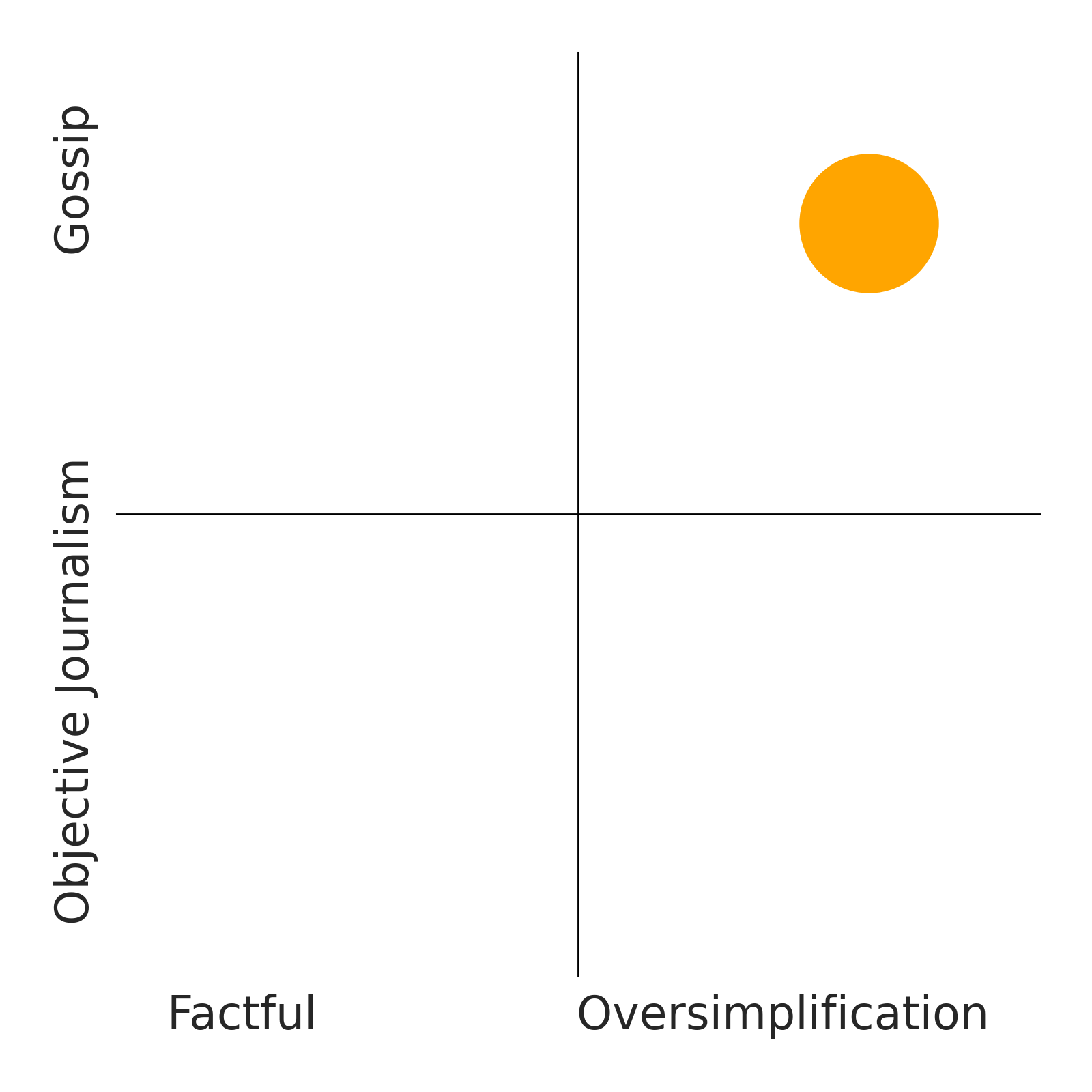
Click points to explore news by date. News sentiment ranges from -10 (very negative) to +10 (very positive) where 0 is neutral.
The relationship is framed through a highly dramatic, psychological lens, focusing on tragic personal struggles against the constraints of fame and identity.
Automated analysis; not human reviewed. · 24 of 55 available dimensions scored; omitted dimensions are not treated as neutral. · Verified supporting quotes for 0 of 24 scored dimensions.
2026 © Helium Trades
Privacy Policy & Disclosure
* Disclaimer: Nothing on this website constitutes investment advice, performance data or any recommendation that any particular security, portfolio of securities, transaction or investment strategy is suitable for any specific person. Helium Trades is not responsible in any way for the accuracy
of any model predictions or price data. Any mention of a particular security and related prediction data is not a recommendation to buy or sell that security. Investments in securities involve the risk of loss. Past performance is no guarantee of future results. Helium Trades is not responsible for any of your investment decisions,
you should consult a financial expert before engaging in any transaction.