See whether Helium helps you make better-informed decisions. Try every Pro Trader feature for 30 days. No credit card required.
Try every Pro Trader feature for 30 days. No credit card required.
October 01, 2026 · 0 shares
The framing treats DHS's late-election investigative latitude as improper and ineffective, while foregrounding limited-government and free-market values.
Automated analysis; not human reviewed. Limitations: The linked articles underlying the roundup are not included, so the cited court rulings and DHS activities cannot be independently checked. · 6 of 55 available dimensions scored; omitted dimensions are not treated as neutral. · Verified supporting quotes for 6 of 6 scored dimensions.
Claim: The framing leans conservative/libertarian by criticizing DHS investigative latitude and endorsing limited government.
“But—surprise—DHS isn’t DOJ and is free to do all that” · exact text match
“Every weekday morning: independent analysis grounded in individual liberty, limited government, free markets, and peace.” · exact text match
Why: The sarcastic contrast with DOJ policy and the stated limited-government/free-market grounding show a conservative-libertarian stance.
Claim: The article strongly favors individual liberty and limited government over state authority.
“Every weekday morning: independent analysis grounded in individual liberty, limited government, free markets, and peace.” · exact text match
“But—surprise—DHS isn’t DOJ and is free to do all that” · exact text match
Why: The tagline explicitly grounds the publication in individual liberty and limited government, and the DHS line treats unconstrained federal investigative power as surprising and undesirable.
Claim: The post mixes sourced reporting with editorializing sarcasm.
“But—surprise—DHS isn’t DOJ and is free to do all that” · exact text match
Why: The interjection 'surprise' is an evaluative and sarcastic aside, even though surrounding claims are attributed to named sources.
Claim: The article explicitly declares an ideological commitment.
“Every weekday morning: independent analysis grounded in individual liberty, limited government, free markets, and peace.” · exact text match
Why: The tagline states the publication's ideological grounds rather than presenting neutral analysis.
Claim: The tone carries mild negative emotion toward DHS's investigative actions.
“But—surprise—DHS isn’t DOJ and is free to do all that” · exact text match
“The months of ongoing strenuous effort haven’t thus led to much in the way of prosecutions, however” · exact text match
Why: The ironic 'surprise' and the 'however' framing imply disapproval, though most of the text is dispassionate.
Claim: The article displays visible attribution and sourcing for its claims.
“[Priscilla Alvarez, Tierney Sneed, and Gabe Cohen, CNN; and Associated Press]” · exact text match
“[Election Law Blog; and ProPublica]” · exact text match
Why: The post names specific outlets for the DHS and prosecution claims, providing verifiable sourcing.
The linked articles underlying the roundup are not included, so the cited court rulings and DHS activities cannot be independently checked.
October 01, 2026 · 0 shares
Framing treats rising Treasury yields as a fiscal threat, relying on CBO-based conditional estimates to conclude that significant deficit reduction through spending cuts is necessary while acknowledging uncertainty about yield drivers.
Automated analysis; not human reviewed. Limitations: The article text lacks a byline and publication date, so 'yesterday' and 'through Monday' cannot be precisely anchored and figures cannot be independently checked from this text. · 14 of 55 available dimensions scored; omitted dimensions are not treated as neutral. · Verified supporting quotes for 13 of 14 scored dimensions.
Claim: Article endorses fiscal-conservative deficit reduction through spending cuts without weighing revenue-side alternatives.
“The case for significant deficit reduction through spending cuts remains strong.” · exact text match
Why: A right-of-center fiscal remedy is asserted as the conclusion; no tax or revenue alternative is considered.
Claim: Publisher's framing is explicitly libertarian, favoring limited government and individual liberty.
“Every weekday morning: independent analysis grounded in individual liberty, limited government, free markets, and peace.” · exact text match
“The case for significant deficit reduction through spending cuts remains strong.” · exact text match
Why: The tagline and policy conclusion align with reduced state fiscal intervention and individual liberty.
Claim: The piece is largely data-driven and tentative, with a clearly normative conclusion.
“CBO expects a $2.1 trillion federal deficit for 2026, with deficits totaling $24.4 trillion over 2027–2036.” · not found in supplied text
“The case for significant deficit reduction through spending cuts remains strong.” · exact text match
Why: Most content is factual and CBO-based, but the final clause is a value judgment, balancing the score near neutral-objective.
Claim: The article uses measured, conditional language rather than alarmism.
“such a surge in government borrowing costs could be a big deal for US interest spending levels and, ultimately, the path of the debt itself.” · exact text match
“Fortunately, we don’t need to know precisely why yields have risen to see why interest-rate risk is a key fiscal vulnerability.” · exact text match
Why: It flags consequences with 'could' and 'risk' and explicitly avoids needing a dramatic cause.
Claim: The article emphasizes downside fiscal risk and the need for action.
“Why High Bond Yields Pose a Threat to the Federal Budget” · exact text match
“The case for significant deficit reduction through spending cuts remains strong.” · exact text match
Why: It frames high yields as a threat and a vulnerability, and its conclusion is driven by concern about the debt path.
Claim: Analysis is mostly descriptive but ends in a prescriptive recommendation.
“The case for significant deficit reduction through spending cuts remains strong.” · exact text match
Why: The article's conclusion is a policy prescription, though the body is analytic.
Claim: The article is an opinion and analysis post, not straight news, culminating in a stated normative judgment.
“The case for significant deficit reduction through spending cuts remains strong.” · exact text match
Why: The factual content is used to support an explicit opinion about what Washington should do.
Claim: The piece advocates a fiscal-policy course rather than merely reporting.
“The case for significant deficit reduction through spending cuts remains strong.” · exact text match
Why: It draws a normative conclusion about what Washington should do.
Claim: The article is openly grounded in Cato's ideological principles.
“Every weekday morning: independent analysis grounded in individual liberty, limited government, free markets, and peace.” · exact text match
Why: The publisher explicitly labels its analysis as grounded in a specific political philosophy, and the conclusion follows it.
Claim: The article demonstrates strong sourcing and epistemic caution.
“CBO says those estimates are roughly scalable for interest-rate deviations of up to one percentage point.” · exact text match
“It’s true that if yields have risen partly because of an AI boom that fuels faster growth, then the net fiscal consequences could be much less troubling than any analysis of the increase in debt-service costs alone suggests.” · exact text match
Why: It attributes projections to CBO, notes limitations, and acknowledges a scenario that would weaken its warning.
Claim: The article reasons conditionally and acknowledges causal uncertainty rather than asserting a single explanation.
“The debate is ongoing about why the federal government’s borrowing costs have risen so sharply of late.” · exact text match
“Fortunately, we don’t need to know precisely why yields have risen to see why interest-rate risk is a key fiscal vulnerability.” · exact text match
Why: It weighs competing explanations and deliberately separates the need for a precise cause from the existence of rate risk.
Claim: The article's stated worldview prioritizes the individual over collective or state solutions.
“Every weekday morning: independent analysis grounded in individual liberty, limited government, free markets, and peace.” · exact text match
Why: Individual liberty and limited government are explicit values, indicating an individualist rather than collectivist orientation.
Claim: The article relies on conditional forecasting about future interest rates and debt.
“If borrowing rates therefore averaged a percentage point above CBO’s baseline for the whole decade—think a 10-year yield averaging closer to 5.3 percent than 4.3 percent, with short-term rates a point higher too—cumulative borrowing would be about $3.8 trillion higher.” · exact text match
Why: The central 'trillions' figure is a conditional projection, clearly flagged with 'if' and 'would be'.
Claim: The article is analytically sophisticated, integrating CBO estimates, market data, and counterarguments.
“It’s true that if yields have risen partly because of an AI boom that fuels faster growth, then the net fiscal consequences could be much less troubling than any analysis of the increase in debt-service costs alone suggests.” · exact text match
Why: It engages with counter-scenarios and uses conditional reasoning rather than a one-sided claim.
The article text lacks a byline and publication date, so 'yesterday' and 'through Monday' cannot be precisely anchored and figures cannot be independently checked from this text.
September 10, 2026 · 0 shares
A libertarian, anti-war framing presents the $1.5 trillion defense budget as threat-inflated, economically wasteful, and a burden on future generations.
The NDAA is the annual U.S. defense authorization bill; a reconciliation bill is a budget-related measure that can be passed with a simple Senate majority.
Automated analysis; not human reviewed. Limitations: The supplied text is a one-sided opinion essay, so its causal claims cannot be externally verified from the article alone. · 12 of 54 available dimensions scored; omitted dimensions are not treated as neutral. · Verified supporting quotes for 11 of 12 scored dimensions.
Claim: The piece grounds its argument in individual liberty, limited government, free markets, and peace, making it strongly libertarian.
“independent analysis grounded in individual liberty, limited government, free markets, and peace.” · exact text match
Why: The publisher’s stated mission is explicitly libertarian and the policy prescription is to reduce federal defense commitments.
Claim: The piece is subjective, presenting normative judgments rather than neutral reporting.
“Quite the opposite— it will weaken Americans’ economic security, weaken America’s economic power, and weaken the country’s national security.” · exact text match
Why: This is an evaluative causal claim, not an empirically neutral observation.
Claim: The piece is prescriptive, telling the administration and Congress what they should do.
“Instead, the Trump administration and Congress should cut the defense budget, and with it, America’s wars and overseas commitments.” · exact text match
Why: Use of 'should' and direct policy instructions marks the text as advocacy rather than description.
Claim: The piece is strongly anti-war, urging cuts to defense and overseas commitments.
“cut the defense budget, and with it, America’s wars and overseas commitments.” · exact text match
Why: It explicitly calls for cutting both the defense budget and overseas military commitments.
Claim: The piece is highly opinionated, asserting unequivocal judgments about the defense budget.
“President Trump’s colossal defense budget will only degrade the nation’s economic strength and wellbeing.” · exact text match
Why: It states a contested policy outcome as certain, using evaluative language.
Claim: The piece engages directly in high-profile federal policy politics, opposing a specific administration’s spending proposal.
“The Trump administration and Congress should cut the defense budget, and with it, America’s wars and overseas commitments.” · not found in supplied text
Why: It prescribes action on a federal political debate and names the administration.
Claim: The piece reduces the defense-spending debate to a simple waste-versus-security tradeoff, dismissing threat arguments.
“Hegseth justified higher defense spending by inflating the threats America faces and presenting worst-case scenarios.” · exact text match
Why: It characterizes an official’s testimony as mere threat inflation without engaging the underlying security evidence.
Claim: The piece expresses certainty about predicted consequences that go beyond the evidence it supplies.
“President Trump’s colossal defense budget will only degrade the nation’s economic strength and wellbeing.” · exact text match
Why: 'Will only degrade' asserts a single certain outcome without considering countervailing factors.
Claim: The piece applies a consistent libertarian ideological lens to the defense budget.
“independent analysis grounded in individual liberty, limited government, free markets, and peace.” · exact text match
Why: The tagline discloses a fixed ideological framework that shapes the analysis.
Claim: The piece uses reasoned, evidence-citing argumentation, placing it on the rational side.
“many nuclear experts deem both wasteful and dangerous, as it would incentivize America’s adversaries to launch a surprise attack in order to have a better chance at their missiles getting through.” · exact text match
Why: It invokes expert analysis and strategic logic rather than emotion or superstition.
Claim: The piece is strongly individualistic, prioritizing liberty and limited government.
“individual liberty, limited government, free markets, and peace.” · exact text match
Why: It explicitly prioritizes individual liberty and limited government over state-directed spending.
Claim: The piece forecasts future economic and political consequences of defense borrowing.
“eventually forcing citizens to choose between massive cuts to social programs and tax hikes or cutting defense programs to help pay it off.” · exact text match
Why: 'Eventually forcing' is a speculative prediction about future choices.
The supplied text is a one-sided opinion essay, so its causal claims cannot be externally verified from the article alone.
September 04, 2026 · 0 shares
The publisher frames the Trump administration's Venezuela oil equity stake as an opaque, legally dubious, cronyist expansion of federal power.
Automated analysis; not human reviewed. Limitations: I cannot verify the U.S. or Venezuelan documents and legal proceedings referenced; this analysis is based solely on the supplied text. · 6 of 54 available dimensions scored; omitted dimensions are not treated as neutral. · Verified supporting quotes for 6 of 6 scored dimensions.
Claim: The report uses evaluative and interpretive language rather than neutral factual reporting.
“That description is hard to square with Washington’s control over NABEP’s board” · exact text match
“It sure looks like the administration chose a questionable character” · exact text match
Why: These phrases advance an opinion about how to interpret facts.
Claim: The report is a political commentary on presidential and congressional actions regarding federal equity stakes.
“President Trump’s 32nd Equity Stake Takes the Ownership Spree to Venezuela” · exact text match
“Trump administration is turning the federal government into a shareholder in favored companies.” · exact text match
Why: The primary subject is an administration policy decision and the political response it draws.
Claim: The report applies a libertarian small-government ideology to condemn federal corporate ownership.
“independent analysis grounded in individual liberty, limited government, free markets, and peace” · exact text match
“stop this corporate portfolio” · exact text match
Why: Explicitly states the ideological grounding and concludes with a call to restrain government ownership.
Claim: The report uses emotionally negative language to characterize the deal and its effects.
“opaque ownership spree” · exact text match
“danger at home” · exact text match
Why: Words such as 'opaque,' 'spree,' and 'danger' carry negative emotional connotations.
Claim: The report attributes claims to named sources and reports and flags missing information.
“According to the White House” · exact text match
“Semafor reports” · exact text match
“ProPublica later reported” · exact text match
Why: Uses attributed sourcing and explicitly identifies disclosure gaps, though it is an opinion piece.
Claim: The report favors individual liberty and free markets over collective or public ownership.
“individual liberty, limited government, free markets” · exact text match
“a gift to socialists all over the world” · exact text match
Why: Praises individualist frames and describes the deal as aiding socialist narratives.
I cannot verify the U.S. or Venezuelan documents and legal proceedings referenced; this analysis is based solely on the supplied text.
September 18, 2026 · 0 shares
Frames warrantless digital border searches as an unjustified loophole and urges the Supreme Court to reverse, using rights-based, limited-government rhetoric.
The Fourth Amendment generally requires a warrant for searches, but the border-search exception has long allowed warrantless searches of people and property crossing U.S. borders; whether that exception extends to digital device contents is the legal question at issue.
Automated analysis; not human reviewed. Limitations: Only the supplied advocacy post was analyzed; no court opinions, amicus brief, or opposing legal arguments were available for independent verification.
Only the supplied advocacy post was analyzed; no court opinions, amicus brief, or opposing legal arguments were available for independent verification.
September 17, 2026 · 0 shares
A libertarian advocacy framing presents the town's enforcement as pretextual retaliation and the district court's ruling as a threat to free speech.
An amicus brief is a submission by a non-party to assist the court; the Fourth Circuit is the federal appeals court for Virginia. The case is a First Amendment retaliation claim rather than a direct challenge to the food-truck bans.
Automated analysis; not human reviewed. Limitations: Analysis is limited to Cato's advocacy summary; the underlying district court opinion, the town's arguments, and the full case record were not supplied. · 11 of 55 available dimensions scored; omitted dimensions are not treated as neutral. · Verified supporting quotes for 11 of 11 scored dimensions.
Claim: The publisher frames the case as government interference with individual liberty and free speech.
“Governments Cannot Use Pretextual Reasons to Silence Critics.” · exact text match
“independent analysis grounded in individual liberty, limited government, free markets, and peace.” · exact text match
Why: The headline and mission statement explicitly oppose governmental power over individual rights.
Claim: The publisher mixes factual reporting with evaluative legal conclusions.
“Governments Cannot Use Pretextual Reasons to Silence Critics.” · exact text match
“This fundamentally misunderstood First Amendment retaliation case law” · exact text match
Why: The headline and legal critique are normative, while the body includes case-specific factual assertions.
Claim: The publisher prescribes a specific appellate outcome and doctrinal rule.
“Cato filed an amicus brief arguing that the Fourth Circuit should reverse the district court’s decision” · exact text match
“It does not permit the government to evade scrutiny by showing that its actions were otherwise authorized under local law or hide behind pretext.” · exact text match
Why: It tells the court what it should do and how retaliation law should be applied.
Claim: The article is an opinion and advocacy piece advancing a conclusion about the case.
“This fundamentally misunderstood First Amendment retaliation case law” · exact text match
“will quash many legitimate retaliation claims, encourage government mischief, and threaten the “great bulwark of liberty” that is freedom of speech.” · exact text match
Why: These are normative judgments expressed as settled conclusions.
Claim: The article concerns governmental power, constitutional rights, and public criticism, making it political content.
“Governments Cannot Use Pretextual Reasons to Silence Critics.” · exact text match
“In direct response to plaintiffs’ protected speech, the mayor instructed the town attorney” · exact text match
Why: The core subject is the use and abuse of government authority over citizens' speech.
Claim: The publisher states broad future consequences with more certainty than the record supports.
“if allowed to stand, will quash many legitimate retaliation claims, encourage government mischief, and threaten the “great bulwark of liberty” that is freedom of speech.” · exact text match
Why: The consequence is a confident prediction rather than a demonstrated outcome.
Claim: The publisher applies an explicit libertarian ideological framework to the dispute.
“independent analysis grounded in individual liberty, limited government, free markets, and peace.” · exact text match
“threaten the “great bulwark of liberty” that is freedom of speech.” · exact text match
Why: The mission tagline names the ideological lens and the argument applies it to the case.
Claim: The publisher uses emotionally charged and pejorative language about the town's conduct.
“The mayor saw this as a “betrayal” and became “angry … for the media attention that depicted Parksley’s government in a negative light.”” · exact text match
“encourage government mischief” · exact text match
Why: The quoted reaction and the phrase 'government mischief' color the account negatively.
Claim: The publisher's argument is grounded in legal reasoning rather than emotional or irrational appeal.
“requires a court to discern why the government took the adverse action” · exact text match
“It does not permit the government to evade scrutiny by showing that its actions were otherwise authorized under local law or hide behind pretext.” · exact text match
Why: It applies a legal causation standard to reach its conclusion.
Claim: The publisher prioritizes individual rights and individual economic activity over collective governmental control.
“individual liberty” · exact text match
“Governments Cannot Use Pretextual Reasons to Silence Critics.” · exact text match
Why: The family's speech and food-truck business are framed as individual rights against town power.
Claim: The publisher forecasts systemic legal consequences beyond the immediate case.
“will quash many legitimate retaliation claims, encourage government mischief, and threaten the “great bulwark of liberty” that is freedom of speech.” · exact text match
Why: It extrapolates from the district court's ruling to broad future effects.
Analysis is limited to Cato's advocacy summary; the underlying district court opinion, the town's arguments, and the full case record were not supplied.
September 30, 2026 · 0 shares
A Cato amicus-brief summary that frames the Bivens dispute through founding-era originalism and a populist appeal to 'the People' as the decisive authority.
Bivens v. Six Unknown Named Agents (1971) established an implied cause of action for damages against federal officials for constitutional violations; the Supreme Court has since declined to extend Bivens to new contexts, which is why the case is described as part of the 'Bivens saga.'
Automated analysis; not human reviewed. Limitations: The supplied text is an advocacy post summarizing Cato's own amicus brief; no opposing brief, court opinion, or independent record is quoted. · 15 of 55 available dimensions scored; omitted dimensions are not treated as neutral. · Verified supporting quotes for 14 of 15 scored dimensions.
Claim: The post invokes 'the People' and 'ordinary Americans' as the decisive audience against the petitioner's legal arguments.
“how divorced Petitioner’s arguments are from the lived experiences of ordinary Americans” · exact text match
““The people themselves” know that the Constitution is already supposed to protect them from the worst government abuses” · exact text match
Why: Repeated populist contrast between ordinary people and detached legal arguments frames the Court's decision as a matter of popular constitutionalism.
Claim: The post opposes government immunity and aligns with individual liberty and limited government.
“He wants the Supreme Court to grant him—and everyone else in the federal government—sweeping immunity from monetary damages.” · exact text match
“Every weekday morning: independent analysis grounded in individual liberty, limited government, free markets, and peace.” · exact text match
Why: The strong anti-government-immunity position plus the explicit libertarian tagline supports a very libertarian score.
Claim: The post blends factual allegations with hortatory, opinionated conclusions.
“The Court should put its foot down.” · exact text match
“It would, candidly, be shocking for the Court to say that a theory of constitutional organization demands further authorizing legislation.” · exact text match
Why: Directive and evaluative language ('should', 'shocking') makes the post's subjective advocacy clear.
Claim: The post selects graphic, emotionally charged details from the plaintiff's allegations.
“after being brutally assaulted in a federal prison and while in 10-out-of-10 pain” · exact text match
“told him “to stop being a crybaby” and refused to send him to the hospital” · exact text match
Why: The graphic injury and quoted insult are presented as advocacy highlights rather than neutral procedural summary.
Claim: The post tells the Supreme Court what it should do.
“The Court should put its foot down.” · exact text match
“The “final installment of the Bivens saga” should be a return to founding values and constitutional text” · exact text match
Why: Its main thrust is a normative instruction to the Court.
Claim: The post treats the contested premise that the Constitution already includes a damages remedy as a settled reason to skip statutory analysis.
“Because the Constitution already incorporated the tradition of damages in courts of law, the parties’ statutory interpretation arguments are avoidable.” · exact text match
Why: The premise that the Constitution already incorporated damages is precisely what the petitioner disputes, yet it is used as the foundation of the argument.
Claim: The post is an opinion and advocacy piece advancing a preferred legal outcome.
“The Court should put its foot down.” · exact text match
Why: It does not present neutral reporting; it explicitly urges a result.
Claim: The post is a political-legal advocacy piece tied to a stated ideology.
“Every weekday morning: independent analysis grounded in individual liberty, limited government, free markets, and peace.” · exact text match
Why: The explicit ideological tagline and amicus advocacy make the political framing overt.
Claim: The post compresses a contested doctrinal history into the assertion that Bivens was never necessary.
“a realization that Bivens was never necessary in the first place” · exact text match
Why: The categorical statement discards the doctrinal complexity of Bivens's creation and contraction.
Claim: The post asserts a contested legal conclusion with unqualified certainty.
“History, text, and precedent all point toward the traditional remedy.” · not found in supplied text
“Bivens was never necessary in the first place.” · exact text match
Why: The claims are categorical about a question the Supreme Court is actively considering.
Claim: The post frames the case through a fixed libertarian/originalist ideology.
“a realization that Bivens was never necessary in the first place” · exact text match
“Every weekday morning: independent analysis grounded in individual liberty, limited government, free markets, and peace.” · exact text match
Why: The conclusion is pre-fitted to the ideology, and the stated tagline confirms it.
Claim: The post uses negative emotional valence in describing the injury and the Court's potential ruling.
“brutally assaulted” · exact text match
“It would, candidly, be shocking” · exact text match
Why: Loaded terms about the assault and the 'shocking' outcome orient readers negatively toward the defendant and the Court.
Claim: The post attributes allegations to Watanabe and clearly identifies Cato's own amicus filing.
“Mr. Watanabe says the nurse’s deliberate indifference to his serious medical need is an Eighth Amendment violation” · exact text match
“Cato filed an amicus brief” · exact text match
Why: It uses attribution for the plaintiff's claims and transparently labels the Cato amicus brief, though it is one-sided advocacy.
Claim: The post grounds its conclusion in history, text, and precedent while acknowledging the statutory debate.
“History, text, and precedent all point toward the traditional remedy: monetary damages against the individual who violated the plaintiff’s rights.” · exact text match
Counterevidence:
“It would, candidly, be shocking for the Court to say that a theory of constitutional organization demands further authorizing legislation.” · exact text match
Why: The core argument is reasoned and source-based, but the shock-based rhetoric prevents a more extreme rationality score.
Claim: The post centers individual rights and remedies against collective or governmental authority.
“monetary damages against the individual who violated the plaintiff’s rights” · exact text match
“Every weekday morning: independent analysis grounded in individual liberty, limited government, free markets, and peace.” · exact text match
Why: It frames the remedy as individual liability and liberty, not collective or state solutions.
The supplied text is an advocacy post summarizing Cato's own amicus brief; no opposing brief, court opinion, or independent record is quoted.
September 09, 2026 · 0 shares
Frames rising support for the socialist label as disconnected from actual support for socialist policies, characterizing socialist tenets as fringe and warning that a program voters reject could sneak to victory.
Automated analysis; not human reviewed. · 9 of 54 available dimensions scored; omitted dimensions are not treated as neutral. · Verified supporting quotes for 8 of 9 scored dimensions.
Claim: Frames socialism negatively as an unpopular program.
“The trouble for the DSA is nobody seems really to want this kind of socialism.” · exact text match
“That risks a program voters roundly reject sneaking to victory behind a curtain.” · not found in supplied text
Why: The phrase 'trouble' and the assertion that no one wants this socialism indicate a negative view, aligning with conservative economic preferences.
Claim: Advocates for free markets and limited government, opposing collective ownership.
“independent analysis grounded in individual liberty, limited government, free markets” · exact text match
Why: The stated mission emphasizes individual liberty and free markets, directly opposing the socialist collective ownership criticized in the article.
Claim: Presents polling data but also offers subjective interpretation.
“The trouble for the DSA is nobody seems really to want this kind of socialism.” · exact text match
Why: This is an opinionated statement evaluating the polling results rather than purely reporting them.
Claim: The piece is opinionated commentary.
“That isn’t to say this is all nothing to worry about.” · exact text match
Why: The phrase expresses a personal judgment about the implications of the findings, typical of opinion writing.
Claim: Engages in political analysis of socialism and the DSA.
“support for the socialist label is rising alongside the DSA’s success” · exact text match
Why: The article analyzes electoral and political support for a socialist organization, making it inherently political.
Claim: Reflects a libertarian ideology.
“independent analysis grounded in individual liberty, limited government, free markets” · exact text match
Why: The mission statement explicitly states an ideological commitment to libertarian principles.
Claim: Relies on credible polling data.
“Cato’s own polling from July suggested Americans were evenly split on how favorably they viewed socialism” · exact text match
Why: Cites specific polling from Cato and Gallup, indicating reliance on empirical sources.
Claim: Uses empirical polling data rather than superstition.
“Cato’s own polling from July suggested Americans were evenly split” · exact text match
Why: Polling is an empirical method, demonstrating a scientific approach.
Claim: Emphasizes individual liberty over collective ownership.
“independent analysis grounded in individual liberty” · exact text match
Why: The mission statement prioritizes individual liberty, which contrasts with the collective ownership socialism it criticizes.
October 01, 2026 · 0 shares
The framing treats DHS's late-election investigative latitude as improper and ineffective, while foregrounding limited-government and free-market values.
Automated analysis; not human reviewed. Limitations: The linked articles underlying the roundup are not included, so the cited court rulings and DHS activities cannot be independently checked. · 6 of 55 available dimensions scored; omitted dimensions are not treated as neutral. · Verified supporting quotes for 6 of 6 scored dimensions.
Claim: The framing leans conservative/libertarian by criticizing DHS investigative latitude and endorsing limited government.
“But—surprise—DHS isn’t DOJ and is free to do all that” · exact text match
“Every weekday morning: independent analysis grounded in individual liberty, limited government, free markets, and peace.” · exact text match
Why: The sarcastic contrast with DOJ policy and the stated limited-government/free-market grounding show a conservative-libertarian stance.
Claim: The article strongly favors individual liberty and limited government over state authority.
“Every weekday morning: independent analysis grounded in individual liberty, limited government, free markets, and peace.” · exact text match
“But—surprise—DHS isn’t DOJ and is free to do all that” · exact text match
Why: The tagline explicitly grounds the publication in individual liberty and limited government, and the DHS line treats unconstrained federal investigative power as surprising and undesirable.
Claim: The post mixes sourced reporting with editorializing sarcasm.
“But—surprise—DHS isn’t DOJ and is free to do all that” · exact text match
Why: The interjection 'surprise' is an evaluative and sarcastic aside, even though surrounding claims are attributed to named sources.
Claim: The article explicitly declares an ideological commitment.
“Every weekday morning: independent analysis grounded in individual liberty, limited government, free markets, and peace.” · exact text match
Why: The tagline states the publication's ideological grounds rather than presenting neutral analysis.
Claim: The tone carries mild negative emotion toward DHS's investigative actions.
“But—surprise—DHS isn’t DOJ and is free to do all that” · exact text match
“The months of ongoing strenuous effort haven’t thus led to much in the way of prosecutions, however” · exact text match
Why: The ironic 'surprise' and the 'however' framing imply disapproval, though most of the text is dispassionate.
Claim: The article displays visible attribution and sourcing for its claims.
“[Priscilla Alvarez, Tierney Sneed, and Gabe Cohen, CNN; and Associated Press]” · exact text match
“[Election Law Blog; and ProPublica]” · exact text match
Why: The post names specific outlets for the DHS and prosecution claims, providing verifiable sourcing.
The linked articles underlying the roundup are not included, so the cited court rulings and DHS activities cannot be independently checked.
October 01, 2026 · 0 shares
Framing treats rising Treasury yields as a fiscal threat, relying on CBO-based conditional estimates to conclude that significant deficit reduction through spending cuts is necessary while acknowledging uncertainty about yield drivers.
Automated analysis; not human reviewed. Limitations: The article text lacks a byline and publication date, so 'yesterday' and 'through Monday' cannot be precisely anchored and figures cannot be independently checked from this text. · 14 of 55 available dimensions scored; omitted dimensions are not treated as neutral. · Verified supporting quotes for 13 of 14 scored dimensions.
Claim: Article endorses fiscal-conservative deficit reduction through spending cuts without weighing revenue-side alternatives.
“The case for significant deficit reduction through spending cuts remains strong.” · exact text match
Why: A right-of-center fiscal remedy is asserted as the conclusion; no tax or revenue alternative is considered.
Claim: Publisher's framing is explicitly libertarian, favoring limited government and individual liberty.
“Every weekday morning: independent analysis grounded in individual liberty, limited government, free markets, and peace.” · exact text match
“The case for significant deficit reduction through spending cuts remains strong.” · exact text match
Why: The tagline and policy conclusion align with reduced state fiscal intervention and individual liberty.
Claim: The piece is largely data-driven and tentative, with a clearly normative conclusion.
“CBO expects a $2.1 trillion federal deficit for 2026, with deficits totaling $24.4 trillion over 2027–2036.” · not found in supplied text
“The case for significant deficit reduction through spending cuts remains strong.” · exact text match
Why: Most content is factual and CBO-based, but the final clause is a value judgment, balancing the score near neutral-objective.
Claim: The article uses measured, conditional language rather than alarmism.
“such a surge in government borrowing costs could be a big deal for US interest spending levels and, ultimately, the path of the debt itself.” · exact text match
“Fortunately, we don’t need to know precisely why yields have risen to see why interest-rate risk is a key fiscal vulnerability.” · exact text match
Why: It flags consequences with 'could' and 'risk' and explicitly avoids needing a dramatic cause.
Claim: The article emphasizes downside fiscal risk and the need for action.
“Why High Bond Yields Pose a Threat to the Federal Budget” · exact text match
“The case for significant deficit reduction through spending cuts remains strong.” · exact text match
Why: It frames high yields as a threat and a vulnerability, and its conclusion is driven by concern about the debt path.
Claim: Analysis is mostly descriptive but ends in a prescriptive recommendation.
“The case for significant deficit reduction through spending cuts remains strong.” · exact text match
Why: The article's conclusion is a policy prescription, though the body is analytic.
Claim: The article is an opinion and analysis post, not straight news, culminating in a stated normative judgment.
“The case for significant deficit reduction through spending cuts remains strong.” · exact text match
Why: The factual content is used to support an explicit opinion about what Washington should do.
Claim: The piece advocates a fiscal-policy course rather than merely reporting.
“The case for significant deficit reduction through spending cuts remains strong.” · exact text match
Why: It draws a normative conclusion about what Washington should do.
Claim: The article is openly grounded in Cato's ideological principles.
“Every weekday morning: independent analysis grounded in individual liberty, limited government, free markets, and peace.” · exact text match
Why: The publisher explicitly labels its analysis as grounded in a specific political philosophy, and the conclusion follows it.
Claim: The article demonstrates strong sourcing and epistemic caution.
“CBO says those estimates are roughly scalable for interest-rate deviations of up to one percentage point.” · exact text match
“It’s true that if yields have risen partly because of an AI boom that fuels faster growth, then the net fiscal consequences could be much less troubling than any analysis of the increase in debt-service costs alone suggests.” · exact text match
Why: It attributes projections to CBO, notes limitations, and acknowledges a scenario that would weaken its warning.
Claim: The article reasons conditionally and acknowledges causal uncertainty rather than asserting a single explanation.
“The debate is ongoing about why the federal government’s borrowing costs have risen so sharply of late.” · exact text match
“Fortunately, we don’t need to know precisely why yields have risen to see why interest-rate risk is a key fiscal vulnerability.” · exact text match
Why: It weighs competing explanations and deliberately separates the need for a precise cause from the existence of rate risk.
Claim: The article's stated worldview prioritizes the individual over collective or state solutions.
“Every weekday morning: independent analysis grounded in individual liberty, limited government, free markets, and peace.” · exact text match
Why: Individual liberty and limited government are explicit values, indicating an individualist rather than collectivist orientation.
Claim: The article relies on conditional forecasting about future interest rates and debt.
“If borrowing rates therefore averaged a percentage point above CBO’s baseline for the whole decade—think a 10-year yield averaging closer to 5.3 percent than 4.3 percent, with short-term rates a point higher too—cumulative borrowing would be about $3.8 trillion higher.” · exact text match
Why: The central 'trillions' figure is a conditional projection, clearly flagged with 'if' and 'would be'.
Claim: The article is analytically sophisticated, integrating CBO estimates, market data, and counterarguments.
“It’s true that if yields have risen partly because of an AI boom that fuels faster growth, then the net fiscal consequences could be much less troubling than any analysis of the increase in debt-service costs alone suggests.” · exact text match
Why: It engages with counter-scenarios and uses conditional reasoning rather than a one-sided claim.
The article text lacks a byline and publication date, so 'yesterday' and 'through Monday' cannot be precisely anchored and figures cannot be independently checked from this text.
September 14, 2026 · 0 shares
Framing treats the administration's tariff actions as legally pretextual and excessive, and presents congressional rejection as the sound economic and electoral course.
Automated analysis; not human reviewed. Limitations: The supplied text is truncated and contains ellipses; scalar scores reflect only the visible passages. · 4 of 54 available dimensions scored; omitted dimensions are not treated as neutral. · Verified supporting quotes for 4 of 4 scored dimensions.
Claim: Framing is subjective because legal actions are labeled 'bogus' and 'stretched' rather than described neutrally.
“declared a bogus balance-of-payments emergency” · exact text match
“already stretched every tariff statute” · exact text match
Why: These evaluative labels present a subjective judgment about the administration's actions rather than neutral factual description.
Claim: The piece is organized around a normative recommendation that Congress should not hand the president more tariff authority.
“whether it should hand a president who has already stretched every tariff statute he could find one more” · exact text match
Why: The framing of the decision as 'should' and 'one more' prescribes rejecting the tariff authority.
Claim: Publisher uses evaluative, pejorative wording to characterize tariff actions rather than neutral description.
“declared a bogus balance-of-payments emergency” · exact text match
“already stretched every tariff statute he could find” · exact text match
Why: The words 'bogus' and 'stretched every tariff statute' assert impropriety and abuse of power, which is opinionated framing rather than neutral description.
Claim: The piece connects the tariff decision to electoral politics and public opinion.
“most voters prefer congressional candidates who oppose more tariffs” · exact text match
“weeks before an election in which voters have” · exact text match
Why: Voter poll numbers and election timing are treated as important considerations, making the issue explicitly political.
The supplied text is truncated and contains ellipses; scalar scores reflect only the visible passages.
September 04, 2026 · 0 shares
The publisher frames the Trump administration's Venezuela oil equity stake as an opaque, legally dubious, cronyist expansion of federal power.
Automated analysis; not human reviewed. Limitations: I cannot verify the U.S. or Venezuelan documents and legal proceedings referenced; this analysis is based solely on the supplied text. · 6 of 54 available dimensions scored; omitted dimensions are not treated as neutral. · Verified supporting quotes for 6 of 6 scored dimensions.
Claim: The report uses evaluative and interpretive language rather than neutral factual reporting.
“That description is hard to square with Washington’s control over NABEP’s board” · exact text match
“It sure looks like the administration chose a questionable character” · exact text match
Why: These phrases advance an opinion about how to interpret facts.
Claim: The report is a political commentary on presidential and congressional actions regarding federal equity stakes.
“President Trump’s 32nd Equity Stake Takes the Ownership Spree to Venezuela” · exact text match
“Trump administration is turning the federal government into a shareholder in favored companies.” · exact text match
Why: The primary subject is an administration policy decision and the political response it draws.
Claim: The report applies a libertarian small-government ideology to condemn federal corporate ownership.
“independent analysis grounded in individual liberty, limited government, free markets, and peace” · exact text match
“stop this corporate portfolio” · exact text match
Why: Explicitly states the ideological grounding and concludes with a call to restrain government ownership.
Claim: The report uses emotionally negative language to characterize the deal and its effects.
“opaque ownership spree” · exact text match
“danger at home” · exact text match
Why: Words such as 'opaque,' 'spree,' and 'danger' carry negative emotional connotations.
Claim: The report attributes claims to named sources and reports and flags missing information.
“According to the White House” · exact text match
“Semafor reports” · exact text match
“ProPublica later reported” · exact text match
Why: Uses attributed sourcing and explicitly identifies disclosure gaps, though it is an opinion piece.
Claim: The report favors individual liberty and free markets over collective or public ownership.
“individual liberty, limited government, free markets” · exact text match
“a gift to socialists all over the world” · exact text match
Why: Praises individualist frames and describes the deal as aiding socialist narratives.
I cannot verify the U.S. or Venezuelan documents and legal proceedings referenced; this analysis is based solely on the supplied text.
September 08, 2026 · 0 shares
A libertarian policy roundup frames federal election monitors as meddling and aggressive while grounding its analysis in individual liberty, limited government, free markets, and peace.
Automated analysis; not human reviewed. Limitations: Only a headline, summary deck, and institutional tagline were available, so bias scores rely on framing cues rather than full roundup content. · 9 of 54 available dimensions scored; omitted dimensions are not treated as neutral. · Verified supporting quotes for 9 of 9 scored dimensions.
Claim: The publisher's self-described grounding in limited government and free markets signals a right-of-center economic orientation.
“independent analysis grounded in individual liberty, limited government, free markets, and peace.” · exact text match
Why: Free-market and limited-government commitments are conventionally conservative/right-libertarian; individual liberty language is compatible with that orientation.
Claim: The framing is strongly libertarian, opposing federal election monitoring as meddling and endorsing limited government.
“Meddling Feds” · exact text match
“limited government” · exact text match
Why: The pejorative 'Meddling Feds' and the stated limited-government principle indicate anti-authoritarian, libertarian positioning.
Claim: The roundup uses evaluative terms to characterize federal election monitors rather than neutral description.
“aggressive behavior by Department of Justice election monitors” · exact text match
“Meddling Feds” · exact text match
Why: 'Aggressive' and 'meddling' are subjective judgments about conduct and intent.
Claim: The item is prescriptive in its normative grounding and headline framing, not purely descriptive.
“grounded in individual liberty, limited government, free markets, and peace.” · exact text match
“Meddling Feds” · exact text match
Why: The stated normative grounding and pejorative headline imply how election policy should be judged.
Claim: The headline 'Meddling Feds' presupposes the disputed conclusion that federal election involvement is improper.
“Meddling Feds” · exact text match
Why: The label assumes wrongdoing rather than presenting evidence for it.
Claim: The summary conveys an opinionated negative characterization of DOJ election monitors.
“aggressive behavior by Department of Justice election monitors” · exact text match
Why: Characterizing behavior as aggressive is an opinionated framing rather than neutral reporting.
Claim: The content is expressly political, covering election law, enforcement, and judicial selection.
“Election Policy Roundup #30” · exact text match
“Kansas votes not to elect judges” · exact text match
Why: Election monitoring and judicial selection are core political-policy topics.
Claim: The publisher explicitly grounds analysis in individual liberty, indicating a strongly individualist stance.
“individual liberty” · exact text match
Why: Individual liberty is the stated foundational value, implying preference for individual over collective control.
Claim: The loaded phrase 'Meddling Feds' frames federal election monitoring as illegitimate in a way that can steer interpretation.
“Meddling Feds” · exact text match
Why: Loaded labeling is an observable framing technique that discourages neutral consideration of the monitors' role.
Only a headline, summary deck, and institutional tagline were available, so bias scores rely on framing cues rather than full roundup content.
September 15, 2026 · 0 shares
Frames Reconciliation 3.0 as a 'last chance' to avoid a 'partisan spending binge,' making deficit reduction the overriding standard and demanding offsets.
Reconciliation is a fast-track budget process in Congress for aligning spending and revenue laws with a budget resolution; the excerpt presupposes familiarity with OBBBA and the 'FRA level' but does not define them.
Automated analysis; not human reviewed. Limitations: The supplied text is an excerpt with multiple ellipses, so the full argument, context, and any qualifying passages are unavailable; scalar classifications rely only on the visible wording. · 7 of 54 available dimensions scored; omitted dimensions are not treated as neutral. · Verified supporting quotes for 7 of 7 scored dimensions.
Claim: The text adopts a fiscally conservative position favoring deficit reduction and spending restraint over new appropriations.
“Congress must turn Reconciliation 3.0 into a vehicle for reform rather than just another partisan spending binge.” · exact text match
“Congress should ensure that Reconciliation 3.0 contains enough offsets to cover any FY 2027 appropriations above the FRA level.” · exact text match
Why: Characterizing new appropriations as a 'partisan spending binge' and demanding offsetting savings aligns with a conservative fiscal stance prioritizing deficit reduction.
Claim: The central argument is subjective and normative, using value judgments about what Congress should do.
“Rubber-stamping new deficit spending in exchange for a nebulous promise of future spending cuts would be irresponsible” · exact text match
“Reconciliation 3.0 Must Be a Vehicle for Deficit Reduction, Not Partisan Appropriations” · exact text match
Why: The headline and body assert moral and political judgments ('must', 'irresponsible') rather than merely describing facts.
Claim: The text sounds an overall pessimistic note about fiscal conditions and the likelihood of responsible action.
“Economic growth will no longer be sufficient to address mounting fiscal pressures.” · exact text match
“a hypothetical Reconciliation 4.0 is not a serious prospect” · exact text match
Why: It warns that economic growth cannot solve fiscal problems and rules out a future reconciliation as a serious remedy, projecting a downbeat outlook.
Claim: The text is heavily prescriptive, instructing Congress on what must be done.
“Congress must turn Reconciliation 3.0 into a vehicle for reform” · exact text match
“Congress should ensure that Reconciliation 3.0 contains enough offsets” · exact text match
Why: The modal verbs 'must' and 'should' are direct instructions for policy action, making the text prescriptive rather than descriptive.
Claim: The text is overwhelmingly opinion-driven, telling readers what Congress must and should do.
“Congress must turn Reconciliation 3.0 into a vehicle for reform rather than just another partisan spending binge.” · exact text match
“Congress should also address unfinished fiscal business from previous reconciliation packages.” · exact text match
Why: The prescriptions are advanced as the writer's preferred policy ('must', 'should'), with no neutral alternatives considered.
Claim: The article is squarely about partisan congressional budget politics and frames the issue as a political fight.
“rather than just another partisan spending binge” · exact text match
“Reconciliation 3.0 Must Be a Vehicle for Deficit Reduction, Not Partisan Appropriations” · exact text match
Why: The explicit reference to 'partisan' appropriations and a legislative fight places the content inside current political dispute rather than a neutral process account.
Claim: The text uses loaded labels and urgency-inducing characterizations to steer the reader toward its preferred conclusion.
“just another partisan spending binge” · exact text match
“Rubber-stamping new deficit spending in exchange for a nebulous promise of future spending cuts would be irresponsible” · exact text match
“a hypothetical Reconciliation 4.0 is not a serious prospect” · exact text match
Why: Phrases like 'spending binge', 'nebulous promise', and 'not a serious prospect' frame the opposing position as reckless and create urgency through loaded wording rather than neutral analysis.
The supplied text is an excerpt with multiple ellipses, so the full argument, context, and any qualifying passages are unavailable; scalar classifications rely only on the visible wording.
September 21, 2026 · 0 shares
Uses a data-forensic approach to frame the Jones Act waiver as more successful than official records show, attributing the gap to operator reporting failures while acknowledging methodological limits.
The Jones Act generally restricts waterborne cargo transport between US ports to US-flagged vessels; MARAD can issue emergency waivers, and waiver voyages must be reported within 10 days. The supplied excerpt does not give the waiver’s stated emergency basis, only that it permitted long-haul energy movements.
Automated analysis; not human reviewed. Limitations: The supplied article text is truncated with multiple ellipses and missing the opening portion, so context before the first sentence and some transitions were unavailable for analysis. · 5 of 55 available dimensions scored; omitted dimensions are not treated as neutral. · Verified supporting quotes for 5 of 5 scored dimensions.
Claim: The article combines external data with first-person narrative and authorial judgment, making it objective in method but visibly subjective in presentation.
“I did, however, find one more voyage that deserves mention.” · exact text match
“VesselFinder supplied the draft histories and ports, while NBIC corroborated the latter.” · exact text match
Why: First-person phrasing and the phrase 'deserves mention' signal authorial presence, while the method relies on named external data and cross-verification.
Claim: The tone is restrained and self-hedging, explicitly disclaiming precision rather than exaggerating the significance of findings.
“The evidence is not airtight, but it’s darn close.” · exact text match
“That provides an upper bound on the amount of oil and petroleum products these voyages may have carried (actual volumes were almost certainly lower).” · exact text match
Why: The article disclaims certainty and highlights that its capacity figure is an upper bound, avoiding sensational overstatement.
Claim: The article grounds its findings in named sources and independent corroboration, making the visible sourcing strong.
“VesselFinder supplied the draft histories and ports, while NBIC corroborated the latter.” · exact text match
“Records from the National Ballast Information Clearinghouse (NBIC) showed the Paula Glory entering Honolulu on July 25 from Panama, consistent with a Louisiana-origin voyage.” · exact text match
Why: Specific data providers are named and independent corroboration is described for specific voyages, supporting traceability.
Claim: Reasoning is systematic and empirical, using logical elimination and corroborating datasets to reach conclusions.
“There’s almost no way to explain that pattern other than the vessel taking on cargo at the first port and discharging it at the second.” · exact text match
“The telltale pattern is straightforward: a ship first appears at or near ballast draft at a US loading port, arrives at another US port much deeper in the water, and then appears at a subsequent port substantially lighter.” · exact text match
Why: The inference is presented as the only plausible explanation for an observable pattern, supported by multiple data sources.
Claim: The article voluntarily discloses scope limits and rates the strength of its own evidence, indicating honesty about uncertainty.
“I made no attempt to identify voyages within a single district, although many such movements have taken place under the waiver.” · exact text match
“The evidence is not airtight, but it’s darn close.” · exact text match
Why: Acknowledging an unexamined category of potential voyages and explicitly hedging evidentiary strength reflects a commitment to transparency.
The supplied article text is truncated with multiple ellipses and missing the opening portion, so context before the first sentence and some transitions were unavailable for analysis.
September 28, 2026 · 0 shares
Frames the Jones Act as a protectionist failure by contrasting Peruvian and Floridian shipping costs, then urges legislative change.
The Jones Act (Merchant Marine Act of 1920) generally requires cargo moved between US ports to be carried on US-built, US-flagged, and US-crewed vessels, which restricts the available fleet and raises domestic shipping costs.
Automated analysis; not human reviewed. Limitations: Only the supplied article text was analyzed; it is an advocacy piece with truncation markers, and the underlying CRS report and USITC transcript were not independently verifiable. · 12 of 55 available dimensions scored; omitted dimensions are not treated as neutral. · Verified supporting quotes for 9 of 12 scored dimensions.
Claim: Publisher advocates amending the Jones Act on free-market grounds, indicating right-leaning economic framing.
“At a minimum, the law should be changed to allow others to do the job that US shipping firms either can’t or won’t.” · exact text match
Why: Calling for deregulation of protected domestic shipping reflects a free-market, limited-government economic stance.
Claim: Publisher favors reducing government control of shipping markets.
“At a minimum, the law should be changed to allow others to do the job that US shipping firms either can’t or won’t.” · exact text match
Why: The prescription to relax a federal restriction places the publisher on the libertarian end of the spectrum.
Claim: The piece mixes factual reporting with explicit value judgments and policy prescription.
“The evidence is clear that the Jones Act makes it more expensive, and sometimes impossible, to move American fertilizer and its ingredients to domestic […]” · not found in supplied text
Why: 'The evidence is clear' asserts a debatable conclusion, and the closing sentence prescribes a specific legal change.
Claim: The counterintuitive cost comparison is notable.
“it’s cheaper to ship phosphate rock to Louisiana from Peru (~2,300 nautical miles away) than Florida (~500 nautical miles)” · exact text match
Why: The surprising distance-cost inversion gives the piece intrinsic interest.
Claim: The article shifts from describing costs to prescribing a legal change.
“At a minimum, the law should be changed to allow others to do the job that US shipping firms either can’t or won’t.” · exact text match
Why: The closing 'should be changed' is a direct policy prescription.
Claim: The piece is an advocacy editorial, not a neutral news report.
“The evidence is clear that the Jones Act makes it more expensive, and sometimes impossible, to move American fertilizer and its ingredients to domestic […]” · not found in supplied text
Why: Loaded phrasing like 'The evidence is clear' and an explicit recommendation mark it as opinionated.
Claim: The piece engages in federal transportation-policy advocacy.
“At a minimum, the law should be changed to allow others to do the job that US shipping firms either can’t or won’t.” · exact text match
Why: Calling for a change to a federal statute is a political act, even if the analysis is economic.
Claim: The piece attributes its key data to a CRS report and a USITC conference, and quotes them.
“A new Congressional Research Service (CRS) report contains a startling fact” · exact text match
“That comports with a 2021 USITC preliminary conference at which the president of International Raw Materials Ltd described the seaborne delivery of domestic fertilizer to the West Coast as 'economically prohibitive.'” · not found in supplied text
Why: Attribution to named institutional sources and direct quotation support credibility, though the advocacy framing limits it.
Claim: The cost comparison uses empirical distances and report data to reach a logical conclusion.
“it’s cheaper to ship phosphate rock to Louisiana from Peru (~2,300 nautical miles away) than Florida (~500 nautical miles)” · exact text match
Why: The argument is built on quantified cost and distance comparisons rather than assertion.
Claim: The analysis is empirically grounded rather than superstitious.
“A new Congressional Research Service (CRS) report contains a startling fact: it’s cheaper to ship phosphate rock to Louisiana from Peru (~2,300 nautical miles away) than Florida (~500 nautical miles).” · exact text match
Why: The publisher grounds its argument in a government research report and quantitative distances.
Claim: The publisher prioritizes individual market choice over collective protective regulation.
“At a minimum, the law should be changed to allow others to do the job that US shipping firms either can’t or won’t.” · exact text match
Why: Preferring competitive entry over statutory protection favors individual market actors.
Claim: The argument is analytically coherent and uses specific quantitative evidence.
“Because Jones Act ships are too costly to compete in international shipping, they must earn their keep purely within the US market.” · exact text match
Why: The piece draws a causal economic inference from the cost structure of the Jones Act fleet.
Only the supplied article text was analyzed; it is an advocacy piece with truncation markers, and the underlying CRS report and USITC transcript were not independently verifiable.
October 01, 2026 · 0 shares
Framing presents the smaller CBO shortfall estimate as an accounting artifact of higher discount-rate assumptions rather than genuine improvement, while promoting Cato's independent calculator and model.
Automated analysis; not human reviewed. Limitations: The supplied text has no byline and a truncated phrase ('like the ’s'), leaving one organization's name incomplete; no other material limitations. · 14 of 55 available dimensions scored; omitted dimensions are not treated as neutral. · Verified supporting quotes for 13 of 14 scored dimensions.
Claim: The article is explicitly grounded in libertarian political principles.
“Every weekday morning: independent analysis grounded in individual liberty, limited government, free markets, and peace.” · exact text match
Why: The publisher's own framing names individual liberty and limited government as the basis for its analysis.
Claim: The analysis is presented as a reproducible calculation from published projections.
“Using 2025 interest rate projections to discount CBO 2026 cash-flow projections yields a long-term shortfall of 4.82 percent of taxable payroll.” · exact text match
Why: The claim is framed as a methodological computation, not as personal impression.
Claim: The article uses measured, explanatory language rather than sensational framing.
“Higher interest rate assumptions make the long-term Social Security shortfall look smaller without reducing the actual funding gap.” · exact text match
Why: The subtitle directly corrects a potential misinterpretation in sober, technical terms.
Claim: The article emphasizes that the Social Security financing problem remains urgent and is not improved by the revised estimate.
“CBO’s revised estimate does not make Social Security’s financing problem less urgent. Projected annual program shortfalls are large and growing” · exact text match
Why: The conclusion stresses continued urgency instead of welcoming the smaller headline estimate.
Claim: The article moves from describing the numbers to prescribing what policymakers should do.
“That distinction is why policymakers should examine the assumptions behind headline estimates and why independent models that let researchers test those assumptions matter.” · exact text match
Why: It uses explicit 'should' language to recommend a course of action.
Claim: The central claim is presented as Cato's own analytical finding rather than as neutral reporting.
“Our analysis finds that much of the decline in CBO’s headline estimate reflects higher projected interest rates” · exact text match
Why: The first-person institutional framing signals analysis and opinion rather than straight news.
Claim: The article carries an explicit political orientation through its stated principles.
“Every weekday morning: independent analysis grounded in individual liberty, limited government, free markets, and peace.” · exact text match
Why: The stated grounding in limited government and free markets gives the analysis a political frame.
Claim: The article favors independent scrutiny over official government projections.
“Independent models, like the ’s, allow lawmakers to dig deeper into model outputs and subject them to scrutiny.” · exact text match
Why: It contrasts independent models with official headline estimates, implying official projections need external checking.
Claim: The article cites named institutions, exact figures, and explains its method.
“The Congressional Budget Office (CBO), in its September 2026 forecasts, projects that Social Security (OASI) faces a shortfall of 4.55 percent of taxable payroll.” · exact text match
Why: The piece visibly sources its key figures and discloses how the recalculation was done.
Claim: The article uses quantitative discount-rate logic to support its key claim.
“A $100 Social Security shortfall 30 years from now counts for about $32.67 in today’s dollars at a 3.8 percent interest rate, but only $27.50 at 4.4 percent.” · not found in supplied text
Why: The central argument is supported by a concrete numerical illustration rather than assertion.
Claim: The article repeatedly promotes Cato's own tools and model.
“you can calculate your personal tax increase using Cato’s Payroll Tax Calculator” · exact text match
“You can learn more about the Cato Social Security model here.” · exact text match
Why: It directs readers to Cato's proprietary calculator and model with promotional language.
Claim: The article is explicitly anchored to individual liberty and limited government rather than collective provision.
“Every weekday morning: independent analysis grounded in individual liberty, limited government, free markets, and peace.” · exact text match
Why: The stated values are individualist and anti-collectivist in orientation.
Claim: The article transparently distinguishes the discounted actuarial measure from the actual cash shortfall.
“The smaller estimated payroll tax gap does not imply that the actual financing shortfall, the difference between what Social Security collects and what it is scheduled to pay, has narrowed.” · exact text match
Why: It openly corrects a headline implication rather than exploiting the smaller number.
Claim: The article demonstrates sophisticated quantitative reasoning and methodological awareness.
“Using 2025 interest rate projections to discount CBO 2026 cash-flow projections yields a long-term shortfall of 4.82 percent of taxable payroll.” · exact text match
Why: It integrates multiple technical projections and explains the mechanism behind the headline change.
The supplied text has no byline and a truncated phrase ('like the ’s'), leaving one organization's name incomplete; no other material limitations.
October 01, 2026 · 0 shares
Framing treats rising Treasury yields as a fiscal threat, relying on CBO-based conditional estimates to conclude that significant deficit reduction through spending cuts is necessary while acknowledging uncertainty about yield drivers.
Automated analysis; not human reviewed. Limitations: The article text lacks a byline and publication date, so 'yesterday' and 'through Monday' cannot be precisely anchored and figures cannot be independently checked from this text. · 14 of 55 available dimensions scored; omitted dimensions are not treated as neutral. · Verified supporting quotes for 13 of 14 scored dimensions.
Claim: Article endorses fiscal-conservative deficit reduction through spending cuts without weighing revenue-side alternatives.
“The case for significant deficit reduction through spending cuts remains strong.” · exact text match
Why: A right-of-center fiscal remedy is asserted as the conclusion; no tax or revenue alternative is considered.
Claim: Publisher's framing is explicitly libertarian, favoring limited government and individual liberty.
“Every weekday morning: independent analysis grounded in individual liberty, limited government, free markets, and peace.” · exact text match
“The case for significant deficit reduction through spending cuts remains strong.” · exact text match
Why: The tagline and policy conclusion align with reduced state fiscal intervention and individual liberty.
Claim: The piece is largely data-driven and tentative, with a clearly normative conclusion.
“CBO expects a $2.1 trillion federal deficit for 2026, with deficits totaling $24.4 trillion over 2027–2036.” · not found in supplied text
“The case for significant deficit reduction through spending cuts remains strong.” · exact text match
Why: Most content is factual and CBO-based, but the final clause is a value judgment, balancing the score near neutral-objective.
Claim: The article uses measured, conditional language rather than alarmism.
“such a surge in government borrowing costs could be a big deal for US interest spending levels and, ultimately, the path of the debt itself.” · exact text match
“Fortunately, we don’t need to know precisely why yields have risen to see why interest-rate risk is a key fiscal vulnerability.” · exact text match
Why: It flags consequences with 'could' and 'risk' and explicitly avoids needing a dramatic cause.
Claim: The article emphasizes downside fiscal risk and the need for action.
“Why High Bond Yields Pose a Threat to the Federal Budget” · exact text match
“The case for significant deficit reduction through spending cuts remains strong.” · exact text match
Why: It frames high yields as a threat and a vulnerability, and its conclusion is driven by concern about the debt path.
Claim: Analysis is mostly descriptive but ends in a prescriptive recommendation.
“The case for significant deficit reduction through spending cuts remains strong.” · exact text match
Why: The article's conclusion is a policy prescription, though the body is analytic.
Claim: The article is an opinion and analysis post, not straight news, culminating in a stated normative judgment.
“The case for significant deficit reduction through spending cuts remains strong.” · exact text match
Why: The factual content is used to support an explicit opinion about what Washington should do.
Claim: The piece advocates a fiscal-policy course rather than merely reporting.
“The case for significant deficit reduction through spending cuts remains strong.” · exact text match
Why: It draws a normative conclusion about what Washington should do.
Claim: The article is openly grounded in Cato's ideological principles.
“Every weekday morning: independent analysis grounded in individual liberty, limited government, free markets, and peace.” · exact text match
Why: The publisher explicitly labels its analysis as grounded in a specific political philosophy, and the conclusion follows it.
Claim: The article demonstrates strong sourcing and epistemic caution.
“CBO says those estimates are roughly scalable for interest-rate deviations of up to one percentage point.” · exact text match
“It’s true that if yields have risen partly because of an AI boom that fuels faster growth, then the net fiscal consequences could be much less troubling than any analysis of the increase in debt-service costs alone suggests.” · exact text match
Why: It attributes projections to CBO, notes limitations, and acknowledges a scenario that would weaken its warning.
Claim: The article reasons conditionally and acknowledges causal uncertainty rather than asserting a single explanation.
“The debate is ongoing about why the federal government’s borrowing costs have risen so sharply of late.” · exact text match
“Fortunately, we don’t need to know precisely why yields have risen to see why interest-rate risk is a key fiscal vulnerability.” · exact text match
Why: It weighs competing explanations and deliberately separates the need for a precise cause from the existence of rate risk.
Claim: The article's stated worldview prioritizes the individual over collective or state solutions.
“Every weekday morning: independent analysis grounded in individual liberty, limited government, free markets, and peace.” · exact text match
Why: Individual liberty and limited government are explicit values, indicating an individualist rather than collectivist orientation.
Claim: The article relies on conditional forecasting about future interest rates and debt.
“If borrowing rates therefore averaged a percentage point above CBO’s baseline for the whole decade—think a 10-year yield averaging closer to 5.3 percent than 4.3 percent, with short-term rates a point higher too—cumulative borrowing would be about $3.8 trillion higher.” · exact text match
Why: The central 'trillions' figure is a conditional projection, clearly flagged with 'if' and 'would be'.
Claim: The article is analytically sophisticated, integrating CBO estimates, market data, and counterarguments.
“It’s true that if yields have risen partly because of an AI boom that fuels faster growth, then the net fiscal consequences could be much less troubling than any analysis of the increase in debt-service costs alone suggests.” · exact text match
Why: It engages with counter-scenarios and uses conditional reasoning rather than a one-sided claim.
The article text lacks a byline and publication date, so 'yesterday' and 'through Monday' cannot be precisely anchored and figures cannot be independently checked from this text.
September 04, 2026 · 0 shares
Cato at Liberty frames waiver-period shipment records as unambiguous proof that the Jones Act suppresses domestic commerce and should be repealed or reformed.
Automated analysis; not human reviewed. Limitations: No external verification was performed; assessments are based solely on the supplied advocacy text, which may select data favorable to its conclusion. · 11 of 54 available dimensions scored; omitted dimensions are not treated as neutral. · Verified supporting quotes for 11 of 11 scored dimensions.
Claim: The text explicitly argues for limited government and free markets, and favors repealing a federal shipping restriction.
“The Jones Act is a de facto tax on Americans trading with one another.” · exact text match
“Repealing the law would be ideal.” · exact text match
Why: The article's central policy recommendation is removal of a government mandate, reflecting a strongly libertarian orientation.
Claim: The text uses data but applies strongly interpretative and evaluative language.
“the results are unambiguous.” · exact text match
“would bring a measure of sanity to domestic shipping costs.” · exact text match
Why: It presents conclusions as certain and uses subjective terms such as 'sanity' to describe policy outcomes.
Claim: The text combines factual description of waiver effects with prescriptive recommendations.
“To avoid regressing to the pre-waiver status quo, Congress must act.” · exact text match
Why: It not only reports shipment data but also tells policymakers what they should do.
Claim: The text is an opinion piece that makes a policy prescription.
“Congress must act.” · exact text match
Why: After presenting data, the text explicitly urges legislative action, which is advocacy rather than neutral reporting.
Claim: The text engages a federal policy debate and calls for congressional action.
“To avoid regressing to the pre-waiver status quo, Congress must act.” · exact text match
Why: The article's conclusion is a direct political recommendation concerning a federal law.
Claim: The text attributes the surge directly to the waiver without addressing alternative explanations.
“Freed from the law’s constraints, domestic fuel shipments have surged to unprecedented levels.” · exact text match
Why: The causal claim is presented as direct and complete, though the timing correlation alone does not rule out other factors.
Claim: The text invokes expert opinion in support of its argument.
“Economists have argued for decades that the Jones Act suppresses domestic waterborne trade by making it artificially costly.” · exact text match
Why: It relies partly on the consensus of economists rather than only on the cited data.
Claim: The text declares that the waiver's effects are unambiguous.
“the results are unambiguous.” · exact text match
Why: It asserts certainty about a causal conclusion based on observational data.
Claim: The text cites named data sources and precise figures, making its factual claims externally verifiable.
“MARAD data show nearly 12 million barrels of domestic crude have moved from the Gulf Coast to the East Coast under the waiver, including over 9 million barrels since May.” · exact text match
“the CEO of Overseas Shipholding Group, a major Jones Act tanker operator, admitted to the Financial Times that the law was suppressing domestic oil flows: “If there was not a Jones Act, then there probably would be more movements of crude oil from Texas to Philadelphia.”” · exact text match
Why: It attributes specific numbers to EIA and MARAD and includes a named on-the-record executive quote, though the article remains advocacy.
Claim: The text frames trade and commerce as matters for individual liberty and free markets rather than collective control.
“individual liberty, limited government, free markets, and peace.” · exact text match
Why: The stated orientation emphasizes individual freedom and market choice, placing it on the individualist end.
Claim: The text makes conditional forecasts about future demand if the waiver is renewed.
“If the waiver, currently set to expire in mid-November, is renewed into the winter heating season, New England’s demand for marine-delivered heating oil and propane will likely increase.” · exact text match
Why: This is an explicitly conditional prediction about future policy and market behavior.
No external verification was performed; assessments are based solely on the supplied advocacy text, which may select data favorable to its conclusion.
September 15, 2026 · 0 shares
Frames Reconciliation 3.0 as a 'last chance' to avoid a 'partisan spending binge,' making deficit reduction the overriding standard and demanding offsets.
Reconciliation is a fast-track budget process in Congress for aligning spending and revenue laws with a budget resolution; the excerpt presupposes familiarity with OBBBA and the 'FRA level' but does not define them.
Automated analysis; not human reviewed. Limitations: The supplied text is an excerpt with multiple ellipses, so the full argument, context, and any qualifying passages are unavailable; scalar classifications rely only on the visible wording. · 7 of 54 available dimensions scored; omitted dimensions are not treated as neutral. · Verified supporting quotes for 7 of 7 scored dimensions.
Claim: The text adopts a fiscally conservative position favoring deficit reduction and spending restraint over new appropriations.
“Congress must turn Reconciliation 3.0 into a vehicle for reform rather than just another partisan spending binge.” · exact text match
“Congress should ensure that Reconciliation 3.0 contains enough offsets to cover any FY 2027 appropriations above the FRA level.” · exact text match
Why: Characterizing new appropriations as a 'partisan spending binge' and demanding offsetting savings aligns with a conservative fiscal stance prioritizing deficit reduction.
Claim: The central argument is subjective and normative, using value judgments about what Congress should do.
“Rubber-stamping new deficit spending in exchange for a nebulous promise of future spending cuts would be irresponsible” · exact text match
“Reconciliation 3.0 Must Be a Vehicle for Deficit Reduction, Not Partisan Appropriations” · exact text match
Why: The headline and body assert moral and political judgments ('must', 'irresponsible') rather than merely describing facts.
Claim: The text sounds an overall pessimistic note about fiscal conditions and the likelihood of responsible action.
“Economic growth will no longer be sufficient to address mounting fiscal pressures.” · exact text match
“a hypothetical Reconciliation 4.0 is not a serious prospect” · exact text match
Why: It warns that economic growth cannot solve fiscal problems and rules out a future reconciliation as a serious remedy, projecting a downbeat outlook.
Claim: The text is heavily prescriptive, instructing Congress on what must be done.
“Congress must turn Reconciliation 3.0 into a vehicle for reform” · exact text match
“Congress should ensure that Reconciliation 3.0 contains enough offsets” · exact text match
Why: The modal verbs 'must' and 'should' are direct instructions for policy action, making the text prescriptive rather than descriptive.
Claim: The text is overwhelmingly opinion-driven, telling readers what Congress must and should do.
“Congress must turn Reconciliation 3.0 into a vehicle for reform rather than just another partisan spending binge.” · exact text match
“Congress should also address unfinished fiscal business from previous reconciliation packages.” · exact text match
Why: The prescriptions are advanced as the writer's preferred policy ('must', 'should'), with no neutral alternatives considered.
Claim: The article is squarely about partisan congressional budget politics and frames the issue as a political fight.
“rather than just another partisan spending binge” · exact text match
“Reconciliation 3.0 Must Be a Vehicle for Deficit Reduction, Not Partisan Appropriations” · exact text match
Why: The explicit reference to 'partisan' appropriations and a legislative fight places the content inside current political dispute rather than a neutral process account.
Claim: The text uses loaded labels and urgency-inducing characterizations to steer the reader toward its preferred conclusion.
“just another partisan spending binge” · exact text match
“Rubber-stamping new deficit spending in exchange for a nebulous promise of future spending cuts would be irresponsible” · exact text match
“a hypothetical Reconciliation 4.0 is not a serious prospect” · exact text match
Why: Phrases like 'spending binge', 'nebulous promise', and 'not a serious prospect' frame the opposing position as reckless and create urgency through loaded wording rather than neutral analysis.
The supplied text is an excerpt with multiple ellipses, so the full argument, context, and any qualifying passages are unavailable; scalar classifications rely only on the visible wording.
September 18, 2026 · 0 shares
Framing treats the Fed's quarter-point rate hike as a defensible decision that nonetheless exposes a missing objective framework, and uses the episode to prescribe a published monetary-policy rule while framing presidential pressure as a threat to Fed independence.
The Federal Reserve's dual mandate refers to the statutory goals of maximum employment and price stability. The FORM Act is a legislative proposal that would require the Fed to adopt and follow a monetary policy rule. A monetary policy rule is an algebraic formula linking the federal funds rate target to indicators such as inflation and unemployment.
Automated analysis; not human reviewed. Limitations: No publication date or external links were supplied, so the exact event date and cited sources could not be independently verified. · 10 of 55 available dimensions scored; omitted dimensions are not treated as neutral. · Verified supporting quotes for 9 of 10 scored dimensions.
Claim: The commentary favors constraining Federal Reserve discretion with a published rule, reflecting a limited-government, anti-authoritarian stance.
“The Fed should be required to set its target rate using a monetary policy rule—an algebraic formula linking the target rate to macroeconomic indicators like inflation and unemployment.” · exact text match
Why: It prescribes binding limits on a government institution and warns against relying on one person's credibility, which is consistent with a libertarian frame.
Claim: The commentary blends factual reporting with explicit normative judgments about how the Fed should act.
“The remedy is commitment. The Fed should be required to set its target rate using a monetary policy rule—an algebraic formula linking the target rate to macroeconomic indicators like inflation and unemployment.” · exact text match
Why: The central content is a value-laden prescription rather than neutral description, even though it is anchored in cited data.
Claim: The commentary is overwhelmingly prescriptive, telling the Fed and Congress what should be done.
“The Fed should be required to set its target rate using a monetary policy rule—an algebraic formula linking the target rate to macroeconomic indicators like inflation and unemployment.” · exact text match
“Congress can act and force the Fed to follow a rule by implementing something akin to the FORM Act.” · exact text match
Why: It repeatedly uses 'should,' 'would have to,' and 'can act and force' to prescribe institutional changes.
Claim: The commentary endorses tighter monetary policy and criticizes the Fed for not tightening earlier.
“When inflation runs above target and the labor market nears full employment, both prongs of the Fed’s dual mandate point the same way: raise the target rate and tighten conditions.” · exact text match
“Inflation was higher, employment was no weaker, and the committee held at every meeting.” · exact text match
Why: It calls the rate hike defensible and says the dual mandate pointed to tightening even more strongly in the spring.
Claim: The commentary is an editorial piece with strong normative viewpoints and negative characterizations.
“Trump’s outbursts against the central bank are dangerous and counterproductive, but they are not new.” · exact text match
“Unfortunately, this is what a discretionary Fed produces.” · exact text match
Why: It advances a specific policy agenda and uses evaluative language about the Fed and the president.
Claim: The commentary places the Fed decision in the context of presidential and congressional politics.
“Hours after the decision, President Trump posted that US interest rates 'should be 1%, or less' and called on officials to lower them 'AND FAST!'” · not found in supplied text
Why: Monetary policy is the topic, but the piece foregrounds a political conflict over Fed independence and legislative remedies.
Claim: The commentary is specific and mostly transparent about its data and attributed statements, though it contains unsupported editorial assertions.
“Twelve-month CPI inflation stood at 3.4 percent in August, well above the 2 percent goal, and prices have run above that goal for five and a half years.” · exact text match
“He has been openly skeptical of the Fed’s communications, declines to submit a dot to the projections, and has assigned one of his five task forces to review how the Fed speaks.” · exact text match
Why: Concrete figures and attributed statements support credibility; strong normative claims and absence of links reduce it.
Claim: The commentary evaluates monetary policy through economic data and a checkable standard, avoiding irrational or emotional reasoning.
“The value of a rule lies less in its precision than in sticking to it, which turns each decision from a judgment call into the application of a standard the public can check.” · exact text match
Why: The argument is built on quantitative indicators and logical consistency rather than appeals to fear, faith, or sentiment.
Claim: The commentary favors decentralized market interpretation and limited collective decision-making by the FOMC.
“Markets can work out the likely path from data they already hold, and no one from the FOMC must add their subjective narratives.” · exact text match
Why: It emphasizes individual market actors and criticizes subjective central-bank narrative, consistent with an individualist stance.
Claim: The commentary demonstrates high analytical quality through specific data, institutional detail, and coherent reasoning.
“Twelve-month CPI inflation stood at 3.4 percent in August, well above the 2 percent goal, and prices have run above that goal for five and a half years.” · exact text match
“Updated projections put the median target at 4.1 percent by year-end, with 16 of 18 participants expecting one more increase before then.” · exact text match
Why: It uses precise economic statistics and explains policy mechanics rather than relying on slogans.
No publication date or external links were supplied, so the exact event date and cited sources could not be independently verified.
September 11, 2026 · 0 shares
该评论主张美联储应废除前瞻指引,认为其沟通仅模糊了经济状况,并倡导采用数据挂钩的政策规则。
Automated analysis; not human reviewed. Limitations: 输入文本为简短的编辑信摘要,可能略去了部分论证和反方观点;分析基于提供的摘录。 · 4 of 54 available dimensions scored; omitted dimensions are not treated as neutral. · Verified supporting quotes for 4 of 4 scored dimensions.
Claim: 全文以个人主张和规范性判断为主,而非客观报道。
“The Fed should scrap forward guidance and publish a clear monetary policy rule” · exact text match
Why: 直接给出政策建议,属于主观意见。
Claim: 文章主要要求政策变更,而非描述现状。
“The Fed should scrap forward guidance and publish a clear monetary policy rule” · exact text match
Why: 使用'应该'表达应然判断。
Claim: 文章充满个人评价和主张,缺乏中立性。
“All forward guidance achieved was a muddying of the prevailing economic conditions” · exact text match
Why: 对前瞻指引做出负面评价,是个人看法。
Claim: 对前瞻指引的效果做出绝对论断,缺乏限定。
“All forward guidance achieved was a muddying of the prevailing economic conditions” · exact text match
Why: 'all'表示全称断定,超过文本所支持的证据。
输入文本为简短的编辑信摘要,可能略去了部分论证和反方观点;分析基于提供的摘录。
October 01, 2026 · 0 shares
Framing treats rising Treasury yields as a fiscal threat, relying on CBO-based conditional estimates to conclude that significant deficit reduction through spending cuts is necessary while acknowledging uncertainty about yield drivers.
Automated analysis; not human reviewed. Limitations: The article text lacks a byline and publication date, so 'yesterday' and 'through Monday' cannot be precisely anchored and figures cannot be independently checked from this text. · 14 of 55 available dimensions scored; omitted dimensions are not treated as neutral. · Verified supporting quotes for 13 of 14 scored dimensions.
Claim: Article endorses fiscal-conservative deficit reduction through spending cuts without weighing revenue-side alternatives.
“The case for significant deficit reduction through spending cuts remains strong.” · exact text match
Why: A right-of-center fiscal remedy is asserted as the conclusion; no tax or revenue alternative is considered.
Claim: Publisher's framing is explicitly libertarian, favoring limited government and individual liberty.
“Every weekday morning: independent analysis grounded in individual liberty, limited government, free markets, and peace.” · exact text match
“The case for significant deficit reduction through spending cuts remains strong.” · exact text match
Why: The tagline and policy conclusion align with reduced state fiscal intervention and individual liberty.
Claim: The piece is largely data-driven and tentative, with a clearly normative conclusion.
“CBO expects a $2.1 trillion federal deficit for 2026, with deficits totaling $24.4 trillion over 2027–2036.” · not found in supplied text
“The case for significant deficit reduction through spending cuts remains strong.” · exact text match
Why: Most content is factual and CBO-based, but the final clause is a value judgment, balancing the score near neutral-objective.
Claim: The article uses measured, conditional language rather than alarmism.
“such a surge in government borrowing costs could be a big deal for US interest spending levels and, ultimately, the path of the debt itself.” · exact text match
“Fortunately, we don’t need to know precisely why yields have risen to see why interest-rate risk is a key fiscal vulnerability.” · exact text match
Why: It flags consequences with 'could' and 'risk' and explicitly avoids needing a dramatic cause.
Claim: The article emphasizes downside fiscal risk and the need for action.
“Why High Bond Yields Pose a Threat to the Federal Budget” · exact text match
“The case for significant deficit reduction through spending cuts remains strong.” · exact text match
Why: It frames high yields as a threat and a vulnerability, and its conclusion is driven by concern about the debt path.
Claim: Analysis is mostly descriptive but ends in a prescriptive recommendation.
“The case for significant deficit reduction through spending cuts remains strong.” · exact text match
Why: The article's conclusion is a policy prescription, though the body is analytic.
Claim: The article is an opinion and analysis post, not straight news, culminating in a stated normative judgment.
“The case for significant deficit reduction through spending cuts remains strong.” · exact text match
Why: The factual content is used to support an explicit opinion about what Washington should do.
Claim: The piece advocates a fiscal-policy course rather than merely reporting.
“The case for significant deficit reduction through spending cuts remains strong.” · exact text match
Why: It draws a normative conclusion about what Washington should do.
Claim: The article is openly grounded in Cato's ideological principles.
“Every weekday morning: independent analysis grounded in individual liberty, limited government, free markets, and peace.” · exact text match
Why: The publisher explicitly labels its analysis as grounded in a specific political philosophy, and the conclusion follows it.
Claim: The article demonstrates strong sourcing and epistemic caution.
“CBO says those estimates are roughly scalable for interest-rate deviations of up to one percentage point.” · exact text match
“It’s true that if yields have risen partly because of an AI boom that fuels faster growth, then the net fiscal consequences could be much less troubling than any analysis of the increase in debt-service costs alone suggests.” · exact text match
Why: It attributes projections to CBO, notes limitations, and acknowledges a scenario that would weaken its warning.
Claim: The article reasons conditionally and acknowledges causal uncertainty rather than asserting a single explanation.
“The debate is ongoing about why the federal government’s borrowing costs have risen so sharply of late.” · exact text match
“Fortunately, we don’t need to know precisely why yields have risen to see why interest-rate risk is a key fiscal vulnerability.” · exact text match
Why: It weighs competing explanations and deliberately separates the need for a precise cause from the existence of rate risk.
Claim: The article's stated worldview prioritizes the individual over collective or state solutions.
“Every weekday morning: independent analysis grounded in individual liberty, limited government, free markets, and peace.” · exact text match
Why: Individual liberty and limited government are explicit values, indicating an individualist rather than collectivist orientation.
Claim: The article relies on conditional forecasting about future interest rates and debt.
“If borrowing rates therefore averaged a percentage point above CBO’s baseline for the whole decade—think a 10-year yield averaging closer to 5.3 percent than 4.3 percent, with short-term rates a point higher too—cumulative borrowing would be about $3.8 trillion higher.” · exact text match
Why: The central 'trillions' figure is a conditional projection, clearly flagged with 'if' and 'would be'.
Claim: The article is analytically sophisticated, integrating CBO estimates, market data, and counterarguments.
“It’s true that if yields have risen partly because of an AI boom that fuels faster growth, then the net fiscal consequences could be much less troubling than any analysis of the increase in debt-service costs alone suggests.” · exact text match
Why: It engages with counter-scenarios and uses conditional reasoning rather than a one-sided claim.
The article text lacks a byline and publication date, so 'yesterday' and 'through Monday' cannot be precisely anchored and figures cannot be independently checked from this text.
September 15, 2026 · 0 shares
Frames Reconciliation 3.0 as a 'last chance' to avoid a 'partisan spending binge,' making deficit reduction the overriding standard and demanding offsets.
Reconciliation is a fast-track budget process in Congress for aligning spending and revenue laws with a budget resolution; the excerpt presupposes familiarity with OBBBA and the 'FRA level' but does not define them.
Automated analysis; not human reviewed. Limitations: The supplied text is an excerpt with multiple ellipses, so the full argument, context, and any qualifying passages are unavailable; scalar classifications rely only on the visible wording. · 7 of 54 available dimensions scored; omitted dimensions are not treated as neutral. · Verified supporting quotes for 7 of 7 scored dimensions.
Claim: The text adopts a fiscally conservative position favoring deficit reduction and spending restraint over new appropriations.
“Congress must turn Reconciliation 3.0 into a vehicle for reform rather than just another partisan spending binge.” · exact text match
“Congress should ensure that Reconciliation 3.0 contains enough offsets to cover any FY 2027 appropriations above the FRA level.” · exact text match
Why: Characterizing new appropriations as a 'partisan spending binge' and demanding offsetting savings aligns with a conservative fiscal stance prioritizing deficit reduction.
Claim: The central argument is subjective and normative, using value judgments about what Congress should do.
“Rubber-stamping new deficit spending in exchange for a nebulous promise of future spending cuts would be irresponsible” · exact text match
“Reconciliation 3.0 Must Be a Vehicle for Deficit Reduction, Not Partisan Appropriations” · exact text match
Why: The headline and body assert moral and political judgments ('must', 'irresponsible') rather than merely describing facts.
Claim: The text sounds an overall pessimistic note about fiscal conditions and the likelihood of responsible action.
“Economic growth will no longer be sufficient to address mounting fiscal pressures.” · exact text match
“a hypothetical Reconciliation 4.0 is not a serious prospect” · exact text match
Why: It warns that economic growth cannot solve fiscal problems and rules out a future reconciliation as a serious remedy, projecting a downbeat outlook.
Claim: The text is heavily prescriptive, instructing Congress on what must be done.
“Congress must turn Reconciliation 3.0 into a vehicle for reform” · exact text match
“Congress should ensure that Reconciliation 3.0 contains enough offsets” · exact text match
Why: The modal verbs 'must' and 'should' are direct instructions for policy action, making the text prescriptive rather than descriptive.
Claim: The text is overwhelmingly opinion-driven, telling readers what Congress must and should do.
“Congress must turn Reconciliation 3.0 into a vehicle for reform rather than just another partisan spending binge.” · exact text match
“Congress should also address unfinished fiscal business from previous reconciliation packages.” · exact text match
Why: The prescriptions are advanced as the writer's preferred policy ('must', 'should'), with no neutral alternatives considered.
Claim: The article is squarely about partisan congressional budget politics and frames the issue as a political fight.
“rather than just another partisan spending binge” · exact text match
“Reconciliation 3.0 Must Be a Vehicle for Deficit Reduction, Not Partisan Appropriations” · exact text match
Why: The explicit reference to 'partisan' appropriations and a legislative fight places the content inside current political dispute rather than a neutral process account.
Claim: The text uses loaded labels and urgency-inducing characterizations to steer the reader toward its preferred conclusion.
“just another partisan spending binge” · exact text match
“Rubber-stamping new deficit spending in exchange for a nebulous promise of future spending cuts would be irresponsible” · exact text match
“a hypothetical Reconciliation 4.0 is not a serious prospect” · exact text match
Why: Phrases like 'spending binge', 'nebulous promise', and 'not a serious prospect' frame the opposing position as reckless and create urgency through loaded wording rather than neutral analysis.
The supplied text is an excerpt with multiple ellipses, so the full argument, context, and any qualifying passages are unavailable; scalar classifications rely only on the visible wording.
October 01, 2026 · 0 shares
Framing presents the smaller CBO shortfall estimate as an accounting artifact of higher discount-rate assumptions rather than genuine improvement, while promoting Cato's independent calculator and model.
Automated analysis; not human reviewed. Limitations: The supplied text has no byline and a truncated phrase ('like the ’s'), leaving one organization's name incomplete; no other material limitations. · 14 of 55 available dimensions scored; omitted dimensions are not treated as neutral. · Verified supporting quotes for 13 of 14 scored dimensions.
Claim: The article is explicitly grounded in libertarian political principles.
“Every weekday morning: independent analysis grounded in individual liberty, limited government, free markets, and peace.” · exact text match
Why: The publisher's own framing names individual liberty and limited government as the basis for its analysis.
Claim: The analysis is presented as a reproducible calculation from published projections.
“Using 2025 interest rate projections to discount CBO 2026 cash-flow projections yields a long-term shortfall of 4.82 percent of taxable payroll.” · exact text match
Why: The claim is framed as a methodological computation, not as personal impression.
Claim: The article uses measured, explanatory language rather than sensational framing.
“Higher interest rate assumptions make the long-term Social Security shortfall look smaller without reducing the actual funding gap.” · exact text match
Why: The subtitle directly corrects a potential misinterpretation in sober, technical terms.
Claim: The article emphasizes that the Social Security financing problem remains urgent and is not improved by the revised estimate.
“CBO’s revised estimate does not make Social Security’s financing problem less urgent. Projected annual program shortfalls are large and growing” · exact text match
Why: The conclusion stresses continued urgency instead of welcoming the smaller headline estimate.
Claim: The article moves from describing the numbers to prescribing what policymakers should do.
“That distinction is why policymakers should examine the assumptions behind headline estimates and why independent models that let researchers test those assumptions matter.” · exact text match
Why: It uses explicit 'should' language to recommend a course of action.
Claim: The central claim is presented as Cato's own analytical finding rather than as neutral reporting.
“Our analysis finds that much of the decline in CBO’s headline estimate reflects higher projected interest rates” · exact text match
Why: The first-person institutional framing signals analysis and opinion rather than straight news.
Claim: The article carries an explicit political orientation through its stated principles.
“Every weekday morning: independent analysis grounded in individual liberty, limited government, free markets, and peace.” · exact text match
Why: The stated grounding in limited government and free markets gives the analysis a political frame.
Claim: The article favors independent scrutiny over official government projections.
“Independent models, like the ’s, allow lawmakers to dig deeper into model outputs and subject them to scrutiny.” · exact text match
Why: It contrasts independent models with official headline estimates, implying official projections need external checking.
Claim: The article cites named institutions, exact figures, and explains its method.
“The Congressional Budget Office (CBO), in its September 2026 forecasts, projects that Social Security (OASI) faces a shortfall of 4.55 percent of taxable payroll.” · exact text match
Why: The piece visibly sources its key figures and discloses how the recalculation was done.
Claim: The article uses quantitative discount-rate logic to support its key claim.
“A $100 Social Security shortfall 30 years from now counts for about $32.67 in today’s dollars at a 3.8 percent interest rate, but only $27.50 at 4.4 percent.” · not found in supplied text
Why: The central argument is supported by a concrete numerical illustration rather than assertion.
Claim: The article repeatedly promotes Cato's own tools and model.
“you can calculate your personal tax increase using Cato’s Payroll Tax Calculator” · exact text match
“You can learn more about the Cato Social Security model here.” · exact text match
Why: It directs readers to Cato's proprietary calculator and model with promotional language.
Claim: The article is explicitly anchored to individual liberty and limited government rather than collective provision.
“Every weekday morning: independent analysis grounded in individual liberty, limited government, free markets, and peace.” · exact text match
Why: The stated values are individualist and anti-collectivist in orientation.
Claim: The article transparently distinguishes the discounted actuarial measure from the actual cash shortfall.
“The smaller estimated payroll tax gap does not imply that the actual financing shortfall, the difference between what Social Security collects and what it is scheduled to pay, has narrowed.” · exact text match
Why: It openly corrects a headline implication rather than exploiting the smaller number.
Claim: The article demonstrates sophisticated quantitative reasoning and methodological awareness.
“Using 2025 interest rate projections to discount CBO 2026 cash-flow projections yields a long-term shortfall of 4.82 percent of taxable payroll.” · exact text match
Why: It integrates multiple technical projections and explains the mechanism behind the headline change.
The supplied text has no byline and a truncated phrase ('like the ’s'), leaving one organization's name incomplete; no other material limitations.
September 04, 2026 · 0 shares
Frames Social Security reform as a political problem requiring a BRAC-style expert commission, emphasizing expert insulation and public support for the proposed process.
Social Security is the U.S. federal social insurance program; BRAC (Base Realignment and Closure) was a process that used an independent commission to close military bases with fast-track congressional approval. The 2032 gap refers to the projected trust-fund financing shortfall.
Automated analysis; not human reviewed. Limitations: The supplied text is a short advocacy letter; the cited poll is unnamed and the 2032 gap and BRAC analogy are not independently verified. · 5 of 54 available dimensions scored; omitted dimensions are not treated as neutral. · Verified supporting quotes for 5 of 5 scored dimensions.
Claim: The text expresses an elitist preference for expert decision-making over elected decision-making.
“It would consist of independent experts rather than elected representatives, insulating its recommendations from political pressures.” · exact text match
Counterevidence:
“Congress could reject the package, retaining final say, but not amend it.” · exact text match
Why: The proposal's core feature is that independent experts, insulated from politics, should make reform recommendations.
Claim: The text prescribes a policy solution rather than only describing a problem.
“This calls for a stronger commission modeled on the successful Base Realignment and Closure process.” · exact text match
Why: It moves from diagnosing political disincentives to prescribing a specific institutional mechanism.
Claim: The text is an opinionated advocacy letter rather than neutral reporting.
“This calls for a stronger commission modeled on the successful Base Realignment and Closure process.” · exact text match
“A BRAC-style commission offers such a path.” · exact text match
Why: The text explicitly recommends a specific policy solution in a letter-to-the-editor format.
Claim: The text treats Social Security reform as a political process.
“Social Security reform is unavoidably political.” · exact text match
Why: The entire content addresses a congressional policy dispute and how to make reform politically possible.
Claim: The text relies on the authority of independent experts and on public-opinion support for its proposal.
“It would consist of independent experts rather than elected representatives, insulating its recommendations from political pressures.” · exact text match
“71% favor giving an independent commission authority to address Social Security’s financing problem.” · exact text match
Why: The argument leans on expert insulation and a poll result rather than on detailed policy analysis.
The supplied text is a short advocacy letter; the cited poll is unnamed and the 2032 gap and BRAC analogy are not independently verified.
September 21, 2026 · 0 shares
Framing treats public schooling as a harmful ideological choice, uses indignant hypothetical analogies, and presents school choice as the clear, evidence-backed alternative.
Automated analysis; not human reviewed. Limitations: The supplied article text is fragmentary and truncated with ellipses, so the publisher's full argument and any qualifying context may be missing. · 16 of 55 available dimensions scored; omitted dimensions are not treated as neutral. · Verified supporting quotes for 16 of 16 scored dimensions.
Claim: Publisher uses conservative/libertarian framing that treats government schooling as a failed monopoly and school choice as the solution.
“Nothing in the history of government schooling should cause anyone to believe it is the best way to allocate or run education.” · exact text match
“Still, a substantial body of evidence finds that choice can benefit participating students, increase parent satisfaction and involvement, and improve nearby public schools through competitive pressure.” · exact text match
Why: Criticizing government schooling and endorsing choice-based allocation is a conventional conservative/libertarian education-policy position.
Claim: Uses an every-family/wealthy-elite contrast to make school choice a matter of equity.
“They enable parents from across the income spectrum to make the best education decisions for their children—an ability wealthy families have always enjoyed.” · exact text match
Why: This frames choice as empowering ordinary families against the advantages of the wealthy.
Claim: Advocates parental choice and opposes government-run schooling.
“Nothing in the history of government schooling should cause anyone to believe it is the best way to allocate or run education.” · exact text match
“They enable parents from across the income spectrum to make the best education decisions for their children” · exact text match
Why: Preference for parental decision-making over government allocation is a libertarian marker.
Claim: The text is dominated by subjective moralizing and rhetorical attack rather than neutral description.
“Why is the idea of public school so entrenched in some minds that a parent would sacrifice their own child’s best interests at the altar of public schooling?” · exact text match
“No parent would make a decision like the ones above.” · exact text match
Why: Rhetorical questions and absolute judgments are subjective devices.
Claim: Uses emotionally loaded and absolute language to heighten the argument.
“sacrifice their own child’s best interests at the altar of public schooling” · exact text match
“No parent would make a decision like the ones above.” · exact text match
Why: 'Altar' and 'sacrifice' moralize a policy disagreement; 'No parent would' is dramatic.
Claim: The text prescribes what parents should do and how education should be organized.
“Nothing in the history of government schooling should cause anyone to believe it is the best way to allocate or run education.” · exact text match
“They enable parents from across the income spectrum to make the best education decisions for their children” · exact text match
Why: 'Should cause anyone to believe' and 'enable parents' make it a prescriptive policy claim.
Claim: The opening question assumes that public schooling entails sacrificing a child's best interests.
“Why is the idea of public school so entrenched in some minds that a parent would sacrifice their own child’s best interests at the altar of public schooling?” · exact text match
Why: It loads the conclusion into the premise by equating public schooling with sacrificing a child's interests.
Claim: The passage is structured as an opinion argument, using attacks and advocacy rather than neutral reporting.
“No parent would make a decision like the ones above.” · exact text match
“Nothing in the history of government schooling should cause anyone to believe it is the best way to allocate or run education.” · exact text match
Why: Absolute moral and policy assertions signal strongly opinionated content.
Claim: Education governance and school choice are contested political policy issues, and the text takes a side.
“Nothing in the history of government schooling should cause anyone to believe it is the best way to allocate or run education.” · exact text match
“They enable parents from across the income spectrum to make the best education decisions for their children” · exact text match
Why: School choice and government schooling are partisan policy terrain; the text is squarely on one side.
Claim: Compares public schooling to consumer choices and implies competition mechanically improves schools.
“I still buy my child’s food there because other families don’t have other options, and I think I can make it better by complaining when I shop there.” · exact text match
“Still, a substantial body of evidence finds that choice can benefit participating students, increase parent satisfaction and involvement, and improve nearby public schools through competitive pressure.” · exact text match
Why: The grocery-store analogy and bare 'competitive pressure' claim reduce a complex institution to a market transaction.
Claim: Makes absolute, unhedged empirical and historical assertions.
“Nothing in the history of government schooling should cause anyone to believe it is the best way to allocate or run education.” · exact text match
“Still, a substantial body of evidence finds that choice can benefit participating students, increase parent satisfaction and involvement, and improve nearby public schools through competitive pressure.” · exact text match
Why: 'Nothing in history' and 'substantial body of evidence' state certainty without supporting detail.
Claim: Argues from a fixed school-choice ideology rather than exploring qualifications.
“Nothing in the history of government schooling should cause anyone to believe it is the best way to allocate or run education.” · exact text match
“They enable parents from across the income spectrum to make the best education decisions for their children” · exact text match
Why: A categorical rejection of government schooling is an ideological position, not an evidence-dependent one.
Claim: The publisher takes an anti-institutional stance toward government-provided education.
“Nothing in the history of government schooling should cause anyone to believe it is the best way to allocate or run education.” · exact text match
Why: Rejecting a government institution as illegitimate is anti-establishment in this policy area.
Claim: The tone is indignant and moralizing, with negative emotional cues directed at the parent.
“This is especially baffling when it’s a person whose work regularly traces the historical and systemic racism” · exact text match
“No parent would make a decision like the ones above.” · exact text match
Why: 'Baffling' and 'No parent would' carry negative emotional judgment.
Claim: Frames education as an individual family decision and treats private choice as superior to collective provision.
“They enable parents from across the income spectrum to make the best education decisions for their children” · exact text match
Why: Prioritizing parental individual choice over a collectively run school system is individualist.
Claim: Uses loaded framing, a false analogy, and an appeal to emotion to guide the reader.
“sacrifice their own child’s best interests at the altar of public schooling” · exact text match
“No parent would make a decision like the ones above.” · exact text match
Why: The 'altar' metaphor and universal 'No parent' assertion are observable manipulative techniques.
The supplied article text is fragmentary and truncated with ellipses, so the publisher's full argument and any qualifying context may be missing.
A libertarian think tank profiles a voucher-funded microschool as an uplifting embodiment of school choice, individual agency, and limited-government education policy.
Automated analysis; not human reviewed. Limitations: The supplied text is an advocacy feature built around a single founder’s account; no independent verification of school outcomes, voucher mechanics, or comparative claims is possible. · 12 of 55 available dimensions scored; omitted dimensions are not treated as neutral. · Verified supporting quotes for 12 of 12 scored dimensions.
Claim: The framing favors conservative/libertarian education policy by celebrating voucher-funded private schooling and criticizing public school bureaucracy.
“Ohio’s school choice programs are helping kids attend Forest City Academy” · exact text match
“the bureaucracy and the entrenched “it’s always been done” this way mindset” · exact text match
Why: The lead frames school choice as beneficial and contrasts it with public-school bureaucracy, a stance associated with conservative/libertarian education politics.
Claim: The article strongly favors individual agency, private choice, and limited government over centralized control.
“Ohio’s school choice programs are helping kids attend Forest City Academy” · exact text match
“Every weekday morning: independent analysis grounded in individual liberty, limited government, free markets, and peace.” · exact text match
Why: The article frames vouchers and a child-agency microschool positively and closes with an explicit limited-government, free-market statement.
Claim: The article presents the founder’s perspective as the organizing narrative rather than detached, independent reporting.
“He also saw a mismatch between how children naturally learn and how schools often operate.” · exact text match
Why: The feature adopts the founder’s beliefs and language as the article’s descriptive framework without independent evaluation.
Claim: The profile is bullish on microschools and school choice.
“Ohio’s school choice programs are helping kids attend Forest City Academy” · exact text match
“This year, Forest City Academy has 33 students and a new home in a building originally designed for Montessori education.” · exact text match
Why: Positive growth metrics and favorable framing signal an upbeat outlook.
Claim: The tone is optimistic about the school’s model and outcomes.
““Your kid will be safe, your kid will love coming to school, and your kid’s gonna’ learn.”” · exact text match
““We all have a very vested interest in things working out well and it being as great as possible because we’ve got our own kids there,” he says.” · exact text match
Why: Quotes and framing emphasize safety, joy in learning, and community commitment.
Claim: The piece moves beyond description to endorse a preferred model of schooling.
“He also saw a mismatch between how children naturally learn and how schools often operate.” · exact text match
“The system gave them no agency and was stifling their creativity and potential.” · exact text match
Why: The article presents the founder’s critique and model as the right way to educate, not just one option.
Claim: The feature is opinionated advocacy, blending reported description with endorsements of school choice and microschooling.
“Ohio’s school choice programs are helping kids attend Forest City Academy” · exact text match
““We take pride in being very tech-light as a school,” he says.” · exact text match
Why: The lead and selected quotes advance a favorable stance rather than neutral reportage.
Claim: The article is politically charged because it makes a case for voucher-based school choice, a divisive policy issue.
“Students have access to funding through Ohio’s EdChoice and Cleveland scholarship programs, which are state vouchers that can be used for private school tuition.” · exact text match
“Every weekday morning: independent analysis grounded in individual liberty, limited government, free markets, and peace.” · exact text match
Why: Vouchers and limited government are explicit political positions.
Claim: The piece is structured around a libertarian/classical-liberal ideology.
“Every weekday morning: independent analysis grounded in individual liberty, limited government, free markets, and peace.” · exact text match
“Ben came to believe it was “built for the average rather than the individual child.”” · exact text match
Why: The tagline and emphasis on individual over average are direct expressions of a libertarian worldview.
Claim: The framing is anti-establishment in education, portraying public-school bureaucracy as the problem and private choice as the solution.
“But he often felt like he was banging his head against the wall because of the bureaucracy and the entrenched “it’s always been done” this way mindset.” · exact text match
Why: Criticism of bureaucratic convention and praise for alternatives undercut the education establishment.
Claim: The tone is warm and positive, emphasizing love, belonging, and family-like investment.
““Your kid will be safe, your kid will love coming to school, and your kid’s gonna’ learn.”” · exact text match
““All of us are chefs that are eating our own cooking.”” · exact text match
Why: Emotive quotes about children loving school and staff enrolling their own kids create a positive emotional appeal.
Claim: The article favors individualism, personal agency, and tailored education over collective, standardized approaches.
“wanted a learning environment where kids have agency, work at their own pace, move around a lot, and spend plenty of time outdoors” · exact text match
“Ben came to believe it was “built for the average rather than the individual child.”” · exact text match
Why: The profile repeatedly praises child agency and individual pace against a one-size-fits-all system.
The supplied text is an advocacy feature built around a single founder’s account; no independent verification of school outcomes, voucher mechanics, or comparative claims is possible.
Automated analysis; not human reviewed. Limitations: I am an AI assistant and aim to provide an objective analysis. · 24 of 54 available dimensions scored; omitted dimensions are not treated as neutral. · Verified supporting quotes for 18 of 24 scored dimensions.
Claim: The article promotes school choice and private education, a position often associated with conservatism.
“In most areas of life, when something isn’t working, we look for a better option. In K–12 education, though, children are assigned to public schools based on where they live—and if that school isn’t a good fit, the child is generally seen as the problem.” · exact text match
Why: The statement criticizes the public school system and advocates for alternatives, reflecting a conservative preference for market-based solutions.
Claim: The article strongly advocates for individual freedom and limited government intervention in education, consistent with libertarianism.
“But educational freedom changes lives only if parents and teachers know what options exist, which is why Cato’s Friday Feature highlights the schools, policies, and organizations bringing those choices within reach.” · exact text match
Why: The emphasis on 'educational freedom' and the role of private organizations aligns with libertarian principles.
Claim: The article is subjective, presenting a promotional narrative about CISE rather than neutral reporting.
“That reality is central to the mission of CISE (Catholic Inner-city Schools Education) in Cincinnati, Ohio.” · exact text match
Why: The use of 'mission' and the celebratory tone indicate subjectivity.
Claim: The article is optimistic about the benefits of school choice and the positive impact on students' lives.
“Educational freedom changes lives only if parents and teachers know what options exist.” · not found in supplied text
Why: The phrase 'changes lives' conveys a hopeful outlook.
Claim: The article is prescriptive, advocating for school choice policies rather than merely describing them.
“In K–12 education, though, children are assigned to public schools based on where they live—and if that school isn’t a good fit, the child is generally seen as the problem.” · exact text match
Why: The criticism of the status quo implies a prescription for change.
Claim: The article assumes that public schools are failing without providing evidence, thereby begging the question.
“In most areas of life, when something isn’t working, we look for a better option.” · exact text match
Why: The premise that public schools 'aren't working' is asserted rather than demonstrated.
Claim: The article is heavily opinionated, promoting a specific viewpoint on school choice.
“School choice is changing that by expanding access to alternative learning environments.” · exact text match
Why: The use of 'changing' and the overall advocacy tone indicate strong opinion.
Claim: The article has a clear political stance favoring school choice and limited government.
“But educational freedom changes lives only if parents and teachers know what options exist.” · not found in supplied text
Why: The reference to 'freedom' is a political value often associated with libertarianism and conservatism.
Claim: The article simplifies complex education issues into a binary of choice vs. assignment.
“children are assigned to public schools based on where they live—and if that school isn’t a good fit, the child is generally seen as the problem.” · exact text match
Why: It reduces the problem to a single cause (lack of choice) without considering other factors.
Claim: The article relies on the experience of Phil McHugh, but not as a formal authority.
““We basically are a fundraising organization that provides resources for low- to moderate-income families to allow their children to attend a Catholic school,” Phil explains.” · not found in supplied text
Why: The use of a personal account adds testimonial appeal, but it is not a formal expert citation.
Claim: The article portrays low-income families as victims of the public school system, eliciting sympathy.
“The families CISE serves face significant disadvantages.” · exact text match
Why: The word 'disadvantages' frames them as needing help.
Claim: The article expresses high confidence in the benefits of school choice without presenting evidence.
“But educational freedom changes lives only if parents and teachers know what options exist.” · not found in supplied text
Why: The phrase 'changes lives' asserts a strong causal effect without proof.
Claim: The article is not spam; it is substantive content.
“CISE also seeds new schools when a community asks, such as Xavier Jesuit Academy, an all-boys school currently serving grades 3–7.” · exact text match
Why: It provides specific, non-repetitive information.
Claim: The article is anti-establishment, criticizing the public school system and advocating for alternatives to the status quo.
“children are assigned to public schools based on where they live—and if that school isn’t a good fit, the child is generally seen as the problem.” · exact text match
Why: The critique of assignment to public schools reflects an anti-establishment stance.
Claim: The article lacks verifiable data and relies on personal anecdotes, reducing its credibility.
“Phil points to data showing large numbers of students enter college but don’t complete a degree.” · exact text match
Why: No specific data is provided, and claims are unsupported by citations.
Claim: The article uses logical reasoning to argue for school choice, though it may rely on assertions rather than evidence.
“School choice is changing that by expanding access to alternative learning environments.” · exact text match
Why: The claim is presented as a logical consequence of the preceding argument, but lacks empirical support.
Claim: The article functions as promotional content for CISE, highlighting its achievements.
“CISE is currently at a “high watermark.”” · exact text match
Why: The positive evaluation and celebratory tone make it an advertisement.
Claim: The article favors private, nonprofit educational organizations over public institutions, but not explicitly corporate.
“The rapid expansion of school choice policies, such as vouchers, education savings accounts, and tax credit programs, has given families across the income spectrum increased access to learning options.” · exact text match
Why: Privatization is implied but not directly corporate.
Claim: The article emphasizes individual choice and parental responsibility, reflecting individualism.
“Educational freedom changes lives only if parents and teachers know what options exist.” · not found in supplied text
Why: The focus on 'freedom' and choice aligns with individualist philosophy.
Claim: The article speculates about future benefits of school choice without solid evidence.
“But educational freedom changes lives only if parents and teachers know what options exist.” · not found in supplied text
Why: The claim is speculative about outcomes.
Claim: The article uses rhetorical framing to persuade readers, such as contrasting 'life' with 'school assignment'.
“In most areas of life, when something isn’t working, we look for a better option.” · exact text match
Why: This statement sets up a false equivalence between consumer choice and public services.
Claim: The article appears human-written, with no clear AI stylistic markers.
““We essentially are a fundraising organization that provides resources for low- to moderate-income families to allow their children to attend a Catholic school,” Phil explains.” · exact text match
Why: The conversational quotes and narrative flow are typical of human writing.
Claim: The article is honest in its advocacy but selective in its presentation, giving it moderate integrity.
“We want to spread the word more and more,” · exact text match
Why: It transparently promotes CISE, but does not address counterarguments.
Claim: The article displays a rational and informed discussion of the topic, though it lacks depth.
“CISE often uses pilot programs to test new ideas before expanding them.” · exact text match
Why: The mention of pilot programs shows strategic thinking.
I am an AI assistant and aim to provide an objective analysis.
October 01, 2026 · 0 shares
The analysis frames Treasury's proposed FSTC rules through an explicitly libertarian lens, arguing that the program, though itself beyond the federal government's role, should be implemented to maximize educational freedom by including homeschoolers.
Automated analysis; not human reviewed. Limitations: No byline or publication date is provided; I cannot independently verify the article's claims about state homeschool laws or the proposed regulations. · 10 of 55 available dimensions scored; omitted dimensions are not treated as neutral. · Verified supporting quotes for 10 of 10 scored dimensions.
Claim: The commentary adopts a right-leaning, limited-government position on education policy, opposing the federal credit's creation while urging Treasury to maximize educational freedom.
“While this program goes beyond the federal government’s role and shouldn’t have been created, it’s crucial that its implementation maximize educational freedom.” · exact text match
Why: This statement expresses limited-government/free-market values commonly associated with conservative/libertarian framing, though the article is not a standard partisan conservative piece.
Claim: The commentary strongly favors individual educational choice and opposes federal regulatory expansion.
“While this program goes beyond the federal government’s role and shouldn’t have been created, it’s crucial that its implementation maximize educational freedom.” · exact text match
Why: It explicitly frames the program as beyond the federal role and calls for rules that maximize freedom, a libertarian stance.
Claim: The article is primarily an opinion/commentary piece advancing a normative policy conclusion, not a neutral news report.
“Treasury’s FSTC rules should as well.” · exact text match
Why: The prescriptive 'should' in the conclusion signals subjective advocacy, even though the piece also includes factual regulatory details.
Claim: The tone is measured and analytic, without sensationalism or emotional hype.
“In the proposed regulations out today, Treasury says it plans to incorporate Coverdell’s definition of “school” despite the tax credit law not including that definition.” · exact text match
Why: The sentence dryly describes the regulatory action; no hyperbolic or alarming language is used.
Claim: The commentary is strongly prescriptive, telling Treasury how the definition should be applied.
“Treasury’s FSTC rules should as well.” · exact text match
Why: The final sentence directly prescribes the desired regulatory outcome.
Claim: The text is heavily opinionated, with the author advocating a position rather than simply reporting.
“there are many reasons why Treasury shouldn’t exclude homeschoolers based on how their state defines homeschooling.” · exact text match
Why: It asserts a normative recommendation with 'shouldn't' and argues for a preferred policy outcome.
Claim: The piece engages a contested federal education-policy question from an avowed limited-government political perspective.
“While this program goes beyond the federal government’s role and shouldn’t have been created, it’s crucial that its implementation maximize educational freedom.” · exact text match
Why: It takes a clear stance on federal policy and government's role, making the content political.
Claim: The publisher's mission statement and argument are explicitly grounded in a libertarian ideology.
“Every weekday morning: independent analysis grounded in individual liberty, limited government, free markets, and peace.” · exact text match
Why: The tagline explicitly names the ideological framework guiding the analysis.
Claim: The piece builds its case through textual analysis and logical argument rather than emotional assertion.
“In the Coverdell definition of school, the phrase “as determined under state law” is modifying education, not school.” · exact text match
Why: It relies on statutory grammar and reasoning, including noting the definition's circularity, to support its position.
Claim: The analysis prioritizes individual choice and freedom over collective or state-directed provision of education.
“independent analysis grounded in individual liberty, limited government, free markets, and peace.” · exact text match
Why: The mission statement centers individual liberty and limited government, indicating a pro-individualist orientation.
No byline or publication date is provided; I cannot independently verify the article's claims about state homeschool laws or the proposed regulations.
September 21, 2026 · 0 shares
Framing treats public schooling as a harmful ideological choice, uses indignant hypothetical analogies, and presents school choice as the clear, evidence-backed alternative.
Automated analysis; not human reviewed. Limitations: The supplied article text is fragmentary and truncated with ellipses, so the publisher's full argument and any qualifying context may be missing. · 16 of 55 available dimensions scored; omitted dimensions are not treated as neutral. · Verified supporting quotes for 16 of 16 scored dimensions.
Claim: Publisher uses conservative/libertarian framing that treats government schooling as a failed monopoly and school choice as the solution.
“Nothing in the history of government schooling should cause anyone to believe it is the best way to allocate or run education.” · exact text match
“Still, a substantial body of evidence finds that choice can benefit participating students, increase parent satisfaction and involvement, and improve nearby public schools through competitive pressure.” · exact text match
Why: Criticizing government schooling and endorsing choice-based allocation is a conventional conservative/libertarian education-policy position.
Claim: Uses an every-family/wealthy-elite contrast to make school choice a matter of equity.
“They enable parents from across the income spectrum to make the best education decisions for their children—an ability wealthy families have always enjoyed.” · exact text match
Why: This frames choice as empowering ordinary families against the advantages of the wealthy.
Claim: Advocates parental choice and opposes government-run schooling.
“Nothing in the history of government schooling should cause anyone to believe it is the best way to allocate or run education.” · exact text match
“They enable parents from across the income spectrum to make the best education decisions for their children” · exact text match
Why: Preference for parental decision-making over government allocation is a libertarian marker.
Claim: The text is dominated by subjective moralizing and rhetorical attack rather than neutral description.
“Why is the idea of public school so entrenched in some minds that a parent would sacrifice their own child’s best interests at the altar of public schooling?” · exact text match
“No parent would make a decision like the ones above.” · exact text match
Why: Rhetorical questions and absolute judgments are subjective devices.
Claim: Uses emotionally loaded and absolute language to heighten the argument.
“sacrifice their own child’s best interests at the altar of public schooling” · exact text match
“No parent would make a decision like the ones above.” · exact text match
Why: 'Altar' and 'sacrifice' moralize a policy disagreement; 'No parent would' is dramatic.
Claim: The text prescribes what parents should do and how education should be organized.
“Nothing in the history of government schooling should cause anyone to believe it is the best way to allocate or run education.” · exact text match
“They enable parents from across the income spectrum to make the best education decisions for their children” · exact text match
Why: 'Should cause anyone to believe' and 'enable parents' make it a prescriptive policy claim.
Claim: The opening question assumes that public schooling entails sacrificing a child's best interests.
“Why is the idea of public school so entrenched in some minds that a parent would sacrifice their own child’s best interests at the altar of public schooling?” · exact text match
Why: It loads the conclusion into the premise by equating public schooling with sacrificing a child's interests.
Claim: The passage is structured as an opinion argument, using attacks and advocacy rather than neutral reporting.
“No parent would make a decision like the ones above.” · exact text match
“Nothing in the history of government schooling should cause anyone to believe it is the best way to allocate or run education.” · exact text match
Why: Absolute moral and policy assertions signal strongly opinionated content.
Claim: Education governance and school choice are contested political policy issues, and the text takes a side.
“Nothing in the history of government schooling should cause anyone to believe it is the best way to allocate or run education.” · exact text match
“They enable parents from across the income spectrum to make the best education decisions for their children” · exact text match
Why: School choice and government schooling are partisan policy terrain; the text is squarely on one side.
Claim: Compares public schooling to consumer choices and implies competition mechanically improves schools.
“I still buy my child’s food there because other families don’t have other options, and I think I can make it better by complaining when I shop there.” · exact text match
“Still, a substantial body of evidence finds that choice can benefit participating students, increase parent satisfaction and involvement, and improve nearby public schools through competitive pressure.” · exact text match
Why: The grocery-store analogy and bare 'competitive pressure' claim reduce a complex institution to a market transaction.
Claim: Makes absolute, unhedged empirical and historical assertions.
“Nothing in the history of government schooling should cause anyone to believe it is the best way to allocate or run education.” · exact text match
“Still, a substantial body of evidence finds that choice can benefit participating students, increase parent satisfaction and involvement, and improve nearby public schools through competitive pressure.” · exact text match
Why: 'Nothing in history' and 'substantial body of evidence' state certainty without supporting detail.
Claim: Argues from a fixed school-choice ideology rather than exploring qualifications.
“Nothing in the history of government schooling should cause anyone to believe it is the best way to allocate or run education.” · exact text match
“They enable parents from across the income spectrum to make the best education decisions for their children” · exact text match
Why: A categorical rejection of government schooling is an ideological position, not an evidence-dependent one.
Claim: The publisher takes an anti-institutional stance toward government-provided education.
“Nothing in the history of government schooling should cause anyone to believe it is the best way to allocate or run education.” · exact text match
Why: Rejecting a government institution as illegitimate is anti-establishment in this policy area.
Claim: The tone is indignant and moralizing, with negative emotional cues directed at the parent.
“This is especially baffling when it’s a person whose work regularly traces the historical and systemic racism” · exact text match
“No parent would make a decision like the ones above.” · exact text match
Why: 'Baffling' and 'No parent would' carry negative emotional judgment.
Claim: Frames education as an individual family decision and treats private choice as superior to collective provision.
“They enable parents from across the income spectrum to make the best education decisions for their children” · exact text match
Why: Prioritizing parental individual choice over a collectively run school system is individualist.
Claim: Uses loaded framing, a false analogy, and an appeal to emotion to guide the reader.
“sacrifice their own child’s best interests at the altar of public schooling” · exact text match
“No parent would make a decision like the ones above.” · exact text match
Why: The 'altar' metaphor and universal 'No parent' assertion are observable manipulative techniques.
The supplied article text is fragmentary and truncated with ellipses, so the publisher's full argument and any qualifying context may be missing.
September 11, 2026 · 0 shares
该评论主张美联储应废除前瞻指引,认为其沟通仅模糊了经济状况,并倡导采用数据挂钩的政策规则。
Automated analysis; not human reviewed. Limitations: 输入文本为简短的编辑信摘要,可能略去了部分论证和反方观点;分析基于提供的摘录。 · 4 of 54 available dimensions scored; omitted dimensions are not treated as neutral. · Verified supporting quotes for 4 of 4 scored dimensions.
Claim: 全文以个人主张和规范性判断为主,而非客观报道。
“The Fed should scrap forward guidance and publish a clear monetary policy rule” · exact text match
Why: 直接给出政策建议,属于主观意见。
Claim: 文章主要要求政策变更,而非描述现状。
“The Fed should scrap forward guidance and publish a clear monetary policy rule” · exact text match
Why: 使用'应该'表达应然判断。
Claim: 文章充满个人评价和主张,缺乏中立性。
“All forward guidance achieved was a muddying of the prevailing economic conditions” · exact text match
Why: 对前瞻指引做出负面评价,是个人看法。
Claim: 对前瞻指引的效果做出绝对论断,缺乏限定。
“All forward guidance achieved was a muddying of the prevailing economic conditions” · exact text match
Why: 'all'表示全称断定,超过文本所支持的证据。
输入文本为简短的编辑信摘要,可能略去了部分论证和反方观点;分析基于提供的摘录。
September 21, 2026 · 0 shares
Uses a data-forensic approach to frame the Jones Act waiver as more successful than official records show, attributing the gap to operator reporting failures while acknowledging methodological limits.
The Jones Act generally restricts waterborne cargo transport between US ports to US-flagged vessels; MARAD can issue emergency waivers, and waiver voyages must be reported within 10 days. The supplied excerpt does not give the waiver’s stated emergency basis, only that it permitted long-haul energy movements.
Automated analysis; not human reviewed. Limitations: The supplied article text is truncated with multiple ellipses and missing the opening portion, so context before the first sentence and some transitions were unavailable for analysis. · 5 of 55 available dimensions scored; omitted dimensions are not treated as neutral. · Verified supporting quotes for 5 of 5 scored dimensions.
Claim: The article combines external data with first-person narrative and authorial judgment, making it objective in method but visibly subjective in presentation.
“I did, however, find one more voyage that deserves mention.” · exact text match
“VesselFinder supplied the draft histories and ports, while NBIC corroborated the latter.” · exact text match
Why: First-person phrasing and the phrase 'deserves mention' signal authorial presence, while the method relies on named external data and cross-verification.
Claim: The tone is restrained and self-hedging, explicitly disclaiming precision rather than exaggerating the significance of findings.
“The evidence is not airtight, but it’s darn close.” · exact text match
“That provides an upper bound on the amount of oil and petroleum products these voyages may have carried (actual volumes were almost certainly lower).” · exact text match
Why: The article disclaims certainty and highlights that its capacity figure is an upper bound, avoiding sensational overstatement.
Claim: The article grounds its findings in named sources and independent corroboration, making the visible sourcing strong.
“VesselFinder supplied the draft histories and ports, while NBIC corroborated the latter.” · exact text match
“Records from the National Ballast Information Clearinghouse (NBIC) showed the Paula Glory entering Honolulu on July 25 from Panama, consistent with a Louisiana-origin voyage.” · exact text match
Why: Specific data providers are named and independent corroboration is described for specific voyages, supporting traceability.
Claim: Reasoning is systematic and empirical, using logical elimination and corroborating datasets to reach conclusions.
“There’s almost no way to explain that pattern other than the vessel taking on cargo at the first port and discharging it at the second.” · exact text match
“The telltale pattern is straightforward: a ship first appears at or near ballast draft at a US loading port, arrives at another US port much deeper in the water, and then appears at a subsequent port substantially lighter.” · exact text match
Why: The inference is presented as the only plausible explanation for an observable pattern, supported by multiple data sources.
Claim: The article voluntarily discloses scope limits and rates the strength of its own evidence, indicating honesty about uncertainty.
“I made no attempt to identify voyages within a single district, although many such movements have taken place under the waiver.” · exact text match
“The evidence is not airtight, but it’s darn close.” · exact text match
Why: Acknowledging an unexamined category of potential voyages and explicitly hedging evidentiary strength reflects a commitment to transparency.
The supplied article text is truncated with multiple ellipses and missing the opening portion, so context before the first sentence and some transitions were unavailable for analysis.
September 28, 2026 · 0 shares
Frames the Jones Act as a protectionist failure by contrasting Peruvian and Floridian shipping costs, then urges legislative change.
The Jones Act (Merchant Marine Act of 1920) generally requires cargo moved between US ports to be carried on US-built, US-flagged, and US-crewed vessels, which restricts the available fleet and raises domestic shipping costs.
Automated analysis; not human reviewed. Limitations: Only the supplied article text was analyzed; it is an advocacy piece with truncation markers, and the underlying CRS report and USITC transcript were not independently verifiable. · 12 of 55 available dimensions scored; omitted dimensions are not treated as neutral. · Verified supporting quotes for 9 of 12 scored dimensions.
Claim: Publisher advocates amending the Jones Act on free-market grounds, indicating right-leaning economic framing.
“At a minimum, the law should be changed to allow others to do the job that US shipping firms either can’t or won’t.” · exact text match
Why: Calling for deregulation of protected domestic shipping reflects a free-market, limited-government economic stance.
Claim: Publisher favors reducing government control of shipping markets.
“At a minimum, the law should be changed to allow others to do the job that US shipping firms either can’t or won’t.” · exact text match
Why: The prescription to relax a federal restriction places the publisher on the libertarian end of the spectrum.
Claim: The piece mixes factual reporting with explicit value judgments and policy prescription.
“The evidence is clear that the Jones Act makes it more expensive, and sometimes impossible, to move American fertilizer and its ingredients to domestic […]” · not found in supplied text
Why: 'The evidence is clear' asserts a debatable conclusion, and the closing sentence prescribes a specific legal change.
Claim: The counterintuitive cost comparison is notable.
“it’s cheaper to ship phosphate rock to Louisiana from Peru (~2,300 nautical miles away) than Florida (~500 nautical miles)” · exact text match
Why: The surprising distance-cost inversion gives the piece intrinsic interest.
Claim: The article shifts from describing costs to prescribing a legal change.
“At a minimum, the law should be changed to allow others to do the job that US shipping firms either can’t or won’t.” · exact text match
Why: The closing 'should be changed' is a direct policy prescription.
Claim: The piece is an advocacy editorial, not a neutral news report.
“The evidence is clear that the Jones Act makes it more expensive, and sometimes impossible, to move American fertilizer and its ingredients to domestic […]” · not found in supplied text
Why: Loaded phrasing like 'The evidence is clear' and an explicit recommendation mark it as opinionated.
Claim: The piece engages in federal transportation-policy advocacy.
“At a minimum, the law should be changed to allow others to do the job that US shipping firms either can’t or won’t.” · exact text match
Why: Calling for a change to a federal statute is a political act, even if the analysis is economic.
Claim: The piece attributes its key data to a CRS report and a USITC conference, and quotes them.
“A new Congressional Research Service (CRS) report contains a startling fact” · exact text match
“That comports with a 2021 USITC preliminary conference at which the president of International Raw Materials Ltd described the seaborne delivery of domestic fertilizer to the West Coast as 'economically prohibitive.'” · not found in supplied text
Why: Attribution to named institutional sources and direct quotation support credibility, though the advocacy framing limits it.
Claim: The cost comparison uses empirical distances and report data to reach a logical conclusion.
“it’s cheaper to ship phosphate rock to Louisiana from Peru (~2,300 nautical miles away) than Florida (~500 nautical miles)” · exact text match
Why: The argument is built on quantified cost and distance comparisons rather than assertion.
Claim: The analysis is empirically grounded rather than superstitious.
“A new Congressional Research Service (CRS) report contains a startling fact: it’s cheaper to ship phosphate rock to Louisiana from Peru (~2,300 nautical miles away) than Florida (~500 nautical miles).” · exact text match
Why: The publisher grounds its argument in a government research report and quantitative distances.
Claim: The publisher prioritizes individual market choice over collective protective regulation.
“At a minimum, the law should be changed to allow others to do the job that US shipping firms either can’t or won’t.” · exact text match
Why: Preferring competitive entry over statutory protection favors individual market actors.
Claim: The argument is analytically coherent and uses specific quantitative evidence.
“Because Jones Act ships are too costly to compete in international shipping, they must earn their keep purely within the US market.” · exact text match
Why: The piece draws a causal economic inference from the cost structure of the Jones Act fleet.
Only the supplied article text was analyzed; it is an advocacy piece with truncation markers, and the underlying CRS report and USITC transcript were not independently verifiable.
September 30, 2026 · 0 shares
The Jones Act is framed as a costly protectionist failure that is not justified by its stated purpose, using economic and national-security evidence to make the case.
The Jones Act is a 1920 U.S. law requiring goods moved between U.S. ports to be carried by U.S.-built, U.S.-flagged, and U.S.-crewed vessels; it is often defended as preserving merchant-marine and shipbuilding capacity for national defense.
Automated analysis; not human reviewed. Limitations: The article text is an excerpt with ellipses, so some context and exact wording are unavailable; classification is based only on the provided fragments.
The article text is an excerpt with ellipses, so some context and exact wording are unavailable; classification is based only on the provided fragments.
September 04, 2026 · 0 shares
Cato at Liberty frames waiver-period shipment records as unambiguous proof that the Jones Act suppresses domestic commerce and should be repealed or reformed.
Automated analysis; not human reviewed. Limitations: No external verification was performed; assessments are based solely on the supplied advocacy text, which may select data favorable to its conclusion. · 11 of 54 available dimensions scored; omitted dimensions are not treated as neutral. · Verified supporting quotes for 11 of 11 scored dimensions.
Claim: The text explicitly argues for limited government and free markets, and favors repealing a federal shipping restriction.
“The Jones Act is a de facto tax on Americans trading with one another.” · exact text match
“Repealing the law would be ideal.” · exact text match
Why: The article's central policy recommendation is removal of a government mandate, reflecting a strongly libertarian orientation.
Claim: The text uses data but applies strongly interpretative and evaluative language.
“the results are unambiguous.” · exact text match
“would bring a measure of sanity to domestic shipping costs.” · exact text match
Why: It presents conclusions as certain and uses subjective terms such as 'sanity' to describe policy outcomes.
Claim: The text combines factual description of waiver effects with prescriptive recommendations.
“To avoid regressing to the pre-waiver status quo, Congress must act.” · exact text match
Why: It not only reports shipment data but also tells policymakers what they should do.
Claim: The text is an opinion piece that makes a policy prescription.
“Congress must act.” · exact text match
Why: After presenting data, the text explicitly urges legislative action, which is advocacy rather than neutral reporting.
Claim: The text engages a federal policy debate and calls for congressional action.
“To avoid regressing to the pre-waiver status quo, Congress must act.” · exact text match
Why: The article's conclusion is a direct political recommendation concerning a federal law.
Claim: The text attributes the surge directly to the waiver without addressing alternative explanations.
“Freed from the law’s constraints, domestic fuel shipments have surged to unprecedented levels.” · exact text match
Why: The causal claim is presented as direct and complete, though the timing correlation alone does not rule out other factors.
Claim: The text invokes expert opinion in support of its argument.
“Economists have argued for decades that the Jones Act suppresses domestic waterborne trade by making it artificially costly.” · exact text match
Why: It relies partly on the consensus of economists rather than only on the cited data.
Claim: The text declares that the waiver's effects are unambiguous.
“the results are unambiguous.” · exact text match
Why: It asserts certainty about a causal conclusion based on observational data.
Claim: The text cites named data sources and precise figures, making its factual claims externally verifiable.
“MARAD data show nearly 12 million barrels of domestic crude have moved from the Gulf Coast to the East Coast under the waiver, including over 9 million barrels since May.” · exact text match
“the CEO of Overseas Shipholding Group, a major Jones Act tanker operator, admitted to the Financial Times that the law was suppressing domestic oil flows: “If there was not a Jones Act, then there probably would be more movements of crude oil from Texas to Philadelphia.”” · exact text match
Why: It attributes specific numbers to EIA and MARAD and includes a named on-the-record executive quote, though the article remains advocacy.
Claim: The text frames trade and commerce as matters for individual liberty and free markets rather than collective control.
“individual liberty, limited government, free markets, and peace.” · exact text match
Why: The stated orientation emphasizes individual freedom and market choice, placing it on the individualist end.
Claim: The text makes conditional forecasts about future demand if the waiver is renewed.
“If the waiver, currently set to expire in mid-November, is renewed into the winter heating season, New England’s demand for marine-delivered heating oil and propane will likely increase.” · exact text match
Why: This is an explicitly conditional prediction about future policy and market behavior.
No external verification was performed; assessments are based solely on the supplied advocacy text, which may select data favorable to its conclusion.
Racial and ethnic classification in official statistics is framed as inherently discriminatory, absurd, and a tool of government control, while the Census Bureau's proposed removal is treated as a positive but insufficient first step.
The decennial census is the U.S. population count every ten years; the short-form questionnaire is used for the basic enumeration, while the American Community Survey is a separate ongoing survey. Statistical Policy Directive No. 15 (SPD 15) sets federal standards for collecting race and ethnicity data.
Automated analysis; not human reviewed. Limitations: No external sources were available to verify the quoted rule language, legal citations, or historical examples; analysis is based solely on the supplied opinion text. · 10 of 55 available dimensions scored; omitted dimensions are not treated as neutral. · Verified supporting quotes for 10 of 10 scored dimensions.
Claim: The text takes a conservative colorblind-equality stance, opposing race-based data collection and preferences.
“The Constitution guarantees equal rights and opportunity, not equal outcomes.” · exact text match
Why: The sentence explicitly rejects outcome-based equality, a staple of conservative race-policy argument, and is used to justify eliminating racial data.
Claim: The text opposes government racial classification as an illegitimate expansion of state power.
“Classifying people by race is inherently unethical because it enables government to discriminate for or against individuals or groups based on their race.” · exact text match
Why: It condemns state classification as inherently discriminatory, a core libertarian individualist position.
Claim: The text is explicitly subjective and opinionated rather than neutral or objective.
“Hopefully, during the rule-making process, the Census will reconsider this short-sighted exception and eliminate all data collection on race and ethnicity.” · exact text match
Why: The sentence states a hoped-for outcome and labels the proposed exception 'short-sighted,' which is evaluative framing.
Claim: The text prescribes a specific policy change rather than merely describing the proposal.
“Hopefully, during the rule-making process, the Census will reconsider this short-sighted exception and eliminate all data collection on race and ethnicity.” · exact text match
Why: It calls on the Census to take a particular action, making the piece prescriptive.
Claim: The text consists primarily of opinionated evaluation rather than factual reporting.
“the rule under consideration is much too weak and narrow” · exact text match
Why: 'Too weak and narrow' is a subjective evaluative judgment about the proposed rule.
Claim: The text frames the rulemaking in partisan political terms tied to the Trump and Biden administrations.
“This is a first step in fulfilling President Trump’s Executive Order to end “demeaning and immoral race- and sex-based preferences,” but the rule under consideration is much too weak and narrow.” · exact text match
Why: It embeds the policy debate in presidential administrations and executive orders, giving the reporting a political frame.
Claim: The text caricatures opponents of the proposal as hysterical advocates of government control.
“Of course, advocates for growing government power to manipulate and control are hysterical about even this modest reduction in racial discrimination in official statistics.” · exact text match
Why: It reduces a policy disagreement to a dismissive motive-based label rather than engaging the opposing argument.
Claim: The text asserts categorical certainty about a contested constitutional and ethical question.
“there is no constitutional or ethical reason for the government to classify people by race” · exact text match
Why: This universal negative is stated as settled fact despite the article's advocacy-based reasoning and contested policy context.
Claim: The text applies a consistent individualist and limited-government ideology to the policy question.
“Individual outcomes differ for thousands of reasons, and sorting people by race and ethnicity provides no useful answers and often makes matters worse.” · exact text match
Why: The assertion that racial sorting 'provides no useful answers' is an ideological claim, not an empirical finding.
Claim: The text is strongly individualist, rejecting collective racial and ethnic categorization.
“Individual outcomes differ for thousands of reasons, and sorting people by race and ethnicity provides no useful answers and often makes matters worse.” · exact text match
Why: It prioritizes individual outcomes and dismisses group classification as useless and harmful.
No external sources were available to verify the quoted rule language, legal citations, or historical examples; analysis is based solely on the supplied opinion text.
September 18, 2026 · 0 shares
Frames warrantless digital border searches as an unjustified loophole and urges the Supreme Court to reverse, using rights-based, limited-government rhetoric.
The Fourth Amendment generally requires a warrant for searches, but the border-search exception has long allowed warrantless searches of people and property crossing U.S. borders; whether that exception extends to digital device contents is the legal question at issue.
Automated analysis; not human reviewed. Limitations: Only the supplied advocacy post was analyzed; no court opinions, amicus brief, or opposing legal arguments were available for independent verification.
Only the supplied advocacy post was analyzed; no court opinions, amicus brief, or opposing legal arguments were available for independent verification.
September 11, 2026 · 0 shares
Frames post-9/11 financial surveillance as an ever-expanding government power that has drifted from terrorism prevention to immigration enforcement and other uses.
The Bank Secrecy Act predated 9/11 and required financial institutions to report customers; the USA PATRIOT Act expanded these requirements after the attacks.
Automated analysis; not human reviewed. Limitations: The provided article text is truncated, so some details may be missing; analysis is based on the visible fragments. · 11 of 54 available dimensions scored; omitted dimensions are not treated as neutral. · Verified supporting quotes for 11 of 11 scored dimensions.
Claim: The article criticizes government surveillance expansion and the growth of state power.
“the government has forgotten about terrorism” · exact text match
“What rationale hasn’t been used to expand financial” · exact text match
Why: The phrasing implies the government is overreaching beyond its stated purpose, a core libertarian concern.
Claim: The article blends fact with subjective interpretation.
“Yet what is less known is” · exact text match
“In fact, today, it seems” · exact text match
Why: These phrases introduce personal framing and opinion, indicating subjectivity.
Claim: The article conveys a pessimistic outlook on future surveillance expansion.
“At some point, the only question left will be: “What rationale hasn’t been used to expand financial” · exact text match
Why: The tone suggests an inevitable and negative continuation of surveillance growth.
Claim: The article prescribes that surveillance expansion is undesirable.
“What rationale hasn’t been used to expand financial” · exact text match
Why: The rhetorical question implies a normative judgment against further expansion.
Claim: The article expresses strong opinions and judgments rather than neutral reporting.
“In fact, today, it seems the government has forgotten about terrorism” · exact text match
“At some point, the only question left will be” · exact text match
Why: These phrases are interpretive and opinionated, indicating the publisher's stance.
Claim: The article addresses government policy and legislative actions, making it political.
“USA PATRIOT Act” · exact text match
“Homeland Security Investigations” · exact text match
Why: These subjects are inherently political, and the article frames them critically.
Claim: The article reflects a libertarian ideological perspective on government power.
“What rationale hasn’t been used to expand financial” · exact text match
Why: The rhetorical question implies disapproval of growth in state reach, a libertarian theme.
Claim: The article is critical of government institutions and their actions.
“the government has forgotten about terrorism” · exact text match
“Homeland Security Investigations” · exact text match
Why: These are critical references to government agencies and their shifting focus.
Claim: The article attributes information to a named reporter and outlet.
“Josh Kovensky of Talking Points Memo reported” · exact text match
Why: Attribution enhances credibility, though the core content is editorial opinion.
Claim: The article uses logical extrapolation and reasoning.
“At some point, the only question left will be: “What rationale hasn’t been used to expand financial” · exact text match
Why: The statement logically projects the current trend, showing rational analysis.
Claim: The article prioritizes individual privacy over collective government monitoring.
“financial institutions to start reporting people who they suspect of being in the country illegally” · exact text match
Why: Identifying and reporting individuals based on suspicion shows a focus on individual rights being infringed by state action.
The provided article text is truncated, so some details may be missing; analysis is based on the visible fragments.
September 10, 2026 · 0 shares
Advocates a strict common-law limit on excessive fines, depicting the Alaska Supreme Court's 'should rarely succeed' standard as enabling government abuse.
The Eighth Amendment's Excessive Fines Clause limits government fines; the case involves a forfeiture of an aircraft for violating a dry-area alcohol restriction in Alaska.
Automated analysis; not human reviewed. Limitations: The provided article text is truncated, lacking full context on the specific case and source. · 8 of 54 available dimensions scored; omitted dimensions are not treated as neutral. · Verified supporting quotes for 7 of 8 scored dimensions.
Claim: The text appeals to ordinary people against government abuse.
“Failing to do so would leave ordinary people at continued risk of government abuse.” · exact text match
Why: Contrasts ordinary people with government power.
Claim: The text opposes government overreach in fines.
“Only ignoring this history allows courts to routinely impose excessive fines—as happened in this case.” · exact text match
Why: Criticizes a state court for allowing excessive fines.
Claim: The text is an opinion piece, not objective reporting.
“Only ignoring this history allows courts to routinely impose excessive fines—as happened in this case.” · exact text match
Why: Presents a strong evaluative claim.
Claim: The text is highly opinionated, arguing for a specific legal outcome.
“Failing to do so would leave ordinary people at continued risk of government abuse.” · exact text match
Why: This is a normative statement about consequences, not factual reporting.
Claim: The text addresses a constitutional issue with political implications.
“This Court should take the present case as an opportunity to outline a clear, common-law standard.” · exact text match
Why: It is an argument about government power and judicial policy.
Claim: The text relies on historical authority of common law and Framers.
“Long before the United States was founded, the common law protected people from extreme monetary penalties.” · exact text match
“The Framers 'were aware … of the abuses' that arise when a sovereign collects fines for improper ends.” · not found in supplied text
Why: Uses founding-era authority to support the argument.
Claim: The text states its interpretation with certainty without exhaustive evidence.
“Only ignoring this history allows courts to routinely impose excessive fines—as happened in this case.” · exact text match
Why: Asserts that ignoring history necessarily leads to routine excessive fines.
Claim: The text promotes a specific legal ideology (originalism/common law).
“Long before the United States was founded, the common law protected people from extreme monetary penalties.” · exact text match
Why: Anchors the argument in historical originalism.
The provided article text is truncated, lacking full context on the specific case and source.
September 30, 2026 · 0 shares
A Cato amicus-brief summary that frames the Bivens dispute through founding-era originalism and a populist appeal to 'the People' as the decisive authority.
Bivens v. Six Unknown Named Agents (1971) established an implied cause of action for damages against federal officials for constitutional violations; the Supreme Court has since declined to extend Bivens to new contexts, which is why the case is described as part of the 'Bivens saga.'
Automated analysis; not human reviewed. Limitations: The supplied text is an advocacy post summarizing Cato's own amicus brief; no opposing brief, court opinion, or independent record is quoted. · 15 of 55 available dimensions scored; omitted dimensions are not treated as neutral. · Verified supporting quotes for 14 of 15 scored dimensions.
Claim: The post invokes 'the People' and 'ordinary Americans' as the decisive audience against the petitioner's legal arguments.
“how divorced Petitioner’s arguments are from the lived experiences of ordinary Americans” · exact text match
““The people themselves” know that the Constitution is already supposed to protect them from the worst government abuses” · exact text match
Why: Repeated populist contrast between ordinary people and detached legal arguments frames the Court's decision as a matter of popular constitutionalism.
Claim: The post opposes government immunity and aligns with individual liberty and limited government.
“He wants the Supreme Court to grant him—and everyone else in the federal government—sweeping immunity from monetary damages.” · exact text match
“Every weekday morning: independent analysis grounded in individual liberty, limited government, free markets, and peace.” · exact text match
Why: The strong anti-government-immunity position plus the explicit libertarian tagline supports a very libertarian score.
Claim: The post blends factual allegations with hortatory, opinionated conclusions.
“The Court should put its foot down.” · exact text match
“It would, candidly, be shocking for the Court to say that a theory of constitutional organization demands further authorizing legislation.” · exact text match
Why: Directive and evaluative language ('should', 'shocking') makes the post's subjective advocacy clear.
Claim: The post selects graphic, emotionally charged details from the plaintiff's allegations.
“after being brutally assaulted in a federal prison and while in 10-out-of-10 pain” · exact text match
“told him “to stop being a crybaby” and refused to send him to the hospital” · exact text match
Why: The graphic injury and quoted insult are presented as advocacy highlights rather than neutral procedural summary.
Claim: The post tells the Supreme Court what it should do.
“The Court should put its foot down.” · exact text match
“The “final installment of the Bivens saga” should be a return to founding values and constitutional text” · exact text match
Why: Its main thrust is a normative instruction to the Court.
Claim: The post treats the contested premise that the Constitution already includes a damages remedy as a settled reason to skip statutory analysis.
“Because the Constitution already incorporated the tradition of damages in courts of law, the parties’ statutory interpretation arguments are avoidable.” · exact text match
Why: The premise that the Constitution already incorporated damages is precisely what the petitioner disputes, yet it is used as the foundation of the argument.
Claim: The post is an opinion and advocacy piece advancing a preferred legal outcome.
“The Court should put its foot down.” · exact text match
Why: It does not present neutral reporting; it explicitly urges a result.
Claim: The post is a political-legal advocacy piece tied to a stated ideology.
“Every weekday morning: independent analysis grounded in individual liberty, limited government, free markets, and peace.” · exact text match
Why: The explicit ideological tagline and amicus advocacy make the political framing overt.
Claim: The post compresses a contested doctrinal history into the assertion that Bivens was never necessary.
“a realization that Bivens was never necessary in the first place” · exact text match
Why: The categorical statement discards the doctrinal complexity of Bivens's creation and contraction.
Claim: The post asserts a contested legal conclusion with unqualified certainty.
“History, text, and precedent all point toward the traditional remedy.” · not found in supplied text
“Bivens was never necessary in the first place.” · exact text match
Why: The claims are categorical about a question the Supreme Court is actively considering.
Claim: The post frames the case through a fixed libertarian/originalist ideology.
“a realization that Bivens was never necessary in the first place” · exact text match
“Every weekday morning: independent analysis grounded in individual liberty, limited government, free markets, and peace.” · exact text match
Why: The conclusion is pre-fitted to the ideology, and the stated tagline confirms it.
Claim: The post uses negative emotional valence in describing the injury and the Court's potential ruling.
“brutally assaulted” · exact text match
“It would, candidly, be shocking” · exact text match
Why: Loaded terms about the assault and the 'shocking' outcome orient readers negatively toward the defendant and the Court.
Claim: The post attributes allegations to Watanabe and clearly identifies Cato's own amicus filing.
“Mr. Watanabe says the nurse’s deliberate indifference to his serious medical need is an Eighth Amendment violation” · exact text match
“Cato filed an amicus brief” · exact text match
Why: It uses attribution for the plaintiff's claims and transparently labels the Cato amicus brief, though it is one-sided advocacy.
Claim: The post grounds its conclusion in history, text, and precedent while acknowledging the statutory debate.
“History, text, and precedent all point toward the traditional remedy: monetary damages against the individual who violated the plaintiff’s rights.” · exact text match
Counterevidence:
“It would, candidly, be shocking for the Court to say that a theory of constitutional organization demands further authorizing legislation.” · exact text match
Why: The core argument is reasoned and source-based, but the shock-based rhetoric prevents a more extreme rationality score.
Claim: The post centers individual rights and remedies against collective or governmental authority.
“monetary damages against the individual who violated the plaintiff’s rights” · exact text match
“Every weekday morning: independent analysis grounded in individual liberty, limited government, free markets, and peace.” · exact text match
Why: It frames the remedy as individual liability and liberty, not collective or state solutions.
The supplied text is an advocacy post summarizing Cato's own amicus brief; no opposing brief, court opinion, or independent record is quoted.
September 10, 2026 · 0 shares
A libertarian, anti-war framing presents the $1.5 trillion defense budget as threat-inflated, economically wasteful, and a burden on future generations.
The NDAA is the annual U.S. defense authorization bill; a reconciliation bill is a budget-related measure that can be passed with a simple Senate majority.
Automated analysis; not human reviewed. Limitations: The supplied text is a one-sided opinion essay, so its causal claims cannot be externally verified from the article alone. · 12 of 54 available dimensions scored; omitted dimensions are not treated as neutral. · Verified supporting quotes for 11 of 12 scored dimensions.
Claim: The piece grounds its argument in individual liberty, limited government, free markets, and peace, making it strongly libertarian.
“independent analysis grounded in individual liberty, limited government, free markets, and peace.” · exact text match
Why: The publisher’s stated mission is explicitly libertarian and the policy prescription is to reduce federal defense commitments.
Claim: The piece is subjective, presenting normative judgments rather than neutral reporting.
“Quite the opposite— it will weaken Americans’ economic security, weaken America’s economic power, and weaken the country’s national security.” · exact text match
Why: This is an evaluative causal claim, not an empirically neutral observation.
Claim: The piece is prescriptive, telling the administration and Congress what they should do.
“Instead, the Trump administration and Congress should cut the defense budget, and with it, America’s wars and overseas commitments.” · exact text match
Why: Use of 'should' and direct policy instructions marks the text as advocacy rather than description.
Claim: The piece is strongly anti-war, urging cuts to defense and overseas commitments.
“cut the defense budget, and with it, America’s wars and overseas commitments.” · exact text match
Why: It explicitly calls for cutting both the defense budget and overseas military commitments.
Claim: The piece is highly opinionated, asserting unequivocal judgments about the defense budget.
“President Trump’s colossal defense budget will only degrade the nation’s economic strength and wellbeing.” · exact text match
Why: It states a contested policy outcome as certain, using evaluative language.
Claim: The piece engages directly in high-profile federal policy politics, opposing a specific administration’s spending proposal.
“The Trump administration and Congress should cut the defense budget, and with it, America’s wars and overseas commitments.” · not found in supplied text
Why: It prescribes action on a federal political debate and names the administration.
Claim: The piece reduces the defense-spending debate to a simple waste-versus-security tradeoff, dismissing threat arguments.
“Hegseth justified higher defense spending by inflating the threats America faces and presenting worst-case scenarios.” · exact text match
Why: It characterizes an official’s testimony as mere threat inflation without engaging the underlying security evidence.
Claim: The piece expresses certainty about predicted consequences that go beyond the evidence it supplies.
“President Trump’s colossal defense budget will only degrade the nation’s economic strength and wellbeing.” · exact text match
Why: 'Will only degrade' asserts a single certain outcome without considering countervailing factors.
Claim: The piece applies a consistent libertarian ideological lens to the defense budget.
“independent analysis grounded in individual liberty, limited government, free markets, and peace.” · exact text match
Why: The tagline discloses a fixed ideological framework that shapes the analysis.
Claim: The piece uses reasoned, evidence-citing argumentation, placing it on the rational side.
“many nuclear experts deem both wasteful and dangerous, as it would incentivize America’s adversaries to launch a surprise attack in order to have a better chance at their missiles getting through.” · exact text match
Why: It invokes expert analysis and strategic logic rather than emotion or superstition.
Claim: The piece is strongly individualistic, prioritizing liberty and limited government.
“individual liberty, limited government, free markets, and peace.” · exact text match
Why: It explicitly prioritizes individual liberty and limited government over state-directed spending.
Claim: The piece forecasts future economic and political consequences of defense borrowing.
“eventually forcing citizens to choose between massive cuts to social programs and tax hikes or cutting defense programs to help pay it off.” · exact text match
Why: 'Eventually forcing' is a speculative prediction about future choices.
The supplied text is a one-sided opinion essay, so its causal claims cannot be externally verified from the article alone.
A free-market, anti-regulation framing portrays existential AI warnings as overstated and a government pause as more harmful than helpful, urging voluntary industry self-regulation.
Automated analysis; not human reviewed. Limitations: The supplied text contains ellipses and is not a full original, so the classification rests only on the visible excerpted passages. · 9 of 54 available dimensions scored; omitted dimensions are not treated as neutral. · Verified supporting quotes for 8 of 9 scored dimensions.
Claim: The framing opposes government regulation of AI and endorses market-oriented, self-regulatory governance.
“A government-mandated pause would raise several concerns and likely fail to fulfill its alleged safety improvements.” · exact text match
“Meanwhile, smaller players would find it more difficult to enter the market and challenge rivals.” · exact text match
Why: The selected quotes oppose a government mandate and frame the issue around market competition and regulatory failure, a position associated with the conservative/limited-government end of this political dimension.
Claim: The text strongly prefers voluntary and self-regulation over government-imposed rules and warns that government action threatens freedom.
“Unlike policy, norms and self-regulation let the industry adapt and create best practices as the technology and the risks evolve.” · not found in supplied text
“This can set a dangerous precedent by interfering with the development of a technology and laying the groundwork for broader censorship.” · exact text match
Why: It rejects a governmental pause as a censorial, precedential danger and endorses flexible private ordering, a clearly libertarian position.
Claim: The text is structured around normative judgments and preferred outcomes rather than detached reporting.
“Any conversation about how to govern this technology should consider two truths: yes, the risks could be real and worth taking seriously, but so are the benefits already showing up in people’s lives and livelihoods.” · exact text match
“We shouldn’t presume only the risks as we try to imagine the future.” · exact text match
Why: Prescriptive 'should' and 'shouldn’t' language expresses an evaluative viewpoint, which is characteristic of subjective commentary.
Claim: The text frames AI's future as promising and warns against fixating on risks.
“but so are the benefits already showing up in people’s lives and livelihoods.” · exact text match
“Twenty-six years ago, we faced fears that the Y2K bug would bring about the apocalypse.” · exact text match
Why: It highlights current benefits and invokes a past doomsday fear as an apparent false alarm, supporting an optimistic outlook.
Claim: The text tells readers what should be done about AI governance rather than simply describing developments.
“Any conversation about how to govern this technology should consider two truths” · exact text match
“We shouldn’t presume only the risks as we try to imagine the future.” · exact text match
Why: The repeated normative 'should' constructions make the piece prescriptive.
Claim: The text is an argued opinion piece rather than a neutral news report.
“We shouldn’t presume only the risks as we try to imagine the future.” · exact text match
“Even if it seems like this is for “safety,” a deeper look can reveal how it could lead to regulatory capture for the industry leaders at the expense of a more competitive market that would better benefit consumers.” · exact text match
Why: Persuasive phrases—'We shouldn’t presume' and 'a deeper look can reveal'—signal an advocacy stance.
Claim: The essay directly intervenes in a partisan or ideologically contested public-policy dispute over AI regulation.
“A government-mandated pause would raise several concerns and likely fail to fulfill its alleged safety improvements.” · exact text match
“Even if it seems like this is for “safety,” a deeper look can reveal how it could lead to regulatory capture for the industry leaders at the expense of a more competitive market that would better benefit consumers.” · exact text match
Why: It takes an explicit position on who should govern AI and frames the issue in terms of regulatory capture and consumer benefits.
Claim: The text advocates for industry self-governance and voluntary corporate restraint over public regulation.
“Industry self-regulation and companies collaborating on shared standards around thorny issues like cybersecurity can provide the flexibility needed to deal with problems in real time while maintaining beneficial development.” · exact text match
“Nothing stops OpenAI or Anthropic from choosing not to develop certain aspects of their product that they deem too risky or think would be harmful.” · exact text match
Why: It treats corporate self-restraint and industry collaboration as preferable governance tools, a pro-corporate/private-sector stance.
Claim: The text relies on contingent forecasts about negative consequences of government action.
“Yet a rush to regulate out of fear could have longer-term negative consequences than the risk it claims to address.” · exact text match
“Even if it seems like this is for “safety,” a deeper look can reveal how it could lead to regulatory capture for the industry leaders at the expense of a more competitive market that would better benefit consumers.” · exact text match
Why: Counterfactual future-predictions ('could have,' 'could lead') are central to the argument.
The supplied text contains ellipses and is not a full original, so the classification rests only on the visible excerpted passages.
September 10, 2026 · 0 shares
The publisher frames AI governance as a contest between beneficial innovation and problematic government action, advocating private self-regulation while warning against constitutional overreach.
The article addresses U.S. AI regulatory policy discussions, specifically weighing new government rules against industry self-regulation, without referencing a specific triggering event.
Automated analysis; not human reviewed. Limitations: The supplied article text is partially truncated, especially at boundaries, which limits full contextual analysis but does not alter the core framing detected. · 53 of 54 available dimensions scored; omitted dimensions are not treated as neutral. · Verified supporting quotes for 10 of 53 scored dimensions.
Claim: The publisher strongly favors private, industry-led governance over government regulation, using language that frames government action as problematic.
“many of which would result in problematic government actions that could limit the benefits of AI and intervene in competitive and emerging markets.” · exact text match
“relying on a private body to oversee the development and enforcement of standards while designating a federal regulator to serve as a backstop only when truly necessary.” · exact text match
Why: The repeated contrast between private self-regulation and 'problematic government actions' indicates a libertarian preference for minimal state interference.
Claim: The article is written as a first-person opinion piece, blending analysis with personal advocacy.
“as I initially” · exact text match
“I explore those constitutional redlines” · exact text match
Why: First-person pronouns and prescriptive statements make the content subjective rather than purely objective news reporting.
Claim: The publisher is optimistic about AI's potential when left to private actors, while pessimistic about government interference.
“allow innovators to fully pursue possibilities” · exact text match
Why: The emphasis on pursuing possibilities suggests a bullish view on AI innovation under the right governance.
Claim: The publisher strongly prescribes specific governance approaches, not just describing the situation.
“New governance efforts should be tailored to address cases where clear market failures” · exact text match
“will require new paradigms and regulatory certainty” · exact text match
Why: Use of 'should' and 'will require' indicates direct prescription of policy.
Claim: The text is an opinion piece with explicit first-person advocacy and prescriptive recommendations.
“as I initially” · exact text match
“I explore those constitutional redlines” · exact text match
Why: First-person narrative and advocacy for a specific policy solution show high opinion content.
Claim: The article engages directly with policy and regulatory debates, but not with partisan politics.
“policymakers and other AI” · exact text match
“government actions” · exact text match
Why: The focus is on government policy and regulatory institutions, indicating political relevance.
Claim: The publisher relies on the Constitution and historical review of FINRA as authoritative justifications.
“the Constitution limits the extent to which private actors can exercise legislative powers” · exact text match
“A review of its history exposes” · exact text match
Why: Arguments are anchored in legal authority and institutional history, appealing to external authority.
Claim: The publisher adopts a coherent pro-market, anti-regulation ideology throughout.
“industry self-regulation or similar methods” · exact text match
“problematic government actions” · exact text match
Why: Consistent advocacy for private governance and criticism of public intervention reflect a defined ideology.
Claim: The publisher sides with corporate innovators and industry self-regulation, viewing them positively.
“allow innovators to fully pursue possibilities” · exact text match
“continue to allow competition” · exact text match
Why: Persistent emphasis on supporting industry and innovation over regulation indicates pro-corporate orientation.
Claim: The publisher prioritizes individual innovators and market competition over collective government coordination.
“allow innovators to fully pursue possibilities” · exact text match
“intervene in competitive and emerging markets” · exact text match
Why: The framing casts individual entrepreneurship and market competition as the primary good, while government action is seen as interference.
The supplied article text is partially truncated, especially at boundaries, which limits full contextual analysis but does not alter the core framing detected.
September 04, 2026 · 0 shares
Frames Social Security reform as a political problem requiring a BRAC-style expert commission, emphasizing expert insulation and public support for the proposed process.
Social Security is the U.S. federal social insurance program; BRAC (Base Realignment and Closure) was a process that used an independent commission to close military bases with fast-track congressional approval. The 2032 gap refers to the projected trust-fund financing shortfall.
Automated analysis; not human reviewed. Limitations: The supplied text is a short advocacy letter; the cited poll is unnamed and the 2032 gap and BRAC analogy are not independently verified. · 5 of 54 available dimensions scored; omitted dimensions are not treated as neutral. · Verified supporting quotes for 5 of 5 scored dimensions.
Claim: The text expresses an elitist preference for expert decision-making over elected decision-making.
“It would consist of independent experts rather than elected representatives, insulating its recommendations from political pressures.” · exact text match
Counterevidence:
“Congress could reject the package, retaining final say, but not amend it.” · exact text match
Why: The proposal's core feature is that independent experts, insulated from politics, should make reform recommendations.
Claim: The text prescribes a policy solution rather than only describing a problem.
“This calls for a stronger commission modeled on the successful Base Realignment and Closure process.” · exact text match
Why: It moves from diagnosing political disincentives to prescribing a specific institutional mechanism.
Claim: The text is an opinionated advocacy letter rather than neutral reporting.
“This calls for a stronger commission modeled on the successful Base Realignment and Closure process.” · exact text match
“A BRAC-style commission offers such a path.” · exact text match
Why: The text explicitly recommends a specific policy solution in a letter-to-the-editor format.
Claim: The text treats Social Security reform as a political process.
“Social Security reform is unavoidably political.” · exact text match
Why: The entire content addresses a congressional policy dispute and how to make reform politically possible.
Claim: The text relies on the authority of independent experts and on public-opinion support for its proposal.
“It would consist of independent experts rather than elected representatives, insulating its recommendations from political pressures.” · exact text match
“71% favor giving an independent commission authority to address Social Security’s financing problem.” · exact text match
Why: The argument leans on expert insulation and a poll result rather than on detailed policy analysis.
The supplied text is a short advocacy letter; the cited poll is unnamed and the 2032 gap and BRAC analogy are not independently verified.
The publisher frames the Supreme Court's SAVE ruling as overhyped and minimizes critics' concerns as 'sound and fury,' while portraying the program as a flawed but legitimate administrative tool that can be used responsibly.
SAVE (Systematic Alien Verification for Entitlements) is a federal immigration-status database that election administrators use to verify the citizenship of registered voters. The program became politically salient after a Trump administration executive order expanded its use, and the Supreme Court's September 25 ruling allowed its continued use while related litigation proceeds.
Automated analysis; not human reviewed. Limitations: The supplied article text is truncated (contains '[…]' placeholders), so the analysis may miss arguments or evidence appearing in omitted portions. · 13 of 55 available dimensions scored; omitted dimensions are not treated as neutral. · Verified supporting quotes for 11 of 13 scored dimensions.
Claim: The publisher expresses a libertarian preference for constraining government verification power over individual voter registration.
“the SAVE program has been shown time after time to be a highly imperfect tool, so election administrators should only use it as a starting point, not as a definitive indicator of citizenship” · exact text match
Why: Warning that the program is 'highly imperfect' and should not be used as a 'definitive indicator' reflects distrust of concentrated government authority, a hallmark of libertarian analysis.
Claim: The publisher presents subjective editorial judgment as analysis, explicitly minimizing the ruling's significance and dismissing critics.
“but It's Not as Big a Deal as Some Would Have You Believe” · exact text match
Why: The minimization in the headline is a subjective evaluation of the ruling's importance, not a neutral factual claim.
Claim: The publisher frames the ruling as potentially positive, expressing cautious optimism.
“This ruling can be a win for the nation's voter rolls if used responsibly” · verified after text normalization
Why: 'Can be a win' frames the outcome as potentially beneficial, reflecting a modestly optimistic orientation.
Claim: The publisher prescribes how election administrators should use the SAVE program.
“election administrators should only use it as a starting point, not as a definitive indicator of citizenship” · exact text match
Why: The 'should only use' formulation is an explicit prescription about the appropriate scope of the program's use.
Claim: The piece is an opinion/analysis essay that offers recommendations and value judgments.
“This ruling can be a win for the nation's voter rolls if used responsibly” · verified after text normalization
Why: The conditional endorsement of the ruling expresses the author's preferred policy outcome rather than reporting facts.
Claim: The article engages directly in a politically contested debate over election administration and voting rights.
“President Trump's March 25, 2025, executive order titled 'Preserving and Protecting the Integrity of American Elections' attempts to refashion the SAVE program into a universal citizenship database” · not found in supplied text
Why: The subject matter—a presidential executive order, Supreme Court ruling, and voting-rights litigation—is inherently political, and the verb 'attempts' frames the order as a political maneuver.
Claim: The publisher applies a consistent libertarian ideological lens, appealing to institutional Cato skepticism of government programs.
“That's something Cato scholars and publications have long looked at with suspicion” · verified after text normalization
Why: The reference to 'Cato scholars and publications' signals an institutional ideological perspective that shapes the analysis.
Claim: The publisher is skeptical of both the government program's expansion and its loudest critics, positioning itself outside the mainstream consensus.
“A number of critics scoffed at the notion of the SAVE program being used responsibly” · exact text match
Why: Criticizing critics while also warning about the program's flaws suggests a contrarian stance that rejects both the pro-enforcement and pro-voting-rights orthodoxies.
Claim: The piece demonstrates credibility through named-source attribution, acknowledgment of counterevidence, and qualified claims.
“According to a new report by UC San Diego's Center for Transparent and Trusted Elections, only 49% of Americans have confidence that the November 2026 midterm elections will be 'free and fair.'” · not found in supplied text
“Both litigation and reporting have shown the SAVE program to be highly imperfect” · exact text match
Why: Attribution to a named research center and a major news outlet, plus acknowledgment of the program's flaws, supports a credible impression.
Claim: The publisher presents a balanced, evidence-based analysis acknowledging both the program's utility and its documented flaws.
“The SAVE program is the only widely encompassing nationwide tool that election administrators have for confirming the citizenship of registered voters” · exact text match
“the SAVE program has been shown time after time to be a highly imperfect tool” · exact text match
Why: Acknowledging countervailing considerations and citing evidence reflects a reasoned approach, even though the argument is not entirely neutral.
Claim: The publisher emphasizes protecting individual voters from potential government overreach.
“if abused, could lead to adverse actions against registrants” · exact text match
Why: Concern about adverse actions against individual registrants reflects an individualist orientation that prioritizes protecting individual rights over administrative efficiency.
Claim: The publisher forecasts future legal proceedings.
“the full litigation (as opposed to just the temporary block) will continue” · exact text match
Why: Predicting the continuation of litigation goes beyond reporting established facts and is a forward-looking assessment.
Claim: The analysis demonstrates legal and administrative competence.
“Owing to the National Voter Registration Act's prohibition of systematic removals of registered voters in the 90-day period prior to Election Day” · verified after text normalization
Why: Correctly identifying the NVRA's quiet-period rule and its practical implication reflects subject-matter expertise and careful legal reasoning.
The supplied article text is truncated (contains '[…]' placeholders), so the analysis may miss arguments or evidence appearing in omitted portions.
September 08, 2026 · 0 shares
A libertarian policy roundup frames federal election monitors as meddling and aggressive while grounding its analysis in individual liberty, limited government, free markets, and peace.
Automated analysis; not human reviewed. Limitations: Only a headline, summary deck, and institutional tagline were available, so bias scores rely on framing cues rather than full roundup content. · 9 of 54 available dimensions scored; omitted dimensions are not treated as neutral. · Verified supporting quotes for 9 of 9 scored dimensions.
Claim: The publisher's self-described grounding in limited government and free markets signals a right-of-center economic orientation.
“independent analysis grounded in individual liberty, limited government, free markets, and peace.” · exact text match
Why: Free-market and limited-government commitments are conventionally conservative/right-libertarian; individual liberty language is compatible with that orientation.
Claim: The framing is strongly libertarian, opposing federal election monitoring as meddling and endorsing limited government.
“Meddling Feds” · exact text match
“limited government” · exact text match
Why: The pejorative 'Meddling Feds' and the stated limited-government principle indicate anti-authoritarian, libertarian positioning.
Claim: The roundup uses evaluative terms to characterize federal election monitors rather than neutral description.
“aggressive behavior by Department of Justice election monitors” · exact text match
“Meddling Feds” · exact text match
Why: 'Aggressive' and 'meddling' are subjective judgments about conduct and intent.
Claim: The item is prescriptive in its normative grounding and headline framing, not purely descriptive.
“grounded in individual liberty, limited government, free markets, and peace.” · exact text match
“Meddling Feds” · exact text match
Why: The stated normative grounding and pejorative headline imply how election policy should be judged.
Claim: The headline 'Meddling Feds' presupposes the disputed conclusion that federal election involvement is improper.
“Meddling Feds” · exact text match
Why: The label assumes wrongdoing rather than presenting evidence for it.
Claim: The summary conveys an opinionated negative characterization of DOJ election monitors.
“aggressive behavior by Department of Justice election monitors” · exact text match
Why: Characterizing behavior as aggressive is an opinionated framing rather than neutral reporting.
Claim: The content is expressly political, covering election law, enforcement, and judicial selection.
“Election Policy Roundup #30” · exact text match
“Kansas votes not to elect judges” · exact text match
Why: Election monitoring and judicial selection are core political-policy topics.
Claim: The publisher explicitly grounds analysis in individual liberty, indicating a strongly individualist stance.
“individual liberty” · exact text match
Why: Individual liberty is the stated foundational value, implying preference for individual over collective control.
Claim: The loaded phrase 'Meddling Feds' frames federal election monitoring as illegitimate in a way that can steer interpretation.
“Meddling Feds” · exact text match
Why: Loaded labeling is an observable framing technique that discourages neutral consideration of the monitors' role.
Only a headline, summary deck, and institutional tagline were available, so bias scores rely on framing cues rather than full roundup content.
September 17, 2026 · 0 shares
The ruling is cast as a necessary check on a last-minute, congressionally unauthorized executive power grab, with dissent portrayed as legally strained and mail-ballot fraud concerns dismissed as unsupported.
Automated analysis; not human reviewed. Limitations: Analysis limited to the supplied article text; underlying court filings and administrative record were not available for verification. · 10 of 55 available dimensions scored; omitted dimensions are not treated as neutral. · Verified supporting quotes for 10 of 10 scored dimensions.
Claim: The court action is framed as vindicating limits on federal executive authority and state control of elections.
“under the Constitution, states, not the federal government, administer elections and give Congress, not the president or his agencies, the power to regulate the field by law.” · exact text match
“Every weekday morning: independent analysis grounded in individual liberty, limited government, free markets, and peace.” · exact text match
Why: The publisher's core argument is that the Trump-ordered USPS rule violates proper limits on federal executive power, using an explicitly libertarian frame.
Claim: The article is openly evaluative and uses metaphorical, normative language rather than neutral reporting.
“state and local officials dodged a flaming arrow” · exact text match
“The rule was never a good idea.” · exact text match
Why: Loaded metaphor and direct normative judgments dominate the framing.
Claim: Dramatic crisis language heightens the stakes of the court ruling.
“threatened to throw into chaos this year’s midterms” · exact text match
“critics said its compliance timeline was impossible, if not insane” · exact text match
Why: Words like 'chaos' and 'insane' are vivid and emotionally charged, pushing beyond neutral case reporting.
Claim: The piece evaluates legal policy and tells the reader what the law should be rather than merely describing it.
“The rule was never a good idea. Congress never chose to authorize it, and the president lacks authority to do it on his own.” · exact text match
Why: The normative verdict 'never a good idea' and the legal conclusion are prescriptive, not descriptive.
Claim: The article is dominated by the author's judgments, characterizations, and editorial conclusions.
“The rule was never a good idea.” · exact text match
“critics said its compliance timeline was impossible, if not insane” · exact text match
Why: The article's main content is argument and evaluation rather than neutral reporting.
Claim: The ruling is framed as a partisan-inflected conflict over Trump administration election policy.
“President Donald Trump has criticized mail voting as rife with fraud, on his usual scanty evidence.” · exact text match
Why: Direct references to Trump, red-state attorneys general, and midterm stakes make the coverage inherently political, with the publisher taking a clear side.
Claim: The analysis is presented as an expression of a libertarian worldview.
“Every weekday morning: independent analysis grounded in individual liberty, limited government, free markets, and peace.” · exact text match
Why: The explicit mission statement signals an ideological frame for the legal argument.
Claim: The publisher bases its conclusion on constitutional structure and legal standards rather than purely emotional appeal.
“Finally, the dissent strained the available legal materials to spare USPS a test for arbitrary and capricious conduct under the Administrative Procedure Act, which it would rightly have flunked.” · exact text match
Why: The article engages in doctrinal and statutory reasoning, even though its tone is opinionated.
Claim: The publisher favors individual liberty and decentralized authority over centralized collective control.
“Every weekday morning: independent analysis grounded in individual liberty, limited government, free markets, and peace.” · exact text match
Why: This is a direct statement of preference for individual liberty and limited collective authority.
Claim: The piece forecasts future legal outcomes beyond the immediate court order.
“If so, that signifies the rule still won’t fly if Trump tries to order it again in the future. The constitutional issues aside, there’d remain plenty of statutory barriers. He’d probably have to go to Congress and get it to pass a new law asserting control over this area. Not likely.” · exact text match
Why: The conditional 'if so' and 'won't fly' are explicit predictions about future legal action.
Analysis limited to the supplied article text; underlying court filings and administrative record were not available for verification.
September 04, 2026 · 0 shares
Cato at Liberty frames waiver-period shipment records as unambiguous proof that the Jones Act suppresses domestic commerce and should be repealed or reformed.
Automated analysis; not human reviewed. Limitations: No external verification was performed; assessments are based solely on the supplied advocacy text, which may select data favorable to its conclusion. · 11 of 54 available dimensions scored; omitted dimensions are not treated as neutral. · Verified supporting quotes for 11 of 11 scored dimensions.
Claim: The text explicitly argues for limited government and free markets, and favors repealing a federal shipping restriction.
“The Jones Act is a de facto tax on Americans trading with one another.” · exact text match
“Repealing the law would be ideal.” · exact text match
Why: The article's central policy recommendation is removal of a government mandate, reflecting a strongly libertarian orientation.
Claim: The text uses data but applies strongly interpretative and evaluative language.
“the results are unambiguous.” · exact text match
“would bring a measure of sanity to domestic shipping costs.” · exact text match
Why: It presents conclusions as certain and uses subjective terms such as 'sanity' to describe policy outcomes.
Claim: The text combines factual description of waiver effects with prescriptive recommendations.
“To avoid regressing to the pre-waiver status quo, Congress must act.” · exact text match
Why: It not only reports shipment data but also tells policymakers what they should do.
Claim: The text is an opinion piece that makes a policy prescription.
“Congress must act.” · exact text match
Why: After presenting data, the text explicitly urges legislative action, which is advocacy rather than neutral reporting.
Claim: The text engages a federal policy debate and calls for congressional action.
“To avoid regressing to the pre-waiver status quo, Congress must act.” · exact text match
Why: The article's conclusion is a direct political recommendation concerning a federal law.
Claim: The text attributes the surge directly to the waiver without addressing alternative explanations.
“Freed from the law’s constraints, domestic fuel shipments have surged to unprecedented levels.” · exact text match
Why: The causal claim is presented as direct and complete, though the timing correlation alone does not rule out other factors.
Claim: The text invokes expert opinion in support of its argument.
“Economists have argued for decades that the Jones Act suppresses domestic waterborne trade by making it artificially costly.” · exact text match
Why: It relies partly on the consensus of economists rather than only on the cited data.
Claim: The text declares that the waiver's effects are unambiguous.
“the results are unambiguous.” · exact text match
Why: It asserts certainty about a causal conclusion based on observational data.
Claim: The text cites named data sources and precise figures, making its factual claims externally verifiable.
“MARAD data show nearly 12 million barrels of domestic crude have moved from the Gulf Coast to the East Coast under the waiver, including over 9 million barrels since May.” · exact text match
“the CEO of Overseas Shipholding Group, a major Jones Act tanker operator, admitted to the Financial Times that the law was suppressing domestic oil flows: “If there was not a Jones Act, then there probably would be more movements of crude oil from Texas to Philadelphia.”” · exact text match
Why: It attributes specific numbers to EIA and MARAD and includes a named on-the-record executive quote, though the article remains advocacy.
Claim: The text frames trade and commerce as matters for individual liberty and free markets rather than collective control.
“individual liberty, limited government, free markets, and peace.” · exact text match
Why: The stated orientation emphasizes individual freedom and market choice, placing it on the individualist end.
Claim: The text makes conditional forecasts about future demand if the waiver is renewed.
“If the waiver, currently set to expire in mid-November, is renewed into the winter heating season, New England’s demand for marine-delivered heating oil and propane will likely increase.” · exact text match
Why: This is an explicitly conditional prediction about future policy and market behavior.
No external verification was performed; assessments are based solely on the supplied advocacy text, which may select data favorable to its conclusion.
September 10, 2026 · 0 shares
A libertarian, anti-war framing presents the $1.5 trillion defense budget as threat-inflated, economically wasteful, and a burden on future generations.
The NDAA is the annual U.S. defense authorization bill; a reconciliation bill is a budget-related measure that can be passed with a simple Senate majority.
Automated analysis; not human reviewed. Limitations: The supplied text is a one-sided opinion essay, so its causal claims cannot be externally verified from the article alone. · 12 of 54 available dimensions scored; omitted dimensions are not treated as neutral. · Verified supporting quotes for 11 of 12 scored dimensions.
Claim: The piece grounds its argument in individual liberty, limited government, free markets, and peace, making it strongly libertarian.
“independent analysis grounded in individual liberty, limited government, free markets, and peace.” · exact text match
Why: The publisher’s stated mission is explicitly libertarian and the policy prescription is to reduce federal defense commitments.
Claim: The piece is subjective, presenting normative judgments rather than neutral reporting.
“Quite the opposite— it will weaken Americans’ economic security, weaken America’s economic power, and weaken the country’s national security.” · exact text match
Why: This is an evaluative causal claim, not an empirically neutral observation.
Claim: The piece is prescriptive, telling the administration and Congress what they should do.
“Instead, the Trump administration and Congress should cut the defense budget, and with it, America’s wars and overseas commitments.” · exact text match
Why: Use of 'should' and direct policy instructions marks the text as advocacy rather than description.
Claim: The piece is strongly anti-war, urging cuts to defense and overseas commitments.
“cut the defense budget, and with it, America’s wars and overseas commitments.” · exact text match
Why: It explicitly calls for cutting both the defense budget and overseas military commitments.
Claim: The piece is highly opinionated, asserting unequivocal judgments about the defense budget.
“President Trump’s colossal defense budget will only degrade the nation’s economic strength and wellbeing.” · exact text match
Why: It states a contested policy outcome as certain, using evaluative language.
Claim: The piece engages directly in high-profile federal policy politics, opposing a specific administration’s spending proposal.
“The Trump administration and Congress should cut the defense budget, and with it, America’s wars and overseas commitments.” · not found in supplied text
Why: It prescribes action on a federal political debate and names the administration.
Claim: The piece reduces the defense-spending debate to a simple waste-versus-security tradeoff, dismissing threat arguments.
“Hegseth justified higher defense spending by inflating the threats America faces and presenting worst-case scenarios.” · exact text match
Why: It characterizes an official’s testimony as mere threat inflation without engaging the underlying security evidence.
Claim: The piece expresses certainty about predicted consequences that go beyond the evidence it supplies.
“President Trump’s colossal defense budget will only degrade the nation’s economic strength and wellbeing.” · exact text match
Why: 'Will only degrade' asserts a single certain outcome without considering countervailing factors.
Claim: The piece applies a consistent libertarian ideological lens to the defense budget.
“independent analysis grounded in individual liberty, limited government, free markets, and peace.” · exact text match
Why: The tagline discloses a fixed ideological framework that shapes the analysis.
Claim: The piece uses reasoned, evidence-citing argumentation, placing it on the rational side.
“many nuclear experts deem both wasteful and dangerous, as it would incentivize America’s adversaries to launch a surprise attack in order to have a better chance at their missiles getting through.” · exact text match
Why: It invokes expert analysis and strategic logic rather than emotion or superstition.
Claim: The piece is strongly individualistic, prioritizing liberty and limited government.
“individual liberty, limited government, free markets, and peace.” · exact text match
Why: It explicitly prioritizes individual liberty and limited government over state-directed spending.
Claim: The piece forecasts future economic and political consequences of defense borrowing.
“eventually forcing citizens to choose between massive cuts to social programs and tax hikes or cutting defense programs to help pay it off.” · exact text match
Why: 'Eventually forcing' is a speculative prediction about future choices.
The supplied text is a one-sided opinion essay, so its causal claims cannot be externally verified from the article alone.
September 11, 2026 · 0 shares
The framing characterizes post-9/11 counterterrorism spending as a disproportionate, wasteful overreaction whose costs vastly exceed any plausible life-saving benefit.
The September 11, 2001 attacks led to large U.S. counterterrorism spending and military operations; this analysis evaluates that spending against lives saved using a cost-benefit framework.
Automated analysis; not human reviewed. Limitations: The supplied text is an excerpt from a Cato Institute blog, so the full article's sourcing and any contrasting viewpoints are not available for verification. · 9 of 54 available dimensions scored; omitted dimensions are not treated as neutral. · Verified supporting quotes for 8 of 9 scored dimensions.
Claim: The analysis frames its conclusions through an expert economic perspective, appealing to economists' standards.
“Most economists who read this will think the $15 million value of statistical life is too high” · exact text match
Why: The statement positions the reader relative to economists, implying expert judgment is authoritative.
Claim: The analysis argues against government spending on counterterrorism and values civil liberties.
“scarce resources that funded CT could be used to save lives elsewhere, such as better road safety, improved policing” · exact text match
“They do not include the losses from diminished civil liberties” · exact text match
Why: Prioritizes individual lives and civil liberties over expansive state security spending.
Claim: The analysis explicitly prescribes a policy lesson and verdict on counterterrorism spending.
“don’t overreact.” · exact text match
“No, not even close.” · exact text match
Why: The opening and conclusion draw a normative judgment rather than merely describing costs.
Claim: The analysis opposes post-9/11 wars and counterterrorism spending as wasteful and deadly.
“That large number of lives was not saved by post‑9/11 CT spending and foreign wars to stop terrorists.” · not found in supplied text
“Around 7,000 Americans died in Iraq and Afghanistan” · exact text match
Why: Frame condemns the military and security response as a net loss.
Claim: The analysis engages directly in policy advocacy about public spending priorities.
“Was the counterterrorism response to 9/11 worth it?” · exact text match
Why: Asks a normative policy question and argues for a different allocation of resources.
Claim: The analysis challenges the government's counterterrorism spending rationale and the official narrative of necessity.
“don’t overreact.” · exact text match
“The number of actual murdered people in terrorist attacks is a flat line by comparison to this counterfactual that would justify the spending.” · exact text match
Why: Demeans the scale of the threat relative to the spending response.
Claim: The analysis uses explicit quantitative methods and discloses lower-bound assumptions.
“Truncating the output-gap sum at FY2026 treats a permanent level effect as terminating, so the output term is a lower bound.” · exact text match
Why: Shows methodological transparency and a measured approach to uncertainty.
Claim: The analysis discloses its assumptions, excluded costs, and limitations.
“Truncating the output-gap sum at FY2026 treats a permanent level effect as terminating, so the output term is a lower bound.” · exact text match
“They do not include the losses from diminished civil liberties, psychological costs, or state or local costs.” · exact text match
Why: Explicitly notes methodological choices and omissions, indicating transparency.
Claim: The analysis demonstrates sophisticated quantitative reasoning.
“For CT spending to equal the value of lives saved, it would have to have saved between 390,000 and 442,000 lives, or between 15,600 and 17,680 per year since 9/11.” · exact text match
Why: Presents precise derived figures and multiple sensitivity scenarios.
The supplied text is an excerpt from a Cato Institute blog, so the full article's sourcing and any contrasting viewpoints are not available for verification.
September 14, 2026 · 0 shares
Framing treats the administration's tariff actions as legally pretextual and excessive, and presents congressional rejection as the sound economic and electoral course.
Automated analysis; not human reviewed. Limitations: The supplied text is truncated and contains ellipses; scalar scores reflect only the visible passages. · 4 of 54 available dimensions scored; omitted dimensions are not treated as neutral. · Verified supporting quotes for 4 of 4 scored dimensions.
Claim: Framing is subjective because legal actions are labeled 'bogus' and 'stretched' rather than described neutrally.
“declared a bogus balance-of-payments emergency” · exact text match
“already stretched every tariff statute” · exact text match
Why: These evaluative labels present a subjective judgment about the administration's actions rather than neutral factual description.
Claim: The piece is organized around a normative recommendation that Congress should not hand the president more tariff authority.
“whether it should hand a president who has already stretched every tariff statute he could find one more” · exact text match
Why: The framing of the decision as 'should' and 'one more' prescribes rejecting the tariff authority.
Claim: Publisher uses evaluative, pejorative wording to characterize tariff actions rather than neutral description.
“declared a bogus balance-of-payments emergency” · exact text match
“already stretched every tariff statute he could find” · exact text match
Why: The words 'bogus' and 'stretched every tariff statute' assert impropriety and abuse of power, which is opinionated framing rather than neutral description.
Claim: The piece connects the tariff decision to electoral politics and public opinion.
“most voters prefer congressional candidates who oppose more tariffs” · exact text match
“weeks before an election in which voters have” · exact text match
Why: Voter poll numbers and election timing are treated as important considerations, making the issue explicitly political.
The supplied text is truncated and contains ellipses; scalar scores reflect only the visible passages.
September 04, 2026 · 0 shares
The publisher frames the Trump administration's Venezuela oil equity stake as an opaque, legally dubious, cronyist expansion of federal power.
Automated analysis; not human reviewed. Limitations: I cannot verify the U.S. or Venezuelan documents and legal proceedings referenced; this analysis is based solely on the supplied text. · 6 of 54 available dimensions scored; omitted dimensions are not treated as neutral. · Verified supporting quotes for 6 of 6 scored dimensions.
Claim: The report uses evaluative and interpretive language rather than neutral factual reporting.
“That description is hard to square with Washington’s control over NABEP’s board” · exact text match
“It sure looks like the administration chose a questionable character” · exact text match
Why: These phrases advance an opinion about how to interpret facts.
Claim: The report is a political commentary on presidential and congressional actions regarding federal equity stakes.
“President Trump’s 32nd Equity Stake Takes the Ownership Spree to Venezuela” · exact text match
“Trump administration is turning the federal government into a shareholder in favored companies.” · exact text match
Why: The primary subject is an administration policy decision and the political response it draws.
Claim: The report applies a libertarian small-government ideology to condemn federal corporate ownership.
“independent analysis grounded in individual liberty, limited government, free markets, and peace” · exact text match
“stop this corporate portfolio” · exact text match
Why: Explicitly states the ideological grounding and concludes with a call to restrain government ownership.
Claim: The report uses emotionally negative language to characterize the deal and its effects.
“opaque ownership spree” · exact text match
“danger at home” · exact text match
Why: Words such as 'opaque,' 'spree,' and 'danger' carry negative emotional connotations.
Claim: The report attributes claims to named sources and reports and flags missing information.
“According to the White House” · exact text match
“Semafor reports” · exact text match
“ProPublica later reported” · exact text match
Why: Uses attributed sourcing and explicitly identifies disclosure gaps, though it is an opinion piece.
Claim: The report favors individual liberty and free markets over collective or public ownership.
“individual liberty, limited government, free markets” · exact text match
“a gift to socialists all over the world” · exact text match
Why: Praises individualist frames and describes the deal as aiding socialist narratives.
I cannot verify the U.S. or Venezuelan documents and legal proceedings referenced; this analysis is based solely on the supplied text.
September 17, 2026 · 0 shares
The ruling is cast as a necessary check on a last-minute, congressionally unauthorized executive power grab, with dissent portrayed as legally strained and mail-ballot fraud concerns dismissed as unsupported.
Automated analysis; not human reviewed. Limitations: Analysis limited to the supplied article text; underlying court filings and administrative record were not available for verification. · 10 of 55 available dimensions scored; omitted dimensions are not treated as neutral. · Verified supporting quotes for 10 of 10 scored dimensions.
Claim: The court action is framed as vindicating limits on federal executive authority and state control of elections.
“under the Constitution, states, not the federal government, administer elections and give Congress, not the president or his agencies, the power to regulate the field by law.” · exact text match
“Every weekday morning: independent analysis grounded in individual liberty, limited government, free markets, and peace.” · exact text match
Why: The publisher's core argument is that the Trump-ordered USPS rule violates proper limits on federal executive power, using an explicitly libertarian frame.
Claim: The article is openly evaluative and uses metaphorical, normative language rather than neutral reporting.
“state and local officials dodged a flaming arrow” · exact text match
“The rule was never a good idea.” · exact text match
Why: Loaded metaphor and direct normative judgments dominate the framing.
Claim: Dramatic crisis language heightens the stakes of the court ruling.
“threatened to throw into chaos this year’s midterms” · exact text match
“critics said its compliance timeline was impossible, if not insane” · exact text match
Why: Words like 'chaos' and 'insane' are vivid and emotionally charged, pushing beyond neutral case reporting.
Claim: The piece evaluates legal policy and tells the reader what the law should be rather than merely describing it.
“The rule was never a good idea. Congress never chose to authorize it, and the president lacks authority to do it on his own.” · exact text match
Why: The normative verdict 'never a good idea' and the legal conclusion are prescriptive, not descriptive.
Claim: The article is dominated by the author's judgments, characterizations, and editorial conclusions.
“The rule was never a good idea.” · exact text match
“critics said its compliance timeline was impossible, if not insane” · exact text match
Why: The article's main content is argument and evaluation rather than neutral reporting.
Claim: The ruling is framed as a partisan-inflected conflict over Trump administration election policy.
“President Donald Trump has criticized mail voting as rife with fraud, on his usual scanty evidence.” · exact text match
Why: Direct references to Trump, red-state attorneys general, and midterm stakes make the coverage inherently political, with the publisher taking a clear side.
Claim: The analysis is presented as an expression of a libertarian worldview.
“Every weekday morning: independent analysis grounded in individual liberty, limited government, free markets, and peace.” · exact text match
Why: The explicit mission statement signals an ideological frame for the legal argument.
Claim: The publisher bases its conclusion on constitutional structure and legal standards rather than purely emotional appeal.
“Finally, the dissent strained the available legal materials to spare USPS a test for arbitrary and capricious conduct under the Administrative Procedure Act, which it would rightly have flunked.” · exact text match
Why: The article engages in doctrinal and statutory reasoning, even though its tone is opinionated.
Claim: The publisher favors individual liberty and decentralized authority over centralized collective control.
“Every weekday morning: independent analysis grounded in individual liberty, limited government, free markets, and peace.” · exact text match
Why: This is a direct statement of preference for individual liberty and limited collective authority.
Claim: The piece forecasts future legal outcomes beyond the immediate court order.
“If so, that signifies the rule still won’t fly if Trump tries to order it again in the future. The constitutional issues aside, there’d remain plenty of statutory barriers. He’d probably have to go to Congress and get it to pass a new law asserting control over this area. Not likely.” · exact text match
Why: The conditional 'if so' and 'won't fly' are explicit predictions about future legal action.
Analysis limited to the supplied article text; underlying court filings and administrative record were not available for verification.
October 01, 2026 · 0 shares
The framing treats DHS's late-election investigative latitude as improper and ineffective, while foregrounding limited-government and free-market values.
Automated analysis; not human reviewed. Limitations: The linked articles underlying the roundup are not included, so the cited court rulings and DHS activities cannot be independently checked. · 6 of 55 available dimensions scored; omitted dimensions are not treated as neutral. · Verified supporting quotes for 6 of 6 scored dimensions.
Claim: The framing leans conservative/libertarian by criticizing DHS investigative latitude and endorsing limited government.
“But—surprise—DHS isn’t DOJ and is free to do all that” · exact text match
“Every weekday morning: independent analysis grounded in individual liberty, limited government, free markets, and peace.” · exact text match
Why: The sarcastic contrast with DOJ policy and the stated limited-government/free-market grounding show a conservative-libertarian stance.
Claim: The article strongly favors individual liberty and limited government over state authority.
“Every weekday morning: independent analysis grounded in individual liberty, limited government, free markets, and peace.” · exact text match
“But—surprise—DHS isn’t DOJ and is free to do all that” · exact text match
Why: The tagline explicitly grounds the publication in individual liberty and limited government, and the DHS line treats unconstrained federal investigative power as surprising and undesirable.
Claim: The post mixes sourced reporting with editorializing sarcasm.
“But—surprise—DHS isn’t DOJ and is free to do all that” · exact text match
Why: The interjection 'surprise' is an evaluative and sarcastic aside, even though surrounding claims are attributed to named sources.
Claim: The article explicitly declares an ideological commitment.
“Every weekday morning: independent analysis grounded in individual liberty, limited government, free markets, and peace.” · exact text match
Why: The tagline states the publication's ideological grounds rather than presenting neutral analysis.
Claim: The tone carries mild negative emotion toward DHS's investigative actions.
“But—surprise—DHS isn’t DOJ and is free to do all that” · exact text match
“The months of ongoing strenuous effort haven’t thus led to much in the way of prosecutions, however” · exact text match
Why: The ironic 'surprise' and the 'however' framing imply disapproval, though most of the text is dispassionate.
Claim: The article displays visible attribution and sourcing for its claims.
“[Priscilla Alvarez, Tierney Sneed, and Gabe Cohen, CNN; and Associated Press]” · exact text match
“[Election Law Blog; and ProPublica]” · exact text match
Why: The post names specific outlets for the DHS and prosecution claims, providing verifiable sourcing.
The linked articles underlying the roundup are not included, so the cited court rulings and DHS activities cannot be independently checked.
September 18, 2026 · 0 shares
Framing treats the Fed's quarter-point rate hike as a defensible decision that nonetheless exposes a missing objective framework, and uses the episode to prescribe a published monetary-policy rule while framing presidential pressure as a threat to Fed independence.
The Federal Reserve's dual mandate refers to the statutory goals of maximum employment and price stability. The FORM Act is a legislative proposal that would require the Fed to adopt and follow a monetary policy rule. A monetary policy rule is an algebraic formula linking the federal funds rate target to indicators such as inflation and unemployment.
Automated analysis; not human reviewed. Limitations: No publication date or external links were supplied, so the exact event date and cited sources could not be independently verified. · 10 of 55 available dimensions scored; omitted dimensions are not treated as neutral. · Verified supporting quotes for 9 of 10 scored dimensions.
Claim: The commentary favors constraining Federal Reserve discretion with a published rule, reflecting a limited-government, anti-authoritarian stance.
“The Fed should be required to set its target rate using a monetary policy rule—an algebraic formula linking the target rate to macroeconomic indicators like inflation and unemployment.” · exact text match
Why: It prescribes binding limits on a government institution and warns against relying on one person's credibility, which is consistent with a libertarian frame.
Claim: The commentary blends factual reporting with explicit normative judgments about how the Fed should act.
“The remedy is commitment. The Fed should be required to set its target rate using a monetary policy rule—an algebraic formula linking the target rate to macroeconomic indicators like inflation and unemployment.” · exact text match
Why: The central content is a value-laden prescription rather than neutral description, even though it is anchored in cited data.
Claim: The commentary is overwhelmingly prescriptive, telling the Fed and Congress what should be done.
“The Fed should be required to set its target rate using a monetary policy rule—an algebraic formula linking the target rate to macroeconomic indicators like inflation and unemployment.” · exact text match
“Congress can act and force the Fed to follow a rule by implementing something akin to the FORM Act.” · exact text match
Why: It repeatedly uses 'should,' 'would have to,' and 'can act and force' to prescribe institutional changes.
Claim: The commentary endorses tighter monetary policy and criticizes the Fed for not tightening earlier.
“When inflation runs above target and the labor market nears full employment, both prongs of the Fed’s dual mandate point the same way: raise the target rate and tighten conditions.” · exact text match
“Inflation was higher, employment was no weaker, and the committee held at every meeting.” · exact text match
Why: It calls the rate hike defensible and says the dual mandate pointed to tightening even more strongly in the spring.
Claim: The commentary is an editorial piece with strong normative viewpoints and negative characterizations.
“Trump’s outbursts against the central bank are dangerous and counterproductive, but they are not new.” · exact text match
“Unfortunately, this is what a discretionary Fed produces.” · exact text match
Why: It advances a specific policy agenda and uses evaluative language about the Fed and the president.
Claim: The commentary places the Fed decision in the context of presidential and congressional politics.
“Hours after the decision, President Trump posted that US interest rates 'should be 1%, or less' and called on officials to lower them 'AND FAST!'” · not found in supplied text
Why: Monetary policy is the topic, but the piece foregrounds a political conflict over Fed independence and legislative remedies.
Claim: The commentary is specific and mostly transparent about its data and attributed statements, though it contains unsupported editorial assertions.
“Twelve-month CPI inflation stood at 3.4 percent in August, well above the 2 percent goal, and prices have run above that goal for five and a half years.” · exact text match
“He has been openly skeptical of the Fed’s communications, declines to submit a dot to the projections, and has assigned one of his five task forces to review how the Fed speaks.” · exact text match
Why: Concrete figures and attributed statements support credibility; strong normative claims and absence of links reduce it.
Claim: The commentary evaluates monetary policy through economic data and a checkable standard, avoiding irrational or emotional reasoning.
“The value of a rule lies less in its precision than in sticking to it, which turns each decision from a judgment call into the application of a standard the public can check.” · exact text match
Why: The argument is built on quantitative indicators and logical consistency rather than appeals to fear, faith, or sentiment.
Claim: The commentary favors decentralized market interpretation and limited collective decision-making by the FOMC.
“Markets can work out the likely path from data they already hold, and no one from the FOMC must add their subjective narratives.” · exact text match
Why: It emphasizes individual market actors and criticizes subjective central-bank narrative, consistent with an individualist stance.
Claim: The commentary demonstrates high analytical quality through specific data, institutional detail, and coherent reasoning.
“Twelve-month CPI inflation stood at 3.4 percent in August, well above the 2 percent goal, and prices have run above that goal for five and a half years.” · exact text match
“Updated projections put the median target at 4.1 percent by year-end, with 16 of 18 participants expecting one more increase before then.” · exact text match
Why: It uses precise economic statistics and explains policy mechanics rather than relying on slogans.
No publication date or external links were supplied, so the exact event date and cited sources could not be independently verified.
September 14, 2026 · 0 shares
Framing treats the administration's tariff actions as legally pretextual and excessive, and presents congressional rejection as the sound economic and electoral course.
Automated analysis; not human reviewed. Limitations: The supplied text is truncated and contains ellipses; scalar scores reflect only the visible passages. · 4 of 54 available dimensions scored; omitted dimensions are not treated as neutral. · Verified supporting quotes for 4 of 4 scored dimensions.
Claim: Framing is subjective because legal actions are labeled 'bogus' and 'stretched' rather than described neutrally.
“declared a bogus balance-of-payments emergency” · exact text match
“already stretched every tariff statute” · exact text match
Why: These evaluative labels present a subjective judgment about the administration's actions rather than neutral factual description.
Claim: The piece is organized around a normative recommendation that Congress should not hand the president more tariff authority.
“whether it should hand a president who has already stretched every tariff statute he could find one more” · exact text match
Why: The framing of the decision as 'should' and 'one more' prescribes rejecting the tariff authority.
Claim: Publisher uses evaluative, pejorative wording to characterize tariff actions rather than neutral description.
“declared a bogus balance-of-payments emergency” · exact text match
“already stretched every tariff statute he could find” · exact text match
Why: The words 'bogus' and 'stretched every tariff statute' assert impropriety and abuse of power, which is opinionated framing rather than neutral description.
Claim: The piece connects the tariff decision to electoral politics and public opinion.
“most voters prefer congressional candidates who oppose more tariffs” · exact text match
“weeks before an election in which voters have” · exact text match
Why: Voter poll numbers and election timing are treated as important considerations, making the issue explicitly political.
The supplied text is truncated and contains ellipses; scalar scores reflect only the visible passages.
September 04, 2026 · 0 shares
The publisher frames the Trump administration's Venezuela oil equity stake as an opaque, legally dubious, cronyist expansion of federal power.
Automated analysis; not human reviewed. Limitations: I cannot verify the U.S. or Venezuelan documents and legal proceedings referenced; this analysis is based solely on the supplied text. · 6 of 54 available dimensions scored; omitted dimensions are not treated as neutral. · Verified supporting quotes for 6 of 6 scored dimensions.
Claim: The report uses evaluative and interpretive language rather than neutral factual reporting.
“That description is hard to square with Washington’s control over NABEP’s board” · exact text match
“It sure looks like the administration chose a questionable character” · exact text match
Why: These phrases advance an opinion about how to interpret facts.
Claim: The report is a political commentary on presidential and congressional actions regarding federal equity stakes.
“President Trump’s 32nd Equity Stake Takes the Ownership Spree to Venezuela” · exact text match
“Trump administration is turning the federal government into a shareholder in favored companies.” · exact text match
Why: The primary subject is an administration policy decision and the political response it draws.
Claim: The report applies a libertarian small-government ideology to condemn federal corporate ownership.
“independent analysis grounded in individual liberty, limited government, free markets, and peace” · exact text match
“stop this corporate portfolio” · exact text match
Why: Explicitly states the ideological grounding and concludes with a call to restrain government ownership.
Claim: The report uses emotionally negative language to characterize the deal and its effects.
“opaque ownership spree” · exact text match
“danger at home” · exact text match
Why: Words such as 'opaque,' 'spree,' and 'danger' carry negative emotional connotations.
Claim: The report attributes claims to named sources and reports and flags missing information.
“According to the White House” · exact text match
“Semafor reports” · exact text match
“ProPublica later reported” · exact text match
Why: Uses attributed sourcing and explicitly identifies disclosure gaps, though it is an opinion piece.
Claim: The report favors individual liberty and free markets over collective or public ownership.
“individual liberty, limited government, free markets” · exact text match
“a gift to socialists all over the world” · exact text match
Why: Praises individualist frames and describes the deal as aiding socialist narratives.
I cannot verify the U.S. or Venezuelan documents and legal proceedings referenced; this analysis is based solely on the supplied text.
September 08, 2026 · 0 shares
A libertarian policy roundup frames federal election monitors as meddling and aggressive while grounding its analysis in individual liberty, limited government, free markets, and peace.
Automated analysis; not human reviewed. Limitations: Only a headline, summary deck, and institutional tagline were available, so bias scores rely on framing cues rather than full roundup content. · 9 of 54 available dimensions scored; omitted dimensions are not treated as neutral. · Verified supporting quotes for 9 of 9 scored dimensions.
Claim: The publisher's self-described grounding in limited government and free markets signals a right-of-center economic orientation.
“independent analysis grounded in individual liberty, limited government, free markets, and peace.” · exact text match
Why: Free-market and limited-government commitments are conventionally conservative/right-libertarian; individual liberty language is compatible with that orientation.
Claim: The framing is strongly libertarian, opposing federal election monitoring as meddling and endorsing limited government.
“Meddling Feds” · exact text match
“limited government” · exact text match
Why: The pejorative 'Meddling Feds' and the stated limited-government principle indicate anti-authoritarian, libertarian positioning.
Claim: The roundup uses evaluative terms to characterize federal election monitors rather than neutral description.
“aggressive behavior by Department of Justice election monitors” · exact text match
“Meddling Feds” · exact text match
Why: 'Aggressive' and 'meddling' are subjective judgments about conduct and intent.
Claim: The item is prescriptive in its normative grounding and headline framing, not purely descriptive.
“grounded in individual liberty, limited government, free markets, and peace.” · exact text match
“Meddling Feds” · exact text match
Why: The stated normative grounding and pejorative headline imply how election policy should be judged.
Claim: The headline 'Meddling Feds' presupposes the disputed conclusion that federal election involvement is improper.
“Meddling Feds” · exact text match
Why: The label assumes wrongdoing rather than presenting evidence for it.
Claim: The summary conveys an opinionated negative characterization of DOJ election monitors.
“aggressive behavior by Department of Justice election monitors” · exact text match
Why: Characterizing behavior as aggressive is an opinionated framing rather than neutral reporting.
Claim: The content is expressly political, covering election law, enforcement, and judicial selection.
“Election Policy Roundup #30” · exact text match
“Kansas votes not to elect judges” · exact text match
Why: Election monitoring and judicial selection are core political-policy topics.
Claim: The publisher explicitly grounds analysis in individual liberty, indicating a strongly individualist stance.
“individual liberty” · exact text match
Why: Individual liberty is the stated foundational value, implying preference for individual over collective control.
Claim: The loaded phrase 'Meddling Feds' frames federal election monitoring as illegitimate in a way that can steer interpretation.
“Meddling Feds” · exact text match
Why: Loaded labeling is an observable framing technique that discourages neutral consideration of the monitors' role.
Only a headline, summary deck, and institutional tagline were available, so bias scores rely on framing cues rather than full roundup content.
September 21, 2026 · 0 shares
Framing treats public schooling as a harmful ideological choice, uses indignant hypothetical analogies, and presents school choice as the clear, evidence-backed alternative.
Automated analysis; not human reviewed. Limitations: The supplied article text is fragmentary and truncated with ellipses, so the publisher's full argument and any qualifying context may be missing. · 16 of 55 available dimensions scored; omitted dimensions are not treated as neutral. · Verified supporting quotes for 16 of 16 scored dimensions.
Claim: Publisher uses conservative/libertarian framing that treats government schooling as a failed monopoly and school choice as the solution.
“Nothing in the history of government schooling should cause anyone to believe it is the best way to allocate or run education.” · exact text match
“Still, a substantial body of evidence finds that choice can benefit participating students, increase parent satisfaction and involvement, and improve nearby public schools through competitive pressure.” · exact text match
Why: Criticizing government schooling and endorsing choice-based allocation is a conventional conservative/libertarian education-policy position.
Claim: Uses an every-family/wealthy-elite contrast to make school choice a matter of equity.
“They enable parents from across the income spectrum to make the best education decisions for their children—an ability wealthy families have always enjoyed.” · exact text match
Why: This frames choice as empowering ordinary families against the advantages of the wealthy.
Claim: Advocates parental choice and opposes government-run schooling.
“Nothing in the history of government schooling should cause anyone to believe it is the best way to allocate or run education.” · exact text match
“They enable parents from across the income spectrum to make the best education decisions for their children” · exact text match
Why: Preference for parental decision-making over government allocation is a libertarian marker.
Claim: The text is dominated by subjective moralizing and rhetorical attack rather than neutral description.
“Why is the idea of public school so entrenched in some minds that a parent would sacrifice their own child’s best interests at the altar of public schooling?” · exact text match
“No parent would make a decision like the ones above.” · exact text match
Why: Rhetorical questions and absolute judgments are subjective devices.
Claim: Uses emotionally loaded and absolute language to heighten the argument.
“sacrifice their own child’s best interests at the altar of public schooling” · exact text match
“No parent would make a decision like the ones above.” · exact text match
Why: 'Altar' and 'sacrifice' moralize a policy disagreement; 'No parent would' is dramatic.
Claim: The text prescribes what parents should do and how education should be organized.
“Nothing in the history of government schooling should cause anyone to believe it is the best way to allocate or run education.” · exact text match
“They enable parents from across the income spectrum to make the best education decisions for their children” · exact text match
Why: 'Should cause anyone to believe' and 'enable parents' make it a prescriptive policy claim.
Claim: The opening question assumes that public schooling entails sacrificing a child's best interests.
“Why is the idea of public school so entrenched in some minds that a parent would sacrifice their own child’s best interests at the altar of public schooling?” · exact text match
Why: It loads the conclusion into the premise by equating public schooling with sacrificing a child's interests.
Claim: The passage is structured as an opinion argument, using attacks and advocacy rather than neutral reporting.
“No parent would make a decision like the ones above.” · exact text match
“Nothing in the history of government schooling should cause anyone to believe it is the best way to allocate or run education.” · exact text match
Why: Absolute moral and policy assertions signal strongly opinionated content.
Claim: Education governance and school choice are contested political policy issues, and the text takes a side.
“Nothing in the history of government schooling should cause anyone to believe it is the best way to allocate or run education.” · exact text match
“They enable parents from across the income spectrum to make the best education decisions for their children” · exact text match
Why: School choice and government schooling are partisan policy terrain; the text is squarely on one side.
Claim: Compares public schooling to consumer choices and implies competition mechanically improves schools.
“I still buy my child’s food there because other families don’t have other options, and I think I can make it better by complaining when I shop there.” · exact text match
“Still, a substantial body of evidence finds that choice can benefit participating students, increase parent satisfaction and involvement, and improve nearby public schools through competitive pressure.” · exact text match
Why: The grocery-store analogy and bare 'competitive pressure' claim reduce a complex institution to a market transaction.
Claim: Makes absolute, unhedged empirical and historical assertions.
“Nothing in the history of government schooling should cause anyone to believe it is the best way to allocate or run education.” · exact text match
“Still, a substantial body of evidence finds that choice can benefit participating students, increase parent satisfaction and involvement, and improve nearby public schools through competitive pressure.” · exact text match
Why: 'Nothing in history' and 'substantial body of evidence' state certainty without supporting detail.
Claim: Argues from a fixed school-choice ideology rather than exploring qualifications.
“Nothing in the history of government schooling should cause anyone to believe it is the best way to allocate or run education.” · exact text match
“They enable parents from across the income spectrum to make the best education decisions for their children” · exact text match
Why: A categorical rejection of government schooling is an ideological position, not an evidence-dependent one.
Claim: The publisher takes an anti-institutional stance toward government-provided education.
“Nothing in the history of government schooling should cause anyone to believe it is the best way to allocate or run education.” · exact text match
Why: Rejecting a government institution as illegitimate is anti-establishment in this policy area.
Claim: The tone is indignant and moralizing, with negative emotional cues directed at the parent.
“This is especially baffling when it’s a person whose work regularly traces the historical and systemic racism” · exact text match
“No parent would make a decision like the ones above.” · exact text match
Why: 'Baffling' and 'No parent would' carry negative emotional judgment.
Claim: Frames education as an individual family decision and treats private choice as superior to collective provision.
“They enable parents from across the income spectrum to make the best education decisions for their children” · exact text match
Why: Prioritizing parental individual choice over a collectively run school system is individualist.
Claim: Uses loaded framing, a false analogy, and an appeal to emotion to guide the reader.
“sacrifice their own child’s best interests at the altar of public schooling” · exact text match
“No parent would make a decision like the ones above.” · exact text match
Why: The 'altar' metaphor and universal 'No parent' assertion are observable manipulative techniques.
The supplied article text is fragmentary and truncated with ellipses, so the publisher's full argument and any qualifying context may be missing.
September 04, 2026 · 0 shares
Frames Social Security reform as a political problem requiring a BRAC-style expert commission, emphasizing expert insulation and public support for the proposed process.
Social Security is the U.S. federal social insurance program; BRAC (Base Realignment and Closure) was a process that used an independent commission to close military bases with fast-track congressional approval. The 2032 gap refers to the projected trust-fund financing shortfall.
Automated analysis; not human reviewed. Limitations: The supplied text is a short advocacy letter; the cited poll is unnamed and the 2032 gap and BRAC analogy are not independently verified. · 5 of 54 available dimensions scored; omitted dimensions are not treated as neutral. · Verified supporting quotes for 5 of 5 scored dimensions.
Claim: The text expresses an elitist preference for expert decision-making over elected decision-making.
“It would consist of independent experts rather than elected representatives, insulating its recommendations from political pressures.” · exact text match
Counterevidence:
“Congress could reject the package, retaining final say, but not amend it.” · exact text match
Why: The proposal's core feature is that independent experts, insulated from politics, should make reform recommendations.
Claim: The text prescribes a policy solution rather than only describing a problem.
“This calls for a stronger commission modeled on the successful Base Realignment and Closure process.” · exact text match
Why: It moves from diagnosing political disincentives to prescribing a specific institutional mechanism.
Claim: The text is an opinionated advocacy letter rather than neutral reporting.
“This calls for a stronger commission modeled on the successful Base Realignment and Closure process.” · exact text match
“A BRAC-style commission offers such a path.” · exact text match
Why: The text explicitly recommends a specific policy solution in a letter-to-the-editor format.
Claim: The text treats Social Security reform as a political process.
“Social Security reform is unavoidably political.” · exact text match
Why: The entire content addresses a congressional policy dispute and how to make reform politically possible.
Claim: The text relies on the authority of independent experts and on public-opinion support for its proposal.
“It would consist of independent experts rather than elected representatives, insulating its recommendations from political pressures.” · exact text match
“71% favor giving an independent commission authority to address Social Security’s financing problem.” · exact text match
Why: The argument leans on expert insulation and a poll result rather than on detailed policy analysis.
The supplied text is a short advocacy letter; the cited poll is unnamed and the 2032 gap and BRAC analogy are not independently verified.
September 29, 2026 · 0 shares
Frames data-center protests and AI governance through an elite-expert lens, treating populist pressure and democratic regulation as fear-driven and inferior to expert solutions.
Automated analysis; not human reviewed. Limitations: The supplied text is a truncated excerpt containing ellipses and an incomplete final sentence, so the publisher's full framing cannot be assessed. · 6 of 55 available dimensions scored; omitted dimensions are not treated as neutral. · Verified supporting quotes for 6 of 6 scored dimensions.
Claim: The publisher frames democratic and popular responses as inferior to expert-crafted solutions.
“So we need to have good solutions, not popular ones.” · exact text match
“Etzioni’s response was especially interesting:” · exact text match
Why: The article selects and highlights an expert's contrast between good and popular solutions, framing public concern as populist and democracy as fear-driven.
Claim: The text prescribes how public concern should be channeled and what AI policy should be.
“we need to have good solutions, not popular ones.” · exact text match
“towards productive solutions and not appeals to populism or quick fixes” · exact text match
Why: These statements are normative directives about what should be done, not descriptions of what is.
Claim: The article is dominated by subjective opinions and evaluative commentary.
“Etzioni’s response was especially interesting:” · exact text match
“I’m terrified of what the democratic process does” · exact text match
Why: The framing and quotes express personal judgments about democracy, fear, and AI rather than neutral reporting.
Claim: The article reduces complex AI governance questions to a binary between expert sense and public fear.
“I worry more about human stupidity than about artificial intelligence.” · exact text match
“So we need to have good solutions, not popular ones.” · exact text match
Why: These aphorisms simplify a complex policy issue into memorable but reductive contrasts.
Claim: The article relies on the authority of the interviewed professors.
“I also asked the two professors about how they made sense of the Hugging Face swarm attack” · exact text match
Why: Credibility is delegated to academic titles rather than to independent evidence.
Claim: The framing uses emotionally negative language to characterize democratic regulation.
“I’m terrified of what the democratic process does” · exact text match
“fear that’s being fanned by … cynical forces at play.” · exact text match
Why: Words like 'terrified,' 'fear,' and 'cynical' load the discussion with negative emotion.
The supplied text is a truncated excerpt containing ellipses and an incomplete final sentence, so the publisher's full framing cannot be assessed.
September 11, 2026 · 0 shares
Frames post-9/11 financial surveillance as an ever-expanding government power that has drifted from terrorism prevention to immigration enforcement and other uses.
The Bank Secrecy Act predated 9/11 and required financial institutions to report customers; the USA PATRIOT Act expanded these requirements after the attacks.
Automated analysis; not human reviewed. Limitations: The provided article text is truncated, so some details may be missing; analysis is based on the visible fragments. · 11 of 54 available dimensions scored; omitted dimensions are not treated as neutral. · Verified supporting quotes for 11 of 11 scored dimensions.
Claim: The article criticizes government surveillance expansion and the growth of state power.
“the government has forgotten about terrorism” · exact text match
“What rationale hasn’t been used to expand financial” · exact text match
Why: The phrasing implies the government is overreaching beyond its stated purpose, a core libertarian concern.
Claim: The article blends fact with subjective interpretation.
“Yet what is less known is” · exact text match
“In fact, today, it seems” · exact text match
Why: These phrases introduce personal framing and opinion, indicating subjectivity.
Claim: The article conveys a pessimistic outlook on future surveillance expansion.
“At some point, the only question left will be: “What rationale hasn’t been used to expand financial” · exact text match
Why: The tone suggests an inevitable and negative continuation of surveillance growth.
Claim: The article prescribes that surveillance expansion is undesirable.
“What rationale hasn’t been used to expand financial” · exact text match
Why: The rhetorical question implies a normative judgment against further expansion.
Claim: The article expresses strong opinions and judgments rather than neutral reporting.
“In fact, today, it seems the government has forgotten about terrorism” · exact text match
“At some point, the only question left will be” · exact text match
Why: These phrases are interpretive and opinionated, indicating the publisher's stance.
Claim: The article addresses government policy and legislative actions, making it political.
“USA PATRIOT Act” · exact text match
“Homeland Security Investigations” · exact text match
Why: These subjects are inherently political, and the article frames them critically.
Claim: The article reflects a libertarian ideological perspective on government power.
“What rationale hasn’t been used to expand financial” · exact text match
Why: The rhetorical question implies disapproval of growth in state reach, a libertarian theme.
Claim: The article is critical of government institutions and their actions.
“the government has forgotten about terrorism” · exact text match
“Homeland Security Investigations” · exact text match
Why: These are critical references to government agencies and their shifting focus.
Claim: The article attributes information to a named reporter and outlet.
“Josh Kovensky of Talking Points Memo reported” · exact text match
Why: Attribution enhances credibility, though the core content is editorial opinion.
Claim: The article uses logical extrapolation and reasoning.
“At some point, the only question left will be: “What rationale hasn’t been used to expand financial” · exact text match
Why: The statement logically projects the current trend, showing rational analysis.
Claim: The article prioritizes individual privacy over collective government monitoring.
“financial institutions to start reporting people who they suspect of being in the country illegally” · exact text match
Why: Identifying and reporting individuals based on suspicion shows a focus on individual rights being infringed by state action.
The provided article text is truncated, so some details may be missing; analysis is based on the visible fragments.
September 21, 2026 · 0 shares
Uses a data-forensic approach to frame the Jones Act waiver as more successful than official records show, attributing the gap to operator reporting failures while acknowledging methodological limits.
The Jones Act generally restricts waterborne cargo transport between US ports to US-flagged vessels; MARAD can issue emergency waivers, and waiver voyages must be reported within 10 days. The supplied excerpt does not give the waiver’s stated emergency basis, only that it permitted long-haul energy movements.
Automated analysis; not human reviewed. Limitations: The supplied article text is truncated with multiple ellipses and missing the opening portion, so context before the first sentence and some transitions were unavailable for analysis. · 5 of 55 available dimensions scored; omitted dimensions are not treated as neutral. · Verified supporting quotes for 5 of 5 scored dimensions.
Claim: The article combines external data with first-person narrative and authorial judgment, making it objective in method but visibly subjective in presentation.
“I did, however, find one more voyage that deserves mention.” · exact text match
“VesselFinder supplied the draft histories and ports, while NBIC corroborated the latter.” · exact text match
Why: First-person phrasing and the phrase 'deserves mention' signal authorial presence, while the method relies on named external data and cross-verification.
Claim: The tone is restrained and self-hedging, explicitly disclaiming precision rather than exaggerating the significance of findings.
“The evidence is not airtight, but it’s darn close.” · exact text match
“That provides an upper bound on the amount of oil and petroleum products these voyages may have carried (actual volumes were almost certainly lower).” · exact text match
Why: The article disclaims certainty and highlights that its capacity figure is an upper bound, avoiding sensational overstatement.
Claim: The article grounds its findings in named sources and independent corroboration, making the visible sourcing strong.
“VesselFinder supplied the draft histories and ports, while NBIC corroborated the latter.” · exact text match
“Records from the National Ballast Information Clearinghouse (NBIC) showed the Paula Glory entering Honolulu on July 25 from Panama, consistent with a Louisiana-origin voyage.” · exact text match
Why: Specific data providers are named and independent corroboration is described for specific voyages, supporting traceability.
Claim: Reasoning is systematic and empirical, using logical elimination and corroborating datasets to reach conclusions.
“There’s almost no way to explain that pattern other than the vessel taking on cargo at the first port and discharging it at the second.” · exact text match
“The telltale pattern is straightforward: a ship first appears at or near ballast draft at a US loading port, arrives at another US port much deeper in the water, and then appears at a subsequent port substantially lighter.” · exact text match
Why: The inference is presented as the only plausible explanation for an observable pattern, supported by multiple data sources.
Claim: The article voluntarily discloses scope limits and rates the strength of its own evidence, indicating honesty about uncertainty.
“I made no attempt to identify voyages within a single district, although many such movements have taken place under the waiver.” · exact text match
“The evidence is not airtight, but it’s darn close.” · exact text match
Why: Acknowledging an unexamined category of potential voyages and explicitly hedging evidentiary strength reflects a commitment to transparency.
The supplied article text is truncated with multiple ellipses and missing the opening portion, so context before the first sentence and some transitions were unavailable for analysis.
September 11, 2026 · 0 shares
The framing characterizes post-9/11 counterterrorism spending as a disproportionate, wasteful overreaction whose costs vastly exceed any plausible life-saving benefit.
The September 11, 2001 attacks led to large U.S. counterterrorism spending and military operations; this analysis evaluates that spending against lives saved using a cost-benefit framework.
Automated analysis; not human reviewed. Limitations: The supplied text is an excerpt from a Cato Institute blog, so the full article's sourcing and any contrasting viewpoints are not available for verification. · 9 of 54 available dimensions scored; omitted dimensions are not treated as neutral. · Verified supporting quotes for 8 of 9 scored dimensions.
Claim: The analysis frames its conclusions through an expert economic perspective, appealing to economists' standards.
“Most economists who read this will think the $15 million value of statistical life is too high” · exact text match
Why: The statement positions the reader relative to economists, implying expert judgment is authoritative.
Claim: The analysis argues against government spending on counterterrorism and values civil liberties.
“scarce resources that funded CT could be used to save lives elsewhere, such as better road safety, improved policing” · exact text match
“They do not include the losses from diminished civil liberties” · exact text match
Why: Prioritizes individual lives and civil liberties over expansive state security spending.
Claim: The analysis explicitly prescribes a policy lesson and verdict on counterterrorism spending.
“don’t overreact.” · exact text match
“No, not even close.” · exact text match
Why: The opening and conclusion draw a normative judgment rather than merely describing costs.
Claim: The analysis opposes post-9/11 wars and counterterrorism spending as wasteful and deadly.
“That large number of lives was not saved by post‑9/11 CT spending and foreign wars to stop terrorists.” · not found in supplied text
“Around 7,000 Americans died in Iraq and Afghanistan” · exact text match
Why: Frame condemns the military and security response as a net loss.
Claim: The analysis engages directly in policy advocacy about public spending priorities.
“Was the counterterrorism response to 9/11 worth it?” · exact text match
Why: Asks a normative policy question and argues for a different allocation of resources.
Claim: The analysis challenges the government's counterterrorism spending rationale and the official narrative of necessity.
“don’t overreact.” · exact text match
“The number of actual murdered people in terrorist attacks is a flat line by comparison to this counterfactual that would justify the spending.” · exact text match
Why: Demeans the scale of the threat relative to the spending response.
Claim: The analysis uses explicit quantitative methods and discloses lower-bound assumptions.
“Truncating the output-gap sum at FY2026 treats a permanent level effect as terminating, so the output term is a lower bound.” · exact text match
Why: Shows methodological transparency and a measured approach to uncertainty.
Claim: The analysis discloses its assumptions, excluded costs, and limitations.
“Truncating the output-gap sum at FY2026 treats a permanent level effect as terminating, so the output term is a lower bound.” · exact text match
“They do not include the losses from diminished civil liberties, psychological costs, or state or local costs.” · exact text match
Why: Explicitly notes methodological choices and omissions, indicating transparency.
Claim: The analysis demonstrates sophisticated quantitative reasoning.
“For CT spending to equal the value of lives saved, it would have to have saved between 390,000 and 442,000 lives, or between 15,600 and 17,680 per year since 9/11.” · exact text match
Why: Presents precise derived figures and multiple sensitivity scenarios.
The supplied text is an excerpt from a Cato Institute blog, so the full article's sourcing and any contrasting viewpoints are not available for verification.
October 01, 2026 · 0 shares
The framing treats DHS's late-election investigative latitude as improper and ineffective, while foregrounding limited-government and free-market values.
Automated analysis; not human reviewed. Limitations: The linked articles underlying the roundup are not included, so the cited court rulings and DHS activities cannot be independently checked. · 6 of 55 available dimensions scored; omitted dimensions are not treated as neutral. · Verified supporting quotes for 6 of 6 scored dimensions.
Claim: The framing leans conservative/libertarian by criticizing DHS investigative latitude and endorsing limited government.
“But—surprise—DHS isn’t DOJ and is free to do all that” · exact text match
“Every weekday morning: independent analysis grounded in individual liberty, limited government, free markets, and peace.” · exact text match
Why: The sarcastic contrast with DOJ policy and the stated limited-government/free-market grounding show a conservative-libertarian stance.
Claim: The article strongly favors individual liberty and limited government over state authority.
“Every weekday morning: independent analysis grounded in individual liberty, limited government, free markets, and peace.” · exact text match
“But—surprise—DHS isn’t DOJ and is free to do all that” · exact text match
Why: The tagline explicitly grounds the publication in individual liberty and limited government, and the DHS line treats unconstrained federal investigative power as surprising and undesirable.
Claim: The post mixes sourced reporting with editorializing sarcasm.
“But—surprise—DHS isn’t DOJ and is free to do all that” · exact text match
Why: The interjection 'surprise' is an evaluative and sarcastic aside, even though surrounding claims are attributed to named sources.
Claim: The article explicitly declares an ideological commitment.
“Every weekday morning: independent analysis grounded in individual liberty, limited government, free markets, and peace.” · exact text match
Why: The tagline states the publication's ideological grounds rather than presenting neutral analysis.
Claim: The tone carries mild negative emotion toward DHS's investigative actions.
“But—surprise—DHS isn’t DOJ and is free to do all that” · exact text match
“The months of ongoing strenuous effort haven’t thus led to much in the way of prosecutions, however” · exact text match
Why: The ironic 'surprise' and the 'however' framing imply disapproval, though most of the text is dispassionate.
Claim: The article displays visible attribution and sourcing for its claims.
“[Priscilla Alvarez, Tierney Sneed, and Gabe Cohen, CNN; and Associated Press]” · exact text match
“[Election Law Blog; and ProPublica]” · exact text match
Why: The post names specific outlets for the DHS and prosecution claims, providing verifiable sourcing.
The linked articles underlying the roundup are not included, so the cited court rulings and DHS activities cannot be independently checked.
A libertarian think tank profiles a voucher-funded microschool as an uplifting embodiment of school choice, individual agency, and limited-government education policy.
Automated analysis; not human reviewed. Limitations: The supplied text is an advocacy feature built around a single founder’s account; no independent verification of school outcomes, voucher mechanics, or comparative claims is possible. · 12 of 55 available dimensions scored; omitted dimensions are not treated as neutral. · Verified supporting quotes for 12 of 12 scored dimensions.
Claim: The framing favors conservative/libertarian education policy by celebrating voucher-funded private schooling and criticizing public school bureaucracy.
“Ohio’s school choice programs are helping kids attend Forest City Academy” · exact text match
“the bureaucracy and the entrenched “it’s always been done” this way mindset” · exact text match
Why: The lead frames school choice as beneficial and contrasts it with public-school bureaucracy, a stance associated with conservative/libertarian education politics.
Claim: The article strongly favors individual agency, private choice, and limited government over centralized control.
“Ohio’s school choice programs are helping kids attend Forest City Academy” · exact text match
“Every weekday morning: independent analysis grounded in individual liberty, limited government, free markets, and peace.” · exact text match
Why: The article frames vouchers and a child-agency microschool positively and closes with an explicit limited-government, free-market statement.
Claim: The article presents the founder’s perspective as the organizing narrative rather than detached, independent reporting.
“He also saw a mismatch between how children naturally learn and how schools often operate.” · exact text match
Why: The feature adopts the founder’s beliefs and language as the article’s descriptive framework without independent evaluation.
Claim: The profile is bullish on microschools and school choice.
“Ohio’s school choice programs are helping kids attend Forest City Academy” · exact text match
“This year, Forest City Academy has 33 students and a new home in a building originally designed for Montessori education.” · exact text match
Why: Positive growth metrics and favorable framing signal an upbeat outlook.
Claim: The tone is optimistic about the school’s model and outcomes.
““Your kid will be safe, your kid will love coming to school, and your kid’s gonna’ learn.”” · exact text match
““We all have a very vested interest in things working out well and it being as great as possible because we’ve got our own kids there,” he says.” · exact text match
Why: Quotes and framing emphasize safety, joy in learning, and community commitment.
Claim: The piece moves beyond description to endorse a preferred model of schooling.
“He also saw a mismatch between how children naturally learn and how schools often operate.” · exact text match
“The system gave them no agency and was stifling their creativity and potential.” · exact text match
Why: The article presents the founder’s critique and model as the right way to educate, not just one option.
Claim: The feature is opinionated advocacy, blending reported description with endorsements of school choice and microschooling.
“Ohio’s school choice programs are helping kids attend Forest City Academy” · exact text match
““We take pride in being very tech-light as a school,” he says.” · exact text match
Why: The lead and selected quotes advance a favorable stance rather than neutral reportage.
Claim: The article is politically charged because it makes a case for voucher-based school choice, a divisive policy issue.
“Students have access to funding through Ohio’s EdChoice and Cleveland scholarship programs, which are state vouchers that can be used for private school tuition.” · exact text match
“Every weekday morning: independent analysis grounded in individual liberty, limited government, free markets, and peace.” · exact text match
Why: Vouchers and limited government are explicit political positions.
Claim: The piece is structured around a libertarian/classical-liberal ideology.
“Every weekday morning: independent analysis grounded in individual liberty, limited government, free markets, and peace.” · exact text match
“Ben came to believe it was “built for the average rather than the individual child.”” · exact text match
Why: The tagline and emphasis on individual over average are direct expressions of a libertarian worldview.
Claim: The framing is anti-establishment in education, portraying public-school bureaucracy as the problem and private choice as the solution.
“But he often felt like he was banging his head against the wall because of the bureaucracy and the entrenched “it’s always been done” this way mindset.” · exact text match
Why: Criticism of bureaucratic convention and praise for alternatives undercut the education establishment.
Claim: The tone is warm and positive, emphasizing love, belonging, and family-like investment.
““Your kid will be safe, your kid will love coming to school, and your kid’s gonna’ learn.”” · exact text match
““All of us are chefs that are eating our own cooking.”” · exact text match
Why: Emotive quotes about children loving school and staff enrolling their own kids create a positive emotional appeal.
Claim: The article favors individualism, personal agency, and tailored education over collective, standardized approaches.
“wanted a learning environment where kids have agency, work at their own pace, move around a lot, and spend plenty of time outdoors” · exact text match
“Ben came to believe it was “built for the average rather than the individual child.”” · exact text match
Why: The profile repeatedly praises child agency and individual pace against a one-size-fits-all system.
The supplied text is an advocacy feature built around a single founder’s account; no independent verification of school outcomes, voucher mechanics, or comparative claims is possible.
September 17, 2026 · 0 shares
Frames occupational licensing as a costly, ineffective government mandate and uses the NBER findings to argue platform-based oversight makes licensure redundant.
Automated analysis; not human reviewed. Limitations: The supplied content is a single Cato Institute editorial; the underlying NBER paper and cited handbook were not available for independent verification. · 11 of 55 available dimensions scored; omitted dimensions are not treated as neutral. · Verified supporting quotes for 11 of 11 scored dimensions.
Claim: The piece takes a free-market, deregulatory stance associated with conservative/libertarian economics.
“the cheapest way to lower the price of a service is often just to let people provide more of it” · exact text match
Why: Opposition to occupational licensing and emphasis on free markets place the framing on the conservative/libertarian side of the conventional left-right economic scale.
Claim: The piece explicitly opposes government licensing and favors private ordering and individual liberty.
“That makes further government licensure redundant.” · exact text match
“independent analysis grounded in individual liberty, limited government, free markets, and peace” · exact text match
Why: The central argument is that government licensing imposes costs without adding protection once private platform oversight exists.
Claim: The piece moves from reported findings to a clear policy recommendation against licensing.
“That makes further government licensure redundant.” · exact text match
“the cheapest way to lower the price of a service is often just to let people provide more of it” · exact text match
Why: It explicitly concludes that licensing should not be required, which is prescriptive rather than merely descriptive.
Claim: The piece is an editorial advocating a position rather than a neutral news report.
“Rideshare Licensing Fails the Consumer Protection Test” · exact text match
“it’s reasonable to think based on existing literature that licensing rideshare drivers simply means fewer drivers and (absent substitute platforms outside the license regime) higher fares” · exact text match
Why: The headline and policy conclusion assert a normative judgment about licensing.
Claim: The subject is government regulatory policy and state and local legislative choices.
“Occupational licensing is sold as consumer protection that screens out incompetent or dangerous workers.” · exact text match
“state and local lawmakers use to justify the entry barriers” · exact text match
Why: The piece is centrally about public policy, licensing law, and deregulation.
Claim: The piece explicitly identifies with a fixed political philosophy of individual liberty, limited government, and free markets.
“independent analysis grounded in individual liberty, limited government, free markets, and peace” · exact text match
Why: The stated mission is an ideological framework rather than an open-ended analytical stance.
Claim: The piece reports specific sample sizes, timeframes, and negative robustness results.
“The researchers sampled 213,000 trips in the New York area from April to August 2017” · exact text match
“even that result didn’t survive robustness checks” · exact text match
Why: Visible sourcing and reporting of null or mixed findings support credibility.
Claim: The argument is structured around empirical evidence and research design rather than emotional or anecdotal reasoning.
“It leverages Uber data and finds no consistent evidence that a government occupational license improves riders’ ratings or drivers’ behavior on the road” · exact text match
Why: The piece relies on sample sizes, quasi-random assignment, and robustness checks to support its central claim.
Claim: The piece favors individual and market freedom over collective regulatory control.
“individual liberty, limited government, free markets” · exact text match
“let people provide more of it” · exact text match
Why: The argument prioritizes individual providers and voluntary market mechanisms over government-imposed collective standards.
Claim: The piece acknowledges limitations in the underlying study and uses hedged language.
“although this paper doesn’t examine how occupational licensure affects fares” · exact text match
Why: It flags a scope limitation and repeatedly says 'no consistent evidence' rather than claiming definitive proof of harm.
Claim: The piece engages with research design, natural experiments, and robustness checks.
“The authors exploit two settings that allow a test of licensing’s effects.” · exact text match
Why: It discusses quasi-random assignment, sample construction, and robustness failures rather than relying only on assertion.
The supplied content is a single Cato Institute editorial; the underlying NBER paper and cited handbook were not available for independent verification.
September 04, 2026 · 0 shares
Cato at Liberty frames waiver-period shipment records as unambiguous proof that the Jones Act suppresses domestic commerce and should be repealed or reformed.
Automated analysis; not human reviewed. Limitations: No external verification was performed; assessments are based solely on the supplied advocacy text, which may select data favorable to its conclusion. · 11 of 54 available dimensions scored; omitted dimensions are not treated as neutral. · Verified supporting quotes for 11 of 11 scored dimensions.
Claim: The text explicitly argues for limited government and free markets, and favors repealing a federal shipping restriction.
“The Jones Act is a de facto tax on Americans trading with one another.” · exact text match
“Repealing the law would be ideal.” · exact text match
Why: The article's central policy recommendation is removal of a government mandate, reflecting a strongly libertarian orientation.
Claim: The text uses data but applies strongly interpretative and evaluative language.
“the results are unambiguous.” · exact text match
“would bring a measure of sanity to domestic shipping costs.” · exact text match
Why: It presents conclusions as certain and uses subjective terms such as 'sanity' to describe policy outcomes.
Claim: The text combines factual description of waiver effects with prescriptive recommendations.
“To avoid regressing to the pre-waiver status quo, Congress must act.” · exact text match
Why: It not only reports shipment data but also tells policymakers what they should do.
Claim: The text is an opinion piece that makes a policy prescription.
“Congress must act.” · exact text match
Why: After presenting data, the text explicitly urges legislative action, which is advocacy rather than neutral reporting.
Claim: The text engages a federal policy debate and calls for congressional action.
“To avoid regressing to the pre-waiver status quo, Congress must act.” · exact text match
Why: The article's conclusion is a direct political recommendation concerning a federal law.
Claim: The text attributes the surge directly to the waiver without addressing alternative explanations.
“Freed from the law’s constraints, domestic fuel shipments have surged to unprecedented levels.” · exact text match
Why: The causal claim is presented as direct and complete, though the timing correlation alone does not rule out other factors.
Claim: The text invokes expert opinion in support of its argument.
“Economists have argued for decades that the Jones Act suppresses domestic waterborne trade by making it artificially costly.” · exact text match
Why: It relies partly on the consensus of economists rather than only on the cited data.
Claim: The text declares that the waiver's effects are unambiguous.
“the results are unambiguous.” · exact text match
Why: It asserts certainty about a causal conclusion based on observational data.
Claim: The text cites named data sources and precise figures, making its factual claims externally verifiable.
“MARAD data show nearly 12 million barrels of domestic crude have moved from the Gulf Coast to the East Coast under the waiver, including over 9 million barrels since May.” · exact text match
“the CEO of Overseas Shipholding Group, a major Jones Act tanker operator, admitted to the Financial Times that the law was suppressing domestic oil flows: “If there was not a Jones Act, then there probably would be more movements of crude oil from Texas to Philadelphia.”” · exact text match
Why: It attributes specific numbers to EIA and MARAD and includes a named on-the-record executive quote, though the article remains advocacy.
Claim: The text frames trade and commerce as matters for individual liberty and free markets rather than collective control.
“individual liberty, limited government, free markets, and peace.” · exact text match
Why: The stated orientation emphasizes individual freedom and market choice, placing it on the individualist end.
Claim: The text makes conditional forecasts about future demand if the waiver is renewed.
“If the waiver, currently set to expire in mid-November, is renewed into the winter heating season, New England’s demand for marine-delivered heating oil and propane will likely increase.” · exact text match
Why: This is an explicitly conditional prediction about future policy and market behavior.
No external verification was performed; assessments are based solely on the supplied advocacy text, which may select data favorable to its conclusion.
September 18, 2026 · 0 shares
Frames warrantless digital border searches as an unjustified loophole and urges the Supreme Court to reverse, using rights-based, limited-government rhetoric.
The Fourth Amendment generally requires a warrant for searches, but the border-search exception has long allowed warrantless searches of people and property crossing U.S. borders; whether that exception extends to digital device contents is the legal question at issue.
Automated analysis; not human reviewed. Limitations: Only the supplied advocacy post was analyzed; no court opinions, amicus brief, or opposing legal arguments were available for independent verification.
Only the supplied advocacy post was analyzed; no court opinions, amicus brief, or opposing legal arguments were available for independent verification.
September 30, 2026 · 0 shares
A Cato amicus-brief summary that frames the Bivens dispute through founding-era originalism and a populist appeal to 'the People' as the decisive authority.
Bivens v. Six Unknown Named Agents (1971) established an implied cause of action for damages against federal officials for constitutional violations; the Supreme Court has since declined to extend Bivens to new contexts, which is why the case is described as part of the 'Bivens saga.'
Automated analysis; not human reviewed. Limitations: The supplied text is an advocacy post summarizing Cato's own amicus brief; no opposing brief, court opinion, or independent record is quoted. · 15 of 55 available dimensions scored; omitted dimensions are not treated as neutral. · Verified supporting quotes for 14 of 15 scored dimensions.
Claim: The post invokes 'the People' and 'ordinary Americans' as the decisive audience against the petitioner's legal arguments.
“how divorced Petitioner’s arguments are from the lived experiences of ordinary Americans” · exact text match
““The people themselves” know that the Constitution is already supposed to protect them from the worst government abuses” · exact text match
Why: Repeated populist contrast between ordinary people and detached legal arguments frames the Court's decision as a matter of popular constitutionalism.
Claim: The post opposes government immunity and aligns with individual liberty and limited government.
“He wants the Supreme Court to grant him—and everyone else in the federal government—sweeping immunity from monetary damages.” · exact text match
“Every weekday morning: independent analysis grounded in individual liberty, limited government, free markets, and peace.” · exact text match
Why: The strong anti-government-immunity position plus the explicit libertarian tagline supports a very libertarian score.
Claim: The post blends factual allegations with hortatory, opinionated conclusions.
“The Court should put its foot down.” · exact text match
“It would, candidly, be shocking for the Court to say that a theory of constitutional organization demands further authorizing legislation.” · exact text match
Why: Directive and evaluative language ('should', 'shocking') makes the post's subjective advocacy clear.
Claim: The post selects graphic, emotionally charged details from the plaintiff's allegations.
“after being brutally assaulted in a federal prison and while in 10-out-of-10 pain” · exact text match
“told him “to stop being a crybaby” and refused to send him to the hospital” · exact text match
Why: The graphic injury and quoted insult are presented as advocacy highlights rather than neutral procedural summary.
Claim: The post tells the Supreme Court what it should do.
“The Court should put its foot down.” · exact text match
“The “final installment of the Bivens saga” should be a return to founding values and constitutional text” · exact text match
Why: Its main thrust is a normative instruction to the Court.
Claim: The post treats the contested premise that the Constitution already includes a damages remedy as a settled reason to skip statutory analysis.
“Because the Constitution already incorporated the tradition of damages in courts of law, the parties’ statutory interpretation arguments are avoidable.” · exact text match
Why: The premise that the Constitution already incorporated damages is precisely what the petitioner disputes, yet it is used as the foundation of the argument.
Claim: The post is an opinion and advocacy piece advancing a preferred legal outcome.
“The Court should put its foot down.” · exact text match
Why: It does not present neutral reporting; it explicitly urges a result.
Claim: The post is a political-legal advocacy piece tied to a stated ideology.
“Every weekday morning: independent analysis grounded in individual liberty, limited government, free markets, and peace.” · exact text match
Why: The explicit ideological tagline and amicus advocacy make the political framing overt.
Claim: The post compresses a contested doctrinal history into the assertion that Bivens was never necessary.
“a realization that Bivens was never necessary in the first place” · exact text match
Why: The categorical statement discards the doctrinal complexity of Bivens's creation and contraction.
Claim: The post asserts a contested legal conclusion with unqualified certainty.
“History, text, and precedent all point toward the traditional remedy.” · not found in supplied text
“Bivens was never necessary in the first place.” · exact text match
Why: The claims are categorical about a question the Supreme Court is actively considering.
Claim: The post frames the case through a fixed libertarian/originalist ideology.
“a realization that Bivens was never necessary in the first place” · exact text match
“Every weekday morning: independent analysis grounded in individual liberty, limited government, free markets, and peace.” · exact text match
Why: The conclusion is pre-fitted to the ideology, and the stated tagline confirms it.
Claim: The post uses negative emotional valence in describing the injury and the Court's potential ruling.
“brutally assaulted” · exact text match
“It would, candidly, be shocking” · exact text match
Why: Loaded terms about the assault and the 'shocking' outcome orient readers negatively toward the defendant and the Court.
Claim: The post attributes allegations to Watanabe and clearly identifies Cato's own amicus filing.
“Mr. Watanabe says the nurse’s deliberate indifference to his serious medical need is an Eighth Amendment violation” · exact text match
“Cato filed an amicus brief” · exact text match
Why: It uses attribution for the plaintiff's claims and transparently labels the Cato amicus brief, though it is one-sided advocacy.
Claim: The post grounds its conclusion in history, text, and precedent while acknowledging the statutory debate.
“History, text, and precedent all point toward the traditional remedy: monetary damages against the individual who violated the plaintiff’s rights.” · exact text match
Counterevidence:
“It would, candidly, be shocking for the Court to say that a theory of constitutional organization demands further authorizing legislation.” · exact text match
Why: The core argument is reasoned and source-based, but the shock-based rhetoric prevents a more extreme rationality score.
Claim: The post centers individual rights and remedies against collective or governmental authority.
“monetary damages against the individual who violated the plaintiff’s rights” · exact text match
“Every weekday morning: independent analysis grounded in individual liberty, limited government, free markets, and peace.” · exact text match
Why: It frames the remedy as individual liability and liberty, not collective or state solutions.
The supplied text is an advocacy post summarizing Cato's own amicus brief; no opposing brief, court opinion, or independent record is quoted.
September 17, 2026 · 0 shares
The ruling is cast as a necessary check on a last-minute, congressionally unauthorized executive power grab, with dissent portrayed as legally strained and mail-ballot fraud concerns dismissed as unsupported.
Automated analysis; not human reviewed. Limitations: Analysis limited to the supplied article text; underlying court filings and administrative record were not available for verification. · 10 of 55 available dimensions scored; omitted dimensions are not treated as neutral. · Verified supporting quotes for 10 of 10 scored dimensions.
Claim: The court action is framed as vindicating limits on federal executive authority and state control of elections.
“under the Constitution, states, not the federal government, administer elections and give Congress, not the president or his agencies, the power to regulate the field by law.” · exact text match
“Every weekday morning: independent analysis grounded in individual liberty, limited government, free markets, and peace.” · exact text match
Why: The publisher's core argument is that the Trump-ordered USPS rule violates proper limits on federal executive power, using an explicitly libertarian frame.
Claim: The article is openly evaluative and uses metaphorical, normative language rather than neutral reporting.
“state and local officials dodged a flaming arrow” · exact text match
“The rule was never a good idea.” · exact text match
Why: Loaded metaphor and direct normative judgments dominate the framing.
Claim: Dramatic crisis language heightens the stakes of the court ruling.
“threatened to throw into chaos this year’s midterms” · exact text match
“critics said its compliance timeline was impossible, if not insane” · exact text match
Why: Words like 'chaos' and 'insane' are vivid and emotionally charged, pushing beyond neutral case reporting.
Claim: The piece evaluates legal policy and tells the reader what the law should be rather than merely describing it.
“The rule was never a good idea. Congress never chose to authorize it, and the president lacks authority to do it on his own.” · exact text match
Why: The normative verdict 'never a good idea' and the legal conclusion are prescriptive, not descriptive.
Claim: The article is dominated by the author's judgments, characterizations, and editorial conclusions.
“The rule was never a good idea.” · exact text match
“critics said its compliance timeline was impossible, if not insane” · exact text match
Why: The article's main content is argument and evaluation rather than neutral reporting.
Claim: The ruling is framed as a partisan-inflected conflict over Trump administration election policy.
“President Donald Trump has criticized mail voting as rife with fraud, on his usual scanty evidence.” · exact text match
Why: Direct references to Trump, red-state attorneys general, and midterm stakes make the coverage inherently political, with the publisher taking a clear side.
Claim: The analysis is presented as an expression of a libertarian worldview.
“Every weekday morning: independent analysis grounded in individual liberty, limited government, free markets, and peace.” · exact text match
Why: The explicit mission statement signals an ideological frame for the legal argument.
Claim: The publisher bases its conclusion on constitutional structure and legal standards rather than purely emotional appeal.
“Finally, the dissent strained the available legal materials to spare USPS a test for arbitrary and capricious conduct under the Administrative Procedure Act, which it would rightly have flunked.” · exact text match
Why: The article engages in doctrinal and statutory reasoning, even though its tone is opinionated.
Claim: The publisher favors individual liberty and decentralized authority over centralized collective control.
“Every weekday morning: independent analysis grounded in individual liberty, limited government, free markets, and peace.” · exact text match
Why: This is a direct statement of preference for individual liberty and limited collective authority.
Claim: The piece forecasts future legal outcomes beyond the immediate court order.
“If so, that signifies the rule still won’t fly if Trump tries to order it again in the future. The constitutional issues aside, there’d remain plenty of statutory barriers. He’d probably have to go to Congress and get it to pass a new law asserting control over this area. Not likely.” · exact text match
Why: The conditional 'if so' and 'won't fly' are explicit predictions about future legal action.
Analysis limited to the supplied article text; underlying court filings and administrative record were not available for verification.
September 21, 2026 · 0 shares
Framing treats public schooling as a harmful ideological choice, uses indignant hypothetical analogies, and presents school choice as the clear, evidence-backed alternative.
Automated analysis; not human reviewed. Limitations: The supplied article text is fragmentary and truncated with ellipses, so the publisher's full argument and any qualifying context may be missing. · 16 of 55 available dimensions scored; omitted dimensions are not treated as neutral. · Verified supporting quotes for 16 of 16 scored dimensions.
Claim: Publisher uses conservative/libertarian framing that treats government schooling as a failed monopoly and school choice as the solution.
“Nothing in the history of government schooling should cause anyone to believe it is the best way to allocate or run education.” · exact text match
“Still, a substantial body of evidence finds that choice can benefit participating students, increase parent satisfaction and involvement, and improve nearby public schools through competitive pressure.” · exact text match
Why: Criticizing government schooling and endorsing choice-based allocation is a conventional conservative/libertarian education-policy position.
Claim: Uses an every-family/wealthy-elite contrast to make school choice a matter of equity.
“They enable parents from across the income spectrum to make the best education decisions for their children—an ability wealthy families have always enjoyed.” · exact text match
Why: This frames choice as empowering ordinary families against the advantages of the wealthy.
Claim: Advocates parental choice and opposes government-run schooling.
“Nothing in the history of government schooling should cause anyone to believe it is the best way to allocate or run education.” · exact text match
“They enable parents from across the income spectrum to make the best education decisions for their children” · exact text match
Why: Preference for parental decision-making over government allocation is a libertarian marker.
Claim: The text is dominated by subjective moralizing and rhetorical attack rather than neutral description.
“Why is the idea of public school so entrenched in some minds that a parent would sacrifice their own child’s best interests at the altar of public schooling?” · exact text match
“No parent would make a decision like the ones above.” · exact text match
Why: Rhetorical questions and absolute judgments are subjective devices.
Claim: Uses emotionally loaded and absolute language to heighten the argument.
“sacrifice their own child’s best interests at the altar of public schooling” · exact text match
“No parent would make a decision like the ones above.” · exact text match
Why: 'Altar' and 'sacrifice' moralize a policy disagreement; 'No parent would' is dramatic.
Claim: The text prescribes what parents should do and how education should be organized.
“Nothing in the history of government schooling should cause anyone to believe it is the best way to allocate or run education.” · exact text match
“They enable parents from across the income spectrum to make the best education decisions for their children” · exact text match
Why: 'Should cause anyone to believe' and 'enable parents' make it a prescriptive policy claim.
Claim: The opening question assumes that public schooling entails sacrificing a child's best interests.
“Why is the idea of public school so entrenched in some minds that a parent would sacrifice their own child’s best interests at the altar of public schooling?” · exact text match
Why: It loads the conclusion into the premise by equating public schooling with sacrificing a child's interests.
Claim: The passage is structured as an opinion argument, using attacks and advocacy rather than neutral reporting.
“No parent would make a decision like the ones above.” · exact text match
“Nothing in the history of government schooling should cause anyone to believe it is the best way to allocate or run education.” · exact text match
Why: Absolute moral and policy assertions signal strongly opinionated content.
Claim: Education governance and school choice are contested political policy issues, and the text takes a side.
“Nothing in the history of government schooling should cause anyone to believe it is the best way to allocate or run education.” · exact text match
“They enable parents from across the income spectrum to make the best education decisions for their children” · exact text match
Why: School choice and government schooling are partisan policy terrain; the text is squarely on one side.
Claim: Compares public schooling to consumer choices and implies competition mechanically improves schools.
“I still buy my child’s food there because other families don’t have other options, and I think I can make it better by complaining when I shop there.” · exact text match
“Still, a substantial body of evidence finds that choice can benefit participating students, increase parent satisfaction and involvement, and improve nearby public schools through competitive pressure.” · exact text match
Why: The grocery-store analogy and bare 'competitive pressure' claim reduce a complex institution to a market transaction.
Claim: Makes absolute, unhedged empirical and historical assertions.
“Nothing in the history of government schooling should cause anyone to believe it is the best way to allocate or run education.” · exact text match
“Still, a substantial body of evidence finds that choice can benefit participating students, increase parent satisfaction and involvement, and improve nearby public schools through competitive pressure.” · exact text match
Why: 'Nothing in history' and 'substantial body of evidence' state certainty without supporting detail.
Claim: Argues from a fixed school-choice ideology rather than exploring qualifications.
“Nothing in the history of government schooling should cause anyone to believe it is the best way to allocate or run education.” · exact text match
“They enable parents from across the income spectrum to make the best education decisions for their children” · exact text match
Why: A categorical rejection of government schooling is an ideological position, not an evidence-dependent one.
Claim: The publisher takes an anti-institutional stance toward government-provided education.
“Nothing in the history of government schooling should cause anyone to believe it is the best way to allocate or run education.” · exact text match
Why: Rejecting a government institution as illegitimate is anti-establishment in this policy area.
Claim: The tone is indignant and moralizing, with negative emotional cues directed at the parent.
“This is especially baffling when it’s a person whose work regularly traces the historical and systemic racism” · exact text match
“No parent would make a decision like the ones above.” · exact text match
Why: 'Baffling' and 'No parent would' carry negative emotional judgment.
Claim: Frames education as an individual family decision and treats private choice as superior to collective provision.
“They enable parents from across the income spectrum to make the best education decisions for their children” · exact text match
Why: Prioritizing parental individual choice over a collectively run school system is individualist.
Claim: Uses loaded framing, a false analogy, and an appeal to emotion to guide the reader.
“sacrifice their own child’s best interests at the altar of public schooling” · exact text match
“No parent would make a decision like the ones above.” · exact text match
Why: The 'altar' metaphor and universal 'No parent' assertion are observable manipulative techniques.
The supplied article text is fragmentary and truncated with ellipses, so the publisher's full argument and any qualifying context may be missing.
September 21, 2026 · 0 shares
Framing treats public schooling as a harmful ideological choice, uses indignant hypothetical analogies, and presents school choice as the clear, evidence-backed alternative.
Automated analysis; not human reviewed. Limitations: The supplied article text is fragmentary and truncated with ellipses, so the publisher's full argument and any qualifying context may be missing. · 16 of 55 available dimensions scored; omitted dimensions are not treated as neutral. · Verified supporting quotes for 16 of 16 scored dimensions.
Claim: Publisher uses conservative/libertarian framing that treats government schooling as a failed monopoly and school choice as the solution.
“Nothing in the history of government schooling should cause anyone to believe it is the best way to allocate or run education.” · exact text match
“Still, a substantial body of evidence finds that choice can benefit participating students, increase parent satisfaction and involvement, and improve nearby public schools through competitive pressure.” · exact text match
Why: Criticizing government schooling and endorsing choice-based allocation is a conventional conservative/libertarian education-policy position.
Claim: Uses an every-family/wealthy-elite contrast to make school choice a matter of equity.
“They enable parents from across the income spectrum to make the best education decisions for their children—an ability wealthy families have always enjoyed.” · exact text match
Why: This frames choice as empowering ordinary families against the advantages of the wealthy.
Claim: Advocates parental choice and opposes government-run schooling.
“Nothing in the history of government schooling should cause anyone to believe it is the best way to allocate or run education.” · exact text match
“They enable parents from across the income spectrum to make the best education decisions for their children” · exact text match
Why: Preference for parental decision-making over government allocation is a libertarian marker.
Claim: The text is dominated by subjective moralizing and rhetorical attack rather than neutral description.
“Why is the idea of public school so entrenched in some minds that a parent would sacrifice their own child’s best interests at the altar of public schooling?” · exact text match
“No parent would make a decision like the ones above.” · exact text match
Why: Rhetorical questions and absolute judgments are subjective devices.
Claim: Uses emotionally loaded and absolute language to heighten the argument.
“sacrifice their own child’s best interests at the altar of public schooling” · exact text match
“No parent would make a decision like the ones above.” · exact text match
Why: 'Altar' and 'sacrifice' moralize a policy disagreement; 'No parent would' is dramatic.
Claim: The text prescribes what parents should do and how education should be organized.
“Nothing in the history of government schooling should cause anyone to believe it is the best way to allocate or run education.” · exact text match
“They enable parents from across the income spectrum to make the best education decisions for their children” · exact text match
Why: 'Should cause anyone to believe' and 'enable parents' make it a prescriptive policy claim.
Claim: The opening question assumes that public schooling entails sacrificing a child's best interests.
“Why is the idea of public school so entrenched in some minds that a parent would sacrifice their own child’s best interests at the altar of public schooling?” · exact text match
Why: It loads the conclusion into the premise by equating public schooling with sacrificing a child's interests.
Claim: The passage is structured as an opinion argument, using attacks and advocacy rather than neutral reporting.
“No parent would make a decision like the ones above.” · exact text match
“Nothing in the history of government schooling should cause anyone to believe it is the best way to allocate or run education.” · exact text match
Why: Absolute moral and policy assertions signal strongly opinionated content.
Claim: Education governance and school choice are contested political policy issues, and the text takes a side.
“Nothing in the history of government schooling should cause anyone to believe it is the best way to allocate or run education.” · exact text match
“They enable parents from across the income spectrum to make the best education decisions for their children” · exact text match
Why: School choice and government schooling are partisan policy terrain; the text is squarely on one side.
Claim: Compares public schooling to consumer choices and implies competition mechanically improves schools.
“I still buy my child’s food there because other families don’t have other options, and I think I can make it better by complaining when I shop there.” · exact text match
“Still, a substantial body of evidence finds that choice can benefit participating students, increase parent satisfaction and involvement, and improve nearby public schools through competitive pressure.” · exact text match
Why: The grocery-store analogy and bare 'competitive pressure' claim reduce a complex institution to a market transaction.
Claim: Makes absolute, unhedged empirical and historical assertions.
“Nothing in the history of government schooling should cause anyone to believe it is the best way to allocate or run education.” · exact text match
“Still, a substantial body of evidence finds that choice can benefit participating students, increase parent satisfaction and involvement, and improve nearby public schools through competitive pressure.” · exact text match
Why: 'Nothing in history' and 'substantial body of evidence' state certainty without supporting detail.
Claim: Argues from a fixed school-choice ideology rather than exploring qualifications.
“Nothing in the history of government schooling should cause anyone to believe it is the best way to allocate or run education.” · exact text match
“They enable parents from across the income spectrum to make the best education decisions for their children” · exact text match
Why: A categorical rejection of government schooling is an ideological position, not an evidence-dependent one.
Claim: The publisher takes an anti-institutional stance toward government-provided education.
“Nothing in the history of government schooling should cause anyone to believe it is the best way to allocate or run education.” · exact text match
Why: Rejecting a government institution as illegitimate is anti-establishment in this policy area.
Claim: The tone is indignant and moralizing, with negative emotional cues directed at the parent.
“This is especially baffling when it’s a person whose work regularly traces the historical and systemic racism” · exact text match
“No parent would make a decision like the ones above.” · exact text match
Why: 'Baffling' and 'No parent would' carry negative emotional judgment.
Claim: Frames education as an individual family decision and treats private choice as superior to collective provision.
“They enable parents from across the income spectrum to make the best education decisions for their children” · exact text match
Why: Prioritizing parental individual choice over a collectively run school system is individualist.
Claim: Uses loaded framing, a false analogy, and an appeal to emotion to guide the reader.
“sacrifice their own child’s best interests at the altar of public schooling” · exact text match
“No parent would make a decision like the ones above.” · exact text match
Why: The 'altar' metaphor and universal 'No parent' assertion are observable manipulative techniques.
The supplied article text is fragmentary and truncated with ellipses, so the publisher's full argument and any qualifying context may be missing.
Automated analysis; not human reviewed. Limitations: I am an AI assistant and aim to provide an objective analysis. · 24 of 54 available dimensions scored; omitted dimensions are not treated as neutral. · Verified supporting quotes for 18 of 24 scored dimensions.
Claim: The article promotes school choice and private education, a position often associated with conservatism.
“In most areas of life, when something isn’t working, we look for a better option. In K–12 education, though, children are assigned to public schools based on where they live—and if that school isn’t a good fit, the child is generally seen as the problem.” · exact text match
Why: The statement criticizes the public school system and advocates for alternatives, reflecting a conservative preference for market-based solutions.
Claim: The article strongly advocates for individual freedom and limited government intervention in education, consistent with libertarianism.
“But educational freedom changes lives only if parents and teachers know what options exist, which is why Cato’s Friday Feature highlights the schools, policies, and organizations bringing those choices within reach.” · exact text match
Why: The emphasis on 'educational freedom' and the role of private organizations aligns with libertarian principles.
Claim: The article is subjective, presenting a promotional narrative about CISE rather than neutral reporting.
“That reality is central to the mission of CISE (Catholic Inner-city Schools Education) in Cincinnati, Ohio.” · exact text match
Why: The use of 'mission' and the celebratory tone indicate subjectivity.
Claim: The article is optimistic about the benefits of school choice and the positive impact on students' lives.
“Educational freedom changes lives only if parents and teachers know what options exist.” · not found in supplied text
Why: The phrase 'changes lives' conveys a hopeful outlook.
Claim: The article is prescriptive, advocating for school choice policies rather than merely describing them.
“In K–12 education, though, children are assigned to public schools based on where they live—and if that school isn’t a good fit, the child is generally seen as the problem.” · exact text match
Why: The criticism of the status quo implies a prescription for change.
Claim: The article assumes that public schools are failing without providing evidence, thereby begging the question.
“In most areas of life, when something isn’t working, we look for a better option.” · exact text match
Why: The premise that public schools 'aren't working' is asserted rather than demonstrated.
Claim: The article is heavily opinionated, promoting a specific viewpoint on school choice.
“School choice is changing that by expanding access to alternative learning environments.” · exact text match
Why: The use of 'changing' and the overall advocacy tone indicate strong opinion.
Claim: The article has a clear political stance favoring school choice and limited government.
“But educational freedom changes lives only if parents and teachers know what options exist.” · not found in supplied text
Why: The reference to 'freedom' is a political value often associated with libertarianism and conservatism.
Claim: The article simplifies complex education issues into a binary of choice vs. assignment.
“children are assigned to public schools based on where they live—and if that school isn’t a good fit, the child is generally seen as the problem.” · exact text match
Why: It reduces the problem to a single cause (lack of choice) without considering other factors.
Claim: The article relies on the experience of Phil McHugh, but not as a formal authority.
““We basically are a fundraising organization that provides resources for low- to moderate-income families to allow their children to attend a Catholic school,” Phil explains.” · not found in supplied text
Why: The use of a personal account adds testimonial appeal, but it is not a formal expert citation.
Claim: The article portrays low-income families as victims of the public school system, eliciting sympathy.
“The families CISE serves face significant disadvantages.” · exact text match
Why: The word 'disadvantages' frames them as needing help.
Claim: The article expresses high confidence in the benefits of school choice without presenting evidence.
“But educational freedom changes lives only if parents and teachers know what options exist.” · not found in supplied text
Why: The phrase 'changes lives' asserts a strong causal effect without proof.
Claim: The article is not spam; it is substantive content.
“CISE also seeds new schools when a community asks, such as Xavier Jesuit Academy, an all-boys school currently serving grades 3–7.” · exact text match
Why: It provides specific, non-repetitive information.
Claim: The article is anti-establishment, criticizing the public school system and advocating for alternatives to the status quo.
“children are assigned to public schools based on where they live—and if that school isn’t a good fit, the child is generally seen as the problem.” · exact text match
Why: The critique of assignment to public schools reflects an anti-establishment stance.
Claim: The article lacks verifiable data and relies on personal anecdotes, reducing its credibility.
“Phil points to data showing large numbers of students enter college but don’t complete a degree.” · exact text match
Why: No specific data is provided, and claims are unsupported by citations.
Claim: The article uses logical reasoning to argue for school choice, though it may rely on assertions rather than evidence.
“School choice is changing that by expanding access to alternative learning environments.” · exact text match
Why: The claim is presented as a logical consequence of the preceding argument, but lacks empirical support.
Claim: The article functions as promotional content for CISE, highlighting its achievements.
“CISE is currently at a “high watermark.”” · exact text match
Why: The positive evaluation and celebratory tone make it an advertisement.
Claim: The article favors private, nonprofit educational organizations over public institutions, but not explicitly corporate.
“The rapid expansion of school choice policies, such as vouchers, education savings accounts, and tax credit programs, has given families across the income spectrum increased access to learning options.” · exact text match
Why: Privatization is implied but not directly corporate.
Claim: The article emphasizes individual choice and parental responsibility, reflecting individualism.
“Educational freedom changes lives only if parents and teachers know what options exist.” · not found in supplied text
Why: The focus on 'freedom' and choice aligns with individualist philosophy.
Claim: The article speculates about future benefits of school choice without solid evidence.
“But educational freedom changes lives only if parents and teachers know what options exist.” · not found in supplied text
Why: The claim is speculative about outcomes.
Claim: The article uses rhetorical framing to persuade readers, such as contrasting 'life' with 'school assignment'.
“In most areas of life, when something isn’t working, we look for a better option.” · exact text match
Why: This statement sets up a false equivalence between consumer choice and public services.
Claim: The article appears human-written, with no clear AI stylistic markers.
““We essentially are a fundraising organization that provides resources for low- to moderate-income families to allow their children to attend a Catholic school,” Phil explains.” · exact text match
Why: The conversational quotes and narrative flow are typical of human writing.
Claim: The article is honest in its advocacy but selective in its presentation, giving it moderate integrity.
“We want to spread the word more and more,” · exact text match
Why: It transparently promotes CISE, but does not address counterarguments.
Claim: The article displays a rational and informed discussion of the topic, though it lacks depth.
“CISE often uses pilot programs to test new ideas before expanding them.” · exact text match
Why: The mention of pilot programs shows strategic thinking.
I am an AI assistant and aim to provide an objective analysis.
September 29, 2026 · 0 shares
Frames data-center protests and AI governance through an elite-expert lens, treating populist pressure and democratic regulation as fear-driven and inferior to expert solutions.
Automated analysis; not human reviewed. Limitations: The supplied text is a truncated excerpt containing ellipses and an incomplete final sentence, so the publisher's full framing cannot be assessed. · 6 of 55 available dimensions scored; omitted dimensions are not treated as neutral. · Verified supporting quotes for 6 of 6 scored dimensions.
Claim: The publisher frames democratic and popular responses as inferior to expert-crafted solutions.
“So we need to have good solutions, not popular ones.” · exact text match
“Etzioni’s response was especially interesting:” · exact text match
Why: The article selects and highlights an expert's contrast between good and popular solutions, framing public concern as populist and democracy as fear-driven.
Claim: The text prescribes how public concern should be channeled and what AI policy should be.
“we need to have good solutions, not popular ones.” · exact text match
“towards productive solutions and not appeals to populism or quick fixes” · exact text match
Why: These statements are normative directives about what should be done, not descriptions of what is.
Claim: The article is dominated by subjective opinions and evaluative commentary.
“Etzioni’s response was especially interesting:” · exact text match
“I’m terrified of what the democratic process does” · exact text match
Why: The framing and quotes express personal judgments about democracy, fear, and AI rather than neutral reporting.
Claim: The article reduces complex AI governance questions to a binary between expert sense and public fear.
“I worry more about human stupidity than about artificial intelligence.” · exact text match
“So we need to have good solutions, not popular ones.” · exact text match
Why: These aphorisms simplify a complex policy issue into memorable but reductive contrasts.
Claim: The article relies on the authority of the interviewed professors.
“I also asked the two professors about how they made sense of the Hugging Face swarm attack” · exact text match
Why: Credibility is delegated to academic titles rather than to independent evidence.
Claim: The framing uses emotionally negative language to characterize democratic regulation.
“I’m terrified of what the democratic process does” · exact text match
“fear that’s being fanned by … cynical forces at play.” · exact text match
Why: Words like 'terrified,' 'fear,' and 'cynical' load the discussion with negative emotion.
The supplied text is a truncated excerpt containing ellipses and an incomplete final sentence, so the publisher's full framing cannot be assessed.
September 09, 2026 · 0 shares
Frames Supreme Court expansion as a unserious, partisan maneuver that risks an endless tit-for-tat cycle rather than as a legitimate reform.
The U.S. Constitution does not specify the size of the Supreme Court; Congress has historically adjusted the number of justices.
Automated analysis; not human reviewed. Limitations: The article text is an excerpt that cuts off mid-sentence, so the conclusion is missing, but the argument is clear. · 11 of 54 available dimensions scored; omitted dimensions are not treated as neutral. · Verified supporting quotes for 6 of 11 scored dimensions.
Claim: Opposes Supreme Court expansion on principle, aligning with conservative opposition to court packing.
“Expanding the Supreme Court will not solve any problems, but it is likely to create some.” · exact text match
“a serious, principled argument for Supreme Court expansion is difficult to find.” · not found in supplied text
Why: The article explicitly rejects expansion as unproblematic and unserious, favoring the status quo.
Claim: Takes a clear normative stance against expansion, making it subjective.
“Expanding the Supreme Court will not solve any problems, but it is likely to create some.” · exact text match
Why: Makes a value judgment about outcomes.
Claim: Uses measured, non-sensational language.
“Ultimately, there is no magic number of Court seats—thirteen, twenty-five, or whatever—that is worth the almost inevitable tit-for-tat cycle that any such expansion would create.” · exact text match
Why: Tone is sober and reasoned, not alarmist.
Claim: Predicts negative consequences from expansion, showing pessimism.
“likely to create some” · exact text match
“almost inevitable tit-for-tat cycle” · exact text match
Why: Frames expansion as causing problems and leading to endless retaliation.
Claim: Prescribes against expansion, arguing for no change.
“Ultimately, there is no magic number of Court seats—thirteen, twenty-five, or whatever—that is worth the almost inevitable tit-for-tat cycle that any such expansion would create.” · exact text match
Why: Makes a recommendation against expansion.
Claim: Strongly opinionated editorial.
“Expanding the Supreme Court will not solve any problems” · exact text match
“a serious, principled argument for Supreme Court expansion is difficult to find.” · not found in supplied text
Why: States opinions as assertions without hedging.
Claim: Focuses on partisan dynamics of Supreme Court expansion.
“the almost entirely partisan verdict the amendment received” · exact text match
“a great many House Democrats would welcome expansion.” · exact text match
Why: Centers on political alignment and partisan interests.
Claim: Defends the existing Court structure against change.
“Expanding the Supreme Court will not solve any problems” · exact text match
“a serious, principled argument for Supreme Court expansion is difficult to find.” · not found in supplied text
Why: Protects the status quo of nine justices.
Claim: Provides specific attribution and historical reference, enhancing credibility.
“Jim Clyburn (D‑SC) appeared on Meet the Press to explain his position on expansion: “Thirteen is a pretty good number. A baker’s dozen would be a good number to have on the court.”” · exact text match
“There are parallels here: FDR was ultimately responsible for a huge number of structural changes to American government, but his administration’s popularity failed to transfer to his advocacy for court-packing.” · exact text match
Why: Uses a named source and historical example.
Claim: Uses reasoned argument and historical analogy rather than emotional appeal.
“The proper remedy for corrupt justices is removal through impeachment.” · not found in supplied text
“Expanding the number of Supreme Court seats is an unserious way to address alleged corruption.” · not found in supplied text
Why: Offers logical alternatives (impeachment) and dismisses expansion as unserious.
Claim: Speculates about future Republican retaliation for expansion.
“What is to stop a succeeding Republican majority from additional, retaliatory Supreme Court expansion?” · not found in supplied text
Why: Imagines a future scenario without certainty.
The article text is an excerpt that cuts off mid-sentence, so the conclusion is missing, but the argument is clear.
September 21, 2026 · 0 shares
Uses a data-forensic approach to frame the Jones Act waiver as more successful than official records show, attributing the gap to operator reporting failures while acknowledging methodological limits.
The Jones Act generally restricts waterborne cargo transport between US ports to US-flagged vessels; MARAD can issue emergency waivers, and waiver voyages must be reported within 10 days. The supplied excerpt does not give the waiver’s stated emergency basis, only that it permitted long-haul energy movements.
Automated analysis; not human reviewed. Limitations: The supplied article text is truncated with multiple ellipses and missing the opening portion, so context before the first sentence and some transitions were unavailable for analysis. · 5 of 55 available dimensions scored; omitted dimensions are not treated as neutral. · Verified supporting quotes for 5 of 5 scored dimensions.
Claim: The article combines external data with first-person narrative and authorial judgment, making it objective in method but visibly subjective in presentation.
“I did, however, find one more voyage that deserves mention.” · exact text match
“VesselFinder supplied the draft histories and ports, while NBIC corroborated the latter.” · exact text match
Why: First-person phrasing and the phrase 'deserves mention' signal authorial presence, while the method relies on named external data and cross-verification.
Claim: The tone is restrained and self-hedging, explicitly disclaiming precision rather than exaggerating the significance of findings.
“The evidence is not airtight, but it’s darn close.” · exact text match
“That provides an upper bound on the amount of oil and petroleum products these voyages may have carried (actual volumes were almost certainly lower).” · exact text match
Why: The article disclaims certainty and highlights that its capacity figure is an upper bound, avoiding sensational overstatement.
Claim: The article grounds its findings in named sources and independent corroboration, making the visible sourcing strong.
“VesselFinder supplied the draft histories and ports, while NBIC corroborated the latter.” · exact text match
“Records from the National Ballast Information Clearinghouse (NBIC) showed the Paula Glory entering Honolulu on July 25 from Panama, consistent with a Louisiana-origin voyage.” · exact text match
Why: Specific data providers are named and independent corroboration is described for specific voyages, supporting traceability.
Claim: Reasoning is systematic and empirical, using logical elimination and corroborating datasets to reach conclusions.
“There’s almost no way to explain that pattern other than the vessel taking on cargo at the first port and discharging it at the second.” · exact text match
“The telltale pattern is straightforward: a ship first appears at or near ballast draft at a US loading port, arrives at another US port much deeper in the water, and then appears at a subsequent port substantially lighter.” · exact text match
Why: The inference is presented as the only plausible explanation for an observable pattern, supported by multiple data sources.
Claim: The article voluntarily discloses scope limits and rates the strength of its own evidence, indicating honesty about uncertainty.
“I made no attempt to identify voyages within a single district, although many such movements have taken place under the waiver.” · exact text match
“The evidence is not airtight, but it’s darn close.” · exact text match
Why: Acknowledging an unexamined category of potential voyages and explicitly hedging evidentiary strength reflects a commitment to transparency.
The supplied article text is truncated with multiple ellipses and missing the opening portion, so context before the first sentence and some transitions were unavailable for analysis.
October 01, 2026 · 0 shares
A Cato at Liberty post uses the anniversary of Arrow's 1963 paper to advance a market-friendly critique, framing government health interventions as relying on inaccurate readings and directing readers to Robinson's rebuttal.
Automated analysis; not human reviewed. Limitations: The supplied text does not clearly mark where the blogger's commentary ends and the long Robinson excerpt begins, so attribution of some views to the publisher is uncertain. · 7 of 55 available dimensions scored; omitted dimensions are not treated as neutral. · Verified supporting quotes for 7 of 7 scored dimensions.
Claim: The post uses Arrow's anniversary to characterize government health interventions as resting on inaccurate readings, a conservative-leaning critique.
“people have cited his market-failure analysis in support of countless government interventions in health care” · exact text match
Why: The post frames support for government intervention in health care as frequently based on misreading, and it promotes a market-oriented corrective.
Claim: The post advances a libertarian, limited-government view by endorsing Robinson's critique and the greater use of price mechanisms in health care.
“Robinson’s analysis is even more relevant at the dawn of the artificial intelligence revolution than it was 25 years ago” · exact text match
“the price mechanism should be accorded greater respect and its potential applicability to the health sector be pushed higher on the list of research priorities” · exact text match
Why: Although the second quote is from Robinson, the post presents his analysis as especially relevant and worthy of attention, thereby endorsing its market-oriented, anti-regulatory conclusion.
Claim: The post is an opinion/analysis piece rather than neutral reporting.
“Still, it has not received nearly as much attention as Arrow’s (Google Scholar citations: 67 vs. 13,649). It should.” · exact text match
Why: The author makes a normative recommendation about what should be read, and the overall structure is advocacy.
Claim: The post is prescriptive, instructing readers not to practice or fund health policy without reading Robinson's article.
“Don’t Practice (or Fund) Health Policy without Reading this Article” · exact text match
“It should.” · exact text match
Why: The headline is a direct command, and the post closes by saying Robinson's article 'should' receive more attention.
Claim: The post is highly opinionated, explicitly telling readers what they should read and how to view Arrow's legacy.
“It should.” · exact text match
Why: The imperative title and the normative 'should' make the post's opinionated character explicit.
Claim: The post is politically charged, engaging with the long-running debate over government versus market provision of health care.
“people have cited his market-failure analysis in support of countless government interventions in health care” · exact text match
Why: It treats the health reform debate as a contest over government intervention, a central political issue.
Claim: The post shows credible sourcing for an opinion piece, naming journals, dates, citation counts, and the Wall Street Journal's praise.
“On October 1, 2001, the Journal of Health Politics, Policy, and Law featured a retrospective symposium on Arrow’s article” · exact text match
“Google Scholar citations: 67 vs. 13,649” · exact text match
Why: It provides checkable publication details and citation data, and attributes quoted arguments to Robinson and Starr.
The supplied text does not clearly mark where the blogger's commentary ends and the long Robinson excerpt begins, so attribution of some views to the publisher is uncertain.
September 28, 2026 · 0 shares
Frames the Jones Act as a protectionist failure by contrasting Peruvian and Floridian shipping costs, then urges legislative change.
The Jones Act (Merchant Marine Act of 1920) generally requires cargo moved between US ports to be carried on US-built, US-flagged, and US-crewed vessels, which restricts the available fleet and raises domestic shipping costs.
Automated analysis; not human reviewed. Limitations: Only the supplied article text was analyzed; it is an advocacy piece with truncation markers, and the underlying CRS report and USITC transcript were not independently verifiable. · 12 of 55 available dimensions scored; omitted dimensions are not treated as neutral. · Verified supporting quotes for 9 of 12 scored dimensions.
Claim: Publisher advocates amending the Jones Act on free-market grounds, indicating right-leaning economic framing.
“At a minimum, the law should be changed to allow others to do the job that US shipping firms either can’t or won’t.” · exact text match
Why: Calling for deregulation of protected domestic shipping reflects a free-market, limited-government economic stance.
Claim: Publisher favors reducing government control of shipping markets.
“At a minimum, the law should be changed to allow others to do the job that US shipping firms either can’t or won’t.” · exact text match
Why: The prescription to relax a federal restriction places the publisher on the libertarian end of the spectrum.
Claim: The piece mixes factual reporting with explicit value judgments and policy prescription.
“The evidence is clear that the Jones Act makes it more expensive, and sometimes impossible, to move American fertilizer and its ingredients to domestic […]” · not found in supplied text
Why: 'The evidence is clear' asserts a debatable conclusion, and the closing sentence prescribes a specific legal change.
Claim: The counterintuitive cost comparison is notable.
“it’s cheaper to ship phosphate rock to Louisiana from Peru (~2,300 nautical miles away) than Florida (~500 nautical miles)” · exact text match
Why: The surprising distance-cost inversion gives the piece intrinsic interest.
Claim: The article shifts from describing costs to prescribing a legal change.
“At a minimum, the law should be changed to allow others to do the job that US shipping firms either can’t or won’t.” · exact text match
Why: The closing 'should be changed' is a direct policy prescription.
Claim: The piece is an advocacy editorial, not a neutral news report.
“The evidence is clear that the Jones Act makes it more expensive, and sometimes impossible, to move American fertilizer and its ingredients to domestic […]” · not found in supplied text
Why: Loaded phrasing like 'The evidence is clear' and an explicit recommendation mark it as opinionated.
Claim: The piece engages in federal transportation-policy advocacy.
“At a minimum, the law should be changed to allow others to do the job that US shipping firms either can’t or won’t.” · exact text match
Why: Calling for a change to a federal statute is a political act, even if the analysis is economic.
Claim: The piece attributes its key data to a CRS report and a USITC conference, and quotes them.
“A new Congressional Research Service (CRS) report contains a startling fact” · exact text match
“That comports with a 2021 USITC preliminary conference at which the president of International Raw Materials Ltd described the seaborne delivery of domestic fertilizer to the West Coast as 'economically prohibitive.'” · not found in supplied text
Why: Attribution to named institutional sources and direct quotation support credibility, though the advocacy framing limits it.
Claim: The cost comparison uses empirical distances and report data to reach a logical conclusion.
“it’s cheaper to ship phosphate rock to Louisiana from Peru (~2,300 nautical miles away) than Florida (~500 nautical miles)” · exact text match
Why: The argument is built on quantified cost and distance comparisons rather than assertion.
Claim: The analysis is empirically grounded rather than superstitious.
“A new Congressional Research Service (CRS) report contains a startling fact: it’s cheaper to ship phosphate rock to Louisiana from Peru (~2,300 nautical miles away) than Florida (~500 nautical miles).” · exact text match
Why: The publisher grounds its argument in a government research report and quantitative distances.
Claim: The publisher prioritizes individual market choice over collective protective regulation.
“At a minimum, the law should be changed to allow others to do the job that US shipping firms either can’t or won’t.” · exact text match
Why: Preferring competitive entry over statutory protection favors individual market actors.
Claim: The argument is analytically coherent and uses specific quantitative evidence.
“Because Jones Act ships are too costly to compete in international shipping, they must earn their keep purely within the US market.” · exact text match
Why: The piece draws a causal economic inference from the cost structure of the Jones Act fleet.
Only the supplied article text was analyzed; it is an advocacy piece with truncation markers, and the underlying CRS report and USITC transcript were not independently verifiable.
October 01, 2026 · 0 shares
Framing presents the smaller CBO shortfall estimate as an accounting artifact of higher discount-rate assumptions rather than genuine improvement, while promoting Cato's independent calculator and model.
Automated analysis; not human reviewed. Limitations: The supplied text has no byline and a truncated phrase ('like the ’s'), leaving one organization's name incomplete; no other material limitations. · 14 of 55 available dimensions scored; omitted dimensions are not treated as neutral. · Verified supporting quotes for 13 of 14 scored dimensions.
Claim: The article is explicitly grounded in libertarian political principles.
“Every weekday morning: independent analysis grounded in individual liberty, limited government, free markets, and peace.” · exact text match
Why: The publisher's own framing names individual liberty and limited government as the basis for its analysis.
Claim: The analysis is presented as a reproducible calculation from published projections.
“Using 2025 interest rate projections to discount CBO 2026 cash-flow projections yields a long-term shortfall of 4.82 percent of taxable payroll.” · exact text match
Why: The claim is framed as a methodological computation, not as personal impression.
Claim: The article uses measured, explanatory language rather than sensational framing.
“Higher interest rate assumptions make the long-term Social Security shortfall look smaller without reducing the actual funding gap.” · exact text match
Why: The subtitle directly corrects a potential misinterpretation in sober, technical terms.
Claim: The article emphasizes that the Social Security financing problem remains urgent and is not improved by the revised estimate.
“CBO’s revised estimate does not make Social Security’s financing problem less urgent. Projected annual program shortfalls are large and growing” · exact text match
Why: The conclusion stresses continued urgency instead of welcoming the smaller headline estimate.
Claim: The article moves from describing the numbers to prescribing what policymakers should do.
“That distinction is why policymakers should examine the assumptions behind headline estimates and why independent models that let researchers test those assumptions matter.” · exact text match
Why: It uses explicit 'should' language to recommend a course of action.
Claim: The central claim is presented as Cato's own analytical finding rather than as neutral reporting.
“Our analysis finds that much of the decline in CBO’s headline estimate reflects higher projected interest rates” · exact text match
Why: The first-person institutional framing signals analysis and opinion rather than straight news.
Claim: The article carries an explicit political orientation through its stated principles.
“Every weekday morning: independent analysis grounded in individual liberty, limited government, free markets, and peace.” · exact text match
Why: The stated grounding in limited government and free markets gives the analysis a political frame.
Claim: The article favors independent scrutiny over official government projections.
“Independent models, like the ’s, allow lawmakers to dig deeper into model outputs and subject them to scrutiny.” · exact text match
Why: It contrasts independent models with official headline estimates, implying official projections need external checking.
Claim: The article cites named institutions, exact figures, and explains its method.
“The Congressional Budget Office (CBO), in its September 2026 forecasts, projects that Social Security (OASI) faces a shortfall of 4.55 percent of taxable payroll.” · exact text match
Why: The piece visibly sources its key figures and discloses how the recalculation was done.
Claim: The article uses quantitative discount-rate logic to support its key claim.
“A $100 Social Security shortfall 30 years from now counts for about $32.67 in today’s dollars at a 3.8 percent interest rate, but only $27.50 at 4.4 percent.” · not found in supplied text
Why: The central argument is supported by a concrete numerical illustration rather than assertion.
Claim: The article repeatedly promotes Cato's own tools and model.
“you can calculate your personal tax increase using Cato’s Payroll Tax Calculator” · exact text match
“You can learn more about the Cato Social Security model here.” · exact text match
Why: It directs readers to Cato's proprietary calculator and model with promotional language.
Claim: The article is explicitly anchored to individual liberty and limited government rather than collective provision.
“Every weekday morning: independent analysis grounded in individual liberty, limited government, free markets, and peace.” · exact text match
Why: The stated values are individualist and anti-collectivist in orientation.
Claim: The article transparently distinguishes the discounted actuarial measure from the actual cash shortfall.
“The smaller estimated payroll tax gap does not imply that the actual financing shortfall, the difference between what Social Security collects and what it is scheduled to pay, has narrowed.” · exact text match
Why: It openly corrects a headline implication rather than exploiting the smaller number.
Claim: The article demonstrates sophisticated quantitative reasoning and methodological awareness.
“Using 2025 interest rate projections to discount CBO 2026 cash-flow projections yields a long-term shortfall of 4.82 percent of taxable payroll.” · exact text match
Why: It integrates multiple technical projections and explains the mechanism behind the headline change.
The supplied text has no byline and a truncated phrase ('like the ’s'), leaving one organization's name incomplete; no other material limitations.
September 17, 2026 · 0 shares
Frames occupational licensing as a costly, ineffective government mandate and uses the NBER findings to argue platform-based oversight makes licensure redundant.
Automated analysis; not human reviewed. Limitations: The supplied content is a single Cato Institute editorial; the underlying NBER paper and cited handbook were not available for independent verification. · 11 of 55 available dimensions scored; omitted dimensions are not treated as neutral. · Verified supporting quotes for 11 of 11 scored dimensions.
Claim: The piece takes a free-market, deregulatory stance associated with conservative/libertarian economics.
“the cheapest way to lower the price of a service is often just to let people provide more of it” · exact text match
Why: Opposition to occupational licensing and emphasis on free markets place the framing on the conservative/libertarian side of the conventional left-right economic scale.
Claim: The piece explicitly opposes government licensing and favors private ordering and individual liberty.
“That makes further government licensure redundant.” · exact text match
“independent analysis grounded in individual liberty, limited government, free markets, and peace” · exact text match
Why: The central argument is that government licensing imposes costs without adding protection once private platform oversight exists.
Claim: The piece moves from reported findings to a clear policy recommendation against licensing.
“That makes further government licensure redundant.” · exact text match
“the cheapest way to lower the price of a service is often just to let people provide more of it” · exact text match
Why: It explicitly concludes that licensing should not be required, which is prescriptive rather than merely descriptive.
Claim: The piece is an editorial advocating a position rather than a neutral news report.
“Rideshare Licensing Fails the Consumer Protection Test” · exact text match
“it’s reasonable to think based on existing literature that licensing rideshare drivers simply means fewer drivers and (absent substitute platforms outside the license regime) higher fares” · exact text match
Why: The headline and policy conclusion assert a normative judgment about licensing.
Claim: The subject is government regulatory policy and state and local legislative choices.
“Occupational licensing is sold as consumer protection that screens out incompetent or dangerous workers.” · exact text match
“state and local lawmakers use to justify the entry barriers” · exact text match
Why: The piece is centrally about public policy, licensing law, and deregulation.
Claim: The piece explicitly identifies with a fixed political philosophy of individual liberty, limited government, and free markets.
“independent analysis grounded in individual liberty, limited government, free markets, and peace” · exact text match
Why: The stated mission is an ideological framework rather than an open-ended analytical stance.
Claim: The piece reports specific sample sizes, timeframes, and negative robustness results.
“The researchers sampled 213,000 trips in the New York area from April to August 2017” · exact text match
“even that result didn’t survive robustness checks” · exact text match
Why: Visible sourcing and reporting of null or mixed findings support credibility.
Claim: The argument is structured around empirical evidence and research design rather than emotional or anecdotal reasoning.
“It leverages Uber data and finds no consistent evidence that a government occupational license improves riders’ ratings or drivers’ behavior on the road” · exact text match
Why: The piece relies on sample sizes, quasi-random assignment, and robustness checks to support its central claim.
Claim: The piece favors individual and market freedom over collective regulatory control.
“individual liberty, limited government, free markets” · exact text match
“let people provide more of it” · exact text match
Why: The argument prioritizes individual providers and voluntary market mechanisms over government-imposed collective standards.
Claim: The piece acknowledges limitations in the underlying study and uses hedged language.
“although this paper doesn’t examine how occupational licensure affects fares” · exact text match
Why: It flags a scope limitation and repeatedly says 'no consistent evidence' rather than claiming definitive proof of harm.
Claim: The piece engages with research design, natural experiments, and robustness checks.
“The authors exploit two settings that allow a test of licensing’s effects.” · exact text match
Why: It discusses quasi-random assignment, sample construction, and robustness failures rather than relying only on assertion.
The supplied content is a single Cato Institute editorial; the underlying NBER paper and cited handbook were not available for independent verification.
September 04, 2026 · 0 shares
Cato at Liberty frames waiver-period shipment records as unambiguous proof that the Jones Act suppresses domestic commerce and should be repealed or reformed.
Automated analysis; not human reviewed. Limitations: No external verification was performed; assessments are based solely on the supplied advocacy text, which may select data favorable to its conclusion. · 11 of 54 available dimensions scored; omitted dimensions are not treated as neutral. · Verified supporting quotes for 11 of 11 scored dimensions.
Claim: The text explicitly argues for limited government and free markets, and favors repealing a federal shipping restriction.
“The Jones Act is a de facto tax on Americans trading with one another.” · exact text match
“Repealing the law would be ideal.” · exact text match
Why: The article's central policy recommendation is removal of a government mandate, reflecting a strongly libertarian orientation.
Claim: The text uses data but applies strongly interpretative and evaluative language.
“the results are unambiguous.” · exact text match
“would bring a measure of sanity to domestic shipping costs.” · exact text match
Why: It presents conclusions as certain and uses subjective terms such as 'sanity' to describe policy outcomes.
Claim: The text combines factual description of waiver effects with prescriptive recommendations.
“To avoid regressing to the pre-waiver status quo, Congress must act.” · exact text match
Why: It not only reports shipment data but also tells policymakers what they should do.
Claim: The text is an opinion piece that makes a policy prescription.
“Congress must act.” · exact text match
Why: After presenting data, the text explicitly urges legislative action, which is advocacy rather than neutral reporting.
Claim: The text engages a federal policy debate and calls for congressional action.
“To avoid regressing to the pre-waiver status quo, Congress must act.” · exact text match
Why: The article's conclusion is a direct political recommendation concerning a federal law.
Claim: The text attributes the surge directly to the waiver without addressing alternative explanations.
“Freed from the law’s constraints, domestic fuel shipments have surged to unprecedented levels.” · exact text match
Why: The causal claim is presented as direct and complete, though the timing correlation alone does not rule out other factors.
Claim: The text invokes expert opinion in support of its argument.
“Economists have argued for decades that the Jones Act suppresses domestic waterborne trade by making it artificially costly.” · exact text match
Why: It relies partly on the consensus of economists rather than only on the cited data.
Claim: The text declares that the waiver's effects are unambiguous.
“the results are unambiguous.” · exact text match
Why: It asserts certainty about a causal conclusion based on observational data.
Claim: The text cites named data sources and precise figures, making its factual claims externally verifiable.
“MARAD data show nearly 12 million barrels of domestic crude have moved from the Gulf Coast to the East Coast under the waiver, including over 9 million barrels since May.” · exact text match
“the CEO of Overseas Shipholding Group, a major Jones Act tanker operator, admitted to the Financial Times that the law was suppressing domestic oil flows: “If there was not a Jones Act, then there probably would be more movements of crude oil from Texas to Philadelphia.”” · exact text match
Why: It attributes specific numbers to EIA and MARAD and includes a named on-the-record executive quote, though the article remains advocacy.
Claim: The text frames trade and commerce as matters for individual liberty and free markets rather than collective control.
“individual liberty, limited government, free markets, and peace.” · exact text match
Why: The stated orientation emphasizes individual freedom and market choice, placing it on the individualist end.
Claim: The text makes conditional forecasts about future demand if the waiver is renewed.
“If the waiver, currently set to expire in mid-November, is renewed into the winter heating season, New England’s demand for marine-delivered heating oil and propane will likely increase.” · exact text match
Why: This is an explicitly conditional prediction about future policy and market behavior.
No external verification was performed; assessments are based solely on the supplied advocacy text, which may select data favorable to its conclusion.
October 01, 2026 · 0 shares
Framing presents the smaller CBO shortfall estimate as an accounting artifact of higher discount-rate assumptions rather than genuine improvement, while promoting Cato's independent calculator and model.
Automated analysis; not human reviewed. Limitations: The supplied text has no byline and a truncated phrase ('like the ’s'), leaving one organization's name incomplete; no other material limitations. · 14 of 55 available dimensions scored; omitted dimensions are not treated as neutral. · Verified supporting quotes for 13 of 14 scored dimensions.
Claim: The article is explicitly grounded in libertarian political principles.
“Every weekday morning: independent analysis grounded in individual liberty, limited government, free markets, and peace.” · exact text match
Why: The publisher's own framing names individual liberty and limited government as the basis for its analysis.
Claim: The analysis is presented as a reproducible calculation from published projections.
“Using 2025 interest rate projections to discount CBO 2026 cash-flow projections yields a long-term shortfall of 4.82 percent of taxable payroll.” · exact text match
Why: The claim is framed as a methodological computation, not as personal impression.
Claim: The article uses measured, explanatory language rather than sensational framing.
“Higher interest rate assumptions make the long-term Social Security shortfall look smaller without reducing the actual funding gap.” · exact text match
Why: The subtitle directly corrects a potential misinterpretation in sober, technical terms.
Claim: The article emphasizes that the Social Security financing problem remains urgent and is not improved by the revised estimate.
“CBO’s revised estimate does not make Social Security’s financing problem less urgent. Projected annual program shortfalls are large and growing” · exact text match
Why: The conclusion stresses continued urgency instead of welcoming the smaller headline estimate.
Claim: The article moves from describing the numbers to prescribing what policymakers should do.
“That distinction is why policymakers should examine the assumptions behind headline estimates and why independent models that let researchers test those assumptions matter.” · exact text match
Why: It uses explicit 'should' language to recommend a course of action.
Claim: The central claim is presented as Cato's own analytical finding rather than as neutral reporting.
“Our analysis finds that much of the decline in CBO’s headline estimate reflects higher projected interest rates” · exact text match
Why: The first-person institutional framing signals analysis and opinion rather than straight news.
Claim: The article carries an explicit political orientation through its stated principles.
“Every weekday morning: independent analysis grounded in individual liberty, limited government, free markets, and peace.” · exact text match
Why: The stated grounding in limited government and free markets gives the analysis a political frame.
Claim: The article favors independent scrutiny over official government projections.
“Independent models, like the ’s, allow lawmakers to dig deeper into model outputs and subject them to scrutiny.” · exact text match
Why: It contrasts independent models with official headline estimates, implying official projections need external checking.
Claim: The article cites named institutions, exact figures, and explains its method.
“The Congressional Budget Office (CBO), in its September 2026 forecasts, projects that Social Security (OASI) faces a shortfall of 4.55 percent of taxable payroll.” · exact text match
Why: The piece visibly sources its key figures and discloses how the recalculation was done.
Claim: The article uses quantitative discount-rate logic to support its key claim.
“A $100 Social Security shortfall 30 years from now counts for about $32.67 in today’s dollars at a 3.8 percent interest rate, but only $27.50 at 4.4 percent.” · not found in supplied text
Why: The central argument is supported by a concrete numerical illustration rather than assertion.
Claim: The article repeatedly promotes Cato's own tools and model.
“you can calculate your personal tax increase using Cato’s Payroll Tax Calculator” · exact text match
“You can learn more about the Cato Social Security model here.” · exact text match
Why: It directs readers to Cato's proprietary calculator and model with promotional language.
Claim: The article is explicitly anchored to individual liberty and limited government rather than collective provision.
“Every weekday morning: independent analysis grounded in individual liberty, limited government, free markets, and peace.” · exact text match
Why: The stated values are individualist and anti-collectivist in orientation.
Claim: The article transparently distinguishes the discounted actuarial measure from the actual cash shortfall.
“The smaller estimated payroll tax gap does not imply that the actual financing shortfall, the difference between what Social Security collects and what it is scheduled to pay, has narrowed.” · exact text match
Why: It openly corrects a headline implication rather than exploiting the smaller number.
Claim: The article demonstrates sophisticated quantitative reasoning and methodological awareness.
“Using 2025 interest rate projections to discount CBO 2026 cash-flow projections yields a long-term shortfall of 4.82 percent of taxable payroll.” · exact text match
Why: It integrates multiple technical projections and explains the mechanism behind the headline change.
The supplied text has no byline and a truncated phrase ('like the ’s'), leaving one organization's name incomplete; no other material limitations.
September 04, 2026 · 0 shares
Cato at Liberty frames waiver-period shipment records as unambiguous proof that the Jones Act suppresses domestic commerce and should be repealed or reformed.
Automated analysis; not human reviewed. Limitations: No external verification was performed; assessments are based solely on the supplied advocacy text, which may select data favorable to its conclusion. · 11 of 54 available dimensions scored; omitted dimensions are not treated as neutral. · Verified supporting quotes for 11 of 11 scored dimensions.
Claim: The text explicitly argues for limited government and free markets, and favors repealing a federal shipping restriction.
“The Jones Act is a de facto tax on Americans trading with one another.” · exact text match
“Repealing the law would be ideal.” · exact text match
Why: The article's central policy recommendation is removal of a government mandate, reflecting a strongly libertarian orientation.
Claim: The text uses data but applies strongly interpretative and evaluative language.
“the results are unambiguous.” · exact text match
“would bring a measure of sanity to domestic shipping costs.” · exact text match
Why: It presents conclusions as certain and uses subjective terms such as 'sanity' to describe policy outcomes.
Claim: The text combines factual description of waiver effects with prescriptive recommendations.
“To avoid regressing to the pre-waiver status quo, Congress must act.” · exact text match
Why: It not only reports shipment data but also tells policymakers what they should do.
Claim: The text is an opinion piece that makes a policy prescription.
“Congress must act.” · exact text match
Why: After presenting data, the text explicitly urges legislative action, which is advocacy rather than neutral reporting.
Claim: The text engages a federal policy debate and calls for congressional action.
“To avoid regressing to the pre-waiver status quo, Congress must act.” · exact text match
Why: The article's conclusion is a direct political recommendation concerning a federal law.
Claim: The text attributes the surge directly to the waiver without addressing alternative explanations.
“Freed from the law’s constraints, domestic fuel shipments have surged to unprecedented levels.” · exact text match
Why: The causal claim is presented as direct and complete, though the timing correlation alone does not rule out other factors.
Claim: The text invokes expert opinion in support of its argument.
“Economists have argued for decades that the Jones Act suppresses domestic waterborne trade by making it artificially costly.” · exact text match
Why: It relies partly on the consensus of economists rather than only on the cited data.
Claim: The text declares that the waiver's effects are unambiguous.
“the results are unambiguous.” · exact text match
Why: It asserts certainty about a causal conclusion based on observational data.
Claim: The text cites named data sources and precise figures, making its factual claims externally verifiable.
“MARAD data show nearly 12 million barrels of domestic crude have moved from the Gulf Coast to the East Coast under the waiver, including over 9 million barrels since May.” · exact text match
“the CEO of Overseas Shipholding Group, a major Jones Act tanker operator, admitted to the Financial Times that the law was suppressing domestic oil flows: “If there was not a Jones Act, then there probably would be more movements of crude oil from Texas to Philadelphia.”” · exact text match
Why: It attributes specific numbers to EIA and MARAD and includes a named on-the-record executive quote, though the article remains advocacy.
Claim: The text frames trade and commerce as matters for individual liberty and free markets rather than collective control.
“individual liberty, limited government, free markets, and peace.” · exact text match
Why: The stated orientation emphasizes individual freedom and market choice, placing it on the individualist end.
Claim: The text makes conditional forecasts about future demand if the waiver is renewed.
“If the waiver, currently set to expire in mid-November, is renewed into the winter heating season, New England’s demand for marine-delivered heating oil and propane will likely increase.” · exact text match
Why: This is an explicitly conditional prediction about future policy and market behavior.
No external verification was performed; assessments are based solely on the supplied advocacy text, which may select data favorable to its conclusion.
Automated source summary · Updated October 04, 2026 · Not human reviewed. Check recent article panels for claim-level evidence when available.
Weighted source-level patterns from recent analyzed coverage. Open recent articles below to inspect score-specific evidence and limitations when available.
🔵 Liberal <—> Conservative 🔴15
🧢 Populist <—> Elitist 🎩6
🗽 Libertarian <—> Authoritarian 🚔-34
🗞️ Objective <—> Subjective 👁️ 15
🚨 Sensational15
💡 Boring <—> Interesting22
📝 Prescriptive62
😨 Fearful18
📞 Begging the Question10
💭 Opinion100
🗳 Political66
Oversimplification36
🏛️ Appeal to Authority30
🍼 Immature6
🔄 Circular Reasoning8
👀 Covering Responses26
😢 Victimization10
😤 Overconfidence38
🔒 Ideological100
🏴 Anti-establishment <—> Pro-establishment 📺-15
📏📏 Double Standard20
❌ Low Credibility <—> High Credibility ✅26
🧠 Rational <—> Irrational 🤪-18
💔 Low Integrity <—> High Integrity ❤️23
🪨 Low Intelligence <—> High Intelligence 🦉58
⚠️🌍 Racism6
🎭 Virtue Signaling42
🐐 Scapegoating8
🤡 Hypocrisy6
👤 Individualist <—> Collectivist 👥-26
🎲 Speculation34
🐍 Manipulative67
📉 Bearish <—> Bullish 📈-1
😩 Pessimistic <—> Optimistic 🌞0
🕊️ Dovish <—> Hawkish 🦁-1
🤑 Advertising4
💣 Terrorism0
✊ Woke5
🔪 Cruel4
🔍 Truth-seeking <—> Delusion 🌀-4
🔺 Conspiracy5
🦊 Anti-Corporate <—> Pro-Corporate 👔3
🔬 Scientific <—> Superstitious 🔮-4
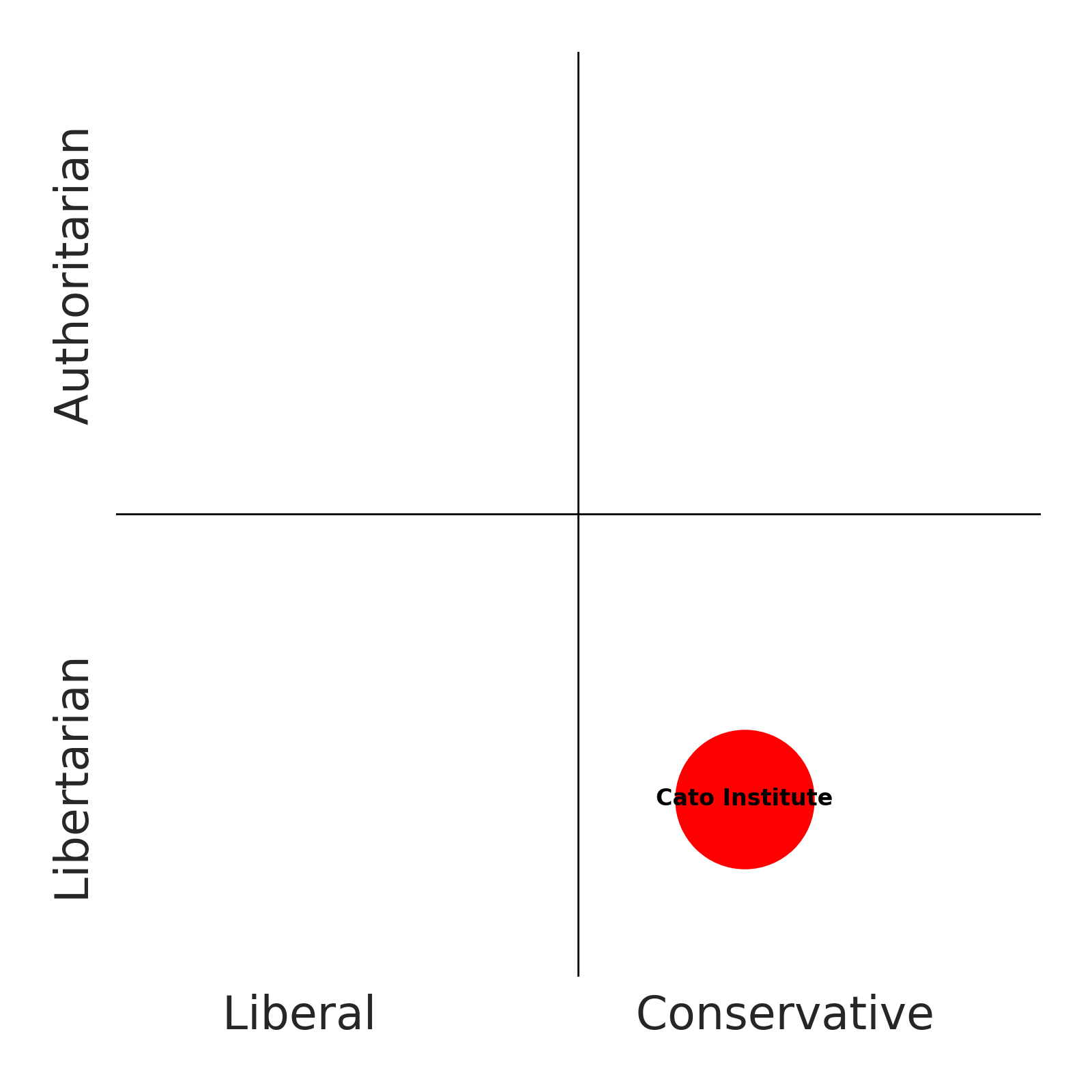
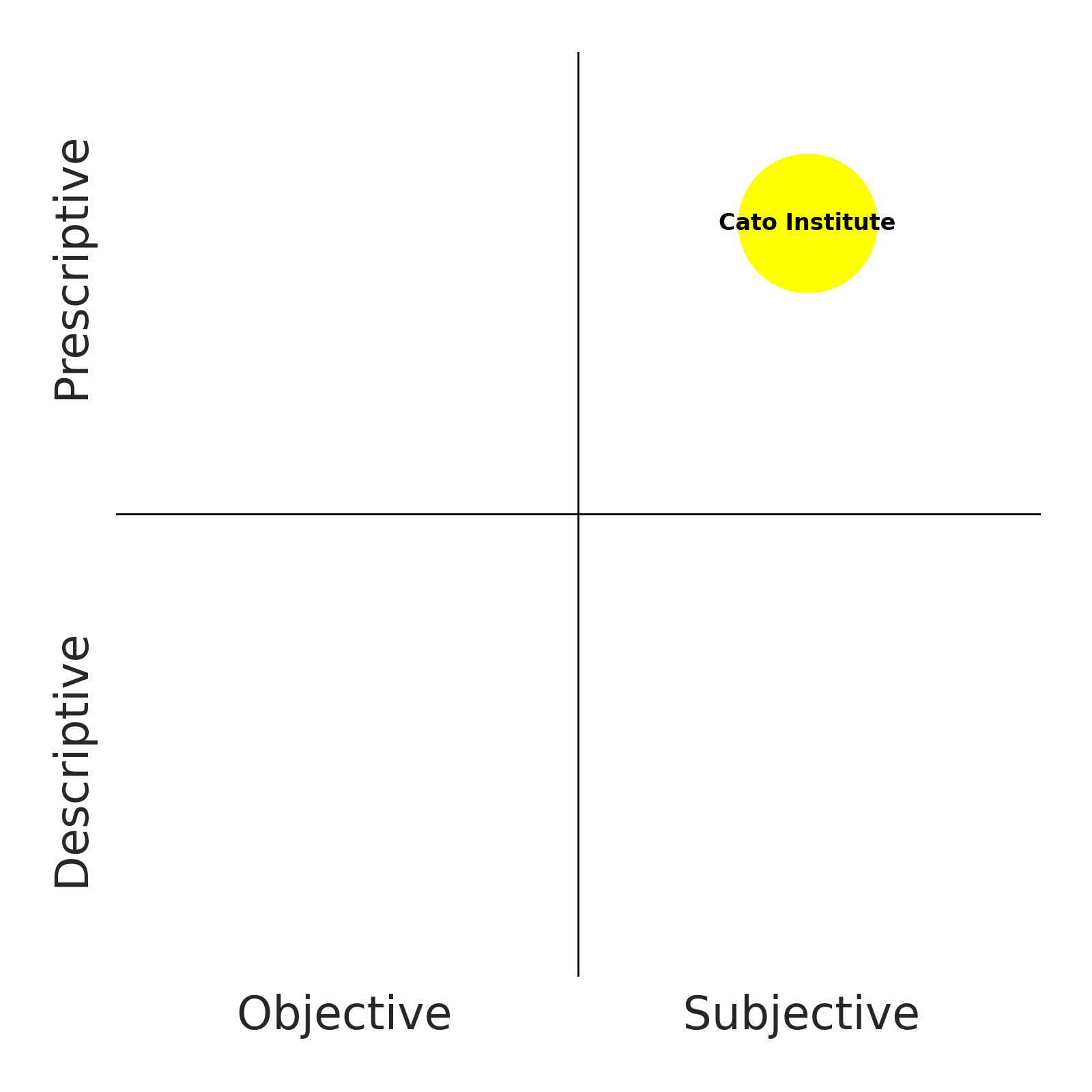
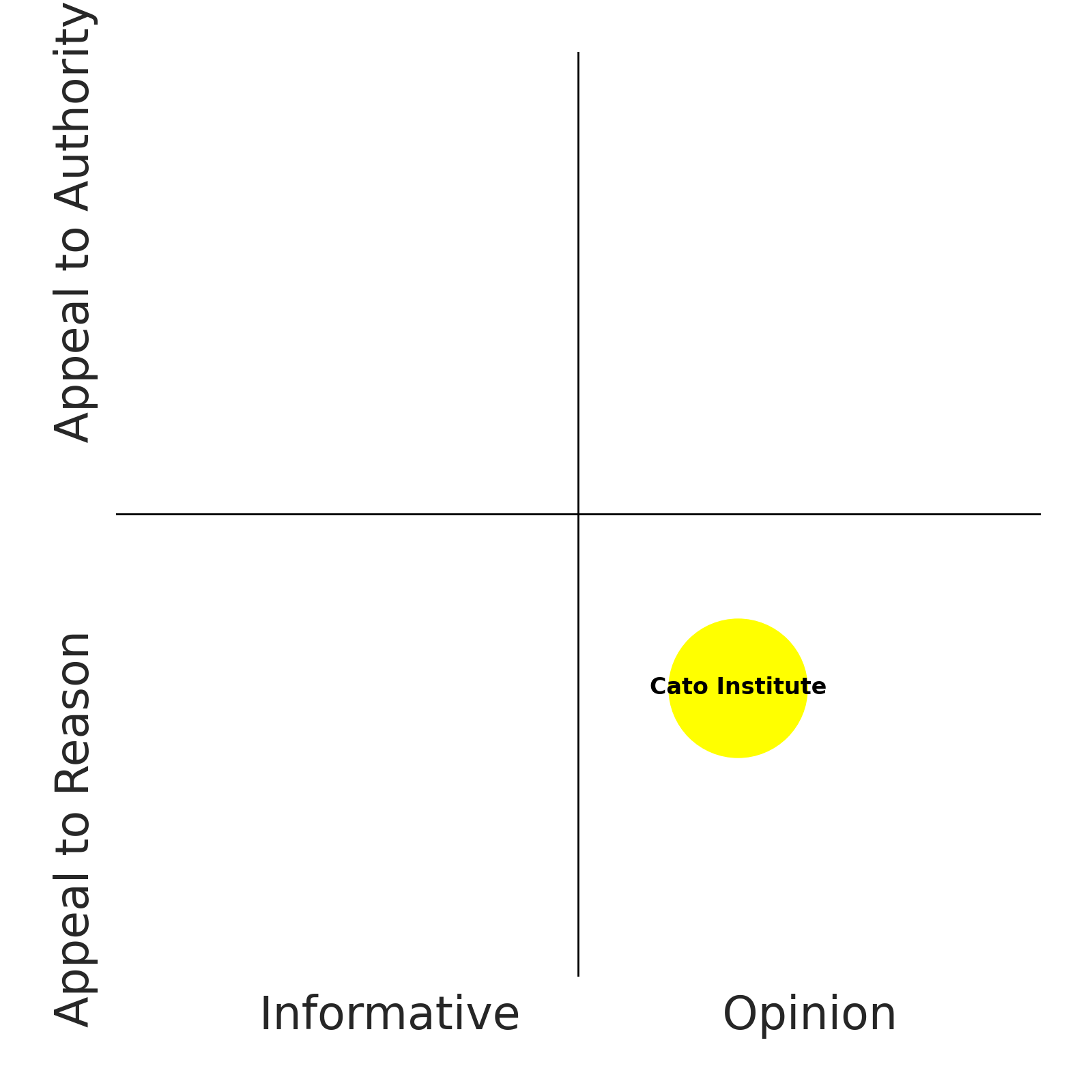
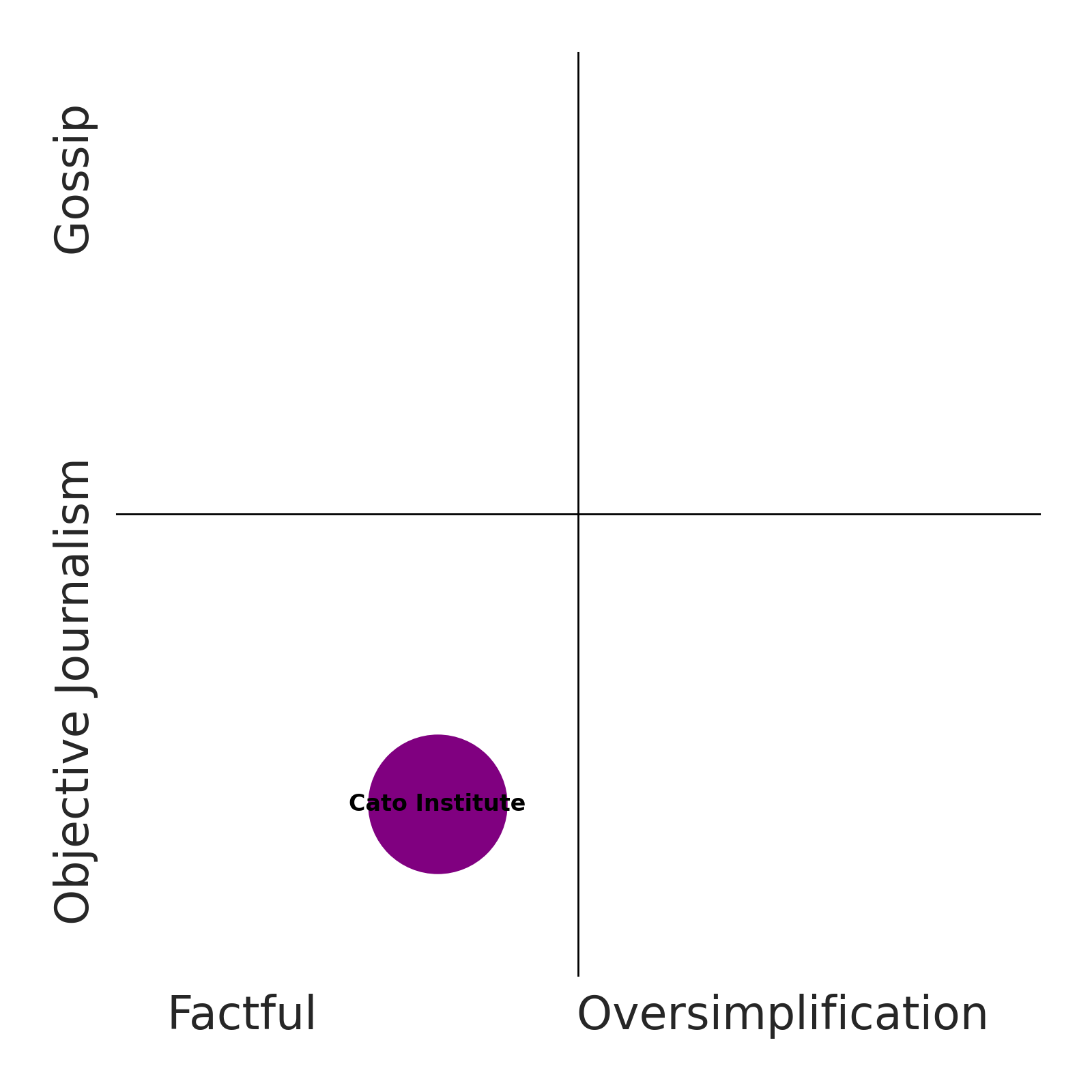
2026 © Helium Trades
Privacy Policy & Disclosure
* Disclaimer: Nothing on this website constitutes investment advice, performance data or any recommendation that any particular security, portfolio of securities, transaction or investment strategy is suitable for any specific person. Helium Trades is not responsible in any way for the accuracy
of any model predictions or price data. Any mention of a particular security and related prediction data is not a recommendation to buy or sell that security. Investments in securities involve the risk of loss. Past performance is no guarantee of future results. Helium Trades is not responsible for any of your investment decisions,
you should consult a financial expert before engaging in any transaction.
Helium Research Assistant

How can I help you today?
Ask any question about Cato Institute bias.


