See whether Helium helps you make better-informed decisions. Try every Pro Trader feature for 30 days. No credit card required.
Try every Pro Trader feature for 30 days. No credit card required.
Scope and topic selection. The sample is strongly concentrated on professional legal audiences: law-firm hiring, mergers, rankings, business development, litigation data, legal technology, courts, compliance, and legal education.
Examples include lateral recruitment
August 17, 2026 · 0 shares
A law-firm lateral hire is presented in uniformly favorable expansion-and-opportunity terms, relying on the firm's and the new partner's own positive characterizations.
Automated analysis; not human reviewed. Limitations: The supplied text is truncated by a paywall notice, so analysis is limited to the visible portion of the hiring announcement. · 4 of 54 available dimensions scored; omitted dimensions are not treated as neutral. · Verified supporting quotes for 3 of 4 scored dimensions.
Claim: The framing mixes factual hiring details with unquantified praise.
“it has these incredible practice groups of already established lawyers doing sophisticated work” · exact text match
“The support for the lawyers from the firm is remarkable to me” · exact text match
Why: Subjective superlatives are prominent, although the publisher attributes them to named sources rather than presenting them as own-voice analysis.
Claim: The announcement is framed in positive, forward-looking terms.
“a key region booming with opportunity” · exact text match
“same level of excitement and optimism that I have now in my first week since I've been here” · exact text match
Why: The selected quotes emphasize growth, success, and opportunity, with no pessimistic or cautionary content.
Claim: The report is transparent about its sources and attribution.
“said Jonathan Young, chair of the firm’s bankruptcy and restructuring practice group” · exact text match
“Mark Silverman, partner and leader of the CMBS special servicer team within the firm’s bankruptcy and restructuring practice group, highlighted Higgins' varied experience as a litigator” · exact text match
Why: Named individuals and direct quotes are used, but sources are all affiliated with the firm, and no independent verification is offered.
Claim: The piece functions as a promotional announcement built from favorable statements by the firm and the new partner.
“As a seasoned litigator with a national practice, he will strengthen and deepen our market position and client service in a key region booming with opportunity.” · not found in supplied text
“His established relationships with institutional clients provide an immediate springboard for our clients to continue to see successful outcomes alongside the broader team.” · not found in supplied text
Why: Every evaluative statement comes from firm leadership or the incoming partner and is uniformly positive; no risks, costs, or external perspectives are included.
The supplied text is truncated by a paywall notice, so analysis is limited to the visible portion of the hiring announcement.
August 06, 2026 · 0 shares
An industry roundup frames litigation against large law firms as a data-monitoring trend while repeatedly promoting Radar's subscription service.
Am Law 200 is a common industry ranking of the 200 largest U.S. law firms by revenue.
Automated analysis; not human reviewed. Limitations: I could not independently verify the underlying lawsuits or Radar's data; all analysis is based solely on the supplied article text. · 4 of 53 available dimensions scored; omitted dimensions are not treated as neutral. · Verified supporting quotes for 4 of 4 scored dimensions.
Claim: Most substantive claims are attributed to lawsuits or plaintiffs rather than asserted by the publisher.
“The suit alleges that Holland & Knight, No. 26 among the country’s top-grossing law firms, defended its defective work that ultimately destroyed a multimillion-dollar business” · exact text match
“Two former equity partners at Goulston & Storrs claim that the firm’s refusal to pay a total of about $900,000 in compensation was a “retaliatory forfeiture”” · exact text match
Why: The article consistently uses verbs like 'alleges' and 'claims' to separate the publisher's report from the parties' assertions.
Claim: The presentation uses dramatic language despite generally factual reporting.
“Holland & Knight was socked with a $1.2 billion malpractice lawsuit” · exact text match
“several big firms in July were popped with suits” · exact text match
Why: Words like 'socked' and 'popped' add tabloid flavor, but the body text is largely clinical, so the sensationalism is moderate.
Claim: The article attributes allegations to lawsuits and includes some defense responses, showing visible sourcing.
“The suit alleges that Holland & Knight, No. 26 among the country’s top-grossing law firms, defended its defective work that ultimately destroyed a multimillion-dollar business” · exact text match
“Reached for comment, a Katten spokesperson said that the allegations are without merit and that the firm intends to defend the case vigorously.” · exact text match
Why: Clear attribution to pleadings and inclusion of defendant responses enhance credibility, though the promotional framing and lack of external verification temper the score.
Claim: Reporting repeatedly promotes Radar's services, making the article partly advertorial.
“Welcome to Radar’s monthly roundup of new cases involving Am Law 200 firms as litigants.” · verified after text normalization
“Check out Radar for the latest lawsuits filed across thousands of state and federal courts.” · verified after text normalization
Why: The article is introduced as a Radar monthly roundup and ends with a direct invitation to use Radar, both clear promotional signals.
I could not independently verify the underlying lawsuits or Radar's data; all analysis is based solely on the supplied article text.
August 21, 2026 · 0 shares
Framing treats the legal sector's need for business-savvy attorneys as an established market reality requiring educational expansion, with institutional and firm voices providing supporting testimony.
Automated analysis; not human reviewed. Limitations: The supplied text may be truncated, and includes a subscription notice and unrelated headlines; analysis is based only on the portion provided. · 9 of 54 available dimensions scored; omitted dimensions are not treated as neutral. · Verified supporting quotes for 4 of 9 scored dimensions.
Claim: The report adheres to journalistic norms of objectivity by relying on attributed statements and factual descriptions.
“"We are so much more effective if we don't give legal advice in a vacuum. ... It has to be given within context," Cohen said” · not found in supplied text
Why: The piece is predominantly third-person reporting that attributes claims to named sources, with few unguarded editorial remarks.
Claim: The article avoids sensationalism, offering a straightforward account of new academic programs.
“The Northwestern Pritzker School of Law and the Kellogg School of Management announced two programs last week” · exact text match
Why: Language is measured and informational, with no hyperbolic or emotional triggers.
Claim: The framing is mildly optimistic about opportunities for attorneys with business training.
“Young attorneys with business backgrounds may be able to set themselves apart from others in an ongoing competition for talent.” · exact text match
Why: The phrasing highlights a potential advantage for graduates, without overpromising outcomes.
Claim: The text primarily describes the programs and the reasons behind them rather than prescribing what law schools or firms should do.
“New programs from a top Chicago law school providing dual degrees in both law and business highlight the legal market's growing demand for attorneys with business knowledge.” · exact text match
Why: Despite the evaluative word 'need', the sentence reports on an observed trend rather than instructing the reader.
Claim: The writing contains mild interpretation about the meaning of the trend, but remains largely factual.
“Local law firm leaders have also felt the need to attract associates with these skills.” · exact text match
Why: The statement generalizes from a few quoted sources, which injects a minor degree of opinion.
Claim: The article relies heavily on institutional leaders and a law firm managing partner to validate its premise.
“"They need their new associates to have some understanding of accounting and finance, how to read and interpret financial statements, valuation, governance, business strategy and definitely project management," Rebstock said.” · not found in supplied text
Why: Most of the article's substance derives from statements by Rebstock and Cohen, with no dissenting voice.
Claim: The article appears credible due to its named sources, direct quotations, and trade-press provenance.
“Don Rebstock, the associate dean of admissions and career services, said ...” · not found in supplied text
Why: Claims are attributed to identifiable individuals, and the publication is a recognized industry outlet.
Claim: The piece relies on reasoned argument, citing market trends and expert commentary to explain the new programs.
“Rebstock said he has seen the national demand for talent with this background pick up in the last decade or two” · not found in supplied text
Why: Explanations are logical and grounded in reported observations, with no appeal to emotion or superstition.
Claim: The opening and framing carry promotional overtones for the university's new offerings.
“New programs from a top Chicago law school ... highlight the legal market's growing demand for attorneys with business knowledge.” · not found in supplied text
Why: The lead highlights the prestige of the school and frames the programs positively, consistent with promotional content.
The supplied text may be truncated, and includes a subscription notice and unrelated headlines; analysis is based only on the portion provided.
August 17, 2026 · 0 shares
A law-firm-authored startup advisory frames post-funding patent maintenance as an urgent survival task and closes with a pitch for the firm's services.
Automated analysis; not human reviewed. Limitations: The supplied text mixes the main advisory article with related headlines, subscription boilerplate, and navigation; scoring is based on the substantive advisory body after excluding wrapper content. · 6 of 54 available dimensions scored; omitted dimensions are not treated as neutral. · Verified supporting quotes for 5 of 6 scored dimensions.
Claim: The article mixes factual legal references with subjective metaphor and prescriptive judgment.
“The engines ignite, the acceleration is real, and the goal is clear: achieve orbit, do not explode on the launchpad.” · exact text match
“The same skeletons rattle out of the closet in diligence time after time” · exact text match
Why: Vivid figurative language and evaluative framing show a subjective, persuasive element alongside legal facts.
Claim: The advisory is dominated by direct instructions and normative statements about what companies should do.
“A completed financing round should prompt a structured reassessment of your patent position.” · exact text match
Why: The text repeatedly prescribes actions with 'should,' imperatives, and required steps rather than describing events or options neutrally.
Claim: The bylined text presents subjective expert opinion and advocacy rather than straight factual reporting.
“A funding round is ignition, not arrival.” · exact text match
“Patents are not decorative panels on the exterior; they are part of the guidance system.” · not found in supplied text
Why: Metaphorical evaluative language and unqualified recommendations signal opinionated expert advice.
Claim: The advisory shows visible sourcing and attribution for key empirical and legal claims.
“See, Joan Farre-Mensa, Deepak Hegde & Alexander Ljungqvist, “What Is a Patent Worth? Evidence from the U.S. Patent ‘Lottery’”, 75 J. Fin. 639 (2020).” · exact text match
“See, Stanford University v. Roche Molecular Systems, Inc., 563 U.S. 776 (2011).” · exact text match
Counterevidence:
“Our Venable team is available to assist in evaluating and implementing these adjustments as your company moves into its next phase.” · exact text match
Why: Citations to a peer-reviewed journal and U.S. Supreme Court decisions provide a checkable basis, though the promotional closing partially qualifies the credibility of the text as neutral advice.
Claim: The advisory functions partly as a promotional pitch for Venable LLP's services.
“Our Venable team is available to assist in evaluating and implementing these adjustments as your company moves into its next phase.” · exact text match
Why: It closes with a direct offer of the authors' law firm's help, making the content partly promotional.
Claim: The article's framework treats corporate valuation, potential investment, and enterprise value as the main measure of patent success.
“They influence access to capital, valuation, and ultimately where the mission lands.” · exact text match
Why: Patent strategy is repeatedly tied to funding, valuation, diligence, and exit value, with little attention to non-commercial purposes of patents.
The supplied text mixes the main advisory article with related headlines, subscription boilerplate, and navigation; scoring is based on the substantive advisory body after excluding wrapper content.
August 03, 2026 · 0 shares
Stresses that law firms' AI investment shortfalls stem from operational deployment failures rather than technology shortcomings, advocating for systematic readiness assessment.
Automated analysis; not human reviewed. Limitations: The author is a fractional CIO/CISO consultant whose firm advises law firms on AI deployment, creating potential self-interest in the argument. · 7 of 52 available dimensions scored; omitted dimensions are not treated as neutral. · Verified supporting quotes for 4 of 7 scored dimensions.
Claim: The article presents a persuasive argument from the author's perspective rather than neutral reporting.
“The honest first step is not a purchase. It is a clear-eyed assessment of what your firm is actually ready for—before you build anything else on top of it.” · exact text match
Why: This prescriptive, evaluative language reflects subjective opinion and advocacy rather than objective description.
Claim: The article strongly prescribes specific actions for law firm leaders.
“I would ask every firm leader to sit with: diagnosis before prescription. You cannot deploy responsibly onto an unstable foundation.” · exact text match
Why: The author directly advises firm leaders on what they should do, which is prescriptive.
Claim: The article is heavily opinionated about the cause of AI deployment failures.
“The hype cycle has a name for where that leaves us—the trough of disillusionment, where inflated expectations meet unrealized results.” · exact text match
Why: The author interprets industry conditions using a specific framework, indicating opinion.
Claim: The article relies on surveys and reports from authoritative organizations to support its argument.
“Deloitte Legal’s June 2026 survey of 121 senior in-house legal leaders found that 58% of general counsel say their outside providers rarely or never proactively raise the benefits of AI with them.” · not found in supplied text
Why: The article cites specific surveys and reports, which is a form of appeal to authority but within journalistic norms.
Claim: The article is credible due to specific, attributed data and transparent authorship.
“Clio’s data makes the divide concrete from the revenue side: firms that adopted AI widely were nearly three times more likely to report revenue growth than firms merely dabbling.” · exact text match
Why: The article provides specific numbers from named sources, and the author's background is disclosed, supporting credibility.
Claim: The article frames AI deployment failure as an operational rather than technological problem using data-driven reasoning.
“MIT’s Project NANDA put a number on what happens next. Its 2025 report... found that roughly 95% of enterprise generative AI pilots delivered no measurable impact on the P&L.” · not found in supplied text
Why: The article supports its central claim with specific quantitative evidence from authoritative sources, demonstrating rational analysis.
Claim: The article demonstrates high intelligence through use of multiple data sources and logical structure.
“McKinsey’s legal example makes that concrete. At an alternative legal services provider modernizing contract review, every user edit in the document editor was logged and categorized.” · not found in supplied text
Why: The article integrates examples and data to build a coherent argument, indicating thoughtful analysis.
The author is a fractional CIO/CISO consultant whose firm advises law firms on AI deployment, creating potential self-interest in the argument.
August 18, 2026 · 0 shares
Practitioner-oriented legal analysis that frames GAI patent drafting as unresolved risk, balanced by counterarguments and practical guidance.
Second installment in a two-part series; first part covered privilege and discovery risks. The article is directed at patent prosecutors, agents, and litigators, providing analysis of unsettled legal questions.
August 14, 2026 · 0 shares
Race-separated DEI training is framed as an employer enforcement and Title VII retaliation risk, with the underlying allegations kept attributed to the EEOC, the lawsuit, and the employee rather than adopted by the newsroom.
The EEOC is the federal agency that enforces workplace anti-discrimination laws. Under Title VII's anti-retaliation provision, employers may not punish employees who oppose what they reasonably believe to be unlawful discrimination. Washington University is a research university in St. Louis, Missouri, with a School of Medicine.
Automated analysis; not human reviewed. Limitations: The analysis is limited to the provided text and does not have access to the actual lawsuit, EEOC charge, or joint court record. · 4 of 54 available dimensions scored; omitted dimensions are not treated as neutral. · Verified supporting quotes for 0 of 4 scored dimensions.
Claim: The report stays politically neutral, attributing each contested claim to the EEOC or the employee and including the university's refusal to comment.
“The Equal Employment Opportunity Commission has filed a lawsuit against Washington University over the opposition statement. Conducted mandatory diversity, equity, and inclusion, or DEI, training that was segregated by race.” · not found in supplied text
“"The university is aware of the complaint and does not comment on pending litigation."” · not found in supplied text
Why: The Allegation and the university's refusal are both presented without adoption of the outcome, and no editorial cues show a preference on the dispute.
Claim: The report follows an objective, attribution-heavy legal news style, reserving subjective language mostly for quoted speech.
“"The suit alleges that a Black employee, Amega Thaier, was terminated after objecting to the segregation."” · not found in supplied text
“"According to the suit, Thaier, a program manager at the Alvin J. Siteman Career Center, was ... "” · not found in supplied text
Why: The publisher repeatedly marks claims as lawsuit assertions rather than as established facts. The one generalizing phrase, “The action suggests...”, is hedged.
Claim: The text uses emotionally charged material in quotation, explain that story's factual and legal narrative itself is not sensational.
“"It wasn’t just uncomfortable—it was dehumanizing."” · not found in supplied text
“"The regulator claims Washington University's alleged actions violate Section 704(a) of Title VII of the Civil Rights Act of 1964."” · not found in supplied text
Why: The strongest personal statement appears as quoted material from the employee, while the surrounding report uses legal condemnation and drily specifies charges.
Claim: Credibility is supported by consistent attribution to court papers, the EEOC, and the university spokesperson, and by the lawsuit's status as a reported legal claim.
“"According to the suit, Thaier, a program manager at the Alvin J. Siteman Cancer Center, ...” · not found in supplied text
“"The regulator claims Washington University’s alleged actions violate Section 704(a) of Title VII..."” · not found in supplied text
Why: The piece flags matters as "alleges," "according to," and "claims," and it gives the university a comment, even though the underlying factual allegations are necessarily unproven.
The analysis is limited to the provided text and does not have access to the actual lawsuit, EEOC charge, or joint court record.
August 14, 2026 · 0 shares
Framing uses the parole-board confirmation controversy as the news hook while keeping the judicial approvals as routine context and quoting both opponents and supporters.
The Massachusetts Governor's Council is an elected body whose approval is required for the governor's judicial and parole appointments, so a council rejection sends the governor back to choose again.
Automated analysis; not human reviewed. · 6 of 54 available dimensions scored; omitted dimensions are not treated as neutral. · Verified supporting quotes for 3 of 6 scored dimensions.
Claim: The article shows no clear liberal or conservative direction because both sides of the confirmation dispute are presented without political labels.
“Nearly all of those objecting to her nomination said it was not a personal swipe at O'Leary but instead voiced concerns about having a prosecutor on the board.” · exact text match
“Prosecutors are charged with seeking justice. That can mean incarceration, but it can also mean diversion, treatment, mental health services, substance use treatment, rehabilitation, and other resources when those options serve justice.” · not found in supplied text
Why: Both objections and supporting statements are reported, with no editorial position attached to either side.
Claim: The main report consists of votes, dates, summaries of testimony, and attributed quotes rather than authorial opinion.
“The council issued two 8-0 votes to approve Quincy civil litigator and criminal defense attorney Keith Nicholson as an associate justice of the Boston Municipal Court and Suffolk County Assistant District Attorney Lynn Feigenbaum as an associate justice of the Probate & Family Court.” · exact text match
Why: The prose is largely a sequential report of votes and participant statements, so it tends toward the objective end of the midpoint.
Claim: The article is not sensationalized; its emotional hook is the real confirmation dispute rather than exaggerated devices.
“The split vote comes after more than a dozen individuals appeared before the council on August 5, both in person and via Zoom, to oppose O'Leary's nomination.” · exact text match
Why: The storyline is controversy-driven but uses measured description and attributed voice rather than outrage-based language.
Claim: The article describes actions and statements without recommending a course of action.
“On Wednesday, Civil and Ziegler both briefly spoke before the councilors cast their votes.” · exact text match
Why: The main narrative records what happened and what officials said; it does not instruct the council or the reader on what should happen.
Claim: The report uses visible sourcing, detailed votes, names, dates, and direct quotes, though it relies partly on a nominee's resume for one biographical fact.
“She is currently the head counsel for the parole board after initially joining as legal counsel in November 2023, according to her resume.” · not found in supplied text
Why: Most factual statements are named, location-specific, and verifiable; the resume is explicitly attributed. The report is not an authoritative external audit, but it is transparent about its main source for at least one claim.
Claim: The article is internally fair, giving both objectors and supporters direct attention.
“Those countering the nomination included multiple exonerees of the state's criminal justice system, criminal defense practitioners, and social workers for various organizations that advocate for re-entry services and restorative justice.” · exact text match
“Prosecutors are charged with seeking justice. That can mean enforcement, but it can also mean defense, treatment, mental health services, substance use treatment, rehabilitation, and other resources when those options serve justice.” · not found in supplied text
Why: The article includes opposition detail and supporter argument and preserves attributions rather than hiding its source material or reframing it in first person.
The report frames DOJ's first non-prosecution of a healthcare company under the new policy as a viable corporate pathway, foregrounding defense-attorney guidance on self-disclosure and compliance rather than critically examining the policy or the entity's place in the alleged fraud.
Automated analysis; not human reviewed. Limitations: None; the analysis is based only on the supplied substantive article text, ignoring surrounding subscription and related-item boilerplate. · 5 of 54 available dimensions scored; omitted dimensions are not treated as neutral. · Verified supporting quotes for 2 of 5 scored dimensions.
Claim: The article keeps assertions attributed to prosecutors, officials, and named defense lawyers, rather than advancing publisher editorial opinions.
“The U.S. Justice Department’s recent announcement that it would not prosecute the management company behind a New Jersey optometry practice and surgery center after the company voluntarily disclosed a Medicare fraud scheme by its CEO shows a path for healthcare companies to avoid fraud prosecutions, attorneys say.” · exact text match
“At the same time, prosecutors indicted the founder and CEO, E. Bruce DiDonato, who was allegedly paying kickbacks disguised as consulting fees to ophthalmologists in exchange for referrals for eye surgeries.” · not found in supplied text
Why: The central 'pathway' claim is attributed to attorneys; the criminal allegations carry 'prosecutors said' and 'allegedly,' showing restrained epistemic framing.
Claim: The report presents criminal conduct in understated legal terms without graphics, outrage language, or emphasis.
“The scheme resulted in $3.4 million in fraudulent bills to Medicare, which ultimately paid about $1 million, prosecutors said.” · exact text match
Why: The reporting avoids hyperbolic or gratifying tabloid wording, uses passive legalized description, and embeds the criminal allegations in an attributed prosecutor statement.
Claim: The story's credibility is supported by named sources, direct quoted advice, and explicit uncertainty markers.
“Assistant attorney general prosecutor of the National Fraud Enforcement Division, announcing the deal, said that the department’s policies 'afford companies that take responsibility for their misconduct with a clear path to a declination'” · not found in supplied text
“At the same time, U.S. prosecutors indicted the founder and CEO for allegedly paying... referral fees...” · not found in supplied text
Why: The publisher directly identifies names and roles of officials and outside counsel, quotes them directly, and uses 'allegedly' and 'prosecutors said' for contested facts.
Claim: The article frames a corporate declination as the desirable outcome and advises companies on how to obtain similar leniency.
“The lesson is that there is a real pathway for obtaining the declination, but that it’s not a guarantee and that there are certainly strings attached and steps a company has to take ahead of time, starting when misconduct is identified” · exact text match
“Some companies, he said, might decide that cooperation is not worth it even with the new policy in place.” · exact text match
Why: The framing repeatedly treats corporate non-prosecution and cooperation costs as the primary subject, and quotes defense attorneys about what companies should do, instead of weighing public accountability or victims.
Claim: The report includes nuanced policy context and a caveat that the pathway is not suitable for every company.
“What’s new about it, and what’s notable, is that it’s department-wide; there were prior department policies relative district-by-district and criminal-division components.” · not found in supplied text
“While I imagine many companies are pursuing there, just by the nature of how demanding it is, it may not be the path forward for every company” · not found in supplied text
Why: The content distinguishes past district-level and component-level declination policies from the new department-wide policy, and it does so without overdramatizing the outcome, with a moderate editorial-level warning that the course has costs.
None; the analysis is based only on the supplied substantive article text, ignoring surrounding subscription and related-item boilerplate.
August 19, 2026 · 0 shares
The article frames the settlement through plaintiffs' counsel statements and emphasizes the families' relief, while preserving neutral reporting of the court proceedings and Harvard's non-admission of fault.
Harvard Medical School's Anatomical Gift Program accepts body donations for education and research. In 2023, former morgue manager Cedric Lodge was charged with selling body parts. Massachusetts law provides some immunity to anatomical gift programs, but the state's highest court allowed the families' lawsuit to proceed in October.
August 01, 2026 · 0 shares
Balanced reporting on the Supreme Court's conservative project to limit federal power, quoting both advocates and skeptics.
Automated analysis; not human reviewed. Limitations: Analysis based on article preview text; full content behind paywall not available. · 25 of 52 available dimensions scored; omitted dimensions are not treated as neutral. · Verified supporting quotes for 3 of 25 scored dimensions.
Claim: The article reports on conservative legal victories and includes both conservative and liberal perspectives, showing neutrality.
“The U.S. Supreme Court has delivered a list of victories to conservatives since the forming of a Republican-appointed supermajority nearly six years ago.” · exact text match
“Writing for the majority in FCC v. Consumers’ Research, Justice Elena Kagan paid homage to the central idea behind the nondelegation doctrine” · exact text match
Why: Descriptive language of conservative victories balanced by quoting a liberal justice, indicating balanced reporting.
Claim: The article's focus on limiting federal power and quoting libertarian experts suggests a slight libertarian leaning.
“Libertarian professor Ilya Somin of George Mason University's Antonin Scalia Law School said the court's Raich precedent is even "worse" than the court's Wickard decision” · not found in supplied text
“The spending clause should not be "leveraged to get out of the limited and enumerated powers of the federal government," Severino said.” · not found in supplied text
Why: The article highlights arguments for constraining federal authority, but does not advocate; it reports these views.
Claim: The article relies on factual reporting of court rulings and expert quotes without subjective editorializing.
“This term, the Supreme Court limited lawsuits brought under the Voting Rights Act and the Alien Tort Statute and sent a clear warning to Congress about exceeding the limits of its powers of the purse.” · exact text match
“Carrie Severino of the Judicial Crisis Network said Landor "frustrated" a lot of politically conservative people because it was a defeat for a religious freedom claim.” · not found in supplied text
Why: Claims are attributed to court decisions and named experts; no unsupported opinions from the publisher.
Claim: The article avoids sensational language, using measured terms such as 'experts say' and 'could emerge.'
“Having vastly curtailed the power and autonomy of federal agencies, reining in Congress could emerge as a key area of focus for the U.S. Supreme Court, experts say.” · exact text match
“Despite the enthusiasm from Gorsuch for its renaissance, there are serious doubts as to whether the Supreme Court will... wield nondelegation as a check” · not found in supplied text
Why: The language is cautious and qualified, lacking dramatic or exaggerated phrasing.
Claim: The article's central subject is Supreme Court decisions with political implications, placing it in the political domain.
“The U.S. Supreme Court has delivered a list of victories to conservatives since the forming of a Republican-appointed supermajority” · exact text match
“Limiting the force of spending clause legislation may be just one way the Supreme Court reins in congressional power.” · exact text match
Why: The entire article discusses separation of powers, conservative legal victories, and potential future limitations on Congress.
Claim: The article uses named sources, specific case citations, and appears trustworthy.
“Supreme Court lawyer Paul Clement cited Roberts’ NFIB opinion extensively in an April petition challenging a 2021 corporate transparency law” · exact text match
“The Supreme Court has struck down a federal law as violating nondelegation principles only once in its history, ruling in another 1935 case” · not found in supplied text
Why: Relies on verifiable court rulings and named legal experts; no speculation presented as fact.
Claim: The article presents logical, evidence-based analysis of legal doctrines and court decisions.
“The court’s 2024 decision in Loper Bright Enterprises v. Raimondo jettisoned the 40-year-old doctrine of Chevron deference” · exact text match
“Gorsuch cited the “‘explosion’ of Spending Clause legislation in recent years” and said that, without limits, “Congress would enjoy an effectively unbridled police power.”” · exact text match
Why: The article uses specific case citations, dates, and quotes to support its analysis, avoiding emotional language.
Claim: The article transparently attributes all quotes and identifies sources, indicating honest reporting.
“Carrie Severino of the Judicial Crisis Network said Landor "frustrated" a lot of politically conservative people” · not found in supplied text
“Libertarian professor Ilya Somin of George Mason University's Antonin Scalia Law School said” · exact text match
Why: Every expert opinion is attributed to a named individual and organization; no anonymous claims.
Claim: The article demonstrates deep understanding of legal doctrines and provides nuanced analysis.
“The court’s 2024 decision in Loper Bright Enterprises v. Raimondo jettisoned the 40-year-old doctrine of Chevron deference” · exact text match
“During the court’s March 2025 hearing in the Consumers’ Research case, Justice Amy Coney Barrett wondered if courts could ever come up with a practical way to police excessive delegations of congressional power.” · not found in supplied text
Why: Cites multiple interrelated cases, historical precedents, and quotes justices and scholars, showing sophisticated legal analysis.
Analysis based on article preview text; full content behind paywall not available.
Framing and worldview. The recurring frame treats law primarily as an organized market and profession whose important signals are firm growth, client service, risk management, revenue, technological adoption, institutional reputation, and procedural outcomes.
Business success is often treated as the relevant endpoint: patent strategy is linked to “capital” and “valuation”
August 17, 2026 · 0 shares
A law-firm-authored startup advisory frames post-funding patent maintenance as an urgent survival task and closes with a pitch for the firm's services.
Automated analysis; not human reviewed. Limitations: The supplied text mixes the main advisory article with related headlines, subscription boilerplate, and navigation; scoring is based on the substantive advisory body after excluding wrapper content. · 6 of 54 available dimensions scored; omitted dimensions are not treated as neutral. · Verified supporting quotes for 5 of 6 scored dimensions.
Claim: The article mixes factual legal references with subjective metaphor and prescriptive judgment.
“The engines ignite, the acceleration is real, and the goal is clear: achieve orbit, do not explode on the launchpad.” · exact text match
“The same skeletons rattle out of the closet in diligence time after time” · exact text match
Why: Vivid figurative language and evaluative framing show a subjective, persuasive element alongside legal facts.
Claim: The advisory is dominated by direct instructions and normative statements about what companies should do.
“A completed financing round should prompt a structured reassessment of your patent position.” · exact text match
Why: The text repeatedly prescribes actions with 'should,' imperatives, and required steps rather than describing events or options neutrally.
Claim: The bylined text presents subjective expert opinion and advocacy rather than straight factual reporting.
“A funding round is ignition, not arrival.” · exact text match
“Patents are not decorative panels on the exterior; they are part of the guidance system.” · not found in supplied text
Why: Metaphorical evaluative language and unqualified recommendations signal opinionated expert advice.
Claim: The advisory shows visible sourcing and attribution for key empirical and legal claims.
“See, Joan Farre-Mensa, Deepak Hegde & Alexander Ljungqvist, “What Is a Patent Worth? Evidence from the U.S. Patent ‘Lottery’”, 75 J. Fin. 639 (2020).” · exact text match
“See, Stanford University v. Roche Molecular Systems, Inc., 563 U.S. 776 (2011).” · exact text match
Counterevidence:
“Our Venable team is available to assist in evaluating and implementing these adjustments as your company moves into its next phase.” · exact text match
Why: Citations to a peer-reviewed journal and U.S. Supreme Court decisions provide a checkable basis, though the promotional closing partially qualifies the credibility of the text as neutral advice.
Claim: The advisory functions partly as a promotional pitch for Venable LLP's services.
“Our Venable team is available to assist in evaluating and implementing these adjustments as your company moves into its next phase.” · exact text match
Why: It closes with a direct offer of the authors' law firm's help, making the content partly promotional.
Claim: The article's framework treats corporate valuation, potential investment, and enterprise value as the main measure of patent success.
“They influence access to capital, valuation, and ultimately where the mission lands.” · exact text match
Why: Patent strategy is repeatedly tied to funding, valuation, diligence, and exit value, with little attention to non-commercial purposes of patents.
The supplied text mixes the main advisory article with related headlines, subscription boilerplate, and navigation; scoring is based on the substantive advisory body after excluding wrapper content.
July 30, 2026 · 0 shares
Pro-establishment, pro-business framing portrays Abbott’s reappointment of Texas Business Court judges as strengthening an efficient court and Texas’s economic appeal.
The Texas Business Court, created in 2023 by House Bill 19, is a specialized court for complex commercial disputes and is described as a domestic alternative to the Delaware Court of Chancery, with a structure of 11 divisions (five operational) and performance metrics cited by the court's officials.
Automated analysis; not human reviewed. · 1 of 52 available dimensions scored; omitted dimensions are not treated as neutral. · Verified supporting quotes for 1 of 1 scored dimensions.
Claim: The article frames the Texas Business Court and Abbott's reappointment as beneficial to the state's business environment.
““Businesses choose Texas in record numbers because Texas delivers results,” Abbott said in a news release.” · exact text match
“The specialist judges handle complex commercial cases efficiently, providing Texas businesses with the expertise and speed they require, he said.” · exact text match
“This efficiency encourages investment, growth and job creation.” · exact text match
Why: Direct quotes from Abbott emphasize efficiency and economic benefits, indicating pro-establishment framing.
August 05, 2026 · 0 shares
A legal analysis piece warns trade secret plaintiffs that the statute of limitations may start on suspicion, using the Insulet case to advocate for early legal action and framing delay as perilous.
The Defend Trade Secrets Act (DTSA) provides a federal cause of action for trade secret misappropriation with a three-year statute of limitations. Courts permit circumstantial proof of misappropriation through an 'access-plus-similarity' framework.
Automated analysis; not human reviewed. Limitations: Input limitation: article is a contributed legal analysis piece, not neutral news; author affiliation may indicate bias toward litigation strategy. · 7 of 53 available dimensions scored; omitted dimensions are not treated as neutral. · Verified supporting quotes for 5 of 7 scored dimensions.
Claim: The article prescribes specific actions for trade secret owners following the Insulet decision.
“Counsel must assess potential accrual much earlier than instinct might dictate.” · exact text match
Why: The sentence directly instructs counsel on what to do, showing prescriptive framing.
Claim: The article uses language that induces caution and fear of legal consequences for inaction.
“Insulet serves as a stark warning about the doctrine of constructive knowledge.” · exact text match
Why: The phrase 'stark warning' is intended to alarm trade secret plaintiffs about the risks of delay.
Claim: The article expresses strong opinions about the implications of the ruling and the need for early action.
“The Insulet decision is highly notable because it transforms the access-plus-similarity test, traditionally used to evaluate the sufficiency of pleadings and proof, into a strict trigger for statute-of-limitations accrual.” · exact text match
Why: The phrase 'highly notable' and the characterization of transformation reflect opinionated interpretation.
Claim: The article conveys a negative emotional tone, emphasizing danger and peril.
“the danger of taking a wait-and-see approach” · exact text match
Why: The word 'danger' carries negative emotional weight, making the tone slightly negative.
Claim: The article appears credible, citing specific case law and providing detailed legal analysis.
“In Insulet Corp. v. EOFlow, Co., 176 F.4th 1347 (Fed. Cir. May 28, 2026)” · not found in supplied text
“Access can be established in numerous ways; in Tilebar v. Glazzio Tiles, 723 F. Supp. 3d 164 (E.D.N.Y. 2024)” · exact text match
Why: The article cites multiple legal precedents with proper citations, supporting its credibility as a legal analysis.
Claim: The article frames the issue from the perspective of trade secret owners (typically corporations) and advises them on protecting their interests.
“For trade secret owners and their counsel, the decision serves as a pointed reminder that the statute of limitations clock starts ticking long before a complete evidentiary record is assembled.” · exact text match
Why: The article addresses 'trade secret owners' directly, suggesting a pro-corporate viewpoint by focusing on enforcement rights.
Claim: The article speculates about the future implications of the ruling for litigation strategy.
“Implications: Pleading Tensions and 'Continuing Misappropriation'” · not found in supplied text
Why: The section header 'Implications' explicitly signals forward-looking speculation about legal consequences.
Input limitation: article is a contributed legal analysis piece, not neutral news; author affiliation may indicate bias toward litigation strategy.
August 03, 2026 · 0 shares
Stresses that law firms' AI investment shortfalls stem from operational deployment failures rather than technology shortcomings, advocating for systematic readiness assessment.
Automated analysis; not human reviewed. Limitations: The author is a fractional CIO/CISO consultant whose firm advises law firms on AI deployment, creating potential self-interest in the argument. · 7 of 52 available dimensions scored; omitted dimensions are not treated as neutral. · Verified supporting quotes for 4 of 7 scored dimensions.
Claim: The article presents a persuasive argument from the author's perspective rather than neutral reporting.
“The honest first step is not a purchase. It is a clear-eyed assessment of what your firm is actually ready for—before you build anything else on top of it.” · exact text match
Why: This prescriptive, evaluative language reflects subjective opinion and advocacy rather than objective description.
Claim: The article strongly prescribes specific actions for law firm leaders.
“I would ask every firm leader to sit with: diagnosis before prescription. You cannot deploy responsibly onto an unstable foundation.” · exact text match
Why: The author directly advises firm leaders on what they should do, which is prescriptive.
Claim: The article is heavily opinionated about the cause of AI deployment failures.
“The hype cycle has a name for where that leaves us—the trough of disillusionment, where inflated expectations meet unrealized results.” · exact text match
Why: The author interprets industry conditions using a specific framework, indicating opinion.
Claim: The article relies on surveys and reports from authoritative organizations to support its argument.
“Deloitte Legal’s June 2026 survey of 121 senior in-house legal leaders found that 58% of general counsel say their outside providers rarely or never proactively raise the benefits of AI with them.” · not found in supplied text
Why: The article cites specific surveys and reports, which is a form of appeal to authority but within journalistic norms.
Claim: The article is credible due to specific, attributed data and transparent authorship.
“Clio’s data makes the divide concrete from the revenue side: firms that adopted AI widely were nearly three times more likely to report revenue growth than firms merely dabbling.” · exact text match
Why: The article provides specific numbers from named sources, and the author's background is disclosed, supporting credibility.
Claim: The article frames AI deployment failure as an operational rather than technological problem using data-driven reasoning.
“MIT’s Project NANDA put a number on what happens next. Its 2025 report... found that roughly 95% of enterprise generative AI pilots delivered no measurable impact on the P&L.” · not found in supplied text
Why: The article supports its central claim with specific quantitative evidence from authoritative sources, demonstrating rational analysis.
Claim: The article demonstrates high intelligence through use of multiple data sources and logical structure.
“McKinsey’s legal example makes that concrete. At an alternative legal services provider modernizing contract review, every user edit in the document editor was logged and categorized.” · not found in supplied text
Why: The article integrates examples and data to build a coherent argument, indicating thoughtful analysis.
The author is a fractional CIO/CISO consultant whose firm advises law firms on AI deployment, creating potential self-interest in the argument.
August 05, 2026 · 0 shares
A former in-house counsel's prescriptive opinion piece framed as expert advice for outside employment lawyers.
Automated analysis; not human reviewed. Limitations: The article is a personal opinion piece, so most bias dimensions are not applicable or are trivially satisfied; scores reflect the opinionated, prescriptive framing. · 5 of 53 available dimensions scored; omitted dimensions are not treated as neutral. · Verified supporting quotes for 5 of 5 scored dimensions.
Claim: Article presents subjective opinion rather than objective reporting.
“Here is what I wish every outside employment adviser understood.” · exact text match
Why: The article uses first-person perspective and directly states the author's personal wishes, indicating a subjective viewpoint.
Claim: Article prescribes specific actions for outside counsel.
“Know When to Push Back and When to Find a Creative Path Forward” · exact text match
Why: The article includes imperative headings and provides recommendations on how outside counsel should behave.
Claim: Article is heavily opinionated, offering personal advice.
“Here is what I wish every outside employment adviser understood.” · exact text match
Why: The framing is explicitly the author's wishes and advice, not a neutral report.
Claim: Author appeals to her own 12 years of in-house experience as authority.
“For 12 years, I was a senior in-house employment counsel at a Fortune 100 aerospace company.” · exact text match
Why: The author cites her length of service and role to establish credibility for her recommendations.
Claim: Article has moderate credibility due to named author with relevant experience and transparent perspective.
“Dawn Valdivia is a partner in the labor, employment and benefits division at Stinson LLP in Phoenix, Arizona. She previously spent 12 years in senior employment law roles at a Fortune 100 aerospace company.” · exact text match
Why: The author is identified with a specific firm and background, but the piece is anecdotal and not independently verifiable.
The article is a personal opinion piece, so most bias dimensions are not applicable or are trivially satisfied; scores reflect the opinionated, prescriptive framing.
August 04, 2026 · 0 shares
Prescriptive legal analysis that uses case law and ethics rules to warn against substituting social workers for attorneys in child representation, emphasizing attorney-client direct contact.
Automated analysis; not human reviewed. · 9 of 53 available dimensions scored; omitted dimensions are not treated as neutral. · Verified supporting quotes for 3 of 9 scored dimensions.
Claim: The article is a subjective opinion essay though grounded in objective legal sources.
“But there is another side to the social worker coin.” · exact text match
Why: The author's personal perspective and argumentative structure indicate subjective framing.
Claim: The article prescribes how attorneys should use social workers.
“The practice points follow naturally. The attorney—not the social worker—personally conducts the conversations in which the child’s position is ascertained and the child is counseled...” · not found in supplied text
Why: Directly instructs attorneys on proper conduct, a clear prescriptive stance.
Claim: The article is an opinion piece with prescriptive directives.
“Every attorney that represents children should be asking where that line falls, and be mindful of it.” · exact text match
Why: The sentence explicitly urges attorneys to take a specific action, reflecting opinionated framing.
Claim: The article relies heavily on cited case law and ethics opinions.
“In Matter of Lenny McN., 183 A.D.2d 627 (1st Dept. 1992), the First Department held that a social worker employed by the child’s law guardian is a 'representative' of the child...” · not found in supplied text
Why: Frequent citation to court decisions and ethics rules to support argument.
Claim: The article presents its legal conclusion as certain.
“The doctrinal core is this: the judgments §7.2 assigns to the attorney... are legal judgments that presuppose direct engagement.” · not found in supplied text
Why: States a doctrinal core as unequivocal, though supported by cited authority.
Claim: The article upholds existing legal and professional standards.
“The Family Court Act provides children with the absolute right to counsel 'to help protect their interests and to help them express their wishes to the court.'” · not found in supplied text
Why: Endorses statutory and regulatory framework as authoritative.
Claim: The article is logically structured and evidence-based.
“The doctrinal core is this: the judgments §7.2 assigns to the attorney—whether the child has capacity for knowing, voluntary and considered judgment... are legal judgments that presuppose direct engagement.” · not found in supplied text
Why: Logical reasoning from legal principles, not emotional appeals.
Claim: The article emphasizes client autonomy and individual attorney-client relationship.
“The client sets the objectives of the representation, Rule 1.2(a), and is entitled to communication sufficient to participate in it, Rule 1.4.” · exact text match
Why: Stresses client-centered, individualistic decision-making over collective or institutional approaches.
Claim: The article is honest, thorough, and acknowledges counterarguments.
“Only one decision points the other way. In re Tonjaleah H., 63 A.D.3d 1611 (4th Dept. 2009), found no error...” · not found in supplied text
Why: Includes a contrary case and does not hide it, showing balanced treatment.
Reliability and selection effects. Many reports use named sources, court filings, votes, case citations, direct quotations, and explicit attribution rather than asserting disputed allegations as established fact
Neutral, attribution-heavy legal news report presenting the firm's allegations and the bar's defense without endorsing either side.
Automated analysis; not human reviewed. · 2 of 54 available dimensions scored; omitted dimensions are not treated as neutral. · Verified supporting quotes for 2 of 2 scored dimensions.
Claim: The reporting maintains a neutral tone by attributing claims to the complainant and including the bar's defense and non-comment.
“Morgan & Morgan's lawsuit alleges that The Florida Bar's rule barring any non-client celebrity's image or voice in firm marketing is the most restrictive in the nation.” · exact text match
“The Florida Bar has argued the rule protects the public from being “unduly influenced by the celebrity’s fame or personality.”” · exact text match
Why: The article repeatedly uses attribution phrases like 'alleges' and 'claims' for the firm's positions, while also reporting the bar's argument and its declined comment without adopting either side.
Claim: The article shows strong sourcing through specific court details, named parties, and direct attribution of statements.
“In a complaint filed in the U.S. District Court for the Northern District of Florida Friday, Morgan & Morgan claims the bar’s total ban on non-client celebrities’ voices and images in advertising is the most restrictive in the nation.” · exact text match
“Jennifer Krell Davis, communications director for The Florida Bar, declined to comment Tuesday.” · exact text match
Why: The report identifies the court, the defendant officials, the specific rule, and the bar's official response, and it clearly labels the complainant's assertions as allegations.
Reports the court's decision in a neutral, citation-heavy manner.
Automated analysis; not human reviewed. Limitations: Analysis limited to the provided article text; no external sources or full court opinion available. · 1 of 54 available dimensions scored; omitted dimensions are not treated as neutral. · Verified supporting quotes for 1 of 1 scored dimensions.
Claim: The article demonstrates credible sourcing through specific case citations and direct quotes from the court opinion.
“In Ghosh v. Abbott Laboratories, 170 F.4th 1141(8th Cir. 2026)” · exact text match
“The court first considered whether Ghosh was an employee under the plain language of the MWA.” · exact text match
Why: The article cites the case name, court, citation, and quotes the court's reasoning, indicating reliable sourcing and factual reporting.
Analysis limited to the provided article text; no external sources or full court opinion available.
August 17, 2026 · 0 shares
The article is a straightforward factual report of a criminal charge, relying on official allegations and avoiding editorializing.
Automated analysis; not human reviewed. · 1 of 54 available dimensions scored; omitted dimensions are not treated as neutral. · Verified supporting quotes for 0 of 1 scored dimensions.
The report foregrounds the judge's and defense counsel's fraud allegations and Wilson's inflammatory social media posts while giving Wilson's lawyer only brief rebuttals, producing a prosecution-oriented narrative.
Automated analysis; not human reviewed. Limitations: The supplied text mixes paywall and navigation content with the report, and some quotes are partially redacted with placeholder characters, limiting full verification. · 1 of 54 available dimensions scored; omitted dimensions are not treated as neutral. · Verified supporting quotes for 1 of 1 scored dimensions.
Claim: The article attributes most factual claims and judgments to named sources—the judge, opposing counsel, and court papers—rather than asserting them as the publisher's own findings.
“The alleged scheme, uncovered by Watstein Terepka, which represents Freeway Insurance Services, one of the defendants in Wilson's TCPA class actions, was perpetrated through a Washington, D.C., lead generator, The Heidarpour Law Firm” · verified after text normalization
“Perrong insisted the 2025 agreement superseded the 2024 one and that he did not share or defend Wilson's remarks online.” · verified after text normalization
Why: Consistent attribution, quotation of both sides, and hedged language such as 'alleged' and 'according to' support the report's credibility, though most substantive allegations rely on interested parties' statements.
The supplied text mixes paywall and navigation content with the report, and some quotes are partially redacted with placeholder characters, limiting full verification.
A legal-data scan frames litigation as quantified 'surges' detected by its own proprietary Radar system and closes with a subscription pitch.
Multidistrict litigation (MDL) is a federal procedure for consolidating related civil cases before one judge; an abbreviated new drug application (ANDA) is the standard regulatory route for a generic drug approval. Neither is defined in the text but both are relevant to the reported filings.
Automated analysis; not human reviewed. Limitations: The main input limitation is that the article's filing counts come from its own Radar system and no independent case-count data is supplied, so the underlying surge figures cannot be verified from the provided text. · 7 of 54 available dimensions scored; omitted dimensions are not treated as neutral. · Verified supporting quotes for 1 of 7 scored dimensions.
Claim: The reporting uses quantitative filing counts, court names, dates, and attributed case descriptions rather than subjective opinion.
“Radar detected a spike in consumer protection class actions against Amazon in July.” · exact text match
“At least 16 lawsuits were filed at the federal court, far exceeding the typical volume of about two per week.” · exact text match
Why: The text relies on named source data, filing volumes, and allegedly described and does not offer personal opinion.
Claim: The text is descriptive rather than prescriptive: it summaries observed lawsuits and data without recommending legal or policy outcomes.
“At least 70 cases were filed and more than five times the typical weekly average.” · not found in supplied text
“Most of the actions alleged unjust enrichment over claims that Amazon unlawfully passed on costs from tariffs imposed by the Trump administration to customers.” · not found in supplied text
Why: Substantive content is descriptive and legal-position statements are attributed, except for the advisory subscription pitch at the end.
Claim: The text is moderately credible: it names a data source, gives specific counts, dates, and courts, and attributes contested claims.
“The platform spotted six cases, well above legality typical monthly volume across federal courts and major state jurisdictions.” · not found in supplied text
“Most of the actions alleged unjust enrichment over claims that Amazon illegally passed on costs from ... residents to customers.” · not found in supplied text
Why: Specificity and attribution improve credibility, but independence cannot be assessed because the trend data comes from the report's own Radar system.
Claim: The article is partly promotional for Radar, presenting the product as authoritative and ending with a subscription-oriented call.
“Want more trends and surges? Visit Radar for the latest results.” · verified after text normalization
“Radar is the industry's leading new suit 22,000 state and federal courts...” · not found in supplied text
Why: Branded product-language and subscription CTA appear throughout the article, giving it a measurable advertising/advertorial element alongside reporting.
Claim: The writer generally distinguishes allegations from findings by using 'alleged' and 'according to Radar,' rather than asserting every claim as an adjudicated fact.
“Most of the actions alleged unjust enrichment over claims that Amazon unlawfully passed on costs from tariffs imposed by the Trump administration to customers...” · not found in supplied text
Counterevidence:
“Amazon received $600 million in tariff refunds—now customers are suing to get their share.” · exact text match
Why: The text consistently: shows source and allegation, while its deck presents the $600 million figure as a directly stated fact; that mixture supports moderate integrity.
The main input limitation is that the article's filing counts come from its own Radar system and no independent case-count data is supplied, so the underlying surge figures cannot be verified from the provided text.
Commercial and institutional bias. Promotional framing is observable, not merely inferred: Radar pieces include subscription pitches
August 06, 2026 · 0 shares
An industry roundup frames litigation against large law firms as a data-monitoring trend while repeatedly promoting Radar's subscription service.
Am Law 200 is a common industry ranking of the 200 largest U.S. law firms by revenue.
Automated analysis; not human reviewed. Limitations: I could not independently verify the underlying lawsuits or Radar's data; all analysis is based solely on the supplied article text. · 4 of 53 available dimensions scored; omitted dimensions are not treated as neutral. · Verified supporting quotes for 4 of 4 scored dimensions.
Claim: Most substantive claims are attributed to lawsuits or plaintiffs rather than asserted by the publisher.
“The suit alleges that Holland & Knight, No. 26 among the country’s top-grossing law firms, defended its defective work that ultimately destroyed a multimillion-dollar business” · exact text match
“Two former equity partners at Goulston & Storrs claim that the firm’s refusal to pay a total of about $900,000 in compensation was a “retaliatory forfeiture”” · exact text match
Why: The article consistently uses verbs like 'alleges' and 'claims' to separate the publisher's report from the parties' assertions.
Claim: The presentation uses dramatic language despite generally factual reporting.
“Holland & Knight was socked with a $1.2 billion malpractice lawsuit” · exact text match
“several big firms in July were popped with suits” · exact text match
Why: Words like 'socked' and 'popped' add tabloid flavor, but the body text is largely clinical, so the sensationalism is moderate.
Claim: The article attributes allegations to lawsuits and includes some defense responses, showing visible sourcing.
“The suit alleges that Holland & Knight, No. 26 among the country’s top-grossing law firms, defended its defective work that ultimately destroyed a multimillion-dollar business” · exact text match
“Reached for comment, a Katten spokesperson said that the allegations are without merit and that the firm intends to defend the case vigorously.” · exact text match
Why: Clear attribution to pleadings and inclusion of defendant responses enhance credibility, though the promotional framing and lack of external verification temper the score.
Claim: Reporting repeatedly promotes Radar's services, making the article partly advertorial.
“Welcome to Radar’s monthly roundup of new cases involving Am Law 200 firms as litigants.” · verified after text normalization
“Check out Radar for the latest lawsuits filed across thousands of state and federal courts.” · verified after text normalization
Why: The article is introduced as a Radar monthly roundup and ends with a direct invitation to use Radar, both clear promotional signals.
I could not independently verify the underlying lawsuits or Radar's data; all analysis is based solely on the supplied article text.
A legal-data scan frames litigation as quantified 'surges' detected by its own proprietary Radar system and closes with a subscription pitch.
Multidistrict litigation (MDL) is a federal procedure for consolidating related civil cases before one judge; an abbreviated new drug application (ANDA) is the standard regulatory route for a generic drug approval. Neither is defined in the text but both are relevant to the reported filings.
Automated analysis; not human reviewed. Limitations: The main input limitation is that the article's filing counts come from its own Radar system and no independent case-count data is supplied, so the underlying surge figures cannot be verified from the provided text. · 7 of 54 available dimensions scored; omitted dimensions are not treated as neutral. · Verified supporting quotes for 1 of 7 scored dimensions.
Claim: The reporting uses quantitative filing counts, court names, dates, and attributed case descriptions rather than subjective opinion.
“Radar detected a spike in consumer protection class actions against Amazon in July.” · exact text match
“At least 16 lawsuits were filed at the federal court, far exceeding the typical volume of about two per week.” · exact text match
Why: The text relies on named source data, filing volumes, and allegedly described and does not offer personal opinion.
Claim: The text is descriptive rather than prescriptive: it summaries observed lawsuits and data without recommending legal or policy outcomes.
“At least 70 cases were filed and more than five times the typical weekly average.” · not found in supplied text
“Most of the actions alleged unjust enrichment over claims that Amazon unlawfully passed on costs from tariffs imposed by the Trump administration to customers.” · not found in supplied text
Why: Substantive content is descriptive and legal-position statements are attributed, except for the advisory subscription pitch at the end.
Claim: The text is moderately credible: it names a data source, gives specific counts, dates, and courts, and attributes contested claims.
“The platform spotted six cases, well above legality typical monthly volume across federal courts and major state jurisdictions.” · not found in supplied text
“Most of the actions alleged unjust enrichment over claims that Amazon illegally passed on costs from ... residents to customers.” · not found in supplied text
Why: Specificity and attribution improve credibility, but independence cannot be assessed because the trend data comes from the report's own Radar system.
Claim: The article is partly promotional for Radar, presenting the product as authoritative and ending with a subscription-oriented call.
“Want more trends and surges? Visit Radar for the latest results.” · verified after text normalization
“Radar is the industry's leading new suit 22,000 state and federal courts...” · not found in supplied text
Why: Branded product-language and subscription CTA appear throughout the article, giving it a measurable advertising/advertorial element alongside reporting.
Claim: The writer generally distinguishes allegations from findings by using 'alleged' and 'according to Radar,' rather than asserting every claim as an adjudicated fact.
“Most of the actions alleged unjust enrichment over claims that Amazon unlawfully passed on costs from tariffs imposed by the Trump administration to customers...” · not found in supplied text
Counterevidence:
“Amazon received $600 million in tariff refunds—now customers are suing to get their share.” · exact text match
Why: The text consistently: shows source and allegation, while its deck presents the $600 million figure as a directly stated fact; that mixture supports moderate integrity.
The main input limitation is that the article's filing counts come from its own Radar system and no independent case-count data is supplied, so the underlying surge figures cannot be verified from the provided text.
August 03, 2026 · 0 shares
Frames the Texas Legal Awards announcement as a celebratory promotional event, emphasizing pride and congratulations.
Automated analysis; not human reviewed. Limitations: The article text contains repeated and fragmented sections, making parsing of substantive content challenging. · 3 of 52 available dimensions scored; omitted dimensions are not treated as neutral. · Verified supporting quotes for 3 of 3 scored dimensions.
Claim: The article uses positive emotional language to convey pride and congratulations.
“proud to announce” · exact text match
“Congratulations, and good luck” · exact text match
Why: The phrases 'proud to announce' and 'Congratulations, and good luck' are clearly positive emotional expressions, supporting a positive emotional bias.
Claim: The article is heavily promotional, including direct calls for ticket and sponsorship sales.
“For information on tickets and sponsorships, please contact sales director Andre Sutton.” · exact text match
Why: The inclusion of a sales contact for tickets and sponsorships explicitly marks the piece as advertorial/promotional.
Claim: The article promotes its own corporate event and organization.
“© 2026 ALM Global, LLC” · exact text match
Why: The copyright notice and the entire announcement being for ALM's own awards indicate a pro-corporate bias toward the parent organization.
The article text contains repeated and fragmented sections, making parsing of substantive content challenging.
August 17, 2026 · 0 shares
A law-firm-authored startup advisory frames post-funding patent maintenance as an urgent survival task and closes with a pitch for the firm's services.
Automated analysis; not human reviewed. Limitations: The supplied text mixes the main advisory article with related headlines, subscription boilerplate, and navigation; scoring is based on the substantive advisory body after excluding wrapper content. · 6 of 54 available dimensions scored; omitted dimensions are not treated as neutral. · Verified supporting quotes for 5 of 6 scored dimensions.
Claim: The article mixes factual legal references with subjective metaphor and prescriptive judgment.
“The engines ignite, the acceleration is real, and the goal is clear: achieve orbit, do not explode on the launchpad.” · exact text match
“The same skeletons rattle out of the closet in diligence time after time” · exact text match
Why: Vivid figurative language and evaluative framing show a subjective, persuasive element alongside legal facts.
Claim: The advisory is dominated by direct instructions and normative statements about what companies should do.
“A completed financing round should prompt a structured reassessment of your patent position.” · exact text match
Why: The text repeatedly prescribes actions with 'should,' imperatives, and required steps rather than describing events or options neutrally.
Claim: The bylined text presents subjective expert opinion and advocacy rather than straight factual reporting.
“A funding round is ignition, not arrival.” · exact text match
“Patents are not decorative panels on the exterior; they are part of the guidance system.” · not found in supplied text
Why: Metaphorical evaluative language and unqualified recommendations signal opinionated expert advice.
Claim: The advisory shows visible sourcing and attribution for key empirical and legal claims.
“See, Joan Farre-Mensa, Deepak Hegde & Alexander Ljungqvist, “What Is a Patent Worth? Evidence from the U.S. Patent ‘Lottery’”, 75 J. Fin. 639 (2020).” · exact text match
“See, Stanford University v. Roche Molecular Systems, Inc., 563 U.S. 776 (2011).” · exact text match
Counterevidence:
“Our Venable team is available to assist in evaluating and implementing these adjustments as your company moves into its next phase.” · exact text match
Why: Citations to a peer-reviewed journal and U.S. Supreme Court decisions provide a checkable basis, though the promotional closing partially qualifies the credibility of the text as neutral advice.
Claim: The advisory functions partly as a promotional pitch for Venable LLP's services.
“Our Venable team is available to assist in evaluating and implementing these adjustments as your company moves into its next phase.” · exact text match
Why: It closes with a direct offer of the authors' law firm's help, making the content partly promotional.
Claim: The article's framework treats corporate valuation, potential investment, and enterprise value as the main measure of patent success.
“They influence access to capital, valuation, and ultimately where the mission lands.” · exact text match
Why: Patent strategy is repeatedly tied to funding, valuation, diligence, and exit value, with little attention to non-commercial purposes of patents.
The supplied text mixes the main advisory article with related headlines, subscription boilerplate, and navigation; scoring is based on the substantive advisory body after excluding wrapper content.
August 17, 2026 · 0 shares
A law-firm lateral hire is presented in uniformly favorable expansion-and-opportunity terms, relying on the firm's and the new partner's own positive characterizations.
Automated analysis; not human reviewed. Limitations: The supplied text is truncated by a paywall notice, so analysis is limited to the visible portion of the hiring announcement. · 4 of 54 available dimensions scored; omitted dimensions are not treated as neutral. · Verified supporting quotes for 3 of 4 scored dimensions.
Claim: The framing mixes factual hiring details with unquantified praise.
“it has these incredible practice groups of already established lawyers doing sophisticated work” · exact text match
“The support for the lawyers from the firm is remarkable to me” · exact text match
Why: Subjective superlatives are prominent, although the publisher attributes them to named sources rather than presenting them as own-voice analysis.
Claim: The announcement is framed in positive, forward-looking terms.
“a key region booming with opportunity” · exact text match
“same level of excitement and optimism that I have now in my first week since I've been here” · exact text match
Why: The selected quotes emphasize growth, success, and opportunity, with no pessimistic or cautionary content.
Claim: The report is transparent about its sources and attribution.
“said Jonathan Young, chair of the firm’s bankruptcy and restructuring practice group” · exact text match
“Mark Silverman, partner and leader of the CMBS special servicer team within the firm’s bankruptcy and restructuring practice group, highlighted Higgins' varied experience as a litigator” · exact text match
Why: Named individuals and direct quotes are used, but sources are all affiliated with the firm, and no independent verification is offered.
Claim: The piece functions as a promotional announcement built from favorable statements by the firm and the new partner.
“As a seasoned litigator with a national practice, he will strengthen and deepen our market position and client service in a key region booming with opportunity.” · not found in supplied text
“His established relationships with institutional clients provide an immediate springboard for our clients to continue to see successful outcomes alongside the broader team.” · not found in supplied text
Why: Every evaluative statement comes from firm leadership or the incoming partner and is uniformly positive; no risks, costs, or external perspectives are included.
The supplied text is truncated by a paywall notice, so analysis is limited to the visible portion of the hiring announcement.
Promotional framing of a corporate initiative as innovative and customer-centric, with emphasis on collaboration with leading AI developers.
Automated analysis; not human reviewed. · 13 of 53 available dimensions scored; omitted dimensions are not treated as neutral. · Verified supporting quotes for 10 of 13 scored dimensions.
Claim: The publisher frames the initiative without liberal or conservative political alignment.
“LexisNexis announced Tuesday the launch of its Customer Innovation Lab, a hub for customer and generative artificial intelligence developer collaboration” · exact text match
Why: The tone is neutral on political dimensions.
Claim: The publisher frames the initiative as accessible to customers but also emphasizes elite collaboration with major tech firms.
“The lab is focused on deepening the relationship between LexisNexis and its users” · exact text match
“In addition to working with users, the company will work with AI developers including Amazon Web Services and OpenAI” · exact text match
Why: The language is inclusive but the collaboration with big tech leans slightly elitist.
Claim: The publisher reports facts and quotes without injecting personal opinion.
“LexisNexis announced Tuesday the launch of its Customer Innovation Lab” · exact text match
“Greg Dickason, LexisNexis chief technology officer, told .” · exact text match
“we wanted a place in which our customers can come” · exact text match
Why: Most text is factual reporting or attributed quotes; no editorializing beyond framing.
Claim: The publisher reports the launch in a straightforward, non-sensational manner.
“The lab is focused on deepening the relationship between LexisNexis and its users and improving its legal tech products.” · exact text match
Why: Language is plain and factual, no exaggerated claims or emotional appeals.
Claim: The publisher frames the initiative positively, emphasizing innovation and customer benefits.
“LexisNexis announced Tuesday the launch of its Customer Innovation Lab, a hub for customer and generative artificial intelligence developer collaboration” · exact text match
“The lab is focused on deepening the relationship... and improving its legal tech products.” · not found in supplied text
Why: The overall tone is promotional and forward-looking, leaning bullish on LexisNexis's prospects.
Claim: The topic is moderately interesting to a legal tech audience.
“LexisNexis announced Tuesday the launch of its Customer Innovation Lab, a hub for customer and generative artificial intelligence developer collaboration” · exact text match
Why: It's a standard business announcement but with AI collaboration angle.
Claim: The publisher describes what the lab does and what the company plans, without prescribing actions.
“The lab is focused on deepening the relationship...” · not found in supplied text
“Dickason said the Customer Innovation Lab is currently focused on improving legal drafting development” · exact text match
Why: Most sentences are descriptive of the lab's purpose and activities.
Claim: The publisher includes opinions from the CTO but does not insert its own opinion beyond framing.
“"The pace of change is so fast that we wanted a place in which our customers can come, really understand what's happening..."” · not found in supplied text
“"It's not like our drafts are bad now, it's like we want to be the best..."” · not found in supplied text
Why: The opinions are clearly attributed to a source, not presented as the publisher's own.
Claim: The publisher presents LexisNexis and its corporate partners favorably, supporting the status quo.
“LexisNexis is also collaborating with AI developers including OpenAI and Amazon Web Services to support product development” · exact text match
“Dickason said LexisNexis is open to working with more AI developers as well as legal tech companies” · exact text match
Why: The article treats these large corporations as natural partners and does not critique them.
Claim: The publisher uses named sources, specific details, and direct quotes, enhancing credibility.
“Greg Dickason, LexisNexis chief technology officer, told .” · exact text match
“OpenAI, for example, has released a voice model” · exact text match
Why: The article provides specific information and attributes claims.
Claim: The publisher presents LexisNexis in a favorable light without critical examination.
“LexisNexis announced Tuesday the launch of its Customer Innovation Lab, a hub for customer and generative artificial intelligence developer collaboration” · exact text match
“This direct user feedback and implementation could then potentially impact the product's infrastructure or appearance” · exact text match
Why: The article is promotional in tone, highlighting benefits and partnerships without negative perspectives.
Claim: The publisher includes some speculation about future developments and potential impacts.
“could then potentially impact the product's infrastructure or appearance” · exact text match
“Does that change the dynamic of where the law firms are going and the solutions we can provide for law firms?” · exact text match
Why: There are conditional statements about future possibilities, but they are attributed to the CTO's musings and are not presented as certain.
Claim: The publisher displays integrity by attributing all substantive claims to named sources and using straightforward language.
“Greg Dickason, LexisNexis chief technology officer, told .” · exact text match
“Dickason said the Customer Innovation Lab is currently focused on improving legal drafting development” · exact text match
Why: Quotes are attributed and the reporting does not appear to misrepresent.
Highest three apparent values:
August 17, 2026 · 0 shares
Promotes a five-step business planning framework as a superior alternative to typical law firm templates, using authority citations and cost arithmetic to persuade rather than report.
Automated analysis; not human reviewed. Limitations: The article is a promotional opinion piece from a consultant; analysis is based solely on its internal framing and citations without external verification. · 7 of 54 available dimensions scored; omitted dimensions are not treated as neutral. · Verified supporting quotes for 6 of 7 scored dimensions.
Claim: The article presents personal opinion as fact.
“The real problem is sequencing, not attorney apathy.” · exact text match
“Most attorney business plans fail before they’re written.” · exact text match
Why: The article makes subjective judgments about the root cause of plan failure and asserts a general truth without empirical support.
Claim: The article is prescriptive, instructing attorneys on how to structure business plans.
“AEIOU treats a business plan as a sequence of five decisions rather than five sections of a document.” · exact text match
“Each stage carries one focused question, and each is built to take a working session, not a quarter, to think through.” · exact text match
Why: The entire article is a step-by-step guide advocating a specific framework, giving direct instructions on how to proceed.
Claim: The article is strongly opinionated, advocating a specific framework.
“AEIOU is a five-part alternative built around that sequencing that replaces the blank page with five decisions an attorney can make in a single working session.” · not found in supplied text
“That’s the case for treating business planning as a system, not an annual event.” · exact text match
Why: The article's central purpose is to persuade readers to adopt the AEIOU method, using argumentative language and a strong point of view.
Claim: The article relies on citations to research organizations to support its argument.
“A 2025 survey of general counsel and senior executives from Greentarget and the Zeughauser Group found that two-thirds now consider LinkedIn a valuable source of business intelligence on outside counsel” · exact text match
“BTI Consulting Group’s long-running research on law firm client relationships finds that the average primary firm delivers only 1.8 of a client’s roughly nine major and minor practice needs” · exact text match
Why: Cites reputable research firms to bolster the framework's validity, appealing to external authority rather than independent evidence.
Claim: The article makes strong claims about plan failure and framework effectiveness without broad evidence.
“Most attorney business plans fail before they’re written.” · exact text match
“If half of those plans are functionally abandoned by the second quarter (not an aggressive assumption for a document nobody revisits)” · exact text match
Why: Presents a sweeping claim about plan failure and treats an assumption as a given in a cost calculation, exceeding the support provided.
Claim: The article is transparent about its authorship and sources.
“Mike Mellor is President and Founder of 742advisors, a consultancy that helps law firms build revenue systems” · exact text match
“This article originally appeared in Marketing the Law Firm, a Law Journal Newsletters publication” · exact text match
Why: Discloses the author's commercial role and original publication context, showing internal honesty about its persuasive purpose.
Claim: The article is well-structured and reasoned.
“AEIOU treats a business plan as a sequence of five decisions rather than five sections of a document.” · exact text match
“That’s a higher bar than most firms hold business planning to today. It’s also a more honest one.” · exact text match
Why: The piece uses logical sequencing, concrete examples, and a coherent argument structure, showing intellectual rigor within its niche.
The article is a promotional opinion piece from a consultant; analysis is based solely on its internal framing and citations without external verification.
August 05, 2026 · 0 shares
A legal analysis piece warns trade secret plaintiffs that the statute of limitations may start on suspicion, using the Insulet case to advocate for early legal action and framing delay as perilous.
The Defend Trade Secrets Act (DTSA) provides a federal cause of action for trade secret misappropriation with a three-year statute of limitations. Courts permit circumstantial proof of misappropriation through an 'access-plus-similarity' framework.
Automated analysis; not human reviewed. Limitations: Input limitation: article is a contributed legal analysis piece, not neutral news; author affiliation may indicate bias toward litigation strategy. · 7 of 53 available dimensions scored; omitted dimensions are not treated as neutral. · Verified supporting quotes for 5 of 7 scored dimensions.
Claim: The article prescribes specific actions for trade secret owners following the Insulet decision.
“Counsel must assess potential accrual much earlier than instinct might dictate.” · exact text match
Why: The sentence directly instructs counsel on what to do, showing prescriptive framing.
Claim: The article uses language that induces caution and fear of legal consequences for inaction.
“Insulet serves as a stark warning about the doctrine of constructive knowledge.” · exact text match
Why: The phrase 'stark warning' is intended to alarm trade secret plaintiffs about the risks of delay.
Claim: The article expresses strong opinions about the implications of the ruling and the need for early action.
“The Insulet decision is highly notable because it transforms the access-plus-similarity test, traditionally used to evaluate the sufficiency of pleadings and proof, into a strict trigger for statute-of-limitations accrual.” · exact text match
Why: The phrase 'highly notable' and the characterization of transformation reflect opinionated interpretation.
Claim: The article conveys a negative emotional tone, emphasizing danger and peril.
“the danger of taking a wait-and-see approach” · exact text match
Why: The word 'danger' carries negative emotional weight, making the tone slightly negative.
Claim: The article appears credible, citing specific case law and providing detailed legal analysis.
“In Insulet Corp. v. EOFlow, Co., 176 F.4th 1347 (Fed. Cir. May 28, 2026)” · not found in supplied text
“Access can be established in numerous ways; in Tilebar v. Glazzio Tiles, 723 F. Supp. 3d 164 (E.D.N.Y. 2024)” · exact text match
Why: The article cites multiple legal precedents with proper citations, supporting its credibility as a legal analysis.
Claim: The article frames the issue from the perspective of trade secret owners (typically corporations) and advises them on protecting their interests.
“For trade secret owners and their counsel, the decision serves as a pointed reminder that the statute of limitations clock starts ticking long before a complete evidentiary record is assembled.” · exact text match
Why: The article addresses 'trade secret owners' directly, suggesting a pro-corporate viewpoint by focusing on enforcement rights.
Claim: The article speculates about the future implications of the ruling for litigation strategy.
“Implications: Pleading Tensions and 'Continuing Misappropriation'” · not found in supplied text
Why: The section header 'Implications' explicitly signals forward-looking speculation about legal consequences.
Input limitation: article is a contributed legal analysis piece, not neutral news; author affiliation may indicate bias toward litigation strategy.
August 18, 2026 · 0 shares
Practitioner-oriented legal analysis that frames GAI patent drafting as unresolved risk, balanced by counterarguments and practical guidance.
Second installment in a two-part series; first part covered privilege and discovery risks. The article is directed at patent prosecutors, agents, and litigators, providing analysis of unsettled legal questions.
August 03, 2026 · 0 shares
Stresses that law firms' AI investment shortfalls stem from operational deployment failures rather than technology shortcomings, advocating for systematic readiness assessment.
Automated analysis; not human reviewed. Limitations: The author is a fractional CIO/CISO consultant whose firm advises law firms on AI deployment, creating potential self-interest in the argument. · 7 of 52 available dimensions scored; omitted dimensions are not treated as neutral. · Verified supporting quotes for 4 of 7 scored dimensions.
Claim: The article presents a persuasive argument from the author's perspective rather than neutral reporting.
“The honest first step is not a purchase. It is a clear-eyed assessment of what your firm is actually ready for—before you build anything else on top of it.” · exact text match
Why: This prescriptive, evaluative language reflects subjective opinion and advocacy rather than objective description.
Claim: The article strongly prescribes specific actions for law firm leaders.
“I would ask every firm leader to sit with: diagnosis before prescription. You cannot deploy responsibly onto an unstable foundation.” · exact text match
Why: The author directly advises firm leaders on what they should do, which is prescriptive.
Claim: The article is heavily opinionated about the cause of AI deployment failures.
“The hype cycle has a name for where that leaves us—the trough of disillusionment, where inflated expectations meet unrealized results.” · exact text match
Why: The author interprets industry conditions using a specific framework, indicating opinion.
Claim: The article relies on surveys and reports from authoritative organizations to support its argument.
“Deloitte Legal’s June 2026 survey of 121 senior in-house legal leaders found that 58% of general counsel say their outside providers rarely or never proactively raise the benefits of AI with them.” · not found in supplied text
Why: The article cites specific surveys and reports, which is a form of appeal to authority but within journalistic norms.
Claim: The article is credible due to specific, attributed data and transparent authorship.
“Clio’s data makes the divide concrete from the revenue side: firms that adopted AI widely were nearly three times more likely to report revenue growth than firms merely dabbling.” · exact text match
Why: The article provides specific numbers from named sources, and the author's background is disclosed, supporting credibility.
Claim: The article frames AI deployment failure as an operational rather than technological problem using data-driven reasoning.
“MIT’s Project NANDA put a number on what happens next. Its 2025 report... found that roughly 95% of enterprise generative AI pilots delivered no measurable impact on the P&L.” · not found in supplied text
Why: The article supports its central claim with specific quantitative evidence from authoritative sources, demonstrating rational analysis.
Claim: The article demonstrates high intelligence through use of multiple data sources and logical structure.
“McKinsey’s legal example makes that concrete. At an alternative legal services provider modernizing contract review, every user edit in the document editor was logged and categorized.” · not found in supplied text
Why: The article integrates examples and data to build a coherent argument, indicating thoughtful analysis.
The author is a fractional CIO/CISO consultant whose firm advises law firms on AI deployment, creating potential self-interest in the argument.
Neutral, attribution-heavy legal news report presenting the firm's allegations and the bar's defense without endorsing either side.
Automated analysis; not human reviewed. · 2 of 54 available dimensions scored; omitted dimensions are not treated as neutral. · Verified supporting quotes for 2 of 2 scored dimensions.
Claim: The reporting maintains a neutral tone by attributing claims to the complainant and including the bar's defense and non-comment.
“Morgan & Morgan's lawsuit alleges that The Florida Bar's rule barring any non-client celebrity's image or voice in firm marketing is the most restrictive in the nation.” · exact text match
“The Florida Bar has argued the rule protects the public from being “unduly influenced by the celebrity’s fame or personality.”” · exact text match
Why: The article repeatedly uses attribution phrases like 'alleges' and 'claims' for the firm's positions, while also reporting the bar's argument and its declined comment without adopting either side.
Claim: The article shows strong sourcing through specific court details, named parties, and direct attribution of statements.
“In a complaint filed in the U.S. District Court for the Northern District of Florida Friday, Morgan & Morgan claims the bar’s total ban on non-client celebrities’ voices and images in advertising is the most restrictive in the nation.” · exact text match
“Jennifer Krell Davis, communications director for The Florida Bar, declined to comment Tuesday.” · exact text match
Why: The report identifies the court, the defendant officials, the specific rule, and the bar's official response, and it clearly labels the complainant's assertions as allegations.
Reports the court's decision in a neutral, citation-heavy manner.
Automated analysis; not human reviewed. Limitations: Analysis limited to the provided article text; no external sources or full court opinion available. · 1 of 54 available dimensions scored; omitted dimensions are not treated as neutral. · Verified supporting quotes for 1 of 1 scored dimensions.
Claim: The article demonstrates credible sourcing through specific case citations and direct quotes from the court opinion.
“In Ghosh v. Abbott Laboratories, 170 F.4th 1141(8th Cir. 2026)” · exact text match
“The court first considered whether Ghosh was an employee under the plain language of the MWA.” · exact text match
Why: The article cites the case name, court, citation, and quotes the court's reasoning, indicating reliable sourcing and factual reporting.
Analysis limited to the provided article text; no external sources or full court opinion available.
August 11, 2026 · 0 shares
Pro-well-being advocacy piece using a psychological framework, but the framing is largely opinion-based and prescriptive rather than evidence-driven, with an optimistic closing.
Lawyer well-being has been a growing concern in the legal profession, with issues like burnout and high suicide rates. This article appears in a legal industry publication (ALM) and does not claim to report new empirical research but rather advocates for a specific psychological framework.
Automated analysis; not human reviewed. Limitations: My bias analysis is based solely on the provided text, which is primarily an opinion/advocacy piece with limited empirical data; I cannot assess the accuracy of the statistics or claims beyond the text. · 53 of 53 available dimensions scored; omitted dimensions are not treated as neutral. · Verified supporting quotes for 0 of 53 scored dimensions.
My bias analysis is based solely on the provided text, which is primarily an opinion/advocacy piece with limited empirical data; I cannot assess the accuracy of the statistics or claims beyond the text.
August 17, 2026 · 0 shares
Promotes a five-step business planning framework as a superior alternative to typical law firm templates, using authority citations and cost arithmetic to persuade rather than report.
Automated analysis; not human reviewed. Limitations: The article is a promotional opinion piece from a consultant; analysis is based solely on its internal framing and citations without external verification. · 7 of 54 available dimensions scored; omitted dimensions are not treated as neutral. · Verified supporting quotes for 6 of 7 scored dimensions.
Claim: The article presents personal opinion as fact.
“The real problem is sequencing, not attorney apathy.” · exact text match
“Most attorney business plans fail before they’re written.” · exact text match
Why: The article makes subjective judgments about the root cause of plan failure and asserts a general truth without empirical support.
Claim: The article is prescriptive, instructing attorneys on how to structure business plans.
“AEIOU treats a business plan as a sequence of five decisions rather than five sections of a document.” · exact text match
“Each stage carries one focused question, and each is built to take a working session, not a quarter, to think through.” · exact text match
Why: The entire article is a step-by-step guide advocating a specific framework, giving direct instructions on how to proceed.
Claim: The article is strongly opinionated, advocating a specific framework.
“AEIOU is a five-part alternative built around that sequencing that replaces the blank page with five decisions an attorney can make in a single working session.” · not found in supplied text
“That’s the case for treating business planning as a system, not an annual event.” · exact text match
Why: The article's central purpose is to persuade readers to adopt the AEIOU method, using argumentative language and a strong point of view.
Claim: The article relies on citations to research organizations to support its argument.
“A 2025 survey of general counsel and senior executives from Greentarget and the Zeughauser Group found that two-thirds now consider LinkedIn a valuable source of business intelligence on outside counsel” · exact text match
“BTI Consulting Group’s long-running research on law firm client relationships finds that the average primary firm delivers only 1.8 of a client’s roughly nine major and minor practice needs” · exact text match
Why: Cites reputable research firms to bolster the framework's validity, appealing to external authority rather than independent evidence.
Claim: The article makes strong claims about plan failure and framework effectiveness without broad evidence.
“Most attorney business plans fail before they’re written.” · exact text match
“If half of those plans are functionally abandoned by the second quarter (not an aggressive assumption for a document nobody revisits)” · exact text match
Why: Presents a sweeping claim about plan failure and treats an assumption as a given in a cost calculation, exceeding the support provided.
Claim: The article is transparent about its authorship and sources.
“Mike Mellor is President and Founder of 742advisors, a consultancy that helps law firms build revenue systems” · exact text match
“This article originally appeared in Marketing the Law Firm, a Law Journal Newsletters publication” · exact text match
Why: Discloses the author's commercial role and original publication context, showing internal honesty about its persuasive purpose.
Claim: The article is well-structured and reasoned.
“AEIOU treats a business plan as a sequence of five decisions rather than five sections of a document.” · exact text match
“That’s a higher bar than most firms hold business planning to today. It’s also a more honest one.” · exact text match
Why: The piece uses logical sequencing, concrete examples, and a coherent argument structure, showing intellectual rigor within its niche.
The article is a promotional opinion piece from a consultant; analysis is based solely on its internal framing and citations without external verification.
August 03, 2026 · 0 shares
Stresses that law firms' AI investment shortfalls stem from operational deployment failures rather than technology shortcomings, advocating for systematic readiness assessment.
Automated analysis; not human reviewed. Limitations: The author is a fractional CIO/CISO consultant whose firm advises law firms on AI deployment, creating potential self-interest in the argument. · 7 of 52 available dimensions scored; omitted dimensions are not treated as neutral. · Verified supporting quotes for 4 of 7 scored dimensions.
Claim: The article presents a persuasive argument from the author's perspective rather than neutral reporting.
“The honest first step is not a purchase. It is a clear-eyed assessment of what your firm is actually ready for—before you build anything else on top of it.” · exact text match
Why: This prescriptive, evaluative language reflects subjective opinion and advocacy rather than objective description.
Claim: The article strongly prescribes specific actions for law firm leaders.
“I would ask every firm leader to sit with: diagnosis before prescription. You cannot deploy responsibly onto an unstable foundation.” · exact text match
Why: The author directly advises firm leaders on what they should do, which is prescriptive.
Claim: The article is heavily opinionated about the cause of AI deployment failures.
“The hype cycle has a name for where that leaves us—the trough of disillusionment, where inflated expectations meet unrealized results.” · exact text match
Why: The author interprets industry conditions using a specific framework, indicating opinion.
Claim: The article relies on surveys and reports from authoritative organizations to support its argument.
“Deloitte Legal’s June 2026 survey of 121 senior in-house legal leaders found that 58% of general counsel say their outside providers rarely or never proactively raise the benefits of AI with them.” · not found in supplied text
Why: The article cites specific surveys and reports, which is a form of appeal to authority but within journalistic norms.
Claim: The article is credible due to specific, attributed data and transparent authorship.
“Clio’s data makes the divide concrete from the revenue side: firms that adopted AI widely were nearly three times more likely to report revenue growth than firms merely dabbling.” · exact text match
Why: The article provides specific numbers from named sources, and the author's background is disclosed, supporting credibility.
Claim: The article frames AI deployment failure as an operational rather than technological problem using data-driven reasoning.
“MIT’s Project NANDA put a number on what happens next. Its 2025 report... found that roughly 95% of enterprise generative AI pilots delivered no measurable impact on the P&L.” · not found in supplied text
Why: The article supports its central claim with specific quantitative evidence from authoritative sources, demonstrating rational analysis.
Claim: The article demonstrates high intelligence through use of multiple data sources and logical structure.
“McKinsey’s legal example makes that concrete. At an alternative legal services provider modernizing contract review, every user edit in the document editor was logged and categorized.” · not found in supplied text
Why: The article integrates examples and data to build a coherent argument, indicating thoughtful analysis.
The author is a fractional CIO/CISO consultant whose firm advises law firms on AI deployment, creating potential self-interest in the argument.
August 17, 2026 · 0 shares
A law-firm-authored startup advisory frames post-funding patent maintenance as an urgent survival task and closes with a pitch for the firm's services.
Automated analysis; not human reviewed. Limitations: The supplied text mixes the main advisory article with related headlines, subscription boilerplate, and navigation; scoring is based on the substantive advisory body after excluding wrapper content. · 6 of 54 available dimensions scored; omitted dimensions are not treated as neutral. · Verified supporting quotes for 5 of 6 scored dimensions.
Claim: The article mixes factual legal references with subjective metaphor and prescriptive judgment.
“The engines ignite, the acceleration is real, and the goal is clear: achieve orbit, do not explode on the launchpad.” · exact text match
“The same skeletons rattle out of the closet in diligence time after time” · exact text match
Why: Vivid figurative language and evaluative framing show a subjective, persuasive element alongside legal facts.
Claim: The advisory is dominated by direct instructions and normative statements about what companies should do.
“A completed financing round should prompt a structured reassessment of your patent position.” · exact text match
Why: The text repeatedly prescribes actions with 'should,' imperatives, and required steps rather than describing events or options neutrally.
Claim: The bylined text presents subjective expert opinion and advocacy rather than straight factual reporting.
“A funding round is ignition, not arrival.” · exact text match
“Patents are not decorative panels on the exterior; they are part of the guidance system.” · not found in supplied text
Why: Metaphorical evaluative language and unqualified recommendations signal opinionated expert advice.
Claim: The advisory shows visible sourcing and attribution for key empirical and legal claims.
“See, Joan Farre-Mensa, Deepak Hegde & Alexander Ljungqvist, “What Is a Patent Worth? Evidence from the U.S. Patent ‘Lottery’”, 75 J. Fin. 639 (2020).” · exact text match
“See, Stanford University v. Roche Molecular Systems, Inc., 563 U.S. 776 (2011).” · exact text match
Counterevidence:
“Our Venable team is available to assist in evaluating and implementing these adjustments as your company moves into its next phase.” · exact text match
Why: Citations to a peer-reviewed journal and U.S. Supreme Court decisions provide a checkable basis, though the promotional closing partially qualifies the credibility of the text as neutral advice.
Claim: The advisory functions partly as a promotional pitch for Venable LLP's services.
“Our Venable team is available to assist in evaluating and implementing these adjustments as your company moves into its next phase.” · exact text match
Why: It closes with a direct offer of the authors' law firm's help, making the content partly promotional.
Claim: The article's framework treats corporate valuation, potential investment, and enterprise value as the main measure of patent success.
“They influence access to capital, valuation, and ultimately where the mission lands.” · exact text match
Why: Patent strategy is repeatedly tied to funding, valuation, diligence, and exit value, with little attention to non-commercial purposes of patents.
The supplied text mixes the main advisory article with related headlines, subscription boilerplate, and navigation; scoring is based on the substantive advisory body after excluding wrapper content.
August 17, 2026 · 0 shares
Promotes a five-step business planning framework as a superior alternative to typical law firm templates, using authority citations and cost arithmetic to persuade rather than report.
Automated analysis; not human reviewed. Limitations: The article is a promotional opinion piece from a consultant; analysis is based solely on its internal framing and citations without external verification. · 7 of 54 available dimensions scored; omitted dimensions are not treated as neutral. · Verified supporting quotes for 6 of 7 scored dimensions.
Claim: The article presents personal opinion as fact.
“The real problem is sequencing, not attorney apathy.” · exact text match
“Most attorney business plans fail before they’re written.” · exact text match
Why: The article makes subjective judgments about the root cause of plan failure and asserts a general truth without empirical support.
Claim: The article is prescriptive, instructing attorneys on how to structure business plans.
“AEIOU treats a business plan as a sequence of five decisions rather than five sections of a document.” · exact text match
“Each stage carries one focused question, and each is built to take a working session, not a quarter, to think through.” · exact text match
Why: The entire article is a step-by-step guide advocating a specific framework, giving direct instructions on how to proceed.
Claim: The article is strongly opinionated, advocating a specific framework.
“AEIOU is a five-part alternative built around that sequencing that replaces the blank page with five decisions an attorney can make in a single working session.” · not found in supplied text
“That’s the case for treating business planning as a system, not an annual event.” · exact text match
Why: The article's central purpose is to persuade readers to adopt the AEIOU method, using argumentative language and a strong point of view.
Claim: The article relies on citations to research organizations to support its argument.
“A 2025 survey of general counsel and senior executives from Greentarget and the Zeughauser Group found that two-thirds now consider LinkedIn a valuable source of business intelligence on outside counsel” · exact text match
“BTI Consulting Group’s long-running research on law firm client relationships finds that the average primary firm delivers only 1.8 of a client’s roughly nine major and minor practice needs” · exact text match
Why: Cites reputable research firms to bolster the framework's validity, appealing to external authority rather than independent evidence.
Claim: The article makes strong claims about plan failure and framework effectiveness without broad evidence.
“Most attorney business plans fail before they’re written.” · exact text match
“If half of those plans are functionally abandoned by the second quarter (not an aggressive assumption for a document nobody revisits)” · exact text match
Why: Presents a sweeping claim about plan failure and treats an assumption as a given in a cost calculation, exceeding the support provided.
Claim: The article is transparent about its authorship and sources.
“Mike Mellor is President and Founder of 742advisors, a consultancy that helps law firms build revenue systems” · exact text match
“This article originally appeared in Marketing the Law Firm, a Law Journal Newsletters publication” · exact text match
Why: Discloses the author's commercial role and original publication context, showing internal honesty about its persuasive purpose.
Claim: The article is well-structured and reasoned.
“AEIOU treats a business plan as a sequence of five decisions rather than five sections of a document.” · exact text match
“That’s a higher bar than most firms hold business planning to today. It’s also a more honest one.” · exact text match
Why: The piece uses logical sequencing, concrete examples, and a coherent argument structure, showing intellectual rigor within its niche.
The article is a promotional opinion piece from a consultant; analysis is based solely on its internal framing and citations without external verification.
August 17, 2026 · 0 shares
A law-firm-authored startup advisory frames post-funding patent maintenance as an urgent survival task and closes with a pitch for the firm's services.
Automated analysis; not human reviewed. Limitations: The supplied text mixes the main advisory article with related headlines, subscription boilerplate, and navigation; scoring is based on the substantive advisory body after excluding wrapper content. · 6 of 54 available dimensions scored; omitted dimensions are not treated as neutral. · Verified supporting quotes for 5 of 6 scored dimensions.
Claim: The article mixes factual legal references with subjective metaphor and prescriptive judgment.
“The engines ignite, the acceleration is real, and the goal is clear: achieve orbit, do not explode on the launchpad.” · exact text match
“The same skeletons rattle out of the closet in diligence time after time” · exact text match
Why: Vivid figurative language and evaluative framing show a subjective, persuasive element alongside legal facts.
Claim: The advisory is dominated by direct instructions and normative statements about what companies should do.
“A completed financing round should prompt a structured reassessment of your patent position.” · exact text match
Why: The text repeatedly prescribes actions with 'should,' imperatives, and required steps rather than describing events or options neutrally.
Claim: The bylined text presents subjective expert opinion and advocacy rather than straight factual reporting.
“A funding round is ignition, not arrival.” · exact text match
“Patents are not decorative panels on the exterior; they are part of the guidance system.” · not found in supplied text
Why: Metaphorical evaluative language and unqualified recommendations signal opinionated expert advice.
Claim: The advisory shows visible sourcing and attribution for key empirical and legal claims.
“See, Joan Farre-Mensa, Deepak Hegde & Alexander Ljungqvist, “What Is a Patent Worth? Evidence from the U.S. Patent ‘Lottery’”, 75 J. Fin. 639 (2020).” · exact text match
“See, Stanford University v. Roche Molecular Systems, Inc., 563 U.S. 776 (2011).” · exact text match
Counterevidence:
“Our Venable team is available to assist in evaluating and implementing these adjustments as your company moves into its next phase.” · exact text match
Why: Citations to a peer-reviewed journal and U.S. Supreme Court decisions provide a checkable basis, though the promotional closing partially qualifies the credibility of the text as neutral advice.
Claim: The advisory functions partly as a promotional pitch for Venable LLP's services.
“Our Venable team is available to assist in evaluating and implementing these adjustments as your company moves into its next phase.” · exact text match
Why: It closes with a direct offer of the authors' law firm's help, making the content partly promotional.
Claim: The article's framework treats corporate valuation, potential investment, and enterprise value as the main measure of patent success.
“They influence access to capital, valuation, and ultimately where the mission lands.” · exact text match
Why: Patent strategy is repeatedly tied to funding, valuation, diligence, and exit value, with little attention to non-commercial purposes of patents.
The supplied text mixes the main advisory article with related headlines, subscription boilerplate, and navigation; scoring is based on the substantive advisory body after excluding wrapper content.
August 03, 2026 · 0 shares
Frames the Texas Legal Awards announcement as a celebratory promotional event, emphasizing pride and congratulations.
Automated analysis; not human reviewed. Limitations: The article text contains repeated and fragmented sections, making parsing of substantive content challenging. · 3 of 52 available dimensions scored; omitted dimensions are not treated as neutral. · Verified supporting quotes for 3 of 3 scored dimensions.
Claim: The article uses positive emotional language to convey pride and congratulations.
“proud to announce” · exact text match
“Congratulations, and good luck” · exact text match
Why: The phrases 'proud to announce' and 'Congratulations, and good luck' are clearly positive emotional expressions, supporting a positive emotional bias.
Claim: The article is heavily promotional, including direct calls for ticket and sponsorship sales.
“For information on tickets and sponsorships, please contact sales director Andre Sutton.” · exact text match
Why: The inclusion of a sales contact for tickets and sponsorships explicitly marks the piece as advertorial/promotional.
Claim: The article promotes its own corporate event and organization.
“© 2026 ALM Global, LLC” · exact text match
Why: The copyright notice and the entire announcement being for ALM's own awards indicate a pro-corporate bias toward the parent organization.
The article text contains repeated and fragmented sections, making parsing of substantive content challenging.
August 03, 2026 · 0 shares
Stresses that law firms' AI investment shortfalls stem from operational deployment failures rather than technology shortcomings, advocating for systematic readiness assessment.
Automated analysis; not human reviewed. Limitations: The author is a fractional CIO/CISO consultant whose firm advises law firms on AI deployment, creating potential self-interest in the argument. · 7 of 52 available dimensions scored; omitted dimensions are not treated as neutral. · Verified supporting quotes for 4 of 7 scored dimensions.
Claim: The article presents a persuasive argument from the author's perspective rather than neutral reporting.
“The honest first step is not a purchase. It is a clear-eyed assessment of what your firm is actually ready for—before you build anything else on top of it.” · exact text match
Why: This prescriptive, evaluative language reflects subjective opinion and advocacy rather than objective description.
Claim: The article strongly prescribes specific actions for law firm leaders.
“I would ask every firm leader to sit with: diagnosis before prescription. You cannot deploy responsibly onto an unstable foundation.” · exact text match
Why: The author directly advises firm leaders on what they should do, which is prescriptive.
Claim: The article is heavily opinionated about the cause of AI deployment failures.
“The hype cycle has a name for where that leaves us—the trough of disillusionment, where inflated expectations meet unrealized results.” · exact text match
Why: The author interprets industry conditions using a specific framework, indicating opinion.
Claim: The article relies on surveys and reports from authoritative organizations to support its argument.
“Deloitte Legal’s June 2026 survey of 121 senior in-house legal leaders found that 58% of general counsel say their outside providers rarely or never proactively raise the benefits of AI with them.” · not found in supplied text
Why: The article cites specific surveys and reports, which is a form of appeal to authority but within journalistic norms.
Claim: The article is credible due to specific, attributed data and transparent authorship.
“Clio’s data makes the divide concrete from the revenue side: firms that adopted AI widely were nearly three times more likely to report revenue growth than firms merely dabbling.” · exact text match
Why: The article provides specific numbers from named sources, and the author's background is disclosed, supporting credibility.
Claim: The article frames AI deployment failure as an operational rather than technological problem using data-driven reasoning.
“MIT’s Project NANDA put a number on what happens next. Its 2025 report... found that roughly 95% of enterprise generative AI pilots delivered no measurable impact on the P&L.” · not found in supplied text
Why: The article supports its central claim with specific quantitative evidence from authoritative sources, demonstrating rational analysis.
Claim: The article demonstrates high intelligence through use of multiple data sources and logical structure.
“McKinsey’s legal example makes that concrete. At an alternative legal services provider modernizing contract review, every user edit in the document editor was logged and categorized.” · not found in supplied text
Why: The article integrates examples and data to build a coherent argument, indicating thoughtful analysis.
The author is a fractional CIO/CISO consultant whose firm advises law firms on AI deployment, creating potential self-interest in the argument.
August 11, 2026 · 0 shares
Pro-well-being advocacy piece using a psychological framework, but the framing is largely opinion-based and prescriptive rather than evidence-driven, with an optimistic closing.
Lawyer well-being has been a growing concern in the legal profession, with issues like burnout and high suicide rates. This article appears in a legal industry publication (ALM) and does not claim to report new empirical research but rather advocates for a specific psychological framework.
Automated analysis; not human reviewed. Limitations: My bias analysis is based solely on the provided text, which is primarily an opinion/advocacy piece with limited empirical data; I cannot assess the accuracy of the statistics or claims beyond the text. · 53 of 53 available dimensions scored; omitted dimensions are not treated as neutral. · Verified supporting quotes for 0 of 53 scored dimensions.
My bias analysis is based solely on the provided text, which is primarily an opinion/advocacy piece with limited empirical data; I cannot assess the accuracy of the statistics or claims beyond the text.
August 17, 2026 · 0 shares
Promotes a five-step business planning framework as a superior alternative to typical law firm templates, using authority citations and cost arithmetic to persuade rather than report.
Automated analysis; not human reviewed. Limitations: The article is a promotional opinion piece from a consultant; analysis is based solely on its internal framing and citations without external verification. · 7 of 54 available dimensions scored; omitted dimensions are not treated as neutral. · Verified supporting quotes for 6 of 7 scored dimensions.
Claim: The article presents personal opinion as fact.
“The real problem is sequencing, not attorney apathy.” · exact text match
“Most attorney business plans fail before they’re written.” · exact text match
Why: The article makes subjective judgments about the root cause of plan failure and asserts a general truth without empirical support.
Claim: The article is prescriptive, instructing attorneys on how to structure business plans.
“AEIOU treats a business plan as a sequence of five decisions rather than five sections of a document.” · exact text match
“Each stage carries one focused question, and each is built to take a working session, not a quarter, to think through.” · exact text match
Why: The entire article is a step-by-step guide advocating a specific framework, giving direct instructions on how to proceed.
Claim: The article is strongly opinionated, advocating a specific framework.
“AEIOU is a five-part alternative built around that sequencing that replaces the blank page with five decisions an attorney can make in a single working session.” · not found in supplied text
“That’s the case for treating business planning as a system, not an annual event.” · exact text match
Why: The article's central purpose is to persuade readers to adopt the AEIOU method, using argumentative language and a strong point of view.
Claim: The article relies on citations to research organizations to support its argument.
“A 2025 survey of general counsel and senior executives from Greentarget and the Zeughauser Group found that two-thirds now consider LinkedIn a valuable source of business intelligence on outside counsel” · exact text match
“BTI Consulting Group’s long-running research on law firm client relationships finds that the average primary firm delivers only 1.8 of a client’s roughly nine major and minor practice needs” · exact text match
Why: Cites reputable research firms to bolster the framework's validity, appealing to external authority rather than independent evidence.
Claim: The article makes strong claims about plan failure and framework effectiveness without broad evidence.
“Most attorney business plans fail before they’re written.” · exact text match
“If half of those plans are functionally abandoned by the second quarter (not an aggressive assumption for a document nobody revisits)” · exact text match
Why: Presents a sweeping claim about plan failure and treats an assumption as a given in a cost calculation, exceeding the support provided.
Claim: The article is transparent about its authorship and sources.
“Mike Mellor is President and Founder of 742advisors, a consultancy that helps law firms build revenue systems” · exact text match
“This article originally appeared in Marketing the Law Firm, a Law Journal Newsletters publication” · exact text match
Why: Discloses the author's commercial role and original publication context, showing internal honesty about its persuasive purpose.
Claim: The article is well-structured and reasoned.
“AEIOU treats a business plan as a sequence of five decisions rather than five sections of a document.” · exact text match
“That’s a higher bar than most firms hold business planning to today. It’s also a more honest one.” · exact text match
Why: The piece uses logical sequencing, concrete examples, and a coherent argument structure, showing intellectual rigor within its niche.
The article is a promotional opinion piece from a consultant; analysis is based solely on its internal framing and citations without external verification.
A career-advice Q&A promotes the managing partner's business-fluency prescriptions and frames AI as an imminent, under-addressed disruptor.
Automated analysis; not human reviewed. Limitations: The supplied text is a Q&A excerpt that includes subscription-gated and promotional boilerplate; the interviewer's full original questions and any surrounding editorial context are not fully available, and the account is self-reported. · 5 of 54 available dimensions scored; omitted dimensions are not treated as neutral. · Verified supporting quotes for 1 of 5 scored dimensions.
Claim: The article centers personal experience and opinion rather than objective or statistical analysis.
“"I presume my prior experience as the Oles Morrison managing partner was the principal reason."” · not found in supplied text
Why: The substance is a first-person account built around the interviewee's subjective explanations and reflections.
Claim: The Q&A delivers explicit career instructions rather than neutral description.
“"Get heavily involved in the areas of firm life that are not the practice of law—human resources, information technology, marketing, and especially the firm’s finances."” · not found in supplied text
Why: The headline and interview responses foreground direct advice, making the piece prescriptive rather than descriptive.
Claim: The content is dominated by one person's personal views and advice.
“"From what I can tell, the profession is not doing a very good job of game-planning what the future actually looks like."” · not found in supplied text
Why: The publisher selects and amplifies the interviewee's opinions and recommendations, even though they are attributed.
Claim: The article's sourcing is transparent, naming the interviewee and his credentials.
“"Thomas Krider, 60, Managing Partner at Smith Currie Oles, Seattle, Washington"” · exact text match
“"Law school and year of graduation: University of Washington, 1999"” · exact text match
Why: The piece clearly identifies the interviewee and uses a Q&A format with attributed statements; this supports sourcing transparency, not independent verification of his claims.
Claim: The interview invites and foregrounds forecasts about the future of legal practice.
“"Do you have a prediction on how the legal industry will evolve over the next several years?"” · exact text match
“"I am not sure we are prepared for how quickly this is going to seismically change the way we practice."” · not found in supplied text
Why: The publisher explicitly asks for a prediction, and the answer provides a broad speculative forecast.
The supplied text is a Q&A excerpt that includes subscription-gated and promotional boilerplate; the interviewer's full original questions and any surrounding editorial context are not fully available, and the account is self-reported.
AI authorship and propaganda. AI authorship cannot be established from these annotations.
The repeated formulaic labels and compressed descriptions may reflect an automated evaluation pipeline rather than machine-written journalism.
The source’s AI coverage is frequent and practitioner-oriented
August 03, 2026 · 0 shares
Stresses that law firms' AI investment shortfalls stem from operational deployment failures rather than technology shortcomings, advocating for systematic readiness assessment.
Automated analysis; not human reviewed. Limitations: The author is a fractional CIO/CISO consultant whose firm advises law firms on AI deployment, creating potential self-interest in the argument. · 7 of 52 available dimensions scored; omitted dimensions are not treated as neutral. · Verified supporting quotes for 4 of 7 scored dimensions.
Claim: The article presents a persuasive argument from the author's perspective rather than neutral reporting.
“The honest first step is not a purchase. It is a clear-eyed assessment of what your firm is actually ready for—before you build anything else on top of it.” · exact text match
Why: This prescriptive, evaluative language reflects subjective opinion and advocacy rather than objective description.
Claim: The article strongly prescribes specific actions for law firm leaders.
“I would ask every firm leader to sit with: diagnosis before prescription. You cannot deploy responsibly onto an unstable foundation.” · exact text match
Why: The author directly advises firm leaders on what they should do, which is prescriptive.
Claim: The article is heavily opinionated about the cause of AI deployment failures.
“The hype cycle has a name for where that leaves us—the trough of disillusionment, where inflated expectations meet unrealized results.” · exact text match
Why: The author interprets industry conditions using a specific framework, indicating opinion.
Claim: The article relies on surveys and reports from authoritative organizations to support its argument.
“Deloitte Legal’s June 2026 survey of 121 senior in-house legal leaders found that 58% of general counsel say their outside providers rarely or never proactively raise the benefits of AI with them.” · not found in supplied text
Why: The article cites specific surveys and reports, which is a form of appeal to authority but within journalistic norms.
Claim: The article is credible due to specific, attributed data and transparent authorship.
“Clio’s data makes the divide concrete from the revenue side: firms that adopted AI widely were nearly three times more likely to report revenue growth than firms merely dabbling.” · exact text match
Why: The article provides specific numbers from named sources, and the author's background is disclosed, supporting credibility.
Claim: The article frames AI deployment failure as an operational rather than technological problem using data-driven reasoning.
“MIT’s Project NANDA put a number on what happens next. Its 2025 report... found that roughly 95% of enterprise generative AI pilots delivered no measurable impact on the P&L.” · not found in supplied text
Why: The article supports its central claim with specific quantitative evidence from authoritative sources, demonstrating rational analysis.
Claim: The article demonstrates high intelligence through use of multiple data sources and logical structure.
“McKinsey’s legal example makes that concrete. At an alternative legal services provider modernizing contract review, every user edit in the document editor was logged and categorized.” · not found in supplied text
Why: The article integrates examples and data to build a coherent argument, indicating thoughtful analysis.
The author is a fractional CIO/CISO consultant whose firm advises law firms on AI deployment, creating potential self-interest in the argument.
A career-advice Q&A promotes the managing partner's business-fluency prescriptions and frames AI as an imminent, under-addressed disruptor.
Automated analysis; not human reviewed. Limitations: The supplied text is a Q&A excerpt that includes subscription-gated and promotional boilerplate; the interviewer's full original questions and any surrounding editorial context are not fully available, and the account is self-reported. · 5 of 54 available dimensions scored; omitted dimensions are not treated as neutral. · Verified supporting quotes for 1 of 5 scored dimensions.
Claim: The article centers personal experience and opinion rather than objective or statistical analysis.
“"I presume my prior experience as the Oles Morrison managing partner was the principal reason."” · not found in supplied text
Why: The substance is a first-person account built around the interviewee's subjective explanations and reflections.
Claim: The Q&A delivers explicit career instructions rather than neutral description.
“"Get heavily involved in the areas of firm life that are not the practice of law—human resources, information technology, marketing, and especially the firm’s finances."” · not found in supplied text
Why: The headline and interview responses foreground direct advice, making the piece prescriptive rather than descriptive.
Claim: The content is dominated by one person's personal views and advice.
“"From what I can tell, the profession is not doing a very good job of game-planning what the future actually looks like."” · not found in supplied text
Why: The publisher selects and amplifies the interviewee's opinions and recommendations, even though they are attributed.
Claim: The article's sourcing is transparent, naming the interviewee and his credentials.
“"Thomas Krider, 60, Managing Partner at Smith Currie Oles, Seattle, Washington"” · exact text match
“"Law school and year of graduation: University of Washington, 1999"” · exact text match
Why: The piece clearly identifies the interviewee and uses a Q&A format with attributed statements; this supports sourcing transparency, not independent verification of his claims.
Claim: The interview invites and foregrounds forecasts about the future of legal practice.
“"Do you have a prediction on how the legal industry will evolve over the next several years?"” · exact text match
“"I am not sure we are prepared for how quickly this is going to seismically change the way we practice."” · not found in supplied text
Why: The publisher explicitly asks for a prediction, and the answer provides a broad speculative forecast.
The supplied text is a Q&A excerpt that includes subscription-gated and promotional boilerplate; the interviewer's full original questions and any surrounding editorial context are not fully available, and the account is self-reported.
July 29, 2026 · 0 shares
Zero-tolerance, deterrence-focused framing emphasizes penalties for AI-generated false citations in court filings.
Context: A legal-ethics ruling in Illinois imposing sanctions for AI-generated miscitations in a court filing, emphasizing professional responsibility and adherence to the Illinois Supreme Court's AI policy and the zero-false-citation standard.
Automated analysis; not human reviewed. Limitations: The article_text contains extraneous fragments and formatting anomalies; The main content is interspersed with boilerplate and unrelated items, which could affect interpretation if not filtered. · 5 of 52 available dimensions scored; omitted dimensions are not treated as neutral. · Verified supporting quotes for 1 of 5 scored dimensions.
Claim: Framing supports centralized judicial authority and sanction regime.
“"But Van Tine wrote that she and the other judges decided against the nonmonetary sanctions—which the three said they would like to impose—to avoid exceeding the court's authority under Rule 375."” · not found in supplied text
“"The court ordered Cole to pay $1,500 for each falsity to the clerk within 30 days of the opinion's filing."” · not found in supplied text
Why: Quotes illustrate the balance of authority and enforcement.
Claim: Framing favors institutional norms and court policy over ad hoc remediation.
“"The opinion also stressed that attorneys must comply with the Illinois Supreme Court's policy on AI, which requires them to review all AI-generated content to ensure its accuracy before submitting the files to the court, and reminded attorneys of their obligation to this standard, regardless of how advanced an AI system they use."” · exact text match
“"The only acceptable standard is zero false citations."” · not found in supplied text
Why: Quotes emphasize compliance with official policy and established rules.
Claim: The article frames the decision as a rational deterrence mechanism anchored in accuracy and standardization.
“"The fact that AI hallucinated these citations does not mitigate their falsehood," the court wrote.” · not found in supplied text
“"Therefore, the sanctions rate for all types of false citations and quotations should be the same, as the attorney, not AI, retains ultimate responsibility for what he or she submits to the court."” · not found in supplied text
“"The only acceptable standard is zero false citations."” · not found in supplied text
Why: Direct quotes emphasize accuracy-based, rule-bound reasoning rather than emotional framing.
Claim: The text links AI hallucination with rising trends and deterrence expectations.
“"Another reason for the higher than normal sanctions lies in the fact that AI-hallucinated citations in case filings are becoming more common. The opinion explained that the rising trend shows that the current fines aren't enough to deter attorneys from improper AI use, and so courts are left with no choice but to increase fines until the conduct ceases."” · exact text match
Why: The quotes discuss a trend and predicted deterrence effect.
Claim: Publisher frames integrity as central; misstatements are harmful and measured accordingly.
“"This type of lawyering is harming attorney Cole's client, his own professional reputation, and this court's workflow," Van Tine wrote.” · not found in supplied text
Why: The described harm underscores accountability.
The article_text contains extraneous fragments and formatting anomalies; The main content is interspersed with boilerplate and unrelated items, which could affect interpretation if not filtered.
Promotional framing of a corporate initiative as innovative and customer-centric, with emphasis on collaboration with leading AI developers.
Automated analysis; not human reviewed. · 13 of 53 available dimensions scored; omitted dimensions are not treated as neutral. · Verified supporting quotes for 10 of 13 scored dimensions.
Claim: The publisher frames the initiative without liberal or conservative political alignment.
“LexisNexis announced Tuesday the launch of its Customer Innovation Lab, a hub for customer and generative artificial intelligence developer collaboration” · exact text match
Why: The tone is neutral on political dimensions.
Claim: The publisher frames the initiative as accessible to customers but also emphasizes elite collaboration with major tech firms.
“The lab is focused on deepening the relationship between LexisNexis and its users” · exact text match
“In addition to working with users, the company will work with AI developers including Amazon Web Services and OpenAI” · exact text match
Why: The language is inclusive but the collaboration with big tech leans slightly elitist.
Claim: The publisher reports facts and quotes without injecting personal opinion.
“LexisNexis announced Tuesday the launch of its Customer Innovation Lab” · exact text match
“Greg Dickason, LexisNexis chief technology officer, told .” · exact text match
“we wanted a place in which our customers can come” · exact text match
Why: Most text is factual reporting or attributed quotes; no editorializing beyond framing.
Claim: The publisher reports the launch in a straightforward, non-sensational manner.
“The lab is focused on deepening the relationship between LexisNexis and its users and improving its legal tech products.” · exact text match
Why: Language is plain and factual, no exaggerated claims or emotional appeals.
Claim: The publisher frames the initiative positively, emphasizing innovation and customer benefits.
“LexisNexis announced Tuesday the launch of its Customer Innovation Lab, a hub for customer and generative artificial intelligence developer collaboration” · exact text match
“The lab is focused on deepening the relationship... and improving its legal tech products.” · not found in supplied text
Why: The overall tone is promotional and forward-looking, leaning bullish on LexisNexis's prospects.
Claim: The topic is moderately interesting to a legal tech audience.
“LexisNexis announced Tuesday the launch of its Customer Innovation Lab, a hub for customer and generative artificial intelligence developer collaboration” · exact text match
Why: It's a standard business announcement but with AI collaboration angle.
Claim: The publisher describes what the lab does and what the company plans, without prescribing actions.
“The lab is focused on deepening the relationship...” · not found in supplied text
“Dickason said the Customer Innovation Lab is currently focused on improving legal drafting development” · exact text match
Why: Most sentences are descriptive of the lab's purpose and activities.
Claim: The publisher includes opinions from the CTO but does not insert its own opinion beyond framing.
“"The pace of change is so fast that we wanted a place in which our customers can come, really understand what's happening..."” · not found in supplied text
“"It's not like our drafts are bad now, it's like we want to be the best..."” · not found in supplied text
Why: The opinions are clearly attributed to a source, not presented as the publisher's own.
Claim: The publisher presents LexisNexis and its corporate partners favorably, supporting the status quo.
“LexisNexis is also collaborating with AI developers including OpenAI and Amazon Web Services to support product development” · exact text match
“Dickason said LexisNexis is open to working with more AI developers as well as legal tech companies” · exact text match
Why: The article treats these large corporations as natural partners and does not critique them.
Claim: The publisher uses named sources, specific details, and direct quotes, enhancing credibility.
“Greg Dickason, LexisNexis chief technology officer, told .” · exact text match
“OpenAI, for example, has released a voice model” · exact text match
Why: The article provides specific information and attributes claims.
Claim: The publisher presents LexisNexis in a favorable light without critical examination.
“LexisNexis announced Tuesday the launch of its Customer Innovation Lab, a hub for customer and generative artificial intelligence developer collaboration” · exact text match
“This direct user feedback and implementation could then potentially impact the product's infrastructure or appearance” · exact text match
Why: The article is promotional in tone, highlighting benefits and partnerships without negative perspectives.
Claim: The publisher includes some speculation about future developments and potential impacts.
“could then potentially impact the product's infrastructure or appearance” · exact text match
“Does that change the dynamic of where the law firms are going and the solutions we can provide for law firms?” · exact text match
Why: There are conditional statements about future possibilities, but they are attributed to the CTO's musings and are not presented as certain.
Claim: The publisher displays integrity by attributing all substantive claims to named sources and using straightforward language.
“Greg Dickason, LexisNexis chief technology officer, told .” · exact text match
“Dickason said the Customer Innovation Lab is currently focused on improving legal drafting development” · exact text match
Why: Quotes are attributed and the reporting does not appear to misrepresent.
August 18, 2026 · 0 shares
Practitioner-oriented legal analysis that frames GAI patent drafting as unresolved risk, balanced by counterarguments and practical guidance.
Second installment in a two-part series; first part covered privilege and discovery risks. The article is directed at patent prosecutors, agents, and litigators, providing analysis of unsettled legal questions.
August 05, 2026 · 0 shares
A former in-house counsel's prescriptive opinion piece framed as expert advice for outside employment lawyers.
Automated analysis; not human reviewed. Limitations: The article is a personal opinion piece, so most bias dimensions are not applicable or are trivially satisfied; scores reflect the opinionated, prescriptive framing. · 5 of 53 available dimensions scored; omitted dimensions are not treated as neutral. · Verified supporting quotes for 5 of 5 scored dimensions.
Claim: Article presents subjective opinion rather than objective reporting.
“Here is what I wish every outside employment adviser understood.” · exact text match
Why: The article uses first-person perspective and directly states the author's personal wishes, indicating a subjective viewpoint.
Claim: Article prescribes specific actions for outside counsel.
“Know When to Push Back and When to Find a Creative Path Forward” · exact text match
Why: The article includes imperative headings and provides recommendations on how outside counsel should behave.
Claim: Article is heavily opinionated, offering personal advice.
“Here is what I wish every outside employment adviser understood.” · exact text match
Why: The framing is explicitly the author's wishes and advice, not a neutral report.
Claim: Author appeals to her own 12 years of in-house experience as authority.
“For 12 years, I was a senior in-house employment counsel at a Fortune 100 aerospace company.” · exact text match
Why: The author cites her length of service and role to establish credibility for her recommendations.
Claim: Article has moderate credibility due to named author with relevant experience and transparent perspective.
“Dawn Valdivia is a partner in the labor, employment and benefits division at Stinson LLP in Phoenix, Arizona. She previously spent 12 years in senior employment law roles at a Fortune 100 aerospace company.” · exact text match
Why: The author is identified with a specific firm and background, but the piece is anecdotal and not independently verifiable.
The article is a personal opinion piece, so most bias dimensions are not applicable or are trivially satisfied; scores reflect the opinionated, prescriptive framing.
August 05, 2026 · 0 shares
A legal analysis piece warns trade secret plaintiffs that the statute of limitations may start on suspicion, using the Insulet case to advocate for early legal action and framing delay as perilous.
The Defend Trade Secrets Act (DTSA) provides a federal cause of action for trade secret misappropriation with a three-year statute of limitations. Courts permit circumstantial proof of misappropriation through an 'access-plus-similarity' framework.
Automated analysis; not human reviewed. Limitations: Input limitation: article is a contributed legal analysis piece, not neutral news; author affiliation may indicate bias toward litigation strategy. · 7 of 53 available dimensions scored; omitted dimensions are not treated as neutral. · Verified supporting quotes for 5 of 7 scored dimensions.
Claim: The article prescribes specific actions for trade secret owners following the Insulet decision.
“Counsel must assess potential accrual much earlier than instinct might dictate.” · exact text match
Why: The sentence directly instructs counsel on what to do, showing prescriptive framing.
Claim: The article uses language that induces caution and fear of legal consequences for inaction.
“Insulet serves as a stark warning about the doctrine of constructive knowledge.” · exact text match
Why: The phrase 'stark warning' is intended to alarm trade secret plaintiffs about the risks of delay.
Claim: The article expresses strong opinions about the implications of the ruling and the need for early action.
“The Insulet decision is highly notable because it transforms the access-plus-similarity test, traditionally used to evaluate the sufficiency of pleadings and proof, into a strict trigger for statute-of-limitations accrual.” · exact text match
Why: The phrase 'highly notable' and the characterization of transformation reflect opinionated interpretation.
Claim: The article conveys a negative emotional tone, emphasizing danger and peril.
“the danger of taking a wait-and-see approach” · exact text match
Why: The word 'danger' carries negative emotional weight, making the tone slightly negative.
Claim: The article appears credible, citing specific case law and providing detailed legal analysis.
“In Insulet Corp. v. EOFlow, Co., 176 F.4th 1347 (Fed. Cir. May 28, 2026)” · not found in supplied text
“Access can be established in numerous ways; in Tilebar v. Glazzio Tiles, 723 F. Supp. 3d 164 (E.D.N.Y. 2024)” · exact text match
Why: The article cites multiple legal precedents with proper citations, supporting its credibility as a legal analysis.
Claim: The article frames the issue from the perspective of trade secret owners (typically corporations) and advises them on protecting their interests.
“For trade secret owners and their counsel, the decision serves as a pointed reminder that the statute of limitations clock starts ticking long before a complete evidentiary record is assembled.” · exact text match
Why: The article addresses 'trade secret owners' directly, suggesting a pro-corporate viewpoint by focusing on enforcement rights.
Claim: The article speculates about the future implications of the ruling for litigation strategy.
“Implications: Pleading Tensions and 'Continuing Misappropriation'” · not found in supplied text
Why: The section header 'Implications' explicitly signals forward-looking speculation about legal consequences.
Input limitation: article is a contributed legal analysis piece, not neutral news; author affiliation may indicate bias toward litigation strategy.
Promotional framing of a corporate initiative as innovative and customer-centric, with emphasis on collaboration with leading AI developers.
Automated analysis; not human reviewed. · 13 of 53 available dimensions scored; omitted dimensions are not treated as neutral. · Verified supporting quotes for 10 of 13 scored dimensions.
Claim: The publisher frames the initiative without liberal or conservative political alignment.
“LexisNexis announced Tuesday the launch of its Customer Innovation Lab, a hub for customer and generative artificial intelligence developer collaboration” · exact text match
Why: The tone is neutral on political dimensions.
Claim: The publisher frames the initiative as accessible to customers but also emphasizes elite collaboration with major tech firms.
“The lab is focused on deepening the relationship between LexisNexis and its users” · exact text match
“In addition to working with users, the company will work with AI developers including Amazon Web Services and OpenAI” · exact text match
Why: The language is inclusive but the collaboration with big tech leans slightly elitist.
Claim: The publisher reports facts and quotes without injecting personal opinion.
“LexisNexis announced Tuesday the launch of its Customer Innovation Lab” · exact text match
“Greg Dickason, LexisNexis chief technology officer, told .” · exact text match
“we wanted a place in which our customers can come” · exact text match
Why: Most text is factual reporting or attributed quotes; no editorializing beyond framing.
Claim: The publisher reports the launch in a straightforward, non-sensational manner.
“The lab is focused on deepening the relationship between LexisNexis and its users and improving its legal tech products.” · exact text match
Why: Language is plain and factual, no exaggerated claims or emotional appeals.
Claim: The publisher frames the initiative positively, emphasizing innovation and customer benefits.
“LexisNexis announced Tuesday the launch of its Customer Innovation Lab, a hub for customer and generative artificial intelligence developer collaboration” · exact text match
“The lab is focused on deepening the relationship... and improving its legal tech products.” · not found in supplied text
Why: The overall tone is promotional and forward-looking, leaning bullish on LexisNexis's prospects.
Claim: The topic is moderately interesting to a legal tech audience.
“LexisNexis announced Tuesday the launch of its Customer Innovation Lab, a hub for customer and generative artificial intelligence developer collaboration” · exact text match
Why: It's a standard business announcement but with AI collaboration angle.
Claim: The publisher describes what the lab does and what the company plans, without prescribing actions.
“The lab is focused on deepening the relationship...” · not found in supplied text
“Dickason said the Customer Innovation Lab is currently focused on improving legal drafting development” · exact text match
Why: Most sentences are descriptive of the lab's purpose and activities.
Claim: The publisher includes opinions from the CTO but does not insert its own opinion beyond framing.
“"The pace of change is so fast that we wanted a place in which our customers can come, really understand what's happening..."” · not found in supplied text
“"It's not like our drafts are bad now, it's like we want to be the best..."” · not found in supplied text
Why: The opinions are clearly attributed to a source, not presented as the publisher's own.
Claim: The publisher presents LexisNexis and its corporate partners favorably, supporting the status quo.
“LexisNexis is also collaborating with AI developers including OpenAI and Amazon Web Services to support product development” · exact text match
“Dickason said LexisNexis is open to working with more AI developers as well as legal tech companies” · exact text match
Why: The article treats these large corporations as natural partners and does not critique them.
Claim: The publisher uses named sources, specific details, and direct quotes, enhancing credibility.
“Greg Dickason, LexisNexis chief technology officer, told .” · exact text match
“OpenAI, for example, has released a voice model” · exact text match
Why: The article provides specific information and attributes claims.
Claim: The publisher presents LexisNexis in a favorable light without critical examination.
“LexisNexis announced Tuesday the launch of its Customer Innovation Lab, a hub for customer and generative artificial intelligence developer collaboration” · exact text match
“This direct user feedback and implementation could then potentially impact the product's infrastructure or appearance” · exact text match
Why: The article is promotional in tone, highlighting benefits and partnerships without negative perspectives.
Claim: The publisher includes some speculation about future developments and potential impacts.
“could then potentially impact the product's infrastructure or appearance” · exact text match
“Does that change the dynamic of where the law firms are going and the solutions we can provide for law firms?” · exact text match
Why: There are conditional statements about future possibilities, but they are attributed to the CTO's musings and are not presented as certain.
Claim: The publisher displays integrity by attributing all substantive claims to named sources and using straightforward language.
“Greg Dickason, LexisNexis chief technology officer, told .” · exact text match
“Dickason said the Customer Innovation Lab is currently focused on improving legal drafting development” · exact text match
Why: Quotes are attributed and the reporting does not appear to misrepresent.
August 17, 2026 · 0 shares
A law-firm lateral hire is presented in uniformly favorable expansion-and-opportunity terms, relying on the firm's and the new partner's own positive characterizations.
Automated analysis; not human reviewed. Limitations: The supplied text is truncated by a paywall notice, so analysis is limited to the visible portion of the hiring announcement. · 4 of 54 available dimensions scored; omitted dimensions are not treated as neutral. · Verified supporting quotes for 3 of 4 scored dimensions.
Claim: The framing mixes factual hiring details with unquantified praise.
“it has these incredible practice groups of already established lawyers doing sophisticated work” · exact text match
“The support for the lawyers from the firm is remarkable to me” · exact text match
Why: Subjective superlatives are prominent, although the publisher attributes them to named sources rather than presenting them as own-voice analysis.
Claim: The announcement is framed in positive, forward-looking terms.
“a key region booming with opportunity” · exact text match
“same level of excitement and optimism that I have now in my first week since I've been here” · exact text match
Why: The selected quotes emphasize growth, success, and opportunity, with no pessimistic or cautionary content.
Claim: The report is transparent about its sources and attribution.
“said Jonathan Young, chair of the firm’s bankruptcy and restructuring practice group” · exact text match
“Mark Silverman, partner and leader of the CMBS special servicer team within the firm’s bankruptcy and restructuring practice group, highlighted Higgins' varied experience as a litigator” · exact text match
Why: Named individuals and direct quotes are used, but sources are all affiliated with the firm, and no independent verification is offered.
Claim: The piece functions as a promotional announcement built from favorable statements by the firm and the new partner.
“As a seasoned litigator with a national practice, he will strengthen and deepen our market position and client service in a key region booming with opportunity.” · not found in supplied text
“His established relationships with institutional clients provide an immediate springboard for our clients to continue to see successful outcomes alongside the broader team.” · not found in supplied text
Why: Every evaluative statement comes from firm leadership or the incoming partner and is uniformly positive; no risks, costs, or external perspectives are included.
The supplied text is truncated by a paywall notice, so analysis is limited to the visible portion of the hiring announcement.
August 17, 2026 · 0 shares
A law-firm-authored startup advisory frames post-funding patent maintenance as an urgent survival task and closes with a pitch for the firm's services.
Automated analysis; not human reviewed. Limitations: The supplied text mixes the main advisory article with related headlines, subscription boilerplate, and navigation; scoring is based on the substantive advisory body after excluding wrapper content. · 6 of 54 available dimensions scored; omitted dimensions are not treated as neutral. · Verified supporting quotes for 5 of 6 scored dimensions.
Claim: The article mixes factual legal references with subjective metaphor and prescriptive judgment.
“The engines ignite, the acceleration is real, and the goal is clear: achieve orbit, do not explode on the launchpad.” · exact text match
“The same skeletons rattle out of the closet in diligence time after time” · exact text match
Why: Vivid figurative language and evaluative framing show a subjective, persuasive element alongside legal facts.
Claim: The advisory is dominated by direct instructions and normative statements about what companies should do.
“A completed financing round should prompt a structured reassessment of your patent position.” · exact text match
Why: The text repeatedly prescribes actions with 'should,' imperatives, and required steps rather than describing events or options neutrally.
Claim: The bylined text presents subjective expert opinion and advocacy rather than straight factual reporting.
“A funding round is ignition, not arrival.” · exact text match
“Patents are not decorative panels on the exterior; they are part of the guidance system.” · not found in supplied text
Why: Metaphorical evaluative language and unqualified recommendations signal opinionated expert advice.
Claim: The advisory shows visible sourcing and attribution for key empirical and legal claims.
“See, Joan Farre-Mensa, Deepak Hegde & Alexander Ljungqvist, “What Is a Patent Worth? Evidence from the U.S. Patent ‘Lottery’”, 75 J. Fin. 639 (2020).” · exact text match
“See, Stanford University v. Roche Molecular Systems, Inc., 563 U.S. 776 (2011).” · exact text match
Counterevidence:
“Our Venable team is available to assist in evaluating and implementing these adjustments as your company moves into its next phase.” · exact text match
Why: Citations to a peer-reviewed journal and U.S. Supreme Court decisions provide a checkable basis, though the promotional closing partially qualifies the credibility of the text as neutral advice.
Claim: The advisory functions partly as a promotional pitch for Venable LLP's services.
“Our Venable team is available to assist in evaluating and implementing these adjustments as your company moves into its next phase.” · exact text match
Why: It closes with a direct offer of the authors' law firm's help, making the content partly promotional.
Claim: The article's framework treats corporate valuation, potential investment, and enterprise value as the main measure of patent success.
“They influence access to capital, valuation, and ultimately where the mission lands.” · exact text match
Why: Patent strategy is repeatedly tied to funding, valuation, diligence, and exit value, with little attention to non-commercial purposes of patents.
The supplied text mixes the main advisory article with related headlines, subscription boilerplate, and navigation; scoring is based on the substantive advisory body after excluding wrapper content.
August 03, 2026 · 0 shares
Frames the Texas Legal Awards announcement as a celebratory promotional event, emphasizing pride and congratulations.
Automated analysis; not human reviewed. Limitations: The article text contains repeated and fragmented sections, making parsing of substantive content challenging. · 3 of 52 available dimensions scored; omitted dimensions are not treated as neutral. · Verified supporting quotes for 3 of 3 scored dimensions.
Claim: The article uses positive emotional language to convey pride and congratulations.
“proud to announce” · exact text match
“Congratulations, and good luck” · exact text match
Why: The phrases 'proud to announce' and 'Congratulations, and good luck' are clearly positive emotional expressions, supporting a positive emotional bias.
Claim: The article is heavily promotional, including direct calls for ticket and sponsorship sales.
“For information on tickets and sponsorships, please contact sales director Andre Sutton.” · exact text match
Why: The inclusion of a sales contact for tickets and sponsorships explicitly marks the piece as advertorial/promotional.
Claim: The article promotes its own corporate event and organization.
“© 2026 ALM Global, LLC” · exact text match
Why: The copyright notice and the entire announcement being for ALM's own awards indicate a pro-corporate bias toward the parent organization.
The article text contains repeated and fragmented sections, making parsing of substantive content challenging.
August 06, 2026 · 0 shares
An industry roundup frames litigation against large law firms as a data-monitoring trend while repeatedly promoting Radar's subscription service.
Am Law 200 is a common industry ranking of the 200 largest U.S. law firms by revenue.
Automated analysis; not human reviewed. Limitations: I could not independently verify the underlying lawsuits or Radar's data; all analysis is based solely on the supplied article text. · 4 of 53 available dimensions scored; omitted dimensions are not treated as neutral. · Verified supporting quotes for 4 of 4 scored dimensions.
Claim: Most substantive claims are attributed to lawsuits or plaintiffs rather than asserted by the publisher.
“The suit alleges that Holland & Knight, No. 26 among the country’s top-grossing law firms, defended its defective work that ultimately destroyed a multimillion-dollar business” · exact text match
“Two former equity partners at Goulston & Storrs claim that the firm’s refusal to pay a total of about $900,000 in compensation was a “retaliatory forfeiture”” · exact text match
Why: The article consistently uses verbs like 'alleges' and 'claims' to separate the publisher's report from the parties' assertions.
Claim: The presentation uses dramatic language despite generally factual reporting.
“Holland & Knight was socked with a $1.2 billion malpractice lawsuit” · exact text match
“several big firms in July were popped with suits” · exact text match
Why: Words like 'socked' and 'popped' add tabloid flavor, but the body text is largely clinical, so the sensationalism is moderate.
Claim: The article attributes allegations to lawsuits and includes some defense responses, showing visible sourcing.
“The suit alleges that Holland & Knight, No. 26 among the country’s top-grossing law firms, defended its defective work that ultimately destroyed a multimillion-dollar business” · exact text match
“Reached for comment, a Katten spokesperson said that the allegations are without merit and that the firm intends to defend the case vigorously.” · exact text match
Why: Clear attribution to pleadings and inclusion of defendant responses enhance credibility, though the promotional framing and lack of external verification temper the score.
Claim: Reporting repeatedly promotes Radar's services, making the article partly advertorial.
“Welcome to Radar’s monthly roundup of new cases involving Am Law 200 firms as litigants.” · verified after text normalization
“Check out Radar for the latest lawsuits filed across thousands of state and federal courts.” · verified after text normalization
Why: The article is introduced as a Radar monthly roundup and ends with a direct invitation to use Radar, both clear promotional signals.
I could not independently verify the underlying lawsuits or Radar's data; all analysis is based solely on the supplied article text.
Automated source summary · Updated August 23, 2026 · Not human reviewed. Check recent article panels for claim-level evidence when available.
Weighted source-level patterns from recent analyzed coverage. Open recent articles below to inspect score-specific evidence and limitations when available.
😩 Pessimistic <—> Optimistic 🌞17
💡 Boring <—> Interesting10
💭 Opinion30
🏛️ Appeal to Authority14
👀 Covering Responses9
😤 Overconfidence6
🏴 Anti-establishment <—> Pro-establishment 📺10
❌ Low Credibility <—> High Credibility ✅23
🧠 Rational <—> Irrational 🤪-6
🤑 Advertising23
💔 Low Integrity <—> High Integrity ❤️13
🪨 Low Intelligence <—> High Intelligence 🦉32
🎭 Virtue Signaling6
🦊 Anti-Corporate <—> Pro-Corporate 👔9
🎲 Speculation13
🐍 Manipulative25
🔵 Liberal <—> Conservative 🔴0
🧢 Populist <—> Elitist 🎩3
🗽 Libertarian <—> Authoritarian 🚔0
🗞️ Objective <—> Subjective 👁️ -3
🚨 Sensational0
📉 Bearish <—> Bullish 📈3
📝 Prescriptive2
🕊️ Dovish <—> Hawkish 🦁0
😨 Fearful4
🗳 Political2
Oversimplification4
😢 Victimization2
🗑️ Spam4
🔒 Ideological0
✊ Woke0
🔬 Scientific <—> Superstitious 🔮0
👤 Individualist <—> Collectivist 👥1
💊 Big Pharma4
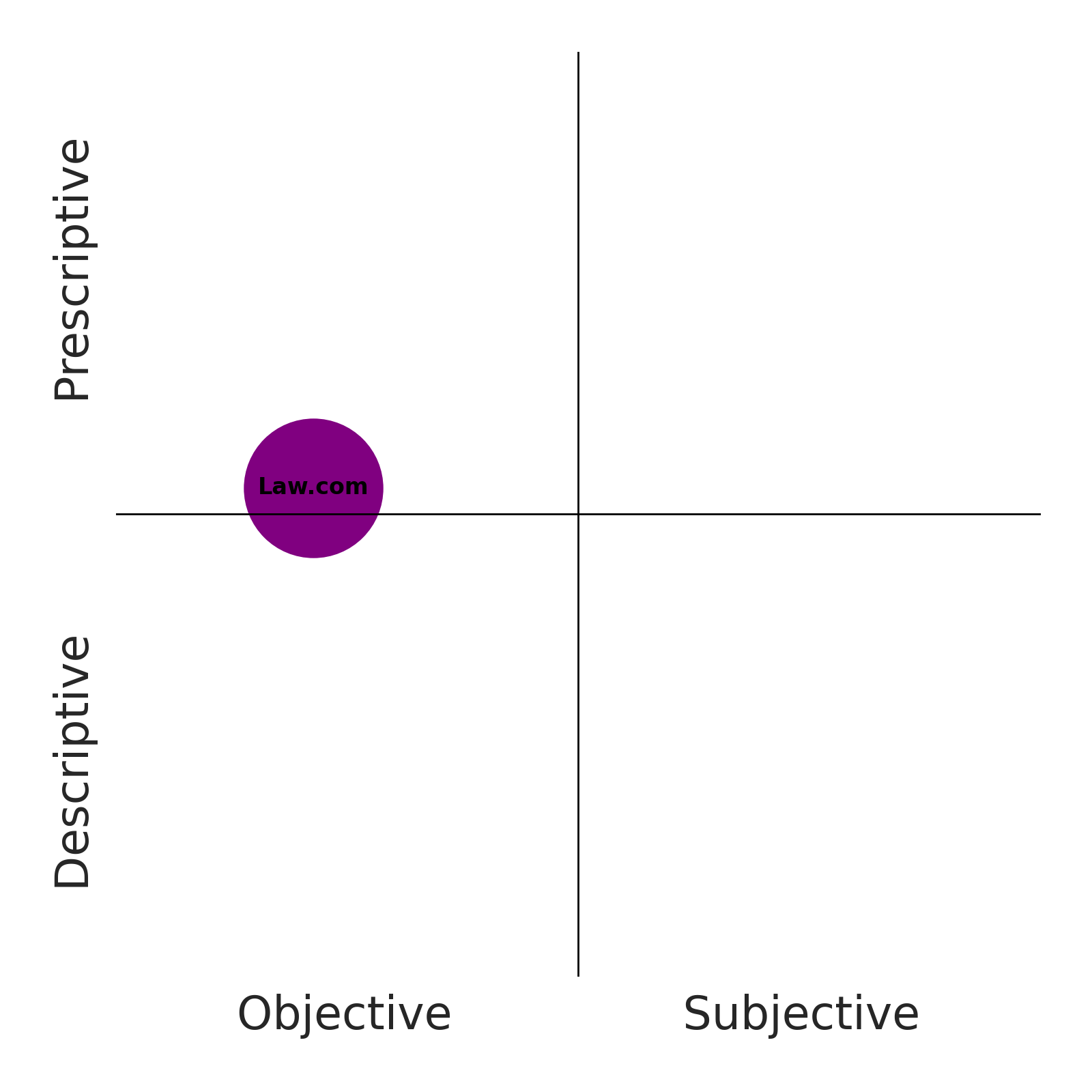
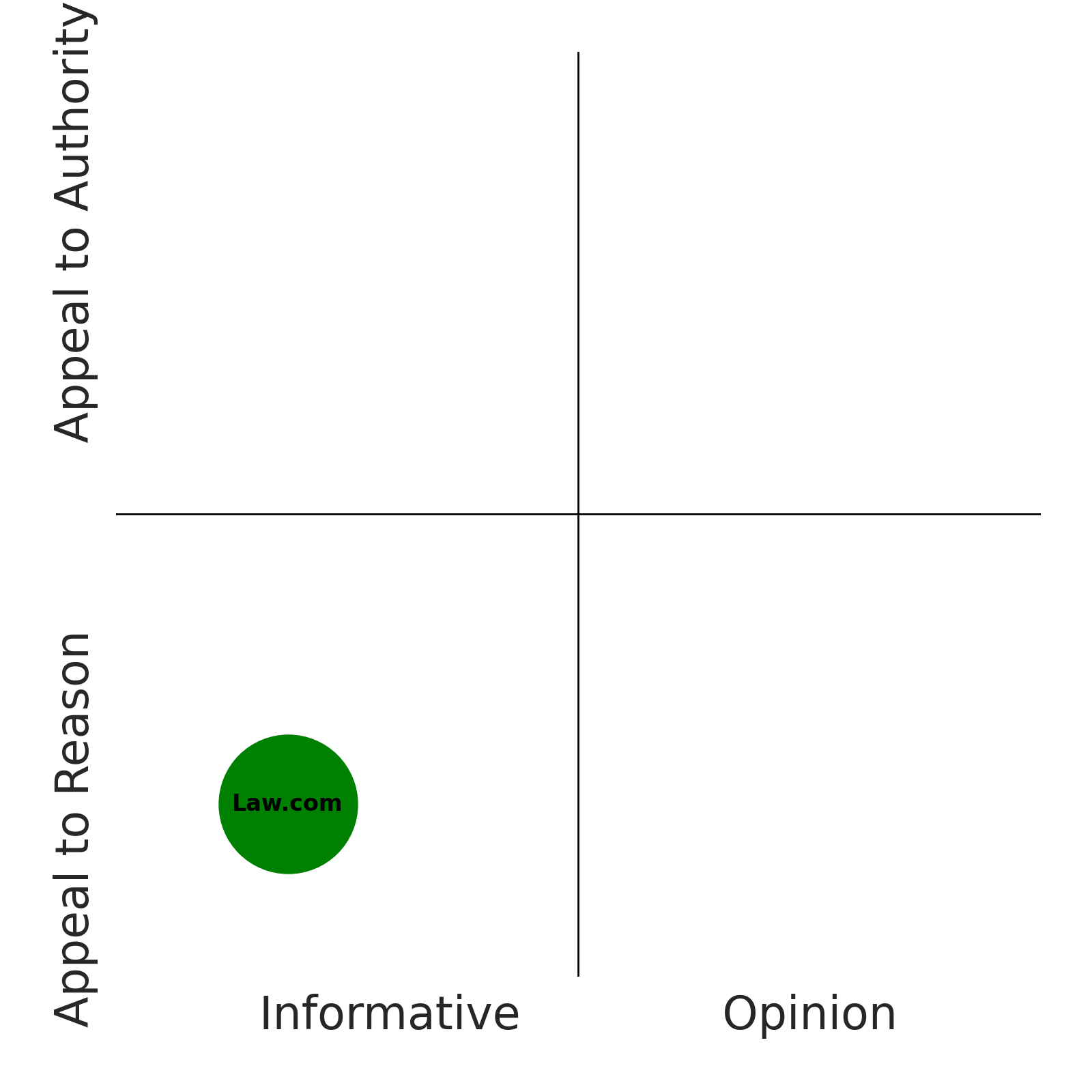
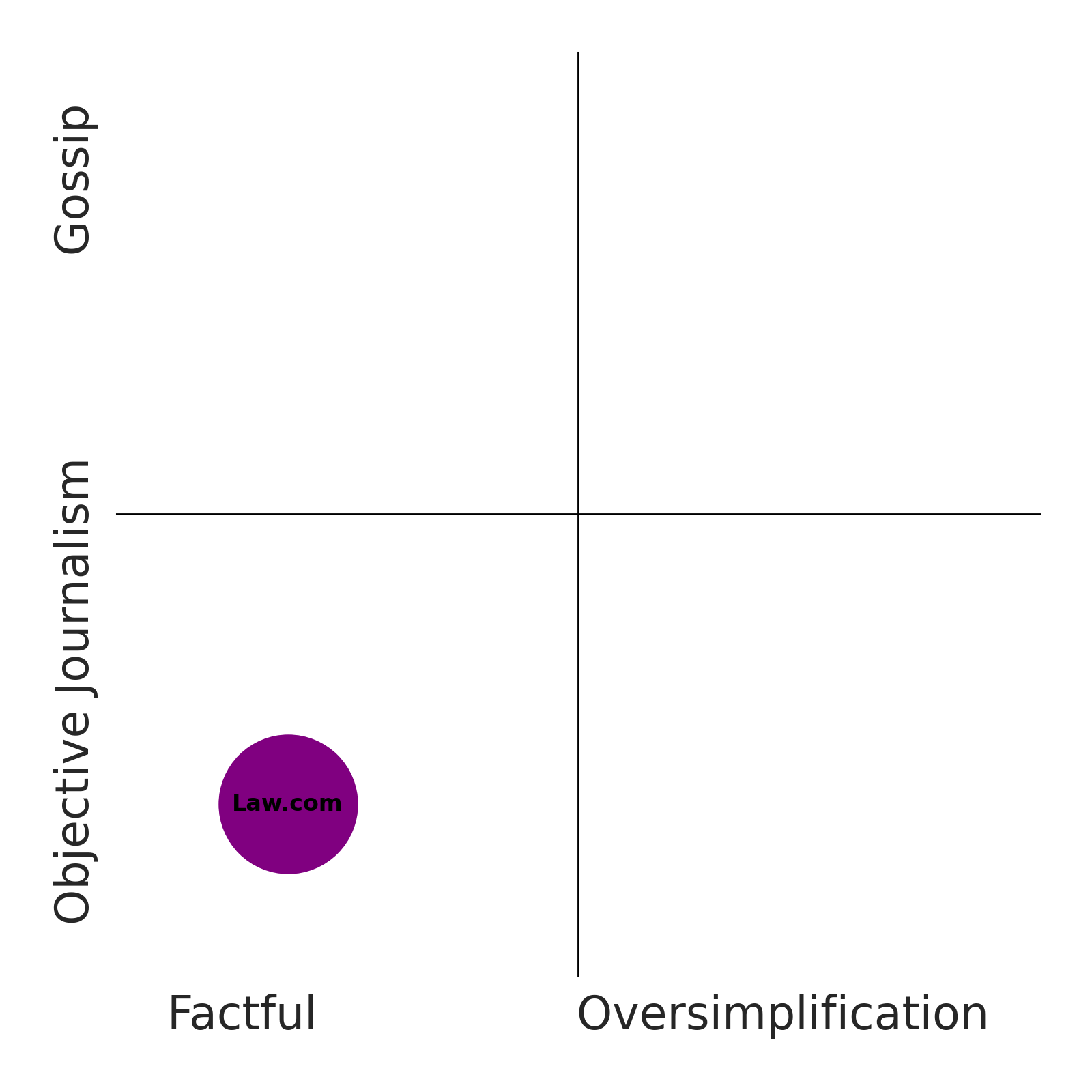
2026 © Helium Trades
Privacy Policy & Disclosure
* Disclaimer: Nothing on this website constitutes investment advice, performance data or any recommendation that any particular security, portfolio of securities, transaction or investment strategy is suitable for any specific person. Helium Trades is not responsible in any way for the accuracy
of any model predictions or price data. Any mention of a particular security and related prediction data is not a recommendation to buy or sell that security. Investments in securities involve the risk of loss. Past performance is no guarantee of future results. Helium Trades is not responsible for any of your investment decisions,
you should consult a financial expert before engaging in any transaction.
Helium Research Assistant

How can I help you today?
Ask any question about Law.com bias.