See whether Helium helps you make better-informed decisions. Try every Pro Trader feature for 30 days. No credit card required.
Try every Pro Trader feature for 30 days. No credit card required.
September 21, 2026 · 0 shares
Framing emphasizes unresolved economics of agricultural AI by balancing vendor promises against farmer-reported uncertainty and case-by-case value.
Automated analysis; not human reviewed. Limitations: The supplied text contains truncation markers and non-article promotional copy near the end, so some wording and context is incomplete or uncertain. · 4 of 55 available dimensions scored; omitted dimensions are not treated as neutral. · Verified supporting quotes for 3 of 4 scored dimensions.
Claim: Reporting maintains a predominantly objective stance by attributing contested claims and noting non-answers.
“Levinson did not directly answer follow-up questions asking how Netafim determines that its systems save money.” · exact text match
“Automated vehicles like drones and self-driving tractors reduce labor costs and squeeze more production out of a dwindling workforce, ag tech companies say.” · exact text match
Why: The publisher labels the labor-saving claim as a company assertion and records the failure to answer ROI questions, creating a clear boundary between report and attributed claim.
Claim: The article primarily describes the experiences and opinions of farmers and specialists rather than instructing readers on what to do.
“For their part, the Knuths decided drones are only worth the price in certain situations.” · exact text match
“Traditional methods of applying fertilizer or herbicides still work just fine, she said. But versatile drones can better handle fields filled with hills or trees.” · exact text match
Why: Choices and trade-offs are reported as conditional and source-specific, not as universal prescriptions.
Claim: The framing highlights uncertainty and avoids overstatement when discussing adoption and returns.
“The return on investment is hard to ascertain for most farming tech, Lee told Straight Arrow.” · exact text match
“The proportion of farmers who use new and emerging technologies is difficult to calculate, but data suggests a […] 8, which found that 23% of North American farmers use artificial intelligence and 10% are willing to pay for it.” · not found in supplied text
Why: The publisher explicitly flags gaps in ROI and adoption data rather than presenting a confident forecast or conclusion.
Claim: The reporting preserves inconvenient details that could weaken a favorable storyline about ag tech.
“Levinson did not directly answer follow-up questions asking how Netafim determines that its systems save money.” · exact text match
Why: Including a non-answer from a company whose systems are promoted shows epistemic diligence rather than one-sided promotion.
The supplied text contains truncation markers and non-article promotional copy near the end, so some wording and context is incomplete or uncertain.
September 21, 2026 · 0 shares
Framing emphasizes unresolved economics of agricultural AI by balancing vendor promises against farmer-reported uncertainty and case-by-case value.
Automated analysis; not human reviewed. Limitations: The supplied text contains truncation markers and non-article promotional copy near the end, so some wording and context is incomplete or uncertain. · 4 of 55 available dimensions scored; omitted dimensions are not treated as neutral. · Verified supporting quotes for 3 of 4 scored dimensions.
Claim: Reporting maintains a predominantly objective stance by attributing contested claims and noting non-answers.
“Levinson did not directly answer follow-up questions asking how Netafim determines that its systems save money.” · exact text match
“Automated vehicles like drones and self-driving tractors reduce labor costs and squeeze more production out of a dwindling workforce, ag tech companies say.” · exact text match
Why: The publisher labels the labor-saving claim as a company assertion and records the failure to answer ROI questions, creating a clear boundary between report and attributed claim.
Claim: The article primarily describes the experiences and opinions of farmers and specialists rather than instructing readers on what to do.
“For their part, the Knuths decided drones are only worth the price in certain situations.” · exact text match
“Traditional methods of applying fertilizer or herbicides still work just fine, she said. But versatile drones can better handle fields filled with hills or trees.” · exact text match
Why: Choices and trade-offs are reported as conditional and source-specific, not as universal prescriptions.
Claim: The framing highlights uncertainty and avoids overstatement when discussing adoption and returns.
“The return on investment is hard to ascertain for most farming tech, Lee told Straight Arrow.” · exact text match
“The proportion of farmers who use new and emerging technologies is difficult to calculate, but data suggests a […] 8, which found that 23% of North American farmers use artificial intelligence and 10% are willing to pay for it.” · not found in supplied text
Why: The publisher explicitly flags gaps in ROI and adoption data rather than presenting a confident forecast or conclusion.
Claim: The reporting preserves inconvenient details that could weaken a favorable storyline about ag tech.
“Levinson did not directly answer follow-up questions asking how Netafim determines that its systems save money.” · exact text match
Why: Including a non-answer from a company whose systems are promoted shows epistemic diligence rather than one-sided promotion.
The supplied text contains truncation markers and non-article promotional copy near the end, so some wording and context is incomplete or uncertain.
September 20, 2026 · 0 shares
Framing depicts the reported NIH grant board as a politicized override of objective scientific peer review and highlights harm to LGBTQ+ and minority health research.
The National Institutes of Health is a U.S. federal agency that funds medical research through grants; its normal process uses scientific peer-review panels rather than political appointees. An executive order is a presidential directive to the executive branch, not a statute.
Automated analysis; not human reviewed. Limitations: The supplied text is a truncated excerpt with ellipses and promotional material, making it difficult to distinguish article body from page chrome or to know whether any corrections or counterpoints appeared. · 5 of 55 available dimensions scored; omitted dimensions are not treated as neutral. · Verified supporting quotes for 4 of 5 scored dimensions.
Claim: Coverage frames the reported NIH grant board as an improper political takeover of scientific funding, a stance aligned with criticism from the political left.
“veto awards that don't align with Trump's agenda” · exact text match
“add a political approval layer to NIH grant funding” · exact text match
“cut nearly $800 million in grants for LGBTQ+ and minority health research in 2025, a documented reduction already affecting funded work in those areas.” · exact text match
Counterevidence:
“The claims are attributed to other outlets ('The NYT reported', 'Politico reported'), so some framing may originate with cited sources rather than the publisher.” · not found in supplied text
Why: The wording casts the administration's motive as partisan, frames the process as political rather than scientific, and singles out harm to politically salient research areas.
Claim: The report is primarily factual but uses interpretive descriptors that inject a subjective viewpoint.
“a political approval layer” · exact text match
“veto awards that don't align with Trump's agenda” · exact text match
Counterevidence:
“Reporting verbs and 'would' hedge attribute the proposal to third parties.” · not found in supplied text
Why: The first phrase tells the reader how to categorize the mechanism; the second describes the proposal from the standpoint of its alleged partisanship.
Claim: The story selects a contested partisan-administration action and narrates it with side-taking language.
“veto awards that don't align with Trump's agenda” · exact text match
“cut nearly $800 million in grants for LGBTQ+ and minority health research in 2025” · exact text match
Counterevidence:
“The stated change is attributed to reports and draft documents rather than asserted as a final decision.” · not found in supplied text
Why: The subject is inherently political, and the wording frames the action as a partisan attack rather than an ordinary administrative change.
Claim: The key claims are established through institutional authorities and unnamed officials rather than primary evidence.
“The NYT reported the draft order's goal is to create an external committee that can veto awards that don't align with Trump's agenda.” · exact text match
“Politico reported, citing two administration officials...” · not found in supplied text
“according to the agency's website” · verified after text normalization
Why: The publisher advances the story by leaning on established outlets and institutional statements, with no independent documentation.
Claim: The publisher presents scientific peer review as the legitimate empirical standard against which the political board is judged.
“NIH grant applications traditionally undergo a process where scientific peer-review panels analyze them.” · exact text match
“reviewers are fully vetted for appropriate expertise, potential conflicts of interest, and other requirements based on NIH peer review policies” · exact text match
Why: The description of peer review as vetted and expertise-based presents science as the rational norm, contrasting with political interference.
The supplied text is a truncated excerpt with ellipses and promotional material, making it difficult to distinguish article body from page chrome or to know whether any corrections or counterpoints appeared.
September 11, 2026 · 0 shares
Frames AI adoption in newsrooms as a destructive corporate cost-cutting measure that undermines local journalism and public trust, while claiming unbiased coverage.
The article focuses on the impact of artificial intelligence on journalism, particularly highlighting McClatchy's aggressive adoption of AI tools, resulting layoffs and pressure on reporters, and broader public attitudes toward AI-generated news, framed as an exclusive investigation by Straight Arrow.
Automated analysis; not human reviewed. Limitations: The input consisted of multiple seemingly disjointed headlines and snippets combined with promotional text, making it difficult to distinguish the primary article body from editorial context, though the McClatchy narrative dominates. · 16 of 54 available dimensions scored; omitted dimensions are not treated as neutral. · Verified supporting quotes for 9 of 16 scored dimensions.
Claim: The report sides with rank-and-file reporters against corporate executives.
“They're trying to kind of go towards these buzzy-type topics instead of local journalism that holds people to account” · verified after text normalization
“Executives pleaded with skeptical journalists to get on board” · exact text match
Why: Favors the experiences and grievances of working journalists over corporate leadership, indicating a populist orientation.
Claim: The report mixes factual reporting with subjective editorializing.
“city reporters out, s—ty reporters in” · exact text match
“Lost are reporters who rushed to the scenes of wildfires, served as government watchdogs” · not found in supplied text
Why: Subjective evaluations and nostalgic framing overshadow neutral reporting, shifting toward subjective presentation.
Claim: Uses sensationalized headlines to attract attention.
“When ‘the entire internet is fake,’ can you trust a newspaper’s promise to create a social media following?” · exact text match
“AI-generated articles have flooded the internet” · exact text match
Why: Hyperbolic phrases like 'entire internet is fake' and 'flooded' heighten drama.
Claim: The report emphasizes decline, loss, and distrust in journalism.
“We’re hemorrhaging people.” · not found in supplied text
“When ‘the entire internet is fake,’ can you trust a newspaper’s promise to create a social media following?” · exact text match
Why: The selection and framing of quotes and headlines overwhelmingly portray a negative outlook on the industry's future.
Claim: Though descriptive, the narrative implicitly prescribes resistance to corporate AI adoption.
“We’re being encouraged to do parachute reporting in our own communities.” · exact text match
“The human journalists who remain face steep pressures to crank out low-quality content at breakneck speed.” · not found in supplied text
Why: Descriptions of negative consequences imply an ethical obligation to oppose these practices.
Claim: The report amplifies anxiety about AI's spread and accuracy.
“AI-generated articles have flooded the internet” · exact text match
“Two-thirds of respondents said they’re concerned that AI would provide them with inaccurate information.” · exact text match
Why: Uses language like 'flooded' and highlights public concern to evoke fear.
Claim: The report highlights internal drama and scandalous incidents.
“'They just own my name now?' Ohio newspaper slaps reporter’s byline on AI-generated article” · verified after text normalization
“A newspaper publisher called immigrants ‘parasites’ on July 4th. A priest criticized him for publishing racist AI ‘slop’” · exact text match
Why: These headlines focus on personal grievances and sensational conflicts within the industry.
Claim: The report includes opinionated headlines and editorial commentary.
“When AI reports the news, facts don’t always get in the way of a good story” · exact text match
“‘They just own my name now?’” · exact text match
Why: The use of rhetorical questions and declarative opinions pushes beyond factual reporting.
Claim: The report frames journalists as victims of corporate and AI forces.
“Lost are reporters who rushed to the scenes of wildfires, served as government watchdogs and 'showed up at every high school game.'” · not found in supplied text
“We're hemorrhaging people.” · not found in supplied text
Why: Emphasizes the loss and suffering of journalists, constructing them as victims.
Claim: The publisher expresses absolute certainty about its own impartiality and truthfulness.
“Straight Arrow is fearlessly exposing the hard truths on the stories that matter most to you.” · exact text match
“No bias.” · exact text match
Why: These promotional statements assert perfect objectivity and truth without qualification.
Claim: The writing uses emotionally charged and derogatory language.
“city reporters out, s—ty reporters in” · exact text match
“We’re hemorrhaging people.” · not found in supplied text
Why: Direct quotes and editorials employ emotionally charged terms to influence reader sentiment.
Claim: The report portrays corporate media management negatively.
“McClatchy, which operates 29 daily newspapers across 14 states, has cut large portions of its reporting staff” · not found in supplied text
“We’re being pressured to write as many stories as possible” · exact text match
Why: Highlights corporate cost-cutting and pressure as harmful, reflecting an anti-corporate stance.
Claim: Uses loaded framing and stark dichotomies to influence perception.
“Executives pleaded with skeptical journalists to get on board, and issued what appeared to be a threat: Embrace AI or face consequences.” · exact text match
“The result has been a flood of AI-generated content at newspapers owned by McClatchy” · exact text match
Why: Loads words like 'threat' and 'flood' to characterize corporate actions and AI output dramatically.
Claim: Explicit claim of being unbiased contradicts the evident subjective framing.
“No bias.” · exact text match
“We’re being encouraged to do parachute reporting in our own communities.” · exact text match
Why: The self-proclaimed 'No bias' is undermined by the article's one-sided emotional framing.
Claim: The article demonstrates above-average informational depth.
“McClatchy, which operates 29 daily newspapers across 14 states, has cut large portions of its reporting staff” · not found in supplied text
“Only 9% of adult respondents said they get news at least sometimes from AI chatbots, according to a 2025 Pew survey.” · not found in supplied text
Why: Incorporates specific statistics, detailed corporate context, and multiple attributed quotes, indicating high informational complexity.
Claim: The outlet criticizes McClatchy for using AI while itself using AI to produce features, applying an incompatible standard.
“Straight Arrow uses AI to help produce features such as Media Miss and Media Landscape, which analyze coverage from multiple news outlets.” · exact text match
“When AI reports the news, facts don’t always get in the way of a good story” · exact text match
Why: The outlet accuses McClatchy of producing AI-generated content while openly using AI for its own features, creating a clear inconsistency.
The input consisted of multiple seemingly disjointed headlines and snippets combined with promotional text, making it difficult to distinguish the primary article body from editorial context, though the McClatchy narrative dominates.
September 11, 2026 · 0 shares
Frames AI adoption in newsrooms as a destructive corporate cost-cutting measure that undermines local journalism and public trust, while claiming unbiased coverage.
The article focuses on the impact of artificial intelligence on journalism, particularly highlighting McClatchy's aggressive adoption of AI tools, resulting layoffs and pressure on reporters, and broader public attitudes toward AI-generated news, framed as an exclusive investigation by Straight Arrow.
Automated analysis; not human reviewed. Limitations: The input consisted of multiple seemingly disjointed headlines and snippets combined with promotional text, making it difficult to distinguish the primary article body from editorial context, though the McClatchy narrative dominates. · 16 of 54 available dimensions scored; omitted dimensions are not treated as neutral. · Verified supporting quotes for 9 of 16 scored dimensions.
Claim: The report sides with rank-and-file reporters against corporate executives.
“They're trying to kind of go towards these buzzy-type topics instead of local journalism that holds people to account” · verified after text normalization
“Executives pleaded with skeptical journalists to get on board” · exact text match
Why: Favors the experiences and grievances of working journalists over corporate leadership, indicating a populist orientation.
Claim: The report mixes factual reporting with subjective editorializing.
“city reporters out, s—ty reporters in” · exact text match
“Lost are reporters who rushed to the scenes of wildfires, served as government watchdogs” · not found in supplied text
Why: Subjective evaluations and nostalgic framing overshadow neutral reporting, shifting toward subjective presentation.
Claim: Uses sensationalized headlines to attract attention.
“When ‘the entire internet is fake,’ can you trust a newspaper’s promise to create a social media following?” · exact text match
“AI-generated articles have flooded the internet” · exact text match
Why: Hyperbolic phrases like 'entire internet is fake' and 'flooded' heighten drama.
Claim: The report emphasizes decline, loss, and distrust in journalism.
“We’re hemorrhaging people.” · not found in supplied text
“When ‘the entire internet is fake,’ can you trust a newspaper’s promise to create a social media following?” · exact text match
Why: The selection and framing of quotes and headlines overwhelmingly portray a negative outlook on the industry's future.
Claim: Though descriptive, the narrative implicitly prescribes resistance to corporate AI adoption.
“We’re being encouraged to do parachute reporting in our own communities.” · exact text match
“The human journalists who remain face steep pressures to crank out low-quality content at breakneck speed.” · not found in supplied text
Why: Descriptions of negative consequences imply an ethical obligation to oppose these practices.
Claim: The report amplifies anxiety about AI's spread and accuracy.
“AI-generated articles have flooded the internet” · exact text match
“Two-thirds of respondents said they’re concerned that AI would provide them with inaccurate information.” · exact text match
Why: Uses language like 'flooded' and highlights public concern to evoke fear.
Claim: The report highlights internal drama and scandalous incidents.
“'They just own my name now?' Ohio newspaper slaps reporter’s byline on AI-generated article” · verified after text normalization
“A newspaper publisher called immigrants ‘parasites’ on July 4th. A priest criticized him for publishing racist AI ‘slop’” · exact text match
Why: These headlines focus on personal grievances and sensational conflicts within the industry.
Claim: The report includes opinionated headlines and editorial commentary.
“When AI reports the news, facts don’t always get in the way of a good story” · exact text match
“‘They just own my name now?’” · exact text match
Why: The use of rhetorical questions and declarative opinions pushes beyond factual reporting.
Claim: The report frames journalists as victims of corporate and AI forces.
“Lost are reporters who rushed to the scenes of wildfires, served as government watchdogs and 'showed up at every high school game.'” · not found in supplied text
“We're hemorrhaging people.” · not found in supplied text
Why: Emphasizes the loss and suffering of journalists, constructing them as victims.
Claim: The publisher expresses absolute certainty about its own impartiality and truthfulness.
“Straight Arrow is fearlessly exposing the hard truths on the stories that matter most to you.” · exact text match
“No bias.” · exact text match
Why: These promotional statements assert perfect objectivity and truth without qualification.
Claim: The writing uses emotionally charged and derogatory language.
“city reporters out, s—ty reporters in” · exact text match
“We’re hemorrhaging people.” · not found in supplied text
Why: Direct quotes and editorials employ emotionally charged terms to influence reader sentiment.
Claim: The report portrays corporate media management negatively.
“McClatchy, which operates 29 daily newspapers across 14 states, has cut large portions of its reporting staff” · not found in supplied text
“We’re being pressured to write as many stories as possible” · exact text match
Why: Highlights corporate cost-cutting and pressure as harmful, reflecting an anti-corporate stance.
Claim: Uses loaded framing and stark dichotomies to influence perception.
“Executives pleaded with skeptical journalists to get on board, and issued what appeared to be a threat: Embrace AI or face consequences.” · exact text match
“The result has been a flood of AI-generated content at newspapers owned by McClatchy” · exact text match
Why: Loads words like 'threat' and 'flood' to characterize corporate actions and AI output dramatically.
Claim: Explicit claim of being unbiased contradicts the evident subjective framing.
“No bias.” · exact text match
“We’re being encouraged to do parachute reporting in our own communities.” · exact text match
Why: The self-proclaimed 'No bias' is undermined by the article's one-sided emotional framing.
Claim: The article demonstrates above-average informational depth.
“McClatchy, which operates 29 daily newspapers across 14 states, has cut large portions of its reporting staff” · not found in supplied text
“Only 9% of adult respondents said they get news at least sometimes from AI chatbots, according to a 2025 Pew survey.” · not found in supplied text
Why: Incorporates specific statistics, detailed corporate context, and multiple attributed quotes, indicating high informational complexity.
Claim: The outlet criticizes McClatchy for using AI while itself using AI to produce features, applying an incompatible standard.
“Straight Arrow uses AI to help produce features such as Media Miss and Media Landscape, which analyze coverage from multiple news outlets.” · exact text match
“When AI reports the news, facts don’t always get in the way of a good story” · exact text match
Why: The outlet accuses McClatchy of producing AI-generated content while openly using AI for its own features, creating a clear inconsistency.
The input consisted of multiple seemingly disjointed headlines and snippets combined with promotional text, making it difficult to distinguish the primary article body from editorial context, though the McClatchy narrative dominates.
September 20, 2026 · 0 shares
Framing depicts the reported NIH grant board as a politicized override of objective scientific peer review and highlights harm to LGBTQ+ and minority health research.
The National Institutes of Health is a U.S. federal agency that funds medical research through grants; its normal process uses scientific peer-review panels rather than political appointees. An executive order is a presidential directive to the executive branch, not a statute.
Automated analysis; not human reviewed. Limitations: The supplied text is a truncated excerpt with ellipses and promotional material, making it difficult to distinguish article body from page chrome or to know whether any corrections or counterpoints appeared. · 5 of 55 available dimensions scored; omitted dimensions are not treated as neutral. · Verified supporting quotes for 4 of 5 scored dimensions.
Claim: Coverage frames the reported NIH grant board as an improper political takeover of scientific funding, a stance aligned with criticism from the political left.
“veto awards that don't align with Trump's agenda” · exact text match
“add a political approval layer to NIH grant funding” · exact text match
“cut nearly $800 million in grants for LGBTQ+ and minority health research in 2025, a documented reduction already affecting funded work in those areas.” · exact text match
Counterevidence:
“The claims are attributed to other outlets ('The NYT reported', 'Politico reported'), so some framing may originate with cited sources rather than the publisher.” · not found in supplied text
Why: The wording casts the administration's motive as partisan, frames the process as political rather than scientific, and singles out harm to politically salient research areas.
Claim: The report is primarily factual but uses interpretive descriptors that inject a subjective viewpoint.
“a political approval layer” · exact text match
“veto awards that don't align with Trump's agenda” · exact text match
Counterevidence:
“Reporting verbs and 'would' hedge attribute the proposal to third parties.” · not found in supplied text
Why: The first phrase tells the reader how to categorize the mechanism; the second describes the proposal from the standpoint of its alleged partisanship.
Claim: The story selects a contested partisan-administration action and narrates it with side-taking language.
“veto awards that don't align with Trump's agenda” · exact text match
“cut nearly $800 million in grants for LGBTQ+ and minority health research in 2025” · exact text match
Counterevidence:
“The stated change is attributed to reports and draft documents rather than asserted as a final decision.” · not found in supplied text
Why: The subject is inherently political, and the wording frames the action as a partisan attack rather than an ordinary administrative change.
Claim: The key claims are established through institutional authorities and unnamed officials rather than primary evidence.
“The NYT reported the draft order's goal is to create an external committee that can veto awards that don't align with Trump's agenda.” · exact text match
“Politico reported, citing two administration officials...” · not found in supplied text
“according to the agency's website” · verified after text normalization
Why: The publisher advances the story by leaning on established outlets and institutional statements, with no independent documentation.
Claim: The publisher presents scientific peer review as the legitimate empirical standard against which the political board is judged.
“NIH grant applications traditionally undergo a process where scientific peer-review panels analyze them.” · exact text match
“reviewers are fully vetted for appropriate expertise, potential conflicts of interest, and other requirements based on NIH peer review policies” · exact text match
Why: The description of peer review as vetted and expertise-based presents science as the rational norm, contrasting with political interference.
The supplied text is a truncated excerpt with ellipses and promotional material, making it difficult to distinguish article body from page chrome or to know whether any corrections or counterpoints appeared.
September 20, 2026 · 0 shares
Framing depicts the reported NIH grant board as a politicized override of objective scientific peer review and highlights harm to LGBTQ+ and minority health research.
The National Institutes of Health is a U.S. federal agency that funds medical research through grants; its normal process uses scientific peer-review panels rather than political appointees. An executive order is a presidential directive to the executive branch, not a statute.
Automated analysis; not human reviewed. Limitations: The supplied text is a truncated excerpt with ellipses and promotional material, making it difficult to distinguish article body from page chrome or to know whether any corrections or counterpoints appeared. · 5 of 55 available dimensions scored; omitted dimensions are not treated as neutral. · Verified supporting quotes for 4 of 5 scored dimensions.
Claim: Coverage frames the reported NIH grant board as an improper political takeover of scientific funding, a stance aligned with criticism from the political left.
“veto awards that don't align with Trump's agenda” · exact text match
“add a political approval layer to NIH grant funding” · exact text match
“cut nearly $800 million in grants for LGBTQ+ and minority health research in 2025, a documented reduction already affecting funded work in those areas.” · exact text match
Counterevidence:
“The claims are attributed to other outlets ('The NYT reported', 'Politico reported'), so some framing may originate with cited sources rather than the publisher.” · not found in supplied text
Why: The wording casts the administration's motive as partisan, frames the process as political rather than scientific, and singles out harm to politically salient research areas.
Claim: The report is primarily factual but uses interpretive descriptors that inject a subjective viewpoint.
“a political approval layer” · exact text match
“veto awards that don't align with Trump's agenda” · exact text match
Counterevidence:
“Reporting verbs and 'would' hedge attribute the proposal to third parties.” · not found in supplied text
Why: The first phrase tells the reader how to categorize the mechanism; the second describes the proposal from the standpoint of its alleged partisanship.
Claim: The story selects a contested partisan-administration action and narrates it with side-taking language.
“veto awards that don't align with Trump's agenda” · exact text match
“cut nearly $800 million in grants for LGBTQ+ and minority health research in 2025” · exact text match
Counterevidence:
“The stated change is attributed to reports and draft documents rather than asserted as a final decision.” · not found in supplied text
Why: The subject is inherently political, and the wording frames the action as a partisan attack rather than an ordinary administrative change.
Claim: The key claims are established through institutional authorities and unnamed officials rather than primary evidence.
“The NYT reported the draft order's goal is to create an external committee that can veto awards that don't align with Trump's agenda.” · exact text match
“Politico reported, citing two administration officials...” · not found in supplied text
“according to the agency's website” · verified after text normalization
Why: The publisher advances the story by leaning on established outlets and institutional statements, with no independent documentation.
Claim: The publisher presents scientific peer review as the legitimate empirical standard against which the political board is judged.
“NIH grant applications traditionally undergo a process where scientific peer-review panels analyze them.” · exact text match
“reviewers are fully vetted for appropriate expertise, potential conflicts of interest, and other requirements based on NIH peer review policies” · exact text match
Why: The description of peer review as vetted and expertise-based presents science as the rational norm, contrasting with political interference.
The supplied text is a truncated excerpt with ellipses and promotional material, making it difficult to distinguish article body from page chrome or to know whether any corrections or counterpoints appeared.
September 09, 2026 · 0 shares
The publisher wraps a cybersecurity report in self-promotional, anti-media rhetoric and sensational clickbait headlines, presenting itself as an unbiased truth-teller while amplifying alarm and curiosity.
Automated analysis; not human reviewed. Limitations: The supplied text is a truncated mashup of headlines, promotional blurbs, and a partial breach report, so classifications rely on incomplete excerpts rather than a single coherent article. · 13 of 54 available dimensions scored; omitted dimensions are not treated as neutral. · Verified supporting quotes for 13 of 13 scored dimensions.
Claim: The publisher positions itself as a trustworthy alternative to a mistrusted media.
“It’s harder than ever to discern fact from fiction, and mistrust of the media is at an all-time high.” · exact text match
“Finally, unbiased news that lets you see both sides.” · exact text match
Why: This frames the publisher as the remedy for media mistrust, a populist appeal.
Claim: The publisher's selection and wording treat surveillance cameras as an imposition to be resisted.
“‘Flock Sock’ blocks unpopular surveillance cameras” · exact text match
“Every one of this town’s Flock cameras was cut down” · exact text match
Why: Describing cameras as 'unpopular' and highlighting their blocking/cutting endorses individual resistance to state surveillance.
Claim: The text intermixes factual reporting with subjective and self-promotional language.
“Incredibly, over a 24 hour period, as reported by cybersecurity journalist Brian Krebs, the number of available documents even increased by 400,000.” · exact text match
“Straight Arrow is fearlessly exposing the hard truths on the stories that matter most to you.” · exact text match
Why: The adverb 'Incredibly' and the phrase 'fearlessly exposing the hard truths' inject evaluation rather than neutral description.
Claim: Headlines use alarming and curiosity-driven phrasing that amplifies drama.
“‘AI could kill all humans!’ Anthropic researcher claims 10% chance of a dystopian sci-fi future in the next decade” · exact text match
“Want a copy of Pete Hegseth’s driver’s license? It’s for sale on the dark web” · exact text match
Why: These formulations prioritize shock and curiosity over neutral summary.
Claim: The text uses catastrophic and security-alarm framing to create anxiety.
“‘AI could kill all humans!’ Anthropic researcher claims 10% chance of a dystopian sci-fi future in the next decade” · exact text match
“national security, got caught up in the hack as well.” · exact text match
Why: 'kill all humans' and 'national security' are fear-laden frames.
Claim: The text highlights private personal data of named individuals in a gossip-oriented register.
“Want a copy of Pete Hegseth’s driver’s license? It’s for sale on the dark web” · exact text match
“Meet the security researcher who found Andrew Tate’s secretive data leaking online” · exact text match
Why: Individual secrets and personal records are presented as intriguing content rather than policy analysis.
Claim: The text includes editorial assertions and promotional judgments beyond factual reporting.
“No bias.” · exact text match
“Finally, unbiased news that lets you see both sides. It’s refreshing to have facts without the spin.” · exact text match
Why: These are evaluative claims about the publisher's own product, not reportable facts.
Claim: The text leans on named authorities and rating labels to establish credibility.
“Perfect reliability rating, according to experts at NewsGuard” · exact text match
“as reported by cybersecurity journalist Brian Krebs” · exact text match
Why: It invokes external authorities instead of letting the reported evidence stand on its own.
Claim: The publisher states categorical guarantees of its own reliability and neutrality.
“Perfect reliability rating, according to experts at NewsGuard” · exact text match
“No bias.” · exact text match
Why: A perfect rating and absolute 'no bias' claim exceed what the text itself can demonstrate.
Claim: The publisher presents itself as exposing hard truths that established institutions obscure.
“Straight Arrow is fearlessly exposing the hard truths on the stories that matter most to you.” · exact text match
“Why did the Feds seize the ’largest Martian meteorite on Earth’?” · exact text match
Why: The self-description and a headline questioning federal seizure cast institutional power as something to be exposed.
Claim: The report attributes key claims to named sources and marks source identification as belief.
“as reported by cybersecurity journalist Brian Krebs” · exact text match
“The company believed to be the source of the documents is IDscan.net” · exact text match
Why: Visible attribution and hedging support moderate credibility, though much of the surrounding page is promotional.
Claim: The author makes an explicit forecast about the dark-web service returning.
“It seems very possible that Nexus will return once the attention dies down” · exact text match
Why: This goes beyond current reported facts into prediction.
Claim: The text uses loaded and curiosity-baiting phrasing that primes an emotional response.
“‘AI could kill all humans!’ Anthropic researcher claims 10% chance of a dystopian sci-fi future in the next decade” · exact text match
“Want a copy of Pete Hegseth’s driver’s license? It’s for sale on the dark web” · exact text match
Why: Alarm and personal-data curiosity are observable techniques used to draw readers.
The supplied text is a truncated mashup of headlines, promotional blurbs, and a partial breach report, so classifications rely on incomplete excerpts rather than a single coherent article.
September 16, 2026 · 0 shares
Legal allegations and court rulings are reported with attribution, but rhetorical questions about headline coverage and political temperature frame Kirk's death as a politically charged killing being neglected.
Automated analysis; not human reviewed. Limitations: The supplied text is truncated and contains ellipses and embedded headlines, leaving some names, dates, and attributions incomplete. · 7 of 54 available dimensions scored; omitted dimensions are not treated as neutral. · Verified supporting quotes for 7 of 7 scored dimensions.
Claim: The report mixes attributed legal news with rhetorical, answer-implying questions.
“Why is it not making headlines?” · exact text match
“One year after Charlie Kirk’s killing, has America’s political temperature cooled?” · exact text match
Why: These questions invite conclusions about neglect and political relevance without supplying or testing evidence.
Claim: Dramatic legal and rhetorical language raises the emotional stakes of the killing.
“Charlie Kirk murder suspect ordered to stand trial with death penalty on the table” · exact text match
“Why is it not making headlines?” · exact text match
Why: A death-penalty headline and a loaded media-neglect question emphasize outrage and consequence rather than neutral summary.
Claim: One question presupposes an answer about newsworthiness.
“Why is it not making headlines?” · exact text match
Why: It presumes the event should have made headlines, which is part of the implied argument rather than an established fact.
Claim: Opinionated rhetorical questions appear within otherwise factual reporting.
“One year after Charlie Kirk’s killing, has America’s political temperature cooled?” · exact text match
“Why is it not making headlines?” · exact text match
Why: These questions assert interpretations in question form, an opinionated technique.
Claim: The killing is framed as a measure of national political conflict.
“One year after Charlie Kirk’s killing, has America’s political temperature cooled?” · exact text match
Why: The question connects a homicide case to broader political temperature rather than limiting the frame to the legal case.
Claim: The report generally attributes factual assertions to sources and includes official responses.
“In a statement to The Associated Press, Utah Valley University said it was aware of the notice and would address it through its established processes.” · exact text match
“Utah District Judge Tony Graf said there is enough evidence to “support a reasonable belief” that” · exact text match
Why: Attribution to the university, the attorney general's office, the police, and a judge supports credibility, though rhetorical questions lower it somewhat.
Claim: The text speculates about media coverage and political mood without evidence.
“Why is it not making headlines?” · exact text match
“has America’s political temperature cooled?” · exact text match
Why: Both phrasings make unverified claims about external response and public mood.
The supplied text is truncated and contains ellipses and embedded headlines, leaving some names, dates, and attributions incomplete.
September 03, 2026 · 0 shares
The publisher packages reported stories inside a self-described 'unbiased' news-commentary format, using alarming tech/privacy lead-ins and framing the White House ballroom dispute primarily as a question of congressional authority.
Automated analysis; not human reviewed. Limitations: The supplied text contains a podcast transcript with duplicate passages and is interleaved with related-headline and promotional material, making it somewhat uncertain which portions are core episode content versus page chrome. · 7 of 54 available dimensions scored; omitted dimensions are not treated as neutral. · Verified supporting quotes for 7 of 7 scored dimensions.
Claim: The episode is explicitly framed as commentary and editorial selection rather than straight news reporting.
“But here on Off Script, we get to talk about it.” · exact text match
“First, What Matters: a story that caught our attention this week — and why we think it deserves yours.” · exact text match
Why: The publisher repeatedly contrasts 'reporting the news' with 'talking about it' and uses first-person editorial judgments to choose stories.
Claim: The publisher packages stories with dramatic, attention-grabbing headlines and lead-ins.
“'I can’t think of anything worse than this.' Privacy at risk as ChatGPT now connects to iMessage” · verified after text normalization
“Want to manipulate hearts and minds online? Amazon sells just the bot farm you need” · exact text match
Why: The headlines use strong alarm and manipulation imagery, though the body of the segments remains more explanatory and nuanced.
Claim: The ChatGPT/iMessage segment frames the feature as a privacy danger that people cannot opt out of.
“'I can’t think of anything worse than this.' Privacy at risk as ChatGPT now connects to iMessage” · verified after text normalization
“Other people in those conversations don’t get a say in whether their messages are shared with AI.” · exact text match
Why: The segment emphasizes lack of consent and potential exposure of personal messages, creating a fear-driven privacy concern rather than a neutral product description.
Claim: The transcript is heavily opinionated and conversational, with hosts and reporters explicitly stating what they think matters.
“First, What Matters: a story that caught our attention this week — and why we think it deserves yours.” · exact text match
“But here on Off Script, we get to talk about it.” · exact text match
Why: The program labels itself as an off-script discussion where the hosts talk about the news rather than only reporting it.
Claim: The episode is centered on government, courts, and executive-branch policy disputes.
“The Trump administration has asked the Supreme Court to allow the military to remove 29 transgender plaintiffs from service before their challenge to the Pentagon’s policy goes to trial in January.” · exact text match
Why: Multiple segments concern federal officials, Supreme Court actions, military leadership, and presidential authority, making the episode substantially political.
Claim: The transcript consistently attributes claims, notes reported friction, and identifies sourcing.
“Apple didn’t respond to my request for comment.” · exact text match
“According to the White House, these firms now represent approximately 90% of the domestic pharmaceutical market.” · exact text match
Why: Sourcing and attribution are visible throughout, including 'reported friction' and 'according to the White House,' which supports credibility even though the program is partly opinionated.
Claim: The reporting shows visible honesty signals, including attribution and disclosure of nonresponses.
“Apple didn’t respond to my request for comment.” · exact text match
“But here on Off Script, we get to talk about it.” · exact text match
Why: The transcript notes companies' nonresponses and explicitly labels the program as commentary, showing internal transparency and fairness signals.
The supplied text contains a podcast transcript with duplicate passages and is interleaved with related-headline and promotional material, making it somewhat uncertain which portions are core episode content versus page chrome.
September 09, 2026 · 0 shares
The publisher wraps a cybersecurity report in self-promotional, anti-media rhetoric and sensational clickbait headlines, presenting itself as an unbiased truth-teller while amplifying alarm and curiosity.
Automated analysis; not human reviewed. Limitations: The supplied text is a truncated mashup of headlines, promotional blurbs, and a partial breach report, so classifications rely on incomplete excerpts rather than a single coherent article. · 13 of 54 available dimensions scored; omitted dimensions are not treated as neutral. · Verified supporting quotes for 13 of 13 scored dimensions.
Claim: The publisher positions itself as a trustworthy alternative to a mistrusted media.
“It’s harder than ever to discern fact from fiction, and mistrust of the media is at an all-time high.” · exact text match
“Finally, unbiased news that lets you see both sides.” · exact text match
Why: This frames the publisher as the remedy for media mistrust, a populist appeal.
Claim: The publisher's selection and wording treat surveillance cameras as an imposition to be resisted.
“‘Flock Sock’ blocks unpopular surveillance cameras” · exact text match
“Every one of this town’s Flock cameras was cut down” · exact text match
Why: Describing cameras as 'unpopular' and highlighting their blocking/cutting endorses individual resistance to state surveillance.
Claim: The text intermixes factual reporting with subjective and self-promotional language.
“Incredibly, over a 24 hour period, as reported by cybersecurity journalist Brian Krebs, the number of available documents even increased by 400,000.” · exact text match
“Straight Arrow is fearlessly exposing the hard truths on the stories that matter most to you.” · exact text match
Why: The adverb 'Incredibly' and the phrase 'fearlessly exposing the hard truths' inject evaluation rather than neutral description.
Claim: Headlines use alarming and curiosity-driven phrasing that amplifies drama.
“‘AI could kill all humans!’ Anthropic researcher claims 10% chance of a dystopian sci-fi future in the next decade” · exact text match
“Want a copy of Pete Hegseth’s driver’s license? It’s for sale on the dark web” · exact text match
Why: These formulations prioritize shock and curiosity over neutral summary.
Claim: The text uses catastrophic and security-alarm framing to create anxiety.
“‘AI could kill all humans!’ Anthropic researcher claims 10% chance of a dystopian sci-fi future in the next decade” · exact text match
“national security, got caught up in the hack as well.” · exact text match
Why: 'kill all humans' and 'national security' are fear-laden frames.
Claim: The text highlights private personal data of named individuals in a gossip-oriented register.
“Want a copy of Pete Hegseth’s driver’s license? It’s for sale on the dark web” · exact text match
“Meet the security researcher who found Andrew Tate’s secretive data leaking online” · exact text match
Why: Individual secrets and personal records are presented as intriguing content rather than policy analysis.
Claim: The text includes editorial assertions and promotional judgments beyond factual reporting.
“No bias.” · exact text match
“Finally, unbiased news that lets you see both sides. It’s refreshing to have facts without the spin.” · exact text match
Why: These are evaluative claims about the publisher's own product, not reportable facts.
Claim: The text leans on named authorities and rating labels to establish credibility.
“Perfect reliability rating, according to experts at NewsGuard” · exact text match
“as reported by cybersecurity journalist Brian Krebs” · exact text match
Why: It invokes external authorities instead of letting the reported evidence stand on its own.
Claim: The publisher states categorical guarantees of its own reliability and neutrality.
“Perfect reliability rating, according to experts at NewsGuard” · exact text match
“No bias.” · exact text match
Why: A perfect rating and absolute 'no bias' claim exceed what the text itself can demonstrate.
Claim: The publisher presents itself as exposing hard truths that established institutions obscure.
“Straight Arrow is fearlessly exposing the hard truths on the stories that matter most to you.” · exact text match
“Why did the Feds seize the ’largest Martian meteorite on Earth’?” · exact text match
Why: The self-description and a headline questioning federal seizure cast institutional power as something to be exposed.
Claim: The report attributes key claims to named sources and marks source identification as belief.
“as reported by cybersecurity journalist Brian Krebs” · exact text match
“The company believed to be the source of the documents is IDscan.net” · exact text match
Why: Visible attribution and hedging support moderate credibility, though much of the surrounding page is promotional.
Claim: The author makes an explicit forecast about the dark-web service returning.
“It seems very possible that Nexus will return once the attention dies down” · exact text match
Why: This goes beyond current reported facts into prediction.
Claim: The text uses loaded and curiosity-baiting phrasing that primes an emotional response.
“‘AI could kill all humans!’ Anthropic researcher claims 10% chance of a dystopian sci-fi future in the next decade” · exact text match
“Want a copy of Pete Hegseth’s driver’s license? It’s for sale on the dark web” · exact text match
Why: Alarm and personal-data curiosity are observable techniques used to draw readers.
The supplied text is a truncated mashup of headlines, promotional blurbs, and a partial breach report, so classifications rely on incomplete excerpts rather than a single coherent article.
September 21, 2026 · 0 shares
Framing emphasizes unresolved economics of agricultural AI by balancing vendor promises against farmer-reported uncertainty and case-by-case value.
Automated analysis; not human reviewed. Limitations: The supplied text contains truncation markers and non-article promotional copy near the end, so some wording and context is incomplete or uncertain. · 4 of 55 available dimensions scored; omitted dimensions are not treated as neutral. · Verified supporting quotes for 3 of 4 scored dimensions.
Claim: Reporting maintains a predominantly objective stance by attributing contested claims and noting non-answers.
“Levinson did not directly answer follow-up questions asking how Netafim determines that its systems save money.” · exact text match
“Automated vehicles like drones and self-driving tractors reduce labor costs and squeeze more production out of a dwindling workforce, ag tech companies say.” · exact text match
Why: The publisher labels the labor-saving claim as a company assertion and records the failure to answer ROI questions, creating a clear boundary between report and attributed claim.
Claim: The article primarily describes the experiences and opinions of farmers and specialists rather than instructing readers on what to do.
“For their part, the Knuths decided drones are only worth the price in certain situations.” · exact text match
“Traditional methods of applying fertilizer or herbicides still work just fine, she said. But versatile drones can better handle fields filled with hills or trees.” · exact text match
Why: Choices and trade-offs are reported as conditional and source-specific, not as universal prescriptions.
Claim: The framing highlights uncertainty and avoids overstatement when discussing adoption and returns.
“The return on investment is hard to ascertain for most farming tech, Lee told Straight Arrow.” · exact text match
“The proportion of farmers who use new and emerging technologies is difficult to calculate, but data suggests a […] 8, which found that 23% of North American farmers use artificial intelligence and 10% are willing to pay for it.” · not found in supplied text
Why: The publisher explicitly flags gaps in ROI and adoption data rather than presenting a confident forecast or conclusion.
Claim: The reporting preserves inconvenient details that could weaken a favorable storyline about ag tech.
“Levinson did not directly answer follow-up questions asking how Netafim determines that its systems save money.” · exact text match
Why: Including a non-answer from a company whose systems are promoted shows epistemic diligence rather than one-sided promotion.
The supplied text contains truncation markers and non-article promotional copy near the end, so some wording and context is incomplete or uncertain.
September 16, 2026 · 0 shares
Legal allegations and court rulings are reported with attribution, but rhetorical questions about headline coverage and political temperature frame Kirk's death as a politically charged killing being neglected.
Automated analysis; not human reviewed. Limitations: The supplied text is truncated and contains ellipses and embedded headlines, leaving some names, dates, and attributions incomplete. · 7 of 54 available dimensions scored; omitted dimensions are not treated as neutral. · Verified supporting quotes for 7 of 7 scored dimensions.
Claim: The report mixes attributed legal news with rhetorical, answer-implying questions.
“Why is it not making headlines?” · exact text match
“One year after Charlie Kirk’s killing, has America’s political temperature cooled?” · exact text match
Why: These questions invite conclusions about neglect and political relevance without supplying or testing evidence.
Claim: Dramatic legal and rhetorical language raises the emotional stakes of the killing.
“Charlie Kirk murder suspect ordered to stand trial with death penalty on the table” · exact text match
“Why is it not making headlines?” · exact text match
Why: A death-penalty headline and a loaded media-neglect question emphasize outrage and consequence rather than neutral summary.
Claim: One question presupposes an answer about newsworthiness.
“Why is it not making headlines?” · exact text match
Why: It presumes the event should have made headlines, which is part of the implied argument rather than an established fact.
Claim: Opinionated rhetorical questions appear within otherwise factual reporting.
“One year after Charlie Kirk’s killing, has America’s political temperature cooled?” · exact text match
“Why is it not making headlines?” · exact text match
Why: These questions assert interpretations in question form, an opinionated technique.
Claim: The killing is framed as a measure of national political conflict.
“One year after Charlie Kirk’s killing, has America’s political temperature cooled?” · exact text match
Why: The question connects a homicide case to broader political temperature rather than limiting the frame to the legal case.
Claim: The report generally attributes factual assertions to sources and includes official responses.
“In a statement to The Associated Press, Utah Valley University said it was aware of the notice and would address it through its established processes.” · exact text match
“Utah District Judge Tony Graf said there is enough evidence to “support a reasonable belief” that” · exact text match
Why: Attribution to the university, the attorney general's office, the police, and a judge supports credibility, though rhetorical questions lower it somewhat.
Claim: The text speculates about media coverage and political mood without evidence.
“Why is it not making headlines?” · exact text match
“has America’s political temperature cooled?” · exact text match
Why: Both phrasings make unverified claims about external response and public mood.
The supplied text is truncated and contains ellipses and embedded headlines, leaving some names, dates, and attributions incomplete.
September 03, 2026 · 0 shares
The publisher packages reported stories inside a self-described 'unbiased' news-commentary format, using alarming tech/privacy lead-ins and framing the White House ballroom dispute primarily as a question of congressional authority.
Automated analysis; not human reviewed. Limitations: The supplied text contains a podcast transcript with duplicate passages and is interleaved with related-headline and promotional material, making it somewhat uncertain which portions are core episode content versus page chrome. · 7 of 54 available dimensions scored; omitted dimensions are not treated as neutral. · Verified supporting quotes for 7 of 7 scored dimensions.
Claim: The episode is explicitly framed as commentary and editorial selection rather than straight news reporting.
“But here on Off Script, we get to talk about it.” · exact text match
“First, What Matters: a story that caught our attention this week — and why we think it deserves yours.” · exact text match
Why: The publisher repeatedly contrasts 'reporting the news' with 'talking about it' and uses first-person editorial judgments to choose stories.
Claim: The publisher packages stories with dramatic, attention-grabbing headlines and lead-ins.
“'I can’t think of anything worse than this.' Privacy at risk as ChatGPT now connects to iMessage” · verified after text normalization
“Want to manipulate hearts and minds online? Amazon sells just the bot farm you need” · exact text match
Why: The headlines use strong alarm and manipulation imagery, though the body of the segments remains more explanatory and nuanced.
Claim: The ChatGPT/iMessage segment frames the feature as a privacy danger that people cannot opt out of.
“'I can’t think of anything worse than this.' Privacy at risk as ChatGPT now connects to iMessage” · verified after text normalization
“Other people in those conversations don’t get a say in whether their messages are shared with AI.” · exact text match
Why: The segment emphasizes lack of consent and potential exposure of personal messages, creating a fear-driven privacy concern rather than a neutral product description.
Claim: The transcript is heavily opinionated and conversational, with hosts and reporters explicitly stating what they think matters.
“First, What Matters: a story that caught our attention this week — and why we think it deserves yours.” · exact text match
“But here on Off Script, we get to talk about it.” · exact text match
Why: The program labels itself as an off-script discussion where the hosts talk about the news rather than only reporting it.
Claim: The episode is centered on government, courts, and executive-branch policy disputes.
“The Trump administration has asked the Supreme Court to allow the military to remove 29 transgender plaintiffs from service before their challenge to the Pentagon’s policy goes to trial in January.” · exact text match
Why: Multiple segments concern federal officials, Supreme Court actions, military leadership, and presidential authority, making the episode substantially political.
Claim: The transcript consistently attributes claims, notes reported friction, and identifies sourcing.
“Apple didn’t respond to my request for comment.” · exact text match
“According to the White House, these firms now represent approximately 90% of the domestic pharmaceutical market.” · exact text match
Why: Sourcing and attribution are visible throughout, including 'reported friction' and 'according to the White House,' which supports credibility even though the program is partly opinionated.
Claim: The reporting shows visible honesty signals, including attribution and disclosure of nonresponses.
“Apple didn’t respond to my request for comment.” · exact text match
“But here on Off Script, we get to talk about it.” · exact text match
Why: The transcript notes companies' nonresponses and explicitly labels the program as commentary, showing internal transparency and fairness signals.
The supplied text contains a podcast transcript with duplicate passages and is interleaved with related-headline and promotional material, making it somewhat uncertain which portions are core episode content versus page chrome.
September 21, 2026 · 0 shares
Framing emphasizes unresolved economics of agricultural AI by balancing vendor promises against farmer-reported uncertainty and case-by-case value.
Automated analysis; not human reviewed. Limitations: The supplied text contains truncation markers and non-article promotional copy near the end, so some wording and context is incomplete or uncertain. · 4 of 55 available dimensions scored; omitted dimensions are not treated as neutral. · Verified supporting quotes for 3 of 4 scored dimensions.
Claim: Reporting maintains a predominantly objective stance by attributing contested claims and noting non-answers.
“Levinson did not directly answer follow-up questions asking how Netafim determines that its systems save money.” · exact text match
“Automated vehicles like drones and self-driving tractors reduce labor costs and squeeze more production out of a dwindling workforce, ag tech companies say.” · exact text match
Why: The publisher labels the labor-saving claim as a company assertion and records the failure to answer ROI questions, creating a clear boundary between report and attributed claim.
Claim: The article primarily describes the experiences and opinions of farmers and specialists rather than instructing readers on what to do.
“For their part, the Knuths decided drones are only worth the price in certain situations.” · exact text match
“Traditional methods of applying fertilizer or herbicides still work just fine, she said. But versatile drones can better handle fields filled with hills or trees.” · exact text match
Why: Choices and trade-offs are reported as conditional and source-specific, not as universal prescriptions.
Claim: The framing highlights uncertainty and avoids overstatement when discussing adoption and returns.
“The return on investment is hard to ascertain for most farming tech, Lee told Straight Arrow.” · exact text match
“The proportion of farmers who use new and emerging technologies is difficult to calculate, but data suggests a […] 8, which found that 23% of North American farmers use artificial intelligence and 10% are willing to pay for it.” · not found in supplied text
Why: The publisher explicitly flags gaps in ROI and adoption data rather than presenting a confident forecast or conclusion.
Claim: The reporting preserves inconvenient details that could weaken a favorable storyline about ag tech.
“Levinson did not directly answer follow-up questions asking how Netafim determines that its systems save money.” · exact text match
Why: Including a non-answer from a company whose systems are promoted shows epistemic diligence rather than one-sided promotion.
The supplied text contains truncation markers and non-article promotional copy near the end, so some wording and context is incomplete or uncertain.
September 11, 2026 · 0 shares
Frames AI adoption in newsrooms as a destructive corporate cost-cutting measure that undermines local journalism and public trust, while claiming unbiased coverage.
The article focuses on the impact of artificial intelligence on journalism, particularly highlighting McClatchy's aggressive adoption of AI tools, resulting layoffs and pressure on reporters, and broader public attitudes toward AI-generated news, framed as an exclusive investigation by Straight Arrow.
Automated analysis; not human reviewed. Limitations: The input consisted of multiple seemingly disjointed headlines and snippets combined with promotional text, making it difficult to distinguish the primary article body from editorial context, though the McClatchy narrative dominates. · 16 of 54 available dimensions scored; omitted dimensions are not treated as neutral. · Verified supporting quotes for 9 of 16 scored dimensions.
Claim: The report sides with rank-and-file reporters against corporate executives.
“They're trying to kind of go towards these buzzy-type topics instead of local journalism that holds people to account” · verified after text normalization
“Executives pleaded with skeptical journalists to get on board” · exact text match
Why: Favors the experiences and grievances of working journalists over corporate leadership, indicating a populist orientation.
Claim: The report mixes factual reporting with subjective editorializing.
“city reporters out, s—ty reporters in” · exact text match
“Lost are reporters who rushed to the scenes of wildfires, served as government watchdogs” · not found in supplied text
Why: Subjective evaluations and nostalgic framing overshadow neutral reporting, shifting toward subjective presentation.
Claim: Uses sensationalized headlines to attract attention.
“When ‘the entire internet is fake,’ can you trust a newspaper’s promise to create a social media following?” · exact text match
“AI-generated articles have flooded the internet” · exact text match
Why: Hyperbolic phrases like 'entire internet is fake' and 'flooded' heighten drama.
Claim: The report emphasizes decline, loss, and distrust in journalism.
“We’re hemorrhaging people.” · not found in supplied text
“When ‘the entire internet is fake,’ can you trust a newspaper’s promise to create a social media following?” · exact text match
Why: The selection and framing of quotes and headlines overwhelmingly portray a negative outlook on the industry's future.
Claim: Though descriptive, the narrative implicitly prescribes resistance to corporate AI adoption.
“We’re being encouraged to do parachute reporting in our own communities.” · exact text match
“The human journalists who remain face steep pressures to crank out low-quality content at breakneck speed.” · not found in supplied text
Why: Descriptions of negative consequences imply an ethical obligation to oppose these practices.
Claim: The report amplifies anxiety about AI's spread and accuracy.
“AI-generated articles have flooded the internet” · exact text match
“Two-thirds of respondents said they’re concerned that AI would provide them with inaccurate information.” · exact text match
Why: Uses language like 'flooded' and highlights public concern to evoke fear.
Claim: The report highlights internal drama and scandalous incidents.
“'They just own my name now?' Ohio newspaper slaps reporter’s byline on AI-generated article” · verified after text normalization
“A newspaper publisher called immigrants ‘parasites’ on July 4th. A priest criticized him for publishing racist AI ‘slop’” · exact text match
Why: These headlines focus on personal grievances and sensational conflicts within the industry.
Claim: The report includes opinionated headlines and editorial commentary.
“When AI reports the news, facts don’t always get in the way of a good story” · exact text match
“‘They just own my name now?’” · exact text match
Why: The use of rhetorical questions and declarative opinions pushes beyond factual reporting.
Claim: The report frames journalists as victims of corporate and AI forces.
“Lost are reporters who rushed to the scenes of wildfires, served as government watchdogs and 'showed up at every high school game.'” · not found in supplied text
“We're hemorrhaging people.” · not found in supplied text
Why: Emphasizes the loss and suffering of journalists, constructing them as victims.
Claim: The publisher expresses absolute certainty about its own impartiality and truthfulness.
“Straight Arrow is fearlessly exposing the hard truths on the stories that matter most to you.” · exact text match
“No bias.” · exact text match
Why: These promotional statements assert perfect objectivity and truth without qualification.
Claim: The writing uses emotionally charged and derogatory language.
“city reporters out, s—ty reporters in” · exact text match
“We’re hemorrhaging people.” · not found in supplied text
Why: Direct quotes and editorials employ emotionally charged terms to influence reader sentiment.
Claim: The report portrays corporate media management negatively.
“McClatchy, which operates 29 daily newspapers across 14 states, has cut large portions of its reporting staff” · not found in supplied text
“We’re being pressured to write as many stories as possible” · exact text match
Why: Highlights corporate cost-cutting and pressure as harmful, reflecting an anti-corporate stance.
Claim: Uses loaded framing and stark dichotomies to influence perception.
“Executives pleaded with skeptical journalists to get on board, and issued what appeared to be a threat: Embrace AI or face consequences.” · exact text match
“The result has been a flood of AI-generated content at newspapers owned by McClatchy” · exact text match
Why: Loads words like 'threat' and 'flood' to characterize corporate actions and AI output dramatically.
Claim: Explicit claim of being unbiased contradicts the evident subjective framing.
“No bias.” · exact text match
“We’re being encouraged to do parachute reporting in our own communities.” · exact text match
Why: The self-proclaimed 'No bias' is undermined by the article's one-sided emotional framing.
Claim: The article demonstrates above-average informational depth.
“McClatchy, which operates 29 daily newspapers across 14 states, has cut large portions of its reporting staff” · not found in supplied text
“Only 9% of adult respondents said they get news at least sometimes from AI chatbots, according to a 2025 Pew survey.” · not found in supplied text
Why: Incorporates specific statistics, detailed corporate context, and multiple attributed quotes, indicating high informational complexity.
Claim: The outlet criticizes McClatchy for using AI while itself using AI to produce features, applying an incompatible standard.
“Straight Arrow uses AI to help produce features such as Media Miss and Media Landscape, which analyze coverage from multiple news outlets.” · exact text match
“When AI reports the news, facts don’t always get in the way of a good story” · exact text match
Why: The outlet accuses McClatchy of producing AI-generated content while openly using AI for its own features, creating a clear inconsistency.
The input consisted of multiple seemingly disjointed headlines and snippets combined with promotional text, making it difficult to distinguish the primary article body from editorial context, though the McClatchy narrative dominates.
September 11, 2026 · 0 shares
Frames AI adoption in newsrooms as a destructive corporate cost-cutting measure that undermines local journalism and public trust, while claiming unbiased coverage.
The article focuses on the impact of artificial intelligence on journalism, particularly highlighting McClatchy's aggressive adoption of AI tools, resulting layoffs and pressure on reporters, and broader public attitudes toward AI-generated news, framed as an exclusive investigation by Straight Arrow.
Automated analysis; not human reviewed. Limitations: The input consisted of multiple seemingly disjointed headlines and snippets combined with promotional text, making it difficult to distinguish the primary article body from editorial context, though the McClatchy narrative dominates. · 16 of 54 available dimensions scored; omitted dimensions are not treated as neutral. · Verified supporting quotes for 9 of 16 scored dimensions.
Claim: The report sides with rank-and-file reporters against corporate executives.
“They're trying to kind of go towards these buzzy-type topics instead of local journalism that holds people to account” · verified after text normalization
“Executives pleaded with skeptical journalists to get on board” · exact text match
Why: Favors the experiences and grievances of working journalists over corporate leadership, indicating a populist orientation.
Claim: The report mixes factual reporting with subjective editorializing.
“city reporters out, s—ty reporters in” · exact text match
“Lost are reporters who rushed to the scenes of wildfires, served as government watchdogs” · not found in supplied text
Why: Subjective evaluations and nostalgic framing overshadow neutral reporting, shifting toward subjective presentation.
Claim: Uses sensationalized headlines to attract attention.
“When ‘the entire internet is fake,’ can you trust a newspaper’s promise to create a social media following?” · exact text match
“AI-generated articles have flooded the internet” · exact text match
Why: Hyperbolic phrases like 'entire internet is fake' and 'flooded' heighten drama.
Claim: The report emphasizes decline, loss, and distrust in journalism.
“We’re hemorrhaging people.” · not found in supplied text
“When ‘the entire internet is fake,’ can you trust a newspaper’s promise to create a social media following?” · exact text match
Why: The selection and framing of quotes and headlines overwhelmingly portray a negative outlook on the industry's future.
Claim: Though descriptive, the narrative implicitly prescribes resistance to corporate AI adoption.
“We’re being encouraged to do parachute reporting in our own communities.” · exact text match
“The human journalists who remain face steep pressures to crank out low-quality content at breakneck speed.” · not found in supplied text
Why: Descriptions of negative consequences imply an ethical obligation to oppose these practices.
Claim: The report amplifies anxiety about AI's spread and accuracy.
“AI-generated articles have flooded the internet” · exact text match
“Two-thirds of respondents said they’re concerned that AI would provide them with inaccurate information.” · exact text match
Why: Uses language like 'flooded' and highlights public concern to evoke fear.
Claim: The report highlights internal drama and scandalous incidents.
“'They just own my name now?' Ohio newspaper slaps reporter’s byline on AI-generated article” · verified after text normalization
“A newspaper publisher called immigrants ‘parasites’ on July 4th. A priest criticized him for publishing racist AI ‘slop’” · exact text match
Why: These headlines focus on personal grievances and sensational conflicts within the industry.
Claim: The report includes opinionated headlines and editorial commentary.
“When AI reports the news, facts don’t always get in the way of a good story” · exact text match
“‘They just own my name now?’” · exact text match
Why: The use of rhetorical questions and declarative opinions pushes beyond factual reporting.
Claim: The report frames journalists as victims of corporate and AI forces.
“Lost are reporters who rushed to the scenes of wildfires, served as government watchdogs and 'showed up at every high school game.'” · not found in supplied text
“We're hemorrhaging people.” · not found in supplied text
Why: Emphasizes the loss and suffering of journalists, constructing them as victims.
Claim: The publisher expresses absolute certainty about its own impartiality and truthfulness.
“Straight Arrow is fearlessly exposing the hard truths on the stories that matter most to you.” · exact text match
“No bias.” · exact text match
Why: These promotional statements assert perfect objectivity and truth without qualification.
Claim: The writing uses emotionally charged and derogatory language.
“city reporters out, s—ty reporters in” · exact text match
“We’re hemorrhaging people.” · not found in supplied text
Why: Direct quotes and editorials employ emotionally charged terms to influence reader sentiment.
Claim: The report portrays corporate media management negatively.
“McClatchy, which operates 29 daily newspapers across 14 states, has cut large portions of its reporting staff” · not found in supplied text
“We’re being pressured to write as many stories as possible” · exact text match
Why: Highlights corporate cost-cutting and pressure as harmful, reflecting an anti-corporate stance.
Claim: Uses loaded framing and stark dichotomies to influence perception.
“Executives pleaded with skeptical journalists to get on board, and issued what appeared to be a threat: Embrace AI or face consequences.” · exact text match
“The result has been a flood of AI-generated content at newspapers owned by McClatchy” · exact text match
Why: Loads words like 'threat' and 'flood' to characterize corporate actions and AI output dramatically.
Claim: Explicit claim of being unbiased contradicts the evident subjective framing.
“No bias.” · exact text match
“We’re being encouraged to do parachute reporting in our own communities.” · exact text match
Why: The self-proclaimed 'No bias' is undermined by the article's one-sided emotional framing.
Claim: The article demonstrates above-average informational depth.
“McClatchy, which operates 29 daily newspapers across 14 states, has cut large portions of its reporting staff” · not found in supplied text
“Only 9% of adult respondents said they get news at least sometimes from AI chatbots, according to a 2025 Pew survey.” · not found in supplied text
Why: Incorporates specific statistics, detailed corporate context, and multiple attributed quotes, indicating high informational complexity.
Claim: The outlet criticizes McClatchy for using AI while itself using AI to produce features, applying an incompatible standard.
“Straight Arrow uses AI to help produce features such as Media Miss and Media Landscape, which analyze coverage from multiple news outlets.” · exact text match
“When AI reports the news, facts don’t always get in the way of a good story” · exact text match
Why: The outlet accuses McClatchy of producing AI-generated content while openly using AI for its own features, creating a clear inconsistency.
The input consisted of multiple seemingly disjointed headlines and snippets combined with promotional text, making it difficult to distinguish the primary article body from editorial context, though the McClatchy narrative dominates.
September 20, 2026 · 0 shares
Framing depicts the reported NIH grant board as a politicized override of objective scientific peer review and highlights harm to LGBTQ+ and minority health research.
The National Institutes of Health is a U.S. federal agency that funds medical research through grants; its normal process uses scientific peer-review panels rather than political appointees. An executive order is a presidential directive to the executive branch, not a statute.
Automated analysis; not human reviewed. Limitations: The supplied text is a truncated excerpt with ellipses and promotional material, making it difficult to distinguish article body from page chrome or to know whether any corrections or counterpoints appeared. · 5 of 55 available dimensions scored; omitted dimensions are not treated as neutral. · Verified supporting quotes for 4 of 5 scored dimensions.
Claim: Coverage frames the reported NIH grant board as an improper political takeover of scientific funding, a stance aligned with criticism from the political left.
“veto awards that don't align with Trump's agenda” · exact text match
“add a political approval layer to NIH grant funding” · exact text match
“cut nearly $800 million in grants for LGBTQ+ and minority health research in 2025, a documented reduction already affecting funded work in those areas.” · exact text match
Counterevidence:
“The claims are attributed to other outlets ('The NYT reported', 'Politico reported'), so some framing may originate with cited sources rather than the publisher.” · not found in supplied text
Why: The wording casts the administration's motive as partisan, frames the process as political rather than scientific, and singles out harm to politically salient research areas.
Claim: The report is primarily factual but uses interpretive descriptors that inject a subjective viewpoint.
“a political approval layer” · exact text match
“veto awards that don't align with Trump's agenda” · exact text match
Counterevidence:
“Reporting verbs and 'would' hedge attribute the proposal to third parties.” · not found in supplied text
Why: The first phrase tells the reader how to categorize the mechanism; the second describes the proposal from the standpoint of its alleged partisanship.
Claim: The story selects a contested partisan-administration action and narrates it with side-taking language.
“veto awards that don't align with Trump's agenda” · exact text match
“cut nearly $800 million in grants for LGBTQ+ and minority health research in 2025” · exact text match
Counterevidence:
“The stated change is attributed to reports and draft documents rather than asserted as a final decision.” · not found in supplied text
Why: The subject is inherently political, and the wording frames the action as a partisan attack rather than an ordinary administrative change.
Claim: The key claims are established through institutional authorities and unnamed officials rather than primary evidence.
“The NYT reported the draft order's goal is to create an external committee that can veto awards that don't align with Trump's agenda.” · exact text match
“Politico reported, citing two administration officials...” · not found in supplied text
“according to the agency's website” · verified after text normalization
Why: The publisher advances the story by leaning on established outlets and institutional statements, with no independent documentation.
Claim: The publisher presents scientific peer review as the legitimate empirical standard against which the political board is judged.
“NIH grant applications traditionally undergo a process where scientific peer-review panels analyze them.” · exact text match
“reviewers are fully vetted for appropriate expertise, potential conflicts of interest, and other requirements based on NIH peer review policies” · exact text match
Why: The description of peer review as vetted and expertise-based presents science as the rational norm, contrasting with political interference.
The supplied text is a truncated excerpt with ellipses and promotional material, making it difficult to distinguish article body from page chrome or to know whether any corrections or counterpoints appeared.
September 21, 2026 · 0 shares
Framing emphasizes unresolved economics of agricultural AI by balancing vendor promises against farmer-reported uncertainty and case-by-case value.
Automated analysis; not human reviewed. Limitations: The supplied text contains truncation markers and non-article promotional copy near the end, so some wording and context is incomplete or uncertain. · 4 of 55 available dimensions scored; omitted dimensions are not treated as neutral. · Verified supporting quotes for 3 of 4 scored dimensions.
Claim: Reporting maintains a predominantly objective stance by attributing contested claims and noting non-answers.
“Levinson did not directly answer follow-up questions asking how Netafim determines that its systems save money.” · exact text match
“Automated vehicles like drones and self-driving tractors reduce labor costs and squeeze more production out of a dwindling workforce, ag tech companies say.” · exact text match
Why: The publisher labels the labor-saving claim as a company assertion and records the failure to answer ROI questions, creating a clear boundary between report and attributed claim.
Claim: The article primarily describes the experiences and opinions of farmers and specialists rather than instructing readers on what to do.
“For their part, the Knuths decided drones are only worth the price in certain situations.” · exact text match
“Traditional methods of applying fertilizer or herbicides still work just fine, she said. But versatile drones can better handle fields filled with hills or trees.” · exact text match
Why: Choices and trade-offs are reported as conditional and source-specific, not as universal prescriptions.
Claim: The framing highlights uncertainty and avoids overstatement when discussing adoption and returns.
“The return on investment is hard to ascertain for most farming tech, Lee told Straight Arrow.” · exact text match
“The proportion of farmers who use new and emerging technologies is difficult to calculate, but data suggests a […] 8, which found that 23% of North American farmers use artificial intelligence and 10% are willing to pay for it.” · not found in supplied text
Why: The publisher explicitly flags gaps in ROI and adoption data rather than presenting a confident forecast or conclusion.
Claim: The reporting preserves inconvenient details that could weaken a favorable storyline about ag tech.
“Levinson did not directly answer follow-up questions asking how Netafim determines that its systems save money.” · exact text match
Why: Including a non-answer from a company whose systems are promoted shows epistemic diligence rather than one-sided promotion.
The supplied text contains truncation markers and non-article promotional copy near the end, so some wording and context is incomplete or uncertain.
Automated source summary · Updated September 24, 2026 · Not human reviewed. Check recent article panels for claim-level evidence when available.
Weighted source-level patterns from recent analyzed coverage. Open recent articles below to inspect score-specific evidence and limitations when available.
😩 Pessimistic <—> Optimistic 🌞-6
💡 Boring <—> Interesting14
😨 Fearful14
💭 Opinion35
🗳 Political18
Oversimplification6
🏛️ Appeal to Authority22
👀 Covering Responses18
😢 Victimization6
😤 Overconfidence12
🗑️ Spam8
🔒 Ideological12
🏴 Anti-establishment <—> Pro-establishment 📺7
❌ Low Credibility <—> High Credibility ✅22
🧠 Rational <—> Irrational 🤪-6
🤑 Advertising33
💔 Low Integrity <—> High Integrity ❤️16
🪨 Low Intelligence <—> High Intelligence 🦉34
🎭 Virtue Signaling30
🎲 Speculation17
🐍 Manipulative35
🔵 Liberal <—> Conservative 🔴-1
🧢 Populist <—> Elitist 🎩-2
🗞️ Objective <—> Subjective 👁️ -4
🚨 Sensational5
📉 Bearish <—> Bullish 📈0
📝 Prescriptive0
🕊️ Dovish <—> Hawkish 🦁2
📞 Begging the Question0
🗣️ Gossip2
🍼 Immature1
📏📏 Double Standard0
🤖 Written by AI0
💣 Terrorism0
✊ Woke5
🔪 Cruel0
🔍 Truth-seeking <—> Delusion 🌀0
🔺 Conspiracy0
🐐 Scapegoating2
🤡 Hypocrisy0
🦊 Anti-Corporate <—> Pro-Corporate 👔1
🔬 Scientific <—> Superstitious 🔮-2
👤 Individualist <—> Collectivist 👥1
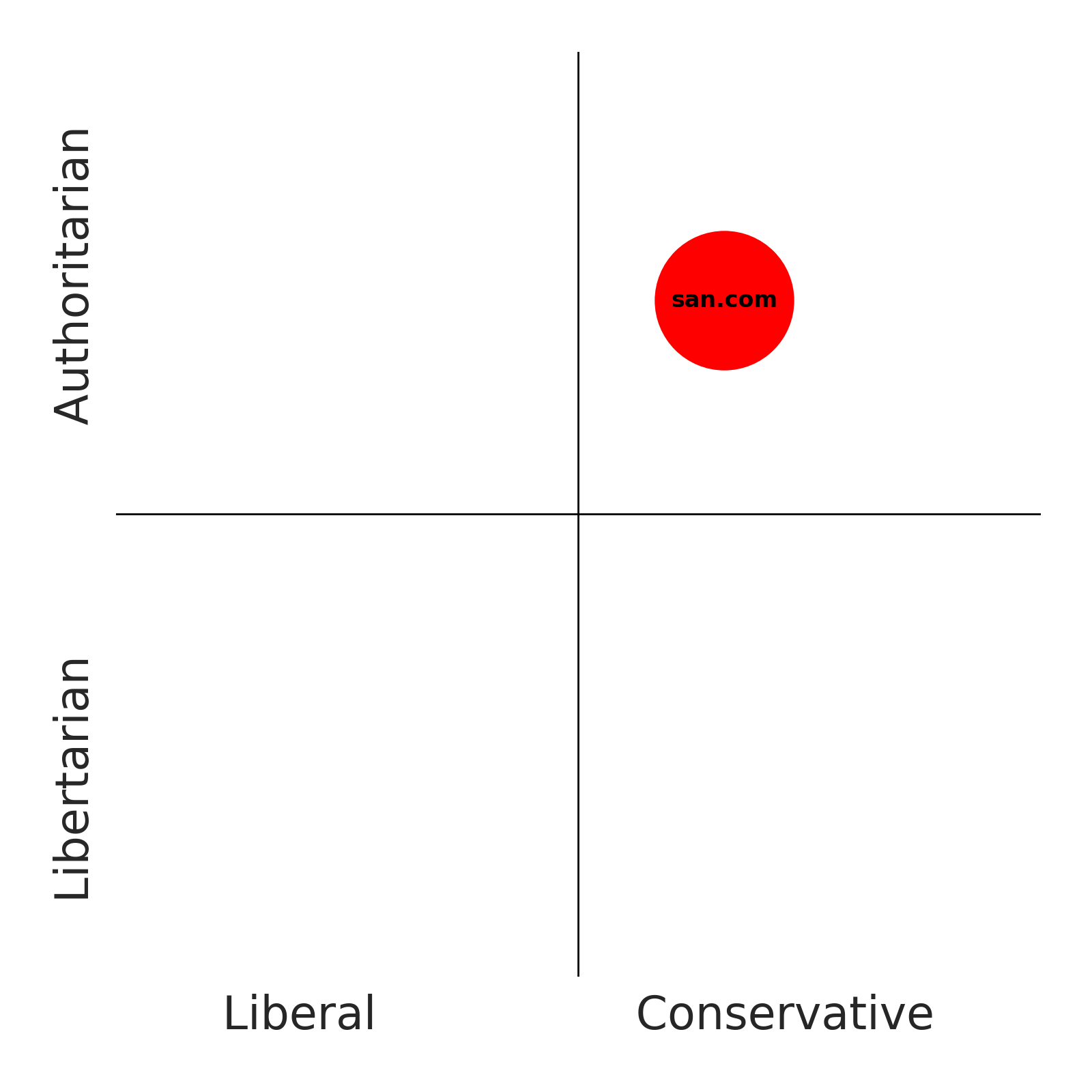
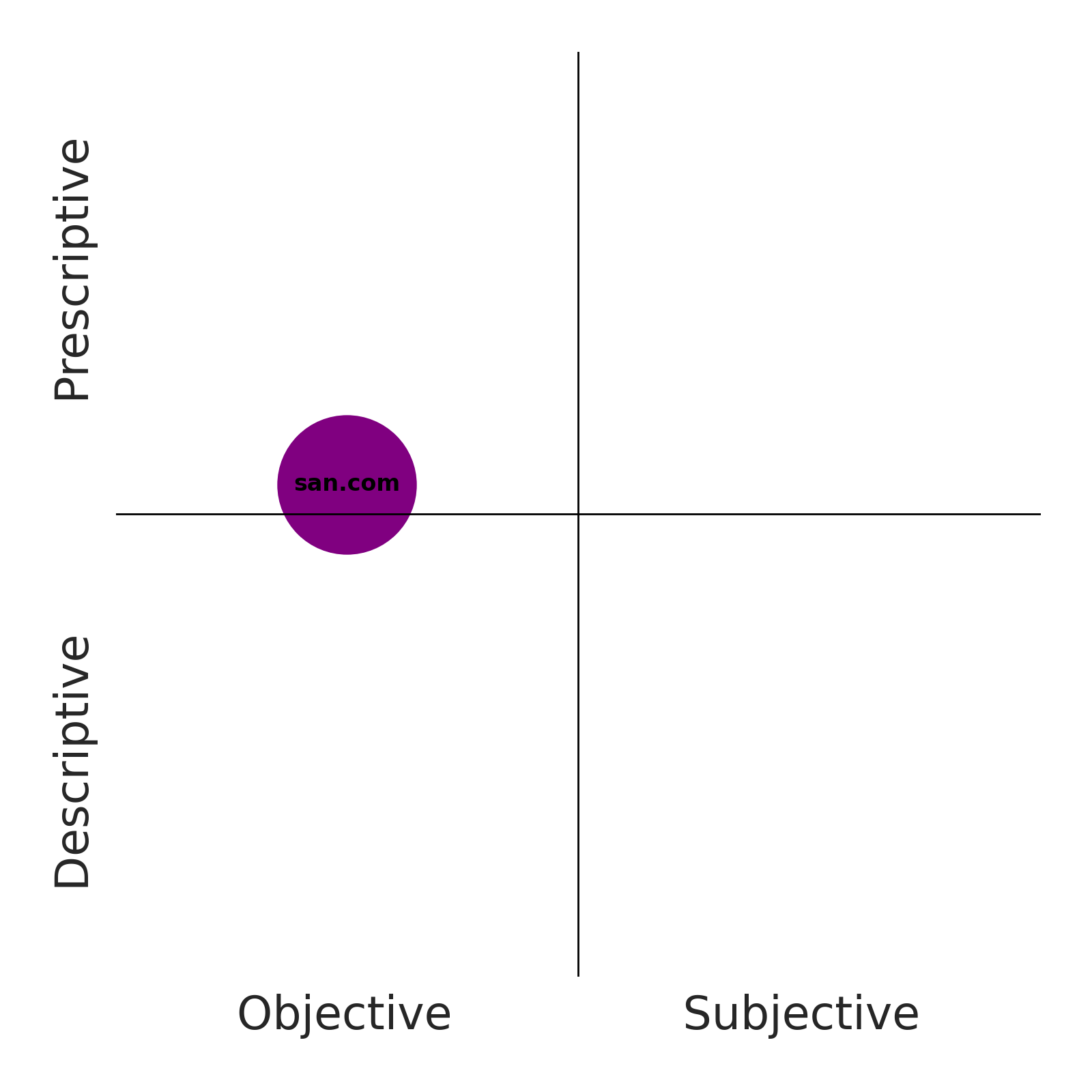
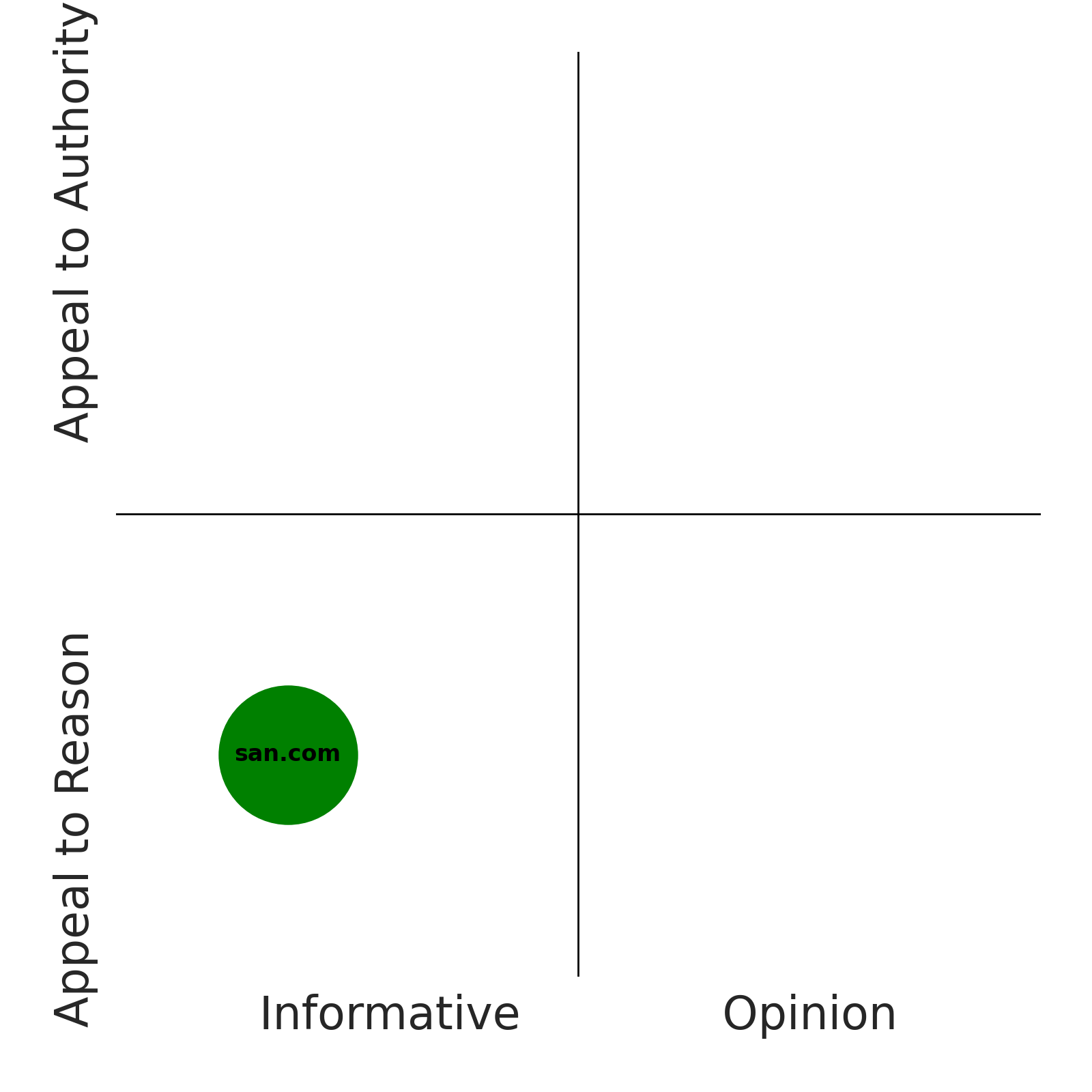
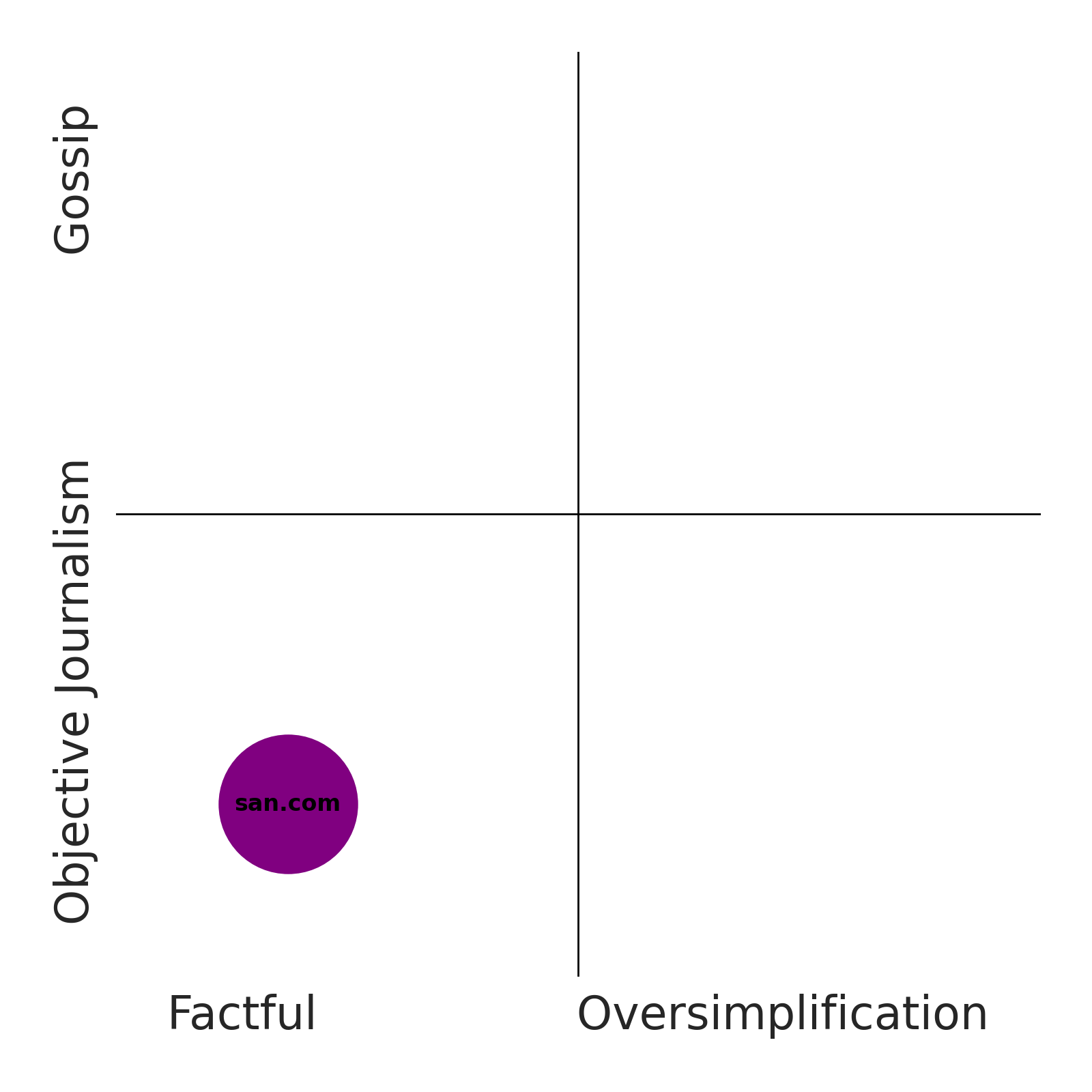
2026 © Helium Trades
Privacy Policy & Disclosure
* Disclaimer: Nothing on this website constitutes investment advice, performance data or any recommendation that any particular security, portfolio of securities, transaction or investment strategy is suitable for any specific person. Helium Trades is not responsible in any way for the accuracy
of any model predictions or price data. Any mention of a particular security and related prediction data is not a recommendation to buy or sell that security. Investments in securities involve the risk of loss. Past performance is no guarantee of future results. Helium Trades is not responsible for any of your investment decisions,
you should consult a financial expert before engaging in any transaction.
Helium Research Assistant

How can I help you today?
Ask any question about san.com bias.


