studyfinds.com Media Bias


General framing (epistemic posture):
Across the sample, the dominant narrative stance is science-forward empiricism paired with continuous uncertainty signaling—frequently stressing that findings are observational, preclinical, exploratory, or non-causal (e.g., explicit non-causality/limits in ).

This often tempers risk of overclaiming by foregrounding design constraints (e.g., detection-bias ambiguity in wildlife counts ; missing generalizability variables in neonatal epidural risk ).

Counterexample to “always cautious”: Some items retain or amplify potentially stronger reader-facing certainty: e.g., “up to 20%” lifetime risk headlines for cosmetic-procedure addiction with only one-study basis and methodological limits ( ); and policy-/value-laden framing (“shared responsibility”) in emissions cost comparisons for events ( ).

These are not fully sensational, but they show occasional evaluative/prescriptive pull beyond strictly descriptive reporting.

Coverage patterns (topic-selection bias):
In this 25-record sample, coverage is heavily concentrated in life/health/neuroscience (e.g., infections, sleep, biomarkers, pain management, vaccines, food safety) rather than in economics, foreign affairs, or purely cultural reporting.

Health/neuro topics include plus animal-biology social cognition . Non-health coverage focuses on (i) environmental/climate/air & weather linkages , (ii) physical sciences , (iii) engineering/biotech/AI tech , and (iv) social/policy/corporate metrics .

How worldview shows up in wording vs. sourcing:
1) Methodological transparency is frequent: caveats about sampling, generalizability, and causal limits recur (e.g., sleep/arousal specificity ; long-sleep biomarker association limitations ; observational neonatal risk constraints ).
2) Standards are not uniform: corporate/method-messaging items may receive less scrutiny of underlying data provenance than peer-reviewed science digests.

For instance, Allstate’s driver-safety ranking foregrounds the insurer’s metrics with caveats, but the narrative offers limited independent methodological critique. By contrast, the bird-count study explicitly discusses detection probability vs abundance.

AI authorship & observable promotional techniques (probabilistic, evidence-bound):
There is explicit publisher-described AI/LLM processing in multiple records, suggesting AI assistance rather than purely human writing: “unparalleled LLM process” to analyze papers and create summaries , and promotional description of AI interpretive capability plus editor vetting . Some posts also include publisher-promotional AI-disclosure language (e.g., “augmented by promotional AI-disclosure language”).

Propaganda techniques? No classic high-saturation propaganda pattern is evident (e.g., no sustained adversarial framing or political mobilization).

However, there is soft marketing of process and credibility (“agenda-free,” “transparent research summaries”) alongside AI-process emphasis. This can subtly steer readers toward trust in the platform’s epistemics even when the underlying science has limits.

Main biases (systematic tendencies in this sample):
  • Uncertainty-smoothing bias: repeated hedging (“not causal,” “limited generalizability”) can reduce false certainty, but may also encourage a “managed uncertainty” tone that normalizes weak-inference evidence as still meaningful for readers. bias: reliance on stated caveats and funding/disclosure notes as a credibility substitute (common in multiple science summaries).
  • Occasional value/policy framing that goes beyond results reporting (e.g., shared-emissions responsibility , long-term evaluation of bans ).
  • Potential selection bias toward “science digest” topics with measurable results and explicit limitations; less emphasis on fields where uncertainty is harder to quantify.


Helium Bias: This analysis depends only on the supplied record summaries (not full articles), so I infer framing from descriptions and a few quoted phrases.

I treat “AI-written” and “propaganda” as probabilistic hypotheses because evidence is largely about AI-assistance/disclosure rather than proof of automated persuasion.

Coverage patterns reflect this small, date-bunched sample, so topic-frequency conclusions may not generalize beyond it.

Automated source summary · Updated July 19, 2026 · Not human reviewed. Check recent article panels for claim-level evidence when available.


Use the Data in AI All Sources

studyfinds.com Bias Profile

Weighted source-level patterns from recent analyzed coverage. Open recent articles below to inspect score-specific evidence and limitations when available.

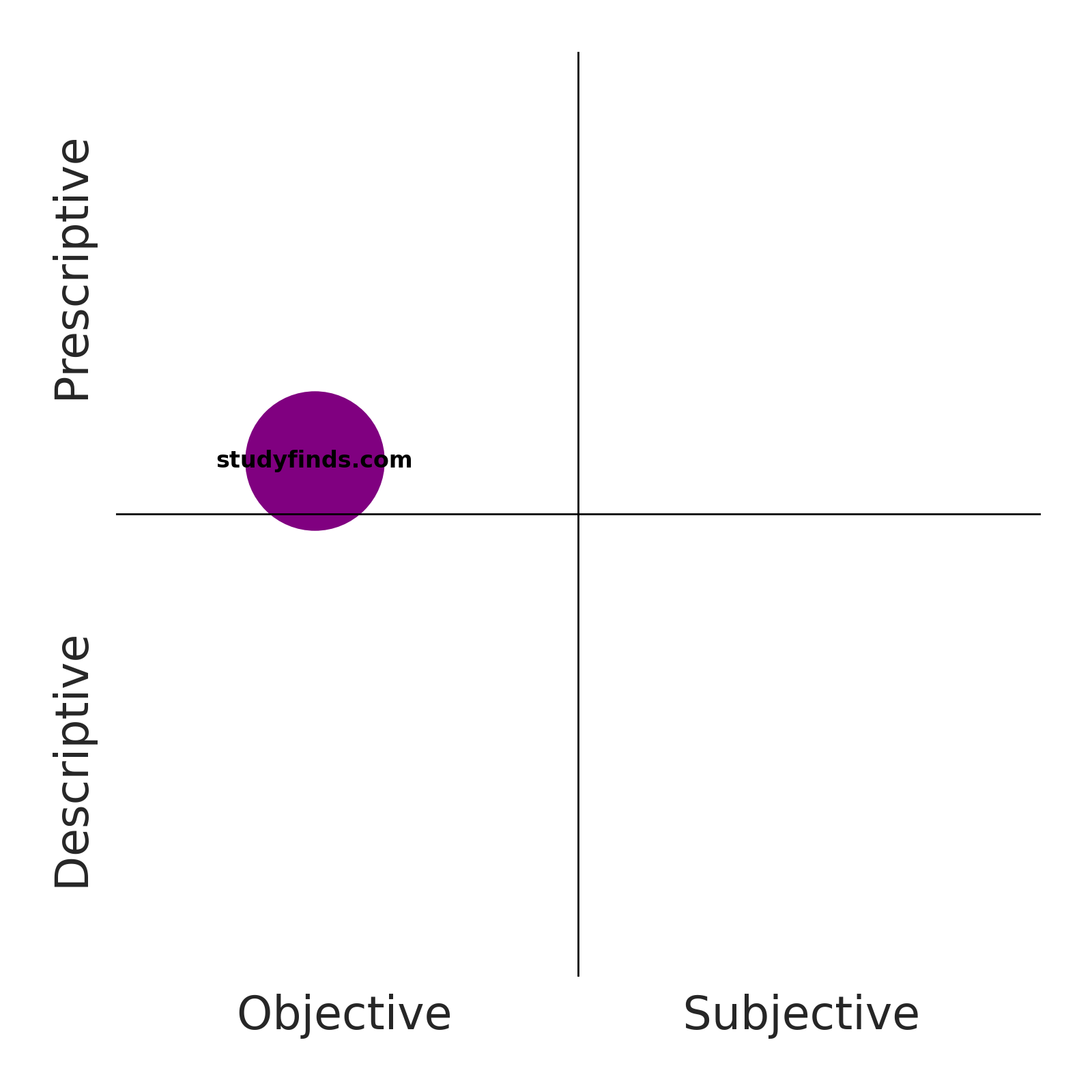
🗞️ Objective <—> Subjective 👁️ -7

💡 Boring <—> Interesting22

📝 Prescriptive6

😨 Fearful6

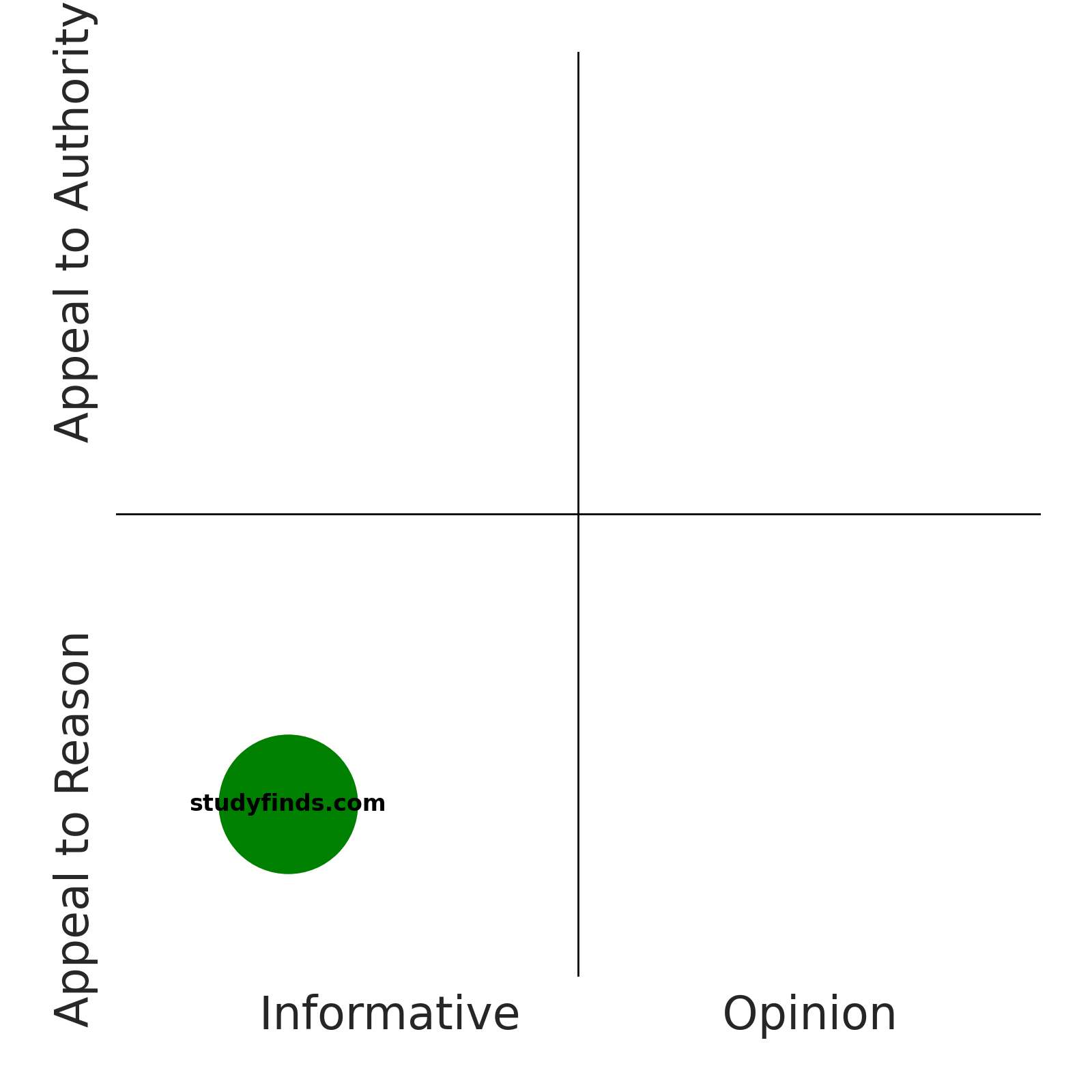
💭 Opinion20

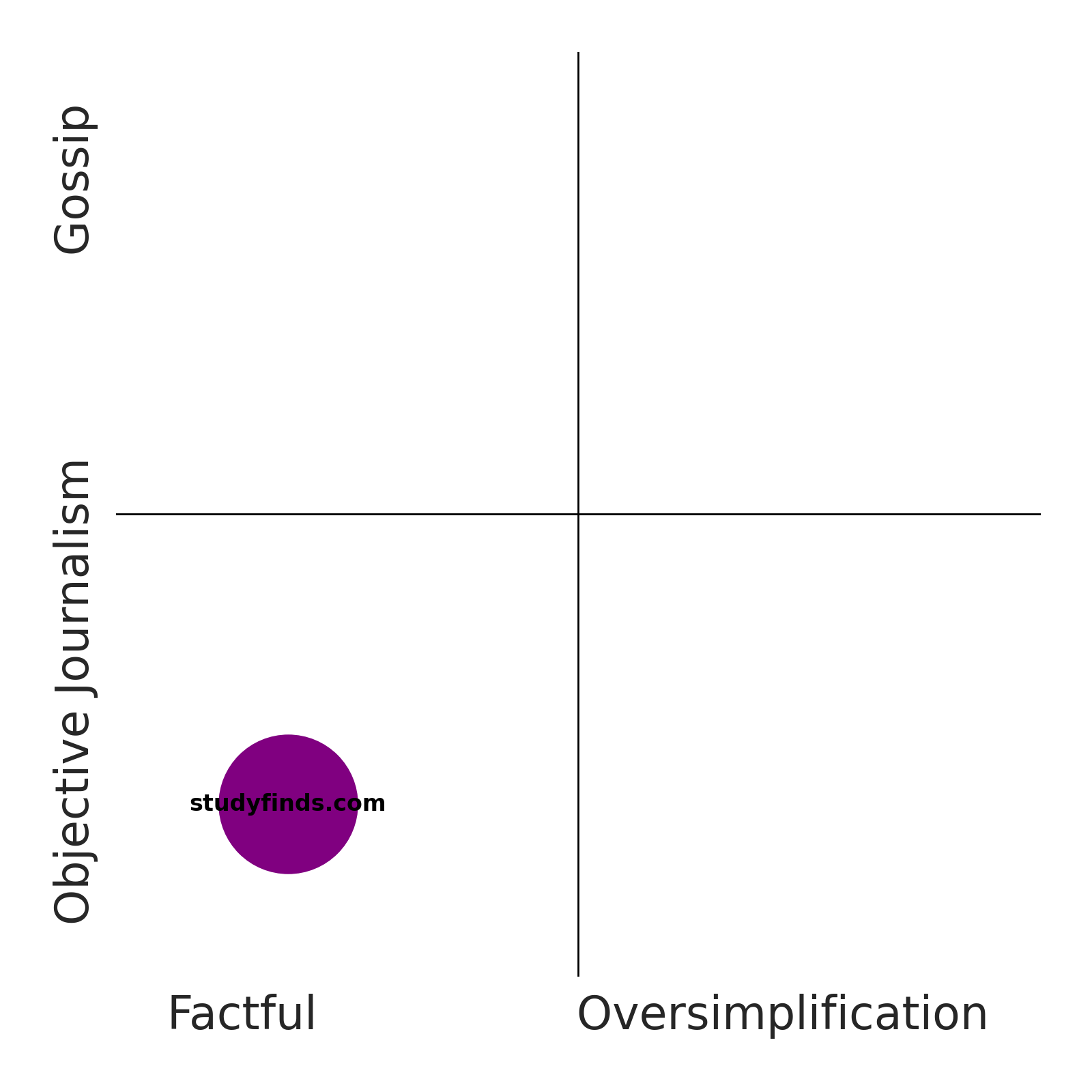
Oversimplification6

🏛️ Appeal to Authority14

👀 Covering Responses16

🏴 Anti-establishment <—> Pro-establishment 📺7

❌ Low Credibility <—> High Credibility ✅32

🧠 Rational <—> Irrational 🤪-12

🤑 Advertising12

🤖 Written by AI100

💔 Low Integrity <—> High Integrity ❤️26

🪨 Low Intelligence <—> High Intelligence 🦉60

🎭 Virtue Signaling12

🔍 Truth-seeking <—> Delusion 🌀-6

🔬 Scientific <—> Superstitious 🔮-12

🎲 Speculation23

🐍 Manipulative12

Subtle dimensions

🔵 Liberal <—> Conservative 🔴-1

🧢 Populist <—> Elitist 🎩0

🗽 Libertarian <—> Authoritarian 🚔0

🚨 Sensational0

📉 Bearish <—> Bullish 📈1

🗳 Political0

😢 Victimization2

😤 Overconfidence4

🗑️ Spam1

🔒 Ideological0

✊ Woke0

🦊 Anti-Corporate <—> Pro-Corporate 👔1

👤 Individualist <—> Collectivist 👥1

How to interpret source scores →

Average social shares per article 0


studyfinds.com Political Bias (?)


studyfinds.com Subjective Bias (?)


studyfinds.com Opinion Bias (?)


studyfinds.com Oversimplification Bias (?)


Discuss this source


studyfinds.com Recent Articles


Sort By:                     


Build a focused, ad-free news feed.

Create Free Feed