See whether Helium helps you make better-informed decisions. Try every Pro Trader feature for 30 days. No credit card required.
Try every Pro Trader feature for 30 days. No credit card required.
November 01, 2026 · 0 shares
The piece maintains a neutral, highly factual tone, balancing labor grievances and worker demands against the economic warnings and government response regarding the critical export industry.
Bangladesh’s ready-made garment industry is the world’s largest after China and contributes about 10% of gross domestic product.
Automated analysis; not human reviewed.
·
54 of 55 available dimensions scored; omitted dimensions are not treated as neutral.
·
Verified supporting quotes for 0 of 54 scored dimensions.
November 03, 2026 · 0 shares
Factual, attributed reporting balances worker wage grievances against official statements and explicitly notes an unsubstantiated government accusation.
Bangladesh's garment sector is a leading export industry and major employer, making wage disputes and factory closures consequential for global apparel supply chains.
Automated analysis; not human reviewed.
Limitations: The supplied text includes unrelated related-link snippets after the main report and an unusual reference to 'Prime Minister Tarique Rahman'; scoring relies only on the main Bangladesh garment-protest report.
·
10 of 55 available dimensions scored; omitted dimensions are not treated as neutral.
·
Verified supporting quotes for 9 of 10 scored dimensions.
Claim: The report is largely descriptive, using attributed factual statements rather than subjective commentary.
“Hundreds of garment factories in Bangladesh have been forced to close after days-long protests by workers demanding higher wages.” · exact text match
Why: The central sentence is a factual summary of events rather than evaluative commentary.
Claim: Violent and disruptive details are reported in measured, attributed prose rather than sensational framing.
“There are fears in the industry that the prolonged unrest could disrupt production and affect international buyers, state news agency BSS reported.” · exact text match
Why: Even concern about disruption is attributed to a state news agency rather than amplified by the publisher.
Claim: The report combines a major export industry, labor unrest, and global brand supply-chain implications.
“The South Asian nation is the world's second-largest garment exporter after China - but its workers are among the lowest-paid in the world” · exact text match
Why: The contrast between export scale and worker pay adds substantive interest.
Claim: The central content describes demands, actions, and official responses without prescribing a policy outcome.
“The government announced on Sunday that it had established a board to review workers' wages” · exact text match
Why: The report states institutional actions descriptively rather than advocating a wage or crackdown policy.
Claim: Fear and disruption are mentioned through attributed industry concerns, but not amplified as panic.
“There are fears in the industry that the prolonged unrest could disrupt production and affect international buyers, state news agency BSS reported.” · exact text match
Why: The wording includes fear but attributes it to industry concerns and a state agency, limiting alarmist framing.
Claim: The report includes political actors and a banned party accusation, giving the labor dispute a political dimension.
“Authorities have accused the Awami League, the banned political party of former leader Sheikh Hasina, for taking advantage of the protest movement to instigate violence” · exact text match
Why: A governing-authority accusation against a banned political party is an explicitly political element.
Claim: Sourcing is visible through named agencies, police officials, and explicit caveats about unsupported accusations.
“according to reports by Reuters and AFP” · exact text match
“though they did not provide any evidence of this” · exact text match
Why: Multiple named sources and a caveat about missing evidence support high visible credibility.
Claim: The report attributes contested and official claims to named or specific sources rather than asserting them as fact.
“according to reports by Reuters and AFP” · exact text match
“according to Dhaka police Deputy Commissioner Mohidul Islam” · exact text match
Why: Visible attribution to agencies and a named police official supports a rational, evidence-bound presentation.
Claim: The report discloses that a government accusation was unsupported by evidence and includes both worker and official voices.
“though they did not provide any evidence of this” · exact text match
Why: Explicitly noting the lack of evidence for an official accusation is a fairness signal.
The supplied text includes unrelated related-link snippets after the main report and an unusual reference to 'Prime Minister Tarique Rahman'; scoring relies only on the main Bangladesh garment-protest report.
November 02, 2026 · 0 shares
Balanced labor-economy framing gives comparable space to worker wage demands, manufacturer cost concerns, and an economist's tradeoff analysis, with restrained language despite protest unrest.
Automated analysis; not human reviewed.
Limitations: The supplied text contains duplicated paragraphs and CNA page boilerplate; those were excluded from analysis.
·
9 of 55 available dimensions scored; omitted dimensions are not treated as neutral.
·
Verified supporting quotes for 7 of 9 scored dimensions.
Claim: The report gives balanced treatment to worker wage demands and manufacturer cost concerns without partisan framing.
“workers demanded a minimum monthly wage of 30,000 taka (US$240), up from 12,500 taka.” · exact text match
“Factory owners said the industry faces higher costs, energy market uncertainty linked to conflict in the Middle East and slowing demand in key export markets.” · exact text match
Why: It presents both labor demands and business cost pressures with comparable specificity and no ideological labels.
Claim: The report includes worker representatives, industry officials, and an academic economist without privileging one elite or populist voice.
“"Bangladesh has among the lowest garment wages in the world," said Babul Akhter, general secretary of the Bangladesh Garment and Industrial Workers Federation and a workers' representative on the wage board.” · not found in supplied text
“Selim Raihan, an economics professor at the University of Dhaka, said workers' demands were understandable given high inflation and suppressed wages could cause further unrest.” · exact text match
Why: Worker and expert/industry perspectives are both quoted, supporting a neutral populist-elitist classification.
Claim: The report attributes specific disruption figures to a named industry association rather than asserting them subjectively.
“The Bangladesh Garment Manufacturers and Exporters Association (BGMEA) said demonstrations in multiple cities disrupted operations at 529 factories and affected nearly one million workers.” · exact text match
Why: Key claims are tied to named organizational sources and concrete figures.
Claim: The lead reports the reopening and unrest concern in measured, factual terms.
“Bangladesh's garment factories reopened on Monday (Nov 2) after widespread closures and production disruptions a day earlier, but manufacturers remain concerned about further unrest over workers' demands for higher wages.” · exact text match
Why: The language is restrained and factual rather than sensational or alarmist.
Claim: The report describes government action and its immediate effect rather than prescribing a policy outcome.
“The government formed a six-member minimum wage board on Sunday to review the demand but the move failed to immediately quell unrest.” · exact text match
Why: It reports what the government did and the result, with prescriptions only in attributed quotes.
Claim: The report relies on named sources and specific figures for key claims.
“BGMEA President Mahmud Hasan Khan said, "The government has already taken a step by forming the wage board.
We expect workers to allow the review process to proceed."”
· not found in supplied text
“Selim Raihan, an economics professor at the University of Dhaka, said workers' demands were understandable given high inflation and suppressed wages could cause further unrest.” · exact text match
Why: Named officials, an academic, and concrete figures support the reported claims.
Claim: The report presents a reasoned tradeoff between wage gains and industry costs rather than emotional or illogical argument.
“However, he cautioned that a substantial wage increase could raise production costs, squeeze exporters' profit margins and weaken Bangladesh's price competitiveness.” · exact text match
Why: The economist's attributed caution weighs benefits against costs, indicating rational framing.
Claim: The report includes a balancing expert view that acknowledges worker hardship while cautioning about cost and competitiveness effects.
“Selim Raihan, an economics professor at the University of Dhaka, said workers' demands were understandable given high inflation and suppressed wages could cause further unrest.” · exact text match
“However, he cautioned that a substantial wage increase could raise production costs, squeeze exporters' profit margins and weaken Bangladesh's price competitiveness.” · exact text match
Why: It fairly presents both the case for higher wages and the potential economic downside.
Claim: The report supplies structural economic context for the garment sector.
“The ready-made garment sector accounts for more than 80 per cent of Bangladesh's export earnings, employs about four million workers and contributes around 10 per cent to the gross domestic product (GDP).” · exact text match
Why: It provides relevant quantitative context and multiple stakeholder perspectives.
The supplied text contains duplicated paragraphs and CNA page boilerplate; those were excluded from analysis.
November 01, 2026 · 0 shares
The report maintains a neutral, objective tone, balancing the workers' demands for wage increases with the government's strategy to quell unrest and the potential economic consequences of disruption.
Automated analysis; not human reviewed.
Limitations: The inclusion of multiple unrelated headlines and snippets at the end of the text makes it unclear if the reporting is from a single cohesive source or a curated aggregation platform.
·
54 of 55 available dimensions scored; omitted dimensions are not treated as neutral.
·
Verified supporting quotes for 0 of 54 scored dimensions.
The inclusion of multiple unrelated headlines and snippets at the end of the text makes it unclear if the reporting is from a single cohesive source or a curated aggregation platform.
November 02, 2026 · 0 shares
Wire-service framing is largely neutral and descriptive, balancing worker demands with government and industry warnings while attributing contested claims.
Automated analysis; not human reviewed.
Limitations: The supplied text includes unrelated Pakistani headlines and page chrome after the main report; these were excluded from analysis.
·
55 of 55 available dimensions scored; omitted dimensions are not treated as neutral.
·
Verified supporting quotes for 8 of 55 scored dimensions.
Claim: The report relies on direct observation and attributed statements rather than publisher commentary.
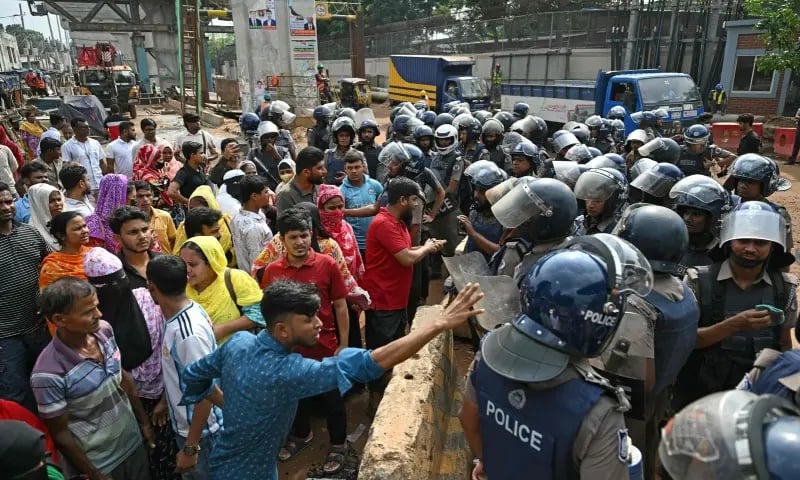
“where police dispersed demonstrators with tear gas, AFP reporters saw” · exact text match
Why: Direct observation is explicitly attributed to AFP reporters.
Claim: Violence is reported in plain factual terms with limited emotive language.
“Police fired stun grenades and tear gas canisters to disperse crowds in Ashulia” · exact text match
Counterevidence:
“Angry workers also set fire to a police vehicle.” · exact text match
Why: Police tactics are stated factually, though some emotive wording appears.
Claim: The article reports demands and events without prescribing a policy outcome.
“The protesters demand a 30,000-taka monthly wage, more than double their current pay.” · exact text match
Why: The demand is described rather than endorsed or advocated.
Claim: The report centers on a government response to labor protest, making political institutions and authority central.
“Home Minister Salahuddin Ahmed warned that the government was taking strong action to stop the protests.” · exact text match
Why: Government officials and state action are central to the reported event.
Claim: Direct observation and named sources are attributed, supporting verifiability.
“where police dispersed demonstrators with tear gas, AFP reporters saw” · exact text match
“according to Kalpona Akter of the Bangladesh Centre for Workers Solidarity” · exact text match
Why: The report attributes observations and wage figures to identifiable sources.
Claim: The report contextualizes wage demands with attributed economic reasoning rather than emotive assertion.
“However, labour leaders say workers’ grievances extend beyond the formation of the board, citing inflation and rising household expenses.” · exact text match
Why: The article explains the dispute through stated inflation and household-cost concerns.
Claim: The report includes government and worker perspectives, including the minister's stated instruction to protect workers' rights.
“However, Ahmed also said earlier Prime Minister Tarique Rahman had instructed officials after hosting an emergency cabinet meeting late on Sunday to “ensure workers’ rights and improve their living standards”.” · exact text match
Why: Including the government's stated worker-rights instruction shows fair contextualization.
Claim: The report supplies contextual detail on export rank, wage board, and inflation to explain the dispute.
“The South Asian nation of 170 million people is the world’s second-biggest garment exporter behind China” · exact text match
Why: Contextual economic and industry details aid interpretation of the protest.
The supplied text includes unrelated Pakistani headlines and page chrome after the main report; these were excluded from analysis.
November 02, 2026 · 0 shares
Balanced labor-economy framing gives comparable space to worker wage demands, manufacturer cost concerns, and an economist's tradeoff analysis, with restrained language despite protest unrest.
Automated analysis; not human reviewed.
Limitations: The supplied text contains duplicated paragraphs and CNA page boilerplate; those were excluded from analysis.
·
9 of 55 available dimensions scored; omitted dimensions are not treated as neutral.
·
Verified supporting quotes for 7 of 9 scored dimensions.
Claim: The report gives balanced treatment to worker wage demands and manufacturer cost concerns without partisan framing.
“workers demanded a minimum monthly wage of 30,000 taka (US$240), up from 12,500 taka.” · exact text match
“Factory owners said the industry faces higher costs, energy market uncertainty linked to conflict in the Middle East and slowing demand in key export markets.” · exact text match
Why: It presents both labor demands and business cost pressures with comparable specificity and no ideological labels.
Claim: The report includes worker representatives, industry officials, and an academic economist without privileging one elite or populist voice.
“"Bangladesh has among the lowest garment wages in the world," said Babul Akhter, general secretary of the Bangladesh Garment and Industrial Workers Federation and a workers' representative on the wage board.” · not found in supplied text
“Selim Raihan, an economics professor at the University of Dhaka, said workers' demands were understandable given high inflation and suppressed wages could cause further unrest.” · exact text match
Why: Worker and expert/industry perspectives are both quoted, supporting a neutral populist-elitist classification.
Claim: The report attributes specific disruption figures to a named industry association rather than asserting them subjectively.
“The Bangladesh Garment Manufacturers and Exporters Association (BGMEA) said demonstrations in multiple cities disrupted operations at 529 factories and affected nearly one million workers.” · exact text match
Why: Key claims are tied to named organizational sources and concrete figures.
Claim: The lead reports the reopening and unrest concern in measured, factual terms.
“Bangladesh's garment factories reopened on Monday (Nov 2) after widespread closures and production disruptions a day earlier, but manufacturers remain concerned about further unrest over workers' demands for higher wages.” · exact text match
Why: The language is restrained and factual rather than sensational or alarmist.
Claim: The report describes government action and its immediate effect rather than prescribing a policy outcome.
“The government formed a six-member minimum wage board on Sunday to review the demand but the move failed to immediately quell unrest.” · exact text match
Why: It reports what the government did and the result, with prescriptions only in attributed quotes.
Claim: The report relies on named sources and specific figures for key claims.
“BGMEA President Mahmud Hasan Khan said, "The government has already taken a step by forming the wage board.
We expect workers to allow the review process to proceed."”
· not found in supplied text
“Selim Raihan, an economics professor at the University of Dhaka, said workers' demands were understandable given high inflation and suppressed wages could cause further unrest.” · exact text match
Why: Named officials, an academic, and concrete figures support the reported claims.
Claim: The report presents a reasoned tradeoff between wage gains and industry costs rather than emotional or illogical argument.
“However, he cautioned that a substantial wage increase could raise production costs, squeeze exporters' profit margins and weaken Bangladesh's price competitiveness.” · exact text match
Why: The economist's attributed caution weighs benefits against costs, indicating rational framing.
Claim: The report includes a balancing expert view that acknowledges worker hardship while cautioning about cost and competitiveness effects.
“Selim Raihan, an economics professor at the University of Dhaka, said workers' demands were understandable given high inflation and suppressed wages could cause further unrest.” · exact text match
“However, he cautioned that a substantial wage increase could raise production costs, squeeze exporters' profit margins and weaken Bangladesh's price competitiveness.” · exact text match
Why: It fairly presents both the case for higher wages and the potential economic downside.
Claim: The report supplies structural economic context for the garment sector.
“The ready-made garment sector accounts for more than 80 per cent of Bangladesh's export earnings, employs about four million workers and contributes around 10 per cent to the gross domestic product (GDP).” · exact text match
Why: It provides relevant quantitative context and multiple stakeholder perspectives.
The supplied text contains duplicated paragraphs and CNA page boilerplate; those were excluded from analysis.
November 02, 2026 · 0 shares
Wire-service framing is largely neutral and descriptive, balancing worker demands with government and industry warnings while attributing contested claims.
Automated analysis; not human reviewed.
Limitations: The supplied text includes unrelated Pakistani headlines and page chrome after the main report; these were excluded from analysis.
·
55 of 55 available dimensions scored; omitted dimensions are not treated as neutral.
·
Verified supporting quotes for 8 of 55 scored dimensions.
Claim: The report relies on direct observation and attributed statements rather than publisher commentary.
“where police dispersed demonstrators with tear gas, AFP reporters saw” · exact text match
Why: Direct observation is explicitly attributed to AFP reporters.
Claim: Violence is reported in plain factual terms with limited emotive language.
“Police fired stun grenades and tear gas canisters to disperse crowds in Ashulia” · exact text match
Counterevidence:
“Angry workers also set fire to a police vehicle.” · exact text match
Why: Police tactics are stated factually, though some emotive wording appears.
Claim: The article reports demands and events without prescribing a policy outcome.
“The protesters demand a 30,000-taka monthly wage, more than double their current pay.” · exact text match
Why: The demand is described rather than endorsed or advocated.
Claim: The report centers on a government response to labor protest, making political institutions and authority central.
“Home Minister Salahuddin Ahmed warned that the government was taking strong action to stop the protests.” · exact text match
Why: Government officials and state action are central to the reported event.
Claim: Direct observation and named sources are attributed, supporting verifiability.
“where police dispersed demonstrators with tear gas, AFP reporters saw” · exact text match
“according to Kalpona Akter of the Bangladesh Centre for Workers Solidarity” · exact text match
Why: The report attributes observations and wage figures to identifiable sources.
Claim: The report contextualizes wage demands with attributed economic reasoning rather than emotive assertion.
“However, labour leaders say workers’ grievances extend beyond the formation of the board, citing inflation and rising household expenses.” · exact text match
Why: The article explains the dispute through stated inflation and household-cost concerns.
Claim: The report includes government and worker perspectives, including the minister's stated instruction to protect workers' rights.
“However, Ahmed also said earlier Prime Minister Tarique Rahman had instructed officials after hosting an emergency cabinet meeting late on Sunday to “ensure workers’ rights and improve their living standards”.” · exact text match
Why: Including the government's stated worker-rights instruction shows fair contextualization.
Claim: The report supplies contextual detail on export rank, wage board, and inflation to explain the dispute.
“The South Asian nation of 170 million people is the world’s second-biggest garment exporter behind China” · exact text match
Why: Contextual economic and industry details aid interpretation of the protest.
The supplied text includes unrelated Pakistani headlines and page chrome after the main report; these were excluded from analysis.
November 02, 2026 · 0 shares
Wire-service framing is largely neutral and descriptive, balancing worker demands with government and industry warnings while attributing contested claims.
Automated analysis; not human reviewed.
Limitations: The supplied text includes unrelated Pakistani headlines and page chrome after the main report; these were excluded from analysis.
·
55 of 55 available dimensions scored; omitted dimensions are not treated as neutral.
·
Verified supporting quotes for 8 of 55 scored dimensions.
Claim: The report relies on direct observation and attributed statements rather than publisher commentary.
“where police dispersed demonstrators with tear gas, AFP reporters saw” · exact text match
Why: Direct observation is explicitly attributed to AFP reporters.
Claim: Violence is reported in plain factual terms with limited emotive language.
“Police fired stun grenades and tear gas canisters to disperse crowds in Ashulia” · exact text match
Counterevidence:
“Angry workers also set fire to a police vehicle.” · exact text match
Why: Police tactics are stated factually, though some emotive wording appears.
Claim: The article reports demands and events without prescribing a policy outcome.
“The protesters demand a 30,000-taka monthly wage, more than double their current pay.” · exact text match
Why: The demand is described rather than endorsed or advocated.
Claim: The report centers on a government response to labor protest, making political institutions and authority central.
“Home Minister Salahuddin Ahmed warned that the government was taking strong action to stop the protests.” · exact text match
Why: Government officials and state action are central to the reported event.
Claim: Direct observation and named sources are attributed, supporting verifiability.
“where police dispersed demonstrators with tear gas, AFP reporters saw” · exact text match
“according to Kalpona Akter of the Bangladesh Centre for Workers Solidarity” · exact text match
Why: The report attributes observations and wage figures to identifiable sources.
Claim: The report contextualizes wage demands with attributed economic reasoning rather than emotive assertion.
“However, labour leaders say workers’ grievances extend beyond the formation of the board, citing inflation and rising household expenses.” · exact text match
Why: The article explains the dispute through stated inflation and household-cost concerns.
Claim: The report includes government and worker perspectives, including the minister's stated instruction to protect workers' rights.
“However, Ahmed also said earlier Prime Minister Tarique Rahman had instructed officials after hosting an emergency cabinet meeting late on Sunday to “ensure workers’ rights and improve their living standards”.” · exact text match
Why: Including the government's stated worker-rights instruction shows fair contextualization.
Claim: The report supplies contextual detail on export rank, wage board, and inflation to explain the dispute.
“The South Asian nation of 170 million people is the world’s second-biggest garment exporter behind China” · exact text match
Why: Contextual economic and industry details aid interpretation of the protest.
The supplied text includes unrelated Pakistani headlines and page chrome after the main report; these were excluded from analysis.
November 01, 2026 · 0 shares
The piece maintains a neutral, highly factual tone, balancing labor grievances and worker demands against the economic warnings and government response regarding the critical export industry.
Bangladesh’s ready-made garment industry is the world’s largest after China and contributes about 10% of gross domestic product.
Automated analysis; not human reviewed.
·
54 of 55 available dimensions scored; omitted dimensions are not treated as neutral.
·
Verified supporting quotes for 0 of 54 scored dimensions.
November 02, 2026 · 0 shares
Balanced labor-economy framing gives comparable space to worker wage demands, manufacturer cost concerns, and an economist's tradeoff analysis, with restrained language despite protest unrest.
Automated analysis; not human reviewed.
Limitations: The supplied text contains duplicated paragraphs and CNA page boilerplate; those were excluded from analysis.
·
9 of 55 available dimensions scored; omitted dimensions are not treated as neutral.
·
Verified supporting quotes for 7 of 9 scored dimensions.
Claim: The report gives balanced treatment to worker wage demands and manufacturer cost concerns without partisan framing.
“workers demanded a minimum monthly wage of 30,000 taka (US$240), up from 12,500 taka.” · exact text match
“Factory owners said the industry faces higher costs, energy market uncertainty linked to conflict in the Middle East and slowing demand in key export markets.” · exact text match
Why: It presents both labor demands and business cost pressures with comparable specificity and no ideological labels.
Claim: The report includes worker representatives, industry officials, and an academic economist without privileging one elite or populist voice.
“"Bangladesh has among the lowest garment wages in the world," said Babul Akhter, general secretary of the Bangladesh Garment and Industrial Workers Federation and a workers' representative on the wage board.” · not found in supplied text
“Selim Raihan, an economics professor at the University of Dhaka, said workers' demands were understandable given high inflation and suppressed wages could cause further unrest.” · exact text match
Why: Worker and expert/industry perspectives are both quoted, supporting a neutral populist-elitist classification.
Claim: The report attributes specific disruption figures to a named industry association rather than asserting them subjectively.
“The Bangladesh Garment Manufacturers and Exporters Association (BGMEA) said demonstrations in multiple cities disrupted operations at 529 factories and affected nearly one million workers.” · exact text match
Why: Key claims are tied to named organizational sources and concrete figures.
Claim: The lead reports the reopening and unrest concern in measured, factual terms.
“Bangladesh's garment factories reopened on Monday (Nov 2) after widespread closures and production disruptions a day earlier, but manufacturers remain concerned about further unrest over workers' demands for higher wages.” · exact text match
Why: The language is restrained and factual rather than sensational or alarmist.
Claim: The report describes government action and its immediate effect rather than prescribing a policy outcome.
“The government formed a six-member minimum wage board on Sunday to review the demand but the move failed to immediately quell unrest.” · exact text match
Why: It reports what the government did and the result, with prescriptions only in attributed quotes.
Claim: The report relies on named sources and specific figures for key claims.
“BGMEA President Mahmud Hasan Khan said, "The government has already taken a step by forming the wage board.
We expect workers to allow the review process to proceed."”
· not found in supplied text
“Selim Raihan, an economics professor at the University of Dhaka, said workers' demands were understandable given high inflation and suppressed wages could cause further unrest.” · exact text match
Why: Named officials, an academic, and concrete figures support the reported claims.
Claim: The report presents a reasoned tradeoff between wage gains and industry costs rather than emotional or illogical argument.
“However, he cautioned that a substantial wage increase could raise production costs, squeeze exporters' profit margins and weaken Bangladesh's price competitiveness.” · exact text match
Why: The economist's attributed caution weighs benefits against costs, indicating rational framing.
Claim: The report includes a balancing expert view that acknowledges worker hardship while cautioning about cost and competitiveness effects.
“Selim Raihan, an economics professor at the University of Dhaka, said workers' demands were understandable given high inflation and suppressed wages could cause further unrest.” · exact text match
“However, he cautioned that a substantial wage increase could raise production costs, squeeze exporters' profit margins and weaken Bangladesh's price competitiveness.” · exact text match
Why: It fairly presents both the case for higher wages and the potential economic downside.
Claim: The report supplies structural economic context for the garment sector.
“The ready-made garment sector accounts for more than 80 per cent of Bangladesh's export earnings, employs about four million workers and contributes around 10 per cent to the gross domestic product (GDP).” · exact text match
Why: It provides relevant quantitative context and multiple stakeholder perspectives.
The supplied text contains duplicated paragraphs and CNA page boilerplate; those were excluded from analysis.
November 02, 2026 · 0 shares
The report is a measured, source-attributed trade-news account that qualifies forward-looking disruption claims and avoids partisan framing.
Bangladesh’s garment industry is a major export sector, and Chittagong port is the main gateway for its export cargo.
Automated analysis; not human reviewed.
Limitations: The supplied text includes related-link and subscription boilerplate; analysis is limited to the substantive news paragraphs.
·
17 of 55 available dimensions scored; omitted dimensions are not treated as neutral.
·
Verified supporting quotes for 17 of 17 scored dimensions.
Claim: The report presents worker demands and state/employer responses descriptively without left-right ideological framing.
“Workers continued demonstrations on Monday in Dhaka’s Mirpur area, Ashulia, Gazipur, and Tongi, demanding a new minimum wage and improved working conditions.
Police and Border Guard Bangladesh personnel were deployed, with clashes reported with protesters.”
· exact text match
Why: Balances labor demands with official response and avoids partisan labels.
Claim: The report gives space to workers, factory owners, police, and government without privileging a populist or elite voice.
“Workers are seeking a minimum monthly wage of Tk30,000, approximately $250.” · exact text match
“Factory owners have threatened indefinite closures if the protests continue, raising the prospect of further disruption to production and exports.” · exact text match
Why: Includes both worker and employer positions in neutral terms.
Claim: The report separates confirmed disruption from conditional logistics consequences.
“However, there was no confirmed estimate of cargo delays, missed sailings, or additional demand for air transport as yet.” · exact text match
Why: Explicit uncertainty marker keeps analysis objective.
Claim: Disruption is reported in measured, factual terms without sensational language.
“Production was suspended at around 690 garment factories today, according to the latest information from Bangladesh, while roadblocks hampered the movement of export cargo from Dhaka factories to the port.” · exact text match
Why: Uses attributed figures and neutral verbs.
Claim: The report describes consequences without prescribing policy or action.
“The disruption threatens shipment schedules on two fronts: factories may struggle to complete orders on time; and finished garments face delays reaching their booked vessels.” · exact text match
Why: Explains effects descriptively.
Claim: Assessments are attributed to named sources rather than presented as the publisher’s opinion.
“Fazlee Shamim Ehsan, president of the Bangladesh Knitwear Manufacturers and Exporters Association, said the unrest was already affecting overseas trade” · exact text match
Why: Quotation-based reporting supports low opinion bias.
Claim: The report touches on government labor policy but does not frame it in partisan political terms.
“The government had formed a new wage board yesterday, headed by a district judge and included representatives of factory owners and workers, to determine a new minimum wage.” · exact text match
Why: Policy detail is reported neutrally, with limited political framing.
Claim: The report relies on named official and industry sources for key figures.
“Gazipur Industrial Police superintendent Amjad Hossain said more than 150 factories in his area had closed today because of the protests” · exact text match
Why: Some reliance on official authority, but sourcing is normal for news.
Claim: The report explicitly notes the absence of confirmed estimates for key downstream effects.
“However, there was no confirmed estimate of cargo delays, missed sailings, or additional demand for air transport as yet.” · exact text match
Why: Directly counters overconfidence.
Claim: The report describes clashes and demands without emotional language.
“Police and Border Guard Bangladesh personnel were deployed, with clashes reported with protesters.” · exact text match
Why: Neutral wording.
Claim: Key claims are attributed to named officials and uncertainty is flagged.
“Gazipur Industrial Police superintendent Amjad Hossain said more than 150 factories in his area had closed today because of the protests” · exact text match
“However, there was no confirmed estimate of cargo delays, missed sailings, or additional demand for air transport as yet.” · exact text match
Why: Visible sourcing and uncertainty support credibility.
Claim: The report explicitly qualifies uncertain downstream effects rather than asserting them.
“However, there was no confirmed estimate of cargo delays, missed sailings, or additional demand for air transport as yet.” · exact text match
Why: Flags absence of confirmed estimates, supporting rational/evidence-bound framing.
Claim: The report includes qualified forward-looking logistics scenarios.
“For forwarders, prolonged unrest could mean rearranging collections and bookings as cargo readiness dates slip.” · exact text match
Why: Conditional language limits speculation.
Claim: Key figures are attributed to named officials and unconfirmed effects are flagged.
“Gazipur Industrial Police superintendent Amjad Hossain said more than 150 factories in his area had closed today because of the protests, and the nationwide closure figure rose during the day, the latest tally putting suspended production at around 690 factories.” · exact text match
“However, there was no confirmed estimate of cargo delays, missed sailings, or additional demand for air transport as yet.” · exact text match
Why: Shows sourcing and uncertainty disclosure.
Claim: The report explains the logistics implications in a structured, informed way.
“The disruption threatens shipment schedules on two fronts: factories may struggle to complete orders on time; and finished garments face delays reaching their booked vessels.” · exact text match
Why: Clear causal breakdown of export disruption.
The supplied text includes related-link and subscription boilerplate; analysis is limited to the substantive news paragraphs.
November 03, 2026 · 0 shares
Factual, attributed reporting balances worker wage grievances against official statements and explicitly notes an unsubstantiated government accusation.
Bangladesh's garment sector is a leading export industry and major employer, making wage disputes and factory closures consequential for global apparel supply chains.
Automated analysis; not human reviewed.
Limitations: The supplied text includes unrelated related-link snippets after the main report and an unusual reference to 'Prime Minister Tarique Rahman'; scoring relies only on the main Bangladesh garment-protest report.
·
10 of 55 available dimensions scored; omitted dimensions are not treated as neutral.
·
Verified supporting quotes for 9 of 10 scored dimensions.
Claim: The report is largely descriptive, using attributed factual statements rather than subjective commentary.
“Hundreds of garment factories in Bangladesh have been forced to close after days-long protests by workers demanding higher wages.” · exact text match
Why: The central sentence is a factual summary of events rather than evaluative commentary.
Claim: Violent and disruptive details are reported in measured, attributed prose rather than sensational framing.
“There are fears in the industry that the prolonged unrest could disrupt production and affect international buyers, state news agency BSS reported.” · exact text match
Why: Even concern about disruption is attributed to a state news agency rather than amplified by the publisher.
Claim: The report combines a major export industry, labor unrest, and global brand supply-chain implications.
“The South Asian nation is the world's second-largest garment exporter after China - but its workers are among the lowest-paid in the world” · exact text match
Why: The contrast between export scale and worker pay adds substantive interest.
Claim: The central content describes demands, actions, and official responses without prescribing a policy outcome.
“The government announced on Sunday that it had established a board to review workers' wages” · exact text match
Why: The report states institutional actions descriptively rather than advocating a wage or crackdown policy.
Claim: Fear and disruption are mentioned through attributed industry concerns, but not amplified as panic.
“There are fears in the industry that the prolonged unrest could disrupt production and affect international buyers, state news agency BSS reported.” · exact text match
Why: The wording includes fear but attributes it to industry concerns and a state agency, limiting alarmist framing.
Claim: The report includes political actors and a banned party accusation, giving the labor dispute a political dimension.
“Authorities have accused the Awami League, the banned political party of former leader Sheikh Hasina, for taking advantage of the protest movement to instigate violence” · exact text match
Why: A governing-authority accusation against a banned political party is an explicitly political element.
Claim: Sourcing is visible through named agencies, police officials, and explicit caveats about unsupported accusations.
“according to reports by Reuters and AFP” · exact text match
“though they did not provide any evidence of this” · exact text match
Why: Multiple named sources and a caveat about missing evidence support high visible credibility.
Claim: The report attributes contested and official claims to named or specific sources rather than asserting them as fact.
“according to reports by Reuters and AFP” · exact text match
“according to Dhaka police Deputy Commissioner Mohidul Islam” · exact text match
Why: Visible attribution to agencies and a named police official supports a rational, evidence-bound presentation.
Claim: The report discloses that a government accusation was unsupported by evidence and includes both worker and official voices.
“though they did not provide any evidence of this” · exact text match
Why: Explicitly noting the lack of evidence for an official accusation is a fairness signal.
The supplied text includes unrelated related-link snippets after the main report and an unusual reference to 'Prime Minister Tarique Rahman'; scoring relies only on the main Bangladesh garment-protest report.
November 02, 2026 · 0 shares
The report is a measured, source-attributed trade-news account that qualifies forward-looking disruption claims and avoids partisan framing.
Bangladesh’s garment industry is a major export sector, and Chittagong port is the main gateway for its export cargo.
Automated analysis; not human reviewed.
Limitations: The supplied text includes related-link and subscription boilerplate; analysis is limited to the substantive news paragraphs.
·
17 of 55 available dimensions scored; omitted dimensions are not treated as neutral.
·
Verified supporting quotes for 17 of 17 scored dimensions.
Claim: The report presents worker demands and state/employer responses descriptively without left-right ideological framing.
“Workers continued demonstrations on Monday in Dhaka’s Mirpur area, Ashulia, Gazipur, and Tongi, demanding a new minimum wage and improved working conditions.
Police and Border Guard Bangladesh personnel were deployed, with clashes reported with protesters.”
· exact text match
Why: Balances labor demands with official response and avoids partisan labels.
Claim: The report gives space to workers, factory owners, police, and government without privileging a populist or elite voice.
“Workers are seeking a minimum monthly wage of Tk30,000, approximately $250.” · exact text match
“Factory owners have threatened indefinite closures if the protests continue, raising the prospect of further disruption to production and exports.” · exact text match
Why: Includes both worker and employer positions in neutral terms.
Claim: The report separates confirmed disruption from conditional logistics consequences.
“However, there was no confirmed estimate of cargo delays, missed sailings, or additional demand for air transport as yet.” · exact text match
Why: Explicit uncertainty marker keeps analysis objective.
Claim: Disruption is reported in measured, factual terms without sensational language.
“Production was suspended at around 690 garment factories today, according to the latest information from Bangladesh, while roadblocks hampered the movement of export cargo from Dhaka factories to the port.” · exact text match
Why: Uses attributed figures and neutral verbs.
Claim: The report describes consequences without prescribing policy or action.
“The disruption threatens shipment schedules on two fronts: factories may struggle to complete orders on time; and finished garments face delays reaching their booked vessels.” · exact text match
Why: Explains effects descriptively.
Claim: Assessments are attributed to named sources rather than presented as the publisher’s opinion.
“Fazlee Shamim Ehsan, president of the Bangladesh Knitwear Manufacturers and Exporters Association, said the unrest was already affecting overseas trade” · exact text match
Why: Quotation-based reporting supports low opinion bias.
Claim: The report touches on government labor policy but does not frame it in partisan political terms.
“The government had formed a new wage board yesterday, headed by a district judge and included representatives of factory owners and workers, to determine a new minimum wage.” · exact text match
Why: Policy detail is reported neutrally, with limited political framing.
Claim: The report relies on named official and industry sources for key figures.
“Gazipur Industrial Police superintendent Amjad Hossain said more than 150 factories in his area had closed today because of the protests” · exact text match
Why: Some reliance on official authority, but sourcing is normal for news.
Claim: The report explicitly notes the absence of confirmed estimates for key downstream effects.
“However, there was no confirmed estimate of cargo delays, missed sailings, or additional demand for air transport as yet.” · exact text match
Why: Directly counters overconfidence.
Claim: The report describes clashes and demands without emotional language.
“Police and Border Guard Bangladesh personnel were deployed, with clashes reported with protesters.” · exact text match
Why: Neutral wording.
Claim: Key claims are attributed to named officials and uncertainty is flagged.
“Gazipur Industrial Police superintendent Amjad Hossain said more than 150 factories in his area had closed today because of the protests” · exact text match
“However, there was no confirmed estimate of cargo delays, missed sailings, or additional demand for air transport as yet.” · exact text match
Why: Visible sourcing and uncertainty support credibility.
Claim: The report explicitly qualifies uncertain downstream effects rather than asserting them.
“However, there was no confirmed estimate of cargo delays, missed sailings, or additional demand for air transport as yet.” · exact text match
Why: Flags absence of confirmed estimates, supporting rational/evidence-bound framing.
Claim: The report includes qualified forward-looking logistics scenarios.
“For forwarders, prolonged unrest could mean rearranging collections and bookings as cargo readiness dates slip.” · exact text match
Why: Conditional language limits speculation.
Claim: Key figures are attributed to named officials and unconfirmed effects are flagged.
“Gazipur Industrial Police superintendent Amjad Hossain said more than 150 factories in his area had closed today because of the protests, and the nationwide closure figure rose during the day, the latest tally putting suspended production at around 690 factories.” · exact text match
“However, there was no confirmed estimate of cargo delays, missed sailings, or additional demand for air transport as yet.” · exact text match
Why: Shows sourcing and uncertainty disclosure.
Claim: The report explains the logistics implications in a structured, informed way.
“The disruption threatens shipment schedules on two fronts: factories may struggle to complete orders on time; and finished garments face delays reaching their booked vessels.” · exact text match
Why: Clear causal breakdown of export disruption.
The supplied text includes related-link and subscription boilerplate; analysis is limited to the substantive news paragraphs.
November 02, 2026 · 0 shares
Largely neutral AFP wire reporting balances worker wage demands with official security language, though the official 'unruly behaviour' characterization is relayed without scrutiny.
Automated analysis; not human reviewed.
Limitations: Core article is AFP wire text; supplied text is heavily duplicated and includes subscription boilerplate, and no author byline is present.
·
10 of 55 available dimensions scored; omitted dimensions are not treated as neutral.
·
Verified supporting quotes for 7 of 10 scored dimensions.
Claim: The report does not adopt a left-right ideological stance, quoting worker demands and government security concerns.
“Protesters demand a 30,000-taka monthly pay ($241), which is more than double their current pay.” · exact text match
“We are requesting law enforcement agencies to crack down on those involved in violence, unruly behaviour and unnecessary indiscipline and unrest” · exact text match
Why: Worker wage demands and official security framing are both presented without ideological endorsement.
Claim: Worker grievances and official responses are both presented without populist or elitist endorsement.
“Protesters demand a 30,000-taka monthly pay ($241), which is more than double their current pay.” · exact text match
“The prime minister... instructed us to ensure workers' rights and improve their living standards.” · not found in supplied text
Why: Both worker demands and elite government responses are quoted descriptively, not championed.
Claim: Predominantly factual, attributed wire reporting rather than subjective commentary.
“AFP reporters saw” · exact text match
“according to Kalpona Akter of the Bangladesh Center for Workers Solidarity” · exact text match
Why: The text relies on observable events and attributed sources rather than the reporter's subjective judgments.
Claim: No sensational language; events are described plainly.
“blocked the Dhaka-Tangail highway, vandalising several vehicles” · exact text match
Why: Even disruptive events are stated in matter-of-fact terms without sensational adjectives.
Claim: The article is descriptive, reporting demands and official responses without prescribing policy.
“But labour leaders say workers' grievances extend beyond the formation of the board, citing inflation and rising household expenses.” · not found in supplied text
“The prime minister... instructed us to ensure workers' rights and improve their living standards.” · not found in supplied text
Why: It describes positions and events rather than advocating a specific wage or policy outcome.
Claim: The subject is political—labor protest, police response, and a cabinet meeting—but framed as news.
“Prime Minister Tarique Rahman held an emergency cabinet meeting late Sunday.” · exact text match
Why: The report centers on a government labor dispute and official response, making the subject political.
Claim: Credible wire-style sourcing with named and attributed sources, though some key industry claims are anonymous.
“according to Kalpona Akter of the Bangladesh Center for Workers Solidarity” · exact text match
“Industry representatives who asked not to be identified confirmed that workers from at least 529 factories” · exact text match
Why: Attribution and named sources are present, with anonymity disclosed rather than hidden.
Claim: Reporting is factual and attributed rather than emotive or irrational.
“AFP reporters saw” · exact text match
“according to Kalpona Akter of the Bangladesh Center for Workers Solidarity” · exact text match
Why: Events and figures are presented through attributed reporting and named sourcing.
Claim: Named sources, attribution, and disclosure of anonymous industry representatives support high integrity.
“according to Kalpona Akter of the Bangladesh Center for Workers Solidarity” · exact text match
“Industry representatives who asked not to be identified confirmed that workers from at least 529 factories” · exact text match
Why: The report identifies sources where possible and discloses the anonymity of industry representatives.
Claim: Provides contextual data and multiple attributed perspectives.
“Bangladesh is the world's second-biggest garment exporter behind China” · not found in supplied text
“Workers currently earn about 13,000 taka a month” · exact text match
Why: The text supplies industry context, wage figures, and perspectives from labor, government, and industry.
Core article is AFP wire text; supplied text is heavily duplicated and includes subscription boilerplate, and no author byline is present.
November 01, 2026 · 0 shares
The report maintains a neutral, objective tone, balancing the workers' demands for wage increases with the government's strategy to quell unrest and the potential economic consequences of disruption.
Automated analysis; not human reviewed.
Limitations: The inclusion of multiple unrelated headlines and snippets at the end of the text makes it unclear if the reporting is from a single cohesive source or a curated aggregation platform.
·
54 of 55 available dimensions scored; omitted dimensions are not treated as neutral.
·
Verified supporting quotes for 0 of 54 scored dimensions.
The inclusion of multiple unrelated headlines and snippets at the end of the text makes it unclear if the reporting is from a single cohesive source or a curated aggregation platform.
November 02, 2026 · 0 shares
The report is a measured, source-attributed trade-news account that qualifies forward-looking disruption claims and avoids partisan framing.
Bangladesh’s garment industry is a major export sector, and Chittagong port is the main gateway for its export cargo.
Automated analysis; not human reviewed.
Limitations: The supplied text includes related-link and subscription boilerplate; analysis is limited to the substantive news paragraphs.
·
17 of 55 available dimensions scored; omitted dimensions are not treated as neutral.
·
Verified supporting quotes for 17 of 17 scored dimensions.
Claim: The report presents worker demands and state/employer responses descriptively without left-right ideological framing.
“Workers continued demonstrations on Monday in Dhaka’s Mirpur area, Ashulia, Gazipur, and Tongi, demanding a new minimum wage and improved working conditions.
Police and Border Guard Bangladesh personnel were deployed, with clashes reported with protesters.”
· exact text match
Why: Balances labor demands with official response and avoids partisan labels.
Claim: The report gives space to workers, factory owners, police, and government without privileging a populist or elite voice.
“Workers are seeking a minimum monthly wage of Tk30,000, approximately $250.” · exact text match
“Factory owners have threatened indefinite closures if the protests continue, raising the prospect of further disruption to production and exports.” · exact text match
Why: Includes both worker and employer positions in neutral terms.
Claim: The report separates confirmed disruption from conditional logistics consequences.
“However, there was no confirmed estimate of cargo delays, missed sailings, or additional demand for air transport as yet.” · exact text match
Why: Explicit uncertainty marker keeps analysis objective.
Claim: Disruption is reported in measured, factual terms without sensational language.
“Production was suspended at around 690 garment factories today, according to the latest information from Bangladesh, while roadblocks hampered the movement of export cargo from Dhaka factories to the port.” · exact text match
Why: Uses attributed figures and neutral verbs.
Claim: The report describes consequences without prescribing policy or action.
“The disruption threatens shipment schedules on two fronts: factories may struggle to complete orders on time; and finished garments face delays reaching their booked vessels.” · exact text match
Why: Explains effects descriptively.
Claim: Assessments are attributed to named sources rather than presented as the publisher’s opinion.
“Fazlee Shamim Ehsan, president of the Bangladesh Knitwear Manufacturers and Exporters Association, said the unrest was already affecting overseas trade” · exact text match
Why: Quotation-based reporting supports low opinion bias.
Claim: The report touches on government labor policy but does not frame it in partisan political terms.
“The government had formed a new wage board yesterday, headed by a district judge and included representatives of factory owners and workers, to determine a new minimum wage.” · exact text match
Why: Policy detail is reported neutrally, with limited political framing.
Claim: The report relies on named official and industry sources for key figures.
“Gazipur Industrial Police superintendent Amjad Hossain said more than 150 factories in his area had closed today because of the protests” · exact text match
Why: Some reliance on official authority, but sourcing is normal for news.
Claim: The report explicitly notes the absence of confirmed estimates for key downstream effects.
“However, there was no confirmed estimate of cargo delays, missed sailings, or additional demand for air transport as yet.” · exact text match
Why: Directly counters overconfidence.
Claim: The report describes clashes and demands without emotional language.
“Police and Border Guard Bangladesh personnel were deployed, with clashes reported with protesters.” · exact text match
Why: Neutral wording.
Claim: Key claims are attributed to named officials and uncertainty is flagged.
“Gazipur Industrial Police superintendent Amjad Hossain said more than 150 factories in his area had closed today because of the protests” · exact text match
“However, there was no confirmed estimate of cargo delays, missed sailings, or additional demand for air transport as yet.” · exact text match
Why: Visible sourcing and uncertainty support credibility.
Claim: The report explicitly qualifies uncertain downstream effects rather than asserting them.
“However, there was no confirmed estimate of cargo delays, missed sailings, or additional demand for air transport as yet.” · exact text match
Why: Flags absence of confirmed estimates, supporting rational/evidence-bound framing.
Claim: The report includes qualified forward-looking logistics scenarios.
“For forwarders, prolonged unrest could mean rearranging collections and bookings as cargo readiness dates slip.” · exact text match
Why: Conditional language limits speculation.
Claim: Key figures are attributed to named officials and unconfirmed effects are flagged.
“Gazipur Industrial Police superintendent Amjad Hossain said more than 150 factories in his area had closed today because of the protests, and the nationwide closure figure rose during the day, the latest tally putting suspended production at around 690 factories.” · exact text match
“However, there was no confirmed estimate of cargo delays, missed sailings, or additional demand for air transport as yet.” · exact text match
Why: Shows sourcing and uncertainty disclosure.
Claim: The report explains the logistics implications in a structured, informed way.
“The disruption threatens shipment schedules on two fronts: factories may struggle to complete orders on time; and finished garments face delays reaching their booked vessels.” · exact text match
Why: Clear causal breakdown of export disruption.
The supplied text includes related-link and subscription boilerplate; analysis is limited to the substantive news paragraphs.
November 02, 2026 · 0 shares
Wire-service framing is largely neutral and descriptive, balancing worker demands with government and industry warnings while attributing contested claims.
Automated analysis; not human reviewed.
Limitations: The supplied text includes unrelated Pakistani headlines and page chrome after the main report; these were excluded from analysis.
·
55 of 55 available dimensions scored; omitted dimensions are not treated as neutral.
·
Verified supporting quotes for 8 of 55 scored dimensions.
Claim: The report relies on direct observation and attributed statements rather than publisher commentary.
“where police dispersed demonstrators with tear gas, AFP reporters saw” · exact text match
Why: Direct observation is explicitly attributed to AFP reporters.
Claim: Violence is reported in plain factual terms with limited emotive language.
“Police fired stun grenades and tear gas canisters to disperse crowds in Ashulia” · exact text match
Counterevidence:
“Angry workers also set fire to a police vehicle.” · exact text match
Why: Police tactics are stated factually, though some emotive wording appears.
Claim: The article reports demands and events without prescribing a policy outcome.
“The protesters demand a 30,000-taka monthly wage, more than double their current pay.” · exact text match
Why: The demand is described rather than endorsed or advocated.
Claim: The report centers on a government response to labor protest, making political institutions and authority central.
“Home Minister Salahuddin Ahmed warned that the government was taking strong action to stop the protests.” · exact text match
Why: Government officials and state action are central to the reported event.
Claim: Direct observation and named sources are attributed, supporting verifiability.
“where police dispersed demonstrators with tear gas, AFP reporters saw” · exact text match
“according to Kalpona Akter of the Bangladesh Centre for Workers Solidarity” · exact text match
Why: The report attributes observations and wage figures to identifiable sources.
Claim: The report contextualizes wage demands with attributed economic reasoning rather than emotive assertion.
“However, labour leaders say workers’ grievances extend beyond the formation of the board, citing inflation and rising household expenses.” · exact text match
Why: The article explains the dispute through stated inflation and household-cost concerns.
Claim: The report includes government and worker perspectives, including the minister's stated instruction to protect workers' rights.
“However, Ahmed also said earlier Prime Minister Tarique Rahman had instructed officials after hosting an emergency cabinet meeting late on Sunday to “ensure workers’ rights and improve their living standards”.” · exact text match
Why: Including the government's stated worker-rights instruction shows fair contextualization.
Claim: The report supplies contextual detail on export rank, wage board, and inflation to explain the dispute.
“The South Asian nation of 170 million people is the world’s second-biggest garment exporter behind China” · exact text match
Why: Contextual economic and industry details aid interpretation of the protest.
The supplied text includes unrelated Pakistani headlines and page chrome after the main report; these were excluded from analysis.
November 03, 2026 · 0 shares
Factual, attributed reporting balances worker wage grievances against official statements and explicitly notes an unsubstantiated government accusation.
Bangladesh's garment sector is a leading export industry and major employer, making wage disputes and factory closures consequential for global apparel supply chains.
Automated analysis; not human reviewed.
Limitations: The supplied text includes unrelated related-link snippets after the main report and an unusual reference to 'Prime Minister Tarique Rahman'; scoring relies only on the main Bangladesh garment-protest report.
·
10 of 55 available dimensions scored; omitted dimensions are not treated as neutral.
·
Verified supporting quotes for 9 of 10 scored dimensions.
Claim: The report is largely descriptive, using attributed factual statements rather than subjective commentary.
“Hundreds of garment factories in Bangladesh have been forced to close after days-long protests by workers demanding higher wages.” · exact text match
Why: The central sentence is a factual summary of events rather than evaluative commentary.
Claim: Violent and disruptive details are reported in measured, attributed prose rather than sensational framing.
“There are fears in the industry that the prolonged unrest could disrupt production and affect international buyers, state news agency BSS reported.” · exact text match
Why: Even concern about disruption is attributed to a state news agency rather than amplified by the publisher.
Claim: The report combines a major export industry, labor unrest, and global brand supply-chain implications.
“The South Asian nation is the world's second-largest garment exporter after China - but its workers are among the lowest-paid in the world” · exact text match
Why: The contrast between export scale and worker pay adds substantive interest.
Claim: The central content describes demands, actions, and official responses without prescribing a policy outcome.
“The government announced on Sunday that it had established a board to review workers' wages” · exact text match
Why: The report states institutional actions descriptively rather than advocating a wage or crackdown policy.
Claim: Fear and disruption are mentioned through attributed industry concerns, but not amplified as panic.
“There are fears in the industry that the prolonged unrest could disrupt production and affect international buyers, state news agency BSS reported.” · exact text match
Why: The wording includes fear but attributes it to industry concerns and a state agency, limiting alarmist framing.
Claim: The report includes political actors and a banned party accusation, giving the labor dispute a political dimension.
“Authorities have accused the Awami League, the banned political party of former leader Sheikh Hasina, for taking advantage of the protest movement to instigate violence” · exact text match
Why: A governing-authority accusation against a banned political party is an explicitly political element.
Claim: Sourcing is visible through named agencies, police officials, and explicit caveats about unsupported accusations.
“according to reports by Reuters and AFP” · exact text match
“though they did not provide any evidence of this” · exact text match
Why: Multiple named sources and a caveat about missing evidence support high visible credibility.
Claim: The report attributes contested and official claims to named or specific sources rather than asserting them as fact.
“according to reports by Reuters and AFP” · exact text match
“according to Dhaka police Deputy Commissioner Mohidul Islam” · exact text match
Why: Visible attribution to agencies and a named police official supports a rational, evidence-bound presentation.
Claim: The report discloses that a government accusation was unsupported by evidence and includes both worker and official voices.
“though they did not provide any evidence of this” · exact text match
Why: Explicitly noting the lack of evidence for an official accusation is a fairness signal.
The supplied text includes unrelated related-link snippets after the main report and an unusual reference to 'Prime Minister Tarique Rahman'; scoring relies only on the main Bangladesh garment-protest report.
A terse, wire-style report framed almost entirely through supply-chain and buyer-confidence consequences, with no named sourcing and little attention to the workers' wage demands behind the unrest.
Bangladesh hosts one of the world's largest garment-export industries, so factory stoppages there can affect global apparel supply chains and the brands that source from it.
Automated analysis; not human reviewed.
Limitations: The supplied text is a truncated, duplicated snippet with bracket artifacts, so only the lede of the underlying report is available for analysis.
·
9 of 55 available dimensions scored; omitted dimensions are not treated as neutral.
·
Verified supporting quotes for 9 of 9 scored dimensions.
Claim: The text reports observable events—factory reopenings, clashes, and suspensions—without editorializing or emotional language.
“but fresh clashes between workers and police forced hundreds of plants to suspend production again” · exact text match
Why: Neutral, event-based phrasing with no evaluative adjectives signals descriptive, objective reporting.
Claim: The headline and lede use mildly dramatic but factual wording about violence and shutdowns.
“Bangladesh garment factories shut again as wage protests turn violent” · exact text match
Why: 'Turn violent' and 'shut again' add urgency but remain literal descriptions of reported events, so sensationalism is low.
Claim: The text describes events and consequences without recommending any course of action.
“forced hundreds of plants to suspend production again” · exact text match
Why: No prescriptions, calls to action, or policy recommendations appear.
Claim: The report contains no authorial opinion or commentary.
“The unrest has raised concerns over shipment delays and buyer confidence in Bangladesh” · exact text match
Why: Concerns are attributed to the unrest's effects rather than asserted as the journalist's own view.
Claim: Political content is limited to labour unrest and its commercial fallout rather than partisan politics.
“wage protests turn violent” · exact text match
Why: Labour protest is a policy-relevant subject but is covered in commercial terms without partisan framing.
Claim: The wage dispute behind the protests is left unexplained, reducing a complex labour conflict to a supply disruption story.
“Bangladesh garment factories shut again as wage protests turn violent” · exact text match
Why: Only the outcome (shutdown, clashes) is given, with no detail on wage demands or negotiations.
Claim: The report carries no named sources, officials, or figures, limiting verifiability.
“The unrest has raised concerns over shipment delays and buyer confidence in Bangladesh, a key supplier to brands including H&M, Zara” · exact text match
Why: Unattributed claims and absent sourcing reduce observable evidentiary transparency.
Claim: There is no observable deceptive framing, false dichotomy, or asymmetric standard in the text.
“but fresh clashes between workers and police forced hundreds of plants to suspend production again” · exact text match
Why: Straightforward sequential reporting of events without loaded or manipulative technique.
Claim: The text is a brief, repetitive snippet with duplicated headline fragments and no analysis.
“Bangladesh garment factories shut again as wage protests turn violentBangladesh’s garment factories briefly resumed operations on Monday” · exact text match
Why: Mechanical duplication and minimal explanatory content indicate low informational sophistication.
The supplied text is a truncated, duplicated snippet with bracket artifacts, so only the lede of the underlying report is available for analysis.
November 02, 2026 · 0 shares
Balanced labor-economy framing gives comparable space to worker wage demands, manufacturer cost concerns, and an economist's tradeoff analysis, with restrained language despite protest unrest.
Automated analysis; not human reviewed.
Limitations: The supplied text contains duplicated paragraphs and CNA page boilerplate; those were excluded from analysis.
·
9 of 55 available dimensions scored; omitted dimensions are not treated as neutral.
·
Verified supporting quotes for 7 of 9 scored dimensions.
Claim: The report gives balanced treatment to worker wage demands and manufacturer cost concerns without partisan framing.
“workers demanded a minimum monthly wage of 30,000 taka (US$240), up from 12,500 taka.” · exact text match
“Factory owners said the industry faces higher costs, energy market uncertainty linked to conflict in the Middle East and slowing demand in key export markets.” · exact text match
Why: It presents both labor demands and business cost pressures with comparable specificity and no ideological labels.
Claim: The report includes worker representatives, industry officials, and an academic economist without privileging one elite or populist voice.
“"Bangladesh has among the lowest garment wages in the world," said Babul Akhter, general secretary of the Bangladesh Garment and Industrial Workers Federation and a workers' representative on the wage board.” · not found in supplied text
“Selim Raihan, an economics professor at the University of Dhaka, said workers' demands were understandable given high inflation and suppressed wages could cause further unrest.” · exact text match
Why: Worker and expert/industry perspectives are both quoted, supporting a neutral populist-elitist classification.
Claim: The report attributes specific disruption figures to a named industry association rather than asserting them subjectively.
“The Bangladesh Garment Manufacturers and Exporters Association (BGMEA) said demonstrations in multiple cities disrupted operations at 529 factories and affected nearly one million workers.” · exact text match
Why: Key claims are tied to named organizational sources and concrete figures.
Claim: The lead reports the reopening and unrest concern in measured, factual terms.
“Bangladesh's garment factories reopened on Monday (Nov 2) after widespread closures and production disruptions a day earlier, but manufacturers remain concerned about further unrest over workers' demands for higher wages.” · exact text match
Why: The language is restrained and factual rather than sensational or alarmist.
Claim: The report describes government action and its immediate effect rather than prescribing a policy outcome.
“The government formed a six-member minimum wage board on Sunday to review the demand but the move failed to immediately quell unrest.” · exact text match
Why: It reports what the government did and the result, with prescriptions only in attributed quotes.
Claim: The report relies on named sources and specific figures for key claims.
“BGMEA President Mahmud Hasan Khan said, "The government has already taken a step by forming the wage board.
We expect workers to allow the review process to proceed."”
· not found in supplied text
“Selim Raihan, an economics professor at the University of Dhaka, said workers' demands were understandable given high inflation and suppressed wages could cause further unrest.” · exact text match
Why: Named officials, an academic, and concrete figures support the reported claims.
Claim: The report presents a reasoned tradeoff between wage gains and industry costs rather than emotional or illogical argument.
“However, he cautioned that a substantial wage increase could raise production costs, squeeze exporters' profit margins and weaken Bangladesh's price competitiveness.” · exact text match
Why: The economist's attributed caution weighs benefits against costs, indicating rational framing.
Claim: The report includes a balancing expert view that acknowledges worker hardship while cautioning about cost and competitiveness effects.
“Selim Raihan, an economics professor at the University of Dhaka, said workers' demands were understandable given high inflation and suppressed wages could cause further unrest.” · exact text match
“However, he cautioned that a substantial wage increase could raise production costs, squeeze exporters' profit margins and weaken Bangladesh's price competitiveness.” · exact text match
Why: It fairly presents both the case for higher wages and the potential economic downside.
Claim: The report supplies structural economic context for the garment sector.
“The ready-made garment sector accounts for more than 80 per cent of Bangladesh's export earnings, employs about four million workers and contributes around 10 per cent to the gross domestic product (GDP).” · exact text match
Why: It provides relevant quantitative context and multiple stakeholder perspectives.
The supplied text contains duplicated paragraphs and CNA page boilerplate; those were excluded from analysis.
November 01, 2026 · 0 shares
The report maintains a neutral, objective tone, balancing the workers' demands for wage increases with the government's strategy to quell unrest and the potential economic consequences of disruption.
Automated analysis; not human reviewed. Limitations: The inclusion of multiple unrelated headlines and snippets at the end of the text makes it unclear if the reporting is from a single cohesive source or a curated aggregation platform. · 54 of 55 available dimensions scored; omitted dimensions are not treated as neutral. · Verified supporting quotes for 0 of 54 scored dimensions.
The inclusion of multiple unrelated headlines and snippets at the end of the text makes it unclear if the reporting is from a single cohesive source or a curated aggregation platform.
November 02, 2026 · 0 shares
Wire-service framing is largely neutral and descriptive, balancing worker demands with government and industry warnings while attributing contested claims.
Automated analysis; not human reviewed. Limitations: The supplied text includes unrelated Pakistani headlines and page chrome after the main report; these were excluded from analysis. · 55 of 55 available dimensions scored; omitted dimensions are not treated as neutral. · Verified supporting quotes for 8 of 55 scored dimensions.
Claim: The report relies on direct observation and attributed statements rather than publisher commentary.
“where police dispersed demonstrators with tear gas, AFP reporters saw” · exact text match
Why: Direct observation is explicitly attributed to AFP reporters.
Claim: Violence is reported in plain factual terms with limited emotive language.
“Police fired stun grenades and tear gas canisters to disperse crowds in Ashulia” · exact text match
Counterevidence:
“Angry workers also set fire to a police vehicle.” · exact text match
Why: Police tactics are stated factually, though some emotive wording appears.
Claim: The article reports demands and events without prescribing a policy outcome.
“The protesters demand a 30,000-taka monthly wage, more than double their current pay.” · exact text match
Why: The demand is described rather than endorsed or advocated.
Claim: The report centers on a government response to labor protest, making political institutions and authority central.
“Home Minister Salahuddin Ahmed warned that the government was taking strong action to stop the protests.” · exact text match
Why: Government officials and state action are central to the reported event.
Claim: Direct observation and named sources are attributed, supporting verifiability.
“where police dispersed demonstrators with tear gas, AFP reporters saw” · exact text match
“according to Kalpona Akter of the Bangladesh Centre for Workers Solidarity” · exact text match
Why: The report attributes observations and wage figures to identifiable sources.
Claim: The report contextualizes wage demands with attributed economic reasoning rather than emotive assertion.
“However, labour leaders say workers’ grievances extend beyond the formation of the board, citing inflation and rising household expenses.” · exact text match
Why: The article explains the dispute through stated inflation and household-cost concerns.
Claim: The report includes government and worker perspectives, including the minister's stated instruction to protect workers' rights.
“However, Ahmed also said earlier Prime Minister Tarique Rahman had instructed officials after hosting an emergency cabinet meeting late on Sunday to “ensure workers’ rights and improve their living standards”.” · exact text match
Why: Including the government's stated worker-rights instruction shows fair contextualization.
Claim: The report supplies contextual detail on export rank, wage board, and inflation to explain the dispute.
“The South Asian nation of 170 million people is the world’s second-biggest garment exporter behind China” · exact text match
Why: Contextual economic and industry details aid interpretation of the protest.
The supplied text includes unrelated Pakistani headlines and page chrome after the main report; these were excluded from analysis.
November 02, 2026 · 0 shares
The report is a measured, source-attributed trade-news account that qualifies forward-looking disruption claims and avoids partisan framing.
Bangladesh’s garment industry is a major export sector, and Chittagong port is the main gateway for its export cargo.
Automated analysis; not human reviewed. Limitations: The supplied text includes related-link and subscription boilerplate; analysis is limited to the substantive news paragraphs. · 17 of 55 available dimensions scored; omitted dimensions are not treated as neutral. · Verified supporting quotes for 17 of 17 scored dimensions.
Claim: The report presents worker demands and state/employer responses descriptively without left-right ideological framing.
“Workers continued demonstrations on Monday in Dhaka’s Mirpur area, Ashulia, Gazipur, and Tongi, demanding a new minimum wage and improved working conditions. Police and Border Guard Bangladesh personnel were deployed, with clashes reported with protesters.” · exact text match
Why: Balances labor demands with official response and avoids partisan labels.
Claim: The report gives space to workers, factory owners, police, and government without privileging a populist or elite voice.
“Workers are seeking a minimum monthly wage of Tk30,000, approximately $250.” · exact text match
“Factory owners have threatened indefinite closures if the protests continue, raising the prospect of further disruption to production and exports.” · exact text match
Why: Includes both worker and employer positions in neutral terms.
Claim: The report separates confirmed disruption from conditional logistics consequences.
“However, there was no confirmed estimate of cargo delays, missed sailings, or additional demand for air transport as yet.” · exact text match
Why: Explicit uncertainty marker keeps analysis objective.
Claim: Disruption is reported in measured, factual terms without sensational language.
“Production was suspended at around 690 garment factories today, according to the latest information from Bangladesh, while roadblocks hampered the movement of export cargo from Dhaka factories to the port.” · exact text match
Why: Uses attributed figures and neutral verbs.
Claim: The report describes consequences without prescribing policy or action.
“The disruption threatens shipment schedules on two fronts: factories may struggle to complete orders on time; and finished garments face delays reaching their booked vessels.” · exact text match
Why: Explains effects descriptively.
Claim: Assessments are attributed to named sources rather than presented as the publisher’s opinion.
“Fazlee Shamim Ehsan, president of the Bangladesh Knitwear Manufacturers and Exporters Association, said the unrest was already affecting overseas trade” · exact text match
Why: Quotation-based reporting supports low opinion bias.
Claim: The report touches on government labor policy but does not frame it in partisan political terms.
“The government had formed a new wage board yesterday, headed by a district judge and included representatives of factory owners and workers, to determine a new minimum wage.” · exact text match
Why: Policy detail is reported neutrally, with limited political framing.
Claim: The report relies on named official and industry sources for key figures.
“Gazipur Industrial Police superintendent Amjad Hossain said more than 150 factories in his area had closed today because of the protests” · exact text match
Why: Some reliance on official authority, but sourcing is normal for news.
Claim: The report explicitly notes the absence of confirmed estimates for key downstream effects.
“However, there was no confirmed estimate of cargo delays, missed sailings, or additional demand for air transport as yet.” · exact text match
Why: Directly counters overconfidence.
Claim: The report describes clashes and demands without emotional language.
“Police and Border Guard Bangladesh personnel were deployed, with clashes reported with protesters.” · exact text match
Why: Neutral wording.
Claim: Key claims are attributed to named officials and uncertainty is flagged.
“Gazipur Industrial Police superintendent Amjad Hossain said more than 150 factories in his area had closed today because of the protests” · exact text match
“However, there was no confirmed estimate of cargo delays, missed sailings, or additional demand for air transport as yet.” · exact text match
Why: Visible sourcing and uncertainty support credibility.
Claim: The report explicitly qualifies uncertain downstream effects rather than asserting them.
“However, there was no confirmed estimate of cargo delays, missed sailings, or additional demand for air transport as yet.” · exact text match
Why: Flags absence of confirmed estimates, supporting rational/evidence-bound framing.
Claim: The report includes qualified forward-looking logistics scenarios.
“For forwarders, prolonged unrest could mean rearranging collections and bookings as cargo readiness dates slip.” · exact text match
Why: Conditional language limits speculation.
Claim: Key figures are attributed to named officials and unconfirmed effects are flagged.
“Gazipur Industrial Police superintendent Amjad Hossain said more than 150 factories in his area had closed today because of the protests, and the nationwide closure figure rose during the day, the latest tally putting suspended production at around 690 factories.” · exact text match
“However, there was no confirmed estimate of cargo delays, missed sailings, or additional demand for air transport as yet.” · exact text match
Why: Shows sourcing and uncertainty disclosure.
Claim: The report explains the logistics implications in a structured, informed way.
“The disruption threatens shipment schedules on two fronts: factories may struggle to complete orders on time; and finished garments face delays reaching their booked vessels.” · exact text match
Why: Clear causal breakdown of export disruption.
The supplied text includes related-link and subscription boilerplate; analysis is limited to the substantive news paragraphs.
November 01, 2026 · 0 shares
The report maintains a neutral, objective tone, balancing the workers' demands for wage increases with the government's strategy to quell unrest and the potential economic consequences of disruption.
Automated analysis; not human reviewed. Limitations: The inclusion of multiple unrelated headlines and snippets at the end of the text makes it unclear if the reporting is from a single cohesive source or a curated aggregation platform. · 54 of 55 available dimensions scored; omitted dimensions are not treated as neutral. · Verified supporting quotes for 0 of 54 scored dimensions.
The inclusion of multiple unrelated headlines and snippets at the end of the text makes it unclear if the reporting is from a single cohesive source or a curated aggregation platform.
November 02, 2026 · 0 shares
Largely neutral AFP wire reporting balances worker wage demands with official security language, though the official 'unruly behaviour' characterization is relayed without scrutiny.
Automated analysis; not human reviewed. Limitations: Core article is AFP wire text; supplied text is heavily duplicated and includes subscription boilerplate, and no author byline is present. · 10 of 55 available dimensions scored; omitted dimensions are not treated as neutral. · Verified supporting quotes for 7 of 10 scored dimensions.
Claim: The report does not adopt a left-right ideological stance, quoting worker demands and government security concerns.
“Protesters demand a 30,000-taka monthly pay ($241), which is more than double their current pay.” · exact text match
“We are requesting law enforcement agencies to crack down on those involved in violence, unruly behaviour and unnecessary indiscipline and unrest” · exact text match
Why: Worker wage demands and official security framing are both presented without ideological endorsement.
Claim: Worker grievances and official responses are both presented without populist or elitist endorsement.
“Protesters demand a 30,000-taka monthly pay ($241), which is more than double their current pay.” · exact text match
“The prime minister... instructed us to ensure workers' rights and improve their living standards.” · not found in supplied text
Why: Both worker demands and elite government responses are quoted descriptively, not championed.
Claim: Predominantly factual, attributed wire reporting rather than subjective commentary.
“AFP reporters saw” · exact text match
“according to Kalpona Akter of the Bangladesh Center for Workers Solidarity” · exact text match
Why: The text relies on observable events and attributed sources rather than the reporter's subjective judgments.
Claim: No sensational language; events are described plainly.
“blocked the Dhaka-Tangail highway, vandalising several vehicles” · exact text match
Why: Even disruptive events are stated in matter-of-fact terms without sensational adjectives.
Claim: The article is descriptive, reporting demands and official responses without prescribing policy.
“But labour leaders say workers' grievances extend beyond the formation of the board, citing inflation and rising household expenses.” · not found in supplied text
“The prime minister... instructed us to ensure workers' rights and improve their living standards.” · not found in supplied text
Why: It describes positions and events rather than advocating a specific wage or policy outcome.
Claim: The subject is political—labor protest, police response, and a cabinet meeting—but framed as news.
“Prime Minister Tarique Rahman held an emergency cabinet meeting late Sunday.” · exact text match
Why: The report centers on a government labor dispute and official response, making the subject political.
Claim: Credible wire-style sourcing with named and attributed sources, though some key industry claims are anonymous.
“according to Kalpona Akter of the Bangladesh Center for Workers Solidarity” · exact text match
“Industry representatives who asked not to be identified confirmed that workers from at least 529 factories” · exact text match
Why: Attribution and named sources are present, with anonymity disclosed rather than hidden.
Claim: Reporting is factual and attributed rather than emotive or irrational.
“AFP reporters saw” · exact text match
“according to Kalpona Akter of the Bangladesh Center for Workers Solidarity” · exact text match
Why: Events and figures are presented through attributed reporting and named sourcing.
Claim: Named sources, attribution, and disclosure of anonymous industry representatives support high integrity.
“according to Kalpona Akter of the Bangladesh Center for Workers Solidarity” · exact text match
“Industry representatives who asked not to be identified confirmed that workers from at least 529 factories” · exact text match
Why: The report identifies sources where possible and discloses the anonymity of industry representatives.
Claim: Provides contextual data and multiple attributed perspectives.
“Bangladesh is the world's second-biggest garment exporter behind China” · not found in supplied text
“Workers currently earn about 13,000 taka a month” · exact text match
Why: The text supplies industry context, wage figures, and perspectives from labor, government, and industry.
Core article is AFP wire text; supplied text is heavily duplicated and includes subscription boilerplate, and no author byline is present.
November 02, 2026 · 0 shares
Balanced labor-economy framing gives comparable space to worker wage demands, manufacturer cost concerns, and an economist's tradeoff analysis, with restrained language despite protest unrest.
Automated analysis; not human reviewed. Limitations: The supplied text contains duplicated paragraphs and CNA page boilerplate; those were excluded from analysis. · 9 of 55 available dimensions scored; omitted dimensions are not treated as neutral. · Verified supporting quotes for 7 of 9 scored dimensions.
Claim: The report gives balanced treatment to worker wage demands and manufacturer cost concerns without partisan framing.
“workers demanded a minimum monthly wage of 30,000 taka (US$240), up from 12,500 taka.” · exact text match
“Factory owners said the industry faces higher costs, energy market uncertainty linked to conflict in the Middle East and slowing demand in key export markets.” · exact text match
Why: It presents both labor demands and business cost pressures with comparable specificity and no ideological labels.
Claim: The report includes worker representatives, industry officials, and an academic economist without privileging one elite or populist voice.
“"Bangladesh has among the lowest garment wages in the world," said Babul Akhter, general secretary of the Bangladesh Garment and Industrial Workers Federation and a workers' representative on the wage board.” · not found in supplied text
“Selim Raihan, an economics professor at the University of Dhaka, said workers' demands were understandable given high inflation and suppressed wages could cause further unrest.” · exact text match
Why: Worker and expert/industry perspectives are both quoted, supporting a neutral populist-elitist classification.
Claim: The report attributes specific disruption figures to a named industry association rather than asserting them subjectively.
“The Bangladesh Garment Manufacturers and Exporters Association (BGMEA) said demonstrations in multiple cities disrupted operations at 529 factories and affected nearly one million workers.” · exact text match
Why: Key claims are tied to named organizational sources and concrete figures.
Claim: The lead reports the reopening and unrest concern in measured, factual terms.
“Bangladesh's garment factories reopened on Monday (Nov 2) after widespread closures and production disruptions a day earlier, but manufacturers remain concerned about further unrest over workers' demands for higher wages.” · exact text match
Why: The language is restrained and factual rather than sensational or alarmist.
Claim: The report describes government action and its immediate effect rather than prescribing a policy outcome.
“The government formed a six-member minimum wage board on Sunday to review the demand but the move failed to immediately quell unrest.” · exact text match
Why: It reports what the government did and the result, with prescriptions only in attributed quotes.
Claim: The report relies on named sources and specific figures for key claims.
“BGMEA President Mahmud Hasan Khan said, "The government has already taken a step by forming the wage board. We expect workers to allow the review process to proceed."” · not found in supplied text
“Selim Raihan, an economics professor at the University of Dhaka, said workers' demands were understandable given high inflation and suppressed wages could cause further unrest.” · exact text match
Why: Named officials, an academic, and concrete figures support the reported claims.
Claim: The report presents a reasoned tradeoff between wage gains and industry costs rather than emotional or illogical argument.
“However, he cautioned that a substantial wage increase could raise production costs, squeeze exporters' profit margins and weaken Bangladesh's price competitiveness.” · exact text match
Why: The economist's attributed caution weighs benefits against costs, indicating rational framing.
Claim: The report includes a balancing expert view that acknowledges worker hardship while cautioning about cost and competitiveness effects.
“Selim Raihan, an economics professor at the University of Dhaka, said workers' demands were understandable given high inflation and suppressed wages could cause further unrest.” · exact text match
“However, he cautioned that a substantial wage increase could raise production costs, squeeze exporters' profit margins and weaken Bangladesh's price competitiveness.” · exact text match
Why: It fairly presents both the case for higher wages and the potential economic downside.
Claim: The report supplies structural economic context for the garment sector.
“The ready-made garment sector accounts for more than 80 per cent of Bangladesh's export earnings, employs about four million workers and contributes around 10 per cent to the gross domestic product (GDP).” · exact text match
Why: It provides relevant quantitative context and multiple stakeholder perspectives.
The supplied text contains duplicated paragraphs and CNA page boilerplate; those were excluded from analysis.
November 02, 2026 · 0 shares
The report is a measured, source-attributed trade-news account that qualifies forward-looking disruption claims and avoids partisan framing.
Bangladesh’s garment industry is a major export sector, and Chittagong port is the main gateway for its export cargo.
Automated analysis; not human reviewed. Limitations: The supplied text includes related-link and subscription boilerplate; analysis is limited to the substantive news paragraphs. · 17 of 55 available dimensions scored; omitted dimensions are not treated as neutral. · Verified supporting quotes for 17 of 17 scored dimensions.
Claim: The report presents worker demands and state/employer responses descriptively without left-right ideological framing.
“Workers continued demonstrations on Monday in Dhaka’s Mirpur area, Ashulia, Gazipur, and Tongi, demanding a new minimum wage and improved working conditions. Police and Border Guard Bangladesh personnel were deployed, with clashes reported with protesters.” · exact text match
Why: Balances labor demands with official response and avoids partisan labels.
Claim: The report gives space to workers, factory owners, police, and government without privileging a populist or elite voice.
“Workers are seeking a minimum monthly wage of Tk30,000, approximately $250.” · exact text match
“Factory owners have threatened indefinite closures if the protests continue, raising the prospect of further disruption to production and exports.” · exact text match
Why: Includes both worker and employer positions in neutral terms.
Claim: The report separates confirmed disruption from conditional logistics consequences.
“However, there was no confirmed estimate of cargo delays, missed sailings, or additional demand for air transport as yet.” · exact text match
Why: Explicit uncertainty marker keeps analysis objective.
Claim: Disruption is reported in measured, factual terms without sensational language.
“Production was suspended at around 690 garment factories today, according to the latest information from Bangladesh, while roadblocks hampered the movement of export cargo from Dhaka factories to the port.” · exact text match
Why: Uses attributed figures and neutral verbs.
Claim: The report describes consequences without prescribing policy or action.
“The disruption threatens shipment schedules on two fronts: factories may struggle to complete orders on time; and finished garments face delays reaching their booked vessels.” · exact text match
Why: Explains effects descriptively.
Claim: Assessments are attributed to named sources rather than presented as the publisher’s opinion.
“Fazlee Shamim Ehsan, president of the Bangladesh Knitwear Manufacturers and Exporters Association, said the unrest was already affecting overseas trade” · exact text match
Why: Quotation-based reporting supports low opinion bias.
Claim: The report touches on government labor policy but does not frame it in partisan political terms.
“The government had formed a new wage board yesterday, headed by a district judge and included representatives of factory owners and workers, to determine a new minimum wage.” · exact text match
Why: Policy detail is reported neutrally, with limited political framing.
Claim: The report relies on named official and industry sources for key figures.
“Gazipur Industrial Police superintendent Amjad Hossain said more than 150 factories in his area had closed today because of the protests” · exact text match
Why: Some reliance on official authority, but sourcing is normal for news.
Claim: The report explicitly notes the absence of confirmed estimates for key downstream effects.
“However, there was no confirmed estimate of cargo delays, missed sailings, or additional demand for air transport as yet.” · exact text match
Why: Directly counters overconfidence.
Claim: The report describes clashes and demands without emotional language.
“Police and Border Guard Bangladesh personnel were deployed, with clashes reported with protesters.” · exact text match
Why: Neutral wording.
Claim: Key claims are attributed to named officials and uncertainty is flagged.
“Gazipur Industrial Police superintendent Amjad Hossain said more than 150 factories in his area had closed today because of the protests” · exact text match
“However, there was no confirmed estimate of cargo delays, missed sailings, or additional demand for air transport as yet.” · exact text match
Why: Visible sourcing and uncertainty support credibility.
Claim: The report explicitly qualifies uncertain downstream effects rather than asserting them.
“However, there was no confirmed estimate of cargo delays, missed sailings, or additional demand for air transport as yet.” · exact text match
Why: Flags absence of confirmed estimates, supporting rational/evidence-bound framing.
Claim: The report includes qualified forward-looking logistics scenarios.
“For forwarders, prolonged unrest could mean rearranging collections and bookings as cargo readiness dates slip.” · exact text match
Why: Conditional language limits speculation.
Claim: Key figures are attributed to named officials and unconfirmed effects are flagged.
“Gazipur Industrial Police superintendent Amjad Hossain said more than 150 factories in his area had closed today because of the protests, and the nationwide closure figure rose during the day, the latest tally putting suspended production at around 690 factories.” · exact text match
“However, there was no confirmed estimate of cargo delays, missed sailings, or additional demand for air transport as yet.” · exact text match
Why: Shows sourcing and uncertainty disclosure.
Claim: The report explains the logistics implications in a structured, informed way.
“The disruption threatens shipment schedules on two fronts: factories may struggle to complete orders on time; and finished garments face delays reaching their booked vessels.” · exact text match
Why: Clear causal breakdown of export disruption.
The supplied text includes related-link and subscription boilerplate; analysis is limited to the substantive news paragraphs.
November 01, 2026 · 0 shares
The piece maintains a neutral, highly factual tone, balancing labor grievances and worker demands against the economic warnings and government response regarding the critical export industry.
Bangladesh’s ready-made garment industry is the world’s largest after China and contributes about 10% of gross domestic product.
Automated analysis; not human reviewed. · 54 of 55 available dimensions scored; omitted dimensions are not treated as neutral. · Verified supporting quotes for 0 of 54 scored dimensions.
November 03, 2026 · 0 shares
Factual, attributed reporting balances worker wage grievances against official statements and explicitly notes an unsubstantiated government accusation.
Bangladesh's garment sector is a leading export industry and major employer, making wage disputes and factory closures consequential for global apparel supply chains.
Automated analysis; not human reviewed. Limitations: The supplied text includes unrelated related-link snippets after the main report and an unusual reference to 'Prime Minister Tarique Rahman'; scoring relies only on the main Bangladesh garment-protest report. · 10 of 55 available dimensions scored; omitted dimensions are not treated as neutral. · Verified supporting quotes for 9 of 10 scored dimensions.
Claim: The report is largely descriptive, using attributed factual statements rather than subjective commentary.
“Hundreds of garment factories in Bangladesh have been forced to close after days-long protests by workers demanding higher wages.” · exact text match
Why: The central sentence is a factual summary of events rather than evaluative commentary.
Claim: Violent and disruptive details are reported in measured, attributed prose rather than sensational framing.
“There are fears in the industry that the prolonged unrest could disrupt production and affect international buyers, state news agency BSS reported.” · exact text match
Why: Even concern about disruption is attributed to a state news agency rather than amplified by the publisher.
Claim: The report combines a major export industry, labor unrest, and global brand supply-chain implications.
“The South Asian nation is the world's second-largest garment exporter after China - but its workers are among the lowest-paid in the world” · exact text match
Why: The contrast between export scale and worker pay adds substantive interest.
Claim: The central content describes demands, actions, and official responses without prescribing a policy outcome.
“The government announced on Sunday that it had established a board to review workers' wages” · exact text match
Why: The report states institutional actions descriptively rather than advocating a wage or crackdown policy.
Claim: Fear and disruption are mentioned through attributed industry concerns, but not amplified as panic.
“There are fears in the industry that the prolonged unrest could disrupt production and affect international buyers, state news agency BSS reported.” · exact text match
Why: The wording includes fear but attributes it to industry concerns and a state agency, limiting alarmist framing.
Claim: The report includes political actors and a banned party accusation, giving the labor dispute a political dimension.
“Authorities have accused the Awami League, the banned political party of former leader Sheikh Hasina, for taking advantage of the protest movement to instigate violence” · exact text match
Why: A governing-authority accusation against a banned political party is an explicitly political element.
Claim: Sourcing is visible through named agencies, police officials, and explicit caveats about unsupported accusations.
“according to reports by Reuters and AFP” · exact text match
“though they did not provide any evidence of this” · exact text match
Why: Multiple named sources and a caveat about missing evidence support high visible credibility.
Claim: The report attributes contested and official claims to named or specific sources rather than asserting them as fact.
“according to reports by Reuters and AFP” · exact text match
“according to Dhaka police Deputy Commissioner Mohidul Islam” · exact text match
Why: Visible attribution to agencies and a named police official supports a rational, evidence-bound presentation.
Claim: The report discloses that a government accusation was unsupported by evidence and includes both worker and official voices.
“though they did not provide any evidence of this” · exact text match
Why: Explicitly noting the lack of evidence for an official accusation is a fairness signal.
The supplied text includes unrelated related-link snippets after the main report and an unusual reference to 'Prime Minister Tarique Rahman'; scoring relies only on the main Bangladesh garment-protest report.
November 02, 2026 · 0 shares
Balanced labor-economy framing gives comparable space to worker wage demands, manufacturer cost concerns, and an economist's tradeoff analysis, with restrained language despite protest unrest.
Automated analysis; not human reviewed. Limitations: The supplied text contains duplicated paragraphs and CNA page boilerplate; those were excluded from analysis. · 9 of 55 available dimensions scored; omitted dimensions are not treated as neutral. · Verified supporting quotes for 7 of 9 scored dimensions.
Claim: The report gives balanced treatment to worker wage demands and manufacturer cost concerns without partisan framing.
“workers demanded a minimum monthly wage of 30,000 taka (US$240), up from 12,500 taka.” · exact text match
“Factory owners said the industry faces higher costs, energy market uncertainty linked to conflict in the Middle East and slowing demand in key export markets.” · exact text match
Why: It presents both labor demands and business cost pressures with comparable specificity and no ideological labels.
Claim: The report includes worker representatives, industry officials, and an academic economist without privileging one elite or populist voice.
“"Bangladesh has among the lowest garment wages in the world," said Babul Akhter, general secretary of the Bangladesh Garment and Industrial Workers Federation and a workers' representative on the wage board.” · not found in supplied text
“Selim Raihan, an economics professor at the University of Dhaka, said workers' demands were understandable given high inflation and suppressed wages could cause further unrest.” · exact text match
Why: Worker and expert/industry perspectives are both quoted, supporting a neutral populist-elitist classification.
Claim: The report attributes specific disruption figures to a named industry association rather than asserting them subjectively.
“The Bangladesh Garment Manufacturers and Exporters Association (BGMEA) said demonstrations in multiple cities disrupted operations at 529 factories and affected nearly one million workers.” · exact text match
Why: Key claims are tied to named organizational sources and concrete figures.
Claim: The lead reports the reopening and unrest concern in measured, factual terms.
“Bangladesh's garment factories reopened on Monday (Nov 2) after widespread closures and production disruptions a day earlier, but manufacturers remain concerned about further unrest over workers' demands for higher wages.” · exact text match
Why: The language is restrained and factual rather than sensational or alarmist.
Claim: The report describes government action and its immediate effect rather than prescribing a policy outcome.
“The government formed a six-member minimum wage board on Sunday to review the demand but the move failed to immediately quell unrest.” · exact text match
Why: It reports what the government did and the result, with prescriptions only in attributed quotes.
Claim: The report relies on named sources and specific figures for key claims.
“BGMEA President Mahmud Hasan Khan said, "The government has already taken a step by forming the wage board. We expect workers to allow the review process to proceed."” · not found in supplied text
“Selim Raihan, an economics professor at the University of Dhaka, said workers' demands were understandable given high inflation and suppressed wages could cause further unrest.” · exact text match
Why: Named officials, an academic, and concrete figures support the reported claims.
Claim: The report presents a reasoned tradeoff between wage gains and industry costs rather than emotional or illogical argument.
“However, he cautioned that a substantial wage increase could raise production costs, squeeze exporters' profit margins and weaken Bangladesh's price competitiveness.” · exact text match
Why: The economist's attributed caution weighs benefits against costs, indicating rational framing.
Claim: The report includes a balancing expert view that acknowledges worker hardship while cautioning about cost and competitiveness effects.
“Selim Raihan, an economics professor at the University of Dhaka, said workers' demands were understandable given high inflation and suppressed wages could cause further unrest.” · exact text match
“However, he cautioned that a substantial wage increase could raise production costs, squeeze exporters' profit margins and weaken Bangladesh's price competitiveness.” · exact text match
Why: It fairly presents both the case for higher wages and the potential economic downside.
Claim: The report supplies structural economic context for the garment sector.
“The ready-made garment sector accounts for more than 80 per cent of Bangladesh's export earnings, employs about four million workers and contributes around 10 per cent to the gross domestic product (GDP).” · exact text match
Why: It provides relevant quantitative context and multiple stakeholder perspectives.
The supplied text contains duplicated paragraphs and CNA page boilerplate; those were excluded from analysis.
November 02, 2026 · 0 shares
Wire-service framing is largely neutral and descriptive, balancing worker demands with government and industry warnings while attributing contested claims.
Automated analysis; not human reviewed. Limitations: The supplied text includes unrelated Pakistani headlines and page chrome after the main report; these were excluded from analysis. · 55 of 55 available dimensions scored; omitted dimensions are not treated as neutral. · Verified supporting quotes for 8 of 55 scored dimensions.
Claim: The report relies on direct observation and attributed statements rather than publisher commentary.
“where police dispersed demonstrators with tear gas, AFP reporters saw” · exact text match
Why: Direct observation is explicitly attributed to AFP reporters.
Claim: Violence is reported in plain factual terms with limited emotive language.
“Police fired stun grenades and tear gas canisters to disperse crowds in Ashulia” · exact text match
Counterevidence:
“Angry workers also set fire to a police vehicle.” · exact text match
Why: Police tactics are stated factually, though some emotive wording appears.
Claim: The article reports demands and events without prescribing a policy outcome.
“The protesters demand a 30,000-taka monthly wage, more than double their current pay.” · exact text match
Why: The demand is described rather than endorsed or advocated.
Claim: The report centers on a government response to labor protest, making political institutions and authority central.
“Home Minister Salahuddin Ahmed warned that the government was taking strong action to stop the protests.” · exact text match
Why: Government officials and state action are central to the reported event.
Claim: Direct observation and named sources are attributed, supporting verifiability.
“where police dispersed demonstrators with tear gas, AFP reporters saw” · exact text match
“according to Kalpona Akter of the Bangladesh Centre for Workers Solidarity” · exact text match
Why: The report attributes observations and wage figures to identifiable sources.
Claim: The report contextualizes wage demands with attributed economic reasoning rather than emotive assertion.
“However, labour leaders say workers’ grievances extend beyond the formation of the board, citing inflation and rising household expenses.” · exact text match
Why: The article explains the dispute through stated inflation and household-cost concerns.
Claim: The report includes government and worker perspectives, including the minister's stated instruction to protect workers' rights.
“However, Ahmed also said earlier Prime Minister Tarique Rahman had instructed officials after hosting an emergency cabinet meeting late on Sunday to “ensure workers’ rights and improve their living standards”.” · exact text match
Why: Including the government's stated worker-rights instruction shows fair contextualization.
Claim: The report supplies contextual detail on export rank, wage board, and inflation to explain the dispute.
“The South Asian nation of 170 million people is the world’s second-biggest garment exporter behind China” · exact text match
Why: Contextual economic and industry details aid interpretation of the protest.
The supplied text includes unrelated Pakistani headlines and page chrome after the main report; these were excluded from analysis.
November 03, 2026 · 0 shares
Factual, attributed reporting balances worker wage grievances against official statements and explicitly notes an unsubstantiated government accusation.
Bangladesh's garment sector is a leading export industry and major employer, making wage disputes and factory closures consequential for global apparel supply chains.
Automated analysis; not human reviewed. Limitations: The supplied text includes unrelated related-link snippets after the main report and an unusual reference to 'Prime Minister Tarique Rahman'; scoring relies only on the main Bangladesh garment-protest report. · 10 of 55 available dimensions scored; omitted dimensions are not treated as neutral. · Verified supporting quotes for 9 of 10 scored dimensions.
Claim: The report is largely descriptive, using attributed factual statements rather than subjective commentary.
“Hundreds of garment factories in Bangladesh have been forced to close after days-long protests by workers demanding higher wages.” · exact text match
Why: The central sentence is a factual summary of events rather than evaluative commentary.
Claim: Violent and disruptive details are reported in measured, attributed prose rather than sensational framing.
“There are fears in the industry that the prolonged unrest could disrupt production and affect international buyers, state news agency BSS reported.” · exact text match
Why: Even concern about disruption is attributed to a state news agency rather than amplified by the publisher.
Claim: The report combines a major export industry, labor unrest, and global brand supply-chain implications.
“The South Asian nation is the world's second-largest garment exporter after China - but its workers are among the lowest-paid in the world” · exact text match
Why: The contrast between export scale and worker pay adds substantive interest.
Claim: The central content describes demands, actions, and official responses without prescribing a policy outcome.
“The government announced on Sunday that it had established a board to review workers' wages” · exact text match
Why: The report states institutional actions descriptively rather than advocating a wage or crackdown policy.
Claim: Fear and disruption are mentioned through attributed industry concerns, but not amplified as panic.
“There are fears in the industry that the prolonged unrest could disrupt production and affect international buyers, state news agency BSS reported.” · exact text match
Why: The wording includes fear but attributes it to industry concerns and a state agency, limiting alarmist framing.
Claim: The report includes political actors and a banned party accusation, giving the labor dispute a political dimension.
“Authorities have accused the Awami League, the banned political party of former leader Sheikh Hasina, for taking advantage of the protest movement to instigate violence” · exact text match
Why: A governing-authority accusation against a banned political party is an explicitly political element.
Claim: Sourcing is visible through named agencies, police officials, and explicit caveats about unsupported accusations.
“according to reports by Reuters and AFP” · exact text match
“though they did not provide any evidence of this” · exact text match
Why: Multiple named sources and a caveat about missing evidence support high visible credibility.
Claim: The report attributes contested and official claims to named or specific sources rather than asserting them as fact.
“according to reports by Reuters and AFP” · exact text match
“according to Dhaka police Deputy Commissioner Mohidul Islam” · exact text match
Why: Visible attribution to agencies and a named police official supports a rational, evidence-bound presentation.
Claim: The report discloses that a government accusation was unsupported by evidence and includes both worker and official voices.
“though they did not provide any evidence of this” · exact text match
Why: Explicitly noting the lack of evidence for an official accusation is a fairness signal.
The supplied text includes unrelated related-link snippets after the main report and an unusual reference to 'Prime Minister Tarique Rahman'; scoring relies only on the main Bangladesh garment-protest report.
Labor Rights / Worker Advocacy
November 02, 2026 · 0 shares
Wire-service framing is largely neutral and descriptive, balancing worker demands with government and industry warnings while attributing contested claims.
Automated analysis; not human reviewed. Limitations: The supplied text includes unrelated Pakistani headlines and page chrome after the main report; these were excluded from analysis. · 55 of 55 available dimensions scored; omitted dimensions are not treated as neutral. · Verified supporting quotes for 8 of 55 scored dimensions.
Claim: The report relies on direct observation and attributed statements rather than publisher commentary.
“where police dispersed demonstrators with tear gas, AFP reporters saw” · exact text match
Why: Direct observation is explicitly attributed to AFP reporters.
Claim: Violence is reported in plain factual terms with limited emotive language.
“Police fired stun grenades and tear gas canisters to disperse crowds in Ashulia” · exact text match
Counterevidence:
“Angry workers also set fire to a police vehicle.” · exact text match
Why: Police tactics are stated factually, though some emotive wording appears.
Claim: The article reports demands and events without prescribing a policy outcome.
“The protesters demand a 30,000-taka monthly wage, more than double their current pay.” · exact text match
Why: The demand is described rather than endorsed or advocated.
Claim: The report centers on a government response to labor protest, making political institutions and authority central.
“Home Minister Salahuddin Ahmed warned that the government was taking strong action to stop the protests.” · exact text match
Why: Government officials and state action are central to the reported event.
Claim: Direct observation and named sources are attributed, supporting verifiability.
“where police dispersed demonstrators with tear gas, AFP reporters saw” · exact text match
“according to Kalpona Akter of the Bangladesh Centre for Workers Solidarity” · exact text match
Why: The report attributes observations and wage figures to identifiable sources.
Claim: The report contextualizes wage demands with attributed economic reasoning rather than emotive assertion.
“However, labour leaders say workers’ grievances extend beyond the formation of the board, citing inflation and rising household expenses.” · exact text match
Why: The article explains the dispute through stated inflation and household-cost concerns.
Claim: The report includes government and worker perspectives, including the minister's stated instruction to protect workers' rights.
“However, Ahmed also said earlier Prime Minister Tarique Rahman had instructed officials after hosting an emergency cabinet meeting late on Sunday to “ensure workers’ rights and improve their living standards”.” · exact text match
Why: Including the government's stated worker-rights instruction shows fair contextualization.
Claim: The report supplies contextual detail on export rank, wage board, and inflation to explain the dispute.
“The South Asian nation of 170 million people is the world’s second-biggest garment exporter behind China” · exact text match
Why: Contextual economic and industry details aid interpretation of the protest.
The supplied text includes unrelated Pakistani headlines and page chrome after the main report; these were excluded from analysis.
November 03, 2026 · 0 shares
Factual, attributed reporting balances worker wage grievances against official statements and explicitly notes an unsubstantiated government accusation.
Bangladesh's garment sector is a leading export industry and major employer, making wage disputes and factory closures consequential for global apparel supply chains.
Automated analysis; not human reviewed. Limitations: The supplied text includes unrelated related-link snippets after the main report and an unusual reference to 'Prime Minister Tarique Rahman'; scoring relies only on the main Bangladesh garment-protest report. · 10 of 55 available dimensions scored; omitted dimensions are not treated as neutral. · Verified supporting quotes for 9 of 10 scored dimensions.
Claim: The report is largely descriptive, using attributed factual statements rather than subjective commentary.
“Hundreds of garment factories in Bangladesh have been forced to close after days-long protests by workers demanding higher wages.” · exact text match
Why: The central sentence is a factual summary of events rather than evaluative commentary.
Claim: Violent and disruptive details are reported in measured, attributed prose rather than sensational framing.
“There are fears in the industry that the prolonged unrest could disrupt production and affect international buyers, state news agency BSS reported.” · exact text match
Why: Even concern about disruption is attributed to a state news agency rather than amplified by the publisher.
Claim: The report combines a major export industry, labor unrest, and global brand supply-chain implications.
“The South Asian nation is the world's second-largest garment exporter after China - but its workers are among the lowest-paid in the world” · exact text match
Why: The contrast between export scale and worker pay adds substantive interest.
Claim: The central content describes demands, actions, and official responses without prescribing a policy outcome.
“The government announced on Sunday that it had established a board to review workers' wages” · exact text match
Why: The report states institutional actions descriptively rather than advocating a wage or crackdown policy.
Claim: Fear and disruption are mentioned through attributed industry concerns, but not amplified as panic.
“There are fears in the industry that the prolonged unrest could disrupt production and affect international buyers, state news agency BSS reported.” · exact text match
Why: The wording includes fear but attributes it to industry concerns and a state agency, limiting alarmist framing.
Claim: The report includes political actors and a banned party accusation, giving the labor dispute a political dimension.
“Authorities have accused the Awami League, the banned political party of former leader Sheikh Hasina, for taking advantage of the protest movement to instigate violence” · exact text match
Why: A governing-authority accusation against a banned political party is an explicitly political element.
Claim: Sourcing is visible through named agencies, police officials, and explicit caveats about unsupported accusations.
“according to reports by Reuters and AFP” · exact text match
“though they did not provide any evidence of this” · exact text match
Why: Multiple named sources and a caveat about missing evidence support high visible credibility.
Claim: The report attributes contested and official claims to named or specific sources rather than asserting them as fact.
“according to reports by Reuters and AFP” · exact text match
“according to Dhaka police Deputy Commissioner Mohidul Islam” · exact text match
Why: Visible attribution to agencies and a named police official supports a rational, evidence-bound presentation.
Claim: The report discloses that a government accusation was unsupported by evidence and includes both worker and official voices.
“though they did not provide any evidence of this” · exact text match
Why: Explicitly noting the lack of evidence for an official accusation is a fairness signal.
The supplied text includes unrelated related-link snippets after the main report and an unusual reference to 'Prime Minister Tarique Rahman'; scoring relies only on the main Bangladesh garment-protest report.
November 01, 2026 · 0 shares
The piece maintains a neutral, highly factual tone, balancing labor grievances and worker demands against the economic warnings and government response regarding the critical export industry.
Bangladesh’s ready-made garment industry is the world’s largest after China and contributes about 10% of gross domestic product.
Automated analysis; not human reviewed. · 54 of 55 available dimensions scored; omitted dimensions are not treated as neutral. · Verified supporting quotes for 0 of 54 scored dimensions.
November 02, 2026 · 0 shares
Wire-service framing is largely neutral and descriptive, balancing worker demands with government and industry warnings while attributing contested claims.
Automated analysis; not human reviewed. Limitations: The supplied text includes unrelated Pakistani headlines and page chrome after the main report; these were excluded from analysis. · 55 of 55 available dimensions scored; omitted dimensions are not treated as neutral. · Verified supporting quotes for 8 of 55 scored dimensions.
Claim: The report relies on direct observation and attributed statements rather than publisher commentary.
“where police dispersed demonstrators with tear gas, AFP reporters saw” · exact text match
Why: Direct observation is explicitly attributed to AFP reporters.
Claim: Violence is reported in plain factual terms with limited emotive language.
“Police fired stun grenades and tear gas canisters to disperse crowds in Ashulia” · exact text match
Counterevidence:
“Angry workers also set fire to a police vehicle.” · exact text match
Why: Police tactics are stated factually, though some emotive wording appears.
Claim: The article reports demands and events without prescribing a policy outcome.
“The protesters demand a 30,000-taka monthly wage, more than double their current pay.” · exact text match
Why: The demand is described rather than endorsed or advocated.
Claim: The report centers on a government response to labor protest, making political institutions and authority central.
“Home Minister Salahuddin Ahmed warned that the government was taking strong action to stop the protests.” · exact text match
Why: Government officials and state action are central to the reported event.
Claim: Direct observation and named sources are attributed, supporting verifiability.
“where police dispersed demonstrators with tear gas, AFP reporters saw” · exact text match
“according to Kalpona Akter of the Bangladesh Centre for Workers Solidarity” · exact text match
Why: The report attributes observations and wage figures to identifiable sources.
Claim: The report contextualizes wage demands with attributed economic reasoning rather than emotive assertion.
“However, labour leaders say workers’ grievances extend beyond the formation of the board, citing inflation and rising household expenses.” · exact text match
Why: The article explains the dispute through stated inflation and household-cost concerns.
Claim: The report includes government and worker perspectives, including the minister's stated instruction to protect workers' rights.
“However, Ahmed also said earlier Prime Minister Tarique Rahman had instructed officials after hosting an emergency cabinet meeting late on Sunday to “ensure workers’ rights and improve their living standards”.” · exact text match
Why: Including the government's stated worker-rights instruction shows fair contextualization.
Claim: The report supplies contextual detail on export rank, wage board, and inflation to explain the dispute.
“The South Asian nation of 170 million people is the world’s second-biggest garment exporter behind China” · exact text match
Why: Contextual economic and industry details aid interpretation of the protest.
The supplied text includes unrelated Pakistani headlines and page chrome after the main report; these were excluded from analysis.
Government of Bangladesh
November 02, 2026 · 0 shares
Largely neutral AFP wire reporting balances worker wage demands with official security language, though the official 'unruly behaviour' characterization is relayed without scrutiny.
Automated analysis; not human reviewed. Limitations: Core article is AFP wire text; supplied text is heavily duplicated and includes subscription boilerplate, and no author byline is present. · 10 of 55 available dimensions scored; omitted dimensions are not treated as neutral. · Verified supporting quotes for 7 of 10 scored dimensions.
Claim: The report does not adopt a left-right ideological stance, quoting worker demands and government security concerns.
“Protesters demand a 30,000-taka monthly pay ($241), which is more than double their current pay.” · exact text match
“We are requesting law enforcement agencies to crack down on those involved in violence, unruly behaviour and unnecessary indiscipline and unrest” · exact text match
Why: Worker wage demands and official security framing are both presented without ideological endorsement.
Claim: Worker grievances and official responses are both presented without populist or elitist endorsement.
“Protesters demand a 30,000-taka monthly pay ($241), which is more than double their current pay.” · exact text match
“The prime minister... instructed us to ensure workers' rights and improve their living standards.” · not found in supplied text
Why: Both worker demands and elite government responses are quoted descriptively, not championed.
Claim: Predominantly factual, attributed wire reporting rather than subjective commentary.
“AFP reporters saw” · exact text match
“according to Kalpona Akter of the Bangladesh Center for Workers Solidarity” · exact text match
Why: The text relies on observable events and attributed sources rather than the reporter's subjective judgments.
Claim: No sensational language; events are described plainly.
“blocked the Dhaka-Tangail highway, vandalising several vehicles” · exact text match
Why: Even disruptive events are stated in matter-of-fact terms without sensational adjectives.
Claim: The article is descriptive, reporting demands and official responses without prescribing policy.
“But labour leaders say workers' grievances extend beyond the formation of the board, citing inflation and rising household expenses.” · not found in supplied text
“The prime minister... instructed us to ensure workers' rights and improve their living standards.” · not found in supplied text
Why: It describes positions and events rather than advocating a specific wage or policy outcome.
Claim: The subject is political—labor protest, police response, and a cabinet meeting—but framed as news.
“Prime Minister Tarique Rahman held an emergency cabinet meeting late Sunday.” · exact text match
Why: The report centers on a government labor dispute and official response, making the subject political.
Claim: Credible wire-style sourcing with named and attributed sources, though some key industry claims are anonymous.
“according to Kalpona Akter of the Bangladesh Center for Workers Solidarity” · exact text match
“Industry representatives who asked not to be identified confirmed that workers from at least 529 factories” · exact text match
Why: Attribution and named sources are present, with anonymity disclosed rather than hidden.
Claim: Reporting is factual and attributed rather than emotive or irrational.
“AFP reporters saw” · exact text match
“according to Kalpona Akter of the Bangladesh Center for Workers Solidarity” · exact text match
Why: Events and figures are presented through attributed reporting and named sourcing.
Claim: Named sources, attribution, and disclosure of anonymous industry representatives support high integrity.
“according to Kalpona Akter of the Bangladesh Center for Workers Solidarity” · exact text match
“Industry representatives who asked not to be identified confirmed that workers from at least 529 factories” · exact text match
Why: The report identifies sources where possible and discloses the anonymity of industry representatives.
Claim: Provides contextual data and multiple attributed perspectives.
“Bangladesh is the world's second-biggest garment exporter behind China” · not found in supplied text
“Workers currently earn about 13,000 taka a month” · exact text match
Why: The text supplies industry context, wage figures, and perspectives from labor, government, and industry.
Core article is AFP wire text; supplied text is heavily duplicated and includes subscription boilerplate, and no author byline is present.
November 01, 2026 · 0 shares
The report maintains a neutral, objective tone, balancing the workers' demands for wage increases with the government's strategy to quell unrest and the potential economic consequences of disruption.
Automated analysis; not human reviewed. Limitations: The inclusion of multiple unrelated headlines and snippets at the end of the text makes it unclear if the reporting is from a single cohesive source or a curated aggregation platform. · 54 of 55 available dimensions scored; omitted dimensions are not treated as neutral. · Verified supporting quotes for 0 of 54 scored dimensions.
The inclusion of multiple unrelated headlines and snippets at the end of the text makes it unclear if the reporting is from a single cohesive source or a curated aggregation platform.
November 03, 2026 · 0 shares
Factual, attributed reporting balances worker wage grievances against official statements and explicitly notes an unsubstantiated government accusation.
Bangladesh's garment sector is a leading export industry and major employer, making wage disputes and factory closures consequential for global apparel supply chains.
Automated analysis; not human reviewed. Limitations: The supplied text includes unrelated related-link snippets after the main report and an unusual reference to 'Prime Minister Tarique Rahman'; scoring relies only on the main Bangladesh garment-protest report. · 10 of 55 available dimensions scored; omitted dimensions are not treated as neutral. · Verified supporting quotes for 9 of 10 scored dimensions.
Claim: The report is largely descriptive, using attributed factual statements rather than subjective commentary.
“Hundreds of garment factories in Bangladesh have been forced to close after days-long protests by workers demanding higher wages.” · exact text match
Why: The central sentence is a factual summary of events rather than evaluative commentary.
Claim: Violent and disruptive details are reported in measured, attributed prose rather than sensational framing.
“There are fears in the industry that the prolonged unrest could disrupt production and affect international buyers, state news agency BSS reported.” · exact text match
Why: Even concern about disruption is attributed to a state news agency rather than amplified by the publisher.
Claim: The report combines a major export industry, labor unrest, and global brand supply-chain implications.
“The South Asian nation is the world's second-largest garment exporter after China - but its workers are among the lowest-paid in the world” · exact text match
Why: The contrast between export scale and worker pay adds substantive interest.
Claim: The central content describes demands, actions, and official responses without prescribing a policy outcome.
“The government announced on Sunday that it had established a board to review workers' wages” · exact text match
Why: The report states institutional actions descriptively rather than advocating a wage or crackdown policy.
Claim: Fear and disruption are mentioned through attributed industry concerns, but not amplified as panic.
“There are fears in the industry that the prolonged unrest could disrupt production and affect international buyers, state news agency BSS reported.” · exact text match
Why: The wording includes fear but attributes it to industry concerns and a state agency, limiting alarmist framing.
Claim: The report includes political actors and a banned party accusation, giving the labor dispute a political dimension.
“Authorities have accused the Awami League, the banned political party of former leader Sheikh Hasina, for taking advantage of the protest movement to instigate violence” · exact text match
Why: A governing-authority accusation against a banned political party is an explicitly political element.
Claim: Sourcing is visible through named agencies, police officials, and explicit caveats about unsupported accusations.
“according to reports by Reuters and AFP” · exact text match
“though they did not provide any evidence of this” · exact text match
Why: Multiple named sources and a caveat about missing evidence support high visible credibility.
Claim: The report attributes contested and official claims to named or specific sources rather than asserting them as fact.
“according to reports by Reuters and AFP” · exact text match
“according to Dhaka police Deputy Commissioner Mohidul Islam” · exact text match
Why: Visible attribution to agencies and a named police official supports a rational, evidence-bound presentation.
Claim: The report discloses that a government accusation was unsupported by evidence and includes both worker and official voices.
“though they did not provide any evidence of this” · exact text match
Why: Explicitly noting the lack of evidence for an official accusation is a fairness signal.
The supplied text includes unrelated related-link snippets after the main report and an unusual reference to 'Prime Minister Tarique Rahman'; scoring relies only on the main Bangladesh garment-protest report.
November 02, 2026 · 0 shares
Largely neutral AFP wire reporting balances worker wage demands with official security language, though the official 'unruly behaviour' characterization is relayed without scrutiny.
Automated analysis; not human reviewed. Limitations: Core article is AFP wire text; supplied text is heavily duplicated and includes subscription boilerplate, and no author byline is present. · 10 of 55 available dimensions scored; omitted dimensions are not treated as neutral. · Verified supporting quotes for 7 of 10 scored dimensions.
Claim: The report does not adopt a left-right ideological stance, quoting worker demands and government security concerns.
“Protesters demand a 30,000-taka monthly pay ($241), which is more than double their current pay.” · exact text match
“We are requesting law enforcement agencies to crack down on those involved in violence, unruly behaviour and unnecessary indiscipline and unrest” · exact text match
Why: Worker wage demands and official security framing are both presented without ideological endorsement.
Claim: Worker grievances and official responses are both presented without populist or elitist endorsement.
“Protesters demand a 30,000-taka monthly pay ($241), which is more than double their current pay.” · exact text match
“The prime minister... instructed us to ensure workers' rights and improve their living standards.” · not found in supplied text
Why: Both worker demands and elite government responses are quoted descriptively, not championed.
Claim: Predominantly factual, attributed wire reporting rather than subjective commentary.
“AFP reporters saw” · exact text match
“according to Kalpona Akter of the Bangladesh Center for Workers Solidarity” · exact text match
Why: The text relies on observable events and attributed sources rather than the reporter's subjective judgments.
Claim: No sensational language; events are described plainly.
“blocked the Dhaka-Tangail highway, vandalising several vehicles” · exact text match
Why: Even disruptive events are stated in matter-of-fact terms without sensational adjectives.
Claim: The article is descriptive, reporting demands and official responses without prescribing policy.
“But labour leaders say workers' grievances extend beyond the formation of the board, citing inflation and rising household expenses.” · not found in supplied text
“The prime minister... instructed us to ensure workers' rights and improve their living standards.” · not found in supplied text
Why: It describes positions and events rather than advocating a specific wage or policy outcome.
Claim: The subject is political—labor protest, police response, and a cabinet meeting—but framed as news.
“Prime Minister Tarique Rahman held an emergency cabinet meeting late Sunday.” · exact text match
Why: The report centers on a government labor dispute and official response, making the subject political.
Claim: Credible wire-style sourcing with named and attributed sources, though some key industry claims are anonymous.
“according to Kalpona Akter of the Bangladesh Center for Workers Solidarity” · exact text match
“Industry representatives who asked not to be identified confirmed that workers from at least 529 factories” · exact text match
Why: Attribution and named sources are present, with anonymity disclosed rather than hidden.
Claim: Reporting is factual and attributed rather than emotive or irrational.
“AFP reporters saw” · exact text match
“according to Kalpona Akter of the Bangladesh Center for Workers Solidarity” · exact text match
Why: Events and figures are presented through attributed reporting and named sourcing.
Claim: Named sources, attribution, and disclosure of anonymous industry representatives support high integrity.
“according to Kalpona Akter of the Bangladesh Center for Workers Solidarity” · exact text match
“Industry representatives who asked not to be identified confirmed that workers from at least 529 factories” · exact text match
Why: The report identifies sources where possible and discloses the anonymity of industry representatives.
Claim: Provides contextual data and multiple attributed perspectives.
“Bangladesh is the world's second-biggest garment exporter behind China” · not found in supplied text
“Workers currently earn about 13,000 taka a month” · exact text match
Why: The text supplies industry context, wage figures, and perspectives from labor, government, and industry.
Core article is AFP wire text; supplied text is heavily duplicated and includes subscription boilerplate, and no author byline is present.
November 02, 2026 · 0 shares
Wire-service framing is largely neutral and descriptive, balancing worker demands with government and industry warnings while attributing contested claims.
Automated analysis; not human reviewed. Limitations: The supplied text includes unrelated Pakistani headlines and page chrome after the main report; these were excluded from analysis. · 55 of 55 available dimensions scored; omitted dimensions are not treated as neutral. · Verified supporting quotes for 8 of 55 scored dimensions.
Claim: The report relies on direct observation and attributed statements rather than publisher commentary.
“where police dispersed demonstrators with tear gas, AFP reporters saw” · exact text match
Why: Direct observation is explicitly attributed to AFP reporters.
Claim: Violence is reported in plain factual terms with limited emotive language.
“Police fired stun grenades and tear gas canisters to disperse crowds in Ashulia” · exact text match
Counterevidence:
“Angry workers also set fire to a police vehicle.” · exact text match
Why: Police tactics are stated factually, though some emotive wording appears.
Claim: The article reports demands and events without prescribing a policy outcome.
“The protesters demand a 30,000-taka monthly wage, more than double their current pay.” · exact text match
Why: The demand is described rather than endorsed or advocated.
Claim: The report centers on a government response to labor protest, making political institutions and authority central.
“Home Minister Salahuddin Ahmed warned that the government was taking strong action to stop the protests.” · exact text match
Why: Government officials and state action are central to the reported event.
Claim: Direct observation and named sources are attributed, supporting verifiability.
“where police dispersed demonstrators with tear gas, AFP reporters saw” · exact text match
“according to Kalpona Akter of the Bangladesh Centre for Workers Solidarity” · exact text match
Why: The report attributes observations and wage figures to identifiable sources.
Claim: The report contextualizes wage demands with attributed economic reasoning rather than emotive assertion.
“However, labour leaders say workers’ grievances extend beyond the formation of the board, citing inflation and rising household expenses.” · exact text match
Why: The article explains the dispute through stated inflation and household-cost concerns.
Claim: The report includes government and worker perspectives, including the minister's stated instruction to protect workers' rights.
“However, Ahmed also said earlier Prime Minister Tarique Rahman had instructed officials after hosting an emergency cabinet meeting late on Sunday to “ensure workers’ rights and improve their living standards”.” · exact text match
Why: Including the government's stated worker-rights instruction shows fair contextualization.
Claim: The report supplies contextual detail on export rank, wage board, and inflation to explain the dispute.
“The South Asian nation of 170 million people is the world’s second-biggest garment exporter behind China” · exact text match
Why: Contextual economic and industry details aid interpretation of the protest.
The supplied text includes unrelated Pakistani headlines and page chrome after the main report; these were excluded from analysis.
November 02, 2026 · 0 shares
Largely neutral AFP wire reporting balances worker wage demands with official security language, though the official 'unruly behaviour' characterization is relayed without scrutiny.
Automated analysis; not human reviewed. Limitations: Core article is AFP wire text; supplied text is heavily duplicated and includes subscription boilerplate, and no author byline is present. · 10 of 55 available dimensions scored; omitted dimensions are not treated as neutral. · Verified supporting quotes for 7 of 10 scored dimensions.
Claim: The report does not adopt a left-right ideological stance, quoting worker demands and government security concerns.
“Protesters demand a 30,000-taka monthly pay ($241), which is more than double their current pay.” · exact text match
“We are requesting law enforcement agencies to crack down on those involved in violence, unruly behaviour and unnecessary indiscipline and unrest” · exact text match
Why: Worker wage demands and official security framing are both presented without ideological endorsement.
Claim: Worker grievances and official responses are both presented without populist or elitist endorsement.
“Protesters demand a 30,000-taka monthly pay ($241), which is more than double their current pay.” · exact text match
“The prime minister... instructed us to ensure workers' rights and improve their living standards.” · not found in supplied text
Why: Both worker demands and elite government responses are quoted descriptively, not championed.
Claim: Predominantly factual, attributed wire reporting rather than subjective commentary.
“AFP reporters saw” · exact text match
“according to Kalpona Akter of the Bangladesh Center for Workers Solidarity” · exact text match
Why: The text relies on observable events and attributed sources rather than the reporter's subjective judgments.
Claim: No sensational language; events are described plainly.
“blocked the Dhaka-Tangail highway, vandalising several vehicles” · exact text match
Why: Even disruptive events are stated in matter-of-fact terms without sensational adjectives.
Claim: The article is descriptive, reporting demands and official responses without prescribing policy.
“But labour leaders say workers' grievances extend beyond the formation of the board, citing inflation and rising household expenses.” · not found in supplied text
“The prime minister... instructed us to ensure workers' rights and improve their living standards.” · not found in supplied text
Why: It describes positions and events rather than advocating a specific wage or policy outcome.
Claim: The subject is political—labor protest, police response, and a cabinet meeting—but framed as news.
“Prime Minister Tarique Rahman held an emergency cabinet meeting late Sunday.” · exact text match
Why: The report centers on a government labor dispute and official response, making the subject political.
Claim: Credible wire-style sourcing with named and attributed sources, though some key industry claims are anonymous.
“according to Kalpona Akter of the Bangladesh Center for Workers Solidarity” · exact text match
“Industry representatives who asked not to be identified confirmed that workers from at least 529 factories” · exact text match
Why: Attribution and named sources are present, with anonymity disclosed rather than hidden.
Claim: Reporting is factual and attributed rather than emotive or irrational.
“AFP reporters saw” · exact text match
“according to Kalpona Akter of the Bangladesh Center for Workers Solidarity” · exact text match
Why: Events and figures are presented through attributed reporting and named sourcing.
Claim: Named sources, attribution, and disclosure of anonymous industry representatives support high integrity.
“according to Kalpona Akter of the Bangladesh Center for Workers Solidarity” · exact text match
“Industry representatives who asked not to be identified confirmed that workers from at least 529 factories” · exact text match
Why: The report identifies sources where possible and discloses the anonymity of industry representatives.
Claim: Provides contextual data and multiple attributed perspectives.
“Bangladesh is the world's second-biggest garment exporter behind China” · not found in supplied text
“Workers currently earn about 13,000 taka a month” · exact text match
Why: The text supplies industry context, wage figures, and perspectives from labor, government, and industry.
Core article is AFP wire text; supplied text is heavily duplicated and includes subscription boilerplate, and no author byline is present.
Industry / Factory Owners (BGMEA)
November 02, 2026 · 0 shares
Balanced labor-economy framing gives comparable space to worker wage demands, manufacturer cost concerns, and an economist's tradeoff analysis, with restrained language despite protest unrest.
Automated analysis; not human reviewed. Limitations: The supplied text contains duplicated paragraphs and CNA page boilerplate; those were excluded from analysis. · 9 of 55 available dimensions scored; omitted dimensions are not treated as neutral. · Verified supporting quotes for 7 of 9 scored dimensions.
Claim: The report gives balanced treatment to worker wage demands and manufacturer cost concerns without partisan framing.
“workers demanded a minimum monthly wage of 30,000 taka (US$240), up from 12,500 taka.” · exact text match
“Factory owners said the industry faces higher costs, energy market uncertainty linked to conflict in the Middle East and slowing demand in key export markets.” · exact text match
Why: It presents both labor demands and business cost pressures with comparable specificity and no ideological labels.
Claim: The report includes worker representatives, industry officials, and an academic economist without privileging one elite or populist voice.
“"Bangladesh has among the lowest garment wages in the world," said Babul Akhter, general secretary of the Bangladesh Garment and Industrial Workers Federation and a workers' representative on the wage board.” · not found in supplied text
“Selim Raihan, an economics professor at the University of Dhaka, said workers' demands were understandable given high inflation and suppressed wages could cause further unrest.” · exact text match
Why: Worker and expert/industry perspectives are both quoted, supporting a neutral populist-elitist classification.
Claim: The report attributes specific disruption figures to a named industry association rather than asserting them subjectively.
“The Bangladesh Garment Manufacturers and Exporters Association (BGMEA) said demonstrations in multiple cities disrupted operations at 529 factories and affected nearly one million workers.” · exact text match
Why: Key claims are tied to named organizational sources and concrete figures.
Claim: The lead reports the reopening and unrest concern in measured, factual terms.
“Bangladesh's garment factories reopened on Monday (Nov 2) after widespread closures and production disruptions a day earlier, but manufacturers remain concerned about further unrest over workers' demands for higher wages.” · exact text match
Why: The language is restrained and factual rather than sensational or alarmist.
Claim: The report describes government action and its immediate effect rather than prescribing a policy outcome.
“The government formed a six-member minimum wage board on Sunday to review the demand but the move failed to immediately quell unrest.” · exact text match
Why: It reports what the government did and the result, with prescriptions only in attributed quotes.
Claim: The report relies on named sources and specific figures for key claims.
“BGMEA President Mahmud Hasan Khan said, "The government has already taken a step by forming the wage board. We expect workers to allow the review process to proceed."” · not found in supplied text
“Selim Raihan, an economics professor at the University of Dhaka, said workers' demands were understandable given high inflation and suppressed wages could cause further unrest.” · exact text match
Why: Named officials, an academic, and concrete figures support the reported claims.
Claim: The report presents a reasoned tradeoff between wage gains and industry costs rather than emotional or illogical argument.
“However, he cautioned that a substantial wage increase could raise production costs, squeeze exporters' profit margins and weaken Bangladesh's price competitiveness.” · exact text match
Why: The economist's attributed caution weighs benefits against costs, indicating rational framing.
Claim: The report includes a balancing expert view that acknowledges worker hardship while cautioning about cost and competitiveness effects.
“Selim Raihan, an economics professor at the University of Dhaka, said workers' demands were understandable given high inflation and suppressed wages could cause further unrest.” · exact text match
“However, he cautioned that a substantial wage increase could raise production costs, squeeze exporters' profit margins and weaken Bangladesh's price competitiveness.” · exact text match
Why: It fairly presents both the case for higher wages and the potential economic downside.
Claim: The report supplies structural economic context for the garment sector.
“The ready-made garment sector accounts for more than 80 per cent of Bangladesh's export earnings, employs about four million workers and contributes around 10 per cent to the gross domestic product (GDP).” · exact text match
Why: It provides relevant quantitative context and multiple stakeholder perspectives.
The supplied text contains duplicated paragraphs and CNA page boilerplate; those were excluded from analysis.
November 02, 2026 · 0 shares
The report is a measured, source-attributed trade-news account that qualifies forward-looking disruption claims and avoids partisan framing.
Bangladesh’s garment industry is a major export sector, and Chittagong port is the main gateway for its export cargo.
Automated analysis; not human reviewed. Limitations: The supplied text includes related-link and subscription boilerplate; analysis is limited to the substantive news paragraphs. · 17 of 55 available dimensions scored; omitted dimensions are not treated as neutral. · Verified supporting quotes for 17 of 17 scored dimensions.
Claim: The report presents worker demands and state/employer responses descriptively without left-right ideological framing.
“Workers continued demonstrations on Monday in Dhaka’s Mirpur area, Ashulia, Gazipur, and Tongi, demanding a new minimum wage and improved working conditions. Police and Border Guard Bangladesh personnel were deployed, with clashes reported with protesters.” · exact text match
Why: Balances labor demands with official response and avoids partisan labels.
Claim: The report gives space to workers, factory owners, police, and government without privileging a populist or elite voice.
“Workers are seeking a minimum monthly wage of Tk30,000, approximately $250.” · exact text match
“Factory owners have threatened indefinite closures if the protests continue, raising the prospect of further disruption to production and exports.” · exact text match
Why: Includes both worker and employer positions in neutral terms.
Claim: The report separates confirmed disruption from conditional logistics consequences.
“However, there was no confirmed estimate of cargo delays, missed sailings, or additional demand for air transport as yet.” · exact text match
Why: Explicit uncertainty marker keeps analysis objective.
Claim: Disruption is reported in measured, factual terms without sensational language.
“Production was suspended at around 690 garment factories today, according to the latest information from Bangladesh, while roadblocks hampered the movement of export cargo from Dhaka factories to the port.” · exact text match
Why: Uses attributed figures and neutral verbs.
Claim: The report describes consequences without prescribing policy or action.
“The disruption threatens shipment schedules on two fronts: factories may struggle to complete orders on time; and finished garments face delays reaching their booked vessels.” · exact text match
Why: Explains effects descriptively.
Claim: Assessments are attributed to named sources rather than presented as the publisher’s opinion.
“Fazlee Shamim Ehsan, president of the Bangladesh Knitwear Manufacturers and Exporters Association, said the unrest was already affecting overseas trade” · exact text match
Why: Quotation-based reporting supports low opinion bias.
Claim: The report touches on government labor policy but does not frame it in partisan political terms.
“The government had formed a new wage board yesterday, headed by a district judge and included representatives of factory owners and workers, to determine a new minimum wage.” · exact text match
Why: Policy detail is reported neutrally, with limited political framing.
Claim: The report relies on named official and industry sources for key figures.
“Gazipur Industrial Police superintendent Amjad Hossain said more than 150 factories in his area had closed today because of the protests” · exact text match
Why: Some reliance on official authority, but sourcing is normal for news.
Claim: The report explicitly notes the absence of confirmed estimates for key downstream effects.
“However, there was no confirmed estimate of cargo delays, missed sailings, or additional demand for air transport as yet.” · exact text match
Why: Directly counters overconfidence.
Claim: The report describes clashes and demands without emotional language.
“Police and Border Guard Bangladesh personnel were deployed, with clashes reported with protesters.” · exact text match
Why: Neutral wording.
Claim: Key claims are attributed to named officials and uncertainty is flagged.
“Gazipur Industrial Police superintendent Amjad Hossain said more than 150 factories in his area had closed today because of the protests” · exact text match
“However, there was no confirmed estimate of cargo delays, missed sailings, or additional demand for air transport as yet.” · exact text match
Why: Visible sourcing and uncertainty support credibility.
Claim: The report explicitly qualifies uncertain downstream effects rather than asserting them.
“However, there was no confirmed estimate of cargo delays, missed sailings, or additional demand for air transport as yet.” · exact text match
Why: Flags absence of confirmed estimates, supporting rational/evidence-bound framing.
Claim: The report includes qualified forward-looking logistics scenarios.
“For forwarders, prolonged unrest could mean rearranging collections and bookings as cargo readiness dates slip.” · exact text match
Why: Conditional language limits speculation.
Claim: Key figures are attributed to named officials and unconfirmed effects are flagged.
“Gazipur Industrial Police superintendent Amjad Hossain said more than 150 factories in his area had closed today because of the protests, and the nationwide closure figure rose during the day, the latest tally putting suspended production at around 690 factories.” · exact text match
“However, there was no confirmed estimate of cargo delays, missed sailings, or additional demand for air transport as yet.” · exact text match
Why: Shows sourcing and uncertainty disclosure.
Claim: The report explains the logistics implications in a structured, informed way.
“The disruption threatens shipment schedules on two fronts: factories may struggle to complete orders on time; and finished garments face delays reaching their booked vessels.” · exact text match
Why: Clear causal breakdown of export disruption.
The supplied text includes related-link and subscription boilerplate; analysis is limited to the substantive news paragraphs.
November 02, 2026 · 0 shares
Largely neutral AFP wire reporting balances worker wage demands with official security language, though the official 'unruly behaviour' characterization is relayed without scrutiny.
Automated analysis; not human reviewed. Limitations: Core article is AFP wire text; supplied text is heavily duplicated and includes subscription boilerplate, and no author byline is present. · 10 of 55 available dimensions scored; omitted dimensions are not treated as neutral. · Verified supporting quotes for 7 of 10 scored dimensions.
Claim: The report does not adopt a left-right ideological stance, quoting worker demands and government security concerns.
“Protesters demand a 30,000-taka monthly pay ($241), which is more than double their current pay.” · exact text match
“We are requesting law enforcement agencies to crack down on those involved in violence, unruly behaviour and unnecessary indiscipline and unrest” · exact text match
Why: Worker wage demands and official security framing are both presented without ideological endorsement.
Claim: Worker grievances and official responses are both presented without populist or elitist endorsement.
“Protesters demand a 30,000-taka monthly pay ($241), which is more than double their current pay.” · exact text match
“The prime minister... instructed us to ensure workers' rights and improve their living standards.” · not found in supplied text
Why: Both worker demands and elite government responses are quoted descriptively, not championed.
Claim: Predominantly factual, attributed wire reporting rather than subjective commentary.
“AFP reporters saw” · exact text match
“according to Kalpona Akter of the Bangladesh Center for Workers Solidarity” · exact text match
Why: The text relies on observable events and attributed sources rather than the reporter's subjective judgments.
Claim: No sensational language; events are described plainly.
“blocked the Dhaka-Tangail highway, vandalising several vehicles” · exact text match
Why: Even disruptive events are stated in matter-of-fact terms without sensational adjectives.
Claim: The article is descriptive, reporting demands and official responses without prescribing policy.
“But labour leaders say workers' grievances extend beyond the formation of the board, citing inflation and rising household expenses.” · not found in supplied text
“The prime minister... instructed us to ensure workers' rights and improve their living standards.” · not found in supplied text
Why: It describes positions and events rather than advocating a specific wage or policy outcome.
Claim: The subject is political—labor protest, police response, and a cabinet meeting—but framed as news.
“Prime Minister Tarique Rahman held an emergency cabinet meeting late Sunday.” · exact text match
Why: The report centers on a government labor dispute and official response, making the subject political.
Claim: Credible wire-style sourcing with named and attributed sources, though some key industry claims are anonymous.
“according to Kalpona Akter of the Bangladesh Center for Workers Solidarity” · exact text match
“Industry representatives who asked not to be identified confirmed that workers from at least 529 factories” · exact text match
Why: Attribution and named sources are present, with anonymity disclosed rather than hidden.
Claim: Reporting is factual and attributed rather than emotive or irrational.
“AFP reporters saw” · exact text match
“according to Kalpona Akter of the Bangladesh Center for Workers Solidarity” · exact text match
Why: Events and figures are presented through attributed reporting and named sourcing.
Claim: Named sources, attribution, and disclosure of anonymous industry representatives support high integrity.
“according to Kalpona Akter of the Bangladesh Center for Workers Solidarity” · exact text match
“Industry representatives who asked not to be identified confirmed that workers from at least 529 factories” · exact text match
Why: The report identifies sources where possible and discloses the anonymity of industry representatives.
Claim: Provides contextual data and multiple attributed perspectives.
“Bangladesh is the world's second-biggest garment exporter behind China” · not found in supplied text
“Workers currently earn about 13,000 taka a month” · exact text match
Why: The text supplies industry context, wage figures, and perspectives from labor, government, and industry.
Core article is AFP wire text; supplied text is heavily duplicated and includes subscription boilerplate, and no author byline is present.
November 02, 2026 · 0 shares
Balanced labor-economy framing gives comparable space to worker wage demands, manufacturer cost concerns, and an economist's tradeoff analysis, with restrained language despite protest unrest.
Automated analysis; not human reviewed. Limitations: The supplied text contains duplicated paragraphs and CNA page boilerplate; those were excluded from analysis. · 9 of 55 available dimensions scored; omitted dimensions are not treated as neutral. · Verified supporting quotes for 7 of 9 scored dimensions.
Claim: The report gives balanced treatment to worker wage demands and manufacturer cost concerns without partisan framing.
“workers demanded a minimum monthly wage of 30,000 taka (US$240), up from 12,500 taka.” · exact text match
“Factory owners said the industry faces higher costs, energy market uncertainty linked to conflict in the Middle East and slowing demand in key export markets.” · exact text match
Why: It presents both labor demands and business cost pressures with comparable specificity and no ideological labels.
Claim: The report includes worker representatives, industry officials, and an academic economist without privileging one elite or populist voice.
“"Bangladesh has among the lowest garment wages in the world," said Babul Akhter, general secretary of the Bangladesh Garment and Industrial Workers Federation and a workers' representative on the wage board.” · not found in supplied text
“Selim Raihan, an economics professor at the University of Dhaka, said workers' demands were understandable given high inflation and suppressed wages could cause further unrest.” · exact text match
Why: Worker and expert/industry perspectives are both quoted, supporting a neutral populist-elitist classification.
Claim: The report attributes specific disruption figures to a named industry association rather than asserting them subjectively.
“The Bangladesh Garment Manufacturers and Exporters Association (BGMEA) said demonstrations in multiple cities disrupted operations at 529 factories and affected nearly one million workers.” · exact text match
Why: Key claims are tied to named organizational sources and concrete figures.
Claim: The lead reports the reopening and unrest concern in measured, factual terms.
“Bangladesh's garment factories reopened on Monday (Nov 2) after widespread closures and production disruptions a day earlier, but manufacturers remain concerned about further unrest over workers' demands for higher wages.” · exact text match
Why: The language is restrained and factual rather than sensational or alarmist.
Claim: The report describes government action and its immediate effect rather than prescribing a policy outcome.
“The government formed a six-member minimum wage board on Sunday to review the demand but the move failed to immediately quell unrest.” · exact text match
Why: It reports what the government did and the result, with prescriptions only in attributed quotes.
Claim: The report relies on named sources and specific figures for key claims.
“BGMEA President Mahmud Hasan Khan said, "The government has already taken a step by forming the wage board. We expect workers to allow the review process to proceed."” · not found in supplied text
“Selim Raihan, an economics professor at the University of Dhaka, said workers' demands were understandable given high inflation and suppressed wages could cause further unrest.” · exact text match
Why: Named officials, an academic, and concrete figures support the reported claims.
Claim: The report presents a reasoned tradeoff between wage gains and industry costs rather than emotional or illogical argument.
“However, he cautioned that a substantial wage increase could raise production costs, squeeze exporters' profit margins and weaken Bangladesh's price competitiveness.” · exact text match
Why: The economist's attributed caution weighs benefits against costs, indicating rational framing.
Claim: The report includes a balancing expert view that acknowledges worker hardship while cautioning about cost and competitiveness effects.
“Selim Raihan, an economics professor at the University of Dhaka, said workers' demands were understandable given high inflation and suppressed wages could cause further unrest.” · exact text match
“However, he cautioned that a substantial wage increase could raise production costs, squeeze exporters' profit margins and weaken Bangladesh's price competitiveness.” · exact text match
Why: It fairly presents both the case for higher wages and the potential economic downside.
Claim: The report supplies structural economic context for the garment sector.
“The ready-made garment sector accounts for more than 80 per cent of Bangladesh's export earnings, employs about four million workers and contributes around 10 per cent to the gross domestic product (GDP).” · exact text match
Why: It provides relevant quantitative context and multiple stakeholder perspectives.
The supplied text contains duplicated paragraphs and CNA page boilerplate; those were excluded from analysis.
Economic / Trade Analysis
November 02, 2026 · 0 shares
Balanced labor-economy framing gives comparable space to worker wage demands, manufacturer cost concerns, and an economist's tradeoff analysis, with restrained language despite protest unrest.
Automated analysis; not human reviewed. Limitations: The supplied text contains duplicated paragraphs and CNA page boilerplate; those were excluded from analysis. · 9 of 55 available dimensions scored; omitted dimensions are not treated as neutral. · Verified supporting quotes for 7 of 9 scored dimensions.
Claim: The report gives balanced treatment to worker wage demands and manufacturer cost concerns without partisan framing.
“workers demanded a minimum monthly wage of 30,000 taka (US$240), up from 12,500 taka.” · exact text match
“Factory owners said the industry faces higher costs, energy market uncertainty linked to conflict in the Middle East and slowing demand in key export markets.” · exact text match
Why: It presents both labor demands and business cost pressures with comparable specificity and no ideological labels.
Claim: The report includes worker representatives, industry officials, and an academic economist without privileging one elite or populist voice.
“"Bangladesh has among the lowest garment wages in the world," said Babul Akhter, general secretary of the Bangladesh Garment and Industrial Workers Federation and a workers' representative on the wage board.” · not found in supplied text
“Selim Raihan, an economics professor at the University of Dhaka, said workers' demands were understandable given high inflation and suppressed wages could cause further unrest.” · exact text match
Why: Worker and expert/industry perspectives are both quoted, supporting a neutral populist-elitist classification.
Claim: The report attributes specific disruption figures to a named industry association rather than asserting them subjectively.
“The Bangladesh Garment Manufacturers and Exporters Association (BGMEA) said demonstrations in multiple cities disrupted operations at 529 factories and affected nearly one million workers.” · exact text match
Why: Key claims are tied to named organizational sources and concrete figures.
Claim: The lead reports the reopening and unrest concern in measured, factual terms.
“Bangladesh's garment factories reopened on Monday (Nov 2) after widespread closures and production disruptions a day earlier, but manufacturers remain concerned about further unrest over workers' demands for higher wages.” · exact text match
Why: The language is restrained and factual rather than sensational or alarmist.
Claim: The report describes government action and its immediate effect rather than prescribing a policy outcome.
“The government formed a six-member minimum wage board on Sunday to review the demand but the move failed to immediately quell unrest.” · exact text match
Why: It reports what the government did and the result, with prescriptions only in attributed quotes.
Claim: The report relies on named sources and specific figures for key claims.
“BGMEA President Mahmud Hasan Khan said, "The government has already taken a step by forming the wage board. We expect workers to allow the review process to proceed."” · not found in supplied text
“Selim Raihan, an economics professor at the University of Dhaka, said workers' demands were understandable given high inflation and suppressed wages could cause further unrest.” · exact text match
Why: Named officials, an academic, and concrete figures support the reported claims.
Claim: The report presents a reasoned tradeoff between wage gains and industry costs rather than emotional or illogical argument.
“However, he cautioned that a substantial wage increase could raise production costs, squeeze exporters' profit margins and weaken Bangladesh's price competitiveness.” · exact text match
Why: The economist's attributed caution weighs benefits against costs, indicating rational framing.
Claim: The report includes a balancing expert view that acknowledges worker hardship while cautioning about cost and competitiveness effects.
“Selim Raihan, an economics professor at the University of Dhaka, said workers' demands were understandable given high inflation and suppressed wages could cause further unrest.” · exact text match
“However, he cautioned that a substantial wage increase could raise production costs, squeeze exporters' profit margins and weaken Bangladesh's price competitiveness.” · exact text match
Why: It fairly presents both the case for higher wages and the potential economic downside.
Claim: The report supplies structural economic context for the garment sector.
“The ready-made garment sector accounts for more than 80 per cent of Bangladesh's export earnings, employs about four million workers and contributes around 10 per cent to the gross domestic product (GDP).” · exact text match
Why: It provides relevant quantitative context and multiple stakeholder perspectives.
The supplied text contains duplicated paragraphs and CNA page boilerplate; those were excluded from analysis.
November 02, 2026 · 0 shares
The report is a measured, source-attributed trade-news account that qualifies forward-looking disruption claims and avoids partisan framing.
Bangladesh’s garment industry is a major export sector, and Chittagong port is the main gateway for its export cargo.
Automated analysis; not human reviewed. Limitations: The supplied text includes related-link and subscription boilerplate; analysis is limited to the substantive news paragraphs. · 17 of 55 available dimensions scored; omitted dimensions are not treated as neutral. · Verified supporting quotes for 17 of 17 scored dimensions.
Claim: The report presents worker demands and state/employer responses descriptively without left-right ideological framing.
“Workers continued demonstrations on Monday in Dhaka’s Mirpur area, Ashulia, Gazipur, and Tongi, demanding a new minimum wage and improved working conditions. Police and Border Guard Bangladesh personnel were deployed, with clashes reported with protesters.” · exact text match
Why: Balances labor demands with official response and avoids partisan labels.
Claim: The report gives space to workers, factory owners, police, and government without privileging a populist or elite voice.
“Workers are seeking a minimum monthly wage of Tk30,000, approximately $250.” · exact text match
“Factory owners have threatened indefinite closures if the protests continue, raising the prospect of further disruption to production and exports.” · exact text match
Why: Includes both worker and employer positions in neutral terms.
Claim: The report separates confirmed disruption from conditional logistics consequences.
“However, there was no confirmed estimate of cargo delays, missed sailings, or additional demand for air transport as yet.” · exact text match
Why: Explicit uncertainty marker keeps analysis objective.
Claim: Disruption is reported in measured, factual terms without sensational language.
“Production was suspended at around 690 garment factories today, according to the latest information from Bangladesh, while roadblocks hampered the movement of export cargo from Dhaka factories to the port.” · exact text match
Why: Uses attributed figures and neutral verbs.
Claim: The report describes consequences without prescribing policy or action.
“The disruption threatens shipment schedules on two fronts: factories may struggle to complete orders on time; and finished garments face delays reaching their booked vessels.” · exact text match
Why: Explains effects descriptively.
Claim: Assessments are attributed to named sources rather than presented as the publisher’s opinion.
“Fazlee Shamim Ehsan, president of the Bangladesh Knitwear Manufacturers and Exporters Association, said the unrest was already affecting overseas trade” · exact text match
Why: Quotation-based reporting supports low opinion bias.
Claim: The report touches on government labor policy but does not frame it in partisan political terms.
“The government had formed a new wage board yesterday, headed by a district judge and included representatives of factory owners and workers, to determine a new minimum wage.” · exact text match
Why: Policy detail is reported neutrally, with limited political framing.
Claim: The report relies on named official and industry sources for key figures.
“Gazipur Industrial Police superintendent Amjad Hossain said more than 150 factories in his area had closed today because of the protests” · exact text match
Why: Some reliance on official authority, but sourcing is normal for news.
Claim: The report explicitly notes the absence of confirmed estimates for key downstream effects.
“However, there was no confirmed estimate of cargo delays, missed sailings, or additional demand for air transport as yet.” · exact text match
Why: Directly counters overconfidence.
Claim: The report describes clashes and demands without emotional language.
“Police and Border Guard Bangladesh personnel were deployed, with clashes reported with protesters.” · exact text match
Why: Neutral wording.
Claim: Key claims are attributed to named officials and uncertainty is flagged.
“Gazipur Industrial Police superintendent Amjad Hossain said more than 150 factories in his area had closed today because of the protests” · exact text match
“However, there was no confirmed estimate of cargo delays, missed sailings, or additional demand for air transport as yet.” · exact text match
Why: Visible sourcing and uncertainty support credibility.
Claim: The report explicitly qualifies uncertain downstream effects rather than asserting them.
“However, there was no confirmed estimate of cargo delays, missed sailings, or additional demand for air transport as yet.” · exact text match
Why: Flags absence of confirmed estimates, supporting rational/evidence-bound framing.
Claim: The report includes qualified forward-looking logistics scenarios.
“For forwarders, prolonged unrest could mean rearranging collections and bookings as cargo readiness dates slip.” · exact text match
Why: Conditional language limits speculation.
Claim: Key figures are attributed to named officials and unconfirmed effects are flagged.
“Gazipur Industrial Police superintendent Amjad Hossain said more than 150 factories in his area had closed today because of the protests, and the nationwide closure figure rose during the day, the latest tally putting suspended production at around 690 factories.” · exact text match
“However, there was no confirmed estimate of cargo delays, missed sailings, or additional demand for air transport as yet.” · exact text match
Why: Shows sourcing and uncertainty disclosure.
Claim: The report explains the logistics implications in a structured, informed way.
“The disruption threatens shipment schedules on two fronts: factories may struggle to complete orders on time; and finished garments face delays reaching their booked vessels.” · exact text match
Why: Clear causal breakdown of export disruption.
The supplied text includes related-link and subscription boilerplate; analysis is limited to the substantive news paragraphs.
Western Brands / Supply Chain
November 03, 2026 · 0 shares
Factual, attributed reporting balances worker wage grievances against official statements and explicitly notes an unsubstantiated government accusation.
Bangladesh's garment sector is a leading export industry and major employer, making wage disputes and factory closures consequential for global apparel supply chains.
Automated analysis; not human reviewed. Limitations: The supplied text includes unrelated related-link snippets after the main report and an unusual reference to 'Prime Minister Tarique Rahman'; scoring relies only on the main Bangladesh garment-protest report. · 10 of 55 available dimensions scored; omitted dimensions are not treated as neutral. · Verified supporting quotes for 9 of 10 scored dimensions.
Claim: The report is largely descriptive, using attributed factual statements rather than subjective commentary.
“Hundreds of garment factories in Bangladesh have been forced to close after days-long protests by workers demanding higher wages.” · exact text match
Why: The central sentence is a factual summary of events rather than evaluative commentary.
Claim: Violent and disruptive details are reported in measured, attributed prose rather than sensational framing.
“There are fears in the industry that the prolonged unrest could disrupt production and affect international buyers, state news agency BSS reported.” · exact text match
Why: Even concern about disruption is attributed to a state news agency rather than amplified by the publisher.
Claim: The report combines a major export industry, labor unrest, and global brand supply-chain implications.
“The South Asian nation is the world's second-largest garment exporter after China - but its workers are among the lowest-paid in the world” · exact text match
Why: The contrast between export scale and worker pay adds substantive interest.
Claim: The central content describes demands, actions, and official responses without prescribing a policy outcome.
“The government announced on Sunday that it had established a board to review workers' wages” · exact text match
Why: The report states institutional actions descriptively rather than advocating a wage or crackdown policy.
Claim: Fear and disruption are mentioned through attributed industry concerns, but not amplified as panic.
“There are fears in the industry that the prolonged unrest could disrupt production and affect international buyers, state news agency BSS reported.” · exact text match
Why: The wording includes fear but attributes it to industry concerns and a state agency, limiting alarmist framing.
Claim: The report includes political actors and a banned party accusation, giving the labor dispute a political dimension.
“Authorities have accused the Awami League, the banned political party of former leader Sheikh Hasina, for taking advantage of the protest movement to instigate violence” · exact text match
Why: A governing-authority accusation against a banned political party is an explicitly political element.
Claim: Sourcing is visible through named agencies, police officials, and explicit caveats about unsupported accusations.
“according to reports by Reuters and AFP” · exact text match
“though they did not provide any evidence of this” · exact text match
Why: Multiple named sources and a caveat about missing evidence support high visible credibility.
Claim: The report attributes contested and official claims to named or specific sources rather than asserting them as fact.
“according to reports by Reuters and AFP” · exact text match
“according to Dhaka police Deputy Commissioner Mohidul Islam” · exact text match
Why: Visible attribution to agencies and a named police official supports a rational, evidence-bound presentation.
Claim: The report discloses that a government accusation was unsupported by evidence and includes both worker and official voices.
“though they did not provide any evidence of this” · exact text match
Why: Explicitly noting the lack of evidence for an official accusation is a fairness signal.
The supplied text includes unrelated related-link snippets after the main report and an unusual reference to 'Prime Minister Tarique Rahman'; scoring relies only on the main Bangladesh garment-protest report.
A terse, wire-style report framed almost entirely through supply-chain and buyer-confidence consequences, with no named sourcing and little attention to the workers' wage demands behind the unrest.
Bangladesh hosts one of the world's largest garment-export industries, so factory stoppages there can affect global apparel supply chains and the brands that source from it.
Automated analysis; not human reviewed. Limitations: The supplied text is a truncated, duplicated snippet with bracket artifacts, so only the lede of the underlying report is available for analysis. · 9 of 55 available dimensions scored; omitted dimensions are not treated as neutral. · Verified supporting quotes for 9 of 9 scored dimensions.
Claim: The text reports observable events—factory reopenings, clashes, and suspensions—without editorializing or emotional language.
“but fresh clashes between workers and police forced hundreds of plants to suspend production again” · exact text match
Why: Neutral, event-based phrasing with no evaluative adjectives signals descriptive, objective reporting.
Claim: The headline and lede use mildly dramatic but factual wording about violence and shutdowns.
“Bangladesh garment factories shut again as wage protests turn violent” · exact text match
Why: 'Turn violent' and 'shut again' add urgency but remain literal descriptions of reported events, so sensationalism is low.
Claim: The text describes events and consequences without recommending any course of action.
“forced hundreds of plants to suspend production again” · exact text match
Why: No prescriptions, calls to action, or policy recommendations appear.
Claim: The report contains no authorial opinion or commentary.
“The unrest has raised concerns over shipment delays and buyer confidence in Bangladesh” · exact text match
Why: Concerns are attributed to the unrest's effects rather than asserted as the journalist's own view.
Claim: Political content is limited to labour unrest and its commercial fallout rather than partisan politics.
“wage protests turn violent” · exact text match
Why: Labour protest is a policy-relevant subject but is covered in commercial terms without partisan framing.
Claim: The wage dispute behind the protests is left unexplained, reducing a complex labour conflict to a supply disruption story.
“Bangladesh garment factories shut again as wage protests turn violent” · exact text match
Why: Only the outcome (shutdown, clashes) is given, with no detail on wage demands or negotiations.
Claim: The report carries no named sources, officials, or figures, limiting verifiability.
“The unrest has raised concerns over shipment delays and buyer confidence in Bangladesh, a key supplier to brands including H&M, Zara” · exact text match
Why: Unattributed claims and absent sourcing reduce observable evidentiary transparency.
Claim: There is no observable deceptive framing, false dichotomy, or asymmetric standard in the text.
“but fresh clashes between workers and police forced hundreds of plants to suspend production again” · exact text match
Why: Straightforward sequential reporting of events without loaded or manipulative technique.
Claim: The text is a brief, repetitive snippet with duplicated headline fragments and no analysis.
“Bangladesh garment factories shut again as wage protests turn violentBangladesh’s garment factories briefly resumed operations on Monday” · exact text match
Why: Mechanical duplication and minimal explanatory content indicate low informational sophistication.
The supplied text is a truncated, duplicated snippet with bracket artifacts, so only the lede of the underlying report is available for analysis.
Helium Bias
November 02, 2026 · 0 shares
Largely neutral AFP wire reporting balances worker wage demands with official security language, though the official 'unruly behaviour' characterization is relayed without scrutiny.
Automated analysis; not human reviewed. Limitations: Core article is AFP wire text; supplied text is heavily duplicated and includes subscription boilerplate, and no author byline is present. · 10 of 55 available dimensions scored; omitted dimensions are not treated as neutral. · Verified supporting quotes for 7 of 10 scored dimensions.
Claim: The report does not adopt a left-right ideological stance, quoting worker demands and government security concerns.
“Protesters demand a 30,000-taka monthly pay ($241), which is more than double their current pay.” · exact text match
“We are requesting law enforcement agencies to crack down on those involved in violence, unruly behaviour and unnecessary indiscipline and unrest” · exact text match
Why: Worker wage demands and official security framing are both presented without ideological endorsement.
Claim: Worker grievances and official responses are both presented without populist or elitist endorsement.
“Protesters demand a 30,000-taka monthly pay ($241), which is more than double their current pay.” · exact text match
“The prime minister... instructed us to ensure workers' rights and improve their living standards.” · not found in supplied text
Why: Both worker demands and elite government responses are quoted descriptively, not championed.
Claim: Predominantly factual, attributed wire reporting rather than subjective commentary.
“AFP reporters saw” · exact text match
“according to Kalpona Akter of the Bangladesh Center for Workers Solidarity” · exact text match
Why: The text relies on observable events and attributed sources rather than the reporter's subjective judgments.
Claim: No sensational language; events are described plainly.
“blocked the Dhaka-Tangail highway, vandalising several vehicles” · exact text match
Why: Even disruptive events are stated in matter-of-fact terms without sensational adjectives.
Claim: The article is descriptive, reporting demands and official responses without prescribing policy.
“But labour leaders say workers' grievances extend beyond the formation of the board, citing inflation and rising household expenses.” · not found in supplied text
“The prime minister... instructed us to ensure workers' rights and improve their living standards.” · not found in supplied text
Why: It describes positions and events rather than advocating a specific wage or policy outcome.
Claim: The subject is political—labor protest, police response, and a cabinet meeting—but framed as news.
“Prime Minister Tarique Rahman held an emergency cabinet meeting late Sunday.” · exact text match
Why: The report centers on a government labor dispute and official response, making the subject political.
Claim: Credible wire-style sourcing with named and attributed sources, though some key industry claims are anonymous.
“according to Kalpona Akter of the Bangladesh Center for Workers Solidarity” · exact text match
“Industry representatives who asked not to be identified confirmed that workers from at least 529 factories” · exact text match
Why: Attribution and named sources are present, with anonymity disclosed rather than hidden.
Claim: Reporting is factual and attributed rather than emotive or irrational.
“AFP reporters saw” · exact text match
“according to Kalpona Akter of the Bangladesh Center for Workers Solidarity” · exact text match
Why: Events and figures are presented through attributed reporting and named sourcing.
Claim: Named sources, attribution, and disclosure of anonymous industry representatives support high integrity.
“according to Kalpona Akter of the Bangladesh Center for Workers Solidarity” · exact text match
“Industry representatives who asked not to be identified confirmed that workers from at least 529 factories” · exact text match
Why: The report identifies sources where possible and discloses the anonymity of industry representatives.
Claim: Provides contextual data and multiple attributed perspectives.
“Bangladesh is the world's second-biggest garment exporter behind China” · not found in supplied text
“Workers currently earn about 13,000 taka a month” · exact text match
Why: The text supplies industry context, wage figures, and perspectives from labor, government, and industry.
Core article is AFP wire text; supplied text is heavily duplicated and includes subscription boilerplate, and no author byline is present.
Story Blindspots
November 01, 2026 · 0 shares
The piece maintains a neutral, highly factual tone, balancing labor grievances and worker demands against the economic warnings and government response regarding the critical export industry.
Bangladesh’s ready-made garment industry is the world’s largest after China and contributes about 10% of gross domestic product.
Automated analysis; not human reviewed. · 54 of 55 available dimensions scored; omitted dimensions are not treated as neutral. · Verified supporting quotes for 0 of 54 scored dimensions.
November 02, 2026 · 0 shares
The report is a measured, source-attributed trade-news account that qualifies forward-looking disruption claims and avoids partisan framing.
Bangladesh’s garment industry is a major export sector, and Chittagong port is the main gateway for its export cargo.
Automated analysis; not human reviewed. Limitations: The supplied text includes related-link and subscription boilerplate; analysis is limited to the substantive news paragraphs. · 17 of 55 available dimensions scored; omitted dimensions are not treated as neutral. · Verified supporting quotes for 17 of 17 scored dimensions.
Claim: The report presents worker demands and state/employer responses descriptively without left-right ideological framing.
“Workers continued demonstrations on Monday in Dhaka’s Mirpur area, Ashulia, Gazipur, and Tongi, demanding a new minimum wage and improved working conditions. Police and Border Guard Bangladesh personnel were deployed, with clashes reported with protesters.” · exact text match
Why: Balances labor demands with official response and avoids partisan labels.
Claim: The report gives space to workers, factory owners, police, and government without privileging a populist or elite voice.
“Workers are seeking a minimum monthly wage of Tk30,000, approximately $250.” · exact text match
“Factory owners have threatened indefinite closures if the protests continue, raising the prospect of further disruption to production and exports.” · exact text match
Why: Includes both worker and employer positions in neutral terms.
Claim: The report separates confirmed disruption from conditional logistics consequences.
“However, there was no confirmed estimate of cargo delays, missed sailings, or additional demand for air transport as yet.” · exact text match
Why: Explicit uncertainty marker keeps analysis objective.
Claim: Disruption is reported in measured, factual terms without sensational language.
“Production was suspended at around 690 garment factories today, according to the latest information from Bangladesh, while roadblocks hampered the movement of export cargo from Dhaka factories to the port.” · exact text match
Why: Uses attributed figures and neutral verbs.
Claim: The report describes consequences without prescribing policy or action.
“The disruption threatens shipment schedules on two fronts: factories may struggle to complete orders on time; and finished garments face delays reaching their booked vessels.” · exact text match
Why: Explains effects descriptively.
Claim: Assessments are attributed to named sources rather than presented as the publisher’s opinion.
“Fazlee Shamim Ehsan, president of the Bangladesh Knitwear Manufacturers and Exporters Association, said the unrest was already affecting overseas trade” · exact text match
Why: Quotation-based reporting supports low opinion bias.
Claim: The report touches on government labor policy but does not frame it in partisan political terms.
“The government had formed a new wage board yesterday, headed by a district judge and included representatives of factory owners and workers, to determine a new minimum wage.” · exact text match
Why: Policy detail is reported neutrally, with limited political framing.
Claim: The report relies on named official and industry sources for key figures.
“Gazipur Industrial Police superintendent Amjad Hossain said more than 150 factories in his area had closed today because of the protests” · exact text match
Why: Some reliance on official authority, but sourcing is normal for news.
Claim: The report explicitly notes the absence of confirmed estimates for key downstream effects.
“However, there was no confirmed estimate of cargo delays, missed sailings, or additional demand for air transport as yet.” · exact text match
Why: Directly counters overconfidence.
Claim: The report describes clashes and demands without emotional language.
“Police and Border Guard Bangladesh personnel were deployed, with clashes reported with protesters.” · exact text match
Why: Neutral wording.
Claim: Key claims are attributed to named officials and uncertainty is flagged.
“Gazipur Industrial Police superintendent Amjad Hossain said more than 150 factories in his area had closed today because of the protests” · exact text match
“However, there was no confirmed estimate of cargo delays, missed sailings, or additional demand for air transport as yet.” · exact text match
Why: Visible sourcing and uncertainty support credibility.
Claim: The report explicitly qualifies uncertain downstream effects rather than asserting them.
“However, there was no confirmed estimate of cargo delays, missed sailings, or additional demand for air transport as yet.” · exact text match
Why: Flags absence of confirmed estimates, supporting rational/evidence-bound framing.
Claim: The report includes qualified forward-looking logistics scenarios.
“For forwarders, prolonged unrest could mean rearranging collections and bookings as cargo readiness dates slip.” · exact text match
Why: Conditional language limits speculation.
Claim: Key figures are attributed to named officials and unconfirmed effects are flagged.
“Gazipur Industrial Police superintendent Amjad Hossain said more than 150 factories in his area had closed today because of the protests, and the nationwide closure figure rose during the day, the latest tally putting suspended production at around 690 factories.” · exact text match
“However, there was no confirmed estimate of cargo delays, missed sailings, or additional demand for air transport as yet.” · exact text match
Why: Shows sourcing and uncertainty disclosure.
Claim: The report explains the logistics implications in a structured, informed way.
“The disruption threatens shipment schedules on two fronts: factories may struggle to complete orders on time; and finished garments face delays reaching their booked vessels.” · exact text match
Why: Clear causal breakdown of export disruption.
The supplied text includes related-link and subscription boilerplate; analysis is limited to the substantive news paragraphs.
November 01, 2026 · 0 shares
The report maintains a neutral, objective tone, balancing the workers' demands for wage increases with the government's strategy to quell unrest and the potential economic consequences of disruption.
Automated analysis; not human reviewed. Limitations: The inclusion of multiple unrelated headlines and snippets at the end of the text makes it unclear if the reporting is from a single cohesive source or a curated aggregation platform. · 54 of 55 available dimensions scored; omitted dimensions are not treated as neutral. · Verified supporting quotes for 0 of 54 scored dimensions.
The inclusion of multiple unrelated headlines and snippets at the end of the text makes it unclear if the reporting is from a single cohesive source or a curated aggregation platform.
November 02, 2026 · 0 shares
The report is a measured, source-attributed trade-news account that qualifies forward-looking disruption claims and avoids partisan framing.
Bangladesh’s garment industry is a major export sector, and Chittagong port is the main gateway for its export cargo.
Automated analysis; not human reviewed. Limitations: The supplied text includes related-link and subscription boilerplate; analysis is limited to the substantive news paragraphs. · 17 of 55 available dimensions scored; omitted dimensions are not treated as neutral. · Verified supporting quotes for 17 of 17 scored dimensions.
Claim: The report presents worker demands and state/employer responses descriptively without left-right ideological framing.
“Workers continued demonstrations on Monday in Dhaka’s Mirpur area, Ashulia, Gazipur, and Tongi, demanding a new minimum wage and improved working conditions. Police and Border Guard Bangladesh personnel were deployed, with clashes reported with protesters.” · exact text match
Why: Balances labor demands with official response and avoids partisan labels.
Claim: The report gives space to workers, factory owners, police, and government without privileging a populist or elite voice.
“Workers are seeking a minimum monthly wage of Tk30,000, approximately $250.” · exact text match
“Factory owners have threatened indefinite closures if the protests continue, raising the prospect of further disruption to production and exports.” · exact text match
Why: Includes both worker and employer positions in neutral terms.
Claim: The report separates confirmed disruption from conditional logistics consequences.
“However, there was no confirmed estimate of cargo delays, missed sailings, or additional demand for air transport as yet.” · exact text match
Why: Explicit uncertainty marker keeps analysis objective.
Claim: Disruption is reported in measured, factual terms without sensational language.
“Production was suspended at around 690 garment factories today, according to the latest information from Bangladesh, while roadblocks hampered the movement of export cargo from Dhaka factories to the port.” · exact text match
Why: Uses attributed figures and neutral verbs.
Claim: The report describes consequences without prescribing policy or action.
“The disruption threatens shipment schedules on two fronts: factories may struggle to complete orders on time; and finished garments face delays reaching their booked vessels.” · exact text match
Why: Explains effects descriptively.
Claim: Assessments are attributed to named sources rather than presented as the publisher’s opinion.
“Fazlee Shamim Ehsan, president of the Bangladesh Knitwear Manufacturers and Exporters Association, said the unrest was already affecting overseas trade” · exact text match
Why: Quotation-based reporting supports low opinion bias.
Claim: The report touches on government labor policy but does not frame it in partisan political terms.
“The government had formed a new wage board yesterday, headed by a district judge and included representatives of factory owners and workers, to determine a new minimum wage.” · exact text match
Why: Policy detail is reported neutrally, with limited political framing.
Claim: The report relies on named official and industry sources for key figures.
“Gazipur Industrial Police superintendent Amjad Hossain said more than 150 factories in his area had closed today because of the protests” · exact text match
Why: Some reliance on official authority, but sourcing is normal for news.
Claim: The report explicitly notes the absence of confirmed estimates for key downstream effects.
“However, there was no confirmed estimate of cargo delays, missed sailings, or additional demand for air transport as yet.” · exact text match
Why: Directly counters overconfidence.
Claim: The report describes clashes and demands without emotional language.
“Police and Border Guard Bangladesh personnel were deployed, with clashes reported with protesters.” · exact text match
Why: Neutral wording.
Claim: Key claims are attributed to named officials and uncertainty is flagged.
“Gazipur Industrial Police superintendent Amjad Hossain said more than 150 factories in his area had closed today because of the protests” · exact text match
“However, there was no confirmed estimate of cargo delays, missed sailings, or additional demand for air transport as yet.” · exact text match
Why: Visible sourcing and uncertainty support credibility.
Claim: The report explicitly qualifies uncertain downstream effects rather than asserting them.
“However, there was no confirmed estimate of cargo delays, missed sailings, or additional demand for air transport as yet.” · exact text match
Why: Flags absence of confirmed estimates, supporting rational/evidence-bound framing.
Claim: The report includes qualified forward-looking logistics scenarios.
“For forwarders, prolonged unrest could mean rearranging collections and bookings as cargo readiness dates slip.” · exact text match
Why: Conditional language limits speculation.
Claim: Key figures are attributed to named officials and unconfirmed effects are flagged.
“Gazipur Industrial Police superintendent Amjad Hossain said more than 150 factories in his area had closed today because of the protests, and the nationwide closure figure rose during the day, the latest tally putting suspended production at around 690 factories.” · exact text match
“However, there was no confirmed estimate of cargo delays, missed sailings, or additional demand for air transport as yet.” · exact text match
Why: Shows sourcing and uncertainty disclosure.
Claim: The report explains the logistics implications in a structured, informed way.
“The disruption threatens shipment schedules on two fronts: factories may struggle to complete orders on time; and finished garments face delays reaching their booked vessels.” · exact text match
Why: Clear causal breakdown of export disruption.
The supplied text includes related-link and subscription boilerplate; analysis is limited to the substantive news paragraphs.
November 02, 2026 · 0 shares
Wire-service framing is largely neutral and descriptive, balancing worker demands with government and industry warnings while attributing contested claims.
Automated analysis; not human reviewed. Limitations: The supplied text includes unrelated Pakistani headlines and page chrome after the main report; these were excluded from analysis. · 55 of 55 available dimensions scored; omitted dimensions are not treated as neutral. · Verified supporting quotes for 8 of 55 scored dimensions.
Claim: The report relies on direct observation and attributed statements rather than publisher commentary.
“where police dispersed demonstrators with tear gas, AFP reporters saw” · exact text match
Why: Direct observation is explicitly attributed to AFP reporters.
Claim: Violence is reported in plain factual terms with limited emotive language.
“Police fired stun grenades and tear gas canisters to disperse crowds in Ashulia” · exact text match
Counterevidence:
“Angry workers also set fire to a police vehicle.” · exact text match
Why: Police tactics are stated factually, though some emotive wording appears.
Claim: The article reports demands and events without prescribing a policy outcome.
“The protesters demand a 30,000-taka monthly wage, more than double their current pay.” · exact text match
Why: The demand is described rather than endorsed or advocated.
Claim: The report centers on a government response to labor protest, making political institutions and authority central.
“Home Minister Salahuddin Ahmed warned that the government was taking strong action to stop the protests.” · exact text match
Why: Government officials and state action are central to the reported event.
Claim: Direct observation and named sources are attributed, supporting verifiability.
“where police dispersed demonstrators with tear gas, AFP reporters saw” · exact text match
“according to Kalpona Akter of the Bangladesh Centre for Workers Solidarity” · exact text match
Why: The report attributes observations and wage figures to identifiable sources.
Claim: The report contextualizes wage demands with attributed economic reasoning rather than emotive assertion.
“However, labour leaders say workers’ grievances extend beyond the formation of the board, citing inflation and rising household expenses.” · exact text match
Why: The article explains the dispute through stated inflation and household-cost concerns.
Claim: The report includes government and worker perspectives, including the minister's stated instruction to protect workers' rights.
“However, Ahmed also said earlier Prime Minister Tarique Rahman had instructed officials after hosting an emergency cabinet meeting late on Sunday to “ensure workers’ rights and improve their living standards”.” · exact text match
Why: Including the government's stated worker-rights instruction shows fair contextualization.
Claim: The report supplies contextual detail on export rank, wage board, and inflation to explain the dispute.
“The South Asian nation of 170 million people is the world’s second-biggest garment exporter behind China” · exact text match
Why: Contextual economic and industry details aid interpretation of the protest.
The supplied text includes unrelated Pakistani headlines and page chrome after the main report; these were excluded from analysis.
November 01, 2026 · 0 shares
The report maintains a neutral, objective tone, balancing the workers' demands for wage increases with the government's strategy to quell unrest and the potential economic consequences of disruption.
Automated analysis; not human reviewed. Limitations: The inclusion of multiple unrelated headlines and snippets at the end of the text makes it unclear if the reporting is from a single cohesive source or a curated aggregation platform. · 54 of 55 available dimensions scored; omitted dimensions are not treated as neutral. · Verified supporting quotes for 0 of 54 scored dimensions.
The inclusion of multiple unrelated headlines and snippets at the end of the text makes it unclear if the reporting is from a single cohesive source or a curated aggregation platform.
November 02, 2026 · 0 shares
The report is a measured, source-attributed trade-news account that qualifies forward-looking disruption claims and avoids partisan framing.
Bangladesh’s garment industry is a major export sector, and Chittagong port is the main gateway for its export cargo.
Automated analysis; not human reviewed. Limitations: The supplied text includes related-link and subscription boilerplate; analysis is limited to the substantive news paragraphs. · 17 of 55 available dimensions scored; omitted dimensions are not treated as neutral. · Verified supporting quotes for 17 of 17 scored dimensions.
Claim: The report presents worker demands and state/employer responses descriptively without left-right ideological framing.
“Workers continued demonstrations on Monday in Dhaka’s Mirpur area, Ashulia, Gazipur, and Tongi, demanding a new minimum wage and improved working conditions. Police and Border Guard Bangladesh personnel were deployed, with clashes reported with protesters.” · exact text match
Why: Balances labor demands with official response and avoids partisan labels.
Claim: The report gives space to workers, factory owners, police, and government without privileging a populist or elite voice.
“Workers are seeking a minimum monthly wage of Tk30,000, approximately $250.” · exact text match
“Factory owners have threatened indefinite closures if the protests continue, raising the prospect of further disruption to production and exports.” · exact text match
Why: Includes both worker and employer positions in neutral terms.
Claim: The report separates confirmed disruption from conditional logistics consequences.
“However, there was no confirmed estimate of cargo delays, missed sailings, or additional demand for air transport as yet.” · exact text match
Why: Explicit uncertainty marker keeps analysis objective.
Claim: Disruption is reported in measured, factual terms without sensational language.
“Production was suspended at around 690 garment factories today, according to the latest information from Bangladesh, while roadblocks hampered the movement of export cargo from Dhaka factories to the port.” · exact text match
Why: Uses attributed figures and neutral verbs.
Claim: The report describes consequences without prescribing policy or action.
“The disruption threatens shipment schedules on two fronts: factories may struggle to complete orders on time; and finished garments face delays reaching their booked vessels.” · exact text match
Why: Explains effects descriptively.
Claim: Assessments are attributed to named sources rather than presented as the publisher’s opinion.
“Fazlee Shamim Ehsan, president of the Bangladesh Knitwear Manufacturers and Exporters Association, said the unrest was already affecting overseas trade” · exact text match
Why: Quotation-based reporting supports low opinion bias.
Claim: The report touches on government labor policy but does not frame it in partisan political terms.
“The government had formed a new wage board yesterday, headed by a district judge and included representatives of factory owners and workers, to determine a new minimum wage.” · exact text match
Why: Policy detail is reported neutrally, with limited political framing.
Claim: The report relies on named official and industry sources for key figures.
“Gazipur Industrial Police superintendent Amjad Hossain said more than 150 factories in his area had closed today because of the protests” · exact text match
Why: Some reliance on official authority, but sourcing is normal for news.
Claim: The report explicitly notes the absence of confirmed estimates for key downstream effects.
“However, there was no confirmed estimate of cargo delays, missed sailings, or additional demand for air transport as yet.” · exact text match
Why: Directly counters overconfidence.
Claim: The report describes clashes and demands without emotional language.
“Police and Border Guard Bangladesh personnel were deployed, with clashes reported with protesters.” · exact text match
Why: Neutral wording.
Claim: Key claims are attributed to named officials and uncertainty is flagged.
“Gazipur Industrial Police superintendent Amjad Hossain said more than 150 factories in his area had closed today because of the protests” · exact text match
“However, there was no confirmed estimate of cargo delays, missed sailings, or additional demand for air transport as yet.” · exact text match
Why: Visible sourcing and uncertainty support credibility.
Claim: The report explicitly qualifies uncertain downstream effects rather than asserting them.
“However, there was no confirmed estimate of cargo delays, missed sailings, or additional demand for air transport as yet.” · exact text match
Why: Flags absence of confirmed estimates, supporting rational/evidence-bound framing.
Claim: The report includes qualified forward-looking logistics scenarios.
“For forwarders, prolonged unrest could mean rearranging collections and bookings as cargo readiness dates slip.” · exact text match
Why: Conditional language limits speculation.
Claim: Key figures are attributed to named officials and unconfirmed effects are flagged.
“Gazipur Industrial Police superintendent Amjad Hossain said more than 150 factories in his area had closed today because of the protests, and the nationwide closure figure rose during the day, the latest tally putting suspended production at around 690 factories.” · exact text match
“However, there was no confirmed estimate of cargo delays, missed sailings, or additional demand for air transport as yet.” · exact text match
Why: Shows sourcing and uncertainty disclosure.
Claim: The report explains the logistics implications in a structured, informed way.
“The disruption threatens shipment schedules on two fronts: factories may struggle to complete orders on time; and finished garments face delays reaching their booked vessels.” · exact text match
Why: Clear causal breakdown of export disruption.
The supplied text includes related-link and subscription boilerplate; analysis is limited to the substantive news paragraphs.
November 02, 2026 · 0 shares
Largely neutral AFP wire reporting balances worker wage demands with official security language, though the official 'unruly behaviour' characterization is relayed without scrutiny.
Automated analysis; not human reviewed. Limitations: Core article is AFP wire text; supplied text is heavily duplicated and includes subscription boilerplate, and no author byline is present. · 10 of 55 available dimensions scored; omitted dimensions are not treated as neutral. · Verified supporting quotes for 7 of 10 scored dimensions.
Claim: The report does not adopt a left-right ideological stance, quoting worker demands and government security concerns.
“Protesters demand a 30,000-taka monthly pay ($241), which is more than double their current pay.” · exact text match
“We are requesting law enforcement agencies to crack down on those involved in violence, unruly behaviour and unnecessary indiscipline and unrest” · exact text match
Why: Worker wage demands and official security framing are both presented without ideological endorsement.
Claim: Worker grievances and official responses are both presented without populist or elitist endorsement.
“Protesters demand a 30,000-taka monthly pay ($241), which is more than double their current pay.” · exact text match
“The prime minister... instructed us to ensure workers' rights and improve their living standards.” · not found in supplied text
Why: Both worker demands and elite government responses are quoted descriptively, not championed.
Claim: Predominantly factual, attributed wire reporting rather than subjective commentary.
“AFP reporters saw” · exact text match
“according to Kalpona Akter of the Bangladesh Center for Workers Solidarity” · exact text match
Why: The text relies on observable events and attributed sources rather than the reporter's subjective judgments.
Claim: No sensational language; events are described plainly.
“blocked the Dhaka-Tangail highway, vandalising several vehicles” · exact text match
Why: Even disruptive events are stated in matter-of-fact terms without sensational adjectives.
Claim: The article is descriptive, reporting demands and official responses without prescribing policy.
“But labour leaders say workers' grievances extend beyond the formation of the board, citing inflation and rising household expenses.” · not found in supplied text
“The prime minister... instructed us to ensure workers' rights and improve their living standards.” · not found in supplied text
Why: It describes positions and events rather than advocating a specific wage or policy outcome.
Claim: The subject is political—labor protest, police response, and a cabinet meeting—but framed as news.
“Prime Minister Tarique Rahman held an emergency cabinet meeting late Sunday.” · exact text match
Why: The report centers on a government labor dispute and official response, making the subject political.
Claim: Credible wire-style sourcing with named and attributed sources, though some key industry claims are anonymous.
“according to Kalpona Akter of the Bangladesh Center for Workers Solidarity” · exact text match
“Industry representatives who asked not to be identified confirmed that workers from at least 529 factories” · exact text match
Why: Attribution and named sources are present, with anonymity disclosed rather than hidden.
Claim: Reporting is factual and attributed rather than emotive or irrational.
“AFP reporters saw” · exact text match
“according to Kalpona Akter of the Bangladesh Center for Workers Solidarity” · exact text match
Why: Events and figures are presented through attributed reporting and named sourcing.
Claim: Named sources, attribution, and disclosure of anonymous industry representatives support high integrity.
“according to Kalpona Akter of the Bangladesh Center for Workers Solidarity” · exact text match
“Industry representatives who asked not to be identified confirmed that workers from at least 529 factories” · exact text match
Why: The report identifies sources where possible and discloses the anonymity of industry representatives.
Claim: Provides contextual data and multiple attributed perspectives.
“Bangladesh is the world's second-biggest garment exporter behind China” · not found in supplied text
“Workers currently earn about 13,000 taka a month” · exact text match
Why: The text supplies industry context, wage figures, and perspectives from labor, government, and industry.
Core article is AFP wire text; supplied text is heavily duplicated and includes subscription boilerplate, and no author byline is present.
November 02, 2026 · 0 shares
Wire-service framing is largely neutral and descriptive, balancing worker demands with government and industry warnings while attributing contested claims.
Automated analysis; not human reviewed. Limitations: The supplied text includes unrelated Pakistani headlines and page chrome after the main report; these were excluded from analysis. · 55 of 55 available dimensions scored; omitted dimensions are not treated as neutral. · Verified supporting quotes for 8 of 55 scored dimensions.
Claim: The report relies on direct observation and attributed statements rather than publisher commentary.
“where police dispersed demonstrators with tear gas, AFP reporters saw” · exact text match
Why: Direct observation is explicitly attributed to AFP reporters.
Claim: Violence is reported in plain factual terms with limited emotive language.
“Police fired stun grenades and tear gas canisters to disperse crowds in Ashulia” · exact text match
Counterevidence:
“Angry workers also set fire to a police vehicle.” · exact text match
Why: Police tactics are stated factually, though some emotive wording appears.
Claim: The article reports demands and events without prescribing a policy outcome.
“The protesters demand a 30,000-taka monthly wage, more than double their current pay.” · exact text match
Why: The demand is described rather than endorsed or advocated.
Claim: The report centers on a government response to labor protest, making political institutions and authority central.
“Home Minister Salahuddin Ahmed warned that the government was taking strong action to stop the protests.” · exact text match
Why: Government officials and state action are central to the reported event.
Claim: Direct observation and named sources are attributed, supporting verifiability.
“where police dispersed demonstrators with tear gas, AFP reporters saw” · exact text match
“according to Kalpona Akter of the Bangladesh Centre for Workers Solidarity” · exact text match
Why: The report attributes observations and wage figures to identifiable sources.
Claim: The report contextualizes wage demands with attributed economic reasoning rather than emotive assertion.
“However, labour leaders say workers’ grievances extend beyond the formation of the board, citing inflation and rising household expenses.” · exact text match
Why: The article explains the dispute through stated inflation and household-cost concerns.
Claim: The report includes government and worker perspectives, including the minister's stated instruction to protect workers' rights.
“However, Ahmed also said earlier Prime Minister Tarique Rahman had instructed officials after hosting an emergency cabinet meeting late on Sunday to “ensure workers’ rights and improve their living standards”.” · exact text match
Why: Including the government's stated worker-rights instruction shows fair contextualization.
Claim: The report supplies contextual detail on export rank, wage board, and inflation to explain the dispute.
“The South Asian nation of 170 million people is the world’s second-biggest garment exporter behind China” · exact text match
Why: Contextual economic and industry details aid interpretation of the protest.
The supplied text includes unrelated Pakistani headlines and page chrome after the main report; these were excluded from analysis.
November 03, 2026 · 0 shares
Factual, attributed reporting balances worker wage grievances against official statements and explicitly notes an unsubstantiated government accusation.
Bangladesh's garment sector is a leading export industry and major employer, making wage disputes and factory closures consequential for global apparel supply chains.
Automated analysis; not human reviewed. Limitations: The supplied text includes unrelated related-link snippets after the main report and an unusual reference to 'Prime Minister Tarique Rahman'; scoring relies only on the main Bangladesh garment-protest report. · 10 of 55 available dimensions scored; omitted dimensions are not treated as neutral. · Verified supporting quotes for 9 of 10 scored dimensions.
Claim: The report is largely descriptive, using attributed factual statements rather than subjective commentary.
“Hundreds of garment factories in Bangladesh have been forced to close after days-long protests by workers demanding higher wages.” · exact text match
Why: The central sentence is a factual summary of events rather than evaluative commentary.
Claim: Violent and disruptive details are reported in measured, attributed prose rather than sensational framing.
“There are fears in the industry that the prolonged unrest could disrupt production and affect international buyers, state news agency BSS reported.” · exact text match
Why: Even concern about disruption is attributed to a state news agency rather than amplified by the publisher.
Claim: The report combines a major export industry, labor unrest, and global brand supply-chain implications.
“The South Asian nation is the world's second-largest garment exporter after China - but its workers are among the lowest-paid in the world” · exact text match
Why: The contrast between export scale and worker pay adds substantive interest.
Claim: The central content describes demands, actions, and official responses without prescribing a policy outcome.
“The government announced on Sunday that it had established a board to review workers' wages” · exact text match
Why: The report states institutional actions descriptively rather than advocating a wage or crackdown policy.
Claim: Fear and disruption are mentioned through attributed industry concerns, but not amplified as panic.
“There are fears in the industry that the prolonged unrest could disrupt production and affect international buyers, state news agency BSS reported.” · exact text match
Why: The wording includes fear but attributes it to industry concerns and a state agency, limiting alarmist framing.
Claim: The report includes political actors and a banned party accusation, giving the labor dispute a political dimension.
“Authorities have accused the Awami League, the banned political party of former leader Sheikh Hasina, for taking advantage of the protest movement to instigate violence” · exact text match
Why: A governing-authority accusation against a banned political party is an explicitly political element.
Claim: Sourcing is visible through named agencies, police officials, and explicit caveats about unsupported accusations.
“according to reports by Reuters and AFP” · exact text match
“though they did not provide any evidence of this” · exact text match
Why: Multiple named sources and a caveat about missing evidence support high visible credibility.
Claim: The report attributes contested and official claims to named or specific sources rather than asserting them as fact.
“according to reports by Reuters and AFP” · exact text match
“according to Dhaka police Deputy Commissioner Mohidul Islam” · exact text match
Why: Visible attribution to agencies and a named police official supports a rational, evidence-bound presentation.
Claim: The report discloses that a government accusation was unsupported by evidence and includes both worker and official voices.
“though they did not provide any evidence of this” · exact text match
Why: Explicitly noting the lack of evidence for an official accusation is a fairness signal.
The supplied text includes unrelated related-link snippets after the main report and an unusual reference to 'Prime Minister Tarique Rahman'; scoring relies only on the main Bangladesh garment-protest report.
November 02, 2026 · 0 shares
Balanced labor-economy framing gives comparable space to worker wage demands, manufacturer cost concerns, and an economist's tradeoff analysis, with restrained language despite protest unrest.
Automated analysis; not human reviewed. Limitations: The supplied text contains duplicated paragraphs and CNA page boilerplate; those were excluded from analysis. · 9 of 55 available dimensions scored; omitted dimensions are not treated as neutral. · Verified supporting quotes for 7 of 9 scored dimensions.
Claim: The report gives balanced treatment to worker wage demands and manufacturer cost concerns without partisan framing.
“workers demanded a minimum monthly wage of 30,000 taka (US$240), up from 12,500 taka.” · exact text match
“Factory owners said the industry faces higher costs, energy market uncertainty linked to conflict in the Middle East and slowing demand in key export markets.” · exact text match
Why: It presents both labor demands and business cost pressures with comparable specificity and no ideological labels.
Claim: The report includes worker representatives, industry officials, and an academic economist without privileging one elite or populist voice.
“"Bangladesh has among the lowest garment wages in the world," said Babul Akhter, general secretary of the Bangladesh Garment and Industrial Workers Federation and a workers' representative on the wage board.” · not found in supplied text
“Selim Raihan, an economics professor at the University of Dhaka, said workers' demands were understandable given high inflation and suppressed wages could cause further unrest.” · exact text match
Why: Worker and expert/industry perspectives are both quoted, supporting a neutral populist-elitist classification.
Claim: The report attributes specific disruption figures to a named industry association rather than asserting them subjectively.
“The Bangladesh Garment Manufacturers and Exporters Association (BGMEA) said demonstrations in multiple cities disrupted operations at 529 factories and affected nearly one million workers.” · exact text match
Why: Key claims are tied to named organizational sources and concrete figures.
Claim: The lead reports the reopening and unrest concern in measured, factual terms.
“Bangladesh's garment factories reopened on Monday (Nov 2) after widespread closures and production disruptions a day earlier, but manufacturers remain concerned about further unrest over workers' demands for higher wages.” · exact text match
Why: The language is restrained and factual rather than sensational or alarmist.
Claim: The report describes government action and its immediate effect rather than prescribing a policy outcome.
“The government formed a six-member minimum wage board on Sunday to review the demand but the move failed to immediately quell unrest.” · exact text match
Why: It reports what the government did and the result, with prescriptions only in attributed quotes.
Claim: The report relies on named sources and specific figures for key claims.
“BGMEA President Mahmud Hasan Khan said, "The government has already taken a step by forming the wage board. We expect workers to allow the review process to proceed."” · not found in supplied text
“Selim Raihan, an economics professor at the University of Dhaka, said workers' demands were understandable given high inflation and suppressed wages could cause further unrest.” · exact text match
Why: Named officials, an academic, and concrete figures support the reported claims.
Claim: The report presents a reasoned tradeoff between wage gains and industry costs rather than emotional or illogical argument.
“However, he cautioned that a substantial wage increase could raise production costs, squeeze exporters' profit margins and weaken Bangladesh's price competitiveness.” · exact text match
Why: The economist's attributed caution weighs benefits against costs, indicating rational framing.
Claim: The report includes a balancing expert view that acknowledges worker hardship while cautioning about cost and competitiveness effects.
“Selim Raihan, an economics professor at the University of Dhaka, said workers' demands were understandable given high inflation and suppressed wages could cause further unrest.” · exact text match
“However, he cautioned that a substantial wage increase could raise production costs, squeeze exporters' profit margins and weaken Bangladesh's price competitiveness.” · exact text match
Why: It fairly presents both the case for higher wages and the potential economic downside.
Claim: The report supplies structural economic context for the garment sector.
“The ready-made garment sector accounts for more than 80 per cent of Bangladesh's export earnings, employs about four million workers and contributes around 10 per cent to the gross domestic product (GDP).” · exact text match
Why: It provides relevant quantitative context and multiple stakeholder perspectives.
The supplied text contains duplicated paragraphs and CNA page boilerplate; those were excluded from analysis.
November 02, 2026 · 0 shares
The report is a measured, source-attributed trade-news account that qualifies forward-looking disruption claims and avoids partisan framing.
Bangladesh’s garment industry is a major export sector, and Chittagong port is the main gateway for its export cargo.
Automated analysis; not human reviewed. Limitations: The supplied text includes related-link and subscription boilerplate; analysis is limited to the substantive news paragraphs. · 17 of 55 available dimensions scored; omitted dimensions are not treated as neutral. · Verified supporting quotes for 17 of 17 scored dimensions.
Claim: The report presents worker demands and state/employer responses descriptively without left-right ideological framing.
“Workers continued demonstrations on Monday in Dhaka’s Mirpur area, Ashulia, Gazipur, and Tongi, demanding a new minimum wage and improved working conditions. Police and Border Guard Bangladesh personnel were deployed, with clashes reported with protesters.” · exact text match
Why: Balances labor demands with official response and avoids partisan labels.
Claim: The report gives space to workers, factory owners, police, and government without privileging a populist or elite voice.
“Workers are seeking a minimum monthly wage of Tk30,000, approximately $250.” · exact text match
“Factory owners have threatened indefinite closures if the protests continue, raising the prospect of further disruption to production and exports.” · exact text match
Why: Includes both worker and employer positions in neutral terms.
Claim: The report separates confirmed disruption from conditional logistics consequences.
“However, there was no confirmed estimate of cargo delays, missed sailings, or additional demand for air transport as yet.” · exact text match
Why: Explicit uncertainty marker keeps analysis objective.
Claim: Disruption is reported in measured, factual terms without sensational language.
“Production was suspended at around 690 garment factories today, according to the latest information from Bangladesh, while roadblocks hampered the movement of export cargo from Dhaka factories to the port.” · exact text match
Why: Uses attributed figures and neutral verbs.
Claim: The report describes consequences without prescribing policy or action.
“The disruption threatens shipment schedules on two fronts: factories may struggle to complete orders on time; and finished garments face delays reaching their booked vessels.” · exact text match
Why: Explains effects descriptively.
Claim: Assessments are attributed to named sources rather than presented as the publisher’s opinion.
“Fazlee Shamim Ehsan, president of the Bangladesh Knitwear Manufacturers and Exporters Association, said the unrest was already affecting overseas trade” · exact text match
Why: Quotation-based reporting supports low opinion bias.
Claim: The report touches on government labor policy but does not frame it in partisan political terms.
“The government had formed a new wage board yesterday, headed by a district judge and included representatives of factory owners and workers, to determine a new minimum wage.” · exact text match
Why: Policy detail is reported neutrally, with limited political framing.
Claim: The report relies on named official and industry sources for key figures.
“Gazipur Industrial Police superintendent Amjad Hossain said more than 150 factories in his area had closed today because of the protests” · exact text match
Why: Some reliance on official authority, but sourcing is normal for news.
Claim: The report explicitly notes the absence of confirmed estimates for key downstream effects.
“However, there was no confirmed estimate of cargo delays, missed sailings, or additional demand for air transport as yet.” · exact text match
Why: Directly counters overconfidence.
Claim: The report describes clashes and demands without emotional language.
“Police and Border Guard Bangladesh personnel were deployed, with clashes reported with protesters.” · exact text match
Why: Neutral wording.
Claim: Key claims are attributed to named officials and uncertainty is flagged.
“Gazipur Industrial Police superintendent Amjad Hossain said more than 150 factories in his area had closed today because of the protests” · exact text match
“However, there was no confirmed estimate of cargo delays, missed sailings, or additional demand for air transport as yet.” · exact text match
Why: Visible sourcing and uncertainty support credibility.
Claim: The report explicitly qualifies uncertain downstream effects rather than asserting them.
“However, there was no confirmed estimate of cargo delays, missed sailings, or additional demand for air transport as yet.” · exact text match
Why: Flags absence of confirmed estimates, supporting rational/evidence-bound framing.
Claim: The report includes qualified forward-looking logistics scenarios.
“For forwarders, prolonged unrest could mean rearranging collections and bookings as cargo readiness dates slip.” · exact text match
Why: Conditional language limits speculation.
Claim: Key figures are attributed to named officials and unconfirmed effects are flagged.
“Gazipur Industrial Police superintendent Amjad Hossain said more than 150 factories in his area had closed today because of the protests, and the nationwide closure figure rose during the day, the latest tally putting suspended production at around 690 factories.” · exact text match
“However, there was no confirmed estimate of cargo delays, missed sailings, or additional demand for air transport as yet.” · exact text match
Why: Shows sourcing and uncertainty disclosure.
Claim: The report explains the logistics implications in a structured, informed way.
“The disruption threatens shipment schedules on two fronts: factories may struggle to complete orders on time; and finished garments face delays reaching their booked vessels.” · exact text match
Why: Clear causal breakdown of export disruption.
The supplied text includes related-link and subscription boilerplate; analysis is limited to the substantive news paragraphs.
November 03, 2026 · 0 shares
Factual, attributed reporting balances worker wage grievances against official statements and explicitly notes an unsubstantiated government accusation.
Bangladesh's garment sector is a leading export industry and major employer, making wage disputes and factory closures consequential for global apparel supply chains.
Automated analysis; not human reviewed. Limitations: The supplied text includes unrelated related-link snippets after the main report and an unusual reference to 'Prime Minister Tarique Rahman'; scoring relies only on the main Bangladesh garment-protest report. · 10 of 55 available dimensions scored; omitted dimensions are not treated as neutral. · Verified supporting quotes for 9 of 10 scored dimensions.
Claim: The report is largely descriptive, using attributed factual statements rather than subjective commentary.
“Hundreds of garment factories in Bangladesh have been forced to close after days-long protests by workers demanding higher wages.” · exact text match
Why: The central sentence is a factual summary of events rather than evaluative commentary.
Claim: Violent and disruptive details are reported in measured, attributed prose rather than sensational framing.
“There are fears in the industry that the prolonged unrest could disrupt production and affect international buyers, state news agency BSS reported.” · exact text match
Why: Even concern about disruption is attributed to a state news agency rather than amplified by the publisher.
Claim: The report combines a major export industry, labor unrest, and global brand supply-chain implications.
“The South Asian nation is the world's second-largest garment exporter after China - but its workers are among the lowest-paid in the world” · exact text match
Why: The contrast between export scale and worker pay adds substantive interest.
Claim: The central content describes demands, actions, and official responses without prescribing a policy outcome.
“The government announced on Sunday that it had established a board to review workers' wages” · exact text match
Why: The report states institutional actions descriptively rather than advocating a wage or crackdown policy.
Claim: Fear and disruption are mentioned through attributed industry concerns, but not amplified as panic.
“There are fears in the industry that the prolonged unrest could disrupt production and affect international buyers, state news agency BSS reported.” · exact text match
Why: The wording includes fear but attributes it to industry concerns and a state agency, limiting alarmist framing.
Claim: The report includes political actors and a banned party accusation, giving the labor dispute a political dimension.
“Authorities have accused the Awami League, the banned political party of former leader Sheikh Hasina, for taking advantage of the protest movement to instigate violence” · exact text match
Why: A governing-authority accusation against a banned political party is an explicitly political element.
Claim: Sourcing is visible through named agencies, police officials, and explicit caveats about unsupported accusations.
“according to reports by Reuters and AFP” · exact text match
“though they did not provide any evidence of this” · exact text match
Why: Multiple named sources and a caveat about missing evidence support high visible credibility.
Claim: The report attributes contested and official claims to named or specific sources rather than asserting them as fact.
“according to reports by Reuters and AFP” · exact text match
“according to Dhaka police Deputy Commissioner Mohidul Islam” · exact text match
Why: Visible attribution to agencies and a named police official supports a rational, evidence-bound presentation.
Claim: The report discloses that a government accusation was unsupported by evidence and includes both worker and official voices.
“though they did not provide any evidence of this” · exact text match
Why: Explicitly noting the lack of evidence for an official accusation is a fairness signal.
The supplied text includes unrelated related-link snippets after the main report and an unusual reference to 'Prime Minister Tarique Rahman'; scoring relies only on the main Bangladesh garment-protest report.
November 02, 2026 · 0 shares
The report is a measured, source-attributed trade-news account that qualifies forward-looking disruption claims and avoids partisan framing.
Bangladesh’s garment industry is a major export sector, and Chittagong port is the main gateway for its export cargo.
Automated analysis; not human reviewed. Limitations: The supplied text includes related-link and subscription boilerplate; analysis is limited to the substantive news paragraphs. · 17 of 55 available dimensions scored; omitted dimensions are not treated as neutral. · Verified supporting quotes for 17 of 17 scored dimensions.
Claim: The report presents worker demands and state/employer responses descriptively without left-right ideological framing.
“Workers continued demonstrations on Monday in Dhaka’s Mirpur area, Ashulia, Gazipur, and Tongi, demanding a new minimum wage and improved working conditions. Police and Border Guard Bangladesh personnel were deployed, with clashes reported with protesters.” · exact text match
Why: Balances labor demands with official response and avoids partisan labels.
Claim: The report gives space to workers, factory owners, police, and government without privileging a populist or elite voice.
“Workers are seeking a minimum monthly wage of Tk30,000, approximately $250.” · exact text match
“Factory owners have threatened indefinite closures if the protests continue, raising the prospect of further disruption to production and exports.” · exact text match
Why: Includes both worker and employer positions in neutral terms.
Claim: The report separates confirmed disruption from conditional logistics consequences.
“However, there was no confirmed estimate of cargo delays, missed sailings, or additional demand for air transport as yet.” · exact text match
Why: Explicit uncertainty marker keeps analysis objective.
Claim: Disruption is reported in measured, factual terms without sensational language.
“Production was suspended at around 690 garment factories today, according to the latest information from Bangladesh, while roadblocks hampered the movement of export cargo from Dhaka factories to the port.” · exact text match
Why: Uses attributed figures and neutral verbs.
Claim: The report describes consequences without prescribing policy or action.
“The disruption threatens shipment schedules on two fronts: factories may struggle to complete orders on time; and finished garments face delays reaching their booked vessels.” · exact text match
Why: Explains effects descriptively.
Claim: Assessments are attributed to named sources rather than presented as the publisher’s opinion.
“Fazlee Shamim Ehsan, president of the Bangladesh Knitwear Manufacturers and Exporters Association, said the unrest was already affecting overseas trade” · exact text match
Why: Quotation-based reporting supports low opinion bias.
Claim: The report touches on government labor policy but does not frame it in partisan political terms.
“The government had formed a new wage board yesterday, headed by a district judge and included representatives of factory owners and workers, to determine a new minimum wage.” · exact text match
Why: Policy detail is reported neutrally, with limited political framing.
Claim: The report relies on named official and industry sources for key figures.
“Gazipur Industrial Police superintendent Amjad Hossain said more than 150 factories in his area had closed today because of the protests” · exact text match
Why: Some reliance on official authority, but sourcing is normal for news.
Claim: The report explicitly notes the absence of confirmed estimates for key downstream effects.
“However, there was no confirmed estimate of cargo delays, missed sailings, or additional demand for air transport as yet.” · exact text match
Why: Directly counters overconfidence.
Claim: The report describes clashes and demands without emotional language.
“Police and Border Guard Bangladesh personnel were deployed, with clashes reported with protesters.” · exact text match
Why: Neutral wording.
Claim: Key claims are attributed to named officials and uncertainty is flagged.
“Gazipur Industrial Police superintendent Amjad Hossain said more than 150 factories in his area had closed today because of the protests” · exact text match
“However, there was no confirmed estimate of cargo delays, missed sailings, or additional demand for air transport as yet.” · exact text match
Why: Visible sourcing and uncertainty support credibility.
Claim: The report explicitly qualifies uncertain downstream effects rather than asserting them.
“However, there was no confirmed estimate of cargo delays, missed sailings, or additional demand for air transport as yet.” · exact text match
Why: Flags absence of confirmed estimates, supporting rational/evidence-bound framing.
Claim: The report includes qualified forward-looking logistics scenarios.
“For forwarders, prolonged unrest could mean rearranging collections and bookings as cargo readiness dates slip.” · exact text match
Why: Conditional language limits speculation.
Claim: Key figures are attributed to named officials and unconfirmed effects are flagged.
“Gazipur Industrial Police superintendent Amjad Hossain said more than 150 factories in his area had closed today because of the protests, and the nationwide closure figure rose during the day, the latest tally putting suspended production at around 690 factories.” · exact text match
“However, there was no confirmed estimate of cargo delays, missed sailings, or additional demand for air transport as yet.” · exact text match
Why: Shows sourcing and uncertainty disclosure.
Claim: The report explains the logistics implications in a structured, informed way.
“The disruption threatens shipment schedules on two fronts: factories may struggle to complete orders on time; and finished garments face delays reaching their booked vessels.” · exact text match
Why: Clear causal breakdown of export disruption.
The supplied text includes related-link and subscription boilerplate; analysis is limited to the substantive news paragraphs.
November 01, 2026 · 0 shares
The piece maintains a neutral, highly factual tone, balancing labor grievances and worker demands against the economic warnings and government response regarding the critical export industry.
Bangladesh’s ready-made garment industry is the world’s largest after China and contributes about 10% of gross domestic product.
Automated analysis; not human reviewed. · 54 of 55 available dimensions scored; omitted dimensions are not treated as neutral. · Verified supporting quotes for 0 of 54 scored dimensions.
November 02, 2026 · 0 shares
The report is a measured, source-attributed trade-news account that qualifies forward-looking disruption claims and avoids partisan framing.
Bangladesh’s garment industry is a major export sector, and Chittagong port is the main gateway for its export cargo.
Automated analysis; not human reviewed. Limitations: The supplied text includes related-link and subscription boilerplate; analysis is limited to the substantive news paragraphs. · 17 of 55 available dimensions scored; omitted dimensions are not treated as neutral. · Verified supporting quotes for 17 of 17 scored dimensions.
Claim: The report presents worker demands and state/employer responses descriptively without left-right ideological framing.
“Workers continued demonstrations on Monday in Dhaka’s Mirpur area, Ashulia, Gazipur, and Tongi, demanding a new minimum wage and improved working conditions. Police and Border Guard Bangladesh personnel were deployed, with clashes reported with protesters.” · exact text match
Why: Balances labor demands with official response and avoids partisan labels.
Claim: The report gives space to workers, factory owners, police, and government without privileging a populist or elite voice.
“Workers are seeking a minimum monthly wage of Tk30,000, approximately $250.” · exact text match
“Factory owners have threatened indefinite closures if the protests continue, raising the prospect of further disruption to production and exports.” · exact text match
Why: Includes both worker and employer positions in neutral terms.
Claim: The report separates confirmed disruption from conditional logistics consequences.
“However, there was no confirmed estimate of cargo delays, missed sailings, or additional demand for air transport as yet.” · exact text match
Why: Explicit uncertainty marker keeps analysis objective.
Claim: Disruption is reported in measured, factual terms without sensational language.
“Production was suspended at around 690 garment factories today, according to the latest information from Bangladesh, while roadblocks hampered the movement of export cargo from Dhaka factories to the port.” · exact text match
Why: Uses attributed figures and neutral verbs.
Claim: The report describes consequences without prescribing policy or action.
“The disruption threatens shipment schedules on two fronts: factories may struggle to complete orders on time; and finished garments face delays reaching their booked vessels.” · exact text match
Why: Explains effects descriptively.
Claim: Assessments are attributed to named sources rather than presented as the publisher’s opinion.
“Fazlee Shamim Ehsan, president of the Bangladesh Knitwear Manufacturers and Exporters Association, said the unrest was already affecting overseas trade” · exact text match
Why: Quotation-based reporting supports low opinion bias.
Claim: The report touches on government labor policy but does not frame it in partisan political terms.
“The government had formed a new wage board yesterday, headed by a district judge and included representatives of factory owners and workers, to determine a new minimum wage.” · exact text match
Why: Policy detail is reported neutrally, with limited political framing.
Claim: The report relies on named official and industry sources for key figures.
“Gazipur Industrial Police superintendent Amjad Hossain said more than 150 factories in his area had closed today because of the protests” · exact text match
Why: Some reliance on official authority, but sourcing is normal for news.
Claim: The report explicitly notes the absence of confirmed estimates for key downstream effects.
“However, there was no confirmed estimate of cargo delays, missed sailings, or additional demand for air transport as yet.” · exact text match
Why: Directly counters overconfidence.
Claim: The report describes clashes and demands without emotional language.
“Police and Border Guard Bangladesh personnel were deployed, with clashes reported with protesters.” · exact text match
Why: Neutral wording.
Claim: Key claims are attributed to named officials and uncertainty is flagged.
“Gazipur Industrial Police superintendent Amjad Hossain said more than 150 factories in his area had closed today because of the protests” · exact text match
“However, there was no confirmed estimate of cargo delays, missed sailings, or additional demand for air transport as yet.” · exact text match
Why: Visible sourcing and uncertainty support credibility.
Claim: The report explicitly qualifies uncertain downstream effects rather than asserting them.
“However, there was no confirmed estimate of cargo delays, missed sailings, or additional demand for air transport as yet.” · exact text match
Why: Flags absence of confirmed estimates, supporting rational/evidence-bound framing.
Claim: The report includes qualified forward-looking logistics scenarios.
“For forwarders, prolonged unrest could mean rearranging collections and bookings as cargo readiness dates slip.” · exact text match
Why: Conditional language limits speculation.
Claim: Key figures are attributed to named officials and unconfirmed effects are flagged.
“Gazipur Industrial Police superintendent Amjad Hossain said more than 150 factories in his area had closed today because of the protests, and the nationwide closure figure rose during the day, the latest tally putting suspended production at around 690 factories.” · exact text match
“However, there was no confirmed estimate of cargo delays, missed sailings, or additional demand for air transport as yet.” · exact text match
Why: Shows sourcing and uncertainty disclosure.
Claim: The report explains the logistics implications in a structured, informed way.
“The disruption threatens shipment schedules on two fronts: factories may struggle to complete orders on time; and finished garments face delays reaching their booked vessels.” · exact text match
Why: Clear causal breakdown of export disruption.
The supplied text includes related-link and subscription boilerplate; analysis is limited to the substantive news paragraphs.
November 02, 2026 · 0 shares
Balanced labor-economy framing gives comparable space to worker wage demands, manufacturer cost concerns, and an economist's tradeoff analysis, with restrained language despite protest unrest.
Automated analysis; not human reviewed.
Limitations: The supplied text contains duplicated paragraphs and CNA page boilerplate; those were excluded from analysis.
·
9 of 55 available dimensions scored; omitted dimensions are not treated as neutral.
·
Verified supporting quotes for 7 of 9 scored dimensions.
Claim: The report gives balanced treatment to worker wage demands and manufacturer cost concerns without partisan framing.
“workers demanded a minimum monthly wage of 30,000 taka (US$240), up from 12,500 taka.” · exact text match
“Factory owners said the industry faces higher costs, energy market uncertainty linked to conflict in the Middle East and slowing demand in key export markets.” · exact text match
Why: It presents both labor demands and business cost pressures with comparable specificity and no ideological labels.
Claim: The report includes worker representatives, industry officials, and an academic economist without privileging one elite or populist voice.
“"Bangladesh has among the lowest garment wages in the world," said Babul Akhter, general secretary of the Bangladesh Garment and Industrial Workers Federation and a workers' representative on the wage board.” · not found in supplied text
“Selim Raihan, an economics professor at the University of Dhaka, said workers' demands were understandable given high inflation and suppressed wages could cause further unrest.” · exact text match
Why: Worker and expert/industry perspectives are both quoted, supporting a neutral populist-elitist classification.
Claim: The report attributes specific disruption figures to a named industry association rather than asserting them subjectively.
“The Bangladesh Garment Manufacturers and Exporters Association (BGMEA) said demonstrations in multiple cities disrupted operations at 529 factories and affected nearly one million workers.” · exact text match
Why: Key claims are tied to named organizational sources and concrete figures.
Claim: The lead reports the reopening and unrest concern in measured, factual terms.
“Bangladesh's garment factories reopened on Monday (Nov 2) after widespread closures and production disruptions a day earlier, but manufacturers remain concerned about further unrest over workers' demands for higher wages.” · exact text match
Why: The language is restrained and factual rather than sensational or alarmist.
Claim: The report describes government action and its immediate effect rather than prescribing a policy outcome.
“The government formed a six-member minimum wage board on Sunday to review the demand but the move failed to immediately quell unrest.” · exact text match
Why: It reports what the government did and the result, with prescriptions only in attributed quotes.
Claim: The report relies on named sources and specific figures for key claims.
“BGMEA President Mahmud Hasan Khan said, "The government has already taken a step by forming the wage board.
We expect workers to allow the review process to proceed."”
· not found in supplied text
“Selim Raihan, an economics professor at the University of Dhaka, said workers' demands were understandable given high inflation and suppressed wages could cause further unrest.” · exact text match
Why: Named officials, an academic, and concrete figures support the reported claims.
Claim: The report presents a reasoned tradeoff between wage gains and industry costs rather than emotional or illogical argument.
“However, he cautioned that a substantial wage increase could raise production costs, squeeze exporters' profit margins and weaken Bangladesh's price competitiveness.” · exact text match
Why: The economist's attributed caution weighs benefits against costs, indicating rational framing.
Claim: The report includes a balancing expert view that acknowledges worker hardship while cautioning about cost and competitiveness effects.
“Selim Raihan, an economics professor at the University of Dhaka, said workers' demands were understandable given high inflation and suppressed wages could cause further unrest.” · exact text match
“However, he cautioned that a substantial wage increase could raise production costs, squeeze exporters' profit margins and weaken Bangladesh's price competitiveness.” · exact text match
Why: It fairly presents both the case for higher wages and the potential economic downside.
Claim: The report supplies structural economic context for the garment sector.
“The ready-made garment sector accounts for more than 80 per cent of Bangladesh's export earnings, employs about four million workers and contributes around 10 per cent to the gross domestic product (GDP).” · exact text match
Why: It provides relevant quantitative context and multiple stakeholder perspectives.
The supplied text contains duplicated paragraphs and CNA page boilerplate; those were excluded from analysis.
November 03, 2026 · 0 shares
Factual, attributed reporting balances worker wage grievances against official statements and explicitly notes an unsubstantiated government accusation.
Bangladesh's garment sector is a leading export industry and major employer, making wage disputes and factory closures consequential for global apparel supply chains.
Automated analysis; not human reviewed.
Limitations: The supplied text includes unrelated related-link snippets after the main report and an unusual reference to 'Prime Minister Tarique Rahman'; scoring relies only on the main Bangladesh garment-protest report.
·
10 of 55 available dimensions scored; omitted dimensions are not treated as neutral.
·
Verified supporting quotes for 9 of 10 scored dimensions.
Claim: The report is largely descriptive, using attributed factual statements rather than subjective commentary.
“Hundreds of garment factories in Bangladesh have been forced to close after days-long protests by workers demanding higher wages.” · exact text match
Why: The central sentence is a factual summary of events rather than evaluative commentary.
Claim: Violent and disruptive details are reported in measured, attributed prose rather than sensational framing.
“There are fears in the industry that the prolonged unrest could disrupt production and affect international buyers, state news agency BSS reported.” · exact text match
Why: Even concern about disruption is attributed to a state news agency rather than amplified by the publisher.
Claim: The report combines a major export industry, labor unrest, and global brand supply-chain implications.
“The South Asian nation is the world's second-largest garment exporter after China - but its workers are among the lowest-paid in the world” · exact text match
Why: The contrast between export scale and worker pay adds substantive interest.
Claim: The central content describes demands, actions, and official responses without prescribing a policy outcome.
“The government announced on Sunday that it had established a board to review workers' wages” · exact text match
Why: The report states institutional actions descriptively rather than advocating a wage or crackdown policy.
Claim: Fear and disruption are mentioned through attributed industry concerns, but not amplified as panic.
“There are fears in the industry that the prolonged unrest could disrupt production and affect international buyers, state news agency BSS reported.” · exact text match
Why: The wording includes fear but attributes it to industry concerns and a state agency, limiting alarmist framing.
Claim: The report includes political actors and a banned party accusation, giving the labor dispute a political dimension.
“Authorities have accused the Awami League, the banned political party of former leader Sheikh Hasina, for taking advantage of the protest movement to instigate violence” · exact text match
Why: A governing-authority accusation against a banned political party is an explicitly political element.
Claim: Sourcing is visible through named agencies, police officials, and explicit caveats about unsupported accusations.
“according to reports by Reuters and AFP” · exact text match
“though they did not provide any evidence of this” · exact text match
Why: Multiple named sources and a caveat about missing evidence support high visible credibility.
Claim: The report attributes contested and official claims to named or specific sources rather than asserting them as fact.
“according to reports by Reuters and AFP” · exact text match
“according to Dhaka police Deputy Commissioner Mohidul Islam” · exact text match
Why: Visible attribution to agencies and a named police official supports a rational, evidence-bound presentation.
Claim: The report discloses that a government accusation was unsupported by evidence and includes both worker and official voices.
“though they did not provide any evidence of this” · exact text match
Why: Explicitly noting the lack of evidence for an official accusation is a fairness signal.
The supplied text includes unrelated related-link snippets after the main report and an unusual reference to 'Prime Minister Tarique Rahman'; scoring relies only on the main Bangladesh garment-protest report.
November 02, 2026 · 0 shares
Wire-service framing is largely neutral and descriptive, balancing worker demands with government and industry warnings while attributing contested claims.
Automated analysis; not human reviewed.
Limitations: The supplied text includes unrelated Pakistani headlines and page chrome after the main report; these were excluded from analysis.
·
55 of 55 available dimensions scored; omitted dimensions are not treated as neutral.
·
Verified supporting quotes for 8 of 55 scored dimensions.
Claim: The report relies on direct observation and attributed statements rather than publisher commentary.
“where police dispersed demonstrators with tear gas, AFP reporters saw” · exact text match
Why: Direct observation is explicitly attributed to AFP reporters.
Claim: Violence is reported in plain factual terms with limited emotive language.
“Police fired stun grenades and tear gas canisters to disperse crowds in Ashulia” · exact text match
Counterevidence:
“Angry workers also set fire to a police vehicle.” · exact text match
Why: Police tactics are stated factually, though some emotive wording appears.
Claim: The article reports demands and events without prescribing a policy outcome.
“The protesters demand a 30,000-taka monthly wage, more than double their current pay.” · exact text match
Why: The demand is described rather than endorsed or advocated.
Claim: The report centers on a government response to labor protest, making political institutions and authority central.
“Home Minister Salahuddin Ahmed warned that the government was taking strong action to stop the protests.” · exact text match
Why: Government officials and state action are central to the reported event.
Claim: Direct observation and named sources are attributed, supporting verifiability.
“where police dispersed demonstrators with tear gas, AFP reporters saw” · exact text match
“according to Kalpona Akter of the Bangladesh Centre for Workers Solidarity” · exact text match
Why: The report attributes observations and wage figures to identifiable sources.
Claim: The report contextualizes wage demands with attributed economic reasoning rather than emotive assertion.
“However, labour leaders say workers’ grievances extend beyond the formation of the board, citing inflation and rising household expenses.” · exact text match
Why: The article explains the dispute through stated inflation and household-cost concerns.
Claim: The report includes government and worker perspectives, including the minister's stated instruction to protect workers' rights.
“However, Ahmed also said earlier Prime Minister Tarique Rahman had instructed officials after hosting an emergency cabinet meeting late on Sunday to “ensure workers’ rights and improve their living standards”.” · exact text match
Why: Including the government's stated worker-rights instruction shows fair contextualization.
Claim: The report supplies contextual detail on export rank, wage board, and inflation to explain the dispute.
“The South Asian nation of 170 million people is the world’s second-biggest garment exporter behind China” · exact text match
Why: Contextual economic and industry details aid interpretation of the protest.
The supplied text includes unrelated Pakistani headlines and page chrome after the main report; these were excluded from analysis.
November 02, 2026 · 0 shares
The report is a measured, source-attributed trade-news account that qualifies forward-looking disruption claims and avoids partisan framing.
Bangladesh’s garment industry is a major export sector, and Chittagong port is the main gateway for its export cargo.
Automated analysis; not human reviewed.
Limitations: The supplied text includes related-link and subscription boilerplate; analysis is limited to the substantive news paragraphs.
·
17 of 55 available dimensions scored; omitted dimensions are not treated as neutral.
·
Verified supporting quotes for 17 of 17 scored dimensions.
Claim: The report presents worker demands and state/employer responses descriptively without left-right ideological framing.
“Workers continued demonstrations on Monday in Dhaka’s Mirpur area, Ashulia, Gazipur, and Tongi, demanding a new minimum wage and improved working conditions.
Police and Border Guard Bangladesh personnel were deployed, with clashes reported with protesters.”
· exact text match
Why: Balances labor demands with official response and avoids partisan labels.
Claim: The report gives space to workers, factory owners, police, and government without privileging a populist or elite voice.
“Workers are seeking a minimum monthly wage of Tk30,000, approximately $250.” · exact text match
“Factory owners have threatened indefinite closures if the protests continue, raising the prospect of further disruption to production and exports.” · exact text match
Why: Includes both worker and employer positions in neutral terms.
Claim: The report separates confirmed disruption from conditional logistics consequences.
“However, there was no confirmed estimate of cargo delays, missed sailings, or additional demand for air transport as yet.” · exact text match
Why: Explicit uncertainty marker keeps analysis objective.
Claim: Disruption is reported in measured, factual terms without sensational language.
“Production was suspended at around 690 garment factories today, according to the latest information from Bangladesh, while roadblocks hampered the movement of export cargo from Dhaka factories to the port.” · exact text match
Why: Uses attributed figures and neutral verbs.
Claim: The report describes consequences without prescribing policy or action.
“The disruption threatens shipment schedules on two fronts: factories may struggle to complete orders on time; and finished garments face delays reaching their booked vessels.” · exact text match
Why: Explains effects descriptively.
Claim: Assessments are attributed to named sources rather than presented as the publisher’s opinion.
“Fazlee Shamim Ehsan, president of the Bangladesh Knitwear Manufacturers and Exporters Association, said the unrest was already affecting overseas trade” · exact text match
Why: Quotation-based reporting supports low opinion bias.
Claim: The report touches on government labor policy but does not frame it in partisan political terms.
“The government had formed a new wage board yesterday, headed by a district judge and included representatives of factory owners and workers, to determine a new minimum wage.” · exact text match
Why: Policy detail is reported neutrally, with limited political framing.
Claim: The report relies on named official and industry sources for key figures.
“Gazipur Industrial Police superintendent Amjad Hossain said more than 150 factories in his area had closed today because of the protests” · exact text match
Why: Some reliance on official authority, but sourcing is normal for news.
Claim: The report explicitly notes the absence of confirmed estimates for key downstream effects.
“However, there was no confirmed estimate of cargo delays, missed sailings, or additional demand for air transport as yet.” · exact text match
Why: Directly counters overconfidence.
Claim: The report describes clashes and demands without emotional language.
“Police and Border Guard Bangladesh personnel were deployed, with clashes reported with protesters.” · exact text match
Why: Neutral wording.
Claim: Key claims are attributed to named officials and uncertainty is flagged.
“Gazipur Industrial Police superintendent Amjad Hossain said more than 150 factories in his area had closed today because of the protests” · exact text match
“However, there was no confirmed estimate of cargo delays, missed sailings, or additional demand for air transport as yet.” · exact text match
Why: Visible sourcing and uncertainty support credibility.
Claim: The report explicitly qualifies uncertain downstream effects rather than asserting them.
“However, there was no confirmed estimate of cargo delays, missed sailings, or additional demand for air transport as yet.” · exact text match
Why: Flags absence of confirmed estimates, supporting rational/evidence-bound framing.
Claim: The report includes qualified forward-looking logistics scenarios.
“For forwarders, prolonged unrest could mean rearranging collections and bookings as cargo readiness dates slip.” · exact text match
Why: Conditional language limits speculation.
Claim: Key figures are attributed to named officials and unconfirmed effects are flagged.
“Gazipur Industrial Police superintendent Amjad Hossain said more than 150 factories in his area had closed today because of the protests, and the nationwide closure figure rose during the day, the latest tally putting suspended production at around 690 factories.” · exact text match
“However, there was no confirmed estimate of cargo delays, missed sailings, or additional demand for air transport as yet.” · exact text match
Why: Shows sourcing and uncertainty disclosure.
Claim: The report explains the logistics implications in a structured, informed way.
“The disruption threatens shipment schedules on two fronts: factories may struggle to complete orders on time; and finished garments face delays reaching their booked vessels.” · exact text match
Why: Clear causal breakdown of export disruption.
The supplied text includes related-link and subscription boilerplate; analysis is limited to the substantive news paragraphs.
A terse, wire-style report framed almost entirely through supply-chain and buyer-confidence consequences, with no named sourcing and little attention to the workers' wage demands behind the unrest.
Bangladesh hosts one of the world's largest garment-export industries, so factory stoppages there can affect global apparel supply chains and the brands that source from it.
Automated analysis; not human reviewed.
Limitations: The supplied text is a truncated, duplicated snippet with bracket artifacts, so only the lede of the underlying report is available for analysis.
·
9 of 55 available dimensions scored; omitted dimensions are not treated as neutral.
·
Verified supporting quotes for 9 of 9 scored dimensions.
Claim: The text reports observable events—factory reopenings, clashes, and suspensions—without editorializing or emotional language.
“but fresh clashes between workers and police forced hundreds of plants to suspend production again” · exact text match
Why: Neutral, event-based phrasing with no evaluative adjectives signals descriptive, objective reporting.
Claim: The headline and lede use mildly dramatic but factual wording about violence and shutdowns.
“Bangladesh garment factories shut again as wage protests turn violent” · exact text match
Why: 'Turn violent' and 'shut again' add urgency but remain literal descriptions of reported events, so sensationalism is low.
Claim: The text describes events and consequences without recommending any course of action.
“forced hundreds of plants to suspend production again” · exact text match
Why: No prescriptions, calls to action, or policy recommendations appear.
Claim: The report contains no authorial opinion or commentary.
“The unrest has raised concerns over shipment delays and buyer confidence in Bangladesh” · exact text match
Why: Concerns are attributed to the unrest's effects rather than asserted as the journalist's own view.
Claim: Political content is limited to labour unrest and its commercial fallout rather than partisan politics.
“wage protests turn violent” · exact text match
Why: Labour protest is a policy-relevant subject but is covered in commercial terms without partisan framing.
Claim: The wage dispute behind the protests is left unexplained, reducing a complex labour conflict to a supply disruption story.
“Bangladesh garment factories shut again as wage protests turn violent” · exact text match
Why: Only the outcome (shutdown, clashes) is given, with no detail on wage demands or negotiations.
Claim: The report carries no named sources, officials, or figures, limiting verifiability.
“The unrest has raised concerns over shipment delays and buyer confidence in Bangladesh, a key supplier to brands including H&M, Zara” · exact text match
Why: Unattributed claims and absent sourcing reduce observable evidentiary transparency.
Claim: There is no observable deceptive framing, false dichotomy, or asymmetric standard in the text.
“but fresh clashes between workers and police forced hundreds of plants to suspend production again” · exact text match
Why: Straightforward sequential reporting of events without loaded or manipulative technique.
Claim: The text is a brief, repetitive snippet with duplicated headline fragments and no analysis.
“Bangladesh garment factories shut again as wage protests turn violentBangladesh’s garment factories briefly resumed operations on Monday” · exact text match
Why: Mechanical duplication and minimal explanatory content indicate low informational sophistication.
The supplied text is a truncated, duplicated snippet with bracket artifacts, so only the lede of the underlying report is available for analysis.
November 02, 2026 · 0 shares
Largely neutral AFP wire reporting balances worker wage demands with official security language, though the official 'unruly behaviour' characterization is relayed without scrutiny.
Automated analysis; not human reviewed.
Limitations: Core article is AFP wire text; supplied text is heavily duplicated and includes subscription boilerplate, and no author byline is present.
·
10 of 55 available dimensions scored; omitted dimensions are not treated as neutral.
·
Verified supporting quotes for 7 of 10 scored dimensions.
Claim: The report does not adopt a left-right ideological stance, quoting worker demands and government security concerns.
“Protesters demand a 30,000-taka monthly pay ($241), which is more than double their current pay.” · exact text match
“We are requesting law enforcement agencies to crack down on those involved in violence, unruly behaviour and unnecessary indiscipline and unrest” · exact text match
Why: Worker wage demands and official security framing are both presented without ideological endorsement.
Claim: Worker grievances and official responses are both presented without populist or elitist endorsement.
“Protesters demand a 30,000-taka monthly pay ($241), which is more than double their current pay.” · exact text match
“The prime minister... instructed us to ensure workers' rights and improve their living standards.” · not found in supplied text
Why: Both worker demands and elite government responses are quoted descriptively, not championed.
Claim: Predominantly factual, attributed wire reporting rather than subjective commentary.
“AFP reporters saw” · exact text match
“according to Kalpona Akter of the Bangladesh Center for Workers Solidarity” · exact text match
Why: The text relies on observable events and attributed sources rather than the reporter's subjective judgments.
Claim: No sensational language; events are described plainly.
“blocked the Dhaka-Tangail highway, vandalising several vehicles” · exact text match
Why: Even disruptive events are stated in matter-of-fact terms without sensational adjectives.
Claim: The article is descriptive, reporting demands and official responses without prescribing policy.
“But labour leaders say workers' grievances extend beyond the formation of the board, citing inflation and rising household expenses.” · not found in supplied text
“The prime minister... instructed us to ensure workers' rights and improve their living standards.” · not found in supplied text
Why: It describes positions and events rather than advocating a specific wage or policy outcome.
Claim: The subject is political—labor protest, police response, and a cabinet meeting—but framed as news.
“Prime Minister Tarique Rahman held an emergency cabinet meeting late Sunday.” · exact text match
Why: The report centers on a government labor dispute and official response, making the subject political.
Claim: Credible wire-style sourcing with named and attributed sources, though some key industry claims are anonymous.
“according to Kalpona Akter of the Bangladesh Center for Workers Solidarity” · exact text match
“Industry representatives who asked not to be identified confirmed that workers from at least 529 factories” · exact text match
Why: Attribution and named sources are present, with anonymity disclosed rather than hidden.
Claim: Reporting is factual and attributed rather than emotive or irrational.
“AFP reporters saw” · exact text match
“according to Kalpona Akter of the Bangladesh Center for Workers Solidarity” · exact text match
Why: Events and figures are presented through attributed reporting and named sourcing.
Claim: Named sources, attribution, and disclosure of anonymous industry representatives support high integrity.
“according to Kalpona Akter of the Bangladesh Center for Workers Solidarity” · exact text match
“Industry representatives who asked not to be identified confirmed that workers from at least 529 factories” · exact text match
Why: The report identifies sources where possible and discloses the anonymity of industry representatives.
Claim: Provides contextual data and multiple attributed perspectives.
“Bangladesh is the world's second-biggest garment exporter behind China” · not found in supplied text
“Workers currently earn about 13,000 taka a month” · exact text match
Why: The text supplies industry context, wage figures, and perspectives from labor, government, and industry.
Core article is AFP wire text; supplied text is heavily duplicated and includes subscription boilerplate, and no author byline is present.
November 03, 2026 · 0 shares
Factual, attributed reporting balances worker wage grievances against official statements and explicitly notes an unsubstantiated government accusation.
Bangladesh's garment sector is a leading export industry and major employer, making wage disputes and factory closures consequential for global apparel supply chains.
Automated analysis; not human reviewed.
Limitations: The supplied text includes unrelated related-link snippets after the main report and an unusual reference to 'Prime Minister Tarique Rahman'; scoring relies only on the main Bangladesh garment-protest report.
·
10 of 55 available dimensions scored; omitted dimensions are not treated as neutral.
·
Verified supporting quotes for 9 of 10 scored dimensions.
Claim: The report is largely descriptive, using attributed factual statements rather than subjective commentary.
“Hundreds of garment factories in Bangladesh have been forced to close after days-long protests by workers demanding higher wages.” · exact text match
Why: The central sentence is a factual summary of events rather than evaluative commentary.
Claim: Violent and disruptive details are reported in measured, attributed prose rather than sensational framing.
“There are fears in the industry that the prolonged unrest could disrupt production and affect international buyers, state news agency BSS reported.” · exact text match
Why: Even concern about disruption is attributed to a state news agency rather than amplified by the publisher.
Claim: The report combines a major export industry, labor unrest, and global brand supply-chain implications.
“The South Asian nation is the world's second-largest garment exporter after China - but its workers are among the lowest-paid in the world” · exact text match
Why: The contrast between export scale and worker pay adds substantive interest.
Claim: The central content describes demands, actions, and official responses without prescribing a policy outcome.
“The government announced on Sunday that it had established a board to review workers' wages” · exact text match
Why: The report states institutional actions descriptively rather than advocating a wage or crackdown policy.
Claim: Fear and disruption are mentioned through attributed industry concerns, but not amplified as panic.
“There are fears in the industry that the prolonged unrest could disrupt production and affect international buyers, state news agency BSS reported.” · exact text match
Why: The wording includes fear but attributes it to industry concerns and a state agency, limiting alarmist framing.
Claim: The report includes political actors and a banned party accusation, giving the labor dispute a political dimension.
“Authorities have accused the Awami League, the banned political party of former leader Sheikh Hasina, for taking advantage of the protest movement to instigate violence” · exact text match
Why: A governing-authority accusation against a banned political party is an explicitly political element.
Claim: Sourcing is visible through named agencies, police officials, and explicit caveats about unsupported accusations.
“according to reports by Reuters and AFP” · exact text match
“though they did not provide any evidence of this” · exact text match
Why: Multiple named sources and a caveat about missing evidence support high visible credibility.
Claim: The report attributes contested and official claims to named or specific sources rather than asserting them as fact.
“according to reports by Reuters and AFP” · exact text match
“according to Dhaka police Deputy Commissioner Mohidul Islam” · exact text match
Why: Visible attribution to agencies and a named police official supports a rational, evidence-bound presentation.
Claim: The report discloses that a government accusation was unsupported by evidence and includes both worker and official voices.
“though they did not provide any evidence of this” · exact text match
Why: Explicitly noting the lack of evidence for an official accusation is a fairness signal.
The supplied text includes unrelated related-link snippets after the main report and an unusual reference to 'Prime Minister Tarique Rahman'; scoring relies only on the main Bangladesh garment-protest report.
November 01, 2026 · 0 shares
The piece maintains a neutral, highly factual tone, balancing labor grievances and worker demands against the economic warnings and government response regarding the critical export industry.
Bangladesh’s ready-made garment industry is the world’s largest after China and contributes about 10% of gross domestic product.
Automated analysis; not human reviewed.
·
54 of 55 available dimensions scored; omitted dimensions are not treated as neutral.
·
Verified supporting quotes for 0 of 54 scored dimensions.
November 01, 2026 · 0 shares
The report maintains a neutral, objective tone, balancing the workers' demands for wage increases with the government's strategy to quell unrest and the potential economic consequences of disruption.
Automated analysis; not human reviewed.
Limitations: The inclusion of multiple unrelated headlines and snippets at the end of the text makes it unclear if the reporting is from a single cohesive source or a curated aggregation platform.
·
54 of 55 available dimensions scored; omitted dimensions are not treated as neutral.
·
Verified supporting quotes for 0 of 54 scored dimensions.
The inclusion of multiple unrelated headlines and snippets at the end of the text makes it unclear if the reporting is from a single cohesive source or a curated aggregation platform.
November 01, 2026 · 0 shares
The reporting employs strong, conflict-oriented language and a detailed list of aggressive actions by demonstrators and police to describe the unrest.
Automated analysis; not human reviewed.
·
55 of 55 available dimensions scored; omitted dimensions are not treated as neutral.
·
Verified supporting quotes for 0 of 55 scored dimensions.
November 01, 2026 · 0 shares
The piece maintains a neutral, highly factual tone, balancing labor grievances and worker demands against the economic warnings and government response regarding the critical export industry.
Bangladesh’s ready-made garment industry is the world’s largest after China and contributes about 10% of gross domestic product.
Automated analysis; not human reviewed.
·
54 of 55 available dimensions scored; omitted dimensions are not treated as neutral.
·
Verified supporting quotes for 0 of 54 scored dimensions.
2026 © Helium Trades
Privacy Policy & Disclosure
* Disclaimer: Nothing on this website constitutes investment advice, performance data or any recommendation that any particular security, portfolio of securities, transaction or investment strategy is suitable for any specific person. Helium Trades is not responsible in any way for the accuracy
of any model predictions or price data. Any mention of a particular security and related prediction data is not a recommendation to buy or sell that security. Investments in securities involve the risk of loss. Past performance is no guarantee of future results. Helium Trades is not responsible for any of your investment decisions,
you should consult a financial expert before engaging in any transaction.
Helium Research Assistant

How can I help you today?
Ask any question about this page.