See whether Helium helps you make better-informed decisions. Try every Pro Trader feature for 30 days. No credit card required.
Try every Pro Trader feature for 30 days. No credit card required.
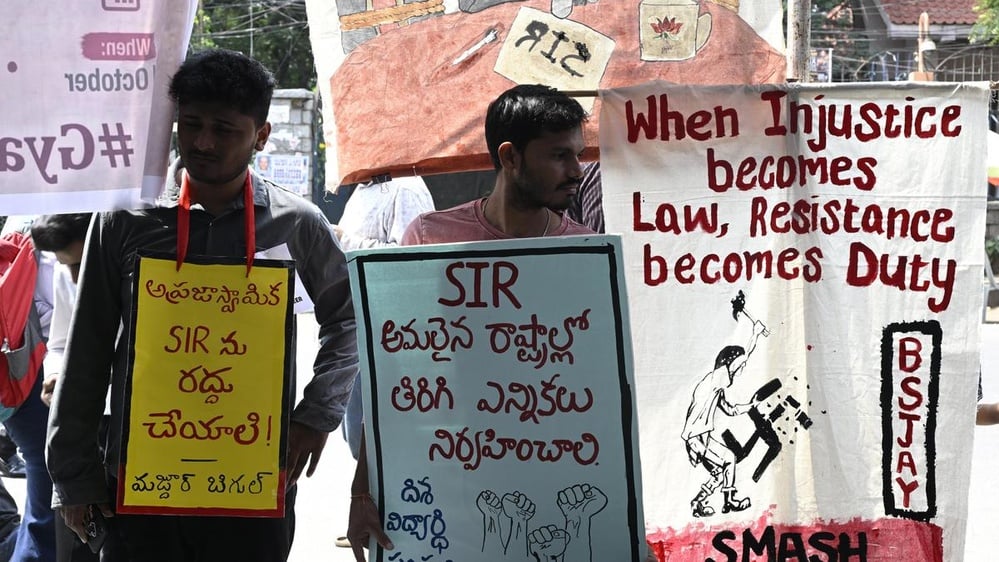
The coverage is straight-news and descriptive, relaying official FIR details and attributed opposition allegations without endorsing either side.
Automated analysis; not human reviewed.
Limitations: No named reporter or publisher appears in the supplied text, and the article is a short wire-style summary, limiting analysis to the visible text.
·
4 of 55 available dimensions scored; omitted dimensions are not treated as neutral.
·
Verified supporting quotes for 4 of 4 scored dimensions.
Claim: The article is nonpartisan in presentation, pairing police and legal details with attributed opposition statements rather than endorsing a side.
“Two FIRs were registered at the Parliament Street (Sansad Marg) Police Station, while one FIR was filed at the Connaught Place Police Station.” · exact text match
“Congress General Secretary KC Venugopal said the Congress and INDIA bloc leaders were prepared to face arrest, alleging that the votes of common people were being "snatched" through the Election Commission of India.” · exact text match
Why: Official procedural facts are reported alongside an attributed opposition claim, and the publisher does not add editorial endorsement or rebuttal.
Claim: The report uses neutral, fact-reporting language and clearly attributes opinion to named sources.
“At least three FIRs have been registered by the Delhi Police in connection with the mass protest held near Jantar Mantar on October 2 against Chief Election Commissioner Gyanesh Kumar.” · exact text match
“Congress General Secretary KC Venugopal said the Congress and INDIA bloc leaders were prepared to face arrest, alleging that the votes of common people were being "snatched" through the Election Commission of India.” · exact text match
Why: The first quote is a declarative police-report statement; the second attributes a charged allegation to a named politician, showing separation of fact and opinion.
Claim: The writing is restrained and avoids hype or emotional language in the publisher's own voice.
“The police are investigating the matter.” · exact text match
“The demonstration was held amid heightened security in central Delhi after police denied permission for the proposed protest and imposed prohibitory restrictions under Section 163 of the Bharatiya Nagarik Suraksha Sanhita (BNSS), 2023.” · exact text match
Why: The prose is procedural and even-paced, with emotional or charged wording confined to attributed quotations.
Claim: The article provides specific, checkable details and named attributed sources.
“The cases have been registered under Sections 223, 221, 132, and 3(5) of the Bharatiya Nyaya Sanhita (BNS) for violating prohibitory orders, obstructing public servants, and unlawful assembly.” · exact text match
“The controversy came after a report in The Indian Express said that Election Commissioners Sukhbir Singh Sandhu and Vivek Joshi had formally raised objections on at least 14 occasions over a 10-month period regarding decisions concerning electoral rolls, voter registration and the Commission's technology systems.” · exact text match
Why: Visible specificity—police stations, legal sections, a named publication, and named officials—supports reliability, though independent verification is outside the supplied text.
No named reporter or publisher appears in the supplied text, and the article is a short wire-style summary, limiting analysis to the visible text.
October 04, 2026 · 0 shares
Framing foregrounds opposition leaders and protesters' assertions of a peaceful, legitimate movement and police overreach, without an official response, yielding a clearly pro-protest, anti-government tilt.
Automated analysis; not human reviewed.
Limitations: No byline; the supplied text contains no government, police, or Election Commission response; several consequential claims rest on attributed protest allegations and could not be independently verified.
·
4 of 55 available dimensions scored; omitted dimensions are not treated as neutral.
·
Verified supporting quotes for 4 of 4 scored dimensions.
Claim: The publisher's framing is tilted toward the opposition/left by presenting the protests as peaceful and omitting official responses.
“Thousands joined the peaceful protests on Gandhi Jayanti, demanding Mr. Kumar’s resignation.” · exact text match
Why: The article's strongest framing is the emphatic characterization of the protests as peaceful and the demand for the CEC's resignation, while all quoted voices come from opposition parties and no government or Election Commission response is included.
Claim: The report presents police and state measures primarily as suppressing peaceful expression, an anti-authoritarian/libertarian frame.
“New Delhi turned into a fortress owing to heavy police deployment and barricading at Jantar Mantar, restricting the entry of people trying to protest.” · exact text match
Why: The publisher's un-attributed 'fortress' description emphasizes state overreach and restriction of peaceful protest, with no official security rationale or balance.
Claim: The article mixes factual reporting with un-attributed subjective characterizations of the protests and the police presence.
“Thousands joined the peaceful protests on Gandhi Jayanti” · exact text match
“New Delhi turned into a fortress owing to heavy police deployment” · exact text match
Why: 'Peaceful protests' and 'fortress' are evaluative descriptions presented as fact, although much of the article is otherwise attributed and factual.
Claim: The article demonstrates credible sourcing practice by attributing allegations and identifying named speakers and locations.
“The protesters alleged that more than 13 crore names had been excluded from draft electoral rolls during the SIR and demanded that eligible voters be restored.” · exact text match
Why: The 13-crore claim is explicitly framed as an allegation by protesters, and the article names sources such as A. A. Rahim, Rahul Gandhi, Manish Sisodia, and Pinarayi Vijayan; specific locations and dates support verifiability, though the absence of official response is a limitation.
No byline; the supplied text contains no government, police, or Election Commission response; several consequential claims rest on attributed protest allegations and could not be independently verified.
Protest-led framing emphasizes detentions, opposition demands, and unverified police-misconduct allegations, with the Election Commission's rebuttal relegated to a brief closing counterpoint.
Automated analysis; not human reviewed.
Limitations: The supplied text is an excerpt containing inline 'Also Read' links and image captions; no byline, publication year, or full SIR explanation is included.
·
7 of 55 available dimensions scored; omitted dimensions are not treated as neutral.
·
Verified supporting quotes for 7 of 7 scored dimensions.
Claim: The framing leans toward protesters and opposition demands through selection and wording, though it preserves attribution and includes an EC rebuttal.
“AISA members alleged that a male police officer manhandled Bora during the police action and that another Delhi Police officer abused her.” · verified after text normalization
“Under fire over the red flags raised by two of its commissioners over the SIR process, the EC has asserted that differing views and observations are a normal part of deliberations in any institution and that all its orders carry full legal sanction and follow established statutory procedures.” · verified after text normalization
Counterevidence:
“The allegations could not be independently verified immediately.” · verified after text normalization
Why: The lead, photo caption, and detailed coverage of protesters' claims and police-misconduct allegations tilt sympathy toward the protesters; the EC's rebuttal is brief and placed at the end, though attribution and caveats limit the tilt.
Claim: The article is a straightforward news report that separates allegations from verified events and attributes claims.
“AISA members alleged that a male police officer manhandled Bora during the police action and that another Delhi Police officer abused her. The allegations could not be independently verified immediately.” · verified after text normalization
“the student organisation said in a statement.” · exact text match
Why: It uses explicit attribution and an unverified-allegation caveat, with no first-person commentary or emotive editorializing.
Claim: The report describes events and quotes demands without prescribing a course of action.
“Around 150 protesters, including AISA national president Neha Bora, activist Yogendra Yadav, and senior advocate Prashant Bhushan, were detained on Saturday as they marched from Patel Chowk towards Jantar Mantar to protest against CEC Gyanesh Kumar and demand his resignation, an official said.” · verified after text normalization
“Delhi Police has registered at least three FIRs in connection with Friday's protests, two at Parliament Street police station and one at Connaught Place police station, under Section 223 of the Bharatiya Nyaya Sanhita (BNS) for alleged disobedience of an order duly promulgated by a public servant.” · verified after text normalization
Why: It narrates who was detained, where, and under what legal provisions, and reports quoted demands without instructing readers what to do.
Claim: The article is saturated with political conflict over the Election Commission, protest demands, and party/student organisations.
“"NSUI demands the immediate resignation and arrest of CEC Gyanesh Kumar and a credible, impartial investigation into the concerns surrounding the electoral process," Pandey said.” · verified after text normalization
“Protests calling for the resignation of Chief Election Commissioner Gyanesh Kumar over concerns related to the revision of electoral rolls continued on Saturday (October 3) with a series of demonstrations in Delhi, while the police filed FIRs in Delhi and Mumbai after protests on Friday (October 2).” · verified after text normalization
Why: The article is almost entirely about a political struggle over the Election Commission, involving opposition parties, student organisations, police FIRs, and demands for resignation or arrest.
Claim: Visible sourcing, attribution, and uncertainty markers support high credibility.
“The allegations could not be independently verified immediately.” · verified after text normalization
“a senior police officer said.” · verified after text normalization
Why: Multiple attributions, an explicit verification caveat, and inclusion of the EC's position support the report's trustworthiness within the supplied text.
Claim: The report follows evidentiary practices such as attribution, verification caveats, and inclusion of the other side.
“The allegations could not be independently verified immediately.” · verified after text normalization
“a senior police officer said.” · verified after text normalization
Why: It attributes facts to officials, notes when allegations could not be verified, and includes the EC's response rather than presenting only one version.
Claim: The article signals fairness by disclosing unverified allegations and including the EC's response.
“The allegations could not be independently verified immediately.” · verified after text normalization
“the EC has asserted that differing views and observations are a normal part of deliberations in any institution and that all its orders carry full legal sanction and follow established statutory procedures.” · verified after text normalization
Why: These markers show an attempt to present both the protesters' claims and the institution's defense, strengthening visible honesty signals.
The supplied text is an excerpt containing inline 'Also Read' links and image captions; no byline, publication year, or full SIR explanation is included.
October 03, 2026 · 0 shares
The framing is terse and event-focused, narrating the protest and police response as established fact without editorial commentary.
Jantar Mantar is a known protest site in New Delhi; CEC refers to Chief Election Commissioner; the Special Intensive Revision (SIR) is a process for revising electoral rolls.
Automated analysis; not human reviewed.
Limitations: The supplied text is a short, unattributed brief; scoring relies on limited context and cannot be externally verified.
·
4 of 55 available dimensions scored; omitted dimensions are not treated as neutral.
·
Verified supporting quotes for 4 of 4 scored dimensions.
Claim: The article reports both protester and police actions without endorsing either side.
“Protesters attempted to breach police barricades while trying to march towards Jantar Mantar” · exact text match
“Police had again barricaded roads leading to the protest site and detained protesters as they gathered.” · exact text match
Why: The two sides' actions are presented in parallel factual clauses with no evaluative adjectives or stated policy preference.
Claim: The text is entirely declarative and contains no first-person opinion, analysis, or judgment terms.
“The protest was called after Friday’s mass detentions, with AISA and other student groups returning to Jantar Mantar to continue demanding Kumar’s resignation over concerns surrounding the Special Intensive Revision (SIR) of electoral rolls.” · exact text match
Why: It relays events and the protesters' stated demand as facts rather than as the reporter's assessment.
Claim: The article uses no hyperbolic, urgent, or fear-inducing language.
“Police had again barricaded roads leading to the protest site and detained protesters as they gathered.” · exact text match
Why: Standard news terms such as 'barricaded' and 'detained' are used without intensifiers or dramatic emphasis.
Claim: The article describes events and makes no recommendation, demand, or policy prescription.
“The protest was called after Friday’s mass detentions, with AISA and other student groups returning to Jantar Mantar to continue demanding Kumar’s resignation over concerns surrounding the Special Intensive Revision (SIR) of electoral rolls.” · exact text match
Why: It reports the protesters' demand rather than voicing a demand of its own and offers no instruction to officials or protesters.
The supplied text is a short, unattributed brief; scoring relies on limited context and cannot be externally verified.
October 04, 2026 · 0 shares
Opposition leaders' allegations and inflammatory rhetoric are relayed prominently with attributions like 'alleged' but without an Election Commission response, giving the protest narrative the dominant frame.
The Special Intensive Revision (SIR) is an Election Commission of India exercise to update and correct electoral rolls, which can involve adding or removing voters.
Automated analysis; not human reviewed.
Limitations: The supplied text is a concatenated HTML-stripped version with repeated chunks and appended unrelated headlines; analysis was limited to the core protest narrative, and no Election Commission response was included in the source.
·
9 of 55 available dimensions scored; omitted dimensions are not treated as neutral.
·
Verified supporting quotes for 9 of 9 scored dimensions.
Claim: The report's prose is predominantly objective, with allegations attributed to named speakers.
“with the parties alleging irregularities in the electoral process and demanding his resignation” · exact text match
“what he described as dictatorial rule” · exact text match
Why: Repeated use of 'alleging', 'alleged', and 'described as' keeps the publisher at a distance from the claims.
Claim: The article uses mildly sensational framing through its headline and dramatic quotations.
“Uddhav, Raj Thackeray hit Mumbai streets for mega protest against Gyanesh Kumar” · exact text match
“Hitler was also a dictator like this, but ultimately, he had to shoot himself.” · exact text match
Why: 'Mega protest' and the Hitler analogy add dramatic charge, though the body is otherwise a straightforward report.
Claim: The protest's conflict-rich content and hyperbolic comparisons make the report moderately interesting.
“Uddhav Thackeray also invoked Adolf Hitler while attacking what he alleged was arbitrary rule.” · exact text match
Why: The Hitler analogy and joint protest by rival leaders add unusual drama.
Claim: The report is largely descriptive, relaying demands rather than advocating them.
“The protesters demanded the removal or resignation of CEC Gyanesh Kumar over alleged irregularities in the Special Intensive Revision (SIR) of electoral rolls.” · exact text match
Why: The publisher describes the protest and demands without issuing its own prescriptions.
Claim: The report is saturated with quoted opinions and allegations, though attributed.
““I appeal to all political parties to go to Delhi and demand that the SIR be cancelled.
Voting machines should be discontinued, and elections should be conducted using ballot papers,” he added.”
· exact text match
Why: Most substantive content consists of politicians' opinions and demands rather than independently verified facts.
Claim: The report is heavily political, centered on a partisan protest and institutional conflict.
“Shiv Sena (UBT) chief Uddhav Thackeray and Maharashtra Navnirman Sena (MNS) chief Raj Thackeray on Sunday led a joint protest march in Mumbai against Chief Election Commissioner Gyanesh Kumar” · exact text match
Why: The entire report concerns opposition-party demands against a constitutional official and election process allegations.
Claim: Complex electoral roll revision is reduced to unverified allegations and sweeping slogans.
“Across the country, the names of 13 crore people have been deleted from the electoral rolls.” · exact text match
Why: The article presents a large, unverified claim without context or official data, oversimplifying the issue.
Claim: The report uses credible journalistic practices: named speakers, direct quotes, and hedged allegations.
“Addressing the gathering, Uddhav Thackeray said the protest was aimed at challenging what he described as dictatorial rule and alleged large-scale deletions from electoral rolls.” · exact text match
Why: Direct quotations attributed to named officials and hedged language support credibility, though the absence of an official response limits it.
Claim: The report shows visible fairness signals through consistent attribution and hedging.
“The protesters demanded the removal or resignation of CEC Gyanesh Kumar over alleged irregularities in the Special Intensive Revision (SIR) of electoral rolls.” · exact text match
“what he described as dictatorial rule” · exact text match
Why: Claims are repeatedly marked as alleged or described rather than asserted as fact.
The supplied text is a concatenated HTML-stripped version with repeated chunks and appended unrelated headlines; analysis was limited to the core protest narrative, and no Election Commission response was included in the source.
The framing foregrounds opposition allegations of “Vote Chori” and CEC bias, embellishes with a derisive party nickname, and leaves the CEC’s response absent.
CEC stands for Chief Election Commissioner; INDIA bloc is an opposition alliance; BJP is the Bharatiya Janata Party; KPCC is the Kerala Pradesh Congress Committee; “Vote Chori” is a Hindi phrase roughly meaning “vote theft.”
Automated analysis; not human reviewed.
Limitations: The supplied text appears to combine a news report with an unrelated first-person autobiographical essay, so the boundary of the article content is ambiguous.
·
7 of 55 available dimensions scored; omitted dimensions are not treated as neutral.
·
Verified supporting quotes for 7 of 7 scored dimensions.
Claim: The article uses subjective, derogatory phrasing rather than neutral naming.
“While the Cockroach Janata Party and some activists, including film stars in Mumbai who have been opposing the Foreign Contribution (Regulation) Act, there have not been many protests seen.” · exact text match
Why: “Cockroach Janata Party” is a pejorative label for a political party, and the sentence editorializes about a lack of protests.
Claim: The article foregrounds the emotionally loaded slogan “Vote Chori” as a central frame.
“for the alleged irregularities in conducting the SIR, which they call “Vote Chori,’” · exact text match
Why: Repeating the “vote theft” slogan as the campaign label gives the report a sensational frame.
Claim: The article uses language evoking stolen votes and political coercion.
“which they call “Vote Chori,’” · exact text match
“which in turn resorted to poaching of MLAs and MPs” · exact text match
Why: The “vote theft” slogan and the poaching allegation are presented as central threats, encouraging fear or outrage.
Claim: The article editorializes about the expected scale of protests.
“Even in Congress-ruled states like Karnataka, it was not on a large scale as it was expected.” · exact text match
Why: This sentence asserts an unstated expectation and evaluates protest turnout rather than simply reporting it.
Claim: The lead story is entirely about partisan protest and political accusation against an election official.
“Shiv Sena (UBT) stages a protest in Mumbai demanding CEC Gyanesh Kumar's resignation, with Congress and NCP (SP) leaders joining the Virat Garjana Morcha.” · exact text match
Why: The article opens with opposition-party protest demands and frames the CEC as the target, making party politics the central subject.
Claim: The article includes insulting name-calling of a political party.
“While the Cockroach Janata Party and some activists” · exact text match
Why: Calling a party “Cockroach Janata Party” is derisive and immature for a news report.
Claim: The article uses loaded labels and a one-sided presentation to shape the reader's response.
“which they call “Vote Chori,’” · exact text match
“While the Cockroach Janata Party and some activists” · exact text match
Why: The “Vote Chori” label and “Cockroach” nickname are emotionally loaded framing devices; no response from the CEC or electoral authorities is included.
The supplied text appears to combine a news report with an unrelated first-person autobiographical essay, so the boundary of the article content is ambiguous.
The publisher frames the event as a plain declarative police-detention news item, without evaluative or partisan language.
Rahul Gandhi is a leader of India's opposition Congress party; the INDIA bloc is a coalition of Indian opposition parties; Gyanesh Kumar is India's Chief Election Commissioner.
Automated analysis; not human reviewed.
Limitations: Only a one-sentence headline was supplied; no body text, byline, or sourcing details were available.
·
3 of 55 available dimensions scored; omitted dimensions are not treated as neutral.
·
Verified supporting quotes for 3 of 3 scored dimensions.
Claim: The report stays in a factual register and avoids subjective or evaluative wording.
“Rahul Gandhi detained by Delhi Police following INDIA bloc's protest against CEC Gyanesh Kumar.” · exact text match
Why: The sentence is a declarative, checkable event report; it contains no approval/disapproval or editorial judgment.
Claim: The report does not use dramatic, alarmist, or emotionally loaded vocabulary.
“Rahul Gandhi detained by Delhi Police following INDIA bloc's protest against CEC Gyanesh Kumar.” · exact text match
Why: It states the event plainly using standard journalistic terms, with no hyperbolic or fear-inducing language.
Claim: The sentence describes an event and does not prescribe action or call for a response.
“Rahul Gandhi detained by Delhi Police following INDIA bloc's protest against CEC Gyanesh Kumar.” · exact text match
Why: It contains no imperative, recommendation, or normative judgment; it simply states what happened.
Only a one-sentence headline was supplied; no body text, byline, or sourcing details were available.
The framing foregrounds opposition protests and the 'vote chori' allegation, making the postponement look politically driven despite the official 'unavoidable reasons' explanation.
The Special Intensive Revision (SIR) of electoral rolls is an Election Commission voter-list update exercise; in this case it had become politically contentious, with opposition parties alleging irregularities.
Automated analysis; not human reviewed.
Limitations: The supplied text appears to be an aggregated page with repeated passages and a Q&A-style 'Yes' fragment, so the substantive original article and page-generated content are not cleanly separable.
·
5 of 55 available dimensions scored; omitted dimensions are not treated as neutral.
·
Verified supporting quotes for 5 of 5 scored dimensions.
Claim: The article uses attributed allegations and official/police statements rather than editorial judgment.
“Opposition leaders, including Rahul Gandhi, allege that Kumar is involved in 'vote chori' related to the Special Intensive Revision of electoral rolls, leading to demands for his resignation.” · exact text match
“The police later said around 250 people were detained on Tuesday night, including 50 MPs, following an over eight-hour sit-in protest.” · exact text match
Why: Contested claims are attributed to opposition leaders and police; no evaluative adjectives or direct editorial conclusions are used.
Claim: The report organizes the story around a partisan conflict over the CEC rather than around a neutral administrative explanation.
“Opposition leaders, including Rahul Gandhi, allege that Kumar is involved in 'vote chori' related to the Special Intensive Revision of electoral rolls, leading to demands for his resignation.” · exact text match
“The visit has been postponed amid opposition protests against Kumar and the functioning of the Election Commission of India.” · exact text match
Counterevidence:
“It is informed that the Commission [ECI] has postponed the Chhattisgarh visit programme of Shri Gyanesh Kumar, Hon’ble Chief Election Commissioner, and other senior officials of the Commission, due to unavoidable reasons.” · exact text match
Why: The lead and body repeatedly frame the postponement through opposition demands and protests; the official 'unavoidable reasons' letter appears but is not the organizing frame.
Claim: The article concentrates on the protest, detentions, and official postponement response rather than the electoral-roll revision substance.
“The visit has been postponed amid opposition protests against Kumar and the functioning of the Election Commission of India.” · exact text match
“Earlier, several police personnel caught hold of Rahul Gandhi as they forcibly removed him from the site and was taken into a bus.” · exact text match
Counterevidence:
“It is informed that the Commission [ECI] has postponed the Chhattisgarh visit programme of Shri Gyanesh Kumar, Hon’ble Chief Election Commissioner, and other senior officials of the Commission, due to unavoidable reasons.” · exact text match
Why: Most reported details describe protests, detentions, and police actions; the underlying SIR allegations are summarized only as 'vote chori.'
Claim: The visible sourcing and attribution are strong enough to support the reported facts.
“It is informed that the Commission [ECI] has postponed the Chhattisgarh visit programme of Shri Gyanesh Kumar, Hon’ble Chief Election Commissioner, and other senior officials of the Commission, due to unavoidable reasons.” · exact text match
“The police later said around 250 people were detained on Tuesday night, including 50 MPs, following an over eight-hour sit-in protest.” · exact text match
Why: Key facts are tied to the CEO office letter, police statements, and party statements; the article does not present unsourced speculation as fact.
Claim: Several textual patterns suggest automated or AI-assisted aggregation.
“Yes, opposition leaders, including Rahul Gandhi, have called for his resignation, accusing him of facilitating a fraud involving the electoral rolls.” · exact text match
“Gyanesh Kumar postponed his visit due to unavoidable reasons amid ongoing opposition protests demanding his removal related to the electoral rolls.” · exact text match
Why: An answer-style 'Yes' fragment and repeated near-identical summary sentences are unusual for a single-author news report, though they may also come from an aggregated page.
The supplied text appears to be an aggregated page with repeated passages and a Q&A-style 'Yes' fragment, so the substantive original article and page-generated content are not cleanly separable.
The framing foregrounds opposition protests and the 'vote chori' allegation, making the postponement look politically driven despite the official 'unavoidable reasons' explanation.
The Special Intensive Revision (SIR) of electoral rolls is an Election Commission voter-list update exercise; in this case it had become politically contentious, with opposition parties alleging irregularities.
Automated analysis; not human reviewed.
Limitations: The supplied text appears to be an aggregated page with repeated passages and a Q&A-style 'Yes' fragment, so the substantive original article and page-generated content are not cleanly separable.
·
5 of 55 available dimensions scored; omitted dimensions are not treated as neutral.
·
Verified supporting quotes for 5 of 5 scored dimensions.
Claim: The article uses attributed allegations and official/police statements rather than editorial judgment.
“Opposition leaders, including Rahul Gandhi, allege that Kumar is involved in 'vote chori' related to the Special Intensive Revision of electoral rolls, leading to demands for his resignation.” · exact text match
“The police later said around 250 people were detained on Tuesday night, including 50 MPs, following an over eight-hour sit-in protest.” · exact text match
Why: Contested claims are attributed to opposition leaders and police; no evaluative adjectives or direct editorial conclusions are used.
Claim: The report organizes the story around a partisan conflict over the CEC rather than around a neutral administrative explanation.
“Opposition leaders, including Rahul Gandhi, allege that Kumar is involved in 'vote chori' related to the Special Intensive Revision of electoral rolls, leading to demands for his resignation.” · exact text match
“The visit has been postponed amid opposition protests against Kumar and the functioning of the Election Commission of India.” · exact text match
Counterevidence:
“It is informed that the Commission [ECI] has postponed the Chhattisgarh visit programme of Shri Gyanesh Kumar, Hon’ble Chief Election Commissioner, and other senior officials of the Commission, due to unavoidable reasons.” · exact text match
Why: The lead and body repeatedly frame the postponement through opposition demands and protests; the official 'unavoidable reasons' letter appears but is not the organizing frame.
Claim: The article concentrates on the protest, detentions, and official postponement response rather than the electoral-roll revision substance.
“The visit has been postponed amid opposition protests against Kumar and the functioning of the Election Commission of India.” · exact text match
“Earlier, several police personnel caught hold of Rahul Gandhi as they forcibly removed him from the site and was taken into a bus.” · exact text match
Counterevidence:
“It is informed that the Commission [ECI] has postponed the Chhattisgarh visit programme of Shri Gyanesh Kumar, Hon’ble Chief Election Commissioner, and other senior officials of the Commission, due to unavoidable reasons.” · exact text match
Why: Most reported details describe protests, detentions, and police actions; the underlying SIR allegations are summarized only as 'vote chori.'
Claim: The visible sourcing and attribution are strong enough to support the reported facts.
“It is informed that the Commission [ECI] has postponed the Chhattisgarh visit programme of Shri Gyanesh Kumar, Hon’ble Chief Election Commissioner, and other senior officials of the Commission, due to unavoidable reasons.” · exact text match
“The police later said around 250 people were detained on Tuesday night, including 50 MPs, following an over eight-hour sit-in protest.” · exact text match
Why: Key facts are tied to the CEO office letter, police statements, and party statements; the article does not present unsourced speculation as fact.
Claim: Several textual patterns suggest automated or AI-assisted aggregation.
“Yes, opposition leaders, including Rahul Gandhi, have called for his resignation, accusing him of facilitating a fraud involving the electoral rolls.” · exact text match
“Gyanesh Kumar postponed his visit due to unavoidable reasons amid ongoing opposition protests demanding his removal related to the electoral rolls.” · exact text match
Why: An answer-style 'Yes' fragment and repeated near-identical summary sentences are unusual for a single-author news report, though they may also come from an aggregated page.
The supplied text appears to be an aggregated page with repeated passages and a Q&A-style 'Yes' fragment, so the substantive original article and page-generated content are not cleanly separable.
A legal-procedural frame foregrounds allegations of unilateral Election Commission decision-making while preserving attribution through 'claimed' and 'allegedly' and including the Election Commission's denial.
Article 324 of the Indian Constitution makes the Election Commission a multi-member constitutional body with superintendence of elections; whether its decisions require collective concurrence is the legal question underlying the petitions.
Automated analysis; not human reviewed.
Limitations: The supplied text is truncated, lacks a byline or explicit publisher name, and repeats passages, limiting assessment to the provided excerpts.
·
6 of 55 available dimensions scored; omitted dimensions are not treated as neutral.
·
Verified supporting quotes for 5 of 6 scored dimensions.
Claim: The report separates factual court actions from contested allegations and includes an official denial.
“The Supreme Court on Monday refused to pass an interim order seeking the suspension of Chief Election Commissioner (CEC) Gyanesh Kumar” · exact text match
“The Election Commission, however, said the letters sent by the two Election Commissioners to the Cabinet Secretary related to an officer on deputation and were not connected to policy matters or the functioning of its IT division.” · exact text match
Why: Court action is stated as fact, allegations are attributed with 'claimed' and 'allegedly', and the official denial is included, keeping the reporter's subjectivity out.
Claim: The headline and lead state the procedural outcome without sensational language.
“Supreme Court Refuses Interim Order To Suspend CEC Gyanesh Kumar; Issues Notice To ECI, ECs” · exact text match
“The Supreme Court's refusal to grant interim relief means that no order suspending Kumar was passed at this stage.” · exact text match
Why: The wording reports a court outcome directly and adds a clarifying procedural consequence rather than using inflammatory or urgent language.
Claim: The article describes proceedings and claims rather than prescribing a course of action.
“The Supreme Court on Monday refused to pass an interim order seeking the suspension of Chief Election Commissioner (CEC) Gyanesh Kumar” · exact text match
“Petitions allege 14 SIR-related decisions were taken without concurrence of Election Commissioners Sukhbir Singh Sandhu and Vivek Joshi” · not found in supplied text
Why: Content is limited to what the court did, what petitions allege, and what the report claimed, with no recommendations or normative demands.
Claim: The story names its source report, attributes claims, and includes the institution's response.
“The petitions were filed days after a report by The Indian Express claimed” · exact text match
“Live Law reported” · exact text match
“The Election Commission, however, said the letters sent by the two Election Commissioners to the Cabinet Secretary related to an officer on deputation and were not connected to policy matters or the functioning of its IT division.” · exact text match
Why: Visible sourcing is explicit for the originating report, the court action is tied to Live Law, and the official denial is included, supporting a credible evidentiary practice.
Claim: The reporting consistently attributes contested assertions rather than presenting them as facts.
“The petitions were filed days after a report by The Indian Express claimed that Election Commissioners Sukhbir Singh Sandhu and Vivek Joshi had recorded objections at least 14 times over the past 10 months to decisions and orders concerning the Special Intensive Revision (SIR) of electoral rolls.” · exact text match
“The two Election Commissioners allegedly maintained that certain decisions were issued without their knowledge, concurrence or recommendation.” · exact text match
Why: The repeated use of 'claimed' and 'allegedly', plus inclusion of the EC's denial, shows an evidence-attentive, non-dogmatic epistemic stance.
Claim: The article signals fairness by attributing allegations and giving the Election Commission's contrary position.
“The petitions were filed days after a report by The Indian Express claimed that Election Commissioners Sukhbir Singh Sandhu and Vivek Joshi had recorded objections at least 14 times over the past 10 months to decisions and orders concerning the Special Intensive Revision (SIR) of electoral rolls.” · exact text match
“The Election Commission, however, said the letters sent by the two Election Commissioners to the Cabinet Secretary related to an officer on deputation and were not connected to policy matters or the functioning of its IT division.” · exact text match
Why: Both the allegations and the official denial are presented, with the denial introduced by 'however' rather than omitted or buried.
The supplied text is truncated, lacks a byline or explicit publisher name, and repeats passages, limiting assessment to the provided excerpts.
October 05, 2026 · 0 shares
The Supreme Court clarification is framed as a vindication of the opposition's accusation against CEC Gyanesh Kumar, with the ECI's 'upheld' press note treated as rebutted and little current space given to the ECI's defense.
The Special Intensive Revision (SIR) is a periodic focused revision of electoral rolls; Form 6 is the standard application for new voter enrolment.
Earlier Indian Express reporting, referenced throughout, alleged that CEC Gyanesh Kumar added a parent-listing declaration requirement to Form 6 over objections from other election commissioners.
Automated analysis; not human reviewed.
Limitations: The supplied text does not reproduce The Indian Express's underlying investigation, so the factual basis for the contested Form 6 change cannot be independently checked from this article; the publication date and author byline are also absent.
·
6 of 55 available dimensions scored; omitted dimensions are not treated as neutral.
·
Verified supporting quotes for 6 of 6 scored dimensions.
Claim: The article's selection and wording favor the opposition's narrative that CEC Gyanesh Kumar acted illegally, while giving no current ECI response to the Supreme Court clarification.
“The Supreme Court’s assertion that modifications made to Form 6 by the Election Commission of India (ECI) for enrolling voters “had not been made by us” has come as a shot in the arm for the Opposition a day ahead of its protest march to the poll panel’s Nirvachan Sadan headquarters in New Delhi.” · verified after text normalization
“With the CJI’s remark effectively rebutting the poll panel’s September 26 press note, which had claimed that the declaration attached to Form 6 for SIR had been “upheld” by the apex court, the Opposition came in all guns blazing at the CEC once again.” · verified after text normalization
Counterevidence:
“Though the CJI-led bench declined to pass any ex-parte suspension order against the CEC and, instead, issued notices to Kumar and the poll panel seeking their response to the petitions, Kant’s remark is significant.” · verified after text normalization
Why: The opening and body frames the SC statement as opposition 'ammo' and a 'shot in the arm,' and says it 'rebutted' the ECI, while the ECI/current CEC side is not given a fresh voice after the clarification.
Claim: The article mixes factual reporting with evaluative metaphors and opposition-centric framing, making it less than purely objective.
“The Supreme Court’s assertion that modifications made to Form 6 by the Election Commission of India (ECI) for enrolling voters “had not been made by us” has come as a shot in the arm for the Opposition a day ahead of its protest march to the poll panel’s Nirvachan Sadan headquarters in New Delhi.” · verified after text normalization
“Sources in the Congress and the Left parties told The Federal that the Centre and the CEC’s decision to brazen out the raging political storm will only “intensify the protests” further” · verified after text normalization
Counterevidence:
“During the hearing on Monday (October 5), Chief Justice of India Surya Kant clarified: “Any modified Form 6 has not been approved by us. Let’s be clear.
When the record is produced, we would like to see who has modified what.””
· verified after text normalization
Why: Direct quotes and attributed sourcing make the piece substantially factual, but phrases like 'shot in the arm,' 'brazen out,' and 'raging political storm' are evaluative/emotive framing.
Claim: The article is centered on a partisan political confrontation and the opposition's protest strategy rather than a neutral policy or legal explainer.
“The Opposition’s INDIA bloc, which has redoubled its campaign for Gyanesh Kumar’s removal as the Chief Election Commissioner (CEC) since The Indian Express’s exposé, will rally all its Lok Sabha and Rajya Sabha MPs from Parliament’s Makar Dwar to the Nirvachan Sadan at 10.30 am on Tuesday (October 6).” · verified after text normalization
“The Congress has also announced the next phase of its campaign against vote chori (vote theft).” · verified after text normalization
Why: Most paragraphs report INDIA bloc/Congress protest plans, demands, and allegations; the event itself is a Supreme Court hearing but the article's emphasis is political mobilization.
Claim: The article emphasizes reaction and protest logistics over the substance and legal status of the contested Form 6 change.
“Various civil society groups, organisations like the CJP, and youth wings of all Opposition parties too have been protesting in Delhi and other parts of the country for the past week demanding Kumar’s removal and scrapping of the SIR exercise.” · verified after text normalization
“AICC general secretary (organisation) KC Venugopal said the campaign would see a nationwide mobilisation at the block level with party workers carrying out “vote bachao, desh bachao” padyatras and bike rallies between October 10 and October 20 during which pamphlets detailing the “illegal actions” of Gyanesh Kumar and the lapses in the SIR process would also be distributed to citizens to explain the reasons for the Opposition’s agitation.” · verified after text normalization
Why: Once the CJI's clarification is reported, the article spends most of its length on INDIA bloc/Congress campaign schedules, protest participation, and quoted denunciations rather than on the legal or administrative merits or the ECI's own account.
Claim: The article shows strong visible sourcing and attribution practices, using exact quotes and named parties.
“During the hearing on Monday (October 5), Chief Justice of India Surya Kant clarified: “Any modified Form 6 has not been approved by us. Let’s be clear.
When the record is produced, we would like to see who has modified what.””
· verified after text normalization
“Menaka Guruswamy, senior advocate and Rajya Sabha MP from Mamata Banerjee’s Trinamool Congress, argued in the Supreme Court that CEC, “in concert with” the poll panel’s director general (IT) Seema Khanna, “altered Form 6 digitally on the ECINet portal in July 2026”” · verified after text normalization
Why: The text attributes allegations to named lawyers, politicians, and sources; quotes the CJI and ECI press note exactly; and gives dates for events, allowing verification.
Claim: The article demonstrates above-average informational depth and contextual complexity.
“Menaka Guruswamy, senior advocate and Rajya Sabha MP from Mamata Banerjee’s Trinamool Congress, argued in the Supreme Court that CEC, “in concert with” the poll panel’s director general (IT) Seema Khanna, “altered Form 6 digitally on the ECINet portal in July 2026”, and that the following month Sandhu “formally recorded that this alteration was ‘unauthorised and illegal’ and was causing arbitrary harassment to young, eligible first-time electors”.” · verified after text normalization
“Subsequently, from October 25 to November 25, the party plans to conduct “village chaupals” across the country as an effort to “identify the 13.30 crore voters who have been deleted” in the SIR process so far.” · verified after text normalization
Why: It integrates legal argument, procedural history, protest campaign logistics, and political context with specific names and dates.
The supplied text does not reproduce The Indian Express's underlying investigation, so the factual basis for the contested Form 6 change cannot be independently checked from this article; the publication date and author byline are also absent.
The coverage is straight-news and descriptive, relaying official FIR details and attributed opposition allegations without endorsing either side.
Automated analysis; not human reviewed.
Limitations: No named reporter or publisher appears in the supplied text, and the article is a short wire-style summary, limiting analysis to the visible text.
·
4 of 55 available dimensions scored; omitted dimensions are not treated as neutral.
·
Verified supporting quotes for 4 of 4 scored dimensions.
Claim: The article is nonpartisan in presentation, pairing police and legal details with attributed opposition statements rather than endorsing a side.
“Two FIRs were registered at the Parliament Street (Sansad Marg) Police Station, while one FIR was filed at the Connaught Place Police Station.” · exact text match
“Congress General Secretary KC Venugopal said the Congress and INDIA bloc leaders were prepared to face arrest, alleging that the votes of common people were being "snatched" through the Election Commission of India.” · exact text match
Why: Official procedural facts are reported alongside an attributed opposition claim, and the publisher does not add editorial endorsement or rebuttal.
Claim: The report uses neutral, fact-reporting language and clearly attributes opinion to named sources.
“At least three FIRs have been registered by the Delhi Police in connection with the mass protest held near Jantar Mantar on October 2 against Chief Election Commissioner Gyanesh Kumar.” · exact text match
“Congress General Secretary KC Venugopal said the Congress and INDIA bloc leaders were prepared to face arrest, alleging that the votes of common people were being "snatched" through the Election Commission of India.” · exact text match
Why: The first quote is a declarative police-report statement; the second attributes a charged allegation to a named politician, showing separation of fact and opinion.
Claim: The writing is restrained and avoids hype or emotional language in the publisher's own voice.
“The police are investigating the matter.” · exact text match
“The demonstration was held amid heightened security in central Delhi after police denied permission for the proposed protest and imposed prohibitory restrictions under Section 163 of the Bharatiya Nagarik Suraksha Sanhita (BNSS), 2023.” · exact text match
Why: The prose is procedural and even-paced, with emotional or charged wording confined to attributed quotations.
Claim: The article provides specific, checkable details and named attributed sources.
“The cases have been registered under Sections 223, 221, 132, and 3(5) of the Bharatiya Nyaya Sanhita (BNS) for violating prohibitory orders, obstructing public servants, and unlawful assembly.” · exact text match
“The controversy came after a report in The Indian Express said that Election Commissioners Sukhbir Singh Sandhu and Vivek Joshi had formally raised objections on at least 14 occasions over a 10-month period regarding decisions concerning electoral rolls, voter registration and the Commission's technology systems.” · exact text match
Why: Visible specificity—police stations, legal sections, a named publication, and named officials—supports reliability, though independent verification is outside the supplied text.
No named reporter or publisher appears in the supplied text, and the article is a short wire-style summary, limiting analysis to the visible text.
October 05, 2026 · 0 shares
The report frames the dispute through attributed opposition allegations and an official EC rebuttal, producing a balanced but conflict-driven he-said/she-said account.
Automated analysis; not human reviewed.
Limitations: The supplied text contains repeated paragraphs and a truncated JSON-like fragment, so distinguishing the original article from extraction artifacts is ambiguous.
·
3 of 55 available dimensions scored; omitted dimensions are not treated as neutral.
·
Verified supporting quotes for 3 of 3 scored dimensions.
Claim: The report uses explicit attribution and includes an official rebuttal, making the framing predominantly objective.
“Raut alleged” · exact text match
“the EC has asserted that differing views and observations are a part of deliberations” · exact text match
Why: The publisher separates the opposition MP's claims from the EC's response with attribution language, avoiding unmarked subjective narration.
Claim: The headline foregrounds emotionally charged allegations, giving a sensational frame despite attributed sourcing.
“CEC Gyanesh Kumar 'enemy' of country, has gone underground: Sanjay Raut” · exact text match
Counterevidence:
“Raut alleged” · exact text match
Why: The chosen headline quotes strong language ('enemy of the country,' 'gone underground') that dramatizes the conflict, even though the body attributes it.
Claim: The text is transparent about sourcing and gives the EC room to respond, supporting credibility.
“Raut told reporters” · exact text match
“the EC has asserted” · exact text match
Why: Attribution and inclusion of an official response are visible credibility markers in the supplied text.
The supplied text contains repeated paragraphs and a truncated JSON-like fragment, so distinguishing the original article from extraction artifacts is ambiguous.
Framing is legalistic and even-handed, giving the inquiry, the statutory protections, and the absence of established wrongdoing comparable weight.
Automated analysis; not human reviewed.
Limitations: The supplied article text is partially duplicated and includes a truncated sentence and an embedded engagement prompt, limiting certainty about the complete article's framing.
·
7 of 55 available dimensions scored; omitted dimensions are not treated as neutral.
·
Verified supporting quotes for 7 of 7 scored dimensions.
Claim: The report stays factual and includes explicit limits on what the inquiry has established.
“The inquiry establishes no wrongdoing based on information presently available publicly.” · exact text match
“no court has found Kumar criminally liable” · exact text match
Why: The publisher repeatedly notes the absence of a finding of wrongdoing, avoiding a subjective or prejudging frame.
Claim: The article reports an allegation-driven story with tempering caveats rather than sensational phrasing.
“The minister said the new inquiry would follow the evidence and that nobody would be prejudged.” · exact text match
“The inquiry establishes no wrongdoing based on information presently available publicly.” · exact text match
Why: Even though the headline leads with corruption allegations, the body suppresses hype by emphasizing evidence-following and the lack of established wrongdoing.
Claim: The article describes the inquiry and legal context without recommending a course of action.
“Another qualification matters.
Section 16 is framed as a restriction on courts entertaining or continuing proceedings arising from protected official conduct; it does not expressly impose a blanket prohibition on police or Vigilance investigation.”
· exact text match
“If investigators find material warranting further action, the legal dispute is likely to centre on ordinary anti-corruption and criminal procedure rather than protection for Election Commission functions.” · exact text match
Why: It analyzes possible legal outcomes in conditional form, not as advocacy or instruction.
Claim: The article maintains a neutral, unemotional register.
“The inquiry establishes no wrongdoing based on information presently available publicly.” · exact text match
“Chennithala said notes left by Lee mentioned Kumar, then PWD secretary.” · exact text match
Why: No emotive language is used about the suicide or alleged corruption; facts and attributions are reported plainly.
Claim: The article names officials, cites the statutory provision, and attributes allegations, while flagging what is not established.
“State Home Minister Ramesh Chennithala has directed the Vigilance and Anti-Corruption Bureau to examine allegations connected with the Kerala State Transport Project and claims that an earlier inquiry was derailed by external pressure.” · exact text match
“The inquiry establishes no wrongdoing based on information presently available publicly.” · exact text match
Why: Sourcing is specific and the piece distinguishes allegations from established facts, supporting trustworthiness on visible criteria.
Claim: The report's framing is analytical and caveated rather than emotional or conspiratorial.
“The distinction between Kumar’s present office and his position two decades ago is legally significant.” · exact text match
“The provision is not a general personal immunity covering conduct before taking office.” · exact text match
Why: The article weighs statutory language and legal distinctions before presenting the allegations, showing structured reasoning.
Claim: The article includes fairness signals such as caveats, attributed claims, and a quoted no-prejudgment commitment.
“The minister said the new inquiry would follow the evidence and that nobody would be prejudged.” · exact text match
“The inquiry establishes no wrongdoing based on information presently available publicly.” · exact text match
Why: It gives the subject's legal protections and the absence of a finding as much prominence as the allegations, indicating a balanced presentation.
The supplied article text is partially duplicated and includes a truncated sentence and an embedded engagement prompt, limiting certainty about the complete article's framing.
October 03, 2026 · 0 shares
Coverage centers protesters' grievances and civil-liberties concerns, highlights detention and internet restrictions, and gives the Election Commission's rebuttal only brief placement.
The Election Commission of India, led by Chief Election Commissioner Gyanesh Kumar, was conducting a special intensive revision of electoral rolls starting in June 2025, and opposition parties and activist groups have alleged irregularities in the process.
Automated analysis; not human reviewed.
Limitations: The supplied text includes repeated headline blocks and embedded social-media posts, so the boundaries between original reporting and aggregated material, and the exact date of 'Friday', are not fully recoverable.
·
5 of 55 available dimensions scored; omitted dimensions are not treated as neutral.
·
Verified supporting quotes for 5 of 5 scored dimensions.
Claim: Coverage leans liberal by centering protester grievances and civil-liberties criticism while giving the official rebuttal less prominence.
“The Cockroach Janta Party said that “it is up to the government and the Delhi Police whether they respect our right to peaceful protest or repeat the brutality we witnessed on July 20”.” · exact text match
“On Friday, more than 700 protesters and political leaders were detained by the police in Delhi.” · exact text match
Counterevidence:
“the Election Commission had said that “operational queries or inputs raised by commission members during draft stages are part of standard administrative practice” to safeguard voter rights.” · exact text match
Why: Unchallenged use of protester framing and emphasis on detentions suggest alignment with the protesters' side, although an official response is included.
Claim: The report favors civil liberties by portraying protest restrictions as problematic.
“Internet services were suspended in areas around Jantar Mantar, while the main protest area was barricaded, The Hindu reported.” · exact text match
““If Delhi Police tries to stop us, wherever they stop us will become our Jantar Mantar,” Abhijeet Dipke, the founder of the political campaign, said on social media.” · exact text match
Why: The selection and placement of quotes and restriction details frame state action as an infringement on peaceful protest.
Claim: Mostly attributed, factual reporting with only a slight subjective tilt from emotive protester quotes and selected details.
“According to The Indian Express investigation, Sandhu and Joshi had reportedly objected to changes to Form 6, appeals against the inclusion of voters in West Bengal and the handling of voter data in Goa, among other matters.” · exact text match
“Kumar has not yet commented on The Indian Express’ investigation.
However, after the report was published, the Election Commission had said that “operational queries or inputs raised by commission members during draft stages are part of standard administrative practice” to safeguard voter rights.”
· exact text match
Why: The report attributes claims to named outlets and includes an official rebuttal, keeping it close to neutral despite a protester-oriented focus.
Claim: The article is centered on a political conflict over the Election Commission and opposition demands.
“CJP says Delhi protest on October 10 if CEC Gyanesh Kumar does not resign” · exact text match
“The Opposition has also demanded the removal of Kumar.” · exact text match
Why: The headline and repeated references to opposition demands make this a directly political news event.
Claim: The report shows fairness signals by noting the CEC's non-comment and including the Election Commission's written response.
“Kumar has not yet commented on The Indian Express’ investigation.” · exact text match
“the Election Commission had said that “operational queries or inputs raised by commission members during draft stages are part of standard administrative practice” to safeguard voter rights.” · exact text match
Why: Including the subject's silence and the institution's rebuttal reflects internally observable balance.
The supplied text includes repeated headline blocks and embedded social-media posts, so the boundaries between original reporting and aggregated material, and the exact date of 'Friday', are not fully recoverable.
October 02, 2026 · 0 shares
Sympathetic, spectacle-focused coverage of an anti-CEC protest that relays unverified election-fraud allegations without an institutional rebuttal.
Automated analysis; not human reviewed.
Limitations: Duplicated feed text without a byline or outlet name limits context for publisher-level framing.
·
7 of 55 available dimensions scored; omitted dimensions are not treated as neutral.
·
Verified supporting quotes for 7 of 7 scored dimensions.
Claim: The coverage is one-sidedly sympathetic to an anti-BJP protest, with no substantive rebuttal from the EC or BJP.
“Defying afternoon heat and barricades, young men and women turned up for the protest in central Mumbai in huge numbers even though police had denied permission for the event.” · exact text match
“BJP supporters argue that the opposition won in Telangana, Karnataka and Jharkhand (and hence the elections are fair), but “when the match is fixed, not all balls are no-balls and not all catches are dropped,” Dipke said.” · exact text match
Why: The publisher's own wording celebrates the protest, and the only counterargument is immediately followed by a protester's metaphor dismissing it, without any official rebuttal.
Claim: The report adopts a populist idiom by amplifying mass-action threats and street protest as legitimate political voice.
““If Gyanesh Kumar doesn’t resign, cockroaches from across India will march to Delhi & protest at Jantar Mantar on October 10,”” · exact text match
““If Gyanesh Kumar does not resign, the Gen Z of the entire nation will go to Delhi.
There will be Jantar Mantar 2.0,” he said as he gave a call for “Chalo Delhi”.”
· exact text match
Why: The article leads with and prominently quotes populist mass-mobilization rhetoric without qualifying distance.
Claim: The reporting uses subjective, emotive description alongside factual attributions.
“After leading a massive demonstration at Shivaji Park in Mumbai which drew thousands of people” · exact text match
“Defying afternoon heat and barricades, young men and women turned up for the protest in central Mumbai in huge numbers even though police had denied permission for the event.” · exact text match
Why: Adjectives such as 'massive' and 'huge numbers' and the narrative 'Defying' inject evaluation beyond plain factual reporting.
Claim: The article foregrounds spectacle, memes, and celebrity attendance rather than policy substance.
“Memes, slogans and celebrity support mark CJP protest at Mumbai’s Shivaji Park” · exact text match
“Manish Mandal, a student, sported jewelry fashioned from ‘Melody’ chocolate wrappers while holding a banner with “Fraud detergent powder” written in Devanagari script.” · exact text match
Why: The headline and detailed descriptions of props foreground entertainment-like elements.
Claim: The story is heavily political, centering on election administration, party competition, and protest demands.
“He also demanded freezing of voter lists of 2025 and abolition of the 2023 law laying down the procedure for the appointment of Election Commissioners.” · exact text match
“Referring to the proposal for simultaneous elections, he claimed that the real objective of the ruling Bharatiya Janata Party was “One Nation, One Election, One Party”.” · exact text match
Why: The central reported event is a partisan political protest about electoral processes; the quoted demands are explicitly political.
Claim: The piece is framed against state institutions, presenting the anti-police and anti-EC protest sympathetically.
““Delhi Police has again resorted to brutality.
We warn Delhi Police to improve or we will improve you,” Das said.”
· exact text match
“Despite opposition by a section of residents of Shivaji Park and heavy security deployment extending up to Dadar station, protesters filled the locality with slogans, Gandhian quotes, and signs calling for Kumar’s immediate resignation.” · exact text match
Why: The threat against police and the sympathetic description of protesters occupying the ground are included without balancing context or disapproval.
Claim: The article is credible in visible sourcing: named speakers and attributed claims.
““Gyanesh Kumar must resign and face criminal proceedings,” demanded CJP leader Ajinkya Shinde.” · exact text match
“He claimed that 13 crore voters have been deleted in two years.” · exact text match
Why: Statements are attributed to named individuals with 'demanded' and 'claimed', and the report gives a specific date and location.
Duplicated feed text without a byline or outlet name limits context for publisher-level framing.
A legal-procedural frame foregrounds allegations of unilateral Election Commission decision-making while preserving attribution through 'claimed' and 'allegedly' and including the Election Commission's denial.
Article 324 of the Indian Constitution makes the Election Commission a multi-member constitutional body with superintendence of elections; whether its decisions require collective concurrence is the legal question underlying the petitions.
Automated analysis; not human reviewed. Limitations: The supplied text is truncated, lacks a byline or explicit publisher name, and repeats passages, limiting assessment to the provided excerpts. · 6 of 55 available dimensions scored; omitted dimensions are not treated as neutral. · Verified supporting quotes for 5 of 6 scored dimensions.
Claim: The report separates factual court actions from contested allegations and includes an official denial.
“The Supreme Court on Monday refused to pass an interim order seeking the suspension of Chief Election Commissioner (CEC) Gyanesh Kumar” · exact text match
“The Election Commission, however, said the letters sent by the two Election Commissioners to the Cabinet Secretary related to an officer on deputation and were not connected to policy matters or the functioning of its IT division.” · exact text match
Why: Court action is stated as fact, allegations are attributed with 'claimed' and 'allegedly', and the official denial is included, keeping the reporter's subjectivity out.
Claim: The headline and lead state the procedural outcome without sensational language.
“Supreme Court Refuses Interim Order To Suspend CEC Gyanesh Kumar; Issues Notice To ECI, ECs” · exact text match
“The Supreme Court's refusal to grant interim relief means that no order suspending Kumar was passed at this stage.” · exact text match
Why: The wording reports a court outcome directly and adds a clarifying procedural consequence rather than using inflammatory or urgent language.
Claim: The article describes proceedings and claims rather than prescribing a course of action.
“The Supreme Court on Monday refused to pass an interim order seeking the suspension of Chief Election Commissioner (CEC) Gyanesh Kumar” · exact text match
“Petitions allege 14 SIR-related decisions were taken without concurrence of Election Commissioners Sukhbir Singh Sandhu and Vivek Joshi” · not found in supplied text
Why: Content is limited to what the court did, what petitions allege, and what the report claimed, with no recommendations or normative demands.
Claim: The story names its source report, attributes claims, and includes the institution's response.
“The petitions were filed days after a report by The Indian Express claimed” · exact text match
“Live Law reported” · exact text match
“The Election Commission, however, said the letters sent by the two Election Commissioners to the Cabinet Secretary related to an officer on deputation and were not connected to policy matters or the functioning of its IT division.” · exact text match
Why: Visible sourcing is explicit for the originating report, the court action is tied to Live Law, and the official denial is included, supporting a credible evidentiary practice.
Claim: The reporting consistently attributes contested assertions rather than presenting them as facts.
“The petitions were filed days after a report by The Indian Express claimed that Election Commissioners Sukhbir Singh Sandhu and Vivek Joshi had recorded objections at least 14 times over the past 10 months to decisions and orders concerning the Special Intensive Revision (SIR) of electoral rolls.” · exact text match
“The two Election Commissioners allegedly maintained that certain decisions were issued without their knowledge, concurrence or recommendation.” · exact text match
Why: The repeated use of 'claimed' and 'allegedly', plus inclusion of the EC's denial, shows an evidence-attentive, non-dogmatic epistemic stance.
Claim: The article signals fairness by attributing allegations and giving the Election Commission's contrary position.
“The petitions were filed days after a report by The Indian Express claimed that Election Commissioners Sukhbir Singh Sandhu and Vivek Joshi had recorded objections at least 14 times over the past 10 months to decisions and orders concerning the Special Intensive Revision (SIR) of electoral rolls.” · exact text match
“The Election Commission, however, said the letters sent by the two Election Commissioners to the Cabinet Secretary related to an officer on deputation and were not connected to policy matters or the functioning of its IT division.” · exact text match
Why: Both the allegations and the official denial are presented, with the denial introduced by 'however' rather than omitted or buried.
The supplied text is truncated, lacks a byline or explicit publisher name, and repeats passages, limiting assessment to the provided excerpts.
October 05, 2026 · 0 shares
The report frames the dispute through attributed opposition allegations and an official EC rebuttal, producing a balanced but conflict-driven he-said/she-said account.
Automated analysis; not human reviewed. Limitations: The supplied text contains repeated paragraphs and a truncated JSON-like fragment, so distinguishing the original article from extraction artifacts is ambiguous. · 3 of 55 available dimensions scored; omitted dimensions are not treated as neutral. · Verified supporting quotes for 3 of 3 scored dimensions.
Claim: The report uses explicit attribution and includes an official rebuttal, making the framing predominantly objective.
“Raut alleged” · exact text match
“the EC has asserted that differing views and observations are a part of deliberations” · exact text match
Why: The publisher separates the opposition MP's claims from the EC's response with attribution language, avoiding unmarked subjective narration.
Claim: The headline foregrounds emotionally charged allegations, giving a sensational frame despite attributed sourcing.
“CEC Gyanesh Kumar 'enemy' of country, has gone underground: Sanjay Raut” · exact text match
Counterevidence:
“Raut alleged” · exact text match
Why: The chosen headline quotes strong language ('enemy of the country,' 'gone underground') that dramatizes the conflict, even though the body attributes it.
Claim: The text is transparent about sourcing and gives the EC room to respond, supporting credibility.
“Raut told reporters” · exact text match
“the EC has asserted” · exact text match
Why: Attribution and inclusion of an official response are visible credibility markers in the supplied text.
The supplied text contains repeated paragraphs and a truncated JSON-like fragment, so distinguishing the original article from extraction artifacts is ambiguous.
October 05, 2026 · 0 shares
The Supreme Court clarification is framed as a vindication of the opposition's accusation against CEC Gyanesh Kumar, with the ECI's 'upheld' press note treated as rebutted and little current space given to the ECI's defense.
The Special Intensive Revision (SIR) is a periodic focused revision of electoral rolls; Form 6 is the standard application for new voter enrolment. Earlier Indian Express reporting, referenced throughout, alleged that CEC Gyanesh Kumar added a parent-listing declaration requirement to Form 6 over objections from other election commissioners.
Automated analysis; not human reviewed. Limitations: The supplied text does not reproduce The Indian Express's underlying investigation, so the factual basis for the contested Form 6 change cannot be independently checked from this article; the publication date and author byline are also absent. · 6 of 55 available dimensions scored; omitted dimensions are not treated as neutral. · Verified supporting quotes for 6 of 6 scored dimensions.
Claim: The article's selection and wording favor the opposition's narrative that CEC Gyanesh Kumar acted illegally, while giving no current ECI response to the Supreme Court clarification.
“The Supreme Court’s assertion that modifications made to Form 6 by the Election Commission of India (ECI) for enrolling voters “had not been made by us” has come as a shot in the arm for the Opposition a day ahead of its protest march to the poll panel’s Nirvachan Sadan headquarters in New Delhi.” · verified after text normalization
“With the CJI’s remark effectively rebutting the poll panel’s September 26 press note, which had claimed that the declaration attached to Form 6 for SIR had been “upheld” by the apex court, the Opposition came in all guns blazing at the CEC once again.” · verified after text normalization
Counterevidence:
“Though the CJI-led bench declined to pass any ex-parte suspension order against the CEC and, instead, issued notices to Kumar and the poll panel seeking their response to the petitions, Kant’s remark is significant.” · verified after text normalization
Why: The opening and body frames the SC statement as opposition 'ammo' and a 'shot in the arm,' and says it 'rebutted' the ECI, while the ECI/current CEC side is not given a fresh voice after the clarification.
Claim: The article mixes factual reporting with evaluative metaphors and opposition-centric framing, making it less than purely objective.
“The Supreme Court’s assertion that modifications made to Form 6 by the Election Commission of India (ECI) for enrolling voters “had not been made by us” has come as a shot in the arm for the Opposition a day ahead of its protest march to the poll panel’s Nirvachan Sadan headquarters in New Delhi.” · verified after text normalization
“Sources in the Congress and the Left parties told The Federal that the Centre and the CEC’s decision to brazen out the raging political storm will only “intensify the protests” further” · verified after text normalization
Counterevidence:
“During the hearing on Monday (October 5), Chief Justice of India Surya Kant clarified: “Any modified Form 6 has not been approved by us. Let’s be clear. When the record is produced, we would like to see who has modified what.”” · verified after text normalization
Why: Direct quotes and attributed sourcing make the piece substantially factual, but phrases like 'shot in the arm,' 'brazen out,' and 'raging political storm' are evaluative/emotive framing.
Claim: The article is centered on a partisan political confrontation and the opposition's protest strategy rather than a neutral policy or legal explainer.
“The Opposition’s INDIA bloc, which has redoubled its campaign for Gyanesh Kumar’s removal as the Chief Election Commissioner (CEC) since The Indian Express’s exposé, will rally all its Lok Sabha and Rajya Sabha MPs from Parliament’s Makar Dwar to the Nirvachan Sadan at 10.30 am on Tuesday (October 6).” · verified after text normalization
“The Congress has also announced the next phase of its campaign against vote chori (vote theft).” · verified after text normalization
Why: Most paragraphs report INDIA bloc/Congress protest plans, demands, and allegations; the event itself is a Supreme Court hearing but the article's emphasis is political mobilization.
Claim: The article emphasizes reaction and protest logistics over the substance and legal status of the contested Form 6 change.
“Various civil society groups, organisations like the CJP, and youth wings of all Opposition parties too have been protesting in Delhi and other parts of the country for the past week demanding Kumar’s removal and scrapping of the SIR exercise.” · verified after text normalization
“AICC general secretary (organisation) KC Venugopal said the campaign would see a nationwide mobilisation at the block level with party workers carrying out “vote bachao, desh bachao” padyatras and bike rallies between October 10 and October 20 during which pamphlets detailing the “illegal actions” of Gyanesh Kumar and the lapses in the SIR process would also be distributed to citizens to explain the reasons for the Opposition’s agitation.” · verified after text normalization
Why: Once the CJI's clarification is reported, the article spends most of its length on INDIA bloc/Congress campaign schedules, protest participation, and quoted denunciations rather than on the legal or administrative merits or the ECI's own account.
Claim: The article shows strong visible sourcing and attribution practices, using exact quotes and named parties.
“During the hearing on Monday (October 5), Chief Justice of India Surya Kant clarified: “Any modified Form 6 has not been approved by us. Let’s be clear. When the record is produced, we would like to see who has modified what.”” · verified after text normalization
“Menaka Guruswamy, senior advocate and Rajya Sabha MP from Mamata Banerjee’s Trinamool Congress, argued in the Supreme Court that CEC, “in concert with” the poll panel’s director general (IT) Seema Khanna, “altered Form 6 digitally on the ECINet portal in July 2026”” · verified after text normalization
Why: The text attributes allegations to named lawyers, politicians, and sources; quotes the CJI and ECI press note exactly; and gives dates for events, allowing verification.
Claim: The article demonstrates above-average informational depth and contextual complexity.
“Menaka Guruswamy, senior advocate and Rajya Sabha MP from Mamata Banerjee’s Trinamool Congress, argued in the Supreme Court that CEC, “in concert with” the poll panel’s director general (IT) Seema Khanna, “altered Form 6 digitally on the ECINet portal in July 2026”, and that the following month Sandhu “formally recorded that this alteration was ‘unauthorised and illegal’ and was causing arbitrary harassment to young, eligible first-time electors”.” · verified after text normalization
“Subsequently, from October 25 to November 25, the party plans to conduct “village chaupals” across the country as an effort to “identify the 13.30 crore voters who have been deleted” in the SIR process so far.” · verified after text normalization
Why: It integrates legal argument, procedural history, protest campaign logistics, and political context with specific names and dates.
The supplied text does not reproduce The Indian Express's underlying investigation, so the factual basis for the contested Form 6 change cannot be independently checked from this article; the publication date and author byline are also absent.
October 04, 2026 · 0 shares
The report neutrally documents a Hyderabad protest, attributing the resignation demand and electoral-roll allegations to named organisers and activists.
Automated analysis; not human reviewed. Limitations: The analysis relies solely on the supplied article body, which lacks a byline and independent verification; no publication-level context beyond the text was available. · 5 of 55 available dimensions scored; omitted dimensions are not treated as neutral. · Verified supporting quotes for 4 of 5 scored dimensions.
Claim: The report is predominantly objective, using attribution and hedging when relaying contested claims.
“with demonstrators alleging that the exercise could exclude large sections of voters from the electoral rolls.” · exact text match
“Speakers at the protest gathering alleged that the SIR was the National Register of Citizens (NRC) through the back door.” · exact text match
Why: Controversial assertions are consistently introduced with 'alleged' or 'claimed' and are tied to named speakers rather than stated as the publisher's own findings.
Claim: The report is descriptive, presenting the protesters' demands and statements without the publisher prescribing action.
“The protesters raised three demands, the resignation of Mr. Gyanesh Kumar, selection of the Chief Election Commissioner through a process that includes the Chief Justice of India (CJI), and scrapping of the SIR exercise.” · exact text match
Why: The publisher reports the demands and allegations rather than advocating for them.
Claim: The report is heavily political in subject matter, covering demands against an election authority and electoral-roll revision.
“A protest demanding the resignation of Chief Election Commissioner (CEC) Gyanesh Kumar and the scrapping of the Special Intensive Revision (SIR) of electoral rolls was held...” · not found in supplied text
Why: The story centers on a political protest, an election commission official, and contested electoral procedures; it is not an apolitical topic, though coverage itself is even-handed.
Claim: The report displays credible sourcing by naming organisers, speakers, and the location and date of the protest.
“M.V. Reddy, a TPF member, described the scale of the deletions as unprecedented” · exact text match
“Akunuri Murali, former chairperson of the Telangana Education Commission, read out the Preamble to the Constitution during the protest” · exact text match
Why: Specific names and roles are provided for nearly every substantive statement, and the venue and date are stated precisely.
Claim: The report shows internally observable fairness by marking contentious claims as allegations rather than facts.
“Speakers at the protest gathering alleged that the SIR was the National Register of Citizens (NRC) through the back door.” · exact text match
“The protesters claimed that 13 crore names had been excluded from draft electoral rolls across States and Union Territories.” · exact text match
Why: Attribution is consistently separated from assertion, with 'alleged' and 'claimed' used for unverified statements.
The analysis relies solely on the supplied article body, which lacks a byline and independent verification; no publication-level context beyond the text was available.
October 04, 2026 · 0 shares
Framing foregrounds opposition leaders and protesters' assertions of a peaceful, legitimate movement and police overreach, without an official response, yielding a clearly pro-protest, anti-government tilt.
Automated analysis; not human reviewed. Limitations: No byline; the supplied text contains no government, police, or Election Commission response; several consequential claims rest on attributed protest allegations and could not be independently verified. · 4 of 55 available dimensions scored; omitted dimensions are not treated as neutral. · Verified supporting quotes for 4 of 4 scored dimensions.
Claim: The publisher's framing is tilted toward the opposition/left by presenting the protests as peaceful and omitting official responses.
“Thousands joined the peaceful protests on Gandhi Jayanti, demanding Mr. Kumar’s resignation.” · exact text match
Why: The article's strongest framing is the emphatic characterization of the protests as peaceful and the demand for the CEC's resignation, while all quoted voices come from opposition parties and no government or Election Commission response is included.
Claim: The report presents police and state measures primarily as suppressing peaceful expression, an anti-authoritarian/libertarian frame.
“New Delhi turned into a fortress owing to heavy police deployment and barricading at Jantar Mantar, restricting the entry of people trying to protest.” · exact text match
Why: The publisher's un-attributed 'fortress' description emphasizes state overreach and restriction of peaceful protest, with no official security rationale or balance.
Claim: The article mixes factual reporting with un-attributed subjective characterizations of the protests and the police presence.
“Thousands joined the peaceful protests on Gandhi Jayanti” · exact text match
“New Delhi turned into a fortress owing to heavy police deployment” · exact text match
Why: 'Peaceful protests' and 'fortress' are evaluative descriptions presented as fact, although much of the article is otherwise attributed and factual.
Claim: The article demonstrates credible sourcing practice by attributing allegations and identifying named speakers and locations.
“The protesters alleged that more than 13 crore names had been excluded from draft electoral rolls during the SIR and demanded that eligible voters be restored.” · exact text match
Why: The 13-crore claim is explicitly framed as an allegation by protesters, and the article names sources such as A. A. Rahim, Rahul Gandhi, Manish Sisodia, and Pinarayi Vijayan; specific locations and dates support verifiability, though the absence of official response is a limitation.
No byline; the supplied text contains no government, police, or Election Commission response; several consequential claims rest on attributed protest allegations and could not be independently verified.
Protest-led framing emphasizes detentions, opposition demands, and unverified police-misconduct allegations, with the Election Commission's rebuttal relegated to a brief closing counterpoint.
Automated analysis; not human reviewed. Limitations: The supplied text is an excerpt containing inline 'Also Read' links and image captions; no byline, publication year, or full SIR explanation is included. · 7 of 55 available dimensions scored; omitted dimensions are not treated as neutral. · Verified supporting quotes for 7 of 7 scored dimensions.
Claim: The framing leans toward protesters and opposition demands through selection and wording, though it preserves attribution and includes an EC rebuttal.
“AISA members alleged that a male police officer manhandled Bora during the police action and that another Delhi Police officer abused her.” · verified after text normalization
“Under fire over the red flags raised by two of its commissioners over the SIR process, the EC has asserted that differing views and observations are a normal part of deliberations in any institution and that all its orders carry full legal sanction and follow established statutory procedures.” · verified after text normalization
Counterevidence:
“The allegations could not be independently verified immediately.” · verified after text normalization
Why: The lead, photo caption, and detailed coverage of protesters' claims and police-misconduct allegations tilt sympathy toward the protesters; the EC's rebuttal is brief and placed at the end, though attribution and caveats limit the tilt.
Claim: The article is a straightforward news report that separates allegations from verified events and attributes claims.
“AISA members alleged that a male police officer manhandled Bora during the police action and that another Delhi Police officer abused her. The allegations could not be independently verified immediately.” · verified after text normalization
“the student organisation said in a statement.” · exact text match
Why: It uses explicit attribution and an unverified-allegation caveat, with no first-person commentary or emotive editorializing.
Claim: The report describes events and quotes demands without prescribing a course of action.
“Around 150 protesters, including AISA national president Neha Bora, activist Yogendra Yadav, and senior advocate Prashant Bhushan, were detained on Saturday as they marched from Patel Chowk towards Jantar Mantar to protest against CEC Gyanesh Kumar and demand his resignation, an official said.” · verified after text normalization
“Delhi Police has registered at least three FIRs in connection with Friday's protests, two at Parliament Street police station and one at Connaught Place police station, under Section 223 of the Bharatiya Nyaya Sanhita (BNS) for alleged disobedience of an order duly promulgated by a public servant.” · verified after text normalization
Why: It narrates who was detained, where, and under what legal provisions, and reports quoted demands without instructing readers what to do.
Claim: The article is saturated with political conflict over the Election Commission, protest demands, and party/student organisations.
“"NSUI demands the immediate resignation and arrest of CEC Gyanesh Kumar and a credible, impartial investigation into the concerns surrounding the electoral process," Pandey said.” · verified after text normalization
“Protests calling for the resignation of Chief Election Commissioner Gyanesh Kumar over concerns related to the revision of electoral rolls continued on Saturday (October 3) with a series of demonstrations in Delhi, while the police filed FIRs in Delhi and Mumbai after protests on Friday (October 2).” · verified after text normalization
Why: The article is almost entirely about a political struggle over the Election Commission, involving opposition parties, student organisations, police FIRs, and demands for resignation or arrest.
Claim: Visible sourcing, attribution, and uncertainty markers support high credibility.
“The allegations could not be independently verified immediately.” · verified after text normalization
“a senior police officer said.” · verified after text normalization
Why: Multiple attributions, an explicit verification caveat, and inclusion of the EC's position support the report's trustworthiness within the supplied text.
Claim: The report follows evidentiary practices such as attribution, verification caveats, and inclusion of the other side.
“The allegations could not be independently verified immediately.” · verified after text normalization
“a senior police officer said.” · verified after text normalization
Why: It attributes facts to officials, notes when allegations could not be verified, and includes the EC's response rather than presenting only one version.
Claim: The article signals fairness by disclosing unverified allegations and including the EC's response.
“The allegations could not be independently verified immediately.” · verified after text normalization
“the EC has asserted that differing views and observations are a normal part of deliberations in any institution and that all its orders carry full legal sanction and follow established statutory procedures.” · verified after text normalization
Why: These markers show an attempt to present both the protesters' claims and the institution's defense, strengthening visible honesty signals.
The supplied text is an excerpt containing inline 'Also Read' links and image captions; no byline, publication year, or full SIR explanation is included.
The coverage is straight-news and descriptive, relaying official FIR details and attributed opposition allegations without endorsing either side.
Automated analysis; not human reviewed. Limitations: No named reporter or publisher appears in the supplied text, and the article is a short wire-style summary, limiting analysis to the visible text. · 4 of 55 available dimensions scored; omitted dimensions are not treated as neutral. · Verified supporting quotes for 4 of 4 scored dimensions.
Claim: The article is nonpartisan in presentation, pairing police and legal details with attributed opposition statements rather than endorsing a side.
“Two FIRs were registered at the Parliament Street (Sansad Marg) Police Station, while one FIR was filed at the Connaught Place Police Station.” · exact text match
“Congress General Secretary KC Venugopal said the Congress and INDIA bloc leaders were prepared to face arrest, alleging that the votes of common people were being "snatched" through the Election Commission of India.” · exact text match
Why: Official procedural facts are reported alongside an attributed opposition claim, and the publisher does not add editorial endorsement or rebuttal.
Claim: The report uses neutral, fact-reporting language and clearly attributes opinion to named sources.
“At least three FIRs have been registered by the Delhi Police in connection with the mass protest held near Jantar Mantar on October 2 against Chief Election Commissioner Gyanesh Kumar.” · exact text match
“Congress General Secretary KC Venugopal said the Congress and INDIA bloc leaders were prepared to face arrest, alleging that the votes of common people were being "snatched" through the Election Commission of India.” · exact text match
Why: The first quote is a declarative police-report statement; the second attributes a charged allegation to a named politician, showing separation of fact and opinion.
Claim: The writing is restrained and avoids hype or emotional language in the publisher's own voice.
“The police are investigating the matter.” · exact text match
“The demonstration was held amid heightened security in central Delhi after police denied permission for the proposed protest and imposed prohibitory restrictions under Section 163 of the Bharatiya Nagarik Suraksha Sanhita (BNSS), 2023.” · exact text match
Why: The prose is procedural and even-paced, with emotional or charged wording confined to attributed quotations.
Claim: The article provides specific, checkable details and named attributed sources.
“The cases have been registered under Sections 223, 221, 132, and 3(5) of the Bharatiya Nyaya Sanhita (BNS) for violating prohibitory orders, obstructing public servants, and unlawful assembly.” · exact text match
“The controversy came after a report in The Indian Express said that Election Commissioners Sukhbir Singh Sandhu and Vivek Joshi had formally raised objections on at least 14 occasions over a 10-month period regarding decisions concerning electoral rolls, voter registration and the Commission's technology systems.” · exact text match
Why: Visible specificity—police stations, legal sections, a named publication, and named officials—supports reliability, though independent verification is outside the supplied text.
No named reporter or publisher appears in the supplied text, and the article is a short wire-style summary, limiting analysis to the visible text.
The publisher frames the event as a plain declarative police-detention news item, without evaluative or partisan language.
Rahul Gandhi is a leader of India's opposition Congress party; the INDIA bloc is a coalition of Indian opposition parties; Gyanesh Kumar is India's Chief Election Commissioner.
Automated analysis; not human reviewed. Limitations: Only a one-sentence headline was supplied; no body text, byline, or sourcing details were available. · 3 of 55 available dimensions scored; omitted dimensions are not treated as neutral. · Verified supporting quotes for 3 of 3 scored dimensions.
Claim: The report stays in a factual register and avoids subjective or evaluative wording.
“Rahul Gandhi detained by Delhi Police following INDIA bloc's protest against CEC Gyanesh Kumar.” · exact text match
Why: The sentence is a declarative, checkable event report; it contains no approval/disapproval or editorial judgment.
Claim: The report does not use dramatic, alarmist, or emotionally loaded vocabulary.
“Rahul Gandhi detained by Delhi Police following INDIA bloc's protest against CEC Gyanesh Kumar.” · exact text match
Why: It states the event plainly using standard journalistic terms, with no hyperbolic or fear-inducing language.
Claim: The sentence describes an event and does not prescribe action or call for a response.
“Rahul Gandhi detained by Delhi Police following INDIA bloc's protest against CEC Gyanesh Kumar.” · exact text match
Why: It contains no imperative, recommendation, or normative judgment; it simply states what happened.
Only a one-sentence headline was supplied; no body text, byline, or sourcing details were available.
The framing foregrounds opposition protests and the 'vote chori' allegation, making the postponement look politically driven despite the official 'unavoidable reasons' explanation.
The Special Intensive Revision (SIR) of electoral rolls is an Election Commission voter-list update exercise; in this case it had become politically contentious, with opposition parties alleging irregularities.
Automated analysis; not human reviewed. Limitations: The supplied text appears to be an aggregated page with repeated passages and a Q&A-style 'Yes' fragment, so the substantive original article and page-generated content are not cleanly separable. · 5 of 55 available dimensions scored; omitted dimensions are not treated as neutral. · Verified supporting quotes for 5 of 5 scored dimensions.
Claim: The article uses attributed allegations and official/police statements rather than editorial judgment.
“Opposition leaders, including Rahul Gandhi, allege that Kumar is involved in 'vote chori' related to the Special Intensive Revision of electoral rolls, leading to demands for his resignation.” · exact text match
“The police later said around 250 people were detained on Tuesday night, including 50 MPs, following an over eight-hour sit-in protest.” · exact text match
Why: Contested claims are attributed to opposition leaders and police; no evaluative adjectives or direct editorial conclusions are used.
Claim: The report organizes the story around a partisan conflict over the CEC rather than around a neutral administrative explanation.
“Opposition leaders, including Rahul Gandhi, allege that Kumar is involved in 'vote chori' related to the Special Intensive Revision of electoral rolls, leading to demands for his resignation.” · exact text match
“The visit has been postponed amid opposition protests against Kumar and the functioning of the Election Commission of India.” · exact text match
Counterevidence:
“It is informed that the Commission [ECI] has postponed the Chhattisgarh visit programme of Shri Gyanesh Kumar, Hon’ble Chief Election Commissioner, and other senior officials of the Commission, due to unavoidable reasons.” · exact text match
Why: The lead and body repeatedly frame the postponement through opposition demands and protests; the official 'unavoidable reasons' letter appears but is not the organizing frame.
Claim: The article concentrates on the protest, detentions, and official postponement response rather than the electoral-roll revision substance.
“The visit has been postponed amid opposition protests against Kumar and the functioning of the Election Commission of India.” · exact text match
“Earlier, several police personnel caught hold of Rahul Gandhi as they forcibly removed him from the site and was taken into a bus.” · exact text match
Counterevidence:
“It is informed that the Commission [ECI] has postponed the Chhattisgarh visit programme of Shri Gyanesh Kumar, Hon’ble Chief Election Commissioner, and other senior officials of the Commission, due to unavoidable reasons.” · exact text match
Why: Most reported details describe protests, detentions, and police actions; the underlying SIR allegations are summarized only as 'vote chori.'
Claim: The visible sourcing and attribution are strong enough to support the reported facts.
“It is informed that the Commission [ECI] has postponed the Chhattisgarh visit programme of Shri Gyanesh Kumar, Hon’ble Chief Election Commissioner, and other senior officials of the Commission, due to unavoidable reasons.” · exact text match
“The police later said around 250 people were detained on Tuesday night, including 50 MPs, following an over eight-hour sit-in protest.” · exact text match
Why: Key facts are tied to the CEO office letter, police statements, and party statements; the article does not present unsourced speculation as fact.
Claim: Several textual patterns suggest automated or AI-assisted aggregation.
“Yes, opposition leaders, including Rahul Gandhi, have called for his resignation, accusing him of facilitating a fraud involving the electoral rolls.” · exact text match
“Gyanesh Kumar postponed his visit due to unavoidable reasons amid ongoing opposition protests demanding his removal related to the electoral rolls.” · exact text match
Why: An answer-style 'Yes' fragment and repeated near-identical summary sentences are unusual for a single-author news report, though they may also come from an aggregated page.
The supplied text appears to be an aggregated page with repeated passages and a Q&A-style 'Yes' fragment, so the substantive original article and page-generated content are not cleanly separable.
The framing foregrounds opposition protests and the 'vote chori' allegation, making the postponement look politically driven despite the official 'unavoidable reasons' explanation.
The Special Intensive Revision (SIR) of electoral rolls is an Election Commission voter-list update exercise; in this case it had become politically contentious, with opposition parties alleging irregularities.
Automated analysis; not human reviewed. Limitations: The supplied text appears to be an aggregated page with repeated passages and a Q&A-style 'Yes' fragment, so the substantive original article and page-generated content are not cleanly separable. · 5 of 55 available dimensions scored; omitted dimensions are not treated as neutral. · Verified supporting quotes for 5 of 5 scored dimensions.
Claim: The article uses attributed allegations and official/police statements rather than editorial judgment.
“Opposition leaders, including Rahul Gandhi, allege that Kumar is involved in 'vote chori' related to the Special Intensive Revision of electoral rolls, leading to demands for his resignation.” · exact text match
“The police later said around 250 people were detained on Tuesday night, including 50 MPs, following an over eight-hour sit-in protest.” · exact text match
Why: Contested claims are attributed to opposition leaders and police; no evaluative adjectives or direct editorial conclusions are used.
Claim: The report organizes the story around a partisan conflict over the CEC rather than around a neutral administrative explanation.
“Opposition leaders, including Rahul Gandhi, allege that Kumar is involved in 'vote chori' related to the Special Intensive Revision of electoral rolls, leading to demands for his resignation.” · exact text match
“The visit has been postponed amid opposition protests against Kumar and the functioning of the Election Commission of India.” · exact text match
Counterevidence:
“It is informed that the Commission [ECI] has postponed the Chhattisgarh visit programme of Shri Gyanesh Kumar, Hon’ble Chief Election Commissioner, and other senior officials of the Commission, due to unavoidable reasons.” · exact text match
Why: The lead and body repeatedly frame the postponement through opposition demands and protests; the official 'unavoidable reasons' letter appears but is not the organizing frame.
Claim: The article concentrates on the protest, detentions, and official postponement response rather than the electoral-roll revision substance.
“The visit has been postponed amid opposition protests against Kumar and the functioning of the Election Commission of India.” · exact text match
“Earlier, several police personnel caught hold of Rahul Gandhi as they forcibly removed him from the site and was taken into a bus.” · exact text match
Counterevidence:
“It is informed that the Commission [ECI] has postponed the Chhattisgarh visit programme of Shri Gyanesh Kumar, Hon’ble Chief Election Commissioner, and other senior officials of the Commission, due to unavoidable reasons.” · exact text match
Why: Most reported details describe protests, detentions, and police actions; the underlying SIR allegations are summarized only as 'vote chori.'
Claim: The visible sourcing and attribution are strong enough to support the reported facts.
“It is informed that the Commission [ECI] has postponed the Chhattisgarh visit programme of Shri Gyanesh Kumar, Hon’ble Chief Election Commissioner, and other senior officials of the Commission, due to unavoidable reasons.” · exact text match
“The police later said around 250 people were detained on Tuesday night, including 50 MPs, following an over eight-hour sit-in protest.” · exact text match
Why: Key facts are tied to the CEO office letter, police statements, and party statements; the article does not present unsourced speculation as fact.
Claim: Several textual patterns suggest automated or AI-assisted aggregation.
“Yes, opposition leaders, including Rahul Gandhi, have called for his resignation, accusing him of facilitating a fraud involving the electoral rolls.” · exact text match
“Gyanesh Kumar postponed his visit due to unavoidable reasons amid ongoing opposition protests demanding his removal related to the electoral rolls.” · exact text match
Why: An answer-style 'Yes' fragment and repeated near-identical summary sentences are unusual for a single-author news report, though they may also come from an aggregated page.
The supplied text appears to be an aggregated page with repeated passages and a Q&A-style 'Yes' fragment, so the substantive original article and page-generated content are not cleanly separable.
Helium Bias
Story Blindspots
October 05, 2026 · 0 shares
The report frames the dispute through attributed opposition allegations and an official EC rebuttal, producing a balanced but conflict-driven he-said/she-said account.
Automated analysis; not human reviewed. Limitations: The supplied text contains repeated paragraphs and a truncated JSON-like fragment, so distinguishing the original article from extraction artifacts is ambiguous. · 3 of 55 available dimensions scored; omitted dimensions are not treated as neutral. · Verified supporting quotes for 3 of 3 scored dimensions.
Claim: The report uses explicit attribution and includes an official rebuttal, making the framing predominantly objective.
“Raut alleged” · exact text match
“the EC has asserted that differing views and observations are a part of deliberations” · exact text match
Why: The publisher separates the opposition MP's claims from the EC's response with attribution language, avoiding unmarked subjective narration.
Claim: The headline foregrounds emotionally charged allegations, giving a sensational frame despite attributed sourcing.
“CEC Gyanesh Kumar 'enemy' of country, has gone underground: Sanjay Raut” · exact text match
Counterevidence:
“Raut alleged” · exact text match
Why: The chosen headline quotes strong language ('enemy of the country,' 'gone underground') that dramatizes the conflict, even though the body attributes it.
Claim: The text is transparent about sourcing and gives the EC room to respond, supporting credibility.
“Raut told reporters” · exact text match
“the EC has asserted” · exact text match
Why: Attribution and inclusion of an official response are visible credibility markers in the supplied text.
The supplied text contains repeated paragraphs and a truncated JSON-like fragment, so distinguishing the original article from extraction artifacts is ambiguous.
The coverage is straight-news and descriptive, relaying official FIR details and attributed opposition allegations without endorsing either side.
Automated analysis; not human reviewed. Limitations: No named reporter or publisher appears in the supplied text, and the article is a short wire-style summary, limiting analysis to the visible text. · 4 of 55 available dimensions scored; omitted dimensions are not treated as neutral. · Verified supporting quotes for 4 of 4 scored dimensions.
Claim: The article is nonpartisan in presentation, pairing police and legal details with attributed opposition statements rather than endorsing a side.
“Two FIRs were registered at the Parliament Street (Sansad Marg) Police Station, while one FIR was filed at the Connaught Place Police Station.” · exact text match
“Congress General Secretary KC Venugopal said the Congress and INDIA bloc leaders were prepared to face arrest, alleging that the votes of common people were being "snatched" through the Election Commission of India.” · exact text match
Why: Official procedural facts are reported alongside an attributed opposition claim, and the publisher does not add editorial endorsement or rebuttal.
Claim: The report uses neutral, fact-reporting language and clearly attributes opinion to named sources.
“At least three FIRs have been registered by the Delhi Police in connection with the mass protest held near Jantar Mantar on October 2 against Chief Election Commissioner Gyanesh Kumar.” · exact text match
“Congress General Secretary KC Venugopal said the Congress and INDIA bloc leaders were prepared to face arrest, alleging that the votes of common people were being "snatched" through the Election Commission of India.” · exact text match
Why: The first quote is a declarative police-report statement; the second attributes a charged allegation to a named politician, showing separation of fact and opinion.
Claim: The writing is restrained and avoids hype or emotional language in the publisher's own voice.
“The police are investigating the matter.” · exact text match
“The demonstration was held amid heightened security in central Delhi after police denied permission for the proposed protest and imposed prohibitory restrictions under Section 163 of the Bharatiya Nagarik Suraksha Sanhita (BNSS), 2023.” · exact text match
Why: The prose is procedural and even-paced, with emotional or charged wording confined to attributed quotations.
Claim: The article provides specific, checkable details and named attributed sources.
“The cases have been registered under Sections 223, 221, 132, and 3(5) of the Bharatiya Nyaya Sanhita (BNS) for violating prohibitory orders, obstructing public servants, and unlawful assembly.” · exact text match
“The controversy came after a report in The Indian Express said that Election Commissioners Sukhbir Singh Sandhu and Vivek Joshi had formally raised objections on at least 14 occasions over a 10-month period regarding decisions concerning electoral rolls, voter registration and the Commission's technology systems.” · exact text match
Why: Visible specificity—police stations, legal sections, a named publication, and named officials—supports reliability, though independent verification is outside the supplied text.
No named reporter or publisher appears in the supplied text, and the article is a short wire-style summary, limiting analysis to the visible text.
A legal-procedural frame foregrounds allegations of unilateral Election Commission decision-making while preserving attribution through 'claimed' and 'allegedly' and including the Election Commission's denial.
Article 324 of the Indian Constitution makes the Election Commission a multi-member constitutional body with superintendence of elections; whether its decisions require collective concurrence is the legal question underlying the petitions.
Automated analysis; not human reviewed. Limitations: The supplied text is truncated, lacks a byline or explicit publisher name, and repeats passages, limiting assessment to the provided excerpts. · 6 of 55 available dimensions scored; omitted dimensions are not treated as neutral. · Verified supporting quotes for 5 of 6 scored dimensions.
Claim: The report separates factual court actions from contested allegations and includes an official denial.
“The Supreme Court on Monday refused to pass an interim order seeking the suspension of Chief Election Commissioner (CEC) Gyanesh Kumar” · exact text match
“The Election Commission, however, said the letters sent by the two Election Commissioners to the Cabinet Secretary related to an officer on deputation and were not connected to policy matters or the functioning of its IT division.” · exact text match
Why: Court action is stated as fact, allegations are attributed with 'claimed' and 'allegedly', and the official denial is included, keeping the reporter's subjectivity out.
Claim: The headline and lead state the procedural outcome without sensational language.
“Supreme Court Refuses Interim Order To Suspend CEC Gyanesh Kumar; Issues Notice To ECI, ECs” · exact text match
“The Supreme Court's refusal to grant interim relief means that no order suspending Kumar was passed at this stage.” · exact text match
Why: The wording reports a court outcome directly and adds a clarifying procedural consequence rather than using inflammatory or urgent language.
Claim: The article describes proceedings and claims rather than prescribing a course of action.
“The Supreme Court on Monday refused to pass an interim order seeking the suspension of Chief Election Commissioner (CEC) Gyanesh Kumar” · exact text match
“Petitions allege 14 SIR-related decisions were taken without concurrence of Election Commissioners Sukhbir Singh Sandhu and Vivek Joshi” · not found in supplied text
Why: Content is limited to what the court did, what petitions allege, and what the report claimed, with no recommendations or normative demands.
Claim: The story names its source report, attributes claims, and includes the institution's response.
“The petitions were filed days after a report by The Indian Express claimed” · exact text match
“Live Law reported” · exact text match
“The Election Commission, however, said the letters sent by the two Election Commissioners to the Cabinet Secretary related to an officer on deputation and were not connected to policy matters or the functioning of its IT division.” · exact text match
Why: Visible sourcing is explicit for the originating report, the court action is tied to Live Law, and the official denial is included, supporting a credible evidentiary practice.
Claim: The reporting consistently attributes contested assertions rather than presenting them as facts.
“The petitions were filed days after a report by The Indian Express claimed that Election Commissioners Sukhbir Singh Sandhu and Vivek Joshi had recorded objections at least 14 times over the past 10 months to decisions and orders concerning the Special Intensive Revision (SIR) of electoral rolls.” · exact text match
“The two Election Commissioners allegedly maintained that certain decisions were issued without their knowledge, concurrence or recommendation.” · exact text match
Why: The repeated use of 'claimed' and 'allegedly', plus inclusion of the EC's denial, shows an evidence-attentive, non-dogmatic epistemic stance.
Claim: The article signals fairness by attributing allegations and giving the Election Commission's contrary position.
“The petitions were filed days after a report by The Indian Express claimed that Election Commissioners Sukhbir Singh Sandhu and Vivek Joshi had recorded objections at least 14 times over the past 10 months to decisions and orders concerning the Special Intensive Revision (SIR) of electoral rolls.” · exact text match
“The Election Commission, however, said the letters sent by the two Election Commissioners to the Cabinet Secretary related to an officer on deputation and were not connected to policy matters or the functioning of its IT division.” · exact text match
Why: Both the allegations and the official denial are presented, with the denial introduced by 'however' rather than omitted or buried.
The supplied text is truncated, lacks a byline or explicit publisher name, and repeats passages, limiting assessment to the provided excerpts.
October 03, 2026 · 0 shares
Coverage centers protesters' grievances and civil-liberties concerns, highlights detention and internet restrictions, and gives the Election Commission's rebuttal only brief placement.
The Election Commission of India, led by Chief Election Commissioner Gyanesh Kumar, was conducting a special intensive revision of electoral rolls starting in June 2025, and opposition parties and activist groups have alleged irregularities in the process.
Automated analysis; not human reviewed. Limitations: The supplied text includes repeated headline blocks and embedded social-media posts, so the boundaries between original reporting and aggregated material, and the exact date of 'Friday', are not fully recoverable. · 5 of 55 available dimensions scored; omitted dimensions are not treated as neutral. · Verified supporting quotes for 5 of 5 scored dimensions.
Claim: Coverage leans liberal by centering protester grievances and civil-liberties criticism while giving the official rebuttal less prominence.
“The Cockroach Janta Party said that “it is up to the government and the Delhi Police whether they respect our right to peaceful protest or repeat the brutality we witnessed on July 20”.” · exact text match
“On Friday, more than 700 protesters and political leaders were detained by the police in Delhi.” · exact text match
Counterevidence:
“the Election Commission had said that “operational queries or inputs raised by commission members during draft stages are part of standard administrative practice” to safeguard voter rights.” · exact text match
Why: Unchallenged use of protester framing and emphasis on detentions suggest alignment with the protesters' side, although an official response is included.
Claim: The report favors civil liberties by portraying protest restrictions as problematic.
“Internet services were suspended in areas around Jantar Mantar, while the main protest area was barricaded, The Hindu reported.” · exact text match
““If Delhi Police tries to stop us, wherever they stop us will become our Jantar Mantar,” Abhijeet Dipke, the founder of the political campaign, said on social media.” · exact text match
Why: The selection and placement of quotes and restriction details frame state action as an infringement on peaceful protest.
Claim: Mostly attributed, factual reporting with only a slight subjective tilt from emotive protester quotes and selected details.
“According to The Indian Express investigation, Sandhu and Joshi had reportedly objected to changes to Form 6, appeals against the inclusion of voters in West Bengal and the handling of voter data in Goa, among other matters.” · exact text match
“Kumar has not yet commented on The Indian Express’ investigation. However, after the report was published, the Election Commission had said that “operational queries or inputs raised by commission members during draft stages are part of standard administrative practice” to safeguard voter rights.” · exact text match
Why: The report attributes claims to named outlets and includes an official rebuttal, keeping it close to neutral despite a protester-oriented focus.
Claim: The article is centered on a political conflict over the Election Commission and opposition demands.
“CJP says Delhi protest on October 10 if CEC Gyanesh Kumar does not resign” · exact text match
“The Opposition has also demanded the removal of Kumar.” · exact text match
Why: The headline and repeated references to opposition demands make this a directly political news event.
Claim: The report shows fairness signals by noting the CEC's non-comment and including the Election Commission's written response.
“Kumar has not yet commented on The Indian Express’ investigation.” · exact text match
“the Election Commission had said that “operational queries or inputs raised by commission members during draft stages are part of standard administrative practice” to safeguard voter rights.” · exact text match
Why: Including the subject's silence and the institution's rebuttal reflects internally observable balance.
The supplied text includes repeated headline blocks and embedded social-media posts, so the boundaries between original reporting and aggregated material, and the exact date of 'Friday', are not fully recoverable.
October 04, 2026 · 0 shares
Framing foregrounds opposition leaders and protesters' assertions of a peaceful, legitimate movement and police overreach, without an official response, yielding a clearly pro-protest, anti-government tilt.
Automated analysis; not human reviewed. Limitations: No byline; the supplied text contains no government, police, or Election Commission response; several consequential claims rest on attributed protest allegations and could not be independently verified. · 4 of 55 available dimensions scored; omitted dimensions are not treated as neutral. · Verified supporting quotes for 4 of 4 scored dimensions.
Claim: The publisher's framing is tilted toward the opposition/left by presenting the protests as peaceful and omitting official responses.
“Thousands joined the peaceful protests on Gandhi Jayanti, demanding Mr. Kumar’s resignation.” · exact text match
Why: The article's strongest framing is the emphatic characterization of the protests as peaceful and the demand for the CEC's resignation, while all quoted voices come from opposition parties and no government or Election Commission response is included.
Claim: The report presents police and state measures primarily as suppressing peaceful expression, an anti-authoritarian/libertarian frame.
“New Delhi turned into a fortress owing to heavy police deployment and barricading at Jantar Mantar, restricting the entry of people trying to protest.” · exact text match
Why: The publisher's un-attributed 'fortress' description emphasizes state overreach and restriction of peaceful protest, with no official security rationale or balance.
Claim: The article mixes factual reporting with un-attributed subjective characterizations of the protests and the police presence.
“Thousands joined the peaceful protests on Gandhi Jayanti” · exact text match
“New Delhi turned into a fortress owing to heavy police deployment” · exact text match
Why: 'Peaceful protests' and 'fortress' are evaluative descriptions presented as fact, although much of the article is otherwise attributed and factual.
Claim: The article demonstrates credible sourcing practice by attributing allegations and identifying named speakers and locations.
“The protesters alleged that more than 13 crore names had been excluded from draft electoral rolls during the SIR and demanded that eligible voters be restored.” · exact text match
Why: The 13-crore claim is explicitly framed as an allegation by protesters, and the article names sources such as A. A. Rahim, Rahul Gandhi, Manish Sisodia, and Pinarayi Vijayan; specific locations and dates support verifiability, though the absence of official response is a limitation.
No byline; the supplied text contains no government, police, or Election Commission response; several consequential claims rest on attributed protest allegations and could not be independently verified.
The framing foregrounds opposition allegations of “Vote Chori” and CEC bias, embellishes with a derisive party nickname, and leaves the CEC’s response absent.
CEC stands for Chief Election Commissioner; INDIA bloc is an opposition alliance; BJP is the Bharatiya Janata Party; KPCC is the Kerala Pradesh Congress Committee; “Vote Chori” is a Hindi phrase roughly meaning “vote theft.”
Automated analysis; not human reviewed. Limitations: The supplied text appears to combine a news report with an unrelated first-person autobiographical essay, so the boundary of the article content is ambiguous. · 7 of 55 available dimensions scored; omitted dimensions are not treated as neutral. · Verified supporting quotes for 7 of 7 scored dimensions.
Claim: The article uses subjective, derogatory phrasing rather than neutral naming.
“While the Cockroach Janata Party and some activists, including film stars in Mumbai who have been opposing the Foreign Contribution (Regulation) Act, there have not been many protests seen.” · exact text match
Why: “Cockroach Janata Party” is a pejorative label for a political party, and the sentence editorializes about a lack of protests.
Claim: The article foregrounds the emotionally loaded slogan “Vote Chori” as a central frame.
“for the alleged irregularities in conducting the SIR, which they call “Vote Chori,’” · exact text match
Why: Repeating the “vote theft” slogan as the campaign label gives the report a sensational frame.
Claim: The article uses language evoking stolen votes and political coercion.
“which they call “Vote Chori,’” · exact text match
“which in turn resorted to poaching of MLAs and MPs” · exact text match
Why: The “vote theft” slogan and the poaching allegation are presented as central threats, encouraging fear or outrage.
Claim: The article editorializes about the expected scale of protests.
“Even in Congress-ruled states like Karnataka, it was not on a large scale as it was expected.” · exact text match
Why: This sentence asserts an unstated expectation and evaluates protest turnout rather than simply reporting it.
Claim: The lead story is entirely about partisan protest and political accusation against an election official.
“Shiv Sena (UBT) stages a protest in Mumbai demanding CEC Gyanesh Kumar's resignation, with Congress and NCP (SP) leaders joining the Virat Garjana Morcha.” · exact text match
Why: The article opens with opposition-party protest demands and frames the CEC as the target, making party politics the central subject.
Claim: The article includes insulting name-calling of a political party.
“While the Cockroach Janata Party and some activists” · exact text match
Why: Calling a party “Cockroach Janata Party” is derisive and immature for a news report.
Claim: The article uses loaded labels and a one-sided presentation to shape the reader's response.
“which they call “Vote Chori,’” · exact text match
“While the Cockroach Janata Party and some activists” · exact text match
Why: The “Vote Chori” label and “Cockroach” nickname are emotionally loaded framing devices; no response from the CEC or electoral authorities is included.
The supplied text appears to combine a news report with an unrelated first-person autobiographical essay, so the boundary of the article content is ambiguous.
Framing treats a Supreme Court ruling as vindication of the Modi government and Election Commission while dismissing Congress-led opposition criticism as propaganda and a political script.
The disputed process is the Special Intensive Revision (SIR) of electoral rolls in Bihar, ordered by the Election Commission of India under Section 21(3) of the Representation of the People Act, 1950; Form 6 is the application for new voter registration, and the petitioners argued the Commission acted beyond its statutory powers.
Automated analysis; not human reviewed. Limitations: The supplied text mixes the substantive article with repeated headline/link fragments and a donation/subscription appeal, making the boundary between article content and page chrome ambiguous. · 8 of 55 available dimensions scored; omitted dimensions are not treated as neutral. · Verified supporting quotes for 8 of 8 scored dimensions.
Claim: The report consistently sides with the Modi-led right-wing government and official institutions against the Congress-led opposition.
“As Congress-led opposition peddles propaganda against Modi govt and CEC Gyanesh Kumar, read how SC voiced satisfaction with Election Commission over SIR process, accepted Form 6.” · exact text match
Why: The sentence frames opposition as propaganda and the Supreme Court as affirming the government and Election Commission, a conservative partisan stance.
Claim: The report uses overtly subjective, editorial language to describe the political dispute.
“the opposition attempts to exploit the issue to save its fast-eroding political space” · exact text match
Why: Describing opposition actions as exploitation and a political script is subjective framing rather than neutral reporting.
Claim: The article mixes factual legal reporting with explicit editorial opinion and exhortation.
“However, the Supreme Court’s observations cannot be overlooked amid the political brouhaha.” · exact text match
Why: The sentence instructs the reader how to weigh the controversy, which is opinionated rather than purely factual.
Claim: The report is explicitly aligned in a partisan political conflict.
“Congress has been relentlessly attacking the Modi govt over the SIR process, particularly following the latest SC statement.” · exact text match
Why: The framing describes a political attack-and-defense dynamic rather than neutrally reporting the judicial outcome.
Claim: The article treats the Supreme Court's observations as decisive for ending the political controversy.
“However, the Supreme Court’s observations cannot be overlooked amid the political brouhaha.” · exact text match
Why: The Court's authority is invoked as a conclusive basis for dismissing critics, though the article also reports the Court's legal reasoning.
Claim: The report defends the ruling party and official institutions while portraying critics as propagandists.
“The opposition and its supporters want to run propaganda against the ECI and the ruling party over the SIR drive.” · exact text match
Why: The article explicitly frames criticism of the Election Commission and ruling party as propaganda, showing strong pro-establishment framing.
Claim: The article is partly credible because it directly quotes and attributes Supreme Court reasoning, but its editorial framing lowers trustworthiness.
“The court stated, "Through the deliberate insertion of Section 21(3) in the RP (Representation of the People Act), the legislature has affirmatively vested the Commission with the power to direct a special revision in such manner as it may think fit."” · verified after text normalization
Counterevidence:
“The opposition and its supporters want to run propaganda against the ECI and the ruling party over the SIR drive.” · exact text match
Why: Direct judicial quotation supports credibility, while loaded partisan framing and unproven characterisations reduce it.
Claim: The article uses loaded labels and asymmetric framing to characterise opposition criticism as baseless propaganda.
“the opposition ecosystem, led by the Indian National Congress, has sought to portray the development as validation of its unfounded allegations against Chief Election Commissioner (CEC) Gyanesh Kumar and the Modi government” · exact text match
Why: Phrases such as 'opposition ecosystem' and 'unfounded allegations' frame the political dispute through assertion rather than measured reporting.
The supplied text mixes the substantive article with repeated headline/link fragments and a donation/subscription appeal, making the boundary between article content and page chrome ambiguous.
The framing foregrounds opposition protests and the 'vote chori' allegation, making the postponement look politically driven despite the official 'unavoidable reasons' explanation.
The Special Intensive Revision (SIR) of electoral rolls is an Election Commission voter-list update exercise; in this case it had become politically contentious, with opposition parties alleging irregularities.
Automated analysis; not human reviewed. Limitations: The supplied text appears to be an aggregated page with repeated passages and a Q&A-style 'Yes' fragment, so the substantive original article and page-generated content are not cleanly separable. · 5 of 55 available dimensions scored; omitted dimensions are not treated as neutral. · Verified supporting quotes for 5 of 5 scored dimensions.
Claim: The article uses attributed allegations and official/police statements rather than editorial judgment.
“Opposition leaders, including Rahul Gandhi, allege that Kumar is involved in 'vote chori' related to the Special Intensive Revision of electoral rolls, leading to demands for his resignation.” · exact text match
“The police later said around 250 people were detained on Tuesday night, including 50 MPs, following an over eight-hour sit-in protest.” · exact text match
Why: Contested claims are attributed to opposition leaders and police; no evaluative adjectives or direct editorial conclusions are used.
Claim: The report organizes the story around a partisan conflict over the CEC rather than around a neutral administrative explanation.
“Opposition leaders, including Rahul Gandhi, allege that Kumar is involved in 'vote chori' related to the Special Intensive Revision of electoral rolls, leading to demands for his resignation.” · exact text match
“The visit has been postponed amid opposition protests against Kumar and the functioning of the Election Commission of India.” · exact text match
Counterevidence:
“It is informed that the Commission [ECI] has postponed the Chhattisgarh visit programme of Shri Gyanesh Kumar, Hon’ble Chief Election Commissioner, and other senior officials of the Commission, due to unavoidable reasons.” · exact text match
Why: The lead and body repeatedly frame the postponement through opposition demands and protests; the official 'unavoidable reasons' letter appears but is not the organizing frame.
Claim: The article concentrates on the protest, detentions, and official postponement response rather than the electoral-roll revision substance.
“The visit has been postponed amid opposition protests against Kumar and the functioning of the Election Commission of India.” · exact text match
“Earlier, several police personnel caught hold of Rahul Gandhi as they forcibly removed him from the site and was taken into a bus.” · exact text match
Counterevidence:
“It is informed that the Commission [ECI] has postponed the Chhattisgarh visit programme of Shri Gyanesh Kumar, Hon’ble Chief Election Commissioner, and other senior officials of the Commission, due to unavoidable reasons.” · exact text match
Why: Most reported details describe protests, detentions, and police actions; the underlying SIR allegations are summarized only as 'vote chori.'
Claim: The visible sourcing and attribution are strong enough to support the reported facts.
“It is informed that the Commission [ECI] has postponed the Chhattisgarh visit programme of Shri Gyanesh Kumar, Hon’ble Chief Election Commissioner, and other senior officials of the Commission, due to unavoidable reasons.” · exact text match
“The police later said around 250 people were detained on Tuesday night, including 50 MPs, following an over eight-hour sit-in protest.” · exact text match
Why: Key facts are tied to the CEO office letter, police statements, and party statements; the article does not present unsourced speculation as fact.
Claim: Several textual patterns suggest automated or AI-assisted aggregation.
“Yes, opposition leaders, including Rahul Gandhi, have called for his resignation, accusing him of facilitating a fraud involving the electoral rolls.” · exact text match
“Gyanesh Kumar postponed his visit due to unavoidable reasons amid ongoing opposition protests demanding his removal related to the electoral rolls.” · exact text match
Why: An answer-style 'Yes' fragment and repeated near-identical summary sentences are unusual for a single-author news report, though they may also come from an aggregated page.
The supplied text appears to be an aggregated page with repeated passages and a Q&A-style 'Yes' fragment, so the substantive original article and page-generated content are not cleanly separable.
Protest-led framing emphasizes detentions, opposition demands, and unverified police-misconduct allegations, with the Election Commission's rebuttal relegated to a brief closing counterpoint.
Automated analysis; not human reviewed. Limitations: The supplied text is an excerpt containing inline 'Also Read' links and image captions; no byline, publication year, or full SIR explanation is included. · 7 of 55 available dimensions scored; omitted dimensions are not treated as neutral. · Verified supporting quotes for 7 of 7 scored dimensions.
Claim: The framing leans toward protesters and opposition demands through selection and wording, though it preserves attribution and includes an EC rebuttal.
“AISA members alleged that a male police officer manhandled Bora during the police action and that another Delhi Police officer abused her.” · verified after text normalization
“Under fire over the red flags raised by two of its commissioners over the SIR process, the EC has asserted that differing views and observations are a normal part of deliberations in any institution and that all its orders carry full legal sanction and follow established statutory procedures.” · verified after text normalization
Counterevidence:
“The allegations could not be independently verified immediately.” · verified after text normalization
Why: The lead, photo caption, and detailed coverage of protesters' claims and police-misconduct allegations tilt sympathy toward the protesters; the EC's rebuttal is brief and placed at the end, though attribution and caveats limit the tilt.
Claim: The article is a straightforward news report that separates allegations from verified events and attributes claims.
“AISA members alleged that a male police officer manhandled Bora during the police action and that another Delhi Police officer abused her. The allegations could not be independently verified immediately.” · verified after text normalization
“the student organisation said in a statement.” · exact text match
Why: It uses explicit attribution and an unverified-allegation caveat, with no first-person commentary or emotive editorializing.
Claim: The report describes events and quotes demands without prescribing a course of action.
“Around 150 protesters, including AISA national president Neha Bora, activist Yogendra Yadav, and senior advocate Prashant Bhushan, were detained on Saturday as they marched from Patel Chowk towards Jantar Mantar to protest against CEC Gyanesh Kumar and demand his resignation, an official said.” · verified after text normalization
“Delhi Police has registered at least three FIRs in connection with Friday's protests, two at Parliament Street police station and one at Connaught Place police station, under Section 223 of the Bharatiya Nyaya Sanhita (BNS) for alleged disobedience of an order duly promulgated by a public servant.” · verified after text normalization
Why: It narrates who was detained, where, and under what legal provisions, and reports quoted demands without instructing readers what to do.
Claim: The article is saturated with political conflict over the Election Commission, protest demands, and party/student organisations.
“"NSUI demands the immediate resignation and arrest of CEC Gyanesh Kumar and a credible, impartial investigation into the concerns surrounding the electoral process," Pandey said.” · verified after text normalization
“Protests calling for the resignation of Chief Election Commissioner Gyanesh Kumar over concerns related to the revision of electoral rolls continued on Saturday (October 3) with a series of demonstrations in Delhi, while the police filed FIRs in Delhi and Mumbai after protests on Friday (October 2).” · verified after text normalization
Why: The article is almost entirely about a political struggle over the Election Commission, involving opposition parties, student organisations, police FIRs, and demands for resignation or arrest.
Claim: Visible sourcing, attribution, and uncertainty markers support high credibility.
“The allegations could not be independently verified immediately.” · verified after text normalization
“a senior police officer said.” · verified after text normalization
Why: Multiple attributions, an explicit verification caveat, and inclusion of the EC's position support the report's trustworthiness within the supplied text.
Claim: The report follows evidentiary practices such as attribution, verification caveats, and inclusion of the other side.
“The allegations could not be independently verified immediately.” · verified after text normalization
“a senior police officer said.” · verified after text normalization
Why: It attributes facts to officials, notes when allegations could not be verified, and includes the EC's response rather than presenting only one version.
Claim: The article signals fairness by disclosing unverified allegations and including the EC's response.
“The allegations could not be independently verified immediately.” · verified after text normalization
“the EC has asserted that differing views and observations are a normal part of deliberations in any institution and that all its orders carry full legal sanction and follow established statutory procedures.” · verified after text normalization
Why: These markers show an attempt to present both the protesters' claims and the institution's defense, strengthening visible honesty signals.
The supplied text is an excerpt containing inline 'Also Read' links and image captions; no byline, publication year, or full SIR explanation is included.
A legal-procedural frame foregrounds allegations of unilateral Election Commission decision-making while preserving attribution through 'claimed' and 'allegedly' and including the Election Commission's denial.
Article 324 of the Indian Constitution makes the Election Commission a multi-member constitutional body with superintendence of elections; whether its decisions require collective concurrence is the legal question underlying the petitions.
Automated analysis; not human reviewed. Limitations: The supplied text is truncated, lacks a byline or explicit publisher name, and repeats passages, limiting assessment to the provided excerpts. · 6 of 55 available dimensions scored; omitted dimensions are not treated as neutral. · Verified supporting quotes for 5 of 6 scored dimensions.
Claim: The report separates factual court actions from contested allegations and includes an official denial.
“The Supreme Court on Monday refused to pass an interim order seeking the suspension of Chief Election Commissioner (CEC) Gyanesh Kumar” · exact text match
“The Election Commission, however, said the letters sent by the two Election Commissioners to the Cabinet Secretary related to an officer on deputation and were not connected to policy matters or the functioning of its IT division.” · exact text match
Why: Court action is stated as fact, allegations are attributed with 'claimed' and 'allegedly', and the official denial is included, keeping the reporter's subjectivity out.
Claim: The headline and lead state the procedural outcome without sensational language.
“Supreme Court Refuses Interim Order To Suspend CEC Gyanesh Kumar; Issues Notice To ECI, ECs” · exact text match
“The Supreme Court's refusal to grant interim relief means that no order suspending Kumar was passed at this stage.” · exact text match
Why: The wording reports a court outcome directly and adds a clarifying procedural consequence rather than using inflammatory or urgent language.
Claim: The article describes proceedings and claims rather than prescribing a course of action.
“The Supreme Court on Monday refused to pass an interim order seeking the suspension of Chief Election Commissioner (CEC) Gyanesh Kumar” · exact text match
“Petitions allege 14 SIR-related decisions were taken without concurrence of Election Commissioners Sukhbir Singh Sandhu and Vivek Joshi” · not found in supplied text
Why: Content is limited to what the court did, what petitions allege, and what the report claimed, with no recommendations or normative demands.
Claim: The story names its source report, attributes claims, and includes the institution's response.
“The petitions were filed days after a report by The Indian Express claimed” · exact text match
“Live Law reported” · exact text match
“The Election Commission, however, said the letters sent by the two Election Commissioners to the Cabinet Secretary related to an officer on deputation and were not connected to policy matters or the functioning of its IT division.” · exact text match
Why: Visible sourcing is explicit for the originating report, the court action is tied to Live Law, and the official denial is included, supporting a credible evidentiary practice.
Claim: The reporting consistently attributes contested assertions rather than presenting them as facts.
“The petitions were filed days after a report by The Indian Express claimed that Election Commissioners Sukhbir Singh Sandhu and Vivek Joshi had recorded objections at least 14 times over the past 10 months to decisions and orders concerning the Special Intensive Revision (SIR) of electoral rolls.” · exact text match
“The two Election Commissioners allegedly maintained that certain decisions were issued without their knowledge, concurrence or recommendation.” · exact text match
Why: The repeated use of 'claimed' and 'allegedly', plus inclusion of the EC's denial, shows an evidence-attentive, non-dogmatic epistemic stance.
Claim: The article signals fairness by attributing allegations and giving the Election Commission's contrary position.
“The petitions were filed days after a report by The Indian Express claimed that Election Commissioners Sukhbir Singh Sandhu and Vivek Joshi had recorded objections at least 14 times over the past 10 months to decisions and orders concerning the Special Intensive Revision (SIR) of electoral rolls.” · exact text match
“The Election Commission, however, said the letters sent by the two Election Commissioners to the Cabinet Secretary related to an officer on deputation and were not connected to policy matters or the functioning of its IT division.” · exact text match
Why: Both the allegations and the official denial are presented, with the denial introduced by 'however' rather than omitted or buried.
The supplied text is truncated, lacks a byline or explicit publisher name, and repeats passages, limiting assessment to the provided excerpts.
October 05, 2026 · 0 shares
The Supreme Court clarification is framed as a vindication of the opposition's accusation against CEC Gyanesh Kumar, with the ECI's 'upheld' press note treated as rebutted and little current space given to the ECI's defense.
The Special Intensive Revision (SIR) is a periodic focused revision of electoral rolls; Form 6 is the standard application for new voter enrolment. Earlier Indian Express reporting, referenced throughout, alleged that CEC Gyanesh Kumar added a parent-listing declaration requirement to Form 6 over objections from other election commissioners.
Automated analysis; not human reviewed. Limitations: The supplied text does not reproduce The Indian Express's underlying investigation, so the factual basis for the contested Form 6 change cannot be independently checked from this article; the publication date and author byline are also absent. · 6 of 55 available dimensions scored; omitted dimensions are not treated as neutral. · Verified supporting quotes for 6 of 6 scored dimensions.
Claim: The article's selection and wording favor the opposition's narrative that CEC Gyanesh Kumar acted illegally, while giving no current ECI response to the Supreme Court clarification.
“The Supreme Court’s assertion that modifications made to Form 6 by the Election Commission of India (ECI) for enrolling voters “had not been made by us” has come as a shot in the arm for the Opposition a day ahead of its protest march to the poll panel’s Nirvachan Sadan headquarters in New Delhi.” · verified after text normalization
“With the CJI’s remark effectively rebutting the poll panel’s September 26 press note, which had claimed that the declaration attached to Form 6 for SIR had been “upheld” by the apex court, the Opposition came in all guns blazing at the CEC once again.” · verified after text normalization
Counterevidence:
“Though the CJI-led bench declined to pass any ex-parte suspension order against the CEC and, instead, issued notices to Kumar and the poll panel seeking their response to the petitions, Kant’s remark is significant.” · verified after text normalization
Why: The opening and body frames the SC statement as opposition 'ammo' and a 'shot in the arm,' and says it 'rebutted' the ECI, while the ECI/current CEC side is not given a fresh voice after the clarification.
Claim: The article mixes factual reporting with evaluative metaphors and opposition-centric framing, making it less than purely objective.
“The Supreme Court’s assertion that modifications made to Form 6 by the Election Commission of India (ECI) for enrolling voters “had not been made by us” has come as a shot in the arm for the Opposition a day ahead of its protest march to the poll panel’s Nirvachan Sadan headquarters in New Delhi.” · verified after text normalization
“Sources in the Congress and the Left parties told The Federal that the Centre and the CEC’s decision to brazen out the raging political storm will only “intensify the protests” further” · verified after text normalization
Counterevidence:
“During the hearing on Monday (October 5), Chief Justice of India Surya Kant clarified: “Any modified Form 6 has not been approved by us. Let’s be clear. When the record is produced, we would like to see who has modified what.”” · verified after text normalization
Why: Direct quotes and attributed sourcing make the piece substantially factual, but phrases like 'shot in the arm,' 'brazen out,' and 'raging political storm' are evaluative/emotive framing.
Claim: The article is centered on a partisan political confrontation and the opposition's protest strategy rather than a neutral policy or legal explainer.
“The Opposition’s INDIA bloc, which has redoubled its campaign for Gyanesh Kumar’s removal as the Chief Election Commissioner (CEC) since The Indian Express’s exposé, will rally all its Lok Sabha and Rajya Sabha MPs from Parliament’s Makar Dwar to the Nirvachan Sadan at 10.30 am on Tuesday (October 6).” · verified after text normalization
“The Congress has also announced the next phase of its campaign against vote chori (vote theft).” · verified after text normalization
Why: Most paragraphs report INDIA bloc/Congress protest plans, demands, and allegations; the event itself is a Supreme Court hearing but the article's emphasis is political mobilization.
Claim: The article emphasizes reaction and protest logistics over the substance and legal status of the contested Form 6 change.
“Various civil society groups, organisations like the CJP, and youth wings of all Opposition parties too have been protesting in Delhi and other parts of the country for the past week demanding Kumar’s removal and scrapping of the SIR exercise.” · verified after text normalization
“AICC general secretary (organisation) KC Venugopal said the campaign would see a nationwide mobilisation at the block level with party workers carrying out “vote bachao, desh bachao” padyatras and bike rallies between October 10 and October 20 during which pamphlets detailing the “illegal actions” of Gyanesh Kumar and the lapses in the SIR process would also be distributed to citizens to explain the reasons for the Opposition’s agitation.” · verified after text normalization
Why: Once the CJI's clarification is reported, the article spends most of its length on INDIA bloc/Congress campaign schedules, protest participation, and quoted denunciations rather than on the legal or administrative merits or the ECI's own account.
Claim: The article shows strong visible sourcing and attribution practices, using exact quotes and named parties.
“During the hearing on Monday (October 5), Chief Justice of India Surya Kant clarified: “Any modified Form 6 has not been approved by us. Let’s be clear. When the record is produced, we would like to see who has modified what.”” · verified after text normalization
“Menaka Guruswamy, senior advocate and Rajya Sabha MP from Mamata Banerjee’s Trinamool Congress, argued in the Supreme Court that CEC, “in concert with” the poll panel’s director general (IT) Seema Khanna, “altered Form 6 digitally on the ECINet portal in July 2026”” · verified after text normalization
Why: The text attributes allegations to named lawyers, politicians, and sources; quotes the CJI and ECI press note exactly; and gives dates for events, allowing verification.
Claim: The article demonstrates above-average informational depth and contextual complexity.
“Menaka Guruswamy, senior advocate and Rajya Sabha MP from Mamata Banerjee’s Trinamool Congress, argued in the Supreme Court that CEC, “in concert with” the poll panel’s director general (IT) Seema Khanna, “altered Form 6 digitally on the ECINet portal in July 2026”, and that the following month Sandhu “formally recorded that this alteration was ‘unauthorised and illegal’ and was causing arbitrary harassment to young, eligible first-time electors”.” · verified after text normalization
“Subsequently, from October 25 to November 25, the party plans to conduct “village chaupals” across the country as an effort to “identify the 13.30 crore voters who have been deleted” in the SIR process so far.” · verified after text normalization
Why: It integrates legal argument, procedural history, protest campaign logistics, and political context with specific names and dates.
The supplied text does not reproduce The Indian Express's underlying investigation, so the factual basis for the contested Form 6 change cannot be independently checked from this article; the publication date and author byline are also absent.
October 05, 2026 · 0 shares
The Supreme Court clarification is framed as a vindication of the opposition's accusation against CEC Gyanesh Kumar, with the ECI's 'upheld' press note treated as rebutted and little current space given to the ECI's defense.
The Special Intensive Revision (SIR) is a periodic focused revision of electoral rolls; Form 6 is the standard application for new voter enrolment. Earlier Indian Express reporting, referenced throughout, alleged that CEC Gyanesh Kumar added a parent-listing declaration requirement to Form 6 over objections from other election commissioners.
Automated analysis; not human reviewed. Limitations: The supplied text does not reproduce The Indian Express's underlying investigation, so the factual basis for the contested Form 6 change cannot be independently checked from this article; the publication date and author byline are also absent. · 6 of 55 available dimensions scored; omitted dimensions are not treated as neutral. · Verified supporting quotes for 6 of 6 scored dimensions.
Claim: The article's selection and wording favor the opposition's narrative that CEC Gyanesh Kumar acted illegally, while giving no current ECI response to the Supreme Court clarification.
“The Supreme Court’s assertion that modifications made to Form 6 by the Election Commission of India (ECI) for enrolling voters “had not been made by us” has come as a shot in the arm for the Opposition a day ahead of its protest march to the poll panel’s Nirvachan Sadan headquarters in New Delhi.” · verified after text normalization
“With the CJI’s remark effectively rebutting the poll panel’s September 26 press note, which had claimed that the declaration attached to Form 6 for SIR had been “upheld” by the apex court, the Opposition came in all guns blazing at the CEC once again.” · verified after text normalization
Counterevidence:
“Though the CJI-led bench declined to pass any ex-parte suspension order against the CEC and, instead, issued notices to Kumar and the poll panel seeking their response to the petitions, Kant’s remark is significant.” · verified after text normalization
Why: The opening and body frames the SC statement as opposition 'ammo' and a 'shot in the arm,' and says it 'rebutted' the ECI, while the ECI/current CEC side is not given a fresh voice after the clarification.
Claim: The article mixes factual reporting with evaluative metaphors and opposition-centric framing, making it less than purely objective.
“The Supreme Court’s assertion that modifications made to Form 6 by the Election Commission of India (ECI) for enrolling voters “had not been made by us” has come as a shot in the arm for the Opposition a day ahead of its protest march to the poll panel’s Nirvachan Sadan headquarters in New Delhi.” · verified after text normalization
“Sources in the Congress and the Left parties told The Federal that the Centre and the CEC’s decision to brazen out the raging political storm will only “intensify the protests” further” · verified after text normalization
Counterevidence:
“During the hearing on Monday (October 5), Chief Justice of India Surya Kant clarified: “Any modified Form 6 has not been approved by us. Let’s be clear. When the record is produced, we would like to see who has modified what.”” · verified after text normalization
Why: Direct quotes and attributed sourcing make the piece substantially factual, but phrases like 'shot in the arm,' 'brazen out,' and 'raging political storm' are evaluative/emotive framing.
Claim: The article is centered on a partisan political confrontation and the opposition's protest strategy rather than a neutral policy or legal explainer.
“The Opposition’s INDIA bloc, which has redoubled its campaign for Gyanesh Kumar’s removal as the Chief Election Commissioner (CEC) since The Indian Express’s exposé, will rally all its Lok Sabha and Rajya Sabha MPs from Parliament’s Makar Dwar to the Nirvachan Sadan at 10.30 am on Tuesday (October 6).” · verified after text normalization
“The Congress has also announced the next phase of its campaign against vote chori (vote theft).” · verified after text normalization
Why: Most paragraphs report INDIA bloc/Congress protest plans, demands, and allegations; the event itself is a Supreme Court hearing but the article's emphasis is political mobilization.
Claim: The article emphasizes reaction and protest logistics over the substance and legal status of the contested Form 6 change.
“Various civil society groups, organisations like the CJP, and youth wings of all Opposition parties too have been protesting in Delhi and other parts of the country for the past week demanding Kumar’s removal and scrapping of the SIR exercise.” · verified after text normalization
“AICC general secretary (organisation) KC Venugopal said the campaign would see a nationwide mobilisation at the block level with party workers carrying out “vote bachao, desh bachao” padyatras and bike rallies between October 10 and October 20 during which pamphlets detailing the “illegal actions” of Gyanesh Kumar and the lapses in the SIR process would also be distributed to citizens to explain the reasons for the Opposition’s agitation.” · verified after text normalization
Why: Once the CJI's clarification is reported, the article spends most of its length on INDIA bloc/Congress campaign schedules, protest participation, and quoted denunciations rather than on the legal or administrative merits or the ECI's own account.
Claim: The article shows strong visible sourcing and attribution practices, using exact quotes and named parties.
“During the hearing on Monday (October 5), Chief Justice of India Surya Kant clarified: “Any modified Form 6 has not been approved by us. Let’s be clear. When the record is produced, we would like to see who has modified what.”” · verified after text normalization
“Menaka Guruswamy, senior advocate and Rajya Sabha MP from Mamata Banerjee’s Trinamool Congress, argued in the Supreme Court that CEC, “in concert with” the poll panel’s director general (IT) Seema Khanna, “altered Form 6 digitally on the ECINet portal in July 2026”” · verified after text normalization
Why: The text attributes allegations to named lawyers, politicians, and sources; quotes the CJI and ECI press note exactly; and gives dates for events, allowing verification.
Claim: The article demonstrates above-average informational depth and contextual complexity.
“Menaka Guruswamy, senior advocate and Rajya Sabha MP from Mamata Banerjee’s Trinamool Congress, argued in the Supreme Court that CEC, “in concert with” the poll panel’s director general (IT) Seema Khanna, “altered Form 6 digitally on the ECINet portal in July 2026”, and that the following month Sandhu “formally recorded that this alteration was ‘unauthorised and illegal’ and was causing arbitrary harassment to young, eligible first-time electors”.” · verified after text normalization
“Subsequently, from October 25 to November 25, the party plans to conduct “village chaupals” across the country as an effort to “identify the 13.30 crore voters who have been deleted” in the SIR process so far.” · verified after text normalization
Why: It integrates legal argument, procedural history, protest campaign logistics, and political context with specific names and dates.
The supplied text does not reproduce The Indian Express's underlying investigation, so the factual basis for the contested Form 6 change cannot be independently checked from this article; the publication date and author byline are also absent.
October 04, 2026 · 0 shares
Opposition leaders' allegations and inflammatory rhetoric are relayed prominently with attributions like 'alleged' but without an Election Commission response, giving the protest narrative the dominant frame.
The Special Intensive Revision (SIR) is an Election Commission of India exercise to update and correct electoral rolls, which can involve adding or removing voters.
Automated analysis; not human reviewed. Limitations: The supplied text is a concatenated HTML-stripped version with repeated chunks and appended unrelated headlines; analysis was limited to the core protest narrative, and no Election Commission response was included in the source. · 9 of 55 available dimensions scored; omitted dimensions are not treated as neutral. · Verified supporting quotes for 9 of 9 scored dimensions.
Claim: The report's prose is predominantly objective, with allegations attributed to named speakers.
“with the parties alleging irregularities in the electoral process and demanding his resignation” · exact text match
“what he described as dictatorial rule” · exact text match
Why: Repeated use of 'alleging', 'alleged', and 'described as' keeps the publisher at a distance from the claims.
Claim: The article uses mildly sensational framing through its headline and dramatic quotations.
“Uddhav, Raj Thackeray hit Mumbai streets for mega protest against Gyanesh Kumar” · exact text match
“Hitler was also a dictator like this, but ultimately, he had to shoot himself.” · exact text match
Why: 'Mega protest' and the Hitler analogy add dramatic charge, though the body is otherwise a straightforward report.
Claim: The protest's conflict-rich content and hyperbolic comparisons make the report moderately interesting.
“Uddhav Thackeray also invoked Adolf Hitler while attacking what he alleged was arbitrary rule.” · exact text match
Why: The Hitler analogy and joint protest by rival leaders add unusual drama.
Claim: The report is largely descriptive, relaying demands rather than advocating them.
“The protesters demanded the removal or resignation of CEC Gyanesh Kumar over alleged irregularities in the Special Intensive Revision (SIR) of electoral rolls.” · exact text match
Why: The publisher describes the protest and demands without issuing its own prescriptions.
Claim: The report is saturated with quoted opinions and allegations, though attributed.
““I appeal to all political parties to go to Delhi and demand that the SIR be cancelled. Voting machines should be discontinued, and elections should be conducted using ballot papers,” he added.” · exact text match
Why: Most substantive content consists of politicians' opinions and demands rather than independently verified facts.
Claim: The report is heavily political, centered on a partisan protest and institutional conflict.
“Shiv Sena (UBT) chief Uddhav Thackeray and Maharashtra Navnirman Sena (MNS) chief Raj Thackeray on Sunday led a joint protest march in Mumbai against Chief Election Commissioner Gyanesh Kumar” · exact text match
Why: The entire report concerns opposition-party demands against a constitutional official and election process allegations.
Claim: Complex electoral roll revision is reduced to unverified allegations and sweeping slogans.
“Across the country, the names of 13 crore people have been deleted from the electoral rolls.” · exact text match
Why: The article presents a large, unverified claim without context or official data, oversimplifying the issue.
Claim: The report uses credible journalistic practices: named speakers, direct quotes, and hedged allegations.
“Addressing the gathering, Uddhav Thackeray said the protest was aimed at challenging what he described as dictatorial rule and alleged large-scale deletions from electoral rolls.” · exact text match
Why: Direct quotations attributed to named officials and hedged language support credibility, though the absence of an official response limits it.
Claim: The report shows visible fairness signals through consistent attribution and hedging.
“The protesters demanded the removal or resignation of CEC Gyanesh Kumar over alleged irregularities in the Special Intensive Revision (SIR) of electoral rolls.” · exact text match
“what he described as dictatorial rule” · exact text match
Why: Claims are repeatedly marked as alleged or described rather than asserted as fact.
The supplied text is a concatenated HTML-stripped version with repeated chunks and appended unrelated headlines; analysis was limited to the core protest narrative, and no Election Commission response was included in the source.
October 04, 2026 · 0 shares
Opposition leaders' allegations and inflammatory rhetoric are relayed prominently with attributions like 'alleged' but without an Election Commission response, giving the protest narrative the dominant frame.
The Special Intensive Revision (SIR) is an Election Commission of India exercise to update and correct electoral rolls, which can involve adding or removing voters.
Automated analysis; not human reviewed. Limitations: The supplied text is a concatenated HTML-stripped version with repeated chunks and appended unrelated headlines; analysis was limited to the core protest narrative, and no Election Commission response was included in the source. · 9 of 55 available dimensions scored; omitted dimensions are not treated as neutral. · Verified supporting quotes for 9 of 9 scored dimensions.
Claim: The report's prose is predominantly objective, with allegations attributed to named speakers.
“with the parties alleging irregularities in the electoral process and demanding his resignation” · exact text match
“what he described as dictatorial rule” · exact text match
Why: Repeated use of 'alleging', 'alleged', and 'described as' keeps the publisher at a distance from the claims.
Claim: The article uses mildly sensational framing through its headline and dramatic quotations.
“Uddhav, Raj Thackeray hit Mumbai streets for mega protest against Gyanesh Kumar” · exact text match
“Hitler was also a dictator like this, but ultimately, he had to shoot himself.” · exact text match
Why: 'Mega protest' and the Hitler analogy add dramatic charge, though the body is otherwise a straightforward report.
Claim: The protest's conflict-rich content and hyperbolic comparisons make the report moderately interesting.
“Uddhav Thackeray also invoked Adolf Hitler while attacking what he alleged was arbitrary rule.” · exact text match
Why: The Hitler analogy and joint protest by rival leaders add unusual drama.
Claim: The report is largely descriptive, relaying demands rather than advocating them.
“The protesters demanded the removal or resignation of CEC Gyanesh Kumar over alleged irregularities in the Special Intensive Revision (SIR) of electoral rolls.” · exact text match
Why: The publisher describes the protest and demands without issuing its own prescriptions.
Claim: The report is saturated with quoted opinions and allegations, though attributed.
““I appeal to all political parties to go to Delhi and demand that the SIR be cancelled. Voting machines should be discontinued, and elections should be conducted using ballot papers,” he added.” · exact text match
Why: Most substantive content consists of politicians' opinions and demands rather than independently verified facts.
Claim: The report is heavily political, centered on a partisan protest and institutional conflict.
“Shiv Sena (UBT) chief Uddhav Thackeray and Maharashtra Navnirman Sena (MNS) chief Raj Thackeray on Sunday led a joint protest march in Mumbai against Chief Election Commissioner Gyanesh Kumar” · exact text match
Why: The entire report concerns opposition-party demands against a constitutional official and election process allegations.
Claim: Complex electoral roll revision is reduced to unverified allegations and sweeping slogans.
“Across the country, the names of 13 crore people have been deleted from the electoral rolls.” · exact text match
Why: The article presents a large, unverified claim without context or official data, oversimplifying the issue.
Claim: The report uses credible journalistic practices: named speakers, direct quotes, and hedged allegations.
“Addressing the gathering, Uddhav Thackeray said the protest was aimed at challenging what he described as dictatorial rule and alleged large-scale deletions from electoral rolls.” · exact text match
Why: Direct quotations attributed to named officials and hedged language support credibility, though the absence of an official response limits it.
Claim: The report shows visible fairness signals through consistent attribution and hedging.
“The protesters demanded the removal or resignation of CEC Gyanesh Kumar over alleged irregularities in the Special Intensive Revision (SIR) of electoral rolls.” · exact text match
“what he described as dictatorial rule” · exact text match
Why: Claims are repeatedly marked as alleged or described rather than asserted as fact.
The supplied text is a concatenated HTML-stripped version with repeated chunks and appended unrelated headlines; analysis was limited to the core protest narrative, and no Election Commission response was included in the source.
October 02, 2026 · 0 shares
Sympathetic, spectacle-focused coverage of an anti-CEC protest that relays unverified election-fraud allegations without an institutional rebuttal.
Automated analysis; not human reviewed. Limitations: Duplicated feed text without a byline or outlet name limits context for publisher-level framing. · 7 of 55 available dimensions scored; omitted dimensions are not treated as neutral. · Verified supporting quotes for 7 of 7 scored dimensions.
Claim: The coverage is one-sidedly sympathetic to an anti-BJP protest, with no substantive rebuttal from the EC or BJP.
“Defying afternoon heat and barricades, young men and women turned up for the protest in central Mumbai in huge numbers even though police had denied permission for the event.” · exact text match
“BJP supporters argue that the opposition won in Telangana, Karnataka and Jharkhand (and hence the elections are fair), but “when the match is fixed, not all balls are no-balls and not all catches are dropped,” Dipke said.” · exact text match
Why: The publisher's own wording celebrates the protest, and the only counterargument is immediately followed by a protester's metaphor dismissing it, without any official rebuttal.
Claim: The report adopts a populist idiom by amplifying mass-action threats and street protest as legitimate political voice.
““If Gyanesh Kumar doesn’t resign, cockroaches from across India will march to Delhi & protest at Jantar Mantar on October 10,”” · exact text match
““If Gyanesh Kumar does not resign, the Gen Z of the entire nation will go to Delhi. There will be Jantar Mantar 2.0,” he said as he gave a call for “Chalo Delhi”.” · exact text match
Why: The article leads with and prominently quotes populist mass-mobilization rhetoric without qualifying distance.
Claim: The reporting uses subjective, emotive description alongside factual attributions.
“After leading a massive demonstration at Shivaji Park in Mumbai which drew thousands of people” · exact text match
“Defying afternoon heat and barricades, young men and women turned up for the protest in central Mumbai in huge numbers even though police had denied permission for the event.” · exact text match
Why: Adjectives such as 'massive' and 'huge numbers' and the narrative 'Defying' inject evaluation beyond plain factual reporting.
Claim: The article foregrounds spectacle, memes, and celebrity attendance rather than policy substance.
“Memes, slogans and celebrity support mark CJP protest at Mumbai’s Shivaji Park” · exact text match
“Manish Mandal, a student, sported jewelry fashioned from ‘Melody’ chocolate wrappers while holding a banner with “Fraud detergent powder” written in Devanagari script.” · exact text match
Why: The headline and detailed descriptions of props foreground entertainment-like elements.
Claim: The story is heavily political, centering on election administration, party competition, and protest demands.
“He also demanded freezing of voter lists of 2025 and abolition of the 2023 law laying down the procedure for the appointment of Election Commissioners.” · exact text match
“Referring to the proposal for simultaneous elections, he claimed that the real objective of the ruling Bharatiya Janata Party was “One Nation, One Election, One Party”.” · exact text match
Why: The central reported event is a partisan political protest about electoral processes; the quoted demands are explicitly political.
Claim: The piece is framed against state institutions, presenting the anti-police and anti-EC protest sympathetically.
““Delhi Police has again resorted to brutality. We warn Delhi Police to improve or we will improve you,” Das said.” · exact text match
“Despite opposition by a section of residents of Shivaji Park and heavy security deployment extending up to Dadar station, protesters filled the locality with slogans, Gandhian quotes, and signs calling for Kumar’s immediate resignation.” · exact text match
Why: The threat against police and the sympathetic description of protesters occupying the ground are included without balancing context or disapproval.
Claim: The article is credible in visible sourcing: named speakers and attributed claims.
““Gyanesh Kumar must resign and face criminal proceedings,” demanded CJP leader Ajinkya Shinde.” · exact text match
“He claimed that 13 crore voters have been deleted in two years.” · exact text match
Why: Statements are attributed to named individuals with 'demanded' and 'claimed', and the report gives a specific date and location.
Duplicated feed text without a byline or outlet name limits context for publisher-level framing.
The coverage is straight-news and descriptive, relaying official FIR details and attributed opposition allegations without endorsing either side.
Automated analysis; not human reviewed. Limitations: No named reporter or publisher appears in the supplied text, and the article is a short wire-style summary, limiting analysis to the visible text. · 4 of 55 available dimensions scored; omitted dimensions are not treated as neutral. · Verified supporting quotes for 4 of 4 scored dimensions.
Claim: The article is nonpartisan in presentation, pairing police and legal details with attributed opposition statements rather than endorsing a side.
“Two FIRs were registered at the Parliament Street (Sansad Marg) Police Station, while one FIR was filed at the Connaught Place Police Station.” · exact text match
“Congress General Secretary KC Venugopal said the Congress and INDIA bloc leaders were prepared to face arrest, alleging that the votes of common people were being "snatched" through the Election Commission of India.” · exact text match
Why: Official procedural facts are reported alongside an attributed opposition claim, and the publisher does not add editorial endorsement or rebuttal.
Claim: The report uses neutral, fact-reporting language and clearly attributes opinion to named sources.
“At least three FIRs have been registered by the Delhi Police in connection with the mass protest held near Jantar Mantar on October 2 against Chief Election Commissioner Gyanesh Kumar.” · exact text match
“Congress General Secretary KC Venugopal said the Congress and INDIA bloc leaders were prepared to face arrest, alleging that the votes of common people were being "snatched" through the Election Commission of India.” · exact text match
Why: The first quote is a declarative police-report statement; the second attributes a charged allegation to a named politician, showing separation of fact and opinion.
Claim: The writing is restrained and avoids hype or emotional language in the publisher's own voice.
“The police are investigating the matter.” · exact text match
“The demonstration was held amid heightened security in central Delhi after police denied permission for the proposed protest and imposed prohibitory restrictions under Section 163 of the Bharatiya Nagarik Suraksha Sanhita (BNSS), 2023.” · exact text match
Why: The prose is procedural and even-paced, with emotional or charged wording confined to attributed quotations.
Claim: The article provides specific, checkable details and named attributed sources.
“The cases have been registered under Sections 223, 221, 132, and 3(5) of the Bharatiya Nyaya Sanhita (BNS) for violating prohibitory orders, obstructing public servants, and unlawful assembly.” · exact text match
“The controversy came after a report in The Indian Express said that Election Commissioners Sukhbir Singh Sandhu and Vivek Joshi had formally raised objections on at least 14 occasions over a 10-month period regarding decisions concerning electoral rolls, voter registration and the Commission's technology systems.” · exact text match
Why: Visible specificity—police stations, legal sections, a named publication, and named officials—supports reliability, though independent verification is outside the supplied text.
No named reporter or publisher appears in the supplied text, and the article is a short wire-style summary, limiting analysis to the visible text.
A legal-procedural frame foregrounds allegations of unilateral Election Commission decision-making while preserving attribution through 'claimed' and 'allegedly' and including the Election Commission's denial.
Article 324 of the Indian Constitution makes the Election Commission a multi-member constitutional body with superintendence of elections; whether its decisions require collective concurrence is the legal question underlying the petitions.
Automated analysis; not human reviewed. Limitations: The supplied text is truncated, lacks a byline or explicit publisher name, and repeats passages, limiting assessment to the provided excerpts. · 6 of 55 available dimensions scored; omitted dimensions are not treated as neutral. · Verified supporting quotes for 5 of 6 scored dimensions.
Claim: The report separates factual court actions from contested allegations and includes an official denial.
“The Supreme Court on Monday refused to pass an interim order seeking the suspension of Chief Election Commissioner (CEC) Gyanesh Kumar” · exact text match
“The Election Commission, however, said the letters sent by the two Election Commissioners to the Cabinet Secretary related to an officer on deputation and were not connected to policy matters or the functioning of its IT division.” · exact text match
Why: Court action is stated as fact, allegations are attributed with 'claimed' and 'allegedly', and the official denial is included, keeping the reporter's subjectivity out.
Claim: The headline and lead state the procedural outcome without sensational language.
“Supreme Court Refuses Interim Order To Suspend CEC Gyanesh Kumar; Issues Notice To ECI, ECs” · exact text match
“The Supreme Court's refusal to grant interim relief means that no order suspending Kumar was passed at this stage.” · exact text match
Why: The wording reports a court outcome directly and adds a clarifying procedural consequence rather than using inflammatory or urgent language.
Claim: The article describes proceedings and claims rather than prescribing a course of action.
“The Supreme Court on Monday refused to pass an interim order seeking the suspension of Chief Election Commissioner (CEC) Gyanesh Kumar” · exact text match
“Petitions allege 14 SIR-related decisions were taken without concurrence of Election Commissioners Sukhbir Singh Sandhu and Vivek Joshi” · not found in supplied text
Why: Content is limited to what the court did, what petitions allege, and what the report claimed, with no recommendations or normative demands.
Claim: The story names its source report, attributes claims, and includes the institution's response.
“The petitions were filed days after a report by The Indian Express claimed” · exact text match
“Live Law reported” · exact text match
“The Election Commission, however, said the letters sent by the two Election Commissioners to the Cabinet Secretary related to an officer on deputation and were not connected to policy matters or the functioning of its IT division.” · exact text match
Why: Visible sourcing is explicit for the originating report, the court action is tied to Live Law, and the official denial is included, supporting a credible evidentiary practice.
Claim: The reporting consistently attributes contested assertions rather than presenting them as facts.
“The petitions were filed days after a report by The Indian Express claimed that Election Commissioners Sukhbir Singh Sandhu and Vivek Joshi had recorded objections at least 14 times over the past 10 months to decisions and orders concerning the Special Intensive Revision (SIR) of electoral rolls.” · exact text match
“The two Election Commissioners allegedly maintained that certain decisions were issued without their knowledge, concurrence or recommendation.” · exact text match
Why: The repeated use of 'claimed' and 'allegedly', plus inclusion of the EC's denial, shows an evidence-attentive, non-dogmatic epistemic stance.
Claim: The article signals fairness by attributing allegations and giving the Election Commission's contrary position.
“The petitions were filed days after a report by The Indian Express claimed that Election Commissioners Sukhbir Singh Sandhu and Vivek Joshi had recorded objections at least 14 times over the past 10 months to decisions and orders concerning the Special Intensive Revision (SIR) of electoral rolls.” · exact text match
“The Election Commission, however, said the letters sent by the two Election Commissioners to the Cabinet Secretary related to an officer on deputation and were not connected to policy matters or the functioning of its IT division.” · exact text match
Why: Both the allegations and the official denial are presented, with the denial introduced by 'however' rather than omitted or buried.
The supplied text is truncated, lacks a byline or explicit publisher name, and repeats passages, limiting assessment to the provided excerpts.
A legal-procedural frame foregrounds allegations of unilateral Election Commission decision-making while preserving attribution through 'claimed' and 'allegedly' and including the Election Commission's denial.
Article 324 of the Indian Constitution makes the Election Commission a multi-member constitutional body with superintendence of elections; whether its decisions require collective concurrence is the legal question underlying the petitions.
Automated analysis; not human reviewed. Limitations: The supplied text is truncated, lacks a byline or explicit publisher name, and repeats passages, limiting assessment to the provided excerpts. · 6 of 55 available dimensions scored; omitted dimensions are not treated as neutral. · Verified supporting quotes for 5 of 6 scored dimensions.
Claim: The report separates factual court actions from contested allegations and includes an official denial.
“The Supreme Court on Monday refused to pass an interim order seeking the suspension of Chief Election Commissioner (CEC) Gyanesh Kumar” · exact text match
“The Election Commission, however, said the letters sent by the two Election Commissioners to the Cabinet Secretary related to an officer on deputation and were not connected to policy matters or the functioning of its IT division.” · exact text match
Why: Court action is stated as fact, allegations are attributed with 'claimed' and 'allegedly', and the official denial is included, keeping the reporter's subjectivity out.
Claim: The headline and lead state the procedural outcome without sensational language.
“Supreme Court Refuses Interim Order To Suspend CEC Gyanesh Kumar; Issues Notice To ECI, ECs” · exact text match
“The Supreme Court's refusal to grant interim relief means that no order suspending Kumar was passed at this stage.” · exact text match
Why: The wording reports a court outcome directly and adds a clarifying procedural consequence rather than using inflammatory or urgent language.
Claim: The article describes proceedings and claims rather than prescribing a course of action.
“The Supreme Court on Monday refused to pass an interim order seeking the suspension of Chief Election Commissioner (CEC) Gyanesh Kumar” · exact text match
“Petitions allege 14 SIR-related decisions were taken without concurrence of Election Commissioners Sukhbir Singh Sandhu and Vivek Joshi” · not found in supplied text
Why: Content is limited to what the court did, what petitions allege, and what the report claimed, with no recommendations or normative demands.
Claim: The story names its source report, attributes claims, and includes the institution's response.
“The petitions were filed days after a report by The Indian Express claimed” · exact text match
“Live Law reported” · exact text match
“The Election Commission, however, said the letters sent by the two Election Commissioners to the Cabinet Secretary related to an officer on deputation and were not connected to policy matters or the functioning of its IT division.” · exact text match
Why: Visible sourcing is explicit for the originating report, the court action is tied to Live Law, and the official denial is included, supporting a credible evidentiary practice.
Claim: The reporting consistently attributes contested assertions rather than presenting them as facts.
“The petitions were filed days after a report by The Indian Express claimed that Election Commissioners Sukhbir Singh Sandhu and Vivek Joshi had recorded objections at least 14 times over the past 10 months to decisions and orders concerning the Special Intensive Revision (SIR) of electoral rolls.” · exact text match
“The two Election Commissioners allegedly maintained that certain decisions were issued without their knowledge, concurrence or recommendation.” · exact text match
Why: The repeated use of 'claimed' and 'allegedly', plus inclusion of the EC's denial, shows an evidence-attentive, non-dogmatic epistemic stance.
Claim: The article signals fairness by attributing allegations and giving the Election Commission's contrary position.
“The petitions were filed days after a report by The Indian Express claimed that Election Commissioners Sukhbir Singh Sandhu and Vivek Joshi had recorded objections at least 14 times over the past 10 months to decisions and orders concerning the Special Intensive Revision (SIR) of electoral rolls.” · exact text match
“The Election Commission, however, said the letters sent by the two Election Commissioners to the Cabinet Secretary related to an officer on deputation and were not connected to policy matters or the functioning of its IT division.” · exact text match
Why: Both the allegations and the official denial are presented, with the denial introduced by 'however' rather than omitted or buried.
The supplied text is truncated, lacks a byline or explicit publisher name, and repeats passages, limiting assessment to the provided excerpts.
October 04, 2026 · 0 shares
Framing foregrounds opposition leaders and protesters' assertions of a peaceful, legitimate movement and police overreach, without an official response, yielding a clearly pro-protest, anti-government tilt.
Automated analysis; not human reviewed.
Limitations: No byline; the supplied text contains no government, police, or Election Commission response; several consequential claims rest on attributed protest allegations and could not be independently verified.
·
4 of 55 available dimensions scored; omitted dimensions are not treated as neutral.
·
Verified supporting quotes for 4 of 4 scored dimensions.
Claim: The publisher's framing is tilted toward the opposition/left by presenting the protests as peaceful and omitting official responses.
“Thousands joined the peaceful protests on Gandhi Jayanti, demanding Mr. Kumar’s resignation.” · exact text match
Why: The article's strongest framing is the emphatic characterization of the protests as peaceful and the demand for the CEC's resignation, while all quoted voices come from opposition parties and no government or Election Commission response is included.
Claim: The report presents police and state measures primarily as suppressing peaceful expression, an anti-authoritarian/libertarian frame.
“New Delhi turned into a fortress owing to heavy police deployment and barricading at Jantar Mantar, restricting the entry of people trying to protest.” · exact text match
Why: The publisher's un-attributed 'fortress' description emphasizes state overreach and restriction of peaceful protest, with no official security rationale or balance.
Claim: The article mixes factual reporting with un-attributed subjective characterizations of the protests and the police presence.
“Thousands joined the peaceful protests on Gandhi Jayanti” · exact text match
“New Delhi turned into a fortress owing to heavy police deployment” · exact text match
Why: 'Peaceful protests' and 'fortress' are evaluative descriptions presented as fact, although much of the article is otherwise attributed and factual.
Claim: The article demonstrates credible sourcing practice by attributing allegations and identifying named speakers and locations.
“The protesters alleged that more than 13 crore names had been excluded from draft electoral rolls during the SIR and demanded that eligible voters be restored.” · exact text match
Why: The 13-crore claim is explicitly framed as an allegation by protesters, and the article names sources such as A. A. Rahim, Rahul Gandhi, Manish Sisodia, and Pinarayi Vijayan; specific locations and dates support verifiability, though the absence of official response is a limitation.
No byline; the supplied text contains no government, police, or Election Commission response; several consequential claims rest on attributed protest allegations and could not be independently verified.
Protest-led framing emphasizes detentions, opposition demands, and unverified police-misconduct allegations, with the Election Commission's rebuttal relegated to a brief closing counterpoint.
Automated analysis; not human reviewed.
Limitations: The supplied text is an excerpt containing inline 'Also Read' links and image captions; no byline, publication year, or full SIR explanation is included.
·
7 of 55 available dimensions scored; omitted dimensions are not treated as neutral.
·
Verified supporting quotes for 7 of 7 scored dimensions.
Claim: The framing leans toward protesters and opposition demands through selection and wording, though it preserves attribution and includes an EC rebuttal.
“AISA members alleged that a male police officer manhandled Bora during the police action and that another Delhi Police officer abused her.” · verified after text normalization
“Under fire over the red flags raised by two of its commissioners over the SIR process, the EC has asserted that differing views and observations are a normal part of deliberations in any institution and that all its orders carry full legal sanction and follow established statutory procedures.” · verified after text normalization
Counterevidence:
“The allegations could not be independently verified immediately.” · verified after text normalization
Why: The lead, photo caption, and detailed coverage of protesters' claims and police-misconduct allegations tilt sympathy toward the protesters; the EC's rebuttal is brief and placed at the end, though attribution and caveats limit the tilt.
Claim: The article is a straightforward news report that separates allegations from verified events and attributes claims.
“AISA members alleged that a male police officer manhandled Bora during the police action and that another Delhi Police officer abused her. The allegations could not be independently verified immediately.” · verified after text normalization
“the student organisation said in a statement.” · exact text match
Why: It uses explicit attribution and an unverified-allegation caveat, with no first-person commentary or emotive editorializing.
Claim: The report describes events and quotes demands without prescribing a course of action.
“Around 150 protesters, including AISA national president Neha Bora, activist Yogendra Yadav, and senior advocate Prashant Bhushan, were detained on Saturday as they marched from Patel Chowk towards Jantar Mantar to protest against CEC Gyanesh Kumar and demand his resignation, an official said.” · verified after text normalization
“Delhi Police has registered at least three FIRs in connection with Friday's protests, two at Parliament Street police station and one at Connaught Place police station, under Section 223 of the Bharatiya Nyaya Sanhita (BNS) for alleged disobedience of an order duly promulgated by a public servant.” · verified after text normalization
Why: It narrates who was detained, where, and under what legal provisions, and reports quoted demands without instructing readers what to do.
Claim: The article is saturated with political conflict over the Election Commission, protest demands, and party/student organisations.
“"NSUI demands the immediate resignation and arrest of CEC Gyanesh Kumar and a credible, impartial investigation into the concerns surrounding the electoral process," Pandey said.” · verified after text normalization
“Protests calling for the resignation of Chief Election Commissioner Gyanesh Kumar over concerns related to the revision of electoral rolls continued on Saturday (October 3) with a series of demonstrations in Delhi, while the police filed FIRs in Delhi and Mumbai after protests on Friday (October 2).” · verified after text normalization
Why: The article is almost entirely about a political struggle over the Election Commission, involving opposition parties, student organisations, police FIRs, and demands for resignation or arrest.
Claim: Visible sourcing, attribution, and uncertainty markers support high credibility.
“The allegations could not be independently verified immediately.” · verified after text normalization
“a senior police officer said.” · verified after text normalization
Why: Multiple attributions, an explicit verification caveat, and inclusion of the EC's position support the report's trustworthiness within the supplied text.
Claim: The report follows evidentiary practices such as attribution, verification caveats, and inclusion of the other side.
“The allegations could not be independently verified immediately.” · verified after text normalization
“a senior police officer said.” · verified after text normalization
Why: It attributes facts to officials, notes when allegations could not be verified, and includes the EC's response rather than presenting only one version.
Claim: The article signals fairness by disclosing unverified allegations and including the EC's response.
“The allegations could not be independently verified immediately.” · verified after text normalization
“the EC has asserted that differing views and observations are a normal part of deliberations in any institution and that all its orders carry full legal sanction and follow established statutory procedures.” · verified after text normalization
Why: These markers show an attempt to present both the protesters' claims and the institution's defense, strengthening visible honesty signals.
The supplied text is an excerpt containing inline 'Also Read' links and image captions; no byline, publication year, or full SIR explanation is included.
October 05, 2026 · 0 shares
The Supreme Court clarification is framed as a vindication of the opposition's accusation against CEC Gyanesh Kumar, with the ECI's 'upheld' press note treated as rebutted and little current space given to the ECI's defense.
The Special Intensive Revision (SIR) is a periodic focused revision of electoral rolls; Form 6 is the standard application for new voter enrolment.
Earlier Indian Express reporting, referenced throughout, alleged that CEC Gyanesh Kumar added a parent-listing declaration requirement to Form 6 over objections from other election commissioners.
Automated analysis; not human reviewed.
Limitations: The supplied text does not reproduce The Indian Express's underlying investigation, so the factual basis for the contested Form 6 change cannot be independently checked from this article; the publication date and author byline are also absent.
·
6 of 55 available dimensions scored; omitted dimensions are not treated as neutral.
·
Verified supporting quotes for 6 of 6 scored dimensions.
Claim: The article's selection and wording favor the opposition's narrative that CEC Gyanesh Kumar acted illegally, while giving no current ECI response to the Supreme Court clarification.
“The Supreme Court’s assertion that modifications made to Form 6 by the Election Commission of India (ECI) for enrolling voters “had not been made by us” has come as a shot in the arm for the Opposition a day ahead of its protest march to the poll panel’s Nirvachan Sadan headquarters in New Delhi.” · verified after text normalization
“With the CJI’s remark effectively rebutting the poll panel’s September 26 press note, which had claimed that the declaration attached to Form 6 for SIR had been “upheld” by the apex court, the Opposition came in all guns blazing at the CEC once again.” · verified after text normalization
Counterevidence:
“Though the CJI-led bench declined to pass any ex-parte suspension order against the CEC and, instead, issued notices to Kumar and the poll panel seeking their response to the petitions, Kant’s remark is significant.” · verified after text normalization
Why: The opening and body frames the SC statement as opposition 'ammo' and a 'shot in the arm,' and says it 'rebutted' the ECI, while the ECI/current CEC side is not given a fresh voice after the clarification.
Claim: The article mixes factual reporting with evaluative metaphors and opposition-centric framing, making it less than purely objective.
“The Supreme Court’s assertion that modifications made to Form 6 by the Election Commission of India (ECI) for enrolling voters “had not been made by us” has come as a shot in the arm for the Opposition a day ahead of its protest march to the poll panel’s Nirvachan Sadan headquarters in New Delhi.” · verified after text normalization
“Sources in the Congress and the Left parties told The Federal that the Centre and the CEC’s decision to brazen out the raging political storm will only “intensify the protests” further” · verified after text normalization
Counterevidence:
“During the hearing on Monday (October 5), Chief Justice of India Surya Kant clarified: “Any modified Form 6 has not been approved by us. Let’s be clear.
When the record is produced, we would like to see who has modified what.””
· verified after text normalization
Why: Direct quotes and attributed sourcing make the piece substantially factual, but phrases like 'shot in the arm,' 'brazen out,' and 'raging political storm' are evaluative/emotive framing.
Claim: The article is centered on a partisan political confrontation and the opposition's protest strategy rather than a neutral policy or legal explainer.
“The Opposition’s INDIA bloc, which has redoubled its campaign for Gyanesh Kumar’s removal as the Chief Election Commissioner (CEC) since The Indian Express’s exposé, will rally all its Lok Sabha and Rajya Sabha MPs from Parliament’s Makar Dwar to the Nirvachan Sadan at 10.30 am on Tuesday (October 6).” · verified after text normalization
“The Congress has also announced the next phase of its campaign against vote chori (vote theft).” · verified after text normalization
Why: Most paragraphs report INDIA bloc/Congress protest plans, demands, and allegations; the event itself is a Supreme Court hearing but the article's emphasis is political mobilization.
Claim: The article emphasizes reaction and protest logistics over the substance and legal status of the contested Form 6 change.
“Various civil society groups, organisations like the CJP, and youth wings of all Opposition parties too have been protesting in Delhi and other parts of the country for the past week demanding Kumar’s removal and scrapping of the SIR exercise.” · verified after text normalization
“AICC general secretary (organisation) KC Venugopal said the campaign would see a nationwide mobilisation at the block level with party workers carrying out “vote bachao, desh bachao” padyatras and bike rallies between October 10 and October 20 during which pamphlets detailing the “illegal actions” of Gyanesh Kumar and the lapses in the SIR process would also be distributed to citizens to explain the reasons for the Opposition’s agitation.” · verified after text normalization
Why: Once the CJI's clarification is reported, the article spends most of its length on INDIA bloc/Congress campaign schedules, protest participation, and quoted denunciations rather than on the legal or administrative merits or the ECI's own account.
Claim: The article shows strong visible sourcing and attribution practices, using exact quotes and named parties.
“During the hearing on Monday (October 5), Chief Justice of India Surya Kant clarified: “Any modified Form 6 has not been approved by us. Let’s be clear.
When the record is produced, we would like to see who has modified what.””
· verified after text normalization
“Menaka Guruswamy, senior advocate and Rajya Sabha MP from Mamata Banerjee’s Trinamool Congress, argued in the Supreme Court that CEC, “in concert with” the poll panel’s director general (IT) Seema Khanna, “altered Form 6 digitally on the ECINet portal in July 2026”” · verified after text normalization
Why: The text attributes allegations to named lawyers, politicians, and sources; quotes the CJI and ECI press note exactly; and gives dates for events, allowing verification.
Claim: The article demonstrates above-average informational depth and contextual complexity.
“Menaka Guruswamy, senior advocate and Rajya Sabha MP from Mamata Banerjee’s Trinamool Congress, argued in the Supreme Court that CEC, “in concert with” the poll panel’s director general (IT) Seema Khanna, “altered Form 6 digitally on the ECINet portal in July 2026”, and that the following month Sandhu “formally recorded that this alteration was ‘unauthorised and illegal’ and was causing arbitrary harassment to young, eligible first-time electors”.” · verified after text normalization
“Subsequently, from October 25 to November 25, the party plans to conduct “village chaupals” across the country as an effort to “identify the 13.30 crore voters who have been deleted” in the SIR process so far.” · verified after text normalization
Why: It integrates legal argument, procedural history, protest campaign logistics, and political context with specific names and dates.
The supplied text does not reproduce The Indian Express's underlying investigation, so the factual basis for the contested Form 6 change cannot be independently checked from this article; the publication date and author byline are also absent.
October 03, 2026 · 0 shares
Coverage centers protesters' grievances and civil-liberties concerns, highlights detention and internet restrictions, and gives the Election Commission's rebuttal only brief placement.
The Election Commission of India, led by Chief Election Commissioner Gyanesh Kumar, was conducting a special intensive revision of electoral rolls starting in June 2025, and opposition parties and activist groups have alleged irregularities in the process.
Automated analysis; not human reviewed.
Limitations: The supplied text includes repeated headline blocks and embedded social-media posts, so the boundaries between original reporting and aggregated material, and the exact date of 'Friday', are not fully recoverable.
·
5 of 55 available dimensions scored; omitted dimensions are not treated as neutral.
·
Verified supporting quotes for 5 of 5 scored dimensions.
Claim: Coverage leans liberal by centering protester grievances and civil-liberties criticism while giving the official rebuttal less prominence.
“The Cockroach Janta Party said that “it is up to the government and the Delhi Police whether they respect our right to peaceful protest or repeat the brutality we witnessed on July 20”.” · exact text match
“On Friday, more than 700 protesters and political leaders were detained by the police in Delhi.” · exact text match
Counterevidence:
“the Election Commission had said that “operational queries or inputs raised by commission members during draft stages are part of standard administrative practice” to safeguard voter rights.” · exact text match
Why: Unchallenged use of protester framing and emphasis on detentions suggest alignment with the protesters' side, although an official response is included.
Claim: The report favors civil liberties by portraying protest restrictions as problematic.
“Internet services were suspended in areas around Jantar Mantar, while the main protest area was barricaded, The Hindu reported.” · exact text match
““If Delhi Police tries to stop us, wherever they stop us will become our Jantar Mantar,” Abhijeet Dipke, the founder of the political campaign, said on social media.” · exact text match
Why: The selection and placement of quotes and restriction details frame state action as an infringement on peaceful protest.
Claim: Mostly attributed, factual reporting with only a slight subjective tilt from emotive protester quotes and selected details.
“According to The Indian Express investigation, Sandhu and Joshi had reportedly objected to changes to Form 6, appeals against the inclusion of voters in West Bengal and the handling of voter data in Goa, among other matters.” · exact text match
“Kumar has not yet commented on The Indian Express’ investigation.
However, after the report was published, the Election Commission had said that “operational queries or inputs raised by commission members during draft stages are part of standard administrative practice” to safeguard voter rights.”
· exact text match
Why: The report attributes claims to named outlets and includes an official rebuttal, keeping it close to neutral despite a protester-oriented focus.
Claim: The article is centered on a political conflict over the Election Commission and opposition demands.
“CJP says Delhi protest on October 10 if CEC Gyanesh Kumar does not resign” · exact text match
“The Opposition has also demanded the removal of Kumar.” · exact text match
Why: The headline and repeated references to opposition demands make this a directly political news event.
Claim: The report shows fairness signals by noting the CEC's non-comment and including the Election Commission's written response.
“Kumar has not yet commented on The Indian Express’ investigation.” · exact text match
“the Election Commission had said that “operational queries or inputs raised by commission members during draft stages are part of standard administrative practice” to safeguard voter rights.” · exact text match
Why: Including the subject's silence and the institution's rebuttal reflects internally observable balance.
The supplied text includes repeated headline blocks and embedded social-media posts, so the boundaries between original reporting and aggregated material, and the exact date of 'Friday', are not fully recoverable.
October 04, 2026 · 0 shares
Opposition leaders' allegations and inflammatory rhetoric are relayed prominently with attributions like 'alleged' but without an Election Commission response, giving the protest narrative the dominant frame.
The Special Intensive Revision (SIR) is an Election Commission of India exercise to update and correct electoral rolls, which can involve adding or removing voters.
Automated analysis; not human reviewed.
Limitations: The supplied text is a concatenated HTML-stripped version with repeated chunks and appended unrelated headlines; analysis was limited to the core protest narrative, and no Election Commission response was included in the source.
·
9 of 55 available dimensions scored; omitted dimensions are not treated as neutral.
·
Verified supporting quotes for 9 of 9 scored dimensions.
Claim: The report's prose is predominantly objective, with allegations attributed to named speakers.
“with the parties alleging irregularities in the electoral process and demanding his resignation” · exact text match
“what he described as dictatorial rule” · exact text match
Why: Repeated use of 'alleging', 'alleged', and 'described as' keeps the publisher at a distance from the claims.
Claim: The article uses mildly sensational framing through its headline and dramatic quotations.
“Uddhav, Raj Thackeray hit Mumbai streets for mega protest against Gyanesh Kumar” · exact text match
“Hitler was also a dictator like this, but ultimately, he had to shoot himself.” · exact text match
Why: 'Mega protest' and the Hitler analogy add dramatic charge, though the body is otherwise a straightforward report.
Claim: The protest's conflict-rich content and hyperbolic comparisons make the report moderately interesting.
“Uddhav Thackeray also invoked Adolf Hitler while attacking what he alleged was arbitrary rule.” · exact text match
Why: The Hitler analogy and joint protest by rival leaders add unusual drama.
Claim: The report is largely descriptive, relaying demands rather than advocating them.
“The protesters demanded the removal or resignation of CEC Gyanesh Kumar over alleged irregularities in the Special Intensive Revision (SIR) of electoral rolls.” · exact text match
Why: The publisher describes the protest and demands without issuing its own prescriptions.
Claim: The report is saturated with quoted opinions and allegations, though attributed.
““I appeal to all political parties to go to Delhi and demand that the SIR be cancelled.
Voting machines should be discontinued, and elections should be conducted using ballot papers,” he added.”
· exact text match
Why: Most substantive content consists of politicians' opinions and demands rather than independently verified facts.
Claim: The report is heavily political, centered on a partisan protest and institutional conflict.
“Shiv Sena (UBT) chief Uddhav Thackeray and Maharashtra Navnirman Sena (MNS) chief Raj Thackeray on Sunday led a joint protest march in Mumbai against Chief Election Commissioner Gyanesh Kumar” · exact text match
Why: The entire report concerns opposition-party demands against a constitutional official and election process allegations.
Claim: Complex electoral roll revision is reduced to unverified allegations and sweeping slogans.
“Across the country, the names of 13 crore people have been deleted from the electoral rolls.” · exact text match
Why: The article presents a large, unverified claim without context or official data, oversimplifying the issue.
Claim: The report uses credible journalistic practices: named speakers, direct quotes, and hedged allegations.
“Addressing the gathering, Uddhav Thackeray said the protest was aimed at challenging what he described as dictatorial rule and alleged large-scale deletions from electoral rolls.” · exact text match
Why: Direct quotations attributed to named officials and hedged language support credibility, though the absence of an official response limits it.
Claim: The report shows visible fairness signals through consistent attribution and hedging.
“The protesters demanded the removal or resignation of CEC Gyanesh Kumar over alleged irregularities in the Special Intensive Revision (SIR) of electoral rolls.” · exact text match
“what he described as dictatorial rule” · exact text match
Why: Claims are repeatedly marked as alleged or described rather than asserted as fact.
The supplied text is a concatenated HTML-stripped version with repeated chunks and appended unrelated headlines; analysis was limited to the core protest narrative, and no Election Commission response was included in the source.
Framing treats a Supreme Court ruling as vindication of the Modi government and Election Commission while dismissing Congress-led opposition criticism as propaganda and a political script.
The disputed process is the Special Intensive Revision (SIR) of electoral rolls in Bihar, ordered by the Election Commission of India under Section 21(3) of the Representation of the People Act, 1950; Form 6 is the application for new voter registration, and the petitioners argued the Commission acted beyond its statutory powers.
Automated analysis; not human reviewed.
Limitations: The supplied text mixes the substantive article with repeated headline/link fragments and a donation/subscription appeal, making the boundary between article content and page chrome ambiguous.
·
8 of 55 available dimensions scored; omitted dimensions are not treated as neutral.
·
Verified supporting quotes for 8 of 8 scored dimensions.
Claim: The report consistently sides with the Modi-led right-wing government and official institutions against the Congress-led opposition.
“As Congress-led opposition peddles propaganda against Modi govt and CEC Gyanesh Kumar, read how SC voiced satisfaction with Election Commission over SIR process, accepted Form 6.” · exact text match
Why: The sentence frames opposition as propaganda and the Supreme Court as affirming the government and Election Commission, a conservative partisan stance.
Claim: The report uses overtly subjective, editorial language to describe the political dispute.
“the opposition attempts to exploit the issue to save its fast-eroding political space” · exact text match
Why: Describing opposition actions as exploitation and a political script is subjective framing rather than neutral reporting.
Claim: The article mixes factual legal reporting with explicit editorial opinion and exhortation.
“However, the Supreme Court’s observations cannot be overlooked amid the political brouhaha.” · exact text match
Why: The sentence instructs the reader how to weigh the controversy, which is opinionated rather than purely factual.
Claim: The report is explicitly aligned in a partisan political conflict.
“Congress has been relentlessly attacking the Modi govt over the SIR process, particularly following the latest SC statement.” · exact text match
Why: The framing describes a political attack-and-defense dynamic rather than neutrally reporting the judicial outcome.
Claim: The article treats the Supreme Court's observations as decisive for ending the political controversy.
“However, the Supreme Court’s observations cannot be overlooked amid the political brouhaha.” · exact text match
Why: The Court's authority is invoked as a conclusive basis for dismissing critics, though the article also reports the Court's legal reasoning.
Claim: The report defends the ruling party and official institutions while portraying critics as propagandists.
“The opposition and its supporters want to run propaganda against the ECI and the ruling party over the SIR drive.” · exact text match
Why: The article explicitly frames criticism of the Election Commission and ruling party as propaganda, showing strong pro-establishment framing.
Claim: The article is partly credible because it directly quotes and attributes Supreme Court reasoning, but its editorial framing lowers trustworthiness.
“The court stated, "Through the deliberate insertion of Section 21(3) in the RP (Representation of the People Act), the legislature has affirmatively vested the Commission with the power to direct a special revision in such manner as it may think fit."” · verified after text normalization
Counterevidence:
“The opposition and its supporters want to run propaganda against the ECI and the ruling party over the SIR drive.” · exact text match
Why: Direct judicial quotation supports credibility, while loaded partisan framing and unproven characterisations reduce it.
Claim: The article uses loaded labels and asymmetric framing to characterise opposition criticism as baseless propaganda.
“the opposition ecosystem, led by the Indian National Congress, has sought to portray the development as validation of its unfounded allegations against Chief Election Commissioner (CEC) Gyanesh Kumar and the Modi government” · exact text match
Why: Phrases such as 'opposition ecosystem' and 'unfounded allegations' frame the political dispute through assertion rather than measured reporting.
The supplied text mixes the substantive article with repeated headline/link fragments and a donation/subscription appeal, making the boundary between article content and page chrome ambiguous.
The framing foregrounds a BJP politician's mocking put-down of an opposition protest while neutrally relaying his defense of the EVM system.
Automated analysis; not human reviewed.
Limitations: The supplied text is a short excerpt mixed with related-headline links, so the assessment rests on a narrow sample.
·
3 of 55 available dimensions scored; omitted dimensions are not treated as neutral.
·
Verified supporting quotes for 3 of 3 scored dimensions.
Claim: The report is mostly factual but uses evaluative headline language.
“BJP's Ashish Shelar mocks Thackeray cousins' anti-CEC rally with 'World Animal Day', 'march of foxes' jibes.” · exact text match
Counterevidence:
“Ashish Shelar criticised the Shiv Sena (UBT)-MNS protest against CEC Gyanesh Kumar, calling it a “march of foxes” and accusing the Opposition of questioning EVMs and the Election Commission after losing elections.” · exact text match
Why: The headline's 'mocks' and 'jibes' are subjective characterizations, but the body relays attributed statements without further editorializing.
Claim: The article describes a politician's remarks without recommending a course of action.
“Ashish Shelar criticised the Shiv Sena (UBT)-MNS protest against CEC Gyanesh Kumar, calling it a “march of foxes” and accusing the Opposition of questioning EVMs and the Election Commission after losing elections.” · exact text match
“Shelar also defended the EVM system, cited past poll victories using EVMs and questioned the parties’ opposition to the ongoing SIR exercise.” · exact text match
Why: The text relays what Shelar said and does not issue advice, demands, or calls to action.
Claim: The article names its source and attributes claims rather than presenting them as established facts.
“Ashish Shelar criticised the Shiv Sena (UBT)-MNS protest against CEC Gyanesh Kumar” · exact text match
“Shelar also defended the EVM system, cited past poll victories using EVMs” · exact text match
Why: All substantive assertions are tied to a named politician, with reported statements and a quoted characterization; the excerpt is brief, so no broader sourcing or correction record is visible.
The supplied text is a short excerpt mixed with related-headline links, so the assessment rests on a narrow sample.
A legal-procedural frame foregrounds allegations of unilateral Election Commission decision-making while preserving attribution through 'claimed' and 'allegedly' and including the Election Commission's denial.
Article 324 of the Indian Constitution makes the Election Commission a multi-member constitutional body with superintendence of elections; whether its decisions require collective concurrence is the legal question underlying the petitions.
Automated analysis; not human reviewed.
Limitations: The supplied text is truncated, lacks a byline or explicit publisher name, and repeats passages, limiting assessment to the provided excerpts.
·
6 of 55 available dimensions scored; omitted dimensions are not treated as neutral.
·
Verified supporting quotes for 5 of 6 scored dimensions.
Claim: The report separates factual court actions from contested allegations and includes an official denial.
“The Supreme Court on Monday refused to pass an interim order seeking the suspension of Chief Election Commissioner (CEC) Gyanesh Kumar” · exact text match
“The Election Commission, however, said the letters sent by the two Election Commissioners to the Cabinet Secretary related to an officer on deputation and were not connected to policy matters or the functioning of its IT division.” · exact text match
Why: Court action is stated as fact, allegations are attributed with 'claimed' and 'allegedly', and the official denial is included, keeping the reporter's subjectivity out.
Claim: The headline and lead state the procedural outcome without sensational language.
“Supreme Court Refuses Interim Order To Suspend CEC Gyanesh Kumar; Issues Notice To ECI, ECs” · exact text match
“The Supreme Court's refusal to grant interim relief means that no order suspending Kumar was passed at this stage.” · exact text match
Why: The wording reports a court outcome directly and adds a clarifying procedural consequence rather than using inflammatory or urgent language.
Claim: The article describes proceedings and claims rather than prescribing a course of action.
“The Supreme Court on Monday refused to pass an interim order seeking the suspension of Chief Election Commissioner (CEC) Gyanesh Kumar” · exact text match
“Petitions allege 14 SIR-related decisions were taken without concurrence of Election Commissioners Sukhbir Singh Sandhu and Vivek Joshi” · not found in supplied text
Why: Content is limited to what the court did, what petitions allege, and what the report claimed, with no recommendations or normative demands.
Claim: The story names its source report, attributes claims, and includes the institution's response.
“The petitions were filed days after a report by The Indian Express claimed” · exact text match
“Live Law reported” · exact text match
“The Election Commission, however, said the letters sent by the two Election Commissioners to the Cabinet Secretary related to an officer on deputation and were not connected to policy matters or the functioning of its IT division.” · exact text match
Why: Visible sourcing is explicit for the originating report, the court action is tied to Live Law, and the official denial is included, supporting a credible evidentiary practice.
Claim: The reporting consistently attributes contested assertions rather than presenting them as facts.
“The petitions were filed days after a report by The Indian Express claimed that Election Commissioners Sukhbir Singh Sandhu and Vivek Joshi had recorded objections at least 14 times over the past 10 months to decisions and orders concerning the Special Intensive Revision (SIR) of electoral rolls.” · exact text match
“The two Election Commissioners allegedly maintained that certain decisions were issued without their knowledge, concurrence or recommendation.” · exact text match
Why: The repeated use of 'claimed' and 'allegedly', plus inclusion of the EC's denial, shows an evidence-attentive, non-dogmatic epistemic stance.
Claim: The article signals fairness by attributing allegations and giving the Election Commission's contrary position.
“The petitions were filed days after a report by The Indian Express claimed that Election Commissioners Sukhbir Singh Sandhu and Vivek Joshi had recorded objections at least 14 times over the past 10 months to decisions and orders concerning the Special Intensive Revision (SIR) of electoral rolls.” · exact text match
“The Election Commission, however, said the letters sent by the two Election Commissioners to the Cabinet Secretary related to an officer on deputation and were not connected to policy matters or the functioning of its IT division.” · exact text match
Why: Both the allegations and the official denial are presented, with the denial introduced by 'however' rather than omitted or buried.
The supplied text is truncated, lacks a byline or explicit publisher name, and repeats passages, limiting assessment to the provided excerpts.
Framing is legalistic and even-handed, giving the inquiry, the statutory protections, and the absence of established wrongdoing comparable weight.
Automated analysis; not human reviewed.
Limitations: The supplied article text is partially duplicated and includes a truncated sentence and an embedded engagement prompt, limiting certainty about the complete article's framing.
·
7 of 55 available dimensions scored; omitted dimensions are not treated as neutral.
·
Verified supporting quotes for 7 of 7 scored dimensions.
Claim: The report stays factual and includes explicit limits on what the inquiry has established.
“The inquiry establishes no wrongdoing based on information presently available publicly.” · exact text match
“no court has found Kumar criminally liable” · exact text match
Why: The publisher repeatedly notes the absence of a finding of wrongdoing, avoiding a subjective or prejudging frame.
Claim: The article reports an allegation-driven story with tempering caveats rather than sensational phrasing.
“The minister said the new inquiry would follow the evidence and that nobody would be prejudged.” · exact text match
“The inquiry establishes no wrongdoing based on information presently available publicly.” · exact text match
Why: Even though the headline leads with corruption allegations, the body suppresses hype by emphasizing evidence-following and the lack of established wrongdoing.
Claim: The article describes the inquiry and legal context without recommending a course of action.
“Another qualification matters.
Section 16 is framed as a restriction on courts entertaining or continuing proceedings arising from protected official conduct; it does not expressly impose a blanket prohibition on police or Vigilance investigation.”
· exact text match
“If investigators find material warranting further action, the legal dispute is likely to centre on ordinary anti-corruption and criminal procedure rather than protection for Election Commission functions.” · exact text match
Why: It analyzes possible legal outcomes in conditional form, not as advocacy or instruction.
Claim: The article maintains a neutral, unemotional register.
“The inquiry establishes no wrongdoing based on information presently available publicly.” · exact text match
“Chennithala said notes left by Lee mentioned Kumar, then PWD secretary.” · exact text match
Why: No emotive language is used about the suicide or alleged corruption; facts and attributions are reported plainly.
Claim: The article names officials, cites the statutory provision, and attributes allegations, while flagging what is not established.
“State Home Minister Ramesh Chennithala has directed the Vigilance and Anti-Corruption Bureau to examine allegations connected with the Kerala State Transport Project and claims that an earlier inquiry was derailed by external pressure.” · exact text match
“The inquiry establishes no wrongdoing based on information presently available publicly.” · exact text match
Why: Sourcing is specific and the piece distinguishes allegations from established facts, supporting trustworthiness on visible criteria.
Claim: The report's framing is analytical and caveated rather than emotional or conspiratorial.
“The distinction between Kumar’s present office and his position two decades ago is legally significant.” · exact text match
“The provision is not a general personal immunity covering conduct before taking office.” · exact text match
Why: The article weighs statutory language and legal distinctions before presenting the allegations, showing structured reasoning.
Claim: The article includes fairness signals such as caveats, attributed claims, and a quoted no-prejudgment commitment.
“The minister said the new inquiry would follow the evidence and that nobody would be prejudged.” · exact text match
“The inquiry establishes no wrongdoing based on information presently available publicly.” · exact text match
Why: It gives the subject's legal protections and the absence of a finding as much prominence as the allegations, indicating a balanced presentation.
The supplied article text is partially duplicated and includes a truncated sentence and an embedded engagement prompt, limiting certainty about the complete article's framing.
October 05, 2026 · 0 shares
The report frames the dispute through attributed opposition allegations and an official EC rebuttal, producing a balanced but conflict-driven he-said/she-said account.
Automated analysis; not human reviewed.
Limitations: The supplied text contains repeated paragraphs and a truncated JSON-like fragment, so distinguishing the original article from extraction artifacts is ambiguous.
·
3 of 55 available dimensions scored; omitted dimensions are not treated as neutral.
·
Verified supporting quotes for 3 of 3 scored dimensions.
Claim: The report uses explicit attribution and includes an official rebuttal, making the framing predominantly objective.
“Raut alleged” · exact text match
“the EC has asserted that differing views and observations are a part of deliberations” · exact text match
Why: The publisher separates the opposition MP's claims from the EC's response with attribution language, avoiding unmarked subjective narration.
Claim: The headline foregrounds emotionally charged allegations, giving a sensational frame despite attributed sourcing.
“CEC Gyanesh Kumar 'enemy' of country, has gone underground: Sanjay Raut” · exact text match
Counterevidence:
“Raut alleged” · exact text match
Why: The chosen headline quotes strong language ('enemy of the country,' 'gone underground') that dramatizes the conflict, even though the body attributes it.
Claim: The text is transparent about sourcing and gives the EC room to respond, supporting credibility.
“Raut told reporters” · exact text match
“the EC has asserted” · exact text match
Why: Attribution and inclusion of an official response are visible credibility markers in the supplied text.
The supplied text contains repeated paragraphs and a truncated JSON-like fragment, so distinguishing the original article from extraction artifacts is ambiguous.
October 05, 2026 · 0 shares
The report frames the dispute through attributed opposition allegations and an official EC rebuttal, producing a balanced but conflict-driven he-said/she-said account.
Automated analysis; not human reviewed.
Limitations: The supplied text contains repeated paragraphs and a truncated JSON-like fragment, so distinguishing the original article from extraction artifacts is ambiguous.
·
3 of 55 available dimensions scored; omitted dimensions are not treated as neutral.
·
Verified supporting quotes for 3 of 3 scored dimensions.
Claim: The report uses explicit attribution and includes an official rebuttal, making the framing predominantly objective.
“Raut alleged” · exact text match
“the EC has asserted that differing views and observations are a part of deliberations” · exact text match
Why: The publisher separates the opposition MP's claims from the EC's response with attribution language, avoiding unmarked subjective narration.
Claim: The headline foregrounds emotionally charged allegations, giving a sensational frame despite attributed sourcing.
“CEC Gyanesh Kumar 'enemy' of country, has gone underground: Sanjay Raut” · exact text match
Counterevidence:
“Raut alleged” · exact text match
Why: The chosen headline quotes strong language ('enemy of the country,' 'gone underground') that dramatizes the conflict, even though the body attributes it.
Claim: The text is transparent about sourcing and gives the EC room to respond, supporting credibility.
“Raut told reporters” · exact text match
“the EC has asserted” · exact text match
Why: Attribution and inclusion of an official response are visible credibility markers in the supplied text.
The supplied text contains repeated paragraphs and a truncated JSON-like fragment, so distinguishing the original article from extraction artifacts is ambiguous.
The coverage is straight-news and descriptive, relaying official FIR details and attributed opposition allegations without endorsing either side.
Automated analysis; not human reviewed.
Limitations: No named reporter or publisher appears in the supplied text, and the article is a short wire-style summary, limiting analysis to the visible text.
·
4 of 55 available dimensions scored; omitted dimensions are not treated as neutral.
·
Verified supporting quotes for 4 of 4 scored dimensions.
Claim: The article is nonpartisan in presentation, pairing police and legal details with attributed opposition statements rather than endorsing a side.
“Two FIRs were registered at the Parliament Street (Sansad Marg) Police Station, while one FIR was filed at the Connaught Place Police Station.” · exact text match
“Congress General Secretary KC Venugopal said the Congress and INDIA bloc leaders were prepared to face arrest, alleging that the votes of common people were being "snatched" through the Election Commission of India.” · exact text match
Why: Official procedural facts are reported alongside an attributed opposition claim, and the publisher does not add editorial endorsement or rebuttal.
Claim: The report uses neutral, fact-reporting language and clearly attributes opinion to named sources.
“At least three FIRs have been registered by the Delhi Police in connection with the mass protest held near Jantar Mantar on October 2 against Chief Election Commissioner Gyanesh Kumar.” · exact text match
“Congress General Secretary KC Venugopal said the Congress and INDIA bloc leaders were prepared to face arrest, alleging that the votes of common people were being "snatched" through the Election Commission of India.” · exact text match
Why: The first quote is a declarative police-report statement; the second attributes a charged allegation to a named politician, showing separation of fact and opinion.
Claim: The writing is restrained and avoids hype or emotional language in the publisher's own voice.
“The police are investigating the matter.” · exact text match
“The demonstration was held amid heightened security in central Delhi after police denied permission for the proposed protest and imposed prohibitory restrictions under Section 163 of the Bharatiya Nagarik Suraksha Sanhita (BNSS), 2023.” · exact text match
Why: The prose is procedural and even-paced, with emotional or charged wording confined to attributed quotations.
Claim: The article provides specific, checkable details and named attributed sources.
“The cases have been registered under Sections 223, 221, 132, and 3(5) of the Bharatiya Nyaya Sanhita (BNS) for violating prohibitory orders, obstructing public servants, and unlawful assembly.” · exact text match
“The controversy came after a report in The Indian Express said that Election Commissioners Sukhbir Singh Sandhu and Vivek Joshi had formally raised objections on at least 14 occasions over a 10-month period regarding decisions concerning electoral rolls, voter registration and the Commission's technology systems.” · exact text match
Why: Visible specificity—police stations, legal sections, a named publication, and named officials—supports reliability, though independent verification is outside the supplied text.
No named reporter or publisher appears in the supplied text, and the article is a short wire-style summary, limiting analysis to the visible text.
The framing foregrounds opposition protests and the 'vote chori' allegation, making the postponement look politically driven despite the official 'unavoidable reasons' explanation.
The Special Intensive Revision (SIR) of electoral rolls is an Election Commission voter-list update exercise; in this case it had become politically contentious, with opposition parties alleging irregularities.
Automated analysis; not human reviewed.
Limitations: The supplied text appears to be an aggregated page with repeated passages and a Q&A-style 'Yes' fragment, so the substantive original article and page-generated content are not cleanly separable.
·
5 of 55 available dimensions scored; omitted dimensions are not treated as neutral.
·
Verified supporting quotes for 5 of 5 scored dimensions.
Claim: The article uses attributed allegations and official/police statements rather than editorial judgment.
“Opposition leaders, including Rahul Gandhi, allege that Kumar is involved in 'vote chori' related to the Special Intensive Revision of electoral rolls, leading to demands for his resignation.” · exact text match
“The police later said around 250 people were detained on Tuesday night, including 50 MPs, following an over eight-hour sit-in protest.” · exact text match
Why: Contested claims are attributed to opposition leaders and police; no evaluative adjectives or direct editorial conclusions are used.
Claim: The report organizes the story around a partisan conflict over the CEC rather than around a neutral administrative explanation.
“Opposition leaders, including Rahul Gandhi, allege that Kumar is involved in 'vote chori' related to the Special Intensive Revision of electoral rolls, leading to demands for his resignation.” · exact text match
“The visit has been postponed amid opposition protests against Kumar and the functioning of the Election Commission of India.” · exact text match
Counterevidence:
“It is informed that the Commission [ECI] has postponed the Chhattisgarh visit programme of Shri Gyanesh Kumar, Hon’ble Chief Election Commissioner, and other senior officials of the Commission, due to unavoidable reasons.” · exact text match
Why: The lead and body repeatedly frame the postponement through opposition demands and protests; the official 'unavoidable reasons' letter appears but is not the organizing frame.
Claim: The article concentrates on the protest, detentions, and official postponement response rather than the electoral-roll revision substance.
“The visit has been postponed amid opposition protests against Kumar and the functioning of the Election Commission of India.” · exact text match
“Earlier, several police personnel caught hold of Rahul Gandhi as they forcibly removed him from the site and was taken into a bus.” · exact text match
Counterevidence:
“It is informed that the Commission [ECI] has postponed the Chhattisgarh visit programme of Shri Gyanesh Kumar, Hon’ble Chief Election Commissioner, and other senior officials of the Commission, due to unavoidable reasons.” · exact text match
Why: Most reported details describe protests, detentions, and police actions; the underlying SIR allegations are summarized only as 'vote chori.'
Claim: The visible sourcing and attribution are strong enough to support the reported facts.
“It is informed that the Commission [ECI] has postponed the Chhattisgarh visit programme of Shri Gyanesh Kumar, Hon’ble Chief Election Commissioner, and other senior officials of the Commission, due to unavoidable reasons.” · exact text match
“The police later said around 250 people were detained on Tuesday night, including 50 MPs, following an over eight-hour sit-in protest.” · exact text match
Why: Key facts are tied to the CEO office letter, police statements, and party statements; the article does not present unsourced speculation as fact.
Claim: Several textual patterns suggest automated or AI-assisted aggregation.
“Yes, opposition leaders, including Rahul Gandhi, have called for his resignation, accusing him of facilitating a fraud involving the electoral rolls.” · exact text match
“Gyanesh Kumar postponed his visit due to unavoidable reasons amid ongoing opposition protests demanding his removal related to the electoral rolls.” · exact text match
Why: An answer-style 'Yes' fragment and repeated near-identical summary sentences are unusual for a single-author news report, though they may also come from an aggregated page.
The supplied text appears to be an aggregated page with repeated passages and a Q&A-style 'Yes' fragment, so the substantive original article and page-generated content are not cleanly separable.
The publisher frames the event as a plain declarative police-detention news item, without evaluative or partisan language.
Rahul Gandhi is a leader of India's opposition Congress party; the INDIA bloc is a coalition of Indian opposition parties; Gyanesh Kumar is India's Chief Election Commissioner.
Automated analysis; not human reviewed.
Limitations: Only a one-sentence headline was supplied; no body text, byline, or sourcing details were available.
·
3 of 55 available dimensions scored; omitted dimensions are not treated as neutral.
·
Verified supporting quotes for 3 of 3 scored dimensions.
Claim: The report stays in a factual register and avoids subjective or evaluative wording.
“Rahul Gandhi detained by Delhi Police following INDIA bloc's protest against CEC Gyanesh Kumar.” · exact text match
Why: The sentence is a declarative, checkable event report; it contains no approval/disapproval or editorial judgment.
Claim: The report does not use dramatic, alarmist, or emotionally loaded vocabulary.
“Rahul Gandhi detained by Delhi Police following INDIA bloc's protest against CEC Gyanesh Kumar.” · exact text match
Why: It states the event plainly using standard journalistic terms, with no hyperbolic or fear-inducing language.
Claim: The sentence describes an event and does not prescribe action or call for a response.
“Rahul Gandhi detained by Delhi Police following INDIA bloc's protest against CEC Gyanesh Kumar.” · exact text match
Why: It contains no imperative, recommendation, or normative judgment; it simply states what happened.
Only a one-sentence headline was supplied; no body text, byline, or sourcing details were available.
October 03, 2026 · 0 shares
The framing is terse and event-focused, narrating the protest and police response as established fact without editorial commentary.
Jantar Mantar is a known protest site in New Delhi; CEC refers to Chief Election Commissioner; the Special Intensive Revision (SIR) is a process for revising electoral rolls.
Automated analysis; not human reviewed.
Limitations: The supplied text is a short, unattributed brief; scoring relies on limited context and cannot be externally verified.
·
4 of 55 available dimensions scored; omitted dimensions are not treated as neutral.
·
Verified supporting quotes for 4 of 4 scored dimensions.
Claim: The article reports both protester and police actions without endorsing either side.
“Protesters attempted to breach police barricades while trying to march towards Jantar Mantar” · exact text match
“Police had again barricaded roads leading to the protest site and detained protesters as they gathered.” · exact text match
Why: The two sides' actions are presented in parallel factual clauses with no evaluative adjectives or stated policy preference.
Claim: The text is entirely declarative and contains no first-person opinion, analysis, or judgment terms.
“The protest was called after Friday’s mass detentions, with AISA and other student groups returning to Jantar Mantar to continue demanding Kumar’s resignation over concerns surrounding the Special Intensive Revision (SIR) of electoral rolls.” · exact text match
Why: It relays events and the protesters' stated demand as facts rather than as the reporter's assessment.
Claim: The article uses no hyperbolic, urgent, or fear-inducing language.
“Police had again barricaded roads leading to the protest site and detained protesters as they gathered.” · exact text match
Why: Standard news terms such as 'barricaded' and 'detained' are used without intensifiers or dramatic emphasis.
Claim: The article describes events and makes no recommendation, demand, or policy prescription.
“The protest was called after Friday’s mass detentions, with AISA and other student groups returning to Jantar Mantar to continue demanding Kumar’s resignation over concerns surrounding the Special Intensive Revision (SIR) of electoral rolls.” · exact text match
Why: It reports the protesters' demand rather than voicing a demand of its own and offers no instruction to officials or protesters.
The supplied text is a short, unattributed brief; scoring relies on limited context and cannot be externally verified.
October 04, 2026 · 0 shares
Opposition leaders' allegations and inflammatory rhetoric are relayed prominently with attributions like 'alleged' but without an Election Commission response, giving the protest narrative the dominant frame.
The Special Intensive Revision (SIR) is an Election Commission of India exercise to update and correct electoral rolls, which can involve adding or removing voters.
Automated analysis; not human reviewed.
Limitations: The supplied text is a concatenated HTML-stripped version with repeated chunks and appended unrelated headlines; analysis was limited to the core protest narrative, and no Election Commission response was included in the source.
·
9 of 55 available dimensions scored; omitted dimensions are not treated as neutral.
·
Verified supporting quotes for 9 of 9 scored dimensions.
Claim: The report's prose is predominantly objective, with allegations attributed to named speakers.
“with the parties alleging irregularities in the electoral process and demanding his resignation” · exact text match
“what he described as dictatorial rule” · exact text match
Why: Repeated use of 'alleging', 'alleged', and 'described as' keeps the publisher at a distance from the claims.
Claim: The article uses mildly sensational framing through its headline and dramatic quotations.
“Uddhav, Raj Thackeray hit Mumbai streets for mega protest against Gyanesh Kumar” · exact text match
“Hitler was also a dictator like this, but ultimately, he had to shoot himself.” · exact text match
Why: 'Mega protest' and the Hitler analogy add dramatic charge, though the body is otherwise a straightforward report.
Claim: The protest's conflict-rich content and hyperbolic comparisons make the report moderately interesting.
“Uddhav Thackeray also invoked Adolf Hitler while attacking what he alleged was arbitrary rule.” · exact text match
Why: The Hitler analogy and joint protest by rival leaders add unusual drama.
Claim: The report is largely descriptive, relaying demands rather than advocating them.
“The protesters demanded the removal or resignation of CEC Gyanesh Kumar over alleged irregularities in the Special Intensive Revision (SIR) of electoral rolls.” · exact text match
Why: The publisher describes the protest and demands without issuing its own prescriptions.
Claim: The report is saturated with quoted opinions and allegations, though attributed.
““I appeal to all political parties to go to Delhi and demand that the SIR be cancelled.
Voting machines should be discontinued, and elections should be conducted using ballot papers,” he added.”
· exact text match
Why: Most substantive content consists of politicians' opinions and demands rather than independently verified facts.
Claim: The report is heavily political, centered on a partisan protest and institutional conflict.
“Shiv Sena (UBT) chief Uddhav Thackeray and Maharashtra Navnirman Sena (MNS) chief Raj Thackeray on Sunday led a joint protest march in Mumbai against Chief Election Commissioner Gyanesh Kumar” · exact text match
Why: The entire report concerns opposition-party demands against a constitutional official and election process allegations.
Claim: Complex electoral roll revision is reduced to unverified allegations and sweeping slogans.
“Across the country, the names of 13 crore people have been deleted from the electoral rolls.” · exact text match
Why: The article presents a large, unverified claim without context or official data, oversimplifying the issue.
Claim: The report uses credible journalistic practices: named speakers, direct quotes, and hedged allegations.
“Addressing the gathering, Uddhav Thackeray said the protest was aimed at challenging what he described as dictatorial rule and alleged large-scale deletions from electoral rolls.” · exact text match
Why: Direct quotations attributed to named officials and hedged language support credibility, though the absence of an official response limits it.
Claim: The report shows visible fairness signals through consistent attribution and hedging.
“The protesters demanded the removal or resignation of CEC Gyanesh Kumar over alleged irregularities in the Special Intensive Revision (SIR) of electoral rolls.” · exact text match
“what he described as dictatorial rule” · exact text match
Why: Claims are repeatedly marked as alleged or described rather than asserted as fact.
The supplied text is a concatenated HTML-stripped version with repeated chunks and appended unrelated headlines; analysis was limited to the core protest narrative, and no Election Commission response was included in the source.
The framing foregrounds opposition allegations of “Vote Chori” and CEC bias, embellishes with a derisive party nickname, and leaves the CEC’s response absent.
CEC stands for Chief Election Commissioner; INDIA bloc is an opposition alliance; BJP is the Bharatiya Janata Party; KPCC is the Kerala Pradesh Congress Committee; “Vote Chori” is a Hindi phrase roughly meaning “vote theft.”
Automated analysis; not human reviewed.
Limitations: The supplied text appears to combine a news report with an unrelated first-person autobiographical essay, so the boundary of the article content is ambiguous.
·
7 of 55 available dimensions scored; omitted dimensions are not treated as neutral.
·
Verified supporting quotes for 7 of 7 scored dimensions.
Claim: The article uses subjective, derogatory phrasing rather than neutral naming.
“While the Cockroach Janata Party and some activists, including film stars in Mumbai who have been opposing the Foreign Contribution (Regulation) Act, there have not been many protests seen.” · exact text match
Why: “Cockroach Janata Party” is a pejorative label for a political party, and the sentence editorializes about a lack of protests.
Claim: The article foregrounds the emotionally loaded slogan “Vote Chori” as a central frame.
“for the alleged irregularities in conducting the SIR, which they call “Vote Chori,’” · exact text match
Why: Repeating the “vote theft” slogan as the campaign label gives the report a sensational frame.
Claim: The article uses language evoking stolen votes and political coercion.
“which they call “Vote Chori,’” · exact text match
“which in turn resorted to poaching of MLAs and MPs” · exact text match
Why: The “vote theft” slogan and the poaching allegation are presented as central threats, encouraging fear or outrage.
Claim: The article editorializes about the expected scale of protests.
“Even in Congress-ruled states like Karnataka, it was not on a large scale as it was expected.” · exact text match
Why: This sentence asserts an unstated expectation and evaluates protest turnout rather than simply reporting it.
Claim: The lead story is entirely about partisan protest and political accusation against an election official.
“Shiv Sena (UBT) stages a protest in Mumbai demanding CEC Gyanesh Kumar's resignation, with Congress and NCP (SP) leaders joining the Virat Garjana Morcha.” · exact text match
Why: The article opens with opposition-party protest demands and frames the CEC as the target, making party politics the central subject.
Claim: The article includes insulting name-calling of a political party.
“While the Cockroach Janata Party and some activists” · exact text match
Why: Calling a party “Cockroach Janata Party” is derisive and immature for a news report.
Claim: The article uses loaded labels and a one-sided presentation to shape the reader's response.
“which they call “Vote Chori,’” · exact text match
“While the Cockroach Janata Party and some activists” · exact text match
Why: The “Vote Chori” label and “Cockroach” nickname are emotionally loaded framing devices; no response from the CEC or electoral authorities is included.
The supplied text appears to combine a news report with an unrelated first-person autobiographical essay, so the boundary of the article content is ambiguous.
October 05, 2026 · 0 shares
The report frames the dispute through attributed opposition allegations and an official EC rebuttal, producing a balanced but conflict-driven he-said/she-said account.
Automated analysis; not human reviewed.
Limitations: The supplied text contains repeated paragraphs and a truncated JSON-like fragment, so distinguishing the original article from extraction artifacts is ambiguous.
·
3 of 55 available dimensions scored; omitted dimensions are not treated as neutral.
·
Verified supporting quotes for 3 of 3 scored dimensions.
Claim: The report uses explicit attribution and includes an official rebuttal, making the framing predominantly objective.
“Raut alleged” · exact text match
“the EC has asserted that differing views and observations are a part of deliberations” · exact text match
Why: The publisher separates the opposition MP's claims from the EC's response with attribution language, avoiding unmarked subjective narration.
Claim: The headline foregrounds emotionally charged allegations, giving a sensational frame despite attributed sourcing.
“CEC Gyanesh Kumar 'enemy' of country, has gone underground: Sanjay Raut” · exact text match
Counterevidence:
“Raut alleged” · exact text match
Why: The chosen headline quotes strong language ('enemy of the country,' 'gone underground') that dramatizes the conflict, even though the body attributes it.
Claim: The text is transparent about sourcing and gives the EC room to respond, supporting credibility.
“Raut told reporters” · exact text match
“the EC has asserted” · exact text match
Why: Attribution and inclusion of an official response are visible credibility markers in the supplied text.
The supplied text contains repeated paragraphs and a truncated JSON-like fragment, so distinguishing the original article from extraction artifacts is ambiguous.
A legal-procedural frame foregrounds allegations of unilateral Election Commission decision-making while preserving attribution through 'claimed' and 'allegedly' and including the Election Commission's denial.
Article 324 of the Indian Constitution makes the Election Commission a multi-member constitutional body with superintendence of elections; whether its decisions require collective concurrence is the legal question underlying the petitions.
Automated analysis; not human reviewed. Limitations: The supplied text is truncated, lacks a byline or explicit publisher name, and repeats passages, limiting assessment to the provided excerpts. · 6 of 55 available dimensions scored; omitted dimensions are not treated as neutral. · Verified supporting quotes for 5 of 6 scored dimensions.
Claim: The report separates factual court actions from contested allegations and includes an official denial.
“The Supreme Court on Monday refused to pass an interim order seeking the suspension of Chief Election Commissioner (CEC) Gyanesh Kumar” · exact text match
“The Election Commission, however, said the letters sent by the two Election Commissioners to the Cabinet Secretary related to an officer on deputation and were not connected to policy matters or the functioning of its IT division.” · exact text match
Why: Court action is stated as fact, allegations are attributed with 'claimed' and 'allegedly', and the official denial is included, keeping the reporter's subjectivity out.
Claim: The headline and lead state the procedural outcome without sensational language.
“Supreme Court Refuses Interim Order To Suspend CEC Gyanesh Kumar; Issues Notice To ECI, ECs” · exact text match
“The Supreme Court's refusal to grant interim relief means that no order suspending Kumar was passed at this stage.” · exact text match
Why: The wording reports a court outcome directly and adds a clarifying procedural consequence rather than using inflammatory or urgent language.
Claim: The article describes proceedings and claims rather than prescribing a course of action.
“The Supreme Court on Monday refused to pass an interim order seeking the suspension of Chief Election Commissioner (CEC) Gyanesh Kumar” · exact text match
“Petitions allege 14 SIR-related decisions were taken without concurrence of Election Commissioners Sukhbir Singh Sandhu and Vivek Joshi” · not found in supplied text
Why: Content is limited to what the court did, what petitions allege, and what the report claimed, with no recommendations or normative demands.
Claim: The story names its source report, attributes claims, and includes the institution's response.
“The petitions were filed days after a report by The Indian Express claimed” · exact text match
“Live Law reported” · exact text match
“The Election Commission, however, said the letters sent by the two Election Commissioners to the Cabinet Secretary related to an officer on deputation and were not connected to policy matters or the functioning of its IT division.” · exact text match
Why: Visible sourcing is explicit for the originating report, the court action is tied to Live Law, and the official denial is included, supporting a credible evidentiary practice.
Claim: The reporting consistently attributes contested assertions rather than presenting them as facts.
“The petitions were filed days after a report by The Indian Express claimed that Election Commissioners Sukhbir Singh Sandhu and Vivek Joshi had recorded objections at least 14 times over the past 10 months to decisions and orders concerning the Special Intensive Revision (SIR) of electoral rolls.” · exact text match
“The two Election Commissioners allegedly maintained that certain decisions were issued without their knowledge, concurrence or recommendation.” · exact text match
Why: The repeated use of 'claimed' and 'allegedly', plus inclusion of the EC's denial, shows an evidence-attentive, non-dogmatic epistemic stance.
Claim: The article signals fairness by attributing allegations and giving the Election Commission's contrary position.
“The petitions were filed days after a report by The Indian Express claimed that Election Commissioners Sukhbir Singh Sandhu and Vivek Joshi had recorded objections at least 14 times over the past 10 months to decisions and orders concerning the Special Intensive Revision (SIR) of electoral rolls.” · exact text match
“The Election Commission, however, said the letters sent by the two Election Commissioners to the Cabinet Secretary related to an officer on deputation and were not connected to policy matters or the functioning of its IT division.” · exact text match
Why: Both the allegations and the official denial are presented, with the denial introduced by 'however' rather than omitted or buried.
The supplied text is truncated, lacks a byline or explicit publisher name, and repeats passages, limiting assessment to the provided excerpts.
The coverage is straight-news and descriptive, relaying official FIR details and attributed opposition allegations without endorsing either side.
Automated analysis; not human reviewed. Limitations: No named reporter or publisher appears in the supplied text, and the article is a short wire-style summary, limiting analysis to the visible text. · 4 of 55 available dimensions scored; omitted dimensions are not treated as neutral. · Verified supporting quotes for 4 of 4 scored dimensions.
Claim: The article is nonpartisan in presentation, pairing police and legal details with attributed opposition statements rather than endorsing a side.
“Two FIRs were registered at the Parliament Street (Sansad Marg) Police Station, while one FIR was filed at the Connaught Place Police Station.” · exact text match
“Congress General Secretary KC Venugopal said the Congress and INDIA bloc leaders were prepared to face arrest, alleging that the votes of common people were being "snatched" through the Election Commission of India.” · exact text match
Why: Official procedural facts are reported alongside an attributed opposition claim, and the publisher does not add editorial endorsement or rebuttal.
Claim: The report uses neutral, fact-reporting language and clearly attributes opinion to named sources.
“At least three FIRs have been registered by the Delhi Police in connection with the mass protest held near Jantar Mantar on October 2 against Chief Election Commissioner Gyanesh Kumar.” · exact text match
“Congress General Secretary KC Venugopal said the Congress and INDIA bloc leaders were prepared to face arrest, alleging that the votes of common people were being "snatched" through the Election Commission of India.” · exact text match
Why: The first quote is a declarative police-report statement; the second attributes a charged allegation to a named politician, showing separation of fact and opinion.
Claim: The writing is restrained and avoids hype or emotional language in the publisher's own voice.
“The police are investigating the matter.” · exact text match
“The demonstration was held amid heightened security in central Delhi after police denied permission for the proposed protest and imposed prohibitory restrictions under Section 163 of the Bharatiya Nagarik Suraksha Sanhita (BNSS), 2023.” · exact text match
Why: The prose is procedural and even-paced, with emotional or charged wording confined to attributed quotations.
Claim: The article provides specific, checkable details and named attributed sources.
“The cases have been registered under Sections 223, 221, 132, and 3(5) of the Bharatiya Nyaya Sanhita (BNS) for violating prohibitory orders, obstructing public servants, and unlawful assembly.” · exact text match
“The controversy came after a report in The Indian Express said that Election Commissioners Sukhbir Singh Sandhu and Vivek Joshi had formally raised objections on at least 14 occasions over a 10-month period regarding decisions concerning electoral rolls, voter registration and the Commission's technology systems.” · exact text match
Why: Visible specificity—police stations, legal sections, a named publication, and named officials—supports reliability, though independent verification is outside the supplied text.
No named reporter or publisher appears in the supplied text, and the article is a short wire-style summary, limiting analysis to the visible text.
October 05, 2026 · 0 shares
The Supreme Court clarification is framed as a vindication of the opposition's accusation against CEC Gyanesh Kumar, with the ECI's 'upheld' press note treated as rebutted and little current space given to the ECI's defense.
The Special Intensive Revision (SIR) is a periodic focused revision of electoral rolls; Form 6 is the standard application for new voter enrolment. Earlier Indian Express reporting, referenced throughout, alleged that CEC Gyanesh Kumar added a parent-listing declaration requirement to Form 6 over objections from other election commissioners.
Automated analysis; not human reviewed. Limitations: The supplied text does not reproduce The Indian Express's underlying investigation, so the factual basis for the contested Form 6 change cannot be independently checked from this article; the publication date and author byline are also absent. · 6 of 55 available dimensions scored; omitted dimensions are not treated as neutral. · Verified supporting quotes for 6 of 6 scored dimensions.
Claim: The article's selection and wording favor the opposition's narrative that CEC Gyanesh Kumar acted illegally, while giving no current ECI response to the Supreme Court clarification.
“The Supreme Court’s assertion that modifications made to Form 6 by the Election Commission of India (ECI) for enrolling voters “had not been made by us” has come as a shot in the arm for the Opposition a day ahead of its protest march to the poll panel’s Nirvachan Sadan headquarters in New Delhi.” · verified after text normalization
“With the CJI’s remark effectively rebutting the poll panel’s September 26 press note, which had claimed that the declaration attached to Form 6 for SIR had been “upheld” by the apex court, the Opposition came in all guns blazing at the CEC once again.” · verified after text normalization
Counterevidence:
“Though the CJI-led bench declined to pass any ex-parte suspension order against the CEC and, instead, issued notices to Kumar and the poll panel seeking their response to the petitions, Kant’s remark is significant.” · verified after text normalization
Why: The opening and body frames the SC statement as opposition 'ammo' and a 'shot in the arm,' and says it 'rebutted' the ECI, while the ECI/current CEC side is not given a fresh voice after the clarification.
Claim: The article mixes factual reporting with evaluative metaphors and opposition-centric framing, making it less than purely objective.
“The Supreme Court’s assertion that modifications made to Form 6 by the Election Commission of India (ECI) for enrolling voters “had not been made by us” has come as a shot in the arm for the Opposition a day ahead of its protest march to the poll panel’s Nirvachan Sadan headquarters in New Delhi.” · verified after text normalization
“Sources in the Congress and the Left parties told The Federal that the Centre and the CEC’s decision to brazen out the raging political storm will only “intensify the protests” further” · verified after text normalization
Counterevidence:
“During the hearing on Monday (October 5), Chief Justice of India Surya Kant clarified: “Any modified Form 6 has not been approved by us. Let’s be clear. When the record is produced, we would like to see who has modified what.”” · verified after text normalization
Why: Direct quotes and attributed sourcing make the piece substantially factual, but phrases like 'shot in the arm,' 'brazen out,' and 'raging political storm' are evaluative/emotive framing.
Claim: The article is centered on a partisan political confrontation and the opposition's protest strategy rather than a neutral policy or legal explainer.
“The Opposition’s INDIA bloc, which has redoubled its campaign for Gyanesh Kumar’s removal as the Chief Election Commissioner (CEC) since The Indian Express’s exposé, will rally all its Lok Sabha and Rajya Sabha MPs from Parliament’s Makar Dwar to the Nirvachan Sadan at 10.30 am on Tuesday (October 6).” · verified after text normalization
“The Congress has also announced the next phase of its campaign against vote chori (vote theft).” · verified after text normalization
Why: Most paragraphs report INDIA bloc/Congress protest plans, demands, and allegations; the event itself is a Supreme Court hearing but the article's emphasis is political mobilization.
Claim: The article emphasizes reaction and protest logistics over the substance and legal status of the contested Form 6 change.
“Various civil society groups, organisations like the CJP, and youth wings of all Opposition parties too have been protesting in Delhi and other parts of the country for the past week demanding Kumar’s removal and scrapping of the SIR exercise.” · verified after text normalization
“AICC general secretary (organisation) KC Venugopal said the campaign would see a nationwide mobilisation at the block level with party workers carrying out “vote bachao, desh bachao” padyatras and bike rallies between October 10 and October 20 during which pamphlets detailing the “illegal actions” of Gyanesh Kumar and the lapses in the SIR process would also be distributed to citizens to explain the reasons for the Opposition’s agitation.” · verified after text normalization
Why: Once the CJI's clarification is reported, the article spends most of its length on INDIA bloc/Congress campaign schedules, protest participation, and quoted denunciations rather than on the legal or administrative merits or the ECI's own account.
Claim: The article shows strong visible sourcing and attribution practices, using exact quotes and named parties.
“During the hearing on Monday (October 5), Chief Justice of India Surya Kant clarified: “Any modified Form 6 has not been approved by us. Let’s be clear. When the record is produced, we would like to see who has modified what.”” · verified after text normalization
“Menaka Guruswamy, senior advocate and Rajya Sabha MP from Mamata Banerjee’s Trinamool Congress, argued in the Supreme Court that CEC, “in concert with” the poll panel’s director general (IT) Seema Khanna, “altered Form 6 digitally on the ECINet portal in July 2026”” · verified after text normalization
Why: The text attributes allegations to named lawyers, politicians, and sources; quotes the CJI and ECI press note exactly; and gives dates for events, allowing verification.
Claim: The article demonstrates above-average informational depth and contextual complexity.
“Menaka Guruswamy, senior advocate and Rajya Sabha MP from Mamata Banerjee’s Trinamool Congress, argued in the Supreme Court that CEC, “in concert with” the poll panel’s director general (IT) Seema Khanna, “altered Form 6 digitally on the ECINet portal in July 2026”, and that the following month Sandhu “formally recorded that this alteration was ‘unauthorised and illegal’ and was causing arbitrary harassment to young, eligible first-time electors”.” · verified after text normalization
“Subsequently, from October 25 to November 25, the party plans to conduct “village chaupals” across the country as an effort to “identify the 13.30 crore voters who have been deleted” in the SIR process so far.” · verified after text normalization
Why: It integrates legal argument, procedural history, protest campaign logistics, and political context with specific names and dates.
The supplied text does not reproduce The Indian Express's underlying investigation, so the factual basis for the contested Form 6 change cannot be independently checked from this article; the publication date and author byline are also absent.


2026 © Helium Trades
Privacy Policy & Disclosure
* Disclaimer: Nothing on this website constitutes investment advice, performance data or any recommendation that any particular security, portfolio of securities, transaction or investment strategy is suitable for any specific person. Helium Trades is not responsible in any way for the accuracy
of any model predictions or price data. Any mention of a particular security and related prediction data is not a recommendation to buy or sell that security. Investments in securities involve the risk of loss. Past performance is no guarantee of future results. Helium Trades is not responsible for any of your investment decisions,
you should consult a financial expert before engaging in any transaction.
Helium Research Assistant

How can I help you today?
Ask any question about this page.


