See whether Helium helps you make better-informed decisions. Try every Pro Trader feature for 30 days. No credit card required.
Try every Pro Trader feature for 30 days. No credit card required.
October 26, 2026 · 0 shares
Presents the Oxford Street pedestrianisation primarily through supportive official mayoral and government framing, with no critical or oppositional voices.
Automated analysis; not human reviewed.
Limitations: The supplied article is a short news report with limited space for opposing views; bias scores reflect only the visible official-source framing, not the full policy debate.
·
11 of 55 available dimensions scored; omitted dimensions are not treated as neutral.
·
Verified supporting quotes for 11 of 11 scored dimensions.
Claim: The framing is predominantly factual and attribution-based.
“An almost 1km section of Britain's busiest shopping thoroughfare was now closed to buses, cars, taxis, cycles, scooters and pedicabs, the office of London Mayor Sadiq Khan said on Monday.” · exact text match
Why: The central claim is presented with concrete details and sourced attribution.
Claim: The language avoids sensational or dramatic framing.
“Part of London's Oxford Street has gone permanently traffic-free in an effort to revitalise the area” · exact text match
Why: The report states the change in a straightforward, non-sensational manner.
Claim: The article foregrounds hopeful official goals about revival and growth.
“aim to put Oxford Street back among top global shopping destinations” · exact text match
Why: Aspirational revival framing presents the policy in optimistic terms through official goals.
Claim: The article describes the closure and announced plans rather than urging a policy choice.
“The pedestrianisation is the first stage of a transformation” · exact text match
Why: It reports what is planned and happening rather than prescribing action.
Claim: The report concerns a mayoral and government urban policy and quotes political officials.
“the office of London Mayor Sadiq Khan said on Monday” · exact text match
Why: The subject is a government policy announcement involving elected officials.
Claim: Official mayoral and government voices dominate the framing without opposition or critical scrutiny.
“the office of London Mayor Sadiq Khan said on Monday” · exact text match
Why: The announcement is presented through supportive official statements.
Claim: Claims are attributed to named offices and officials and include concrete details.
“according to the mayor's office” · exact text match
Why: Visible sourcing and specific figures support credibility.
Claim: The report is structured around attributed factual details and official statements rather than emotive argument.
“the office of London Mayor Sadiq Khan said on Monday” · exact text match
Why: Specific dates, quantities, and attribution indicate measured reporting.
Claim: The article frames the street's revival in terms of shopping, investment, businesses, and jobs.
“support businesses and jobs, and drive growth in the heart of our capital” · exact text match
Why: The selected official quote emphasizes business and growth benefits.
Claim: The report attributes claims and includes specific planned details.
“according to the mayor's office” · exact text match
Why: Named attribution and concrete planning details support a high integrity reading.
Claim: The report is coherent and includes relevant context and specific plans.
“It and a wider regeneration project aim to put Oxford Street back among top global shopping destinations” · exact text match
Why: It connects the closure to a wider regeneration effort and specific future plans.
The supplied article is a short news report with limited space for opposing views; bias scores reflect only the visible official-source framing, not the full policy debate.
October 24, 2026 · 0 shares
Framing is predominantly neutral and factual, presenting the pedestrianisation as a long-awaited official plan while noting Westminster City Council’s concerns.
Automated analysis; not human reviewed.
Limitations: The supplied text includes unrelated related-link headlines and consent/page chrome; scoring is limited to the substantive Oxford Street report.
·
7 of 55 available dimensions scored; omitted dimensions are not treated as neutral.
·
Verified supporting quotes for 7 of 7 scored dimensions.
Claim: The article does not frame the pedestrianisation dispute in liberal-versus-conservative ideological terms.
“London Mayor Sadiq Khan first proposed pedestrianising it as part of his 2016 mayoral programme.” · exact text match
“Westminster City Council has previously raised concerns about displaced traffic and a potential increase in noise and pollution on surrounding streets.” · exact text match
Why: It reports official support and council concerns without partisan labels or ideological framing, supporting a neutral score.
Claim: The article is predominantly objective, with limited evaluative language.
“Of those who responded to the question on pedestrianisation, 66% supported the principle of making Oxford Street traffic-free.” · exact text match
Counterevidence:
“the first phase of the long-awaited transformation” · exact text match
Why: It presents attributed, quantified details and procedural facts rather than personal opinion; the mild 'long-awaited' framing keeps the score from being more strongly objective.
Claim: The article uses procedural, non-sensational language to describe traffic changes.
“Emergency vehicles will have access at all times, while arrangements will also be made for essential services.” · exact text match
Why: The report explains practical exemptions and restrictions without alarmist or sensational wording.
Claim: The article is overwhelmingly descriptive, explaining the plan's scope and timing rather than prescribing what should be done.
“The first section will become traffic-free on Monday, October 26 2026.” · exact text match
Why: The report states scheduled changes and implementation details without advocacy, supporting a strongly descriptive score.
Claim: The article has moderate political content because it reports mayoral and council decisions about a public infrastructure plan.
“London Mayor Sadiq Khan first proposed pedestrianising it as part of his 2016 mayoral programme.” · exact text match
“Despite this, the mayor formally approved the traffic and highway changes needed for the first section of pedestrianisation on February 26 this year.” · exact text match
Why: The subject is governmental decision-making, but the coverage stays focused on policy logistics rather than partisan politics.
Claim: The article mildly frames the official pedestrianisation plan as a long-awaited and significant transformation.
“the first phase of the long-awaited transformation gets under way” · exact text match
“October 26 marks a huge milestone” · exact text match
Why: The positive evaluative terms align with a slightly pro-establishment framing, though the article also notes council concerns.
Claim: The article demonstrates high credibility through specific dates, attribution to officials and agencies, and inclusion of a council's concerns.
“Of those who responded to the question on pedestrianisation, 66% supported the principle of making Oxford Street traffic-free.” · exact text match
“Westminster City Council has previously raised concerns about displaced traffic and a potential increase in noise and pollution on surrounding streets.” · exact text match
Why: Sourcing, quantification, and acknowledgment of contrary concerns support a high credibility score.
The supplied text includes unrelated related-link headlines and consent/page chrome; scoring is limited to the substantive Oxford Street report.
October 26, 2026 · 0 shares
Framing is largely descriptive and multi-source, attributing characterizations to named UK outlets while balancing supporters and critics of the pedestrianisation.
Automated analysis; not human reviewed.
Limitations: Page text includes repeated subscription prompts and some copy artifacts; analysis is based on the substantive news passages only.
·
11 of 55 available dimensions scored; omitted dimensions are not treated as neutral.
·
Verified supporting quotes for 8 of 11 scored dimensions.
Claim: Evaluative characterizations are mostly attributed to named outlets rather than voiced directly by the publisher.
“Critics called the decision “anti-democratic”, said The Telegraph.” · exact text match
Why: Explicit attribution separates quoted opinion from the publisher’s own narrative voice.
Claim: The text presents operational details in a concrete, non-sensational register.
“Emergency vehicles will continue to have access at all times, and essential services for business will have designated overnight hours.” · exact text match
Why: Specific access and service provisions are given without emotive amplification.
Claim: The text describes the policy process and planned changes rather than prescribing what should be done.
“Authorities will monitor and collect data over the Christmas period and begin developments in the spring for an “eventual permanent redesign” of Oxford Street.” · exact text match
Why: The sentence reports an intended administrative process without advocating an outcome.
Claim: The central subject is a mayoral policy dispute and central-government approval.
“The hotly contested measure has been championed by London Mayor Sadiq Khan, but had been opposed by the local council.” · exact text match
Why: The framing is organized around political actors, authority and contested policy.
Claim: Claims and characterizations are consistently tied to named publications.
“For Khan, who has prioritised clean air throughout his tenure.
this is a “political victory”, said The Guardian.”
· exact text match
Why: Visible attribution to a named outlet supports credibility in the supplied text.
Claim: The report relies on dated chronology and attributed sourcing rather than emotive assertion.
“the idea was first formally promised in Sadiq Khan’s election manifesto for London Mayor in 2016” · exact text match
Why: The quoted chronology supplies structured, checkable context consistent with rational reporting.
Claim: The article visibly attributes claims to multiple named outlets and includes competing perspectives.
“This “thorny issue” has “foxed mayoral administrations for years”, said the BBC.” · exact text match
Why: Named-source attribution and multi-outlet sourcing are fairness and honesty signals.
Claim: The report supplies layered institutional and political context rather than a bare announcement.
“After Labour’s landslide election victory in 2024, Angela Rayner, the housing, communities and local government secretary, granted approval for the plan, which would have been “unlikely” in previous years.” · exact text match
Why: The quoted passage connects approval timing, officeholder and political context.
Page text includes repeated subscription prompts and some copy artifacts; analysis is based on the substantive news passages only.
October 26, 2026 · 0 shares
Attributed, on-the-record quotes from shoppers, black cab drivers, and the mayor frame the pedestrianisation as a balanced local controversy, with no evident editorialising beyond the promotional adjective 'iconic'.
Automated analysis; not human reviewed.
Limitations: The supplied text is an AFP wire report reproduced with truncated tail content (a cut-off Khan quote and unrelated headline fragments), which limits assessment of the full article.
·
6 of 55 available dimensions scored; omitted dimensions are not treated as neutral.
·
Verified supporting quotes for 6 of 6 scored dimensions.
Claim: The report presents the scheme through attributed quotations from supporters and opponents rather than the correspondent's own evaluative voice.
“Shoppers walking along the street told AFP this was a “good idea”, but drivers of London’s famous black taxi cabs rejected the move as “crazy”.” · exact text match
Why: Direct attribution of both favorable and critical views to named or described sources signals factual, non-evaluative framing.
Claim: Framing is low-key and procedural, without sensational language or dramatized stakes.
“Around half the street has been pedestrianised, with plans to close off the rest to vehicles depending on the success of the first phase.” · exact text match
Why: Plain description of the policy's scope and conditions rather than emotive or hyped phrasing.
Claim: The article reports what the policy does and who objects without advocating a course of action.
“But the scheme has proved controversial among residents worried about traffic jams in neighbouring areas as well as among disability rights activists.” · exact text match
Why: Controversy is described, not adjudicated; no prescriptive recommendation appears.
Claim: The story is centered on a mayoral municipal policy decision and its political contestation.
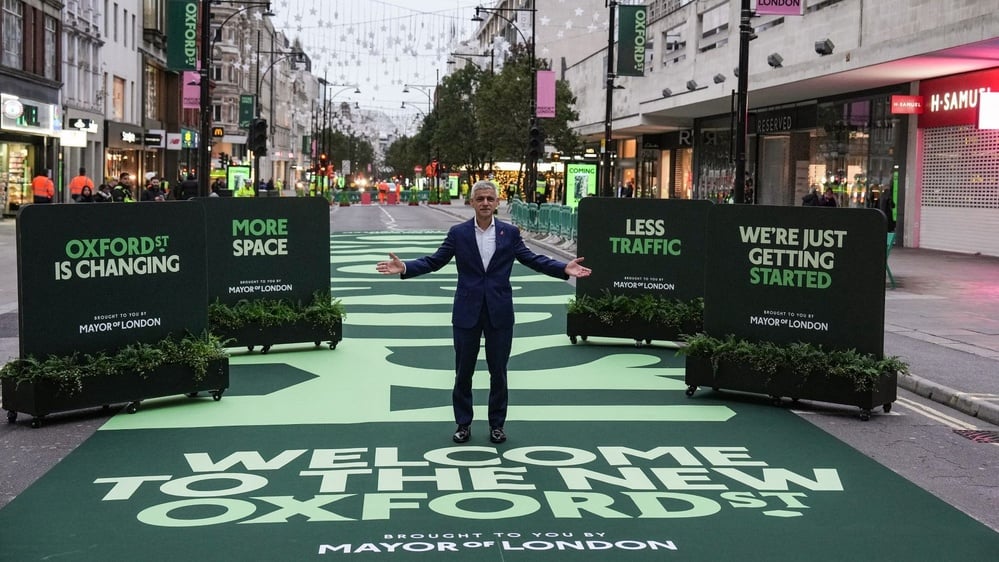
““This is a momentous day for Oxford Street, but also for London,” Mayor Sadiq Khan told reporters on the thoroughfare, one of the busiest shopping zones in Europe.” · exact text match
Why: A public official's policy announcement and resulting dispute are the organizing frame.
Claim: Sentiment is balanced between approval from pedestrians and rejection from cab drivers.
“Those walking in the area on a rainy Monday said they backed the move.” · exact text match
“Black cab driver Jason Harvey, 51, told AFP that “to pedestrianise any part of Oxford Street is crazy”” · exact text match
Why: Positive and negative reactions are given comparable space, indicating neutral affect.
Claim: Sourcing is transparent: named individuals with ages and locations, and attributed quotes from the mayor and a retailer.
““It gives people more of a chance to actually explore the shops, explore the iconic Oxford Street,” said Madaki Kanya, a 19-year-old visiting from Manchester in northwest England.” · exact text match
““It’s a lot more comfortable walking around, not dodging the cars and the traffic,” agreed Paul Facer, 62, from Weymouth in the southwest, who was visiting with his wife.” · exact text match
Why: Specific, checkable attribution to multiple identified sources supports credibility, though no independent data verifies Khan's footfall claim.
The supplied text is an AFP wire report reproduced with truncated tail content (a cut-off Khan quote and unrelated headline fragments), which limits assessment of the full article.
October 26, 2026 · 0 shares
Presents the Oxford Street pedestrianisation primarily through supportive official mayoral and government framing, with no critical or oppositional voices.
Automated analysis; not human reviewed.
Limitations: The supplied article is a short news report with limited space for opposing views; bias scores reflect only the visible official-source framing, not the full policy debate.
·
11 of 55 available dimensions scored; omitted dimensions are not treated as neutral.
·
Verified supporting quotes for 11 of 11 scored dimensions.
Claim: The framing is predominantly factual and attribution-based.
“An almost 1km section of Britain's busiest shopping thoroughfare was now closed to buses, cars, taxis, cycles, scooters and pedicabs, the office of London Mayor Sadiq Khan said on Monday.” · exact text match
Why: The central claim is presented with concrete details and sourced attribution.
Claim: The language avoids sensational or dramatic framing.
“Part of London's Oxford Street has gone permanently traffic-free in an effort to revitalise the area” · exact text match
Why: The report states the change in a straightforward, non-sensational manner.
Claim: The article foregrounds hopeful official goals about revival and growth.
“aim to put Oxford Street back among top global shopping destinations” · exact text match
Why: Aspirational revival framing presents the policy in optimistic terms through official goals.
Claim: The article describes the closure and announced plans rather than urging a policy choice.
“The pedestrianisation is the first stage of a transformation” · exact text match
Why: It reports what is planned and happening rather than prescribing action.
Claim: The report concerns a mayoral and government urban policy and quotes political officials.
“the office of London Mayor Sadiq Khan said on Monday” · exact text match
Why: The subject is a government policy announcement involving elected officials.
Claim: Official mayoral and government voices dominate the framing without opposition or critical scrutiny.
“the office of London Mayor Sadiq Khan said on Monday” · exact text match
Why: The announcement is presented through supportive official statements.
Claim: Claims are attributed to named offices and officials and include concrete details.
“according to the mayor's office” · exact text match
Why: Visible sourcing and specific figures support credibility.
Claim: The report is structured around attributed factual details and official statements rather than emotive argument.
“the office of London Mayor Sadiq Khan said on Monday” · exact text match
Why: Specific dates, quantities, and attribution indicate measured reporting.
Claim: The article frames the street's revival in terms of shopping, investment, businesses, and jobs.
“support businesses and jobs, and drive growth in the heart of our capital” · exact text match
Why: The selected official quote emphasizes business and growth benefits.
Claim: The report attributes claims and includes specific planned details.
“according to the mayor's office” · exact text match
Why: Named attribution and concrete planning details support a high integrity reading.
Claim: The report is coherent and includes relevant context and specific plans.
“It and a wider regeneration project aim to put Oxford Street back among top global shopping destinations” · exact text match
Why: It connects the closure to a wider regeneration effort and specific future plans.
The supplied article is a short news report with limited space for opposing views; bias scores reflect only the visible official-source framing, not the full policy debate.
The text is a procedural, attributive FOI report that presents TfL's response without evaluative or sensational language.
TfL is the transport authority for London, and Oxford Street is a central London shopping street.
Automated analysis; not human reviewed.
Limitations: The supplied text is a short, unattributed excerpt with no named publisher, publication date, byline, or links to the FOI response or reports, limiting assessment of selection and sourcing.
·
8 of 55 available dimensions scored; omitted dimensions are not treated as neutral.
·
Verified supporting quotes for 7 of 8 scored dimensions.
Claim: The report attributes the FOI response to TfL and avoids evaluative adjectives.
“TfL said it held some of the requested information but that the scope of the request was unclear.” · exact text match
Why: The sentence reports TfL's position with attribution rather than adopting a subjective evaluation.
Claim: The article uses procedural, non-emotional language.
“TfL also directed the requester to traffic impact information published during the Oxford Street public consultation.” · exact text match
Why: The wording is matter-of-fact and lacks sensational or emotionally charged framing.
Claim: The article describes procedural facts without recommending action.
“It interpreted the request as seeking details of the modelling work and supplied 13 technical reports covering modelling methods, baseline and forecast scenarios, traffic flows and pedestrianisation impacts.” · exact text match
Why: The text catalogs what TfL supplied and does not prescribe policy or behavior.
Claim: The report gives specific attribution and counts, though it does not link to primary documents.
“TfL supplied 13 technical reports covering modelling methods, baseline and forecast scenarios, traffic flows and pedestrianisation impacts.” · not found in supplied text
Why: Specific attribution and a concrete report count support credibility, with some limitation from absent primary links.
Claim: The report is structured around verifiable procedural details rather than emotive or illogical claims.
“The request, received on 29 September 2026, sought details of the modelling, including journey times for diversions on parallel roads, the data used and excluded, and the conditions considered.” · exact text match
Why: Specific dates and enumerated request details support a rational, procedural presentation.
Claim: The text shows duplicated opening fragments and hashtags embedded in prose, consistent with automated or AI-assisted drafting.
“#Transport for #London Freedom of Information release: #TfL has published a response to a freedom of information request about the modelling used to. #Transport for #London Freedom of Information release:#TfL has published a response” · exact text match
Why: The duplicated headline-like fragment, sentence fragment, and embedded hashtags are independent textual indicators of automated drafting.
Claim: The report transparently notes TfL's stated limitation about the request's scope while summarizing what was supplied.
“TfL said it held some of the requested information but that the scope of the request was unclear.” · exact text match
Why: Including TfL's stated limitation signals fair, non-concealing reporting of the response.
Claim: The report is concise and includes specific dates, counts, and categories.
“It interpreted the request as seeking details of the modelling work and supplied 13 technical reports covering modelling methods, baseline and forecast scenarios, traffic flows and pedestrianisation impacts.” · exact text match
Why: The summary efficiently conveys who responded, what was requested, and what was supplied.
The supplied text is a short, unattributed excerpt with no named publisher, publication date, byline, or links to the FOI response or reports, limiting assessment of selection and sourcing.
October 24, 2026 · 0 shares
Framing is predominantly neutral and factual, presenting the pedestrianisation as a long-awaited official plan while noting Westminster City Council’s concerns.
Automated analysis; not human reviewed.
Limitations: The supplied text includes unrelated related-link headlines and consent/page chrome; scoring is limited to the substantive Oxford Street report.
·
7 of 55 available dimensions scored; omitted dimensions are not treated as neutral.
·
Verified supporting quotes for 7 of 7 scored dimensions.
Claim: The article does not frame the pedestrianisation dispute in liberal-versus-conservative ideological terms.
“London Mayor Sadiq Khan first proposed pedestrianising it as part of his 2016 mayoral programme.” · exact text match
“Westminster City Council has previously raised concerns about displaced traffic and a potential increase in noise and pollution on surrounding streets.” · exact text match
Why: It reports official support and council concerns without partisan labels or ideological framing, supporting a neutral score.
Claim: The article is predominantly objective, with limited evaluative language.
“Of those who responded to the question on pedestrianisation, 66% supported the principle of making Oxford Street traffic-free.” · exact text match
Counterevidence:
“the first phase of the long-awaited transformation” · exact text match
Why: It presents attributed, quantified details and procedural facts rather than personal opinion; the mild 'long-awaited' framing keeps the score from being more strongly objective.
Claim: The article uses procedural, non-sensational language to describe traffic changes.
“Emergency vehicles will have access at all times, while arrangements will also be made for essential services.” · exact text match
Why: The report explains practical exemptions and restrictions without alarmist or sensational wording.
Claim: The article is overwhelmingly descriptive, explaining the plan's scope and timing rather than prescribing what should be done.
“The first section will become traffic-free on Monday, October 26 2026.” · exact text match
Why: The report states scheduled changes and implementation details without advocacy, supporting a strongly descriptive score.
Claim: The article has moderate political content because it reports mayoral and council decisions about a public infrastructure plan.
“London Mayor Sadiq Khan first proposed pedestrianising it as part of his 2016 mayoral programme.” · exact text match
“Despite this, the mayor formally approved the traffic and highway changes needed for the first section of pedestrianisation on February 26 this year.” · exact text match
Why: The subject is governmental decision-making, but the coverage stays focused on policy logistics rather than partisan politics.
Claim: The article mildly frames the official pedestrianisation plan as a long-awaited and significant transformation.
“the first phase of the long-awaited transformation gets under way” · exact text match
“October 26 marks a huge milestone” · exact text match
Why: The positive evaluative terms align with a slightly pro-establishment framing, though the article also notes council concerns.
Claim: The article demonstrates high credibility through specific dates, attribution to officials and agencies, and inclusion of a council's concerns.
“Of those who responded to the question on pedestrianisation, 66% supported the principle of making Oxford Street traffic-free.” · exact text match
“Westminster City Council has previously raised concerns about displaced traffic and a potential increase in noise and pollution on surrounding streets.” · exact text match
Why: Sourcing, quantification, and acknowledgment of contrary concerns support a high credibility score.
The supplied text includes unrelated related-link headlines and consent/page chrome; scoring is limited to the substantive Oxford Street report.
Frames the pedestrianisation launch around early cyclist noncompliance and enforcement, using mildly sensational “caught on camera” language while relying on official and company statements.
Oxford Street is a major central London shopping thoroughfare; pedestrianisation has been discussed for decades and involves TfL, Westminster City Council, and the Mayor.
Automated analysis; not human reviewed.
Limitations: Single report; enforcement observations and official statements are not independently verified.
·
8 of 55 available dimensions scored; omitted dimensions are not treated as neutral.
·
Verified supporting quotes for 8 of 8 scored dimensions.
Claim: The report is largely factual and attributed rather than personal or interpretive.
“According to TfL, a Penalty Charge Notice (PCN) carries a £160 fine, reduced to £80 if paid within 14 days.” · exact text match
Why: Presents verifiable policy details with attribution, supporting an objective score.
Claim: The headline and opening emphasize cyclists being caught on camera breaking the new ban.
“Cyclists caught on camera riding through Oxford Street as traffic ban comes into force.” · exact text match
“But despite the new restrictions, it appears not everyone has followed the rules.” · exact text match
Why: Mildly sensational framing foregrounds rule-breaking imagery.
Claim: Primarily describes the launch and observed conduct rather than prescribing what should be done.
“Cyclists have been spotted weaving through Oxford Street despite a new ban on bicycles and other vehicles, as its major transformation gets underway.” · exact text match
Why: The passage reports events and conditions descriptively.
Claim: The event is framed within mayoral policy and official governance.
“London Mayor Sadiq Khan described the changes as a “truly momentous occasion for the capital”.” · exact text match
Why: Links the transport change to a political officeholder and policy launch.
Claim: Relies substantially on official authorities and company statements for the account.
“A TfL spokesperson said: “No cycles, e-scooters or pedicabs are allowed on Oxford Street between Orchard Street and Great Portland Street and riders are obliged to follow the rules of the road.” · exact text match
“According to TfL, a Penalty Charge Notice (PCN) carries a £160 fine, reduced to £80 if paid within 14 days.” · exact text match
Why: Policy details and enforcement claims are anchored in TfL authority.
Claim: Includes direct attribution, quoted officials, and explicit uncertainty about cyclist awareness.
“Whether they knew about the ban or were simply unaware of the new rules remains unclear, but it raises questions over how effectively they are being enforced.” · exact text match
Why: Attribution and stated uncertainty support high credibility.
Claim: Offers a mild forecast that adjustment may take time.
“Although, the early scenes suggest it could take some time for people to adjust to the new arrangements.” · exact text match
Why: The statement is a cautious forecast rather than a factual report.
Claim: The report attributes claims to named institutions and individuals and includes official responses.
“A TfL spokesperson said: “No cycles, e-scooters or pedicabs are allowed on Oxford Street between Orchard Street and Great Portland Street and riders are obliged to follow the rules of the road.” · exact text match
“Lime has told The Standard that its app has been updated to reflect the changes to Oxford Street, with e-bikes gradually slowing down if a ride enters the restricted area.” · exact text match
Why: Direct attribution and inclusion of responses support a high-integrity score.
Single report; enforcement observations and official statements are not independently verified.
October 26, 2026 · 0 shares
Framing is largely descriptive and multi-source, attributing characterizations to named UK outlets while balancing supporters and critics of the pedestrianisation.
Automated analysis; not human reviewed.
Limitations: Page text includes repeated subscription prompts and some copy artifacts; analysis is based on the substantive news passages only.
·
11 of 55 available dimensions scored; omitted dimensions are not treated as neutral.
·
Verified supporting quotes for 8 of 11 scored dimensions.
Claim: Evaluative characterizations are mostly attributed to named outlets rather than voiced directly by the publisher.
“Critics called the decision “anti-democratic”, said The Telegraph.” · exact text match
Why: Explicit attribution separates quoted opinion from the publisher’s own narrative voice.
Claim: The text presents operational details in a concrete, non-sensational register.
“Emergency vehicles will continue to have access at all times, and essential services for business will have designated overnight hours.” · exact text match
Why: Specific access and service provisions are given without emotive amplification.
Claim: The text describes the policy process and planned changes rather than prescribing what should be done.
“Authorities will monitor and collect data over the Christmas period and begin developments in the spring for an “eventual permanent redesign” of Oxford Street.” · exact text match
Why: The sentence reports an intended administrative process without advocating an outcome.
Claim: The central subject is a mayoral policy dispute and central-government approval.
“The hotly contested measure has been championed by London Mayor Sadiq Khan, but had been opposed by the local council.” · exact text match
Why: The framing is organized around political actors, authority and contested policy.
Claim: Claims and characterizations are consistently tied to named publications.
“For Khan, who has prioritised clean air throughout his tenure.
this is a “political victory”, said The Guardian.”
· exact text match
Why: Visible attribution to a named outlet supports credibility in the supplied text.
Claim: The report relies on dated chronology and attributed sourcing rather than emotive assertion.
“the idea was first formally promised in Sadiq Khan’s election manifesto for London Mayor in 2016” · exact text match
Why: The quoted chronology supplies structured, checkable context consistent with rational reporting.
Claim: The article visibly attributes claims to multiple named outlets and includes competing perspectives.
“This “thorny issue” has “foxed mayoral administrations for years”, said the BBC.” · exact text match
Why: Named-source attribution and multi-outlet sourcing are fairness and honesty signals.
Claim: The report supplies layered institutional and political context rather than a bare announcement.
“After Labour’s landslide election victory in 2024, Angela Rayner, the housing, communities and local government secretary, granted approval for the plan, which would have been “unlikely” in previous years.” · exact text match
Why: The quoted passage connects approval timing, officeholder and political context.
Page text includes repeated subscription prompts and some copy artifacts; analysis is based on the substantive news passages only.
October 24, 2026 · 0 shares
Framing is predominantly neutral and factual, presenting the pedestrianisation as a long-awaited official plan while noting Westminster City Council’s concerns.
Automated analysis; not human reviewed.
Limitations: The supplied text includes unrelated related-link headlines and consent/page chrome; scoring is limited to the substantive Oxford Street report.
·
7 of 55 available dimensions scored; omitted dimensions are not treated as neutral.
·
Verified supporting quotes for 7 of 7 scored dimensions.
Claim: The article does not frame the pedestrianisation dispute in liberal-versus-conservative ideological terms.
“London Mayor Sadiq Khan first proposed pedestrianising it as part of his 2016 mayoral programme.” · exact text match
“Westminster City Council has previously raised concerns about displaced traffic and a potential increase in noise and pollution on surrounding streets.” · exact text match
Why: It reports official support and council concerns without partisan labels or ideological framing, supporting a neutral score.
Claim: The article is predominantly objective, with limited evaluative language.
“Of those who responded to the question on pedestrianisation, 66% supported the principle of making Oxford Street traffic-free.” · exact text match
Counterevidence:
“the first phase of the long-awaited transformation” · exact text match
Why: It presents attributed, quantified details and procedural facts rather than personal opinion; the mild 'long-awaited' framing keeps the score from being more strongly objective.
Claim: The article uses procedural, non-sensational language to describe traffic changes.
“Emergency vehicles will have access at all times, while arrangements will also be made for essential services.” · exact text match
Why: The report explains practical exemptions and restrictions without alarmist or sensational wording.
Claim: The article is overwhelmingly descriptive, explaining the plan's scope and timing rather than prescribing what should be done.
“The first section will become traffic-free on Monday, October 26 2026.” · exact text match
Why: The report states scheduled changes and implementation details without advocacy, supporting a strongly descriptive score.
Claim: The article has moderate political content because it reports mayoral and council decisions about a public infrastructure plan.
“London Mayor Sadiq Khan first proposed pedestrianising it as part of his 2016 mayoral programme.” · exact text match
“Despite this, the mayor formally approved the traffic and highway changes needed for the first section of pedestrianisation on February 26 this year.” · exact text match
Why: The subject is governmental decision-making, but the coverage stays focused on policy logistics rather than partisan politics.
Claim: The article mildly frames the official pedestrianisation plan as a long-awaited and significant transformation.
“the first phase of the long-awaited transformation gets under way” · exact text match
“October 26 marks a huge milestone” · exact text match
Why: The positive evaluative terms align with a slightly pro-establishment framing, though the article also notes council concerns.
Claim: The article demonstrates high credibility through specific dates, attribution to officials and agencies, and inclusion of a council's concerns.
“Of those who responded to the question on pedestrianisation, 66% supported the principle of making Oxford Street traffic-free.” · exact text match
“Westminster City Council has previously raised concerns about displaced traffic and a potential increase in noise and pollution on surrounding streets.” · exact text match
Why: Sourcing, quantification, and acknowledgment of contrary concerns support a high credibility score.
The supplied text includes unrelated related-link headlines and consent/page chrome; scoring is limited to the substantive Oxford Street report.
October 26, 2026 · 0 shares
Attributed, on-the-record quotes from shoppers, black cab drivers, and the mayor frame the pedestrianisation as a balanced local controversy, with no evident editorialising beyond the promotional adjective 'iconic'.
Automated analysis; not human reviewed.
Limitations: The supplied text is an AFP wire report reproduced with truncated tail content (a cut-off Khan quote and unrelated headline fragments), which limits assessment of the full article.
·
6 of 55 available dimensions scored; omitted dimensions are not treated as neutral.
·
Verified supporting quotes for 6 of 6 scored dimensions.
Claim: The report presents the scheme through attributed quotations from supporters and opponents rather than the correspondent's own evaluative voice.
“Shoppers walking along the street told AFP this was a “good idea”, but drivers of London’s famous black taxi cabs rejected the move as “crazy”.” · exact text match
Why: Direct attribution of both favorable and critical views to named or described sources signals factual, non-evaluative framing.
Claim: Framing is low-key and procedural, without sensational language or dramatized stakes.
“Around half the street has been pedestrianised, with plans to close off the rest to vehicles depending on the success of the first phase.” · exact text match
Why: Plain description of the policy's scope and conditions rather than emotive or hyped phrasing.
Claim: The article reports what the policy does and who objects without advocating a course of action.
“But the scheme has proved controversial among residents worried about traffic jams in neighbouring areas as well as among disability rights activists.” · exact text match
Why: Controversy is described, not adjudicated; no prescriptive recommendation appears.
Claim: The story is centered on a mayoral municipal policy decision and its political contestation.
““This is a momentous day for Oxford Street, but also for London,” Mayor Sadiq Khan told reporters on the thoroughfare, one of the busiest shopping zones in Europe.” · exact text match
Why: A public official's policy announcement and resulting dispute are the organizing frame.
Claim: Sentiment is balanced between approval from pedestrians and rejection from cab drivers.
“Those walking in the area on a rainy Monday said they backed the move.” · exact text match
“Black cab driver Jason Harvey, 51, told AFP that “to pedestrianise any part of Oxford Street is crazy”” · exact text match
Why: Positive and negative reactions are given comparable space, indicating neutral affect.
Claim: Sourcing is transparent: named individuals with ages and locations, and attributed quotes from the mayor and a retailer.
““It gives people more of a chance to actually explore the shops, explore the iconic Oxford Street,” said Madaki Kanya, a 19-year-old visiting from Manchester in northwest England.” · exact text match
““It’s a lot more comfortable walking around, not dodging the cars and the traffic,” agreed Paul Facer, 62, from Weymouth in the southwest, who was visiting with his wife.” · exact text match
Why: Specific, checkable attribution to multiple identified sources supports credibility, though no independent data verifies Khan's footfall claim.
The supplied text is an AFP wire report reproduced with truncated tail content (a cut-off Khan quote and unrelated headline fragments), which limits assessment of the full article.
October 26, 2026 · 0 shares
Presents the Oxford Street pedestrianisation primarily through supportive official mayoral and government framing, with no critical or oppositional voices.
Automated analysis; not human reviewed.
Limitations: The supplied article is a short news report with limited space for opposing views; bias scores reflect only the visible official-source framing, not the full policy debate.
·
11 of 55 available dimensions scored; omitted dimensions are not treated as neutral.
·
Verified supporting quotes for 11 of 11 scored dimensions.
Claim: The framing is predominantly factual and attribution-based.
“An almost 1km section of Britain's busiest shopping thoroughfare was now closed to buses, cars, taxis, cycles, scooters and pedicabs, the office of London Mayor Sadiq Khan said on Monday.” · exact text match
Why: The central claim is presented with concrete details and sourced attribution.
Claim: The language avoids sensational or dramatic framing.
“Part of London's Oxford Street has gone permanently traffic-free in an effort to revitalise the area” · exact text match
Why: The report states the change in a straightforward, non-sensational manner.
Claim: The article foregrounds hopeful official goals about revival and growth.
“aim to put Oxford Street back among top global shopping destinations” · exact text match
Why: Aspirational revival framing presents the policy in optimistic terms through official goals.
Claim: The article describes the closure and announced plans rather than urging a policy choice.
“The pedestrianisation is the first stage of a transformation” · exact text match
Why: It reports what is planned and happening rather than prescribing action.
Claim: The report concerns a mayoral and government urban policy and quotes political officials.
“the office of London Mayor Sadiq Khan said on Monday” · exact text match
Why: The subject is a government policy announcement involving elected officials.
Claim: Official mayoral and government voices dominate the framing without opposition or critical scrutiny.
“the office of London Mayor Sadiq Khan said on Monday” · exact text match
Why: The announcement is presented through supportive official statements.
Claim: Claims are attributed to named offices and officials and include concrete details.
“according to the mayor's office” · exact text match
Why: Visible sourcing and specific figures support credibility.
Claim: The report is structured around attributed factual details and official statements rather than emotive argument.
“the office of London Mayor Sadiq Khan said on Monday” · exact text match
Why: Specific dates, quantities, and attribution indicate measured reporting.
Claim: The article frames the street's revival in terms of shopping, investment, businesses, and jobs.
“support businesses and jobs, and drive growth in the heart of our capital” · exact text match
Why: The selected official quote emphasizes business and growth benefits.
Claim: The report attributes claims and includes specific planned details.
“according to the mayor's office” · exact text match
Why: Named attribution and concrete planning details support a high integrity reading.
Claim: The report is coherent and includes relevant context and specific plans.
“It and a wider regeneration project aim to put Oxford Street back among top global shopping destinations” · exact text match
Why: It connects the closure to a wider regeneration effort and specific future plans.
The supplied article is a short news report with limited space for opposing views; bias scores reflect only the visible official-source framing, not the full policy debate.
October 26, 2026 · 0 shares
Framing is largely descriptive and multi-source, attributing characterizations to named UK outlets while balancing supporters and critics of the pedestrianisation.
Automated analysis; not human reviewed.
Limitations: Page text includes repeated subscription prompts and some copy artifacts; analysis is based on the substantive news passages only.
·
11 of 55 available dimensions scored; omitted dimensions are not treated as neutral.
·
Verified supporting quotes for 8 of 11 scored dimensions.
Claim: Evaluative characterizations are mostly attributed to named outlets rather than voiced directly by the publisher.
“Critics called the decision “anti-democratic”, said The Telegraph.” · exact text match
Why: Explicit attribution separates quoted opinion from the publisher’s own narrative voice.
Claim: The text presents operational details in a concrete, non-sensational register.
“Emergency vehicles will continue to have access at all times, and essential services for business will have designated overnight hours.” · exact text match
Why: Specific access and service provisions are given without emotive amplification.
Claim: The text describes the policy process and planned changes rather than prescribing what should be done.
“Authorities will monitor and collect data over the Christmas period and begin developments in the spring for an “eventual permanent redesign” of Oxford Street.” · exact text match
Why: The sentence reports an intended administrative process without advocating an outcome.
Claim: The central subject is a mayoral policy dispute and central-government approval.
“The hotly contested measure has been championed by London Mayor Sadiq Khan, but had been opposed by the local council.” · exact text match
Why: The framing is organized around political actors, authority and contested policy.
Claim: Claims and characterizations are consistently tied to named publications.
“For Khan, who has prioritised clean air throughout his tenure.
this is a “political victory”, said The Guardian.”
· exact text match
Why: Visible attribution to a named outlet supports credibility in the supplied text.
Claim: The report relies on dated chronology and attributed sourcing rather than emotive assertion.
“the idea was first formally promised in Sadiq Khan’s election manifesto for London Mayor in 2016” · exact text match
Why: The quoted chronology supplies structured, checkable context consistent with rational reporting.
Claim: The article visibly attributes claims to multiple named outlets and includes competing perspectives.
“This “thorny issue” has “foxed mayoral administrations for years”, said the BBC.” · exact text match
Why: Named-source attribution and multi-outlet sourcing are fairness and honesty signals.
Claim: The report supplies layered institutional and political context rather than a bare announcement.
“After Labour’s landslide election victory in 2024, Angela Rayner, the housing, communities and local government secretary, granted approval for the plan, which would have been “unlikely” in previous years.” · exact text match
Why: The quoted passage connects approval timing, officeholder and political context.
Page text includes repeated subscription prompts and some copy artifacts; analysis is based on the substantive news passages only.
October 26, 2026 · 0 shares
Presents the Oxford Street pedestrianisation primarily through supportive official mayoral and government framing, with no critical or oppositional voices.
Automated analysis; not human reviewed. Limitations: The supplied article is a short news report with limited space for opposing views; bias scores reflect only the visible official-source framing, not the full policy debate. · 11 of 55 available dimensions scored; omitted dimensions are not treated as neutral. · Verified supporting quotes for 11 of 11 scored dimensions.
Claim: The framing is predominantly factual and attribution-based.
“An almost 1km section of Britain's busiest shopping thoroughfare was now closed to buses, cars, taxis, cycles, scooters and pedicabs, the office of London Mayor Sadiq Khan said on Monday.” · exact text match
Why: The central claim is presented with concrete details and sourced attribution.
Claim: The language avoids sensational or dramatic framing.
“Part of London's Oxford Street has gone permanently traffic-free in an effort to revitalise the area” · exact text match
Why: The report states the change in a straightforward, non-sensational manner.
Claim: The article foregrounds hopeful official goals about revival and growth.
“aim to put Oxford Street back among top global shopping destinations” · exact text match
Why: Aspirational revival framing presents the policy in optimistic terms through official goals.
Claim: The article describes the closure and announced plans rather than urging a policy choice.
“The pedestrianisation is the first stage of a transformation” · exact text match
Why: It reports what is planned and happening rather than prescribing action.
Claim: The report concerns a mayoral and government urban policy and quotes political officials.
“the office of London Mayor Sadiq Khan said on Monday” · exact text match
Why: The subject is a government policy announcement involving elected officials.
Claim: Official mayoral and government voices dominate the framing without opposition or critical scrutiny.
“the office of London Mayor Sadiq Khan said on Monday” · exact text match
Why: The announcement is presented through supportive official statements.
Claim: Claims are attributed to named offices and officials and include concrete details.
“according to the mayor's office” · exact text match
Why: Visible sourcing and specific figures support credibility.
Claim: The report is structured around attributed factual details and official statements rather than emotive argument.
“the office of London Mayor Sadiq Khan said on Monday” · exact text match
Why: Specific dates, quantities, and attribution indicate measured reporting.
Claim: The article frames the street's revival in terms of shopping, investment, businesses, and jobs.
“support businesses and jobs, and drive growth in the heart of our capital” · exact text match
Why: The selected official quote emphasizes business and growth benefits.
Claim: The report attributes claims and includes specific planned details.
“according to the mayor's office” · exact text match
Why: Named attribution and concrete planning details support a high integrity reading.
Claim: The report is coherent and includes relevant context and specific plans.
“It and a wider regeneration project aim to put Oxford Street back among top global shopping destinations” · exact text match
Why: It connects the closure to a wider regeneration effort and specific future plans.
The supplied article is a short news report with limited space for opposing views; bias scores reflect only the visible official-source framing, not the full policy debate.
October 24, 2026 · 0 shares
Framing is predominantly neutral and factual, presenting the pedestrianisation as a long-awaited official plan while noting Westminster City Council’s concerns.
Automated analysis; not human reviewed. Limitations: The supplied text includes unrelated related-link headlines and consent/page chrome; scoring is limited to the substantive Oxford Street report. · 7 of 55 available dimensions scored; omitted dimensions are not treated as neutral. · Verified supporting quotes for 7 of 7 scored dimensions.
Claim: The article does not frame the pedestrianisation dispute in liberal-versus-conservative ideological terms.
“London Mayor Sadiq Khan first proposed pedestrianising it as part of his 2016 mayoral programme.” · exact text match
“Westminster City Council has previously raised concerns about displaced traffic and a potential increase in noise and pollution on surrounding streets.” · exact text match
Why: It reports official support and council concerns without partisan labels or ideological framing, supporting a neutral score.
Claim: The article is predominantly objective, with limited evaluative language.
“Of those who responded to the question on pedestrianisation, 66% supported the principle of making Oxford Street traffic-free.” · exact text match
Counterevidence:
“the first phase of the long-awaited transformation” · exact text match
Why: It presents attributed, quantified details and procedural facts rather than personal opinion; the mild 'long-awaited' framing keeps the score from being more strongly objective.
Claim: The article uses procedural, non-sensational language to describe traffic changes.
“Emergency vehicles will have access at all times, while arrangements will also be made for essential services.” · exact text match
Why: The report explains practical exemptions and restrictions without alarmist or sensational wording.
Claim: The article is overwhelmingly descriptive, explaining the plan's scope and timing rather than prescribing what should be done.
“The first section will become traffic-free on Monday, October 26 2026.” · exact text match
Why: The report states scheduled changes and implementation details without advocacy, supporting a strongly descriptive score.
Claim: The article has moderate political content because it reports mayoral and council decisions about a public infrastructure plan.
“London Mayor Sadiq Khan first proposed pedestrianising it as part of his 2016 mayoral programme.” · exact text match
“Despite this, the mayor formally approved the traffic and highway changes needed for the first section of pedestrianisation on February 26 this year.” · exact text match
Why: The subject is governmental decision-making, but the coverage stays focused on policy logistics rather than partisan politics.
Claim: The article mildly frames the official pedestrianisation plan as a long-awaited and significant transformation.
“the first phase of the long-awaited transformation gets under way” · exact text match
“October 26 marks a huge milestone” · exact text match
Why: The positive evaluative terms align with a slightly pro-establishment framing, though the article also notes council concerns.
Claim: The article demonstrates high credibility through specific dates, attribution to officials and agencies, and inclusion of a council's concerns.
“Of those who responded to the question on pedestrianisation, 66% supported the principle of making Oxford Street traffic-free.” · exact text match
“Westminster City Council has previously raised concerns about displaced traffic and a potential increase in noise and pollution on surrounding streets.” · exact text match
Why: Sourcing, quantification, and acknowledgment of contrary concerns support a high credibility score.
The supplied text includes unrelated related-link headlines and consent/page chrome; scoring is limited to the substantive Oxford Street report.
October 26, 2026 · 0 shares
Attributed, on-the-record quotes from shoppers, black cab drivers, and the mayor frame the pedestrianisation as a balanced local controversy, with no evident editorialising beyond the promotional adjective 'iconic'.
Automated analysis; not human reviewed. Limitations: The supplied text is an AFP wire report reproduced with truncated tail content (a cut-off Khan quote and unrelated headline fragments), which limits assessment of the full article. · 6 of 55 available dimensions scored; omitted dimensions are not treated as neutral. · Verified supporting quotes for 6 of 6 scored dimensions.
Claim: The report presents the scheme through attributed quotations from supporters and opponents rather than the correspondent's own evaluative voice.
“Shoppers walking along the street told AFP this was a “good idea”, but drivers of London’s famous black taxi cabs rejected the move as “crazy”.” · exact text match
Why: Direct attribution of both favorable and critical views to named or described sources signals factual, non-evaluative framing.
Claim: Framing is low-key and procedural, without sensational language or dramatized stakes.
“Around half the street has been pedestrianised, with plans to close off the rest to vehicles depending on the success of the first phase.” · exact text match
Why: Plain description of the policy's scope and conditions rather than emotive or hyped phrasing.
Claim: The article reports what the policy does and who objects without advocating a course of action.
“But the scheme has proved controversial among residents worried about traffic jams in neighbouring areas as well as among disability rights activists.” · exact text match
Why: Controversy is described, not adjudicated; no prescriptive recommendation appears.
Claim: The story is centered on a mayoral municipal policy decision and its political contestation.
““This is a momentous day for Oxford Street, but also for London,” Mayor Sadiq Khan told reporters on the thoroughfare, one of the busiest shopping zones in Europe.” · exact text match
Why: A public official's policy announcement and resulting dispute are the organizing frame.
Claim: Sentiment is balanced between approval from pedestrians and rejection from cab drivers.
“Those walking in the area on a rainy Monday said they backed the move.” · exact text match
“Black cab driver Jason Harvey, 51, told AFP that “to pedestrianise any part of Oxford Street is crazy”” · exact text match
Why: Positive and negative reactions are given comparable space, indicating neutral affect.
Claim: Sourcing is transparent: named individuals with ages and locations, and attributed quotes from the mayor and a retailer.
““It gives people more of a chance to actually explore the shops, explore the iconic Oxford Street,” said Madaki Kanya, a 19-year-old visiting from Manchester in northwest England.” · exact text match
““It’s a lot more comfortable walking around, not dodging the cars and the traffic,” agreed Paul Facer, 62, from Weymouth in the southwest, who was visiting with his wife.” · exact text match
Why: Specific, checkable attribution to multiple identified sources supports credibility, though no independent data verifies Khan's footfall claim.
The supplied text is an AFP wire report reproduced with truncated tail content (a cut-off Khan quote and unrelated headline fragments), which limits assessment of the full article.
October 26, 2026 · 0 shares
Framing is largely descriptive and multi-source, attributing characterizations to named UK outlets while balancing supporters and critics of the pedestrianisation.
Automated analysis; not human reviewed. Limitations: Page text includes repeated subscription prompts and some copy artifacts; analysis is based on the substantive news passages only. · 11 of 55 available dimensions scored; omitted dimensions are not treated as neutral. · Verified supporting quotes for 8 of 11 scored dimensions.
Claim: Evaluative characterizations are mostly attributed to named outlets rather than voiced directly by the publisher.
“Critics called the decision “anti-democratic”, said The Telegraph.” · exact text match
Why: Explicit attribution separates quoted opinion from the publisher’s own narrative voice.
Claim: The text presents operational details in a concrete, non-sensational register.
“Emergency vehicles will continue to have access at all times, and essential services for business will have designated overnight hours.” · exact text match
Why: Specific access and service provisions are given without emotive amplification.
Claim: The text describes the policy process and planned changes rather than prescribing what should be done.
“Authorities will monitor and collect data over the Christmas period and begin developments in the spring for an “eventual permanent redesign” of Oxford Street.” · exact text match
Why: The sentence reports an intended administrative process without advocating an outcome.
Claim: The central subject is a mayoral policy dispute and central-government approval.
“The hotly contested measure has been championed by London Mayor Sadiq Khan, but had been opposed by the local council.” · exact text match
Why: The framing is organized around political actors, authority and contested policy.
Claim: Claims and characterizations are consistently tied to named publications.
“For Khan, who has prioritised clean air throughout his tenure. this is a “political victory”, said The Guardian.” · exact text match
Why: Visible attribution to a named outlet supports credibility in the supplied text.
Claim: The report relies on dated chronology and attributed sourcing rather than emotive assertion.
“the idea was first formally promised in Sadiq Khan’s election manifesto for London Mayor in 2016” · exact text match
Why: The quoted chronology supplies structured, checkable context consistent with rational reporting.
Claim: The article visibly attributes claims to multiple named outlets and includes competing perspectives.
“This “thorny issue” has “foxed mayoral administrations for years”, said the BBC.” · exact text match
Why: Named-source attribution and multi-outlet sourcing are fairness and honesty signals.
Claim: The report supplies layered institutional and political context rather than a bare announcement.
“After Labour’s landslide election victory in 2024, Angela Rayner, the housing, communities and local government secretary, granted approval for the plan, which would have been “unlikely” in previous years.” · exact text match
Why: The quoted passage connects approval timing, officeholder and political context.
Page text includes repeated subscription prompts and some copy artifacts; analysis is based on the substantive news passages only.
October 24, 2026 · 0 shares
Framing is predominantly neutral and factual, presenting the pedestrianisation as a long-awaited official plan while noting Westminster City Council’s concerns.
Automated analysis; not human reviewed. Limitations: The supplied text includes unrelated related-link headlines and consent/page chrome; scoring is limited to the substantive Oxford Street report. · 7 of 55 available dimensions scored; omitted dimensions are not treated as neutral. · Verified supporting quotes for 7 of 7 scored dimensions.
Claim: The article does not frame the pedestrianisation dispute in liberal-versus-conservative ideological terms.
“London Mayor Sadiq Khan first proposed pedestrianising it as part of his 2016 mayoral programme.” · exact text match
“Westminster City Council has previously raised concerns about displaced traffic and a potential increase in noise and pollution on surrounding streets.” · exact text match
Why: It reports official support and council concerns without partisan labels or ideological framing, supporting a neutral score.
Claim: The article is predominantly objective, with limited evaluative language.
“Of those who responded to the question on pedestrianisation, 66% supported the principle of making Oxford Street traffic-free.” · exact text match
Counterevidence:
“the first phase of the long-awaited transformation” · exact text match
Why: It presents attributed, quantified details and procedural facts rather than personal opinion; the mild 'long-awaited' framing keeps the score from being more strongly objective.
Claim: The article uses procedural, non-sensational language to describe traffic changes.
“Emergency vehicles will have access at all times, while arrangements will also be made for essential services.” · exact text match
Why: The report explains practical exemptions and restrictions without alarmist or sensational wording.
Claim: The article is overwhelmingly descriptive, explaining the plan's scope and timing rather than prescribing what should be done.
“The first section will become traffic-free on Monday, October 26 2026.” · exact text match
Why: The report states scheduled changes and implementation details without advocacy, supporting a strongly descriptive score.
Claim: The article has moderate political content because it reports mayoral and council decisions about a public infrastructure plan.
“London Mayor Sadiq Khan first proposed pedestrianising it as part of his 2016 mayoral programme.” · exact text match
“Despite this, the mayor formally approved the traffic and highway changes needed for the first section of pedestrianisation on February 26 this year.” · exact text match
Why: The subject is governmental decision-making, but the coverage stays focused on policy logistics rather than partisan politics.
Claim: The article mildly frames the official pedestrianisation plan as a long-awaited and significant transformation.
“the first phase of the long-awaited transformation gets under way” · exact text match
“October 26 marks a huge milestone” · exact text match
Why: The positive evaluative terms align with a slightly pro-establishment framing, though the article also notes council concerns.
Claim: The article demonstrates high credibility through specific dates, attribution to officials and agencies, and inclusion of a council's concerns.
“Of those who responded to the question on pedestrianisation, 66% supported the principle of making Oxford Street traffic-free.” · exact text match
“Westminster City Council has previously raised concerns about displaced traffic and a potential increase in noise and pollution on surrounding streets.” · exact text match
Why: Sourcing, quantification, and acknowledgment of contrary concerns support a high credibility score.
The supplied text includes unrelated related-link headlines and consent/page chrome; scoring is limited to the substantive Oxford Street report.
The text is a procedural, attributive FOI report that presents TfL's response without evaluative or sensational language.
TfL is the transport authority for London, and Oxford Street is a central London shopping street.
Automated analysis; not human reviewed. Limitations: The supplied text is a short, unattributed excerpt with no named publisher, publication date, byline, or links to the FOI response or reports, limiting assessment of selection and sourcing. · 8 of 55 available dimensions scored; omitted dimensions are not treated as neutral. · Verified supporting quotes for 7 of 8 scored dimensions.
Claim: The report attributes the FOI response to TfL and avoids evaluative adjectives.
“TfL said it held some of the requested information but that the scope of the request was unclear.” · exact text match
Why: The sentence reports TfL's position with attribution rather than adopting a subjective evaluation.
Claim: The article uses procedural, non-emotional language.
“TfL also directed the requester to traffic impact information published during the Oxford Street public consultation.” · exact text match
Why: The wording is matter-of-fact and lacks sensational or emotionally charged framing.
Claim: The article describes procedural facts without recommending action.
“It interpreted the request as seeking details of the modelling work and supplied 13 technical reports covering modelling methods, baseline and forecast scenarios, traffic flows and pedestrianisation impacts.” · exact text match
Why: The text catalogs what TfL supplied and does not prescribe policy or behavior.
Claim: The report gives specific attribution and counts, though it does not link to primary documents.
“TfL supplied 13 technical reports covering modelling methods, baseline and forecast scenarios, traffic flows and pedestrianisation impacts.” · not found in supplied text
Why: Specific attribution and a concrete report count support credibility, with some limitation from absent primary links.
Claim: The report is structured around verifiable procedural details rather than emotive or illogical claims.
“The request, received on 29 September 2026, sought details of the modelling, including journey times for diversions on parallel roads, the data used and excluded, and the conditions considered.” · exact text match
Why: Specific dates and enumerated request details support a rational, procedural presentation.
Claim: The text shows duplicated opening fragments and hashtags embedded in prose, consistent with automated or AI-assisted drafting.
“#Transport for #London Freedom of Information release: #TfL has published a response to a freedom of information request about the modelling used to. #Transport for #London Freedom of Information release:#TfL has published a response” · exact text match
Why: The duplicated headline-like fragment, sentence fragment, and embedded hashtags are independent textual indicators of automated drafting.
Claim: The report transparently notes TfL's stated limitation about the request's scope while summarizing what was supplied.
“TfL said it held some of the requested information but that the scope of the request was unclear.” · exact text match
Why: Including TfL's stated limitation signals fair, non-concealing reporting of the response.
Claim: The report is concise and includes specific dates, counts, and categories.
“It interpreted the request as seeking details of the modelling work and supplied 13 technical reports covering modelling methods, baseline and forecast scenarios, traffic flows and pedestrianisation impacts.” · exact text match
Why: The summary efficiently conveys who responded, what was requested, and what was supplied.
The supplied text is a short, unattributed excerpt with no named publisher, publication date, byline, or links to the FOI response or reports, limiting assessment of selection and sourcing.
Frames the pedestrianisation launch around early cyclist noncompliance and enforcement, using mildly sensational “caught on camera” language while relying on official and company statements.
Oxford Street is a major central London shopping thoroughfare; pedestrianisation has been discussed for decades and involves TfL, Westminster City Council, and the Mayor.
Automated analysis; not human reviewed. Limitations: Single report; enforcement observations and official statements are not independently verified. · 8 of 55 available dimensions scored; omitted dimensions are not treated as neutral. · Verified supporting quotes for 8 of 8 scored dimensions.
Claim: The report is largely factual and attributed rather than personal or interpretive.
“According to TfL, a Penalty Charge Notice (PCN) carries a £160 fine, reduced to £80 if paid within 14 days.” · exact text match
Why: Presents verifiable policy details with attribution, supporting an objective score.
Claim: The headline and opening emphasize cyclists being caught on camera breaking the new ban.
“Cyclists caught on camera riding through Oxford Street as traffic ban comes into force.” · exact text match
“But despite the new restrictions, it appears not everyone has followed the rules.” · exact text match
Why: Mildly sensational framing foregrounds rule-breaking imagery.
Claim: Primarily describes the launch and observed conduct rather than prescribing what should be done.
“Cyclists have been spotted weaving through Oxford Street despite a new ban on bicycles and other vehicles, as its major transformation gets underway.” · exact text match
Why: The passage reports events and conditions descriptively.
Claim: The event is framed within mayoral policy and official governance.
“London Mayor Sadiq Khan described the changes as a “truly momentous occasion for the capital”.” · exact text match
Why: Links the transport change to a political officeholder and policy launch.
Claim: Relies substantially on official authorities and company statements for the account.
“A TfL spokesperson said: “No cycles, e-scooters or pedicabs are allowed on Oxford Street between Orchard Street and Great Portland Street and riders are obliged to follow the rules of the road.” · exact text match
“According to TfL, a Penalty Charge Notice (PCN) carries a £160 fine, reduced to £80 if paid within 14 days.” · exact text match
Why: Policy details and enforcement claims are anchored in TfL authority.
Claim: Includes direct attribution, quoted officials, and explicit uncertainty about cyclist awareness.
“Whether they knew about the ban or were simply unaware of the new rules remains unclear, but it raises questions over how effectively they are being enforced.” · exact text match
Why: Attribution and stated uncertainty support high credibility.
Claim: Offers a mild forecast that adjustment may take time.
“Although, the early scenes suggest it could take some time for people to adjust to the new arrangements.” · exact text match
Why: The statement is a cautious forecast rather than a factual report.
Claim: The report attributes claims to named institutions and individuals and includes official responses.
“A TfL spokesperson said: “No cycles, e-scooters or pedicabs are allowed on Oxford Street between Orchard Street and Great Portland Street and riders are obliged to follow the rules of the road.” · exact text match
“Lime has told The Standard that its app has been updated to reflect the changes to Oxford Street, with e-bikes gradually slowing down if a ride enters the restricted area.” · exact text match
Why: Direct attribution and inclusion of responses support a high-integrity score.
Single report; enforcement observations and official statements are not independently verified.
October 26, 2026 · 0 shares
Framing is largely descriptive and multi-source, attributing characterizations to named UK outlets while balancing supporters and critics of the pedestrianisation.
Automated analysis; not human reviewed. Limitations: Page text includes repeated subscription prompts and some copy artifacts; analysis is based on the substantive news passages only. · 11 of 55 available dimensions scored; omitted dimensions are not treated as neutral. · Verified supporting quotes for 8 of 11 scored dimensions.
Claim: Evaluative characterizations are mostly attributed to named outlets rather than voiced directly by the publisher.
“Critics called the decision “anti-democratic”, said The Telegraph.” · exact text match
Why: Explicit attribution separates quoted opinion from the publisher’s own narrative voice.
Claim: The text presents operational details in a concrete, non-sensational register.
“Emergency vehicles will continue to have access at all times, and essential services for business will have designated overnight hours.” · exact text match
Why: Specific access and service provisions are given without emotive amplification.
Claim: The text describes the policy process and planned changes rather than prescribing what should be done.
“Authorities will monitor and collect data over the Christmas period and begin developments in the spring for an “eventual permanent redesign” of Oxford Street.” · exact text match
Why: The sentence reports an intended administrative process without advocating an outcome.
Claim: The central subject is a mayoral policy dispute and central-government approval.
“The hotly contested measure has been championed by London Mayor Sadiq Khan, but had been opposed by the local council.” · exact text match
Why: The framing is organized around political actors, authority and contested policy.
Claim: Claims and characterizations are consistently tied to named publications.
“For Khan, who has prioritised clean air throughout his tenure. this is a “political victory”, said The Guardian.” · exact text match
Why: Visible attribution to a named outlet supports credibility in the supplied text.
Claim: The report relies on dated chronology and attributed sourcing rather than emotive assertion.
“the idea was first formally promised in Sadiq Khan’s election manifesto for London Mayor in 2016” · exact text match
Why: The quoted chronology supplies structured, checkable context consistent with rational reporting.
Claim: The article visibly attributes claims to multiple named outlets and includes competing perspectives.
“This “thorny issue” has “foxed mayoral administrations for years”, said the BBC.” · exact text match
Why: Named-source attribution and multi-outlet sourcing are fairness and honesty signals.
Claim: The report supplies layered institutional and political context rather than a bare announcement.
“After Labour’s landslide election victory in 2024, Angela Rayner, the housing, communities and local government secretary, granted approval for the plan, which would have been “unlikely” in previous years.” · exact text match
Why: The quoted passage connects approval timing, officeholder and political context.
Page text includes repeated subscription prompts and some copy artifacts; analysis is based on the substantive news passages only.
October 26, 2026 · 0 shares
Attributed, on-the-record quotes from shoppers, black cab drivers, and the mayor frame the pedestrianisation as a balanced local controversy, with no evident editorialising beyond the promotional adjective 'iconic'.
Automated analysis; not human reviewed. Limitations: The supplied text is an AFP wire report reproduced with truncated tail content (a cut-off Khan quote and unrelated headline fragments), which limits assessment of the full article. · 6 of 55 available dimensions scored; omitted dimensions are not treated as neutral. · Verified supporting quotes for 6 of 6 scored dimensions.
Claim: The report presents the scheme through attributed quotations from supporters and opponents rather than the correspondent's own evaluative voice.
“Shoppers walking along the street told AFP this was a “good idea”, but drivers of London’s famous black taxi cabs rejected the move as “crazy”.” · exact text match
Why: Direct attribution of both favorable and critical views to named or described sources signals factual, non-evaluative framing.
Claim: Framing is low-key and procedural, without sensational language or dramatized stakes.
“Around half the street has been pedestrianised, with plans to close off the rest to vehicles depending on the success of the first phase.” · exact text match
Why: Plain description of the policy's scope and conditions rather than emotive or hyped phrasing.
Claim: The article reports what the policy does and who objects without advocating a course of action.
“But the scheme has proved controversial among residents worried about traffic jams in neighbouring areas as well as among disability rights activists.” · exact text match
Why: Controversy is described, not adjudicated; no prescriptive recommendation appears.
Claim: The story is centered on a mayoral municipal policy decision and its political contestation.
““This is a momentous day for Oxford Street, but also for London,” Mayor Sadiq Khan told reporters on the thoroughfare, one of the busiest shopping zones in Europe.” · exact text match
Why: A public official's policy announcement and resulting dispute are the organizing frame.
Claim: Sentiment is balanced between approval from pedestrians and rejection from cab drivers.
“Those walking in the area on a rainy Monday said they backed the move.” · exact text match
“Black cab driver Jason Harvey, 51, told AFP that “to pedestrianise any part of Oxford Street is crazy”” · exact text match
Why: Positive and negative reactions are given comparable space, indicating neutral affect.
Claim: Sourcing is transparent: named individuals with ages and locations, and attributed quotes from the mayor and a retailer.
““It gives people more of a chance to actually explore the shops, explore the iconic Oxford Street,” said Madaki Kanya, a 19-year-old visiting from Manchester in northwest England.” · exact text match
““It’s a lot more comfortable walking around, not dodging the cars and the traffic,” agreed Paul Facer, 62, from Weymouth in the southwest, who was visiting with his wife.” · exact text match
Why: Specific, checkable attribution to multiple identified sources supports credibility, though no independent data verifies Khan's footfall claim.
The supplied text is an AFP wire report reproduced with truncated tail content (a cut-off Khan quote and unrelated headline fragments), which limits assessment of the full article.
Pro-pedestrianisation / Khan administration
October 26, 2026 · 0 shares
Attributed, on-the-record quotes from shoppers, black cab drivers, and the mayor frame the pedestrianisation as a balanced local controversy, with no evident editorialising beyond the promotional adjective 'iconic'.
Automated analysis; not human reviewed. Limitations: The supplied text is an AFP wire report reproduced with truncated tail content (a cut-off Khan quote and unrelated headline fragments), which limits assessment of the full article. · 6 of 55 available dimensions scored; omitted dimensions are not treated as neutral. · Verified supporting quotes for 6 of 6 scored dimensions.
Claim: The report presents the scheme through attributed quotations from supporters and opponents rather than the correspondent's own evaluative voice.
“Shoppers walking along the street told AFP this was a “good idea”, but drivers of London’s famous black taxi cabs rejected the move as “crazy”.” · exact text match
Why: Direct attribution of both favorable and critical views to named or described sources signals factual, non-evaluative framing.
Claim: Framing is low-key and procedural, without sensational language or dramatized stakes.
“Around half the street has been pedestrianised, with plans to close off the rest to vehicles depending on the success of the first phase.” · exact text match
Why: Plain description of the policy's scope and conditions rather than emotive or hyped phrasing.
Claim: The article reports what the policy does and who objects without advocating a course of action.
“But the scheme has proved controversial among residents worried about traffic jams in neighbouring areas as well as among disability rights activists.” · exact text match
Why: Controversy is described, not adjudicated; no prescriptive recommendation appears.
Claim: The story is centered on a mayoral municipal policy decision and its political contestation.
““This is a momentous day for Oxford Street, but also for London,” Mayor Sadiq Khan told reporters on the thoroughfare, one of the busiest shopping zones in Europe.” · exact text match
Why: A public official's policy announcement and resulting dispute are the organizing frame.
Claim: Sentiment is balanced between approval from pedestrians and rejection from cab drivers.
“Those walking in the area on a rainy Monday said they backed the move.” · exact text match
“Black cab driver Jason Harvey, 51, told AFP that “to pedestrianise any part of Oxford Street is crazy”” · exact text match
Why: Positive and negative reactions are given comparable space, indicating neutral affect.
Claim: Sourcing is transparent: named individuals with ages and locations, and attributed quotes from the mayor and a retailer.
““It gives people more of a chance to actually explore the shops, explore the iconic Oxford Street,” said Madaki Kanya, a 19-year-old visiting from Manchester in northwest England.” · exact text match
““It’s a lot more comfortable walking around, not dodging the cars and the traffic,” agreed Paul Facer, 62, from Weymouth in the southwest, who was visiting with his wife.” · exact text match
Why: Specific, checkable attribution to multiple identified sources supports credibility, though no independent data verifies Khan's footfall claim.
The supplied text is an AFP wire report reproduced with truncated tail content (a cut-off Khan quote and unrelated headline fragments), which limits assessment of the full article.
October 26, 2026 · 0 shares
Presents the Oxford Street pedestrianisation primarily through supportive official mayoral and government framing, with no critical or oppositional voices.
Automated analysis; not human reviewed. Limitations: The supplied article is a short news report with limited space for opposing views; bias scores reflect only the visible official-source framing, not the full policy debate. · 11 of 55 available dimensions scored; omitted dimensions are not treated as neutral. · Verified supporting quotes for 11 of 11 scored dimensions.
Claim: The framing is predominantly factual and attribution-based.
“An almost 1km section of Britain's busiest shopping thoroughfare was now closed to buses, cars, taxis, cycles, scooters and pedicabs, the office of London Mayor Sadiq Khan said on Monday.” · exact text match
Why: The central claim is presented with concrete details and sourced attribution.
Claim: The language avoids sensational or dramatic framing.
“Part of London's Oxford Street has gone permanently traffic-free in an effort to revitalise the area” · exact text match
Why: The report states the change in a straightforward, non-sensational manner.
Claim: The article foregrounds hopeful official goals about revival and growth.
“aim to put Oxford Street back among top global shopping destinations” · exact text match
Why: Aspirational revival framing presents the policy in optimistic terms through official goals.
Claim: The article describes the closure and announced plans rather than urging a policy choice.
“The pedestrianisation is the first stage of a transformation” · exact text match
Why: It reports what is planned and happening rather than prescribing action.
Claim: The report concerns a mayoral and government urban policy and quotes political officials.
“the office of London Mayor Sadiq Khan said on Monday” · exact text match
Why: The subject is a government policy announcement involving elected officials.
Claim: Official mayoral and government voices dominate the framing without opposition or critical scrutiny.
“the office of London Mayor Sadiq Khan said on Monday” · exact text match
Why: The announcement is presented through supportive official statements.
Claim: Claims are attributed to named offices and officials and include concrete details.
“according to the mayor's office” · exact text match
Why: Visible sourcing and specific figures support credibility.
Claim: The report is structured around attributed factual details and official statements rather than emotive argument.
“the office of London Mayor Sadiq Khan said on Monday” · exact text match
Why: Specific dates, quantities, and attribution indicate measured reporting.
Claim: The article frames the street's revival in terms of shopping, investment, businesses, and jobs.
“support businesses and jobs, and drive growth in the heart of our capital” · exact text match
Why: The selected official quote emphasizes business and growth benefits.
Claim: The report attributes claims and includes specific planned details.
“according to the mayor's office” · exact text match
Why: Named attribution and concrete planning details support a high integrity reading.
Claim: The report is coherent and includes relevant context and specific plans.
“It and a wider regeneration project aim to put Oxford Street back among top global shopping destinations” · exact text match
Why: It connects the closure to a wider regeneration effort and specific future plans.
The supplied article is a short news report with limited space for opposing views; bias scores reflect only the visible official-source framing, not the full policy debate.
Critics and sceptics
October 24, 2026 · 0 shares
Framing is predominantly neutral and factual, presenting the pedestrianisation as a long-awaited official plan while noting Westminster City Council’s concerns.
Automated analysis; not human reviewed. Limitations: The supplied text includes unrelated related-link headlines and consent/page chrome; scoring is limited to the substantive Oxford Street report. · 7 of 55 available dimensions scored; omitted dimensions are not treated as neutral. · Verified supporting quotes for 7 of 7 scored dimensions.
Claim: The article does not frame the pedestrianisation dispute in liberal-versus-conservative ideological terms.
“London Mayor Sadiq Khan first proposed pedestrianising it as part of his 2016 mayoral programme.” · exact text match
“Westminster City Council has previously raised concerns about displaced traffic and a potential increase in noise and pollution on surrounding streets.” · exact text match
Why: It reports official support and council concerns without partisan labels or ideological framing, supporting a neutral score.
Claim: The article is predominantly objective, with limited evaluative language.
“Of those who responded to the question on pedestrianisation, 66% supported the principle of making Oxford Street traffic-free.” · exact text match
Counterevidence:
“the first phase of the long-awaited transformation” · exact text match
Why: It presents attributed, quantified details and procedural facts rather than personal opinion; the mild 'long-awaited' framing keeps the score from being more strongly objective.
Claim: The article uses procedural, non-sensational language to describe traffic changes.
“Emergency vehicles will have access at all times, while arrangements will also be made for essential services.” · exact text match
Why: The report explains practical exemptions and restrictions without alarmist or sensational wording.
Claim: The article is overwhelmingly descriptive, explaining the plan's scope and timing rather than prescribing what should be done.
“The first section will become traffic-free on Monday, October 26 2026.” · exact text match
Why: The report states scheduled changes and implementation details without advocacy, supporting a strongly descriptive score.
Claim: The article has moderate political content because it reports mayoral and council decisions about a public infrastructure plan.
“London Mayor Sadiq Khan first proposed pedestrianising it as part of his 2016 mayoral programme.” · exact text match
“Despite this, the mayor formally approved the traffic and highway changes needed for the first section of pedestrianisation on February 26 this year.” · exact text match
Why: The subject is governmental decision-making, but the coverage stays focused on policy logistics rather than partisan politics.
Claim: The article mildly frames the official pedestrianisation plan as a long-awaited and significant transformation.
“the first phase of the long-awaited transformation gets under way” · exact text match
“October 26 marks a huge milestone” · exact text match
Why: The positive evaluative terms align with a slightly pro-establishment framing, though the article also notes council concerns.
Claim: The article demonstrates high credibility through specific dates, attribution to officials and agencies, and inclusion of a council's concerns.
“Of those who responded to the question on pedestrianisation, 66% supported the principle of making Oxford Street traffic-free.” · exact text match
“Westminster City Council has previously raised concerns about displaced traffic and a potential increase in noise and pollution on surrounding streets.” · exact text match
Why: Sourcing, quantification, and acknowledgment of contrary concerns support a high credibility score.
The supplied text includes unrelated related-link headlines and consent/page chrome; scoring is limited to the substantive Oxford Street report.
October 26, 2026 · 0 shares
Framing is largely descriptive and multi-source, attributing characterizations to named UK outlets while balancing supporters and critics of the pedestrianisation.
Automated analysis; not human reviewed. Limitations: Page text includes repeated subscription prompts and some copy artifacts; analysis is based on the substantive news passages only. · 11 of 55 available dimensions scored; omitted dimensions are not treated as neutral. · Verified supporting quotes for 8 of 11 scored dimensions.
Claim: Evaluative characterizations are mostly attributed to named outlets rather than voiced directly by the publisher.
“Critics called the decision “anti-democratic”, said The Telegraph.” · exact text match
Why: Explicit attribution separates quoted opinion from the publisher’s own narrative voice.
Claim: The text presents operational details in a concrete, non-sensational register.
“Emergency vehicles will continue to have access at all times, and essential services for business will have designated overnight hours.” · exact text match
Why: Specific access and service provisions are given without emotive amplification.
Claim: The text describes the policy process and planned changes rather than prescribing what should be done.
“Authorities will monitor and collect data over the Christmas period and begin developments in the spring for an “eventual permanent redesign” of Oxford Street.” · exact text match
Why: The sentence reports an intended administrative process without advocating an outcome.
Claim: The central subject is a mayoral policy dispute and central-government approval.
“The hotly contested measure has been championed by London Mayor Sadiq Khan, but had been opposed by the local council.” · exact text match
Why: The framing is organized around political actors, authority and contested policy.
Claim: Claims and characterizations are consistently tied to named publications.
“For Khan, who has prioritised clean air throughout his tenure. this is a “political victory”, said The Guardian.” · exact text match
Why: Visible attribution to a named outlet supports credibility in the supplied text.
Claim: The report relies on dated chronology and attributed sourcing rather than emotive assertion.
“the idea was first formally promised in Sadiq Khan’s election manifesto for London Mayor in 2016” · exact text match
Why: The quoted chronology supplies structured, checkable context consistent with rational reporting.
Claim: The article visibly attributes claims to multiple named outlets and includes competing perspectives.
“This “thorny issue” has “foxed mayoral administrations for years”, said the BBC.” · exact text match
Why: Named-source attribution and multi-outlet sourcing are fairness and honesty signals.
Claim: The report supplies layered institutional and political context rather than a bare announcement.
“After Labour’s landslide election victory in 2024, Angela Rayner, the housing, communities and local government secretary, granted approval for the plan, which would have been “unlikely” in previous years.” · exact text match
Why: The quoted passage connects approval timing, officeholder and political context.
Page text includes repeated subscription prompts and some copy artifacts; analysis is based on the substantive news passages only.
October 26, 2026 · 0 shares
Attributed, on-the-record quotes from shoppers, black cab drivers, and the mayor frame the pedestrianisation as a balanced local controversy, with no evident editorialising beyond the promotional adjective 'iconic'.
Automated analysis; not human reviewed. Limitations: The supplied text is an AFP wire report reproduced with truncated tail content (a cut-off Khan quote and unrelated headline fragments), which limits assessment of the full article. · 6 of 55 available dimensions scored; omitted dimensions are not treated as neutral. · Verified supporting quotes for 6 of 6 scored dimensions.
Claim: The report presents the scheme through attributed quotations from supporters and opponents rather than the correspondent's own evaluative voice.
“Shoppers walking along the street told AFP this was a “good idea”, but drivers of London’s famous black taxi cabs rejected the move as “crazy”.” · exact text match
Why: Direct attribution of both favorable and critical views to named or described sources signals factual, non-evaluative framing.
Claim: Framing is low-key and procedural, without sensational language or dramatized stakes.
“Around half the street has been pedestrianised, with plans to close off the rest to vehicles depending on the success of the first phase.” · exact text match
Why: Plain description of the policy's scope and conditions rather than emotive or hyped phrasing.
Claim: The article reports what the policy does and who objects without advocating a course of action.
“But the scheme has proved controversial among residents worried about traffic jams in neighbouring areas as well as among disability rights activists.” · exact text match
Why: Controversy is described, not adjudicated; no prescriptive recommendation appears.
Claim: The story is centered on a mayoral municipal policy decision and its political contestation.
““This is a momentous day for Oxford Street, but also for London,” Mayor Sadiq Khan told reporters on the thoroughfare, one of the busiest shopping zones in Europe.” · exact text match
Why: A public official's policy announcement and resulting dispute are the organizing frame.
Claim: Sentiment is balanced between approval from pedestrians and rejection from cab drivers.
“Those walking in the area on a rainy Monday said they backed the move.” · exact text match
“Black cab driver Jason Harvey, 51, told AFP that “to pedestrianise any part of Oxford Street is crazy”” · exact text match
Why: Positive and negative reactions are given comparable space, indicating neutral affect.
Claim: Sourcing is transparent: named individuals with ages and locations, and attributed quotes from the mayor and a retailer.
““It gives people more of a chance to actually explore the shops, explore the iconic Oxford Street,” said Madaki Kanya, a 19-year-old visiting from Manchester in northwest England.” · exact text match
““It’s a lot more comfortable walking around, not dodging the cars and the traffic,” agreed Paul Facer, 62, from Weymouth in the southwest, who was visiting with his wife.” · exact text match
Why: Specific, checkable attribution to multiple identified sources supports credibility, though no independent data verifies Khan's footfall claim.
The supplied text is an AFP wire report reproduced with truncated tail content (a cut-off Khan quote and unrelated headline fragments), which limits assessment of the full article.
Pragmatist / enforcement watch
Frames the pedestrianisation launch around early cyclist noncompliance and enforcement, using mildly sensational “caught on camera” language while relying on official and company statements.
Oxford Street is a major central London shopping thoroughfare; pedestrianisation has been discussed for decades and involves TfL, Westminster City Council, and the Mayor.
Automated analysis; not human reviewed. Limitations: Single report; enforcement observations and official statements are not independently verified. · 8 of 55 available dimensions scored; omitted dimensions are not treated as neutral. · Verified supporting quotes for 8 of 8 scored dimensions.
Claim: The report is largely factual and attributed rather than personal or interpretive.
“According to TfL, a Penalty Charge Notice (PCN) carries a £160 fine, reduced to £80 if paid within 14 days.” · exact text match
Why: Presents verifiable policy details with attribution, supporting an objective score.
Claim: The headline and opening emphasize cyclists being caught on camera breaking the new ban.
“Cyclists caught on camera riding through Oxford Street as traffic ban comes into force.” · exact text match
“But despite the new restrictions, it appears not everyone has followed the rules.” · exact text match
Why: Mildly sensational framing foregrounds rule-breaking imagery.
Claim: Primarily describes the launch and observed conduct rather than prescribing what should be done.
“Cyclists have been spotted weaving through Oxford Street despite a new ban on bicycles and other vehicles, as its major transformation gets underway.” · exact text match
Why: The passage reports events and conditions descriptively.
Claim: The event is framed within mayoral policy and official governance.
“London Mayor Sadiq Khan described the changes as a “truly momentous occasion for the capital”.” · exact text match
Why: Links the transport change to a political officeholder and policy launch.
Claim: Relies substantially on official authorities and company statements for the account.
“A TfL spokesperson said: “No cycles, e-scooters or pedicabs are allowed on Oxford Street between Orchard Street and Great Portland Street and riders are obliged to follow the rules of the road.” · exact text match
“According to TfL, a Penalty Charge Notice (PCN) carries a £160 fine, reduced to £80 if paid within 14 days.” · exact text match
Why: Policy details and enforcement claims are anchored in TfL authority.
Claim: Includes direct attribution, quoted officials, and explicit uncertainty about cyclist awareness.
“Whether they knew about the ban or were simply unaware of the new rules remains unclear, but it raises questions over how effectively they are being enforced.” · exact text match
Why: Attribution and stated uncertainty support high credibility.
Claim: Offers a mild forecast that adjustment may take time.
“Although, the early scenes suggest it could take some time for people to adjust to the new arrangements.” · exact text match
Why: The statement is a cautious forecast rather than a factual report.
Claim: The report attributes claims to named institutions and individuals and includes official responses.
“A TfL spokesperson said: “No cycles, e-scooters or pedicabs are allowed on Oxford Street between Orchard Street and Great Portland Street and riders are obliged to follow the rules of the road.” · exact text match
“Lime has told The Standard that its app has been updated to reflect the changes to Oxford Street, with e-bikes gradually slowing down if a ride enters the restricted area.” · exact text match
Why: Direct attribution and inclusion of responses support a high-integrity score.
Single report; enforcement observations and official statements are not independently verified.
The text is a procedural, attributive FOI report that presents TfL's response without evaluative or sensational language.
TfL is the transport authority for London, and Oxford Street is a central London shopping street.
Automated analysis; not human reviewed. Limitations: The supplied text is a short, unattributed excerpt with no named publisher, publication date, byline, or links to the FOI response or reports, limiting assessment of selection and sourcing. · 8 of 55 available dimensions scored; omitted dimensions are not treated as neutral. · Verified supporting quotes for 7 of 8 scored dimensions.
Claim: The report attributes the FOI response to TfL and avoids evaluative adjectives.
“TfL said it held some of the requested information but that the scope of the request was unclear.” · exact text match
Why: The sentence reports TfL's position with attribution rather than adopting a subjective evaluation.
Claim: The article uses procedural, non-emotional language.
“TfL also directed the requester to traffic impact information published during the Oxford Street public consultation.” · exact text match
Why: The wording is matter-of-fact and lacks sensational or emotionally charged framing.
Claim: The article describes procedural facts without recommending action.
“It interpreted the request as seeking details of the modelling work and supplied 13 technical reports covering modelling methods, baseline and forecast scenarios, traffic flows and pedestrianisation impacts.” · exact text match
Why: The text catalogs what TfL supplied and does not prescribe policy or behavior.
Claim: The report gives specific attribution and counts, though it does not link to primary documents.
“TfL supplied 13 technical reports covering modelling methods, baseline and forecast scenarios, traffic flows and pedestrianisation impacts.” · not found in supplied text
Why: Specific attribution and a concrete report count support credibility, with some limitation from absent primary links.
Claim: The report is structured around verifiable procedural details rather than emotive or illogical claims.
“The request, received on 29 September 2026, sought details of the modelling, including journey times for diversions on parallel roads, the data used and excluded, and the conditions considered.” · exact text match
Why: Specific dates and enumerated request details support a rational, procedural presentation.
Claim: The text shows duplicated opening fragments and hashtags embedded in prose, consistent with automated or AI-assisted drafting.
“#Transport for #London Freedom of Information release: #TfL has published a response to a freedom of information request about the modelling used to. #Transport for #London Freedom of Information release:#TfL has published a response” · exact text match
Why: The duplicated headline-like fragment, sentence fragment, and embedded hashtags are independent textual indicators of automated drafting.
Claim: The report transparently notes TfL's stated limitation about the request's scope while summarizing what was supplied.
“TfL said it held some of the requested information but that the scope of the request was unclear.” · exact text match
Why: Including TfL's stated limitation signals fair, non-concealing reporting of the response.
Claim: The report is concise and includes specific dates, counts, and categories.
“It interpreted the request as seeking details of the modelling work and supplied 13 technical reports covering modelling methods, baseline and forecast scenarios, traffic flows and pedestrianisation impacts.” · exact text match
Why: The summary efficiently conveys who responded, what was requested, and what was supplied.
The supplied text is a short, unattributed excerpt with no named publisher, publication date, byline, or links to the FOI response or reports, limiting assessment of selection and sourcing.
Helium Bias
Story Blindspots
October 26, 2026 · 0 shares
Presents the Oxford Street pedestrianisation primarily through supportive official mayoral and government framing, with no critical or oppositional voices.
Automated analysis; not human reviewed. Limitations: The supplied article is a short news report with limited space for opposing views; bias scores reflect only the visible official-source framing, not the full policy debate. · 11 of 55 available dimensions scored; omitted dimensions are not treated as neutral. · Verified supporting quotes for 11 of 11 scored dimensions.
Claim: The framing is predominantly factual and attribution-based.
“An almost 1km section of Britain's busiest shopping thoroughfare was now closed to buses, cars, taxis, cycles, scooters and pedicabs, the office of London Mayor Sadiq Khan said on Monday.” · exact text match
Why: The central claim is presented with concrete details and sourced attribution.
Claim: The language avoids sensational or dramatic framing.
“Part of London's Oxford Street has gone permanently traffic-free in an effort to revitalise the area” · exact text match
Why: The report states the change in a straightforward, non-sensational manner.
Claim: The article foregrounds hopeful official goals about revival and growth.
“aim to put Oxford Street back among top global shopping destinations” · exact text match
Why: Aspirational revival framing presents the policy in optimistic terms through official goals.
Claim: The article describes the closure and announced plans rather than urging a policy choice.
“The pedestrianisation is the first stage of a transformation” · exact text match
Why: It reports what is planned and happening rather than prescribing action.
Claim: The report concerns a mayoral and government urban policy and quotes political officials.
“the office of London Mayor Sadiq Khan said on Monday” · exact text match
Why: The subject is a government policy announcement involving elected officials.
Claim: Official mayoral and government voices dominate the framing without opposition or critical scrutiny.
“the office of London Mayor Sadiq Khan said on Monday” · exact text match
Why: The announcement is presented through supportive official statements.
Claim: Claims are attributed to named offices and officials and include concrete details.
“according to the mayor's office” · exact text match
Why: Visible sourcing and specific figures support credibility.
Claim: The report is structured around attributed factual details and official statements rather than emotive argument.
“the office of London Mayor Sadiq Khan said on Monday” · exact text match
Why: Specific dates, quantities, and attribution indicate measured reporting.
Claim: The article frames the street's revival in terms of shopping, investment, businesses, and jobs.
“support businesses and jobs, and drive growth in the heart of our capital” · exact text match
Why: The selected official quote emphasizes business and growth benefits.
Claim: The report attributes claims and includes specific planned details.
“according to the mayor's office” · exact text match
Why: Named attribution and concrete planning details support a high integrity reading.
Claim: The report is coherent and includes relevant context and specific plans.
“It and a wider regeneration project aim to put Oxford Street back among top global shopping destinations” · exact text match
Why: It connects the closure to a wider regeneration effort and specific future plans.
The supplied article is a short news report with limited space for opposing views; bias scores reflect only the visible official-source framing, not the full policy debate.
October 24, 2026 · 0 shares
Framing is predominantly neutral and factual, presenting the pedestrianisation as a long-awaited official plan while noting Westminster City Council’s concerns.
Automated analysis; not human reviewed. Limitations: The supplied text includes unrelated related-link headlines and consent/page chrome; scoring is limited to the substantive Oxford Street report. · 7 of 55 available dimensions scored; omitted dimensions are not treated as neutral. · Verified supporting quotes for 7 of 7 scored dimensions.
Claim: The article does not frame the pedestrianisation dispute in liberal-versus-conservative ideological terms.
“London Mayor Sadiq Khan first proposed pedestrianising it as part of his 2016 mayoral programme.” · exact text match
“Westminster City Council has previously raised concerns about displaced traffic and a potential increase in noise and pollution on surrounding streets.” · exact text match
Why: It reports official support and council concerns without partisan labels or ideological framing, supporting a neutral score.
Claim: The article is predominantly objective, with limited evaluative language.
“Of those who responded to the question on pedestrianisation, 66% supported the principle of making Oxford Street traffic-free.” · exact text match
Counterevidence:
“the first phase of the long-awaited transformation” · exact text match
Why: It presents attributed, quantified details and procedural facts rather than personal opinion; the mild 'long-awaited' framing keeps the score from being more strongly objective.
Claim: The article uses procedural, non-sensational language to describe traffic changes.
“Emergency vehicles will have access at all times, while arrangements will also be made for essential services.” · exact text match
Why: The report explains practical exemptions and restrictions without alarmist or sensational wording.
Claim: The article is overwhelmingly descriptive, explaining the plan's scope and timing rather than prescribing what should be done.
“The first section will become traffic-free on Monday, October 26 2026.” · exact text match
Why: The report states scheduled changes and implementation details without advocacy, supporting a strongly descriptive score.
Claim: The article has moderate political content because it reports mayoral and council decisions about a public infrastructure plan.
“London Mayor Sadiq Khan first proposed pedestrianising it as part of his 2016 mayoral programme.” · exact text match
“Despite this, the mayor formally approved the traffic and highway changes needed for the first section of pedestrianisation on February 26 this year.” · exact text match
Why: The subject is governmental decision-making, but the coverage stays focused on policy logistics rather than partisan politics.
Claim: The article mildly frames the official pedestrianisation plan as a long-awaited and significant transformation.
“the first phase of the long-awaited transformation gets under way” · exact text match
“October 26 marks a huge milestone” · exact text match
Why: The positive evaluative terms align with a slightly pro-establishment framing, though the article also notes council concerns.
Claim: The article demonstrates high credibility through specific dates, attribution to officials and agencies, and inclusion of a council's concerns.
“Of those who responded to the question on pedestrianisation, 66% supported the principle of making Oxford Street traffic-free.” · exact text match
“Westminster City Council has previously raised concerns about displaced traffic and a potential increase in noise and pollution on surrounding streets.” · exact text match
Why: Sourcing, quantification, and acknowledgment of contrary concerns support a high credibility score.
The supplied text includes unrelated related-link headlines and consent/page chrome; scoring is limited to the substantive Oxford Street report.
October 26, 2026 · 0 shares
Presents the Oxford Street pedestrianisation primarily through supportive official mayoral and government framing, with no critical or oppositional voices.
Automated analysis; not human reviewed. Limitations: The supplied article is a short news report with limited space for opposing views; bias scores reflect only the visible official-source framing, not the full policy debate. · 11 of 55 available dimensions scored; omitted dimensions are not treated as neutral. · Verified supporting quotes for 11 of 11 scored dimensions.
Claim: The framing is predominantly factual and attribution-based.
“An almost 1km section of Britain's busiest shopping thoroughfare was now closed to buses, cars, taxis, cycles, scooters and pedicabs, the office of London Mayor Sadiq Khan said on Monday.” · exact text match
Why: The central claim is presented with concrete details and sourced attribution.
Claim: The language avoids sensational or dramatic framing.
“Part of London's Oxford Street has gone permanently traffic-free in an effort to revitalise the area” · exact text match
Why: The report states the change in a straightforward, non-sensational manner.
Claim: The article foregrounds hopeful official goals about revival and growth.
“aim to put Oxford Street back among top global shopping destinations” · exact text match
Why: Aspirational revival framing presents the policy in optimistic terms through official goals.
Claim: The article describes the closure and announced plans rather than urging a policy choice.
“The pedestrianisation is the first stage of a transformation” · exact text match
Why: It reports what is planned and happening rather than prescribing action.
Claim: The report concerns a mayoral and government urban policy and quotes political officials.
“the office of London Mayor Sadiq Khan said on Monday” · exact text match
Why: The subject is a government policy announcement involving elected officials.
Claim: Official mayoral and government voices dominate the framing without opposition or critical scrutiny.
“the office of London Mayor Sadiq Khan said on Monday” · exact text match
Why: The announcement is presented through supportive official statements.
Claim: Claims are attributed to named offices and officials and include concrete details.
“according to the mayor's office” · exact text match
Why: Visible sourcing and specific figures support credibility.
Claim: The report is structured around attributed factual details and official statements rather than emotive argument.
“the office of London Mayor Sadiq Khan said on Monday” · exact text match
Why: Specific dates, quantities, and attribution indicate measured reporting.
Claim: The article frames the street's revival in terms of shopping, investment, businesses, and jobs.
“support businesses and jobs, and drive growth in the heart of our capital” · exact text match
Why: The selected official quote emphasizes business and growth benefits.
Claim: The report attributes claims and includes specific planned details.
“according to the mayor's office” · exact text match
Why: Named attribution and concrete planning details support a high integrity reading.
Claim: The report is coherent and includes relevant context and specific plans.
“It and a wider regeneration project aim to put Oxford Street back among top global shopping destinations” · exact text match
Why: It connects the closure to a wider regeneration effort and specific future plans.
The supplied article is a short news report with limited space for opposing views; bias scores reflect only the visible official-source framing, not the full policy debate.
Frames the pedestrianisation launch around early cyclist noncompliance and enforcement, using mildly sensational “caught on camera” language while relying on official and company statements.
Oxford Street is a major central London shopping thoroughfare; pedestrianisation has been discussed for decades and involves TfL, Westminster City Council, and the Mayor.
Automated analysis; not human reviewed. Limitations: Single report; enforcement observations and official statements are not independently verified. · 8 of 55 available dimensions scored; omitted dimensions are not treated as neutral. · Verified supporting quotes for 8 of 8 scored dimensions.
Claim: The report is largely factual and attributed rather than personal or interpretive.
“According to TfL, a Penalty Charge Notice (PCN) carries a £160 fine, reduced to £80 if paid within 14 days.” · exact text match
Why: Presents verifiable policy details with attribution, supporting an objective score.
Claim: The headline and opening emphasize cyclists being caught on camera breaking the new ban.
“Cyclists caught on camera riding through Oxford Street as traffic ban comes into force.” · exact text match
“But despite the new restrictions, it appears not everyone has followed the rules.” · exact text match
Why: Mildly sensational framing foregrounds rule-breaking imagery.
Claim: Primarily describes the launch and observed conduct rather than prescribing what should be done.
“Cyclists have been spotted weaving through Oxford Street despite a new ban on bicycles and other vehicles, as its major transformation gets underway.” · exact text match
Why: The passage reports events and conditions descriptively.
Claim: The event is framed within mayoral policy and official governance.
“London Mayor Sadiq Khan described the changes as a “truly momentous occasion for the capital”.” · exact text match
Why: Links the transport change to a political officeholder and policy launch.
Claim: Relies substantially on official authorities and company statements for the account.
“A TfL spokesperson said: “No cycles, e-scooters or pedicabs are allowed on Oxford Street between Orchard Street and Great Portland Street and riders are obliged to follow the rules of the road.” · exact text match
“According to TfL, a Penalty Charge Notice (PCN) carries a £160 fine, reduced to £80 if paid within 14 days.” · exact text match
Why: Policy details and enforcement claims are anchored in TfL authority.
Claim: Includes direct attribution, quoted officials, and explicit uncertainty about cyclist awareness.
“Whether they knew about the ban or were simply unaware of the new rules remains unclear, but it raises questions over how effectively they are being enforced.” · exact text match
Why: Attribution and stated uncertainty support high credibility.
Claim: Offers a mild forecast that adjustment may take time.
“Although, the early scenes suggest it could take some time for people to adjust to the new arrangements.” · exact text match
Why: The statement is a cautious forecast rather than a factual report.
Claim: The report attributes claims to named institutions and individuals and includes official responses.
“A TfL spokesperson said: “No cycles, e-scooters or pedicabs are allowed on Oxford Street between Orchard Street and Great Portland Street and riders are obliged to follow the rules of the road.” · exact text match
“Lime has told The Standard that its app has been updated to reflect the changes to Oxford Street, with e-bikes gradually slowing down if a ride enters the restricted area.” · exact text match
Why: Direct attribution and inclusion of responses support a high-integrity score.
Single report; enforcement observations and official statements are not independently verified.
October 26, 2026 · 0 shares
Framing is largely descriptive and multi-source, attributing characterizations to named UK outlets while balancing supporters and critics of the pedestrianisation.
Automated analysis; not human reviewed. Limitations: Page text includes repeated subscription prompts and some copy artifacts; analysis is based on the substantive news passages only. · 11 of 55 available dimensions scored; omitted dimensions are not treated as neutral. · Verified supporting quotes for 8 of 11 scored dimensions.
Claim: Evaluative characterizations are mostly attributed to named outlets rather than voiced directly by the publisher.
“Critics called the decision “anti-democratic”, said The Telegraph.” · exact text match
Why: Explicit attribution separates quoted opinion from the publisher’s own narrative voice.
Claim: The text presents operational details in a concrete, non-sensational register.
“Emergency vehicles will continue to have access at all times, and essential services for business will have designated overnight hours.” · exact text match
Why: Specific access and service provisions are given without emotive amplification.
Claim: The text describes the policy process and planned changes rather than prescribing what should be done.
“Authorities will monitor and collect data over the Christmas period and begin developments in the spring for an “eventual permanent redesign” of Oxford Street.” · exact text match
Why: The sentence reports an intended administrative process without advocating an outcome.
Claim: The central subject is a mayoral policy dispute and central-government approval.
“The hotly contested measure has been championed by London Mayor Sadiq Khan, but had been opposed by the local council.” · exact text match
Why: The framing is organized around political actors, authority and contested policy.
Claim: Claims and characterizations are consistently tied to named publications.
“For Khan, who has prioritised clean air throughout his tenure. this is a “political victory”, said The Guardian.” · exact text match
Why: Visible attribution to a named outlet supports credibility in the supplied text.
Claim: The report relies on dated chronology and attributed sourcing rather than emotive assertion.
“the idea was first formally promised in Sadiq Khan’s election manifesto for London Mayor in 2016” · exact text match
Why: The quoted chronology supplies structured, checkable context consistent with rational reporting.
Claim: The article visibly attributes claims to multiple named outlets and includes competing perspectives.
“This “thorny issue” has “foxed mayoral administrations for years”, said the BBC.” · exact text match
Why: Named-source attribution and multi-outlet sourcing are fairness and honesty signals.
Claim: The report supplies layered institutional and political context rather than a bare announcement.
“After Labour’s landslide election victory in 2024, Angela Rayner, the housing, communities and local government secretary, granted approval for the plan, which would have been “unlikely” in previous years.” · exact text match
Why: The quoted passage connects approval timing, officeholder and political context.
Page text includes repeated subscription prompts and some copy artifacts; analysis is based on the substantive news passages only.
October 26, 2026 · 0 shares
Presents the Oxford Street pedestrianisation primarily through supportive official mayoral and government framing, with no critical or oppositional voices.
Automated analysis; not human reviewed.
Limitations: The supplied article is a short news report with limited space for opposing views; bias scores reflect only the visible official-source framing, not the full policy debate.
·
11 of 55 available dimensions scored; omitted dimensions are not treated as neutral.
·
Verified supporting quotes for 11 of 11 scored dimensions.
Claim: The framing is predominantly factual and attribution-based.
“An almost 1km section of Britain's busiest shopping thoroughfare was now closed to buses, cars, taxis, cycles, scooters and pedicabs, the office of London Mayor Sadiq Khan said on Monday.” · exact text match
Why: The central claim is presented with concrete details and sourced attribution.
Claim: The language avoids sensational or dramatic framing.
“Part of London's Oxford Street has gone permanently traffic-free in an effort to revitalise the area” · exact text match
Why: The report states the change in a straightforward, non-sensational manner.
Claim: The article foregrounds hopeful official goals about revival and growth.
“aim to put Oxford Street back among top global shopping destinations” · exact text match
Why: Aspirational revival framing presents the policy in optimistic terms through official goals.
Claim: The article describes the closure and announced plans rather than urging a policy choice.
“The pedestrianisation is the first stage of a transformation” · exact text match
Why: It reports what is planned and happening rather than prescribing action.
Claim: The report concerns a mayoral and government urban policy and quotes political officials.
“the office of London Mayor Sadiq Khan said on Monday” · exact text match
Why: The subject is a government policy announcement involving elected officials.
Claim: Official mayoral and government voices dominate the framing without opposition or critical scrutiny.
“the office of London Mayor Sadiq Khan said on Monday” · exact text match
Why: The announcement is presented through supportive official statements.
Claim: Claims are attributed to named offices and officials and include concrete details.
“according to the mayor's office” · exact text match
Why: Visible sourcing and specific figures support credibility.
Claim: The report is structured around attributed factual details and official statements rather than emotive argument.
“the office of London Mayor Sadiq Khan said on Monday” · exact text match
Why: Specific dates, quantities, and attribution indicate measured reporting.
Claim: The article frames the street's revival in terms of shopping, investment, businesses, and jobs.
“support businesses and jobs, and drive growth in the heart of our capital” · exact text match
Why: The selected official quote emphasizes business and growth benefits.
Claim: The report attributes claims and includes specific planned details.
“according to the mayor's office” · exact text match
Why: Named attribution and concrete planning details support a high integrity reading.
Claim: The report is coherent and includes relevant context and specific plans.
“It and a wider regeneration project aim to put Oxford Street back among top global shopping destinations” · exact text match
Why: It connects the closure to a wider regeneration effort and specific future plans.
The supplied article is a short news report with limited space for opposing views; bias scores reflect only the visible official-source framing, not the full policy debate.
October 26, 2026 · 0 shares
Attributed, on-the-record quotes from shoppers, black cab drivers, and the mayor frame the pedestrianisation as a balanced local controversy, with no evident editorialising beyond the promotional adjective 'iconic'.
Automated analysis; not human reviewed.
Limitations: The supplied text is an AFP wire report reproduced with truncated tail content (a cut-off Khan quote and unrelated headline fragments), which limits assessment of the full article.
·
6 of 55 available dimensions scored; omitted dimensions are not treated as neutral.
·
Verified supporting quotes for 6 of 6 scored dimensions.
Claim: The report presents the scheme through attributed quotations from supporters and opponents rather than the correspondent's own evaluative voice.
“Shoppers walking along the street told AFP this was a “good idea”, but drivers of London’s famous black taxi cabs rejected the move as “crazy”.” · exact text match
Why: Direct attribution of both favorable and critical views to named or described sources signals factual, non-evaluative framing.
Claim: Framing is low-key and procedural, without sensational language or dramatized stakes.
“Around half the street has been pedestrianised, with plans to close off the rest to vehicles depending on the success of the first phase.” · exact text match
Why: Plain description of the policy's scope and conditions rather than emotive or hyped phrasing.
Claim: The article reports what the policy does and who objects without advocating a course of action.
“But the scheme has proved controversial among residents worried about traffic jams in neighbouring areas as well as among disability rights activists.” · exact text match
Why: Controversy is described, not adjudicated; no prescriptive recommendation appears.
Claim: The story is centered on a mayoral municipal policy decision and its political contestation.
““This is a momentous day for Oxford Street, but also for London,” Mayor Sadiq Khan told reporters on the thoroughfare, one of the busiest shopping zones in Europe.” · exact text match
Why: A public official's policy announcement and resulting dispute are the organizing frame.
Claim: Sentiment is balanced between approval from pedestrians and rejection from cab drivers.
“Those walking in the area on a rainy Monday said they backed the move.” · exact text match
“Black cab driver Jason Harvey, 51, told AFP that “to pedestrianise any part of Oxford Street is crazy”” · exact text match
Why: Positive and negative reactions are given comparable space, indicating neutral affect.
Claim: Sourcing is transparent: named individuals with ages and locations, and attributed quotes from the mayor and a retailer.
““It gives people more of a chance to actually explore the shops, explore the iconic Oxford Street,” said Madaki Kanya, a 19-year-old visiting from Manchester in northwest England.” · exact text match
““It’s a lot more comfortable walking around, not dodging the cars and the traffic,” agreed Paul Facer, 62, from Weymouth in the southwest, who was visiting with his wife.” · exact text match
Why: Specific, checkable attribution to multiple identified sources supports credibility, though no independent data verifies Khan's footfall claim.
The supplied text is an AFP wire report reproduced with truncated tail content (a cut-off Khan quote and unrelated headline fragments), which limits assessment of the full article.
October 26, 2026 · 0 shares
Framing is largely descriptive and multi-source, attributing characterizations to named UK outlets while balancing supporters and critics of the pedestrianisation.
Automated analysis; not human reviewed.
Limitations: Page text includes repeated subscription prompts and some copy artifacts; analysis is based on the substantive news passages only.
·
11 of 55 available dimensions scored; omitted dimensions are not treated as neutral.
·
Verified supporting quotes for 8 of 11 scored dimensions.
Claim: Evaluative characterizations are mostly attributed to named outlets rather than voiced directly by the publisher.
“Critics called the decision “anti-democratic”, said The Telegraph.” · exact text match
Why: Explicit attribution separates quoted opinion from the publisher’s own narrative voice.
Claim: The text presents operational details in a concrete, non-sensational register.
“Emergency vehicles will continue to have access at all times, and essential services for business will have designated overnight hours.” · exact text match
Why: Specific access and service provisions are given without emotive amplification.
Claim: The text describes the policy process and planned changes rather than prescribing what should be done.
“Authorities will monitor and collect data over the Christmas period and begin developments in the spring for an “eventual permanent redesign” of Oxford Street.” · exact text match
Why: The sentence reports an intended administrative process without advocating an outcome.
Claim: The central subject is a mayoral policy dispute and central-government approval.
“The hotly contested measure has been championed by London Mayor Sadiq Khan, but had been opposed by the local council.” · exact text match
Why: The framing is organized around political actors, authority and contested policy.
Claim: Claims and characterizations are consistently tied to named publications.
“For Khan, who has prioritised clean air throughout his tenure.
this is a “political victory”, said The Guardian.”
· exact text match
Why: Visible attribution to a named outlet supports credibility in the supplied text.
Claim: The report relies on dated chronology and attributed sourcing rather than emotive assertion.
“the idea was first formally promised in Sadiq Khan’s election manifesto for London Mayor in 2016” · exact text match
Why: The quoted chronology supplies structured, checkable context consistent with rational reporting.
Claim: The article visibly attributes claims to multiple named outlets and includes competing perspectives.
“This “thorny issue” has “foxed mayoral administrations for years”, said the BBC.” · exact text match
Why: Named-source attribution and multi-outlet sourcing are fairness and honesty signals.
Claim: The report supplies layered institutional and political context rather than a bare announcement.
“After Labour’s landslide election victory in 2024, Angela Rayner, the housing, communities and local government secretary, granted approval for the plan, which would have been “unlikely” in previous years.” · exact text match
Why: The quoted passage connects approval timing, officeholder and political context.
Page text includes repeated subscription prompts and some copy artifacts; analysis is based on the substantive news passages only.
October 24, 2026 · 0 shares
Framing is predominantly neutral and factual, presenting the pedestrianisation as a long-awaited official plan while noting Westminster City Council’s concerns.
Automated analysis; not human reviewed.
Limitations: The supplied text includes unrelated related-link headlines and consent/page chrome; scoring is limited to the substantive Oxford Street report.
·
7 of 55 available dimensions scored; omitted dimensions are not treated as neutral.
·
Verified supporting quotes for 7 of 7 scored dimensions.
Claim: The article does not frame the pedestrianisation dispute in liberal-versus-conservative ideological terms.
“London Mayor Sadiq Khan first proposed pedestrianising it as part of his 2016 mayoral programme.” · exact text match
“Westminster City Council has previously raised concerns about displaced traffic and a potential increase in noise and pollution on surrounding streets.” · exact text match
Why: It reports official support and council concerns without partisan labels or ideological framing, supporting a neutral score.
Claim: The article is predominantly objective, with limited evaluative language.
“Of those who responded to the question on pedestrianisation, 66% supported the principle of making Oxford Street traffic-free.” · exact text match
Counterevidence:
“the first phase of the long-awaited transformation” · exact text match
Why: It presents attributed, quantified details and procedural facts rather than personal opinion; the mild 'long-awaited' framing keeps the score from being more strongly objective.
Claim: The article uses procedural, non-sensational language to describe traffic changes.
“Emergency vehicles will have access at all times, while arrangements will also be made for essential services.” · exact text match
Why: The report explains practical exemptions and restrictions without alarmist or sensational wording.
Claim: The article is overwhelmingly descriptive, explaining the plan's scope and timing rather than prescribing what should be done.
“The first section will become traffic-free on Monday, October 26 2026.” · exact text match
Why: The report states scheduled changes and implementation details without advocacy, supporting a strongly descriptive score.
Claim: The article has moderate political content because it reports mayoral and council decisions about a public infrastructure plan.
“London Mayor Sadiq Khan first proposed pedestrianising it as part of his 2016 mayoral programme.” · exact text match
“Despite this, the mayor formally approved the traffic and highway changes needed for the first section of pedestrianisation on February 26 this year.” · exact text match
Why: The subject is governmental decision-making, but the coverage stays focused on policy logistics rather than partisan politics.
Claim: The article mildly frames the official pedestrianisation plan as a long-awaited and significant transformation.
“the first phase of the long-awaited transformation gets under way” · exact text match
“October 26 marks a huge milestone” · exact text match
Why: The positive evaluative terms align with a slightly pro-establishment framing, though the article also notes council concerns.
Claim: The article demonstrates high credibility through specific dates, attribution to officials and agencies, and inclusion of a council's concerns.
“Of those who responded to the question on pedestrianisation, 66% supported the principle of making Oxford Street traffic-free.” · exact text match
“Westminster City Council has previously raised concerns about displaced traffic and a potential increase in noise and pollution on surrounding streets.” · exact text match
Why: Sourcing, quantification, and acknowledgment of contrary concerns support a high credibility score.
The supplied text includes unrelated related-link headlines and consent/page chrome; scoring is limited to the substantive Oxford Street report.
October 26, 2026 · 0 shares
Framing is largely descriptive and multi-source, attributing characterizations to named UK outlets while balancing supporters and critics of the pedestrianisation.
Automated analysis; not human reviewed.
Limitations: Page text includes repeated subscription prompts and some copy artifacts; analysis is based on the substantive news passages only.
·
11 of 55 available dimensions scored; omitted dimensions are not treated as neutral.
·
Verified supporting quotes for 8 of 11 scored dimensions.
Claim: Evaluative characterizations are mostly attributed to named outlets rather than voiced directly by the publisher.
“Critics called the decision “anti-democratic”, said The Telegraph.” · exact text match
Why: Explicit attribution separates quoted opinion from the publisher’s own narrative voice.
Claim: The text presents operational details in a concrete, non-sensational register.
“Emergency vehicles will continue to have access at all times, and essential services for business will have designated overnight hours.” · exact text match
Why: Specific access and service provisions are given without emotive amplification.
Claim: The text describes the policy process and planned changes rather than prescribing what should be done.
“Authorities will monitor and collect data over the Christmas period and begin developments in the spring for an “eventual permanent redesign” of Oxford Street.” · exact text match
Why: The sentence reports an intended administrative process without advocating an outcome.
Claim: The central subject is a mayoral policy dispute and central-government approval.
“The hotly contested measure has been championed by London Mayor Sadiq Khan, but had been opposed by the local council.” · exact text match
Why: The framing is organized around political actors, authority and contested policy.
Claim: Claims and characterizations are consistently tied to named publications.
“For Khan, who has prioritised clean air throughout his tenure.
this is a “political victory”, said The Guardian.”
· exact text match
Why: Visible attribution to a named outlet supports credibility in the supplied text.
Claim: The report relies on dated chronology and attributed sourcing rather than emotive assertion.
“the idea was first formally promised in Sadiq Khan’s election manifesto for London Mayor in 2016” · exact text match
Why: The quoted chronology supplies structured, checkable context consistent with rational reporting.
Claim: The article visibly attributes claims to multiple named outlets and includes competing perspectives.
“This “thorny issue” has “foxed mayoral administrations for years”, said the BBC.” · exact text match
Why: Named-source attribution and multi-outlet sourcing are fairness and honesty signals.
Claim: The report supplies layered institutional and political context rather than a bare announcement.
“After Labour’s landslide election victory in 2024, Angela Rayner, the housing, communities and local government secretary, granted approval for the plan, which would have been “unlikely” in previous years.” · exact text match
Why: The quoted passage connects approval timing, officeholder and political context.
Page text includes repeated subscription prompts and some copy artifacts; analysis is based on the substantive news passages only.
October 26, 2026 · 0 shares
Attributed, on-the-record quotes from shoppers, black cab drivers, and the mayor frame the pedestrianisation as a balanced local controversy, with no evident editorialising beyond the promotional adjective 'iconic'.
Automated analysis; not human reviewed.
Limitations: The supplied text is an AFP wire report reproduced with truncated tail content (a cut-off Khan quote and unrelated headline fragments), which limits assessment of the full article.
·
6 of 55 available dimensions scored; omitted dimensions are not treated as neutral.
·
Verified supporting quotes for 6 of 6 scored dimensions.
Claim: The report presents the scheme through attributed quotations from supporters and opponents rather than the correspondent's own evaluative voice.
“Shoppers walking along the street told AFP this was a “good idea”, but drivers of London’s famous black taxi cabs rejected the move as “crazy”.” · exact text match
Why: Direct attribution of both favorable and critical views to named or described sources signals factual, non-evaluative framing.
Claim: Framing is low-key and procedural, without sensational language or dramatized stakes.
“Around half the street has been pedestrianised, with plans to close off the rest to vehicles depending on the success of the first phase.” · exact text match
Why: Plain description of the policy's scope and conditions rather than emotive or hyped phrasing.
Claim: The article reports what the policy does and who objects without advocating a course of action.
“But the scheme has proved controversial among residents worried about traffic jams in neighbouring areas as well as among disability rights activists.” · exact text match
Why: Controversy is described, not adjudicated; no prescriptive recommendation appears.
Claim: The story is centered on a mayoral municipal policy decision and its political contestation.
““This is a momentous day for Oxford Street, but also for London,” Mayor Sadiq Khan told reporters on the thoroughfare, one of the busiest shopping zones in Europe.” · exact text match
Why: A public official's policy announcement and resulting dispute are the organizing frame.
Claim: Sentiment is balanced between approval from pedestrians and rejection from cab drivers.
“Those walking in the area on a rainy Monday said they backed the move.” · exact text match
“Black cab driver Jason Harvey, 51, told AFP that “to pedestrianise any part of Oxford Street is crazy”” · exact text match
Why: Positive and negative reactions are given comparable space, indicating neutral affect.
Claim: Sourcing is transparent: named individuals with ages and locations, and attributed quotes from the mayor and a retailer.
““It gives people more of a chance to actually explore the shops, explore the iconic Oxford Street,” said Madaki Kanya, a 19-year-old visiting from Manchester in northwest England.” · exact text match
““It’s a lot more comfortable walking around, not dodging the cars and the traffic,” agreed Paul Facer, 62, from Weymouth in the southwest, who was visiting with his wife.” · exact text match
Why: Specific, checkable attribution to multiple identified sources supports credibility, though no independent data verifies Khan's footfall claim.
The supplied text is an AFP wire report reproduced with truncated tail content (a cut-off Khan quote and unrelated headline fragments), which limits assessment of the full article.
Frames the pedestrianisation launch around early cyclist noncompliance and enforcement, using mildly sensational “caught on camera” language while relying on official and company statements.
Oxford Street is a major central London shopping thoroughfare; pedestrianisation has been discussed for decades and involves TfL, Westminster City Council, and the Mayor.
Automated analysis; not human reviewed.
Limitations: Single report; enforcement observations and official statements are not independently verified.
·
8 of 55 available dimensions scored; omitted dimensions are not treated as neutral.
·
Verified supporting quotes for 8 of 8 scored dimensions.
Claim: The report is largely factual and attributed rather than personal or interpretive.
“According to TfL, a Penalty Charge Notice (PCN) carries a £160 fine, reduced to £80 if paid within 14 days.” · exact text match
Why: Presents verifiable policy details with attribution, supporting an objective score.
Claim: The headline and opening emphasize cyclists being caught on camera breaking the new ban.
“Cyclists caught on camera riding through Oxford Street as traffic ban comes into force.” · exact text match
“But despite the new restrictions, it appears not everyone has followed the rules.” · exact text match
Why: Mildly sensational framing foregrounds rule-breaking imagery.
Claim: Primarily describes the launch and observed conduct rather than prescribing what should be done.
“Cyclists have been spotted weaving through Oxford Street despite a new ban on bicycles and other vehicles, as its major transformation gets underway.” · exact text match
Why: The passage reports events and conditions descriptively.
Claim: The event is framed within mayoral policy and official governance.
“London Mayor Sadiq Khan described the changes as a “truly momentous occasion for the capital”.” · exact text match
Why: Links the transport change to a political officeholder and policy launch.
Claim: Relies substantially on official authorities and company statements for the account.
“A TfL spokesperson said: “No cycles, e-scooters or pedicabs are allowed on Oxford Street between Orchard Street and Great Portland Street and riders are obliged to follow the rules of the road.” · exact text match
“According to TfL, a Penalty Charge Notice (PCN) carries a £160 fine, reduced to £80 if paid within 14 days.” · exact text match
Why: Policy details and enforcement claims are anchored in TfL authority.
Claim: Includes direct attribution, quoted officials, and explicit uncertainty about cyclist awareness.
“Whether they knew about the ban or were simply unaware of the new rules remains unclear, but it raises questions over how effectively they are being enforced.” · exact text match
Why: Attribution and stated uncertainty support high credibility.
Claim: Offers a mild forecast that adjustment may take time.
“Although, the early scenes suggest it could take some time for people to adjust to the new arrangements.” · exact text match
Why: The statement is a cautious forecast rather than a factual report.
Claim: The report attributes claims to named institutions and individuals and includes official responses.
“A TfL spokesperson said: “No cycles, e-scooters or pedicabs are allowed on Oxford Street between Orchard Street and Great Portland Street and riders are obliged to follow the rules of the road.” · exact text match
“Lime has told The Standard that its app has been updated to reflect the changes to Oxford Street, with e-bikes gradually slowing down if a ride enters the restricted area.” · exact text match
Why: Direct attribution and inclusion of responses support a high-integrity score.
Single report; enforcement observations and official statements are not independently verified.
October 26, 2026 · 0 shares
Presents the Oxford Street pedestrianisation primarily through supportive official mayoral and government framing, with no critical or oppositional voices.
Automated analysis; not human reviewed.
Limitations: The supplied article is a short news report with limited space for opposing views; bias scores reflect only the visible official-source framing, not the full policy debate.
·
11 of 55 available dimensions scored; omitted dimensions are not treated as neutral.
·
Verified supporting quotes for 11 of 11 scored dimensions.
Claim: The framing is predominantly factual and attribution-based.
“An almost 1km section of Britain's busiest shopping thoroughfare was now closed to buses, cars, taxis, cycles, scooters and pedicabs, the office of London Mayor Sadiq Khan said on Monday.” · exact text match
Why: The central claim is presented with concrete details and sourced attribution.
Claim: The language avoids sensational or dramatic framing.
“Part of London's Oxford Street has gone permanently traffic-free in an effort to revitalise the area” · exact text match
Why: The report states the change in a straightforward, non-sensational manner.
Claim: The article foregrounds hopeful official goals about revival and growth.
“aim to put Oxford Street back among top global shopping destinations” · exact text match
Why: Aspirational revival framing presents the policy in optimistic terms through official goals.
Claim: The article describes the closure and announced plans rather than urging a policy choice.
“The pedestrianisation is the first stage of a transformation” · exact text match
Why: It reports what is planned and happening rather than prescribing action.
Claim: The report concerns a mayoral and government urban policy and quotes political officials.
“the office of London Mayor Sadiq Khan said on Monday” · exact text match
Why: The subject is a government policy announcement involving elected officials.
Claim: Official mayoral and government voices dominate the framing without opposition or critical scrutiny.
“the office of London Mayor Sadiq Khan said on Monday” · exact text match
Why: The announcement is presented through supportive official statements.
Claim: Claims are attributed to named offices and officials and include concrete details.
“according to the mayor's office” · exact text match
Why: Visible sourcing and specific figures support credibility.
Claim: The report is structured around attributed factual details and official statements rather than emotive argument.
“the office of London Mayor Sadiq Khan said on Monday” · exact text match
Why: Specific dates, quantities, and attribution indicate measured reporting.
Claim: The article frames the street's revival in terms of shopping, investment, businesses, and jobs.
“support businesses and jobs, and drive growth in the heart of our capital” · exact text match
Why: The selected official quote emphasizes business and growth benefits.
Claim: The report attributes claims and includes specific planned details.
“according to the mayor's office” · exact text match
Why: Named attribution and concrete planning details support a high integrity reading.
Claim: The report is coherent and includes relevant context and specific plans.
“It and a wider regeneration project aim to put Oxford Street back among top global shopping destinations” · exact text match
Why: It connects the closure to a wider regeneration effort and specific future plans.
The supplied article is a short news report with limited space for opposing views; bias scores reflect only the visible official-source framing, not the full policy debate.
The text is a procedural, attributive FOI report that presents TfL's response without evaluative or sensational language.
TfL is the transport authority for London, and Oxford Street is a central London shopping street.
Automated analysis; not human reviewed.
Limitations: The supplied text is a short, unattributed excerpt with no named publisher, publication date, byline, or links to the FOI response or reports, limiting assessment of selection and sourcing.
·
8 of 55 available dimensions scored; omitted dimensions are not treated as neutral.
·
Verified supporting quotes for 7 of 8 scored dimensions.
Claim: The report attributes the FOI response to TfL and avoids evaluative adjectives.
“TfL said it held some of the requested information but that the scope of the request was unclear.” · exact text match
Why: The sentence reports TfL's position with attribution rather than adopting a subjective evaluation.
Claim: The article uses procedural, non-emotional language.
“TfL also directed the requester to traffic impact information published during the Oxford Street public consultation.” · exact text match
Why: The wording is matter-of-fact and lacks sensational or emotionally charged framing.
Claim: The article describes procedural facts without recommending action.
“It interpreted the request as seeking details of the modelling work and supplied 13 technical reports covering modelling methods, baseline and forecast scenarios, traffic flows and pedestrianisation impacts.” · exact text match
Why: The text catalogs what TfL supplied and does not prescribe policy or behavior.
Claim: The report gives specific attribution and counts, though it does not link to primary documents.
“TfL supplied 13 technical reports covering modelling methods, baseline and forecast scenarios, traffic flows and pedestrianisation impacts.” · not found in supplied text
Why: Specific attribution and a concrete report count support credibility, with some limitation from absent primary links.
Claim: The report is structured around verifiable procedural details rather than emotive or illogical claims.
“The request, received on 29 September 2026, sought details of the modelling, including journey times for diversions on parallel roads, the data used and excluded, and the conditions considered.” · exact text match
Why: Specific dates and enumerated request details support a rational, procedural presentation.
Claim: The text shows duplicated opening fragments and hashtags embedded in prose, consistent with automated or AI-assisted drafting.
“#Transport for #London Freedom of Information release: #TfL has published a response to a freedom of information request about the modelling used to. #Transport for #London Freedom of Information release:#TfL has published a response” · exact text match
Why: The duplicated headline-like fragment, sentence fragment, and embedded hashtags are independent textual indicators of automated drafting.
Claim: The report transparently notes TfL's stated limitation about the request's scope while summarizing what was supplied.
“TfL said it held some of the requested information but that the scope of the request was unclear.” · exact text match
Why: Including TfL's stated limitation signals fair, non-concealing reporting of the response.
Claim: The report is concise and includes specific dates, counts, and categories.
“It interpreted the request as seeking details of the modelling work and supplied 13 technical reports covering modelling methods, baseline and forecast scenarios, traffic flows and pedestrianisation impacts.” · exact text match
Why: The summary efficiently conveys who responded, what was requested, and what was supplied.
The supplied text is a short, unattributed excerpt with no named publisher, publication date, byline, or links to the FOI response or reports, limiting assessment of selection and sourcing.



Click points to explore news by date. News sentiment ranges from -10 (very negative) to +10 (very positive) where 0 is neutral.
2026 © Helium Trades
Privacy Policy & Disclosure
* Disclaimer: Nothing on this website constitutes investment advice, performance data or any recommendation that any particular security, portfolio of securities, transaction or investment strategy is suitable for any specific person. Helium Trades is not responsible in any way for the accuracy
of any model predictions or price data. Any mention of a particular security and related prediction data is not a recommendation to buy or sell that security. Investments in securities involve the risk of loss. Past performance is no guarantee of future results. Helium Trades is not responsible for any of your investment decisions,
you should consult a financial expert before engaging in any transaction.
Helium Research Assistant

How can I help you today?
Ask any question about this page.