See whether Helium helps you make better-informed decisions. Try every Pro Trader feature for 30 days. No credit card required.
Try every Pro Trader feature for 30 days. No credit card required.
September 29, 2026 · 0 shares
A sceptical, concern-led framing presents the pension reform primarily as a cost-driven 'shake-up' with unresolved detail and risk for pensioners.
Automated analysis; not human reviewed.
Limitations: The supplied text contains duplicated paragraphs and embedded sidebar/trending headers; the analysis is based on the substantive body, but the exact boundary with page chrome was not fully recoverable.
·
3 of 55 available dimensions scored; omitted dimensions are not treated as neutral.
·
Verified supporting quotes for 0 of 3 scored dimensions.
Claim: The report is predominantly factual and uses attributed quotes rather than editorial opinion.
“Speaking to Labour conference, the Prime Minister said: "From April 2030, the state pension will continue to increase by prices or 2.5 per cent..."” · not found in supplied text
“Quilter's latest Retirement Lifestyle Report, which found that it accounts for almost a quarter of retirement income on average.” · exact text match
Why: Most sentences report announcements, estimates, and expert views with named attribution; no unmarked opinion is asserted as fact.
Claim: The tone is balanced between the government's reassurance and independent concerns, not systematically optimistic or pessimistic.
“"So this is the deal - a state pension that rises every year, no care charges and a high-quality National Care Service to give peace of mind in later life."” · not found in supplied text
“79 per cent of over-55s are worried that changes to the state pension or triple lock could leave them financially worse off...” · not found in supplied text
Why: Both the policy's promised benefits and survey or analyst concerns are given similar weight, supporting a neutral emotional valence.
Claim: Sourcing and attribution practices are strong: named organizations, named experts, and direct quotes support the report.
“The Institute for Fiscal Studies (IFS) estimated that keeping the triple lock until 2050 would cost "between £5 billion and £40 billion per year."” · exact text match
“Kate Smith, Head of Pensions at Aegon, said: "We welcome the Prime Minister's decision..."” · not found in supplied text
Why: The article attributes quantitative claims to named sources and uses direct quotes, including critic views, without presenting them as its own findings.
The supplied text contains duplicated paragraphs and embedded sidebar/trending headers; the analysis is based on the substantive body, but the exact boundary with page chrome was not fully recoverable.
September 29, 2026 · 0 shares
Framing centers on a party-political clash over the pensions triple lock, using emotive descriptors such as 'blistering' and 'radical' while mostly attributing claims to named sources.
The Labour Party conference is the annual setting for a leader's policy speech; Scottish social care is devolved, so an English care-service funding plan does not automatically apply to Scotland.
Automated analysis; not human reviewed.
Limitations: The text identifies Andy Burnham as prime minister and does not include other sourcing; all judgments are limited to this internal account.
·
4 of 55 available dimensions scored; omitted dimensions are not treated as neutral.
·
Verified supporting quotes for 1 of 4 scored dimensions.
Claim: The publisher adds emotive descriptors to otherwise attributed political reporting.
“in a blistering defence of the union” · exact text match
“set out a radical plan to transform the country” · exact text match
Why: Evaluative adjectives such as 'blistering' and 'radical' add subjective color to what is otherwise a report built on attributed quotes.
Claim: The report stays in descriptive mode, attributing opinions to named speakers rather than prescribing policy.
“Speaking to journalists in the Scottish Parliament on Tuesday, Mr Swinney said he thought Mr Burnham was 'getting off on the wrong footing' by removing the pensions triple lock.” · not found in supplied text
“Mr Burnham said: 'This change will generate significant savings which we will use to build up our national care service.'” · not found in supplied text
Why: All policy recommendations or judgments are presented as quotations from sources; the publisher itself issues no directive or policy prescription.
Claim: The coverage is concentrated on partisan confrontation and policy positioning at a party conference.
“First Minister John Swinney said Andy Burnham is 'repeating the mistakes of Keir Starmer' as the Prime Minister confirmed reform to the pensions triple lock.” · not found in supplied text
“He then gave a strong defence of the union” · exact text match
Why: The story is structured around inter-party accusation, a leader's conference speech, and unionist-nationalist positioning, making it heavily political content.
Claim: The report consistently attributes statements to named people and uses direct quotation.
“Adam Stachura, Age Scotland's policy director said: 'Reform of social care and improving the outcomes for people should be a priority of governments across the UK.'” · not found in supplied text
Why: Visible sourcing, named officials, and direct quotes support credibility, though the text includes no independent verification or correction note.
The text identifies Andy Burnham as prime minister and does not include other sourcing; all judgments are limited to this internal account.
September 29, 2026 · 0 shares
A sceptical, concern-led framing presents the pension reform primarily as a cost-driven 'shake-up' with unresolved detail and risk for pensioners.
Automated analysis; not human reviewed.
Limitations: The supplied text contains duplicated paragraphs and embedded sidebar/trending headers; the analysis is based on the substantive body, but the exact boundary with page chrome was not fully recoverable.
·
3 of 55 available dimensions scored; omitted dimensions are not treated as neutral.
·
Verified supporting quotes for 0 of 3 scored dimensions.
Claim: The report is predominantly factual and uses attributed quotes rather than editorial opinion.
“Speaking to Labour conference, the Prime Minister said: "From April 2030, the state pension will continue to increase by prices or 2.5 per cent..."” · not found in supplied text
“Quilter's latest Retirement Lifestyle Report, which found that it accounts for almost a quarter of retirement income on average.” · exact text match
Why: Most sentences report announcements, estimates, and expert views with named attribution; no unmarked opinion is asserted as fact.
Claim: The tone is balanced between the government's reassurance and independent concerns, not systematically optimistic or pessimistic.
“"So this is the deal - a state pension that rises every year, no care charges and a high-quality National Care Service to give peace of mind in later life."” · not found in supplied text
“79 per cent of over-55s are worried that changes to the state pension or triple lock could leave them financially worse off...” · not found in supplied text
Why: Both the policy's promised benefits and survey or analyst concerns are given similar weight, supporting a neutral emotional valence.
Claim: Sourcing and attribution practices are strong: named organizations, named experts, and direct quotes support the report.
“The Institute for Fiscal Studies (IFS) estimated that keeping the triple lock until 2050 would cost "between £5 billion and £40 billion per year."” · exact text match
“Kate Smith, Head of Pensions at Aegon, said: "We welcome the Prime Minister's decision..."” · not found in supplied text
Why: The article attributes quantitative claims to named sources and uses direct quotes, including critic views, without presenting them as its own findings.
The supplied text contains duplicated paragraphs and embedded sidebar/trending headers; the analysis is based on the substantive body, but the exact boundary with page chrome was not fully recoverable.
September 29, 2026 · 0 shares
A neutral, attribution-based news brief reporting a Labour pledge without commentary, context, or evaluation.
The pension triple lock is a UK policy commitment to increase the state pension each year by the highest of average earnings growth, inflation, or 2.5%.
Automated analysis; not human reviewed.
Limitations: The supplied text is a headline plus a single-sentence summary; no full article body was provided, so analysis is limited to that minimal content.
·
7 of 55 available dimensions scored; omitted dimensions are not treated as neutral.
·
Verified supporting quotes for 6 of 7 scored dimensions.
Claim: The report is politically neutral, neither endorsing nor criticizing Labour's pledge.
“The Education Secretary Lucy Powell reaffirmed Labour's manifesto pledge to maintain the triple lock.” · exact text match
Why: A single attributed statement is reported without approval, disapproval, or partisan framing.
Claim: Reporting is strictly objective, with no subjective commentary or evaluative language.
“The Education Secretary Lucy Powell reaffirmed Labour's manifesto pledge to maintain the triple lock.” · exact text match
Why: The sentence is a factual, attributed statement with no adjectives, opinion, or framing.
Claim: Reporting is unemotional and non-sensational.
“The Education Secretary Lucy Powell reaffirmed Labour's manifesto pledge to maintain the triple lock.” · exact text match
Why: No dramatic language, hyperbole, or emotional appeals appear; the sentence is plain and factual.
Claim: The text is purely descriptive, containing no recommendation or prescription.
“The Education Secretary Lucy Powell reaffirmed Labour's manifesto pledge to maintain the triple lock.” · exact text match
Why: It reports an action (reaffirmation) without urging any course of action.
Claim: The text is factful rather than opinionated.
“The Education Secretary Lucy Powell reaffirmed Labour's manifesto pledge to maintain the triple lock.” · exact text match
Why: It states an action taken by a named official without expressing an opinion.
Claim: The text is politically neutral despite its political subject matter.
“The Education Secretary Lucy Powell reaffirmed Labour's manifesto pledge to maintain the triple lock.” · exact text match
Why: The subject is political, but the framing is neutral and limited to an attributed statement.
The supplied text is a headline plus a single-sentence summary; no full article body was provided, so analysis is limited to that minimal content.
Framing foregrounds a London-specific tax burden and an IFS expert warning that the social care funding plan is insufficient, while still including the government's defense.
The state pension Triple Lock normally increases pensions by the highest of average earnings growth, inflation, or 2.5%; removing the earnings link would leave increases at inflation or 2.5%. The Institute for Fiscal Studies is an independent UK economic research institute.
Automated analysis; not human reviewed.
·
4 of 55 available dimensions scored; omitted dimensions are not treated as neutral.
·
Verified supporting quotes for 4 of 4 scored dimensions.
Claim: The report is balanced between Labour's justification and an independent economist's criticism.
“This change will generate significant savings, which we will use to build up our national care service” · exact text match
“If they scrap or move away from the Triple Lock, that's not enough to fund big entitlement to social care in the next few years, in the early 2030s” · exact text match
Why: The publisher includes direct supporting quotes from the government and critical quotes from the IFS without endorsing either position.
Claim: The story is heavily political, centered on a Labour government policy announcement and related political reaction.
“The Prime Minister announced at Labour’s annual conference in Liverpool that the “Triple Lock” will be adjusted from 2030” · exact text match
“Communities Secretary Angela Rayner suggested that pensioners could be willing to give up the “Triple Lock”” · exact text match
Why: The dominant subject is a ruling-party conference proposal, government communications, and the political debate around it.
Claim: The headline presents a conditional expert warning as a definite future outcome.
“Londoners face new tax rises to fund Andy Burnham’s flagship social care reforms.” · exact text match
“If they do tax rises, that's likely to affect Londoners more than the rest of the country” · exact text match
Why: Cribb's conditional warning is converted into an asserted outcome in the lead sentence.
Claim: The report shows visible sourcing for expert and statistical claims.
“Jonathan Cribb, Deputy Director at the Institute for Fiscal Studies” · exact text match
“according to the Office for National Statistics” · exact text match
Why: Key claims carry named expert affiliation and an ONS attribution, though the unconditional headline slightly detracts.
September 29, 2026 · 0 shares
A sceptical, concern-led framing presents the pension reform primarily as a cost-driven 'shake-up' with unresolved detail and risk for pensioners.
Automated analysis; not human reviewed.
Limitations: The supplied text contains duplicated paragraphs and embedded sidebar/trending headers; the analysis is based on the substantive body, but the exact boundary with page chrome was not fully recoverable.
·
3 of 55 available dimensions scored; omitted dimensions are not treated as neutral.
·
Verified supporting quotes for 0 of 3 scored dimensions.
Claim: The report is predominantly factual and uses attributed quotes rather than editorial opinion.
“Speaking to Labour conference, the Prime Minister said: "From April 2030, the state pension will continue to increase by prices or 2.5 per cent..."” · not found in supplied text
“Quilter's latest Retirement Lifestyle Report, which found that it accounts for almost a quarter of retirement income on average.” · exact text match
Why: Most sentences report announcements, estimates, and expert views with named attribution; no unmarked opinion is asserted as fact.
Claim: The tone is balanced between the government's reassurance and independent concerns, not systematically optimistic or pessimistic.
“"So this is the deal - a state pension that rises every year, no care charges and a high-quality National Care Service to give peace of mind in later life."” · not found in supplied text
“79 per cent of over-55s are worried that changes to the state pension or triple lock could leave them financially worse off...” · not found in supplied text
Why: Both the policy's promised benefits and survey or analyst concerns are given similar weight, supporting a neutral emotional valence.
Claim: Sourcing and attribution practices are strong: named organizations, named experts, and direct quotes support the report.
“The Institute for Fiscal Studies (IFS) estimated that keeping the triple lock until 2050 would cost "between £5 billion and £40 billion per year."” · exact text match
“Kate Smith, Head of Pensions at Aegon, said: "We welcome the Prime Minister's decision..."” · not found in supplied text
Why: The article attributes quantitative claims to named sources and uses direct quotes, including critic views, without presenting them as its own findings.
The supplied text contains duplicated paragraphs and embedded sidebar/trending headers; the analysis is based on the substantive body, but the exact boundary with page chrome was not fully recoverable.
September 29, 2026 · 0 shares
Framing foregrounds a pensions-versus-social-care funding conflict, using a union warning that scrapping the triple lock would be 'morally wrong' and Labour leadership reassurances, while presenting the policy's possible removal as a live political risk.
Automated analysis; not human reviewed.
Limitations: Input is a single BBC article with related-headline and promotion text interleaved; analysis focuses on the main report and treats the surrounding links as secondary display items.
·
5 of 55 available dimensions scored; omitted dimensions are not treated as neutral.
·
Verified supporting quotes for 3 of 5 scored dimensions.
Claim: The report is source-driven and descriptive, with the publisher adding little subjective commentary.
“Speaking to BBC Radio 4's Today programme, Graham said axing the triple lock risked repeating the unpopular removal of the Winter Fuel Allowance under previous prime minister Sir Keir Starmer.” · exact text match
“On Tuesday morning, Powell said the lock was a manifesto commitment, and asked whether it would stay in place until the next election, she said: 'I can absolutely assure your viewers watching this that we are committed to the triple lock, it's in our manifesto.'” · not found in supplied text
Why: Each substantive claim is attributed to a named speaker or programme, and the publisher's own language is limited to linking phrases and a statement about growing speculation.
Claim: The presentation is measured rather than sensational, despite conflict-driven framing and a quoted 'morally wrong' warning.
“Scrapping pensions triple lock 'morally wrong', says union boss” · exact text match
“Speaking to BBC Radio 4's Today programme, Graham said axing the triple lock risked repeating the unpopular removal of the Winter Fuel Allowance under previous prime minister Sir Keir Starmer.” · exact text match
Why: The headline's charged phrase is attributed as a quote, and the body uses routine political reporting language rather than alarmist phrasing.
Claim: The content is heavily political, focused on Labour conference positioning, party commitments, and government policy.
“Andy Burnham wants to outline his ideas for a free-at-the-point-of-use social care system in his first speech to Labour conference as prime minister.” · exact text match
“Labour's deputy leader Lucy Powell told BBC Breakfast the party is committed to the triple lock, which was in the party's 2024 manifesto.” · exact text match
Why: The persons, setting, and stakes are all political actors and institutions; nearly every source is a party or government figure.
Claim: On its face the report is credible because it names outlets, identifies speakers, and provides direct quotes.
“Speaking to BBC Radio 4's Today programme, Graham said axing the triple lock risked repeating the unpopular removal of the Winter Fuel Allowance under previous prime minister Sir Keir Starmer.” · exact text match
“In the BBC's Political Thinking podcast, Milburn was asked if Burnham's new social care plans could be funded by getting rid of the triple lock, he responded that Burnham was 'exactly the sort of person who can take the big decisions'.” · not found in supplied text
Why: The article consistently attributes statements to named individuals and named programmes, and it does not present anonymous claims as fact.
Claim: The report explicitly incorporates speculation about a possible future policy choice.
“There is growing speculation about how such a care system could be funded, including removing the pensions triple lock in the future.” · exact text match
Why: The sentence names speculation as part of the news frame, linking the social care plan to a future policy option without confirming it.
Input is a single BBC article with related-headline and promotion text interleaved; analysis focuses on the main report and treats the surrounding links as secondary display items.
September 29, 2026 · 0 shares
The framing casts a possible review of the pension triple lock as a brave 'honest conversation' while using an anonymous-sourced forecast and a union 'electoral suicide' warning to underline political risk.
The pension triple lock is a U.K. commitment to raise the state pension each year by the highest of inflation, average earnings, or 2.5%. A 'national care service' is a Labour proposal for a publicly funded social care system.
Automated analysis; not human reviewed.
Limitations: The supplied text is a very short excerpt and ambiguously treats Andy Burnham and 'the prime minister' as possible subjects of the same planned statement.
·
2 of 55 available dimensions scored; omitted dimensions are not treated as neutral.
·
Verified supporting quotes for 1 of 2 scored dimensions.
Claim: The report uses an objective news style by attributing the main policy forecast to unnamed government sources and the critical judgment to a named union leader.
“Government sources have suggested the prime minister will signal his willingness to review the policy but stop short of a pledge to scrap it altogether.” · exact text match
“The Unite general secretary, Sharon Graham, said the move would be “electoral suicide”.” · not found in supplied text
Why: The publisher does not assert the plan or the 'electoral suicide' judgment in its own voice; it attributes them, which supports an objective rather than subjective presentation.
Claim: The report's visible sourcing is mixed: the central plan is attributed to anonymous government sources, while the opposing reaction is named.
“Government sources have suggested the prime minister will signal his willingness to review the policy but stop short of a pledge to scrap it altogether.” · exact text match
Why: It uses an unnamed source for the main claim and names the union official for the warning, which is standard journalistic attribution but not high-certainty sourcing.
The supplied text is a very short excerpt and ambiguously treats Andy Burnham and 'the prime minister' as possible subjects of the same planned statement.
September 29, 2026 · 0 shares
Framing centers on a party-political clash over the pensions triple lock, using emotive descriptors such as 'blistering' and 'radical' while mostly attributing claims to named sources.
The Labour Party conference is the annual setting for a leader's policy speech; Scottish social care is devolved, so an English care-service funding plan does not automatically apply to Scotland.
Automated analysis; not human reviewed.
Limitations: The text identifies Andy Burnham as prime minister and does not include other sourcing; all judgments are limited to this internal account.
·
4 of 55 available dimensions scored; omitted dimensions are not treated as neutral.
·
Verified supporting quotes for 1 of 4 scored dimensions.
Claim: The publisher adds emotive descriptors to otherwise attributed political reporting.
“in a blistering defence of the union” · exact text match
“set out a radical plan to transform the country” · exact text match
Why: Evaluative adjectives such as 'blistering' and 'radical' add subjective color to what is otherwise a report built on attributed quotes.
Claim: The report stays in descriptive mode, attributing opinions to named speakers rather than prescribing policy.
“Speaking to journalists in the Scottish Parliament on Tuesday, Mr Swinney said he thought Mr Burnham was 'getting off on the wrong footing' by removing the pensions triple lock.” · not found in supplied text
“Mr Burnham said: 'This change will generate significant savings which we will use to build up our national care service.'” · not found in supplied text
Why: All policy recommendations or judgments are presented as quotations from sources; the publisher itself issues no directive or policy prescription.
Claim: The coverage is concentrated on partisan confrontation and policy positioning at a party conference.
“First Minister John Swinney said Andy Burnham is 'repeating the mistakes of Keir Starmer' as the Prime Minister confirmed reform to the pensions triple lock.” · not found in supplied text
“He then gave a strong defence of the union” · exact text match
Why: The story is structured around inter-party accusation, a leader's conference speech, and unionist-nationalist positioning, making it heavily political content.
Claim: The report consistently attributes statements to named people and uses direct quotation.
“Adam Stachura, Age Scotland's policy director said: 'Reform of social care and improving the outcomes for people should be a priority of governments across the UK.'” · not found in supplied text
Why: Visible sourcing, named officials, and direct quotes support credibility, though the text includes no independent verification or correction note.
The text identifies Andy Burnham as prime minister and does not include other sourcing; all judgments are limited to this internal account.
September 28, 2026 · 0 shares
The framing is a largely neutral advance on Burnham's conference agenda, prominently relaying his 'hope means honesty' theme while including a Conservative rebuttal and attributing triple-lock speculation.
Automated analysis; not human reviewed.
Limitations: The supplied text is a pre-speech preview built on unnamed ministerial briefings and unconfirmed reports, so claims about the forthcoming speech cannot be checked against the delivered remarks; a blank in the text also obscures the outlet being briefed.
·
55 of 55 available dimensions scored; omitted dimensions are not treated as neutral.
·
Verified supporting quotes for 1 of 55 scored dimensions.
Claim: Party-political framing shows no overt endorsement: the report relays Labour's planned message and includes a named Conservative rebuttal.
“Andy Burnham will pledge to confront the subjects politicians "usually avoid" and warn that “hope means honesty” as he sets out his agenda as Labour prime minister at the party conference in Liverpool.” · not found in supplied text
“Conservative Party chairman Kevin Hollinrake argued that hope was "not a strategy".” · not found in supplied text
Why: The report presents both the prime minister's announced agenda and an opposing Conservative statement without endorsing either, though it gives more space to the Labour preview.
Claim: Reporting is mainly objective and attributed, with no editorial argument visible.
“Delivering his inaugural address to the Labour Party conference as leader on Tuesday, the prime minister will use the speech to establish a "clear direction" for the country” · not found in supplied text
“Mr Hollinrake remarked: "If Andy Burnham wants to be honest with the British people, he must admit that Labour’s tax rises have crushed businesses, killed jobs and hammered family finances — all so Labour can give more handouts to benefits street."” · not found in supplied text
Why: The text relays plans, briefings, quotes, and speculation through attributed statements rather than offering the publisher's own judgments.
Claim: The text is descriptive of planned events and statements, not prescriptive.
“Mr Burnham will also introduce a series of measures addressing social care, youth unemployment, and public control over utility companies, committing to an "honest conversation" regarding difficult matters.” · not found in supplied text
Why: It tells readers what will happen and what has been briefed, without recommending or prescribing actions.
Claim: The content is almost entirely about party politics, government policy speculation, and election-style messaging.
“Delivering his inaugural address to the Labour Party conference as leader on Tuesday” · exact text match
“Conservative Party chairman Kevin Hollinrake argued that hope was "not a strategy".” · not found in supplied text
Why: Every substantive paragraph concerns a party conference, Labour policy plans, ministerial briefings, and partisan rebuttal.
Claim: The report is fairly credible because it uses attributed briefings and direct quotes, but it relies on anonymous officials and unconfirmed reports.
“But with ministers briefing to that he is planning a major rethink on Brexit after a decade of “drift and division”” · verified after text normalization
“Conservative Party chairman Kevin Hollinrake argued that hope was "not a strategy".” · not found in supplied text
Why: Direct, named quotes and clear attribution support credibility; reliance on anonymous ministerial briefings and unconfirmed 'reports' lowers confidence.
Claim: The article includes clearly labeled speculation about possible policy changes rather than asserting them as fact.
“That has fuelled speculation that a change in the way pensions are increased to a less generous system could be used to partly fund the cost of free social care for adults in England.” · exact text match
Why: The sentence explicitly labels the inference as speculation, and earlier 'reports' are attributed rather than confirmed.
Claim: Internal fairness signals include carrying an opposition attack and explicitly marking uncertain policy changes as speculation.
“Conservative Party chairman Kevin Hollinrake argued that hope was "not a strategy".” · not found in supplied text
“That has fuelled speculation that a change in the way pensions are increased to a less generous system could be used to partly fund the cost of free social care for adults in England.” · exact text match
Why: The inclusion of the Conservative rebuttal and the explicit 'speculation' label indicate an attempt at balance and transparency.
The supplied text is a pre-speech preview built on unnamed ministerial briefings and unconfirmed reports, so claims about the forthcoming speech cannot be checked against the delivered remarks; a blank in the text also obscures the outlet being briefed.
September 29, 2026 · 0 shares
A sceptical, concern-led framing presents the pension reform primarily as a cost-driven 'shake-up' with unresolved detail and risk for pensioners.
Automated analysis; not human reviewed.
Limitations: The supplied text contains duplicated paragraphs and embedded sidebar/trending headers; the analysis is based on the substantive body, but the exact boundary with page chrome was not fully recoverable.
·
3 of 55 available dimensions scored; omitted dimensions are not treated as neutral.
·
Verified supporting quotes for 0 of 3 scored dimensions.
Claim: The report is predominantly factual and uses attributed quotes rather than editorial opinion.
“Speaking to Labour conference, the Prime Minister said: "From April 2030, the state pension will continue to increase by prices or 2.5 per cent..."” · not found in supplied text
“Quilter's latest Retirement Lifestyle Report, which found that it accounts for almost a quarter of retirement income on average.” · exact text match
Why: Most sentences report announcements, estimates, and expert views with named attribution; no unmarked opinion is asserted as fact.
Claim: The tone is balanced between the government's reassurance and independent concerns, not systematically optimistic or pessimistic.
“"So this is the deal - a state pension that rises every year, no care charges and a high-quality National Care Service to give peace of mind in later life."” · not found in supplied text
“79 per cent of over-55s are worried that changes to the state pension or triple lock could leave them financially worse off...” · not found in supplied text
Why: Both the policy's promised benefits and survey or analyst concerns are given similar weight, supporting a neutral emotional valence.
Claim: Sourcing and attribution practices are strong: named organizations, named experts, and direct quotes support the report.
“The Institute for Fiscal Studies (IFS) estimated that keeping the triple lock until 2050 would cost "between £5 billion and £40 billion per year."” · exact text match
“Kate Smith, Head of Pensions at Aegon, said: "We welcome the Prime Minister's decision..."” · not found in supplied text
Why: The article attributes quantitative claims to named sources and uses direct quotes, including critic views, without presenting them as its own findings.
The supplied text contains duplicated paragraphs and embedded sidebar/trending headers; the analysis is based on the substantive body, but the exact boundary with page chrome was not fully recoverable.
September 29, 2026 · 0 shares
Framing is partisan and populist, presenting the triple-lock change as Labour 'going for pensioners again' and narrating the Labour MP's rebuttal within a hostile, conflict-driven exchange.
The state pension triple lock normally raises pensions by the highest of inflation, average earnings growth, or 2.5%; the reported proposal would adjust that formula from 2030.
Automated analysis; not human reviewed.
Limitations: The supplied text is a transcript-style excerpt with duplicated lines and page boilerplate, so the precise boundary of the publisher's own prose is ambiguous and much of the framing comes through a quoted presenter.
·
8 of 55 available dimensions scored; omitted dimensions are not treated as neutral.
·
Verified supporting quotes for 8 of 8 scored dimensions.
Claim: The publisher's headline and narration present the Labour government's triple-lock change as an attack on pensioners, a conservative-aligned framing.
“Martin Daubney clashes with Labour MP in bitter triple lock row: 'Going for pensioners AGAIN!'” · exact text match
“Martin accused the Government of "pickpocketing pensioners again" following the controversial Winter Fuel Allowance scrap.” · exact text match
Counterevidence:
“Mr Pinto Duschinsky responded: "No, what we saw today from Andy Burnham is true leadership and giving us hope based on honesty, taking on brave and bold decisions to actually take on the problems that have held the country back for too long."” · exact text match
Why: The MP's defense is quoted, but the chosen headline and loaded words like 'controversial' and 'pickpocketing' favor the attack on the Labour policy.
Claim: The framing is populist, casting an institutional policy change as an elite assault on ordinary pensioners.
“Martin Daubney clashes with Labour MP in bitter triple lock row: 'Going for pensioners AGAIN!'” · exact text match
“British pensioners once again have been picked pocketed by the Labour Party.” · exact text match
Counterevidence:
“Mr Pinto Duschinsky responded: "No, what we saw today from Andy Burnham is true leadership and giving us hope based on honesty..."” · not found in supplied text
Why: The headline and repeated victim language oppose 'the Labour Party' to 'British pensioners' rather than framing the policy as a trade-off among groups.
Claim: The narration uses subjective, evaluative descriptors instead of neutral reporting verbs.
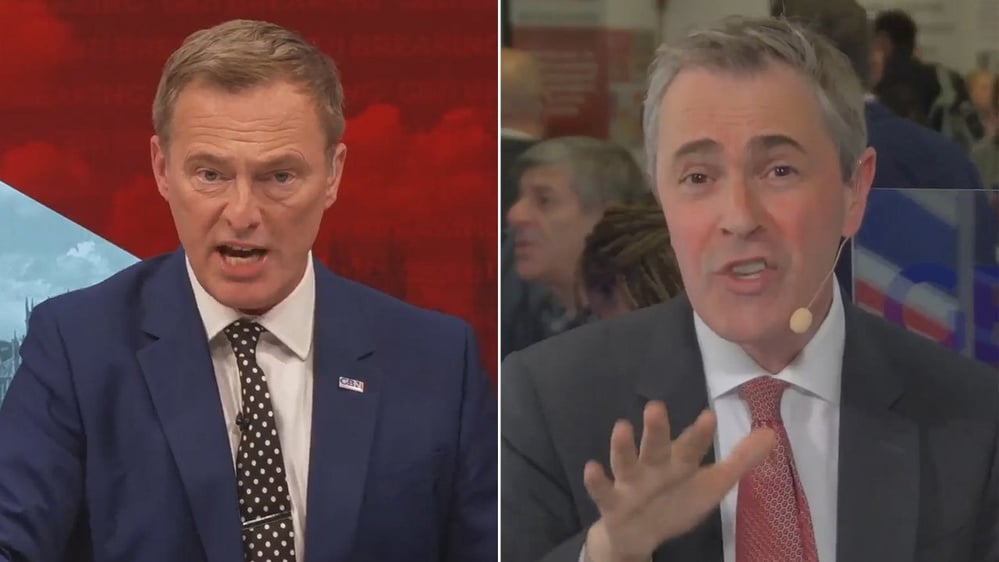
“Watch the moment GB News host Martin Daubney and David Pinto Duschinsky descend into a bitter row” · exact text match
“As Martin was astounded at the Labour MP's defence of the decision, he then argued that it is not a "scrap" of the triple lock, but merely an "adjustment".” · exact text match
Why: Phrases such as 'bitter row' and 'astounded' inject emotional evaluation into the account.
Claim: The piece emphasizes conflict with dramatic, confrontation-heavy language.
“Martin Daubney clashes with Labour MP in bitter triple lock row: 'Going for pensioners AGAIN!'” · exact text match
“Watch the moment GB News host Martin Daubney and David Pinto Duschinsky descend into a bitter row” · exact text match
Why: The repeated use of 'bitter', 'clashes', and 'descend' turns a policy disagreement into a dramatic confrontation.
Claim: The report is structured around a commentator's attack and uses evaluative narration rather than a neutral summary of the policy.
“As Martin was astounded at the Labour MP's defence of the decision, he then argued that it is not a "scrap" of the triple lock, but merely an "adjustment".” · exact text match
“Pressed by Martin on how much the decision will cost, the Labour MP refused to disclose the financial impact of the policy.” · exact text match
Why: The narration endorses Daubney's perspective and frames the MP's lack of a figure as a refusal, which is an opinionated way to describe a non-answer.
Claim: The article explicitly covers a party-political clash and uses Labour as the target of the framing.
“Martin Daubney clashes with Labour MP in bitter triple lock row: 'Going for pensioners AGAIN!'” · exact text match
“Challenging the Labour MP on Mr Burnham's decision, Martin accused the Government of "pickpocketing pensioners again"” · exact text match
Why: The focus is a partisan confrontation, and the chosen headline aligns with the anti-Labour position in that confrontation.
Claim: Pensioners are repeatedly framed as a group being victimized by the government.
“Martin Daubney clashes with Labour MP in bitter triple lock row: 'Going for pensioners AGAIN!'” · exact text match
“British pensioners once again have been picked pocketed by the Labour Party.” · exact text match
Counterevidence:
“Mr Pinto Duschinsky responded: "No, what we saw today from Andy Burnham is true leadership and giving us hope based on honesty..."” · not found in supplied text
Why: The headline and 'pickpocketed' language present pensioners as repeated victims, despite the MP's contrary framing.
Claim: The tone is emotionally negative, emphasizing anger and bitterness.
“Watch the moment GB News host Martin Daubney and David Pinto Duschinsky descend into a bitter row” · exact text match
“This is fag packet politics.” · exact text match
Why: Conflict language and the insulting 'fag packet politics' set a hostile, negative emotional register.
The supplied text is a transcript-style excerpt with duplicated lines and page boilerplate, so the precise boundary of the publisher's own prose is ambiguous and much of the framing comes through a quoted presenter.
September 29, 2026 · 0 shares
A sceptical, concern-led framing presents the pension reform primarily as a cost-driven 'shake-up' with unresolved detail and risk for pensioners.
Automated analysis; not human reviewed. Limitations: The supplied text contains duplicated paragraphs and embedded sidebar/trending headers; the analysis is based on the substantive body, but the exact boundary with page chrome was not fully recoverable. · 3 of 55 available dimensions scored; omitted dimensions are not treated as neutral. · Verified supporting quotes for 0 of 3 scored dimensions.
Claim: The report is predominantly factual and uses attributed quotes rather than editorial opinion.
“Speaking to Labour conference, the Prime Minister said: "From April 2030, the state pension will continue to increase by prices or 2.5 per cent..."” · not found in supplied text
“Quilter's latest Retirement Lifestyle Report, which found that it accounts for almost a quarter of retirement income on average.” · exact text match
Why: Most sentences report announcements, estimates, and expert views with named attribution; no unmarked opinion is asserted as fact.
Claim: The tone is balanced between the government's reassurance and independent concerns, not systematically optimistic or pessimistic.
“"So this is the deal - a state pension that rises every year, no care charges and a high-quality National Care Service to give peace of mind in later life."” · not found in supplied text
“79 per cent of over-55s are worried that changes to the state pension or triple lock could leave them financially worse off...” · not found in supplied text
Why: Both the policy's promised benefits and survey or analyst concerns are given similar weight, supporting a neutral emotional valence.
Claim: Sourcing and attribution practices are strong: named organizations, named experts, and direct quotes support the report.
“The Institute for Fiscal Studies (IFS) estimated that keeping the triple lock until 2050 would cost "between £5 billion and £40 billion per year."” · exact text match
“Kate Smith, Head of Pensions at Aegon, said: "We welcome the Prime Minister's decision..."” · not found in supplied text
Why: The article attributes quantitative claims to named sources and uses direct quotes, including critic views, without presenting them as its own findings.
The supplied text contains duplicated paragraphs and embedded sidebar/trending headers; the analysis is based on the substantive body, but the exact boundary with page chrome was not fully recoverable.
September 29, 2026 · 0 shares
Framing centers on a party-political clash over the pensions triple lock, using emotive descriptors such as 'blistering' and 'radical' while mostly attributing claims to named sources.
The Labour Party conference is the annual setting for a leader's policy speech; Scottish social care is devolved, so an English care-service funding plan does not automatically apply to Scotland.
Automated analysis; not human reviewed. Limitations: The text identifies Andy Burnham as prime minister and does not include other sourcing; all judgments are limited to this internal account. · 4 of 55 available dimensions scored; omitted dimensions are not treated as neutral. · Verified supporting quotes for 1 of 4 scored dimensions.
Claim: The publisher adds emotive descriptors to otherwise attributed political reporting.
“in a blistering defence of the union” · exact text match
“set out a radical plan to transform the country” · exact text match
Why: Evaluative adjectives such as 'blistering' and 'radical' add subjective color to what is otherwise a report built on attributed quotes.
Claim: The report stays in descriptive mode, attributing opinions to named speakers rather than prescribing policy.
“Speaking to journalists in the Scottish Parliament on Tuesday, Mr Swinney said he thought Mr Burnham was 'getting off on the wrong footing' by removing the pensions triple lock.” · not found in supplied text
“Mr Burnham said: 'This change will generate significant savings which we will use to build up our national care service.'” · not found in supplied text
Why: All policy recommendations or judgments are presented as quotations from sources; the publisher itself issues no directive or policy prescription.
Claim: The coverage is concentrated on partisan confrontation and policy positioning at a party conference.
“First Minister John Swinney said Andy Burnham is 'repeating the mistakes of Keir Starmer' as the Prime Minister confirmed reform to the pensions triple lock.” · not found in supplied text
“He then gave a strong defence of the union” · exact text match
Why: The story is structured around inter-party accusation, a leader's conference speech, and unionist-nationalist positioning, making it heavily political content.
Claim: The report consistently attributes statements to named people and uses direct quotation.
“Adam Stachura, Age Scotland's policy director said: 'Reform of social care and improving the outcomes for people should be a priority of governments across the UK.'” · not found in supplied text
Why: Visible sourcing, named officials, and direct quotes support credibility, though the text includes no independent verification or correction note.
The text identifies Andy Burnham as prime minister and does not include other sourcing; all judgments are limited to this internal account.
Framing foregrounds a London-specific tax burden and an IFS expert warning that the social care funding plan is insufficient, while still including the government's defense.
The state pension Triple Lock normally increases pensions by the highest of average earnings growth, inflation, or 2.5%; removing the earnings link would leave increases at inflation or 2.5%. The Institute for Fiscal Studies is an independent UK economic research institute.
Automated analysis; not human reviewed. · 4 of 55 available dimensions scored; omitted dimensions are not treated as neutral. · Verified supporting quotes for 4 of 4 scored dimensions.
Claim: The report is balanced between Labour's justification and an independent economist's criticism.
“This change will generate significant savings, which we will use to build up our national care service” · exact text match
“If they scrap or move away from the Triple Lock, that's not enough to fund big entitlement to social care in the next few years, in the early 2030s” · exact text match
Why: The publisher includes direct supporting quotes from the government and critical quotes from the IFS without endorsing either position.
Claim: The story is heavily political, centered on a Labour government policy announcement and related political reaction.
“The Prime Minister announced at Labour’s annual conference in Liverpool that the “Triple Lock” will be adjusted from 2030” · exact text match
“Communities Secretary Angela Rayner suggested that pensioners could be willing to give up the “Triple Lock”” · exact text match
Why: The dominant subject is a ruling-party conference proposal, government communications, and the political debate around it.
Claim: The headline presents a conditional expert warning as a definite future outcome.
“Londoners face new tax rises to fund Andy Burnham’s flagship social care reforms.” · exact text match
“If they do tax rises, that's likely to affect Londoners more than the rest of the country” · exact text match
Why: Cribb's conditional warning is converted into an asserted outcome in the lead sentence.
Claim: The report shows visible sourcing for expert and statistical claims.
“Jonathan Cribb, Deputy Director at the Institute for Fiscal Studies” · exact text match
“according to the Office for National Statistics” · exact text match
Why: Key claims carry named expert affiliation and an ONS attribution, though the unconditional headline slightly detracts.
September 29, 2026 · 0 shares
A sceptical, concern-led framing presents the pension reform primarily as a cost-driven 'shake-up' with unresolved detail and risk for pensioners.
Automated analysis; not human reviewed. Limitations: The supplied text contains duplicated paragraphs and embedded sidebar/trending headers; the analysis is based on the substantive body, but the exact boundary with page chrome was not fully recoverable. · 3 of 55 available dimensions scored; omitted dimensions are not treated as neutral. · Verified supporting quotes for 0 of 3 scored dimensions.
Claim: The report is predominantly factual and uses attributed quotes rather than editorial opinion.
“Speaking to Labour conference, the Prime Minister said: "From April 2030, the state pension will continue to increase by prices or 2.5 per cent..."” · not found in supplied text
“Quilter's latest Retirement Lifestyle Report, which found that it accounts for almost a quarter of retirement income on average.” · exact text match
Why: Most sentences report announcements, estimates, and expert views with named attribution; no unmarked opinion is asserted as fact.
Claim: The tone is balanced between the government's reassurance and independent concerns, not systematically optimistic or pessimistic.
“"So this is the deal - a state pension that rises every year, no care charges and a high-quality National Care Service to give peace of mind in later life."” · not found in supplied text
“79 per cent of over-55s are worried that changes to the state pension or triple lock could leave them financially worse off...” · not found in supplied text
Why: Both the policy's promised benefits and survey or analyst concerns are given similar weight, supporting a neutral emotional valence.
Claim: Sourcing and attribution practices are strong: named organizations, named experts, and direct quotes support the report.
“The Institute for Fiscal Studies (IFS) estimated that keeping the triple lock until 2050 would cost "between £5 billion and £40 billion per year."” · exact text match
“Kate Smith, Head of Pensions at Aegon, said: "We welcome the Prime Minister's decision..."” · not found in supplied text
Why: The article attributes quantitative claims to named sources and uses direct quotes, including critic views, without presenting them as its own findings.
The supplied text contains duplicated paragraphs and embedded sidebar/trending headers; the analysis is based on the substantive body, but the exact boundary with page chrome was not fully recoverable.
September 29, 2026 · 0 shares
Framing foregrounds a pensions-versus-social-care funding conflict, using a union warning that scrapping the triple lock would be 'morally wrong' and Labour leadership reassurances, while presenting the policy's possible removal as a live political risk.
Automated analysis; not human reviewed. Limitations: Input is a single BBC article with related-headline and promotion text interleaved; analysis focuses on the main report and treats the surrounding links as secondary display items. · 5 of 55 available dimensions scored; omitted dimensions are not treated as neutral. · Verified supporting quotes for 3 of 5 scored dimensions.
Claim: The report is source-driven and descriptive, with the publisher adding little subjective commentary.
“Speaking to BBC Radio 4's Today programme, Graham said axing the triple lock risked repeating the unpopular removal of the Winter Fuel Allowance under previous prime minister Sir Keir Starmer.” · exact text match
“On Tuesday morning, Powell said the lock was a manifesto commitment, and asked whether it would stay in place until the next election, she said: 'I can absolutely assure your viewers watching this that we are committed to the triple lock, it's in our manifesto.'” · not found in supplied text
Why: Each substantive claim is attributed to a named speaker or programme, and the publisher's own language is limited to linking phrases and a statement about growing speculation.
Claim: The presentation is measured rather than sensational, despite conflict-driven framing and a quoted 'morally wrong' warning.
“Scrapping pensions triple lock 'morally wrong', says union boss” · exact text match
“Speaking to BBC Radio 4's Today programme, Graham said axing the triple lock risked repeating the unpopular removal of the Winter Fuel Allowance under previous prime minister Sir Keir Starmer.” · exact text match
Why: The headline's charged phrase is attributed as a quote, and the body uses routine political reporting language rather than alarmist phrasing.
Claim: The content is heavily political, focused on Labour conference positioning, party commitments, and government policy.
“Andy Burnham wants to outline his ideas for a free-at-the-point-of-use social care system in his first speech to Labour conference as prime minister.” · exact text match
“Labour's deputy leader Lucy Powell told BBC Breakfast the party is committed to the triple lock, which was in the party's 2024 manifesto.” · exact text match
Why: The persons, setting, and stakes are all political actors and institutions; nearly every source is a party or government figure.
Claim: On its face the report is credible because it names outlets, identifies speakers, and provides direct quotes.
“Speaking to BBC Radio 4's Today programme, Graham said axing the triple lock risked repeating the unpopular removal of the Winter Fuel Allowance under previous prime minister Sir Keir Starmer.” · exact text match
“In the BBC's Political Thinking podcast, Milburn was asked if Burnham's new social care plans could be funded by getting rid of the triple lock, he responded that Burnham was 'exactly the sort of person who can take the big decisions'.” · not found in supplied text
Why: The article consistently attributes statements to named individuals and named programmes, and it does not present anonymous claims as fact.
Claim: The report explicitly incorporates speculation about a possible future policy choice.
“There is growing speculation about how such a care system could be funded, including removing the pensions triple lock in the future.” · exact text match
Why: The sentence names speculation as part of the news frame, linking the social care plan to a future policy option without confirming it.
Input is a single BBC article with related-headline and promotion text interleaved; analysis focuses on the main report and treats the surrounding links as secondary display items.
September 29, 2026 · 0 shares
Framing centers on a party-political clash over the pensions triple lock, using emotive descriptors such as 'blistering' and 'radical' while mostly attributing claims to named sources.
The Labour Party conference is the annual setting for a leader's policy speech; Scottish social care is devolved, so an English care-service funding plan does not automatically apply to Scotland.
Automated analysis; not human reviewed. Limitations: The text identifies Andy Burnham as prime minister and does not include other sourcing; all judgments are limited to this internal account. · 4 of 55 available dimensions scored; omitted dimensions are not treated as neutral. · Verified supporting quotes for 1 of 4 scored dimensions.
Claim: The publisher adds emotive descriptors to otherwise attributed political reporting.
“in a blistering defence of the union” · exact text match
“set out a radical plan to transform the country” · exact text match
Why: Evaluative adjectives such as 'blistering' and 'radical' add subjective color to what is otherwise a report built on attributed quotes.
Claim: The report stays in descriptive mode, attributing opinions to named speakers rather than prescribing policy.
“Speaking to journalists in the Scottish Parliament on Tuesday, Mr Swinney said he thought Mr Burnham was 'getting off on the wrong footing' by removing the pensions triple lock.” · not found in supplied text
“Mr Burnham said: 'This change will generate significant savings which we will use to build up our national care service.'” · not found in supplied text
Why: All policy recommendations or judgments are presented as quotations from sources; the publisher itself issues no directive or policy prescription.
Claim: The coverage is concentrated on partisan confrontation and policy positioning at a party conference.
“First Minister John Swinney said Andy Burnham is 'repeating the mistakes of Keir Starmer' as the Prime Minister confirmed reform to the pensions triple lock.” · not found in supplied text
“He then gave a strong defence of the union” · exact text match
Why: The story is structured around inter-party accusation, a leader's conference speech, and unionist-nationalist positioning, making it heavily political content.
Claim: The report consistently attributes statements to named people and uses direct quotation.
“Adam Stachura, Age Scotland's policy director said: 'Reform of social care and improving the outcomes for people should be a priority of governments across the UK.'” · not found in supplied text
Why: Visible sourcing, named officials, and direct quotes support credibility, though the text includes no independent verification or correction note.
The text identifies Andy Burnham as prime minister and does not include other sourcing; all judgments are limited to this internal account.
September 28, 2026 · 0 shares
The framing is a largely neutral advance on Burnham's conference agenda, prominently relaying his 'hope means honesty' theme while including a Conservative rebuttal and attributing triple-lock speculation.
Automated analysis; not human reviewed. Limitations: The supplied text is a pre-speech preview built on unnamed ministerial briefings and unconfirmed reports, so claims about the forthcoming speech cannot be checked against the delivered remarks; a blank in the text also obscures the outlet being briefed. · 55 of 55 available dimensions scored; omitted dimensions are not treated as neutral. · Verified supporting quotes for 1 of 55 scored dimensions.
Claim: Party-political framing shows no overt endorsement: the report relays Labour's planned message and includes a named Conservative rebuttal.
“Andy Burnham will pledge to confront the subjects politicians "usually avoid" and warn that “hope means honesty” as he sets out his agenda as Labour prime minister at the party conference in Liverpool.” · not found in supplied text
“Conservative Party chairman Kevin Hollinrake argued that hope was "not a strategy".” · not found in supplied text
Why: The report presents both the prime minister's announced agenda and an opposing Conservative statement without endorsing either, though it gives more space to the Labour preview.
Claim: Reporting is mainly objective and attributed, with no editorial argument visible.
“Delivering his inaugural address to the Labour Party conference as leader on Tuesday, the prime minister will use the speech to establish a "clear direction" for the country” · not found in supplied text
“Mr Hollinrake remarked: "If Andy Burnham wants to be honest with the British people, he must admit that Labour’s tax rises have crushed businesses, killed jobs and hammered family finances — all so Labour can give more handouts to benefits street."” · not found in supplied text
Why: The text relays plans, briefings, quotes, and speculation through attributed statements rather than offering the publisher's own judgments.
Claim: The text is descriptive of planned events and statements, not prescriptive.
“Mr Burnham will also introduce a series of measures addressing social care, youth unemployment, and public control over utility companies, committing to an "honest conversation" regarding difficult matters.” · not found in supplied text
Why: It tells readers what will happen and what has been briefed, without recommending or prescribing actions.
Claim: The content is almost entirely about party politics, government policy speculation, and election-style messaging.
“Delivering his inaugural address to the Labour Party conference as leader on Tuesday” · exact text match
“Conservative Party chairman Kevin Hollinrake argued that hope was "not a strategy".” · not found in supplied text
Why: Every substantive paragraph concerns a party conference, Labour policy plans, ministerial briefings, and partisan rebuttal.
Claim: The report is fairly credible because it uses attributed briefings and direct quotes, but it relies on anonymous officials and unconfirmed reports.
“But with ministers briefing to that he is planning a major rethink on Brexit after a decade of “drift and division”” · verified after text normalization
“Conservative Party chairman Kevin Hollinrake argued that hope was "not a strategy".” · not found in supplied text
Why: Direct, named quotes and clear attribution support credibility; reliance on anonymous ministerial briefings and unconfirmed 'reports' lowers confidence.
Claim: The article includes clearly labeled speculation about possible policy changes rather than asserting them as fact.
“That has fuelled speculation that a change in the way pensions are increased to a less generous system could be used to partly fund the cost of free social care for adults in England.” · exact text match
Why: The sentence explicitly labels the inference as speculation, and earlier 'reports' are attributed rather than confirmed.
Claim: Internal fairness signals include carrying an opposition attack and explicitly marking uncertain policy changes as speculation.
“Conservative Party chairman Kevin Hollinrake argued that hope was "not a strategy".” · not found in supplied text
“That has fuelled speculation that a change in the way pensions are increased to a less generous system could be used to partly fund the cost of free social care for adults in England.” · exact text match
Why: The inclusion of the Conservative rebuttal and the explicit 'speculation' label indicate an attempt at balance and transparency.
The supplied text is a pre-speech preview built on unnamed ministerial briefings and unconfirmed reports, so claims about the forthcoming speech cannot be checked against the delivered remarks; a blank in the text also obscures the outlet being briefed.
September 29, 2026 · 0 shares
A neutral, attribution-based news brief reporting a Labour pledge without commentary, context, or evaluation.
The pension triple lock is a UK policy commitment to increase the state pension each year by the highest of average earnings growth, inflation, or 2.5%.
Automated analysis; not human reviewed. Limitations: The supplied text is a headline plus a single-sentence summary; no full article body was provided, so analysis is limited to that minimal content. · 7 of 55 available dimensions scored; omitted dimensions are not treated as neutral. · Verified supporting quotes for 6 of 7 scored dimensions.
Claim: The report is politically neutral, neither endorsing nor criticizing Labour's pledge.
“The Education Secretary Lucy Powell reaffirmed Labour's manifesto pledge to maintain the triple lock.” · exact text match
Why: A single attributed statement is reported without approval, disapproval, or partisan framing.
Claim: Reporting is strictly objective, with no subjective commentary or evaluative language.
“The Education Secretary Lucy Powell reaffirmed Labour's manifesto pledge to maintain the triple lock.” · exact text match
Why: The sentence is a factual, attributed statement with no adjectives, opinion, or framing.
Claim: Reporting is unemotional and non-sensational.
“The Education Secretary Lucy Powell reaffirmed Labour's manifesto pledge to maintain the triple lock.” · exact text match
Why: No dramatic language, hyperbole, or emotional appeals appear; the sentence is plain and factual.
Claim: The text is purely descriptive, containing no recommendation or prescription.
“The Education Secretary Lucy Powell reaffirmed Labour's manifesto pledge to maintain the triple lock.” · exact text match
Why: It reports an action (reaffirmation) without urging any course of action.
Claim: The text is factful rather than opinionated.
“The Education Secretary Lucy Powell reaffirmed Labour's manifesto pledge to maintain the triple lock.” · exact text match
Why: It states an action taken by a named official without expressing an opinion.
Claim: The text is politically neutral despite its political subject matter.
“The Education Secretary Lucy Powell reaffirmed Labour's manifesto pledge to maintain the triple lock.” · exact text match
Why: The subject is political, but the framing is neutral and limited to an attributed statement.
The supplied text is a headline plus a single-sentence summary; no full article body was provided, so analysis is limited to that minimal content.
September 29, 2026 · 0 shares
The framing casts a possible review of the pension triple lock as a brave 'honest conversation' while using an anonymous-sourced forecast and a union 'electoral suicide' warning to underline political risk.
The pension triple lock is a U.K. commitment to raise the state pension each year by the highest of inflation, average earnings, or 2.5%. A 'national care service' is a Labour proposal for a publicly funded social care system.
Automated analysis; not human reviewed. Limitations: The supplied text is a very short excerpt and ambiguously treats Andy Burnham and 'the prime minister' as possible subjects of the same planned statement. · 2 of 55 available dimensions scored; omitted dimensions are not treated as neutral. · Verified supporting quotes for 1 of 2 scored dimensions.
Claim: The report uses an objective news style by attributing the main policy forecast to unnamed government sources and the critical judgment to a named union leader.
“Government sources have suggested the prime minister will signal his willingness to review the policy but stop short of a pledge to scrap it altogether.” · exact text match
“The Unite general secretary, Sharon Graham, said the move would be “electoral suicide”.” · not found in supplied text
Why: The publisher does not assert the plan or the 'electoral suicide' judgment in its own voice; it attributes them, which supports an objective rather than subjective presentation.
Claim: The report's visible sourcing is mixed: the central plan is attributed to anonymous government sources, while the opposing reaction is named.
“Government sources have suggested the prime minister will signal his willingness to review the policy but stop short of a pledge to scrap it altogether.” · exact text match
Why: It uses an unnamed source for the main claim and names the union official for the warning, which is standard journalistic attribution but not high-certainty sourcing.
The supplied text is a very short excerpt and ambiguously treats Andy Burnham and 'the prime minister' as possible subjects of the same planned statement.
Helium Bias
Story Blindspots
September 29, 2026 · 0 shares
A sceptical, concern-led framing presents the pension reform primarily as a cost-driven 'shake-up' with unresolved detail and risk for pensioners.
Automated analysis; not human reviewed. Limitations: The supplied text contains duplicated paragraphs and embedded sidebar/trending headers; the analysis is based on the substantive body, but the exact boundary with page chrome was not fully recoverable. · 3 of 55 available dimensions scored; omitted dimensions are not treated as neutral. · Verified supporting quotes for 0 of 3 scored dimensions.
Claim: The report is predominantly factual and uses attributed quotes rather than editorial opinion.
“Speaking to Labour conference, the Prime Minister said: "From April 2030, the state pension will continue to increase by prices or 2.5 per cent..."” · not found in supplied text
“Quilter's latest Retirement Lifestyle Report, which found that it accounts for almost a quarter of retirement income on average.” · exact text match
Why: Most sentences report announcements, estimates, and expert views with named attribution; no unmarked opinion is asserted as fact.
Claim: The tone is balanced between the government's reassurance and independent concerns, not systematically optimistic or pessimistic.
“"So this is the deal - a state pension that rises every year, no care charges and a high-quality National Care Service to give peace of mind in later life."” · not found in supplied text
“79 per cent of over-55s are worried that changes to the state pension or triple lock could leave them financially worse off...” · not found in supplied text
Why: Both the policy's promised benefits and survey or analyst concerns are given similar weight, supporting a neutral emotional valence.
Claim: Sourcing and attribution practices are strong: named organizations, named experts, and direct quotes support the report.
“The Institute for Fiscal Studies (IFS) estimated that keeping the triple lock until 2050 would cost "between £5 billion and £40 billion per year."” · exact text match
“Kate Smith, Head of Pensions at Aegon, said: "We welcome the Prime Minister's decision..."” · not found in supplied text
Why: The article attributes quantitative claims to named sources and uses direct quotes, including critic views, without presenting them as its own findings.
The supplied text contains duplicated paragraphs and embedded sidebar/trending headers; the analysis is based on the substantive body, but the exact boundary with page chrome was not fully recoverable.
September 29, 2026 · 0 shares
A sceptical, concern-led framing presents the pension reform primarily as a cost-driven 'shake-up' with unresolved detail and risk for pensioners.
Automated analysis; not human reviewed. Limitations: The supplied text contains duplicated paragraphs and embedded sidebar/trending headers; the analysis is based on the substantive body, but the exact boundary with page chrome was not fully recoverable. · 3 of 55 available dimensions scored; omitted dimensions are not treated as neutral. · Verified supporting quotes for 0 of 3 scored dimensions.
Claim: The report is predominantly factual and uses attributed quotes rather than editorial opinion.
“Speaking to Labour conference, the Prime Minister said: "From April 2030, the state pension will continue to increase by prices or 2.5 per cent..."” · not found in supplied text
“Quilter's latest Retirement Lifestyle Report, which found that it accounts for almost a quarter of retirement income on average.” · exact text match
Why: Most sentences report announcements, estimates, and expert views with named attribution; no unmarked opinion is asserted as fact.
Claim: The tone is balanced between the government's reassurance and independent concerns, not systematically optimistic or pessimistic.
“"So this is the deal - a state pension that rises every year, no care charges and a high-quality National Care Service to give peace of mind in later life."” · not found in supplied text
“79 per cent of over-55s are worried that changes to the state pension or triple lock could leave them financially worse off...” · not found in supplied text
Why: Both the policy's promised benefits and survey or analyst concerns are given similar weight, supporting a neutral emotional valence.
Claim: Sourcing and attribution practices are strong: named organizations, named experts, and direct quotes support the report.
“The Institute for Fiscal Studies (IFS) estimated that keeping the triple lock until 2050 would cost "between £5 billion and £40 billion per year."” · exact text match
“Kate Smith, Head of Pensions at Aegon, said: "We welcome the Prime Minister's decision..."” · not found in supplied text
Why: The article attributes quantitative claims to named sources and uses direct quotes, including critic views, without presenting them as its own findings.
The supplied text contains duplicated paragraphs and embedded sidebar/trending headers; the analysis is based on the substantive body, but the exact boundary with page chrome was not fully recoverable.
Framing foregrounds a London-specific tax burden and an IFS expert warning that the social care funding plan is insufficient, while still including the government's defense.
The state pension Triple Lock normally increases pensions by the highest of average earnings growth, inflation, or 2.5%; removing the earnings link would leave increases at inflation or 2.5%. The Institute for Fiscal Studies is an independent UK economic research institute.
Automated analysis; not human reviewed. · 4 of 55 available dimensions scored; omitted dimensions are not treated as neutral. · Verified supporting quotes for 4 of 4 scored dimensions.
Claim: The report is balanced between Labour's justification and an independent economist's criticism.
“This change will generate significant savings, which we will use to build up our national care service” · exact text match
“If they scrap or move away from the Triple Lock, that's not enough to fund big entitlement to social care in the next few years, in the early 2030s” · exact text match
Why: The publisher includes direct supporting quotes from the government and critical quotes from the IFS without endorsing either position.
Claim: The story is heavily political, centered on a Labour government policy announcement and related political reaction.
“The Prime Minister announced at Labour’s annual conference in Liverpool that the “Triple Lock” will be adjusted from 2030” · exact text match
“Communities Secretary Angela Rayner suggested that pensioners could be willing to give up the “Triple Lock”” · exact text match
Why: The dominant subject is a ruling-party conference proposal, government communications, and the political debate around it.
Claim: The headline presents a conditional expert warning as a definite future outcome.
“Londoners face new tax rises to fund Andy Burnham’s flagship social care reforms.” · exact text match
“If they do tax rises, that's likely to affect Londoners more than the rest of the country” · exact text match
Why: Cribb's conditional warning is converted into an asserted outcome in the lead sentence.
Claim: The report shows visible sourcing for expert and statistical claims.
“Jonathan Cribb, Deputy Director at the Institute for Fiscal Studies” · exact text match
“according to the Office for National Statistics” · exact text match
Why: Key claims carry named expert affiliation and an ONS attribution, though the unconditional headline slightly detracts.
September 28, 2026 · 0 shares
The framing is a largely neutral advance on Burnham's conference agenda, prominently relaying his 'hope means honesty' theme while including a Conservative rebuttal and attributing triple-lock speculation.
Automated analysis; not human reviewed. Limitations: The supplied text is a pre-speech preview built on unnamed ministerial briefings and unconfirmed reports, so claims about the forthcoming speech cannot be checked against the delivered remarks; a blank in the text also obscures the outlet being briefed. · 55 of 55 available dimensions scored; omitted dimensions are not treated as neutral. · Verified supporting quotes for 1 of 55 scored dimensions.
Claim: Party-political framing shows no overt endorsement: the report relays Labour's planned message and includes a named Conservative rebuttal.
“Andy Burnham will pledge to confront the subjects politicians "usually avoid" and warn that “hope means honesty” as he sets out his agenda as Labour prime minister at the party conference in Liverpool.” · not found in supplied text
“Conservative Party chairman Kevin Hollinrake argued that hope was "not a strategy".” · not found in supplied text
Why: The report presents both the prime minister's announced agenda and an opposing Conservative statement without endorsing either, though it gives more space to the Labour preview.
Claim: Reporting is mainly objective and attributed, with no editorial argument visible.
“Delivering his inaugural address to the Labour Party conference as leader on Tuesday, the prime minister will use the speech to establish a "clear direction" for the country” · not found in supplied text
“Mr Hollinrake remarked: "If Andy Burnham wants to be honest with the British people, he must admit that Labour’s tax rises have crushed businesses, killed jobs and hammered family finances — all so Labour can give more handouts to benefits street."” · not found in supplied text
Why: The text relays plans, briefings, quotes, and speculation through attributed statements rather than offering the publisher's own judgments.
Claim: The text is descriptive of planned events and statements, not prescriptive.
“Mr Burnham will also introduce a series of measures addressing social care, youth unemployment, and public control over utility companies, committing to an "honest conversation" regarding difficult matters.” · not found in supplied text
Why: It tells readers what will happen and what has been briefed, without recommending or prescribing actions.
Claim: The content is almost entirely about party politics, government policy speculation, and election-style messaging.
“Delivering his inaugural address to the Labour Party conference as leader on Tuesday” · exact text match
“Conservative Party chairman Kevin Hollinrake argued that hope was "not a strategy".” · not found in supplied text
Why: Every substantive paragraph concerns a party conference, Labour policy plans, ministerial briefings, and partisan rebuttal.
Claim: The report is fairly credible because it uses attributed briefings and direct quotes, but it relies on anonymous officials and unconfirmed reports.
“But with ministers briefing to that he is planning a major rethink on Brexit after a decade of “drift and division”” · verified after text normalization
“Conservative Party chairman Kevin Hollinrake argued that hope was "not a strategy".” · not found in supplied text
Why: Direct, named quotes and clear attribution support credibility; reliance on anonymous ministerial briefings and unconfirmed 'reports' lowers confidence.
Claim: The article includes clearly labeled speculation about possible policy changes rather than asserting them as fact.
“That has fuelled speculation that a change in the way pensions are increased to a less generous system could be used to partly fund the cost of free social care for adults in England.” · exact text match
Why: The sentence explicitly labels the inference as speculation, and earlier 'reports' are attributed rather than confirmed.
Claim: Internal fairness signals include carrying an opposition attack and explicitly marking uncertain policy changes as speculation.
“Conservative Party chairman Kevin Hollinrake argued that hope was "not a strategy".” · not found in supplied text
“That has fuelled speculation that a change in the way pensions are increased to a less generous system could be used to partly fund the cost of free social care for adults in England.” · exact text match
Why: The inclusion of the Conservative rebuttal and the explicit 'speculation' label indicate an attempt at balance and transparency.
The supplied text is a pre-speech preview built on unnamed ministerial briefings and unconfirmed reports, so claims about the forthcoming speech cannot be checked against the delivered remarks; a blank in the text also obscures the outlet being briefed.
September 29, 2026 · 0 shares
The framing casts a possible review of the pension triple lock as a brave 'honest conversation' while using an anonymous-sourced forecast and a union 'electoral suicide' warning to underline political risk.
The pension triple lock is a U.K. commitment to raise the state pension each year by the highest of inflation, average earnings, or 2.5%. A 'national care service' is a Labour proposal for a publicly funded social care system.
Automated analysis; not human reviewed. Limitations: The supplied text is a very short excerpt and ambiguously treats Andy Burnham and 'the prime minister' as possible subjects of the same planned statement. · 2 of 55 available dimensions scored; omitted dimensions are not treated as neutral. · Verified supporting quotes for 1 of 2 scored dimensions.
Claim: The report uses an objective news style by attributing the main policy forecast to unnamed government sources and the critical judgment to a named union leader.
“Government sources have suggested the prime minister will signal his willingness to review the policy but stop short of a pledge to scrap it altogether.” · exact text match
“The Unite general secretary, Sharon Graham, said the move would be “electoral suicide”.” · not found in supplied text
Why: The publisher does not assert the plan or the 'electoral suicide' judgment in its own voice; it attributes them, which supports an objective rather than subjective presentation.
Claim: The report's visible sourcing is mixed: the central plan is attributed to anonymous government sources, while the opposing reaction is named.
“Government sources have suggested the prime minister will signal his willingness to review the policy but stop short of a pledge to scrap it altogether.” · exact text match
Why: It uses an unnamed source for the main claim and names the union official for the warning, which is standard journalistic attribution but not high-certainty sourcing.
The supplied text is a very short excerpt and ambiguously treats Andy Burnham and 'the prime minister' as possible subjects of the same planned statement.
September 29, 2026 · 0 shares
A sceptical, concern-led framing presents the pension reform primarily as a cost-driven 'shake-up' with unresolved detail and risk for pensioners.
Automated analysis; not human reviewed. Limitations: The supplied text contains duplicated paragraphs and embedded sidebar/trending headers; the analysis is based on the substantive body, but the exact boundary with page chrome was not fully recoverable. · 3 of 55 available dimensions scored; omitted dimensions are not treated as neutral. · Verified supporting quotes for 0 of 3 scored dimensions.
Claim: The report is predominantly factual and uses attributed quotes rather than editorial opinion.
“Speaking to Labour conference, the Prime Minister said: "From April 2030, the state pension will continue to increase by prices or 2.5 per cent..."” · not found in supplied text
“Quilter's latest Retirement Lifestyle Report, which found that it accounts for almost a quarter of retirement income on average.” · exact text match
Why: Most sentences report announcements, estimates, and expert views with named attribution; no unmarked opinion is asserted as fact.
Claim: The tone is balanced between the government's reassurance and independent concerns, not systematically optimistic or pessimistic.
“"So this is the deal - a state pension that rises every year, no care charges and a high-quality National Care Service to give peace of mind in later life."” · not found in supplied text
“79 per cent of over-55s are worried that changes to the state pension or triple lock could leave them financially worse off...” · not found in supplied text
Why: Both the policy's promised benefits and survey or analyst concerns are given similar weight, supporting a neutral emotional valence.
Claim: Sourcing and attribution practices are strong: named organizations, named experts, and direct quotes support the report.
“The Institute for Fiscal Studies (IFS) estimated that keeping the triple lock until 2050 would cost "between £5 billion and £40 billion per year."” · exact text match
“Kate Smith, Head of Pensions at Aegon, said: "We welcome the Prime Minister's decision..."” · not found in supplied text
Why: The article attributes quantitative claims to named sources and uses direct quotes, including critic views, without presenting them as its own findings.
The supplied text contains duplicated paragraphs and embedded sidebar/trending headers; the analysis is based on the substantive body, but the exact boundary with page chrome was not fully recoverable.
September 29, 2026 · 0 shares
Framing centers on a party-political clash over the pensions triple lock, using emotive descriptors such as 'blistering' and 'radical' while mostly attributing claims to named sources.
The Labour Party conference is the annual setting for a leader's policy speech; Scottish social care is devolved, so an English care-service funding plan does not automatically apply to Scotland.
Automated analysis; not human reviewed. Limitations: The text identifies Andy Burnham as prime minister and does not include other sourcing; all judgments are limited to this internal account. · 4 of 55 available dimensions scored; omitted dimensions are not treated as neutral. · Verified supporting quotes for 1 of 4 scored dimensions.
Claim: The publisher adds emotive descriptors to otherwise attributed political reporting.
“in a blistering defence of the union” · exact text match
“set out a radical plan to transform the country” · exact text match
Why: Evaluative adjectives such as 'blistering' and 'radical' add subjective color to what is otherwise a report built on attributed quotes.
Claim: The report stays in descriptive mode, attributing opinions to named speakers rather than prescribing policy.
“Speaking to journalists in the Scottish Parliament on Tuesday, Mr Swinney said he thought Mr Burnham was 'getting off on the wrong footing' by removing the pensions triple lock.” · not found in supplied text
“Mr Burnham said: 'This change will generate significant savings which we will use to build up our national care service.'” · not found in supplied text
Why: All policy recommendations or judgments are presented as quotations from sources; the publisher itself issues no directive or policy prescription.
Claim: The coverage is concentrated on partisan confrontation and policy positioning at a party conference.
“First Minister John Swinney said Andy Burnham is 'repeating the mistakes of Keir Starmer' as the Prime Minister confirmed reform to the pensions triple lock.” · not found in supplied text
“He then gave a strong defence of the union” · exact text match
Why: The story is structured around inter-party accusation, a leader's conference speech, and unionist-nationalist positioning, making it heavily political content.
Claim: The report consistently attributes statements to named people and uses direct quotation.
“Adam Stachura, Age Scotland's policy director said: 'Reform of social care and improving the outcomes for people should be a priority of governments across the UK.'” · not found in supplied text
Why: Visible sourcing, named officials, and direct quotes support credibility, though the text includes no independent verification or correction note.
The text identifies Andy Burnham as prime minister and does not include other sourcing; all judgments are limited to this internal account.
Framing foregrounds a London-specific tax burden and an IFS expert warning that the social care funding plan is insufficient, while still including the government's defense.
The state pension Triple Lock normally increases pensions by the highest of average earnings growth, inflation, or 2.5%; removing the earnings link would leave increases at inflation or 2.5%. The Institute for Fiscal Studies is an independent UK economic research institute.
Automated analysis; not human reviewed. · 4 of 55 available dimensions scored; omitted dimensions are not treated as neutral. · Verified supporting quotes for 4 of 4 scored dimensions.
Claim: The report is balanced between Labour's justification and an independent economist's criticism.
“This change will generate significant savings, which we will use to build up our national care service” · exact text match
“If they scrap or move away from the Triple Lock, that's not enough to fund big entitlement to social care in the next few years, in the early 2030s” · exact text match
Why: The publisher includes direct supporting quotes from the government and critical quotes from the IFS without endorsing either position.
Claim: The story is heavily political, centered on a Labour government policy announcement and related political reaction.
“The Prime Minister announced at Labour’s annual conference in Liverpool that the “Triple Lock” will be adjusted from 2030” · exact text match
“Communities Secretary Angela Rayner suggested that pensioners could be willing to give up the “Triple Lock”” · exact text match
Why: The dominant subject is a ruling-party conference proposal, government communications, and the political debate around it.
Claim: The headline presents a conditional expert warning as a definite future outcome.
“Londoners face new tax rises to fund Andy Burnham’s flagship social care reforms.” · exact text match
“If they do tax rises, that's likely to affect Londoners more than the rest of the country” · exact text match
Why: Cribb's conditional warning is converted into an asserted outcome in the lead sentence.
Claim: The report shows visible sourcing for expert and statistical claims.
“Jonathan Cribb, Deputy Director at the Institute for Fiscal Studies” · exact text match
“according to the Office for National Statistics” · exact text match
Why: Key claims carry named expert affiliation and an ONS attribution, though the unconditional headline slightly detracts.
September 29, 2026 · 0 shares
A sceptical, concern-led framing presents the pension reform primarily as a cost-driven 'shake-up' with unresolved detail and risk for pensioners.
Automated analysis; not human reviewed. Limitations: The supplied text contains duplicated paragraphs and embedded sidebar/trending headers; the analysis is based on the substantive body, but the exact boundary with page chrome was not fully recoverable. · 3 of 55 available dimensions scored; omitted dimensions are not treated as neutral. · Verified supporting quotes for 0 of 3 scored dimensions.
Claim: The report is predominantly factual and uses attributed quotes rather than editorial opinion.
“Speaking to Labour conference, the Prime Minister said: "From April 2030, the state pension will continue to increase by prices or 2.5 per cent..."” · not found in supplied text
“Quilter's latest Retirement Lifestyle Report, which found that it accounts for almost a quarter of retirement income on average.” · exact text match
Why: Most sentences report announcements, estimates, and expert views with named attribution; no unmarked opinion is asserted as fact.
Claim: The tone is balanced between the government's reassurance and independent concerns, not systematically optimistic or pessimistic.
“"So this is the deal - a state pension that rises every year, no care charges and a high-quality National Care Service to give peace of mind in later life."” · not found in supplied text
“79 per cent of over-55s are worried that changes to the state pension or triple lock could leave them financially worse off...” · not found in supplied text
Why: Both the policy's promised benefits and survey or analyst concerns are given similar weight, supporting a neutral emotional valence.
Claim: Sourcing and attribution practices are strong: named organizations, named experts, and direct quotes support the report.
“The Institute for Fiscal Studies (IFS) estimated that keeping the triple lock until 2050 would cost "between £5 billion and £40 billion per year."” · exact text match
“Kate Smith, Head of Pensions at Aegon, said: "We welcome the Prime Minister's decision..."” · not found in supplied text
Why: The article attributes quantitative claims to named sources and uses direct quotes, including critic views, without presenting them as its own findings.
The supplied text contains duplicated paragraphs and embedded sidebar/trending headers; the analysis is based on the substantive body, but the exact boundary with page chrome was not fully recoverable.
September 28, 2026 · 0 shares
Frames scrapping the state pension triple lock as 'almost electoral suicide', foregrounding political risk to the government over the fiscal and policy substance of the social care funding question.
The UK state pension 'triple lock' guarantees the pension rises by the highest of inflation, average earnings growth, or 2.5%; the article's 3.9% figure refers to whichever measure is highest for the coming year. The new national care service was a Labour commitment, but its funding mechanism remained undecided.
Automated analysis; not human reviewed. Limitations: The supplied article text is truncated mid-quote and interleaved with membership and promotional boilerplate; analysis relies only on visible substantive passages, which may omit surrounding context. · 3 of 55 available dimensions scored; omitted dimensions are not treated as neutral. · Verified supporting quotes for 2 of 3 scored dimensions.
Claim: The story is structured around party-political strategy and electoral considerations rather than the substantive merits of pension or social care policy.
“it would have to wait until the next election so that he did not break Labour's manifesto pledge” · verified after text normalization
“has been warned by unions that it could be 'almost electoral suicide'” · not found in supplied text
Counterevidence:
“You can't just keep taxing and spending more and you can't just keep borrowing more” · verified after text normalization
Why: The frame is political viability: when a change can be made, what the manifesto requires, and what unions warn about electorally; the fiscal constraint quote adds some policy substance.
Claim: The report uses explicit attribution and hedged projections throughout.
“Speaking on BBC on Sunday, Mr Burnham added” · exact text match
“The prime minister has suggested” · exact text match
Why: Claims are attributed to named sources, and uncertain projections are marked with hedges like 'expected' and 'could' rather than asserted as certainties.
Claim: The article projects future policy outcomes using speculative and expectation-based language.
“However, a growing suggestion is that the state pension would be one route to fund it” · exact text match
“it is expected that billions would be saved annually if changed were introduced” · exact text match
Why: 'Growing suggestion' and 'it is expected' describe possible developments and projected savings without firm evidence, though the projections are explicitly hedged.
The supplied article text is truncated mid-quote and interleaved with membership and promotional boilerplate; analysis relies only on visible substantive passages, which may omit surrounding context.
September 29, 2026 · 0 shares
Framing is partisan and populist, presenting the triple-lock change as Labour 'going for pensioners again' and narrating the Labour MP's rebuttal within a hostile, conflict-driven exchange.
The state pension triple lock normally raises pensions by the highest of inflation, average earnings growth, or 2.5%; the reported proposal would adjust that formula from 2030.
Automated analysis; not human reviewed. Limitations: The supplied text is a transcript-style excerpt with duplicated lines and page boilerplate, so the precise boundary of the publisher's own prose is ambiguous and much of the framing comes through a quoted presenter. · 8 of 55 available dimensions scored; omitted dimensions are not treated as neutral. · Verified supporting quotes for 8 of 8 scored dimensions.
Claim: The publisher's headline and narration present the Labour government's triple-lock change as an attack on pensioners, a conservative-aligned framing.
“Martin Daubney clashes with Labour MP in bitter triple lock row: 'Going for pensioners AGAIN!'” · exact text match
“Martin accused the Government of "pickpocketing pensioners again" following the controversial Winter Fuel Allowance scrap.” · exact text match
Counterevidence:
“Mr Pinto Duschinsky responded: "No, what we saw today from Andy Burnham is true leadership and giving us hope based on honesty, taking on brave and bold decisions to actually take on the problems that have held the country back for too long."” · exact text match
Why: The MP's defense is quoted, but the chosen headline and loaded words like 'controversial' and 'pickpocketing' favor the attack on the Labour policy.
Claim: The framing is populist, casting an institutional policy change as an elite assault on ordinary pensioners.
“Martin Daubney clashes with Labour MP in bitter triple lock row: 'Going for pensioners AGAIN!'” · exact text match
“British pensioners once again have been picked pocketed by the Labour Party.” · exact text match
Counterevidence:
“Mr Pinto Duschinsky responded: "No, what we saw today from Andy Burnham is true leadership and giving us hope based on honesty..."” · not found in supplied text
Why: The headline and repeated victim language oppose 'the Labour Party' to 'British pensioners' rather than framing the policy as a trade-off among groups.
Claim: The narration uses subjective, evaluative descriptors instead of neutral reporting verbs.
“Watch the moment GB News host Martin Daubney and David Pinto Duschinsky descend into a bitter row” · exact text match
“As Martin was astounded at the Labour MP's defence of the decision, he then argued that it is not a "scrap" of the triple lock, but merely an "adjustment".” · exact text match
Why: Phrases such as 'bitter row' and 'astounded' inject emotional evaluation into the account.
Claim: The piece emphasizes conflict with dramatic, confrontation-heavy language.
“Martin Daubney clashes with Labour MP in bitter triple lock row: 'Going for pensioners AGAIN!'” · exact text match
“Watch the moment GB News host Martin Daubney and David Pinto Duschinsky descend into a bitter row” · exact text match
Why: The repeated use of 'bitter', 'clashes', and 'descend' turns a policy disagreement into a dramatic confrontation.
Claim: The report is structured around a commentator's attack and uses evaluative narration rather than a neutral summary of the policy.
“As Martin was astounded at the Labour MP's defence of the decision, he then argued that it is not a "scrap" of the triple lock, but merely an "adjustment".” · exact text match
“Pressed by Martin on how much the decision will cost, the Labour MP refused to disclose the financial impact of the policy.” · exact text match
Why: The narration endorses Daubney's perspective and frames the MP's lack of a figure as a refusal, which is an opinionated way to describe a non-answer.
Claim: The article explicitly covers a party-political clash and uses Labour as the target of the framing.
“Martin Daubney clashes with Labour MP in bitter triple lock row: 'Going for pensioners AGAIN!'” · exact text match
“Challenging the Labour MP on Mr Burnham's decision, Martin accused the Government of "pickpocketing pensioners again"” · exact text match
Why: The focus is a partisan confrontation, and the chosen headline aligns with the anti-Labour position in that confrontation.
Claim: Pensioners are repeatedly framed as a group being victimized by the government.
“Martin Daubney clashes with Labour MP in bitter triple lock row: 'Going for pensioners AGAIN!'” · exact text match
“British pensioners once again have been picked pocketed by the Labour Party.” · exact text match
Counterevidence:
“Mr Pinto Duschinsky responded: "No, what we saw today from Andy Burnham is true leadership and giving us hope based on honesty..."” · not found in supplied text
Why: The headline and 'pickpocketed' language present pensioners as repeated victims, despite the MP's contrary framing.
Claim: The tone is emotionally negative, emphasizing anger and bitterness.
“Watch the moment GB News host Martin Daubney and David Pinto Duschinsky descend into a bitter row” · exact text match
“This is fag packet politics.” · exact text match
Why: Conflict language and the insulting 'fag packet politics' set a hostile, negative emotional register.
The supplied text is a transcript-style excerpt with duplicated lines and page boilerplate, so the precise boundary of the publisher's own prose is ambiguous and much of the framing comes through a quoted presenter.
September 29, 2026 · 0 shares
A sceptical, concern-led framing presents the pension reform primarily as a cost-driven 'shake-up' with unresolved detail and risk for pensioners.
Automated analysis; not human reviewed. Limitations: The supplied text contains duplicated paragraphs and embedded sidebar/trending headers; the analysis is based on the substantive body, but the exact boundary with page chrome was not fully recoverable. · 3 of 55 available dimensions scored; omitted dimensions are not treated as neutral. · Verified supporting quotes for 0 of 3 scored dimensions.
Claim: The report is predominantly factual and uses attributed quotes rather than editorial opinion.
“Speaking to Labour conference, the Prime Minister said: "From April 2030, the state pension will continue to increase by prices or 2.5 per cent..."” · not found in supplied text
“Quilter's latest Retirement Lifestyle Report, which found that it accounts for almost a quarter of retirement income on average.” · exact text match
Why: Most sentences report announcements, estimates, and expert views with named attribution; no unmarked opinion is asserted as fact.
Claim: The tone is balanced between the government's reassurance and independent concerns, not systematically optimistic or pessimistic.
“"So this is the deal - a state pension that rises every year, no care charges and a high-quality National Care Service to give peace of mind in later life."” · not found in supplied text
“79 per cent of over-55s are worried that changes to the state pension or triple lock could leave them financially worse off...” · not found in supplied text
Why: Both the policy's promised benefits and survey or analyst concerns are given similar weight, supporting a neutral emotional valence.
Claim: Sourcing and attribution practices are strong: named organizations, named experts, and direct quotes support the report.
“The Institute for Fiscal Studies (IFS) estimated that keeping the triple lock until 2050 would cost "between £5 billion and £40 billion per year."” · exact text match
“Kate Smith, Head of Pensions at Aegon, said: "We welcome the Prime Minister's decision..."” · not found in supplied text
Why: The article attributes quantitative claims to named sources and uses direct quotes, including critic views, without presenting them as its own findings.
The supplied text contains duplicated paragraphs and embedded sidebar/trending headers; the analysis is based on the substantive body, but the exact boundary with page chrome was not fully recoverable.
September 29, 2026 · 0 shares
The framing casts a possible review of the pension triple lock as a brave 'honest conversation' while using an anonymous-sourced forecast and a union 'electoral suicide' warning to underline political risk.
The pension triple lock is a U.K. commitment to raise the state pension each year by the highest of inflation, average earnings, or 2.5%. A 'national care service' is a Labour proposal for a publicly funded social care system.
Automated analysis; not human reviewed.
Limitations: The supplied text is a very short excerpt and ambiguously treats Andy Burnham and 'the prime minister' as possible subjects of the same planned statement.
·
2 of 55 available dimensions scored; omitted dimensions are not treated as neutral.
·
Verified supporting quotes for 1 of 2 scored dimensions.
Claim: The report uses an objective news style by attributing the main policy forecast to unnamed government sources and the critical judgment to a named union leader.
“Government sources have suggested the prime minister will signal his willingness to review the policy but stop short of a pledge to scrap it altogether.” · exact text match
“The Unite general secretary, Sharon Graham, said the move would be “electoral suicide”.” · not found in supplied text
Why: The publisher does not assert the plan or the 'electoral suicide' judgment in its own voice; it attributes them, which supports an objective rather than subjective presentation.
Claim: The report's visible sourcing is mixed: the central plan is attributed to anonymous government sources, while the opposing reaction is named.
“Government sources have suggested the prime minister will signal his willingness to review the policy but stop short of a pledge to scrap it altogether.” · exact text match
Why: It uses an unnamed source for the main claim and names the union official for the warning, which is standard journalistic attribution but not high-certainty sourcing.
The supplied text is a very short excerpt and ambiguously treats Andy Burnham and 'the prime minister' as possible subjects of the same planned statement.
September 28, 2026 · 0 shares
The framing is a largely neutral advance on Burnham's conference agenda, prominently relaying his 'hope means honesty' theme while including a Conservative rebuttal and attributing triple-lock speculation.
Automated analysis; not human reviewed.
Limitations: The supplied text is a pre-speech preview built on unnamed ministerial briefings and unconfirmed reports, so claims about the forthcoming speech cannot be checked against the delivered remarks; a blank in the text also obscures the outlet being briefed.
·
55 of 55 available dimensions scored; omitted dimensions are not treated as neutral.
·
Verified supporting quotes for 1 of 55 scored dimensions.
Claim: Party-political framing shows no overt endorsement: the report relays Labour's planned message and includes a named Conservative rebuttal.
“Andy Burnham will pledge to confront the subjects politicians "usually avoid" and warn that “hope means honesty” as he sets out his agenda as Labour prime minister at the party conference in Liverpool.” · not found in supplied text
“Conservative Party chairman Kevin Hollinrake argued that hope was "not a strategy".” · not found in supplied text
Why: The report presents both the prime minister's announced agenda and an opposing Conservative statement without endorsing either, though it gives more space to the Labour preview.
Claim: Reporting is mainly objective and attributed, with no editorial argument visible.
“Delivering his inaugural address to the Labour Party conference as leader on Tuesday, the prime minister will use the speech to establish a "clear direction" for the country” · not found in supplied text
“Mr Hollinrake remarked: "If Andy Burnham wants to be honest with the British people, he must admit that Labour’s tax rises have crushed businesses, killed jobs and hammered family finances — all so Labour can give more handouts to benefits street."” · not found in supplied text
Why: The text relays plans, briefings, quotes, and speculation through attributed statements rather than offering the publisher's own judgments.
Claim: The text is descriptive of planned events and statements, not prescriptive.
“Mr Burnham will also introduce a series of measures addressing social care, youth unemployment, and public control over utility companies, committing to an "honest conversation" regarding difficult matters.” · not found in supplied text
Why: It tells readers what will happen and what has been briefed, without recommending or prescribing actions.
Claim: The content is almost entirely about party politics, government policy speculation, and election-style messaging.
“Delivering his inaugural address to the Labour Party conference as leader on Tuesday” · exact text match
“Conservative Party chairman Kevin Hollinrake argued that hope was "not a strategy".” · not found in supplied text
Why: Every substantive paragraph concerns a party conference, Labour policy plans, ministerial briefings, and partisan rebuttal.
Claim: The report is fairly credible because it uses attributed briefings and direct quotes, but it relies on anonymous officials and unconfirmed reports.
“But with ministers briefing to that he is planning a major rethink on Brexit after a decade of “drift and division”” · verified after text normalization
“Conservative Party chairman Kevin Hollinrake argued that hope was "not a strategy".” · not found in supplied text
Why: Direct, named quotes and clear attribution support credibility; reliance on anonymous ministerial briefings and unconfirmed 'reports' lowers confidence.
Claim: The article includes clearly labeled speculation about possible policy changes rather than asserting them as fact.
“That has fuelled speculation that a change in the way pensions are increased to a less generous system could be used to partly fund the cost of free social care for adults in England.” · exact text match
Why: The sentence explicitly labels the inference as speculation, and earlier 'reports' are attributed rather than confirmed.
Claim: Internal fairness signals include carrying an opposition attack and explicitly marking uncertain policy changes as speculation.
“Conservative Party chairman Kevin Hollinrake argued that hope was "not a strategy".” · not found in supplied text
“That has fuelled speculation that a change in the way pensions are increased to a less generous system could be used to partly fund the cost of free social care for adults in England.” · exact text match
Why: The inclusion of the Conservative rebuttal and the explicit 'speculation' label indicate an attempt at balance and transparency.
The supplied text is a pre-speech preview built on unnamed ministerial briefings and unconfirmed reports, so claims about the forthcoming speech cannot be checked against the delivered remarks; a blank in the text also obscures the outlet being briefed.
September 28, 2026 · 0 shares
Frames scrapping the state pension triple lock as 'almost electoral suicide', foregrounding political risk to the government over the fiscal and policy substance of the social care funding question.
The UK state pension 'triple lock' guarantees the pension rises by the highest of inflation, average earnings growth, or 2.5%; the article's 3.9% figure refers to whichever measure is highest for the coming year.
The new national care service was a Labour commitment, but its funding mechanism remained undecided.
Automated analysis; not human reviewed.
Limitations: The supplied article text is truncated mid-quote and interleaved with membership and promotional boilerplate; analysis relies only on visible substantive passages, which may omit surrounding context.
·
3 of 55 available dimensions scored; omitted dimensions are not treated as neutral.
·
Verified supporting quotes for 2 of 3 scored dimensions.
Claim: The story is structured around party-political strategy and electoral considerations rather than the substantive merits of pension or social care policy.
“it would have to wait until the next election so that he did not break Labour's manifesto pledge” · verified after text normalization
“has been warned by unions that it could be 'almost electoral suicide'” · not found in supplied text
Counterevidence:
“You can't just keep taxing and spending more and you can't just keep borrowing more” · verified after text normalization
Why: The frame is political viability: when a change can be made, what the manifesto requires, and what unions warn about electorally; the fiscal constraint quote adds some policy substance.
Claim: The report uses explicit attribution and hedged projections throughout.
“Speaking on BBC on Sunday, Mr Burnham added” · exact text match
“The prime minister has suggested” · exact text match
Why: Claims are attributed to named sources, and uncertain projections are marked with hedges like 'expected' and 'could' rather than asserted as certainties.
Claim: The article projects future policy outcomes using speculative and expectation-based language.
“However, a growing suggestion is that the state pension would be one route to fund it” · exact text match
“it is expected that billions would be saved annually if changed were introduced” · exact text match
Why: 'Growing suggestion' and 'it is expected' describe possible developments and projected savings without firm evidence, though the projections are explicitly hedged.
The supplied article text is truncated mid-quote and interleaved with membership and promotional boilerplate; analysis relies only on visible substantive passages, which may omit surrounding context.
September 29, 2026 · 0 shares
Framing is partisan and populist, presenting the triple-lock change as Labour 'going for pensioners again' and narrating the Labour MP's rebuttal within a hostile, conflict-driven exchange.
The state pension triple lock normally raises pensions by the highest of inflation, average earnings growth, or 2.5%; the reported proposal would adjust that formula from 2030.
Automated analysis; not human reviewed.
Limitations: The supplied text is a transcript-style excerpt with duplicated lines and page boilerplate, so the precise boundary of the publisher's own prose is ambiguous and much of the framing comes through a quoted presenter.
·
8 of 55 available dimensions scored; omitted dimensions are not treated as neutral.
·
Verified supporting quotes for 8 of 8 scored dimensions.
Claim: The publisher's headline and narration present the Labour government's triple-lock change as an attack on pensioners, a conservative-aligned framing.
“Martin Daubney clashes with Labour MP in bitter triple lock row: 'Going for pensioners AGAIN!'” · exact text match
“Martin accused the Government of "pickpocketing pensioners again" following the controversial Winter Fuel Allowance scrap.” · exact text match
Counterevidence:
“Mr Pinto Duschinsky responded: "No, what we saw today from Andy Burnham is true leadership and giving us hope based on honesty, taking on brave and bold decisions to actually take on the problems that have held the country back for too long."” · exact text match
Why: The MP's defense is quoted, but the chosen headline and loaded words like 'controversial' and 'pickpocketing' favor the attack on the Labour policy.
Claim: The framing is populist, casting an institutional policy change as an elite assault on ordinary pensioners.
“Martin Daubney clashes with Labour MP in bitter triple lock row: 'Going for pensioners AGAIN!'” · exact text match
“British pensioners once again have been picked pocketed by the Labour Party.” · exact text match
Counterevidence:
“Mr Pinto Duschinsky responded: "No, what we saw today from Andy Burnham is true leadership and giving us hope based on honesty..."” · not found in supplied text
Why: The headline and repeated victim language oppose 'the Labour Party' to 'British pensioners' rather than framing the policy as a trade-off among groups.
Claim: The narration uses subjective, evaluative descriptors instead of neutral reporting verbs.
“Watch the moment GB News host Martin Daubney and David Pinto Duschinsky descend into a bitter row” · exact text match
“As Martin was astounded at the Labour MP's defence of the decision, he then argued that it is not a "scrap" of the triple lock, but merely an "adjustment".” · exact text match
Why: Phrases such as 'bitter row' and 'astounded' inject emotional evaluation into the account.
Claim: The piece emphasizes conflict with dramatic, confrontation-heavy language.
“Martin Daubney clashes with Labour MP in bitter triple lock row: 'Going for pensioners AGAIN!'” · exact text match
“Watch the moment GB News host Martin Daubney and David Pinto Duschinsky descend into a bitter row” · exact text match
Why: The repeated use of 'bitter', 'clashes', and 'descend' turns a policy disagreement into a dramatic confrontation.
Claim: The report is structured around a commentator's attack and uses evaluative narration rather than a neutral summary of the policy.
“As Martin was astounded at the Labour MP's defence of the decision, he then argued that it is not a "scrap" of the triple lock, but merely an "adjustment".” · exact text match
“Pressed by Martin on how much the decision will cost, the Labour MP refused to disclose the financial impact of the policy.” · exact text match
Why: The narration endorses Daubney's perspective and frames the MP's lack of a figure as a refusal, which is an opinionated way to describe a non-answer.
Claim: The article explicitly covers a party-political clash and uses Labour as the target of the framing.
“Martin Daubney clashes with Labour MP in bitter triple lock row: 'Going for pensioners AGAIN!'” · exact text match
“Challenging the Labour MP on Mr Burnham's decision, Martin accused the Government of "pickpocketing pensioners again"” · exact text match
Why: The focus is a partisan confrontation, and the chosen headline aligns with the anti-Labour position in that confrontation.
Claim: Pensioners are repeatedly framed as a group being victimized by the government.
“Martin Daubney clashes with Labour MP in bitter triple lock row: 'Going for pensioners AGAIN!'” · exact text match
“British pensioners once again have been picked pocketed by the Labour Party.” · exact text match
Counterevidence:
“Mr Pinto Duschinsky responded: "No, what we saw today from Andy Burnham is true leadership and giving us hope based on honesty..."” · not found in supplied text
Why: The headline and 'pickpocketed' language present pensioners as repeated victims, despite the MP's contrary framing.
Claim: The tone is emotionally negative, emphasizing anger and bitterness.
“Watch the moment GB News host Martin Daubney and David Pinto Duschinsky descend into a bitter row” · exact text match
“This is fag packet politics.” · exact text match
Why: Conflict language and the insulting 'fag packet politics' set a hostile, negative emotional register.
The supplied text is a transcript-style excerpt with duplicated lines and page boilerplate, so the precise boundary of the publisher's own prose is ambiguous and much of the framing comes through a quoted presenter.
September 29, 2026 · 0 shares
Framing is partisan and populist, presenting the triple-lock change as Labour 'going for pensioners again' and narrating the Labour MP's rebuttal within a hostile, conflict-driven exchange.
The state pension triple lock normally raises pensions by the highest of inflation, average earnings growth, or 2.5%; the reported proposal would adjust that formula from 2030.
Automated analysis; not human reviewed.
Limitations: The supplied text is a transcript-style excerpt with duplicated lines and page boilerplate, so the precise boundary of the publisher's own prose is ambiguous and much of the framing comes through a quoted presenter.
·
8 of 55 available dimensions scored; omitted dimensions are not treated as neutral.
·
Verified supporting quotes for 8 of 8 scored dimensions.
Claim: The publisher's headline and narration present the Labour government's triple-lock change as an attack on pensioners, a conservative-aligned framing.
“Martin Daubney clashes with Labour MP in bitter triple lock row: 'Going for pensioners AGAIN!'” · exact text match
“Martin accused the Government of "pickpocketing pensioners again" following the controversial Winter Fuel Allowance scrap.” · exact text match
Counterevidence:
“Mr Pinto Duschinsky responded: "No, what we saw today from Andy Burnham is true leadership and giving us hope based on honesty, taking on brave and bold decisions to actually take on the problems that have held the country back for too long."” · exact text match
Why: The MP's defense is quoted, but the chosen headline and loaded words like 'controversial' and 'pickpocketing' favor the attack on the Labour policy.
Claim: The framing is populist, casting an institutional policy change as an elite assault on ordinary pensioners.
“Martin Daubney clashes with Labour MP in bitter triple lock row: 'Going for pensioners AGAIN!'” · exact text match
“British pensioners once again have been picked pocketed by the Labour Party.” · exact text match
Counterevidence:
“Mr Pinto Duschinsky responded: "No, what we saw today from Andy Burnham is true leadership and giving us hope based on honesty..."” · not found in supplied text
Why: The headline and repeated victim language oppose 'the Labour Party' to 'British pensioners' rather than framing the policy as a trade-off among groups.
Claim: The narration uses subjective, evaluative descriptors instead of neutral reporting verbs.
“Watch the moment GB News host Martin Daubney and David Pinto Duschinsky descend into a bitter row” · exact text match
“As Martin was astounded at the Labour MP's defence of the decision, he then argued that it is not a "scrap" of the triple lock, but merely an "adjustment".” · exact text match
Why: Phrases such as 'bitter row' and 'astounded' inject emotional evaluation into the account.
Claim: The piece emphasizes conflict with dramatic, confrontation-heavy language.
“Martin Daubney clashes with Labour MP in bitter triple lock row: 'Going for pensioners AGAIN!'” · exact text match
“Watch the moment GB News host Martin Daubney and David Pinto Duschinsky descend into a bitter row” · exact text match
Why: The repeated use of 'bitter', 'clashes', and 'descend' turns a policy disagreement into a dramatic confrontation.
Claim: The report is structured around a commentator's attack and uses evaluative narration rather than a neutral summary of the policy.
“As Martin was astounded at the Labour MP's defence of the decision, he then argued that it is not a "scrap" of the triple lock, but merely an "adjustment".” · exact text match
“Pressed by Martin on how much the decision will cost, the Labour MP refused to disclose the financial impact of the policy.” · exact text match
Why: The narration endorses Daubney's perspective and frames the MP's lack of a figure as a refusal, which is an opinionated way to describe a non-answer.
Claim: The article explicitly covers a party-political clash and uses Labour as the target of the framing.
“Martin Daubney clashes with Labour MP in bitter triple lock row: 'Going for pensioners AGAIN!'” · exact text match
“Challenging the Labour MP on Mr Burnham's decision, Martin accused the Government of "pickpocketing pensioners again"” · exact text match
Why: The focus is a partisan confrontation, and the chosen headline aligns with the anti-Labour position in that confrontation.
Claim: Pensioners are repeatedly framed as a group being victimized by the government.
“Martin Daubney clashes with Labour MP in bitter triple lock row: 'Going for pensioners AGAIN!'” · exact text match
“British pensioners once again have been picked pocketed by the Labour Party.” · exact text match
Counterevidence:
“Mr Pinto Duschinsky responded: "No, what we saw today from Andy Burnham is true leadership and giving us hope based on honesty..."” · not found in supplied text
Why: The headline and 'pickpocketed' language present pensioners as repeated victims, despite the MP's contrary framing.
Claim: The tone is emotionally negative, emphasizing anger and bitterness.
“Watch the moment GB News host Martin Daubney and David Pinto Duschinsky descend into a bitter row” · exact text match
“This is fag packet politics.” · exact text match
Why: Conflict language and the insulting 'fag packet politics' set a hostile, negative emotional register.
The supplied text is a transcript-style excerpt with duplicated lines and page boilerplate, so the precise boundary of the publisher's own prose is ambiguous and much of the framing comes through a quoted presenter.
September 29, 2026 · 0 shares
A sceptical, concern-led framing presents the pension reform primarily as a cost-driven 'shake-up' with unresolved detail and risk for pensioners.
Automated analysis; not human reviewed.
Limitations: The supplied text contains duplicated paragraphs and embedded sidebar/trending headers; the analysis is based on the substantive body, but the exact boundary with page chrome was not fully recoverable.
·
3 of 55 available dimensions scored; omitted dimensions are not treated as neutral.
·
Verified supporting quotes for 0 of 3 scored dimensions.
Claim: The report is predominantly factual and uses attributed quotes rather than editorial opinion.
“Speaking to Labour conference, the Prime Minister said: "From April 2030, the state pension will continue to increase by prices or 2.5 per cent..."” · not found in supplied text
“Quilter's latest Retirement Lifestyle Report, which found that it accounts for almost a quarter of retirement income on average.” · exact text match
Why: Most sentences report announcements, estimates, and expert views with named attribution; no unmarked opinion is asserted as fact.
Claim: The tone is balanced between the government's reassurance and independent concerns, not systematically optimistic or pessimistic.
“"So this is the deal - a state pension that rises every year, no care charges and a high-quality National Care Service to give peace of mind in later life."” · not found in supplied text
“79 per cent of over-55s are worried that changes to the state pension or triple lock could leave them financially worse off...” · not found in supplied text
Why: Both the policy's promised benefits and survey or analyst concerns are given similar weight, supporting a neutral emotional valence.
Claim: Sourcing and attribution practices are strong: named organizations, named experts, and direct quotes support the report.
“The Institute for Fiscal Studies (IFS) estimated that keeping the triple lock until 2050 would cost "between £5 billion and £40 billion per year."” · exact text match
“Kate Smith, Head of Pensions at Aegon, said: "We welcome the Prime Minister's decision..."” · not found in supplied text
Why: The article attributes quantitative claims to named sources and uses direct quotes, including critic views, without presenting them as its own findings.
The supplied text contains duplicated paragraphs and embedded sidebar/trending headers; the analysis is based on the substantive body, but the exact boundary with page chrome was not fully recoverable.
September 29, 2026 · 0 shares
A right-leaning, adversarial report presents Burnham's policies as a socialist lurch, an attack on pensioners, and a threat to the Right.
The pensions triple lock is a UK commitment tying state-pension increases to the highest of inflation, average earnings, or 2.5%; first-past-the-post and proportional representation are rival electoral systems.
Automated analysis; not human reviewed.
Limitations: The supplied article text includes reader comments after the news report; only the publisher's article body and headline were analyzed.
·
11 of 55 available dimensions scored; omitted dimensions are not treated as neutral.
·
Verified supporting quotes for 11 of 11 scored dimensions.
Claim: Publisher frames Burnham's programme as a radical socialist lurch.
“In an unashamedly Socialist first leader’s speech to conference” · exact text match
“hit pensioners to help fund a huge Labour lurch to the Left” · exact text match
Why: The descriptors characterize the platform as far-left, a conservative framing.
Claim: The report treats Labour's programme as excessive state control.
“1970s-style big-state Government controlling key parts of the economy” · exact text match
Why: Characterizing the policy as 'big-state' and 'controlling' implies disapproval of government expansion.
Claim: The publisher uses evaluative, partisan language rather than neutral description.
“hit pensioners” · exact text match
“shut out the Right from power” · exact text match
Why: Phrases like 'hit pensioners' and 'shut out the Right' present interpretation as fact.
Claim: The report dramatizes the announcement.
“Axes Triple Lock” · exact text match
“Critics have warned it is “electoral suicide”.” · exact text match
“fuelling fears that chaotic ‘rainbow coalitions’ of parties could end up dominating” · exact text match
Why: Dramatic verbs and scare-quoted consequences sensationalize the policy news.
Claim: The reporting emphasizes negative consequences and warnings.
“Critics have warned it is “electoral suicide”.” · exact text match
“fuelling fears that chaotic ‘rainbow coalitions’ of parties could end up dominating” · exact text match
Why: The focus on 'electoral suicide' and 'fears' conveys a pessimistic reading of the policy.
Claim: The article uses fear-inducing language about electoral outcomes.
“fuelling fears that chaotic ‘rainbow coalitions’ of parties could end up dominating” · exact text match
“Critics have warned it is “electoral suicide”.” · exact text match
Why: It emphasizes catastrophic political consequences rather than neutral reporting.
Claim: The article is heavily opinionated and evaluative.
“hit pensioners to help fund a huge Labour lurch to the Left” · exact text match
“1970s-style big-state Government controlling key parts of the economy” · exact text match
Why: The word choices are editorial judgments, not factual descriptions.
Claim: The report is explicitly partisan political coverage.
“shut out the Right from power” · exact text match
“Labour lurch to the Left” · exact text match
Why: The framing is organized around left/right partisan conflict.
Claim: The report applies a consistent anti-socialist ideological lens.
“unashamedly Socialist” · exact text match
“1970s-style big-state Government controlling key parts of the economy” · exact text match
Why: The language frames the policy as ideological rather than pragmatic.
Claim: The article's language is emotionally negative toward the subject.
“hit pensioners” · exact text match
“storm among unions” · exact text match
“Critics have warned it is “electoral suicide”.” · exact text match
Why: The aggregate word choices produce a negative emotional valence.
Claim: The report mixes opinion into its news framing, weakening neutrality.
“unveiling an elections shake-up to shut out the Right from power” · exact text match
“unashamedly Socialist” · exact text match
Why: The publisher attributes motive and ideology rather than simply reporting the proposal.
The supplied article text includes reader comments after the news report; only the publisher's article body and headline were analyzed.
September 29, 2026 · 0 shares
Framing centers on a party-political clash over the pensions triple lock, using emotive descriptors such as 'blistering' and 'radical' while mostly attributing claims to named sources.
The Labour Party conference is the annual setting for a leader's policy speech; Scottish social care is devolved, so an English care-service funding plan does not automatically apply to Scotland.
Automated analysis; not human reviewed.
Limitations: The text identifies Andy Burnham as prime minister and does not include other sourcing; all judgments are limited to this internal account.
·
4 of 55 available dimensions scored; omitted dimensions are not treated as neutral.
·
Verified supporting quotes for 1 of 4 scored dimensions.
Claim: The publisher adds emotive descriptors to otherwise attributed political reporting.
“in a blistering defence of the union” · exact text match
“set out a radical plan to transform the country” · exact text match
Why: Evaluative adjectives such as 'blistering' and 'radical' add subjective color to what is otherwise a report built on attributed quotes.
Claim: The report stays in descriptive mode, attributing opinions to named speakers rather than prescribing policy.
“Speaking to journalists in the Scottish Parliament on Tuesday, Mr Swinney said he thought Mr Burnham was 'getting off on the wrong footing' by removing the pensions triple lock.” · not found in supplied text
“Mr Burnham said: 'This change will generate significant savings which we will use to build up our national care service.'” · not found in supplied text
Why: All policy recommendations or judgments are presented as quotations from sources; the publisher itself issues no directive or policy prescription.
Claim: The coverage is concentrated on partisan confrontation and policy positioning at a party conference.
“First Minister John Swinney said Andy Burnham is 'repeating the mistakes of Keir Starmer' as the Prime Minister confirmed reform to the pensions triple lock.” · not found in supplied text
“He then gave a strong defence of the union” · exact text match
Why: The story is structured around inter-party accusation, a leader's conference speech, and unionist-nationalist positioning, making it heavily political content.
Claim: The report consistently attributes statements to named people and uses direct quotation.
“Adam Stachura, Age Scotland's policy director said: 'Reform of social care and improving the outcomes for people should be a priority of governments across the UK.'” · not found in supplied text
Why: Visible sourcing, named officials, and direct quotes support credibility, though the text includes no independent verification or correction note.
The text identifies Andy Burnham as prime minister and does not include other sourcing; all judgments are limited to this internal account.
September 29, 2026 · 0 shares
Framing foregrounds a pensions-versus-social-care funding conflict, using a union warning that scrapping the triple lock would be 'morally wrong' and Labour leadership reassurances, while presenting the policy's possible removal as a live political risk.
Automated analysis; not human reviewed.
Limitations: Input is a single BBC article with related-headline and promotion text interleaved; analysis focuses on the main report and treats the surrounding links as secondary display items.
·
5 of 55 available dimensions scored; omitted dimensions are not treated as neutral.
·
Verified supporting quotes for 3 of 5 scored dimensions.
Claim: The report is source-driven and descriptive, with the publisher adding little subjective commentary.
“Speaking to BBC Radio 4's Today programme, Graham said axing the triple lock risked repeating the unpopular removal of the Winter Fuel Allowance under previous prime minister Sir Keir Starmer.” · exact text match
“On Tuesday morning, Powell said the lock was a manifesto commitment, and asked whether it would stay in place until the next election, she said: 'I can absolutely assure your viewers watching this that we are committed to the triple lock, it's in our manifesto.'” · not found in supplied text
Why: Each substantive claim is attributed to a named speaker or programme, and the publisher's own language is limited to linking phrases and a statement about growing speculation.
Claim: The presentation is measured rather than sensational, despite conflict-driven framing and a quoted 'morally wrong' warning.
“Scrapping pensions triple lock 'morally wrong', says union boss” · exact text match
“Speaking to BBC Radio 4's Today programme, Graham said axing the triple lock risked repeating the unpopular removal of the Winter Fuel Allowance under previous prime minister Sir Keir Starmer.” · exact text match
Why: The headline's charged phrase is attributed as a quote, and the body uses routine political reporting language rather than alarmist phrasing.
Claim: The content is heavily political, focused on Labour conference positioning, party commitments, and government policy.
“Andy Burnham wants to outline his ideas for a free-at-the-point-of-use social care system in his first speech to Labour conference as prime minister.” · exact text match
“Labour's deputy leader Lucy Powell told BBC Breakfast the party is committed to the triple lock, which was in the party's 2024 manifesto.” · exact text match
Why: The persons, setting, and stakes are all political actors and institutions; nearly every source is a party or government figure.
Claim: On its face the report is credible because it names outlets, identifies speakers, and provides direct quotes.
“Speaking to BBC Radio 4's Today programme, Graham said axing the triple lock risked repeating the unpopular removal of the Winter Fuel Allowance under previous prime minister Sir Keir Starmer.” · exact text match
“In the BBC's Political Thinking podcast, Milburn was asked if Burnham's new social care plans could be funded by getting rid of the triple lock, he responded that Burnham was 'exactly the sort of person who can take the big decisions'.” · not found in supplied text
Why: The article consistently attributes statements to named individuals and named programmes, and it does not present anonymous claims as fact.
Claim: The report explicitly incorporates speculation about a possible future policy choice.
“There is growing speculation about how such a care system could be funded, including removing the pensions triple lock in the future.” · exact text match
Why: The sentence names speculation as part of the news frame, linking the social care plan to a future policy option without confirming it.
Input is a single BBC article with related-headline and promotion text interleaved; analysis focuses on the main report and treats the surrounding links as secondary display items.
September 29, 2026 · 0 shares
A neutral, attribution-based news brief reporting a Labour pledge without commentary, context, or evaluation.
The pension triple lock is a UK policy commitment to increase the state pension each year by the highest of average earnings growth, inflation, or 2.5%.
Automated analysis; not human reviewed.
Limitations: The supplied text is a headline plus a single-sentence summary; no full article body was provided, so analysis is limited to that minimal content.
·
7 of 55 available dimensions scored; omitted dimensions are not treated as neutral.
·
Verified supporting quotes for 6 of 7 scored dimensions.
Claim: The report is politically neutral, neither endorsing nor criticizing Labour's pledge.
“The Education Secretary Lucy Powell reaffirmed Labour's manifesto pledge to maintain the triple lock.” · exact text match
Why: A single attributed statement is reported without approval, disapproval, or partisan framing.
Claim: Reporting is strictly objective, with no subjective commentary or evaluative language.
“The Education Secretary Lucy Powell reaffirmed Labour's manifesto pledge to maintain the triple lock.” · exact text match
Why: The sentence is a factual, attributed statement with no adjectives, opinion, or framing.
Claim: Reporting is unemotional and non-sensational.
“The Education Secretary Lucy Powell reaffirmed Labour's manifesto pledge to maintain the triple lock.” · exact text match
Why: No dramatic language, hyperbole, or emotional appeals appear; the sentence is plain and factual.
Claim: The text is purely descriptive, containing no recommendation or prescription.
“The Education Secretary Lucy Powell reaffirmed Labour's manifesto pledge to maintain the triple lock.” · exact text match
Why: It reports an action (reaffirmation) without urging any course of action.
Claim: The text is factful rather than opinionated.
“The Education Secretary Lucy Powell reaffirmed Labour's manifesto pledge to maintain the triple lock.” · exact text match
Why: It states an action taken by a named official without expressing an opinion.
Claim: The text is politically neutral despite its political subject matter.
“The Education Secretary Lucy Powell reaffirmed Labour's manifesto pledge to maintain the triple lock.” · exact text match
Why: The subject is political, but the framing is neutral and limited to an attributed statement.
The supplied text is a headline plus a single-sentence summary; no full article body was provided, so analysis is limited to that minimal content.
Framing foregrounds a London-specific tax burden and an IFS expert warning that the social care funding plan is insufficient, while still including the government's defense.
The state pension Triple Lock normally increases pensions by the highest of average earnings growth, inflation, or 2.5%; removing the earnings link would leave increases at inflation or 2.5%. The Institute for Fiscal Studies is an independent UK economic research institute.
Automated analysis; not human reviewed.
·
4 of 55 available dimensions scored; omitted dimensions are not treated as neutral.
·
Verified supporting quotes for 4 of 4 scored dimensions.
Claim: The report is balanced between Labour's justification and an independent economist's criticism.
“This change will generate significant savings, which we will use to build up our national care service” · exact text match
“If they scrap or move away from the Triple Lock, that's not enough to fund big entitlement to social care in the next few years, in the early 2030s” · exact text match
Why: The publisher includes direct supporting quotes from the government and critical quotes from the IFS without endorsing either position.
Claim: The story is heavily political, centered on a Labour government policy announcement and related political reaction.
“The Prime Minister announced at Labour’s annual conference in Liverpool that the “Triple Lock” will be adjusted from 2030” · exact text match
“Communities Secretary Angela Rayner suggested that pensioners could be willing to give up the “Triple Lock”” · exact text match
Why: The dominant subject is a ruling-party conference proposal, government communications, and the political debate around it.
Claim: The headline presents a conditional expert warning as a definite future outcome.
“Londoners face new tax rises to fund Andy Burnham’s flagship social care reforms.” · exact text match
“If they do tax rises, that's likely to affect Londoners more than the rest of the country” · exact text match
Why: Cribb's conditional warning is converted into an asserted outcome in the lead sentence.
Claim: The report shows visible sourcing for expert and statistical claims.
“Jonathan Cribb, Deputy Director at the Institute for Fiscal Studies” · exact text match
“according to the Office for National Statistics” · exact text match
Why: Key claims carry named expert affiliation and an ONS attribution, though the unconditional headline slightly detracts.
September 29, 2026 · 0 shares
A sceptical, concern-led framing presents the pension reform primarily as a cost-driven 'shake-up' with unresolved detail and risk for pensioners.
Automated analysis; not human reviewed.
Limitations: The supplied text contains duplicated paragraphs and embedded sidebar/trending headers; the analysis is based on the substantive body, but the exact boundary with page chrome was not fully recoverable.
·
3 of 55 available dimensions scored; omitted dimensions are not treated as neutral.
·
Verified supporting quotes for 0 of 3 scored dimensions.
Claim: The report is predominantly factual and uses attributed quotes rather than editorial opinion.
“Speaking to Labour conference, the Prime Minister said: "From April 2030, the state pension will continue to increase by prices or 2.5 per cent..."” · not found in supplied text
“Quilter's latest Retirement Lifestyle Report, which found that it accounts for almost a quarter of retirement income on average.” · exact text match
Why: Most sentences report announcements, estimates, and expert views with named attribution; no unmarked opinion is asserted as fact.
Claim: The tone is balanced between the government's reassurance and independent concerns, not systematically optimistic or pessimistic.
“"So this is the deal - a state pension that rises every year, no care charges and a high-quality National Care Service to give peace of mind in later life."” · not found in supplied text
“79 per cent of over-55s are worried that changes to the state pension or triple lock could leave them financially worse off...” · not found in supplied text
Why: Both the policy's promised benefits and survey or analyst concerns are given similar weight, supporting a neutral emotional valence.
Claim: Sourcing and attribution practices are strong: named organizations, named experts, and direct quotes support the report.
“The Institute for Fiscal Studies (IFS) estimated that keeping the triple lock until 2050 would cost "between £5 billion and £40 billion per year."” · exact text match
“Kate Smith, Head of Pensions at Aegon, said: "We welcome the Prime Minister's decision..."” · not found in supplied text
Why: The article attributes quantitative claims to named sources and uses direct quotes, including critic views, without presenting them as its own findings.
The supplied text contains duplicated paragraphs and embedded sidebar/trending headers; the analysis is based on the substantive body, but the exact boundary with page chrome was not fully recoverable.
2026 © Helium Trades
Privacy Policy & Disclosure
* Disclaimer: Nothing on this website constitutes investment advice, performance data or any recommendation that any particular security, portfolio of securities, transaction or investment strategy is suitable for any specific person. Helium Trades is not responsible in any way for the accuracy
of any model predictions or price data. Any mention of a particular security and related prediction data is not a recommendation to buy or sell that security. Investments in securities involve the risk of loss. Past performance is no guarantee of future results. Helium Trades is not responsible for any of your investment decisions,
you should consult a financial expert before engaging in any transaction.
Helium Research Assistant

How can I help you today?
Ask any question about this page.