See whether Helium helps you make better-informed decisions. Try every Pro Trader feature for 30 days. No credit card required.
Try every Pro Trader feature for 30 days. No credit card required.
November 14, 2026 · 0 shares
The report’s framing is largely neutral and attribution-driven, foregrounding official government statements about the FTA while adding regional security and US-trade context.
Helium Analysis
Limitations: The supplied text contains an explicit AI-generation disclaimer and relies on official statements without independent verification of the FTA's status.
·
11 of 55 available dimensions scored; omitted dimensions are not treated as neutral.
·
Verified supporting quotes for 11 of 11 scored dimensions.
Claim: The report bases its account on named officials, dates, and specific announced actions rather than subjective commentary.
“said Philippine Trade Secretary Cristina Aldeguer-Roque” · exact text match
“Roque said the two countries will work towards the signing of the FTA in 2027.” · exact text match
Why: Named attribution and concrete timeline statements indicate objective reporting.
Claim: The report uses plain, non-sensational language about the trade agreement.
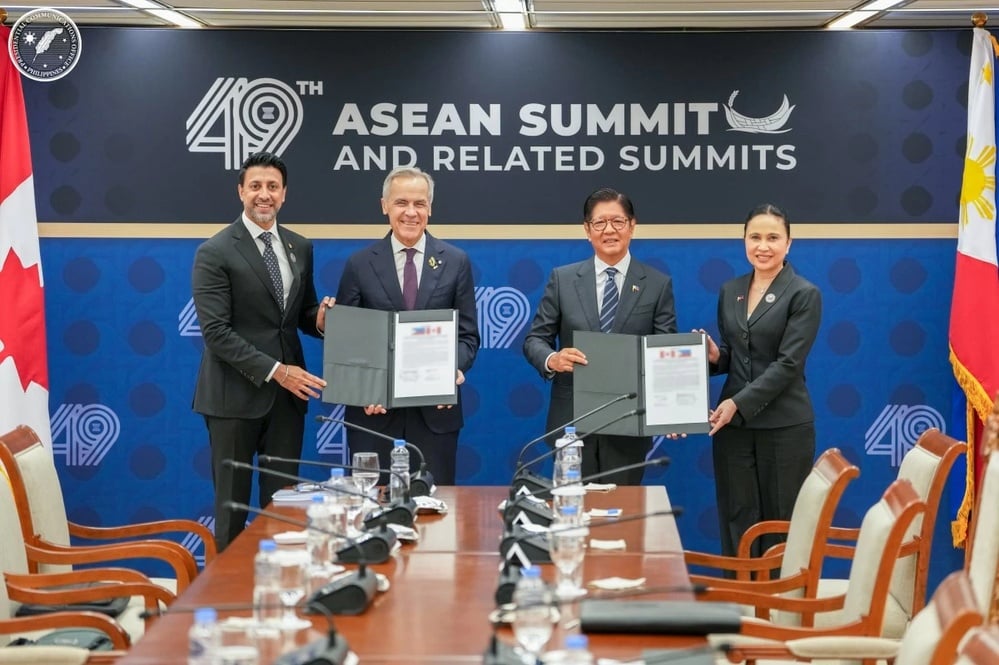
“The Philippines and Canada have concluded negotiations for a free trade agreement (FTA), the two countries announced on Saturday, November 14” · exact text match
Why: The announcement is stated directly without sensational modifiers or alarm.
Claim: The report mainly describes the announced FTA conclusion and planned next steps rather than prescribing policy.
“The Philippines and Canada have concluded negotiations for a free trade agreement (FTA)” · exact text match
Why: The sentence describes an event without advocating a course of action.
Claim: The report is substantially political, involving heads of government, an ASEAN summit, trade policy, and regional security.
“ahead of the 49th Association of Southeast Asian Nations (ASEAN) Summit in Manila” · exact text match
“Bilateral ties between Canada and the US have continued to sour over Trump’s trade policies.” · exact text match
Why: The content centers on government diplomacy and geopolitics.
Claim: The report grounds the FTA account in statements from trade officials and national leaders.
“said Philippine Trade Secretary Cristina Aldeguer-Roque” · exact text match
“Both Carney and Marcos have argued for the importance of middle powers to come together” · exact text match
Why: The article repeatedly relies on official authority for its claims.
Claim: The report frames the development through official government announcements and leaders, with no non-official perspectives.
“the two countries announced on Saturday, November 14” · exact text match
“said Philippine Trade Secretary Cristina Aldeguer-Roque” · exact text match
Why: Reliance on official sources and leaders supports a mild pro-establishment framing.
Claim: The report includes named officials, dates, and contextual background, though it is explicitly AI-generated.
“said Philippine Trade Secretary Cristina Aldeguer-Roque” · exact text match
“Official talks for the FTA between Canada and the Philippines started only in October 2025” · exact text match
Why: Attribution and concrete background support credibility, while the AI disclaimer limits certainty.
Claim: The report presents the FTA conclusion as a factual, attributed announcement without emotional or illogical reasoning.
“The Philippines and Canada have concluded negotiations for a free trade agreement (FTA), the two countries announced on Saturday, November 14” · exact text match
Why: The neutral announcement and attribution to the two countries support a rational, non-irrational presentation.
Claim: The text explicitly states that it is AI-generated.
“This is AI-generated.
Read the article for full context.
Report any errors.”
· exact text match
Why: The publisher's own notice directly supports the AI-authorship classification.
Claim: The report names official sources and includes an error-reporting notice, while disclosing AI generation.
“said Philippine Trade Secretary Cristina Aldeguer-Roque” · exact text match
“Report any errors.” · exact text match
Why: Attribution and a correction/error notice are observable fairness and transparency signals.
Claim: The report provides chronological and geopolitical context for the trade announcement.
“Official talks for the FTA between Canada and the Philippines started only in October 2025” · exact text match
“In July 2026, the two countries agreed to elevate ties to a strategic partnership” · exact text match
Why: Specific dates and background details show contextual reasoning beyond a bare announcement.
The supplied text contains an explicit AI-generation disclaimer and relies on official statements without independent verification of the FTA's status.
November 14, 2026 · 0 shares
The report adopts a mostly neutral, official-source frame that casts the FTA as a 'major step' and strategic partnership without independent scrutiny or critical perspectives.
Helium Analysis
Limitations: The supplied text is a short, scraped government newswire item with repeated navigation links and limited detail on FTA terms; bias scores reflect only the visible official announcement.
·
8 of 55 available dimensions scored; omitted dimensions are not treated as neutral.
·
Verified supporting quotes for 8 of 8 scored dimensions.
Claim: The report is mostly factual and attributed, with only a limited evaluative phrase.
“marking a major step toward expanding trade and investment between the two countries” · exact text match
Why: The lead is factual; the quoted phrase is a mild positive characterization rather than pervasive subjectivity.
Claim: The report presents the FTA announcement in neutral, non-sensational terms.
“The Philippines and Canada have concluded negotiations for a free-trade agreement (FTA)” · exact text match
Why: The lead states the development plainly without alarmist or dramatic language.
Claim: The framing is mildly optimistic about the FTA's economic and strategic benefits.
“marking a major step toward expanding trade and investment between the two countries” · exact text match
“bring the pact into force as soon as possible” · exact text match
Why: Positive evaluative language and forward-looking implementation language convey optimism.
Claim: The report primarily describes the announcement rather than advocating a policy prescription.
“The two countries announced the development during the bilateral meeting” · exact text match
Why: It reports the event and quoted intentions rather than issuing recommendations.
Claim: The report is framed around political leaders and a diplomatic summit.
“on the sidelines of the 49th ASEAN Summit and Related Meetings” · exact text match
“President Ferdinand R. Marcos Jr. and Canadian Prime Minister Mark Carney” · exact text match
Why: The central actors and setting are heads of government and a regional political meeting.
Claim: The report relies on and amplifies official government framing without non-official perspectives.
“The two countries announced the development during the bilateral meeting between President Ferdinand R. Marcos Jr. and Canadian Prime Minister Mark Carney” · exact text match
“Marcos said the Philippines is committed to translating its strategic partnership with Canada into action.” · exact text match
Why: Only official leaders and their statements are presented as the frame for the agreement.
Claim: Visible sourcing and attribution support a credible straight-news presentation.
“Marcos said the Philippines is committed to translating its strategic partnership with Canada into action.” · exact text match
“Carney welcomed the progress in bilateral relations” · exact text match
Why: Statements are attributed to named leaders and the setting is identified, though the report relies on official sources.
Claim: The report attributes claims to named officials and avoids unverified attacks.
““We have made a great deal of progress in that visit, and we have moved on from just the diplomatic relations to strategic partnership,” he said” · exact text match
“Carney welcomed the progress in bilateral relations, thanking Marcos for pursuing an ambitious strategic partnership” · exact text match
Why: Fair attribution and absence of disparagement indicate visible integrity signals.
The supplied text is a short, scraped government newswire item with repeated navigation links and limited detail on FTA terms; bias scores reflect only the visible official announcement.
November 14, 2026 · 0 shares
Coverage is predominantly neutral and attribution-driven, centering official summit diplomacy and named expert commentary while including critical civil-society and academic perspectives.
Helium Analysis
Limitations: The supplied text includes reader-comment fragments and page chrome; these were excluded from the publisher-framing analysis, leaving limited direct evidence for some dimensions.
·
26 of 55 available dimensions scored; omitted dimensions are not treated as neutral.
·
Verified supporting quotes for 24 of 26 scored dimensions.
Claim: The report balances business support for the trade deal with civil-society concerns about the Philippines’ rights record, avoiding a clear left-right framing.
“corporations were broadly supportive of the deal to increase trade, but civil society raised concerns about the Philippines’ track record on the environment, labour and human rights.” · exact text match
Why: Including both market and rights-based perspectives supports a neutral score on the liberal-conservative dimension.
Claim: Framing centers on leaders, government goals, and named academics rather than grassroots or public voices.
“Queen’s University professor Stéphanie Martel, who studies ASEAN and international diplomacy, said Carney has a narrower policy approach to the region than his predecessor Justin Trudeau” · exact text match
Why: Expert and official sourcing gives a slight elitist lean, not a strong one.
Claim: The report includes state-directed trade and defense policy details but does not advocate authoritarian control.
“Carney has focused on strategic sectors, she said, particularly trade and military collaboration — such as naval exercises in the Taiwan Strait and efforts to help countries like the Philippines detect Chinese boats used in territorial disputes.” · exact text match
Why: Government-led strategic and military cooperation is mentioned descriptively, only mildly tilting this dimension.
Claim: The report presents specific trade data and attributed statements rather than the reporter’s subjective interpretation.
“In 2025, bilateral merchandise trade between the two countries totalled $3.4 billion, with Canada exporting mineral ores, meat, cereals, fertilizers and aircraft, while importing cooking oils, leather and rubber products from the Philippines.” · exact text match
Why: Detailed factual trade data with neutral wording supports an objective classification.
Claim: The tone is procedural and measured, not sensational.
“Both leaders signed a document that formally ends negotiations for the Philippines-Canada Free Trade Agreement, which had started just over a year ago.” · exact text match
Why: Straight description of a signing event lacks sensational language.
Claim: The article frames the trade initiative as an economic opportunity, though without market forecasts.
“The group is key to Carney’s goal of doubling exports to countries other than the U.S. by 2035.” · exact text match
Why: Export-growth framing gives a mild bullish lean on trade prospects.
Claim: The article conveys a mildly positive expectation about the deal’s signing while noting concerns.
“Prime Minister Mark Carney and his Philippine counterpart have concluded talks for a free-trade agreement, which is expected to be formally signed next year.” · exact text match
Why: The expected signing supports a slight optimistic tilt, tempered by critical views.
Claim: The report mainly describes negotiations and quoted assessments instead of prescribing policy.
“Vina Nadjibulla, co-founder of the Centre for Strategic Statecraft, said the ASEAN summit — along with two others in the region this week — is a chance for Carney to reinforce the importance of Asia to Canadians.” · exact text match
Why: The statement reports an expert's assessment rather than the publisher's policy prescription.
Claim: Defense and geopolitical competition are mentioned factually but not advocated.
“It also comes at a time of rising geopolitical and economic competition between the United States and China.” · exact text match
Why: Security competition is noted descriptively, yielding only a slight hawkish tilt.
Claim: The article is mostly factual, with opinions confined to attributed expert and official quotes.
“Martel said the trade and navy ships are welcome but they miss a key point.” · exact text match
Why: Quoted assessments are present but not presented as the publisher's own opinion.
Claim: The story is centered on heads of government, summit diplomacy, and trade policy.
“Carney and Marcos were meeting on the sidelines of the Association of Southeast Asian Nations summit.” · exact text match
Why: Focus on leaders and intergovernmental negotiations strongly supports a political classification.
Claim: The report includes competing perspectives and contextual complexity rather than a simplified narrative.
“Southeast Asian leaders see security as linked to climate change, regime stability through economic growth, and the involvement of women in military and security issues, she said.” · exact text match
Why: Inclusion of a broader security framework reduces oversimplification.
Claim: Analysis is heavily mediated through named experts and officials.
“Vina Nadjibulla, co-founder of the Centre for Strategic Statecraft, said the ASEAN summit — along with two others in the region this week — is a chance for Carney to reinforce the importance of Asia to Canadians.” · exact text match
Why: Repeated reliance on expert testimony to frame significance supports a moderate appeal-to-authority score.
Claim: Future expectations are attributed and hedged rather than stated as certain outcomes.
“Ottawa aims to have the actual deal signed next year.” · exact text match
Why: The use of 'aims' limits certainty, showing low overconfidence.
Claim: Coverage is framed through official leaders, government goals, and establishment experts, with only modest counterbalance.
“Prime Minister Mark Carney and his Philippine counterpart have concluded talks for a free-trade agreement, which is expected to be formally signed next year.” · exact text match
Counterevidence:
“During consultations, corporations were broadly supportive of the deal to increase trade, but civil society raised concerns about the Philippines’ track record on the environment, labour and human rights.” · exact text match
Why: The official summit frame gives a slight pro-establishment lean; critical voices keep the score modest.
Claim: The overall tone is neutral, with positive and critical statements both attributed.
“Carney said Thursday in French that he was “fighting for this industry.”” · exact text match
Why: Emotive language appears only in a quoted official statement, not the publisher's own voice.
Claim: Claims are attributed to officials and named academics and supported by specific trade figures.
“Queen’s University professor Stéphanie Martel, who studies ASEAN and international diplomacy, said Carney has a narrower policy approach to the region than his predecessor Justin Trudeau” · exact text match
Why: Named expert sourcing and attributed analysis are visible credibility signals.
Claim: The report is grounded in quantified trade figures and named expert assessments rather than emotive assertions.
“Ottawa says trade between Canada and ASEAN countries amounted to $52.3 billion last year, a fifth larger than the previous year.” · exact text match
Why: Specific attributed data is a rational presentation signal.
Claim: Corporate support is noted but balanced with civil-society concerns, yielding only a mild pro-business tilt.
“corporations were broadly supportive of the deal to increase trade” · exact text match
Why: Reporting business support without advocacy gives a slight corporate lean.
Claim: The report includes future-oriented forecasts about signing and export goals.
“Ottawa aims to have the actual deal signed next year.” · exact text match
Why: Reporting a future aim is speculative but clearly attributed, supporting a moderate score.
Claim: The report uses straightforward attribution and does not deploy obvious manipulative framing.
“Federal officials who briefed reporters ahead of Carney’s trip noted Canada is selling the region more than just raw supplies for food.” · exact text match
Why: Attributed official framing without deceptive urgency suggests low manipulation.
Claim: The report includes critical expert and civil-society views alongside official claims.
“During consultations, corporations were broadly supportive of the deal to increase trade, but civil society raised concerns about the Philippines’ track record on the environment, labour and human rights.” · exact text match
Why: Inclusion of countervailing concerns is an observable fairness signal.
Claim: The report integrates trade data, expert analysis, and regional geopolitical context.
“Southeast Asia is one of the world’s fastest growing economic regions and the ASEAN bloc includes nearly 700 million people.” · exact text match
Why: Contextual economic scale and expert commentary indicate above-average article intelligence.
The supplied text includes reader-comment fragments and page chrome; these were excluded from the publisher-framing analysis, leaving limited direct evidence for some dimensions.
November 14, 2026 · 0 shares
The report relies on official government sources and presents the trade deal's expected economic benefits in a mildly optimistic, pro-establishment light with limited critical scrutiny.
Helium Analysis
Limitations: The article text is truncated after 'identifying tr', so the full details of the Strategic Partnership may be missing.
·
23 of 55 available dimensions scored; omitted dimensions are not treated as neutral.
·
Verified supporting quotes for 23 of 23 scored dimensions.
Claim: No partisan ideological framing; economic diplomacy is reported neutrally.
“The Philippines and Canada have concluded negotiations for a bilateral Free Trade Agreement (FTA)” · exact text match
Why: The report frames the event as a trade development without liberal or conservative ideological cues.
Claim: The article focuses on official leaders without populist or anti-elite framing.
“President Marcos and Canadian Prime Minister Mark Carney announced the development” · exact text match
Why: Leadership-centric reporting is neutral on the populist-elitist axis; no populist appeals or elite denigration.
Claim: The article describes a voluntary trade agreement without coercive or authoritarian framing.
“covering trade in goods and services, investment, digital trade, and small and medium-sized enterprises (SMEs)” · exact text match
Why: Free-trade agreement language is market-liberal but not strongly libertarian or authoritarian; neutral.
Claim: The report is predominantly factual and attributed, with minimal subjective commentary.
“According to Malacañang” · exact text match
Why: Sourcing to an official body indicates objective reporting.
Claim: The tone is measured and non-sensational.
“The agreement is expected to help Philippine businesses reach more Canadian consumers” · exact text match
Why: Expected benefits are stated plainly without sensational language.
Claim: The article presents a mildly bullish economic outlook for the Philippines.
“expected to expand market access for Filipino businesses and create new economic opportunities” · exact text match
Why: Positive market-access expectations indicate slight bullish framing.
Claim: The framing is mildly optimistic about economic benefits.
“expected to help Philippine businesses reach more Canadian consumers, expand their customer base, and explore new income sources” · exact text match
Why: The expected outcomes are positive, yielding a slight optimistic tilt.
Claim: The article describes developments rather than prescribing actions.
“President Marcos and Canadian Prime Minister Mark Carney announced the development” · exact text match
Why: No recommendations or advocacy are present.
Claim: The article is largely factual with limited attributed expectations.
“expected to expand market access” · exact text match
Why: Expectations are attributed, not presented as the author's opinion.
Claim: The article has a political dimension due to leaders and summit but focuses on trade economics.
“on the sidelines of the 49th Association of Southeast Asian Nations (ASEAN) Summit” · exact text match
Why: Political context is present but not the main thrust.
Claim: The article presents expected benefits without exploring potential costs or complexities.
“expected to expand market access for Filipino businesses and create new economic opportunities” · exact text match
Why: Simplified positive outcomes without caveats beyond the signing status.
Claim: Claims about the deal's significance are grounded in official announcements.
“According to Malacañang” · exact text match
Why: Reliance on government authority for assessment.
Claim: Forecasts are hedged with 'expected' and 'working toward', indicating low overconfidence.
“Both governments are working toward signing the FTA in 2027” · exact text match
Why: Use of tentative language shows appropriate uncertainty.
Claim: The report relies on official government sources and frames the deal positively from the governments' perspective.
“According to Malacañang” · exact text match
Why: Use of the presidential palace as a source and leader-centered framing indicate pro-establishment orientation.
Claim: The tone is neutral and unemotional.
“The Philippines and Canada have concluded negotiations” · exact text match
Why: Straight news reporting without emotional language.
Claim: The article cites sources and includes a key caveat about the agreement's status.
“According to Malacañang” · exact text match
“although the conclusion of negotiations does not yet mean the agreement has taken effect” · exact text match
Why: Attribution and qualification support high credibility.
Claim: The reporting is fact-based and includes a caveat limiting inference from the announcement.
“although the conclusion of negotiations does not yet mean the agreement has taken effect” · exact text match
Why: This qualification shows rational, evidence-bound reporting.
Claim: The framing emphasizes business opportunities and market access.
“expected to expand market access for Filipino businesses” · exact text match
Why: Pro-business language indicates mild corporate bias.
Claim: The article includes forecasts about future economic benefits and signing.
“The agreement is expected to help Philippine businesses reach more Canadian consumers” · exact text match
Why: Expectations about future outcomes constitute mild speculation.
Claim: The article attributes claims to officials and notes the agreement is not yet in effect.
“According to Malacañang” · exact text match
“although the conclusion of negotiations does not yet mean the agreement has taken effect” · exact text match
Why: Source attribution and a limiting caveat show high integrity.
Claim: The article covers multiple substantive areas and includes a legal-status caveat.
“covering trade in goods and services, investment, digital trade, and small and medium-sized enterprises (SMEs)” · exact text match
Why: Comprehensive coverage and caveat indicate above-average intelligence.
The article text is truncated after 'identifying tr', so the full details of the Strategic Partnership may be missing.
November 14, 2026 · 0 shares
The report’s framing is largely neutral and attribution-driven, foregrounding official government statements about the FTA while adding regional security and US-trade context.
Helium Analysis
Limitations: The supplied text contains an explicit AI-generation disclaimer and relies on official statements without independent verification of the FTA's status.
·
11 of 55 available dimensions scored; omitted dimensions are not treated as neutral.
·
Verified supporting quotes for 11 of 11 scored dimensions.
Claim: The report bases its account on named officials, dates, and specific announced actions rather than subjective commentary.
“said Philippine Trade Secretary Cristina Aldeguer-Roque” · exact text match
“Roque said the two countries will work towards the signing of the FTA in 2027.” · exact text match
Why: Named attribution and concrete timeline statements indicate objective reporting.
Claim: The report uses plain, non-sensational language about the trade agreement.
“The Philippines and Canada have concluded negotiations for a free trade agreement (FTA), the two countries announced on Saturday, November 14” · exact text match
Why: The announcement is stated directly without sensational modifiers or alarm.
Claim: The report mainly describes the announced FTA conclusion and planned next steps rather than prescribing policy.
“The Philippines and Canada have concluded negotiations for a free trade agreement (FTA)” · exact text match
Why: The sentence describes an event without advocating a course of action.
Claim: The report is substantially political, involving heads of government, an ASEAN summit, trade policy, and regional security.
“ahead of the 49th Association of Southeast Asian Nations (ASEAN) Summit in Manila” · exact text match
“Bilateral ties between Canada and the US have continued to sour over Trump’s trade policies.” · exact text match
Why: The content centers on government diplomacy and geopolitics.
Claim: The report grounds the FTA account in statements from trade officials and national leaders.
“said Philippine Trade Secretary Cristina Aldeguer-Roque” · exact text match
“Both Carney and Marcos have argued for the importance of middle powers to come together” · exact text match
Why: The article repeatedly relies on official authority for its claims.
Claim: The report frames the development through official government announcements and leaders, with no non-official perspectives.
“the two countries announced on Saturday, November 14” · exact text match
“said Philippine Trade Secretary Cristina Aldeguer-Roque” · exact text match
Why: Reliance on official sources and leaders supports a mild pro-establishment framing.
Claim: The report includes named officials, dates, and contextual background, though it is explicitly AI-generated.
“said Philippine Trade Secretary Cristina Aldeguer-Roque” · exact text match
“Official talks for the FTA between Canada and the Philippines started only in October 2025” · exact text match
Why: Attribution and concrete background support credibility, while the AI disclaimer limits certainty.
Claim: The report presents the FTA conclusion as a factual, attributed announcement without emotional or illogical reasoning.
“The Philippines and Canada have concluded negotiations for a free trade agreement (FTA), the two countries announced on Saturday, November 14” · exact text match
Why: The neutral announcement and attribution to the two countries support a rational, non-irrational presentation.
Claim: The text explicitly states that it is AI-generated.
“This is AI-generated.
Read the article for full context.
Report any errors.”
· exact text match
Why: The publisher's own notice directly supports the AI-authorship classification.
Claim: The report names official sources and includes an error-reporting notice, while disclosing AI generation.
“said Philippine Trade Secretary Cristina Aldeguer-Roque” · exact text match
“Report any errors.” · exact text match
Why: Attribution and a correction/error notice are observable fairness and transparency signals.
Claim: The report provides chronological and geopolitical context for the trade announcement.
“Official talks for the FTA between Canada and the Philippines started only in October 2025” · exact text match
“In July 2026, the two countries agreed to elevate ties to a strategic partnership” · exact text match
Why: Specific dates and background details show contextual reasoning beyond a bare announcement.
The supplied text contains an explicit AI-generation disclaimer and relies on official statements without independent verification of the FTA's status.
November 14, 2026 · 0 shares
Coverage is predominantly neutral and attribution-driven, centering official summit diplomacy and named expert commentary while including critical civil-society and academic perspectives.
Helium Analysis
Limitations: The supplied text includes reader-comment fragments and page chrome; these were excluded from the publisher-framing analysis, leaving limited direct evidence for some dimensions.
·
26 of 55 available dimensions scored; omitted dimensions are not treated as neutral.
·
Verified supporting quotes for 24 of 26 scored dimensions.
Claim: The report balances business support for the trade deal with civil-society concerns about the Philippines’ rights record, avoiding a clear left-right framing.
“corporations were broadly supportive of the deal to increase trade, but civil society raised concerns about the Philippines’ track record on the environment, labour and human rights.” · exact text match
Why: Including both market and rights-based perspectives supports a neutral score on the liberal-conservative dimension.
Claim: Framing centers on leaders, government goals, and named academics rather than grassroots or public voices.
“Queen’s University professor Stéphanie Martel, who studies ASEAN and international diplomacy, said Carney has a narrower policy approach to the region than his predecessor Justin Trudeau” · exact text match
Why: Expert and official sourcing gives a slight elitist lean, not a strong one.
Claim: The report includes state-directed trade and defense policy details but does not advocate authoritarian control.
“Carney has focused on strategic sectors, she said, particularly trade and military collaboration — such as naval exercises in the Taiwan Strait and efforts to help countries like the Philippines detect Chinese boats used in territorial disputes.” · exact text match
Why: Government-led strategic and military cooperation is mentioned descriptively, only mildly tilting this dimension.
Claim: The report presents specific trade data and attributed statements rather than the reporter’s subjective interpretation.
“In 2025, bilateral merchandise trade between the two countries totalled $3.4 billion, with Canada exporting mineral ores, meat, cereals, fertilizers and aircraft, while importing cooking oils, leather and rubber products from the Philippines.” · exact text match
Why: Detailed factual trade data with neutral wording supports an objective classification.
Claim: The tone is procedural and measured, not sensational.
“Both leaders signed a document that formally ends negotiations for the Philippines-Canada Free Trade Agreement, which had started just over a year ago.” · exact text match
Why: Straight description of a signing event lacks sensational language.
Claim: The article frames the trade initiative as an economic opportunity, though without market forecasts.
“The group is key to Carney’s goal of doubling exports to countries other than the U.S. by 2035.” · exact text match
Why: Export-growth framing gives a mild bullish lean on trade prospects.
Claim: The article conveys a mildly positive expectation about the deal’s signing while noting concerns.
“Prime Minister Mark Carney and his Philippine counterpart have concluded talks for a free-trade agreement, which is expected to be formally signed next year.” · exact text match
Why: The expected signing supports a slight optimistic tilt, tempered by critical views.
Claim: The report mainly describes negotiations and quoted assessments instead of prescribing policy.
“Vina Nadjibulla, co-founder of the Centre for Strategic Statecraft, said the ASEAN summit — along with two others in the region this week — is a chance for Carney to reinforce the importance of Asia to Canadians.” · exact text match
Why: The statement reports an expert's assessment rather than the publisher's policy prescription.
Claim: Defense and geopolitical competition are mentioned factually but not advocated.
“It also comes at a time of rising geopolitical and economic competition between the United States and China.” · exact text match
Why: Security competition is noted descriptively, yielding only a slight hawkish tilt.
Claim: The article is mostly factual, with opinions confined to attributed expert and official quotes.
“Martel said the trade and navy ships are welcome but they miss a key point.” · exact text match
Why: Quoted assessments are present but not presented as the publisher's own opinion.
Claim: The story is centered on heads of government, summit diplomacy, and trade policy.
“Carney and Marcos were meeting on the sidelines of the Association of Southeast Asian Nations summit.” · exact text match
Why: Focus on leaders and intergovernmental negotiations strongly supports a political classification.
Claim: The report includes competing perspectives and contextual complexity rather than a simplified narrative.
“Southeast Asian leaders see security as linked to climate change, regime stability through economic growth, and the involvement of women in military and security issues, she said.” · exact text match
Why: Inclusion of a broader security framework reduces oversimplification.
Claim: Analysis is heavily mediated through named experts and officials.
“Vina Nadjibulla, co-founder of the Centre for Strategic Statecraft, said the ASEAN summit — along with two others in the region this week — is a chance for Carney to reinforce the importance of Asia to Canadians.” · exact text match
Why: Repeated reliance on expert testimony to frame significance supports a moderate appeal-to-authority score.
Claim: Future expectations are attributed and hedged rather than stated as certain outcomes.
“Ottawa aims to have the actual deal signed next year.” · exact text match
Why: The use of 'aims' limits certainty, showing low overconfidence.
Claim: Coverage is framed through official leaders, government goals, and establishment experts, with only modest counterbalance.
“Prime Minister Mark Carney and his Philippine counterpart have concluded talks for a free-trade agreement, which is expected to be formally signed next year.” · exact text match
Counterevidence:
“During consultations, corporations were broadly supportive of the deal to increase trade, but civil society raised concerns about the Philippines’ track record on the environment, labour and human rights.” · exact text match
Why: The official summit frame gives a slight pro-establishment lean; critical voices keep the score modest.
Claim: The overall tone is neutral, with positive and critical statements both attributed.
“Carney said Thursday in French that he was “fighting for this industry.”” · exact text match
Why: Emotive language appears only in a quoted official statement, not the publisher's own voice.
Claim: Claims are attributed to officials and named academics and supported by specific trade figures.
“Queen’s University professor Stéphanie Martel, who studies ASEAN and international diplomacy, said Carney has a narrower policy approach to the region than his predecessor Justin Trudeau” · exact text match
Why: Named expert sourcing and attributed analysis are visible credibility signals.
Claim: The report is grounded in quantified trade figures and named expert assessments rather than emotive assertions.
“Ottawa says trade between Canada and ASEAN countries amounted to $52.3 billion last year, a fifth larger than the previous year.” · exact text match
Why: Specific attributed data is a rational presentation signal.
Claim: Corporate support is noted but balanced with civil-society concerns, yielding only a mild pro-business tilt.
“corporations were broadly supportive of the deal to increase trade” · exact text match
Why: Reporting business support without advocacy gives a slight corporate lean.
Claim: The report includes future-oriented forecasts about signing and export goals.
“Ottawa aims to have the actual deal signed next year.” · exact text match
Why: Reporting a future aim is speculative but clearly attributed, supporting a moderate score.
Claim: The report uses straightforward attribution and does not deploy obvious manipulative framing.
“Federal officials who briefed reporters ahead of Carney’s trip noted Canada is selling the region more than just raw supplies for food.” · exact text match
Why: Attributed official framing without deceptive urgency suggests low manipulation.
Claim: The report includes critical expert and civil-society views alongside official claims.
“During consultations, corporations were broadly supportive of the deal to increase trade, but civil society raised concerns about the Philippines’ track record on the environment, labour and human rights.” · exact text match
Why: Inclusion of countervailing concerns is an observable fairness signal.
Claim: The report integrates trade data, expert analysis, and regional geopolitical context.
“Southeast Asia is one of the world’s fastest growing economic regions and the ASEAN bloc includes nearly 700 million people.” · exact text match
Why: Contextual economic scale and expert commentary indicate above-average article intelligence.
The supplied text includes reader-comment fragments and page chrome; these were excluded from the publisher-framing analysis, leaving limited direct evidence for some dimensions.
November 14, 2026 · 0 shares
The report’s framing is largely neutral and attribution-driven, foregrounding official government statements about the FTA while adding regional security and US-trade context.
Helium Analysis
Limitations: The supplied text contains an explicit AI-generation disclaimer and relies on official statements without independent verification of the FTA's status.
·
11 of 55 available dimensions scored; omitted dimensions are not treated as neutral.
·
Verified supporting quotes for 11 of 11 scored dimensions.
Claim: The report bases its account on named officials, dates, and specific announced actions rather than subjective commentary.
“said Philippine Trade Secretary Cristina Aldeguer-Roque” · exact text match
“Roque said the two countries will work towards the signing of the FTA in 2027.” · exact text match
Why: Named attribution and concrete timeline statements indicate objective reporting.
Claim: The report uses plain, non-sensational language about the trade agreement.
“The Philippines and Canada have concluded negotiations for a free trade agreement (FTA), the two countries announced on Saturday, November 14” · exact text match
Why: The announcement is stated directly without sensational modifiers or alarm.
Claim: The report mainly describes the announced FTA conclusion and planned next steps rather than prescribing policy.
“The Philippines and Canada have concluded negotiations for a free trade agreement (FTA)” · exact text match
Why: The sentence describes an event without advocating a course of action.
Claim: The report is substantially political, involving heads of government, an ASEAN summit, trade policy, and regional security.
“ahead of the 49th Association of Southeast Asian Nations (ASEAN) Summit in Manila” · exact text match
“Bilateral ties between Canada and the US have continued to sour over Trump’s trade policies.” · exact text match
Why: The content centers on government diplomacy and geopolitics.
Claim: The report grounds the FTA account in statements from trade officials and national leaders.
“said Philippine Trade Secretary Cristina Aldeguer-Roque” · exact text match
“Both Carney and Marcos have argued for the importance of middle powers to come together” · exact text match
Why: The article repeatedly relies on official authority for its claims.
Claim: The report frames the development through official government announcements and leaders, with no non-official perspectives.
“the two countries announced on Saturday, November 14” · exact text match
“said Philippine Trade Secretary Cristina Aldeguer-Roque” · exact text match
Why: Reliance on official sources and leaders supports a mild pro-establishment framing.
Claim: The report includes named officials, dates, and contextual background, though it is explicitly AI-generated.
“said Philippine Trade Secretary Cristina Aldeguer-Roque” · exact text match
“Official talks for the FTA between Canada and the Philippines started only in October 2025” · exact text match
Why: Attribution and concrete background support credibility, while the AI disclaimer limits certainty.
Claim: The report presents the FTA conclusion as a factual, attributed announcement without emotional or illogical reasoning.
“The Philippines and Canada have concluded negotiations for a free trade agreement (FTA), the two countries announced on Saturday, November 14” · exact text match
Why: The neutral announcement and attribution to the two countries support a rational, non-irrational presentation.
Claim: The text explicitly states that it is AI-generated.
“This is AI-generated.
Read the article for full context.
Report any errors.”
· exact text match
Why: The publisher's own notice directly supports the AI-authorship classification.
Claim: The report names official sources and includes an error-reporting notice, while disclosing AI generation.
“said Philippine Trade Secretary Cristina Aldeguer-Roque” · exact text match
“Report any errors.” · exact text match
Why: Attribution and a correction/error notice are observable fairness and transparency signals.
Claim: The report provides chronological and geopolitical context for the trade announcement.
“Official talks for the FTA between Canada and the Philippines started only in October 2025” · exact text match
“In July 2026, the two countries agreed to elevate ties to a strategic partnership” · exact text match
Why: Specific dates and background details show contextual reasoning beyond a bare announcement.
The supplied text contains an explicit AI-generation disclaimer and relies on official statements without independent verification of the FTA's status.
November 14, 2026 · 0 shares
The report adopts a promotional, government-source-driven opportunity frame, presenting the Philippines-Canada FTA as a clear benefit for MSMEs through big-exporter growth while omitting risks, costs, or independent perspectives.
Helium Analysis
Limitations: The supplied text is a short, single-source government newswire; absence of independent or opposing voices limits assessment of balance and risk framing.
·
17 of 55 available dimensions scored; omitted dimensions are not treated as neutral.
·
Verified supporting quotes for 17 of 17 scored dimensions.
Claim: The report frames FTA benefits as flowing from big exporters to MSMEs through a top-down government account.
“the growth of the exporter becomes the growth of the small and medium enterprises” · exact text match
Why: The benefit model centers on large-exporter growth rather than grassroots or worker perspectives.
Claim: The report adopts an upbeat opportunity frame in its lede while attributing it to an official.
“Micro, small and medium enterprises (MSMEs) will benefit from the Philippines-Canada free trade agreement (FTA) through tie-ups with big businesses, Trade and Industry Secretary Ma. Cristina Roque said Saturday.” · exact text match
Why: The predictive benefit framing is attributed but still shapes the presentation.
Claim: The report uses procedural newswire language rather than sensational emphasis.
“FTA negotiations were concluded during the bilateral meeting of President Ferdinand R. Marcos Jr. and Canadian Prime Minister Mark Carney on the sidelines of the 49th Association of Southeast Asian Nations (ASEAN) Summit and Related Summits in Pasay City.” · exact text match
Why: The wording is dry and institutional, not urgent or hyped.
Claim: The report frames the FTA as a growth opportunity for exporters and MSMEs.
“So, with this free trade agreement, we really hope to give more opportunities for the exporters.” · exact text match
“the growth of the exporter becomes the growth of the small and medium enterprises” · exact text match
Why: The article emphasizes expansion and opportunity rather than costs or downside risks.
Claim: The report emphasizes expected benefits from the FTA.
“Micro, small and medium enterprises (MSMEs) will benefit from the Philippines-Canada free trade agreement (FTA) through tie-ups with big businesses” · exact text match
Why: The central framing is hopeful and benefit-oriented.
Claim: The report mostly describes policy but includes a prescriptive call to encourage MSMEs toward exporting.
“That's why we want to encourage them until they become ready to become exporters themselves” · exact text match
Why: The quotation moves from description into policy advocacy.
Claim: The report includes official hopes and policy advocacy alongside factual reporting.
“we really hope to give more opportunities for the exporters” · exact text match
Why: The quoted hope is presented as a central rationale for the agreement.
Claim: The report centers on a government trade-policy announcement by a cabinet secretary.
“Trade and Industry Secretary Ma. Cristina Roque said Saturday” · exact text match
Why: The subject is government policy and official action, though not partisan conflict.
Claim: The report presents exporter growth as automatically becoming MSME growth without detailing conditions or risks.
“So the growth of the exporter becomes the growth of the small and medium enterprises” · exact text match
Why: The benefit pathway is stated as a simple transmission mechanism.
Claim: The benefits case rests almost entirely on the trade secretary's statements and DTI program claims.
“Trade and Industry Secretary Ma. Cristina Roque said Saturday” · exact text match
“Roque said the Department of Trade and Industry (DTI) lending arm, Small Business Corporation (SBCorp), provides loans of up to PHP5 billion to MSMEs to help support the sector.” · exact text match
Why: Official authority supplies the article's central factual and policy support.
Claim: The lede states MSMEs will benefit from the FTA although the supplied text gives no implementation details or independent evidence.
“Micro, small and medium enterprises (MSMEs) will benefit from the Philippines-Canada free trade agreement (FTA) through tie-ups with big businesses” · exact text match
Why: The benefit is asserted predictively on the basis of one official's account.
Claim: The report is structured around the trade secretary's authority and a DTI lending program, presenting official policy as the route to MSME benefit.
“Trade and Industry Secretary Ma. Cristina Roque said Saturday” · exact text match
“Roque said the Department of Trade and Industry (DTI) lending arm, Small Business Corporation (SBCorp), provides loans of up to PHP5 billion to MSMEs to help support the sector.” · exact text match
Why: Government officials and programs are the article's central sources and solution frame.
Claim: The report is attributable and statistically specific but promotional and single-sourced.
“Trade and Industry Secretary Ma. Cristina Roque said Saturday” · exact text match
“MSMEs account for 99.6 percent of Philippine business firms and employ around 62 percent of workers nationwide.” · exact text match
Why: Direct attribution and figures support credibility, while one-sided sourcing limits it.
Claim: The report uses attributed statements and statistics in a sober register rather than emotive argument.
“Trade and Industry Secretary Ma. Cristina Roque said Saturday” · exact text match
“MSMEs account for 99.6 percent of Philippine business firms and employ around 62 percent of workers nationwide.” · exact text match
Why: The text is largely declarative, attributed, and statistical.
Claim: The report treats big-exporter growth as the mechanism for MSME benefit.
“the growth of the exporter becomes the growth of the small and medium enterprises” · exact text match
Why: The frame prioritizes large-business growth as the engine for smaller firms.
Claim: The report forecasts future FTA opportunities that are not yet realized or detailed.
“we really hope to give more opportunities for the exporters” · exact text match
“Micro, small and medium enterprises (MSMEs) will benefit from the Philippines-Canada free trade agreement (FTA)” · exact text match
Why: The article centers on expected future benefits rather than observed outcomes.
Claim: The report attributes claims to a named official and includes specific statistics, though it relies on one government source.
“Trade and Industry Secretary Ma. Cristina Roque said Saturday” · exact text match
“MSMEs account for 99.6 percent of Philippine business firms and employ around 62 percent of workers nationwide.” · exact text match
Why: Attribution and concrete figures are present, but balance is limited.
The supplied text is a short, single-source government newswire; absence of independent or opposing voices limits assessment of balance and risk framing.
November 14, 2026 · 0 shares
Coverage is predominantly neutral and attribution-driven, centering official summit diplomacy and named expert commentary while including critical civil-society and academic perspectives.
Helium Analysis
Limitations: The supplied text includes reader-comment fragments and page chrome; these were excluded from the publisher-framing analysis, leaving limited direct evidence for some dimensions.
·
26 of 55 available dimensions scored; omitted dimensions are not treated as neutral.
·
Verified supporting quotes for 24 of 26 scored dimensions.
Claim: The report balances business support for the trade deal with civil-society concerns about the Philippines’ rights record, avoiding a clear left-right framing.
“corporations were broadly supportive of the deal to increase trade, but civil society raised concerns about the Philippines’ track record on the environment, labour and human rights.” · exact text match
Why: Including both market and rights-based perspectives supports a neutral score on the liberal-conservative dimension.
Claim: Framing centers on leaders, government goals, and named academics rather than grassroots or public voices.
“Queen’s University professor Stéphanie Martel, who studies ASEAN and international diplomacy, said Carney has a narrower policy approach to the region than his predecessor Justin Trudeau” · exact text match
Why: Expert and official sourcing gives a slight elitist lean, not a strong one.
Claim: The report includes state-directed trade and defense policy details but does not advocate authoritarian control.
“Carney has focused on strategic sectors, she said, particularly trade and military collaboration — such as naval exercises in the Taiwan Strait and efforts to help countries like the Philippines detect Chinese boats used in territorial disputes.” · exact text match
Why: Government-led strategic and military cooperation is mentioned descriptively, only mildly tilting this dimension.
Claim: The report presents specific trade data and attributed statements rather than the reporter’s subjective interpretation.
“In 2025, bilateral merchandise trade between the two countries totalled $3.4 billion, with Canada exporting mineral ores, meat, cereals, fertilizers and aircraft, while importing cooking oils, leather and rubber products from the Philippines.” · exact text match
Why: Detailed factual trade data with neutral wording supports an objective classification.
Claim: The tone is procedural and measured, not sensational.
“Both leaders signed a document that formally ends negotiations for the Philippines-Canada Free Trade Agreement, which had started just over a year ago.” · exact text match
Why: Straight description of a signing event lacks sensational language.
Claim: The article frames the trade initiative as an economic opportunity, though without market forecasts.
“The group is key to Carney’s goal of doubling exports to countries other than the U.S. by 2035.” · exact text match
Why: Export-growth framing gives a mild bullish lean on trade prospects.
Claim: The article conveys a mildly positive expectation about the deal’s signing while noting concerns.
“Prime Minister Mark Carney and his Philippine counterpart have concluded talks for a free-trade agreement, which is expected to be formally signed next year.” · exact text match
Why: The expected signing supports a slight optimistic tilt, tempered by critical views.
Claim: The report mainly describes negotiations and quoted assessments instead of prescribing policy.
“Vina Nadjibulla, co-founder of the Centre for Strategic Statecraft, said the ASEAN summit — along with two others in the region this week — is a chance for Carney to reinforce the importance of Asia to Canadians.” · exact text match
Why: The statement reports an expert's assessment rather than the publisher's policy prescription.
Claim: Defense and geopolitical competition are mentioned factually but not advocated.
“It also comes at a time of rising geopolitical and economic competition between the United States and China.” · exact text match
Why: Security competition is noted descriptively, yielding only a slight hawkish tilt.
Claim: The article is mostly factual, with opinions confined to attributed expert and official quotes.
“Martel said the trade and navy ships are welcome but they miss a key point.” · exact text match
Why: Quoted assessments are present but not presented as the publisher's own opinion.
Claim: The story is centered on heads of government, summit diplomacy, and trade policy.
“Carney and Marcos were meeting on the sidelines of the Association of Southeast Asian Nations summit.” · exact text match
Why: Focus on leaders and intergovernmental negotiations strongly supports a political classification.
Claim: The report includes competing perspectives and contextual complexity rather than a simplified narrative.
“Southeast Asian leaders see security as linked to climate change, regime stability through economic growth, and the involvement of women in military and security issues, she said.” · exact text match
Why: Inclusion of a broader security framework reduces oversimplification.
Claim: Analysis is heavily mediated through named experts and officials.
“Vina Nadjibulla, co-founder of the Centre for Strategic Statecraft, said the ASEAN summit — along with two others in the region this week — is a chance for Carney to reinforce the importance of Asia to Canadians.” · exact text match
Why: Repeated reliance on expert testimony to frame significance supports a moderate appeal-to-authority score.
Claim: Future expectations are attributed and hedged rather than stated as certain outcomes.
“Ottawa aims to have the actual deal signed next year.” · exact text match
Why: The use of 'aims' limits certainty, showing low overconfidence.
Claim: Coverage is framed through official leaders, government goals, and establishment experts, with only modest counterbalance.
“Prime Minister Mark Carney and his Philippine counterpart have concluded talks for a free-trade agreement, which is expected to be formally signed next year.” · exact text match
Counterevidence:
“During consultations, corporations were broadly supportive of the deal to increase trade, but civil society raised concerns about the Philippines’ track record on the environment, labour and human rights.” · exact text match
Why: The official summit frame gives a slight pro-establishment lean; critical voices keep the score modest.
Claim: The overall tone is neutral, with positive and critical statements both attributed.
“Carney said Thursday in French that he was “fighting for this industry.”” · exact text match
Why: Emotive language appears only in a quoted official statement, not the publisher's own voice.
Claim: Claims are attributed to officials and named academics and supported by specific trade figures.
“Queen’s University professor Stéphanie Martel, who studies ASEAN and international diplomacy, said Carney has a narrower policy approach to the region than his predecessor Justin Trudeau” · exact text match
Why: Named expert sourcing and attributed analysis are visible credibility signals.
Claim: The report is grounded in quantified trade figures and named expert assessments rather than emotive assertions.
“Ottawa says trade between Canada and ASEAN countries amounted to $52.3 billion last year, a fifth larger than the previous year.” · exact text match
Why: Specific attributed data is a rational presentation signal.
Claim: Corporate support is noted but balanced with civil-society concerns, yielding only a mild pro-business tilt.
“corporations were broadly supportive of the deal to increase trade” · exact text match
Why: Reporting business support without advocacy gives a slight corporate lean.
Claim: The report includes future-oriented forecasts about signing and export goals.
“Ottawa aims to have the actual deal signed next year.” · exact text match
Why: Reporting a future aim is speculative but clearly attributed, supporting a moderate score.
Claim: The report uses straightforward attribution and does not deploy obvious manipulative framing.
“Federal officials who briefed reporters ahead of Carney’s trip noted Canada is selling the region more than just raw supplies for food.” · exact text match
Why: Attributed official framing without deceptive urgency suggests low manipulation.
Claim: The report includes critical expert and civil-society views alongside official claims.
“During consultations, corporations were broadly supportive of the deal to increase trade, but civil society raised concerns about the Philippines’ track record on the environment, labour and human rights.” · exact text match
Why: Inclusion of countervailing concerns is an observable fairness signal.
Claim: The report integrates trade data, expert analysis, and regional geopolitical context.
“Southeast Asia is one of the world’s fastest growing economic regions and the ASEAN bloc includes nearly 700 million people.” · exact text match
Why: Contextual economic scale and expert commentary indicate above-average article intelligence.
The supplied text includes reader-comment fragments and page chrome; these were excluded from the publisher-framing analysis, leaving limited direct evidence for some dimensions.
November 14, 2026 · 0 shares
The report’s framing is largely neutral and attribution-driven, foregrounding official government statements about the FTA while adding regional security and US-trade context.
Helium Analysis Limitations: The supplied text contains an explicit AI-generation disclaimer and relies on official statements without independent verification of the FTA's status. · 11 of 55 available dimensions scored; omitted dimensions are not treated as neutral. · Verified supporting quotes for 11 of 11 scored dimensions.
Claim: The report bases its account on named officials, dates, and specific announced actions rather than subjective commentary.
“said Philippine Trade Secretary Cristina Aldeguer-Roque” · exact text match
“Roque said the two countries will work towards the signing of the FTA in 2027.” · exact text match
Why: Named attribution and concrete timeline statements indicate objective reporting.
Claim: The report uses plain, non-sensational language about the trade agreement.
“The Philippines and Canada have concluded negotiations for a free trade agreement (FTA), the two countries announced on Saturday, November 14” · exact text match
Why: The announcement is stated directly without sensational modifiers or alarm.
Claim: The report mainly describes the announced FTA conclusion and planned next steps rather than prescribing policy.
“The Philippines and Canada have concluded negotiations for a free trade agreement (FTA)” · exact text match
Why: The sentence describes an event without advocating a course of action.
Claim: The report is substantially political, involving heads of government, an ASEAN summit, trade policy, and regional security.
“ahead of the 49th Association of Southeast Asian Nations (ASEAN) Summit in Manila” · exact text match
“Bilateral ties between Canada and the US have continued to sour over Trump’s trade policies.” · exact text match
Why: The content centers on government diplomacy and geopolitics.
Claim: The report grounds the FTA account in statements from trade officials and national leaders.
“said Philippine Trade Secretary Cristina Aldeguer-Roque” · exact text match
“Both Carney and Marcos have argued for the importance of middle powers to come together” · exact text match
Why: The article repeatedly relies on official authority for its claims.
Claim: The report frames the development through official government announcements and leaders, with no non-official perspectives.
“the two countries announced on Saturday, November 14” · exact text match
“said Philippine Trade Secretary Cristina Aldeguer-Roque” · exact text match
Why: Reliance on official sources and leaders supports a mild pro-establishment framing.
Claim: The report includes named officials, dates, and contextual background, though it is explicitly AI-generated.
“said Philippine Trade Secretary Cristina Aldeguer-Roque” · exact text match
“Official talks for the FTA between Canada and the Philippines started only in October 2025” · exact text match
Why: Attribution and concrete background support credibility, while the AI disclaimer limits certainty.
Claim: The report presents the FTA conclusion as a factual, attributed announcement without emotional or illogical reasoning.
“The Philippines and Canada have concluded negotiations for a free trade agreement (FTA), the two countries announced on Saturday, November 14” · exact text match
Why: The neutral announcement and attribution to the two countries support a rational, non-irrational presentation.
Claim: The text explicitly states that it is AI-generated.
“This is AI-generated. Read the article for full context. Report any errors.” · exact text match
Why: The publisher's own notice directly supports the AI-authorship classification.
Claim: The report names official sources and includes an error-reporting notice, while disclosing AI generation.
“said Philippine Trade Secretary Cristina Aldeguer-Roque” · exact text match
“Report any errors.” · exact text match
Why: Attribution and a correction/error notice are observable fairness and transparency signals.
Claim: The report provides chronological and geopolitical context for the trade announcement.
“Official talks for the FTA between Canada and the Philippines started only in October 2025” · exact text match
“In July 2026, the two countries agreed to elevate ties to a strategic partnership” · exact text match
Why: Specific dates and background details show contextual reasoning beyond a bare announcement.
The supplied text contains an explicit AI-generation disclaimer and relies on official statements without independent verification of the FTA's status.
November 14, 2026 · 0 shares
The report adopts a mostly neutral, official-source frame that casts the FTA as a 'major step' and strategic partnership without independent scrutiny or critical perspectives.
Helium Analysis Limitations: The supplied text is a short, scraped government newswire item with repeated navigation links and limited detail on FTA terms; bias scores reflect only the visible official announcement. · 8 of 55 available dimensions scored; omitted dimensions are not treated as neutral. · Verified supporting quotes for 8 of 8 scored dimensions.
Claim: The report is mostly factual and attributed, with only a limited evaluative phrase.
“marking a major step toward expanding trade and investment between the two countries” · exact text match
Why: The lead is factual; the quoted phrase is a mild positive characterization rather than pervasive subjectivity.
Claim: The report presents the FTA announcement in neutral, non-sensational terms.
“The Philippines and Canada have concluded negotiations for a free-trade agreement (FTA)” · exact text match
Why: The lead states the development plainly without alarmist or dramatic language.
Claim: The framing is mildly optimistic about the FTA's economic and strategic benefits.
“marking a major step toward expanding trade and investment between the two countries” · exact text match
“bring the pact into force as soon as possible” · exact text match
Why: Positive evaluative language and forward-looking implementation language convey optimism.
Claim: The report primarily describes the announcement rather than advocating a policy prescription.
“The two countries announced the development during the bilateral meeting” · exact text match
Why: It reports the event and quoted intentions rather than issuing recommendations.
Claim: The report is framed around political leaders and a diplomatic summit.
“on the sidelines of the 49th ASEAN Summit and Related Meetings” · exact text match
“President Ferdinand R. Marcos Jr. and Canadian Prime Minister Mark Carney” · exact text match
Why: The central actors and setting are heads of government and a regional political meeting.
Claim: The report relies on and amplifies official government framing without non-official perspectives.
“The two countries announced the development during the bilateral meeting between President Ferdinand R. Marcos Jr. and Canadian Prime Minister Mark Carney” · exact text match
“Marcos said the Philippines is committed to translating its strategic partnership with Canada into action.” · exact text match
Why: Only official leaders and their statements are presented as the frame for the agreement.
Claim: Visible sourcing and attribution support a credible straight-news presentation.
“Marcos said the Philippines is committed to translating its strategic partnership with Canada into action.” · exact text match
“Carney welcomed the progress in bilateral relations” · exact text match
Why: Statements are attributed to named leaders and the setting is identified, though the report relies on official sources.
Claim: The report attributes claims to named officials and avoids unverified attacks.
““We have made a great deal of progress in that visit, and we have moved on from just the diplomatic relations to strategic partnership,” he said” · exact text match
“Carney welcomed the progress in bilateral relations, thanking Marcos for pursuing an ambitious strategic partnership” · exact text match
Why: Fair attribution and absence of disparagement indicate visible integrity signals.
The supplied text is a short, scraped government newswire item with repeated navigation links and limited detail on FTA terms; bias scores reflect only the visible official announcement.
November 14, 2026 · 0 shares
Coverage is predominantly neutral and attribution-driven, centering official summit diplomacy and named expert commentary while including critical civil-society and academic perspectives.
Helium Analysis Limitations: The supplied text includes reader-comment fragments and page chrome; these were excluded from the publisher-framing analysis, leaving limited direct evidence for some dimensions. · 26 of 55 available dimensions scored; omitted dimensions are not treated as neutral. · Verified supporting quotes for 24 of 26 scored dimensions.
Claim: The report balances business support for the trade deal with civil-society concerns about the Philippines’ rights record, avoiding a clear left-right framing.
“corporations were broadly supportive of the deal to increase trade, but civil society raised concerns about the Philippines’ track record on the environment, labour and human rights.” · exact text match
Why: Including both market and rights-based perspectives supports a neutral score on the liberal-conservative dimension.
Claim: Framing centers on leaders, government goals, and named academics rather than grassroots or public voices.
“Queen’s University professor Stéphanie Martel, who studies ASEAN and international diplomacy, said Carney has a narrower policy approach to the region than his predecessor Justin Trudeau” · exact text match
Why: Expert and official sourcing gives a slight elitist lean, not a strong one.
Claim: The report includes state-directed trade and defense policy details but does not advocate authoritarian control.
“Carney has focused on strategic sectors, she said, particularly trade and military collaboration — such as naval exercises in the Taiwan Strait and efforts to help countries like the Philippines detect Chinese boats used in territorial disputes.” · exact text match
Why: Government-led strategic and military cooperation is mentioned descriptively, only mildly tilting this dimension.
Claim: The report presents specific trade data and attributed statements rather than the reporter’s subjective interpretation.
“In 2025, bilateral merchandise trade between the two countries totalled $3.4 billion, with Canada exporting mineral ores, meat, cereals, fertilizers and aircraft, while importing cooking oils, leather and rubber products from the Philippines.” · exact text match
Why: Detailed factual trade data with neutral wording supports an objective classification.
Claim: The tone is procedural and measured, not sensational.
“Both leaders signed a document that formally ends negotiations for the Philippines-Canada Free Trade Agreement, which had started just over a year ago.” · exact text match
Why: Straight description of a signing event lacks sensational language.
Claim: The article frames the trade initiative as an economic opportunity, though without market forecasts.
“The group is key to Carney’s goal of doubling exports to countries other than the U.S. by 2035.” · exact text match
Why: Export-growth framing gives a mild bullish lean on trade prospects.
Claim: The article conveys a mildly positive expectation about the deal’s signing while noting concerns.
“Prime Minister Mark Carney and his Philippine counterpart have concluded talks for a free-trade agreement, which is expected to be formally signed next year.” · exact text match
Why: The expected signing supports a slight optimistic tilt, tempered by critical views.
Claim: The report mainly describes negotiations and quoted assessments instead of prescribing policy.
“Vina Nadjibulla, co-founder of the Centre for Strategic Statecraft, said the ASEAN summit — along with two others in the region this week — is a chance for Carney to reinforce the importance of Asia to Canadians.” · exact text match
Why: The statement reports an expert's assessment rather than the publisher's policy prescription.
Claim: Defense and geopolitical competition are mentioned factually but not advocated.
“It also comes at a time of rising geopolitical and economic competition between the United States and China.” · exact text match
Why: Security competition is noted descriptively, yielding only a slight hawkish tilt.
Claim: The article is mostly factual, with opinions confined to attributed expert and official quotes.
“Martel said the trade and navy ships are welcome but they miss a key point.” · exact text match
Why: Quoted assessments are present but not presented as the publisher's own opinion.
Claim: The story is centered on heads of government, summit diplomacy, and trade policy.
“Carney and Marcos were meeting on the sidelines of the Association of Southeast Asian Nations summit.” · exact text match
Why: Focus on leaders and intergovernmental negotiations strongly supports a political classification.
Claim: The report includes competing perspectives and contextual complexity rather than a simplified narrative.
“Southeast Asian leaders see security as linked to climate change, regime stability through economic growth, and the involvement of women in military and security issues, she said.” · exact text match
Why: Inclusion of a broader security framework reduces oversimplification.
Claim: Analysis is heavily mediated through named experts and officials.
“Vina Nadjibulla, co-founder of the Centre for Strategic Statecraft, said the ASEAN summit — along with two others in the region this week — is a chance for Carney to reinforce the importance of Asia to Canadians.” · exact text match
Why: Repeated reliance on expert testimony to frame significance supports a moderate appeal-to-authority score.
Claim: Future expectations are attributed and hedged rather than stated as certain outcomes.
“Ottawa aims to have the actual deal signed next year.” · exact text match
Why: The use of 'aims' limits certainty, showing low overconfidence.
Claim: Coverage is framed through official leaders, government goals, and establishment experts, with only modest counterbalance.
“Prime Minister Mark Carney and his Philippine counterpart have concluded talks for a free-trade agreement, which is expected to be formally signed next year.” · exact text match
Counterevidence:
“During consultations, corporations were broadly supportive of the deal to increase trade, but civil society raised concerns about the Philippines’ track record on the environment, labour and human rights.” · exact text match
Why: The official summit frame gives a slight pro-establishment lean; critical voices keep the score modest.
Claim: The overall tone is neutral, with positive and critical statements both attributed.
“Carney said Thursday in French that he was “fighting for this industry.”” · exact text match
Why: Emotive language appears only in a quoted official statement, not the publisher's own voice.
Claim: Claims are attributed to officials and named academics and supported by specific trade figures.
“Queen’s University professor Stéphanie Martel, who studies ASEAN and international diplomacy, said Carney has a narrower policy approach to the region than his predecessor Justin Trudeau” · exact text match
Why: Named expert sourcing and attributed analysis are visible credibility signals.
Claim: The report is grounded in quantified trade figures and named expert assessments rather than emotive assertions.
“Ottawa says trade between Canada and ASEAN countries amounted to $52.3 billion last year, a fifth larger than the previous year.” · exact text match
Why: Specific attributed data is a rational presentation signal.
Claim: Corporate support is noted but balanced with civil-society concerns, yielding only a mild pro-business tilt.
“corporations were broadly supportive of the deal to increase trade” · exact text match
Why: Reporting business support without advocacy gives a slight corporate lean.
Claim: The report includes future-oriented forecasts about signing and export goals.
“Ottawa aims to have the actual deal signed next year.” · exact text match
Why: Reporting a future aim is speculative but clearly attributed, supporting a moderate score.
Claim: The report uses straightforward attribution and does not deploy obvious manipulative framing.
“Federal officials who briefed reporters ahead of Carney’s trip noted Canada is selling the region more than just raw supplies for food.” · exact text match
Why: Attributed official framing without deceptive urgency suggests low manipulation.
Claim: The report includes critical expert and civil-society views alongside official claims.
“During consultations, corporations were broadly supportive of the deal to increase trade, but civil society raised concerns about the Philippines’ track record on the environment, labour and human rights.” · exact text match
Why: Inclusion of countervailing concerns is an observable fairness signal.
Claim: The report integrates trade data, expert analysis, and regional geopolitical context.
“Southeast Asia is one of the world’s fastest growing economic regions and the ASEAN bloc includes nearly 700 million people.” · exact text match
Why: Contextual economic scale and expert commentary indicate above-average article intelligence.
The supplied text includes reader-comment fragments and page chrome; these were excluded from the publisher-framing analysis, leaving limited direct evidence for some dimensions.
November 14, 2026 · 0 shares
The report’s framing is largely neutral and attribution-driven, foregrounding official government statements about the FTA while adding regional security and US-trade context.
Helium Analysis Limitations: The supplied text contains an explicit AI-generation disclaimer and relies on official statements without independent verification of the FTA's status. · 11 of 55 available dimensions scored; omitted dimensions are not treated as neutral. · Verified supporting quotes for 11 of 11 scored dimensions.
Claim: The report bases its account on named officials, dates, and specific announced actions rather than subjective commentary.
“said Philippine Trade Secretary Cristina Aldeguer-Roque” · exact text match
“Roque said the two countries will work towards the signing of the FTA in 2027.” · exact text match
Why: Named attribution and concrete timeline statements indicate objective reporting.
Claim: The report uses plain, non-sensational language about the trade agreement.
“The Philippines and Canada have concluded negotiations for a free trade agreement (FTA), the two countries announced on Saturday, November 14” · exact text match
Why: The announcement is stated directly without sensational modifiers or alarm.
Claim: The report mainly describes the announced FTA conclusion and planned next steps rather than prescribing policy.
“The Philippines and Canada have concluded negotiations for a free trade agreement (FTA)” · exact text match
Why: The sentence describes an event without advocating a course of action.
Claim: The report is substantially political, involving heads of government, an ASEAN summit, trade policy, and regional security.
“ahead of the 49th Association of Southeast Asian Nations (ASEAN) Summit in Manila” · exact text match
“Bilateral ties between Canada and the US have continued to sour over Trump’s trade policies.” · exact text match
Why: The content centers on government diplomacy and geopolitics.
Claim: The report grounds the FTA account in statements from trade officials and national leaders.
“said Philippine Trade Secretary Cristina Aldeguer-Roque” · exact text match
“Both Carney and Marcos have argued for the importance of middle powers to come together” · exact text match
Why: The article repeatedly relies on official authority for its claims.
Claim: The report frames the development through official government announcements and leaders, with no non-official perspectives.
“the two countries announced on Saturday, November 14” · exact text match
“said Philippine Trade Secretary Cristina Aldeguer-Roque” · exact text match
Why: Reliance on official sources and leaders supports a mild pro-establishment framing.
Claim: The report includes named officials, dates, and contextual background, though it is explicitly AI-generated.
“said Philippine Trade Secretary Cristina Aldeguer-Roque” · exact text match
“Official talks for the FTA between Canada and the Philippines started only in October 2025” · exact text match
Why: Attribution and concrete background support credibility, while the AI disclaimer limits certainty.
Claim: The report presents the FTA conclusion as a factual, attributed announcement without emotional or illogical reasoning.
“The Philippines and Canada have concluded negotiations for a free trade agreement (FTA), the two countries announced on Saturday, November 14” · exact text match
Why: The neutral announcement and attribution to the two countries support a rational, non-irrational presentation.
Claim: The text explicitly states that it is AI-generated.
“This is AI-generated. Read the article for full context. Report any errors.” · exact text match
Why: The publisher's own notice directly supports the AI-authorship classification.
Claim: The report names official sources and includes an error-reporting notice, while disclosing AI generation.
“said Philippine Trade Secretary Cristina Aldeguer-Roque” · exact text match
“Report any errors.” · exact text match
Why: Attribution and a correction/error notice are observable fairness and transparency signals.
Claim: The report provides chronological and geopolitical context for the trade announcement.
“Official talks for the FTA between Canada and the Philippines started only in October 2025” · exact text match
“In July 2026, the two countries agreed to elevate ties to a strategic partnership” · exact text match
Why: Specific dates and background details show contextual reasoning beyond a bare announcement.
The supplied text contains an explicit AI-generation disclaimer and relies on official statements without independent verification of the FTA's status.
November 14, 2026 · 0 shares
Coverage is predominantly neutral and attribution-driven, centering official summit diplomacy and named expert commentary while including critical civil-society and academic perspectives.
Helium Analysis Limitations: The supplied text includes reader-comment fragments and page chrome; these were excluded from the publisher-framing analysis, leaving limited direct evidence for some dimensions. · 26 of 55 available dimensions scored; omitted dimensions are not treated as neutral. · Verified supporting quotes for 24 of 26 scored dimensions.
Claim: The report balances business support for the trade deal with civil-society concerns about the Philippines’ rights record, avoiding a clear left-right framing.
“corporations were broadly supportive of the deal to increase trade, but civil society raised concerns about the Philippines’ track record on the environment, labour and human rights.” · exact text match
Why: Including both market and rights-based perspectives supports a neutral score on the liberal-conservative dimension.
Claim: Framing centers on leaders, government goals, and named academics rather than grassroots or public voices.
“Queen’s University professor Stéphanie Martel, who studies ASEAN and international diplomacy, said Carney has a narrower policy approach to the region than his predecessor Justin Trudeau” · exact text match
Why: Expert and official sourcing gives a slight elitist lean, not a strong one.
Claim: The report includes state-directed trade and defense policy details but does not advocate authoritarian control.
“Carney has focused on strategic sectors, she said, particularly trade and military collaboration — such as naval exercises in the Taiwan Strait and efforts to help countries like the Philippines detect Chinese boats used in territorial disputes.” · exact text match
Why: Government-led strategic and military cooperation is mentioned descriptively, only mildly tilting this dimension.
Claim: The report presents specific trade data and attributed statements rather than the reporter’s subjective interpretation.
“In 2025, bilateral merchandise trade between the two countries totalled $3.4 billion, with Canada exporting mineral ores, meat, cereals, fertilizers and aircraft, while importing cooking oils, leather and rubber products from the Philippines.” · exact text match
Why: Detailed factual trade data with neutral wording supports an objective classification.
Claim: The tone is procedural and measured, not sensational.
“Both leaders signed a document that formally ends negotiations for the Philippines-Canada Free Trade Agreement, which had started just over a year ago.” · exact text match
Why: Straight description of a signing event lacks sensational language.
Claim: The article frames the trade initiative as an economic opportunity, though without market forecasts.
“The group is key to Carney’s goal of doubling exports to countries other than the U.S. by 2035.” · exact text match
Why: Export-growth framing gives a mild bullish lean on trade prospects.
Claim: The article conveys a mildly positive expectation about the deal’s signing while noting concerns.
“Prime Minister Mark Carney and his Philippine counterpart have concluded talks for a free-trade agreement, which is expected to be formally signed next year.” · exact text match
Why: The expected signing supports a slight optimistic tilt, tempered by critical views.
Claim: The report mainly describes negotiations and quoted assessments instead of prescribing policy.
“Vina Nadjibulla, co-founder of the Centre for Strategic Statecraft, said the ASEAN summit — along with two others in the region this week — is a chance for Carney to reinforce the importance of Asia to Canadians.” · exact text match
Why: The statement reports an expert's assessment rather than the publisher's policy prescription.
Claim: Defense and geopolitical competition are mentioned factually but not advocated.
“It also comes at a time of rising geopolitical and economic competition between the United States and China.” · exact text match
Why: Security competition is noted descriptively, yielding only a slight hawkish tilt.
Claim: The article is mostly factual, with opinions confined to attributed expert and official quotes.
“Martel said the trade and navy ships are welcome but they miss a key point.” · exact text match
Why: Quoted assessments are present but not presented as the publisher's own opinion.
Claim: The story is centered on heads of government, summit diplomacy, and trade policy.
“Carney and Marcos were meeting on the sidelines of the Association of Southeast Asian Nations summit.” · exact text match
Why: Focus on leaders and intergovernmental negotiations strongly supports a political classification.
Claim: The report includes competing perspectives and contextual complexity rather than a simplified narrative.
“Southeast Asian leaders see security as linked to climate change, regime stability through economic growth, and the involvement of women in military and security issues, she said.” · exact text match
Why: Inclusion of a broader security framework reduces oversimplification.
Claim: Analysis is heavily mediated through named experts and officials.
“Vina Nadjibulla, co-founder of the Centre for Strategic Statecraft, said the ASEAN summit — along with two others in the region this week — is a chance for Carney to reinforce the importance of Asia to Canadians.” · exact text match
Why: Repeated reliance on expert testimony to frame significance supports a moderate appeal-to-authority score.
Claim: Future expectations are attributed and hedged rather than stated as certain outcomes.
“Ottawa aims to have the actual deal signed next year.” · exact text match
Why: The use of 'aims' limits certainty, showing low overconfidence.
Claim: Coverage is framed through official leaders, government goals, and establishment experts, with only modest counterbalance.
“Prime Minister Mark Carney and his Philippine counterpart have concluded talks for a free-trade agreement, which is expected to be formally signed next year.” · exact text match
Counterevidence:
“During consultations, corporations were broadly supportive of the deal to increase trade, but civil society raised concerns about the Philippines’ track record on the environment, labour and human rights.” · exact text match
Why: The official summit frame gives a slight pro-establishment lean; critical voices keep the score modest.
Claim: The overall tone is neutral, with positive and critical statements both attributed.
“Carney said Thursday in French that he was “fighting for this industry.”” · exact text match
Why: Emotive language appears only in a quoted official statement, not the publisher's own voice.
Claim: Claims are attributed to officials and named academics and supported by specific trade figures.
“Queen’s University professor Stéphanie Martel, who studies ASEAN and international diplomacy, said Carney has a narrower policy approach to the region than his predecessor Justin Trudeau” · exact text match
Why: Named expert sourcing and attributed analysis are visible credibility signals.
Claim: The report is grounded in quantified trade figures and named expert assessments rather than emotive assertions.
“Ottawa says trade between Canada and ASEAN countries amounted to $52.3 billion last year, a fifth larger than the previous year.” · exact text match
Why: Specific attributed data is a rational presentation signal.
Claim: Corporate support is noted but balanced with civil-society concerns, yielding only a mild pro-business tilt.
“corporations were broadly supportive of the deal to increase trade” · exact text match
Why: Reporting business support without advocacy gives a slight corporate lean.
Claim: The report includes future-oriented forecasts about signing and export goals.
“Ottawa aims to have the actual deal signed next year.” · exact text match
Why: Reporting a future aim is speculative but clearly attributed, supporting a moderate score.
Claim: The report uses straightforward attribution and does not deploy obvious manipulative framing.
“Federal officials who briefed reporters ahead of Carney’s trip noted Canada is selling the region more than just raw supplies for food.” · exact text match
Why: Attributed official framing without deceptive urgency suggests low manipulation.
Claim: The report includes critical expert and civil-society views alongside official claims.
“During consultations, corporations were broadly supportive of the deal to increase trade, but civil society raised concerns about the Philippines’ track record on the environment, labour and human rights.” · exact text match
Why: Inclusion of countervailing concerns is an observable fairness signal.
Claim: The report integrates trade data, expert analysis, and regional geopolitical context.
“Southeast Asia is one of the world’s fastest growing economic regions and the ASEAN bloc includes nearly 700 million people.” · exact text match
Why: Contextual economic scale and expert commentary indicate above-average article intelligence.
The supplied text includes reader-comment fragments and page chrome; these were excluded from the publisher-framing analysis, leaving limited direct evidence for some dimensions.
November 14, 2026 · 0 shares
Coverage is predominantly neutral and attribution-driven, centering official summit diplomacy and named expert commentary while including critical civil-society and academic perspectives.
Helium Analysis Limitations: The supplied text includes reader-comment fragments and page chrome; these were excluded from the publisher-framing analysis, leaving limited direct evidence for some dimensions. · 26 of 55 available dimensions scored; omitted dimensions are not treated as neutral. · Verified supporting quotes for 24 of 26 scored dimensions.
Claim: The report balances business support for the trade deal with civil-society concerns about the Philippines’ rights record, avoiding a clear left-right framing.
“corporations were broadly supportive of the deal to increase trade, but civil society raised concerns about the Philippines’ track record on the environment, labour and human rights.” · exact text match
Why: Including both market and rights-based perspectives supports a neutral score on the liberal-conservative dimension.
Claim: Framing centers on leaders, government goals, and named academics rather than grassroots or public voices.
“Queen’s University professor Stéphanie Martel, who studies ASEAN and international diplomacy, said Carney has a narrower policy approach to the region than his predecessor Justin Trudeau” · exact text match
Why: Expert and official sourcing gives a slight elitist lean, not a strong one.
Claim: The report includes state-directed trade and defense policy details but does not advocate authoritarian control.
“Carney has focused on strategic sectors, she said, particularly trade and military collaboration — such as naval exercises in the Taiwan Strait and efforts to help countries like the Philippines detect Chinese boats used in territorial disputes.” · exact text match
Why: Government-led strategic and military cooperation is mentioned descriptively, only mildly tilting this dimension.
Claim: The report presents specific trade data and attributed statements rather than the reporter’s subjective interpretation.
“In 2025, bilateral merchandise trade between the two countries totalled $3.4 billion, with Canada exporting mineral ores, meat, cereals, fertilizers and aircraft, while importing cooking oils, leather and rubber products from the Philippines.” · exact text match
Why: Detailed factual trade data with neutral wording supports an objective classification.
Claim: The tone is procedural and measured, not sensational.
“Both leaders signed a document that formally ends negotiations for the Philippines-Canada Free Trade Agreement, which had started just over a year ago.” · exact text match
Why: Straight description of a signing event lacks sensational language.
Claim: The article frames the trade initiative as an economic opportunity, though without market forecasts.
“The group is key to Carney’s goal of doubling exports to countries other than the U.S. by 2035.” · exact text match
Why: Export-growth framing gives a mild bullish lean on trade prospects.
Claim: The article conveys a mildly positive expectation about the deal’s signing while noting concerns.
“Prime Minister Mark Carney and his Philippine counterpart have concluded talks for a free-trade agreement, which is expected to be formally signed next year.” · exact text match
Why: The expected signing supports a slight optimistic tilt, tempered by critical views.
Claim: The report mainly describes negotiations and quoted assessments instead of prescribing policy.
“Vina Nadjibulla, co-founder of the Centre for Strategic Statecraft, said the ASEAN summit — along with two others in the region this week — is a chance for Carney to reinforce the importance of Asia to Canadians.” · exact text match
Why: The statement reports an expert's assessment rather than the publisher's policy prescription.
Claim: Defense and geopolitical competition are mentioned factually but not advocated.
“It also comes at a time of rising geopolitical and economic competition between the United States and China.” · exact text match
Why: Security competition is noted descriptively, yielding only a slight hawkish tilt.
Claim: The article is mostly factual, with opinions confined to attributed expert and official quotes.
“Martel said the trade and navy ships are welcome but they miss a key point.” · exact text match
Why: Quoted assessments are present but not presented as the publisher's own opinion.
Claim: The story is centered on heads of government, summit diplomacy, and trade policy.
“Carney and Marcos were meeting on the sidelines of the Association of Southeast Asian Nations summit.” · exact text match
Why: Focus on leaders and intergovernmental negotiations strongly supports a political classification.
Claim: The report includes competing perspectives and contextual complexity rather than a simplified narrative.
“Southeast Asian leaders see security as linked to climate change, regime stability through economic growth, and the involvement of women in military and security issues, she said.” · exact text match
Why: Inclusion of a broader security framework reduces oversimplification.
Claim: Analysis is heavily mediated through named experts and officials.
“Vina Nadjibulla, co-founder of the Centre for Strategic Statecraft, said the ASEAN summit — along with two others in the region this week — is a chance for Carney to reinforce the importance of Asia to Canadians.” · exact text match
Why: Repeated reliance on expert testimony to frame significance supports a moderate appeal-to-authority score.
Claim: Future expectations are attributed and hedged rather than stated as certain outcomes.
“Ottawa aims to have the actual deal signed next year.” · exact text match
Why: The use of 'aims' limits certainty, showing low overconfidence.
Claim: Coverage is framed through official leaders, government goals, and establishment experts, with only modest counterbalance.
“Prime Minister Mark Carney and his Philippine counterpart have concluded talks for a free-trade agreement, which is expected to be formally signed next year.” · exact text match
Counterevidence:
“During consultations, corporations were broadly supportive of the deal to increase trade, but civil society raised concerns about the Philippines’ track record on the environment, labour and human rights.” · exact text match
Why: The official summit frame gives a slight pro-establishment lean; critical voices keep the score modest.
Claim: The overall tone is neutral, with positive and critical statements both attributed.
“Carney said Thursday in French that he was “fighting for this industry.”” · exact text match
Why: Emotive language appears only in a quoted official statement, not the publisher's own voice.
Claim: Claims are attributed to officials and named academics and supported by specific trade figures.
“Queen’s University professor Stéphanie Martel, who studies ASEAN and international diplomacy, said Carney has a narrower policy approach to the region than his predecessor Justin Trudeau” · exact text match
Why: Named expert sourcing and attributed analysis are visible credibility signals.
Claim: The report is grounded in quantified trade figures and named expert assessments rather than emotive assertions.
“Ottawa says trade between Canada and ASEAN countries amounted to $52.3 billion last year, a fifth larger than the previous year.” · exact text match
Why: Specific attributed data is a rational presentation signal.
Claim: Corporate support is noted but balanced with civil-society concerns, yielding only a mild pro-business tilt.
“corporations were broadly supportive of the deal to increase trade” · exact text match
Why: Reporting business support without advocacy gives a slight corporate lean.
Claim: The report includes future-oriented forecasts about signing and export goals.
“Ottawa aims to have the actual deal signed next year.” · exact text match
Why: Reporting a future aim is speculative but clearly attributed, supporting a moderate score.
Claim: The report uses straightforward attribution and does not deploy obvious manipulative framing.
“Federal officials who briefed reporters ahead of Carney’s trip noted Canada is selling the region more than just raw supplies for food.” · exact text match
Why: Attributed official framing without deceptive urgency suggests low manipulation.
Claim: The report includes critical expert and civil-society views alongside official claims.
“During consultations, corporations were broadly supportive of the deal to increase trade, but civil society raised concerns about the Philippines’ track record on the environment, labour and human rights.” · exact text match
Why: Inclusion of countervailing concerns is an observable fairness signal.
Claim: The report integrates trade data, expert analysis, and regional geopolitical context.
“Southeast Asia is one of the world’s fastest growing economic regions and the ASEAN bloc includes nearly 700 million people.” · exact text match
Why: Contextual economic scale and expert commentary indicate above-average article intelligence.
The supplied text includes reader-comment fragments and page chrome; these were excluded from the publisher-framing analysis, leaving limited direct evidence for some dimensions.
Helium Bias
November 14, 2026 · 0 shares
Coverage is predominantly neutral and attribution-driven, centering official summit diplomacy and named expert commentary while including critical civil-society and academic perspectives.
Helium Analysis Limitations: The supplied text includes reader-comment fragments and page chrome; these were excluded from the publisher-framing analysis, leaving limited direct evidence for some dimensions. · 26 of 55 available dimensions scored; omitted dimensions are not treated as neutral. · Verified supporting quotes for 24 of 26 scored dimensions.
Claim: The report balances business support for the trade deal with civil-society concerns about the Philippines’ rights record, avoiding a clear left-right framing.
“corporations were broadly supportive of the deal to increase trade, but civil society raised concerns about the Philippines’ track record on the environment, labour and human rights.” · exact text match
Why: Including both market and rights-based perspectives supports a neutral score on the liberal-conservative dimension.
Claim: Framing centers on leaders, government goals, and named academics rather than grassroots or public voices.
“Queen’s University professor Stéphanie Martel, who studies ASEAN and international diplomacy, said Carney has a narrower policy approach to the region than his predecessor Justin Trudeau” · exact text match
Why: Expert and official sourcing gives a slight elitist lean, not a strong one.
Claim: The report includes state-directed trade and defense policy details but does not advocate authoritarian control.
“Carney has focused on strategic sectors, she said, particularly trade and military collaboration — such as naval exercises in the Taiwan Strait and efforts to help countries like the Philippines detect Chinese boats used in territorial disputes.” · exact text match
Why: Government-led strategic and military cooperation is mentioned descriptively, only mildly tilting this dimension.
Claim: The report presents specific trade data and attributed statements rather than the reporter’s subjective interpretation.
“In 2025, bilateral merchandise trade between the two countries totalled $3.4 billion, with Canada exporting mineral ores, meat, cereals, fertilizers and aircraft, while importing cooking oils, leather and rubber products from the Philippines.” · exact text match
Why: Detailed factual trade data with neutral wording supports an objective classification.
Claim: The tone is procedural and measured, not sensational.
“Both leaders signed a document that formally ends negotiations for the Philippines-Canada Free Trade Agreement, which had started just over a year ago.” · exact text match
Why: Straight description of a signing event lacks sensational language.
Claim: The article frames the trade initiative as an economic opportunity, though without market forecasts.
“The group is key to Carney’s goal of doubling exports to countries other than the U.S. by 2035.” · exact text match
Why: Export-growth framing gives a mild bullish lean on trade prospects.
Claim: The article conveys a mildly positive expectation about the deal’s signing while noting concerns.
“Prime Minister Mark Carney and his Philippine counterpart have concluded talks for a free-trade agreement, which is expected to be formally signed next year.” · exact text match
Why: The expected signing supports a slight optimistic tilt, tempered by critical views.
Claim: The report mainly describes negotiations and quoted assessments instead of prescribing policy.
“Vina Nadjibulla, co-founder of the Centre for Strategic Statecraft, said the ASEAN summit — along with two others in the region this week — is a chance for Carney to reinforce the importance of Asia to Canadians.” · exact text match
Why: The statement reports an expert's assessment rather than the publisher's policy prescription.
Claim: Defense and geopolitical competition are mentioned factually but not advocated.
“It also comes at a time of rising geopolitical and economic competition between the United States and China.” · exact text match
Why: Security competition is noted descriptively, yielding only a slight hawkish tilt.
Claim: The article is mostly factual, with opinions confined to attributed expert and official quotes.
“Martel said the trade and navy ships are welcome but they miss a key point.” · exact text match
Why: Quoted assessments are present but not presented as the publisher's own opinion.
Claim: The story is centered on heads of government, summit diplomacy, and trade policy.
“Carney and Marcos were meeting on the sidelines of the Association of Southeast Asian Nations summit.” · exact text match
Why: Focus on leaders and intergovernmental negotiations strongly supports a political classification.
Claim: The report includes competing perspectives and contextual complexity rather than a simplified narrative.
“Southeast Asian leaders see security as linked to climate change, regime stability through economic growth, and the involvement of women in military and security issues, she said.” · exact text match
Why: Inclusion of a broader security framework reduces oversimplification.
Claim: Analysis is heavily mediated through named experts and officials.
“Vina Nadjibulla, co-founder of the Centre for Strategic Statecraft, said the ASEAN summit — along with two others in the region this week — is a chance for Carney to reinforce the importance of Asia to Canadians.” · exact text match
Why: Repeated reliance on expert testimony to frame significance supports a moderate appeal-to-authority score.
Claim: Future expectations are attributed and hedged rather than stated as certain outcomes.
“Ottawa aims to have the actual deal signed next year.” · exact text match
Why: The use of 'aims' limits certainty, showing low overconfidence.
Claim: Coverage is framed through official leaders, government goals, and establishment experts, with only modest counterbalance.
“Prime Minister Mark Carney and his Philippine counterpart have concluded talks for a free-trade agreement, which is expected to be formally signed next year.” · exact text match
Counterevidence:
“During consultations, corporations were broadly supportive of the deal to increase trade, but civil society raised concerns about the Philippines’ track record on the environment, labour and human rights.” · exact text match
Why: The official summit frame gives a slight pro-establishment lean; critical voices keep the score modest.
Claim: The overall tone is neutral, with positive and critical statements both attributed.
“Carney said Thursday in French that he was “fighting for this industry.”” · exact text match
Why: Emotive language appears only in a quoted official statement, not the publisher's own voice.
Claim: Claims are attributed to officials and named academics and supported by specific trade figures.
“Queen’s University professor Stéphanie Martel, who studies ASEAN and international diplomacy, said Carney has a narrower policy approach to the region than his predecessor Justin Trudeau” · exact text match
Why: Named expert sourcing and attributed analysis are visible credibility signals.
Claim: The report is grounded in quantified trade figures and named expert assessments rather than emotive assertions.
“Ottawa says trade between Canada and ASEAN countries amounted to $52.3 billion last year, a fifth larger than the previous year.” · exact text match
Why: Specific attributed data is a rational presentation signal.
Claim: Corporate support is noted but balanced with civil-society concerns, yielding only a mild pro-business tilt.
“corporations were broadly supportive of the deal to increase trade” · exact text match
Why: Reporting business support without advocacy gives a slight corporate lean.
Claim: The report includes future-oriented forecasts about signing and export goals.
“Ottawa aims to have the actual deal signed next year.” · exact text match
Why: Reporting a future aim is speculative but clearly attributed, supporting a moderate score.
Claim: The report uses straightforward attribution and does not deploy obvious manipulative framing.
“Federal officials who briefed reporters ahead of Carney’s trip noted Canada is selling the region more than just raw supplies for food.” · exact text match
Why: Attributed official framing without deceptive urgency suggests low manipulation.
Claim: The report includes critical expert and civil-society views alongside official claims.
“During consultations, corporations were broadly supportive of the deal to increase trade, but civil society raised concerns about the Philippines’ track record on the environment, labour and human rights.” · exact text match
Why: Inclusion of countervailing concerns is an observable fairness signal.
Claim: The report integrates trade data, expert analysis, and regional geopolitical context.
“Southeast Asia is one of the world’s fastest growing economic regions and the ASEAN bloc includes nearly 700 million people.” · exact text match
Why: Contextual economic scale and expert commentary indicate above-average article intelligence.
The supplied text includes reader-comment fragments and page chrome; these were excluded from the publisher-framing analysis, leaving limited direct evidence for some dimensions.
The report is a bare, truncated announcement that states a trade outcome and a target figure without terms, sourcing, or elaboration.
The excerpt is truncated mid-sentence and provides no details on agreement terms, tariffs, sectors covered, or the source of the $10 billion target.
Helium Analysis Limitations: The supplied text is a truncated snippet of roughly two sentences, so almost no framing, sourcing, or argumentative content is available to assess.
The supplied text is a truncated snippet of roughly two sentences, so almost no framing, sourcing, or argumentative content is available to assess.
November 14, 2026 · 0 shares
The report relies on official government sources and presents the trade deal's expected economic benefits in a mildly optimistic, pro-establishment light with limited critical scrutiny.
Helium Analysis Limitations: The article text is truncated after 'identifying tr', so the full details of the Strategic Partnership may be missing. · 23 of 55 available dimensions scored; omitted dimensions are not treated as neutral. · Verified supporting quotes for 23 of 23 scored dimensions.
Claim: No partisan ideological framing; economic diplomacy is reported neutrally.
“The Philippines and Canada have concluded negotiations for a bilateral Free Trade Agreement (FTA)” · exact text match
Why: The report frames the event as a trade development without liberal or conservative ideological cues.
Claim: The article focuses on official leaders without populist or anti-elite framing.
“President Marcos and Canadian Prime Minister Mark Carney announced the development” · exact text match
Why: Leadership-centric reporting is neutral on the populist-elitist axis; no populist appeals or elite denigration.
Claim: The article describes a voluntary trade agreement without coercive or authoritarian framing.
“covering trade in goods and services, investment, digital trade, and small and medium-sized enterprises (SMEs)” · exact text match
Why: Free-trade agreement language is market-liberal but not strongly libertarian or authoritarian; neutral.
Claim: The report is predominantly factual and attributed, with minimal subjective commentary.
“According to Malacañang” · exact text match
Why: Sourcing to an official body indicates objective reporting.
Claim: The tone is measured and non-sensational.
“The agreement is expected to help Philippine businesses reach more Canadian consumers” · exact text match
Why: Expected benefits are stated plainly without sensational language.
Claim: The article presents a mildly bullish economic outlook for the Philippines.
“expected to expand market access for Filipino businesses and create new economic opportunities” · exact text match
Why: Positive market-access expectations indicate slight bullish framing.
Claim: The framing is mildly optimistic about economic benefits.
“expected to help Philippine businesses reach more Canadian consumers, expand their customer base, and explore new income sources” · exact text match
Why: The expected outcomes are positive, yielding a slight optimistic tilt.
Claim: The article describes developments rather than prescribing actions.
“President Marcos and Canadian Prime Minister Mark Carney announced the development” · exact text match
Why: No recommendations or advocacy are present.
Claim: The article is largely factual with limited attributed expectations.
“expected to expand market access” · exact text match
Why: Expectations are attributed, not presented as the author's opinion.
Claim: The article has a political dimension due to leaders and summit but focuses on trade economics.
“on the sidelines of the 49th Association of Southeast Asian Nations (ASEAN) Summit” · exact text match
Why: Political context is present but not the main thrust.
Claim: The article presents expected benefits without exploring potential costs or complexities.
“expected to expand market access for Filipino businesses and create new economic opportunities” · exact text match
Why: Simplified positive outcomes without caveats beyond the signing status.
Claim: Claims about the deal's significance are grounded in official announcements.
“According to Malacañang” · exact text match
Why: Reliance on government authority for assessment.
Claim: Forecasts are hedged with 'expected' and 'working toward', indicating low overconfidence.
“Both governments are working toward signing the FTA in 2027” · exact text match
Why: Use of tentative language shows appropriate uncertainty.
Claim: The report relies on official government sources and frames the deal positively from the governments' perspective.
“According to Malacañang” · exact text match
Why: Use of the presidential palace as a source and leader-centered framing indicate pro-establishment orientation.
Claim: The tone is neutral and unemotional.
“The Philippines and Canada have concluded negotiations” · exact text match
Why: Straight news reporting without emotional language.
Claim: The article cites sources and includes a key caveat about the agreement's status.
“According to Malacañang” · exact text match
“although the conclusion of negotiations does not yet mean the agreement has taken effect” · exact text match
Why: Attribution and qualification support high credibility.
Claim: The reporting is fact-based and includes a caveat limiting inference from the announcement.
“although the conclusion of negotiations does not yet mean the agreement has taken effect” · exact text match
Why: This qualification shows rational, evidence-bound reporting.
Claim: The framing emphasizes business opportunities and market access.
“expected to expand market access for Filipino businesses” · exact text match
Why: Pro-business language indicates mild corporate bias.
Claim: The article includes forecasts about future economic benefits and signing.
“The agreement is expected to help Philippine businesses reach more Canadian consumers” · exact text match
Why: Expectations about future outcomes constitute mild speculation.
Claim: The article attributes claims to officials and notes the agreement is not yet in effect.
“According to Malacañang” · exact text match
“although the conclusion of negotiations does not yet mean the agreement has taken effect” · exact text match
Why: Source attribution and a limiting caveat show high integrity.
Claim: The article covers multiple substantive areas and includes a legal-status caveat.
“covering trade in goods and services, investment, digital trade, and small and medium-sized enterprises (SMEs)” · exact text match
Why: Comprehensive coverage and caveat indicate above-average intelligence.
The article text is truncated after 'identifying tr', so the full details of the Strategic Partnership may be missing.
Story Blindspots
November 14, 2026 · 0 shares
Coverage is predominantly neutral and attribution-driven, centering official summit diplomacy and named expert commentary while including critical civil-society and academic perspectives.
Helium Analysis Limitations: The supplied text includes reader-comment fragments and page chrome; these were excluded from the publisher-framing analysis, leaving limited direct evidence for some dimensions. · 26 of 55 available dimensions scored; omitted dimensions are not treated as neutral. · Verified supporting quotes for 24 of 26 scored dimensions.
Claim: The report balances business support for the trade deal with civil-society concerns about the Philippines’ rights record, avoiding a clear left-right framing.
“corporations were broadly supportive of the deal to increase trade, but civil society raised concerns about the Philippines’ track record on the environment, labour and human rights.” · exact text match
Why: Including both market and rights-based perspectives supports a neutral score on the liberal-conservative dimension.
Claim: Framing centers on leaders, government goals, and named academics rather than grassroots or public voices.
“Queen’s University professor Stéphanie Martel, who studies ASEAN and international diplomacy, said Carney has a narrower policy approach to the region than his predecessor Justin Trudeau” · exact text match
Why: Expert and official sourcing gives a slight elitist lean, not a strong one.
Claim: The report includes state-directed trade and defense policy details but does not advocate authoritarian control.
“Carney has focused on strategic sectors, she said, particularly trade and military collaboration — such as naval exercises in the Taiwan Strait and efforts to help countries like the Philippines detect Chinese boats used in territorial disputes.” · exact text match
Why: Government-led strategic and military cooperation is mentioned descriptively, only mildly tilting this dimension.
Claim: The report presents specific trade data and attributed statements rather than the reporter’s subjective interpretation.
“In 2025, bilateral merchandise trade between the two countries totalled $3.4 billion, with Canada exporting mineral ores, meat, cereals, fertilizers and aircraft, while importing cooking oils, leather and rubber products from the Philippines.” · exact text match
Why: Detailed factual trade data with neutral wording supports an objective classification.
Claim: The tone is procedural and measured, not sensational.
“Both leaders signed a document that formally ends negotiations for the Philippines-Canada Free Trade Agreement, which had started just over a year ago.” · exact text match
Why: Straight description of a signing event lacks sensational language.
Claim: The article frames the trade initiative as an economic opportunity, though without market forecasts.
“The group is key to Carney’s goal of doubling exports to countries other than the U.S. by 2035.” · exact text match
Why: Export-growth framing gives a mild bullish lean on trade prospects.
Claim: The article conveys a mildly positive expectation about the deal’s signing while noting concerns.
“Prime Minister Mark Carney and his Philippine counterpart have concluded talks for a free-trade agreement, which is expected to be formally signed next year.” · exact text match
Why: The expected signing supports a slight optimistic tilt, tempered by critical views.
Claim: The report mainly describes negotiations and quoted assessments instead of prescribing policy.
“Vina Nadjibulla, co-founder of the Centre for Strategic Statecraft, said the ASEAN summit — along with two others in the region this week — is a chance for Carney to reinforce the importance of Asia to Canadians.” · exact text match
Why: The statement reports an expert's assessment rather than the publisher's policy prescription.
Claim: Defense and geopolitical competition are mentioned factually but not advocated.
“It also comes at a time of rising geopolitical and economic competition between the United States and China.” · exact text match
Why: Security competition is noted descriptively, yielding only a slight hawkish tilt.
Claim: The article is mostly factual, with opinions confined to attributed expert and official quotes.
“Martel said the trade and navy ships are welcome but they miss a key point.” · exact text match
Why: Quoted assessments are present but not presented as the publisher's own opinion.
Claim: The story is centered on heads of government, summit diplomacy, and trade policy.
“Carney and Marcos were meeting on the sidelines of the Association of Southeast Asian Nations summit.” · exact text match
Why: Focus on leaders and intergovernmental negotiations strongly supports a political classification.
Claim: The report includes competing perspectives and contextual complexity rather than a simplified narrative.
“Southeast Asian leaders see security as linked to climate change, regime stability through economic growth, and the involvement of women in military and security issues, she said.” · exact text match
Why: Inclusion of a broader security framework reduces oversimplification.
Claim: Analysis is heavily mediated through named experts and officials.
“Vina Nadjibulla, co-founder of the Centre for Strategic Statecraft, said the ASEAN summit — along with two others in the region this week — is a chance for Carney to reinforce the importance of Asia to Canadians.” · exact text match
Why: Repeated reliance on expert testimony to frame significance supports a moderate appeal-to-authority score.
Claim: Future expectations are attributed and hedged rather than stated as certain outcomes.
“Ottawa aims to have the actual deal signed next year.” · exact text match
Why: The use of 'aims' limits certainty, showing low overconfidence.
Claim: Coverage is framed through official leaders, government goals, and establishment experts, with only modest counterbalance.
“Prime Minister Mark Carney and his Philippine counterpart have concluded talks for a free-trade agreement, which is expected to be formally signed next year.” · exact text match
Counterevidence:
“During consultations, corporations were broadly supportive of the deal to increase trade, but civil society raised concerns about the Philippines’ track record on the environment, labour and human rights.” · exact text match
Why: The official summit frame gives a slight pro-establishment lean; critical voices keep the score modest.
Claim: The overall tone is neutral, with positive and critical statements both attributed.
“Carney said Thursday in French that he was “fighting for this industry.”” · exact text match
Why: Emotive language appears only in a quoted official statement, not the publisher's own voice.
Claim: Claims are attributed to officials and named academics and supported by specific trade figures.
“Queen’s University professor Stéphanie Martel, who studies ASEAN and international diplomacy, said Carney has a narrower policy approach to the region than his predecessor Justin Trudeau” · exact text match
Why: Named expert sourcing and attributed analysis are visible credibility signals.
Claim: The report is grounded in quantified trade figures and named expert assessments rather than emotive assertions.
“Ottawa says trade between Canada and ASEAN countries amounted to $52.3 billion last year, a fifth larger than the previous year.” · exact text match
Why: Specific attributed data is a rational presentation signal.
Claim: Corporate support is noted but balanced with civil-society concerns, yielding only a mild pro-business tilt.
“corporations were broadly supportive of the deal to increase trade” · exact text match
Why: Reporting business support without advocacy gives a slight corporate lean.
Claim: The report includes future-oriented forecasts about signing and export goals.
“Ottawa aims to have the actual deal signed next year.” · exact text match
Why: Reporting a future aim is speculative but clearly attributed, supporting a moderate score.
Claim: The report uses straightforward attribution and does not deploy obvious manipulative framing.
“Federal officials who briefed reporters ahead of Carney’s trip noted Canada is selling the region more than just raw supplies for food.” · exact text match
Why: Attributed official framing without deceptive urgency suggests low manipulation.
Claim: The report includes critical expert and civil-society views alongside official claims.
“During consultations, corporations were broadly supportive of the deal to increase trade, but civil society raised concerns about the Philippines’ track record on the environment, labour and human rights.” · exact text match
Why: Inclusion of countervailing concerns is an observable fairness signal.
Claim: The report integrates trade data, expert analysis, and regional geopolitical context.
“Southeast Asia is one of the world’s fastest growing economic regions and the ASEAN bloc includes nearly 700 million people.” · exact text match
Why: Contextual economic scale and expert commentary indicate above-average article intelligence.
The supplied text includes reader-comment fragments and page chrome; these were excluded from the publisher-framing analysis, leaving limited direct evidence for some dimensions.
November 14, 2026 · 0 shares
The report adopts a mostly neutral, official-source frame that casts the FTA as a 'major step' and strategic partnership without independent scrutiny or critical perspectives.
Helium Analysis Limitations: The supplied text is a short, scraped government newswire item with repeated navigation links and limited detail on FTA terms; bias scores reflect only the visible official announcement. · 8 of 55 available dimensions scored; omitted dimensions are not treated as neutral. · Verified supporting quotes for 8 of 8 scored dimensions.
Claim: The report is mostly factual and attributed, with only a limited evaluative phrase.
“marking a major step toward expanding trade and investment between the two countries” · exact text match
Why: The lead is factual; the quoted phrase is a mild positive characterization rather than pervasive subjectivity.
Claim: The report presents the FTA announcement in neutral, non-sensational terms.
“The Philippines and Canada have concluded negotiations for a free-trade agreement (FTA)” · exact text match
Why: The lead states the development plainly without alarmist or dramatic language.
Claim: The framing is mildly optimistic about the FTA's economic and strategic benefits.
“marking a major step toward expanding trade and investment between the two countries” · exact text match
“bring the pact into force as soon as possible” · exact text match
Why: Positive evaluative language and forward-looking implementation language convey optimism.
Claim: The report primarily describes the announcement rather than advocating a policy prescription.
“The two countries announced the development during the bilateral meeting” · exact text match
Why: It reports the event and quoted intentions rather than issuing recommendations.
Claim: The report is framed around political leaders and a diplomatic summit.
“on the sidelines of the 49th ASEAN Summit and Related Meetings” · exact text match
“President Ferdinand R. Marcos Jr. and Canadian Prime Minister Mark Carney” · exact text match
Why: The central actors and setting are heads of government and a regional political meeting.
Claim: The report relies on and amplifies official government framing without non-official perspectives.
“The two countries announced the development during the bilateral meeting between President Ferdinand R. Marcos Jr. and Canadian Prime Minister Mark Carney” · exact text match
“Marcos said the Philippines is committed to translating its strategic partnership with Canada into action.” · exact text match
Why: Only official leaders and their statements are presented as the frame for the agreement.
Claim: Visible sourcing and attribution support a credible straight-news presentation.
“Marcos said the Philippines is committed to translating its strategic partnership with Canada into action.” · exact text match
“Carney welcomed the progress in bilateral relations” · exact text match
Why: Statements are attributed to named leaders and the setting is identified, though the report relies on official sources.
Claim: The report attributes claims to named officials and avoids unverified attacks.
““We have made a great deal of progress in that visit, and we have moved on from just the diplomatic relations to strategic partnership,” he said” · exact text match
“Carney welcomed the progress in bilateral relations, thanking Marcos for pursuing an ambitious strategic partnership” · exact text match
Why: Fair attribution and absence of disparagement indicate visible integrity signals.
The supplied text is a short, scraped government newswire item with repeated navigation links and limited detail on FTA terms; bias scores reflect only the visible official announcement.
November 14, 2026 · 0 shares
The report relies on official government sources and presents the trade deal's expected economic benefits in a mildly optimistic, pro-establishment light with limited critical scrutiny.
Helium Analysis Limitations: The article text is truncated after 'identifying tr', so the full details of the Strategic Partnership may be missing. · 23 of 55 available dimensions scored; omitted dimensions are not treated as neutral. · Verified supporting quotes for 23 of 23 scored dimensions.
Claim: No partisan ideological framing; economic diplomacy is reported neutrally.
“The Philippines and Canada have concluded negotiations for a bilateral Free Trade Agreement (FTA)” · exact text match
Why: The report frames the event as a trade development without liberal or conservative ideological cues.
Claim: The article focuses on official leaders without populist or anti-elite framing.
“President Marcos and Canadian Prime Minister Mark Carney announced the development” · exact text match
Why: Leadership-centric reporting is neutral on the populist-elitist axis; no populist appeals or elite denigration.
Claim: The article describes a voluntary trade agreement without coercive or authoritarian framing.
“covering trade in goods and services, investment, digital trade, and small and medium-sized enterprises (SMEs)” · exact text match
Why: Free-trade agreement language is market-liberal but not strongly libertarian or authoritarian; neutral.
Claim: The report is predominantly factual and attributed, with minimal subjective commentary.
“According to Malacañang” · exact text match
Why: Sourcing to an official body indicates objective reporting.
Claim: The tone is measured and non-sensational.
“The agreement is expected to help Philippine businesses reach more Canadian consumers” · exact text match
Why: Expected benefits are stated plainly without sensational language.
Claim: The article presents a mildly bullish economic outlook for the Philippines.
“expected to expand market access for Filipino businesses and create new economic opportunities” · exact text match
Why: Positive market-access expectations indicate slight bullish framing.
Claim: The framing is mildly optimistic about economic benefits.
“expected to help Philippine businesses reach more Canadian consumers, expand their customer base, and explore new income sources” · exact text match
Why: The expected outcomes are positive, yielding a slight optimistic tilt.
Claim: The article describes developments rather than prescribing actions.
“President Marcos and Canadian Prime Minister Mark Carney announced the development” · exact text match
Why: No recommendations or advocacy are present.
Claim: The article is largely factual with limited attributed expectations.
“expected to expand market access” · exact text match
Why: Expectations are attributed, not presented as the author's opinion.
Claim: The article has a political dimension due to leaders and summit but focuses on trade economics.
“on the sidelines of the 49th Association of Southeast Asian Nations (ASEAN) Summit” · exact text match
Why: Political context is present but not the main thrust.
Claim: The article presents expected benefits without exploring potential costs or complexities.
“expected to expand market access for Filipino businesses and create new economic opportunities” · exact text match
Why: Simplified positive outcomes without caveats beyond the signing status.
Claim: Claims about the deal's significance are grounded in official announcements.
“According to Malacañang” · exact text match
Why: Reliance on government authority for assessment.
Claim: Forecasts are hedged with 'expected' and 'working toward', indicating low overconfidence.
“Both governments are working toward signing the FTA in 2027” · exact text match
Why: Use of tentative language shows appropriate uncertainty.
Claim: The report relies on official government sources and frames the deal positively from the governments' perspective.
“According to Malacañang” · exact text match
Why: Use of the presidential palace as a source and leader-centered framing indicate pro-establishment orientation.
Claim: The tone is neutral and unemotional.
“The Philippines and Canada have concluded negotiations” · exact text match
Why: Straight news reporting without emotional language.
Claim: The article cites sources and includes a key caveat about the agreement's status.
“According to Malacañang” · exact text match
“although the conclusion of negotiations does not yet mean the agreement has taken effect” · exact text match
Why: Attribution and qualification support high credibility.
Claim: The reporting is fact-based and includes a caveat limiting inference from the announcement.
“although the conclusion of negotiations does not yet mean the agreement has taken effect” · exact text match
Why: This qualification shows rational, evidence-bound reporting.
Claim: The framing emphasizes business opportunities and market access.
“expected to expand market access for Filipino businesses” · exact text match
Why: Pro-business language indicates mild corporate bias.
Claim: The article includes forecasts about future economic benefits and signing.
“The agreement is expected to help Philippine businesses reach more Canadian consumers” · exact text match
Why: Expectations about future outcomes constitute mild speculation.
Claim: The article attributes claims to officials and notes the agreement is not yet in effect.
“According to Malacañang” · exact text match
“although the conclusion of negotiations does not yet mean the agreement has taken effect” · exact text match
Why: Source attribution and a limiting caveat show high integrity.
Claim: The article covers multiple substantive areas and includes a legal-status caveat.
“covering trade in goods and services, investment, digital trade, and small and medium-sized enterprises (SMEs)” · exact text match
Why: Comprehensive coverage and caveat indicate above-average intelligence.
The article text is truncated after 'identifying tr', so the full details of the Strategic Partnership may be missing.
November 14, 2026 · 0 shares
The report adopts a mostly neutral, official-source frame that casts the FTA as a 'major step' and strategic partnership without independent scrutiny or critical perspectives.
Helium Analysis Limitations: The supplied text is a short, scraped government newswire item with repeated navigation links and limited detail on FTA terms; bias scores reflect only the visible official announcement. · 8 of 55 available dimensions scored; omitted dimensions are not treated as neutral. · Verified supporting quotes for 8 of 8 scored dimensions.
Claim: The report is mostly factual and attributed, with only a limited evaluative phrase.
“marking a major step toward expanding trade and investment between the two countries” · exact text match
Why: The lead is factual; the quoted phrase is a mild positive characterization rather than pervasive subjectivity.
Claim: The report presents the FTA announcement in neutral, non-sensational terms.
“The Philippines and Canada have concluded negotiations for a free-trade agreement (FTA)” · exact text match
Why: The lead states the development plainly without alarmist or dramatic language.
Claim: The framing is mildly optimistic about the FTA's economic and strategic benefits.
“marking a major step toward expanding trade and investment between the two countries” · exact text match
“bring the pact into force as soon as possible” · exact text match
Why: Positive evaluative language and forward-looking implementation language convey optimism.
Claim: The report primarily describes the announcement rather than advocating a policy prescription.
“The two countries announced the development during the bilateral meeting” · exact text match
Why: It reports the event and quoted intentions rather than issuing recommendations.
Claim: The report is framed around political leaders and a diplomatic summit.
“on the sidelines of the 49th ASEAN Summit and Related Meetings” · exact text match
“President Ferdinand R. Marcos Jr. and Canadian Prime Minister Mark Carney” · exact text match
Why: The central actors and setting are heads of government and a regional political meeting.
Claim: The report relies on and amplifies official government framing without non-official perspectives.
“The two countries announced the development during the bilateral meeting between President Ferdinand R. Marcos Jr. and Canadian Prime Minister Mark Carney” · exact text match
“Marcos said the Philippines is committed to translating its strategic partnership with Canada into action.” · exact text match
Why: Only official leaders and their statements are presented as the frame for the agreement.
Claim: Visible sourcing and attribution support a credible straight-news presentation.
“Marcos said the Philippines is committed to translating its strategic partnership with Canada into action.” · exact text match
“Carney welcomed the progress in bilateral relations” · exact text match
Why: Statements are attributed to named leaders and the setting is identified, though the report relies on official sources.
Claim: The report attributes claims to named officials and avoids unverified attacks.
““We have made a great deal of progress in that visit, and we have moved on from just the diplomatic relations to strategic partnership,” he said” · exact text match
“Carney welcomed the progress in bilateral relations, thanking Marcos for pursuing an ambitious strategic partnership” · exact text match
Why: Fair attribution and absence of disparagement indicate visible integrity signals.
The supplied text is a short, scraped government newswire item with repeated navigation links and limited detail on FTA terms; bias scores reflect only the visible official announcement.
November 14, 2026 · 0 shares
The report relies on official government sources and presents the trade deal's expected economic benefits in a mildly optimistic, pro-establishment light with limited critical scrutiny.
Helium Analysis Limitations: The article text is truncated after 'identifying tr', so the full details of the Strategic Partnership may be missing. · 23 of 55 available dimensions scored; omitted dimensions are not treated as neutral. · Verified supporting quotes for 23 of 23 scored dimensions.
Claim: No partisan ideological framing; economic diplomacy is reported neutrally.
“The Philippines and Canada have concluded negotiations for a bilateral Free Trade Agreement (FTA)” · exact text match
Why: The report frames the event as a trade development without liberal or conservative ideological cues.
Claim: The article focuses on official leaders without populist or anti-elite framing.
“President Marcos and Canadian Prime Minister Mark Carney announced the development” · exact text match
Why: Leadership-centric reporting is neutral on the populist-elitist axis; no populist appeals or elite denigration.
Claim: The article describes a voluntary trade agreement without coercive or authoritarian framing.
“covering trade in goods and services, investment, digital trade, and small and medium-sized enterprises (SMEs)” · exact text match
Why: Free-trade agreement language is market-liberal but not strongly libertarian or authoritarian; neutral.
Claim: The report is predominantly factual and attributed, with minimal subjective commentary.
“According to Malacañang” · exact text match
Why: Sourcing to an official body indicates objective reporting.
Claim: The tone is measured and non-sensational.
“The agreement is expected to help Philippine businesses reach more Canadian consumers” · exact text match
Why: Expected benefits are stated plainly without sensational language.
Claim: The article presents a mildly bullish economic outlook for the Philippines.
“expected to expand market access for Filipino businesses and create new economic opportunities” · exact text match
Why: Positive market-access expectations indicate slight bullish framing.
Claim: The framing is mildly optimistic about economic benefits.
“expected to help Philippine businesses reach more Canadian consumers, expand their customer base, and explore new income sources” · exact text match
Why: The expected outcomes are positive, yielding a slight optimistic tilt.
Claim: The article describes developments rather than prescribing actions.
“President Marcos and Canadian Prime Minister Mark Carney announced the development” · exact text match
Why: No recommendations or advocacy are present.
Claim: The article is largely factual with limited attributed expectations.
“expected to expand market access” · exact text match
Why: Expectations are attributed, not presented as the author's opinion.
Claim: The article has a political dimension due to leaders and summit but focuses on trade economics.
“on the sidelines of the 49th Association of Southeast Asian Nations (ASEAN) Summit” · exact text match
Why: Political context is present but not the main thrust.
Claim: The article presents expected benefits without exploring potential costs or complexities.
“expected to expand market access for Filipino businesses and create new economic opportunities” · exact text match
Why: Simplified positive outcomes without caveats beyond the signing status.
Claim: Claims about the deal's significance are grounded in official announcements.
“According to Malacañang” · exact text match
Why: Reliance on government authority for assessment.
Claim: Forecasts are hedged with 'expected' and 'working toward', indicating low overconfidence.
“Both governments are working toward signing the FTA in 2027” · exact text match
Why: Use of tentative language shows appropriate uncertainty.
Claim: The report relies on official government sources and frames the deal positively from the governments' perspective.
“According to Malacañang” · exact text match
Why: Use of the presidential palace as a source and leader-centered framing indicate pro-establishment orientation.
Claim: The tone is neutral and unemotional.
“The Philippines and Canada have concluded negotiations” · exact text match
Why: Straight news reporting without emotional language.
Claim: The article cites sources and includes a key caveat about the agreement's status.
“According to Malacañang” · exact text match
“although the conclusion of negotiations does not yet mean the agreement has taken effect” · exact text match
Why: Attribution and qualification support high credibility.
Claim: The reporting is fact-based and includes a caveat limiting inference from the announcement.
“although the conclusion of negotiations does not yet mean the agreement has taken effect” · exact text match
Why: This qualification shows rational, evidence-bound reporting.
Claim: The framing emphasizes business opportunities and market access.
“expected to expand market access for Filipino businesses” · exact text match
Why: Pro-business language indicates mild corporate bias.
Claim: The article includes forecasts about future economic benefits and signing.
“The agreement is expected to help Philippine businesses reach more Canadian consumers” · exact text match
Why: Expectations about future outcomes constitute mild speculation.
Claim: The article attributes claims to officials and notes the agreement is not yet in effect.
“According to Malacañang” · exact text match
“although the conclusion of negotiations does not yet mean the agreement has taken effect” · exact text match
Why: Source attribution and a limiting caveat show high integrity.
Claim: The article covers multiple substantive areas and includes a legal-status caveat.
“covering trade in goods and services, investment, digital trade, and small and medium-sized enterprises (SMEs)” · exact text match
Why: Comprehensive coverage and caveat indicate above-average intelligence.
The article text is truncated after 'identifying tr', so the full details of the Strategic Partnership may be missing.
November 14, 2026 · 0 shares
The report’s framing is largely neutral and attribution-driven, foregrounding official government statements about the FTA while adding regional security and US-trade context.
Helium Analysis Limitations: The supplied text contains an explicit AI-generation disclaimer and relies on official statements without independent verification of the FTA's status. · 11 of 55 available dimensions scored; omitted dimensions are not treated as neutral. · Verified supporting quotes for 11 of 11 scored dimensions.
Claim: The report bases its account on named officials, dates, and specific announced actions rather than subjective commentary.
“said Philippine Trade Secretary Cristina Aldeguer-Roque” · exact text match
“Roque said the two countries will work towards the signing of the FTA in 2027.” · exact text match
Why: Named attribution and concrete timeline statements indicate objective reporting.
Claim: The report uses plain, non-sensational language about the trade agreement.
“The Philippines and Canada have concluded negotiations for a free trade agreement (FTA), the two countries announced on Saturday, November 14” · exact text match
Why: The announcement is stated directly without sensational modifiers or alarm.
Claim: The report mainly describes the announced FTA conclusion and planned next steps rather than prescribing policy.
“The Philippines and Canada have concluded negotiations for a free trade agreement (FTA)” · exact text match
Why: The sentence describes an event without advocating a course of action.
Claim: The report is substantially political, involving heads of government, an ASEAN summit, trade policy, and regional security.
“ahead of the 49th Association of Southeast Asian Nations (ASEAN) Summit in Manila” · exact text match
“Bilateral ties between Canada and the US have continued to sour over Trump’s trade policies.” · exact text match
Why: The content centers on government diplomacy and geopolitics.
Claim: The report grounds the FTA account in statements from trade officials and national leaders.
“said Philippine Trade Secretary Cristina Aldeguer-Roque” · exact text match
“Both Carney and Marcos have argued for the importance of middle powers to come together” · exact text match
Why: The article repeatedly relies on official authority for its claims.
Claim: The report frames the development through official government announcements and leaders, with no non-official perspectives.
“the two countries announced on Saturday, November 14” · exact text match
“said Philippine Trade Secretary Cristina Aldeguer-Roque” · exact text match
Why: Reliance on official sources and leaders supports a mild pro-establishment framing.
Claim: The report includes named officials, dates, and contextual background, though it is explicitly AI-generated.
“said Philippine Trade Secretary Cristina Aldeguer-Roque” · exact text match
“Official talks for the FTA between Canada and the Philippines started only in October 2025” · exact text match
Why: Attribution and concrete background support credibility, while the AI disclaimer limits certainty.
Claim: The report presents the FTA conclusion as a factual, attributed announcement without emotional or illogical reasoning.
“The Philippines and Canada have concluded negotiations for a free trade agreement (FTA), the two countries announced on Saturday, November 14” · exact text match
Why: The neutral announcement and attribution to the two countries support a rational, non-irrational presentation.
Claim: The text explicitly states that it is AI-generated.
“This is AI-generated. Read the article for full context. Report any errors.” · exact text match
Why: The publisher's own notice directly supports the AI-authorship classification.
Claim: The report names official sources and includes an error-reporting notice, while disclosing AI generation.
“said Philippine Trade Secretary Cristina Aldeguer-Roque” · exact text match
“Report any errors.” · exact text match
Why: Attribution and a correction/error notice are observable fairness and transparency signals.
Claim: The report provides chronological and geopolitical context for the trade announcement.
“Official talks for the FTA between Canada and the Philippines started only in October 2025” · exact text match
“In July 2026, the two countries agreed to elevate ties to a strategic partnership” · exact text match
Why: Specific dates and background details show contextual reasoning beyond a bare announcement.
The supplied text contains an explicit AI-generation disclaimer and relies on official statements without independent verification of the FTA's status.
November 14, 2026 · 0 shares
Coverage is predominantly neutral and attribution-driven, centering official summit diplomacy and named expert commentary while including critical civil-society and academic perspectives.
Helium Analysis Limitations: The supplied text includes reader-comment fragments and page chrome; these were excluded from the publisher-framing analysis, leaving limited direct evidence for some dimensions. · 26 of 55 available dimensions scored; omitted dimensions are not treated as neutral. · Verified supporting quotes for 24 of 26 scored dimensions.
Claim: The report balances business support for the trade deal with civil-society concerns about the Philippines’ rights record, avoiding a clear left-right framing.
“corporations were broadly supportive of the deal to increase trade, but civil society raised concerns about the Philippines’ track record on the environment, labour and human rights.” · exact text match
Why: Including both market and rights-based perspectives supports a neutral score on the liberal-conservative dimension.
Claim: Framing centers on leaders, government goals, and named academics rather than grassroots or public voices.
“Queen’s University professor Stéphanie Martel, who studies ASEAN and international diplomacy, said Carney has a narrower policy approach to the region than his predecessor Justin Trudeau” · exact text match
Why: Expert and official sourcing gives a slight elitist lean, not a strong one.
Claim: The report includes state-directed trade and defense policy details but does not advocate authoritarian control.
“Carney has focused on strategic sectors, she said, particularly trade and military collaboration — such as naval exercises in the Taiwan Strait and efforts to help countries like the Philippines detect Chinese boats used in territorial disputes.” · exact text match
Why: Government-led strategic and military cooperation is mentioned descriptively, only mildly tilting this dimension.
Claim: The report presents specific trade data and attributed statements rather than the reporter’s subjective interpretation.
“In 2025, bilateral merchandise trade between the two countries totalled $3.4 billion, with Canada exporting mineral ores, meat, cereals, fertilizers and aircraft, while importing cooking oils, leather and rubber products from the Philippines.” · exact text match
Why: Detailed factual trade data with neutral wording supports an objective classification.
Claim: The tone is procedural and measured, not sensational.
“Both leaders signed a document that formally ends negotiations for the Philippines-Canada Free Trade Agreement, which had started just over a year ago.” · exact text match
Why: Straight description of a signing event lacks sensational language.
Claim: The article frames the trade initiative as an economic opportunity, though without market forecasts.
“The group is key to Carney’s goal of doubling exports to countries other than the U.S. by 2035.” · exact text match
Why: Export-growth framing gives a mild bullish lean on trade prospects.
Claim: The article conveys a mildly positive expectation about the deal’s signing while noting concerns.
“Prime Minister Mark Carney and his Philippine counterpart have concluded talks for a free-trade agreement, which is expected to be formally signed next year.” · exact text match
Why: The expected signing supports a slight optimistic tilt, tempered by critical views.
Claim: The report mainly describes negotiations and quoted assessments instead of prescribing policy.
“Vina Nadjibulla, co-founder of the Centre for Strategic Statecraft, said the ASEAN summit — along with two others in the region this week — is a chance for Carney to reinforce the importance of Asia to Canadians.” · exact text match
Why: The statement reports an expert's assessment rather than the publisher's policy prescription.
Claim: Defense and geopolitical competition are mentioned factually but not advocated.
“It also comes at a time of rising geopolitical and economic competition between the United States and China.” · exact text match
Why: Security competition is noted descriptively, yielding only a slight hawkish tilt.
Claim: The article is mostly factual, with opinions confined to attributed expert and official quotes.
“Martel said the trade and navy ships are welcome but they miss a key point.” · exact text match
Why: Quoted assessments are present but not presented as the publisher's own opinion.
Claim: The story is centered on heads of government, summit diplomacy, and trade policy.
“Carney and Marcos were meeting on the sidelines of the Association of Southeast Asian Nations summit.” · exact text match
Why: Focus on leaders and intergovernmental negotiations strongly supports a political classification.
Claim: The report includes competing perspectives and contextual complexity rather than a simplified narrative.
“Southeast Asian leaders see security as linked to climate change, regime stability through economic growth, and the involvement of women in military and security issues, she said.” · exact text match
Why: Inclusion of a broader security framework reduces oversimplification.
Claim: Analysis is heavily mediated through named experts and officials.
“Vina Nadjibulla, co-founder of the Centre for Strategic Statecraft, said the ASEAN summit — along with two others in the region this week — is a chance for Carney to reinforce the importance of Asia to Canadians.” · exact text match
Why: Repeated reliance on expert testimony to frame significance supports a moderate appeal-to-authority score.
Claim: Future expectations are attributed and hedged rather than stated as certain outcomes.
“Ottawa aims to have the actual deal signed next year.” · exact text match
Why: The use of 'aims' limits certainty, showing low overconfidence.
Claim: Coverage is framed through official leaders, government goals, and establishment experts, with only modest counterbalance.
“Prime Minister Mark Carney and his Philippine counterpart have concluded talks for a free-trade agreement, which is expected to be formally signed next year.” · exact text match
Counterevidence:
“During consultations, corporations were broadly supportive of the deal to increase trade, but civil society raised concerns about the Philippines’ track record on the environment, labour and human rights.” · exact text match
Why: The official summit frame gives a slight pro-establishment lean; critical voices keep the score modest.
Claim: The overall tone is neutral, with positive and critical statements both attributed.
“Carney said Thursday in French that he was “fighting for this industry.”” · exact text match
Why: Emotive language appears only in a quoted official statement, not the publisher's own voice.
Claim: Claims are attributed to officials and named academics and supported by specific trade figures.
“Queen’s University professor Stéphanie Martel, who studies ASEAN and international diplomacy, said Carney has a narrower policy approach to the region than his predecessor Justin Trudeau” · exact text match
Why: Named expert sourcing and attributed analysis are visible credibility signals.
Claim: The report is grounded in quantified trade figures and named expert assessments rather than emotive assertions.
“Ottawa says trade between Canada and ASEAN countries amounted to $52.3 billion last year, a fifth larger than the previous year.” · exact text match
Why: Specific attributed data is a rational presentation signal.
Claim: Corporate support is noted but balanced with civil-society concerns, yielding only a mild pro-business tilt.
“corporations were broadly supportive of the deal to increase trade” · exact text match
Why: Reporting business support without advocacy gives a slight corporate lean.
Claim: The report includes future-oriented forecasts about signing and export goals.
“Ottawa aims to have the actual deal signed next year.” · exact text match
Why: Reporting a future aim is speculative but clearly attributed, supporting a moderate score.
Claim: The report uses straightforward attribution and does not deploy obvious manipulative framing.
“Federal officials who briefed reporters ahead of Carney’s trip noted Canada is selling the region more than just raw supplies for food.” · exact text match
Why: Attributed official framing without deceptive urgency suggests low manipulation.
Claim: The report includes critical expert and civil-society views alongside official claims.
“During consultations, corporations were broadly supportive of the deal to increase trade, but civil society raised concerns about the Philippines’ track record on the environment, labour and human rights.” · exact text match
Why: Inclusion of countervailing concerns is an observable fairness signal.
Claim: The report integrates trade data, expert analysis, and regional geopolitical context.
“Southeast Asia is one of the world’s fastest growing economic regions and the ASEAN bloc includes nearly 700 million people.” · exact text match
Why: Contextual economic scale and expert commentary indicate above-average article intelligence.
The supplied text includes reader-comment fragments and page chrome; these were excluded from the publisher-framing analysis, leaving limited direct evidence for some dimensions.
November 14, 2026 · 0 shares
Coverage is predominantly neutral and attribution-driven, centering official summit diplomacy and named expert commentary while including critical civil-society and academic perspectives.
Helium Analysis Limitations: The supplied text includes reader-comment fragments and page chrome; these were excluded from the publisher-framing analysis, leaving limited direct evidence for some dimensions. · 26 of 55 available dimensions scored; omitted dimensions are not treated as neutral. · Verified supporting quotes for 24 of 26 scored dimensions.
Claim: The report balances business support for the trade deal with civil-society concerns about the Philippines’ rights record, avoiding a clear left-right framing.
“corporations were broadly supportive of the deal to increase trade, but civil society raised concerns about the Philippines’ track record on the environment, labour and human rights.” · exact text match
Why: Including both market and rights-based perspectives supports a neutral score on the liberal-conservative dimension.
Claim: Framing centers on leaders, government goals, and named academics rather than grassroots or public voices.
“Queen’s University professor Stéphanie Martel, who studies ASEAN and international diplomacy, said Carney has a narrower policy approach to the region than his predecessor Justin Trudeau” · exact text match
Why: Expert and official sourcing gives a slight elitist lean, not a strong one.
Claim: The report includes state-directed trade and defense policy details but does not advocate authoritarian control.
“Carney has focused on strategic sectors, she said, particularly trade and military collaboration — such as naval exercises in the Taiwan Strait and efforts to help countries like the Philippines detect Chinese boats used in territorial disputes.” · exact text match
Why: Government-led strategic and military cooperation is mentioned descriptively, only mildly tilting this dimension.
Claim: The report presents specific trade data and attributed statements rather than the reporter’s subjective interpretation.
“In 2025, bilateral merchandise trade between the two countries totalled $3.4 billion, with Canada exporting mineral ores, meat, cereals, fertilizers and aircraft, while importing cooking oils, leather and rubber products from the Philippines.” · exact text match
Why: Detailed factual trade data with neutral wording supports an objective classification.
Claim: The tone is procedural and measured, not sensational.
“Both leaders signed a document that formally ends negotiations for the Philippines-Canada Free Trade Agreement, which had started just over a year ago.” · exact text match
Why: Straight description of a signing event lacks sensational language.
Claim: The article frames the trade initiative as an economic opportunity, though without market forecasts.
“The group is key to Carney’s goal of doubling exports to countries other than the U.S. by 2035.” · exact text match
Why: Export-growth framing gives a mild bullish lean on trade prospects.
Claim: The article conveys a mildly positive expectation about the deal’s signing while noting concerns.
“Prime Minister Mark Carney and his Philippine counterpart have concluded talks for a free-trade agreement, which is expected to be formally signed next year.” · exact text match
Why: The expected signing supports a slight optimistic tilt, tempered by critical views.
Claim: The report mainly describes negotiations and quoted assessments instead of prescribing policy.
“Vina Nadjibulla, co-founder of the Centre for Strategic Statecraft, said the ASEAN summit — along with two others in the region this week — is a chance for Carney to reinforce the importance of Asia to Canadians.” · exact text match
Why: The statement reports an expert's assessment rather than the publisher's policy prescription.
Claim: Defense and geopolitical competition are mentioned factually but not advocated.
“It also comes at a time of rising geopolitical and economic competition between the United States and China.” · exact text match
Why: Security competition is noted descriptively, yielding only a slight hawkish tilt.
Claim: The article is mostly factual, with opinions confined to attributed expert and official quotes.
“Martel said the trade and navy ships are welcome but they miss a key point.” · exact text match
Why: Quoted assessments are present but not presented as the publisher's own opinion.
Claim: The story is centered on heads of government, summit diplomacy, and trade policy.
“Carney and Marcos were meeting on the sidelines of the Association of Southeast Asian Nations summit.” · exact text match
Why: Focus on leaders and intergovernmental negotiations strongly supports a political classification.
Claim: The report includes competing perspectives and contextual complexity rather than a simplified narrative.
“Southeast Asian leaders see security as linked to climate change, regime stability through economic growth, and the involvement of women in military and security issues, she said.” · exact text match
Why: Inclusion of a broader security framework reduces oversimplification.
Claim: Analysis is heavily mediated through named experts and officials.
“Vina Nadjibulla, co-founder of the Centre for Strategic Statecraft, said the ASEAN summit — along with two others in the region this week — is a chance for Carney to reinforce the importance of Asia to Canadians.” · exact text match
Why: Repeated reliance on expert testimony to frame significance supports a moderate appeal-to-authority score.
Claim: Future expectations are attributed and hedged rather than stated as certain outcomes.
“Ottawa aims to have the actual deal signed next year.” · exact text match
Why: The use of 'aims' limits certainty, showing low overconfidence.
Claim: Coverage is framed through official leaders, government goals, and establishment experts, with only modest counterbalance.
“Prime Minister Mark Carney and his Philippine counterpart have concluded talks for a free-trade agreement, which is expected to be formally signed next year.” · exact text match
Counterevidence:
“During consultations, corporations were broadly supportive of the deal to increase trade, but civil society raised concerns about the Philippines’ track record on the environment, labour and human rights.” · exact text match
Why: The official summit frame gives a slight pro-establishment lean; critical voices keep the score modest.
Claim: The overall tone is neutral, with positive and critical statements both attributed.
“Carney said Thursday in French that he was “fighting for this industry.”” · exact text match
Why: Emotive language appears only in a quoted official statement, not the publisher's own voice.
Claim: Claims are attributed to officials and named academics and supported by specific trade figures.
“Queen’s University professor Stéphanie Martel, who studies ASEAN and international diplomacy, said Carney has a narrower policy approach to the region than his predecessor Justin Trudeau” · exact text match
Why: Named expert sourcing and attributed analysis are visible credibility signals.
Claim: The report is grounded in quantified trade figures and named expert assessments rather than emotive assertions.
“Ottawa says trade between Canada and ASEAN countries amounted to $52.3 billion last year, a fifth larger than the previous year.” · exact text match
Why: Specific attributed data is a rational presentation signal.
Claim: Corporate support is noted but balanced with civil-society concerns, yielding only a mild pro-business tilt.
“corporations were broadly supportive of the deal to increase trade” · exact text match
Why: Reporting business support without advocacy gives a slight corporate lean.
Claim: The report includes future-oriented forecasts about signing and export goals.
“Ottawa aims to have the actual deal signed next year.” · exact text match
Why: Reporting a future aim is speculative but clearly attributed, supporting a moderate score.
Claim: The report uses straightforward attribution and does not deploy obvious manipulative framing.
“Federal officials who briefed reporters ahead of Carney’s trip noted Canada is selling the region more than just raw supplies for food.” · exact text match
Why: Attributed official framing without deceptive urgency suggests low manipulation.
Claim: The report includes critical expert and civil-society views alongside official claims.
“During consultations, corporations were broadly supportive of the deal to increase trade, but civil society raised concerns about the Philippines’ track record on the environment, labour and human rights.” · exact text match
Why: Inclusion of countervailing concerns is an observable fairness signal.
Claim: The report integrates trade data, expert analysis, and regional geopolitical context.
“Southeast Asia is one of the world’s fastest growing economic regions and the ASEAN bloc includes nearly 700 million people.” · exact text match
Why: Contextual economic scale and expert commentary indicate above-average article intelligence.
The supplied text includes reader-comment fragments and page chrome; these were excluded from the publisher-framing analysis, leaving limited direct evidence for some dimensions.
November 14, 2026 · 0 shares
The report adopts a promotional, government-source-driven opportunity frame, presenting the Philippines-Canada FTA as a clear benefit for MSMEs through big-exporter growth while omitting risks, costs, or independent perspectives.
Helium Analysis
Limitations: The supplied text is a short, single-source government newswire; absence of independent or opposing voices limits assessment of balance and risk framing.
·
17 of 55 available dimensions scored; omitted dimensions are not treated as neutral.
·
Verified supporting quotes for 17 of 17 scored dimensions.
Claim: The report frames FTA benefits as flowing from big exporters to MSMEs through a top-down government account.
“the growth of the exporter becomes the growth of the small and medium enterprises” · exact text match
Why: The benefit model centers on large-exporter growth rather than grassroots or worker perspectives.
Claim: The report adopts an upbeat opportunity frame in its lede while attributing it to an official.
“Micro, small and medium enterprises (MSMEs) will benefit from the Philippines-Canada free trade agreement (FTA) through tie-ups with big businesses, Trade and Industry Secretary Ma. Cristina Roque said Saturday.” · exact text match
Why: The predictive benefit framing is attributed but still shapes the presentation.
Claim: The report uses procedural newswire language rather than sensational emphasis.
“FTA negotiations were concluded during the bilateral meeting of President Ferdinand R. Marcos Jr. and Canadian Prime Minister Mark Carney on the sidelines of the 49th Association of Southeast Asian Nations (ASEAN) Summit and Related Summits in Pasay City.” · exact text match
Why: The wording is dry and institutional, not urgent or hyped.
Claim: The report frames the FTA as a growth opportunity for exporters and MSMEs.
“So, with this free trade agreement, we really hope to give more opportunities for the exporters.” · exact text match
“the growth of the exporter becomes the growth of the small and medium enterprises” · exact text match
Why: The article emphasizes expansion and opportunity rather than costs or downside risks.
Claim: The report emphasizes expected benefits from the FTA.
“Micro, small and medium enterprises (MSMEs) will benefit from the Philippines-Canada free trade agreement (FTA) through tie-ups with big businesses” · exact text match
Why: The central framing is hopeful and benefit-oriented.
Claim: The report mostly describes policy but includes a prescriptive call to encourage MSMEs toward exporting.
“That's why we want to encourage them until they become ready to become exporters themselves” · exact text match
Why: The quotation moves from description into policy advocacy.
Claim: The report includes official hopes and policy advocacy alongside factual reporting.
“we really hope to give more opportunities for the exporters” · exact text match
Why: The quoted hope is presented as a central rationale for the agreement.
Claim: The report centers on a government trade-policy announcement by a cabinet secretary.
“Trade and Industry Secretary Ma. Cristina Roque said Saturday” · exact text match
Why: The subject is government policy and official action, though not partisan conflict.
Claim: The report presents exporter growth as automatically becoming MSME growth without detailing conditions or risks.
“So the growth of the exporter becomes the growth of the small and medium enterprises” · exact text match
Why: The benefit pathway is stated as a simple transmission mechanism.
Claim: The benefits case rests almost entirely on the trade secretary's statements and DTI program claims.
“Trade and Industry Secretary Ma. Cristina Roque said Saturday” · exact text match
“Roque said the Department of Trade and Industry (DTI) lending arm, Small Business Corporation (SBCorp), provides loans of up to PHP5 billion to MSMEs to help support the sector.” · exact text match
Why: Official authority supplies the article's central factual and policy support.
Claim: The lede states MSMEs will benefit from the FTA although the supplied text gives no implementation details or independent evidence.
“Micro, small and medium enterprises (MSMEs) will benefit from the Philippines-Canada free trade agreement (FTA) through tie-ups with big businesses” · exact text match
Why: The benefit is asserted predictively on the basis of one official's account.
Claim: The report is structured around the trade secretary's authority and a DTI lending program, presenting official policy as the route to MSME benefit.
“Trade and Industry Secretary Ma. Cristina Roque said Saturday” · exact text match
“Roque said the Department of Trade and Industry (DTI) lending arm, Small Business Corporation (SBCorp), provides loans of up to PHP5 billion to MSMEs to help support the sector.” · exact text match
Why: Government officials and programs are the article's central sources and solution frame.
Claim: The report is attributable and statistically specific but promotional and single-sourced.
“Trade and Industry Secretary Ma. Cristina Roque said Saturday” · exact text match
“MSMEs account for 99.6 percent of Philippine business firms and employ around 62 percent of workers nationwide.” · exact text match
Why: Direct attribution and figures support credibility, while one-sided sourcing limits it.
Claim: The report uses attributed statements and statistics in a sober register rather than emotive argument.
“Trade and Industry Secretary Ma. Cristina Roque said Saturday” · exact text match
“MSMEs account for 99.6 percent of Philippine business firms and employ around 62 percent of workers nationwide.” · exact text match
Why: The text is largely declarative, attributed, and statistical.
Claim: The report treats big-exporter growth as the mechanism for MSME benefit.
“the growth of the exporter becomes the growth of the small and medium enterprises” · exact text match
Why: The frame prioritizes large-business growth as the engine for smaller firms.
Claim: The report forecasts future FTA opportunities that are not yet realized or detailed.
“we really hope to give more opportunities for the exporters” · exact text match
“Micro, small and medium enterprises (MSMEs) will benefit from the Philippines-Canada free trade agreement (FTA)” · exact text match
Why: The article centers on expected future benefits rather than observed outcomes.
Claim: The report attributes claims to a named official and includes specific statistics, though it relies on one government source.
“Trade and Industry Secretary Ma. Cristina Roque said Saturday” · exact text match
“MSMEs account for 99.6 percent of Philippine business firms and employ around 62 percent of workers nationwide.” · exact text match
Why: Attribution and concrete figures are present, but balance is limited.
The supplied text is a short, single-source government newswire; absence of independent or opposing voices limits assessment of balance and risk framing.
Presents the concluded trade negotiations in a mildly upbeat, official-source-driven frame that highlights a “major step” and business opportunities while noting formal signing is still pending.
Helium Analysis
Limitations: The supplied article is brief and relies on official statements; it provides no independent verification of the projected trade or investment benefits.
·
12 of 55 available dimensions scored; omitted dimensions are not treated as neutral.
·
Verified supporting quotes for 10 of 12 scored dimensions.
Claim: The report is largely factual and attribution-based rather than subjective commentary.
“The Philippines and Canada have wrapped up negotiations for a bilateral free trade agreement” · exact text match
Why: The central statement is a straightforward factual report of a negotiation outcome.
Claim: The report avoids sensational language and presents the development in measured terms.
“While negotiations have been completed, the bilateral agreement still needs to undergo formal signing and the necessary procedures before it can take effect.” · exact text match
Why: The procedural caveat indicates measured, non-sensational framing.
Claim: The report uses mildly positive language about the agreement's significance.
“The announcement marks a major step in the two countries’ efforts to expand economic ties” · exact text match
Why: Calling the announcement a major step conveys a mildly optimistic assessment.
Claim: The report describes the deal and stated expectations without prescribing policy actions.
“The proposed pact is expected to improve market access and create more opportunities for businesses and investors in both countries.” · exact text match
Why: The language is descriptive of expected outcomes rather than prescriptive advocacy.
Claim: The report centers on a meeting between heads of government and a summit setting.
“following a meeting between President Ferdinand Marcos Jr. and Canadian Prime Minister Mark Carney in Manila on Saturday.” · exact text match
Why: The reported development is framed through high-level political leadership and diplomacy.
Claim: The report favorably frames an official government-led trade agreement.
“The announcement marks a major step in the two countries’ efforts to expand economic ties” · exact text match
Why: Official government action is described positively as a major step with no critical voices included.
Claim: The report attributes statements and notes procedural caveats.
“While negotiations have been completed, the bilateral agreement still needs to undergo formal signing and the necessary procedures before it can take effect.” · exact text match
Why: Attribution and explicit caveats support visible credibility signals in the supplied text.
Claim: The report highlights business and investor benefits from the agreement.
“The proposed pact is expected to improve market access and create more opportunities for businesses and investors in both countries.” · exact text match
Why: The framing emphasizes market access and opportunities for businesses and investors.
Claim: The article includes forecasts about signing and economic benefits that are not yet realized.
“with both governments targeting the formal signing of the agreement in 2027” · exact text match
“The proposed pact is expected to improve market access and create more opportunities for businesses and investors in both countries.” · exact text match
Why: The report forwards future signing and expected economic effects before implementation.
Claim: The report notes the agreement is not yet in force and attributes leaders' statements.
“While negotiations have been completed, the bilateral agreement still needs to undergo formal signing and the necessary procedures before it can take effect.” · exact text match
Why: The explicit caveat about pending procedures shows transparent handling of the agreement's status.
The supplied article is brief and relies on official statements; it provides no independent verification of the projected trade or investment benefits.
November 14, 2026 · 0 shares
The report relies on official government sources and presents the trade deal's expected economic benefits in a mildly optimistic, pro-establishment light with limited critical scrutiny.
Helium Analysis
Limitations: The article text is truncated after 'identifying tr', so the full details of the Strategic Partnership may be missing.
·
23 of 55 available dimensions scored; omitted dimensions are not treated as neutral.
·
Verified supporting quotes for 23 of 23 scored dimensions.
Claim: No partisan ideological framing; economic diplomacy is reported neutrally.
“The Philippines and Canada have concluded negotiations for a bilateral Free Trade Agreement (FTA)” · exact text match
Why: The report frames the event as a trade development without liberal or conservative ideological cues.
Claim: The article focuses on official leaders without populist or anti-elite framing.
“President Marcos and Canadian Prime Minister Mark Carney announced the development” · exact text match
Why: Leadership-centric reporting is neutral on the populist-elitist axis; no populist appeals or elite denigration.
Claim: The article describes a voluntary trade agreement without coercive or authoritarian framing.
“covering trade in goods and services, investment, digital trade, and small and medium-sized enterprises (SMEs)” · exact text match
Why: Free-trade agreement language is market-liberal but not strongly libertarian or authoritarian; neutral.
Claim: The report is predominantly factual and attributed, with minimal subjective commentary.
“According to Malacañang” · exact text match
Why: Sourcing to an official body indicates objective reporting.
Claim: The tone is measured and non-sensational.
“The agreement is expected to help Philippine businesses reach more Canadian consumers” · exact text match
Why: Expected benefits are stated plainly without sensational language.
Claim: The article presents a mildly bullish economic outlook for the Philippines.
“expected to expand market access for Filipino businesses and create new economic opportunities” · exact text match
Why: Positive market-access expectations indicate slight bullish framing.
Claim: The framing is mildly optimistic about economic benefits.
“expected to help Philippine businesses reach more Canadian consumers, expand their customer base, and explore new income sources” · exact text match
Why: The expected outcomes are positive, yielding a slight optimistic tilt.
Claim: The article describes developments rather than prescribing actions.
“President Marcos and Canadian Prime Minister Mark Carney announced the development” · exact text match
Why: No recommendations or advocacy are present.
Claim: The article is largely factual with limited attributed expectations.
“expected to expand market access” · exact text match
Why: Expectations are attributed, not presented as the author's opinion.
Claim: The article has a political dimension due to leaders and summit but focuses on trade economics.
“on the sidelines of the 49th Association of Southeast Asian Nations (ASEAN) Summit” · exact text match
Why: Political context is present but not the main thrust.
Claim: The article presents expected benefits without exploring potential costs or complexities.
“expected to expand market access for Filipino businesses and create new economic opportunities” · exact text match
Why: Simplified positive outcomes without caveats beyond the signing status.
Claim: Claims about the deal's significance are grounded in official announcements.
“According to Malacañang” · exact text match
Why: Reliance on government authority for assessment.
Claim: Forecasts are hedged with 'expected' and 'working toward', indicating low overconfidence.
“Both governments are working toward signing the FTA in 2027” · exact text match
Why: Use of tentative language shows appropriate uncertainty.
Claim: The report relies on official government sources and frames the deal positively from the governments' perspective.
“According to Malacañang” · exact text match
Why: Use of the presidential palace as a source and leader-centered framing indicate pro-establishment orientation.
Claim: The tone is neutral and unemotional.
“The Philippines and Canada have concluded negotiations” · exact text match
Why: Straight news reporting without emotional language.
Claim: The article cites sources and includes a key caveat about the agreement's status.
“According to Malacañang” · exact text match
“although the conclusion of negotiations does not yet mean the agreement has taken effect” · exact text match
Why: Attribution and qualification support high credibility.
Claim: The reporting is fact-based and includes a caveat limiting inference from the announcement.
“although the conclusion of negotiations does not yet mean the agreement has taken effect” · exact text match
Why: This qualification shows rational, evidence-bound reporting.
Claim: The framing emphasizes business opportunities and market access.
“expected to expand market access for Filipino businesses” · exact text match
Why: Pro-business language indicates mild corporate bias.
Claim: The article includes forecasts about future economic benefits and signing.
“The agreement is expected to help Philippine businesses reach more Canadian consumers” · exact text match
Why: Expectations about future outcomes constitute mild speculation.
Claim: The article attributes claims to officials and notes the agreement is not yet in effect.
“According to Malacañang” · exact text match
“although the conclusion of negotiations does not yet mean the agreement has taken effect” · exact text match
Why: Source attribution and a limiting caveat show high integrity.
Claim: The article covers multiple substantive areas and includes a legal-status caveat.
“covering trade in goods and services, investment, digital trade, and small and medium-sized enterprises (SMEs)” · exact text match
Why: Comprehensive coverage and caveat indicate above-average intelligence.
The article text is truncated after 'identifying tr', so the full details of the Strategic Partnership may be missing.
November 14, 2026 · 0 shares
The report’s framing is largely neutral and attribution-driven, foregrounding official government statements about the FTA while adding regional security and US-trade context.
Helium Analysis
Limitations: The supplied text contains an explicit AI-generation disclaimer and relies on official statements without independent verification of the FTA's status.
·
11 of 55 available dimensions scored; omitted dimensions are not treated as neutral.
·
Verified supporting quotes for 11 of 11 scored dimensions.
Claim: The report bases its account on named officials, dates, and specific announced actions rather than subjective commentary.
“said Philippine Trade Secretary Cristina Aldeguer-Roque” · exact text match
“Roque said the two countries will work towards the signing of the FTA in 2027.” · exact text match
Why: Named attribution and concrete timeline statements indicate objective reporting.
Claim: The report uses plain, non-sensational language about the trade agreement.
“The Philippines and Canada have concluded negotiations for a free trade agreement (FTA), the two countries announced on Saturday, November 14” · exact text match
Why: The announcement is stated directly without sensational modifiers or alarm.
Claim: The report mainly describes the announced FTA conclusion and planned next steps rather than prescribing policy.
“The Philippines and Canada have concluded negotiations for a free trade agreement (FTA)” · exact text match
Why: The sentence describes an event without advocating a course of action.
Claim: The report is substantially political, involving heads of government, an ASEAN summit, trade policy, and regional security.
“ahead of the 49th Association of Southeast Asian Nations (ASEAN) Summit in Manila” · exact text match
“Bilateral ties between Canada and the US have continued to sour over Trump’s trade policies.” · exact text match
Why: The content centers on government diplomacy and geopolitics.
Claim: The report grounds the FTA account in statements from trade officials and national leaders.
“said Philippine Trade Secretary Cristina Aldeguer-Roque” · exact text match
“Both Carney and Marcos have argued for the importance of middle powers to come together” · exact text match
Why: The article repeatedly relies on official authority for its claims.
Claim: The report frames the development through official government announcements and leaders, with no non-official perspectives.
“the two countries announced on Saturday, November 14” · exact text match
“said Philippine Trade Secretary Cristina Aldeguer-Roque” · exact text match
Why: Reliance on official sources and leaders supports a mild pro-establishment framing.
Claim: The report includes named officials, dates, and contextual background, though it is explicitly AI-generated.
“said Philippine Trade Secretary Cristina Aldeguer-Roque” · exact text match
“Official talks for the FTA between Canada and the Philippines started only in October 2025” · exact text match
Why: Attribution and concrete background support credibility, while the AI disclaimer limits certainty.
Claim: The report presents the FTA conclusion as a factual, attributed announcement without emotional or illogical reasoning.
“The Philippines and Canada have concluded negotiations for a free trade agreement (FTA), the two countries announced on Saturday, November 14” · exact text match
Why: The neutral announcement and attribution to the two countries support a rational, non-irrational presentation.
Claim: The text explicitly states that it is AI-generated.
“This is AI-generated.
Read the article for full context.
Report any errors.”
· exact text match
Why: The publisher's own notice directly supports the AI-authorship classification.
Claim: The report names official sources and includes an error-reporting notice, while disclosing AI generation.
“said Philippine Trade Secretary Cristina Aldeguer-Roque” · exact text match
“Report any errors.” · exact text match
Why: Attribution and a correction/error notice are observable fairness and transparency signals.
Claim: The report provides chronological and geopolitical context for the trade announcement.
“Official talks for the FTA between Canada and the Philippines started only in October 2025” · exact text match
“In July 2026, the two countries agreed to elevate ties to a strategic partnership” · exact text match
Why: Specific dates and background details show contextual reasoning beyond a bare announcement.
The supplied text contains an explicit AI-generation disclaimer and relies on official statements without independent verification of the FTA's status.
November 14, 2026 · 0 shares
Coverage is predominantly neutral and attribution-driven, centering official summit diplomacy and named expert commentary while including critical civil-society and academic perspectives.
Helium Analysis
Limitations: The supplied text includes reader-comment fragments and page chrome; these were excluded from the publisher-framing analysis, leaving limited direct evidence for some dimensions.
·
26 of 55 available dimensions scored; omitted dimensions are not treated as neutral.
·
Verified supporting quotes for 24 of 26 scored dimensions.
Claim: The report balances business support for the trade deal with civil-society concerns about the Philippines’ rights record, avoiding a clear left-right framing.
“corporations were broadly supportive of the deal to increase trade, but civil society raised concerns about the Philippines’ track record on the environment, labour and human rights.” · exact text match
Why: Including both market and rights-based perspectives supports a neutral score on the liberal-conservative dimension.
Claim: Framing centers on leaders, government goals, and named academics rather than grassroots or public voices.
“Queen’s University professor Stéphanie Martel, who studies ASEAN and international diplomacy, said Carney has a narrower policy approach to the region than his predecessor Justin Trudeau” · exact text match
Why: Expert and official sourcing gives a slight elitist lean, not a strong one.
Claim: The report includes state-directed trade and defense policy details but does not advocate authoritarian control.
“Carney has focused on strategic sectors, she said, particularly trade and military collaboration — such as naval exercises in the Taiwan Strait and efforts to help countries like the Philippines detect Chinese boats used in territorial disputes.” · exact text match
Why: Government-led strategic and military cooperation is mentioned descriptively, only mildly tilting this dimension.
Claim: The report presents specific trade data and attributed statements rather than the reporter’s subjective interpretation.
“In 2025, bilateral merchandise trade between the two countries totalled $3.4 billion, with Canada exporting mineral ores, meat, cereals, fertilizers and aircraft, while importing cooking oils, leather and rubber products from the Philippines.” · exact text match
Why: Detailed factual trade data with neutral wording supports an objective classification.
Claim: The tone is procedural and measured, not sensational.
“Both leaders signed a document that formally ends negotiations for the Philippines-Canada Free Trade Agreement, which had started just over a year ago.” · exact text match
Why: Straight description of a signing event lacks sensational language.
Claim: The article frames the trade initiative as an economic opportunity, though without market forecasts.
“The group is key to Carney’s goal of doubling exports to countries other than the U.S. by 2035.” · exact text match
Why: Export-growth framing gives a mild bullish lean on trade prospects.
Claim: The article conveys a mildly positive expectation about the deal’s signing while noting concerns.
“Prime Minister Mark Carney and his Philippine counterpart have concluded talks for a free-trade agreement, which is expected to be formally signed next year.” · exact text match
Why: The expected signing supports a slight optimistic tilt, tempered by critical views.
Claim: The report mainly describes negotiations and quoted assessments instead of prescribing policy.
“Vina Nadjibulla, co-founder of the Centre for Strategic Statecraft, said the ASEAN summit — along with two others in the region this week — is a chance for Carney to reinforce the importance of Asia to Canadians.” · exact text match
Why: The statement reports an expert's assessment rather than the publisher's policy prescription.
Claim: Defense and geopolitical competition are mentioned factually but not advocated.
“It also comes at a time of rising geopolitical and economic competition between the United States and China.” · exact text match
Why: Security competition is noted descriptively, yielding only a slight hawkish tilt.
Claim: The article is mostly factual, with opinions confined to attributed expert and official quotes.
“Martel said the trade and navy ships are welcome but they miss a key point.” · exact text match
Why: Quoted assessments are present but not presented as the publisher's own opinion.
Claim: The story is centered on heads of government, summit diplomacy, and trade policy.
“Carney and Marcos were meeting on the sidelines of the Association of Southeast Asian Nations summit.” · exact text match
Why: Focus on leaders and intergovernmental negotiations strongly supports a political classification.
Claim: The report includes competing perspectives and contextual complexity rather than a simplified narrative.
“Southeast Asian leaders see security as linked to climate change, regime stability through economic growth, and the involvement of women in military and security issues, she said.” · exact text match
Why: Inclusion of a broader security framework reduces oversimplification.
Claim: Analysis is heavily mediated through named experts and officials.
“Vina Nadjibulla, co-founder of the Centre for Strategic Statecraft, said the ASEAN summit — along with two others in the region this week — is a chance for Carney to reinforce the importance of Asia to Canadians.” · exact text match
Why: Repeated reliance on expert testimony to frame significance supports a moderate appeal-to-authority score.
Claim: Future expectations are attributed and hedged rather than stated as certain outcomes.
“Ottawa aims to have the actual deal signed next year.” · exact text match
Why: The use of 'aims' limits certainty, showing low overconfidence.
Claim: Coverage is framed through official leaders, government goals, and establishment experts, with only modest counterbalance.
“Prime Minister Mark Carney and his Philippine counterpart have concluded talks for a free-trade agreement, which is expected to be formally signed next year.” · exact text match
Counterevidence:
“During consultations, corporations were broadly supportive of the deal to increase trade, but civil society raised concerns about the Philippines’ track record on the environment, labour and human rights.” · exact text match
Why: The official summit frame gives a slight pro-establishment lean; critical voices keep the score modest.
Claim: The overall tone is neutral, with positive and critical statements both attributed.
“Carney said Thursday in French that he was “fighting for this industry.”” · exact text match
Why: Emotive language appears only in a quoted official statement, not the publisher's own voice.
Claim: Claims are attributed to officials and named academics and supported by specific trade figures.
“Queen’s University professor Stéphanie Martel, who studies ASEAN and international diplomacy, said Carney has a narrower policy approach to the region than his predecessor Justin Trudeau” · exact text match
Why: Named expert sourcing and attributed analysis are visible credibility signals.
Claim: The report is grounded in quantified trade figures and named expert assessments rather than emotive assertions.
“Ottawa says trade between Canada and ASEAN countries amounted to $52.3 billion last year, a fifth larger than the previous year.” · exact text match
Why: Specific attributed data is a rational presentation signal.
Claim: Corporate support is noted but balanced with civil-society concerns, yielding only a mild pro-business tilt.
“corporations were broadly supportive of the deal to increase trade” · exact text match
Why: Reporting business support without advocacy gives a slight corporate lean.
Claim: The report includes future-oriented forecasts about signing and export goals.
“Ottawa aims to have the actual deal signed next year.” · exact text match
Why: Reporting a future aim is speculative but clearly attributed, supporting a moderate score.
Claim: The report uses straightforward attribution and does not deploy obvious manipulative framing.
“Federal officials who briefed reporters ahead of Carney’s trip noted Canada is selling the region more than just raw supplies for food.” · exact text match
Why: Attributed official framing without deceptive urgency suggests low manipulation.
Claim: The report includes critical expert and civil-society views alongside official claims.
“During consultations, corporations were broadly supportive of the deal to increase trade, but civil society raised concerns about the Philippines’ track record on the environment, labour and human rights.” · exact text match
Why: Inclusion of countervailing concerns is an observable fairness signal.
Claim: The report integrates trade data, expert analysis, and regional geopolitical context.
“Southeast Asia is one of the world’s fastest growing economic regions and the ASEAN bloc includes nearly 700 million people.” · exact text match
Why: Contextual economic scale and expert commentary indicate above-average article intelligence.
The supplied text includes reader-comment fragments and page chrome; these were excluded from the publisher-framing analysis, leaving limited direct evidence for some dimensions.
The report is a bare, truncated announcement that states a trade outcome and a target figure without terms, sourcing, or elaboration.
The excerpt is truncated mid-sentence and provides no details on agreement terms, tariffs, sectors covered, or the source of the $10 billion target.
Helium Analysis Limitations: The supplied text is a truncated snippet of roughly two sentences, so almost no framing, sourcing, or argumentative content is available to assess.
The supplied text is a truncated snippet of roughly two sentences, so almost no framing, sourcing, or argumentative content is available to assess.
The brief report is narrowly factual and procedural, presenting the trade negotiations and 2027 target without evaluative or sensational framing.
Free-trade negotiations typically precede signing and ratification, so a 2027 target is a future goal rather than an implemented agreement.
Helium Analysis
Limitations: The supplied article is extremely brief and repetitive, with no sourcing or details on the agreement's terms, limiting confidence in framing and credibility assessments.
·
55 of 55 available dimensions scored; omitted dimensions are not treated as neutral.
·
Verified supporting quotes for 3 of 55 scored dimensions.
Claim: The report presents the trade negotiation development as a factual procedural statement without evaluative or subjective language.
“Canada, Philippines conclude negotiations for free-trade agreement” · exact text match
Why: The wording is a direct factual description of a negotiation outcome, with no subjective adjectives or interpretation.
Claim: The report uses neutral, procedural wording rather than sensational or dramatic language.
“Canada is also pursuing a broader trade agreement with the ASEAN” · exact text match
Why: The sentence is a plain statement of policy activity without emotional or sensational terms.
Claim: The text describes the trade negotiations and stated goal without recommending or prescribing action.
“aiming for 2027” · exact text match
Why: The only forward-looking element is an attributed aim, not a prescription.
The supplied article is extremely brief and repetitive, with no sourcing or details on the agreement's terms, limiting confidence in framing and credibility assessments.
November 14, 2026 · 0 shares
The report’s framing is largely neutral and attribution-driven, foregrounding official government statements about the FTA while adding regional security and US-trade context.
Helium Analysis
Limitations: The supplied text contains an explicit AI-generation disclaimer and relies on official statements without independent verification of the FTA's status.
·
11 of 55 available dimensions scored; omitted dimensions are not treated as neutral.
·
Verified supporting quotes for 11 of 11 scored dimensions.
Claim: The report bases its account on named officials, dates, and specific announced actions rather than subjective commentary.
“said Philippine Trade Secretary Cristina Aldeguer-Roque” · exact text match
“Roque said the two countries will work towards the signing of the FTA in 2027.” · exact text match
Why: Named attribution and concrete timeline statements indicate objective reporting.
Claim: The report uses plain, non-sensational language about the trade agreement.
“The Philippines and Canada have concluded negotiations for a free trade agreement (FTA), the two countries announced on Saturday, November 14” · exact text match
Why: The announcement is stated directly without sensational modifiers or alarm.
Claim: The report mainly describes the announced FTA conclusion and planned next steps rather than prescribing policy.
“The Philippines and Canada have concluded negotiations for a free trade agreement (FTA)” · exact text match
Why: The sentence describes an event without advocating a course of action.
Claim: The report is substantially political, involving heads of government, an ASEAN summit, trade policy, and regional security.
“ahead of the 49th Association of Southeast Asian Nations (ASEAN) Summit in Manila” · exact text match
“Bilateral ties between Canada and the US have continued to sour over Trump’s trade policies.” · exact text match
Why: The content centers on government diplomacy and geopolitics.
Claim: The report grounds the FTA account in statements from trade officials and national leaders.
“said Philippine Trade Secretary Cristina Aldeguer-Roque” · exact text match
“Both Carney and Marcos have argued for the importance of middle powers to come together” · exact text match
Why: The article repeatedly relies on official authority for its claims.
Claim: The report frames the development through official government announcements and leaders, with no non-official perspectives.
“the two countries announced on Saturday, November 14” · exact text match
“said Philippine Trade Secretary Cristina Aldeguer-Roque” · exact text match
Why: Reliance on official sources and leaders supports a mild pro-establishment framing.
Claim: The report includes named officials, dates, and contextual background, though it is explicitly AI-generated.
“said Philippine Trade Secretary Cristina Aldeguer-Roque” · exact text match
“Official talks for the FTA between Canada and the Philippines started only in October 2025” · exact text match
Why: Attribution and concrete background support credibility, while the AI disclaimer limits certainty.
Claim: The report presents the FTA conclusion as a factual, attributed announcement without emotional or illogical reasoning.
“The Philippines and Canada have concluded negotiations for a free trade agreement (FTA), the two countries announced on Saturday, November 14” · exact text match
Why: The neutral announcement and attribution to the two countries support a rational, non-irrational presentation.
Claim: The text explicitly states that it is AI-generated.
“This is AI-generated.
Read the article for full context.
Report any errors.”
· exact text match
Why: The publisher's own notice directly supports the AI-authorship classification.
Claim: The report names official sources and includes an error-reporting notice, while disclosing AI generation.
“said Philippine Trade Secretary Cristina Aldeguer-Roque” · exact text match
“Report any errors.” · exact text match
Why: Attribution and a correction/error notice are observable fairness and transparency signals.
Claim: The report provides chronological and geopolitical context for the trade announcement.
“Official talks for the FTA between Canada and the Philippines started only in October 2025” · exact text match
“In July 2026, the two countries agreed to elevate ties to a strategic partnership” · exact text match
Why: Specific dates and background details show contextual reasoning beyond a bare announcement.
The supplied text contains an explicit AI-generation disclaimer and relies on official statements without independent verification of the FTA's status.
November 14, 2026 · 0 shares
Coverage is predominantly neutral and attribution-driven, centering official summit diplomacy and named expert commentary while including critical civil-society and academic perspectives.
Helium Analysis
Limitations: The supplied text includes reader-comment fragments and page chrome; these were excluded from the publisher-framing analysis, leaving limited direct evidence for some dimensions.
·
26 of 55 available dimensions scored; omitted dimensions are not treated as neutral.
·
Verified supporting quotes for 24 of 26 scored dimensions.
Claim: The report balances business support for the trade deal with civil-society concerns about the Philippines’ rights record, avoiding a clear left-right framing.
“corporations were broadly supportive of the deal to increase trade, but civil society raised concerns about the Philippines’ track record on the environment, labour and human rights.” · exact text match
Why: Including both market and rights-based perspectives supports a neutral score on the liberal-conservative dimension.
Claim: Framing centers on leaders, government goals, and named academics rather than grassroots or public voices.
“Queen’s University professor Stéphanie Martel, who studies ASEAN and international diplomacy, said Carney has a narrower policy approach to the region than his predecessor Justin Trudeau” · exact text match
Why: Expert and official sourcing gives a slight elitist lean, not a strong one.
Claim: The report includes state-directed trade and defense policy details but does not advocate authoritarian control.
“Carney has focused on strategic sectors, she said, particularly trade and military collaboration — such as naval exercises in the Taiwan Strait and efforts to help countries like the Philippines detect Chinese boats used in territorial disputes.” · exact text match
Why: Government-led strategic and military cooperation is mentioned descriptively, only mildly tilting this dimension.
Claim: The report presents specific trade data and attributed statements rather than the reporter’s subjective interpretation.
“In 2025, bilateral merchandise trade between the two countries totalled $3.4 billion, with Canada exporting mineral ores, meat, cereals, fertilizers and aircraft, while importing cooking oils, leather and rubber products from the Philippines.” · exact text match
Why: Detailed factual trade data with neutral wording supports an objective classification.
Claim: The tone is procedural and measured, not sensational.
“Both leaders signed a document that formally ends negotiations for the Philippines-Canada Free Trade Agreement, which had started just over a year ago.” · exact text match
Why: Straight description of a signing event lacks sensational language.
Claim: The article frames the trade initiative as an economic opportunity, though without market forecasts.
“The group is key to Carney’s goal of doubling exports to countries other than the U.S. by 2035.” · exact text match
Why: Export-growth framing gives a mild bullish lean on trade prospects.
Claim: The article conveys a mildly positive expectation about the deal’s signing while noting concerns.
“Prime Minister Mark Carney and his Philippine counterpart have concluded talks for a free-trade agreement, which is expected to be formally signed next year.” · exact text match
Why: The expected signing supports a slight optimistic tilt, tempered by critical views.
Claim: The report mainly describes negotiations and quoted assessments instead of prescribing policy.
“Vina Nadjibulla, co-founder of the Centre for Strategic Statecraft, said the ASEAN summit — along with two others in the region this week — is a chance for Carney to reinforce the importance of Asia to Canadians.” · exact text match
Why: The statement reports an expert's assessment rather than the publisher's policy prescription.
Claim: Defense and geopolitical competition are mentioned factually but not advocated.
“It also comes at a time of rising geopolitical and economic competition between the United States and China.” · exact text match
Why: Security competition is noted descriptively, yielding only a slight hawkish tilt.
Claim: The article is mostly factual, with opinions confined to attributed expert and official quotes.
“Martel said the trade and navy ships are welcome but they miss a key point.” · exact text match
Why: Quoted assessments are present but not presented as the publisher's own opinion.
Claim: The story is centered on heads of government, summit diplomacy, and trade policy.
“Carney and Marcos were meeting on the sidelines of the Association of Southeast Asian Nations summit.” · exact text match
Why: Focus on leaders and intergovernmental negotiations strongly supports a political classification.
Claim: The report includes competing perspectives and contextual complexity rather than a simplified narrative.
“Southeast Asian leaders see security as linked to climate change, regime stability through economic growth, and the involvement of women in military and security issues, she said.” · exact text match
Why: Inclusion of a broader security framework reduces oversimplification.
Claim: Analysis is heavily mediated through named experts and officials.
“Vina Nadjibulla, co-founder of the Centre for Strategic Statecraft, said the ASEAN summit — along with two others in the region this week — is a chance for Carney to reinforce the importance of Asia to Canadians.” · exact text match
Why: Repeated reliance on expert testimony to frame significance supports a moderate appeal-to-authority score.
Claim: Future expectations are attributed and hedged rather than stated as certain outcomes.
“Ottawa aims to have the actual deal signed next year.” · exact text match
Why: The use of 'aims' limits certainty, showing low overconfidence.
Claim: Coverage is framed through official leaders, government goals, and establishment experts, with only modest counterbalance.
“Prime Minister Mark Carney and his Philippine counterpart have concluded talks for a free-trade agreement, which is expected to be formally signed next year.” · exact text match
Counterevidence:
“During consultations, corporations were broadly supportive of the deal to increase trade, but civil society raised concerns about the Philippines’ track record on the environment, labour and human rights.” · exact text match
Why: The official summit frame gives a slight pro-establishment lean; critical voices keep the score modest.
Claim: The overall tone is neutral, with positive and critical statements both attributed.
“Carney said Thursday in French that he was “fighting for this industry.”” · exact text match
Why: Emotive language appears only in a quoted official statement, not the publisher's own voice.
Claim: Claims are attributed to officials and named academics and supported by specific trade figures.
“Queen’s University professor Stéphanie Martel, who studies ASEAN and international diplomacy, said Carney has a narrower policy approach to the region than his predecessor Justin Trudeau” · exact text match
Why: Named expert sourcing and attributed analysis are visible credibility signals.
Claim: The report is grounded in quantified trade figures and named expert assessments rather than emotive assertions.
“Ottawa says trade between Canada and ASEAN countries amounted to $52.3 billion last year, a fifth larger than the previous year.” · exact text match
Why: Specific attributed data is a rational presentation signal.
Claim: Corporate support is noted but balanced with civil-society concerns, yielding only a mild pro-business tilt.
“corporations were broadly supportive of the deal to increase trade” · exact text match
Why: Reporting business support without advocacy gives a slight corporate lean.
Claim: The report includes future-oriented forecasts about signing and export goals.
“Ottawa aims to have the actual deal signed next year.” · exact text match
Why: Reporting a future aim is speculative but clearly attributed, supporting a moderate score.
Claim: The report uses straightforward attribution and does not deploy obvious manipulative framing.
“Federal officials who briefed reporters ahead of Carney’s trip noted Canada is selling the region more than just raw supplies for food.” · exact text match
Why: Attributed official framing without deceptive urgency suggests low manipulation.
Claim: The report includes critical expert and civil-society views alongside official claims.
“During consultations, corporations were broadly supportive of the deal to increase trade, but civil society raised concerns about the Philippines’ track record on the environment, labour and human rights.” · exact text match
Why: Inclusion of countervailing concerns is an observable fairness signal.
Claim: The report integrates trade data, expert analysis, and regional geopolitical context.
“Southeast Asia is one of the world’s fastest growing economic regions and the ASEAN bloc includes nearly 700 million people.” · exact text match
Why: Contextual economic scale and expert commentary indicate above-average article intelligence.
The supplied text includes reader-comment fragments and page chrome; these were excluded from the publisher-framing analysis, leaving limited direct evidence for some dimensions.
2026 © Helium Trades
Privacy Policy & Disclosure
* Disclaimer: Nothing on this website constitutes investment advice, performance data or any recommendation that any particular security, portfolio of securities, transaction or investment strategy is suitable for any specific person. Helium Trades is not responsible in any way for the accuracy
of any model predictions or price data. Any mention of a particular security and related prediction data is not a recommendation to buy or sell that security. Investments in securities involve the risk of loss. Past performance is no guarantee of future results. Helium Trades is not responsible for any of your investment decisions,
you should consult a financial expert before engaging in any transaction.
Helium Research Assistant

How can I help you today?
Ask any question about this page.