See whether Helium helps you make better-informed decisions. Try every Pro Trader feature for 30 days. No credit card required.
Try every Pro Trader feature for 30 days. No credit card required.
The article adopts an enthusiastic, metaphor-heavy popular-science voice that frames a single confirmed distant fast radio burst as a major cosmological breakthrough while candidly noting that FRB origins remain unproven.
Automated analysis; not human reviewed. Limitations: Only excerpts from the article are supplied; the full study text and supplementary material were not available for verification. · 53 of 55 available dimensions scored; omitted dimensions are not treated as neutral. · Verified supporting quotes for 13 of 53 scored dimensions.
Claim: The article adopts a science-elite framing, centering expert astronomers and institutional telescopes as the authoritative explanation for the phenomenon.
“"We observationalists can only kill models, never prove them." – astronomer and astrophysicist J. Xavier Prochaska” · not found in supplied text
Why: The reliance on specialist voices and research institutions suggests a mildly elitist, expert-led framing.
Claim: The reporting mixes factual observational reporting with a heavy layer of subjective metaphor and authorial color.
“If they were related, that would neatly solve two major mysteries.” · exact text match
Why: Rhetorical questions and playful metaphors push the tone from detached reporting toward subjective commentary.
Claim: The article uses colorful, somewhat dramatic language to heighten the significance of the discovery.
“this wasn't just the cherry atop the celestial sundae, but a whole other sundae on top of the sundae.” · exact text match
Why: Hyperbolic metaphor casts a routine scientific result in sensational, event-of-the-year terms.
Claim: The article frames the discovery and future research prospects in an upbeat, forward-looking manner.
“"Now, we have proven it and this will drive new, dedicated studies to find others – and search even greater distances!"” · exact text match
Why: The quoted researcher's enthusiasm and the article's closing tone convey optimism about progress.
Claim: The article primarily reports what astronomers found and said rather than prescribing action.
“In the study, published in the journal Science, a massive, international collaboration of astronomers used multiple observatories to explore this mysterious FRB” · exact text match
Why: The dominant mode is descriptive reporting of a study rather than recommendation.
Claim: The article presents the magnetar explanation with more certainty than the underlying evidence strictly supports.
“This helped the astronomers favor a magnetar as the potential source of the historic FRB.” · exact text match
Why: Even with hedges, the framing leans toward a favored explanation amid admitted uncertainty.
Claim: The article reflects mainstream institutional science, quoting university and observatory researchers and relying on major journals and facilities.
“"What makes fast radio bursts interesting is that we don't know what generates them," explains lead author Manisha Caleb, a radio astronomer and astrophysicist at the University of Sydney.” · not found in supplied text
Why: Its authority base is established academic and governmental scientific institutions.
Claim: The prose is laced with light humor and wonder that give it a positive emotional valence.
“Even though light travels at the speed of itself, the ultimate breakneck physical limit, it only does so in a vacuum.” · exact text match
Why: Playful phrasing colors the scientific report with positive affect.
Claim: The article frames the scientific process as methodical, incremental, and evidence-driven rather than mystical.
“But we just got a huge clue: Astronomers have reported the most distant FRB yet” · verified after text normalization
Why: The piece emphasizes empirical discovery and the incremental accumulation of evidence.
Claim: The article consistently adopts an empirical, scientific framework, citing observations, instruments, and published research.
“They then pointed two ultra-sensitive ground telescopes at the corresponding patch of sky to see its host galaxy and discovered… darkness.” · exact text match
Why: Methodology and instrumentation are described in scientific terms, with no supernatural framing.
Claim: The article includes substantial speculative framing about FRB origins, host nature, and future research.
“Possibly a magnetar: a type of neutron star on steroids” · verified after text normalization
Why: The piece foregrounds hypotheses and possibilities rather than settled conclusions.
Claim: The prose has smooth, highly consistent stylistic patterns with repeated wordplay that could suggest AI assistance, though this is weak evidence.
“Even though light travels at the speed of itself, the ultimate breakneck physical limit, it only does so in a vacuum.” · exact text match
Why: Stylistic regularity alone is insufficient to strongly indicate AI authorship.
Claim: The article attributes claims to named experts and journals and includes a fact-checking note, showing transparency.
“This article was fact-checked by Rebecca Dyer and edited by Rebecca Dyer.” · exact text match
Why: Sourcing, named authors, and disclosure of editorial review are observable integrity signals.
Claim: The article demonstrates competent science communication, correctly explaining mechanisms such as dispersion and host-galaxy inference.
“as this FRB passed through the cold, ionized (electrically charged) gas that permeates the cosmos, its lower-frequency waves were slowed more than its higher ones” · exact text match
Why: Accurate technical explanation signals above-average subject-matter competence.
Claim: The article grounds its claims in observed data and peer-reviewed publication rather than unfounded belief.
“In the study, published in the journal Science, a massive, international collaboration of astronomers used multiple observatories” · exact text match
Why: Verifiability through journals and named researchers signals truth-seeking rather than delusion.
Only excerpts from the article are supplied; the full study text and supplementary material were not available for verification.
Framing is explanatory and cautiously hedged, presenting the signal as an unresolved anomaly while attributing hypotheses to researchers and emphasizing follow-up work.
Automated analysis; not human reviewed. · 10 of 55 available dimensions scored; omitted dimensions are not treated as neutral. · Verified supporting quotes for 10 of 10 scored dimensions.
Claim: The report keeps uncertainty explicit and explains methods rather than relying on personal impression.
“There are several different things that maybe could have produced the emission line – with four main suspects, none of which fit the bill cleanly.” · exact text match
Why: The line enumerates evidence-based hypotheses and states their limitations, supporting an objective rather than subjective framing.
Claim: Colorful wording adds mild drama, but the report is mostly explanatory and does not heighten threat or urgency.
“It's the isolation that caused the drama.” · exact text match
Why: The phrase is a modest stylistic flourish within a largely measured science report.
Claim: The report foregrounds a two-detection anomaly and unresolved source as its central hook.
“JWST detected a strange signal – not once, but twice” · exact text match
Why: The unusual repeated detection and open question make the subject engaging.
Claim: The framing is explanatory and descriptive, not advocacy for a policy or action.
“To understand why this signal is so strange, though, first you need to know a little more about how astronomers study the Universe.” · exact text match
Why: The stated purpose is explanation of the phenomenon rather than prescription.
Claim: The report cites publication venue and directly quotes researchers' caveats and follow-up needs.
“The research has been published in The Astrophysical Journal.” · exact text match
“Follow-up observations are essential to confirm” · exact text match
Why: Named venue and attributed researcher quotes with uncertainty support credibility.
Claim: The report explains spectroscopy and evaluates candidate explanations with explicit caveats.
“Astronomers use a technique called spectroscopy to detect these absorption and emission lines” · exact text match
Why: Methodological explanation and conditional language indicate rational rather than irrational framing.
Claim: The report grounds the anomaly in instrumentation, spectroscopy, and empirical checks rather than supernatural explanation.
“They opened up nearly all the shutters, closing only those covering known foreground objects” · exact text match
Why: Detailed observational method signals an empirical rather than superstitious framing.
Claim: The report raises provisional possibilities about the signal's variability and source without asserting them as fact.
“Which raises the possibility that maybe it wasn't present then.” · exact text match
Why: Conditional language frames a speculative possibility rather than a conclusion.
Claim: The publisher includes a fact-check and correction invitation, supporting transparency.
“While we pride ourselves on our process, we are only human. If you spot a mistake, please let us know.” · exact text match
Why: The explicit correction invitation and fact-check note are observable fairness and honesty signals.
Claim: The report supplies a technically coherent explanation of spectroscopy and the anomaly's constraints.
“Astronomers use a technique called spectroscopy to detect these absorption and emission lines” · exact text match
Why: Accessible technical exposition supports an above-average intelligence assessment.
The framing is celebratory and wonder-driven, blending quantified NASA/JPL reporting with subjective, optimistic language about exploration and discovery.
Automated analysis; not human reviewed. Limitations: No author byline is supplied; the text includes aggregated headline links before the article body. · 13 of 55 available dimensions scored; omitted dimensions are not treated as neutral. · Verified supporting quotes for 13 of 13 scored dimensions.
Claim: The report uses evaluative and anthropomorphic language, not strictly neutral description.
“it's inspiring to think that someone may be looking back at us” · exact text match
“it graciously surpassed the record” · exact text match
Why: These phrases express subjective admiration and anthropomorphic framing.
Claim: The report uses vivid, mildly dramatic phrasing to heighten the rover's achievements.
“a blistering 412 meters (1,351 feet) in a single sol” · exact text match
“it shattered everyone's hopes. In a good way” · exact text match
Why: The word choices add drama and emphasis beyond a plain factual report.
Claim: The report frames Mars exploration in strongly hopeful, inspiring terms.
“a bright flash of hope during some of modern history's darkest days” · exact text match
“stunning sunsets, glimpsed green-glowing auroras” · exact text match
Why: The language consistently emphasizes hope, wonder, and positive discovery.
Claim: The report emphasizes wonder, record-breaking, and existential discovery to sustain reader interest.
“a real 'Wright Brothers moment'” · exact text match
“the most profound existential question” · exact text match
Why: The framing highlights milestone achievements and existential stakes.
Claim: The report is predominantly descriptive, recounting rover measurements and mission events.
“As its interplanetary odometer ticked off 45.22 kilometers (28.10 miles) on October 11” · exact text match
“Perseverance's current objective is skirting Jezero Crater” · exact text match
Why: The core content reports distances, objectives, and events rather than prescribing policy.
Claim: The report mixes factual reporting with evaluative commentary.
“one of humanity's greatest accomplishments” · exact text match
“shattered everyone's hopes. In a good way” · exact text match
Why: The phrasing evaluates and characterizes events rather than only stating them.
Claim: The report uses affectionate and wistful emotional framing.
“affectionately nicknamed Percy” · exact text match
“if anyone feels wistful for Percy spending cold nights alone on a faraway world” · exact text match
Why: The rover is personalized and described with emotional warmth.
Claim: The report cites named sources, specific figures, and a fact-checking note.
“says Ken Farley, professor of geochemistry at Caltech and former Perseverance project scientist.” · exact text match
“This article was fact-checked by Rebecca Dyer and edited by Rebecca Dyer.” · exact text match
Why: The visible sourcing and editorial note support a high credibility assessment.
Claim: The report relies on technical explanation and expert geological evidence.
“using its AutoNav system to scan and safely scale the wild terrain” · exact text match
“says Ken Farley, professor of geochemistry at Caltech and former Perseverance project scientist.” · exact text match
Why: The article explains mechanisms and attributes interpretations to a qualified expert.
Claim: The report is grounded in empirical science and expert geological interpretation.
“using its AutoNav system to scan and safely scale the wild terrain between waypoints set by scientists on Earth” · exact text match
“says Ken Farley, professor of geochemistry at Caltech and former Perseverance project scientist.” · exact text match
Why: The article describes technical systems and attributes geological claims to a named scientist.
Claim: The report includes speculative asides about future Mars uses and sample-return benefits.
“which may one day be the wine-growing part of Mars” · exact text match
“Such a mission would also inform future efforts to convey humans to the red planet and back” · exact text match
Why: These passages look forward to possible future uses and mission benefits.
Claim: The report invites corrections and acknowledges uncertainty about sample retrieval timing.
“If you spot a mistake, please let us know.” · exact text match
“leaving the timing of any retrieval uncertain.” · exact text match
Why: The text includes an explicit correction invitation and acknowledges an unresolved scheduling issue.
Claim: The report explains technical achievements with quantitative comparisons and expert attribution.
“It has covered more than 90 percent of its record-breaking distance through its own wits, using its AutoNav system to scan and safely scale the wild terrain between waypoints set by scientists on Earth.” · exact text match
“says Ken Farley, professor of geochemistry at Caltech and former Perseverance project scientist.” · exact text match
Why: Specific figures, systems, and named expert sourcing are used to explain the achievement.
No author byline is supplied; the text includes aggregated headline links before the article body.
The article frames an exoplanet discovery through vivid, speculative metaphor and certainty about an unconfirmed 'suspected' planet.
White dwarfs are the cooling cores of formerly Sun-like stars that have exhausted their nuclear fuel; first-generation planets form from the natal cloud that birthed their star.
Automated analysis; not human reviewed. Limitations: The article relies on metaphors and speculative language ('may solve', 'suspected', 'may be') that blur the line between confirmed observation and hypothesis. · 55 of 55 available dimensions scored; omitted dimensions are not treated as neutral. · Verified supporting quotes for 13 of 55 scored dimensions.
Claim: The article is written for a general audience with accessible language.
“So it's basically blow-drying its companion” · exact text match
“Upping the alien ante” · exact text match
Why: The tone is populist, avoiding jargon-heavy elitism.
Claim: The article interjects subjective interpretation and poetic analogy into the scientific report.
“an astrophysical, Lion-King-like Circle of Life scenario” · exact text match
“It's grimly akin to an astronomical autopsy report.” · exact text match
Why: These are evaluative, subjective comparisons rather than factual descriptions.
Claim: The article uses sensational, anthropomorphic framing to describe an astronomical finding.
“a 'phoenix planet' that arose not from its own ashes, but from those of its burned-out mother star” · not found in supplied text
“So it's basically blow-drying its companion” · exact text match
Why: The dramatic metaphor and informal comparison heighten the emotional impact beyond neutral reporting.
Claim: The article conveys an optimistic tone about the discovery and its implications.
“the death of a star presents a prologue rather than an epilogue” · exact text match
“the planet in its stable habitable zone for millions of years” · exact text match
Why: Hopeful phrasing about survival and new beginnings suggests optimism.
Claim: The article is highly engaging with vivid metaphors and surprising findings.
“a 'phoenix planet' that arose not from its own ashes” · not found in supplied text
“astronomical cold case” · not found in supplied text
Why: The narrative structure and colorful language make it compelling.
Claim: The article primarily describes the discovery rather than prescribing actions or policies.
“astronomers have just announced a suspected exoplanet” · exact text match
“this work informs the search for future bodies that may share a secondary birth” · exact text match
Why: The content is descriptive and avoids normative prescriptions.
Claim: The article occasionally assumes the planet's existence to explain data without fully ruling out alternatives.
“these layers appear to have been gravitationally trapped and squashed down into a new planet.” · exact text match
“It looks like it was built from the very material its own star cast off as it died.” · exact text match
Why: The interpretation is presented as likely, though alternatives are not discussed.
Claim: The article leans on expert quotes to support its claims.
“explains Nicholas Stone, a theoretical astrophysicist at the University of Wisconsin-Madison and study co-author.” · exact text match
“forecasts Jamie Williams, an astronomer at Warwick and the study's lead author.” · not found in supplied text
Why: Expert testimony is used as evidence, though appropriately attributed.
Claim: The article presents a suspected detection with some certainty in phrasing that overstates confirmation.
“astronomers have just announced a suspected exoplanet” · exact text match
“After nearly three decades of uncertainty, a team ... has finally characterized what may be the first second-generation planet” · not found in supplied text
Why: The repeated 'suspected' and 'may be' qualifiers limit certainty, but the framing 'has finally characterized' leans confident.
Claim: The article employs positive, wonder-filled language that colors the scientific content.
“Upping the alien ante” · exact text match
“classically poetic that the white dwarf is eating a planet built from its nuclear ashes” · exact text match
Why: The enthusiastic and poetic tone creates a positive emotional valence.
Claim: The article attributes claims to named researchers and a peer-reviewed journal.
“says Boris Gänsicke, professor in the Department of Physics at the University of Warwick, and study co-author.” · exact text match
“The research has been published in Nature Astronomy.” · exact text match
Why: Multiple named sources and a reputable publication lend credibility.
Claim: The article follows a logical, evidence-based narrative despite poetic flourishes.
“The wavelike brightness variations by the parent white dwarf suggest that the suspected phoenix planet may be a Jupiter-sized gas giant” · exact text match
“This pattern of elements is a telltale sign of the 's-process'” · not found in supplied text
Why: The reasoning is coherent and connects observations to conclusions.
Claim: The article is grounded in empirical astronomy and scientific methodology.
“The researchers explored the system's properties using various ground-and-space-based observatories, including NASA's Transiting Exoplanet Survey Satellite (TESS).” · exact text match
“The research has been published in Nature Astronomy.” · exact text match
Why: The report explicitly cites observational instruments and peer-reviewed publication, indicating a scientific framing.
Claim: The article speculates about the planet's future and the possibility of more such planets.
“If the second-generation planet is there, I think it is likely to survive.” · exact text match
“Finding this one example raises the question of how many more might be out there” · exact text match
Why: The text forecasts outcomes and raises open questions beyond established data.
Claim: The article uses vivid framing but does not employ deceptive manipulative techniques.
“Upping the alien ante” · exact text match
“It's grimly akin to an astronomical autopsy report.” · exact text match
Why: The language is engaging but not misleading in a manipulative sense.
Claim: The article shows some stylistic features that could indicate AI assistance.
“of weird planets of wildly varying makes” · exact text match
“astrophysical, Lion-King-like Circle of Life scenario” · exact text match
Why: The metaphors and phrasing are human-like; low confidence due to lack of strong indicators.
Claim: The article includes transparent fact-checking and correction invitation.
“This article was fact-checked by Fiona MacDonald and edited by Fiona MacDonald. While we pride ourselves on our process, we are only human. If you spot a mistake, please let us know.” · exact text match
Why: Disclosing fact-checking and inviting corrections shows internal honesty signals.
Claim: The article demonstrates high intelligence through accurate scientific context and reasoning.
“White dwarfs are the cooling cores of formerly Sun-like stars that have exhausted their nuclear fuel.” · exact text match
“the 's-process,' a nuclear reaction that builds heavy elements inside dying stars during their bloated red giant phase” · not found in supplied text
Why: Technical explanations are accurate and well-integrated.
Claim: The article is truth-seeking, clearly labeling speculation as such.
“suspected exoplanet” · exact text match
“may be the first second-generation planet” · exact text match
Why: Uncertainty is acknowledged, reducing delusional bias.
The article relies on metaphors and speculative language ('may solve', 'suspected', 'may be') that blur the line between confirmed observation and hypothesis.
October 13, 2026 · 0 shares
Wonder-toned science communication pairs vivid 'incredible' framing and analogy-rich explanation with careful attribution to named researchers and explicit caveats that the finding is theoretical and non-peer-reviewed.
Automated analysis; not human reviewed. Limitations: The underlying arXiv preprint is not supplied, so reported figures such as the 40,000-fold variance difference cannot be independently verified from the text alone, and the publisher is unnamed in the supplied text. · 11 of 55 available dimensions scored; omitted dimensions are not treated as neutral. · Verified supporting quotes for 11 of 11 scored dimensions.
Claim: Findings are attributed to named researchers with explicit limitations rather than asserted as the publisher's own conclusions.
“physicists Sudhanva Joshi and Sunil Kumar Mishra of the Indian Institute of Technology (Banaras Hindu University)” · exact text match
Why: Named-source attribution plus statements that the study is theoretical reflect objective reporting practice.
Claim: Vivid wonder-toned language frames the story while caveats keep the factual core restrained.
“something incredible becomes possible” · exact text match
Counterevidence:
“Now, this doesn't mean physicists have figured out how to teleport information through actual black holes.” · exact text match
Why: Dramatic framing appears but is repeatedly tempered by explicit limitation statements, netting only a mild sensational lean.
Claim: The framing presents the result as opening new research possibilities while flagging its untested status.
“have opened a new window into understanding this very peculiar, but very real phenomenon” · exact text match
Counterevidence:
“Whether the findings hold in more realistic scenarios remains to be seen.” · exact text match
Why: A positive outlook on the work's significance, bounded by explicit uncertainty, supports a mild optimistic lean.
Claim: Analogy-rich explanation of a counterintuitive result makes the science accessible and engaging.
“Think of it like freight.” · exact text match
Why: Concrete analogy plus a surprising finding (equal averages, vastly different consistency) sustains reader engagement.
Claim: The report describes study findings, methods, and limitations without advocating any action or policy.
“The study is theoretical, based on mathematical models of quantum systems under idealized conditions” · exact text match
Why: Implications are framed as what the work 'could' inform, not as prescriptions, indicating descriptive coverage.
Claim: A brief conversational editorial aside inserts publisher voice into otherwise factual reporting.
“can you imagine, though” · exact text match
Why: The parenthetical aside is editorializing, though isolated and mild.
Claim: Named researchers, stated affiliation, preprint disclosure, and fact-check attribution support credibility, though a single unreviewed preprint is the only source.
“The research, which is yet to be peer-reviewed, is available on preprint server arXiv.” · exact text match
“This article was fact-checked by Fiona MacDonald and edited by Fiona MacDonald.” · exact text match
Why: Transparent sourcing and status disclosure raise credibility; reliance on one non-peer-reviewed preprint without independent expert comment tempers it.
Claim: The piece supports its claims with explicit reasoning, analogies, and a worked numerical illustration rather than assertion.
“Say you have two sets of five numbers, and the average of both sets is 10.” · exact text match
Why: Deliberate step-by-step explanation of the mean-versus-variance distinction demonstrates reason-driven exposition, consistent with a rational lean.
Claim: The report explicitly separates science-fiction teleportation from the real quantum process and grounds claims in theory.
“Quantum teleportation doesn't work quite like the teleportation of science fiction.” · exact text match
Why: Myth-correction and repeated theory-versus-reality distinctions reflect an empirical, scientifically grounded orientation.
Claim: The publisher discloses the study's non-peer-reviewed status and maintains an advertised fact-check and correction process.
“The research, which is yet to be peer-reviewed, is available on preprint server arXiv.” · exact text match
“While we pride ourselves on our process, we are only human. If you spot a mistake, please let us know.” · exact text match
Why: Transparency about evidentiary status and an open correction channel are observable integrity-positive signals.
Claim: The report accurately conveys a subtle statistical nuance: identical average fidelity but sharply different variance.
“Although the average scores were the same, the Haar approach was dramatically more consistent than the Clifford approach.” · exact text match
Why: Correctly capturing and explaining the mean-versus-variance distinction indicates above-average explanatory depth.
The underlying arXiv preprint is not supplied, so reported figures such as the 40,000-fold variance difference cannot be independently verified from the text alone, and the publisher is unnamed in the supplied text.
Framing is largely measured science reporting that foregrounds simulations and caveats while using mildly sensational language to dramatize exotic physics.
Automated analysis; not human reviewed. Limitations: The text is a popular-science summary of an unpeer-reviewed preprint; bias scores assess framing only, not the validity of the simulations. · 12 of 55 available dimensions scored; omitted dimensions are not treated as neutral. · Verified supporting quotes for 12 of 12 scored dimensions.
Claim: The article attributes claims to named researchers and a preprint rather than presenting them in the publisher's own voice.
“According to a preprint authored by physicist Nikita M. Shirokov” · exact text match
Why: Clear attribution supports an objective rather than subjective framing.
Claim: The framing uses mild dramatic language in the headline and occasionally in the body while remaining mostly measured.
“Physicists Simulated What Might Happen When Two Wormholes Collide, And Things Got Weird.” · exact text match
Why: The phrase 'Things Got Weird' is mildly sensational, though the body supplies caveats.
Claim: The article is framed as an engaging account of counterintuitive physics.
“This is where things got even weirder – because that apparent horizon then did something that black hole horizons aren't supposed to do.” · exact text match
Why: Dramatic phrasing and counterintuitive findings support moderate interestingness.
Claim: The article describes possible simulation outcomes without prescribing policy or personal action.
“Depending on the configuration, the wormholes could attract or repel one another.” · exact text match
Why: Conditional description of modeled behavior is descriptive rather than prescriptive.
Claim: The article occasionally uses evaluative language about the modeled phenomena.
“most of them are extremely weird” · exact text match
Why: 'Extremely weird' is evaluative, though it is a minor framing choice.
Claim: The article includes caveats about what the simulations do and do not establish.
“the new simulations don't establish a connection to that event.” · exact text match
Why: Explicit limitation of the claimed connection supports credibility.
Claim: The reporting repeatedly limits what the simulations imply and distinguishes evidence from non-evidence.
“This doesn't mean that a gravitational-wave burst without a chirp is evidence of wormholes.” · exact text match
Why: Explicit caveat against overreading a signal supports rational, evidence-bound framing.
Claim: The article grounds wormholes in established physical theory rather than mysticism.
“wormholes are firmly rooted in real scientific theory” · exact text match
Why: Framing wormholes as scientific theory supports the scientific end of the dimension.
Claim: The article is built around hypothetical wormhole collisions and what their signals might look like.
“What if colliding wormholes can make a similar splash – and how would we recognize it when we find it?” · exact text match
Why: The framing centers on counterfactual scenarios, supporting a moderate speculation score.
Claim: The article discloses the preprint's non-peer-reviewed status and avoids asserting a wormhole detection.
“The research, which is yet to be peer-reviewed, is available on preprint server arXiv.” · exact text match
Why: Disclosing review status is a visible integrity signal.
Claim: The article explains the relevant black-hole area theorem and why the simulation result does not straightforwardly contradict it.
“the surface area of a black hole's event horizon can only increase or stay the same” · exact text match
Why: Explaining the theorem and its assumptions supports an intelligent explanatory framing.
Claim: The article states that wormhole existence remains open and does not claim the simulations prove real wormholes.
“Whether such a structure could actually exist in the Universe remains an open question.” · exact text match
Why: Acknowledging open questions supports truth-seeking rather than delusion.
The text is a popular-science summary of an unpeer-reviewed preprint; bias scores assess framing only, not the validity of the simulations.
A sensational 'backward in time' headline and playful ironic framing are paired with explicit caveats that the result is a non-peer-reviewed theoretical proof of concept.
Automated analysis; not human reviewed. Limitations: The report relies on a non-peer-reviewed arXiv preprint and reanalysis of prior data; the supplied text contains no independent expert commentary or author byline. · 9 of 55 available dimensions scored; omitted dimensions are not treated as neutral. · Verified supporting quotes for 9 of 9 scored dimensions.
Claim: Playful evaluative language and metaphor make the framing more subjective than a straight technical report.
“and the deliciously ironic twist is that they had to go back in time to find it” · exact text match
“Imagine a clock whose hands can run both clockwise and counterclockwise simultaneously.” · exact text match
Why: The ironic aside and metaphor are subjective explanatory devices, though the body remains largely factual.
Claim: The headline and 'backward in time' framing are sensational relative to the preprint's limited claim.
“Physicists May Have Inadvertently Built a Qubit That Can Run Backward in Time.” · exact text match
“and the deliciously ironic twist is that they had to go back in time to find it.” · exact text match
Why: The headline emphasizes inadvertent time-backward capability, while the body later clarifies no actual time travel is involved.
Claim: The report mainly describes the proposed theory and experiment rather than prescribing action or policy.
“Yoon's method doesn't reverse the entire Hamiltonian, but it does reverse the part governing the interaction he controls.” · exact text match
“A more specialized experiment with tighter control over the quantum states could test the full range of operations predicted by the theory.” · exact text match
Why: The framing is explanatory and technical, with future testing described conditionally rather than advocated.
Claim: The report names the preprint, explains limitations, and clearly labels peer-review status, supporting visible sourcing and uncertainty.
“In a new preprint, physicist Tai Hyun Yoon of Korea University developed a theory describing what he calls a quantum vacuum-seeded single-photon time qubit” · exact text match
“The research, which has yet to be peer-reviewed, is available on arXiv.” · exact text match
Why: Attribution to a named researcher and institution plus explicit non-peer-review disclosure are concrete credibility signals.
Claim: The report corrects the time-travel implication and explains the quantum interaction in mechanistic terms.
“It's not actually a qubit that can travel backward in time; rather, as Bloch explains it, it's a quantum system that can evolve in two opposite temporal directions at once.” · exact text match
“Tweaking the phase by half a cycle reverses the quantum interaction – not because time itself is flowing backward, but because the mathematical process governing the interaction runs in the opposite direction.” · exact text match
Why: These passages explicitly reject literal backward time travel and ground the claim in a mathematical reversal, indicating rational explanatory framing.
Claim: The explanation is grounded in quantum mechanics and mathematical formalism rather than supernatural or superstitious claims.
“In quantum mechanics, the evolution of a system over time is governed by a mathematical description called a Hamiltonian.” · exact text match
“Tweaking the phase by half a cycle reverses the quantum interaction – not because time itself is flowing backward, but because the mathematical process governing the interaction runs in the opposite direction.” · exact text match
Why: The report uses technical physical concepts to explain the phenomenon, indicating strongly scientific framing.
Claim: The report discusses a theoretical preprint and possible future quantum-computing applications rather than established results.
“As of time of writing, that idea remains solidly in the theoretical realm” · exact text match
“However, as a proof of concept, it suggests there could be a lot to gain by pursuing it in a dedicated investigation of time qubits.” · exact text match
Why: The report repeatedly marks the work as theoretical and prospective, supporting a moderate speculation score.
Claim: The report discloses the preprint status and the proof-of-concept limitation.
“Because it uses data from older experiments to probe a new theory, it's not a perfect demonstration.” · exact text match
“The research, which has yet to be peer-reviewed, is available on arXiv.” · exact text match
Why: Explicit caveats about non-peer-review and imperfect demonstration are strong internal honesty signals.
Claim: The report explains technical quantum concepts with mechanistic detail and contextual qualification.
“But two opposing directions are not in themselves a time qubit. That requires something extra – superposition, where both directions exist simultaneously.” · exact text match
“But by supplying both crystals with light from the same coherent laser source, the distinguishing information can be suppressed, allowing the two opposing quantum evolutions to interfere.” · exact text match
Why: The passage distinguishes necessary conditions and explains the interference mechanism, indicating high explanatory intelligence.
The report relies on a non-peer-reviewed arXiv preprint and reanalysis of prior data; the supplied text contains no independent expert commentary or author byline.
Frames an IBM quantum-computing preprint as a clear 'Success!' and a step toward a 2029 goal, while still noting the work is not yet peer-reviewed and that interference problems remain.
Quantum computers rely on qubits, which can hold states beyond binary 0 and 1, and scaling them is expected to require linking multiple chips rather than packing more qubits onto one chip.
Automated analysis; not human reviewed. Limitations: The article rests largely on a single non-peer-reviewed preprint and company statements, so significance claims cannot be independently verified from the supplied text. · 20 of 55 available dimensions scored; omitted dimensions are not treated as neutral. · Verified supporting quotes for 17 of 20 scored dimensions.
Claim: Primarily reports verifiable figures and attributed quotes, with limited evaluative language.
“achieving an average transfer accuracy of 99 percent, and peaking at 99.29 percent” · exact text match
Why: Specific quantified outcomes dominate over subjective characterization.
Claim: The headline uses an exclamatory 'Success!' and the body calls it a leap, mildly heightening a technical result.
“Success! IBM Hits 99% Accuracy Transferring Quantum Information Between Chips.” · exact text match
Why: Exclamatory headline and 'leap forward' framing add mild sensational tone.
Claim: Frames the development favorably for IBM's quantum roadmap.
“IBM is going all in on the modular approach to quantum computing.” · exact text match
Why: Optimistic portrayal of IBM's technical and strategic trajectory.
Claim: Presents the result as forward progress toward next-generation computing.
“every step like this one moves us closer to next-generation computing performance” · exact text match
Why: Explicitly optimistic progress framing.
Claim: Describes the demonstration and quotes researchers rather than advocating action.
“The team also observed that their cables lost very little energy in use” · exact text match
Why: Content is descriptive reporting of results.
Claim: Mostly factual, with a small amount of evaluative commentary.
“It's a step in the right direction for these quantum computing systems, though there's still lots of work to do.” · exact text match
Why: Contains some authorial judgment alongside factual reporting.
Claim: Uses a coin analogy to explain qubits.
“If classical bits can be like the heads or tails of a coin (1 or 0), then qubits can be heads, tails, or still spinning between the two until they're measured” · exact text match
Why: Simplified analogy for a technical concept.
Claim: Relies on quoted researcher statements and an IBM Research director for significance.
“"The successful connection and operation of these cryogenic modules signals a leap forward in that direction and will accelerate our progress alongside continued innovation in quantum hardware, software, and algorithms," says Jay Gambetta, director of IBM Research” · exact text match
Why: Significance is established through institutional authority quotes.
Claim: Headline and framing present the result with more certainty than a non-peer-reviewed preprint fully supports.
“Success! IBM Hits 99% Accuracy Transferring Quantum Information Between Chips.” · exact text match
Why: Assertive framing slightly exceeds the caveated preprint status noted later.
Claim: Adopts IBM's framing and roadmap largely on the company's own terms.
“IBM is going all in on the modular approach to quantum computing.” · exact text match
Why: Relies on and amplifies a major corporation's stated strategy.
Claim: Attributes results to named researchers, quotes them directly, and flags non-peer-reviewed status and limitations.
“The research has yet to be peer-reviewed, but a preprint is available on arXiv.” · exact text match
Why: Visible sourcing and caveats support credibility.
Claim: The report frames the result in measured, evidence-based terms, quoting the researchers and flagging remaining technical issues.
“The researchers noticed magnetic interference that affected signal quality; for example, and further efficiency improvements will be required” · exact text match
Why: Balanced presentation of progress with explicit caveats supports a rational framing.
Claim: Framing leans toward promoting IBM's quantum program.
“IBM is going all in on the modular approach to quantum computing.” · exact text match
Why: Promotional tone toward a single company's products, though not overt marketing.
Claim: Portrays IBM's approach favorably and prominently.
“These units can keep qubits at the ultra-cold temperatures needed for quantum computing, and now we have a much better idea of how their internal electronic plumbing will work in practice.” · exact text match
Why: Favorable, promotional tone toward a specific corporation's technology.
Claim: Grounds claims in experimental measurement and named researchers' published work.
“The research has yet to be peer-reviewed, but a preprint is available on arXiv.” · exact text match
Why: Empirical, citation-based framing.
Claim: Includes forward-looking projections about the technology's trajectory.
“The ultimate aim is to link hundreds of quantum chips together in these cryogenic units – cooled down to temperatures 180 times colder than deep space – and from there to deliver the world's first fault-tolerant quantum computer by 2029.” · exact text match
Why: Forecast of future capability is presented as stated aim.
Claim: Discloses the lack of peer review and remaining limitations.
“The research has yet to be peer-reviewed, but a preprint is available on arXiv.” · exact text match
Why: Transparent disclosure of verification status supports integrity.
The article rests largely on a single non-peer-reviewed preprint and company statements, so significance claims cannot be independently verified from the supplied text.
October 19, 2026 · 0 shares
The publisher frames the study as a reassuring but caveated scientific advance, using vivid cosmological language while attributing claims to named researchers and acknowledging model limitations.
Automated analysis; not human reviewed. Limitations: Only the article text is available; the underlying Journal of Cosmology and Astroparticle Physics study is not supplied for independent verification. · 13 of 55 available dimensions scored; omitted dimensions are not treated as neutral. · Verified supporting quotes for 13 of 13 scored dimensions.
Claim: The article attributes the finding to a study and researchers and notes limitations, rather than asserting the interpretation in the publisher's own voice.
“The study team calls it "cosmic lockdown", and it means the valley jumping that physicists were worried about could be strongly suppressed – though not impossible.” · exact text match
Why: Attribution to the study team plus an explicit uncertainty qualifier indicates an objective, caveated framing.
Claim: Some dramatic language heightens the cosmic stakes, though the article remains largely measured.
“There's a profound worry underlying the fundamental physics of existence” · exact text match
“catastrophic tunneling behavior” · exact text match
Counterevidence:
“though the researchers acknowledge that more complex models are needed to investigate this idea further” · exact text match
Why: Words like 'profound worry' and 'catastrophic' add mild sensational coloring, but caveats limit it.
Claim: The article frames the study as reassuring about the Universe's stability, while preserving scientific caveats.
“reassuring discoveries that suggest quantum fields could become effectively locked in place” · exact text match
“We can perhaps rest a little easier when it comes to the fate of the Universe” · exact text match
Counterevidence:
“though not impossible” · exact text match
Why: Reassuring language about cosmic stability supports a mildly optimistic framing.
Claim: The topic and framing present a high-stakes cosmological question with a novel 'cosmic lockdown' idea.
“There's a profound worry underlying the fundamental physics of existence” · exact text match
“The study team calls it "cosmic lockdown"” · exact text match
Why: The high-stakes cosmology theme and coined mechanism make the article notably interesting.
Claim: The article primarily describes the study's model and findings rather than prescribing action.
“The researchers put together a mathematical model of the Universe as it expands, tracking the behavior of quantum fields as they interacted with each other.” · exact text match
Why: The framing is explanatory and descriptive, not advocacy-oriented.
Claim: The article briefly uses worry and catastrophe language before pivoting to reassurance.
“The Universe may not be quite as stable as we'd ideally like it to be” · exact text match
“catastrophic tunneling behavior” · exact text match
Counterevidence:
“We can perhaps rest a little easier” · exact text match
Why: Some fear-adjacent phrasing is present, but it is limited and counterbalanced by reassurance.
Claim: The article carries a mildly positive or reassuring emotional valence.
“reassuring discoveries” · exact text match
“We can perhaps rest a little easier” · exact text match
Why: Reassuring phrasing supports a slight positive emotional framing.
Claim: The report is credible on its face: it names the journal, institution, and researchers, quotes them directly, and flags limitations.
“In a new study in the Journal of Cosmology and Astroparticle Physics, researchers led by a team from the University of Portsmouth in the UK detail some reassuring discoveries” · exact text match
“though the researchers acknowledge that more complex models are needed to investigate this idea further” · exact text match
Why: Named sourcing and explicit caveats are strong visible credibility signals.
Claim: The report rests its claims on a mathematical model, named researchers, and a peer-reviewed journal, with explicit caveats.
“The researchers put together a mathematical model of the Universe as it expands, tracking the behavior of quantum fields as they interacted with each other.” · exact text match
Why: A mathematical model and named scientific attribution support a rational rather than irrational framing.
Claim: The article is strongly scientific and empirical in framing.
“The researchers put together a mathematical model of the Universe as it expands, tracking the behavior of quantum fields as they interacted with each other.” · exact text match
Why: Mathematical modeling and physics-based explanation indicate a scientific rather than superstitious orientation.
Claim: The article includes some forward-looking implications about cosmic stability, though these are attributed to the study's possible relevance.
“which could help explain why the Universe has remained stable” · exact text match
“If a mechanism of this kind were relevant in more realistic cosmological situations” · exact text match
Why: Conditional and 'could' language about broader cosmic implications supports mild speculation.
Claim: The report includes direct researcher quotations and acknowledges the model's limits.
“though the researchers acknowledge that more complex models are needed to investigate this idea further” · exact text match
Why: Explicitly flagging limitations is a visible honesty and fairness signal.
Claim: The article explains technical concepts such as decoherence, false vacuum, and Hubble-scale dynamics in accessible terms.
“A field that is heavy compared with the Hubble scale can quickly adjust to the changes as the Universe expands, and in this case it is highly likely to move towards the true vacuum, the deepest energy minimum” · exact text match
Why: Accurate technical explanation of Hubble-scale field dynamics supports a high intelligence rating.
Only the article text is available; the underlying Journal of Cosmology and Astroparticle Physics study is not supplied for independent verification.
October 29, 2026 · 0 shares
Playful anthropomorphic metaphors and approving adjectives frame a physics study in an engaging, mildly subjective explainer style.
Automated analysis; not human reviewed. Limitations: Bias is assessed from a short, humorous science explainer; metaphor and evaluative language can inflate subjectivity and sensational scores without implying misleading factual framing. · 12 of 55 available dimensions scored; omitted dimensions are not treated as neutral. · Verified supporting quotes for 12 of 12 scored dimensions.
Claim: The prose uses vivid anthropomorphic metaphors and subjective descriptions to explain the physics.
“He proposed an apparent violation of the second law of thermodynamics so diabolically clever that other physicists have been trying to resolve it ever since.” · exact text match
“If you need a mental picture, imagine a meatball held in place in a vat of invisible spaghetti soup.” · exact text match
Why: Metaphors and evaluative adjectives push the writing away from neutral objective prose.
Claim: Playful, dramatic language mildly sensationalizes the findings.
“It is the poster child for indolence.” · exact text match
“The next bit you're probably wondering about is whether there's any practical use for this, or if it's all about giving Maxwell's demon a new physics mischief tool.” · exact text match
Why: Humorous dramatic phrasing adds sensational color beyond a plain report.
Claim: The article is designed to be engaging through vivid analogies and humor.
“If you need a mental picture, imagine a meatball held in place in a vat of invisible spaghetti soup.” · exact text match
Why: Memorable imagery and humor increase reader interest.
Claim: It describes the experiment and avoids prescribing action or policy.
“The researchers haven't built a tiny machine that can perform a useful task.” · exact text match
Why: The framing remains explanatory rather than advocacy-oriented.
Claim: The prose includes evaluative commentary and humorous opinions about the demon and research.
“It is the poster child for indolence.” · exact text match
“The next bit you're probably wondering about is whether there's any practical use for this, or if it's all about giving Maxwell's demon a new physics mischief tool.” · exact text match
Why: These are evaluative, conversational judgments rather than neutral factual statements.
Claim: Complex thermodynamics is translated into simple analogies, at times oversimplified.
“If you need a mental picture, imagine a meatball held in place in a vat of invisible spaghetti soup.” · exact text match
Why: The analogy simplifies hidden micellar dynamics for accessibility.
Claim: Positive, playful enthusiasm colors the presentation.
“But the resolution revealed something fascinating.” · exact text match
Why: The adjective signals a positive evaluative stance toward the finding.
Claim: The report names the researcher, institution, journal, and uses attributed claims with tentative language.
“physicist Clemens Bechinger of the University of Konstanz in Germany and his colleagues built a real-world version of Maxwell's demon.” · exact text match
“The research has been published in Nature Physics.” · exact text match
Why: Named sourcing and journal attribution provide visible credibility signals.
Claim: The article is largely rational and explanatory, clearly separating the resolved paradox from the new experimental result.
“To be clear, Maxwell's original paradox has long since been resolved.” · exact text match
“This is the basic principle of an information engine – using knowledge about a system to turn otherwise random motion into useful work.” · exact text match
Why: It provides step-by-step causal explanation and distinguishes established physics from the new claim.
Claim: The article includes explicit speculation about future applications.
“That could matter for future technologies operating at microscopic scales, particularly in complex environments such as biological fluids, where the interactions between particles and their surroundings can be difficult to predict.” · exact text match
Why: The forecast is clearly framed with tentative language about possible future relevance.
Claim: The article includes attribution, caveats, and a correction invitation.
“This article was fact-checked by Rebecca Dyer and edited by Rebecca Dyer. While we pride ourselves on our process, we are only human. If you spot a mistake, please let us know.” · exact text match
Why: Observable transparency and correction language support a high integrity score.
Claim: The article intelligently synthesizes the experiment with clear causal explanations.
“By monitoring the bead's position, the researchers could determine when to shift the laser trap to take advantage of its movements, extracting a little energy in the process.” · exact text match
Why: It explains a technical mechanism in a coherent, accessible sequence.
Bias is assessed from a short, humorous science explainer; metaphor and evaluative language can inflate subjectivity and sensational scores without implying misleading factual framing.
Publisher framing amplifies the study's 'physiological cliff' metaphor and headline-scale numbers, then hedges with attributed dissent and explicit observational-limit caveats.
Automated analysis; not human reviewed. Limitations: The text is a scrape with split strings and embedded typos (e.g., 'islimited', 'gradualtransition'), and the underlying Nature Medicine study itself is not supplied, so all study claims rest on the reporter's summary rather than the primary source. · 11 of 55 available dimensions scored; omitted dimensions are not treated as neutral. · Verified supporting quotes for 11 of 11 scored dimensions.
Claim: Findings and interpretations are consistently attributed to named researchers rather than asserted in the publisher's own voice.
“explain the authors, led by molecular cell biologist Glen Pridham from the Weizmann Institute of Science in Israel.” · exact text match
Why: Systematic attribution, including to independent experts, keeps assertions tied to their sources; a vivid metaphor is the main subjective element.
Claim: Headline and opening deploy dramatic cliff imagery and scale framing around a physiological transition.
“If puberty is like climbing a physiological cliff, then menopause may be like falling off one.” · exact text match
Counterevidence:
“Not everyone agrees that these changes should be described as a cliff.” · exact text match
Why: 'Falling off a cliff' and 'Huge Study' framing is attention-grabbing, though the metaphor originates with the study and is flagged as contested.
Claim: A counterintuitive finding from an unusually large dataset drives the report's newsworthiness.
“Using more than 300 million lab tests from over one million women, the new study identifies a number of sudden 'jumps' that occur throughout the body when menopause begins.” · exact text match
Why: The claim that menopause is abrupt rather than gradual, backed by unprecedented data scale, is a genuinely surprising development.
Claim: The report stays on what the study found and what experts think, without health advice or recommendations.
“Some of the most obvious changes are to do with sex hormones, which the ovaries help produce, but there are also sudden shifts in bone health, liver function, kidney function, blood chemistry, and blood fats.” · exact text match
Why: The language is indicative and informational throughout; no behavioral, clinical, or policy prescription appears.
Claim: Evaluative content appears as attributed expert positions rather than publisher verdicts.
“Not everyone agrees that these changes should be described as a cliff.” · exact text match
Why: Disagreement is framed as attributed opinion, keeping the publisher's own voice close to factual reporting with only light editorial flourish.
Claim: Sourcing is verifiable: peer-reviewed venue, named study authors, independent experts with stated affiliations, and stated limitations.
“The research has been published in Nature Medicine.” · exact text match
Why: Multiple checkable anchors (venue, institutions, named experts, caveats) support trust in the coverage as reported, based on visible sourcing practice.
Claim: The report presents the study alongside independent critical assessment and an explicit limitation rather than one-sided acceptance.
“But this study is only observational, and health scientist Andrew Shelling from the University of Auckland in New Zealand warns that while these results are interesting, they are not conclusive.” · exact text match
Why: Relaying the observational-design caveat and dissenting expert views reflects evidence-weighted reasoning rather than uncritical promotion of the finding.
Claim: Claims are grounded in a large empirical dataset and peer-reviewed publication rather than anecdote or belief.
“A new study, published in Nature Medicine, argues that the end of menstruation is not a gradual part of aging, as previously assumed, but an abrupt physiological transition.” · exact text match
Why: The report frames its claims as data-driven scientific argument and preserves uncertainty about what the evidence establishes.
Claim: Mild forward-looking statements appear, hedged and attributed to an expert.
“this research is likely to be the beginning of many new discoveries to come” · exact text match
Why: Speculative framing is present but secondary, hedged ('may', 'could'), and attributed rather than asserted as prediction by the publisher.
Claim: The publisher discloses its fact-checking and editing process and invites error reports.
“This article was fact-checked by Fiona MacDonald and edited by Fiona MacDonald. While we pride ourselves on our process, we are only human. If you spot a mistake, please let us know.” · exact text match
Why: Visible transparency about process and openness to correction are internal honesty signals, alongside inclusion of critical views.
Claim: The report conveys a nontrivial methodological point and balanced expert context in accessible terms.
“Their method is designed to disentangle a person's chronological age from their reproductive timeline, which has previously complicated population-wide studies.” · exact text match
Why: Explaining why the analysis is methodologically novel, plus multiple expert readings and limitations, shows substantive comprehension beyond press-release repetition.
The text is a scrape with split strings and embedded typos (e.g., 'islimited', 'gradualtransition'), and the underlying Nature Medicine study itself is not supplied, so all study claims rest on the reporter's summary rather than the primary source.
October 14, 2026 · 0 shares
Science-desk framing presents a preliminary proteomics study with optimistic, curiosity-driven language ('intriguing second role,' 'career change') while keeping claims attributed to named researchers and hedged.
Automated analysis; not human reviewed. Limitations: The study is summarized only through researcher quotes, with no reported design limitations (e.g., cross-sectional sampling, donor-selection criteria), so the strength of the 'second role' and cancer-risk claims cannot be independently gauged from the supplied text. · 15 of 55 available dimensions scored; omitted dimensions are not treated as neutral. · Verified supporting quotes for 14 of 15 scored dimensions.
Claim: Reporting stays grounded in study findings, with only light interpretive metaphor from the publisher
“The researchers used mass spectrometry to look at which proteins were active in the healthy ovaries of 28 postmenopausal women” · exact text match
“menopause is much more like a career change than retirement” · exact text match
Why: Concrete method, sample, and stratified results dominate; the career-change metaphor is the main subjective flourish.
Claim: The headline uses mild curiosity-bait wording while the body remains measured
“Ovaries Develop an Intriguing Second Role After Menopause” · exact text match
Counterevidence:
“Their results suggest that for the ovary, menopause is much more like a career change than retirement.” · exact text match
Why: 'Intriguing Second Role' is a light hook, but body claims are hedged and attributed, limiting sensationalism.
Claim: Findings are framed as opening promising research and healthcare possibilities
“These findings could have important implications for healthcare in people's post-reproductive years” · exact text match
“With an initial 'roadmap' of ovarian aging now established, researchers can begin to probe these more nuanced questions.” · exact text match
Why: The closing frames emphasize future benefit and productive research directions, a mildly optimistic outlook.
Claim: Findings overturning the common 'inert after menopause' assumption give the piece strong curiosity value
“most people assume those ovaries are just sitting there doing nothing, similar to the appendix” · exact text match
“If ovaries were 'inert' after their reproductive years, that wouldn't be the case.” · exact text match
Why: The counterintuitive premise and concrete protein-level findings make the story engaging for a general audience.
Claim: The report describes findings and poses open research questions rather than urging action
“So can we target the aging ovary therapeutically to lower the risk of ovarian cancer, or can we develop novel biomarkers of ovarian cancer?” · exact text match
Why: Future directions appear as attributed open questions, keeping the coverage descriptive.
Claim: Cancer-risk framing adds a mild worry hook while remaining hedged
“the new study reveals why this might be the case” · exact text match
Counterevidence:
“It's not that all postmenopausal women get ovarian cancer” · not found in supplied text
Why: The tumor-environment discussion is worry-adjacent but explicitly limited by the 'not all women' qualifier.
Claim: Light editorial interpretation appears through metaphor and evaluative wording
“for the ovary, menopause is much more like a career change than retirement” · exact text match
Why: Most content reports the study; the metaphor and 'intriguing' framing are the main opinion-bearing elements.
Claim: The headline's 'second role' framing states as fact what the study only suggests
“Ovaries Develop an Intriguing Second Role After Menopause” · exact text match
Counterevidence:
“Their results suggest that for the ovary, menopause is much more like a career change than retirement.” · exact text match
Why: Declarative headline framing slightly outpaces the hedged body, but attribution and 'suggest' language keep it mild.
Claim: Tone is mildly positive and curiosity-forward rather than flat or alarming
“Ovaries Develop an Intriguing Second Role After Menopause” · exact text match
“there's now far more postmenopausal people wandering around” · exact text match
Why: Playful, upbeat phrasing ('intriguing,' 'wandering around') colors an otherwise informational piece.
Claim: Named researchers, institutions, journal, method, and sample size support solid credibility for popular-science reporting
“Schilling and Duncan led a new study published today in the scientific journal Aging Cell.” · exact text match
“This article was fact-checked by Fiona MacDonald and edited by Fiona MacDonald.” · exact text match
Why: Specific, checkable sourcing and a disclosed review process outweigh the absence of a direct study link.
Claim: Claims are tied to a described method and hedged rather than asserted as certainties
“The researchers used mass spectrometry to look at which proteins were active in the healthy ovaries of 28 postmenopausal women” · exact text match
“the new study reveals why this might be the case” · exact text match
Why: Method details and explicit hedging ('might,' 'suggest') show evidence-bound reasoning with little unsupported inference.
Claim: The account is empirical, describing a proteomics method and evidence-tied, hedged findings
“The researchers used mass spectrometry to look at which proteins were active in the healthy ovaries of 28 postmenopausal women” · exact text match
“something truly meaningful is happening in the biology” · exact text match
Why: Interpretations are anchored in measurable protein data and cross-species replication rather than belief or anecdote.
Claim: The report extends findings into speculative therapeutic and biomarker possibilities, framed as potential
“So can we target the aging ovary therapeutically to lower the risk of ovarian cancer, or can we develop novel biomarkers of ovarian cancer?” · exact text match
Why: The 'third hit' hypothesis and therapeutic questions go beyond the current data, though presented as open possibilities.
Claim: The publisher attributes claims to named researchers and discloses its fact-checking and error-correction process
“This article was fact-checked by Fiona MacDonald and edited by Fiona MacDonald. While we pride ourselves on our process, we are only human. If you spot a mistake, please let us know.” · exact text match
“says reproductive biologist Francesca Duncan of Northwestern University” · exact text match
Why: Visible attribution, fallibility acknowledgment, and an open correction channel are internal honesty signals.
Claim: Coverage conveys method, age-stratified results, cross-species context, and study limitations clearly for a general audience
“The researchers used mass spectrometry to look at which proteins were active in the healthy ovaries of 28 postmenopausal women” · exact text match
“The fact that across species we're seeing this gives us confidence that this isn't just some random event” · not found in supplied text
Why: Specific method, cohort structure, and comparative context show competent, substantive science synthesis.
The study is summarized only through researcher quotes, with no reported design limitations (e.g., cross-sectional sampling, donor-selection criteria), so the strength of the 'second role' and cancer-risk claims cannot be independently gauged from the supplied text.
October 15, 2026 · 0 shares
Framing is measured and evidence-bound, using named academic sources, specific effect sizes, and explicit observational limitations.
Automated analysis; not human reviewed. Limitations: The supplied text contains a duplicated, partly truncated copy before the full article; the complete non-duplicated passage is used for analysis. · 9 of 55 available dimensions scored; omitted dimensions are not treated as neutral. · Verified supporting quotes for 9 of 9 scored dimensions.
Claim: Findings are attributed to a named study and quantified rather than presented as personal opinion.
“The authors of the new study, from Oregon Health and Science University (OHSU) and Massachusetts General Hospital, found a 28 percent higher risk of cirrhosis and a 36 percent higher risk of MASLD among late-night eaters compared to those with more standard eating times.” · exact text match
Why: Specific attribution and effect sizes indicate objective reporting.
Claim: The headline and lede use mildly sensational lifestyle framing around late-night snacking.
“It may be time to rethink those late-night raids on the fridge or the cookie and chip cupboard” · exact text match
Counterevidence:
“cirrhosis remained uncommon, with 315 cases among nearly 200,000 participants over the follow-up period.” · exact text match
Why: The vivid lede is somewhat sensational, though the body immediately contextualizes the risk.
Claim: A descriptive research report ends with mild prescriptive health advice about meal timing.
“It could be that one way of reducing your risk of liver disease is as simple as being disciplined about eating times – an easier ask than a diet or exercise regime.” · exact text match
Why: The phrasing offers lifestyle guidance, though hedged as a possibility.
Claim: Sourcing and uncertainty disclosures make the report broadly credible.
“Published in Clinical Gastroenterology and Hepatology, the comprehensive study analyzes data from 199,155 individuals” · exact text match
“While the study can't prove direct cause and effect, and other factors might be at play here” · exact text match
Why: Names the peer-reviewed journal and sample, then acknowledges observational limits.
Claim: The report presents observational findings with explicit causal caveats and named uncertainty.
“While the study can't prove direct cause and effect, and other factors might be at play here” · exact text match
Why: Acknowledges limits of the evidence rather than asserting a causal claim.
Claim: The explanation is framed through circadian biology and empirical research rather than superstition.
“This relationship is biologically plausible; higher evening caloric intake may lead to obesity and metabolic derangement via decreased insulin sensitivity and lower energy utilization at night.” · exact text match
Why: Biological mechanism and empirical framing support scientific orientation.
Claim: The report includes explicitly hedged speculation about circadian mechanisms.
“It's possible that the liver isn't prepared to efficiently deal with food late into the evening, resulting in more fat building up and blood sugar levels rising – though these ideas will need further testing.” · exact text match
Why: Mechanism is presented as a possibility requiring further testing.
Claim: The report discloses key limitations and unmeasured confounders.
“sleep timing and quality weren't accounted for in this analysis, for example” · exact text match
Why: Open acknowledgment of limitations supports high integrity framing.
Claim: The report includes sample size, follow-up duration, adjustments, and limitations sufficient for informed interpretation.
“The median follow-up time for the study was 16 years, with adjustments made to factor in variables including age, body mass index (BMI), and physical activity.” · exact text match
Why: Methodological detail indicates above-average explanatory intelligence.
The supplied text contains a duplicated, partly truncated copy before the full article; the complete non-duplicated passage is used for analysis.
Framing is strongly optimistic and breakthrough-focused, using 'World-First' and 'Landmark' language while remaining largely evidence-bound through trial figures, named experts, and caveats.
Automated analysis; not human reviewed. Limitations: Scores are based only on the supplied text; the author is unnamed and the trial results are conference-presented pending journal publication. · 10 of 55 available dimensions scored; omitted dimensions are not treated as neutral. · Verified supporting quotes for 8 of 10 scored dimensions.
Claim: The report is mostly objective but includes evaluative language and quoted optimism.
“The phase 3 clinical trial involved more than 1,100 patients from 157 sites around the world” · exact text match
“That's an exciting idea, but there is still more work to be done.” · exact text match
Why: Dominated by attributed factual reporting with some subjective evaluative phrasing, so it is moderately objective.
Claim: The headline and lead frame the trial in breakthrough and landmark terms beyond neutral reporting.
“World-First Cancer Vaccine Cuts Melanoma Recurrence or Death Risk by 42% in Landmark Trial.” · exact text match
Why: 'World-First' and 'Landmark' are evaluative superlatives in the headline, supporting a sensational framing score above neutral, though body caveats limit it.
Claim: The report frames the results as unexpectedly positive and potentially life-saving.
“The results are even better than scientists were expecting.” · exact text match
“A vaccine that could stop the cancer from recurring could save numerous lives.” · exact text match
Why: Explicit unexpected-positive framing and life-saving language support an optimistic bias score.
Claim: The report emphasizes a novel cancer-vaccine breakthrough with broad potential.
“This has not been achieved before in the history of cancer drug development.” · exact text match
Why: Novelty and broad medical implications make the content highly interesting.
Claim: Positive, hopeful language frames the development.
“That's an exciting idea, but there is still more work to be done.” · exact text match
“A vaccine that could stop the cancer from recurring could save numerous lives.” · exact text match
Why: Hopeful and exciting phrasing gives the report a positive emotional valence, though caveats temper it.
Claim: Sourcing and attribution are explicit, including named investigators, conference, journal, and independent expert comment.
“The global principal investigator, medical oncologist Georgina Long from Melanoma Institute Australia (MIA), presented the results at the European Society for Medical Oncology Congress 2026.” · exact text match
“Medical oncologist Robert Vonderheide, president-elect of the American Association for Cancer Research, who was not involved in the trial, told The New York Times the trial's results are up there with "our biggest breakthroughs."” · not found in supplied text
Why: Explicit named sourcing, independent comment, and publication plans support high credibility.
Claim: The report presents quantified trial evidence, expert attribution, and caveats rather than emotional assertion.
“For patients who remained cancer-free six months after starting treatment, the risk reduction for melanoma recurrence or death was 58 percent compared with pembrolizumab alone.” · exact text match
Why: Specific quantitative results and caveats support a rational framing score.
Claim: The report is grounded in empirical trial evidence and scientific publication norms.
“The first personalized mRNA cancer vaccine has now succeeded in a phase 3 clinical trial” · exact text match
“Several randomized trials testing mRNA vaccines for colorectal cancer and for head and neck cancer have failed to reduce recurrence.” · not found in supplied text
Why: Phase 3 trial data, named investigators, and inclusion of failed trials indicate empirical and scientific framing.
Claim: The report forecasts regulatory timing and future uses beyond the melanoma trial.
“That could take several years, depending on the nation.” · exact text match
“Having succeeded in melanoma, this proof of concept could mark the beginning of a foundational shift in how we treat cancer, helping patients remain cancer-free for longer,” · exact text match
Why: Forward-looking regulatory and treatment claims are present but attributed and caveated.
Claim: The report includes material caveats and countervailing evidence.
“Recently, several randomized trials testing mRNA vaccines for colorectal cancer and for head and neck cancer have failed to reduce recurrence.” · exact text match
“The mRNA vaccine is not yet available to patients in Australia or the United States, but the results have entered a regulatory review process.” · exact text match
Why: Including failed trials and regulatory uncertainty signals observable fairness and honesty.
Scores are based only on the supplied text; the author is unnamed and the trial results are conference-presented pending journal publication.
October 27, 2026 · 0 shares
The publication utilizes a cautious, science-reporting framing, heavily qualifying the health claims by detailing study limitations and relying on measured language.
Automated analysis; not human reviewed. · 9 of 55 available dimensions scored; omitted dimensions are not treated as neutral. · Verified supporting quotes for 0 of 9 scored dimensions.
October 25, 2026 · 0 shares
Frames the report as a cautious, method-focused science update by hedging the discovery and explicitly labeling causal explanations as hypotheses.
Automated analysis; not human reviewed. Limitations: Assessment is limited to the supplied secondary science-news text; the underlying study was not independently reviewed. · 9 of 55 available dimensions scored; omitted dimensions are not treated as neutral. · Verified supporting quotes for 9 of 9 scored dimensions.
Claim: The report foregrounds concrete study design, sample size, and attribution rather than personal evaluation.
“Researchers at Johns Hopkins analyzed noncancerous prostate tissue from 10 men who had prostate cancer.” · exact text match
Why: Specific methodological detail supports an objective, non-subjective framing.
Claim: The headline and body hedge the discovery instead of using sensational certainty.
“Scientists May Have Discovered Why Men's Prostates Enlarge With Age.” · exact text match
Why: The modal 'May Have Discovered' keeps the claim measured.
Claim: Implications are presented conditionally as future research or drug targets rather than as prescriptions.
“If these cells really do play a direct role in BPH, they could become future drug targets.” · exact text match
Why: Conditional framing is descriptive rather than prescriptive.
Claim: Credibility is supported by peer-reviewed publication, sample size, methods, and explicit hypothesis status.
“The findings are published in The Journal of Pathology.” · exact text match
“For now, that's just a hypothesis” · exact text match
Why: These visible sourcing and uncertainty signals support high credibility within the supplied text.
Claim: Causal explanations are explicitly framed as hypotheses rather than settled conclusions.
“For now, that's just a hypothesis” · exact text match
Why: The report labels its central mechanism as provisional, showing rational hedging.
Claim: Findings are framed through molecular-biology methods and peer-reviewed publication.
“Using single-cell RNA sequencing, the team has identified a population of prostate cells that are particularly abundant in this region, especially in cases of BPH.” · exact text match
Why: Methodological and empirical language strongly indicates a scientific frame.
Claim: The article contains explicitly attributed speculation about cancer-zone biology and future targets.
“The researchers also speculate that by dampening inflammation and a growth-signaling pathway called WNT, these cells could help explain why prostate cancer starts less often in the transition zone.” · exact text match
Why: Speculative content is present but clearly attributed and hedged.
Claim: The report discloses an independent expert's non-involvement and acknowledges uncertainty.
“Urologist Charles Welliver at Albany Medical College was not involved in the recent study” · exact text match
Why: Disclosing potential conflicts and limitations is a visible integrity signal.
Claim: The report explains study design, cell biology, and limitations at a detailed but accessible level.
“Researchers at Johns Hopkins analyzed noncancerous prostate tissue from 10 men who had prostate cancer.” · exact text match
Why: Concrete methodological explanation supports an above-average intelligence assessment.
Assessment is limited to the supplied secondary science-news text; the underlying study was not independently reviewed.
October 25, 2026 · 0 shares
Framing is measured and evidence-bound, presenting the RNA-mitochondria finding with expert attribution and explicit caveats about unresolved mechanism and future application.
Automated analysis; not human reviewed. Limitations: No author byline is present, and the underlying PNAS study is not supplied; the analysis relies on the aggregated news text. · 8 of 55 available dimensions scored; omitted dimensions are not treated as neutral. · Verified supporting quotes for 8 of 8 scored dimensions.
Claim: The report attributes findings to a named study and researchers rather than asserting personal opinion.
“In a study published in PNAS, researchers outline a newly discovered way that too much RNA can cause harm: It can interfere with tiny power plants called mitochondria inside cells, limiting their energy production capacities.” · exact text match
Why: Uses attributed study reporting and method description rather than subjective commentary.
Claim: The text primarily describes experimental methods and findings rather than prescribing policy or behavior.
“The researchers added a vaccinia virus to human cells cultured in the lab, tweaking the chemical setup to drive RNA accumulation” · exact text match
Why: Method-focused description supports descriptive rather than prescriptive framing.
Claim: The report cites a peer-reviewed study, named researchers, and explicit limitations.
“In a study published in PNAS, researchers outline a newly discovered way that too much RNA can cause harm: It can interfere with tiny power plants called mitochondria inside cells, limiting their energy production capacities.” · exact text match
“The next steps are to work out exactly why this is happening, and confirm the link between an abundance of RNA and mitochondria suffering under the load.” · exact text match
Why: Sourcing, attribution, and acknowledgment of unresolved mechanism support high credibility.
Claim: The report frames the finding as provisional and mechanistic understanding as unresolved.
“The next steps are to work out exactly why this is happening, and confirm the link between an abundance of RNA and mitochondria suffering under the load.” · exact text match
Why: Explicitly identifies unresolved mechanism and need for confirmation, supporting rational and evidence-cautious framing.
Claim: The report relies on empirical laboratory measurements and mechanistic interpretation.
“Oxygen use by the cells was used as a proxy for mitochondria, enabling the researchers to link RNA amounts with mitochondria health.” · exact text match
Why: Use of measured proxies and laboratory methods supports scientific rather than superstitious framing.
Claim: The report includes conditional forecasts about future RNA vaccine and therapeutic applications.
“Further down the line, these findings could help make those vaccines safer and more effective.” · exact text match
Why: A clearly hedged future possibility indicates some speculative content limited to implications.
Claim: The report includes a correction invitation and explicit caveats about unresolved mechanisms.
“This article was fact-checked by Fiona MacDonald and edited by Fiona MacDonald. While we pride ourselves on our process, we are only human. If you spot a mistake, please let us know.” · exact text match
Why: Visible correction policy and acknowledged uncertainty indicate fair, honest presentation.
Claim: The report explains experimental methods and distinguishes direct RNA effects from immune activation.
“Further experiments involved direct RNA transfers, without infection, including mRNA (the type that makes proteins), and double-stranded RNA (the type associated with viruses, and which triggers potentially damaging immune responses).” · exact text match
“Too much RNA was linked to lower oxygen use and energy output from the cells, and the reaction happened before the immune system had been activated, suggesting that this isn't being caused by the body's standard emergency response.” · exact text match
Why: Detailed methodological and mechanistic explanation supports an intelligent presentation.
No author byline is present, and the underlying PNAS study is not supplied; the analysis relies on the aggregated news text.
October 13, 2026 · 0 shares
Straightforward, well-attributed popular-science reporting of a peer-reviewed dog-cognition study that hedges its conclusions, presents the researchers' alternative explanations, and includes transparent correction practices with only mild enthusiasm.
Automated analysis; not human reviewed. Limitations: The text is a plain-text extraction with no separate byline, so authorship cannot be confirmed beyond the fact-checker/editor note; the headline is included only as framing evidence. · 9 of 55 available dimensions scored; omitted dimensions are not treated as neutral. · Verified supporting quotes for 7 of 9 scored dimensions.
Claim: The central result is attributed to the researchers rather than stated as the outlet's own finding.
“Overall, "dogs looked significantly more at the rounded shape while 'Bouba' was played, and they looked at and explored the spiky shape when 'Kiki' was played," Biffi and team report.” · not found in supplied text
Counterevidence:
“This fascinating psychological experiment was first conceived in the 1920s” · exact text match
Why: Direct attribution to the study team supports objectivity; occasional editorial adjectives add mild subjectivity.
Claim: The headline and framing hedge the claim instead of exaggerating certainty.
“Dogs Seem to Agree With Humans That 'Bouba' Is Round And 'Kiki' Is Spiky” · exact text match
Why: 'Seem to' signals hedged, non-sensational presentation of a tentative finding.
Claim: The cross-species application of a classic human effect is an inherently novel angle.
“Now, a new study published in Proceedings of the Royal Society B: Biological Sciences suggests even our canine companions might follow this trend.” · exact text match
Why: Extending the bouba/kiki effect to dogs is an unusual, attention-worthy finding for general readers.
Claim: The content reports study methods and results without advocating actions or policy.
“She and her team recruited 70 domestic dogs to participate in two almost identical experiments.” · exact text match
Why: Procedural, non-normative description dominates and no prescriptions appear.
Claim: Named researcher, named journal, direct quotes, methodological detail, and explicit caveats support high credibility.
“Animal behaviorist Eleonora Biffi at the University of Parma in Italy led the research.” · exact text match
“There's still a lot more research to be done before scientists can definitively say dogs associate 'Bouba' with round shapes and 'Kiki' with sharp ones.” · exact text match
Why: Specific attribution, hedging, and a disclosed editorial process indicate trustworthy sourcing practices.
Claim: Findings are presented with explicit uncertainty and competing explanations rather than asserted conclusions.
“There's still a lot more research to be done before scientists can definitively say dogs associate 'Bouba' with round shapes and 'Kiki' with sharp ones.” · exact text match
“It could be hypothesized that the dogs were influenced by the owners' unintentional cues.” · not found in supplied text
Why: Hedged conclusions and quoted alternative hypotheses show evidence-bound reasoning rather than irrational assertion.
Claim: Findings are framed in empirical, statistical terms tied to a peer-reviewed source.
“statistically significant patterns that might occur above random chance” · exact text match
Why: Emphasis on statistical significance testing and a peer-reviewed journal grounds the piece empirically.
Claim: The publisher discloses fact-checking, editing, and an open channel for error reports.
“This article was fact-checked by Rebecca Dyer and edited by Rebecca Dyer. While we pride ourselves on our process, we are only human. If you spot a mistake, please let us know.” · exact text match
Why: Transparency about process and a correction invitation are observable honesty signals, though the note is boilerplate.
Claim: The report conveys experimental logic including a control condition, measurement method, and confound discussion.
“The second experiment, which involved 19 other dogs, was identical in design except that the owners wore headphones playing rock music to stop them from hearing the 'Bouba' and 'Kiki' sounds.” · exact text match
“The researchers later fed these videos into an AI designed to track where the dogs' heads were pointing” · exact text match
Why: Explaining the control design and measurement proxy demonstrates clear, substantive science communication.
The text is a plain-text extraction with no separate byline, so authorship cannot be confirmed beyond the fact-checker/editor note; the headline is included only as framing evidence.
October 15, 2026 · 0 shares
Playful popular-science framing presents a modest animal-cognition finding with curiosity and mild anthropomorphism while clearly attributing methods and limitations to named researchers and a peer-reviewed journal.
Automated analysis; not human reviewed. Limitations: No author byline is present; only Fiona MacDonald is credited as fact-checker and editor, so author attribution cannot be confirmed. · 10 of 55 available dimensions scored; omitted dimensions are not treated as neutral. · Verified supporting quotes for 9 of 10 scored dimensions.
Claim: The piece is mostly objective but uses mildly subjective, anthropomorphic color.
“frilly little noggins” · exact text match
“These strange amphibians seem to spend their days languidly lolling around muddy waters” · exact text match
Why: Playful descriptive language adds a subjective tone without altering the reported findings.
Claim: The framing has slight sensational/curiosity emphasis but remains tied to the study.
“Axolotls Have a Surprisingly Clever Ability, Even in Complete Darkness” · exact text match
“So how the heck do they manage this trick?” · exact text match
Why: Headline and rhetorical phrasing add drama/curiosity but do not overstate the actual result.
Claim: The article is notably interesting.
“Axolotls Have a Surprisingly Clever Ability, Even in Complete Darkness” · exact text match
“Axolotls are something of a rockstar in certain scientific circles” · exact text match
Why: The novel animal-cognition result and lively framing make the piece engaging.
Claim: The article is predominantly descriptive rather than prescriptive.
“The research involved 24 juvenile axolotls, around seven months old, housed in clean, comfortable tanks.” · exact text match
“The research has been published in Animal Behaviour.” · exact text match
Why: It reports methods, findings, and researcher statements without advocating policy or personal action.
Claim: The emotional tone is mildly positive and affectionate.
“These strange amphibians seem to spend their days languidly lolling around muddy waters” · exact text match
“Axolotls are something of a rockstar in certain scientific circles” · exact text match
Why: The language conveys curiosity and fondness for axolotls without strong emotional manipulation.
Claim: The article shows high visible credibility.
“The research has been published in Animal Behaviour.” · exact text match
“This article was fact-checked by Fiona MacDonald and edited by Fiona MacDonald.” · exact text match
Why: Named peer-reviewed publication, described methods, researcher quotes, and editorial checks indicate strong credibility.
Claim: The report is rational and carefully calibrated to the study's limits.
“Now, the research doesn't demonstrate that axolotls are able to count, or that they have some secret capacity for mathematical reasoning.” · exact text match
“the experiment wasn't designed to determine exactly how they do it” · exact text match
Why: It distinguishes observed size discrimination from unproven counting and flags the untested mechanism.
Claim: The article is strongly scientific and empirical.
“The research has been published in Animal Behaviour.” · exact text match
“The research involved 24 juvenile axolotls, around seven months old, housed in clean, comfortable tanks.” · exact text match
Why: It relies on peer-reviewed empirical methods and quantified outcomes rather than superstition.
Claim: The article displays strong internal honesty signals.
“This article was fact-checked by Fiona MacDonald and edited by Fiona MacDonald. While we pride ourselves on our process, we are only human. If you spot a mistake, please let us know.” · exact text match
Why: Explicit fact-checking, editorial responsibility, and correction invitation support high integrity.
Claim: The article explains the science intelligently and with nuance.
“The term 'intelligence' can be controversial when discussing animal behavior. It should always be evaluated in light of the animal's ecological needs.” · not found in supplied text
“Now, the research doesn't demonstrate that axolotls are able to count, or that they have some secret capacity for mathematical reasoning.” · exact text match
Why: It contextualizes amphibian cognition and carefully distinguishes basic discrimination from counting.
No author byline is present; only Fiona MacDonald is credited as fact-checker and editor, so author attribution cannot be confirmed.
The framing emphasizes the significant scientific potential of the antibody treatment while responsibly noting that the findings are preliminary and have not been tested in humans.
HIV and SIV can use the surface protein CCR5 to enter cells and persist by inserting genetic material into DNA, forming latent viral reservoirs.
Automated analysis; not human reviewed. Limitations: The scope is limited to infant monkeys, meaning findings regarding efficacy in adults or long-standing infections are speculative. · 5 of 55 available dimensions scored; omitted dimensions are not treated as neutral. · Verified supporting quotes for 0 of 5 scored dimensions.
The scope is limited to infant monkeys, meaning findings regarding efficacy in adults or long-standing infections are speculative.
An enthusiastic science-popularizing register, with casual jokes and occasional valorizing/hype language, surrounds largely attributed genomic findings.
Automated analysis; not human reviewed. Limitations: The article is a science-popularizing piece; political/ideological dimensions are omitted as unsupported rather than scored neutral. · 10 of 55 available dimensions scored; omitted dimensions are not treated as neutral. · Verified supporting quotes for 10 of 10 scored dimensions.
Claim: The narrative uses subjective valorizing and playful imagery alongside the factual reporting.
“Our innate intrepidity and ants-in-the-pants-iness have driven us across scorching deserts, the rarefied air atop jagged mountains, and slashing through jungles.” · exact text match
Why: The metaphorical, evaluative phrasing adds a mild subjective layer to an otherwise factual science report.
Claim: The framing uses mild hype language about the study's significance.
“Science now has the clearest answer yet” · exact text match
Why: A superlative claim of clarity slightly raises sensational/hype framing without dominating the report.
Claim: The article deliberately uses vivid narrative hooks and jokes to make the science engaging.
“with TikTok still millennia away” · exact text match
Why: Casual anachronistic humor and vivid prose are aimed at reader interest.
Claim: The article includes an evaluative judgment that the study is vital for equitable healthcare.
“this work is vital to disentangle the potential health risks of populations with diverse ancestries and genetic profiles” · exact text match
Why: The word 'vital' and prescriptive healthcare implication add mild opinion/evaluation.
Claim: The prose uses juvenile jokes and casual asides.
“thanks to the invention of high-capacity poo incinerators” · exact text match
Why: Poo joke and TikTok aside are immature/casual rhetorical choices.
Claim: The report presents the study as a landmark and as providing the clearest answer yet.
“the crux of this landmark study is the evidence” · exact text match
Why: Landmark/clearest language slightly exceeds neutral reporting, though it remains tied to a peer-reviewed study.
Claim: The report provides named publication, sources, sample sizes, methods, and an editorial fact-check note.
“They explored these genetic histories and how they relate to founder effects by analyzing previously published whole-genome sequencing data from 1,050 individuals across French Polynesia.” · exact text match
“This article was fact-checked by Fiona MacDonald and edited by Fiona MacDonald.” · exact text match
Why: Specific sourcing and methodological detail support high visible credibility.
Claim: The report grounds its central genetic claims in named datasets and analytical methods rather than assertion.
“They then applied an identity by descent (IBD) method, which links past people to living descendants to reveal common ancestors - a technique that previously illuminated some of America's earliest colonists.” · exact text match
Why: Explicit method and data description support a strongly rational/empirical classification.
Claim: The report is strongly empirical, describing genomic data, machine-learning analysis, and reference panels.
“They isolated genetic segments of Polynesian ancestry via the machine learning Gnomix analyzer, using genomic data from diverse populations around the world as a reference panel.” · exact text match
Why: Detailed empirical methodology places it strongly toward scientific rather than superstitious framing.
Claim: The article explains complex genomic methods and population-genetic concepts with reasonable clarity.
“The FAN1 variant, uniquely, was not found in a single individual in the gnomAD database, which includes more than 800,000 combined genomes and exomes (the protein-making portions of a genome; about one percent of DNA).” · exact text match
Why: It accurately contextualizes variants and methods, supporting above-average article intelligence.
The article is a science-popularizing piece; political/ideological dimensions are omitted as unsupported rather than scored neutral.
Coverage is predominantly empirical and attributed, with mild dramatization from the headline and phrases such as "mysterious rock" and "underworld."
Automated analysis; not human reviewed. Limitations: The supplied text is a popular-science summary without the underlying paper's data or methods, so the reported model comparison cannot be independently assessed. · 9 of 55 available dimensions scored; omitted dimensions are not treated as neutral. · Verified supporting quotes for 8 of 9 scored dimensions.
Claim: The report is predominantly objective, using measured estimates and attributed scientific interpretation rather than publisher opinion.
“Based on an analysis, this rock appears to have been driven more than 90 kilometers deep at a local subduction zone.” · exact text match
“First author Jan Schönig, a geoscientist at Göttingen University in Germany, says this "contradicts our current thermal models of subduction zones."” · exact text match
Why: Key claims are framed as estimates or attributed to named researchers rather than asserted as the publisher's opinion.
Claim: Mildly sensational framing in the headline and language exceeds neutral scientific reporting.
“A Rock Dragged 90 Km Into Earth Came Back With a Temperature Story That Breaks The Models.” · exact text match
“traveled to the underworld” · exact text match
Counterevidence:
“At 45 kilometers below the surface, researchers estimate the rock became unusually warm” · exact text match
Why: The headline uses dramatic phrasing, and the body personifies the rock's journey with vivid language.
Claim: The framing emphasizes a surprising geological finding with vivid language, increasing interest.
“One tiny rock can reveal crucial information about the big rock we all live on.” · exact text match
“A Rock Dragged 90 Km Into Earth Came Back With a Temperature Story That Breaks The Models.” · exact text match
Why: The surprising result and dramatic wording make the science story more engaging than a routine report.
Claim: The text is descriptive, reporting observations and hypotheses without prescribing action.
“It records an unexpectedly warm beginning to its descent, followed by a colder ending phase.” · exact text match
“The findings suggest the thermal structure of these zones may be more complex than previously thought, helping scientists better understand how subduction operates over millions to billions of years," says Schmitt.” · exact text match
Why: The framing describes the finding and its scientific implications rather than recommending policies or actions.
Claim: Credible presentation includes named sources, journal citation, and explicit uncertainty.
“The research has been published in Nature Geoscience.” · exact text match
“The findings suggest the thermal structure of these zones may be more complex than previously thought," says Schmitt.” · not found in supplied text
Why: The report names researchers and a peer-reviewed journal while qualifying implications with uncertainty language.
Claim: Reasoning is empirical and mechanistic, explaining mineral evidence and physical mechanisms.
“Scientists know this because the sample contains a mineral called coesite, which only forms under pressures at this depth or deeper.” · exact text match
“One possibility is that intense shearing where the tectonic plates meet generates additional heat at relatively shallow depths.” · exact text match
Why: The article grounds inferences in mineral indicators and offers physically plausible hypotheses.
Claim: Explanation is scientific and empirical rather than superstitious.
“Scientists know this because the sample contains a mineral called coesite, which only forms under pressures at this depth or deeper.” · exact text match
“Another mineral, called zircon, can help reveal when this pressure occurred.” · exact text match
Why: The article relies on mineral physics and geological evidence to support its claims.
Claim: Limited speculation is present but is explicitly attributed as hypotheses.
“One possibility is that intense shearing where the tectonic plates meet generates additional heat at relatively shallow depths.” · exact text match
“Another option, Schmitt explains, is that the system is young, and the subduction zone has not yet cooled to the lower temperatures scientists would expect.” · exact text match
Why: Possible explanations are presented as scientific options rather than established findings.
Claim: Explanatory context and qualified hypotheses indicate above-average science communication.
“While it is generally true that Earth gets warmer the deeper you go, the temperature gradient isn't always clean and straight.” · exact text match
“One possibility is that intense shearing where the tectonic plates meet generates additional heat at relatively shallow depths.” · exact text match
Why: The text supplies geological context and distinguishes observation from hypothesis.
The supplied text is a popular-science summary without the underlying paper's data or methods, so the reported model comparison cannot be independently assessed.
The report frames the PNAS findings as grim, empirically authoritative, and pointedly non-recovery-oriented, while largely attributing causal claims and uncertainty to named researchers.
Automated analysis; not human reviewed. Limitations: The supplied text is a secondary ScienceAlert report of one PNAS study; causal attribution and ecosystem-wide scope are not independently verified in the excerpt. · 11 of 55 available dimensions scored; omitted dimensions are not treated as neutral. · Verified supporting quotes for 8 of 11 scored dimensions.
Claim: The report is largely expository and attributes causal claims and uncertainty to the researchers rather than asserting them in the publisher's voice.
“The researchers say the oil spill is the "most parsimonious explanation" for the drastic changes to the Gulf's deep sea ecosystem.” · not found in supplied text
Counterevidence:
“Scientists from institutions in the US present these grim findings in a new paper published in Proceedings of the National Academy of Sciences.” · exact text match
Why: Attribution to researchers and use of their parsimony language indicate an objective/subjective lean toward objective framing, though the wording includes evaluative adjectives.
Claim: Framing is mostly measured and technical, with some dramatic wording but no sustained sensationalism.
“Collectively, these results indicate a sudden and persistent decline in the deep-pelagic fauna of a large marine ecosystem, resulting in a sustained, low-abundance state that meets the criteria for an ecological regime shift.” · not found in supplied text
Counterevidence:
“The repercussions of such a drastic collapse in the deep scattering layer may be surfacing already.” · exact text match
Why: The scientific, technical summary dominates, while the dramatic phrase qualifies rather than overtakes the measured frame.
Claim: The publisher's selection of findings emphasizes non-recovery and possible permanent ecological harm.
“Now, 16 years later, deep-sea ecosystems in the Gulf still show no sign of recovery from the disaster.” · exact text match
“They are unsure if recovery will ever be possible, let alone how long it would take.” · exact text match
Why: Both the headline-level claim and quoted uncertainty present a pessimistic outlook.
Claim: The report describes study findings and avoids prescribing policy remedies.
“The new research potentially shows those outcomes in action.” · exact text match
Why: The sentence is descriptive and the surrounding article reports findings rather than advocacy.
Claim: The report uses concerning and drastic ecological language but does not sustain rage-baiting or alarmist calls.
“The repercussions of such a drastic collapse in the deep scattering layer may be surfacing already.” · exact text match
“Our findings are particularly concerning because these are species that are abundant, widespread, and historically might not have been considered vulnerable," says marine biologist Pedro Peres of Florida International University.” · exact text match
Why: Concern and drastic wording are present, but the tone remains largely explanatory.
Claim: The report carries a negative emotional valence through language of grim findings, drastic collapse, and concern.
“Scientists from institutions in the US present these grim findings in a new paper published in Proceedings of the National Academy of Sciences.” · exact text match
“The repercussions of such a drastic collapse in the deep scattering layer may be surfacing already.” · exact text match
Why: The selected language and findings consistently convey a negative valence.
Claim: The report relies on a peer-reviewed study, named researchers, quantitative data, and explicit uncertainty.
“Scientists from institutions in the US present these grim findings in a new paper published in Proceedings of the National Academy of Sciences.” · exact text match
“They are unsure if recovery will ever be possible, let alone how long it would take.” · exact text match
Why: Visible sourcing, quantification, and acknowledged uncertainty support high credibility within the supplied text.
Claim: The report presents causal inference through explicit variable ruling-out and parsimony rather than assertion.
“The question was then why? So we looked at all of the natural variables we thought could account for it, namely temperature, oxygen supply, and food. None of those vary with the decline.” · exact text match
Why: The quoted method describes systematic elimination of alternative explanations, supporting a rational/empirical classification.
Claim: The report is grounded in peer-reviewed empirical research and measured ecological data.
“Scientists from institutions in the US present these grim findings in a new paper published in Proceedings of the National Academy of Sciences.” · exact text match
“They first collected net samples in 2011, right after the oil spill. When they returned in 2015 through to 2023, their samples (now more than 2,000 nets' worth, altogether) revealed a sharp crash in the abundance of deep pelagic species.” · exact text match
Why: Peer-reviewed publication, sampling methods, and empirical data strongly support a scientific rather than superstitious frame.
Claim: The report attributes claims to the study and researchers and acknowledges uncertainty about recovery.
“The researchers say the oil spill is the "most parsimonious explanation" for the drastic changes to the Gulf's deep sea ecosystem.” · not found in supplied text
“They are unsure if recovery will ever be possible, let alone how long it would take.” · exact text match
Why: Named attribution and explicit uncertainty support a high-integrity classification.
Claim: The article synthesizes a complex ecological study with quantitative declines and methodological context.
“Fish numbers were down 63.5 percent; crustaceans by 62 percent; and cephalopods (mainly squid, in this context) by 59.7 percent.” · exact text match
“The community of organisms that comprise the deep scattering layer is a diverse complex of animals," marine scientist Kevin Boswell says.” · exact text match
Why: Quantitative detail and expert context indicate high article intelligence.
The supplied text is a secondary ScienceAlert report of one PNAS study; causal attribution and ecosystem-wide scope are not independently verified in the excerpt.
Framing is optimistic science-news promotion of a waste-to-concrete innovation, softened by explicit early-stage and durability caveats.
Automated analysis; not human reviewed. Limitations: Headline adjectives and body caveats create mild framing tension; no author byline is supplied. · 16 of 55 available dimensions scored; omitted dimensions are not treated as neutral. · Verified supporting quotes for 9 of 16 scored dimensions.
Claim: The report is mostly descriptive and attributed rather than personal or subjective.
“The researchers cautioned that they still need to assess the long-term durability of their cement product.” · exact text match
Why: Caveats and named researchers indicate measured reporting rather than subjective commentary.
Claim: The headline uses mildly sensational wording, though the body is measured.
“Scientists Discovered an Amazing Practical Use For The World's Leftover Coffee Grounds.” · exact text match
Counterevidence:
“The researchers cautioned that they still need to assess the long-term durability of their cement product.” · exact text match
Why: The adjective 'Amazing' in the headline adds mild sensational framing.
Claim: The report frames the innovation as a promising multi-problem solution while noting early-stage limits.
“Their clever recipe could solve multiple problems at once.” · exact text match
“these exciting findings offer an innovative way to greatly reduce the amount of organic waste that goes to landfill” · exact text match
Counterevidence:
“The researchers cautioned that they still need to assess the long-term durability of their cement product.” · exact text match
Why: Positive solution framing supports a slightly optimistic classification.
Claim: The report describes research and trials rather than prescribing policy or behavior.
“The researchers cautioned that they still need to assess the long-term durability of their cement product.” · exact text match
Why: The framing is explanatory and cautionary rather than advocacy-oriented.
Claim: Visible sourcing, journal citation, and explicit uncertainty support credibility.
“The researchers cautioned that they still need to assess the long-term durability of their cement product.” · exact text match
“Their research was published in the Journal of Cleaner Production.” · exact text match
Why: Attribution and caveats are present, though the piece is short science-news reporting.
Claim: The report explains the material mechanism and acknowledges testing gaps rather than relying on assertion.
“This process is called pyrolysis. It breaks down the organic molecules, resulting in a porous, carbon-rich charcoal called biochar that can form bonds with and thereby incorporate itself into the cement matrix.” · exact text match
“They're now working on testing how the hybrid coffee-cement performs under freeze/thaw cycles, water absorption, abrasions, and many more stressors.” · exact text match
Why: Mechanistic explanation plus stated limitations support a rational, evidence-oriented framing.
Claim: The report is grounded in scientific process, evidence, and publication rather than superstition.
“This process is called pyrolysis. It breaks down the organic molecules, resulting in a porous, carbon-rich charcoal called biochar that can form bonds with and thereby incorporate itself into the cement matrix.” · exact text match
“Their research was published in the Journal of Cleaner Production.” · exact text match
Why: Mechanistic explanation and journal citation strongly support scientific framing.
Claim: The report includes caveats and names sources, supporting fair, honest presentation.
“The researchers cautioned that they still need to assess the long-term durability of their cement product.” · exact text match
“Their research was published in the Journal of Cleaner Production.” · exact text match
Why: Stated limitations and publication attribution are observable integrity signals.
Claim: The report explains the process and contextualizes claims with field trials and limitations.
“This process is called pyrolysis. It breaks down the organic molecules, resulting in a porous, carbon-rich charcoal called biochar that can form bonds with and thereby incorporate itself into the cement matrix.” · exact text match
“In 2024, RMIT and Macedon Ranges Shire Council poured a world-first real-world trial: a footpath in Gisborne, Victoria, made with the coffee biochar concrete alongside a wood-chip-biochar section and a standard-concrete control section.” · exact text match
Why: Technical explanation plus trial detail indicate above-average article sophistication.
Headline adjectives and body caveats create mild framing tension; no author byline is supplied.
October 25, 2026 · 0 shares
Playful but evidence-bound science reporting, anchored in peer-reviewed attribution, direct expert quotes, and explicit caveats.
Automated analysis; not human reviewed. Limitations: No author byline is present; the analysis is limited to the supplied science-news text and does not externally verify the paleontological claims. · 7 of 55 available dimensions scored; omitted dimensions are not treated as neutral. · Verified supporting quotes for 7 of 7 scored dimensions.
Claim: The article attributes specific measurements and interpretation to named experts and a peer-reviewed journal.
“"With a diameter reaching ~60 mm at the anterior end, these rostra are the thickest known for belemnites so far," writes belemnite expert Alexey Ippolitov and his colleagues.” · exact text match
Why: Direct quotation and attribution to a named expert support objective reporting rather than subjective commentary.
Claim: The headline uses playful 'chunkiest' language, but the body mostly presents measured scientific description and caveats.
“Scientists Found One of The 'Chunkiest' Squid-Like Creatures Ever Known.” · exact text match
Why: The colloquial headline adds mild sensational color, while the surrounding text remains evidence-focused, supporting a score closer to objective than sensational.
Claim: The report cites a peer-reviewed journal, named experts, direct quotations, and a fact-check disclosure while preserving uncertainty.
“writes belemnite expert Alexey Ippolitov and his colleagues.” · exact text match
“This article was fact-checked by Rebecca Dyer and edited by Rebecca Dyer.” · exact text match
Why: These are visible sourcing, attribution, and correction-process signals supporting high credibility.
Claim: The report grounds size and classification claims in published expert description and explicitly relays a limiting caveat.
“But, the researchers add, "the rostrum size does not automatically indicate a large size of animal and a high position in the trophic pyramid."” · exact text match
Why: Quoted caveat and peer-reviewed attribution show rational, evidence-qualified framing rather than irrational assertion.
Claim: The report is framed around paleontological evidence, fossil measurements, and peer-reviewed publication.
“The species has made its scientific debut in the journal Papers in Palaeontology.” · exact text match
“The Wyoteuthis fossils are around 160 million years old.” · exact text match
Why: Empirical dating and journal attribution support scientific rather than superstitious framing.
Claim: The article relays a tentative ecological explanation for the species' rarity as a researcher hypothesis rather than fact.
“The researchers think its rarity could be the result of a narrow ecological specialization: Perhaps it was picky about its prey, or the kind of habitat it lived in.” · exact text match
Why: The quote shows some speculative content, but it is explicitly attributed and hedged, so the score is low.
Claim: The article discloses peer-reviewed publication and a fact-check/editing process.
“The species has made its scientific debut in the journal Papers in Palaeontology.” · exact text match
“This article was fact-checked by Rebecca Dyer and edited by Rebecca Dyer.” · exact text match
Why: Disclosing the journal and fact-checking/editing process are visible integrity signals.
No author byline is present; the analysis is limited to the supplied science-news text and does not externally verify the paleontological claims.
Framing is measured and evidence-bound, centering a peer-reviewed vulnerability study while explicitly flagging limits on exploitability and industry representativeness.
Automated analysis; not human reviewed. Limitations: The text lacks a byline and relies on one researcher's account of the study; scores reflect visible framing only. · 7 of 55 available dimensions scored; omitted dimensions are not treated as neutral. · Verified supporting quotes for 7 of 7 scored dimensions.
Claim: The report distinguishes reported vulnerability counts from demonstrated exploitability and vehicle-level impact.
“Basu emphasized that the findings do not mean every reported flaw is remotely exploitable or provides access to driving controls.” · exact text match
Why: The explicit caveat keeps the framing on observable study findings rather than subjective alarm.
Claim: Potential hacking impact is caveated rather than dramatized.
“The research also can't establish what share of cars could be hacked.” · exact text match
Why: The direct limitation counters sensational inference about vehicle-level risk.
Claim: Visible sourcing includes a named researcher, journal, database, and stated limits.
“Their study, published in Software Quality Journal, also identified a shift toward externally connected software compared with earlier research.” · exact text match
“Basu emphasized that the findings do not mean every reported flaw is remotely exploitable or provides access to driving controls.” · exact text match
Why: Attribution, publication venue, and caveats support a credible presentation of the supplied claims.
Claim: Quantitative vulnerability findings are framed with explicit uncertainty and methodological limits.
“Only 17 automotive-relevant vulnerabilities from the study period appeared in the US cybersecurity agency's catalog of flaws known to have been exploited, and most in the dataset didn't show up in the exploitation sources the team checked.” · exact text match
“The paper also notes that the 20 scanned projects may not represent the entire industry.” · exact text match
Why: The article ties claims to data while stating limits that temper inference.
Claim: The report grounds claims in a peer-reviewed study and empirical scanning methods.
“Using five scanning tools, the researchers examined 20 open-source projects used in automotive software or its development.” · exact text match
Why: Method-based empirical evidence rather than superstition or anecdote drives the account.
Claim: The report discloses limitations and uncertainty rather than overstating findings.
“The paper also notes that the 20 scanned projects may not represent the entire industry.” · exact text match
Why: Voluntary disclosure of a study limitation is a visible fairness and honesty signal.
Claim: The report explains methodology, findings, and caveats in a structured way.
“The analysis found the largest group of vulnerabilities was linked to the stage when code is written. The next largest group was associated with design.” · exact text match
“Only 17 automotive-relevant vulnerabilities from the study period appeared in the US cybersecurity agency's catalog of flaws known to have been exploited, and most in the dataset didn't show up in the exploitation sources the team checked.” · exact text match
Why: Clear categorization and limitation discussion indicate relatively high explanatory quality.
The text lacks a byline and relies on one researcher's account of the study; scores reflect visible framing only.
Frames an IBM quantum-computing preprint as a clear 'Success!' and a step toward a 2029 goal, while still noting the work is not yet peer-reviewed and that interference problems remain.
Quantum computers rely on qubits, which can hold states beyond binary 0 and 1, and scaling them is expected to require linking multiple chips rather than packing more qubits onto one chip.
Automated analysis; not human reviewed. Limitations: The article rests largely on a single non-peer-reviewed preprint and company statements, so significance claims cannot be independently verified from the supplied text. · 20 of 55 available dimensions scored; omitted dimensions are not treated as neutral. · Verified supporting quotes for 17 of 20 scored dimensions.
Claim: Primarily reports verifiable figures and attributed quotes, with limited evaluative language.
“achieving an average transfer accuracy of 99 percent, and peaking at 99.29 percent” · exact text match
Why: Specific quantified outcomes dominate over subjective characterization.
Claim: The headline uses an exclamatory 'Success!' and the body calls it a leap, mildly heightening a technical result.
“Success! IBM Hits 99% Accuracy Transferring Quantum Information Between Chips.” · exact text match
Why: Exclamatory headline and 'leap forward' framing add mild sensational tone.
Claim: Frames the development favorably for IBM's quantum roadmap.
“IBM is going all in on the modular approach to quantum computing.” · exact text match
Why: Optimistic portrayal of IBM's technical and strategic trajectory.
Claim: Presents the result as forward progress toward next-generation computing.
“every step like this one moves us closer to next-generation computing performance” · exact text match
Why: Explicitly optimistic progress framing.
Claim: Describes the demonstration and quotes researchers rather than advocating action.
“The team also observed that their cables lost very little energy in use” · exact text match
Why: Content is descriptive reporting of results.
Claim: Mostly factual, with a small amount of evaluative commentary.
“It's a step in the right direction for these quantum computing systems, though there's still lots of work to do.” · exact text match
Why: Contains some authorial judgment alongside factual reporting.
Claim: Uses a coin analogy to explain qubits.
“If classical bits can be like the heads or tails of a coin (1 or 0), then qubits can be heads, tails, or still spinning between the two until they're measured” · exact text match
Why: Simplified analogy for a technical concept.
Claim: Relies on quoted researcher statements and an IBM Research director for significance.
“"The successful connection and operation of these cryogenic modules signals a leap forward in that direction and will accelerate our progress alongside continued innovation in quantum hardware, software, and algorithms," says Jay Gambetta, director of IBM Research” · exact text match
Why: Significance is established through institutional authority quotes.
Claim: Headline and framing present the result with more certainty than a non-peer-reviewed preprint fully supports.
“Success! IBM Hits 99% Accuracy Transferring Quantum Information Between Chips.” · exact text match
Why: Assertive framing slightly exceeds the caveated preprint status noted later.
Claim: Adopts IBM's framing and roadmap largely on the company's own terms.
“IBM is going all in on the modular approach to quantum computing.” · exact text match
Why: Relies on and amplifies a major corporation's stated strategy.
Claim: Attributes results to named researchers, quotes them directly, and flags non-peer-reviewed status and limitations.
“The research has yet to be peer-reviewed, but a preprint is available on arXiv.” · exact text match
Why: Visible sourcing and caveats support credibility.
Claim: The report frames the result in measured, evidence-based terms, quoting the researchers and flagging remaining technical issues.
“The researchers noticed magnetic interference that affected signal quality; for example, and further efficiency improvements will be required” · exact text match
Why: Balanced presentation of progress with explicit caveats supports a rational framing.
Claim: Framing leans toward promoting IBM's quantum program.
“IBM is going all in on the modular approach to quantum computing.” · exact text match
Why: Promotional tone toward a single company's products, though not overt marketing.
Claim: Portrays IBM's approach favorably and prominently.
“These units can keep qubits at the ultra-cold temperatures needed for quantum computing, and now we have a much better idea of how their internal electronic plumbing will work in practice.” · exact text match
Why: Favorable, promotional tone toward a specific corporation's technology.
Claim: Grounds claims in experimental measurement and named researchers' published work.
“The research has yet to be peer-reviewed, but a preprint is available on arXiv.” · exact text match
Why: Empirical, citation-based framing.
Claim: Includes forward-looking projections about the technology's trajectory.
“The ultimate aim is to link hundreds of quantum chips together in these cryogenic units – cooled down to temperatures 180 times colder than deep space – and from there to deliver the world's first fault-tolerant quantum computer by 2029.” · exact text match
Why: Forecast of future capability is presented as stated aim.
Claim: Discloses the lack of peer review and remaining limitations.
“The research has yet to be peer-reviewed, but a preprint is available on arXiv.” · exact text match
Why: Transparent disclosure of verification status supports integrity.
The article rests largely on a single non-peer-reviewed preprint and company statements, so significance claims cannot be independently verified from the supplied text.
October 25, 2026 · 0 shares
Playful but evidence-bound science reporting, anchored in peer-reviewed attribution, direct expert quotes, and explicit caveats.
Automated analysis; not human reviewed. Limitations: No author byline is present; the analysis is limited to the supplied science-news text and does not externally verify the paleontological claims. · 7 of 55 available dimensions scored; omitted dimensions are not treated as neutral. · Verified supporting quotes for 7 of 7 scored dimensions.
Claim: The article attributes specific measurements and interpretation to named experts and a peer-reviewed journal.
“"With a diameter reaching ~60 mm at the anterior end, these rostra are the thickest known for belemnites so far," writes belemnite expert Alexey Ippolitov and his colleagues.” · exact text match
Why: Direct quotation and attribution to a named expert support objective reporting rather than subjective commentary.
Claim: The headline uses playful 'chunkiest' language, but the body mostly presents measured scientific description and caveats.
“Scientists Found One of The 'Chunkiest' Squid-Like Creatures Ever Known.” · exact text match
Why: The colloquial headline adds mild sensational color, while the surrounding text remains evidence-focused, supporting a score closer to objective than sensational.
Claim: The report cites a peer-reviewed journal, named experts, direct quotations, and a fact-check disclosure while preserving uncertainty.
“writes belemnite expert Alexey Ippolitov and his colleagues.” · exact text match
“This article was fact-checked by Rebecca Dyer and edited by Rebecca Dyer.” · exact text match
Why: These are visible sourcing, attribution, and correction-process signals supporting high credibility.
Claim: The report grounds size and classification claims in published expert description and explicitly relays a limiting caveat.
“But, the researchers add, "the rostrum size does not automatically indicate a large size of animal and a high position in the trophic pyramid."” · exact text match
Why: Quoted caveat and peer-reviewed attribution show rational, evidence-qualified framing rather than irrational assertion.
Claim: The report is framed around paleontological evidence, fossil measurements, and peer-reviewed publication.
“The species has made its scientific debut in the journal Papers in Palaeontology.” · exact text match
“The Wyoteuthis fossils are around 160 million years old.” · exact text match
Why: Empirical dating and journal attribution support scientific rather than superstitious framing.
Claim: The article relays a tentative ecological explanation for the species' rarity as a researcher hypothesis rather than fact.
“The researchers think its rarity could be the result of a narrow ecological specialization: Perhaps it was picky about its prey, or the kind of habitat it lived in.” · exact text match
Why: The quote shows some speculative content, but it is explicitly attributed and hedged, so the score is low.
Claim: The article discloses peer-reviewed publication and a fact-check/editing process.
“The species has made its scientific debut in the journal Papers in Palaeontology.” · exact text match
“This article was fact-checked by Rebecca Dyer and edited by Rebecca Dyer.” · exact text match
Why: Disclosing the journal and fact-checking/editing process are visible integrity signals.
No author byline is present; the analysis is limited to the supplied science-news text and does not externally verify the paleontological claims.
October 26, 2026 · 0 shares
Playful Halloween-tinged wording ('eerie', 'ghoulish', 'cosmic zombie') frames a peer-reviewed astronomy finding in accessible, mildly sensational language while retaining researcher attribution.
Automated analysis; not human reviewed. Limitations: Single popular-science report with no clear author byline; color claims are based on modeled human-eye perception rather than direct observation. · 10 of 55 available dimensions scored; omitted dimensions are not treated as neutral. · Verified supporting quotes for 10 of 10 scored dimensions.
Claim: The report attributes the finding to named researchers and a peer-reviewed journal.
“according to research led by astrophysicist Mark Hollands of the University of Warwick in the UK” · exact text match
“The research has been published in RAS Techniques and Instruments.” · exact text match
Why: Attribution to named researchers and a journal supports objective framing.
Claim: The presentation uses Halloween-style and zombie metaphors to heighten the discovery.
“In a First, Astronomers Reveal a Dead Star Glowing an Eerie Shade of Green.” · exact text match
“Like some sort of cosmic zombie, its face is stained with the evidence of its crimes.” · exact text match
Why: Vivid, eerie metaphors add mild sensational color to an otherwise explanatory report.
Claim: The finding is framed as surprising and visually vivid.
“But WD J1330+6435, with a surface temperature of just 4,240 Kelvin, would appear a startling shade of chartreuse green – the "most surprising color," the researchers say.” · exact text match
Why: Surprise and vivid color make the item engaging.
Claim: The prose carries a positive, wonder-struck tone.
“It feels like something out of science fiction.” · exact text match
Why: Quoted wonder and vivid description give a mildly positive emotional cast.
Claim: The report cites named researchers, a journal, and a fact-check process.
“The research has been published in RAS Techniques and Instruments.” · exact text match
“This article was fact-checked by Fiona MacDonald and edited by Fiona MacDonald.” · exact text match
Why: Sourcing and editorial signals in the supplied text support credibility.
Claim: The report grounds the finding in modeled wavelength analysis and human-eye perception rather than mere wonder.
“By examining the wavelengths of light emitted by each star and calculating how the human eye would perceive them, the researchers were able to predict what colors the stars would appear if viewed up close.” · exact text match
Why: Empirical method and calculation are central to the explanation.
Claim: The explanation is empirical, relying on wavelength absorption and temperature.
“By examining the wavelengths of light emitted by each star and calculating how the human eye would perceive them, the researchers were able to predict what colors the stars would appear if viewed up close.” · exact text match
Why: The framing is scientific rather than superstitious.
Claim: The report extends the finding to a hedged claim about dead stars being the only ones capable of forbidden hues.
“such dead stars may be the only ones capable of shining in 'forbidden' hues such as green, purple, and cyan.” · exact text match
Why: The claim is explicitly attributed and hedged with 'may,' but it remains an extrapolation.
Claim: The report includes a fact-check note and named editorial handling.
“This article was fact-checked by Fiona MacDonald and edited by Fiona MacDonald.” · exact text match
Why: The explicit correction invitation and fact-check note are visible integrity signals.
Claim: The report explains temperature, density, and absorption mechanisms at an accessible level.
“Elements such as sodium and calcium, which ordinarily absorb light at relatively narrow ranges of wavelengths in normal star atmospheres, can block out much broader swathes of the spectrum when packed cheek-by-jowl in the atmosphere of a white dwarf.” · exact text match
Why: The passage provides a clear mechanistic explanation for a general audience.
Single popular-science report with no clear author byline; color claims are based on modeled human-eye perception rather than direct observation.
A sensational 'backward in time' headline and playful ironic framing are paired with explicit caveats that the result is a non-peer-reviewed theoretical proof of concept.
Automated analysis; not human reviewed. Limitations: The report relies on a non-peer-reviewed arXiv preprint and reanalysis of prior data; the supplied text contains no independent expert commentary or author byline. · 9 of 55 available dimensions scored; omitted dimensions are not treated as neutral. · Verified supporting quotes for 9 of 9 scored dimensions.
Claim: Playful evaluative language and metaphor make the framing more subjective than a straight technical report.
“and the deliciously ironic twist is that they had to go back in time to find it” · exact text match
“Imagine a clock whose hands can run both clockwise and counterclockwise simultaneously.” · exact text match
Why: The ironic aside and metaphor are subjective explanatory devices, though the body remains largely factual.
Claim: The headline and 'backward in time' framing are sensational relative to the preprint's limited claim.
“Physicists May Have Inadvertently Built a Qubit That Can Run Backward in Time.” · exact text match
“and the deliciously ironic twist is that they had to go back in time to find it.” · exact text match
Why: The headline emphasizes inadvertent time-backward capability, while the body later clarifies no actual time travel is involved.
Claim: The report mainly describes the proposed theory and experiment rather than prescribing action or policy.
“Yoon's method doesn't reverse the entire Hamiltonian, but it does reverse the part governing the interaction he controls.” · exact text match
“A more specialized experiment with tighter control over the quantum states could test the full range of operations predicted by the theory.” · exact text match
Why: The framing is explanatory and technical, with future testing described conditionally rather than advocated.
Claim: The report names the preprint, explains limitations, and clearly labels peer-review status, supporting visible sourcing and uncertainty.
“In a new preprint, physicist Tai Hyun Yoon of Korea University developed a theory describing what he calls a quantum vacuum-seeded single-photon time qubit” · exact text match
“The research, which has yet to be peer-reviewed, is available on arXiv.” · exact text match
Why: Attribution to a named researcher and institution plus explicit non-peer-review disclosure are concrete credibility signals.
Claim: The report corrects the time-travel implication and explains the quantum interaction in mechanistic terms.
“It's not actually a qubit that can travel backward in time; rather, as Bloch explains it, it's a quantum system that can evolve in two opposite temporal directions at once.” · exact text match
“Tweaking the phase by half a cycle reverses the quantum interaction – not because time itself is flowing backward, but because the mathematical process governing the interaction runs in the opposite direction.” · exact text match
Why: These passages explicitly reject literal backward time travel and ground the claim in a mathematical reversal, indicating rational explanatory framing.
Claim: The explanation is grounded in quantum mechanics and mathematical formalism rather than supernatural or superstitious claims.
“In quantum mechanics, the evolution of a system over time is governed by a mathematical description called a Hamiltonian.” · exact text match
“Tweaking the phase by half a cycle reverses the quantum interaction – not because time itself is flowing backward, but because the mathematical process governing the interaction runs in the opposite direction.” · exact text match
Why: The report uses technical physical concepts to explain the phenomenon, indicating strongly scientific framing.
Claim: The report discusses a theoretical preprint and possible future quantum-computing applications rather than established results.
“As of time of writing, that idea remains solidly in the theoretical realm” · exact text match
“However, as a proof of concept, it suggests there could be a lot to gain by pursuing it in a dedicated investigation of time qubits.” · exact text match
Why: The report repeatedly marks the work as theoretical and prospective, supporting a moderate speculation score.
Claim: The report discloses the preprint status and the proof-of-concept limitation.
“Because it uses data from older experiments to probe a new theory, it's not a perfect demonstration.” · exact text match
“The research, which has yet to be peer-reviewed, is available on arXiv.” · exact text match
Why: Explicit caveats about non-peer-review and imperfect demonstration are strong internal honesty signals.
Claim: The report explains technical quantum concepts with mechanistic detail and contextual qualification.
“But two opposing directions are not in themselves a time qubit. That requires something extra – superposition, where both directions exist simultaneously.” · exact text match
“But by supplying both crystals with light from the same coherent laser source, the distinguishing information can be suppressed, allowing the two opposing quantum evolutions to interfere.” · exact text match
Why: The passage distinguishes necessary conditions and explains the interference mechanism, indicating high explanatory intelligence.
The report relies on a non-peer-reviewed arXiv preprint and reanalysis of prior data; the supplied text contains no independent expert commentary or author byline.
October 15, 2026 · 0 shares
The framing is mostly measured science reporting, but the headline and closing progress claims amplify a model-only result with 'Huge First' and 'closer than ever' language.
Automated analysis; not human reviewed. Limitations: Headline hype and model-only scope create ambiguity; no author byline is provided beyond fact-checking and editing credits. · 55 of 55 available dimensions scored; omitted dimensions are not treated as neutral. · Verified supporting quotes for 55 of 55 scored dimensions.
Claim: The report does not take a discernible liberal or conservative political stance.
“The research has been published in Physical Review Letters.” · exact text match
Why: The subject matter and framing are nonpartisan science reporting.
Claim: The report relies on academic experts and technical institutions without populist or elitist advocacy.
“researchers from Princeton University have published a study in Physical Review Letters” · exact text match
Why: Expert sourcing is standard for science coverage rather than a marked populist or elitist stance.
Claim: The article does not address state authority or individual liberty issues.
“The study is based on an extension of the Lawson criterion.” · exact text match
Why: The dimension is largely irrelevant to this science report.
Claim: Mostly factual reporting is qualified by an evaluative aside and simplified analogy.
“Thankfully for the non-physicists amongst us, the researchers provide an analogy.” · exact text match
Why: The aside is a publisher-voice subjective flourish within an otherwise factual report.
Claim: The headline and closing progress language are more sensational than the body's caveats.
“In a Huge First, Physicists May Have Found a Shortcut to Fusion Energy.” · exact text match
“it means we're closer than ever to nuclear fusion.” · exact text match
Why: These phrases use high-impact progress framing despite the later note that no experiments were conducted.
Claim: The article is not framed in market or investment terms.
“nuclear fusion has the potential to drive a revolution in abundant, carbon-free energy” · exact text match
Why: Optimism about fusion energy is not a financial bull or bear stance.
Claim: The article emphasizes fusion progress and viability while acknowledging feasibility debate.
“this research shows a viable route to the goal” · exact text match
“we're closer than ever to nuclear fusion” · exact text match
Why: The publisher voice frames the research as clear progress toward fusion.
Claim: The topic is potentially transformative and includes concrete modeling findings.
“nuclear fusion has the potential to drive a revolution in abundant, carbon-free energy” · exact text match
“The calculations showed that heating the plasma first, then adding density, is the best way to go” · exact text match
Why: Fusion energy and a specific proposed ignition path are substantive and novel enough to be interesting.
Claim: The article primarily describes research findings rather than prescribing broad action.
“The study is based on an extension of the Lawson criterion.” · exact text match
“The calculations showed that heating the plasma first, then adding density, is the best way to go” · exact text match
Why: It reports what the study found and how reactors should be configured rather than issuing civic or policy prescriptions.
Claim: The article does not address military or foreign-policy conflict.
“The research has been published in Physical Review Letters.” · exact text match
Why: No dovish or hawkish framing is present.
Claim: No fear-based or rage-baiting language is evident.
“Experts are split on just how long it will take to get nuclear fusion reactors up and running – if it's possible to ever get there” · exact text match
Why: Uncertainty is acknowledged without alarmist framing.
Claim: The article attributes claims to the study and quotes rather than assuming its conclusion.
“The research has been published in Physical Review Letters.” · exact text match
Why: No circular argument is evident in the supplied text.
Claim: The article concerns a scientific study, not personal gossip.
“The study is based on an extension of the Lawson criterion.” · exact text match
Why: No personal or celebrity gossip framing is present.
Claim: The report is predominantly factual with limited evaluative framing.
“Thankfully for the non-physicists amongst us, the researchers provide an analogy.” · exact text match
Why: There is a light opinionated aside, but most content reports findings and quotes.
Claim: The report avoids electoral or policy conflict framing.
“The research has been published in Physical Review Letters.” · exact text match
Why: The article is science-focused and does not engage political actors or disputes.
Claim: The article simplifies fusion ignition with an analogy while retaining technical caveats.
“If ignition is a valley behind a mountain range, then their new idea is to circumvent the mountains” · exact text match
“This study didn't involve any actual tests or experiments” · exact text match
Why: The mountain analogy simplifies the physics, though the report also notes methodological limits.
Claim: The report relies on Princeton researchers and a peer-reviewed journal as authoritative sources.
“researchers from Princeton University have published a study in Physical Review Letters” · exact text match
Why: Expert and journal attribution is standard sourcing, with limited reliance beyond normal science reporting.
Claim: The tone is not immature or rage-baiting.
“Experts are split on just how long it will take to get nuclear fusion reactors up and running – if it's possible to ever get there” · exact text match
Why: The article remains measured about an uncertain technology.
Claim: The article does not argue in a circular manner.
“The study is based on an extension of the Lawson criterion.” · exact text match
Why: It presents study details and attributed claims rather than restating a conclusion as its premise.
Claim: The article does not appear to be covering a prior response or public-relations reply.
“The research has been published in Physical Review Letters.” · exact text match
Why: No response-coverage dynamic is evident.
Claim: No victimization narrative is present.
“The research has been published in Physical Review Letters.” · exact text match
Why: The report concerns technical fusion research, not victimhood.
Claim: The 'Huge First' and 'closer than ever' framing conveys more certainty than the model-only evidence supports.
“In a Huge First, Physicists May Have Found a Shortcut to Fusion Energy.” · exact text match
“This study didn't involve any actual tests or experiments” · exact text match
Counterevidence:
“Experts are split on just how long it will take to get nuclear fusion reactors up and running – if it's possible to ever get there” · exact text match
Why: The headline and conclusion are stronger than the later acknowledgment that the work is model-based and feasibility remains contested.
Claim: The article is not spam or advertising fluff.
“The research has been published in Physical Review Letters.” · exact text match
Why: It is a substantive science report with sourcing and caveats.
Claim: The report is not organized around a political ideology.
“The study is based on an extension of the Lawson criterion.” · exact text match
Why: It is a science story about fusion modeling.
Claim: The report relies on Princeton researchers and a peer-reviewed journal as authoritative sources without anti-establishment framing.
“researchers from Princeton University have published a study in Physical Review Letters” · exact text match
“The research has been published in Physical Review Letters.” · exact text match
Why: It treats established academic and peer-review institutions as the legitimate source of the finding.
Claim: Tone is enthusiastic about fusion progress but remains largely measured.
“we're closer than ever to nuclear fusion” · exact text match
“Experts are split on just how long it will take to get nuclear fusion reactors up and running – if it's possible to ever get there” · exact text match
Why: The positive progress framing is present but tempered by acknowledgment of uncertainty.
Claim: No double standard is evident.
“The research has been published in Physical Review Letters.” · exact text match
Why: The report does not compare competing actors under inconsistent standards.
Claim: Sourcing and caveats are visible, though headline optimism outpaces the model-only result.
“The research has been published in Physical Review Letters.” · exact text match
“This study didn't involve any actual tests or experiments” · exact text match
Why: The report cites a peer-reviewed source and states a major limitation, supporting moderate credibility despite promotional framing.
Claim: The article explains the Lawson criterion extension and model limits in a structured, reasoned way.
“The study is based on an extension of the Lawson criterion.” · exact text match
“These effects on ignition have been studied before, but not together.” · exact text match
Why: The report lays out the method and caveats rather than relying on emotive or illogical appeals.
Claim: The article is not advertorial or promotional marketing.
“This study didn't involve any actual tests or experiments” · exact text match
Why: It reports a study and limitations rather than selling a product.
Claim: The report is grounded in a peer-reviewed physics study and explicitly notes empirical limits.
“The research has been published in Physical Review Letters.” · exact text match
“This study didn't involve any actual tests or experiments” · exact text match
Why: The frame is empirical and scientific rather than superstitious or anti-science.
Claim: The article forecasts that the model will save development time and bring fusion closer, beyond the study's experiments-free scope.
“This study didn't involve any actual tests or experiments” · exact text match
“it means we're closer than ever to nuclear fusion.” · exact text match
Why: The practical progress claim extends beyond the reported modeling work.
Claim: The report uses limited headline hype and a simplified analogy without strong manipulative techniques.
“In a Huge First, Physicists May Have Found a Shortcut to Fusion Energy.” · exact text match
Why: Promotional phrasing is present, but no material omission, false dichotomy, or deceptive urgency dominates.
Claim: The prose does not show multiple strong independent AI-authorship indicators.
“This study didn't involve any actual tests or experiments” · exact text match
Why: There is no decisive textual evidence of AI authorship in the supplied article.
Claim: The report discloses the absence of experiments and includes a fact-checking and editing credit.
“This study didn't involve any actual tests or experiments” · exact text match
“This article was fact-checked by Fiona MacDonald and edited by Fiona MacDonald.” · exact text match
Why: Disclosing the model-only scope and correction process are observable honesty and fairness signals.
Claim: The report explains technical concepts with analogies, attributed quotes, and caveats.
“If ignition is a valley behind a mountain range, then their new idea is to circumvent the mountains” · exact text match
“These effects on ignition have been studied before, but not together.” · exact text match
Why: It makes a technical fusion study understandable without discarding important methodological detail.
Claim: The report is largely truth-seeking and evidence-oriented, with some progress hype.
“This study didn't involve any actual tests or experiments” · exact text match
“we're closer than ever to nuclear fusion” · exact text match
Why: It discloses a major limitation but also makes an optimistic closing claim.
Claim: No terrorism-related content or sympathy is present.
“The research has been published in Physical Review Letters.” · exact text match
Why: The article is about fusion energy science.
Claim: No fraud normalization or deceptive-gain framing is present.
“The research has been published in Physical Review Letters.” · exact text match
Why: The article reports research findings and caveats.
Claim: No Marxist class-conflict or anti-capitalist framing is present.
“A lot of companies want to climb the mountain head-on and spend enormous energy to get there” · exact text match
Why: Companies are mentioned in a technical analogy, not in class-conflict terms.
Claim: No Islamist advocacy is present.
“The research has been published in Physical Review Letters.” · exact text match
Why: The article does not discuss religion or political Islam.
Claim: No anti-Jewish content is present.
“The research has been published in Physical Review Letters.” · exact text match
Why: The article does not discuss Jewish people or Judaism.
Claim: No anti-LGBT content is present.
“The research has been published in Physical Review Letters.” · exact text match
Why: The article does not discuss LGBT people or issues.
Claim: No racial generalization or collective blame is present.
“The research has been published in Physical Review Letters.” · exact text match
Why: The article does not discuss race.
Claim: No identity-group power framing or differential moral standards are present.
“The research has been published in Physical Review Letters.” · exact text match
Why: The article does not engage identity politics.
Claim: No cruel or immoral framing is present.
“The research has been published in Physical Review Letters.” · exact text match
Why: The article is technical science reporting.
Claim: No faux virtue signaling is present.
“The research has been published in Physical Review Letters.” · exact text match
Why: The article focuses on scientific findings rather than moral display.
Claim: No conspiratorial framing is present.
“The research has been published in Physical Review Letters.” · exact text match
Why: The report cites mainstream peer-reviewed research.
Claim: No compassion-based advocacy accepting severe self-harm is present.
“The research has been published in Physical Review Letters.” · exact text match
Why: The article concerns fusion engineering, not empathy-driven policy tradeoffs.
Claim: No scapegoating of a group or actor is present.
“The research has been published in Physical Review Letters.” · exact text match
Why: The report discusses technical obstacles, not blameworthy groups.
Claim: No incompatible standards across comparable cases are evident.
“The research has been published in Physical Review Letters.” · exact text match
Why: The article does not compare cases in a hypocritical way.
Claim: The report is compatible with scientific reasoning and evidence.
“The research has been published in Physical Review Letters.” · exact text match
“This study didn't involve any actual tests or experiments” · exact text match
Why: It relies on peer-reviewed modeling and acknowledges empirical limits.
Headline hype and model-only scope create ambiguity; no author byline is provided beyond fact-checking and editing credits.
Mildly hype-driven popular-science framing presents a record-small genome as testing the definition of life while consistently attributing every scientific claim to named researchers and a peer-reviewed paper.
Archaea are single-celled microbes long mistaken for bacteria because their DNA is not packaged in a membrane-bound nucleus, but they have a distinct evolutionary history; the find is framed against endosymbiosis theory, in which free-living bacteria that entered eukaryotic cells became mitochondria retained over roughly 1.5 billion years.
Automated analysis; not human reviewed. Limitations: The supplied text is a fragmented scrape mixing duplicate headline variants with body sentences, and the preprint timing is given only as 'back in 2025' without a full date, limiting completeness and date verification. · 10 of 55 available dimensions scored; omitted dimensions are not treated as neutral. · Verified supporting quotes for 9 of 10 scored dimensions.
Claim: Interpretations are consistently attributed to researchers, keeping reporting objective apart from mild descriptive flourishes.
“the researchers are instead proposing that Sukunaarchaeum may be a parasite.” · exact text match
Counterevidence:
“describe this baffling entity” · exact text match
Why: Hypotheses are framed as researchers' proposals with hedging, while occasional evaluative wording introduces limited subjectivity.
Claim: Headline and early framing dramatize the discovery's novelty beyond neutral description.
“Pushing The Bounds of What It Means to Be Alive” · exact text match
“it's really putting biologists' definition of 'life' to the test.” · exact text match
Why: Dramatic framing heightens the existential stakes of a taxonomic finding, though the body of the report remains measured and sourced.
Claim: A record-small archaeal genome with implications for the definition of life makes the subject intrinsically notable.
“Microbe Discovered With One of The Smallest Genomes on Record, Pushing The Bounds of What It Means to Be Alive” · exact text match
Why: A record-setting discovery probing the boundary between life and non-life is a high-interest scientific finding.
Claim: The piece reports a discovery and competing hypotheses without prescribing actions, policies, or positions.
“the researchers are instead proposing that Sukunaarchaeum may be a parasite.” · exact text match
Why: Content describes findings and open scientific questions; no recommendations or normative claims are advanced.
Claim: Claims are sourced to a named peer-reviewed journal and quoted named experts, with fact-check and correction mechanisms disclosed.
“In a new paper published in Current Biology, an international team of biologists and computer scientists have come together” · exact text match
“explains molecular biologist Thorsten Allers, of the University of Nottingham” · exact text match
Why: Peer-reviewed sourcing, named expertise with affiliation, and disclosed fact-checking support trustworthiness of the supplied text.
Claim: Scientific claims are attributed to researchers and the published paper, with hedged conclusions rather than assertion.
“"The near-complete absence of recognizable metabolic pathways in Sukunaarchaeum suggests that it can neither sustain itself independently nor provide an obvious metabolic benefit to its host," the researchers explain.” · exact text match
“the researchers are instead proposing that Sukunaarchaeum may be a parasite.” · exact text match
Why: Conclusions are framed as evidence-based researcher proposals with explicit uncertainty rather than asserted fact.
Claim: The account rests on empirical genomic evidence and peer-reviewed publication rather than non-scientific framing.
“"This suggests that Sukunaarchaeum may be close to the minimum level of genetic information needed for an organism to remain an independent cell," says Allers.” · not found in supplied text
Why: Claims are grounded in genomic data and expert interpretation with hedged inference; the Shinto reference is only name etymology.
Claim: A meaningful share of the narrative advances unproven scenarios about the microbe's lifestyle and evolutionary trajectory.
“Perhaps Sukunaarchaeum mirabile, which scientists know only via its genome and have yet to see through a microscope, is also in the process of merging with its host.” · exact text match
Why: Hedged speculation about ongoing endosymbiosis and parasitism extends beyond established findings, though it stays attributed and tentative.
Claim: The publisher discloses fact-checking, invites corrections, and transparently notes how its own earlier framing changed with the published version.
“This article was fact-checked by Fiona MacDonald and edited by Fiona MacDonald. While we pride ourselves on our process, we are only human. If you spot a mistake, please let us know.” · exact text match
“But the final, published version of the paper drops that analogy” · exact text match
Why: Correction invitation and candor about the outlet's own prior 'virus-like' framing are visible honesty practices.
Claim: The report tracks scientific revision, taxonomic nuance, and evidentiary limits with above-average depth.
“But the final, published version of the paper drops that analogy, presumably to avoid confusion about the microbe's true taxonomic classification.” · exact text match
Why: Distinguishing preprint from published framing and noting the organism is known only by genome shows careful, sophisticated handling of provisional science.
The supplied text is a fragmented scrape mixing duplicate headline variants with body sentences, and the preprint timing is given only as 'back in 2025' without a full date, limiting completeness and date verification.
Framing is neutral and science-focused, with a slightly sensational headline and cautiously enthusiastic language about computational precision and future applications while retaining caveats about early-stage progress.
Automated analysis; not human reviewed. Limitations: No author byline is supplied; only an editing/fact-checking credit appears, limiting attribution analysis. · 12 of 55 available dimensions scored; omitted dimensions are not treated as neutral. · Verified supporting quotes for 12 of 12 scored dimensions.
Claim: The report presents the development with attributed sources and method details, though it includes some evaluative language.
“By comparing the modeling quantifications with lab measurements of the Kondo effect, the researchers proved the high level of accuracy of their prediction system.” · exact text match
Counterevidence:
“The work, published in Science, represents a significant step forward.” · exact text match
Why: Source-based method reporting dominates, while the evaluative phrase slightly qualifies the objective framing.
Claim: The headline uses sensational novelty language, but the body reports the result with caveats and technical detail.
“Scientists Just Cracked a Quantum Mystery That's Puzzled Physicists For Decades.” · exact text match
Counterevidence:
“These first materials that we have studied are like a baby step, or a prototype problem, along the way to more complex phenomena such as high-temperature superconductors and quantum magnets” · exact text match
Why: The headline's 'Cracked' and 'Mystery' framing is mildly sensational, while the body's caveats keep the overall score low.
Claim: The framing is cautiously optimistic about future predictive quantum descriptions and material applications.
“"We are in an exciting era in which faithful predictive quantum descriptions of the full chemical complexity of real materials are coming within reach," says chemist Linqing Peng, from Caltech.” · exact text match
Counterevidence:
“There's still a lot of progress to be made” · exact text match
Why: Positive future language is present but qualified by caveats, supporting a moderate optimistic score.
Claim: The report highlights novelty and potential significance, making the subject notably interesting.
“But in a physics first, researchers from the California Institute of Technology (Caltech) and Yale University in the US have managed to precisely quantify the effect in a real material via fundamental physics calculations.” · exact text match
Why: The 'physics first' framing and implications for superconductors signal high novelty and interest.
Claim: The report primarily describes what the researchers did and found rather than prescribing policy or behavior.
“The researchers picked the most basic examples of metals and magnetic atom combinations here” · exact text match
Why: The dominant mode is descriptive reporting of research choices and results.
Claim: The framing is mildly positive about the research's promise, though not emotionally heated.
“promise to transform the systems we use for power grids and large-scale computing.” · exact text match
Counterevidence:
“There's still a lot of progress to be made” · exact text match
Why: Positive future-oriented language is present but balanced by caveats, yielding a small positive emotional score.
Claim: The report has strong visible credibility signals through peer-reviewed publication, named researchers, and direct attribution.
“The work, published in Science, represents a significant step forward.” · exact text match
“says physicist Garnet Chan, from Caltech.” · exact text match
Why: Publication venue and named expert attribution support high source transparency and credibility.
Claim: The report frames the finding through empirical first-principles calculation and comparison with laboratory measurements rather than speculation or intuition.
“By comparing the modeling quantifications with lab measurements of the Kondo effect, the researchers proved the high level of accuracy of their prediction system.” · exact text match
“applied the basic laws of quantum physics to this newly modeled magnetic atom” · exact text match
Why: The method and validation are described in empirical, physics-based terms, supporting a strongly rational framing.
Claim: The report is strongly grounded in empirical science and first-principles physics rather than superstition.
“the researchers adopted an ab initio ('from first principles') approach.” · exact text match
“applied the basic laws of quantum physics to this newly modeled magnetic atom” · exact text match
Why: Explicit first-principles and quantum-law framing indicates a strongly scientific orientation.
Claim: The report includes some future-oriented speculation about applications and scaling, clearly marked as potential.
“further down the line, there's the potential to study increasingly complex materials.” · exact text match
“promise to transform the systems we use for power grids and large-scale computing.” · exact text match
Why: Future benefits and scaling possibilities are discussed, but the core is a reported result, so speculation is modest.
Claim: The text shows transparency through named publication, named researchers, a fact-checking/editing note, and explicit caveats.
“This article was fact-checked by Fiona MacDonald and edited by Fiona MacDonald.” · exact text match
“While we pride ourselves on our process, we are only human.” · exact text match
Why: These disclosures and caveats are observable fairness and honesty signals.
Claim: The report explains a complex many-body quantum problem with clear technical context and accessible detail.
“Such are the complexities of the electron interactions in this 'many-body problem' that it's very tricky to predict when the flip in resistance will happen for different combinations of metals and magnetic impurities.” · exact text match
Why: The explanation conveys sophisticated physics accurately and coherently, supporting high article intelligence.
No author byline is supplied; only an editing/fact-checking credit appears, limiting attribution analysis.
Scientific claims are framed through measured, explanatory reporting that distinguishes a laboratory analogue from natural ball lightning and repeatedly notes limits on the finding.
Automated analysis; not human reviewed. Limitations: Author byline is absent from the supplied text; no other material ambiguity. · 8 of 55 available dimensions scored; omitted dimensions are not treated as neutral. · Verified supporting quotes for 8 of 8 scored dimensions.
Claim: The framing remains largely factual and attributed rather than subjective.
“This expansion, the researchers found, matched the theoretical predictions for an electromagnetic soliton.” · exact text match
Why: Attribution to researchers and reported findings rather than personal opinion supports objective framing.
Claim: The presentation is explanatory and measured rather than sensational.
“The fragile, luminous sphere started as a pinprick around 80 micrometers across, then expanded to a larger pinprick several hundred micrometers over the next 100 nanoseconds.” · exact text match
Why: Specific measured quantities and procedural description support an objective rather than sensational classification.
Claim: The report is descriptive, explaining the experiment and implications without prescribing policy or behavior.
“The researchers fired an ultrashort laser pulse at the needle, generating a powerful electromagnetic wave that traveled along its length.” · exact text match
Why: Procedural description without recommendations supports descriptive framing.
Claim: The report provides named researchers, a venue, methods, and caveats, supporting high credibility.
“Chuliang Zhou and colleagues at the Chinese Academy of Sciences” · exact text match
“It's far from a definitive explanation for ball lightning” · exact text match
Why: Attribution to named researchers and an explicit caveat support high credibility.
Claim: The report frames the result through empirical method and comparison with theory rather than assertion.
“The researchers tracked this expansion and analyzed the wavelengths of light the sphere emitted as it cooled, comparing their observations with theoretical models and computer simulations.” · exact text match
Why: Describing method and model comparison supports a rational, evidence-oriented classification.
Claim: The content is framed through physics, measurement, and simulation rather than superstition.
“The researchers tracked this expansion and analyzed the wavelengths of light the sphere emitted as it cooled, comparing their observations with theoretical models and computer simulations.” · exact text match
Why: Empirical methods and theoretical modeling strongly support a scientific classification.
Claim: The report signals honesty by explicitly limiting the result's explanatory reach.
“It's far from a definitive explanation for ball lightning – but solving meteorological mysteries isn't the only potential application for these tiny fireballs.” · exact text match
Why: Acknowledging the limitation of the finding supports high integrity.
Claim: The report explains a complex physics result with clear conceptual and methodological context.
“A soliton is essentially a single, self-contained wave that keeps its shape and structural integrity through a delicate balance of physical forces.” · exact text match
Why: Defining the underlying concept for readers supports an intelligent classification.
Author byline is absent from the supplied text; no other material ambiguity.
The article frames an exoplanet discovery through vivid, speculative metaphor and certainty about an unconfirmed 'suspected' planet.
White dwarfs are the cooling cores of formerly Sun-like stars that have exhausted their nuclear fuel; first-generation planets form from the natal cloud that birthed their star.
Automated analysis; not human reviewed. Limitations: The article relies on metaphors and speculative language ('may solve', 'suspected', 'may be') that blur the line between confirmed observation and hypothesis. · 55 of 55 available dimensions scored; omitted dimensions are not treated as neutral. · Verified supporting quotes for 13 of 55 scored dimensions.
Claim: The article is written for a general audience with accessible language.
“So it's basically blow-drying its companion” · exact text match
“Upping the alien ante” · exact text match
Why: The tone is populist, avoiding jargon-heavy elitism.
Claim: The article interjects subjective interpretation and poetic analogy into the scientific report.
“an astrophysical, Lion-King-like Circle of Life scenario” · exact text match
“It's grimly akin to an astronomical autopsy report.” · exact text match
Why: These are evaluative, subjective comparisons rather than factual descriptions.
Claim: The article uses sensational, anthropomorphic framing to describe an astronomical finding.
“a 'phoenix planet' that arose not from its own ashes, but from those of its burned-out mother star” · not found in supplied text
“So it's basically blow-drying its companion” · exact text match
Why: The dramatic metaphor and informal comparison heighten the emotional impact beyond neutral reporting.
Claim: The article conveys an optimistic tone about the discovery and its implications.
“the death of a star presents a prologue rather than an epilogue” · exact text match
“the planet in its stable habitable zone for millions of years” · exact text match
Why: Hopeful phrasing about survival and new beginnings suggests optimism.
Claim: The article is highly engaging with vivid metaphors and surprising findings.
“a 'phoenix planet' that arose not from its own ashes” · not found in supplied text
“astronomical cold case” · not found in supplied text
Why: The narrative structure and colorful language make it compelling.
Claim: The article primarily describes the discovery rather than prescribing actions or policies.
“astronomers have just announced a suspected exoplanet” · exact text match
“this work informs the search for future bodies that may share a secondary birth” · exact text match
Why: The content is descriptive and avoids normative prescriptions.
Claim: The article occasionally assumes the planet's existence to explain data without fully ruling out alternatives.
“these layers appear to have been gravitationally trapped and squashed down into a new planet.” · exact text match
“It looks like it was built from the very material its own star cast off as it died.” · exact text match
Why: The interpretation is presented as likely, though alternatives are not discussed.
Claim: The article leans on expert quotes to support its claims.
“explains Nicholas Stone, a theoretical astrophysicist at the University of Wisconsin-Madison and study co-author.” · exact text match
“forecasts Jamie Williams, an astronomer at Warwick and the study's lead author.” · not found in supplied text
Why: Expert testimony is used as evidence, though appropriately attributed.
Claim: The article presents a suspected detection with some certainty in phrasing that overstates confirmation.
“astronomers have just announced a suspected exoplanet” · exact text match
“After nearly three decades of uncertainty, a team ... has finally characterized what may be the first second-generation planet” · not found in supplied text
Why: The repeated 'suspected' and 'may be' qualifiers limit certainty, but the framing 'has finally characterized' leans confident.
Claim: The article employs positive, wonder-filled language that colors the scientific content.
“Upping the alien ante” · exact text match
“classically poetic that the white dwarf is eating a planet built from its nuclear ashes” · exact text match
Why: The enthusiastic and poetic tone creates a positive emotional valence.
Claim: The article attributes claims to named researchers and a peer-reviewed journal.
“says Boris Gänsicke, professor in the Department of Physics at the University of Warwick, and study co-author.” · exact text match
“The research has been published in Nature Astronomy.” · exact text match
Why: Multiple named sources and a reputable publication lend credibility.
Claim: The article follows a logical, evidence-based narrative despite poetic flourishes.
“The wavelike brightness variations by the parent white dwarf suggest that the suspected phoenix planet may be a Jupiter-sized gas giant” · exact text match
“This pattern of elements is a telltale sign of the 's-process'” · not found in supplied text
Why: The reasoning is coherent and connects observations to conclusions.
Claim: The article is grounded in empirical astronomy and scientific methodology.
“The researchers explored the system's properties using various ground-and-space-based observatories, including NASA's Transiting Exoplanet Survey Satellite (TESS).” · exact text match
“The research has been published in Nature Astronomy.” · exact text match
Why: The report explicitly cites observational instruments and peer-reviewed publication, indicating a scientific framing.
Claim: The article speculates about the planet's future and the possibility of more such planets.
“If the second-generation planet is there, I think it is likely to survive.” · exact text match
“Finding this one example raises the question of how many more might be out there” · exact text match
Why: The text forecasts outcomes and raises open questions beyond established data.
Claim: The article uses vivid framing but does not employ deceptive manipulative techniques.
“Upping the alien ante” · exact text match
“It's grimly akin to an astronomical autopsy report.” · exact text match
Why: The language is engaging but not misleading in a manipulative sense.
Claim: The article shows some stylistic features that could indicate AI assistance.
“of weird planets of wildly varying makes” · exact text match
“astrophysical, Lion-King-like Circle of Life scenario” · exact text match
Why: The metaphors and phrasing are human-like; low confidence due to lack of strong indicators.
Claim: The article includes transparent fact-checking and correction invitation.
“This article was fact-checked by Fiona MacDonald and edited by Fiona MacDonald. While we pride ourselves on our process, we are only human. If you spot a mistake, please let us know.” · exact text match
Why: Disclosing fact-checking and inviting corrections shows internal honesty signals.
Claim: The article demonstrates high intelligence through accurate scientific context and reasoning.
“White dwarfs are the cooling cores of formerly Sun-like stars that have exhausted their nuclear fuel.” · exact text match
“the 's-process,' a nuclear reaction that builds heavy elements inside dying stars during their bloated red giant phase” · not found in supplied text
Why: Technical explanations are accurate and well-integrated.
Claim: The article is truth-seeking, clearly labeling speculation as such.
“suspected exoplanet” · exact text match
“may be the first second-generation planet” · exact text match
Why: Uncertainty is acknowledged, reducing delusional bias.
The article relies on metaphors and speculative language ('may solve', 'suspected', 'may be') that blur the line between confirmed observation and hypothesis.
October 29, 2026 · 0 shares
Playful anthropomorphic metaphors and approving adjectives frame a physics study in an engaging, mildly subjective explainer style.
Automated analysis; not human reviewed. Limitations: Bias is assessed from a short, humorous science explainer; metaphor and evaluative language can inflate subjectivity and sensational scores without implying misleading factual framing. · 12 of 55 available dimensions scored; omitted dimensions are not treated as neutral. · Verified supporting quotes for 12 of 12 scored dimensions.
Claim: The prose uses vivid anthropomorphic metaphors and subjective descriptions to explain the physics.
“He proposed an apparent violation of the second law of thermodynamics so diabolically clever that other physicists have been trying to resolve it ever since.” · exact text match
“If you need a mental picture, imagine a meatball held in place in a vat of invisible spaghetti soup.” · exact text match
Why: Metaphors and evaluative adjectives push the writing away from neutral objective prose.
Claim: Playful, dramatic language mildly sensationalizes the findings.
“It is the poster child for indolence.” · exact text match
“The next bit you're probably wondering about is whether there's any practical use for this, or if it's all about giving Maxwell's demon a new physics mischief tool.” · exact text match
Why: Humorous dramatic phrasing adds sensational color beyond a plain report.
Claim: The article is designed to be engaging through vivid analogies and humor.
“If you need a mental picture, imagine a meatball held in place in a vat of invisible spaghetti soup.” · exact text match
Why: Memorable imagery and humor increase reader interest.
Claim: It describes the experiment and avoids prescribing action or policy.
“The researchers haven't built a tiny machine that can perform a useful task.” · exact text match
Why: The framing remains explanatory rather than advocacy-oriented.
Claim: The prose includes evaluative commentary and humorous opinions about the demon and research.
“It is the poster child for indolence.” · exact text match
“The next bit you're probably wondering about is whether there's any practical use for this, or if it's all about giving Maxwell's demon a new physics mischief tool.” · exact text match
Why: These are evaluative, conversational judgments rather than neutral factual statements.
Claim: Complex thermodynamics is translated into simple analogies, at times oversimplified.
“If you need a mental picture, imagine a meatball held in place in a vat of invisible spaghetti soup.” · exact text match
Why: The analogy simplifies hidden micellar dynamics for accessibility.
Claim: Positive, playful enthusiasm colors the presentation.
“But the resolution revealed something fascinating.” · exact text match
Why: The adjective signals a positive evaluative stance toward the finding.
Claim: The report names the researcher, institution, journal, and uses attributed claims with tentative language.
“physicist Clemens Bechinger of the University of Konstanz in Germany and his colleagues built a real-world version of Maxwell's demon.” · exact text match
“The research has been published in Nature Physics.” · exact text match
Why: Named sourcing and journal attribution provide visible credibility signals.
Claim: The article is largely rational and explanatory, clearly separating the resolved paradox from the new experimental result.
“To be clear, Maxwell's original paradox has long since been resolved.” · exact text match
“This is the basic principle of an information engine – using knowledge about a system to turn otherwise random motion into useful work.” · exact text match
Why: It provides step-by-step causal explanation and distinguishes established physics from the new claim.
Claim: The article includes explicit speculation about future applications.
“That could matter for future technologies operating at microscopic scales, particularly in complex environments such as biological fluids, where the interactions between particles and their surroundings can be difficult to predict.” · exact text match
Why: The forecast is clearly framed with tentative language about possible future relevance.
Claim: The article includes attribution, caveats, and a correction invitation.
“This article was fact-checked by Rebecca Dyer and edited by Rebecca Dyer. While we pride ourselves on our process, we are only human. If you spot a mistake, please let us know.” · exact text match
Why: Observable transparency and correction language support a high integrity score.
Claim: The article intelligently synthesizes the experiment with clear causal explanations.
“By monitoring the bead's position, the researchers could determine when to shift the laser trap to take advantage of its movements, extracting a little energy in the process.” · exact text match
Why: It explains a technical mechanism in a coherent, accessible sequence.
Bias is assessed from a short, humorous science explainer; metaphor and evaluative language can inflate subjectivity and sensational scores without implying misleading factual framing.
October 13, 2026 · 0 shares
Wonder-toned science communication pairs vivid 'incredible' framing and analogy-rich explanation with careful attribution to named researchers and explicit caveats that the finding is theoretical and non-peer-reviewed.
Automated analysis; not human reviewed. Limitations: The underlying arXiv preprint is not supplied, so reported figures such as the 40,000-fold variance difference cannot be independently verified from the text alone, and the publisher is unnamed in the supplied text. · 11 of 55 available dimensions scored; omitted dimensions are not treated as neutral. · Verified supporting quotes for 11 of 11 scored dimensions.
Claim: Findings are attributed to named researchers with explicit limitations rather than asserted as the publisher's own conclusions.
“physicists Sudhanva Joshi and Sunil Kumar Mishra of the Indian Institute of Technology (Banaras Hindu University)” · exact text match
Why: Named-source attribution plus statements that the study is theoretical reflect objective reporting practice.
Claim: Vivid wonder-toned language frames the story while caveats keep the factual core restrained.
“something incredible becomes possible” · exact text match
Counterevidence:
“Now, this doesn't mean physicists have figured out how to teleport information through actual black holes.” · exact text match
Why: Dramatic framing appears but is repeatedly tempered by explicit limitation statements, netting only a mild sensational lean.
Claim: The framing presents the result as opening new research possibilities while flagging its untested status.
“have opened a new window into understanding this very peculiar, but very real phenomenon” · exact text match
Counterevidence:
“Whether the findings hold in more realistic scenarios remains to be seen.” · exact text match
Why: A positive outlook on the work's significance, bounded by explicit uncertainty, supports a mild optimistic lean.
Claim: Analogy-rich explanation of a counterintuitive result makes the science accessible and engaging.
“Think of it like freight.” · exact text match
Why: Concrete analogy plus a surprising finding (equal averages, vastly different consistency) sustains reader engagement.
Claim: The report describes study findings, methods, and limitations without advocating any action or policy.
“The study is theoretical, based on mathematical models of quantum systems under idealized conditions” · exact text match
Why: Implications are framed as what the work 'could' inform, not as prescriptions, indicating descriptive coverage.
Claim: A brief conversational editorial aside inserts publisher voice into otherwise factual reporting.
“can you imagine, though” · exact text match
Why: The parenthetical aside is editorializing, though isolated and mild.
Claim: Named researchers, stated affiliation, preprint disclosure, and fact-check attribution support credibility, though a single unreviewed preprint is the only source.
“The research, which is yet to be peer-reviewed, is available on preprint server arXiv.” · exact text match
“This article was fact-checked by Fiona MacDonald and edited by Fiona MacDonald.” · exact text match
Why: Transparent sourcing and status disclosure raise credibility; reliance on one non-peer-reviewed preprint without independent expert comment tempers it.
Claim: The piece supports its claims with explicit reasoning, analogies, and a worked numerical illustration rather than assertion.
“Say you have two sets of five numbers, and the average of both sets is 10.” · exact text match
Why: Deliberate step-by-step explanation of the mean-versus-variance distinction demonstrates reason-driven exposition, consistent with a rational lean.
Claim: The report explicitly separates science-fiction teleportation from the real quantum process and grounds claims in theory.
“Quantum teleportation doesn't work quite like the teleportation of science fiction.” · exact text match
Why: Myth-correction and repeated theory-versus-reality distinctions reflect an empirical, scientifically grounded orientation.
Claim: The publisher discloses the study's non-peer-reviewed status and maintains an advertised fact-check and correction process.
“The research, which is yet to be peer-reviewed, is available on preprint server arXiv.” · exact text match
“While we pride ourselves on our process, we are only human. If you spot a mistake, please let us know.” · exact text match
Why: Transparency about evidentiary status and an open correction channel are observable integrity-positive signals.
Claim: The report accurately conveys a subtle statistical nuance: identical average fidelity but sharply different variance.
“Although the average scores were the same, the Haar approach was dramatically more consistent than the Clifford approach.” · exact text match
Why: Correctly capturing and explaining the mean-versus-variance distinction indicates above-average explanatory depth.
The underlying arXiv preprint is not supplied, so reported figures such as the 40,000-fold variance difference cannot be independently verified from the text alone, and the publisher is unnamed in the supplied text.
Framing is largely measured science reporting that foregrounds simulations and caveats while using mildly sensational language to dramatize exotic physics.
Automated analysis; not human reviewed. Limitations: The text is a popular-science summary of an unpeer-reviewed preprint; bias scores assess framing only, not the validity of the simulations. · 12 of 55 available dimensions scored; omitted dimensions are not treated as neutral. · Verified supporting quotes for 12 of 12 scored dimensions.
Claim: The article attributes claims to named researchers and a preprint rather than presenting them in the publisher's own voice.
“According to a preprint authored by physicist Nikita M. Shirokov” · exact text match
Why: Clear attribution supports an objective rather than subjective framing.
Claim: The framing uses mild dramatic language in the headline and occasionally in the body while remaining mostly measured.
“Physicists Simulated What Might Happen When Two Wormholes Collide, And Things Got Weird.” · exact text match
Why: The phrase 'Things Got Weird' is mildly sensational, though the body supplies caveats.
Claim: The article is framed as an engaging account of counterintuitive physics.
“This is where things got even weirder – because that apparent horizon then did something that black hole horizons aren't supposed to do.” · exact text match
Why: Dramatic phrasing and counterintuitive findings support moderate interestingness.
Claim: The article describes possible simulation outcomes without prescribing policy or personal action.
“Depending on the configuration, the wormholes could attract or repel one another.” · exact text match
Why: Conditional description of modeled behavior is descriptive rather than prescriptive.
Claim: The article occasionally uses evaluative language about the modeled phenomena.
“most of them are extremely weird” · exact text match
Why: 'Extremely weird' is evaluative, though it is a minor framing choice.
Claim: The article includes caveats about what the simulations do and do not establish.
“the new simulations don't establish a connection to that event.” · exact text match
Why: Explicit limitation of the claimed connection supports credibility.
Claim: The reporting repeatedly limits what the simulations imply and distinguishes evidence from non-evidence.
“This doesn't mean that a gravitational-wave burst without a chirp is evidence of wormholes.” · exact text match
Why: Explicit caveat against overreading a signal supports rational, evidence-bound framing.
Claim: The article grounds wormholes in established physical theory rather than mysticism.
“wormholes are firmly rooted in real scientific theory” · exact text match
Why: Framing wormholes as scientific theory supports the scientific end of the dimension.
Claim: The article is built around hypothetical wormhole collisions and what their signals might look like.
“What if colliding wormholes can make a similar splash – and how would we recognize it when we find it?” · exact text match
Why: The framing centers on counterfactual scenarios, supporting a moderate speculation score.
Claim: The article discloses the preprint's non-peer-reviewed status and avoids asserting a wormhole detection.
“The research, which is yet to be peer-reviewed, is available on preprint server arXiv.” · exact text match
Why: Disclosing review status is a visible integrity signal.
Claim: The article explains the relevant black-hole area theorem and why the simulation result does not straightforwardly contradict it.
“the surface area of a black hole's event horizon can only increase or stay the same” · exact text match
Why: Explaining the theorem and its assumptions supports an intelligent explanatory framing.
Claim: The article states that wormhole existence remains open and does not claim the simulations prove real wormholes.
“Whether such a structure could actually exist in the Universe remains an open question.” · exact text match
Why: Acknowledging open questions supports truth-seeking rather than delusion.
The text is a popular-science summary of an unpeer-reviewed preprint; bias scores assess framing only, not the validity of the simulations.
Frames an IBM quantum-computing preprint as a clear 'Success!' and a step toward a 2029 goal, while still noting the work is not yet peer-reviewed and that interference problems remain.
Quantum computers rely on qubits, which can hold states beyond binary 0 and 1, and scaling them is expected to require linking multiple chips rather than packing more qubits onto one chip.
Automated analysis; not human reviewed. Limitations: The article rests largely on a single non-peer-reviewed preprint and company statements, so significance claims cannot be independently verified from the supplied text. · 20 of 55 available dimensions scored; omitted dimensions are not treated as neutral. · Verified supporting quotes for 17 of 20 scored dimensions.
Claim: Primarily reports verifiable figures and attributed quotes, with limited evaluative language.
“achieving an average transfer accuracy of 99 percent, and peaking at 99.29 percent” · exact text match
Why: Specific quantified outcomes dominate over subjective characterization.
Claim: The headline uses an exclamatory 'Success!' and the body calls it a leap, mildly heightening a technical result.
“Success! IBM Hits 99% Accuracy Transferring Quantum Information Between Chips.” · exact text match
Why: Exclamatory headline and 'leap forward' framing add mild sensational tone.
Claim: Frames the development favorably for IBM's quantum roadmap.
“IBM is going all in on the modular approach to quantum computing.” · exact text match
Why: Optimistic portrayal of IBM's technical and strategic trajectory.
Claim: Presents the result as forward progress toward next-generation computing.
“every step like this one moves us closer to next-generation computing performance” · exact text match
Why: Explicitly optimistic progress framing.
Claim: Describes the demonstration and quotes researchers rather than advocating action.
“The team also observed that their cables lost very little energy in use” · exact text match
Why: Content is descriptive reporting of results.
Claim: Mostly factual, with a small amount of evaluative commentary.
“It's a step in the right direction for these quantum computing systems, though there's still lots of work to do.” · exact text match
Why: Contains some authorial judgment alongside factual reporting.
Claim: Uses a coin analogy to explain qubits.
“If classical bits can be like the heads or tails of a coin (1 or 0), then qubits can be heads, tails, or still spinning between the two until they're measured” · exact text match
Why: Simplified analogy for a technical concept.
Claim: Relies on quoted researcher statements and an IBM Research director for significance.
“"The successful connection and operation of these cryogenic modules signals a leap forward in that direction and will accelerate our progress alongside continued innovation in quantum hardware, software, and algorithms," says Jay Gambetta, director of IBM Research” · exact text match
Why: Significance is established through institutional authority quotes.
Claim: Headline and framing present the result with more certainty than a non-peer-reviewed preprint fully supports.
“Success! IBM Hits 99% Accuracy Transferring Quantum Information Between Chips.” · exact text match
Why: Assertive framing slightly exceeds the caveated preprint status noted later.
Claim: Adopts IBM's framing and roadmap largely on the company's own terms.
“IBM is going all in on the modular approach to quantum computing.” · exact text match
Why: Relies on and amplifies a major corporation's stated strategy.
Claim: Attributes results to named researchers, quotes them directly, and flags non-peer-reviewed status and limitations.
“The research has yet to be peer-reviewed, but a preprint is available on arXiv.” · exact text match
Why: Visible sourcing and caveats support credibility.
Claim: The report frames the result in measured, evidence-based terms, quoting the researchers and flagging remaining technical issues.
“The researchers noticed magnetic interference that affected signal quality; for example, and further efficiency improvements will be required” · exact text match
Why: Balanced presentation of progress with explicit caveats supports a rational framing.
Claim: Framing leans toward promoting IBM's quantum program.
“IBM is going all in on the modular approach to quantum computing.” · exact text match
Why: Promotional tone toward a single company's products, though not overt marketing.
Claim: Portrays IBM's approach favorably and prominently.
“These units can keep qubits at the ultra-cold temperatures needed for quantum computing, and now we have a much better idea of how their internal electronic plumbing will work in practice.” · exact text match
Why: Favorable, promotional tone toward a specific corporation's technology.
Claim: Grounds claims in experimental measurement and named researchers' published work.
“The research has yet to be peer-reviewed, but a preprint is available on arXiv.” · exact text match
Why: Empirical, citation-based framing.
Claim: Includes forward-looking projections about the technology's trajectory.
“The ultimate aim is to link hundreds of quantum chips together in these cryogenic units – cooled down to temperatures 180 times colder than deep space – and from there to deliver the world's first fault-tolerant quantum computer by 2029.” · exact text match
Why: Forecast of future capability is presented as stated aim.
Claim: Discloses the lack of peer review and remaining limitations.
“The research has yet to be peer-reviewed, but a preprint is available on arXiv.” · exact text match
Why: Transparent disclosure of verification status supports integrity.
The article rests largely on a single non-peer-reviewed preprint and company statements, so significance claims cannot be independently verified from the supplied text.
A sensational 'backward in time' headline and playful ironic framing are paired with explicit caveats that the result is a non-peer-reviewed theoretical proof of concept.
Automated analysis; not human reviewed. Limitations: The report relies on a non-peer-reviewed arXiv preprint and reanalysis of prior data; the supplied text contains no independent expert commentary or author byline. · 9 of 55 available dimensions scored; omitted dimensions are not treated as neutral. · Verified supporting quotes for 9 of 9 scored dimensions.
Claim: Playful evaluative language and metaphor make the framing more subjective than a straight technical report.
“and the deliciously ironic twist is that they had to go back in time to find it” · exact text match
“Imagine a clock whose hands can run both clockwise and counterclockwise simultaneously.” · exact text match
Why: The ironic aside and metaphor are subjective explanatory devices, though the body remains largely factual.
Claim: The headline and 'backward in time' framing are sensational relative to the preprint's limited claim.
“Physicists May Have Inadvertently Built a Qubit That Can Run Backward in Time.” · exact text match
“and the deliciously ironic twist is that they had to go back in time to find it.” · exact text match
Why: The headline emphasizes inadvertent time-backward capability, while the body later clarifies no actual time travel is involved.
Claim: The report mainly describes the proposed theory and experiment rather than prescribing action or policy.
“Yoon's method doesn't reverse the entire Hamiltonian, but it does reverse the part governing the interaction he controls.” · exact text match
“A more specialized experiment with tighter control over the quantum states could test the full range of operations predicted by the theory.” · exact text match
Why: The framing is explanatory and technical, with future testing described conditionally rather than advocated.
Claim: The report names the preprint, explains limitations, and clearly labels peer-review status, supporting visible sourcing and uncertainty.
“In a new preprint, physicist Tai Hyun Yoon of Korea University developed a theory describing what he calls a quantum vacuum-seeded single-photon time qubit” · exact text match
“The research, which has yet to be peer-reviewed, is available on arXiv.” · exact text match
Why: Attribution to a named researcher and institution plus explicit non-peer-review disclosure are concrete credibility signals.
Claim: The report corrects the time-travel implication and explains the quantum interaction in mechanistic terms.
“It's not actually a qubit that can travel backward in time; rather, as Bloch explains it, it's a quantum system that can evolve in two opposite temporal directions at once.” · exact text match
“Tweaking the phase by half a cycle reverses the quantum interaction – not because time itself is flowing backward, but because the mathematical process governing the interaction runs in the opposite direction.” · exact text match
Why: These passages explicitly reject literal backward time travel and ground the claim in a mathematical reversal, indicating rational explanatory framing.
Claim: The explanation is grounded in quantum mechanics and mathematical formalism rather than supernatural or superstitious claims.
“In quantum mechanics, the evolution of a system over time is governed by a mathematical description called a Hamiltonian.” · exact text match
“Tweaking the phase by half a cycle reverses the quantum interaction – not because time itself is flowing backward, but because the mathematical process governing the interaction runs in the opposite direction.” · exact text match
Why: The report uses technical physical concepts to explain the phenomenon, indicating strongly scientific framing.
Claim: The report discusses a theoretical preprint and possible future quantum-computing applications rather than established results.
“As of time of writing, that idea remains solidly in the theoretical realm” · exact text match
“However, as a proof of concept, it suggests there could be a lot to gain by pursuing it in a dedicated investigation of time qubits.” · exact text match
Why: The report repeatedly marks the work as theoretical and prospective, supporting a moderate speculation score.
Claim: The report discloses the preprint status and the proof-of-concept limitation.
“Because it uses data from older experiments to probe a new theory, it's not a perfect demonstration.” · exact text match
“The research, which has yet to be peer-reviewed, is available on arXiv.” · exact text match
Why: Explicit caveats about non-peer-review and imperfect demonstration are strong internal honesty signals.
Claim: The report explains technical quantum concepts with mechanistic detail and contextual qualification.
“But two opposing directions are not in themselves a time qubit. That requires something extra – superposition, where both directions exist simultaneously.” · exact text match
“But by supplying both crystals with light from the same coherent laser source, the distinguishing information can be suppressed, allowing the two opposing quantum evolutions to interfere.” · exact text match
Why: The passage distinguishes necessary conditions and explains the interference mechanism, indicating high explanatory intelligence.
The report relies on a non-peer-reviewed arXiv preprint and reanalysis of prior data; the supplied text contains no independent expert commentary or author byline.
Publisher framing amplifies the study's 'physiological cliff' metaphor and headline-scale numbers, then hedges with attributed dissent and explicit observational-limit caveats.
Automated analysis; not human reviewed. Limitations: The text is a scrape with split strings and embedded typos (e.g., 'islimited', 'gradualtransition'), and the underlying Nature Medicine study itself is not supplied, so all study claims rest on the reporter's summary rather than the primary source. · 11 of 55 available dimensions scored; omitted dimensions are not treated as neutral. · Verified supporting quotes for 11 of 11 scored dimensions.
Claim: Findings and interpretations are consistently attributed to named researchers rather than asserted in the publisher's own voice.
“explain the authors, led by molecular cell biologist Glen Pridham from the Weizmann Institute of Science in Israel.” · exact text match
Why: Systematic attribution, including to independent experts, keeps assertions tied to their sources; a vivid metaphor is the main subjective element.
Claim: Headline and opening deploy dramatic cliff imagery and scale framing around a physiological transition.
“If puberty is like climbing a physiological cliff, then menopause may be like falling off one.” · exact text match
Counterevidence:
“Not everyone agrees that these changes should be described as a cliff.” · exact text match
Why: 'Falling off a cliff' and 'Huge Study' framing is attention-grabbing, though the metaphor originates with the study and is flagged as contested.
Claim: A counterintuitive finding from an unusually large dataset drives the report's newsworthiness.
“Using more than 300 million lab tests from over one million women, the new study identifies a number of sudden 'jumps' that occur throughout the body when menopause begins.” · exact text match
Why: The claim that menopause is abrupt rather than gradual, backed by unprecedented data scale, is a genuinely surprising development.
Claim: The report stays on what the study found and what experts think, without health advice or recommendations.
“Some of the most obvious changes are to do with sex hormones, which the ovaries help produce, but there are also sudden shifts in bone health, liver function, kidney function, blood chemistry, and blood fats.” · exact text match
Why: The language is indicative and informational throughout; no behavioral, clinical, or policy prescription appears.
Claim: Evaluative content appears as attributed expert positions rather than publisher verdicts.
“Not everyone agrees that these changes should be described as a cliff.” · exact text match
Why: Disagreement is framed as attributed opinion, keeping the publisher's own voice close to factual reporting with only light editorial flourish.
Claim: Sourcing is verifiable: peer-reviewed venue, named study authors, independent experts with stated affiliations, and stated limitations.
“The research has been published in Nature Medicine.” · exact text match
Why: Multiple checkable anchors (venue, institutions, named experts, caveats) support trust in the coverage as reported, based on visible sourcing practice.
Claim: The report presents the study alongside independent critical assessment and an explicit limitation rather than one-sided acceptance.
“But this study is only observational, and health scientist Andrew Shelling from the University of Auckland in New Zealand warns that while these results are interesting, they are not conclusive.” · exact text match
Why: Relaying the observational-design caveat and dissenting expert views reflects evidence-weighted reasoning rather than uncritical promotion of the finding.
Claim: Claims are grounded in a large empirical dataset and peer-reviewed publication rather than anecdote or belief.
“A new study, published in Nature Medicine, argues that the end of menstruation is not a gradual part of aging, as previously assumed, but an abrupt physiological transition.” · exact text match
Why: The report frames its claims as data-driven scientific argument and preserves uncertainty about what the evidence establishes.
Claim: Mild forward-looking statements appear, hedged and attributed to an expert.
“this research is likely to be the beginning of many new discoveries to come” · exact text match
Why: Speculative framing is present but secondary, hedged ('may', 'could'), and attributed rather than asserted as prediction by the publisher.
Claim: The publisher discloses its fact-checking and editing process and invites error reports.
“This article was fact-checked by Fiona MacDonald and edited by Fiona MacDonald. While we pride ourselves on our process, we are only human. If you spot a mistake, please let us know.” · exact text match
Why: Visible transparency about process and openness to correction are internal honesty signals, alongside inclusion of critical views.
Claim: The report conveys a nontrivial methodological point and balanced expert context in accessible terms.
“Their method is designed to disentangle a person's chronological age from their reproductive timeline, which has previously complicated population-wide studies.” · exact text match
Why: Explaining why the analysis is methodologically novel, plus multiple expert readings and limitations, shows substantive comprehension beyond press-release repetition.
The text is a scrape with split strings and embedded typos (e.g., 'islimited', 'gradualtransition'), and the underlying Nature Medicine study itself is not supplied, so all study claims rest on the reporter's summary rather than the primary source.
October 15, 2026 · 0 shares
Framing is measured and evidence-bound, using named academic sources, specific effect sizes, and explicit observational limitations.
Automated analysis; not human reviewed. Limitations: The supplied text contains a duplicated, partly truncated copy before the full article; the complete non-duplicated passage is used for analysis. · 9 of 55 available dimensions scored; omitted dimensions are not treated as neutral. · Verified supporting quotes for 9 of 9 scored dimensions.
Claim: Findings are attributed to a named study and quantified rather than presented as personal opinion.
“The authors of the new study, from Oregon Health and Science University (OHSU) and Massachusetts General Hospital, found a 28 percent higher risk of cirrhosis and a 36 percent higher risk of MASLD among late-night eaters compared to those with more standard eating times.” · exact text match
Why: Specific attribution and effect sizes indicate objective reporting.
Claim: The headline and lede use mildly sensational lifestyle framing around late-night snacking.
“It may be time to rethink those late-night raids on the fridge or the cookie and chip cupboard” · exact text match
Counterevidence:
“cirrhosis remained uncommon, with 315 cases among nearly 200,000 participants over the follow-up period.” · exact text match
Why: The vivid lede is somewhat sensational, though the body immediately contextualizes the risk.
Claim: A descriptive research report ends with mild prescriptive health advice about meal timing.
“It could be that one way of reducing your risk of liver disease is as simple as being disciplined about eating times – an easier ask than a diet or exercise regime.” · exact text match
Why: The phrasing offers lifestyle guidance, though hedged as a possibility.
Claim: Sourcing and uncertainty disclosures make the report broadly credible.
“Published in Clinical Gastroenterology and Hepatology, the comprehensive study analyzes data from 199,155 individuals” · exact text match
“While the study can't prove direct cause and effect, and other factors might be at play here” · exact text match
Why: Names the peer-reviewed journal and sample, then acknowledges observational limits.
Claim: The report presents observational findings with explicit causal caveats and named uncertainty.
“While the study can't prove direct cause and effect, and other factors might be at play here” · exact text match
Why: Acknowledges limits of the evidence rather than asserting a causal claim.
Claim: The explanation is framed through circadian biology and empirical research rather than superstition.
“This relationship is biologically plausible; higher evening caloric intake may lead to obesity and metabolic derangement via decreased insulin sensitivity and lower energy utilization at night.” · exact text match
Why: Biological mechanism and empirical framing support scientific orientation.
Claim: The report includes explicitly hedged speculation about circadian mechanisms.
“It's possible that the liver isn't prepared to efficiently deal with food late into the evening, resulting in more fat building up and blood sugar levels rising – though these ideas will need further testing.” · exact text match
Why: Mechanism is presented as a possibility requiring further testing.
Claim: The report discloses key limitations and unmeasured confounders.
“sleep timing and quality weren't accounted for in this analysis, for example” · exact text match
Why: Open acknowledgment of limitations supports high integrity framing.
Claim: The report includes sample size, follow-up duration, adjustments, and limitations sufficient for informed interpretation.
“The median follow-up time for the study was 16 years, with adjustments made to factor in variables including age, body mass index (BMI), and physical activity.” · exact text match
Why: Methodological detail indicates above-average explanatory intelligence.
The supplied text contains a duplicated, partly truncated copy before the full article; the complete non-duplicated passage is used for analysis.
Framing is measured and science-reporting oriented, presenting a small trial's comparable outcomes with explicit caveats about sample size, population, and the need for follow-up research.
Automated analysis; not human reviewed. Limitations: Analysis is limited to ScienceAlert's summary; the underlying study and full methods/results are not supplied. · 11 of 55 available dimensions scored; omitted dimensions are not treated as neutral. · Verified supporting quotes for 11 of 11 scored dimensions.
Claim: The central findings are presented in objective, study-reporting language with outcomes tied to the trial.
“By the end of the trial, researchers found no significant differences between the fragmented resistance training and traditional training in terms of relative muscular endurance or strength.” · exact text match
Why: The claim describes measured trial outcomes rather than subjective impressions.
Claim: The report is restrained, labeling the study as small and preliminary rather than sensationalizing the finding.
“A small new study has now found that bite-sized 'snacks' of physical activity throughout the day can build comparable strength to one big workout.” · exact text match
Why: The wording includes the qualifier 'small new study' and avoids exaggerated certainty.
Claim: The article is mostly descriptive, with only mild practical prescription toward the end.
“According to these preliminary results, however, fragmented exercise could be a practical alternative for people who are time-constrained.” · exact text match
Why: The framing presents a practical implication while attributing it to preliminary results.
Claim: The article is largely fact-based but includes a brief opinion-like practical takeaway.
“Biting off a small chunk at a time could make healthy tasks much more digestible.” · exact text match
Why: This sentence is a generalized interpretive recommendation rather than a direct study finding.
Claim: Certainty is appropriately limited by an explicit call for follow-up verification.
“Further research is now needed to investigate how these exercises compare over longer training periods and across more diverse cohorts.” · exact text match
Why: The article does not treat preliminary findings as definitive.
Claim: Credibility is supported by named institutions, a peer-reviewed journal, and explicit limitations.
“The research was led by scientists at Tongji University in China, and the results have been published in the Journal of Exercise Science & Fitness.” · exact text match
Why: The article provides sourcing and caveats rather than unsupported claims.
Claim: The report is rational, explicitly noting that non-significant differences do not prove equivalence and that follow-up research is needed.
“Even though traditional training yielded greater gains in strength and endurance than exercise snacking, the differences were not statistically significant.” · exact text match
Why: The article reports the underlying comparison and its statistical limitation rather than overstating certainty.
Claim: The report is strongly empirical, citing scientists, a journal, and a controlled trial.
“The research was led by scientists at Tongji University in China, and the results have been published in the Journal of Exercise Science & Fitness.” · exact text match
Why: The article grounds its claims in published scientific research rather than superstition or anecdote.
Claim: The article includes some explicitly hedged speculation about practical benefits beyond the tested outcomes.
“These findings will need to be verified in follow-up trials, but it's possible that exercise snacking could make workouts feel easier to complete.” · exact text match
Why: The sentence forecasts a possible benefit while labeling it as needing verification.
Claim: The article shows fair, honest reporting by acknowledging that traditional training produced greater numerical gains even though the difference was not significant.
“Even though traditional training yielded greater gains in strength and endurance than exercise snacking, the differences were not statistically significant.” · exact text match
Why: Including the direction of the non-significant difference is a transparent reporting signal.
Claim: The article conveys study design and statistical caveats with above-average clarity.
“In the experiment, 45 young male students aged 18 to 25 who already lifted weights regularly took part in an eight-week squatting program.” · exact text match
Why: It specifies population, intervention, and duration, which supports intelligent reporting.
Analysis is limited to ScienceAlert's summary; the underlying study and full methods/results are not supplied.
Framing is strongly optimistic and breakthrough-focused, using 'World-First' and 'Landmark' language while remaining largely evidence-bound through trial figures, named experts, and caveats.
Automated analysis; not human reviewed. Limitations: Scores are based only on the supplied text; the author is unnamed and the trial results are conference-presented pending journal publication. · 10 of 55 available dimensions scored; omitted dimensions are not treated as neutral. · Verified supporting quotes for 8 of 10 scored dimensions.
Claim: The report is mostly objective but includes evaluative language and quoted optimism.
“The phase 3 clinical trial involved more than 1,100 patients from 157 sites around the world” · exact text match
“That's an exciting idea, but there is still more work to be done.” · exact text match
Why: Dominated by attributed factual reporting with some subjective evaluative phrasing, so it is moderately objective.
Claim: The headline and lead frame the trial in breakthrough and landmark terms beyond neutral reporting.
“World-First Cancer Vaccine Cuts Melanoma Recurrence or Death Risk by 42% in Landmark Trial.” · exact text match
Why: 'World-First' and 'Landmark' are evaluative superlatives in the headline, supporting a sensational framing score above neutral, though body caveats limit it.
Claim: The report frames the results as unexpectedly positive and potentially life-saving.
“The results are even better than scientists were expecting.” · exact text match
“A vaccine that could stop the cancer from recurring could save numerous lives.” · exact text match
Why: Explicit unexpected-positive framing and life-saving language support an optimistic bias score.
Claim: The report emphasizes a novel cancer-vaccine breakthrough with broad potential.
“This has not been achieved before in the history of cancer drug development.” · exact text match
Why: Novelty and broad medical implications make the content highly interesting.
Claim: Positive, hopeful language frames the development.
“That's an exciting idea, but there is still more work to be done.” · exact text match
“A vaccine that could stop the cancer from recurring could save numerous lives.” · exact text match
Why: Hopeful and exciting phrasing gives the report a positive emotional valence, though caveats temper it.
Claim: Sourcing and attribution are explicit, including named investigators, conference, journal, and independent expert comment.
“The global principal investigator, medical oncologist Georgina Long from Melanoma Institute Australia (MIA), presented the results at the European Society for Medical Oncology Congress 2026.” · exact text match
“Medical oncologist Robert Vonderheide, president-elect of the American Association for Cancer Research, who was not involved in the trial, told The New York Times the trial's results are up there with "our biggest breakthroughs."” · not found in supplied text
Why: Explicit named sourcing, independent comment, and publication plans support high credibility.
Claim: The report presents quantified trial evidence, expert attribution, and caveats rather than emotional assertion.
“For patients who remained cancer-free six months after starting treatment, the risk reduction for melanoma recurrence or death was 58 percent compared with pembrolizumab alone.” · exact text match
Why: Specific quantitative results and caveats support a rational framing score.
Claim: The report is grounded in empirical trial evidence and scientific publication norms.
“The first personalized mRNA cancer vaccine has now succeeded in a phase 3 clinical trial” · exact text match
“Several randomized trials testing mRNA vaccines for colorectal cancer and for head and neck cancer have failed to reduce recurrence.” · not found in supplied text
Why: Phase 3 trial data, named investigators, and inclusion of failed trials indicate empirical and scientific framing.
Claim: The report forecasts regulatory timing and future uses beyond the melanoma trial.
“That could take several years, depending on the nation.” · exact text match
“Having succeeded in melanoma, this proof of concept could mark the beginning of a foundational shift in how we treat cancer, helping patients remain cancer-free for longer,” · exact text match
Why: Forward-looking regulatory and treatment claims are present but attributed and caveated.
Claim: The report includes material caveats and countervailing evidence.
“Recently, several randomized trials testing mRNA vaccines for colorectal cancer and for head and neck cancer have failed to reduce recurrence.” · exact text match
“The mRNA vaccine is not yet available to patients in Australia or the United States, but the results have entered a regulatory review process.” · exact text match
Why: Including failed trials and regulatory uncertainty signals observable fairness and honesty.
Scores are based only on the supplied text; the author is unnamed and the trial results are conference-presented pending journal publication.
October 15, 2026 · 0 shares
The framing is mostly measured science reporting, but the headline and closing progress claims amplify a model-only result with 'Huge First' and 'closer than ever' language.
Automated analysis; not human reviewed. Limitations: Headline hype and model-only scope create ambiguity; no author byline is provided beyond fact-checking and editing credits. · 55 of 55 available dimensions scored; omitted dimensions are not treated as neutral. · Verified supporting quotes for 55 of 55 scored dimensions.
Claim: The report does not take a discernible liberal or conservative political stance.
“The research has been published in Physical Review Letters.” · exact text match
Why: The subject matter and framing are nonpartisan science reporting.
Claim: The report relies on academic experts and technical institutions without populist or elitist advocacy.
“researchers from Princeton University have published a study in Physical Review Letters” · exact text match
Why: Expert sourcing is standard for science coverage rather than a marked populist or elitist stance.
Claim: The article does not address state authority or individual liberty issues.
“The study is based on an extension of the Lawson criterion.” · exact text match
Why: The dimension is largely irrelevant to this science report.
Claim: Mostly factual reporting is qualified by an evaluative aside and simplified analogy.
“Thankfully for the non-physicists amongst us, the researchers provide an analogy.” · exact text match
Why: The aside is a publisher-voice subjective flourish within an otherwise factual report.
Claim: The headline and closing progress language are more sensational than the body's caveats.
“In a Huge First, Physicists May Have Found a Shortcut to Fusion Energy.” · exact text match
“it means we're closer than ever to nuclear fusion.” · exact text match
Why: These phrases use high-impact progress framing despite the later note that no experiments were conducted.
Claim: The article is not framed in market or investment terms.
“nuclear fusion has the potential to drive a revolution in abundant, carbon-free energy” · exact text match
Why: Optimism about fusion energy is not a financial bull or bear stance.
Claim: The article emphasizes fusion progress and viability while acknowledging feasibility debate.
“this research shows a viable route to the goal” · exact text match
“we're closer than ever to nuclear fusion” · exact text match
Why: The publisher voice frames the research as clear progress toward fusion.
Claim: The topic is potentially transformative and includes concrete modeling findings.
“nuclear fusion has the potential to drive a revolution in abundant, carbon-free energy” · exact text match
“The calculations showed that heating the plasma first, then adding density, is the best way to go” · exact text match
Why: Fusion energy and a specific proposed ignition path are substantive and novel enough to be interesting.
Claim: The article primarily describes research findings rather than prescribing broad action.
“The study is based on an extension of the Lawson criterion.” · exact text match
“The calculations showed that heating the plasma first, then adding density, is the best way to go” · exact text match
Why: It reports what the study found and how reactors should be configured rather than issuing civic or policy prescriptions.
Claim: The article does not address military or foreign-policy conflict.
“The research has been published in Physical Review Letters.” · exact text match
Why: No dovish or hawkish framing is present.
Claim: No fear-based or rage-baiting language is evident.
“Experts are split on just how long it will take to get nuclear fusion reactors up and running – if it's possible to ever get there” · exact text match
Why: Uncertainty is acknowledged without alarmist framing.
Claim: The article attributes claims to the study and quotes rather than assuming its conclusion.
“The research has been published in Physical Review Letters.” · exact text match
Why: No circular argument is evident in the supplied text.
Claim: The article concerns a scientific study, not personal gossip.
“The study is based on an extension of the Lawson criterion.” · exact text match
Why: No personal or celebrity gossip framing is present.
Claim: The report is predominantly factual with limited evaluative framing.
“Thankfully for the non-physicists amongst us, the researchers provide an analogy.” · exact text match
Why: There is a light opinionated aside, but most content reports findings and quotes.
Claim: The report avoids electoral or policy conflict framing.
“The research has been published in Physical Review Letters.” · exact text match
Why: The article is science-focused and does not engage political actors or disputes.
Claim: The article simplifies fusion ignition with an analogy while retaining technical caveats.
“If ignition is a valley behind a mountain range, then their new idea is to circumvent the mountains” · exact text match
“This study didn't involve any actual tests or experiments” · exact text match
Why: The mountain analogy simplifies the physics, though the report also notes methodological limits.
Claim: The report relies on Princeton researchers and a peer-reviewed journal as authoritative sources.
“researchers from Princeton University have published a study in Physical Review Letters” · exact text match
Why: Expert and journal attribution is standard sourcing, with limited reliance beyond normal science reporting.
Claim: The tone is not immature or rage-baiting.
“Experts are split on just how long it will take to get nuclear fusion reactors up and running – if it's possible to ever get there” · exact text match
Why: The article remains measured about an uncertain technology.
Claim: The article does not argue in a circular manner.
“The study is based on an extension of the Lawson criterion.” · exact text match
Why: It presents study details and attributed claims rather than restating a conclusion as its premise.
Claim: The article does not appear to be covering a prior response or public-relations reply.
“The research has been published in Physical Review Letters.” · exact text match
Why: No response-coverage dynamic is evident.
Claim: No victimization narrative is present.
“The research has been published in Physical Review Letters.” · exact text match
Why: The report concerns technical fusion research, not victimhood.
Claim: The 'Huge First' and 'closer than ever' framing conveys more certainty than the model-only evidence supports.
“In a Huge First, Physicists May Have Found a Shortcut to Fusion Energy.” · exact text match
“This study didn't involve any actual tests or experiments” · exact text match
Counterevidence:
“Experts are split on just how long it will take to get nuclear fusion reactors up and running – if it's possible to ever get there” · exact text match
Why: The headline and conclusion are stronger than the later acknowledgment that the work is model-based and feasibility remains contested.
Claim: The article is not spam or advertising fluff.
“The research has been published in Physical Review Letters.” · exact text match
Why: It is a substantive science report with sourcing and caveats.
Claim: The report is not organized around a political ideology.
“The study is based on an extension of the Lawson criterion.” · exact text match
Why: It is a science story about fusion modeling.
Claim: The report relies on Princeton researchers and a peer-reviewed journal as authoritative sources without anti-establishment framing.
“researchers from Princeton University have published a study in Physical Review Letters” · exact text match
“The research has been published in Physical Review Letters.” · exact text match
Why: It treats established academic and peer-review institutions as the legitimate source of the finding.
Claim: Tone is enthusiastic about fusion progress but remains largely measured.
“we're closer than ever to nuclear fusion” · exact text match
“Experts are split on just how long it will take to get nuclear fusion reactors up and running – if it's possible to ever get there” · exact text match
Why: The positive progress framing is present but tempered by acknowledgment of uncertainty.
Claim: No double standard is evident.
“The research has been published in Physical Review Letters.” · exact text match
Why: The report does not compare competing actors under inconsistent standards.
Claim: Sourcing and caveats are visible, though headline optimism outpaces the model-only result.
“The research has been published in Physical Review Letters.” · exact text match
“This study didn't involve any actual tests or experiments” · exact text match
Why: The report cites a peer-reviewed source and states a major limitation, supporting moderate credibility despite promotional framing.
Claim: The article explains the Lawson criterion extension and model limits in a structured, reasoned way.
“The study is based on an extension of the Lawson criterion.” · exact text match
“These effects on ignition have been studied before, but not together.” · exact text match
Why: The report lays out the method and caveats rather than relying on emotive or illogical appeals.
Claim: The article is not advertorial or promotional marketing.
“This study didn't involve any actual tests or experiments” · exact text match
Why: It reports a study and limitations rather than selling a product.
Claim: The report is grounded in a peer-reviewed physics study and explicitly notes empirical limits.
“The research has been published in Physical Review Letters.” · exact text match
“This study didn't involve any actual tests or experiments” · exact text match
Why: The frame is empirical and scientific rather than superstitious or anti-science.
Claim: The article forecasts that the model will save development time and bring fusion closer, beyond the study's experiments-free scope.
“This study didn't involve any actual tests or experiments” · exact text match
“it means we're closer than ever to nuclear fusion.” · exact text match
Why: The practical progress claim extends beyond the reported modeling work.
Claim: The report uses limited headline hype and a simplified analogy without strong manipulative techniques.
“In a Huge First, Physicists May Have Found a Shortcut to Fusion Energy.” · exact text match
Why: Promotional phrasing is present, but no material omission, false dichotomy, or deceptive urgency dominates.
Claim: The prose does not show multiple strong independent AI-authorship indicators.
“This study didn't involve any actual tests or experiments” · exact text match
Why: There is no decisive textual evidence of AI authorship in the supplied article.
Claim: The report discloses the absence of experiments and includes a fact-checking and editing credit.
“This study didn't involve any actual tests or experiments” · exact text match
“This article was fact-checked by Fiona MacDonald and edited by Fiona MacDonald.” · exact text match
Why: Disclosing the model-only scope and correction process are observable honesty and fairness signals.
Claim: The report explains technical concepts with analogies, attributed quotes, and caveats.
“If ignition is a valley behind a mountain range, then their new idea is to circumvent the mountains” · exact text match
“These effects on ignition have been studied before, but not together.” · exact text match
Why: It makes a technical fusion study understandable without discarding important methodological detail.
Claim: The report is largely truth-seeking and evidence-oriented, with some progress hype.
“This study didn't involve any actual tests or experiments” · exact text match
“we're closer than ever to nuclear fusion” · exact text match
Why: It discloses a major limitation but also makes an optimistic closing claim.
Claim: No terrorism-related content or sympathy is present.
“The research has been published in Physical Review Letters.” · exact text match
Why: The article is about fusion energy science.
Claim: No fraud normalization or deceptive-gain framing is present.
“The research has been published in Physical Review Letters.” · exact text match
Why: The article reports research findings and caveats.
Claim: No Marxist class-conflict or anti-capitalist framing is present.
“A lot of companies want to climb the mountain head-on and spend enormous energy to get there” · exact text match
Why: Companies are mentioned in a technical analogy, not in class-conflict terms.
Claim: No Islamist advocacy is present.
“The research has been published in Physical Review Letters.” · exact text match
Why: The article does not discuss religion or political Islam.
Claim: No anti-Jewish content is present.
“The research has been published in Physical Review Letters.” · exact text match
Why: The article does not discuss Jewish people or Judaism.
Claim: No anti-LGBT content is present.
“The research has been published in Physical Review Letters.” · exact text match
Why: The article does not discuss LGBT people or issues.
Claim: No racial generalization or collective blame is present.
“The research has been published in Physical Review Letters.” · exact text match
Why: The article does not discuss race.
Claim: No identity-group power framing or differential moral standards are present.
“The research has been published in Physical Review Letters.” · exact text match
Why: The article does not engage identity politics.
Claim: No cruel or immoral framing is present.
“The research has been published in Physical Review Letters.” · exact text match
Why: The article is technical science reporting.
Claim: No faux virtue signaling is present.
“The research has been published in Physical Review Letters.” · exact text match
Why: The article focuses on scientific findings rather than moral display.
Claim: No conspiratorial framing is present.
“The research has been published in Physical Review Letters.” · exact text match
Why: The report cites mainstream peer-reviewed research.
Claim: No compassion-based advocacy accepting severe self-harm is present.
“The research has been published in Physical Review Letters.” · exact text match
Why: The article concerns fusion engineering, not empathy-driven policy tradeoffs.
Claim: No scapegoating of a group or actor is present.
“The research has been published in Physical Review Letters.” · exact text match
Why: The report discusses technical obstacles, not blameworthy groups.
Claim: No incompatible standards across comparable cases are evident.
“The research has been published in Physical Review Letters.” · exact text match
Why: The article does not compare cases in a hypocritical way.
Claim: The report is compatible with scientific reasoning and evidence.
“The research has been published in Physical Review Letters.” · exact text match
“This study didn't involve any actual tests or experiments” · exact text match
Why: It relies on peer-reviewed modeling and acknowledges empirical limits.
Headline hype and model-only scope create ambiguity; no author byline is provided beyond fact-checking and editing credits.
Playful, colloquial language and dramatic metaphors frame a tentative astronomical interpretation as an entertaining cosmic mystery while retaining explicit uncertainty and attribution.
Automated analysis; not human reviewed. Limitations: The supplied text lacks an author byline, and the reported rebrightening is not explicitly tied to a single observation year. · 9 of 55 available dimensions scored; omitted dimensions are not treated as neutral. · Verified supporting quotes for 9 of 9 scored dimensions.
Claim: The article is mostly evidence-based but includes informal evaluative language and metaphors.
“So far, so weird. But that's not even the weirdest thing.” · exact text match
“It's a compelling possibility, but far from a confirmed identification.” · exact text match
Why: Colloquial judgments add subjectivity, while substantive claims remain attributed and caveated.
Claim: The framing uses dramatic, playful language that heightens the sense of a sensational cosmic discovery.
“A Strange Radio Signal in The Far Reaches of The Milky Way Is Behaving Like Nothing Else in The Galaxy” · exact text match
“black hole doing snacking crimes” · exact text match
Why: The headline and metaphors dramatize the finding beyond neutral scientific description.
Claim: The article is engaging because it uses vivid metaphors and a mystery-solving narrative around an unusual astronomical object.
“So far, so weird. But that's not even the weirdest thing.” · exact text match
“a message to microquasars everywhere” · exact text match
Why: Suspenseful phrasing and humor make the scientific report more interesting.
Claim: Visible sourcing, direct quotation, and explicit uncertainty make the report credible.
“astronomers write in a paper led by Jessie Miller of the California Institute of Technology” · exact text match
“More observations will be needed to determine whether VT J1906+0849 really is a younger relative of SS 433, or something even stranger.” · exact text match
Why: It cites the research team and publication and states the limits of the inference.
Claim: The report is highly rational, weighing rival explanations and explicitly marking the leading interpretation as unconfirmed.
“It's a compelling possibility, but far from a confirmed identification.” · exact text match
“There are several possibilities, but three are particularly interesting.” · exact text match
Why: It presents alternative hypotheses and states remaining uncertainty rather than asserting a conclusion.
Claim: The report is strongly scientific, explaining observations through instrumentation, physical mechanisms, and published research.
“The researchers believe this object's radio-wave emission comes from energetic charged particles moving through magnetic fields via synchrotron radiation.” · exact text match
“The research has been published in The Astrophysical Journal.” · exact text match
Why: It relies on empirical astronomy and peer-reviewed publication rather than superstition.
Claim: The article devotes substantial space to a plausible but unconfirmed compact-object explanation.
“There are several possibilities, but three are particularly interesting.” · exact text match
“It's a compelling possibility, but far from a confirmed identification.” · exact text match
Why: It explores hypothesized mechanisms and an analog object while noting missing confirmation.
Claim: The article shows high integrity by attributing claims to researchers and openly acknowledging that the identification is not confirmed.
“astronomers write in a paper led by Jessie Miller of the California Institute of Technology” · exact text match
“It's a compelling possibility, but far from a confirmed identification.” · exact text match
Why: It quotes the research paper and clearly labels the interpretation as tentative.
Claim: The article explains the radio behavior, alternative models, and observational constraints with sophisticated but accessible reasoning.
“If the source were simply an expanding cloud of material, as is often the case for synchrotron emission, its changing radio spectrum would be expected to follow a more predictable pattern, with the peak shifting toward lower frequencies as the cloud spread out.” · exact text match
“Observations using NASA's Swift telescope failed to detect a hint of the powerful X-rays expected from such an accreting system.” · exact text match
Why: It connects spectral evolution, expansion expectations, and X-ray non-detection in a coherent explanation.
The supplied text lacks an author byline, and the reported rebrightening is not explicitly tied to a single observation year.
October 14, 2026 · 0 shares
Science-desk framing presents a preliminary proteomics study with optimistic, curiosity-driven language ('intriguing second role,' 'career change') while keeping claims attributed to named researchers and hedged.
Automated analysis; not human reviewed. Limitations: The study is summarized only through researcher quotes, with no reported design limitations (e.g., cross-sectional sampling, donor-selection criteria), so the strength of the 'second role' and cancer-risk claims cannot be independently gauged from the supplied text. · 15 of 55 available dimensions scored; omitted dimensions are not treated as neutral. · Verified supporting quotes for 14 of 15 scored dimensions.
Claim: Reporting stays grounded in study findings, with only light interpretive metaphor from the publisher
“The researchers used mass spectrometry to look at which proteins were active in the healthy ovaries of 28 postmenopausal women” · exact text match
“menopause is much more like a career change than retirement” · exact text match
Why: Concrete method, sample, and stratified results dominate; the career-change metaphor is the main subjective flourish.
Claim: The headline uses mild curiosity-bait wording while the body remains measured
“Ovaries Develop an Intriguing Second Role After Menopause” · exact text match
Counterevidence:
“Their results suggest that for the ovary, menopause is much more like a career change than retirement.” · exact text match
Why: 'Intriguing Second Role' is a light hook, but body claims are hedged and attributed, limiting sensationalism.
Claim: Findings are framed as opening promising research and healthcare possibilities
“These findings could have important implications for healthcare in people's post-reproductive years” · exact text match
“With an initial 'roadmap' of ovarian aging now established, researchers can begin to probe these more nuanced questions.” · exact text match
Why: The closing frames emphasize future benefit and productive research directions, a mildly optimistic outlook.
Claim: Findings overturning the common 'inert after menopause' assumption give the piece strong curiosity value
“most people assume those ovaries are just sitting there doing nothing, similar to the appendix” · exact text match
“If ovaries were 'inert' after their reproductive years, that wouldn't be the case.” · exact text match
Why: The counterintuitive premise and concrete protein-level findings make the story engaging for a general audience.
Claim: The report describes findings and poses open research questions rather than urging action
“So can we target the aging ovary therapeutically to lower the risk of ovarian cancer, or can we develop novel biomarkers of ovarian cancer?” · exact text match
Why: Future directions appear as attributed open questions, keeping the coverage descriptive.
Claim: Cancer-risk framing adds a mild worry hook while remaining hedged
“the new study reveals why this might be the case” · exact text match
Counterevidence:
“It's not that all postmenopausal women get ovarian cancer” · not found in supplied text
Why: The tumor-environment discussion is worry-adjacent but explicitly limited by the 'not all women' qualifier.
Claim: Light editorial interpretation appears through metaphor and evaluative wording
“for the ovary, menopause is much more like a career change than retirement” · exact text match
Why: Most content reports the study; the metaphor and 'intriguing' framing are the main opinion-bearing elements.
Claim: The headline's 'second role' framing states as fact what the study only suggests
“Ovaries Develop an Intriguing Second Role After Menopause” · exact text match
Counterevidence:
“Their results suggest that for the ovary, menopause is much more like a career change than retirement.” · exact text match
Why: Declarative headline framing slightly outpaces the hedged body, but attribution and 'suggest' language keep it mild.
Claim: Tone is mildly positive and curiosity-forward rather than flat or alarming
“Ovaries Develop an Intriguing Second Role After Menopause” · exact text match
“there's now far more postmenopausal people wandering around” · exact text match
Why: Playful, upbeat phrasing ('intriguing,' 'wandering around') colors an otherwise informational piece.
Claim: Named researchers, institutions, journal, method, and sample size support solid credibility for popular-science reporting
“Schilling and Duncan led a new study published today in the scientific journal Aging Cell.” · exact text match
“This article was fact-checked by Fiona MacDonald and edited by Fiona MacDonald.” · exact text match
Why: Specific, checkable sourcing and a disclosed review process outweigh the absence of a direct study link.
Claim: Claims are tied to a described method and hedged rather than asserted as certainties
“The researchers used mass spectrometry to look at which proteins were active in the healthy ovaries of 28 postmenopausal women” · exact text match
“the new study reveals why this might be the case” · exact text match
Why: Method details and explicit hedging ('might,' 'suggest') show evidence-bound reasoning with little unsupported inference.
Claim: The account is empirical, describing a proteomics method and evidence-tied, hedged findings
“The researchers used mass spectrometry to look at which proteins were active in the healthy ovaries of 28 postmenopausal women” · exact text match
“something truly meaningful is happening in the biology” · exact text match
Why: Interpretations are anchored in measurable protein data and cross-species replication rather than belief or anecdote.
Claim: The report extends findings into speculative therapeutic and biomarker possibilities, framed as potential
“So can we target the aging ovary therapeutically to lower the risk of ovarian cancer, or can we develop novel biomarkers of ovarian cancer?” · exact text match
Why: The 'third hit' hypothesis and therapeutic questions go beyond the current data, though presented as open possibilities.
Claim: The publisher attributes claims to named researchers and discloses its fact-checking and error-correction process
“This article was fact-checked by Fiona MacDonald and edited by Fiona MacDonald. While we pride ourselves on our process, we are only human. If you spot a mistake, please let us know.” · exact text match
“says reproductive biologist Francesca Duncan of Northwestern University” · exact text match
Why: Visible attribution, fallibility acknowledgment, and an open correction channel are internal honesty signals.
Claim: Coverage conveys method, age-stratified results, cross-species context, and study limitations clearly for a general audience
“The researchers used mass spectrometry to look at which proteins were active in the healthy ovaries of 28 postmenopausal women” · exact text match
“The fact that across species we're seeing this gives us confidence that this isn't just some random event” · not found in supplied text
Why: Specific method, cohort structure, and comparative context show competent, substantive science synthesis.
The study is summarized only through researcher quotes, with no reported design limitations (e.g., cross-sectional sampling, donor-selection criteria), so the strength of the 'second role' and cancer-risk claims cannot be independently gauged from the supplied text.
Framing is strongly optimistic and breakthrough-focused, using 'World-First' and 'Landmark' language while remaining largely evidence-bound through trial figures, named experts, and caveats.
Automated analysis; not human reviewed. Limitations: Scores are based only on the supplied text; the author is unnamed and the trial results are conference-presented pending journal publication. · 10 of 55 available dimensions scored; omitted dimensions are not treated as neutral. · Verified supporting quotes for 8 of 10 scored dimensions.
Claim: The report is mostly objective but includes evaluative language and quoted optimism.
“The phase 3 clinical trial involved more than 1,100 patients from 157 sites around the world” · exact text match
“That's an exciting idea, but there is still more work to be done.” · exact text match
Why: Dominated by attributed factual reporting with some subjective evaluative phrasing, so it is moderately objective.
Claim: The headline and lead frame the trial in breakthrough and landmark terms beyond neutral reporting.
“World-First Cancer Vaccine Cuts Melanoma Recurrence or Death Risk by 42% in Landmark Trial.” · exact text match
Why: 'World-First' and 'Landmark' are evaluative superlatives in the headline, supporting a sensational framing score above neutral, though body caveats limit it.
Claim: The report frames the results as unexpectedly positive and potentially life-saving.
“The results are even better than scientists were expecting.” · exact text match
“A vaccine that could stop the cancer from recurring could save numerous lives.” · exact text match
Why: Explicit unexpected-positive framing and life-saving language support an optimistic bias score.
Claim: The report emphasizes a novel cancer-vaccine breakthrough with broad potential.
“This has not been achieved before in the history of cancer drug development.” · exact text match
Why: Novelty and broad medical implications make the content highly interesting.
Claim: Positive, hopeful language frames the development.
“That's an exciting idea, but there is still more work to be done.” · exact text match
“A vaccine that could stop the cancer from recurring could save numerous lives.” · exact text match
Why: Hopeful and exciting phrasing gives the report a positive emotional valence, though caveats temper it.
Claim: Sourcing and attribution are explicit, including named investigators, conference, journal, and independent expert comment.
“The global principal investigator, medical oncologist Georgina Long from Melanoma Institute Australia (MIA), presented the results at the European Society for Medical Oncology Congress 2026.” · exact text match
“Medical oncologist Robert Vonderheide, president-elect of the American Association for Cancer Research, who was not involved in the trial, told The New York Times the trial's results are up there with "our biggest breakthroughs."” · not found in supplied text
Why: Explicit named sourcing, independent comment, and publication plans support high credibility.
Claim: The report presents quantified trial evidence, expert attribution, and caveats rather than emotional assertion.
“For patients who remained cancer-free six months after starting treatment, the risk reduction for melanoma recurrence or death was 58 percent compared with pembrolizumab alone.” · exact text match
Why: Specific quantitative results and caveats support a rational framing score.
Claim: The report is grounded in empirical trial evidence and scientific publication norms.
“The first personalized mRNA cancer vaccine has now succeeded in a phase 3 clinical trial” · exact text match
“Several randomized trials testing mRNA vaccines for colorectal cancer and for head and neck cancer have failed to reduce recurrence.” · not found in supplied text
Why: Phase 3 trial data, named investigators, and inclusion of failed trials indicate empirical and scientific framing.
Claim: The report forecasts regulatory timing and future uses beyond the melanoma trial.
“That could take several years, depending on the nation.” · exact text match
“Having succeeded in melanoma, this proof of concept could mark the beginning of a foundational shift in how we treat cancer, helping patients remain cancer-free for longer,” · exact text match
Why: Forward-looking regulatory and treatment claims are present but attributed and caveated.
Claim: The report includes material caveats and countervailing evidence.
“Recently, several randomized trials testing mRNA vaccines for colorectal cancer and for head and neck cancer have failed to reduce recurrence.” · exact text match
“The mRNA vaccine is not yet available to patients in Australia or the United States, but the results have entered a regulatory review process.” · exact text match
Why: Including failed trials and regulatory uncertainty signals observable fairness and honesty.
Scores are based only on the supplied text; the author is unnamed and the trial results are conference-presented pending journal publication.
October 15, 2026 · 0 shares
The framing is mostly measured science reporting, but the headline and closing progress claims amplify a model-only result with 'Huge First' and 'closer than ever' language.
Automated analysis; not human reviewed. Limitations: Headline hype and model-only scope create ambiguity; no author byline is provided beyond fact-checking and editing credits. · 55 of 55 available dimensions scored; omitted dimensions are not treated as neutral. · Verified supporting quotes for 55 of 55 scored dimensions.
Claim: The report does not take a discernible liberal or conservative political stance.
“The research has been published in Physical Review Letters.” · exact text match
Why: The subject matter and framing are nonpartisan science reporting.
Claim: The report relies on academic experts and technical institutions without populist or elitist advocacy.
“researchers from Princeton University have published a study in Physical Review Letters” · exact text match
Why: Expert sourcing is standard for science coverage rather than a marked populist or elitist stance.
Claim: The article does not address state authority or individual liberty issues.
“The study is based on an extension of the Lawson criterion.” · exact text match
Why: The dimension is largely irrelevant to this science report.
Claim: Mostly factual reporting is qualified by an evaluative aside and simplified analogy.
“Thankfully for the non-physicists amongst us, the researchers provide an analogy.” · exact text match
Why: The aside is a publisher-voice subjective flourish within an otherwise factual report.
Claim: The headline and closing progress language are more sensational than the body's caveats.
“In a Huge First, Physicists May Have Found a Shortcut to Fusion Energy.” · exact text match
“it means we're closer than ever to nuclear fusion.” · exact text match
Why: These phrases use high-impact progress framing despite the later note that no experiments were conducted.
Claim: The article is not framed in market or investment terms.
“nuclear fusion has the potential to drive a revolution in abundant, carbon-free energy” · exact text match
Why: Optimism about fusion energy is not a financial bull or bear stance.
Claim: The article emphasizes fusion progress and viability while acknowledging feasibility debate.
“this research shows a viable route to the goal” · exact text match
“we're closer than ever to nuclear fusion” · exact text match
Why: The publisher voice frames the research as clear progress toward fusion.
Claim: The topic is potentially transformative and includes concrete modeling findings.
“nuclear fusion has the potential to drive a revolution in abundant, carbon-free energy” · exact text match
“The calculations showed that heating the plasma first, then adding density, is the best way to go” · exact text match
Why: Fusion energy and a specific proposed ignition path are substantive and novel enough to be interesting.
Claim: The article primarily describes research findings rather than prescribing broad action.
“The study is based on an extension of the Lawson criterion.” · exact text match
“The calculations showed that heating the plasma first, then adding density, is the best way to go” · exact text match
Why: It reports what the study found and how reactors should be configured rather than issuing civic or policy prescriptions.
Claim: The article does not address military or foreign-policy conflict.
“The research has been published in Physical Review Letters.” · exact text match
Why: No dovish or hawkish framing is present.
Claim: No fear-based or rage-baiting language is evident.
“Experts are split on just how long it will take to get nuclear fusion reactors up and running – if it's possible to ever get there” · exact text match
Why: Uncertainty is acknowledged without alarmist framing.
Claim: The article attributes claims to the study and quotes rather than assuming its conclusion.
“The research has been published in Physical Review Letters.” · exact text match
Why: No circular argument is evident in the supplied text.
Claim: The article concerns a scientific study, not personal gossip.
“The study is based on an extension of the Lawson criterion.” · exact text match
Why: No personal or celebrity gossip framing is present.
Claim: The report is predominantly factual with limited evaluative framing.
“Thankfully for the non-physicists amongst us, the researchers provide an analogy.” · exact text match
Why: There is a light opinionated aside, but most content reports findings and quotes.
Claim: The report avoids electoral or policy conflict framing.
“The research has been published in Physical Review Letters.” · exact text match
Why: The article is science-focused and does not engage political actors or disputes.
Claim: The article simplifies fusion ignition with an analogy while retaining technical caveats.
“If ignition is a valley behind a mountain range, then their new idea is to circumvent the mountains” · exact text match
“This study didn't involve any actual tests or experiments” · exact text match
Why: The mountain analogy simplifies the physics, though the report also notes methodological limits.
Claim: The report relies on Princeton researchers and a peer-reviewed journal as authoritative sources.
“researchers from Princeton University have published a study in Physical Review Letters” · exact text match
Why: Expert and journal attribution is standard sourcing, with limited reliance beyond normal science reporting.
Claim: The tone is not immature or rage-baiting.
“Experts are split on just how long it will take to get nuclear fusion reactors up and running – if it's possible to ever get there” · exact text match
Why: The article remains measured about an uncertain technology.
Claim: The article does not argue in a circular manner.
“The study is based on an extension of the Lawson criterion.” · exact text match
Why: It presents study details and attributed claims rather than restating a conclusion as its premise.
Claim: The article does not appear to be covering a prior response or public-relations reply.
“The research has been published in Physical Review Letters.” · exact text match
Why: No response-coverage dynamic is evident.
Claim: No victimization narrative is present.
“The research has been published in Physical Review Letters.” · exact text match
Why: The report concerns technical fusion research, not victimhood.
Claim: The 'Huge First' and 'closer than ever' framing conveys more certainty than the model-only evidence supports.
“In a Huge First, Physicists May Have Found a Shortcut to Fusion Energy.” · exact text match
“This study didn't involve any actual tests or experiments” · exact text match
Counterevidence:
“Experts are split on just how long it will take to get nuclear fusion reactors up and running – if it's possible to ever get there” · exact text match
Why: The headline and conclusion are stronger than the later acknowledgment that the work is model-based and feasibility remains contested.
Claim: The article is not spam or advertising fluff.
“The research has been published in Physical Review Letters.” · exact text match
Why: It is a substantive science report with sourcing and caveats.
Claim: The report is not organized around a political ideology.
“The study is based on an extension of the Lawson criterion.” · exact text match
Why: It is a science story about fusion modeling.
Claim: The report relies on Princeton researchers and a peer-reviewed journal as authoritative sources without anti-establishment framing.
“researchers from Princeton University have published a study in Physical Review Letters” · exact text match
“The research has been published in Physical Review Letters.” · exact text match
Why: It treats established academic and peer-review institutions as the legitimate source of the finding.
Claim: Tone is enthusiastic about fusion progress but remains largely measured.
“we're closer than ever to nuclear fusion” · exact text match
“Experts are split on just how long it will take to get nuclear fusion reactors up and running – if it's possible to ever get there” · exact text match
Why: The positive progress framing is present but tempered by acknowledgment of uncertainty.
Claim: No double standard is evident.
“The research has been published in Physical Review Letters.” · exact text match
Why: The report does not compare competing actors under inconsistent standards.
Claim: Sourcing and caveats are visible, though headline optimism outpaces the model-only result.
“The research has been published in Physical Review Letters.” · exact text match
“This study didn't involve any actual tests or experiments” · exact text match
Why: The report cites a peer-reviewed source and states a major limitation, supporting moderate credibility despite promotional framing.
Claim: The article explains the Lawson criterion extension and model limits in a structured, reasoned way.
“The study is based on an extension of the Lawson criterion.” · exact text match
“These effects on ignition have been studied before, but not together.” · exact text match
Why: The report lays out the method and caveats rather than relying on emotive or illogical appeals.
Claim: The article is not advertorial or promotional marketing.
“This study didn't involve any actual tests or experiments” · exact text match
Why: It reports a study and limitations rather than selling a product.
Claim: The report is grounded in a peer-reviewed physics study and explicitly notes empirical limits.
“The research has been published in Physical Review Letters.” · exact text match
“This study didn't involve any actual tests or experiments” · exact text match
Why: The frame is empirical and scientific rather than superstitious or anti-science.
Claim: The article forecasts that the model will save development time and bring fusion closer, beyond the study's experiments-free scope.
“This study didn't involve any actual tests or experiments” · exact text match
“it means we're closer than ever to nuclear fusion.” · exact text match
Why: The practical progress claim extends beyond the reported modeling work.
Claim: The report uses limited headline hype and a simplified analogy without strong manipulative techniques.
“In a Huge First, Physicists May Have Found a Shortcut to Fusion Energy.” · exact text match
Why: Promotional phrasing is present, but no material omission, false dichotomy, or deceptive urgency dominates.
Claim: The prose does not show multiple strong independent AI-authorship indicators.
“This study didn't involve any actual tests or experiments” · exact text match
Why: There is no decisive textual evidence of AI authorship in the supplied article.
Claim: The report discloses the absence of experiments and includes a fact-checking and editing credit.
“This study didn't involve any actual tests or experiments” · exact text match
“This article was fact-checked by Fiona MacDonald and edited by Fiona MacDonald.” · exact text match
Why: Disclosing the model-only scope and correction process are observable honesty and fairness signals.
Claim: The report explains technical concepts with analogies, attributed quotes, and caveats.
“If ignition is a valley behind a mountain range, then their new idea is to circumvent the mountains” · exact text match
“These effects on ignition have been studied before, but not together.” · exact text match
Why: It makes a technical fusion study understandable without discarding important methodological detail.
Claim: The report is largely truth-seeking and evidence-oriented, with some progress hype.
“This study didn't involve any actual tests or experiments” · exact text match
“we're closer than ever to nuclear fusion” · exact text match
Why: It discloses a major limitation but also makes an optimistic closing claim.
Claim: No terrorism-related content or sympathy is present.
“The research has been published in Physical Review Letters.” · exact text match
Why: The article is about fusion energy science.
Claim: No fraud normalization or deceptive-gain framing is present.
“The research has been published in Physical Review Letters.” · exact text match
Why: The article reports research findings and caveats.
Claim: No Marxist class-conflict or anti-capitalist framing is present.
“A lot of companies want to climb the mountain head-on and spend enormous energy to get there” · exact text match
Why: Companies are mentioned in a technical analogy, not in class-conflict terms.
Claim: No Islamist advocacy is present.
“The research has been published in Physical Review Letters.” · exact text match
Why: The article does not discuss religion or political Islam.
Claim: No anti-Jewish content is present.
“The research has been published in Physical Review Letters.” · exact text match
Why: The article does not discuss Jewish people or Judaism.
Claim: No anti-LGBT content is present.
“The research has been published in Physical Review Letters.” · exact text match
Why: The article does not discuss LGBT people or issues.
Claim: No racial generalization or collective blame is present.
“The research has been published in Physical Review Letters.” · exact text match
Why: The article does not discuss race.
Claim: No identity-group power framing or differential moral standards are present.
“The research has been published in Physical Review Letters.” · exact text match
Why: The article does not engage identity politics.
Claim: No cruel or immoral framing is present.
“The research has been published in Physical Review Letters.” · exact text match
Why: The article is technical science reporting.
Claim: No faux virtue signaling is present.
“The research has been published in Physical Review Letters.” · exact text match
Why: The article focuses on scientific findings rather than moral display.
Claim: No conspiratorial framing is present.
“The research has been published in Physical Review Letters.” · exact text match
Why: The report cites mainstream peer-reviewed research.
Claim: No compassion-based advocacy accepting severe self-harm is present.
“The research has been published in Physical Review Letters.” · exact text match
Why: The article concerns fusion engineering, not empathy-driven policy tradeoffs.
Claim: No scapegoating of a group or actor is present.
“The research has been published in Physical Review Letters.” · exact text match
Why: The report discusses technical obstacles, not blameworthy groups.
Claim: No incompatible standards across comparable cases are evident.
“The research has been published in Physical Review Letters.” · exact text match
Why: The article does not compare cases in a hypocritical way.
Claim: The report is compatible with scientific reasoning and evidence.
“The research has been published in Physical Review Letters.” · exact text match
“This study didn't involve any actual tests or experiments” · exact text match
Why: It relies on peer-reviewed modeling and acknowledges empirical limits.
Headline hype and model-only scope create ambiguity; no author byline is provided beyond fact-checking and editing credits.
The framing is celebratory and wonder-driven, blending quantified NASA/JPL reporting with subjective, optimistic language about exploration and discovery.
Automated analysis; not human reviewed. Limitations: No author byline is supplied; the text includes aggregated headline links before the article body. · 13 of 55 available dimensions scored; omitted dimensions are not treated as neutral. · Verified supporting quotes for 13 of 13 scored dimensions.
Claim: The report uses evaluative and anthropomorphic language, not strictly neutral description.
“it's inspiring to think that someone may be looking back at us” · exact text match
“it graciously surpassed the record” · exact text match
Why: These phrases express subjective admiration and anthropomorphic framing.
Claim: The report uses vivid, mildly dramatic phrasing to heighten the rover's achievements.
“a blistering 412 meters (1,351 feet) in a single sol” · exact text match
“it shattered everyone's hopes. In a good way” · exact text match
Why: The word choices add drama and emphasis beyond a plain factual report.
Claim: The report frames Mars exploration in strongly hopeful, inspiring terms.
“a bright flash of hope during some of modern history's darkest days” · exact text match
“stunning sunsets, glimpsed green-glowing auroras” · exact text match
Why: The language consistently emphasizes hope, wonder, and positive discovery.
Claim: The report emphasizes wonder, record-breaking, and existential discovery to sustain reader interest.
“a real 'Wright Brothers moment'” · exact text match
“the most profound existential question” · exact text match
Why: The framing highlights milestone achievements and existential stakes.
Claim: The report is predominantly descriptive, recounting rover measurements and mission events.
“As its interplanetary odometer ticked off 45.22 kilometers (28.10 miles) on October 11” · exact text match
“Perseverance's current objective is skirting Jezero Crater” · exact text match
Why: The core content reports distances, objectives, and events rather than prescribing policy.
Claim: The report mixes factual reporting with evaluative commentary.
“one of humanity's greatest accomplishments” · exact text match
“shattered everyone's hopes. In a good way” · exact text match
Why: The phrasing evaluates and characterizes events rather than only stating them.
Claim: The report uses affectionate and wistful emotional framing.
“affectionately nicknamed Percy” · exact text match
“if anyone feels wistful for Percy spending cold nights alone on a faraway world” · exact text match
Why: The rover is personalized and described with emotional warmth.
Claim: The report cites named sources, specific figures, and a fact-checking note.
“says Ken Farley, professor of geochemistry at Caltech and former Perseverance project scientist.” · exact text match
“This article was fact-checked by Rebecca Dyer and edited by Rebecca Dyer.” · exact text match
Why: The visible sourcing and editorial note support a high credibility assessment.
Claim: The report relies on technical explanation and expert geological evidence.
“using its AutoNav system to scan and safely scale the wild terrain” · exact text match
“says Ken Farley, professor of geochemistry at Caltech and former Perseverance project scientist.” · exact text match
Why: The article explains mechanisms and attributes interpretations to a qualified expert.
Claim: The report is grounded in empirical science and expert geological interpretation.
“using its AutoNav system to scan and safely scale the wild terrain between waypoints set by scientists on Earth” · exact text match
“says Ken Farley, professor of geochemistry at Caltech and former Perseverance project scientist.” · exact text match
Why: The article describes technical systems and attributes geological claims to a named scientist.
Claim: The report includes speculative asides about future Mars uses and sample-return benefits.
“which may one day be the wine-growing part of Mars” · exact text match
“Such a mission would also inform future efforts to convey humans to the red planet and back” · exact text match
Why: These passages look forward to possible future uses and mission benefits.
Claim: The report invites corrections and acknowledges uncertainty about sample retrieval timing.
“If you spot a mistake, please let us know.” · exact text match
“leaving the timing of any retrieval uncertain.” · exact text match
Why: The text includes an explicit correction invitation and acknowledges an unresolved scheduling issue.
Claim: The report explains technical achievements with quantitative comparisons and expert attribution.
“It has covered more than 90 percent of its record-breaking distance through its own wits, using its AutoNav system to scan and safely scale the wild terrain between waypoints set by scientists on Earth.” · exact text match
“says Ken Farley, professor of geochemistry at Caltech and former Perseverance project scientist.” · exact text match
Why: Specific figures, systems, and named expert sourcing are used to explain the achievement.
No author byline is supplied; the text includes aggregated headline links before the article body.
Mildly hype-driven popular-science framing presents a record-small genome as testing the definition of life while consistently attributing every scientific claim to named researchers and a peer-reviewed paper.
Archaea are single-celled microbes long mistaken for bacteria because their DNA is not packaged in a membrane-bound nucleus, but they have a distinct evolutionary history; the find is framed against endosymbiosis theory, in which free-living bacteria that entered eukaryotic cells became mitochondria retained over roughly 1.5 billion years.
Automated analysis; not human reviewed. Limitations: The supplied text is a fragmented scrape mixing duplicate headline variants with body sentences, and the preprint timing is given only as 'back in 2025' without a full date, limiting completeness and date verification. · 10 of 55 available dimensions scored; omitted dimensions are not treated as neutral. · Verified supporting quotes for 9 of 10 scored dimensions.
Claim: Interpretations are consistently attributed to researchers, keeping reporting objective apart from mild descriptive flourishes.
“the researchers are instead proposing that Sukunaarchaeum may be a parasite.” · exact text match
Counterevidence:
“describe this baffling entity” · exact text match
Why: Hypotheses are framed as researchers' proposals with hedging, while occasional evaluative wording introduces limited subjectivity.
Claim: Headline and early framing dramatize the discovery's novelty beyond neutral description.
“Pushing The Bounds of What It Means to Be Alive” · exact text match
“it's really putting biologists' definition of 'life' to the test.” · exact text match
Why: Dramatic framing heightens the existential stakes of a taxonomic finding, though the body of the report remains measured and sourced.
Claim: A record-small archaeal genome with implications for the definition of life makes the subject intrinsically notable.
“Microbe Discovered With One of The Smallest Genomes on Record, Pushing The Bounds of What It Means to Be Alive” · exact text match
Why: A record-setting discovery probing the boundary between life and non-life is a high-interest scientific finding.
Claim: The piece reports a discovery and competing hypotheses without prescribing actions, policies, or positions.
“the researchers are instead proposing that Sukunaarchaeum may be a parasite.” · exact text match
Why: Content describes findings and open scientific questions; no recommendations or normative claims are advanced.
Claim: Claims are sourced to a named peer-reviewed journal and quoted named experts, with fact-check and correction mechanisms disclosed.
“In a new paper published in Current Biology, an international team of biologists and computer scientists have come together” · exact text match
“explains molecular biologist Thorsten Allers, of the University of Nottingham” · exact text match
Why: Peer-reviewed sourcing, named expertise with affiliation, and disclosed fact-checking support trustworthiness of the supplied text.
Claim: Scientific claims are attributed to researchers and the published paper, with hedged conclusions rather than assertion.
“"The near-complete absence of recognizable metabolic pathways in Sukunaarchaeum suggests that it can neither sustain itself independently nor provide an obvious metabolic benefit to its host," the researchers explain.” · exact text match
“the researchers are instead proposing that Sukunaarchaeum may be a parasite.” · exact text match
Why: Conclusions are framed as evidence-based researcher proposals with explicit uncertainty rather than asserted fact.
Claim: The account rests on empirical genomic evidence and peer-reviewed publication rather than non-scientific framing.
“"This suggests that Sukunaarchaeum may be close to the minimum level of genetic information needed for an organism to remain an independent cell," says Allers.” · not found in supplied text
Why: Claims are grounded in genomic data and expert interpretation with hedged inference; the Shinto reference is only name etymology.
Claim: A meaningful share of the narrative advances unproven scenarios about the microbe's lifestyle and evolutionary trajectory.
“Perhaps Sukunaarchaeum mirabile, which scientists know only via its genome and have yet to see through a microscope, is also in the process of merging with its host.” · exact text match
Why: Hedged speculation about ongoing endosymbiosis and parasitism extends beyond established findings, though it stays attributed and tentative.
Claim: The publisher discloses fact-checking, invites corrections, and transparently notes how its own earlier framing changed with the published version.
“This article was fact-checked by Fiona MacDonald and edited by Fiona MacDonald. While we pride ourselves on our process, we are only human. If you spot a mistake, please let us know.” · exact text match
“But the final, published version of the paper drops that analogy” · exact text match
Why: Correction invitation and candor about the outlet's own prior 'virus-like' framing are visible honesty practices.
Claim: The report tracks scientific revision, taxonomic nuance, and evidentiary limits with above-average depth.
“But the final, published version of the paper drops that analogy, presumably to avoid confusion about the microbe's true taxonomic classification.” · exact text match
Why: Distinguishing preprint from published framing and noting the organism is known only by genome shows careful, sophisticated handling of provisional science.
The supplied text is a fragmented scrape mixing duplicate headline variants with body sentences, and the preprint timing is given only as 'back in 2025' without a full date, limiting completeness and date verification.
October 15, 2026 · 0 shares
Playful popular-science framing presents a modest animal-cognition finding with curiosity and mild anthropomorphism while clearly attributing methods and limitations to named researchers and a peer-reviewed journal.
Automated analysis; not human reviewed. Limitations: No author byline is present; only Fiona MacDonald is credited as fact-checker and editor, so author attribution cannot be confirmed. · 10 of 55 available dimensions scored; omitted dimensions are not treated as neutral. · Verified supporting quotes for 9 of 10 scored dimensions.
Claim: The piece is mostly objective but uses mildly subjective, anthropomorphic color.
“frilly little noggins” · exact text match
“These strange amphibians seem to spend their days languidly lolling around muddy waters” · exact text match
Why: Playful descriptive language adds a subjective tone without altering the reported findings.
Claim: The framing has slight sensational/curiosity emphasis but remains tied to the study.
“Axolotls Have a Surprisingly Clever Ability, Even in Complete Darkness” · exact text match
“So how the heck do they manage this trick?” · exact text match
Why: Headline and rhetorical phrasing add drama/curiosity but do not overstate the actual result.
Claim: The article is notably interesting.
“Axolotls Have a Surprisingly Clever Ability, Even in Complete Darkness” · exact text match
“Axolotls are something of a rockstar in certain scientific circles” · exact text match
Why: The novel animal-cognition result and lively framing make the piece engaging.
Claim: The article is predominantly descriptive rather than prescriptive.
“The research involved 24 juvenile axolotls, around seven months old, housed in clean, comfortable tanks.” · exact text match
“The research has been published in Animal Behaviour.” · exact text match
Why: It reports methods, findings, and researcher statements without advocating policy or personal action.
Claim: The emotional tone is mildly positive and affectionate.
“These strange amphibians seem to spend their days languidly lolling around muddy waters” · exact text match
“Axolotls are something of a rockstar in certain scientific circles” · exact text match
Why: The language conveys curiosity and fondness for axolotls without strong emotional manipulation.
Claim: The article shows high visible credibility.
“The research has been published in Animal Behaviour.” · exact text match
“This article was fact-checked by Fiona MacDonald and edited by Fiona MacDonald.” · exact text match
Why: Named peer-reviewed publication, described methods, researcher quotes, and editorial checks indicate strong credibility.
Claim: The report is rational and carefully calibrated to the study's limits.
“Now, the research doesn't demonstrate that axolotls are able to count, or that they have some secret capacity for mathematical reasoning.” · exact text match
“the experiment wasn't designed to determine exactly how they do it” · exact text match
Why: It distinguishes observed size discrimination from unproven counting and flags the untested mechanism.
Claim: The article is strongly scientific and empirical.
“The research has been published in Animal Behaviour.” · exact text match
“The research involved 24 juvenile axolotls, around seven months old, housed in clean, comfortable tanks.” · exact text match
Why: It relies on peer-reviewed empirical methods and quantified outcomes rather than superstition.
Claim: The article displays strong internal honesty signals.
“This article was fact-checked by Fiona MacDonald and edited by Fiona MacDonald. While we pride ourselves on our process, we are only human. If you spot a mistake, please let us know.” · exact text match
Why: Explicit fact-checking, editorial responsibility, and correction invitation support high integrity.
Claim: The article explains the science intelligently and with nuance.
“The term 'intelligence' can be controversial when discussing animal behavior. It should always be evaluated in light of the animal's ecological needs.” · not found in supplied text
“Now, the research doesn't demonstrate that axolotls are able to count, or that they have some secret capacity for mathematical reasoning.” · exact text match
Why: It contextualizes amphibian cognition and carefully distinguishes basic discrimination from counting.
No author byline is present; only Fiona MacDonald is credited as fact-checker and editor, so author attribution cannot be confirmed.
October 25, 2026 · 0 shares
Framing is measured and evidence-bound, presenting the RNA-mitochondria finding with expert attribution and explicit caveats about unresolved mechanism and future application.
Automated analysis; not human reviewed. Limitations: No author byline is present, and the underlying PNAS study is not supplied; the analysis relies on the aggregated news text. · 8 of 55 available dimensions scored; omitted dimensions are not treated as neutral. · Verified supporting quotes for 8 of 8 scored dimensions.
Claim: The report attributes findings to a named study and researchers rather than asserting personal opinion.
“In a study published in PNAS, researchers outline a newly discovered way that too much RNA can cause harm: It can interfere with tiny power plants called mitochondria inside cells, limiting their energy production capacities.” · exact text match
Why: Uses attributed study reporting and method description rather than subjective commentary.
Claim: The text primarily describes experimental methods and findings rather than prescribing policy or behavior.
“The researchers added a vaccinia virus to human cells cultured in the lab, tweaking the chemical setup to drive RNA accumulation” · exact text match
Why: Method-focused description supports descriptive rather than prescriptive framing.
Claim: The report cites a peer-reviewed study, named researchers, and explicit limitations.
“In a study published in PNAS, researchers outline a newly discovered way that too much RNA can cause harm: It can interfere with tiny power plants called mitochondria inside cells, limiting their energy production capacities.” · exact text match
“The next steps are to work out exactly why this is happening, and confirm the link between an abundance of RNA and mitochondria suffering under the load.” · exact text match
Why: Sourcing, attribution, and acknowledgment of unresolved mechanism support high credibility.
Claim: The report frames the finding as provisional and mechanistic understanding as unresolved.
“The next steps are to work out exactly why this is happening, and confirm the link between an abundance of RNA and mitochondria suffering under the load.” · exact text match
Why: Explicitly identifies unresolved mechanism and need for confirmation, supporting rational and evidence-cautious framing.
Claim: The report relies on empirical laboratory measurements and mechanistic interpretation.
“Oxygen use by the cells was used as a proxy for mitochondria, enabling the researchers to link RNA amounts with mitochondria health.” · exact text match
Why: Use of measured proxies and laboratory methods supports scientific rather than superstitious framing.
Claim: The report includes conditional forecasts about future RNA vaccine and therapeutic applications.
“Further down the line, these findings could help make those vaccines safer and more effective.” · exact text match
Why: A clearly hedged future possibility indicates some speculative content limited to implications.
Claim: The report includes a correction invitation and explicit caveats about unresolved mechanisms.
“This article was fact-checked by Fiona MacDonald and edited by Fiona MacDonald. While we pride ourselves on our process, we are only human. If you spot a mistake, please let us know.” · exact text match
Why: Visible correction policy and acknowledged uncertainty indicate fair, honest presentation.
Claim: The report explains experimental methods and distinguishes direct RNA effects from immune activation.
“Further experiments involved direct RNA transfers, without infection, including mRNA (the type that makes proteins), and double-stranded RNA (the type associated with viruses, and which triggers potentially damaging immune responses).” · exact text match
“Too much RNA was linked to lower oxygen use and energy output from the cells, and the reaction happened before the immune system had been activated, suggesting that this isn't being caused by the body's standard emergency response.” · exact text match
Why: Detailed methodological and mechanistic explanation supports an intelligent presentation.
No author byline is present, and the underlying PNAS study is not supplied; the analysis relies on the aggregated news text.
The article frames an exoplanet discovery through vivid, speculative metaphor and certainty about an unconfirmed 'suspected' planet.
White dwarfs are the cooling cores of formerly Sun-like stars that have exhausted their nuclear fuel; first-generation planets form from the natal cloud that birthed their star.
Automated analysis; not human reviewed. Limitations: The article relies on metaphors and speculative language ('may solve', 'suspected', 'may be') that blur the line between confirmed observation and hypothesis. · 55 of 55 available dimensions scored; omitted dimensions are not treated as neutral. · Verified supporting quotes for 13 of 55 scored dimensions.
Claim: The article is written for a general audience with accessible language.
“So it's basically blow-drying its companion” · exact text match
“Upping the alien ante” · exact text match
Why: The tone is populist, avoiding jargon-heavy elitism.
Claim: The article interjects subjective interpretation and poetic analogy into the scientific report.
“an astrophysical, Lion-King-like Circle of Life scenario” · exact text match
“It's grimly akin to an astronomical autopsy report.” · exact text match
Why: These are evaluative, subjective comparisons rather than factual descriptions.
Claim: The article uses sensational, anthropomorphic framing to describe an astronomical finding.
“a 'phoenix planet' that arose not from its own ashes, but from those of its burned-out mother star” · not found in supplied text
“So it's basically blow-drying its companion” · exact text match
Why: The dramatic metaphor and informal comparison heighten the emotional impact beyond neutral reporting.
Claim: The article conveys an optimistic tone about the discovery and its implications.
“the death of a star presents a prologue rather than an epilogue” · exact text match
“the planet in its stable habitable zone for millions of years” · exact text match
Why: Hopeful phrasing about survival and new beginnings suggests optimism.
Claim: The article is highly engaging with vivid metaphors and surprising findings.
“a 'phoenix planet' that arose not from its own ashes” · not found in supplied text
“astronomical cold case” · not found in supplied text
Why: The narrative structure and colorful language make it compelling.
Claim: The article primarily describes the discovery rather than prescribing actions or policies.
“astronomers have just announced a suspected exoplanet” · exact text match
“this work informs the search for future bodies that may share a secondary birth” · exact text match
Why: The content is descriptive and avoids normative prescriptions.
Claim: The article occasionally assumes the planet's existence to explain data without fully ruling out alternatives.
“these layers appear to have been gravitationally trapped and squashed down into a new planet.” · exact text match
“It looks like it was built from the very material its own star cast off as it died.” · exact text match
Why: The interpretation is presented as likely, though alternatives are not discussed.
Claim: The article leans on expert quotes to support its claims.
“explains Nicholas Stone, a theoretical astrophysicist at the University of Wisconsin-Madison and study co-author.” · exact text match
“forecasts Jamie Williams, an astronomer at Warwick and the study's lead author.” · not found in supplied text
Why: Expert testimony is used as evidence, though appropriately attributed.
Claim: The article presents a suspected detection with some certainty in phrasing that overstates confirmation.
“astronomers have just announced a suspected exoplanet” · exact text match
“After nearly three decades of uncertainty, a team ... has finally characterized what may be the first second-generation planet” · not found in supplied text
Why: The repeated 'suspected' and 'may be' qualifiers limit certainty, but the framing 'has finally characterized' leans confident.
Claim: The article employs positive, wonder-filled language that colors the scientific content.
“Upping the alien ante” · exact text match
“classically poetic that the white dwarf is eating a planet built from its nuclear ashes” · exact text match
Why: The enthusiastic and poetic tone creates a positive emotional valence.
Claim: The article attributes claims to named researchers and a peer-reviewed journal.
“says Boris Gänsicke, professor in the Department of Physics at the University of Warwick, and study co-author.” · exact text match
“The research has been published in Nature Astronomy.” · exact text match
Why: Multiple named sources and a reputable publication lend credibility.
Claim: The article follows a logical, evidence-based narrative despite poetic flourishes.
“The wavelike brightness variations by the parent white dwarf suggest that the suspected phoenix planet may be a Jupiter-sized gas giant” · exact text match
“This pattern of elements is a telltale sign of the 's-process'” · not found in supplied text
Why: The reasoning is coherent and connects observations to conclusions.
Claim: The article is grounded in empirical astronomy and scientific methodology.
“The researchers explored the system's properties using various ground-and-space-based observatories, including NASA's Transiting Exoplanet Survey Satellite (TESS).” · exact text match
“The research has been published in Nature Astronomy.” · exact text match
Why: The report explicitly cites observational instruments and peer-reviewed publication, indicating a scientific framing.
Claim: The article speculates about the planet's future and the possibility of more such planets.
“If the second-generation planet is there, I think it is likely to survive.” · exact text match
“Finding this one example raises the question of how many more might be out there” · exact text match
Why: The text forecasts outcomes and raises open questions beyond established data.
Claim: The article uses vivid framing but does not employ deceptive manipulative techniques.
“Upping the alien ante” · exact text match
“It's grimly akin to an astronomical autopsy report.” · exact text match
Why: The language is engaging but not misleading in a manipulative sense.
Claim: The article shows some stylistic features that could indicate AI assistance.
“of weird planets of wildly varying makes” · exact text match
“astrophysical, Lion-King-like Circle of Life scenario” · exact text match
Why: The metaphors and phrasing are human-like; low confidence due to lack of strong indicators.
Claim: The article includes transparent fact-checking and correction invitation.
“This article was fact-checked by Fiona MacDonald and edited by Fiona MacDonald. While we pride ourselves on our process, we are only human. If you spot a mistake, please let us know.” · exact text match
Why: Disclosing fact-checking and inviting corrections shows internal honesty signals.
Claim: The article demonstrates high intelligence through accurate scientific context and reasoning.
“White dwarfs are the cooling cores of formerly Sun-like stars that have exhausted their nuclear fuel.” · exact text match
“the 's-process,' a nuclear reaction that builds heavy elements inside dying stars during their bloated red giant phase” · not found in supplied text
Why: Technical explanations are accurate and well-integrated.
Claim: The article is truth-seeking, clearly labeling speculation as such.
“suspected exoplanet” · exact text match
“may be the first second-generation planet” · exact text match
Why: Uncertainty is acknowledged, reducing delusional bias.
The article relies on metaphors and speculative language ('may solve', 'suspected', 'may be') that blur the line between confirmed observation and hypothesis.
October 29, 2026 · 0 shares
Playful anthropomorphic metaphors and approving adjectives frame a physics study in an engaging, mildly subjective explainer style.
Automated analysis; not human reviewed. Limitations: Bias is assessed from a short, humorous science explainer; metaphor and evaluative language can inflate subjectivity and sensational scores without implying misleading factual framing. · 12 of 55 available dimensions scored; omitted dimensions are not treated as neutral. · Verified supporting quotes for 12 of 12 scored dimensions.
Claim: The prose uses vivid anthropomorphic metaphors and subjective descriptions to explain the physics.
“He proposed an apparent violation of the second law of thermodynamics so diabolically clever that other physicists have been trying to resolve it ever since.” · exact text match
“If you need a mental picture, imagine a meatball held in place in a vat of invisible spaghetti soup.” · exact text match
Why: Metaphors and evaluative adjectives push the writing away from neutral objective prose.
Claim: Playful, dramatic language mildly sensationalizes the findings.
“It is the poster child for indolence.” · exact text match
“The next bit you're probably wondering about is whether there's any practical use for this, or if it's all about giving Maxwell's demon a new physics mischief tool.” · exact text match
Why: Humorous dramatic phrasing adds sensational color beyond a plain report.
Claim: The article is designed to be engaging through vivid analogies and humor.
“If you need a mental picture, imagine a meatball held in place in a vat of invisible spaghetti soup.” · exact text match
Why: Memorable imagery and humor increase reader interest.
Claim: It describes the experiment and avoids prescribing action or policy.
“The researchers haven't built a tiny machine that can perform a useful task.” · exact text match
Why: The framing remains explanatory rather than advocacy-oriented.
Claim: The prose includes evaluative commentary and humorous opinions about the demon and research.
“It is the poster child for indolence.” · exact text match
“The next bit you're probably wondering about is whether there's any practical use for this, or if it's all about giving Maxwell's demon a new physics mischief tool.” · exact text match
Why: These are evaluative, conversational judgments rather than neutral factual statements.
Claim: Complex thermodynamics is translated into simple analogies, at times oversimplified.
“If you need a mental picture, imagine a meatball held in place in a vat of invisible spaghetti soup.” · exact text match
Why: The analogy simplifies hidden micellar dynamics for accessibility.
Claim: Positive, playful enthusiasm colors the presentation.
“But the resolution revealed something fascinating.” · exact text match
Why: The adjective signals a positive evaluative stance toward the finding.
Claim: The report names the researcher, institution, journal, and uses attributed claims with tentative language.
“physicist Clemens Bechinger of the University of Konstanz in Germany and his colleagues built a real-world version of Maxwell's demon.” · exact text match
“The research has been published in Nature Physics.” · exact text match
Why: Named sourcing and journal attribution provide visible credibility signals.
Claim: The article is largely rational and explanatory, clearly separating the resolved paradox from the new experimental result.
“To be clear, Maxwell's original paradox has long since been resolved.” · exact text match
“This is the basic principle of an information engine – using knowledge about a system to turn otherwise random motion into useful work.” · exact text match
Why: It provides step-by-step causal explanation and distinguishes established physics from the new claim.
Claim: The article includes explicit speculation about future applications.
“That could matter for future technologies operating at microscopic scales, particularly in complex environments such as biological fluids, where the interactions between particles and their surroundings can be difficult to predict.” · exact text match
Why: The forecast is clearly framed with tentative language about possible future relevance.
Claim: The article includes attribution, caveats, and a correction invitation.
“This article was fact-checked by Rebecca Dyer and edited by Rebecca Dyer. While we pride ourselves on our process, we are only human. If you spot a mistake, please let us know.” · exact text match
Why: Observable transparency and correction language support a high integrity score.
Claim: The article intelligently synthesizes the experiment with clear causal explanations.
“By monitoring the bead's position, the researchers could determine when to shift the laser trap to take advantage of its movements, extracting a little energy in the process.” · exact text match
Why: It explains a technical mechanism in a coherent, accessible sequence.
Bias is assessed from a short, humorous science explainer; metaphor and evaluative language can inflate subjectivity and sensational scores without implying misleading factual framing.
Coverage is predominantly empirical and attributed, with mild dramatization from the headline and phrases such as "mysterious rock" and "underworld."
Automated analysis; not human reviewed. Limitations: The supplied text is a popular-science summary without the underlying paper's data or methods, so the reported model comparison cannot be independently assessed. · 9 of 55 available dimensions scored; omitted dimensions are not treated as neutral. · Verified supporting quotes for 8 of 9 scored dimensions.
Claim: The report is predominantly objective, using measured estimates and attributed scientific interpretation rather than publisher opinion.
“Based on an analysis, this rock appears to have been driven more than 90 kilometers deep at a local subduction zone.” · exact text match
“First author Jan Schönig, a geoscientist at Göttingen University in Germany, says this "contradicts our current thermal models of subduction zones."” · exact text match
Why: Key claims are framed as estimates or attributed to named researchers rather than asserted as the publisher's opinion.
Claim: Mildly sensational framing in the headline and language exceeds neutral scientific reporting.
“A Rock Dragged 90 Km Into Earth Came Back With a Temperature Story That Breaks The Models.” · exact text match
“traveled to the underworld” · exact text match
Counterevidence:
“At 45 kilometers below the surface, researchers estimate the rock became unusually warm” · exact text match
Why: The headline uses dramatic phrasing, and the body personifies the rock's journey with vivid language.
Claim: The framing emphasizes a surprising geological finding with vivid language, increasing interest.
“One tiny rock can reveal crucial information about the big rock we all live on.” · exact text match
“A Rock Dragged 90 Km Into Earth Came Back With a Temperature Story That Breaks The Models.” · exact text match
Why: The surprising result and dramatic wording make the science story more engaging than a routine report.
Claim: The text is descriptive, reporting observations and hypotheses without prescribing action.
“It records an unexpectedly warm beginning to its descent, followed by a colder ending phase.” · exact text match
“The findings suggest the thermal structure of these zones may be more complex than previously thought, helping scientists better understand how subduction operates over millions to billions of years," says Schmitt.” · exact text match
Why: The framing describes the finding and its scientific implications rather than recommending policies or actions.
Claim: Credible presentation includes named sources, journal citation, and explicit uncertainty.
“The research has been published in Nature Geoscience.” · exact text match
“The findings suggest the thermal structure of these zones may be more complex than previously thought," says Schmitt.” · not found in supplied text
Why: The report names researchers and a peer-reviewed journal while qualifying implications with uncertainty language.
Claim: Reasoning is empirical and mechanistic, explaining mineral evidence and physical mechanisms.
“Scientists know this because the sample contains a mineral called coesite, which only forms under pressures at this depth or deeper.” · exact text match
“One possibility is that intense shearing where the tectonic plates meet generates additional heat at relatively shallow depths.” · exact text match
Why: The article grounds inferences in mineral indicators and offers physically plausible hypotheses.
Claim: Explanation is scientific and empirical rather than superstitious.
“Scientists know this because the sample contains a mineral called coesite, which only forms under pressures at this depth or deeper.” · exact text match
“Another mineral, called zircon, can help reveal when this pressure occurred.” · exact text match
Why: The article relies on mineral physics and geological evidence to support its claims.
Claim: Limited speculation is present but is explicitly attributed as hypotheses.
“One possibility is that intense shearing where the tectonic plates meet generates additional heat at relatively shallow depths.” · exact text match
“Another option, Schmitt explains, is that the system is young, and the subduction zone has not yet cooled to the lower temperatures scientists would expect.” · exact text match
Why: Possible explanations are presented as scientific options rather than established findings.
Claim: Explanatory context and qualified hypotheses indicate above-average science communication.
“While it is generally true that Earth gets warmer the deeper you go, the temperature gradient isn't always clean and straight.” · exact text match
“One possibility is that intense shearing where the tectonic plates meet generates additional heat at relatively shallow depths.” · exact text match
Why: The text supplies geological context and distinguishes observation from hypothesis.
The supplied text is a popular-science summary without the underlying paper's data or methods, so the reported model comparison cannot be independently assessed.
Framing is neutral and science-focused, with a slightly sensational headline and cautiously enthusiastic language about computational precision and future applications while retaining caveats about early-stage progress.
Automated analysis; not human reviewed. Limitations: No author byline is supplied; only an editing/fact-checking credit appears, limiting attribution analysis. · 12 of 55 available dimensions scored; omitted dimensions are not treated as neutral. · Verified supporting quotes for 12 of 12 scored dimensions.
Claim: The report presents the development with attributed sources and method details, though it includes some evaluative language.
“By comparing the modeling quantifications with lab measurements of the Kondo effect, the researchers proved the high level of accuracy of their prediction system.” · exact text match
Counterevidence:
“The work, published in Science, represents a significant step forward.” · exact text match
Why: Source-based method reporting dominates, while the evaluative phrase slightly qualifies the objective framing.
Claim: The headline uses sensational novelty language, but the body reports the result with caveats and technical detail.
“Scientists Just Cracked a Quantum Mystery That's Puzzled Physicists For Decades.” · exact text match
Counterevidence:
“These first materials that we have studied are like a baby step, or a prototype problem, along the way to more complex phenomena such as high-temperature superconductors and quantum magnets” · exact text match
Why: The headline's 'Cracked' and 'Mystery' framing is mildly sensational, while the body's caveats keep the overall score low.
Claim: The framing is cautiously optimistic about future predictive quantum descriptions and material applications.
“"We are in an exciting era in which faithful predictive quantum descriptions of the full chemical complexity of real materials are coming within reach," says chemist Linqing Peng, from Caltech.” · exact text match
Counterevidence:
“There's still a lot of progress to be made” · exact text match
Why: Positive future language is present but qualified by caveats, supporting a moderate optimistic score.
Claim: The report highlights novelty and potential significance, making the subject notably interesting.
“But in a physics first, researchers from the California Institute of Technology (Caltech) and Yale University in the US have managed to precisely quantify the effect in a real material via fundamental physics calculations.” · exact text match
Why: The 'physics first' framing and implications for superconductors signal high novelty and interest.
Claim: The report primarily describes what the researchers did and found rather than prescribing policy or behavior.
“The researchers picked the most basic examples of metals and magnetic atom combinations here” · exact text match
Why: The dominant mode is descriptive reporting of research choices and results.
Claim: The framing is mildly positive about the research's promise, though not emotionally heated.
“promise to transform the systems we use for power grids and large-scale computing.” · exact text match
Counterevidence:
“There's still a lot of progress to be made” · exact text match
Why: Positive future-oriented language is present but balanced by caveats, yielding a small positive emotional score.
Claim: The report has strong visible credibility signals through peer-reviewed publication, named researchers, and direct attribution.
“The work, published in Science, represents a significant step forward.” · exact text match
“says physicist Garnet Chan, from Caltech.” · exact text match
Why: Publication venue and named expert attribution support high source transparency and credibility.
Claim: The report frames the finding through empirical first-principles calculation and comparison with laboratory measurements rather than speculation or intuition.
“By comparing the modeling quantifications with lab measurements of the Kondo effect, the researchers proved the high level of accuracy of their prediction system.” · exact text match
“applied the basic laws of quantum physics to this newly modeled magnetic atom” · exact text match
Why: The method and validation are described in empirical, physics-based terms, supporting a strongly rational framing.
Claim: The report is strongly grounded in empirical science and first-principles physics rather than superstition.
“the researchers adopted an ab initio ('from first principles') approach.” · exact text match
“applied the basic laws of quantum physics to this newly modeled magnetic atom” · exact text match
Why: Explicit first-principles and quantum-law framing indicates a strongly scientific orientation.
Claim: The report includes some future-oriented speculation about applications and scaling, clearly marked as potential.
“further down the line, there's the potential to study increasingly complex materials.” · exact text match
“promise to transform the systems we use for power grids and large-scale computing.” · exact text match
Why: Future benefits and scaling possibilities are discussed, but the core is a reported result, so speculation is modest.
Claim: The text shows transparency through named publication, named researchers, a fact-checking/editing note, and explicit caveats.
“This article was fact-checked by Fiona MacDonald and edited by Fiona MacDonald.” · exact text match
“While we pride ourselves on our process, we are only human.” · exact text match
Why: These disclosures and caveats are observable fairness and honesty signals.
Claim: The report explains a complex many-body quantum problem with clear technical context and accessible detail.
“Such are the complexities of the electron interactions in this 'many-body problem' that it's very tricky to predict when the flip in resistance will happen for different combinations of metals and magnetic impurities.” · exact text match
Why: The explanation conveys sophisticated physics accurately and coherently, supporting high article intelligence.
No author byline is supplied; only an editing/fact-checking credit appears, limiting attribution analysis.
Framing is measured and evidence-bound, using attributed expert quotes, quantitative simulation results, and explicit caveats, with only mild surprise headline framing.
Automated analysis; not human reviewed. Limitations: Several political and ideological dimensions are omitted as not applicable to this short, non-political science report; scores reflect only observable framing and epistemic practice. · 55 of 55 available dimensions scored; omitted dimensions are not treated as neutral. · Verified supporting quotes for 7 of 55 scored dimensions.
Claim: Findings are presented through quantified simulation outcomes and named attribution rather than personal judgment.
“In 54 percent of simulations, not a single comet strike would have delivered a sufficient quantity of hydrogen cyanide to Earth's land” · exact text match
“In a new study in Scientific Reports, Anslow and fellow researchers ran simulations to test what would happen if comets, as hypothesized, did in fact carry prebiotic chemicals to Earth.” · exact text match
Why: Concrete percentages and study attribution support objective presentation.
Claim: The body is measured and caveated, though the headline uses mild surprise language.
“Of course, these are only simulations, and the results don't prove that it didn't or couldn't happen” · exact text match
Counterevidence:
“The Results Are a Surprise..” · exact text match
Why: Clear caveats reduce sensationalism; mild headline surprise is the main countervailing feature.
Claim: The text reports what the simulations found without prescribing policy or personal action.
“In 54 percent of simulations, not a single comet strike would have delivered a sufficient quantity of hydrogen cyanide to Earth's land” · exact text match
Why: Findings are described quantitatively rather than used to recommend action.
Claim: The report cites a named journal, named researcher, simulation scale, and limitations.
“In a new study in Scientific Reports, Anslow and fellow researchers ran simulations to test what would happen if comets, as hypothesized, did in fact carry prebiotic chemicals to Earth.” · exact text match
“Of course, these are only simulations, and the results don't prove that it didn't or couldn't happen” · exact text match
Why: Visible sourcing, quantitative detail, and caveats support high credibility.
Claim: The report explicitly limits its conclusions to simulation evidence and avoids treating the result as proof.
“Of course, these are only simulations, and the results don't prove that it didn't or couldn't happen” · exact text match
“We can't rule out for certain that it happened that way.” · not found in supplied text
Why: Explicit uncertainty and falsifiability caveats indicate rational, calibrated reasoning.
Claim: The argument is framed around empirical simulation and chemical evidence, not supernatural explanation.
“Across 100,000 simulations designed to recreate the conditions of Earth's early comet bombardment – during which time over 100,000 comets struck the planet – the researchers found it was exceedingly unlikely.” · exact text match
Why: Explicit simulation methodology and chemical feedstock focus are scientific and empirical.
Claim: The report openly states limits and includes a correction/fact-check note.
“Of course, these are only simulations, and the results don't prove that it didn't or couldn't happen” · exact text match
“This article was fact-checked by Rebecca Dyer and edited by Rebecca Dyer.” · exact text match
Why: Acknowledged limitations and a correction invitation indicate fairness and honesty signals.
Claim: The report integrates simulation scale, chemical mechanism, and planetary comparisons in a coherent explanation.
“Interestingly, the researchers found that Mars actually provides a better fit for the cometary impact hypothesis, with the red planet's thinner atmosphere and lower impact velocities enabling over five times as many successful transports as Earth.” · exact text match
Why: Nuanced comparative analysis supports above-average article intelligence.
Several political and ideological dimensions are omitted as not applicable to this short, non-political science report; scores reflect only observable framing and epistemic practice.
October 08, 2026 · 0 shares
The reporting is celebratory and largely relies on the researchers' own confident claims without independent verification or external expert input.
Automated analysis; not human reviewed. · 55 of 55 available dimensions scored; omitted dimensions are not treated as neutral. · Verified supporting quotes for 8 of 55 scored dimensions.
Claim: The article centers expert researchers and elite scientific institutions while treating public-facing clock explanations as introductory framing.
“The researchers behind the clock, from the National University of Singapore, have published their work in Nature.” · exact text match
Why: The framing prioritizes academic authority and prestigious publication over populist or lay perspectives.
Claim: The article adopts an enthusiastic, somewhat promotional tone that shifts from technical reporting toward praise for the clock's potential.
“Besides just being a really, really good reference point for what time it is, these super-precise timepieces are invaluable for some of the most fundamental, large-scale investigations in physics” · exact text match
Why: Colloquial evaluative language like 'really, really good' and 'invaluable' makes the framing more subjective than technical.
Claim: The article frames the clock's development and future applications in strongly positive, forward-looking terms.
“The next step is to take the lab-scale clock and miniaturize it into a transportable system” · exact text match
Why: The article emphasizes progress and future potential without addressing obstacles or limitations.
Claim: The article repeatedly relies on named physicists' authority and the journal Nature rather than independent verification or detailed evidence.
“I just don't see how this clock can be beat” · not found in supplied text
Why: Expert quotes are used to establish accuracy claims without additional external corroboration.
Claim: The article presents superlative accuracy claims as settled fact without hedging or noting peer disagreement.
“Now we have a new atomic clock that claims to beat all previous records when it comes to accuracy.” · exact text match
Why: The word 'claims' modestly hedges, but the surrounding superlatives and quotes convey strong certainty beyond the supplied verification.
Claim: The article cites a named journal, named researchers, and specific measurement methods, supporting moderate credibility.
“Across 200 hours of measurements, taking 12 days in total, the differences between the two clocks were so small that they were effectively zero.” · exact text match
Why: Specific methodological detail and attribution to Nature support credibility, though independent verification is absent.
Claim: The article relies on unexplained authority assertions such as 'I am confident' and 'I just don't see how this clock can be beat' rather than reasoning or evidence.
“I am confident that what we have now is the most accurate clock in the world” · exact text match
Why: Confident expert claims are presented without supporting argument, weakening the rational basis of the framing.
Claim: The article is grounded in empirical physics, measurement protocols, and standard scientific publication.
“To verify the accuracy of their atomic clock, the researchers built a second one, also based on lutetium.” · exact text match
Why: Methodological verification and physics-based explanation reflect a scientific rather than superstitious orientation.
Claim: The article stays within mainstream physics reporting and avoids conspiratorial or reality-detached claims.
“These clocks are based on 'ticks' of light waves or microwave signals, tuned by electrons swapping energy levels” · exact text match
Why: The content aligns with established atomic-clock physics rather than delusional or fringe assertions.
Frames an IBM quantum-computing preprint as a clear 'Success!' and a step toward a 2029 goal, while still noting the work is not yet peer-reviewed and that interference problems remain.
Quantum computers rely on qubits, which can hold states beyond binary 0 and 1, and scaling them is expected to require linking multiple chips rather than packing more qubits onto one chip.
Automated analysis; not human reviewed. Limitations: The article rests largely on a single non-peer-reviewed preprint and company statements, so significance claims cannot be independently verified from the supplied text. · 20 of 55 available dimensions scored; omitted dimensions are not treated as neutral. · Verified supporting quotes for 17 of 20 scored dimensions.
Claim: Primarily reports verifiable figures and attributed quotes, with limited evaluative language.
“achieving an average transfer accuracy of 99 percent, and peaking at 99.29 percent” · exact text match
Why: Specific quantified outcomes dominate over subjective characterization.
Claim: The headline uses an exclamatory 'Success!' and the body calls it a leap, mildly heightening a technical result.
“Success! IBM Hits 99% Accuracy Transferring Quantum Information Between Chips.” · exact text match
Why: Exclamatory headline and 'leap forward' framing add mild sensational tone.
Claim: Frames the development favorably for IBM's quantum roadmap.
“IBM is going all in on the modular approach to quantum computing.” · exact text match
Why: Optimistic portrayal of IBM's technical and strategic trajectory.
Claim: Presents the result as forward progress toward next-generation computing.
“every step like this one moves us closer to next-generation computing performance” · exact text match
Why: Explicitly optimistic progress framing.
Claim: Describes the demonstration and quotes researchers rather than advocating action.
“The team also observed that their cables lost very little energy in use” · exact text match
Why: Content is descriptive reporting of results.
Claim: Mostly factual, with a small amount of evaluative commentary.
“It's a step in the right direction for these quantum computing systems, though there's still lots of work to do.” · exact text match
Why: Contains some authorial judgment alongside factual reporting.
Claim: Uses a coin analogy to explain qubits.
“If classical bits can be like the heads or tails of a coin (1 or 0), then qubits can be heads, tails, or still spinning between the two until they're measured” · exact text match
Why: Simplified analogy for a technical concept.
Claim: Relies on quoted researcher statements and an IBM Research director for significance.
“"The successful connection and operation of these cryogenic modules signals a leap forward in that direction and will accelerate our progress alongside continued innovation in quantum hardware, software, and algorithms," says Jay Gambetta, director of IBM Research” · exact text match
Why: Significance is established through institutional authority quotes.
Claim: Headline and framing present the result with more certainty than a non-peer-reviewed preprint fully supports.
“Success! IBM Hits 99% Accuracy Transferring Quantum Information Between Chips.” · exact text match
Why: Assertive framing slightly exceeds the caveated preprint status noted later.
Claim: Adopts IBM's framing and roadmap largely on the company's own terms.
“IBM is going all in on the modular approach to quantum computing.” · exact text match
Why: Relies on and amplifies a major corporation's stated strategy.
Claim: Attributes results to named researchers, quotes them directly, and flags non-peer-reviewed status and limitations.
“The research has yet to be peer-reviewed, but a preprint is available on arXiv.” · exact text match
Why: Visible sourcing and caveats support credibility.
Claim: The report frames the result in measured, evidence-based terms, quoting the researchers and flagging remaining technical issues.
“The researchers noticed magnetic interference that affected signal quality; for example, and further efficiency improvements will be required” · exact text match
Why: Balanced presentation of progress with explicit caveats supports a rational framing.
Claim: Framing leans toward promoting IBM's quantum program.
“IBM is going all in on the modular approach to quantum computing.” · exact text match
Why: Promotional tone toward a single company's products, though not overt marketing.
Claim: Portrays IBM's approach favorably and prominently.
“These units can keep qubits at the ultra-cold temperatures needed for quantum computing, and now we have a much better idea of how their internal electronic plumbing will work in practice.” · exact text match
Why: Favorable, promotional tone toward a specific corporation's technology.
Claim: Grounds claims in experimental measurement and named researchers' published work.
“The research has yet to be peer-reviewed, but a preprint is available on arXiv.” · exact text match
Why: Empirical, citation-based framing.
Claim: Includes forward-looking projections about the technology's trajectory.
“The ultimate aim is to link hundreds of quantum chips together in these cryogenic units – cooled down to temperatures 180 times colder than deep space – and from there to deliver the world's first fault-tolerant quantum computer by 2029.” · exact text match
Why: Forecast of future capability is presented as stated aim.
Claim: Discloses the lack of peer review and remaining limitations.
“The research has yet to be peer-reviewed, but a preprint is available on arXiv.” · exact text match
Why: Transparent disclosure of verification status supports integrity.
The article rests largely on a single non-peer-reviewed preprint and company statements, so significance claims cannot be independently verified from the supplied text.
October 27, 2026 · 0 shares
The publication utilizes a cautious, science-reporting framing, heavily qualifying the health claims by detailing study limitations and relying on measured language.
Automated analysis; not human reviewed. · 9 of 55 available dimensions scored; omitted dimensions are not treated as neutral. · Verified supporting quotes for 0 of 9 scored dimensions.
Framing is measured and science-reporting oriented, presenting a small trial's comparable outcomes with explicit caveats about sample size, population, and the need for follow-up research.
Automated analysis; not human reviewed. Limitations: Analysis is limited to ScienceAlert's summary; the underlying study and full methods/results are not supplied. · 11 of 55 available dimensions scored; omitted dimensions are not treated as neutral. · Verified supporting quotes for 11 of 11 scored dimensions.
Claim: The central findings are presented in objective, study-reporting language with outcomes tied to the trial.
“By the end of the trial, researchers found no significant differences between the fragmented resistance training and traditional training in terms of relative muscular endurance or strength.” · exact text match
Why: The claim describes measured trial outcomes rather than subjective impressions.
Claim: The report is restrained, labeling the study as small and preliminary rather than sensationalizing the finding.
“A small new study has now found that bite-sized 'snacks' of physical activity throughout the day can build comparable strength to one big workout.” · exact text match
Why: The wording includes the qualifier 'small new study' and avoids exaggerated certainty.
Claim: The article is mostly descriptive, with only mild practical prescription toward the end.
“According to these preliminary results, however, fragmented exercise could be a practical alternative for people who are time-constrained.” · exact text match
Why: The framing presents a practical implication while attributing it to preliminary results.
Claim: The article is largely fact-based but includes a brief opinion-like practical takeaway.
“Biting off a small chunk at a time could make healthy tasks much more digestible.” · exact text match
Why: This sentence is a generalized interpretive recommendation rather than a direct study finding.
Claim: Certainty is appropriately limited by an explicit call for follow-up verification.
“Further research is now needed to investigate how these exercises compare over longer training periods and across more diverse cohorts.” · exact text match
Why: The article does not treat preliminary findings as definitive.
Claim: Credibility is supported by named institutions, a peer-reviewed journal, and explicit limitations.
“The research was led by scientists at Tongji University in China, and the results have been published in the Journal of Exercise Science & Fitness.” · exact text match
Why: The article provides sourcing and caveats rather than unsupported claims.
Claim: The report is rational, explicitly noting that non-significant differences do not prove equivalence and that follow-up research is needed.
“Even though traditional training yielded greater gains in strength and endurance than exercise snacking, the differences were not statistically significant.” · exact text match
Why: The article reports the underlying comparison and its statistical limitation rather than overstating certainty.
Claim: The report is strongly empirical, citing scientists, a journal, and a controlled trial.
“The research was led by scientists at Tongji University in China, and the results have been published in the Journal of Exercise Science & Fitness.” · exact text match
Why: The article grounds its claims in published scientific research rather than superstition or anecdote.
Claim: The article includes some explicitly hedged speculation about practical benefits beyond the tested outcomes.
“These findings will need to be verified in follow-up trials, but it's possible that exercise snacking could make workouts feel easier to complete.” · exact text match
Why: The sentence forecasts a possible benefit while labeling it as needing verification.
Claim: The article shows fair, honest reporting by acknowledging that traditional training produced greater numerical gains even though the difference was not significant.
“Even though traditional training yielded greater gains in strength and endurance than exercise snacking, the differences were not statistically significant.” · exact text match
Why: Including the direction of the non-significant difference is a transparent reporting signal.
Claim: The article conveys study design and statistical caveats with above-average clarity.
“In the experiment, 45 young male students aged 18 to 25 who already lifted weights regularly took part in an eight-week squatting program.” · exact text match
Why: It specifies population, intervention, and duration, which supports intelligent reporting.
Analysis is limited to ScienceAlert's summary; the underlying study and full methods/results are not supplied.
Framing is measured and evidence-bound, using attributed expert quotes, quantitative simulation results, and explicit caveats, with only mild surprise headline framing.
Automated analysis; not human reviewed. Limitations: Several political and ideological dimensions are omitted as not applicable to this short, non-political science report; scores reflect only observable framing and epistemic practice. · 55 of 55 available dimensions scored; omitted dimensions are not treated as neutral. · Verified supporting quotes for 7 of 55 scored dimensions.
Claim: Findings are presented through quantified simulation outcomes and named attribution rather than personal judgment.
“In 54 percent of simulations, not a single comet strike would have delivered a sufficient quantity of hydrogen cyanide to Earth's land” · exact text match
“In a new study in Scientific Reports, Anslow and fellow researchers ran simulations to test what would happen if comets, as hypothesized, did in fact carry prebiotic chemicals to Earth.” · exact text match
Why: Concrete percentages and study attribution support objective presentation.
Claim: The body is measured and caveated, though the headline uses mild surprise language.
“Of course, these are only simulations, and the results don't prove that it didn't or couldn't happen” · exact text match
Counterevidence:
“The Results Are a Surprise..” · exact text match
Why: Clear caveats reduce sensationalism; mild headline surprise is the main countervailing feature.
Claim: The text reports what the simulations found without prescribing policy or personal action.
“In 54 percent of simulations, not a single comet strike would have delivered a sufficient quantity of hydrogen cyanide to Earth's land” · exact text match
Why: Findings are described quantitatively rather than used to recommend action.
Claim: The report cites a named journal, named researcher, simulation scale, and limitations.
“In a new study in Scientific Reports, Anslow and fellow researchers ran simulations to test what would happen if comets, as hypothesized, did in fact carry prebiotic chemicals to Earth.” · exact text match
“Of course, these are only simulations, and the results don't prove that it didn't or couldn't happen” · exact text match
Why: Visible sourcing, quantitative detail, and caveats support high credibility.
Claim: The report explicitly limits its conclusions to simulation evidence and avoids treating the result as proof.
“Of course, these are only simulations, and the results don't prove that it didn't or couldn't happen” · exact text match
“We can't rule out for certain that it happened that way.” · not found in supplied text
Why: Explicit uncertainty and falsifiability caveats indicate rational, calibrated reasoning.
Claim: The argument is framed around empirical simulation and chemical evidence, not supernatural explanation.
“Across 100,000 simulations designed to recreate the conditions of Earth's early comet bombardment – during which time over 100,000 comets struck the planet – the researchers found it was exceedingly unlikely.” · exact text match
Why: Explicit simulation methodology and chemical feedstock focus are scientific and empirical.
Claim: The report openly states limits and includes a correction/fact-check note.
“Of course, these are only simulations, and the results don't prove that it didn't or couldn't happen” · exact text match
“This article was fact-checked by Rebecca Dyer and edited by Rebecca Dyer.” · exact text match
Why: Acknowledged limitations and a correction invitation indicate fairness and honesty signals.
Claim: The report integrates simulation scale, chemical mechanism, and planetary comparisons in a coherent explanation.
“Interestingly, the researchers found that Mars actually provides a better fit for the cometary impact hypothesis, with the red planet's thinner atmosphere and lower impact velocities enabling over five times as many successful transports as Earth.” · exact text match
Why: Nuanced comparative analysis supports above-average article intelligence.
Several political and ideological dimensions are omitted as not applicable to this short, non-political science report; scores reflect only observable framing and epistemic practice.
The report is largely evidence-bound and cautious, attributing the evolutionary claim to a new Science Advances study and foregrounding researcher caveats, with only mild playful framing in the headline and 'Planet of the Apes' reference.
Automated analysis; not human reviewed. Limitations: No article author byline is present; only fact-checker/editor names are stated, so author_name is left blank. · 9 of 55 available dimensions scored; omitted dimensions are not treated as neutral. · Verified supporting quotes for 8 of 9 scored dimensions.
Claim: The central claims are reported through study findings and attributed researcher statements rather than the publisher's personal opinion.
“This ancient retrovirus made a tiny tweak to chimp DNA that has led to some major differences in how our brains develop, according to a new study published in Science Advances today.” · exact text match
Why: The statement explicitly attributes the finding to a published study, indicating objective reporting.
Claim: Sensational implications are explicitly defused rather than amplified.
“So, it seems there's no risk of a sudden Planet of the Apes scenario.” · exact text match
Counterevidence:
“Tiny Genetic Tweak From An Ancient Virus Might've Prevented Chimpanzees From Developing Brains Like Ours.” · exact text match
Why: The article mostly avoids hype and explicitly rejects a Planet of the Apes scenario, although the headline uses a catchier 'prevented' framing.
Claim: The article explains what the study found without prescribing policy or personal action.
“The new study doesn't seek to answer that question, but it does reveal a specific effect the infection had on chimp brain development.” · exact text match
Why: The framing is explanatory and descriptive, with no prescriptive recommendation.
Claim: The report cites a peer-reviewed study and lead author while repeatedly qualifying the findings.
“This ancient retrovirus made a tiny tweak to chimp DNA that has led to some major differences in how our brains develop, according to a new study published in Science Advances today.” · exact text match
“We do not yet know all of LINC00662's roles in the human body, or what the loss of its activity means for chimpanzees as a whole” · not found in supplied text
Why: Attribution to a published study and caveats about unknown roles support high visible credibility.
Claim: The report frames the finding with explicit limits and uncertainty rather than overclaiming.
“But we cannot predict that this would produce a particular brain shape, ability, or behavior. The effect could also depend on the surrounding human DNA and other genes.” · exact text match
Why: Including this caveat directly limits the inference, supporting a rational rather than irrational framing.
Claim: The report relies on experimental biology and attributed scientific findings rather than superstition.
“In experiments with human brain organoids (tiny clusters of cells grown in a lab as a research model), when the team switched off LINC00662, neurons and their extensions (the dendrites and axons that transmit information across the brain) did not mature and grow as prolifically as they do with LINC00662 intact.” · exact text match
Why: Describing controlled organoid experiments and specific cellular outcomes supports a strongly scientific rather than superstitious framing.
Claim: The article includes limited evolutionary speculation about the virus's possible role in human-chimp divergence.
“Perhaps the ancient virus could have even played a role in the parting of our species.” · exact text match
Why: The sentence explicitly introduces a speculative possibility, though it is hedged and brief.
Claim: The report openly states the limits of the experimental evidence.
“That shows the insertion contributes to switching off this gene. It does not show that removing it would transform brain development” · exact text match
Why: Directly distinguishing what the experiment shows from what it does not show is an honesty/fairness signal.
Claim: The article explains the study's methods and caveats with appropriate technical context.
“In experiments with human brain organoids (tiny clusters of cells grown in a lab as a research model), when the team switched off LINC00662, neurons and their extensions (the dendrites and axons that transmit information across the brain) did not mature and grow as prolifically as they do with LINC00662 intact.” · exact text match
Why: The passage defines organoids and neural extensions while reporting the experimental result, indicating high explanatory intelligence.
No article author byline is present; only fact-checker/editor names are stated, so author_name is left blank.
The article frames an exoplanet discovery through vivid, speculative metaphor and certainty about an unconfirmed 'suspected' planet.
White dwarfs are the cooling cores of formerly Sun-like stars that have exhausted their nuclear fuel; first-generation planets form from the natal cloud that birthed their star.
Automated analysis; not human reviewed. Limitations: The article relies on metaphors and speculative language ('may solve', 'suspected', 'may be') that blur the line between confirmed observation and hypothesis. · 55 of 55 available dimensions scored; omitted dimensions are not treated as neutral. · Verified supporting quotes for 13 of 55 scored dimensions.
Claim: The article is written for a general audience with accessible language.
“So it's basically blow-drying its companion” · exact text match
“Upping the alien ante” · exact text match
Why: The tone is populist, avoiding jargon-heavy elitism.
Claim: The article interjects subjective interpretation and poetic analogy into the scientific report.
“an astrophysical, Lion-King-like Circle of Life scenario” · exact text match
“It's grimly akin to an astronomical autopsy report.” · exact text match
Why: These are evaluative, subjective comparisons rather than factual descriptions.
Claim: The article uses sensational, anthropomorphic framing to describe an astronomical finding.
“a 'phoenix planet' that arose not from its own ashes, but from those of its burned-out mother star” · not found in supplied text
“So it's basically blow-drying its companion” · exact text match
Why: The dramatic metaphor and informal comparison heighten the emotional impact beyond neutral reporting.
Claim: The article conveys an optimistic tone about the discovery and its implications.
“the death of a star presents a prologue rather than an epilogue” · exact text match
“the planet in its stable habitable zone for millions of years” · exact text match
Why: Hopeful phrasing about survival and new beginnings suggests optimism.
Claim: The article is highly engaging with vivid metaphors and surprising findings.
“a 'phoenix planet' that arose not from its own ashes” · not found in supplied text
“astronomical cold case” · not found in supplied text
Why: The narrative structure and colorful language make it compelling.
Claim: The article primarily describes the discovery rather than prescribing actions or policies.
“astronomers have just announced a suspected exoplanet” · exact text match
“this work informs the search for future bodies that may share a secondary birth” · exact text match
Why: The content is descriptive and avoids normative prescriptions.
Claim: The article occasionally assumes the planet's existence to explain data without fully ruling out alternatives.
“these layers appear to have been gravitationally trapped and squashed down into a new planet.” · exact text match
“It looks like it was built from the very material its own star cast off as it died.” · exact text match
Why: The interpretation is presented as likely, though alternatives are not discussed.
Claim: The article leans on expert quotes to support its claims.
“explains Nicholas Stone, a theoretical astrophysicist at the University of Wisconsin-Madison and study co-author.” · exact text match
“forecasts Jamie Williams, an astronomer at Warwick and the study's lead author.” · not found in supplied text
Why: Expert testimony is used as evidence, though appropriately attributed.
Claim: The article presents a suspected detection with some certainty in phrasing that overstates confirmation.
“astronomers have just announced a suspected exoplanet” · exact text match
“After nearly three decades of uncertainty, a team ... has finally characterized what may be the first second-generation planet” · not found in supplied text
Why: The repeated 'suspected' and 'may be' qualifiers limit certainty, but the framing 'has finally characterized' leans confident.
Claim: The article employs positive, wonder-filled language that colors the scientific content.
“Upping the alien ante” · exact text match
“classically poetic that the white dwarf is eating a planet built from its nuclear ashes” · exact text match
Why: The enthusiastic and poetic tone creates a positive emotional valence.
Claim: The article attributes claims to named researchers and a peer-reviewed journal.
“says Boris Gänsicke, professor in the Department of Physics at the University of Warwick, and study co-author.” · exact text match
“The research has been published in Nature Astronomy.” · exact text match
Why: Multiple named sources and a reputable publication lend credibility.
Claim: The article follows a logical, evidence-based narrative despite poetic flourishes.
“The wavelike brightness variations by the parent white dwarf suggest that the suspected phoenix planet may be a Jupiter-sized gas giant” · exact text match
“This pattern of elements is a telltale sign of the 's-process'” · not found in supplied text
Why: The reasoning is coherent and connects observations to conclusions.
Claim: The article is grounded in empirical astronomy and scientific methodology.
“The researchers explored the system's properties using various ground-and-space-based observatories, including NASA's Transiting Exoplanet Survey Satellite (TESS).” · exact text match
“The research has been published in Nature Astronomy.” · exact text match
Why: The report explicitly cites observational instruments and peer-reviewed publication, indicating a scientific framing.
Claim: The article speculates about the planet's future and the possibility of more such planets.
“If the second-generation planet is there, I think it is likely to survive.” · exact text match
“Finding this one example raises the question of how many more might be out there” · exact text match
Why: The text forecasts outcomes and raises open questions beyond established data.
Claim: The article uses vivid framing but does not employ deceptive manipulative techniques.
“Upping the alien ante” · exact text match
“It's grimly akin to an astronomical autopsy report.” · exact text match
Why: The language is engaging but not misleading in a manipulative sense.
Claim: The article shows some stylistic features that could indicate AI assistance.
“of weird planets of wildly varying makes” · exact text match
“astrophysical, Lion-King-like Circle of Life scenario” · exact text match
Why: The metaphors and phrasing are human-like; low confidence due to lack of strong indicators.
Claim: The article includes transparent fact-checking and correction invitation.
“This article was fact-checked by Fiona MacDonald and edited by Fiona MacDonald. While we pride ourselves on our process, we are only human. If you spot a mistake, please let us know.” · exact text match
Why: Disclosing fact-checking and inviting corrections shows internal honesty signals.
Claim: The article demonstrates high intelligence through accurate scientific context and reasoning.
“White dwarfs are the cooling cores of formerly Sun-like stars that have exhausted their nuclear fuel.” · exact text match
“the 's-process,' a nuclear reaction that builds heavy elements inside dying stars during their bloated red giant phase” · not found in supplied text
Why: Technical explanations are accurate and well-integrated.
Claim: The article is truth-seeking, clearly labeling speculation as such.
“suspected exoplanet” · exact text match
“may be the first second-generation planet” · exact text match
Why: Uncertainty is acknowledged, reducing delusional bias.
The article relies on metaphors and speculative language ('may solve', 'suspected', 'may be') that blur the line between confirmed observation and hypothesis.
The article adopts an enthusiastic, metaphor-heavy popular-science voice that frames a single confirmed distant fast radio burst as a major cosmological breakthrough while candidly noting that FRB origins remain unproven.
Automated analysis; not human reviewed. Limitations: Only excerpts from the article are supplied; the full study text and supplementary material were not available for verification. · 53 of 55 available dimensions scored; omitted dimensions are not treated as neutral. · Verified supporting quotes for 13 of 53 scored dimensions.
Claim: The article adopts a science-elite framing, centering expert astronomers and institutional telescopes as the authoritative explanation for the phenomenon.
“"We observationalists can only kill models, never prove them." – astronomer and astrophysicist J. Xavier Prochaska” · not found in supplied text
Why: The reliance on specialist voices and research institutions suggests a mildly elitist, expert-led framing.
Claim: The reporting mixes factual observational reporting with a heavy layer of subjective metaphor and authorial color.
“If they were related, that would neatly solve two major mysteries.” · exact text match
Why: Rhetorical questions and playful metaphors push the tone from detached reporting toward subjective commentary.
Claim: The article uses colorful, somewhat dramatic language to heighten the significance of the discovery.
“this wasn't just the cherry atop the celestial sundae, but a whole other sundae on top of the sundae.” · exact text match
Why: Hyperbolic metaphor casts a routine scientific result in sensational, event-of-the-year terms.
Claim: The article frames the discovery and future research prospects in an upbeat, forward-looking manner.
“"Now, we have proven it and this will drive new, dedicated studies to find others – and search even greater distances!"” · exact text match
Why: The quoted researcher's enthusiasm and the article's closing tone convey optimism about progress.
Claim: The article primarily reports what astronomers found and said rather than prescribing action.
“In the study, published in the journal Science, a massive, international collaboration of astronomers used multiple observatories to explore this mysterious FRB” · exact text match
Why: The dominant mode is descriptive reporting of a study rather than recommendation.
Claim: The article presents the magnetar explanation with more certainty than the underlying evidence strictly supports.
“This helped the astronomers favor a magnetar as the potential source of the historic FRB.” · exact text match
Why: Even with hedges, the framing leans toward a favored explanation amid admitted uncertainty.
Claim: The article reflects mainstream institutional science, quoting university and observatory researchers and relying on major journals and facilities.
“"What makes fast radio bursts interesting is that we don't know what generates them," explains lead author Manisha Caleb, a radio astronomer and astrophysicist at the University of Sydney.” · not found in supplied text
Why: Its authority base is established academic and governmental scientific institutions.
Claim: The prose is laced with light humor and wonder that give it a positive emotional valence.
“Even though light travels at the speed of itself, the ultimate breakneck physical limit, it only does so in a vacuum.” · exact text match
Why: Playful phrasing colors the scientific report with positive affect.
Claim: The article frames the scientific process as methodical, incremental, and evidence-driven rather than mystical.
“But we just got a huge clue: Astronomers have reported the most distant FRB yet” · verified after text normalization
Why: The piece emphasizes empirical discovery and the incremental accumulation of evidence.
Claim: The article consistently adopts an empirical, scientific framework, citing observations, instruments, and published research.
“They then pointed two ultra-sensitive ground telescopes at the corresponding patch of sky to see its host galaxy and discovered… darkness.” · exact text match
Why: Methodology and instrumentation are described in scientific terms, with no supernatural framing.
Claim: The article includes substantial speculative framing about FRB origins, host nature, and future research.
“Possibly a magnetar: a type of neutron star on steroids” · verified after text normalization
Why: The piece foregrounds hypotheses and possibilities rather than settled conclusions.
Claim: The prose has smooth, highly consistent stylistic patterns with repeated wordplay that could suggest AI assistance, though this is weak evidence.
“Even though light travels at the speed of itself, the ultimate breakneck physical limit, it only does so in a vacuum.” · exact text match
Why: Stylistic regularity alone is insufficient to strongly indicate AI authorship.
Claim: The article attributes claims to named experts and journals and includes a fact-checking note, showing transparency.
“This article was fact-checked by Rebecca Dyer and edited by Rebecca Dyer.” · exact text match
Why: Sourcing, named authors, and disclosure of editorial review are observable integrity signals.
Claim: The article demonstrates competent science communication, correctly explaining mechanisms such as dispersion and host-galaxy inference.
“as this FRB passed through the cold, ionized (electrically charged) gas that permeates the cosmos, its lower-frequency waves were slowed more than its higher ones” · exact text match
Why: Accurate technical explanation signals above-average subject-matter competence.
Claim: The article grounds its claims in observed data and peer-reviewed publication rather than unfounded belief.
“In the study, published in the journal Science, a massive, international collaboration of astronomers used multiple observatories” · exact text match
Why: Verifiability through journals and named researchers signals truth-seeking rather than delusion.
Only excerpts from the article are supplied; the full study text and supplementary material were not available for verification.
Publisher framing amplifies the study's 'physiological cliff' metaphor and headline-scale numbers, then hedges with attributed dissent and explicit observational-limit caveats.
Automated analysis; not human reviewed. Limitations: The text is a scrape with split strings and embedded typos (e.g., 'islimited', 'gradualtransition'), and the underlying Nature Medicine study itself is not supplied, so all study claims rest on the reporter's summary rather than the primary source. · 11 of 55 available dimensions scored; omitted dimensions are not treated as neutral. · Verified supporting quotes for 11 of 11 scored dimensions.
Claim: Findings and interpretations are consistently attributed to named researchers rather than asserted in the publisher's own voice.
“explain the authors, led by molecular cell biologist Glen Pridham from the Weizmann Institute of Science in Israel.” · exact text match
Why: Systematic attribution, including to independent experts, keeps assertions tied to their sources; a vivid metaphor is the main subjective element.
Claim: Headline and opening deploy dramatic cliff imagery and scale framing around a physiological transition.
“If puberty is like climbing a physiological cliff, then menopause may be like falling off one.” · exact text match
Counterevidence:
“Not everyone agrees that these changes should be described as a cliff.” · exact text match
Why: 'Falling off a cliff' and 'Huge Study' framing is attention-grabbing, though the metaphor originates with the study and is flagged as contested.
Claim: A counterintuitive finding from an unusually large dataset drives the report's newsworthiness.
“Using more than 300 million lab tests from over one million women, the new study identifies a number of sudden 'jumps' that occur throughout the body when menopause begins.” · exact text match
Why: The claim that menopause is abrupt rather than gradual, backed by unprecedented data scale, is a genuinely surprising development.
Claim: The report stays on what the study found and what experts think, without health advice or recommendations.
“Some of the most obvious changes are to do with sex hormones, which the ovaries help produce, but there are also sudden shifts in bone health, liver function, kidney function, blood chemistry, and blood fats.” · exact text match
Why: The language is indicative and informational throughout; no behavioral, clinical, or policy prescription appears.
Claim: Evaluative content appears as attributed expert positions rather than publisher verdicts.
“Not everyone agrees that these changes should be described as a cliff.” · exact text match
Why: Disagreement is framed as attributed opinion, keeping the publisher's own voice close to factual reporting with only light editorial flourish.
Claim: Sourcing is verifiable: peer-reviewed venue, named study authors, independent experts with stated affiliations, and stated limitations.
“The research has been published in Nature Medicine.” · exact text match
Why: Multiple checkable anchors (venue, institutions, named experts, caveats) support trust in the coverage as reported, based on visible sourcing practice.
Claim: The report presents the study alongside independent critical assessment and an explicit limitation rather than one-sided acceptance.
“But this study is only observational, and health scientist Andrew Shelling from the University of Auckland in New Zealand warns that while these results are interesting, they are not conclusive.” · exact text match
Why: Relaying the observational-design caveat and dissenting expert views reflects evidence-weighted reasoning rather than uncritical promotion of the finding.
Claim: Claims are grounded in a large empirical dataset and peer-reviewed publication rather than anecdote or belief.
“A new study, published in Nature Medicine, argues that the end of menstruation is not a gradual part of aging, as previously assumed, but an abrupt physiological transition.” · exact text match
Why: The report frames its claims as data-driven scientific argument and preserves uncertainty about what the evidence establishes.
Claim: Mild forward-looking statements appear, hedged and attributed to an expert.
“this research is likely to be the beginning of many new discoveries to come” · exact text match
Why: Speculative framing is present but secondary, hedged ('may', 'could'), and attributed rather than asserted as prediction by the publisher.
Claim: The publisher discloses its fact-checking and editing process and invites error reports.
“This article was fact-checked by Fiona MacDonald and edited by Fiona MacDonald. While we pride ourselves on our process, we are only human. If you spot a mistake, please let us know.” · exact text match
Why: Visible transparency about process and openness to correction are internal honesty signals, alongside inclusion of critical views.
Claim: The report conveys a nontrivial methodological point and balanced expert context in accessible terms.
“Their method is designed to disentangle a person's chronological age from their reproductive timeline, which has previously complicated population-wide studies.” · exact text match
Why: Explaining why the analysis is methodologically novel, plus multiple expert readings and limitations, shows substantive comprehension beyond press-release repetition.
The text is a scrape with split strings and embedded typos (e.g., 'islimited', 'gradualtransition'), and the underlying Nature Medicine study itself is not supplied, so all study claims rest on the reporter's summary rather than the primary source.
October 15, 2026 · 0 shares
Playful popular-science framing presents a modest animal-cognition finding with curiosity and mild anthropomorphism while clearly attributing methods and limitations to named researchers and a peer-reviewed journal.
Automated analysis; not human reviewed. Limitations: No author byline is present; only Fiona MacDonald is credited as fact-checker and editor, so author attribution cannot be confirmed. · 10 of 55 available dimensions scored; omitted dimensions are not treated as neutral. · Verified supporting quotes for 9 of 10 scored dimensions.
Claim: The piece is mostly objective but uses mildly subjective, anthropomorphic color.
“frilly little noggins” · exact text match
“These strange amphibians seem to spend their days languidly lolling around muddy waters” · exact text match
Why: Playful descriptive language adds a subjective tone without altering the reported findings.
Claim: The framing has slight sensational/curiosity emphasis but remains tied to the study.
“Axolotls Have a Surprisingly Clever Ability, Even in Complete Darkness” · exact text match
“So how the heck do they manage this trick?” · exact text match
Why: Headline and rhetorical phrasing add drama/curiosity but do not overstate the actual result.
Claim: The article is notably interesting.
“Axolotls Have a Surprisingly Clever Ability, Even in Complete Darkness” · exact text match
“Axolotls are something of a rockstar in certain scientific circles” · exact text match
Why: The novel animal-cognition result and lively framing make the piece engaging.
Claim: The article is predominantly descriptive rather than prescriptive.
“The research involved 24 juvenile axolotls, around seven months old, housed in clean, comfortable tanks.” · exact text match
“The research has been published in Animal Behaviour.” · exact text match
Why: It reports methods, findings, and researcher statements without advocating policy or personal action.
Claim: The emotional tone is mildly positive and affectionate.
“These strange amphibians seem to spend their days languidly lolling around muddy waters” · exact text match
“Axolotls are something of a rockstar in certain scientific circles” · exact text match
Why: The language conveys curiosity and fondness for axolotls without strong emotional manipulation.
Claim: The article shows high visible credibility.
“The research has been published in Animal Behaviour.” · exact text match
“This article was fact-checked by Fiona MacDonald and edited by Fiona MacDonald.” · exact text match
Why: Named peer-reviewed publication, described methods, researcher quotes, and editorial checks indicate strong credibility.
Claim: The report is rational and carefully calibrated to the study's limits.
“Now, the research doesn't demonstrate that axolotls are able to count, or that they have some secret capacity for mathematical reasoning.” · exact text match
“the experiment wasn't designed to determine exactly how they do it” · exact text match
Why: It distinguishes observed size discrimination from unproven counting and flags the untested mechanism.
Claim: The article is strongly scientific and empirical.
“The research has been published in Animal Behaviour.” · exact text match
“The research involved 24 juvenile axolotls, around seven months old, housed in clean, comfortable tanks.” · exact text match
Why: It relies on peer-reviewed empirical methods and quantified outcomes rather than superstition.
Claim: The article displays strong internal honesty signals.
“This article was fact-checked by Fiona MacDonald and edited by Fiona MacDonald. While we pride ourselves on our process, we are only human. If you spot a mistake, please let us know.” · exact text match
Why: Explicit fact-checking, editorial responsibility, and correction invitation support high integrity.
Claim: The article explains the science intelligently and with nuance.
“The term 'intelligence' can be controversial when discussing animal behavior. It should always be evaluated in light of the animal's ecological needs.” · not found in supplied text
“Now, the research doesn't demonstrate that axolotls are able to count, or that they have some secret capacity for mathematical reasoning.” · exact text match
Why: It contextualizes amphibian cognition and carefully distinguishes basic discrimination from counting.
No author byline is present; only Fiona MacDonald is credited as fact-checker and editor, so author attribution cannot be confirmed.
October 08, 2026 · 0 shares
The reporting is celebratory and largely relies on the researchers' own confident claims without independent verification or external expert input.
Automated analysis; not human reviewed. · 55 of 55 available dimensions scored; omitted dimensions are not treated as neutral. · Verified supporting quotes for 8 of 55 scored dimensions.
Claim: The article centers expert researchers and elite scientific institutions while treating public-facing clock explanations as introductory framing.
“The researchers behind the clock, from the National University of Singapore, have published their work in Nature.” · exact text match
Why: The framing prioritizes academic authority and prestigious publication over populist or lay perspectives.
Claim: The article adopts an enthusiastic, somewhat promotional tone that shifts from technical reporting toward praise for the clock's potential.
“Besides just being a really, really good reference point for what time it is, these super-precise timepieces are invaluable for some of the most fundamental, large-scale investigations in physics” · exact text match
Why: Colloquial evaluative language like 'really, really good' and 'invaluable' makes the framing more subjective than technical.
Claim: The article frames the clock's development and future applications in strongly positive, forward-looking terms.
“The next step is to take the lab-scale clock and miniaturize it into a transportable system” · exact text match
Why: The article emphasizes progress and future potential without addressing obstacles or limitations.
Claim: The article repeatedly relies on named physicists' authority and the journal Nature rather than independent verification or detailed evidence.
“I just don't see how this clock can be beat” · not found in supplied text
Why: Expert quotes are used to establish accuracy claims without additional external corroboration.
Claim: The article presents superlative accuracy claims as settled fact without hedging or noting peer disagreement.
“Now we have a new atomic clock that claims to beat all previous records when it comes to accuracy.” · exact text match
Why: The word 'claims' modestly hedges, but the surrounding superlatives and quotes convey strong certainty beyond the supplied verification.
Claim: The article cites a named journal, named researchers, and specific measurement methods, supporting moderate credibility.
“Across 200 hours of measurements, taking 12 days in total, the differences between the two clocks were so small that they were effectively zero.” · exact text match
Why: Specific methodological detail and attribution to Nature support credibility, though independent verification is absent.
Claim: The article relies on unexplained authority assertions such as 'I am confident' and 'I just don't see how this clock can be beat' rather than reasoning or evidence.
“I am confident that what we have now is the most accurate clock in the world” · exact text match
Why: Confident expert claims are presented without supporting argument, weakening the rational basis of the framing.
Claim: The article is grounded in empirical physics, measurement protocols, and standard scientific publication.
“To verify the accuracy of their atomic clock, the researchers built a second one, also based on lutetium.” · exact text match
Why: Methodological verification and physics-based explanation reflect a scientific rather than superstitious orientation.
Claim: The article stays within mainstream physics reporting and avoids conspiratorial or reality-detached claims.
“These clocks are based on 'ticks' of light waves or microwave signals, tuned by electrons swapping energy levels” · exact text match
Why: The content aligns with established atomic-clock physics rather than delusional or fringe assertions.
October 13, 2026 · 0 shares
Wonder-toned science communication pairs vivid 'incredible' framing and analogy-rich explanation with careful attribution to named researchers and explicit caveats that the finding is theoretical and non-peer-reviewed.
Automated analysis; not human reviewed. Limitations: The underlying arXiv preprint is not supplied, so reported figures such as the 40,000-fold variance difference cannot be independently verified from the text alone, and the publisher is unnamed in the supplied text. · 11 of 55 available dimensions scored; omitted dimensions are not treated as neutral. · Verified supporting quotes for 11 of 11 scored dimensions.
Claim: Findings are attributed to named researchers with explicit limitations rather than asserted as the publisher's own conclusions.
“physicists Sudhanva Joshi and Sunil Kumar Mishra of the Indian Institute of Technology (Banaras Hindu University)” · exact text match
Why: Named-source attribution plus statements that the study is theoretical reflect objective reporting practice.
Claim: Vivid wonder-toned language frames the story while caveats keep the factual core restrained.
“something incredible becomes possible” · exact text match
Counterevidence:
“Now, this doesn't mean physicists have figured out how to teleport information through actual black holes.” · exact text match
Why: Dramatic framing appears but is repeatedly tempered by explicit limitation statements, netting only a mild sensational lean.
Claim: The framing presents the result as opening new research possibilities while flagging its untested status.
“have opened a new window into understanding this very peculiar, but very real phenomenon” · exact text match
Counterevidence:
“Whether the findings hold in more realistic scenarios remains to be seen.” · exact text match
Why: A positive outlook on the work's significance, bounded by explicit uncertainty, supports a mild optimistic lean.
Claim: Analogy-rich explanation of a counterintuitive result makes the science accessible and engaging.
“Think of it like freight.” · exact text match
Why: Concrete analogy plus a surprising finding (equal averages, vastly different consistency) sustains reader engagement.
Claim: The report describes study findings, methods, and limitations without advocating any action or policy.
“The study is theoretical, based on mathematical models of quantum systems under idealized conditions” · exact text match
Why: Implications are framed as what the work 'could' inform, not as prescriptions, indicating descriptive coverage.
Claim: A brief conversational editorial aside inserts publisher voice into otherwise factual reporting.
“can you imagine, though” · exact text match
Why: The parenthetical aside is editorializing, though isolated and mild.
Claim: Named researchers, stated affiliation, preprint disclosure, and fact-check attribution support credibility, though a single unreviewed preprint is the only source.
“The research, which is yet to be peer-reviewed, is available on preprint server arXiv.” · exact text match
“This article was fact-checked by Fiona MacDonald and edited by Fiona MacDonald.” · exact text match
Why: Transparent sourcing and status disclosure raise credibility; reliance on one non-peer-reviewed preprint without independent expert comment tempers it.
Claim: The piece supports its claims with explicit reasoning, analogies, and a worked numerical illustration rather than assertion.
“Say you have two sets of five numbers, and the average of both sets is 10.” · exact text match
Why: Deliberate step-by-step explanation of the mean-versus-variance distinction demonstrates reason-driven exposition, consistent with a rational lean.
Claim: The report explicitly separates science-fiction teleportation from the real quantum process and grounds claims in theory.
“Quantum teleportation doesn't work quite like the teleportation of science fiction.” · exact text match
Why: Myth-correction and repeated theory-versus-reality distinctions reflect an empirical, scientifically grounded orientation.
Claim: The publisher discloses the study's non-peer-reviewed status and maintains an advertised fact-check and correction process.
“The research, which is yet to be peer-reviewed, is available on preprint server arXiv.” · exact text match
“While we pride ourselves on our process, we are only human. If you spot a mistake, please let us know.” · exact text match
Why: Transparency about evidentiary status and an open correction channel are observable integrity-positive signals.
Claim: The report accurately conveys a subtle statistical nuance: identical average fidelity but sharply different variance.
“Although the average scores were the same, the Haar approach was dramatically more consistent than the Clifford approach.” · exact text match
Why: Correctly capturing and explaining the mean-versus-variance distinction indicates above-average explanatory depth.
The underlying arXiv preprint is not supplied, so reported figures such as the 40,000-fold variance difference cannot be independently verified from the text alone, and the publisher is unnamed in the supplied text.
Playful, colloquial language and dramatic metaphors frame a tentative astronomical interpretation as an entertaining cosmic mystery while retaining explicit uncertainty and attribution.
Automated analysis; not human reviewed. Limitations: The supplied text lacks an author byline, and the reported rebrightening is not explicitly tied to a single observation year. · 9 of 55 available dimensions scored; omitted dimensions are not treated as neutral. · Verified supporting quotes for 9 of 9 scored dimensions.
Claim: The article is mostly evidence-based but includes informal evaluative language and metaphors.
“So far, so weird. But that's not even the weirdest thing.” · exact text match
“It's a compelling possibility, but far from a confirmed identification.” · exact text match
Why: Colloquial judgments add subjectivity, while substantive claims remain attributed and caveated.
Claim: The framing uses dramatic, playful language that heightens the sense of a sensational cosmic discovery.
“A Strange Radio Signal in The Far Reaches of The Milky Way Is Behaving Like Nothing Else in The Galaxy” · exact text match
“black hole doing snacking crimes” · exact text match
Why: The headline and metaphors dramatize the finding beyond neutral scientific description.
Claim: The article is engaging because it uses vivid metaphors and a mystery-solving narrative around an unusual astronomical object.
“So far, so weird. But that's not even the weirdest thing.” · exact text match
“a message to microquasars everywhere” · exact text match
Why: Suspenseful phrasing and humor make the scientific report more interesting.
Claim: Visible sourcing, direct quotation, and explicit uncertainty make the report credible.
“astronomers write in a paper led by Jessie Miller of the California Institute of Technology” · exact text match
“More observations will be needed to determine whether VT J1906+0849 really is a younger relative of SS 433, or something even stranger.” · exact text match
Why: It cites the research team and publication and states the limits of the inference.
Claim: The report is highly rational, weighing rival explanations and explicitly marking the leading interpretation as unconfirmed.
“It's a compelling possibility, but far from a confirmed identification.” · exact text match
“There are several possibilities, but three are particularly interesting.” · exact text match
Why: It presents alternative hypotheses and states remaining uncertainty rather than asserting a conclusion.
Claim: The report is strongly scientific, explaining observations through instrumentation, physical mechanisms, and published research.
“The researchers believe this object's radio-wave emission comes from energetic charged particles moving through magnetic fields via synchrotron radiation.” · exact text match
“The research has been published in The Astrophysical Journal.” · exact text match
Why: It relies on empirical astronomy and peer-reviewed publication rather than superstition.
Claim: The article devotes substantial space to a plausible but unconfirmed compact-object explanation.
“There are several possibilities, but three are particularly interesting.” · exact text match
“It's a compelling possibility, but far from a confirmed identification.” · exact text match
Why: It explores hypothesized mechanisms and an analog object while noting missing confirmation.
Claim: The article shows high integrity by attributing claims to researchers and openly acknowledging that the identification is not confirmed.
“astronomers write in a paper led by Jessie Miller of the California Institute of Technology” · exact text match
“It's a compelling possibility, but far from a confirmed identification.” · exact text match
Why: It quotes the research paper and clearly labels the interpretation as tentative.
Claim: The article explains the radio behavior, alternative models, and observational constraints with sophisticated but accessible reasoning.
“If the source were simply an expanding cloud of material, as is often the case for synchrotron emission, its changing radio spectrum would be expected to follow a more predictable pattern, with the peak shifting toward lower frequencies as the cloud spread out.” · exact text match
“Observations using NASA's Swift telescope failed to detect a hint of the powerful X-rays expected from such an accreting system.” · exact text match
Why: It connects spectral evolution, expansion expectations, and X-ray non-detection in a coherent explanation.
The supplied text lacks an author byline, and the reported rebrightening is not explicitly tied to a single observation year.
Framing is measured and science-reporting oriented, presenting a small trial's comparable outcomes with explicit caveats about sample size, population, and the need for follow-up research.
Automated analysis; not human reviewed. Limitations: Analysis is limited to ScienceAlert's summary; the underlying study and full methods/results are not supplied. · 11 of 55 available dimensions scored; omitted dimensions are not treated as neutral. · Verified supporting quotes for 11 of 11 scored dimensions.
Claim: The central findings are presented in objective, study-reporting language with outcomes tied to the trial.
“By the end of the trial, researchers found no significant differences between the fragmented resistance training and traditional training in terms of relative muscular endurance or strength.” · exact text match
Why: The claim describes measured trial outcomes rather than subjective impressions.
Claim: The report is restrained, labeling the study as small and preliminary rather than sensationalizing the finding.
“A small new study has now found that bite-sized 'snacks' of physical activity throughout the day can build comparable strength to one big workout.” · exact text match
Why: The wording includes the qualifier 'small new study' and avoids exaggerated certainty.
Claim: The article is mostly descriptive, with only mild practical prescription toward the end.
“According to these preliminary results, however, fragmented exercise could be a practical alternative for people who are time-constrained.” · exact text match
Why: The framing presents a practical implication while attributing it to preliminary results.
Claim: The article is largely fact-based but includes a brief opinion-like practical takeaway.
“Biting off a small chunk at a time could make healthy tasks much more digestible.” · exact text match
Why: This sentence is a generalized interpretive recommendation rather than a direct study finding.
Claim: Certainty is appropriately limited by an explicit call for follow-up verification.
“Further research is now needed to investigate how these exercises compare over longer training periods and across more diverse cohorts.” · exact text match
Why: The article does not treat preliminary findings as definitive.
Claim: Credibility is supported by named institutions, a peer-reviewed journal, and explicit limitations.
“The research was led by scientists at Tongji University in China, and the results have been published in the Journal of Exercise Science & Fitness.” · exact text match
Why: The article provides sourcing and caveats rather than unsupported claims.
Claim: The report is rational, explicitly noting that non-significant differences do not prove equivalence and that follow-up research is needed.
“Even though traditional training yielded greater gains in strength and endurance than exercise snacking, the differences were not statistically significant.” · exact text match
Why: The article reports the underlying comparison and its statistical limitation rather than overstating certainty.
Claim: The report is strongly empirical, citing scientists, a journal, and a controlled trial.
“The research was led by scientists at Tongji University in China, and the results have been published in the Journal of Exercise Science & Fitness.” · exact text match
Why: The article grounds its claims in published scientific research rather than superstition or anecdote.
Claim: The article includes some explicitly hedged speculation about practical benefits beyond the tested outcomes.
“These findings will need to be verified in follow-up trials, but it's possible that exercise snacking could make workouts feel easier to complete.” · exact text match
Why: The sentence forecasts a possible benefit while labeling it as needing verification.
Claim: The article shows fair, honest reporting by acknowledging that traditional training produced greater numerical gains even though the difference was not significant.
“Even though traditional training yielded greater gains in strength and endurance than exercise snacking, the differences were not statistically significant.” · exact text match
Why: Including the direction of the non-significant difference is a transparent reporting signal.
Claim: The article conveys study design and statistical caveats with above-average clarity.
“In the experiment, 45 young male students aged 18 to 25 who already lifted weights regularly took part in an eight-week squatting program.” · exact text match
Why: It specifies population, intervention, and duration, which supports intelligent reporting.
Analysis is limited to ScienceAlert's summary; the underlying study and full methods/results are not supplied.
Mildly hype-driven popular-science framing presents a record-small genome as testing the definition of life while consistently attributing every scientific claim to named researchers and a peer-reviewed paper.
Archaea are single-celled microbes long mistaken for bacteria because their DNA is not packaged in a membrane-bound nucleus, but they have a distinct evolutionary history; the find is framed against endosymbiosis theory, in which free-living bacteria that entered eukaryotic cells became mitochondria retained over roughly 1.5 billion years.
Automated analysis; not human reviewed. Limitations: The supplied text is a fragmented scrape mixing duplicate headline variants with body sentences, and the preprint timing is given only as 'back in 2025' without a full date, limiting completeness and date verification. · 10 of 55 available dimensions scored; omitted dimensions are not treated as neutral. · Verified supporting quotes for 9 of 10 scored dimensions.
Claim: Interpretations are consistently attributed to researchers, keeping reporting objective apart from mild descriptive flourishes.
“the researchers are instead proposing that Sukunaarchaeum may be a parasite.” · exact text match
Counterevidence:
“describe this baffling entity” · exact text match
Why: Hypotheses are framed as researchers' proposals with hedging, while occasional evaluative wording introduces limited subjectivity.
Claim: Headline and early framing dramatize the discovery's novelty beyond neutral description.
“Pushing The Bounds of What It Means to Be Alive” · exact text match
“it's really putting biologists' definition of 'life' to the test.” · exact text match
Why: Dramatic framing heightens the existential stakes of a taxonomic finding, though the body of the report remains measured and sourced.
Claim: A record-small archaeal genome with implications for the definition of life makes the subject intrinsically notable.
“Microbe Discovered With One of The Smallest Genomes on Record, Pushing The Bounds of What It Means to Be Alive” · exact text match
Why: A record-setting discovery probing the boundary between life and non-life is a high-interest scientific finding.
Claim: The piece reports a discovery and competing hypotheses without prescribing actions, policies, or positions.
“the researchers are instead proposing that Sukunaarchaeum may be a parasite.” · exact text match
Why: Content describes findings and open scientific questions; no recommendations or normative claims are advanced.
Claim: Claims are sourced to a named peer-reviewed journal and quoted named experts, with fact-check and correction mechanisms disclosed.
“In a new paper published in Current Biology, an international team of biologists and computer scientists have come together” · exact text match
“explains molecular biologist Thorsten Allers, of the University of Nottingham” · exact text match
Why: Peer-reviewed sourcing, named expertise with affiliation, and disclosed fact-checking support trustworthiness of the supplied text.
Claim: Scientific claims are attributed to researchers and the published paper, with hedged conclusions rather than assertion.
“"The near-complete absence of recognizable metabolic pathways in Sukunaarchaeum suggests that it can neither sustain itself independently nor provide an obvious metabolic benefit to its host," the researchers explain.” · exact text match
“the researchers are instead proposing that Sukunaarchaeum may be a parasite.” · exact text match
Why: Conclusions are framed as evidence-based researcher proposals with explicit uncertainty rather than asserted fact.
Claim: The account rests on empirical genomic evidence and peer-reviewed publication rather than non-scientific framing.
“"This suggests that Sukunaarchaeum may be close to the minimum level of genetic information needed for an organism to remain an independent cell," says Allers.” · not found in supplied text
Why: Claims are grounded in genomic data and expert interpretation with hedged inference; the Shinto reference is only name etymology.
Claim: A meaningful share of the narrative advances unproven scenarios about the microbe's lifestyle and evolutionary trajectory.
“Perhaps Sukunaarchaeum mirabile, which scientists know only via its genome and have yet to see through a microscope, is also in the process of merging with its host.” · exact text match
Why: Hedged speculation about ongoing endosymbiosis and parasitism extends beyond established findings, though it stays attributed and tentative.
Claim: The publisher discloses fact-checking, invites corrections, and transparently notes how its own earlier framing changed with the published version.
“This article was fact-checked by Fiona MacDonald and edited by Fiona MacDonald. While we pride ourselves on our process, we are only human. If you spot a mistake, please let us know.” · exact text match
“But the final, published version of the paper drops that analogy” · exact text match
Why: Correction invitation and candor about the outlet's own prior 'virus-like' framing are visible honesty practices.
Claim: The report tracks scientific revision, taxonomic nuance, and evidentiary limits with above-average depth.
“But the final, published version of the paper drops that analogy, presumably to avoid confusion about the microbe's true taxonomic classification.” · exact text match
Why: Distinguishing preprint from published framing and noting the organism is known only by genome shows careful, sophisticated handling of provisional science.
The supplied text is a fragmented scrape mixing duplicate headline variants with body sentences, and the preprint timing is given only as 'back in 2025' without a full date, limiting completeness and date verification.
The article frames an exoplanet discovery through vivid, speculative metaphor and certainty about an unconfirmed 'suspected' planet.
White dwarfs are the cooling cores of formerly Sun-like stars that have exhausted their nuclear fuel; first-generation planets form from the natal cloud that birthed their star.
Automated analysis; not human reviewed. Limitations: The article relies on metaphors and speculative language ('may solve', 'suspected', 'may be') that blur the line between confirmed observation and hypothesis. · 55 of 55 available dimensions scored; omitted dimensions are not treated as neutral. · Verified supporting quotes for 13 of 55 scored dimensions.
Claim: The article is written for a general audience with accessible language.
“So it's basically blow-drying its companion” · exact text match
“Upping the alien ante” · exact text match
Why: The tone is populist, avoiding jargon-heavy elitism.
Claim: The article interjects subjective interpretation and poetic analogy into the scientific report.
“an astrophysical, Lion-King-like Circle of Life scenario” · exact text match
“It's grimly akin to an astronomical autopsy report.” · exact text match
Why: These are evaluative, subjective comparisons rather than factual descriptions.
Claim: The article uses sensational, anthropomorphic framing to describe an astronomical finding.
“a 'phoenix planet' that arose not from its own ashes, but from those of its burned-out mother star” · not found in supplied text
“So it's basically blow-drying its companion” · exact text match
Why: The dramatic metaphor and informal comparison heighten the emotional impact beyond neutral reporting.
Claim: The article conveys an optimistic tone about the discovery and its implications.
“the death of a star presents a prologue rather than an epilogue” · exact text match
“the planet in its stable habitable zone for millions of years” · exact text match
Why: Hopeful phrasing about survival and new beginnings suggests optimism.
Claim: The article is highly engaging with vivid metaphors and surprising findings.
“a 'phoenix planet' that arose not from its own ashes” · not found in supplied text
“astronomical cold case” · not found in supplied text
Why: The narrative structure and colorful language make it compelling.
Claim: The article primarily describes the discovery rather than prescribing actions or policies.
“astronomers have just announced a suspected exoplanet” · exact text match
“this work informs the search for future bodies that may share a secondary birth” · exact text match
Why: The content is descriptive and avoids normative prescriptions.
Claim: The article occasionally assumes the planet's existence to explain data without fully ruling out alternatives.
“these layers appear to have been gravitationally trapped and squashed down into a new planet.” · exact text match
“It looks like it was built from the very material its own star cast off as it died.” · exact text match
Why: The interpretation is presented as likely, though alternatives are not discussed.
Claim: The article leans on expert quotes to support its claims.
“explains Nicholas Stone, a theoretical astrophysicist at the University of Wisconsin-Madison and study co-author.” · exact text match
“forecasts Jamie Williams, an astronomer at Warwick and the study's lead author.” · not found in supplied text
Why: Expert testimony is used as evidence, though appropriately attributed.
Claim: The article presents a suspected detection with some certainty in phrasing that overstates confirmation.
“astronomers have just announced a suspected exoplanet” · exact text match
“After nearly three decades of uncertainty, a team ... has finally characterized what may be the first second-generation planet” · not found in supplied text
Why: The repeated 'suspected' and 'may be' qualifiers limit certainty, but the framing 'has finally characterized' leans confident.
Claim: The article employs positive, wonder-filled language that colors the scientific content.
“Upping the alien ante” · exact text match
“classically poetic that the white dwarf is eating a planet built from its nuclear ashes” · exact text match
Why: The enthusiastic and poetic tone creates a positive emotional valence.
Claim: The article attributes claims to named researchers and a peer-reviewed journal.
“says Boris Gänsicke, professor in the Department of Physics at the University of Warwick, and study co-author.” · exact text match
“The research has been published in Nature Astronomy.” · exact text match
Why: Multiple named sources and a reputable publication lend credibility.
Claim: The article follows a logical, evidence-based narrative despite poetic flourishes.
“The wavelike brightness variations by the parent white dwarf suggest that the suspected phoenix planet may be a Jupiter-sized gas giant” · exact text match
“This pattern of elements is a telltale sign of the 's-process'” · not found in supplied text
Why: The reasoning is coherent and connects observations to conclusions.
Claim: The article is grounded in empirical astronomy and scientific methodology.
“The researchers explored the system's properties using various ground-and-space-based observatories, including NASA's Transiting Exoplanet Survey Satellite (TESS).” · exact text match
“The research has been published in Nature Astronomy.” · exact text match
Why: The report explicitly cites observational instruments and peer-reviewed publication, indicating a scientific framing.
Claim: The article speculates about the planet's future and the possibility of more such planets.
“If the second-generation planet is there, I think it is likely to survive.” · exact text match
“Finding this one example raises the question of how many more might be out there” · exact text match
Why: The text forecasts outcomes and raises open questions beyond established data.
Claim: The article uses vivid framing but does not employ deceptive manipulative techniques.
“Upping the alien ante” · exact text match
“It's grimly akin to an astronomical autopsy report.” · exact text match
Why: The language is engaging but not misleading in a manipulative sense.
Claim: The article shows some stylistic features that could indicate AI assistance.
“of weird planets of wildly varying makes” · exact text match
“astrophysical, Lion-King-like Circle of Life scenario” · exact text match
Why: The metaphors and phrasing are human-like; low confidence due to lack of strong indicators.
Claim: The article includes transparent fact-checking and correction invitation.
“This article was fact-checked by Fiona MacDonald and edited by Fiona MacDonald. While we pride ourselves on our process, we are only human. If you spot a mistake, please let us know.” · exact text match
Why: Disclosing fact-checking and inviting corrections shows internal honesty signals.
Claim: The article demonstrates high intelligence through accurate scientific context and reasoning.
“White dwarfs are the cooling cores of formerly Sun-like stars that have exhausted their nuclear fuel.” · exact text match
“the 's-process,' a nuclear reaction that builds heavy elements inside dying stars during their bloated red giant phase” · not found in supplied text
Why: Technical explanations are accurate and well-integrated.
Claim: The article is truth-seeking, clearly labeling speculation as such.
“suspected exoplanet” · exact text match
“may be the first second-generation planet” · exact text match
Why: Uncertainty is acknowledged, reducing delusional bias.
The article relies on metaphors and speculative language ('may solve', 'suspected', 'may be') that blur the line between confirmed observation and hypothesis.
October 08, 2026 · 0 shares
The reporting is celebratory and largely relies on the researchers' own confident claims without independent verification or external expert input.
Automated analysis; not human reviewed. · 55 of 55 available dimensions scored; omitted dimensions are not treated as neutral. · Verified supporting quotes for 8 of 55 scored dimensions.
Claim: The article centers expert researchers and elite scientific institutions while treating public-facing clock explanations as introductory framing.
“The researchers behind the clock, from the National University of Singapore, have published their work in Nature.” · exact text match
Why: The framing prioritizes academic authority and prestigious publication over populist or lay perspectives.
Claim: The article adopts an enthusiastic, somewhat promotional tone that shifts from technical reporting toward praise for the clock's potential.
“Besides just being a really, really good reference point for what time it is, these super-precise timepieces are invaluable for some of the most fundamental, large-scale investigations in physics” · exact text match
Why: Colloquial evaluative language like 'really, really good' and 'invaluable' makes the framing more subjective than technical.
Claim: The article frames the clock's development and future applications in strongly positive, forward-looking terms.
“The next step is to take the lab-scale clock and miniaturize it into a transportable system” · exact text match
Why: The article emphasizes progress and future potential without addressing obstacles or limitations.
Claim: The article repeatedly relies on named physicists' authority and the journal Nature rather than independent verification or detailed evidence.
“I just don't see how this clock can be beat” · not found in supplied text
Why: Expert quotes are used to establish accuracy claims without additional external corroboration.
Claim: The article presents superlative accuracy claims as settled fact without hedging or noting peer disagreement.
“Now we have a new atomic clock that claims to beat all previous records when it comes to accuracy.” · exact text match
Why: The word 'claims' modestly hedges, but the surrounding superlatives and quotes convey strong certainty beyond the supplied verification.
Claim: The article cites a named journal, named researchers, and specific measurement methods, supporting moderate credibility.
“Across 200 hours of measurements, taking 12 days in total, the differences between the two clocks were so small that they were effectively zero.” · exact text match
Why: Specific methodological detail and attribution to Nature support credibility, though independent verification is absent.
Claim: The article relies on unexplained authority assertions such as 'I am confident' and 'I just don't see how this clock can be beat' rather than reasoning or evidence.
“I am confident that what we have now is the most accurate clock in the world” · exact text match
Why: Confident expert claims are presented without supporting argument, weakening the rational basis of the framing.
Claim: The article is grounded in empirical physics, measurement protocols, and standard scientific publication.
“To verify the accuracy of their atomic clock, the researchers built a second one, also based on lutetium.” · exact text match
Why: Methodological verification and physics-based explanation reflect a scientific rather than superstitious orientation.
Claim: The article stays within mainstream physics reporting and avoids conspiratorial or reality-detached claims.
“These clocks are based on 'ticks' of light waves or microwave signals, tuned by electrons swapping energy levels” · exact text match
Why: The content aligns with established atomic-clock physics rather than delusional or fringe assertions.
Frames an IBM quantum-computing preprint as a clear 'Success!' and a step toward a 2029 goal, while still noting the work is not yet peer-reviewed and that interference problems remain.
Quantum computers rely on qubits, which can hold states beyond binary 0 and 1, and scaling them is expected to require linking multiple chips rather than packing more qubits onto one chip.
Automated analysis; not human reviewed. Limitations: The article rests largely on a single non-peer-reviewed preprint and company statements, so significance claims cannot be independently verified from the supplied text. · 20 of 55 available dimensions scored; omitted dimensions are not treated as neutral. · Verified supporting quotes for 17 of 20 scored dimensions.
Claim: Primarily reports verifiable figures and attributed quotes, with limited evaluative language.
“achieving an average transfer accuracy of 99 percent, and peaking at 99.29 percent” · exact text match
Why: Specific quantified outcomes dominate over subjective characterization.
Claim: The headline uses an exclamatory 'Success!' and the body calls it a leap, mildly heightening a technical result.
“Success! IBM Hits 99% Accuracy Transferring Quantum Information Between Chips.” · exact text match
Why: Exclamatory headline and 'leap forward' framing add mild sensational tone.
Claim: Frames the development favorably for IBM's quantum roadmap.
“IBM is going all in on the modular approach to quantum computing.” · exact text match
Why: Optimistic portrayal of IBM's technical and strategic trajectory.
Claim: Presents the result as forward progress toward next-generation computing.
“every step like this one moves us closer to next-generation computing performance” · exact text match
Why: Explicitly optimistic progress framing.
Claim: Describes the demonstration and quotes researchers rather than advocating action.
“The team also observed that their cables lost very little energy in use” · exact text match
Why: Content is descriptive reporting of results.
Claim: Mostly factual, with a small amount of evaluative commentary.
“It's a step in the right direction for these quantum computing systems, though there's still lots of work to do.” · exact text match
Why: Contains some authorial judgment alongside factual reporting.
Claim: Uses a coin analogy to explain qubits.
“If classical bits can be like the heads or tails of a coin (1 or 0), then qubits can be heads, tails, or still spinning between the two until they're measured” · exact text match
Why: Simplified analogy for a technical concept.
Claim: Relies on quoted researcher statements and an IBM Research director for significance.
“"The successful connection and operation of these cryogenic modules signals a leap forward in that direction and will accelerate our progress alongside continued innovation in quantum hardware, software, and algorithms," says Jay Gambetta, director of IBM Research” · exact text match
Why: Significance is established through institutional authority quotes.
Claim: Headline and framing present the result with more certainty than a non-peer-reviewed preprint fully supports.
“Success! IBM Hits 99% Accuracy Transferring Quantum Information Between Chips.” · exact text match
Why: Assertive framing slightly exceeds the caveated preprint status noted later.
Claim: Adopts IBM's framing and roadmap largely on the company's own terms.
“IBM is going all in on the modular approach to quantum computing.” · exact text match
Why: Relies on and amplifies a major corporation's stated strategy.
Claim: Attributes results to named researchers, quotes them directly, and flags non-peer-reviewed status and limitations.
“The research has yet to be peer-reviewed, but a preprint is available on arXiv.” · exact text match
Why: Visible sourcing and caveats support credibility.
Claim: The report frames the result in measured, evidence-based terms, quoting the researchers and flagging remaining technical issues.
“The researchers noticed magnetic interference that affected signal quality; for example, and further efficiency improvements will be required” · exact text match
Why: Balanced presentation of progress with explicit caveats supports a rational framing.
Claim: Framing leans toward promoting IBM's quantum program.
“IBM is going all in on the modular approach to quantum computing.” · exact text match
Why: Promotional tone toward a single company's products, though not overt marketing.
Claim: Portrays IBM's approach favorably and prominently.
“These units can keep qubits at the ultra-cold temperatures needed for quantum computing, and now we have a much better idea of how their internal electronic plumbing will work in practice.” · exact text match
Why: Favorable, promotional tone toward a specific corporation's technology.
Claim: Grounds claims in experimental measurement and named researchers' published work.
“The research has yet to be peer-reviewed, but a preprint is available on arXiv.” · exact text match
Why: Empirical, citation-based framing.
Claim: Includes forward-looking projections about the technology's trajectory.
“The ultimate aim is to link hundreds of quantum chips together in these cryogenic units – cooled down to temperatures 180 times colder than deep space – and from there to deliver the world's first fault-tolerant quantum computer by 2029.” · exact text match
Why: Forecast of future capability is presented as stated aim.
Claim: Discloses the lack of peer review and remaining limitations.
“The research has yet to be peer-reviewed, but a preprint is available on arXiv.” · exact text match
Why: Transparent disclosure of verification status supports integrity.
The article rests largely on a single non-peer-reviewed preprint and company statements, so significance claims cannot be independently verified from the supplied text.
October 08, 2026 · 0 shares
The reporting is celebratory and largely relies on the researchers' own confident claims without independent verification or external expert input.
Automated analysis; not human reviewed. · 55 of 55 available dimensions scored; omitted dimensions are not treated as neutral. · Verified supporting quotes for 8 of 55 scored dimensions.
Claim: The article centers expert researchers and elite scientific institutions while treating public-facing clock explanations as introductory framing.
“The researchers behind the clock, from the National University of Singapore, have published their work in Nature.” · exact text match
Why: The framing prioritizes academic authority and prestigious publication over populist or lay perspectives.
Claim: The article adopts an enthusiastic, somewhat promotional tone that shifts from technical reporting toward praise for the clock's potential.
“Besides just being a really, really good reference point for what time it is, these super-precise timepieces are invaluable for some of the most fundamental, large-scale investigations in physics” · exact text match
Why: Colloquial evaluative language like 'really, really good' and 'invaluable' makes the framing more subjective than technical.
Claim: The article frames the clock's development and future applications in strongly positive, forward-looking terms.
“The next step is to take the lab-scale clock and miniaturize it into a transportable system” · exact text match
Why: The article emphasizes progress and future potential without addressing obstacles or limitations.
Claim: The article repeatedly relies on named physicists' authority and the journal Nature rather than independent verification or detailed evidence.
“I just don't see how this clock can be beat” · not found in supplied text
Why: Expert quotes are used to establish accuracy claims without additional external corroboration.
Claim: The article presents superlative accuracy claims as settled fact without hedging or noting peer disagreement.
“Now we have a new atomic clock that claims to beat all previous records when it comes to accuracy.” · exact text match
Why: The word 'claims' modestly hedges, but the surrounding superlatives and quotes convey strong certainty beyond the supplied verification.
Claim: The article cites a named journal, named researchers, and specific measurement methods, supporting moderate credibility.
“Across 200 hours of measurements, taking 12 days in total, the differences between the two clocks were so small that they were effectively zero.” · exact text match
Why: Specific methodological detail and attribution to Nature support credibility, though independent verification is absent.
Claim: The article relies on unexplained authority assertions such as 'I am confident' and 'I just don't see how this clock can be beat' rather than reasoning or evidence.
“I am confident that what we have now is the most accurate clock in the world” · exact text match
Why: Confident expert claims are presented without supporting argument, weakening the rational basis of the framing.
Claim: The article is grounded in empirical physics, measurement protocols, and standard scientific publication.
“To verify the accuracy of their atomic clock, the researchers built a second one, also based on lutetium.” · exact text match
Why: Methodological verification and physics-based explanation reflect a scientific rather than superstitious orientation.
Claim: The article stays within mainstream physics reporting and avoids conspiratorial or reality-detached claims.
“These clocks are based on 'ticks' of light waves or microwave signals, tuned by electrons swapping energy levels” · exact text match
Why: The content aligns with established atomic-clock physics rather than delusional or fringe assertions.
Framing is measured and evidence-bound, centering a peer-reviewed vulnerability study while explicitly flagging limits on exploitability and industry representativeness.
Automated analysis; not human reviewed. Limitations: The text lacks a byline and relies on one researcher's account of the study; scores reflect visible framing only. · 7 of 55 available dimensions scored; omitted dimensions are not treated as neutral. · Verified supporting quotes for 7 of 7 scored dimensions.
Claim: The report distinguishes reported vulnerability counts from demonstrated exploitability and vehicle-level impact.
“Basu emphasized that the findings do not mean every reported flaw is remotely exploitable or provides access to driving controls.” · exact text match
Why: The explicit caveat keeps the framing on observable study findings rather than subjective alarm.
Claim: Potential hacking impact is caveated rather than dramatized.
“The research also can't establish what share of cars could be hacked.” · exact text match
Why: The direct limitation counters sensational inference about vehicle-level risk.
Claim: Visible sourcing includes a named researcher, journal, database, and stated limits.
“Their study, published in Software Quality Journal, also identified a shift toward externally connected software compared with earlier research.” · exact text match
“Basu emphasized that the findings do not mean every reported flaw is remotely exploitable or provides access to driving controls.” · exact text match
Why: Attribution, publication venue, and caveats support a credible presentation of the supplied claims.
Claim: Quantitative vulnerability findings are framed with explicit uncertainty and methodological limits.
“Only 17 automotive-relevant vulnerabilities from the study period appeared in the US cybersecurity agency's catalog of flaws known to have been exploited, and most in the dataset didn't show up in the exploitation sources the team checked.” · exact text match
“The paper also notes that the 20 scanned projects may not represent the entire industry.” · exact text match
Why: The article ties claims to data while stating limits that temper inference.
Claim: The report grounds claims in a peer-reviewed study and empirical scanning methods.
“Using five scanning tools, the researchers examined 20 open-source projects used in automotive software or its development.” · exact text match
Why: Method-based empirical evidence rather than superstition or anecdote drives the account.
Claim: The report discloses limitations and uncertainty rather than overstating findings.
“The paper also notes that the 20 scanned projects may not represent the entire industry.” · exact text match
Why: Voluntary disclosure of a study limitation is a visible fairness and honesty signal.
Claim: The report explains methodology, findings, and caveats in a structured way.
“The analysis found the largest group of vulnerabilities was linked to the stage when code is written. The next largest group was associated with design.” · exact text match
“Only 17 automotive-relevant vulnerabilities from the study period appeared in the US cybersecurity agency's catalog of flaws known to have been exploited, and most in the dataset didn't show up in the exploitation sources the team checked.” · exact text match
Why: Clear categorization and limitation discussion indicate relatively high explanatory quality.
The text lacks a byline and relies on one researcher's account of the study; scores reflect visible framing only.
October 15, 2026 · 0 shares
Framing is measured and evidence-bound, using named academic sources, specific effect sizes, and explicit observational limitations.
Automated analysis; not human reviewed. Limitations: The supplied text contains a duplicated, partly truncated copy before the full article; the complete non-duplicated passage is used for analysis. · 9 of 55 available dimensions scored; omitted dimensions are not treated as neutral. · Verified supporting quotes for 9 of 9 scored dimensions.
Claim: Findings are attributed to a named study and quantified rather than presented as personal opinion.
“The authors of the new study, from Oregon Health and Science University (OHSU) and Massachusetts General Hospital, found a 28 percent higher risk of cirrhosis and a 36 percent higher risk of MASLD among late-night eaters compared to those with more standard eating times.” · exact text match
Why: Specific attribution and effect sizes indicate objective reporting.
Claim: The headline and lede use mildly sensational lifestyle framing around late-night snacking.
“It may be time to rethink those late-night raids on the fridge or the cookie and chip cupboard” · exact text match
Counterevidence:
“cirrhosis remained uncommon, with 315 cases among nearly 200,000 participants over the follow-up period.” · exact text match
Why: The vivid lede is somewhat sensational, though the body immediately contextualizes the risk.
Claim: A descriptive research report ends with mild prescriptive health advice about meal timing.
“It could be that one way of reducing your risk of liver disease is as simple as being disciplined about eating times – an easier ask than a diet or exercise regime.” · exact text match
Why: The phrasing offers lifestyle guidance, though hedged as a possibility.
Claim: Sourcing and uncertainty disclosures make the report broadly credible.
“Published in Clinical Gastroenterology and Hepatology, the comprehensive study analyzes data from 199,155 individuals” · exact text match
“While the study can't prove direct cause and effect, and other factors might be at play here” · exact text match
Why: Names the peer-reviewed journal and sample, then acknowledges observational limits.
Claim: The report presents observational findings with explicit causal caveats and named uncertainty.
“While the study can't prove direct cause and effect, and other factors might be at play here” · exact text match
Why: Acknowledges limits of the evidence rather than asserting a causal claim.
Claim: The explanation is framed through circadian biology and empirical research rather than superstition.
“This relationship is biologically plausible; higher evening caloric intake may lead to obesity and metabolic derangement via decreased insulin sensitivity and lower energy utilization at night.” · exact text match
Why: Biological mechanism and empirical framing support scientific orientation.
Claim: The report includes explicitly hedged speculation about circadian mechanisms.
“It's possible that the liver isn't prepared to efficiently deal with food late into the evening, resulting in more fat building up and blood sugar levels rising – though these ideas will need further testing.” · exact text match
Why: Mechanism is presented as a possibility requiring further testing.
Claim: The report discloses key limitations and unmeasured confounders.
“sleep timing and quality weren't accounted for in this analysis, for example” · exact text match
Why: Open acknowledgment of limitations supports high integrity framing.
Claim: The report includes sample size, follow-up duration, adjustments, and limitations sufficient for informed interpretation.
“The median follow-up time for the study was 16 years, with adjustments made to factor in variables including age, body mass index (BMI), and physical activity.” · exact text match
Why: Methodological detail indicates above-average explanatory intelligence.
The supplied text contains a duplicated, partly truncated copy before the full article; the complete non-duplicated passage is used for analysis.
Framing is measured and science-reporting oriented, presenting a small trial's comparable outcomes with explicit caveats about sample size, population, and the need for follow-up research.
Automated analysis; not human reviewed. Limitations: Analysis is limited to ScienceAlert's summary; the underlying study and full methods/results are not supplied. · 11 of 55 available dimensions scored; omitted dimensions are not treated as neutral. · Verified supporting quotes for 11 of 11 scored dimensions.
Claim: The central findings are presented in objective, study-reporting language with outcomes tied to the trial.
“By the end of the trial, researchers found no significant differences between the fragmented resistance training and traditional training in terms of relative muscular endurance or strength.” · exact text match
Why: The claim describes measured trial outcomes rather than subjective impressions.
Claim: The report is restrained, labeling the study as small and preliminary rather than sensationalizing the finding.
“A small new study has now found that bite-sized 'snacks' of physical activity throughout the day can build comparable strength to one big workout.” · exact text match
Why: The wording includes the qualifier 'small new study' and avoids exaggerated certainty.
Claim: The article is mostly descriptive, with only mild practical prescription toward the end.
“According to these preliminary results, however, fragmented exercise could be a practical alternative for people who are time-constrained.” · exact text match
Why: The framing presents a practical implication while attributing it to preliminary results.
Claim: The article is largely fact-based but includes a brief opinion-like practical takeaway.
“Biting off a small chunk at a time could make healthy tasks much more digestible.” · exact text match
Why: This sentence is a generalized interpretive recommendation rather than a direct study finding.
Claim: Certainty is appropriately limited by an explicit call for follow-up verification.
“Further research is now needed to investigate how these exercises compare over longer training periods and across more diverse cohorts.” · exact text match
Why: The article does not treat preliminary findings as definitive.
Claim: Credibility is supported by named institutions, a peer-reviewed journal, and explicit limitations.
“The research was led by scientists at Tongji University in China, and the results have been published in the Journal of Exercise Science & Fitness.” · exact text match
Why: The article provides sourcing and caveats rather than unsupported claims.
Claim: The report is rational, explicitly noting that non-significant differences do not prove equivalence and that follow-up research is needed.
“Even though traditional training yielded greater gains in strength and endurance than exercise snacking, the differences were not statistically significant.” · exact text match
Why: The article reports the underlying comparison and its statistical limitation rather than overstating certainty.
Claim: The report is strongly empirical, citing scientists, a journal, and a controlled trial.
“The research was led by scientists at Tongji University in China, and the results have been published in the Journal of Exercise Science & Fitness.” · exact text match
Why: The article grounds its claims in published scientific research rather than superstition or anecdote.
Claim: The article includes some explicitly hedged speculation about practical benefits beyond the tested outcomes.
“These findings will need to be verified in follow-up trials, but it's possible that exercise snacking could make workouts feel easier to complete.” · exact text match
Why: The sentence forecasts a possible benefit while labeling it as needing verification.
Claim: The article shows fair, honest reporting by acknowledging that traditional training produced greater numerical gains even though the difference was not significant.
“Even though traditional training yielded greater gains in strength and endurance than exercise snacking, the differences were not statistically significant.” · exact text match
Why: Including the direction of the non-significant difference is a transparent reporting signal.
Claim: The article conveys study design and statistical caveats with above-average clarity.
“In the experiment, 45 young male students aged 18 to 25 who already lifted weights regularly took part in an eight-week squatting program.” · exact text match
Why: It specifies population, intervention, and duration, which supports intelligent reporting.
Analysis is limited to ScienceAlert's summary; the underlying study and full methods/results are not supplied.
October 25, 2026 · 0 shares
Playful but evidence-bound science reporting, anchored in peer-reviewed attribution, direct expert quotes, and explicit caveats.
Automated analysis; not human reviewed. Limitations: No author byline is present; the analysis is limited to the supplied science-news text and does not externally verify the paleontological claims. · 7 of 55 available dimensions scored; omitted dimensions are not treated as neutral. · Verified supporting quotes for 7 of 7 scored dimensions.
Claim: The article attributes specific measurements and interpretation to named experts and a peer-reviewed journal.
“"With a diameter reaching ~60 mm at the anterior end, these rostra are the thickest known for belemnites so far," writes belemnite expert Alexey Ippolitov and his colleagues.” · exact text match
Why: Direct quotation and attribution to a named expert support objective reporting rather than subjective commentary.
Claim: The headline uses playful 'chunkiest' language, but the body mostly presents measured scientific description and caveats.
“Scientists Found One of The 'Chunkiest' Squid-Like Creatures Ever Known.” · exact text match
Why: The colloquial headline adds mild sensational color, while the surrounding text remains evidence-focused, supporting a score closer to objective than sensational.
Claim: The report cites a peer-reviewed journal, named experts, direct quotations, and a fact-check disclosure while preserving uncertainty.
“writes belemnite expert Alexey Ippolitov and his colleagues.” · exact text match
“This article was fact-checked by Rebecca Dyer and edited by Rebecca Dyer.” · exact text match
Why: These are visible sourcing, attribution, and correction-process signals supporting high credibility.
Claim: The report grounds size and classification claims in published expert description and explicitly relays a limiting caveat.
“But, the researchers add, "the rostrum size does not automatically indicate a large size of animal and a high position in the trophic pyramid."” · exact text match
Why: Quoted caveat and peer-reviewed attribution show rational, evidence-qualified framing rather than irrational assertion.
Claim: The report is framed around paleontological evidence, fossil measurements, and peer-reviewed publication.
“The species has made its scientific debut in the journal Papers in Palaeontology.” · exact text match
“The Wyoteuthis fossils are around 160 million years old.” · exact text match
Why: Empirical dating and journal attribution support scientific rather than superstitious framing.
Claim: The article relays a tentative ecological explanation for the species' rarity as a researcher hypothesis rather than fact.
“The researchers think its rarity could be the result of a narrow ecological specialization: Perhaps it was picky about its prey, or the kind of habitat it lived in.” · exact text match
Why: The quote shows some speculative content, but it is explicitly attributed and hedged, so the score is low.
Claim: The article discloses peer-reviewed publication and a fact-check/editing process.
“The species has made its scientific debut in the journal Papers in Palaeontology.” · exact text match
“This article was fact-checked by Rebecca Dyer and edited by Rebecca Dyer.” · exact text match
Why: Disclosing the journal and fact-checking/editing process are visible integrity signals.
No author byline is present; the analysis is limited to the supplied science-news text and does not externally verify the paleontological claims.
October 26, 2026 · 0 shares
Playful Halloween-tinged wording ('eerie', 'ghoulish', 'cosmic zombie') frames a peer-reviewed astronomy finding in accessible, mildly sensational language while retaining researcher attribution.
Automated analysis; not human reviewed. Limitations: Single popular-science report with no clear author byline; color claims are based on modeled human-eye perception rather than direct observation. · 10 of 55 available dimensions scored; omitted dimensions are not treated as neutral. · Verified supporting quotes for 10 of 10 scored dimensions.
Claim: The report attributes the finding to named researchers and a peer-reviewed journal.
“according to research led by astrophysicist Mark Hollands of the University of Warwick in the UK” · exact text match
“The research has been published in RAS Techniques and Instruments.” · exact text match
Why: Attribution to named researchers and a journal supports objective framing.
Claim: The presentation uses Halloween-style and zombie metaphors to heighten the discovery.
“In a First, Astronomers Reveal a Dead Star Glowing an Eerie Shade of Green.” · exact text match
“Like some sort of cosmic zombie, its face is stained with the evidence of its crimes.” · exact text match
Why: Vivid, eerie metaphors add mild sensational color to an otherwise explanatory report.
Claim: The finding is framed as surprising and visually vivid.
“But WD J1330+6435, with a surface temperature of just 4,240 Kelvin, would appear a startling shade of chartreuse green – the "most surprising color," the researchers say.” · exact text match
Why: Surprise and vivid color make the item engaging.
Claim: The prose carries a positive, wonder-struck tone.
“It feels like something out of science fiction.” · exact text match
Why: Quoted wonder and vivid description give a mildly positive emotional cast.
Claim: The report cites named researchers, a journal, and a fact-check process.
“The research has been published in RAS Techniques and Instruments.” · exact text match
“This article was fact-checked by Fiona MacDonald and edited by Fiona MacDonald.” · exact text match
Why: Sourcing and editorial signals in the supplied text support credibility.
Claim: The report grounds the finding in modeled wavelength analysis and human-eye perception rather than mere wonder.
“By examining the wavelengths of light emitted by each star and calculating how the human eye would perceive them, the researchers were able to predict what colors the stars would appear if viewed up close.” · exact text match
Why: Empirical method and calculation are central to the explanation.
Claim: The explanation is empirical, relying on wavelength absorption and temperature.
“By examining the wavelengths of light emitted by each star and calculating how the human eye would perceive them, the researchers were able to predict what colors the stars would appear if viewed up close.” · exact text match
Why: The framing is scientific rather than superstitious.
Claim: The report extends the finding to a hedged claim about dead stars being the only ones capable of forbidden hues.
“such dead stars may be the only ones capable of shining in 'forbidden' hues such as green, purple, and cyan.” · exact text match
Why: The claim is explicitly attributed and hedged with 'may,' but it remains an extrapolation.
Claim: The report includes a fact-check note and named editorial handling.
“This article was fact-checked by Fiona MacDonald and edited by Fiona MacDonald.” · exact text match
Why: The explicit correction invitation and fact-check note are visible integrity signals.
Claim: The report explains temperature, density, and absorption mechanisms at an accessible level.
“Elements such as sodium and calcium, which ordinarily absorb light at relatively narrow ranges of wavelengths in normal star atmospheres, can block out much broader swathes of the spectrum when packed cheek-by-jowl in the atmosphere of a white dwarf.” · exact text match
Why: The passage provides a clear mechanistic explanation for a general audience.
Single popular-science report with no clear author byline; color claims are based on modeled human-eye perception rather than direct observation.
Automated source summary · Updated November 01, 2026 · Not human reviewed. Check recent article panels for claim-level evidence when available.
Weighted source-level patterns from recent analyzed coverage. Open recent articles below to inspect score-specific evidence and limitations when available.
🗞️ Objective <—> Subjective 👁️ -10
😩 Pessimistic <—> Optimistic 🌞10
💡 Boring <—> Interesting23
😨 Fearful8
💭 Opinion20
Oversimplification6
🏛️ Appeal to Authority16
👀 Covering Responses12
😤 Overconfidence10
🏴 Anti-establishment <—> Pro-establishment 📺8
❌ Low Credibility <—> High Credibility ✅36
🧠 Rational <—> Irrational 🤪-14
💔 Low Integrity <—> High Integrity ❤️30
🪨 Low Intelligence <—> High Intelligence 🦉62
🎭 Virtue Signaling6
🔍 Truth-seeking <—> Delusion 🌀-12
🔬 Scientific <—> Superstitious 🔮-18
🎲 Speculation24
🐍 Manipulative7
🔵 Liberal <—> Conservative 🔴0
🧢 Populist <—> Elitist 🎩0
🗽 Libertarian <—> Authoritarian 🚔0
🚨 Sensational0
📉 Bearish <—> Bullish 📈1
📝 Prescriptive0
🗳 Political0
🍼 Immature1
😢 Victimization0
🗑️ Spam1
🔒 Ideological0
🤑 Advertising4
🤖 Written by AI0
✊ Woke0
👤 Individualist <—> Collectivist 👥1

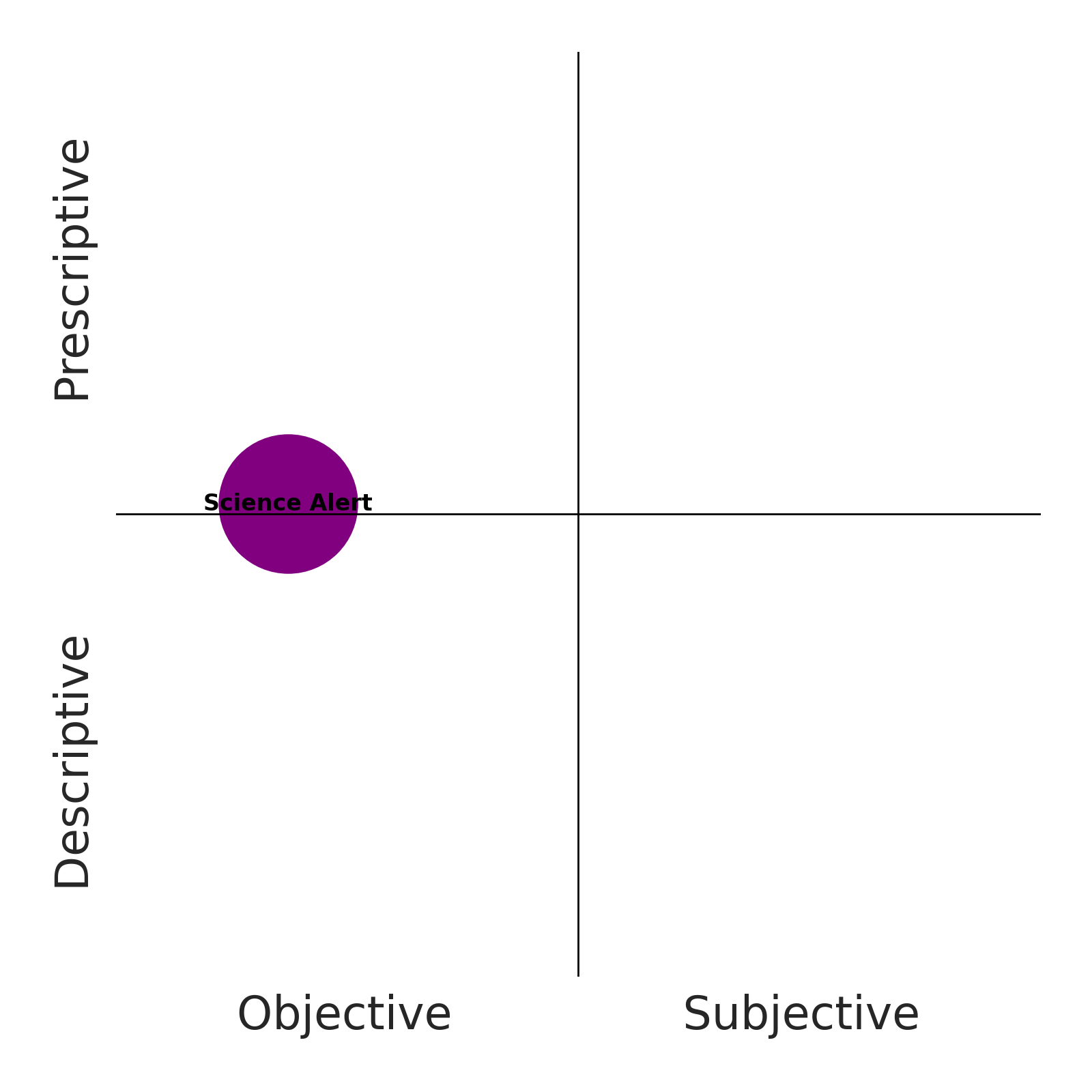
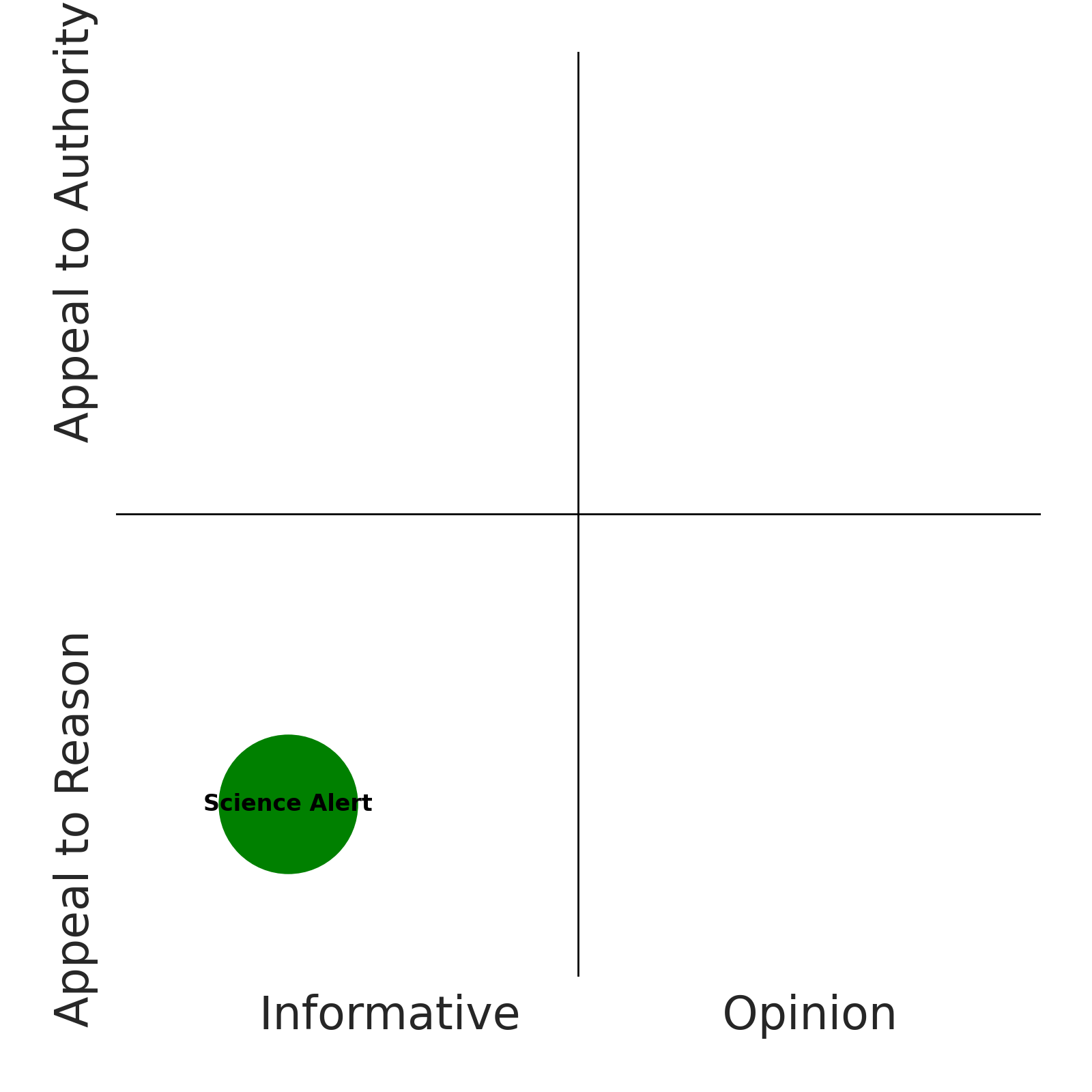
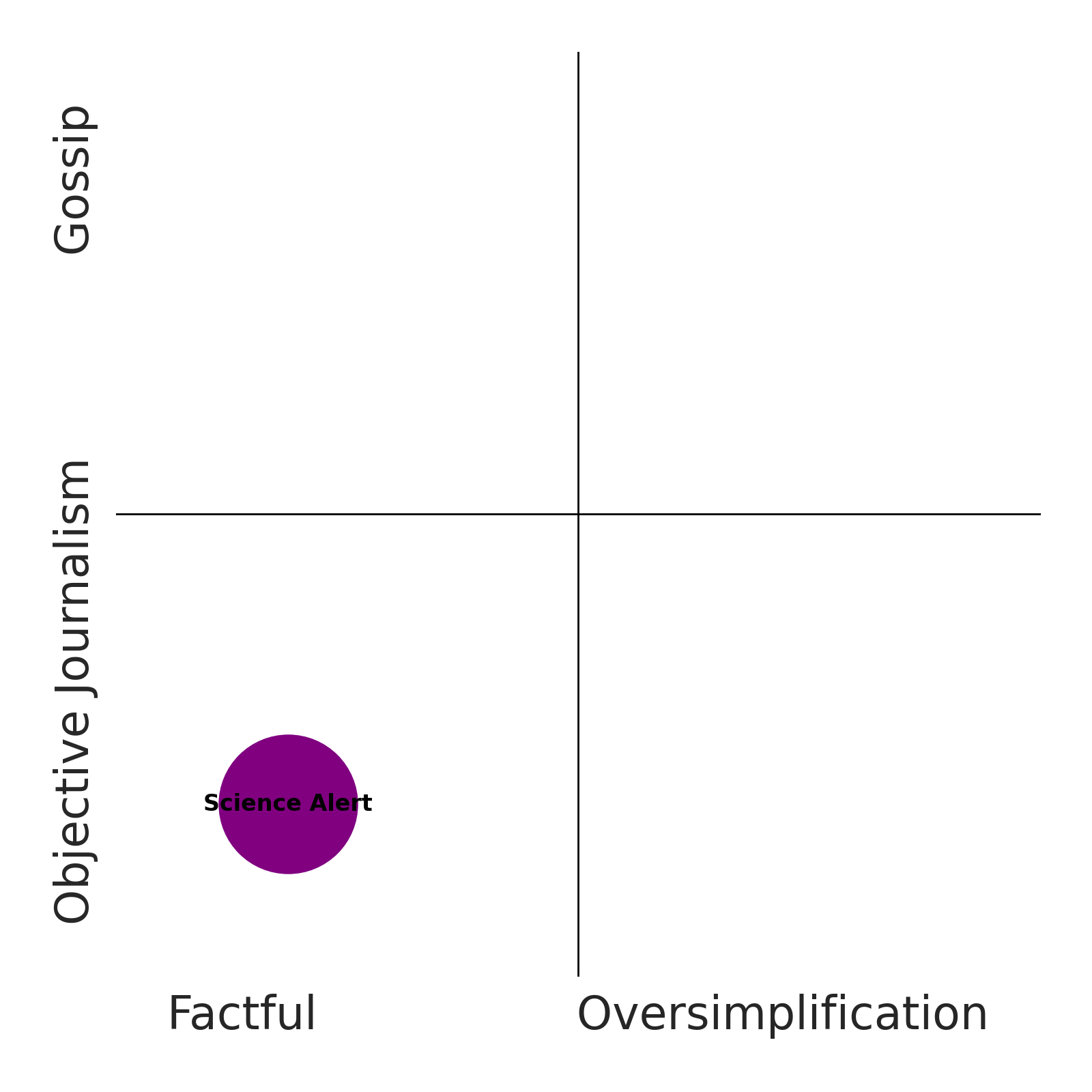
2026 © Helium Trades
Privacy Policy & Disclosure
* Disclaimer: Nothing on this website constitutes investment advice, performance data or any recommendation that any particular security, portfolio of securities, transaction or investment strategy is suitable for any specific person. Helium Trades is not responsible in any way for the accuracy
of any model predictions or price data. Any mention of a particular security and related prediction data is not a recommendation to buy or sell that security. Investments in securities involve the risk of loss. Past performance is no guarantee of future results. Helium Trades is not responsible for any of your investment decisions,
you should consult a financial expert before engaging in any transaction.
Helium Research Assistant

How can I help you today?
Ask any question about Science Alert bias.


