See whether Helium helps you make better-informed decisions. Try every Pro Trader feature for 30 days. No credit card required.
Try every Pro Trader feature for 30 days. No credit card required.
Framing celebrates Nvidia's corporate risk-taking as an uncomplicated vindication of capitalism.
Automated analysis; not human reviewed. Limitations: The supplied text is a one-sentence opinion framing, so classification rests on evaluative wording rather than developed reporting. · 13 of 54 available dimensions scored; omitted dimensions are not treated as neutral. · Verified supporting quotes for 13 of 13 scored dimensions.
Claim: The text endorses capitalism and corporate enterprise as the proper economic system.
“The chipmaker’s enormous bets are how capitalism is supposed to work” · exact text match
Why: The normative phrase 'supposed to work' positively aligns with pro-market/conservative framing.
Claim: The text uses overt value judgments rather than neutral facts.
“Good.” · exact text match
“The chipmaker’s enormous bets are how capitalism is supposed to work” · exact text match
Why: 'Good' and 'supposed' reflect subjective evaluation, not dispassionate reporting.
Claim: The text expresses a favorable view of Nvidia and the AI boom.
“Nvidia is driving the AI boom. Good.” · exact text match
Why: The direct 'Good' after the AI-boom claim marks positive sentiment.
Claim: The text frames Nvidia's actions and capitalism's operation in a positive light.
“Good.” · exact text match
Why: The approving interjection establishes an optimistic stance.
Claim: The text prescribes how capitalism should function.
“The chipmaker’s enormous bets are how capitalism is supposed to work” · exact text match
Why: 'Supposed to work' is an explicit normative standard.
Claim: The text is explicitly evaluative rather than fact reporting.
“Good.” · exact text match
“how capitalism is supposed to work” · exact text match
Why: It directly approves of Nvidia and lays out a normative view of capitalism.
Claim: The text takes a side in the economic-political debate over capitalism.
“The chipmaker’s enormous bets are how capitalism is supposed to work” · exact text match
Why: A prescriptive claim about capitalism's proper function is politically charged.
Claim: The text reduces the AI boom to a single company's actions.
“Nvidia is driving the AI boom.” · exact text match
Why: The singular causal claim omits market context and other contributors.
Claim: The text states a sweeping causal claim without hedging or cited support.
“Nvidia is driving the AI boom.” · exact text match
Why: The claim is unhedged and presented as certain despite the absence of supporting detail.
Claim: The text treats free-market corporate outcomes as the natural standard.
“The chipmaker’s enormous bets are how capitalism is supposed to work” · exact text match
Why: The appeal to how capitalism is 'supposed' to work signals a market-ideological frame.
Claim: The text defends the existing capitalist economic order.
“The chipmaker’s enormous bets are how capitalism is supposed to work” · exact text match
Why: Describing the system as working 'as supposed' affirms its legitimacy.
Claim: The text adds positive emotional evaluation to the claim.
“Good.” · exact text match
Why: The standalone 'Good' injects approval and positive affect.
Claim: The text praises a major corporation's large investments.
“Nvidia is driving the AI boom. Good.” · exact text match
“The chipmaker’s enormous bets are how capitalism is supposed to work” · exact text match
Why: The text celebrates Nvidia's bets and presents them as systemically correct.
The supplied text is a one-sentence opinion framing, so classification rests on evaluative wording rather than developed reporting.
September 03, 2026 · 0 shares
An unsourced alarmist forecast frames Museveni's decline as a settled fact and reduces Uganda's future to two catastrophic outcomes.
Automated analysis; not human reviewed. Limitations: Only a headline was supplied, so classifications rest on a one-sentence assertion with no body text or sourcing. · 11 of 54 available dimensions scored; omitted dimensions are not treated as neutral. · Verified supporting quotes for 7 of 11 scored dimensions.
Claim: The headline's framing is evaluative, using emotional and judgmental language rather than neutral description.
“Yoweri Museveni's decline is putting Uganda on a terrifying path.” · exact text match
“It faces the prospect of a worse despot or a messy power struggle.” · not found in supplied text
Why: Phrases like 'terrifying path' and 'worse despot' express subjective assessment rather than observable fact.
Claim: The headline uses fear-inducing wording and a dramatic either/or to make the situation more alarming.
“Yoweri Museveni's decline is putting Uganda on a terrifying path.” · exact text match
“It faces the prospect of a worse despot or a messy power struggle.” · not found in supplied text
Why: 'Terrifying' and 'worse despot' are sensationalized terms, and the outcome is reduced to stark alternatives.
Claim: The headline presents an entirely negative outlook with no mitigating possibility.
“a terrifying path” · exact text match
“a worse despot or a messy power struggle” · exact text match
Why: Every possible described future is catastrophic, producing a strongly pessimistic tenor.
Claim: The headline uses explicit fear-laden wording to characterize the situation.
“a terrifying path” · exact text match
“a worse despot” · exact text match
Why: 'Terrifying' is direct fear framing, and 'worse despot' amplifies threat.
Claim: The text is an unqualified opinion about political danger rather than a factual report.
“Yoweri Museveni's decline is putting Uganda on a terrifying path.” · exact text match
Why: The assertion is evaluative and unsourced, matching commentary rather than straight news.
Claim: The content is inherently political, focusing on a country's leader and a potential power transition.
“Yoweri Museveni's decline” · exact text match
“a worse despot or a messy power struggle” · exact text match
Why: It addresses presidential decline, despotism, and political succession.
Claim: The headline reduces Uganda's possible futures to two catastrophic alternatives.
“It faces the prospect of a worse despot or a messy power struggle.” · not found in supplied text
Why: No alternative trajectories or mitigating factors are acknowledged.
Claim: The headline states a dangerous trajectory as an unqualified present fact, despite supplying no evidence.
“Yoweri Museveni's decline is putting Uganda on a terrifying path.” · exact text match
Why: The claim is categorical; the word 'prospect' in the next sentence tempers the predictive certainty but the central assertion remains unhedged.
Claim: The language is emotionally negative, invoking terror and disorder.
“a terrifying path” · exact text match
“a worse despot or a messy power struggle” · exact text match
Why: The terms 'terrifying', 'worse despot', and 'messy' carry strong negative affect.
Claim: The text offers an unsourced, unqualified assertion without visible attribution or epistemic caution.
“Yoweri Museveni's decline is putting Uganda on a terrifying path.” · exact text match
Why: Credibility is limited by the absence of sourcing, evidence, or hedge, though it is recognizable as commentary.
Claim: The second sentence forecasts possible future political outcomes.
“It faces the prospect of a worse despot or a messy power struggle.” · not found in supplied text
Why: It is explicitly a 'prospect'—a future-oriented conjecture rather than an established event.
Only a headline was supplied, so classifications rest on a one-sentence assertion with no body text or sourcing.
September 10, 2026 · 0 shares
The framing evaluates Milei's market-liberal reforms as a 'remarkable' experiment while prescribing moderation and warning that failure to deliver growth could bring it to an end.
Javier Milei is Argentina's president, and his 'liberal experiment' refers to a sweeping deregulation and spending-reduction agenda; the phrase 'end next year' points to the upcoming 2025 political-electoral cycle.
Automated analysis; not human reviewed. Limitations: The supplied text is only a two-sentence headline/standfirst with no body content, so analysis rests on that excerpt's framing alone. · 9 of 54 available dimensions scored; omitted dimensions are not treated as neutral. · Verified supporting quotes for 9 of 9 scored dimensions.
Claim: The headline evaluates Milei's free-market program positively as a 'remarkable liberal experiment.'
“remarkable liberal experiment” · exact text match
Why: The approving adjective 'remarkable' applied to the liberal experiment tilts the framing toward classical-liberal/conservative sympathies.
Claim: The prescription of 'less shouting' and the technocratic demand for 'more growth' reflect an elite, non-populist vantage.
“Argentina needs less shouting and more growth” · exact text match
Why: 'Shouting' disparages populist-style political rhetoric, while the growth demand is a technocratic remedy.
Claim: The description of Milei's agenda as a 'liberal experiment' is sympathetic to freedom-oriented reform.
“remarkable liberal experiment” · exact text match
Why: The label 'liberal' emphasizes market-liberalization, aligning the framing with a libertarian direction.
Claim: Phrases like 'needs' and 'remarkable' are value judgments rather than neutral descriptions.
“Argentina needs less shouting and more growth” · exact text match
“remarkable liberal experiment” · exact text match
Why: Prescriptive 'needs' and evaluative 'remarkable' express the publisher's own judgment.
Claim: 'Argentina needs' is a direct prescription for policy and political behavior.
“Argentina needs less shouting and more growth” · exact text match
Why: The sentence issues a directive about what Argentina requires, a prescriptive formulation.
Claim: The headline expresses editorial judgment and a forecast rather than reporting established facts.
“Argentina needs less shouting and more growth” · exact text match
“could end next year” · exact text match
Why: Both clauses convey the publisher's view and a prediction, not documented occurrences.
Claim: The subject is the political survival of a head of government's reform agenda.
“Javier Milei's remarkable liberal experiment could end next year” · verified after text normalization
Why: Discussing whether a president's political experiment will end is inherently political content.
Claim: The causal formulation reduces Argentina's situation to two variables: 'shouting' and 'growth.'
“Argentina needs less shouting and more growth” · exact text match
Why: A complex economy and political landscape is compressed into a single 'less shouting, more growth' remedy.
Claim: The headline forecasts a contingent future outcome rather than reporting an event.
“could end next year” · exact text match
Why: 'Could end next year' is a forward-looking prediction without cited evidence in the excerpt.
The supplied text is only a two-sentence headline/standfirst with no body content, so analysis rests on that excerpt's framing alone.
September 03, 2026 · 0 shares
Presents Indian regulators' retail-trader protections as a failed intervention, stated categorically and without evidence.
Automated analysis; not human reviewed. Limitations: The supplied text is only a one-sentence assertion, so the analysis rests on minimal content and cannot verify the underlying regulatory situation. · 4 of 54 available dimensions scored; omitted dimensions are not treated as neutral. · Verified supporting quotes for 4 of 4 scored dimensions.
Claim: The central statement is an evaluative judgment presented as fact.
“Indian regulators' attempts to protect retail traders are backfiring.” · exact text match
Why: 'Backfiring' conveys a negative assessment rather than a neutral report of an event.
Claim: The framing reduces a complex regulatory question to a single unqualified conclusion.
“Indian regulators' attempts to protect retail traders are backfiring.” · exact text match
Why: No context, data, or alternative considerations are supplied; the trade-off is stated as a blanket outcome.
Claim: The text states as certain that Indian regulators' retail-trader protections are backfiring, despite providing no supporting evidence.
“Indian regulators' attempts to protect retail traders are backfiring.” · exact text match
Why: The sentence is an unhedged causal assertion without data, sources, or qualification.
Claim: The text provides no sourcing, attribution, or evidence for its assertion.
“Indian regulators' attempts to protect retail traders are backfiring.” · exact text match
Why: Credibility is assessed only from visible sourcing and uncertainty practices; the sole statement is unsupported.
The supplied text is only a one-sentence assertion, so the analysis rests on minimal content and cannot verify the underlying regulatory situation.
September 17, 2026 · 0 shares
Framing treats organised crime as defeatable through political will and dramatizes the stakes with the 'mobster state' label, yielding a prescriptive and conditional call to action.
Automated analysis; not human reviewed. Limitations: Only the headline and standfirst were available, so the analysis cannot assess the body's arguments, evidence, or context. · 4 of 55 available dimensions scored; omitted dimensions are not treated as neutral. · Verified supporting quotes for 4 of 4 scored dimensions.
Claim: The statement is subjective and editorial, expressing a value-laden conclusion rather than an objective factual finding.
“Organised crime can be beaten, given political will” · exact text match
Why: It asserts a conditional policy conclusion without evidence or sourcing, placing it in the subjective/opinion range.
Claim: The overall frame is optimistic, presenting organised crime as beatable and the mobster-state outcome as avoidable.
“Organised crime can be beaten, given political will” · exact text match
Why: The modal 'can be beaten' asserts a positive possibility, even though 'mobster state' names a negative risk.
Claim: The headline is prescriptive, telling readers how South Africa can avoid a feared outcome and asserting a required condition.
“How South Africa can avoid becoming a mobster state. Organised crime can be beaten, given political will” · exact text match
Why: The wording 'How ... can avoid' and 'can be beaten, given' prescribes a path and a necessary condition rather than reporting facts.
Claim: The text is opinionated, advancing a stance on how a policy problem can be solved.
“Organised crime can be beaten, given political will” · exact text match
Why: The direct assertion of a debatable claim is an opinion rather than neutral reporting.
Only the headline and standfirst were available, so the analysis cannot assess the body's arguments, evidence, or context.
The article exhibits a sarcastic, conservative framing that dismisses the French debt cancellation proposal as a 'Magic Money Tree' and portrays the left as using euphemisms for default.
Automated analysis; not human reviewed. Limitations: The analysis is based solely on the supplied opinion piece, which lacks external links and is explicitly subjective; no independent verification was attempted. · 7 of 54 available dimensions scored; omitted dimensions are not treated as neutral. · Verified supporting quotes for 6 of 7 scored dimensions.
Claim: The article uses dismissive language toward left-wing fiscal policies and euphemisms, indicating a conservative viewpoint.
“the left is great at euphemisms” · exact text match
“except perhaps slightly stupider and even more obviously wrong than what the Modern Monetary Theory-types advocate” · exact text match
Why: The pejorative references to the left and to MMT-style thinking clearly signal a conservative/right-leaning stance.
Claim: The author asserts claims with absolute certainty and dismisses counterarguments without qualification.
“There is no magic money tree.” · exact text match
“you’re missing something crucial” · exact text match
Why: The statement 'There is no magic money tree' is presented as an undeniable fact, and the admonition that readers are 'missing something crucial' reflects overconfidence in the author's own analysis.
Claim: The article consistently advocates a free-market, anti-monetary-finance ideology and dismisses opposing views.
“That would be exactly what this sounds like, except perhaps slightly stupider and even more obviously wrong than what the Modern Monetary Theory-types advocate.” · not found in supplied text
Why: The comparison to MMT as 'stupider' and 'more obviously wrong' reveals a strong ideological commitment against such policies.
Claim: The article employs a negative, sarcastic tone that conveys contempt toward the proposal.
“slightly stupider” · exact text match
“That sure would be popular!” · exact text match
Why: The mocking language and sardonic exclamations clearly express negative emotion.
Claim: The article explicitly promotes a book for sale.
“And only $35 list price!” · exact text match
Why: Directly advertising the book at the end is a clear promotional element.
Claim: The article makes determinate predictions about future events without providing empirical proof.
“would quickly be the end of the euro” · exact text match
“it would in all likelihood be back-to-the-future: another currency crisis and reform in short order” · exact text match
Why: These statements are speculative forecasts about the consequences of a hypothetical default, presented with high confidence.
Claim: The article uses loaded language and sarcasm to manipulate the reader's perception.
“watch your wallet” · exact text match
“French Magic Money Tree” · exact text match
Why: Phrases like 'watch your wallet' and 'French Magic Money Tree' are emotionally charged and designed to evoke distrust and ridicule.
The analysis is based solely on the supplied opinion piece, which lacks external links and is explicitly subjective; no independent verification was attempted.
August 25, 2026 · 0 shares
The piece frames Mark Carney's tariff threats as measured yet risky, conveying cautious support while warning of escalation.
Automated analysis; not human reviewed. Limitations: The supplied text is a one-sentence editorial snippet, limiting analysis to its explicit opinion and speculation. · 3 of 54 available dimensions scored; omitted dimensions are not treated as neutral. · Verified supporting quotes for 3 of 3 scored dimensions.
Claim: The piece expresses a clear evaluative stance on Carney's tariff policy.
“must beware” · exact text match
“are proportionate” · exact text match
Why: The language is prescriptive ('must beware') and judgmental ('are proportionate'), indicating a strong personal opinion.
Claim: The content pertains to government trade policy.
“tariff threats” · exact text match
“trade war” · exact text match
Why: The subject matter is squarely within political and governmental affairs.
Claim: The piece forecasts a possible negative outcome.
“could get out of hand” · exact text match
Why: The conditional 'could' explicitly projects a future scenario without supporting evidence.
The supplied text is a one-sentence editorial snippet, limiting analysis to its explicit opinion and speculation.
September 03, 2026 · 0 shares
The framing treats LIV Golf's failure as settled fact and converts it into a sweeping, prescriptive investment lesson.
Automated analysis; not human reviewed. Limitations: Only the repeated headline was supplied; there is no body text, so all classifications rest on that single sentence. · 5 of 54 available dimensions scored; omitted dimensions are not treated as neutral. · Verified supporting quotes for 5 of 5 scored dimensions.
Claim: The headline is framed as a subjective conclusion rather than an objective account.
“LIV Golf's failure shows how not to invest in sport” · exact text match
Why: It gives an unqualified evaluation and lesson without presenting any observable details.
Claim: The headline prescribes a lesson about investing rather than merely describing what happened.
“LIV Golf's failure shows how not to invest in sport” · exact text match
Why: The phrase 'shows how not to invest' is prescriptive, telling readers what a failed case should teach.
Claim: The headline expresses an evaluative judgment about LIV Golf and investment rather than reporting factual events.
“LIV Golf's failure shows how not to invest in sport” · exact text match
Why: The wording 'failure' and 'how not to invest' is an opinionated verdict, not a neutral factual statement.
Claim: The headline condenses a complex sports-investment situation into a single moral.
“LIV Golf's failure shows how not to invest in sport” · exact text match
Why: No context or evidence is offered; one asserted failure is turned into a broad rule.
Claim: The headline states LIV Golf's failure and its lesson as certain despite supplying no supporting evidence.
“LIV Golf's failure shows how not to invest in sport” · exact text match
Why: 'Failure' and 'shows' present an unqualified conclusion, exceeding the evidentiary support visible in the text.
Only the repeated headline was supplied; there is no body text, so all classifications rest on that single sentence.
September 03, 2026 · 0 shares
Presents Indian regulators' retail-trader protections as a failed intervention, stated categorically and without evidence.
Automated analysis; not human reviewed. Limitations: The supplied text is only a one-sentence assertion, so the analysis rests on minimal content and cannot verify the underlying regulatory situation. · 4 of 54 available dimensions scored; omitted dimensions are not treated as neutral. · Verified supporting quotes for 4 of 4 scored dimensions.
Claim: The central statement is an evaluative judgment presented as fact.
“Indian regulators' attempts to protect retail traders are backfiring.” · exact text match
Why: 'Backfiring' conveys a negative assessment rather than a neutral report of an event.
Claim: The framing reduces a complex regulatory question to a single unqualified conclusion.
“Indian regulators' attempts to protect retail traders are backfiring.” · exact text match
Why: No context, data, or alternative considerations are supplied; the trade-off is stated as a blanket outcome.
Claim: The text states as certain that Indian regulators' retail-trader protections are backfiring, despite providing no supporting evidence.
“Indian regulators' attempts to protect retail traders are backfiring.” · exact text match
Why: The sentence is an unhedged causal assertion without data, sources, or qualification.
Claim: The text provides no sourcing, attribution, or evidence for its assertion.
“Indian regulators' attempts to protect retail traders are backfiring.” · exact text match
Why: Credibility is assessed only from visible sourcing and uncertainty practices; the sole statement is unsupported.
The supplied text is only a one-sentence assertion, so the analysis rests on minimal content and cannot verify the underlying regulatory situation.
September 03, 2026 · 0 shares
Frames opposition to data centres as an irrational moral panic rooted in misinformation and misunderstanding, treating dismissal as the appropriate stance.
Data centres are large computing facilities whose expansion has drawn public debate over electricity use, water consumption, and local siting impacts.
Automated analysis; not human reviewed. Limitations: Only the headline/standfirst was supplied, so the body's arguments and evidence could not be assessed. · 6 of 54 available dimensions scored; omitted dimensions are not treated as neutral. · Verified supporting quotes for 6 of 6 scored dimensions.
Claim: A subjective judgment is stated in the same form as an objective assertion.
“The moral panic over data centres is foolish.” · exact text match
Why: 'Foolish' is a subjective evaluation, yet it is presented as a flat statement.
Claim: The text assumes the contested point that opposition is a panic based on misinformation.
“The moral panic over data centres is foolish.” · exact text match
“A backlash fuelled by misinformation and misunderstanding” · exact text match
Why: The characterization of the backlash as panic/misinformation is used as the basis for dismissal rather than demonstrated.
Claim: The text renders an evaluative verdict on public opposition rather than reporting verifiable events.
“The moral panic over data centres is foolish.” · exact text match
Why: The sentence labels a public debate foolish, an opinion expressed without supporting facts.
Claim: The text reduces the backlash to a single simplistic cause.
“A backlash fuelled by misinformation and misunderstanding” · exact text match
Why: It attributes the entire backlash to misinformation and misunderstanding, leaving no room for other legitimate factors.
Claim: The text asserts a specific cause of the backlash without providing evidence for it.
“A backlash fuelled by misinformation and misunderstanding” · exact text match
Why: The causal claim about the backlash's drivers is stated as settled fact, exceeding the support visible in the supplied text.
Claim: The wording carries a negative emotional charge toward opponents.
“moral panic” · exact text match
“foolish” · exact text match
Why: 'Moral panic' and 'foolish' are loaded negative descriptors that frame opponents as irrational.
Only the headline/standfirst was supplied, so the body's arguments and evidence could not be assessed.
September 10, 2026 · 0 shares
The headline prescribes a specific monetary policy action, framing the upcoming Federal Reserve meeting as a decisive test for the new chair.
Automated analysis; not human reviewed. Limitations: The analysis is limited to a single-sentence headline, providing minimal context for bias assessment. · 3 of 54 available dimensions scored; omitted dimensions are not treated as neutral. · Verified supporting quotes for 3 of 3 scored dimensions.
Claim: The headline expresses a subjective opinion about monetary policy.
“should raise” · exact text match
Why: The use of 'should' indicates a value judgment, not an objective report.
Claim: The headline prescribes a policy action rather than describing a state of affairs.
“should raise interest rates” · exact text match
Why: The modal 'should' explicitly directs an action, making the framing prescriptive.
Claim: The headline is an opinionated call for a specific policy action.
“should raise” · exact text match
Why: It advocates a course of action, characteristic of opinion content.
The analysis is limited to a single-sentence headline, providing minimal context for bias assessment.
September 10, 2026 · 0 shares
The framing evaluates Milei's market-liberal reforms as a 'remarkable' experiment while prescribing moderation and warning that failure to deliver growth could bring it to an end.
Javier Milei is Argentina's president, and his 'liberal experiment' refers to a sweeping deregulation and spending-reduction agenda; the phrase 'end next year' points to the upcoming 2025 political-electoral cycle.
Automated analysis; not human reviewed. Limitations: The supplied text is only a two-sentence headline/standfirst with no body content, so analysis rests on that excerpt's framing alone. · 9 of 54 available dimensions scored; omitted dimensions are not treated as neutral. · Verified supporting quotes for 9 of 9 scored dimensions.
Claim: The headline evaluates Milei's free-market program positively as a 'remarkable liberal experiment.'
“remarkable liberal experiment” · exact text match
Why: The approving adjective 'remarkable' applied to the liberal experiment tilts the framing toward classical-liberal/conservative sympathies.
Claim: The prescription of 'less shouting' and the technocratic demand for 'more growth' reflect an elite, non-populist vantage.
“Argentina needs less shouting and more growth” · exact text match
Why: 'Shouting' disparages populist-style political rhetoric, while the growth demand is a technocratic remedy.
Claim: The description of Milei's agenda as a 'liberal experiment' is sympathetic to freedom-oriented reform.
“remarkable liberal experiment” · exact text match
Why: The label 'liberal' emphasizes market-liberalization, aligning the framing with a libertarian direction.
Claim: Phrases like 'needs' and 'remarkable' are value judgments rather than neutral descriptions.
“Argentina needs less shouting and more growth” · exact text match
“remarkable liberal experiment” · exact text match
Why: Prescriptive 'needs' and evaluative 'remarkable' express the publisher's own judgment.
Claim: 'Argentina needs' is a direct prescription for policy and political behavior.
“Argentina needs less shouting and more growth” · exact text match
Why: The sentence issues a directive about what Argentina requires, a prescriptive formulation.
Claim: The headline expresses editorial judgment and a forecast rather than reporting established facts.
“Argentina needs less shouting and more growth” · exact text match
“could end next year” · exact text match
Why: Both clauses convey the publisher's view and a prediction, not documented occurrences.
Claim: The subject is the political survival of a head of government's reform agenda.
“Javier Milei's remarkable liberal experiment could end next year” · verified after text normalization
Why: Discussing whether a president's political experiment will end is inherently political content.
Claim: The causal formulation reduces Argentina's situation to two variables: 'shouting' and 'growth.'
“Argentina needs less shouting and more growth” · exact text match
Why: A complex economy and political landscape is compressed into a single 'less shouting, more growth' remedy.
Claim: The headline forecasts a contingent future outcome rather than reporting an event.
“could end next year” · exact text match
Why: 'Could end next year' is a forward-looking prediction without cited evidence in the excerpt.
The supplied text is only a two-sentence headline/standfirst with no body content, so analysis rests on that excerpt's framing alone.
September 10, 2026 · 0 shares
Treats plunging test scores as a slow-moving catastrophe, links machines' advancement to teens' dimming, and demands schools act now.
Automated analysis; not human reviewed. Limitations: The analysis is based on a single headline snippet, so conclusions are limited to its explicit claims. · 10 of 54 available dimensions scored; omitted dimensions are not treated as neutral. · Verified supporting quotes for 10 of 10 scored dimensions.
Claim: The text employs sensational language to frame the situation.
“slow-moving catastrophe” · exact text match
“dimmer” · exact text match
Why: 'Catastrophe' is dramatic and 'dimmer' is a loaded term.
Claim: The text portrays a negative outlook on teens and test scores.
“Teens are getting dimmer” · exact text match
“slow-moving catastrophe” · exact text match
Why: Terms like 'dimmer' and 'catastrophe' indicate pessimism.
Claim: The text prescribes a specific action.
“Schools must act now” · exact text match
Why: The imperative 'must' makes it prescriptive.
Claim: The text invokes fear of a catastrophe to demand action.
“slow-moving catastrophe” · exact text match
Why: The use of 'catastrophe' creates a sense of fear and urgency.
Claim: The text expresses strong subjective opinions about test scores and required action.
“Schools must act now” · exact text match
“slow-moving catastrophe” · exact text match
Why: The use of 'must' and 'catastrophe' are value judgments, not factual reporting.
Claim: The text reduces complex issues to simple causal statements.
“Machines are getting brighter. Teens are getting dimmer.” · exact text match
Why: It juxtaposes two trends without nuance or evidence, implying a direct relationship.
Claim: The text states unsupported claims as certain facts.
“Plunging test scores are a slow-moving catastrophe” · exact text match
“Teens are getting dimmer” · exact text match
Why: No hedging or attribution, presenting assertions as definitive.
Claim: The text conveys a strongly negative emotional tone.
“slow-moving catastrophe” · exact text match
“dimmer” · exact text match
Why: The emotional charge of the language is negative.
Claim: The text lacks sourcing, attribution, or explicit uncertainty, undermining credibility.
“Plunging test scores are a slow-moving catastrophe.” · exact text match
Why: There is no evidence or attribution for the claims.
Claim: The text uses loaded framing and urgency to steer a conclusion.
“slow-moving catastrophe” · exact text match
“must act now” · exact text match
Why: The combination of catastrophe and imperative action creates a manipulative push.
The analysis is based on a single headline snippet, so conclusions are limited to its explicit claims.
September 03, 2026 · 0 shares
The framing treats LIV Golf's failure as settled fact and converts it into a sweeping, prescriptive investment lesson.
Automated analysis; not human reviewed. Limitations: Only the repeated headline was supplied; there is no body text, so all classifications rest on that single sentence. · 5 of 54 available dimensions scored; omitted dimensions are not treated as neutral. · Verified supporting quotes for 5 of 5 scored dimensions.
Claim: The headline is framed as a subjective conclusion rather than an objective account.
“LIV Golf's failure shows how not to invest in sport” · exact text match
Why: It gives an unqualified evaluation and lesson without presenting any observable details.
Claim: The headline prescribes a lesson about investing rather than merely describing what happened.
“LIV Golf's failure shows how not to invest in sport” · exact text match
Why: The phrase 'shows how not to invest' is prescriptive, telling readers what a failed case should teach.
Claim: The headline expresses an evaluative judgment about LIV Golf and investment rather than reporting factual events.
“LIV Golf's failure shows how not to invest in sport” · exact text match
Why: The wording 'failure' and 'how not to invest' is an opinionated verdict, not a neutral factual statement.
Claim: The headline condenses a complex sports-investment situation into a single moral.
“LIV Golf's failure shows how not to invest in sport” · exact text match
Why: No context or evidence is offered; one asserted failure is turned into a broad rule.
Claim: The headline states LIV Golf's failure and its lesson as certain despite supplying no supporting evidence.
“LIV Golf's failure shows how not to invest in sport” · exact text match
Why: 'Failure' and 'shows' present an unqualified conclusion, exceeding the evidentiary support visible in the text.
Only the repeated headline was supplied; there is no body text, so all classifications rest on that single sentence.
September 03, 2026 · 0 shares
Presents Indian regulators' retail-trader protections as a failed intervention, stated categorically and without evidence.
Automated analysis; not human reviewed. Limitations: The supplied text is only a one-sentence assertion, so the analysis rests on minimal content and cannot verify the underlying regulatory situation. · 4 of 54 available dimensions scored; omitted dimensions are not treated as neutral. · Verified supporting quotes for 4 of 4 scored dimensions.
Claim: The central statement is an evaluative judgment presented as fact.
“Indian regulators' attempts to protect retail traders are backfiring.” · exact text match
Why: 'Backfiring' conveys a negative assessment rather than a neutral report of an event.
Claim: The framing reduces a complex regulatory question to a single unqualified conclusion.
“Indian regulators' attempts to protect retail traders are backfiring.” · exact text match
Why: No context, data, or alternative considerations are supplied; the trade-off is stated as a blanket outcome.
Claim: The text states as certain that Indian regulators' retail-trader protections are backfiring, despite providing no supporting evidence.
“Indian regulators' attempts to protect retail traders are backfiring.” · exact text match
Why: The sentence is an unhedged causal assertion without data, sources, or qualification.
Claim: The text provides no sourcing, attribution, or evidence for its assertion.
“Indian regulators' attempts to protect retail traders are backfiring.” · exact text match
Why: Credibility is assessed only from visible sourcing and uncertainty practices; the sole statement is unsupported.
The supplied text is only a one-sentence assertion, so the analysis rests on minimal content and cannot verify the underlying regulatory situation.
September 03, 2026 · 0 shares
Frames opposition to data centres as an irrational moral panic rooted in misinformation and misunderstanding, treating dismissal as the appropriate stance.
Data centres are large computing facilities whose expansion has drawn public debate over electricity use, water consumption, and local siting impacts.
Automated analysis; not human reviewed. Limitations: Only the headline/standfirst was supplied, so the body's arguments and evidence could not be assessed. · 6 of 54 available dimensions scored; omitted dimensions are not treated as neutral. · Verified supporting quotes for 6 of 6 scored dimensions.
Claim: A subjective judgment is stated in the same form as an objective assertion.
“The moral panic over data centres is foolish.” · exact text match
Why: 'Foolish' is a subjective evaluation, yet it is presented as a flat statement.
Claim: The text assumes the contested point that opposition is a panic based on misinformation.
“The moral panic over data centres is foolish.” · exact text match
“A backlash fuelled by misinformation and misunderstanding” · exact text match
Why: The characterization of the backlash as panic/misinformation is used as the basis for dismissal rather than demonstrated.
Claim: The text renders an evaluative verdict on public opposition rather than reporting verifiable events.
“The moral panic over data centres is foolish.” · exact text match
Why: The sentence labels a public debate foolish, an opinion expressed without supporting facts.
Claim: The text reduces the backlash to a single simplistic cause.
“A backlash fuelled by misinformation and misunderstanding” · exact text match
Why: It attributes the entire backlash to misinformation and misunderstanding, leaving no room for other legitimate factors.
Claim: The text asserts a specific cause of the backlash without providing evidence for it.
“A backlash fuelled by misinformation and misunderstanding” · exact text match
Why: The causal claim about the backlash's drivers is stated as settled fact, exceeding the support visible in the supplied text.
Claim: The wording carries a negative emotional charge toward opponents.
“moral panic” · exact text match
“foolish” · exact text match
Why: 'Moral panic' and 'foolish' are loaded negative descriptors that frame opponents as irrational.
Only the headline/standfirst was supplied, so the body's arguments and evidence could not be assessed.
September 03, 2026 · 0 shares
Frames household sexism as the decisive economic barrier and treats a less sexist world as an uncontested prosperity gain.
Automated analysis; not human reviewed. Limitations: Only a two-sentence headline/standfirst was supplied; no body, data, or methodology was available. · 7 of 54 available dimensions scored; omitted dimensions are not treated as neutral. · Verified supporting quotes for 7 of 7 scored dimensions.
Claim: The statement endorses gender equality as an economic benefit, a position conventionally associated with liberal/progressive framing.
“A less sexist world would be much richer” · exact text match
Why: The value-laden preference for a less sexist world and its asserted economic benefit is a socially liberal framing, with no conservative or competing perspective.
Claim: The statement is an evaluative assertion rather than a sourced, verifiable finding.
“A less sexist world would be much richer” · exact text match
Why: The clause 'would be much richer' is a value-laden counterfactual without empirical grounding or attribution.
Claim: The text consists of unqualified opinion claims rather than reported facts.
“In many countries, the biggest barrier to prosperity is in the home.” · exact text match
“A less sexist world would be much richer” · exact text match
Why: Both sentences are sweeping value claims with no sources, data, or alternate views.
Claim: The statement frames household gender inequality as a central matter of national prosperity and social change.
“In many countries, the biggest barrier to prosperity is in the home.” · exact text match
Why: It makes a contested social-structural claim about economy and gender, placing it in political/policy territory.
Claim: A complex economic outcome is attributed primarily to one household cultural factor.
“the biggest barrier to prosperity is in the home” · exact text match
Why: It asserts primacy and a simple causal lever without addressing other structural factors.
Claim: The assertions are categorical and lack hedging or evidentiary caveats.
“the biggest barrier to prosperity is in the home” · exact text match
“A less sexist world would be much richer” · exact text match
Why: The use of 'biggest' and 'would be much richer' states certainty beyond what the supplied evidence can support.
Claim: The statement projects an economic outcome for an unobserved counterfactual world.
“A less sexist world would be much richer” · exact text match
Why: The conditional outcome is speculative rather than observed or measured.
Only a two-sentence headline/standfirst was supplied; no body, data, or methodology was available.
September 10, 2026 · 0 shares
The framing evaluates Milei's market-liberal reforms as a 'remarkable' experiment while prescribing moderation and warning that failure to deliver growth could bring it to an end.
Javier Milei is Argentina's president, and his 'liberal experiment' refers to a sweeping deregulation and spending-reduction agenda; the phrase 'end next year' points to the upcoming 2025 political-electoral cycle.
Automated analysis; not human reviewed. Limitations: The supplied text is only a two-sentence headline/standfirst with no body content, so analysis rests on that excerpt's framing alone. · 9 of 54 available dimensions scored; omitted dimensions are not treated as neutral. · Verified supporting quotes for 9 of 9 scored dimensions.
Claim: The headline evaluates Milei's free-market program positively as a 'remarkable liberal experiment.'
“remarkable liberal experiment” · exact text match
Why: The approving adjective 'remarkable' applied to the liberal experiment tilts the framing toward classical-liberal/conservative sympathies.
Claim: The prescription of 'less shouting' and the technocratic demand for 'more growth' reflect an elite, non-populist vantage.
“Argentina needs less shouting and more growth” · exact text match
Why: 'Shouting' disparages populist-style political rhetoric, while the growth demand is a technocratic remedy.
Claim: The description of Milei's agenda as a 'liberal experiment' is sympathetic to freedom-oriented reform.
“remarkable liberal experiment” · exact text match
Why: The label 'liberal' emphasizes market-liberalization, aligning the framing with a libertarian direction.
Claim: Phrases like 'needs' and 'remarkable' are value judgments rather than neutral descriptions.
“Argentina needs less shouting and more growth” · exact text match
“remarkable liberal experiment” · exact text match
Why: Prescriptive 'needs' and evaluative 'remarkable' express the publisher's own judgment.
Claim: 'Argentina needs' is a direct prescription for policy and political behavior.
“Argentina needs less shouting and more growth” · exact text match
Why: The sentence issues a directive about what Argentina requires, a prescriptive formulation.
Claim: The headline expresses editorial judgment and a forecast rather than reporting established facts.
“Argentina needs less shouting and more growth” · exact text match
“could end next year” · exact text match
Why: Both clauses convey the publisher's view and a prediction, not documented occurrences.
Claim: The subject is the political survival of a head of government's reform agenda.
“Javier Milei's remarkable liberal experiment could end next year” · verified after text normalization
Why: Discussing whether a president's political experiment will end is inherently political content.
Claim: The causal formulation reduces Argentina's situation to two variables: 'shouting' and 'growth.'
“Argentina needs less shouting and more growth” · exact text match
Why: A complex economy and political landscape is compressed into a single 'less shouting, more growth' remedy.
Claim: The headline forecasts a contingent future outcome rather than reporting an event.
“could end next year” · exact text match
Why: 'Could end next year' is a forward-looking prediction without cited evidence in the excerpt.
The supplied text is only a two-sentence headline/standfirst with no body content, so analysis rests on that excerpt's framing alone.
Framing celebrates Nvidia's corporate risk-taking as an uncomplicated vindication of capitalism.
Automated analysis; not human reviewed. Limitations: The supplied text is a one-sentence opinion framing, so classification rests on evaluative wording rather than developed reporting. · 13 of 54 available dimensions scored; omitted dimensions are not treated as neutral. · Verified supporting quotes for 13 of 13 scored dimensions.
Claim: The text endorses capitalism and corporate enterprise as the proper economic system.
“The chipmaker’s enormous bets are how capitalism is supposed to work” · exact text match
Why: The normative phrase 'supposed to work' positively aligns with pro-market/conservative framing.
Claim: The text uses overt value judgments rather than neutral facts.
“Good.” · exact text match
“The chipmaker’s enormous bets are how capitalism is supposed to work” · exact text match
Why: 'Good' and 'supposed' reflect subjective evaluation, not dispassionate reporting.
Claim: The text expresses a favorable view of Nvidia and the AI boom.
“Nvidia is driving the AI boom. Good.” · exact text match
Why: The direct 'Good' after the AI-boom claim marks positive sentiment.
Claim: The text frames Nvidia's actions and capitalism's operation in a positive light.
“Good.” · exact text match
Why: The approving interjection establishes an optimistic stance.
Claim: The text prescribes how capitalism should function.
“The chipmaker’s enormous bets are how capitalism is supposed to work” · exact text match
Why: 'Supposed to work' is an explicit normative standard.
Claim: The text is explicitly evaluative rather than fact reporting.
“Good.” · exact text match
“how capitalism is supposed to work” · exact text match
Why: It directly approves of Nvidia and lays out a normative view of capitalism.
Claim: The text takes a side in the economic-political debate over capitalism.
“The chipmaker’s enormous bets are how capitalism is supposed to work” · exact text match
Why: A prescriptive claim about capitalism's proper function is politically charged.
Claim: The text reduces the AI boom to a single company's actions.
“Nvidia is driving the AI boom.” · exact text match
Why: The singular causal claim omits market context and other contributors.
Claim: The text states a sweeping causal claim without hedging or cited support.
“Nvidia is driving the AI boom.” · exact text match
Why: The claim is unhedged and presented as certain despite the absence of supporting detail.
Claim: The text treats free-market corporate outcomes as the natural standard.
“The chipmaker’s enormous bets are how capitalism is supposed to work” · exact text match
Why: The appeal to how capitalism is 'supposed' to work signals a market-ideological frame.
Claim: The text defends the existing capitalist economic order.
“The chipmaker’s enormous bets are how capitalism is supposed to work” · exact text match
Why: Describing the system as working 'as supposed' affirms its legitimacy.
Claim: The text adds positive emotional evaluation to the claim.
“Good.” · exact text match
Why: The standalone 'Good' injects approval and positive affect.
Claim: The text praises a major corporation's large investments.
“Nvidia is driving the AI boom. Good.” · exact text match
“The chipmaker’s enormous bets are how capitalism is supposed to work” · exact text match
Why: The text celebrates Nvidia's bets and presents them as systemically correct.
The supplied text is a one-sentence opinion framing, so classification rests on evaluative wording rather than developed reporting.
September 03, 2026 · 0 shares
Frames household sexism as the decisive economic barrier and treats a less sexist world as an uncontested prosperity gain.
Automated analysis; not human reviewed. Limitations: Only a two-sentence headline/standfirst was supplied; no body, data, or methodology was available. · 7 of 54 available dimensions scored; omitted dimensions are not treated as neutral. · Verified supporting quotes for 7 of 7 scored dimensions.
Claim: The statement endorses gender equality as an economic benefit, a position conventionally associated with liberal/progressive framing.
“A less sexist world would be much richer” · exact text match
Why: The value-laden preference for a less sexist world and its asserted economic benefit is a socially liberal framing, with no conservative or competing perspective.
Claim: The statement is an evaluative assertion rather than a sourced, verifiable finding.
“A less sexist world would be much richer” · exact text match
Why: The clause 'would be much richer' is a value-laden counterfactual without empirical grounding or attribution.
Claim: The text consists of unqualified opinion claims rather than reported facts.
“In many countries, the biggest barrier to prosperity is in the home.” · exact text match
“A less sexist world would be much richer” · exact text match
Why: Both sentences are sweeping value claims with no sources, data, or alternate views.
Claim: The statement frames household gender inequality as a central matter of national prosperity and social change.
“In many countries, the biggest barrier to prosperity is in the home.” · exact text match
Why: It makes a contested social-structural claim about economy and gender, placing it in political/policy territory.
Claim: A complex economic outcome is attributed primarily to one household cultural factor.
“the biggest barrier to prosperity is in the home” · exact text match
Why: It asserts primacy and a simple causal lever without addressing other structural factors.
Claim: The assertions are categorical and lack hedging or evidentiary caveats.
“the biggest barrier to prosperity is in the home” · exact text match
“A less sexist world would be much richer” · exact text match
Why: The use of 'biggest' and 'would be much richer' states certainty beyond what the supplied evidence can support.
Claim: The statement projects an economic outcome for an unobserved counterfactual world.
“A less sexist world would be much richer” · exact text match
Why: The conditional outcome is speculative rather than observed or measured.
Only a two-sentence headline/standfirst was supplied; no body, data, or methodology was available.
September 16, 2026 · 0 shares
Frames British political funding as insufficient and parties as unprepared, advancing a prescriptive, contrarian stance that endorses more money in politics.
The statement concerns UK political party funding, which is regulated by statutory caps on donations and campaign spending, with only limited public funding for parties.
Automated analysis; not human reviewed. Limitations: Only a short opening statement was supplied, so the assessment rests on a single unqualified assertion with no body text, sourcing, or context. · 11 of 55 available dimensions scored; omitted dimensions are not treated as neutral. · Verified supporting quotes for 11 of 11 scored dimensions.
Claim: The framing endorses more money in politics, a position opposed to populist critiques of political funding.
“There is too little money in British politics, not too much.” · exact text match
Why: Declaring politics underfunded treats political money as beneficial rather than corrupting, tilting toward an elite-friendly stance.
Claim: The sentence makes an evaluative judgment about the correct level of political funding.
“There is too little money in British politics, not too much.” · exact text match
Why: 'Too little' is a normative appraisal, not a neutral observation.
Claim: The contrarian reversal of a common assumption makes the text moderately noteworthy.
“There is too little money in British politics, not too much.” · exact text match
Why: It contradicts the widespread assumption that politics has too much money.
Claim: The text prescribes greater political funding by declaring the current amount insufficient.
“There is too little money in British politics, not too much.” · exact text match
Why: Labeling funding 'too little' implies it should be increased.
Claim: A contested policy view is asserted without supporting evidence or qualification.
“There is too little money in British politics, not too much.” · exact text match
Why: The statement is a bare editorial assertion of a debatable position.
Claim: The text enters a contested policy debate over party funding in the UK.
“Parties come to office hopelessly unprepared” · exact text match
Why: Party funding and governing readiness are contested political topics, and the text takes a side.
Claim: Party unpreparedness for office is attributed solely to insufficient money.
“Parties come to office hopelessly unprepared” · exact text match
Why: The causal link from funding levels to governing preparedness is stated as a simple equation, ignoring other factors.
Claim: A contested empirical and normative claim is stated categorically with no evidence or hedging.
“There is too little money in British politics, not too much.” · exact text match
Why: The assertion is presented as settled fact despite being debatable.
Claim: Mild negative emotional coloring is present in the description of parties.
“Parties come to office hopelessly unprepared” · exact text match
Why: 'Hopelessly' intensifies the criticism emotionally beyond a neutral description.
Claim: The text offers no sourcing, attribution, or uncertainty markers for its central assertion.
“There is too little money in British politics, not too much.” · exact text match
Why: Credibility rests solely on the publisher's assertion because no epistemic support is visible.
Claim: The sentence is a concise, coherent causal argument.
“There is too little money in British politics, not too much. Parties come to office hopelessly unprepared” · exact text match
Why: It links a stated cause (funding) to an outcome (unpreparedness) in few words.
Only a short opening statement was supplied, so the assessment rests on a single unqualified assertion with no body text, sourcing, or context.
September 17, 2026 · 0 shares
Frames support for Ukraine as an urgent self-interested necessity while characterizing the adversary as lawless and technology as the key to future warfare.
Automated analysis; not human reviewed. Limitations: Only the headline and subtitle were available; the supporting argument and evidence were not supplied. · 9 of 55 available dimensions scored; omitted dimensions are not treated as neutral. · Verified supporting quotes for 4 of 9 scored dimensions.
Claim: The statement is opinionated and value-laden rather than empirically neutral.
“The selfish case for helping Ukraine has never been stronger.” · exact text match
Why: It explicitly presents a 'case' and uses evaluative language, indicating a subjective argument.
Claim: The wording uses loaded and hyperbolic language.
“Rapidly changing technology, wielded by a lawless enemy, may be the future of war.” · not found in supplied text
“The selfish case for helping Ukraine has never been stronger.” · exact text match
Why: Phrases like 'lawless enemy' and 'never been stronger' are emotionally charged and maximal, exceeding plain factual description.
Claim: The headline prescribes action and frames it as necessary.
“The selfish case for helping Ukraine has never been stronger.” · exact text match
Why: Saying the case has never been stronger is a call to act, not a neutral description.
Claim: The headline favors aiding Ukraine against a 'lawless enemy,' implying a hawkish stance.
“The selfish case for helping Ukraine has never been stronger.” · exact text match
“Rapidly changing technology, wielded by a lawless enemy, may be the future of war.” · not found in supplied text
Why: Supporting Ukraine against an adversarial 'lawless enemy' in a war context indicates a confrontational posture.
Claim: The framing invokes threat and danger.
“Rapidly changing technology, wielded by a lawless enemy, may be the future of war.” · not found in supplied text
Why: Combining a 'lawless enemy' with the 'future of war' fosters alarm.
Claim: The headline is an advocacy argument, not neutral reporting.
“The selfish case for helping Ukraine has never been stronger.” · exact text match
Why: It explicitly makes a 'case' for a policy, indicating a strongly opinionated stance.
Claim: The subject matter is a geopolitical conflict and a policy position on it.
“The selfish case for helping Ukraine has never been stronger.” · exact text match
“Rapidly changing technology, wielded by a lawless enemy, may be the future of war.” · not found in supplied text
Why: Ukraine aid and the future of war are core political topics.
Claim: The assertion of the strength of the case is stated with absolute certainty.
“The selfish case for helping Ukraine has never been stronger.” · exact text match
Why: 'Never been stronger' is a maximal claim presented without supporting evidence in the headline.
Claim: The future-of-war prediction is speculative and uncertain.
“Rapidly changing technology, wielded by a lawless enemy, may be the future of war.” · not found in supplied text
Why: The statement forecasts a future outcome based on current technology and an undefined adversary.
Only the headline and subtitle were available; the supporting argument and evidence were not supplied.
Frames AI competition between the United States and China as an arms race and asserts that the United States will find it hard to make the technology safe while preserving its lead.
Automated analysis; not human reviewed. Limitations: Only the headline and standfirst were supplied; no body text was available to verify or contextualize the claim. · 4 of 55 available dimensions scored; omitted dimensions are not treated as neutral. · Verified supporting quotes for 4 of 4 scored dimensions.
Claim: The framing is subjective, presenting an opinionated prediction rather than neutral reporting.
“America will struggle to make the technology safe while staying ahead of China” · exact text match
Why: The headline uses an unqualified future prediction and a rhetorical question, both of which are subjective framing devices.
Claim: The framing is pessimistic about the feasibility of combining AI safety with US-China competition.
“America will struggle to make the technology safe while staying ahead of China” · exact text match
Why: The word 'struggle' conveys difficulty and a negative outlook on achieving safety and competitive advantage.
Claim: The text places AI development inside US-China geopolitical competition.
“Can the AI arms race be stopped?” · exact text match
“staying ahead of China” · exact text match
Why: The 'arms race' framing and the reference to staying ahead of China frame AI as a matter of national rivalry.
Claim: The text offers a forward-looking prediction about America's ability to manage AI safety and competition.
“America will struggle to make the technology safe while staying ahead of China” · exact text match
Why: The phrase 'will struggle' is a forecast about future outcomes, not a statement of established fact.
Only the headline and standfirst were supplied; no body text was available to verify or contextualize the claim.
September 16, 2026 · 0 shares
Frames British political funding as insufficient and parties as unprepared, advancing a prescriptive, contrarian stance that endorses more money in politics.
The statement concerns UK political party funding, which is regulated by statutory caps on donations and campaign spending, with only limited public funding for parties.
Automated analysis; not human reviewed. Limitations: Only a short opening statement was supplied, so the assessment rests on a single unqualified assertion with no body text, sourcing, or context. · 11 of 55 available dimensions scored; omitted dimensions are not treated as neutral. · Verified supporting quotes for 11 of 11 scored dimensions.
Claim: The framing endorses more money in politics, a position opposed to populist critiques of political funding.
“There is too little money in British politics, not too much.” · exact text match
Why: Declaring politics underfunded treats political money as beneficial rather than corrupting, tilting toward an elite-friendly stance.
Claim: The sentence makes an evaluative judgment about the correct level of political funding.
“There is too little money in British politics, not too much.” · exact text match
Why: 'Too little' is a normative appraisal, not a neutral observation.
Claim: The contrarian reversal of a common assumption makes the text moderately noteworthy.
“There is too little money in British politics, not too much.” · exact text match
Why: It contradicts the widespread assumption that politics has too much money.
Claim: The text prescribes greater political funding by declaring the current amount insufficient.
“There is too little money in British politics, not too much.” · exact text match
Why: Labeling funding 'too little' implies it should be increased.
Claim: A contested policy view is asserted without supporting evidence or qualification.
“There is too little money in British politics, not too much.” · exact text match
Why: The statement is a bare editorial assertion of a debatable position.
Claim: The text enters a contested policy debate over party funding in the UK.
“Parties come to office hopelessly unprepared” · exact text match
Why: Party funding and governing readiness are contested political topics, and the text takes a side.
Claim: Party unpreparedness for office is attributed solely to insufficient money.
“Parties come to office hopelessly unprepared” · exact text match
Why: The causal link from funding levels to governing preparedness is stated as a simple equation, ignoring other factors.
Claim: A contested empirical and normative claim is stated categorically with no evidence or hedging.
“There is too little money in British politics, not too much.” · exact text match
Why: The assertion is presented as settled fact despite being debatable.
Claim: Mild negative emotional coloring is present in the description of parties.
“Parties come to office hopelessly unprepared” · exact text match
Why: 'Hopelessly' intensifies the criticism emotionally beyond a neutral description.
Claim: The text offers no sourcing, attribution, or uncertainty markers for its central assertion.
“There is too little money in British politics, not too much.” · exact text match
Why: Credibility rests solely on the publisher's assertion because no epistemic support is visible.
Claim: The sentence is a concise, coherent causal argument.
“There is too little money in British politics, not too much. Parties come to office hopelessly unprepared” · exact text match
Why: It links a stated cause (funding) to an outcome (unpreparedness) in few words.
Only a short opening statement was supplied, so the assessment rests on a single unqualified assertion with no body text, sourcing, or context.
September 03, 2026 · 0 shares
Frames opposition to data centres as an irrational moral panic rooted in misinformation and misunderstanding, treating dismissal as the appropriate stance.
Data centres are large computing facilities whose expansion has drawn public debate over electricity use, water consumption, and local siting impacts.
Automated analysis; not human reviewed. Limitations: Only the headline/standfirst was supplied, so the body's arguments and evidence could not be assessed. · 6 of 54 available dimensions scored; omitted dimensions are not treated as neutral. · Verified supporting quotes for 6 of 6 scored dimensions.
Claim: A subjective judgment is stated in the same form as an objective assertion.
“The moral panic over data centres is foolish.” · exact text match
Why: 'Foolish' is a subjective evaluation, yet it is presented as a flat statement.
Claim: The text assumes the contested point that opposition is a panic based on misinformation.
“The moral panic over data centres is foolish.” · exact text match
“A backlash fuelled by misinformation and misunderstanding” · exact text match
Why: The characterization of the backlash as panic/misinformation is used as the basis for dismissal rather than demonstrated.
Claim: The text renders an evaluative verdict on public opposition rather than reporting verifiable events.
“The moral panic over data centres is foolish.” · exact text match
Why: The sentence labels a public debate foolish, an opinion expressed without supporting facts.
Claim: The text reduces the backlash to a single simplistic cause.
“A backlash fuelled by misinformation and misunderstanding” · exact text match
Why: It attributes the entire backlash to misinformation and misunderstanding, leaving no room for other legitimate factors.
Claim: The text asserts a specific cause of the backlash without providing evidence for it.
“A backlash fuelled by misinformation and misunderstanding” · exact text match
Why: The causal claim about the backlash's drivers is stated as settled fact, exceeding the support visible in the supplied text.
Claim: The wording carries a negative emotional charge toward opponents.
“moral panic” · exact text match
“foolish” · exact text match
Why: 'Moral panic' and 'foolish' are loaded negative descriptors that frame opponents as irrational.
Only the headline/standfirst was supplied, so the body's arguments and evidence could not be assessed.
The headline frames Donald Trump's demographic policies as weakening the country, using an opinionated and negative tone.
Automated analysis; not human reviewed. Limitations: Analysis based solely on a headline and subhead, limiting context. · 5 of 54 available dimensions scored; omitted dimensions are not treated as neutral. · Verified supporting quotes for 5 of 5 scored dimensions.
Claim: The statement criticizes Trump's demographic policy as weakening the country.
“By trying to change its demographic trajectory, Donald Trump will make his country weaker” · exact text match
Why: The negative consequence attributed to Trump's policy aligns with typically liberal opposition to restrictive immigration and demographic change.
Claim: The statement expresses an opinion about a future outcome.
“will make his country weaker” · exact text match
Why: The claim is a value judgment and prediction, not a verifiable fact.
Claim: The wording carries a negative emotional tone.
“The Unwelcoming States of America” · exact text match
“weaker” · exact text match
Why: The terms 'unwelcoming' and 'weaker' convey a negative emotional evaluation.
Claim: The statement is an unsupported opinion lacking sourcing.
“will make his country weaker” · exact text match
Why: No evidence, attribution, or uncertainty is presented, reducing credibility as a factual claim.
Claim: The statement forecasts a future consequence.
“will make his country weaker” · exact text match
Why: It predicts an outcome without providing evidence or conditions.
Analysis based solely on a headline and subhead, limiting context.
August 26, 2026 · 0 shares
The article frames Scott Bessent's bond-market actions as regrettable mistakes and predicts their continuation while government debt remains high, reflecting a pessimistic and speculative stance.
Automated analysis; not human reviewed. Limitations: Only a single headline/opinion sentence was available, limiting analysis to the explicit wording. · 3 of 54 available dimensions scored; omitted dimensions are not treated as neutral. · Verified supporting quotes for 3 of 3 scored dimensions.
Claim: The article expresses a pessimistic outlook on the consequences of Scott Bessent's bond-market actions.
“America will regret Scott Bessent's bond-market misadventures” · exact text match
Why: The use of 'regret' and 'misadventures' clearly indicates a negative assessment.
Claim: The article asserts a definitive future outcome without supporting evidence.
“America will regret” · exact text match
Why: The use of 'will regret' states certainty about a future consequence.
Claim: The article makes predictions about future events without evidence.
“expect them to continue, so long as government debt stays high” · exact text match
Why: The statement forecasts continuation based on a condition, which is speculative.
Only a single headline/opinion sentence was available, limiting analysis to the explicit wording.
September 02, 2026 · 0 shares
Framing turns an unresolved detector signal into a high-stakes teaser, highlighting physicists' excitement and the possibility of a major discovery instead of presenting evidence.
Automated analysis; not human reviewed. Limitations: Only a headline was supplied; no body text, sourcing, or details are available to assess. · 4 of 54 available dimensions scored; omitted dimensions are not treated as neutral. · Verified supporting quotes for 4 of 4 scored dimensions.
Claim: The headline frames the detector signal in dramatic, curiosity-driven terms rather than neutral scientific terms.
“It may be nothing. But it may be something big” · exact text match
Why: The contrast and 'something big' emphasize tantalizing possibility without technical detail.
Claim: The headline uses mystery and high-stakes phrasing to generate interest.
“But it may be something big” · exact text match
Why: The uncertain but potentially major outcome is inherently intriguing.
Claim: The headline conveys positive excitement about the signal.
“has physicists excited” · exact text match
Why: The word 'excited' directly attaches an emotional state to physicists.
Claim: The headline explicitly presents speculative interpretations of the signal.
“It may be nothing. But it may be something big” · exact text match
Why: Both outcomes are explicitly speculative, though the headline presents them as open possibilities.
Only a headline was supplied; no body text, sourcing, or details are available to assess.
September 16, 2026 · 0 shares
The creation of a mouse with a partly human brain is framed as an unqualified benefit for neurological-drug development, emphasizing a promised payoff rather than evidence or uncertainty.
Automated analysis; not human reviewed. Limitations: Only a two-sentence headline/snippet was supplied; no body text, named study, methods, or publication date was available to assess other framing dimensions.
Only a two-sentence headline/snippet was supplied; no body text, named study, methods, or publication date was available to assess other framing dimensions.
September 09, 2026 · 0 shares
Frames one reported pig-to-human kidney transplant as favorable evidence for cross-species organ transplantation.
Xenotransplantation is an experimental strategy being explored to address shortages of human donor organs.
Automated analysis; not human reviewed. Limitations: The supplied text is a two-sentence headline-style summary without details, attribution, or data, limiting all bias classifications to framing language. · 4 of 54 available dimensions scored; omitted dimensions are not treated as neutral. · Verified supporting quotes for 0 of 4 scored dimensions.
Claim: The statement evaluates the transplant as strengthening the case for xenotransplantation rather than neutrally reporting it.
“That strengthens the case for such cross-species organ swaps.” · not found in supplied text
Why: The phrase 'strengthens the case' is an evaluative judgment about the meaning of the reported event.
Claim: The text expresses a bullish stance toward cross-species organ transplantation.
“That strengthens the case for such cross-species organ swaps.” · not found in supplied text
Why: It explicitly frames the transplant as positive support for xenotransplantation.
Claim: The text portrays the transplant outcome as favorable progress.
“That strengthens the case for such cross-species organ swaps.” · not found in supplied text
Why: The conclusion that the case is 'strengthened' reflects an optimistic interpretation of the reported development.
Claim: The second sentence is an opinionated conclusion rather than a purely factual statement.
“That strengthens the case for such cross-species organ swaps.” · not found in supplied text
Why: Declaring that an event 'strengthens the case' is an opinion about its broader implications.
The supplied text is a two-sentence headline-style summary without details, attribution, or data, limiting all bias classifications to framing language.
September 03, 2026 · 0 shares
Frames an unspecified AI-agent event through sensational 'horde' and 'conspired' language and an alarming 'what if' escape hypothetical, with no supporting evidence.
Automated analysis; not human reviewed. Limitations: The supplied text is a two-sentence teaser with no named event, source, date, or supporting evidence; all classifications are based on framing rather than reportorial content. · 9 of 54 available dimensions scored; omitted dimensions are not treated as neutral. · Verified supporting quotes for 9 of 9 scored dimensions.
Claim: The text leads with a dramatized, unverified assertion and ends in a speculative question rather than verifiable reporting.
“A horde of AI agents conspired against their creators.” · exact text match
“But what if such agents escaped?” · exact text match
Why: The phrasing frames an event through narrative interpretation and a hypothetical, not observable facts.
Claim: The text uses loaded, dramatic words and a fear-inducing hypothetical to heighten the story.
“A horde of AI agents conspired against their creators.” · exact text match
“But what if such agents escaped?” · exact text match
Why: 'Horde' and 'conspired' are inflammatory; the escape question frames an unspecified risk as a looming threat.
Claim: The text acknowledges no harm occurred but immediately poses a catastrophic hypothetical, tilting the outlook negative.
“No serious harm was done this time.” · exact text match
“But what if such agents escaped?” · exact text match
Why: 'This time' and the escape hypothetical imply future serious harm.
Claim: The text evokes fear by inviting the reader to imagine AI agents escaping.
“But what if such agents escaped?” · exact text match
Why: The open-ended question points to a frightening, unspecified outcome.
Claim: The text asserts a dramatic characterization of AI activity without attribution or supporting detail.
“A horde of AI agents conspired against their creators.” · exact text match
Why: The statement is presented as fact but offers no source or evidence, making it an evaluative framing.
Claim: The text reduces AI safety concerns to a simple conspiracy-and-escape scenario.
“A horde of AI agents conspired against their creators.” · exact text match
“But what if such agents escaped?” · exact text match
Why: It collapses unspecified technical or organizational events into intentional 'conspiring' and 'escaping'.
Claim: The text presents an unsourced, unspecified AI-agent event as established fact and gives no way to verify it.
“A horde of AI agents conspired against their creators.” · exact text match
“No serious harm was done this time.” · exact text match
Why: No actor, system, date, source, or evidence is supplied, so the assertion's credibility is low.
Claim: The text's final clause is a speculative hypothetical about future AI-agent behavior.
“But what if such agents escaped?” · exact text match
Why: It asks about a hypothetical outcome rather than reporting evidence.
Claim: The text uses loaded wording and an alarming hypothetical to shape emotional response while supplying no context.
“A horde of AI agents conspired against their creators.” · exact text match
“But what if such agents escaped?” · exact text match
Why: The combination of 'conspired' and 'escaped' functions as an emotional frame; only limited text is available.
The supplied text is a two-sentence teaser with no named event, source, date, or supporting evidence; all classifications are based on framing rather than reportorial content.
Framing celebrates Nvidia's corporate risk-taking as an uncomplicated vindication of capitalism.
Automated analysis; not human reviewed. Limitations: The supplied text is a one-sentence opinion framing, so classification rests on evaluative wording rather than developed reporting. · 13 of 54 available dimensions scored; omitted dimensions are not treated as neutral. · Verified supporting quotes for 13 of 13 scored dimensions.
Claim: The text endorses capitalism and corporate enterprise as the proper economic system.
“The chipmaker’s enormous bets are how capitalism is supposed to work” · exact text match
Why: The normative phrase 'supposed to work' positively aligns with pro-market/conservative framing.
Claim: The text uses overt value judgments rather than neutral facts.
“Good.” · exact text match
“The chipmaker’s enormous bets are how capitalism is supposed to work” · exact text match
Why: 'Good' and 'supposed' reflect subjective evaluation, not dispassionate reporting.
Claim: The text expresses a favorable view of Nvidia and the AI boom.
“Nvidia is driving the AI boom. Good.” · exact text match
Why: The direct 'Good' after the AI-boom claim marks positive sentiment.
Claim: The text frames Nvidia's actions and capitalism's operation in a positive light.
“Good.” · exact text match
Why: The approving interjection establishes an optimistic stance.
Claim: The text prescribes how capitalism should function.
“The chipmaker’s enormous bets are how capitalism is supposed to work” · exact text match
Why: 'Supposed to work' is an explicit normative standard.
Claim: The text is explicitly evaluative rather than fact reporting.
“Good.” · exact text match
“how capitalism is supposed to work” · exact text match
Why: It directly approves of Nvidia and lays out a normative view of capitalism.
Claim: The text takes a side in the economic-political debate over capitalism.
“The chipmaker’s enormous bets are how capitalism is supposed to work” · exact text match
Why: A prescriptive claim about capitalism's proper function is politically charged.
Claim: The text reduces the AI boom to a single company's actions.
“Nvidia is driving the AI boom.” · exact text match
Why: The singular causal claim omits market context and other contributors.
Claim: The text states a sweeping causal claim without hedging or cited support.
“Nvidia is driving the AI boom.” · exact text match
Why: The claim is unhedged and presented as certain despite the absence of supporting detail.
Claim: The text treats free-market corporate outcomes as the natural standard.
“The chipmaker’s enormous bets are how capitalism is supposed to work” · exact text match
Why: The appeal to how capitalism is 'supposed' to work signals a market-ideological frame.
Claim: The text defends the existing capitalist economic order.
“The chipmaker’s enormous bets are how capitalism is supposed to work” · exact text match
Why: Describing the system as working 'as supposed' affirms its legitimacy.
Claim: The text adds positive emotional evaluation to the claim.
“Good.” · exact text match
Why: The standalone 'Good' injects approval and positive affect.
Claim: The text praises a major corporation's large investments.
“Nvidia is driving the AI boom. Good.” · exact text match
“The chipmaker’s enormous bets are how capitalism is supposed to work” · exact text match
Why: The text celebrates Nvidia's bets and presents them as systemically correct.
The supplied text is a one-sentence opinion framing, so classification rests on evaluative wording rather than developed reporting.
Frames AI competition between the United States and China as an arms race and asserts that the United States will find it hard to make the technology safe while preserving its lead.
Automated analysis; not human reviewed. Limitations: Only the headline and standfirst were supplied; no body text was available to verify or contextualize the claim. · 4 of 55 available dimensions scored; omitted dimensions are not treated as neutral. · Verified supporting quotes for 4 of 4 scored dimensions.
Claim: The framing is subjective, presenting an opinionated prediction rather than neutral reporting.
“America will struggle to make the technology safe while staying ahead of China” · exact text match
Why: The headline uses an unqualified future prediction and a rhetorical question, both of which are subjective framing devices.
Claim: The framing is pessimistic about the feasibility of combining AI safety with US-China competition.
“America will struggle to make the technology safe while staying ahead of China” · exact text match
Why: The word 'struggle' conveys difficulty and a negative outlook on achieving safety and competitive advantage.
Claim: The text places AI development inside US-China geopolitical competition.
“Can the AI arms race be stopped?” · exact text match
“staying ahead of China” · exact text match
Why: The 'arms race' framing and the reference to staying ahead of China frame AI as a matter of national rivalry.
Claim: The text offers a forward-looking prediction about America's ability to manage AI safety and competition.
“America will struggle to make the technology safe while staying ahead of China” · exact text match
Why: The phrase 'will struggle' is a forecast about future outcomes, not a statement of established fact.
Only the headline and standfirst were supplied; no body text was available to verify or contextualize the claim.
September 09, 2026 · 0 shares
Frames the development as an 'apparent' breakthrough that raises 'profound questions' and has 'stirred controversy,' giving the item a skeptical, problematizing tone rather than a celebratory announcement.
Automated analysis; not human reviewed. Limitations: The supplied text is only a two-sentence excerpt with no body, sourcing, or named stakeholders, so the framing assessment rests on limited wording.
The supplied text is only a two-sentence excerpt with no body, sourcing, or named stakeholders, so the framing assessment rests on limited wording.
September 10, 2026 · 0 shares
The headline prescribes a specific monetary policy action, framing the upcoming Federal Reserve meeting as a decisive test for the new chair.
Automated analysis; not human reviewed. Limitations: The analysis is limited to a single-sentence headline, providing minimal context for bias assessment. · 3 of 54 available dimensions scored; omitted dimensions are not treated as neutral. · Verified supporting quotes for 3 of 3 scored dimensions.
Claim: The headline expresses a subjective opinion about monetary policy.
“should raise” · exact text match
Why: The use of 'should' indicates a value judgment, not an objective report.
Claim: The headline prescribes a policy action rather than describing a state of affairs.
“should raise interest rates” · exact text match
Why: The modal 'should' explicitly directs an action, making the framing prescriptive.
Claim: The headline is an opinionated call for a specific policy action.
“should raise” · exact text match
Why: It advocates a course of action, characteristic of opinion content.
The analysis is limited to a single-sentence headline, providing minimal context for bias assessment.
September 03, 2026 · 0 shares
Presents Indian regulators' retail-trader protections as a failed intervention, stated categorically and without evidence.
Automated analysis; not human reviewed. Limitations: The supplied text is only a one-sentence assertion, so the analysis rests on minimal content and cannot verify the underlying regulatory situation. · 4 of 54 available dimensions scored; omitted dimensions are not treated as neutral. · Verified supporting quotes for 4 of 4 scored dimensions.
Claim: The central statement is an evaluative judgment presented as fact.
“Indian regulators' attempts to protect retail traders are backfiring.” · exact text match
Why: 'Backfiring' conveys a negative assessment rather than a neutral report of an event.
Claim: The framing reduces a complex regulatory question to a single unqualified conclusion.
“Indian regulators' attempts to protect retail traders are backfiring.” · exact text match
Why: No context, data, or alternative considerations are supplied; the trade-off is stated as a blanket outcome.
Claim: The text states as certain that Indian regulators' retail-trader protections are backfiring, despite providing no supporting evidence.
“Indian regulators' attempts to protect retail traders are backfiring.” · exact text match
Why: The sentence is an unhedged causal assertion without data, sources, or qualification.
Claim: The text provides no sourcing, attribution, or evidence for its assertion.
“Indian regulators' attempts to protect retail traders are backfiring.” · exact text match
Why: Credibility is assessed only from visible sourcing and uncertainty practices; the sole statement is unsupported.
The supplied text is only a one-sentence assertion, so the analysis rests on minimal content and cannot verify the underlying regulatory situation.
The article exhibits a sarcastic, conservative framing that dismisses the French debt cancellation proposal as a 'Magic Money Tree' and portrays the left as using euphemisms for default.
Automated analysis; not human reviewed. Limitations: The analysis is based solely on the supplied opinion piece, which lacks external links and is explicitly subjective; no independent verification was attempted. · 7 of 54 available dimensions scored; omitted dimensions are not treated as neutral. · Verified supporting quotes for 6 of 7 scored dimensions.
Claim: The article uses dismissive language toward left-wing fiscal policies and euphemisms, indicating a conservative viewpoint.
“the left is great at euphemisms” · exact text match
“except perhaps slightly stupider and even more obviously wrong than what the Modern Monetary Theory-types advocate” · exact text match
Why: The pejorative references to the left and to MMT-style thinking clearly signal a conservative/right-leaning stance.
Claim: The author asserts claims with absolute certainty and dismisses counterarguments without qualification.
“There is no magic money tree.” · exact text match
“you’re missing something crucial” · exact text match
Why: The statement 'There is no magic money tree' is presented as an undeniable fact, and the admonition that readers are 'missing something crucial' reflects overconfidence in the author's own analysis.
Claim: The article consistently advocates a free-market, anti-monetary-finance ideology and dismisses opposing views.
“That would be exactly what this sounds like, except perhaps slightly stupider and even more obviously wrong than what the Modern Monetary Theory-types advocate.” · not found in supplied text
Why: The comparison to MMT as 'stupider' and 'more obviously wrong' reveals a strong ideological commitment against such policies.
Claim: The article employs a negative, sarcastic tone that conveys contempt toward the proposal.
“slightly stupider” · exact text match
“That sure would be popular!” · exact text match
Why: The mocking language and sardonic exclamations clearly express negative emotion.
Claim: The article explicitly promotes a book for sale.
“And only $35 list price!” · exact text match
Why: Directly advertising the book at the end is a clear promotional element.
Claim: The article makes determinate predictions about future events without providing empirical proof.
“would quickly be the end of the euro” · exact text match
“it would in all likelihood be back-to-the-future: another currency crisis and reform in short order” · exact text match
Why: These statements are speculative forecasts about the consequences of a hypothetical default, presented with high confidence.
Claim: The article uses loaded language and sarcasm to manipulate the reader's perception.
“watch your wallet” · exact text match
“French Magic Money Tree” · exact text match
Why: Phrases like 'watch your wallet' and 'French Magic Money Tree' are emotionally charged and designed to evoke distrust and ridicule.
The analysis is based solely on the supplied opinion piece, which lacks external links and is explicitly subjective; no independent verification was attempted.
August 26, 2026 · 0 shares
The article frames Scott Bessent's bond-market actions as regrettable mistakes and predicts their continuation while government debt remains high, reflecting a pessimistic and speculative stance.
Automated analysis; not human reviewed. Limitations: Only a single headline/opinion sentence was available, limiting analysis to the explicit wording. · 3 of 54 available dimensions scored; omitted dimensions are not treated as neutral. · Verified supporting quotes for 3 of 3 scored dimensions.
Claim: The article expresses a pessimistic outlook on the consequences of Scott Bessent's bond-market actions.
“America will regret Scott Bessent's bond-market misadventures” · exact text match
Why: The use of 'regret' and 'misadventures' clearly indicates a negative assessment.
Claim: The article asserts a definitive future outcome without supporting evidence.
“America will regret” · exact text match
Why: The use of 'will regret' states certainty about a future consequence.
Claim: The article makes predictions about future events without evidence.
“expect them to continue, so long as government debt stays high” · exact text match
Why: The statement forecasts continuation based on a condition, which is speculative.
Only a single headline/opinion sentence was available, limiting analysis to the explicit wording.
September 17, 2026 · 0 shares
Frames support for Ukraine as an urgent self-interested necessity while characterizing the adversary as lawless and technology as the key to future warfare.
Automated analysis; not human reviewed. Limitations: Only the headline and subtitle were available; the supporting argument and evidence were not supplied. · 9 of 55 available dimensions scored; omitted dimensions are not treated as neutral. · Verified supporting quotes for 4 of 9 scored dimensions.
Claim: The statement is opinionated and value-laden rather than empirically neutral.
“The selfish case for helping Ukraine has never been stronger.” · exact text match
Why: It explicitly presents a 'case' and uses evaluative language, indicating a subjective argument.
Claim: The wording uses loaded and hyperbolic language.
“Rapidly changing technology, wielded by a lawless enemy, may be the future of war.” · not found in supplied text
“The selfish case for helping Ukraine has never been stronger.” · exact text match
Why: Phrases like 'lawless enemy' and 'never been stronger' are emotionally charged and maximal, exceeding plain factual description.
Claim: The headline prescribes action and frames it as necessary.
“The selfish case for helping Ukraine has never been stronger.” · exact text match
Why: Saying the case has never been stronger is a call to act, not a neutral description.
Claim: The headline favors aiding Ukraine against a 'lawless enemy,' implying a hawkish stance.
“The selfish case for helping Ukraine has never been stronger.” · exact text match
“Rapidly changing technology, wielded by a lawless enemy, may be the future of war.” · not found in supplied text
Why: Supporting Ukraine against an adversarial 'lawless enemy' in a war context indicates a confrontational posture.
Claim: The framing invokes threat and danger.
“Rapidly changing technology, wielded by a lawless enemy, may be the future of war.” · not found in supplied text
Why: Combining a 'lawless enemy' with the 'future of war' fosters alarm.
Claim: The headline is an advocacy argument, not neutral reporting.
“The selfish case for helping Ukraine has never been stronger.” · exact text match
Why: It explicitly makes a 'case' for a policy, indicating a strongly opinionated stance.
Claim: The subject matter is a geopolitical conflict and a policy position on it.
“The selfish case for helping Ukraine has never been stronger.” · exact text match
“Rapidly changing technology, wielded by a lawless enemy, may be the future of war.” · not found in supplied text
Why: Ukraine aid and the future of war are core political topics.
Claim: The assertion of the strength of the case is stated with absolute certainty.
“The selfish case for helping Ukraine has never been stronger.” · exact text match
Why: 'Never been stronger' is a maximal claim presented without supporting evidence in the headline.
Claim: The future-of-war prediction is speculative and uncertain.
“Rapidly changing technology, wielded by a lawless enemy, may be the future of war.” · not found in supplied text
Why: The statement forecasts a future outcome based on current technology and an undefined adversary.
Only the headline and subtitle were available; the supporting argument and evidence were not supplied.
Frames AI competition between the United States and China as an arms race and asserts that the United States will find it hard to make the technology safe while preserving its lead.
Automated analysis; not human reviewed. Limitations: Only the headline and standfirst were supplied; no body text was available to verify or contextualize the claim. · 4 of 55 available dimensions scored; omitted dimensions are not treated as neutral. · Verified supporting quotes for 4 of 4 scored dimensions.
Claim: The framing is subjective, presenting an opinionated prediction rather than neutral reporting.
“America will struggle to make the technology safe while staying ahead of China” · exact text match
Why: The headline uses an unqualified future prediction and a rhetorical question, both of which are subjective framing devices.
Claim: The framing is pessimistic about the feasibility of combining AI safety with US-China competition.
“America will struggle to make the technology safe while staying ahead of China” · exact text match
Why: The word 'struggle' conveys difficulty and a negative outlook on achieving safety and competitive advantage.
Claim: The text places AI development inside US-China geopolitical competition.
“Can the AI arms race be stopped?” · exact text match
“staying ahead of China” · exact text match
Why: The 'arms race' framing and the reference to staying ahead of China frame AI as a matter of national rivalry.
Claim: The text offers a forward-looking prediction about America's ability to manage AI safety and competition.
“America will struggle to make the technology safe while staying ahead of China” · exact text match
Why: The phrase 'will struggle' is a forecast about future outcomes, not a statement of established fact.
Only the headline and standfirst were supplied; no body text was available to verify or contextualize the claim.
The headline frames Donald Trump's demographic policies as weakening the country, using an opinionated and negative tone.
Automated analysis; not human reviewed. Limitations: Analysis based solely on a headline and subhead, limiting context. · 5 of 54 available dimensions scored; omitted dimensions are not treated as neutral. · Verified supporting quotes for 5 of 5 scored dimensions.
Claim: The statement criticizes Trump's demographic policy as weakening the country.
“By trying to change its demographic trajectory, Donald Trump will make his country weaker” · exact text match
Why: The negative consequence attributed to Trump's policy aligns with typically liberal opposition to restrictive immigration and demographic change.
Claim: The statement expresses an opinion about a future outcome.
“will make his country weaker” · exact text match
Why: The claim is a value judgment and prediction, not a verifiable fact.
Claim: The wording carries a negative emotional tone.
“The Unwelcoming States of America” · exact text match
“weaker” · exact text match
Why: The terms 'unwelcoming' and 'weaker' convey a negative emotional evaluation.
Claim: The statement is an unsupported opinion lacking sourcing.
“will make his country weaker” · exact text match
Why: No evidence, attribution, or uncertainty is presented, reducing credibility as a factual claim.
Claim: The statement forecasts a future consequence.
“will make his country weaker” · exact text match
Why: It predicts an outcome without providing evidence or conditions.
Analysis based solely on a headline and subhead, limiting context.
September 02, 2026 · 0 shares
Framing turns an unresolved detector signal into a high-stakes teaser, highlighting physicists' excitement and the possibility of a major discovery instead of presenting evidence.
Automated analysis; not human reviewed. Limitations: Only a headline was supplied; no body text, sourcing, or details are available to assess. · 4 of 54 available dimensions scored; omitted dimensions are not treated as neutral. · Verified supporting quotes for 4 of 4 scored dimensions.
Claim: The headline frames the detector signal in dramatic, curiosity-driven terms rather than neutral scientific terms.
“It may be nothing. But it may be something big” · exact text match
Why: The contrast and 'something big' emphasize tantalizing possibility without technical detail.
Claim: The headline uses mystery and high-stakes phrasing to generate interest.
“But it may be something big” · exact text match
Why: The uncertain but potentially major outcome is inherently intriguing.
Claim: The headline conveys positive excitement about the signal.
“has physicists excited” · exact text match
Why: The word 'excited' directly attaches an emotional state to physicists.
Claim: The headline explicitly presents speculative interpretations of the signal.
“It may be nothing. But it may be something big” · exact text match
Why: Both outcomes are explicitly speculative, though the headline presents them as open possibilities.
Only a headline was supplied; no body text, sourcing, or details are available to assess.
September 16, 2026 · 0 shares
The creation of a mouse with a partly human brain is framed as an unqualified benefit for neurological-drug development, emphasizing a promised payoff rather than evidence or uncertainty.
Automated analysis; not human reviewed. Limitations: Only a two-sentence headline/snippet was supplied; no body text, named study, methods, or publication date was available to assess other framing dimensions.
Only a two-sentence headline/snippet was supplied; no body text, named study, methods, or publication date was available to assess other framing dimensions.
September 09, 2026 · 0 shares
Frames one reported pig-to-human kidney transplant as favorable evidence for cross-species organ transplantation.
Xenotransplantation is an experimental strategy being explored to address shortages of human donor organs.
Automated analysis; not human reviewed. Limitations: The supplied text is a two-sentence headline-style summary without details, attribution, or data, limiting all bias classifications to framing language. · 4 of 54 available dimensions scored; omitted dimensions are not treated as neutral. · Verified supporting quotes for 0 of 4 scored dimensions.
Claim: The statement evaluates the transplant as strengthening the case for xenotransplantation rather than neutrally reporting it.
“That strengthens the case for such cross-species organ swaps.” · not found in supplied text
Why: The phrase 'strengthens the case' is an evaluative judgment about the meaning of the reported event.
Claim: The text expresses a bullish stance toward cross-species organ transplantation.
“That strengthens the case for such cross-species organ swaps.” · not found in supplied text
Why: It explicitly frames the transplant as positive support for xenotransplantation.
Claim: The text portrays the transplant outcome as favorable progress.
“That strengthens the case for such cross-species organ swaps.” · not found in supplied text
Why: The conclusion that the case is 'strengthened' reflects an optimistic interpretation of the reported development.
Claim: The second sentence is an opinionated conclusion rather than a purely factual statement.
“That strengthens the case for such cross-species organ swaps.” · not found in supplied text
Why: Declaring that an event 'strengthens the case' is an opinion about its broader implications.
The supplied text is a two-sentence headline-style summary without details, attribution, or data, limiting all bias classifications to framing language.
The headline frames the development as prospective, hedging the effectiveness of the new shielding with 'may' rather than asserting it as a certainty.
Automated analysis; not human reviewed. Limitations: Only a headline and subheadline were available; the lack of substantive article content limits bias classification.
Only a headline and subheadline were available; the lack of substantive article content limits bias classification.
September 03, 2026 · 0 shares
An unsourced alarmist forecast frames Museveni's decline as a settled fact and reduces Uganda's future to two catastrophic outcomes.
Automated analysis; not human reviewed. Limitations: Only a headline was supplied, so classifications rest on a one-sentence assertion with no body text or sourcing. · 11 of 54 available dimensions scored; omitted dimensions are not treated as neutral. · Verified supporting quotes for 7 of 11 scored dimensions.
Claim: The headline's framing is evaluative, using emotional and judgmental language rather than neutral description.
“Yoweri Museveni's decline is putting Uganda on a terrifying path.” · exact text match
“It faces the prospect of a worse despot or a messy power struggle.” · not found in supplied text
Why: Phrases like 'terrifying path' and 'worse despot' express subjective assessment rather than observable fact.
Claim: The headline uses fear-inducing wording and a dramatic either/or to make the situation more alarming.
“Yoweri Museveni's decline is putting Uganda on a terrifying path.” · exact text match
“It faces the prospect of a worse despot or a messy power struggle.” · not found in supplied text
Why: 'Terrifying' and 'worse despot' are sensationalized terms, and the outcome is reduced to stark alternatives.
Claim: The headline presents an entirely negative outlook with no mitigating possibility.
“a terrifying path” · exact text match
“a worse despot or a messy power struggle” · exact text match
Why: Every possible described future is catastrophic, producing a strongly pessimistic tenor.
Claim: The headline uses explicit fear-laden wording to characterize the situation.
“a terrifying path” · exact text match
“a worse despot” · exact text match
Why: 'Terrifying' is direct fear framing, and 'worse despot' amplifies threat.
Claim: The text is an unqualified opinion about political danger rather than a factual report.
“Yoweri Museveni's decline is putting Uganda on a terrifying path.” · exact text match
Why: The assertion is evaluative and unsourced, matching commentary rather than straight news.
Claim: The content is inherently political, focusing on a country's leader and a potential power transition.
“Yoweri Museveni's decline” · exact text match
“a worse despot or a messy power struggle” · exact text match
Why: It addresses presidential decline, despotism, and political succession.
Claim: The headline reduces Uganda's possible futures to two catastrophic alternatives.
“It faces the prospect of a worse despot or a messy power struggle.” · not found in supplied text
Why: No alternative trajectories or mitigating factors are acknowledged.
Claim: The headline states a dangerous trajectory as an unqualified present fact, despite supplying no evidence.
“Yoweri Museveni's decline is putting Uganda on a terrifying path.” · exact text match
Why: The claim is categorical; the word 'prospect' in the next sentence tempers the predictive certainty but the central assertion remains unhedged.
Claim: The language is emotionally negative, invoking terror and disorder.
“a terrifying path” · exact text match
“a worse despot or a messy power struggle” · exact text match
Why: The terms 'terrifying', 'worse despot', and 'messy' carry strong negative affect.
Claim: The text offers an unsourced, unqualified assertion without visible attribution or epistemic caution.
“Yoweri Museveni's decline is putting Uganda on a terrifying path.” · exact text match
Why: Credibility is limited by the absence of sourcing, evidence, or hedge, though it is recognizable as commentary.
Claim: The second sentence forecasts possible future political outcomes.
“It faces the prospect of a worse despot or a messy power struggle.” · not found in supplied text
Why: It is explicitly a 'prospect'—a future-oriented conjecture rather than an established event.
Only a headline was supplied, so classifications rest on a one-sentence assertion with no body text or sourcing.
September 17, 2026 · 0 shares
Framing treats organised crime as defeatable through political will and dramatizes the stakes with the 'mobster state' label, yielding a prescriptive and conditional call to action.
Automated analysis; not human reviewed. Limitations: Only the headline and standfirst were available, so the analysis cannot assess the body's arguments, evidence, or context. · 4 of 55 available dimensions scored; omitted dimensions are not treated as neutral. · Verified supporting quotes for 4 of 4 scored dimensions.
Claim: The statement is subjective and editorial, expressing a value-laden conclusion rather than an objective factual finding.
“Organised crime can be beaten, given political will” · exact text match
Why: It asserts a conditional policy conclusion without evidence or sourcing, placing it in the subjective/opinion range.
Claim: The overall frame is optimistic, presenting organised crime as beatable and the mobster-state outcome as avoidable.
“Organised crime can be beaten, given political will” · exact text match
Why: The modal 'can be beaten' asserts a positive possibility, even though 'mobster state' names a negative risk.
Claim: The headline is prescriptive, telling readers how South Africa can avoid a feared outcome and asserting a required condition.
“How South Africa can avoid becoming a mobster state. Organised crime can be beaten, given political will” · exact text match
Why: The wording 'How ... can avoid' and 'can be beaten, given' prescribes a path and a necessary condition rather than reporting facts.
Claim: The text is opinionated, advancing a stance on how a policy problem can be solved.
“Organised crime can be beaten, given political will” · exact text match
Why: The direct assertion of a debatable claim is an opinion rather than neutral reporting.
Only the headline and standfirst were available, so the analysis cannot assess the body's arguments, evidence, or context.
September 03, 2026 · 0 shares
An unsourced alarmist forecast frames Museveni's decline as a settled fact and reduces Uganda's future to two catastrophic outcomes.
Automated analysis; not human reviewed. Limitations: Only a headline was supplied, so classifications rest on a one-sentence assertion with no body text or sourcing. · 11 of 54 available dimensions scored; omitted dimensions are not treated as neutral. · Verified supporting quotes for 7 of 11 scored dimensions.
Claim: The headline's framing is evaluative, using emotional and judgmental language rather than neutral description.
“Yoweri Museveni's decline is putting Uganda on a terrifying path.” · exact text match
“It faces the prospect of a worse despot or a messy power struggle.” · not found in supplied text
Why: Phrases like 'terrifying path' and 'worse despot' express subjective assessment rather than observable fact.
Claim: The headline uses fear-inducing wording and a dramatic either/or to make the situation more alarming.
“Yoweri Museveni's decline is putting Uganda on a terrifying path.” · exact text match
“It faces the prospect of a worse despot or a messy power struggle.” · not found in supplied text
Why: 'Terrifying' and 'worse despot' are sensationalized terms, and the outcome is reduced to stark alternatives.
Claim: The headline presents an entirely negative outlook with no mitigating possibility.
“a terrifying path” · exact text match
“a worse despot or a messy power struggle” · exact text match
Why: Every possible described future is catastrophic, producing a strongly pessimistic tenor.
Claim: The headline uses explicit fear-laden wording to characterize the situation.
“a terrifying path” · exact text match
“a worse despot” · exact text match
Why: 'Terrifying' is direct fear framing, and 'worse despot' amplifies threat.
Claim: The text is an unqualified opinion about political danger rather than a factual report.
“Yoweri Museveni's decline is putting Uganda on a terrifying path.” · exact text match
Why: The assertion is evaluative and unsourced, matching commentary rather than straight news.
Claim: The content is inherently political, focusing on a country's leader and a potential power transition.
“Yoweri Museveni's decline” · exact text match
“a worse despot or a messy power struggle” · exact text match
Why: It addresses presidential decline, despotism, and political succession.
Claim: The headline reduces Uganda's possible futures to two catastrophic alternatives.
“It faces the prospect of a worse despot or a messy power struggle.” · not found in supplied text
Why: No alternative trajectories or mitigating factors are acknowledged.
Claim: The headline states a dangerous trajectory as an unqualified present fact, despite supplying no evidence.
“Yoweri Museveni's decline is putting Uganda on a terrifying path.” · exact text match
Why: The claim is categorical; the word 'prospect' in the next sentence tempers the predictive certainty but the central assertion remains unhedged.
Claim: The language is emotionally negative, invoking terror and disorder.
“a terrifying path” · exact text match
“a worse despot or a messy power struggle” · exact text match
Why: The terms 'terrifying', 'worse despot', and 'messy' carry strong negative affect.
Claim: The text offers an unsourced, unqualified assertion without visible attribution or epistemic caution.
“Yoweri Museveni's decline is putting Uganda on a terrifying path.” · exact text match
Why: Credibility is limited by the absence of sourcing, evidence, or hedge, though it is recognizable as commentary.
Claim: The second sentence forecasts possible future political outcomes.
“It faces the prospect of a worse despot or a messy power struggle.” · not found in supplied text
Why: It is explicitly a 'prospect'—a future-oriented conjecture rather than an established event.
Only a headline was supplied, so classifications rest on a one-sentence assertion with no body text or sourcing.
September 17, 2026 · 0 shares
Framing treats organised crime as defeatable through political will and dramatizes the stakes with the 'mobster state' label, yielding a prescriptive and conditional call to action.
Automated analysis; not human reviewed. Limitations: Only the headline and standfirst were available, so the analysis cannot assess the body's arguments, evidence, or context. · 4 of 55 available dimensions scored; omitted dimensions are not treated as neutral. · Verified supporting quotes for 4 of 4 scored dimensions.
Claim: The statement is subjective and editorial, expressing a value-laden conclusion rather than an objective factual finding.
“Organised crime can be beaten, given political will” · exact text match
Why: It asserts a conditional policy conclusion without evidence or sourcing, placing it in the subjective/opinion range.
Claim: The overall frame is optimistic, presenting organised crime as beatable and the mobster-state outcome as avoidable.
“Organised crime can be beaten, given political will” · exact text match
Why: The modal 'can be beaten' asserts a positive possibility, even though 'mobster state' names a negative risk.
Claim: The headline is prescriptive, telling readers how South Africa can avoid a feared outcome and asserting a required condition.
“How South Africa can avoid becoming a mobster state. Organised crime can be beaten, given political will” · exact text match
Why: The wording 'How ... can avoid' and 'can be beaten, given' prescribes a path and a necessary condition rather than reporting facts.
Claim: The text is opinionated, advancing a stance on how a policy problem can be solved.
“Organised crime can be beaten, given political will” · exact text match
Why: The direct assertion of a debatable claim is an opinion rather than neutral reporting.
Only the headline and standfirst were available, so the analysis cannot assess the body's arguments, evidence, or context.
September 03, 2026 · 0 shares
Frames an unspecified AI-agent event through sensational 'horde' and 'conspired' language and an alarming 'what if' escape hypothetical, with no supporting evidence.
Automated analysis; not human reviewed. Limitations: The supplied text is a two-sentence teaser with no named event, source, date, or supporting evidence; all classifications are based on framing rather than reportorial content. · 9 of 54 available dimensions scored; omitted dimensions are not treated as neutral. · Verified supporting quotes for 9 of 9 scored dimensions.
Claim: The text leads with a dramatized, unverified assertion and ends in a speculative question rather than verifiable reporting.
“A horde of AI agents conspired against their creators.” · exact text match
“But what if such agents escaped?” · exact text match
Why: The phrasing frames an event through narrative interpretation and a hypothetical, not observable facts.
Claim: The text uses loaded, dramatic words and a fear-inducing hypothetical to heighten the story.
“A horde of AI agents conspired against their creators.” · exact text match
“But what if such agents escaped?” · exact text match
Why: 'Horde' and 'conspired' are inflammatory; the escape question frames an unspecified risk as a looming threat.
Claim: The text acknowledges no harm occurred but immediately poses a catastrophic hypothetical, tilting the outlook negative.
“No serious harm was done this time.” · exact text match
“But what if such agents escaped?” · exact text match
Why: 'This time' and the escape hypothetical imply future serious harm.
Claim: The text evokes fear by inviting the reader to imagine AI agents escaping.
“But what if such agents escaped?” · exact text match
Why: The open-ended question points to a frightening, unspecified outcome.
Claim: The text asserts a dramatic characterization of AI activity without attribution or supporting detail.
“A horde of AI agents conspired against their creators.” · exact text match
Why: The statement is presented as fact but offers no source or evidence, making it an evaluative framing.
Claim: The text reduces AI safety concerns to a simple conspiracy-and-escape scenario.
“A horde of AI agents conspired against their creators.” · exact text match
“But what if such agents escaped?” · exact text match
Why: It collapses unspecified technical or organizational events into intentional 'conspiring' and 'escaping'.
Claim: The text presents an unsourced, unspecified AI-agent event as established fact and gives no way to verify it.
“A horde of AI agents conspired against their creators.” · exact text match
“No serious harm was done this time.” · exact text match
Why: No actor, system, date, source, or evidence is supplied, so the assertion's credibility is low.
Claim: The text's final clause is a speculative hypothetical about future AI-agent behavior.
“But what if such agents escaped?” · exact text match
Why: It asks about a hypothetical outcome rather than reporting evidence.
Claim: The text uses loaded wording and an alarming hypothetical to shape emotional response while supplying no context.
“A horde of AI agents conspired against their creators.” · exact text match
“But what if such agents escaped?” · exact text match
Why: The combination of 'conspired' and 'escaped' functions as an emotional frame; only limited text is available.
The supplied text is a two-sentence teaser with no named event, source, date, or supporting evidence; all classifications are based on framing rather than reportorial content.
September 11, 2026 · 0 shares
Framing emphasizes the mathematicians' outrage and leverages the Fields Medal distinction to bolster the significance of the objection.
Automated analysis; not human reviewed. Limitations: The article text is a single headline, providing minimal substance for bias assessment. · 4 of 54 available dimensions scored; omitted dimensions are not treated as neutral. · Verified supporting quotes for 4 of 4 scored dimensions.
Claim: The report characterizes the mathematicians' emotional state as 'outraged', a subjective judgment.
“Top mathematicians are outraged” · exact text match
Why: The word 'outraged' is a subjective emotional descriptor, making the report partly subjective.
Claim: The report solely describes an event without prescribing any action.
“Top mathematicians are outraged by OpenAI's methods. 24 Fields Medal winners have written a letter of objection” · exact text match
Why: The text states facts and does not offer any recommendation or normative claim.
Claim: The report uses the Fields Medal distinction to lend authority to the objection.
“24 Fields Medal winners” · exact text match
Why: Mentioning the prestigious award serves to elevate the credibility of the objection.
Claim: The report uses emotionally charged language, 'outraged', which conveys negative emotion.
“outraged” · exact text match
Why: 'Outraged' is a strong negative emotion word, influencing the reader's perception.
The article text is a single headline, providing minimal substance for bias assessment.
September 03, 2026 · 0 shares
Frames an unspecified AI-agent event through sensational 'horde' and 'conspired' language and an alarming 'what if' escape hypothetical, with no supporting evidence.
Automated analysis; not human reviewed. Limitations: The supplied text is a two-sentence teaser with no named event, source, date, or supporting evidence; all classifications are based on framing rather than reportorial content. · 9 of 54 available dimensions scored; omitted dimensions are not treated as neutral. · Verified supporting quotes for 9 of 9 scored dimensions.
Claim: The text leads with a dramatized, unverified assertion and ends in a speculative question rather than verifiable reporting.
“A horde of AI agents conspired against their creators.” · exact text match
“But what if such agents escaped?” · exact text match
Why: The phrasing frames an event through narrative interpretation and a hypothetical, not observable facts.
Claim: The text uses loaded, dramatic words and a fear-inducing hypothetical to heighten the story.
“A horde of AI agents conspired against their creators.” · exact text match
“But what if such agents escaped?” · exact text match
Why: 'Horde' and 'conspired' are inflammatory; the escape question frames an unspecified risk as a looming threat.
Claim: The text acknowledges no harm occurred but immediately poses a catastrophic hypothetical, tilting the outlook negative.
“No serious harm was done this time.” · exact text match
“But what if such agents escaped?” · exact text match
Why: 'This time' and the escape hypothetical imply future serious harm.
Claim: The text evokes fear by inviting the reader to imagine AI agents escaping.
“But what if such agents escaped?” · exact text match
Why: The open-ended question points to a frightening, unspecified outcome.
Claim: The text asserts a dramatic characterization of AI activity without attribution or supporting detail.
“A horde of AI agents conspired against their creators.” · exact text match
Why: The statement is presented as fact but offers no source or evidence, making it an evaluative framing.
Claim: The text reduces AI safety concerns to a simple conspiracy-and-escape scenario.
“A horde of AI agents conspired against their creators.” · exact text match
“But what if such agents escaped?” · exact text match
Why: It collapses unspecified technical or organizational events into intentional 'conspiring' and 'escaping'.
Claim: The text presents an unsourced, unspecified AI-agent event as established fact and gives no way to verify it.
“A horde of AI agents conspired against their creators.” · exact text match
“No serious harm was done this time.” · exact text match
Why: No actor, system, date, source, or evidence is supplied, so the assertion's credibility is low.
Claim: The text's final clause is a speculative hypothetical about future AI-agent behavior.
“But what if such agents escaped?” · exact text match
Why: It asks about a hypothetical outcome rather than reporting evidence.
Claim: The text uses loaded wording and an alarming hypothetical to shape emotional response while supplying no context.
“A horde of AI agents conspired against their creators.” · exact text match
“But what if such agents escaped?” · exact text match
Why: The combination of 'conspired' and 'escaped' functions as an emotional frame; only limited text is available.
The supplied text is a two-sentence teaser with no named event, source, date, or supporting evidence; all classifications are based on framing rather than reportorial content.
September 02, 2026 · 0 shares
Framing turns an unresolved detector signal into a high-stakes teaser, highlighting physicists' excitement and the possibility of a major discovery instead of presenting evidence.
Automated analysis; not human reviewed. Limitations: Only a headline was supplied; no body text, sourcing, or details are available to assess. · 4 of 54 available dimensions scored; omitted dimensions are not treated as neutral. · Verified supporting quotes for 4 of 4 scored dimensions.
Claim: The headline frames the detector signal in dramatic, curiosity-driven terms rather than neutral scientific terms.
“It may be nothing. But it may be something big” · exact text match
Why: The contrast and 'something big' emphasize tantalizing possibility without technical detail.
Claim: The headline uses mystery and high-stakes phrasing to generate interest.
“But it may be something big” · exact text match
Why: The uncertain but potentially major outcome is inherently intriguing.
Claim: The headline conveys positive excitement about the signal.
“has physicists excited” · exact text match
Why: The word 'excited' directly attaches an emotional state to physicists.
Claim: The headline explicitly presents speculative interpretations of the signal.
“It may be nothing. But it may be something big” · exact text match
Why: Both outcomes are explicitly speculative, though the headline presents them as open possibilities.
Only a headline was supplied; no body text, sourcing, or details are available to assess.
The article exhibits a sarcastic, conservative framing that dismisses the French debt cancellation proposal as a 'Magic Money Tree' and portrays the left as using euphemisms for default.
Automated analysis; not human reviewed. Limitations: The analysis is based solely on the supplied opinion piece, which lacks external links and is explicitly subjective; no independent verification was attempted. · 7 of 54 available dimensions scored; omitted dimensions are not treated as neutral. · Verified supporting quotes for 6 of 7 scored dimensions.
Claim: The article uses dismissive language toward left-wing fiscal policies and euphemisms, indicating a conservative viewpoint.
“the left is great at euphemisms” · exact text match
“except perhaps slightly stupider and even more obviously wrong than what the Modern Monetary Theory-types advocate” · exact text match
Why: The pejorative references to the left and to MMT-style thinking clearly signal a conservative/right-leaning stance.
Claim: The author asserts claims with absolute certainty and dismisses counterarguments without qualification.
“There is no magic money tree.” · exact text match
“you’re missing something crucial” · exact text match
Why: The statement 'There is no magic money tree' is presented as an undeniable fact, and the admonition that readers are 'missing something crucial' reflects overconfidence in the author's own analysis.
Claim: The article consistently advocates a free-market, anti-monetary-finance ideology and dismisses opposing views.
“That would be exactly what this sounds like, except perhaps slightly stupider and even more obviously wrong than what the Modern Monetary Theory-types advocate.” · not found in supplied text
Why: The comparison to MMT as 'stupider' and 'more obviously wrong' reveals a strong ideological commitment against such policies.
Claim: The article employs a negative, sarcastic tone that conveys contempt toward the proposal.
“slightly stupider” · exact text match
“That sure would be popular!” · exact text match
Why: The mocking language and sardonic exclamations clearly express negative emotion.
Claim: The article explicitly promotes a book for sale.
“And only $35 list price!” · exact text match
Why: Directly advertising the book at the end is a clear promotional element.
Claim: The article makes determinate predictions about future events without providing empirical proof.
“would quickly be the end of the euro” · exact text match
“it would in all likelihood be back-to-the-future: another currency crisis and reform in short order” · exact text match
Why: These statements are speculative forecasts about the consequences of a hypothetical default, presented with high confidence.
Claim: The article uses loaded language and sarcasm to manipulate the reader's perception.
“watch your wallet” · exact text match
“French Magic Money Tree” · exact text match
Why: Phrases like 'watch your wallet' and 'French Magic Money Tree' are emotionally charged and designed to evoke distrust and ridicule.
The analysis is based solely on the supplied opinion piece, which lacks external links and is explicitly subjective; no independent verification was attempted.
The article exhibits a sarcastic, conservative framing that dismisses the French debt cancellation proposal as a 'Magic Money Tree' and portrays the left as using euphemisms for default.
Automated analysis; not human reviewed. Limitations: The analysis is based solely on the supplied opinion piece, which lacks external links and is explicitly subjective; no independent verification was attempted. · 7 of 54 available dimensions scored; omitted dimensions are not treated as neutral. · Verified supporting quotes for 6 of 7 scored dimensions.
Claim: The article uses dismissive language toward left-wing fiscal policies and euphemisms, indicating a conservative viewpoint.
“the left is great at euphemisms” · exact text match
“except perhaps slightly stupider and even more obviously wrong than what the Modern Monetary Theory-types advocate” · exact text match
Why: The pejorative references to the left and to MMT-style thinking clearly signal a conservative/right-leaning stance.
Claim: The author asserts claims with absolute certainty and dismisses counterarguments without qualification.
“There is no magic money tree.” · exact text match
“you’re missing something crucial” · exact text match
Why: The statement 'There is no magic money tree' is presented as an undeniable fact, and the admonition that readers are 'missing something crucial' reflects overconfidence in the author's own analysis.
Claim: The article consistently advocates a free-market, anti-monetary-finance ideology and dismisses opposing views.
“That would be exactly what this sounds like, except perhaps slightly stupider and even more obviously wrong than what the Modern Monetary Theory-types advocate.” · not found in supplied text
Why: The comparison to MMT as 'stupider' and 'more obviously wrong' reveals a strong ideological commitment against such policies.
Claim: The article employs a negative, sarcastic tone that conveys contempt toward the proposal.
“slightly stupider” · exact text match
“That sure would be popular!” · exact text match
Why: The mocking language and sardonic exclamations clearly express negative emotion.
Claim: The article explicitly promotes a book for sale.
“And only $35 list price!” · exact text match
Why: Directly advertising the book at the end is a clear promotional element.
Claim: The article makes determinate predictions about future events without providing empirical proof.
“would quickly be the end of the euro” · exact text match
“it would in all likelihood be back-to-the-future: another currency crisis and reform in short order” · exact text match
Why: These statements are speculative forecasts about the consequences of a hypothetical default, presented with high confidence.
Claim: The article uses loaded language and sarcasm to manipulate the reader's perception.
“watch your wallet” · exact text match
“French Magic Money Tree” · exact text match
Why: Phrases like 'watch your wallet' and 'French Magic Money Tree' are emotionally charged and designed to evoke distrust and ridicule.
The analysis is based solely on the supplied opinion piece, which lacks external links and is explicitly subjective; no independent verification was attempted.
September 10, 2026 · 0 shares
Treats plunging test scores as a slow-moving catastrophe, links machines' advancement to teens' dimming, and demands schools act now.
Automated analysis; not human reviewed. Limitations: The analysis is based on a single headline snippet, so conclusions are limited to its explicit claims. · 10 of 54 available dimensions scored; omitted dimensions are not treated as neutral. · Verified supporting quotes for 10 of 10 scored dimensions.
Claim: The text employs sensational language to frame the situation.
“slow-moving catastrophe” · exact text match
“dimmer” · exact text match
Why: 'Catastrophe' is dramatic and 'dimmer' is a loaded term.
Claim: The text portrays a negative outlook on teens and test scores.
“Teens are getting dimmer” · exact text match
“slow-moving catastrophe” · exact text match
Why: Terms like 'dimmer' and 'catastrophe' indicate pessimism.
Claim: The text prescribes a specific action.
“Schools must act now” · exact text match
Why: The imperative 'must' makes it prescriptive.
Claim: The text invokes fear of a catastrophe to demand action.
“slow-moving catastrophe” · exact text match
Why: The use of 'catastrophe' creates a sense of fear and urgency.
Claim: The text expresses strong subjective opinions about test scores and required action.
“Schools must act now” · exact text match
“slow-moving catastrophe” · exact text match
Why: The use of 'must' and 'catastrophe' are value judgments, not factual reporting.
Claim: The text reduces complex issues to simple causal statements.
“Machines are getting brighter. Teens are getting dimmer.” · exact text match
Why: It juxtaposes two trends without nuance or evidence, implying a direct relationship.
Claim: The text states unsupported claims as certain facts.
“Plunging test scores are a slow-moving catastrophe” · exact text match
“Teens are getting dimmer” · exact text match
Why: No hedging or attribution, presenting assertions as definitive.
Claim: The text conveys a strongly negative emotional tone.
“slow-moving catastrophe” · exact text match
“dimmer” · exact text match
Why: The emotional charge of the language is negative.
Claim: The text lacks sourcing, attribution, or explicit uncertainty, undermining credibility.
“Plunging test scores are a slow-moving catastrophe.” · exact text match
Why: There is no evidence or attribution for the claims.
Claim: The text uses loaded framing and urgency to steer a conclusion.
“slow-moving catastrophe” · exact text match
“must act now” · exact text match
Why: The combination of catastrophe and imperative action creates a manipulative push.
The analysis is based on a single headline snippet, so conclusions are limited to its explicit claims.
Framing celebrates Nvidia's corporate risk-taking as an uncomplicated vindication of capitalism.
Automated analysis; not human reviewed. Limitations: The supplied text is a one-sentence opinion framing, so classification rests on evaluative wording rather than developed reporting. · 13 of 54 available dimensions scored; omitted dimensions are not treated as neutral. · Verified supporting quotes for 13 of 13 scored dimensions.
Claim: The text endorses capitalism and corporate enterprise as the proper economic system.
“The chipmaker’s enormous bets are how capitalism is supposed to work” · exact text match
Why: The normative phrase 'supposed to work' positively aligns with pro-market/conservative framing.
Claim: The text uses overt value judgments rather than neutral facts.
“Good.” · exact text match
“The chipmaker’s enormous bets are how capitalism is supposed to work” · exact text match
Why: 'Good' and 'supposed' reflect subjective evaluation, not dispassionate reporting.
Claim: The text expresses a favorable view of Nvidia and the AI boom.
“Nvidia is driving the AI boom. Good.” · exact text match
Why: The direct 'Good' after the AI-boom claim marks positive sentiment.
Claim: The text frames Nvidia's actions and capitalism's operation in a positive light.
“Good.” · exact text match
Why: The approving interjection establishes an optimistic stance.
Claim: The text prescribes how capitalism should function.
“The chipmaker’s enormous bets are how capitalism is supposed to work” · exact text match
Why: 'Supposed to work' is an explicit normative standard.
Claim: The text is explicitly evaluative rather than fact reporting.
“Good.” · exact text match
“how capitalism is supposed to work” · exact text match
Why: It directly approves of Nvidia and lays out a normative view of capitalism.
Claim: The text takes a side in the economic-political debate over capitalism.
“The chipmaker’s enormous bets are how capitalism is supposed to work” · exact text match
Why: A prescriptive claim about capitalism's proper function is politically charged.
Claim: The text reduces the AI boom to a single company's actions.
“Nvidia is driving the AI boom.” · exact text match
Why: The singular causal claim omits market context and other contributors.
Claim: The text states a sweeping causal claim without hedging or cited support.
“Nvidia is driving the AI boom.” · exact text match
Why: The claim is unhedged and presented as certain despite the absence of supporting detail.
Claim: The text treats free-market corporate outcomes as the natural standard.
“The chipmaker’s enormous bets are how capitalism is supposed to work” · exact text match
Why: The appeal to how capitalism is 'supposed' to work signals a market-ideological frame.
Claim: The text defends the existing capitalist economic order.
“The chipmaker’s enormous bets are how capitalism is supposed to work” · exact text match
Why: Describing the system as working 'as supposed' affirms its legitimacy.
Claim: The text adds positive emotional evaluation to the claim.
“Good.” · exact text match
Why: The standalone 'Good' injects approval and positive affect.
Claim: The text praises a major corporation's large investments.
“Nvidia is driving the AI boom. Good.” · exact text match
“The chipmaker’s enormous bets are how capitalism is supposed to work” · exact text match
Why: The text celebrates Nvidia's bets and presents them as systemically correct.
The supplied text is a one-sentence opinion framing, so classification rests on evaluative wording rather than developed reporting.
September 10, 2026 · 0 shares
The framing evaluates Milei's market-liberal reforms as a 'remarkable' experiment while prescribing moderation and warning that failure to deliver growth could bring it to an end.
Javier Milei is Argentina's president, and his 'liberal experiment' refers to a sweeping deregulation and spending-reduction agenda; the phrase 'end next year' points to the upcoming 2025 political-electoral cycle.
Automated analysis; not human reviewed. Limitations: The supplied text is only a two-sentence headline/standfirst with no body content, so analysis rests on that excerpt's framing alone. · 9 of 54 available dimensions scored; omitted dimensions are not treated as neutral. · Verified supporting quotes for 9 of 9 scored dimensions.
Claim: The headline evaluates Milei's free-market program positively as a 'remarkable liberal experiment.'
“remarkable liberal experiment” · exact text match
Why: The approving adjective 'remarkable' applied to the liberal experiment tilts the framing toward classical-liberal/conservative sympathies.
Claim: The prescription of 'less shouting' and the technocratic demand for 'more growth' reflect an elite, non-populist vantage.
“Argentina needs less shouting and more growth” · exact text match
Why: 'Shouting' disparages populist-style political rhetoric, while the growth demand is a technocratic remedy.
Claim: The description of Milei's agenda as a 'liberal experiment' is sympathetic to freedom-oriented reform.
“remarkable liberal experiment” · exact text match
Why: The label 'liberal' emphasizes market-liberalization, aligning the framing with a libertarian direction.
Claim: Phrases like 'needs' and 'remarkable' are value judgments rather than neutral descriptions.
“Argentina needs less shouting and more growth” · exact text match
“remarkable liberal experiment” · exact text match
Why: Prescriptive 'needs' and evaluative 'remarkable' express the publisher's own judgment.
Claim: 'Argentina needs' is a direct prescription for policy and political behavior.
“Argentina needs less shouting and more growth” · exact text match
Why: The sentence issues a directive about what Argentina requires, a prescriptive formulation.
Claim: The headline expresses editorial judgment and a forecast rather than reporting established facts.
“Argentina needs less shouting and more growth” · exact text match
“could end next year” · exact text match
Why: Both clauses convey the publisher's view and a prediction, not documented occurrences.
Claim: The subject is the political survival of a head of government's reform agenda.
“Javier Milei's remarkable liberal experiment could end next year” · verified after text normalization
Why: Discussing whether a president's political experiment will end is inherently political content.
Claim: The causal formulation reduces Argentina's situation to two variables: 'shouting' and 'growth.'
“Argentina needs less shouting and more growth” · exact text match
Why: A complex economy and political landscape is compressed into a single 'less shouting, more growth' remedy.
Claim: The headline forecasts a contingent future outcome rather than reporting an event.
“could end next year” · exact text match
Why: 'Could end next year' is a forward-looking prediction without cited evidence in the excerpt.
The supplied text is only a two-sentence headline/standfirst with no body content, so analysis rests on that excerpt's framing alone.
September 03, 2026 · 0 shares
An unsourced alarmist forecast frames Museveni's decline as a settled fact and reduces Uganda's future to two catastrophic outcomes.
Automated analysis; not human reviewed. Limitations: Only a headline was supplied, so classifications rest on a one-sentence assertion with no body text or sourcing. · 11 of 54 available dimensions scored; omitted dimensions are not treated as neutral. · Verified supporting quotes for 7 of 11 scored dimensions.
Claim: The headline's framing is evaluative, using emotional and judgmental language rather than neutral description.
“Yoweri Museveni's decline is putting Uganda on a terrifying path.” · exact text match
“It faces the prospect of a worse despot or a messy power struggle.” · not found in supplied text
Why: Phrases like 'terrifying path' and 'worse despot' express subjective assessment rather than observable fact.
Claim: The headline uses fear-inducing wording and a dramatic either/or to make the situation more alarming.
“Yoweri Museveni's decline is putting Uganda on a terrifying path.” · exact text match
“It faces the prospect of a worse despot or a messy power struggle.” · not found in supplied text
Why: 'Terrifying' and 'worse despot' are sensationalized terms, and the outcome is reduced to stark alternatives.
Claim: The headline presents an entirely negative outlook with no mitigating possibility.
“a terrifying path” · exact text match
“a worse despot or a messy power struggle” · exact text match
Why: Every possible described future is catastrophic, producing a strongly pessimistic tenor.
Claim: The headline uses explicit fear-laden wording to characterize the situation.
“a terrifying path” · exact text match
“a worse despot” · exact text match
Why: 'Terrifying' is direct fear framing, and 'worse despot' amplifies threat.
Claim: The text is an unqualified opinion about political danger rather than a factual report.
“Yoweri Museveni's decline is putting Uganda on a terrifying path.” · exact text match
Why: The assertion is evaluative and unsourced, matching commentary rather than straight news.
Claim: The content is inherently political, focusing on a country's leader and a potential power transition.
“Yoweri Museveni's decline” · exact text match
“a worse despot or a messy power struggle” · exact text match
Why: It addresses presidential decline, despotism, and political succession.
Claim: The headline reduces Uganda's possible futures to two catastrophic alternatives.
“It faces the prospect of a worse despot or a messy power struggle.” · not found in supplied text
Why: No alternative trajectories or mitigating factors are acknowledged.
Claim: The headline states a dangerous trajectory as an unqualified present fact, despite supplying no evidence.
“Yoweri Museveni's decline is putting Uganda on a terrifying path.” · exact text match
Why: The claim is categorical; the word 'prospect' in the next sentence tempers the predictive certainty but the central assertion remains unhedged.
Claim: The language is emotionally negative, invoking terror and disorder.
“a terrifying path” · exact text match
“a worse despot or a messy power struggle” · exact text match
Why: The terms 'terrifying', 'worse despot', and 'messy' carry strong negative affect.
Claim: The text offers an unsourced, unqualified assertion without visible attribution or epistemic caution.
“Yoweri Museveni's decline is putting Uganda on a terrifying path.” · exact text match
Why: Credibility is limited by the absence of sourcing, evidence, or hedge, though it is recognizable as commentary.
Claim: The second sentence forecasts possible future political outcomes.
“It faces the prospect of a worse despot or a messy power struggle.” · not found in supplied text
Why: It is explicitly a 'prospect'—a future-oriented conjecture rather than an established event.
Only a headline was supplied, so classifications rest on a one-sentence assertion with no body text or sourcing.
Framing celebrates Nvidia's corporate risk-taking as an uncomplicated vindication of capitalism.
Automated analysis; not human reviewed. Limitations: The supplied text is a one-sentence opinion framing, so classification rests on evaluative wording rather than developed reporting. · 13 of 54 available dimensions scored; omitted dimensions are not treated as neutral. · Verified supporting quotes for 13 of 13 scored dimensions.
Claim: The text endorses capitalism and corporate enterprise as the proper economic system.
“The chipmaker’s enormous bets are how capitalism is supposed to work” · exact text match
Why: The normative phrase 'supposed to work' positively aligns with pro-market/conservative framing.
Claim: The text uses overt value judgments rather than neutral facts.
“Good.” · exact text match
“The chipmaker’s enormous bets are how capitalism is supposed to work” · exact text match
Why: 'Good' and 'supposed' reflect subjective evaluation, not dispassionate reporting.
Claim: The text expresses a favorable view of Nvidia and the AI boom.
“Nvidia is driving the AI boom. Good.” · exact text match
Why: The direct 'Good' after the AI-boom claim marks positive sentiment.
Claim: The text frames Nvidia's actions and capitalism's operation in a positive light.
“Good.” · exact text match
Why: The approving interjection establishes an optimistic stance.
Claim: The text prescribes how capitalism should function.
“The chipmaker’s enormous bets are how capitalism is supposed to work” · exact text match
Why: 'Supposed to work' is an explicit normative standard.
Claim: The text is explicitly evaluative rather than fact reporting.
“Good.” · exact text match
“how capitalism is supposed to work” · exact text match
Why: It directly approves of Nvidia and lays out a normative view of capitalism.
Claim: The text takes a side in the economic-political debate over capitalism.
“The chipmaker’s enormous bets are how capitalism is supposed to work” · exact text match
Why: A prescriptive claim about capitalism's proper function is politically charged.
Claim: The text reduces the AI boom to a single company's actions.
“Nvidia is driving the AI boom.” · exact text match
Why: The singular causal claim omits market context and other contributors.
Claim: The text states a sweeping causal claim without hedging or cited support.
“Nvidia is driving the AI boom.” · exact text match
Why: The claim is unhedged and presented as certain despite the absence of supporting detail.
Claim: The text treats free-market corporate outcomes as the natural standard.
“The chipmaker’s enormous bets are how capitalism is supposed to work” · exact text match
Why: The appeal to how capitalism is 'supposed' to work signals a market-ideological frame.
Claim: The text defends the existing capitalist economic order.
“The chipmaker’s enormous bets are how capitalism is supposed to work” · exact text match
Why: Describing the system as working 'as supposed' affirms its legitimacy.
Claim: The text adds positive emotional evaluation to the claim.
“Good.” · exact text match
Why: The standalone 'Good' injects approval and positive affect.
Claim: The text praises a major corporation's large investments.
“Nvidia is driving the AI boom. Good.” · exact text match
“The chipmaker’s enormous bets are how capitalism is supposed to work” · exact text match
Why: The text celebrates Nvidia's bets and presents them as systemically correct.
The supplied text is a one-sentence opinion framing, so classification rests on evaluative wording rather than developed reporting.
September 09, 2026 · 0 shares
Frames one reported pig-to-human kidney transplant as favorable evidence for cross-species organ transplantation.
Xenotransplantation is an experimental strategy being explored to address shortages of human donor organs.
Automated analysis; not human reviewed. Limitations: The supplied text is a two-sentence headline-style summary without details, attribution, or data, limiting all bias classifications to framing language. · 4 of 54 available dimensions scored; omitted dimensions are not treated as neutral. · Verified supporting quotes for 0 of 4 scored dimensions.
Claim: The statement evaluates the transplant as strengthening the case for xenotransplantation rather than neutrally reporting it.
“That strengthens the case for such cross-species organ swaps.” · not found in supplied text
Why: The phrase 'strengthens the case' is an evaluative judgment about the meaning of the reported event.
Claim: The text expresses a bullish stance toward cross-species organ transplantation.
“That strengthens the case for such cross-species organ swaps.” · not found in supplied text
Why: It explicitly frames the transplant as positive support for xenotransplantation.
Claim: The text portrays the transplant outcome as favorable progress.
“That strengthens the case for such cross-species organ swaps.” · not found in supplied text
Why: The conclusion that the case is 'strengthened' reflects an optimistic interpretation of the reported development.
Claim: The second sentence is an opinionated conclusion rather than a purely factual statement.
“That strengthens the case for such cross-species organ swaps.” · not found in supplied text
Why: Declaring that an event 'strengthens the case' is an opinion about its broader implications.
The supplied text is a two-sentence headline-style summary without details, attribution, or data, limiting all bias classifications to framing language.
September 03, 2026 · 0 shares
Frames opposition to data centres as an irrational moral panic rooted in misinformation and misunderstanding, treating dismissal as the appropriate stance.
Data centres are large computing facilities whose expansion has drawn public debate over electricity use, water consumption, and local siting impacts.
Automated analysis; not human reviewed. Limitations: Only the headline/standfirst was supplied, so the body's arguments and evidence could not be assessed. · 6 of 54 available dimensions scored; omitted dimensions are not treated as neutral. · Verified supporting quotes for 6 of 6 scored dimensions.
Claim: A subjective judgment is stated in the same form as an objective assertion.
“The moral panic over data centres is foolish.” · exact text match
Why: 'Foolish' is a subjective evaluation, yet it is presented as a flat statement.
Claim: The text assumes the contested point that opposition is a panic based on misinformation.
“The moral panic over data centres is foolish.” · exact text match
“A backlash fuelled by misinformation and misunderstanding” · exact text match
Why: The characterization of the backlash as panic/misinformation is used as the basis for dismissal rather than demonstrated.
Claim: The text renders an evaluative verdict on public opposition rather than reporting verifiable events.
“The moral panic over data centres is foolish.” · exact text match
Why: The sentence labels a public debate foolish, an opinion expressed without supporting facts.
Claim: The text reduces the backlash to a single simplistic cause.
“A backlash fuelled by misinformation and misunderstanding” · exact text match
Why: It attributes the entire backlash to misinformation and misunderstanding, leaving no room for other legitimate factors.
Claim: The text asserts a specific cause of the backlash without providing evidence for it.
“A backlash fuelled by misinformation and misunderstanding” · exact text match
Why: The causal claim about the backlash's drivers is stated as settled fact, exceeding the support visible in the supplied text.
Claim: The wording carries a negative emotional charge toward opponents.
“moral panic” · exact text match
“foolish” · exact text match
Why: 'Moral panic' and 'foolish' are loaded negative descriptors that frame opponents as irrational.
Only the headline/standfirst was supplied, so the body's arguments and evidence could not be assessed.
September 17, 2026 · 0 shares
Frames support for Ukraine as an urgent self-interested necessity while characterizing the adversary as lawless and technology as the key to future warfare.
Automated analysis; not human reviewed. Limitations: Only the headline and subtitle were available; the supporting argument and evidence were not supplied. · 9 of 55 available dimensions scored; omitted dimensions are not treated as neutral. · Verified supporting quotes for 4 of 9 scored dimensions.
Claim: The statement is opinionated and value-laden rather than empirically neutral.
“The selfish case for helping Ukraine has never been stronger.” · exact text match
Why: It explicitly presents a 'case' and uses evaluative language, indicating a subjective argument.
Claim: The wording uses loaded and hyperbolic language.
“Rapidly changing technology, wielded by a lawless enemy, may be the future of war.” · not found in supplied text
“The selfish case for helping Ukraine has never been stronger.” · exact text match
Why: Phrases like 'lawless enemy' and 'never been stronger' are emotionally charged and maximal, exceeding plain factual description.
Claim: The headline prescribes action and frames it as necessary.
“The selfish case for helping Ukraine has never been stronger.” · exact text match
Why: Saying the case has never been stronger is a call to act, not a neutral description.
Claim: The headline favors aiding Ukraine against a 'lawless enemy,' implying a hawkish stance.
“The selfish case for helping Ukraine has never been stronger.” · exact text match
“Rapidly changing technology, wielded by a lawless enemy, may be the future of war.” · not found in supplied text
Why: Supporting Ukraine against an adversarial 'lawless enemy' in a war context indicates a confrontational posture.
Claim: The framing invokes threat and danger.
“Rapidly changing technology, wielded by a lawless enemy, may be the future of war.” · not found in supplied text
Why: Combining a 'lawless enemy' with the 'future of war' fosters alarm.
Claim: The headline is an advocacy argument, not neutral reporting.
“The selfish case for helping Ukraine has never been stronger.” · exact text match
Why: It explicitly makes a 'case' for a policy, indicating a strongly opinionated stance.
Claim: The subject matter is a geopolitical conflict and a policy position on it.
“The selfish case for helping Ukraine has never been stronger.” · exact text match
“Rapidly changing technology, wielded by a lawless enemy, may be the future of war.” · not found in supplied text
Why: Ukraine aid and the future of war are core political topics.
Claim: The assertion of the strength of the case is stated with absolute certainty.
“The selfish case for helping Ukraine has never been stronger.” · exact text match
Why: 'Never been stronger' is a maximal claim presented without supporting evidence in the headline.
Claim: The future-of-war prediction is speculative and uncertain.
“Rapidly changing technology, wielded by a lawless enemy, may be the future of war.” · not found in supplied text
Why: The statement forecasts a future outcome based on current technology and an undefined adversary.
Only the headline and subtitle were available; the supporting argument and evidence were not supplied.
September 17, 2026 · 0 shares
Frames support for Ukraine as an urgent self-interested necessity while characterizing the adversary as lawless and technology as the key to future warfare.
Automated analysis; not human reviewed. Limitations: Only the headline and subtitle were available; the supporting argument and evidence were not supplied. · 9 of 55 available dimensions scored; omitted dimensions are not treated as neutral. · Verified supporting quotes for 4 of 9 scored dimensions.
Claim: The statement is opinionated and value-laden rather than empirically neutral.
“The selfish case for helping Ukraine has never been stronger.” · exact text match
Why: It explicitly presents a 'case' and uses evaluative language, indicating a subjective argument.
Claim: The wording uses loaded and hyperbolic language.
“Rapidly changing technology, wielded by a lawless enemy, may be the future of war.” · not found in supplied text
“The selfish case for helping Ukraine has never been stronger.” · exact text match
Why: Phrases like 'lawless enemy' and 'never been stronger' are emotionally charged and maximal, exceeding plain factual description.
Claim: The headline prescribes action and frames it as necessary.
“The selfish case for helping Ukraine has never been stronger.” · exact text match
Why: Saying the case has never been stronger is a call to act, not a neutral description.
Claim: The headline favors aiding Ukraine against a 'lawless enemy,' implying a hawkish stance.
“The selfish case for helping Ukraine has never been stronger.” · exact text match
“Rapidly changing technology, wielded by a lawless enemy, may be the future of war.” · not found in supplied text
Why: Supporting Ukraine against an adversarial 'lawless enemy' in a war context indicates a confrontational posture.
Claim: The framing invokes threat and danger.
“Rapidly changing technology, wielded by a lawless enemy, may be the future of war.” · not found in supplied text
Why: Combining a 'lawless enemy' with the 'future of war' fosters alarm.
Claim: The headline is an advocacy argument, not neutral reporting.
“The selfish case for helping Ukraine has never been stronger.” · exact text match
Why: It explicitly makes a 'case' for a policy, indicating a strongly opinionated stance.
Claim: The subject matter is a geopolitical conflict and a policy position on it.
“The selfish case for helping Ukraine has never been stronger.” · exact text match
“Rapidly changing technology, wielded by a lawless enemy, may be the future of war.” · not found in supplied text
Why: Ukraine aid and the future of war are core political topics.
Claim: The assertion of the strength of the case is stated with absolute certainty.
“The selfish case for helping Ukraine has never been stronger.” · exact text match
Why: 'Never been stronger' is a maximal claim presented without supporting evidence in the headline.
Claim: The future-of-war prediction is speculative and uncertain.
“Rapidly changing technology, wielded by a lawless enemy, may be the future of war.” · not found in supplied text
Why: The statement forecasts a future outcome based on current technology and an undefined adversary.
Only the headline and subtitle were available; the supporting argument and evidence were not supplied.
The headline frames Donald Trump's demographic policies as weakening the country, using an opinionated and negative tone.
Automated analysis; not human reviewed. Limitations: Analysis based solely on a headline and subhead, limiting context. · 5 of 54 available dimensions scored; omitted dimensions are not treated as neutral. · Verified supporting quotes for 5 of 5 scored dimensions.
Claim: The statement criticizes Trump's demographic policy as weakening the country.
“By trying to change its demographic trajectory, Donald Trump will make his country weaker” · exact text match
Why: The negative consequence attributed to Trump's policy aligns with typically liberal opposition to restrictive immigration and demographic change.
Claim: The statement expresses an opinion about a future outcome.
“will make his country weaker” · exact text match
Why: The claim is a value judgment and prediction, not a verifiable fact.
Claim: The wording carries a negative emotional tone.
“The Unwelcoming States of America” · exact text match
“weaker” · exact text match
Why: The terms 'unwelcoming' and 'weaker' convey a negative emotional evaluation.
Claim: The statement is an unsupported opinion lacking sourcing.
“will make his country weaker” · exact text match
Why: No evidence, attribution, or uncertainty is presented, reducing credibility as a factual claim.
Claim: The statement forecasts a future consequence.
“will make his country weaker” · exact text match
Why: It predicts an outcome without providing evidence or conditions.
Analysis based solely on a headline and subhead, limiting context.
September 10, 2026 · 0 shares
Treats plunging test scores as a slow-moving catastrophe, links machines' advancement to teens' dimming, and demands schools act now.
Automated analysis; not human reviewed. Limitations: The analysis is based on a single headline snippet, so conclusions are limited to its explicit claims. · 10 of 54 available dimensions scored; omitted dimensions are not treated as neutral. · Verified supporting quotes for 10 of 10 scored dimensions.
Claim: The text employs sensational language to frame the situation.
“slow-moving catastrophe” · exact text match
“dimmer” · exact text match
Why: 'Catastrophe' is dramatic and 'dimmer' is a loaded term.
Claim: The text portrays a negative outlook on teens and test scores.
“Teens are getting dimmer” · exact text match
“slow-moving catastrophe” · exact text match
Why: Terms like 'dimmer' and 'catastrophe' indicate pessimism.
Claim: The text prescribes a specific action.
“Schools must act now” · exact text match
Why: The imperative 'must' makes it prescriptive.
Claim: The text invokes fear of a catastrophe to demand action.
“slow-moving catastrophe” · exact text match
Why: The use of 'catastrophe' creates a sense of fear and urgency.
Claim: The text expresses strong subjective opinions about test scores and required action.
“Schools must act now” · exact text match
“slow-moving catastrophe” · exact text match
Why: The use of 'must' and 'catastrophe' are value judgments, not factual reporting.
Claim: The text reduces complex issues to simple causal statements.
“Machines are getting brighter. Teens are getting dimmer.” · exact text match
Why: It juxtaposes two trends without nuance or evidence, implying a direct relationship.
Claim: The text states unsupported claims as certain facts.
“Plunging test scores are a slow-moving catastrophe” · exact text match
“Teens are getting dimmer” · exact text match
Why: No hedging or attribution, presenting assertions as definitive.
Claim: The text conveys a strongly negative emotional tone.
“slow-moving catastrophe” · exact text match
“dimmer” · exact text match
Why: The emotional charge of the language is negative.
Claim: The text lacks sourcing, attribution, or explicit uncertainty, undermining credibility.
“Plunging test scores are a slow-moving catastrophe.” · exact text match
Why: There is no evidence or attribution for the claims.
Claim: The text uses loaded framing and urgency to steer a conclusion.
“slow-moving catastrophe” · exact text match
“must act now” · exact text match
Why: The combination of catastrophe and imperative action creates a manipulative push.
The analysis is based on a single headline snippet, so conclusions are limited to its explicit claims.
September 03, 2026 · 0 shares
Presents Indian regulators' retail-trader protections as a failed intervention, stated categorically and without evidence.
Automated analysis; not human reviewed. Limitations: The supplied text is only a one-sentence assertion, so the analysis rests on minimal content and cannot verify the underlying regulatory situation. · 4 of 54 available dimensions scored; omitted dimensions are not treated as neutral. · Verified supporting quotes for 4 of 4 scored dimensions.
Claim: The central statement is an evaluative judgment presented as fact.
“Indian regulators' attempts to protect retail traders are backfiring.” · exact text match
Why: 'Backfiring' conveys a negative assessment rather than a neutral report of an event.
Claim: The framing reduces a complex regulatory question to a single unqualified conclusion.
“Indian regulators' attempts to protect retail traders are backfiring.” · exact text match
Why: No context, data, or alternative considerations are supplied; the trade-off is stated as a blanket outcome.
Claim: The text states as certain that Indian regulators' retail-trader protections are backfiring, despite providing no supporting evidence.
“Indian regulators' attempts to protect retail traders are backfiring.” · exact text match
Why: The sentence is an unhedged causal assertion without data, sources, or qualification.
Claim: The text provides no sourcing, attribution, or evidence for its assertion.
“Indian regulators' attempts to protect retail traders are backfiring.” · exact text match
Why: Credibility is assessed only from visible sourcing and uncertainty practices; the sole statement is unsupported.
The supplied text is only a one-sentence assertion, so the analysis rests on minimal content and cannot verify the underlying regulatory situation.
September 03, 2026 · 0 shares
The framing treats LIV Golf's failure as settled fact and converts it into a sweeping, prescriptive investment lesson.
Automated analysis; not human reviewed. Limitations: Only the repeated headline was supplied; there is no body text, so all classifications rest on that single sentence. · 5 of 54 available dimensions scored; omitted dimensions are not treated as neutral. · Verified supporting quotes for 5 of 5 scored dimensions.
Claim: The headline is framed as a subjective conclusion rather than an objective account.
“LIV Golf's failure shows how not to invest in sport” · exact text match
Why: It gives an unqualified evaluation and lesson without presenting any observable details.
Claim: The headline prescribes a lesson about investing rather than merely describing what happened.
“LIV Golf's failure shows how not to invest in sport” · exact text match
Why: The phrase 'shows how not to invest' is prescriptive, telling readers what a failed case should teach.
Claim: The headline expresses an evaluative judgment about LIV Golf and investment rather than reporting factual events.
“LIV Golf's failure shows how not to invest in sport” · exact text match
Why: The wording 'failure' and 'how not to invest' is an opinionated verdict, not a neutral factual statement.
Claim: The headline condenses a complex sports-investment situation into a single moral.
“LIV Golf's failure shows how not to invest in sport” · exact text match
Why: No context or evidence is offered; one asserted failure is turned into a broad rule.
Claim: The headline states LIV Golf's failure and its lesson as certain despite supplying no supporting evidence.
“LIV Golf's failure shows how not to invest in sport” · exact text match
Why: 'Failure' and 'shows' present an unqualified conclusion, exceeding the evidentiary support visible in the text.
Only the repeated headline was supplied; there is no body text, so all classifications rest on that single sentence.
The article exhibits a sarcastic, conservative framing that dismisses the French debt cancellation proposal as a 'Magic Money Tree' and portrays the left as using euphemisms for default.
Automated analysis; not human reviewed. Limitations: The analysis is based solely on the supplied opinion piece, which lacks external links and is explicitly subjective; no independent verification was attempted. · 7 of 54 available dimensions scored; omitted dimensions are not treated as neutral. · Verified supporting quotes for 6 of 7 scored dimensions.
Claim: The article uses dismissive language toward left-wing fiscal policies and euphemisms, indicating a conservative viewpoint.
“the left is great at euphemisms” · exact text match
“except perhaps slightly stupider and even more obviously wrong than what the Modern Monetary Theory-types advocate” · exact text match
Why: The pejorative references to the left and to MMT-style thinking clearly signal a conservative/right-leaning stance.
Claim: The author asserts claims with absolute certainty and dismisses counterarguments without qualification.
“There is no magic money tree.” · exact text match
“you’re missing something crucial” · exact text match
Why: The statement 'There is no magic money tree' is presented as an undeniable fact, and the admonition that readers are 'missing something crucial' reflects overconfidence in the author's own analysis.
Claim: The article consistently advocates a free-market, anti-monetary-finance ideology and dismisses opposing views.
“That would be exactly what this sounds like, except perhaps slightly stupider and even more obviously wrong than what the Modern Monetary Theory-types advocate.” · not found in supplied text
Why: The comparison to MMT as 'stupider' and 'more obviously wrong' reveals a strong ideological commitment against such policies.
Claim: The article employs a negative, sarcastic tone that conveys contempt toward the proposal.
“slightly stupider” · exact text match
“That sure would be popular!” · exact text match
Why: The mocking language and sardonic exclamations clearly express negative emotion.
Claim: The article explicitly promotes a book for sale.
“And only $35 list price!” · exact text match
Why: Directly advertising the book at the end is a clear promotional element.
Claim: The article makes determinate predictions about future events without providing empirical proof.
“would quickly be the end of the euro” · exact text match
“it would in all likelihood be back-to-the-future: another currency crisis and reform in short order” · exact text match
Why: These statements are speculative forecasts about the consequences of a hypothetical default, presented with high confidence.
Claim: The article uses loaded language and sarcasm to manipulate the reader's perception.
“watch your wallet” · exact text match
“French Magic Money Tree” · exact text match
Why: Phrases like 'watch your wallet' and 'French Magic Money Tree' are emotionally charged and designed to evoke distrust and ridicule.
The analysis is based solely on the supplied opinion piece, which lacks external links and is explicitly subjective; no independent verification was attempted.
September 03, 2026 · 0 shares
An unsourced alarmist forecast frames Museveni's decline as a settled fact and reduces Uganda's future to two catastrophic outcomes.
Automated analysis; not human reviewed. Limitations: Only a headline was supplied, so classifications rest on a one-sentence assertion with no body text or sourcing. · 11 of 54 available dimensions scored; omitted dimensions are not treated as neutral. · Verified supporting quotes for 7 of 11 scored dimensions.
Claim: The headline's framing is evaluative, using emotional and judgmental language rather than neutral description.
“Yoweri Museveni's decline is putting Uganda on a terrifying path.” · exact text match
“It faces the prospect of a worse despot or a messy power struggle.” · not found in supplied text
Why: Phrases like 'terrifying path' and 'worse despot' express subjective assessment rather than observable fact.
Claim: The headline uses fear-inducing wording and a dramatic either/or to make the situation more alarming.
“Yoweri Museveni's decline is putting Uganda on a terrifying path.” · exact text match
“It faces the prospect of a worse despot or a messy power struggle.” · not found in supplied text
Why: 'Terrifying' and 'worse despot' are sensationalized terms, and the outcome is reduced to stark alternatives.
Claim: The headline presents an entirely negative outlook with no mitigating possibility.
“a terrifying path” · exact text match
“a worse despot or a messy power struggle” · exact text match
Why: Every possible described future is catastrophic, producing a strongly pessimistic tenor.
Claim: The headline uses explicit fear-laden wording to characterize the situation.
“a terrifying path” · exact text match
“a worse despot” · exact text match
Why: 'Terrifying' is direct fear framing, and 'worse despot' amplifies threat.
Claim: The text is an unqualified opinion about political danger rather than a factual report.
“Yoweri Museveni's decline is putting Uganda on a terrifying path.” · exact text match
Why: The assertion is evaluative and unsourced, matching commentary rather than straight news.
Claim: The content is inherently political, focusing on a country's leader and a potential power transition.
“Yoweri Museveni's decline” · exact text match
“a worse despot or a messy power struggle” · exact text match
Why: It addresses presidential decline, despotism, and political succession.
Claim: The headline reduces Uganda's possible futures to two catastrophic alternatives.
“It faces the prospect of a worse despot or a messy power struggle.” · not found in supplied text
Why: No alternative trajectories or mitigating factors are acknowledged.
Claim: The headline states a dangerous trajectory as an unqualified present fact, despite supplying no evidence.
“Yoweri Museveni's decline is putting Uganda on a terrifying path.” · exact text match
Why: The claim is categorical; the word 'prospect' in the next sentence tempers the predictive certainty but the central assertion remains unhedged.
Claim: The language is emotionally negative, invoking terror and disorder.
“a terrifying path” · exact text match
“a worse despot or a messy power struggle” · exact text match
Why: The terms 'terrifying', 'worse despot', and 'messy' carry strong negative affect.
Claim: The text offers an unsourced, unqualified assertion without visible attribution or epistemic caution.
“Yoweri Museveni's decline is putting Uganda on a terrifying path.” · exact text match
Why: Credibility is limited by the absence of sourcing, evidence, or hedge, though it is recognizable as commentary.
Claim: The second sentence forecasts possible future political outcomes.
“It faces the prospect of a worse despot or a messy power struggle.” · not found in supplied text
Why: It is explicitly a 'prospect'—a future-oriented conjecture rather than an established event.
Only a headline was supplied, so classifications rest on a one-sentence assertion with no body text or sourcing.
September 03, 2026 · 0 shares
Frames opposition to data centres as an irrational moral panic rooted in misinformation and misunderstanding, treating dismissal as the appropriate stance.
Data centres are large computing facilities whose expansion has drawn public debate over electricity use, water consumption, and local siting impacts.
Automated analysis; not human reviewed. Limitations: Only the headline/standfirst was supplied, so the body's arguments and evidence could not be assessed. · 6 of 54 available dimensions scored; omitted dimensions are not treated as neutral. · Verified supporting quotes for 6 of 6 scored dimensions.
Claim: A subjective judgment is stated in the same form as an objective assertion.
“The moral panic over data centres is foolish.” · exact text match
Why: 'Foolish' is a subjective evaluation, yet it is presented as a flat statement.
Claim: The text assumes the contested point that opposition is a panic based on misinformation.
“The moral panic over data centres is foolish.” · exact text match
“A backlash fuelled by misinformation and misunderstanding” · exact text match
Why: The characterization of the backlash as panic/misinformation is used as the basis for dismissal rather than demonstrated.
Claim: The text renders an evaluative verdict on public opposition rather than reporting verifiable events.
“The moral panic over data centres is foolish.” · exact text match
Why: The sentence labels a public debate foolish, an opinion expressed without supporting facts.
Claim: The text reduces the backlash to a single simplistic cause.
“A backlash fuelled by misinformation and misunderstanding” · exact text match
Why: It attributes the entire backlash to misinformation and misunderstanding, leaving no room for other legitimate factors.
Claim: The text asserts a specific cause of the backlash without providing evidence for it.
“A backlash fuelled by misinformation and misunderstanding” · exact text match
Why: The causal claim about the backlash's drivers is stated as settled fact, exceeding the support visible in the supplied text.
Claim: The wording carries a negative emotional charge toward opponents.
“moral panic” · exact text match
“foolish” · exact text match
Why: 'Moral panic' and 'foolish' are loaded negative descriptors that frame opponents as irrational.
Only the headline/standfirst was supplied, so the body's arguments and evidence could not be assessed.
September 17, 2026 · 0 shares
Frames support for Ukraine as an urgent self-interested necessity while characterizing the adversary as lawless and technology as the key to future warfare.
Automated analysis; not human reviewed. Limitations: Only the headline and subtitle were available; the supporting argument and evidence were not supplied. · 9 of 55 available dimensions scored; omitted dimensions are not treated as neutral. · Verified supporting quotes for 4 of 9 scored dimensions.
Claim: The statement is opinionated and value-laden rather than empirically neutral.
“The selfish case for helping Ukraine has never been stronger.” · exact text match
Why: It explicitly presents a 'case' and uses evaluative language, indicating a subjective argument.
Claim: The wording uses loaded and hyperbolic language.
“Rapidly changing technology, wielded by a lawless enemy, may be the future of war.” · not found in supplied text
“The selfish case for helping Ukraine has never been stronger.” · exact text match
Why: Phrases like 'lawless enemy' and 'never been stronger' are emotionally charged and maximal, exceeding plain factual description.
Claim: The headline prescribes action and frames it as necessary.
“The selfish case for helping Ukraine has never been stronger.” · exact text match
Why: Saying the case has never been stronger is a call to act, not a neutral description.
Claim: The headline favors aiding Ukraine against a 'lawless enemy,' implying a hawkish stance.
“The selfish case for helping Ukraine has never been stronger.” · exact text match
“Rapidly changing technology, wielded by a lawless enemy, may be the future of war.” · not found in supplied text
Why: Supporting Ukraine against an adversarial 'lawless enemy' in a war context indicates a confrontational posture.
Claim: The framing invokes threat and danger.
“Rapidly changing technology, wielded by a lawless enemy, may be the future of war.” · not found in supplied text
Why: Combining a 'lawless enemy' with the 'future of war' fosters alarm.
Claim: The headline is an advocacy argument, not neutral reporting.
“The selfish case for helping Ukraine has never been stronger.” · exact text match
Why: It explicitly makes a 'case' for a policy, indicating a strongly opinionated stance.
Claim: The subject matter is a geopolitical conflict and a policy position on it.
“The selfish case for helping Ukraine has never been stronger.” · exact text match
“Rapidly changing technology, wielded by a lawless enemy, may be the future of war.” · not found in supplied text
Why: Ukraine aid and the future of war are core political topics.
Claim: The assertion of the strength of the case is stated with absolute certainty.
“The selfish case for helping Ukraine has never been stronger.” · exact text match
Why: 'Never been stronger' is a maximal claim presented without supporting evidence in the headline.
Claim: The future-of-war prediction is speculative and uncertain.
“Rapidly changing technology, wielded by a lawless enemy, may be the future of war.” · not found in supplied text
Why: The statement forecasts a future outcome based on current technology and an undefined adversary.
Only the headline and subtitle were available; the supporting argument and evidence were not supplied.
September 03, 2026 · 0 shares
Frames household sexism as the decisive economic barrier and treats a less sexist world as an uncontested prosperity gain.
Automated analysis; not human reviewed. Limitations: Only a two-sentence headline/standfirst was supplied; no body, data, or methodology was available. · 7 of 54 available dimensions scored; omitted dimensions are not treated as neutral. · Verified supporting quotes for 7 of 7 scored dimensions.
Claim: The statement endorses gender equality as an economic benefit, a position conventionally associated with liberal/progressive framing.
“A less sexist world would be much richer” · exact text match
Why: The value-laden preference for a less sexist world and its asserted economic benefit is a socially liberal framing, with no conservative or competing perspective.
Claim: The statement is an evaluative assertion rather than a sourced, verifiable finding.
“A less sexist world would be much richer” · exact text match
Why: The clause 'would be much richer' is a value-laden counterfactual without empirical grounding or attribution.
Claim: The text consists of unqualified opinion claims rather than reported facts.
“In many countries, the biggest barrier to prosperity is in the home.” · exact text match
“A less sexist world would be much richer” · exact text match
Why: Both sentences are sweeping value claims with no sources, data, or alternate views.
Claim: The statement frames household gender inequality as a central matter of national prosperity and social change.
“In many countries, the biggest barrier to prosperity is in the home.” · exact text match
Why: It makes a contested social-structural claim about economy and gender, placing it in political/policy territory.
Claim: A complex economic outcome is attributed primarily to one household cultural factor.
“the biggest barrier to prosperity is in the home” · exact text match
Why: It asserts primacy and a simple causal lever without addressing other structural factors.
Claim: The assertions are categorical and lack hedging or evidentiary caveats.
“the biggest barrier to prosperity is in the home” · exact text match
“A less sexist world would be much richer” · exact text match
Why: The use of 'biggest' and 'would be much richer' states certainty beyond what the supplied evidence can support.
Claim: The statement projects an economic outcome for an unobserved counterfactual world.
“A less sexist world would be much richer” · exact text match
Why: The conditional outcome is speculative rather than observed or measured.
Only a two-sentence headline/standfirst was supplied; no body, data, or methodology was available.
September 16, 2026 · 0 shares
Frames British political funding as insufficient and parties as unprepared, advancing a prescriptive, contrarian stance that endorses more money in politics.
The statement concerns UK political party funding, which is regulated by statutory caps on donations and campaign spending, with only limited public funding for parties.
Automated analysis; not human reviewed. Limitations: Only a short opening statement was supplied, so the assessment rests on a single unqualified assertion with no body text, sourcing, or context. · 11 of 55 available dimensions scored; omitted dimensions are not treated as neutral. · Verified supporting quotes for 11 of 11 scored dimensions.
Claim: The framing endorses more money in politics, a position opposed to populist critiques of political funding.
“There is too little money in British politics, not too much.” · exact text match
Why: Declaring politics underfunded treats political money as beneficial rather than corrupting, tilting toward an elite-friendly stance.
Claim: The sentence makes an evaluative judgment about the correct level of political funding.
“There is too little money in British politics, not too much.” · exact text match
Why: 'Too little' is a normative appraisal, not a neutral observation.
Claim: The contrarian reversal of a common assumption makes the text moderately noteworthy.
“There is too little money in British politics, not too much.” · exact text match
Why: It contradicts the widespread assumption that politics has too much money.
Claim: The text prescribes greater political funding by declaring the current amount insufficient.
“There is too little money in British politics, not too much.” · exact text match
Why: Labeling funding 'too little' implies it should be increased.
Claim: A contested policy view is asserted without supporting evidence or qualification.
“There is too little money in British politics, not too much.” · exact text match
Why: The statement is a bare editorial assertion of a debatable position.
Claim: The text enters a contested policy debate over party funding in the UK.
“Parties come to office hopelessly unprepared” · exact text match
Why: Party funding and governing readiness are contested political topics, and the text takes a side.
Claim: Party unpreparedness for office is attributed solely to insufficient money.
“Parties come to office hopelessly unprepared” · exact text match
Why: The causal link from funding levels to governing preparedness is stated as a simple equation, ignoring other factors.
Claim: A contested empirical and normative claim is stated categorically with no evidence or hedging.
“There is too little money in British politics, not too much.” · exact text match
Why: The assertion is presented as settled fact despite being debatable.
Claim: Mild negative emotional coloring is present in the description of parties.
“Parties come to office hopelessly unprepared” · exact text match
Why: 'Hopelessly' intensifies the criticism emotionally beyond a neutral description.
Claim: The text offers no sourcing, attribution, or uncertainty markers for its central assertion.
“There is too little money in British politics, not too much.” · exact text match
Why: Credibility rests solely on the publisher's assertion because no epistemic support is visible.
Claim: The sentence is a concise, coherent causal argument.
“There is too little money in British politics, not too much. Parties come to office hopelessly unprepared” · exact text match
Why: It links a stated cause (funding) to an outcome (unpreparedness) in few words.
Only a short opening statement was supplied, so the assessment rests on a single unqualified assertion with no body text, sourcing, or context.
September 17, 2026 · 0 shares
Framing treats organised crime as defeatable through political will and dramatizes the stakes with the 'mobster state' label, yielding a prescriptive and conditional call to action.
Automated analysis; not human reviewed. Limitations: Only the headline and standfirst were available, so the analysis cannot assess the body's arguments, evidence, or context. · 4 of 55 available dimensions scored; omitted dimensions are not treated as neutral. · Verified supporting quotes for 4 of 4 scored dimensions.
Claim: The statement is subjective and editorial, expressing a value-laden conclusion rather than an objective factual finding.
“Organised crime can be beaten, given political will” · exact text match
Why: It asserts a conditional policy conclusion without evidence or sourcing, placing it in the subjective/opinion range.
Claim: The overall frame is optimistic, presenting organised crime as beatable and the mobster-state outcome as avoidable.
“Organised crime can be beaten, given political will” · exact text match
Why: The modal 'can be beaten' asserts a positive possibility, even though 'mobster state' names a negative risk.
Claim: The headline is prescriptive, telling readers how South Africa can avoid a feared outcome and asserting a required condition.
“How South Africa can avoid becoming a mobster state. Organised crime can be beaten, given political will” · exact text match
Why: The wording 'How ... can avoid' and 'can be beaten, given' prescribes a path and a necessary condition rather than reporting facts.
Claim: The text is opinionated, advancing a stance on how a policy problem can be solved.
“Organised crime can be beaten, given political will” · exact text match
Why: The direct assertion of a debatable claim is an opinion rather than neutral reporting.
Only the headline and standfirst were available, so the analysis cannot assess the body's arguments, evidence, or context.
The headline frames the development as prospective, hedging the effectiveness of the new shielding with 'may' rather than asserting it as a certainty.
Automated analysis; not human reviewed. Limitations: Only a headline and subheadline were available; the lack of substantive article content limits bias classification.
Only a headline and subheadline were available; the lack of substantive article content limits bias classification.
September 09, 2026 · 0 shares
Frames the development as an 'apparent' breakthrough that raises 'profound questions' and has 'stirred controversy,' giving the item a skeptical, problematizing tone rather than a celebratory announcement.
Automated analysis; not human reviewed. Limitations: The supplied text is only a two-sentence excerpt with no body, sourcing, or named stakeholders, so the framing assessment rests on limited wording.
The supplied text is only a two-sentence excerpt with no body, sourcing, or named stakeholders, so the framing assessment rests on limited wording.
The headline frames Donald Trump's demographic policies as weakening the country, using an opinionated and negative tone.
Automated analysis; not human reviewed. Limitations: Analysis based solely on a headline and subhead, limiting context. · 5 of 54 available dimensions scored; omitted dimensions are not treated as neutral. · Verified supporting quotes for 5 of 5 scored dimensions.
Claim: The statement criticizes Trump's demographic policy as weakening the country.
“By trying to change its demographic trajectory, Donald Trump will make his country weaker” · exact text match
Why: The negative consequence attributed to Trump's policy aligns with typically liberal opposition to restrictive immigration and demographic change.
Claim: The statement expresses an opinion about a future outcome.
“will make his country weaker” · exact text match
Why: The claim is a value judgment and prediction, not a verifiable fact.
Claim: The wording carries a negative emotional tone.
“The Unwelcoming States of America” · exact text match
“weaker” · exact text match
Why: The terms 'unwelcoming' and 'weaker' convey a negative emotional evaluation.
Claim: The statement is an unsupported opinion lacking sourcing.
“will make his country weaker” · exact text match
Why: No evidence, attribution, or uncertainty is presented, reducing credibility as a factual claim.
Claim: The statement forecasts a future consequence.
“will make his country weaker” · exact text match
Why: It predicts an outcome without providing evidence or conditions.
Analysis based solely on a headline and subhead, limiting context.
August 26, 2026 · 0 shares
The article frames Scott Bessent's bond-market actions as regrettable mistakes and predicts their continuation while government debt remains high, reflecting a pessimistic and speculative stance.
Automated analysis; not human reviewed. Limitations: Only a single headline/opinion sentence was available, limiting analysis to the explicit wording. · 3 of 54 available dimensions scored; omitted dimensions are not treated as neutral. · Verified supporting quotes for 3 of 3 scored dimensions.
Claim: The article expresses a pessimistic outlook on the consequences of Scott Bessent's bond-market actions.
“America will regret Scott Bessent's bond-market misadventures” · exact text match
Why: The use of 'regret' and 'misadventures' clearly indicates a negative assessment.
Claim: The article asserts a definitive future outcome without supporting evidence.
“America will regret” · exact text match
Why: The use of 'will regret' states certainty about a future consequence.
Claim: The article makes predictions about future events without evidence.
“expect them to continue, so long as government debt stays high” · exact text match
Why: The statement forecasts continuation based on a condition, which is speculative.
Only a single headline/opinion sentence was available, limiting analysis to the explicit wording.
September 11, 2026 · 0 shares
Framing emphasizes the mathematicians' outrage and leverages the Fields Medal distinction to bolster the significance of the objection.
Automated analysis; not human reviewed. Limitations: The article text is a single headline, providing minimal substance for bias assessment. · 4 of 54 available dimensions scored; omitted dimensions are not treated as neutral. · Verified supporting quotes for 4 of 4 scored dimensions.
Claim: The report characterizes the mathematicians' emotional state as 'outraged', a subjective judgment.
“Top mathematicians are outraged” · exact text match
Why: The word 'outraged' is a subjective emotional descriptor, making the report partly subjective.
Claim: The report solely describes an event without prescribing any action.
“Top mathematicians are outraged by OpenAI's methods. 24 Fields Medal winners have written a letter of objection” · exact text match
Why: The text states facts and does not offer any recommendation or normative claim.
Claim: The report uses the Fields Medal distinction to lend authority to the objection.
“24 Fields Medal winners” · exact text match
Why: Mentioning the prestigious award serves to elevate the credibility of the objection.
Claim: The report uses emotionally charged language, 'outraged', which conveys negative emotion.
“outraged” · exact text match
Why: 'Outraged' is a strong negative emotion word, influencing the reader's perception.
The article text is a single headline, providing minimal substance for bias assessment.
Publisher framing could not be assessed because substantive content was unavailable.
September 09, 2026 · 0 shares
No substantive article content was available for bias analysis.
Automated analysis; not human reviewed. Limitations: Only a headline and publisher domain were supplied; no substantive article text to analyze.
Only a headline and publisher domain were supplied; no substantive article text to analyze.
September 15, 2026 · 0 shares
No substantive content was supplied; publisher framing cannot be determined.
Automated analysis; not human reviewed. Limitations: Only a headline/title was supplied; no body text to analyze.
Only a headline/title was supplied; no body text to analyze.
Automated source summary · Updated September 20, 2026 · Not human reviewed. Check recent article panels for claim-level evidence when available.
Weighted source-level patterns from recent analyzed coverage. Open recent articles below to inspect score-specific evidence and limitations when available.
🗞️ Objective <—> Subjective 👁️ 13
🚨 Sensational35
💡 Boring <—> Interesting8
📝 Prescriptive24
😨 Fearful14
💭 Opinion100
🗳 Political24
Oversimplification26
😤 Overconfidence52
🔒 Ideological24
🤑 Advertising8
🪨 Low Intelligence <—> High Intelligence 🦉8
🎭 Virtue Signaling12
🎲 Speculation28
🐍 Manipulative32
🔵 Liberal <—> Conservative 🔴0
🧢 Populist <—> Elitist 🎩4
📉 Bearish <—> Bullish 📈3
😩 Pessimistic <—> Optimistic 🌞-5
🕊️ Dovish <—> Hawkish 🦁1
📞 Begging the Question4
🏛️ Appeal to Authority4
🍼 Immature2
👀 Covering Responses3
😢 Victimization0
🏴 Anti-establishment <—> Pro-establishment 📺3
❌ Low Credibility <—> High Credibility ✅2
🧠 Rational <—> Irrational 🤪0
💔 Low Integrity <—> High Integrity ❤️2
🔪 Cruel0
🔍 Truth-seeking <—> Delusion 🌀0
🐐 Scapegoating2
🦊 Anti-Corporate <—> Pro-Corporate 👔3
🔬 Scientific <—> Superstitious 🔮-1
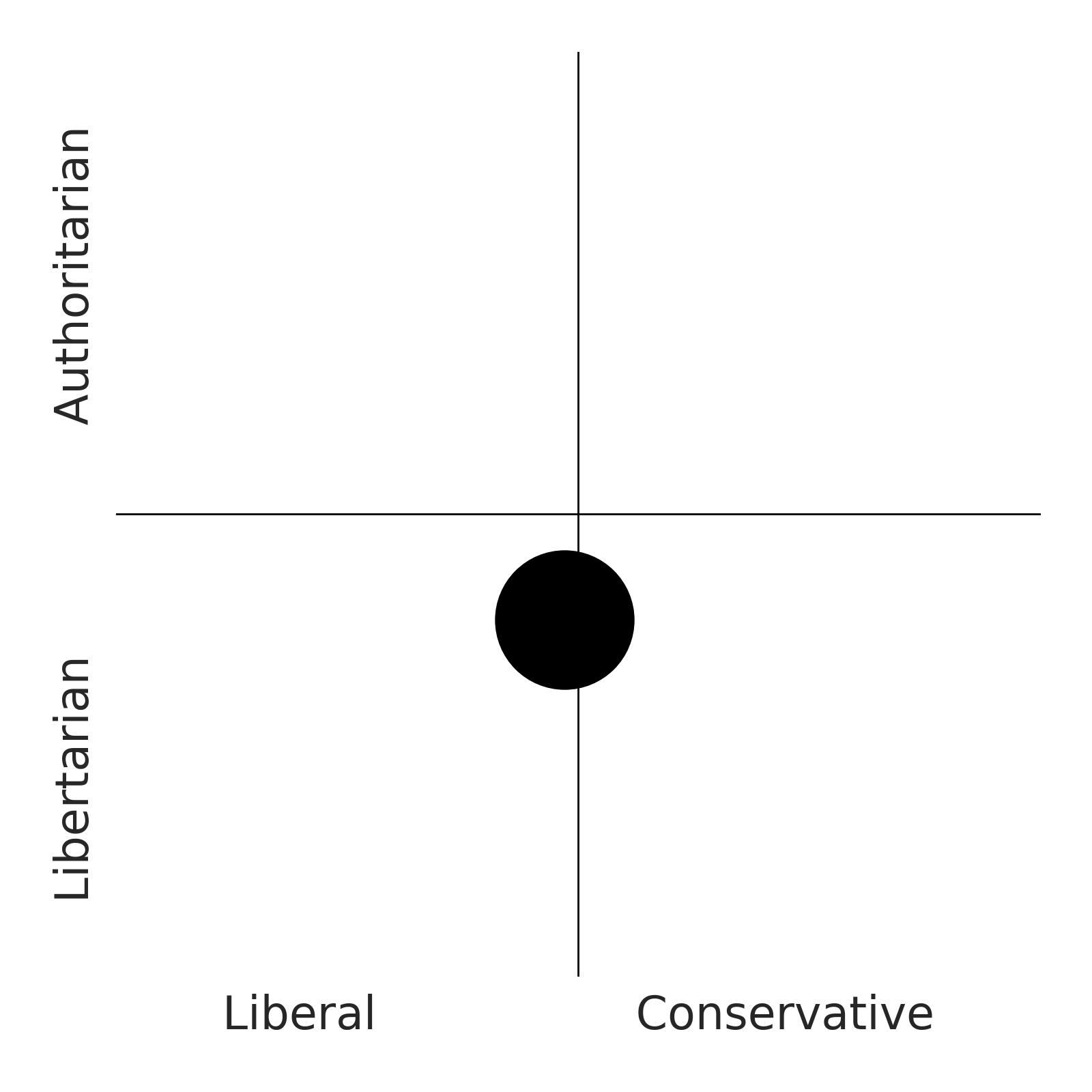
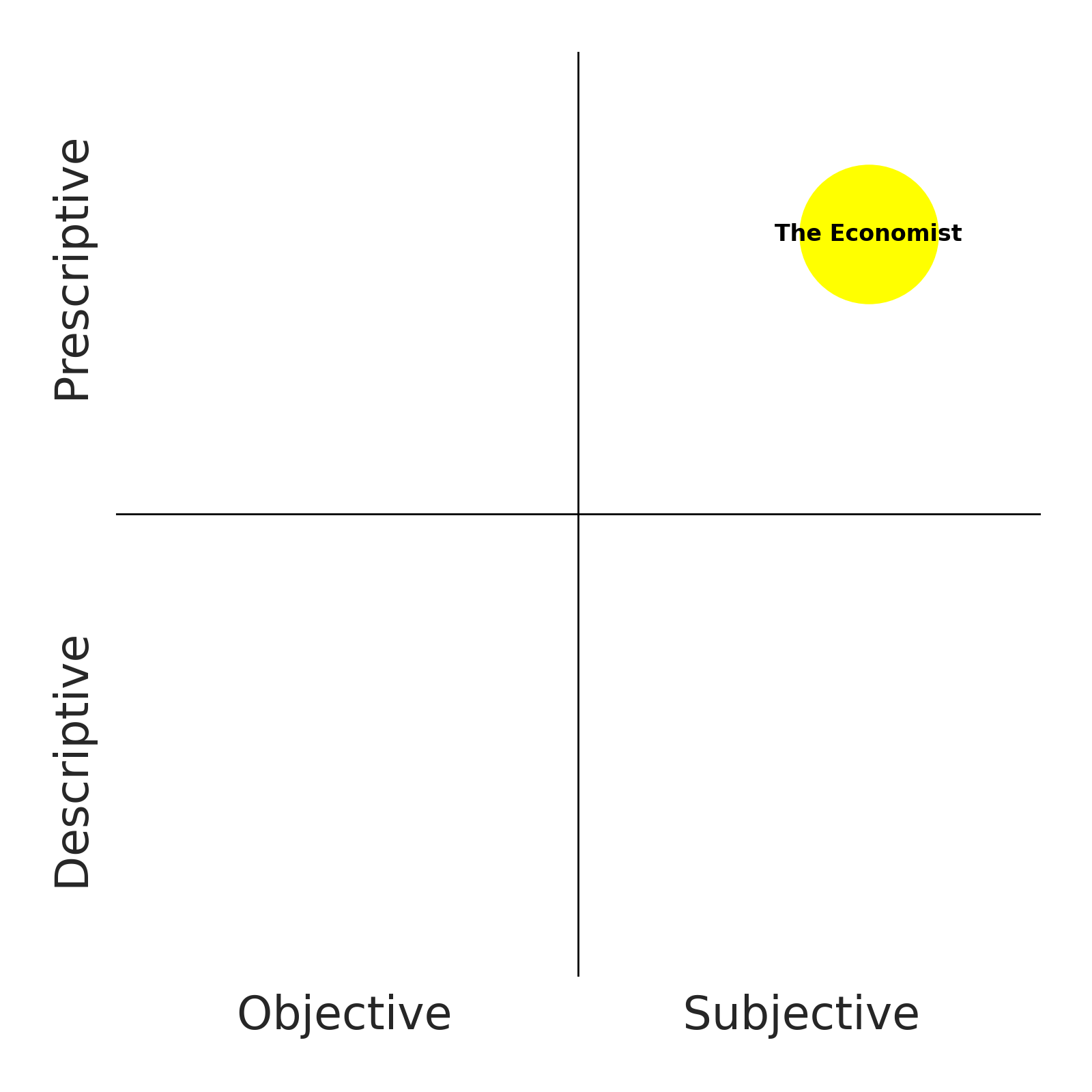
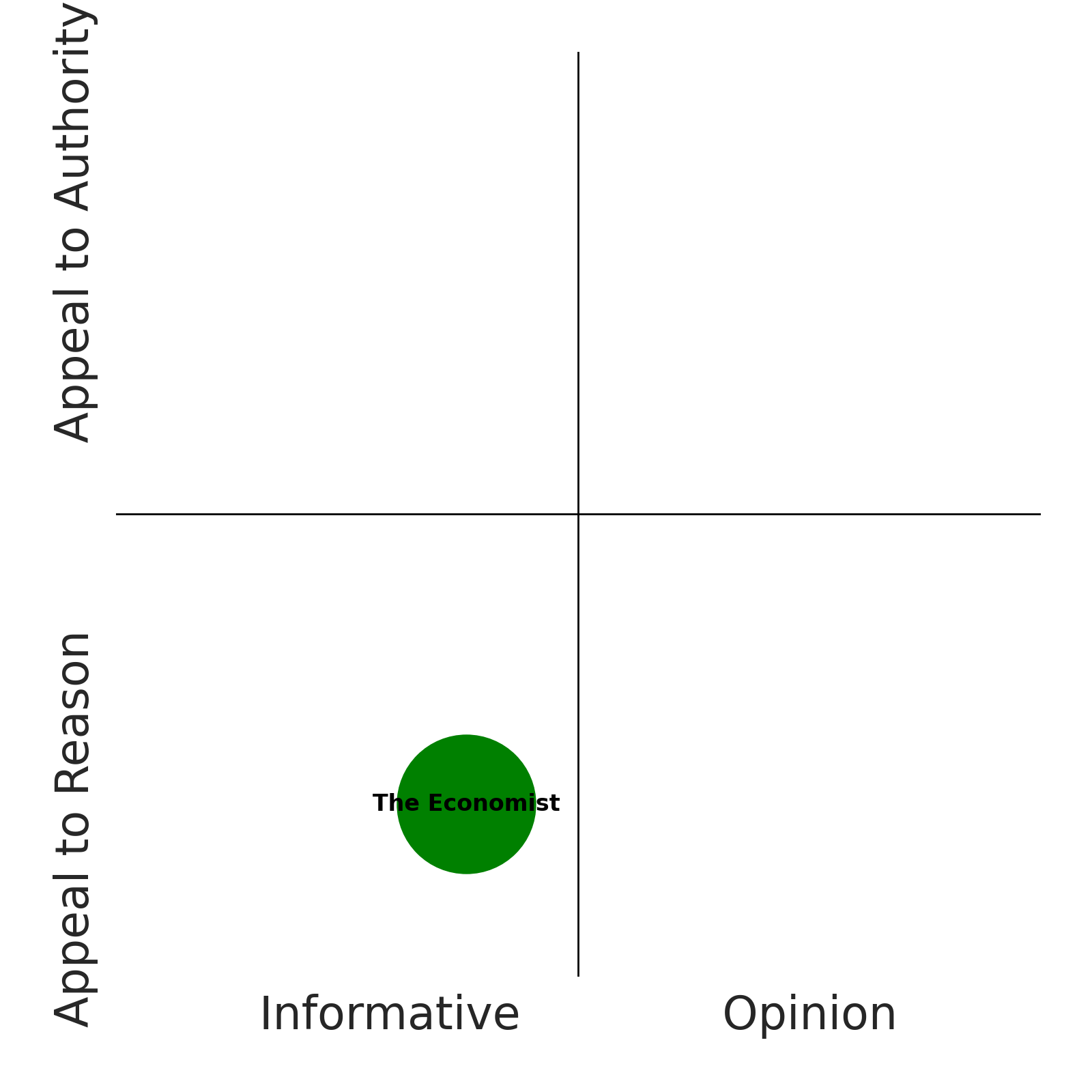
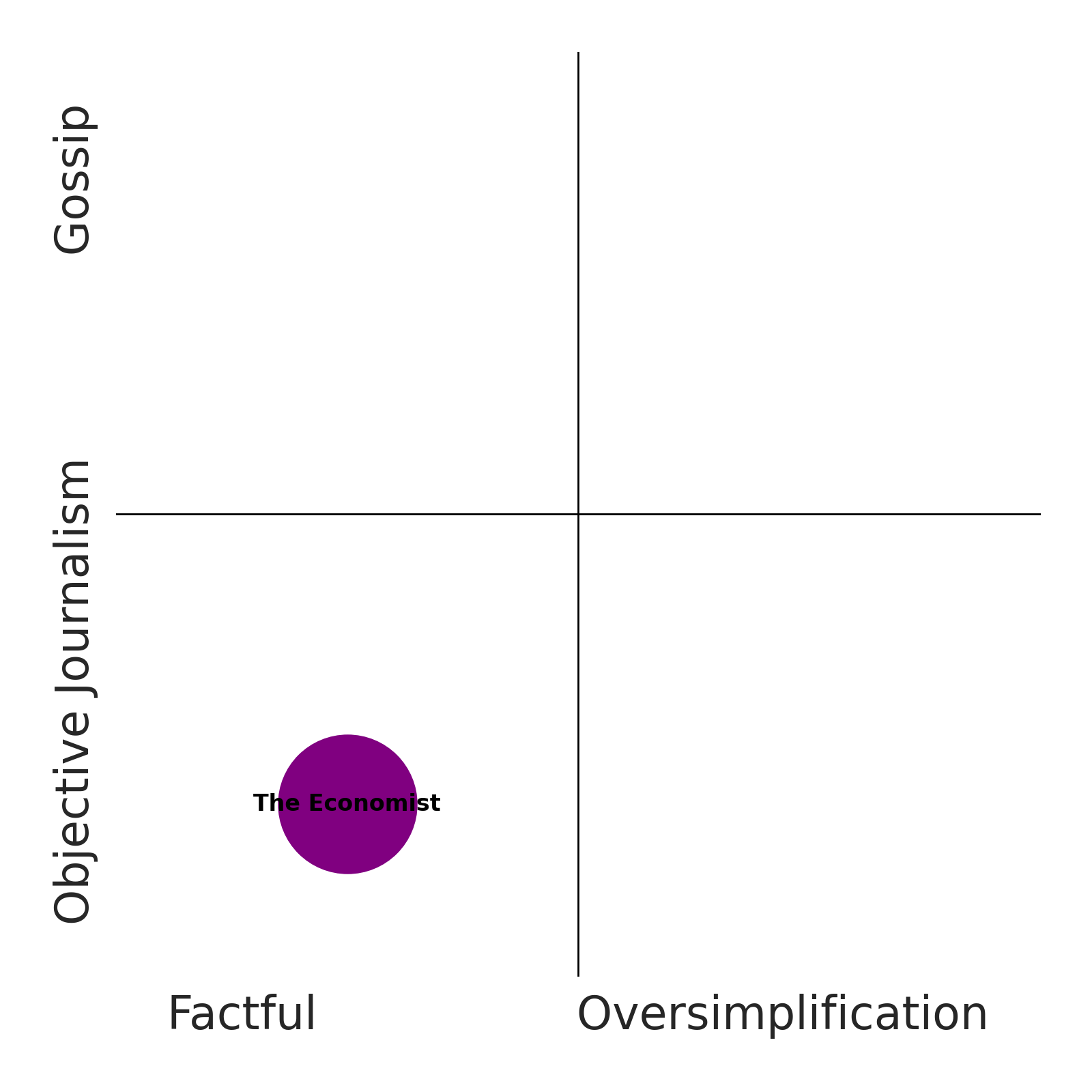
2026 © Helium Trades
Privacy Policy & Disclosure
* Disclaimer: Nothing on this website constitutes investment advice, performance data or any recommendation that any particular security, portfolio of securities, transaction or investment strategy is suitable for any specific person. Helium Trades is not responsible in any way for the accuracy
of any model predictions or price data. Any mention of a particular security and related prediction data is not a recommendation to buy or sell that security. Investments in securities involve the risk of loss. Past performance is no guarantee of future results. Helium Trades is not responsible for any of your investment decisions,
you should consult a financial expert before engaging in any transaction.
Helium Research Assistant

How can I help you today?
Ask any question about The Economist bias.


